Richmond Planet
Saturday, May 5, 1906
Richmond, Virginia
Page text (machine-generated)
THE RICHMOND PLANET
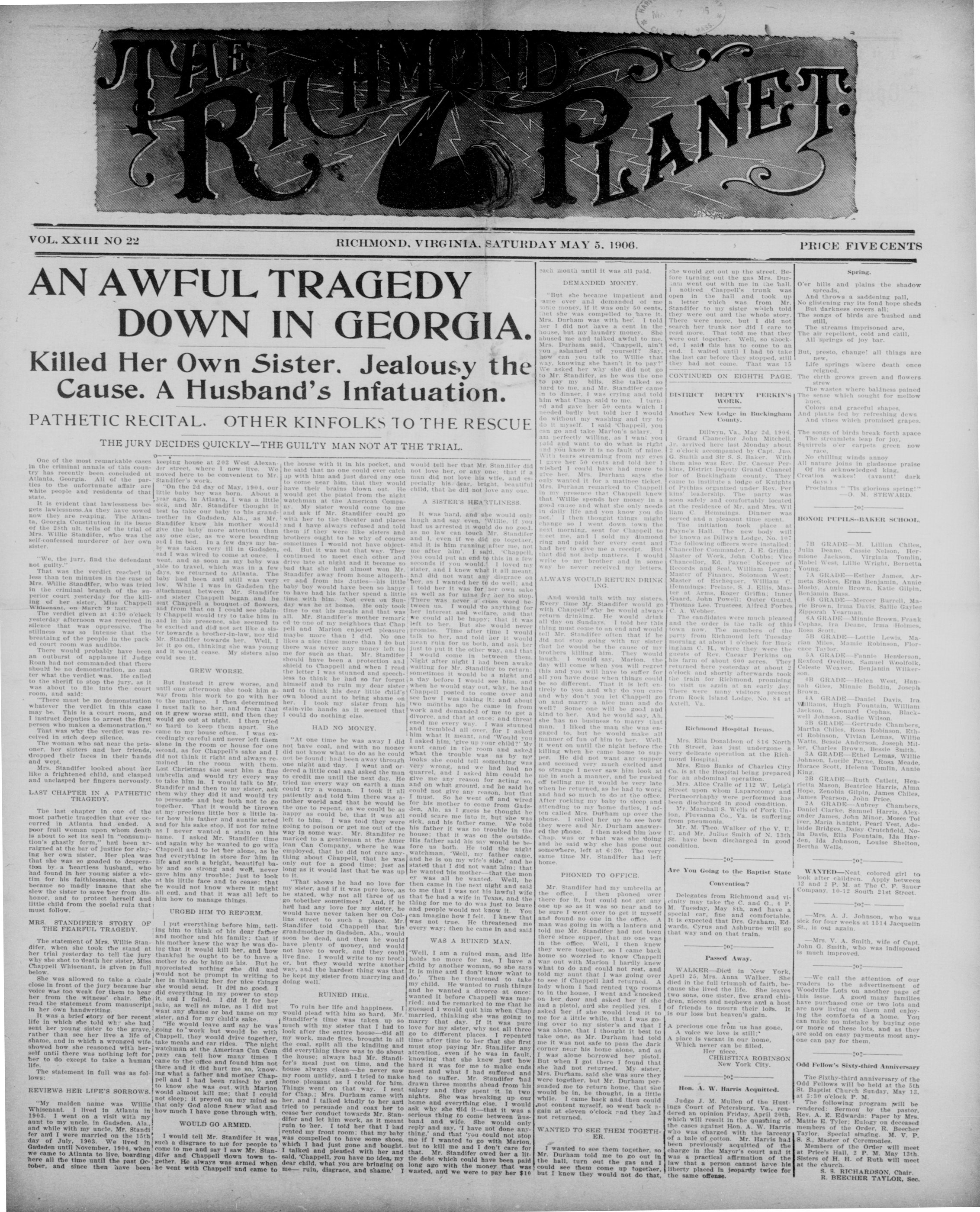
AN AWFUL TRAGEDY DOWN IN GEORGIA. Killed Her Own Sister. Jealousy the Cause. A Husband's Infatuation.
PATHETIC RECITAL. OTHER KINFOLKS TO THE RESCUE THE JURY DECIDES QUICKLY-THE GUILTY MAN NOT AT THE TRIAL.
VOL. XXIIII NO 22
AN AW
D
Killed He
Cause.
PATHETIC RE
THE JURY
One of the most remarkable cases in the criminal annals of this country has recently been concluded at Atlanta, Georgia. All of the parties to the unfortunate affair are white people and residents of that state.
It is evident that lawlessness begets lawlessness. As they have sowed now they are reaping. The Atlanta, Georgia Constitution in its issue of the 28th ult. tells of the trial of Mrs. Willie Standifer, who was the self-confessed murderer of her own sister.
"We, the jury, find the defendant not guilty."
That was the verdict reached in less than ten minutes in the case of Mrs. Willie Standifer, who was tried in the criminal branch of the superior court yesterday for the killing of her sister, Miss Chappell Whisnant, on March 9 last.
The verdict given at 4:30 o'clock yesterday afternoon was received in silence that was oppressive. The stillness was so intense that the breathing of the people in the packed court room was audible.
There would probably have been an outburst of applause if Judge Roan had not commanded that there should be no demonstration, no mat ter what the verdict was. He called to the sheriff to stop the jury, as it was about to file into the court room, and said:
"There must be no demonstration whatever the verdict in this case may be. This is a court room, and I instruct deputies to arrest the first person who makes a demonstration." That was why the verdict was received in such deep silence. The woman who sat near the prisoner, her sisters and her friends, dropped their faces in their hands and wept. Mrs. Standifer looked about her like a frightened child, and clasped and unclasped her fingers nervously.
LAST CHAPTER IN A PATHETIC TRAGEDY.
The last chapter in one of the most pathetic tragedies that ever occurred in Atlanta had ended. A poor frail woman upon whom death is about to set its seal in "consumption's ghastly form." had been arraigned at the bar of justice for slaying her own sister. Her plea was that she was so goaded to desperation by a heartless husband, who had found in her young sister a victim for his faithlessness, that she became so madly insane that she slew the sister to save her from dishonor, and to protect herself and little child from the social ruin that must follow.
MRS. STANDIFER'S STORY OF THE FEARFUL TRAGEDY
The statement of Mrs. Willie Standifer, when she took the stand at her trial yesterday to tell the jury why she shot to death her sister, Miss Chappell Whisenant, is given in full below.
She was allowed to take a chair close in front of the jury because her voice was too weak for them to hear her from the witness' chair. She read the statement from manuscript in her own handwriting.
It was a brief story of her recent life in which she told why she had sent her young sister to the grave, rather than see her live a life of shame, and in which a wronged wife showed how she reasoned with herself until there was nothing left for her to do except to take a human life.
The statement in full was as follows:
REVIEWS HER LIFE'S SORROWS
"My malden name was Willie Whisenant. I lived in Atlanta in 1903. I went on a visit with my aunt to my uncle, in Gadsden, Ala., and while with my uncle, Mr. Standiffer and I were married on the 15th day of July, 1903. We lived in Gadsden until November, 1904, when we came to Atlanta to live, boarding here all the time until the past October, and since then have been
keeping house at 203 West Alexander street, where I now live. We moved here to be convenient to Mr. Standifler's work.
"On the 2d day of May, 1904, our little baby boy was born. About a year ago, in Atlanta, I was a little sick, and Mr. Standifler thought it best to take our baby to his grandmother in Gadsden, Ala., as Mr. Standifler knew his mother would give the baby more attention than any one else, as we were boarding and I in bed. In a few days my baby was taken very ill in Gadsden, and I was wired to come at once. I went, and as soon as my baby was able to travel, which was in a few days, we returned to Atlanta. The baby had been and still was very low. While I was in Gadsden the attachment between Mr. Standifler and sister Chappell began and he sent Chappell a bouquet of flowers and from that on I could see plainly Chappell would try to take him in and in his presence, she seemed to be excited and did not act like a sister towards a brother-in-law, nor did Mr. Standifler towards her. Well, I let it go on, thinking she was young and it would cease. My sisters also could see it.
GREW WORSE
But instead it grew worse, and until one afternoon she took him away from his work to go with her to the matinee. I then determined I must talk to her, and from that on it grew worse still, and then they would go out at night. I then tried so hard to keep them apart. They came to my house often. I was exceedingly careful and never left them alone in the room or house for one second, as for Chappell's sake and I did not think it right and always remained in the room with them. Last Christmas sae sent him a fine umbrella and would try every way to take him in. I would talk to Mr. Standifer and then to my sister, ask them why they did it and would try to persuade and beg both not to go together. That it would be farown at my precious little boy a little later how his father and auntie acted and for his sake stop, if not for mine as I never wanted a stain on his name. I asked Mr. Standifer time and again why he wanted to go wifa Chappell and to let her alone, as he had everything in store for him in life and such a bright, beautiful baby and so strong and well, never gave him any trouble; just to look at his little face and to cease; that he would not know where it might all end, and that it was all left to him how to manage things.
URGED HIM TO REFORM
I put everything before him, telling him to think of his dear father and mother and his family; that if his mother knew the way he was doing that it would kill her, and how thankful he ought to be to have a mother to do by him as ails. But he appreciated nothing she did and would not be prompt in writing to her in thanking her for nice tails she would send. It did no good. I did everything in my power to stop it, and I failed. I did it for her sake, as well as mine, as I did not want any shame or bad name on my sister, and for my child's sake.
"He would leave and say he was going to work but would be with Chappell, they would drive together, take meals and car rides. The night watchman at the American Can Company can tell how many times I came to the office and found him not there and it did hurt me so, knowing what a father and mother Chappell and I had been raised by and to know she was out, with Marlon would almost kill me; that I could not sleep; it preyed on my mind so that only God alone knew what and how much I have gone through with.
WOULD GO ARMED
I would tell Mr. Standifer it was such a disgrace to me for people to come to me and say I saw Mr. Standifer and Chappell down town together. He always was armed when he went with Chappell and came to
the house with it in his pocket, and he said that no one could ever catch up with him and just dared any one to come near him, that they would have their brains blown out. He would get the pistol from the night watchman at the American Company. My sister would come to me and ask if Mr. Standifler could go with her to the theater and places and I have always refused and told them if they were like sisters and brothers ought to be why of course sometimes I would not have objected. But it was not that way. They continued to meet each other and drive late at night and it became so bad that she had almost won Mr. Standifler away from home altogether and from his duties—his little baby boy would have been so happy to have had his father spend a little time with him. Not even on Sunday was he at home. He only took time to eat his meals and that was all. Mr. Standifler's mother remarked to one of my neighbors that Chapell and Marion enjoyed pleasure maybe more than I did. No one likes a nice time more than I do but there was never any money left to me for such as that. Mr. Standifler should have been a protection and shield to Chappell and when I read the letter I was stunned and speechless to think he had so far forgot himself and to ruin my dear sister and to think his dear little child's own blood aunt to bring shame on her. I took my sister from his stain-vile hands as it seemed that I could do nothing else.
HAD NO MONEY
"At one time he was away I did not have coal, and with no money did not know what to do as he could not be found; had been away through one night and day. I went and ordered a little coal and asked the man to credit me until the next day. He tried me every way on earth a man could try a woman. I took it all patiently and told him there was another world and that he would be the one to repent, as we could be as happy as could be, that it was all left to him. I was told they were going to poison or get me out of the way in some way. Mr. Standifer remarked to a gentleman at the American Can Company, where he was employed, that he did not care anything about Chappell, that he was only out for a good time; just as long as it would last that he was up to it.
"That shows he had no love for my sister, and if it was pure love, as he stated, why not all three of us go toobeth sometimes? And, if he had any love for my sister, he would have never taken her on Collins street to such a place. Mr. Standifer told Chappell that his grandmother in Gadsden, Ala., would soon be dead, and then he would have plenty of money, and would not have to work, and they could live fine. I would write to my brother, but they would write another way, and the hardest thing was that he kept my sister from marrying and doing well."
RUINED HER
To ruin her life and happiness. I would plead with him so hard. Mr. Standiffer's time was taken up so much with my sister that I had to look after the entire house—did all my work, made fires, brought in all the coal, split all the kindling and did everything there was to do about the house; always had Mr. Standiffer's meal just on time, and the house always clean—he never saw my room untidy, and I tried to make home pleasant as I could for him. Things went on that way. I sent for Chap.; Mrs. Durham came with her, and I talked kindly to her and tried to persuade and coax her to cease her conduct towards Mr. Standiffer and let him work, as it meant ruin to her. I told her that I had rented my front room; that my baby was compelled to have some shoes, which I had just gone and bought. I talked and pleaded with her and said, 'Chappell, you have no idea, my dear child, what you are bringing on me—ruin, disgrace, and shame,' I
would tell her that Mr. Stan.lifer did not love her, or any one: that if a man did not love his wife, and especially his dear, bright, beautiful child, that he did not love any one.
A SISTER'S HEARTLINESS
It was hard, and she would only laugh and say even, 'Willie, if you had us arrested it would do no good, as no law can touch Mr. Standiffer and I, even if we did go together, and it is him running after me, not me after him'. I said, 'Chappell, you could put an end to this in a few seconds if you would'. I loved my sister, and I knew what it all meant, and did not want any disgrace on her, as I wanted her to do well; and I told her it was for her own sake as well as for mine for her to stop. There was never a cross word between us. I would do anything for her interest and welfare, and that we could all be happy; that it was left to her. But she would never promise. Time after time I would talk to her, and told her it would mean ruin for us both, and ask her just to put it the other way, and that I would come in between them. Night after night I had been awake waiting for Mr. Standiffer to return; sometimes it would be a night and a day before I would see him, and when he would stay out, why, he had Chappell posted to come over and see how it was taken it; and about two months ago he came in from work and demanded of me to get a divorce, and that at once; and threaten me every way. I was stunned and trembled all over, for I asked him what it meant, and 'Would you I asked him, 'give up your child?' My amcame in the room and asked what the trouble was as by my looks she could tell something was very wrong, and we had had no quarrel, and I asked him could he give me any reason for acting so, and on what ground, and he said he could not give any reason, but that I must. So he went off and wired for his mother to come from Gadsen, Ala, as I guess he thought he could scare me into it, but she was sick, and his father came. We told his father it was no trouble in the house; that it was on the outside. His father said his would be before us both. He told the night watchman, 'Well, my father came, and he is on my wife's side,' and he stated that I did not want him; that he wanted his mother—that the monkey was all he wanted. Well, he then came in the next night and said to me that I was not his lawful wife that he had a wife in Texas, and the thing for me to do was just to leave and people would not know it. You can imagine how I felt. I knew that was not true. He threatened me every way; then he came in and said
WAS A RUINED MAN
'Well, I am a ruined man, and life holds no more for me. I have a child by another woman, so she says It is mine and I don't know what to do.' Then he threatened to take my child. He wanted to rush things and he wanted a divorce at once; wanted it before Chappell was married; and he remarked to me that he guessed I would quit him when Chap married, thinking she was going to marry that day. If it was pure love for my sister, why not all three go to different places. I repeated time after time to her that she first must stop paying Mr. Stanlifer any attention, even if he was in fault, knowing that she knew just how hard it was for me to make ends meet and what I had suffered and had to suffer. Mr. Stanlifer had drawn three months ahead from his salary and they spent it in two nights. She was breaking up our home and everything else. I would ask why she tild it—that it was a serious thing to come between husband and wife. She would only reply and say, 'I have not done anything,' and that 'you could not stop me if I wanted to go with Marion, but to kill me and I don't care for that. Mr. Stanlifer owed her a little debt which could have been paid long ago with the money that was wasted, and we were to pay her $10
each month until it was all paid
DEMANDED MONEY
"But she became impatient and came over and demanded of me some money. If it was only 50 cents, that she was compelled to have it. Mrs. Durham was with her. I told her I did not have a cent in the house, but my laundry money. She abused me and talked awful to me. Mrs. Durham said, Chappell, isn't you ashamed of yourself? Say, how can you talk to Willie that way, knowing she hasn't it to pay? We asked her why she did not go to Mr. Standifer, as he was the one to pay my bills. She talked hard to me, and Mr. Standifer came in to dinner. I was crying and told him Chap. said to me. I turned and gave her 50 cents which I needed badly but told her I would do without my washing and try to do it myself. I said 'Chappell, you can go and take Marion's salary. I am perfectly willing, as I want you and you know it is no fault of mine. With tears streaming from my eyes I gave her 50 cents and told her I wished I could have had more to give her. Mrs. Durham says she only wanted it for a matinee ticket. Mrs. Durham remarked to Chappell in my presence that Chappell knew that 'Willie spends her money in a good cause and what she only needs in daily life and you know you do not.' I then thought things might change so I went down town the next morning, sent for Chappell to meet me, and I sold my diamond ring and paid her every cent and had her to give me a receipt. But that did not help matters. I would write to my brother and in some way he never received my letters.
ALWAYS WOULD RETURN DRINK ING.
And would talk with my sisters. Every time Mr. Standifter would go with Chappell why he would always return drinking. He would drink all day on Sundays. I told her this thing must come to an end and would tell Mr. Standifter often that if he did not stop going with my sister that he would be the cause of my brothers killing him. They would laugh. I would say, Marlon, the day will come when you will regret this and you will have to suffer for all you have done when things could be so different. That it is left entirely to you and why do you care and why don't you let Chappell go and marry a nice man and do well? Some one will be good and kind to her. And he would say, Ah, she has no business to marry that man. I liked the man she was engaged to, but he would make all manner of fun of him to her. Well, it went on until the night before the killing when he came home to supper. He did not want any supper and seemed very much excited and so strange I never saw him look at me in such a manner, and he rushed off telling me it would be very late when he returned, as he had to work and had so much to do at the office. After rocking my baby to sleep and attending to my home duties, I often called Mrs. Durham up over the phone. I called her up to see how they were and Mr. Durham answered the phone. I then asked him how Chap, was or what was she doing and he said why she has gone out somewhere, left at 6:30. The very same time Mr. Standifter had left home.
PHONED TO OFFICE
Mr. Standifer had my umbrella at the office. I then phoned over there for it, but could not get any one up so as it was so near and to be sure I went over to get it myself and found no one in the office. A man was going in with a lantern and told me Mr. Standifer had not been there since supper, that no one was in the office. Well, I then knew they were together, so I came back home so worried to know Chappell was out with Marion I hardly knew what to do and could not rest, and told my aunt that I was going over to see if Chappell had returned. A lady whom I had rented two rooms to in the house. I went and knocked on her door and asked her if she had a pistol, and she replied yes. I asked her if she would lend it to me for a little while, that I was going over to my sister's and that I was alone, that I thought it best to take one, as Mr. Durham had told me it was not safe to pass the dark corner near his home alone, and as I was alone borrowed her pistol. But when I got there I found that she had not returned. My sister, Mrs. Durham, said she was sure they were together, but Mr. Durham persuaded me to return home, that she would be in, he thought, in a little while. I came back and then could not content myself, so went back again at eleven o'clock and they had not returned.
WANTED TO SEE THEM TOGETHER.
I wanted to see them together, so Mr. Durham told me to go out in the hall, turn out the gas and I could see them come up together, but I knew they would not do that.
she would get out up the street. Before turning out the gas Mrs. Duran went out with me in the hall. I noticed Chappell's trunk was open in the hall and took up a letter which was from Mr. Standifter to my sister which told they were out and the whole story. There were more, but I did not search her trunk nor did I care to read more. That told me that they were out together. Well, so shocked, I said this has to come to an end. I waited until I had to take the last car before they stopped, still they had not come. That was 15
CONTINUED ON EIGHTH PAGE.
DISTRICT DEPUTY PERKIN'S WORK.
Another New Lodge in Buckingham County.
Dillwyn, Va., May 2d, 1906.
Grand Chancellor John Mitchell,
Jr. arrived here last Monday about
2 o'clock accompanied by Capt. Jno.
G. Smith and Sir S. S. Baker. With
them also was Rev. Dr. Caesar Perkins,
District Deputy Grand Chancellor
of Buckingham county. They
came to institute a lodge of Knights
of Pythias organized under Rev. Perkins' leadership. The party was
soon safely and comfortably located
at the residence of Mr. and Mrs. Will
C. Hemmings. Dinner was
served and a pleasant time spent.
The initiation took place at
Payne's Hall. The new body will
be known as Dillwyn Lodge, No. 107
The following officers were installed:
Chancellor Commander, J. E. Griffin;
Master of Work, John Cobbs; Vice
Chancellor, Ed. Payne; Keeper of
Records and Seal, William Logan;
Master of Finance, Soilomon West;
Master of Exchequer, William C.
Hemmings; Prelate, S. J. Ellis, Master
at Arms, Roger Griffin; Inner
Guard, John Powell; Outer Guard,
Thomas Lee, Trustees, Alfred Forbes
C. A. Webber.
The candidates were much pleased and the order is the talk of this town now. The members of the party from Richmond left Tuesday morning at about 1 o'clock for Buckingham C. H., where they were the guests of Rev. Caesar Perkins on his farm of about 600 acres. They returned here yesterday at about 2 o'clock and shortly afterwards took the train for Richmond, promising to visit us again at an early day. There were many visitors present from Rock Island Lodge. No. 84 at Axtell, Va.
Richmond Hospital Items
Mrs. Ella Donaldson of 816 North 7th Street, has just undergone a very delicate operation at the Richmond Hospital.
Mrs. Emo Banks of Charles City Co. is at the Hospital being prepared for an abdominal operation.
Mrs. Alice Cralle of 112 W. Leigh Street upon whom Laparotomy and Perineorrhaphy were performed has been discharged in good condition.
Mr. Marshall S. Wells of Fork Union, Fluviana Co., Va. is suffering from pneumonia.
Mr. M. Theo. Walker of the V. U. U. and Julius Smith of N. 13th St. have been discharged in good condition.
Are You Going to the Baptist State
Delegates from Richmond and vicinity may take the C. and O., 4 P. M. Tuesday, May 8th, and have a special car, fine and comfortable. It is expected that Drs. Graham, Edwards, Cyrus and Ashburne will go that way and on that train.
Passed Away.
WALKER—Died in New York,
April 25. Mrs. Anna Walker. She
died in the full triumph of faith,
because she lived the life. She leaves
two sons, one sister, five grand
children, nieces and nephews and a host
of friends to mourn their loss. It
is our loss but heaven's gain.
A precious one from us has gone,
A voice we love is still;*
A place is vacant in our home,
Which never can be filled.
Her niece,
CHRISTINA ROBINSON
New York City.
Hon. A. W. Harris Acquitted.
Judge J. M. Mullen of the Hustings Court of Petersburg, Va., rendered an opinion Friday, April 20th, which will result in the quashing of the cases against Hon. A. W. Harris who was charged with the larceny of a bale of cotton. Mr. Harris had been previously acquitted of the charge in the Mayor's court and it was a practical affirmation of the law that a person cannot have his liberty placed in jeopardy twice for the same offense.
PRICE FIVE CENTS
Spring.
O'er hills and plains the shadow spreads,
And throws a saddening pall,
No glistening ray its fond hope sheds
But darkness covers all;
The songs of birds are hushed and still,
The streams imprisoned are,
The air repellent, cold and call,
All springs of joy bar.
But, presto, change! all things are new,
Life springs where death once reigned,
The earth grows green and flowers strew
The wastes where baldness palmed
The sense which sought for mellow hues,
Colors and graceful shapes,
And plants fed by refreshing dews
And vines which promised grapes.
The songs of birds break forth apace
The streamlets leap for joy,
Squirrels o'er carpets green now race,
No chilling winds annoy
All nature joins in gladseas praise
Of its acknowledged king,
Creation wakes! (avaunt! dark days.)
Proclaims "Tis glorious spring!"
—O. M. STEWARD.
HONOR PUPILS--BAKER SCHOOL
7B GRADE—M. Lillian Chiles, Julia Deane, M. Cassie Nelson, Hermione Jackson, Virginia Tomlin, Mabel West, Lillie Wright, Bernetta Young.
7A GRADE—Esther James, Armeta Stokes, Erna Benjamin, Annie Mosby, Annie Brown, Katie Gilpin, Benjamin Bass.
6B GRADE—Mercer Burrell, Marie Brown, Irma Davis, Sallie Gayles Zipporah Yearman.
6A GRADE—Minnie Brown, Frank Cephas, Ira Deane, Irma Holmes, Rosa Scott.
5B GRADE—Lottie Lewis, Marian Miles, Mamie Robinson, Florence Taylor.
5A GRADE—Fannie Henderson, Rexford Ovelton, Samuel Woolfolk, Celeste Weaver, Benjamin Wilkerson.
4B GRADE—Helen West, Hannah Giles, Minnie Boldin, Joseph Brown.
4A GRADE—Daniel Davis, Ira Williams, Hugh Fountain, William Jackson, Leonard Cephas, Blackwell Johnson, Sadie Wilson.
3B GRADE—Gertrude Chambers, Martha Chiles, Rosa Robinson, Ethel Robinson, Vlianem Lemis, Willey Watts, Bessie Anderson, Joseph Miller, Charles Brown, Bessie Smith.
2A GRADE—Ethel Lemas, Willie Johnson, Lucile Payne, Rosa Meade, Horace Scott, Helena Tomlin, Annie King.
2B GRADE—Ruth Cattlett, Henrietta Mason, Beatrice Harris, Alma Hope, Zenobia Gilpin, James Chiles, James Pearson, John Price.
2A GRADE—Aunbrey Chambers, Daniel Clarke, Samuel Harris, Alexander James, John Minor, Moses Toliver, Maria Knight, Pearl Vest, Adelaide Bridges, Daisy Crutchfield, Nola Davis, Ella Fountain, Ida Hayden, Ida Johnson, Louise Shelton, Bertha Wells.
WANTED—Neat colored girl to look after children. Apply between 12 and 2 P. M. at The C. F. S. Sauce Company, 10-12 South 21st Street.
—Mrs. A. J. Johnson, who was sick for four weeks at 1514 Jacquelin St., is out again.
—Mrs. V. A. Smith, wife of Capt. John G. Smith, who was indisposed is much improved.
—We call the attention of our readers to the advertisement of Woodville Lots on another page of this issue. A good many families have purchased one or two lots and are now living on them and enjoying the comforts of a home. You can make no mistake by buying one or more of these lots, and as they are sold on easy payments most anyone can pay for them.
Odd Fellow's Sixty-third Anniversary
The Sixthy-third anniversary of the Odd Fellows will be held at the 5th St. Baptist Church Sunday, May 13, at 3:30 o'clock P. M.
The following program will be rendered: Sermon by the pastor, Rev. A. E. Edwards; Paper by Mrs. Mattie E. Tyler; Eulogy on deceased members of the Order, R. Beecher Taylor. Special singing. M. V. P. S. S., Master of Ceremonies.
Members of the Order will meet at Price's Hall, 2 P. M. May 13th. Sisters of H. H. of Ruth will meet at the church.
S. S. RICHARDSON, Chair,
R. BEECHER TAYLOR. Sec.
TWO
RY able men have given their lives to the study of Mousoon's headlight, yet science, after no end of investigation, stands in its presence baffled.
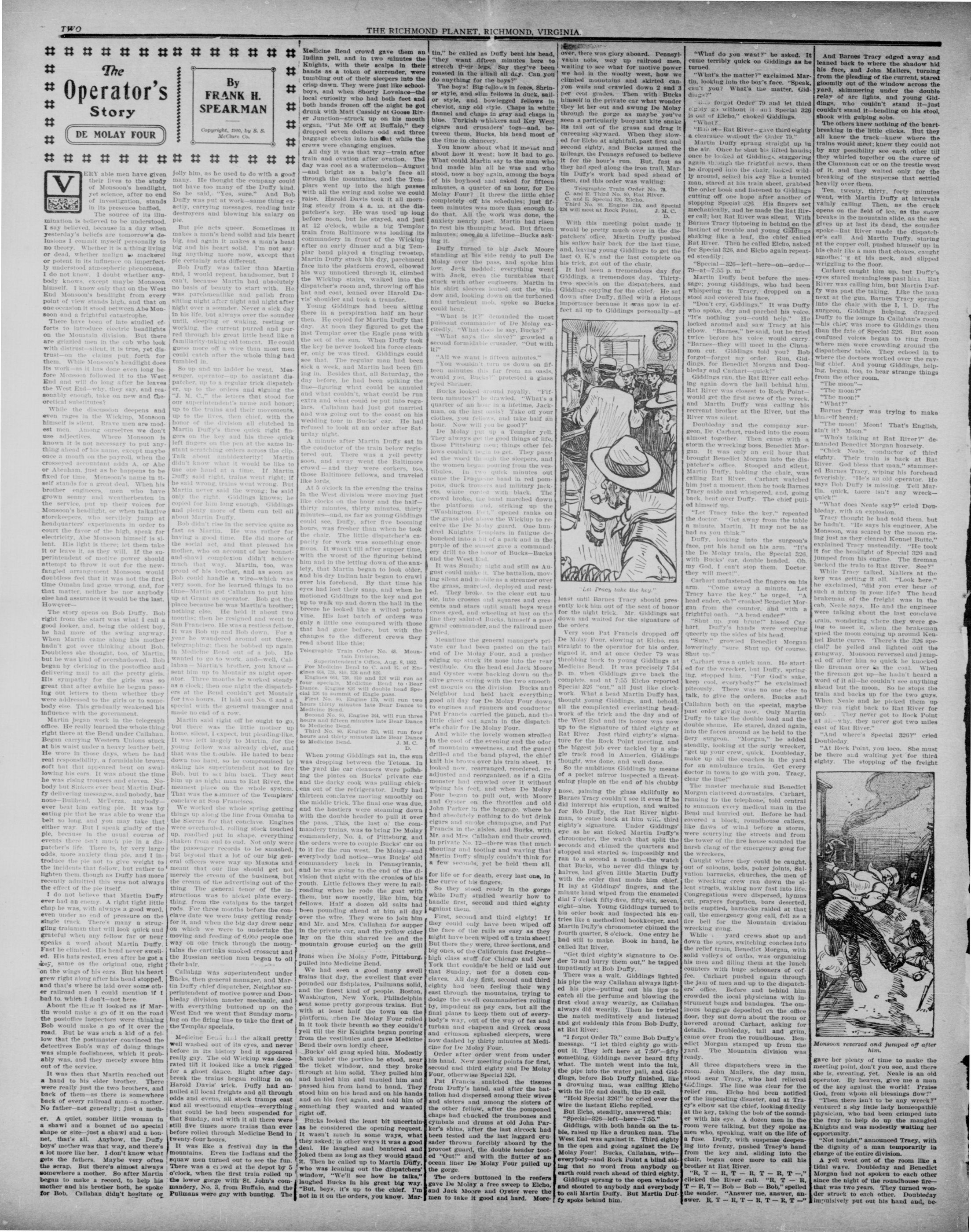
ERY able men have given their lives to the study of Monsoon's headlight, yet science, after no end of investigation, stands in its presence baffled. The source of its illumination is believed to be understood. I say believed, because in a day when yesterday's beliefs are tomorrow's delusions I commit myself personally to no theory. Whether it is a thing living or dead, whether malign mackerel or potent in its influence on imperfectly understood atmospheric phenomena, I do not know. I doubt whether anybody knows, except maybe Monsoon himself. I know only that on the West End Monsoon's headlight from every point of view stands high, and that on one occasion it stood between Abe Monsoon and a frightful catastrophe.
There have been of late studied efforts to introduce electric headlights on the Mountain division. But there are grizzled men in the cab who look with distrust—silent, it is true, yet distrust—on the claims put forth for them. While Monsoon's headlight does its work—as it has done even long before Monsoon followed it to the West End and will do long after he leaves the West End—why, they say, and reasonably enough, take on new and theoretical substitutes?
While the discussion deepens and even rages in the Wickup, Monsoon himself is silent. Brave men are modest men. Among ourselves we don't use adjectives. Where Monsoon is known it is not necessary to put anything ahead of his name, except maybe once a month on the payroll, when the crosseseyed account adds A. or Abe or Abraham, just as he happens to be fixed for time. Monsoon's name in itself stands for a great deal. When his brother engineers, men who have grown seamy and weatherbeaten in the service, put up their voices for Monsoon's headlight, or when talkative storekeepers, who servilely jump at headquarters' experiments in order to court the favor of the high, speak for electricity. Abe Monsoon himself is silent. His light is there; let them take it or leave it, as they will. If the superintendent of motive power should attempt to throw it out for the new-fangled arrangement Monsoon would doubtless feel that it was not the first time Omaha had gone wrong, and, for that matter, neither he nor anybody else had assurance it would be the last. However--
The story opens on Bob Duffy. Bob right from the start was what I call a good looker, and, being the oldest boy, he had more of the swing anyway. When Martin came along his mother hadn't got over thinking about Bob. Doubless she thought, too, of Martin, but he was kind of overshadowed. Bob began by clerking in the postoffice and delivering mail to all the pretty girls. His sympathy for the girls was so great that after awhile he began passing out letters to them whether they were addressed to the girls or to somebody else. This gradually weakened his influence with the government.
Martin began work in the telegraph office. He really learned the whole thing right there at the Bend under Callahan. Began carrying Western Unions stuck at his waist under a heavy leather belt. He wore in those days, when he had real responsibility, a formidable brown soft hat that appeared bent on swallowing his ears. It was about the time he was rising trousers and eleven. Nobody but Sinkers ever beat Martin Duffy delivering messages, and nobody, bar none—Builhead, McTerra, anybody—ever beat him eating pie. It was by eating pie that he was able to wear the belt so long, and you may take that either way. But I speak gladly of the pie, because in the usual course of events there isn't much pie in a dispatcher's life. There is, by very large odds, more anxiety than pie, and I introduce the pie not to give weight to the incidents that follow, but rather to lighten them, though as Duffy has more recently admitted this was not always the effect of the pie itself.
I do not believe that Martin Duffy ever had an enemy. A right tight little chap he was, with always a good word, even under no end of pressure on the single track There's many a struggling trainman that will look quick and grateful when any fellow far or near speaks a word about Martin Duffy. Fast he climbed. His head never swelled. His hats rested, even after he got a key, same as the original one, right on the wings of his ears. But his heart grew right along after his head stopped, and that's where he laid over some other railroad men I could mention if I had to, which I don't—not here.
About the time it looked as if Martin would make a go of it on the road the postoffice inspectors were thinking Bob would make a go of it over the road. But be was such a kid of a fellow that the postmaster convinced the detectives Eob's way of doing things was simple foolishness, which it probably was, and they merely swore him out of the service.
It was then that Martin reached out a hand to his elder brother. There were really just the two brothers, and back of them—as there is somewhere back of every railroad man—a mother. No father—not generally; just a moth-
er. A quiet, somber little woman in a shawl and a bonnet of no special shape or size—just a shawl and a bonnet, that's all. Anyhow, the Duffy boys' mother was that way, and there's a lot more like her. I don't know what gets the fathers. Maybe very often the scrap. But there's almost always somewhere a mother. So after Martin began to make a record, to help his mother and his brother both, he spoke for Bob. Callahan didn't hesitate or
jolly him, as he used to do with a good many. He thought the company could not have too many of the Duffy kind. So he said, "Yes, sure." And Bob Duffy was put at work—same thing exactly, carrying messages, reading hair destroyers and blowing his salary on pie.
But pie acts queer. Sometimes it makes a man's head solid and his heart big, and again it makes a man's head big and his heart solid. I'm not saying anything more now, except that pie certainly acts different.
Bob Duffy was taller than Martin and, I would repeat, handsomer, but I can't, because Martin had absolutely no basis of beauty to start with. He was parchmentlike and palish from sitting night after night and night after night over a sounder. Never a sick day in his life, but always over the sounder until, sleeping or waking, resting or working, the current purred and purred through his great little head like a familiarity-taking old tomcat. He could guess more off a wire than most men could catch after the whole thing had tumbled in.
So up and up ladder he went. Messenger, operator-up to assistant dispatcher, up to a regular trick dispatcher, up to the orders and signing the "J. M. C." the letters that stood for our superintendent's name and honor; up to the trains and their movements; up to the lives, then chief, with the honor of the division all clutched in Martin Duffy's three quick right fingers on the key and his three quick left fingers on the pen at the same instant scratching orders across the clip. Talk about ambidexterity! Martin didn't know what it would be like to use one hand at a time. If Martin Duffy said right, trains went right; if he said wrong, trains went wrong. But Martin never said the wrong; he said only the right. Giddings knows; he copied for him long enough. Giddings and plenty more of them can tell all about Martin Duffy.
Bob didn't rise in the service quite so fast as Martin. He was rather for having a good time. He did more of the social act, and that pleased his mother, who on account of her bonnet and shawl complexion didn't achieve much that way. Martin, too, was proud of his brother, and as soon as Bob could handle a wire—which was very soon, for he learned things in no time—Martin got Callahan to put him up at Grant as operator. Bob got the place because he was Martin's brother; nothing else. He held it about two months; then he resigned and went to San Francisco. He was a restless fellow. It was Bob up and Bob down. For a year he wandered around out there, telegraphing; then he bobbed up again in Medicine Bend out of a job. He wanted to go to work, and—well, Cailahan—Martin's brother, you know—sent him up to Montair as night operator. Three months he worked steady as a clock; then one night the dispatchers at the Bend couldn't get Montair for two hours. It laid out No. 6 and a special with the general manager and made no end of a row.
Martin said right off he ought to go, but there was the little mother to up home, silent, I expect, but pleading-like. It was left largely to Martin, for the young fellow was already chief, and that was the trouble. He hated to bear down too hard, so he compromised by asking his superintendent not to fire Bob, but to set him back. They sent him up as night man to Rat River, the meanest place on the whole system. That was the summer of the Templars' conclave at San Francisco.
We worked the whole spring getting things up along the line from Omaha to the Sieras for that conclave. Engines were overhandled, rolling stock touched up, roadbed put in shape, everything shaken from end to end. Not only were the passenger records to be smashed, but beyond that a lot of our big general officers were way up Masons and meant that our line should get not merely the cream of the business, but the cream of the advertising out of the thing. The general tenor of the instructions was to nickel plate everything from the catapult to the target rods. For three months before the conclave date we were busy getting ready for it, and when the big day drew near on which we were to undertake the moving and feeding of 6,000 people one way on one track through the mountains the cartinks smoked crosscut and the Russian section men began to oil their hair.
Callahan was superintendent under Bucks, then general manager, and Martin Duffy chief dispatcher, Neighbor superintendent of motive power and Doubleday division master mechanic, and with everything buttoned up on the West End we went that Sunday morning on the firing line to take the first of the Templar specials.
Medicine Bend had the alkali pretty well washed out of its eyes, and never before in its history had it appeared really gay. The old Wickupip was decorated till it looked like a buck rigged for a ghost dance. Right after daybreak the trains began rolling in on Harold Davis' trick. Duffy had annulled all local freights and all through odds and evens, all stock tramps east and all westbound empties—everything that could be had been suspended for that Sunday, and with it all there were still five times more trains than ever before rolled through Medicine Bend in twenty-four hours.
It was like a festival day in the mountains. Even the Indians and the squaw men turned out to see the fun. There was a crowd at the depot by 5 o'clock, when the first train rolled up the lower gorge with St. John's commandery, No. 3, from Buffalo, and the Pullmans were gay with bunting. The
THE RICHMOND PLANET, RICHMOND, VIRGINIA
Medicine Bend crowd gave them an Indian yell, and in two minutes the Knights, with their scalps in their hands as a token of surrender, were tumbling out of their sleepers into the crisp dawn. They were just like schoolboys, and when Shorty Lovelace—the local curiosity who had both feet and both hands frozen off the night he got drunk with Matt Cassidy at Goose River Junction—struck up on his mouth organ, "Put Me Off at Buffalo," they dropped seven dollars odd and three baggage checks into his hat while the crews were changing engines.
All day it was that way—train after train and ovation after ovation. The day was cool as a watermelon—August—and bright as a baby's face all through the mountains, and the Templars went up into the high passes with all the swing and noise we could raise. Harold Davis took it all morning steady from 4 a. m. at the dispatcher's key. He was used up long before noon, but he stayed, and just at 12 o'clock, while a big Templar train from Baltimore was loading its commandery in front of the Wicklup after an early dinner and a big Templar band played a tingling twostep, Martin Duffy stuck his dry, parchment face into the platform crowd, elbowed his way unnoticed to it, climbed the Wicklup stairs, walked into the dispatcher's room and, throwing off his hat and coat, leaned over Harold Davis' shoulder and took a transfer.
Young Gilddings had been sitting there in a perspiration half an hour then. He copied for Martin Duffy that day. At noon they figured to get the last Templar over the Eagle pass with the set of the sun. When Duffy took the key he never looked his force cleaner, only he was tired. Gilddings could see that. The regular man had been sick a week, and Martin had been filling in. Besides that, all Saturday, the day before, he had been spiking the line—figuring what could be annuled and what couldn't, what could be run extra and what could be put into regulars. Calahan had just got married and was going out to the coast on his wedding tour in Bucks' car. He had refused to look at an order after Saturday night.
A minute after Martin Duffy sat in the conductor of the train below registered out. There was a yell pretty soon, and away went the Baltimore crowd—and they were corkers, too, those Baltimore fellows, and traveled like lords.
At 5 o'clock in the evening the trains in the West division were moving just like clocks on the hour and the half—thirty minutes, thirty minutes, thirty minutes—and, as far as young Gildings could see, Duffy, after five booming hours, was fresher than when he took the chair. The little dispatcher's capacity for work was something enormous. It wasn't till after supper time, with the worst of the figuring behind him and in the letting down of the anxiety, that Martin began to look older, and his dry Indian hair began to crawl over his forehead. By that time his eyes had lost their snap, and when he motioned Gildings to the key and got up to walk up and down the hall in the breeze he looked like a wilted potato vine. His last batch of orders was only a little one compared with those that had gone before, but with the changes to the different crews they read about like this:
Telegraphic Train Order No. 68. Mountain Division
Superintendent's Office, Aug. 8, 1832
Medicine Bend to C. and D. of Engines
For Engineers
Engines 664, 738, 810 and 325 will run as four specials, Medicine Bend to •Bear Dance, Engine 825 will double head Special 225 to summit of Eagle pass. Engine 173, will run two hours thirty late Bear Dance to Medicine Bend.
Second No. 80, Engine 244, will run three hours and fifteen minutes late Bear Dance to Medicine Bend.
Third No. 80, Engine 210, will run four hours and thirty minutes late Bear Dance to Medicine Bend.
J. M. C.
When young Gildings sat in, the sun was dropping between the Tetons. In the yard the car cleaners were polishing the plates on Bucks' private car and the darky cook was pulling chickens out of the refrigerator. Duffy had thirteen conclaves moving smoothly on the middle trick. The final one was due, and the hostlers were steaming down with the double header to pull it over the pass. This, the last of the commandery trains, was to bring De Molay commandery, No. 4, of Pittsburg, and the orders were to couple Bucks' car on to it for the run west. De Molay—and everybody had notice—was Bucks' old commandery back in Pennsylvania, and he was going to the end of the division that night with the cronies of his youth. Little fellows they were in railroading when he rode the goat with them, but now mostly, like him, big fellows. Half a dozen old salts had been pounding ahead at him all day over the wre. They were to join him and Mr. and Mrs. Callahan for supper in the private car, and the yellow elder lay on the thin shaved ice and the mountain grouse curled on the grill
irons when De Molay Four, Pittsburg, pulled into Medicine Bend.
We had seen a good many swell trains that day, the swellest that ever pounded our fishplates, Pullmans solid, and the finest kind of people. Boston, Washington, New York, Philadelphia sent some pretty gorgeous trains. But with at least half the town on the platform, when De Molay Four rolled in it took their breath so they couldn't yell till the Sir Knights began pouring from the vestibules and gave Medicine Bend their own lordly cheer.
Bucks' old gang抽 him. Modestly back under the portico he stood, near the ticket window, and they broke through at him solid. They pulled him and hauled him and mauled him and passed him from hand to hand. They stood him on his head and on his hands and on his feet again, and told him of something they wanted and wanted right off.
Bucks looked the least bit uncertain as he considered the opening request. It wasn't much in some ways, what they asked; in other ways it was a good deal. He laughed and bantered and joked them as long as they would stand it. Then he called up to Martin Duffy, who was leaning out the dispatchers' window, "We'll see how he talks," laughed Bucks in his great big way. "But, boys, it's up to the chief. I'm not in it on the orders, you know. Mar-
tin," he called as Duffy bent his head, "they want fifteen minutes here to stretch their legs. Say they've been roasted in the alkali all day. Can you do anything for the boys?" The boys! Big fellows in feez, Shriner style, and slim fellows in duck, sailor style, and bowlegged fellows in cheviot, any old style. Chaps in white flannel and chaps in gray and chaps in blue. Turkish whiskers and Key West cigars and crusaders' togs—and, between them, Bucks, his head most of the time in chancery.
You know about what it meant and about how it went; how it had to go. What could Martin say to the man who had made him all he was and who stood, now a boy again, among the boys of his boyhood and asked for fifteen minutes, a quarter of an hour, for De Molay Four? It itwreed the little chief completely off his schedules; just fifteen minutes was more than enough to do that. All the work was done, the anxiety nearly past. Martin had risen to rest his thumping head. But fifteen minutes; once in a lifetime-Bucks asking it. Duffy turned to big Jack Moore standing at his side ready to pull De Molay over the pass, and spoke him low. Jack nodded: everything went with Jack, even the turntables that stuck with other engineers. Martin in his shirt sleeves leaned out the window and, looking down on the turbanted and turbulent mob, spoke so Bucks could hear.
"What is it?" demanded the most puissant commander of De Molay excitedly. "What does he say, Bucks?" "What says the slave?" growled a second formidable crusader. "Out with it!" "All we want is fifteen minutes." "You wouldn't turn us down on fifteen minutes this far from an oasis, would you, Bucks?" protested a glass eyed Shriner. Bucks looked around royally. "Fifteen minutes?!" he drawled. "What's a quarter of an hour in a lifetime, Jackman, on the last oasis? Take off your clothes, you fellows, and take half an hour. Now will you be good?"
De Molay put up a Templar yell. They always get the good things of life, those Pittsburgh men; things other fellows couldn't begin to get. They passed the word through the sleepers, and the women began pouring from the vestibules. In two quick minutes out came the Duquesne band in red pompons, duck trousers and military jackets, white corded with black. The crowd broke, the band marched down the platform and, striking up the "Washington Post," opened ranks on the grass plot above the Wicklup to receive the De Molay guard. One hundred Knights Templars in fatigue debouched into a bit of a park and in the purple of the sunset gave a commandery drill to the honor of Bucks—Bucks and the West End.
It was Sunday night and still as August could make it. The battalion, moving silent and mobile as a streamer over the grass, marched, deployed and rested. They broke to the clear cut music, into crosses and squares and crescents and stars until small boys went cross eyed, and wheeling at last on the line they saluted Bucks, himself a past grand commander, and the railroad men yelled.
Meantime the general manager's private car had been pasted on the tail end of De Molay Four, and a pusher edging up stuck its nose into the rear vestibule. On the head end Jack Moore and Oyster were backing down on the olive green string with the two smoothest morules on the division. Bucks and Neighbor had held back everything good all day for De Molay Four down to engines and runners and conductor Pat Francis carried the punch, and the little chief sat again in the dispatcher's chair for De Molay Four.
And while the lovely women strolled in the cool of the evening and the odor of mountain sweetness, and the guard drilled and the band played, the chief knit his brows over his train sheet. It looked now, rearranged, reordered, adjusted and reorganized, as if a Gila monster had crawled over it without wiping his feet, and when De Molay Four began to pull out, with Moore and Oyster on the throttles and old John Parker in the baggage, where he had absolutely nothing to do but drink cigars and smoke champagne, and Pat Francis in the aisles, and Bucks, with Mr. and Mrs. Callahan and their crowd. In private No. 12—there was that much shouting and tooting and waving that Martin Duffy simply couldn't think for a few seconds, yet be held them all. for life or for death, every last one, in the curve of his fingers.
So they stood ready in the gorge while Duffy studied wearily how to handle first, second and third eighty against them.
First, second and third eighty! If they could only have been wiped off the face of the rails as easy as they might have been wiped off a train sheet! But there they were, three sections, and big ones, of the California fast freight—high class stuff for Chicago and New York that couldn't be held or laid out that Sunday, not for a dozen conclaves. All day first, second and third eighty had been feeling their way east through the mountains, trying to dodge the swell commanderies rolling by, impudent as pay cars, but all the final plans to keep them out of everybody's way, out of the way of fez and turban and chapeau and Greek cross and crimson splashed sleepers, were now dashed by thirty minutes at Medicine for De Molay Four.
Order after order went from under his hand. New meeting points for first, second and third eighty and De Molay Four, otherwise Special 326.
Pat Francis snatched the tissues from Duffy's hand, and after the battalion had dispersed among their wives and sisters and among the sisters of the other fellow, after the pomponed chaps had chucked the trombones and cymbals and drums at old John Parker's shins, after the last aircock had been tested and the last laggard cruser thrown forcibly aboard by the provost guard, the double header toothed "Out!" and with the flutter of an ocean liner De Molay Four pulled up the gorge.
The orders buttoned in the reefers gave De Molay a free sweep to Echo, and Jack Moore and Oyster were the men to take it good and hard. More-
over, there was glory aboard. Pennsylvania nobs, way up railroad men, waiting to see what for motive power we had in the woolly west, how we climbed mountains and skirted canyon walls and crawled down 2 and 3 per cent grades. Then with Bucks himself in the private car what wonder they let her out and swung De Molay through the gorge as maybe you've seen a particularly buoyant kite snake its tail out of the grass and drag it careening skyward. When they slowed for Elcho at nightfall, past first and second eighty, and Bucks named the mileage, the Pennays refused to believe it for the hour's run. But, fast as they had sped along the iron trail, Martin Duffy's work had sped ahead of them, and this order was waiting:
Telegraphic Train Order No. 79. C and E. Third No. 80, Rat River. C, and E Special 826, Elcho. Third No. 80, Engine 219, and Special 826 will meet at Rock Point. J. M. C.
With this meeting point made it would be pretty much over in the dispatchers' office. Martin Duffy pushed his sallow hair back for the last time, and, leaving young Giddings to get the last O. K.'s and the last complete on his trick, got out of the chair.
It had been a tremendous day for Giddings, a tremendous day. Thirty-two specials on the dispatchers, and Giddings copying for the chief. He sat down after Duffy, filled with a riotous importance because it was now in effect all up to Giddings personally—at
J. M.
"Let Tracy take the key."
least until Barnes Tracy should presently kick him out of the seat of honor for the night trick. Mr. Giddings sat down and waited for the signature of the orders.
Very soon Pat Francis dropped off De Moly Four, slowing at Elcho, ran straight to the operator for his order, signed it, and at once Order 79 was throbbing back to young Giddings at Medicine Bend. It was precisely 7.54 p. m. when Giddings gave back the complete, and at 7.55 Elcho reported Special 326 "out." all just like clockwork. What a head Martin Duffy has, thought young Giddings, and, behold, all the complicated everlasting headwork of the trick and the day and of the West End and its honor was now up to the signature of third eighty at Rat River. Just third eighty's signature for the Rock Point meeting, and the biggest job ever tackled by a single track road in America, Giddings thought, was done, and well done.
So the ambitious Giddings by means of a pocket mirror inspected a threatening pimple on the end of his chubby
nose, palming the glass skillfully so Barnes Tracy couldn't see it even if he did interrupt his eruption, and waited for Bob Duffy, the Rat River nightman, to come back at him will, third eighty's signature. Under Gildings' eye as he sat ticked Martin Duffy's chronometer, the watch that split the seconds and chimed the quarters and stopped and started so impossibly and ran to a second a month—the watch that Bucks, who never did things by halves, had given little Martin Duffy with the order that made him chief. It lay at Gildings' fingers, and the minute hand wiped from the enameled dial 7 o'clock fifty-five, fifty-six, seven, eight—nine. Young Gildings turned to his order book and inspected his entries like a methodical bookkeeper, and Martin Duffy's chronometer chimed the fourth quarter, 8 o'clock. One entry he had still to make. Book in hand, he called Rat River.
"Get third eighty's signature to Order 79 and hurry them out," he tapped impatiently at Bob Duffy.
There was a walt. Giddings lighted his pipe the way Callahan always lighted his pipe—putting out his lips to catch all the perfume and blowing the first cloud away wearily, as Callahan always did wearily. Then he twirled the match meditative and listened and got suddenly this from Bob Duffy, at Rat River:
"I forgot Order 79," came Bob Duffy's message. "I let third eighty go without it. They left here at 7:50"—fifty something. Giddings never heard fifty what. The match went into the ink, the pipe into the water pail, and Giddings, before Bob Duffy finished, like a drowning man, was calling Elcho with the life and death, the 19 call.
"Hold Special 326" he cried over the wire the instant Elcho replied.
But Elcho, steadily, answered this:
"Special--328--left--here--7-55."
Giddings, with both hands on the table, raised up like a drunken man. The West End was against it. Third eighty in the open and going against the De Molay Four! Bucks, Callahan, wife—everybody—and Rock Point a blind siding that no word from anybody on earth could reach ahead of third eighty. Giddings sprang to the open window and shouted to anybody and everybody to call Martin Duffy. But Martin Duffy spoke behind him.
"What do you want?" he asked. It came terribly quick on Giddings as he turned.
"What's the matter?" exclaimed Martin, looking into the boy's face. "Speak, can't you? What's the matter, Giddings?
"Boo forgot Order 79 and let third eighty g) without it- and Special 320 is out of Elecho," choked Giddings.
"What?
"Boo at-Rat River-gave third eighty a clearance without the Order 79."
Martin Duffy spring straight up in the air. Once he shut his lifted hands, once he looked at Giddings, staggering again through the frightful news, then he dropped into the chair, looked wildly around, seized his key like a hunter man, stared at his train sheet, grabbed the order book and listened to Giddings cutting off one hope after another of stopping Special 326. His fingers set mechanically, and he made the Rat River call; but Rat River was silent. With Barnes Tracy tiptoeing in behind on the instinct of trouble and young Giddings shaking like a leaf, the chief called Rat River. Then he called Elcho, asked for Special 326, and Elcho again repeated steadily:
"Special-326-left-here-on-order-79-at-7:55 p. m."
Martin Duffy bent before the message; young Giddings, who had been whispering to Tracy, dropped on a stool and covered his face.
"Don't cry, Giddings." It was Duffy who spoke, dry and parched his voice. "It's nothing you—could help." He looked around and saw Tracy at his elbow. "Barnes," he said, but he tried twice before his voice would carry. "Barnes—they will meet in the Clinnamon cut. Giddings told you? Bob forgot—forgot my order. Run, Giddings, for Benedict Morgan and Doublet and Carhart—quick!" Giddings ran, the Rat River call echoing again down the hall behind him. Rat River was closest to Rock Point—would get the first news of the wreck, and Martin Duffy was calling his recreant brother at the River, but the River was silent.
Doubleday and the company surgeon, Dr. Carhart, rushed into the room almost together. Then came with a storm the wrecking boss, Benedict Morgan. It was only an evil hour that brought Benedict Morgan into the dispatcher's office. Stooped and silent, Martin Duffy, holding the chair, was calling Rat River. Carhart watched him just a moment, then he took Barnes Trace aside and whispered, and, going back, bent over Duffy. The chief pulled himself up.
"Let Tracy take the key." repeated the doctor. "Get away from the table a minute. Martin. It may not be as bad as you think."
Duffy, looking into the surgeon's face, put his hand on his arm. "It's the De Molay train, the Special 326, with Bucks' car, double headed. Oh, my God, I can't stop them. Doctor, they will meet!"
Carcharh unfastened the fingers on his arm. "Come away a minute. Let Tracy have the key" he urged. "A head ender, eh?" croaked Benedict Morgan from the counter, and with a frightful oath. "A head ender." "Shut up, you brute!" hissed Carhart. Duny's hands were creeping queerly up the sides of his head. "Sure," growled Benedict Morgan loweringly. "sure" Shut up. Of course. Shut up.
Carthart was a qulek man. He started for the wrecker, but Duffy, springing, stopped him. "For God's sake, keep cool, everybody!" he exclaimed piteously. There was no one else to talk, to give the orders. Bucks and Callahan both on the special, maybe past order giving now. Only Martin Duffy to take the double load and the double shame. He stared, dazed again, into the faces around as he held to the fiery surgeon. "Morgan," he added steadily, looking at the surly wrecker, "get up your crew, quick. Doubleday, make up all the coaches in the yard for an ambulance train. Get every doctor in town to go with you. Tracy, clear the line!"
The master mechanic and Benedict Morgan clattered downstairs. Carhart, running to the telephone, told central to summon every medical man in the Bend and hurried out. Before he had covered a block, roundhouse callers, like flaws of wind before a storm, were scurrying the streets and from the tower of the fire house sounded the harsh clang of the emergency gong for the wreckers.
Caught where they could be caught, out of saloons, beds, poker joints, Salvation barracks, churches, the men of the wrecking crew ran down the silent streets, waking now fast into life. Congregations were dispersed, hymns cut, prayers forgotten, bars deserted, hells emptied, barracks raided at that call, the emergency gong call, fell as a fire bell for the Mountain division wrecking gang.
While a yard crews shot up and down the spurs, switching coaches into the relief train, Benedict Morgan, with solid volleys of oaths, was organizing his men and filling them at the lunch counters with huge schooners of coffee. Carhart pushed again through the jam of men and up to the dispatchers' office. Before and behind him crowded the local physicians with instrument bags and bandages. The ominous baggage deposited on the office floor, they sat down about the room or hovered around Carhart, asking for details. Doubleday, tall and grim, came over from the roundhouse. Benedict Morgan stamped up from the yard. The Mountain division was ready.
All three dispatchers were in the room. John Mallers, the day man, stood near Tracy, who had relieved Giddings. The line was clear for the relief run. Elcho had been notified of the impending disaster, and at Tracy's elbow sat the chief, looking fixedly at the key, taking the bob of the sounder with his eye. A dozen men in the room were talking, but they spoke as men who, speaking, wait on the life of a fuse. Duffy, with suspense deepening into frenzy, pushed Tracy's hand from the key and, sliding into the chair, began once more to call his brother at Rat River.
"R, T - R, T - R, T - R, T -," clicked the River call. "R, T - R, T - R, T - Bob - Bob - Bob," spelled the sender. "Answer me, answer, answer, R, T - R, T - R, T - R, T -"
And Barnes Tracy edged away and leaned back to where the shadow hid his face, and John Mallers, turning from the pleading of the current, stared gloomily out of the window across the yard, shimmering under the double relay of arc lights, and young Gldings, who couldn't stand it—just couldn't stand it—bending on his stool, shook with gulping sobs.
The others knew nothing of the heart-breaking in the little clicks. But they all knew the track—knew where the trains would meet; knew they could not by any possibility see each other till they whirled together on the curve of the Cinnamon cat or on the trestle west of it, and they waited only for the breaking of the suspense that settled heavily over them.
Ten, twenty, thirty, forty minutes went, with Martin Duffy at intervals vainly calling. Then, as the crack opens on the field of ice, as the snow breaks in the mountain slide, as the sea gives up at last its dead, the sounder spoke—Rat River made the dispatcher's call. And Martin Duffy, staring at the copper coll, pushed himself up in his chair like a man that chokes, caught smothering at his neck, and slipped wriggling to the floor.
Carlart caught him up, but Duffy's eyes stared meaningless past him. Rat River was calling him, but Martin Duffy was past the taking. Like the man next at the gun, Barnes Tracy sprang into the chair with the I. I. D. The surgeon, Gildings helping, dragged Duffy to the lounge in Callahan's room - his chief was more to Gildings then than the fate of Special 326. But soon confused voices began to ring from where men were crowding around the dispatchers' table. They echoed in to where the doctors worked over the raving chief. And young Gildings, helping, began, too, to hear strange things from the other room.
"The moon?"—
"The moon?"
"The moon!"
"What?"
Barnes Tracy was trying to make him self heard:
"The moon! Moon! That's English, ain't it? Moon!"
"Who's talking at Rat River?" demanded Benedict Morgan hoarsely.
"Chiek Neale, conductor of third eighty. Their train is back at Rat River. God bless that man." stammered Barnes Tracy, wiping his forehead feverishly. "He's an old operator. He says Bob Duffy is missing. Tell Martin, quick, taure isn't any wreck—quick."
"What does Neale say?" crieled Doubleday, with an explosion.
Tracy thought he had told them, but he hadn't. "He says his engineer, Abe Monsoon, was scared by the moon rising just as they cleared Kennel Butte," explained Tracy unsteadily. "He took it for the headlight of Special 326 and jumped from his engine. The fireman backed the train to Rat River. See?" While Tracy talked, Mailers at the key was getting it all. "Look here. He exclaimed, "Did you ever hear of such a mixup in your life? The head brakeman of the freight was in the cab, Neale says. He and the engineer were talking about the last conclave train, wondering where they were going to meet it, when the brakeman spied the moon coming up around Kennel Butte curve. There's the 326 special!" he yelled and lighted out the gangway. Monsoon reversed and jumped off after him so quick he knocked the fireman over the coal. When the fireman got up—he hadn't heard a word of it all—he couldn't see anything ahead but the moon. So he stops the train and backs up for the two guys. When Neale and he picked them up they ran right back to Rat River for orde. They never got to Rock Point at all—why, they never got two miles east of Rat River."
"And where's Special 326?" cried Doubleday.
"At Rock Point, you loco. She must be there and waiting yet for third eighty. The stopping of the freight
A man is running away from a fire. He is wearing a hat and a coat. The fire is raging, and smoke is billowing upwards. The man is running with his arms outstretched. He is wearing a hat and a coat. The fire is raging, and smoke is billowing upwards. The man is running with his arms outstretched. He is wearing a hat and a coat. The fire is raging, and smoke is billowing upwards.
Monsoon reversed and jumped off after him.
gave her plenty of time to make the meeting point, don't you see, and there she is, sweating, yet. Neale is an old operator. By heaven, give me a man of the key against the world! Praise God, from whom all blessings flow!" "Then there isn't to be any wreck?" ventured a shy little lady homeopathic physician, who had been crimped into the fray to help do up the mangled Knights and was modestly waiting her opportunity.
"Not tonight," announced Tracy, with the dignity of a man temporarily in charge of the entire division.
A yell went out of the room like a tidal wave. Doubleday and Benedict Morgan had not spoken to each other since the night of the roundhouse fire—that was two years. They turned wonder struck to each other. Doubleday impulsively put out his hand, and be
A little Disfigured spot and in the
MEN WANTED.
OAKLAND BUILDING "A LITTLE DISFIGURED, BUT STILL IN THE RING."
THE PLANET
SATURDAY.....MAY 5TH, 1906.
fore he could pull it in again, the wrecking boss grabbed it like a pay check. Carhart, who was catching the news from the rattle of young Giddings, went wild trying to repeat it to Duffy without losing it in his throat. The chief was opening his eyes, trying to understand.
Medical men of violently differing schools—allopathics, homeopathics, osteopathics, eclectics—made their peace with a whoop. A redheaded drugstiff, who had rung himself in for a free ride to the horror, threw his emergency packets into the middle of the floor. The doctors caught the impulse. Instrument cases were laid with solemn tenderness on the heap, and a dozen crazy men, joining hands around the pyred saws and gauze, struck up "Old Hundred."
Engineer Monsoon was a new man, who had been over the division only twice before in his life, both times in daylight. For that emergency Abe Monsoon was the man of all others, because it takes more than an ordinary moon to scare a thoroughbred West End engineer. But Monsoon and his moon headlight had between them saved De Molay Four from the scrap. The relief arrangements and Monsoon's headlight were the fun of it, but there was more. Martin Duffy lay eleven weeks with brain fever before they could say moon again to him. Bob had skipped into the mountains in the very hour that he had disgraced himself. He has never shown up at Medicine since, but Martin is still chief, and they think more of him on the Mountain district than ever.
Bucks got the whole thing when De Molay Four reached Rat River that night. Bucks and Callahan and Moore and Oyster and Pat Francis got it and smiled grimly. Nobody else on Special 326 even dreamed of leaving a bone that Sunday night in the Cinnamon cut. All the rest of the evening Bucks smiled just the same at the Knights and the Knightesses, and they thought him, for a bachelor, wonderfully entertaining.
A month later, when the old boys, more or less ragged, came straggling back from Frisco, Bucks' crowd stayed over a train, and he told his Pennsylvania crones what they had slipped through in that delay at Rock Point.
"Just luck," laughed one of the eastern superintendents, who wore on his watch chain an enormous Greek cross with "Our Trust Is In God" engraved on it. "Just luck," he laughed, "wasn't it?"
"Maybe," murmured Bucks, looking through the Wicklup window at the Teton peaks. "That is, you might call it that back on the Penn. Out here I guess they'd call it, Just God."
NEXT WEEK,
THE TRAINMASTER'S STORY.
OAKLAND BUILDING
VASTLOSS IN BUILDINGS
VASTLOSS IN BUILDINGS
Beautiful Structures Ruined by San Francisco's Earthquake.
SOME FAMOUS THE WORLD OVER
Luxurious Palace Hotel, That Cost $7,000,000—Cliff House, That Slid Into the Sea, Was Favorite Resort of Thousands—Massive Mill's Building and Biggest Church Gone.
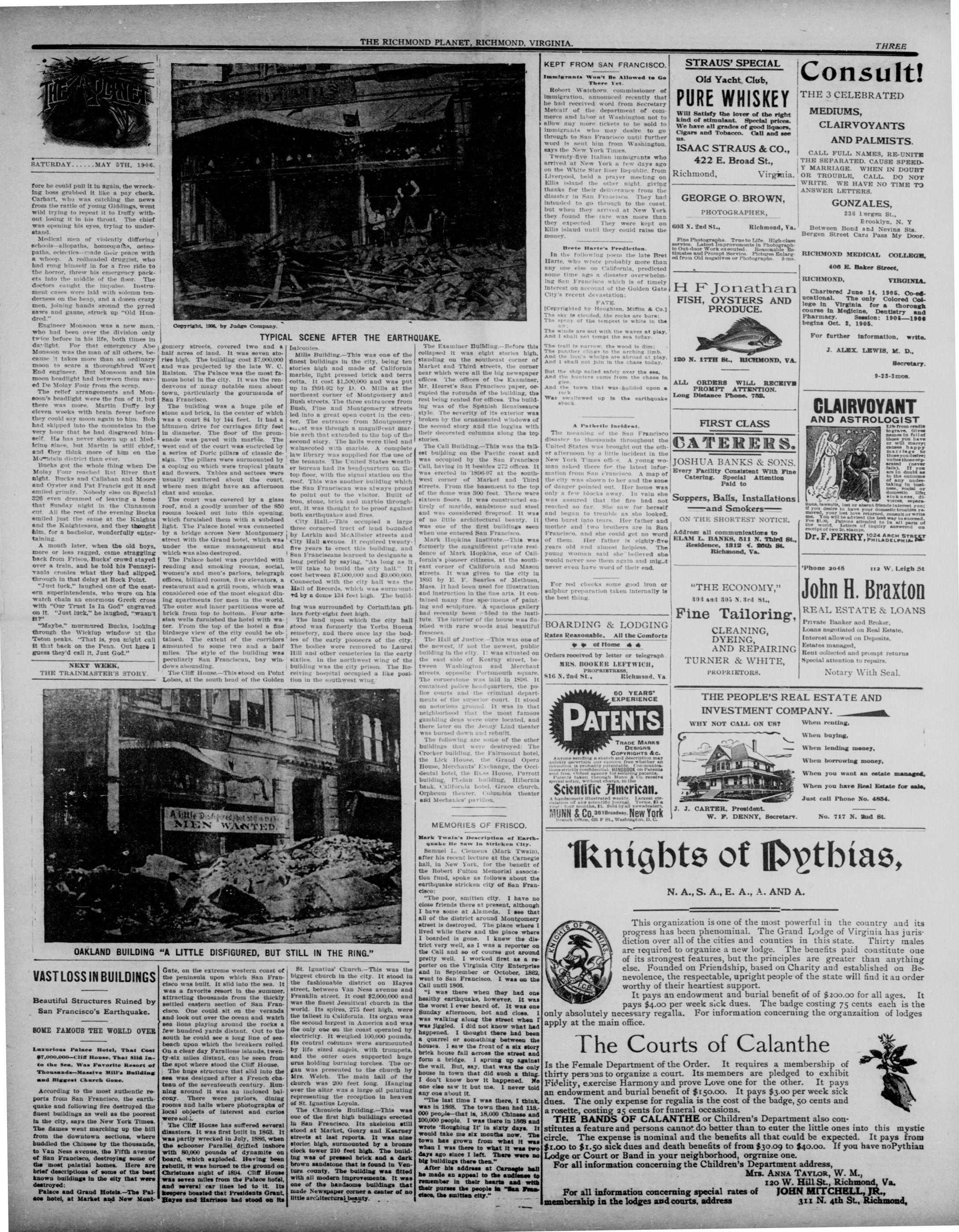
According to the most authentic reports from San Francisco, the earthquake and following fire destroyed the finest buildings as well as the poorest in the city, says the New York Times. The dames went marching up the hill from the downtown sections, where buddied the Chinese by the thousands, to Van Ness avenue, the Fifth avenue of San Francisco, destroying some of the most palatial homes. Here are brief descriptions of some of the best known buildings in the city that were destroyed:
Palace and Grand Hotels—The Palace hotel, at Market and New Mont-
SUNDAYS
Mills Building. This was one of the finest buildings in the city, being ten stories high and made of California marble, light pressed brick and terra cotta. It cost $1,500,000 and was put up in 1891-92 by D. O. Mills at the northeast corner of Montgomery and Bush streets. The three entrances from Bush, Pine and Montgomery streets led into a great open court in the center. The entrance from Montgomery street was through a magnificent marble arch that extended to the top of the second story. The halls were tiled and wainscored with marble. A complete law library was supplied for the use of the tenants. The United States weather bureau had its headquarters on the top floor, with the signal station on the roof. This was another building which the San Francisco was always proud to point out to the visitor. Built of iron, stone, brick and marble throughout, it was thought to be proof against both earthquakes and fires.
City Hall.-This occupied a large three cornered tract of land bounded by Larkin and McAllister streets and City Hall avenue. It required twenty-five years to erect this building, and San Franciscoans learned to designate a long period by saying, "As long as it will take to build the city hall." It cost between $7,000,000 and $9,000,000. Connected with the city hall was the Hall of Records, which was surmounted by a dome 134 feet high. The build-
A little Disfigured, but still in the
MEN WANTED
"A LITTLE DISFIGURED, BUT STILL IN
STILL IN THE RING."
Copyright, 1906, by Judge Company.
gomery streets, covered two and a half acres of land. It was seven stories high. The building cost $7,000,000 and was projected by the late W. C. Ralston. The Palace was the most famous hotel in the city. It was the rendezvous of many notable men about town, particularly the gourmands of San Francisco.
The building was a huge pile of stone and brick, in the center of which was a court 84 by 144 feet. It had a bitumen drive for carriages fifty feet in diameter. The floor of the promenade was paved with marble. The west end of the court was encircled by a series of Doric pillars of classic design. The pillars were surmounted by a coping on which were tropical plants and flowers. Tables and settees were usually scattered about the court, where men might have an afternoon chat and smoke.
The court was covered by a glass roof, and a goodly number of the S80 rooms looked out into this opening, which furnished them with a subdued light. The Palace hotel was connected by a bridge across New Montgomery street with the Grand hotel, which was under the same management and which was also destroyed. The Palace hotel was provided with reading and smoking rooms, social, women's and men's parlors, telegraph offices, billiard rooms, five elevators, a restaurant and a grill room, which was considered one of the most elegant dining apartments for men in the world. The outer and inner partitions were of brick from top to bottom. Four artestan wells furnished the hotel with water. From the top of the hotel a fine birdseye view of the city could be obtained. The extent of the corridors amounted to some two and a half miles. The style of the building was peculiarly San Franciscoan, bay windows abounding.
The Cliff House.—This stood on Point Lobos, at the south head of the Golden
Gate, on the extreme western coast of the peninsula upon which San Francisco was built. It slid into the sea. It was a favorite resort in the summer, attracting thousands from the thickly settled eastern section of San Francisco. One could sit on the veranda and look out over the ocean and watch sea lions playing around the rocks a few hundred yards distant. Out to the south he could see a long line of sea beach upon which the breakers rolled. On a clear day Farallone islands, twenty-six miles distant, can be seen from the spot where stood the Cliff House. The huge structure that slid into the sea was designed after a French chateau of the seventeenth century. Running around it was an inclosed balcony. There were parlors, dining rooms and halls where photographs of local objects of interest and curios were sold.
The Cliff House has suffered several disasters. It was first built in 1863. It was partly wrecked in July, 1886, when the schooner Parallel drifted inshore with 80,000 pounds of dynamite on board, which exploded. Having been rabult, it was burned to the ground on Christmas night of 1894. Cliff House was seven miles from the Palace hotel, and several car lines led to it. Its keepers boasted that Presidents Grant, Hayes and Harrison had stood on its
THE RICHMOND PLANET, RICHMOND, VIRGINIA
balconies.
ing was surrounded by Corinthian pillars forty-eight feet high. The land upon which the city hall stood was formerly the Yerba Buena remedy, and there once lay the bodies of the early pioneers of the city. The bodies were removed to Laurel Hill and other cemeteries in the early sixties. In the northwest wing of the building was the city prison. The Receiving hospital occupied a like position in the southwest wing.
St. Ignatius' Church.—This was the biggest church in the city. It stood in the fashionable district on Hayes street, between Van Ness avenue and Franklin street. It cost $2,000,000 and was the finest Jesuitical church in the world. Its spires, 275 feet high, were the tallest in California. Its organ was the second largest in America and was the only one on the coast operated by electricity. It weighed 100,000 pounds. Its central columns were surmounted by life sized angels, with trumpets, and the outer ones supported huge urus holding burning torches. The organ was presented to the church by Mrs. Welch. The main hall of the church was 200 feet long. Hanging over the altar was a large oil painting representing the reception in heaven of St. Ignatius Loyola.
The Chronicle Building.—This was one of the first high buildings erected in San Francisco. Its skeleton still stood at Market, Geary and Kearney streets at last reports. It was nine stories high, surmounted by a bronze clock tower 210 feet high. The building was of pressed brick and a dark brown sandstone that is found in Ventura county. The building was fitted with all modern improvements. It was one of the handsome buildings that made Newspaper corner a center of no little architectural beauty.
The Examiner Building. Before this collapsed it was eight stories high, standing on the southeast corner of Market and Third streets, the corner near which were all the big newspaper offices. The offices of the Examiner, Mr. Hearst's San Francisco paper, occupied the rotunda of the building, the rest being rented for offices. The building was of the Spanish Renaissance style. The severity of its exterior was broken by the ornamented windows of the second story and the loggias with their decorated columns along the top stories.
The Call Building.—This was the tallest building on the Pacific coast and was occupied by the San Francisco Call, having in it besides 272 offices. It was erected in 1896-97 at the southwest corner of Market and Third streets. From the basement to the top of the dome was 300 feet. There were sixteen floors. It was constructed entirely of marble, sandstone and steel and was considered fireproof. It was of no little architectural beauty. It was one of the first buildings seen when one entered San Francisco.
Mark Hopkins Institute.—This was formerly the magnificent private residence of Mark Hopkins, one of California's pioneer citizens, at the southeast corner of California and Mason streets. It was given to the city in 1893 by E. F. Searles of Methuen, Mass. It had been used for illustration and instruction in the fine arts. It contained many fine specimens of painting and sculpture. A spacious gallery had recently been added to the institute. The interior of the house was finished with rare woods and beautiful frescoes.
The Hall of Justice--This was one of the newest, if not the newest, public building in the city. I was situated on the east side of Kearny street, between Washington and Merchant streets, opposite Portsmouth square. The cornerstone was laid in 1836. It contained police headquarters, the police courts and the criminal departments of the superior court. It stood on notorious ground. It was in that neighborhood that the most famous gambling dens were once located, and there later on the Jenny Lind theater was burned down and rebuilt.
The following are some of the other buildings that were destroyed: The Crocker building, the Fairmount hotel, the Lick House, the Grand Opera House, Merchants' Exchange, the Ocedental hotel, the Russ House, Parrott building, Phelan building, Hibernia bank, California hotel, Grace church, Orpheum theater, Columbia theater and Mechanics' pavilion.
MEMORIES OF FRISCO.
Mark Twain's Description of Earth-
quake He Saw In Stricken City.
Samuel L. Clemens (Mark Twain), after his recent lecture at the Carnegie hall, in New York, for the benefit of the Robert Fulton Memorial association fund, spoke as follows about the earthquake stricken city of San Francisco:
"The poor, smitten city. I have no close friends there at present, although I have some at Alameda. I see that all of the district around Montgomery street is destroyed. The place where I lived while there and the place where I boarded is gone. I knew the district very well, as I was a reporter on the Call and so of course got around pretty well. I worked first as a reporter on the Virginia City Enterprise and in September or October, 1882, went to San Francisco. I was on the Call until 1886.
"I was there when they had one healthy earthquake, however. It was the worst I ever heard of. It was one Sunday afternoon, hot and close. I was walking along the street when I was jiggled. I did not know what had happened. I thought there had been a quarrel or something between the houses. I saw the front of a six story brick house fall across the street and form a bridge. I sprung up against the wall. But, say, that was the only house in town that did such a thing. I don't know how it happened. No one else saw it but me. I never told any one about it.
"The last time I was there, I think, was in 1868. The town then had 118,000 people—that is, 18,000 Chinese and 100,000 people. I was there in 1868 and wrote 'Roughing It' in sixty days. It would take me six months now. The town has grown from what it was when I was there to what it was two days ago since I left. There were no big buildings there then."
After his address at Carnegie hall he made an appeal to the audience to remember in their hearts and with their purses the people in "San Francisco, the smitten city."
Knights of Pythias,
This organization is one of the most powerful in the country and its progress has been phenominal. The Grand Lodge of Virginia has jurisdiction over all of the cities and counties in this state. Thirty males are required to organize a new lodge. The benefits paid constitute one of its strongest features, but the principles are greater than anything else. Founded on Friendship, based on Charity and established on Benevolence, the respectable, upright people of the state will find it an order worthy of their heartiest support.
It pays an endowment and burial benefit of of $200.00 for all ages. It pays $4.00 per week sick dues. The badge costing 75 cents each is the only absolutely necessary regalla. For information concerning the organization of lodges apply at the main office.
The Courts of Calanthe
Is the Female Department of the Order. It requires a membership of thirty persons to organize a court. Its members are pledged to exhibit Fidelity, exercise Harmony and prove Love one for the other. It pays an endowment and burial benefit of $150.00. It pays $3.00 per week sick dues. The only expense for regalia is the cost of the badge, 50 cents and a rosette, costing 25 cents for funeral occasions.
THE BANDS OF CALANTHE or Children's Department also constitutes a feature and persons cannot do better than to enter the little ones into this mystic circle. The expense is nominal and the benefits all that could be expected. It pays from $1.00 to $1.50 sick dues and death benefits of from $30.09 to $40.00. If you have no Pythian Lodge or Court or Band in your neighborhood, orgrize one.
For all information concerning the Children's Department address,
Mrs. ANNA TAYLOR, W. M.,
120 W. Hill St., Richmond, Va.
For all information concerning special rates of JOHN MITCHELL, JR.,
membership in the lodges and courts, address
311 N. 4th St., Richmond,
KEPT FROM SAN FRANCISCO
Immigrants Won't Be Allowed to Go There Yet.
Robert Watchorn, commissioner of immigration, announced recently that he had received word from Secretary Metcaf of the department of commerce and labor at Washington not to allow any more tickets to be sold to immigrants who may desire to go through to San Francisco until further word is sent him from Washington, says the New York Times. Twenty-five Italian immigrants who arrived at New York a few days ago on the White Star liner Republic, from Liverpool, held a prayer meeting on Ellis island the other night, giving thanks for their deliverance from the disaster in San Francisco. They had intended to go through to the coast, but when they arrived at New York they found the tare was more than they expected. They were kept on Ellis island until they could raise the money
Brete Harte's Prediction
In the following poem the late Bret Harte, who wrote probably more than any one else on California, predicted some time ago a disaster overwhelming San Francisco which is of timely interest on account of the Golden Gate City's recent devastation:
FATE.
[Copyrighted by Houghton, Mifflin & Co.]
The sky is clouded, the rocks are bare;
The spray of the tempest is white in the air;
The winds are out with the waves at play,
And I shall not tempt the sea today.
The trail is narrow, the wood is dim;
The panther clings to the arching limb.
And the lion's wheeps are abroad at play,
And I shall not join in the chase today.
But the ship sailed safely over the sea,
And the hunters came from the chase in glee.
And the town that was built upon a rock.
Was swallowed up in the earthquake shock
A Pathetic Incident.
The meaning of the San Francisco disaster to thousands throughout the United States was brought out the other afternoon by a little incident in the New York Times office. A young woman asked there for the latest information from San Francisco. A map of the city was shown to her and the zone of danger pointed out. Her home was only a few blocks away. In vain she was assured that the fire had not reached so far. She saw for herself and began to tremble as she looked, then burst into tears. Her father and mother and two brothers are in San Francisco, and she could get no word of them. Her father is eighty-five years old and almost helpless. The young woman said she believed she would never see them again and migjt never even have word of their end.
For red checks some good iron or sulphur preparation taken internally is the best thing.
BOARDING & LODGING
Rates Reasonable. All the Comforts
of Home
Orders received by letter or telegraph.
MRS. BOOKER LEFTWICH,
PROPRIETRESS,
816 N. 2nd St., Richmond, Va.
60 YEARS'
EXPERIENCE
TRADE MARKS
DESIGNS
COPYRIGHTS A.C.
Anyone sending a sketch and description may
quickly ascertain our opinion free whether an
invoice is properly submitted, or communica-
tions strictly confidential. HANDBOOK on Patents
sent free, highest agency for securing patents.
Patents taken through Muni & Co. receive
special notice, without charge. In the
A handsomely illustrated weekly. Largest circulation of any scientific journal. Terms. $3 a year; four months. H. Sold by all new dealers. MUNN & Co., 361 Broadway, New York Branch Office, 625 F St., Washington, D. C.
KNIGHTS OF PYTHIAAS
F.C.B.
pays $4.60
only absolutely necessary regu-
apply at the main office.
The Court
Is the Female Department of the
thirty persons to organize a co-
Fidelity, exercise Harmony and
an endowment and burial bene-
dues. The only expense for m
a rosette, costing 25 cents for f
THE BANDS OF CALA
stitutes a feature and persons a
circle. The expense is nomin
THE PEOPLE'S REAL ESTATE AND
PURE WHISKEY
Will Satisfy the lover of the right kind of stimulant. Special prices. We have all grades of good liquors, Cigars and Tobacco. Call and see us. ISAAC STRAUS & CO., 422 E. Broad St., Richmond, Virginia.
Virginia
GEORGE O. BROWN.
PHOTOGRAPHER,
603 N. 2nd St., Richmond, Va.
Fine Photographs. True to Life. High-class
service. Latest Improvements in Photographer
Cards. Reasonable Seasonal Estimates
and Prompt Service. Photographers Enlarged
from Old negatives or Photographs. 3-ms.
H F Jonathan
FISH, OYSTERS AND
PRODUCE.
120 N. 17TH St., RICHMOND, VA.
ALL ORDERS WILL RECEIVE
PROMPT ATTENTION.
Long Distance Phone, 759.
FIRST CLASS
CATERERS.
JOSHUA BANKS & SONS.
Every Facility Consistent With Fine
Catering. Special Attention
Paid to
Suppers, Balls, Installations
and Smokers
ON THE SHORTEST NOTICE.
Address all communications to
ELAM L. BANKS, 511 N. Third St.,
Residence, 1812 V. 20th St.
Richmond, Va.
"THE ECONOMY," 303 and 305 N.3rd St.,
Fine Tailoring.
CLEANING,
DYEING,
AND REPAIRING
TURNER & WHITE,
PROPRIETORS.
THE PEOPLE'S REAL
INVESTMENT COMP
WHY NOT CALL ON US?
J. J. CARTER, President.
W. F. DENNY, Secretary.
Organization is one of the most powerful has been phenomenal. The Grand Master all of the cities and counties in need to organize a new lodge. The longest features, but the principles ended on Friendship, based on Charity the respectable, upright people of their heartiest support. An endowment and burial benefit of per week sick dues. The badge ralla. For information concerning
THREE
Consult!
THE 3 CELEBRATED
MEDIUMS,
CLAIRVOYANTS
AND PALMISTS.
CALL FULL NAMES, RE-UNITE
THE SEPARATED. CAUSE SPEEDY
MARRIAGE. WHEN IN DOUBT
OR TROUBLE, CALL. DO NOT
WRITE. WE HAVE NO TIME TO
ANSWER LETTERS.
GONZALES,
235 Bergen St.,
Brooklyn, N. Y
Between Bond and Nevins Sts.
Bergen Street Cars Pass My Door.
RICHMOND MEDICAL COLLEGE
406 E. Baker Street
Chartered June 14, 1905. Co-educational. The only Colored College in Virginia for a thorough course in Medicine, Dentistry and Pharmacy. Session: 1905—1906 begins Oct. 2, 1905.
For further information, write.
J. ALEX. LEWIS, M. D.,
Secretary.
9-23-3mos.
Secretary.
9-23-3 mos.
CLAIRVOYANT
Life from credits to grave. Gives you those you have causes. happy man you deserve you deserve unites those aparted (never in doubt are in doubt as to the outcome taking in bungalows domestic life sickness, dizziness
to grave. Gives names in full of those will marry causes happy causes you desire unites those seepest falls). If you are in doubt as to any under-going business, scous or domestic life sickness, separate them, lawsuits, lost or absent friends interest you; if you desire to have your domestic troubled, your loss has returned to you; or write me. You will be advised the best way to succeed. 814 Palm Street occupied in all parts of the world. Letters of inquiry on receipt of two 2c stamps. 1024 ARCH STREET PHILADELPHIA.
'Phone 2048
112 W. Leigh St
John H. Braxton
REAL ESTATE & LOANS
Private Banker and Broker,
Loans negotiated on Real Estate,
Interest allowed on Deposits,
Estates managed,
Rent collected and prompt returns
Special attention to repairs.
Notary With Seal.
REAL ESTATE AND
EMPANY.
When renting,
When buying,
When lending money,
When borrowing money,
When you want an estate managed,
When you have Real Estate for sale,
Just call Phone No. 4854.
No. 717 N. 2nd St.
ythias,
A.
powerful in the country and its
and Lodge of Virginia has juris-
in this state. Thirty males
the benefits paid constitute one
is greater than anything
clarity and established on Be-
of the state will find it an order
of of $200.00 for all ages. It
the costing 75 cents each is the
ing the organization of lodges
```markdown
```
ment also con-
e the little ones into this mystic
d be expected. It pays from
$40.00. If you have noPythian
address,
TAYLOR, W. M.,
Hill St., Richmond, Va.
N MITCHELL, JR.,
311 N. 4th St., Richmond,
FOUR
THE PLANET
Published every Saturday by John W. Mason
jb. at 311 North 4th Street, Richmond Va.
All communications intended for publication
should be sent so as to reach us by Wednesday
TERMS IN ADVANCE
One Copy, one year. $1.50
One Copy, eight months. 1.00
One Copy, six months. 4.00
One Copy, four months. 5.00
One Copy, three months. 4.00
Single Copy .05
ADVERTISING RATES
For one inch, one insertion. $5.00
For one inch, each subsequent insertion. 4.00
For two inches, three months. 6.00
For two inches, six months. 10.00
For two inches, nine months. 14.00
For two inches, twelve months. 20.00
Marriage and General Notices, one inch. 30.00
Standing and Transient Notices per line. 10.00
POSTAGE STAMPS OF A HIGHER DENOMINATION THAN TWO CENTS NOT
RECEIVED ON SUBSCRIPTIONS.
THE PLANET is sent weekly. The subscription
price is $1.50 per year in advance.
There are FOUR WAYS by which money can be sent by mail at our site. In a Post Office Money Order at your Post Office, payable to an Express Money Order, and when money of these can be procured, in a Registered Letter. Money ORDERS. You can buy a Money Order at your Post Office, payable to the Richmond Post Office, and we will be responsible for its safe arrival. EXPRESS MONEY ORDERS can be obtained at any office of the American Express Co. the United States Express Co., and the Wells Fargo Company. You are responsible for money sent by any of these companies. The Express Money Order is a safe and convenient way for forwarding money. REGISTERED LETTER. If a money Order is registered, your reach, your Postmaster will Register Letter you wish to send us on payment of sent cents. Then, if the letter is lost or stolen it can be sent money in this manner at our risk. We cannot be responsible for money sent in letters in any other way than one of the four ways mentioned above. If you send your money in another way, you must do it at your risk.
RENEWALS, ETC.—If you do not want THE PLANET continued for another year after your subscription has run out, you then notify my Postal Card to discontinue it. The county has decided that subscribers to newspaper, who do not order their paper discontinued at the expiration of time for which it has been paid, are hold liable for the payment of the subscription up to date when they order the paper discontinued.
COMMUNICATIONS:—When writing to us to renew your subscription or discontinue your subscription in full, otherwise we cannot find your name on our books.
CHANGE OF ADDRESS:—In order to change the address of a subscriber, we must be sent the former as well as the present address.
Entered at the Post-Office at Richmond Va as second-class matter.
SATURDAY, MAY 5TH, 1906
We have received "Good night" in a serenade, song and chorus by Mr. Walter W. Wallace. It is published by the Hub Music Co., of Boston, Mass.
The conviction is steadily growing that President Roosevelt had Senator B. R. Tillman in mind when he drew attention to the Man with the Muck-rake. Although colored women have been whipped and outraged and whole families destroyed by inhuman white brutes, at no time has the stentorian voice of this Senator from South Carolina been heard in behalf of the victims or in denunciation of the fiends guilty of such bestial brutality. But now when he wants to even up an old score with President Roosevelt, he makes much of the foreible removal of Mrs. Minor Morris, who had persistently refused to obey the Waite House officials and who had resisted the police.
We are of the opinion that she fared reasonably well, all things considered. The committee has reported favorably on the nomination of Secretary Barnes as Postmaster of the city of Washington and the indications are that he will be promptly confirmed.
FOREIGN LABORERS.
In view of the fact that the Negro-haters of the Southland are clamoring for foreigners with which to supplant the Negro laborers, the following will be interesting reading:
Mount Carmel, Pa. April 30.—A bloody conflict was precipitated here to-day between a mob of idle mine workers and a detachment of the new State constabulary, which resulted in the injuring of probably a score of men, four of them probably fatally.
Starting with an attack on the constabulary by several hundred foreigners, the riotous demonstration grew until, after two encounters in the streets, the town was thrown into a state of terror and the police were compelled to seek refuge in the barracks of the Sayre Colliery of the Lehigh Valley Coal Company. The platoon of police which was engaged in the fight with the rioters, has been re-inforced by another platoon, and the sheriff of Northumberland County, who went to the scene of the trouble, is also in the barracks.
At 8 o'clock to night the streets were crowded with foreigners, nearly all of whom are armed. Slays, Lithuanains, Hungarians, and Italians, are pouring into the town from the hamlets, their faces inflamed with passion. Many citizens have barricaded their homes. Chief Burgess Pennan and the other borough officers cannot be found.
Troop C of the State Police, is in the Sayre barracks, while Troop G is on the way here from Wilkes.
barre. The streets are crowded with foreigners, who, it is said, are armed with dynamite. The town is in a state of great terror, and few people sleep to night.
There is desultory firing going on at the Sayre barracks, where the police are quartered, and where sev erial hundred foreign miners are gathered.
Let the work go on. These race-hating white folks of this section will awake when it is too late.
This seems to us to be an object lesson. Who would swap the good-natured tractable, fun loving black man for material such as this?
Now is the time for them to speak
Now is the time for them to speak or "forever hold their peace."
SOCIALISM AND THE NEGRO
We have received the following communication from New Orleans, Louisiana, which explains itself: New Orleans, La., Apr. 29, '06. Mr. John Mitchell, Jr., *Editor of the Richmond News*.
Editor of the Richmond PLANET, Richmond, Va.
My Dear Sir:
In your issue of the 21st inst. under the caption, "Have we Lost Mr. Roosevelt?" I note the following:
"As for Mr. Roosevelt, he has passed the Populist Party and he now stands up to his boot-straps in the alleged mud and mire of the Socialist Party."
From the foregoing, you seem to not to take kindly to Socialism. And in your issue of the 14th inst. your comment on Sec. Taft at Taskegke, gives one the opinion that Sec. Taft would like to get rid of the Negro. Under such circumstances, what would you have us do?
Without awaiting a reply however I wish to say that editors of influential Negro journals would do well to look into Socialism, without prejudice, with a view to learning for oneself the "what about it."
It is a live subject and it will not be many more months before it will be discussed in every publication worth reading, and the Negro can ill afford to be ignorant of it. Now, Mr. Mitchell, have you studied Socialism at all, or are you merely voicing an opinion from some unknown source? If you have not, let me suggest that you look in it from a religious point of view to ascertain whether it is in or out of harmony with Christianity. Also from a fraternal view point so as to know whether it is for or against the great principles of Fraternity. And from an economic view point to see how it affects the bread and butter of the people. And from the general point of view of the man who wants to be informed.
As a banker you may be opposed to Socialism, because under it there will be no need of banks and bankers. But believing, as I do that you are a man whose heart beats for his people, I feel that you would not stand opposed to anything that held out material and lasting benefits to them, (though it dbl away with one line of occupation for you) once you were assured of its feasibility.
If you have read this far I am very thankful, but read this:
What is the Socialistic solution for the Negro problem?
Socialists do not look upon the Negro as a problem, but as a workingman. The economic interest of all workers, be they white, black brown or yellow, are identical, and are all included in the program of Socialism. Socialists have no program separate and apart for different nationalities. The Socialist party is a party for the working class and its program for the industrial emancipation of that class knows no distinctions on account of race, color or creed. Socialism has no color and no creed line.
We demand for the black workman exactly what we demand for the white workman—ownership and democratic management of the tools with which he must work to provide himself with the necessities or luxuries of life. Socialism demands economic equality for all. Social equality is not a demand of Socialism. Because my Negro neighbor has an equal right with me to life, liberty and the pursuit of happiness, does not imply that he shall associate with me on terms of social equality or inequality. The foregoing question and answer embodies a great fraternal principle. That Socialism is the thing that you want, that I need and the whole human race should have, I have no doubt.
Mr. Rogers asks his questions and then kindly answers them. Still, there is much left for us to say and we assure him that we are ready and willing to tell him what we advise the Negroes in this country in general and in the South in particular to do.
We cannot say that we have studied socialism, as we have had no need so to do. We have read its principles and feel reasonably certain that we understand the fundamental principles of this most remarkable organization that is now agitating the industrial centres of two hemispheres.
We have not intended to infer that we do not take kindly to socialism or that we are bitterly opposed to its tenets. We are not a socialist. We belong to the Republican Party and accordingly believe in the recognized principles of that organization. Socialism is the Utopia of the workingman's hopes. If its principles could be put into practice, it would be a panacea, a blessing for the poor man and on the other hand it would be a sure cure for the rapid accumulations of the wealthy.
As we understand it, all wealth would then belong to the state and the masses of the people would receive their proportionate share of its benefits, disbursed as it would be from one centralized point. If its plans could be perfected and its prin ciples emphasized, it would be heaven on earth. The millennium would
THE RICHMOND PLANET, RICHMOND, VIRGINIA
ISLAND PARK, NOW OPEN FOR THE SEASON EVERY DAY At 1 o'clock P.M. MAYO'S ISLAND From April 28, to Nov. 1, 1906.
The greatest list of FREE, OPEN-AIR ATTRACTIONS ever offered the public. DARE-DEVIL "VOLA" leaping a gap of forty feet on a Bicycle twice daily, at 4 and 10 P. M. Prof. STANLEY, "HIGH-DIVER," diving from a Ninety-tive Foot Tower into a Net, twice daily, at 3 and 9 P. M. The celebrated ANDERSON FAMILY, introducing the latest Songs and Dances, Banjo Solcs, etc. Champion Buck and Wing Dancers of the World, twice daily, 2 and 8 P. M. "REX," THE HIGH-DIVING DOG, diving from a Fifty-foot Ladder, twice daily, 1:30 and 7:30 P. M
Clean, cut and entertaining. Booths of all kinds, Ice-Cream Parlor, First-class Restaurant, Boating, Bathing, Fishing. Indian Village, Gypsy Camp, Photograph Gallery. Shooting Gallery; last but not least, everybody's favorite, old as well as young. PROF. BOARDMAN'S UP-TO-DATE MERRY-GO-ROUND, with Imported Pipe Organ. No Intoxicating Liquors of any Description Sold on the Grounds. Intoxicated or disorderly persons will not be admitted. A UNIFORMED BODY OF POLICE ON THE GROUNDS AT ALL TIMES to preserve order.
```markdown
```
indeed be at hand and poverty would flee away for ever.
It is needless to ask me then if such a plan would be out of harmony with Christianity. It is in close unison with it and if the leaders of the movement could convince the average voter that they were responsible and were able to effect the reformation that they promise, no party in the world could defeat the party of socialism in a fair and square conflict at the polls in a republic.
But can the promises of the socialists be realized? Can they establish such a form of government as the one promised? It would be well to state that the enemies of socialism endeavor to link its principles and precepts with those of the anarchists and thereby shut the advocates of this doctrine out of the forum of public favor. The two parties are not even remotely related, for one is in favor of all government and the other is in favor of no government.
We do not advocate socialism, because we believe In the principles of the Republican Party as enunciated by Sumner, Lincoln and Grant. We do not support socialism, because we believe in the Declaration of Independence as written by Jefferson and the Constitution of the United States as given to us by the Fathers of the Republic.
To establish socialism in this country, would be to overthrow both of those instruments. When it is a conceded fact that you cannot so much as change one of them, if we are to judge by the failure so to do during all of these years of strife on the part of the Negro-haters, it is evident to our mind that the present fabric of government can only be eliminated by earth-quake, bloody revolution or the exercise of that mysterious superhuman power so graphically described in the Scriptures.
When we espouse such a cause, we not only lose the friends we have, but we array ourselves against the industrial and financial interests of the civilized world, with no compensating advantages for so doing. We have hopes of being socialists some of these days, but it will be when the Father, Son and the Holy Ghost will be in command of the country in which we will then be residing. Jesus Christ was careful not to advocate socialism when he was on earth save in a spiritual form for he plainly declared that his kingdom was not of this world and when it was alleged that he was in favor of upsetting the form of government in vogue at that time, he was quick to discountenance any such idea, for he said, "Render unto Caesar the things that are Caesar's and unto God, the things that are God's."
He paid his taxes just as every other citizen was required to do. What then would be the effect on the future of the Negro in this country, if ten million of them would openly declare in favor of the confiscation of all property and the transferring of all of it to the state? It might do good, but the indications are that it would do harm.
What do we advise the Negro to do? Buy land, save money, educate himself and children. Practice politeness and make friends with ev erybody, who will permit him to make friends with them. Contend for all of the rights and privileges vouch-safed any other citizen, but do it in a respectful way. Submit to indignifies only when he cannot do otherwise and then under protest.
Contend against any discrimination on account of race, color or previous condition of servitude, and never voluntarily surrender as long as life lasts. Have plenty of religion, but let it be of the practical kind. Think not of death, but of life and die when he cannot help it. Secretary Taft represents himself
THE ONLY UP-TO-DATE PARK IN THE SOUTH ADMITTING COLORED PEOPLE.
BIG, FREE DANCING PAVILION. TWO BANDS. SHOWS OF ALL DESCRIPTIONS
Southern Amusement Company. Proprietors.
and he may also represent a large proportion of the Republican Party, including Mr. Roosevelt, but the doctrine enunciated by him is not in keeping with the former declarations of the great political organization, with which we too are identified. We cannot accept him as an absolutely safe guide, for he and Mr. Roosevelt have taken a plank out of the Democratic platform relating to railroad rates and are now attempting to make it a law, with Negro-hating Ben. Tillman of South Carolina in charge of the measure. It should not be forgotten that there is not a country or republic on earth that is at present conducted according to the principles of socialism. The effort to establish even cities by this party has been a failure. Rev. John Alexander Dowle's Zion City is a near-approach to it and the world knows the result.
This then should emphasize the necessity of the Negro's making his contest within the lines prescribed by the Constitution of the United States. Should he decide to emigrate to Africa, he might try the experiment, unhampered by existing laws. When the Republican Party in convention assembled goes back on its principles and inserts in its platform the doctrine of the Negro-haters, it will be time enough for the masses of us to meet together and form new alignments and combinations.
If individual members of the race desire to affiliate with any of the minor parties now in existence, it should be their will and pleasure to do so.
Some of the leading members of the Republican Party, at times worry us much, but the great organization itself has always "rung true."
PRODUCE QUOTATIONS
The Latest Closing Prices In the Principal Markets
PHILADELPHIA — FLOUR steady; winter extras. @ $3.35; Pennsylvania roller, clear, $2.25 @ 3.50; city mills, fancy, $4.60 @ 3.75; RYE FLOUR firm; per barrel, $3.55; WHEAT firm; No. one bale, canary row, $2.00; 54% CORK firm; two yellow bale, $2.00 OATS steady; No. 2 white, clipped, 39c; lower grades, 39c. HAY firm; No. 1 timothy, $15.50 for large bales. steady, farmyard, $13.75; BEEF steady, live steak, farmyard, $13.75; TRY: Live steady, hens, 14% @ 15c; old roosters, 10c. Dressed firm; choice fowls, 14c. old roosters, 10c. BUTTER firm; selected, 32c. per pound, EGGS selected, 32c. per pound, nearby, 17c; western, 17c; southern, 17c; POTA TOES firm; per bushel, $8 @ 9c.
BALTIMOE—WHEAT easy; No. 2 spot, 86° 87°; steamer No. 2 spot, 79° 83°; eirthern, 70° 83°C, CORN firm; mixed, No. 50° 83°C; steamer, 60° 83°C, cornhill, No. 54° 83°C, 56° 83°C, OATS firm; white, No. 24° 83°C; 38° 83°C; No. 3, 37° 83°C; No. 4, 36° 83°C; mixed, No. 2, 37° 83°C; No. 3, 36° 83°C; No. 4, 35° 83°C; BUT. TER quiet; creamy separator extrals, 21° 82°; held, 18° 19°; prints, 23° 84°; Maryland and Pennsylvania dairy prints, 24° 84°; fancy Maryland and Pennsylvania, 16° Virginia, 16°; West Virginia, 15° 12°; southern, 15°
Live Stock Markets
PITTSTURG (Union Stock Yards)—
CATTLE trady; choice, $4.50@5.50;
prime $1.10@5.35, HOGS lower; prime
heavies mediums and heavy Workers
Workers, $4.50@5.50; $6.50@5.60, SHIPP
lower; prime wethers, $2.25@5.40;
culls and common, $2.50@3; lams,
$4.50@6.30; veal calves, $6@6.50.
FOUND TONS LOTTERY TICKETS
Secret Service Men Search Wilmington
ton, Del. Printing Office
ton, Del., Printing Office.
Wilmington, Del., May 2.—United States secret service officers, in charge of M. F. Griffin, of the Philadelphia district, made a search of the printing plant of John M. Rogers, of this city, for lottery tickets and found about two tons of material which, Officer Griffin says, appears to be unfinished lottery tickets. This action followed a search of an establishment in Gloucester, N.J., in which John M. Rogers is interested and in which six cases of plates were found. These plates, the secret service officers say, were used in printing Honduras lottery tickets. The secret service officers are in charge of the printing office and will make further search of the place.
STATE POLICE FIRE ON MOB
Btoned by Idle Mine Workers at Mt.
Carmel Were Forced to Shoot
TWENTY HURT; THREE FATALLY
Mt. Carmel, Pa., May 1.—The first serious collision between a mob of idle mine workers and a platoon of the new state constabulary force since mining in the anthracite coal region was suspended on April 1 occurred here, and resulted in the injuring of probably 20 men, three of whom will likely die. The disturbance was caused by an attack on a detail of the state police by several hundred foreigners, who became incensed at the presence of the constables. They threw stones at the policemen and otherwise endangered their lives to such an extent that they were forced to fire on the crowd which had swelled into thousands. The riot caused the greatest excitement in the many mining villages of the southern coal fields when it became known that mine workers had been shot down, but the affected territory is comparatively quiet.
While it is believed that a score of persons were injured only 10 are accounted for. They are: Louis Wilson, shot through the body, will die; Reddy Miserevich, shot in the stomach, will die; Stanislaw Watskoski, shot in the groin, will die; Matthew Matsuak, Barker Shapar, Martin Suntellus, Martin Yulucki, Stamy Rokosky, Peter Shiblinki and R. H. Gibson, a trooper.
Shot Standing in Front of Home.
Wilson was shot while standing in front of his home, a block from the scene of the conflict. Gibson, the trooper, was struck on the head with a rock and seriously hurt. Exclusive of the three men fatally injured, the mine workers were shot in the legs and arms.
The affair is the result of an attack upon non-union men made at various times last week. The attacks became so numerous that Sheriff Sharpless, of Northumberland county, appealed to the state constabulary for help. In accordance with orders from Captain John C. Groome, the superintendent of the state police, troop C, which was marching from Reading to Hazleton, was divided, and half of the men under Lleutenant Smith were sent to Mt. Carmel.
After looking to their mounts, the troopers started out to get breakfast, and immediately ran into trouble from an unexpected source. At the first hotel they went to, the dining room girls refused to serve them, and they received the same treatment at two other places. In most of the small mining towns the help about hotels and other places are related to mine workers or in sympathy with them, and during strike times they do all they can to help the workers.
The presence of the troopers on the main street of the town caused a crowd of mine workers to gather about them, and the bolder ones in the crowd began to stir up trouble. The crowd closed in upon the state police and began throwing stones. The troopers charged the mob and scattered it, but not before several men were hurt, including a trooper. Lieutenant Smith drew his men into line and threatened to shoot if the mob renewed the attack. In the meantime, local leaders of the mine workers circulated through the crowd and ordered the infuriated foreigners to disperse and keep the peace. The chief burgess, who is a member of the rulers' union, addressed the crowd from a window, and advised them to go home. This action had considerable effect, and the detail of troopers started for the Sayre colliery of the Lehigh Valley Coal company on the outskirts of Mt. Carmel, where non-union men had been attacked by foreigners Saturday night.
Fired Three Volleys.
Some of the mob persisted in following the troopers, and as they were passing the residence of Dr. J. D. Keefer, on Hickory street, some one threw a stone at them, which was followed by a shower of others. Lieutenant Smith wheeled his men about and gave the order to fire. The number of shots fired is not known, but it is said the troopers sent three volleys into the mob before it broke and ran. Hail: a dozen men were left lying on the
ground, and they were later picked up by persons who were not in the crowd. The troopers did not pursue the crowd, but continued on their way to the Sayre colliery. From that place Lieutenant Smith communicated with state police headquarters at Pottsville, and word immediately came back to hold his ground until reinforcements arrived. In the meantime local constables, on behalf of the mine workers, arrested Lieutenant Smith on the charge of assault and battery with intent to kill. He was held in $500 bail, which was furnished. Three foreigners were also held on the same charge.
OPERATORS REFUSE DEMANDS
Will Not Modify Their Position In Controversy.
New York, April 28. The anthracite mine operators, through their subcommittee of seven, at a meeting here drew up a reply to the latest proposition of the mine workers for an adjustment of the existing differences in the anthracite fields, in which they refuse to modify their position heretofore announced. The operators call upon the miners to renew for a period of three years the award of the anthracite strike commission or else to accept the operators' proposition that the strike commission arbitrate the question as to what changes, if any, shall be made in the scale of wages fixed by the commission in its original award. The miners have heretofore declared this offer.
OPERATORS READY FOR STRIKE
Have Thousands of Men Said to Be Ready to Go to Work.
Scranton, Pa., May 2.—Notwithstanding that many of the leading operators in this portion of the anthracite fields are of the opinion that a strike will not be declared, every coal company is making preparations to resume work in the mines in case a strike be declared at the convention which will be opened in this city on Thursday.
The heads of the various companies in New York have evidently decided that a strike is inevitable, and have given orders that preparations be pushed for an extended conflict. The Delaware, Lackawanna and Western company, which has been looked upon as one of the most reasonable corporations in this difficulty, is laying plans for the operating of all its collieries and washeries as soon as a strike is declared. This company produced about 180,000 tons during the past month, which is probably as much as the combined output of all the other companies. It has thousands of men at work in the mines and washeries, and as soon as a strike is declared by the mine workers it will double that number.
Many of the other companies have a large force of men engaged, waiting for the result of the convention, and in the event of a strike they will be brought to this city in a special train and assigned to the various mines.
Speaking of the possibility of President Roosevelt interfering to prevent a strike, a leading operator said: "President Roosevelt will not attempt to interfere in the present situation, for two reasons. The first is, that he must stand by the findings of his strike commission, and the second is that he knows that any interference will be resented by the operators."
KILLED BY LIGHTNING
Young Man Meets Instant Death and Sister Severely Injured
Erie, Pa., April 30.—John Peters, 18 years old, of Utah, Venango county, Pa., a student at the Edinboro State Normal School, while walking through the fields near Edinboro lake with his sister Margaret, 21 years old, a student at the same institution, was struck by lightning and instantly killed. The hair of his head was entirely burned off, but his body bore no marks. His underclothing was destroyed, his shoes torn into shreds and his hat was perforated with several holes. His sister was knocked down by the shock and severely injured. It was an hour after before she was able to reach a farm house only a quarter of a mile distant to summon help for her brother.
ial to Torrey and Alexander. Philadelphia, May 2.—The great revival which began in this city three
```markdown
```
months ago under the direction of the Rev. R. A. Torrey and C. M. Alexander, who have conducted revivals throughout the British possessions, closed Tuesday night in the Academy of Music with a monster testimonial meeting to the two evangelists. After the meeting was over several thousand persons congregated in front of the Hotel Walton, where Mr. Alexander had been staying, and sang revival hymns until nearly midnight. The evangelists go from here to Atlanta, Ga., where they expect to open a big religious campaign.
FIEND SHOT TO DEATH
Man Assaulted 12-Year-Old Daughter
and Is Killed By Wife.
Cumberland, Md., April 30 —George Fogel, of Brooklyn Heights, Md., a little hamlet across the river from Hendricks, Md., returned to his home after he had been drinking, and entering the room where his wife and 12-year-old daughter were in bed, drew a revolver and announced that he would shoot upon being interfered with. Fogel then threw his wife to the floor and assaulted his daughter. Mrs. Fogel secured the revolver and fired five shots at her husband, killing him instantly. She surrendered to the authorities, but was not locked up. It was announced that the woman will not be prosecuted.
Troops Guard Negro.
Richmond. Va., May 1.—On account of threats to lynch Gabriel Battale, a negro, who criminally assaulted Miss Lena Rogers, daughter of Rudolph Rogers, of King George Court House, the militia company commanded by Captain Rowe, at Fredericksburg, arrived here and guarded the jail. Excitement in the community is intense. It is threatened that an attempt will be made to storm the jail and lynch the prisoner. It is probable that Captain Rowe will endeavor to spirit Battale to the Fredericksburg jail for safe keeping.
Knocked From Bridge By Car
Philadelphia, April 30.—While walking over a trestle in the outskirts of the city, Joseph Amber and his 6-year-old son, Joseph, were struck by an electric car and thrown from the bridge. The father was killed and the child was so badly injured that he is expected to die.
Drowned While Bathing
Asheville, N. C., May 1—J. A. P. Stistare, Jr., aged 18 of Lancaster, S. C., a student at Bingham School, was drowned while bathing in a pond near Murphy Junction, half a mile from the school. He was evidently selzed with a cramp, and sank without any outcry. The body was recovered.
Where to Get Auto Licenses In Jersey
Trenton, N. J., May 2.—Secretary of State Dickinson appointed agents for the registration of automobiles and the licensing of drivers. These agents will open their offices on Monday, as follows: Joseph Gallagher, Fuller building, Jersey City; A. B. Le Massena, Central Railroad building, Newark; Joseph H. Forsyth, 111 Market street Camden; Joseph Poulson, Warren foundry, Phillipsburg.
Murdered Thirty-six Women
London, April 30.—A dispatch from Mogador, Morocco, to the Daily Mall says that a cobbler of Marrakesh, named Messiwi will be crucified May 3 for the murder of 23 women, whose bodies were found buried under his shop and in his house.
COMMITTED SUICIDE AT 108
Aged Mrs. Mary McKittrick Ends Her Long Life.
Uniontown, Pa., May 1.—Mrs. Mary McKittrick, who recently celebrated her 108th birthday, committed suicide by cutting her throat with a small knife which she had in her room to trim her nails. Her mind has been deranged for several weeks, but it was not thought she would make an attempt on her life.
Hailstones Killed Small Animals
Hailstones Killed Small Animals.
Norfolk, Va., May 2.—A special to the Ledger-Dispatch from Branchville, Va., says that during a severe rain and electric storm there, large hailstones fell, killing many fowls, small animals and two horses. Houseets were beaten off, and the Sessboard Air Line railways sheltion warehouse was ruined by the hall. The storm continued for forty-five minutes.
---
IT WILL PAY YOU To interest yourself in promot ing the CIRCULATION of the RICHMOND PLANET.
REXYLONET
SAN FRANCISCO NEEDS MONEY
Will Ask Congress to Eudorse Bonds to Rebuild City.
MUST FEED PEOPLE FOR WEEKS
San Francisco, May 1.—Reconstruction of San Francisco is on in earnest. As a result many destitute men resumed work. The army ration plan was begun in the feeding of the destitute. The relief committee is uncertain how soon free supplies may fail, and plans are under consideration to prevent a famine.
Signs of a renewal of industrial activity were apparent in many parts of the burned area, and the work of clearing away debris preparatory to rebuilding was in progress in a score of places. It was said that plans for more than 30 large buildings have been drawn and will be submitted to the authorities as soon as the new building laws are promulgated.
The mayor advised the board of supervisors that he would appoint a committee consisting of engineers, architects, builders and lawyers to prepare plans for laying out streets and boulevards and reconstructing San Francisco.
At a meeting of James D. Phelan, chairman of the finance committee, and some prominent lawyers and bankers, a plan was broached for financing the city, which it is hoped will meet with the endorsement of the general committee. As it is estimated that the city has suffered a loss of $200,000,000 by fire, it is said that there is not sufficient money in San Francisco to reconstruct the city, and that the people must look elsewhere for funds to rehabilitate their destroyed fortunes.
Mr. Phelan said that if the money were borrowed through ordinary channels the rate of interest would add a burden that could not be borne under the conditions. The plan of Mr. Phelan is to frame legislation to present to congress, asking the United States to endorse the proposed bonds of San Francisco. With this guarantee of the government, the city would be able to go into the financial markets of the world and borrow the needed money at a low rate of interest on bonds to run for 50 years and secured by a mortgage on the best portion of the city. The number of people without substantial shelter has been reduced to a minimum. The housing committee reported that applications for accommodations have ceased. The work of this committee has been lessened by departures of many people to other parts of the state.
With no immediate prospect that conditions will be so normalized that the community will be able to feed and take care of itself for several weeks, the citizens' committee began to evolve some way to provide against approaching failure of supplies. Mayor Schmitz informed the general committee that 700 car loads of food and supplies had been distributed since April 18, and transportation lines had information of only 108 cars now on the way.
"If," said the mayor, "this information is correct, we will soon be worse off than we were a week ago. If the information has gone abroad through the country that we are amply supplied, it is more than unfortunate, for we are not. It is not even known how much money we can depend upon with which to purchase supplies, for you have heard from Mr. Phelan on several occasions that part at least of this money subscribed by individuals or companies in the east is disbursed through private agents here. While it is true that contributions of money will be very much more to the purpose than contributions of supplies, it should be known to the world if the one is not available the other will be most gratefully received."
James D. Phelan, chairman of the finance committee, received a telegram from Secretary of War Taft notifying him that only $780,000 remained out of the $2,500,000 appropriated by congress, and that this sum would be expended for supplies, etc. The telegram was read at the session of the finance committee and filed without discussion.
Among the ruins of the once great business houses temporary structures are arising in mushroom fashion and the rivulents of commerce are beginning to move with increasing volume into broader channels. Scores of little wooden buildings can be seen in process of erection on all sides, and from the southern water front innumerable teams are hauling lumber for the temporary homes of merchants and retailers.
Lawyer Must Serve Five Years.
LAWYER MUST SERVE FIVE YEARS.
Washington, May 2. — Thomas M. Fields, a member of the local bar, convicted of embezzlement in connection with the disposal of funds belonging to the Washington Beneficial Endowment Association, will have to serve five years in the penitentiary, according to an opinion handed down by the district court of appeals, affirming the judgment of the trial court. The opinion is a modified affirmation, as that portion of the judgment of the lower court which added hard labor to the sentence of imprisonment is reversed.
COLORED INFANTRY IN RESCUE OF ROUGH RIDERS AT SAN JUAN HILL, JULY 2, 1898, SIZE 20X28 AND 20X24 INCHES, ADMIRAL DEWEY'S GREAT NAVAL BATTLE OFF CAVITE IN MANILA BAY, MAY 1ST, 1898, NAVAL BATTLE, DESTRUCTION OF ADMIRAL CERVERA'S SPANISH FLEET OFF SANTIAGO DE CUBA, JULY 3RD, 1898, SIZE 22X28 INCHES; LAND BATTLE, CAPTURE OF EL CANEY, EL PASO AND FORTIFICATIONS OF SANTIAGO, JULY FIRST AND SECOND, 1898, SIZE 22X28 AND 22X27 INCHES. WE WILL SEND YOU ONE OF ANY OF THE FOLLOWING BATTLES OF THE CIVIL WAR ON THE SAME TERMS. THE PICTURES LIKE THE OTHER BATTLES ARE FINISHED IN COLORS. THEY ARE 22X28 INCHES AND RETAIL AT ONE DOLLAR EACH. WE WILL FURNISH FRAMES FOR ANY OF THESE FINE CHROMOS FOR 2 DOLLARS & 50CTS. EACH ADDITIONAL. BATTLE OF GETTYSBURG, BATTLE OF SHILOH, BATTLE OF FIVE FORKS, VA., BATTLE OF ATLANTA, GA., BATTLE OF SPOTTSYLVANIA, VA., BATTLE OF VICKSBURG, MISS., BATTLE OF LOOKOUT MOUNTAIN, TENN., BATTLE BETWEEN THE MONITOR AND THE MERRIMAC, BATTLE OF BULL RUN, VA., BATTLE OF CHANCELLORSVILLE, BATTLE OF THE BIG HORN, (CUSTER'S LAST CHARGE) STORMING OF FORT WAGNER, S. C., (COLORED TROOPS IN THIS FIGHT), BATTLE OF NEW ORLEANS, LA., CAPTURE AND DEATH OF SITTING BULL, THE GREAT INDIAN CHIEFTAIN; FORT PILLOW MASSACRE, FALL OF PETERSBURG, VA., BATTLE OF WINCHESTER, VA., BATTLE OF OLUSTEE, FLA. WE WILL SEND FAMILY RECORD, SIZE 22 BY 28, WHICH CONTAINS SPACE FOR PHOTOGRAPHS OF PARENTS AND TEN CHILDREN. WE WILL SEND SOLDIERS WAR RECORD (CERTIFICATE OF SERVICE IN UNITED STATES ARMY.)
FOR ONE YEAR EACH, OR THEIR EQUIVALENT, WE WILL SEND YOU A COPY OF UNCLE TOM'S CABIN, THE MOST INTENSELY INTERESTING BOOK IN THE COUNTRY. WE WILL SEND YOU A GOLD-PLATED BROOCH WITH YOUR PICTURE THEREIN, YOU TO
MANY MAY DAY RIOTS IN PARIS
```markdown
```
Thousands of Soldiers H·d City Against Strike Mob.
DVER 1000 ARRESTS MADE
Paris, May 2.—The long dreaded May Day failed to bring the revolution which inflammatory journals predicted but none the less it brought scenes of extreme violence. The labor districts, which thousands of troops controlled with difficulty, and even general portions of Paris, have taken on the appearance of a siege, with regiments of infantry and cavalry camped about the Arc de Triomphe, the bourse, the Bank of France and the great railway station, while military sentinels paced before banks and private establishments. The main thoroughfares in the residential portion of Paris remain tranquil. In the west end, far removed from riotous scenes, people were disposed to treat the events in the labor quarters as harmless effervescence. It was, however, much more than that. Throughout the afternoon dragons, Republican guards and cuirassiers charged disorderly masses, sweeping the Place de la Republique and the broad boulevard de Magenta. Toward nightfall cavalry charged with drawn swords and many persons were wounded on both sides. The manifestants overturned omnibuses and threw up hasty barricades. Over 1000 arrests were made.
At no time did the demonstration reach the magnitude of a revolt, but was rather a leaderless tumult in which the serious labor element, struggling for a principle, was hopelessly confused with violent agitators, anarchists, revolutionists, roughes and a large number of the curious. The workmen never succeeded in forming a procession or ever in assembling more than scattered bands. Their chief action was a reunion of several thousands in the labor exchange, at which a resolution was adopted not to return to work, until the eight-hour day shall have been accorded.
The worst hours of the day were towards evening, when the police practically lost control and were compelled to rely on the mounted troops. The latter, forming in lines 20 yards across and 15 yards apart, swept around the Place de la Republique, driving the disorderly crowds into the surrounding streets. Most of the mob sought refuge in the boulevard de Magenta and at the Qual de Valmy, which became centres of disorders. Here trumpets sounded repeated commands to disperse, and the cavalry galloped into the crowds, trampling and injuring many. A body of foot guards became surrounded by manifies ants and was rescued with difficulty by the cavalry with drawn swords. A considerable number were wounded.
Throughout the disorders the authorities succeeded in executing their original plan of holding the disturbances strictly within the limits of the labor district and not permitting them to press towards the wealthy commercial and residential sections. The banks were closed.
Reports from the provinces show that there were violent demonstrations at Marseilles, Brest, Bordeaux, St. Etienne, Lyons and Rouen. At Marseilles processions carrying red flags and creating violent disorder came in collision with the troops, and a number of persons were injured. At Bordeaux processions paraded the streets shining revolutionary songs, and the cavalry charged them, wounding many. At Lyons a crowd of manifestants attacked the street cars, breaking the glass windows, whereupon the dragoons charged the rioters, wounding a large number. There were lesser disturbances at many points.
Killed By a Blow.
Wilmington, Del., April 30. — Bernard Larsen, aged 28, from Brooklyn, was committed to jail at Newcastle without bail to answer for the murder of Lee C. isin, aged 28, at Delaware City. Larsen, who is a steward on a sailing yacht from New York, went ashore at Delaware City and engaged in a fight with Givison during which the latter was killed by a blow
WE WILL SEND YOU THE PLANET AND THE ST LOUIS, MISSOURI, SEMI-WEEKLY GLOBE DEMOCRAT, ONE OF THE LEADING REPUBLICAN JOURNALS IN THE UNITED STATES FOR $2.25 PER YEAR FOR BOTH.
WE WILL SEND YOU THE PLANET AND THE COSMOPOLITAN MAGAZINE FOR $2.25 PER YEAR FOR BOTH.
WE WILL SEND YOU THE PLANET AND McCLURE'S MAGAZINE FOR $2.25 PER YEAR FOR BOTH.
FURNISH THE PHOTOGRAPH, ONE FOR TAIN PEN, GOLD POINT; ONE LADIES FOR ONE BREAST-PIN, GOLD FILLED; HALF FOR EN LINEN HANDKERCHIEFS, ONE ALL CLOCK, ONE DOZEN NAPKINS, ONE HANDOZEN TOWELS, ONE CHOCOLATE POT, PAIR VASES, ONE PAIR KID GLOVES, HAM, ONE TURKEY.
FOR TEN NEW SUBSCRIBERS
OR THEIR EQUIVALENT, WE WILL SEND PICTURES, ONE ONLY, OF PRESIDENT THEODORE ROOSEVELT, DR. BOOKER T. WASHINGTON, BATTLE OF SANTIAGO, LAND BATTLE OF QUASIMAS NEAR SANTIAGO, JUNE 24, 1898, SHOWING THE NINTH AND TENTH COLORED CAVALRY IN SUPPORT OF ROUGH RIDERS, SIZE 20X28 AND 20X24 INCHES, LAND BATTLE AND CHARGE OF THE 24TH & 25TH
READ THE GREAT INDUCEMENTS OFFERED BY THE PLANET
THE RICHMOND PLANET, RICHMOND, VIRGINIA
IF YOU WILL TALK WITH YOUR NEIGH-
```markdown
```
FOR TWO YEARLY SUBSCRIBERS
FOR FIVE NEW SUBSCRIBERS
REQUISITE NUMBER IS OBTAINED, WE WILL FORWARD THE PRESENT INDICATED.
A PERSON WHO TRIES TO GET FORTY SUBSCRIBERS AND GETS TIRED MAY INDICATE HIS WISH AND WE WILL SEND THE PRESENT FOR THE NUMBER HE HAS SECURED OVER FIVE.
THE NUMBER WILL BE FOR NOT LESS THAN FIVE NOR MORE THAN TEN AND NOT LESS THAN TEN NOR MORE THAN TWENTY AND NOT LESS THAN TWENTY NOR MORE THAN FORTY, TO DETERMINE THE PRIZE TO WHICH THE WORKER IS ENTITLED.
IF ANYTHING IS DESIRED NOT SPECIFIED IN THIS LIST, WRITE US ABOUT IT AND WE WILL TELL YOU IN WHAT CLASS IT BELONGS.
JOHN MITCHELL, JR. 311 North Fourth Street, RICHMOND. VIRGINIA.
```markdown
```
DIDILY GROWN
LANET
WEEKLY
READING
UNITED
H.
T AND
ER $2.25
T AND
YEAR
ND PIC
THEO-
WASH-
D BAT-
JUNE 24,
H COL-
UGH RI-
LAND
& 25TH
```markdown
```
REQUISE FORWARD
SHOULD YOU DESIRE ANY COLORED JOURNAL IN THE UNITED STATES, WE WILL SEND IT TO YOU IN CONJUNCTION WITH THE PLANET AT A GREATLY REDUCED RATE FOR BOTH.
FURNISH THE PHOTOGRAPH, ONE FOUNTAIN PEN, GOLD POINT; ONE LADIES RING, ONE BREAST-PIN, GOLD FILLED; HALF DOZEN LINEN HANDKERCHIEFS, ONE ALARM CLOCK, ONE DOZEN NAPKINS, ONE HALF DOZEN TOWELS, ONE CHOCOLATE POT, ONE PAIR VASES, ONE PAIR KID GLOVES, ONE HAM, ONE TURKEY.
WE WILL SEND ONE CHINA SET, THIRTY-ONE PIECES; ONE NECKLACE; DICKENS, SHAKESPEARE, BYRON WORKS; ONE UMBRELLA, ONE PLAIN GOLD RING, ONE PAIR LACE CURTAINS 1,000 ENVELOPES, 1,000 SHEETS OF PAPER PRINTED AND DELIVERED; ONE TOILET SET, ONE HALF CORD OF SAWED WOOD.
FOR TWENTY NEW SUBSCRIBERS
WE WILL GIVE ONE HANDSOME GOLD RING WITH OPALS, RUBIES OR PEARLS; ONE JEWELRY BOX FINISHED IN GOLD OR SILVER; ONE SILK SHIRT WAIST; ONE READY MADE DRESS, ONE GOLD WATCH, FILLED, WARRANTED FOR TEN YEARS, ONE ROCKING CHAIR, ONE LOAD OF COAL, ONE GROSS OF SOAP, EITHER WASHING OR TOILET; ONE BARREL OF BEST FLOUR, ONE PAIR BLANKETS, ONE MANICURE SET, ONE SEAMSTRESS' WORK BOX, ONE PAIR SHOES, GENTS OR LADIES.
FOR FORTY YEARLY SUBSCRIBERS
OR EQUIVALENT, WE WILL GIVE ONE SEWING MACHINE, ONE DIAMOND RING, ONE GOLD WATCH, ONE PAIR FINE GOLD EARRINGS, ONE MUSIC BOX, ONE PHONOGRAPH, ONE READY MADE DRESS, ONE SUIT OF GENTLEMEN'S CLOTHES, ONE GOLD-HEADED CANE, ONE GOLD-HEADED UMBRELLA, ONE CHINA SET, ONE DOZEN SILVER-PLATED KNIVES AND FORKS, ONE HAT-RACK, ONE SILK DRESS, ONE WEEK'S TRIP TO THE SEASHORE, RAILROAD FARE AND HOTEL BILL PAID, FOR ANY RICHMOND WORKER. THESE OFFERS MAY BE TAKEN ADVANTAGE OF BY SENDING ONE OR TWO SUBSCRIBER'S NAMES AT A TIME. WE WILL KEEP A RECORD OF THEM: AS SOON AS THE
FOR TEN NEW SUBSCRIBERS
FIVS
```markdown
```
```markdown
```
COPYRIGHT 1902 BY J.E. PURDY, BOSTON
THE PLANET
GRANDER CITY TO RISE
Californians Predict Bright Outlook For San Francisco.
BANDONMENT IDEA RIDICULED
Men Who Have Faith In the City Are Ready to Put Millions Into Rebuilding-W. H. Crocker Declares World's Most Beautiful Municipality Will Rise From the Ruins.
"Bigger, busier, better than ever, San Francisco will rise from her ashes," is the confident prediction of Californians resident in New York who have large interests there, and they recently supported their forecasts by individual assurances that the earthquake and fire would not deter them from pouring in their millions to help upbuild a new city, says the New York Herald.
"Many men have lost millions," said D. O. Mills, whose loss may reach $8,000,000. "but," he added, with a quizzical smile. "I fancy all of them are not entirely wiped out. Nowhere have I heard any sentiment except to bend all energies to building a new city as soon as the needs of the immediate sufferers from the earthquake and fire are provided for."
Mr. Mills had not received any direct information from San Francisco, and without details of the extent of his losses he said he was not in a position to make a definite announcement as to his plans.
"You may say, however," he said, "that the Mills building there will be rebuilt, or remodeled if the walls are not destroyed, and made stronger and larger than it was before the catastrophe. One might as well think of abandoning the whole state of California as to consider leaving San Francisco in its ruins. If San Francisco alone had been destroyed there might be some reason for hesitation in rebuilding it, but all accounts agree that other points suffered to as great or even a greater extent from the earthquake.
"Californiaans are not the sort of men to despair. Even now, when the shock of the awful disaster is greatest, they are turning their eyes to the future. The city will rise again, better in many respects for this visitation upon it. It is the natural metropolis of the Pacific coast and by virtue of its natural advantages never will take second place to Seattle and other coast towns.
"We have had our lesson, and the new San Francisco will be guarded against a repetition of this visitation, so that its buildings will be proof against earthquakes, and anything approaching a condensation will be impossible. Besides the regular fresh water supply there will be—there must be—a secondary system by which we can draw upon the sea. To leave the land to lie idle would be to pile even greater losses on those we have already suffered. It is not to be thought of any more than the tragedy of abandoning the entire state would be seriously considered.
"Like Chicago, Galveston, Charleston and Baltimore, San Francisco will rise again into greater beauty, and in a very few years her supremacy on the coast will again be unquestioned and unquestionable. It is not the spirit of California to break under even so tree
COPYRIGHT 1902 BY J.E. PURDY. BOST
MAYOR EUGENE F. SCHM
mendous a trial as this."
Whatever else the new San Francisco may be it will lack one of its great at fractions to tourists. Mr. Mills and all other Californians who have declared their purpose of rebuilding the city at once agree that there never again will be such a Chinatown as the city has been noted for. If the Celestials who choose to live there congregate again in a single quarter they will have to geek a location on the outskirts or at
WATSON
SAN FRANCISCO CHRONICLE BUILDING.
any rate well apart from the business or residential centers. "Barbary," where untold crimes have been committed for years, will become only a memory, it is agreed by the men upon whom must fall the heaviest burden of restoring the city. Other things may rise to take the places of Chinatown and "Barbary," but these at least will not again be tolerated.
"There can be no possible doubt that San Francisco will rise, Phoenixlike, from the ashes of her ruins." declared Colonel Dudley Evans, presi out of the Wells-Fargo Express company. "This generation is thoroughly imbued with the spirit of the pioneers of '49, and it is a question of only a few years before the city will be greater and grander than ever before.
"It will have the experience and the mistakes of the past as a guide, and even if there should be another visitation of an earthquake there would be little to fear with the provisions that will be made to meet such a danger. Some plan must be devised which will obviate the necessity of building on the made land of the wholesale district. It has virtually no foundation to support the great buildings which rested upon it, and it seems to me likely that
SAN FRANCISCO C
the merchants will move to the solid ground formerly known as Tar flat, south of Market street.
"Our own most serious loss, in my opinion, is the magnificent collection of relies of the pioneer days of California. After being exhibited at the World's fair in Chicago and at the midwinter fair in San Francisco, they were stored in an attic and must have been utterly destroyed."
One of the most significant moves the other day looking to the rebuilding of the stricken city was the hurrying to the scene of experts by the George A. Fuller company and the Thompson-Starrett company. Upon their report as to how well the newer buildings of steel construction withstood the earthquake shocks and the fire will depend in a great measure the plan of construction of the new city.
According to the latest reports, the buildings of steel construction, after the pattern of the New York and Chicago skyscrapers, were but little injured by the shock, and in some instances their walls withstood even the
MITZ OF SAN FRANCISCO.
ravages of the flames, although their interiors were destroyed. It is the opinion of Californians in New York that it will be found that the damage from the earthquake alone was inconsiderable compared with the ravages of the fire, and upon this they largely base their hopes for the future.
"It is misleading to lay the blame for the devastation to the earthquake," said Charles J. Brooks, a prominent member of the California society, who
THE RICHMOND PLANET, RICHMOND, VIRGINIA
RETURNED TO MAIN OFFICE.
KRA
has felt two previous shocks in San Francisco. "It is the fire which is almost wholly responsible. Bearing that in mind, the plans for the new city will doubtless be made accordingly. From the evidence so far at hand it appears that the steel construction buildings stood up without injury, and I expect to see them the type of the future, with the stone work anchored to the steel body, as is the practice in New York. There will then be little to fear from earthquake shocks, and by an adequately protected water system the danger of a conflagration will be obviated. As it was, the risks in San Francisco were regarded by insurance companies as the safest in the country. The city never had had a serious fire, and there is no reason to fear a repetition of this disaster if proper precautions are taken."
Several of the men who predicted a brilliant future for the city spoke of the plans for beautifying it which have been prepared during the last two years by D. H. Burhun of Chicago, who recently finished a residence there. They pointed out the difficulties that have seemed to be insurmountable to the carrying out of those plans because of the unwillingness of the owners of
CHRONICLE BUILDING.
Chinatown property to part with so profitable an investment, and now they declare the fire has served a good purpose, along with the great suffering it has wrought, in clearing the way for the workers out of ideals which many
RETURNED TO
PROF. D. D.
Strange, Wonderful but True are the awe stricken tests given by The Great Australian Medium,
PROF. D. D. BRUCE, M. D.,
the only Living Apostle of Science of the Mysteries.
$5000 in Gold to any one in the World to compete with him. Possessing more power than any four mediums combined.
No card, trance or hand humbug.
Greatest Hindoo Medium in the World.
SO GEAET IS HIS POWER that he can tell. u while in a Clairvoyant state, all you wish to know without a word being spoken. Come, all ye unbelievers, scoffers and jeerers; bring all your skepticism with you—he will open your eyes to the private chamber mystery. Come all ye broken hearted wives, all with low spirits and let him lift the burden from your aching and jealous heart. He challenges the World to compete with him in causing a speed y marriage with the one you love; uniting the separated and bring back the lost one. Traces lost or stolen goods. Unearths hidden treasures. Removes evil influences Crosses, Spells, Ill luck, Cures tricks and Conjurations, gives Luck and Success in all you undertake. Cures the Tobacco and Liquor Habits. Allows the Captive to be set Free.
men have had for years.
William H. Crocker, one of the greatest capitalists of the city, who was on his way to Europe with his family when he was forced to cancel passage on the Celtic the other day, voiced the sentiment when he said in the St. Regis, where he has been staying until he can make arrangements to return to San Francisco, that the calamity will give opportunity to make a more splendid city than the most enthusiastic have dared to dream of.
"Within five years San Francisco will be greater and more beautiful than ever," he said. "To even suggest its abandonment is preposterous. By reason of its location and harbor it is the natural metropolis of the Pacific coast. Everybody I know is determined to rebuild it stronger and finer and better than ever. A general scheme of fireproof construction will be carried out, with buildings of uniform height. Some streets will be straightened and others will be widened, and beautiful as San Francisco was, a city beautiful that will be the marvel of the world will rise from the ruins of today."
Mr. Crocker has reports which indicate that enough remains of the Crocker building so that it can be rebuilt without having to begin at the foundations, but in any event, he said, a new building will be erected on greater proportions than the one which has been injured or perhaps utterly destroyed.
Archer M. Huntington, son of the late Collis P. Huntington, is of the same mind as all others who voiced predictions with regard to the future of San Francisco.
"Talk of abandonment of the city for Seattle or some other const town is foolishness," he said. "It will be rebuilt at once without a doubt on improved lines. As to rebuilding our own residence there no plans have been formulated. Nothing will be done in that direction for some time at all events."
CHICAGO MIGHT HAVE ONE
Geological Expert Says an Earthquake There Is Not Impossible.
There are slight indications that Chicago may experience an earthquake within a few years, according to Professor J. Paul Goode of the University of Chicago geology faculty. The presence of certain species of rock in the earth inside or near the city limits, he believes, is an indication of a condition that might result in the dismantling of a portion of the city, says a Chicago dispatch.
"There is no absolute geological proof that Chicago may have an earthquake in the next few years," Professor Goode declared. "One can detect slight symptoms, however. Certain formations of certain kinds of rock underneath Chicago might be taken as an indication. An earthquake is as simple as the breaking of a timber.
"I believe that the seat of the disturbance at San Francisco was about seven miles below the surface of the earth. It was quite probably a slipping of the crust of the earth. Generally one block of the crust slips up while the other slips down. The focus of the disturbance may be noted by the direction of the cracks in the wrecked buildings."
MAIN OFFICE.
BRUCE, M. D.
He is the only one that will give a Written Guarantee to complete your business or refund your money Are you sick? Do you know what the trouble is with you? Come and Consult Nature's Doctor. Rheumatism, Insomnia, Hysteria and all Diseases cured. Points given on Horse Racing and all Games of Chance. No matter what ails you, come and see this wonderful man. Read, have you noticed that some people have a hard time to get along, no matter how they toil, while others have success. Many wealthy men and women owe their success to this wonderful man. He will tell you whom you will marry. Will you be happy? He will tell you who your friends and enemies are. Can you tell? Don't take a cape in the dark, but be advised by this wonderful man. Greatest Prophet in existence. He always Succeeds when others fail. This is the chance of a life time. Don't let it pass you. Offers
Office hours: 9 A. M. to 9:30 P. M.
Sunday: 2:30 to 7:30 P. M.
N. B.—Our consultation Fee is 50
cents. Settings. $1.00. All letters
containing $1.00 will be answered
in full.
MAIN OFFICE:
510 S. 8th St., Philadelphia, Pa.
THE BEST.
Refrigerators!
Baby Carriages!
Summer Furniture!
Bridal Suits!
SYDNOR & HUNDLEY, LEADERS.
709-711-713 E. Broad St.
LAURENCE
OF RICHMOND, VA.
511 NORTH THIRD STREET
Capital, $25,000.
Money received on deposit and interest paid on amounts above $1.00 which remains 60 days and over.
Money Loaned on Satisfactory Security.
Money received on deposit and interest paid on amounts above $1.00 which remains 60 days and over.
Money Loaned on Satisfactory Security.
Business Accounts Handled Promptly.
Amounts of ten cents and upwards received on deposit.
This establishment is fitted up in the most improved style, having a large white vault, burlar-proof steel chest, electric lights and every modern convenience for safety and the accommodation of the public.
For all information concerning Stocks, Deposits, Loans, etc., apply to the Cashier.
Banking Hours have been arranged for the special convenience of the work ing people as follows: 9 A.M. to 4 P.M. Saturday, 9 A.M. to 3 P. W close Saturday at 3 P.M. and open again at 5 P.M., remaining open until P.M. Call by as you come from work.
OFFICERS:
JOHN MITCHELL, JR., President, H. F. JONATHAN, Vice-President
THOS. H. WYATT, Cashier.
BOARD OF DIRECTORS:
REV. W. F. GRAHAM, D. D., JNO. R. CHILES, B. P. VANDERVALL.
K R. JEFFERSON, H. F. JONATHAN, THOMAS SMITH D. J. CHAVER
J. C. FARLEY, JN. TAYLOR.
Amounts of ten cents and upwards received on deposit. This establishment is fitted up in the most improved style, having a large white vault, burlar-proof steel chest, electric lights and every modern convenience for safety and the accommodation of the public. For all information concerning Stocks, Deposits, Loans, etc., apply to the Oashier.
Banking Hours have been arranged for the special convenience of the work ing people as follows: 9 A.M. to 4 P.M. Saturdays, 9 A.M. to 3 P. W close Saturday at 3 P.M. to open again at 5 P.M., remaining open until P.M. Call by as you come from work.
OFFICERS:
JOHN MITCHELL, JR., President, H. F. JONATHAN, Vice-President
THOS, H. WYATT, Cashier.
BOARD OF DIRECTORS
W. I. JOHNSON,
FUNERAL DIRECTOR AND EMBALMER
Office & Warerooms, 207 N. Foushee St. Corner Broad
HACKS FOR HIRE:
Furniture by Telephone or Telegraph filled. Wedding, Supp
per and Entertainment promptly attended
Old Phone, 686. Residence in Building, New Phone,
W. I. JOHNSON. FUNERAL DIRECTOR AND EMBALMER
Office & Warerooms, 207 N. Foushee St. Corner Broad
KACKS FOR HIRE:
Dresses by Telephone or Telegraph filled. Wedding, Su-
per and Entertainment promptly attended
Phone, 686. Residence in Building, New Phone,
KNIGHTS OF COLUMBUS OF T
V. P. & F. K. of W.
TO WHOM IT MAY CONCERN:
This organization has been chartered and legally
mituted under the laws and statute of the state of New
York, for the purpose of uniting together all acceptable
men on the Broad Bases of Chicago.
KNIGHTS OF COLUMBUS OF T
TO WHOM IT MAY CONCERN:
This organization has been chartered and legally
mituted under the laws and statute of the state of New
York, for the purpose of uniting together all acceptable
men on the Broad Bases of Charity - Beneficial
internal and to promote the Social and Moral condition of humanity.
Its two distinct military and uniform ranks will secure for this organization
place in the front ranks of all sacred institutions of modern events, a grand oppo-
tunity for active men. Deputies wanted in all sections of the country to organ-
lize lodges.
W. ALLEN Supreme voyager.
This organization has been chartered and legally
stituted under the laws and statute of the state of New
York, for the purpose of uniting together all acceptable
men on the Broad Bases of Charity - Beneficial
internal and to promote the Social and Moral condition of humanity.
It is two distinct military and uniform ranks will secure for this organization
place in the front ranks of all sacred institutions of modern events, a grand oppo-
tunity for active men. Deputies wanted in all sections of the country to orga-
lize
Klanty address,
G. W. ALLEN Supreme voyager,
346 W. 87th Street, New York City.
The J. V. Hawkin's HAIR GROWER & RESTORER
The J. V. Hawkin's HAIR GROWER & RESTORER
—[TRADE MARK REGISTERED.]—
Has proved to be a fortune to many of the unfortunate, who are to-day delighted with its wonderful results. The merits of this great hair preparation naturally places it in a sphere all of its own, and the glowing terms in which our patrons speak of it reassures us of its satisfactory results. We can well boast of a large patronage throughout this and other States and also enjoys the commendation of the very best white and colored people in this immediate community. In order to convince the most skeptical readers of the merits and results of the J. V. Hawkinson's Hair Grower and Restorer, we will from time to time produce in print the photographs of those giving us permission to do so, who have used our preparation.
be a fortune to many of the unfortunate, who are to-day delighted with its wonderful results. The merits of this great hair preparation naturally places it in a sphere all of its own, and the glowing terms in which our patrons speak of it reassures us of its satisfactory results. We can well boast of a large patronage throughout this and other States and also enjoys the commendation of the very best white and colored people in this immediate community. In order to convince the most skeptical readers of the merits and results of the J. V. Hawkin's Hair Grower and Restorer, we will from time to time produce in print the photographs of those giving us permission to do so, who have used our preparation and are to-day among the many bearing witness of its genuine qualities. We do not desire the correspondence of those expecting a miracle or anything unreasonable. Our preparation is a natural and pure compound, the ingredients of which we would not hesitate to put in print. We will just here remind the public that the United States Government has placed national patent rights on our hair preparation by which it is protected and we are in turn responsible to the government for honest methods and square dealings.
It will positively remove Dandruff. Oure Scalp of all persons.
among the many bearing witness of its genuine qualities. We do not desire the correspondence of those expecting a miracle or anything unreasonable. Our preparation is a natural and pure compound, the ingredients of which we would not hesitate to put in print. We will just here remind the public that the United States Government has placed national patent rights on our hair preparation by which it is protected and we are in turn responsible to the government for honest methods and square dealings.
It will positively remove Dandruff, Oure Scalp of all impurities, Restore Hair on Clean Temples or Bald Heads, where the roots are not dead.
A. B.
PRICES:-25 cts. per box (local orders) 35 cts.
out city; eight boxes, $2.80 express prepaid.
The Face Beautifier makes the use of powder entirely unnecessary, and is perfectly harmless. Sale prices; 25, 50cts and $1.00.
Money can be sent by Post Office Money Order or Express Money Order A charge of 10cts, extra is imposed on all out of city orders.
Phone, 577. Richmond, Va
A. D. PRICE,
Funeral Director, Embalmer and Liveryman.
All orders promptly filled at short notice by telegraph or telephone Halls rented for meetings and nice entertainments. Plenty of room with all necessary conveniences. Large plasic or band wagons for hire at reasonable rates and nothing but first-class carriages, buggles etc. Keeps constantly on hand fine funeral supplies.
No. 212 East Leigh Street
'Phone, 577.
Richmond, Va
A. D. PRICE,
Funeral Director, Embalmer and Liveryman.
All orders promptly filled at shortnotice by telegraph or telephone. Halls rented for meetings and nice entertainments. Plenty of room with all necessary conveniences. Large plasic or band wagons for hire at reasonable rates and nothing but first-class carriages, buggies etc. Keeps constantly on hand fine funeral supplies.
No. 212 East Leigh Street.
Residence Next Door.
SEVEN
Schedule Effective, April 15, 1906.
Short Line to the principal Cities of the South and Southwest, Florida, Cuba and Mexico.
SOUTHBOUND TRAINS LEAVE RICHMOND DAILY
9-40 A. M. Local for Norlina, Durham, Raleigh Wilmington, Charlotte, atlanta, Birmingham, Memphis, Southwest
2-30 P. M. Fast train to Raleigh, Columbus, Savannah, Jacksonville and all Florida Points, making connection for Nassau
11-00 P. M. Through Pullman and coaches to Columbia Savannah, Jacksonville, Atlanta, Birmingham, Memphis and south west
Trains Arrive Richmond Daily.
6-10 A. M. 4-35 P. M. 5-30 P. M.
H S LEARD, D P. A.
M HULBERT, C T. A.
830 East Main street, Richmond Ky.
R. F & P. Richmond, Fredericksburg, and Potomac Railroad
*Trains Leave Richmond—Northward.*
4:25 a. m. daily. Byrd St. Through.
6:20 a. m. daily. Main St. Through
8:20 a. m. week days. Elba. Ashland ac-
mulation.
8:40 a. m. daily. Byrd st. Through
Local stops.
7:00 a. m. week days. Byrd st. Through
4:00 p. m. week days. Byrd st. Frderieks
burg accommodation.
4:00 p. m. daily. Main St. Through.
6:20 a. m. daily. Week days. Elba. Ashland ac-
mulation.
8:20 b. m., daily, Byrd st. Through.
Trains Arrive Richmond—Southward.
6:40 a. m., week days. Elba Ashland accommodation.
8:20 a. m., week days, Byrd st. Fredericksburg accommodation.
m., daily, Byrd St. Through.
11:30 a.m., weekdays, Byrd St. Through.
Local stops.
p.m., daily Main St. Through.
5:45 a.m., weekdays, Eiba Ashland accom
modation.
7:15 a.m., daily, Byrd St. Through.
p.m., daily, Byrd St. Through. Local
stops.
10:50 p. m. daily, Main St. Through
NOTE: Pilmanleep, Keeping or Farior Cars on
all arrive trains except Irtail arriving Rich
mond 11:50 a. m. week days and local accom
modations.
Time of arrivals and departures and con
nections not guaranteed.
W. D. DUKE, C. W. CULP, W. P. TAYLOR,
Ass't to res.
Gen'iSup't Test Mgr
SCENIC ROUTE
TO THE WEST
ROUTE
CINCINNATI, INDIANAPOLIS, ST.
LOUIS CHICAGO, LOUISVILLE,
NASHVILLE, MEMPHIS, 2:00 p.
m. and 11:00 p. m. daily.
WESTBOUND LOCAL TRAINS.
7:30 a. m. and 5:15 p. m. week das.
NEWPORT NEWS, NORFOLK AND
OLD POINT.
9 a. m. and 4 p. m. daily.
Local For Newport News and
OLD POINT.
7:30 a. m. and 4 p. m. week days.
JAMES RIVER LINE:
10:30 a, m; daily: 5:15 p, m week days.
A arrive Marine Line from West: "30 A. M.
A; 30 A. M.
Enst: "10:30 A. M."; "11:45 A. M."; "7:00 P. M.
Enst: "10:30 A. M."; "11:45 A. M."; "7:00 P. M.
M, "Daily: "Ex-Study."
Norfolk and Western R. R.
LEAVE RICHMOND (DAILY), BYRD
STREET STATION.
A. m. NORFOLK LIMITED. Arrives at
A. m. NORFOLK holds only at Peersburg.
Waverly and Suffolk.
9.00 A.M., CHICAGO EXPRE Buffet Par
Love Park, Lyncothex to Lynchburg and Roanoke
Pulaski to Lynchburg to Columbus and
Bluefield to Cincinnati to Roxx
ville and Knoxville to Chattanooga and Mem
park.
1.20 P.M. Roanoke Express for farm
Lyncothex and Roanoke
3:00 P. M. M. Ocean Shore Limited Arrives
Norfolk 5:20 P. M. Stops only at Petersburg
Waverly and Suffolk. Connects with Steamer
to the University, New York, Baltimore
and Washington.
6:36 P. M., for Norfolk and all stations east of Petersburg.
8:35 P. M. NEW ORLEANS SHORT TIME. Pull man sleeper Richmond to Lynchburg, PETERS Memphis and bakehouse. Lynchburg to Chattanooga, Memphis and bakehouse. Lynchburg to Caring Car. Trains arrive from the west 7:35 p. m. and 8:56 p. m., from Norfolk 11:10 m. 11:32 a. m. and 6:56 p. m.
W. N. 8:56 East Math. Center
W. B. BEVILL (C. H. BLEES)
Gen. Pass. Arg
Dt. Pass. Arg
ATLANTIC COAST LINE
For Florida and: south, 9:55 A. M., 7:25 and
1:25 P. M.
For Norfolk, 9:55 A. M., 9:00 P. M. and
7:25 P. M.
N. & W. R. West, 12:10 and 9:00
P. M.
For Petersburg 9.00 A. M., 12:10, 3:00, 5:45,
9:23 and 11:30 P. M.
For Goldsboro and Fayetteville, *$2.38 P M.
Trains arrive Richmond daily. 4.17, 6.40, *$2.38
*10.45 and 11.40 A. M., *1.00, 2.05, 6.50, 8.00 and
9.20 P. M.
*Except Sunday. *Sunday only.
C. S. CAMPBELL, D. P. A.
LD DOMINION
STEAMSHIP CO.
NIGHT LINE FOR NORFOLK
Leave Richmond every evening (foot
Ash Street) at 7 P. M. stopping at Newport
News en route. Fare, *$2.50 one way,* 4.50
round trip, including stateroom beams,
0cc each. Including Steamer's Wharf.
FOR NEWPORT
Via Night Line Steamers (except Saturday)
making connection in Norfolk with Main Line
ship following day at 7 P. M., also Norfolk and
Western, making connection at 8 P. M., and Chess
peake & Ohio Ry. at 9 A. M. Steamers,
making connection daily (except Sunday) at
Norfolk with Main Line ships sailing at 7 P. M.
SOUTHERN RAILW Y
12 30 p.m.-Daily. Limited, Basket Pullman
1 to Atlanta and FI mingham, New Orleans
2 to Chattanooga and all the South.
Through college, Chase City, Oxford, Durham
and Raleigh.
6 30 p.m.-Ex. sunday, Keysville.
11 30 p.m.-Daily. Limited, pullman ready
9 30 p.m. to Baltimore North.
YORK $1VER LINE
The favorite routes to Baltimore and eastern
pennsylvania. Leave Richmond 4 20 p.m. daily except Sunday, connecting with boat for Baltimore.
4:45 a. m. -Except Sunday. Local mixed for West Point.
2:15 p. m. daily except Sunday Local or West Point.
4:20 p. m.—Except Sunday. For West Point,
connecting with steamers for Baltimore and
river landings. Steamers can at Yorktown
and Clay Bank on Mondays, Wednesdays and
Fridays and at Gloucester Point. Clements
and Almonds on Tuesday, Thursdays and
Saturday.
**TRAINS ABRIVE RICHMOND.**
6:28 a. m. and 7:30 p. m.—From all the South
8:38 p. m. From Charlotte and Durham and
Rockford.
8:40 a. m.—From Keysville.
9:28 a. m. From West Point with Baltimore
connections daily except Monday.
10:48 a. m.—From West Point daily except
Sunday.
5:10 p. m.—From West Point.
S.H. HARDWICK, Pass Traf. M'g'r.
H. B. SPENNER, G. M. W. H. TAYLOR, G. P. A.
C. W. WESTBUNY, D. P. A., Richmond. Va.
—Subscribe to The PLANET. Only
$1.50 per week.
EIGHT
THE PLANET
AN AWFUL TRAGEDY DOWN IN GEORGIA.
CONTINUED FROM FIRST PAGE
minutes to 12. I was so troubled and grieved and so unnerved that I walked the floor all night. Did not undress at all, did not even take off my hat. Mr. Standifer came in at 4 o'clock in the morning drunk; then threw himself on the bed after I told him I had the letter and repeated it to him, and he said to me, 'If you had not gone over to your sister's you would not have known anything about our being out if you had been asleep.' And as he fell across the bed he said just tell your brother where I am. I guess he knows where I work. He can come and kill me. I went over the next morning just as I was the night before, with the pistol still in my coat pocket, just as I was with not a thing touched the night before. When I went over I asked to see Chappell; she was in the hall. She came in the room.
WARNED HER SISTER
"I talked with her and told her how she was wrecking, ruining and disgracing all three of our lives, and asked her could she not repent and I would forgive all. I then asked her if she would not go home with me, that I could see them together and read the letter to them, and she remarked that she could not get her hair arranged, and then said Mr. Standlifer was not there, I told her I would have him there, that he was only across the street and I would go for him. While talking to her the 'phone rang. I said to her and Mrs. Durham that I would answer the 'phone. When I went it was Mr. Standlifer calling up and I said, 'Marion, this is Willie. He laughed and put down the receiver. I pleaded with her, but she only laughed and said, 'I can't fix my hair.' I told her it was too serious a thing to talk that way. She said, 'Oh. I will come tonight.' I went out of the room and told Mrs. Durham it would never do for me to leave her as she would see Marion and they were going to poison me. I went in the room again and plead with her to go with me, and she wouldn't repent, and she only laughed and said she had done nothing and was not afraid of me. And she would not promise me one word, and then I shot her.
NEVER USED PISTOL BEFORE
As I never used a pistol before, I could not tell for my life how many times I shot, but I thought it my duty to protect her, as I had rather have her dead than see her disgraced and ruin my home and my 20-months-old child, and to live that kind of life. And I looked at it this way, too, that my dear mother and father, if they were living, would rather have her dead than to have her live such a life of shame and disgrace, and I did it for her sake as well as mine and my dear little child's. At the time I drew the pistol and fired I could not help it. I just felt something overpowering me to do it and I felt that I was doing my duty and I now feel that Mr. Standifer is the one who killed my sister and not me, as he was the cause of it all.
"After I came to myself and realized what I had done, I have never ceased to regret it, and all that I can do is to put myself in the hands of this jury and of my God."
There have been many touching scenes witnessed in the criminal su perior court of Fulton county, but never one more laden with pathos than that of yesterday when a woman was arraigned at the bar of justice for slaying her own sister. There were tears in the eyes of women and men, but the eyes of her whose life and liberty were in the hands of the jury were dry and cold. Whatever affection had once moved her soul had dried up when a faithless and heartless husband caused her to shoot to death a sister who had been the playmate of her girlhood. Temporary insanity at the time of the commission of the deed was the plea of the defense, and it was apparent to all who looked upon the prisoner at the bar that her mind was yet unbalanced because of the terrible tragedy which had blighted her life. Not even the prattle of the little child, her child and his who had caused the crime, seemed to move her.
Once the little toddler slipped from her mother's lap and started on a journey across the court room. She was caught by her nurse, who was told to take her into the hall. There sat in the court room three sisters of Mrs. Standifer, Mrs. J. W. Crowe, Mrs. W. W. U. Cotton, Mrs. D. P. Durham. They were all witnesses in the case. They had to take the witness stand and testify in behalf of a sister who had killed another sister, and they each spoke in behalf of the living sister without saying any more against the dead than was absolutely necessary. During the trial the three sisters continually wept and at times one or the other of them would break out into audible sobs.
It was Mrs. Crowe, the eldest of the sisters, who said that Willie, who was the prisoner, had always been a gentle and sweet-tempered child. She spoke of her as a "child" for she had always been such to her.
There had been five of these sisters, all raised together, an affectionate family, and now one was dead and one was arraigned for the death of the one that was dead, and the other three living ones had
to speak in defense of her who had taken one away from the family group and laid her in the grave. This was the picture, and another such had never been witnessed in a court house in this state.
COURT ROOM WAS CROWDED
The court room was crowded. Many ladies, friends of the family, were present, and four or five hundred men sat behind the railings listening intently to every word uttered by the witnesses.
Solicitor Hill represented the state and Attorneys George Westmoreland and Madison Bell represented the defense. A jury was quickly empaneled.
The first witness on the stand for the case was Funeral Director H. M. Patterson, who testified as to the wounds found on the body of Miss Whisenant. He said that soe had been shot five times. Four of the bullets passed through the body, and one remained in the body. Any one of the wounds, he thought, could have produced death.
The next witness was Annie Williams, the colored girl who was employed as a servant in the home of D. P. Durham, 261 South Boulevard where Mrs. Standifler met and killed Miss Wisenant. The witness stated that she was in the kitchen and Miss Chappell was in Mrs. Durham's bed room combing her hair when Mrs. Standifler called.
"I heard two pistol shots," stated the witness, "and I went to the door of the room. There were more pistol shots and I saw Mrs. Standifler leaning over Miss Chappell, holding her arm and shooting her. Miss Chappell was lying on the lounge trying to hide her face. I heard Mrs. Standifler say: 'You think you are getting away from me, but you ain't.' Miss Chappell lived about twenty minutes."
A SISTER'S TESTIMONY
Mrs. Durham was the next witness, and said:
"Chappell lived with me about 4 months. Willie came to look for Chappell on the night before the killing. She said Chappell was out riding with Mr. Standifer, and she wanted to catch them together. She called twice that night, the last time very late. Chappell came in that night about 12:30 o'clock. The next morning Willie came to my house and she went into the room with Chappell. I heard them talking. In the hall when the pistol was fired. I was terribly excited. Willie came. I got the room and said to me: 'I have killed Chappell.' I went into the room and Iille walked out and left the house. Chappell was lying on the lounge and was still breathing, but she never spoke."
Mrs. Durham was cross-questioned by Attorney Wastmoreland. She said she saw no pistol when Mrs. Standifer first arrived. I think she accused Chappell of having been out with Marion."
"Wasn't the real relations between Marion and Miss Whisenant family talk, and were efforts not made to stop them going together?" asked Mr. Westmoreland.
Solicitor Hill objected and his objection was sustained.
Mr. Westmoreland stated taut he asked the question in order to show that Mrs. Standifer's intuition was founded on a fact, and that her suspicions were not without foundation.
THE FATAL LETTER
Mr. Westmoreland showed Mrs. Durham a letter which Mrs. Standifler found in Miss Whisenant's trunk the night before the tragedy, and she identified it as having been written by Standifler. This was taken only letter which was read to the jury, and it was as follows:
"Atlanta, Ga., March 8, 1906.—My Darling: You certainly have made me happy by what you told me tonight, but, still, if you don't want me to do that, and don't think you would be happier by doing so, don't do it just for my sake. If you do mean what you have said, and do it, of course they will all say I was the cause of it, and that part won't make any difference to me, for I have got to the point where I don't care people say or think about me. You are all I care for, and all I live for and without you I won't care to live.
"The reason I have acted as I did was that I thought you were going to be married today, and I got to thinking about it, and just could not stand it.
"I thought I was going to die, and I wanted to see you to tell you goodbye. If I hadn't got better when I did you certainly would have been called out at night, for it was about 1 o'clock. I don't expect you would have come. Would you, dearest?
"Now, my darling, do as you think best; as for me, I have told you how I stand, but don't let what I have said have one bit of influence with your decision.
"I don't like to see you work, and some day we will have plenty of money and can take life easy, but at the present time you know how things are.
"Well, I will close for this time, and get some sleep. I have lost so much sleep that it is telling on me."
Tell you up in the morning.
"No matter what happens just remember that I love you, and you are the only woman I have ever or will ever love.
"Goodnight, my precious darling.
Ever your own.
MARION.
"Excuse errors; I was using a new machine, and wasn't used to it. Say the office boy has used all the envelopes and I will have to use one that has been spoiled. It will get there just the same."
Pythians Grand Lodge Session Postponed.
Grand Chancellor John Mitchell, Jr. has postponed the session of the Grand Lodge of Virginia, Knights of Pythias until the third Tuesday in June. The Grand Lodge of Virginia, Knights of Pythias, (white) have been meeting in February. At the last session, they changed the time to the third Tuesday in May and selected the same place as the one decided upon by the colored knights.
To meet this peculiar condition, it was decided to change the time and the colored Pythians will be in evidence in Staunton at the time specified.
THE RICHMOND PLANET, RICHMOND, VIRGINIA
DOLLAR PACKAGE FREE
Man Medicine Free.
You can now obtain a large dollar size free package of Man Medicine—free on request.
Man Medicine cures man-weakness.
Man Medicine gives you once more the gusto, the joyful satisfaction, the pulse and throb of physical pleasure, the keen sense of man-sensation, the luxury of life, body power and body comfort—free. Man Medicine does it.
Man Medicine cures man-weakness, nervous debility, early decay, discouraged manhood, functional failure, vital weakness brain fag, backache, prostatitis, kidney trouble and nervousness.
You can cure yourself at home by Man Medicine, and the full size dollar package will be delivered to you free, plain wrapper, sealed, with full directions how to use it. The full size dollar package free, nº payments of any kind, no receipts, no promises, no papers to sign. It is free.
All we want to know is that you are not sending for it out of idle curiosity, but that you want to be well curiosity, but that you want to be well and become your strong natural self once more. Man Medicine will do what you want it to do; make you a real man, man-like, man-powerful. Your name and address will bring it; all you have to do is send and get it. We send it free to every discouraged one of the man sex. Interstate Remedy Company, 263 Luck Building, Detroit, Mich.
Notice!
There will be a grand sacred concert given at the Fifth St. Baptist Church by the Woman's Day Club Sunday, May 6th, 1906 at 3:30 o'clock. Special programme will be rendered.
VIRGINIA A. TAYLOR, Sec.
R. E. LOVINGS, Pres.
A WEEK'S NEWS CONDENSED
Thursday April 26
The Standard Oil company has advanced the price of crude petroleum three cents a barrel cast and two cents west.
Professor John Knowles Paine, director of the musical department of Harvard University, died suddenly at Cambridge, Mass., of pneumonia.
A trail of gasoline exploded in the round house of the Delaware & Hudson Railroad company at Wilkes-Barre, Pa., and five locomotives were badly damaged.
The body of John Flannery, an engineer on the New Jersey Central railroad, who disappeared from Wilkes-Barre, Pa., six weeks ago, was found in the Susquehanna river.
Friday, April 27.
Two men were burned to death and four others were injured in a fire which destroyed a hotel at Frankenmuth, Mich.
Spencer Eddy, secretary of the American embassy at St. Petersburg, and Miss Lurline Spreckes, of San Francisco, were married in Paris.
Joaquín Alvarez, a Spaniard, who on February 26 shot and killed two men in a Philadelphia boarding house, was sentenced to 20 years in prison.
H. H. Sinclair, aged 50 years, an employee of the P., W. & B. Fairroad, was struck by a fast freight train near Wilmington. Del, and instantly killed.
Saturday, April 28.
John Daly, said to be one of the wealthiest gamblers in the country, died in New York after a seven-months' illness.
William A. Brewer, formerly president of the Washington Life Insurance company, was indicted in New York for peruvian
A runaway horse, frightened by an auto, at Atlantic City, N. J., leaped over the go-cart of Miles Barnett's baby without injuring the child. The mutilated body of Seele Houk, the missing deputy game and fish warren, was found heavily weighted with stones, in the Mahoning river, near Hillsville, Pa. Christian Lipp, a wealthy retired farmer, near New Danville, Lancaster county, Pa., died in great agony from lockjaw caused by a pitchfork peel-
Monday, April 30.
Three children were burned to death when the Presbyterian mission school at Lawson, W. Va., was destroyed. Pennsylvania state authorities will experiment in the culture of tobacco under cover at the Tocalico station, in Lawrence county. Falling beneath his horse in the stable, Adam Brillhart, a wealthy York county, Pa., farmer, 80 years of age, was trod upon so that he died. Thirty-one indictments have been returned against former Clerk of the Circuit Court John A. Cooke, at Chicago, 28 of them relating to forgery. Lloyd, son of Jacob Roth, of West Copley, Pa., was run over by a stone train in a quarry of the Lehigh Portland Cement plant and sustained injuries that caused his death.
Tuesday, May 1.
The hearing in the bankruptcy case of John Alexander Dowle in Chicago has been postponed until May 15.
Two laborers were killed and five seriously injured by the explosion of a cupola at the Illinois Steel company in Chicago.
Governor Pennypacker, of Pennsylvania, reappointed David Martin, of Philadelphia, commissioner of insurance for a term of three years.
The body of Albert Schubert, a New York plasterer, with throat cut and arteries severed, was found in the ancient well St. Ronan's, at Corona, Queens county, N. Y.
Wednesday, May 2
Former Governor James E. Boyd, the only Democrat ever elected to the office in Nebraska, died at Omaha.
Joseph Pasquale, a Italian cook, of Philadelphia, was fatally burned by the explosion of a gasoline stove.
The battleship New Hampshire will be launched at the plant of the New York Shipbuilding company in Camden, N.J., some time during 1915.
```markdown
```
RAGLAND STREET
POPLAR (OR 26'')
ALLEY
16 FEET WIDE
MAPLE (OR 25'') STREET
SELDEN STREET
STREET
ALLEY
16 FEET WIDE
NEW BERNE STREET
WOODVILLE AVENUE
WOODVILLE!
Any colored man buying one of those lots in-WOODVILLE while the price is low, will find himself on the road to peace and happiness. Many colored families now own their own houses there and many more will join them soon. A church has just been built there, and every city convenience at hand. I have only
9 Lots Left.
And they are all choice ones, and will be sold to those who make first application. Lots are 25 feet wide and 120 to 137 feet deep. Grand lots for a home, and well worth $100 each. SEND FOR A CIRCULAR GIVING FULL INFORMATION.
FRED. J. WHYBREW,
710 N. 28th street, Richmond, Va
United Aid Insurance Company.
Incorporated 1894 under the lawsof Virginia. Capital Stock. $25,000.
Has won over Three Million ($8,000,000-00) Dollars worth of business.
$150,00 Endowment Paid.
Newport News, Va., April 24, '06.
Richmond, Va., April 21, '06.
This is to certify that I have received from John Mitchell, Jr.,
Grand Chancellor of the Grand
Lodge of Virginia, Knights of Pythias,
N. A., S. A., E., A., A. and A.,
($150.00) One Hundred and Fifty
Dollars in payment of the death-
claim of Sir Harvey L. Warden, who
was a member of Rose of Sharon
Lodge, No. 66 of Newport News, Va.
Signed—C. H. Warden,
Beneficiary.
Witnesses:
J. C. Allen, P. C.
J. H. Taliaferro, K. of R. & S
J. J. Booker, D. D. G. C.
Minister's Contest is On.
To the two Ministers receiving the highest number of votes before the first of July. The New Enterprise Store of 528 E. Broad St., I. J. Miller, Prop. will give absolutely free two Tailor Made Suits of Clothing, one $40.00 Suit and one $25.00 Suit. The contest is now going on, it is up to you to make your Pastor win Every dollar that you spend there will entitle you to one vote. Come now as every day makes the time grow shorter. A full and brand new line of Clothing, Hats, Shoes, and Gent's Furnishings. Cast your vote at the following places: Smith's Drug Store, 609 N. 2nd St.; Jackson's Drug Store, $25 W. Leigh St.; Thompson's Drug Store, 2 E. Duval St.; Smythe's Drug Store, Church Hill; Miller's Hotel, 2nd and Leigh Sts.; Reformers Store Manchester.
Do You Know Her?
I desire to know the whereabouts of Moselle Warner, a little girl about eight years of age. When last heard of, she was living in Richmond. Her mother's name is Mrs. Mattle Lee Warner. Address,
A. A. MARTIN,
U. S. S. Monongahela,
Naval Station,
Guantanamo Bay,
Cuba.
Subscribe to the PLANET.
UNITED AID INSURANCE CO.,
312 E. Broad St., Richmond, Va
SPECIAL NOTICE!
While thousands of people are dying, yet at Lucyville, Cumberland Co Va, are the greatest healing waters known to the world.
We have more medicinal springs with greatest healing properties in the world.
We challenge the world on healing and restoring health to people whom the Doctors have given up to die.
For this city these waters are kept at W. H. Anderson's, $09 \frac{1}{2} \mathrm{N}.$ 4th St. All kinds of these mineral waters are kept there.
Free Bottles Given Away for You to Try.
Call and see these waters. Try
for yourselves.
THE COLEMANVILLE MINERAL
SPRING HOTEL will be open on the
1st of June. Boarding and Lodg
ing. Water Free! Rates $1.00 per
day.
R. T. COLEMAN, Pres
Agent: Wanted
To sell R. G. Wells books, a col-
ored man. Title, "Anthropology
Applied to American Negro and
White Man."
$5.00 casa or its value in a prize
to any one selling 25 books, besides
the large commission per volume.
Write
C. E. COVINGTON,
Buxton, Iowa
4t.
Employment Agency.
We guarantee first class positions for good cooks, butlers, hotel help, and domestic help of all kinds in Washington, Pennsylvania and New York.
Write us at once as to terms etc.
I. N. CABANISS,
Employment Agent.
1144-15th St., N. W., Wash. D. C.
WANTED—By Chicago wholesale and mail order house, assistant manager (man or woman) for this county and adjoining territory. Salary $20 and expenses paid weekly; expense money advanced. Work pleasant; position permanent. No investment or experience required. Spare time valuable. Write at once for full particulars and enclose self-addressed envelope.
SUPERINTENDENT,
132 Lake St.
Chicago, Ill.
---
IS THE COLORED MAN'S PARADISE.
It is near Fairmount, not far from street cars and just outside of the city limits.
LOTS
LOTS Are level and ready to build on. WOODVILLE is not in the city and not in the county-It is on the borders of both.
YOU SAVE CITY TAXES BY LIVING IN WOODVILLE.
WOODVILLE
WHILE THEY LAST. YOU CAN BUY ONE OF THESE BEAUTIFUL LOTS FOR ONLY
$60.00 Cash
ODVILLE
T. YOU CAN BUY ONE OF THESE
IFUL LOTS FOR ONLY
00 Cash
WOODVILLE
WHILE THEY LAST. YOU CAN BUY ONE OF THESE BEAUTIFUL LOTS. FOR ONLY.
OR INSTALLMENT PLAN.
Remember, I have only nine lots left and they the first applicants and you can never get any more at Go out and see the land, and put in your order quick. pay $3.00 a month on the installment plan. Send for giving full information, or call and see me and talk it
If You Miss This Opportunity, You May Reg
FRED. J. WHYBRE
e only NINE lots left and they will go to you can never get any more at this price. and, and put in your order quick. You can the installment plan. Send for a circular, or call and see me and talk it over. is Opportunity, You May Regret it. J. WHYBREW,
Remember, I have only NINE lots left and they will go to the first applicants and you can never get any more at this price. Go out and see the land, and put in your order quick. You can pay $3.00 a month on the installment plan. Send for a circular, giving full information, or call and see me and talk it over. If You Miss This Opportunity You May Pay
FRED. J. WHYBREW.
710 N. 28th street, Richmond, Va.
THE WONDER OF
THE 20TH CENTURY
The above named book proves that Jo-
had Negro blood in his veins, that David an
both married black women, that Solomon
Was Built by a Negro, that Free Masonry
ed by a Negro, that the first righteous pri-
under Heaven was a black man, and that
man married as high up in society as was
man to go, and many other such wonderful
to be found in this wonderful book. Price,
cents. Cash with order. Good agents wa-
terms, etc., send three 1-cent stamps. W
and be first to sell this book in your town.
SPECIAL—Send this "Adv." with only 35 ce
copy will be sent to you.
WONDER OF
20TH CENTURY!
named book proves that Jesus Christ
died in his veins, that David and Solomon
black women, that Solomon's Temple
Negro, that Free Masonry was found-
that the first righteous priest recorded
was a black man, and that the black
high up in society as was possible for
many other such wonderful things are
is wonderful book. Price, prepaid, 50
th order. Good agents wanted. For
three 1-cent stamps. Write to-day
ell this book in your town.
-Send this "Adv." with only 35 cents cash, and a
you.
THE WONDER OF THE 20TH CENTURY!
THE WONDER OF THE 20TH CENTURY!
The above named book proves that Jesus Christ had Negro blood in his veins, that David and Solomon both married black women, that Solomon's Temple Was Built by a Negro, that Free Masonry was founded by a Negro, that the first righteous priest recorded under Heaven was a black man, and that the black man married as high up in society as was possible for man to go, and many other such wonderful things are to be found in this wonderful book. Price, prepaid, 50 cents. Cash with order. Good agents wanted. For terms, etc., send three 1-cent stamps. Write to-day and be first to sell this book in your town.
SPECIAL—Send this "Adv." with only 35 cents cash, and a copy will be sent to you.
W. G. OVERTON, Wilburton, I. T.
100 Pounds of SOAP FOR
I will send you formula and full direction for soap for 25c
Send self-address
This is a big bargain. Address: J. F. CLARK,
1 CENT IS ALL IT WILL to write for our big FREE showing the most complete BROWN TIPS and SU BELOW any other manufacturer or dealer in the DO NOT BUY A BICY or on any kind of term, until you have received our logues illustrating and describing every kind of big bicycles, old patterns and latest models, and learn of WIRES, and wonderful new offers made possible direct to rider with no misunderstands. WE SHIP ON APPROVAL without a cent deposit, allow 10 Days Free Trial and make other liberal houses in the world with the New York will learn everything able information by simply writing us a postal. We need a Rider Agent in every town and can to make money to suitable young men who apply at $8.50 PUNCTURE-PROOF TIR
kinds of SOAP $1.00
FOR
formula and full direction for making the
Send self-addressed envelope.
n. Address: J. F. CLARK, Conway, Ark.
ENT IS ALL IT WILL COST YOU
to write for our big FREE BICYCLE catalogue
showing, most complete line of high-grade
BICYCLES, TIRES and SUPPLIES at PRICES
LOW any other manufacturer or dealer in the world.
DO NOT BUY A BICYCLE from anyone,
kind of terms, until you have received our complete Free Cata-
lizing and describing every kind of high-grade and low-
old patterns and latest models, and learn of our remarkable LOW
and wonderful new offers made possible by selling from factory
order with no midtreatment a profit.
PON APPROVAL within a tent deposit, Pay the Freight and
Days Free Trial and make other liberal terms which no other
the world will do. You will learn everything and get much valu-
mation by simply writing every a postal.
d a Rider Agent in every town and can offer an opportunity
money to suitable young men who apply at once.
NCTURE-PROOF TIRES ONLY
$4.80
100 Pounds of SOAP $1.00 FOR
I will send you formula and full direction for making the soap for 25c Send self-addressed envelope. This is a big bargain. Address: J. F. CLARK, Conway, Ark.
DO NOT BUY A BICYCLE from anyone, or on any kind of term, until you have received our complete Free Cycle kit, including every kind of high-grade and low-grade bicycle with pattern and latest learn of our remarkable LOW PRICES and wonderful new offers made possible by selling from factory direct to rider with no middlemen's profits, without a small deposit, Pay the Freight and allow 10 Days Free Trial and in most terms which no other house in the world will do. You will learn everything and get much valuable information by simply writing us a postal.
$ 4.80
NAILS TACKS
OR GUY
WON'T LET
OUT THE AIR
MEC 17TH HORN RECORD
MEC 17TH HORN
MEC 17TH HORN
(CASH WITH ORDER $4.65)
NO MORE TROUBLE FROM PUNCTURES.
Result of 15 years experience in tire
making in danger from THORNS, CAC-
TU TURNS or GLASS.
Serious punctures, like intentional knife cuts, can
be vulcanized like any other tire.
Two Hundred Thousand pairs now in actual use. Over
Seventy-five Thousand pairs sold last year.
**DESCRIPTION:** Made in all sizes. It is lively and easy riding, very dry with a special quality of rubber, which never becomes porous and which closes with it allowing the air to escape. We have hundreds of letters from satisfied or soft rods is overcome by the patent "Basket Weave" tread which prefers soft rods and is used in the padded section. Tires is $5 per pair, but for advertising purposes we are making an offer of only $8 per pair. All orders shipped same day letter is received. We do not pay a cent until you have examined and found them strictly as per the instructions. We are used in case of intentional knife cuts or heavy gasses at our expense if you need them. We are perfectly reliable and money sent to us is as safe as in a bank. Banker, Express or Freight Agent or the Editor of this paper about us. We are not liable for any damage or injury than any tire you have ever used or seen at any price. We know that your when you want a bicycle you will give us your order. We want you to order at once, hence this remarkable tire offer. GOASTER-BRAKES, everything in the bicycle line are sold; prices charged by dealers and repair men. Write for our big SUNNY CAT DO NOT WAIT bicycle or a pain of tyre from anyone until you wonderful offers we are making. It only costs a postal to learn everything. MEET CYCLE COMPANY Dear "LU!" ON
all sizes. It is lively and easy riding, very durable and lined inside which never becomes porous and which closes up small punctures in the knees. We have hundred of letters from satisfied customers stating that we have no more than 100 quality inexpensive qualities being given by several layers of paper at "Holding Back" sensation commonly felt when riding on asphalt or concrete. We tend which prevents all air from being in the road and overcomes the cracks in the road thus overcoming the restricting purposes we are making a special factory price to the rider shipped same day the letter is received. We ship C.O.D. on approval. We also ship the letter of purchase of 5 per cent (thereby making the price 4.45 per pair) if you send it and enclose this advertisement. We will also send one nickel to Sampon metal puncture closers on full paid orders (the metal costs 10 cents) and tires to be returned so they are not satisfactory on examination. money sent to us is as safe as in a bank. Ask your Postmaster, we will send you a letter to your address. You will ride easier, run faster, wear better, and longer times used or seen at any price. We know that you will be so well pleased you will give us your order. We want you to send us a small trial built-up-wheels, saddles, pedals, parts and repairs, and everything in the bicycle line are sold by us at half the usual price. We will send you a sample of how we write us a postal today. DO NOT THINK OF BUYING a cycle or a pair of tires from anyone until you know the new and it only costs a postal to learn everything. Write it NOW.
**DESCRIPTION:** Made in all sizes. It is lively and easy riding, very durable and lined inside. It is made in either, which never becomes porous and which closes up small punctures without allowing the air to escape. The customers stating that their tires have only been pumped up once or twice in a whole season. They say that an ordinary tire, the puncture resisting qualities being given by several layers of thin, specially designed rubber, back sensation commonly felt when riding on asphalt or soft roads as overcome by the patent. We say that the tire being squeezed out between the tire and the road thus overcoming all suction. The regular price is $40 per pair, but for advertising purposes we are making a special factory price to the rider of only $40 per pair. We also have an on approval. You do not pay a cent until you have examined and found them strictly as represented.
Efficient reliable and money sent to us is as safe as in a bank. Ask your Postmaster, Banker, Fireman, Agent or the Editor of this paper about us. If you order a pair of these tires, you will fight hard to get the longer and look farther than any tire you have ever used or seen at any price. We know that you will be well pleased that when you want a bicycle you will give us your order. We want you to send us a small trial order at once, hence this remarkable tire offer.
GOASTER-BRAKES, built-up-wheels, saddles, pedals, parts and repairs, and being in the bicycle by us at half the usual prices charged by dealers and repair men. Write for our big SUNDAY THANK YOU.
DO NOT WAIT, but write us a postal day. DO NOT THINK OF BUYING a
DO NOT WAIT but write us a postal story. DO NOT THINK OF BUYING a bicycle or a pair of tires from anyone until you know the new and wonderful offers we are making. It only costs a postal to learn everything. Write it NOW.
MEAD CYCLE COMPANY, Dept. "J L" CHICAGO*ILL.
or lo
or lo
to
$8.50
Regular Price
$8.50 per pair.
To Introduce
We Will Sell
You a Sample
Pair for Only
Notice the thick rubber tread "A" and puncture strips "I" and "D," also rim strip "I" to prevent rim cutting. This makes you avoid any other make-NOFT LASTIC and EASY RIDING.