Richmond Planet
Saturday, May 19, 1906
Richmond, Virginia
Page text (machine-generated)
THE RICHMOND PLANET
ECHOES FROM NORFOLK The Virginia Bapt. State Convention Adjourns. Compromise Effected. WILL MEET NEXT YEAR IN STAUNTON.
JAMESTOWN EXPOSITION CONTROVERSY-A VOTE AGAINST IT AND A VOTE FOR IT.
VOL. XXIII NO 24.
ECHOP
The Virgin
Adjourn
WILL M
JAMESTOWN EXPO
Norfolk, Va., May 12th, 1996. The Virginia Baptist State Convention virtually concluded its labors here to-day and the general opinion is that the meeting was a success, despite the evidences at the outset that radical action would be taken and a threatened split result. After a session of two days on the part of the Board of Trustees of the Virginia Theological Seminary and College, the allegations of Rev. W. F. Graham and his supporters were patiently heard and a reply made thereto.
NO CHARGES AGAINST HIM
Finally a compromise was effected. There were no charges made against the character of President G. W. Hayes and the complaints made by Chairman Graham were adjusted. President G. W. Hayes will be retained in his present position and Rev. Dr. W. F. Graham was re-elected chairman of the Trustee Board. The amount of money raised at the meeting was ($3,734.47) three thousand, seven hundred and thirty-four dollars and forty-seven cents. Of this amount ($1,909.62) one thousand, nine hundred and nine dollars and sixty-two cents were for Virginia Theological Seminary and College
LARGE ATTENDANCE
The attendance was the largest in the history of the convention. This was due primarily to the issues raised and the contention existing between Rev. Dr. W. F. Graham and Prof. G. W. Hayes. The question of the ownership of the Lynchburs, Va. Christian Organizer was diplomatically disposed of by "letting both sides down easy." It was agreed that the organic ownership of the paper was vested in the convention and that the property ownership was vested in others.
The effort to secure the endorsation of the Negro Department of the Jamestown Exposition was one of the most sensational features of the meeting and elicited the most bitter and determined opposition on the floor. The motion to endorse was overwhelmingly defeated at the morning session. The friends of the measure would not give up, however and did some missionary work among some of the opposers of the resolution and finally at the evening's session got the vote of the morning session reconsidered and a compromise resolution adopted stating that while the body deplored the Jim Crow features of the Exposition, it endorsed its purpose so far as a display of the progress of the colored people was concerned.
The Rev. J. B. Smith, D. D. presided at the opening exercises Thursday, May 10th. He delivered an address. "Must Jesus Bear the Cross Alone and All the World Go Free" was the opening hymn, the devotional exercises being conducted by the Revs. W. B. Galloway, A. Stewart and Frank Paige.
DR. BOWLING EMPHATIC
The Rev. Dr. R. H. Bowling, in his opening remarks, sald: "The Negro must win his way to civilization as other races have done, and civilization is not a garment to be purchased from the tailor or made to order, but it represents hard Christian work. If the American Negro is ever to be anything at all it must be through his own efforts. He must climb by faith in himself.
"The success of the past tells us that God wants us to get together and do something for ourselves. I believe that there is a future for us here in America, and I am working to that end."
Immediately after the reading of the journal, Rev. Dr. Harvey Johnson, of Baltimore, Md., was introduced to the convention, and delivered an address. Dr. Johnson is considered one of the foremost men of his race in this country, and he is also an author.
GREETINGS FROM MARYLAND
"We have read of your struggles to educate your young people in this State," said Dr. Johnson, "and the Negroes of Maryland believe that it is their duty to help themselves and at the same time extend their help to their brothers and sisters where-
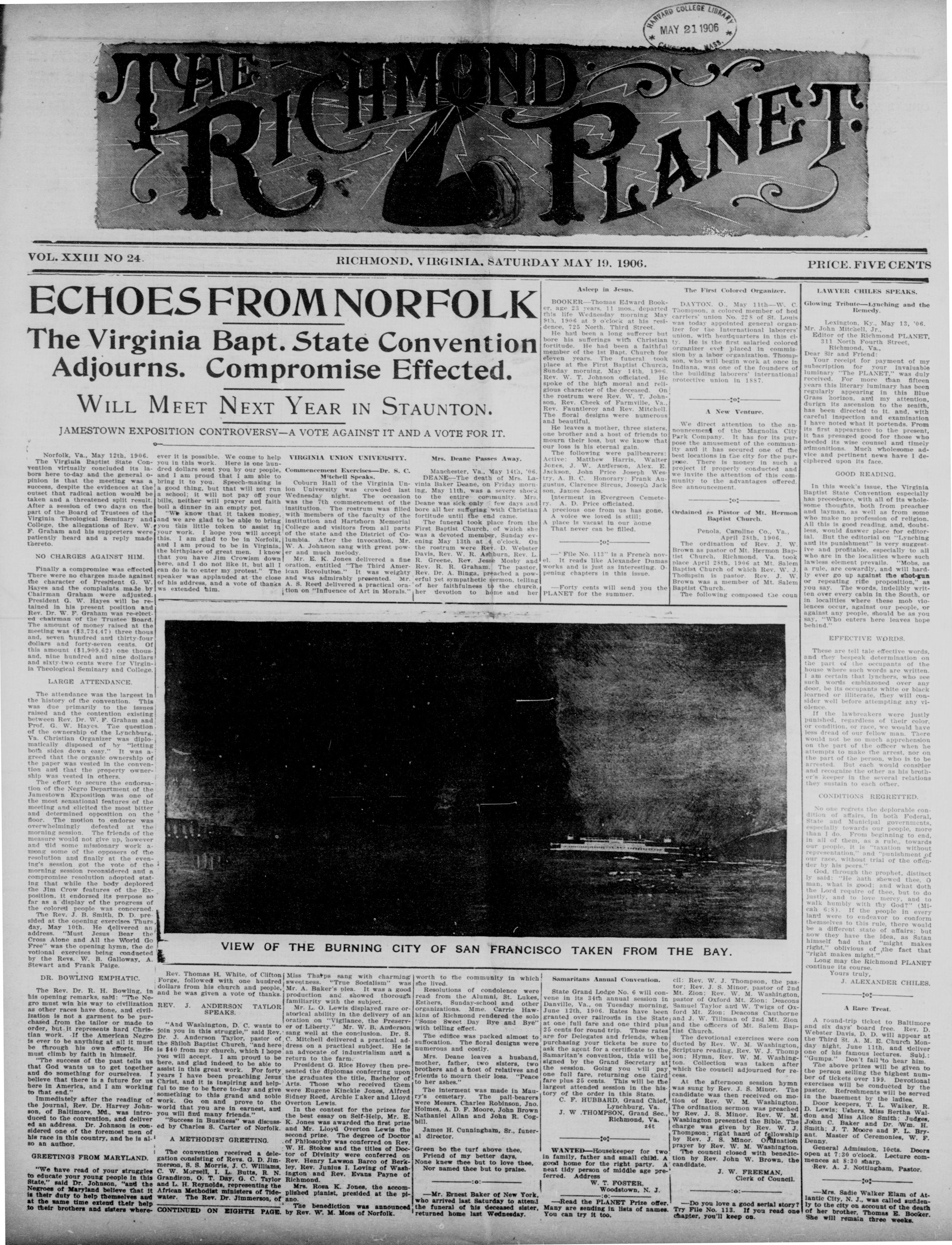
The image provided is too blurry to accurately recognize any text or details. It appears to be a grayscale photograph of a body of water with a ship in the foreground. Due to the low resolution and blurry quality, no text can be clearly discerned.
VIEW OF THE BURNING CITY OF SAN FRANCISCO TAKEN FROM THE BAY.
ever it is possible. We come to help you in this work. Here is one hundred dollars sent you by our people, and I am proud that I am able to bring it to you. Speech-making is a good thing, but that will not run a school; it will not pay off your bills, neither will prayer and faith boil a dinner in an empty pot. "We know that it takes money, and we are glad to be able to bring you this little token to assist in your work. I hope you will accept this. I am glad to be in Norfolk, and I am proud to be in Virginia, the birthplace of great men. I know that you have Jim Crowism down here, and I do not like it, but all I can do is to enter my protest." The speaker was applauded at the close of his address, and a vote of thanks was extended him.
VIEW OF
Rev. Thomas H. White, of Clifton Forge, followed with one hundred dollars from his church and people, and he was given a vote of thanks.
REV. J. ANDERSON TAYLOR SPEAKS.
"And Washington, D. C. wants to join you in this struggle," said Rev. Dr. J. Anderson Taylor, pastor of the Shiloh Baptist Church, "and here is $40 from my church, which I hope you will accept. I am proud to be here, and glad indeed to be able to assist in this great work. For forty years I have been preaching Jesus Christ, and it is inspiring and helpful to me to be here to-day and give something to this grand and noble work. Go on and prove to the world that you are in earnest, and you will find many friends."
"Success in Business" was discussed by Charles S. Carter of Norfolk
A METHODIST GREETING
The convention received a delegation consisting of Revs. G. D. Jimmerson, S. S. Morris, J. C. Williams, C. W. Morsell, I. L. Butts, R. N. Grandison, O. T. Day, G. C. Taylor and L. H. Reynolds, representing the African Methodist ministers of Tidewater. The Rev. Dr. Jimmerson, of
CONTINUED IN EIGHTH PAGE
RICHMOND, VIRGINIA, SATURDAY MAY 19. 1906.
VIRGINIA UNION UNIVERSITY.
Commencement Exercises—Dr. S. C. Mitchell Speaks.
Coburn Hall of the Virginia Union University was crowded last Wednesday night. The occasion was the 7th commencement of the institution. The rostrum was filled with members of the faculty of the institution and Hartshorn Memorial College and visitors from all parts of the state and the District of Columbia. After the invocation, Mr. W. A. Johnson sang with great power and much melody.
Mr. E. K. Jones delivered a fine oration, entitled "The Third American Revolution." It was weighty and was admirably presented. Mr. A. S. Reed delivered a practical oration on "Influence of Art in Morals."
THE BURNING CITY
Miss Thaips sang with charming sweetness. "True Socialism" was Mr. A. Baker's plea. It was a good production and showed thorough familiarity with the subject.
Mr. L. O. Lewis displayed rare oratorical ability in the delivery of an onation on "Vigilance, the Preserver of Liberty." Mr. W. B. Anderson sang well at the conclusion. Dr. S. C. Mitchell delivered a practical address on a practical subject. He is an advocate of industrialism and a return to the farm.
President G. Rice Hovey then presented the diplomas conferring upon the graduates the title, Bachelor of Arts. Those who received them were Eugene Kinckle Jones, Alfred Sidney Reed, Archie Daker and Lloyd Overton Lewis.
In the contest for the prizes for the best essay on Self-Help, Mr. E. K. Jones was awarded the first prize and Mr. Lloyd Overton Lewis the second prize. The degree of Doctor of Philosophy was conferred on Rev. W. H. Stokes and the titles of Doctor of Diversity were conferred on Rev. Henry Lawson Barco of Berkeley, Rev. Junius I. Loving of Washington and Rev. Evans Payne of Richmond.
Mrs. Rosa K. Jones, the accomplished pianist, presided at the piano.
The benediction was announced by Rev. W. M. Moss of Norfolk.
Mrs. Deane Passes Away.
Manchester, Va., May 14th, '06.
DEANE—The death of Mrs. Lavinia Baker Deane, on Friday morning, May 11th, was a severe shock to the entire community. Mrs. Deane was sick only few days and bore all her suffering with Christian fortitude until the end came.
The funeral took place from the First Baptist Church, of which she was a devoted member, Sunday evening May 13th at 4 o'clock. On the rostrum were Rev. D. Webster Davis, Rev. W. R. Ashburn, Rev. L. R. Greene, Rev. Jesse Mosby and Rev. R. R. Graham. The pastor, Rev. Dr. A. Binga, preached a powerful yet sympathetic sermon, telling of her faithfulness to the church, her devotion to home and her
Y OF SAN FRANCIS
worth to the community in which she lived.
Resolutions of condolence were read from the Alumni, St. Lukes, Esters, Sunday-school and other organizations. Mme. Carrie Hawkins of Richmond rendered the solo "Some Sweet Day Bye and Bye" with telling effect.
The edifice was packed almost to suffocation. The floral designs were numerous and costly.
Mrs. Deane leaves a husband, mother, father, two sisters, two brothers and a host of relatives and friends to mourn their loss. "Peace to her ashes."
The interment was made in Maury's cemetery. The pall-bearers were Messrs. Charles Robinson, Jno. Holmes, A. D. F. Moore, John Brown Nathaniel Allan and John R. Cogbill.
James H. Cunningham, Sr., funeral director.
Green be the turf above thee,
Friend of my better days,
None knew thee but to love thee,
Nor named thee but to praise.
—Mr. Ernest Baker of New York who arrived last Saturday to attend the funeral of his deceased sister returned home last Wednesday.
Asleep in Jesus.
BOOKER—Thomas Edward Booker, age 23 years, 11 mos, departed this life Wednesday morning May 9th, 1966 at 9 o'clock at his residence, 725 North. Third Street.
He had been a long sufferer but bore his sufferings with Christian fortitude. He had been a faithful member of the 1st Baptist Church for eleven years. The funeral took place at the First Baptist Church, Sunday morning, May 14th, 1966. Rev. W. T. Johnson officiated. He spoke of the high moral and religious character of the deceased. On the rostrum were Rev. W. T. Johnson, Rev. Cheek of Farmville, Va. Rev. Fauntleroy and Rev. Mitchell. The floral designs were numerous and beautiful.
He leaves a mother, three sisters, one brother and a host of friends to mourn their loss, but we know that our loss is his eternal gain.
The following were pallbearers: Active: Matthew Harris, Walter Jones, J. W. Anderson, Alex. E. Jackson, John Price Joseph Westry, A. B. C. Honorary: Frank Augustus, Clarence Circus, Joseph Jackson, James Jones.
Interment in Evergreen Cemetery. A. D. Price officiated.
A precious one from us has gone, A voice we loved is still; A place is vacant in our home. That never can be filled.
— "File No. 113" is a French novel. It reads like Alexander Dumas works and is just as interesting. Opening chapters in this issue.
— Forty cents will send you the PLANET for the summer.
SCO TAKEN FROM
Samaritans Annual Convention.
State Grand Lodge No. 6 will convene in its 34th annual session in Danville, Va., on Tuesday morning, June 12th, 1906. Rates have been granted over railroads in the State at one full fare and one third plus 25 cents for round trip. These rates are for Delegates and friends, when purchasing your tickets be sure to ask the agent for a certificate to the Samaritan's convention, this will be signed by the Grand Secretary at the session. Going you will pay one full fare, returning one third fare plus 25 cents. This will be the largest attended session in the history of the order in this State.
C. F. HUBBARD, Grand Chief,
Lynchburg, Va.
J. W. THOMPSON, Grand Sec.,
Richmond, Va.
WANTED—Housekeeper for two in family, father and small child. A good home for the right party. A day of meditation of middle age preferred. Address:
Read the PLANET Prize offer. Many are sending in lists of names You can try it too.
The First Colored Organizer
DAYTON, O., May 11th—W. C. Thompson, a colored member of hod carriers' union No. 228 of St. Louis was today appointed general organizer for the International laborers' union, with headquarters in this city. He is the first salaried colored organizer ever placed in commission by a labor organization. Thompson, who will begin work at once in Indiana, was one of the founders of the building laborers' international protective union in 1887.
A New Venture
We direct attention to the announcement of the Marmolla City Park Company. It has for its purpose the amusement of the community and it has secured one of the best locations in the city for the purpose. There is money in such a project if properly conducted and we invite the attention of this community to the advantages offered. See announcement.
Ordained as Pastor of Mt. Hermon Baptist Church.
Penola, Caroline Co., Va., April 28th, 1906. The ordination of Rev. J. W Brown as pastor of Mt. Hermon Baptist Church, Richmond, Va. took place April 28th, 1906 at Mt. Salem Baptist Church of which Rev. W. J. Thompson is pastor. Rev. J. W Brown was a member of Mt. Salem Baptist Church. The following composed the coun
THE BAY.
—Do you love a good serial story?
Try File No. 113. If you read one chapter, you'll keep on.
PRICE. FIVE CENTS
LAWYER CHILES SPEAKS:
Glowing Tribute—Lynching and the Remedy.
Lexington, Ky., May 13, '06.
Mr. John Mitchell, Jr.
Editor of the Richmond PLANET,
311 North Fourth Street,
Richmond, Va.
Dear Sir and Friend:
Your receipt for payment of my
subscription for your invaluable
luminary "The PLANET," was duly
received. For more than fifteen
years this literary luminary has been
regularly appearing in this Blue
Grass horizon, and my attention,
durign its ascension to the zenith,
has been directed to it. and, with
careful inspection and examination
I have noted what it portends. From
its first appearance to the present,
it has presaged good for those who
heeded its wise counsel and timely
admonitions. Much wholesome advice
and pertinent news have I deciphered upon its face.
GOOD READING
In this week's issue, the Virginia Baptist State Convention especially has precedence, with all of its wholesome thoughts, both from preacher and layman, as well as from some who make no profession of religion. All this is good reading, and, doubtless, would answer place for editorial. But the editorial on "Lynching and its punishment" is very suggestive and profitable, especially to all who are in the localities where such lawless element prevails. "Mobs, as a rule, are cowardly, and will hardly ever go up against the shot-gun or repeating rifle proposition," as you say. The words, indelibly written over every cabin in the South, or in localities where these mob violences occur, against our people, or against any people, should be as you say. "Who enters here leaves hope behind."
EFFECTIVE WORDS
These are tell tale effective words, and they bespeak determination on the part of the occupants of the house where such words are written. I am certain that lynchers, who see such words emblazoned over any door, be its occupants white or black learned or illiterate, they will consider well before attempting any violence. If the lawbreakers were justly punished, regardless of their color, or condition, or race, we would have less dread of our fellow man. There would not be so much apprehension on the part of the officer when he attempts to make the arrest, nor on the part of the person, who is to be arrested. But each would consider and recognize the other as his brother's keeper in the several relations they sustain to each other.
CONDITIONS REGRETTED
No one regrets the deplorable condition of affairs, in both Federal, State and Municipal governments, especially towards our people, more than I do. From beginning to end, in all of them, as a rule, towards our people, it is "taxation without representation," and "punishment of our race, without trial of the offender by his peers."
God, through the prophet, distinctly said: "He hath shewed thee, O man, what is good; and what doth the Lord require of thee, but to do justly, and to love mercy, and to walk humbly with thy God?" (Miiah 6:8). If the people in every land were to endeavor to conform themselves to this rule, there would be a different state of affairs; but now they have the idea, as Satan himself had that "might makes right," oblivious of the fact that "right makes might."
Long may the Richmond PLANET continue its course.
Yours truly.
J. ALEXANDER CHILES.
A Rare Treat.
A round-trip ticket to Baltimore and six days' board free. Rev. D. Webster Davis, D. D. will appear at the Third St. A. M. E. Church Monday night, June 11th, and deliver one of his famous lectures. Subl: "Gumps." Don't fall to hear him. The above prizes will be given to the person selling the highest number of tickets over 199. Devotional exercises will be conducted by the pastor. Refreshments will be served in the basement by the ladies. Door keepers, T. L. Walker, R. D. Lewis, Ushers, Miss Bertha Walden and Miss Alice Smith; Judges, John C. Baker and Dr. Wm. H. Smith; J. T. Moore and F. L. Bryant. Master of Ceremonies, W. F. Denny. General Admission, 10cts. Doors open at 7:30 o'clock. Lecture commences at 8:30 sharp. Rev. A. J. Nottingham, Pastor.
—Mrs. Sadie Walker Elam of Atlantic City, N. J., was called suddenly to the city on account of the death of her brother, Thomas E. Booker. She will remain three weeks.
FILE NO. 113.
ONE OF THE MYSTERIES OF PARIS, AND HOW IT WAS SOLVED.
(By EMILE GABORIAU.)
In the Paris evening papers of Tuesday, February 28, 1866, under the head of "Local Items," the following announcement appeared:
"A daring robbery, committed against one of our most eminent bankers, M. Andre Fauwel, caused great excitement this morning throughout the neighborhood of the Rue de Provence.
"The thieves, who were as skillful as they were bold, succeeded in making an entrance to the bank, in forging the lock of a safe that has heretofore been considered impregnable, and in possessing themselves of the enormous sum of three hundred and fifty thousand frames in bank notes.
"The police, immediately informed of the robbery, displayed their accounted zeal, and their efforts have been crowned with success. Already, it is said, P. B., a clerk in the bank, has been arrested, and there is every reason to hope that his accomplices hand of justice."
For four days this robbery was the town talk of Paris.
Then public attention was absorbed by later and equally interesting events; an acrobat broke his leg at the circus; an acctress made her debut at a small theater; and the item of the 28th was soon forgotten.
But for once the newspapers were—perhaps intentionally—wrong, or at least inaccurate in their information.
The sum of three hundred and fifty thousand francs certainly had been stolen from M. Andre Fauvel's bank, but not in the manner described.
A clerk had also been arrested on suspicion, but no decisive proof had been found against him. This robbery of unusual importance remained, if not inexplicable, at least unexplained.
The following are the facts as they were related with scrupulous exactness at the preliminary examination:
The banking-house of Andre Fauval,
No. 87 Rue de Provence, is an important establishment, and, owing to its large force of clerks, presents very much the appearance of a government department.
On the ground-floor are the offices, with windows opening on the street, fortified by strong iron bars, sufficiently large and close together to discourage all burglarious attempts.
A large glass door opens into a spacious vestibule where three or four office-boys are always in waiting.
On the right are the rooms to which the public are admitted, and from which a narrow passage leads to the principal cash-room.
The offices of the corresponding clerk, book-keeper, and general accounts are on the left.
At the further end is a small court on which open seven or eight little wicket doors. These are kept closed, except on certain days when notes are due; and then they are indispensable.
M. Fauvel's private office is on the first floor over the offices, and leads into his elegant private apartments. This private office communicates directly with the bank by means of a narrow staircase, which opens into the room occupied by the head cashier. This room, which in the bank goes by the name of the "cash office," is proof against all attacks, no matter how skillfully planned; indeed, it could almost withstand a regular stree, sheeted as it is like a monitor. The doors, and the partition where the wicket doors are cut, are covered with thick sheete of iron; and a heavy grating protects the fire-place. Fastened in the wall by enormous iron clamps is a safety formidable and fastastic piece of furniture, calculated to fill with envy the poor devil who easily carries his fortune in a pocket-book.
This safe, which is considered the masterpiece of the firm of Beequet, is six feet in height and four and a half in width, made entirely of wrought iron, with triple sides, and divided into isolated compartments in case of fire.
The safe is opened by an odd little key, which is, however, the least important part of the mechanism. Five movable steel buttons, upon which are engraved all the letters of the alphabet, constitute the real power of this ingenious safe.
Before inserting the key into the look, the letters on the buttons must be in the exact position in which they were placed when the safe was locked.
In M. Fauvel's bank, as everywhere, the safe was always closed with a word that was changed from time to time.
This word was known only to the head of the bank and the cashier, each of whom had also a key to the safe.
In a fortress like this, a person could deposit more diamonds than the duke of Brunswick's, and sleep well assured of their safety.
But one danger seemed to threaten that of forgetting the secret word which was the "Open sesame," of the safe.
On the morning of the 28th of February, the bank clerks were all busy at their various desks, about half past nine o'clock, when a middle-aged man of dark complexion and military air, slad in deep mourning, appeared in the office adjoining the "safe," and announced to the five or six employees present his desire to see the cashier.
He was told that the cashier had not yet come, and his attention was called to a placard in the entry, which stated that the "cash-room" was opened at ten o'clock.
This reply seemed to disconcert and annoy the new-comer.
"I expected," he said, in a tone of cool impertience. "to find some one here ready to attend to my business. I explained the matter to Monsieur Faureu yesterday. I am Count Louis
TWO
1
CHAPTER I
CHAPTER II
de Clamieran, an iron manufacturer at Oloron, and have come to draw three hundred thousand francs deposited in this bank by my late brother, whose heir I am. It is surprising that no direction was given about it."
Neither the title of the noble manufacturer, nor his explanations, appeared to have the slightest effect upon the clerks.
"The cashier has not yet arrived," they repeated, "and we can do nothing for you."
"Then conduct me to Monsieur Faurel."
There was a moment's hesitation; then a clerk named Cavallon, who was writing near a window, said:
"The chief is always out at this hour."
"Then I will call again," replied M. deCleran.
And he walked out, as he had entered, without saying "Good-morning," or even touching his hat.
"Not very pelite, that customer," said little Cavillon; "but he will soon be settled, for here comes Prosper."
Prosper Bertomy, head cashier of Faunel's banking-house, was a tall handsome man, of about thirty, with fair hair and large dark-blue eyes, fastidiously neat, and dressed in the height of the fashion.
He would have been very prepossessing but for a cold, reserved English-like manner, and a certain air of self-sufficiency which spoiled his naturally bright, open countenance.
"Ah, here you are!" cried Vavillona.
"Some one has just been asking for you."
"Who?An iron manufacturer,was it not?"
"Exactly."
"Well, he will come back again. Knowing that I would get here late this morning, I made all my arrangements yesterday."
Prosper had unlocked his office door, and, as he finished speaking, entered, and closed it behind him.
"Good!" exclaimed one of the olerks, "there is a man who never lets anything disturb him. The chief has quarreled with him twenty times for always coming too late, and his remonstrances have no more effect upon him than a breath of wind."
"And very right, too; he knows he can get anything he wants out of the chief."
"Besides, how could he come any sooner? A man who sits up all night, and leads a fast life, doesn't feel like going to work early in the morning. Did you notice how very pale he looked when he came in?" "He must have been playing heavily again. Couturier says he lost fifteen thousand francs at a sitting last week." "His work is none the worse done for all that." interrupted Cavaillon. "If you were in his place—" He stopped short. The oash-room door suddenly opened, and the cashier appeared before them with toterting step, and a wild, haggard look on his ashy face. "Robbbed!" he gasped out; "I have been robbed!"
Prosper's horrified expression, his hollow voice and trembling limbs betrayed such fearful suffering that the clerks jumped up from their desks, and ran toward him. He almost dropped into their arms; he was sick and faint, and fell into a chair.
His companions surrounded him, and begged him to explain himself.
"Robbed!" they said; "where, how, by whom?" Gradually, Prosper recovered himself.
"All the money I had in the safe," he said, "has been stolen."
"All?"
"Yes, all; three packages, each containing one hundred notes of a thousand francs, and one package of fifty thousand. The four packages were wrapped in a sheet of paper, and tied together."
With the rapidity of lightning, the news of the robbery spread throughout the banking-house, and the room was soon filled with curious listeners.
"Tell us, Prosper," said young Cavillion, "did you find the safe broken open?"
"No; it is just as I left it."
"Well, then, how, why—"
"Yesterday I put three hundred and fifty thousand francs in the safe, and this morning they are gone."
All were silent except one old clerk, who did not seem to share the general consternation.
"Don't distress yourself, Monsier Bertomy," he said; "perhaps the chief disposed of the money."
The unhappy cashier started up with a look of relief; he eagerly caught at the idea.
"Yes," he exclaimed, "you are right; the chief must have taken it." But, after thinking a few minutes, he said, in a tone of deep discouragement:
"No, that is impossible. During the five years that I have had charge of the safe, Monsier Faval has never opened it except in my presence. Several times he has needed money, and has either waited until I came, or sent for me, rather than touch it in my absence."
"Well," said Cavallion, "before despairing, let us ascertain."
But a messenger had already informed M. Fauvel of the disaster.
As Cavailon was about to go in puest of him, he entered the room.
M. Andre Fauvel appeared to be a man of fifty, inclined to corpulency, of medium height, with iron-gray hair; and, like all hard workers, he had a slight stoop.
Born in the neighborhood of Aix,
he portrayed, when animated, a elephant
THE RICHMOND PLANET, RICHMOND, VIRGINIA
provencel acent that gave a peculiar flavor to his genial humor.
The news of the robbery had extremely agitated him, for his usually florid face was now quite pale.
"What is this I hear? what has happened?" he said to the clerks, who respectfully stood aside when he cuttered the room.
The sound of M. Fauvel's voice inspired the cashier with the factitious energy of a great crisis. The dreaded and decisive moment had come; he arose, and advanced toward his chief, "Monsier," he began, "having, as you know, a payment to make this morning, I yesterday drew from the Bank of France three hundred and fifty thousand francs."
"Why yesterday, monsieur?" interrupted the banker. "I think I have a hundred times ordered you to wait until the day of the payment."
"I know it, monsieur, and I did wrong to disobey you. But the evil is done. Yesterday evening I locked the money up; it has disappeared, and yet the safe has not been broken open."
"You must be mad!" exclaimed M. Fauvel, "you are dreaming!"
These few words destroyed all hope; but the very horror of the situation gave Prosper, not the coolness of a matured resolution, but that sort of stupid, stolid indifference which often results from unexpected catastrophes.
It was with apparent calmness that he replied:
"I am not mad; neither, unfortunately, am I dreaming; I am simply telling the truth."
This tranquility at such a moment appeared to exasperate M. Fauvel. He seized Prosper by the arm, and shook him roughly.
"I can not say."
"No one but you and I knew the secret word. No one but you and myself had keys."
This was a formal accusation; at least, all the auditors present so understood it.
Yet Prosper's strange calmness never left him for an instant. He quietly released himself from M. Fauvel's grasp, and very slowly said:
"In other words, monsieur, I am the only person who could have taken this money."
"Unhappy wretch!"
Prosper drew himself to his full height, and, looking M. Fauvel full in the face, added:
"Or you!"
The banker made a threatening gesture; and there is no knowing what would have happened if they had not been interrupted by loud and angry voices at the entry door.
A man insisted upon entering, in spite of the protestations of the errand boys, and succeeded in forcing his way in. It was M. de Clameran. The clerke stood looking on, bewildered, and motionless. The silence was profound, solemn. It was easy to see that some terrible question, a question of life or death, was being weighed by all these men. The iron-founder did not appear to observe anything unusual. He advanced, and without lifting his hat, said in the same impertinent tone: "It is after ten o'clock, gentlemen." No one answered; and M. de Clameran was about to continue, when, turning around, he for the first time saw the banker, and walking up to him, said:
"Well, monsieur, I congratulate myself upon finding you in at last. I have been here once before this morning, and found the cash-room not opened, the cashier not arrived, and you absent."
"You are mistaken, monsieur; I was in my office."
"At any rate, I was told you were out; that gentleman over there assured me of the fact."
And the iron-founder pointed out Cavallon.
"However, this is of little importance," he went on to say. "I return, and this time not only the cash-room is closed, but I am refused admittance to the banking-house, and find myself compelled to force my way in. Be so good as to tell me whether I can have my money."
M. Fauvel's flushed face turned pale with anger as he listened to this insolence; yet he controlled himself.
"I would be obliged to you, mon-
"I thought you told me—"
"Yes, yesterday. But this morning, this very instant, I find that I have been robbed of three hundred and fifty thousand frames."
M. de Clameran bowed ironically, and said:
"shall I have to wait long?"
"Long enough for me to send to the bank."
Then turning his back on the iron-founder, M. Fauvel told to his cashier:
"Write and send as quickly as possible to the bank an order for three hundred thousand francs. Let the messenger take a carriage."
Proper remained motionless.
"Do you hear me?" said the banker, snirly.
The cashier trembled; he seemed as if trying to shake off a terrible nightmare.
"It is useless to send," he said, in a measured tone; "we owe this gentleman three hundred thousand francs, and we have less than one hundred thousand in the bank."
M. de Clameron evidently expected this answer, for he muttered:
"Naturally."
Although he only pronounced this word, his voice, his manner, his face clearly said:
"This comedy is well acted; but nevertheless it is a comedy, and I don't intend to be duped by it."
Alas! after Prosper's answer, and the iron-founder's coarsely-expressed opinion, the clerks knew not what to think.
The fact was, that Paris had just been startled by several financial crashes. The thirst for speculation caused the oldest and most reliable houses to totter. Men of the most unimpeachable honor had to sacrifice their pride, and go from door to door imploring aid.
Credit, that rare bird of security and peace, rested with none, but stood with upraised wings, ready to fly off at the first rumor of suspicion.
Therefor, this idea of a comedy arranged beforehand between the banker and his cashier, might readily occur to the minds of people who, if not suspicious, were at least aware of all the expedients resorted to by speculators, in order to gain time, which with them often meant salvation.
M. Fauvel had had too much experience not to instantly divine the impression produced by Prosper's answer; he read the most mortifying doubt on the faces around him.
"Oh! don't be alarmed, monsieur," said he to M. de Cleraner; "this house has other resources. Be kind enough to await my return."
He left the room, went up the narrow steps leading to his study, and in a few minutes returned, holding in his hand a letter and a bundle of securities.
"Here, quick, Courtiur!" he said to one of his clerks, "take my oarriage, which is waiting at the door, and go with monsieur to Monsieur de Rothschild's. Hand him this letter and these securities; in exchange you will receive three hundred thousand francs, which you will hand to this gentleman."
The iron-founder was visibly disappointed; he seemed desirous of apologizing for his impertinence.
"I assure you, monsieur, that I had no intention of giving offense. Our relations for some years have been such that I hope—"
"Enough, monsieur," interrupted the banker. "I desire no apologies. In business, friendship counts for nothing. I owe you money; I am ready to pay; you are pressing; you have a perfect right to demand what is your own. Follow my clerk; he will pay you your money."
Then he turned to his clerks who stood curiously gazing on, and said: "As for you, gentlemen, be kind enough to resume your desks."
In an instant the room was cleared of every one except the clerks who belonged there; and they sat at their desks with their noses almost touching the paper before them, as if too absorbed in their work to think of anything else.
Still, excited by the events so rapidly succeeding each other, M. Andre Fauvel walked up and down the room with quick, nervous steps, occasionally uttering some low exclamation.
Prosper remained leaning against the door, with pale face and fixed eyes, looking as if he had lost the faculty of thinking.
Finally the banker, after a long silence, stopped short before Prosper; he had determined upon the line of conduct he would pursue.
"We must have an explanation," he said. "Let us go into your office."
The cash-room bore no evidence of a successful burglary. Everything was in perfect order; not even a paper was misplaced.
The safe was open, and on the top shelf lay several rouleaus of gold, overlooked or disdained by the thieves.
M. Fauvel, without troubling himself to examine anything, took a seat, and ordered his cashier to do the same. He had entirely recovered his equanimity, and his countenance wore its usual kind expression.
"Now that we are alone, Prosper," he said, "have you nothing to tell me?"
The cashier started, as if surprised at the question. "Nothing, monsieur, that I have not already told you."
"What, nothing? Do you persist in asserting a fable so absurd and ridiculous that no one can possibly believe it? It is folly! Confide in me, it is your only chance of salvation. I am your employer, it is true; but I am before and above all your friend—your best and trust friend. I can not forget that in this very room, fifteen years ago, you were intrusted to me by your father; and ever since that day have I had cause to congratulate myself on possessing so faithful and efficient a clerk. Yes, it is fifteen years since you came to me. I was then just commencing the foundation of my fortune. You have seen it gradually grow, step by step, from almost nothing to its present height. As my wealth increased, I endeavored to better your condition; you, who, although so young, are the oldest of my clerks. At each inventory of my fortune, I increased your salary."
Never had Prosper heard him express himself in so feeling and paternal a manner. Prosper was silent with astonishment.
"Answer," pursued M. Fauvel.
"have I not always been like a father to you? From the first day my house has been open to you; you were treated as a member of my family. Madeleine and my sons looked upon you as a brother. But you grew weary of this peaceful life. One day, a year ago, you suddenly began to shun us, and since then—"
The memories of the past thus evoked by the banker seemed too much for the uphappy cashier, he buried his face in his hands, and wept bitterly.
"A man can confide everything to his father without fear of being harshly judged," resumed M. Fauvel. "A father not only pardons, he forgets. Do I not know the terrible temptations that beset a young man in a city like Paris? There are some inordinate desires before which the firmest principles must give way, and which so pervert our moral sense as to render us incapable of judging between right and wrong. Speak, Prosper, speaks!" "What do you wish me to say?"
"The truth. When an honorable man yields, in an hour of weakness, to temptation, his first step toward atonement is confession. Say to me, Yes, I have been tempted, dazzled; the sight of these piles of gold turned my brain. I am young, I have passions." "I!" murmured Prosper, "I!" "Poor boy," said the banker, sadly; "do you think I am ignorant of the life you have beer leading since you left my roof a year ago? Can you not
understand that all your fellow-clerks are jealous at you? that they do not forgive you for earning twelve thousand franes a year? Never have you committed a piece of felly without my being immediately informed of it by an anonymous letter. I can tell the exact number of nights you have spent at the gaming-table, and the amount of money you have squandered. Oh, envy has good eyes and a quick ear! I have great contempt for these cowardly denunciations, but was forced not only to heed them, but to make inquiries myself. It is only right that I should know what sort of a life is led by the man to whom I intrust my fortune and my honor." Prosper seemed about to protest against this last speech.
"Yes, my honor," insisted M. Fauvel, in a voice that n a sense of humiliation rendered still more vibrating. "Yes, my credit might have been compromised to-day by this, Monsieur de Clameran. Do you know how much I shall lose by paying him this money? And suppose I had not had the securities which I have sacrificed? You did not know I possessed them."
The banker paused, as if hoping for a confession, which, however, did not come.
"Come, Prosper, have courage, be frank. I will go upstairs. You will look again in the safe; I am sure that in your agitation you did not search thoroughly. This evening I will return; and I am confident that, during the day, you will have found, if not the three hundred and fifty thousand francs, at least the greater portion of it; and to-morrow neither you nor I will remember anything about this false alarm."
M. Fauvel had risen, and was about to leave the room, when Prosper arrose, and seized him by the arm.
"Your generosity is useless, monsieur," he said bitterly; "having taken nothing I can restore nothing. I have searched carefully; the bank-notes have been stolen."
"But by whom, poor fool? By whom?
"By all that is sacred, I swear that it was not by me."
The banker's face turned crimson.
"Miserable wretch!" cried he, "do you mean to say that I took the money?" Prosper bowed his head, and did not answer.
"Ah! it is thus, then," said M. Fauvel, unable to contain himself any longer. "And you dare—Then between you and me, Monsieur Prosper Bertomy, justice shall decide. God is my witness that I have done all I could to save you. You will have yourself to thank for what follows. I have sent for the commissary of police; he must be waiting in my study. Shall I call him down?" Prosper, with the fearful resignation of a man who abandons himself, replied in a stifled voice: "Do as you will." The banker was near the door, which he opened, and after giving the cashier a last searching look, said to an office boy: "Anselme, ask the commissary of police to step down."
TO BE CONTINUED.
Broke Him Gradually.
"His wife broke him of inhaling cigarettes; he used to wake up half a dozen times a night to light a cigarette and inhale the fumes."
"How did she do it?"
"She put him in a room by himself and left the gas turned on every night for a week or two, then she tapered of with assafoetida and limburger cheese." - Houston Post
IN THE SWISS HIGHLANDS.
Brown—This is rather a pretty figure. You start on the left foot, cut a drop three—then—(bump). Little Girl (unmoved)—Oh, that's why it's called a drop three, Mr. Brown.
Not So Sudden
"That's an eccentric girl Dobson is engaged to."
"How eccentric?"
"Well, when he proposed to her she said: 'I've been expecting this.'"—Cleveland Leader.
By Daylight
"You used to think her a dream of beauty, didn't you?"
"Yes, but once I saw her early in the morning, and then I woke up."—Cleveland Leader.
Unpleasant Thought.
Yeast—I found some dead files in that cake my wife made.
Crimsonbeak—Perhaps she tried it on the files first."—Yonkers Statesman.
Near the Top.
Knicker—Are they climbing the social ladder?
Bocker—Yes; they are among the almost present.—N. Y. Sun.
Different Then
"Perkins got a terrible big head when he heard his novel was selling in the hundred thousands."
"Yes, but he got over it all right when he tried to collect the royalty from his publishers."—Life.
Only Doubted His Taste.
"You are marvelously beautiful."
"You're trying to flatter me."
"But it's true."
"Oh, I know that. But are you sincere in thinking so?"—Cleveland Leader.
STORIES OF CAMP AND WAR
GEN. DEVENS' STATUE.
Monument to Civil War Hero to Be Unveiled in Worcester, Mass., on July 4.
Plans for the erection of the Gen. Charles Devens statue, which is to be placed in front of the county courthouse in Lincoln square, at Worcester, Mass., are rapidly being completed by the Devens statue commission. July 4 has been selected as the date for the unveiling of the statue and its formal transfer from the commission to the county. The only reason for a change in the date will be the non-completion of the casting in time for the exercises to take place on Independence day.
The first active move for the Devons statue was the passage of the act by the legislature on February 18, 1902, authorizing the Devens memorial statue commission to collect funds from individuals and towns in Worcester county for the purpose of erecting a memorial to the county's soldier-statesman-jurist. In November, 1903, the commission accepted the sketch of the complete statue as submitted by the sculptors
THE GEN. DEVENS STATUE.
French & Potter, of New York, and on October 11, 1905, the complete model was accepted by the commission and forwarded to the foundry of the Gorham Manufacturing company, at Providence. The company expects to be able to turn the casting out of its foundry the latter part of May. The pedestal will be made of a mammoth piece of granite. On the west side of the pedestal will be an inscription bearing the record, both military and civil, of Gen. Devens. The south side will bear an inscription, with the list of organizations from Worcester county, which participated in the war, and on the north side will be a list of towns of Worcester county and the number of men furnished by each during the war. The total subscriptions to the Devens statue fund to date are approximately $34,000, coming from individuals and towns.
Gen. Charles Devena was descended from revolutionary ancestors and was born in Charleston, Mass., in 1820. He was a lawyer with a large practice, and had held several public offices. When the civil war broke out he went to the front as a major, and by gallantry on a number of battlefields, being wounded several times, he was made a major general before hostilities ceased. He served afterward as commander-in-chief of the Grand Army of the Republic, and also as commander of the Military Order of the Loyal Legion of Massachusetts. He resumed the practice of his profession after the war, and in 1867 was made a superior court judge, and in 1873 one of the judges of the supreme court of the Bay state. President Hayes made him attorney general of the United States in 1877, and he served four years, afterward returning to the bench in Massachusetts. He presided in 1886 at the two hundred and fiftieth anniversary of Harvard university, of which he was a graduate in 1838. Gen. Devena died in 1891. He had a high reputation as a brilliant public speaker.
Another Confederate War-Horse.
Mr. Palmer Sheldon, postmaster at Ames, Ia., says: "It is a mistake to say that Stonewall Jackson's old sorrel, recently dead, was the sole survivor among horses of the rebellion, for Capt. J. Rush Lincoln, professor of military tactics at the lows state agricultural college, has with him the horse he rode during the rebellion in the First Maryland confederate cavalry, wherein he served as captain. The horse is said to be a thoroughbred. He is a dark brown, about 15 hands high. He is in good health and as fat and sleek as a colt. The captain rides him at all the state encampments and reunions, and when he takes part in sham battles the horse seems to enjoy the excitement, for he is right on his mettle as soon as the fight begins."
The Enlisted Men
There is no body of men in this country of similar size which merits so well of the country as the body of officers and enlisted men in the army and navy of the United States.
MEDAL FOR BRAVE DIED.
Government Recognizes Valorous Exploit of Federal Soldier in Civil War—Made Sorte in Dark.
Andrew J. Kelly, a veteran of the civil war, has just received a color medal from the war department with which he would not part as soon as he would release his claim upon his homestead, located four miles east of
Crookston, Minn., upon which he has resided for over a quarter of a century.
The treasured medal is inscribed: "Sgt. Andrew J. Kelly, Knoxville, Nov. 20, 1863," and those few words bring to his mind one of the bloodiest engagements of the civil war, during which he performed a feat for which he was awarded the valor medal, together with the five others who participated in the gallant deed.
The deed for which the medal was awarded was volunteering to make a dash from the union lines on the night of November 20, '63, at Knoxville with five other men and burn a three-story brick building inside the rebel lines, from which the rebel sharpshooters were picking off the union gunners as fast as they showed their heads.
The federal batteries were so short of ammunition that enough could not be spared to batter the big house down, and at a council of war it was decided that it must be burned. The question was how could such a feat be accomplished, as Gen. Longstreet had five or six batteries trained to cover the ground where the brick house stood, the batteries being located across a small ravine from the house and hut 40 rods distant.
Col. Swift, who attended the council of war, volunteered to furnish the men to take the desperate chance, and it was decided that six volunteers should be called for.
Col. Swift returned to his regiment, announced the offer that he had made to the commanding general, and then, in ringing tones, asked who would be the first man to volunteer to be one of the six men to do the burning.
Comrade Kelly says there was a deathly stillness for a minute or two, and then, having no family, he thought he might as well be the first man, and, stepping out of the ranks, presented himself.
President Sheppard, of the Normal school at Winona, shouted: "Will be the second," before Kelly had ceased talking, and a score of others volunteered in the next minute. The first six, however, were selected, and at 11 o'clock that night, with companies A and B as flanking companies, the dash across the lines was made.
It was pitch dark, but the men located the house, and the rebels, thinking that it was a general sortie, fled from the rear of the building, leaving their accountements, and retreated behind the batteries across the ravine. Kerosene was applied liberally to the interior and a match did the rest.
To do a good job, the squad of six determined to burn the barns also, and did so, not thinking that the burning house would light things up and show the rebels the size of the party and what the scheme was. That is just what happened, and as the six made a dash back for the union lines there was a hall of bullets that killed many members of the flanking companies, which had not advanced very close to the building.
The squad of six scattered on route back, and Kelly lost his bearings and ran burn into a rebel sentry, who challenged him. Kelly answered: "A friend," and as he did so stooped low and skooted to the left, having got his bearings from a glance back at the burning house.
Not one of the six men were killed, but it developed later that all that saved them was an order received by the rebel gunners not to fire until the union troops started to cross the ravine.
Longstreet knew that the federal troops had no rations left to speak of, and was expecting a sortie at night. The two companies which advanced part of the way together with the six men were taken for a large force, and the rebels did not suspect what was up till the building was burning and the men were skooting for safety within the union lines. Had the batteries opened every man would have been mowed down like grass before a sickle.
By an act of congress April 2, 1904, gallantry medals in the form of small buttons were issued by the war department, and Sergt. Kelly was sent one of these, but the medal received lately is more elaborate and replaced the former emblem. It is a pendant charm, surmounted by an eagle with a helmeted warrior in the center, and is suspended about the neck with a buckled ribbon bespangled with stars. This medal was provided by an act passed by congress April 23, 1904.
Before securing the second medal the first one had to be returned to the war department, accompanied by sworn affidavits that Sergt Kelly was the real man he posed as, and these had to be signed by two men who had known the affiant at least five years. This statement had to be sworn to before the clerk of the district court, and there was more other red tape than is connected with the report of election judges under the Australian ballot system.
Occupied by. Farragut
Through the efforts of Admiral McCalla a bronze tablet has been placed on the chaplain's house at Mare Island navy yard, showing that the house was occupied by Farragut, 1854-58, while he was the commandant of the yard. He was the first commandant.
Cynical.
"Would you vote for a man whom you knew had been associated with questionable schemes?"
"I dunno," answered Farmer Corntossel. "Sometimes I think that it might be better to take up some fellow that you know you've got to watch instead o' some one that's in a position to ketch you nappin'."—Washington Star.
What Delayed Dinner.
The Lady—What makes dinner so late, Katie?
The Girl—I couldn't get the macaroni, ma'am.
"Why, I thought the grocer brought it early this morning?"
"So he did, ma'am; but Johnnie had a lot of boys in the yard, and they were using it for putty blowers!"—Yonkers Stateman
fia
eat
ate
Cw =
BRIGADIER GENERAL FREDERICK FUNSTON.
e sores
| AeA Pa
s rT Lay
Ny
a ae .
aS " ™ "
SATURDAY.....MAY 19TH, i908
7S WOMAN S |
Be 2. WORLD
ey LEA
MRS. E. B. DAVIDSON. :
New Engiand.
York, Me., is the proud claimant of
the only woman bank president in
New England, Mrs, Elizabeth Burleigh
Davidson. She ts the head of the York
County National bank. It Is a flourish-
ing Institution, and in summer many
eposits are made by the famous vis-
itors to the harbor.
‘The bank was orgunized in Febro-
ary, 1803, with James T. Davidson
president and W. M. Walker vice presi-
ent. Mrs. Davidson at that time was
very much interested In her home du-
Ges, and these home duties were as
arduous as the duties of the head of a
dank, for tn the Davidson family there
were six lively children. In 1901 Mr.
Davidson died. Vice President Walker
Po = RS A ee fe ve
(CEs
MOR Hie sao
eek
Sek |
SSO
y iio '
Ce Pes vs a P
Se ee ee ee
was elected as bis successor, and Mrs,
Davidson, to the general surprise of
Maine people, was made vice president
of the institution.
Mrs. Davidson was very well inform.
ed on the business of the bank. Be-
sides, she is possessed of a bright and
‘@lert mind. She stepped into the ac-
tive life of the institution as though
ghe bad worked in the world of @nance
for many years. From the beginning
of ber financial career she showed
wuch enthusiasm and acumen. Every
day she spent several hours in her of-
fico, consulted the directors on invest:
ments and even ventured to suggest
many avenues for profitable use of the
funds.
‘The other officers ceased to regard
her as a woman; they accepted her on
@ basis of masculine ability; they re-
warded her as one of themselves. Con-
sequently, when the president of the
Dank died, in 1903, the directors unan-
imoasly elected Mrs, Davidson to the
office. In her higher position she
sbowed even greater activity and
Sagacity. She assumed undisputed
control of the institution. Other bank.
ing men in the state, when they heard
of ber, smiled; later they said sbe was
a very bright woman. They came to
have much respect for her financial
shrewdness und cleverness. The York
County National bank recetved « high-
er rating and bas become more suc
cessful than ever under Mrs, David-
Son's management—Boston Herald.
Clothes and the Working Girl.
“We try to impress our pupils with
the fact that they must look the part
when they ee rearing, tor en:
teacher of stanoerapy tn speek
ieee his business. & lesson we
Gnd bard to teach, especially to the
2 Sasa eRe on eee ce Sa ae eee mm ee
: eee PEt 8 Ne ER ERS aches ea me
. Cee penigges mae oR Se AER aR pat ce” A ES De
TR ae Oe ae seed Iz Se. ee Se
Bee Saha: See ene ae oe Fee ee ale ee. re
Ces eee a rie ee ee LS a ox Bee
Me ieee SSO eeet hi Rp oe
lila =: anon ise eer Pts ey oer
« Ni —eweCeSs a a “ tod a) manne:
= eee Jia he ea tsiegness 0 Arts x cgatare sumer orrgems |
chelate a et pasts SO Sy Nailewelae
ence SN coceemer cence rg os ame a ae
2 iy ae eae Rep aees es ere i SRR Ae aa eee a oe ae
PSone een ees eters ee cit St RES eae ae
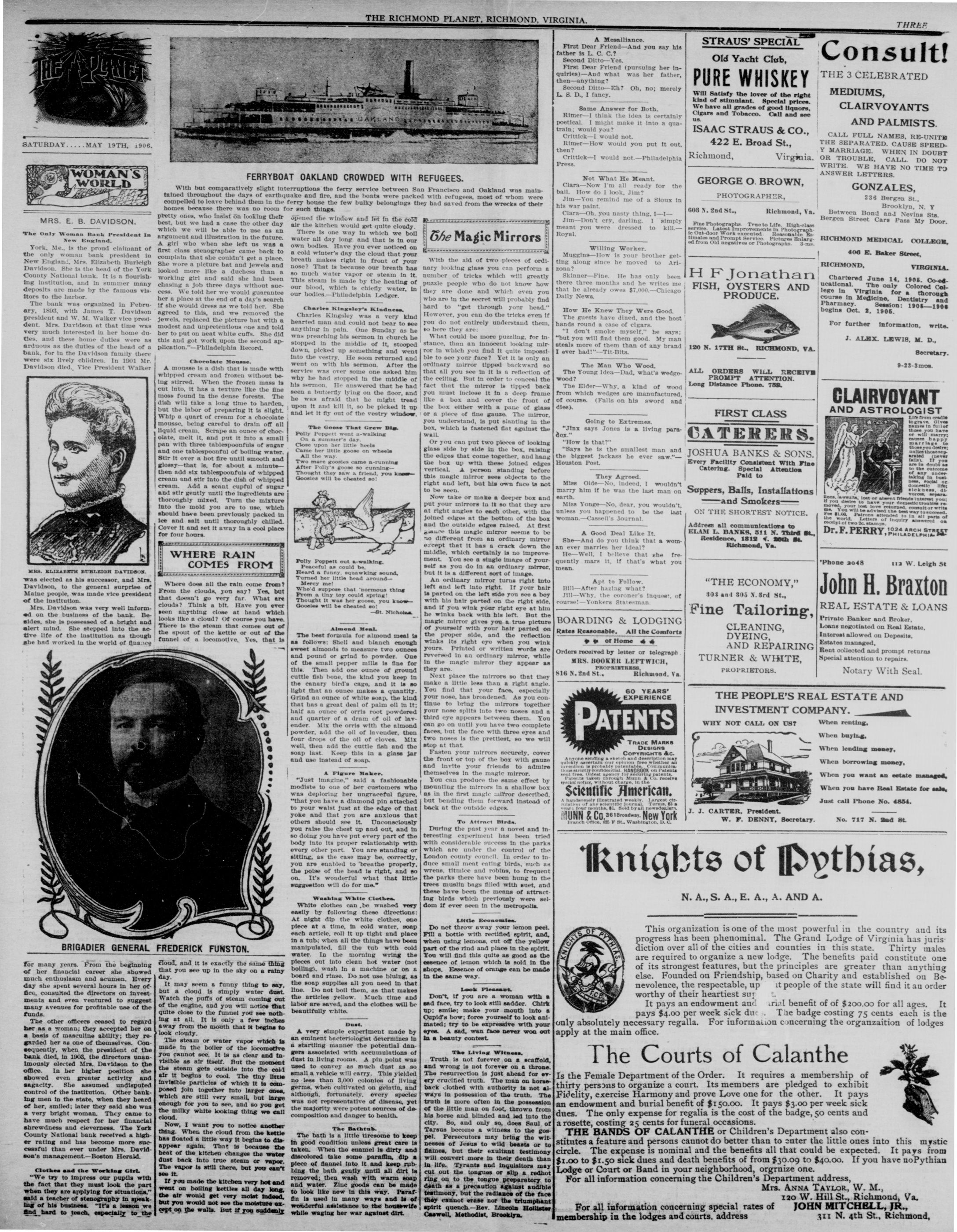
FERRYBOAT OAKLAND CROWDED WITH REFUGEES.
With but comparatively slight interruptions the ferry service between San Francisco and Oakland was matn-
tained throughout the days of earthquake and fire, and the boats were packed with refugees, most of whom were
compelled to leave behind them In the ferry house the few bulky belongings they had saved from the wrecks of their
homes because there was no room for such things.
Pretty ones, who fnsist on looking thefr
dest, but we had a case the other day
which we will be able to use as an
argument and Illustration in the future.
A girl who when she left us was a
first class stenographer came back to
complain that she coukin’t get a place.
She wore a pleture hat and jewels and
looked more Iike a duchess than a
Working girl and said she had been
chasing a Job three days without suc-
cess. We told her we would guarantee
her a place at the end of a day's search
1f she would dress as we told her. She
agreed to this, and we removed the
Jewels, replaced the picture hat with a
modest and unpretentious one and told
her to put on neat white cuffs. She did
this and got work upon the second ap-
plication."—Philadelphia Record.
iat eee
A mousse Is a dish that is made with
whipped cream and frozen without be-
Ing stirred. When the frozen mass Is
cut Into, It hes a texture Ike the fine
moss found tn the dense forests. The
dish will take a long time to harden,
but the labor of preparing It ts slight.
Whip a quart of cream for a chocolate
mousse, being careful to drain off all
liquid cream, Scrape an ounce of choc-
olate, melt It, and put it Into a small
pan with three tablespoonfuls of sugar
and one tablespoonful of bolling water.
Stir It over a hot fire until smooth and
glossy—that is, for about a minute—
then add six tablespoonfuls of whipped
‘cream and stir tnto the dish of whipped
cream. Add a scant cupful of sugar
and stir gently until the Ingredients are
thoroughly mixed. Turn the mixture
Into the mold you are to use, which
should have been previously packed in
ice and salt until thoroughly chilled.
Cover it and set it away tn a cool place
for four hours.
WHERE RAIN
COMES FROM
Where does all the rain come from?
From the clouds, you say? Yea, but
that doesn't go very far. What are
clouds? Think a bit. Have you ever
seen anything close at hand which
looks like a cloud? Of course you have.
‘There ts the steam that comes out of
the spout of the kettle or out of the
fannel of a locomotive, Yes, that is
@lond, and it ts exactly the same thing
that you see up tn the sky on a rainy
day.
It may seem a funny thing to say,
but a cloud ts simply water dust.
Watch the putfs of steam coming out
of the engine, and you wil! notice that
quite close to the funnel you see noth-
tng at all. It is only a few inches
away from the mouth that i begins to
look cloudy.
The steam or water vapor which is
made tn the boller of the locomettve
You cannot see. It is as clear and tn-
Visible as air ttself. But the moment
the steam gets outside into the coli
air it begins to cool. The tiny ltue
fnvistble particles of which it fe com-
Posed join together tnto larger ones,
which are stil! very small, but large
enough for you to see, and so you get
‘the milky white jooking thing we eal!
cloud.
Now, I want you to notice another
thing. When the cloud trom the kettle
bas floated a little way it begins to dis
appear again. That 1s because the
heat of the kitchen changes the water
dust back Into true steam or vapor,
‘The vapor Is still there, but you can’t
‘see it.
If you made the kitchen very hot and
went on boiling kettles all day jong,
the air would get very molst indesd,
but you would not see the moisture ex.
‘cept on the walls. Gut if you suddenly
THE RICHMOND PLANET, RICHMOND, VIRGINIA.
Spened the window and [et fn the cold
air the kitchen would get quite cloudy.
There ts one way tn which we boll
water all day long and that ts in our
own bodies. “Have you ever noticed on
@ cold winter's day the cloud that your
breath makes right in front of your
nose? That is because our breath has
so much water vapor or steam tn it.
This steam ts made by the heating of
our blood, which ts chiefly water, in
our bodies—Philadelpbia Ledger.
Charles Kingsley’s Kindness,
Charles Kingsley was a very kind
henrted man and could not bear to see
anything tn pain. One Sunday as he
was preaching his sermon in church be
stopped in the middle of tt, stooped
down, picked up something and went
into the vestry, He soon returned and
went on with his sermon. after the
service was over some one asked bim
why he bad stopped in the middle of
his sermon, He answered that he had
seen a butiertly lying on the floor, and
be was afraid that he might tread
“Upon it and kill It, so be picked tt up
and let {t fly out of the vestry window.
Dl 5 emi ree eee a cee sla
Polly Poppett went a-walking
‘On a summer's day
Close ‘upon her tittle heets
Came her Ittle goose on wheels
‘Ail the way.
‘Two more goonies came a-running
After Polly's goose 90 cunning—
‘Thought they saw a friend, you knew
Goosies will be cheated so!
oy f
Ke a
pean = D FIOE)
= ay ae
rs es A
CS
> aD
Polly Poppett out a-walking.
Peaceful as could be,
Fleard a funny. aquawking sound,
Turned her little bead around—
Mercy me!
Who'd suppose that ‘normous thing
From a tiny toy could spring!
‘Thought it was her goose, you know—
Goosies wit! be cheated wot
“Bt. Nichola.
eee a
‘The best formula for almond meal ts
as follows: Shell and bianch enough
sweet almonds to measure two ounces
‘and pound or grind to powder. Que
of the smal! pepper mills ts fine for
this. ‘Then add one ounce of ground
cuttle fish bone, the kind you keep tn
the canary bint's cage, and it ls #0
Ught that an ounce makes a quantity.
Grind an ounce of white soap, the kind
that has a great deal of palm olf In tt;
half an ounce of orris root powdered
and quarter of 2 dram of oil of Inv-
ender. Mix the orris with the almond
powder, add the oil of Invender, then
four drops of the ot] of cloves. Mix
well, then add the cuttle fish and the
soap last. Keep this in a glass jar
and use Instead of soap.
A Figure Maker.
“Just tmazine,” said a fashionable
modiste to one of ber customers who
was deploriug her ungraceful figure,
“that you have a diamond pin attached
to your waist just at the edge of that
yoke and that you are anxious that
others should see It Unconsciously
you raise the chest up and out, and in
So doing you have put every part of the
body into its proper relationship with
every other part. You are standing or
sitting, as the case may be, correctly,
you are enabled to breathe properly,
the poise of the head ts right, and sc
on. It's wonderful what that ttle
suggestion will do for me”
Washing White Clothes
White clothes can .be washed very
easily by following these directions:
At night dip the white clothes, one
Piece at a time, in cold water, soap
each article, roll it up tight and place
tm a tub; when all the things have been
manipulated, fill the tub with cold
water. In the morning wring the
pieces out into clean hot water (not
boiling), wash in a machine or on a
board and rinse. Do not use bluing, as
the soap supplies all you need tn that
Ine. Do not boll them, as that makes
the articles yellow. Much time and
labor are saved, and the clothes will be
beautifully white
seams
A very simple expertment made by
an eminent bacterioiogist determines tp
@ startling manner the potential dan-
gers associated with xccumulations of
dust in living rooms. A pin point was
used to convey as much dust as so
smail.a vehicle will carry. This ylelded
no -less than 3,000 colonies of living
germs, when cultivated on gelatin, and
although, fortunately, every species
‘was not representative of disease, yet
the majority were potent sources of de
composition and danger to health.
‘The Batntad.
The bath is a little tiresome to Keep
fn good condition unless great care is
taken. When tho enamel is dirty and
Giscolored take some paraffin, dip a
Piece of flannel into it and keep. rub-
Ding the bath gently until all dirt ts
removed; then wash with warm soap
and water. Zinc goods can be made
to look like new tn this way. Paraf-
fin {s used in many ways and ts of
‘wonderfal adsistance to the housewife
while waging her war ageinst dirt.
Ghe Magic Mirrors
With the ald of two pleces of ordt-
nary looking glass you can perform a
number of tricks which will greatly
puzzle people who do not know how
they are done and which even you
who are tn the secret will probably find
hard to “get through yonr head.”
However, you can do the tricks even If
you do not entirely understand them,
to here they are:
| What could be more puzzling, for tn-
stance, then an fnnocent looking mir-
ror in which you find ft quite imposst-
ble to see your face? Yet it ts only an
ordinary mirror tipped backward so
that all you see tn It Is a reflection of
the ceiling. But tn order to conceal the
fact that the mirror ts tipped back
you must inclose it In a deep frame
‘Ike @ box and cover the front of
the box elther with a pane of glass
or a piece of fine gauze. The mirror,
you understand, is put slanting in the
box, which ts fastened fat aguinst the
wail.
Or you can put two pleces of looking
glass side by side in the box, raising
the edges that come together, and hang
the box up with these joined edges
vertical. A person standing before
this magic mirror sees objects to the
right and left, but his own face ts not
to be seen.
Now take or make a deeper box and
put your mirrors tn It so that they are
at right angles to each other, with the
Joined edges at the bottom of the box
And the outside edges raised. At first
@inuce this magle mizror seems to be
no different from an ordinary mirror
except that It has a crack down the
middle, which certainly is no improve-
ment. You see a slugle image of your-
self as you do in an ordinary mirror,
Dut it is different sort of tmage.
An ordinary mirror turns right into
left and left Into right. If your hair
ta parted on the left side you see a boy
with bis balr parted on the right side,
and if you wink yoar right eye at him
he winks back with his left. But the
magic mirror gives you a true picture
of yourself with your hair parted on
the proper side, and the reflection
winks its right eye when you wink
yours. Printed or written words are
Feversed In an ordinary mirror, while
in the magic mirror they appear as
they are.
Next place the mirrors 90 that they
make a little less than a right angle.
You find that your face, especially
Your nose, has broadened. As you con-
tinue to bring the mirrors together
Your nose splits Into two noses and a
third eye appears between them. You
ean go on until you have two complete
faces, but the face with three eyes and
two noses Is the prettiest, so we will
stop at that
Fasten your mirrors securely, cover
the front or top of the box with gauze
and invite your friends to admire
themselves In the magic mirror.
You can produce the same effect by
| moanttni the mirrors !n a shallow box
as in the first magic salfror described,
but bending them forward Instead of
gece ‘at the outside edges.
To Attract Birds,
During the past year a novel and tn-
teresting experiinent has been tried
with considerable success In the parks
which are under the control of the
London county council. In order to tn
uce small meat eating birds, such as
wrens, titmice and robins, to frequent
the parks there have been hung in the
trees muslin bags filled with suet, and
these have been the means of attract.
ing birds which previously were sel-
dom if ever seen in the metropolis.
Little Beonomies.
Do not throw away your lemon peel.
Fill a bottle with rectified spirit, and,
when using lemons, cut off the yellow
part of the rind and place in the apirit.
‘You will find this quite as good as the
essence of lemon which ts sold in the
shops, Essence of orange can be made
in the same way.
Look Pleasast.
Don't, if you are a woman with a
sad face, try to look still sadder. Chirk
up; smile; make your mouth into a
Oupid’s bow; force yourself to look ant-
mated; try to be expresaive with your
eyes. A sad, wan face never won out
tm @ beauty contest
The Living Witness.
Troth is not forever on a scaffold,
and wrong is not forever on a throne.
The resurrection is just ahead for ey-
ery crucified troth. The man on horse
Dack clothed with authority ts not ai-
‘Ways tm possession of the truth. The
truth is more often in the possession
of the little man on foot, thrown from
his horse and blinded and led into the
city. So, and only so, does Saul. of
Tarsus become a witness to the gos-
pel. Persecutors may brig the wit
Resses of Jesus to wild beasts or to
fiames, but thetr exultant testimony
will convert more in thelr death than
in life. ‘Tyrants and inguisitors may
cut out the tongues oF slip a redhot
oe on to the tongue tory. to
ES hy
testimony, but the of the face
‘théy camnot erase nor the triumphant
spirit quench.—Rev. Lineoln Hollister
Caswell, Methodist, Brooklyn.
Rnights of Pythi
gk ythias,
| N.A.,S. A., E. A., A. AND A.
ED . This organization is one of the most powerful in the country and it:
SN progress has been phenominal. The Grand Lodge of Virginia has juris
f, \\_ diction over allof the cities and counties in thisstate. Thirty male:
SS Ce’ ¥} are required to organize a new lodge. The benefits paid constitute on
Y “a La of its strongest features, but the principles are greater than anything
No Q7 yy else. Founded on Friendship, based on Charity and established on Be
) ESOS é ae ee up it people of the state will find it an orde:
6 worthy of their heartiest su; 5
+S ras It pays anendowment and rial benefit of of $200.00 for all ages, [I
pays $4.00 per week sick duc. The badge costing 75 cents each is the
only absolutely necessary regalla, For information concerning the organzaition of lodges
apply at the main office.
The Courts of Calanthe
Is the Female Department of the Order. It requires a membership of
thirty persons to organize a court. Its members are pledged to exhibit
Fidelity, exercise Harmony and prove Love one for the other. It pays
an endowment and burial benefit of $150.00. It pays $3.00 per week sick
dues. The only expense for regalia is the cost of the badge, so cents and
‘arosette, costing 25 cents for funeral occasions.
THE BANDS OF CALANTHE or Children’s Department also con-
stitutes a feature and persons cannot do better than to enter the little ones into this mystic
circle. The expense is nominal and the benefits all that could be expected. It pays from
$1.00 to $1.50 sick dues and death benefits of from $30.09 to $40.00. If you have noPythian
Lodge or Court or Band in your neighborhood, orgrnize one.
For all information concerning the Children’s Department address,
Mrs. Anna Tayxor, W. M.,
120 W. Hill St., Richmond, Va.
For all information concerning special rates of | JOHN MITCHELL, JR.,
membership in the lodges avd courts, address arr N. ath St, Richmond,
A Mesalliance.
First Dear Friend—And you say his
father is L. C. C.?
Second Ditto—Yes.
First Dear Friend (pursuing her in-
quiries)—And what was her father,
then—anything?
Second Ditto—Eh? Oh, no; merely
LS. D,, I fancy.
Spies
Same Answer for Both.
Rimer—I think the idea is certainly
Poetical. I might make it into a qua-
train; would you?
Crittick—I would not.
Rimer—How would you put tt out,
then?
Crittick—1 would not—Philadelphia
Press,
Not What He Meant.
Clara—Now I'm all ready for the
ball. How do I look, Jim?
Jim—You remind me of a Stoux in
his war paint.
Clara—Oh, you nasty thing, I—I—
Jim—Don't ery, darling. I simply
meant you were dressed to kill.—
Royal.
Willing Worker.
| Muggins—How is your brother get-
ting along since he moved to Ari-
zona?
Skinner—Fine. He has only been
‘there three months and he writes me
‘that he already owes $7,000.—Chicago
Daily News,
How He Knew They Were Good.
The guests have dined, and the host
hands round a case of cigars.
“I don't smoke myself," he says;
“but you will find them good. My man
steals more of them than of any brand
T ever had!”—Tit-Bits.
‘The Man Who Wood.
The Young Idea—Dad, what's wedge-
‘wood?
The Elder—Why, a kind of wood
from which wedges are manufactured,
of course. (Falls on his sword and
dies).
Going to Extremes.
“Jinx says Jones is a living para-
ox.”
“How ts that?”
“Says be is the smallest man and
the biggest jackass he ever saw.”"—
Houston Post.
They Acreed.
Mise Olde—No, indeed, I wouldn't
marry him if he was the last man on
earth.
Miss Yonge—No, dear, you woulda’t,
unless you happened to be the last
Woman.—Cassell’s Journal
A Good Deal Like It.
She—And do you think that a wom.
an ever marries her {deal?
He—Well, I believe that she fre.
quently mars it, if that's what you
mean.
Apt to Follow.
Bill—After hazing what?
JM—Why, the coroner's Inquest, of
course! —Yonkers Statesman.
BOARDING & LODGING
Rates Reasonable. All the Comforts
2% ottiome «4
Orders received by letter or telegraph
MRS. BOOKER LEFTWICH,
PROPRIETRESS,
816 N. 2nd St... Richmond, Va.
60 YEARS"
EXPERIENCE
‘Trace Marks
‘ | : ; a Somme Ae.
“Scientific American,
TUN & Co.2e12~snm. New York
THE PEOPLE’S REAL ESTATE AND
INVESTMENT COMPANY. ___eeeemmmy
WHY NOT CALL ON Us? When renting,
When baying,
f aoe =o When lending money,
—, io <= ‘When borrowing money,
alle Le » When you want an estate managed,
i ti. When you have Heal Estate for sale,
2 ie az : eS Just call Phone No. 4854.
J. J. CARTER, President. —
W. F. DENNY, Secretary. No. 717 N. Quad 8t.
-~ im
_ STRAUS’ SPECIAL
Old Yacht Club,
Will Satisfy the tover of the right
kind of stimulant. Special prices.
We have all grades of good liquors,
Cigars and Tobacco. Call and see
ue
ISAAC STRAUS & CO.,
422 E. Broad St.,
Richmond, Virgimia.
GEORGE O. BROWN,
PHOTOGRAPHER,
608 N. 2nd St., Richmond, Va.
Fine PhotogragiinTranto Life. High cam
BOataee Wace teecuent peetene
sifrom Old nogalves oF Photerseahe Eas
| H F Jonathan
FISH, OYSTERS AND
PRODUCE,
120 N. 17TH 6t., RICHMOND, VA.
eee
‘ALL ORDERS WILL RECEIVE
PROMPT ATTENTION.
‘Long Distance Phone. 758.
FIRST CLASS
SAAENEN S.
—————
JOSHUA BANKS & SONS.
Every Facility Consistent With Fine
Catering. Special Attention
Paid to
Suppers, Balls, Installations
and Smokers——
ON THE SHORTEST NOTICE.
Address all communteations to
BLAM 1, BANKS, 511 N. Third 6,
Richmond, Va.
“THE ECONOMY,”
803 and 305 N.Srd St.,
Fine Tailoring,
CLEANING,
DYEING,
AND REPAIRING
TURNER & WHITE, !
PROPRIETORS. |
THREE
THE 3 CELEBRATED
MEDIUMS,
CLAIRVOYANTS
AND PALMISTS.
CALL FULL NAMES, RE-UNITR
THE SEPARATED. CAUSE SPEED-
¥ MARRIAGE. WHEN IN DOUBT
OR TROUBLE, CALL. pO NoT
WRITE. WE HAVE NO TIME TO
ANSWER LETTERS.
GONZALES,
236 Bergen St.,
Brooklyn, N. ¥
Between Bond and Nevins Sta.
Bergen Street Cars Pass My Door.
RICHMOND MEDICAL COLLEGR,
406 E. Baker Street,
RICHMOND, VIRGINIA.
Chartered June 14, 1905. Co-e4-
ucational. The only’ Colored Col-
Jege in Virginia for a thorough
‘Sourse in Medicine, Dentistry and
Pharmacy. Session: 19061906
Degins Oct. 2, 1905.
For further information, write.
J. ALEX. LEWIS, M. D.,
Secretary.
9-23-3mos.
AND ASTROLOGIST
meee eects
EP aad sss cs
Mme ae sire ses
ed Sac rs
E CE icc yec seas
Tes im
if ees 22:
nf ei ay eat
ey || om
Sesame tore tadeineeny roe
BS else “Hinetricdsae om payee
oe
Dr. F. PERRY, 3924 Anos S358
"Phone 2048 112 W. Leigh st
John H. Braxton
REAL ESTATE & LOANS
Private Banker and Broker,
Loans negotiated on Real Estate,
Interest allowed on Deposits,
Estates managed,
Rent collected and prompt returns
Special attention to repairs.
Notary With Seal.
to Rocketts." It seems that Dr. Oppenheimer stated the truth and that Dr. Stratton obeyed orders and caught Dr. Levy "mapping," for he candidly admits that he did make the report as stated by Dr. Oppenheimer. He had blamed Dr. Stratton for the deception, but the "vials of his wrath" are now being poured on the head of Dr. Oppenheimer. In his reply Dr. Levy says:
"I did not state that 'the patient was worse,' but there is no doubt at all about my reporting that diphtheria bailli were present in each of the several cultures sent me by Dr. Stratton, and they were there. Within a few days it came to my knowledge that Dr. Stratton claimed that the last of these swabs was from his own throat, and not from the throat of his patient. I at once went to see Dr. Oppenhimer for the purpose of telling him of this willful deception on the part of one of the city physicians. Dr. Garein was in his office.
"Only on hearing Dr. Oppenheimer's reply to the investigating committee last night did I realize that he himself was at the bottom of this deliberate conspiracy to brittle the value of bacteriological work in general and my own ability in particular. Moreover, who knows even where that culture really did come from? Are we to believe Dr. Stratton's verbal statement to Dr. Oppenheimer that he took this swab from his own throat or his written statement, which accompanied the culture that he had gotten it from the throat of the colored woman? I confess that Dr. Stratton and Dr. Oppenheimer must decide this delicate point of honor between them, while I myself, in the face of their self-confessed deception, must honestly admit that I do not feel called upon to believe either of them either time.
"In this special case my examination simply showed that Dr. Stratton's mouth was as great a menace to this community as was the mouth of the colored woman whom he was attending."
The public is left to draw its own conclusions. It is evident that Dr. Levy has not a very high opinion of the truth and veracity of either Dr. Oppenheimer or Dr. Stratton. He admits that he truthfully stated the nature of the report on the cultures sent him and if he continues to insist that Dr. Stratton has tiphtheria germs in his throat, there is a probability that the cry of the News-Leader that Dr. Stratton be quarantined, will be humorously taken up by every fun-loving journal in Virginia.
All of this trouble comes from an unreasonable desire to create a political office to meet every passing fad and fancy in the country. When white folks get down to the business of telling the truth on each other the outcome is almost as interesting as a stormy church-meeting among the colored folks, when the "saints" are disagreeing.
We do not know Mr. J. O. Nixon of Wilmington, N. C., but we do know that he likes to write. He is well posted on current events and has an opinion of his own even though it is often erroneous. He views things from his stand-point and judges them according to his own vision. He never tires of sending communications and the failure to publish them makes no apparent impression upon him. Here is one of his latest ebullitions:
I beg to say that I mailed you an article a few days ago, and as I knew it was out of tune with your paper and also of the most of your readers, I am not at all surprised that you did not publish it.
An idea has suggested itself to me, that you were reminded of that article on Tuesday when you saw that twelve Republican Senators voted in favor of "Jim Crow" car laws for the Negro, thus defeating Senator Foraker's amendment to the rate bill. Even Senator Tillman, about whom so much has been intimated in one stage of the debate that he would support the Foraker amendment.
FOUR
THE PLANET
Published every Saturday by JOHN MITCHELL
JR., at 311 North 4th Street, Richmond Va.
JOHN MITCHELL, JR., - EDITOR
Ali communications intended for publication
should be sent so as to reach us by Wednesday
One Copy, one year,
one month, six months
One Copy, six months
One Copy, four months,
three months,
Single Copy
ADVERTISING RATES
REGISTERED LETTER.—If a money order Post-Office or an Express Office is not within your reach, your Postmaster will Register time, address, with send in payment of bounties. Then, if the letter is lost or stolen it can be traced. You can send money in this manner at our risk.
We cannot be responsible for money sent in letters in any other way than through ways mentioned above. If you send your money in any other way, you must do it at your win risk.
RENEWALS, ETC.—If you do not want THE RENEWALS, ETC. after your subscription has run out, you then must the Postal Card to discontinue it. The counts have decided that subscribers to newspaper, who do not order their paper discontinued at the expiration date, are held liable for the payment of the subscription up to date when they order the paper discontinued.
COMMUNICATIONS.—When writing to us to request a subscription or to request a name and address in full, otherwise we cannot find your name on our books.
CHANGE OF ADDRESS.—In order to change the address of a subscriber, we must be sent the former as well as the present address.
Entered at the Post-Office at Richmond, Va. as second-class matter.
SATURDAY.....MAY 19TH, 1906
A CASE OF TWO THROATS.
The caustic criticism of the Board of Health of which Dr. W. T. Oppenheimer is President has evoked a ringing reply by that individual in answer to the strictures of the Investigating Committee. He was merciless in his condemnation of the methods employed against him and it is evident that he believes that Coroner Wm. H. Taylor and Dr. E. C. Levy, the City Bacteriologist are largely responsible for his attempted undoing.
But the most amusing part of the discussion is that in which a colored woman figures. It seems that she had the diphtheria and was under the care of city physician, Dr. T. E. Stratton. This was all right as far as it goes and as Dr. Levy was employed by the city for the purpose, Dr. Stratton mopped the woman's throat and took the mop with the matter thereon, and sent it to Dr. Levy for analysis. Dr. Levy analyzed it and reported that he found diphtheria bacilli.
The throat was mopped again after the woman was apparently well and sent to Dr. Levy and he made the same report. Dr. Stratton sent another mop with matter on it for examination and Dr. Levy analyzed it and reported that he found diphtheria bacilli and that the woman was worse. This part of the affair may be fully appreciated when it is understood that the last moppings came out of Dr. Stratton's own throat. The joke was on Dr. Levy. President Oppenheimer took advantage of this ludicrous blunder on the part of Dr. Levy and in his answer to his critics used the following ironical language:
For example, a colored woman had diphtheria, and was treated by Dr. Stratton, one of the city physicians. After all visible traces of the disease had vanished, two examinations by the city bacteriologist revealed the presence of germs. The woman was restless under confinement; in fact, only remaining indoors when she expected the doctor; and the people who had employed her protested that she was kept in quarantine after her health was restored. I decided, therefore, to test the efficacy of the department. I accordingly instructed Dr. Stratton to mop out his own throat and send the mop to the city bacteriologist. The next day there came a card saying the patient was worse! This is only to bring out the point that doctors convey disease as well as other people, and consistency would demand a bacteriological examination of each doctor's throat every time he came in contact with a case of diphtheria.
This is a good one on Dr. Levy that he does not seem to appreciate. When Dr. Levy goes into the business of examining all of the throats of the physicians in Richmond, there will be a howl from "Screamersville
STILL COMPLAINING
Wilmington, N. C., May 8, '06
Mr. John Mitchell, Jr.,
Richmond, Va.,
Dear Sir:
So, as I have said, one party is no better than the other. I suppose Senator Foraker had his eye on the Negro vote of Ohio, and Senators Bacon and Bailey would have voted with him had there been any chance for them to obtain the Negro vote.
It is indeed one of the most absurd conceptions that has ever been created in the mind of man, that the mere dubbing of a man "Republican" changes his character. To my mind nothing is more illogical and foolish. I confess though, that some years ago I had no better sense. In addition to that for one to conceive that a man is better because he lives North of the Mason and Dixon line is perfectly monstrous. Do you know that many bad men and women live North of that line? If better how could that be.
I tried to get you and Mr. Fortune to use your influence not to let our case go to the Supreme Court but neither of you would hear. Hence you went, and the race is damned in consequence. Respectfully J. O. NIXON. For him to hint that we do not publish communications out of tune with our position is too absurd to need further comment. He evidently was oblivious of the fact that our answer to Mr. R. Antione Rogers, Sr. in our issue of the 5th inst. is a complete refutation of the charge for Mr. Rogers is a socialist and plainly said so. Mr. Nixon makes much ado about the attitude of the
THE RICHMOND PLANET, RICHMOND, VIRGINIA.
NOW OPEN
ISLAND PARK
WHEN WE WILL HAVE BIG SENSATIONAL OPEN AIR FREE ATTRACTIONS and SHOWS of all DESCRIPTIONS.
```markdown
```
twelve Republican Senators, whom he alleges were voting in favor of the "Jim Crow" Car laws, ignoring the fact that thirty-five Republican Senators voted against the proposition.
Mr. Nixon errs, when he says one party is no better than the other, but he would have been correct had he said that some alleged Republicans are no better than some Democrats, when it comes to a question of the Negro's rights and privileges in this country.
Some of our worst enemies live north of the Mason and Dixon line and some of our best friends. The same is true of that section south of it. Mr. Nixon errs again, when he charges that we have urged the carrying of cases up to the United States Supreme Court. We have been against such a policy, repeatedly averring that the justice we could not secure within the limits of the states we would make ourselves content and do without. The Supreme Court is against us and it appears to be against any measure for our relief.
When the tribunal changes and death and resignation bring into power the justice loving elements of this republic, then we expect to make our appeals to this tribunal with some hope of success. As it stands now, it is anti-Negro to the core and the person who presumes that the amendments to the Constitution of the United States will be enforced by its decree has been blind to facts and deaf to argument.
PRESIDENT ROOSEVELT AND HIS
ALLIES
The bitter attacks made upon President Roosevelt by Senator Joseph W. Bailey of Texas and Senator B. R. Tillman disclose a condition of affairs with which on general principles, every close observer of passing senatorial events was perfectly familiar. That a Republican Chief Executive had entered into an embarrassing deal with the Democratic minority in an effort to combine with a Republican minority for the purpose of passing the Hepburn Rate Bill was too self evident to cause a shadow of a doubt in the mind of the average reader.
The details of the affair were lacking and these have been supplied in the carefully prepared address of the Senator from South Carolina. He was rightly given the opportunity to tell all about his failure. That he has won without question the sobriquet of "blunderbuss" Tillman his most intimate friends can hardly deny. We predicted that he would fall and he has failed. The first blunder he made was in accepting the leadership in the matter. He played directly into the hands of the astute and able Senator Nelson W. Aldrich.
What better favor would any general want than the privilege of naming the leader of the army that is to be marshalled against him? Mr. Tillman knew that he could not consistently confer with President Roosevelt. Yet one of the most essential measures to bring success was embraced in the frequent conferences with the distinguished occupant of the White House. Senator Tillman states that he pocketed his pride and laid down his just indignation. It does not look as though he put the one far enough down in his pocket or placed the other far enough away in order to bring him within speaking range of the White House. On the contrary, he openly assailed the President while the Rate Bill was in a most critical condition and thus endangered its life and all of the interests embodied in its provisions. It seems that it is a case where President Roosevelt never lost his wits or marred his judgment. He played a cool, skillful hand and at no time permitted his feelings to stand in the way of his success. He was ready and willing to receive Senator Tillman at the White House.
He pandered to the prejudices at the South on one hand in the case of Father Thomas Sherman and risked thereby the good opinion of the people of the North on the other. He accepted the leadership of Senator Tillman as long as he could and
placed all of the influence and power of the administration behind him. But "Brother Blunderbuss Tillman" had not been used to that kind of treatment and he did not know what to do with this new found leadership.
He was like a "fish out of the water." Whereas he should have kept his own counsel and given out no interviews, he lost no opportunity to talk and boast of what he intended to do. His astute antagonist, Aldrich talked too, but it was not above a whisper and it was with men whom he knew could keep a secret. The result was that from a defeated dismayed, doubting minority, he has emerged with a confident, powerful organized majority. There is no exultation on the part of Senator Aldrich, although he has had restored to him the leadership of the United States Senate and all of the measures he introduces are approved and all amendments that he opposes are defeated.
Senator Tillman is not a match for even one arm of this diplomatic statesman from New England. It seems to us that the trouble about the whole matter is that Senator Tillman and Senator Bailey were unable to deliver the "goods." They could not guarantee and furnish a certified copy of the guarantee that the necessary votes would be forthcoming when the final test came. The failure of the Democratic caucus called by Senator Bailey and which caucus adjourned in confusion showed to President Roosevelt the utter hopelessness of the struggle when waged along the lines outlined by himself and those Democrats with whom he had consulted. The result was that this hybrid animal, this Democratic Republican machine broke down, because many of the ablest Senators on both sides would not stand for it.
With failure came recrimination, and the men who were most responsible for the condition of affairs were the first to cry out to President Roosevelt, "You are the cause of it all. You are no iron man. You are clay and every common clay at that." President Roosevelt is some what winded, but he is smiling, while Senator Aldrich is as "happy as a lark."
It is our opinion that this experience should teach President Roosevelt a lesson. He should ere tails have obtained a clear insight into the character and peculiarities of the men with whom he has been coquetting. He has luckily escaped the results of his folly, he would do well not to try the experiment again.
The Republican leaders now have the Democratic managers on the defensive. They dare not vote for the amended Hepburn Rate Bill and if they do not vote for it they will be placed in the embarrassing position of voting against their own proposition and thus will be eliminated one of the vital issues of the next political campaign. Oh, the Democrats are sharp, but then the Republicans are so much sharper. President Roosevelt is a statesman, but his statesmanship is mixed with so much political acumen that like the cat he invariably lands upon his feet.
Here's to Senator "Joe" Bailey of Texas and here's a farewell to Senator "Blunderbuss" Tillman of South Carolina.
HAS SENATOR FORAKER DE SERTED US?
A remarkable scene took place in the United States Senate in connection with the Hepburn Rate Bill, when the veteran Senator from Ohio, Hon. J. B. Foraker offered his anti-pass amendment and encouched therein a proviso that equal treatment and charges should be extended to everybody for the same class of service. This was on Monday, May 7th, 1906.
This was regarded by the Southern Senators as an attack upon the "Jim Crow" Car system of the South land. The Democrats defeated this amendment with the aid of twelve Republican votes, the result being 35 for the Foraker provision and 38 against it. The Culberson substitute for the Foraker Amendment was the issue.
The recorded vote for that substi
tute was as follows:
Yeas—Bacon, Bailey, Berry, Black burn, Burkett, Clapp, Clarke (Ark),
Clay, Culberson, Daniel, Dolliver, Dubois, Foster, Frazier, Frye, Gearin, Kittredge, Knox, La Follette, Latimer, Long, McCreary, McEnergy, McLaurin, Martin, Money, Nelson, Nixon, Overman, Pettus, Rayner, Simmons, Stone, Sutherland, Tallaferro, Teller, Tillman, Warner—38.
Nays—Aldrich, Alger, Ailee, Ankeny, Brandgee, Bulkeley, Burnham, Burrows, Carter, Clark (Wyo),
Crane, Cullom, Dick, Dillingham, Dryden, Elkins, Flint, Foraker, Fulton, Gallinger, Hale, Hansbrough, Hemenway, Hopkins, Kean, Lodge, McCumber, Millard, Perkins, Platt, Piles, Scott, Smoot, Warren, Wetmore—35.
The Republicans voting against equal accommodations for colored people, even when they pay the same fare were as follows:—Burkett, Dolliver, Frye, Clapp, Kittredge, Knox, La Follette, Long, Nelson, Nixon, Sutherland and Warner.
The responsibility for the vote is on the Democratic contingent, still it affords a very important insight as to the feelings of certain Republican senators from Maine to Wisconsin and from Iowa to Pennsylvania.
Senator Foraker's remarks are also important, practically endorsing as they do the separate or "Jim Crow" system in the southern states. He is reported as follows:
Mr. Foraker replied that the principal objection to the amendment was on the part of those who object to the abolition of passes. In order to meet objections about the so-called "Jim Crow" cars, he said he had provided that the compensation should be the same to all for "the same or equally good accommodations." He would have "equally good accommodations for all, whether white or black."
The above explanation is all right and if he had stopped there, no cause for complaint would be manifested on the part of our people in any section of the country. But Senator Foraker spoke again and this time disclosed his position in language too plain to be misunderstood. The cor respondent says:
Speaking again to the substitute, Mr. Foraker said that he had heard much complaint from the South that the Negroes do not have transportation equal to that given to whites. He did not, he said, want to compel the carrying of Negroes in the same cars with whites, but would have the same accommodations given them for the same pay.
Mr. Bacon, one of the most pronounced anti-Negro advocates In the Senate chimed in and he is quoted in the following language.
"Can it possibly be the design of the Senator to incorporate this subject of discrimination with that of free passes in order to strengthen it?" asked Mr. Bacon, referring to the separate-car system of the South for Negroes. The provision, he said, touches upon a matter of vital importance to -the South. "There could be no question raised of more vital importance to that section," he said. He insisted that the two matters should not be coupled together. "Does the Senator object to equal
"Does the Senator object to equal accommodations for the same pay?" asked Mr. Foraker.
"No," responded Mr. Bacon, "but I do object to giving the Interstate Commerce Commission supervision over the matter."
"And that I insist upon," declared Mr. Foraker.
"In view of the fact that two-thirds of the Senate is Republican, I presume that he can make good his boast," said the Georgia Senator with warmth.
Here we have two senators, one a Republican from Ohio and the other a Democrat from Georgia standing upon a common platform so far as the Negro's rights and privileges, so far as they relate to interstate travel are concerned. The former admits that he was not in favor of legislation that would prevent the use of "Jim Crow" cars not even in Ohio and he has an Afro-American constituency in that state and is regarded as one of the ablest and best political friends that our people have in this country. It seems to us that Senator Bacon got the better of the controversy and drew an admission from Senator Foraker that will confront him in many campaigns to come in his own state.
The irrespressible Senator Benjamin R. Tillman who has been side-
tracked as leader of the Hepburn Rate Bill chimed in as follows:
Mr. Tillman deprecated the introduction of the race issue into the rate subject. At the same time he had no objection to the enforcement of the law. "Most of the cars are owned in the North," he concluded, "and I don't want any discrimination against Southern Negroes by Northern capital." He welcomed the recognition of Southern conditions by a Senator who at one time enjoyed the sobriquet of "fire alarm," as had Mr. Foraker, because of his position on the race question.
Mr. Bailey also accepted the amendment as a recognition of the State laws on the separate-car system, and therefore welcomed it.
Here then you have Senator Tillman complimenting Senator Foraker on his change of front and saying plainly that while he discriminated against his own Negroes, he did not want northern capitalists to do it, and here you have Senator Bailey of Texas also commending the Ohio Senator upon this remarkable amendment, which had a double action effect. Will the colored people of the country see? We are the victims of certain political leaders in both parties and our salvator rests with the liberal minded elements of the country both North and South, to whom we must now make an appeal.
To clinch the matter, after giving the distinguished Senator the rhetorical "taffy" just quoted, these statesmen deliberately killed the very amendment that they had a few moments endorsed, for their votes are lined up against it. By this method they completed Senator Foraker's discomfiture and out-generalled him in this parliamentary bout at the capital of the nation.
It may be that these slow-comprehending northerners will yet realize that the animosities of forty-one years ago are yet uppermost in the minds of the smiling but earnest representatives from the southern states.
PRESIDENT'S STATEMENT
Did Not Pledge Himself to Any
Amendments to Rate Bill
NOT TRYING TO DICTATE ACTION
Washington, May 15.—The sensational rate bill incident in the senate Saturday, during which Mr. Tillman on the authority of former Senator Chandler, made statements regarding the president's course in connection with pending railroad rate legislation, some of which statements were denied by Mr. Lodge on behalf of the president, had its sequal when an official statement was issued by the White House giving an account of the subject on the part of the president and Attorney General Moody. The statement comprised two letters, one from the president to Senator Allison and the other from Attorney General Moody to the president. The president says:
"In no case, either in the case of Mr. Chandler or any one else, was there the slightest opportunity for any honest misconception of my attitude or any belief that I pledged myself specifically to one, and only one, amendment or set of amendments, or that I would not be satisfied with any amendment which preserved the essential features of the Hepburn bill as it came from the house."
The president says that as to many of the amendments, including the so-called Long, Overman, Bacon and Spooner amendments, he had said he should be entirely satisfied to have them in the bill, and suggested modifications as to other amendments, but that "as to none (of the amendments) did I ever say either to Mr. Chandler or to any one else that I should insist upon having them in the bill as a condition of my approval," and that on the contrary, he the president, was careful to state that he was not trying to dictate any particular programme of action.
The president then says: "I also repeatedly stated that while it was entirely satisfactory to me to simply leave the Hepburn bill in substance as it was, that it, with the recognition of the jurisdiction of the courts but without any attempt to define that jurisdiction, yet that I was entirely willing that there should be a definition, provided that this definition did not seek to grant a broad review, but explicitly
narrowed it to the two subjects which as a matter of fact I believed that the courts would alone consider in case there was no attempt to define the limits of their review, that is, would limit it to the question as to whether the commission had acted ultra vires and as to whether any man's constitutional rights had been impaired. I stated that if the question of defining or limiting the review was brought up at all I personally felt that this was the way in which it should be limited or defined."
The president says the statements made to Senator Chandler were the same in substance as those made to Mr. Allison and other senators of both parties. He said he was asked to see Senator Chandler as the representative of Mr. Tillman in charge of the bill, and that the conferences Attorney General Moody had with Senators Tillman and Bailey were such as had been held with many other senators to determine the phraseology and discuss the effect of amendments proposed by them. The president states that he became convinced that it was impossible for senators "with advantage" to use him as an intermediary, and suggested to all to whom he spoke that they communicate with Senator Allison, whose purposes and the president's were "identical."
The president says that his own opinion that the Allison amendment in no way changed the court review as provided in the original Hepburn bill is also the opinion of Attorney General Moody and Secretaries Root and Taft. The attorney general's letter gives an account, at the president's request, of the conferences which Mr. Moody had, by the president's direction, with Senators Tillman and Bailey regarding the court review feature. He says he advised the president that he should not, at any stage, become finally committed beyond recall to any form of language in any part of the bill, and the president affirmed the wisdom of that course. He reviews the discussion of interlocutory injunctions, and concludes that there was nothing in the "conversations" between the senators and himself which bound the president to any particular amendment.
TILLMAN VIGOROUSLY DENIES
Says He Never Made Overtures to President On Rate Bill.
Washington, May 16.—While the debate on the personnel of the interstate commerce commission was in progress in the senate, Senator Tillman took the floor to make a statement on behalf of ex-Senator Chandler, which has been momentarily expected since Senator Lodge's conveyance last Saturday to the senate of the president's emphatic denial of some of the statements attributed to Mr. Chandler by the South Carolina senator, Mr. Tillman said:
"I now declare most emphatically that to no human being have I ever given authority or even expressed a wish to have any conference with Theodore Roosevelt in regard to the bill now under consideration. On the contrary, I have expressed the opinion in more than one publish interview that he
had nothing to do with it, and that it was the business of the senate, and while I did, at his request, enter into negotiations with the attorney general, it is well known to every senator on this floor what my attitude and feelings have been, and it is most remarkable while the president sent for Democrat after Democrat to confer with him about this measure, that he should undertake under the circumstances to assert that I sent an agent to him to begin negotiations. The statement is absurd on its face.
"The other point to which I shall refer is the cavalier way in which Mr. Moody discusses the idea of the president not being bound.
"Of course, the president was not bound to change, but he was bound under such circumstances to give notice, and this was not done. Even the attorney general himself was not notified. The charge I made, and still make, is that the president is guilty of bad faith, and that the rate bill which will be, when enacted into law, a much better and stronger measure than we had hoped to get has been emasculated of one of its most valuable and essential features by the president's action."
Vesuvius Discharging Sand
Naples, May 16. — Professor Mattteucci, director of the Royal Observatory, telegraphed that the volcanic activity of Mount Vesuvius is increasing and that the main crater is discharging a great quantity of soil. The professor added that it was impossible, on account of rain, to explore the volcano.
Aged Man Cut His Throat.
Harrisburg, Pa., May 15. — Despondent because of illness, Moses Capon, 78 years of age, committed suicide by outting his throat with a carving knife.
THE PLANET
PRONOUNCED DEAD,
RETURNED TO LIFE
NATIVE MEXICAN DOCTOR PERFORMS MIRACULOUS FEAT.
SECRET REMEDY IS USED.
Girl Drinks Carbolic Acid and Coroner Issues Burial Certificate for Supposed Corpse — Now on Road to Recovery.
El Paso, Tex.—To have been pronounced dead by three physicians and a coroner and to live to read her own obituary was the unique experience of Esther Cardosa, a young woman of the Mexican colony of El Paso, who attempted suicide by drinking acid. After hovering at death's gate for a few days she lost all desire to die.
Until her attempt upon her own life Esther had never done anything to distinguish herself from the other young Mexican girls of El Paso.
Esther longed for feminine trifles, and after obtaining employment as a needlewoman, was enabled to indulge in some finery. On Sunday evening she joined the procession of senoritas who wound through the paths of San Jacinto Plaza in El Paso or the Plaza Constitution in Ciudad Juarez, the quaint Mexican city which lies on the nether side of the Rio Grande, joined with El Paso by electric cars. She gained the admiration which she sought and caused many a flutter in the hearts of the susceptible Mexican lads, and she had an unhappy love affair that caused her to become sad and wonder whether life was really worth the living.
Others, more matter of fact, declare that the young woman's melancholy came from a more proscale cause. They say it was the result of blood poisoning, which followed a needle prick. There is no question that the finger was in serious danger, and that she was caused great suffering.
In this condition she determined to end her life and drank carbolic acid. Two physicians hastened to the adobe jacal in which Esther lived. They applied the usual remedies, but apparently without effect. The girl slowlyank into the unconsciousness which precedes death, and then, so the two doctors say, the breath of life left her body. At least they believed that it did. The coroner was summoned, and with him came another physician. The body
A man is being hit by a man in bed. A woman is standing nearby, looking on.
GRADUALLY THE VITAL SPIRIT RETURNED.
GRADUALLY THE VITAL SPIRIT RETURNED.
was viewed, the doctor examined the apparently lifeless corpse and pronounced life extinct. The coroner rendered a verdict of "death by poisoning" and gave a certificate of death which would permit the body to be buried. Preparations for the funeral were made. The body, meanwhile, lay in a bed in the front room of the home. The father, who had always been especially fond of his senorita, postponed calling an undertaker.
Nearly 24 hours passed, and still he refused to permit the embalmer to be called. Then he donned his sombrero and crossed the river to Juarez, where Dr. Rodriguez had his office. The young physician had brought comfort to many of his alling countrymen, and Cardosa had faith in him.
"Come with me and bring my girl to life," he commanded.
"All right," the physician said to the anxious father. Whatever remedies the physician used he will not say. Suffice it that they were successful. After several hours the first signs of returning consciousness were manifest. Gradually the vital spirit returned. By nightfall it was clear that she would recover. Meanwhile the health department grew anxious. The coroner had issued a death certificate, but the body had not been buried. No undertaker had yet filed his documents showing that the remains had been properly embalmed. An investigation was set on foot, and when police officers reached the home of the Cardosas they found Esther propped up against the pillows, eating a light meal with unmistakable relish.
Miss Cardosa is not yet ready to return to the serving room. She is still feeble. During the 24 hours that she lay upon her couch, apparently lifeless, she says that everything was blank. She had no recollection of the period that passed.
There are those among the superstitious Mexicans who declare that she
journeyed to the world beyond and life returned. As for Fr Rodriguez, when questioned as to the miraculous return to life of his patient, he shrugs his shoulders, smiles inscrutably and querles:
Pennsylvania Couple Choose Strange Place to Spend Their Honeymoon.
Wilkesbarre, Pa.—Mr. and Mrs. Mel Spence, of this city, chose perhaps the strangest place in the world to spend their honeymoon, through an effort to spend it where never before any married couple had lived.
They spent three weeks underground—1,100 feet below the level of the surrounding country—or ratner below the level of the pit mouth—in an unused working of one of the great anthracite mines, wandering hand in hand through the labyrinth of passages, and keeping as far as possible from the workers.
Yet, despite the strangeness of the place, Mr. and Mrs. Spence had all
Pablo Picasso
THEY SPENT THEIR HONEYMOON
FAR UNDERGROUND.
THEY SPENT THEIR HONEYMOON FAR UNDERGROUND.
the comforts of home, Spence being connected with the company and a friend of most of the big men, who, when they heard the odd plan of the young couple, furnished a dining-room, a kitchen and a bedroom, ran electric wires into the work—now used as a safety chamber—and lighted this model cottage.
The young couple were members of wealthy families, and after they were engaged they discussed honeymoon plans. "Niagara?" "No." "Europe?" "No." Every proposition was rejected. The bride-to-be, who was Miss Jeanette Hollystone, was determined to go somewhere for her honeymoon where no other newly married couple ever had gone. She scoffed at Niagara, at Washington, at New York, at Europe. For weeks Spence hunted for some place where no other newly married couple ever had gone to spend that period of married life when couples do not want anything or anybody but each other, and when everybody else is an interloper. He searched for islands along the southern Atlantic coast, he hunted for coral reefs in the gulf that are habitable, he thought of every place, it seemed, in the western hemisphere, and each night he reported to his fiancee that some other couple had been there. From his inquiries it seemed as if married couples had spent honeymoons in every possible habitable spot in the world.
One evening he called.
"It's no use," he remarked. "They haven't left a spot for us—unless we go under the sea or down one of the coal mines."
"The very place!" cried Miss Hollystone, enthusiastically.
"Where—under the sea?" he asked.
"No, silly—down a coal mine. It will be cheap, and jolly fun, an alone there."
So the plans were made. Spence confided their plans to one of the managers, and the manager hunted up the most comfortable and at the same time the safest and most isolated part of the mine—the worked out level 1,100 foet down, which was used rarely and had been made into the main avenue of escape in case of trouble in the lower workings. And there, in the three room pine shanty, furnished elegantly if in haphazard fashion, and filled with flowers, the young couple started their married life—and for three weeks saw no one except the man who, once a day, brought provisions.
TEACHER SHOWS PLUCK.
While Taking Two Pupils Home
South Dakota Girl Risks Life
in Ice-Covered Stream.
Miller, S. D.—In the middle of a
booming stream, a wheel knocked off
the cart by a cake of floating ice and
the horse floundering in the water on
his side, was the experience of Miss
Kate M. Bawdon, a teacher, southwest
of here. With her in the wagon were
two little scholars whom she was taking
home after the day at school.
The floundering horse and one-
wheeled cart were of little concern to
the plucky teacher compared to landing
her precious cargo on the shore.
She calmed the frightened pupils and
also the more frightened parents who
had by this time come to the rescue by
braving the brisk current of ice and
water and handling the youngsters to
their people on the dry land, at perilous
risk to herself.
It is no uncommon thing for teachers to face dangerous feats in their pilgrimages to and from their schools in the spring when the creeks rise suddenly, as in this instance.
Consumptives Cured
The Belgian sanatorium for consumptives at Borgoumout claims nearly 8s per cent. of successful results
"Really, Alfred," she sighed, "you're not at all nice to me to night!"
THE RICHMOND PLANET, RICHMOND, VIRGINIA
JOB DEPARTMENT
EXCURSION
We print Handbills, Quarter-Sheet posters, Tags, Tickets, Placard utes, Visiting Cards, Mourning Stats
WE HAVE
Our St
OF THE LATE
WE CAN PRINT A BILL AS SMALL
A Three-Sheet
AS LARGE AS A FRO
Our street-entrance is retired and fastidious lady being able to enter w
EXCURSION WORK OF ALL DESCRIPTIONS
We print Handbills, Quarter-Sheets, Half and Whole Sheet posters, Tags, Tickets, Placards, Society Cards, Minutes, Visiting Cards, Mourning Stationery. OUR AIM is to please our patrons and to give them the best service at the lowest prices, consistent with satisfactory work. We furnish "cuts" when desired and we will arrange to complete special work in our line. When in need of any work in our line, call and see us and estimates will be furnished.
WE CAN PRINT A BILL AS SMALL AS A DODGER. A Three-Sheet Poster AS LARGE AS A FRONT DOOR. WE HAVE ONE OF THE LARGEST OF WOOD-T Of Any Job Printing Establishment
Our street-entrance is retired and has no objectionable features, the most fastidious lady being able to enter without embarrassment or annoyance.
LONG DISTANCE TELEPHONE, 2213.
It is thoroughly equipped to do all kinds of printing on short notice. We make a specialty of Society printing and work for Insurance Companies, such as Financial
"My darling," exclaimed the simple fellow, as he proceeded to waste his time. "I thought you didn't care about it in public." "Well," she rejoined, "you might know that I should enjoy it all the more for that reason."
Misrepresented.
Archie—Mis Tartan. did you say you wouldn't marry me if I were the last man in the world?
Miss Tartan—I did not, Mr. Peathertop. Somebody has been telling you an untruth. I said I wouldn't marry you if you were the last man in the entire solar system.—Chicago Tribune.
"Oh, come! You said five minutes ago that you had only met him a half a dozen times in your life!"
"I know it, but when he tells the story he always repeats the nub of it."—Chicago Tribune.
Practical Man.
"Did you hear about Stayathome? He told his wife that if she went to her club and remained all day he would turn on the gas."
"And did she go?"
"Yes."
"Great Scott! Did he turn on the gas?"
"You bet he did. He turned on the gas and poached his own eggs and cooked his own coffee."—Chicago Daily News.
How the Trouble Started
"Talk of human beings having descended from such as you!" exclaimed Poll. "They're much more likely to have evolved from birds. You can't speak their language, and I can."
"I don't deny," responded Jocko, "that they got their long tongue from your family."
It was then that the two had their celebrated monkey and parrot time.—Chicago Tribune.
Inopportune.
"Burglaries are trying to get into the apartment," said the maid, in a terrified whisper.
"Indeed!" answered the actress. "Isn't this unfortunate! I sent my jewelry to be locked up by the safety deposit company yesterday. There isn't a chance of them stealing enough to be worth a six-line paragraph in to-morrow's paper." — Washington Star.
Feminine Attraction
Dolly—Yes, the prettiest girl in our Sunday school sold kisses at 90 cents each to help along the church fair. Somehow, the young men were shy about taking them at that price. Dick—No wonder. You must have been trying to attract girls. Young men are not looking for 90-cent bargains—Chicago Daily News.
Advice to a Beginner.
How would you advise me to proceed in order to attract public attention to my statemanly abilities?” “There are two ways,” answered Senator Sorghum. “One is to read up all the works on political economy you can find, and the other is to remember all the funny stories you hear.”—Washington Star.
Cards, Policies, both straight life and benevolent, Physician's Certificates, Sick Cards, Application blanks, Agents Report Sheets, Rate Cards, etc.
VISION WORK
arter-Sheets, Half and Whole
Placards, Society Cards, Min-
ing Stationery.
WE AN ELE
WHICH WE WILL
Stock Roof
LATEST STYLE BOND, F
AS SMALL AS A DODGER
Sheet Poster
A FRONT DOOR.
OUR PRESENT CORP OF EMPLOYE
IS WITHIN EASY REACH OF
refired and has no objectionable
enter without embarrassment
2213.
IS, Half and Whole Society Cards, Ministry.
is to please give them the lowest with satisfactory.
AN ELEGANT WHICH WE WILL SHOW AND ROCK ROOM D STYLE BOND, FINE WRITE.
AS A DODGER.
Poster DOOR.
PRESENT CORP OF EMPLOYEES ARE MIN EASY REACH OF THE PUBLIC.
has no objectionable features, the out embarrassment or annoyance.
OUR PRESENT CORP OF EMPLOYEES ARE COMPETENT AND QUICK-WORKING. OUR OFFICE IS WITHIN EASY REACH OF THE PUBLIC, BEING WITHIN FIFTY YARDS OF BROAD ST.
P. ANET DEPOTS.
NEW YORK CITY.
Charles Devan, 111 W. 10th St.
W. J. Buckner, 150 W. 30th St.
J. W. Watkins, 439 W. 30th St.
R. Plummer, 124 W. 134th St.
M. W. Slaughter, 312 W. 40th St.
W. W. Johnson, 247 W. 47th St.
L. F. Croft, 332 W. 52nd St.
E. H. Mitchell, 152 W. 27th St.
Geo. H. Washington, 453-7th Ave.
Standard News Co., 323 W. 37th St
Turner R. Robinson, 12-6th Ave.
A. Williams, 200 W. 63rd St.
M. B. Walker, 309 W. 37th St.
J. H. Jarrett, 453-7th Ave.
Smith & Miles, 232 W. 41st St.
M. B. Wineglass, 322 W. 59th St.
W. O. Markland, 71 W. 99th St.
P. Bell, 239 W. 124th St.
J. E. Middleton, 24 W. 99th St.
PHILADELPHIA, PA
M. Clay, 1801 Fitzwater St.
J. H. Gray, 1233 Pine St.
Alpheus Stevens, 1630 Lombard St.
J. A. Stokes, 1411 Fitzwater St.
E. P. Mackens, 1116 Pine St.
James E. Warwick, 254 S. 11th St.
Mrs. B. Honsher, 1040 Pine St.
S. Fingerot, 1218 Pine St.
William Parker, 631 Pine St.
Mrs. Lavinia Aldridge, 521 S. 12th.
Chas. A. George, 4063 Market St.
F. A. Stewart, 1730 Federal St.
PITTSBURG, PA.
Jos. Evans, care Jones & Laughlin.
E. K. Thumm., 1402 Wylie Ave.
A. Johnson, 1230 Wylie Ave.
BOSTON MASS.
C. Branum, 657 Shawmut Ave.
J. W. White, 832 Tremont St.
R. E. Crusenbery, 113 Hammond St.
S. M. Peterson, 79 Shawmut St.
John Debona, 610 Church St.
T. E. W. Ferry, 2 Jones Place.
J. Francis Lee, 264 Queen St.
CHICAGO, ILL.
E. H. Faukner, 3104 State St.
Lee Ricks, 782 Fulton St.
William A. Dabney, 3 Quincy St.
William Pope, 174 Myrtle Ave.
CHARLESTON, W. VA.
L. C. Farrar, 501 Brooks St.
JERSEY CITY, N. J.
Virginia News Co., 12 Ivy Place,
BLUEFIELD, W. VA.
John B. Hill
ASTORIA, L. I.
Frank R. Wood, 144 Broadway,
ATLANTIC CITY, N. J.
Hursey Bros., 1217 Commerce Ave.
BALTIMORE, MD.
Henry Albert, 203 Richmond St.,
MALDEN, MASS.
E. J. Derricotte, 505 Main St.,
HAVERHILL, MASS.
J. B. Mobley, 25 Main St.,
BETIMORE, MD.
, 203 Richmond St.,
WATE
Fred. A. John
OLDEN, MASS.
ette, 505 Main St.,
MER
T. Murray, 50
WORK OF ALL
OUR AIM
is to please our patrons and to
give them the best service at
the lowest prices, consistent
with satisfactory work.
LEGANT
SHOW ANY ONE DESIRING
from Embraced
LINE WRITING—FLAT AND
LOYEES ARE COMPETENT AND QUIET
THE PUBLIC, BEING WITHIN THE
features, the most
or annoyance. FOR FUR
Jo
SPRINGFIELD, MASS.
H. P. Drew, 229 Quincy St.,
HOT SPRINGS, ARK.
Afro-American News Co.,
PLAINFIELD, N. J.
Thos. H. Bridges, 614 W. 4th St.,
BRADDOCK, PA.
G. A. Nevels, 421-6th St.,
LOW MOOR, VA.
Blaine G. Ross.
TERRE HAUTE, IND.
H. P. Bredlove 27 N. 4th St.,
WARE NECK, VA.
Alex. Jones.
SCARBRO, W. VA.
Walter Johnson, Box 38.
MEMPHIS, TENN.
G. J. Gary, 327 Beale St.
NEWPORT NEWS, VA.
E. J. Jefferson, 1211-30th St.,
George T. Hall, 1332-30th St.
TARBORO, N. C.
V. E. Howard.
NEWARK, N. J.
Joseph Ray, 10 Green St..
WINSTON-SALEM, N. C.
Avery C. Woodruff,
520 Sycamore Street.
WILMINGTON, N. C.
William H. Moore.
STAUNTON, VA.
Wm. C. Johnston, 111 E. Main St.,
LYNCHBURG, VA.
Charles Morgan, 702 Taylor St.
HAMPTON, VA.
John M. Phillips.
DANVILLE, VA.
O. P. Clark, 233 N. Union St.
PORTSMOUTH, VA.
H. S. Cooper, 1332 County St.
JACKSONVILLE, FLA.
John H. Johnson, 210 Bridge St.
PROVIDENCE, R. I.
Douglass A. A. P. Agency,
Howard Thompson,
327 W. Myrtle Ave.
DEMOPOLIS, ALA.
John W. Anderson.
MILWAUKEE, WIS.
J. D. Cook, 26 Juneau Ave..
HUNTINGTON, W. VA.
Cary Lightfoot, 1201-7th Ave.
HEMPSTEAD, L. I., N. Y.
Leander Jones, 16 Grove St.
WATERTOWN, N. Y.
Fred. A. Johnson, 59 Factory St.
MERIDIAN, MISS.
T. Murray, 5 St.-2511.
ELIZABETH CITY, N. C.
Mrs. L. V. Mebane, 403 S. Rond St
We print Wedding Invitations, and High Class Stationery for Balls, Parties, Picnics and all entertainments of a social nature.
ALL DESCRIPTION
and to service at consistent work.
We furnish "cuts" when desired, complete special work in our line, call and see us and
ST LINE OF S
RESIRING TO SEE THEM.
traces a full
T AND LINEN PAPER, ENVELOP
WE HAVE ONE OF THE
OF WOOD
Of Any Job Printing B
T AND QUICK-WORKING. OUR OFFICE
WITHIN FIFTY YARDS OF BROAD ST.
FOR FURTHER INFORMATION, AP
John Mitch
311 N. 4th St
Well, isn't She?
"Jones has a queer sense of humor."
"Huh?"
FOR FURTHER INFORMATION, APPLY TO
John Mitchell, Jr.,
New 'Phone, 478.
ROBT. S. FORRESTER,
FLORIST
212 E. Leigh Street,
RICHMOND, VIRGINIA
Reliable Prescription Drug Store
C. G. Jurgen's Son
21 EAST BROAD ST.,
between 4th and 5th Street
WE HAVE ONE OF THE LARGEST ASSORTMENTS OF WOOD-TYPE Of Any Job Printing Establishment in the city.
311 N. 4th St., Richmond, Va.
We print Church Envel-
"He married his dead wife's sister, you know. And now he refers to the deceased as his sister-in-law."—Cleveland Leader.
"Oh, you will. The birds are sure to grow, you know."—Cleveland Leader.
Frank Waller, Jr
PRACTICAL HOUSE
PAINTER,
Residence, 1 E. Orange St.
Prompt attention given to all mail
ers. Satisfaction guaranteed.
Kinds of Painting Done Cheap.
Give me a call before going else-
where.
Plant Decorations, Choice
bugs, Cut Flowers, Funeral Designs,
House Decorations for Wedding
Parties, &c. a specialty. Give me a call.
ture and Fresh Medicines only w
sure you then purchase your
Drugs and Medicine from:
leonard*
724 North Second Street.
BEFORE
MAKING
Your purchase you would do well
to call at the most reliable furniture
house in the city and see the fine
line of
Refrigerators,
Mattings, Oil-Cloths
And in fact everything that is need
ed in house furnishings.
Of every description; also the las
best designs in ROOKERS and speci
ALHAIRS. Our goods are the
best for the price and the price 1.
opes, Note and Letter Paper, Bill-heads, Monthly Statements, Business Cards, Financial and Order Books, Circulars, Check-books, Pamphlets.
SCRIPTIONS
sired and we will arrange to
line. When in need of any work
and estimates will be furnished.
SAMPLES
Line
PES, ETC.
LARGEST ASSORTMENTS
OD-TYPE
establishment in the city.
PLY TO
nell, Jr.,
Richmond, Va.
'Phone, 1589.
Residence. No. 911-824 84.
ROBT. W. WILLIAMS,
FUNERAL DIRECTOR &
EMBALMER.
NO. 8019 P. STREET, BETWEEN
30TH AND 31ST STREETS.
Special attention given to all business entrusted to me. Carriages for funerals, receptions and marriages at all hours. Satisfaction guaranteed to all.
A. Hayes
OFFICE AND WARE-ROOMS,
727 North Second Street
RESIDENCE, 725 N. 2nd St.
First-class Hacks and Caskets of all decriptions. I have a spare room for bodies when the family have not a suitable place. All country orders are given special attention. Your special attention is called to the new style Oak Caskets Call and see me and you shall be waited on kindly.
'Phone, 2778.
THE
Custalo House,
702 East Broad Street.
Having remodeled my BAR, and having an up-to-date place, I am prepared to serve my friends and the public at the same old stand.
CHOICE WINES, LIQUORS & CIGARS.
FIRST CLASS RESTAURANT,
MEALS AT ALL HOURS.
New Phone 1261,
WM. CUSTALO, - Prop.
S. W. ROBINSON.
NO. 23 NORTH 18TH ST.
FINE WINES, LIQUORS
CIGARS, &c.
All Stock Sold as Guaranteed.
PROMPT ATTENTION.
Your patronage is respectfully solicited.
JOHN M. HIGGINS,
DEALER IN
CHOICE GROCERIES,
WINES LIQUORS,
AND CIGARS.
PURE GOODS, FULL VALUE FOR THE MONEY.
1610 East Franklin Street
[Near Old Market.]
RICHMOND. VIRGINIA.
: : Sa
tie 2
ae as pee ND
- ML unt =e: Me ae
iP = aa tT en me a
ee etek a ee Oo IN]
BAPTIST CHURCH IN OAKLAND, SHATTERED BY EARTHQUAKE.
UES
iw aC WA yal
S = e
q We
, 4
SATURDAY.....MAY 19TH, 1906.
LOSS OF RARE BOOKS
Sutro’s Library, Which San
Francisco Can Never Replace.
BURNED UP IN GREAT DISASTER
Nalanble Collection Gathered by
Former Mayor Iu Wis Lifetime an@
In Litigation After His Death.
Shakespeare Folios and Manw-
scripts om Caitfornia’s History.
An irreparable oss of the San Fran-
cisco earthquake was the destruction
of the great Sutro Ubrary of old books
collected by the late Adolph Sutro, for-
mer mayor of the city, says the New
York Sun, This was stored tn two dl-
Visions, one in the Upham building at
Pine and Battery streets and one in a
bulliding at Montgomery sod Washing-
ton. It Is known definitely that the
Upham butiding was destroyed by fire,
and the other building, being an old
structure not freproofed, in the center
of the burned district, must have gone
too.
Early in bis career Sutro developed
&@ hobby for old books and concetved
the Idea of collecting a great library
of them. For ten years be and bis
agents bought all over the world, Al-
though he was imposed upon by a
great many forgeries and acquired
much that was valueless, he made
some fortunate purchases, and his
wholesale method of buying enabled
‘bim to get a great deal of gold along
‘With the dross.
For example, in 1886 or thereabouta,
Bavaria confiscated the property of the
Catholic monasteries in the kingdom.
Their books were lumped into one
great lot, and Sutro bought them all,
including thousands of manuscripts
Gating back before the age of printing,
which have never come under the no-
tice of scholars. In the same way,
when the Mexican government discov-
ered a forgotten collection of booka,
memorials, diaries and manuscripts
bearing upon the early history of Call-
fornia and Lower Callfornia, espectal-
dy the mission period in the boundaries
of the present United States, he bought
them all. This collection, from which
it was prophesied the true history of
the old Pacific coast would some day
be written, was never even taken from
its boxes. He had a standing order
with Quaritch for certain lines of
books, and he was willing to pay any-
thing for what be wanted. In the end
the collection reached a total of about
225,000 volumes. When it had grown
to that size Sutro brought a bookman
named Moss from the British museum
and bad bim make a beginuthg of clas-
sifying and cataloguing {t. Moss began
to straighten {t out, but he had worked
only a year or two when he died. in
1897 Sutro died also.
It had been his intention to give the
collection either to the University of
California or to San Francisco, but be
Jeft no late will, The only one in ex-
{stence was drawn up before the time
of his collection, and it left all bis
books and papers to his aister, Dr, Em.
ma Sutro Merrit, There followed a
double contest over his property, which
was found to have depreciated greatly.
A em Binge Apaenret, we eae tent
she was his-wife by a contract mar.
riage, and some of his children by his
first marriage raised a contest of their
own. The estate has remained ever
since tangled In the courts. Dr. Merrit,
‘who had temporary cnstodianship of
the library, closed it absolutely. Since
that time no one has been permitted to
enter it except a custodian and an oc-
easional scholar who has been able to
get through the red tape which sur-
rounded it,
Since the collection bas never been
classified no one living knows abso-
lately Scere maetars. Sieeeheir
ever, ee of the kaown treasures:
He had @ complete collection of
2 5 . third
‘supplied In facsimile. The pages of
‘the second folio were slightly scorch-
ed. because it had passed through the
London fre—to perish, probably, in the
San Franctaco fire two aud a half cen-
turies later. There was nearly a full
set of follos of Ben Jonson.
‘The collection of Shakespeariana tn-
cluded the rent rof of Shottery Mead:
ow, Stratford.
An old prayer book and a hymnal,
bound literally in boards, were inter.
esting historically, for authenticated
documents showed that they were the
yery books placed in the bands of
Charles Il. on bis re-entry Into London
after the restoration. His collection of
the Book of Common Prayer was very
Strong, including most of the famous
editions from the time of Edward VI.
down to the last century.
A random summary of the other
“show” books would include some
Speciinens of Gutenberg and Caxton
printing, a great deal of fine work
from the Aldine and Elzivir presses,
several firsts of Ben Franklin and
many rare and valuable tncunabula.
Of the Hebrew collection, said to be
very valuable, less ts known, but some
of the scrolls dated back to the tenth
century, and the one most valuable
work in the collection, according to
Sutro, was one of these Hebrew man-
uscripts. It was valued at $10,000,
‘There was also discovered a few
years ago an incomplete and uneata-
logued. Shakespeare first follo which
be bonght In a lump with a number
of other old books. Outside of these
books, valuable only to a bibliomantac,
there was a great mass of matter
which made a vers strong appeal to
scholars. His collection of British
Pamphlets and broadsides, running
from the early seventeenth century to
the late eighteenth. was said by Moss
te be the most complete outside of the
British museum.
| LIKE A PICTURE OF HELL.
‘Women Describe Scenes of Horror
Following the Earthquake.
| Mrs. Marla A. Willcox, Mra. Mary
‘Longstreet, Mrs. Frank Hicks and Al-
fred Willcox, who recently arrived at
Los Angeles from San Francisco, had
een quartered on the eighth floor of
the San Franeisco hotel and found the
hotel rocking like a ship, Mrs, Long-
[street told the story thus:
| Suddenly, as we were standing
there, the entire city seemed to catch
fire. In all directions and as far as
We could see the great tongues of
‘flame leaped {nto the air, Terrified as
“We were, we stood by the window, and
in Jess time than ft takes to tell tt the
entire part of the city between us and
‘the ferry was ablaze. It was a beaut!
ful yet terrible sight. We remained 1a
the hotel till 10 o'clock, and at that
“time Mr. Willcox succeeded in getting
a carriage and an automobile, We then
left the hotel and drove to the home of
a friend a mile away. When we got
there we found the house In ruins.
“We then went to the home of the
Tevises and remained there until we
were driven out by fire. Finally we
found refuge at the residence of J. F.
Winslow on Nob bill. We slept on the
floor that night, but they had no food,
and after scouring the city over my
brother managed to purchase ten ship's
biscuits and four boxes of sardines,
and after eating these we made beds
‘on the floor and tried to sleep. We had
& little candle In our room and that we
id not need.
“The bundreds of fires made the city
Nght as day. but it was @ ghastly, sick-
ening glow that mado one tremble
with fear. Words cannot describe bu-
man emotions at such a time as that,
and I wish I could shake off that feel-
ing that has clung to me ever since
the first shock of that earthquake
aroused me from my slumber.
“I saved some things—three pairs of
shoes, I believe. I put the shows in a
stip and brovgbt them along. My
@iamonds and money I left in the bo-
tel. But we all did that. No one at
gach times cares for personal effects.
‘We e «ted death at any minute and
Were surprised that it did not come.
Can you wonder that I saved the shoes
instead of my valuables?
“That night was awful. We could
hear the cries of the suffering people
and the crash of falling buildings all
night long. Van Ness avenue was
crowded from side to side with people
mothers carrying bebies, men and
women packing on their backs what
few things they bad managed to save.
‘Where all those people found food and
abelter 1 cannot imagine. We had no
‘water and almost died from thirst,
_“You would never know Ban Fran-
}eisco now. It \s nothing but ruins,
} Did you ever see a child build a house
‘Diocks and then knock it down?
THE RICHMOND PLANET, RICHMOND, VIRGINIA.
‘Well, that is the way buildings fell all
over the city during the earthquake.”
“Lernnot describe it.” said Mra Wile
cox when asked for her experience.
“I woke at the first tremble and, ob,
what a terrible sensation’ Plaster fell
from the walls, and [expected at any
Second to see the St. Francis hotel
crumble to the earth With the earth:
quake came that horrible rogr. It
sounded like thousands of violins be-
ing played on the bass strings and all
at a discord.
“Did you ever see the picture of hell
which bangs in the Santa Barbara
mission? It was something Ilke that,
‘only a thonsand times worse. We bad
a hard time getting to Oakland, where
we caught train. The railroad peo
ple deserve great credit. Once on the
train we were shown every courtesy.
If people did not have money they
were taken along Just the same. Mon-
ey Was no object at that time.”
MANAGING A HOME.
The Woman With a Small Famfly
Wai ie Gerunds.
If you do not keep a servant and
your family Is small, don't “do” the
Supper dishes at night. Leave them
until morning. Pack them up, scraping
them & bit more thoroughly than you
would to do them at once. If you have
had eggs, wash the silver. Arrange
the dining room and then go into the
sitting room and sit down with “him.”
He will probably pick up his paper
pretty soon, Sut by me ume me on-
bles are put to bed he will usually have
finished it, and If the finishing of the
paper colncides with your re-entry he
RETURNED TO MAIN OFFICE
hs . mes N
| ee ;
| eg
\ ¥ : a8 E
\ aa
=
PROF. D. D. BRUCE, M. D.
Strange, Wonderful but True are) He fs the only «
the awe stricken tests given by The|a Written Guara!
Great Australian Medium, your business or r
PROF. D. D. BRUCE, M. D., Are you sick? D
the only Living Apostle of Science | the trouble is with
of the Mysteries. Consult Nature's I
$5000 in Gold to any one In the Rheumatism, In
Work to compete with him. Pos-/and all Diseases ce
sessing more power than any four|en on Horse Raciz
mediums combined. of Chance.
No card, trance or hand humbug.| No matter wha
jand see this wond
Greatest Hindoo Medium in the, er, have you notic:
World. ple have a hard t
no matter how the
SO GhEAT IS HIS POWER that/ers have success.
he can tell . u whilo in a Clairvoy-|men and women ov
ant state, ali you wish to know with-| this wonderful ma:
out a word being spoken. Come,| He will tell yo
all ye unbelievers, scoffers and jeer-| marry. Will you
ers; bring all your skepticism with|will tell you who
you—he will open your eyes to the|enemies are. Can
private chamber mystery. Come all|take a .cap in the
ye broken thearted wives, ail with | vised by this wond
low spirits and let him lift the bur-|est Prophet in ez
fien from your aching and jealous} He always Succ
heart. He challenges the World to|fail. This is the
compete with him in cauging a speed| time. Don’t let it
y marriage with the one you love; | Office hours: 9 A.
uniting the separated and bring} Sunday: 2:30
back the lost one. ‘Traces lost or
stolen goods. Unearths hidden} N. B.—Our cons
treasures. Removes evil influences |vents. Settings, §
Copoees, Spetie, I luck, Cares tricks | containtay’$1:00 "
“gives “Livek ‘awa | in fall. ~
the Tobacco and Ligvor Habiia at
and Liquor MAIN ©
lows the Captive to be set Free. | 510 S. Sth et.
‘Sil profably lose BIS Impulse to go
downtown if he had it.
Let an atmosphere of quiet and te!-
sure prevail after supper. It will lead
to pleasant things In the way of closer
friendship and roster sentiment. You
can wear a daintier frock simply to get
Supper than you can If the work Is to
be done. And the gown counts, my
dear girls, at thirty odd and over. It
may not take you long to do the dishes,
but even that half hour of alien occu-
pation Is enough to break the spell of
the tea table talk, to loosen again just
@ little the hold you should at once
take upon the heart side of “him”
when his day’s work Is over. The
spell Is not abated while you are en-
gaged in putting the bables to bed,
especially {f you sometimes Invite him
to assist at that function. Anyway it
means a half hour longer with him.
‘That Is a good deal of time fn a year
‘for extra sweethearting. Next morn-
Ang the dishes will take longer, and
they may be sticky, but you are not
paying for your pleasure until after
you have had {t, and the price is not
high. Sometimes it will seem to be
fruitless for o time, sometimes it stm-
ply .cannot be done for awhile. 1
‘speak with all this In mind, but try tt,
try It, do ft when you can. ‘This is out
of my own heart and experience—M.
©. P. in Healthy Home.
a —
Matti you have eaten a coddled egg
you don't know Just how delicious a
soft boiled egg can be. Have your wa-
‘ter boiling and have ready an earthen
bowl or Jar of some thickness, which
you have previously made hot. Place
Your eggs In the bow! and pour on the
boiling water. Then cover the bowl
with a tight cover and put over It
also a cozy or a folded napkin. In
five or six minutes the exes will be
done, soft bolled to a consistency that
it 1s tmpossible to giitn tn the oni.
nary way. One beauty of this plaa ts
that the exes are placed on the table
together with the fruit. cereal and cof.
‘fee, and by the time one course ts fin-
ished the eggs are reads, without the
necessity of watching over m stove or
of getting up from the table to go
after ‘them In the absence of a maid.
San Franctaco and Her Seven Hille
Sitting on seven great bills, Sar
Francisco has long been noted for its
beautiful location, says the New York
Herald, Built on the northeastern ex.
tremity of a peninsula, it has the Pa
cific ocean on one side and San Fran
eleco bay on the other. Where the
peninsula juts Its northernmost point
into the bay there rises 9 creat prom.
onotory, known as Telegraph bill
Next to it and almost as bigh is Rus
sian hill and to the west aud south of
‘this Is Nob bill, Out toward the ocean
are Mount Olympus and Strawberry
bill, Then come Twin penks, which are
really three hills. Farther to the south
end east is Rincon bil), the last Ip the
crescent of demimountains.
Baby Willie. dressed so warm,
‘What cares he for wind and storm?
Bieighbelis jingling as we go
‘Sidmming o'er the ice and snow,
Raby Witte laughs fh glee
As we glide so merrily.
Jolly fun, he thinks, to ride
‘With his nister by his side.
] He fs the only one that will give
a Written Guarantee to complete
your business or refund your money
‘Are you sick? Do you know what
the trouble is with you? Come and
Consult Natur®’s Doctor.
Rheumatism, Insomnia, Hysteria
and all Diseases cured. Points giv-
jen on Horse Racing and all Games
of Chance.
No matter what ails you, come
and see this wonderful man.’ Read
er, have you noticed that some peo-
plé have a hard time to get along,
no matter how they toil, while oth-
ers have success. Many wealthy
men and women owe their success to
this wonderful man.
He will tell you whom you will
marry. Will you be happy? He
will tell you who your friends and
enemies are. Can you teli? Don’t
take a .cap in the dark, but be ad-
‘vised by this wonderful ‘man. Great-
est Prophet in existence.
He always Succeeds when others
fail. This is the chance of a life
thae. Don’t let it pass you.
‘Office hours: 9 A. M. to'9:80 P. a.
Sunday: 2:30 to 7:30 P.M.
N. B.—Our consultation Fee is 50
cents. Settings, $1.00. All letters
containing $1.00 will be answered
im fol. >
MAIN OFFICE:
610 GS. Sth @&.. Philedelshic. Pa.
Raby Willie.
THE BEST.
Refrigerators !
Baby Carriages!
Summer Furniture!
Bridal Suits!
SYDNOR & HUNDLEY, LeRs.
709—741—743 E. Broad St.
; mS MMBechanics
’ s
f eo % Bank
{ es avings Ban
| ———a ; OF RICHMOND, VA
‘3 511 NORTH THIRD STREET.
SPRL Capital, $25,000.
Money received on deposit and interest paid on ®
amounts above $1.00 which remains 60 days and over.
Money Loaned on Satisfactory Security.
Business Accounts Handled Promptly.
Amounts of ten cents and upwards received on deposit
This establishment is fitted up inthe most improved style, having « larg:
white vault. burlar-proof steel chest, electric lights and every modern conven
ience for safety and the accommodation of the public.
For all information concerning Stocks, Deposits, Loans, etc., apply to the
Oashier.
; Banking Hours have been arranged for the special convenience of the work
ing people as follows: ® A. M. to 4 P. M. Saturdays, 9 A.M. to 8 P. a Ww
close Saturday at 3 P.M. and open again at 6 P. M., remaining open ratil ¢
P. M..Oall by as you come from work.
OFFICERS:
JOHN MITCHELL, JR., President. H. FP. JONATHAN, Vice-President
THOS, H. WYATT, Cashier.
BOARD OF DIREOTORS:
Rev. W. F. Gaanam, D.D., Jxo.R Cntnes, B. P. Vawpervas
BR. Jerrerson H. F. Josatuay, ‘Tromas Sarre D. J. Onavens
J. 0. Faniey, Js Tavior,
JOHN MITOHELL, JR. Pres. THOMAS M. ORUMP, Src’«.
W. I. JOHNSON,
a
FUNBRaL DIRECTOR” AND EMBALMER.
‘Otfiee & ‘Warerooms, 207 N. Foushee St. Corner Broad
KACKS FOR HIRE:
| @sifexs by Telephone or Telegraph filled. Wedding, Sup
pers and Peqerateracnts promptly attended. -
Old "Phoae, 686, Residence in Building, New Phone, t#
; asS=s=soel=e—S—X—e ee
Q Ph Mo. KNIGHTS OF COLUMBUS OF T
en, fist
RS V. P. & F. K. of W.
‘(Bl i ha TO WHOM IT MAY CONCERN:
i) This organization has been chartered and legally |
stituted under the laws and statute of the state of Nes
Sees mee tae beet nner eee conte
| deaternal and to promote the Social and Moral condition of humanity.
/ {ts two distinct military and uniform ranks will secure for this orgen':s lies
Estey tereaice stias Darcie weseet io icine of ier eee eee
lodges Kindly address, .
| & W. ALLEN Supreme voyager.
%46.W. 87th Street, New York City,
V in’s HAIR GROV
The J. V. Hawkin’s HAIR GROWER &
TRADE MARK GE£GISTERED.).
os Proved to be a fortune to many of the un.
a SH] fortunates, who are to-day delighted with its
emi d| «= Wonderfal’ results, The morits of this great
hair preparation naturally places it in a sphere
3 all of itsown, and the glowing terms in which
— a Our patrons speak of it reassures us of its satis.
ae factory results. We can well boast of a large
me 4 patronage throughout this and other States and
“ also enjoys the commendation of the very best
ay white and colored people in this immediate come
P munity. In order to convince the most. skeptt
3 cal readers of the merits and reaults of ha JV
ce ss Hawkin's Hair Grower and Restorer, we witi
fH ‘from time to time produce in print the photo.
EEE graphs of those-giving us permission to do sc
who have used our preparation and are to-day
among the many bearing witness of its genuine qualities. We do not desire the
correspondence of those expecting a miracle or anything unreasonable. Our prepa
ration is a natural and pure compound, the ingredients of which wo would yt
hesitate to put in print. We will just here remind the public that the United
States Government has placed national patent rights on our hair preparation by
which it is protected and we are in turn responsible to the governiuont tor hoc
‘est methods and sqoare dealings.
| Te will positively romove Dandruff, Oure Scalp
of all impurities, Restore Hair on Glean Temples
or Bald Heads, where the roots are not dead.
PRICES;—25 ‘ots. per box (local orders) 85 ots,
out city; eight boxes, $2.80 express prepaid.
The Face Beaatifier makes the use of powder en-
tirely unnecessary, and is perfectly harmless. Sale
Prices; 25, 50cts and $1.00.
Money can be sent by Post Office Money Order
or Express —— Order 9A charge of 10cts,
extra is imposed on all out of city orders. "Wy,
Address all communications to ‘ |
MME. J). V. HAWKINS, 3 le
G12 N. First Street, = Richmond, Va
PRONE, 4601.
(0M Correspondence strictly confidential. “Wy
‘Phone, 57. Richmond, Va
A. D. PRICE,
Funeral Director, Embalmer and Liveryman.
mi thn "a Sean ea trate,
Es orate ies a nating ve Rois “Clans Steg
ete. Keeps constantly on hand fine funeral supplies |
- ae wate _
OPENIALL DAY & NIGHT.—Man on Doty All Night
SEVEN
es
Arr Lins Rarway
Schedule Effective, April 15, 1906.
Short Line to the ‘inci Cities of
the South sad Bouthnest®
Florida, Cuba and Mexico.
SOUTHMOUND TRAINS LEAVE RICHMOND DAILY
°° A. Nideningtes Metin, Devaar, Ralelgh
zningham, Memphis nad Southwest
290 P. M. Fast train to Raleigh, Columbia, Ba-
Yannah, Jacksonville. and aif Perse
Points, making connection for Nessa
1100 P.M Through Paullmans and coaches to
Columbia Savannah Jacksonville: At.
Janta, Birminghar, Memphis and soath
Trains Arrive Richmond Daily,
CALS, FOP. M..5:90 P.O
HS. Leann’ PA
Woke Tatton. © TA.
S00 Bast Main street, Hichinoud, Va.
ee
Richmond, Freder-
aR & Pbk. tsses
irs s mac Railroad.
‘Trains Leave Bichmond—Northward.
425. m . daily, Byrd St. Throngh.
$20 a m Daily, Main St. Through.
73am. ween Gays, Elbe. Ashiand aceom-
moadation
Leh attoe, ™ Amir Byrd st. Through.
TAG neon, week days. Byrd at. Thon
Sao p.m. week dye. bysd eh. ered
"Seber mr dally Mein ot, Through,
wa: daily, Main st. Through.
ome mm, Week days. Bile. Ashland accom:
SS) p. ta..daily, Byrd st. Through.
‘Traine Arrive Rickmond—Southwart.
6:40 a. m., week days. iba Ashland mocom-
modation
S:20'e i. wok days, Byrd St Frederick
arg accommodation.
Shivam, dally, ityrd 48. Through
Lida. 'm., week days, Byrd St Through.
"Ee be daily Mada o8, Through,
5:48 ps m"week days. Riba ‘Asking nccom
PS p. m., daily,Byrd Bt, Throne.
8:00 B. ms “dally, Byrd Be Tesh. Loca
100 p. mo. daily, Main 98. Teron,
NOTE®-Fuitman Sleeping et Tener fare on
Al'above tralu except train eriving’ ick
ot Ti'20'a. m. week Gays and local “accom
‘Time of arrivals and departures and con
nections not gunrantesd.
W,D. DUKE CW CULP. W. P. TAYLOR
‘Assit tore.” “GeniBupt” Trt Mee
SCENIC ROUTE
ine T0 THE WEST
CINCINNATI, INDIANAPOLIS, ST.
LouIs CHICAGO, LOUISVILLE,
NASHVILLE, MEMPHIS, 2:00 Pp.
me and 11200 pe me dali
WESTBOUND LOCAL TRAINS
7:30 0, fo. nd Grit ps oa Se dam,
NEWPORT NEWS, NORFOLK AND
OLD Por
9a oo and An adel:
Local For Newport News and
ou tls
TAMESRIVER LiSy
Norfolk and Western R. R.
LEAVE RICHMOND (DAILY), BYRD
Poumon LINiEES
$00 A. m. NORFOLK LIMITED. “Arrives a0
Norfolk Ti 30a. Me Ghope only at Poston
‘Waveriy: and Bufolk are ue
SAO A’ M., CHICAGO EXPRE Buffet Par
Jot Car Petcraburg to Lomchurg and Rooke
Bullman ‘Sleeper Roanoke to: Colgshen eat
Bluefield fo Clocinnatth also Ronmoke te Kine
tille and Knoxville to Chattanooge and Seat
PiR20F.M. Rosocke Raprome for Farmvilo,
Lynching and Homme
0 PF My. Qrean Shore Limited Areives
Norfolk 5.20 b Mm Stops only at Petersburg
So Brains Providence, Non Vek! aones
SSP MET voctoteaatzallsations ce
20 P.M. for Norfol
of Petersburg. =n
18 ECAC TET ontzane suons iawn, Pal
gaan Bley ond to Lynchburg, Petere
Bure vo Roanoxe: Lvnchburg to thettaneere,
Memphis and New Orleans. ‘Cafe Dining Car
‘Trains areives from the weet 730 ase)
Bi hn eb from Norfolk Th 10 a
i ate ama andl 0 pe
Ofer Ness Haak Main Stroct
wos Bevin CH BOBLEY
Jen: Pane Aut Div. Paae Agent
eS
ATLANTIC COAST LINE
EFFECTIVE JANUARY 24TH.
‘Traine leave Richmond daily :
For Floride and south, 940A. M., 7:25 and
aS ee
For Norfolk, 938 A. M., 9:00 P. ML and
725 P.M.
on N. & W. Ry, West, 12:10 and 9.00
For Petersburg. 9.00 A. M.,12:10, 3:0, 8:45
9s and tio 3
For Goldsboro and Fayetteville, °3:54 PM
‘Traine arrive Richmond daly. 40
gio Band Ths) ALM, "10,208, 60, S00 and
a0. Me
+ Bxcopt Sueday, ¢¢ Sunday only.
C. 5. CAMPBELL, D. P. A
O? en
STEAMSHIP C
NIGHT SEAM NBL C0.
AutSircet) ace eM stopping at Newsort
News ca route. Puro; #200 one wast S05)
Found trip, inelading ‘tateroom berth: inesin,
ic. euch. 'Strest Cars to Steamers Whaet
FOR NEW YORK
Via Night Line Steamers (except Satu: day)
Raking connection in Norfolk with Main Lise
Ship, llowing day at 7PM. alo Norfolk and
Western Ry at AM andS'P Mand Chess
Peake & Ohio Ry. at@-a. M.~ aad 4PM,
Raking councetion daily” except sunday ni
Sortolk with Slats ine enips sauing at re
ee
Effective Eeb. Lith. 1906.
vee oe
{Qs ™—Dally. Local for Charlotte
Bey eta. CALS ariotee
2 Kalas ead rates Beet, Fautman
‘Through soach for Chaos thay. eae oat
ham ond Raleigh. ate <
6:00 p. m.—Ex. bunday, Keysville.
ufa0 Bm Balig SiC Tan ready
Vin mo belief
oR Rivet ive
The teva tat Bata and entrn
penn Toie eee cane =
capt Ousday, connecting Sha bans Pe Bala
os
iS we_—rcopt Sunday. Local mized
esto Loves
2: pm dally except Sunday Local jor Wart
8 rm. —Reps Sanday. Por Was Pon
‘Sati inode. ‘Semen bali
= for Balinese
end Clay om Monday +, V ednesdays and
leet at Gpese” Nee ee
sd Almonds on Roscday «Shtiedage ad
ABBIVeE:CaMOND,
Se
age RARE! ons
See EN wa Satenee
10:45 8. m.—From West Point daity except
on West
Mer.
ss HTarion.@.P.a
Re Re
Rosai ames ae
—Subdseribe to The PLANET. On-
ly $1.50 per year.
THE PLANET
SATURDAY....MAY 19TH, 1906
ECHOES FROM NORFOLK.
CONTINUED FROM FIRST PAGE.
Portsmouth, was chairman and after making a few remarks introduced Dr. L. H. Reynolds, who is slated to succeed Bishop Wesley J. Gaines, as bishop over this part of the church work, and who has held the position of secretary of the General Conference for twelve years. Dr. Reynolds delivered the fraternal message to the convention. Among other things he said:
"We bid you Godspeed in that which is your prime work, your first duty of all—the saving of souls. Preach the word. Preach the gospel until sinners are brought to a saving knowledge of the Lord Jesus Christ. We want you to do that work well, for we are going to march up that road ourselves, and we want to keep step with men. Our grand old State with its 640,000 Negroes, must be taken for Christ and His church."
Rev. T. P. Smith, of Washington D. C., the noted Negro evangelist was introduced. The convention took recess after a lively discussion over the report of a committee.
THE AFTERNOON SESSION
The Rev. Dr. Tyrrell, of Lynchburg, presided over the convention yesterday afternoon. In calling it to order he made a short address, in which he outlined the business for the session. Revs. F. C. Patterson, J. M. Powell, and C. E. Miller conducted the devotional services. Rev. W. B. Reid, D. D. of Madison, N. J., delivered the first address. He had been selected by the ministers of New Jersey to come to Virginia and bear greetings, and to him it was a pleasure, because Virginia stood for so much that was high and lofty.
"We are friends to the work in convention and on the field as well," he said, "and we intend to help you carry your burdens. We believe that a Negro should teach Negroes and white men teach white men. You must stand together, for a house divided against itself must fall."
Rev. Dr. Granville Hunt, of New York was introduced and he brought greetings from the State of New York to the convention.
EVENING SERVICE
Fully 1500 people attended the session of the convention last night at the First Bapist Church. Every available seat was occupied and many were forced to stand. Dr. R. H. Bowling presided; and Rev. Dr. H. H. Harris made the opening prayer. Professor U. S. G. Patterson, of Lynchburg, rendered a solo. Special music was rendered by the choir of the First Baptist Church under the direction of Mrs. Willie A. Keeling.
President Bowling introduced the speaker and said that it was gratifying to see so many people interested in the convention and its work. He took pleasure in introducing the Rev. Dr. L. W. Wales, of Williams, burg, who preached the annual sermon on "Sanctification." Dr. Wales based his remarks on the words of the Apostle Paul: "The very God of Peace sanctify you wholly."—Thes. V:23.
The sermon was practical and full of information for the ministers. They were told to be faithful to the work entrusted to their care and urged them not to give up until called up before the throne of God, Miss Carrie Spruell, of Portsmouth, rendered a solo after the sermon.
DISCUSSED THE WORK OF BAPTIST LITERATURE.
Rev. Dr. A. E. Edwards, of Richmond, discussed the work of the National Baptist Sunday School Literature, showing why the Negro Baptists should use it. He said that it was purely literature, made by Negro Baptists for Negroes. He said that Negroes were better prepared to write for Negroes than any other people in all the world, because they better understood each other and knew the needs of the race better. Dr. Edwards said that the publication of Sunday School literature showed to the world that the Negro was capable of furnishing thought on weighty things. He thought that all the Negro Baptists should read and use their own literature.
The Rev. Dr. Edwards is one of the leading colored ministers in the United States, and a man of rare ability. His address was ordered published in the minutes, also in the Negro papers.
Friday, May 11th, 1906.
Dr. R. H. Bowling, the president of the convention, delivered a practical address in calling to order the third day's session of the convention in the First Baptist Church, Bute St.
"It is not my intention to make a speech at this hour, but will turn the gavel over to Dr. B. Tyrrell, who will preside this morning, as I must attend the meeting of the Trustees of the Virginia Theological Seminary and College, which is your pride. It is this great institution which brings us here to-day."
Revs. W. H. Johnson, James Burley and T. P. Johnson conducted the opening service yesterday morning, and Dr. B. F. Fox, the secretary read the journal, which was approved.
Rev. S. A. Moses, D. D., a graduate from the Virginia Theological Seminary and College, and the State Missionary, delivered an address in which he made his annual report.
FOREIGN MISSIONS REPORT DISCUSSED.
The report of the foreign mission
board caused a lively discussion. It was presented by Rev. M. B. H. Buches B. D. Rev. Huches assured the delegates that the foreign mission board had co-operated with the foreign mission board of the National Baptist Convention, of which the Rev. L. G. Jordan is secretary, at Louisville, and had assisted in doing the work through that medium.
WORK IN CUBA
The Rev. Dr. William Beckham, of Nashville, Tenn., field secretary of the National Baptist Convention, which has a following of over two million in this country, was introduced and delivered an address to the convention. Dr. Beckham was sorry of his inability to reach the city yesterday, but said he had just returned from Cuba, where he had organized a Baptist church, purchased a lot and was now raising money to erect a building. "This is the first Baptist Church for Negroes on the island," he said, "and I want you to help buy it."
Rev. L. C. Garland delivered an address to the young people.
PRESIDENT HAYES BROKEN
DOWN.
There was a large amount of business transacted during the afternoon session. The feature being the annual report of the Board of Trustees of the Virginia Theological Seminary and College. This report has been looked forward to with a large degree of interest. It complimented Professor G. W. Hayes for his efficient work for the training and development of the Negro, and granted him a vacation with $300. Professor Hayes is in bad health, and will leave at the close of school for a year's rest.
Miss Dyer delivered greetings from the Hartshorn Memorial College. She was the first white lady to address the convention, and in her address congratulated the colored people on their progress. She assured them that Dr. Tefft who had been at the head of the college for a number of years, was deeply interested in them and desired to see them do well in their own educational work. She was extended a vote of thanks.
THE EVENING SESSION
Over two thousand people attended the session of the convention last night. Dr. R. H. Bowling presided and some fine music was rendered by the choir and a solo by Miss Alberta B. Carrington of Danville.
"All Hail the Power of Jesus" Name" was the hymn, led by the Rev. Dr. G. B. Howard of Petersburg, which opened, perhaps, the largest attended session ever held by the convention. The Rev. Dr. W. R. Brown, of Roanoke, read the scripture lessons.
"The gospel must be preached." said Rev. Dr. J. C. Jackson, of Lynchburg, who preached the annual missionary sermon. Dr. Jackson based his discourse on the question asked by Apostle Paul. "How can they believe in him whom they have not heard? How can they call upon him in whom they do not believe?" Dr. A. E. Edwards offered a fervent prayer. Professor U. S. G. Patterson, of Lynchburg, rendered a solo.
THE SERVANT PROBLEM
Mrs. S. W. Lyton, of Philadelphia, president of the Woman's Baptist National Convention was introduced, and delivered an address. She discussed the domestic servant problem in this country. She said there were two classes of servant girls in this country, the European girls and the Negro girls, who go to the North seeking help. She spoke of the association for the protection of the colored women, which had as its object the saving of the colored girls who are lured through the employment agencies at the North for the dens with the promise of work. As she pictured the condition many wept.
A motion prevailed endorsing the work and asking the churches to open their doors to the representatives of the organization.
DISCUSSED HIGHER EDUCATION
The closing address was made by Professor G. W. Hayes, president of the Virginia Theological Seminary and College. Professor Hayes discussed higher education for the Negro youth. He said that it had been a discussion for some time the kind of education the Negro should have and he had always thought the Negro should have the same education that any other boy and girl is given. To his mind it was a settled fact that the Negro was in this country to stay and as others were coming to this country, he could see no reason why the Negro should go. Professor Hayes delivered a scholarly address on the subject.
Professor D. Webster Davis, of Richmond, the Negro poet and lecturer, is among the new arrivals.
It was announced by the Board of Trustees that the degree of Doctor of Divinity had been conferred on Revs. J. H. Harvey, F. C. Patterson, James H. Smith, Granville Hunt, R. A. Galvin, William H. Moses, W. R. Ashburn, S. J. Jones, and the degree of Doctor of Law on Rev. W. H. Phillips, of Philadelphia.
The officers of the convention were re-elected.
—Mrs. S. L. Mitchell is indisposed at No. 2 W. Baker street.
—Master Herbert and Miss Alice Alexander of Pittsburg, Pa., in company with Mr. Joseph Miller of Indianapolis, Indiana are visiting their grand mother, Mrs. J. A. Davis.
—Mrs. Rosa E. Smallwood, Thelma and thema's companion, Josie will be the guest of Mrs. Hyde, her mother in E. Leigh St the remainder of the summer.
Colored People's HAIR
Human Hair Switches, 50 yrs. old. Ponytail dourts 78%; cover whole head, $1.50, $2.00. Complexion Whitener, $1.00; trial bottle, $2.00. Exclusive satisfaction guaranteed. ESTABLISHED 30 YEARS.
THE RICHMOND PLANET, RICHMOND, VIRGINIA
OFFICERS AND BOARD OF DIRECTORS:
S. H. JETER, Pres.; G. W. LEWIS, Atty.; DR. P. B. RAMSEY, Treas.; I. J. MILLER, Vice Pres.;
R. H. THURSTON, Sec'y.; A. D. PRICE, W. M. MILLER.
MAGNOLIA CITY PARK CO.
In presenting our people for consideration an investment in the stock of this Company, we beg to call their attention to the following facts which we sincerely trust shall weigh closely and shall fully realize what they mean, viz:
(1) We are incorporated under the laws of the State of Virginia for $100,000.00. One half of this stock we have placed on the market, at its par value, $10.00 per share.
(2) The officers and directors are leading business men and real estate owners of this and other cities, who have demonstrated to the public, they can earn money and make profitable investments for themselves and have now bound themselves together in this corporation, pledging their allegiance and business ability to further its best interests, backing up their pledges by cash investment in its stock.
(3) Knowing the large earning power of money invested in amusement enterprises, they feel assured in presenting this stock to you, embodies nothing less than an exceptional opportunity for small investors which from the present outlook bids fair to be fully subscribed to in a short time.
(4) We have a deed to acreage in this city, which we are beautifying and rapidly making ready for the installation of the latest money-making amusement attractions, thereby further securing investors in this stock.
(5) This property is peculiarly adopted for our every purpose, being situated in a triangle of railways. The Seaboard Air Line is adjacent (bringing thousands of excursionists weekly from the North and South.) The New Rapid Transit, a few hundred feet east (bringing excursionists from Chesapeake Bay Points, Ashland and Petersburg,) and the Richmond trolleys afford us to draw on over 40,000 of our people, and lands them within 300 feet of our main entrance on the west. Also we possess on this site a bold, free flowing spring (analyzed and found to be Lythia Water) sufficient for all demands including the supply for the bathing pools.
We feel, you shall readily see, that this stock is surrounded by advantages too numerous to mention here, and as reputations, created by years of experience also stand, to guarantee this stock to be unusually acceptable, as to safety and speedy returns.
Believing that we have interested you, we request you to write for particulars and application blank to-day.
DOLLAR PACKAGE FREE
Man Medicine Free.
You can now obtain a large dollar size free package of Man Medicine—free on request.
Man Medicine cures man-weakness.
Man Medicine gives you once more the gusto, the joyful satisfaction, the pulse and throb of physical pleasure, the keen sense of man-sensation, the luxury of life, body power and body comfort—free. Man Medicine does it.
Man Medicine cures man-weakness, nervous debility, early decay, discouraged manhood, functional failure, vital weakness brain fag, backache, prostatitis, kidney trouble and nervousness.
You can cure yourself at home by Man Medicine, and the full size dollar package will be delivered to you free, plain wrapper, sealed, with full directions how to use it.
The full size dollar package free, n° payments of any kind, no receipts, no promises, no papers to sign. It is free.
All we want to know is that you are not sending for it out of idie curiosity, but that you want to be wel curiosity, but that you want to be well and become your strong natural self once more. Man Medicine will do what you want it to do; make you a real man, man-like, man-powerful. Your name and address will bring it; all you have to do is send and get it. We send it free to every discouraged one of the man sex. Interstate Remedy Company, 263 Luck Building, Detroit, Mich.
Pythians Grand Lodge Session Post
poned.
Grand Chancellor John Mitchell, Jr. has postponed the session of the Grand Lodge of Virginia, Knights of Pythias until the third Tuesday in June. The Grand Lodge of Virginia, Knights of Pythias, (white) have been meeting in February. At the last session, they changed the time to the third Tuesday in May and selected the same place as the one decided upon by the colored knights.
To meet this peculiar condition, it was decided to change the time and the colored Pythians will be in evidence in Staunton at the time specified.
SPECIAL NOTICE!
While thousands of people are dying, yet at Lucyville, Cumberland Co Va., are the greatest healing waters known to the world.
We have more medicinal springs with greatest healing properties in the world.
We challenge the world on healing and restoring health to people whom the Doctors have given up to die.
For this city these waters are kept at W. H. Anderson's, $809 \frac{1}{2}$ N. 4th St. All kinds of these mineral waters are kept there.
THE COLEMANVILLE MINERAI
SPRING HOTEL will be open on the
1st of June. Boarding and Lodg
ing. Water Free! Rates $1.00 per
day.
R. T. COLEMAN, Pres
Agent Wanted.
To sell R. G. Wells books, a colo-
ored man. Title, "Anthropology
Applied to American Negro and
White Man."
$5.00 cash or its value in a prize
to any one selling 25 books, besides
the large commission per volume.
Write
C. E. COVINGTON,
Buxton, Iowa
4t.
OFF
S. H. JETER, Pres.; G. W. LE
R. H. THURS
MAGNOL
```markdown
```
RAGLAND STREET
POPLAR (OR 25'F) STREET
HOLLY (OR 27'F) STREET
SELDEN STREET
STREET
ALLEY
10 FEET WIDE
NEW BERNE STREET
WOODVILLE AVENUE
WOODVILLE!WOODVILLE
---
Any colored man buying one of those lots in WOODVILLE while the price is low, will find himself on the road to peace and happiness. Many colored families now own their own houses there and many more will join them soon. A church has just been built there, and every city convenience at hand. I have only
9 Lots Left.
And they are all choice ones, and will be sold to those who make first application. Lots are 25 feet wide and 120 to 137 feet deep. Grand lots for a home, and well worth $100 each. SEND FOR A CIRCULAR GIVING FULL INFORMATION.
United Aid Insurance Company.
HOME OFFICE, 312 East Broad St, Richmond, Va.
HOME OFFICE, 312 East Broad St, Richmond, Va.
Incorporated 1894 under the lawsof Virginia. Capital Stock, $25,000.
Has written over Three Million ($3,000,000-00) Dollars worth of business since organization.
Over sixty-five thousand policy holders.
Over twenty-five Branches.
All claims paid to date.
Ten Thousand Dollars on Deposit with the Treasurer of Virginia.
OFFICERS.
J. E. Byrd, President.
W. W. Lee, 1st Vice President.
D. S. Alston, 2nd Vice President.
W. J. Spratley, Secty. and Gen'l. Manager.
R. L. Clay, Asst. Secretary.
R. H. Stokes, Cashier and Treasurer.
R. C. Malloy, General Inspector.
BOARD OF DIRECTORS.
J. E. Byrd, W. J. Spratley W. W. Lee, D. S. Alston, R. L. Clay, V.
Bailey, W. C. Carter, P. S. Brown, C. H. Jones, R. H.
Stokes, F. E. Puryear.
Reliable men can find employment as solicitors and agents.
Address.
UNITED AID INSURANCE CO.,
312 E. Broad St., Richmond, Va.
OFFICERS AND BOARD OF DIRECTORS:
W. LEWIS, Att'y.; DR. P. B. RAMSEY, Treas.
HURSTON, See'y.; A. D. PRICE, W. M.
OLIA CITY PA
(INCORPORATED.)
people for consideration an investment in them, to the following facts which we sincerely treasured you mean, viz:
Arrated under the laws of the State of Virginia, placed on the market, at its par value, $10.00 per director are leading business men and real estates to the public, they can earn money and know bound themselves together in this corporation to further its best interests, backing up their earning power of money invested in amusement stock to you, embodies nothing less than an amusement present outlook bids fair to be fully subpoenaed in this city, which we are beautifying the latest money-making amusement attractions, especially adopted for our every purpose, best Air Line is adjacent (bringing thousands of The New Rapid Transit, a few hundred feet prints, Ashland and Petersburg,) and the Rich people, and lands them within 360 feet of our site a bold, free flowing spring (analyzed and including the supply for the bathing pools.
Daily see, that this stock is surrounded by advantages, created by years of experience also stands to safety and speedy returns.
Interested you, we request you to write for
Amusement.
Very truly yours.
THE MAGNOLIA CITY PARK COMPANY. Richmond, Virginia.
THE MAGNOLIA
Richmond,
```markdown
```
IS THE COLORED MAN'S PARADISE.
It is near Fairmount, not far from street cars and just outside of the city limits.
WIDE
72 72 72 73
LOTS Are level and ready to build on. WOODVILLE is not in the city and not in the county-It is on the borders of both.
YOU SAVE CITY TAXES BY LIVING IN WOODVILLE.
WHILE THEY LAST. YOU CAN BU BEAUTIFUL LOTS FOR $60.00
VOODVILLE
THEY LAST. YOU CAN BUY ONE OF THESE
BEAUTIFUL LOTS FOR ONLY
60.00 Cash
WHILE THEY LAST. YOU CAN BUY ONE OF THESE
BEAUTIFUL LOTS FOR ONLY
OR INSTALLMENT PLAN.
Remember, I have only NINE lots left and t the first applicants and you can never get any more Go out and see the land, and put in your order q pay $3.00 a month on the installment plan. Send giving full information, or call and see me and t
If You Miss This Opportunity, You May
FRED. J. WHYBR
number, I have only NINE lots left and they will go to applicants and you can never get any more at this price. And see the land, and put in your order quick. You can a month on the installment plan. Send for a circular, information, or call and see me and talk it over. You Miss This Opportunity, You May Regret it. RED. J. WHYBREW,
Remember, I have only NINE lots left and they will go to the first applicants and you can never get any more at this price. Go out and see the land, and put in your order quick. You can pay $3.00 a month on the installment plan. Send for a circular, giving full information, or call and see me and talk it over. If You Miss This Opportunity, You May Regret it.
FRED. J. WHYBREW.
710 N. 28th street, Richmond, Va.
THE WONDER
THE 20TH CENT
The above named book proves
had Negro blood in his veins, that
both married black women, that
Was Built by a Negro, that Freed
ed by a Negro, that the first right
under Heaven was a black man,
man married as high up in society
man to go, and many other such
to be found in this wonderful book
cents. Cash with order. Good a
terms, etc., send three 1-cent sta
and be first to sell this book in you
SPECIAL—Send this "Adv." with
copy will be sent to you.
THE WONDER OF
THE 20TH CENTURY!
The above named book proves that Jesus Christ Negro blood in his veins, that David and Solomon married black women, that Solomon's Temple Built by a Negro, that Free Masonry was found in a Negro, that the first righteous priest recorded Heaven was a black man, and that the black married as high up in society as was possible for to go, and many other such wonderful things are found in this wonderful book. Price, prepaid, 50 Cash with order. Good agents wanted. For etc., send three 1-cent stamps. Write to-day the first to sell this book in your town.
SPECIAL—Send this "Adv." with only 35 cents cash, and a will be sent to you.
THE WONDER OF THE 20TH CENTURY!
The above named book proves that Jesus Christ had Negro blood in his veins, that David and Solomon both married black women, that Solomon's Temple Was Built by a Negro, that Free Masonry was founded by a Negro, that the first righteous priest recorded under Heaven was a black man, and that the black man married as high up in society as was possible for man to go, and many other such wonderful things are to be found in this wonderful book. Price, prepaid, 50 cents. Cash with order. Good agents wanted. For terms, etc., send three 1-cent stamps. Write to-day and be first to sell this book in your town.
SPECIAL—Send this "Adv." with only 35 cents cash, and a copy will be sent to you.
W. G. OVERTON, Wilburton, I. T.
A DAY CAN BE MADE BY.... AGENTS
Selling family rights to make a very
terms and full description and be first.
Only 25cts.
1 CENT IS ALLOW
to write for or
showing the
BICYCLES,
BELOW any other manufacture
DO NOT BUY A
or on any kind of terms, until you h
logues illustrating and describing a
bicycle, old patterns and latest mod
PRICES and wonderful new offers.
direct to rider with no middlemen's.
WE SHIP ON APPROVAL with
allow 10 Days Free Trial and ma
house in the world will do. You wi
able information by simply writing.
We need a Rider Agent in ev
to make money to suitable young me
$8.50 PUNCTURE-PRO
Regular Price
$8.50 per pair.
To Introduce
We Will Sell
You a Sample
Pair for Only
4.80
NAILS, TACKS
OR GLASS
WON'T LET
OUT THE AIR
family rights to make a very fine soap. Send for
full description and be first in the field.
cts.
J. F. CLARK, Conway, Ark.
1 CENT IS ALL IT WILL GOST YOU
to write for our big FREE BICYCLE catalogue
showing the most complete line of high-grade
BICYCLES, TIRES and SUNDRIES at PRICES
BELOW any other manufacturer or dealer in the world.
DO NOT BUY A BICYCLE from anyone,
or on any kind of terms, until you have received our complete Free Catalogues illustrating and describing every kind of high-grade and low-grade
horseshoe patterns and make learn of our remarkable LOW
PRICES and wonderful new offers made possible by selling from factory
direct to rider with no middlemen's profits.
WE SHIP ON APPROVAL without a cent deposit. Pay the Freight and
allow 10 Days Free Final and make other liberal terms which no other
house in the world will do. You will learn everything and get much valuable
information by simply writing us a postal.
We need a Rider Agent in every town and can offer an opportunity
to make money to suitable young men who apply at once.
Selling family rights to make a very fine soap. Send for terms and full description and be first in the field. Only 25cts. J.F. CLARK, Conway, Ark.
DO NOT BOY A BICYCLE from anywhere
on any kind of terms, until you have received our complete Free
logos illustrating and describing every kind of high-grade and low-grade
bicycles, old patterns and latest models, and learn of our remarkable LOW
PRICES and wonderful new offers made possible by selling from factory
direct to rider with no middlemen's profits.
WE SHIP ON APPROVAL without a cent deposit, Pay the Freight and allow 10 Days Free Trial and make other liberal terms which no other house in the world will do. You will learn everything and get much valuable information by simply writing us a postal.
We need a Rider Agent in every town and can offer an opportunity to make money to suitable young men who apply at once.
50 PUNCTURE-PROOF TIRES ONLY
$4.80
PER PAIR
$4.80
NAILS, TACKS
OR GLASS
WON'T LET
OUT THE AIR
TH ORDER $4.85)
LEE FROM PUNCTURES.
years experience in tire
NO MORE TROUBLE FROM PUNCTURES.
Result of 15 years experience in tire
making.
No danger from THORNS, CAC-
TUS, PINS, NAILS, TACKS or GLASS.
Serious punctures, like intentional knife cuts, can
be vulcanized like any other tire.
Notice the thick rubber tread "A" and puncture strips "B" and "D," also rim strip "H" to prevent rim cutting. This outlast any other make. NO LASTI and EASY RIDING.
Two Hundred Thousand pairs now in actual use. Over
Five-thousand Five thousand pairs sold last year.
DESCRIPTION: Made in all sizes. It is lively and ed
with a special quality of rubber, which never becomes por-
nage without allowing the air to escape. We have hundreds of
of our own rubber, which is durable and has an ordinary tire, the puncture resisting qualities being g
prepared fabric on the tread. That "Holding Back" sensa-
tion or soft rods is overcome by the patient "Basket Weave".
The tires are $5.00 per pair, but for advertising purposes we are m
of only $4.80 per pair. All orders shipped same day letter
You will receive a sample of our examined tires. We will allow a cash discount of thirty per cent.
FULL CASH WITH ORDER and enclose this adverti-
plated brass hand pump and two Sampon metal puncture
puncture closers to be used in case of intentional knife cut
and a tire that has been punctured. We are perfectly reliable and money sent to us is as sain
Banker, Express or Freight Agent or the Editor of this pa-
ticle. We will deliver the tire finer than any tire you have ever used or seen at any price.
that when you want a bicycle you will give us your order.
order at once, hence this remarkable
COASTER-BRAKES, built-up wheels, all in the bi-
prices charged by dealers and repair men. Write for our
DO NOT WAIT bicycle or a pair of tires from
wonderful offers we are making. It only costs a postal to
DESCRIPTION: Made in all sizes. It is lively and easy riding, very durable and lined inside with a special quality of rubber, which never becomes porous and which closes up small punctures without allowing the air to escape. We have hundreds of letters from satisfied customers stating that our rubber is durable and that it is an ordinary tire, the puncture resisting qualities being given by several layers of thin, specially prepared fabric on the tread. That "Holding Back" sensation commonly felt when riding on asphalt or soft rods is overcome by the patent "Basket Weave" tread which prevents all air from being sucked into the rubber. The rubber is also very durable and the prices are $8.00 per pair, but for advertising purposes we are making a special factory price to the rider of only $4.80 per pair. All orders shipped same day letter is received. We ship C.O.D. on approval. You do not pay a cent until you have examined and found them strictly as represented. We will allow a cash discount of 5 percent (theroby making the price $4.80 per pair) if you send us a letter of credit. If you send us a letter of credit, we will plated brass hand pump and two Sampoon metal puncture closers on full paid orders (the metal puncture closers to be used in case of intentional knife cuts or heavy gashes). Tires to be returned at OUR expense if for any reason they are not satisfactory on examination. We will accept any return of any item not on the order. Your Postmaster, Banker, Express or Freight Agent or the Editor of this paper about us. If you order a pair of these tires, you will find that they will ride easier, run faster, wear better, last longer and look finer than any tire you have ever used or seen at any price. We know that you will be so well pleased that when you want a bicycle you will give us your order. We want you to send us a small trial order at once, hence this remarkable feature. Built-up-wheels, pedals, parts and repairs, COASTER-BRAKES, everything in the bicycle line are sold by us at half the usual prices charged by dealers and repair man. Write for our big SUNDEE catalogue. DO NOT WAIT a bicycle or a pair of tires from anyone until you know the new and wonderful offers we are making. It only costs a postal to learn everything. Write it NOW.
MEAD CYCLE COMPANY. Dept. "JL" CHICAGO, ILL.