Richmond Planet
Saturday, May 26, 1906
Richmond, Virginia
Page text (machine-generated)
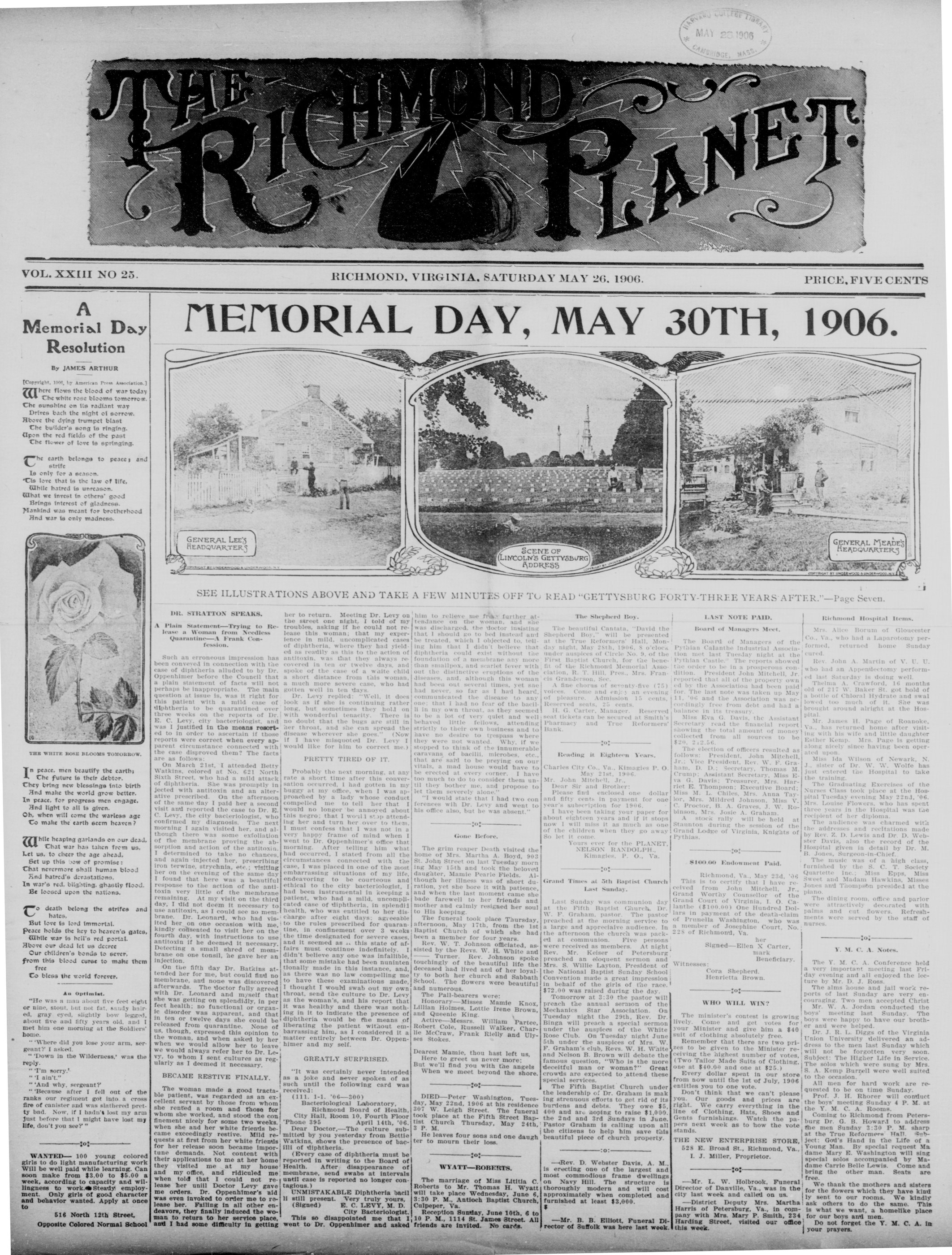
THE RICHMOND PLANET
MEMORIAL DAY, MAY 30TH, 1906.
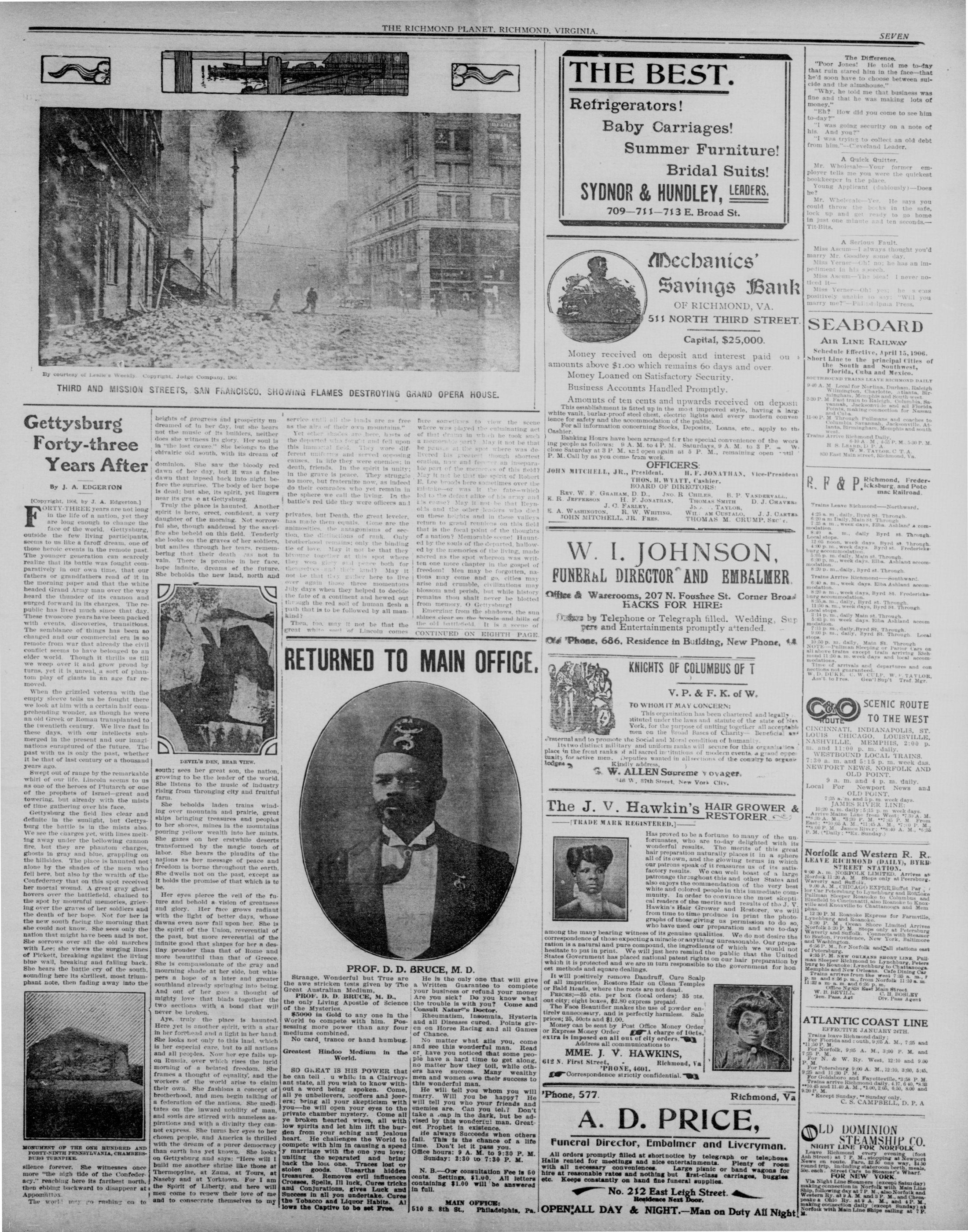
SEE ILLUSTRATIONS ABOVE AND TAKE A FEW MINUTES OFF TO READ "GETTYSBURG FORTY-THREE YEARS AFTER."—Page Seven.
VOL. XXIII NO 25.
A Memorial Day Resolution
By JAMES ARTHUR
[Copyright, 1905, by American Press Association.]
Where flows the blood of war today
The white rose blooms tomorrow.
The sunshine on its radiant way
Drives back the night of sorrow.
Above the dying trumpet blast
The builder's song is ringing.
Upon the red fields of the past
The flower of love is springing.
The earth belongs to peace; and
strife
Is only for a season.
To love that is the law of life.
While hatred is unreason.
What we invest in others' good
Brings interest of gladness.
Mankind was meant for brotherhood
And war is only madness.
THE WHITE ROSE BLOOMS TOMORROW.
In peace, men beautify the earth; The future is their debtor.
They bring new blessings into birth
And make the world grow better.
In peace, for progress men engage.
And light to all is given.
Oh, when will come the warless age
To make the earth seem heaven?
While heaping garlands on our dead,
That war has taken from us,
Let us, to cheer the age ahead,
Set up this bow of promise:
That nevermore shall human blood
And hatred's devastations.
In war's red, blighting, ghanty flood.
Be loosed upon the nations.
To death belong the strifes and
hates,
But love is lord immortal.
Peace holds the key to heaven's gates,
While war is hell's red portal.
Above our dead let us decree
Our children's bonds to sever.
From this blood curse to make them
free
To bless the world forever.
An Optimist.
"He was a man about five feet eight or nine, stout, but not fat, sandy hair- red, gray eyed, slightly bow legged, about five and fifty years old, and I met him one morning at the Soldiers' home.
"Where did you lose your arm, sergeant? I asked.
"Down in the Wilderness,' was the reply.
"I'm sorry.'
"I 'ain't."
"And why, sergeant?"
"Because after I fell out of the ranks our regiment got into a cross fire of canister and was slathered pretty bad. Now, if I hadn't lost my arm just before that I might have lost my life, don't you see?"
WANTED—100 young colored girls to do light manufacturing work Will be well paid while learning. Can soon make from $3.00 to $5.00 a week, according to capacity and willingness to work Steady employment. Only girls of good character and behavior wanted. Apply at once to 516 North 12th Street, Opposite Colored Normal School
DR. STRATTON SPEAKS.
A Plain Statement—Trying to Release a Woman from Needless Quarantine—A Frank Confession.
Such an erroneous impression has been conveved in connection with the case of diphtheria alluded to by Dr. Oppenhimer before the Council that a plain statement of facts will not perhaps be inappropriate. The main question at issue is, was it right for this patient with a mild case of diphtheria to be quarantined over three weeks on the reports of Dr. E. C. Levy, city bacteriologist, and was I justified in the means resorted to in order to ascertain if those reports were correct when every apparent circumstance connected with the case disproved them? The facts are as follows:
On March 21st, I attended Betty Watkins, colored at No. 621 North Sixth Street, who had a mild attack of diphtheria. She was promptly injected with antitoxin and an alternative prescribed. On the afternoon of the same day I paid her a second visit and reported the case to Dr. E. C. Levy, the city bacteriologist, who confirmed my diagnosis. The next morning I again visited her, and although there was some exfoliation of the membrane proving the absorption and action of the antitoxin, I determined to take no chances, and again-injected her, prescribing iron terwine, strychnia, etc.; visiting her on the evening of the same day I found that here was a beautiful response to the action of the antitoxin very little of the membrane remaining. At my visit on the third day, I did not deem it necessary to use antitoxin, as I could see no membrane. Dr. Leonard, who had visited her on one occasion with me, kindly consented to visit her on the fourth day, with instructions to use antitoxin if he deemed it necessary. Detecting a small shred of membrane on one tonsil, he gave her an injection.
On the fifth day Dr. Batkins attended her for me, but could find no membrane, and none was discovered afterwards. The doctor fully agreed with Dr. Leonard and myself that she was getting on splendidly, in perfect health; no functional or organic disorder was apparent, and that in ten or twelve days she could be released from quarantine. None of us, though, expressed this opinion to the woman, and when asked by her when we would allow her to leave we would always refer her to Dr. Levy, to whom I deemed it necessary.
BECAME RESTIVE FINALLY
The woman made a good tractable patient, was regarded as an excellent servant by those from whom she rented a room and those for whom she worked, and stood the con finement nicely for some two weeks, when she and her white friends became exceedingly restive. Mild requests at first from her white friends for her release soon became importance demands. Not content with their applications to me at her home they visited me at my house and my office, and ridiculed me when told that I could not release her until Doctor Levy gave me orders. Dr. Oppenhimer's aid was even invoked to order me to release her. Failing in all other endeavors, they finally induced the woman to return to her service place, and I had some difficulty in getting
RICHMOND, VIRGINIA, SATURDAY MAY 26, 1906.
her to return. Meeting Dr. Levy on the street one night, I told of my troubles, asking if he could not release this woman; that my experience in mild, uncomplicated cases of diphtheria, where they had yielded as readily as this to the action of antitoxin, was that they always recovered in ten or twelve days, and spoke of the case of a waite child a short distance from this woman, a much more severe case, who had gotten well in ten days. Dr. Levy replied: "Well, it does look as if she is continuing rather long, but sometimes they hold on with wonderful tenacity. There is no doubt that the bugs are still in her throat, and she can spread the disease wherever she goes." (Now if I have misquoted Dr. Levy I would like for him to correct me.)
PRETTY TIRED OF IT
Probably the next morning, at any rate a short time after this conversation occurred. I had gotten in my buggy at my office, when I was approached by a lady whose conduct compelled me to tell her that I would no longer be annoyed about this negro; that I would stop attending her and turn her over to them. I must confess that I was not in a very happy frame of mind when I went to Dr. Oppenhimer's office that morning. After telling him what had occurred, I stated from all the circumstances connected with the case, I was placed in one of the most embarrassing situations of my life, endeavoring to be courteous and ethical to the city bacteriologist. I had been instrumental in keeping a patient, who had a mild, uncomplicated case of diphtheria, in splendid health, who was entitled to her discharge after eight days; agreeable to the rules prescribed for quarantine, in confinement over 3 weeks the time designated for severe cases, and it seemed as if this state of affairs must continue indefinitely. I didn't believe any one was infallible, that some mistake had been nintentionally made in this instance, and, as there was no law compelling me to have these examinations made, I thought I would swab out my own throat, send the culture to Dr. Levy as the woman's, and his report that it was healthy and there was nothing in it to indicate the presence of diphtheria would be the means of liberating the patient without embarrassing him, as I considered it a matter entirely between Dr. Oppenhimer and my self.
GREATLY SURPRISED
"It was certainly never intended as a joke and never spoken of as such until the following card was received:
(111. 1-1. '06—300)
Bacteriological Laboratory.
Berkshire Hospital,
Richmond Board of Health,
City Hall, Room 10, Fourth Floor
'Phone 395 April 14th '06
City Hall, Room 10, Fourth Floor
'Phone 395 April 14th, '06
Dear Doctor,—The culture submitted by you yesterday from Bettle Watkins, shows the presence of bacilli of diphtheria.
(Every case of diphtheria must be reported in writing to the Board of Health. After disappearance of membrane, send swabs at intervals until case is reported no longer contagious.)
UNMISTAKABLE Diphtheria bacill still present. Very truly yours,
(Signed) E. C. LEVY, M. D.
City Bacteriologist.
This so disappointed me that I went to Dr. Opnenhmer and asked
him to relieve me from further attendance on the woman, and she was discharged, the doctor insisting that I should go to bed instead and be treated, which I objected to, telling him that I didn't believe that diphtheria could exist without the foundation of a membrane any more than smallpox, and scarlet fever with out the distinctive eruptions of the diseases, and, although this woman had been out several times, yet she had never, so far as I had heard, communicated the disease to any one; that I had no fear of the bacilli in my own throat, as they seemed to be a lot of very quiet and well behaved little fellows, attending strictly to their own business and to have no desire to trespass where they were not wanted. Why, if we stopped to think of the innumerable caravans of bacilli, microbes, etc., that are said to be preying on our vitals, a mad house would have to be erected at every corner. I have too much to do to consider them until they bother me, and propose to let them severely alone."
"I would state that I had two conferences with Dr. Levy and went to his office also, but he was absent."
Gone Before
The grim reaper Death visited the home of Mrs. Martha A. Boyd, 903 St. John Street on last Tuesday morning May 15th and took the beloved daughter, Mamie Pearle Fields. Although her illness was of short duration, yet she bore it with patience, and when the last moment came she bade farewell to her friends and mother and calmly resigned her soul to His keeping.
The funeral took place Thursday, afternoon, May 17th, from the lst Baptist Church of which she had been a member for four years.
Rev. W. T. Johnson officiated, assisted by the Revs. W. H. White and — Turner. Rev. Johnson spoke touchingly of the beautiful life the deceased had lived and of her loyalty to both her church and Sabbath School. The flowers were beautiful and numerous.
The Pall-bearers were:
Honorary—Misses Mamie Knox, Lillian Holmes, Lottie Irene Brown, and Queenie King.
Active—Messrs. William Partee, Robert Cole, Russell Walker, Charlie McCraw, Frank Rielly and Ulyses Stokes.
Dearest Mamie, thou hast left us.
Here to greet us never more;
But we'll find you with the angels
When we meet beyond the shore
DIED-Peter Washington, Tuesday, May 22nd, 1906 at his residence 307 W. Leigh Street. The funeral took place at the Fifth Street Baptist Church Thursday, May 24th, 3 P. M. He leaves four sons and one daughter to mourn their loss.
WYATT—ROBERTS
The marriage of Miss Littia C. Roberts to Mr. Thomas H. Wyatt will take place Wednesday, June 6, 3:30 P. M., Antioch Baptist Church, Culpeper, Va.
Reception Sunday, June 10th, 6 to 10 P. M., 1114 St. James Street. All friends are invited. No cards.
The Board of Managers of the Pythian Calanthe Industrial Association met last Tuesday night at the Pythian Castle. The reports showed the order to be in a prosperous condition. President John Mitchell, Jr. reported that all of the property owned by the Association had been paid for. The last note was taken up May 11, '06 and the Association was accordingly free from debt and had a balance in its treasury.
Miss Eva E. G. Davis, the Assistant Secretary read the financial report showing the total amount of money collected from all sources to be $20, 2,12.56.
The election of officers resulted as follows: President, John Mitchell Jr.; Vice President, Rev. W. F. Graham, D. D.; Secretary, Thomas M. Crump; Assistant Secretary, Miss Eva G. Davis; Treasurer, Mrs. Harriet E. Thompson; Executive Board; Miss M. L. Chiles, Mrs. Anna Taylor, Mrs. Mildred Johnson, Miss V. C. Proctor, B. A. Graves, J. W. Robinson, Mrs. Josie A. Graham.
A stock rally will be held at Staunton during the session of the Grand Lodge of Virginia, Knigats of Pythias.
Richmond, Va., May 23d, '06
This is to certify that I have received from John Mitchell, Jr.
Grand Worthy Counsellor of the Grand Court of Virginia, I. O. C.兰anche ($100.00) One Hundred Dollars in payment of the deata-claim of Prunella Washington, who was a member of Josephine Court, No. 22$ of Richmond, Va.
Witnesses
The minister's contest is growing lively. Come and get votes for your Minister and give him a $40 suit of clothing absolutely free. Remember that there are two prizes to be given to the Minister receiving the highest number of votes. (Two Tailor Made Suits of Clothing, one at $40.00 and one at $25.) Every dollar spent in our store from now until the 1st of July, 1906 entitles you to one vote. Don't think that we can't please you. Our goods and prices are right. We carry everything in the line of Clothing, Hats, Shoes and Gents furnishings. Watch the papers next week as to how the vote stands.
THE NEW ENTERPRISE STORE,
528 E. Broad St., Richmond, Va.
L. J. Miller, Proprietor
—Mr. L. W. Holbrook, Funeral Director of Danville, Va., was in the city last week and called on us.
—District Deputy Mrs. Martha Harris of Petersburg, Va., in company with Mrs. Mary P. Smith, 234 Harding Street, visited our office this week.
The Shepherd Boy.
The beautiful Cantata, "David the Shepherd Boy," will be presented at the True Reformers' Hall, Monday night, May 28th, 1906, 8 o'clock under auspices of Circle No. 9, of the First Baptist Church, for the benefit of the Richmond Memorial Association, R. T. Hill, Press, Mrs. Francis Granderson, Sec.
A fine chorus of seventy-five (75) voices. Come and enjoy an evening of pleasure. Admission 15 cents, Reserved seats, 25 cents. 5. Carter, Manager. Reserved seat tickets can be secured at Smith's Pharmacy and True Reformers' Bank
Reading it. Eighteen Years.
Charles City Co. Va., Kimagles P. O.
May 21st, 1906.
Mr. John Mitchell, Jr.
Dear Sir and Brother:
Please find enclosed one dollar
and fifty cents in payment for one
year's subscription for 1906.
I have been taking your paper for
about eighteen years and if it stops
now I will miss it as much as one
of the children when they go away
So let it go.
Yours ever for the PLANET,
NELSON RANDOLPH,
Kimagles, P. O. Va.
$ \mathrm{O}_{4}^{2-} $
Grand Times at 5th Baptist Church Last Sunday.
Last Sunday was communion day at the Fifth Baptist Church, Dr. W. F. Graham, pastor. The pastor preached at the morning service to a large and appreciative audience. In the afternoon the church was packed at communion. Five persons were received as members. At night Rev. Mr. Keiser of Petersburg preached an eloquent sermon and Mrs. S. Willie Layton, President of the National Baptist Sunday School Convention made a great impression in behalf of the girls of the race. $72.00 was raised during the day. Tomorrow at 3:30 the pastor will preach the annual sermon of the Mechanics Star Association. On Tuesday night the 29th, Rev Dr. Binga will preach a special sermon under the auspices of the White Rose Club. On Tuesday night June 5th under the auspices of Mrs. W. F. Graham's club, Revs. W. H. Walte and Nelson B. Brown will debate the famous question, "Who is the more deceitful man or woman?" Great crowds are expected to attend these special services. The Fifth Baptist Church under the leadership of Dr. Graham is making strenuous efforts to get rid of its burdens and debts. They owe $5, 400 and are hoping to raise $1,000, the 2nd and 3rd Sundays in June. Pastor Graham is calling upon all the citizens to help him save tails beautiful piece of church property.
—Rev. D. Webster Davis, A. M., is erecting one of the largest and most commodious frame dwellings on Navy Hill. The structure is thoroughly modern and will cost approximately when completed and furnished at least $3,000.
$
—Mr. B. B. Elliott, Funeral Director of Suffolk was here last week
LAST NOTE PAID.
Board of Managers Meet.
$100.00 Endowment Paid:
Beneficiary.
Cora Shepherd.
Henrietta Brown.
WHO WILL WIN?
PRICE, FIVE CENTS
1906.
GENERAL MEADES
HEADQUARTERS
COPYRIGHT BY UNDER WOOD & UNDER WOOD, N.Y.
ER."—Page Seven.
Richmond Hospital Items.
Mrs. Alice Borum of Gloucester Co., Va., who had a Laparotomy performed, returned home Sunday cured.
Rev. John A. Martin of V. U. U. who had an Appendectomy performed last Saturday is doing well.
Thelma A. Crawford, 16 months old of 217 W. Baker St. got hold of a bottle of Chloral Hydrate and swallowed too much of it. She was brought around alright at the Hospital.
Mr. James H. Page of Roanoke, Va., has returned home after visiting with his wife and little daughter Esther Kemp. Mrs. Page is getting along nicely since having been operated upon.
Miss Ida Wilson of Newark, N. J., sister of Dr. W. W. Wolfe has just entered the Hospital to take the training.
The Graduating Exercises of the Nurses Class took place at the Hospital Tuesday evening May 22nd, '06. Mrs. Louise Flowers, who has spent three years in the Hospital was the recipient of her diploma.
The audience was charmed with the addresses and recitations made by Rev. Z. D. Lewis and Dr. D. Webster Davis, also the record of the Hospital given in detail by Dr. M. B. Jones, Surgeon-in-Chief.
The music was of a high class, furnished by the S. C. T. Society Quartette Inc.; Miss Epps, Miss Sweet and Madam Hawkins, Misses Jones and Thompson presided at the piano.
The dining room, office and parlor were attractively decorated with palms and cut flowers. Refreshments were served by the staff of
Y. M. C. A. Notes.
The Y. M. C. A. Conference held a very important meeting Friday evening and all enjoyed the lecture by Mr. D. J. Ross.
The alms house and jail work reports of last Sunday are very encouraging. Two men accepted Christ Mr. W. A. Jordan conducted the boys' meeting last Sunday. The boys were happy to have our brother and were helped.
Dr. J. R. L. Diggs of the Virginia Union University delivered an address to the men last Sunday which will not be forgotten very soon. Subject: The Higher Life in Service. The solos which were sung by Mrs. S. A. Kemp Burpell were well suited to the occasion.
All men for hard work are requested to be on time Sunday.
Prof. J. H. Rhorer will conduct the boys' meeting Sunday 4 P. M. at the Y. M. C. A. Rooms.
Coming to Richmond from Petersburg Dr. G. B. Howard to address the men Sunday 3:30 P. M. sharp at the True Reformers Hall. Subject: God's Hand in the Life of a Young Man. By special request Madame Mary E. Washington will sing special solos accompanied by Madame Carrie Belle Lewis. Come and bring the other man. Seats are free.
We thank the mothers and sisters for the flowers which they have kindly sent to our rooms. We kindly ask others to do the same. This is what we want, a homelike place for our boys and men.
Do not forget the Y. M. C. A. In your pravers.
FILE NO. 113.
ONE OF THE MYSTERIES OF PARIS, AND HOW IT WAS SOLVED.
(By EMILE GABORIAU.)
CHAPTER III
If there is one man in the world whom no event can move or surprise, who is always on his guard against deceptive appearances, and is capable of admitting everything and explaining everything, it certainly is a Parisian commissary of police.
While the judge, from his lofty place applies the code to the facts submitted to him, the commissary of police observes and watches all the odious circumstances that the law can not reach. He is perforce the confident of disgraceful details, domestic crimes, and tolerated vices.
If, when he entered upon his office, he had any illusions, before the end of a year they were all dissipated.
If he does not absolutely despise the human race, it is often because, side by side with abominations indulged in with impunity, he discovers sublime generosities which remain unrewarded.
He sees impudent scoundrels filching public respect; and he consoles himself by thinking of the modest, obscure heroes whom he has also encountered.
So often have his previsions been deceived, that he has reached a state of complete skepticism. He believes in nothing, neither in evil nor in absolute good; not more in virtue than in vice.
His experience has forced him to come to the sad conclusion, that not men, but events, are worth considering.
It was with a calm air, if not one of perfect indifference, that he entered the office.
He was followed by a short man dressed in a full suit of black, which was slightly relieved by a crumpled cellar.
The banker, scarcely bowing to him, said:
"Doubtless, monsieur, you have been appraised of the painful circumstance which compels me to have recourse to your assistance?"
"It is about a robbery, I believe."
"Yes; an infamous and mysterious robbery committed in this office, from the safe you see open there, of which my cashier" (he pointed to Prosper)
"alone possesses the key and the word."
This declaration seemed to arouse the unfortunate cashier from his dull stupper.
"Excuse me, monseur," he said, to the commissary, in a low tone, "My chief also has the word and the key."
"Of course that is understood."
The commissary at once drew his own conclusions.
Evidently these two men accused each other.
From their own statements, one or the other was guilty.
One was the head of an important bank; the other was a simple cashier.
One was the chief, the other was the clerk.
But the commissary of police was too well skilled in concealing his impressions to betray his thoughts by any outward sign. Not a muscle of his face moved.
But he became more grave, and alternately watched the cashier and M. Fanvel, as if trying to draw some profitable conclusion from their behavior.
Prosper was very pale and dejected.
He had dropped into a seat, and his arms hung inert on either side of the chair.
The banker, on the contrary, remained standing, with flashing eyes and crimson face, expressing himself with extraordinary violence.
"And the importance of the theft is immense," continued M. Fauvel; "they have taken a fortune—three hundred and fifty thousand francs. This robbery might have had the most disastrous consequences. In times like these, the want of this sum might compromise the credit of the wealthiest banking-house in Paris."
"I believe so, if notes fall due."
"Well, monsieur, I had this very day a heavy payment to make."
"Ah, really!"
There was no mistaking the commisary's tone; a suspicion, the first, had evidently entered his mind.
The banker understood it; he started, and said quickly.
"I met the demand, but at the cost of a disagreeable sacrifice. I ought to add further, that, if my orders had been obeyed, the three hundred and fifty thousand francs would not have been in."
"How is that?"
"I never desire to have large sums of money in my house over night. My cashier had positive orders to wait always until the last moment before drawing the money from the Bank of France. I above all forbade him to leave money in the safe over night."
"You hear this?" said the commissary to Prosper.
"Yes, monsieur," replied the cashier, "Monsieur Fauvel's statement is quite correct."
After this explanation, the suspicions of the commissary, instead of being strengthened, were dissipated.
"Well," he said, "a robbery has been perpetrated, by by whom? Did the robber enter from without?" The banker hesitated a moment. "I think not," he said, at last. "And I am certain he did not," said Prosper. The commissary expected and was prepared for these answers; but it did not suit his purpose to follow them up immediately. "However," said he, "we must make ourselves sure of it." Turning toward his companion: "Monsieur Fanferlot," he said, "go and see if you can not discover some traces that may have escaped the at-
"How is that?"
ES OF PARIS, AND HOW SOLVED.
GABORIAU.
tention of these gentlemen.^
M. Fanferlot, nicknamed "the squirrel," was indebted to his prodigious agility for this title, of which he was not a little proud. Slim and insignificant in appearance he might, in spite of his iron muscles, be taken for a bailiff's under clerk, as he walked along, buttoned up to the chin in his thin black overcoat. He had one of those faces that impress us disagreeably—an odiously turned-up nose, thin lips, and little restless black eyes.
Fanerlot, who had been on the police force for five years, burned to distinguish himself, to make for himself a name. He was ambitious. Alas! he was unsuccessful, lacking opportunity—or genius.
Already, before the commissary spoke to him, he had ferreted everywhere; studied the doors, sounded the partitions, examined the wicket, and stirred up the ashes in the fireplace.
"I can not imagine," said he, "how a stranger could have effected an entrance here."
He walked around the office.
"Is this door closed at night?" he inquired.
"It is always locked."
"And who keeps the key?" "The office-hoy, to whom I always give it in charge before leaving the bank," said Prosper.
"This boy," said M. Fauvel, "sleeps in the outer room on a sofa-bedstead, which he unfolds at night, and folds up in the morning."
"Is he here now?" inquired the commissary.
"Yes, monsieur," answered the banker.
He opened the door and called:
"Anselme!"
This boy was the favorite servant of M. Fauvel, and had lived with him for ten years. He knew that he would not be suspected; but the idea of being connected in any way with a robbery is terrible, and he entered the room trembling like a leaf.
"Did you sleep in the next room last night?" asked the commissary.
"Yes, monsieur, as usual."
"At what hour did you go to bed?" "About half past ten; I spent the evening at a cafe near by, with monsieur's valet."
"Did you hear no noise during the night?"
"Not a sound; and still I sleep so lightly that, if monsieur comes down to the cash-room when I am asleep, I am instantly awakened by the sound of his footsteps."
"No, monsieur; I am very certain he did not; for I was kept awake nearly all night by the strong coffee I had drunk with the valet."
"That will do; you can retire," said the commissary.
When Anselme had left the room Fanferlot resumed his search.
He opened the door of the private staircase.
"Where do these stairs lend to?" he asked.
"To my private office," replied M. Fauvel.
"Is not that the room whither I was conducted when I first came?" inquired the commissary.
"The same.
"I would like to see it," said Fanerlot, "and examine the entrances to it."
"Nothing is more easy," said M. Fauvel, eagerly; "follow me, gentlemen. And you come too, Prosper."
M. Fauvel's private office consisted of two rooms; the waiting-room, sumptuously furnished and beautifully decorated, and the study where he transacted business. The furniture in this room was composed of a large office-desk, several leather-covered chairs, and, on either side of the fireplace, a secretary and a book-shelf.
These two rooms had only three doors; one opened on the private stairway, another into the banker's bedroom, and the third into the main vestibule. It was through this last door that the banker's clients and visitors were admitted.
M. Fanferlot examined the study at a glance. He seemed puzzled like a man who had flattered himself with the hope of discovering some indication and had found nothing.
"Let us see the adjoining room," he said.
He passed into the waiting-room, followed by the banker and the commissary of police.
Prosper remained alone in the study.
Despite the disordered state of his mind, he could not but perceive that his situation was momentarily becoming more serious.
He had demanded and accepted the contest with his chief; the struggle had commenced; and now it no longer depended upon his own will to arrest the consequences of his action. They were about to engage in a bitter conflict, utilizing all weapons, until one of the two should succumb, the loss of honor being the cost of defeat. In the eyes of Justice, who would be the innocent man? Alas! the unfortunate cashier saw only too clearly that the chances were terribly unequal, and was overwhelmed with the sense of his own inferiority. Never had he thought that his chief would carry out his threats; for, in a contest of this nature, M. Fauvel would have as much to risk as his cashier, and more to lose.
He was sitting near the fire place, absorbed in the most gloomy forebodings, when the banker's chamber door suddenly opened, and a beautiful girl appeared upon the threshold.
She was tall and slender; a loose morning gown, confined at the waist
She was tall and slender; a loose morning gown, confined to the waist by a simple black ribbon, betrayed to
THE RICHMOND PLANET, RICHMOND, VIRGINIA
Seeing Prosper in the study, where probably she expected to find her uncle alone, she could not refrain from an exclamation of surprise.
"Ah!"
Prosper started up as if he had received an electric shock. His eyes, a moment before so dull and heavy, now sparkled with joy as if he had caught a glimpse of a messenger of hope.
"Madeleine," he gasped, "Madeleine!"
The young girl was blushing crimson. She seemed about to hastily retreat, and stepped back, but, Prosper having advanced toward her, she was overcome by a sentiment stronger than her will, and extended her hand, which he seized and pressed with much agitation.
They stood thus face to face, but with averted looks, as if they dared not to let their eyes meet for fear of betraying their feelings; having much to say, and not knowing how to begin, they stood silent.
Finally Madeleine murmured in a scarcely audible voice:
"You, Prosper—you!"
These words broke the spell. The cashier dropped the white hand which he held, and answered, bitterly:
"Yes, this is Prosper, the companion of your childhood—suspected, accused of the most disgraceful theft; Prosper, whom your uncle has just delivered up to justice, and who, before the day is over, will be arrested, and thrown into prison."
Madeleine, with a terrified gesture, cried in a tone of anguish:
"Good heavens! Prosper, what are you saying?"
"What, mademoiselle! do you not know what has happened? Have not your aunt and cousins told you?"
They have told me nothing. I have scarcely seen my cousins this morning; and my aunt is so ill that I felt uneasy, and came to tell uncle. But for Heaven's sake speak; tell me the cause of your distress."
Prosper hesitated. Perhaps it occurred to him to open his heart to Madeleine, of revealing to her his most secret thoughts. A remembrance of the past chilled his confidence. He sadly shook his head, and replied: "Thanks, mademoiselle, for this proof of interest, the last doubtless, that I shall ever receive from you; but allow me, by being silent, to spare you distress, and myself the mortification of blushing before you."
Madeleine interrupted him imperiously:
I am upon knowing,
"Ams! mademoiselle!," answered Prosper, "you will only too soon learn my misfortune and my disgrace; then, yes, then you will applaud yourself for what you have done."
But she became more urgent; instead of commanding, she entreated; but Prosper was inflexible.
"Your uncle is in the adjoining room, mademoiselle, with the commissary of police and a detective. They will soon return. I entreat you to retire that they may not find you here."
As he spoke he gently pushed her through the door, and closed it upon her.
It was time, for the next moment the commissary and M. Fauvel entered. They had visited the main entrance and waiting-room, and had heard nothing of what had passed in the study.
But Fanferlot had heard for them. This excellent blood-hound had not lost sight of the cashier. He said to himself: "Now that my young gentleman believes himself to be alone, his face will betray him. I shall detect a smile or a wink that will enlighten me." Leaving M. Fauvel and the commissary to pursue their investigations, he posted himself to watch. He saw the door open, and Madeleine appear upon the threehold; he lost not a single word or gesture of the rapid scene which had passed. It mattered little that every word of this scene was an enigma. M. Fanferlot was skillful enough to complete the sentences he did not understand.
As yet he only had a suspicion; but a mere suspicion is better than nothing: it is a point to start from. So prompt was he in building a plan upon the slighest incident, that he thought he saw in the past of these people who were utter strangers to him glimpses of a domestic drama. If the commissary of police is a skeptic, the detective has faith; he believes in evil.
Thus to M. Fanferlot's mind, the benker had simply robbed himself, and the innocent cashier was the victim of an odious machination.
But his conviction was, at present, of little service to Prosper.
Fanferlot, the ambitious man, who had determined to obtain renown in his profession, decided to keep his conjectures to himself.
"I will let the others go their way, and I'll go mine," he said. "When, by dint of close watching and patient investigation, I shall have collected proof sufficient to insure certain conviction, I will unmask the scoundrel."
He was radiant. He had at last found the crime so long looked for, which would make him celebrated. Nothing was wanting, neither the odious circumstances, nor the mystery, nor even the romantic and sentimental element represented by Prosper and Madeleine.
Success seemed difficult, almost impossible, but Panferlot, the "squirrel," had great confidence in his own genius for investigation.
Meanwhile, the search up-stairscom
pieted, M. Fauvel and the commissary returned to the room where Prosper was waiting for them.
The commissary, who had seemed so calm, when he first came, now looked grave and perplexed. The moment for taking a decisive part had come, yet it was evident that he hesitated.
"You see, gentlemen," he began, "our search has only confirmed our first suspicion."
M. Fauvel and Prosper bowed as sentingly.
"And what do you think, Monsieur Fanferlot?" continued the commissary.
Fanferlot did not answer.
Occupied in studying the safe-lock.
he manifested signs of a lively surprise. Evidently he had just made an important discovery.
"But we should like to know," said Prosper.
"I have merely convinced myself that this safe has been recently opened or shut, I know not which, with great violence and haste."
"Why so?" asked the commissary, becoming attentive.
"Look, monsieur, at this scratch near the lock."
The commissary stooped down, and carefully examined the safe; he saw a light scratch several inches long that had removed the outer coat of varnish.
"I see the scratch," said he, "but what does that prove?"
"Oh, nothing at all!" said Fanferlot.
"I just now told you it was of no importance."
Fanferlot said this, but it was not his real opinion.
The scratten, undeniably fresh, had for him a signification that escaped the others. He said to himself: "This confirms my suspicions. If the cashier had stolen millions, there was no occasion for his being in a hurry; whereas the handler creeping down in the dead of the night with cat-like footsteps, for fear of awakening the boy in the anteroom, in order to rifle his own money - safe, had every reason to tremble, to hurry, to hastily withdraw the key, which, slipping along the lock, scratched off the varnish.
Resolved to marvel by himself the tangled thread of this mystery, the detective determined to keep his conjectures to himself; for the same reason he was silent as to the interview which he had overheard between Madeline and Prosper.
He hastened to withdraw attention from the scratch upon the lock.
"To conclude," he said, addressing the commissary, "I am convinced that no one outside of the bank could have obtained access to this room. The safe, me cover, is intact. No suspicious pressure has been used on the movable buttons. I can assert that the lock has not been tampered with by burglar's tools or false keys. Those who opened the safe knew the word, and possessed the key."
The formal affirmation of a man whom he knew to be skilful, ended the hesitation of the commissary,
"That be the case," he replied,
"I must request a few moment's conversation with Monsieur Fauvel."
"I am at your service," said the banker.
Prosper foresaw the result of this conversation. He quietly placed his hat on the table, to show that he had no intention of attempting to escape, and passed into the adjoining room.
Fanerlot also went out, but not before the commissary had made him a sign, and received one in return.
This sign signified, "You are responsible for this man."
The detective needed no admonition to make him keep a strict watch. His suspicions were too vague, his desire for success was too ardent, for him to lose sight of Proper an instant.
Closely following the cashier, he seated himself in a dark corner of the room, and, pretending to be sleepy, he fixed himself in a comfortable position for taking a nap, gaped until his jaw-bone seemed about to be dislocated, then closed his eyes, and kept perfectly quiet.
Prosper took a seat at the desk of an absent clerk. The others were burning to know the result of the investigation; their eyes shone with curiosity, but they dared not ask a question.
Unable to restrain himself any longer little Cavallion, Prosper's defender, ventured to say:
Was this conscious innocence or hardened recklessness? The clerks observed with bewildered surprise that Prosper had resumed his usual manner that sort of ley haughtiness that kept people at a distance, and made him so unpopular in the bank. Save the deal like patron of his face, and the dark circles around his swelled eyes, he bore no traces of the pitiable agitation he had exhibited a short time before. Never would a stranger entering the room have supposed that this young man, idly lounging in a chair, and toying with a pencil, was resting under an accusation of robbery, and was about to be arrested. He soon stopped playing with the pencil, and drew toward him a sheet of paper upon which he hastily wrote a few lines.
"Ah, ba!!" thought Fanferlot the "squirrel," whose hearing and sight were wonderfully good in spite of his profound sleep, "ch! eh! he makes his little confidential communication on paper, I see; now we will discover something positive."
His note written, Prosper folded it carefully in the smallest possible size, and after furtively glancing toward the detective, who remained motionless in his corner, threw it across the desk to little Cavallion with this one word.
"Gypsy!"
All this was so quickly and skillfully done that Fanferlot was confounded,
and began to feel a little uneasy. "The devil take him!" said he to himself; "for a suffering innocent; this young dandy has more pluck and nerve than many of my oldest customers. This, however, shows the result of education!"
Yes; innocent or guilty, Prosper must have been endowed with great self-control and power of dissimulation to affect the presence of mind at a time when his honor, his future happiness, all that he held dear in life, were at stake. And he was only thirty years old.
Either from natural deference, or from the hope of gaining some ray of light by a private conversation, the commissary determined to speak to the banker before acting decisively.
"There is not a shadow of doubt, monsieur," he said as soon as they were alone. "this young man has robbed you. It would be a gross neglect of duty if I did not secure his person. The law will decide whether he shall be released, or sent to prison."
This declaration seemed to distress the banker.
He sank into a chair, and murmured:
"Poor Prosper!"
Seeing the astonished look of his listener, he added:
"Until to-day, monsieur, I have al-ways had the most implicit faith in his honesty, and would have unhesitatingly confided my fortune to his keeping. Almost on my knees have I besought and implored him to confess that in a moment of desperation he had taken the money, promising him pardon and forgetfulness; but I could not move him. I have loved him; and even now, in spite of the trouble and humiliation that he is bringing upon me, I can not bring myself to feel harshly toward him."
The commissary looked as if he did not understand.
"What do you mean by humiliation, monsieur?"
"What!" I said M. Fauvel, excitedly, "is not justice the same for all? Because I am the head of a bank, and he only a eyerk, dies it follow that my word is more to be relied upon than his? Why could I not have robbed myself? Such things have been done. They will ask me for facts; and I shall be compelled to expose the exact situation of my house, explain my affairs, disclose the secret and method of my operations."
"It is true, monsieur, that you will be called upon for some explanation; but your well-known integrity—"
"Alna! He was honest, too. His integrity has never been doubted. Who would have been suspected this morning if I had not been able to instantly produce a hundred thousand crowns? Who would be suspected if I could not prove that my assets exceed my liabilities by more than three millions?"
To a strictly honorable man, the thought, the possibility of suspicion tarnishing his fair name, is cruel suffering. The banker suffered, and the commissary of police saw it, and felt for him.
"Pe calm, monsieur," said he; "before the end of a week, justice will have collected sufficient proof to establish the guilt of this unfortunate man, whom we may now recall."
Prosper entered with Fanferiot—whom they had much trouble to awaken—and with the most stolid indifference listened to the announcement of his arrest.
M. Fauvel, much more disturbed and excited than his cashier, made a last attempt.
"It is not too late yet, poor boy," he said; "for Heaven's sake reflect—" Presper did not appear to hear him. He drew from his pocket a small key, which he laid on the table, and said; "Here is the key to your safe, monsieur. I hope for my sake that you will some day be convinced of my innocence; and I hope for your sake that the conviction will not come too late."
Then as every one was silent, he resumed:
"Before leaving I hand over to you the books, papers, and accounts necessary for my successor. I must at the same time inform you that, without speaking of the stolen three hundred and fifty thousand francs, I leave a deficit in cash."
"A deficit!" thought the commissary; "how, after this, can his guilt be doubted? Before stealing the whole contents of the safe, he kept his hand in by occasional small thefts."
"A deficit!" said the detective to himself; "now, no doubt, the very innocence of this poor devil gives his conduct an appearance of great deprivacy; were he guilty, he would have replaced the first money by a portion of the second."
"The grave importance of Prosper's statement was considerably diminished by the explanation he proceeded to rake:
"There is a deficit of three thousand five hundred francs on my cash account, which has been disposed of in the following manner: two thousand taken by myself in advance of my salary; fifteen hundred advanced to several of my fellow-clerks. This is the last day of the month; to-morrow the salaries will be paid, consequently—" The commissary interrupted him. "Were you permitted to draw money whenever you wished to advance the clerks' pay" "No; but I knew that Monsieur Faure would not have refused me permission to oblige my friends in the bank. What I did is done everywhere; I have simply followed my predecessor's example." The banker made a sign of assent. "As regards that spent by myself, continued the cashier. "I had a sort of right to it, all of my savings being deposited in this bank; about fifteen thousand francs."
"That is true," said M. Fauvel; Monsieur Bertomy has at least that amount on deposit."
This last question settled, the commissary's errand was over, and his report might now be made. He announced his intention of leaving, and ordered the cashier to prepare to fol-
Usually, this moment, when stern reality stares us in the face, when our individuality is lost and we feel that we are being deprived of our liberty—this moment is terrible.
At this fatal command, "Follow me," which brings before our eyes the yawning prison gates, the most hardened sinner feels his courage fail, and abjectly begs for mercy.
But Prosper lost none of that studied phlegm which the commissary secretly pronounced consummate impudence.
Slowly, with as much careless ease as if going to breakfast with a friend, he smoothed his hair, drew on his overcoat and gloves, and said, politely:
"I am ready to accompany you, monsieur."
The commissary folded up his pocket-book, and bowed to M. Fauvel, saying to Prosper:
"Come!"
They left the room, and with a distressed face, and eyes filled with tears that he could not restrain, the banker stood watching their retreating forms.
"Good Heaven!" he exclaimed: "Gladly would I give twice that sum to regain my old confidence in poor Prosper, and be able to keep him with me!"
The quick-eared Fanferlot overheard these words, and prompt to suspicion, and ever disposed to impute to others the deep acuteness peculiar to himself, was convinced they had been uttered for his benefit.
He had remained behind the others, under pretext of looking for an imaginary umbrella, and, as he reluctantly departed, said he would call in again to see if it had been found.
It was Fanferlot's task to escort Prosper to prison; but, as they were about starting, he asked the commissary to leave him at liberty to pursue another course, a request which his superior granted.
Fanferlot had resolved to obtain possession of Prosper's note, which he knew to be in Cavailillon's pocket.
To obtain this written proof, which must be an important one, appeared the easiest thing in the world. He had simply to arrest Cavailillon, frighten him, demand the letter, and, if necessary, take it by force.
But to what would this disturbance lead? To nothing, unless it were an incomplete and doubtful result.
Fanferlot was convinced that the note was intended, not for the young clerk, but a third person.
It exasperated, Cavillon might refuse to divulge who this person was, who, after all, might not bear the name "Glipsy" given by the cashier. And, even if he did answer his questions, would he not lie?
After mature reflection, Fanferlot decided that it would be superfluous to ask for a secret when it could be surprised. To quietly follow Cavillon, and keep close watch on him until he caught him in the very act of handing over the letter, was but play for the detective.
This method of proceeding, moreover, was much more in keeping with the character of Fanferlot, who, being naturally soft and stealthy, deemed it due to his profession to avoid all disturbance or anything resembling violence.
Fanferlot's plan was settled when he reached the vestibule.
He began talking with an office-boy, and, after a few apparently idle questions, had discovered that the Fauvel bank had no outlet on the Rue de la Vietoire, and that consequently all the cieks were obliged to pass in and out through the main entrance on the Rue de Provence.
From this moment the task he had undertaken no longer presented a shadow of difficulty. He rapidly crossed the street and took up his position under a gate-way.
His post of observation was admirably chosen; not only could he see every one who entered and came out of the bank, but also commanded a view of all the windows, and by standing on tiptoe could look through the grating, and see Cavaillon bending over his desk.
Fanferlot waited a long time, but did not wax impatient; for he had often had to remain on watch entire days and nights at a time, with much less important objects in view than the present one. Besides, his mind was busily occupied in estimating the value of his discoveries, weighing his chances and, like Perrette, with her pot of milk, building the foundations of his fortune upon present success. Finally, about one o'clock, he saw Cavallon rise from his desk, change his coat, and take down his hat. "Very good!" he exclaimed, "my man is coming out; I must keep my eyes open."
The next moment Cavallon appeared at the door of the bank; out before stepping on the pavement he looked up and down the street in an undecided manner.
"Can he suspect anything?" thought Fanferlot.
No, the young clerk suspected nothing; only having a commission to execute, and fearing his absence would be observed, he was debating with himself which would be the shortest road for him to take.
He soon decided, entered the Faubourg Montmartre, and walked up the Rue Notre Dame de Lorette so rapidly, utterly regardless of the grumbling passers-by whom he elbowed out of his way, that Fanferlot found it difficult to keep him in sight. Reaching the Rue Chaptal, Cavailon suddenly stopped, and entered the house numbered 39.
He recognized him at once, and turning very pale, he shrunk back and looked around for means of escape.
But the detective, anticipating the attempt, barred the passage-way. Cavaillon saw that he was fairly caught.
"What do you want with me?" he asked, in a voice tremulous with fright.
Fanferlot was distinguished among his confreres for his exquisite suavity
and unequaled urbanity. Even with his prisoners he was the perfection of courtesy, and never was known to handcuff a man without first obsequiously apologizing for being compelled to do so.
"You will be kind enough, my dear monsieur," he said, "to excuse the great liberty I take; but I really am under the necessity of asking you for a little information."
"From you, my dear monsieur; from Monsieur Eugene Cavillon." "But I do not know you." "Ah, yes, you remember seeing me this morning. It is only about a trifling matter, and you will overwhelm me with obligations if you will do me the honor to accept my arm and step outside for a moment." What could Cavillon do? He took Faneriot's arm, and went out with him. The Rue Chaptal is not one of those noisy thoroughfares where foot-passengers are in perpetual danger of being run over by numberless vehicles dashing to and fro; there were but two or three shops, and from the corner of the Rue Fontaine occupied by an apothecary, to the entrance of the Rue Leonie, extended a high, gloomy wall, broken here and there by a small window which lighted the carpenters' shops behind.
It was one of those streets where you could walk at your ease, without having to step from the sidewalk every moment. So Fanferlot and Cavillon were in no danger of being disturbed by passers-by.
"What I wished to say is, my dear monsieur," began the detective, "that Monsieur Prosper Bertomy threw you a note this morning."
Cavillon vaguely vole saw that he was to be questioned about this note, and instantly put himself on his guard.
"You are mistaken," he said, blushing to his ears.
"Exuse me, monsieur, for presuming to contradict you, but I am quite certain of what I say."
"I assure you that Prosper never gave me anything."
"Pray, monsieur, do not persist in a denial; you will compel me to prove that four clerks saw him throw you a note written in pencil and closely folded."
Cavaillon saw the folly of further contradicting a man so well informed; so he changed his tactics, and said:
"It is true Prosper gave me a note this morning; but it was intended for me alone, and after reading it, I tore it up, and threw the pieces in the fire."
This might be the truth. Fanferiot feared so; but how could he assure himself of the fact? He remembered that the most palpable tricks often succeed the best, and, trusting to his star, he said, at hazard:
"Permit me to observe that this statement is not correct; the note was intrusted to you to give to Gipsy."
A despairing gesture from Cavaillon apprised the detective that he was not mistaken; he breathed again.
"I swear to you, monsieur—" began the young man.
"Do not swear, monsieur," interrupted Fanferlot; "all the ouths in the world would be useless. You not only preserved the note, but you came to this house for the purpose of giving it to Gipsy, and it is in your pocket now."
"No, monsieur, no!"
Fanferlot paid no attention to this denial, but continued in his gentlest tone:
"And I am sure you will be kind enough to give it to me; believe me, nothing but the most absolute necessity—"
"Never!" exclaimed Cavaillon; and, believing the moment favorable, he suddenly attempted to jerk his arm from under Fanferlot's, and escape. But his efforts were vain; the detective's strength was equal to his suavity.
"Don't hurt yourself, young man," he said, "but take my advice and quietly give up the letter."
"Very well; see, you reduce me to painful extremities. If you persist in being so obstinate, I shall call two policemen, who will take you by each arm, and escort you to the commissary of police; and, once there, I shall be under the painful necessity of searching your pockets, whether you will or not."
Cavallion was devoted to Prosper, and willing to make any sacrifice in his behalf; but he clearly saw that it was worse than useless to struggle any longer, as he would have no time to destroy the note. To deliver it under force was no betrayal; but he cursed his powerlessness, and almost wept with rage.
"I am in your power," he said, and then suddenly drew from his pocket-book the unnaughty note, and gave it to the detective.
Fanerlot trembled with pleasure as he unfolded the paper; yet, faithful to his habits of fastidious politeness, before reading it he bowed to Cavallon, and said:
"You will permit me, will you not, monsieur?" Then he read as follows:
"Dear Nina—If you love me, follow my instructions instantly, without a moment's hesitation, without asking any questions. On the receipt of this note, take everything you have in the house, absolutely everything, and establish yourself in furnished rooms at the other end of Paris. Do not appear in public, but conceal yourself as much as possible. My life may depend on your obedience.
"I am accused of an immense robbery, and am about to be arrested. Take with you five hundred francs which you will find in the secretary."
"Leave your address with Cavillon, who will explain what I have not time to tell. Be hopeful, whatever happens. Goodbye.
"PROSPER."
Had Cavillon been less bewildered, he would have seen blank disappointment depicted on the detective's face after the perusal of the note.
Fanferlot had cherished the hope that he was about to possess a very important document, which would
THE PLANET
SATURDAY.....MAY 26TH 1906
clearly prove the guilt or innocence cf Prosper; whereas he had only seized a love-letter written by a man who was evidently more anxious about the welfare of the woman he loved than about his own.
Vainly did he puzzle over the letter, hoping to discover some hidden meaning; twist the words as he would, they proved nothing for or against the writer.
The two words "absolutely everything" were underscored, it is true; but they could be interpreted in so many ways.
The detective, however, determined not to drop the matter here.
"This Madame Nina Gipsy is doubtless a friend of Monsieur Prosper Bertomy?"
"She is his particular friend"
"Ah, I understand; and she lives here at No. 39?"
"You know it well enough, as you saw me go in there."
"I suspected it to be the house, monsieur; now tell me whether the apartments she occupies are rented in her name."
"No. Prosper rents them."
"Exactly; and which floor, if you please?"
"On the first."
During this colloquy, Fanferlot had folded up the note, and slipped it into his pocket.
"A thousand thanks, monsieur, for the information; and, in return, I will relieve you of the trouble of executing your commission."
"Monsieur!"
"Yes, with your permission, I will myself take this note to Madame Nina Gipsy."
Cavaillon began to remonstrate; but Fanferlot cut him short by saying:
"I will also venture to give you a piece of advice. Return quietly to your business, and have nothing more to do with this affair."
"But Prosper is a good friend of mine, and has saved me from ruin more than once."
"Only the more reason for your keeping quiet. You can not be of the slightest assistance to him, and I can tell you that you may be of great injury. As you are known to be his devoted friend, of course your absence at this time will be remarked upon. Any steps that you take in this matter will receive the worst interpretation."
"Prosper is innocent, I am sure."
Fanferlot was of the same opinion, but he had no idea of betraying his private thoughts; and yet for the success of his investigations it was necessary to impress the importance of prudence and discretion upon the young man; he would have told him to keep silent concerning what had passed between them, but he dared not.
"What you say may be true," he said. "I hope it is, for the sake of Monsieur Bertomy, and on your own account, too; for, if he is guilty, you will certainly be very much annoyed, and perhaps suspected of complicity, as you are well known to be intimate with him."
Cavallion was overcome.
"Now, you had best take my advice, monsieur, and return to your business, and— Good-morning, monsieur."
The poor fellow obeyed. Slowly and with swelling heart he returned to the Rue Notre Dame de Lorette. He asked himself how he could serve Prosper, warn Mme. Gipsy, and above all, have his revenge upon this odious detective, who had just made him suffer cruel humiliation.
He had no sooner turned the corner of the street, than Fenferlot entered No. 39, gave his name to the porter as Prosper Bertomy, went upsteirs, and knocked at the first door he came to.
It was opened by a youthful footman, dressed in the most fanciful livery.
"Is Madame Gipsy at home?"
The groom hesitated; seeing this Fenferlet showed his note, and said:
"Minsieur Prosper told me to hand this note to madame, and wait for an answer."
"Walk in, and I will let madame know you are here."
The name of Prosper produced its effect. Fanerlot was ushered into a little room furnished in blue and gold silk damask. Heavy curtains darkened the windows, and hung in front of the doors. The floor was covered with a blue velvet carpet.
"Our cashier was certainly well lodged," murmured the detective.
But he had no time to pursue his inventory. One of the door curtains was pushed aside, and Mme. Nina Gipsy stood before him.
Mme. Gipsy was quite young, small and graceful, with a brown or rather gold-colored quadron complexion; and the hands and feet of a child.
Long curling silk lashes softened the piercing brilliance of her large black eyes; her lips were full, and her teeth were very white.
She had not yet made her toilet,but wore a velvet dressing-wrapper, which did not conceal the lace ruffles beneath. But she had already been under the hands of a hair-dresser. Her hair was curled and frizzed high on her forehead, and confined by narrow bands of red valvet; her black hair was rolled in an immense coil, and held by a beautiful gold comb. She was ravishing. Her beauty was so startling that the dazzled detective was speechless with admiration.
"Well," he said to himself, as he remembered the noble, severe beauty of Madeleine, whom he had seen a
few hours previous, "our young gentleman certainly has good taste—very good taste—two perfect beauties!"
While he thus reflected, perfectly bewildered, and wondering how he could begin the conversation, Mme. Glipsy eyed him with the most disdainful surprise; she was waiting for this shabby little man in a threadbare coat and greasy hat to explain his presence in her dainty parlor.
She had many creditors, and was recalling them, and wondering which one had dared to send this man to wipe his dusty boots on her velvet carpets.
After scrutinizing him from head to foot with undisguised contempt, she said, haughtily:
"What do you want?"
Any one but Fanferlot would have been offended at her insolent manner; but he only noticed it to gain some notion of the young woman's disposition.
"She is bad-tempered," he thought, "and is uneducated."
While he was speculating upon her merits, Mme. Nina impatiently tapped her little foot, and waited for an answer; finally she said:
"Why don't you speak? What do you want here?"
"I am charged, my dear madame," he answered, in his softest tone, "by Monsieur Bertomy, to give you this note."
"From Prosper! You know him then?"
"I have that honor, madame; indeed, I may be so bold as to claim him as a friend."
"Monsieur! You a friend of Prosper!" exclaimed Mme. Gipsy, in a scornful tone, as if her pride were wounded.
Fanferlot did not condescend to notice this offensive exclamation. "He was ambitious, and contempt failed to irritate him.
"I said a friend of his, madame; and there are a few people who would have the courage to claim friendship for him now."
Mme. Gisp was struck by the words and manner of fanferlot.
"I never could guess riddles," she said, intly; "you will be kind enough to explain what you mean?" The detective slowly drew Prosper's note from his pocket, and, with a bow, presented it to Mme. Gipsy.
"Read, madame, he said.
She certainly anticipated no misfortune; although her sight was excellent, she stopped to fasten a tiny gold eyeglass on her nose, then carelessly opened the note.
At a glance she read its contents.
She turned very red, then very pale; she trembled as if with a nervous chill; her limbs seemed to give way, and she toottered so that Fanferlot, thinking she was about to fall, extended his arms to catch her.
Useless precaution! Mme. Gipsy was one of those women whose nert listlessness conceals indomitable energy; fragile-looking creatures whose powers of endurance and resistance are unlimited; cat-like in their soft grace and delicacy, especially cat-like in their nerves and muscles of steel. The dizziness caused by the shock she had received quickly passed on. She toottered, but did not fall, and stood up looking stronger than ever; seizing the wrist of the detective, she held it as if her delicate little hand were a vise, and cried out: "Explain yourself! what does all this mean? Do you know anything about the contents of this note?" Although Fanterlot displayed courage in daily contending with the most dangerous ransels, he was positively terrified by Mme. Gipsy. "Alas!" he murmured. "Prosper is to be arrested, necused of being a thief!"
"Yes, madame, he is accused of taking 350,000 francs from the bank safe."
"It is false, infamous, absurd!" she cried. She had dropped Fanferlot's band, and her fury, like that of a spoiled child, found vent in violent actions. She tore her web-like handkerchief, and the magnificent lace on her gown, to shreds.
"Prosper steal!" she cried; "what a stupid idea! Why should he steal? Is he not rich?"
"Monsieur Bertomy is not rich, madame; he has nothing but his salary."
This answer seemed to confound Mme. Gipsy.
"But," she insisted, "I have always seen him have plenty of money; not rich—then—"
She dared not finish; but her eye met Fanferlot's, and they understood each other.
Mme. Nina's look meant:
"He committed this robbery in order to gratify my extravagant whims."
Fanerlot's glance answered:
"Very likely, madame."
A few minutes' reflection convinced Nina that her first impression was the correct one. Doubt fed after hovering for an instant over her agitated mind.
"No!" she cried, "I regret to say that Prosper would never have stolen one cent for me. One can understand aman robbing a bank to obtain means of bestowing pleasure and luxury upon the woman he loves; but Prosper does not love me, he never has loved me."
"Oh, fair lady!" protested the gallant and insinuating Fanerlot, "you surely can not mean what you say."
Her beautiful eyes filled with tears, as she sadly shook her head and said: "I mean exactly what I say. It is only too true. He is ready to gratify my every wish, you may say; what does that prove? Nothing. I am too well convinced that he does not love me. I know what love is. Once I was beloved by an affectionate, true-hearted man; and my own sufferings of the last year make me know how miserable I must have made him by my cold return. Alas! we must suffer ourselves before we can feel for others. No, I am nothing to Prosper; he would not care if—" "But, then, madame, why—" "Ah, yes," interrupted Nina, "why? you will be very wise if you can answer me. For a year have I vainly sought an answer to this question, so sad to me I, a woman, can not answer it; and I defy you to do so. You can not
THE RICHMOND PLANET, RICHMOND, VIRGINIA
discover the thoughts of a man so thoroughly master of himself that never is a single thought passing in his mind to be detected upon his countenance. I have watched him as only a woman can watch the man upon whom her fate depends, but it has always been in vain. He is kind and indulgent; but he does not betray himself, never will he commit himself. Ignorant people call him weak, yielding; I tell you that fair-haired man is a rod of iron painted like a reed! Carried away by the violence of her feelings, Mme. Nina betrayed her almost thoughts. She was without distrust, never suspecting that the stranger listening to her was other than a friend of Prosper.
As for Fanerlot, he congratulated himself upon his success. No one but a woman could have drawn him so excellent a portrait; in a moment of excitement she had given him the most valuable information; he now knew the nature of the man with whom he had to deal, which in an investigation like that he was pursuing is the principal point.
"You know that Monsieur Bertomy gambles," he ventured to say, "and gambling is apt to lead a man—"
"Yes, he plays," she said; "but he is not a gambler. I have seen him lose and gain large sums without betraying the sliest agitation. He plays as he drinks, as he sups, as he falls in love—without passion, without enthusiasm, without pleasure. Sometimes he frightens me; he seems to drag about a body without a soul. Ah, I am not happy! Never have I been able to overcome his indifference, an indifference so great, so reckless, that I often think it must be despair; nothing will convince me that he has not some terrible secret, some great misfortune weighing upon his mind, and making life a burden."
"Then he has never spoken to you of his past?"
"Why should he tell me? Did you not hear me? I tell you he does not love me!"
Mme. Nina was overcome by thoughts of the past, and tears silently coursed down her cheeks.
But her despair was only momentary. She started up, and, her eyes sparkling with generous resolution, she cried cut:
"But I love him, and I will save him! I will see his chief, the miserable wretch who dares to accuse him! I will haunt the judges, and I will prove that he is innocent. Come, monsieur, let us start, and I promise you that before sunset he shall be free, or I shall be in prison with him."
Mme, Gipsy's project was certainly lucidable, and prompted by the noblest sentiments; but unfortunately it was impracticable.
Moreover, it would be going counter to the plan of the detective.
Although he had resolved to himself all the difficulties as well as the benefits of this inquiry, Fanferlot saw clearly that he could not conceal the existence of Mme. Nina from the judge of instruction. She would necessarily be brought into the case, and sought for. But he did not wish her to take any steps of her own accord. He propered to have her appear when and how he judged proper, so that he might gain for himself the merit of having discovered her.
His first step was to endeavor to calm the young woman's excitement. He thought it easy to prove to her that the least interference in favor of Proser would be a piece of folly.
"What will you gain by acting thus, my dear madame?" he asked. "Nothing. I can assure you that you have not the least chance of success. Who knows if you will not be suspected as Monsieur Bertomy's accomplice?"
But this alarming perspective, which had frightened Cavillon into foolishly giving up a letter which he might so easily have retained, only stimulated Gipsy's enthusiasm. Man calculates, while woman follows the inspirations of her heart. Our most devoted friend, if a man, hesitates and draws back; if a woman, rushes undauntedly forward, regardless of the danger, "What matters the risk?" she exclaimed. "I don't believe any danger exists; but, if it does, so much the better; it will be all the more to my credit. I am sure Prosper is innocent; but, if he should be guilty, I wish to share the punishment which awaits him."
Mme. Gipsy's persistence was becoming alarming. She hastily drew around her a cashmereshawl, and putting on her hat, declared that she was ready to walk from one end of Paris to the other, in search of the judge.
"Come, monsieur," she said with feverish impatience. "Are you not coming with me?"
Panferlot was perplexed. Happily he always had several strings to his bow.
Personal considerations having no hold upon this impulsive nature, he resolved to appeal to her interest in Prosper.
"I am at your command, fair lady," he said; "let us go if you desire it; only permit me, while there is yet time, to say that we are very probably going to do great injury to Monsieur Bertomy.
"In what way, if you please?"
"Because we are taking a step that he expressly forbade in his letter; we are surprising him—giving him no warning."
Nina scornfully tossed her head and replied:
"There are some people who must be saved without warning, against their will. I know Prosper; he is just the man to let himself be murdered without a struggle, without speaking a word—to give himself up through sheer recklessness and despair."
"Excuse me, madame," interrupted the detective; "Monsieur Bertomy has by no means the appearance of a man who has given up in despair. On the contrary, I think he has already laid his plan of defense. By showing yourself, when he advised you to remain in concealment, you will be very likely to make vain his most careful precautions."
Mme. Gipsy was silently weighing the value of Fanferlot's objections. Finally she said:
"I can not remain here inactive, without attempting to contribute in
some way to his safety. Can you not understand that this floor burns my feet?
Evidently, if she was not absolutely convinced, her resolution was shaken. Fauferlot saw that he was gaining ground, and this certainly, making him more at ease, gave weight to his eloquence.
"You have it in your power, madame," he said, "to tender a great service to the man you love."
"In what way, mousieur, in what way?
"Obey him, my child," said Fauferlot, in a praternal manner.
Mme. Gipsy evidently expected very different advice.
"Obey," she murmured—"obey!"
"It is your saeced duty," said Fanfert, with grave dignity—"it is your saeced duty."
She still hesitated, and he took from the table Prosper's note, which she had laid there, then continued:
"What! Monsieur Bertomy at the most trying moment, when he is about to be arrested, stops to point out your line of conduct; and you would render vain this wise precaution! What does he say to you? Let us read over this note, which is like the testament of his liberty. He says: If you love me, I entreat you, obey. And you besithe to obey. Then you do not love him. Can you not understand, unhappy child, that Monsieur Bertomy has his reasons, terrible, imperious, reasons, for your remaining in obscurity for the present?"
Fanerlot understood these reasons the moment he put his foot in the sumptuous apartment of the Rue Chaptal; and, if he did not expose them now, it was because he kept them as a good general keeps his reserve, for the purposes of deciding the victory.
Mine, Gipsy was intelligent enough to divine these reasons.
"Reasons for my hiding! Prosper wishes, then, to keep everyone in ignorance of our intimacy."
She remained thoughtful for a moment; then a ray of light seemed to cross her mind, and she cried:
"Oh, I understand now! Fool that I was for not seeing it before! My presence here, where I have been for a year, would be an overwhelming charge against him. An inventory of my possessions would be taken—of my dresses, my laces, my jewels—and my luxury would be brought against him as a crime. He would be asked to tell where he obtained so much money to lavish all these elegancies on me."
Then the detective bowed, and said:
"That is true, madame."
"Then I must fly, monsieur, at once! Who knows that the police are not already warred, and may appear at any moment?"
"Oh," said Fanferlot with easy assurance, "you have plenty of time; the police are not so very prompt."
"No matter!"
And leaving the detective alone in the parlor, Mine, Nina hastily ran into her bedroom, and calling her maid, her cook, and her little footman, ordered them to empty her bureau and chests of their contents, and assisted them to stuff her best clothing and jewels into her trunks.
Suddenly she rushed back to Fanferiot, and said: "Everything will be ready to start in a few minutes; but where am I to go?" "Did not Monsieur Bertomy say, my dear lady, to the other end of Paris? To a hotel or furnished apartments." "But I don't know where to find any."
Fanferiot seemed to be reflecting; but he had great difficulty in concealing his delight at a sudden idea that flashed upon him; his little black eyes fairly danced with joy.
"I know of a hotel," he said, at last, "but it might not suit you. It is not elegantly furnished like this room." "Would I be comfortable there?"
"Upon my recommendation, you would be treated like a queen, and, above all, concealed."
"Where is it?"
"On the other side of the river, Qui Saint Michel, the Archangel, kept by Madame Alexandre."
Mme. Nina was never long making up her mind.
"Here are pen and paper; write your recommendation."
He rapidly wrote, and handed her the letter.
"With these three lines, madame, you can make Madame Alexandre do anything you wish."
"Very good. Now how am I to let Cavillon know my address? It was he who should have brought me Prosper's letter."
"He was unable to come, madame," interrupted the detective, "but I will give him your address."
Mime. Gipsy was about to send for a carriage, but Fanferlot said he was in a hurry, and would send her one. He seemed to be in luck that day; for a cab was passing the door and he hailed it.
"Wait here," he said to the driver, after telling him that he was a detective, "for a little brunette who is coming down with some trunks. If she tells you to drive her to Qui Saint Michel, crack your whip; if she gives you any other address, get down from your seat, and arrange your harness. I will keep in sight."
He stepped across the street, and stood in the door of a wine store. He had not long to wait. In a few minutes the loud crack of a whip apprised him that Mime. Nina had started for the Archangel.
"Aha," said he, gayly, "I hold her, at any rate."
TO BE CONTINUED.
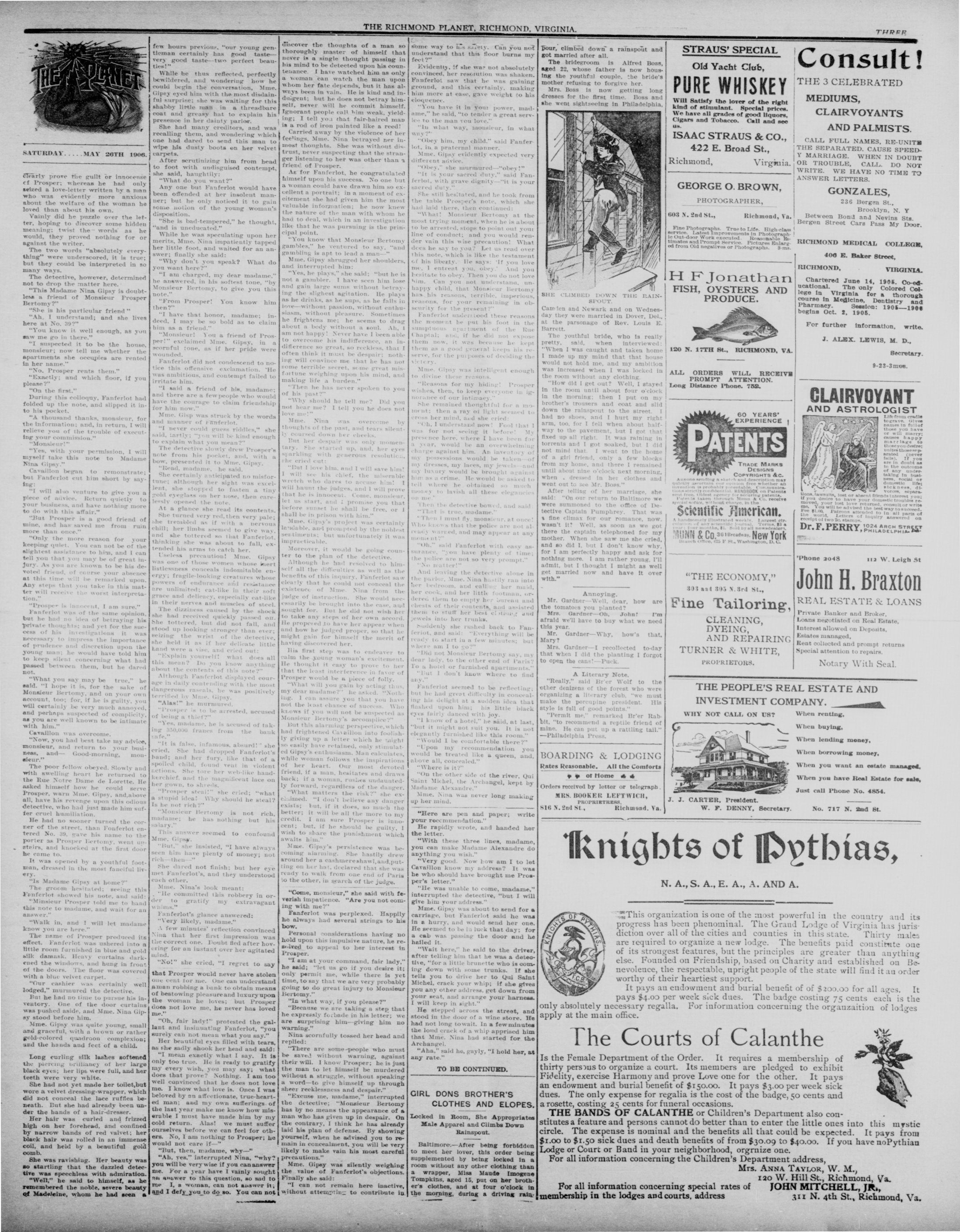
GIRL DONS BROTHER'S CLOTHES AND ELOPES.
Locked in Room, She Appropriates Male Apparel and Climbs Down Rainspout.
Baltimore.—After being forbidden to meet her lover, this order being supplemented by being locked in a room without any other clothing than a wrapper, Miss Maude Imogene Tompkins, aged 15, put on her brother's clothes, and at four o'clock in the morning, during a driving rain
Knights of Pythias,
This organization is one of the most powerful in the country and its progress has been phenominal. The Grand Lodge of Virginia has jurisdiction over all of the cities and counties in this state. Thirty males are required to organize a new lodge. The benefits paid constitute one of its strongest features, but the principles are greater than anything else. Founded on Friendship, based on Charity and established on Benevolence, the respectable, upright people of the state will find it an order worthy of their heartiest support.
It pays an endowment and burial benefit of of $200.00 for all ages. It pays $4.00 per week sick dues. The badge costing 75 cents each is the necessary regalla. For information concerning the organization of lodges in office.
The Courts of Calanthe
Is the Female Department of the Order. It requires a membership of thirty persons to organize a court. Its members are pledged to exhibit Fidelity, exercise Harmony and prove Love one for the other. It pays an endowment and burial benefit of $150.00. It pays $3.00 per week sick dues. The only expense for regalia is the cost of the badge, 50 cents and a rosette, costing 25 cents for funeral occasions. THE BANDS OF CALANTHE or Children's Department also con-
stitutes a feature and persons cannot do better than to enter the little ones into this mystic circle. The expense is nominal and the benefits all that could be expected. It pays from $1.00 to $1.50 sick dues and death benefits of from $30.09 to $40.00. If you have noPythian Lodge or Court or Band in your neighborhood, orgnize one.
For all information concerning special rates of membership in the lodges and courts, address
Dour, climbed down a rainspout and got married after all.
The bridegroom is Alfred Boss, aged 22, whose father is now housing the youthful couple, the bride's mother refusing to forgive her.
Mrs. Boss is now getting long dresses for the first time. Boss and she went sightseeing in Philadelphia.
A boy climbs up a chimney.
SHE CLIMBED DOWN THE RAIN-
SPOUT.
Camden and Newark and on Wednesday
they were married in Dover, Del.
at the parsonage of Rev. Louis E.
Barrett.
The youthful bride, who is really
pretty, said, when interviewed:
"When I was caught and taken home
I made up my mind that that house
would not hold me, and my ambition
was increased when I was locked in
the room without any clothing.
"How did I get out? Well, I stayed in the room until about four o'clock in the morning; then I put on my brother's trousers and coat and slid down the rainspout to the street. I had no shoes, and I hurt my right arm, too, for I fell when about halfway to the pavement, but I got that fixed up all right. It was raining in torrents and I got soaked, but I did not mind that. I went to the home of a girl friend, only a few blocks from my home, and there I remained until about nine o'clock next morning, when . dressed in her clothes and went out to see Mr. Boss."
After telling of her marriage, she said: "On our return to Baltimore we were summoned to the office of Detective Captain Pumphrey. That was a fine climax for our romance, now, wasn't it? Well, as soon as we got there the captain telephoned for my mother. When she saw me she cried, and so did I, but I don't know why, for I am perfectly happy and ask for nothing more. I am rather young, I'll admit, but I thought I might as well get married now and have it over with."
Annoying.
Mr. Gardner—Well, dear, how are the tomatoes you planted?
Mrs. Gardner—Oh, John! I'm afraid we'll have to buy what we need this year.
Mr. Gardner—Why, how's that, Mary?
Mrs. Gardner—I recollected to-day that when I did the planting I forgot to open the cans!—Puck.
A Literary Note.
"Really," said Brer Wolf to the other denizens of the forest who were organizing a literary club, "we must make the porcupine president. His style is full of good points."
"Permit me," remarked Brer Rabbit, "to recommend a reptile friend of mine. He can put up a rattling tall."
—Philadelphia Press.
BOARDING & LODGING
Rates Reasonable. All the Comforts
of Home
Orders received by letter or telegraph.
MRS. BOOKER LEFTWICH,
PROPRIETRESS,
S16 N. 2nd St.,
Richmond, Va.
Knight
KNIGHTS OF PYTHIAS
F.C.B.
only absolutely necessary rega
apply at the main office.
The Court
Is the Female Department of the
thirty persons to organize a co-
Fidelity, exercise Harmony and
an endowment and burial bene-
dues. The only expense for re-
a rosette, costing 25 cents for f
THE BANDS OF CALA
stitutes a feature and persons o
circle. The expense is nomin
Old Yacht Club.
Will Satisfy the lover of the right kind of stimulant. Special prices. We have all grades of good liquors, Cigars and Tobacco. Call and see us.
422 E. Broad St.,
Richmond, Virginia.
GEORGE O. BROWN.
PHOTOGRAPHER.
603 N. 2nd St., Richmond, Va.
Fine Photographs. True to Life. High-class service. Latest Improvements in Photograph- Out-door Work executed. Reasonable Res- pension. Good quality. Photos Enlarged from Old negatives.
H F Jonathan
FISH, OYSTERS AND
PRODUCE.
120 N. 17TH St., RICHMOND, VA
ALL ORDERS WILL RECEIVE
PROMPT ATTENTION.
Long Distance Phone. 752.
60 YEARS' EXPERIENCE
PATENTS
TRADE MARKS
DESIGNS
COPYRIGHTS & C.
Anyone sending a sketch and description may
quickly assert our opinion, but we will not
invention is probably restittable. Communications
security confidant. MARKING on Patents
sent free. Oldest agency for securing patents.
Patents taken through Munn & Co. receive
awarded without charge.
A handsomely illustrated weekly. Largest cir-
tury of a fine scientific journal. Torrens, "A
science of art," 1888. MUNN & Co. 361 Broadway, New York
Broadway, 800 F. St. W. Washington, D.C.
"THE ECONOMY," 303 aa 305 N.3rd St..
Fine Tailoring
CLEANING,
DYEING,
AND REPAIRING
TURNER & WHITE,
PROPRIETORS.
THE PEOPLE'S REAL
INVESTMENT COMP
WHY NOT CALL ON US?
J. J. CARTER, President.
W. F. DENNY, Secretary.
organization is one of the most powerful has been phenominal. The Grand Dear all of the cities and counties in need to organize a new lodge. The longest features, but the principles included on Friendship, based on Charity the respectable, upright people of their heartiest support. An endowment and burial benefit of per week sick dues. The badge galla. For information concerning
THREE
Consult!
THE 3 CELEBRATED
MEDIUMS,
CLAIRVOYANTS
AND PALMISTS.
CALL FULL NAMES, RE-UNITE
THE SEPARATED. CAUSE SPEEDY
MARRIAGE. WHEN IN DOUBT
OR TROUBLE, CALL. DO NOT
WRITE. WE HAVE NO TIME TO
ANSWER LETTERS.
GONZALES.
236 Bergen St.,
Brooklyn, N. Y
Between Bond and Nevins Sts.
Bergen Street Cars Pass My Door.
RICHMOND MEDICAL COLLEGE
Chartered June 14, 1905. Co-educational. The only Colored College in Virginia for a thorough course in Medicine, Dentistry and Pharmacy. Session: 1905----1906 begins Oct. 2, 1905.
For further information, write.
J. ALEX. LEWIS, M. D..
Secretary.
9-23-3mos.
Secretary.
9-23-3 mos.
CLAIRVOYANT
Life from cradle to grave. Gives you those you have or will marry; marries to someone united unless pranted (never pranted) in are in doubt as to the outcome taking in business, social or business, dislikes dress.
Life from cradle to grave, given answer to those you have or will marry, the promise of marriage to those you desire, justice for those persecuted (never fails), your doubt to the outcome of any understory, social or domestic life, voices, separations, lawsuits, lost or absent friendships if you desire to have your domestic life removed, your lost love returned, consult or write Fee $1.00. Patrons attend the best way to succeed. Cover all parts of the world. Letters of inquiry answers to two 20-stamp letters.
Dr. F. PERRY, 1024 ARCH STREET, PHILADELPHIA
'Phone 2048
112 W. Leigh St
John H. Braxton
REAL ESTATE & LOANS
Private Banker and Broker,
Loans negotiated on Real Estate,
Interest allowed on Deposits,
Estates managed,
Rent collected and prompt returns
Special attention to repairs.
Notary With Seal.
REAL ESTATE AND
PANY.
When renting,
When buying,
When lending money,
When borrowing money,
When you want an estate managed,
When you have Real Estate for sale,
Just call Phone No. 4854.
No. 717 N. 2nd 8t.
ythias,
werful in the country and its
Lodge of Virginia has juris-
in this state. Thirty males
the benefits paid constitute one
are greater than anything
clarity and established on Be-
f the state will find it an order
of of $200.00 for all ages. It
costing 75 cents each is the
ing the organization of lodges
C
ment also con-
e little ones into this mystic
d be expected. It pays from
$40.00. If you have no Pythian
address,
TAYLOR, W. M.,
Hill St., Richmond, Va.
N MITCHELL, JR.,
311 N. 4th St., Richmond, Va.
FOUR
TEARULNE
Her
wr
. Ve
La Ag
‘TERMS IN ADVANCE.
Que Goer. ane roar. 130
‘One Copy. eight months - an
Sas Sony: monte
‘Snoopy: three montha, 2
Saeko s
+ ADVERTISING RATIE
Ser ome inch. eueineartion, et ' 2
Focieotcten thease ee
Bortwoinchercirsontbe' ~~". 190
Fortwoinches sincmonike, ~ .” "1
ee
Bescaniy cod SRovicepertin, iy
HC TOSTAGE STAMPS OF A HIGHER DB.
SoMie TON TMAN Te} CECIER,
RECEIVED ON suBScRinicke
A Me PLANET ts iamed weekiy. ‘Thesubscri
‘Mon price ts $1.80 per Fear in wivace.
‘There are roc was by which money ean
sont by maint one tak ae Bost Ones Mae
Syonieh, by Bank Check or Draft. onan x
Drew Miner Order, and when mone of hissy
Kine provureds in a Ieegistoreed Late.
Monty OnteTee—You ean buy a. Money Or
der ah oar owe QR, payne wt soe Teh
foond eat Often, and we will be ros
fers fe aera
‘xvnest MONEY OnDERS can te odtained
Ber cttces ge the, Amertoan rons Cons te
Eiaieeat State’ Rapes Gonsnd thn Wetl'Fat
go nnd Colm Expresa Company, Wewill be
Spotl for money wot why of “tw core
Shi Savenient way for forwarding mours
Reoterenen LETRR—IE m money Order
Pont Otice or an Express (fic fatal wiiiis
Letter you'vish to eendlan'an Dagnecct ef”
Sent ‘Then, if the letter ts Look or talent
can be traced. You can send money in hte
Shmunee at our teks
We cannot be repensthle for money mnt m
letters in any chore way tumn one of Tie Gack
Says toentltheal atone At ye send Four co
Ty'Ik aay other way. you aust do @ ne Soar
‘en ri.
Rexewata, Bro If rou do not wast oie
estriado moother Fear wien
foimorsption hae Fam out you test matey wey
Pintel Card te dincontinar i The cousts ay
icidve thas aabeertbers to newspaper wh
bo drder thar paper Ghesgutiagee at hes
Pirntion of tine how which ft bas ‘ben pr
Srehieid Matte for the payment of the suomi
$n np to date when tucy order the peter
somtinmed.
Cowmenreanions When writing to) ox
renee yout cunceription wr rodiren tee’ var
#. you chal sive pour tame ase id Ses
Ir koli dherwise we canoes thet yenr naw on
our nee
Caaxox on Apomsia.—In onder to. chaney
Aevm if aaulmectbars we winet ie mont
Ub former aa well wsthe pment mdroes
Enter at the PoatOftioe at Richmond. V+
asnevondcine wareer
oe af 7
SATURDAY... MAY 26TH 1900,
People who will not work should
not eat.
No one should want more than
they are able to make money and
purchase.
Discontent will make home a hell,
and cause the occupant to wish bim-
self in heaven.
A man who cannot make enough
to pull his own locomotive is in bad
shape and has made a mistake in
coming to earth.
Some people are claiming that the
“jim crow" Negro is responsible for
our “jim crow” troubles. He may
furnish the excuse, but the Negro-
hater furnishes the blows.
Colored men, we must be polite
and obliging and by all means let the
white people of this country see
and realize that we have the funda-
mental principles of a gentleman tn
our make-up.
We havn't time to be whining
without working and it will hardly
Mo to be whining while we are work-
ing. God and our own efforts will
ultimately solve many of the prob-
lems confronting us.
A man who cannot snceced living
single should try it, living married
and then he will know within six
months’ time whether he is “going
up or down the stream."
Never be discouraged. There are
problems in life that if you try to
solve them too quickly will land
you in the lunatic asylum or in the
alms-house or in the bar-room. Go
slow and think them over.
Tae Hepburn Rate Bill would
have been much better if that “e
qually as good" provision for trav-
ellers had been left out of it. The
Unite? States Supreme Court ‘has
been making that kind of law, but
now Congress ts about to re-vitalize
it. But then we sometimes think
that these people who are opposing
our progress cannot do much more
to us anyway. We believe that God
has decreed that, “thus far shalt,
thou go and no further.”
‘With the Negro-haters against the
Negro and the Negro against aim-
self, those of us who mean to do
right and advance rapidly are hav-
ing a hard time.
If we will save money, live fru-
ally, pay our honest debts, leave
high-priced enjoyments and luxuries
to other people, who have more mon-
ey, stop aping the practices of rich
white people, who have their hun-
dreds of thousands of dollars to back
them, we will advance more rapidly
as a race and be able to bear better
the various forms of inconveniences
and oppressions from whick we now
suffer.
Colored people here since the “Jim
crow” street car law went into ef-
fect have gotten old bicycles. old
boggles and old horses and put them
into service while numbers of them
have bought ‘new bicycles, young
horses and new buggies and appear
as the owner rather than the driver
of the vehicle.
Colored folks here have not been
able to own the more expensive au-
tomobiles, but they are riding in
them just the same, Some of the
rich white folks bave found {t much
cheaper to employ a Negro chauffeur
than it is to bire a white one and the
brother in black gets just as much
Pleasure out of the machine as the
man who owns it and maybe a little
bit more for he doesn’t have to pay
for it.
People who live North as a rule
believe that labor fs the natural
state of man. People who live South
think that idleness Is the natural
State of the same indivhual. The
latter work as a necessity and stop
as soon as their wants are relieved.
The former keep on regardless of
worth and condition. Of course,
there are man notable exceptions in
both places,
We have received a copy of a most
interesting work entitled “Anthro:
pology Applied to the American Ne
gro and White Man,” by Mr. Robert
Glhert Wells, It i written in the
form of a dialogue and embraces all
possible questions that coutd be asx-
ed with reference to the relationsaip
of the Negro and the white man,
The work ts worth a perusal, being
fully illustrated. The price in cloth
fe $1.50. It may be obtained by
addressing the R. G. Wella & Co.'s
Book Concern, Buxton, Iowa.
The passage of the Hepburn Rate
Bill by the United States Senate end-
ed one of the most remarkable con-
troversies in the history of this coun
try and while some of the Democrats
were wild with rage, the Republicans
So maneuvred the contest a8 to unite
their own forces and at the same
time force all of the Democrats with
two exceptions to vote for this re-
markable measure. ‘The honors rest
with President Roosevelt and Sena-
tor Nelson W. Aldrich,
‘The Impotency of the present Dem
ocratic leadership was never more
practically demonstrated. Senator
Bailey and Senator Tillman engaged
in reeriminations and complaints
that would have better sulted spolled
children. They were outclassed at
every point and out-generalled in ev-
ery controversy. It was well for
President Roosevelt that he kept
well informed as to every phase of
the contention.
Congressman Williams the Demo-
cratic leader in the House cannot
control his own party there and a
similar condition exists with refer-
ence to the unfortunates in the Sen-
fate.
BAD EXAMPLES FoR Us.
We cannot understand how the
Negro-haters can have the effrontery
to criticise the Negroes in face of the
Misclosures now being made in well-
nigh every section of this country.
The white folks in this state have
gotten. angry with each other and the
affairs at the Eastern Hospital at
Williamsburg are being investigated
with damaging effect to all parties
concerned. When the testimony was
at Its height, the poor Negro had to
be dragged into it, if only by com-
parison and the result of this was
to show that the inmates of the col-
ored hospital at Petersburg are bet-
ter treated than those of the white
institution at Williamsburg.
One white man calls the other
white man a liar and the public f-
nally gets the idea that the desig-
nation is a proper one for both par-
ues. ‘The Board is shown to have
had a good time when it hel its
Sessions and that it enjoyed the whis
key and cigars that were presumed
to have been purchased for the ben-
efit of the patients. The goods were
contracted for at one price and bill-
Jed at another, but higher price and
the indications are that somebody
the “rake off.” All of this
comes to light too after the disfran-
chisement of the Negro and Is a po-
tent answer to those Negro-haters,
who alleged that the elimination of
THE RICHMOND PLANET, RICHMOND, VIRGINIA.
SHKSSHSCG SKS SS SS eSsssSs se gooreeesssesoesesecesrseoeeeeeeeeenes
So ee ee oe ee ee oe eee ne eee
Se
Se = WOW OPEN= 53
ee Be
eS s L cL $3
2° wif, ml, 3
se 6 . Sa
oe Mayo’s Island, THE ONLY UP-TO-DATE PARK IN THE SOUTH FOR COLORED PEOPLE 33
ea s s NN ats
oo &
hay e e e BS
a3 ancin ositivel reen 3
a
cea 33
Pt } PENING e oe
a "THE ox Decoration Day, May 30th. #
; EN I L HAVI ( 4 )NAL OPEN AIR FREE ATTRACTIONS and SHOWS of all DESCRIPTIONS. +
ee Be
BOG oe a 4 LUGE GSK GSS S SS SSS Seer ese seeeeersesereoeeeeeeeseeseseas
SHOOK KSC VG GSK KS G SKS Sse seseesesgeaessgocaecorsceaas
fe Negro vote as a political factor
would bring the halycon days of pure
elections and honest administration,
‘The result has been just the con-
trary for in a speech made in Nor-
folk, Va., May 16th, 1906 the Dem-
ocratic Mayor, Hon. James G. Rid-
dick, in condemning the opposition
in bis own party, both sides being
‘Democrats. said:
“People dead and gone for years
have been voted by the ‘ring’ and
those who had no right to yote have
crowded the people out of thelr di-
vine right of suffrage. I recognized
ho faction when I took the oath of
offices, and when T say this T do not
do it to make myself a weak and
purjured Itar I hate to think that
& man will vote against everything
he knows to be right In order that
he may help to keep a father, son
or brother in office.”
These are plain, unequivocal
words and give indisputable evidence
of the withering effect of doing evil
that good may come. Mr. John A.
Setph and Mr. Jos. ©. Phillips have
‘been trying in vain to get a square
deal In Jefferson Ward where they
were candidates for the elty counell.
They have thirty three voters, who
Swear that they voted for them and
yet the ballot box disclosed but eight
een votes cast for them,
‘The Democratic workers have per-
sistently labored to pull down the
number Of these voters who have
made these sworn affidavits, but up
to this writing there Is yet a sur-
plus of votes unaccounted for. The
case Is now sald to be up to Common-
wealth Attorney Fowlkes and the
grand jury .
| In the meantime, Dr. T. E. Strat-
tom has made a diseloaure which
proves conclusively that the omce of
City Bacteriology is absoutely worth-
less, so far as practical results are
concerned. Although supported by
the eity, the official In charge was
unable to tell the difference between
the moppings taken from the throat
of a colored woman who had been
treated for the wWiphtherla and the
‘moppings from the throat of a white
physician, who did not have the
diphtheria.
When confronted with this evi-
dence the brutal response was that
the physician had diphtheria germs
in his throat, and was according to
this official as dangerous a propos.
on as was the colored woman. One
was held in quarantine and the other
was permitted to roam free of annoy
ances. On the other hand the physi-
clan In question stated that tae City
Bacteriologist had the matter the
wrong way. The sputa from both
throats were alike for neither had
the diphtheria,
We are of the opinion that these
fine skillful tests are all right, when
‘made by fine, skillfal men, but when
— delicate instruments are places
in the Hands of persons who should
be helpers of skilled chemists rather
than the principals, the result. will
generally be found just as Dr. T.
E. Stratton fount them to be.
| A man who cannot make good,
that is prove that ae knows wher
subjected to the most rigid amd del:
icate tests is useless in the fleld 0
science, and a handleap in the field
of commerce,
| If sixteen week's experience ft
New York will qualify a person te
such an extent as to enable him t
‘hold an office of City Bacterlologist
it iu evident to the average mind
that the wrong man was sent to re
‘ceive the instruction and profit by
the experience.
Bought Six Short Railroads.
Baltimore. May 23—The banking
firm of Middendorf, Williams & Co.
announced that a syndicate organized
by that firm and the International
‘Trust Company, of this city, and John
L. Williams & Sons, of Richmond, Va.,
has consummated the purchase of six
short railroads in Georgia and Florida,
having a total mileage of about 230
miles, which {t is proposed to consol
{date under the name of the Georgia
& Florida railway.
Shot and Killed By Jealous Man.
Altoona, Pa., May 22.—William Con-
way, aged 27, colored, shot ia the hvad
and killed Silas Cooper, aged 43, 2 ©
colored, and made his escape. Con
way found Cooper on ths sreet: i
company with Mrs. Cenvay an
crazed by Jealousy, abot Coupe 4
without a wort, Cow a b
working in Your sou Sate. <3
turmed home co’. © 12 "=v.
EFFECT OF THE
RATE. BILL
Washington, May 23.—With the rail
road rate bill out of the way, pressure
for the adjournment of congress is
beginning to be felt. The house com-
mittee having sent the bill to confer
ence, it {# belleved an adjournment
Will soon be reached
The most important provision of the |
ct confers of the interstate commerce
commission the authority, on com
plaint, to examine into any charge or
practice of a carrier alleged to be un
just, and when allegation ts sus.
tained to prescrite what shall be a
Just and reasonable maximum rate or
charge, regulation or practice.
The act defines as common carriers
owners of pipe lines engaged in the
transportation of oll cr other commod-
ity, except water and natural or artt
ficial gas; also sleeping car and ex
press companies. ond all forms of pri-
vate cars, terminals, switches and
spur tracks.
Free Passes Forbidden.
The tasuance of passes or free trans.
portation in any form to all persons,
except employes or carriers and theit
families and certain exempted classes,
ts forbidden, and a penalty of not less
than $100 nor more than $2000 ts pro:
¥ided, not only for the person issuing
such free transportation, but also for
the person applying for or accopiting it.
Common cartier are prohibited, on
and after May 1, 198, from transport-
{ng across and state or territorial line
any article or commodity other than
timber and the manufactured products
thereof, manufactured, mined or pro-
duced by it or under Its authority.
They are required to construct and op-
erate upon reasonable terms sidetracks
and switch tines and to furnish cars
for the movement of traffic without
| Aiscrimination and to furnish equally
| good accommodations to all persons
| Paying the same fare
Carriers must print and post tn con-
| apfeuous places all tariffs and charges,
amd anth <harghe GAibSt Ae ClasaGe
| without 20 «aye" notice to the public
| and to the interstate commerce com:
| mission, except where the commission
| Walves such notice. ‘They are required
demand of the president, to give pref-
erence and precedence to the transpor-
tation of troops and munitions of war.
Every person, company or corporation,
whether carrier oF shipper, 1s prohib-
| fted from offering, granting, giving, 80-
| Melting, accepting or recelving any re-
bate, preference or discrimination.
Heavy Penalties For Violations.
| Heavy penalties, and in some tn-
stances {mprisonment, are prescribed
| for violation of the provisions of the
| act, individuals and corporations alike
to be held guilty of misdemeanor for
any violation willfully committed, and
| the corporations and individuals are
j held responsible for the acts of any
agent. Failure to publish tariff entalls
| a fine of not ise than $1000 and not
| more than $20,000.
| Granting or accepting of rebates or
Kindred discriminations entails a fine
‘of not less tham $1000 and not more
than $20,000, and the individual entity
of such act ts Hable to imprisonment
for not more than two years in addition
| to the fine, in the discretion of the
court,
| Any shipper who willfully accepts a
‘rebate or discrimination must, in addi-
| tlon to the above penalties, pay to the
| United States three times the value of
j Such rebate or discrimination, and the
| attorney keneral is required to bring
civil sult to recover this penalty when-
ever he believes such violation of law
has occurred.
‘The authority of the interstate com-
merce commission to fix maximum
Fates refers not only to single, but joint
Fates, and applies where one of the
| parties to the joint rate is a water line,
Forfeits For Failure to Obey Orders.
| For failure to obey an order of the
commission the carrier forfelts to the
| United States $5000 for each offense,
and each day of @ continuing viola-
‘thon fs deemed a separate offense.
1 Where the interstate commerce com-
| Mission orders a refund to a shipper
| And the carrior fafls so to refund, the
shipper may Institute ctvil suit to re-
cover; the finding of the commission
constitutes prima facie evidence of the
facts, and the petitioner fs not liable
for the costs in the court or at any
subsequent stage of the proceedings,
‘and if the petitioner finally prevails a
Teasonable attorney fee is allowed him.
‘The Interstate commerce commission
or any person injured by a failure of a
carrier to comply with an order of the
commission, other than the payment of
HONEST. PROGRESSIVE. ENERGETIC. CONSERVATIVE.
INCORPORATED, FEBRUARY 25TH, 1893.
: , Pike tae
The Southern Hid Society of Virginia
HOME OFFICE: 504 N. SECOND STREET, RICHMOND, VA.
HEADQUARTERS EASTERN DIVISION: 555—25th STREET, NEWPORT NEWS, VA.
B. A. CEPHAS, Soperintendent.
BRANCH OFFICES IN THE PRINCIPAL CITIES IN THE STATE.
ISSUES ATTRACTIVE, INDUSTRIAL INSUR-
CONSERVATIVE and feiceeees| 49 ANCE IN ALL ITS
MODERN FEATURE =| BRANCHES.
POLICIES f ee en High-class Policies a
Insuring against i eo { Specialty.
SICKNESS, ! Issues the Most Liberal
ACCIDENTS | Te Policy; the Promptest in
aXD DEATH ~ : 4 Adjusting all Claims; the
Paid out in Sick, Accident ! 1 Safest Company for the
and Death Claims during |} Jae > = People—your neighbor will
the year, 1905, aes tell you so.
a eee Bs cipro
$36,000.00 | | Join To-day.
Rotts eae eet se. I eo
COMPANY'S BUILDING, NEWPORT NEWS, VA.
It has the strength of Gibraltar, because it is founded upon the basis of conservatism and honesty. No
corporation {s stronger than its motives—hence our chain {s endless strength—for every link is Honesty.
CLAIMS PAID.
During the past fourteen years, the Company -has paid out to its policy holders, In sick and accident ben-
efits the sum of $140,000-00; in death claims, $64,000.00.
ITS RESOURCES ARE THE LARGEST.
Through scrupulously honest antl the most conservative management, the Company ‘thas accumulated
the following resources:
Real Estate, $20,000.00; Cash, $10,000.00; Bonds, $10,000.00; Personal, $5,000.00, AN Other Securities, $10,
000,00, and an enviable reputation in the homes of its thousands of | policy-holders.
Tie SOUTHERN AID SOCIETY is the people's Company because it is run in thelr interest and pays the
poliey-iolder the most for his money.
Act today—don’t delay. Take out a good policyon your life in the SOUTHERN AID SOCIETY for the
protection of your family. No man ever became rich from salary, but by successful speculation. The labor-
Ing man has not his taousands to invest tn large affairs, but he can buy a good policy on every member of ‘his
family in the SOUTHERN AID SOCIETY. This will bring the largest returns, sunshine and happiness in
those declining, gloomy hours of death. ‘The Insurance policies issued by the SOUTHERN AID SOCIETY
told out to the laboring man or woman the greatest amount of protection at the least cost. Why not invest
to-day ® part of the throw-away-money for the future comfort of your family when the evening's shadows of
life appear? Sick aml Accident Benefits from $1.25 to $15.00 per week. Death Benefits from $15.00. to
$1000.00
OFFICERS AND BOARD OF DIRECTORS:—President, A. D. PRICE; ist VicePres., EDWARD STEW-
ART; 2nd Vice Pres., JAS. T. CARTER; 3rd Vice Pres. B, A. CEPHAS; Sec. and M'g't, THOMAS M. CRUMP;
Treas, W. E. BAKER; Gen’l. Inspector and Auditor, B. L. JORDAN. E. C. BROWN, W. A. JORDAN, A.
WASHINGTON, CHAS. 'N. JACKSON. maeienes athe. sekiies 33 eae eee
RESIDENT BOARD, Danville, Va— pet ot ot
| If Interested, 11 out_and mail this to
S. D. MILLS, Chafrman, | HOME OFFICE, 504 N. 2nd St. Richmond, Va.
PROF. THOS. A. LONG, Sec. Name
LEVI W. HOLBROOK, St. No.
DR. A. L. WINSLOW. city, Gowsty,
REV. ROBT, G. ADAMS. State
DANIEL P. LUCK. Amount of Ins. wanted, $.
CHARLES W. WEST.
eee Age___, Employment, |
C. E, X. BOISSEAU, Supt. 1
Paper saw Add.
Hustling Agents Wanted, Write To-day. i de gees
money, may apply to the circuit court
and if the caso is established the court
shall fasue a writ of injunction, manda.
tory or otherwise, to restrain such car-
rier irom further disobedience, and.
from such action appeal shall lle direct
to the supreme court of the United
States, where the case shall have pri-|
ority of hearing and determination . |
The Allison Amendment.
The act provides that In suit broughe|
against the intorstate commerce com-
mission the venue to enjoin, set aside,
annul or suspend any order oF ree
Quirement of the commission shall be
in the circuit court of the district
where the carrier bas {ts princtpal op.
erating office, and Jurisdiction is vest-
ed in such courts. The provisions of
the expediting act of Feb. 11, 1908, are
made to apply to such sults,’ including
hearings on application for preliminary
Injunctions, which may be granted
only ou hearing after five days’ notice
to the commission. Appeals from any
interlocutory order or decree are to be
made only to the supreme court of the
United States. These constitute the
Provisions of the so called Allison
amendment.
The commission ts authorized to re-
quire the most comprehensive statis-
tics from all common carriers regard-
ing their business under a penalty on
the carriers of $100 for every day in
default.
Constant Access to All Records.
‘The commission is authorized to pre-
ae ee accounts kept by
3, shall constantly have access
to all records, accounts and memoran-
4a kept by them, refusal to grant such
access entailing a penalty of $500 for
each offense or for each day such re-
fusal is maintained. Pulse entries
made by any person keeping the books
of a carrier are made punishable by a
fine of from $1000 to $5000 or impris-
onment for from one to three years,
or both,
Carriers are also required to tssue
Dills of lading for all shipments ac-
cepted and shall be Mable to damage
for the loss or injury of any property
for which a bill of Jading is given and
no contract, receipt, rule or regulation
eball exempt the carrier from lability
Authority conferred on the commis-
sion 40 prescribe practices, ete, {n-
eludes not only switching charges and
similar services, but icing charges and
any other practice which may be ron-
dered as 9 part of interstate transpor-
tation.
U. S. VICE CONSUL KILLED
sin at Batoum, Russia.
Batoum, May 22.—W. H. Stuart, the
American vice consul, was shot’ and
Killed at his country place. The as
Sassin escaped. Mr. Stuart was a
British subject and one of the largest
Ship brokers and exporters of Batoum
Mr. Stuart, having dined at the
house of a friend, was returning to his
country place at Manziadjani, five
miles from Batoum. He was fired on
twice from a clump of trees half a
mile from his home, one bullet plerc
ing his leg and another his breast. Mr
Stearne, the British vice consul at
Novo Rosslisk, who was a guest af
Mr. Stuart's house, hearing the shoot
ing, hurried out with the servants and
found Mr. Stuart lying on the ground
bleeding from his wounds. He was
still conscious, but said he would not
be able to recognize his assassin ow:
ing to the darkness. Mr. Stuart was
conveyed to a military barracks In the
vicinity, where he expired two hours
later. The body was transported te
the consulate at Batoum.
ADDICKS DROPS LONG FIGHT
Says Colonel duPont Will Be Electee
U. S. Senator From Delaware.
Philadelphia, May 19—J. Edward
Addicks, who has been for years a
candidate for a seat in the United
States senate from Delaware, arrived
here from Washington and announced
that he was for Colonel Henry A. dw
Pont, of Wilmington, for the vacant
seat In the senate. Mr. Addicks said
there was no longer any doubt that
there will be a call for a special ses
sion of the Delaware legislature with
in a few days; that a senator will be
Promptly elected and that Colonel
duPont will be the man. To give
strength to the announcement of bis
fetirement from the long fight, he
Produced letters that he had just
‘written to his Heutenants in which h¢
urged them to sign the call for a spe
clal session and to affix their signs
tures to the petition agreeing to abide
by the decision of the caucus.
‘Captured a Live Okani.
London, May 21.—Captain Boyd Al-
exander, of the Alexander-Gosling ex-
Pedition, reports from the Augu dis-
trict, on the River“Welle, Congo Free
Btate, that he has secured a spechnen
of the okapi, which the expedition saw
alive. No white man ever before has
seen a living okapl. ‘The announce
Mont gi atly Intercets zoelogizts.
```markdown
```
IT WILL PAY YOU To interest yourself in promot ing the CIRCULATION of the RICHMOND PLANET.
---
THE PLANET
SATURDAY....MAY 26TH 1906.
SENATOR BURTON MUST GO TO JAIL
The U. S. Supreme Court Affirms His Sentence.
WAS CONVICTED OF GRAFTING
Washington, May 22.—The supreme court of the United States rendered a decision in the case of United States Senator Joseph R. Burton, of Kansas. The decision was against Burton, affirming the decision of the United States circuit court for the eastern district of Missouri, by which Burton was sentenced to six months imprisonment in the jail of Iron county, Mo., required to pay a fine of $2500 and deprived of the right to hereafter hold office under the government.
The opinion was by Justice Harlan. All of the points made in Burton's interest were overruled.
Senator Burton was prosecuted on the charge of violating section 1782 of the revised statutes, which prohibits senators and representatives from receiving compensation for services rendered before any of the government departments in any matter in which the government may be interested. He was specifically charged with accepting a fee of $500 per month for five months from the Rialto Grain and Securities company of St. Louis for services rendered that company in an effort to prevent the issuance of an order by the postoffice department prohibiting the use of the mails by the company.
It was contended on behalf of Senator Burton that the fee was paid on account of a criminal proceeding against one of the members of the Rizito company and not because of services rendered in the government prosecution of the company. The law under which he was prosecuted was also attacked as unconstitutional on the ground that the senate was the sole judge of the qualification of its members, but this doctrine was not upheld by Justice Harlan's opinion. The statute was upheld in all respects and held to be fully applicable to Burton's case.
Immediately after promulgating its decision in the Burton case the supreme court granted a motion to give 60 days to Senator Burton in which to prepare a petition for a rehearing. The action will have the effect of taking the case over until the next term of the court, beginning in October, as the present term will expire next Monday.
That the senate will be compelled to take cognizance of the case is indicated by the decision in the following extract:
"The final judgment of conviction did not operate ipso facto to vacate the seat of the convicted senator, nor compel the senate to compel him or to regard him as expelled by force alone of the judgment. The seat into which he was originally inducted as a senator from Kansas could only become vacant by his death, or by expiration of his term of office, or by some direct action on the part of the senate in exercise of its constitutional powers."
MAY BE CRIPPLED FOR LIFE
Philadelphia, May 22—I. X. Baxter, special city judge of Utica, N. Y., who was during his college days at the University of Pennsylvania one of the best high jumpers in the country, injured the Achilles tendon of his right so seriously while making a high jump on Franklin Field that he may be crippled for life. He had been asked to come to Pennsylvania to coach the high jumpers, and gave the athletes an exhibition in correct jumping. Although not in condition, he cleared the bar at 5 feet 10 inches, and in landing he either snapped or badly strained the tendon. Physicians at the University hospital believe he is permanently lamed.
In Court When Sentenced.
New York, May 22—Practically a life sentence for burglary was imposed by Judge Crane in Brooklyn upon William S. Metelski, the so-called Masonic burglar, when he was ordered to serve 40 years at hard labor in Sing Sing prison. Metelski and his wife both fainted in court when sentence was pronounced, and he injured himself in falling. Metelski is the son of a Brooklyn business man, and was called the Masonic burglar by returning some property he was in the act of stealing from a member of the Masons. He confessed that he had employed himself at burglary every night for three months. He is 27 years old.
Big Fire at Crisfield, Md.
Crisfield, Md., May 21.—Fire wiped out a large section of this town and destroyed property on which the estimates run as high as $50,000. The flames originated in the flour mill and canning house of Frederick Johnson and spread rapidly. Twenty-three houses were destroyed in a little over two hours. The African Methodist Episcopal church was destroyed, as were also the hall of the grand lodge of Odd Fellows. That portion of the town destroyed was inhabited chiefly by negroes. The cause of the fire is not known.
PISTOL FIGHT WITH THIEVES
Burglar Blow Open Safe at Glassboro, N. J., But Were Driven Off.
Pitman, N. J., May 22.—Burglar
BORS AND INTEREST THEM IN THE PLANET. WE WILL HELP YOU TO OBTAIN A PREMIUM.
COLORED INFANTRY IN RESCUE OF ROUGH RIDERS AT SAN JUAN HILL, JULY 2, 1898, SIZE 20X28 AND 20X24 INCHES, ADMIRAL DEWEY'S GREAT NAVAL BATTLE OFF CAVITE IN MANILA BAY, MAY 1ST, 1898, NAVAL BATTLE, DESTRUCTION OF ADMIRAL CERVERA'S SPANISH FLEET OFF SANTIAGO DE CUBA, JULY 3RD, 1898, SIZE 22X28 INCHES; LAND BATTLE, CAPTURE OF EL CANEY, EL PASO AND FORTIFICATIONS OF SANTIAGO, JULY FIRST AND SECOND, 1898, SIZE 22X28 AND 22X27 INCHES. WE WILL SEND YOU ONE OF ANY OF THE FOLLOWING BATTLES OF THE CIVIL WAR ON THE SAME TERMS. THE PICTURES LIKE THE OTHER BATTLES ARE FINISHED IN COLORS. THEY ARE 22X28 INCHES AND RETAIL AT ONE DOLLAR EACH. WE WILL FURNISH FRAMES FOR ANY OF THESE FINE CHROMOS FOR 2 DOLLARS & 50CTS. EACH ADDITIONAL. BATTLE OF GETTYSBURG, BATTLE OF SHILOH, BATTLE OF FIVE FORKS, VA., BATTLE OF ATLANTA, GA., BATTLE OF SPOTTSYLVANIA, VA., BATTLE OF VICKSBURG, MISS., BATTLE OF LOOKOUT MOUNTAIN, TENN., BATTLE BETWEEN THE MONITOR AND THE MERRIMAC, BATTLE OF BULL RUN, VA., BATTLE OF CHANCELLORSVILLE, BATTLE OF THE BIG HORN, (CUSTER'S LAST CHARGE) STORMING OF FORT WAGNER, S. C., (COLORED TROOPS IN THIS FIGHT), BATTLE OF NEW ORLEANS, LA., CAPTURE AND DEATH OF SITTING BULL, THE GREAT INDIAN CHIEFTAIN; FORT PILLOW MASSACRE, FALL OF PETERSBURG, VA., BATTLE OF WINCHESTER, VA., BATTLE OF OLUSTEE, FLA. WE WILL SEND FAMILY RECORD, SIZE 22 BY 28, WHICH CONTAINS SPACE FOR PHOTOGRAPHS OF PARENTS AND TEN CHILDREN. WE WILL SEND SOLDIERS WAR RECORD (CERTIFICATE OF SERVICE IN UNITED STATES ARMY.)
FOR ONE YEAR EACH, OR THEIR EQUIVALENT, WE WILL SEND YOU A COPY OF UNCLE TOM'S CABIN, THE MOST INTENSELY INTERESTING BOOK IN THE COUNTRY. WE WILL SEND YOU A GOLD-PLATED BROOCH WITH YOUR PICTURE THEREIN, YOU TO
blew open and wrecked the safe in the Glassboro postoffice, but before they could re-enter the building George Benneger, night watchman of the bank opposite the postoffice, who was aroused by the explosion, opened fire on the robbers, and for a time the air was filled with bullets. The robbers made a hasty retreat, delivering a rapid running fire on Benneger.
Several bullets from the watchman's revolver struck the postoffice near where he saw the thieves and others fired in return struck the stone wall of the bank only a few inches from where he was standing. Another shot crashed through a pane of glass near his head. It is not known whether any of Benneger's shots took effect.
The Negro Business League of Va.
Office of Cor. Sec., E. C. Brown,
2123 Madison Ave.,
Newport News, Va.
Office of Rec. Sec., Jno. T. Taylor,
728 N. 2nd St., Richmond, Va.
Richmond, Va., May 16, 1906
To all who are interested in the advancement of the Negro Race:
The Second Semi-Annual Session of the Negro Business League of Virginia will be held in Newport News, Va., June 13th and 14th, 1906 at the True Reformers' Hall. The object is to inform the world the best we may, of the progress of the Negro in Virginia is making in business, to stimulate local business enterprises, to encourage our people along lines of commercial undertakings and to particularly influence the young men and women of our race by examples of others, and further to formulate plans to have a creditable representation of the Negro business men of Virginia, at the 7th Annual Convention of the National Negro Business League to be held at Atlanta, Ga. this year.
We especially solicit your co-operation, and want you to urge upon all colored business men and women the necessity of being represented at this meeting. We feel that your interest in the march of progress of your race will stimulate you to help us along this line. All who expect to attend this meeting will kindly write to the Corresponding Secretary E. C. Brown, so that boarding and lodging arrangements may be made. Good boarding and lodging will be secured for $1.00 per day. We call upon our people throughout the entire state of Virginia to meet us in Newport News. Richmond expects to go down in a special car and so we look for our business men in every city and community to be present.
W. F. GRAHAM, President.
E. C. BROWN, Cor. Sec'y.
2123 Madison Avenue,
Newport News, Va.
Boarders Wanted?
Gentleman lodgers wanted, with or without board. Pleasant location. Good service. 502 $ \frac{1}{2} $ N. 2nd Street.
Subscribe to the PLANET
Employment Agency
We guarantee first class positions for good cooks, butlers, hotel help, and domestic help of all kinds in Washington, Pennsylvania and New York.
Write us at once as to terms etc.
I. N. CABANISS,
Employment Agent.
1144-15th St., N. W., Wash. D. C.
Do You Know Her?
I desire to know the whereabouts of Moselle Warner, a little girl about eight years of age. When last heard of, she was living in Richmond. Her mother's name is Mrs. Mattie Lee Warner. Address,
A. A. MARTIN,
U. S. S. Monongahela,
Naval Station,
Guantanamo Bay
Cuba
FORD'S
HAIR POMADE
Formerly known as
"OZONIZED OX MARROW"
so
STRAIGHTENS
The Ozonized Ox Marrow Co.
(None genuine without my signature)
Charles Ford Prich
70 Wabash Ave., Chicago, Ill.
Agents wanted everywhere.
IN ORDER TO FURTHER INCREASE OUR STEADILY GROWING CIRCULATION WE WILL OFFER PRIZES.
WE WILL SEND YOU THE PLANET AND THE ST LOUIS, MISSOURI, SEMI-WEEKLY GLOBE DEMOCRAT, ONE OF THE LEADING REPUBLICAN JOURNALS IN THE UNITED STATES FOR $2.25 PER YEAR FOR BOTH.
WE WILL SEND YOU THE PLANET AND THE COSMOPOLITAN MAGAZINE FOR $2.25 PER YEAR FOR BOTH.
WE WILL SEND YOU THE PLANET AND McCLURE'S MAGAZINE FOR $2.25 PER YEAR FOR BOTH.
FURNISH THE PHOTOGRAPH, ONE FOR TAIN PEN, GOLD POINT; ONE LADIES FOR ONE BREAST-PIN, GOLD FILLED; HALF FOR EN LINEN HANDKERCHIEFS, ONE AL CLOCK, ONE DOZEN NAPKINS, ONE DOZEN TOWELS, ONE CHOCOLATE POT, PAIR VASES, ONE PAIR KID GLOVES, HAM, ONE TURKEY.
FOR TEN NEW SUBSCRIBERS
OR THEIR EQUIVALENT, WE WILL SEND PICTURES, ONE ONLY, OF PRESIDENT THEODORE ROOSEVELT, DR. BOOKER T. WASHINGTON, BATTLE OF SANTIAGO, LAND BATTLE OF QUASIMAS NEAR SANTIAGO, JUNE 24, 1898, SHOWING THE NINTH AND TENTH COLORED CAVALRY IN SUPPORT OF ROUGH RIDERS, SIZE 20X28 AND 20X24 INCHES, LAND BATTLE AND CHARGE OF THE 24TH & 25TH
READ THE GREAT INDUCEMENTS OFFERED BY THE PLANET
THE RICHMOND PLANET, RICHMOND, VIRGINIA
IF YOU WILL TALK WITH YOUR NEIGH-
```markdown
```
FOR TWO YEARLY SUBSCRIBERS
FOR FIVE NEW SUBSCRIBERS
REQUISITE NUMBER IS OBTAINED, WE WILL FORWARD THE PRESENT INDICATED. A PERSON WHO TRIES TO GET FORTY SUBSCRIBERS AND GETS TIRED MAY INDICATE HIS WISH AND WE WILL SEND THE PRESENT FOR THE NUMBER HE HAS SECURED OVER FIVE. THE NUMBER WILL BE FOR NOT LESS THAN FIVE NOR MORE THAN TEN AND NOT LESS THAN TEN NOR MORE THAN TWENTY AND NOT LESS THAN TWENTY NOR MORE THAN FORTY, TO DETERMINE THE PRIZE TO WHICH THE WORKER IS ENTITLED.
IF ANYTHING IS DESIRED NOT SPECIFIED IN THIS LIST, WRITE US ABOUT IT AND WE WILL TELL YOU IN WHAT CLASS IT BELONGS.
JOHN MITCHELL, JR. 311 North Fourth Street RICHMOND, VIRGINIA
A man is sitting in a chair. A man is standing next to him.
DILY GROW
LANET
WEEKLY
READING
UNITED
H.
T AND
R $2.25
T AND
YEAR
ND PIC-
THEO-
WASH-
D BAT-
JUNE 24,
H COL-
GH RI-
LAND
& 25TH
```markdown
```
REQUISE FORWA
SHOULD YOU DESIRE ANY COLORED JOURNAL IN THE UNITED STATES, WE WILL SEND IT TO YOU IN CONJUNCTION WITH THE PLANET AT A GREATLY REDUCED RATE FOR BOTH.
FURNISH THE PHOTOGRAPH, ONE FOUNTAIN PEN, GOLD POINT; ONE LADIES RING, ONE BREAST-PIN, GOLD FILLED; HALF DOZEN LINEN HANDKERCHIEFS, ONE ALARM CLOCK, ONE DOZEN NAPKINS, ONE HALF DOZEN TOWELS, ONE CHOCOLATE POT, ONE PAIR VASES, ONE PAIR KID GLOVES, ONE HAM, ONE TURKEY.
FOR TEN NEW SUBSCRIBERS
WE WILL SEND ONE CHILD PIECES; ONE NECKLACE, PEARE, BYRON WORKS; ONE PLAIN GOLD RING, ONE IN 1,000 ENVELOPES, 1,000 PRINTED AND DELIVERED ONE HALF CORD OF SAW.
FOR TWENTY NEW WE WILL GIVE ONE HALF WITH OPALS, RUBIES OR ELRY BOX FINISHED IN ONE SILK SHIRT WAIST DRESS, ONE GOLD WAISTED FOR TEN YEAR CHAIR, ONE LOAD OF OIL SOAP, EITHER WASHING BARREL OF BEST FLOUR ETS, ONE MANICURE SERVICE WORK BOX, ONE PAIR SHOES.
FOR FORTY YEAR OR EQUIVALENT, WE WILLING MACHINE, ONE DRY GOLD WATCH, ONE PAIR RINGS, ONE MUSIC BOX, ONE READY MADE DRESS, TLEMEN'S CLOTHES, CANE, ONE GOLD-HEAD CHINA SET, ONE DOG KNIVES AND FORKS, ONE SILK DRESS, ONE WEEK SHORE, RAILROAD FAIR PAID, FOR ANY RICHMOND THESE OFFERS MAY TAGE OF BY SENDING SCRIBER'S NAMES AT A KEEP A RECORD OF THE NUMBER IS OBTAINED, WORD THE PRESENT INDICATED PERSON WHO TRIES TO GET BERS AND GETS TIRED MEN IS WISH AND WE WILL SET FOR THE NUMBER HE OVER FIVE.
NUMBER WILL BE FOR NIVE NOR MORE THAN TEN AND THAN TEN NOR MORE THAN TIT LESS THAN TWENTY NOURTY, TO DETERMINE THE WORKER IS ENTITLED.
IF ANYTHING IS DESIRED NO THIS LIST, WRITE US ABOUT TELL YOU IN WHAT CLAS
ALL SEND ONE CHINA SET, THIRD
ONE NECKLACE; DICKENS, S.
BYRON WORKS; ONE UMBRELLA,
GOLD RING, ONE PAIR LACE CU
ENVELOPES, 1,000 SHEETS OF
AND DELIVERED; ONE TOI
LF CORD OF SAWED WOOD.
FOR TWENTY NEW SUBSCRIBER.
ALL GIVE ONE HANDSOME GOL
PALS, RUBIES OR PEARLS; ONE
BOX FINISHED IN GOLD OR
SKIRT WAIST; ONE READY
ONE GOLD WATCH, FILLED
FOR TEN YEARS, ONE IN
ONE LOAD OF COAL, ONE G
EITHER WASHING OR TOIL,
OF BEST FLOUR, ONE PAIR
ONE MANICURE SET, ONE SEAM
BOX, ONE PAIR SHOES, GENTI
FOR FORTY YEARLY SUBSCRIBER.
QUIVALENT, WE WILL GIVE ONE
MACHINE, ONE DIAMOND RING
WATCH, ONE PAIR FINE GOL
ONE MUSIC BOX, ONE PHONO
READY MADE DRESS, ONE SUIT,
N'S CLOTHES, ONE GOLD-
ONE GOLD-HEADED UMBRELL
SET, ONE DOZEN SILVER
AND FORKS, ONE HAT-RA
PRESS, ONE WEEK'S TRIP TO T
RAILROAD FARE AND HOT
OR ANY RICHMOND WORKER,
THE OFFERS MAY BE TAKEN
OF BY SENDING ONE OR T
ER'S NAMES AT A TIME. WE
RECORD OF THEM; AS SOON
ER IS OBTAINED, WE WILL
SENT INDICATED.
O TRIES TO GET FORTY
GETS TIRED MAY INDI
ND WE WILL SEND THE
NUMBER HE HAS SE-
WILL BE FOR NOT LESS
MORE THAN TEN AND NOT
MORE THAN TWENTY
THAN TWENTY NOR MORE
DETERMINE THE PRIZE TO
ER IS ENTITLED.
G IS DESIRED NOT SPECI-
WRITE US ABOUT IT AND
IN WHAT CLASS IT BE-
WE WILL SEND ONE CHINA SET, THIRTY-ONE PIECES; ONE NECKLACE; DICKENS, SHAKESPEARE, BYRON WORKS; ONE UMBRELLA, ONE PLAIN GOLD RING, ONE PAIR LACE CURTAINS 1,000 ENVELOPES, 1,000 SHEETS OF PAPER PRINTED AND DELIVERED; ONE TOILET SET, ONE HALF CORD OF SAWED WOOD.
FOR TWENTY NEW SUBSCRIBERS
WE WILL GIVE ONE HANDSOME GOLD RING WITH OPALS, RUBIES OR PEARLS; ONE JEWELRY BOX FINISHED IN GOLD OR SILVER; ONE SILK SHIRT WAIST; ONE READY MADE DRESS, ONE GOLD WATCH, FILLED, WARRANTED FOR TEN YEARS, ONE ROCKING CHAIR, ONE LOAD OF COAL, ONE GROSS OF SOAP, EITHER WASHING OR TOILET; ONE BARREL OF BEST FLOUR, ONE PAIR BLANKETS, ONE MANICURE SET, ONE SEAMSTRESS' WORK BOX, ONE PAIR SHOES, GENTS OR LADIES.
FOR FORTY YEARLY SUBSCRIBERS
OR EQUIVALENT, WE WILL GIVE ONE SEWING MACHINE, ONE DIAMOND RING, ONE GOLD WATCH, ONE PAIR FINE GOLD EARRINGS, ONE MUSIC BOX, ONE PHONOGRAPH, ONE READY MADE DRESS, ONE SUIT OF GENTLEMEN'S CLOTHES, ONE GOLD-HEADED CANE, ONE GOLD-HEADED UMBRELLA, ONE CHINA SET, ONE DOZEN SILVER-PLATED KNIVES AND FORKS, ONE HAT-RACK, ONE SILK DRESS, ONE WEEK'S TRIP TO THE SEASHORE, RAILROAD FARE AND HOTEL BILL PAID, FOR ANY RICHMOND WORKER. THESE OFFERS MAY BE TAKEN ADVANTAGE OF BY SENDING ONE OR TWO SUBSCRIBER'S NAMES AT A TIME. WE WILL KEEP A RECORD OF THEM; AS SOON AS THE
ADDRESS ALL ORDERS TO
MIN MITCHELL, C
311 North Fourth Street,
LND, V
RED BY THE PLANET
CHELL, JR.,
on Fourth Street,
VIRGINIA.
FIVE
```markdown
```
```markdown
```
THE PLANET
SATURDAY....MAY 26TH 1906
Making Soldiers' Monuments
BY WALTON WILLIAMS
[Copyright, 1806, by Hamilton Musk.]
THERE are over eighty national cemeteries in the United States, 1, which are buried in the neighborhood of 400,000 soldiers and sailors, of whom nearly one third are unknown. These graves are marked, sometimes by monuments for groups of soldiers, sometimes by individual slabs. The cemeteries are scattered through twenty-eight states and territories, and one is located at Mexico City, Mexico. Virginia heads the list with seventeen, Tennessee follows
CHISELING STONE WITH A COMPRESSER AIR DRILL
with seven. Kentucky has six and other states and territories, mostly in the south, each a smaller number. The most notable of these government burial grounds is at Arlington, Va.
No nation has ever cared for its defenders as has America. Republics may be ungrateful, but monarchies are more so. The nations of the old world rear costly monuments to generals, admirals and what not, but the common soldier is neglected, to lie as he fell on to be piled with others in an unmarked trench. But democracy marks the resting place of the private as well as that of the captain. The leader is not less regarded than in the lands governed by kings and aristocracies, but the average man is more regarded. How could this democratic tendency be more beautifully typified than in our treatment of our dead soldiers? Nor is the care confined to northern men alone. There are in the neighborhood of 10,000 Confederate dead in these various cemeteries, and it is safe to say that their graves are as tenderly cherished as are those of the Union side.
Much of the credit for inaugurating our national cemetery policy is due to an almost unknown underderk in various military departments who was accidentally killed by falling under a train in Chicago in 1963. His name was Thomas Brougham Baker. Through out the war between the states he labored indefatigably to have the government set aside national cemeteries for the burial of the soldiers. When he presented the plan to an underofficial of the war department it was only to meet a rebuff. Then he took the case to Secretary Cameron, only to face defeat again. But he would not give up. He kept besieging Cameron till finally the doors were shut against him. When Edwin M. Stanton was made secretary of war Baker went to him and met a more favorable reception. Stanton approved the idea, and when Lincoln heard of it the great heart of the martyr president warned to the plan at once. Baker was given a clerkship, in which he helped keep a record of the burial of the soldiers, and not a few of the perfect government nies relating to the deaths and interment of the men who fell for the Union are due to his efforts.
Lincoln knew well of Baker's unselfish work, and if the great man had lived the services of the humble clerk would have been acknowledged. As it was, little or nothing was known of Baker's work until his own death called attention to the part he had played. So assiduous had been his efforts in behalf of establishing national cemeteries that for a time he was regarded as insane on the subject. Lincoln was almost the only one who understood him, and that great friend of the common soldier spoke frequently of the humble clerk and in the warmest terms. If republics are truly not ungrateful. Thomas Brougham Baker will be remembered on this Memorial day and on all succeeding ones.
Few realize the labor entailed on those who make the monuments found in the national and other cemeteries where lie our soldier dead. Of late years the process has been much simplified by the use of machinery. Instead of the old laborious method of mallet and chisel compressed air is now employed to drive the bit that cuts the stone. The power is applied through a long rubber tube, at the end of which the bit works. This gives much greater speed than the old way, nor is it so wearing upon the workmen. Years ago the late President McKinley recommended that the graves of the southern soldiers be included in the national cemeteries or at least that the states be assisted in caring for them. While no very great results have come from these large hearted at-
temps as yet, the day seems rapidly approaching when something practical will be done toward realizing the end that the third of the martyrs president had in view. Bills to this effect have been introduced in the present session of congress. That the bitterness of sectionalism has passed away is shown by no body of men more than by the surviving soldiers on both sides. They learned to respect each other, even on the battlefield, and after the conflict was over that respect mellowed into love. If they can forgive and forget, why should not all others be equally generous and magnanimous? There was no question of north and south among the soldiers of the Spanish war. Why should there be any such question among the people at large? America is one forevermore. Let the flowers of Memorial day fall on the grave of every soldier regardless of the side on which he fought. By no single act can the ties of union be made stronger.
In keeping with this sentiment a section of Arlington cemetery has been set aside for the burial of the Confederate dead. Special appropriation was made by congress for this purpose, which action called forth a resolution of thanks from the United Confederate veterans in the reunion at Memphis. As a further evidence of the fraternal feeling now existing between the sections one needs but to recall the burial of General Joseph Wheeler at Arlington. The reception of the representatives of Camp A. Wheeler's Confederate cavalry, when they visited Washington was of sufficient warmth to melt any lingering ice of animosity, if such existed. They were cordially welcomed by the president, who sent them an urgent request to call and see him. They invited the head of the nation to attend the Wheeler memorial at Atlanta, which he promised to do if business did not prevent. They also in-
ОШО.
AT WORK ON A MONUMENT.
vited Corporal James Tanner, commander in chief of the G. A. R., to be present, and he accepted with his whole heart.
General Frederick D. Grant recently struck a responsive chord in the northern as well as the southern heart when he proposed that the anniversary of the birth of General Robert E. Lee, which occurs on Jan. 19, 1907, be celebrated as a national memorial day. That this proposition should have come from the son of Ulysses S. Grant is significant and gratifying.
KILLED ONE AND WOUNDED FIVE
Drink-Crazed Telegraph Operator Runs
Amuck in Southern Town.
Atlanta, Ga., May 16. — Crazed by drink and by disappointment in a love affair, James H. Clark, a telegraph operator at the little town of Chamblee, a dozen miles north of Atlanta, began a rampage of crime. In less than 24 hours he killed one man, severely wounded three others, slightly wounded a fifth and clubbed a sixth with a shotgun, set fire to the home of one of his victims, and when surrounded by a posse shot himself through the heart. Clark paid marked attention to the niece of E. S. Purcell, but was discouraged. He went to the Purcell home and demanded admittance, which was refused. He set fire to the kitchen, and when E. S. Purcell and his son, W. J. Purcell, appeared to fight the flames Clark fired upon them, wounding both. Returning later, Clark made another attempt to set fire to the house, and when an attempt was made to seize him he shot W. S. Mask, railroad station agent, in the neck.
Clark then fled to Dunwoody. He went to the store of Nash & Cheek and demanded ammunition. The store people had been warned by telephone, and refused to sell the required cartridges. Clark immediately fired, killing Cheek with a bullet through the heart. He fired also at Mr. Nash, inflicting a dangerous wound. He then ran to the woods. On the way down the railroad tracks he met W. J. Coker, whom he attacked, wounding him slightly. Officers were roused at once and hounds were put on the track of the insane man. He was seen in the roadway near Chamblee, and when he found himself surrounded he ended his wild career.
AERONAUTS DUMPED INTO RIVER
Balloon Trip to Coney Island. New York, May 16. While attempting a trip to Coney Island in a balloon, Leo Stevens, an anacnt, and Tracy Tindell, his companion, were thrown against the Pallsades on the New Jersey shore and dumped into the Hudson river. They were rescued by fishermen who had witnessed the accident.
The ascent was made in this city. Mrs. Stevens followed the course of the balloon in an automobile. Unable to find a favorable current, Stevens decided to descend near Greystone. The balloon swept gradually down as it crossed the Hudson river, but ballast was thrown out, and as the Jersey shore was approached the balloon began to rise. A sudden gust of wind, however, carried the basket against the Palisades. It tipped sharply, and Stevens and Tindall were thrown into the river. Mrs. Stevens witnessed the accident. When the fishermen reached the men they were nearly exhausted from their struggle in the water.
THE RICHMOND PLANET, RICHMOND, VIRGINIA
JOB DEPARTMENT
EXCURSION
We print Handbills, Quarter-Sheet posters, Tags, Tickets, Placard minutes, Visiting Cards, Mourning Stations
WE HAVE
Our St
OF THE LATE
WE CAN PRINT A BILL AS SMALL
A Three-Sheet
AS LARGE AS A FRO
Our street-entrance is retired and fastidious lady being able to enter w
EXCURSION WORK OF ALL DESCRIPTIONS
We print Handbills, Quarter-Sheets, Half and Whole Sheet posters, Tags, Tickets, Placards, Society Cards, Minutes, Visiting Cards, Mourning Stationery.
OUR AIM is to please our patrons and to give them the best service at the lowest prices, consistent with satisfactory work.
We furnish "cuts" when desired and we will arrange to complete special work in our line. When in need of any work in our line, call and see us and estimates will be furnished.
WE HAVE AN ELEGANT LINE OF SAMPLES
WHICH WE WILL SHOW ANY ONE DESIRING TO SEE THEM.
WE CAN PRINT A BILL AS SMALL AS A DODGER. A Three-Sheet Poster AS LARGE AS A FRONT DOOR. WE HAVE ONE OF THE LARGEST OF WOOD-T Of Any Job Printing Establishment
Our street-entrance is retired and has no objectionable features, the most fastidious lady being able to enter without embarrassment or annoyance.
LONG DISTANCE TELEPHONE, 2213.
It is thoroughly equipped to do all kinds of printing on short notice. We make a specialty of Society printing and work for Insurance Companies, such as Financial
FAVOR SUSPENSION OF CRAPSEY
Harvey Court Orders He Quilt
Heresy Court Orders He Quit Ministry Until He Recants
Rochester, N. Y., May 16.—The verdict in the heresy 'trinil of Rev. Dr. Algernon S. Crapsey was delivered to the accused minister. Four of the judges state that in their opinion sentence should be passed as follows:
"That the respondent should be suspended from exgrising the functions of the church until such time as he shall satisfy the ecclesiastical authorities of the diocese that his belief and teaching conform to the doctrine of the apostolic creed and the Nicene creed as this church hath received the same. However, we express the earnest hope and desire that the respondent may see his way clearly during the 30 days that under the canons of the church must intervene before sentence can be pronounced to the full satisfaction of the ecclesiastical authorities of such conformity on his part."
The charges against Dr. Crapsey grew out of a series of sermons delivered by him while he was rector of St. Andrew's church at Rochester and which he subsequently published in book form under the title "Religion and Politics." In brief, the charges declare that Dr. Crapsey in these writings denies the doctrines of the divinity of Christ, his virgin birth, his resurrection and the doctrines of the trinity, as contained in the Apostles' and Nicene creeds and the Book of Common Prayer of the Protestant Episcopal Church of the United States of America.
MINERS RESUME WORK
Practically All Collieries In Anthracite Region In Operation.
Scranton, Pa., May 14.—Work was generally resumed at practically all of the collieries. All of the imports have been shipped away and almost all of the evidences of their occupancy of the collieries have been removed.
None of these companies will post notices setting forth that the collieries will be operated under a continuation of the award of the Anthracite strike commission. General Superintendent W. A. May, of the Erie company, said: "We shall post no more notices. There were notices posted before the suspension went into effect. Those must suffice. I guess the men understand the terms under which they are coming back to work."
DROWNED IN OLD CISTERN
Mother Killed While Romping With Children.
New York, May 15.—Mrs. J. Hammond, of Corona, L. I., while romping with her children in the rear of her home, suddenly disappeared. Two hours later she was found dead at the bottom of an old cistern a few feet from the rear of her home.
When Mrs. Hammond disappeared her children, thinking she was in hiding, laughingly began a search of the grounds. Not finding her, they became alarmed and called in neighbors. Another search showed that the boards covering the old cistern were broken. When the cover was raised the body of Mrs. Hammond was found lying in four feet of water.
Cards, Policies, both straight life and benevolent, Physician's Certificates, Sick Cards, Application blanks, Agents Report Sheets, Rate Cards, etc.
VISION WORK
arter-Sheets, Half and Whole
Placards, Society Cards, Min-
ing Stationery.
WE AN ELE
WHICH WE WILL
Stock Roof
LATEST STYLE BOND, F
AS SMALL AS A DODGER
Sheet Poster
A FRONT DOOR.
OUR PRESENT CORP OF EMPLOYE
IS WITHIN EASY REACH OF
refired and has no objectionable
enter without embarrassment
2213.
OUR PRESENT CORP OF EMPLOYEES ARE COMPETENT AND QUICK-WORKING. OUR OFFICE IS WITHIN EASY REACH OF THE PUBLIC, BEING WITHIN FIFTY YARDS OF BROAD ST.
PLANET DEPOTS.
NEW YORK CITY.
Charles Devan, 111 W. 30th St.
C. H. Laneau, 56 W. 99th St.
W. J. Buckner, 100 W. 53rd St.
J. W. Watkins, 149 W. 35th St.
R. Plummer, 124 W. 134th St.
M. W. Slaughter, 312 W. 40th St.
W. W. Johnson, 247 W. 47th St.
L. F. Croft, 332 W. 52nd St.
E. H. Mitchell, 152 W. 27th St.
Standard News Co., 323 W. 37th St
Turner R. Robinson, 12-6th Ave.
E. A. Williams, 200 W. 63rd St.
M. B. Walker, 309 W. 37th St.
J. H. Jarrett, 453-7th Ave.
Smith & Miles, 232 W. 41st St.
M. B. Wineglass, 322 W. 59th St.
P. Bell, 239 W. 124th St.
J. E. Middleton, 24 W. 99th St.
PHILADELPHIA, PA.
M. Clay, 1801 Fitzwater St.
J. H. Gray, 1233 Pine St.
Alpheus Stevens, 1630 Lombard St.
J. A. Stokes, 1411 Fitzwater St.
J. E. P. Mackens, 1116 Pine St.
James E. Warwick, 254 S. 11th St.
Mrs. B. Homsher, 1040 Pine St.
S. Fingerot, 1218 Pine St.
William Parker, 631 Pine St.
Mrs. Lavinia Aldridge, 521 S. 12th Chas. A. George, 4063 Market St.
F. A. Stewart, 1730 Federal St.
PITTSBURG, PA.
Jos. Evans, care Jones & Laughlin
E. K. Thumm., 1402 Wylie Ave.
A. Johnson, 1230 Wylie Ave.
BOSTON MASS.
C. Branum, 657 Shawmut Ave.
J. W. White, 832 Tremont St.
R. E. Crusenbery, 113 Hammond St.
S. M. Peterson, 79 Shawmut
NORFOLK, VA.
John Debona, 610 Church St.
T. E. W. Perry, 2 Jones Place.
CLEVELAND, OHIO.
J. H. Jackson, 3315 Central Ave.
CHICAGO, ILL.
E. H. Faulkner, 3104 State St.
BROOKLYN, N. Y.,
Lee Ricks, 782 Fulton St.
William A. Dabney, 3 Quincy St.
William Pope, 174 Myrtle Ave.
CHARLESTON, W. VA.
L. C. Farrar, 501 Brooks St.
CAMBRIDGEPORT, MASS.
A. E. White, 402 Mass. Ave.
BLUEFIELD, W. VA.
John B. Hill
ASTORIA, L. I.
Frank R. Wood, 144 Broadway,
ATLANTIC CITY, N. J.
Hursey Bros., 1217 Commerce Ave.
BALTIMORE, MD.
Henry Albert, 203 Richmond St.
MALDEN, MASS.
E. J. Derricotte, 505 Main St.
HAVERHILL, MASS.
J. B. Mobley, 25 Main St.
WORK OF ALL
OUR AIM
is to please our patrons and to
give them the best service at
the lowest prices, consistent
with satisfactory work.
LEGANT I
SHOW ANY ONE DESIRING
from Embrace
LINE WRITING—FLAT AND
LOVEES ARE COMPETENT AND QUI
THE PUBLIC, BEING WITHIN F
features, the most
or annoyance.
FOR FUR
Jol
LEXINGTON, VA.
James Godfrey Roane.
PLAINFIELD, N. J.
Thos. H. Bridges, 614 W. 4th St.,
BRADDOCK, PA.
G. A. Nevels, 421-6th St.,
LOW MOOR, VA.
Blaine G. Ross.
TERRE HAUTE, IND.
H. P. Bredlove. 27 N. 4th St.,
WARE NECK, VA.
Alex. Jones.
SCARBRO, W. VA.
Walter Johnson, Box 38.
FLUSHING, N. Y.
C. B. Smith, 33 S. Prince St.
MEMPHIS, TENN.
G. J. Gary, 327 Beale St.
NEWPORT NEWS, VA.
E. J. Jefferson, 1211-30th St.
George T. Hall, 1332-30th St.
TARBORO, N. C.
V. E. Howard.
NEWARK, N. J.
Joseph Ray, 10 Green St.,
WINSTON-SALEM, N. C.
Avery C. Woodruff
520 Sycamore Street.
WILMINGTON, N. C.
William H. Moore.
STAUNTON, VA.
Wm. C. Johnston, 111 E. Main St.,
LYNCHBURG, VA.
Charles Morgan, 702 Taylor St.
HAMPTON, VA.
John M. Phillips.
DANVILLE, VA.
O. P. Clark, 233 N. Union St.,
PORTSMOUTH, VA.
H. S. Cooper, 1332 County St.,
JACKSONVILLE, FLA.
John H. Johnson, 210 Bridge St.,
PROVIDENCE, R. I.
Douglass A. A. P. Agency,
YOUNGSTOWN. OHIO.
Howard Thompson,
327 W. Myrtle Ave.
DEMOPOLIS, ALA.
John W. Anderson.
MILWAUKEE, WIS.
J. D. Cook, 26 Juneau Ave..
HUNTINGTON, W. VA.
Cary Lightfoot, 1201-7th Ave.
HEMPSTEAD, L. I., N. Y.
Leander Jones, 16 Grove St.
WATERTOWN, N. Y.
Fred. A. Johnson, 59 Factory St.
ELIZABETH CITY, N. C.
Mrs. L. V. Mebane, 403 S. Road St
We print Wedding Invitations, and High Class Stationery for Balls, Parties, Picnics and all entertainments of a social nature.
ALL DESCRIPTION
and to service at consistent work.
We furnish "cuts" when desired, complete special work in our line, call and see us an
AT LINE OF S
DESIRING TO SEE THEM.
braces a full
AT AND LINEN PAPER, ENVELOP
WE HAVE ONE OF THE
OF WOOD
Of Any Job Printing B
AT AND QUICK-WORKING. OUR OFFICE WITHIN FIFTY YARDS OF BROAD ST.
FOR FURTHER INFORMATION, AR
John Mitch
311 N. 4th St
FOR FURTHER INFORMATION, APPLY TO
John Mitchell, Jr.,
St.,
Rellable
Prescription
St.,
LA.
Drug Store
age St.,
724 North Second Street.
I.
BEFORE
Refrigerators, Mattings, Oil-Glothe And in fact everything that is need ed in house furnishings. RUGS AND CARPETS.
C. G. Jurgen's Son
421 KAST BROAD ST.,
between 4th and 56th Street
NEW HAVEN, CONN.
Fatio, 156 Dixwell Ave.
Of Any Job Printing Establishment in the city.
311 N. 4th St., Richmond, Va.
We print Church Envel-
The Time's Coming.
That surly cry we'll hear no more
Of "Shut the door"
The one cry soon, the country o'er,
"Oh, what's the score?"
—Philadelphia Press.
Discount for Cash.
Her Father—You are going to marry that insignificant little cad. Percy Willynns! Why, you once said you would never marry a man less than six feet high.
Edith—Oh, I know, papa; but I decided to take off 20 per cent. for cash.
-Tit-Bits.
Frank Waller, Jr
PRACTICAL HOUSE PAINTER,
Residence, 1 E. Orange St.
Prompt attention given to all mail
lers. Satisfaction guaranteed.
Kinds of Painting Done Cheap.
Give me a call before going else-
where.
New 'Phone, 478.
212 E. Leigh Street,
RICHMOND. VIRGINIA.
Plant Decorations, Choice Rosebuds, Cut Flowers, Funeral Designs, House Decorations for Wedding Parties, &c. a specialty. Give me a call.
are and Fresh Mediames only wi
sure you then purchase your
Drugs and Medicine from:
MAKING
Your purchase you would do well to call at the most reliable furniture house in the city and see the fine line of
Of every description; also the last best designs in ROCKERS and special OHAIRS. Our goods are the best for the price and the price is very low.
opes, Note and Letter Paper
Bill-heads, Monthly Statements,
Business Cards, Financial and Order Books,
Circulars, Check-books, Pamphlets.
SCRIPTIONS
issured and we will arrange to
line. When in need of any work
and estimates will be furnished.
SAMPLES
Line
PES, ETC.
LARGEST ASSORTMENTS
OD-TYPE
establishment in the city.
PLY TO
nell, Jr.,
Richmond. Va.
'Phane, 1589.
Residence. No. 911-32d St.
ROBT. W. WILLIAMS,
FUNERAL DIRECTOR &
EMBALMER.
NO. 5019 P. STREET, BETWEEN
30TH AND 31ST STREETS.
RICHMOND, . . . VA.
Special attention given to all business entrusted to me. Carriages for funerals, receptions and marriages at all hours. Satisfaction guaranteed to all.
A. Hayes
First-class Hacks and Caskets of all decriptions. I have a spare room for bodies when the family have not a suitable place. All country orders are gives special attention. Your special attention is called to the new style Oak Caskets Call and see me and you shall be waited on kindly.
'Phone, 2778.
THE
Custalo House,
702 East Broad Street.
Having remodeled my BAR, and having an up-to-date place, I am prepared to serve my friends and the public at the same old stand.
CHOICE WINES, LIQUORS & CIGARS.
FIRST CLASS RESTAURANT,
MEALS AT ALL HOURS.
New 'Phone 1261,
WM. CUSTALO, - Prop.
S. W. ROBINSON,
NO. 23 NORTH 18TH ST
FINE WINES, LIQUORS
CIGARS, &c.
All Stock Sold as Guaranteed.
PROMPT ATTENTION.
Your patronage is respectfully solicited.
JOHN M. HIGGINS,
DEALER IN
CHOICE GROCERIES,
WINES LIQUORS,
AND CIGARS.
PURE GOODS, FULL, VALUE FOR
THE MONEY.
1610 East Franklin Street
[Near Old Market.]
RICHMOND. VINAGE.
1
By courtesy of Leslie's Weekly. Copyright, Judge Company, 1905 THIRD AND MISSION STREETS, SAN FRANCISCO, SHOWING FLAMES DESTROYING GRAND OPERA HOUSE.
Gettysburg Forty-three Years After
By J. A. EDGERTON
[Copyright, 1966, by J. A. Edgerton.]
FORTY-THREE years are not long in the life of a nation, yet they are long enough to change the
face of the world. Gettysburg, outside the few living participants, seems to us like a faroff dream. one of those heroic events in the remote past. The younger generation can scarcely realize that its battle was fought comparatively in our own time, that our fathers or grandfathers read of it in the morning paper and that the white headed Grand Army man over the way heard the thunder of its cannon and surged forward in its charges. The republic has lived much since that day. These twoscore years have been packed with events, discoveries, transitions. The semblance of things has been so changed and our commercial era is so remote from war that already the civil conflict seems to have belonged to an elder world. Though it thrills us till we weep over it and grow proud by turns, yet it is unreal, a sort of phantom play of giants in an age far removed.
When the grizzled veteran with the empty sleeve tells us he fought there we look at him with a certain half comprehending wonder, as though he were an old Greek or Roman transplanted to the twentieth century. We live fast in these days, with our intellects submerged in the present and our imaginations enraptured of the future. The past with us is only the past, whether it be that of last century or a thousand years ago.
Swept out of range by the remarkable whirl of our life, Lincoln seems to us as one of the heroes of Plutarch or one of the prophets of Israel—great and towering, but already with the mists of time gathering over his face.
Gettysburg the field lies clear and definite in the sunlight, but Gettysburg the battle is in the mists also. We see the charges yet, with lines melting away under the bellowing cannon fire, but they are phantom charges, ghosts in gray and blue, grappling on the hillsides. The place is haunted not alone by the shades of the men who fell here, but also by the wretch of the Confederacy that on this spot received her mortal wound. A great gray ghost hovers over the battlefield, chained to the spot by mournful memories, grieving over the graves of her soldiers and the death of her hope. Not for her is the new south facing the morning that she could not know. She sees only the nation that might have been and is not. She sorrows over all the old marches with Lee; she views the surging lines of Pickett, breaking against the living blue wall, breaking and falling back. She hears the battle cry of the south, sounding here its shrillest, most triumphant note, then fading away into the
MONUMENT OF THE ONE HUNDREED AND
FORTY-NINTH PENNSYLVANIA, CHAMBERS-
BURG TURNPIKE.
silence forever. she witnesses once more "the high tide of the Confederacy," reaching here its farthest north, then ebbing backward to disappear at Appomattox. The work may go rushing on to
heights of progress and prosperity undreamed of in her day, but she hears not the music of its builders, neither does she witness its glory. Her soul is in "the lost cause." She belongs to the chivalric old south, with its dream of dominion. She saw the bloody red dawn of her day, but it was a false dawn that lapsed back into night before the sunrise. The body of her hope is dead; but she, its spirit, yet lingers near its gra e at Getsburg. Truly the place is haunted. Another spirit is here, erect, confident, a very daughter of the morning. Not sorrowful she, though saddened by the sacrifice she beheld on this field. Tenderly she looks on the graves of her soldiers, but smiles through her tears, remembering that their death was not in vain. There is promise in her face, hope infinite, dreams of the future. She beholds the new land, north and
T
DEVIL'S DEN, REAR VIEW.
south; sees her great son, the nation, growing to be the leader of the world. She listens to the music of industry rising from thronging city and fruitful farm.
She beholds laden trains winding over mountain and prairie, great ships bringing treasures and peoples to her shores, mines in the mountains pouring yellow wealth into her mints. She gazes on her erstwhile deserts transformed by the magic touch of labor. She hears the plaudits of the nations as her message of peace and freedom is borne throughout the earth. She dwells not on the past, except as it holds the promise of that which is to be.
Her eyes pierce the veil of the future and behold a vision of greatness and glory. Her face grows radiant with the light of better days, whose dawns even now fall upon her. She is the spirit of the Union, reverential of the past, but more reverential of the infinite good that shapes for her a destiny prouder than that of Rome and more beautiful than that of Greece. She is compassionate of the gray and mourning shade at her side, but whispers a hope of a later and greater southland already springing into being. And out of her goes a thought of mighty love that blinds together the two sections with a bond that will never be broken.
Aye, truly the place is haunted. Here yet is another spirit, with a star in her forehead and a light in her hand. She looks not only to this land, which is her especial care, but to all nations and all peoples. Now her eye falls upon Russia, over which rises the lurid morning of a belated freedom. She frames a thought of equality, and the workers of the world arise to claim their own. She fashion a concept of brotherhood, and men begin talking of a federation of the nations. She meditates on the inward nobility of man, and souls are stirred with nameless aspirations and with a divinity they cannot express. She turns her eyes to her chosen people, and America is thrilled with the dream of a purer democracy than earth has yet known. She looks on Gettysburg and says: "Here will I build me another shrine like those at Thermopylae, at Zama, at Tours, at Naseby and at Yorktown. For I am the Spirit of Liberty, and here will men come to renew their love of me and to consecrate themselves to my
THE RICHMOND PLANET, RICHMOND, VIRGINIA
RETURNED TO MAIN OFFICE
5
service until all the lands are as free as the airs of their own mountains." Yet other shades are here, hosts of the departed who forgive and fell upon this immortal field. They were different uniforms and served opposing causes. In life they were enemies; in death, friends. In the spirit is unity; in the grave is peace. They struggle no more, but fraternize now, as indeed do their comrades who yet remain in the sphere we call the living. In the battle's red tide they were officers and
privates, but Death, the great leveler, has made them equals. Gone are the animosities, the antagonisms of section, the distinctions of rank. Only brotherhood remains; only the binding tie of love. May it not be that they bivoue together at this spot where they won glory and peace both for themselves and their land? May it not be that they gather here to live over again those three momentous July days when they helped to decide the fate of a continent and hewed out through the red soil of human flesh a path that is to be followed by all mankind? Then, too, may it not be that the great white soul of Lincoln comes
RETURNED TO
PROF. D. D.
Strange, Wonderful but True are the awe stricken tests given by The Great Australian Medium,
PROF. D. D. BRUCE, M. D.,
the only Living Apostle of Science of the Mysteries.
$5000 in Gold to any one in the World to compete with him. Possessing more power than any four mediums combined.
No card, trance or hand humbug.
Greatest Hindoo Medium in the World.
SO GREAT IS HIS POWER that he can tell, u while in a Clairvoyant state, all you wish to know without a word being spoken. Come, all ye unbelievers, scoffers and jeers; bring all your skepticism with you—he will open your eyes to the private chamber mystery. Come all ye broken hearted wives, all with low spirits and let him lift the burden from your aching and jealous heart. He challenges the World to compete with him in causing a speed y marriage with the one you love; uniting the separated and bring back the lost one. Traces lost or stolen goods. Unearths hidden treasures. Removes evil influences Crosses, Spells, ill luck, Cures tricks and Conjurations, gives Luck and Success in all you undertake. Cures the Tobacco and Liquor Habits. Allows the Cantivo to be set Free.
here sometimes to view the scene where was played the culminating act of that drama in which he took such a memorable part? May it not be that he presses at the spot where was delivered his greatest though shortest oration, now and forever an inseparable part of the memories of this field? May it not be that the spirit of Robert E. Lee broods here sometimes over the mistletoe—or was it the fate—which led to the defeat alike of his army and his cause? May it not be that Reynolds and the other leaders who died on these heights and in these valleys return to grand reunion on this field that is the focal point of the thoughts of a nation? Memorable scene! Haunted by the souls of the departed, hallowed by the memories of the living, made sacred as the spot whereon was written one more chapter in the gospel of freedom! Men may be forgotten, nations may come and go, cities may arise and crumble, civilizations may blossom and perish, but while history remains then shalt never be blotted from memory, O Gettysburg!
Emerging from the shadows, the sun shines clear on the woods and hills of the old battlefield. It is a scene of CONTINUED ON EIGHTH PAGE
MAIN OFFICE.
BRUCE, M. D.
He is the only one that will give a Written Guarantee to complete your business or refund your money Are you sick? Do you know what the trouble is with you? Come and Consult Nature's Doctor. Rheumatism, Insomnia, Hysteria and all Diseases cured. Points given on Horse Racing and all Games of Chance. No matter what ails you, come and see this wonderful man. Read, have you noticed that some people have a hard time to get along, no matter how they toll, while others have success. Many wealthy men and women owe their success to this wonderful man. He will tell you whom you will marry. Will you be happy? He will tell you who your friends and enemies are. Can you tell? Don't take a cape in the dark, but be advised by this wonderful man. Greatest Prophet in existence. He always Succeeds when others fail. This is the chance of a life time. Don't let it pass you.
Office hours: 9 A. M. to 9:30 P. M.
Sunday: 2:30 to 7:30 P. M.
N. B.—Our consultation Fee is 50
cents. Settings, $1.00. All letters
containing $1.00 will be answered
in full.
THE BEST.
Refrigerators!
Baby Carriages!
Summer Furniture!
Bridal Suits!
SYDNOR & HUNDLEY, LEADERS.
709-711-713 E. Broad St.
[Portrait of a man with a beard, seated in a chair, surrounded by trees and flowers].
OF RICHMOND, VA.
511 NORTH THIRD STREET
Capital, $25,000.
Money received on deposit and interest paid on amounts above $1.00 which remains 60 days and over.
Money Loaned on Satisfactory Security.
Money received on deposit and interest paid on amounts above $1.00 which remains 60 days and over.
Money Loaned on Satisfactory Security.
Business Accounts Handled Promptly.
Amounts of ten cents and upwards received on deposit.
This establishment is fitted up in the most improved style, having a large white vault, burlar-proof steel chest, electric lights and every modern convenience for safety and the accommodation of the public.
For all information concerning Stocks, Deposits, Loans, etc., apply to the Cashier.
Banking Hours have been arranged for the special convenience of the work people as follows: 9 A.M. to 4 P.M. Saturday, 9 A.M. to 3 P. = W. close Saturday at 3 P.M. and open again at 5 P.M., remaining open until P.M. Call as you come from work.
OFFICERS:
JOHN MITCHELL, JR., President.
H. F. JONATHAN, Vice-President
THOS. H.WYATT, Cashier.
BOARD OF DIRECTORS:
REV. W. F. GRAHAM, D. D., JNO. R. CHILES, B. P. VANDERVALL,
K. R. JEFFERSON, H. F. JONATHAN, THOMAS SMITH, D. J. CHAVERS,
J. O. C. FARLEY, JN. J. TAYLOR.
Amounts of ten cents and upwards received on deposit. This establishment is fitted up in the most improved style, having a large white vault, burlar-proof steel chest, electric lights and every modern convenience for safety and the accommodation of the public. For all information concerning Stocks, Deposits, Loans, etc., apply to the Oashier.
Banking Hours have been arranged for the special convenience of the working people as follows: 9 A.M. to 4 P.M. Saturday, 9 A.M. to 3 P. W. close Saturday at 3 P.M. and open again at 5 P.M., remaining open until P.M. Call by as you come from work.
OFFICERS:
JOHN MITCHELL, JR., President. H. F. JONATHAN, Vice-President
THOS. H. WYATT, Cashier.
BOARD OF DIRECTORS:
REV. W. F. GRAHAM, D. D., JNO. R. CHILES, B. P. VANDERVALL,
R. R. JEFFERSON H. F. JONATHAN, THOMAS SMITH D. J. CHAVERS
J. C. FARLEY, JN. J. TAYLOR,
E. A. WASHINGTON, R. W. WHITING, WIL. AM CUSTALO, J. J. CARTER
JOHN MITCHELL, JR. PRES. THOMAS M. CRUMP, SEC.
W. I. JOHNSON,
FUNERAL DIRECTOR AND EMBALMER
Office & Warerooms, 207 N. Foushee St. Corner Broad
HACKS FOR HIRE:
Officers by Telephone or Telegraph filled. Wedding, Sup
pers and Entertainments promptly attended.
Old Phone, 686, Residence in Building, New Phone, 14
W. I. JOHNSON, FUNERAL DIRECTOR AND EMBALMER
Office & Warerooms, 207 N. Foushee St. Corner Broad HACKS FOR HIRE: Officers by Telephone or Telegraph filled. Wedding, Suppers and Entertainments promptly attended. Old Phone, 686. Residence in Building, New Phone. 14
山
川
KNIGHTS OF COLUMBUS OF T
V. P. & F. K. of W.
TO WHOM IT MAY CONCERN:
This organization has been chartered and legally instituted under the laws and statute of the state of New York, for the purpose of uniting together all acceptable men on the Broad Bases of Charity—Beneficial in internal and to promote the Social and Moral condition of humanity.
Its two distinct military and uniform ranks will secure for this organization place in the front ranks of all sacred institutions of modern events, a grand opportunity for active men. Deputies wanted in all sections of the country to organize lodges.
W. ALLEN Supreme voyager.
This organization has been chartered and legally stipulated under the laws and statute of the state of New York, for the purpose of uniting together all acceptable forms on the broad Bases of Charity—Beneficial to Social Work.
Entrenal and to promote the Social and Moral condition of humanity.
It is two distinct military and uniform ranks will secure for this organization
place in the front ranks of all sacred institutions of modern events, a grand oppor-
tunity for active men. Deputies wanted in all sections of the country to organi-
lodge
Kindly address,
W. ALLEN Supreme voyager,
446 W. 87th Street, New York City.
The J. V. Hawkin's HAIR GROWER & RESTORED
The J. V. Hawkin's HAIR GROWER & RESTORED
-[TRADE MARK REGISTERED.]
Has proved to be a fortune to many of the unfortunate, who are to-day delighted with its wonderful results. The merits of this great hair preparation naturally places it in a sphere all of its own, and the glowing terms in which our patrons speak of it reassures us of its satisfactory results. We can welt boast of a large patronage throughout this and other States and also enjoys the commendation of the very best white and colored people in this immediate community. In order to convince the most skeptic readers of the merits and results of the J. W. Hawkin's Hair Grower and Restorer, we will from time to time produce in print the photographs of those giving us permission to do so, who have used our preparations.
among the many bearing witness of its genuine qualities. We do not desire the correspondence of those expecting a miracle or anything unreasonable. Our preparation is a natural and pure compound, the ingredients of which we would not hesitate to put in print. We will just here remind the public that the United States Government has placed national patent rights on our hair preparation by which it is protected and we are in turn responsible to the government for hon est methods and square dealings.
among the many bearing witness of its genuine qualities. We do not desire the correspondence of those expecting a miracle or anything unreasonable. Our preparation is a natural and pure compound, the ingredients of which we would not hesitate to put in print. We will just here remind the public that the United States Government has placed national patent rights on our hair preparation by which it is protected and we are in turn responsible to the government for non est methods and square dealings.
It will positively remove Dandruff, Cure Scalp of all impurities, Restore Hair on Clean Temples or Bald Heads, where the roots are not dead.
A
PRICES: - 25 cts. per box (local orders) 35 cts.
out city; eight boxes, $2.80 expire prepaid.
The Face Beautifier makes the use of powder entirely unnecessary, and is perfectly harmless. Sale prices: 25, 50cts and $1.00.
Money can be sent by Post Office Money Order or Express Money Order. A charge of 10cts, extra is imposed on all out of city orders.
Phone, 577. Richmond, Va
A. D. PRICE,
Funeral Director, Embalmer and Liveryman.
All orders promptly filled at shortnotice by telegraph or telephone Halls rented for meetings and nice entertainments. Plenty of room with all necessary conveniences. Large pisnic or band wagons for hire at reasonable rates and nothing but first-class carriages, buggles etc. Keeps constantly on hand fine funeral supplies.
'Phone. 577.
Richmond, Va
A. D. PRICE.
Funeral Director, Embalmer and Liveryman.
All orders promptly filled at shortnotice by telegraph or telephone. Halls rented for meetings and nice entertainments. Plenty of room with all necessary conveniences. Large pismic or band wagons for hire at reasonable rates and nothing but first-class carriages, buggies etc. Keeps constantly on hand fine funeral supplies.
No. 212 East Leigh Street.
Residence Next Door.
SEVEN
"Poor Jones! He told me to-day that ruin stared him in the face—that he'd soon have to choose between suicide and the almshouse."
"Why, he told me that business was fine and that he was making lots of money."
"Eh? How did you come to see him to-day?"
"I was going security on a note of his. And you."
"I was trying to collect an old debt from him."—Cleveland Leader.
A Quick Quitter
Mr. Wholesale—Your former employer tells me you were the quickest bookkeeper in the place.
Young Applicant (dubiously)—Does he?
Mr. Wholesale—Yes. He says you could throw the books in the safe, lock up and get ready to go home in just one minute and ten seconds.—Tit Bits.
Miss Ascum—I always thought you'd marry Mr. Goodley some day.
Miss Yerner—Ch! no; he has an impediment in his sceech.
Miss Ascum—The idea! I never noticed it—
Miss Yerner—Oh! yes; he s ems positively unable to say: "Will you marry me?"—Philadelphia Press.
SEABOARD
AIR LINE RAILWAY
Schedule Effective, April 15, 1906.
Short Line to the prizing 1460m.
900 HOUGHOND TRAINS LEAVE RICHMOND DAILY
9-40 P. M. Local for Norwalk, Durham, Raleigh
Winston, Charlotte, atlanta, Birmingham,
Wilmington, Columbus, Columbus,
2-30 P. M. Fast train to Raleigh, Columbia,
Savannah, Jacksonville and all Florida
Park making connection for Nassau and
Cuba.
11-00 P. M. Through Pullins and coaches to
Vancouver, Savannah, Jacksonville, Atlanta,
Birmingham, Calif., and south west
Trains Arrive Richmond Daily
6-10 A. M. 6-35 P. M. 5-30 P. M.
H S LEARD, D P A.
N W TAYLOR, C T A.
800 East Mall,
R. F & P. Richmond, Frederickburg, and Poteo mac Railroad.
Trains Leave Richmond—Northward.
4:25 a.m. daily, Byrd St. Through.
6:20 a.m Daily, Main St. Through.
8:00 a.m. week days, Elba. Ashland a commodiation
a.m. daily Byrd St. Through
Local stone.
12:05 p.m., week days, Byrd st. Through
4:00 p.m., week days, Byrd st. Fredericks
burg accommodation.
5:05 p.m., daily, Main st. Through
6:30 p.m., week days, Elba. Ashland accommodation.
8:20 p. m., daily, Byrd st. Through.
Trains Arrive Richmond — Southward.
8:40 a. m., week days. Elba Ashland accom-
modation.
8:20 a. m., week days, Byrd st. Fredericka-
burg accommodation.
8:35 a.m. m., daily, Byrd St. Through.
11 a.m. m., week days, Byrd St. Through.
Local st.
2:34 p.m. m., daily Main St. Through.
3:14 p.m. m., week days Elba Ashland acom
modification.
7:15 p.m. m., daily, Byrd St. Through.
9:00 p.m., daily, Byrd St. Through. Local
st.
10:50 p.m. m., daily, Main St. Through.
NOTE: Pullman Sleeping or Parian Cars on
trains except train arriving Richmond
11:50 a.m. week days and local accom-
modations.
Time of arrivals and departures and con-
nections not guaranteed.
W. D. CULF, W. P. TAVLOR,
Ass't to Pres. Geal Sup't Traf. Mgr.
SCENIC ROUTE
TO THE WEST
CINCINNATI, INDIANAPOLIS, ST.
LOUIS CHICAGO, LOUISVILLE,
NASHVILLE, MEMPHIS, 2:00 p.
m. and 11:00 p. m. daily.
WESTBOUND LOCAL TRAINS.
7:30 a. m. and 5:15 p. m. week das.
NEWPORT NEWS, NORFOLK AND
OLD POINT.
9 a. m. and 4 p. m. daily.
Local For Newport News and
m, daily ? 5:15 p m week days.
Arrive M. A. M. ? 8:30 A. M. ? 6:30 P. M. ? 7:45 P. M. From
? 8:30 A. M. ? 6:30 P. M. ? 7:45 P. M. From
? 8:30 A. M. ? 11:45 A. M. ? 7:00 P. M.
? 8:00 P. M. ? 8:00 P. M. ? 4:00 A. M. ? 6:30
P. M. (Daily) *Ex. Sunday*
Norfolk and Western R. R.
LEAVE RICHMOND (DAILY), BYRB
STREET STATION.
600 A. m. NORFOLK LIMITED. Arrives at
600 A. m. NORFOLK. Stops only at Peseburg.
Waverley and Peseburg.
Waverley and Peseburg.
9.00 A.M. , CHICAGO EXPRE,Buffet Par,
Lynchburg to Lynchburg and Roanoke
Pulmanian Roanoke to Columbus and
Bluefield to Cincinnati Roanoke to Knoxville
and Knoxville to Chattanooga and Mem
12.30 P. M. Roanoke Express for Farmville,
Lynchburg and Roanoke
330 P M B M Ocean Shore Limited Arrives
Nassau M B M Stops only at Petersburg
Waverly and Suffolk Connects with Steamer
to Boston, Providence, New York, Baltimore
and Washington.
For Norfolk and all stations east of Petersburg.
9:35 P.M. M. NEW ORLEANS STREET LINE. Puffin super Richmond to Lynchburg, Petersburg burg to Annapolis, Annapolis-Memphis and New Orleans. Cafe Dining Car.
Trains arrive from the west 7:35 a.m., from Norfolk 11:10 a.m., 11:32 a.m., m.-a., m.-s. SS East Main Street.
W. B. REVILY B. EOSLEY
Gen. Pass. Art
ATLANTIC COAST LINE
EFFECTIVE JANUARY 24TH
Trains leave Richmond daily;
for Florida and south, 9:05 A. M., 7:25 and
*11:50 P. M.
For Norfolk, 9:05 A. M., 3:00 P. M. and
7:25 P. M.
For N. & W. Ry. West, 12:10 and 9:00
P. M.
For Petersburg 9:00 A. M., 12:10, 3:00, 5:45,
9:25 and 11:30 P. M.
Kew Gothicle and Fayetteville, *3:58 P. M.
Trains arrive Richmond daily, 4.17, 6.40, *8:33
*10:45 and 11.40 A. M., 1.40, 2.65, 6.50, 8.00
and 9.20 P. M.
* Except Sunday, **Ungroup only,
C. S. CAMPBELL, D. P. A**
LD DOMINION
STEAMSHIP CO.
NIGHT LINE FOR NORFOLK
Leave Richmond every evening foot
Ash Street) at 7 P. M., stopping at Newport
News en route. Fare, *$2.50 one way, $4.50
round trip, including stateroom berth, meals,
50c. each. Trip to Steamer's Wharf.
FOR NEW
Via Night Line Steamers (except Saturday) making connection in Norfolk with Main Line Ship, following day at 7 P. M., also Norfolk and Lake Champlain at 7 P. M., S. M., and Cheapeake & Ohio Ry. at 9 A. M., making connection daily (except Sunday) at Norfolk with Main Line Ships sailing at 7 P. M.
EIGHT
THE PLANET
SATURDAY....MAY 26TH 1906
GIRL TELLS OF HER SAD LIFE
Mrs. Terranova Describes Days of Drudgery and Dishonor.
SHE KILLED UNCLE AND AUNT
New York, May 23.—Josephine Terranova, the girl wife, who killed her uncle and aunt, was called to the witness stand in her trial before Justice Scott and a jury in the supreme court. The girl was calm when she began the telling of her life's history in response to the gentle leading question of her counsel, former Judge Palmieri.
She said she was 8 years old when she came to America and her uncle and aunt took her to their home. She then told how they abused and beat her and said: "I always worked, worked. In the winter time I was made to get up at 4 o'clock. I did everything in the house. I scrubbed, froned, washed, cooked and made the beds. Sometimes he had 16 boarders. Up till the night before I was married I worked. On Friday night I was scrubbing the floor, and the next day I was married."
Then she told of her dishonor and shame. It was a heart-rending account, so much so that one woman threw up her hands and fell over in a dead faint. For a moment the wheels of justice paused while Dr. O'Hanlon, the coroner's physician, who was present, rushed forward to attend her. The woman was carried out and the testimony continued.
The witness said that her husband was led to suspect what her relations with her uncle had been because of a remark which the latter made. She declared that her uncle's mistreatment covered a period of about six years, and that it continued up to and including the night after her civil marriage to Terranova.
She told of the circumstances which led her to kill the uncle, Gaetano, and her aunt, Concetta. She said that her husband, after listening to her confession, told her that she was no longer his wife, and thereupon left her. She remained alone during the following 10 days, subject, she said, to the influence of hallucinations, in which her uncle appeared. Whenever he appeared a voice said: "Kill him." Each night, the witness continued, she would dream or imagine that she was in the presence of God, and there again she would hear the words: "Kill your uncle."
At the end of 10 days, the girl said she went to her mother's house and was turned away. Then the mysterious voices became more insistent and their directions more pointed, telling her to buy a knife and a revolver and kill. When armed and on her way to their house for this purpose, she said she crossed herself three times and prayed to know whether she was doing right. She confronted her uncle calling him "traitor," and he replied: "You are an outcast."
She remembered little of her attack but asserted that she began to stab when her aunt came between her and Gaetano. She did not remember which one she struck first.
Under cross-examination by Assistant District Attorney Ely, the witness said that she had been unable to run away from her uncle's treatment, as she desired to. Her aunt, she said, had told her that there was no harm in her relations with Gaetano. Justice Scott, who is trying the case, questioned the girl about the voices she claimed to have heard, and she told him that they came like a ringing in the ears.
Johnson Again Convicted of Murder.
Towanda, Pa., May 16.—The jury in the second trial of Charles Johnson for the murder and burning of Maggie B. Johnson, on September 18, 1904, returned a verdict of murder in the first degree. The trial occupied eight days.
$150.00 Endowment Paid.
Portsmouth, Va., May 11th, '06.
This is to certify that I have received from John Mitchell, Jr.
Grand Chancellor of the Grand
Lodge of Virginia, Knights of Pythias, N. A., S. A., E., A., A. and A.
($150.00) One Hundred and Fifty
Dollars in payment of the death-
claim of Sir Severn Travis, who was
a member of Pride of the East
Lodge, No. 33 of Portsmouth, Va.
Signed—Elliza Trower.
Beneficiary.
Witnesses:
Samuel Hodges, M. of F
Frank Proctor, M. of Ex
$150.00 Endowment Paid.
Richmond, Va., May 21, 1906.
This is to certify that I have received from John Mitchell, Jr.,
Grand Chancellor of the Grand
Lodge of Virginia, Knights of Pythias, N. A., S. A., E., A., A. and A.
($150.00) One Hundred and Fifty
Dollars in payment of the death-
claim of Sir Isham Giles, who was
a member of Richmond Lodge, No.
1 of Richmond, Va.
Signed—J. Thomas Hewin.
Administrator.
—Rev. A. A. Graham and family of Phoebus, Va. arrived in the city last week. Rev. Graham has returned home. Mrs. Graham and the two little boys will remain in the city.
GETTYSBURG FORTY THREE YEARS AFTER
CONTINUED FROM 7TH PAGE.
peace, the peace of death. Cemetery hill is now a veritable cemetery. Hosts of unknown soldiers lie interred there, cared for by the loving hands of a nation.
Before the imposing monument where Lincoln delivered his noble oration lies a field of graves. On the two Round Tops, on Culp's hill and on all the heights rise shafts and statues, memorial stones and tablets. It is a field of monuments. On the Chambersburg road still stands the old stone house that was Lee's headquarters. On the Taneytown road remains the humble frame cottage that served the like purpose for Moade. On the heights fronting it is a fine equestrian statue of the Union leader. On some of the hills are to be found the ruins of the old breastworks, rough stones piled in ridges, but more eloquent monuments in their way than the more pretentious
VIEW OF ROUND TOP FROM DEVIL'S DEN
ones of marble. Still stands the rocky defile known by the suggestive name of the Devil's Den, which filled as it was by the dead and dying, earned its grew some title.
In the controversies that have raged over the battle, the mini wars fought on paper to determine why and how it was won or lost, the present is not much interested. We of today are disposed to throw the mantle of the battle over the mistakes, if there were wars and to give an impartial glare to those who fought here for what they believed the right. Let our attention be wide enough to include both sides of the conflict and both generals and men.
We have the old fashioned life most of us at least that God had so thing to do with winning the battle and that the invisible spirit of righteousness fought here and garrled the victory.
—Mrs. S. W. Layton of Philadelphia, was in the city last week in the interest of her work.
A Rare Treat
A round-trip ticket to Baltimore and six days' board free. Rev. D. Webster Davis, D. D. will appear at the Third St. A. M. E. Church Monday night, June 11th, and deliver one of his famous lectures. Subj: "Gumps." Don't fall to hear him. The above prizes will be given to the person selling the highest number of tickets over 199. Devotional exercises will be conducted by the pastor. Refreshments will be served in the basement by the ladies. Door keepers, T. L. Walker, R. D. Lewis; Ushers, Miss Bertha Waldon and Miss Alice Smith; Judges, John C. Baker and Dr. Wm. H. Smith; J. T. Moore and F. L. Bryant. Master of Ceremonies, W. F. Denny. General Admission, 10cts. Doors open at 7:30 o'clock. Lecture commences at 8:30 sharp. Rev. A. J. Nottingham, Pastor.
Samaritans Annual Convention.
State Grand Lodge No. 6 will convene in its 34th annual session in Danville, Va., on Tuesday morning, June 12th, 1906. Rates have been granted over railroads in the State at one full fare and one third plus 25 cents for round trip. These rates are for Delegates and friends, when purchasing your tickets be sure to ask the agent for a certificate to the Samaritan's convention, this will be signed by the Grand Secretary at the session. Going you will pay one full fare, returning one third fare plus 25 cents. This will be the largest attended session in the history of the order in this State.
C. F. HUBBARD, Grand Chief,
C. P. HUBBLE, Grand Unier,
Lynchburg, Va.
J. W. .THOMPSON, Grand Sec.,
Richmond, Va.
z4t
:0:
WANTED—Housekeeper for two
in family, father and small child.
A good home for the right party.
A neat tidy person of middle age pre-
ferred. Address
W. T. FOSTER.
Woodstown, N. J.
SOUTHERN RAILWAY
Effective April 29th, 1906.
TRAINS LEAVE RICHMOND.
7:00 a.m. m.-Daily. Limited for Charlotte, N.C.
12:30 p.m. m.-Daily. Limited, Buffalo, Pultemur to Atlanta and Birningham, New Orleans to Memphis. Chattanooga and all the South Through coach for Chase City, Oxford, Durham. 6:00 p.m. m.-Ex. sunday, Keysville Local. 11:30 p.m. m.-Daily. limited; rulman ready at 9:30 p.m. for all the South.
Except Sunday, No. 10, Local to
West Point
45 a.m. Except Sunday, No. 74, Local to
West Point
TRAINS ABRIE RICHMOND.
6:58 a.m. 7:50 p.m. For all the South
8:38 p.m. From Charlotte, Durham, Chase
City, Raleigh and local stations.
S. a. s. a. m. - From Keysville and local stations.
S. a. s. a. m. - No. 15, From Baltimore and West
Point.
10 45 a.m., No. 9, 5 15 p.m. No. 73, From West Point and local stations.
No. 15 and No. 16 stop Quinton, Tunstalls, White Hatchman, Marjorie or
C. W. WESTFURY, D. P. A. Richmond. V. S. H. HARDWICK, Pass Traf. M'g'r.
W. H. TATLY, G. P. A.
THE RICHMOND PLANET, RICHMOND, VIRGINIA.
OFFICERS AND BOARD OF DIRECTORS:
S. H. JETER, Pres.; G. W. LEWIS, Atty.; DR. P. B. RAMSEY, Treas.; I. J. MILLER, Vice Pres.;
R. H. THURSTON, Sec'y.; A. D. PRICE, W. M. MILLER.
MAGNOLIA CITY PARK CO.
In presenting our people for consideration an investment in the stock of this Company, we beg to call their attention to the following facts which we sincerely trust shall weigh closely and shall fully realize what they mean, viz:
(1) We are incorporated under the laws of the State of Virginia for $100,000.00. One half of this stock we have placed on the market, at its par value, $10.00 per share.
(2) The officers and directors are leading business men and real estate owners of this and other cities, who have demonstrated to the public, they can earn money and make profitable investments for themselves and have now bound themselves together in this corporation, pledging their allegiance and business ability to further its best interests, backing up their pledges by cash investment in its stock.
(3) Knowing the large earning power of money invested in amusement enterprises, they feel assured in presenting this stock to you, embodies nothing less than an exceptional opportunity for small investors which from the present outlook bids fair to be fully subscribed to in a short time.
(4) We have a deed to acreage in this city, which we are beautifying and rapidly making ready for the installation of the latest money-making amusement attractions, thereby further securing investors in this stock.
(5) This property is peculiarly adopted for our every purpose, being situated in a triangle of railways. The Seaboard Air Line is adjacent (bringing thousands of excursionists weekly from the North and South.) The New Rapid Transit, a few hundred feet east (bringing excursionists from Chesapeake Bay Points, Ashland and Petersburg,) and the Richmond trolleys afford us to draw on over 40,000 of our people, and lands them within 300 feet of our main entrance on the west. Also we possess on this site a bold, free flowing spring (analyzed and found to be Lythia Water) sufficient for all demands including the supply for the bathing pools.
We feel, you shall readily see, that this stock is surrounded by advantages too numerous to mention here, and as reputations, created by years of experience also stand, to guarantee this stock to be unusually acceptable, as to safety and speedy returns.
Believing that we have interested you, we request you to write for particulars and application blank to stay.
---
DOLLAR PACKAGE FREE
Man Medicine Free.
You can now obtain a large dollar size free package of Man Medicine—free on request.
Man Medicine cures man-weakness.
Man Medicine gives you once more the gusto, the joyful satisfaction, the pulse and throb of physical pleasure, the keen sense of mansensation, the luxury of life, body power and body comfort—free. Man Medicine does it.
Man Medicine cures man-weakness, nervous debility, early decay, discouraged manhood, functional failure, vital weakness brain fag, backache, prostatitis, kidney trouble and nervousness.
You can cure yourself at home by Man Medicine, and the full size dollar package will be delivered to you free, plain wrapper, sealed, with full directions how to use it. The full size dollar package free, n° payments of any kind, no receipts, no promises, no papers to sign. It is free.
All we want to know is that you are not sending for it out of idle curiosity, but that you want to be well curiosity, but that you want to be well and become your strong natural self once more. Man Medicine will do what you want .t to do; make you a real man, man-like, man-powerful. Your name and address will bring it; all you have to do is to send and get it. We send it free to every discouraged one of the man sex. Interstate Remedy Company, 263 Luck Building, Detroit, Mich.
Pythians Grand Lodge Session Post
poned.
Grand Chancellor John Mitchell, Jr. has postponed the session of the Grand Lodge of Virginia, Knights of Pythias until the third Tuesday in June. The Grand Lodge of Virginia, Knights of Pythias, (white) have been meeting in February. At the last session, they changed the time to the third Tuesday in May and selected the same place as the one decided upon by the colored knights.
To meet this peculiar condition, it was decided to change the time and the colored Pythias will be in evidence in Staunton at the time specified.
SPECIAL NOTICE!
While thousands of people are trying, yet at Lucyville, Cumberland Co Va., are the greatest healing waters known to the world.
We have more medicinal springs with greatest healing properties in the world.
We challenge the world on healing and restoring health to people whom the Doctors have given up to die.
For this city these waters are kept at W. H. Anderson's, $09½ N. 4th St. All kinds of these mineral waters are kept there.
Free Bottles Given Away for You to Try.
Call and see these waters. Try for yourselves.
THE COLEMANVILLE MINERAI SPRING HOTEL will be open on the 1st of June. Boarding and Lodging. Water Free! Rates $1.00 per day.
R. T. COLEMAN, Pres
Wife Wanted
WANTED—Wife by a young colored man. She must be kind affectionate and intelligent. Address all letters
W. K. B.,
701 Clay Avenue,
Jeannette, Pa.
Subscribe to the PLANET.
OFT
S. H. JETER, Pres.; G. W. L.
R. H. THUR
MAGNOL
RAGLAND STREET
PODLAR (OR 26TH)
ALLEY
16 FEET WIDE
MAPLE (OR 25TH) STREET
SELDEN STREET
STREET
ALLEY
16 FEET WIDE
NEW BERNE STREET
WOODVILLE AVENUE
WOODVILLE!
Any colored man buying one of those lots in WOODVILLE while the price is low, will find himself on the road to peace and happiness. Many colored families now own their own houses there and many more will join them soon. A church has just been built there, and every city convenience at hand. I have only
And they are all choice ones, and will be sold to those who make first application. Lots are 25 feet wide and 120 to 137 feet deep. Grand lots for a home, and well worth $100 each. SEND FOR A CIRCULAR GIVING FULL INFORMATION.
FRED. J. WHYBREW,
710 N. 28th street, Richmond, Va.
United Aid Insurance Company.
HOME OFFICE, 312 East Broad St., Richmond, Va.
Incorporated 1894 under the lawsof Virginia. Capital Stock, $25,000.
Has written over Three Million ($3,000,000-00) Dollars worth of business since organization.
J. E. Byrd, President.
W. W. Lee, 1st Vice President.
D. S. Alston, 2nd Vice President.
W. J. Spratley, Sect'y. and Gen'l. Manager.
R. L. Clay, Asst. Secretary.
R. H. Stokes, Cashier and Treasurer.
R. C. Malloy, General Inspector.
J. E. Byrd, W. J. Spratley W. W. Leo
Balley, W. C. Carter, P. S. Bro
Stokes, F. E.
Reliable men can find employment as
Address,
J. E. Byrd, W. J. Spratley W. W. Lee, D. S. Alston, R. L. Clay, V. Bailey, W. C. Carter, P. S. Brown, C. H. Jones, R. H.
---
OFFICERS AND BOARD OF DIRECTORS:
V. LEWIS, Att'y.; DR. P. B. RAMSEY, Treas.
HURSTON, Sec'y.; A. D. PRICE, W. M.
THE MAGNOLIA CITY PARK COMPANY. Richmond, Virginia.
(INCORPORATED.)
UNITED AID INSURANCE CO.,
312 E. Broad St. P. rehmond, Va
IS THE COLORED MAN'S PARADISE.
It is near Fairmount, not far from street cars and just outside of the city limits.
WIDE
72 76 75 74 73
LOTS Are level and ready to build on. WOODVILLE is not in the city and not in the county-It is on the borders of both.
YOU SAVE CITY TAXES BY LIVING IN WOODVILLE.
WOODVI
WHILE THEY LAST. YOU CAN BU
BEAUTIFUL LOTS FOR
$60.00
WOODVILL
THEY LAST. YOU CAN BUY ONE OF
BEAUTIFUL LOTS FOR ONLY
60.00 Cas
ODVILLE
T. YOU CAN BUY ONE OF THESE
FUL LOTS FOR ONLY
00 Cash
WOODVILLE
WHILE THEY LAST. YOU CAN BUY ONE OF THESE
BEAUTIFUL LOTS FOR ONLY
OR INSTALLMENT PLAN.
Remember, I have only NINE lots left and to the first applicants and you can never get any more. Go out and see the land, and put in your order que pay $3.00 a month on the installment plan. Send giving full information, or call and see me and ta
If You Miss This Opportunity, You May
FRED. J. WHYBR
member, I have only NINE lots left and they will
applicants and you can never get any more at
and see the land, and put in your order quick.
a month on the installment plan. Send for a
all information, or call and see me and talk it
You Miss This Opportunity, You May Regre
RED. J. WHYBREY
only NINE lots left and they will go to you can never get any more at this price. and put in your order quick. You can the installment plan. Send for a circular, or call and see me and talk it over. Opportunity, You May Regret it. J. WHYBREW,
Remember, I have only NINE lots left and they will go to the first applicants and you can never get any more at this price. Go out and see the land, and put in your order quick. You can pay $3.00 a month on the installment plan. Send for a circular, giving full information, or call and see me and talk it over. If You Miss This Opportunity, You May Regret it.
FRED. J. WHYBREW.
710 N. 28th street, Richmond, Va.
THE WONDER
THE 20TH CENT
The above named book provi-
had Negro blood in his veins, that
both married black women, that
Was Built by a Negro, that Freed
ed by a Negro, that the first right
under Heaven was a black man,
man married as high up in society
man to go, and many other such
to be found in this wonderful book
cents. Cash with order. Good a
terms, etc., send three 1-cent sta-
and be first to sell this book in you.
SPECIAL—Send this "Adv." with
copy will be sent to you.
THE WONDER OF
THE 20TH CENTURY
The above named book proves that Jesu
Negro blood in his veins, that David an
married black women, that Solomon
Built by a Negro, that Free Masonry
by a Negro, that the first righteous prier
or Heaven was a black man, and that
married as high up in society as was
to go, and many other such wonderful
found in this wonderful book. Price,
Cash with order. Good agents wa-
s, etc., send three 1-cent stamps. We
are first to sell this book in your town.
SPECIAL—Send this "Adv." with only 35 ce-
ll will be sent to you.
WONDER OF
20TH CENTURY!
named book proves that Jesus Christ
in his veins, that David and Solomon
black women, that Solomon's Temple
Negro, that Free Masonry was found-
that the first righteous priest recorded
as a black man, and that the black
high up in society as was possible for
many other such wonderful things are
his wonderful book. Price, prepaid, 50
th order. Good agents wanted. For
three 1-cent stamps. Write to-day
all this book in your town.
Send this "Adv." with only 35 cents cash, and a
you.
THE WONDER OF THE 20TH CENTURY!
The above named book proves that Jesus Christ had Negro blood in his veins, that David and Solomon both married black women, that Solomon's Temple Was Built by a Negro, that Free Masonry was founded by a Negro, that the first righteous priest recorded under Heaven was a black man, and that the black man married as high up in society as was possible for man to go, and many other such wonderful things are to be found in this wonderful book. Price, prepaid, 50 cents. Cash with order. Good agents wanted. For terms, etc., send three 1-cent stamps. Write to-day and be first to sell this book in your town.
SPECIAL—Send this "Adv." with only 35 cents cash, and a copy will be sent to you.
W. G. OVERTON, Wilburton, I. T.
$5.00
A DAY CAN BE
MADE BY.....
AGENTS
Selling family rights to make a very
terms and full description and be first.
Only 25cts.
1 CENT IS ALLOW
to write for the
showing the
BELOW any other manufacturer
or on any kind of term, until you h
logues illustrating and describing
bicycles, old patterns and latest mod
PRICES and wonderful new offer
direct to rider with no middlemen's
WE SHIP ON APPROVAL and
allow 10 Days Free Trial and ma
house in the world will do. You wi
able information by simply writing
We need a Rider Agent in eve
to make money to suitable young men
$8.50 PUNCTURE-PRO
Regular Price
$8.50 per pair.
To Introduce
We Will Sell
You a Sample
Pair for Only
4.80
NAILS TACKS
OR GLASS
WON'T LET
OUT THE AIR
.00 A DAY CAN BE MADE BY.... AGENTS $5
family rights to make a very fine sofa
and full description and be first in the field
acts.
J. F. CLARK, C
1 CENT IS ALL IT WILL
to write for our big FREES,
showing the most, contests,
BICYCLES, TIRES and SU
BELOW any other manufacturer or dealer in the
DO NOT BUY A BICYC
or on any kind of terms, until you have received our
logos illustrating and describing every kind of high
bicycles, old patterns and latest models, and learn of
HICLES, and would offer many made possible
direct to rider with no middleman's profits.
WE SHIP ON APPROVAL without a cent deposit,
allow 10 Days Free Trial and make other liberal
houses in the world with care. You will learn everythi
able information by simply writing us a postal.
We need a Rider Agent in every town and can
to make money to suitable young men who apply at
A DAY CAN BE MADE BY.... AGENTS $5.00
ts to make a very fine soap. Send for
ription and be first in the field.
J. F. CLARK, Conway, Ark.
ENT IS ALL IT WILL COST YOU
to write for our big FREE BICYCLE catalogue
showing the latest line of high-grade
BICYCLES, TIRES and SUNRIES at PRICES
LOW any other manufacturer or dealer in the world.
DO NOT BUY A BICYCLE from anyone,
kind of terms, until you have received our complete
illustrating and describing every kind of high-grade and low-grade
old patterns and latest models, and learn of our remarkable LOW
and wonderful new offers made possible by selling from factory
ORDER ON APPROVAL without a cent deposit, Pay the Freight and
Days Free Trial and make other liberal terms no other
world will do. You will learn everything and get much valuation by simply writing us a postal.
a Rider Agent in every town and can offer an opportunity
money to suitable young men who apply at once.
Selling family rights to make a very fine soap. Send for terms and full description and be first in the field. Only 25cts. I.F. CLARK, Conway, Ark.
or on any kind of terms, until you have received our complete Free Catalogues illustrating and describing every kind of high-grade and low-grade bicycles, old patterns and latest models, and learn of our remarkable LOW price new offers made possible by selling from factory direct to rider with no charge. WE SHIP ON APPROVAL without a cent deposit, Pay the Freight and allow 10 Days Free Trial and make other liberal terms which no other house in the world will do. You will learn everything and get much valuable information by simply writing us a postal.
TO PUNCTURE-PROOF TIRES ONLY
or $4.80
NAILS, TACKS
OR GLASS
WON'T LET
OUT THE AIR
ORDER $4.65
FROM PUNCTURES.
ers experience in tire
CASH WITH ORDER $4.89
NO MORE TROUBLE FROM PUNCTURES.
Result of 15 years experience in tire
making. No more RNS, RNS, CAC-
TUS, PINS, NAILS, TACKS or GLASS.
Serious punctures, like intentional knife cuts, can
be vulcanized like any other tire.
Two Hundred Thousand pairs now in actual use. Over
Seventy-five Thousand pairs sold last year.
**DESCRIPTION** Made in all sizes. It is lively and easy riding, very durable and lined inside to protect it from moisture and moisture porous and which closes up small punctures without allowing the air escape. We have hung them in a large air space that their tires have only been pumped up once or twice in a whole season. They weigh no more than an ornate tire, the puncture resisting qualities being given by several layers of thin, specially designed rubber. The tire is mounted on a steel frame and the soft roads is overcome by the patent “Basket Weave” tread which prevents all air from being squeezed out between the tire and the road thus overcoming all suction. The regular price of these tires is $49.99 per pair, the regular price of the rider is $49.99 per pair, the regular price of only $4.90 per pair. All orders shipped same day letter is received. We accept OCC approval. You do not pay a cent until you have examined and found them strictly as represented.
---
Notice the thick rubber tread "A" and puncture strips "B" and "D," also rim strip "E" to prevent rim cutting. This will outlast any other machine. LASTIC and EASY RIDING.