Richmond Planet
Saturday, June 2, 1906
Richmond, Virginia
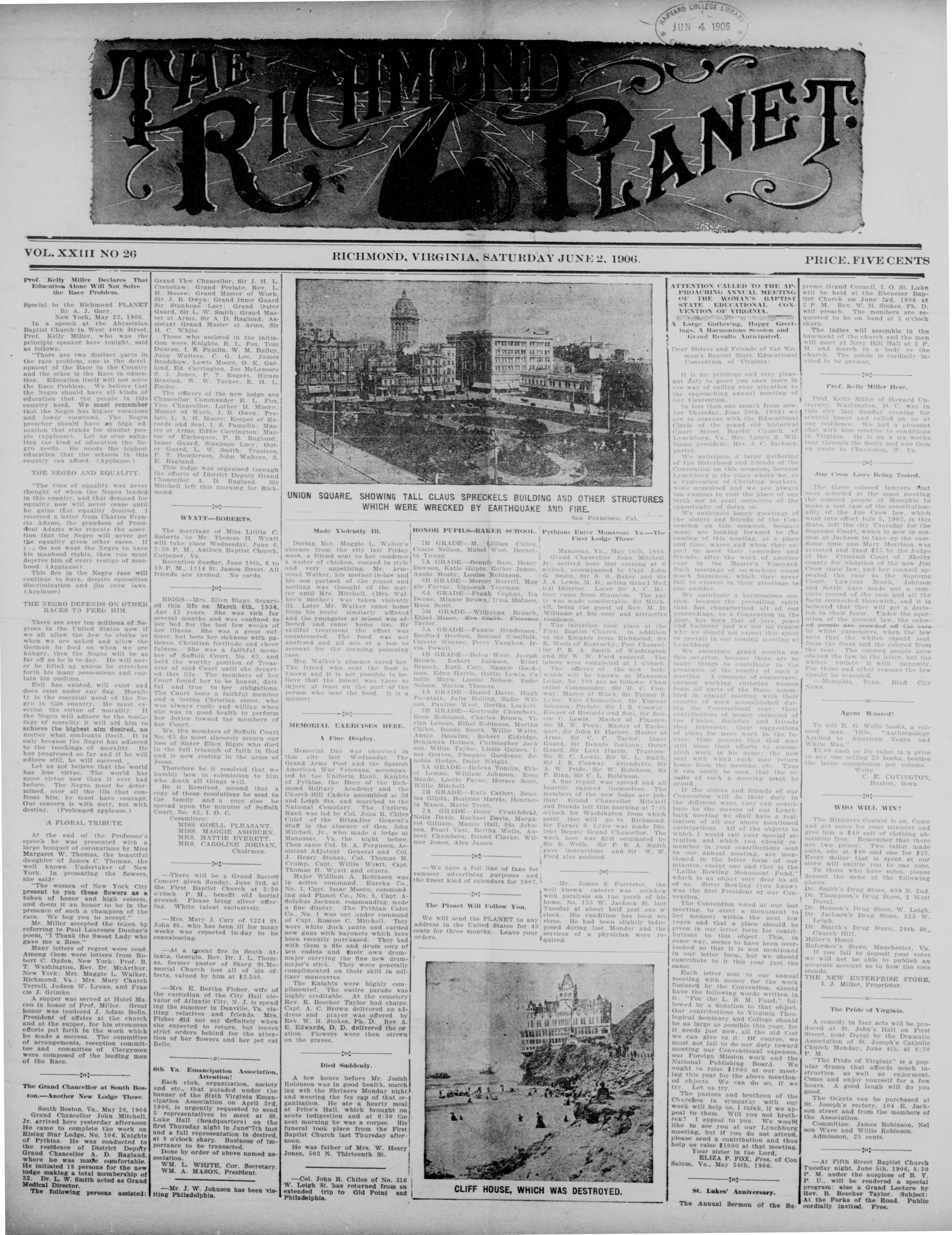
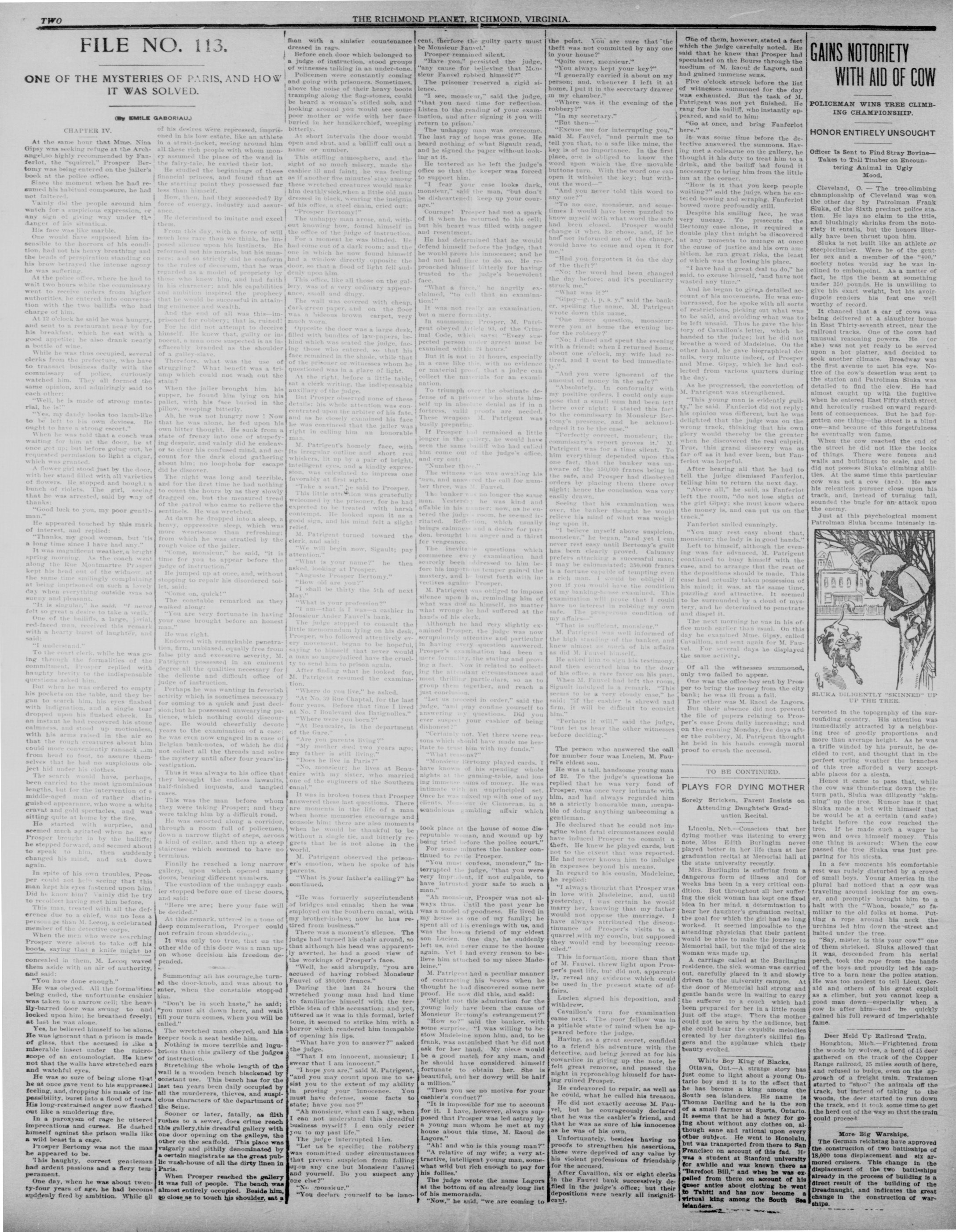
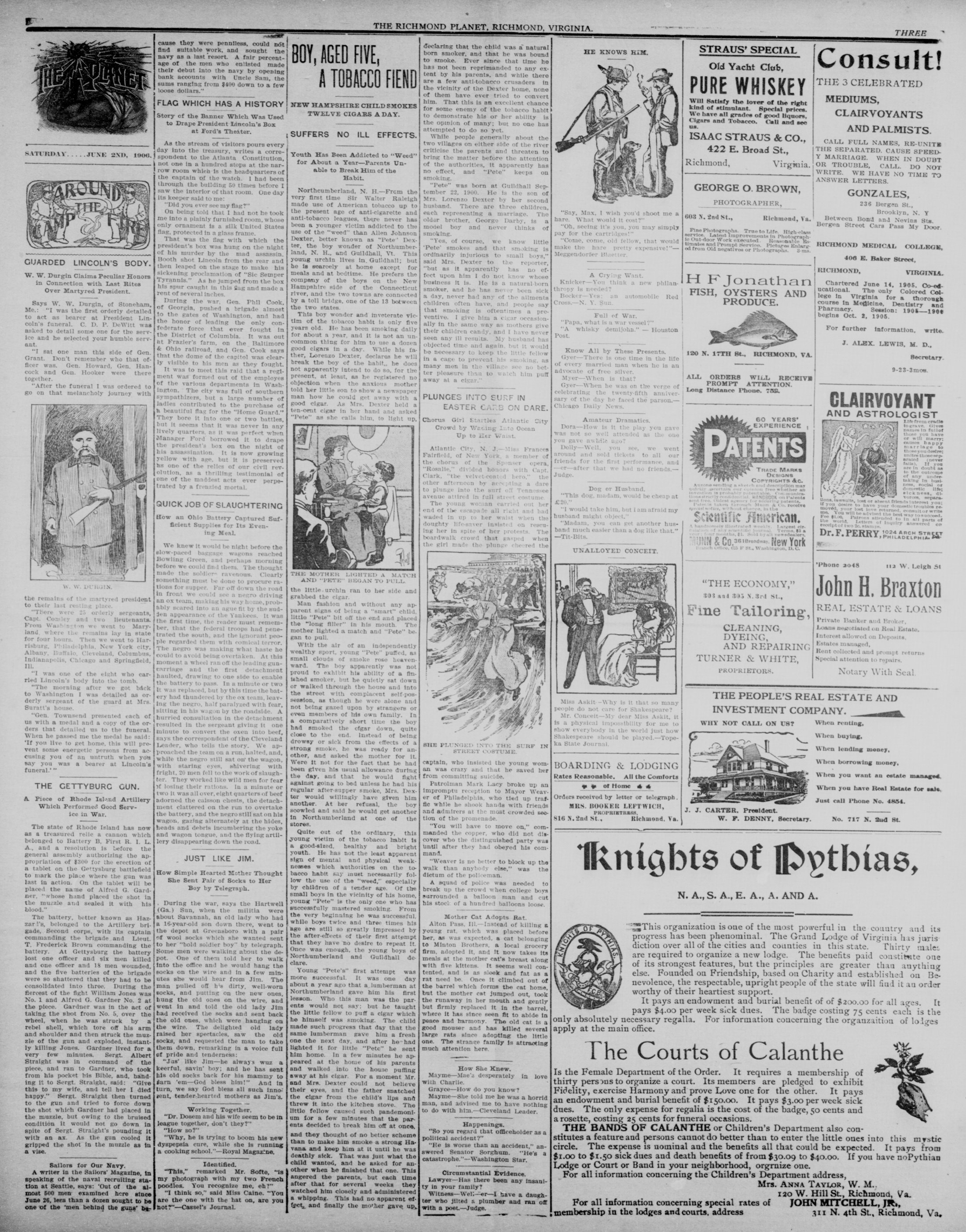
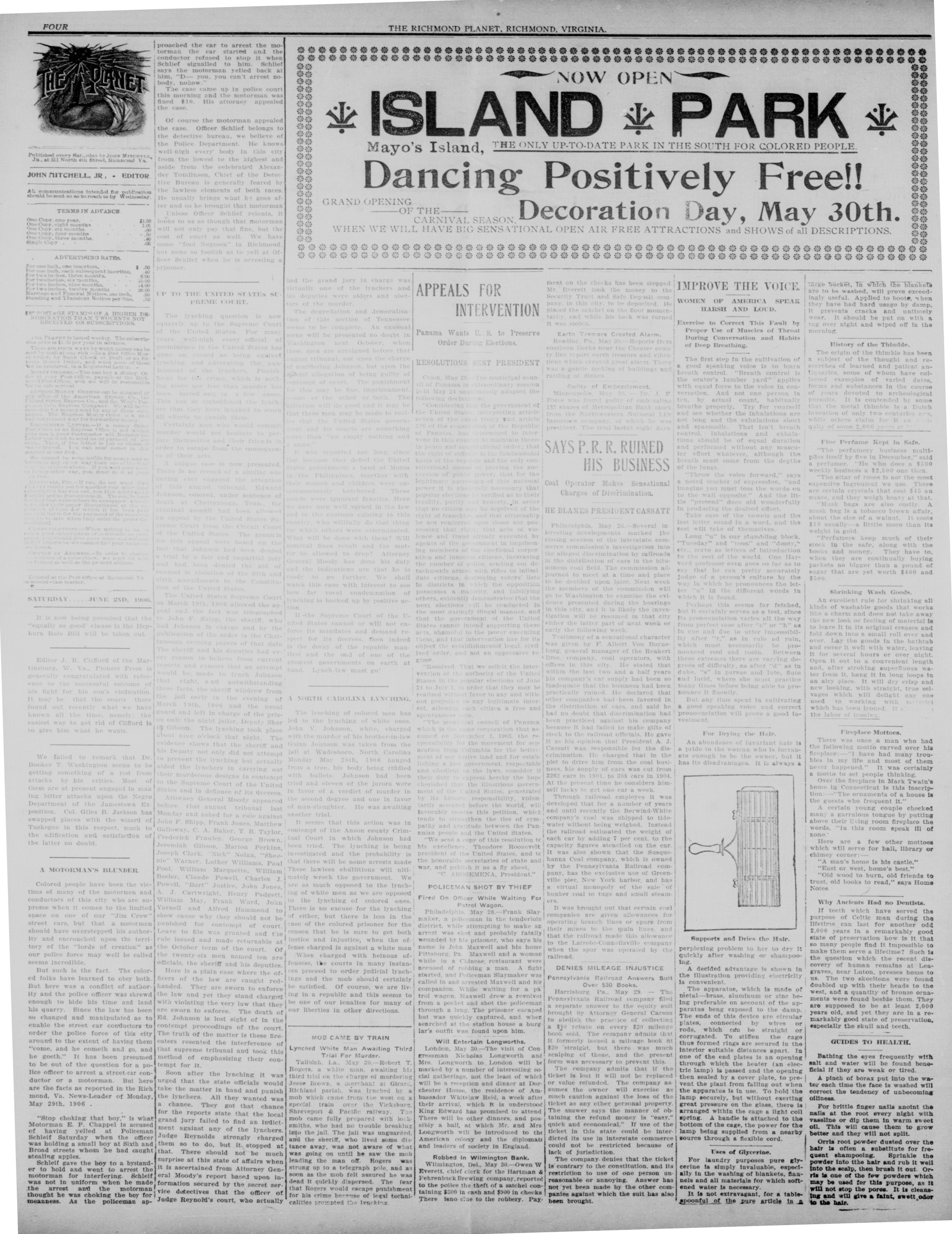
Page text (machine-generated)
THE RICHMOND PLANET
The following persons assisted: Mr. J. W. Johnson has been visitiing Philadelphia.
Prof. Kelly Miller Declares That Education Alone Will Not Solve the Race Problem.
Special to the Richmond PLANET By A. J. Gary. New York, May 23, 1996.
In a speech at the Abyssinian Baptist Church in West 40th Street, Prof. Kelly Miller, who was the principle speaker here tonight, said as follows:
"There are two distinct parts in the race problem, one is the development of the Race in the Country and the other is the Race in education. Education itself will not solve the Race Problem. We believe that the Negro should have all kinds of education that the people in this country need. We must remember that the Negro has higher vocations and lower vocations. The Negro preacher should have as high education that stands for similar people (applause). Let us stop agitating the kind of education the Negro needs. He needs the highest education that the schools in this country can afford. (Applause.)"
THE NEGRO AND EQUALITY.
"The time of equality was never thought of when the Negro landed in this country, and that demand for equality now will never cease until he gains that equality desired. I received a letter from Charles Francis Adams, the grandson of President Adams who repeats the assertion that the Negro will never get the equality given other races. If you do not want the Negro to have his manhood rights, then you must deprive him of every vestige of manhood. (Applause)
This fire in the Negro race will continue to burn, despite opposition discrimination and Jim crow laws. (Applause)
THE NEGRO DEPENDS ON OTHER
RACES TO FEED HIM.
There are over ten millions of Negroes in the United States now if we all allow the Jew to clothe us when we are naked and allow the German to feed us when we are hungry, then the Negro will be as far off as he is to day. He will never be lifted up unless he stretches forth his many possessions and captain his position.
Evil has existed, will exist and does exist under any flag. Morality is the essential need of the Negro in this country. He must exercise the virtue of morality. If the Negro will adhere to the teachings of morality it will add him to achieve the highest aim desired, no matter what confronts itself. It is only because the Negro has adhered to the teachings of morality. He has progressed so far and if he will adhere still, he will succeed.
Let us not believe that the world has less virtue. The world has more virtue now than it ever had before. The Negro must be determined, over all the ills that confront him, he must have courage. Our concern is with duty, not with destiny. (Prolonged aplause.)
A FLORAL TRIBUTE
At the end of the Professor's speech he was presented with a large bouquet of coronations by Miss Margaret W. Thomas, the beautiful daughter of James C. Thomas, the well known Undertaker of New York. In presenting the flowers, she said:
"The women of New York City present to you these flowers as a token of honor and high esteem, and deem it an honor to be in the presence of such a champion of the race. We beg you to accept."
Mr. Miller accepted the token by referring to Paul Laurence Dunbar's poem, "I Thank the Sweet Lady who gave me a Rose."
Many letters of regret were read. Among them were letters from Robert C. Ogden, New York; Prof. B. T. Washington, Rev. Dr. McArthur, New York; Mrs. Maggie L. Walker, Richmond, Va.; Mrs. Mary Church Terrell, Judson W. Lyons, and Fran cis J. Grimke.
A supper was served at Hotel Maceo in honor of Prof. Miller. Great honor was tendered J. Adam Bolin, President of affairs at the church and at the supper, for his strenuous efforts put forth in the work which he made a success. The committee of arrangements, reception committee and committee of Clergymen were composed of the leading men of the Race.
The Grand Chancellor at South Boston.—Another New Lodge There.
South Boston, Va., May 26, 1966
Grand Chancellor John Mitchell,
Jr. arrived here yesterday afternoon
He came to complete the work on
Rising Star Lodge, No. 166. Knights
of Pythias. He was conducted to
the residence of District Deputy
Grand Chancellor A. D. Ragland,
where he was made comfortable.
He initiated 18 persons for the new
lodge making a total membership of
32. Dr. L. W. Smith acted as Grand
Medical Director.
Grand Vice Chancellor, Sir J. H. L. Crenshaw; Grand Prelate, Rev. L. H. Moore; Grand Master of Work, Sir J. B. Owen; Grand Inner Guard Sir Stanhope Lacy; Grand Outer Guard, Sir L. W. Smith; Grand Master at Arms, Sir A. D. Ragland; Assistant Grand Master at Arms, Sir H. C. White.
Those who assisted in the initiation were Knights, R. L. Fox, Tom Duncan, I. S. Pamlin, W. M. Bailey, Joan Walters, C. G. Lee, James Bradshaw, Lewis Moore, O. K. Garland, Ed. Carrington, Joe McLemore S. J. Jones, P. T. Rogers, Hiram Braxton, W. W. Tucker, R. H. L. Easley.
The officers of the new lodge are Chancellor Commander R. L. Fox, Vice Chancellor, Luther H. Moore; Master of Work, J. B. Owen; Prelate, L. A. H. Moore; Keeper of Records and Seal, I. S. Pamlin; Master at Arms, Eddie Carrington; Master of Exchequer, P. B. Ragland; Inner Guard, Stanhope Lacy; Outer Guard, L. W. Smith; Trustees, F. T. Henderson, John Walters, S. E. Ragland.
This lodge was organized through the efforts of District Deputy Grand Chancellor A. D. Ragland. Sir Mitchell left this morning for Richmond.
WYATT—ROBERTS
The marriage of Miss Littia C.
Roberts to Mr. Thomas H. Wyatt
will take place Wednesday, June 6,
3:30 P. M., Antioch Baptist Church,
Culpeper, Va.
Reception Sunday, June 10th, 6 to
10 P. M., 1114 St. James Street. All
friends are invited. No cards.
BIGGS—Mrs. Ellen Biggs, departed this life on March 6th, 1936, Age 42 years. She was sick for several months and was confined to her bed for the last few weeks of her illness. She was a great sufferer, but bore her sickness with patience. Christian fortitude and cheerfulness. She was a faithful member of Suffolk Court, No. 63, and held the worthy position of Treasurer of said Court until she departed this life. The members of her Court found her to be honest, dutiful and true to her obligations. The Court loses a faithful member and a loving Christian sister, who was always ready and willing when she was in good health to perform her duties toward tae members of her Court.
We, the members of Suffolk Court No. 63 do most sincerely mourn our loss of Sister Ellen Biggs who died in the full triumph of faith in God and is now resting in the arms of Jesus.
Therefore be it resolved that we humbly bow in submission to him who doeth all things well.
Be it Resolved, second that a copy of these resolutions be sent to the family and a copy also be spread upon the minutes of Suffolk Court, No. 63, I. O. C.
Committee:
MISS ODELL PLEASANT.
MISS. MAGGIE ASHBURN.
MRS. MATTIE EVERETT.
MRS. CAROLINE JORDAN.
Chairman.
—There will be a Grand Sacret Concert given Sunday, June 3rd, at the First Baptist Church at 3:30 o'clock P. M., benefit old burial ground. Please bring silver offering. White talent exclusively.
—Mrs. Mary J. Cary of 1224 St. John St., who has been ill for many weeks was reported to-day to be convalescing.
—At a recent fire in South Atlanta, Georgia, Rev. D. I. L. Thomas, former pastor of Sharp St.Memorial Church lost all of his effects, valued by him at $2,500.
—Mrs. E. Bertha Fisher, wife of the custodian of the City Hall elevator of Atlantic City, N. J. is spending the summer in Danville, Va. visiting relatives and friends. Mrs. Fisher did not say definitely when she expected to return, but leaves strict orders behind for the attention of her flowers and her pet cat Belle.
6th Va. Emancipation Association
Attention!
Each club, organization, society and etc., that paraded under the banner of the Sixth Virginia Emancipation Association on April 3rd, 1906, is urgently requested to send 5 representatives to meet at St. Luke Hall (headquarters) on the first Thursday night in June 7th inst and a full representation is desired, at $ 8 o'clock sharp. Business of importance to be transacted. Done by order of above named association.
WM. L. WHITE, Cor. Secretary.
WM. A. MASON, President.
RICHMOND, VIRGINIA, SATURDAY JUNE 2, 1906
THE PLAZA
UNION SQUARE, SHOWING TALL CLAUS SPRECKELS BUILDING AND OTHER STRUCTURES WHICH WERE WRECKED BY EARTHQUAKE AND FIRE.
Made Violently Ill.
During Mrs. Maggie L. Walker's absence from the city last Friday week, a friend sent to her residence a waiter of chicken, cooked in style and very appetizing, Mr. Armstead Walker, his mister-in-law and his son partook of the repast and nothing was thought of the matter until Mrs. Mitchell, (Mrs. Walker's mother) was taken violently ill. Later Mr. Walker came home from his route similarly afflicted and the youngster at school was affected and came home too. By skillful treatment the effect was counteracted. The food was not analyzed and all are at a loss to account for the seeming poisoning case.
Mrs. Walker's absence saved her. The friend who sent the food is known and it is not possible to believe that the intent was there to injure, at least on the part of the person who sent the food. It is a mystery.
MEMORIAL EXERCISES HERE
A Fine Display.
Memorial Day was observed in this city last Wednesday. The Grand Army Post and the Spanish American War Veterans, accompanied by the Uniform Rank, Knights of Pythias, the Boys of the Richmond Military Academy and the Church-Hill Cadets assembled at 3rd and Leigh Sts, and marched to the National Cemetary. The Uniform Rank was led by Col. Joan R. Chiles Chief of the Brigadier General's Staff in the absence of Gen. John Mitchell, Jr., who made a lodge at Manassas, Va. the night before. Then came Col. D. A. Ferguson, Assistant Adjutant General and Col. J. Henry Stokes, Col. Thomas M. Crump, Capt. Willis Wyatt, Capt. Thomas H. Wyatt and otaurs.
Major William A. Robinson was in active command. Eureka Co, No. 1, Capt. Isaac Moore, commanding and Planet Co, No. 8, Capt. Adolphus Jackson, commanding, made a fine display. The Pythian Cadet Co, No. 1 was out under command of Capt. Roscoe C. Mitchell. They wore white duck pants and carried new guns with bayonets which have been recently purchased. They had with them a rifle and drum corp of ten cadets and their own drum-major carrying the fine new drum-major's stick. They were generally complimented on their skill in military maneuvers.
The Knights were highly complimented. The entire parade was highly creditable. At the cemetery Rev. R. Beecher Taylor had charge Capt. A. C. Brown delivered an address and prayer was offered by Rev. W. H. Stokes, Ph. D. Rev. E. Edwards, D. D. delivered the oration. Flowers were then strewn on the graves.
Died Suddenly.
A few hours before Mr. Josiah Robinson was in good health, marching with the Shriners Monday night and wearing the fez cap of that organization. He ate a hearty meal at Price's Hall, which brought on acute indigestion and at 6:30 the next morning he was a corpse. His funeral took place from the First Baptist Church last Thursday afternoon. He was father of Mrs. W. Henry Jones, 503 N. Thirteenth St.
—Col. John R. Chiles of No. 316 W. Leigh St. has returned from an extended trip to Old Point and Philadelphia.
CLIFF HOUSE, WHICH WAS DESTROYED.
HONOR PUPILS-BAKER SCHOOL
7B GRADE—M, Lillian Chiles
Bass Nelson, Mabel West, Bernetta Young.
7A GRADE—Bennie Bass, Henry Dawson, Katie Glipin, Esther James, Annie Mosby, Louise Robinson.
6B GRADE—Mercer Burrell, Maggie Farrar, Zipporah Yearman.
6A GRADE—Frank Cephas, Ira Deane, Minnie Brown, Irma Holmes, Rosa Scott.
5B GRADE—Williana Branch, Ethel Minor, Eva Smith, Florence Taylor.
5A GRADE—Fannie Henderson, Rexford Ovelton, Samuel Woolfolk, Celeste Weaver, Percy Vaughan, Irvin Powell.
4B GRADE—Helen West, Joseph Brown, Robert Johnson, Ethel Branch, Ruth Cary, Nannie Goodman, Edna Harris, Hattie Lewis, Camille Mayo, Louise Nelson, Sadie Nelson, Marion Thomas.
4A GRADE—Daniel Davis, Hugh Fountain, Julia Bolling, Sadie Wilson, Pauline West, Bertha Lockett.
3B GRADE—Gertrude Chambers, Rosa Robinson, Charles Brown, Vivian Lemus, Ethel Robinson, Martha Chiles, Bessie Smith, Willie Watts, Annie Haskins, Robert Eldridge, Benjamin Holmes, Christopher Jackson, Willie Taylor, Lizzie Gaines, Inez Graves, Florence Gardener, Zenobia Hodge, Daisy Wright.
3A GRADE—Helena Tomlin, Ethel Lemas, William Johnson, Rosa Mende, Lucile Payne, Horace Scott, Willie Mitchell.
2B GRADE—Ruth Catlett, Zenobia Gilpin, Beatrice Harris, Henrietta Mason, Marice Trent.
2A GRADE—Daisy Crutchefkiel, Nolia Davis, Rachael Davis, Margaret Gilliam, Mamie Hall, Ma Johnson, Pearl Vest, Bertha Wells, Aubrey Chambers, Daniel Clarke, Wilmer Jones, Alex James.
—We have a fall line of fans for summer advertising purposes and the finest kind of calendars for 1907
The Planet Will Follow You
We will send the PLANET to any address in the United States for 40 cents for three months. Leave your orders.
San Francisco, Cal.
Pythians Enter Manassas, Va.—The First Lodge There.
Manassas, Va., May 30th, 1906.
Grand Chancellor John Mitchell, Jr., arrived here last evening at 6 o'clock, accompanied by Capt. John G. Smith, Sir S. S. Baker and Sir J. A. Lewis, M. D., acting Grand Medical Director, Later Sir A. M. Murrey came from Staunton. The party was made comfortable. Sir Mitchell, being the guest of Rev. M. D. Williams at his cosy and attractive residence.
The initiation took place at the First Baptist Church. In addition to the Knights from Richmond, Sir R. Wells of Kentucky, Past Chancellor P. R. A. Smith of Washington and Sir W. W. Ford assisted. The labors were completed at 1 o'clock.
The officers of the new body which will be known as Manassas Lodge. No. 109 are as follows: Chancellor Commander, Sir H. C. Conway: Master of Work, Sir Turner S. Lyles: Vice Chancellor, Sir Vincent Johnson: Prelate, Sir R. Conway: Sir Kearn of Records and Seal, Sir Roscoe C. Lewis: Master of Finance, Sir M. W. Penn: Master of Exchequer, Sir John D. Harper: Master at Arms, Sir C. C. F. Taylor: Inner Guard, Sir Dennis Jackson: Outer Guard, Sir Dennis Harris: Trustees, Sir R. C. Lewis, Sir W. L. Smith, Sir J. R. Conway, Attendants, Sir A. W. Pride, Sir W. Robinson, Sir P. Binn, Sir C. L. Robinson
A fine repast was spread and all heartily enjoyed themselves. The members of the new lodge are jubilant. Grand Chancellor Mitcaell and friends left this morning at 7:35 o'clock for Washington from which point they will go to Richmond. Sir Turner S. Lyles was made District Deputy Grand Chancellor. The work here was first originated by Sir R. Wells. Sir P. R. A. Smith gave instructions and Sir W. W. Ford also assisted.
Mr.. James S. Forrester, the well known caterer was stricken with paralysis on the porch of his home, No. 133 W. Jackson St. last Tuesday at about half past one o'clock. His condition has been serious. He had been slightly indisposed during last Monday and the services of a physician were required.
ATTENTION CALLED TO THE APPROACHING ANNUAL MEETING OF THE WOMAN'S BAPSTIST STATE EDUCATIONAL CONVENTION OF VIRGINIA.
A Large Gathering, Happy Greetings, A Harmonious Session and Grand Results Anticipated.
Dear Sisters and Friends of the Woman's Baptist State Educational Convention of Virginia:
It is my privilege and very pleasant duty to greet you once more in the way of calling your attention to the approaching annual meeting of our Convention.
In less than one month from now, (or Thursday, June 20th, 1906) we are to convene with the Educational Circle of the grand old historical Court Street Baptist Church, of Lynchburg, Va., Mrs. Laura S. Williams, president; Rev. J. C. Jackson, pastor.
We anticipate a large gathering of the Sisterhood and friends of the Convention on this occasion, because Lynchburg is the place where we, as a Convention of Christian workers, were organized and we are always too anxious to visit the place of our birth not to avail ourselves of the opportunity of doing so.
We anticipate happy greetings of the sisters and friends of the Convention on this occasion, because many are looking forward to the coming of this meeting, as a place and time, where and when they expect to meet their comrades and friends, after the work of another year in the Master's Vineyard. Such meetings of co-workers cause much happiness, which they never fail to express in their greetings to one another.
We anticipate a harmonious session, because the prevailing spirit that has characterized all of our proceedings, as a Convention in the past, has been that of love, peace and harmony and we see no reason why we should not expect this spirit to prevail in our coming meeting at Lynchburg.
We anticipate grand results on this occasion, because there are so many things to contribute to the greatness of the results of such a meeting. A company of consecrated earnest working, christian women from all parts of the State, assembled in annual meeting with their reports of work accomplished during the Conventional year; their contributions of money collected of the Circles, Societies and friends they represent; their suggestions of plans for more work in the future; their prayers that God may still bless their efforts to accomplish work in his name; the new zeal with which each may return home from the meeting, etc. Thus it can easily be seen, that the results of such a meeting must be grand.
If the sisters and friends of our Convention will do their duty in the different ways, they can contribute to the success of our Lynchburg meeting we shall have a realization of all our above mentioned anticipations. All of the objects to which I would call your special attention and which you should remember in your contributions sent to our annual meeting, are mentioned in the letter form of our minutes, except one and that is the "Lallia Bowling Monument Fund," which is an object very dear to all of us. Sister Bowling (you know) was the first President of our Convention.
The Convention voted at our last meeting, to erect a monument to her memory within the next few years and that a place should be given in our letter form for contributions to this object. This, in some way, seems to have been overlooked so that it is not mentioned in our letter form, but we should contribute to it this year just the same.
Each letter sent to our annual meeting with money for the work fostered by the Convention, should have the following words written in it: "For the L. B. M. Fund," followed by a donation to that object. Our contributions to Virginia Theological Seminary and College should be as large as possible this year, for it needs just now, all the altd that we can give to it. Of course, we must not fail to do our duty toward meeting our Conventional expenses, our Foreign Mission work and the National Publishing Board. We ought to raise $1000 at our meeting this year for the above mentioned objects. We can do so, if we try. Let us try.
The pastors and brethren of the Churches in sympathy with our work will help us. I think, if we appeal to them. Will you not brethren? I appeal to you. We would like to see you at our Lynchburg meeting, but if you do not attend, please send a contribution and thus help us raise $1000 at that meeting.
Your sister is here.
the Lord.
ELIZA P. FOX. Pres. of Con
Salem. May, 34th 2013.
preme Grand Council, I. O. St. Luke will be held at the Ebenezer Baptist Church on June 3rd, 1906 at 3 P. M. Rev. W. H. Stokes, Ph. D. will preach. The members are requested to be on hand at 3 o'clock sharp. The ladies will assemble in the basement of the church and the men will meet at Navy Hall Hall at 2 P. M. and march in a body to the church. The public is cordially invited to be present.
Prof. Kelly Miller Here
Prof. Kelly Miller of Howard University, Washington, D.C. was in this city last Sunday evening for several hours and called on us at our residence. We had a pleasant chat with him relative to conditions in Virginia. He is on a six weeks tour through the South and was then en route to Charleston, W. Va.
Jim Crow Laws Being Tested
The three colored lawyers that were selected at the mass meeting the colored people of Memphis to make a test case of the constitutionality of the Jim Crow law, which went into effect July 5, 1905, in this State, left the city Thursday for the Supreme Court, which is now in session at Jackson to take up the case. Some time ago Mary Morrison was arrested and fined $25 by the Judge of the Criminal Court of Shelby county for violation of the new Jim Crow state law, and her counsel appealed the case to the Supreme Court. Lawyers Booth, Johnson and Settle have made out a complete record of the case and all the facts connected therewith, and it is believed that they will get a decision in their favor. Under the operation of the present law, the colored people are crowded off the cars by white passengers, when the law says that the whites should sent from the front and the colored from the rear. The colored people have obeyed the law to the letter, but the whites violate it with impunity. For these and other reasons the law should be repealed.
—Memphis, Tenn. Bluff City News.
Agent Wanted!
To sell R. G. Wells books, a colored man. Title, "Anthropology Applied to American Negro and White Man."
$5.00 cash or its value in a prize to any one selling 25 books, besides the large commission per volume.
Write
C. E. COVINGTON,
Baxton, Iowa.
WHO WILL WIN?
The Ministers Contest is on. Come and get votes for your minister and give him a $40 suit of clothing absolutely free. Remember that there are two prizes; Two tailor made suits, one at $40 and one for $25. Every dollar that is spent at our store will entitle you to one vote. To those who have votes, please deposit the same at the following places: Dr. Smith's Drug Store, 609 N. 2nd. Dr. Thompson's Drug Store, 2 West Duval. Dr. Benson's Drug Store, W. Leigh. Dr. Jackson's Drug Store, 825 W. Leigh. Dr. Smyth's Drug Store, 29th St., Church Hill. Miller's Hotel. Reformer's Store, Manchester, Va. If you fall to deposit your votes we will not be able to publish an accurate account as to how the vote stands. THE NEW ENTERPRISE STORE, I. J. Miller, Proprietor
The Pride of Virginia.
A comedy in four acts will be produced at St. John's Hall on First Street, near Duval by the Dramatic Association of St. Joseph's Cathedral Church Monday, June 4th, at 8:30 P. M.
"The Pride of Virginia" is a popular drama that affords much instruction as well as enjoyment. Come and enjoy yourself for a few hours. A good laugh will do you good.
The tickets can be purchased at St. Joseph's rectory, 104 E. Jackson street and from the members of the Association.
Committee: James Robinson, Nelson Ware and Willie Robinson.
Admission 25 cents.
—At Fifth Street Baptist Church Tuesday night, June 5th, 1906, 8:30 P. M. under the auspices of B. Y. P. U., will be rendered a special program: also a Grand Lecture by Rev. R. Beecher Taylor. Subject: At the Forks of the Road. Public cordially invited. Free.
FILE NO. 113.
ONE OF THE MYSTERIES OF PARIS, AND HOW IT WAS SOLVED.
(BY EMILE GABORIAU.)
At the same hour that Mme. Nina Gipsy was seeking refuge at the Archangel, so highly recommended by Fanerlot, the "squirrel," Prosper Bertomy was being entered on the jailer's book at the police office.
Since the moment when he had resumed his habitual composure, he had not faltered.
Vainly did the people around him watch for a suspicious expression, or any sign of giving way under the danger of his situation.
His face was like marble.
One would have supposed him insensible to the horrors of his condition, had not his heavy breathing and the beads of perspiration standing on his brow betrayed the intense agony he was suffering.
At the police office, where he had to wait two hours while the commissary went to receive orders from higher authorities, he entered into conversation with the two bailiffs who had charge of him.
At 12 o'clock he said he was hungry, and sent to a restaurant near by for his breakfast, which he eat with a good appetite; he also drank nearly a bottle of wine.
While he was thus occupied, several clerks from the prefecture, who have to transact business daily with the commissary of police, curiously watched him. They all formed the same opinion, and admiringly said to each other:
"Well, he is made of strong material, he is!"
"Yes, my dandy looks too lamb-like to be left to his own devices. He ought to have a strong escort."
When he was told that a coach was waiting for him at the door, he at once got up; but before going out, he requested permission to light a cigar, which was granted.
A flower girl stood just by the door, with her stand filled with all varieties of flowers. He stopped and bought a bunch of violets. The girl, seeing that he was arrested, said by way of thanks:
"Good luck to you, my poor gent!-man."
He appeared touched by this mark of interest, and replied:
"Thanks, my good woman, but 'tis a long time since I have had any."
It was magnificent weather, a bright spring morning. As the coach went along the Rue Montmartre Prosper kept his head out of the widnow at the same time smilingly complaining at being imprisoned on such a lovely day when everything outside was so sunny and pleasant.
"It is singular," he said. "I never felt so great a desire to take a walk."
One of the bailiffs, a large, jewel, red-faced man, received this remark with a hearty burst of laughter, and said:
"I understand."
To the court clerk, while he was going through the formalities of the commitment, Prosper replied with haughty brevity to the indispensable questions asked him.
But when he was ordered to empty his pockets on the table, and they began to search him, his eyes flashed with indignation, and a single tear dropped upon his flushed cheek. In an instant he had recovered his stone calmness, and stood up motionless, with his arms raised in the air so that the rough creatures about him could more conveniently ransack him from head to foot, to assure themselves that he had no suspicious object hid under his clothes.
The search would have, perhaps, been carried to the most ignominious lengths, but for the intervention of a middle-aged man of rather distinguished appearance, who wore a white cravat and gold spectacles, and was sitting quite at home by the fire.
He started with surprise, and seemed much agitated when he saw Prosper brought in by the balliiffs; he stepped forward, and seemed about to speak to him, then suddenly changed his mind, and sat down again.
In spite of his own troubles, Prosper could not help seeing that this man kept his eyes fastened upon him. Did he know him? Vainly did he try to recollect having met him before.
This man, treated with all the deference due to a chief, was no less a personage than M. Lecoq, a celebrated member of the detective corps.
When the men who were searching Prosper were about to take off his boots, saying that a knife might be concealed in them, M. Lecoq waved them aside with an air of authority, and said:
"You have done enough."
He was obeyed. All the formalities being ended, the unfortunate cashier was taken to a narrow cell; the heavily-barred door was swung to and locked upon him; he breathed freely; at last he was alone.
Yes, he believed himself to be alone. He was ignorant that a prison is made of glass, that the accused is like a miserable insect under the microscope of an entomologist. He knew not that the walls have stretched ears and watchful eyes.
He was so sure of being alone that he at once gave vent to his suppressed feeling, and, dropping his mask of impassibility, burst into a flood of tears. His long-restrained anger now flashed out like a smoldering fire.
In a paroxysm of rage he uttered imprecations and curses. He dashed himself against the prison walls like a wild beast in a cage.
Irosper Bertomy was not the man he appeared to be.
This haughty, correct gentleman had ardent passions and a fiery temperament.
One day, when he was about twenty-four years of age, he had become suddenly fired by ambition. While all
TWO
CHAPTER IV.
"I understand."
of his desires were repressed, imprisoned in his low estate, like an athlete in a strait-jacket, seeing around him all these rich people with whom money assumed the place of the wand in the fairy-tale, he envised their lot.
He studied the beginnings of these financial princes, and found that at the starting point they possessed far less than himself.
How, then, had they succeeded? By force of energy, industry and assurance.
He determined to imitate and excel them.
From this day, with a force of will much less rare than we think, he imposed silence upon his instincts. He reformed not his morals, but his manners; and so strictly did he conform to the rules of decorum, that he was regarded as a model of propriety by those who knew him, and had faith in his character; and his capabilities and ambition inspired the prophecy that he would be successful in attaining eminence and wealth.
And the end of all was this—imprisoned for robbery; that is, ruined! For he did not attempt to deceive himself. He knew that, guilty or innocent, a man once suspected is as inefaceably branded as the shoulder of a galley-slave.
Therefore, what was the use of struggling? What benefit was a triumph which could not wash out the stain?
When the jailer brought him his supper, he found him lying on his pallet, with his face buried in the pillow, weeping bitterly.
Ah, he was not hungry now! Now that he was alone, he fed upon his own bitter thought. He sunk from a state of frenzy into one of stupefying despair, and vainly did he endeavor to clear his confused mind, and account for the dark cloud gathering about him; no loop-hole for escape did he discover.
The night was long and terrible, and for the first time he had nothing to count the hours by as they slowly dragged on, but the measured tread of the patrol who came to relieve the sentinels. He was wretched.
At dawn he dropped into a sleep, a heavy, oppressive sleep, which was more wearisome than refreshing; from which he was stratled by the rough voice of the jailer.
"Come, monsieur," he said, "it is time for you to appear before the judge of instruction."
He jumped up at once, and, without stopping to repair his disordered toilet, said:
"Come on, quick!"
The constable remarked as they walked along:
"You are very fortunate in having your case brought before an honest man."
He was right.
Endowed with remarkable penetration, firm, unbiased, equally free from false pity and excessive severity, M. Patrigent possessed in an eminent degree all the qualities necessary for the delicate and difficult office of judge of instruction.
Perhaps he was wanting in feverish activity which is sometimes necessary for coming to a quick and just decision; but he possessed unwearying patience, which nothing could discourage. He would cheerfully devote years to the examination of a case; he was even now engaged in a case of Belgian bank-notes, of which he did not collect all the threads and solve the mystery until after four years' investigation.
Thus it was always to his office that they brought the endless lawsuits, half-finished inquests, and tangled cases.
This was the man before whom they were taking Prosper; and they were taking him by a difficult road.
He was escorted along a corridor, through a room full of policemen, down a narrow flight of steps, across a kind of cellar, and then up a steep staircase which seemed to have no terminus.
Finally he reached a long narrow gallery, upon which opened many doors, bearing different numbers.
The custodian of the unhappy cashier stopped before one of these doors, and said:
"Here we are; here your fate will be decided."
At this remark, uttered in a tone of deep commiseration, Prosper could not refrain from shuddering.
It was only too true, that on the other side of this door was a man upon whose decision his freedom depended.
Summoning all his courage, he turned the door-knob, and was about to enter, when the constable stopped him.
"Don't be in such haste," he said; "you must sit down here, and wait till your turn comes, when you will be called."
The wretched man obeyed, and his keeper took a seat beside him.
Nothing is more terrible and lugubrious than this gallery of the judges of instruction.
Stretching the whole length of the wall is a wooden bench blackened by constant use. This bench has for the last ten years been daily occupied by all the murderers, thieves, and suspicious characters of the department of the Seine.
Sooner or later, fatally, as flith rushes to a sewer, does crime reach this gallery, this dreadful gallery with one door opening on the galleys, the other on the scaffold. This place was vulgarly and pithily denominated by a certain magistrate as the great public wash-house of all the dirty linen in Paris.
When Prosper reached the gallery it was full of people. The bench was almost entirely occupied. Beside him, so close as to touch his shoulder, sat a
THE RICHMOND PLANET. RICHMOND. VIRGINIA
man with a sinister countenance dressed in rags.
Before each door which belonged to a judge of instruction, stood groups of witnesses talking in an under-tone.
Policemen were constantly coming and going with prisoners. Sometimes, above the noise of their heavy boots tramping along the flag-stones, could be heard a woman's stifled sob, and looking around you would see some poor mother or wife with her face buried in her handkerchief, weeping bitterly.
At short intervals the door would open and shut, and a bailiff call out a name or number.
This stifling atmosphere, and the sight of so much misery, made the cashier ill and faint; he was feeling as if another five minutes' stay among these wretched creatures would make him deathlysick, when a little old man dressed in black, wearing the insignia of his office, a steel chain, cried out: "Prosper Bertomyl!" The unhappy man arose, and, without knowing how, found himself in the office of the judge of instruction. For a moment he was blinded. He had come out of a dark room; and the one in which he now found himself had a window directly opposite the door, so that a flood of light fell suddenly upon him. This office, like all those on the gallery, was of a very ordinary appearance, small and dingy. The wall was covered with cheap, dark-green paper, and on the floor was a bideous brown carpet, very much worn.
Opposite the door was a large desk, filled with bundles of law-papers, behind which was seated the judge, facing those who entered, so that his face remained in the shade, while that of the prisoner or witnesses whom he questioned was in a glare of light.
At the right, before a little table, sat a clerk writing, the indispensable auxiliary of the judge.
But Prosper observed none of these details; his whole attention was concentrated upon the arbiter of his fate, and as he closely examined his face he was convinced that the jailer was right in calling him an honorable man.
M. Patrigent's homely face, with its irregular outline and short red whiskers, lit up by a pair of bright, intelligent eyes, and a kindly expression, was calculated to impress one favorably at first sight.
"Take a seat," he said to Prosper. This little attention was gratefully welcomed by the prisoner, for he had expected to be treated with harsh contempt. He looked upon it as a good sign, and his mind felt a slight relief. M. Patricligent turned toward the clerk, and said: "We will begin now, Sigault; pay attention."
"What is your name?" he then asked, looking at Prosper.
"Auguste Prosper Bertomy."
"How old are you?"
"I shall be thirty the 5th of next May."
"What is your profession?"
"I am—that is I was—a cashier in Monsieur Ander Fauvel's bank.
The judge stopped to consult the little memorandum lying on his desk. Prosper, who followed attentively every movement, began to be hopeful, saying to himself that never would a man so unprejudiced have the cruelty to send him to prison again.
After finding what he looked for, M. Patrigent resumed the examination.
"Where do you live," he asked.
"At No. 39 Rue Chaptal, for the last four years. Before that time I lived at No. 7 Boulevard des Batignolles."
"Where were you born?"
"At Beaucaire, in the department of the Gare."
"Are you parents living?"
"My mother died, two years ago; my father is still living."
"Does he live in Paris?"
"No, monsieur; he lives at Beaucaire with my sister, who married one of the engineers of the Southern canal."
It was in broken tones that Prosper answered these last questions. There are moments in the life of a man when home memories encourage and console him; there are also moments when he would be thankful to be without a single tie, and bitterly regrets that he is not alone in the world.
M. Patrigent observed the prisoner's emotion, when he spoke of his parents.
"What is your father's calling?" he continued.
"He was formerly superintendent of bridges and canals; then he was employed on the Southern canal, with my brother-in-law; now he has retired from business."
There was a moment's silence. The judge had turned his chair around, so that although his head was apparently averted, he had a good view of the workings of Prosper's face.
"Well, he said abruptly, 'you are accused of having robbed Monsieur Faure of 350,000 francs.'"
During the last 24 hours the wretched young man had had time to familiarize himself with the terrible idea of this accusation; and yet, uttered as it was in this formal, brief tone, it seemed to strike him with a horror which rendered him incapable of opening his lips.
"What have you to answer?" asked the judge.
"That I am innocent, monsieur; I swear that I am innocent."
"I hope you are," said M. Patrigent,
"and you may count upon me to assist you to the extent of my ability in proving your innocence. You must have defense, some facts to state; have you not?"
"Ah monsieur, what can I say, when I can not understand this dreadful business myself? I can only refer you to my past life."
The judge interrupted him.
"Let us be specific; the robbery was committed under circumstances that prevent suspicion from falling upon any one but Monsieur Laueur and yourself. Do you suspect any one else?"
"No monsieur."
"You declare yourself to be inno-
cent, therfore the guilty party must be Monsieur Faulvel.'
Prosper remained silent.
"Have you," persisted the judge,
"any cause for believing that Monsieur Fauvel robbed himself?"
The prisoner reserved a rigid silence.
"I see, monsieur," said the judge,
"that you need time for reflection. Listen to the reading of your examination, and after signing it you will return to prison.'
The unhappy man was overcome. The last ray of hope was gone. He heard nothing of what Sigault read, and he signed the paper without looking at it.
He tottered as he left the judge's office so that the keeper was forced to support him.
"I fear your case looks dark, monsieur," said the man, "but don't be dishecarted: keep up your courage."
Courage! Prosper had not a spark of it when he returned to his cell; but his heart was filled with anger and resentment.
He had determined that he would defend himself before the judge, that he would prove his innocence; and he had not had time to do so. He reproached himself bitterly for having trusted to the judge's benevolent face.
"What a farce," he angrily exclaimed, "to call that an examination!"
It was not really an examination, but a mere formality.
In summoning Prosper, M. Patriquent obeyed Article 93, of the Criminal Code, which says: "Every suspected person under arrest must be examined within 24 hours."
But it is not in 34 hours, especially in a case like this, with no evidence or material proof, that a judge can collect the materials for an examination.
To triumph over the obstinate defense of a prisoner who shuts himself up in absolute denial as if in a fortress, valid proofs are needed. These weapons M. Patrigent was busily preparing.
If Prosper had remained a little longer in the gallery, he would have seen the same bailiff who had called him come out of the judge's office, and cry out:
"Number three."
The witness who was awaiting his turn, and answered the call for number three, was M. Fauvel.
The banker was no longer the same man. Yesterday he was kind and affable in his manner; now, as he entered the judge's room, he seemed irritated. Reflection, which usually brings calmness and a desire for pardon, brought him anger and a thirst for vengeance.
The inevitable questions which commence every examination had scurried been addressed to him before his impotent temper gained the mastery, and he burst forth with invectives against Prosper.
M. Patrigent was obliged to impose silence upon him, reminding him of what was due to himself, no matter what wrongs he had suffered at the hands of his clerk.
Although he had very slightly examined Prosper, the judge was now scrupulously attentive and particular in having every question answered. Prosper's examination had been a mere formality, the stating and proving a fact. Now it related to collecting the attendant circumstances and most thrilling particulars, so as to group them together, and reach a just conclusion.
"Let us proceed in order," said the judge, "and pray confine yourself to answering my questions. Did you ever suspect your cashier of being dishonest?" "Certainly not. Yet there were reasons which should have made me hesitate to trust him with my funds." "What reasons?"
"Monsieur Bertomy played cards. I have known of his spending whole nights at the gaming-table, and losing immense sums of money. He was intimate with an unprincipled set. Once he was mixed up with one of my clients, Monsieur de Clameran, in a scandalous gambling affair which took place at the house of some disreputable woman, and wound up by being tried before the police court." For some minutes the banker continued to revile Prosper.
"You must confess, monsieur," interrupted the judge, "that you were very imprudent, if not culpable, to have intrusted your safe to such a man."
"Ah monsieur, Prosper was not always thus. Until the past year he was a model of goodness. He lived in my house as one of my family; he spent all of his evenings with us, and was the bosom friend of my eldest son Lucien. One day, he suddenly left us, and never came to the house again. Yet I had every reason to believe him attached to my niece Madeleine."
M. Patrigent had a peculiar manner of contracting his brows when he thought he had discovered some new proof. He now did this, and said:
"Might not this admiration for the young lady have been the cause of Monsieur Bortown's estrangement?"
"How so?" said the banker, with some surprise. "I was willing to be stow Madeleine upon him, and, to be frank, was astonished that he did not ask for her hand. My niece would be a good match for any man, and he should have considered himself fortunate to obtain her. She is beautiful, and her dowry will be half a million."
"Then you see no motive for your cashier's conduct?" "It is impossible for me to account for it. I have, however, always supposed that Prosper was led astray by a young man whom he met at my house about this time, M. Raoul de Lagors."
"Ah! and who is this young man?" "A relative of my wife; a very attractive, intelligent young man, somewhat wild but rich enough to pay for his follies."
The judge wrote the name Lagors at the bottom of an already long list of his memoranda.
"Now," he said, "we are coming to
the point. You are sure that "the theft was not committed by any one in your house?"
"Quite sure, monsieur."
"You always kept your key?"
"I generally carried it about on my person; and, whenever I left it at home, I put it in the secretary drawer in my chamber."
"Where was it the evening of the robbery?"
"In my secretary."
"But then—"
"Exuse me for interrupting you," said M. Fauvel, "and permit me to tell you that, to a safe like mine, the key is of no importance. In the first place, one is obliged to know the word upon which the five movable buttons turn. With the word one can open it without the key; but without the word—"
"And you never told this word to any one?"
"To no one, monsieur, and sometimes I would have been puzzled to know myself with what word the safe had been closed. Prosper would change it when he chose, and, if he had not informed me of the change, would have to come and open it for me."
"Had you forgotten it on the day of the theft?"
"No; the word had been changed the day before; and it's peculiarity struck me."
"What was it?"
"Glipsy—g, i, p, s, y," said the banker, spelling the name. M. Patrigent wrote down this name.
"One more question, monsieur; were you at home the evening before the robbery?"
"No; I dined and spent the evening with a friend; when I returned home, about one o'clock, my wife had retired, and I went to bed immediately."
"And you were ignorant of the amount of money in the safe?" "Absolutely. In conformity with my positive orders, I could only suppose that a small sum had been left there over night; I stated this fact to the commissary in Monsieur Bertomy's presence, and he acknowledged it to be the case." "Perfectly correct, monsieur; the commissary's report proves it.' M. Patrigent was for a time silent. To him everything depended upon this one fact, that the banker was unaware of the 350,000 francs being in the safe, and Prosper had disobeyed orders by placing them there over night; hence the conclusion was very easily drawn. Seeing that his examination was over, the banker thought he would relieve his mind of what was weighing upon it.
"I believe myself above suspicion, monsieur," he began, "and yet I can never rest easy until Bertony's guilt has been clearly proved. Calumny prefers attacking a successful man; I may be calumniated; 350,000 francs is a fortune capable of tempting even a rich man. I would be obliged if you would have the condition of my banking-house examined. This examination will prove that I could have no interest in robbing my own safe. The prosperous condition of my affairs—"
"That is sufficient, monsieur."
M. Patrignet was well informed of the high standing of the banker, and knew almost as much of his affairs as did M. Faulwens himself.
He asked him to sign his testimony, and then escorted him to the door of his office, a rare favor on his part. When M. Faurel had left the room, Signault indulged in a remark. "This seems to be a very cloudy case," he said; "if the cashier is shrewd and firm, it will be difficult to convict him."
"Perhaps it will," said the judge, "but let us hear the other witnesses before deciding."
The person who answered the call for number four was Lucien, M. Faurel's eldest son.
He was a tall, handsome young man of 22. To the judge's questions he replied that he was very fond of Prosper, was once very intimate with him, and had always regarded him as a strictly honorable man, incapable of doing anything unbecoming a gentleman.
He declared that he could not imagine what fatal circumstances could have induced Prosper to commit a theft. He knew he played cards, but not to the exent that was reported. He had never known him to indulge in expenses beyond his means. In regard to his cousin, Madeleine, he replied:
"I always thought that Prosper was in love with Madeleine, and, until yesterday, I was certain he would marry her, knowing that my father would not oppose the marriage. I have always attributed the discontinuance of Prosper's visits to a quarrel with my cousin, but supposed they would end by becoming reconciled."
This information, more than that of M. Fauvel, threw light upon Prosper's past life, but did not, apparently, reveal any evidence which could be used in the present state of affairs.
Lucien signed his deposition, and withdrew. Cavailon's turn for examination came next. The poor fellow was in a pititable state of mind when he appeared before the judge. Having, as a great secret, confided to a friend his adventure with the detective, and being jeered at for his cowardice in giving up the note, he felt great remorse, and passed the night in reproaching himself for having ruined Prosper.
He endeavored to repair, as well as he could, what he called his treason. He did not exactly accuse M. Fauvel, but he courageously declared that he was the cashier's friend, and that he was as sure of his innocence as he was of his own.
Unfortunately, besides having no proofs to strengthen his assertions, these were deprived of any value by his violent professions of friendship for the accused.
After Cavaillon, six or eight clerks in the Fauvel bank successively defiled in the judge's office; but their depositions were nearly all insignificant.
One of them, however, stated a fact which the judge carefully noted. He said that he knew that Prosper had speculated on the Bourse through the medium of M. Kaoul de Lagors, and had gained immense sums.
Five o'clock struck before the list of witnesses summoned for the day was exhausted. But the task of M. Patrigent was not yet finished. He rang for his bailiff, who instantly appeared, and said to him:
"Go at once, and bring Fanferlot here."
It was some time before the detective answered the summons. Having met a colleague on the gallery, he thought it his duty to treat him to a drink, and the bailiff had found it necessary to bring him from the little inn at the corner.
"How is it that you keep people waiting?" said the judge, when he entered bowing and scraping. Fanferlot bowed more profoundly still.
Despite his smiling face, he was very uneasy. To prosecute the Bertomy case alone, it required a double play that might be discovered at any moment to manage at once the cause of justice and his own ambition, he ran great risks, the least of which was the losing his place.
"I have had a great deal to do," he said, to excuse himself, "and have not wasted any time."
And he began to give a detailed account of his movements. He was embarrassed, for he spoke with all sorts of restrictions, plecking out what was to be said, and avoiding what was to be left unsaid. Thus he gave the history of Cavailon's letter, which he handed to the judge; but he did not breathe a word of Madeline. On the other hand, he gave biographical details, very minute indeed, of Prosper and Mme. Gipsy, which he had collected from various quarters during the day.
As he progressed, the conviction of M. Patrigent was strengthened.
"This young man is evidently guilty," he said. Fanferlot did not reply; his opinion was different, but he was delighted that the judge was on the wrong track, thinking that his own glory would thereby be the greater when he discovered the real culprit. True, this grand discovery was as far off as it had ever been, but Fanferlot was hopeful.
After hearing all that he had to tell the judge dismissed Fanferlot, telling him to return the next day.
"Above all," he said, as Fanferlot left the room, "do not lose sight of the girl Gipsy; she must know where the money is, and can put on the track."
Fanferlot smiled cunningly.
"You may rest easy about that, monsieur; the lady is in good hands." Left to himself, although the evening was far advanced, M. Patrigent continued to busy himself with the ease, and to arrange that the rest of the depositions should be made. This case had actually taken possession of his mind; it was, at the same time, puzzling and attractive. It seemed to be surrounded by a cloud of mystery, and he determined to penetrate and dispel it.
The next morning he was in his office much earlier than usual. On this day he examined Mme. Gipsy, called Cavaillon, and sent again for M. Fauvel. For several days he displayed the same activity.
Of all the witnesses summoned, only two failed to appear.
One was the office-boy sent by Prosper to bring the money from the city bank; he was ill from a fall.
The other was M. Raoul de Lagors. But their absence did not prevent the file of papers relating to Prosper's case from daily increasing; and on the ensuing Monday, five days after the robbery, M. Patrigent thought he held in his hands enough moral proof to crush the accused.
TO BE CONTINUED:
PLAYS FOR DYING MOTHER
Lincoln, Neh.—Conscious that her dying mother was listening to every note, Miss Edith Burlinglim never played better in her life than at her graduation recital at Memorial hall at the state university recently.
Mrs. Burlinglim is suffering from a dangerous form of illness and for weeks has been in a very critical condition. But throughout all her suffering the sick woman has kept one fixed idea in her mind, a determination to hear her daughter's graduation recital, the goal for which the girl had so long worked. It seemed impossible to the attending physician that their patient would be able to make the journey to Memorial hall, but the mind of the sick woman was made up.
A carriage called at the Burlingam residence, the sick woman was carried out, carefully placed in it and slowly driven to the university campus. At the door of Memorial hall strong and gentle hands were in waiting to carry the sufferer to a couch which had been prepared for her in a little room just off the stage. There the mother could not be seen by the audience, but she could hear the exquisite melodies created by her daughter's skillful fingers and the applause which their beauty evoked.
White Boy King of Blacks
Ottawa, Ont.—A strange story has just come to light about a young Ontario boy and it is to the effect that he has become a king among the South sea islanders. His name is Thomas Darling and he is the son of a small farmer at Sparta, Ontario. It seems that he had a fancy for going about without any clothes on, although sane and rational upon every other subject. He went to Honolulu, but was transported from there to San Francisco on account of this fad. He was a student at Stanford university for awhile and was known there as "Barefoot Bill," and when he was expelled from there on account of his queer antics about clothing he went to Tahiti and has now become a virtual king among the South Sea islanders.
GAINS NOTORIETY WITH AID OF COW
POLICEMAN WINS TREE CLIMBING CHAMPIONSHIP.
HONOR ENTIRELY UNSOUGHT
Officer Is Sent to Find Stray Bovine Takes to Tall Timber on Encoun-
tering Animal in Ugly Mood.
Cleveland, O. — The tree-climbing championship of Cleveland was won the other day by Patrolman Frank Sluka, of the Sixth precinct police station. He lays no claim to the title, and blushingly shrinks from the notoriously it entails, but the honors literally have been thrust upon him.
Sluka is not built like an athlete or steepleclimber. Were he of the gentler sex and a member of the "400" society notes would say he was inclined to embonpoint. As a matter of fact, he tips the beam at something under 350 pounds. He is unwilling to give his exact weight, but his avoidupos renders his feat one well worthy of record.
It chanced that a car of cows was being delivered at a slaughter house in East Thirty-seventh street, near the railroad tracks. One of the cows had unusual reasoning powers. He (or she) was not yet ready to be served upon a hot platter, and decided to seek another climate. Broadway was the first avenue to met his eye. Notice of the cow's desertion was sent to the station and Patrolman Sluka was detailed to find the clew. He had almost caught up with the fugitive when he entered East Fifty-sixth street and heroically rushed onward regardless of consequences. But he had forgotten one thing—the street is a blind one—and because of this forgetfulness he eventually won fame.
When the cow reached the end of the street he did not like the looks of things. There were fences and walls and buildings to scale, and he did not possess Sluka's climbing abilities. At the same time this particular cow was not a cow (ard). He saw his relentless pursuer close upon his track, and, instead of turning tall, sounded the bugle for an attack upon the enemy.
Just at this psychological moment Patrolman Sluka became intensely in-
SLUKA DILIGENTLY "SKINNED" UP
UP THE TREE.
terested in the topography of the surrounding country. His attention was immediately attracted by a neighboring tree of goodly proportions and more than average height. As he was a trifle winded by his pursuit, he decided to rest, and thought that in the perfect spring weather the branches of this tree afforded a very acceptable places for a siesta.
Hence it came to pass that, while the cow was thundering down the return path, Sluka was diligently "skinning" up the tree. Rumor has it that Sluka made a bet with himself that he would be at a certain (and safe) height before the cow reached the tree. If he made such a wager he won and owes himself money. This one thing is assured: When the cow passed the tree Sluka was just preparing for his siesta.
In a few moments his comfortable rest was rudely disturbed by a crowd of small boys. Young America in the plural had noticed that a cow was traveling around looking for an owner, and promptly brought him to a halt with the "Whoa, bossie," so familiar to the old folks at home. Putting a rope around his neck the archins led him down the street and halted under the tree.
"Say, mister, is this your cow?" one of them shrieked. Sluka allowed that it was, descended from his aerial perch, took the rope from the hands of the boys and proudly led his captive to a barn near the police station. He was too modest to tell Lieut. Gerald and others of his great exploit as a climber, but you cannot keep a good man down—especially when a cow is after him—and he quickly gained his full reward of imperishable fame.
Deer Held Up Railroad Train
Houghton, Mich.—Frightened from the woods by wolves, a herd of 15 deer gathered on the track of the Copper Range railroad, 35 miles south of here, and refused to budge, even on the approach of a freight train. Trainmen started to "shoo" the animals off the track, but instead of taking to the woods, the deer started to run down the track, and it took some time to get the herd out of the way so that the train could proceed.
More Big Warships.
The German reichstag have approved the construction of two battleships of 18,000 tons displacement and six armored cruisers. This change in the displacement of the two battleships already in the process of building is a direct result of the building of the Dreadnaught, and indicates the great change in the construction of warships.
THE PLANET
SATURDAY.....JUNE 2ND. 1906.
AROUND
CAMP THE FIRE
GUARDED LINCOLN'S BODY.
W. W. Durgin Claims Peculiar Honors in Connection with Last Rites Over Martyred President.
Says W. W. Durgin, of Stoneham, Me.: "I was the first orderly detailed to act as bearer at President Lincoln's funeral. C. D. P. DeWitt was asked to detail some one for the service and he selected your humble servant.
"I sat one man this side of Gen. Grant. Don't remember who that officer was. Gen. Howard, Gen. Hancock and Gen. Hooker were there together.
"After the funeral I was ordered to go on that melancholy journey with
```markdown
```
W. W. DURGIN.
the remains of the martyred president to their last resting place.
"There were 25 orderly sergeants, Capt. Comley and two lieutenants. From Washington we went to Maryland, where the remains lay in state for four hours. Then we went to Harrisburg, Philadelphia, New York city, Albany, Buffalo, Cleveland, Columbus, Indianapolis, Chicago and Springfield, Ill.
"I was one of the eight who carried Lincoln's body into the tomb.
"The morning after we got back to Washington I was detailed as orderly sergeant of the guard at Mrs. Suratt's house.
"Gen. Townsend presented each of us with a medal and a copy of the orders that detailed us to the funeral. When he passed me the medal he said: 'If you live to get home, this will prevent some energetic persons from accusing you of an untruth when you say you was a bearer at Lincoln's funeral.'"
THE GETTYBURG GUN.
A Piece of Rhode Island Artillery Which Performed Good Service in War.
The state of Rhode Island has now as a treasured relic a cannon which belonged to Battery B, First R. I. L. A., and a resolution is before the general assembly authorizing the appropriation of $300 for the erection of a tablet on the Gettysburg battlefield to mark the place where the gun was last in action. On the tablet will be placed the name of Alfred G. Gardner, "whose hand placed the shot in the muzzle and sealed it with his blood."
The battery, better known as Hazzard's, belonged to the Artillery brigade, Second corps, with its captain commanding the brigade and Lieut. T. Frederick Brown commanding the battery. At Gettysburg the battery lost one officer and six men killed and one officer and 18 men wounded, and the five batteries of the brigade were so shattered that they had to be consolidated into three. During the fiercest of the fight William Jones was No.1 and Alfred G. Gardner No.2 at the piece. Gardner was in the act of taking the shot from No.5, over the wheel, when he was struck by a rebel shell, which tore off his arm and shoulder and then struck the muzzle of the gun and exploded, instantly killing Jones. Gardner lived for a very few minutes. Sergt. Albert Straight was in command of the piece, and ran to Gardner, who took from his pocket his Bible, and, handling it to Sergt. Straight, said: "Give this to my wife, and tell her I deed happy." Sergt. Straight then turned to the gun and tried to force down the shot which Gardner had placed in the muzzle, but owing to the brushed condition it would not go down in spite of Sergt. Straight's pounding it with an ax. As the gun cooled it gripped the shot in the muzzle as in a vise.
Sailors for Our Navy
A writer in the Sailors' Magazine, in speaking of the naval recruiting station at Seattle, says: 'Out of the almost 500 men' examined here since June 26, less than a dozen sought to be one of the 'men behind the guns' be-
cause they were penilless, could not find suitable work, and sought the navy as a last resort. A fair percentage of the men who enlisted made their debut into the navy by opening bank accounts with Uncle Sam, the sums ranging from $400 down to a few loose dollars."
FLAG WHICH HAS A HISTORY
Story of the Banner Which Was Used to Drape President Lincoln's Box at Ford's Theater.
As the stream of visitors pours every day into the treasury, writes a correspondent to the Atlanta Constitution, not one in a hundred stops at the narrow room which is the headquarters of the captain of the watch. I had been through the building 50 times before I saw the interior of that room. One day its keeper said to me:
"Did you ever see my flag?"
On being told that I had not he took me into a plainly furnished room, whose only ornament is a silk United States flag, protected in a glass frame.
That was the flag with which the president's box was hung on the night of his murder by the mad assassin. Booth shot Lincoln from the rear and then leaped on the stage to make his sickening proclamation of "Sic Semper Tyrannis." As he jumped from the box his spur caught in this flag and made a rent of several inches.
During the war, Gen. Phil Cook, of Georgia, pushed a brigade almost to the gates of Washington, and had the honor of leading the only confederate force that ever fought in the District of Columbia. It was out at Frazier's farm, on the Baltimore & Ohio railroad, and Gen. Cook says that the dome of the capitol was clearly visible to his men as they fought. It was to meet this raid that a regiment was formed out of the employees of the various departments in Washington. The city was full of southern sympathizers, but a large number of ladies contributed to the purchase of a beautiful flag for the "Home Guard." They bore it into one or two battles, but it seems that it was never in any lively quarters, as it was perfect when Manager Ford borrowed it to drape the president's box on the night of his assassination. It is now growing yellow with age, but it is preserved as one of the relics of our civil revolution, as a thrilling testimonial of one of the maddest acts ever perpetrated by a frenzied mortal.
QUICK JOB OF SLAUGHTERING
How an Ohio Battery Captured Sufficient Supplies for Its Evening Meal.
We knew it would be night before the slow-paced baggage wagons reached Bowling Green, and perhaps morning before we could find them. The thought made the soldiers ravenous. Clearly something must be done to procure rations for supper. Far off down the road in front we could see a negro driving an ox team, making his way home, probably scared into an ague fit by the sudden appearance of the Yankees. It was the first time, the reader must remember, that the federal troops had penetrated the south, and the ignorant people regarded them with comical terror. The negro was making what haste he could to avoid being overtaken. At this moment a wheel ran off the leading gun-carriage and the first detachment hauled, drawing to one side to enable the battery to pass. In a minute or two it was replaced, but by this time the battery had thundered by the ox team, leaving the negro, half paralyzed with fear, sitting in his wagon by the roadside. A hurried consultation in the detachment resulted in the sergeant giving it one minute to convert the oxen into beef, says the correspondent of the Cleveland Leader, who tells the story. We approached the team on a run, halted, and, while the negro still sat on the wagon, with staring eyes, shivering with fright, 20 men fell to the work of slaughter. They worked like wild men for fear of losing their rations. In a minute or two it was all over, eight quarters of beef adorned the caisson chests, the detachment clattered on the run to overtake the battery, and the negro still sat on his wagon, gazing alternately at the hides, heads and debris incumbering the yoke and wagon tongue, and the flying artillery disappearing down the road.
JUST LIKE JIM.
How Simple Hearted Mother Thought She Sent Pair of Socks to Her Boy by Telegraph.
During the war, says the Hartwell (Ga.) Sun, when the militia were about Savannah, an old lady who had a 16-year-old son down there, went to the depot at Greensboro with a pair of wool socks which she wanted sent to her "bold soldier boy" by telegraph. Some men were walking about the depot. One of them told her to walk into the office and he would hang the socks on the wire and in a few minutes she would hear from Jim. The man pulled off his dirty, well-worn socks, and putting on the new ones, hung the old ones on the wire, and went in and told the old lady Jim had received the socks and sent back the old ones, which were hanging on the wire. The delighted old lady raised her spectacles, saw the old socks, and requested the man to take them down, remarking in a voice full of pride and tenderness:
"Jus" like Jim—he always wuz a keeeful, savin' boy; and he has sent his old socks back for his mamyto to darn 'em—God bless him!" And in turn, we say God bless all such innocent, tender-hearted mothers as Jim's.
Working Together
"Dr. Dosem and his wife seem to be in league together, don't they?" "How so?" "Why, he is trying to boom his new dyspepsia cure, while she is running a cooking school."-Royal Magazne.
Identified.
"This," remarked Mr. Softe, "is my photograph with my two Frenchoodles. You recognize me, eh?" "I think so," said Miss Caine. "You are the one with the hat on, are you not?"—Cassel's Journal.
THE RICHMOND PLANET, RICHMOND, VIRGINIA
BOY, AGED FIVE,
A TOBACCO FIEND
NEW HAMPSHIRE CHILD SMOKES
TWELVE CIGARS A DAY.
Youth Has Been Addicted to "Weed" for About a Year—Parents Unable to Break Him of the Habit.
Northeumberland, N. H.—From the very first time Sir Walter Raleigh made use of American tobacco up to the present age of anti-cigarette and anti-tobacco leagues, there never has been a younger victim addicted to the use of the "weed" than Allen Johnson Dexter, better known as "Pete" Dexter, the boy wonder of Northumberland, N. H., and Guildhall, Vt. This young urchin lives in, Guildhall; but he is scarcely at home except for meals and at bedtime. He prefers the company of the boys on the New Hampshire side of the Connecticut river, and the two towns are connected by a toll bridge, one of the 13 between the two states.
This boy wonder and invertebrate victim of the tobacco habit is only five years old. He has been smoking daily for about a year, and it is not an uncommon thing for him to use a dozen good cigars in a day. While his father, Lorenzo Dexter, declares he will break the boy of the habit, he does not apparently intend to do so, for the present, at least, as he registered no objection when the anxious mother told her little son to show a newspaper man how he could get away with a good cigar. As Mrs. Dexter held a ten-cigar in her hand and asked "Pete" as she calls him, to light up
THE MOTHER LIGHTED A MATCH AND "PETE" BEGAN TO FULL.
THE MOTHER LIGHTED A MATCH
AND "PETE" BEGAN TO PULL
the little urchin ran to her side and
grabbed the cigar.
Man fashion and without any
apparent signs of being a "smart" child,
little "Pete" bit off the end and placed
the "long filler" in his mouth. The
mother lighted a match and "Pete" be-
gan to pull.
With the air of an independently wealthy sport, young "Pete" puffed, as small clouds of smoke rose heavenward. The boy apparently was not proud to exhibit his ability of a finished smoker, but he quietly sat down or walked through the house and into the street with complacent self-possession, as though he were alone and not being gazed upon by strangers or even members of his own family. In a comparatively short time the boy had smoked the cigar down, quite close to the end. Instead of being drowsy or sick from the effects of a strong smoke, he was ready for another, and asked the mother for it. Were it not for the fact that he had been given his usual allowance during the day, and that he would fight against going to bed unless he had his regular after-supper smoke, Mrs. Dexter would willingly have given him another. At her refusal, the boy scowled and said he would get another in Northumberland at one of the stores.
Quite out of the ordinary, this young victim of the tobacco habit is a good-sized, healthy and bright youth. He has not the least apparent sign of mental and physical weaknesses which authorities on the tobacco habit say must necessarily follow the use of the "weed," especially by children of a tender age. Of the small boys in the vicinity of his home, young "Pete" is the only one who has successfully mastered smoking. From the very beginning he was successful, while boys twice and three times his age are still so greatly impressed by the after-effects of their first attempt that they have no desire to repeat it. Once was enough, the young boys of Northumberland and Guildhall declare.
Young "Pete's" first attempt was more successful. It was one day about a year ago that a lumberman at Northumberland gave him his first lesson. Who this man was the parents would not say; but he taught the little fellow to puff a cigar which he himself was smoking. The child made such progress that day that the same lumberman gave him a fresh one the next day, and after he had lighted it for little "Pete" he sent him home. In a few minutes he appeared at the home of his parents and walked into the house puffing away at his cigar. For a moment Mr. and Mrs. Dexter could not believe their eyes, and the father snatched the cigar from the child's lips and threw it into the kitchen stove. The little fellow caused such pandemonium for a few minutes that the parents decided to break him off at once, and they thought of no better scheme than to make him smoke a strong Havana and keep him at it until he was deathly slek. That was just what the child wanted, and he asked for another when he finished that one. This angered the parents, but each time after that for several weeks they watched him closely and administered a whipping. This had no apparent effect, and finally the mother gave up,
Declaring that the child was a natural born smoker, and that he was bound to smoke. Ever since that time he has not been reprimanded to any extent by his parents, and while there are a few anti-tobacco crusaders in the vicinity of the Dexter home, none of them have ever tried to convert him. That this is an excellent chance for some enemy of the tobacco habit to demonstrate his or her ability is the opinion of many; but no one has attempted to do so yet.
While people generally about the two villages on either side of the river criticise the parents and threaten to bring the matter before the attention of the authorities, it apparently has no effect, and "Pete" keeps on smoking.
"Pete" was born at Guildhall September 22, 1900. He is the son of Mrs. Lorenzo Dexter by her second husband. There are three children, each representing a marriage. The older brother, George Darby, is a model boy and never thinks of smoking.
"Yes, of course, we know little 'Pete' smokes and that smoking is ordinarily injurious to small boys," said Mrs. Dexter to the reporter, "but as it apparently has no effect upon him I do not know whose business it is. He is a natural-born smoker, and he has never been sick a day, never had any of the alliments children often have, and people say that smoking is oftentimes a preventive. I give him a cigar occasionally in the same way as mothers give their children candy, and I have never seen any ill results. My husband has objected time and again, but it would be necessary to keep the little fellow in a cage to prevent his smoking, as many men in the village see no better pleasure than to watch him puff away at a cigar."
PLUNGES INTO SURF IN
EASTER CARB ON DARE.
Chorus Girl Startles Atlantic City Crowd by Wading Into Ocean Up to Her Waist.
Atlantic City, N. J.—Miss Frances Fairfield, of New York, a member of the chorus of the Spenser opera, "Rosalie," divided honors with Capt. Clark, "the velvet-coated hero," the other afternoon by accepting a dare to plunge into the surf off Tennessee avenue attired in full street costume. The young woman carried out her end of the escapade all right and had waded in up to her waist when the doughty life-saver insisted on rescuing her in spite of her protests. The boardwalk crowd that gasped when the girl made the plunge cheered the
A girl leaping over a wave.
SHE PLUNGED INTO THE SURF IN STREET COSTUME.
captain, who insisted the young woman was crazy and that he saved her from committing suicide.
Patrolman Mark Lacy broke up an impromptu reception to Mayor Weaver of Philadelphia, who tied up traffic while he shook hands with friends and admirers at the most crowded section of the promenade.
"You will have to move on," commanded the copper, who did not discover who the distinguished party was until after they had obeyed his command.
"Weaver is no better to block up the walk than anybody else," was the dictum of the policeman.
A squad of police was needed to break up the crowd when college boys surrounded a balloon man and cut his stock of a hundred balloons loose.
Mother Cat Adopts Rat
Alton Pass, Ill.—Instead of killing a young rat, which was placed before her, as was expected, a cat belonging to Minton Brothers, a local grocery firm, adopted it, and it now takes its meals at the mother cat's breast along with five kittens. It seems well contented, and is as sleek and fat as a rat need be. Once it climbed out of the barrel which forms the cat home, but the mother cat jumped out, took the runaway in her mouth and gently but firmly replaced it in the barrel, where it has since seen fit to abide in peace and harmony. The old cat is a good mouser and has killed several large rats since adopting the little one. The strange family is attracting much attention here.
How She Knew
Mayme—Mae's desperately in love with Charlie.
Grayce—How do you know?
Grayee—how do you know?
Mayme—She told me he was a horrid man, and advised me to have nothing to do with him.—Cleveland Leader.
Happenings.
"So you regard that officeholder as a political accident?"
"He is worse than an accident," answered Senator Sorghum. "He's a catastrophe."—Washington Star.
Lawyer—Has there been any insanity in your family?
Witness—Well—er—I have a daughter who fitted a plumber and ran off with a poet. Judge.
Knights of Pythias,
This organization is one of the most powerful in the country and its progress has been phenominal. The Grand Lodge of Virginia has jurisdiction over all of the cities and counties in this state. Thirty males are required to organize a new lodge. The benefits paid constitute one of its strongest features, but the principles are greater than anything else. Founded on Friendship, based on Charity and established on Benevolence, the respectable, upright people of the state will find it an order worthy of their heartiest support.
It pays an endowment and burial benefit of of $200.00 for all ages. It pays $4.00 per week sick dues. The badge costing 75 cents each is the only absolutely necessary regalla. For information concerning the organization of lodges apply at the main office.
The Courts of Calanthe
Is the Female Department of the Order. It requires a membership of thirty persons to organize a court. Its members are pledged to exhibit Fidelity, exercise Harmony and prove Love one for the other. It pays an endowment and burial benefit of $150.00. It pays $3.00 per week sick dues. The only expense for regalia is the cost of the badge, 50 cents and a rosette, costing 25 cents for funeral occasions. THE BANDS OF CALANTHE or Children's Department also con-
stitutes a feature and persons cannot do better than to enter the little ones into this mystic circle. The expense is nominal and the benefits all that could be expected. It pays from $1.00 to $1.50 sick dues and death benefits of from $30.09 to $40.00. If you have noPythian Lodge or Court or Band in your neighborhood, orgrnize one.
For all information concerning the Children's Department address.
For all information concerning special rates of membership in the lodges and courts, address
"Say, Max, I wish you'd shoot me a hare. What would it cost?"
"Oh, seeing it's you, you may simply pay for the cartridges!"
"Come, come, old fellow, that would make the hare pretty expensive!"—Meggendorfer Blaetter.
A Crying Want.
Knicker—You think a new philanthropy is needed?
Bocker—Yes; an automobile Red Cross.—N. Y. Sun.
Full of War.
"Papa, what is a war vessel?"
"A whisky demijohn." — Houston Post.
Know All by These Presents.
Gyer—There is one time in the life of every married man when he is an advocate of free silver.
Gyer—When he was on the verge of celebrating the twenty-fifth anniversary of the day he faced the parson.—Chicago Daily News.
Amateur Dramatics
Dora—How is it the play you gave was not so well attended as the one you gave awhile ago? Dolly—Well, you see, we went around and sold tickets to all our friends for the first performance, and —er—after that we had no friends.— Judge.
Dog or Husband.
"This dog, madam, would be cheap at £20."
"I would take him, but I am afraid my husband might object."
"Madam, you can get another husband much easier than a dog like that."
-Tit-Bits.
UNALLOYED CONCEIT.
THE LOVE
Miss Askit—Why is it that so many people do not care for Shakespeare?
Mr. Conceit—My dear Miss Askit, it is a physical impossibility for me to show everybody in the world just how Shakespeare should be played.—Topeka State Journal.
BOARDING & LODGING
Rates Reasonable. All the Comforts
of Home
Orders received by letter or telegraph.
MRS. BOOKER LEFTWICH,
PROPRIETRESS,
816 N. 2nd St.
Richmond, Va.
Knight
KNIGHTS OF PYTHIAAS
FCB
only absolutely necessary rega apply at the main office.
The Court
Is the Female Department of the thirty persons to organize a co Fidelity, exercise Harmony and an endowment and burial bene dues. The only expense for r a rosette, costing 25 cents for f THE BANDS OF CALA stitutes a feature and persons o circle. The expense is nomin
THE PEOPLE'S REAL ESTATE AND INVESTMENT COMPANY.
Will Satisfy the lover of the right kind of stimulant. Special prices.
We have all grades of good liquors,
Cigars and Tobacco. Call and see us.
ISAAC STRAUS & CO.,
422 E. Broad St.,
Richmond, Virginia
GEORGE O. BROWN.
PHOTOGRAPHER,
603 N. 2nd St., Richmond, Va.
Fine Photographs. True to Life. High-class
service. Latest Improvements in Photographs.
Door work executed. Reasonable Estimates.
And Prompt Service. Features Enlarged.
from Old negatives or Photographs.
H F Jonathan
FISH, OYSTERS AND
PRODUCE.
120 N. 17TH St., RICHMOND, VA.
ALL ORDERS WILL RECEIVE
PROMPT ATTENTION.
Long Distance Phone. 752
60 YEARS' EXPERIENCE
PATENTS
TRADE MARKS
DESIGNS
COPYRIGHTS A.C.
Aurora sending a sketch and description may quickly ascertain our opinion free whether an invention is probably patentable. Communications are limited to MADBOK on behalf of sent free. Obstice agency for securing patents, Laken Laken, Laken N.A., receive special notice, without charge, in the
Scientific American.
A handsomely illustrated weekly. Largest circulation of any scientific journal. Terms, $5 a month. Likeness limited. TURN & Co. 3618 roundway, New York
London Office, 65 E. Washington D. C.
"THE ECONOMY," 303 and 305 N.3rd St.
CLEANING,
DYEING,
AND REPAIRING
TURNER & WHITE,
PROPRIETORS.
THE PEOPLE'S REAL
INVESTMENT COMP
J. J. CARTER. President.
W. F. DENNY, Secretary.
organization is one of the most powerful has been phenominal. The Grand over all of the cities and counties in need to organize a new lodge. The longest features, but the principles ended on Friendship, based on Chall the respectable, upright people of their heartiest support. an endowment and burial benefit o per week sick dues. The badge
THREE
Consult!
THE 3 CELEBRATED
MEDIUMS,
CLAIRVOYANTS
AND PALMISTS.
CALL FULL NAMES, RE-UNITE
THE SEPARATED. CAUSE SPEEDY
MARRIAGE. WHEN IN DOUBT
OR TROUBLE, CALL. DO NOT
WRITE. WE HAVE NO TIME TO
ANSWER LETTERS.
GONZALES
236 Bergen St.,
Brooklyn, N. Y
Between Bond and Nevins Sts.
Bergen Street Cars Pass My Door.
RICHMOND MEDICAL COLLEGE
RICHMOND. VIRGINIA.
Chartered June 14, 1905. Co-educational. The only Colored College in Virginia for a thorough course in Medicine, Dentistry and Pharmacy. Session: 1905—1906 begins Oct. 2, 1905.
For further information, write.
J. ALEX. LEWIS, M. D..
Secretary.
9-23-3mos.
9-23-3mos.
CLAIRVOYANT
Life from crises to graves. Gives you those you have or will marry; marries you to those you desire; marries (never married) (never married) in doubt as to the outcome taking in business, social or financial sickness,
Life from crashes to graves. Give names in built-up those you have or will marry. Cause the pap marriage to those you desire, initiate those deceased or fainted. If you desire to stay in the outcome of any undertaking in business, send domestic life,键网, seaport, lions, faeces, lost or absent friends interest you, if you desire to have your domestic troubles removed, your best love returned, cannot write or write two $10.00. Patrons attended the best way to all parts of the world. Letters of inquiry answered on receipt of two 2c stamps.
Dr. F. PERRY 1024 ARCH STREET PHILADELPHIA
Phone 2048 112 W. Leigh St
112 W. Leigh St
John H. Braxton
John H. Braxton
REAL ESTATE & LOANS
Private Banker and Broker,
Loans negotiated on Real Estate,
Interest allowed on Deposits,
Estates managed,
Rent collected and prompt returns
Special attention to repairs.
Notary With Seal.
REAL ESTATE AND
PANY.
When renting,
When buying,
When lending money,
When borrowing money,
When you want an estate managed.
When you have Real Estate for sale,
Just call Phone No. 4854.
No. 717 N. 2nd St.
pythias,
powerful in the country and its
Lodge of Virginia has jurisdiction in this state. Thirty males
the benefits paid constitute one
are greater than anything
clarity and established on Be-
f the state will find it an order
of of $200.00 for all ages. It
the costing 75 cents each is the
ing the organization of lodges
MINT
ment also con-
tains little ones into this mystic
and be expected. It pays from
40.00. If you have noPythian
address,
'AYLOR, W. M.,
Hill St., Richmond, Va.
N MITCHELL, JR.,
311 N. 4th St., Richmond, Va.
FOUR
THE PLANET
Published every Sat., Jul by John Mitchell
Jr., at SI1 North 4th street, Richmond Va.
All communications intended for publication be sent to as to reach us by Wednesday.
One Copy, one year, $1.50
One Copy, eight months .80
One Copy, twelve months .80
One Copy, four months .40
One Copy, three months .40
Single Copy .06
ADVERTISING RATES.
For one inch, one insertion .50
For one inch, each subsequent insertion .40
For two inches, three months .60
For two inches, six months .10.00
For two inches, twelve months .10.00
Marriage and Funeral Notices, one inch .50
Standing and Transient Notices, per line.
££ POSTAGE STAMPS OF A HIGHER DE-
NOMINATION TRAN TWO CENTS NOT
RECEIVED ON SUBSCRIPTIONS.
The PLANET is issued weekly. The subscription
price is $1.50 per week in advance.
There are FOUR WAYS by which money can be sent by mail at our risk.—A Post Office Money order, by Bank Check or Draft, or an Exchange Order, by Bank Order, and when none of these will be procured, the money must be received by Money ORDERS—You can buy a slosser. Order at your Post Office, payable at the Richmond Post Office, and we will be responsible for the Money Money ORDERS can be obtained at any office of the American Express Co., on the United States Express Co., and the Wells Fargo Express Company. We will be responsible for your Post Office expenses. The Express Money Order is a safe and convenient way for forwarding money. ENHANCED LETTER—If a money Order or money not in your Post Office will not within your letter you wish to send on our payment of payments. Then, if the letter is lost or stolen, you can send money in cash to another at our risk. We cannot be responsible for money sent in letters in any of our way than one of the four mentioned above. If you send your money in another way, you must do it at your risk.
BENEATHA, ETO.—If you do not want your CLASER continued for another year after your subscription has run out, you then need only a CARD to discontinue it. The clasp that subscribers to newspaper who not order their paper discontinued at the time of time for which it has been paid must be made for the payment not to be made when they order the paper discontinued.
COMMUNICATIONS.—When writing to us to request your subscription or account number, we will inform you of the address of a subscriber, we must be sent performer as well as the present address.
Entered at the Post-Office at Richmond, Va. second-class matter.
SATURDAY.....JUNE 2ND, 1906
It is now being promised that the "equally as good" clause in the Hepburn Rate Bill will be taken out.
Editor J. R. Clifford of the Martinsburg, W. Va., Pioneer Press is generally congratulated with reference to the successful outcome of his fight for his son's vindication. It may be that the courts there found out recently what we have known all the time, namely; the easiest way to get rid of Clifford is to give him what he wants.
---
We failed to remark that Dr. Booker T. Washington seems to be getting something of a rest from attacks by his critics. Most of them are at present engaged in making bitter attacks upon the Negro Department of the Jamestown Exposition. Col. Giles B. Jackson has swapped places with the wizard of Tuskegee in this respect, much to the elification and satisfaction of the latter no doubt.
A MOTORMAN'S BLUNDER
Colored people have been the victims of many of the motormen and conductors of this city who are supreme when it comes to the limited space on one of our "Jim Crow" street cars, but that a motorman should have overstepped his authority and encroached upon the territory of the "lords of creation" as our police force may well be called seems incredible.
But such is the fact. The colored folks have learned to obey both. But here was a conflict of authority and the police officer was shrewd enough to bide his time and land his quarry. Since the law has been so changed and manipulated as to enable the street car conductors to order the police force of this city around to the extent of having them "come, and he cometh and go, and he goeth." It has been presumed to be out of the question for a police officer to arrest a street-car conductor or a motorman. But here are the facts as reported in the Richmond, Va. News-Leader of Monday, May 29th, 1906.
"Stop choking that boy," is what Motorman E. P. Chappel is accused of having yelled at Policeman Schleif Saturday when the officer was holding a small boy at Sixth and Broad streets whom he had caught stealing apples. Schleif gave the boy to a bystander to hold and went to arrest the motorman for interfering. Schleif was not in uniform when he made the arrest and the motorman thought he was choking the boy for meanness. As the policeman ap-
proached the car to arrest the motorman the car started and the conductor refused to stop it when Schlief signalled to him. Schlief says the motorman yelled back at him. "D— you, you can't arrest nobody, notohow." The case came up in police court this morning and the motorman was fined $10. His attorney appealed the case.
Of course the motorman appealed the case. Officer Schlief belongs to the detective bureau, we believe of the Police Department. He knows well-nigh every body in this city from the lowest to the highest and aside from the celebrated Alexander Tomlinson, Chief of the Detective Bureau is generally feared by the lawless elements of both races. He usually brings what he goes after and so he brought that motorman Unless Officer Schlief relents, it looks to us as though that motorman will not only pay that fine, but the cost of court as well. We have some "fool Negroes" in Richmond, but none so foolish as to yell at Officer Schlief when he is arresting a prisoner.
UP TO THE UNITED STATES SU PREME COURT.
The lynching question is now squarely up to the Supreme Court of the United States. For many years well-nigh every official of prominence in the United States has gone on record as being against lynching and advocating the punishment of the lynchers. Punishment for the crime, which is nothing more nor less than murder has been meted only in a few cases. This has so emboldened the lynchers that they have laughed to scorn all efforts to punish them. Certainly men who would commit murder would not hesitate to perjure themselves and their friends in order to escape from the consequences of their acts.
A unique case is now presented. There is no record of a similar one having ever engaged the attention of this august tribunal. Edward Johnson, colored, under sentence of death at Chattanooga, Teen., for criminal assault had been allowed an appeal by the United States Supreme Court from the Circuit Court of the United States. The ground is for this appeal were based on the fact that Johnson had been denied a trial by a fair and impartial jury and had been denied the aid of counsel in violation of the fifth and sixth amendments to the Constitution of the United States.
The United States Supreme Court on March 19th, 1906 allowed the appeal and the fact was telegraphed to John F. Shipp, the sheriff, who had Johnson in charge and by the publication of the order in the Chattanooga evening papers of that date. The sheriff and his deputies had every reason to believe from current reports and rumors that an attempt would be made to lynch Johnson that night, and notwithstanding these facts, the sheriff wildrew from the jail early in the evening of March 19th, 1906 and the usual guard and left in charge of the prison only the night jailer, Deputy Sheriff Gibson. The lynching took place about nine o'clock that night. The evidence shows that the sheriff and his Deputy not only did not attempt to prevent the lynching but actually aided the lynchers in carrying out their murderous designs in contempt to the Supreme Court of the United States and in defiance of its decrees.
Attorney General Moody appeared before that august tribunal last Monday and asked for a rule against John F. Shipp, Frank Jones, Matthew Galloway, C. A. Baker, T. B. Taylor, Frederick Fraunley, George Brown, Jeremiah Gibson, Marion Perkins, Joseph Clark, "Nick" Nolan, "Sheene" Warner, Luther Williams, Paul Pool, William Marquette, William Beeler, Claude Powell, Charles J. Powell, "Bart" Justice, John Jones, A. J. Cartwright, Henry Padgett, William May, Frank Ward, John Varnell and Alfred Hammond to show cause why they should not be punished for contempt of court. Leave to file was granted and the rule issued and made returnable at the October term of the court.
Of the twenty-six men named ten are officials, the sheriff and his deputies. Here is a plain case where the officers of the law are caught red-handed. They are sworn to enforce the law and yet they stand charged with violating the very law that they are sworn to enforce. The death of Ed. Johnson is lost sight of of in the contempt proceedings of the court. The truth of the matter is these firecaters resented the interference of that supreme tribunal and took this method of emphasizing their contempt for it.
Soon after the lynching it was urged that the state officials would take the matter in hand and punish the lynchers. All they wanted was a chance. They got that chance for the reports state that the local grand jury failed to find an indictment against any of the lynchers. Judge Reynolds strongly charged them so to do, but it stopped at that. There should not be much surprise at this state of affairs when it is ascertained from Attorney General Moody's report based upon information secured by the secret service detectives that the officer of Judge Reynold's court, who actually
THE RICHMOND PLANET, RICHMOND, VIRGINIA
NOW OPEN
ISLAND PARK
Mayo's Island, THE ONLY UP-TO-DATE PARK IN THE SOUTH FOR COLORED PEOPLE.
Dancing Positively Free!!
GRAND OPENING
OF THE
CARNIVAL SEASON,
WHEN WE WILL HAVE BIG SENSATIONAL OPEN AIR FREE ATTRACTIONS and SHOWS of all DESCRIPTIONS.
```markdown
```
had the grand jury in charge was virtually one of the lynchers and his deputies were aiders and abettors of the murder. The degredation and demoralization of this section of Tennessee seems to be complete. An unusual scene will be presented no doubt in Washington next October, when these men are arraigned before that august tribunal, not upon the charge of murdering Johnson, but upon the special allegation of being guilty of contempt of court. The punishment for this may be fine, imprisonment,—one or the other or both. The agitation will do good and it may be that these men may be made to realize that the United States government and its courts are something more than "an empty nothing and a name."
It was reported not long since that because they defied the United States government a band of Moros in the Philippines, together with their women and children were unceremoniously butchered. These people were ignorant fanatics. Here we have men well versed in the law and in the customs existing in this country, who willfully do that thing for which others were exterminated. What will be done with them? Will nominal fines result and the matter be allowed to drop? Attorney General Moody has done his duty and the indications are that he is ready to go further. We shall watch this case with interest to see how far vocal condemnation of lynching is backed up by positive action.
If the Supreme Court of the United States cannot or will not enforce its mandates and demand respect for its decrees, then indeed is the decay of the republic manifest and the end of one of the greatest governments on earth at hand. Lynch-law must go!
A NORTH CAROLINA LYNCHING
The lynching of colored men has led to the lynching of white ones. John V. Johnson, white, charged with the murder of his brother-in-law Guinna Johnson was taken from the jail at Wadesboro, North Carolina Monday May 28th, 1906 hanged from a tree, his body being riddled with bullets. Johnson had been tried and eleven of the jurors were in favor of a verdict of murder in the second degree and one in favor of man-slaughter. He was awaiting another trial.
It seems that this action was in contempt of the Anson county Criminal Court in which Johnson had been tried. The lynching is being investigated and the probability is that there will be some arrests made. These lawless ebullitions will ultimately wreck the government. We are as much opposed to the lynching of white men as we are opposed to the lynching of colored ones. There is no excuse for the lynching of either, but there is less in the case of the colored prisoner for the reason that he is sure to get both justice and injustice, when the offense charged is against a white man. When charged with heinous offenses, the courts in many instances proceed to order judicial lynchings and the mob should certainly be satisfied. Of course, we are living in a republic and this seems to be one of our fenalties for many of our liberties in other directions.
MOB CAME BY TRAIN
Lynched White Man Awaiting Third Trial For Murder.
Tallulah, La., May 30.—Robert T. Rogers, a white man, awaiting his third trial on the charge of murdering Jesse Brown, a merchant at Girard, Richland parish, was lynched by a mob which came from the west on a special train over the Vicksburg, Shreveport & Pacific railway. The mob came fully prepared with locksmiths, who had no trouble breaking into the jail. The jail was unguarded, and the sheriff, who lived some distance away, was not aware of what was going on until he saw the mob leading the man off. Rogers was strung up to a telegraph pole, and as soon as the mob felt assured he was dead it quickly dispersed. The fear that Rogers would escape punishment for his crime because of legal technicalities prompted the lynching.
APPEALS FOR INTERVENTION
Panama Wants U. S. to Preserve Order During Elections.
RESOLUTIONS SENT PRESIDENT
Colon, May 29. The municipal council of Panama in extraordinary session held May 24 unanimously adopted the following declaration:
"Considering that the government of the United States interpreting article seven of the canal treaty and article 136 of the constitution of the Republic of Panama, has determined to intervene in this country to maintain there in peace and constitutional order; that the right of suffrage is the fundamental basis of the republic and the only constitutional means of proving the succession of public power; that for the legitimate succession of this national power it is absolutely necessary that popular elections be verified as to their legality, purity and honesty, in order that no citizen may be deprived of the right of tranchise, and that citizenship be not conferred upon those not possessing that right; that acts of violence and fraud already executed by agents of the government in imprisoning members of the electoral corporation and innocent citizens, increasing the number of police, sending out detachments armed with rifles to intimidate citizens, destroying voters' lists in districts in which the opposition possesses a majority, and falsifying others, evidently demonstrates that the next elections will be conducted in the most daringly illegal manner, and that the government of the United States cannot intend supporting these acts, shameful to the power executing them, and that intervention has for its object the establishment of legal, civilized order, and not an oppressive regime.
"Resolved. That we solicit the intervention of the authority of the United States in the popular elections of June 24 to July 1, in order that they may be realized without favor to any and without prejudice to any legitimate interest, allowing each citizen a free and spontaneous vote.
"The municipal council of Panama which is the same corporation that assumed on November 3, 1903, the responsibility for the movement for separation from Columbia for the betterment of our native land and for establishing a just government, respectable and obedient to the laws, consider it their duty to express hereby the hope cherished that the illustrious government of the United States, penetrated by its historic responsibility, voluntarily accepted before the world, will favorably receive this petition, which tends to strengthen the ties of sympathy and gratitude between the Panamanian people and the United States.
"We send a copy of this resolution to his excellency, Theodore Roosevelt, president of the United States, and to the honorable secretaries of state and war, and publish it as a fly sheet.
POLICEMAN SHOT BY THIEF
Fired On Officer While Waiting For Patrol Wagon.
Philadelphia. May 28.—Frank Slaymaker, a policeman in the tenderloin district, while attempting to make an arrest was shot and probably fatally wounded by his prisoner, who says his name is John Maxwell and his home Pittsburg, Pa. Maxwell and a woman while in a Chinese restaurant were accused of robbing a man. A fight started, and Policeman Slaymaker was called in and arrested Maxwell and his companion. While waiting for a patrol wagon, Maxwell drew a revolver from a pocket and shot the policeman through a lung. The prisoner escaped but was quickly captured, and when searched at the station house a burglar's outfit was found upon him.
Will Entertain Longworths.
Will Entertain Longworths.
London, May 30. The visit of Congressman Nicholas Longworth and Mrs. Longworth to London will be marked by a number of interesting social gatherings, not the least of which will be a reception and dinner at Dorchester House, the residence of Ambassador Whitelaw Reid, a week after their arrival, which it is understood King Edward has promised to attend. There will be other dinners, and possibly a ball, at which Mr. and Mrs Longworth will be introduced to the American colony and the diplomats and leaders of society in England.
Robbed In Wilmington Bank
Wilmington, Del., May 30—Owen W Everett, chief clerk for the Hartman & Fehrenbach Brewing company, reported to the police the theft of a satchel containing $200 in cash and $200 in checks. There is no clue to the robbery. Pay-
ment on the checks has been stopped. Mr. Everett took the money to the Security Trust and Safe Deposit company, in this city, to be deposited. He placed the satchel on the floor momentarily, and while his back was turned it was stolen.
Earth Tremors Created Alarm
Reading: Pa. May 30.—Reports from southern Berks near the Chester county line report earth tremors and vibrations which created great alarm. There was a gentle rocking of buildings and rattling of dishes.
Guilty of Embezzlement
Minneapolis, May 30. — Dr. J. F. Force was found guilty of embraying 135 shares of Metropolitan Bank stocks from the Northwestern National Life Insurance company, of which he was president. The trial lasted eight days.
SAYS P.R.R. RUINED HIS BUSINESS
Coal Operator Makes Sensational Charges of Discrimination.
HE BLAMES PRESIDENT CASSATT
Philadelphia, May 26.—Several interesting developments marked the closing session of the interstate commerce commission's investigation into the alleged discrimination by railroads in the distribution of cars in the bituminous coal field. The commission adjourned to meet at a time and place to be decided upon later. Next week the members of the commission will go to Washington to examine the evidence presented during the hearings in this city, and it is likely the investigation will be resumed in that city either the latter part of next week or early the following week.
Testimony of a sensational character was given by F. Albert Von Boyneburg, general manager of the Reakert Bros. company, coal operators, with offices in this city. He stated that within the last two and a half years his company's car supply had been so inadequate that the business had been practically ruined. He declared that other companies had been favored in the distribution of cars, and said he had no doubt that discrimination had been practiced against his company because it had failed to make gifts of stock to the railroad officials. He gave it as his opinion that President A. J. Cassatt was responsible for the discrimination. He charged that in the plot to drive him from the coal business, his supply of cars was cut from 3262 cars in 1901, to 388 cars in 1904. At the present time he considers himself lucky to get one car a week.
Through railroad employees it was developed that for a number of years and until recently the Berwind-White company's coal was shipped to tidewater without being weighed. Instead the railroad estimated the weight of each car by adding 7 per cent, to the capacity figures stenciled on the car. It was also shown that the Susquehanna Coal company, which is owned by the Pennsylvania Railroad company, has the exclusive use of Greenville pier, New York harbor, and has a virtual monopoly of the sale of bunker coal to tugs and small steamers. It was brought out that certain coal companies are given allowances for operating branch lines or spurs from their mines to the main lines, and that the railroad made this allowance to the Latrobe-Connellsville company when the spur was operated by the railroad.
DENIES MILEAGE INJUSTICE
Harrisburg Pa., May 29. — The Pennsylvania Railroad company filed a separate answer to the equity suit brought by Attorney General Carson to abolish the practice of collecting a $10 rebate on every $20 mileage book sold. The company admits that it formerly issued a railage book at $20 straight, but there was much scalping of these, and the present form was necessary to prevent this. The company admits that if the ticket is lost it will not be replaced or value refunded. The company assumes the owner will exercise as much caution against the loss of the ticket as any other personal property. The answer says the manner of obtaining the refund money is "easy," quick and economical," If use of the ticket in this state could be interdicted its use in interstate commerce could not be restricted because of lack of jurisdiction.
The company denies that the ticket is contrary to the constitution, and its restriction to use of one person unreasonable or annoying. Answer has not yet been made by the other companies against which the suit has also been brought.
IMPROVE THE VOICE
WOMEN OF AMERICA SPEAK
HARSH AND LOUD.
Exercise to Correct This Fault by Proper Use of Muscles of Throat During Conversation and Habits of Deep Breathing.
The first step in the cultivation of a good speaking voice is to learn breath control. "Breathe control is the orator's lumber yard" applies with equal force to the voice in conversation. And not one person in ten, by actual count, habitually breathe properly. Try for yourself and see whether the inhalations are not long and the exhalations short and spasmodic. That isn't breath control. Inhalations and exhalations should be of equal duration and performed without any muscular effort whatever, although the breath must come from the depths of the lungs.
"Throw the voice forward," says a noted teacher of expression, "and imagine you must toss the words on to the wall opposite." And the little "pretend" does add wonderfully in producing the desired effect.
Take care of the vowels and the last letter sound in a word, and the rest will take of themselves.
Long "u" is our stumbling block. "Tuesday" and "toon" and "dooty," etc., serve as letters of introduction to the rest of the world. One Harvard professor even goes so far as to say that he can pretty accurately judge of a person's culture by the way in which he pronounces the letter "u" in the different words in which it is found.
Perhaps this seems far fetched, but it certainly serves as a test, since its pronunciation varies all the way from perfect case after "c" or "h" in cue and due to utter impossibility after "r," as in rule ad ruin, which must necessarily be pronounced rool and rooin. Between these extremes there are varying degrees of difficulty, as after "d" as in duse, "a" in pursue and lute, flute and lucid, where she must practice many times before being able to pronounce it fluently.
But any time spent in cultivating a good speaking voice and correct pronunciation will prove a good investment.
For Drying the Hair
An abundance of luxurant hair is a pride to the woman who is fortunate enough to be the owner, but it has its disadvantages. It is always a
Supports and Dries the Hair.
perplexing problem to her to dry it quickly after washing or shampooing. A decided advantage is shown in the illustration providing electricity is convenient.
The apparatus, which is made of nietal—brass, aluminum or zinc being preferable on account of the apparatus beng exposed to the damp. The ends of this device are circular plates, connected by wires or rods, which can be straight or corrugated. To stiffen the cage thus formed rings are secured in the interior suitable distances apart. In one of the end plates is an opening through which the heater (an electric lamp) is passed and the opening then sealed by a cover plate, to prevent the plant from falling out when the apparatus is in use. To hold the lamp securely, but without exerting great pressure on the glass, there is arranged within the cage a light coll spring. A handle is attached to the bottom of the cage, the power for the lamp being supplied from a nearby source through a flexible cord.
Uses of Glycerine
For laundry purposes pure glycerine is simply invaluable, especially in the washing of blankets, flannels and all materials for which softened water is necessary. It is not extravagant, for a table-spoonful of the pure article in n
large bucket. In which the blankets are to be washed, will prove exceedingly useful. Applied to boots, when they have had hard usage by damp, it prevents cracks and untimely wear. It should be put on with a rug over night and wiped off in the morning.
History of the Thimble
The origin of the thimble has been a subject of the thought and researches of learned and patient antiquaries, some of whom have collected examples of varied dates, forms and substances in the course of years devoted to archeological pursuits. It is contended by some that the metal thimble is a Dutch invention of only two centuries ago, while others claim for it an equality of some 2,000 years at it.
Fine Perfume Kent in Safe.
"The perfumery business multi-piles itself by five in December," said a perfumer. "He who does a $500 weekly business a $2,500 one then. The attar of roses is not the most expensive ingredient we use. There are certain crystals that cost $45 an ounce, and they weigh heavy at that. "Musk bags are also costly. A musk bag is a tobacco brown affair, about the size of a walnut. It costs $18 usually—a little more than its weight in gold. "Perfumers keep much of their stock in the safe, along with the books and money. They have to, when they are continually buying packets no bigger than a pound of sugar that are yet worth $400 and $500.
Sbrinking Wash Goods
An excellent rule for shrinking all kinds of washable goods that works like a charm and does not take away the new look or feeling of material is to leave it in its original creases and fold down into a small roll over and over. Lay the goods in the bathtub and cover it well with water, leaving it for several hours or over night. Open it out to a convenient length and, after stroking superfluous water from it, hang it in long loops in an airy place. It will dry crisp and new looking, with straight, true selvages which will delight any one used to working with material which has been ironed. It allows the labor of ironing.
Fireplace Mottoes
There was once a man who had the following motto carved over his fireplace:—"I have had many troubles in my life and most of them never happened." It was certainly a motto to set people thinking.
Over the fireplace in Mark Twain's home in Connecticut is this inscription:—"The ornaments of a house is the guests who frequent it."
A certain young couple checked many a garrulous tongue by putting above their living room fireplace the words, "In this room speak ill of none."
Here are a few other mottoes which will serve for hall, library or chime corner:—
"A man's home is his castle."
"East or west, home's best."
"Old wood to burn, old friends to trust, old books to read," says Home Notes.
Why Ancients Had no Dentists
If teeth which have served the purpose of Celtic man during the lifetime can last for another odd 2,000 years in a remarkably good state of preservation how is it that so many people find it impossible to make them serve a lifetime? Such is the question which the recent discovery of human remains at Leagraves, near Luton, presses home to us. The two skeletons were found doubled up with their heads to the west, and a quantity of bronze ornaments were found beside them. They are supposed to be at least 2,000 years old, and yet they are in a remarkably good state of preservation, especially the skull and teeth.
GUIDES TO HEALTH
Bathing the eyes frequently with salt and water will be found beneficial if they are weak or tired.
A pinch of borax put into the water each time the face is washed will correct the tendency of unbecoming olfiness.
For brittle finger nails anoint the nails at the root every night with vaseline or dip them in warm sweet oil. This will cause them to grow better and they will not split.
Orris root powder dusted over the hair is often a substitute for frequent shampooing. Sprinkle the powder into the hair and rub it well into the scalp, then brush it out. Orris is one of the few powders which may be used for this purpose, as it will not stop the pores. It is cleansing and will give a faint, swett odor to the hair.
IT WILL PAY YOU To interest yourself in promot ing the CIRCULATION of the RICHMOND PLANET.
---
REC PLANET
WANT BEEF
TRUST REPORT
House Resolution Asks the President to Submit It.
Washington, May 30.—Representative Sulzer, of New York, introduced a resolution calling upon the president, "If not incompatible with the public interest," to send to the house at his earliest convenience the reports of Charles P. Neill and James B. Reynolds "in connection with their investigation of the meat 'trust,' the stock yards and the meat packing houses of Chicago, Ill., and other places, and all data, exhibits and correspondence in any way relating to the same."
It is understood that Representative Finley, of South Carolina, will introduce a similar resolution at the suggestion of Minority Leader Williams.
The report of Messrs Neill and Reynolds, special commissioners of the president, regarding their investigation into the sanitary and other conditions existing at the several packing houses, is being facilitated, but it was stated that probably it would not be submitted before Thursday. Neither Mr. Neill nor Mr. Reynolds will disclose the nature of their report, but it can be stated authoritatively that it will not contain affidavits or testimony of any kind from any one, but rather will be a complete summary of what they themselves saw.
To supplement the report which will go to the president, the investigation is still going on, based on certain charges which it is stated the president desires to have either confirmed or denied. When this information reaches here Messrs. Neill and Reynolds will then submit complete detainal statements of the conditions as they found them. They made the following authorized statement:
"Messrs. Reynolds and Neill, who made the investigation of packing house conditions for President Roosevelt, gave out a statement in reply to what appeared in a morning paper as an interview with Mr. and Mrs. Richard Bloor.
"They state that the implication that any of the documents, or formal laes, or statements, submitted by Mr. or Mrs. Bloor were used as a basis for any part of the report is wholly without warrant. The representatives of the president went out solely for the purpose of reporting the conditions as found by them after personal observation, and their report will state nothing as a fact that they did not see for themselves. Mr. and Mrs. Bloor acted independently of Messrs. Reynolds and Neill, and entirely on their own responsibility. They spent some days in Chicago working industriously and did bring a number of people to Messrs. Reynolds and Neill, and submitted to them some written statements on practices and conditions said to exist in the packing houses. Practically nothing submitted by them or stated by any of those brought with them could be accepted as in any way adequate proof conditions of practices alleged. Nor could any of the statements be verified or made a basis for any part of the report."
Meat Revelations Shock England. London. May 30.—The revelations regarding the beef packing industry in the United States have caused a sensation here. Questions will be raised in the house of commons with a view to ascertaining how far it is in the government's power to protect the British public. The London newspapers this morning praise President Roosevelt for his courage in probing the matter.
MAY NOT ACCEPT
Berry and Creasy Not Enthusiastic
Over Prohibition Nominations
Over Prohibition Nominations.
Harrisburg, Pa., May 26. — State Treasurer, Berry is not yet ready to say whether or not he will accept the Prohibition nomenation for governor. M' Berry said that the only condition on which he would feel warranted in accepting would be that his candidacy would seem to be necessary to unite the reform forces. He said also that he was not a candidate for governor in a personal sense, and never had been, and that he not only did not seek this nomination, but tried to discourage it.
William T. Creasy, of Catawissa, who was nominated by the Prohibitionists for auditor general, was in Harrisburg in conference with Mr. Berry. Mr. Creasy said his acceptance was contingent on future developments, and at present the only office for which he was a candidate was representative. The probabilities are that neither Berry nor Creasy will accept the Prohibition nomination unless they are endorsed by the Democratic state convention, which will meet in this city on June 27.
Ashland, Pa. May 29.—J. Irvin Steele, editor and proprietor of the Evening Telegram died of stomach trouble. He was 70 years of age. Four of his sons are proprietors of newspapers at Minersville, Shamokin and Seattle, Wash. The first paper published in the Klondike country was founded several years ago at Nome by his son, Harry Steele.
Will Meet at Columbus Next Year.
Des Moines, Ia. May 26.—Columbus,
C. as the meeting place for
IF YOU WILL TALK WITH YOUR NEIGH BORS AND INTEREST THEM IN THE PLANET. WE WILL HELP YOU TO OBTAIN A PREMIUM.
COLORED INFANTRY IN RESGUE OF ROUGH RIDERS AT SAN JUAN HILL, JULY 2, 1898, SIZE 20X28 AND 20X24 INCHES, ADMIRAL DEWEY'S GREAT NAVAL BATTLE OFF CAVITE IN MANILA BAY, MAY 1ST, 1898, NAVAL BATTLE, DESTRUCTION OF ADMIRAL CERVERA'S SPANISH FLEET OFF SANTIAGO DE CUBA, JULY 3RD, 1898, SIZE 22X28 INCHES; LAND BATTLE, CAPTURE OF EL CANEY, EL PASO AND FORTIFICATIONS OF SANTIAGO, JULY FIRST AND SECOND, 1898, SIZE 22X28 AND 22X27 INCHES. WE WILL SEND YOU ONE OF ANY OF THE FOLLOWING BATTLES OF THE CIVIL WAR ON THE SAME TERMS. THE PICTURES LIKE THE OTHER BATTLES ARE FINISHED IN COLORS. THEY ARE 22X28 INCHES AND RETAIL AT ONE DOLLAR EACH. WE WILL FURNISH FRAMES FOR ANY OF THESE FINE CHROMOS FOR 2 DOLLARS & 50CTS. EACH ADDITIONAL. BATTLE OF GETTYSBURG, BATTLE OF SHILOH, BATTLE OF FIVE FORKS, VA., BATTLE OF ATLANTA, GA., BATTLE OF SPOTTSYLVANIA, VA., BATTLE OF VICKSBURG, MISS., BATTLE OF LOOKOUT MOUNTAIN, TENN., BATTLE BETWEEN THE MONITOR AND THE MERRIMAC, BATTLE OF BULL RUN, VA., BATTLE OF CHANCELLORSVILLE, BATTLE OF THE BIG HORN, (CUSTER'S LAST CHARGE) STORMING OF FORT WAGNER, S. C., (COLORED TROOPS IN THIS FIGHT), BATTLE OF NEW ORLEANS, LA., CAPTURE AND DEATH OF SITTING BULL, THE GREAT INDIAN CHIEFTAIN; FORT PILLOW MASSACRE, FALL OF PETERSBURG, VA., BATTLE OF WINCHESTER, VA., BATTLE OF OLUSTEE, FLA. WE WILL SEND FAMILY RECORD, SIZE 22 BY 28, WHICH CONTAINS SPACE FOR PHOTOGRAPHS OF PARENTS AND TEN CHILDREN. WE WILL SEND SOLDIERS WAR RECORD (CERTIFICATE OF SERVICE IN UNITED STATES ARMY.)
FOR ONE YEAR EACH, OR THEIR EQUIVALENT, WE WILL SEND YOU A COPY OF UNCLE TOM'S CABIN, THE MOST INTENSELY INTERESTING BOOK IN THE COUNTRY. WE WILL SEND YOU A GOLD-PLATED BROOCH WITH YOUR PICTURE THEREIN, YOU TO
next year's session of the Presbyterian General Assembly. The contest was between Columbus and St. Louis, and was quietly decided on the first ballot.
KILLED BY GRANDSON
Acelently Shot Grandmother While Cleaning Revolver.
Paterson, N. J., May 28.—Mrs. Anna Gertrude Dittmar, the aged wife of Dr. Dittmar, of this city, was accidentally shot and killed by her grandson, Otto Dittmar. Young Dittmar, who is 20 years old, was engaged in cleaning a revolver, which he supposed to be unloaded, when the weapon was discharged, the bullet striking his grandmother and penetrating a lung. The old lady died almost instantly. Young Dittmar, who was almost prostrated with grief, was placed under arrest.
Railroads Liable For Injuries
Railroads liable for Injuries.
Albany, N. Y., May 30.—Railroad corporations will be liable for personal injuries to employees even when caused by the negligence of fellow-employees under the terms of the so-called Barnes liability bill, which became a law by the signature of Governor Higgins. The bill was perhaps the most important labor bill passed by the legislature this year, and it was bitterly fought by the railroad corporations at every stage of its progress.
The Negro Business League of Va.
Office of Pres., W. F. Graham,
613 N. 2nd St., Richmond, Va.
Office of Cor. Sec., E. C. Brown,
2123 Madison Ave.,
Newport News, Va.
Office of Rec. Sec., Jno. T. Taylor,
728 N. 2nd St., Richmond, Va.
Richmond, Va., May 16, 1906
To all who are interested in the advancement of the Negro Race:
The Second Semi-Annual Session of the Negro Business League of Virginia will be held in Newport News, Va., June 13th and 14th, 1906 at the True Reformers' Hall. The object is to inform the world the best we may, of the progress of the Negro in Virginia is making in business, to stimulate local business enterprises, to encourage our people along lines of commercial undertakings and to particularly influence the young men and women of our race by examples of others, and further to formulate plans to have a creditable representation of the Negro business men of Virginia, at the 7th Annual Convention of the National Negro Business League to be held at Atlanta, Ga, this year.
We especially solicit your co-operation, and want you to urge upon all colored business men and women the necessity of being represented at this meeting. We feel that your interest in the march of progress of your race will stimulate you to help us along this line. All who expect to attend this meeting will kindly write to the Corresponding Secretary E. C. Brown, so that boarding and lodging arrangements may be made. Good boarding and lodging will be secured for $1.00 per day. We call upon our people throughout the entire state of Virginia to meet us in Newport News. Richmond expects to go down in a special car and so we look for our business men in every city and community to be present.
W. F. GRAHAM, President.
E. C. BROWN, Cor. Sec'y.
2123 Madison Avenue,
Newport News, Va.
Boarders Wanted!
Gentleman lodgers wanted, with or without board. Pleasant location. Good service. 502 1/2 N. 2nd Street. 1mo
Do You Know Her?
I desire to know the whereabouts of Moselle Warner, a little girl about eight years of age. When last heard of, she was living in Richmond. Her mother's name is Mrs. Mattle Lee Warner. Address, A. A. MARTIN, U. S. S. Monongahela, Naval Station, Guantanamo Bay Cuba.
FORD'S HAIR POMADE
Formerly known as "OZONIZED OX MARROW"
SO
STRAIGHTENS
KINKY or CURLY HAIR that is can be put up with any style desired consistent with its length.
KINKY or the type of the style is known as "OZONIZED OX" in 2010, and the only safe preparation known to us is that the two or three or four parts of the shown above. Its use makes the most sustainable way that is "curly" or "curly" form. It may be obtained from one treatment; it is 4 or 5 or 6 or 7 or 8 or 9 or 10 or 11 or 12 or 13 or 14 or 15 or 16 or 17 or 18 or 19 or 20 or 21 or 22 or 23 or 24 or 25 or 26 or 27 or 28 or 29 or 30 or 31 or 32 or 33 or 34 or 35 or 36 or 37 or 38 or 39 or 40 or 41 or 42 or 43 or 44 or 45 or 46 or 47 or 48 or 49 or 50 or 51 or 52 or 53 or 54 or 55 or 56 or 57 or 58 or 59 or 60 or 61 or 62 or 63 or 64 or 65 or 66 or 67 or 68 or 69 or 70 or 71 or 72 or 73 or 74 or 75 or 76 or 77 or 78 or 79 or 80 or 81 or 82 or 83 or 84 or 85 or 86 or 87 or 88 or 89 or 90 or 91 or 92 or 93 or 94 or 95 or 96 or 97 or 98 or 99 or 100 or 101 or 102 or 103 or 104 or 105 or 106 or 107 or 108 or 109 or 110 or 111 or 112 or 113 or 114 or 115 or 116 or 117 or 118 or 119 or 120 or 121 or 122 or 123 or 124 or 125 or 126 or 127 or 128 or 129 or 130 or 131 or 132 or 133 or 134 or 135 or 136 or 137 or 138 or 139 or 140 or 141 or 142 or 143 or 144 or 145 or 146 or 147 or 148 or 149 or 150 or 151 or 152 or 153 or 154 or 155 or 156 or 157 or 158 or 159 or 160 or 161 or 162 or 163 or 164 or 165 or 166 or 167 or 168 or 169 or 170 or 171 or 172 or 173 or 174 or 175 or 176 or 177 or 178 or 179 or 180 or 181 or 182 or 183 or 184 or 185 or 186 or 187 or 188 or 189 or 190 or 191 or 192 or 193 or 194 or 195 or 196 or 197 or 198 or 199 or 200 or 201 or 202 or 203 or 204 or 205 or 206 or 207 or 2
The Ozonized Ox Marrow Co.
(None genuine without my signature)
Charles Ford Print
78 Wabash Ave., Chicago, IL.
Agents wanted everywhere.
IN ORDER TO FURTHER INCREASE OUR STEADILY GROWING CIRCULATION WE WILL OFFER PRIZES.
WE WILL SEND YOU THE PLANET AND THE ST LOUIS, MISSOURI, SEMI-WEEKLY GLOBE DEMOCRAT, ONE OF THE LEADING REPUBLICAN JOURNALS IN THE UNITED STATES FOR $2.25 PER YEAR FOR BOTH.
WE WILL SEND YOU THE PLANET AND THE COSMOPOLITAN MAGAZINE FOR $2.25 PER YEAR FOR BOTH.
WE WILL SEND YOU THE PLANET AND McCLURE'S MAGAZINE FOR $2.25 PER YEAR FOR BOTH.
FURNISH THE PHOTOGRAPH, ONE FOR TAIN PEN, GOLD POINT; ONE LADIES FOR ONE BREAST-PIN, GOLD FILLED; HALF FOR EN LINEN HANDKERCHIEFS, ONE ALL CLOCK, ONE DOZEN NAPKINS, ONE DOZEN TOWELS, ONE CHOCOLATE POT, PAIR VASES, ONE PAIR KID GLOVES, HAM, ONE TURKEY.
FOR TEN NEW SUBSCRIBERS
OR THEIR EQUIVALENT, WE WILL SEND PICTURES, ONE ONLY, OF PRESIDENT THEODORE ROOSEVELT, DR. BOOKER T. WASHINGTON, BATTLE OF SANTIAGO, LAND BATTLE OF QUASIMAS NEAR SANTIAGO, JUNE 24, 1898, SHOWING THE NINTH AND TENTH COLORED CAVALRY IN SUPPORT OF ROUGH RIDERS, SIZE 20X28 AND 20X24 INCHES, LAND BATTLE AND CHARGE OF THE 24TH & 25TH
READ THE GREAT INDUCEMENTS OFFERED BY THE PLANET
THE RICHMOND PLANET, RICHMOND, VIRGINIA
```markdown
```
FOR TWO YEARLY SUBSCRIBERS
FOR FIVE NEW SUBSCRIBERS
REQUISITE NUMBER IS OBTAINED, WE WILL FORWARD THE PRESENT INDICATED. A PERSON WHO TRIES TO GET FORTY SUBSCRIBERS AND GETS TIRED MAY INDICATE HIS WISH AND WE WILL SEND THE PRESENT FOR THE NUMBER HE HAS SECURED OVER FIVE. THE NUMBER WILL BE FOR NOT LESS THAN FIVE NOR MORE THAN TEN AND NOT LESS THAN TEN NOR MORE THAN TWENTY AND NOT LESS THAN TWENTY NOR MORE THAN FORTY, TO DETERMINE THE PRIZE TO WHICH THE WORKER IS ENTITLED.
IF ANYTHING IS DESIRED NOT SPECIFIED IN THIS LIST, WRITE US ABOUT IT AND WE WILL TELL YOU IN WHAT CLASS IT BE LONGS.
A man sitting in a chair
LANET
EKLY
READING
UNITED
H.
T AND
R $2.25
T AND
YEAR
ND PIC
THEO-
WASH-
D BAT-
JUNE 24,
H COL-
GH RI-
LAND
& 25TH
```markdown
```
REQUIRED FOR WA
SHOULD YOU DESIRE ANY COLORED JOURNAL IN THE UNITED STATES, WE WILL SEND IT TO YOU IN CONJUNCTION WITH THE PLANET AT A GREATLY REDUCED RATE FOR BOTH.
FURNISH THE PHOTOGRAPH, ONE FOUNTAIN PEN, GOLD POINT; ONE LADIES RING, ONE BREAST-PIN, GOLD FILLED; HALF DOZEN LINEN HANDKERCHIEFS, ONE ALARM CLOCK, ONE DOZEN NAPKINS, ONE HALF DOZEN TOWELS, ONE CHOCOLATE POT, ONE PAIR VASES, ONE PAIR KID GLOVES, ONE HAM, ONE TURKEY.
WE WILL SEND ONE CHINA SET, THIRTY-ONE PIECES; ONE NECKLACE; DICKENS, SHAKESPEARE, BYRON WORKS; ONE UMBRELLA, ONE PLAIN GOLD RING, ONE PAIR LACE CURTAINS 1,000 ENVELOPES, 1,000 SHEETS OF PAPER PRINTED AND DELIVERED; ONE TOILET SET, ONE HALF CORD OF SAWED WOOD
FOR TWENTY NEW SUBSCRIBERS
WE WILL GIVE ONE HANDSOME GOLD RING WITH OPALS, RUBIES OR PEARLS; ONE JEWELRY BOX FINISHED IN GOLD OR SILVER; ONE SILK SHIRT WAIST; ONE READY MADE DRESS, ONE GOLD WATCH, FILLED, WARRANTED FOR TEN YEARS, ONE ROCKING CHAIR, ONE LOAD OF COAL, ONE GROSS OF SOAP, EITHER WASHING OR TOILET; ONE BARREL OF BEST FLOUR, ONE PAIR BLANKETS, ONE MANICURE SET, ONE SEAMSTRESS' WORK BOX, ONE PAIR SHOES, GENTS OR LADIES.
FOR FORTY YEARLY SUBSCRIBERS
OR EQUIVALENT, WE WILL GIVE ONE SEWING MACHINE, ONE DIAMOND RING, ONE GOLD WATCH, ONE PAIR FINE GOLD EARRINGS, ONE MUSIC BOX, ONE PHONOGRAPH, ONE READY MADE DRESS, ONE SUIT OF GENTLEMEN'S CLOTHES, ONE GOLD-HEADED CANE, ONE GOLD-HEADED UMBRELLA, ONE CHINA SET, ONE DOZEN SILVER-PLATED KNIVES AND FORKS, ONE HAT-RACK, ONE SILK DRESS, ONE WEEK'S TRIP TO THE SEASHORE, RAILROAD FARE AND HOTEL BILL PAID, FOR ANY RICHMOND WORKER. THESE OFFERS MAY BE TAKEN ADVANTAGE OF BY SENDING ONE OR TWO SUBSCRIBER'S NAMES AT A TIME. WE WILL KEEP A RECORD OF THEM: AS SOON AS THE
FOR TEN NEW SUBSCRIBERS
FIV6
not= the
COLORED WE WILL WITH THE RATE
RIZES.
ONE FOUNDIES RING, MALF DOZZLE ALARM ONE HALF POT, ONE MOVES, ONE
ERS
SHIRTY-ONE IS, SHAKESPELLA, ONE CURTAINS OF PAPER DILET SET,
BERS
GOLD RING ONE JEWEL SILVER; ADY MADELED, WAR-ROCKING GROSS OF FILET; ONE BLANK AMSTRESS' ITS OR LA-
BERS
ONE SEWING, ONE GOLD EARNOGRAPH, IT OF GEN-D-HEADED SELLA, ONE PER-PLATED RACK, ONE TO THE SEA-HOTEL BILL MER.
EN ADVAN-TWO SUBS WE WILL ON AS THE
```markdown
```
```markdown
```
THE PLANET
SATURDAY...JUNE 2ND, 1906.
POULTRY AND BEES
A HOME-MADE BROODER.
Description of the Device Recommended by the Agricultural Department.
As a general rule it is best to buy such articles as brooders from men who manufacture them and guarantee them to work. In making such contrivances yourself you run your own risk; but many have succeeded with home-made brooders, and for the benefit of those who wish to try, we quote the following, condensed, from Farmers' Bulletin No. 237, of the United States department of agriculture.
For about a dollar, those who prefer the artificial method of raising chicks can make a brooder out of an
HOME-MADE BROODER.
old packing case, which will accommodate 50 chicks. The details of the construction are shown in the illustrations. The lower section of Fig. 2, where the lamp for heating is placed, is a box three feet square, made of ten-inch boards, and covered with tin or galvanized iron. Above this cover, around the edges of the lamp box, one-inch strips are nailed. Two one-inch holes are bored through these strips on each side of the box for the
```markdown
```
purpose of ventilation. A floor of matched boards is laid on the strips. A hole eight inches in diameter is cut in the center of this floor and over it is reversed an old tin pan, ten inches in diameter, the sides of the pan being punched full of holes to allow free circulation of heat. Over this is placed a table two feet six inches square, with legs $4\frac{1}{2}$ inches high. Around the sides of this table is tacked a curtain of felt cut from top to bottom at intervals of five or six inches to allow the chicks to pass in and out at will, the whole being surrounded by boards four inches high and three feet long nailed together at the corners and resting on the floor of the brooder. When the chicks are ten days old one of these boards may be taken away and a bridge used so that the chicks may run from the hover to the floor of the room. (See Fig. 1.)
AN IDEA IN HEN HOUSES.
Plan of Nests Which Will Prove Convenient Both for Laying and Setting Heus.
I have a good and simple way of making hens' nests which I will give to others, says a writer in Prairie Farmer. My way is to take boards six inches wide and 12 feet long and have them sawed up into 12-inch lengths. One board will make three nests 12 inches square. Some thin boards can be used for the bottom. Now make a platform three feet wide across a portion of the house at the desired height from the floor. Place the nests on this in an even row close together at the edge of the platform next to the roosts. Now make a partition of woven wire or boards from the top of the nests, and middle of platform, to the roof of the house. When a hen wants to set, and you have no use for her for that purpose, she can be placed on the other side of the partition and be enclosed by the back of the nests and the wire netting where she will be away from the laying hens. Nests made in this manner can be easily cleaned and freed from insects.
BEES AND POULTRY.
Watch the weaklings.
The supply of turkeys is not too large.
Pinch the heads of the worthless queens.
Put another window in the old, dark poultry house.
Poultry culture will never do for drones. It requires live, wide-awake men.
Poultry work requires the same shrewdness that any other occupation does.
Lard alone is a good insecticide.
It does not need kerosene to make it effective.
We have yet to hear of the first poultry farm that was built up by dung-hill fowls.
Make the hens dance for their greens by hanging the cabbage up above the floor.
Scrubs and runts may serve their purpose, but why allow them to propagate their kind?
TIMELY BEE TALK.
Various Helpful Suggestions for the
Man Who Has Bees for Pleasure or Profit.
When nectar is abundant in the
fields, and your bees hesitate about
starting work in the sections but crowd
the brood nest with it, try the following
plan:
When the combs are sealed at the
top in the brood chambers, mash these
cells at the top of the brood frames
with a table fork; shut up the hive,
put the sections on, and then rap on
the hive. Do this just before dusk, and
you will find the bees nicely at work
there the next morning
It is not difficult to persuade any colony of bees, of proper strength, to work in the section; but do it by rapping on the hive and driving them up. They fill themselves with honey and go up there and work. You have perhaps scarified enough cells so that they will have no cells except those to put the honey in. The honey will have to be taken out by the bees. It is a forcing process, as you might say, but it secures the result.
A colony with abundant entrance for air is less inclined to swarm than it otherwise would be. Raising the hive by putting an inch block under each corner, and leaving the hive open all around, is an excellent method for giving plenty of air. But do not expect that the plan of giving plenty of air will entirely suffice to keep bees from swarming.
I have used various methods of transferring, but have given the following the preference. These directions will be applicable only to those who have bees in frame hives. If the bees to be transferred are in a common box, and the combs have not been built down to the bottom, cut down the box to the depth of the comb, turn the bottom side up, and put spacing sticks between the combs to prevent contact with each other. Then place one of the standard hive bodies on top, closing up all surplus openings on the sides or ends. Now go to a colony of bees and remove a frame of honey, and containing eggs and larvae; place this in the vacant body over the box, and fill up with drawn comb or foundation. In a few days, if you keep watch, you will find the queen in the upper story; then you quietly slip a queen excluder between this part and the old box. In 21 days you can remove the lower part and dispose of the comb or wood.
Probably nothing is better than a solar wax extractor, and for a small quantity a very cheap affair can be gotten up, says Farm Journal. A box covered with a pints of glass, inside of this an old dropping pen to catch the melted wax that runs off, and you have a solar wax extractor. Of course the dripping pen must be placed in a corner. It may be used as a wax extractor at any time when the sun is not shining. Place it in the oven of a cook house, leaving the oven door open, with the split corner projecting out, and a dish set on the kitchen floor to catch the melted wax.
AN OBSERVATION HIVE.
Arrangement by Which a Study May
Be Made of the Bees When
at Work.
If you wish to become familiar
with the workings of bees there is no
become familiar of bees there is no way which is better than to observe them in such an arrangement as is described herewould. This may be located on the front
way which is better than to observe them in such an arrangement as is described herewith. This may be located on the front porch or at any other point which is convenient. Make a frame of lumber as shown in Fig. 1, about five inches wide, 12 inches high, and 18 inches long. Prepare a tube a b 21g inches wide, one-half inch high inside and about 20 inches long, through which the bees may enter through the door c into the hive. Make a top for this hive with a round opening covered with screen. This opening serves to ventilate the hive and also is useful when the bees
THE HIVE IN PLACE ON PORCH. are to be fed. Hang this hive near to some vines on the porch, allowing the inlet tube to extend outside, as shown in Fig 2. The bees will enter through this tube and will seldom be found within the hive.
To prepare for operation go to an old hive about six days after you have seen a swarm, and you will find a number of live queen cells from which the queens will emerge in a day or two, which looks somewhat as shown in Fig 3. Take three frames
of hatching brood with one or more queen cells and place in the observation hive.
or matching bees with one or more queen cells and place in the observation hive. Put on the cover, carry to the porch, and adjust the hive in position. Some of the old bees will leave, but those that are hatching will make it their new home. It is necessary to hang this hive in the shade out of direct rays of the sun, which would kill the larvae and drive the bees from the hive. By observing this hive regularly, says Farm and Home, you will learn of the workings of bees in a way which is otherwise impossible.
Succeeded
"I am amazed, sir," said the girl's mother, "that you should propose to my daughter. You have not known her a week." "Quite true," was the young man's reply, "but I have known you for some time, and everybody says your daughter takes after you." He was successful in his suit.—Cassell's Journal.
THE RICHMOND PLANET, RICHMOND, VIRGINIA
JOB DEPARTMENT
EXCURSION
We print Handbills, Quarter-Sheet posters, Tags, Tickets, Placard utes, Visiting Cards, Mourning Stations
WE HAVE
Our St
OF THE LATE
WE CAN PRINT A BILL AS SMALL
A Three-Sheet
AS LARGE AS A FRO
Our street-entrance is retired and fastidious lady being able to enter w
We print Handbills, Quarter-Sheets, Half and Whole Sheet posters, Tags, Tickets, Placards, Society Cards, Minutes, Visiting Cards, Mourning Stationery.
OUR AIM is to please our patrons and to give them the best service at the lowest prices, consistent with satisfactory work.
We furnish "cuts" when desired and we will arrange to complete special work in our line. When in need of any work in our line, call and see us and estimates will be furnished.
WE HAVE AN ELEGANT LINE OF SAMPLES
WHICH WE WILL SHOW ANY ONE DESIRING TO SEE THEM.
WE CAN PRINT A BILL AS SMALL AS A DODGER. A Three-Sheet Poster AS LARGE AS A FRONT DOOR. WE HAVE ONE OF THE LARGEST OF WOOD-T Of Any Job Printing Establishment
Our street-entrance is retired and has no objectionable features, the most fastidious lady being able to enter without embarrassment or annoyance.
LONG DISTANCE TELEPHONE, 2213.
It is thoroughly equipped to do all kinds of printing on short notice. We make a specialty of Society printing and work for Insurance Companies, such as Financial
PENNSY OFFICIALS SURPRISED
Vice President Green Says Cof
Charges Will Be Investigated.
Philadelphia, May 19.—The foll
ing statement was issued by Cap a
John P. Green, first vice president
to the Pennsylvania Railroad company
over his personal signature:
"The recent developments at the hearing in progress before the interstate commerce commission in this city, in respect to the acquisition and ownership of the stocks of coal companies located on its lines, by officers and employees of the company, and the acceptance of gratuities by its employees, are a surprise to the management; and while it is not believed that these have caused injustice to the public or the company, the facts with respect thereto will be thoroughly investigated, and no ownership or practice calculated in any manner to affect the fall and impartial discharge of the duty owed by the company, its officers and employees, to the public, will be tolerated."
Worship.
With a great longing in my heart, I desire to stand with all my brethren, of every name, in the urgent plea they make for the presence of all those who feel there will be help for them in the house of the Lord—nay, for those also who do not feel this assurance, but still know they need help, or those who would fail help others. Are you borne down by the burden of your sin and feel as though it was a shame to meet with those who have no such trouble? Never mind. If there is help for you anywhere on the earth it is in the house of the Lord, and there is help for you here beyond all question. Do you think you could do better alone? I doubt that, but if I was sure of it I would still say: "Who are you that you should do this, when by your presence and hand and heart you can help so many who cannot go alone and help us to help them? Is God not to be worshiped in the woods and sweet country lanes and in the hidden nooks of the hills and on the mounts, that are all Mounts of Transfiguration to the devout heart?" Surely, surely. But I will say that the most holy place is that which has been made holy through the mighty cry of human hearts in their sore trouble, where men and women have found peace through believing; where the perpetual appeal is made for the soul's highest welfare and where the light is kept shining high and clear toward the everlasting life, where the Christ is forever incarnate In the Christian heart and life; where we can find the angels in human guise, and under it all and through it all worship the eternal, immortal, invisible, whom no man has seen or can see, God over all, blessed forever more, and say with our whole heart as the good, sweet day comes round, "I was glad when they said unto me, let us go into the house of the Lord."—Rev. Robert Collyer, Unitarian, New York.
Two Little Girls Burned to Death
Wilkesbarre, Pa., May 21.—Fire destroyed the home of William Yodis, at Glen Lyon, and two little daughters, Anna, aged 5, and Cella, aged 2, were burned to death. The children were in bed, and a lamp left burning in the room is supposed to have exploded.
Cards, Policies, both straight life and benevolent, Physician's Certificates, Sick Cards, Application blanks, Agents Report Sheets, Rate Cards, etc.
VISION WORK
arter-Sheets, Half and Whole
Placards, Society Cards, Min-
ing Stationery.
WE AN ELE
WHICH WE WILL
Stock Roof
LATEST STYLE BOND, F
AS SMALL AS A DODGER
sheet Poster
A FRONT DOOR.
OUR PRESENT CORP OF EMPLOYE
IS WITHIN EASY REACH OF
fired and has no objectionable
center without embarrassment of
2213.
OUR PRESENT CORP OF EMPLOYEES ARE COMPETENT AND QUICK-WORKING. OUR OFFICE IS WITHIN EASY REACH OF THE PUBLIC, BEING WITHIN FIFTY YARDS OF BROAD ST.
PLANET DEPOTS.
NEW YORK CITY.
Charles Devan, 111 W. 30th St.
M. H. Lance, 56 W. 99th St.
W. J. Buckner, 150 W. 53rd St.
J. W. Watkins, 439 W. 35th St.
R. Plummer, 124 W. 134th St.
M. W. Slaughter, 312 W. 40th St.
W. W. Johnson, 247 W. 47th St.
L. F. Croft, 332 W. 52nd St.
E. H. Mitchell, 152 W. 27th St.
Standard News Co., 323 W. 37th St
Turner R. Robinson, 12-6th Ave.
E. A. Williams, 200 W. 63rd St.
M. B. Walker, 309 W. 37th St.
J. H. Jarrett, 453-7th Ave.
Smith & Miles, 222 W. 41st St.
M. B. Wineglass, 322 W. 59th St.
P. Bell, 229 W. 124th St.
J. E. Middleton, 24 W. 99th St.
PHILADELPHIA, PA.
M. Clay, 1801 Fitzwater St.
J. H. Gray, 1233 Pine St.
Alpheus Stevens, 1630 Lombard St.
E. A. Stokes, 1411 Fitzwater St.
E. P. Mackens, 1116 Pine St.
James E. Warwick, 254 S. 11th St.
Mrs. B. Honsher, 1040 Pine St.
S. Fingerot, 1218 Pine St.
William Parker, 631 Pine St.
Mrs. Lavinia Aldridge, 521 S. 12th.
Chas. A. George, 4063 Market St.
F. A. Stewart, 1730 Federal St.
PITTSBURG, PA.
Jos. Evans, care Jones & Laughlin
E. K. Thumm., 1402 Wylie Ave.
A. Johnson, 1230 Wylie Ave.
BOSTON MASS.
C. Branum, 657 Shawmut Ave.
J. W. White, 832 Tremont St.
R. E. Crusenbery, 113 Hammond St.
S. M. Peterson, 79 Shawmut St.
NORFOLK, VA.
John Debona, 610 Church St.
T. E. W. Perry, 2 Jones Place.
CLEVELAND, OHIO.
J. H. Jackson, 3315 Central Ave.
CHICAGO, ILL.
E. H. Faulkner, 3104 Stats St.
BROOKLYN, N. Y..
Lee Ricks, 782 Fulton St.
William A. Dahney, 3 Quincy St.
William Pope, 174 Myrtle Ave.
CHARLESTON, W. VA.
L. C. Farrar, 501 Brooks St.
CAMBRIDGEPORT, MASS.
A. E. White, 402 Mass. Ave.
BLUEFIELD, W. VA.
John B. Hill
ASTORIA, L. I.
Frank R. Wood, 144 Broadway.
ATLANTIC CITY, N. J.
Hursey Bros., 1217 Commerce Ave.
BALTIMORE, MD.
Henry Albert, 203 Richmond St.
MALDEN, MASS.
E. J. Derricotte, 505 Main St.
HAVERHILL, MASS.
J. B. Mobley, 25 Main St.
WORK OF ALL
OUR AIM
is to please our patrons and to
give them the best service at
the lowest prices, consistent
with satisfactory work.
LEGANT
SHOW ANY ONE DESIRING
from Embraced
ONE WRITING—FLAT AND
ELEVENES ARE COMPETENT AND GREAT
THE PUBLIC, BEING WITHIN I
features, the most
r annoyance. FOR FUR
Jo
LEXINGTON, VA.
James Godfrey Roane.
NEW HAVEN, CONN.
Frank Fatio, 156 Dixwell Ave.
PLAINFIELD, N. J.
Thos. H. Bridges, 614 W. 4th St..
BRADDOCK, PA.
G. A. Nevels, 421-6th St..
LOW MOOR, VA.
Blaine G. Ross.
TERRE HAUTE, IND.
H. P. Bredlove 27 N. 4th St..
WARE NECK, VA.
Alex. Jones.
SCARBRO, W. VA.
Walter Johnson, Box 38.
FLUSHING, N. Y.
C. B. Smith, 33 S. Prince St.
MEMPHIS, TENN.
G. J. Gary, 327 Beale St.
NEWPORT NEWS, VA.
E. J. Jefferson, 1211-30th St.
George T. Hall, 1332-30th St.
TARBORO, N. C.
V. E. Howard.
NEWARK, N. J.
Joseph Ray, 10 Green St.
WINSTON-SALEM, N. C.
Avery C. Woodruff,
520 Sycamore Street.
WILMINGTON, N. C.
William H. Moore.
STAUNTON, VA.
Wm. C. Johnston, 111 E. Main St.
LYNCHBURG, VA.
Charles Morgan, 702 Taylor St.
HAMPTON, VA.
John M. Phillips.
DANVILLE, VA.
O. P. Clark, 233 N. Union St.
PORTSMOUTH, VA.
H. S. Cooper, 1332 County St.
JACKSONVILLE, FLA.
John H. Johnson, 210 Bridge St.
PROVIDENCE, R. I.
Douglass A. A. P. Agency,
Howard Thompson,
327 W. Myrtle Ave.
DEMOPOLIS, ALA.
John W. Anderson.
MILWAUKEE, WIS.
J. D. Cook, 26 Junesau Ave..
HUNTINGTON, W. VA.
Cary Lightfoot, 1201-7th Ave.
HEMPSTEAD, L. I., N. Y.
Leander Jones, 16 Grove St.
WATERTOWN, N. Y.
Fred. A. Johnson, 59 Factory St.
MERIDIAN, MISS.
T. Murray, 5 St-2511.
ELIZABETH CITY, N. C.
Mrs. L. V. Mebane, 403 S. Road St
We print Wedding Invitations, and High Class Stationery for Balls, Parties, Picnics and all entertainments of a social nature.
ALL DESCRIPTION
and to
service at
consistent
work.
We furnish "cuts" when de-
complete special work in our
in our line, call and see us an
ST LINE OF S
RESIRING TO SEE THEM.
traces a full
ART AND LINEN PAPER, ENVELOP
WE HAVE ONE OF THE
OF WOOD
Of Any Job Printing B
AND QUICK-WORKING. OUR OFFICE
WITHIN FIFTY YARDS OF BROAD ST.
FOR FURTHER INFORMATION, AR
John Mitch
311 N. 4th St
FOR FURTHER INFORMATION, APPLY TO
John Mitchell, Jr.
Reliable Prescription Drug Store 724 North Second Street. BEFORE MAKING
Refrigerators, Mattings, Oil-Cloths And in fact everything that is need ed in house furnishings. RUGS AND CARPETS.
C. G. Jurgen's Son
421 EAST BROAD ST.,
between 4th and 5th Street
YOUNGSTOWN OHIO.
WE HAVE ONE OF THE LARGEST ASSORTMENTS OF WOOD-TYPE Of Any Job Printing Establishment in the city.
311 N. 4th St., Richmond, Va.
We print Church Envel-
They had created a new Egyptian cigarette.
"Now to get it on the market," said the manufacturer, "we must print some good testimonials from fastidious smokers."
"That's easy," replied the press agent. "We'll just say that our brand was smoked exclusively by Cleopatra and Mark Anthony."
"Isn't that rather a broad assertion? We may get in trouble."
"How can we? Who can ask them when they are both dead?"—Chicago Daily News.
Frank Waller, Jr
PRACTICAL HOUSE
PAINTER,
Residence, 1 E. Orange St.
Prompt attention given to all mall
lers. Satisfaction guaranteed.
! Kinds of Painting Done Cheap.
Give me a call before going else-
where.
New 'Phone, 473.
212 E. Leigh Street,
RICHMOND, VIRGINIA
Plant Decorations, Choice Rose-
bugs, Cut Flowers, Funeral Designs,
House Decorations for Wedding Parties, &c. a specialty. Give me a call.
When You Are Sick
"ure and Fresh Medicines only will
sure you then purchase your
Drugs and Medicine from;
Leonard's
*Your purchase you would do well.*
to call at the most reliable furniture
house in the city and see the fine
line of
Of every description; also the last designs in ROOKXRS and special CHAIRS. Our goods are the best for the price and the price is very low.
opes, Note and Letter Paper, Bill-heads, Monthly Statements, Business Cards, Financial and Order Books, Circulars, Check-books, Pamphlets.
SCRIPTIONS
sired and we will arrange to
line. When in need of any work
estimates will be furnished.
SAMPLES
Line
PES, ETC.
LARGEST ASSORTMENTS
OD-TYPE
establishment in the city.
PLY TO
nell, Jr.,
Richmond, Va.
'Phone, 1589.
Residence. No. 911-82d 84.
ROBT. W. WILLIAMS,
FUNERAL DIRECTOR & EMBALMER.
NO. 5019 P. STREET, BETWEEN 30TH AND 31ST STREETS.
RICHMOND, . . . VA.
Special attention given to all business entrusted to me. Carriages for funerals, receptions and marriages at all hours. Satisfaction guaranteed to all.
A. Hayes
First-class Hacks and Caskets of all decriptions. I have a spare room for bodies when the family have not a suitable place. All country orders are gives special attention. Your special attention is called to the new style Oak Caskets Call and see me and you shall be waited on kindly.
'Phone, 2778.
THE
Custalo House,
702 East Broad Street.
Having remodeled my BAR, and having an up-to-date place, I am prepared to serve my friends and the public at the same old stand.
WM. CUSTALO, - Prop.
S. W. ROBINSON
NO. 23 NORTH 18TH ST.
DEALER IN
FINE WINES, LIQUORS
CIGARS, &c.
All Stock Sold as Guaranteed.
PROMPT ATTENTION.
Your patronage is respectfully solicited.
JOHN M. HIGGINS,
DEALER IN CHOICE GROCERIES, WINES LIQUORS, AND CIGARS. PURE GOODS, FULL VALUE FOR THE MONEY. 1610 East Franklin Street [Near Old Market.] RICHMOND. VIRGINIA.
THE STREETS OF THE CITY ARE DENIED BY THE EFFECTS OF THE EARTHQUAKES THAT HAPPENED IN THE CITY AFTER THE EARTHQUAKES. THE STREETS ARE DENIED BY THE EFFECTS OF THE EARTHQUAKES THAT HAPPENED IN THE CITY AFTER THE EARTHQUAKES. THE STREETS ARE DENIED BY THE EFFECTS OF THE EARTHQUAKES THAT HAPPENED IN THE CITY AFTER THE EARTHQUAKES.
SAN FRANCISCO REFUGEES IN FLIGHT, BATTERY STREET AND BROADWAY
Copyright, 1906, by O. F. Browning
A WEEK'S NEWS CONDENSED
Thursday, May 17.
The 10th annual convention of the American Cotton Manufacturing Association was held at Asheville, N. C. Governor Pennypacker has appointed William H. Staake judge of common pleas court, No. 5, of Philadelphia.
Miss Florence White, a stenographer, was run down and killed by an automobile in Milwaukee, driven by an editor of the Free Press.
Thomas A. Blake, of Boston, was arrested at Long Beach, Cal., charged with embezzling $10,000 worth of mining stock at Boston.
Edgar Clark, second mate of the schooner Sagamore, was burned to death fighting fire aboard the vessel as she lay at her dock in South Boston.
Friday, May 18.
An explosion of gas in the Diamond mine, at Scranton, Pa., burned six men, three of them seriously.
Near Attica, O., 200 striking Italian laborers tore up a portion of the Baltimore & Ohio track and delayed a mail train for several hours.
A premature discharge of dynamite killed 'two and wounded five of a construction gang on the Indiana Southern railway, near Bloomington, Ind.
Fire destroyed the cotton compress of the Central of Georgia railroad, at Macon, Ga., together with 2000 bales of cotton, causing a loss of $125,000.
The Cuban senate passed the house bill, amnestying all engaged in revolutionary attempts, but amending it so as to include only those whose acts were committed between September 23 and December 1, 1905.
Saturday, May 19.
The great council of Red Men of Virginia will meet at Norfolk in 1907.
The American Baptist Public Society at Dayton, O., celebrated its $2d anniversary Friday.
Nathan Sharp, a 60-year-old farmer, of Collinswood, N. J., was struck by an express train and instantly killed. In a quarrel over a mule trade at Benson, N. C., H. D. Hudson attacked his uncle with an axe and was shot and killed. Rev. Dr. Robert B. Moore, the Vineland, N. J., philanthropist, died suddenly of heart trouble. He was a graduate of Washington and Jefferson College and was 70 years old. Monday, May 21. Andrew Carnegie has given Kenyon College, at Mount Vernon, O., $20,000 for the aid of poor students. Austin Wirth, of Philadelphia, was crowned in Ridley Pork lake, near Chester, Pa., while swimming. The clothing of Elmer Denlinger, of Lancaster, Pa., was caught in belting while at work and he was fatally whirled.
Family troubles caused Thomas Harris to shoot fatally George McWhorter, a wealthy grain merchant, of Chillicothe, Ill.
Mrs. William Roughton's dress was ignited by a fire in the yard of her home at Shamokin, Pa., and she was horribly burned and will probably die Tuesday, May 22.
Howard C. Wiggans was re-elected supreme regent of the Royal Arcanum at the session at Old Point Comfort Va.
William R. Schantz committed suicide in his boarding house at Wilmington, Del., by shooting himself in the head while in bed.
Vincenzon Di Lucca and Lucia Gylliano were sentenced to two years' imprisonment at Wilmington, Del., for goring girls from Italy for immoral purposes.
While constables were searching the house of W. K. Flanders, of Cleveland, O., with a warrant for his arrest on 6 charge of obtaining money by false pretenses. Flanders committed suicide by shooting himself.
Wednesday, May 23.
Secretary Bonaparte has resumed his duties at the navy department after an absence of three weeks, due to illness. Governor Pennypacker, of Pennsylvania, appointed Richmond L. Jones, of Reading, a member of the Valley Forge commission. Thomas Conners, 50 years old, of Pottsstown, Pa., dropped dead of apoplexy while driving along the road near Collegeville. Two warehouses, containing cotton on the American Cotton docks on
d. N. Y., were destroyed
"ling a loss of $250,000.
TWO KILLED IN AUTO WRECK
Dashed Into Train While Running 40
Miles An Hour
Westbury, L. L, May 23.—While running at 40 miles an hour, a big touring automobile belonging to P. F. Collier dashed into an eastbound express train at the depot crossing here. The two occupants of the machine, George Gabriel, the chauffeur, and Frederick Whitehead, a valet in the Collier family, were instantly killed and the machine was wrecked. The men were or their way to the Mendowbrook Club.
Extortionate Charges For Autos
San Francisco, May 23. Extortion ate charges to the city for automobile hire during the first two weeks following the fire may develop into a huge scandal before the finance committee finishes auditing the accounts. In the tabulated statement filed with the committee of 40 there appears a charge of $157,599 for automobile service. What the committee will do with this item is still undetermined. In the same table is a statement of charges for milk, butter, eggs, bread, vegetables, drugs, hay, grain and clothing. The total cost for these necessaries does not equal the cost of the hire of automobiles.
FOUR HURT IN MINE EXPLOSION
Portion of Parrish Collery at Plymouth, Pa., Badly Wrecked.
mouth, Pa. Badly Wrecked.
Wilkes-Barre, Pa., May 15—By the lighting of a feeder an explosion of gas occurred at the Parrish mine in Plymouth. It took place in No. 1, west slope, of the five-foot vein. Four miners were badly injured. The victims are: H. H. Hughes, burned about face, hands and arms; Robert Blaklee, burned on face, hands and legs; Walter Patton, burned on face and hands, and August Grablembs, fatally burned about head, face and other parts of the body.
The force of the explosion was felt throughout the mine, and much damage to the portions of the working wherein it took place.
There was great excitement for fear that many others had been injured, but this proved untrue when the rescuers went to their aid. The colliery laid idle for the balance of the day.
PREDICTS OUTBREAK IN CUBA
American From Isle of Pines Says
Revolt Will Occur Soon.
Washington, May 22.—According to a statement by S. H. Pearcy, a large land owner in the Isle of Pines, a revolt against Cuban authority in that island will occur in the near future unless the United States resumes control over it. Mr. Pearcy and his brother, J. L. Pearcy, called at the White House, but the president declined to see them, and they were referred to Secretary Root. Mr. Pearcy declared that he did not come to Washington to threaten the president with a revolution in which hundreds of American lives would be endangered, but simply to tell him the facts. He said that Americans now own nineteenth of the property in the island, which they purchased solely on the assurances of President McKinley and the war department that the island was American soil. Conditions, he says, have reached a critical stage, and the majority of the Americans have stated they will stand their oppression no longer. Mr. Pearcy said that these American citizens have received many offers of aid from the United States in case of a revolt.
CARS THROWN INTO CANAL
Five Killed and Fifteen Injured in Peculiar Railroad Accident.
Hagerstown, Md., May 21. — Five men were killed and 15 others were more or less injured as the result of the wreck of a work train near the Indigo tunnel, 43 miles west of this place, on the Cherry Run extension of the Western Maryland railroad. The dead are: J. W. and Charles Henry, brothers; Charles Clengerman, Robert Barton and Charlie Swope. The men, most of whom were track hands, were being taken to their homes
RETURNED TO MAIN OFFICE.
A.
In the vicinity of Hancock and Pearre They occupied two closed cars, which were being pushed ahead of an engine. This made it impossible for the engineer to see a rock which had rolled down upon the track from the side of a cut, and the obstruction threw the two cars and their occupants into the Chessmoake & Oak canal, beside which the railroad runs.
ENDORSE BRYAN FOR PRESIDENT
Democratic Convention Representing
16 Ohio Senate Delegates Feeding
16 Ohio Counties Declares For Him.
Lima, O. May 23—William Jennings Bryan was endorsed for president here by the Democratic judicial convention of 16 counties of northwestern Ohio. The resolutions, which were adopted with cheering, declare that Bryan would have been re-nominated and elected in 1964 had the trusts not stolen the nomination from him, and that the national Democracy will nominate him in 1908 by acclamation.
Objects to Rockefeller's Gifts.
Northampton, Mass., May 16—Because the college trustees have accepted gifts from John D. Rockefeller and Andrew Carnegie, Mary E. Bird
RETURNED TO
PROF. D. D.
Strange, Wonderful but True are the awe stricken tests given by The Great Australian Medium,
PROF. D. D. BRUCE, M. D.,
the only Living Apostle of Science of the Mysteries.
$5000 in Gold to any one in the World to compete with him. Possessing more power than any four mediums combined.
No card trance or hand humbug.
Greatest Hindoo Medium in the World.
SO GREAT IS HIS POWER that he can tell, u while in a Clairvoyant state, all you wish to know without a word being spoken. Come, all ye unbelievers, scoffers and jeers; bring all your skepticism with you—he will open your eyes to the private chamber mystery. Come all ye broken hearted wives, all with low spirits and let him lift the burden from your aching and jealous heart. He challenges the World to compete with him in causing a speedy marriage with the one you love; uniting the separated and bring back the lost one. Traces lost or stolen goods. Unearths hidden treasures. Removes evil influences Crosses, Spells, ill luck, Cures tricks and Conjurations, gives Luck and Success in all you undertake. Cures the Tobacco and Liquor Habits. Allows the Captive to be set Free.
THE RICHMOND PLANET, RICHMOND, VIRGINIA
for 15 years an instructor in the astronomical department of Smith College, tendered her reservation. Miss Bird says that she will prepare a formal statement of her position to be read at the commencement exercises in June, when the matter of changes in the faculty and staff are considered.
Predicts Great Future For Canada.
Winnipeg, Man., May 16—James J. Hill, president of the Great Northern railway, was entertained at luncheon by the Canadian Club, where 600 representative citizens sat down. Mr. Hill predicted a wonderful future for the Canadian west and strongly advised against the giving away of the public domains, especially in large blocks, believing the steady influx of immigration will serve to fill up the country.
Bellefonte, Pa., May 22—Dr. George W. Atherton, president of the Pennsylvania State College, is dangerously ill at his home here. His physicians say that he cannot live 24 hours. Dr Atherton is suffering from Brights disease and an affection of the heart.
MAIN OFFICE.
BRUCE, M. D.
He is the only one that will give a Written Guarantee to complete your business or refund your money Are you sick? Do you know what the trouble is with you? Come and Consult Nature's Doctor. Rheumatism, Insomnia, Hysteria and all Diseases cured. Points given on Horse Racing and all Games of Chance. No matter what ails you, come and see this wonderful man. Read er have you noticed that some people have a hard time to get along, no matter how they toil, while others have success. Many wealthy men and women owe their success to this wonderful man. He will tell you whom you will marry. Will you be happy? He will tell you who your friends and enemies are. Can you tel.? Don't take a cape in the dark, but be advised by this wonderful man. Greatest Prophet in existence.
He always Succeeds when others fail. This is the chance of a life time. Don't let it pass you. Office hours: 8 A.M. to 5 P.M.
Office hours: 9 A. M. to 9:30 P. M.
Sunday; 2:30 to 7:30 P. M.
N. B.—Our consultation Pee is 50
cents. Settings, $1.00. All letters
containing $1.00 will be answered
in full.
MAIN OFFICE:
510 S. 8th St., Philadelphia, Pa.
THE BEST.
Mechanics' Savings Bank
OF RICHMOND, VA.
511 NORTH THIRD STREET
received on deposit and interest paid on
$1.00 which remains 60 days and over
used on Satisfactory Security.
Accounts Handled Promptly.
Ten cents and upwards received on deposit.
It is fitted up in the most improved style, having a large
of steel chest, electric lights and every modern conven-
ture of the public.
In concerning Stocks, Deposits, Loans, etc., apply to the
we been arranged for the special convenience of the work
9 A. M. to 4 P. M. Saturdays, 9 A. M. to 8 P. ... W.
M. and open again at 5 P. M., remaining open until
come from work.
OFFICERS:
R., President. H. F. JONATHAN, Vice-President
THOS. H. WYATT, Cashier.
BOARD OF DIRECTORS:
Money received on deposit and amounts above $1.00 which remains in Money Loaned on Satisfactory S Business Accounts Handled Pro Amounts of ten cents and upward This establishment is fitted up in the most in white vault, burlar-proof chest steel, electric light fence for safety and the accommodation of the pu For all information concerning Stocks, Deposit Osanity Banking Hours have been arranged for the sping people as follows: 9 A.M to 4 P.M. Saturd close Saturday at 3 P.M. or open again at 5 P. P.M. Call by as you come from work OFFICERS: JOHN MITCHELL, JR., President, H. F. THOS. H. WYATT, CA BOARD OF DIRECTOR REV. W. F. GRAHAM D. D., JNO. R CHI E. R. JEFFERSON H. F. JONATHAN, THO J. O. FARLEY.
Money received on deposit and interest paid on amounts above $1.00 which remains 60 days and over
Money Loaned on Satisfactory Security.
Business Accounts Handled Promptly.
Amounts of ten cents and upwards received on deposit.
This establishment is fitted up in the most improved style, having a large white vault, burlar-proof steel chest, electric lights and every modern convenience for safety and the accommodation of the public.
For all information concerning Stocks, Deposits, Loans, etc., apply to the Cashier.
Banking Hours have been arranged for the special convenience of the work ing people as follows: 9 A.M. to 4 P.M. Saturdays, 9 A.M. to 3 P. W. close Saturday at 3 P.M. and open again at 5 P.M., remaining open until P.M. Call by as you come from work.
OFFICERS:
JOHN MITCHELL, JR., President, H. F. JONATHAN, Vice-President
THON, H. WYATT, Cashier.
BOARD OF DIRECTORS
E. A. WASHINGTON. R. W. WRITING. WIL-
JOHN MITCHELL. JR. FRES. THO
W. I. JOHN
FUNERAL DIRECTOR AND
Office & Warerooms, 207 N. Foush
HACKS FOR H
Drama by Telephone or Telegraph
pers and Entertainments pro
Old Phone, 686. Residence in Bull
J. JOHNSON, DIRECTOR AND EMBALMER. Rooms, 207 N. Foushee St. Corner Broad KACKS FOR HIRE: Telephone or Telegraph filled. Wedding, Sup Entertainments promptly attended. 6. Residence in Building, New Phone, 44
W. I. JOHNSON FUNERAL DIRECTOR AND EMBALMER
Office & Warerooms, 207 N. Foushee St. Corner Broad KACKS FOR HIRE: Ticket by Telephone or Telegraph filled. Wedding, Suppers and Entertainments promptly attended. Old Phone, 686, Residence in Building, New Phone.
KNIGHTS OF COLUMBUS OF T
TO WHOM IT MAY CONCERN:
This organization has been chartered and legally
instituted under the laws and statute of the state of New
York, for the purpose of uniting together all acceptable
men on the Broad Bases of Charity—Beneficial
to the Social and Moral condition of humanity.
History and uniform ranks will secure for this organization
of all sacred institutions of modern events, a grand oppo-
nents situated in all sections of the country to organi-
ally address.
ALLEN Supreme voyager.
This organization has been chartered and legally situated under the laws and statute of the state of New York, for the purpose of uniting together all acceptable men, on the broad Bases of Charity, Beneficial.
external and to promote the Social and Moral con-
tents its two distinct military and uniform ranks will
place in the front ranks of all sacred institutions of
untility for active men. Deputies wanted in all sec-
tions. Kindly address.
S. W. ALLEN Supreme
Craternal and to promote the Social and Moral condition of humanity.
Its two distinct military and uniform ranks will secure for this organisation place in the front ranks of all sacred institutions of modern events, a grand oppo-
unity for active men, deputies wanted in all sections of the country to organise
Kindly address,
W. ALLEN Supreme voyager.
46 W. 89th Street, New York, NY 10017
The J. V. Hawkin's HAIR GROWER & RESTORER
-[TRADE MARK REGISTERED.]
Has proved to be a fortune to many of the unfortunate, who are to-day delighted with its wonderful results. The merits of this great hair preparation naturally places it in a sphere all of its own, and the glowing terms in which our patrons speak of it reassures us of its satisfactory results. We can well boast of a large patronage throughout this and other States and also enjoys the commendation of the very best white and colored people in this immediate community. In order to convince the most skeptical readers of the merits and results of the J. V. Hawkin's Hair Grower and Restorer, we will from time to time produce in print the photographs of those giving us permission to do so, who have used our preparation.
among the many bearing witness of its genuine quality correspondence of those expecting a miracle or any ration is a natural and pure compound, the ingredi- hesitate to put in print. We will just here remind States Government has placed national patent right which it is protected and we are in turn responsible est methods and square dealings.
It will positively remove Dandruff, Cure Scalp of all impurities, Restore Hair on Olean Temples or Bald Heads, where the roots are not dead.
PRICES:-25 cts. per box (local orders) 35 cts. out city, eight boxes, $3.80 express prepaid.
The Face Beautifier makes the use of powder entirely unnecessary, and is perfectly harmless. Sale prices; 25, 50cts and $1.00.
Money can be sent by Post Office Money Order or Express Money Order
A charge of 10cts. exura is imposed on all out of city orders.
Address all communications to
g witness of its genuine qualities. We do not desire the expecting a miracle or anything unreusable. Our preparation compound, the ingredients of which we would not. We will just here remind the public that the United placed national patent rights on our hair preparation by we are in turn responsible to the government for hon dealings. Dove rruff, Cure scalp
among the many bearing witness of its genuine qualities. We do not desire the correspondence of those expecting a miracle or anything unreasonable. Our preparation is a natural and pure compound, the ingredients of which we would not hesitate to put in print. We will just here remind the public that the United States Government has placed national patent rights on our hair preparation by which it is protected and we are in turn responsible to the government for honest methods and square dealings.
It will positively remove Dandruff, Cure Scalp of all impurities, Restore Hair on Clean Temples or Bald Heads, where the roots are not dead.
PRICES:—25 cts. per box (local orders) 35 cts. out city; eight boxes, $2.80 express prepaid.
bikes, $2.80 express prepaid.
The Face Beauty maker makes the use of powder entirely unnecessary, and is perfectly harmless. Sale prices; 25, 50cts and $1.00.
Money can be sent by Post Office Money Order or Express Money Order A charge of 10cts, exura is imposed on all out of city orders.
Address all communications to
MME. J. V. HAWKINS,
612 N. First Street,
'PHONE, 4601.
Correspondence strictly confidential.
A. D. PR
Funeral Director, Embalmer
All orders promptly filled at shortnotices by
Halls rented for meetings and nice entertainments
with all necessary conveniences. Large pl
hire at reasonable rates and nothing but Brat-
etc. Keeps constantly on hand fine funeral su
No. 212 East Leigh S
Residence Next Door
OPEN:ALL DAY & NIGHT.—Ma
D. PRICE,
Actor, Embalmer and Liveryman.
filled at shortnotice by telegraph or telephone
ings and nice entertainments. Plenty of room
conveniences. Large plasic or band wagons for
e and nothing but first-class carriages, buggies
on hand fine funeral supplies.
D. 212 East Leigh Street.
Residence Next Door.
Y & NIGHT.—Man on Duty All Night
A. D. PRICE,
All orders promptly filled at short notice by telegraph or telephone Halls rented for meetings and nice entertainments. Plenty of room with all necessary conveniences. Large plasic or band wagons for hire at reasonable rates and nothing but first-class carriages, buggies, etc. Keeps constantly on hand fine funeral supplies.
[Image of a man seated in a chair, surrounded by trees and flowers].
I
MARY E.
'Phone. 577.
Capital, $25,000
CHILES B. P VANDERNALL
THOMAS SMITH J. D JAVHAYR
J. TJALOR
WIL. AM CURTJO, J. J. OARK
THOMAS M. CRUMP, SEC.
A
Richmond, Va
SEVEN
"Som! old man," began Borem,
"you'd better take something for that
cold. Now—"
"Oh! please," interrupted Coffin,
"don't offer me any more. I've had
too much already."
Looking After Insects.
Bacon—Why do they put all those dead insects, in the museum, in glass cases?
Egbert—They consider that is the place for them.
"I think it would be better for the public if they put 'em in glass cases before they died."—Yonkers' Statesman.
An Auto Scorcher's Epitaph.
Here lies a scorcher who scorched
At evening at moon and at dawn.
Till he passed it to his checks
On a great pile of wrecks—
Now he'll get all he wants where he's gone.
-Judge.
SCENIC ROUTE
TO THE WEST
CINCINNATI, INDIANAPOLIS, ST.
LOUIS CHICAGO, LOUISVILLE,
NASHVILLE, MEMPHIS, 2:00 p.
m. and 11:00 p. m. daily.
WESTBOUND LOCAL TRAINS.
7:30 a. m. and 5:15 p. m. week day.
NEWPORT NEWS, NORFOLK AND
OLD POINT.
9 a. m. and 4 p. m. daily.
Local For Newport News and
10:20 a.m. daily; 5:15 p.m. week days.
Arrive Maine Line from West; *7:30 A.M.
8:30 A.M. M. James Kivr; *7:00 P.M.
East; *10:05 A.M. M. 11:45 A.M. *7:00 P.M.
*8:00 P.M. M. James Kivr; *8:40 A.M. *6:35
P.M. (Daily; *Ex. Sunday)
OLD DOMINION
STEAMSHIP (O.
NIGHT LINE FOR NORFOLK
Leave Richmond at 1:10 A.M. stopping at Newport
Ensue on route. Fare, $2.50 on way, 44.50
round trip, in fuding stateroom beth, meals,
$6.ee, each. In Stoumer's Whirlr.
FOR NEW
NEW YORK
Via Night Line Stewart's making connection on Norfolk with Main Line Ship, following day at 7 P. M., also Norfolk and Western Ry. at 7 P. M., and Chessie Ship, following day at 9 M., also Norfolk and making connection daily (except Sunday) at Norfolk with Main Line Ships sailing at 7 P. M.
VIKGINIA NAVIGATION COMPANY.
**BAY LANE**
Steamer Pocosinmouth on Monday Wednesday and Friday at 7 a.m. for Norfolk Portsmouth, Old Point, Newport News, Connecticut and James River landings, and connecting at Old Point for Washington. Baltimore reserved for the night at moderate price. Earned to the wharf. Fare only $11 a.m. and $9.99. Freight received for above named places and all points in Eastern Virginia and North Carolina. **IRVIS IGEN,GEN**, **Migr** A. Baird Jr.
SEABOARD
Schedule Effective, May 27, 1906
Short Line to the principal Cities of the South and Southwest, Florida, Cuba and Mexico
SOUTHBOUND TRAINS LEAVE RICHMOND DAILY
9 30 a.m. Local for Norrland, Durham, Raleigh, Hamlet, Wilmington and Charlotte
2 20 p.m. Fast train with through sleeper and Kaleigh, Columbia, Jacksonville and Florida and fast train to Atlanta, Birmingham, making fast to these points and the entire south west.
10 p. m. Through Pullman and coaches to
Savannah, Savannah, Jacksonville and
Florida polls, also to Atlanta, Birning
ham and Memphis, in connection with
Fresco System, making immediate connec-
tion for all southwestern polls.
Northbound Trains Arrive Richmond Daily.
6 10 A. M., 4 55 P. M., 5 30 P. M.
H S LEAIRD.
W M. TAYLOR, C T.A.
820 East Main street, Richmond, Va.
R. P & P Richmond, Frederick-
icksburg, and Potomac Railroad.
Trans Leave Richmond — Northward.
5 20 a. m., daily, Byrd St. Through.
12:00 noon, week days. Byrd s8 7 through
m. week days. Byrd s8. Fredericks
burg accession. Byrd s8. p. m. daily. Main s8. Through
m. week days. Ella. Ashland accoun
modation
8:20 p.m., daily, Byrd st. Throngb.
8:20 a.m., week days, Byrd st. Frederick*
burg accommodation.
8:35 a.m., daily, Byrd st. Through.
11:30 a.m., week days, Byrd st. Through.
Local stops.
2:14 p. m., daily Main st. Through
5:30 p. m. week days. Kiba. Aahie
5:30 p. m. week days. Elba Ashland accom-
modation.
7:15 p. m., daily. Ilyrd St. Through.
7:15 p. m., daily. Ilyrd St. Through. Local
stops.
9:50 p. m. daily, Main St. Through
NOTE-Pullman Sleeping or Parian Cars on
all airlines except train arriving Richmond
10:11 a. m. week days, local local accommodations.
Time of arrivals and departures and con-
nections not guaranteed.
W. D. DUKE, C. W. CULP, W. P. TAYLOR,
Asst't to Pres. Geni'Supt. Traf. Mgr.
Norfolk and Western R. R.
LEAVE RICHMOND (DAILY), BYRD
STREET STATION.
A. m. m. NORFOLK LIMITED. Arrives at
Waverly and Suffolk only at Pt. retour
Waverly and Suffolk.
9:00 A.M., CHICAGO EXPRESS Buffet Parlor Car Petersburg to Lynchburg and Roanoke to Roanoke to Columbus and bluefield to Climax to Roanoke to Knoxville and Knoxville to Chattanooga and Monplessie
12:10 P.M. Roanoke Express for Farmville, Lynchburg and Roanoke
330 P M M Ocean Shore Limited Arrives
330 P M M Stops only at Petersburg
Waverly and Suffolk. Connects with Steamer
to Boston, rividence, New York, Baltimore
and Washington.
6:20 P. M., for Norfolk and all stations east of Petersburg.
9:20 P.M. M. NEW ORLEANS SHORT LINE. Pull
miles to New Orleans. Burgers morg
burg to Roanoke; Lunchburg to Chattawan;
Memphis and New Orleans. Cafe Dining Car
Trains arrived from New York. a.m. 2:05,
m. 2:05, from Norfolk. a.m. 2:05,
m. 2:05, from Norfolk. Obsc. Ng 888 East Main Street.
W. B. PARK. BOSLEY
Jen. P. Agr. Agr.
Trains leave Richmond daily:
For Norfolk, 9:00 A. M., 7:25 and
For Norfolk, 9:00 A. M., 3:50 P. M. and
6:20 P. M.
N. M. & W. Ry. West, 12:10 and 9:30
P. M.
For Petersburg, 9:00 A. M., 12:10, 9:30, 6:20
P. M.
For Goldsboro and Fayetteville, *$^8.38$ P. M.
For Goldsboro and Fayetteville, *$^8.38$ P. M.
Trains arrive Richmond daily. 5:10. *$^8.38$
*$^8.38$* 11:40 A. M., *$^1.00$, 2.05, 6.00 and
8.00
* Except Sunday, **Sunday only.
C. S. CAMPBELL, D. P. A.
EIGHT
THE PLANET
PRIZE FIGHT POSTPONED
Fitzsimmons-Burns Bout Off Till Next
Week. Squares.
Week, Owing to Pennypacker Order.
Philadelphia, May 30—The 20-round fight between Fitzsimmons and Burns, which was to have taken place Tuesday night before the Tuxedo Athletic Club at North Essington, 10 miles from this city, has been postponed until Wednesday of next week as a result of the order issued by the governor of Pennsylvania to the state constabulary to prevent the bout. The officials of the club will at once take legal action with a view of holding the fight on the new date. This was decided upon when Captain Groome, superintendent of the state police, had assured the club managers that he intended to carry out to the letter the orders issued to him by Governor Pennypacker. A detachment of troop C of the state police force, commanded by Lieutenant Smith and numbering about 20 men, arrived at North Essington from their barracks at Reading, but found they were not needed, as the club had called off the fight before they arrived. They were not mounted, but each man was armed and carried about 100 rounds of ammunition.
The postponement of the fight was a great disappointment to thousands of followers of the sport, many of whom had come from other cities to see the bout. Fitzsimmons and Burns arrived at North Essington, and each was in fine fettle for the fight. Their managers criticized the authorities for taking action at the eleventh hour and subjecting them to great expense in preparing for the contest. A crowded house was expected, two-thirds of the seating capacity of the house having been sold in advance.
Mexico City, May 30.—General Castello, commanding one detachment of Guatemalan revolutionists, after taking the city of Ocos, was forced to retire before superior forces. Castello is now reported to have taken a new base and will be reinforced by several hundred good fighting men from the steamer Empire City. General Barillas is in the mountains, making his way to Quezaltecnango. Barillas has with him a fine body of picked men and is reported to be steadily recruiting his force. No news has been received here from Salvador, but the invading force should by this time be well advanced into Guatemala. Resident Guatemalans here state that the whole country is ripe for the overthrow of Cabrera. The season of rains has set in and the roads are bad in Guatemala. Telegraphic communication is difficult owing to the cutting of wires on the Guatemalan side.
The revolution is said to be the most widely spread of any in the history of Guatemala. Foreign planters have been waiting for months for General Barillas to act. Practically all foreign interests and many of the better class of natives support the revolution. Frequent abuse of power is charged to the government.
LIGHTNING KILLS FIVE
Struck In Crowd of Spectators at Base Ball Game.
Mobile, Ala., May 28.—During a ball game in an open field three miles from this city a thunder storm came up, accompanied by vivid lightning, which struck in the midst of the crowd of spectators, instantly killing five and injuring some 25 more or less seriously.
The dead: Donald Touart, aged 21; Steven Tohart, aged 19; Arthur Moody, aged 19; two negroes, John Green and Charles Thomas.
Seriously injured: John Yokers and Fred Johnson.
Among the painfully injured were: Fred Burch, Joe Dolzar and George Cleveland.
At least 15 or 20 others were shocked and knocked down by the stroke but quickly recovered and were able to leave the scene. The field was strenuous with bits of shoes and clothing from those who were killed or seriously injured, and the bodies of the dead presented a terrible spectacle, being burned in numerous places. A silver dollar taken from the pocket of one of the victims was melted on both sides. Shot By Son-in-Law For Burglar
Shot By Son-in-Law For Burglar.
Pittsburg, Pa., May 28—M. A. Burd
a wealthy liverman of Clairton, Pa.
fatally shot his father-in-law, Archibald Duff, aged 63 years, in mistake for a burglar. Duff was taken sick during the night and left the house for a brief stroll. He was returning to the house, when Burd, who had been aroused by the noise, went to a window. He saw in the darkness a man approaching and, securing his revolver, he ordered the man to halt. Owing to deafness Duff did not hear and continued to advance. After repeated warnings, Burd fired and Duff fell to the ground, shot through the abdomen. He died soon after.
Burned to Death in Blazing Car.
Dillonvale, O., May 20.—Edward
Neely, of Portland, O., and John E.
Singer, of Bryant, O., were burned to
death near here. The men, together
with 20 fellow-workers, occupied box
cars as sleeping quarters while en-
gaged in making repairs on the Wheeling
& Lake Erie road. The fire started
from an overheated stove. Three cars
consumed.
Died of Fall Down Stairs.
Trenton, N. J., May 29. — James
Bruther, a prominent wholesale to-
bacist of this city, died as the re-
sult of a fall down stairs at his home.
Mr. Brunner ascended the stairs with his 13-year-old daughter in his arms.
He fell backward and sustained a fractured skull and broken arm. The child was uninjured.
A WEEK'S NEWS CONDENSED
Thursday. May 24.
Very Rev, Patrick J. McHale, of New Orleans, has been appointed bishop of Porto Rico. Prince Maharaja Galkwar, of India, was received by President Roosevelt at the White House. Stephen O'Meara, formerly editor of the Boston Journal, has been appointed police commissioner of that city. While playing with an old revolver in their home at Pittsburg, Wiley Clutter, aged 6 years, shot and killed his 4-year-old sister Catherine. Dr. G. N. Swartz, president of the Northampton county (Pa.) Medical Society, and one of the foremost physicians of Eastern Pennsylvania, died at Pen Argyle of pneumonia.
Friday, May 25.
Colonel W. F. Switzler, aged 87 years, the oldest editor in the United States, died at his home, in Columbus, O.
Engineer A. Boyer was killed and three trainmen injured in a collision of two B. & O. coal trains near Meyerdale, Pa.
There is grave danger that the town of North Fork, Alaska, may be swept away, as the river at that point rose eight feet, and is still rising.
Mrs. David Gray, of Baltimore, was burned to death, when her dress caught fire while she was washing her hair in the bathroom of her apartment at the Berkeley.
Saturday. May. 26.
Elva May Scott, 2 years old, was fatally burned while playing with matches in her home in Philadelphia.
Alexander Berkman, recently released from prison at Allegheny, Pa., was married to Miss Emma Goldman, the anarchist, at Detroit.
Jesse Robertson, a United States sailor, died at the Norfolk, Va., naval hospital from a fractured skull, received while playing base ball.
Dynamite thrown by unknown persons wrecked the bowling alleys of the West Baden Hotel at French Lick Springs, Ind., but no person was inured.
Monday. May 28.
William Malcolm, who is wanted in Passaic, N. J., for embezzlement of $150,000, is under arrest in Seattle, Wash.
In ill health, Cashier Frank P. Boughton, of the national bank at Battle Creek, Mich., killed himself by hanging.
The first union club house to be built by a labor organization in Chicago will be that of the Federation of Musicians, and will cost about $100,000.
Mrs. John O'Keefe, formerly of Oxford, N. J., was run down in front of her own house by a Reading train at South Bethlehem, Pa., and instantly killed.
It has been decided to send to China 1000 of the aged and infirm Chinese made homeless by the San Francisco fire, this arrangement being sanctioned by the Chinese minister.
Tuesday. May 29.
The Joplin Savings Bank, at Joplin, Mo., was closed by the state bank examiners. Victor Jacobs, of Philadelphia, was found dead in a room in a hotel at Toronto, Ont., from heart disease. J.V. Johnson (white) was taken from jail at Wadesboro, N. C., by a mob and hanged for the murder of his brother-in-law. Captain U. S. Burnham, a veteran of the Civil War, dropped dead at Duluth Minn., while dressing to attend G. A. R. memorial services. George Johanson, awaiting trial in Philadelphia for wife murder, committed suicide in prison by hanging himself with a strip torn from his shirt.
Wednesday, May 30.
The worst blizzard of the year raged Tuesday around Baker City, Ore., and over eight inches of snow fell.
James E. Scripps, founder and publisher of the Detroit Evening News died at his home in that city, aged 71 years.
Robert Portner, a retired merchant and capitalist of Washington, D. C. died at his country home at Magnusas, Vn.
The railroads centerering in Chicago have given their first definite answer to the demands of the freight handlers for an increase in wages. It is a flat refusal.
PRODUCE QUOTATIONS
The Latest Closing Prices In the Principal Markets
PHILADLPHIA — FLOUR steady;
winter extras, .$3.30@50; Pennsylvania,
roller, clear, .$6.60@3.75; city mills,
fancy, .$6.40@4.70; RYE FLOUR firm;
per barrel, .$2.55; WHEAT firm; No. 2
Pennsylvania red, .88% @89; CORN
fancy, .88% @89; OATS firm; No. 2 white, clipped, 40c;
lower grades, .38c. HAY firm; No. 1
timothy, .15.50; PORK steady; family
$17. BEEF firm; beef hams, $23@24
POULTRY: Live steady; hens, 14½@
18c; old roosters, 10c. Dressed firm;
choice fowls, 14c. old roosters, 10c
roosters, old roosters, 10c. steady;
selected, .18½@19c. coarse,
16½c. western, 16½c. southern, 16c.
POTATOES firm; 80@85c. per bush.
BALTIMORE-WHEAT quiet; No. 3
spot, 88% @ 89c; steamer No. 2 spot,
80% @ 81c; southern, 80% @ 80%c
CORN quiet; mixed spot, 56% @ 56%c;
armoured, southern, 54% @ 54%c;
54% @ 58c; OATS firm, southern,
@ 49c; No. 3, 39% @ 39c; No. 4, 38%
@ 38%c; mixed, No. 2, 81% @ 39c; No. 3,
@ 37% @ 38c; No. 4, 36% @ 37c; BUTTER
easy, creamy separator extras, 20@
20%c; held, 18@ 19c; prints, 21@ 22c;
Maryland and Pennsylvania dairy
Maryland and Pennsylvania dairy
Maryland and Pennsylvania dairy
Virginia, 16%c; West Virginia, 16%c;
southern, 15%c; per dozen
LIve Stock Markets
PITTSBURG (Union Stock Yards)—
CATTLE lower; choice, $6.50; $7.55
heavy; choice, $6.50; $7.55
heavy; $6.60; $6.25; medium
heavy Yorkers, $6.60; light Yorkers,
$6.60; $6.60; pigs, $6.45; $6.65; roughs,
$6.50; $7.70. SHEEP strong on lambs,
$6.50; $7.70. SHEEP strong on lambs,
$6.45; culls and common, $2.60; $3.90
lambs, $6.45; calve calves, $2.60; $3.90
DOUBLE MURDER AND SUICIDE
Shot and Killed Wife and Daughter and Then Took His Own Life. Elizabetbown, N. Y., May 20. —Frederick Benedict, of Reber, Essex county
THE RICHMOND PLANET. RICHMOND. VIRGINIA
shot and killed his wife and married daughter and then committed suicide by shooting. He was 45 years old. Benedict had disagreed with his wife and some of his five children over the sale of his farm.
Break in Miners' Strike
Steubenville, O., May 29 — The first break in the miners' strike in the Pan Handle district occurred when several of the miners of the Hitchman Coal company, at Benwood, members of the United Mine Workers, entered the mine and resumed digging coal. The failure of the United Mine Workers to continue the payment of strike benefits is the cause of the defection, which, it is thought, will spread, and especially among the foreign workers.
Lovers Killed By Train.
Cumberland, Md., May 30.—Richard Robertson, 26 years old, and his sweet heart, Hattie Royce, 19, were struck and instantly killed by a Baltimore & Ohio passenger train at Pawpaw W. Va., while walking on the track. They had stepped on to the other track to avoid a freight when the passenger train hurled them down an embankment.
Baltimore Herald Sold
Baltimore, May 30.—The Evening Herald, which has been in the hands of a receiver for the past two months was sold at public auction for $32,000. Wesley M. Oler being the purchaser.
PANIC IN DEPARTMENT STORE
Collapse of Water Tank Caused Wild Rush For the Street.
New York, May 30.—By the collapse of a tank on the roof of Adams & Co.'s dry goods store in Sixth avenue, followed by a panic among customers and clerks, nearly a score of persons, mostly women, were more or less seriously injured.
The store was crowded with customers when the tank, owing to the giving way of supports, topped over on a dome skylight covering a central court, precipitating 10,000 gallons of water and a shower of broken glass on the main floor. A number of clerks and customers were cut by fragments of glass and other debris, and a panic ensued, in which hundreds of women made frenzied efforts to reach the street in the belief that an earthquake had occurred and the building was about to fall. In the rush many were knocked down and trampled on.
Firemen and ambulances were quickly on hand, and the injuries of about a dozen persons were dressed by the surgeons.
EIGHT-HOUR BILL APPROVED
House Committee Authorized a Favorable Report.
Washington. May 30.—The house committee on labor authorized a favorable report on the eight-hour bill. Chairman Gardner, of New Jersey, said there was no opposing vote.
The bill provides that eight hours shall constitute a day's work in the manufacture of any supplies for the government by contract. Every such contract shall stipulate a penalty for each violation of $5 for each laborer or mechanic, for each and every calendar day in which he shall labor more than eight hours. Nothing in the act shall apply to contracts for transportation by land or water, nor shall the provisions and stipulations in the act provided for affect so much of any contract as is to be performed by way of transportation, or for such materials as may usually be bought in the open market.
DELAWARE ASSEMBLY TO MEET
Governor Lea Calls Special Session to Fleet United States Senator
to Elect United States Senator. Wilmington, Del., May 29.—Governor Preston Lea issued a formal call for a special session of the Delaware legislature to convene at Dover on Thursday, May 31, at 12 o'clock noon. In the call he states the object of the special session as follows: To readopt and re-establish an amendment to the state constitution providing that the capital stock of corporations created under the laws of Delaware, when owned by persons or corporations without the state, shall not be subject to taxation by any law now existing or hereafter to be made, as there appears to be doubt as to whether this provision was legally made by the general assemblies of 1901 and 1903, which enacted the amendment.
To act upon certain amendments to the general franchise law of the state, so as to enable the state to collect a large amount of unpaid franchise taxes due by corporations organized under the general corporation laws of this state and transacting business in other states.
To ballot for a United States senator to fill the existing vacancy.
The candidates for United States senator at the special session will be J. Edward Addicks and Colonel Henry A. DuPont, and there is a general impression that the latter will be elected. Should there be another deadlock, Harry A. Richardson, a prominent business man of Dover, will be urged as a compromise.
Care of Street Gowns.
There's nothing which tends to lengthen the life of a good street suit so definitely as taking it off as soon as you come in, brushing it and putting it away on its hanger. Lounging, as you're bound to do in a measure in your home, plays havoc with tailored clothes. It's rather a temptation to sink into an easy chair when you come in, just tired enough to enjoy the prospect of idling for a little while, but those very times take the life out of the sort of cloth that tailors sell, and probably lays fine little creases which result in incorrigible mussing. It's rather a temptation, too, to hang it up and postpone brushing and putting away properly to a later time, when you're more rested, but it pays to do it at the time, for dust should be got rid of before it has time to settle into the cloth and give it that dingy look which mars so many otherwise good-loking suit, and careful hanging prevents the forming of bad lines.
$5.00 A DAY CAN BE MADE BY.... AGENTS $5.00
Selling family rights to make a very fine soap. Send for terms and full description and be first in the field. Only 25cts. J.F. CLARK, Conway, Ark.
DOLLAR PACKAGE FREE
Man Medicine Free.
You can now obtain a large dollar size free package of Man Medicine—free on request.
Man Medicine cures man-weakness.
Man Medicine gives you once more the gusto, the joyful satisfaction, the pulse and throb of physical pleasure, the keen sense of man-sensation, the luxury of life, body power and body comfort—free. Man Medicine does it.
Man Medicine cures man-weakness, nervous debility, early decay, discouraged manhood, functional failure, vital weakness brain fag, backache, prostatitis, kidney trouble and nervousness.
You can cure yourself at home by Man Medicine, and the full size dollar package will be delivered to you free, plain wrapper, sealed, with full directions how to use it. The full size dollar package free, no payments of any kind, no receipts, no promises, no papers to sign. It is free.
All we want to know is that you are not sending for it out of idle curiosity, but that you want to be well curiosity, but that you want to be well and become your strong natural self once more. Man Medicine will do what you want it to do; make you a real man, man-like, man-powerful. Your name and address will bring it; all you have to do is send and get it. We send it free to every discouraged one of the man sex. Interstate Remedy Company, 263 Luck Building, Detroit, Mich.
Pythians Grand Lodge Session Post
poned.
Grand Chancellor John Mitchell, Jr. has postponed the session of the Grand Lodge of Virginia. Knights of Pythias until the third Tuesday in June. The Grand Lodge of Virginia, Knights of Pythias, (white) have been meeting in February. At the last session, they changed the time to the third Tuesday in May and selected the same place as the one decided upon by the colored knights.
To meet this peculiar condition, it was decided to change the time and the colored Pythians will be in evidence in Staunton at the time specified.
Still Smiling.
The visitor in the South was offering his sympathies to the old colored parson.
"It's a shame, uncle," said the visitor, "that the congregation should drop buttons in the plate when you were collecting your salary."
"Dat doan matteh, sah," replied the old man with a luminous smile, "Ah kin use dem on dat old pahb ob trousers de kernal gib me."
"Well, they dropped nails in the plate also."
"Just what Ah need, sah. Yo' see Ah'm guine to build a cohnhouse on Ah' need de nails to drive in the shingles."
"But the lead nickels. What are you going to do with them, throw them away?"
"No, sah; Ah'm guine to make sinkers foh mah fishing lines. Glory hallaluyah!"
bauer
Geraldine—When are we to be married?
Gerald—When I can find a minister willing to take one dollar down and 56 cents a month afterward.
One of His Lucid Interval's
A visitor at a lunatic asylum noticed one of the inmates walking about the grounds pushing in front of him a wheelbarrow turned upside down.
The visitor stopped him and inquired the reason for the unusual procedure.
"Why, you see," said the demented one, "if I turned it right side up they'd put bricks in it."
Pleasures of the Poor.
Owing to the practice of throwing stones at motor cars, which has become very common in Berlin, many cars are now fitted with thin wire netting to protect the windows, and there is a renewed outcry against those who interfere with the simple pleasures of the poor.—Punch.
Why She Was Learning
Bridget—Ol can't stay, ma'am, onless ye give me more wages.
Mrs. Hiram Often—What! Why,you don't know how to cook or do housework at all.
Bridget—That's just it, ma'am.
OFFICERS AND BOARD OF DIRECTORS:
S. H. JETER, Pres.; G. W. LEWIS, Atty.; DR. P. B. RAMSEY, Treas.; I. J. MILLER, Vice Pres.; R. H. THURSTON, Sec'y.; A. D. PRICE, W. M. MILLER.
MAGNOLIA CITY PARK CO.
In presenting our people for consideration an investment in the stock of this Company, we beg to call their attention to the following facts which we sincerely trust shall weigh closely and shall fully realize what they mean, viz:
(1) We are incorporated under the laws of the State of Virginia for $100,000.00. One half of this stock we have placed on the market, at its par value, $10.00 per share.
(2) The officers and directors are leading business men and real estate owners of this and other cities, who have demonstrated to the public, they can earn money and make profitable investments for themselves and have now bound themselves together in this corporation, pledging their allegiance and business ability to further its best interests, backing up their pledges by cash investment in its stock.
(3) Knowing the large earning power of money invested in amusement enterprises, they feel assured in presenting this stock to you, embodies nothing less than an exceptional opportunity for small investors which from the present outlook bids fair to be fully subscribed to in a short time.
(4) We have a deed to acreage in this city, which we are beautifying and rapidly making ready for the installation of the latest money-making amusement attractions, thereby further securing investors in this stock.
(5) This property is peculiarly adopted for our every purpose, being situated in a triangle of railways. The Seaboard Air Line is adjacent (bringing thousands of excursionists weekly from the North and South.) The New Rapid Transit, a few hundred feet east (bringing excursionists from Chesapeake Bay Points, Ashland and Petersburg,) and the Richmond trolleys afford us to draw on over 40,000 of our people, and lands them within 300 feet of our main entrance on the west. Also we possess on this site a bold, free flowing spring (analyzed and found to be Lythia Water) sufficient for all demands including the supply for the bathing pools.
We feel, you shall readily see, that this stock is surrounded by advantages too numerous to mention here, and as reputations, created by years of experience also stand, to guarantee this stock to be unusually acceptable, as to safety and speedy returns.
Believing that we have interested you, we request you to write for particulars and application blank to-day.
---
A Rare Treat
A round-trip ticket to Baltimore and six days' board free. Rev. D. The above prizes will be given to the person selling the highest num-Webster Davis, D. D. will appear at the Third St. A. M. E. Church Monday night, June 11th, and deliver one of his famous lectures. Subj: "Gumps." Don't fall to hear him. number of tickets over 199. Devotional exercises will be conducted by the pastor. Refreshments will be served in the basement by the ladies. Door keepers, T. L. Walker, R. D. Lewis; Ushers, Miss Bertha Waldon and Miss Alice Smith; Judges, John C. Baker and Dr. Wm. H. Smith; J. T. Moore and F. L. Bryant. Master of Ceremonies, W. F. Denny. General Admission, 10cts. Doors open at 7:30 o'clock. Lecture commences at 8:30 sharp. Rev. A. J. Nottingham, Pastor.
Samaritans Annual Convention.
State Grand Lodge No. 6 will convene in its 34th annual session in Danville, Va., on Tuesday morning, June 12th, 1906. Rates have been granted over railroads in the State at one full fare and one third plus 25 cents for round trip. These rates are for Delegates and friends, when purchasing your tickets be sure to ask the agent for a certificate to the Samaritan's convention, this will be signed by the Grand Secretary at the session. Going you will pay one full fare, returning one third fare plus 25 cents. This will be the largest attended session in the history of the order in this State. C. F. HUBBARD, Grand Chief, Lynchburg, Va. J. W. THOMPSON, Grand Sec., Richmond, Va. z41
WANTED—100 young colored girls to do light manufacturing work Will be well paid while learning. Can soon make from $3.00 to $5.00 a week, according to capacity and willingness to work. Steady employment. Only girls of good character and behavior wanted. Apply at once to 516 North 12th Street. Opposite Colored Normal School
SOUTHERN RAILWAY
SOUTHERN RAILWAY
Effective April 29th, 1906.
TRAINLEAVE RICHMOND.
7:00 a.m. - Daily. Limit for Charlotte, N.C.
12:30 p.m. - Daily. Limited, Buffet, Pullman to Atlanta and Birmingham, New Orleans Memphis, Chattanooga and all the South through coach for Chase City, Oxford, Durham and Raleigh.
6:00 p.m. - Ex. Er., Keysville Local.
11:30 p.m. - Daily. Limited, rullman readv at 9:30 p.m.
WEST POINT
YORK IVER LINE
4:30 p.m. Except Sunday. No. 16, Baltimore Limited.
2:15 p.m. Except Sunday. No. 10, Local to West Point.
4:45 a.m. Except Sunday. No. 74, Local to West Point.
MARRIES ARRIVE RICHMOND.
6:35 a.m. and 7:30 p.m. From the South.
8:35 p.m. From Charlotte, Durham, Chase City, Raleigh and local stations.
8. 40 a. m. —From Keysville and local stations,
9: 35 a. m. No. 15. From Baltimore and West
Park station.
10. 45 a. m. No. 9. 5: 15 p. m. No. 72. From
West Point and local stations.
11. 45 a. m. Located at Lock Mountain, Tunstall,
White House and Lake Monitor.
C. W. WESTRUNY, D. P. A., Richmond, Va.
S. H. HARDWICK, Pass Traf. M'g r'.
W. H. HARDWICK, Pass Traf. M'g r'.
H. H. SPRINGER, General Manager.
(INCORPORATED.)
Amusement.
for consideration an investment in the stock
the following facts which we sincerely trust so
ean, viz:
under the laws of the State of Virginia for
the market, at its par value, $10.00 per share
are leading business men and real estate owe
to the public, they can earn money and make
bound themselves together in this corporation
other its best interests, backing up their pledges.
being power of money invested in amusement e
to you, embodies nothing less than an except
present outlook bids fair to be fully subscribed
age in this city, which we are beautifying and
money-making amusement attractions, there
early adopted for our every purpose, being si-
line is adjacent (bringing thousands of exce
New Rapid Transit, a few hundred feet east
Shiland and Petersburg,) and the Richmond
e, and lands them within 300 feet of our main
bold, free flowing spring (analyzed and found
ing the supply for the bathing pools.
e, that this stock is surrounded by advantage
created by years of experience also stand, to g
safety and speedy returns.
usted you, we request you to write for part
Very truly yours.
Amusement.
THE MAGNOLIA CITY PARK COMPANY. Richmond, Virginia.
THE WONDER
THE 20TH CENT
The above named book proves
had Negro blood in his veins, that
both married black women, that
Was Built by a Negro, that Freed
ed by a Negro, that the first right
under Heaven was a black man,
man married as high up in society
man to go, and many other such w
to be found in this wonderful book
cents. Cash with order. Good a
terms, etc., send three i-cent sta
and be first to sell this book in you
SPECIAL—Send this "Adv." with
copy will be sent to you.
WONDER OF
20TH CENTURY!
We named book proves that Jesus Christ
good in his veins, that David and Solomon
a black women, that Solomon's Temple
by a Negro, that Free Masonry was found-
ro, that the first righteous priest recorded
man was a black man, and that the black
as high up in society as was possible for
and many other such wonderful things are
in this wonderful book. Price, prepaid, 50
a with order. Good agents wanted. For
send three 1-cent stamps. Write to-day
to sell this book in your town.
AL—Send this "Adv." with only 35 cents cash, and a
int to you.
THE WONDER OF THE 20TH CENTURY!
The above named book proves that Jesus Christ had Negro blood in his veins, that David and Solomon both married black women, that Solomon's Temple Was Built by a Negro, that Free Masonry was founded by a Negro, that the first righteous priest recorded under Heaven was a black man, and that the black man married as high up in society as was possible for man to go, and many other such wonderful things are to be found in this wonderful book. Price, prepaid, 50 cents. Cash with order. Good agents wanted. For terms, etc., send three 1-cent stamps. Write to-day and be first to sell this book in your town.
SPECIAL—Send this "Adv." with only 35 cents cash, and a copy will be sent to you.
W. G. OVERTON, Wilburton, I. T.
United Aid Insurance
HOME OFFICE, 312 East Brook
Incorporated 1894 under the lawsof Virginia.
Has written over Three Million ($3,000,000)
business since organization.
Over sixty-five thousand policy
Over twenty-five Branches.
All claims paid to date.
Ten Thousand Dollars on Deposit with the
OFFICERS.
J. E. Byrd, Preside.
W. W. Lee, 1st Vice-
D. S. Alston, 2nd V.
W. J. Spratley, Sec.
R. L. Clay, Asst. I.
R. H. Stokes, Cash.
R. C. Malloy, General
BOARD OF DIRECTORS
J. E. Byrd, W. J. Spratley W. W. Lee, D.
Bailey, W. C. Carter, P. S. Brown,
Stokes, F. E. Pur.
Reliable men can find employment as sole
Address,
UNITED
312
Aid Insurance Company,
CE, 312 East Broad St, Richmond, Va.
4 under the lawsof Virginia. Capital Stock, $25,000.
Over Three Million ($3,000,000-00) Dollars worth of
organization.
sixty-five thousand policy holders.
twenty-five Branches.
imms paid to date.
Dollars on Deposit with the Treasurer of Virginia.
OFFICERS.
J. E. Byrd, President.
W. W. Lee, 1st Vice President.
D. S. Alston, 2nd Vice President.
W. J. Spratley, Sect'y. and Gen'l. Manager.
R. L. Clay, Asst. Secretary.
R. H. Stokes, Cashier and Treasurer.
R. C. Malloy, General Inspector.
BOARD OF DIRECTORS.
Spratley W. W. Lee, D. S. Alston, F. L. Clay, V.
C. Carter, P. S. Brown, C. H. Jones, R. H.
Stokes, F. E. Puryear.
find employment as solicitors and agents.
Address.
HOME OFFICE, 312 East Broad St, Richmond, Va.
Incorporated 1894 under the lawsof Virginia. Capital Stock, $25,000.
Has written over Three Million ($3,000,000-00) Dollars worth of
business since organization.
J. E. Byrd, W. J. Spratley W. W. Lee, D. S. Alston, R. L. Clay, V. Bailey, W. C. Carter, P. S. Brown, C. H. Jones, R. H.
CENT IS ALL IT WILL COST YOU
to write for our big FREE BICYCLE catalogue
showing the most complete line of high-grade
BICYCLES, TIRES and SUNDAIES at PRIORIES
BELOW any other manufacturer or dealer in the world.
DO NOT BUY A BICYCLE from anyone
on any kind of terms, until you have received our complete line of high-grade and low-grade
cycles, old patterns and latest models, and learn of our remarkable LOW
prices illustrating and describing every kind of high-grade and low-grade
cycles wonderful new offers made possible by selling from factory
rect to rider with minimum delivery.
E SHIP ON APPROVAL without a cent deposit, Pay the Freight and
ow 10 Days Free Trial and make other liberal terms which no other
need at any world wide do. You will learn everything and get much value
information by simply writing us a postal.
We need a Rider Agent in every town and can offer an opportunity
make money to suitable young men who apply at once.
PUNCTURE-PROOF TIRES ONLY
$4.80
DO NOT BUY A BICYCLE at any price, or on any kind of terms, until you have received our complete Free Catalogues illustrating and describing every kind of high-grade and low-grade old patterns and latest models, and learn of our remarkable LOW PRICES and offers made possible by selling from factory direct to rider with no middlesize. WE SHIP ON APPROVAL without a cost detail. For the details
**ON APPROVAL** without a cent deposit, pay the Freight and allow 10 Days for other other terms which no other house in the world will do. You will learn everything and get much valuable information by simply writing us a postal town and can offer an opportunity to make money to suitable young men and can offer an opportunity to make money to suitable young men.
Regular Price $8.50 per pair.
To Introduce
We Will Sell
You a Sample
Pair for Only
4.80
NAILS, TACKS
WALLS, FLOORS
WON'T LET
OUT THE AIR
(CASH WITH ORDER $4.58)
NO MORE TROUBLE FROM PUNCTURES.
Result of 15 years experience in tire
mending老驾龄 RINS, CAC-
TUS, PINS, NAILS, TACKS GLASS.
Serious punctures, like intentional knife cuts, can
be vulcanized like any other tire.
Two Hundred Thousand pairs now in actual use. Over
Seventy-five Thousand pairs sold last year.
$8.50
---
UNITED AID INSURANCE CO.,
312 E. Broad St., F. chmon1, Vv
S. CAC-
GLASS.
cuts, can
use. Over
Notice the thick rubber tread
on the puncture strips
"D," also rim strip "R"
to prevent rim cutting. This
tire will outlast any other
make-SOFT, ELASTIC and
EASY RIDING.