Richmond Planet
Saturday, June 16, 1906
Richmond, Virginia
Page text (machine-generated)
THE RICHMOND PLANET.
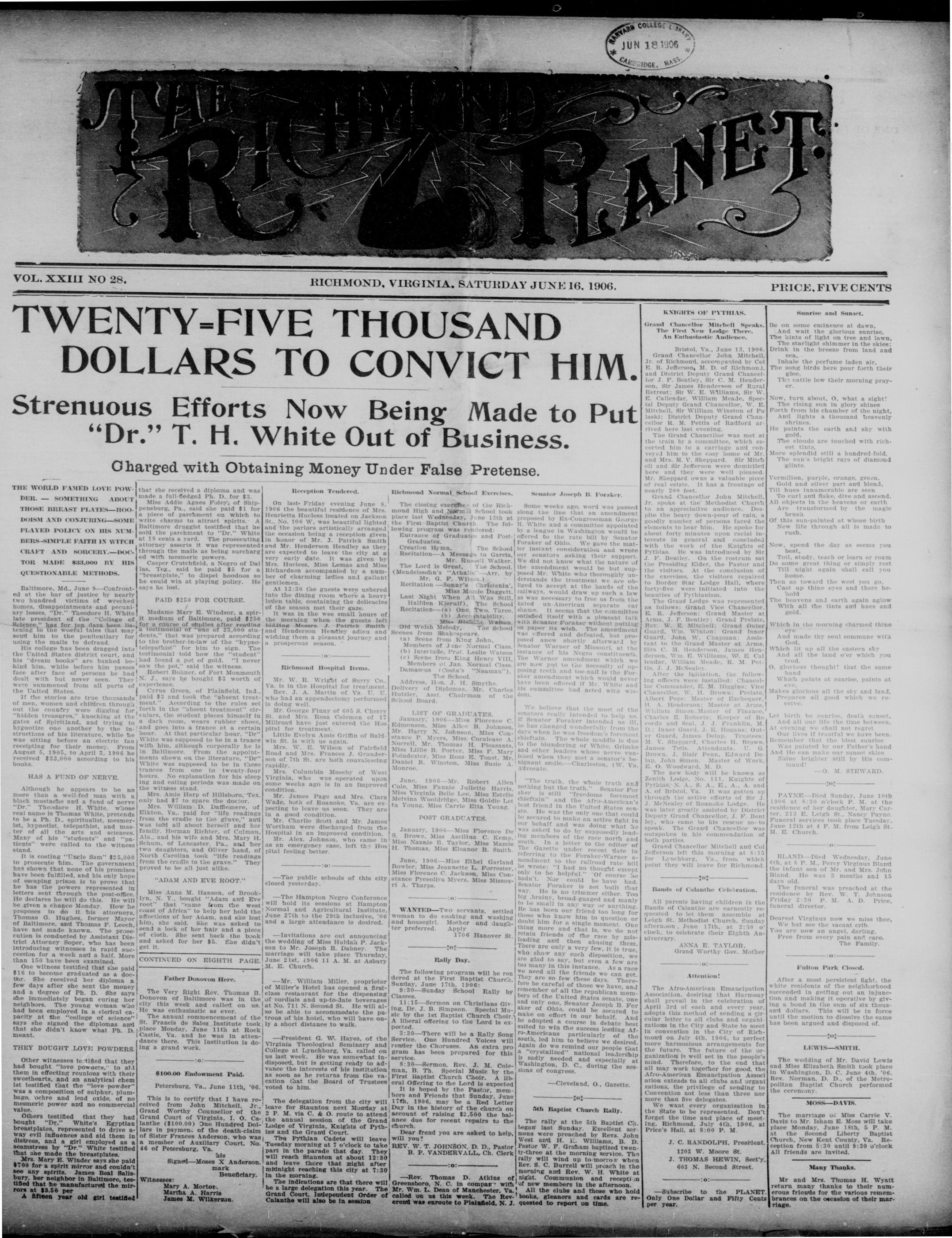
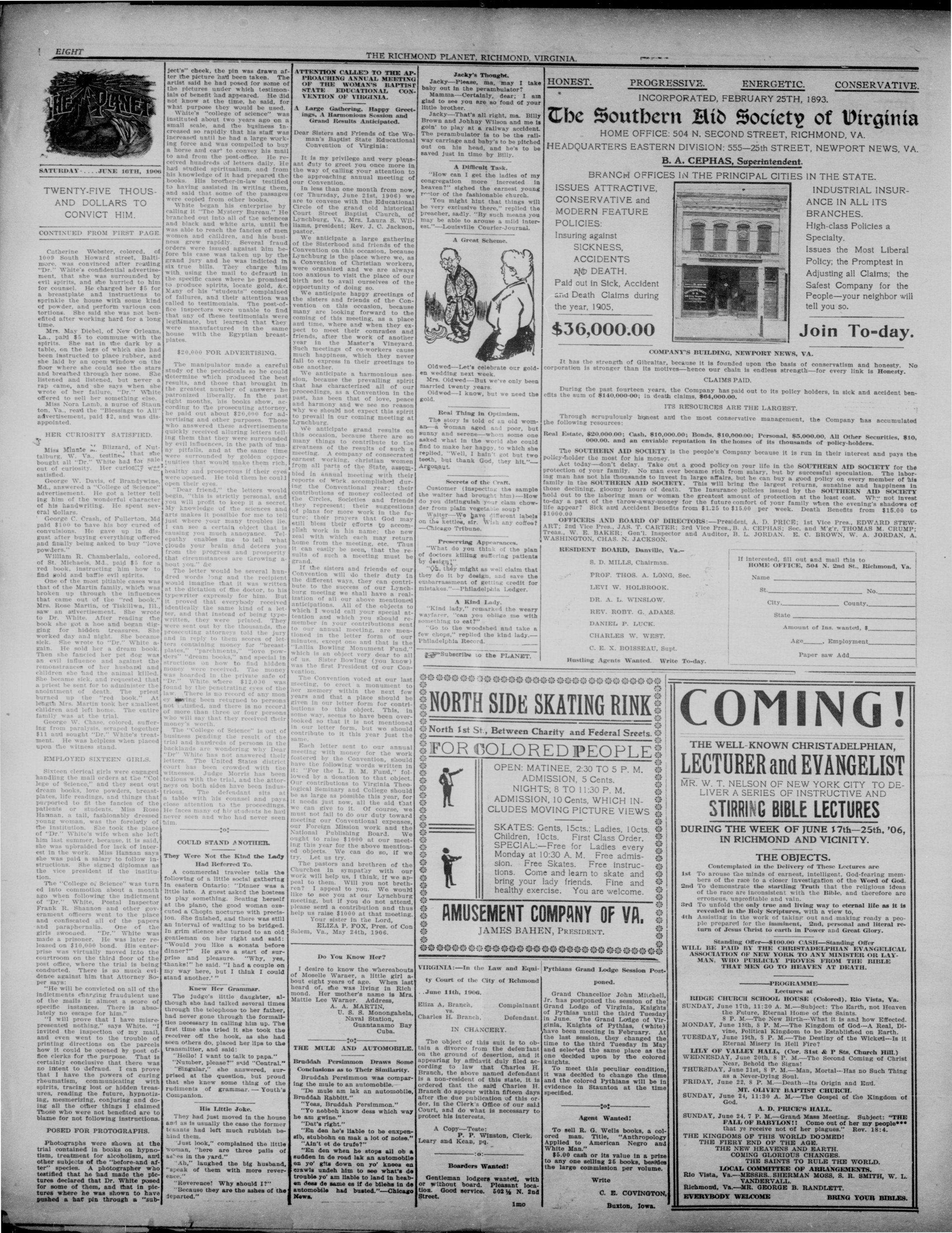
TWENTY=FIVE THOUSAND DOLLARS TO CONVICT HIM.
Strenuous Efforts Now Being Made to Put "Dr." T. H. White Out of Business.
Charged with Obtaining Money Under False Pretense.
VOL. XXIII NO 28.
TWEN
DOL
Strenuou
“Dr
THE WORLD FAMED LOVE POWDER. — SOMETHING ABOUT THOSE BREAST PLATES—HOODOISM AND CONJURING—SOME PLAYED POLICY ON HIS NUMBERS-SIMPLE FAITH IN WITCH CRAFT AND SORCERY. —DOCTOR MADE $33,000 BY HIS QUESTIONABLE METHODS.
Baltimore, Md., June 9—Confronted at the bar of justice by nearly two hundred victims of wrecked homes, disappointments and pecuniary losses, "Dr. Taeodore H. White late president of the "College of Science" has for ten classes that must send him to the penitentiary for using the mails to defraud.
His college has been dragged into the United States district court, and his "dream books" are banked behind him, while before him passes face after face of persons he had dealt with but never seen. They were summoned from all parts of the United States.
If the stories are true thousands of men, women and children through out the country were digging for "hidden treasures," knocking at the gates of Spiritland, and trying to hypnotize one another by the instructions of his literature, while he was sitting before an electric fan receipting for their money. From August 5, 1905, to April 3, 1906 he received $33,000 according to his books.
HAS A FUND OF NERVE
Although he appears to be no more than a well-fed man with a black mustache and a fund of nerve "Dr." Theodore H. White, whose real name is Thomas White, pretends to be a Ph.D., spiritualist, mesmerist, hypnotist, telepathist, and master of all the arts and sciences. Many of his "students" and "patients" were called to the witness stand.
It is costing "Uncle Sam" $25,000 to prosecute him. The government has shown that none of his promises have been fulfilled, and his only hope of escaping prison is to prove that he has the powers represented in letters sent through the post-office. He declares he will do this. He will be given a chance Monday. How he Thomas G. Hughes, former Mayor of Baltimore, and Thomas F. Leech, have not made known. The prosecution is conducted by Assistant District Attorney Soper, who has been introducing witnesses in rapid succession for a week and a half. More than 150 have been examined.
One witness testified that she paid $16 to become graduated as a doctor. She received her diploma a few days after she sent the money and a degree of Ph.D. She says she immediately began curing her neighbors. The young woman who had been employed in a clerical capacity at the "college of science" says she signed the diplomas and that she didn't know what Ph.D. meant.
THEY BOUGHT LOVE POWDERS
Other witnesses testified that they had bought "love powders" to aid them in effecting reunions with their sweethearts, and an analytical chemist testified that the "love powder" was a composition of sulphur, plumage, ochre and lead oxide, of no mesmeric power and no commercial value.
Others testified that they had bought "Dr." White's Egyptian breastplates, represented to drive away evil influences and aid them in distress, and a girl employed as a seamstress by "Dr." White testified that she made the breastplates.
Mrs. Mary E. Winder says she paid $700 for a spirit mirror and couldn't see any spirits. James Beal Salisbury, her neighbor in Baltimore, testified that he manufactured the mirrors at $3.50 per
A fifteen year old girl testified
that she received a diploma and was made a full-fledged Ph. D. for $3. Miss Addie Agnes Foley of Shippensburg, Pa., said she paid $1 for a piece of parchment on which to write charms to attract spirits. A Baltimore druggist testified that he sold the parchment to "Dr. White at 18 cents a yard. The prosecuting attorney asserts it was represented through the mails as being surcharged ed by the wives. Casper Crutchfield, Serro of Dalas, Tex., said he paid $5 for a "breastplate," to dispel hooops so he could win at playing policy. He says he lost.
PAID $250 FOR COURSE
Madame Mary E. Windsor, a spirit medium of Baltimore, paid $250 for a course of studies after reading a testimonial of "one of 23,000 students," that was prepared according to the brother-in-law of the "hypnote-telepathist" for him to sign. The testimonial told how the "student" had found a pot of gold, "I never saw the pot," said the witness. Robert Bohner, of Fort Monmouth N. J., says he bought $3 worth of experience. Cyrus Green, of Plainfield, Ind., paid $3 and took the "absent treatment." According to the rules set forth in the "absent treatment" circulars, the student places himself in a dark room, wears rubber shoes, and goes into a trance at a certain hour. At that particular hour, "Dr" White was supposed to be in a trance with him, although corporally he is in Baltimore. From the appointments shown on the literature, "Dr" White was supposed to be in these trances from one to twenty-four hours. No explanation for his sleeping and eating periods was made on the witness stand. Mrs. Amie Harp of Hillsboro, Tex. only had $7 to spare the doctor.
only had $7 to spare the doctor. Mrs. William D. Dattlemere, of Elkton, Va., paid for "life readings from the cradle to the grave," and was told all about herself and her family, Herman Richter, of Culman, Ala., and his wife and Mrs. Mary H. Schum, of Lancaster, Pa., and her two daughters, and Oliver hand, of North Carolina took "life readings from the cradle to the grave." They proved to be all just alike.
"ADAM AND EVE ROOT."
Miss Anna M. Hanson, of Brooklyn, N. Y., bought "Adam and Everroot" that "came from the west coast of Africa" to help her hold the affections of her Adam, and she lost him, she said. She was asked to send a lock of her hair and a piece of cloth. She sent back the book and asked for her $5. She didn't get it.
CONTINUED ON EIGHTH PAGE
Father Donovon Here
The Very Right Rev. Thomas B. Donovon of Baltimore was in the city this week and called on us. He was enthusiastic as ever. The annual commencement of the St. Francis de Sales Institute took place Monday, June 11th at Rock Castle, Va. and he was in attendance there. This Institution is doing a grand work.
$100.00 Endowment Paid.
Petersburg, Va., June 11th, '06.
This is to certify that I have received from John Mitchell, Jr.,
Grand Worthy Counselor of the Grand Court of Virginia, I. O. C. Caplanhe ($100.00) One Hundred Dollars in payment. of the death-claim of Sister Frances Anderson, who was a member of Auxiliary Court, No. 46 of Petersburg, Va.
RICHMOND, VIRGINIA, SATURDAY JUNE 16, 1906.
Reception Tendered.
On last-Friday evening June 8, 1906 the beautiful residence of Mrs. Henrietta Hucless located on Jackson St., No. 106 W, was beautiful lighted and the parlors artistically arranged the occasion being a reception given in honor of Mr. J. Patrick Smith and Mr. Henderson Hendley as they are expected to leave the city at a very early date. It was given by Mrs. Hucless, Miss Lemas and Miss Richardson accompanied by a number of charming ladies and gallant gentlemen.
At 12:30 the guests were ushered into the dining room where a heavy laden table, containing the delicacies of the season met their gaze.
It was in the wee small hours of the morning when the guests left bidding Messrs. J. Patrick Smith and Henderson Hendley adieu and wishing them a pleasant journey and a prosperous season.
Richmond Hospital Items
Mr. W. R. Wright of Surry Co., Va. is in the Hospital for treatment. Rev. J. A. Martin of Va. U. U. who had an appendectomy performed is doing well. Mr. George Finny of 605 S. Cherry St. and Mrs. Rosa Coleman of 17 Millroad have just entered the Hospital for treatment. Little Evelyn Amis Griffin of Baldwin St. is with us again. Mrs. W. E. Wilson of Fairfield Road and Mrs. Frances J. Granderson of 7th St. are both convalescing rapidly. Mrs. Columbia Moseby of West Virginia, who is operated upon some weeks ago is in an improved condition. Mr. James Page and Mrs. Clara Wade, both of Roanoke, Va. are expecting to leave us soon. They are in a good condition. Mr. Charlie Scott and Mr. James Wortham were discharged from the Hospital in an improved condition. Mr. Alex. Johnson, who came in as an emergency case, left the Hospital feeling better.
—The public schools of this city closed yesterday.
—The Hampton Negro Conference will hold its sessions at Hampton Normal and Agricultural Institute, June 27th to the 29th inclusive, '06 and a large attendance is desired.
—Invitations are out announcing the wedding of Miss Huldan P. Jackson to Mr. Joseph B. Dabney. The marriage will take place Thursday, June 21st, 1906 11 A. M. at Asbury M. E. Church.
—Mr. William Miller, proprietor of Miller's Hotel has opened a first-class restaurant for the dispensing of cordials and up-to-date beverages at No. 711 N. Second St. He will also be able to accommodate the patrons of his hotel, who will have only a short distance to walk.
—President G. W. Hayes, of the Virginia Theological Seminary and College at Lynchburg, Va. called on us last week. He was somewhat indoosed, but is getting ready to advance the interests of his institution as soon as he returns from the vacation that the Board of Trustees voted to him.
The delegation from the city will leave for Staunton next Monday at 2 P. M. via C. & O. route to attend the annual session of the Grand Lodge of Virginia, Knights of Pythias and the Grand Court.
The Pythian Cadets will leave Tuesday morning at 7 o'clock to take part in the parade that day. They will reach Staunton at about 12:30 and leave there that night after midnight reaching this city at 7:30 in the morning.
The indications are that there will be a large delegation this year. The Grand Court, Independent Order of Calanthe will also be in session
Richmond Normal School Exercises
The closing exercise of the Richmond High and Normal School took place last Wednesday, June 13th at the First Baptist Church. The following program was remunered:
Entrance of Graduates and Post-Graduates.
Creation Hymn. The School
Recitation—A Message to Garcia,
Mr. Russell Walker.
The Lord is Great. The School
(Mendelssohn's "Athalle"—Arr. by
Mr. G. F. Wilson.)
Recitation—Sonny's (Christenin',
Miss Mamie Daggett.
Last Night When All Was Still,
Halfden Kjerulf). The School
Recitation—(a) One, Two, Taree.
(b) Accountability,
Miss Blakele Walton.
Old Welsh Melody. The School
Scenes from Shakespeare.
(a) Scene from King John,
Members of June Normal Class.
(b) Interlude, Prof. Leslie Watson
(c) Scene from King Henry VIH,
Members of Jan. Normal Class.
Damascus (Costa's "Naaman").
The School.
Address, Hon. J. H. Smythe.
Delivery of Diplomas, Mr. Charles
Hutzler, Asst. Chairman of the
School Board.
LIST OF GRADUATES
January, 1906—Miss Florence C.
Edmonson, Miss Alice B. Johnson,
Mr. Harry N. Johnson, Miss Constance
P. Myers, Miss Coralcase A. Norrell,
Mr. Thomas H. Pleasants,
Miss Lillie B. Porter, Miss F. Mary
Polindexter, Miss Rosa E. Tonst, Mr.
Daniel B. Winston, Miss Susle A.
Monroe.
June, 1906—Mr. Robert Allen
Cole, Miss Fannie Juliette Harris,
Miss Virginia Belle Lee, Miss Estelle
Melvina Woodridge, Miss Goldie Let
ta Young, Miss Carrie Etta Young
POST GRADUATES
January, 1906—Miss Florence De
S. Brown, Miss Ascillina C. Kemp,
Miss Nannle B. Taylor, Miss Mamie
H. Thomas, Miss Eleanor B. Smith.
June, 1906—Miss Ethel Garland
Bowler, Miss Jeannette L. Forrester,
Miss Florence C. Jackson, Miss Constance Pyceolly Myers, Miss Missouri A. Tharps.
WANTED—Two servants, settled woman to do cooking and washing and housegirl. Mother and daughter preferred. Apply 1706 Hanover St.
Rally Day.
The following program will be rendered at the First Baptist Church, Sunday, June 17th, 1906:
9:30—Sunday School Rally by Classes.
11:15—Sermon on Christians Giving, Dr. J. B. Simpson. Special Music by the 1st Baptist Church Choir. A liberal offering to the Lord is expected.
3:30—There will be a Rally Song Service. One Hundred Voices will render the Choruses. An extra program has been prepared for this service.
8:30—Sermon, Rev. J. M. Coleman, B. Th. Special Music by the First Baptist Church Choir. A liberal Offering to the Lord is expected.
It is hoped by the Pastor, members and Friends that Sunday, June 17th, 1906, may be a Red Letter Day in the history of the church on account of raising $2,500 the balance due for recent repairs to the church.
Dear friend you are asked to help, will you?
REV. W. T. JOHNSON, D. D., Pastor
B. P. VANDERVALL, Ch. Clerk
—Rev. Thomas D. Atkins of Greensboro, N. C. in company with Michael of Manchester, a called on us this week. Our erend was enroute to Plainfield, N. J.
Senator Joseph B. Foraker
Some weeks ago, word was passed along the line that an amendment proposed by Ex-Congressman George H. White and a committee appointed by a league in Washington would be offered to the rate bill by Senator Foraker of Ohio. We gave the matter instant consideration and wrote our senators asking their support. We did not know what the nature of the amendment would be but supposed Mr. White who thoroughly understands the treatment we are obliged to accept at the hands of the railways, would draw up such a law as was necessary to free us from the hated un-American separate car shame. It seems that the committee satisfied itself with a pleasant talk with Senator Foraker without putting on paper its wish. The amendment was offered and defeated, but proposed anew shortly afterward by Senator Warner of Missouri, at the instance of his Negro constituents. The Warner amendment which we are now put to the necessity of opposing teeth and toe-nail is the Foraker amendment which would never have been offered if Mr. White and his committee had acted wita wisdom.
We believe that the most of the senators really intended to help us. If Senator Foraker Intended us ill, he has changed wonderfully from the days when he was freedom's foremost chiefain. The whole muddle is due to the blundering of White, Grimke and other leaders whose nerve vanished when they met a senator's benign smile.—Charleston, (W. Va. Advocate.
"The truth, the whole truth and nothing but the truth." Senator Foraker is still "freedoms foremost chieftain" and the Afro-American's best senate. He was the only one that could be secured to make an active light in our behalf and was doing what he was asked to do by supposedly leading members of the race north and south. In a letter to the editor of the Gazette under recent state in referring to the Foraker-Warner amendment to the railroad rate bill he wrote: "I had no thought except only to be helpful." Of course he hadn't. Nor could he have had. Senator Foraker is not built that way. He is no trimmer either. Too big, brainy, broad-guaged and manly to be small in any way or anything. He has been our friend too long for those who know him to question or doubt him for a single moment. One thing more and that is, we do not retain friends of the race by misleading and then abusing them. There are only a very few, it is true, who show any such disposition, we are glad to say, but even a few are too many in this instance. As a race we need all the friends we can get. They are so few these days. Therefore be careful of those we have, and remember of all the republican members of the United States senate, one and only one, Senator Joseph B. Foraker of Ohio, could be secured to make on effort in our behalf. And he adopted a course in debate best suited to win the success leading Afro-Americans particularly of the south, led him to believe we desired. Again do we remind our people that a "crystallized" national leadership is sadly needed and especially at Washington, D. C., during the sessions of congress.
Cleveland, O., Gazette
5th Baptist Church Rally
The rally at the 5th Baptist Ch. began last Sunday. Excellent sermons were preached by Rev. John West and H. K. Williams, B. D. Pastor W. F. Graham baptized twenty-three at the morning service. The rally will wind up to morrow when Rev. S. C. Burrell will preach in the morning and Rev. W. H. White at night. Communion and reception of new members in the afternoon. All the clubs and those who hold books, gleaners and cards are requested to report on time.
KNIGHTS OF PYTHIAS.
Grand Chancellor Mitchell Speaks,
The First New Lodge There.
An Enthusiastic Audience.
Bristol, Va., June 13, 1906.
Grand Chancellor John Mitchell,
Jr. of Richmond, accompanied by Col
E. R. Jefferson, M. D. of Richmond,
and District Deputy Grand Chancellor
J. F. Bentley, Sir C. M. Henderson,
Sir James Henderson of Rural
Retreat; Sir W. E. Williams, Sir W.
E. Callendar, William MeaJe, Special
Deputy Grand Chancellor, W. E.
Mitchell, Sir William Winston of Pu-laski; District Deputy Grand Chancellor R. M. Pettis of Radford arrived here last evening.
The Grand Chancellor was met at
the train by a committee, which escorted him to a carriage and conveyed him to the cosy home of Mr.
and Mrs. M. V. Sheppard. Sir Mitchell
ell and Sir Jefferson were domiciled
here and they were well pleased.
Mr. Sheppard owns a valuable piece
of real estate. It has a frontage of
nearly 300 feet.
Grand Chancellor John Mitchell, Jr. spoke at the Methodist Church to an appreciative audience. Despite the heavy down-pour of rain, a goodly number of persons faced the elements to hear him. He spoke for about forty minutes upon racial interests in general and concluded with the work of the Knights of Pythias. He was introduced by Sir J. F. Bentley. On the rostrum sat the Presiding Elder, the Pastor and the visitors. At the conclusion of the exercises, the visitors repaired to Border Star Lodge Hall, where forty-five were initiated into the beauties of Pythianism. The Grand Lodge was represented as follows: Grand Vice Chancellor, E. R. Jefferson; Grand Master at Arms, J. F. Bentley; Grand Prelate, Rev. W. E. Mitchell; Grand Outer Guard, Wm. W. Chapman; Grand Inner Guard, John W. Chapman; Assistant to the Grand Master at Arms, Sirs C. M. Henderson, James Henderson, Wm. E. Williams, W. E. Calendar, William Meade, R. M. Petis, J. J. McNealay.
After the initiation, the following officers were installed: Chancellor Commander, E. M. Higgins; Vice Chancellor, W. H. Brown; Prelate, Albert Pope; Master of Exchequer, H. A. Henderson; Master at Arms, William Simon; Master of Finance, Charles E. Roberts; Keeper of Records and Seal, J. J. Franklin, M. D.; Inner Guard, J. E. Hogans; Outer Guard, James Delap; Trustees, M. V. Sheppard, Charles H. Brown, James Tetis, Attendants, U. G. Brown, J. Blair Penn, Edward Delap, John Simon, Master of Work, E. O. Woodward, M. D.
The new body will be known as Zenith Lodge, No. 111, Knights of Pythias, N. A., S. A., E., A., A. and A. of Bristol, Va. It was gotten up through the active efforts of Sir J. J. McNealey of Roanoke Lodge. He was later greatly assisted by District Deputy Grand Chancellor, J. F. Bentley, who came to his rescue so-to-speak. The Grand Chancellor was outspoken in his commendation of both parties.
Grand Chancellor Mitchell and Col Jefferson left this morning at 8:15 for Lynchburg, Va., from which point they will leave for Richmond.
Bands of Calanthe Celebration
All parents having children in the Bands of Calanthe are earnestly requested to let them assemble at Leigh St. Methodist Church, Sunday afternoon, June 17th, at 2:30 o'clock to celebrate their Eighth Anniversary.
Attention!
The Afro-American Emancipation Association, desiring that Harmony shall prevail in the celebration of April 3rd of each and every year, adopts this method of sending a circular letter to all clubs and organizations in the City and clubs to meet in convention in the City of Richmond on July 4th, 1906, to perfect more harmonious arrangements for the future. The future of the organization is well set in the people's mind. Therefore, to the end that all may work together for good, the Afro-American Emancipation Association extends to all clubs and organizations, the privilege of sending to Convention not less than three nor more than five delegates.
We want every organization in the State to be represented. Don't forget the time and place of meeting. Richmond, July 4th, 1906, at Price's Hall, at 8:00 P. M.
J. THOMAS HEWIN, Seety,
603 N. Second Street.
—Subscribe to the PLANET. Only One Dollar and Fifty Cents per year.
PRICE.FIVECENTS
Sunrise and Sunset.
Be on some eminence at dawn,
And wait the glorious sunrise,
The hints of light on tree and lawn,
The starlight shimmer in the skies;
Drink in the breeze from land and
sea,
Inhale the perfume laden air,
The song birds here pour forth their
glee,
The cattle low their morning prayer.
Forth from his chamber of the night, And lights a thousand heavenly shrines.
He paints the earth and sky with gold.
The clouds are touched with richest tints,
More splendid still a hundred-fold,
The sun's bright rays of diamond glints.
Vermillion, purple, orange, green,
Gold and silver part and blend,
Till hues innumerable are seen
To curl and flake, dive and ascend.
All objects in the heavens or earth
Are transformed by the magic brush
Of this sun-painted at whose birth
New life through all is made to rush.
Now, spend the day as seems you best,
Toil, study, teach or learn or roam
Do some great thing or simply rest
Till night again shall call you home.
Then as toward the west you go,
Cast up thine eyes and there behold
The heavens and earth again aglow
With all the tints and hues and gold.
Which in the morning charmed thine eye
And made thy soul commune with God.
O, glorious thought! that the same hand
Which paints at sunrise, paints at
eve.
Makes glorious all the sky and land,
Prepares all good which we re-
ceive.
Let birth be sunrise, death sunset,
And all our life the time between,
At evening we shall not regret
Our lives if trustful we have been.
Remember that the blest sunrise
Was painted by our Father's hand
And He can make our sunset skies
Shine brighter still by His com-
mand!
—O. M. STEWARD.
PAYNE—Died Sunday, June 10th
1906 at 8:30 o'clock P. M. at the
residence of her daughter, Mary Carter,
213 E. Leigh St., Nancy Payne.
Funeral services took place Tuesday,
June 12th at 4 P. M. from Leigh St.
M. E. Church.
BLAND—Died Wednesday, June
6th, at 8 P. M., Percy Virginus Blandl
the infant son of Mr. and Mrs. John
Bland. He was 3 months and 15
days old.
The funeral was preached at the
residence by Rev. W. T. Johnson
Friday 2:30 P. M. A. D. Price,
funeral director.
Dearest Virginus now we miss thee,
We but see the vacant crib.
You are now an angel, darling.
Free from every pain and care.
The Family.
:o:
Fulton Park Closed
After a most persistent fight, the white residents of the neighborhood succeeded in getting out an injunction and making it operative by giving a bond in the sum of six thousand dollars. This will be in force until the motion to dissolve the same has been argued and disposed of.
LEWIS—SMITH
The wedding of Mr. David Lewis and Miss Elizabeth Smith took place in Washington, D. C. June 4th, '06. Rev. Norman, D. D., of the Metropolitan Baptist Church performed the ceremony.
MOSS—DAVIS
The marriage of Miss Carrie V. Davis to Mr. Isham E. Moss will take place Monday, June 18th, 5 P. M. at the Second Liberty Baptist Church, New Kent County, Va. Reception from 5:30 until 9:30 o'clock All friends are invited.
Many Thanks.
Mr and Mrs. Thomas H. Wyatt return many thanks to their numerous friends for the various remembrances on the occasion of their marriage.
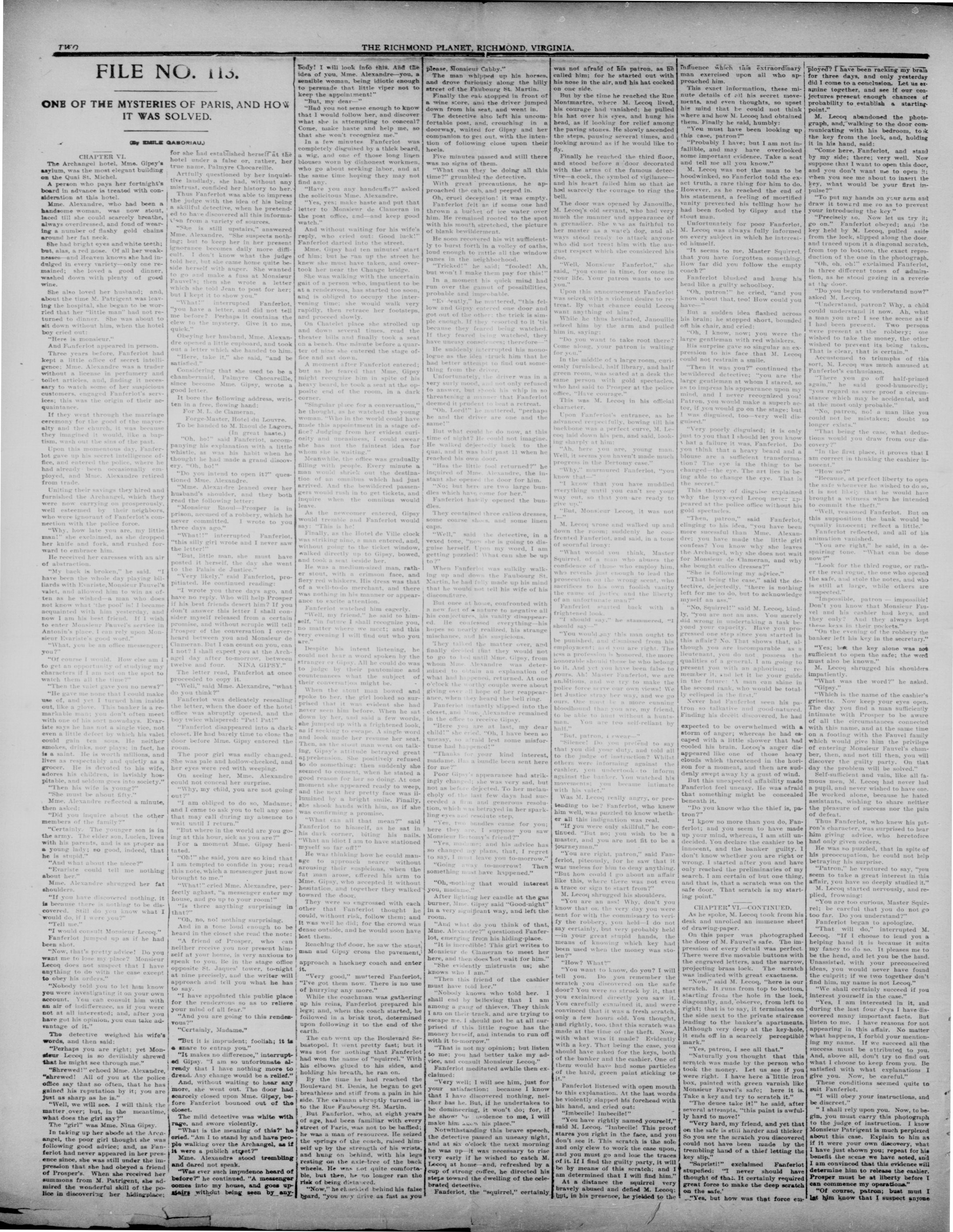
FILE NO. 113.
ONE OF THE MYSTERIES OF PARIS, AND HOW IT WAS SOLVED.
(By EMILE QABORIAU.)
CHAPTER VI.
The Archangel hotel, Mme. Gipsey's saylum, was the most elegant building on the Quai St, Michel.
A person who pays her fortnight's board in advance is treated with consideration at this hotel.
Mme. Alexandre, who had been a handsome woman, was now stout, laced till she could scarcely breathe, always overdressed, and fond of wearing a number of flashy gold chains around her fat neck.
She had bright eyes and white teeth; but, alas, a red nose. Of all her weaknesses—and Heaven knows she had indulged in every variety—only one remained; she loved a good dinner, washed down with plenty of good wine.
She also loved her husband; and, about the time M. Patrigrent was leaving the hospital, she began to be worried that her "little man" had not returned to dinner. She was about to sit down without him, when the hotel boy cried out:
And Fanferlot appeared in person. Three years before, Fanferlot had kept a little office of secret intelligence; Mme. Alexandre was a trader without a license in perfumery and toilet articles, and, finding it necessary to watch some of her suspicious customers, engaged Fanferlot's services; this was the origin of their acquaintance. If they went through the marriage ceremony for the good of the mayoralty and the church, it was because they imagined it would, like a baptism, wash out the sins of the past. Upon this momentous day, Fanferlot gave up his secret intelligence office, and entered the police, where he had already been occasionally employed, and Mme. Alexandre retired from trade.
Uniting their savings they hired and furnished the Archangel, which they were now carrying on prosperously, well esteemed by their neighbors, who were ignorant of Fanferlot's connection with the police force.
"Why, how late you are, my little man!" she exclaimed, as she dropped her knife and fork, and rushed forward to embrace him.
He received her caresses with an air of abstraction.
"My back is broken," he said. "I have been the whole day playing billiards with Evariste, Monsieur Fauvel's valet, and allowed him to win as often as he wished—a man who does not know what 'the pool' is! I became acquainted with him yesterday, and now I am his best friend. If I wish to enter Monsieur Fauvel's service in Antonin's place, I can rely upon Monsieur Evariste's good word."
"What, you be an office messenger; you?"
"Of course I would. How else am I to get an opportunity of studying my characters if I am not on the spot to watch them all the time?"
"Then the valet gave you no news?"
"He gave me none that I could make use of, and yet I turned him inside out, like a glove. This banker is a remarkable man; you don't often meet with one of his sort nowadays. Evariste says he has not a single vice, not even a little defect by which his valet could gain ten sous. He neither smokes, drinks, nor plays; in fact, he is a saint. He is worth millions, and lives as respectably and quietly as a grocer. He is devoted to his wife, adores his children, is lavishly hospitable, and seldom goes into society."
"Then his wife is young?"
"She must be about fifty."
Mme. Alexandre reflected a minute, then asked:
"Did you inquire about the other members of the family?"
"Certainly. The younger son is in the army. The elder son, Lucken, lives with his parents, and is as proper as a young lady; so good, indeed, that he is stupid."
"And what about the niece?"
"Evariste could tell me nothing about her."
Mine, Alexandre shrugged her fat shoulders.
"If you have discovered nothing, it is because there is nothing to be discovered. Still do you know what I would do, if I were you?"
"Tell me."
"I would consult Monsieur Lecoq."
Fanerlot jumped up as if he had been shot.
"Now, that's pretty advice! Do you want me to lose my place? Monsieur Lecoq does not suspect that I have anything to do with the case except to obey his orders."
"Nobody told you to let him know you were investigating it on your own account. You can consult him with an air of indifference, as if you were not at all interested; and, after you have got his opinion, you can take advantage of it."
The detective weighed his wife's words, and then said:
"Perhaps you are right; yet Mondeur Lecoq is so devilishly shrewd that he might see through me."
"Shrewed!" echoed Mme. Alexandre, "shrewed! All of you at the police office say that so often, that he has gained his reputation by it; you are just as sharp as he is."
"Well, we will see. I will think the matter, over; but, in the meantime, what does the girl say?"
The "girl" was Mme. Nina Gipsy.
In taking up her abode at the Arc-angel, the poor girl thought she was following good advice; and, as Fanferlot had never appeared in her presence since, she was still under the impression that she had obeyed a friend of Prosper's. When she received her summons from M. Patrigent, she admired the wonderful skill of the police in discovering her hiding place;
TWO
"Tell me."
for she had established herself at the hotel under a false or, rather, her true name, Palmyre Chocareille.
Arttually questioned by her inquisitive landlady, she had, without any mistrust, confided her history to her.
Thus Fanferlot was able to impress the judge with the idea of his being a skillful detective, when he pretended to have discovered all this information from a variety of sources.
"She is still upstairs," answered Mme. Alexandre, "She suspects nothing; but to keep her in her present ignorance becomes daily more difficult. I don't know what the judge told her, but she came home quite beside her with an auger. She wanted to go and make a fuss at Monsieur Fauevel's; then she wrote a letter which she told Jean to post for her; but I kept it to show you."
"What!" interrupted Fanferlot,
"you have a letter, and did not tell me before? Perhaps it contains the clew to the mystery. Give it to me, quick."
Obeying her husband, Mme. Alexandre opened a little cupboard, and took out a letter which she handed to him.
"Here, take it," she said, "and be satisfied."
Considering that she used to be a chambermaid, Palmyre Chocareille, since become Mme. Gipsy, wrote a good letter.
It bore the following address, written in a free, flowing hand:
For M. L. de Clameran,
Forges-Master, Hotel du Louvre.
To be handed to M. Raoul de Lagors.
(In great haste.)
"Oh, ho!" said Fanferlot, accompanying his explanation with a little whistle, as was his habit when he thought he had made a grand discovery. "Oh, ho!"
"Do you intend to open it?" questioned Mme. Alexandre.
"Mme. Alexandre leaned over her husband's shoulder, and they both read the following letter:
"Monsieur Raoul—Prosper is in prison, accused of a robbery, which he never committed. I wrote to you three days ago."
"What!!!" interrupted Fanferlot, "this silly girl wrote and I never saw the letter!"
"But, little man, she must have posted it herself, the day she went to the Palais de Justice."
"Very likely," said Fanferlot, propitiated. He continued reading:
"I wrote you three days ago, and have no reply. Who will help Prosper if his best friends desert him? If you don't answer this letter I shall consider myself released from a certain promise, and without scrupe will tell Prosper of the conversation I overheard between you and Monsieur de Claimeran. But I can count on you, can I not? I shall expect you at the Archagel day after to-morrow, between twelve and four. NINA GIPSY."
The letter read, Fanferlot at once proceeded to copy it.
"Well," said Mme. Alexandre, "what do you think?"
Fanferlot was delicately resealing the letter, when the door of the hotel office was abruptly opened, and the boy twice whispered; "Pst! Pst!"
"Fanferlot disappeared into a dark closet. He had barely time to close the door before Mme. Gipsy entered the room.
The poor girl was sadly changed. She was pale and hollow-checked, and her eyes were red with weeping.
On seeing her, Mme. Alexandre could not conceal her surprise.
"Why, my child, you are not going out?"
"I am obliged to do so, Madame; and I came to ask you to tell any one that may call during my absence to wait until I return."
"But where in the world are you going at this hour, sick as you are?"
For a moment Mme. Gipsy hesitated.
"Oh!!" she said, you are so kind that I am tempted to confide in you; read this note, which a messenger just now brought to me."
"What!!" cried Mme. Alexandre, perfectly agast, "a messenger enter my house, and go up to your room!"
"Is there anything surprising in that?"
"Oh, no, no! nothing surprising.
heard in the closet she read the note:
"A friend of Prosper, who can neither receive you nor present himself at your house, is very anxious to speak to you. Be in the stage office opposite St. Jaques' tower, to-night at nine precisely, and the writer will approach and tell you what he has to say.
"I have appointed this public place for the rendezvous so as to relieve your mind of all fear."
"And you are going to this rendezvous?"
"Certainly, Madame."
"But it is imprudent; foolish; it is a snare to entrap you."
"It makes no difference," interrupted Gipsy. "I am so unfortunate already that I have nothing more to dread. Any change would be a relief."
And, without waiting to hear any more, she went out. The door had scarcely closed upon Mme. Glipsy, before Fanferlot bounced out of the closet.
The mild detective was white with rage, and swore violently.
"What is the meaning of this?" he cried. "Am I to stand by and have people walking over the Archangel, as if it were a public street?" Mme. Alexandre stood trembling and dared not spank.
"Was ever such impudence heard of before?" he continued. "A messenger comes into my house, and goes upstairs without being seen by any-
THE RICHMOND PLANET, RICHMOND, VIRGINIA
Body! I will look into this. And the idea of you, Mme Alexandre—you, a sensible woman, being idiotic enough to persuade that little viper not to keep the appointment!"
"But, my dear—"
"Had you not sense enough to know that I would follow her, and discover what she is attempting to conceal? Come, make haste and help me, so that she won't recognize me."
In a few minutes Fanferlot was completely disguised by a thick beard, a wig, and one of those long linen blouses worn by dishonest workmen, who go about seeking labor, and at the same time hoping they may not find any.
"Have you any handeuffs?" asked the solicitous Mme Alexandre.
"Yes, yes; make haste and put that letter to Monsieur de Clameran in the post office, and—keep good watch."
And without waiting for his wife's reply, who cried out: "Good luck!" Fanferlot darted into the street.
Mime, Gipsy had ten minutes' start of him; but he ran up the street he knew she must have taken, and overtook her near the Change bridge.
She was walking with the uncertain gait of a person who, impatient to be at a rendezvous, has started too soon, and is obliged to occupy the intervening time; she would walk very rapidly, then retrace her footsteps, and proceed slowly.
On Chatelet place she strolled up and down several times, read the theater bills and finally took a seat on a bench. One minute before a quarter of nine she entered the stage office and sat down.
A moment after Fanferlot entered; but as he feared that Mime, Gipsy might recognize him in spite of his heavy beard, he took a seat at the opposite end of the room, in a dark corner.
"Singular place for a conversation," he thought, as he watched the young woman. "Who in the world could have made this appointment in a stage of office? Judging from her evident curiosity and uneasiness, I could swear she has not the faintest idea for whom she is waiting."
Meanwhile, the office was gradually filling with people. Every minute a man would shriek out the destination of an omnibus which had just arrived. And the bewildered passengers would rush in to get tickets, and inquire when the omnibus would leave.
As the newcomer entered, Gipsy would tremble and fanerlot would say: "This is he!
Finally, as the Hotel de Ville clock was striking nine, a man entered, and, without going to the ticket window, walked directly up to Gipsy, bowed, and took a seat beside her.
He was a medium-sized man, rather stout, with a crimson face, and fiery red whiskers. His dress was that of a well-to-do merchant, and there was nothing in his manner or appearance to excite attention.
Fanferlot watched him eagerly.
"Well, my friend," he said to himself, "in future I shall recognize you, no matter where we meet; and this very evening I will find out who you are."
Despite his intent listening, he could not hear a word spoken by the stranger or Gipsy. All he could do was to judge by their pantomine and countenances what the subject of their conversions might be.
When the stout man bowed and spoke to her, the girl looked so surprised that it was evident she had never seen him before. When he sat down by her, and said a few words, she jumped up with a frightened look, as if seeking to escape. A single word and look made her resume her seat. Then, as the stout man went on talking, Gipsy's attitude betrayed great apprehension. She positively refused to do something; then suddenly she seemed to consent, when he stated a good reason for her so doing. At one moment she appeared ready to weep, and the next her pretty face was illuminated by a bright smile. Finally, she shook hands with him, as if she was confirming a promise.
"What can all that mean?" said Panferlot to himself, as he sat in his dark corner, biting his nails. "What an idiot I am to have stationed myself so far off!"
He was thinking how he could manage to approach nearer without arousing their suspicions, when the fat man arose, offered his arm to Mme. Gipsy, who accepted it without hesitation, and together they walked toward the door.
They were so engrossed with each other that Fanferlot thought he could, without risk, follow them; and it was well he did; for the crowd was dense outside, and he would soon have lost them.
Reaching the door, he saw the stout man and Gipsy cross the pavement, approach a hackney coach and enter it.
"Very good," muttered Fanferlot, "I've got them now. There is no use of hurrying any more."
While the coachman was gathering up his reins, Fanferlot prepared his legs; and, when the coach started, he followed in a brisk trot, determined upon following it to the end of the earth.
The cab went up the Boulevard Sebastopol. It went pretty fast; but it was not for nothing that Fanferlot had won the name of "squirrel." With his elbows glued to his sides, and holding his breath, he ran on.
By the time he had reached the Boulevard St. Denis, he began to get breathless and stiff from a pain in his side. The cabman abruptly turned to the Rue Faubourg St. Martin.
But Fanfertor, who, at eight years of age, had been familiar with every street of Paris, was not to be baffled; he was a man of resources. He seized the springs of the coach, raised himself up by the strength of his wrists, and hang on behind, with his legs resting on the axle-free of the back wheels. He was not quite comfortable, but then, he no longer ran the risk of being distanced. "Now," he cheeked behind his false beard, "you may drive as fast as you
please, Monsieur Cauley.
The man whipped up his horses, and drove furiously along the hilly street of the Faubourg St. Martin.
Finally the cab stopped in front of a wine store, and the driver jumped down from his seat, and went in.
The detective also left his uncomfortable post, and, crouching in a doorway, winted for Gipsy and her companion to get out, with the intention of following close upon their heels.
Five minutes passed and still there was no signs of them.
With great precautions, he approached the cab, and peed in.
Oh, cruel deception! it was empty.
Fanerlot felt as if some one had thrown a bucket of ice water over him. He remained rooted to the spot with his mouth stretched, the picture of blank bewilderment.
He soon recovered his wit sufficiently to burst forth in a volley of oaths, loud enough to rattle all the window panes in the neighborhood.
“Tricked!” he said; “fooled! Ah, but won't I make them pay for this!” In a moment his quick mind had run over the gamut of possibilities, probable and improbable.
“Evidently,” he muttered, “this fellow and Gipsy entered one door and got out of the other; the trick is simple enough. If they resorted to it‘tis because they feared being watched. If they feared been watched, they have uneasy consciences; therefore—”
He suddenly interrupted his monologue as the idea struck him that he had better attempt to find out something from the driver.
Unfortunately, the driver was in a very surly mood, and not only refused to answer, but shook his whip in so threatening a manner that Fanferlot deemed it prudent to beat a retreat.
"Oh, Lord!" he muttered, "perhaps he and the driver are one and the same!"
But what could he do now, at this time of night? He could not imagine. He walked dejectedly back to the quai, and it was half past 11 when he reached his own door.
"Has the little tool returned?" he inquired of Mime, Alexandre, the instant she opened the door for him.
"No; but here are two large bundles which have come for her."
Fanferlot hastily opened the bundles.
They contained three calico dresses, some coarse shoes, and some linen caps.
"Well," said the detective, in a vexed tone, "now she is going to disguise herself. Upon my word, I am getting puzzled! What can she be up to?"
When Fanferlot was sulkily walking up and down the Faubourg St. Martin, he had fully made up his mind that he would not tell his wife of his discomfiture.
But once at home, confronted with a new fact of nature to negative all his conjectures, his vanity disappeared. He confessed everything-his hopes so nearly realized, his strange mischance, and his suspicions.
They talked the matter over, and finally decided that they would not to go to bed until Mme. Gipsy, from whom Mme. Alexandre was determined to obtain an explanation of what had happened, returned. At one o'clock the worthy couple were about giving over all hope of her reappearance, when they heard the bell ring.
Fanferiot instantly slipped into the closet, and Mme. Alexandre remained in the office to receive Gipsy.
"Here you are at last, my dear child!" she cried. "Oh, I have been so uneasy, so afraid lest some misfortune had happened!"
"Thanks for your kind interest, madame. Has a bundle been sent here for me?"
Poor Gipsy's appearance had strikingly changed; she was very sad, but not as before dejected. To her melancholy of the few days had succeeded a firm and generous resolution, which was betrayed in her sparkling eyes and resolute step.
"Yes, two bundles came for you; here they are. I suppose you saw Monsieur Bertomy's friend?"
"Yes, madame; and his advice has so changed my plans, that, I regret to say, I must leave you to-morrow."
"Going away to-morrow! Then something must have happened."
"Oh, nothing that would interest you, madame."
After lightning her candle at the gas burner, Mme Gipsy said "Good-night" in a very significant way, and left the room.
"And what do you think of that, Mme, Alexandre?" questioned Fanferl, emerging from his hiding-place.
"It is incredible! This girl writes to Monsieur de Clameran to meet her here, and then does not wait for him." "She evidently mustrus us; she
"She evidently mistrusts us; she knows who I am."
"Then this friend of the cashier must have told her."
"Nobody knows who told her. I shall end by believing that I am among a gang of thieves. They think I am on their track, and are trying to escape me. I should not be at all surprised if this little rogue has the money herself, and intends to run off with it to morrow."
"That is not my opinion; but listen to me; you had better take my advice, and consult Monsieur Lecoq."
Fanerlot meditated awhile then exclaimed:
"Very well; I will see him, just for your satisfaction: because I know that I have discovered nothing, neither has he. But, if he undertakes to be domineering, it won't do; for, if he shows no violence to me, I will make him show his place."
Notwithstanding this brave speech, the detective passed an uneasy night, and at six o'clock the next morning he was up—it was necessary to rise very early if he wished to catch M. Lecoq at home—and, refreshed by a cup of strong coffee, he directed his steps toward the dwelling of the celebrated detective.
Fanferlot, the "squirrel," certainly
was not afraid of his patron, as he called him; for he started out with his nose in the air, and his hat cocked on one side.
But by the time he reached the Rue Montmartre, where M. Lecoq lived, his courage had vanished; he pulled his hat over his eyes, and hung his head, as if looking for relief among the paving stones. He slowly ascended the steps, pausing several times, and looking around as if he would like to fly.
Finally he reached the third floor, and stood before a door decorated with the arms of the famous detective—a cock, the symbol of vigilance—and his heart failed him so that he had scarcely the courage to ring the bell.
The door was opened by Janouille, M. Leecoq's old servant, who had very much the manner and appearance of a grenadier. She was as faithful to her master as a watch dog, and always stood ready to attack anyone who did not treat him with the august respect which she considered his due.
"Well, Monsieur Fanferlot," she said, "you come in time, for once in your life. Your patron wants to see you."
Upon this announcement Fanferlot was seized with a violent desire to retreat. By what chance could Leecoq want anything of him?
While he thus hesitated, Janouille seized him by the arm, and pulled him in, saying:
"Do you want to take root there? Come along, your patron is waiting for you."
In the middle of a large room, curiously furnished, half library, and half green room, was seated at a desk the same person with gold spectacles, who had said to Prosper at the police office, "Have courage."
This was M. Lecoq in his official character.
Upon Fanferlot's entrance, as he advanced respectfully, bowing till his backbone was a perfect curve, M. Lecoq laid down his pen, and said, looking sharply at him:
"Ah, here you are, young man. Well, it seems you haven't made much progress in the Pertomy case."
"Why," murmured Fanferlot, "you know that—"
"I know that you have muddled everything until you can't see your way out, so that you are ready to give up."
"But, Monsieur Lecoq, it was not I—"
M. Lecoq arose and walked up and down the room; suddenly he confronted Fanferlot, and said, in a tone of scornful irony:
"What would you think, Master Squirrel, of a man who abuses the confidence of those who employ him, who reveals just enough to lead the prosecution on the wrong scent, who sacrifices to his own foolish vanity the cause of justice and the liberty of an unfortunate man?"
Fanferlot started back with a frightened look.
"I should say," he stammered, "I should say—"
"You would say this man ought to be punished, and dismissed from his employment; and you are right. The less a profession is honored, the more honorable should those be who belong to it. And yet you have been false to yours. Ah! Master Fanferlot, we are ambitions, and we try to make the police force serve our own views! We let Justice stray her way, and we go ours. One must be a more cunning bloodhound than you are, my friend, to be able to hunt without a huntsman. You are too self-reliant by half."
"But, patron, I swear—"
"Silence! Do you pretend to say that you did your duty, and told all to the judge of instruction? Whilst others were informing against the cashier, you undertook to inform against the banker. You watched his movements; you became intimate with his valet."
Was M. Lecoq really angry, or pretending to be? Fanferlot, who knew him well, was puzzled to know whether all this indignation was real.
"If you were only skillful," he continued. "But no; you wish to be a master, and you are not fit to be a journeyman."
"You are right, patron," said Fanferlot, piteously, for he saw that it was useless for him to deny anything.
"But how could I go about an unfair like this, where there was not even a trace or sign to start from?" M. Lecoq shrugged his shoulders.
"You are an ass! Why, don't you know that or, the very day you were sent for with the commissary to verify the robbery, you held—I do not say certainly, but very probably held—in your great stupid hands, the means of knowing which key had been used when the money was stolen?"
"You want to know, do you? I will tell you. Do you remember the scratch you discovered on the safe door? You were so struck by it, that you exclaimed directly you saw it. You carefully examined it, and were convinced that it was a fresh scratch, only a few hours old. You thought, and rightly, too, that this scratch was made at the time of the theft. Now, with what was it made? Evidently with a key. That being the case, you should have asked for the keys, both of the banker and the cashier. One of them would have had some particles of the hard, green paint sticking to it."
Fanferlot listened with open mouth to this explanation. At the last words he violently slapped his forehead with his hand, and cried out:
"You have rightly named yourself," said M. Lecoq. "Imbecile! This proof stares you right in the face, and you don't see it. This scratch is the sole and only clew to work the case upon, and you must go and lose the traces of it. If I find the guilty party, it will be by means of this scratch; and I am determined that I will find him." At a distance the squirrel very bravely abused and defied M. Lecoq; but, in his presence, he yielded to the
Influence which this extraordinary man exercised upon all who approached him.
This exact information, these minute details of all his secret movements, and even thoughts, so upset his mind that he could not think where and how M. Lecoq had obtained them. Finally he said, humbly:
"You must have been looking up this case, patron?"
"Probably I have; but I am not infallible, and may have overlooked some important evidence. Take a seat and tell me all you know."
M. Lecoq was not the man to be hoodwinked, so Fanferlot told the exact truth, a rare thing for him to do. However, as he reached the end of his statement, a feeling of mortified vanity prevented his telling how he had been fooled by Gipsy and the stout man.
Unfortunately for poor Fanferlot, M. Lecoq was always fully informed on every subject in which he interested himself.
"It seems to me, Master Squirrel, that you have forgotten something. How far did you follow the empty coach?"
Fanferlot blushed and hung his head like a guilty schoolboy.
"Oh, patron!" he cried, "and you know about that, too! How could you have—"
But a sudden idea flashed across his brain; he stopped short, bounded off his chair, and cried:
"Oh, I know, now; you were the large gentleman with red whiskers. His surprise gave so singular an expression to his face that M. Lecoq could not restrain a smile.
"Then it was you?" continued the bewildered detective; "you are the large gentleman at whom I stared, so as to impress his appearance upon my mind, and I never recognized you! Patron, you would make a superb actor, if you would go on the stage; but I was disguised, too—very well disguised."
"Very poorly disguised; it is only just to you that I should let you know what a failure it was, Fanferlot. Do you think that a heavy beard and a blouse are a sufficient transformation? The eye is the thing to be changed—the eye. The art lies in being able to change the eye. That is the secret."
This theory of disguise explained why the lynx-eyed Lecoq never appeared at the police office without his gold spectacles.
"Then, patron," said Fanferlot, clinging to his idea, "you have been more successful than Mme. Alexandre; you have made the little girl confess? You know why she leaves the Archangel, why she does not wait for Monsieur de Clameran, and why she bought calico dresses?"
"That being the case," said the detective, dejectedly, "there is nothing left for me to do, but to acknowledge myself an ass."
"No, Squirrel!" said M. Lecoq, kindly, "you are not an ass. You merely did wrong in undertaking a task beyond your capacity. Have you progressed one step since you started in this affair? No. That shows that, although you are incomparable as a lieutenant, you do not possess the qualities of a general. I am going to present you with an aphorism; remember it, and let it be your guide in the future: 'A man can shine in the second rank, who would be totally eclipsed in the first.'"
Never had Faunerlot seen his patron so talkative and good-natured. Finding his deceit discovered, he had
expected to be overwhelmed with a storm of anger; whereas he had escaped with a little shower that had cooled his brain. Lecoog's anger disappeared like one of those heavy clouds which threatened in the horizon for a moment, and then are suddenly swept away by a gust of wind. But this unexpected affability made Panferlot feel uneasy. He was afraid that something might be concealed beneath it. "Do you know who the thief is, patron?"
"I know no more than you do, Fanferlot; and you seem to have made up your mind, whereas, I am still undecided. You declare the cashier to be innocent, and the banker guilty. I don't know whether you are right or wrong. I started after you and have only reached the preliminaries of my search. I am certain of but one thing, and that is, that a scratch was on the safe door. That scratch is my starting point."
CHAPTER* VI.—CONTINUED.
As he spoke, M. Lecoq took from his desk and unrolled an immense sheet of drawing-paper.
On this paper was photographed the door of M. Fauvel's safe. The impression of every detail was perfect. There were five movable buttons with the engraved letters, and the narrow, projecting brass lock. The scratch was indicated with great exactness.
"Now," said M. Lecoq, "here is our scratch. It runs from top to bottom, starting from the hole in the lock, diagonally, and, observe, from left to right; that is to say, it terminates on the side next to the private staircase leading to the banker's apartments. Although very deep at the key-hole, it ends off in a scarcely perceptible mark."
"Yes, patron. I see all that."
"Naturally you thought that this scratch was made by the person who took the money. Let us see if you were right. I have here a little iron box, painted with green varnish like Monsieur Fauvel's safe; here it is. Take a key and try to scratch it."
"The deuce take it!" he said, after several attempts. "this paint is awfully hard to move!"
"Very hard, my friend, and yet that on the safe is still harder and thicker. So you see the scratch you discovered could not have been made by the trembling hand of a thief letting the key slip."
"Sapristi!" exclaimed Fanferlot stupefied: "I never should have thought of that. It certainly required great force to make the deep scratch on the safe."
"Yes, but how was that force en-
ployed? I have been racking my brain for three days, and only yesterday did I come to a conclusion. Let us examine together, and see if our conjectures present enough chances of probability to establish a starting-point."
M. Lecoq abandoned the photograph, and, walking to the door communicating with his bedroom, tok the key from the lock, and, holding it in his hand, said:
"Come here, Fanferlot, and stand by my side; there; very well. Now suppose that I want to open this door, and you don't want me to open it; when you see me about to insert the key, what would be your first impulse?
"To put my hands on your arm and draw it toward me so as to prevent your introducing the key."
"Precisely so. Now let us try it; go on." Fanferlot obeyed; and the key held by M. Lecoq, pulled aside from the lock, slipped along the door, and traced upon it a diagonal scratch, from top to bottom, the exact reproduction of the one in the photograph.
"Oh, oh, oh!" exclaimed Fanferlot, in three different tones of admiration, as he stood gazing in a reverie at the door.
"Do you begin to understand now?" asked M. Lecoq.
"Understand, patron? Why, a child could understand it now. Ah, what a man you are! I see the scene as if I had been present. Two persons were present at the robbery; one wished to take the money, the other wished to prevent its being taken. That is clear, that is certain."
Accustomed to triumphs of this sort, M. Lecoq was much amused at Fanferlot's enthusiasm.
"There you go off half-primed again," he said good-humoredly; "you regard as sure proof a circumstance which may be accidental, and at the most only probable."
"No, patron, no! a man like you could not be mistaken; doubt no longer exists."
"That being the case, what deductions would you draw from our discovery?"
"In the first place, it proves that I am correct in thinking the cashier innocent."
"How so?"
"Because, at perfect liberty to open the safe whenever he wished to do so, it is not likely that he would have brought a witness when he intended to commit the theft."
"Well, reasoned Fanferlot. But on this supposition the bank would be equally innocent; reflect a little."
Fanferlot reflected, and all of his animation vanished.
"You are right," he said, in a despairing tone. "What can be done now?"
"Look for the third rogue, or rather the real rogue, the one who opened the safe, and stole the notes, and who is still at large, while others are suspected."
"Impossible, patron — impossible! Don't you know that Monsieur Fauvel and his cashier had keys, and they only? And they always kept these keys in their pockets."
"On the evening of the robbery the banker left his key in the secretary."
"Yes; but the key alone was not sufficient to open the safe; the word must also be known."
M. Lecoq shrugged his shoulders impatiently.
"What was the word?" he asked.
"Gipsy."
"Which is the name of the cashier's grisette. Now keep your eyes open. The day you find a man sufficiently intimate with Prosper to be aware of all the circumstances connected with this name, and at the same time on a footing with the Fauvel family which would give him the privilege of entering Monsieur Fauvel's chamber, then, and not till then, you will discover the guilty party. On that day the problem will be solved."
Self-sufficient and vain, like all famous men, M. Lecoq had never had a pupil, and never wished to have one. He worked alone, because he hated assistants, wishing to share neither the pleasure of success nor the pain of defeat.
Thus Fanferlot, who knew his patron's character, was surprised to hear him giving advice, who heretofore had only given orders.
He was so puzzled, that in spite of his preoccupation, he could not help betraying his surprise.
"Patron," he ventured to say, "you seem to take a great interest in this affair, you have so deeply studied it." M. Lecco started nervously, and replied, frowning:
"You are too curious, Master Squirrel; be careful that you do not go too far. Do you understand?" Fanferlot began to apologize.
"That will do," interrupted M. Lecco. "If I choose to lend you a helping hand it is because it suits my fancy to do so. It pleases me to be the head, and let you be the hand. Unassisted, with your preconceived ideas, you would never have found the culprit; if we two together don't find him, my name is not Lecco."
"We shall certainly succeed if you interest yourself in the case."
"Yes, I am interested in it, and during the last four days I have discovered many important facts. But listen to me. I have reasons for not appearing in this affair. No matter what happens, I forbid your mentioning my name. If we succeed all the success must be attributed to you. And, above all, don't try to find out what I choose to keep from you. Be satisfied with what explanations I give you. Now, be careful."
These conditions seemed quite to suit Fanferlot.
"I will obey your instructions, and be discreet."
"I shall rely upon you. Now, to begin, you must carry this photograph to the judge of instruction. I know Monsieur Patrigent is much perplexed about this case. Explain to him as if it were your own discovery, what I have just shown you; repeat for his benefit the scene we have noted, and I am convinced that this evidence will determine him to release the cashier. Prosper must be at liberty before I can commence my operations."
"Of course, patron; buat must I let him know that I suspect anyone
° ai
{it S- a
Ne
AW
7
Y ” ae
SATURDAY. ....JUNE 16TH, 1906
Te eat Se er cee en te
of following up this affair. Monsieur
Patrigent will tell you to watch Pros-
per; you will reply that you will not
lose sight of him. I myself will an-
awer for his being in safe keeping.”
“Suppose he asks me about Gipsy?”
M. Lecoq hesitated for a moment.
“Tell him,” he finally said, “that
you persunded her, in the interest of
Prosper, to live in a house where she
can watch some one whom you sus-
foun
Fanferlot was joyously picking up
his hat to go, when M. Lecoq checked
him by waving his hand, and said:
“I have not finished. Do you know
how to drive # carriage and manage
horses?”
“Why, patron, can you ask this of a
man who used to be @ rider in the
Bouthor circus?”
“Very well. As soon as the judge
dismisses you, return home immedi-
ately, make yourself a wig and the
complete dress of @ valet; and, “hav-
ing dressed yourself, take this letter
to the agency on the Rue Delorme.”
“But, patron—"
“There must be no but, my friend;
the agent will send you to Monsiéur
de Clameran, who is looking for a
valet, his man having left him yes
terday.”
“Excuse me if T venture to suggest
that you are making a mistake. This
Clameran is not the cashier's friend?”
“Why do you always interrupt me?"
said M. Lecog, imperiously. “Do what
I tell you, and don’t disturb your
mind about the rest. Clameran is not
@ friend of Prosper's, I know; but he
is the friend and protector of Raoul
de Lagors. Why so? Whence the
intimacy of these two men of such
different ages? That is what I must
find out. 1 must also find out who
this forge-master is, who lives in
Paris, and never goes to attend to
his furnaces. A jolly fellow, who
takes it in his head to live at the
Hotel du Louvre, in the midst of a
tumultuous, ever-changing crowd, is
& fellow dimicult to watch. Through
you I will have an eye upon him. He
has a carriage: you are to drive it;
and you will soon be able to give me
an account of hix manner of life, and
Of the sort of people with whom he
associates.”
“You chal! be otieved, patron.”
“Another thing. Morsleur de Clam-
¢ran ia irritable and suspicious, You
will be preseated to hin under the
name of Joxe)h Dubois. He will de-
mand your certificate of good char-
acter. Here are three, which state
that you have lived with the Marquis
de Stairmeune and the Count de Com-
gisrin. and shat vow have just lett the
ron de Wortechen, who went to
Germany the other day. Now keep
Your eyes open; be cureful of your
@rers and manners. Be polite, but
Rot excessively so. And, above all
things, don’t be obsequious; it might
arouse suspicion
“L understand, patron, Where shall
~eport to you?"
“I will cail on you every day. Until
I tell you differently, dou't step foot
in this house; you might be followed.
If anything important should happen,
send a note to your wife, and she
will inform me. Go, and be prudent.”
The door closed on Fanferlot as M.
eLecoq passed into his bedroom.
In the twinkling of an eye he had
Aivested himself of the appearance of
© police officer. He took off his stiff
eravat and gold spectacles, and re-
moved the close wig from his thick
black hair. The official Lecoq had
disappeared, leaving in his place the
geuuine Lecoq whom nobody knew—
& handsome young man, with a bold,
determined ‘manner, and briltiant,
piercing eyes,
But he only remained himself for
an instant. Seated before a dressing-
table, covered with more cosmetics,
Paints, perfumes, false hair, and oth-
er unmentionable shams than are to
be found on the toilet-tables of our
modern belles, he began to undo the
work of nature, and make himself »
new face.
He worked slowly, handling his
brushes with great care. But in an
hour he had accomplished one of his
daily masterpieces. When he had fin-
fehed, he was no longer Lecoq; he
was the large gentleman with red
whiskers, whom Fanferlot failed to
recognize.
“Well,” he said, casting a last look
in the mirror, “I have forgotten noth-
ing; I have left nothing to charce: All
my plans are fixed; and I shall make
some progress to-day, provided the
Squirrel does not waste time.”
But Fanferlot was too happy to
waste a minute. He did not run, he
flew, toward the Palais de Justice.
At last he was now able to convince
some one that he, Fanferlot, was a
man of wonderful perspicacity.
‘As to acknowledging that he was
about to obtain a triumph with the
ideas of another man, he never
thought of it. It is generally in per-
fect good faith that the jackdaw
struts in the peacock's feathers,
His hopes were not deceived. Tf the
Judge was not absolutely and fully
Sonvinced, he admired the ingenuity
of the whole proceeding, and compli-
Says that he is not guilty, but does
not say he in innocent:
“Wherens there do not exist suff-
sient charges against the accused,
Prosper Bertomy, in pursuance of
Article 128 of the Criminal Code, we
hereby declare that we find no
grounds for prosecution against the
Sforesaid prisoner at this present
time; and we order that he shall be
Feleased from the prison where he is
confined, and set at liberty by the
jailer,” ete.
“Well,” he said to the clerk, “here
4s another of those crimes which jus-
tlee can not clear up. The mystery
remains to be solved. This is another
file to be stowed away among the
archives of the record office.”
And with his own hand he wrote
‘on the cover of the bundle of papers
relating to Prosper's case, the num-
ber of the package, “File No. 113."
TO BE CONTINUED.
SLUM LIFE.
Story of a Drunkard and His Vic-
tory by Miss Evangeline
Booth.
“I was sitting one night in my little
room, when the door opened and a
woman walked in. She sat down by the
fire without a word. I let her alone, be-
cause I knew she was in trouble. Final-
ly she satd:
“They say she died of cancer, but
it'salie! He done it with his fist. He's
drunk now. ‘Cos why? Minnitshe died
he come in an’ tuk the clothes off the
baby an’ put "em up the spout.’
The audience forgot all about its be-
ing a rellztous meeting. Somewhere,
unseen, a violin was sighing Handel's
“Largo.” Miss Booth, still acting the
Tagged role of Soho, went on to tell how
she put on her shawl and went to the
cellar where the mother was dead. She
did not dwelt! upon the morbid side of
it, but sald she found two children, too
Uttle to talk much, curled up together
on the damp floor. She took them to
the room, where she bathed them, gave
them warm milk, and @ressed them like
little angels in white “nighties.”
“Suppose he comes after them?” sug-
gested Miss Booth.
Three days later he came, very drunk
and profane. Miss Booth tackled him.
He proposed to wring her neck and
other things. Miss Booth told him he
Would not get his babies, but he might
see them. She led him upstairs to the
room, and showed him the bables—
their hair combed out, their faces shin-
ing with soap and water, both curled up
in bed. The man swore hard for two
minutes; then stopped short, burst into
tears, and said:
“Is them my kiddies?”
He never drank again.—Miss Evange-
line Booth.
WHOSE DAUGHTER?
‘Your Daughter or the Saloonkeeper's?
Which? Whose Bonnet Do You
Pay For?
‘When the writer spoke to the men in
the Michigan Central railroad shops
4m Detroit recently, a workman told
him this story of a scene he had him-
self witnessed:
“Papa, will you please give me 50
cents for my spring Lat? Most of the
other girls have theirs already.”
“No, not now, Jane, I can't spare the
money.”
A beautiful ten-year-old daughter
had made the request. The disappoint-
ed girl went to school, The father
started for his work. On his way to
the shop he met a friend, and being a
hail fellow well met, he invited him
into “Bill's” for a drink. ‘There were
others there and the father treated
the crowd, and then threw down a dol-
lar that just paid for the drinks,
Just then the saloon keeper's davgn-
ter entered, and going behind the bar,
said: “Papa, I want one dollar for my
spring hat.”
“All right,” said the dealer, as he
pushed to her the dollar just laid on
the bar.
Jane's father was dazed, walked out
alone, and said to himself: “I coulda’t
give my daughter 50 cents for her hat,
but I had to bring my dollar here for
the rum-seller’s daughter to buy a hat
with. I'll never drink anothe: drop.”
Michigan Issue,
GERMANY’S DRINK BILL.
Some Figures Which Tell a Startling
Story of the Kaiser's
Kingdom.
Germany has about 60,000,000 of
| People. The American consuls report
that the annual drink bill of that
empire is $672,588,000. This ts an
average of about $11.21 per person,
‘or of $37.28 per person over 15 years
of age. For schools this great em-
pire spent $99,722,000, for working
People’s insurance $104,244,000, and
for the army and navy $208,847,000
‘The drink bill shows an average con-
sumption annually of 6%, quarts of
wine, 129% quarts of beer and 9
quarts of brandy for each person. The
German consul in Chicago tried to
mollifty the apparent force of these
figures, by stating that the expendi-
ture of $37.36 for each person over 15
Years of age does not mean in Ger-
many what It does here, since the
beer brewed there is not as intoxicat-
ing as that which is drunk here. But
9 quarts of brandy for each person is
pretty heavy drinking of spirits, and
nothing can offset that. While the
total expenditure for drink in this
country is much greater than in Ger-
many, being about a billion and a
half, the average expense per capita
is about $18.20. In Great Britain it
1s about $19.—Cumberland Presby-
terian.
De You Smesk thé Meme?
Mrs. Nation has an idea that she
smashed things which deserved that
kind of treatment. She says:
“You call me crazy because I smashed
a few saloons thal were smashing
hearts, homes and souls, Well, every
time you cast # ballot you either smash
the saloon or you smash the home. A
vote which licenses and protects the sa-
loon smashes the home in the most
effective way the dgvil hes devised.
Which of us is crazy ?"~-Beckbone,
THE RICHMOND PLANET, RICHMOND, VIRGINIA
A PUBLIC DANGER.
How Cities in England and Scotland
Are Warning People Against
‘Detak
_ In view of the increasing interest
taken by municipalities in England
‘and Scotland in the question of pub-
Me health as affected by the use of
intoxicating liquor, many of the cities
and large towns have decided to is-
sue large posters in their respective
areas in order to warn the people
against the use of alcohol. Several
vt the London borough councils,
Liverpool, Lecds, Tunbridge Wells in
England, Glasgow and Dundee Scot-
land, are among the places that have
taken such action The trade has
‘raised an action im éie law courts in
order to arrest the spread of the
movement. The following is the form
of poster issued by the city of Dun-
dee, which is typical of that issued
by other municipautfes:
CITY OF DUNDEE.
PHYSICAL DETERIORATION AND
. ALCOHOLISM.
| The report of the committee, pre-
sented to Parliament by command of
His Majesty, states that:
| The abuse of alcoholic stimulants
fs @ most potent and deadly agent of
‘physical deterioration.
Alcoholic persons are specially Iia-
ble to tuberculosis and all inflamma-
tory disorders.
Evidence was placed before the
committee showing that in abstl-
/nence ts to be sought the source of
‘muscular vigor and activity.
‘The lunacy figures show a large
and increasing number of admissions
of both sexes which are due to drink.
‘The following facts recognized by
the medical profession are published
in order to carry out the recommen.
‘dation of the committee and to bring
‘home to men and women the fatal
effects of alcohol on physical effi
ciency:
beegiheanl nt abe open
‘soning resulting from the habitual
abuse of alcohol (whether as spirits,
wine, or beer), which may never go
8 far as drunkenness.
(b) It ts a mistake to say that
stimulants are necessary for those
doing hard work.
(ec) Alcobol is really a narcotic,
dulling the nerves, lke laudanum or
opium. Its first effect is to weaken
& man’s self-control while his pas-
sions aro excited; hence the number
of crimes which occur under its in-
fluence.
xa) Wee peckcas tn ordhery: hesits
the practice of drinking even the
‘milder alcoholic drinks apart from
‘meals is most injurious,
| (e) The habit of drinking to ex.
cess leads to the ruin of families, the
neglect of social duties, disgust for
work, misery, theft, and crime. It
leads also to the hospital, for alcohol
Produces the most various and the
most fatal diseases, including paral-
ysis, insanity, diseases of the stom-
ach’ and liver and dropsy. It also
paves the way to consumption, and
frequenters of public houses furnish
& large proportion of the victims of
this disease. It complicates and ag-
gravates all acute diseases; typhoid
fever, pneumonia and erysipelas are
‘much more fatal in the subject of
alcoholism,
/(f) The sins of parents who have
‘drunk to excess are visited on the
children, both morally and physically.
(g) In short, alcoholism is the
most terrible enemy to personal
health to family happiness ,and to
‘national prosperity. William Long.
‘air, Lord Provost; Chas. Templeman,
‘M.D, S. Sc. Medical Officer of
‘Health; Wm. H. Blyth Martin, Town
Clerk.
‘Town House, Dundee, January, 1906,
Prohibition in Kansas.
Dr. Charles M. Sheldon recently de-
elared that the majority for prohibi-
tion is larger in Kansas to-day than in
1880. Letters read from Gov. Hoch and
Congressman Scott stated the benefits
of prohibition. Among other facts
mentioned were these: Eighty-five
counties of 105 have no paupers, 35 coun-
ty jails have no prisoners, and one jail
is used by farmers to store corn. A
quarter of a million people 20 years of
age or more have never seen a saloon.
He stated that in his journey from To-
peka to Hartford he saw more drunken
men and boys than in his 17 years’ resi-
dence in Kansas.
How It Feels.
A widely traveled gentieman lately
sald: “It is somewhat Interesting to
note the various ways in which intox-
ieants affect the various nationalities.
Having traveled to a considerable ex-
tent I have perceived that when a
Frenchman has had too much, he
wants to fance; a German to sing;
a Spaniard to gamble; a Britisher to
eat; an Italian to brag; an Irishman
to fight; and—an American to de-
liver a speech.”—Champion of Fair
Play.
Witte’ Sebads Wiis Base nn
Se nt a TE a ee ee
Let there be an abstinence from in-
toxicating drinks throughout this eoun-
try during the period of a single genera-
tion and a mob would be as impossible
as combustion without oxygen.—Hor-
ace Mann.
The Licht of a Cicarette.
As a light to illuminate a boy’s path
to the saloon door a cigarette excels
electricity.
An Old One.
Pjones—Do you believe that cures
can be wrought by the Isying-on of
bands?
Ksmith—Yep. That's the way I
cured my boy of the cigarette hablt.—
Cleveland Leader
What Was Needed.
Magazine Editor—I can't use this
Poem unless you boil it down,
Poet—And why should I boll it
down?
Magazine Faitor—To kill the germs
of thought whieh it contains.—Judge.
Versatile.
Madge—What,became of that ad-
vanced girl who advocated the retire-
‘ment of persons who had acquired a.
competency?
_ Marjorle—She Js tecturing mow on
‘the idle rich.—Puck. *
A Munificient Gift.
‘Mrs. Henry Boden, the president of
the Derby branch of the B. W. T. A.,
recently gave £1.000 to clear off the
debt <n the Derby Temperance hall.
In Arkansas,
Fifty-six counties out of 75 in Ar
kansas are without saloons.
See ae Tete
Voice from Below—Are you children
all in bed?
Voice from Above—Yes, mamma.
Volce from Below—Well I must say
it didn’t take you long to say your
prayers.
Voice from Above—We divided ‘em
up an’ each took a section an’ sald
‘em all at once.—Cleveland Leader.
Infantile Affection.
“Our baby,” says Newpop, with a
deep sigh, “Is very much attached to
me.”
“More so than to your wife?” asked
the visitor.
“You bet.” answered Newpop. “Why,
he refuses to let anyone but me walk
the floor with him at night."—Chicago
Daily News.
Sat
“It is a great pity,” said the archt-
tect, “that nature is not more adapt-
able.”
“In what way?"
“If human beings could only learn
to sleep standing up we could make
the rooms in a flat even smaller."—
Washington Star.
An Embarrassment.
Tooting Parke—How many times
has Mrs. Coppingham been married?
Clapham Becke—Couldn't say ex-
actly. Why?
Tooting Parke—En? Oh, I hap-
pened to remark that she had rather
a large family, and she said “13 little
ones.”
Clapham Becke—Not femilies?
‘Tooting Parke—That's what 1 want
to know.
A Sure Thing.
Ticket Seller—There are no lower
berths left.
Fat Man—Give me an upper.
“You'll never be able to get into
the upper.”
“I won't have too. When the man
who has the lower looks me over
he'll be more than willing to change.”
Lite.
nates.
| Young Patient—I can't pay the bill,
doctor. It's exorbitant. I'm no bet-
ter than I was, either.
Doctor—That's because you didn't
take my advice,
“Ah—well—of course, if 1 didn't
take it, I don’t owe you for it. Thanks.
Good morning.—Royal Magazine.
Knew It Would Be Late,
Mr. Cheapside—I thought you said
you were going to Mrs. Brick’s five
O'clock tea this afternoon? it’s after
five now.
Mrs. Cheapside—There’s no hurry.
Her five o'clock tea isn't Ukely to be
ready before seven. She's got the
‘Servant we used to have.—Tit-Bita,
Dull Boy.
‘The Young tuea—Dad?
‘The Eminent—Well, my son?
‘The Young ‘Un—Dad, how long was
Jonah in the ark? What?
‘The Eminent—Go to! I'm ashamed
of you. Don’t know a simple thing like
that. How long was Jonah in the ark?
Why, some time, of course.
A Coincidence,
“I suppose you enjoy hearing your
doy talk since he went to college.”
| “Yes,” answered Farmer Corntossel,
“but ain’t it kind of a coincidence that
80 many of them classical quotations
degin with ‘rah, rah, rahi*"—Wash-
ington Star.
Wi Giathen Geta
| “They tell me,” remarked the sym-
pathetic friend, “that poor dear Rose's
Busband left most of his money to
charities, after all.”
“Yes,” sighed the other. “Poor dear,
she seems to have taken his name in
ae
: A FELLOW FEELING.
et
Ae , Ea »
rosy’ y “
Ti: bg eZ
f S/R,
Y ONLY
JN
) Mog
Cpe |
was eas
Saale
ay ae d
Lady—Are you engaged?
Cabman—No, miss. Are you?
Procress.
Little drops of water,
Little grains of sand,
Make the mighty magnate
And his “trusty” band,
Instead.
An old woman was telling her do-
mestic trials to her clergyman and en-
larging upon the unkindliness of “her
ole man.” ‘The pastor, counselling pa-
tlence and kindness on her part,
asked:
“Have you tried ‘heaping coals of
fire on his head’?”
‘To which there came the proud re-
sponse: 2
“No, mister,“ but T've tried hot
water.”"—Cassell’s Journal.
Might Be There.
‘The department store salesman had
taken 29 rolls of dress goods from the
Ghelf and was a trifle impatient.
“Madam,” he said, politely, “isn't
there anything here which suits you?”
“No,” replied the fair shopper, “1
guess I won't select the goods now,
Rnights of Pythi
nigbts of Pythias,
N. A.,S. A., E. A., A. AND A,
SED This organization is one of the most powerful in the country and its
S- Mprogress has been phenominal. The Grand Lodge of Virginia has juris
f, A, diction over all of the cities and counties in this state. Thirty males
CY ¥- are required to organize a new lodge. The benefits paid constitute one
Inne 5G of its strongest features, but the principles are greater than anything
i CGR Br cy else. Founded on Friendship, based on Charity and established on Be-
SesKGay uevolence, the respectable, upright people of the state will find it an order
SO) worthy of their heartiest support.
Roa It pays an endowment and burial benefit of of $200.00 for all ages. It
pays $4.00 per week sick dues. The badge costing 75 cents each is the
only absolutely necessary regalla, For information concerning the organzaition of lodges
apply at the main office.
‘ a se +
ihe Courts of Calanthe >
Is the Female Department of the Order. It requires a membership of woe
thirty persons to organize a court. Itsmembers are pledged to exhibit 5
Fidelity, exercise Harmony and prove Love one for the other. It pays n
an endowment and burial benefit of $150.00. It pare $3.00 per week sick \ \
dues. The only expense for regalia is the cost of the badge, so cents and A
arosette, costing 25 cents for funeral occasions.
_ THE BANDS OF CALANTHE or Children’s Department also con-
stitutes a feature and persons canuot do better than to enter the little ones into this mystic
circle. The expense is nominal and the benefits all that could be expected. It pays from
$1.00 to $1.50 sick dues and death benefits of from $30.09 to $40.00. If you have noPythian
Lodge or Court or Band in your neighborhood, orgrnize one.
For all information concerning the Children’s Department address,
Mrs. ANNA Taytor, W. M.,
120 W. Hill St., Richmond, Va.
For all information concerning special rates of JOHN MITCHELL, JR.,
membership in the lodges and courts, address arr N. 4th St, Richmond, Va.
‘You see, I'm just looking for a friend.”
“There's another rol! on the shelf,”
said the salesman, “I'll take it down
4f you think your friend is likely to be
in It."—Puck.
Marketable.
Eva—Katherine says she likes to see
@ man wear igh collars and Grace
says she likes to see him wear stocks.
Would stocks attract you, my dear?
Edna—Yes, if they were listed among
the preferred. —Chicago Datly News.
Discounted,
Ethel—Hubert sent me a lovely
birthday gift, and a note saying that
his thoughts are all of me—
Ernest—That doesn't mean much;
he only thinks about once a month.—
Cassell’s Journal.
His End of It.
“My daughter,” said Mr. Stoxanbons,
doubtfully, “is by no means poor, you
know.”
“Oh, that's all right,” responded the
suitor, cheerfully. “i'm plenty poor
enough for two.”—Cleveland Leader,
‘Where It Went.
“Dorothy, you get your pretty hair
from your mother, don't you?"
“I don't know, but T think T must
a’ got {t from papa. His ts all gone.”
—Cleveland Leader.
WANTED— 100 young colored
xirls to do light manufacturing work
WII be well paid while learning. Can
soon make from $3.00 to $5.00 a
‘week, according to capacity and wil-
lingness to work. Steady employ-
ment. Only girls of good character
and behavior wanted. Apply at once
to
516 North 12th Street,
Opposite Colored Normal School
BOARDING & LODGING
Rates Reasonable, All the Comforts
eae:
Orders received by letter or telegraph
MRS. BOOKER LEPTWICH,
PROPRIBTRESS,
S16 N.2nd St, Richmond, Va.
STRAUS’ SPECIAL
Old Yacht Club,
PURE WHISKEY
Seen
We have all grades of good liquors,
eee and Tobacco. Call and see
ISAAC STRAUS & CO.,
422 E. Broad St.,
Richmond, Virgamia.
60 YEARS* }
‘Trace Marks
Oesicns
sepeee es See ee ete
Saat es Suet ea
| SEs sate irag tee ge weave
Scientific American, |
| Aina aueeens ie aes
| MUNN & Co,2ereree New York
GEORGE O. BROWN,
___ PHOTOGRAPHER, _
608 N. 2ad St., Richmond, Va.
ere Piycaerain. Soeete Late, High class
io ork exeouted . .
iene ee
Oa Rae ee ee ge wee SS tar tn ren eee ee
THE WONDER OF _ |
r
THE 2OTH CENTURY!
=—————————
‘The above named book proves that Jesus Christ
had Negro blood in his veins, that David and Solomon
| both married black women, that Solomon’s Temple
Was Built by a Negro, that Free Masonry was found-
ed by a Negro, that the first righteous priest recorded
under Heaven was a black man, and that the black
| man married as high up in society as was possible for
_ man to go, and many other such wonderful things are
to be found in this wonderful book. Price, prepaid, 50
cents. Cash with order. Good agents wanted. For
terms, etc.;send three r-cent stamps. Write to-day
and be first to sell this book in your town.
S@-SPECIAIL—Send this “Adv.” with only 35 cents cash, anda
copy will be sent to you.
W.G. OVERTON, Wilburton, I. T.
aren
THE PEOPLE’S REAL ESTATE AND
INVESTMENT COMPANY. eee,
WHY NOT CALL ON US? ‘When renting,
; \__ When buying, a
> 6 i — When lending meney, aie:
—=-_> : ay When borrowing money, =
a f When you want an estate managed
ep eg ‘When you have Real Restate for sata,
a PME” ust cal! Phone No. sue, ~ “Slt
ae W. F. DENNY, Secretary. No. 717 M, Mad Sa. :
DOLLAR PACKAGE FREE.
Man Medicine Free.
You can new obtain a large dol-
lar size free package of Man Medi-
cine—free on request.
‘Man Medicine cures man-weak-
ness.
Man Medicine gives you once
more the gusto, the joyful satistac-
tion, the pulse and throb ¢¢ physical
pleasure, the Xeen sense of man-
sensation, the luxury of life, body
power and body comfort—tfree.
Man Medicine does it.
Man Medicine cures man-weak-
ness, nervous debility, early decay,
discouraged manhood, functional
failure, vital weakness brain fag,
backache, prostatitis, kidney troub-
Je ant nervousness.
| You can cure yourself at home
by Man Medicine, ‘and the full size
dollar package will be delivered to
you free, plain wrappe:, sealed,
with full directions how to use it.
The full size dollar package free, n®
payments of any kind, no receipts,
no promises, no papers to sign. It
is free.
All we want to know ts that you
are not sending for it out of idle cu-
riosity, but that you want to be wel
Tiosity, but that you want to be well
and become your strong natural self
once more. Man Medicine will do
what you want .t to do; make you a
real man, man-like, man-powerful..
Your ‘name and address will
bring It; all you have to do Is to
send and get it. We send it free
to every discouraged one of the man
sex. Taterstate Remedy Company,
263 Luck Building, Detroit, Mich.
“THE ECONOMY,”
303 and 305 N.Srd St.,
Fine Tailoring,
CLEANING,
DYEING,
AND REPAIRING
TURNER & WHATE,
PROPRIETORS.
THREE
SE
H F Jonathan
FISH, OYSTERS AND}
PRODUCE,
120 N. 17TH 8t., RICHMOND, VA.
ALL ORDERS WILL RECEIVE
PROMPT ATTENTION.
Long Distance Phone. 732,
RICHMOND MEDICAL COLLEGE,
400 E. Baker Street,
RICHMOND, ‘VIRGINIA.
Chartered June 14, 1906. Co-0&
Heational. The only’ Colored Cot.
lege tn “Virginia & thorough
couree in Mejficine, Dentistry and
Pharmacy. — Session: 1905—190@
begins Oct. 2, 1905.
For further information, write.
J. ALEX. LEWIS, M.D,
Secretary.
| 9-23-3mos.
AND ASTROLOGIST
ea
Pa Ses ars
pe 7 Bae
WS & ees
ET emmy sss ose
“Pie |. ot aed
yt } ir us Settee
1 Is aay
fepsdhmath ote seme tend ne re
Be ae" Rinasaed in arises,
eiteite eats tly habe om
Dr. F. PERRY, 24 Ano" S355
```markdown
```
IT WILL PAY YOU To interest yourself in promot ing the CIRCULATION of the RICHMOND PLANET.
---
THE PLANET
SATURDAY...JUNE 16TH. 1906
WEEK'S NEWS CONDENSED
Thursday, June 7.
The National Synod of the Reformed Presbyterian church will meet next year at Allegheny, Pa.
Secretary of War Taft will attend the graduating exercises at the West Point military academy on the 12th inst.
Five-year-old Emily Jamilson, of Philadelphia, died of burns received while playing about a bonfire near her home.
On June 14 the Junior Order of United American Mechanics of Southeastern Virginia will present a set of handsome flags to the battleship Virginia at Norfolk.
Three hundred Norwegians have left Chicago for the Fatherland, where they will attend the coronation of King Haakon VII on June 22. The party is made up of Norwegians from all over the middle west.
Friday. June 8.
The New Jersey state pharmacists held their annual convention at Atlantic City. While ill and despondent, John McKinley, a wealthy citizen of Lansdale, Pa., committed suicide by shooting himself in bed. Fire, following an explosion in a tobacco factory at Hopkinsville, Ky., destroyed that building, a large ice plant and several smaller buildings, entailing a loss of $100,000. The South Carolina supreme court has declined to issue a writ of habeas corpus in the case of Lewis W. Parker, president of a cotton mill syndicate, who was arrested on the charge of contempt of legislative committee investigating the state dispensary.
Saturday. June 9.
President Roosevelt has signed the denatured alcohol bill.
Gabrielle Batelle, a negro, convicted of assault, was hanged at King George Court House, Va.
The Louisiana state capitol building at Baton Rouge was damaged by fire to the extent of $50,000.
One trainman was killed and 22 persons were injured in a collision on the Iron Mountain railroad at Mengo, Mo.
Joseph Dillon, 3 years old, was scalded to death by falling into a tub of boiling water at his home in Philadelphia.
Monday, June 11.
Three people were killed by lightning during a storm at St. Thomas, Ont.
The Standard Oil company has raised prices again on all grades of gasoline.
Thrown under the wheels of his own train at Burnham, Pa., R. F. Rowe, of Kreamer, a Pennsylvania railroad brakeman, lost his right arm near the shoulder.
After welcoming the delegates to the Y. W. C. A. conference at Asheville, N. C., Mrs. George H. Atkinson, of Monroe, N. C., was taken ill and died suddenly.
By the explosion of a lumber locomotive at Modix Run, Pa., E. E. Singleton, fireman, was killed; Herman Miller, engineer, was fatally hurt, and Frank Howard, brakeman, was seriously Inlured.
Tuesday, June 12.
The annual convention of the supreme council of the Legion of the Red Cross was held in Baltimore. Arthur G. Reinke, who embezzled $14,000 from a bank in Milwaukee, Wis., was sent to prison for five years. Wood Ambrose, a young negro, who shot a white man, was shot to death in jail by a mob at Prentiss, Miss. Hon William P. Whyte, Maryland's new United States senator and successor of the late Senator Gorman, has been sworn in. R. V. Hughes, president of Ripon College, announced that the first educators to be pensioned under the Carnegie $10,000,000 fund are two Ripon professors, Dr. E. R. Merril and Professor C. H. Chandler
Wednesday. June 13.
Half the village of Sodus, near Rochester, N. Y., was destroyed by fire, entailing a loss of $100,000.
State Senator Thomas W. Jefferson, of Milton, Del., died of a stroke of paralysis at Dover, while attending the special session of the legislature.
Mrs. William E. Corey, wife of the president of the United States Steel Corporation, has sued her husband for divorce at Reno, Nev.
Reginald De Koven, the well-known composer of light operas, is seriously ill at a sanitarium near Yonkers, N. Y.
PRODUCE QUOTATIONS
The Latest Closing Prices In the Principal Markets
PHILIDELPHIA — FLOUR steady;
winter extras, $3.30@3.50; Pennsylvania roller, clear, $3.60@3.75; city mills, fancy, $4.60@4.70; RYE FLOUR firm; per barrel, $3.60; WHEAT firm; No. 2 Pennsylvania red. $89@89.circ;
No. 2 Pennsylvania yellow. local, $99@60.circ; OATS steady, yellow local, $99@60.circ; lower grades, $49@49.circ; lower grades, $48. HAY firm; No. 1 timothy, $17. PORK firm; family, $19.80. BEEF beef; beef hams, $19.80. POULTRY: Live firm; hens, 14c.; old roosters, 9½c.; Dressed firm; choice fwls, 12½c.; old roosters, 8c. BUTTER steady; creamy, 22c. EGGS steady; creamy, 22c. EGGS western, 18c.; southern, 15½c. POTATOES firm, old per bush, 80@80c.
BALTIMORE—WHEAT steady; No. 2 spot, 89½%@89½%; steamer No. 2 spot, 81½%@81½%; southern, 81½%@89½%; CORN quiet, mixed spot, 57½%@57½%; steamer mixed, 53½%@53½%; southern, 55½%@55½%; OATS firm; white, No. 2, 44½%; No. 3, 43½%; No. 4, 42½%; No. 4, 42½%; No. 4, 42½%; No. 4, 42½%; No. 4, 42½%; Butter steady; creamy, separator, extras, 20½%; held, 17½%; prints, 21½%; Maryland and Pennsylvania dairy prints, 15½%; EGGS firm; fancy Maryland, Pennsylvania, Virginia and West Virginia, 15½%; southern, 16½%.
Live Stock Markets.
PENNSYLVANIA (Union Stock Yards)—
chions $5.65/6.50
BORS AND INTEREST THEM IN THE PLANET WE WILL HELP YOU TO OBTAIN A PREMIUM
COLORED INFANTRY IN RESCUE OF ROUGH RIDERS AT SAN JUAN HILL, JULY 2, 1898, SIZE 20X28 AND 20X24 INCHES, ADMIRAL DEWEY'S GREAT NAVAL BATTLE OFF CAVITE IN MANILA BAY, MAY 1ST, 1898, NAVAL BATTLE, DESTRUCTION OF ADMIRAL CERVERA'S SPANISH FLEET OFF SANTIAGO DE CUBA, JULY 3RD, 1898, SIZE 22X28 INCHES; LAND BATTLE, CAPTURE OF EL CANEY, EL PASO AND FORTIFICATIONS OF SANTIAGO, JULY FIRST AND SECOND, 1898, SIZE 22X28 AND 22X27 INCHES. WE WILL SEND YOU ONE OF ANY OF THE FOLLOWING BATTLES OF THE CIVIL WAR ON THE SAME TERMS. THE PICTURES LIKE THE OTHER BATTLES ARE FINISHED IN COLORS. THEY ARE 22X28 INCHES AND RETAIL AT ONE DOLLAR EACH. WE WILL FURNISH FRAMES FOR ANY OF THESE FINE CHROMOS FOR 2 DOLLARS & 50CTS. EACH ADDITIONAL. BATTLE OF GETTYSBURG, BATTLE OF SHILOH, BATTLE OF FIVE FORKS, VA., BATTLE OF ATLANTA, GA., BATTLE OF SPOTTSYLVANIA, VA., BATTLE OF VICKSBURG, MISS., BATTLE OF LOOKOUT MOUNTAIN, TENN., BATTLE BETWEEN THE MONITOR AND THE MERRIMAC, BATTLE OF BULL RUN, VA., BATTLE OF CHANCELLORSVILLE, BATTLE OF THE BIG HORN, (CUSTER'S LAST CHARGE) STORMING OF FORT WAGNER, S. C., (COLORED TROOPS IN THIS FIGHT), BATTLE OF NEW ORLEANS, LA., CAPTURE AND DEATH OF SITTING BULL, THE GREAT INDIAN CHIEFTAIN; FORT PILLOW MASSACRE, FALL OF PETERSBURG, VA., BATTLE OF WINCHESTER, VA., BATTLE OF OLUSTEE, FLA. WE WILL SEND FAMILY RECORD, SIZE 22 BY 28. WHICH CONTAINS SPACE FOR PHOTOGRAPHS OF PARENTS AND TEN CHILDREN. WE WILL SEND SOLDIERS WAR RECORD (CERTIFICATE OF SERVICE IN UNITED STATES ARMY.)
FOR ONE YEAR EACH, OR THEIR EQUIVALENT, WE WILL SEND YOU A COPY OF UNCLE TOM'S CABIN, THE MOST INTENSELY INTERESTING BOOK IN THE COUNTRY. WE WILL SEND YOU A GOLD-PLATED BROOCH WITH YOUR PICTURE THEREIN, YOU TO
prime, $5.40@5.80. HGGS steady; mediums, heavy Yorkers, light Yorkers and pigs, $6.50@6.70; roughs, $5.50@5.90. SHEEP steady; prime wrestlers, $5.80@6; culls and common, $3@4; lambs, $4.50@7; veal calves, $7@7.20
INSURANCE MEN INDICTED
Two Former Officials of Mutual Life Charged, With Forgery
New York, June 12.—Dr. Walter R. Gillette and Robert A. Granniss, formerly vice president of the Mutual Life Insurance company, were indicted on charges of forgery by the special grand jury which has been investigating insurance matters under the direction of District Attorney W. T. Jerome. Dr. Gillette was also indicted on a charge of perjury. Mr. Granniss was accused of making false statements to the state insurance department which is a misdemeanor. There are five indictments of forgery against Dr. Gillette. Both Dr. Gillette and Mr. Granniss surrendered themselves, were arraigned before Justice Scott and were held in ball for a hearing on the first Monday in September. Both pleaded not guilty. Dr. Gillette's ball is $10,000 and that of Mr. Granniss is $5000.
ETHEL BARRYMORE'S TASTES
In Private Life the Young Actress is Devoted to Music.
To those who know Miss Barrymore, her hobbies are familiar. There is little of the popular idea of the actress about her off the stage. She lives simply, her friends are artists, writers, actors—people who do something in the world to entertain or enlighten it. She receives and makes many calls, like other cultivated American girls, but whether or not the names of her friends figure among the "400" is of little moment to her. That they are people with knowing is the chief consideration.
1
Perhaps if fate had not ordained otherwise Miss Barrymore would have made her name on the concert
A.
stage, for she is a pianist of rare skill. The Norwegian and Russian composers are her favorites and many an hour she spends in the music shops searching for an almost forgotten composition of an Old-World composer. Her reading is of a sturdier sort—the stories of Conrad or Jack London especially appeal to her.
It is not odd that such a girl as Miss Barrymore should have a host of friends in private life, nor that the talented daughter of such honored figures in the American drama as Maurice Barrymore and George Drew-Barrymore should win a foremost position on the stage for herself.
He Knew the Kind.
A small boy in Boston, who had unfortunately learned to swear, was rebuked by his father. "Who told you that I swore?" asked the bad little boy. "Oh, a little bird told me," said the father. The boy stood and looked out of the window scowling at some sparrows which were scolding and chattering. Then he had a happy thought. "I know who told you," he said. "It was one of those—sparrows."
STRAIGHTENS
IN ORDER TO FURTHER INCREASE OUR STEADILY GROWING CIRCULATION WE WILL OFFER PRIZES.
WE WILL SEND YOU THE PLANET AND THE ST LOUIS, MISSOURI, SEMI-WEEKLY GLOBE DEMOCRAT, ONE OF THE LEADING REPUBLICAN JOURNALS IN THE UNITED STATES FOR $2.25 PER YEAR FOR BOTH. WE WILL SEND YOU THE PLANET AND THE COSMOPOLITAN MAGAZINE FOR $2.25 PER YEAR FOR BOTH. WE WILL SEND YOU THE PLANET AND McCLURE'S MAGAZINE FOR $2.25 PER YEAR FOR BOTH.
OR THEIR EQUIVALENT, WE WILL SEND PICTURES, ONE ONLY, OF PRESIDENT THEODORE ROOSEVELT, DR. BOOKER T. WASHINGTON, BATTLE OF SANTIAGO, LAND BATTLE OF QUASIMAS NEAR SANTIAGO, JUNE 24, 1898, SHOWING THE NINTH AND TENTH COLORED CAVALRY IN SUPPORT OF ROUGH RIDERS, SIZE 20X28 AND 20X24 INCHES, LAND BATTLE AND CHARGE OF THE 24TH & 25TH
READ THE GREAT INDUCEMENTS OFFERED BY THE PLANET
THE RICHMOND PLANET, RICHMOND, VIRGINIA
IF YOU WILL TALK WITH YOUR NEIGH-
FOR TWO YEARLY SUBSCRIBERS
FOR FIVE NEW SUBSCRIBERS
REQUISITE NUMBER IS OBTAINED, WE WILL FORWARD THE PRESENT INDICATED. A PERSON WHO TRIES TO GET FORTY SUBSCRIBERS AND GETS TIRED MAY INDICATE HIS WISH AND WE WILL SEND THE PRESENT FOR THE NUMBER HE HAS SECURED OVER FIVE. THE NUMBER WILL BE FOR NOT LESS THAN FIVE NOR MORE THAN TEN AND NOT LESS THAN TEN NOR MORE THAN TWENTY AND NOT LESS THAN TWENTY NOR MORE THAN FORTY, TO DETERMINE THE PRIZE TO WHICH THE WORKER IS ENTITLED.
IF ANYTHING IS DESIRED NOT SPECIFIED IN THIS LIST, WRITE US ABOUT IT AND WE WILL TELL YOU IN WHAT CLASS IT BELONGS.
JOHN MITCHELL, JR.,
311 North Fourth Street,
RICHMOND. VIRGINIA.
A man is sitting in a chair. A man is standing next to him.
ALANET
WEEKLY
LEADING
UNITED
TH.
BET AND
BAR $2.25
BET AND
A YEAR
S
BET AND PIC-
THEO-
WASH-
D BAT-
JUNE 24,
BTH COL-
UGH RI-
LAND
& 25TH
```markdown
```
REQUISE
FORWA
SHOULD YOU DESIRE ANY COLORED JOURNAL IN THE UNITED STATES, WE WILL SEND IT TO YOU IN CONJUNCTION WITH THE PLANET AT A GREATLY REDUCED RATE FOR BOTH.
FURNISH THE PHOTOGRAPH, ONE FOUNTAIN PEN, GOLD POINT; ONE LADIES RING, ONE BREAST-PIN, GOLD FILLED; HALF DOZEN LINEN HANDKERCHIEFS, ONE ALARM CLOCK, ONE DOZEN NAPKINS, ONE HALF DOZEN TOWELS, ONE CHOCOLATE POT, ONE PAIR VASES, ONE PAIR KID GLOVES, ONE HAM, ONE TURKEY.
FOR TEN NEW SUBSCRIBERS
WE WILL SEND ONE CHI
PIECES; ONE NECKLACE
PEARE, BYRON WORKS;
PLAIN GOLD RING, ONE
1,000 ENVELOPES, 1,000
PRINTED AND DELIVERED
ONE HALF CORD OF SAV
FOR TWENTY NEVER
WE WILL GIVE ONE HAL
WITH OPALS, RUBIES OF
ELRY BOX FINISHED IN
ONE SILK SHIRT WAIST
DRESS, ONE GOLD WA
RANTED FOR TEN YEAR
CHAIR, ONE LOAD OF O
SOAP, EITHER WASHING
BARREL OF BEST FLOUR
ETS, ONE MANICURE SET
WORK BOX, ONE PAIR S
DIES.
FOR FORTY YEAR
OR EQUIVALENT, WE W
ING MACHINE, ONE D
GOLD WATCH, ONE PA
RINGS, ONE MUSIC BOX,
ONE READY MADE DRE
TLEMEN'S CLOTHES,
CANE, ONE GOLD-HEAD
CHINA SET, ONE DOK
KNIVES AND FORKS, O
SILK DRESS, ONE WEEK
SHORE, RAILROAD FA
PAID, FOR ANY RICHMO
THESE OFFERS MAY
TAGE OF BY SENDING
SCRIBER'S NAMES AT
KEEP A RECORD OF THE
THE NUMBER IS OBTAINED, WE
ORD THE PRESENT INDICATED
PERSON WHO TRIES TO GET
BERS AND GETS TIRED MEN
IS WISH AND WE WILL SE
IT FOR THE NUMBER HE
OVER FIVE.
THE NUMBER WILL BE FOR N
IVE NOR MORE THAN TEN A
THAN TEN NOR MORE THAN
AT LESS THAN TWENTY NO
DRTY, TO DETERMINE THE R
THE WORKER IS ENTITLED.
IF ANYTHING IS DESIRED NO
THIS LIST, WRITE US ABOUT
TELL YOU IN WHAT CLAS
ALL SEND ONE CHINA SET, THIRD
ONE NECKLACE; DICKENS, J
BYRON WORKS; ONE UMBRELL
GOLD RING, ONE PAIR LACE CU
ENVELOPES, 1,000 SHEETS OF
AND DELIVERED; ONE TOILET
FALC CORD OF SAWED WOOD.
OR TWENTY NEW SUBSCRIBER,
ALL GIVE ONE HANDSOME GOL
APALS, RUBIES OR PEARLS; O
BOX FINISHED IN GOLD OR
FILK SHIRT WAIST; ONE READ
ONE GOLD WATCH, FILLED
AND FOR TEN YEARS, ONE PAI
ONE LOAD OF COAL, ONE G
EITHER WASHING OR TOIL
OF BEST FLOUR, ONE PAIR
THE MANICURE SET, ONE SEAM
BOX, ONE PAIR SHOES, GENTS.
OR FORTY YEARLY SUBSCRIBER,
EQUIVALENT, WE WILL GIVE O
MACHINE, ONE DIAMOND RIN
WATCH, ONE PAIR FINE GOL
ONE MUSIC BOX, ONE PHONO
READY MADE DRESS, ONE SUIT
N'S CLOTHES, ONE GOLD-
ONE GOLD-HEADED UMBRELL
SET, ONE DOZEN SILVER
AND FORKS, ONE HAT-RAIL
PRESS, ONE WEEK'S TRIP TO T
RAILROAD FARE AND HOT
OR ANY RICHMOND WORKER
THESE OFFERS MAY BE TAKEN
OF BY SENDING ONE OR TW
ER'S NAMES AT A TIME. W
A RECORD OF THEM; AS SOON
ER IS OBTAINED, WE WILL
SENT INDICATED.
AND TRIES TO GET FORTY
GETS TIRED MAY INDI
ND WE WILL SEND THE
NUMBER HE HAS SE-
WILL BE FOR NOT LESS
MORE THAN TEN AND NOT
MORE THAN TWENTY
THAN TWENTY NOR MORE
DETERMINE THE PRIZE TO
ER IS ENTITLED.
G IS DESIRED NOT SPECI-
WRITE US ABOUT IT AND
IN WHAT CLASS IT BE-
WE WILL SEND ONE CHINA SET, THIRTY-ONE PIECES; ONE NECKLACE; DICKENS, SHAKESPEARE, BYRON WORKS; ONE UMBRELLA, ONE PLAIN GOLD RING, ONE PAIR LACE CURTAINS 1,000 ENVELOPES, 1,000 SHEETS OF PAPER PRINTED AND DELIVERED; ONE TOILET SET, ONE HALF CORD OF SAWED WOOD.
FOR TWENTY NEW SUBSCRIBERS
WE WILL GIVE ONE HANDSOME GOLD RING WITH OPALS, RUBIES OR PEARLS; ONE JEWELRY BOX FINISHED IN GOLD OR SILVER; ONE SILK SHIRT WAIST; ONE READY MADE DRESS, ONE GOLD WATCH, FILLED, WARRANTED FOR TEN YEARS, ONE ROCKING CHAIR, ONE LOAD OF COAL, ONE GROSS OF SOAP, EITHER WASHING OR TOILET; ONE BARREL OF BEST FLOUR, ONE PAIR BLANKETS, ONE MANICURE SET, ONE SEAMSTRESS' WORK BOX, ONE PAIR SHOES, GENTS OR LADIES.
FOR FORTY YEARLY SUBSCRIBERS
OR EQUIVALENT, WE WILL GIVE ONE SEWING MACHINE, ONE DIAMOND RING, ONE GOLD WATCH, ONE PAIR FINE, GOLD EARRINGS, ONE MUSIC BOX, ONE PHONOGRAPH, ONE READY MADE DRESS, ONE SUIT OF GENTLEMEN'S CLOTHES, ONE GOLD-HEADED CANE, ONE GOLD-HEADED UMBRELLA, ONE CHINA SET, ONE DOZEN SILVER-PLATED KNIVES AND FORKS, ONE HAT-RACK, ONE SILK DRESS, ONE WEEK'S TRIP TO THE SEASHORE, RAILROAD FARE AND HOTEL BILL PAID, FOR ANY RICHMOND WORKER. THESE OFFERS MAY BE TAKEN ADVANTAGE OF BY SENDING ONE OR TWO SUBSCRIBER'S NAMES AT A TIME. WE WILL KEEP A RECORD OF THEM; AS SOON AS THE
ADDRESS ALL ORDERS TO
MIN MITCHELL,
311 North Fourth Street,
LOND,
RED BY THE PLANET
MICHELL, JR.,
in Fourth Street,
VIRGINIA.
FIVE
not= the
COLORED WE WILL WITH THE RED RATE
RIZES.
ONE FOUNDEDIES RING, HALF DOZZIE ALARM ONE HALF POT, ONE MOVES, ONE
BERS
SHIRTY-ONE BIS, SHAKES-RELLA, ONE CURTAINS OF PAPER TOILET SET, D.
BERS
GOLD RING; ONE JEW-DR SILVER; READY MADE, WAR-DE ROCKING GROSS OF TOILET; ONE AIR BLANK-AMSTRESS'ANTS OR LA-
BERS
ONE SEW-RING, ONE GOLD EAR-ONOGRAPH, SUIT OF GEN-OLD-HEADED SELLA, ONE EER-PLATED RACK, ONE TO THE SEA-HOTEL BILL BAKER.
EN ADVANT-TWO SUB-WE WILL LOON AS THE
```markdown
```
```markdown
```
THE YANET
SATURDAY JUNE 16TH, 1906
STORIES OF CAMP AND WAR
Incidents Connected with His Sur-
render in Which Mc. Morgan
"I met, on Appomattox day," said the colonel, "the officer who received Gen. Lee's flag of truce, just before the surrender, April 9, 1865. This was Maj. George F. Morgan, at that time in command of the One Hundred and Fifty-fifth Pennsylvania in Griffin's division of the Fifth corps. The division was on duty early that morning. Morgan being well to the front with lines near Appomattox. A rebel battery went into position to check the union advance, and became so troublesome that Gen. Griffin said to the commander of the brigade: 'Tell Morgan to take that battery.'
"Griffin had at one time commanded the brigade, and he knew Morgan. No sooner was the order given than the One Hundred and Fifty-fifth charged the battery. The guns were whisked away, and the Alabama brigade supporting the battery swung around the flank of Morgan's men to compel their withdrawal. Instead of withdrawing the One Hundred and Fifty-fifth proceeded to cut the Alabamaans off from their main column. While this move-
A
A CONFEDERATE MAJOR CAME FOR-WARD BEARING A FLAG OF TRUCE.
ment was being executed a confederate major came forward bearing a flag of truce—a white pocket handkerchief tied to the twig of a tree. Taken to Maj. Morgan, he said at once: 'For God's sake, major, stop firing. Gen. Lee has decided to surrender.'
"Morgan asked why in thunder his command did not stop firing. The flag of truce was sent back to Gen. Griffin, the message to be forwarded to Sheridan or Grant, while Morgan himself pressed the Alabamaans to surrender immediately. This they did, and Morgan's regiment had the honor of firing the last volley of that campaign and of receiving the unconditional surrender of the first confederate brigade to lay down its arms at Appomattox. Then Morgan, after sending his prisoners to the rear, rearranged his lines so as to include the McLean and other houses in Appomattox.
"He was sitting on his horse in front of the McLean house when Lee and Babcock rode up, and his men were in duty when Grant, Sheridan and the others came up. Not only were Morgan's men closely associated with the events of that day, but they were appointed to receive the arms of the confederates, who turned over guns and equipment in the next few days. It will be remembered that Lee, after writing his last note to Grant, was met by Col. Babcock, who escorted him to McLean's house to await the coming of Grant, to whom the note had been forwarded. Meantime all was uncertainty where the liner were in contact, the officers arranging for only a temporary truce. But it so happened that Maj. George F. Morgan, now of Chicago, was at the most interesting point on the line and became a participant in the dramatic scenes of the Appomattox surrender."
"Morgan was also at Gettysburg," said the captain, "and he had an odd adventure on the night of the second day. His brigade was posted on Little Round Top and at the night he was changing his pickets along Plum creek, in front, when he walked into a detachment of confederates looking after their own pickets. Morgan was taken a short distance to the rear as a prisoner, but, watching his opportunity, slipped between the videttes and worked his way back to Little Round Top. He found his lieutenant sound asleep, and, creeping under the blanket, went to sleep himself.
"In the morning the lieutenant pinched his captain's arm to determine whether he was a ghost or not, and there was a great commotion, the men being noisy with joy when they found their captain again among them and none the worse for his adventure.
The next night there was on Round Top a quiet little game of poker under the screen of a blanket. When Morgan intimated that it was time to quit the leutenant remarked, "That's all right, as you haze all the money ($3.50), but I will get it all tomorrow. You will be shot and I will go through
At Five Forks Morgan was the senior captain in a provisional brigade in which no field officers were present for duty. When Sheridan and Griffin rode up at the turning point in the battle the situation was explained to them, Morgan expressing his willingness to assume responsibility. Thereupon Sheridan gave his orders and said to Morgan: "If you do just as I tell you we will double their lines back and break them all up." Morgan moved the brigade forward, doubled the enemy's line back on itself, and, as Sheridan said, broke them all up.
Morgan is well known among the older officers of the regular army, says the Chicago Inter-Ocean. He went out with Samuel M. B. Young in 1861. The latter, who enlisted as a private in the Twelfth Pennsylvania, became lieutenant general, and others of Morgan's old associates came to hold high rank, but none of them ever forgot the quiet business man of Chicago who won brevets at Five Forks and Appomattox and whose regiment surrendered the last volley before Lee's surrender.
BEGINNING OF CIVIL WAR.
Days went on, and by the middle of April the confederate government found itself forced to a fatal choice. Either it must begin war, or allow the rebellion to collapse. All its claims to independence were denied; the commissioners it sent to Washington on the pretense that they were agents of a foreign country were politely refused a hearing, yet not one angry word, or a single harmful act had come from the "Black Republican" president. In his inaugural he had promised the people of the south peace and protection, had offered them the benefit of the mails. Even now, all he proposed to do was "send bread to Anderson and his hungry soldiers. His prudent policy placed them where, as he had told them, they could have no war unless they themselves chose to begin it.
They did choose to begin it. The rebellion was the work of ambitious men, who had no mind to stop at that late day, and see their labor go for nothing. The officer in charge of their batteries was ordered to open fire on Fort Sumter if Anderson refused to surrender; and in the dim light of dawn on April 12, 1861, just as the outline of Fort Sumter began to show itself against a brightening sky the shot that opened the civil war rose from a rebel battery and made its slow and graceful curve upon Sumter. Soon all the batteries were in action, and the fort was replying with a will. Anderson held out for a day and a half, until his cartridges were all used up, his flagstaff had been shot away and the wooden buildings inside the fort were on fire. Then, as the ships with supplies had not yet arrived, and he had neither food nor ammunition, he was forced to surrender.
The news of the firing upon Fort Sumter changed the mood of the country as if by magic. By deliberate act of the confederate government its attempt at peaceable secession had been changed to active war. The confederates gained Fort Sumter, but in doing so they roused the patriotism of the north to a firm resolve that this insult to the flag should be redressed, and that the unrighteous experiment of a rival government founded upon slavery as its "corner-stone" should never succeed. In one of his speeches on the journey to Washington Mr. Lincoln had said that devoted he was he to peace, it might become necessary to "put the foot down firmly." That time had now come. On April 15, the day after the fall of Fort Sumter, all the newspapers of the country printed the president's call to arms, ordering out 75,000 militia for three months, and directing congress to meet in special session on July 4, 1861. The north rallied instantly to the support of the government, and offered him twice the number of soldiers he asked for.
Nothing more clearly shows the difference between President Lincoln and President Buchanan than the way in which the two men met the acts of the southern rebellion, says Helen Nicolay, in St. Nicholas. President Buchanan temporized and delayed when he had plenty of power. President Lincoln, without a moment's hesitation, accepted the great and unusual responsibility thrust upon him, and at once issued orders for buying ships, moving troops, advancing money to committees of safety, and for other military and naval measures for which at the moment he had no express authority from congress.
Chances of Death in Battle
In Homeric days a battle was a conflict of armed mobs. The nearer you got to your assailant the better was your chance of killing or being killed. The bigger the man the better were his chances in the strife. In these piping times of mechanical warfare, says the Scientific American, the situation is reversed. Battles are fought at ranges a mile or so. The smaller the man the less are his chances of being hit. An ingenious mathematician has figured out that perhaps the casualties on the Japanese side must have been considerably less than those of the Russians in the recent war if it be assumed that the marksmanship of each was equally good. The advantage of the Japanese was inversely as the cubes of their height and breadth. The average targets offered by each to the enemy are as the cubes of 1,585 and 1,642, or as 106 to 118, an advantage in favor of the Japanese of about 12 per cent.
Had Coffin for 25 Years.
Elkton, Md.—Thinking he might soon have use for it, Joseph Venables.
THE RICHMOND PLANET, RICHMOND, VIRGINIA
JOB DEPARTMENT
EXCURSION
We print Handbills, Quarter-Sheet posters, Tags, Tickets, Placard minutes, Visiting Cards, Mourning Stations
WE HAVE
Our St
OF THE LATE
WE CAN PRINT A BILL AS SMALL
A Three-Sheet
AS LARGE AS A FRO
OUR IS W
Our street-entrance is retired and fastidious lady being able to enter w
EXCURSION WORK OF ALL DESCRIPTIONS
We print Handbills, Quarter-Sheets, Half and Whole Sheet posters, Tags, Tickets, Placards, Society Cards, Minutes, Visiting Cards, Mourning Stationery. OUR AIM is to please our patrons and to give them the best service at the lowest prices, consistent with satisfactory work. We furnish "cuts" when desired and we will arrange to complete special work in our line. When in need of any work in our line, call and see us and estimates will be furnished.
WE CAN PRINT A BILL AS SMALL AS A DODGER. A Three-Sheet Poster AS LARGE AS A FRONT DOOR. WE HAVE ONE OF THE LARGEST OF WOOD-T Of Any Job Printing Establishment
Our street-entrance is retired and has no objectionable features, the most fastidious lady being able to enter without embarrassment or annoyance.
LONG DISTANCE TELEPHONE, 2213.
Willie—Well, papa, you surely ain't going to cheat me out of another banana just cause I'm all in one piece?—Judge.
Made Money.
"I've made quite a little money out of humor," said the woman.
"I didn't know you were a writer," said her friend.
"I'm not. My husband gives me a quarter every time I laugh at one of his jokes."—Yonkers Statesman.
As He Said.
Witte—Well, there's one thing about Risington; he's always ready to confess his faults.
Slowe—Nonsense! Why, he's always bragging about being self-made.
"Of course. That's just it."—Cassell's Journal.
Possibly.
He—I don't know any man who hates athletic women like Miggles does.
She—Why, he married one.
He—Yes; that's the reason—Chicago Dally News.
TIRED OF THAT SORT.
M. B. Bell,
P. B. W.
J. E. Mi
M. Clay,
J. H. Grass
Alpheus
J. A. Stoe
E. P. Ma
James E.
Mrs. B.,
S. Finger
William
Mrs. Law
Chas. A.,
F. A. St.
Jos. Eva
E. K. Th.
A. John
C. Branu
J. W. W.
R. E. Cr.
S. M. Po.
John Dee
T. E. W.
It is thoroughly equipped to do all kinds of printing on short notice. We make a specialty of Society printing and work for Insurance Companies, such as Financial
```markdown
```
of Chestertown. 25 years ago had his coffin made. He began soon there after to enjoy bitter health, and continued to do so until a few days ago, when his death occurred, and he was buried in the coffin he made.
Dances as Living Torch; Dies. Rome...Paola Nizza, a resident of Palermo, soaked her clothing with petroleum then set it afire. She danced around madly until she fell, burned to death. It is stated her mother killed herself in the same way in Chicago four years ago, and that her sister met a similar death last year.
Willie's Reasoning
Willie—Papa, if I was twins would you buy the other boy a banana, too? Papa—Certainly, my son
Mother (to Kitty, who is jumping angrily on a new doll just presented to her). You naughty girl! You're spoiling that lovely dolly.
Kitty—Boo-ooh! Don't want a horrid wax baby. Want a meat baby like they've got at Nelly Smith's house.
Uncertainty.
The weather man no more is gay,
His life is one of sorrow,
Predicting snowstorms for to-day
And frostbites for the morrow.
-Westington Star.
Cards, Policies, both straight life and benevolent, Physician's Certificates, Sick Cards, Application blanks, Agents Report Sheets, Rate Cards, etc.
VISION WORK
arter-Sheets, Half and Whole
Placards, Society Cards, Min-
ing Stationery.
WE AN ELSE
WHICH WE WILL
Stock Roof
LATEST STYLE BOND, F
AS SMALL AS A DODGER
Sheet Poster
A FRONT DOOR.
OUR PRESENT CORP OF EMPLOYEES IS WITHIN EASY REACH OF
ired and has no objectionable center without embarrassment
2213.
AN WORK C
is, Half and Whole Society Cards, Ministry.
is to please give them the lowest with satisfaction.
AN ELEGANT WHICH WE WILL SHOW AN
Rock Room D STYLE BOND, FINE WRITTEN
ALL AS A DODGER.
Poster DOOR.
PRESENT CORP OF EMPLOYEES ARE IN EASY REACH OF THE PUBLIC
as no objectionable features, the but embarrassment or annoyance
WHICH WE WILL SHOW ANY ONE DESIRING TO SEE THEM.
OUR PRESENT CORP OF EMPLOYEES ARE COMPETENT AND QUICK-WORKING. OUR OFFICE IS WITHIN EASY REACH OF THE PUBLIC, BEING WITHIN FIFTY YARDS OF BROAD ST.
PLANET DEPOTS.
Charles Devan, 111 W. 30th St.
C. H. Laneau, 56 W. 99th St.
J. W. Buckner, 150 W. 53rd St.
J. W. Watkins, 439 W. 35th St.
R. Plummer, 124 W. 134th St.
M. W. Slaughter, 312 W. 40th St.
W. W. Johnson, 247 W. 47th St.
L. F. Croft, 332 W. 52nd St.
E. H. Mitchell, 152 W. 27th St.
Standard News Co., 323 W. 37th St
Turner R. Robinson, 12-6th Ave.
E. A. Williams, 200 W. 63rd St.
M. B. Walker, 309 W. 37th St.
J. H. Jarrett, 453-7th Ave.
Smith & Miles, 232 W. 41st St.
M. B. Wineglass, 322 W. 59th St.
P. Bell, 239 W. 124th St.
J. E. Middleton, 24 W. 99th St.
PHILADELPHIA, PA.
M. Clay, 1801 Fitzwater St.
J. H. Gray, 1233 Pine St.
Alpheus Stevens, 1630 Lombard St.
J. A. Stokes, 1411 Fitzwater St.
E. P. Mackens, 1116 Pine St.
James E. Warwick, 254 S. 11th St.
Mrs. B. Honsher, 1040 Pine St.
Fingerot, 1218 Pine St.
William Parker, 631 Pine St.
Mrs. Lavinia Aldridge, 521 S. 12th.
Chas. A. George, 4063 Market St.
F. A. Stewart, 1730 Federal St.
PITTSBURG, PA.
Jos. Evans, care Jones & Laughlin
E. K. Thumm., 1402 Wylie Ave.
A. Johnson, 1230 Wylie Ave.
BOSTON, MASS.
C. Branum, 657 Shawmut Ave.
J. W. White, 832 Tremont St.
R. E. Crusenbery, 113 Hammond St.
S. M. Peterson, 79 Shawmut
John Debona, 610 Church St.
T. E. W. Perry, 2 Jones Place.
CLEVELAND, OHIO.
J. H. Jackson, 3315 Central Ave.
CHICAGO, ILL.
E. H. Faulkner, 3104 State St.
Lee Ricks, 782 Fulton St.
William A. Dabney, 3 Quincy St.
William Pope, 174 Myrtle Ave.
CHARLESTON, W. VA.
L. C. Farrar, 501 Brooks St.
CAMBRIDGEPORT, MASS.
A. E. White, 402 Mass. Ave.
BLUEFIELD, W. VA.
John B. Hill
ASTORIA, L. I.
Frank R. Wood, 144 Broadway,
ATLANTIC CITY, N. J.
Hursey Bros., 1217 Commerce Ave.
BALTIMORE, MD.
Henry Albert, 203 Richmond St.,
MALDEN, MASS.
E. J. Derricotte, 505 Main St.,
HAVERHILL, MASS.
J. B. Mobley, 25 Main St.,
RK OF AL
OUR AIM
is to please our patrons and to
give them the best service at
the lowest prices, consistent
with satisfactory work.
LEGANT I
SHOW ANY ONE DESIRED
om Embrace
NE WRITING—FLAT AN
LOYEES ARE COMPETENT AND QUALIFIED
THE PUBLIC, BEING WITHIN PUBLIC
features, the most
r annoyance. FOR FUR
JOL
LEXINGTON, VA.
James Godfrey Roane.
NEW HAVEN, CONN.
Frank Fatio, 156 Dixwell Ave.
PLAINFIELD, N. J.
Thos. H. Bridges, 614 W. 4th St.,
LOW MOOR, VA.
Blaine G. Ross.
TERRE HAUTE, IND.
H. P. Bredlove. 27 N. 4th St.,
WARE NECK, VA.
Alex. Jones.
SCARBRO, W. VA.
Walter Johnson, Box 38.
FLUSHING, N. Y.
C. B. Smith, 33 S. Prince St.
MEMPHIS, TENN.
G. J. Gary, 327 Beale St.
NEWPORT NEWS, VA.
E. J. Jefferson, 1211-30th St.
George T. Hall, 1332-30th St.
TARBORO, N. C.
V. E. Howard.
NEWARK, N. J.
Joseph Ray, 10 Green St.,
WINSTON-SALEM, N. C.
Avery C. Woodruff,
520 Sycamore Street.
WILMINGTON, N. C.
William H. Moore.
STAUNTON, VA.
Wm. C. Johnston, 111 E. Main St.,
LYNCHBURG, VA.
Charles Morgan, 702 Taylor St.
HAMPTON, VA.
John M. Phillips.
DANVILLE, VA.
O. P. Clark, 233 N. Union St.,
JACKSONVILLE, FLA.
John H. Johnson, 210 Bridge St.,
PROVIDENCE, R. I.
Douglass A. A. P. Agency,
Howard Thompson,
327 W. Myrtle Ave.
DEMOPOLIS, ALA.
John W. Anderson.
MILWAUKEE, WIS.
J. D. Cook, 26 Juneau Ave.
HUNTINGTON, W. VA.
Cary Lightfoot, 1201-7th Ave.
HEMPSTEAD, L. L. N. Y.
Leander Jones, 16 Grove St.
WATERTOWN, N. Y.
Fred. A. Johnson, 59 Factory St.
MERIDIAN, MISS.
T. Murray, 5 St-2511.
ELIZABETH CITY, N. C.
Mrs. L. V. Mebane, 403 S. Road St
We print Wedding Invitations, and High Class Stationery for Balls, Parties, Picnics and all entertainments of a social nature. We print Church Envel-
ALL DESCRIPTION
We furnish "cuts" when desired and to service at consistent work.
AT LINE OF SHORE DESIRING TO SEE THEM.
Hares a full range of LINEN PAPER, ENVELOPES.
WE HAVE ONE OF THE MOST OF WOOD OF Any Job Printing E
NT AND QUICK-WORKING. OUR OFFICE WITHIN FIFTY YARDS OF BROAD ST.
FOR FURTHER INFORMATION, ART
John Mitch
311 N. 4th St
'Phone 2048 112 W. Leigh St
John H. Braxton
FOR FURTHER INFORMATION, APPLY TO
John Mitchell, Jr.
New 'Phone, 478.
ROBT. S. FORRESTER,
FLORIST
212 E. Leigh Street,
RICHMOND. VIRGINIA.
Reliable Prescription Drug Store 724 North Second Street. BEFORE MAKING
S. C. G. Jurgen's Son
431 EAST BROAD ST., 4
between 4th and 5th Street
N. C.
Road St
A man sitting in a chair and a man standing in front of him.
WE HAVE ONE OF THE LARGEST ASSORTMENTS OF WOOD-TYPE Of Any Job Printing Establishment in the city.
311 N. 4th St., Richmond, Va.
REAL ESTATE & LOANS
Private Banker and Broker,
Loans negotiated on Real Estate,
Interest allowed on Deposits,
Estates managed,
Rent collected and prompt returns
Special attention to repairs.
Notary With Seal.
Frank Waller, Jr
PRACTICAL HOUSE
PAINTER,
Residence, 1 E. Orange St.
Prompt attention given to all mail
ers. Satisfaction guaranteed.
I Kinds of Painting Done Cheap.
Give me a call before going else-
where.
Plant Decorations, Choice Rosebuds, Cut Flowerers, Funeral Designs, House Decorations for Wedding Parties, &c. a speciality. Give me a call.
*cure and Fresh Medismes only will
sure you then purchase your
Drugs and Medicine from;*
*Leonard's.*
Your purchase you would do well to call at the most reliable furniture house in the city and see the fine line of Refrigerators, Mattings, Oil-Gloths, And in fact everything that is needed in house furnishings.
Of every description; also the latest designs in ROCKERS and special CHAIRS. Our goods are the best for the price and the price is very low.
opes, Note and Letter Paper, Bill-heads, Monthly Statements, Business Cards, Financial and Order Books, Circulars, Check-books, Pamphlets.
SCRIPTIONS
insired and we will arrange to
line. When in need of any work
estimates will be furnished.
SAMPLES
Line
PES, ETC.
LARGEST ASSORTMENTS
OD-TYPE
establishment in the city.
PLY TO
nell, Jr.,
Richmond, Va.
'Phone, 1589.
Residence. No. 911-824 84.
ROBT. W. WILLIAMS,
FUNERAL DIRECTOR &
EMBALMER.
Special attention given to all business entrusted to me. Carriages for funerals, receptions and marriages at all hours. Satisfaction guaranteed to all.
A. Hayes
OFFICE AND WARE-ROOMS,
727 North Second Street
RESIDENCE, 725 N. 2nd St.
First-class Hacks and Caskets of all descriptions.
I have a spare room for bodies when the family have not a suitable place. All country orders are given special attention. Your special attention is called to the new style Oak Caskets Call and see me and you shall be wetted on kindly.
Custalo House,
702 East Broad Street.
Having remodeled my BAR, and having an up-to-date place, I am prepared to serve my friends and the public at the same old stand.
CHOICE WINES, LIQUORS & CIGARS.
FIRST CLASS RESTAURANT,
MEALS AT ALL HOURS.
New Phone 1261.
S. W. ROBINSON.
NO. 23 NORTH 18TH ST.
FINE WINES, LIQUORS
CIGARS, &c.
All Stock Sold as Guaranteed.
*PROMPT ATTENTION.
Your patronage is respectfully solicited.
JOHN M. HIGGINS,
DEALER IN
CHOICE GROCERIES,
WINES LIQUORS,
AND CIGARS.
PURE GOODS, FULL VALUE FOR THE MONEY.
1610 East Franklin Street
[Near Old Market.]
RICHMOND. VIRGINIA.
3
. 2 3
How Sarai Freed the River :
Bi ge 1% 23 SIE 2S eR een ae
C NLS ‘
oy (\ jh
eR) Os YY
ee GSOG: Be
San // DS tS Not F Sey
Res, // ¢ de Ol A
ar baie Se
4 & . o/\ ) ‘3 ey
(a (\e
Ge aN
es Ih" Tye Ws Zz
A LONG STRAIN OF MUSIC FLOATED ACROSS THE NI
‘RAT lay on the bed in her little
white room, tossing and moau-
ing. The nurse glanced anx-
Sinshe as tha dine ond them oh
ARAT lay on the bed in her little
white room, tossing and moau-
ing. The nurse glanced anx-
fously at the clock and then at
the little girl. Sarai’s mother knelt by
her pillow, with one hot hand clasped
tm her cool ones.
“How long before we will know?”
she whispered.
“Alout three hours,” sald the nurse.
“Bhe will wake and know us, or”—
Sara's mother gave a long, shud-
Gering sigh, and the little girl moaned
and drew away ber hand. Outside all
was silence. The trees, shrouded in
light snow, filled the lawn with ghosts,
‘The great river beyond lay as white as
the lawn. Deep under the ice and
snow its dark waters were rolling
along toward Lake Erie, but there was
no sizn at the surface save for a black,
Yawning crevice here and there.
“Rest now for a little,” sald the
nurse to Saral’s mother. “I will call
you.”
‘The mother stooped and passed her
cool fingers over the little girl's flusb-
4 cheek and went from the room,
Sara! sat suddenly up in bed. You
would have sald that she was wide
awake, but the nurse knew It was only
delirium
“It’s all so white!” she moaned. Her
bright eyes looked straight abead out
of the window, where the blind had
deen drawn. “The room is white, the
bed is white, the lawn and the trees
and the river are all white too. And
Tam white. We are all dead, When
will we wake up, mother?”
‘The nurse went to her and gave her
some soothing drops, and Saral lay
back panting on the pillow, with her
eyes closed.
“The nurse thinks I am asleep,” she
whispered to herself, “Tam not. But
T can never let her know until the
world wakes up. Somehow I niust set
the river free. ‘The ice tles It hard and
fast, anal it ties me hard and fast. Ob,
If T could get out where the frost is!
would tell It to let go of the river. It
must! It must! It must!*
‘As If the river had heard her, there
came a deep, booming sound, then a
million of tiny cracklings, as if the
deep bosom of the river had heaved
with a great sigh. Sarat fett her splrit
Jeap nt the sound and shake loose from
her pain racked little body
“1 will go melt the heart of Frost,”
she said.
Nurse moved slowly to the window
and ralsed the sash. “How soft the
night Is!” she sald. “Not a breath of
wind. It seems almost Ike summer.”
She stood a moment watching the
glimmer of the pale stars,
A flash of something went silently
Past her. She closed the window and
turned toward the little bed. ‘The child
was very still.
“She is sleeping quietly,” sald the
Rurse. “We may save her yet.”
But the soul of little Sara! was out
searching here, there and everywhere
among the snow covered ghost trees.
“Frost! Frost!” she called softly.
“Where are you?"
“Here,” said a low, cool voice Ike
the ring of steel on the tee. A tiny
figure, white as the snow Itself, floated
down close to the soul of Saral. You
could only tell that he was not snow
by the light, Ike a frozen moonbeam,
that shone above his head.
“Oh, Frost,” cried the soul of Sarat,
“won't you let the river go? We are
all white and all dead, and I want to
live. Mother wants me. But if the
Fiver stays so cold and stili I must go.”
“Listen,” said Frost, and the frozen
Moonbeam ou his forehead danced like
8 will-o'-the-wisp. “Listen.”
Drip, drip.
‘The sound came from the icicles un-
der the eaves. Then a big one snapped
and fell, crashiog Into a thousand
pieces,
“Come,” said Frost; “we'll try.”
‘Hand and band Frost went with the
soul of the little Sarai.
She felt no cold, for her litte body
‘was still on the white bed.
‘They were near the river now. A vast
feld of white It lay for miles and
‘Up and was
at the honeycomb edges.
Ie lke a blue ‘He held
' » his own hand.
: to the edgo of the too
Fe eM Scare Seek tok
Sogetber theys blew softly. A mel-
low ‘sound rippled over the frozen
meadow like a living thing.
Swish! Snap! Crack! Boom! The
river was stirring.
“Blow again,” sald Frost.
Again came the clear, elifike call from
the horns. The river gave a mighty,
heaving surge. Before them, quite
across the river, lay a yawning crack,
black and jagged.
“Now let's dance on the tee,” sald
Frost.
“I'm afraid Tl fall through,” said
Saral,
“Souls can’t fall through anything,”
sald Frost. “Come on.”
So, hand in hand, they danced out
fearlessly, and at every touch of thelr
Uttle fect the Ice cracked till It lay in
broad, tossing cakes. Now they were
in the very center of the river,
“Blow again,” said Frost.
They lifted their horns and pointed
them down the river. A long, clear
strain of weird muste, like the sigh of
@ wind harp, floated across the night.
It echoed and rebounded and sang
jong the ice cakes away down the
Fiver to the open Take. a
| The lake heard the sound and spread
jer tossing arms toward the river's
mouth. ‘The Ice nearest her loosened.
| Then the heaving breast of the river
shuddered from end to end. The tee
cakes begin to crunch agalnst each
other, and the cracks widened and wid-
ened. Now everything was moving,
slowly at first. Then as fast as the cur-
[rent of the river could take them the
cakes floated down, grinding, crunch-
ing, piling themselves up in great fee-
bergs where they met with obstruc-
thous, swashing quietly along where the
way of the current was free,
| Baral watched with glad eyes as the
open river rolled before her, bearing
‘ts white burden gayly away. Then
ahe turned to thank Frost.
But Frost was not there, (On the toe
Jay two horns. They were mere felcles
now.
“Ob, Frost! Dear Frost, come back!
1 want to thank you.”
‘The soul of little Sarat percetved a
glimmer like a frozen moonbeam, but
it was quite dim now.
Then she hear a faint voice:
“_*T cannot live when the world lives.
You wanted to live. You asked me to
set the river free. Tomorrow the sun
‘will come, and the snow will melt and
disappear, and when it ts all gone
I shall be quite dead. T am dytog
“Dear, dear Frost!’ sobbed Sarat.
“You are so good! I don’t want you to
aie!”
“It will be all right, little Sarai, Tt
be back again in the fall and flne as
ever. But you, you must live to greet
ine
He was gone. Sarai sighed and turn-
ed over in her little white bed. ‘The
dawn was comlug In at the window
and turning everything rose color.
| “She will live,” said the purse.
“Mother,” said Sarai, opening ber
eyes, “I'm going to get well.” —Sap
elles Chronicte,
Old Rhymes Retold,
Peter, Peter, pumpkin cater,
Had a wife and went to beat her,
But his wife she wot there first.
And now poor Peter's head is Durst,
Three biind rafce, three blind mice,
Went on the ice, went on the tea
Tt was to slippery that they fell,
And now they're bind and lame as well,
PERILOUS RIDE OF TWO
BOYS ON EXPRESS TRAIN
Determined to See Mother in Ios-
pital, They Travel Between Ten-
der and Baggage Car.
Utica, N. Y.—As the Emptre State
express from the west pulied into the
depot, people on the platform were
treated to a surprise. Behind the ten-
der, perched on the front end of the
baggage car were two small boys
hanging on for dear life.
When the train stopped Detectives
Landers, Mason and Shay ran to the
front end, but the (wo waymen step-
ed off as familiar as the rich stepped
Off the rear end of the parlor car.
The two lads stepped up to one of
the yardmen and asked if this was
ew York. The men looked at them
THE RICHMOND PLANET, RICHMOND, VIRGINIA.
In surprise. The police officials took
the lads in charge and heard a good
‘story from them. They were wet and,
besmeared with coal dust. They gave
their names as George and John Stel-
meyer. George {s 16 years old and his
brother 14.
The boys said they were from Buf-
falo and were on their way lo New
S . f
Ui AGEL
| fees 5
ee ie SR
eae f NaS i
DIS in
: Pea Mh
ae Nnagftl
a eae
ae Cig
i 4
|
X "4 le
ae ota
| ly 2 Tyee
| Nees
; Va to Sy
UREA
| SP Be,
! XY
phar ae rt ares lhe eo Oe.
York, where their mother was sick ir
‘@ hospital. At first it appeared ay
though the boys were shamming, but
their stories agreed. Their father died
when they were young and they ha¢
been in Buffalo with a grandmother
‘They received a letter a few days age
stating that their mother was ill In a
New York hospital, and they wanted
to see her. They went to the Puffale
depot, and were there when the Em-
pire came in, and as it was pulling out
they got aboard.
‘They passed throush Rochester and
‘Syracuse without being discovered. At
the latter clty the engine was changed
‘The lads stepped from their reserved
United Aid Mnsurance Company,
HOME OFFICE, 312 East Broad St, Richmond, Va.
Incorporated 1894 under the lawsef Virginia. Capital Stock, $25,000.
Hes written over Three Million (@5,000,000-00 Delisre: wert. ef
Over sixty-five thousand policy holders.
All claims paid to date.
Ten Thousand Dollars on Deposit with the Treasurer of Virginia.
OFFICERS.
J. BE. Byrd, President.
W. W. Lee, Ist Vice President.
D. S. Alston, 2nd Vice President
W. J. Spratley, Sect'y. and Gen’l. Manager.
R. L. Clay, Asst. Secretary.
R. H. Stokes, Cashier and Treasurer.
R. C, Malloy, General Inspector.
BOARD OF DIRECTORS.
J. E. Byri, W. J. Spratley W. W. Lee, D. S. Alston, I L. Clay, V.
Bailey, W. C. Carter, P. S. Brown, C. H. Jones, R. H.
Stokes, F. E. Puryear.
Reliable men can find employment as solicitors and agents.
eto
UNITE: AID INSURANCE CO.,
312 E. Broad St., 1 chmond, Va
UJ J UJ aie OU
be ee Re:
4 an
if eee ae | ~ ae \
[ pe a ; : me Bch
a8 .
|
| “ae , a eo
i he Fp
\ y 4 ee a
\ , ee
\ , y
VN ce ;
X i
Ss peutic ie
. . a
PROF. D. D. BRUCE, M. D.
Strange, Wonderful but True are, He ts the only o
the awe stricken tests given by The! a Written Guaran
Great Australian Medium, | your business or re
PROF. D. D. BRUCE, M. D., | Are you sick? Do
the only Living Apostle of ‘Science | the trouble is with
of the Mysteries | Consult Nature's D
$5000 in Gold to any one in the| Rheumatism, Ini
Work to compete with him. Pos-!and all Diseases cu
sessing more power than any four|en on Horse Racin
mediums combined. ‘of Chance.
No card, trance or hand humbug.| No matter what
jand see this wonte
Greatest Hindoo Medium in the er, Lave you notice
World. plé have a hard ti
no matter how the,
SO GhEAT IS HIS POWER that|ers have success.
he can tell . u whilo in a Clairvoy-| men and women ow
ant state, all you wish to know with-| this wonderful man
out a word being spoken. Come,| He will tell you
all ye unbellevers, scoffers and Jeor-| marry. Will you
ers; bring all your skepticism with | will tell you who |
you—he will open your eyes to the| enemies are. Can
private chamber mystery. Come all|take a .eap in the
ye broken hearted wives, all with vised by this wonde
low spirits and let him lift the bur-|est Prophet in exi
den from your aching amd jealous! He always Succe
heart. He challenges the World to fs ets the
compete with him in causing a speed| time. Don’t let it
y¥ marriage with the one you love; | Office hours: 9 A. }
uniting the separated and bring Sunday: 2:30 u
back the lost one. Traces lost or
stolen goods. .Unearths hidden| —N. B.—Our consu
treasures. Removes evil influences|cents. Settings, $1
Crosses, Spells, Ill luck, Cures tricks | containing $1.00
and Conjurations, gives Luck and |in full.
Success in all you undertake. Cures
the ‘lobacco and Liquor Habits, Al MAIN OF
lows the Captive to be set Free. 610 S. 8th St,
fBeats until the coupling was made ana
(Were in place when the train started
\George told that they didn’t seem to
‘mind the speed that the train was
‘making, although between Syracuse
and this city the train made better
‘than a mile per minute.
| He sald he thought they had run in-
to a flood when the engine began to
take water while running at full speed,
and the water came out of the top of
the tank and sozke! them to the skin,
Dut they were rome snd did not move,
for if they had, they would have been
ground to pieces u2"er the wheels of
the fast train.
‘The risk that the Inds took was
Something that the most experience i
trainmen would not relish. The space
between the tencer end the car is
hardly a foot wide, and it would be
most uncomfortable for a person to sit
‘there for any length of time. It was
certainly a hazardous ride. The of.
ficials heard the story of the boys and
had pity upon them. The railroad em-
ployes took them into the office of the
wrecking department and they were
washed up. Patrolman Wright sent
them to the pouce station, where they
were fed and stayed over night, and
were later assisted on their way.
Same Halt Wereet Car Trafic.
‘Des Moines, la.—Mumps have threat-
ened to block the street railway serv-
ice in Des Moins. Just why it was
that street car conductors took to
having the disease they should have
have had when children cannot be
explained and the traiic management
has been to busy finding substitutes
to take time to figure out an explana.
tion. The trouble commenced on St.
Patrick's day, when an Irishman pre-
sented a swollen face at the window
of Dispatcher Beatty and asked for
relief. He had the mumps. He was
given a substitute, but his work had
been done and in a few days 16 “cons”
were off. They commenced to recover
and matters looked brighter, but now
ten more have come down and have
gone on the hospital list. The situ.
ation ts growing serious and it is pos.
sible some cars ill have to be taken
off.
He is the only one that will give
a Written Guaranteo to complete
|Your business or refund your money
Are you sick? Do you Know what
‘the trouble is with you? Come and
Consult Nature's Doctor.
| Rheumatism, Insomnia, Hysteria
and all Diseases cured. Potnts giv-
fen on Horse Racing and all Games
‘of Chance
| No matter what alls you, come
and see this wonderful man. Read
er, Lave you noticed that some peo-
ple have a hard time to get along,
noe matter how they toll, while oth-
ers have success. Many wealthy
men and women owe their success to
this wonderful man.
He will tell you whom you will
marry. Will you be happy? He
will tell you who your friends and
enemies are. Can you tel.f Don't
take a .eap in the dark, but be ad-
vised by this wonderful man. Great-
est Prophet in existence.
He always Succeeds when others
fail. This is the chance of a life
time. Don’t let it pass you.
Office hours: 9 A. M. to 9:30 P. M.
Sunday: 2:30 wo 7:36 P. M.
N. B.—Our consultation Fee ts 50
cents. Settings, $1.00. All letters
containing $1.00 will be answered
in fail.
| MAIN OFFICE:
510 S. Sth St, Philadelphie, Pa.
THE BEST.
Refrigerators!
Baby Carriages!
Summer Furniture!
Bridal Suits!
SYDNOR & HUNDLEY, L&svers.
709—71 1—713 E, Broad St.
Po : A
A @ \ M@echanics
j \
L ape ,
/ Sa. | Bank
eae NS AVUIGS an
\ } OF RICHMOND, VA.
"= 51% NORTH THIRD STREET.
— Capital, $25,000.
Money received on deposit and interest paid on +
amounts above $1.00 which remains 60 days and over.
Money Loaned on Satisfactory Security.
Business Accounts Handled Promptly.
Amounts of ten cents and upwards received on deposit
This establishment is fitted up in the most improved style, having a larg:
white vault, burlar-proof steel chest, electric lights and every’ modern conven
Tones for aufety and the accommodation of the public
For all information concerning Stocks, Deposits, Loans, etc., apply to th.
Oashier.
: Banking Hours have been arranged for the special convenience of the work
ing people ms follows: ® Ac AML to4 P.M. Saturdays, 9 AML to 8 Pew W
close Saturday at P.M, x24 open ngain at 8 P. M:, remaining open “tati
P. M.Oall by as you come from work.
OFFICERS:
JOUN MITCHELL, JRK., President. H. P. JONATHAN, Vice-President
THOS. H. WYATT, Cashier,
BOARD OF DIREOTORS
Rey. W. F. Gaanam, D. D., Jxo. R Onines. B. P. Vaxpervat.,
E.R. Jerrexson H. F. Joyatnay, Tomas Saitn D. J. Omaven:
J. 0. Faruey, Jno. ¢, TAYLOR,
B.A. Wasmxorox, RW. Wmrixo, Win aw Ocetano, J. J. Oaxrm
JOHN MITOHELL, JR., Pres. THOMAS M. CRUMP, Sec'«.
W. I. JOHNSON,
e
FUNERAL DIRECTOR’ AND EMBALMER.
‘Ofiftee & Warerooms, 207 N. Foushee St. Corner Broaé
KACKS FOR HIRE:
Qyfers by Telephone or Telegraph filled. Wedding, Sup
pers and Entertainments promptly attended. -~
Od "Phone, 656, Residence in Butiding, New Phone, &
@ Aveitisk, KNIGHTS OF COLUMBUS OF T
ey ree
Teorey V. P. & F. K. of W-
{ | Cf TO WHOM IT MAY CONCERN:
S ie) stituted ater the lave nnd’ snstie of tho eneeat Wes
FREPMRER — Vork, for the purpose of unlting together all ncceptase
Polen etic tos Gos ed Moetiocetie inenesiigs
Tis two distinct military and uniform ranks will secure for this organ‘zelion
place th the front ranks of all sacred institutions of mule eventa, © gana cppe
fanlty for active men,” Deputies wanted in alloertons of the comaery to organ
% GW. ALLEN Supreme yovager,
(46 W, 87th Street, New York City,
T in’s HAIR GROWER &
a Vv in’s :
The J. V. Hawk RESTORGN oo
——-| TRADE MARK REGISTERED, ) ——
fortanates, who are to-day delighted with its
l a ¢ wonderfal’ results. ‘The merits of this great
lg ws hair preparation natarally places it in a sphere
le aI all of its own, and the glowing terms in which
—— our patrons speak of itreassures us of its satis.
ate factory results. We can well boast of a large
9 ae | patronage throughout this and other States aed
a also enjoys the commendation of the very best
— white and colored peoole in this immediate com-
— . cal readers of the merits ard results of the JV.
I ~ Hawkin’s Hair Grower and Restorer, we will
3 Wij «=: trom time to time produce in print the photo
; ll < graphs of those giving as Permission to do sc,
who have used our preparation and are to-day
among the many bearing witness of its genuine qualities. We do not desire the
correspondence of those expecting a miracle or anything unreasonable. Our prepa
ration is a natural and pure compound, the ingredients of which we would not
hesitate to put in print. We will jast here remind the public that the United
States Government has placed national putent rights on our hair preparation by
which it is protected and we are in turn responsible to the government for hon
est methods and square dealings.
ae with positively romove Dandruff, Oure Scalp
of all imparities, Restore Hair on Glean Temples 5
or Bald Heads, where the roots are not dead i.
Prices;—25 ‘cts. per box (local orders) 85 ots! ff ae
out city; eight boxes, $2.50 express prepaid. |
‘The Face Beautifier makes the use of powder en. gi tea
tirely unnecessary, and is perfectly harmless, Sale e ‘|
prices; 25, B0cts and $1.00. i a
Money can be sent by Post Office Money Order] J—iie
or Express Money Order gO@-A charge of 1Wets. ser
extra is imposed on all out of city orders. "By eS
Address all communications to hm
___ MME. j. V. HAWKINS, | aa ,
GIZN. First Street, - Richmond, val cis
"PHONE, 4601.
| (WF Correspondence striotly confidential. “By
; Nn
'Phone, 577. Richmond, Va
A. D. P ’
Funeral Director, Embaimer and Liveryman.
All orders promptly filled at shortnotice by telegraph or telephone.
Halls rented for meetings and nice entertainments. Plenty of room |
with all necessary conveniences. Large pisnic or band waxons for —
hire at reasonable rates and nothing but first-class carriages, buggioa
ete. Keeps constantly on hand fine funeral supplice. '
wm No. 212 East Street. mm,
Ratdense Non Beas
OPENIALL DAY & NIGHT.—Man on Doty All Night
ne
co gh eg
Cy
bP ee
Rhee Pen
gees / cc bel
SEVEN
———$—
Effective April 9th, 1906.
‘TRAINS LEAVE RICHMOND.
Bh Balle Hrtiads Beet Poise
Dll : ini
‘1g, Atlante aod Bir ningham, ew Orlesee
Memphia. Conteancort'and ‘al the Gente
Fhrvueh Sonch for Ghee City, Onfurd, Dat
he: Er unday, Keysville Local
11's0 B mally. { talted Pullman Fendy
a 030 p. me f0F all {bs Sone
VouealveR Live
20, m. Mecept Sunday, No." Baltimore
2:15 p. m Except Sunday, No. 10, Local to
wear Rito
Calm, Except Sunday, No. Th, Local to
West Paint
‘TRaTNS ARRIVE RICHMOND.
03580. mands Cope Pa MEAD oth
N36 6. 'm From, Charlotte,” Durhuer, Chane
Chis, Ralesghand local stations
¥, diem Aptem Eepvvtite sed local stations,
Sc1sa.'m No. i8, Bom Baltinecse and Wt
Paint
est Point heal eemitnan” N°. Poe
White House and Lester Manor er
Serene ea vs
BE Hannwion, Prat ‘rat See
W.H Tarcon Gea
Wakeelcs; 0: 6
SCENIC ROUTE
10 THE WEST
CINCINNATI, INDIANAPOLIS, ST.
LOUIS CHICAGO, LOUISVILLE,
NASHVILLE, MEMPHIS, 2:00 p.
m. and 11:00 p.m. daily.
WESTBOUND LOCAL TRAINS.
7:30 a. m. and 5:15 p. m. week das,
NEWPORT NEWS, NORFOLK AND
OLD PoINT.
9 a. m. ‘and 4 p,m. dally.
Local For" Newport "News and
OLD POINT.
JAMES RIVER LINE:
arrive Maing Lane firey: Welt SST: a
SR) BS Jagaes Rivers Sed AM ad
Pits Dally “he. Bonday
wv ___
Ov DOMINION
STEAMSHIP CO.
NIGHT LINE FOR? NORFOLK
ree ce heats Wie Bee ES
FOR NEW YORK.
ilo, (Slowing dng at eM akea Norfotead
Wesiern itp st UKM and SP Mt ane Chee
Peau Obi ahs at dA. aia 40
Norfatk‘with Main tine ehips tating wt B
VIRGINIA NAVIGATION
COMPANY.
amen River Bay Line
Steamer urabontar leven, Monday, We
Poreanouth, Okt Point, Newport Sows, ia
ont and dasmoes ver landings, aud corns
Hg at Old, Point for Washington Baltwor
thd the North State roome:fesetved for th
Might at moderate prices: “Risctric ones dire
torthe whart "Fate only town. "Nore
‘Freight recetved fur atove nasal pine: an
aul potuts ig Rastern Virginia and North Ga
olin” IRVIN WEISIGEN, Gen Mer
B.A. Barber, Je Secretary
Agr Line Rarway
Schedule Effective, May 27, 1906.
Short Ling to the principal Cities of
the South an Southwest,
Florida, Cuba and Mexico.
SOUTHBOUND TRAINS LEAVE RICHMOND DAILY
9 2. m. Local for Norlinn, Durham, Raleigh
Hatnict. Wilmington and Charlotte
2 20pm. Fast train with throngh sleeper ana
Coaches to Kaleigh, Golumbierduckeonsilie
fund Plorida pointn: through slesper to ove
innta, Bteminghar, soaking fasteat tine to
these patnts and tho entire toute ect
1000 pon "Through Pulliaate niet conehca!
Columbia,” Savanna, Iacksonvitie and
Florida points: also to Atlanta treme
hain and Memphis, in, connection with the
Frise System, making immetiats ‘conus
ton for all south-wentern poles
Northbound Traine Arrive iciehmond Daily,
O10 A.M, 40 Pe Mb 0 ML
HOS Leauo. tPA.
Wl Tavion, CT. 4
S00 Rast Main street, Kichivonl, Ya,
RE @ Pear
ee ee
‘Trains Leave Hichinond—Northward.
5-200. m. daily. Byrd St. Throweh
$200'm Baily, inst Treees
7908 'm., wok dara. Kim Ashland aceon -
am My dally Byrd ot. Tarvaeh
Load stope.
1206 noon, week days. Myrd st. Throagh
430 p.m. week days. Byrd st.” Fredericks
bag seconimedacion
3:85}. mi daily Aiain st. Throngh
2:3) p. m,, week days. Kiba. Asblana accom:
ES) bs madally, Ryrd st. Through.
Trains Arrive Kicnmona—southwant
0:40 a. m., week days. Elim Ashland wcout
modation:
5208 m., week days, Byrd St. Fredericks-
burg ncconimedation
Sie dally, tiyra Through.
il@aln., Week days, ied st Trough,
Epo te daly Main a Targagh.
5:30 p: m.week days. Biba Ashikind mecom
modatlon:
F-lb p.m. daily, Hyrd St, Through.
i Bias daily, Byrd Be Thesugh. Local
Tp. m. daily, Main St, Through
NOTE—Puitman Sleeping of Parlor Cars oa
All above traine except train ‘atriving ick
mond 11:01 m. Week days and local “aceon.
"Time ‘of arrivals and departures and con
nections ot feat.
WD DUK CW: CULE, Ww.» TAYLOR,
‘dss't'to Free.” “Gon Bip rat Mar
Norfolk and Western R. R.
LEAVE RICHMOND (DAILY), BYRD
. STRERT 87.710
Norfolk 11:0 a Mt TED. Arrives at
Norfolk 11:20 A.M. “Stops only ai Petersbure,
Waverly and. Suffolk,
9.00 A. M., CHICAGO EXPRESS Buffet Par
lor Car Petersburg to Lanehivurg and Boatals
Pullman ‘Sleeper Hoandke to Columbas wed
Bluctield to Clucinnatts, also Roanoke to Kane
ville and Knoxville to Cinttancoga aud Slee
12:10 P.M. Roanoke Express for Farmville,
Lynchburg and Roanoke
© P.M Qocan hore Limited Arrives
Norfolk 5-20 P.M ntope only at Petersburg
Waverly and Suffotk. Connects with Sreames
to Boston, Providence, New York, Baltimore
and Washington.
oa Meter Norfolk and all atations east
220 FMM. NEW OMLEANS auoRT 1x. Poll
sans Sleeper lchmond go Lynchburg: Peere
Memphis and New Orleans, “Cate ‘Dining Car
3S ant Wp testes Nortel a
“oie
‘Gon, Pans. Aah Div. Pass Agent
EFFECTIVE MAY *rTH.
leave :
RSS: ne
Fou Nerfolk, 0:00 A. My 3300 7. Me and
vor Ne & W. Ry. Weel, 12:10 and 920
P
For Petersburg, ¢00 A. M., 12:10, 8:00, 6:20,
‘and 13) BM
oes eitercee en
ive, k
si @ and 1140 a. M., 160, 2405, Bia, S00 and
6 Fipscent Sa only.
cs D. PA
{ EIGHT
eee
ema Dt 4
ea ee
re
“ ene
SATURDAY... JUNE orm, 1000
Catherine Webster, colored. of
1009 South Howard ‘street, Balti-
more, was convinced after ‘reatling
“Dr.” White's confidential advertise-
ment, that she was surrounded by
evil spirits, and she hurried to him
for counsel. He charged her $5 for
‘@ breastplate and instructions to
sprinkle the house with some kind
of powder, and perform various con
tortions. ‘Ske sald she was not ben-
efited after working hard for a long
time.
Mrs. May Diebel, of New Orleans,
La., padi $5 to commune with the
spirits. She sat in the dark by a
table, on the legs of which she had
deen instructed to place rubber, and
she laid by an open window on the
floor where she could see the stars
and breathed through her nose. She
listened and listened, but never a
Tap came, and she says when she
wrote of ‘her failure, “Dr.” White
offered to sell her something else.
Miss Nora Lamb, a nurse of Staun
ton, Va., reat the “Blessings to All”
advertisement, paid $2, and was dis-
appointed.
Wrote of her failure, “Dr.” White
offered to sell her something else
Miss Nora Lamb, a nurse of Staun
ton, Va., reatl the “Blessings to Ail”
advertisement, paid $2, and was dis
appointed.
HER CURIOSITY SATISFIED.
t a :
Sing Minnie’ a, SUsTats. Of Nut.
talburg, W. Va., testines that she
bought all “Dr.” White had for Sale
out of curiosity. Her curlosity wee
satistied.
George W. Davis, of Brandywine,
Md., answered a “College of Science”
advertisement. He gota letter tell
Ing him of the wonderful character
of his handwriting. He spent sev-
era] dollars.
George C. Crash, of Fullerton, Ma
paid $100 to have his boy cured of
convulsions. He gave up in dis
gust after buying everything offered
and finally being asked to buy “‘love
powders.”
Willlam R. Chamberlain, colored,
of St. Michaels, Md., paid $5 for a
red book, instructing him how to
find gold and baffle evil spirits.
‘One of the most pitiable cases was
that of the Martin family, which was
broken up through the influences
that came out of the “red book.”
Mrs. Rose Martin, of Tiskillwa, Iil.,
saw an atlvertisement. She wrote
to Dr. White. After reading the
book she got hoe and began dir-
ging for hidden treasures. She
worked day and night. She became!
sick. She wrote to “Dr.” White a-
gain. He sold her a dream book
Then she fancied her pet dog was.
an evil influence and ‘against the
remonstrances of her husband and
children she ad the animal killed.
She became sick, and requested that]
a priest be sent for to adininister the
anointment of death. ‘The priest
burned up the “red book.” At
length Mrs. Martin took her smallest
children and left home. ‘The entire
family was at the trial.
George W. Chase, colored, suffer-
ing from paralysis, scraped together
$11 amd sought “Dr.” White's treat-
ment. He was helpless when placed
upon the witness stand
EMPLOYED SIXTEEN GIRLS.
Sixteen clerical girls were engaged
handling the maf{l orders at the “Col
lege of Science,” and they sent out
dream books, love powders, breast-
plates, life readings, and things that
purported to fit the fancies of the
patients or students, Miss Rose
Hannan, a tall, fashionably dressed
young woman, was the forelatly of
the institution. She took the place|
of “Dr.” White's wife when she left
him last summer, because, it Is said,
she was upbraided for lack of inter:
est in the work. Miss Hannan says!
she was paid a salary to follow in-|
structions. She signe’ diplomas as
the vice president if the institu-
tion.
The “College of Science” was turn
ed into commotion about a month
ago when following the indictment
of “Dr.” White, Postal Inspector
Frank R. Shannon and other gov-
ernment officers went to the place
and confiscated all of the papers
‘and paraphernalia. One of the
girls swooned. “Dr.” White was!
made a prisoner. He was later re-,
leased on $10,600 bond. His enter-
prise was virtually moved into the
courtroom on the third floor of the
post office, where the trial is being
conducted. There is so much evi-
dence against him that Attorney So-
per says:
“He will be convicted on all of the
indictments charging fraudulent use|
of the mails ir almost a score of|
specific instances. There is abso-
Jutely no escape for him.”
“I will prove that I have misre-
presented nothing,” says White. “I
invited the inspection of my mail,|
and even went to the trouble of
printing directions on the parcels
how it could be opened by post of-
fice clerks for the purpose. That is|
certainly conclusive that there was
no intent to defraud. I can prove
that I have the powers of curing
Theumatism, communicating with
spirits, tracing lost or hidden treas-
ures, reading the future, hypnotiz-
ing, mesmerizing, conjuring and do-
ing all the other things I claimed
‘Those who were not benefited are to
Viame for not following instructions.
POSED FOR PROTOGRAPHS.
Photographs were shown at tl
{ial ‘contained in books oa
tism, t alcoholism, amd
other su ‘of the “beto ma
ter” A apher who
oe ‘that rin G wade the ple-
eof them, and | rote
|Ject’s” cheek, the pin was drawn af-
ter the picture hav! been taken. The
artist said he had posed for some of
the pictures under which testimon-
ials of benefit had appeared. He did
not know at the time, he said, for
what purpose they would be used.
White's “college of science” was
instituted about two years ago on a
small scale, and the business in-
creased so rapidiy that his staff! was
Increasetl until he had # large work-
ing force and was compelted to buy
a horse and car* to convey his mail
to and from the post-office. He re-
ceived hundreds of letters daily. He
had studied spiritualism, and from
his knowledge of it had prepared the|
books. His brother-in-law testified
to having assisted in writing them,
and said that some of the passages
were copied from other books.
White began his enterprise by
calling it “The Mystery Bureau.” He
branched out into all of tae sciences
and black and white arts, until he
was able to reach the fancies of men
women and children, and his bust-
ness grew rapidly. Several fraud
orders were issued against him be-
fore his case was taken up by the
grand jury and he was indicted in
six true bills. They charge ‘im
with. using the mail to defraud in
the specific cases where he promised
to produce spirits, locate gold, &c.
Many of his “students” complained
of faflures, and their attention was
called to testimonials. The post-of-
fice inspectors were unable to find
that any of these testimonials were
legitimate, but learned that they
were manufactured in the same
house with the Egyptian breast-
plates.
$20,000 FOR ADVERTISING.
. ‘The manipulator made a careful
study of the periodicals so he could
Metermine which produced the best
results, and those that brought im
the greatest number of answers he
patronized liberally. In the past
eight months, his books show. ac-
cording to the prosecuting attorney,
he paid out about $26,000 for ad-
vertising and other purposes. Those
who answered these advertisements
quickly received alluring letters tell-
ing them that they were surrounded
by evil influences, in the path of ma-
ny pitfalls, and at the same time
were surrounded by golden oppor-
tunities that wouM make them rich,
healthy and prosperous if their eyes
were opened. He told them he could
open their eyes.
“Dear friend,” the letters would
degin, “this ts strictly personal, and
you will profit to keep it a secret.
My knowledge of the sciences and
arts makes it possible for me to tell
just where your many troubles lie.
I can seo a certain object that is
causing you much annoyance. Tel-
epathy ‘enables me to tell what
clouds your brain and deters you
from the progress and prosperity
that circumstances are throwing a-
bout you.” &¢
The letter would be several hun-
dred words Jong and the recipient
would imagine that it was written
at the dictation of the doctor, to his
typewriter expressly for him. But
it proved that everybody received
identically the same kind of a let-
ter, and that instead of being type-
written, they were printed. They
were sent out by the thousands, the
prosecuting attorners toll the jury
and in reply to them scores of let-
ters containing money for “breast-
plates," “parchments,” “love pow-
ders” “dream books,” and special in
structions on how to find hidden
money were received. The money
was hoarded in the private safe of
“Dr.” White where $12,030 was
found by the penetrating eyes of the
law. There is no record of any mon
ey wing been returned to persons!
not ‘atisfied, and there is no record
of more than three or four persons
who will say that they received their
money's worth.
The “College of Science” Is out of
business pending the result of the
trial and huntireds of persons in the
backlands are wondering why Dear
“Dr” White has not answered their
letters. The United States district
court has been crowded with the
witnesses. Judge Morris has been
tedious with the trial, and the attor-
nevs on both sides have been indus-
trious, The defendant sits at
a table with his counsel and pays,
close attention to the proceedings.
He faces many of hiv students he haw
hever seen and who had never seen
him.
COULD STAND ANOTHER.
Had Referred To.
A commercial traveler tolls the
following of a little soctal gathering
in eastern Ontario: “Dinner was a
Uttle late. A guest asked the hostess
to play something. Seating herself
at the plano, the good woman exe-
cuted @ Chopin nocturne with prects-
fon. She finished, and there was still
an interval of waiting to be bridged.
In grim stience she turned to an old
gentleman on her right and said:
“Would you Ike a sonata before
inner?” He gave a start of sur-
prise and pleasure. “Why, yes,
thanke!” he said. “I had a couple on
my way here, but I think I could
stand another.’ ”
Knew Her Grammar.
The judge's little daughter, al-
though she had talked several times
through the telephone to her father,
had never gone through the formalt-
ties necessary in calling him up. The
first time she tried it she took the
receiver off the hook, as she had
‘seen others do, placed her lips to the
transmitter, and sald:
“Hello! I want to talk to pepa.”
“Number, please?” sxid “Central.”
“Singular,” she answered, sur
prised at the question, but proud
‘that she knew some thing of the
Tudiments of grammar. — Youth's
‘Companion.
‘Wile WAttle Joka.
They had just moved in the house
an/ as ts usually the case the former
tenants had left much rubbish be-
hind them.
Just look,” complained tho little
‘woman, “here are three pails of
as*es in the yard.”
“Ah,” laughed the big husband,
“speak of them with more rever-
ence.”
“Reverence! Why should I?” _
“Because they are the ashes of the
departed.”
THE RICHMOND PLANET. RICHMOND. VIRCTNTA
ATTENTION CALLED TO THE AP-
PROACHING ANNUAL MEBTING
OF (THE WOMAN'S BAPTIST
STATE EDUCATIONAL CON-
VENTION OF VIRGINIA.
een ge a ae
Grand Results Anticipated.
man’s Baptist State Educational
Convention of Virginia:
It is my privilege and very pleas-
ant duty to greet you once more in
the way of calling your attention to
the approaching annual meeting of
our Convention,
In less than one month from now,
(or Thursday, June 21st, 1906) we
are to convene with the Educational
Circle of the grand old historical
Court Street Baptist Caurch, of
Lynchburg, Va, Mrs. Laura 8. ‘Wil-
liams, president; Rev. J. C. Jackson,
pastor.
We anticipate a large gathering
‘of the Sisterhood and friends of the
Convention on this occasion, because
Lynchburg is the place where we, as
& Convention of Christian workers,
were organize! and we are aia
too anxious to visit the place of our:
birth not to avail ourselves of the
opportunity of doing so.
‘We anticipate happy greetings of
the sisters and friends of the Con-,
yention on this occasion, because
many are looking forward to the
coming of this meeting, as a place
ant time, where and when they ex-|
pect to meet thelr comrades and
friends, after the work of anotner
year in the Master's Vineyard.
Such meetings of co-workers cause|
much happiness, which they never
fail to express fn their greetings to
one another.
‘We anticipate a harmonious ses-
sion, because the prevailing spirit|
that has characterized all of our
proceedings, as a Convention in the
Past, has been that of love, peace
and harmony and we see no reason
why we shoult not expect this spirit
to prevail In our coming meeting at
Lynchburg.
We anticipate grand results on
this occasion, because there are so
many things to contribute to tae
greatness of the results of such a,
Meeting. A company of consecrated
earnest working, christian women
‘from all parts of the State, assem:
bled in annual meeting with their
reports of Work accomplished dur-
ing the Conventional year; their
contributions of money collected of
‘the Circles, Societies and friends
they represent; thelr suggestions
of plans for more work in the fu-
ture; their prayers that God may
Still bless their efforts to accom-
lish work in his name; the new
zeal with which each may return
home from the meeting, ete. Thus
it can easily be seon, that the re-
sults of such a meeting must be
grand.
If the sisters and friends of our
Convention will do their duty in
the different ways, they can contri-|
bute to the success of our Lyneh-
burg meeting we shall have a real-
ization of all our above mentioned!
anticipations. All of the objects to,
which I would call your special at-
tention and which you should re-
member in your contributions sent
to our annual meeting, are men-
tioned in the letter form of our
minutes, excopt one and that is the
“Lallia Bowling Monument Fund,”
which Is an object very dear to all
of us. Sister Bowling (you know)
Was the first President of our Con-
vention
‘The Convention voted at our last
nieeting, to erect’ a monument to
her memory within the next few
years and that a place should be
given in our letter form for contri.
butions to this object. This, in
some way, seems to have been over-
looked so that it is not mentioned
in our letter form, but we should
contribute to it this year just the
same
Each letter sent to our annual
meeting with money for the work
fostered by the Convention, should
have the following words written in
it: “For the L. B. M, Fund,” fol-
lowed by a donation to that object.
Our contributions to Virginia Theo-
logical Seminary and College should
be as large as possible this year, for
it needs just now, all the ald taat
we can give to it. Of course, we
must not fall to do our duty toward
meeting our Conventional expenses,
our Foreign Mission work and the
National Publishing Board. We
ought to raise $1000 at our meet-
ing this year for the above mention-
ed objects, We can do so, if we
try. Let us try.
The pastors and brethren of the
Churches in sympatay with our|
work will help us, I think, if we ap-
peal to them. Will you not breth-|
ren? I appeal to you. We woutt|
like to see you at our Lynchburg,
meeting, but if you do not attend,
please semi a contribution and thus|
help us raise $1000 at that meeting.
Your sister in the Lord,
ELIZA P. FOX, Pres. of Con)
Salem, Va., May 24th, 1906.
enaiistienaniihia ang ees a EN
Do You Know Her?
I desire to know the whereabouts
of Moselle Warner, a Httle girl a-
bout eight years of age. When last
heard of, she was living in Rich
mond. Her mother’s name is Mrs.
Mattie Lee Warner. Address,
A.A. MARTIN,
U. 8. S. Monongahela,
Nayal Station,
Guantanamo Bay
Cuba.
THE MULE AND AUTOMOBILE.
| Braddah Persimmon Draws Some
Conclusions as to Their Similarity.
Bruddah Persimmon was compar-
ing the mule to an automobile.
“De mule am lak an automobile,
Bruddah Rabbitt.”
“Yeas, Bruddah Persimmon.”
“Yo nebbeh know dess which way
he am gwine.”
“Dat's right.”
“En den he's Hable to be enxpen-
sib, stubbohn en mak a lot of notse,”
“Ain't ot de trufo?”
“En den when be stops ail ob a
sudden tn de road lak an automobile
on yo’ gits down on yo’ kneos en
‘crawls undeh him to see what's de
trouble yo’ am Hable to land in heab-
en doss de same es if de bilehs in de
News. ast rs
ee MVS SISR SESS SC GS Soo oS
: { a
NORTH SIDE SKATING RINK:
North Sst St, Between Charity and Federal Sreets. #
> 2
s FOR GOLORED PEOPLE:
De
: OPEN: MATINEE, 2:30 TOS P.M.
: ADMISSION, 5 Cents. 7
: NIGHTS; 8 TO 11:30 P, M. z
: ADMISSION, 10 Cents, WHICH IN- ‘
: CLUDES MOVING PICTURE ViEWS
: — z
: | SKATES: Gents, IScts.; Ladies, 10cts, #
: Children, 10cts. First Class Order. :
; SPECIAL:—Free for Ladies every §
. = Monday at 10:30 A.M. Free admis-
: sion, Free Skates. Free instruc- z
: tions. Come and learn to skate and ¢
= bring your lady friends. Fine and &
; healthy exercise. You are welcome. §
i
= z
> AMUSEMENT COMPANY OF VA, :
: JAMES BAHEN, Prestoewr. §
4 <
PE HO HE SSS SS OSG ooo soe ae
Jacky's Thought.
Jacky—Please, ma, ‘may I take
baby out in the perambulator?
Mamma—Certainly, dear; I am
glad to see you are ¥o fond of your
little brother,
Jacky—That’s all right, ma. Billy
Brown and Johhny Wilson and me is
goin’ to play at @ railway accident,
The perambulator fs to be the rail-
way carriage and baby’s to be pitched
out on his head, and he’s to be
Saved just in time by Billy.
A DiMicalt ‘Task.
‘How can I get the Indies of my
congregation more tnerested in
heaven?” sighed the earnest young
reetor of the fashionable church.
"You might hint that things will
be very exelustve there,” replied the
preacher, sadly. “By such means you
may be able to arouse a mild inter
est.""—Loutsville Courier-Journal.
4 Oates
Or ™
we j
Sb ;
Bs 2
PYOEA y
bl Neckre a
MY
TERCANYY J
OSS "
Oldwed—Let's celebrate our gold-
an—a Woman aged a. poor, but
find to make her happ which she
Customer (inspecting the sample
the waiter had brought him)—How
do you distinguish your clam chow-
der from plain vegetabie soup?
Waiter—We ¢iferent labels
on the Pettey ake Wish aay chee
—Chicago Tribune,
Presursine ppeoranose:
“What do you think of the plan
of doctors killing suffering patients
fy desing”
“Ob, they might as wol! claim that
they do it by design, and save the
embarrassment of getting credit for
mistakes.”-—Philadelphis Ledger.
A Kind Lady.
“Kind lady,” remarked the weary
wayfarer, “cam you oblige me with
something to eat?”
“Go to the woodshed and take a
few chops,” replied the kind lady.—
Philadelphia Record. cada
Sr"Subscribe .o the PLANET.
VIRGINIA:—In the Law and Equi-
ty Court of the City of Rehmond
-Jane 11th, 1906,
Eliza A, Branch, Complainant
vs.
Charles H. Branch Defendant.
IN CHANCERY.
The object of this suit {s to ob-
tain a divorce from the defemtant
on the ground of desertion, and it
appearing by affhlavit duly filed ac-
cording to law that Charles H.
Branch, the above named defendant
Is a non-resident of this state, it is
ordered that the sai Charles H.
Branch do appear within fifteen days
after the due publication of this or-
der, in the Clerk's Office of our said
Court, and do what is necessary to
protect his interests,
A Copy—Teste:
P. P. Winston, Clerk.
Leary and Kean, pq.
—:o: —__
Boarders Wanted!
Gentleman poten vant with
tion” Good “yong. an
tion. Good service. 502% N.
Ra el A Ta ake aig 5 leah
~~.
HONEST. PROGRESSIVE. ENERGETIC. CONSERVATIVE.
: INCORPORATED, FEBRUARY 25TH, 1893.
. ;
The Southern Hid Society of Virginia
HOME OFFICE: 504 N. SECOND STREET, RICHMOND, VA.
HEADQUARTERS EASTERN DIVISION: 555—25th STREET, NEWPORT NEWS, VA.
B. A. CEPHAS, Superintendent.
BRANCH OFFICES IN THE PRINCIPAL CITIES IN THE STATE.
ISSUES ATTRACTIVE, te =e INDUSTRIAL INSUR-
CONSERVATIVE and ——— a ANCE IN ALL ITS
MODERN FEATURE Sey BRANCHES.
POLICIES: i = = High-class Policies a
Insuring against 1. Specialty.
SICKNESS, : } Issues the Most Liberal
ACCIDENTS __ Seem Policy; the Promptest in
ald DEATH | 1 Adjusting all Claims; the
Paid out in Sick, Accident ——4 ° Safest Company for the
amd Death Claims during | 7 People—your neighbor will
the year, 1905, Vee Fi / tell you so.
ai ere ee _ Brae ies Deere ee eee neat
$36,000.00 [| Join To-day.
1 COMPANY'S BUILDING, NEWPORT NEWS, VA.
It has the strength of Gibraltar, because it is founded upon the basis of conservatism and honesty. No
corporation is stronger than its motives—hence our chain is endless strength—for every link is Honesty.
CLAIMS PAID.
During the past fourteen years, the Company has paid out to its policy holders, in sick and aceident ben-
efits the sum of $140,000-00; in death claims, $64,000.00.
ITS RESOURCES ARE THE LARGEST. 1
Through scrupulously hqnest and the most conservative management, the Company has accumulated
the following resources:
Real Estate, $20,000.00; Cash, $10,000.00; Bonds, $10,000.00; Personal, $5,000.00, Al Other Securities, $10,
000.00. and an enviable reputation in the homes of its thousands of policy-holders.
‘The SOUTHERN AID SOCIETY is the people's Company because it is run in thelr interest and pays the
policyholder the most for his money.
Act today—don't delay. Take out a good policy on your life in the SOUTHERN AID SOCIETY for the
protection of your family. No man ever became rich from salary, but by successful speculation. ‘The labor-
ing man has not his thousands to invest In large affairs, but he can buy a good policy on every member of Ris
family in the SOUTHERN AID SOCIETY. This will bring the largest returns, sunshine and happiness in
those declining, gloomy hours of death. The Insurance policies issued by the SOUTHERN AID SOCIETY
hold out to the laboring man or woman the greatest amount of protection at the least cost. Whr mot invest
to-day a part of the throw-away-money for the future comfort of your family when the evening's shadows of
life appear? Sick amd Accident Benefits from $1.25 to $15.00 per week. Death Benefits. from $15.00 to
$1000.00
OFFICERS AND BOARD OF DIRECTORS:—President, A. D. PRICE; ist Vice Prea., EDWARD STEW-
ART; 2nd Vice Pres., JAS. T, CARTER; 3rd Vice Pres.,B. A. CEPHAS; Sec. and M’g'r, THOMAS M. CRUMP;
Treas. W. E. BAKER; Gon'l. Inspector and Auditor, B. L. JORDAN. E. C. BROWN, W. A. JORDAN, A.
WASHINGTON, CHAS. N. JACKSON.
RESIDENT BOARD, Danville, Va— [>i ee gee eee eee
If Interested, fill out and mail this to
8S. D. MILLS, Chairman. | HOME OFFICE, 504 N. 2nd St., Richmond, Va.
PROF. THOS. A. LONG, Sec. Name
LEVI W. HOLBROOK. 5 St. No..
DR. A. L. WINSLOW. City, County,.
REY. ROBT. G. ADAMS. State
DANIEL P, LUCK. | Amount of Ins. wasted, §,
CHARLES W. WEST. hee neajnad meat
C. EB. X, BOISSEAU, Supt {
oo eee Paper saw Add,
Mustling Agents Wanted. Write To-day. we esac i are cae Dee
THE WELL-KNOWN CHRISTADELPHIAN,
MR. W. T. NELSON OF NEW YORK CITY TO DE-
LIVER A SERIES OF INSTRUCTIVE AND
DURING THE WEEK OF JUNE 17th—25th, ’06, |
IN RICHMOND AND VICINITY.
THE OBJECTS.
Contemplated in the Delivery of These Lectures are
Ist To arouse tae minds of earnest, intelligent, God-fearing mem-
bers of the race to a closer Investigation of the Word of God.
2nd To demonstrate the startling ‘Truth that the religious {deas
of the race are fnconsistent with the Bible, and therefore are
erroneus, unprofitable and vain.
8rd To unfold the only true and living way to eternal life as it is
revealed in the Holy Scriptures, with a view to,
4th Assisting in the work of taking out and making ready a peo-
ple prepared for the imminent, 2nd, personal and literal re-
turn of Jesus Christ to earth in Power and Great Glory.
Standing Offer—$100.00 CASH—Standing Offer
WILL BE PAID BY THE CHRISTADELPHIAN EVANGELICAL
ASSOCIATION OF NEW YORK TO ANY MINISTER OR LAY-
MAN, WHO PUBLICLY PROVES FROM THE BIBLE
‘THAT MEN GO TO HEAVEN AT DEATH.
——ProcramMe——_—_
Lectures at
RIDGE CHURCH SCHOOL HOUSE (Colored), Rio Vista, Va.
SUNDAY, June 17th, 11:30 A. M.—Subject: The Earth, not Heaven
the Future, Eternal Home of the Saints.
8 P. M—The New Birth—-What it ts and how Effected.
MONDAY, June 18th, 8 P. M.—The Kingdom of God-—A Real, Di-
vine, Political Kingdom to be Established on Earth.
TUESDAY, June 19th, 8 P. M.—The Destiny of the Wicked—Is it
Eternal Misery in Hell Fire?
LILY OF VALLEY HALL, (Cor. Sist & P Sts, Charch Hill.)
WEDNESDAY, Juve 20th, 8 P. M.—The Second Coming of Christ
Near, Behold the Signs!
THURSDAY, June 21st, 8 P. M.—Man, Mortal--Has no Such ‘Thing
as a Never-Dying Soul.
FRIDAY, June 22, 8 P, M.—Death--Its Origin and Emi.
MI. OLIVET BAPTIST CHURCH.
SUNDAY, June 24, 11:30 A. M.—The Gospel of the Kingdom ot
: A. D. PRICE'S HALL.
SUNDAY, June 24, 7 P. M.—Grand Mass Meeting. Subject: “THE
PALL OF BABYLON!! Come out of her my people***
that ye receive not of her plagues.” Rev. 18:4.
THE KINGDOMS OF THIS WORLD DOOMED!
THE FIERY END OF THE AGE.
THE NEW HEAVENS AND BARTH.
‘COMING GLORIOUS CHANGES.
THE SAINTS TO RULE THE WORLD.
LOCAL COMMITTEE OF ARRANGEMENTS.
Rio Vista, oe ‘MOSS, 8. R, SMITH, W. L.
Richmond, GEORGE B. RANDLETT. ,
Pythians Grand Lodge Session Post-
poned.
Grand Chancellor John Mitchell,
Jr. has postponed the session of the
Grand Lodge of Virginia, Knights
of Pythias until the third Tuesday
in June. The Grand Lotige of Vir-
ginia, Knights of Pythias, (white)
fave been meeting in February. At
the last session, they changed the
time to the third Tuesday in May
and selected the same place as the
one decided upon by the colored
knights.
To meet this peculiar condition,
it was decMed to change the time
and the colored Pythians will be in
evidence tn Staunton at the time
specified.
Agent Wanted!
To sell R. G. Wells books, a col-
ored man. Title, “Anthropology
Applied to American Negro and
White Man.”
$5.00 cash or its value in a prize
to any one selling 26 books, besiles
the large commission per volume.
Write
©. B. COVINGTON,
Lien Buxton, tows.