Richmond Planet
Saturday, June 30, 1906
Richmond, Virginia
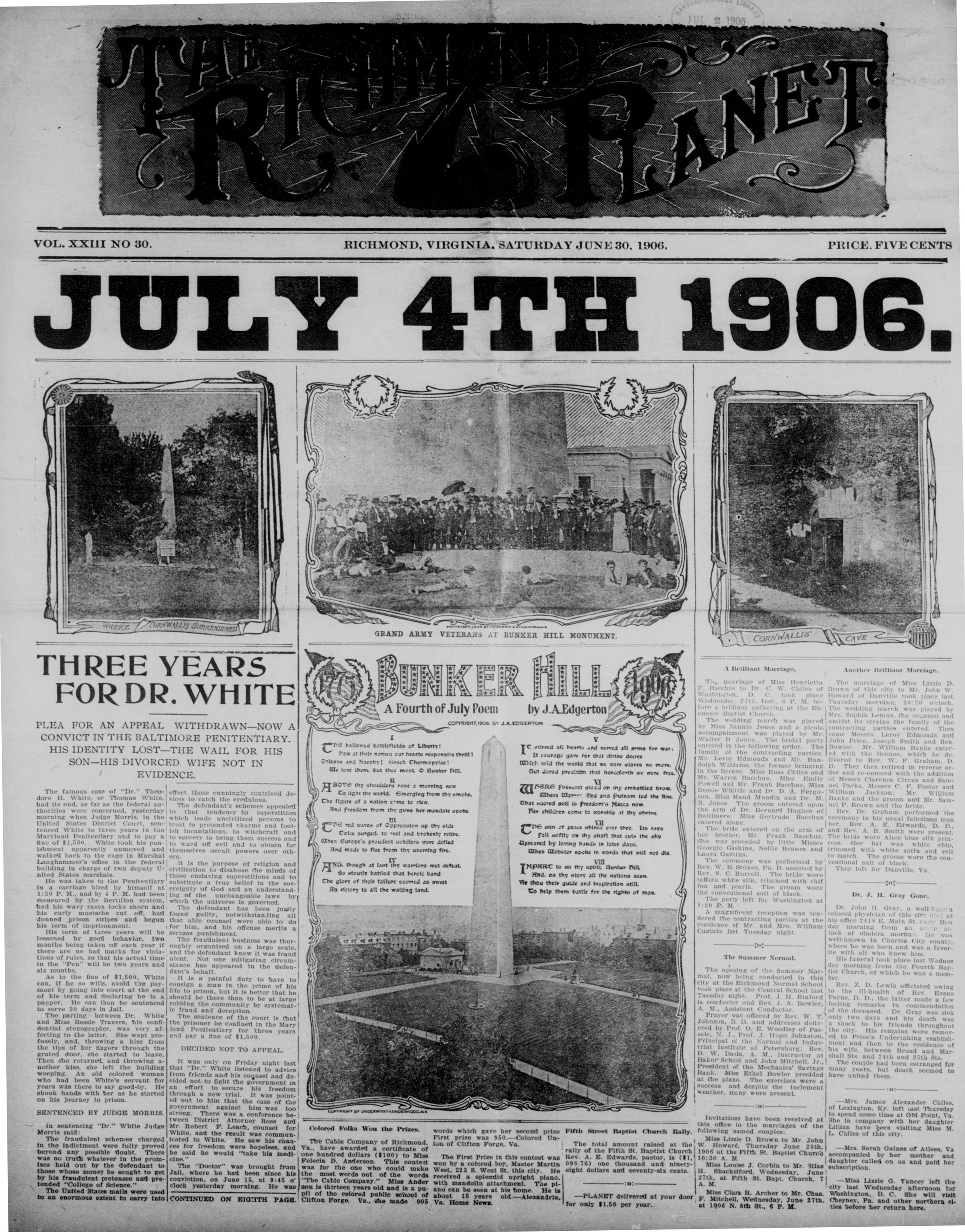
Page text (machine-generated)
THE RICHARD M. PLANET.
JULY 4TH 1906.
WHERE: CORNWALLIS SURRENDERED
THREE YEARS FOR DR. WHITE
VOL. XXIII NO 30.
WHERE CORN
THREE
FOR DR
PLEA FOR AN APPEAL
CONVICT IN THE BALT
HIS IDENTITY LOST
SON—HIS DIVORC
EVID
The famous case of "Dr." Theodore H. White, or Thomas White, had its end, as far as the federal authorities were concerned, yesterday morning when Judge Morris, in the United States District Court, sentenced White to three years in the Maryland Penitentiary and to pay a fine of $1,500. White took his punishment apparently unmoved and walked back to the cage in Marshal Langhammer's office in the federal building in charge of two deputy United States marshals.
He was taken to the Penitentiary in a carriage hired by himself at 1:30 P. M., and by 4 P. M. had been measured by the Bertillon system, had his wavy raven locks shorn and his curly mustache cut off, had donned prison stripes and begun his term of imprisonment.
His term of three years will be lessened by good behavior, two months being taken off each year if there are no bad marks for violations of rules, so that his actual time in the "Pen" will be two years and six months.
As to the fine of $1,500, White can, if he so wills, avoid the payment by going into court at the end of his term and declaring he is a pauper. He can then be sentenced to serve 30 days in Jail.
The parting between Dr. White and Miss Bessie Travers, his confidential stenographer, was very affecting to the latter. She wept profusely, and, throwing a kiss from the tips of her fingers through the grated door, she started to leave. Then she returned, and throwing another kiss, she left the building weeping. An old colored woman who had been White's servant for years was there to say good-by. He shook hands with her as he started on his journey to prison.
SENTENCED BY JUDGE MORRIS
In sentencing "Dr." White Judge Morris said:
The fraudulent schemes charged in the indictment were fully proved beyond any possible doubt. There was no truth whatever in the promises held out by the defendant to those whose money he sought to get by his fraudulent pretenses and pretended "College of Science."
The United States mails were used to an enormous extent to carry into
effect those cunningly contrived devices to catch the credulous.
The defendant's schemes appealed to that tendency to superstition which leads uncivilized persons to trust to pretended charms and foolish incantations, to witchcraft and to sorcery to bring them success and to ward off evil and to obtain for themselves occult powers over others.
It is the purpose of religion and civilization to disabuse the minds of those enslaving superstitions and to substitute a true belief in the sovereignty of God and an understanding of the unchangeable laws by which the universe is governed.
The defendant has been justly found guilty, notwithstanding all that able counsel were able to do for him, and his offense merits a serious punishment.
The fraudulent business was thoroughly organized on a large scale, and the defendant knew it was fraudulent. Not one mitigating circumstance has appeared in the defendant's behalf.
It is a painful duty to have to consign a man in the prime of his life to prison, but it is better that he should be there than to be at large robbing the community by systematic fraud and deception.
The sentence of the court is that the prisoner be confined in the Mary land Penitentiary for three years and pay a fine of $1,500.
DECIDED NOT TO APPEAL
It was only on Friday night last that "Dr. White listened to advice from friends and his counsel and decided not to fight the government in an effort to secure his freedom through a new trial. It was pointed out to him that the case of the government against him was too strong. There was a conference between District Attorney Rose and Mr. Robert F. Leach, counsel for White, and the result was communicated to White. He saw his chances for freedom were hopeless, and he said he would "take his medicine."
The "Doctor" was brought from Jail, where he had been since his conviction, on June 15, at 9:45 o'clock yesterday morning. He was
CONTINUED ON EIGHTH PAGE
RICHMOND, VIRGINIA, SATURDAY JUNE 30. 1906.
COPYRIGHT 1904 STURGEON WOOD & UNDER WORLD.
GRAND ARMY VETERANS AT BUNKER HILL MONUMENT.
THE hallowed battlefields of Liberty!
Now at their names our hearts responsive thrill!
Orleans and Nancy! Greek Thermopylae!
We love them, but those most. O Bunher Hill.
II
BOYE thy shoulders rose a morning new
To light the world. Emerging from thy amohe.
The figure of a nation crime to view.
And freedom from thy guns her mandate apohe.
III
THE red waves of Oppression up thy side
Twice surged, to reel and brokenly retire.
When Europe's proudest soldiers were defied
And made to flee from thy unerring fire.
IV
ND. though at last thy warriors met defeat.
So steadily battled that heroic band
The glory of their failure seemed as sweet
As victory to all the waiting land.
COPYRIGHT BY UNDERWOOD AUNDERWOOD, NY
THE MEMORIAL
COPYRIGHT BY UNDERWOOD AUNDERWOOD, N.Y.
words which gave her second prize First prize was 950.—Colored Union of Clifton Forge, Va.
The First Prize in this contest was won by a colored boy, Master Martin West, 223 S. West St. this city. He received a splendid upright piano, with mandolin attachment. The piano can be seen at his home. He is about 15 years old.—Alexandria, Va. Home News.
Colored Folks Won the Prizes.
The Cable Company of Richmond, Va., have awarded a certificate of one hundred dollars ($100) to Miss Felecia D. Anderson. This contest was for the one who could make the most words out of the words "The Cable Company." Miss Anderson is thirteen years old and is a pupil of the colored public school of Clifton Forge. Va., she made 905
I offred all hearts and nerved all arms for war.
It courage gave for that divine decree
Which told the world that we were alarms no more.
But dared preclaim that henceforth we were free.
WHERE Prescott stood on thy embattled brow.
Where Warren died and Putnam led the line.
That sacred soil is freedom's Mecca now.
Her children come to worship at thy shrine.
THE sun of peace shines over thee. Its rays
fall softly on thy shaft that cuts the shy
Upreared by loving hands in later days.
When Webster spoke in words that will not die.
IMPORT to us thy spirit, Buncher Bill.
And, as thy story all the nations scan.
Be thou their guide and inspiration still.
To help them battle for the rights of man.
second prize Fifth Street Baptist Church Rally.
The total amount raised at the rally of the Fifth St. Baptist Church Rev. A. E. Edwards, pastor, is ($1, 098.78) one thousand and ninety-eight dollars and seventy-six cents.
PLANET delivered at your door
for only $1.50 per year.
CORNWALLIS' CAVE
A Brilliant Marriage.
The marriage of Miss Henrietta F. Bacchus to Dr. C. W. Chiles of Washington, D. C. took place Wednesday, 27th Inst., 6 P. M. before a brilliant gathering at the Ebenezer Baptist Church.
The wedding march was played by Miss Nannie Jones and a piccolo accompaniment was played by Mr. Walter D. Jones. The bridal party entered in the following order. The family of the contracting parties, Mr. Leroy Edmonds and Mr. Randolph Williams, the former bringing in the license. Miss Rosa Chiles and Mr. Warren Bacchus, Miss Emily Powell and Mr. Frank Bacchus, Miss Bessie Whittle and Dr. D. A. Ferguson, Miss Maud Mundin and Dr. M. B. Jones. The groom entered upon the arm of Dr. Bernard Hughes of Baltimore. Miss Gertrude Bacchus entered alone.
The bride entered on the arm of her brother, Mr. Frank Bacchus, She was preceded by little Misses George Gaskins, Nellie Benson and Laura Gaskins.
The ceremony was performed by Rev. W. H. Stokes, Ph. D. assisted by Rev. S. C. Burrell. The bride wore taffeta white silk, trimmed with chiffon and pearls. The groom wore the conventional suit of black.
The party left for Washington at 8:20 P. M.
A magnificent reception was tendered the contracting parties at the residence of Mr. and Mrs. William Custalo last Tuesday night.
The Summer Normal.
The opening of the Summer Normal, now being conducted in this city at the Richmond Normal School took place at the Central School last Tuesday night. Prof. J. H. Binford is conductor and Rev. J. A. Bowler, A. M., Assistant Conductor. Prayer was offered by Rev. W. T. Johnson, D. D. and addresses delivered by Prof. O. E. Woodley of Passaic, N. J., Prof. J. Hugo Johnston, Principal of the Normal and Industrial Institute at Petersburg; Rev. D. W. Davis, A. M., Instructor at Baker School and John Mitchell, Jr., President of the Mechanics' Savings Bank. Miss Ethel Bowler presided at the plano. The exercises were a success and despite the inclement weather, many were present.
Invitations have been received at this office to the marriages of the following named couples:
Miss Lizzie D. Brown to Mr. John W. Howard, Thursday June 28th, 1906 at the Fifth St. Baptist Church 10:30 A. M.
Miss Louise J. Corbin to Mr. Silas H. Shackelford, Wednesday, June 27th, at Fifth St. Bapt. Church, 7 A. M.
Miss Clara B. Archer to Mr. Chas. F. Mitchell, Wednesday, June 27th, at 1006 N. 8th St., 6 P. M.
PRICE.FIVE CENTS
CAVE
Another Brilliant Marriage.
The marriage of Miss Lizzie D. Brown of this city to Mr. John W. Howard of Danville took place last Thursday morning, 10:30 o'clock. The wedding march was played by Mrs. Sophia Lemus, the organist and amidst its strains the family of the contracting parties entered. Then came Messrs. Leroy Edmonds and John Price, Joseph Smith and Ben Bowler. Mr. William Banks entered with the license, which he delivered to Rev. W. F. Graham, D. D. They then retired in reverse order and re-entered with the addition of Messrs Clarence Circus and Samuel Parks, Messrs C. F. Foster and William Jackson; Mr. William Banks and the groom and Mr. Samuel P. Brown and the bride.
Rev. Dr. Graham performed the ceremony in his usual felicitous manner. Rev. A. E. Edwards, D. D., and Rev. A. B. Smith were present. The bride wore Alice blue silk princess. Her hat was white chip, trimmed with white satin and veil to match. The groom wore the conventional suit of black. They left for Danville, Va.
Dr. J. H. Gray Gone.
Dr. John H. Gray, a well-known colored physician of this city died at his office 2418 E. Main St. early Mon day morning from an acute attack of cholera morbus. He was well-known in Charles City county, where he was born and was a favorite with all who knew him.
His funeral took place last Wednes day morning from the Fourth Baptist Church, of which he was a member.
Rev. Z. D. Lewis officiated owing to the ill-health of Rev. Evans Payne, D. D., the latter made a few feeling remarks in commendation of the deceased. Dr. Gray was sick only two days and his death was a shock to his friends throughout the city. His remains were removed to Price's Undertaking establishment and then to the residence of his wife, between Broad and Marshall Sts. and 24th and 25th Sts.
The couple had been estranged for many years, but death seemed to have united them.
—Mrs. James Alexander Ciles, of Lexington, Ky. left last Thursday to spend some time at Old Point, Va. She in company with her daughter Lillian have been visiting Miss M. L. Chiles of this city.
—Mrs. Sarah Gaines of Atlees, Va accompanied by her mother and daughter called on us and paid her subscription.
—Miss Lizzie G. Yancey left the city last Wednesday afternoon for Washington, D.C. She will visit Cheyney, Pa. and other northern cities before her return here.
FILE NO. 113.
ONE OF THE MYSTERIES OF PARIS, AND HOW IT WAS SOLVED.
(By EMILE GABORIAU.)
Not far from the Palais Royal, in the Rue St. Honore is the sign of La Bonne Foi, a small establishment, half cafe and half shop, extensively patronized by the people of the neighborhood.
It was in the smoking-room of this modest cafe that Prosper, the day after his release, awaited M. Verduret, who had promised to meet him at four o'clock.
The clock struck four: M. Verduret, who was punctuality itself, appeared. He was more red-faced and self-satisfied, if possible, than the day before. As soon as the servant had left the room to obey his orders, he said to Prosper:
"Well, are our commissions executed?"
"Yes, monsieur."
"Have you seen the costumer?"
"I gave him your letter, and everything you ordered will be sent to the Archangel to-morrow."
"Very good; you have not lost time, neither have I. I have good news for you."
The Bonne Foi is almost deserted at four o'clock. The hour-for coffee is passed and the hour for absinthe has not yet come. M. Verduret and Prosper could talk at their ease without fear of being overheard by gossiping neighbors.
M. Verduret drew forth his memorandum-book, the precious diary which, like the enchanted book in the fairy tale, had an answer for every question.
"While awaiting our emissaries whom I appointed to meet here, let us devote a little time to Monsieur de Lagors."
At this name Prosper did not protest, as he had done the night previous. Like those imperceptible insects which, having once penetrated the root of a tree, devour it in a single night, suspicion, when it invades our mind, soon develops itself, and destroys our firmest beliefs.
The visit of Lagors, and Gipsy's torn letter, had filled Prosper with suspicions which had grown stronger and more settled as time passed.
"Do you know, my dear friend," said M. Verduret, "what part of France this devoted friend of yours comes from?"
"He was born at St. Remy, which is also Madam Fauvel's native town."
"Are you certain of that?"
"Oh, perfectly so, monsieur! He has not only often told me so, but I have heard him tell Monsieur Fauvel; and he would talk to Madame Fauvel by the hour about his mother, who was cousin to Madame Fauvel, and dearly beloved by her."
"Then you think there is no possible mistake or falsehood about this part of his story?"
"None in the least, monsieur."
"Well, things are assuming a queer look."
And he began to whistle between his teeth; which, with M. Verduret, was a sign of intense inward satisfaction.
"What seems so, monsieur?" inquired Prosper.
"What has just happened; what I have been tracing. Parbleu!" as he exclaimed, imitating the manner of a showman at a fair, "here is a lovely town, called St. Remy, six thousand inhabitants, charming boulevards on the site of the old fortifications; handsome hotel; numerous fountains; large charcoal market, silk factories, famous hospital, and so on."
Prosper was on thorns.
"Please be so good, monsieur, as to explain what you—"
"It also contains." continued M. Verduret, "a Roman triumphal arch which is of unparalleled beauty, and a Greek mausoleum; but no Lagors. St. Remy is the native town of Nostradamus, but not of your friend."
"Yet I have proofs."
"Naturally. But proofs can be fabricated; relatives can be improvised. Your evidence is open to suspicion. My proofs are undeniable, perfectly authenticated. While you were pining in prison, I was preparing my batteries and collecting munition to open fire. I wrote to St. Remy, and received answers to my questions."
"Will you let me know what they were?"
"Have patience," said M. Verduret as he turned over the leaves of his memoranda. "Ah, here is number one. Bow respectfully to it, its official."
"LAGORS. Very old family, originally from Maillane, settled at St. Remy about a century ago."
"I told you so," cried Prosper.
"Pray, allow me to finish," said M. Verduret.
"The last of the Lagors (Jules-Rene-Henri) bearing without warrant the title of count, married in 1820 Mademoiselle Rosalie Clarisse Fontanet, of Tarascon; died December, 1848, leaving no male heir, but left two daughters. The registers make no mention of any person in the district bearing the name of Lagors.'
"Now, what do you think of this information," queried the fat man, with a triumphant smile.
Prosper looked amazed.
"But why did Monsieur Fauvel treat Raoul as his nephew?"
"Ah, you mean as his wife's nephew! Let us examine note number two; it is not official, but it throws a valuable light upon the twenty thousand livres income of your friend.
"Jules-Rene-Henri de Lagors, last of his name, died at St. Remy on the 20th of December, 1848, in a state of great poverty. He at one time was possessed of a moderate fortune, but invested it in a silk-worm nursery, and lost it all.
"He had no son, but left two daughters, one of whom is a teacher
TWO
"Yes, monsieur."
at AIX, and the other married a retail merchant at Oregon. His widow, at Montagnette, is supported entirely by one of her relatives, the wife of a rich banker in Paris. No person of the name of Lagors lives in the district of Arles.
"That is all," said M. Verduret; "don't you think it enough?
"Really, monsieur, I don't know whether I am awake or dreaming."
"You will be awake after awhile. Now I wish to remark one thing. Some people may assert that the Widow Lagors had a child born after her husband's death. This objection is destroyed by the age of your friend. Raoul is 24, and Monsieur de Lagors has not been dead 20 years."
"But," said Prosper, thoughtfully, "who can Kaoul be?"
"I don't know. The fact is, I am more perplexed to find out who he is than to know who he is not. There is one man who could give us all the information we seek, but he will take good care to keep his mouth shut."
"You mean Monsieur de Clameran?"
"Him, and no one else."
"I have always felt the most inexplicable aversion toward him. Ah, if we could only get his account in addition to what you already have!"
"I have been furnished a few notes concerning the Clameran family by your father, who knew them well; they are brief, but I expect more."
"What did my father tell you?"
"Nothing favorable, you may be sure. I will read you the synopsis of his information:
"Louis de Clameran was born at the Chateau de Clameran, near Tarse-
oon. He had an elder brother named Gaston, who, in consequence of an affray in which he had the misfortune to kill one man and badly wound another, was compelled to fly the country in 1842. Gaston was an honest, noble youth, universally beloved. Louis, on the contrary, was a wicked, despicable fellow, detested by all who knew him.
"Upon the death of his father, Louis came to Paris, and in less than two years had squandered not only his own patrimony, but also the share of his exiled brother.
"Ruined and harassed by debt, Louis entered the army, but behaved so disgracefully that he was dismissed.
"After leaving the army we lost sight of him; all we can discover is, that he went to England, and thence to a German gambling resort, where he became notorious for his scandalous conduct.
"In 1865 we find him again in Paris. He was in great poverty, and his associates were among the most depraved classes.
"But he suddenly heard of the return of his brother Gaston to France. Gaston had made a fortune in Mexico; but being still a young man, and accustomed to a very active life, he purchased, near Oloron, an iron mill, intending to spend the remainder of his life in working it. Six months ago he died in the arms of his brother Louis. His death provided our De Clameran an immense fortune, and the title of marquels."
"Then," said Prosper, "from all this I judge that Monsieur de Clameran was very poor when I met him for the first time at Monsieur Fauvel's?"
"Evidently."
"And about that time Lagors arrived from the country?"
"About a month after his appearance Madeleine suddenly banished me?"
"Well," exclaimed M. Verduret, "I am glad you are beginning to understand the state of affairs."
He was interrupted by the entrance of a stranger.
The newcomer was a dandified-looking coachman, with elegant black whiskers, shining boots with fancy tops, buff breeches, and a yellow waistcoat with red and black stripes.
After cautiously looking around the room, he walked straight up to the table where M. Verduret sat.
"What is the news, Master Joseph Dubois?" said the stout man, eagler.
"Ah, patron, don't speak of it!" answered the servant, "things are getting warm."
Prosper concentrated all his attention upon this superb domestic. He thought he recognized his face. He had certainly somewhere seen that retreating forehead and those little restless black eyes, but where and when he could not remember.
Meanwhile Master Joseph had taken a seat at a table adjoining the one occupied by M. Verduret and Prosper; and, having called for some absinthe, was preparing it by holding the water aloft, and slowly dropping it in the glass.
"Speak!" said M. Verduret.
"In the first place, patron, I must say that the position of valet and coachman to Monsieur de Clameran is not a bed of roses."
"Go on; come to the point. You can complain to-morrow."
"Very good. Yesterday my master walked out at two o'clock. I, of course, followed him. Do you know where he went? The thing was as good as a farce. He went to the Archangel to keep the appointment made by Nina Gipsy."
"Well, make haste. They told him she was gone. Then?"
"Then? Ah, he was not at all pleased, I can tell you. He hurried back to the hotel where the other, Monsieur de Lagors, awaited him. And, upon my soul, I have never heard so much swearing in my life! Monsieur Raoul asked him what had happened to put him in such a bad humor. 'Nothing,' replied my master, 'except that little devil has run off, and no one knows where she is; she has clipped through our fingers. Then
THE RICHMOND PLANET, RICHMOND, VIRGINIA
they both appeared to be vexed and uneasy. Lagors asked if she knew anything serious: 'She knows nothing but what I told you,' replied Clameran; 'but this nothing, falling in the ear of a man with any suspicions, will be more than enough to work on.' M. Verduret smiled like a man who had his reasons for appreciating at their just value De Clameran's fears. "Well, your master is not without sense, after all; don't you think he showed it by saying that?" "Yes, patron. Then Lagors exclaimed: 'If it is as serious as that, we must get rid of this little serpent!' But my master shrugged his shoulders, and, laughing loudly, said: 'You talk like an idiot; when one is annoyed by a woman of this sort, one must take measures to get rid of her administratively.' This idea seemed to amuse them both very much."
"I can understand their being entertained by it," said M. Verdurret; "it is an excellent idea; but the misfortune is, it is too late to carry it out. The nothing which made Clamceran weasel has already fallen into a knowing ear."
With breathless curiosity, Prosper listened to this report, every word of which seemed to throw light upon past events. Now, he thought, he understood the fragment of Gipsey's letter. He saw that this Raoul, in whom he had confided so deeply, was nothing more than a scoundrel. A thousand little circumstances, unnoticed at the time, now recurred to his mind, and made him wonder how he could have been blind so long.
Master Joseph Dubois continued his report:
"What!" exclaimed Prosper, "after the insulting language he used the day of the robbery, did he dare to visit the house?"
"Yes, monsieur; he not only dared this, but he also stayed there until midnight, to my great discomfort; for I got as wet as a rat waiting for him."
"How did he look when he came out?" asked M. Verduret.
"Well, he certainly looked less pleased than when he went in. After putting away my carriage, and rubbing down my horses, I went to see if he wanted anything; I found the door locked, and he swore at me like a trooper through the keyhole."
And, to assist the digestion of this insult, Master Joseph here gulped down a glass of absinthe.
"Is that all?" questioned M. Verduret.
"All that occurred yesterday, patron; but this morning my master rose late, still in a horribly bad humor. At noon Raoul arrived, also in a rage. They at once began to dispute, and such a row! Why the most abandoned house-breakers and pick-pockets would have blushed to hear such billinggate. At one time my master seized the other by the throat and shook him like a reed. But Raoul was too quick for him; he saved himself from strangulation by drawing out a sharp-pointed knife, the sight of which made my master drop him in a hurry, I can tell you." "But what did they say?" "Ah, there is the rub, patron," said Joseph, in a piteous tone, "the scamps spoke English, so I could not understand them. But I am sure they were disputing about money.
"Because I learned at the exposition that the word 'argent' meant money in every language in Europe; and this they constantly used in their conversation."
M. Verduret sat with his knit brows, talking in an undertone to himself; and Prosper, who was watching him, wondered if he was trying to understand and construct the dispute by mere force of reflection.
"When they had done fighting," continued Joseph, "the rascals began to talk in French again; but they only spoke of a fancy ball which is to be given by some banker. When Raoul was leaving, my master said; 'Since this thing is inevitable, and it must take place to-day, you had better remain at home, at Vesinet, this evening.' Rapul replied: 'Of course.'"
Night was approaching, and the smoking room was gradually filling with men, who called for absinthe or bitters, and youths who perched themselves up on high stools, and smoked their pipes.
"It is time to go," said M. Verduret; "your master will want you, Joseph; besides, here is someone come for me. I will see you to-morrow."
The new-comer was no other than Cavaillon, more troubled and frightened than ever. He looked uneasily around the room, as if he expected the whole police force to appear, and carry him off to prison.
He did not sit down at M. Verduret's table, but stealthily gave his hand to Prosper, and, after assuring himself that no one was observing them, handed M. Verduret a package, saying:
"She found this in a cupboard."
It was a handsomely-bound prayer book. M. Verduret rapidly turned over the leaves, and soon found the pages from which the words pasted on Prosper's letter had been cut.
"I had moral proofs," he said, handing the book to Prosper, "but here is material proof sufficient in itself to save you."
When Prosper looked at the book he turned pale as a ghost. He recognized this prayer book instantly. He had given it to Madeleine in exchANGE for the medal.
He opened it, and on the fly-leaf Madeleine had written: "Souvenir of Notre Dame de Fourvieres, 17 January, 1866."
"This book belongs to Madeleine," he cried.
Mr. Verduret did not reply, but walked toward a young man dressed like a brewer, who had just entered the room.
He glanced at the note which this person handed to him, and hastened
back to the table, and said, in an agitated tone:
"I think we have got them now!"
Throwing a five-trance piece on the table, and without saying a word to Cavaillon, he seized Prosper's arm, and hurried from the room.
"What a fatality!" he said, as he hastened along the street: "we may miss them. We shall certainly reach St. Lazare station too late for the St. Germain train."
"For Heaven's sake, where are you going?" asked Prosper.
"Never mind, we can talk after we start. Hurry!"
Reaching Palais Royal place, M. Verduret stopped before one of the hacks belonging to the railway station, and examined the horses at a glance.
"How much for driving us to Vesinet?" he asked of the driver.
"I don't know the road very well that way."
The name of Vesinet was enough for Prosper.
"I will point out the road," he interrupted, quickly.
"Weil," said the driver, "at this time of night, in such dreamful weather, it ought to be 25 francs."
"Bless my soul! Why, monsieur, I leave that to your generosity; but if you put it at 35 francs—"
"You shall have a hundred," interrupted M. Verdure, "if you overtake a carriage which has half an hour's start of us."
And, whipping up his lean horses, he galloped them down the Rue de Valois at lightning speed.
CHAPTER X.
Leaving the little station of Vesnet, we come upon two roads. One, to the left, masacadamized and kept in perfeet repair, leads to the village, of which there are glimpses here and there through the trees. The other, newly laid out, and just covered with gravel, leads through the woods.
Along the latter, which before the lapse of five years will be a busy street, are built a few houses, hideous in design, and at some distance apart; rural summer retreats of city merchants, but unoccupied during the winter.
It was at theunction of these two roads that Prosier stopped the hack. The driver had gained his hundred francs. The houses were completely worn out, but they had accomplished all that was expected of them; M. Verduret could distinguish the lamps of a hack similar to the one he occupied, about fifty yards ahead of him.
M. Verdurel jumped out, and, handling the driver a bank note, said: "Here is what I promised you. Go to the first tavern you find on the right-hand side of the road as you enter the village. If we do not meet you there in an hour, you are at liberty to return." Paris"
The driver was overwhelming in his thanks; but neither Prosper nor his friend heard them. They had already started up the new road.
The weather, which had been inclement when they set out, was now fearful. The rain fell in torrents, and a furious wind howled dismally through the dense woods.
M. Verduret and Prosper had been running along the muddy road for about five minutes, when suddenly the latter stopped and said: "This is Rooul's house."
Before the gate of an isolated house stood the hack which M. Verduret had followed. Reclining on his seat, wrapped in a thick cloak, was the driver, who, in spite of the pouring rain, was already asleep, evidently waiting for the person whom he had brought to this house a few minutes ago.
M. Verduret pulled his cloak, and said, in a low voice: "Wake up, my good man."
The driver started, and, mechanically gathering his reins, yawned out: "I am ready; come on!"
But when, by the light of the carriage lamps, he saw two men in this lonely spot, he imagined that they wanted his purse, and perhaps his life.
"I am engaged!" he cried out, as he cracked his whip in the air; "I am waiting here for someone."
"I know that, you fool," replied M. Verduret, "and only wish to ask you a question, which you can gain five frances by answering. Did you not bring a middle-aged lady here?"
This question, this promise of five frances, instead of reassuring the coachman, increased his alarm.
"I have already told you I am waiting for someone," he said, "and, if you don't go away and leave me alone, I will call for help."
M. Verduret drew back quickly.
"Come away," he whispered to Prosper, "the cur will do as he says; and the alarm once given, farewell to our projects. We must find some other entrance than by this gate."
Then they went along the wall surrounding the garden, in search of a place where it was possible to climb up.
This was difficult to discover, the wall being 12 feet high, and the night very dark. Fortunately, M. Verduret was very agile; and, having decided upon the spot to be scaled, he drew back a few feet, and making a sudden spring, seized one of the projecting stones above him, and drawing himself up by aid of his hands and feet, soon found himself on the top of the wall.
It was now Prosper's turn to climb up; but, though much younger than his companion, he had not his agility and strength, and would never have succeeded if M. Verduret had not pulled him up, and then helped him down on the other side.
Once in the garden, M. Verduret looked about him to study the situa-
tion.
The house occupied by M. de Lagors was built in the middle of an immense garden. It was narrow, two stories high, and with garrets.
Only one window, in the second story, was lighted.
"As you have often been here," said M. Verduret, "you must know all about the arrangement of the house; what room is that where we see the light?"
"That is Raoul's bed-chamber."
"Very good. What rooms are on the first floor?"
"The kitchen, pantry, billiard-room, and dining-room."
"And on the floor above?"
"Two drawing-rooms, separated by folding doors, and a library."
"Raoul has none at present. He is written on by a man and his wife, who live at Vesinet; they come in the morning, and leave after dinner."
M. Verduret rubbed his hands gleefully.
"That suits our plans exactly," he said; "there is nothing to prevent our hearing what Raoul has to say to this person who has come from Paris at ten o'clock at night, to see him. Let us go in."
Prosper seemed averse to this, and said:
"It is a serious thing for us to do, monsieur."
"Bless my soul! what else did we come here for? Did you think it was a pleasure trip, merely to enjoy this lovely weather?" he said, in a bantering tone.
"Suppose we are? If the least noise betrays our presence, you have only to advance boldly as a friend come to visit a friend, and, finding the door open, walk in."
But unfortunately the heavy oak door was locked. M. Verduret shook it in vain.
"How foolish!" he said, with exation, "I ought to have brought my instruments with me. A common lock which could be opened with a nail, and I have not even a piece of wire!" Thinking it useless to attempt the door, he tried successively every window on the ground floor. Alas! each blind was securely fastened on the inside.
M. Verduret was provoked. He prowled around the house like a fox around a hen-enco, seeking an entrance. Despairingly he came back to the spot in front of the house whence he had the best view of the lighted window.
"If I could only look in," he cried "Just to think that in there," and he pointed to the window, "is the solution of the mystery; and we are cut off from it by thirty or forty feet of cursed blank wall!" Prosper was more surprised than ever at his companion's strange behavior. He seemed perfectly at home in this garden; he ran about without any precaution; so that one would have supposed him accustomed to such expeditions, especially when he spoke of pleking the lock of on occupied house, as if he were talking of opening a snuff-box. He was utterly indifferent to the rain and sleet driven in his face by the gusts of wind as he splashed about in the mud, trying to find some way of entrance. "I must get a peep into that window," he said, "and I will, cost what it may!" Prosper seemed to suddenly remember something.
"There is a ladder here," he cried.
"Why did you not tell me that before? Where is it?"
"At the end of the garden, under the trees."
They ran to the spot, and in a few minutes had the ladder standing against the wall.
But to their chargin they found the ladder six feet too short. Six long feet of wall between the top of the ladder and the lighted window was a very discouraging sight to Prosper; he exclaimed:
"We can not reach it."
"We can reach it," cried M. Verduret, triumphantly.
And he quickly placed himself a yard off from the house, and seizing the ladder, cautiously raised it, and rested the bottom round on his shoulders, at the same time holding the two uprights firmly and steadily with his hands. The obstacle was overcome.
"Now mount," he said to his companion.
Prosper did not hesitate. The enthusiasm of difficulties so skillfully conquered, and the hope of triumph, gave him a strength and agility which he had never imagined he possessed.
He made a sudden spring, and seizing the lower rounds, quickly climbed up the ladder, which swayed and trembled beneath his weight.
But he had scarcely looked in the lighted window when he uttered a cry which was drowned in the roaring tempest, and dropped like a log down on the wet grass, exclaiming:
"The villain! the villain!"
With wonderful promptness and vigor, M. Verduret laid the ladder on the ground, and ran toward Prosper, fearing he was dead or dangerously injured.
"What did you see? Are you hurt?" he whispered.
But Prosper had already risen. Although he had had a violent fall, he was unhurt; he was in a state when mind governs matter so absolutely that the body is insensible to pain.
"I saw," he answered, in a hoarse voice, "I saw Madeleine—do you understand, Madeleine—in that room, alone with Raoul."
M. Verduret was confounded. Was it possible that he, the infallible expert, had been mistaken in his deductions?
He well knew that M. de Lagors' visitor was a woman; but his own conjectures and the note which Mme. Gipsy had sent to him at the tavern, had fully assured him that this woman was Mme. Fauvel.
"You must be mistaken," he said to Prosper.
"No, monsieur, no. Never could I mistake another for Madeleine. Ah! you who heard what she said to me
yesterday, answer me; was I to expect such infamous treason as this? You said to me then, "She loves you, she loves you! Now do you think she loves me?" Speak."
M. Verduret did not answer. He had first been stupefied by his mistake, and was now racking his brain to discover the cause of it, which was soon discerned by his penetrating mind.
"This is the secret discovered by Nina," continued Prosper, "Madeleine, this pure and noble Madeleine, whom I believed to be as immaculate as an angel, is in love with this thief, who has even stole the name he bears; and, I, trusting fool that I was, made this scoundrel my best friend. I confided to him all my hopes and fears; and he was her lover! Of course they amused themselves by ridiculing my silly devotion and blind confidence!"
He stopped, overcome by his violent emotions. Wounded vanity is the worst of miseries. The certainty of having been so shamefully deceived and betrayed made Prosper almost insane with rage.
"This is the last humiliation I shall submit to," he fiercely cried. "It shall not be said that I was coward enough to stand by and let an insult like this go unpunished."
He started toward the house; but M. Verduret seized his arm and said: "What are you going to do?"
"Have my revenge! I will break down the door; what do I care for the noise and scandal, now that I have nothing to lose? I shall not attempt to creep into the house like a thief, but as a master, as one who has a right to enter, as a man who having received an insult which can only be washed out with blood comes to demand satisfaction.
"You will do nothing of the sort, Prosper."
"You? Do not hope that you will be able to deter me. I will appear before them, put them to the blush, kill them both, then put an end to my own wretched existence. That is what I intend to do, and nothing shall stop me!"
If M. Verduret had not held Prosper with a vise-like grip, he would have escaped, and carried out his threat.
"If you make any noise, Prosper, or raise an alarm, all your hopes are ruined."
"I have no hopes now."
"Raoul, put on his guard, will escape us, and you will remain dishonored forever."
"It makes a great difference to me. I have sworn to prove your innocence. A man of your age can easily find a wife, but can never restore ruster to a tarnished name. Let nothing interfere with the establishing of your innocence."
Genuine passion is uninfluenced by surrounding circumstances. M. Verduret and Prosper stood foot-deep in mud, wet to the skin, the rain pouring down on their heads, and yet seemed in no hurry to end their dispute.
"I will be avenged," repeated Prosper, with the persistency of a fixed idea; "I will avenge myself."
"Well, avenge yourself like a man, and not like a child!" said M. Verduret, angrily.
"Yes, I repeat it, like a child. What will you do after you get into the house? Have you any arms? No! You rush upon Raoul, and a struggle ensues; while you two are fighting, Madeleine jumps in her carriage, and drives off. What then? Which is the stronger, you or Raoul?"
Overcome by the sense of his pow-
lessness, Prosper was silent.
"And arms would be of no use."
continued M. Verduret; "it is fortu-
nate you have none with you, for it
would be very foolish to shoot a man
whom you can send to the galleys."
"What must I do?"
"Wait. Vengeance is a delicious fruit, that must ripen in order that we may fully enjoy it."
Prosper was unsettled in his resolution; M. Verduret seeing this brought forth his last and strongest argument.
"How do we know," he said, "that Mademoiselle Madeleine is here on her own account? Did we not come to the conclusion that she was sacrificing herself for the benefit of some one else? That superior will which compelled her to banish you may have constrained this step to-night."
That which coincides with our secret wishes is always eagerly welcomed. This supposition, apparently improbable, struck Prosper as possibly true.
"That might be the case," he murmured, "who knows?"
"I would soon know," said M. Verduret, "if I could see them together in that room."
"Will you promise me, monsieur, to tell me the exact truth, all that you see and hear, no matter how painful it may be for me!"
"I swear it, upon my word of honor."
Then, with a strength of which a few minutes before he would not have believed himself possessed, Prosper raised the ladder, and placed the last round on his shoulder, and said to M. Verduret:
"Mount!"
M. Verduret rapidly ascended the ladder without even shaking it, and had his head on a level with the window.
Prosper had seen but too well. There was Madeleine at this hour of the night, alone with Raoul de Lagors in his room!
M. Verduret observed that she still wore her shawl and bonnet.
She was standing in the middle of the room, talking with great animation. Her look and gestures betrayed indignant scorn. There was an expression of ill-disguised loathing upon her beautiful face.
Raoul was seated by the fire, stirring up the coals with a pair of tongs. Every now and then he would shrug his shoulders, like a man resigned to everything he heard, and had no answer, except. "I can not help it. I can do nothing for you."
given the diamond ring on his finger to be able to hear what was said; but the roaring wind completely drowned their voices.
"They are evidently quarreling," he thought; "but it is not a lovers' quarrel."
"Madeleine continued talking; and it was by closely watching the face of Lagors, clearly revealed by the lamp on the mantel, that M. Verdure hoped to discover the meaning of the scene before him.
At one moment Lagors would start and tremble in spite of his apparent indifference; the next, he would strike at the fire with the tongs, as if giving vent to his rage at some reproach uttered by Madeleine.
Finally Madeleine changed her threats into entreaties, and, clasping her hands, almost fell at his knees.
He turned away his head, and refused to answer save in monosyllables.
Several times she turned to leave the room, but each time returned, as if asking a favor, and unable to make up her mind to leave the house till she had obtained it. At last she seemed to have uttered something decisive; for Raoul quickly rose and opened a desk near the fireplace, from which he took a bundle of papers, and handed them to her.
"Well," thought M. Verduret, "this looks bad. Can it be a compromising correspondence which the fair one wants to secure?"
Madeleine took the papers, but was apparently still dissatisfied. She again entreated him to give her something else. Raoul refused; and then she threw the papers on the table.
The papers seemed to puzzle M. Verduret very much, as he gazed at them through the window.
"I am not blind," he said, "and I certainly am not mistaken; those papers, red, green and yellow, are pawnbrokers' tickets."
Madeleine turned over the papers, as if looking for some particular ones. She selected three, which she put in her pocket, disdainfully pushing the others aside.
She was evidently preparing to take her departure, for she said a few words to Raoul, who took up the lamp as if to escort her down stairs.
There was nothing more for M. Verduret to see. He carefully descended the ladder, muttering to himself: "Pawnbrokers' tickets! What infamous mystery lies at the bottom of all this?" The first thing he did was to remove the ladder. Raoul might take it into his head to look around the garden when he came to the door with Madeleine, and if he did so the ladder could scarcely fail to attract his attention. M. Verduret and Prosper hastily laid it on the ground, regardless of the shrubs and vines they destroyed in doing so, and then concealed themselves among the trees, whence they could watch at once the front door and the outer gate.
Madeleine and Raoul appeared in the door way, Raoul set the lamp on the bottom step, and offered his hand to the girl; but she refused it with haughty contempt, which somewhat soothed Prosper's lacerated heart.
This scornful behavior did not, however, seem to surprise or hurt Raoul. He simply answered by an ironical gesture which implied: "As you please!"
He followed her to the gate, which he opened and closed after her; then he hurried back to the house, while Madeleine's carriage drove rapidly away.
"Now, monsieur," said Prosper, "you must tell me what you saw. You promised me the truth no matter how bitter it might be. Speak; I can bear it, be it what it may."
"You will only have joy to bear, my friend. Within a month you will bitterly regret your suspicions of tonight. You will blush to think that you ever imagined Mademoiselle Madeleine to be intimate with a man like Lagors."
"But, monsieur, appearances—"
"It is precisely against appearances that we must be on our guard. Always distrust them. A suspicion, false or just, is always based on something. But we must not stay here forever; and, as Raoul has fastened the gate, we shall have to climb back again."
"But there is the ladder."
"Let it stay where it is; as we can not efface our foot prints, he will think thieves have been trying to get into the house."
They scaled the wall, and had not walked fifty steps when they heard the noise of a gate being unlocked. They stood aside and waited; a man soon passed by on his way to the station.
"That is Raoul," said M. Verduret, and Joseph will report to us that he has gone to tell Cleramor what has just taken place. If they are only kind enough to speak French!"
He walked along quietly for some time, trying to connect the broken chain of his deductions.
"How in the deuce," he abruptly asked, "did this Lagors, who is devoted to gay society, come to choose a lonely country house to live in?"
"I suppose it was because Monsieur Fauvel's villa is only 15 minutes' ride from here, on the Seine."
"That accounts for his staying here in the summer; but in winter."
"Oh, in winter he has a room at the Hotel de Louvre, and all the year round keeps an apartment in Paris." This did not enlighten M. Verduret much; he hurried his pace.
"I hope our driver has not gone. We can not take the train which is about to start, because Raoul would see us at the station."
Although it was more than an hour since M. Verduret and Prosper left the hack at the branch road, they found it waiting for them in front of the tavern.
The driver could not resist the desire to change his five-franc piece; he had ordered dinner, and, finding the wine very good, was calling for more, when he looked up and saw his employers.
"Well, you are in a strange state!" he exclaimed.
Prosper replied that they had gone
THE PLANET
SATURDAY...JUNE 30TH. 1906.
to see a friend, and, losing their way, had fallen into a pit; as if there were pits in Vesinet forests.
"Ah, that is the way you got covered with mud, is it?" exclaimed the driver, who, though apparently contented with this explanation, strongly suspected that his two customers had been engaged in some nefarious transaction.
The opinion seemed to be entertained by everyone present, for they looked at Prosper's muddy clothes and then at each other, in a knowing way.
But M. Verduret stopped all comment by saying:
"Come on!"
"All right, monsleur; get in while I settle my bill; I will be there in a minute.
The drive back was silent, and seemed interminably long. Prosper at first tried to draw his strange companion into conversation; but, as he received nothing but monosyllables in reply, held his peace for the rest of the journey. He was again beginning to feel irritated at the absolute empire exercised over him by this man.
Physical discomfort was added to his other troubles. He was stiff and numb; every bone in him ached with the cold.
Although mental endurance may be unlimited, bodily strength must in the end give way. A violent effort is always followed by reaction.
Lying back in a corner of the carriage, with his feet upon the front seat, M. Verduret seemed to be enjoying a nap; yet he was never more wide awake.
He was in a perplexed state of mind. This expedition, which, he had been confident, would resolve all his doubts, had only added mystery to the mystery. His chain of evidence, which he had thought so strongly linked, was completely broken.
For him the facts remained the same, but circumstances had changed. He could not imagine what common motive, what moral or material complicity, what influences, could have existed to make the four actors in his drama. Mme. Fauvel, Madeleine, Raoul and Clameran, seemed to have the same object in view.
He was seeking in his fertile mind, that encyclopaedia of craft and subtlety, for some combination which would throw light on the problem before him.
The midnight bells were ringing when they reached the Archangel, and for the first time M. Verduret remembered that he had not dined.
Fortunately Mme. Alexandre was still up, and in the twinkling of an eye had improvised a tempting supper. It was more than attention, more than respect, that she showed her guest. Prosper observed that she gazed admiringly at M. Verduret all the while he was eating his supper.
"You will not see me to-morrow," said M. Verduret to Prosper, when he had risen to leave the room; "but I will be here about this time to-morrow night. Perhaps I shall discover what I am seeking at Messieurs Jandidiers' ball." Prosper was dumb with astonishment. What! would M. Verduret think of appearing at a ball given by the wealthiest and most fashionable bankers in Paris? This accounted for his sending to the costumer. "Then you are invited to this ball?" The expressive eyes of M. Verduret danced with amusement. "Not yet," he said, "but I shall be." Oh, the inconsistency of the human mind! Prosper was tormented by the most serious pre-occupations. He looked sadly around his chamber, and, as he thought of M. Verduret's projected pleasure at the ball, exclaimed: "Ah, how fortunate he is! To-morrow he will have the privilege of seeing Madeleine."
BEES AND POULTRY
Time to think about water-glass eggs.
They say that bee-keepers should organize.
Breed your queens to suit your demand for honey-gatherers.
There are bee-keepers who keep bees, and then there are real bee-keepers.
Mites are very destructive and multiply with astonishing rapidity. Look for them often.
Scrub bees, scrub bee-keeping, and scrub bee-keepers are usually found at the same place.
Catch the infection of cleanly practice in the poultry yard and the hens will catch it too.
Every breed is popular enough for every breeder to dispose of first-class fowls at good prices.
It is the good queen and the good management that work to the best advantage in an apary.
Not the breed, not the feed, not the house, not the yard, not anything counts more than the man in poultry raising as a business.
Cleanliness a Factor
The cleaner the poultry establishment is kept the more certainly will the business pay a profit. Dirt is the harborer of both disease germs and of mites. It is with fowls as with the man belings. Dirt and squall are the handmaldens of disease and death. Many a poultry enterprise has failed just because the owner did not keep everything clean.
Tobacco Plants in Garden.
Grow some tobacco plants in the garden. The infusion is excellent for spraying plants, hen houses and lice infested animals.
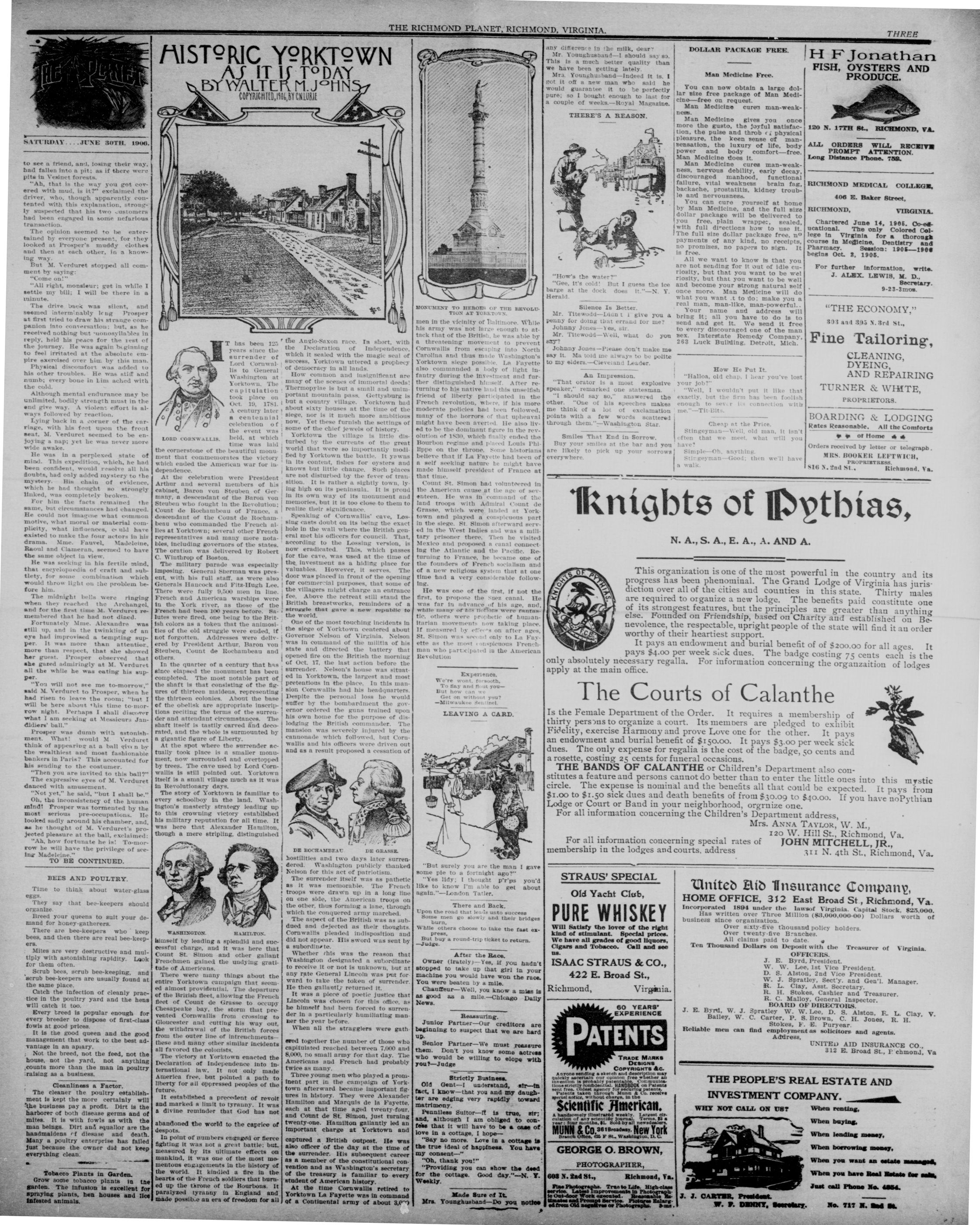
HISTORIC YORKTOWN
AS IT IS TODAY
BY WALTER M. JOHNS
COPYRIGHTED, 1906, BY CNLURIE
T has been 125 years since the surrender of Lord Cornwallis to General Washington at Yorktown. The capitulation took place on Oct 19, 1781. A century later a centennial celebration of the event was held, at which time was laid
IT has been 125 years since the surrender of Lord Cornwallis to General Washington at Yorktown. The capitulation took place on Oct. 19, 1781. A century later a centennial celebration of the event was held, at which time was laid the cornerstone of the beautiful monument that commemorates the victory which ended the American war for independence.
At the celebration were President Arthur and several members of his cabinet, Baron von Steuben of Germany, a descendant of the Baron von Steuben who fought in the Revolution; Count de Rochambeau of France, a descendant of the Count de Rochambeau who commanded the French allies at Yorktown; several other French representatives and many more notables, including governors of the states. The oration was delivered by Robert C. Winthrop of Boston.
The military parade was especially imposing. General Sherman was present, with his full staff, as were also Generals Hancock and Fitz-Hugh Lee. There were fully 9,500 men in line. French and American warships were in the York river, as those of the French had been 100 years before. Salutes were fired, one being to the British colors as a token that the animosities of the old struggle were ended, if not forgotten. Addresses were delivered by President Arthur, Baron von Steuben, Count de Rochambeau and others.
In the quarter of a century that has since elapsed the monument has been completed. The most notable part of the shaft is that consisting of the figures of thirteen maliens, representing the thirteen colonies. About the base of the obelisk are appropriate inscriptions reciting the terms of the surrender and attendant circumstances. The shaft itself is tastily carved and decorated, and the whole is surmounted by a gigantic figure of Liberty.
At the spot where the surrender actually took place is a smaller monument, now surrounded and overtopped by trees. The cave used by Lord Cornwallis is still pointed out. Yorktown itself is a small village much as it was in Revolutionary days.
The story of Yorktown is familiar to every schoolboy in the land. Washington's masterly strategy leading up to this crowning victory established his military reputation for all time. It was here that Alexander Hamilton, though a mere stripling, distinguished
WASHINGTON. HAMILTON.
himself by leading a splendid and successful charge, and it was here that Count St. Simon and other gallant Frenchmen gained the undying gratitude of Americans.
There were many things about the entire Yorktown campaign that seemed almost providential. The departure of the British fleet, allowing the French fleet of Count de Grasse to occupy Chesapeake bay, the storm that prevented Cornwallis from crossing to Gloucester and cutting his way out, the withdrawal of the British forces from the outer line of intrenchments—these and many other similar incidents all favored the colonists.
The victory at Yorktown enacted the Declaration of Independence into international law. It not only made America free, but pointed a path to liberty for all oppressed peoples of the future.
It established a precedent of revolt and marked a limit to tyranny. It was a divine reminder that God has not abandoned the world to the caprice of despots.
In point of numbers engaged or fierce fighting it was not a great battle; but, measured by its ultimate effects on mankind, it was one of the most momentous engagements in the history of the world. It kindled a fire in the hearts of the French soldiers that burned up the throne of the Bourbons. It paralyzed tyranny in England and made possible an era of freedom for all
the Anglo-Saxon race. In short, with the Declaration of Independence, which it sealed with the magic seal of success, Yorktown uttered a prophecy of democracy in all lands. How common and insignificant are many of the scenes of immortal deeds. Thermopyline is but a small and unimportant mountain pass. Gettysburg is but a country village. Yorktown had about sixty houses at the time of the siege, nor is it much more ambitious now. Yet these furnish the settings of some of the chief jewels of history. Yorktown the village is little disturbed by the currents of the great world that were so importantly modified by Yorktown the battle. It yawns in its content, fishes for oysters and knows but little change. Such places are not disturbed by the fever of transition. It is rather a sightly town, lying high on its peninsula. It is proud in its own way of its monument and memories, but it is too close to them to realize their significance.
Speaking of Cornwallis' cave, Lossing casts doubt on its being the exact hole in the wall where the British general met his officers for council. That, according to the Lossing version, is now eradicated. This, which passes for the cave, was used at the time of the investment as a hiding place for valuables. However, it serves. The door was placed in front of the opening for commercial purposes, that some of the villagers might charge an entrance fee. Above the retreat still stand the British breastworks, reminders of a struggle that gave a new republic to the world.
One of the most touching incidents in the siege of Yorktown centered about Governor Nelson of Virginia. Nelson was in command of the militia of his state and directed the battery that opened fire on the British the morning of Oct. 17, the last action before the surrender. Nelson's house was situated in Yorktown, the largest and most pretentious in the place. In this mansion Cornwallis had his headquarters. Despite the personal loss he would suffer by the bombardment the governor ordered the guns trained upon his own home for the purpose of dislodging the British commander. The mansion was severely injured by the cannonade which followed, but Cornwallis and his officers were driven out and as a result proposed a cessation of
DE BOCHAMBEAU DE GRASSE
hostilities and two days later surrendered. Washington publicly thanked Nelson for this act of patriotism.
The surrender itself was as pathetic as it was memorable. The French troops were drawn up in a long line on one side, the American troops on the other, thus forming a lane, through which the conquered army marched.
The aspect of the British was as subdued and dejected as their thoughts. Cornwallis pleaded indisposition and did not appear. His sword was sent by a subordinate.
Whether this was the reason that Washington designated a subordinate to receive it or not is unknown, but at any rate General Lincoln was put forward to take the token of surrender. He then gallantly returned it.
It was a piece of poetic justice that Lincoln was chosen for this office, as he himself had been forced to surrender in a particularly humiliating manner the year before.
When all the stragglers were gathered together the number of those who capitulated reached between 7,000 and 8,000, no small army for that day. The Americans and French had probably twice as many.
Three young men who played a prominent part in the campaign of Yorktown afterward became important figures in history. They were Alexander Hamilton and Marquis de la Fayette, each at that time aged twenty-four, and Count de St. Simon, just turning twenty-one. Hamilton gallantly led an important charge at Yorktown and captured a British outpost. He was also officer of the day at the time of the surrender. His subsequent career as a member of the constitutional convention and as Washington's secretary of the treasury is familiar to every student of American history.
At the time Cornwallis retired to Yorktown La Fayette was in command of a Continental army of about 3,000.
THE RICHMOND PLANET, RICHMOND, VIRGINIA
Victory Column
MONUMENT TO HEROES OF THE REVOLUTION AT YORKTOWN.
men in the vicinity of Baltimore. While his army was not large enough to attack that of the British, he was able by a threatening movement to prevent Cornwallis from escaping into North Carolina and thus made Washington's Yorktown siege possible. La Fayette also commanded a body of light infantry during the investment and further distinguished himself. After returning to his native land this unselfish friend of liberty participated in the French revolution, where, if his more moderate policies had been followed, many of the horrors of that upheaval might have been averted. He also lived to be the dominant figure in the revolution of 1830, which finally ended the Bourbon regime and placed Louis Philpe on the throne. Some historians believe that if La Fayette had been of a self seeking nature he might have made himself president of France at that time.
Count St. Simon had volunteered in the American cause at the age of seventeen. He was in command of the land troops with Admiral Count de Grasse, which were landed at Yorktown and played a conspicuous part in the siege. St. Simon afterward served in the West Indies and was a military prisoner there. Then he visited Mexico and proposed a canal connecting the Atlantic and the Pacific. Returning to France, he became one of the founders of French socialism and of a new religious system that at one time had a very considerable following.
He was one of the first, if not the first, to propose the Suez canal. He was far in advance of his age, and, while many of his nonfous were fantastic, others were prophetic of humanitarian movements now taking place. If measured by effects on after ages, St. Simon was second only to La Fayette as the most conspicuous Frenchman who participated in the American Revolution
Experience.
We're wont, forsooth,
To flay and float you—
But how can we
Get on without you?
-Miltwaukes Sentinel
LEAVING A CARD.
"But surely you are the man I gave some ple to a fortnight ago?"
"Yes lily; I thought p'r'ps you'd like to know I'm able to get about again."—London Tatler.
Once the road that leads unto success
Sometime go slowly and their bridges
brighten.
While others choose to take the fast express,
But buy a round-trip ticket to return.
—Judge.
After the Race.
Owner (frately)—Yes, if you hadn't stopped to take up that girl in your machine you would have won the race.
You were beaten by a mile.
Chauffeur—Well, you know a miss is as good as a mile.—Chicago Daily News.
Reassuring.
Junior Partner—Our creditors are beginning to suspect that we are hard up.
Senior Partner—We must reassure them. Don't you know some actress who would be willing to elope with you?—Judge
Strictly Business.
Old Gent—I understand, sir—in fact, I know—that you and my daughter are edging very rapidly toward matrimony.
Pennilleless Sultor—it is true, sir; and, although I am obliged to confess that it will have to be a case of love in a cottage, I hope—
"Say no more. Love in a cottage is the true ideal of happiness. You have my consent—"
"Oh, thank you!"
"Providing you can show the deed for the cottage. Good day."—N. Y. Weekly.
Knights of Pythias,
This organization is one of the most powerful in the country and its progress has been phenominal. The Grand Lodge of Virginia has jurisdiction over all of the cities and counties in this state. Thirty males are required to organize a new lodge. The benefits paid constitute one of its strongest features, but the principles are greater than anything else. Founded on Friendship, based on Charity and established on Benevolence, the respectable, upright people of the state will find it an order worthy of their heartiest support.
It pays an endowment and burial benefit of of $200.00 for all ages. It pays $4.00 per week sick dues. The badge costing 75 cents each is the only absolutely necessary regalla. For information concerning the organization of lodges apply at the main office.
The Courts of Calanthe
Is the Female Department of the Order. It requires a membership of thirty persons to organize a court. Its members are pledged to exhibit Fidelity, exercise Harmony and prove Love one for the other. It pays an endowment and burial benefit of $150.00. It pays $3.00 per week sick dues. The only expense for regalia is the cost of the badge, 50 cents and a rosette, costing 25 cents for funeral occasions.
THE BANDS OF CALANTHE or Children's Department also con-
stitutes a feature and persons cannot do better than to enter the little ones into this mystic circle. The expense is nominal and the benefits all that could be expected. It pays from $1.00 to $1.50 sick dues and death benefits of from $30.09 to $40.00. If you have noPythian Lodge or Court or Band in your neighborhood, orgrnize one.
For all information concerning the Children's Department address.
For all information concerning special rates of membership in the lodges and courts, address
any difference in the milk, dear?
Mr. Younghusband—I should say so.
This is a much better quality than we have been getting lately.
Mrs. Younghusband—Indeed it is. I got it off a new man who said he would guarantee it to be perfectly pure; so I bought enough to last for a couple of weeks—Royal Magazine.
THERE'S A REASON.
"How's the water?"
"Gee, it's cold! But I guess the ice
barge at the dock does it."—N. Y.
Herald.
Silence Is Better
Mr. Titewodd—Didn't I give you a penny for doing that errand for me?
Johnny Jones—Yes, sir.
Mr. Titewodd—Well, what do you say?
Johnny Jones—Please don't make me say it. Ma told me always to be polite to my elders.—Cleveland Leader.
An Impression
"That orator is a most explosive speaker," remarked one statesman. "I should say so," answered the other. "One of his speeches makes me think of a lot of exclamation points with a few words scattered through them."—Washington Star.
Smiles That End in Sorrow.
Buy your smiles at the bar and you are likely to pick up your sorrows everywhere.
KNIGHTS OF PYTHIAKS.
FCB
only absolutely necessary rega
apply at the main office.
The Court
Is the Female Department of the
thirty persons to organize a co-
Fidelity, exercise Harmony and
an endowment and burial bene-
dues. The only expense for re-
a rosette, costing 25 cents for f
THE BANDS OF CALA
stitutes a feature and persons o
circle. The expense is nomin-
$1.00 to $1.50 sick dues and de-
Lodge or Court or Band in you
For all information concerni
For all information concer-
membership in the lodges and
STRAUS' SPECIAL
Old Yacht Club,
PURE WHISKEY
Will Satisfy the lover of the right kind of stimulant. Special prices.
We have all grades of good liquors, Cigars and Tobacco. Call and see us.
ISAAC STRAUS & CO.,
422 E. Broad St.,
Richmond, Virginia.
60 YEARS' EXPERIENCE
TRADE MARKS DESIGNS
COPYRIGHTS & C.
Anyone sending a sketch and description may quickly ascertain our opinion, free whether an invention is probably patentable. Communications strictly bounded. HANDBOOK on Patents sent free. Object agency for securing patents. Patents taken through Munn & Co. receive special notice, without charge, in the Scientific American.
A handsomely illustrated weekly. Largest circulation of any scientific journal. Terms, $3 a year; four months, $1. Sold by all newsletters.
MUNN & Co. 381 Broadway, New York
Branch Office, 625 F. St., Washington, D.C.
GEORGE O. BROWN,
PHOTOGRAPHER,
603 N. 2nd St., Richmond, Va.
Fine Photographs. True to Life. High-class
service. Latest improvements in Photograph-
ing. Outdoor scenes executed. Reasonable B
estimates and Prompt service. Frequent Bal-
anced from Old museums or Photographs. 2-3m
You can now obtain a large dollar free package of Man Medicine—free on request.
Man Medicine cures man-weakness.
Man Medicine gives you once more the gusto, the joyful satisfaction, the pulse and throb of physical pleasure, the keen sense of man-sensation, the luxury of life, body power and body comfort—free. Man Medicine does it.
Man Medicine cures man-weakness, nervous debility, early decay, discouraged manhood, functional failure, vital weakness brain fag, backache, prostatitis, kidney trouble and nervousness.
You can cure yourself at home by Man Medicine, and the full size dollar package will be delivered to you free, plain wrapper, sealed, with full directions how to use it. The full size dollar package free, nº payments of any kind, no receipts, no promises, no papers to sign. It is free.
All we want to know is that you are not sending for it out of idle curiosity, but that you want to be well curiosity, but that you want to be well and become your strong natural self once more. Man Medicine will do what you want. t to do; make you a real man, man-like, man-powerful.
Your name and address will bring it; all you have to do is to send and get it. We send it free to every discouraged one of the man sex. Interstate Remedy Company, 263 Luck Building, Detroit, Mich.
"Hallo, old chap, I hear you've lost your job?"
"Well, I wouldn't put it like that exactly, but the firm has been foolish enough to sever its connection with me."—Rit-Bits.
Stingeyman—Well, old man, it isn't often that we meet, what will you have?
Simple—Oh, anything.
Stingeyman—Good; then we'll have a walk.
Pythias,
N. A., S. A., E. A., A. AND A.
organization is one of the most powerful has been phenominal. The Grand over all of the cities and counties in need to organize a new lodge. The longest features, but the principles is based on Friendship, based on Charity, the respectable, upright people of their heartiest support. An endowment and burial benefit of $20 per week sick dues. The badge of regalia. For information concerning courts of Calantia of the Order. It requires a memorial court. Its members are pledged and prove Love one for the other. Benefit of $150.00. It pays $3.00 per regalia is the cost of the badge, 50 funeral occasions.
ANTHE or Children's Department cannot do better than to enter the final and the benefits all that could death benefits of from $30.09 to $44our neighborhood, orgrnize one. ning the Children's Department a
is the most powerful in the country and its al. The Grand Lodge of Virginia has juris- and counties in this state. Thirty males new lodge. The benefits paid constitute one of the principles are greater than anything based on Charity and established on Be- right people of the state will find it an order port. Burial benefit of of $200.00 for all ages. It is. The badge costing 75 cents each is the nation concerning the organization of lodges
Men's Department also coni
can to enter the little ones into this mystic
is all that could be expected. It pays from
from $30.09 to $40.00. If you have noPythian
orgrnize one.
Department address,
Mrs. ANNA TAYLOR, W. M.
United Aid Insurance
HOME OFFICE, 312 East
Incorporated 1894 under the lawsu
Has written over Three Million
business since organization.
Over sixty-five thousand
Over twenty-five Branche
All claims paid to date.
Ten Thousand Dollars on Deposit in
OFFICE
120 W. Hill St., Richmond, Va.
of
JOHN MITCHELL, JR.,
311 N. 4th St., Richmond, Va.
Aid Insurance Company,
CE, 312 East Broad St., Richmond, Va.
under the lawsof Virginia. Capital Stock, $25,000.
over Three Million ($3,000,000-00) Dollars worth of
organization.
sixty-five thousand policy holders.
twenty-five Branches.
mps paid to date.
Dollars on Deposit with the Treasurer of Virginia.
OFFICERS.
United Aid Insurance Company.
Incorporated 1894 under the lawsof Virginia. Capital Stock, $25,000.
Has written over Three Million ($3,000,000·00) Dollars worth of business since organization.
J. E. Byrd, President.
W. W. Lee, 1st Vice President.
D. S. Alston, 2nd Vice President.
W. J. Spratley, Secty. and Gen'l. Manager.
R. L. Clay, Asst. Secretary.
R. H. Stokes, Cashier and Treasurer.
R. C. Malloy, General Inspector.
BOARD OF DIRECTORS
J. E. Byrd, W. J. Spratley W. W. J.
Balley, W. C. Carter, P. S. J.
Stokes, F. J.
Reliable men can find employment
Address,
THE PEOPLE'S REAL
INVESTMENT COMM
WHY NOT CALL ON US?
OPLE'S REAL ESTATE AND MENT COMPANY.
THE PEOPLE'S REAL ESTATE AND
(1)
Man Medicine Free.
How He Put It.
Cheap at the Price
THREE
120 N. 17TH St., RICHMOND, VA.
ALL ORDERS WILL RECEIVE
PROMPT ATTENTION.
Long Distance Phone. 758.
406 E. Baker Street.
RICHMOND. VIRGINIA.
Chartered June 14, 1905. Co-educational. The only Colored College in Virginia for a thorough course in Medicine, Dentistry and Pharmacy. Session: 1905—1906 begins Oct. 2, 1905.
For further information, write.
J. ALEX. LEWIS, M. D.
Secretary.
9-23-3mos.
"THE ECONOMY,"
303 and 305 N. 3rd St.
CLEANING,
DYEING,
AND REPAIRING
TURNER & WHITE,
PROPRIETORS.
BOARDING & LODGING
Rates Reasonable. All the Comforts
of Home
Orders received by letter or telegraph.
MRS. BOOKER LEFTWICH,
PROPRIETRESS.
816 N. 2nd St. Richmond, Va.
MINT
UNITED AID INSURANCE CO., 312 E. Broad St., P. chmgh, Va
When renting,
When buying,
When lending money,
When borrowing money,
When you want an estate managed,
When you have Real Estate for sale,
Just call Phone No. 4854.
FOUR
THE PLANET
published every Saturday by JOHN MITCHELL
JR. on 811 North 41th Street, Ricoamond Va.
Al communications intended for publication
should be sent so as to reach us by Wednesday
TERMS IN ADVANCE
One Copy, one year, $1.50
One Copy, eight months, 1.00
One Copy, six months, 0.75
One Copy, four months, 0.50
One Copy, three months, 0.40
Single Copy, $0.25
ADVERTISING RATES
For one inch, one insertion. $0.50
For one inch, each subsequent insertion. $0.40
For two inches, three months. $0.00
For two inches, six months. $0.00
For two inches, nine months. $0.00
For two inches, twelve months. $0.00
Marriage and Especial Notices, one inch. $0.50
Standing and Transient Notices per line. $0.30
POSTAGE STAMPS OF A HIGHER DEMOCRIMATION THAN TWO CENTS NOT RECEIVED ON SUBSCRIPTIONS.
THE PLANET IS Issued weekly. The subscription price is $1.50 per year in advance.
There are four ways by which money can be sent to the Post Office. Money Order, by Bank Check or Draft, or an Express Money Order, and when none of these can be procured, in a Registered Letter.
Money ORDERS.—You can buy a Money Order at your Post Office, payable at the Richmond Order and we will be responsible for its safe arrival.
EXCHANGE MONEY ORDERS can be obtained at any office of the American Express Co., the United States Express Co., and the Well's Fargo and Co's Express Company. We will be responsible for money sent by any of these countries. The Express Money Order is a safe and convenient way for forwarding money
REGISTERED LETTER.-If a money Order Post-Office or an Express Order is not within the time limit, the customer must Letter you wish to send us on payment of ten cents. Then, if the letter is lost or stolen, it can be sent money in this manner at our risk.
We cannot be responsible for money sent in letters in any other way than one of the four ways mentioned above. If you send your money in another way, you must do it at your win risk.
RENewALY, ETC. If you do not want THE PLANET continued for another year after your subscription has run out, on them add the Postal Card to discontinue it. The courts have decided that subscribers to newspaper, who do not purchase of time for which it has been paid are held liable for the payment of the subscription up to date when they order the paper disclosure. We therefore we cannot find your name on our books.
CHANGE OF ADDRESS.-In order to change the address of a subscriber, we must be sent the former as well as the present address.
Entered at the Post-Office at Richmond, Va. second class matter.
The buzz of the gossiper is yet heard in the land.
A person who saves absolutely nothing is in a bad way. The habit of saving is essential to success.
Many people are as yet engaged in the business of attending to other people's business.
Some folks live to make money, while other folks live to spend the money thus made.
It seems that President Roosevelt is so interested in digging the Panama Canal that he is going down to supervise the work himself.
The Negro-haters are actively at work and we must use all of our skill and ingenuity to counteract the effect of their race rating teachings.
A drunken lot of colored excursionists took charge of a train in Pennsylvania. The place to land them is in the prison and the respectable elements of our race should help to do it.
There is no offense committed against society or good morals by a Negro that some white man fans not gone him one worse. Don't forget that.
Colored people are still in the business of fighting each other, while the Negro-haters are busily engaged in fighting all of them. This is one of the most discouraging signs of racial weakness.
Colored men, we should look after things material and interest ourselves in the legitimate fields of finance. Ther $ ^{e} $ is something else to live for other than having a good time.
The progressive Negroes of this country are solving all perplexing questions which concern their welfare, by working, saving their money and living upright Christian lives.
The colored men who desire to go to Africa should take the next ship
for that point, but as most of the civilization, progress, devilment and religion seems to be on this side of the hemisphere, we prefer to remain in this country.
The "Jim Crow" Negro should be shown his place and be made to keep it. On the other hand the white peo people should be given to understand that there are respectable colored citizens who do not approve of the actions of this kind of "cattle" and who do not care to associate with them. The liberty-loving, law-abiding elements amongst us want all of their rights and privileges and they are unwilling to be held responsible for the acts and antics of the Negroes of the stripe cited.
THE GOSPEL OF WORK
The Atlanta, Ga. Constitution is the authority for the statement that a railroad labor agent has been attending the police court to hear the trials of colored men charged with vagrancy.
Whenever it was proven that a colored man was not working anywhere the labor agent arose and addressed the court offering to pay the man $1.25 per day if he was a fair laborer and if he was a good laborer, $1.50 per day would be paid to him.
This is indeed a most encouraging sign and indicates that prosperity is indeed in the land. We would to God that all of the loafers in the Southland could be made to realize the need of work. Laziness in some people seems to be a disease. They often imagine themselves sick when they are really suffering from idleness. The number of idlers seem to increase with the number of opportunities for their employment. Many people must be driven by necessity before they will work and they then keep at it only long enough to have their immediate necessities supplied
We should enunciate and preach the gospel of work. It will do as much for the colored people of this earth as any other agency in the world. "Induleness is indeed the Devil's workshop" and if the colored people can be induced to put more pressure upon the loafing elements, assisted by the positive orders of the white people in southern communities, our record of crime will be lessened and our financial standing materially increased. Great is the doctrine of work.
FIRED INTO CROWD
State Police on Duty at Allentown Shoot a Boy.
Allentown, Pa., June 27.—A platoon of the state constabulary, which is on duty in this city in connection with the street car strike, fired into a crowd and injured a boy. The police were riding past Fourth and Hamilton streets, when they were greeted with yells by a large crowd congregated at that point. Two of the state policemen arrested two men and started with them for the jail, a half block away. A crowd of 2000 persons attracted by the shooting quickly gathered, and stones were thrown at the state police. The helm of F. Merkrantz, a state policeman, was smashed with a brick. In the melee that followed one of the arrested men escaped. The police, being hard pressed by the crowd that was following them, turned and fired a shot into the air and then shot low. A bullet struck Harry R. Winkle, a 13-year-old boy, in the leg and he was taken to a hospital. Chief of Police Bower and several city policemen arrived at the jail as the state police brought in their remaining prisoner, and two troopers who were accused of doing the shooting were locked up. Charges will be preferred against them for shooting. They were later released on ball.
A significant feature of the trolley strike situation is that Mayor Schaefer requested Colonel Harry C. Trexler, president of the Lehigh Valley transit company, and Orlando C. Miller, secretary of the local union of street car employees and a discharged motorman, to meet him in conference at his office. The strikers look to this as the entering wedge to an adjustment of the difficulties, as the company officials had hitherto refused to treat with te men except individually.
The First Fourth of July Victim. Paterson, N. J., June 25.—Francis Raymond Murphy, 11 years old, died at St. Joseph's hospital from lock-jaw. Young Murphy shot himself in the hand a week ago while prematurely celebrating the Fourth of July.
WANGS FOR ATROCIOUS CRIME.
Arcadia, Pla. June 27.—Albert Simmons, the 19-year-old negro who on March 17 last murdered his aunt and her two children, chopping up their bodies and feeding them to the hogs was legally hanged here. Just before the execution he called for ham, eggs and ice cream.
Among the Has-Beens
"The pitchers seem to have cut out the split-ball this year," remarked the Chicago girl in the grand stand. "Yes," rejoined her Boston cousin, "the saliva sphere has been expatriated." -Chicago Daily News.
How They Do It.
Gyer—In Georgia the convicts are made to mend the evil ways of other men.
Myer—How's that?
Gyer—They are put to work repairing the roads—Chicago Daily News.
THE RICHMOND PLANET, RICHMOND, VIRGINIA
SHOT TO DEATH ON ROOF GARDEN
Harry Thaw Kills Stanford White
Noted New York Architect.
HIS DEFENSE TO BE INSANITY
New York, June 27. —Frankly amitting that he killed Stanford White, the famous architect, and pleading in justification of the deed that White had ruined the life of his wife, the beautiful former chorus girl and artists' model, Florence Evelyn Nesbitt, Harry Kendall Thaw, brother of the Countess of Yarmouth, occupies a cell in the Tombs awaiting the action of the grand jury on a charge of murder. His counsel will offer the defense of insanity, and the prisoner was examined by eminent alienists, retained on his behalf, and by the district attorney's office. The coroner's inquest will be held on Thursday, and in all probability the case will then be considered by the grand jury, when the prisoner's wife will be required to appear before that body, she having been served with a subpoena while in consultation at the office of her husband's counsel. Every effort is now being made by both sides to expedite the legal preliminaries, so that the arraignment and trial may take place at the earliest possible date.
Not since the killing of James Fisk, Jr. by Edward S. Stokes on the staircase of the Grand Central hotel more than 30 years ago has the metropolis been shocked by so startling and dramatic a tragedy as that which was enacted in the presence of an audience of more than 1000 persons in the roof theatre of Madison Square Garden. Not the least dramatic feature of the tragedy is the fact that Mr. White met his death in the structure which is perhaps the most conspicuous memorial of his architectural genius.
Alienista Examine Thaw.
Alenista Examine Thaw.
Thaw was registered at the Tombs as "Harry Thaw, born in the United States, 33 years old, student," and was assigned to cell 220 on the second tier. Shortly after his arrival he was visited in his cell by Dr. Austin Flint, Dr. Carlos F. MacDonald and Dr. Mabon, on behalf, it was said, of the district attorneys' office, and by Dr. Maguire, the Tombs' physician, who was requested to make an examination of the prisoner's mental condition by counsel for the defense. Drs. MacDonald and Flint later declined to say anything, but Dr. Maguire said that he believed he discovered symptoms of emotional insanity and possible indications of incipient paresis. The alienists will make a further examination of the prisoner, Dr. Maguire meantime keeping him under observation. Dr. Maguire said Thaw's physical condition was almost perfect and his appetite excellent.
Lewis Defield, who took charge of Thaw's interests immediately after his arrest, announced that the firm of Black, Ocott, Gruber and Bonyge, of which former Governor Frank S. Black is the senior partner, had been retained to conduct the defense. Later Mr. Defield and former Judge W. M. K. Olcott had an interview with the prisoner in the consultation room in the prison after which Mr. Defield declined to say anything about the case except that it was now entirely in the hands of Mr. Black and Mr. Olcott
Mrs. Thaw Consults Attorneys.
The whereabouts of Mrs. Thaw, who disappeared from Madison Square Garden in the confusion that followed the tragedy, remained a mystery until Tuesday afternoon, when, accompanied by a friend, Miss May McKinsey, she arrived at the offices of Delafield and Longfellow on Wall street, where she remained in consultation with counsel for several hours. While there she was served with a subpoena requiring her attendance before the grand jury on Thursday. Mrs. Thaw was clad in a plain brown automobile costume and appeared to be ill and nervous, and apparently hardly strong enough to walk from the carriage to the door. At the lawyers' office Mrs. Thaw was joined by Mr. and Mrs George Carnogle, said to be relatives of her husband.
The district attorney's office has received no communication from members of Mr. White's family. Mrs. White came from her summer home at St James, Long Island, accompanied by her sister, Mrs. Prescott H. Butler, and went to the town house in Gramercy Park, where she now is with her son, Lawrence, who came down from Harvard and parted with his father only an hour before the tragedy. Mrs. White was reported to be completely prostrated by shock and grief.
The autopsy held showed that three bullets had taken effect, one in the corner of the left eye, which penetrated the brain and was instantly fatal, one in the upper lip, knocking out several teeth, and one striking the left shoulder and lodging in the elbow.
The Shooting.
The shooting took place on the roof of Madison Square Garden Monday night. The performance was near it close and Spice's Big Six, a sort of up-to-date Florodora sextette, came on when Mr. White entered the place. He came from the Manhattan Club, where he had spent the earlier part of the evening. He took a seat in the fifth row and on the left side of a table and leaning over engaged in conversation with Harry Stevens, the caterer of the garden.
Mr. Thaw had been present during the entire performance with Mrs. Thaw, and had seats at a rear table. He got up every few minutes and walked about and the spectators later recalled that he had acted very nervously.
The six women on the stage had begun their song when Thaw left his wife and walking rapidly down the aisle stood for a few moments right behind Mr. White looking at him hard. White apparently was utterly ignorant of his peril. Then Thaw quickly pulled a pistol from his trouser's pock-
et and in quick succession fired three shots.
Mr. White without a sound slipped down to the floor, the chair and table falling on top of him. The audience broke into a ripple of applause. Two women nearby seeing what had happened and the blood flowing from the man's wounds, screamed. Two of the girls on the stage fled screaming into the wings. The curtain was rung down quickly.
Several men in the audience rushed to Mr. White's assistance, but the physician said he had died instantly. His body was taken after it became possible in the excitement which followed to his home at 121 East 21st street.
Immediately after the shooting Thaw pointed the revolver in the direction of the stage, and then sweeping it around towards the audience, as if attempting to cover his retreat, started for the exit. He was quickly disarmed by Fireman Frank Bruden, who rushed at him regardless of any peril. He said later that Thaw appeared to be dazed and offered little resistance. Henry Rogers, one of the audience, assisted the fireman, and together they rushed Thaw to the elevator.
While waiting for the car to come a matter of a few seconds, Thaw's wife, who was Evelyn Nessbill, a member of the original Florodora sexette, rushed up to him, threw her arms around Thaw and declared: "I'll stand by you, Harry."
In the car that arrived was Policeman Debes, of the West 30th street station, who had heard the shooting and cries of the audience, and Thaw was taken by him at once to the police station.
There were several stories of what Thaw did after firing the shots, but a number of men agreed that he had said: "That _____ will never go with that woman again."
To Policeman Debes at the Garden he said: "Well, damn him, he deserved it."
It is known that for years bitter emity had existed between White and Thaw on account of the former's attentions to Mrs. Thaw, which had begun prior to her marriage.
THAW FAMILY ROBBED
$60,000 In Jewelry Stolen From Their Home In Pittsburgh.
Pittsburg, Pa., June 27—Following closely upon the sensational shooting of Stanford White by Harry Thaw in New York, comes the disclosure of still another incident that brings the Pittsburgh family into public notice, and that was disclosed while information was being sought as to the presence of the various members of the Thaw family. A $60,000 jewelry robbery from the Thaw home on the Beachwood boulevard is the story, and its disclosure was made through a "leak" unconsciously dropped by one very close to the family. The exact time of the robbery is not known, but it occurred while the Thaw family was in the city, and although the police and detective forces of the city were immediately notified, the matter has been kept under cover until the present time.
The Pittsburgh Post says of the robbery: "One of the most extensive robberies that has ever taken place in Pittsburgh, and involving a loss of about $60,000 in costly jewels, silver plate and rare and precious stones occurred recently, and only through the most careless slip of tongue were the facts learned. Lyndhurst, the stately home of Mrs. William Thaw, was visited by clever burglaries while Mrs. Thaw and the members of the family were in Pittsburgh, and when they departed all of the valuable jewels, the collection of years by Mrs. Thaw and members of the family, were lost. The police have been familiar with the case and have been quietly working on the matter since, but at the request of the family the details were concealed from the public to avoid noticety.
"Clever gauges did the work, it is said, because of the skill in covering up their movements. It is evident that the Thaw home had been made the subject of close study, as well as had the habits of the inmates.
"When the case was first reported the family were in entire ignorance of the time the robbery occurred and could give no explanation of how the robbers entered the place. The family's loss, while amounting to a principally sum, was not, however, the whole burden of regret over the affair. Included in the stolen property were many gifts to Mrs. Thaw from the late William Thaw on their wedding day and also many other jewels given her soon after the wedding. Besides there were many magnificent collections of pearls which Mrs. Thaw had gathered in her travels and of which she was particularly proud."
Train Wrecked at Open Switch
Shamokin, Pa., June 26.—A Pennsylvania railroad passenger train ran into an open switch at Green Ridge between here and Mt. Carmel, causing the train, to be completely wrecked. William Burns, the engineer, of the Sunbury, was killed and C. A. Leach the fireman, also of Sunbury, had an arm torn off and received other injuries. The passengers were badly shaken up, a few being injured, but none seriously.
Endows Room Forick Journalists.
Philadelphia. June 26.—Joseph E. Sinnott, a distiller, of this city, who died last week, leaving an estate of more than $1,000,000, bequeathed $10,000 in trust to the University of Pennsylvania hospital for equilpning and maintaining a room for one sick person at a time, who shall have been a newspaper writer or a journalist, in preference to any other calling. The endowment is in commemoration of his deceased son, Joseph E. Sinnott, who was a reporter in this city.
Killed at Grade Crossing.
Bethlehem, Pa., June 28.—Becoming confused at several shifting trains John Nicholas, a grocer, of Kintnervaille. Buckts county, was instantly killed by a local freight train while driving over a crossing of the Philadelphia & Reading railroad here. His two horses met the same fate.
DEMOCRATS MAY NOMINATE EMERY
Fusion Ticket Likely in Pennsylva
nia Gubernatorial Contest
NAMES MENTIONED FOR TICKET
Harrisburg, Pa., June 27—Ex-Senator Lewis Emery, Jr., of McKean county, the Lincoln party candidate for governor, will probably be nominated by the Democratic state convention. Jere S. Black, Jr., of York county, may be the nominee for lieutenant governor, and William T. Creasy, of Columbia county, for auditor general. The choice for secretary of internal affairs seems to be between ex-Representative E. A. Coray, Jr., of Luzerne county, the Lincoln party nominee for this office, and Homer L. Castle, of Allegheny, the Prohibition candidate for lieutenant governor.
The only office for which there is a contest is governor, the candidates being Emery, who is the choice of the fusion Democrats, and Arthur G. DeWalt, of Lehigh county, minority leader of the state senate, who is being supported by the straight Democrats. The sentiment has been running in favor of Emery, and his friends claim he will poll the convention. DeWalt's cause has been weakened by the absence of National Committee-man James M. Guffey, who is regarded as his most formidable supporter. Colonel Guffey was expected to come here from Pittsburg, but he has not arrived, and it is not known definitely if he will come at all. His friends say he will arrive here to take charge of the DeWalt canvass.
State Treasurer William H. Berry, of Delaware, is the chief sponsor for Castle, whose friends abandoned hope of securing his nomination for lieutenant governor and entered him as a candidate for secretary of internal affairs. There is apparently no doubt of Creasy's nomination for auditor general, for which office he has already been named by the Prohibition party.
A meeting of t the Lincoln party state executive committee was held here for the purpose of considering the advisability of fusion with the Democrats on a state ticket. At the close of the meeting it was announced that the committee had the declinations of Rudolph Blankenburg, of Philadelphia, nominee for lieutenant governor; Georce W. Merrick, of Tioga county, for auditor general, and E. A. Coray, Jr. for secretary of internal affairs.
It was announced that if Emery is nominated for governor by the Democrats the Lincoln party state convention will be reconvened immediately to accept the declinations of these three candidates and nominate the candidates of the convention.
A meeting of the state Prohibition executive committee was also held here, but no formal action was taken looking to a fusion with the Democrats and Lincolnites. Unless the Democrats give Castle a place on their ticket it is doubtful if the Prohibitionists will enter into a combination with any of the other parties.
RIVERTON POSTMASTER ACCUSED
Charged With Making False Reports to Postoffice Department
to Postoffice Department.
Trenton, N. J., June 26—Ogden S. Mattes, postmaster at Riverton, N. J., was brought here under arrest and released on ball for trial next Tuesday in the United States court, on a charge of making false reports to the auditor of the postoffice department as to the receipts of the Riverton postoffice from the sale of stamps. The arrest followed Mattes' indictment. It is charged that during the years 1904 and 1905 Mattes received each year during the first quarter upwards of $2000 from the sale of postage stamps and withheld a report of the larger portion of the sale until the last quarter of those years. The salary of the Riverton postmaster is based upon the sale of stamps for the last quarter of the year, and it is claimed that Mattes delayed these returns in order to increase his salary.
There have been other complaints against Mattes, but for which no indictment has been found. One is that he required his assistant to sign a receipt in blank for $20 per month and that he received only $15.
$5000 Beward For Missing Man.
$5000 Reward for Missing Man.
Pittsburgh, June 27—Five thousand dollars reward for information leading to the finding of Michael Liebel, Sr., a millionaire brewer of Erie, Pa., was announced in this city. Liebel left his home on May 25 and went to Buffalo, from which place he telegraphed his family that he was about to start for home. When he did not arrive home detectives were called into the case. Not the slightest trace was found, however, until Sunday, when a Mrs. McGowan, of Pittsburg, while on her way to her old home in Ere, saw Liebel at the Pittsburg & Lake Erie depot on the south side. She did not know at the time that any search was being made for him.
PRISON FOR ICE TRUST MEN
Ohio Dealers Sentenced to Pay $5000
Fine and Serve Year in Prison.
Toledo, O. June 26. — In common pleas court Judge Kinkade imposed the maximum sentence of $5000 fine and one year in the work house on five ice men guilty of conspiracy in restraint of trade.
The men sentenced are Joseph A. Miller, who was convicted; R. A. Beard, R. C. Lemmon, H. P. Breining and Peter H. Waters, who pleaded guilty. The judge said the sentences might be mitigated in the event the men made restitution.
These men were indicted under the Valentine anti-trust law. Under the pretext that ice supply was much smaller than in recent years these dealers combined and advanced the price from 50 to 100 per cent. The sentence is the maximum under the law. If they should escape any part of it they must pay back to customers all overcharges and must agree to sell ice at the price prior to forming the combination. Two or three of them are worth at least $100,000 each.
Coal! Coal! Coal!
OF THE VERY BEST ANTHRACITE COAL IN STOVE, EGG and NUT SIZES. SPLINT COAL: LUMP and HAIL, SIZES. All of our product whether purchased by the Bushel or by the Ton carefully screened before leaving our yards.
Good Seasoned Wood.
SOLD AT THE LOWEST PREVAILING PRICES. SATISFACTION GUARANTEED.
'Phone Us Your Orders, if you haven't the time to send them. A call on Long Distance 'Phone 83 will receive prompt attention.
Now is the time to place your WINTER ORDERS.
CRUMP & WEST Coal Co., YARDS, 18th and Cary Streets, and 16th and Clay Sts., Richmond, Va.
A WEEK'S NEWS CONDENSED
The 11th annual convention of the Maryland Bankers' Association was held at Ocean City, Md. Joseph Breininger, an alderman, of Easton, Pa., was found dead in his office from an attack of heart disease.
Fletcher D. Proctor, son of United States Senator Proctor, was nominated for governor by the Vermont Republicans. The comptroller of the currency has called for the condition of national banks at the close of business on Monday, June 18.
Friday, June 22.
Alfred Millard, a bank cashier, has been appointed dog catcher of Omaha, Neb.
John D. Rockefeller has given Chicago University $260,000 for current expenses.
While walking from Philadelphia to Atlantic City, N. J., in search of work, William Dooley was struck by a train and killed.
In a rear-end collision between trains on the Atlantic Coast line at Ahoskie, N. C., two trainmen were killed and two badly injured.
Harry S. Driscoll, a Pennsylvania railroad brakeman, died in a Wilmington, Del., hospital following an accident in which his leg was cut off by an engine.
Saturday, June 23.
Charged with the murder of his wife, to which he confessed, William Brasch, of Rochester, N. Y., was arrested at Cleveland, O.
Two business blocks in Golconda, Ill., were destroyed by fire, entailing a loss of $100,000.
John D. Blair, of Hollidaysburg, Pa., a leading member of the Blair county bar, died of typhoid fever, aged 49 years.
Richard Ivens was hung at Chicago for the murder of Mrs. Bessie Hollister.
Marcus Moon, a sailor, committed suicide in Philadelphia by leaping from the third-story window of his boarding house.
Monday. June 25.
Thomas Robinson, former state superintendent of printing of Pennsylvania, died of pneumonia at his home, 21 Butler, Pa.
Her wagon upsetting in a runaway and a stove falling upon her, Mrs George Heim had three ribs broken at Landisville, Pa.
Of 200 persons coming into New York from Havana, 126 were sent to quarantine because they were not provided with immune certificates.
Heirs of the late James A. Bailey have sold to the Ringling brothers the Forepaugh-Sells brothers' circus, which will probably end the circus war.
While making up a bed at Port Clinton, Pa., Mrs. Ulca Pencost was seriously wounded by the decharge of a revolver, which lay under the pillow.
Tuesday, June 26.
The 27th annual convention of the Knights of St. John was held at Buffalo, N. Y.
Commander Booth-Tucker, of the Salvation Army, and Miss Minnie Reid were married in London.
Catharine Stryker and Albert Teest were drowned in the bay at Keyport, N. Y., by the capsizing of their boat while out rowing.
The plant of the Washington (N. J.) Manufacturing company was destroyed by fire and one man was burned to death. Loss, $60,000.
A fast freight train on the Pan Handle railroad dashed into the midst of a gang of railroad laborers at Burgettown, Pa., killing two men.
Wednesday, June 27.
Mrs. Roosevelt has gone to Oyster Bay, L. L., to spend the summer.
Mrs. Elizabeth Dunbar, aged 108 years, died in the county Infirmary at Grand Haven, Mich.
The Colonial Dames of Virginia presented a silver service to the battleship Virginia at the Norfolk, Va., navy yard. Catcher Whitney of the Burlington, Iowa, baseball team, died of injuries received by being struck in the head by a pitched ball.
Over 1000 delegates attended the 24th annual convention of the National Association of Master Plumbers at Atlantic City, N. J.
PRODUCE QUOTATIONS
The Latest Closing Prices In the Principal Markets.
PHILADELPHIA — FLOUR steady;
winter extras, $3.30@.50; Pennsylvania-
a roller, clear, $3.66@.375; city mills,
fancy, $4.60@.470. RYE FLOUR firm,
per parcel, $3.60. WEAT firm. No.
carrier. $2.80. WEAT no. 691.
North yellow level, $591.99.
OATS steady; No. 2 white, clippers;
48c; lower grades, 45c, HAY firm;
No. 1 timothy, $17, PORK firm; family,
$19.50, BEEF beef; beef hams, $19.
POULTRY: Live firm; hens, 14c; old
roosters, 9c; Dressed firm; choice fowls,
13%c; old roosters, 8c. BUTTER
steady; creamy, 23c. EGGS firm;
selected, 19%c@20c; nearby, 18c; west-
ern, 18c; southern, 51%c@20c;
OES firm, 19%c@20c, $2.25@2.75
BALTMORE-WHEAT steady; No. 2
spot, 9%c; southern, 83%c@9c; CORN
quiet and steady; mixed spot, 55%c@
55%c; steamer mixed, 52%c@ $3c;
southern, 55%c@57%c; OATS easier;
white, No. 2, 44c; No. 3, 43%@43%c;
No. 4, 42%@42%c; mixed, No. 2, 42c;
No. 3, 41%@41%c; No. 4, 40%@40%c
BUTTER steady creamy separator
extras, 20%@20c; 17%@17c; prints,
farmyard mariage and farmyard
dairy prints, 15%@15c; EGGS firm
fancy Maryland and Pennsylvania, 18c;
Virginia, 18c; West Virginia, 17%c;
southern, 17c.
Live Stock Markets.
PITTSBURG (Union Stock Yards)—
CATTLE slow; choice, $6.5@5.80;
prime, $5.49@5.60. HOGS firm; prime
heavies, $6.80; mediums, $6.80; heavy
Yorkers, $6.80@6.74; light do, $6.90;
heavy do, $6.90; SHEEP strong, $4.98;
SHEEP strong, $4.98; wethers, $5.80@
5.90; culls and common, $3@4; lambs,
$4@7; veal calves, $7@7.25.
FARMERS MAY COLOR BUTTER
Pure Vegetable Dyes Not Barred In the New Food Bill.
Philadelphia, June 27.—Dairymen and butter makers may continue to use, pure vegetable dyes to give their butter a delightful yellow tint, but under the new pure food bill, now before the United States senate, harmful coal dyes are tabooed.
The delegation of Chester county dairymen that hastened to Washington to fight a supposed clause in the bill that was reputed to contain a prohibition against all coloring matters, went on a wild goose chase.
Dr. B. H. Warren, state dairy and food commissioner, has received a message from Dr. H. W. Wiley, chief of the bureau of chemistry, department of agriculture, which says: "No provision in bill prohibiting colorings of butter." The delegation that went to Washington was so informed by the senators they called on. The dairy-men found that without color their product would look like and sell like "cottage cheese" at 10 cents a pound instead of 30 or 35 cents a pound.
WILL VISIT PANAMA
President to Sail On Warship In November to Inspect Canal.
Washington, June 25. — President Roosevelt will visit the lsthmus of Panama to make a personal investigation of the work of construction of the Panama canal.
This announcement was made at the White House by Secretary Loeb after a conference with the president. It is expected the president will leave Washington for Panama the latter part of next October or in the early days of November. He will be absent about three weeks. The trip will probably be made on one of the big cruisers of the navy, but what vessel will carry the president and his party is not known.
MET DEATH IN STOLEN LAUNCH
Boat Run Down By Tug In Delaware River and One Man Drowned
Camden, N. J., June 25—A launch that had been stolen from a wharf in this city last Friday was run down by a tugboat in the Delaware river off here, and John McCormick, one of the two occupants of the small boat, was drowned. The tug cut the launch in half, throwing both men into the water. William Brown, McCormick's companion, managed to get a hand hold on the tug and climbed over its side. McCormick sank before he could be reached. Brown was landed here and disappeared before it was learned that the launch had been stolen.
SUICIDE FOR LOVE
Man Infatuated With Step-Daughter Takes His Life.
Frederick, Md., June 27.—Love for his wife's daughter is said to have been the cause of the suicide of George Barrett near Washington Junction. Barrett married a widow with four children, including a daughter, with whom Barrett subsequently became infatuated. This daughter was married recently and her step-father became despondent and took his life, leaving a farewell letter for the girl.
A Deluge of Green Frogs.
Alton, Ill., June 25.—A heavy rain storm, accompanied by a gale, swept over Alton, and a deluge of small green frogs was precipitated. The frogs fell so plentifully that thousands were hopping around the streets. Pedestrians and vehicles crushed them by hundreds, so thickly were the streets strewn.
```markdown
```
IT WILL PAY YOU To interest yourself in promot ing the CIRCULATION of the RICHMOND PLANET.
HE PLANET
SATURDAY...JUNE 30TH. 1906.
WHISKY DESTROYING INDIANS.
Declaration of the United States Court Seals the Winnebagoes' Doom.
When the United States court, in a recent decision, declared that any Indian who had received his allotment of land could purchase all the whisky he wanted, it sounded the death knell of the Winnebago Indian tribe, in eastern Nebraska, on the Missouri river. Already besieged and degraded by lax morals, and cursed with an unquenchable taste for intoxicants, the Winnebagoes and Omahaas were fast going the pace which led them further into debauchery; but the decision of the court, by which the saloons are practically thrown open to them, will, in the opinion of those most familiar with the Indians, accelerate their descent and will, in a few years, lead to the extermination of the entire nation.
The Winnebagoes and the Omahas were the early friends of the pioneers of the trans-Missouri country, and always assisted their white allies in the wars with the Sioux and Cheyennes. For years they were the most powerful tribes, with the exception of the Sioux, in the west, and they absorbed more civilization than any of the other tribes.
But along with the good of civilization, the Winnebagoes and Omahas also acquired a taste for whisky, until any member of the tribe would sell his very soul for a bottle of "forty rod;" the meaner the whisky the better the Winnebagoes liked it. And this state has descended, with increased strength, to the present day Indian.
Years ago, before the love of whisky became a tribal vice with the Indians, the Winnebagoes and Omahas were the most progressive tribes in the west. When their lands were divided into farms and allotted to them, each man receiving a deed to his property, these tribes (or rather tribe, for the Winnebagoes and Omahas early consolidated into one tribe) were well to do and were pointed to by the Indians' Rights Association as an example of what could be done with the red man by kind treatment.
But when the Indians began to receive money for their farm products, the "boot-leggers" recognized their harvest was ripening and small saloons sprung up all around the reserve. It was unlawful to sell an Indian whisky, but the profits were large and the temptation great. The Indians got the whisky and the "bootleggers" became wealthy.
Soon the profits of the whisky were not enough for the "bootlegger" and different schemes were resorted to in order to increase his profits. Indians were plied with whisky and while under its influence, gotten to sign orders on the Indian agent for cash due them; they were induced to sign deeds to their lands; immense bills of machinery, groceries, dry goods, etc., at fabulous prices, were sold the intoxicated savage, until the tribe was almost destitute.
Altogether, the Winnebagoes and Omaha had reached a stage of degeneration rarely found in any people. And then came the order of the United States supreme court that any Indian who has received his allotment of land can purchase all the whisky he wants, if he can pay for it. Practical students of the Indian agree with Supt. Wilson when he says: "It means the utter annihilation of the tribe."
The Sisseton band of the Sloux is another tribe of Indians fast approaching poverty and extermination from the same cause, and the court's order will also hasten the time when this once powerful and wealthy people will be no more.
Ten years ago the Sissetons had nearly $2,000,000 on deposit with the government, in addition to their farms, cattle, stock, implements, etc. Every Indian, buck, squaw and pappoose, had about $1,000 in cash, beside land and other property. Today this tribe is sunk in the mire. The men are drunkards and gamblers, worthless and lazy; the women are no better. Their money is almost gone, and from a thrifty, energetic people they have drifted back to irresponsibility and almost savagry. And all because of their taste for whisky and the "bootlegger."
The Work Among Sailors.
A great Christian temperance work is carried on in England in the Royal Sailors' Rest. No fewer than 9,658 pledges were recorded during the year, and of these 2,018 were secured by seamen themselves on the respective ships, those on small craft being as earnest in the cause as those on large vessels, "Miss Wintz, as herdgofer, devotes her energies to the duties of administration in the Rests," says the London Christian, "and with what conspicuous success is demonstrated by the fact that 295,000 men used the institutions during the year; nearly 1,000,000 meals were supplied and the takings amounted to £27,000. The profits were devoted to the maintenance and extension of the general work. Recently an admiral looked over one of the Rests and asked: 'Is it possible this place is run without whisky?' On being assured that it was, he ejaculated: 'Then such places ought to be general.'"
Is This Square Dealing?
The bureau of commerce reports that in 1904 distillers bottled and placed on sale 1,087,395 gallons of spirits, while "rectifera" "compounders" and "blenders" sold 104,782,502 gallons of imitation stuff under labels specifying that the contents of the bottles were pure. The United States government knows this positively and doesn't try to stop it, but instead issues licenses to the
WE WILL HELP YOU TO OBTAIN A PREMIUM.
COLORED INFANTRY IN RESCUE OF ROUGH RIDERS AT SAN JUAN HILL, JULY 2, 1898, SIZE 20X28 AND 20X24 INCHES, ADMIRAL DEWEY'S GREAT NAVAL BATTLE OFF CAVITE IN MANILA BAY, MAY 1ST, 1898, NAVAL BATTLE, DESTRUCTION OF ADMIRAL CERVERA'S SPANISH FLEET OFF SANTIAGO DE CUBA, JULY 3RD, 1898, SIZE 22X28 INCHES; LAND BATTLE, CAPTURE OF EL CANEY, EL PASO AND FORTIFICATIONS OF SANTIAGO, JULY FIRST AND SECOND, 1898, SIZE 22X28 AND 22X27 INCHES. WE WILL SEND YOU ONE OF ANY OF THE FOLLOWING BATTLES OF THE CIVIL WAR ON THE SAME TERMS. THE PICTURES LIKE THE OTHER BATTLES ARE FINISHED IN COLORS. THEY ARE 22X28 INCHES AND RETAIL AT ONE DOLLAR EACH. WE WILL FURNISH FRAMES FOR ANY OF THESE FINE CHROMOS FOR 2 DOLLARS & 50CTS. EACH ADDITIONAL. BATTLE OF GETTYSBURG, BATTLE OF SHILOH, BATTLE OF FIVE FORKS, VA., BATTLE OF ATLANTA, GA., BATTLE OF SPOTTSYLVANIA, VA., BATTLE OF VICKSBURG, MISS., BATTLE OF LOOKOUT MOUNTAIN, TENN., BATTLE BETWEEN THE MONITOR AND THE MERRIMAC, BATTLE OF BULL RUN, VA., BATTLE OF CHANCELLORSVILLE, BATTLE OF THE BIG HORN, (CUSTER'S LAST CHARGE) STORMING OF FORT WAGNER, S. C., (COLORED TROOPS IN THIS FIGHT), BATTLE OF NEW ORLEANS, LA., CAPTURE AND DEATH OF SITTING BULL, THE GREAT INDIAN CHIEFTAIN; FORT PILLOW MASSACRE, FALL OF PETERSBURG, VA., BATTLE OF WINCHESTER, VA., BATTLE OF OLUSTEE, FLA. WE WILL SEND FAMILY RECORD, SIZE 22 BY 28, WHICH CONTAINS SPACE FOR PHOTOGRAPHS OF PARENTS AND TEN CHILDREN. WE WILL SEND SOLDIERS WAR RECORD (CERTIFICATE OF SERVICE IN UNITED STATES ARMY.)
FOR ONE YEAR EACH, OR THEIR EQUIVALENT, WE WILL SEND YOU A COPY OF UNCLE TOM'S CABIN, THE MOST INTENSELY INTERESTING BOOK IN THE COUNTRY. WE WILL SEND YOU A GOLD-PLATED BROOCH WITH YOUR PICTURE THEREIN, YOU TO
makers of artificial stuff. This is one of the "square deals."—New York Telegram.
```markdown
```
Those who exceed the speed limit in the journey of life must expect to pay the penalty.
ART OF WALKING CORRECTLY
Conductive to Health, Happiness and Peace of Mind.
Walking correctly and systematically will give one a good digestion and consequently a good complexion; it will rouse one's liver and thus make one optimistic and good-tempered. It will keep one young and save one from double chins and other horses of middle age and obesity.
Hold your head up. Feeble, shaky old women are compelled to hold their chins down. It is a matter of balance. If they were to lift the head high they would fall. A woman whose heart is weak will bow her head and cast her eyes upon her feet as she moves. It is a mark of invalidism.
Learn how to carry your hands when you walk. In the young women's boarding schools they teach various methods of disposing of them. Try to rest the hands comfortably in front of you. Clasp them when you walk in the house. It is a pretty trick. Fat women, whose hands hardly meet across the front, should not try to clasp the hands. The short, fat fingers look very awkward clasped across the front.
The good walker carries her shoulders well back. The dyspeptic carries her shoulders forward. The woman with weak lungs draws her shoulders up; the woman with a weak back lifts one shoulder higher than the other, while the woman whose head aches will always rest one shoulder against something and let her head fall to one side.
When you walk, walk. Don't stand. The person who meets you in the street and keeps you standing is a bore. The person who calls and stands half an hour in the doorway is wearisome, as is the one who is always standing the one who never walks. There are women who are called haughty, they hold the head so high. But you admire them just the same. There are women who are called proud, exclusive, and names still more disagreeable. They get it by their erect, beautiful carriage. But all admit that it is elegant. Never mind a little criticism. Begin to hold yourself erect and to walk well. It will repay you for the trouble which you had at first trying to get used to it.
HOUSEHOLD SUGGESTIONS
To prevent spectacles steaming, rub a little glycerine on them and polish with a soft cloth.
Fill pincushions with well dried coffee grounds, for mice or moths will never touch them and the needles and pins will not rust.
To remove ink marks from linen without damage place a few drops of diluted hydrochloric acid upon the ink stains and plunge into a bowl of boiling water. Repeat the process until the ink is removed. Wash in soda and water, then again in plain water.
To renew and save incandescent mantles, take off the burner and mantle as it stands, put it on an old plate, pour a few drops of methylated spirits over it, light as when new and the mantle will burn as good as new.
To preserve oilcloth and linoleum, after washing and thoroughly drying, rub over with a little turpentine and beeswax, mixed together, and polish with a soft cloth. This also brightens as well as cleans it.
If you rub grass stains with molasses they will come out without difficulty in the ordinary wash.
Two potatoes grated into a basin of warm water give better results than soap in washing delicate channels or woollen goods, ribbons, etc.
You can make a faded dress perfectly white by washing it in boiling cream of tartar water.
Spots may be removed from ginghams by wetting with milk and covering with common salt; leave for an hour or so, when rinse out in several waters.
FORD'S
HAIR POMADE
Formerly known as
"OZONIZED OX MARROW"
MICK
SO
STRAIGHTENS
KINKY or CURIOUS HAIR that it is can be put up in any size of room with a length of its Hair Pomade was known as "OZONIZED OX MARROW" and is primarily safe preparation known to us that is made from hair, kinky or curly hair soft, pliable and from which it may be obtained from one treatment; 2 to 4 hours of use of Ford's Hair Pomade ("OZONIZED OX MARROW") removes and prevents damage to hair from falling out or breaking off, makes groove and, by nourishing the roots, it new hair and keeps it perfumed and harmless, it is a toilet necessary for laundry, grooming and children. Ford's Hair Pomade ("OZONIZED OX MARROW") has been made and sold continual and is registered in the United States Patent Office, in 1874. In all that long time returned from the hundreds of thousands we have sold, Ford's Hair Pomade remains a must have keep it. Be sure to get Ford's, as its use is the straight, soft, and lively hair Pomade only in 20 cts. size, and is made only in Chicago. The genuine has the signature, Charles Ford Prest. and is made with every bottle. Price only 80 cts. Sold by draughts and dealers. If your drugstore or store is his job or wholesale dealer or send us 80 cts. for one bottle postpaid, or express paid. We pay postage and express delivery and postal or express money order or mention this paper. Write your name and address plainly to
The Ozonized Ox Marrow Co.
(None genuine without my signature)
Charles Ford Lane
70 Wabash Ave, Chicago, IL.
Agents wanted everywhere.
IN ORDER TO FURTHER INCREASE OUR STEADILY GROWING CIRCULATION WE WILL OFFER PRIZES.
WE WILL SEND YOU THE PLANET AND THE ST LOUIS, MISSOURI, SEMI-WEEKLY GLOBE DEMOCRAT, ONE OF THE LEADING REPUBLICAN JOURNALS IN THE UNITED STATES FOR $2.25 PER YEAR FOR BOTH.
WE WILL SEND YOU THE PLANET AND THE COSMOPOLITAN MAGAZINE FOR $2.25 PER YEAR FOR BOTH.
WE WILL SEND YOU THE PLANET AND McCLURE'S MAGAZINE FOR $2.25 PER YEAR FOR BOTH.
FURNISH THE PHOTOGRAPH, ONE FOR TAIN PEN, GOLD POINT; ONE LADIES FOR ONE BREAST-PIN, GOLD FILLED; HALF FOR EN LINEN HANDKERCHIEFS, ONE AL CLOCK, ONE DOZEN NAPKINS, ONE DOZEN TOWELS, ONE CHOCOLATE POT, PAIR VASES, ONE PAIR KID GLOVES, HAM, ONE TURKEY.
FOR TEN NEW SUBSCRIBERS
OR THEIR EQUIVALENT, WE WILL SEND PICTURES, ONE ONLY, OF PRESIDENT THEODORE ROOSEVELT, DR. BOOKER T. WASHINGTON, BATTLE OF SANTIAGO, LAND BATTLE OF QUASIMAS NEAR SANTIAGO, JUNE 24, 1898, SHOWING THE NINTH AND TENTH COLORED CAVALRY IN SUPPORT OF ROUGH RIDERS, SIZE 20X28 AND 20X24 INCHES, LAND BATTLE AND CHARGE OF THE 24TH & 25TH
READ THE GREAT INDUCEMENTS OFFERED BY THE PLANET
THE RICHMOND PLANET, RICHMOND, VIRGINIA
IF YOU WILL TALK WITH YOUR NEIGH-
```markdown
```
FOR TWO YEARLY SUBSCRIBERS
FOR FIVE NEW SUBSCRIBERS
REQUISITE NUMBER IS OBTAINED, WE WILL FORWARD THE PRESENT INDICATED. A PERSON WHO TRIES TO GET FORTY SUBSCRIBERS AND GETS TIRED MAY INDICATE HIS WISH AND WE WILL SEND THE PRESENT FOR THE NUMBER HE HAS SECURED OVER FIVE. THE NUMBER WILL BE FOR NOT LESS THAN FIVE NOR MORE THAN TEN AND NOT LESS THAN TEN NOR MORE THAN TWENTY AND NOT LESS THAN TWENTY NOR MORE THAN FORTY, TO DETERMINE THE PRIZE TO WHICH THE WORKER IS ENTITLED.
IF ANYTHING IS DESIRED NOT SPECIFIED IN THIS LIST, WRITE US ABOUT IT AND WE WILL TELL YOU IN WHAT CLASS IT BE LONGS.
ADDRESS ALL ORDERS TO
JOHN MITCHELL, JR.,
311 North Fourth Street,
RICHMOND. VIRGINIA.
A man and a woman talking.
PLANET WEEKLY
READING
UNITED
TH.
NET AND
DR $2.25
NET AND
YEAR
RS
END PIC-
T THEO-
WASH-
ND BAT-
JUNE 24,
TH COL-
DUGH RI-
S, LAND
1 & 25TH
```markdown
```
REQUISITION FOR WA
SHOULD YOU DESIRE ANY COLORED JOURNAL IN THE UNITED STATES, WE WILL SEND IT TO YOU IN CONJUNCTION WITH THE PLANET AT A GREATLY REDUCED RATE FOR BOTH.
FURNISH THE PHOTOGRAPH, ONE FOUNTAIN PEN, GOLD POINT; ONE LADIES RING, ONE BREAST-PIN, GOLD FILLED; HALF DOZEN LINEN HANDKERCHIEFS, ONE ALARM CLOCK, ONE DOZEN NAPKINS, ONE HALF DOZEN TOWELS, ONE CHOCOLATE POT, ONE PAIR VASES, ONE PAIR KID GLOVES, ONE HAM, ONE TURKEY.
WE WILL SEND ONE CHINA SET, THIRTY-ONE PIECES; ONE NECKLACE; DICKENS, SHAKESPEARE, BYRON WORKS; ONE UMBRELLA, ONE PLAIN GOLD RING, ONE PAIR LACE CURTAINS 1,000 ENVELOPES, 1,000 SHEETS OF PAPER PRINTED AND DELIVERED; ONE TOILET SET, ONE HALF CORD OF SAWED WOOD.
FOR TWENTY NEW SUBSCRIBERS
WE WILL GIVE ONE HANDSOME GOLD RING WITH OPALS, RUBIES OR PEARLS; ONE JEWELRY BOX FINISHED IN GOLD OR SILVER; ONE SILK SHIRT WAIST; ONE READY MADE DRESS, ONE GOLD WATCH, FILLED, WARRANTED FOR TEN YEARS, ONE ROCKING CHAIR, ONE LOAD OF COAL, ONE GROSS OF SOAP, EITHER WASHING OR TOILET; ONE BARREL OF BEST FLOUR, ONE PAIR BLANKETS, ONE MANICURE SET, ONE SEAMSTRESS' WORK BOX, ONE PAIR SHOES, GENTS OR LADIES.
FOR FORTY YEARLY SUBSCRIBERS
OR EQUIVALENT, WE WILL GIVE ONE SEWING MACHINE, ONE DIAMOND RING, ONE GOLD WATCH, ONE PAIR FINE, GOLD EARRINGS, ONE MUSIC BOX, ONE PHONOGRAPH, ONE READY MADE DRESS, ONE SUIT OF GENTLEMEN'S CLOTHES, ONE GOLD-HEADED CANE, ONE GOLD-HEADED UMBRELLA, ONE CHINA SET, ONE DOZEN SILVER-PLATED KNIVES AND FORKS, ONE HAT-RACK, ONE SILK DRESS, ONE WEEK'S TRIP TO THE SEASHORE, RAILROAD FARE AND HOTEL BILL PAID, FOR ANY RICHMOND WORKER. THESE OFFERS MAY BE TAKEN ADVANTAGE OF BY SENDING ONE OR TWO SUBSCRIBER'S NAMES AT A TIME. WE WILL KEEP A RECORD OF THEM; AS SOON AS THE
FOR TEN NEW SUBSCRIBERS
FIVE
not= the
COLORED WE WILL WITH THE CRED RATE
RIZES.
ONE FOUNDED RING, HALF DOZZLE ALARM ONE HALF POT, ONE MOVES, ONE
RERS
SHIRTY-ONE RING, SHAKESPELLA, ONE CURTAINS OF PAPER TOILET SET, D.
BERS
GOLD RING; ONE JEWELER SILVER; ADY MADELED, WARM-ROCKING, GROSS OF FILET; ONE BLANK-AMSTRESS'TS OR LA-
BERS
ONE SEW-RING, ONE GOLD EAR-NOGRAPH, MIT OF GEN-OLD-HEADED SPELLA, ONE PER-PLATED MACK, ONE TO THE SEA-MOTEL BILL RER.
EN ADVAN-TWO SUB-WE WILL ON AS THE
.
```markdown
```
THE PLANET
The Praise of Liberty
By JAMES ARTHUR EDGERTON
[Copyright, 1805, by J. A. Edgerton.]
WE call with tumult of acclaim
On Liberty's enchanted name.
With flowers of fire and wreaths of flame
We strew her radiant way.
Our uprair fills the earth and sky
As bomb and cannon we employ
In sheer abandonment of joy
To celebrate her day.
AND yet when glare and clamor pall
When ends the merry carnival.
When her tricolors cease to fall
As star showers fall by night.
Why then desert her? Why forget
The paths in which her feet are set?
Why cease to march where beckons yet
Her high and holy light?
WE are her children. All we hold She gave us when the files were rolled
In war's red vapor, as of old
She led the battle's van.
She needs us—not our fiftime praise,
But our support—through all the days.
That we her flag again should raise
And teach the rights of man.
THE song of free humanity—
Who yet has heard its harmony?
The gospel of democracy
Who yet has understood?
Who yet has seen the happy light
That all the world shall render bright
When earth has truly reached the height
Of human brotherhood?
TIS deeds that gratitude requires,
Such deeds as glorified our sires.
Relight once more their altar fires
For all the world to see.
Lift up the standard, voice the word,
Till all the lands are thrilled and stirred
And thus in very truth is heard
The course of life.
The praise of Liberty.
How "Old Glory" Is Made
By TRUMAN L. ELTON
[Copyright, 1808, by C. B. Etherington.]
It is not generally known that flags of the common and cheaper variety are printed on a press simi
lar to that used for newspapers, yet such is the fact. At present a new plate and hence a new impression are required for each color. Thus for our red, white and blue banners, which blossom all over the land each Fourth of July, two plates and two impressions are needed, one for the red and one for the blue. The white is furnished by the original color of the muslin or other goods on which the flags are printed. It is hoped in time that one plate may be made to do the work, when the expense will be lessened and the facility of production increased. It must not be imagined that two runnings through the press are required. Just as four or more colors are printed on newspapers at one running through the press so the two colors are supplied to the national emblem in the same way. This effect is reached by the use of two sets of rollers and plates, the goods passing from one to the other.
It is said that the largest flag factory in America, and for that matter in the world, is located in Cincinnati. Here are manufactured a large share of the flags used in the United States and some even for England. There are 125 people engaged in the factory, and ten wholesale establishments handle the output. This factory was made possible by the invention of the flag press before mentioned, which was the work of a Cincinnati man.
In the manufacture of flags, muslin is bought in bolts of 1,000 yards each. This is cut to the right width and fed through in long strips. Each day 15,000 sheets are used, making 375,000 flags in all. These range in size in the way from 2 by 3 inches to 36 by 42.
The colors for printing are mixed in the factory, so that the right shades may be secured. The sticks are also made there. The flags are allowed to dry for twenty-four hours before being placed on the sticks. Needless to say, the largest trade is in the little five cent flags. Silk banners are also got out in addition to the muslin ones, and the most expensive band sewed flags are also produced, but these are only made on special order. Fourth of July canes, bunting, confetti and other similar decorations that adorn the American
Fourth and other patriotic holidays are likewise the product of the Cincinnati factory. Festooning, plumes and all the rest go forth from this printshop of patriotism. It is from the waste of these, by the way, that the confetti is made. Cincinnati has been in the flag manufacturing business since 1851. It is not without significance that the Buckeye State, which has been dubbed "the mother of presidents," is also to
9
NEW YORK SCHOOL CHILDREN LEARNING TO MAKE THE FLAG.
TO MAKE THE FLAG.
an extent the mother of the national colors.
The native sons of this statesman producing commonwealth may thus wave Ohio grown banners and grow doubly patriotic over the fact that they can honor their country and state both at the same time.
There are innumerable other factories for flagmaking in the country, one
6
SEWING ON THE STARS
of the largest being in New York city. In many of these the old press, which is much like the newspaper hand press, is necessarily used. This renders the production of Old Glory somewhat tedious and laborious compared to the new way.
While a great number of the national emblems are used on the Fourth of July, an even larger number are employed on Memorial day. They are likewise in demand on Flag day, to say nothing of national, state, county and municipal conventions, political campaigns, schoolhouses, public and private buildings, ships and the thousand and one other places and occasions that call for the display of the star spangled banner. All over the earth now the flag of the free is known and honored, and it is not without a pardonable pride to the American that no national emblem is more universally loved and respected than his own symbol of the night and the dawn, of liberty and progress.
Although the ordinary flags are printed, the larger and more expensive oases are cut from bunting and sewed. There are many factories where this work is done. The numerous flags required in the American navy are made in the Brooklyn navy yard. To give an idea of the large number of banners required for each vessel, the new battleship Connecticut was supplied with 250 varieties, at a cost of $2,500. Among these are flags of the signal code, flags of every nation, admiral's flag, president's flag, etc. The president's flag alone requires a month in making. Some of the foreign banners are of exceedingly difficult design and cost over $50 each to construct. In the New York public schools and some others the children are taught how to make flaps out of bunting.
What is thought to be the largest flag ever made was displayed at Denver a year ago. It was 115 feet in length and 55 feet wide. The stripes were over 4 feet broad and the stars 2 feet across.
Oh, I don't dobt that. But I don't
believe he rejoices" — Cleveland
Leader.
Costly Explanation
Client—This bill of yours is exorbitant. There are several items in it that I don't understand.
Lawyer—I am perfectly willing to explain it, but the explanation will cost you 13 shilling fourpence.—Royal Magazine.
They All Do.
"Yes, I told papa that you wrote poetry."
"Did you; and what did he say?"
"He said that everyone did when they were in love, but that marriage always cured them."—Houston Post.
THE RICHMOND PLANET, RICHMOND, VIRGINIA
JOB DEPARTMENT
EXCURSION
We print Handbills, Quarter-Sheet posters, Tags, Tickets, Placard minutes, Visiting Cards, Mourning Stations
WE HAVE
Our St
OF THE LATE
WE CAN PRINT A BILL AS SMALL
A Three-Sheet
AS LARGE AS A FRO
Our street-entrance is retired and fastidious lady being able to enter w
VISION WORK
Quarter-Sheets, Half and Whole
Placards, Society Cards, Min-
ing Stationery.
WE AN ELE
WHICH WE WILL
Stock Roof
THE LATEST STYLE BOND, F
AS SMALL AS A DODGER
Sheet Poster
A FRONT DOOR.
OUR PRESENT CORP OF EMPLOYE
IS WITHIN EASY REACH OF
tired and has no objectionable
enter without embarrassment
, 2213.
EXCURSION WORK OF ALL DESCRIPTIONS
We print Handbills, Quarter-Sheets, Half and Whole Sheet posters, Tags, Tickets, Placards, Society Cards, Minutes, Visiting Cards, Mourning Stationery. OUR AIM is to please our patrons and to give them the best service at the lowest prices, consistent with satisfactory work. We furnish "cuts" when desired and we will arrange to complete special work in our line. When in need of any work in our line, call and see us and estimates will be furnished.
WE CAN PRINT A BILL AS SMALL AS A DODGER. A Three-Sheet Poster AS LARGE AS A FRONT DOOR. WE HAVE ONE OF THE LARGEST OF WOOD-
Our street-entrance is retired and has no objectionable features, the most fastidious lady being able to enter without embarrassment or annoyance.
LONG DISTANCE TELEPHONE, 2213.
Charles Devan, 111 W. 30th St.
C. H. Lanear, 56 W. 99th St.
W. J. Buckner, 150 W. 53rd St.
J. W. Watkins, 439 W. 35th St.
R. Plummer, 124 W. 134th St.
M. W. Slaughter, 312 W. 40th St.
W. W. Johnson, 247 W. 47th St.
L. F. Croft, 332 W. 52nd St.
E. H. Mitchell, 152 W. 27th St.
Standard News Co., 323 W. 37th St
Turner R. Robinson, 12-6th Ave.
E. A. Williams, 200 W. 63rd St.
M. B. Walker, 309 W. 37th St.
J. H. Jarrett, 453-7th Ave.
Smith & Miles, 232 W. 41st St.
M. B. Wineglass, 322 W. 59th St.
P. Bell, 239 W. 124th St.
J. E. Middleton, 24 W. 99th St.
M. Clay, 1801 Fitzwater St.
M. H. Gray, 1233 Pine St.
Alpheus Stevens, 1630 Lombard St.
A. J. Stokes, 1411 Fitzwater St.
E. P. Mackens, 1116 Pine St.
James E. Warwick, 254 S. 11th St.
Mrs. B. Homsher, 1040 Pine St.
S. Fingerot, 1218 Pine St.
William Parker, 631 Pine St.
Mrs. Lavinia Aldridge, 521 S. 12th.
Chas. A. George, 4063 Market St.
F. A. Stewart, 1730 Federal St.
Jos. Evans, care Jones & Laughlin
E. K. Thumm., 1402 Wylie Ave.
A. Johnson, 1230 Wylie Ave.
C. Branum, 657 Shawmut Ave.
J. W. White, 323 Tremont St.
R. E. Crusenbery, 113 Hammond St.
S. M. Peterson, 79 Shawmut St.
CHICAGO, ILL.
E. H. Faulkner, 3104 State St.
BROOKLYN, N. Y.,
ASTORIA, L. I.
Frank R. Wood, 144 Broadway,
ATLANTIC CITY, N. J.
Hursey Bros., 1217 Commerce Ave.
BALTIMORE, MD.
Henry Albert, 203 Richmond St.
MALDEN, MASS.
E. J. Derricotte, 505 Main St.
HAVERHILL, MASS.
J. B. Mobley, 25 Main St.,
It is thoroughly equipped to do all kinds of printing on short notice. We make a specialty of Society printing and work for Insurance Companies, such as Financial
COEDS SHOCK TRUSTEES WITH NIGHTCOWN PARADE
White Robed Missouri Wesleyan Girls Are Proud of Their Moonlight March.
Cambridge, Mo.—The Missouri Wesleyan college board of trustees has been severely shocked. The peaceful atmosphere about that institution has been violently disturbed by the acts of the "co-eds," who room in the North hall. Under the very eyes of their preceptresses these daring maidens decided to celebrate their annual spring initiation by a "nightgown" parade. Clothed in flowing robes of snowy white and headed by a trumpeter, they
A
THEY MARCHED IN THE PALE LIGHT OF THE MOON.
marched about the grounds in the pale light of the moon. Awed by the unusual sight no one molested them; this in spite of staring men admirers attracted by the notes of the bugle.
The parade has caused consternation among the members of the board and the college authorities want to reprimand the girls. The "co-eds" are stubborn in considering themselves anything but wrongdoers and are as one in meeting the actions of the faculty. The girls claim as twentieth century American "co-eds" they have the unquestionable right to indulge in as many moonlight "nightgown" parades as they desire.
The college authorities are at a decided loss as to what they should do in handling this delicate matter and for the present action is suspended.
Moisture Essential
Moisture is essential to make a good hatch. The air in damp weather supplies enough: in dry weather the floor may be sprinkled or wet sheets hung up after the fourteenth day. Too much moisture is worse than none.
Leg Bands for Turkeys
I lost some of my best turkeys once, a neigbor killing them for his own. Then I put metal bands on their legs and numbered each one. After that I had no trouble in keeping run of my turkeys.
Cards, Policies, both straight life and benevolent, Physician's Certificates, Sick Cards, Application blanks, Agents Report Sheets, Rate Cards, etc.
N WORK C
Half and Whole Society Cards, Ministry.
is to please give them the lowest with satisfaction.
AN ELEGANT WHICH WE WILL SHOW AN
Rock Room D
STYLE BOND, FINE WRITE
AS A DODGER.
Poster
DOOR.
PRESENT CORP OF EMPLOYEES ARE
IN EASY REACH OF THE PUBLIC
Is no objectionable features, the out embarrassment or annoyance
WHICH WE WILL SHOW ANY ONE DESIRING TO SEE THEM.
OUR PRESENT CORP OF EMPLOYEES ARE COMPETENT AND QUICK-WORKING. OUR OFFICE IS WITHIN EASY REACH OF THE PUBLIC, BEING WITHIN FIFTY YARDS OF BROAD ST.
PLANET DEPOTS.
NEW YORK CITY.
PHILADELPHIA. PA.
PITTSBURG, PA.
BOSTON. MASS.
John Debona, 610 Church St.
T. E. W. Perry, 2 Jones Place.
CLEVELAND, OHIO.
J. H. Jackson, 3215 Central Ave.
Lee Ricks, 782 Fulton St.
William A. Dabney, 3 Quincy St.
William Pope, 174 Myrtle Ave.
CHARLESTON, W. VA.
L. C. Farrar, 501 Brooks St.
CAMBRIDGEPORT, MASS.
A. E. White, 402 Mass. Ave.
BLUEFIELD, W. VA.
John B. Hill
DEN, MASS.
te, 505 Main St.,
RHILL, MASS.
25 Main St.,
MER
T. Murray, 5
ELIZABE
Mrs. L. V. Me
WORK OF ALL
OUR AIM
is to please our patrons and to
give them the best service at
the lowest prices, consistent
with satisfactory work.
LEGANT
SHOW ANY ONE DESIRE
from Embrace
LINE WRITING—FLAT AN
LOYEES ARE COMPETENT AND SPECIFIC
OF THE PUBLIC, BEING WITHIN ITS
features, the most
or annoyance. FOR FUR
Jo
LEXINGTON, VA.
James Godfrey Roane.
NEW HAVEN, CONN.
Frank Fatio, 156 Dixwell Ave.
PLAINFIELD, N. J.
Thos. H. Bridges, 614 W. 4th St..
BRADDOCK, PA.
G. A. Nevels, 421-6th St..
LOW MOOR, VA.
Blaine G. Ross.
TERRE HAUTE, IND.
H. P. Bredlove. 27 N. 4th St..
WARE NECK, VA.
Alex. Jones.
SCARBRO, W. VA.
Walter Johnson, Box 38.
FLUSHING, N. Y.
C. B. Smith, 33 S. Prince St.
MEMPHIS, TENN.
G. J. Gary, 327 Beale St.
NEWPORT NEWS, VA.
E. J. Jefferson, 1211-30th St.
, George T. Hall, 1332-30th St.
TARBORO, N. C.
V. E. Howard.
WINSTON-SALEM, N. C.
Avery C. Woodruff,
520 Sycamore Street.
WILMINGTON, N. C.
William H. Moore.
STAUNTON, VA.
Wm. C. Johnston, 111 E. Main St..
LYNCHBURG, VA.
Charles Morgan, 702 Taylor St.
HAMPTON, VA.
John M. Phillips.
DANVILLE, VA.
O. P. Clark, 233 N. Union St..
PORTSMOUTH, VA.
H. S. Cooper, 1332 County St..
JACKSONVILLE, FLA.
John H. Johnson, 210 Bridge St..
PROVIDENCE, R. I.
Douglass A. A. P. Agency,
Howard Thompson,
327 W. Myrtle Ave.
DEMOPOLIS, ALA.
John W. Anderson.
MILWAUKEE, WIS.
J. D. Cook, 26 Juneau Ave.,
HUNTINGTON, W. VA.
Cary Lightfoot, 1201-7th Ave.
HEMPSTEAD, L. I., N. Y.
Leander Jones, 16 Grove St.
WATERTOWN, N. Y.
Fred. A. Johnson, 59 Factory St.
MERIDIAN, MISS.
T. Murray, 5 St.-2511.
ELIZABETH CITY, N. C.
Mrs. L. V. Mebane, 403 S. Road St
We print Wedding Invitations, and High Class Stationery for Balls, Parties, Picnics and all entertainments of a social nature. We print Church Envel-
ALL DESCRIBE
us and to
service at
consistent
ex.
We furnish "cuts" when de-
complete special work in our L
in our line, call and see us an
T LINE OF S
RESIRING TO SEE THEM.
traces a full
T AND LINEN PAPER, ENVELOP
WE HAVE ONE OF THE
OF WOO
Of Any Job Printing E
T AND QUICK-WORKING. OUR OFFICE
within FIFTY YARDS OF BROAD ST.
FOR FURTHER INFORMATION, AR
John Mitch
311 N. 4th St
'Phone 2048 112 W. Leigh St
FOR FURTHER INFORMATION,APPLY TO
John Mitchell, Jr.,
John Mitchell, Jr.,
New 'Phone, 478.
ROBT. S. FORRESTER,
FLORIST
212 E. Leigh Street,
RICHMOND VIRGINIA
Reliable Prescription Drug Store 724 North Second Street. BEFORE MAKING
C. G. Jurgen's Son
41 EAST BROAD ST.
between the and the street
C.
Road St
A man is sitting in a chair. A man is standing next to him.
WE HAVE ONE OF THE LARGEST ASSORTMENTS OF WOOD-TYPE Of Any Job Printing Establishment in the city.
311 N. 4th St., Richmond, Va.
John H. Braxton
REAL ESTATE & LOANS
Private Banker and Broker,
Loans negotiated on Real Estate,
Interest allowed on Deposits,
Estates managed,
Rent collected and prompt returns
Special attention to repairs.
Notary With Seal
Frank Waller, Jr
PRACTICAL HOUSE
PAINTER,
Residence, 1 E. Orange St.
Prompt attention given to all mail
ers. Satisfaction guaranteed.
Kinds of Painting Done Cheap.
Give me a call before going else-
where.
MICHIGAN VIRGINIA
Plant Decorations, Choice Rosebuds, Cut Flowers, Funeral Designs,
House Decorations for Wedding Parties, &c. a specialty. Give me a call.
When You Are Sick
Pure and Fresh Medicines only will
sure you than purchase your
Drugs and Medicine from;
Leonard's
Your purchase you would do well to call at the most reliable furniture house in the city and see the fine line of Refrigerators, Mattings, Oil-Cloths, And in fast everything that is needed in house furnishings.
R Of every description; also the latest designs in ROCKERS and special GHAIRS. Our goods are the cheap price and the price is very low.
opes, Note and Letter Paper, Bill-heads, Monthly Statements, Business Cards, Financial and Order Books, Circulars, Check-books, Pamphlets.
SCRIPTIONS
issured and we will arrange to
line. When in need of any work
estimates will be furnished.
SAMPLES
Line
PES, ETC.
LARGEST ASSORTMENTS
OD-TYPE
establishment in the city.
PLY TO
nell, Jr.,
Richmond, Va.
'Phone, 1589.
Residence. No. 911-82d St.
ROBT. W. WILLIAMS,
FUNERAL DIRECTOR &
EMBALMER.
NO. 3019 P. STREET, BETWEEN
3019 AND 31ST STREETS.
RICHMOND, . . . VA.
Special attention given to all business entrusted to me. Carriages for funerals, receiptions and marriages at all hours. Satisfaction guaranteed to all.
A. Hayes
727 North Second Street
RESIDENCE, 725 N. 2nd St.
First-class Hacks and Caskets of all descriptions.
I have a spare room for bodies when the family have not a suitable place. All country orders are given special attention. Your special attention is called to the new style Oak Caskets. Call and see me and you shall be watted on kindly.
'Phone, 2778.
Custalo House.
Having remodeled my BAR, and having an up-to-date place, I am prepared to serve my friends and the public at the same old stand.
CHOICE WINES, LIQUORS & CIGARS.
FIRST CLASS RESTAURANT,
MEALS AT ALL HOURS.
New 'Phone 1261,
WM. CUSTALO, - Prop.
S. W. ROBINSON.
NO. 23° NORTH 18TH ST.
FINE WINES, LIQUORS
CIGARS, &c.
All Stock Sold as Guaranteed.
*PROMPT ATTENTION.
Your patronage is respectfully solicited.
JOHN M. HIGGINS,
DEALER IN
CHOICE GROCERIES,
WINES LIQUORS,
AND CIGARS.
PURE GOODS, FULL VALUE FOR THE MONEY.
1610 East Franklin Street.
[Near Old Market.]
RICHMOND. VIRGINIA.
THE DECLARATION WAS IT WRITTEN BY THOMAS PAINE? BY WALTON WILLIAMS
IN CONGRESS. JULY 4, 1776.
from among the forces of the earth the�pperate and aqued� florin to which the dawn of Natius and of Natius God smote them, a droll request to the gromons of mankind upon that they
first decline the coupe which verged them to the fomation _____ Mr held then with the full valent, that all now as wanted space that they inordinately thirtiest to
forer from the curn of the ground.
JONES
Breton, the Bay on the Island from all Illigera to the British Columbia, and that all political connection between them and the area of great Britain, and might be to a total, divided, and
that in the New and Independent States they have full Records by the oncade New content Alliance established. Forman, and to do all other All and Range which Independent
and our land Bona
EVER since the Revolution there has been a tradition in certain parts of the country that the real author of the Declaration of Independence was Thomas Paine. The storm of opprobrium that beat upon Paine's name because of his religious writings almost eradicated this tradition.
But now that there is a marked tendency to do justice to his unquestioned services to liberty the legend has revived. It should be said in the outset that with the religious controversy concerning Paline this article has nothing to do. His writings on that subject did not appear till near the end of his life. All the most active years of his manhood were spent in the domain of politics, and the political works of which he was the author are much more numerous and voluminous than those on theology. It is beyond question that he wrought powerfully for the rights of man not only in America, but in France and England; that he risked imprisonment and even life in doing so and that the American sense of justice and fair play can be trusted to give recognition to these services on their own merit. Passing all that by, the inquiry into the authorship of the Declaration of Independence is of sufficient interest to warrant a dispassionate investigation. Reverting to the tradition connecting Paline with that document, it is a significant fact that a newspaper of Newark. N. J., nearly a century ago threatened to divulge the name of the real author of the Declaration and there stated that he was a well known writer and used other terms in describing him that could have referred to no one else than Paline. A further fact of interest is that the friendship between
Government, lying to familiarism, even ill deities that Government long-established, not as far-revised, than to right-thinkers, even a long-term, while their exaltation has been the patient feelings of theяпкс аяпн (Attention as having of expected response a world) — He has info and preferringầu, uniteable, freshness of the time for the commonment of to் get more only — He has a well- compliance with the majorities — along time after each situation to the new, and the most important to all the is by the idea for the rejuvenation of Group Administration of Funds by of using the end payment of other actions — or in time of time, striving times in with other targeted use to a population of second-order wrong in — the particular Funds with the highest share world — also to the need for furtherful options — or to make it more an example and, allowing fundamentally the Firm of one. He has addressed Government has to go from people — He is at the time for the first possible in the most� before age of the country, above the question. He is not the only factor the money that has been received for Funds in the most human and soft life the role of the first people. He has�-like position now as — the more world-wide time of our commonment limited to those among the. We and Heavens are
Sir Monson
Sir John Hume
Paine and Jefferson continued unbroken to the end. Jefferson sending a warship to bring Paine to this country. Another fact that may have some bearing on the matter is that Jefferson never claimed to be the author of the document until near the end of his life, which was years after Paine's death, and even then in slightly ambiguous terms, which are capable of an interpretation that will be brought out later.
The evidence on which the claim of Paine's authorship rests is internal, however, and must be found in the document itself. Several pamphlets and books have been written on the subject in the last thirty years. Prominent among those who have supported the Paine theory may be mentioned William Henry Burr and Van Buren Denslow, students and authors of recognized ability.
In the first draft of the Declaration occurred the words, "Scotch and foreign mercenaries." This offended some members of the Continental congress of Scotch extraction, and they objected so strongly that the words "Scotch and" were stricken out. Now, Jefferson not only had no antipathy against the Scotch, but was rather prejudiced in their favor, having had two Scotch tutors, so that he could scarcely have written a clause so reflecting on them, but Patine was known to dislike the Scotch, having expressed that dislike in his writings and private conversations. Nor is this the only or even the most conclusive evidence connected with this passage. Jefferson in later years in writing of it showed that he was not sufficiently familiar with this first draft of the Declaration to quote it correctly, for he gave it, "Scotch and other foreign auxiliaries." Is it probable if he had been the author of it that he would have made the mistake of in-
jecting the word "other" and misquoting "auxillaries" for "mercenaries"? The very injection of "other" is significant, for Jefferson, having been born in Virginia, would naturally look on the Scotch as foreign and would therefore say "Scotch and other foreign," etc., but the author of that passage in the original Declaration evidently had another viewpoint, for he said "Scotch and foreign mercenaries," indicating that he did not think of the Scotch as foreigners. Now, Paine was an Englishman, and whatever his
COPYRIGHT, 1906, BY C.N. LURIE prejudice against the Scotch might have been, a prejudice somewhat common among Englishmen of that day, he would not regard them as foreigners, Scotland and England being united in a common government.
Another passage in the original Declaration of Independence censured King George for introducing the slave trade into the colonies, asserting that this traffic, which had been the reproach of "infidet" countries, was thus condoned by "a Christian king." This passage was likewise expurgated by congress, as it gave offense to some of the southern members. Now, while Jefferson in later life deplored the existence of slavery, it is hardly possible that at this time he would have injected such language into a state paper. Nor is it likely that he would have made the veiled thrust at Christianity contained in the sarcastic reference to "a Christian king." That was not Jefferson's style. But it was Paine's style. Also the sentiments are his. Already in the Pennsylvania Magazine he had written against slavery. Jefferson, notwithstanding his advanced notions, was not without policy, and there is no policy in this paragraph. But Paine spoke his mind regardless of policy.
One of the most surprising things about the Declaration of Independence is that it makes but slight reference to the subject of taxation, despite the fact that the first troubles between the colonists and the mother country had been over the stamp act and "no taxation without representation" had become the American rallying cry. Jefferson had no peculiar bias that would have caused him to make so notable an omission, but Paine had. He regarded the taxation issue as trivial
and as being too mercenary to be worthy of so much attention. These sentiments are freely expressed in his writings. Liberty and independence were the great shibboleths with him, and these are always the keynotes sounded in the Declaration. Moreover, the ideas throughout the document are those of Paine. His ideas of government, as embodied in his "Common Sense," ideas which were then considered peculiar, are found in the Declaration of Independence. His theories as to equality, as to the rights of man and as to the right of rebellion not only in this particular instance, but generally, are all stated in that instrument. Not only so, but the methods of expression are startlingly like those in his published works. The style is not the scholarly, easy and pleasing one of Jefferson, but the tense, epigrammatic, forceful one of Paine
The manner of pilling up the indictments against the king, charge upon charge, until they became a very mountain of evidence, is the well known method of Paine, not that of Jefferson. The employment of certain words in peculiar ways, such as "decent," "equal," "rights," "happiness" and many more found in the document, is significant, for these were stock words with Paine, and he used them in just the ways they were used here. The reference to "nature and nature's God" is in perfect keeping with Paine's well known deistical notions and startlingly calls to mind his eloquent apostrophe to the revelation of God found in nature. There are three references to the Creator in the Declaration, and they are all very like Paine, who throughout his political works is constantly making similar utterances. Jefferson, while a delist also, hardly ever makes a mention of God in his political writings.
Most of the above considerations are urged by Denslow and Burr, but there is one little piece of evidence that seemingly has escaped these authors which to the writer seems the most conclusive of all. It is the use of the word "hath," which occurs in the preamble of the document. Scholarly Jefferson in all his writings is never known to have employed this archaic verb ending, while Thomas Paline used it frequently and in just such a connection as it is found in here. That may seem a small thing, but it is just such a clew
THE RICHMOND PLANET, RICHMOND, VIRGINIA
as a detective selects to work out a case. It is like the bone of a prehistoric monster from which the scientist constructs the entire skeleton. The most probable theory of the writing of this most famous of political manifestoes is as follows: After the publication of "Common Sense," which had fired the colonies for separation, Paine urged the step in season and out of season. What more natural than that he should have framed a paper that could be adopted by congress as its reasons for independence? After writing such paper he would naturally read it to some of his cronies. Two of his most familiar friends were Jefferson and Franklin. When these two were appointed on the committee, what
more probable than that they should have gone to Paine to get his draft. Using this as a basis, Jefferson could have written the copy presented to congress. Some words he would doubtless change. Probably he would frame introductory and closing sentences. This theory would be in keeping with Jefferson's own utterances on the subject. It was years after that he made the first reference to the matter. Then he only said: "The committee for drawing the Declaration of Independence desired me to do it. It was accordingly done, and, being approved by them, I reported it to the house on Friday, the 28th of June." It was not till just before his death that he said, "I wrote it." In a manual sense that was doubtless true. The opening and closing sentences and certain alterations he may have actually originated, but as to the main body of the document it can be said as it was said of old: "The hand is the hand of Esan, but the voice is the voice of Jacob." The hand is the
Y 4. 1776.
states of America.
patriotic bonds, which have committed them with another and that
a bond respects to the promise of mutual support that they
all may be used again, that they are endowed by the United
government are constituted among them, drawing their own
with incrustion ofħerly stifly tivarthe high the toheome against in y and he unaborned to thing called the very form of then a fupurm to by every out -Kid may doin a Fopust by then deptine to qutd on unscored grooms.D and we have congined then
hand of Jefferson, but the voice is the voice of Thomas Paine.
The fact that Paine never claimed the authorship is in perfect keeping with his character. He was ever a most secretive man. Most of his works at this stage in his career were anonymous. "Common Sense" was published anonymously, and "The Crisis" practically so. His contributions to the Pennsylvania Magazine were signed by fictitious names and initials. Many letters he is known to have written and others that are believed to be his he never acknowledged to the time of his death.
Moreover, to have made this claim in relation to the Declaration of Independence would have embarrassed his friend, Jefferson, which, both for personal and political reasons, he would have been unwilling to do.
Killed Himself In Cemetery
Easton, Pa., June 5.—Fletcher Hill, a Blairstown merchant, was found dead in the cemetery there, where he had committed suicide by taking poison. A year ago Fletcher's daughter died, and a day did not pass that he did not visit her grave. He was in the cemetery as usual Sunday and was seen at the grave.
Her Maiden Aim
Girl's markmanship, the whole world knows,
Deserves the scoff that made it.
When at man's head her love she throws
She never, never makes a hit.
-Judge.
Not to Blame.
"I think that friend of yours is pretty forward on such short acquaintance," complained Mrs. Nagget. "I overheard him remark that I was no chicken." "Well," replied Nagget, "you can't blame him. He couldn't be expected to know how you cackle at times."—Tit-Bits.
Something New
Customer (after ten minutes chewing in vain)—Walter, what's this? Walter—Beef, sir.
Customer—Well, I'm blowed! I've heard of the iron horse and the brazen calf, but I never came across the india-rubber cow before.—Tit-Bits.
MORAL PRINCIPLE.
The Lack Is That Our Performances
Cannot Keep Up with Our
Ideals.
It is the fashion nowadays to deplore the general want of moral principle. We all continually deplore it. Why should we not? Yet as a matter of fact, there is rather more of moral principle abroad in the land than there ever was before, declares the New York Mall. Moral principle never cut so large a figure in the affairs of this American people as it does now. The number of offenses against the moral and legal codes has enormously increased. Our godly ancestors had one moral qualm where we have 20. It never occurred to them that a lottery was wrong, or that it was wicked to drink rum, or to whip a child or a wife, or to beat a horse or an ox within an inch of its life, or to enslave the black man and cheat and debauch the red man. Nine out of ten of the little conscientious niceties of life are discoveries of the last 50 years. More societies to do all sorts of good work and all kinds of reforms were created in the nineteenth century than had been formed or even thought of before, from the beginning of the world. Moral principle? We have vast stores of it—more, in fact, than we know what to do with. The trouble is that our performances cannot keep up with our principles. We realize bitterly the sad gap that exists between our moral ideals and our moral practices. But why should we be discouraged on that account? We have marked out a better road for our feet to follow than the mind of man ever dreamed before. All we have to do now is to travel it consistently. It is hard, but let us be glad at least that we have entered on the way.—Circleville (O.) Watchman.
MOROCCO AND ALCOHOL.
Attitude of the European Powers Upon a Question Vital to the Country's Welfare.
Mr. Cunningham Graham, well known as an authority on Moroccan affairs, has written to the press very strongly upon the subject of prohibiting the sale of intoxicating liquors in Morocco. It will be remembered that at the Algeciras conference the other day, the Moorish delegate proposed that an almost prohibitive duty should be imposed upon the introduction of intoxicants into his country. The proposal was unanimously rejected "with mingled feelings of amusement and annoyance." That, says Mr. Graham, means: "That the concord of Europe is in favor of forcing the free entry of alcoholic liquors into a country in which their use is not only prohibited by custom, but also by religion. There are some who still remember, with shame, the forcing of opium on the Chinese at the point of the bayonet, in the name of Progress and Christianity." The Moors are surely decaying fast enough politically, says the National Advocate. It is for Europe to try and save them, and not to accelerate their ruin, by the imposition of an abominable traffic.
Effect of Alcohol
Dr. Monro, of Glasgow, says: "Even after moderate quantities of alcohol the vessels of the skin dilate, and thus a larger quantity of blood is exposed to the cooling or heating influence of the surrounding medium. Men and animals after the imbibition of alcohol are more at the mercy of their environment, for cold will no longer make their blood-vessels contract. On the other hand, we have reason to believe that when the surrounding air is warmer than the blood, alcohol will raise the temperature, such a result being facilitated by a co-incident distribution of perspiration. We may thus conclude that alcohol, in any dose perhaps, lowers temperature when combined with external cold, and that it raises temperature when taken in a tropical atmosphere."
What Do You Say?
Did you ever know a saloon to im-
prove—
A boy's scholarship.
A girl's modesty.
A woman's purity.
A man's ability.
A neighbor's helpfulness.
A citizen's honesty.
A neighborhood's quiet.
A town's cleanliness.
A party's integrity.
A government's strength.
? If not, why do you keep them in your
own?
When Drink Habit is Formed.
About a year and a half ago at a convention of saloon keepers in Ohio, a speaker said: "Men past 20 seldom acquire a drinking habit. It must be the boys trained to drink who will become our regular customers. Money judiciously expended now and then in treating boys will yield an exorbitant per cent. in the years to come."—Facts and Figures.
Bad.
The poet here signed,
Gave a wiggle and used,
And next day rose inside of a horse.
—Houston Post.
No Time Lost
Bridegroom — I say, will you see the minister for me? I — I quite forgot the wedding fee.
Father-in-Law — Young man, you are beginning early. I at least expected you back from your honey-moon before this began — Cassell's Journal.
Hint.
Mrs. Wewed — Before we were married, my dear, you used to call me your uncrowned queen.
Newed — Yes, so I did, darling.
Mrs. Newed — Well, I saw a lovely bonnet for only $37.98 downtown this morning — Chicago Daily News.
Entitled to More Ease.
Myer—I wonder why Browne added the 'e' to his name after inheriting a fortune?
Gyer—He probably figured out to his own satisfaction that rich people are entitled to more ease than poor people—Tit-Bits.
THE BEST.
Refrigerators!
Baby Carriages!
Summer Furniture!
Bridal Suits!
SYDNOR & HUNDLEY, LEADERS.
709-711-713 E. Broad St.
F. B.
OF RICHMOND, VA.
511 NORTH THIRD STREET.
Capital, $25,000.
Money received on deposit and interest paid on amounts above $1.00 which remains 60 days and over.
Money Loaned on Satisfactory Security.
Money received on deposit and interest paid on amounts above $1.00 which remains 60 days and over.
Money Loaned on Satisfactory Security.
Business Accounts Handled Promptly.
Amounts of ten cents and upwards received on deposit.
This establishment is fitted up in the most improved style, having a large white vault, burlar-proof steel chest, electric lights and every modern convenience for safety and the accommodation of the public.
For all information concerning Stocks, Deposits, Loans, etc., apply to the Cashier.
Banking Hours have been arranged for the special convenience of the work people as follows: 9 A.M. to 4 P.M. Saturday, 9 A.M. to 8 P. We close Saturday at 8 P.M. and open again at 5 P.M., remaining open until P.M. Call by as you come from work.
OFFICERS:
JOHN MITCHELL, JR., President. H. F. JONATHAN, Vice-President
THOS. H. WYATT, Cashier.
BOARD OF DIRECTORS:
REV. W. F. GRAHAM, D. D., JNO. R. CHILES, B. P. VANDERVALL.
E. R. JEFFERSON, H. F. JONATHAN, THOMAS SMITH, D. J. CHAVERE.
J. C. FARLEY, JN. O. TAYLOR.
Amounts of ten cents and upwards received on deposit. This establishment is fitted up in the most improved style, having a large white vault, burlar-proof steel chest, electric lights and every modern convenience for safety and the accommodation of the public. For all information concerning Stocks, Deposits, Loans, etc., apply to the Cashier.
Banking Hours have been arranged for the special convenience of the working people as follows: 9 A.M. to 4 P.M. Saturdays, 9 A.M. to 8 P.M. Close Saturday at 8 P.M. and open again at 5 P.M., remaining open until 9 P.M. Call by as you come from work.
OFFICERS:
JOHN MITCHELL, JR., President. H. F. JONATHAN, Vice-President.
THOS. H. WYATT, Cashier.
BOARD OF DIRECTORS:
REV. W. F. GRAHAM, D. D., JNO. R. CHILES, B. P. VANDERVALL.
E. R. JEFFERSON H. F. JONATHAN, THOMAS SMITH D. J. CHAVERY.
J. O. FARLEY, JNO. TAYLOR.
E. A. WASHINGTON, R. W. WHITING, WIL. AM CUSTALO, J. J. CARTER.
JOHN MITCHELL, JR. PRES. THOMAS M. CRUMP, SEC. 6
W. I. JOHNSON,
FUNERAL DIRECTOR AND EMBALMER.
Office & Warerooms, 207 N. Foushee St. Corner Broad
HACKS FOR HIRE:
Officers by Telephone or Telegraph filled. Wedding, Supp
pers and Entertainments promptly attended.
Old Phone, 686. Residence in Building, New Phone, 48
W. I. JOHNSON, FUNERAL DIRECTOR AND EMBALMER.
Office & Warerooms, 207 N. Foushee St. Corner Broad HACKS FOR HIRE: Ouers by Telephone or Telegraph filled. Wedding, Suppers and Entertainments promptly attended. Old Phone, 686, Residence in Building, New Phone, 44
KNIGHTS OF COLUMBUS OF T
I
TO WHOM IT MAY CONCERN:
This organization has been chartered and legally
stituted under the laws and statute of the state of New
York, for the purpose of uniting together all acceptable
men on the Broad Bases of Charity—Beneficial and
Fraternal and to promote the Social and Moral condition of humanity.
Its two distinct military and uniform ranks will secure for this organization
place in the front ranks of all sacred institutions of modern events, a grand oppor-
tunity for active men. Deputies wanted in all sections of the country to orga-
nize lodges.
W. ALLEN Supreme voyager.
This organization has been chartered and legally
attributed under the laws and statute of the state of New
York, for the purpose of uniting together all acceptable
men on the Broad Bases of Charity—Beneficial and
Fraternal and to promote the Social and Moral condition of humanity.
Its two distinct military and uniform ranks will secure for this organization
place in the front ranks of all sacred institutions of modern events, a grand oppor-
tunity for active men. Deputies wanted in all sections of the country to organi-
lodge.
W. ALLEN Supreme voyager.
846 W. 37th Street, New York City.
The J. V. Hawkin's HAIR GROWER & RESTORED
[TRADE MARK REGISTERED.]
Has proved to be a fortune to many of the unfortunate, who are to-day delighted with its wonderful results. The merits of this great hair preparation naturally places it in a sphere all of its own, and the glowing terms in which our patrons speak of it reassures us of its satisfactory results. We can well boast of a large patronage throughout this and other States and also enjoys the commendation of the very best white and colored people in this immediate community. In order to convince the most skeptical readers of the merits and results of the J. V. Hawkin's Hair Grower and Restorer, we will from time to time produce in print the photographs of those giving us permission to do sc, who have used our preparation.
among the many bearing witness of its genuine qualities. We do not desire the correspondence of those expecting a miracle or anything unreasonable. Our preparation is a natural and pure compound, the ingredients of which we would not hesitate to put in print. We will just here remind the public that the United States Government has placed national patent rights on our hair preparation by which it is protected and we are in turn responsible to the government for honest methods and square dealings.
It will positively remove Dandruff, Cure Scalp
among the many bearing witness of its genuine qualities. We do not desire the correspondence of those expecting a miracle or anything unreasonable. Our preparation is a natural and pure compound, the ingredients of which we would not hesitate to put in print. We will just here remind the public that the United States Government has placed national patent rights on our hair preparation by which it is protected and we are in turn responsible to the government for hon est methods and square dealings.
It will positively remove Dandruff, Cure Scalp of all impurities, Restore Hair on Clean Temples or Bald Heads, where the roots are not dead.
JALAN
PRICES:-25 cts. per box (local orders) 35 cts.
out city; eight boxes. $2.80 express prepaid.
The Face Beautifier makes the use of powder on entirely unnecessary, and is perfectly harmless. Sale prices; 25, 50cts and $1.00.
Money can be sent by Post Office Money Order or Express Money Order A charge of 10cts, extra is imposed on all out of city orders.
Phone, 577. Richmond, Va
A. D. PRICE,
Funeral Director, Embalmer and Liveryman.
All orders promptly filled at short notice by telegraph or telephone. Halls rented for meetings and nice entertainments. Plenty of room with all necessary conveniences. Large picnic or band wagons for hire at reasonable rates and nothing but first-class carriages, buggies etc. Keeps constantly on hand fine funeral supplies.
No. 212 East Leigh Street.
'Phone, 577.
Richmond, Va
A. D. PRICE,
All orders promptly filled at shortnotice by telegraph or telephone. Halls rented for meetings and nice entertainments. Plenty of room with all necessary conveniences. Large plasic or band wagons for hire at reasonable rates and nothing but first-class carriages, buggies, etc. Keeps constantly on hand fine funeral supplies.
SEVEN
SOUTHERN RAILWAY
Effective April 29th, 1906.
TRAINS LEAVE RICHMOND.
7:00 a. m.—Daily. Local for Charlotte. N. C
12 30 p. m.—Daily. Limited. Budget Pullman
to Atlanta and Birmingham. New Orleans
Museum and Museum and all the Dur-
ham and Raleigh.
p. m. - From Keysville and local stations,
8:38 p. m. - From Charlotte, curham, Chase
City, Raleigh and local stations.
a. a m. - From Keysville and local stations,
8:38 p. m. No 15, Baltimore and West
Point.
YORK RIVERINE
4:30 p. m. Except Sunday, A. 16, Baltimore
Limited.
2:15 p. m. Except Sunday, No. 10, Local to
West Point.
4:45 p. m. Except Sunday, No. 74, Local to
West Point.
TRAINS ABRIEW RICHMOND.
6:58 a. m. - From all the South
8:38 p. m. From Charlotte, curham, Chase
City, Raleigh and local stations.
a. a m. - From Keysville and local stations,
8:38 p. m. No 15, Baltimore and West
Point.
10.45 a. m., No. 9, 5.15 p. m. No. 73. From West Point and local stations.
W. H. Stop Quinton, Tunstalls White House and Leopold.
C. W. WESTRURY. D. P. A., Richmond, Va.
S. H. HARDWICK, Pass Traf. M'g r.
W. H. TURNER.
H. B. SPENCER, General Manager.
SCENIC ROUTE
TO THE WEST
CINCINNATI, INDIANAPOLIS, ST.
LOUIS CHICAGO, LOUISVILLE,
NASHVILLE, MEMPHIS, 2:00 p.
m. and 11:00 p. m. daily.
WESTBOUND LOCAL TRAINS.
7:30 a. m. and 5:15 p. m. week das.
NEWPORT NEWS, NORFOLK AND
OLD POINT.
9 a. m. and 4 p. m. daily.
Local For Newport News and
OLD POINT.
7:30 a. m. and 5 p. m. week days.
JAMES RIVER LINE:
10:30 a. m. daily; $15 p. m. week days.
Arrive Mud Lake Line; $15 p. M.
*8:30 A. M. *8:30 P. M. *7:45 P. M. From
East; *7:05 A. M. *11:45 A. M. *7:00 P. M.
*8:30 P. M. James River; *8:30 A. M. *6:35
P. M. (*Daily.* *Ex. Sunday.*)
LD DOMINION
STREAMSHIP CO.
NIGHT LINE FOR NORFOLK
Leave Richmond every evening foot
Ash Street) at 7 P. M. stopping at Newport
News en route. Fare, $2.50 one way, $4.50
round trip, including stateroom beeth, meals
$6 each, the Wharf
FOR NEW YORK
Via Night Line Steamers (except Saturday making connection in Norfolk with Main Line ship, following day at 9 P. M., also Norfolk and western Railway at 9 A. M., and 4 P. M. making connection daily (except Sunday) at Norfolk with Main Line Ships sailing at 7 P. M. Tickets, 95 k. Main Street.
VIRGINIA NAVIGATION COMPANY.
James River Bay Line.
Steamer People's Day on Wednesday and Friday at 7 a.m. for Norfolk Portsmouth, Old Point, Newport News, La. at River Wandings, and commence at Old Point for Wandings, and commence and the North State rooms reserved for the night at moderate prices. Electric cars direct to Vero Beach for above named ports all points in Eastern Virginia, and North Cali onshore. E. A. Barber, Jr. Secretary.
SEABOARD
Schedule Effective, May 27, 1906.
Short Line to the principal Cities of the South and Southwest, Florida, Cuba and Mexico.
SOUTHBOUND TRANS LEIGH RICHMOND DAILY
9 30 a.m. m. Local for Nolina, Durham, Raleigh, Hamlet, Wilmington and Charlotte.
2 20 p.m. Fast train with sleeper and sleeper Jacksonville and Florida points; through to Atlanta, Birmingham, making fastest time to these points and the entire south-west.
10 00 a.m. Wilmington and coach Columbia, Savannah, and Florida points, also to Atlanta, Birmingham and Memphis, in connection with the Northbound trains. Connec tion for all south-western points.
Northbound Trains Arrive Richmond Daily.
H S LEARN, D P.
W M TAYLOR, C T A.
830 East Main street, Richmond, Va.
R. F & P. Richmond, Fredericksburg, and Poto mac Railroad.
Trains Leave Richmond—Northward,
5 20 a. m., daily, Byrd St. Through.
6 20 a. m. Daily, Main St. Through.
7 30 a. m., week days, Elba. Ashland a. con-
modation.
8:40 a. m., daily Byrd st. Through
London st.
12:00 noon, week days. Byrd st. Through
4:00 p.m. week days. Byrd st. Frederick
bout accommodation
12:00 noon, week days. Byrd st. Through
6:20 p.m. week days. Elba. Ashland ac-
countation
m., daily Byrd st.
8:20 p.m., daily, Byrd st. Through.
5:25 a.m. week days, Byrd St. Frederick-
bush accommodation
5:25 a.m. byrd St. Through.
11:30 a.m. week days, Byrd St. Through.
Lake steps.
2:14 a.m. daily Main St. Through.
5:30 p.m. week days Elba Ashland scoon
modation.
7:15 p.m. daily Byrd St. Through.
9:00 p.m. daily Byrd St. Through. local
stop.
1:50 p. m. daily, Main St. Through NOVA, fullman Sleeping or Piarors Car on all above trains except train arriving Richmond 11:50 a. m. weekdays and local accommodations.
Time of arrivals and departures and con nections not guaranteed.
W. D. DUKE. C. W. CULF. W. F. TAYLOR,
Ast't to Pres. G.良'up T. traf. Mgr.
Norfolk and Western R. R.
LEAVE RICHMOND (DAILY), BYRD
STREET STATION.
m. ORFOLK LIMITED. Arrives at
Norfolk
m. ORFOLK LIMITED. Arrives at
Petersburg
Waverly and
Suffolk.
9:00 A.M. , CHICAGO EXPRESS EBuffet Park
M. M. Mersersburg to Lynchburg and Roanoke
Pulman Hill to Jamestown, Jamestown and
Bluefield to Cincinnati, also Roanoke to
Village and Knoxville to Chattanooga and Mem
pilates 12:10 P.M. Roanoke Express for Farmville,
Lynchburg and Roanoke
3:00 P M Ocean Shore Limited Arrives
Nassau P M P M Stops only at Petersburg
Waverly and Suffolk Connects with Steamer
to Boston, providence, New York, Baltimore
and Washington.
6:25 P.M. for Norfolk and all stations on
9:30 P.M. M. NEW ORLEANS SHORT LINE. Pullman Sleeper Richmond to Lynchburg, Peters
New Orleans to Lynchburg to Chattanooga,
Memphis and New Orleans. Transfers
Trains arrives from the west: 7:35 a.m. 4:05
p. m. and 5:00 p. m. from Norfolk 11:40 a.m.
ATLANTIC COAST LINE EFFECTIVE MAY 27TH.
For Florida and -outh, 9:05 A. M., 7:25
and For Norfolk, 9:00 A. M., 3:00 P. M. and
M. 6:25
For N. W. & W. Ry. West, 12:10 and 9:25
P. M.
For W. Petersburg, 9:00 A. M., 12:10, 8:00, 6:00
and 11:20 P. M.
For Goldsboro and Fayetteville, **8:25 P. M.**
Trans arrive Richmond daily, 8:10, **8:25**
and 11:40 A. M., **1:40, 8:00, 6:00**
and **8:50 P. M.**
* Except Sunday, ** Sunday only.
C. S. CAMPBELL, D. P. A.
EIGHT
THE PLANET
SATURDAY...JUNE 30TH. 1900.
AMILITARY DOG
AMILITARY DOG
By Alice G. Allen
Long with the procession
All day I've marched till now
Above drumbeat and cannon roar
You've heard my proud "bow-wow!"
Through master's long speechmahing
I'm most afraid I napped.
But I woke up and wagged my tail
When all the people clapped.
I'M—JUST ABOUT—TIRED—OUT!
With horns and loud torpedoes,
firecrackers small and great,
With taffy and with peanuts, too,
I've helped to celebrate.
But now the fourth's 'most over—
It's noise and fun and shout—
don't care much for fireworks—
I'm—just about—tired—out!
Bunker Hill and the fourth of July
By William R. Walters
[Copyright, 1906, by C. N. Lurie.]
T is peculiarly appropriate to link the name of Bunker Hill with the Fourth of July, for it was
that battle which nerved the colonies to resistance and made the Declaration of Independence possible. It is true that the famous fight occurred over a year before the issuance of our charter of liberty and that many important events intervened, but the spirit engendered by that glorious defeat, if defeat it may be called, was the same spirit embodied in the Declaration. Lexington and Bunker Hill together with Thomas Paine's bugle call in "Common Sense" had turned men's minds toward separation. Bunker Hill had shown the world that the Yankees would fight. It had strengthened the timid and faltering, had brought the colonies closer together and had made a peaceful reconciliation impossible. The fighting blood was up on both sides and the only possible outcome was subjugation or liberty.
The battle of Bunker Hill was fought on June 17, 1775. Each anniversary of the day is still celebrated in and around Boston and in other parts of the country. In Charlestown, which was burned at the time of the fight, June 17 is especially an occasion of patriotic ardor. The great monument on the hill that then was just above, but now within, the town is there to remind the citizens of the significance of the anniversary. Moreover, a constant stream of visitors comes at all times of the year to look on the celebrated field, and especially on June 17. Grand Army lodges make it a gathering place, other patriotic societies meet at the monument and tourists from all parts of the earth drop off here to witness a scene that is cherished by lovers of freedom in all lands. So the Charlestown folk could not forget even if they wished to do so, and they have never evinced such a desire.
Many of the Bunker Hill celebrations are historic. One of these was at the laying of the cornerstone of the monument, when Daniel Webster delivered his celebrated oration. Another was at the time the monument was completed, when Webster was again the orator. A third was at the centennial celebration of the battle, which occurred on June 17, 1875. On more than one occasion Edward Everett delivered notable addresses in commemoration of the day, as did also many other famous speakers. Most of the presidents have visited the monument, as also have the great of foreign lands, among the number being Lafayette and King Edward VII. when he was Prince of Wales. On the occasion of the prince's advent the novel spectacle was presented of a British flag hung out of one window of the shaft, while the stars and stripes waved from the opposite window. During the civil war a tall flagstaff was erected on top of the great shaft, from which an immense American flag was unfurled. In the interior of the monument are two old cannons, named the Hancock and the Adams, that belched forth their defiance of George III. in "the times that tried men's souls."
The Bunker Hill of today is not much as it was 131 years ago. The name is the same and the natural features, but all else is changed. Now the park in which the monument stands is closely skirted about by the city. The bay is yet below, from which the British ships shelled the redubbs and burned Charlestown, but it is a very peaceful
looking bay. Warlike craft are still in evidence now and then, but they are Uncle Sam's vessels for the most part and harbor no design more hostile than those of jackies ambitious to celebrate or to paint the town the color of a British soldier's coat. The only guns heard now are those of salutes; the only soldiers seen are those who come in reverence; the only marching done is that in the memorial parades. The nation for which Bunker Hill stands is somewhat more pulsant and formidable than were the feeble colonies of 1775, and if they were able to defend themselves Charlestown and her historic height can rest in a hundredfold greater security now that they have back of them the protection of the great republic.
Celebrations of Bunker Hill day are often quite elaborate. Sometimes they are made festival occasions and elaborate floats are driven through the streets. At other times militia and cadet companies are called out, the school children march and give shrill cheers for freedom, or the United States government sends battleships and great armored cruisers in order that the marines may help make the occasion memorable. Grand Army lodges are nearly always in evidence, Daughters of the Revolution lend a feminine charm to the scene and everybody grows joyful and misty eyed by turms as some orator tells the old story of how Warren fell or the Yankee farmers waited until they saw the whites of the approaching redcoats' eyes. June 17 is a great day, my countrymen, and it is fitting that we give a thought to Bunker Hill as we shoot our crackers and rockets on each Fourth of July.
DR. GRAHAM AND HIS CHURCH JURILANT.
A Great Rally was Thelrs
Last Sunday closed the rally at Fifth Baptist Church. The pastor, Dr. W. F. Graham has been with this church about five months. He found them considerably worried be cause of the heavy debts of the church, which amounted to about $5,700.00. Tals is a large debt for three hundred members, and when the new pastor explained to them that he wanted $1000.00 in his first rally many wise heads doubted the possibility of the church whose previous highest amount in any one rally was $450.00 raising $1000.00, but they went to work and to the agreeable surprise of the church and community, the total amount last Sunday night footed up to $1125.00.
This was a grand showing. Of this amount Dr. Graham solicited $99.50 from white friends. The church has new life and will now prosecute its financial undertakings with vim and vigor. Last Sunday the pastor preached morning and afternoon. Rev. John West baptized four candidates at the morning service. In the afternoon pastor Graham preached an annual sermon of Magnolia Present Aid Club. No. 1. The men turned out in large numbers and showed up in grand style. At night Rev. F. Thomas preached a magnificent sermon on "Good Works."
The following shows club reports: Willing Workers Club, Marten Crittendon. Pres.; Jos. Davis, Sec.; $264.25.
Christian Aid Club, Mrs. W. F. Graham, Pres.; Mrs. Ida Moore, Sec.; $212.08.
Busy Bee Club, Mrs. Delia Brown, Pres.; Miss Annie M. Smith, Sec.; $119.59.
The Turks, Mrs. Ada Wilson, Pres
Mrs. Sarah Lewis, Sec.: $84.05
White Rose Club, Miss Florence Ferguson, Pres; Miss Avis Horsley, Sec.; $57.65.
Silver Link Club, Mrs. Patsey Ferguson, Pres; Mrs. Susie Brown Sec.; $35.45.
Rosebud Club, Miss Elizabeth Coles, Pres.; Miss Mattie Walter, Sec.; $50.00
Independent Club. Miss Martha Stovall, Pres.; Miss Florence Jasper, Sec.; $16.10.
Helping Hand Club, Miss Nannie Brown, Pres.; Mrs. Rosa Criss, Sec.; $12.65.
Contribution from white friends, $99.50
Magnolia Present Aid Club, No. I.
Mr. W. B. Harris, Pres.; Mr. G. L. Hatter Sec.; $13.69.
The above amounts added to the table collection made the whole $1125.00. The Pastor, Deacons, Trustees, Finance Committee, other officers and members, all return thanks to the friends for helping them in this grand effort.
Besides keeping up the current ex
expenses the church since Dr. Graham
has been pastor has raised $1500.00
on the debt.
In Press
The printer held her upon his knee,
As fair a type as you'd wish to see.
To objection he said with derision:
"Tis now the hour of going to press;
But I can hold the form, I guess,
To wait an important decision."
"Who is that man with your mother?"
"That ain't a man—that's father."—N. Y. Herald.
When It Rains
Jiggaby—Say, you've simply ruined that umbrella I lent you the other day. I can't get any more good out of it.
Jiggaby—Well, ain't an umbrella meant to be used up?—Cleveland Leader.
THE RICHMOND PLANET, RICHMOND, VIRGINIA
FOURTH OF JULY FAVORS
What to Present One's Guests on This Gala Occasion—Sweet Peas Arranged as a Flag.
Fourth of July favors are now in order. Simple favors are quite as charming for such an occasion as elaborate and expensive ones. The principal thing to be considered is that the favors are not like those to be had at all or most of the shops, that they are new, pretty and inexpensive. First among these favors comes the Liberty Bell, which stanch old emblem of our national liberty has now been reduced to the proportions of a candy or ice cream box. The liberty cap which is shown in the picture is made into a little pincushion or sachet and may be made of bunting, silk, satin or paper in the national colors. The shield decorated box in the illustration is for candy. The box is a white satin one and is hand painted.
Cracker and cannon favors are exceedingly neat and attractive this season. They open and may be used for bonbons or ice cream. The cannon and cracker favors are not ex-
APPROPRIATE SOUVENIRS
pensive when bought at the confectioner's.
Fan favors are perhaps more attractive than any other, especially as last season's fad for collecting all sorts of small, inexpensive fans is raging more fiercely than ever this season. The fans can easily be made at home. They may be of stiff paper, tissue paper, silk, satin, etc. A simple souvenir fan of the day could be made by decorating a white paper fan with the national colors, having red and white stripes for the lower half and a design of white stars on a blue ground as a border. This decoration may be painted on the fan if one is sufficiently skilled to do this, or stars and stripes may be cut from colored paper and pasted on. White gauze fans and those of white paper or satin are also attractive with a flag decoration, either of one large flag or of two flags crossed, painted across the center or on the side sticks. An exceedingly attractive decoration for a Fourth of July fan is also made of ribbon. Ribbon work is very popular this year on all articles of dress, and a fan trimmed with ribbon work, while calling for quite a lot of work on the part of a hostess, would at the same time be a most acceptable souvenir.
It is perhaps because so few flowers of the same variety produce themselves in both a desirable shade of blue and of red that the sweet pea is halled with delight as a Fourth of July decoration.
For the decoration of Fourth of July dining tables the sweet pea is used in many ways. One clever hostess has planned this year to have a large, low bed of the flowers in the center of her table, arranged exactly in the design and colors of the American flag. Then, as the guests leave the table, the flag will be broken up, and each will carry off a bunch of the flowers in one of the three colors.
A Nice Neck.
The neck needs as much care and attention to keep it in good condition as the face. You cannot expect to make it white, remove the lines, and fill out the hollows in a few days, when you have neglected it all winter. It should be massaged regularly at least once a day before retraining with a good massage cream, and rubbed up with a rotary motion. The muscles at the side of the neck may be developed by turning the head on the axis of the spine slowly from right to left and back again. Sponging in cold water will aid in keeping the neck firm.
Hollow Cheeks
To fill out the hollow cheeks, stimulate the circulation and build up the tissues, there is nothing better than the habit of bathing the face with very cold water every morning, also at night when the facial tubbing with warm water, pure soap and a correct complexion brush. Proper massage, with orange flower skin food and a rotary movement with the finger tips will prove helpful. Make it a practice to slip a glassful of hot milk at bedtime.
For Red Eyes
Lotion for weak, tired or inflamed eyes: Fifteen drops of spirits of camphor, one teaspoonful of powdered boric acid, two-thirds of a cup of boiling water. Cool, strain through muslin and apply several times a day with an eyecup. Don't wear spotted veils and never read in a dim light. Bad eyes are usually the result of abuse or neglect.
His Complaint.
"It has been proven," said the magistrate, "that you struck your wife, and—"
"Say, judge," interrupted the defendant, "I stood her bossin' as long as I could."
"That doesn't excuse you. She is the weaker vessel, and—"
"Weaker vessel, ch? Then why does she carry so much sail?"—Philadelphia Press.
THREE YEARS FOR DR. WHITE.
CONTINUED FROM FIRST PAGE
taken to Marshal Langhammer's office, where he was joined by Mr Leach and Miss Bessie Travers, who has been living at the "Doctor's" house since March last. White seemed pleased to see the girl, and they talked in low tones, White now and then showing his teeth in a smile. He looked better yesterday than at any time since the trial began. He seemed to have been relieved of the great strain which he had undergone and was prepared to accept sentence. He wore a brown-mixed suit of rough cloth and patent leather shoes. As he walked into the courtroom a few minutes before 10 o'clock he had the same self-confident stride. He looked neither to the right nor to the left. There were a number of lawyers at the trial tables, but the prisoner seemed not to see them. He sat sideways with his back to the rear of the courtroom, and now and then whispered to his counsel. As Judge Morris came in White arose with the others, and remained standing until the Judge had taken his seat. There were some matters to be disposed of by Clerk Chew, and at 10:20 o'clock Judge Morris asked if there was anything before the court District Attorney Rose addressed the Judge, saying that there was nothing save the hearing of the appeal for a new trial for "Dr" White.
WHITE FACES JUDGE
Mr. Leach then arose and said: "Your Honor, I wish to give notice of the withdrawal of our application for a new trial for my client, "Dr. White." Judge Morris inclined his head and Bailiff Amendt shouted: "Theodore H. White, stand up." "Dr." White pushed back his chair and faced the Judge, one hand resting on the table, the other at his side. His eyes were moist, but beyond the tightening of the lips and the indrawing of his breath the "Doctor" gave no outward indication of the ordeal through which he was passing. He listened attentively while Judge Morris, in a low but distinct voice, spoke to White. When the Judge had pronounced sentence White bowed his head, and, turning about on his heels, accompanied Deputy Marshal Gilroy to the lockup.
Again Miss Travers was awaiting him. "Dr." White was put in the cage, and Marshal Langhammer gave Miss Travers permission to talk to the prisoner until he was taken to the Penitentiary. He was on one side of the iron bars and she on the other. Both drew their chairs close to the grating and remained in earnest conversation until the commitment papers had been signed by Judge Morris.
IS NOW NO. 17858
For three years, minus time deducted for good behavior, "Dr." White will be officially known both to the "outside" and "inside" world as No 17858. This was the title bestowed upon him by Warden Weyler at the Penitentiary shortly after 2 o'clock yesterday afternoon, when he was admitted within the gates, registered by the clerk, and then sent off to have his head shaven and to be fitted for priso1 garb.
After the formalities of entrance he was placed temporarily in one of the cells of the west wing of the bifolding. Permanent quarters will be given him to-morrow.
Warden Weyler had not decided yesterday what work would be assigned to "Dr." White. Under the law United States Court prisoners cannot be employed on contract labor in the Penitentiary, and it is likely that the expert in white and black art will be given a job as a clerk or messenger, or, possibly, as either a cook, waiter or barber.
"Dr." White exchanges a life of comparative ease and luxury for one of rigid toll and extreme monobony. Together with his fellow-prisoners, he must arise at 6 A. M. each day, and then, according to Warden Weyler, a schedule of duties somewhat on this order will follow:
Wash.
Straighten bed and sweep cell.
6:15 A. M., leave for breakfast (the never-to-beforgetten bread and water, with a few extras of the regular prison fare now and then.)
6:30 A. M., to work.
12 M., dinner (as per breakfast)
12:45 P. M., back to work.
M., supper (as per dinner
6 P. M., off for the cell. (Here
"Dr." White may regale himself
with passages from the famous "red
book" or practice his mystic arts,
if he for so disposed. For three
hours his time is his own for read-
ing reflection or transportation by
the powers of the spirit world for a
tour on the Continent or a visit to
the Sphinx—Egypt's ancient oracle.
All this he may do behind the bars.)
9 P. M. light
ning it over again on the morrow. Sunday will offer the only deviation from the established routine. Mass is celebrated for the benefit of the Roman Catholic prisoners at 6:15 A. M., breakfast is served at 8 A. M. and a Sunday-school conducted for the Protestant convicts from 9 to 10 A. M. All must subject themselves to a thorough scrubbing—the weekly bath—at noon, and at 2 P. M. chapel services are held. "Dr." White will attend the latter but will be allowed to follow his own inclination concerning the mass and the Sunday School. Because of shaven head and pris on stripes the president of the "College of Science" has in appearance lost much of his dignity. But his calm mannerisms are still with him. He seems to have accepted his fate with apparent indifference, and Warden Weyler is confident that he will prove a model prisoner, quiet and obedient.
FEELS FOR HIS SON
Warden Hook, who had "Dr." White in custody at the City Jail for about a week, pending the result of the motion for a new trial and the announcement of the court's sentence, has no complaint to make concerning him. The "Doctor" occupied a cell in Section 1 at the jail. This section is set aside for prisoners awaiting sentence. The one diversion allowed its occupants is the privilege of walking in procession a-
FREE DISPENSARY.
Cor. 12th and Clay Sts.
This Dispensary is for the poor, who cannot afford to pay a doctor. Medicines and doctors' services FREE. More than 70,000 patients treated up to this time. Attention is called to the change of hours. The Dispensary will be open between the hours of 3 o'clock and 5 o'clock every afternoon except Sundays and public holidays.
round the tier of cells, each man carrying a piece of emery paper and rubbing it on the steel guard rail. "Dr." White regularly joined the arm ery-paper brigade, and with his comrades in line killed two birds with one stone by enjoying recreation and polishing the rail.
He had his meals sent in every day from the outside at the Jail, but will have to forego this privilege as a convict and satisfy his appetite with such vlands as are common to prisons.
As far as is known "Dr." White has expressed but one regret since his advent at the Penitentiary. He is anxious about his little son, and is worried for assurance that his offspring will be properly cared for during his incarceration. "Oh, that I could be spared this disgrace for the boy's sake," is the one complaint of No. 17,858.
MORE THAN $800.00 RAISED.
A Great Rally—Rev. W. H. Dean's
Effort—Working Leaders Raise.
Much Money—Leigh Street
M. E. Church Forges
Ahead.
The Tribe Rally held in the
Leigh Street M. E. Church Sunday,
June 24th, 1906, was the most successful
ever held in the history of the
church. The Twelve Tribes reported
the following amount on the
church debt:
1. Levi, Rev. Wm. H. Dean, Captain;
Lieutenants Wm. Taylor and
Mrs. F. A. Cooper; Mrs. Emma Ham
litton, Sec.—$202.00
2. Issachar; Mrs. M. M. Bunn,
Capt.; Lieutenants Rev. Chas. Blunt
and Miss Bertha Johnson—$114.00
3. Simeon; Mrs. E. C. Eldridge,
Capt.; Lieuts. D. J. Chavers and
Mrs. Elizabeth Taylor—$70.77.
4. Judish; James Forrester, Capt.
Lieuts. Madames Ella C. Dean and
Mary Blunt—$66.25.
5. Naphtall: R. B. Samson, Capt.
Lieuts. Miss Miss B. Smith and Walter Fareley—$65.00
6. Asher: Sarah Steward, Capt. Lieuts. Mrs. Pinkey Newton and Miss Marlon Steward—$64.00
7. Gad: Mrs. Matthia Hali, Capt. Lieuts. Madames Fannie Jones and Mary Garrett—$50.40.
8. Reuben: Mrs. Annie J. Brown, Capt. Lieuts. Miss Alice Lee and Mrs. Laura Heath—$49.25.
9. Benjamin: Miss S. B. Hairston, Capt. Lieuts. Julian Shelton and Robert Eldridge—$45.80.
10. Zebulun: Miss Agnes Smith, Capt. Lieuts. Madames Alice R. Hewin and Alice T. Scott—$43.86
Capt. Lleuts., Madames Alice R.
Hewin and Alice T. Scott—$43.86.
11. Joseph: Solomon Haitham,
Capt. Lleuts., Wm. David Malog
and Miss Minnie Johnson—$31.78.
12. Dan: Wm. A. Johnson, Capt.
Lleuts., Miss Cynthia Edmondson
and Josephine Anderson—$30.12.
Grand Total raised $833.25
The Pastor, Trustees and Members desire to thank the many white and colored friends who aided us in this rally.
REV. WM. H. DEAN,
Pastor.
VIRGINIA:—In the Law and Equity Court of the City of Rehmond .. June 11th, 1906.
Mary A. Davis
vs.
Thomas Davis.
Defendant
IN CHANCERY
The object of this suit is to obtain a divorce from the defendant on the ground of desertion, and it appearing by affidavit duly filed according to law that Charles H. Branch, the above named defendant is a non-resident of this state, it is ordered that the said Charles H. Branch do appear within fifteen days after the due publication of this order, in the Clerk's Office of our sall Court, and do what is necessary to protect his interests.
A Copy—Teste:
P. P. Winston, Clerk.
Leary and Kean, no.
Attention!
The Afro-American Emancipation Association, desiring that Harmony shall prevail in the celebration of April 3rd of each and every year, adopts this method of sending a circular letter to all clubs and organizations in the City and State to meet in convention in the City of Richmond on July 4th, 1906, to perfect more harmonious arrangements for the future. The future of the organization is well set in the people's mind. Therefore, to the end that all may work together for good, the Afro-American Emancipation Association extends to all clubs and organizations, the privilege of sending to Convention not less than three nor more than five delegates.
We want every organization in the State to be represented. Don't forget the time and place of meeting, Richmond, July 4th, 1906, at Price's Hall, at 8:00 P. M.
J. C. RANDOLPH, President.
J. THOMAS HEWIN, Secty.
603 N. Second Street.
---
North 1st St., Between Charity and Federal Sreets.
OPEN: MATINEE, 2:30 TO 5 P. M.
ADMISSION, 5 Cents.
NIGHTS, 8 TO 11:30 P. M.
ADMISSION, 10 Cents, WHICH INCLUDES MOVING PICTURE VIEWS
SKATES: Gents, 15cts.; Ladies, 10cts.
Children, 10cts. First Class Order.
SPECIAL:—Free for Ladies every Monday at 10:30 A. M. Free admission. Free Skates. Free instructions. Come and learn to skate and bring your lady friends. Fine and healthy exercise. You are welcome.
AMUSEMENT COMPANY OF VA.
JAMES BAHEN, PRESIDENT.
$150.00 Endowment Paid
warming. The poet awakened with a shuddering scream.
Berkley, Va. June 16, '06.
This is to certify that I have received from John Mitchell, Jr.,
Grand Chancelor of the Grand Lodge of Virginia, Knights of Pythias.
N. A., S. A., E.J. A., A. and A. ($150.00) One Hundred and Fifty Dollars in payment of the deatht claim of Sir Wesley Lynn, who was a member of Bruce Lodge, No. 31 of Berkley, Va.
"What is it?" cried his wife; "what is it?"
"A terrible dream," he said. "I spent an hour last evening writing a poem about the glory of the good old times, and I dreamed just now that by some magical influence i had been set back some 80 years. No telephone, no telegraph, no gas, no electric light, no plumbing in the house—no modern convenience whatever!"
"But that needn't have frightened you," said his wife, soothingly.
William Parker, C. C.
"That wasn't the worst of it. There were no magazines to which to sell poems about the good old times."—Judge.
E. C. Small, M. of F.
Walter E. Tazwell, M. of W.
T. H. Walker, D. D. G. C.
STATEMENT OF THE FINANCIAL
CONDITION OF
How insignificant is man
When Nature's work we note;
How doth the mighty earthquake dwar
f the doth that rocks the boat.
-N. Y. Sun.
The Mechanics' Savings Bank, located at Richmond, in the state of Virginia, at the close of business, June 18th. 1906, made to the State Corporation Commission.
For Picnics and Excursions
RESOURCES
Good Lawn, Fine Shale and Elegant Bathing on Hampton Roads at Pine Beach Va. Address
Loans and Discounts ..... $2576.30
Overdrafts ..... 545.96
Drafts and mortgages
C. W. PEARCE, Norfolk, Va.
gages ..... 3058.36
Other real estate ..... 70016.46
Furniture & fixtures ..... 2160.62
Exchanges for clearinghouse ..... 980.14
Due from Nat. Banks ..... 15598.40
Specie, nickels and cents ..... 502.55
Paper Currency ..... 423.00
All other items of resources ..... 849.15
VIRGINIA—In the Law and Equity Court of the City of Richmond, June 28th, 1906.
Total.....$96,710.94
Defendant
LIABILITIES
IN CHANCERY.
Capital stock paid in ... $12539.02
Surplus fund ... 6250.00
Dividends unpaid ... 243.40
Individual deposits, subject
The object of this suit is to obtain a divorce, a vinculo matrimonii by the plaintiff from the defendant.
And affidavit having been made and filed that the defendant is not a resident of the State of Virginia, it is hereby ordered that he do appear here within fifteen days after due publication of this notice, and do what is necessary to protect his interest herein.
to check ..... 23068.53
Time certificates of deposit 54569.87
Cashier's checks outstanding 40.12
Total ..... $96,710.94
I. Thomas H. Wyatt, do solemnly swear that the above is a true statement of the financial condition of the Mechanics' Savings Bank, located at Richmond, in the State of Virginia, at the close of business on the 18th day of June, 1906 to the best of my knowledge and belief.
A Copy, Teste:
P. P. Winston, Clerk
To Thomas Davis:
Take notice that I shall, on the fourteenth of August, 1906, take the depositions of witnesses in this case at my office, 1112 E. Main St., Room No. 6, Richmond, Va., between the hours of 9 A. M. and 6:30 P. M., to be read as evidence in my behalf in the above styled suit. If not completed on that day, shall continue same from day to day until it is completed.
Thomas H. Wyatt, Cashier.
Correct—Attest:
W. F. Graham.
H. F. Jonathan.
Thomas Smith.
Directors.
State of Virginia,
City of Richmond,
Sworn to and subscribed before
me this 25th day of April, 1906.
J. Thomas Hewin, Notary Public.
My Commission expires April 18th,
1910.
Paul F. Newell. pg.
VIRGINIA—In the Law and Equity Court of the City of Richmond, this 20th day of June, 1906.
STATEMENT OF THE FINANCIAL CONDITION OF
The Nickel Savings Bank, located at Richmond, in the State of Virginia, at the close of business, June 18, 2014, the State Corporation, Commission.
Montgomery Green, Defendant.
IN CHANCERY. . . .
The object of this suit is to obtain a divorce, a vinculum matrimonium by the plaintiff from the defendant. And an affidavit having been made and filed that the defendant, Montgomery Green, is a non-resident of that he appear here within fifteen days after publication thereof and do what is necessary to protect his interest in this suit.
A Court Trial
RESOURCES
Loans and Discounts..... $7640.00
Other real estate..... 7100.00
Furniture and fixtures..... 1500.00
Exchanges for clearinghouse ..... 50.00
Due from Nat. Banks..... 1000.00
Specie, nickels and cents..... 1621.00
Paper currency..... 2560.00
A Copy—Teste: P. P. Winston, Clerk
J. C. Page, pq.
Total.....$22,071.08
LIABILITIES
Capital stock paid in ..... $6830.00
Surplus fund ..... 2100.60
Individual deposits subject
to check ..... 8349.98
Time certificates of deposit 2990.50
Total ..... $22,071.08
I, R. F. Tancil, President., do solemnly swear that the above is a true statement of the financial condition of the Nickel Savings Bank, located at Richmond, in the state of Virginia, at the close of business on the 18 day of June 1906, to the best of my knowledge and belief.
R. F. Tancil, President.
Correct—Attest:
R. J. Bass.
Ellijah Berkley.
Benjamin Smith.
Directors.
State of Virginia, City of Richmond,
Sworn to and subscribed before me this 26th day of June. 1906.
Jos. R. Pollard, Notary Public. My Commission expires 21st Feb., 1907.