Richmond Planet
Saturday, July 7, 1906
Richmond, Virginia
Page text (machine-generated)
THE RICHMOND PLANET
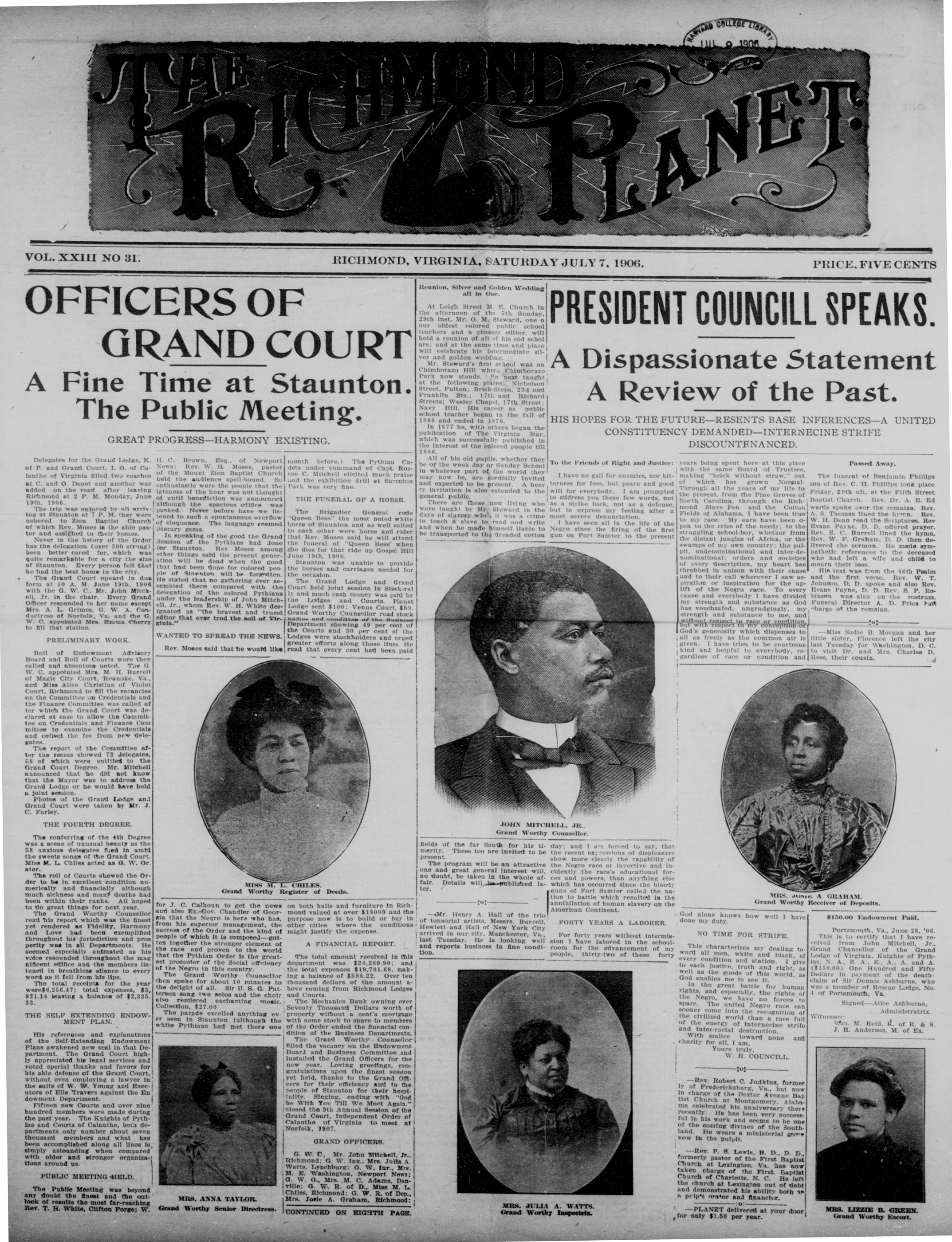
OFFICERS OF GRAND COURT A Fine Time at Staunton. The Public Meeting.
GREAT PROGRESS—HARMONY EXISTING
VOL. XXIII NO 31.
OFFICE
GR
A Fine T
The P
GREAT I
Delegates for the Grand Lodge, K.
of P. and Grand Court, I. O. of Calanthe of Virginia filled two coaches
at C. and O. Depot and another was
added on the road after leaving
Richmond at 2 P. M. Monday, June
19th, 1906.
The trip was enjoyed by all arriving at Staunton at 7 P. M. they were ushered to Zion Baptist Church of which Rev. Moses is the able pastor and assigned to their homes.
Never in the history of the Order has the delegation (over 300 strong) been better cared for, which was quite remarkable for a city the size of Staunton. Every person felt that he had the best home in the city.
The Grand Court opened in due form at 10 A. M. June 19th, 1996 with the G. W. C. Mr. John Mitchell, Jr. in the chair. Every Grand Officer responded to her name except Mrs. A. L. Grimes, G. W. A. Conductress of Norfolk, Va. and the G. W. C. appointed Mrs. Emma Cherry to fill that station.
PRELIMINARY WORK.
Roll of Endowment Advisory Board and Roll of Courts were then called and absentees noted. Tae G. W. C. appointed Mrs. M. H. Burrell of Magic City Court, Roanoke, Va., and Miss Alice Christian of Violet Court, Richmond to fill the vacancies on the Committee on Credentials and the Finance Committee was called at ter which the Grand Court was declared at ease to allow the Committee on Credentials and Finance Committee to examine the Credentials and collect the fee from new delegates.
The report of the Committee after the recess showed 73 delegates, 58 of which were entitled to the Grand Court Degree. Mr. Mitchell announced that he did not know that the Mayor was to address the Grand Lodge or he would have held a joint session.
Photos of the Grand Lodge and Grand Court were taken by Mr. J. C. Farley.
THE FOURTH DEGREE.
The conferring of the 4th Degree was a scene of unusual beauty as the 58 anxious delegates fled in amid the sweets songs of the Grand Court. Miss M. L. Chiles acted as G. W. Orator.
The roll of Courts showed the Order to be in excellent condition numerically and financially although much sickness and many deaths had been within their ranks. All hoped to do great things for next year.
The Grand Worthy Counsellor read his report which was the finest yet rendered as Fidelity, Harmony and Love had been exemplified throughout his jurisdiction and properity was in all Departments. He seemed especially animated as his voice resounded throughout the magnificent edifice and the members listened in breathless silence to every word as it fell from his lips.
The total receipts for the year were$6,256.47; total expenses, $3,921.14 leaving a balance of $2,335.33.
THE SELF EXTENDING ENDOWMENT PLAN.
His references and explanations of the Self-Extending Endowment Plans awakened new zeal in that Department. The Grand Court highly appreciated his legal services and voted special thanks and favors for his able defense of the Grand Court, without even employing a lawyer in the suits of W. W. Young and Executors of Ella Travers against the Endowment Department.
Fifteen new Courts and over nine hundred members were made during the past year. The Knights of Pythias and Courts of Calanthe, both departments only number about seven thousand members and what has been accomplished along all lines is simply astounding when compared with older and stronger organizations around us.
PUBLIC MEETING-HELD
The Public Meeting was beyond any doubt the finest and the outlook of results the most far-reaching Rev. T. H. White, Clifton Forswere; W.
H. C. Brown, Esq., of Newport News; Rev. W. H. Moses, pastor of the Mount Zion Baptist Church held the audience spell-bound. So enthusiastic were the people that the lateness of the hour was not thought of until benediction was announced although the spacious edifice was packed. Never before have we listened to such a spontaneous overflow of eloquence. The language roamed literary gems.
In speaking of the good the Grand Session of the Pythians had Jone for Staunton. Rev Moses among other things said the present generation will be dead when the good that had been done for colored people of Staunton will be forgotten. He stated that no gathering ever assembled there compared with the delegation of the colored Pythians under the leadership of John Mitchell, Jr., whom Rev. W. H. White designated as "the bravest and truest editor that ever trod the soil of Virginia."
WANTED TO SPREAD THE NEWS.
Rev. Moses said that he would like
```markdown
```
MISS M. L. CHILES.
Grand Worthy Register of Deeds.
MISS M. L. CHILES.
Grand Worthy Register of Deeds.
for J. C. Calhoun to get the news and also Ex-Gov. Chandler of Georgia that the Negro is here who has, from his superior management, the success of the Order and the kind of people of which it is composed—gotten together the stronger element of the race and proven to the world that the Pythian Order is the greatest promoter of the Social efficiency of the Negro in this country.
The Grand Worthy Counsellor then spoke for about 10 minutes to the delight of all. Sir U. S. G. Patterson sang two solos and the choir also rendered enchanting music. Collection, $27.00
The parade excelled anything ever seen in Staunton (although the white Pythians had met there one
MRS. ANNA TAYLOR.
Grand Worthy Senior Directress.
month before.) The Pythian Cadets under command of Capt. Rostoe C. Mitchell elicited much praise and the exhibition drill at Stranton Park was very fine.
THE FUNERAL OF A HORSE
The Brigadier General rode "Queen Bess" the most noted white horse of Staunton and so well suited to each other were horse and rider that Rev. Moses said he will attend the funeral of "Queen Bess' when she dies for that ride up Gospel Hill June 19th, 1906.
Staunton was unable to provide the horses and carriages needed for the occasion.
The Grand Lodge and Grand Court held joint session in Stock-rally and much cash money was paid by the Lodges and Courts. Planet Lodge sent $100; Venus Court, $50. Grand Worthy Counsellor read stock names and condition of the Business Department showing 49 per cent of the Courts and 30 per cent of the Lodges were stockholders and urged greater efforts along those lines. He read that every cent had been paid
THE LADY OF THE CITY
on both halls and furniture in Richmond valued at over $18000 and the purpose now is to build or buy in other cities where the conditions might justify the expense.
A FINANCIAL REPORT.
The total amount received in this department was $20,289.90; and the total expenses $19,701.68, making a balance of $888.22. Over ten thousand dollars of the amount above coming from Richmond Lodges and Courts.
The Mechanics Bank owning over Seventy Thousand Dollars worth of property without a cent's mortgage with some stock to spare to members of the Order ended the financial condition of the Business Departments.
The Grand Worthy Counsellor filled the vacancy on the Endowment Board and Business Committee and installed the Grand Officers for the new year. Loving greetings, congratulations upon the finest session yet held, thanks to the Grand Officers for their efficiency and to the people of Staunton for their hospitality. Singing, ending with "God Be With You Till We Meet Again." closed the 9th Annual Session of the Grand Court, Independent Order of Calanthe of Virginia to meet at Norfolk, 1907.
GRAND OFFICERS
G. W. C., Mr. John Mitchell, Jr., Richmond; G. W. Inx., Mrs. Julia A. Watts, Lynchburg; G. W. Inr., Mrs. M. E. Washington, Newport News; G. W. O., Mrs. M. C. Adams, Danville; G. W. R. of D., Miss M. L. Chiles, Richmond; G. W. R. of Dep., Mrs. Josie A. Graham, Richmond;
CONTINUED ON EIGHTH PAGE.
RICHMOND, VIRGINIA, SATURDAY JULY 7, 1906.
Reunion, Silver and Golden Wedding all in One.
At Leigh Street M. E. Church in the afternoon of the 5th Sunday, 29th inst, Mr. O. M. Steward, one o our oldest colored public school teachers and a pioneer editor, will hold a reunion of all of his old school ars; and at the same time and place will celebrate his intermediate silver and golden wedding.
Mr. Steward's first school was on Chimborazo Hill where Chimborazo Park now stands. He next taught at the following places: Nicholson Street, Fulton; Briek-Steps, 23d and Franklin Sts.; 17th and Richard Streets; Wesley Chapel, 17th Street; Navy Hill. His career as public school teacher began in the fall of 1866 and ended in 1876.
In 1877 he, with others began the publication of The Virginia Star, which was successfully published in the interest of the colored people till 1886.
All of his old pupils, whether they be of the week day or Sunday School in whatever part of the world they may now be, are cordially invited and expected to be present. A hearty invitation is also extended to the general public.
There are those now living who were taught by Mr. Steward in the days of slavery when it was a crime to teach a slave to read and write and when he made himself liable to be transported to the dreaded cotton
J.
fields of the far South for his tim-
erity. These too are invited to be
present. The program will be an attractive
one and great general interest will,
no doubt, be taken in the whole affair. Details will be published la-
ter.
Mr. Henry A. Hall of the trio of tonsorial artists, Messrs. Burrell, Hewlett and Hall of New York City arrived in our city, Manchester, Va., last Tuesday. He Is looking well and reports business in fine condition.
```markdown
```
[Picture of a woman with dark hair, wearing a dark dress with a high collar.]
PRESIDENT COUNCILL SPEAKS.
A Dispassionate Statement A Review of the Past.
HIS HOPES FOR THE FUTURE—RESENTS BASE INFERENCES—A UNITED CONSTITUENCY DEMANDED—INTERNECINE STRIFE DISCOUNTENDED
To the Friends of Right and Justice:
I have no gall for enemies, nor bitterness for foes, but peace and good will for everybody. I am prompted to address you these few words, not as a strike back, not as a defense, but to express my feeling after a most severe denunciation.
I have seen all in the life of the Negro since the firing of the first gun on Fort Sumter to the present
[Image of a man in a suit with a bow tie, facing slightly to the right.]
day; and I am forced to say, that the recent expressions of displeasure show more clearly the capability of the Negro race at invective and incidently the race's educational forces and powers, than anything else which has occurred since the bloody guns of Fort Sumter called the nation to battle which resulted in the annihilation of human slavery on the American Continent.
FORTY YEARS A LABORER
For forty years without intermission I have labored in the school-room for the advancement of my people, thirty-two of these forty
years being spent here at this place with the same Board of Trustees, making "brick without straw," out of which has grown Normal. Through all the years of my life to the present, from the Pine Groves of North Carolina, through the Richmond Slave Pen and the Cotton Fields of Alabama, I have been true to my race. My ears have been open to the cries of the needy; to the struggling school-boy, wheather from the distant jungles of Africa, or the swamps of my own country; the pulpit, undenominational and inter-denominational; orders and societies of every description, my heart has throbbed in unison with their cause and to their call wherever I saw aspiration or inspiration for the uplift of the Negro race. To every cause and everybody I have divided my strength and substance as God has vouchsafed, ungrudgingly, my strength and substance to me, and without respect to race or condition, but with respect to my conception or
God's generosity which dispenses to all as freely as the common air is given. I have tried to be courteous kind and helpful to everybody, regardless of race or condition and
MRS. JOSIE A. GRAHAM.
MRS. JOSEH A. GRAHAM.
Grand Worthy Receiver of Deposits
God alone knows how well I have done my duty.
NO TIME FOR STRIFF
This characterizes my dealing toward all men, white and black, of every condition and station. I give to each justice, truth and right, as well as the goods of this world, as God enables me to see it.
In the great battle for human rights, and especially, the rights of the Negro, we have no forces to spare. The united Negro race can sooner come into the recognition of the civilized world than a race full of the energy of internecine strife and inter-racial destruction.
With malice toward none and charity for all, I am.
Rev. Robert C. Judkins, formerly of Frederickburg, Va., but now in charge of the Dexter Avenue Baptist Church at Montgomery, Alabama celebrated his anniversary there recently. He has been very successful in his work and seems to be one of the coming divines of the Southland. He wears a ministerial gown in the pulpit.
Rev. P. S. Lewis, B. D., D. D., formerly pastor of the First Baptist Church at Lexington, Va. has now taken charge of the First Baptist Church of Charlotte, N. C. He left the church at Lexington out of debt and demonstrated his ability both as a priest orator and financier.
:o:
PLANET delivered at your door for only $1.50 per year.
PRICE, FIVE CENTS
L SPEAKS.
statement
the Past.
NFERENCES—A UNITED
ECINE STRIFE
Passed Away.
The funeral of Benjamin Phillips son of Rev. C. H. Phillips took place Friday, 29th ult. at the Fifth Street Baptist Church. Rev. Dr. A. E. Edwardis spoke over the remains. Rev. A. S. Thomas lined the hymn. Rev. W. H. Dean read the Scriptures. Rev Evans Payne, D. D. offered prayer. Rev. S. C. Burrell lined the hymn. Rev. W. F. Graham, D. D. then delivered the sermon. He made sympathetic references to the deceased who had left a wife and child to mourn their loss.
His text was from the 46th Psalm and the first verse. Rev. W. T. Johnson, D. D. spoke and also Rev. Evans Payne, D. D. Rev. S. P. Robinson was also on the rostrum. Funeral Director A. D. Price paid charge of the remains.
Miss Sadie B. Morgan and her little sister, Florence left the city last Tuesday for Washington, D. C. to visit Dr. and Mrs. Charles D. Ross, their cousin.
$150.00 Endowment Paid.
Portsmouth, Va., June 28, '06.
This is to certify that I have received from John Mitchell, Jr.
Grand Chancellor of the Grand
Lodge of Virginia, Knights of Pythias, N. A., S. A., E., A., A. and A.
($150.00) One Hundred and Fifty
Dollars in payment of the death-
claim of Sir Dennis Ashburne, who was a member of Rescue Lodge, No.
4 of Portsmouth, Va.
Signed—Alice Ashburne,
Administratrix.
Witnesses:
Wm. M. Reid, R. of R. & S.
J. R. Anderson, M. of Ex.
MRS. LIZZIE B. GREEN.
Grand Worthy Escort.
FILE NO. 113.
ONE OF THE MYSTERIES OF PARIS, AND HOW IT WAS SOLVED.
BY ENGLE (ABORIAU)
CHAPTER XI
The Rue St. Lazare was adorned by the palatial residences of the Jandier brothers, two celebrated financiers, who, if deprived of the prestige of immense wealth, would still be looked up to as remarkable men. Why can not the same be said of all men? These two mansions, which were thought marvels at the time they were built, were entirely distinct from each other, but so planned that they could be turned into one immense house when so desired. When MM. Jandier gave parties, they always had the movable partitions taken away, and thus obtained the most superb salon in Paris. Princely magnificence, lavish hospitality, and an elegant, graceful manner of receiving their guests, made these entertainments eagerly sought after by the fashionable circles of the capital.
On Saturday, the Rue St. Lazare was blocked up by a file of carriages, whose fair occupants were impatiently awaitting their turn to drive up to the door, through which, they could catch the tantalizing strains of a waltz.
It was a fancy ball; and nearly all the costumes were superb, though some were more original than elegant. Among the latter was a clown. Everything was in perfect keeping; the insolent eye, coarse lips, high cheek-bones, and a beard so red that it seemed to emit flames in the reflection of the dazzling lights.
He wore top boots, a dillapidated hat on the back of his head, and shirt-ruffle trimmed with torn lace.
He carried in his left hand a canvas banner, upon which were painted six or eight pictures coarsely designed like those found in strolling fairs. In his right he waved a little switch, with which he would every now and then strike his banner, like a quack retailing his wares.
Quite a crowd surrounded this clown, hoping to hear some witty speeches and puns; but he kept near the door, and remained silent.
About half past ten he quitted his post.
M. and Mme. Fauvel, followed by their niece Madeleine, had just entered.
A compact group immediately formed near the door. During the last ten days, the affair of the Rue de Provence had been the universal topic of conversation; and friends and enemies were alike glad to seize this opportunity of approaching the banker, some to tender their sympathy, and others to offer equivocal condolence, which of all things is the most exasperating and insulting. Belonging to the battalion of grave, elderly men, M. Fauvel had not assumed a fancy costume, but merely threw over his shoulders a short silk domino. On his arm leaned Mme. Fauvel, nee Valentine de la Verberie, bowing and gracefully greeting her numerous friends.
She had once been remarkably beautiful, and to-night the effect of the soft wax lights, and her very becoming dress, half restored her youthful freshness and comeliness. No one would supposed her to be 48 years old.
She wore a dress of the later years of Louis the Fourteenth's reign, magnificent and severe, of embroidered satin and black velvet, without the adornment of a single jewel.
She looked so graceful and elegant in this court dress and powdered hair, that some ill-natured gossips said it was a pity to see a real La Verberie, so well fitted to adorn a queen's drawing room, as all her ancestors had done before her, thrown away upon a man whom she had only married for his money.
But Madeleine was the object of universal admiration, so dazzingly beautiful and queenly did she appear in her costume of maid of honor, which seemed to have been especially invented to set forth her beautiful figure.
Her loveliness expanded in the perfumed atmosphere and soft light of the ball room. Never had her hair looked so black, her complexion so exquisite, or her large eyes so brilliant. Having greeted the hosts, Madeleine took her aunt's arm, while M. Fauvel wandered through the rooms in search of the card table, the usual refuge of bored men, when they are enticed to the ball room by their womankind.
Two orchestras, led by Strauss and one of his lieutenants, filled the two mansions with intoxicating music. The motley crowd whirled in the waltz until they presented a curious confusion of velvets, satins, laces and diamonds. Almost every head and bosom sparkled with jewels; the palest cheeks were rosy; heavy eyes now shone like stars; and the glistening shoulders of fair women were like drifted snow in an April sun.
Forgotten by the crowd, the clown had taken refuge in the embrasure of a window, and seemed to be meditating upon the gay scene before him; at the same time, he kept his eyes upon a couple not far off.
It was Madeleine, dancing with a splendidly-dressed doge. The doge was the Marquis de Clameran.
He appeared to be radiant, rejuvenated, and well satisfied with the impression he was making upon his partner; at the end of a quadrille he leaned over her and whispered compliments with the most unbounded admiration; and she seemed to listen, if not with pleasure, at least without repugnance. She now and then smiled, and coquettishly shrugged her shoulders.
"Evidently," muttered the clown, "this noble soundrel is paying court to the banker's niece; so I was right
ES OF PARIS, AND HOW SOLVED.
BABORIAU)
yesterday. But how can Mademoiselle Madeleine resign herself to so graciously receive his insipid flattery? Fortunately, Prosper is not here now."
He was interrupted by an elderly man wrapped in a Venetian mantle, who said to him:
The clown bowed with great respect, but not the slightest shade of humility.
"I remember," he replied.
"But do not be imprudent, I beg of you."
"Monsieur the Count need not be uneasy, he has my promise."
"Very good. I know the value of it."
The count walked off; but during this short colloquy the quadrille had ended, and M. De Clameran and Madeleine were lost to sight.
Incommoded by the stifling heat of the room, Mine, Fauvel had sought a little fresh air in the grand picture gallery, which, thanks to the talisman called gold, was now transformed into a fair-like garden, filled with orange trees, japonicas, laurel, and many rare exotics.
The clown saw her seated near a grove, not far from the door of the card room. Upon her right was Madeline, and near her stood Raoul de Lagors, dressed in a costume of Henri III.
"I must confess," muttered the clown from his post of observation, "that the young scamp is a very handsome man."
Madeleine appeared very sad. She had plucked a japonica from a tree near by, and was mechanically pulling it to pieces as she sat with her eyes downcast.
Raoul and Mme. Fauvel were engaged in earnest conversation. Their faces were composed, but the gestures of one and the trembling of the other betrayed a serious discussion. In the card room sat the dog, M. De Clameran, so placed as to have full view of Mme. Fauvel and Madeleine, although himself concealed by an angle of the room.
"It is the continuation of yesterday's scene" the thought the clown. "If I could only get behind that oleander tree, I might hear what they are saying."
He pushed his way through the crowd, and, just as he had reached the desired spot, Madeleine arose, and, taking the arm of a bejeweled Persian, walked away.
At the same moment Raoul went into the card room and whispered a few words to De Clameran.
"There they go," muttered the clown. "The two scoundrels certainly hold these poor women in their power; and they are determined to make them suffer before releasing them. What can be the secret of their power?" His attention was attracted by a commotion in the picture gallery; it was caused by the announcement of a wonderful minuet to be danced in the ball room; the arrival of the Countess de Commarin as Aurora; and the presence of the Princess Korasaso, with her superb emeralds, which were reported to be the finest in the world.
In an instant the gallery became almost deserted. Only a few forlorn-looking people remained; mostly sulky husbands whose wives were dancing with other women's husbands, and some melancholy youths looking awkward and unhappy in their gay fancy dresses.
The clown thought it a favorable opportunity for carrying out his project.
He abruptly left his corner, flourishing his switch, and beating his banner, and, crossing the gallery, seated himself in a chair between Mme. Pauvel and the door. As soon as the people had collected in a circle around him, he commenced to cough in an affected manner, like a stump orator about to make a speech.
Then he struck a comical attitude, standing up with his body twisted sideways, and his hat on one ear, and with great buffoonery and volubility made the following remarks:
"Ladies and gentlemen, this very morning I obtained a license from the authorities of this town. And what for? Why, gentlemen, for the purpose of exhibiting to you a spectacle which has already won the admiration of the four quarters of the globe, and several universities besides. Inside of this booth, ladies, is about to commence the representation of a most remarkable drama, acted for the first time in Pekin, and translated into several languages by our most celebrated authors. Gentlemen, you can take your seats; the lamps are lighted, and the actors are changing their dress." Here he stopped speaking, and imitated to perfection the feats which mountebanks play upon horns and little drums.
"Now, ladies and gentlemen," he resumed, "you wish to know what I am doing outside, if the piece is to be performed under the tent. The fact is, gentlemen, that I wish to give you a foretaste of the agitations, sensations, emotions, palpitations, and other entertainments which you may enjoy by paying the small sum of ten sous. You see this superb picture? It represents eight of the most thrilling scenes in the drama. Ah, I see you begin to shudder already; and yet this is nothing compared to the play itself. This splendid picture gives you no more idea of the acting than a drop of water gives an idea of the sea, or a spark of fire of the sun. My
THE RICHMOND PLANET, RICHMOND, VIRGINIA
plicture, gentlemen, is merely to give you a foretaste of what is in the tent; as the steam oozing from a restaurant gives you a taste, or rather a smell, of what is within."
"Do you know this clown?" asked an enormous Turk of a melancholy Punch.
"No, but he can imitate a trumpet splendidly."
"Oh, very well indeed! But what is he driving at?"
The clown was endeavoring to attract the attention of Mme. Fauvel, who, since Raoul and Madeleine had left her, sat by herself in a mournful reverie.
He succeeded in his object.
The showman's shrill voice brought the banker's wife back to a sense of reality; she started, and looked quickly about her, as if suddenly awakened from a troubled dream.
"Now, ladies, we are in China. The first picture on my canvas, here in the left corner," here he touched the top daub, "represents the celebrated Mandarin Li-Fo, in the bosom of his family. This pretty woman leaning over him is his wife; and these children playing on the carpet are the bonds of love between this happy pair. Do you not inhale the odor of sanctity and happiness emanating from this speaking picture, gentlemen?"
"Madame Li-Fo is the most virtuous of women, adoring her husband and idolizing her children. Being virtuous, she is happy; for the wise Confucius says, 'The ways of virtue are more pleasant than the ways of vice.'"
Mme. Fauvel had left her seat, and approached nearer to the clown.
"Do you see anything on the banner like what he is describing?" asked the melaucholy Funch of his neighbor.
The fact is, that the daubs of paint on the canvas represented one thing as well as another, and the clown could call them whatever he pleased.
"Picture No. 2!" he cried, after a flourish of music. "This old lady, seated before a mirror tearing out her hair—especially the gray ones—you have seen before; do you recognize her? No, you do not. She is the fair mandrine of the first picture. I see the tears in your eyes, ladies and gentlemen. Ah! you have cause to weep, for she is no longer virtuous, and her happiness has departed with her virtue. Alas, it is a sad tale! One fatal day she met, on the streets of Pekin, a young ruffian, fiendish, but beautiful as an angel, and she loved him—the unfortunate woman loved him!"
The last words were uttered in the most tragic tone as he raised his clasped hands to Heaven.
During this tirade he had whirled around, so that he found himself facing the banker's wife, whose countenance he closely watched while he was speaking.
"You are surprised, gentlemen," he continued. "I am not. The great Bibliquet has proved to us that the heart never grows old, and that the most vigorous wall-flowers flourish on old ruins. This unhappy woman is nearly fifty years old—fifty years old, and in love with a youth! Hence this heart-tending scene, which should serve as a warning to us all."
"Really!" grumbled a cook dressed in white satin, who had passed the evening in carrying around bills of fare, which no one read. "I thought he was going to amuse us."
"But," continued the clown, "you must go inside of the booth, to witness the effects of the mandarine's folly. At times, a ray of reason penetrates her diseased brain, and then the sight of her anguish would soften a heart of stone. Enter, and, for the small sum of ten sous, you shall hear sobs such as the Odeon never echoed in its haleyon days. The unhappy woman has waked up to the absurdity and inanity of her blind passion; she confesses to herself that she is madly pursuing a phantom. She knows, but too well, that he, in the vigor and beauty of youth, can not love a faded old woman like herself, who vainly makes pititable efforts to retain the last remains of her once enchanting beauty. She feels that the sweet words he once whispered in her charmed ear were deceitful falsehoods. She knows that the day is near when she will be left alone, with nothing save his mantle in her hand."
As the clown addressed this voluble description to the crowd before him, he narrowly watched the coutenance of the banker's wife.
But nothing he had said seemed to affect her. She leaned back in her arm-chair perfectly calm, and occasionally smiled at the tragic manner of the showman.
"Good heavens!" muttered the clown, unessentially, "can I be on the wrong track!"
He saw that his circle of listeners was increased by the presence of the doge, M. de Clameran.
"The third picture," he said, after a roll of drums, "depicts the old mandarine after she has dismissed that most annoying of guests—remorse—from her bosom. She promises herself that interest shall supply the place of love in chaining the too seductive youth to her side. It is with this object that she invests him with false honors and dignity, and introduces him to the chief mandarins of the capital of the Celestial empire; then, since so handsome a youth must cut a fine figure in society, and as a fine figure can not be cut without money, the lady must needs to sacrifice all of her possessions for his sake. Necklaces, rings, bracelets, diamonds and pearls, all are surrendered. The monster carries all these jewels to the pawnbrokers on Tien-Tsi street, and then has the cruelty to refuse her the tickets, so that she may have a chance of redeeming her treasures."
The clown thought that at last he had hit the mark. Mine, Fauvel began to betray signs of agitation.
Once she made an attempt to rise from the chair, but it seemed as if her strength failed her, and she sunk back, forced to listen to the end,
"Finally, ladies and gentlemen," continued the clown, "the richly-stored jewel-cases became empty. The day came when the mandarine had nothing more to give. It was then that the young scoundrel conceived the project of carrying off the jasper button belonging to the Mandarin Lk-Fo—a splendid jewel of incalculable value, which being the badge of the dignity, was kept in a granite chest, and guarded by three soldiers night and day. Ah! the mandarine resisted a long time! She knew the innocent soldiers would be accused and crucified, as is the custom in Pekin; and this thought restrained her. But her lover besought her so tenderly, that she finally yielded to his entreaties; and—the jasper button was stolen. The fourth picture represents the guilty couple stealthily creeping down the private stairway; see their frightened look—see—"
He abruptly stopped. Three or four of his auditors rushed to the assistance of Mine, Fauvel, who seemed about to faint; and at the same time he felt his arm roughly seized by some one behind him.
He turned round and faced De Clameron and Lagors, both of whom were pale with anger.
And he followed them to the end of the picture-gallery, near a window opening on a balcony.
Here they were observed except by the man in the Venetian cloak, whom the clown had so respectfully addressed as "Monsieur, the Count." The minutel having ended, the orchestra were resting, and the crowd began rapidly to fill the gallery.
The sudden faintness of Mme. Fauvel had passed off unnoticed save by a few, who attributed it to the heat of the room. M. Fauvel had been sent for; but when he came hurrying in, and found his wife composedly talking to Madeleine, his alarm was dissipated, and he returned to the card tables.
Not having as much control over his temper as Roul, M. de Clameran angrily said:
"In the first place, monsieur, I would like to know who you are."
The clown determined to answer as if he thought the question were a jest, replied in the bantering tone of a buffoon:
"You want my passport, do you, my lord doge? I left it in the hands of the city authorities; it contains my name, age, profession, domicile, and every detail—"
With an angry gesture, M. de Clamcran interrupted him.
"You have just committed a gross insult!"
"I, my lord doge?"
"Yes, you! What do you mean by telling this abominable story in this house?"
"Abominable! I may call itabominate; but I, who composed it, have a different opinion of it."
"Enough, monsieur; you will at least have the courage to acknowledge that your performance was a vile insinuation against Madame Fauvel."
The clown stood with his head thrown back, and mouth wide open, as if astounded at what he heard.
But anyone who knew him would have seen his bright black eyes sparkling with malicious satisfaction.
"Bless my heart!" cried, as if speaking to himself. "This is the strangest thing I ever heard off! How can my drama of the Mandarin Li-Fo have any reference to Madame Fauvel, whom I don't know from Adam or Eve? I can't think how the resemblance—unless—but no, that is impossible."
"Do you pretend," said M. de Clameran, "to be ignorant of Monsieur Fauvel's misfortune?"
The clown looked very innocent, and asked:
"What misfortune?"
"The robbery of which Monsieur Fauvel was the victim. It has been in everyone's mouth, and you must have heard of it."
"Ah, yes, yes; I remember. His cashier ran off with three hundred and fifty thousand francs. Pardicu! It is a thing that almost daily happens. But, as to discovering any connection between this robbery and my play, that is another matter." M. de Clameran made no reply. An nudge from Lagors had calmed him as if by enchantment. He looked quietly at the clown, and seemed to regret having uttered the significant words forced from him by angry excitement. "Very well," he finally said in his usual haughty tone; "I must have been mistaken. I accept your explanation." But the clown, hitherto so humble and silly looking, seemed to take offense at the word, and, assuming a defiant attitude, said: "I have not made, nor do I intend making any explanation."
"Monsieur"—began De Clameran.
"Allow me to finish, if you please.
If, unintentionally, I have offended the wife of a man whom I highly esteem, it is his business to seek redress, and not yours. Perhaps you will tell me he is too old to demand satisfaction; if so, let him send one of his sons. I saw one of them in the ball-room to-night: let him come. You asked me who I am; in return I ask you who are you—you who undertake to act as Madame Fauvel's champion? Are you her relative, friend, or ally? What right have you to insult her by pretending to discover an allusion to her in a play invented for amusement?"
There was nothing to be said in reply to this. M. de Clameran sought a means of escape.
"I am a friend of Monsleur Fauvel," he said, "and this title gives me the right to be as jealous of his reputation as if it were my own. If this is not a sufficient reason for my interference, I must inform you that his family will shortly be mine; I regard myself as his nephew." "Ah!" "Next week, monsleur, my mar-
riage with Mademoiselle Madeleine will be publicly announced."
This news was so unexpected, so startling, that for a moment the clown was dumb; and now his surprise was genuine.
But he soon recovered himself, and, bowing with deference, said, with covert irony:
"Permit me to offer my congratulations, monsieur. Besides being the belle to-night, Mademoiselle Madeleine is worth, I hear, half a million."
Raoul de Lagors had anxiously been watching the people near them, to see if they overheard this conversation.
"We have had enough of this gossip," he said, in a disdainful tone; "I will only say one thing more, Master Clown, and that is, that your tongue is too long."
"Perhaps it is, my pretty youth, perhaps it is; but my mom is still loner."
De Clameran here interrupted them by saying:
"It is impossible for one to seek an explanation from a man who conceals his identity under the guise of a fool."
"You are at liberty, my lord doge, to ask the master of the house who I am—if you dare."
"You are," cried Clameran, "you are—"
A warning look from Raoul checked the forge master from using an epithet which would have led to an affray, or at least a scandalous scene.
The clown stood by with a sardonic smile, and, after a moment's silence, stared M. de Clameran steadily in the face, and in measured tones, said:
"I was the best friend, monsieur, that your brother Gaston ever had. I was his adviser, and the confidant of his last wishes."
These words fell like a clap of thunder upon De Clameran.
He tried to answer, to protest against this assertion, but the words froze on his lips. His fright was pitiable.
And he dragged Clameran away, half supporting him, for he staggered like a drunken man, and clung to every object he passed, to prevent falling.
"Oh!" exclaimed the clown, in three different tones, "oh, oh!"
He himself was almost as much astonished as the forge master, and remained rooted to the spot, watching the latter as he slowly left the room.
It was with no decided object in view that he had ventured to use the last mysteriously threatening words, but he had been inspired to do so by his wonderful instinct, which with him was like the scent of a blood-hound.
"What can this mean?" he murmurs. "Why was he so frightened? What terrible memory have I awakened in his base soul? I need not boast of my penetration, or the subtlety of my plans. There is a great master, who, without any effort, in an instant destroys all my chimeras; he is called 'Chance.'"
His mind had wandered far from the present scene, when he was brought back to his situation by some one touching him on the shoulder. It was the man in the Venetian cloak.
"Are you satisfied, Monsieur Verduret?" he inquired.
"Yes and no, Monsieur the Count, No, because I have not completely achieved the object I had in view when I asked you for an invitation here to-night; yes, because these two rascals behaved in a manner which dispels all doubt."
"I do not complain, Monsieur the Count; on the contrary, I bless chance, or rather Providence, which has just revealed to me the existence of a secret that I did not before even suspect."
Five or six people approached the count, and he went off with them after a friendly nod.
The latter instantly threw aside his banner, and started in pursuit of Mme. Fauvel. He found her sitting on a sofa in the large salon, engaged in an animated conversation with Madeleine.
"Of course they are talking over the scene; but what has become of Lagors and De Clameran?"
He soon saw them wandering among the groups scattered about the room, and eagerly asking questions.
"I will bet my head these honorable gentlemen are trying to find out who I am. Keep it up, my friends, ask everybody in the room; I wish you success."
They soon gave it up, but were so pre-occupied, and anxious to be alone in order to reflect and deliberate, that without waiting for supper, they took leave of Mme. Fauvel and her niece, saying they were going home.
"I have nothing more to do here," he murmured; "I might as well go too."
He completely covered his dress with a domino, and started for home, thinking the cold, frosty air would cool his confused brain.
He lit a cigar, and, walking up the Rue St. Lazare, crossed the Rue Notre Dame De Loretto, and struck into the Faubourg Montmartre.
A man suddenly started out from a place of concealment, and rushed up on him with a dagger.
Fortunately the clown had a catlike instinct, which enabled him to protect himself against immediate danger, and detect any which threatened.
He saw, or rather divined, the man crouching in the dark shadow of a house, and had the presence of mind to strike an attitude which enabled him to ward off the assassin by spreading out his arms before him.
This movement certainly saved his life; for he received in his arm a furious stab which would have instantly killed him had it penetrated his breast.
Anger, more than pain, made him cry out:
"Ah, you villian!"
And recoiling a fear feet, he put himself on the defensive.
But the precaution was useless.
Seeing his blow miss, the assassin did not return to the attack, but made rapidly off.
"That was certainly Lagors," said the clown, "and Clameran must be somewhere near. While I walked around one side of the church, they must have gone the other and lain in wait for me."
His wound began to pain him; he stood under a gas lamp to examine it.
He tore his handkerchief into four bands, and tied his arm up with the dexterity of a surgeon.
"I must be on the track of some great crime, since these fellows are resolved upon murder. When such cunning rogues are only in danger of the police court, they do not gratuitously risk the chance of being tried for murder."
He thought by enduring a great deal of pain he might still use his arm; so he started in pursuit of his enemy, taking care to keep in the middle of the road, and avoid ail dark corners.
Although he saw no one, he was convinced that he was being pursued.
He was not mistaken. When he reached the Boulevard Montmartre, he crossed the street, and, as he did so, distinguished two shadows which he recognized. They crossed the same street a little higher up.
"I have to deal with desperate men," he muttered. "They do not even take the pains to conceal their pursuit of me. They seem to be accustomed to this kind of adventure, and the carriage trick which fooled Fanferlot would never succeed with them. Besides, my light hat is a perfect beacon to lead them on in the night." He continued his way up the boulevard, and, without turning his head, was sure that his enemies were thirty feet behind him.
"I must get rid of them somehow," he said to himself. "I can neither return home nor to the Archangel with these devils at my heels. They are following me to find out where I live, and who I am. If they discover that the clown is Monsieur Verduret, and that Monsieur Verduret is Monsieur Lecoq, my plans will be ruined. They will escape abroad with the money, and I shall be left to console myself with a wounded arm. A pleasant ending to all my exertions!"
The idea of Raoul and Cameran escaping him so exasperated him, that, for an instant, he thought of having them arrested at once.
The police often resort to this ingenious and simple means of arresting a malefactor for whom they are on the lookout, and whom they can not seize without a warrant.
The next day there is a general explanation, and the parties, if innocent, are dismissed.
The clown had sufficient proof to sustain him in the arrest of Lagors. He could show the letter and the mutilated prayer book, he could reveal the existence of the pawnbrokers' tickets in the house at Vesinet, he could display his wounded arm. He could force Raoul to confess how and why he had assumed the name of Lagors, and what his motive was in passing himself off for a relative of M. Fauvel.
On the other hand, in acting thus hustily, he was insuring the safety of the principal plotter, De Cameran. What proofs had he against him? Not one. He had strong suspicions, but no well-grounded charge to produce against him.
On reflection the clown decided that he would act alone, as he had thus far done, and that alone and unaided he would discover the truth of all his suspicions.
Having reached this decision, the first step to be taken was to put his followers on the wrong scent.
He walked rapidly up the Rue Sebastopol, and, reaching the square of the Arts de Metiers, he abruptly stopped, and asked some insignificant questions of two constables who were standing talking together.
The maneuver had the result he expected; Raoul and Clameran stood perfectly still about twenty steps off, not daring to advance.
Twenty steps! That was as much start as the clown wanted. While talking with the constables, he had pulled the bell of the door before which they were standing, and its hollow sound apprised him that the door was open. He bowed, and entered the house.
A minute later the constables had passed on, and Lagors and Clameran in their turn rang the bell. When the concierge appeared, they asked who it was that had just gone in disguised as a clown.
They were told that no such person had entered, and that none of the lodgers had gone out disguised that night. "However," added the concierge, "I am not very sure, for this house has a back door which opens on the Rue St. Denis."
"We are tricked," interrupted Lagors, "and will never know who the clown is."
"Unless we learn it too soon for our own good," said Clameran, musingly.
While Lagors and Clameran were anxiously trying to devise some means of discovering the clown's identity, Verduret hurried up the back street, and reached the Archangel as the clock struck three.
But M. Verduret was not in the habit of discussing private affairs where he might be overheard.
"First of all let us go into your room, and get some water to wash
this cut, which burns like fire."
"Heaven's. Are you wounded?"
"Yes, it is a little souvenir of your friend Raoul. Ah, I will soon teach him the danger of chopping up a man's arm."
Prosper was surprised at the look of merciless rage on his friend's face as he calmly washed and dressed his arm.
"Now, Prosper, we will talk as much as you please. Our enemies are on the alert, and we must crush them instantly, or not at all. I have made a mistake. I have been on the wrong track; it is an accident liable to happen to any man, no matter how intelligent he may be. I took the effect for the cause. The day I was convinced that culpable relations existed between Raoul and Mme. Fauvel, I thought I held the end of the thread that must lead us to the truth. I should have been more mistrustful; this solution was too simple, too natural."
"Do you suppose Madame Fauvel to be innocent?"
"Certainly not. But her guilt is not such as I first supposed. I imagined that, infatuated with a seductive young adventurer, Madame Fauvel had first bestowed upon him the name of one of her relatives, and then introduced him as her nephew. This was an adroit stratagem to gain him admission to her husband's house.
"She began by giving him all the money she could dispose of; later she let him take her jewels to the pawnbrokers; when she had nothing more to give, she allowed him to steal the money from her husband's safe. That is what I first thought."
"And in this way everything was explained?"
"No, this did not explain everything, as I well knew at the time, and should, consequently, have studied my characters more thoroughly. How is Clamieran's position to be accounted for, if my first idea was the correct one?"
"Clameran is Lagors' accomplice, of course."
"Ah, there is the mistake! I for a long time believed Lagors to be the principal person, when, in fact, he is nothing. Yesterday, in a dispute between them, the forge-master said to his dear friend, 'And, above all things, my friend, I would advise you not to resist me, for if you do I will crush you to atoms.' That explains all. The elegant Lagors is not the lover of Madame Fauvel, but the tool of Clameran. Besides, did our most suppositions account for the resigned obedience of Madeleine? It is Clameran, and not Lagors, whom Madeleine obeys."
Prosper began to remonstrate.
M. Verduret shrugged his shoulders.
To convince Prosper he had only to utter one word; to tell him that three hours ago Clameran had announced his intended marriage with Madeleine; but he did not.
"Clameran," he continued, "Clameran alone has Madame Fauvelin his power. Now the question is, what is the secret of this terrible influence he has gained over her? I have positive proof that they have not not since their early youth until fifteen months ago; and, as Madame Fauvel's reputation has always been above the reach of slander, we must seek in the past for the cause of her resigned obedience to his will."
"We can never discover it," said Prosper, mournfully.
"We can discover it as soon as we know Clameran's past life. Ah! tonight he turned as white as a sheet when I mentioned his brother Gaston's name. And then I remembered that Gaston died suddenly, while his brother Louis was making him a visit."
"Do you think he was murdered?"
"I think the men who tried to assassinate me would do anything. The robbery, my friend, has now become a secondary detail, and is easily explained, and, if that were all to be accounted for, I would say to you, 'My task is done, let us go ask the judge of instruction for a warrant of arrest.'"
Prosper started up with sparkling eyes.
"Ah, you know—is it possible?"
"Yes, I know who gave the key, and I know who told the secret word."
"The key might have been Monsieur Faure's. But the word—"
"The word you were foolish enough to give. You have forgotten, I suppose. But fortunately Gipsy remembered. You know that, two days before the robbery, you took Lagors and two other friends to sup with Madame Gipsy? Nina was sad, and reproached you for not being more devoted to her."
"Yes, I remember that."
"But do you remember what you replied to her?"
"No, I do not," said Prosper, after thinking a moment.
"Well, I will tell you; 'Nina, you are unjust in reproaching me with not thinking constantly of you; for at this very moment your dear name guards Monsieur Fauvel's safe.'"
The truth suddenly burst upon Prosper like a thunder-clap. He wrung his hands despairingly, and cried:
"Yes, oh yeah! remember now."
"Then you can easily understand the rest. One of the scoundrels went to Madame Fauvel, and compelled her to give up her husband's key; then at a venture placed the movable buttons on the name of Gipsy, opened the safe, and took the three hundred and fifty thousand francs. And Madame Fauvel must have been terribly frightened before she yielded. The day after the robbery, the poor woman was near dying; and it was she who, at the greatest risk, sent you the ten thousand francs."
"But which was the thief, Raoul or Clamaser? What enables them to thus tyrannize over Madame Fauvel? And how does Madeleine come to be mixed up in the affair?"
"These questions, my dear Proper,
I can not yet answer; therefore I
postpone seeing the judge. I only ask
you to wait ten days; and if I can not
in that time discover the solution of
e
= .
SATURDAY JULY 7TH, 1906,
this mystery, f will return and go
with you to_report to Monsieur Pa-
trigent all that we know.”
“Are you going to leave the clty?"
“In an hour I shall be on the road
to Beaucaire. It was from that neigh-
borhood that Clameran came, as well
as Madame Fauvel, who was a Ma-
demoiselle de la Verberie before mat-
riage.”
“Yes, I knew both families.”
“I must go there to study them.
Neither Raoul nor Clameran can ee-
cape during my absence. The police
are watching them. But you, Prosper,
must be prudent. Promise me to re-
main a prisoner here during my trip.”
All that uf. Verduret asked, Prosper
willingly promised. But he did not
wish to be left in complete ignorance
of his projects for the future, or of
his motives in the past.
“Will you not tell me, monsieur,who
you are, and what reasons you had
for coming to my rescue?”
The extraordinary man smiled sad-
ly, and said:
“I will tell you, in the presence of
Nina, on the day before your mar-
riage with Madeleine.”
Once left to his own reflections,
Prosper began to appreciate the pow-
erful assistance rendered by his
friend.
Recalling the field of investigation
gone over by his mysterious protec-
tor, he was amazed at its extent.
How many facts had been discov-
ered in a week, and with what preci-
sion, although he had pretended to be
on the wrong track! Verduret had
grouped his evidence, and reached a
result which Prosper felt he never
could have hoped to attain by his own
exertions.
He was conscious that he posressed
neither Verduret’s penetration nor
his subtlety. He did not possess this
art of compelling obedience, of ereat-
ing friends at every step, and the
sctence of making men and cireum-
stances unite in the attainment of &
‘common result. |
He began to regret the absence of
this friend, who had risen up in the
hour of adversity. He missed the
Sometimes rough but always kindly
voice, which had encouraged and con-
soled him.
He felt wofully lost and helpless,
not daring to act or think for him.
self, more timid than a child when
deserted by his nurse,
He had tue cod sense to follow the
Fecommet<atons of his mentor. He
remained shut up in the Archangel,
not even appening at the windows.
‘Twice hy had news of M. Verduret.
The first time he received a letter in
which this friend said he had seen his
father, and had had a long talk with
Rim. Afterward, Dubois, M. de Clam-
eran’s valet, came to tell him that
his “patron” reported everything ax
progressing finely.
On the ninth day of his voluntary
seclus‘on Prosper began to feel rest-
Jess, and at ten o'clock at night set.
forth to take a walk, thinking the
fresh air would relieve the headache
which had kept him awake the pre-
vious night.
Mme. Alexandre, who seemed to
have some knowledge of M. Ver-
duret’s affairs, begged Prosper to re-
main at home.
“What can I risk by taking a walk
at this time, in a quiet part of the
city?” he asked. “I can certainly stro!
‘as far as the Jardin des Plantes with-
‘out meeting any one.”
Unfortunately he did not strictly
follow this programme; for, having
reached the Orleans railway station,
he went into a cafe near by and called
for a glass of ale.
As he sat sipping his gliss, he plcked
up a daily paper, “The Sun,” and un-
der the head of “Fashionable Gos-
sip,” signed Jacques Durand, read the
following:
“We understand that the niece of
‘ne of our most prominent banker>
Monsieur Andre Fauvel, will be sho:
ly married to Monsicur le Marquis
Louis de Clameran.”
This news, coming upon him so un-
‘expectedly, proved to Prosper the
justness of M. Verduret’s calculations.
Alas! why did not this certainty in-
spire him with absolute faith, why
did it not give him courage to wait,
the strength of mind to refrain from
acting on his own responsibility?
Frenzied by distress of mind, he al-
ready saw Madeleine indissolubly
united to this villain, and, thinking
that M. Verduret would perhaps ar-
rive too late to be of use, determined
at all risks to throwan obstacle in the
way of the marriage.
He called for pen and paper, and,
forgetting that no situation can ex-
cuse the mean cowardice of an anony-
mous letter, wrote in a disguised hand
the following lines to M. Fauvel:
“Dear Sir—You consigned your
cashier to prison; you acted prudent-
» since you were convinced of his
Bumese and faithlessness.
“But, even if he stole three hun-
dred and fifty thousand francs from
De ee ce ee Oe ee
reach M. Fauvel in time, he walked
up to the Kue Cardinal Lemoine, and
oa it in the main letter-box, so as
be certnin of its speedy delivery.
_ Until now he had not doubted the
Propriety of his action. i
But now, when too late, when he
heard the sound of his letter falling
into the box, a thousand scruples
filled his mind. Was it not wrong to
act thus hurriedly? Would not this
letter interfere with M. Verduret’s
plans? Upon reaching the hotel, his
doubts were changed into bitter re-
grets.
Joseph Dubois was waiting for him;
he had received a dispatch from his
patron, saying that his business was
finished, and that he would return
the next evening at nine o'clock.
Prosper was wretched. He would
have given all he had to recover the
anonymous letter.
And he bari cause for regret.
At that very hour M. Verduret was
taking his seat in the cars at Taras
con, meditating upon the most ad-
vantageous plan to be adopted in pur-
ance of hix discoveries.
For he had discovered everything,
and now must bring matters to
crisis,
Adding to what he already knew,
the story of an old nurse of Mile. de
Ia Verberie, the affidavit of an old
servant who had always lived in the
Clameran family, and the depositions
of the Vesinet husband and wife who
attended M. Lagors at his country
house, the latter having been sent to
him by Dubois (Fanferlot), with a
good deal of information obtained
from the prefecture of police, he bad
worked up a complete case, and could
now act upen a chain of evidence
without « minsins link
As he hod predicted, he had been
compelled to seaich into the distant
past for tle iirst eves of the erimc
of which Prosper nad been the vie
tim.
The following is the drama, as he
wrote It out for the benefit of the
judge of instruction, knowing that it
would contain grounds for an indict-
ment against the malefoctors
TO BE CONTINUED.
TESTING EGGS.
A Dark Room and a Candle All That
Is Needed to Determine
Fertility.
__Eges are never so fertile in winter
as in the warm weather, and all should
be tested on the eighth day. A plece
of cardboard, with a hole cut out in
which to fit the egg, is tsually em-
ployed to assist the tester, and this is
certainly an ald, but by encircling the
cag between the forefinger and thumb
we shut the light out all around it,
and thus obtain the same result. Exgs
should be tested in a dark room by the
aid of a candle or lamp, says the Cul-
tvator. Hold the egg up against the
‘ight, and It will be more or less trans-
parent, according as to whether it Is
dark or white-shelled. Then, if the
egg is fertile, looking closely a dark
Spot will be seen floating inside the
shell. ‘This is the germ which has
awakened to life and is growing. By
the eighth day it is quite indiscernible,
but If the light Is good and the op-
erator experienced fertile and unfer-
tile can be separated about the fourth
ay, though the eighth Is quite soon
enough for the average poultry-keeper.
Dark brown shelled are more difficult
to test than white, owing to the shell
being more opaque. If any are doubt-
ful, put them back and test again the
following night. It is well to have a
fresh egg to compare with the tested
eggs, If doubtful about the latter, the
@ifference between fertile and unfer-
tile shows them up more clearly. Be
careful the eggs do not get chilled if
tested on a cold night. If there are
many eggs to test it will pay to have
one of the very quick and convenient
testers sold by the incubator and
poultry supply-houses.
A COMPARTMENT COOP.
Raising of Chickens Simplified by
Dividing House Into Sections
with Laths.
IT raised a!l my chicks in coops about
4x4 feet and separated inte four com-
partments by lathes, writes a. corre-
spondent of Farm and Home. A space
of about three inches from lowest lath
to floor of the coop allows chicks to
SS
LFF
LIFES >
LELLIFL
SESS
Pe Of
aes
a KS Se
At caine
INTERIOR VIEW OF COMPARTMENT
COOP.
Tun from one compartment to the oth-
er. I put three hens in these coops,
Jeaving the fourth compartment open
tw feed chicks. Here they can eat
without being trampled upon or rob-
bed by the hens.
‘These large coops have shingled
roofs and are rain-proof, They have
floors which are separate, and the
coops are tipped up and the floors
cleaned frequently. They easily ac-
commodate 100 chicks until they are
ready for market and | consider them
the best that [ have ever used.
A Benefit.
“Do you think the discovery of the
north pole will benefit society 2”
“Yes,” answered the scientist. “It
would probably put an end to the
trouble and expense of sending out re-
Met expeditions."—Washington Star,
Generally.
“He said he would like to stt by my
side in the moonlight forever.”
“This moonlight talk ts—"
“weir”
“Well, it is generally all moon-
shine."—Houston Post.
‘Was His Umbretla,
First Stranger—Excuse me, sir, but
I notice that you are looking at me
closely. Is there anything about me
‘that fs familiar?
Second Stranger—Yes, there 1s. My
‘umbrella. —Tit-Bits.
THE RICHMOND PLANET, RICHMOND. VIRGINIA
SUGGESTIONS YOR NOVEL AND
PLEASING ENTERTAINMENTS.
Appropriate Quotations for a re
well Dinner—At a Bride Shoxer—
A Character Party—Por-
trait Contest.
Quotations for a Farewell Dinner.
| Here are some appropriate quota-
tions for use at a dinner given in honor
of @ guest who is about to depart upon
@ long journey:
“Though lost to sight, to memory
aaa
“Absence breaks slender ties, but nv-
ets strong ones.”
“I count myself in nothing else so
happy,
As in a soul remembering my good
friends.”
“Where e’er I roam, whatever realms
to see,
My heart, untraveled, fondly turns to
thee.”
“Farewell; a word that must be, and
hath been;
A sound that makes us linger; yet—
| farewell.”
“Though the deep between us rolls,
Friendship shall unite our souls;
“SUI in fancy’s rich domain
Often we shall meet again.”
“What shall I do with all the days
and hours
That must be counted ere I see thy
tuce?™
The place cards may be painted with
&@ bunch of for-get-me-nots, or tie a
spray of artificial ones onto tt with a
bit of “true blue” ribbon.
A correspondent asks for an enter-
tainment for a linen “shower” and a
luncheon menu.
Make cards in shape of « heart out
of pink cardboard, punch a hole and
tie pink pencils on them. Next write
the transposed letters of the words of
the articles in a bride's trousseau like
this: “hseos,” rskit,” etc. ‘Transposed
these letters become “shoes” and
“skirt.” Allow 20 minutes for this con-
test. ‘Then for the “shower” 1 should
hide the packages all over the roome
and make the bride-elect hunt for them
to music, played “loud” and “soft.”
This will make no end of fun and as
“each package is opened when found, it
will take some time and provide ample
entertainment. If the donors write an
‘appropriate quotation it will add much
to the enjoyment of all.
Here 1s a seasonable menu: Straw-
berries served with hills around a
mound of powdered sugar, fried chick-
en, new potatoes in cream, sprinkled
with parsley; asparagus on’ toast, to-
mato and shrimp salad with cheese
wafers, cherry Joo ana small cakes,
‘with the ueual accompaniments of ol-
fves, nuts and bon-bons.
& reader who clean hereetf “An 014
A reader who signs herself “An Old
Subseriber” requests some form of
amusement for a large evening porty
of young people.
Personally, 1 think there ts no form
of amusement equal to a costume par-
ty, whether dancing is indulged tn or
Bot. Anything that all can partietpate
in fs sure to be successful. Make it a
character party and award prizes for
the two best costumes. If each person
keeps secret what they are to repre-
sent the affair will be much more {n-
teresting.
A Portrait Contest.
A hostess noted for her originality
Sent out invitations on red cardboard,
written up and down the page “a ia
Chinese,” having the usual date and
hour and also “portrait contest” in one
corner. When the guests arrived each
‘one was presented with the figure o:
® man in conventional dress, but with
Ro face. On the back was written the
name of a man whose features were to
be portrayed. Penctls were furnished
and ahalf hour was allotted for the
task. Each artist was to keep his sub-
Ject a secret.
‘When time was called the creations
were pinned up for the edification of
the company, who were to guess the
originals and put them down In their
catalogues. Then the hostess read tne
Uist of people who were supposed to
have been drawn and the result was
most amusing. The artist who had
Made the best Mknesess of the subject
‘was awarded a prize, and to the one
who rightly guessed the most portraits
@ second prize was given.
A chafing dish supper was served,
and for place cards there were tiny
palettes with a little brush. The
whole affair afforded the keenest
amusement.
MADAME MERRI.
Givi with Breckles
One pint of rose water, one-halt
ounce of pulverized borax, one ounce
of stratned lemon juice. Use this lo-
tion freely after being exposed to the
sun. Never use soap and water on
the face just before going out of doors
or directly after coming in, since this
practice is a fine freckle-encourager,
A Wrinkled Forehead.
Massage across the wrinkle, not dt:
Tectly in the crease. Rub up and
down across the wrinkle every time.
Use a good skin food.
For Dry Hair.
When brushing the hair use a few
drops of pure olive oll,
THE BECOMING COLORS.
What Is “Artistic” for Blonde and
Brunette, and for Her That
Is Neither One.
Blue for the blonde and red for the
brunette, with, to use an expression, if
slangy phrase, any old color for the
Woman who Is neither the one nor the
other, but a sort of nondescript, seems
te be the only hard and fast rule.
Never mind if the blonde has pink and
white skin, with gray-sreen eyes, in
which no hint of biue may be noted,
dlue is selected for her, and wear it
she must, ironically comments a writer
im the St Louis Globe-Democrat. As
‘& matter of taste, she should instead
wear pale green, deep brown, cerise,
blue, pink and black, with any blue
that is selected at all, either a navy
or a bright turquoise. Yellow for
such a type makes an ideal gown for
evening, and so will white over green.
There is a mauve, with pink lights,
that becomes this complexion also,
If the eyes of such a blond are blue
‘or violet, still she will not look her
best in the pale blues; let her instead
wear heliotrope, pink, purple, green in
the lightest shades; white or black,
crimson and mauve. A dark red-
brown will also be very becoming and
one shade of gray.
The real brunette, with dark eyes
and hair and plenty of color, has a
large choice, except in black, which
is rarely becoming. Cream, yellow,
Indian red, ivory tints, deep and pale
blues, cardinal red, all the tans, coral
pink, fawn color, putty and the terra
cottas; old rose and rose pink; all
are becoming with pale blue, white
and pale green, for evening wear.
What is called a “fair brunette,”
where the skin is delicate and the
eyes violet or dark blue and the hair
dark brown, must be careful in select-
ing strong colors that will kill her
delicate complexion. No suca choice
as bright yellow or vivid red, but rath-
er the less pronounced shades of
both, and all maize, golien browns,
gold tans, pale coral, salmon pink and
silvery blue.
And the girl who is decidedly
“brown,” like the nut, must use cer-
tain colors that will bring out her
coloring best. Warm grays, like the
puce; red browns, rose red, nastur-
tum, “ecru, apricot color, peach bios-
som, amber in its tawny tones and
fvory white are all good for her.
Where the hair is neither light nor
dark, the eyes sometimes hazel, more
times blue, and again gray or blue
gray, great attention must be paid to
the coloring of the skin; if that is clear
pink and white, all the shades of
mauve and purple are good, and also
the blues with green In them, and the
greens with blue lights, On the other
hand, if the skin is sallow, such colors
fare not becoming.
EMBROIDERY DESIGN.
Intended for Working on » Handker-
chief, Work in Satin Stitch and
Border in Buttonhole.
‘This design ts intended for working
on pocket-handkerehtefs. ‘The work
fs tn satin-stitch, with the exception
of the border, which Is In buttonhole;
all should be raised by running out
several times before the satin-stitch
fs done. Fine, soft, embroidery cot-
<aa>
2 i
ENS 4
CORNER AXD nosbrn.
ton, or one of the beautiful mercer.
ized cottons, should be used for the
work. The size of the handkerchief
should be decided on, then a piece of
paper cut to size, allowing a margin,
should have the design arranged upon
it. Tracings must be taken of the
Piece shown; the border could be con-
tinued all round handkerchief, and
the corner, of course, in all four cor.
ners; the whole can then be trans.
ferred to the handkerchief by means
of blue tracing paper.
Light Colors of Summer,
It ts only very recently that ladies
have gone out upon the street afoot in
gowns of light colored cloth. But this
fashion prevailed last season, and will
be still more popular this year. Pale
Pink, light blue, soft yellow browns
and tans and creams will all be worn
on the street, side by side, with sil-
ver, lobster, crab red and salmon, They
make up very lovely sults, which do
not sot! easily, after all, for one keeps
them for nice—not for marketing—and
with a little care they last all the sea-
son.
ite Amite Cole
Quite the opposite to the favored bo-
lero ts the new design In auto coats,
These are expected to cover up the
gown effectively, to have full length
sleeves approaching a cape size in full-
hess and to be 50 loose and easy of fit
‘as to be almost baggy all over,
| Flesh Reducing.
It fs said that Vichy and Kisaingen
tablets will reduce the weight, that the
“combination acts directly on the fatty
tissues. The best and sanest way of
fiesh-reducing 1s found in diet and ex-
ercise.
Friendly Critic.
First Street Arab—Say, I wuz t' de
Veater tas’ night.
Second Street Arab—Wot wuz doin’
‘on de boards?
__ First S. A.—Dere wuz @ play called
“As Yer Like It,” by a guy nam’é
Shekebeer, or sumthin’ like dat.
Second S. A.—Wuz it enny good?
First 8. A.—Wuz it? Say, de caten-
as-catch-can wrestlin’ match in one uv
de acts wuz de best ever.—Chicago
Dally News.
The Last RakeOw |
Retiring Statesman (preparing to
leave his omce for the last time)—Let
me see, John, have the railroads paid
up?
‘Secretary—Yees, sir.
Retiring Statesman—Has the meat
trust settled their bit?
Secretary—Yes, sir.
Retiring, Staterman—And ail thosg
Rnighbts of Pythi
nights of Pythias,
N. A.,S. A. E. A., A. AND A.
5 This organization is one of the most powerful in the country and its
Ss zy progress has been phenominal. The Grand Lodge of Virginia has juris
k/ GA diction over all of the cities and counties in this state. Thirty sales
| CY \"\ are required to organize a new lodge. The benefits paid constitute oue
wel SC of its strongest features, but the principles are greater than anything
Sas <i} else... Founded on Friendship, based on Charity and established oa Be
Res nevolence, the respectable, upright people of the state will find it au order
oes » worthy of their heartiest support.
Sa It pays an endowment and burial benefit of of $200.00 for all ages. It
pays $4.00 per week sick dues. The badge costing 75 cents each is the
only absolutely necessary regalla. For information concerning the orgauzaition of lodges
apply at the main office.
Me wWoOuUTts Ol Valanthne
Is the Female Department of the Order. It requires a membership of
thirty persons to organize a court. Itsmempers are pledged to exhibit
Fidelity, exercise Harmony and prove Love one for the other. It pays
an endowment and burial benefit of $150.00. It pays $3.00 per week sick
dues. The only expense for regalia is the cost of the badge, so cents and
arosette, costing 25 cents for funeral occasions. 2
THE BANDS OF CALANTHE or Children’s Department also con-
stitutes a feature and persons cannot do better than to enter the little ones into this mystic
circle. The expense is nominal and the benefits all that could be expected. It pays from
$1.00 to $1.50 sick dues and death benefits of from $30.09 to $40.00. If you have noPythian
Lodge or Court or Band in your neighborhood, orgrnize one.
For all information concerning the Children’s Department address,
Mrs. Anna Taytor, W. M.,
120 W. Hill St., Richmond, Va.
For all information concerning special rates of JOHN MITCHELL, JR.,
membership in the lodges and courts, address 311 N. 4th St, Richmond, Va.
sther trustscn- cotporousas, 22
‘hey squared
‘Seer: tary—Yes, sir.
Retiring Statesman—Well, I guess
that Is all. I haven't forgotten any-
thing. have I?
Secretary—You haven't sold your
testomonial to the medicine compa-
nies yet, sir—Puck.
Economical.
‘Lom—Now that your engagement ts
broken off, may I inquire if you are
going to make Miss Jaye send back
your letters?
George—Most certainly. 1 took a lot
of trouble with those letters; they are
worth using again!—Cassell’s Journal,
Unselfish.
‘The Girl—You said you'd do any-
thing for my sake.
‘The Man—I would.
‘The Girl—Will you quit drinking for
my sake?
‘The Man—Yes. [ll drink hereafter
for my own sake.—Cleveland Leader.
Martial Devotion.
Elderly Aunt—Your husband carries
life insurance, of course?
Young Wife—For himself? No, in-
eed! He thinks so much of me,
though, that he has had my lite in-
sured for $10,090. Isn’t that thoughtful,
of him?—Chicago Tribune.
An Unfailing Sign.
Miss Westenl—And can you always
judge © man's character by the way
he laughs?
Social Philosopher—Oh, no: not by
the way he laughs but by what he
laughs at.—N. Y. Weekly.
Missed Some.
“Here,” said the clerk at the Skin-
nem hotel, “we have $00 servants.”
“Well,” sald the departing guest, “I
must have overlooked four or five. I'm
quite sure I haven't tipped so many as
that."—Tit-Bits,
Cie Sees Wik.
‘The Wife—iHe told me that if I mar-
ried him my every wish would be grat-
fled.
‘The Mother—Well, is it not so?
‘The Wife—No, | wish | hadn't mar-
ried him.—Cleveland Leader.
STRAUS’ SPECIAL
Old Yacht Club,
PURE WHISKEY
ind of stimulant. "Special pris
eee
ISAAC STRAUS & CO.,
422 E. Broad St.,
Richmond, Virginia.
60 YEARS"
EXPERIENCE
Traps Marks
Desicns
sABERSIEES 82° ch ont eer
ERE EAEAS ile ciet
Rae See eet ee
Scientific American.
ip seanomnre tecin eneti,:iomoe 2
Sant fuwt momar S: Bohd by ah pewmteer
MUNE & Co,2er scorn: New York
GEORGE O. BROWN,
PHOTOGRAPHER, sao
608 N, 2nd St., Richmond, Va.
fey, caters Levprovomeots in High-class
fSUatace wes samcial iacsaati' be
United Hid Ansurance Company,
HOME OFFICE, 312 East Broad St , Richmond, Va.
Incorporated 1894 under the lawsof Virginia. Capital Stock, $25,000.
Has written over Three Million (83,000,000-00) Dollars worth of
business since organization.
Over sixty-five thousand policy holders.
Over twenty-five Branches.
All claims paid to date.
Ten Thousand Dollars on Deposit with the Treasurer of Virginia.
OFFICERS.
J. E. Byrd, President.
‘W. W. Lee, Ist Vice President.
D, 8. Alston, 2nd Vice President.
W. J. Spratley, Sect’y. and Gen’l. ‘Manager.
R. L. Clay, Asst. Secretary.
R. H. Stokes, Cashier and Treasurer.
R. C. Malloy, General Inspector.
BOARD OF DIRECTORS.
J. E. Byrd, W. J. Spratley W. W.Lee, D. 8. Alston, KR. L. Clay, V.
Bailey, W. C. Carter, P. 8. Brown, C. H. Jones, R. H.
Stokes, F. E. Puryear.
Reliable men can find employments solicitors and agents.
Address,
UNITEv AID INSURANCE co.,
312 B. Broad St., r chmond, Va
THE PEOPLE’S REAL ESTATE AND
INVESTMENT COMPANY. seme
WHY NOT CALL ON UST ‘When renting,
When buying,
2% ~<a = When lending meney,
= When borrowing money,
When you want an estate managem,
When you have Real Restate for sain,
z Just call Phone Ne. 4864.
J. J. CARTER, Preuident. —
‘W. F. DENNY, Secretary. No. 717 Name
DOLLAR PACKAGE FREE.
Man Medicine Free.
You can now obtain a large dol-
lar size free package of Man Medi-
cine—free on request.
Man Medicine cures man-weak-
ness.
Man Medicine giver you once
more the gusto, the joyful satistac-
tion, the pulse and throb ¢, physical
Pleasure, the keen sense of man-
Sensation, the luxury of life, body
Power and body comfort—tree.
Man Medicine does it.
| Man Medicine cures man-weak-
ness, nervous debility, early decay,
‘discouraged manhood, functional
failure, vital weakness brain fag,
backache, prostatitis, kidney troub-
Je and nervousness.
You can cure yourself at home
by Man Medicine, and the full size
dollar package will be delivered to
you free, plain wrappe:, sealed,
with full directions how to use it.
The full size dollar package free, n®
payments of any kind, no receipts,
Ro promises, no papers to sign. It
is free.
All we want to know fs that you
are not sending for it out of idle cu-
Tiosity, but that you want to be wel
riosity, but that you want to be well
and become your strong natural self
once more. Man Meticine will do
what you want .t to do: make you a
real man, man-like, man-powerful..
Your name ami address will
bring it; all you have to do is to
send and get it. We send it freo
to every discouraged one of the man
Bex. Interstate Remedy Company,
263 Luck Builting, Detroit, Mich.
‘Up a Tree.
“Don't know how to propose, eh?
Why don't you ask Jones, he's just
heen married?"
“I know, but he can’t tell how tt
happened; he masied a widow."—
Houston Post.
Meterted.
He—Do you think It would be fool.
<a of me to marry a girl who was
ay Inferior intellectually?
‘She—More than foolish—tmpossibie
Courter Journal.
THREE
eS
H F Jonathan
FISH, OYSTERS AND
PRODUCE.
120 N. 17TH Bt, RICHMOND, va.
A yeOMPr, Arar
Long Distance Phone. 788.
RICHMOND MEDICAL COLLEGE,
406 KB. Baker Street,
RICHMOND, VIRGINIA.
Chartered June 14, 1905. Co-0@
sentional. The only Colored Cot-
lege in Virginia for a thorough
course in Mejficine, Dentistry and
Pharmacy. Session: 1906—1908
begins Oct. 2, 1905.
For further information, write.
J. ALEX. LEWIS, M. D.,
Becretary.
9-23-3mos.
“THE ECONOMY,”
308 and 305 N. Sra St.
Fine Tailoring,
CLEANING,
DYEING,
AND REPAIRING
TURNER & WHITE,
PROPRIETORS
pila eee eee
BOARDING & LODGING
Rates Reasonable. All the Comforts
» % of Home ae
Orders received by letter or telegraph .
MES. BOOKER LEPT WICH,
Derren
816 N.2nd St, Richmond, Va.
FOUR
THE PLANET
Published every Saturday by JOHN MITCHELL,
Jn., at 311 North 4th Street, Richmond Va.
All communications intended for publication should be sent so as to reach us by Wednesday.
One Copy, one year. $1.50
One Copy, eight months. 1.00
One Copy, six months. .50
One Copy, four months. .50
One Copy, three months. .40
Single Copy. .05
ADVERTISING RATES
For one inch, one insertion. $ .50
For one inch, each subsequent insertion. .40
For two inches, three months. 6.00
For two inches, six months. 10.00
For two inches, nine months. 14.00
For two inches, twelve months 20.00
Marriage and Funeral Notices, one inch. .50
Standing and Transient Notices per line. .10
POSTAGE STAMPS OF A HIGHER DENOMINATION THAN TWO CENTS NOT RECEIVED ON SUBSCRIPTIONS.
THE PLANET is issued weekly. The subscript price is $1.50 per year in advance.
There are FOUR ways by which money can be sent by mail at our risk.—In a Post, Office Money Order, or an Exxon Money Order, and when money can be procured, in a Registered Letter.
EXPRESS MONEY ORDERS can be obtained at any office of the American Express Co., the bank of New York, and Goal Cards. Express Company. We will be responsible for money sent by any of these companies. The Express Money Order is a saint and convenient way for forwarding money. You can send money to the Order Post-Office or an Express Office is not within your reach, your Postmaster will Register the Letter you wish to send us on payments of ten dollars or more. If you can be traced, you can send money in this manner at our risk. We cannot be responsible for money sent in letters in any other way. One of the four ways you can send money is by mail in any other way, you must do it at your own risk.
RENEWALS, EPC.—If you do not want THE subscription has run out, you then notify us by Postal Card to discontinue it. The counts have decided that subscribers to newspaper, who do not wish to receive the publication of time for which it has been paid are held liable for the payment of the subscription up to date when they order the paper distribution.
COMMUNICATIONS—When writing to us to renew your subscription or to discontinue your paper, you should give your name and address otherwise we cannot find your name on our book.
CHANGE OF ADDRESS.—In order to change
the address of a subscriber, we must be sent
he former as well as the present address.
Entered at the Post-Office at Richmond. Vs.
as second-class matter.
SATURDAY.....JULY 7TH, 1906.
SENATOR TILLMAN'S PREDICA
MENT.
Senator B. R. Tillman seems to be getting his just deserts. After spending ninety per cent of his life in abusing and misrepresenting the Negroes of the country, he has at last come upon troubulous days for this same species of black-guardism and misrepresentation is being used by him upon men who have for years been associated with him.
They resented these aspersions and they were in positions where they could make this resentment felt. The correspondent of the Atlanta, Georgia Constitution under date of June 27th, 1906 has this to say concerning this remarkable, but uncouth product of South Carolina.
Washington, June 27—Senator Ben Tillman came very near being pitchforked out of the railroad rate conference committee today because of his speech in the senate Monday in which he deliberately placed the "S. O." (Standard Oil) brand on the foreheads of all his colleagues in the conference and most of the senators as well.
Mr. Richardson, of Alabama, the only other democrat on the conference committee, was especially incensed at Senator Tillman's unbridled denunciation of the committee as tools of the Standard Oil Company. All the republicans on the committee were very angry but the indignation of Mr. Richardson knew no bounds.
The other members of the conference deliberated a long time today as to whether they would again sit in conference with Tillman. A plan was discussed to request the senate to name some other senator in his place for stated reasons.
These would have been that Senator Tillman had played the part of a blackguard, had slandered his associates unjustly and had represented an amendment as being dictated by the Standard Oil Company, when practically every independent oil producer and refiner in the country is bombarding the senate with telegrams asserting that if this amendment is not adopted every vestige of competition with the Standard will disappear. Thus they argue that Senator Tillman is really the only member standing up for the Standard Oil Company.
Senator Tillman today called a meeting of the conference committee. Representative, Hepburn of Iowa, did not attend. Senator Tillman met him and reproached him for not attending. Mr. Hepburn's excuse was that his attendance was demanded at a meeting of the conference on the pure food bill, but he lost no time making apologies to the South Carolina senator, but gave him as good as he sent.
At the meeting heretofore held the attitude of Senator Tillman has not been to the liking of the other conferees. Representatives Hepburn and Richardson went to the conference in the rooms of Representative Sherman, of New York, tonight, prepared to "rough house" Senator Tillman for casting asper-
slions on members of the Committee
It is evident that Senator Tillman has exceeded all bounds and that he has disgusted none so much as members of his own party. The most remarkable scene ever witnessed in the Senate Chamber was the one in which his friend and associate Senator Bailey of Texas appeared to lambust, reprove, rebuke and caustise the champion senatorial blunderbuss of the twentieth century.
He proceeded with the task in a manner that was emphatic and showed conclusively that he was in deadly earnest. The Republican members enjoyed the unique situation hugely and it must be conceded that Senator Bailey was right in his pen picture of this clown of the upper house of congress. Certainly, while not so intended, his references to the Senator from South Carolina will minutely cover his attitude to the colored people of the Southland. The following discussion occurred in the United States Senate, Friday June 29, 1905:
In a colloquy between Senators Elkins and Tillman, Mr. Tillman said: "What you want in West Virginia is votes." To which Mr. Elkins retorted: "You are hunting votes in South Carolina yourself."
Mr. Bailey announced his intention to vote for the report, but confessed that neither of the new provisions was to his liking. The pass clause authorizing a railroad company to transport the families of its employees, but making no provision for the families of railroad officials, or attorneys, was denounced by him as "a transparent piece of demagoguery." He said he considered it an appeal to prejudice entirely unworthy of Congress. He criticised the conferees for so shaping the provision, and was challenged by Mr. Tillman, when one of the sharpest conflicts of the session occurred between the two Democratic leaders standing elbow to elbow.
The clash came when Mr. Tillman interrupted Mr. Bailey.
"An attorney exclusively in the employ of a railroad might," said Mr. Tillman, "be classed with the other employees, but the attorney who gets a pass and does nothing else but watch juries, round up conventions, and do other little odd jobs, and never gets any compensation except transportation for himself and his family, is the man I was after. I do not know what the Senator thinks about it; but I think that class have got no business riding on the railroads at all unless they pay for it, any more than any other man."
To this Mr. Bailey replied that he did not regard such men as attorneys, and Mr. Tillman proceeded, asking:
"What about the man who works with his hands and the man who works with his brain? When the man who works with his brain only works a little while and is a petit fogger, a trickster, and a lobbyist? That, he added, "is the man we were after."
Mr. Tillman gave evidences from the start, of considerable feelings, and as he progressed his manner became more and more intense, until he fairly shouted in Mr. Bailey's face as the two men stood facing each other and near enough together to touch.
Mr. Bailey replied that such a man as the South Carolina Senator had described should not be given a pass.
"We did the best we could," replied Mr. Tillman, at tae top of his voice, "but there are so many lawyers here who stick it out that there is no harm for lawyers to get passes and that lawyers be excepted."
By this time Mr. Bailey had become excited, and he replied:
"There are too many demagogues here who are always talking against the lawyers—"
he did not get opportunity to finish the sentence, for Mr. Tiffman interrupted, saying:
"If there are any demagogues here, they must be lawyers, because the members of this body are lawyers except possibly half a dozen."
When Mr. Bailey resumed he was quite calm. He said:
"The Senator from South Carolina has many admirable qualities, but he has got some prejudices that obscure his usual fairness and his usual clearness. I do not know what grudge he has down in South Carolina against the lawyers. Probably they all realised his early political advancement. If they did, I think they were wrong, but they were not much more mistaken than he is to have borne this grudge against them the remainder of his life.
"But what the Senator from South Carolina ought to do, and nearly all he needs to do to be one of the most useful Senators of this body is to get that cobweb out of his mind. He performs great service; he does it fearlessly, and he does it honestly, and the only thing that keeps him from doing it wisely is now and then he yields to this very kind of a prejudice. I have no patience with it myself.
"I think a lawyer, if he is a good one, is as good a citizen as lives beneath the flag. To him more men carry their misfortunes and the defense of their rights than to any other class in this republic, and I have always observed that those who abuse them most are the ones who are quickest to appeal to their judgment and their counsel in a troublous time.
"It does not become a man with the great intellect of the Senator from South Carolina to feed a narrow prejudice that exists among certain people against the lawyers of his land."
That Senator Bailey should have thus characterized Senator Tillman makes it "the most unkindest cut of all." How long will South Carolina permit itself to be made the "laughing stock" of the country on account of the surprising antics of this "Cornfield" lawyer as he sentiently dubs himself?
Here he stood working against the
THE RICHMOND PLANET, RICHMOND, VIRGINIA
matter of fact was working mightily in its favor, not having the fine statesmanlike eye of discernment to observe the legislative differences in measures presented. Certainly every colored man in the country is enjoying himself. If he has read with care the proceedings of the present United States Senate. Ben Tillman has been an object lesson to the nation and has furnished no doubt unbounded amusement to the nations of the world.
JIM CROW LAW.
We have often heard of the trite saying, "bite off your nose to spite your face" and the Shakespearean declaration "hoist upon his own petard," but we have never seen both more aptly illustrated than is shown in the following open confession by our esteemed and able daily contemporary, the Richmond, Va. Times-Dispatch of July 4th, 1906. It said:
Strange as it may seem the practical working of the Jim Crow law has been more annoying to the white people than to the colored. There have been more white people ordered around and made to change their seats, sometimes without any apparent reason, than there have been colored people. This opinion is not only the result of inquiry, but experience. The writer recently boarded a car in Richmond, and, with full knowledge of the requirements of the law, took his seat so as not to violate it, as he supposed. The car was not at all crowded; at the outside, there were not over one or two colored people on it, and the white passenger appeared to be safe within the legal limits. He had been sitting a moment when the young conductor touched him on his shoulder and told him he would have to move. As there appeared not the remotest occasion for this disturbance of his quiet, it was with some sense of indignation that he got up and moved to a seat in advance.
We believe the principle of the law is right—indeed, a necessity—and that it has in general result worked well, but the enforcement of it has been left to young men who sometimes have either arbitrarily, ignorantly or carelessly discharged their duties so as to make themselves officiously disagreeable. It is fair to say that the majority of the conductors have been very polite and considerate, but it would be very well for persons who are unnecessarily and capriciously interfered with to report the offender to the company.
We know the principle of the law to be wrong. It is class legislation even though as alleged it works to the embarrassment of one class as much as it does to the other. The equality of inconvenience does not justify the law. God has so ordained it that these evils return to plague the inventors.
The "Jim Crow" car law should have been made a local institution. The "crying blunder" was made when it was made the subject of general legislation. If local option was best in the matter of the sale of whiskey the same rule should have held in the propagation and adoption of the "Jim Crow" street-car nuisance.
Colored people have been misrepresented, but it is now being adduced that they have shown no disposition to over-ride the laws that white legislators enact for their discomfort. They stood two hundred and fifty years of slavery and have experienced forty-one years of oppression and misrepresentation, but they are yet smiling and laboring for the betterment of themselves and the state governments of which they are a part.
If the majority of them, who have been patronizing the street-cars of this section will confine their patron age to that occasioned by dire necessity, the "pocket nerve" of the white men and the Negro-hating contingent will be touched and some way will be found to accord to the tax-paying, law-abiding, well-behaved Negroes all of the rights and privileges guaranteed under the laws of this country.
It may be well to remark, if white folks are "kicking" when they are permitted to ride anywhere on the street-cars from the "cow-catcher" to the tail-end coupling, certainly the colored brother can console himself with a broad smile as he contently books down at his "brick-pressing" big feet that carry him majestically along to the end of his journey.
Truly say the Scriptures:
"Whoso causes the righteous to go astray in an evil way, he shall fall himself into his own pit."
The issue of the Pensacola, Florida Sentinel of May 26th, 1906 was a great testimonial to the journalistic ability of that veteran newspaper man, Mr. M. M. Lewey. In this special field, he is without a rival. He gave his readers a pamphlet of 38 pages, illustrated throughout and filled with paying advertisements and interesting news matter.
Colored people need not worry. Prosperity will be there's if they continue to labor along the lines of industrial activity.
Racial discrimination is a great spur to racial activity.
23 LOSE LIFE ON ENGLISH RAILWAY
London Southwestern Express Runs Into Freight at Salisbury, Eng.
CLAIMED TRAIN WAS RACING
While Running at Speed of Mile a Minute Express Jumped the Track at a Sharp Curve, Crashing Into a Milk Train Going In Same Direction, Rebounding and Striking Another Engine On a Siding, the Two Interlocking In a Great Mass of Broken Iron and Steel.
Sellbury, Eng. July 2—Driving at a mad pace over the London Southwestern railway, the American Line express, carrying 43 of the steamer New York's passengers from Plymouth to London, plunged from the track just after passing the station here at 1.57 o'clock Sunday morning and mangled to death in its wreckage 23 passengers who sailed from New York June 23 and four of the trainmen. Besides those to whom death came speedily, a dozen were injured, some of them seriously.
The Dead and Injured.
Following is the list of the first cabin passengers dead: Walter Barwick, of Toronto, Ont.; Louis Cassier, of Trumbull, Cona.; Frederick Henry Cossitt, of New York; Mrs. C. W. Elphicke, Chicago, Ill.; Dudley P. Harding, West $5th street, New York; Mrs. L. N. Hitchcock, 261 Central Park West, New York; Miss Mary F. Howleson, 31 West $1st street, New York; Rev E. L. King, Toronto, Ont.; Frank W. Koch, Allentown, Pa.; John E. McDonald, New York; C. F. McMeekin New York city; C. A. Pipon, Toronto Ont.; Charles C. Sentell, New York; Mrs. E. W. Sentell, New York city; Miss Blanche M. Sentell, New York; Miss Gertrude M. Sentell, New York; Mrs. Walter W. Smith, Dayton, O.; Miss Eleanor Smith, Dayton, O.; Gerard Smith, Dayton, O.; Mrs. Lillias Hurd Walte, 424 Fifth avenue, New York
The following second cabin passengers are dead: Louis Goepinger, address unknown; Jules Keeler, address unobtainable; W. H. Thomas, address unobtainable.
The following are the first cabia passengers in arrival: G. H. V. Allen, New York; Robert S. Critchell, Chicago; Miss I. G. Griswold, address unobtainable; Miss M. Hitchcock, New York city; Miss Koch, Allentown, Pa.; Miss Anna E. Koch, Allentown, Pa.
The following second cabin passenger was injured: Miss M. Rask, address unobtainable.
The late hour of the New York's arrival at Plymouth saved many lives. She carried more than 60 travelers for London, but many of them elected to travel on comfortably to Southampton in preference to the late landing at Plymouth and the long night across the country. If the New York had made a faster passage the sombre roster of the dead and injured would have been longer. The big American line steamer reached Plymouth at 9.35 o'clock Saturday night, and half an hour later there was a tender along side to receive passengers for England
Speed a Mile a Minute.
Speed a Mile a Minute.
The train consisted of a powerful express engine, three first class corridor coaches and one combination guards' van and buffet. The passengers were soon entrained, and at 11.30 the express pulled out. It was given a clear track on the run of 230 miles to London, on which the express generally maintains an average speed of a mile a minute. It ran on safely without incident until it entered the long railway yard at Salisbury, when the passengers noted that the coaches began swaying from side to side. Suddenly at the end of the long platform, when the track begins to curve towards the bridge spanning Fisherston street, the main avenue of the city, the engine seemed fairly to leap from the track. It swung across the adjoining track with terrific force and destroyed the guards' van of a milk train that was slowly steaming in the opposite direction, killing a guard. Lurching forward, the locomotive plunged against the standards and girders of the bridge. The bridge withstood the impact, and rebounded the engine crashed into another engine which was standing on a siding and overturned. The wreckage of the two engines interlocked in a great broken mass of twisted steel and iron. Throughout the wild plunging of the engine, Driver Robins, whether alive or dead, remained in his cab. Hours afterward his charred body was found grilled over the firebox.
The first coach shot over the engine and careened onward until it was hurled against the parapet of the bridge and smashed into fragments, killing or maiming almost every occupant. One man was shot through the window, cleared the parapet and fell to his death to the street below.
The second coach lurched forward and rolled towards a stationary train and practically destroyed itself before its wild flight was ended.
The third coach dashed forward with the rest, left the rails and encountered some obstruction, overturned and collapsed.
The guards' van and buffet, the rear most car of the train, was saved by the courage and quickness of Guard Richardson. With the first shock Richardson jumped forward and set the brakes and saved himself and his comrades. The van ploughed forward, injuring some of its occupants, but practically maintained its equilibrium.
The surviving passengers and trainmen describe the sound of the wreck as like the discharge of a series of heavy guns of varied calibre, and when the crashing of the wreck was past there came calls of the injured, some shrieking with pain and fear, and others moaning as if bewildered by the shock.
Relief came quickly, although it was an hour before the last body was
dragged from the wreck. The police, attracted by the noise, called ambulances and surgeons and warned the hospitals to prepare to receive the injured. The railway yard quickly filled with police, doctors, nurses, trainmen and volunteers.
Work of Rescue Difficult
The darkness and incredible destruction made the work of rescue exceedingly difficult. Lamps and torches were brought to light the desolate scene. The station was converted into a surgery and the platform was made a mortuary. Several of the dead and injured were imprisoned in compartments and it was necessary to saw away the partitions in order to effect their release. Others were caught under heavy wreckage. Several of the bodies were badly mangled and one woman was decapitated.
The horror of the scene which presented itself was intensified by fears of the added calamity of fire. Flames shot up from the furnace of the overturned engine and set fire to debris in the vicinity, and a considerable escape of gas from the reservoirs underneath the train. Officials, however, with the greatest promptitude brought hose into play, checked the flames at the outset and turned off the gas. Rescue parties set at work immediately, but to little purpose, and the injured were forced to remain buried in the debris a long time. As the bodies of the dead were extricated they were laid in rows on the station platform awaiting identification. All the physicians in Salisbury were summoned and devoted themselves to attendance upon the wounded.
It was necessary to saw away parts of the compartments of the railway coaches in order to release the survivors and to secure the bodies of the dead.
In one compartment all of the passengers except two were killed, and the rescue of the survivors was exceedingly difficult.
The injured were later removed to the Salisbury hospital, where the entire staff, assisted by local volunteer surgeons, attended them.
Was the Train Racing?
The cause of the accident is still in doubt. It is supposed that the wheels of the engine failed to take the switch or that a wheel or axle broke. It is expected that the inquest will be opened today and a board of trade inquiry later will fully investigate.
The train was regarded as having been light for high speed, but it is notorious that trains always sway and shake going at any speed over this curve. Much criticism is likely to be evoked by the fact that latterly there has been sharp competition between the London Southwestern and the Great Western lines, which are rivals for the traffic between London and Plymouth.
One of the most interesting cases at the infirmary is that of Robert S. Critchell, of Chicago. He is constantly watched over by his cousin, J. T. Critchell, of London, who, oddly enough, started in his business career within a few yards of the spot where Mr. Critchell now lies at death's door.
As the Associated Press correspondent was talking with J. T. Critchell at midnight, there came a gleam of hope when the doctor announced that the injured man was slightly better and on the road to improvement. Mr. Critchell has been practically unconscious since the accident, with occasional evidence of semi-consciousness in which he expresses a chivalrous desire to help some one whom he thinks in danger. This very chivalry adds to the sympathetic interest in the case by the doctors, who have not yet abandoned hope of his recovery.
READING IRON WORKS CLOSE
Company Anticipates a Strike By Closits Works For Repairs.
Reading, Pa., July 3—The Ninth and Oley stuverts sheet mills of the Reading Iron company were closed down, and will remain closed for one week at least, for repairs.
Officers of the Amalgamated Association of Iron Steel and Tin Workers ordered the men to suspend work, following the refusal of the company to grant an advance in wages of 50 cents per ton for puddings. Then the company decided to suspend operations for repairs. After these have been completed, the men will be asked to return to work at the present scale of wages.
Cotton Mill Operatives Get Wage Raises
Boston, July 3.—Upwards of 30,000
cotton mill operatives in New England
are working today under an increase
in wages which places them on a
schedule like that which prevailed
prior to July 1, 1903, when a general
reduction of 12½ per cent was im-
posed. The restoration in effect today
was made first by Fall River, where
25,000 of the mill workers are located
to avert a threatened strike. Other
mills in various parts of New England
followed the lead of Fall River.
Philadelphian Drowned at Reading, Pa
Nearly Pulled Man In Two.
Lebanon, Pa., July 2.—William F. Smith, a Reading freight conductor, was nearly pulled in two by rescuers, who saved him from a frightful death. His foot was caught in a frog at West Lebanon, and the rapid approach of a freight train made heroic action necessary. The muscles, tendons and blood vessels in Smith's foot are badly torn, but the foot will be saved.
Loses Eye In Peculiar Mishap.
Loses Eye in Pedicular Mishap.
Riverside, N. J., July 2 - Hugo Markowski has been compelled to undergo an operation for the removal of one of his eyes as the result of an injury sustained when struck by a tessel attached to a flag he was carrying on Memorial Day.
Coal! Coal! Coal!
OF THE VERY BEST ANTHRACITE COAL IN STOVE, EGG and NUT SIZES. SPLINT COAL: LUMP and HAIL SIZES. All of our product whether purchased by the Bushel or by the Ton carefully screened before leaving our yards.
Good Seasoned Wood.
SOLD AT THE LOWEST PREVAILING PRICES. SATISFACTION GUARANTEED.
'Phone Us Your Orders, if you haven't the time to send them. A call on Long Distance 'Phone 83 will receive prompt attention.
Now is the time to place your WINTER ORDERS.
CRUMP & WEST Coal Co. YARDS, 18th and Cary Streets, and 16th and Clay Sts., Richmond, Va.
ALL KINDS
Good Season
SOLD AT THE LOWEST PR
SATISFACTION GU
'Phone Us Your Orders, if you h
them. A call on Long Dista
ceive prompt attention.
Now is the time to place you
CRUMP & WES
YARDS, 18th and Cary Str
and 16th and Clay
EMERY NAMED FOR GOVERNOR
EMERY NAMED FOR GOVERNOR
Pennsylvania Democrats Fuse With Lincoln Party.
PLATFORM PLEDGES REFORMS
Harrisburg, Pa., June 28.—The Democratic state convention nominated the following ticket:
Governor—Lewis Emery, Jr., of Bradford, the Lincoln Party nominee.
Lieutenant governor—Jere S. Black, of York.
Auditor general—William T. Creasy, the Prohibition nominee.
Secretary of internal affairs—John J. Green, of Philadelphia.
The platform deals entirely with state issues, except one plank, which commends William J. Bryan. The convention did not go on record in favor of Bryan's nomination for president.
Emery was the choice of the delegates who favor fusion with the Lincoln Party on a state ticket. He was
B
LEWIS J. EMERY, JR.
nominated on the first ballot by a vote of 261 to 104 for Arthur G. DeWalt, of Lehigh county, the choice of National Committeeman James M. Guffey, of Pittsburg, and others who favored a straight Democrat for governor. Two votes were cast for David T. Watson, the Pittsburg lawyer.
The Lincoln Party state convention will reconvene at Philadelphia on July 10 to accept the declination of Rudolph didae for lieutenant governor. of Philadelphia, its can George W. Merrick, of Tioga, candidate for auditor general. The convention is expected to fill their places with the Democratic nominees. The call for this convention was issued immediately after Emery was nominated by the Democrats.
The Platform.
The platform adopted by the convention declares that all the state Republican platform declares for and professes has been advocated and supported by the Democracy of the state for years. They declare for honesty and integrity in public officials, economy in the administration of public affairs, and the expulsion of the lobby from the halls of legislation. Improved election laws which shall insure secrecy of the ballot, the greatest facility for independent voting, honest counts and returns and a compulsory opening of the ballot boxes by the court where fraud is established or in good faith alleged. The prohibition of transportation companies engaged in the mining of coal and other minerals, or the manufacture of any commodities in the transportation of which they are engaged as common carriers.
Common carriers should be compelled to give equal and reasonable rates for transportation to all passengers and shippers. Rebates, discriminations and special favors should be prohibited, and by the creation of a railroad commission or other appropriate legislation a strict performance of all duties should be enforced.
We demand from the railroads ample and adequate passenger service at a rate not to exceed two cents per mile. Trolley companies should be given the right to carry freight and express matter.
All grants of franchises to corporations should be limited as to time, purpose and power, and should be reclaimable by the commonwealth when public interest require.
We approve the action of our repre-
sentatives in the legislature in opposing the passage of the state police act and recommend the reconsideration of such legislation and the enactment of a general statute on this subject that will repeal the objectionable feature of the present law. We favor such changes in the food laws of the commonwealth as will insure the protection of the public health and prevent, so far as practicable, the sale of adulterated articles of food and drink. The laws relating to food commodities should be so amended that state officials can proceed against the manufacturers and wholesalers as well as those engaged in the retail trade.
We repeat our demands for the equalization of taxation and recommend that the large surplus of the people's taxes remaining in the state treasury from year to year be applied to the reduction of the taxes for the support of the common schools levied in the several school districts of this state a.d to the improvement of township roads, and that the revenue derived by this state from licenses on personal property be returned to the several counties in which they are raised.
Missing Man Found Drowned
Missing Man Found Drowned.
Philadelphia, July 3. -Missing from his home since Friday afternoon,
George H. Keechlina, 72 years old, of 3031 Girard avenue, was found drowned, floating in the Schuylkill river, near the Girard avenue bridge. Whether Mr. Keechlina met death by accident or whether he committed suicide the police can not say. The man is reputed to have been wealthy.
1906 JULY 1906
Su. Mo. Tu. We. Th. Fr. Sa.
1 2 3 4 5 6 7
8 9 10 11 12 13 14
15 16 17 18 19 20 21
22 23 24 25 26 27 28
29 30 31
The total receipts for the year were $597,000,000, and the total expenditures $570,000,000. The total receipts for the previous fiscal year were $50,000,000 less than those for the year just closed and the expenditures were $27,000,000 in excess of the previous year.
ATTORNEYS SENT TO JAIL
Ten Days For Ohio Lawyers Who Criticized the Judge.
Toledo, O., July 3.—Judge Kincaide, of the common pleas court, who recently sentenced the ice men to the work house, sentenced Thomas H. Tracy and Clarence Brown, lawyers, to 10 days each in the county jail, and Alexander Smith, another attorney, to pay a fine of $250 for contempt of court in filing a motion charging the judge with misconduct in the trial of the icemen.
The sentence was suspended until Thursday, to give the attorneys an opportunity to show the circuit court that their charges against Kincaide are true. The three men sentenced are the most prominent attorneys at the Toledo bar.
Drawing For Crow Indian Lands.
Billings, Mont., July 3.—The drawings for land on the Crow Indian reservation began here. The drawing was conducted by the commission appointed by Secretary Hitchcock. This commission is made up of W. A. Richards, commissioner of the government land office; Martin Maginnis, of Helena, and William R. Schnitzger, of Cheyenne, Wyo. No one was drawn by O. D. Williams, of Custer, Mont.
THE PLANET
SATURDAY...JULY 7TH. 1900
LIVE STOCK EXPRESSING CATTLE.
How It Should Be Done to Insure the Greatest Comfort for the Animals.
Express is always preferable to freight where the expense is not too great. Express companies require animals to be crated, and generally I use a short, light slat crate for little calves, with head protruding from the crate; that is, the body alone is cased. With older and larger animals I use a large, strong and heavier crate, full length of the animal, with the animal's neck placed in a sort of stanchion made of two hardwood sticks that run from floor to top, and are secured at each end. Feed can then be placed before the animal, and water will be given by the express company's people.
TOP OF CAR
OPEN CLOSED
UPPER
SUPPOR
SUPPOR
SUPPORT
FRAME
LOWER
FRAME
CAP BOTTOM
In shipping by freight, it is generally necessary for some man to accompany the stock as an attendant, and then feed, bedding, etc., is supplied for the trip, and the attendant is expected to care for, feed and water the stock. The animals can be placed in stalls that are made in the car, or in stanchions which run the length of the car. These are made by taking two four or five-inch pieces at top and two more at bottom, and at regular intervals place an upright which is securely fastened to these pieces, and also to the floor and roof of the car; then in between these pieces or uprights, place a piece that reaches from floor just to the top of the frame, being planned at the base so that it will move enough at the top to allow the animal's head to enter the space, then close the space and put in another pin at the top to hold it there firmly. The diagram shows this stanchion. The animals, of course, stand sideways in the car, and unless exceptionally large will have ample room in the ordinary eight-foot-wide car, and leave a space in front of the stanchion for feeding. Hay in small bales can be carried over the animals by building a sort of a floor over them. Water can be carried in barrels near the doorways to be used in case of necessity or haste. Where only one of two animals are to be shipped by freight, suggests the Ruriel New Yorker, they can be tied in the end of the car, or a cheap stall made. Almost all railways require the presence of an attendant, and generally give free fare, at least one way, and sometimes both ways.
THE AMERICAN SHEEP.
Animal Which Is Coming More and More to Be a Matter of Interest to Farmer.
The American sheep is coming to be more and more a matter of interest to the American farmer. It is doubtful if in this generation we shall again see the small interest in sheep that has been shown during the past 15 years. True lack of interest was due to the fact that the sheep with which the farmer found himself 15 years ago was largely a wool-producing sheep, and wool was then declining at a rapid rate. The demand for mutton was much less then than now. In the 15 years there has been a great change in the character or American sheep. They are more largely suited for the production of mutton than they were then, and, moreover, the price of wool is again high enough to encourage the sheep owner to produce it.
The city people are demanding a sheep of higher quality than formerly, declares the Farmers' Review, and can hardly be satisfied with a sheep that has been brought up on weeds and brush. The sheep that is well fed from birth to the block is the only one that produces meat that brings a good price in the city markets. The sheep that have been grown on poor feed and then fattened quickly sell for a smaller price on the city market, as their meat is known to be not of the best quality. The American sheep may be a pasture cleaner, but it must have good grass also if it is to be profitable.
STOCK NOTES
Pigs from young and immature sows are likely to be weak. Do not be afraid to use an old boar or an old sow.
Before the well-known hame-staple breaks, you had better replace it with a new one, or it may cause you to lose a half day in a busy time.
Unless a man has some love for cows, and some idea of what to do for their comfort, he will never make a success of dairying.—Farm Journal.
If you would get the best returns from your investment in your horse, treat him right, and be sure to clip him in the early spring.—Horse Re
view. Ground oats are much more valuable as food for stock, fowls, etc. than is wheat bran. Equal parts of ground oats, bran and Indian meal make an ideal tation.—Farm Journal.
A WEEK'S NWS CONDENSED
Wednesday, June 27.
Mrs. Roosevelt has gone to Oyster Bay, L. I., to spend the s ummer.
Mrs. Elizabeth Doubar, aged 108 years, died in the county infirmary at Grand Haven, Mich.
The Colonial Dames of Virginia presented a silver service to the battleship Virginia at the Norfolk, Va., navy yard Catcher Whitney, of the Burlington, IA, baseball team, died of injuries received by being struck in the head by a pitched ball.
Over 1000 delegates attended the 24th annual convention of the National Association of Master Plumbers at Atlantic City, N. J.
Thursday. June 28.
Three men, overcome by fumes, fell into an oil tank at Waterbury, Conn., and were drowned. John Burke and wife and baby were struck by a train near Bellefontaine, O., and all were fatally injured. William Dodo was killed and another man fatally injured by the falling of the ceiling in an ice house in Philadelphia. In a fit of jealousy, John A. Grimes, a well-to-do farmer, shot and killed Mrs. Eva McGinn, a widow, near Roswell, Ga. John W. Morrison, of Harrisburg, Pa., was elected president of the National Association of Supervisors of State Banks at the convention at Milwaukee.
Friday, June 29.
The Knights of St. John will hold their next convention at Bradford, Pa.
their next convention at Reading, Pa.
Mrs. Annie Klaus, of Philadelphia,
is dying from a broken back, sustained
by falling while carrying a small stove
in her home.
The girls' dormitory of the Knox
county industrial school at Knoxville,
Tenn., was destroyed by fire and 58
girls had narrow escapes.
Two firemen were injured, eight
horses burned and $50,000 worth of
property destroyed by a fire at the
yards of the A. Hubbard Lumber company
at Paterson, N. J.
Vivian Brent, an assistant attorney
in the interior department for 24 years,
and a member of the last constitutional
convention of the state of Maryland,
died in Washington.
Saturday, June 30.
The senate confirmed Frank L. Lane,
of California, as interstate commerce
commissioner.
Aselus Kodil, at Mannington, Va., shot and killed his divorced wife and her husband and then killed himself.
Joseph W. Shelly, district attorney of Bucks county, Pa., dropped dead at Willow Grove.
Henry D. Perky, founder of Oread Institute, in Baltimore county, Md., died of apoplexy in Baltimore, aged 63 years.
Samuel J. Flickinger, a prominent newspaper man of Cincinnati, has been appointed private secretary to Governor Harris, of Ohio.
Monday, July 2.
The safe in the New Concord (Ohio) postoffice was broken open by robbers, who secured $300 in cash and $500 in stamps.
John K. Vanhorn, of Wellsboro, a Pennsylvania railroad civil engineer, was drowned in the Susquahana river at Pequena, Pa., while in swimming.
Sir Wilfrid Lawson, Liberal member of Parliament for the Camborne division of Cornwall, died in London, aged 77 years. He had been ill for a long time.
Greene and Gaynor, convicted of defrauding the United States, and now in jail at Macon, Ga., have asked for a transfer to Savannah, to be near their attorneys.
Tuesday, July 3.
Cardinal Gibbons, of Baltimore, has declined to be a member of the New York international policyholders' committee.
Professor Oskar Eckstein, of the chemistry department of the University of Chicago, has accepted a position with the Imperial University of Peking, China.
Fred. Owens, clerk in a railroad construction commissary near Birmingham, Ala., was shot and killed by an unknown negro with whom he had a dispute over a few cents.
FORD'S
HAIR POMADE
Formerly known as
"OZONIZED OX MARROW"
so
STRAIGHTENS
THE RICHMOND PLANET, RICHMOND, VIRGINIA
```markdown
```
IF YOU WILL TAKE
BORS AND INTERESTS
WE WILL HELP YOU
IN ORDER TO FUR
YOU WILL TALK WITH YOUR
SEND INTEREST THEM IN THE
HELP YOU TO OBTAIN A PR
ORDER TO FURTHER INCREASE
WE WILL SEND YOU
AND THE ST LOUIS, MISSOUR
GLOBE DEMOCRAT, ONE OF
REPUBLICAN JOURNALS
STATES FOR $2.25 PER YEAR
WE WILL SEND YOU TO
THE COSMOPOLITAN MAGAZINE
PER YEAR FOR BOTH.
WE WILL SEND YOU TO
McCLURE'S MAGAZINE FOR
FOR BOTH.
FOR TWO YEARLY S
OR THEIR EQUIVALENT, W
TURES, ONE ONLY, OF
DORE ROOSEVELT, DR. B
INGTON, BATTLE OF SANT
TLE OF QUASIMAS NEAR S
1898, SHOWING THE NINTH
ORED CAVALRY IN SUPP
DERS, SIZE 20X28 AND 20
BATTLE AND CHARGE OF
ED INFANTRY IN RESCUE OF
AT SAN JUAN HILL, JULY 2, 1898
AND 20X24 INCHES, ADMIRAL DE
NAVAL BATTLE OFF CAVITE
MAY, MAY 1ST, 1898, NAVAL IN
FUNCTION OF ADMIRAL CER
H FLEET OFF SANTIAGO DE C
1898, SIZE 22X28 INCHES; LA
CAPTURE OF EL CANEY, EL PAY
CATIONS OF SANTIAGO, JUL
SECOND, 1898, SIZE 22X28 AND
WE WILL SEND YOU ONE
IN FOLLOWING BATTLES OF THE
IN THE SAME TERMS. THE P
THE OTHER BATTLES ARE FINAL.
THEY ARE 22X28 INCHES
AT ONE DOLLAR EACH. W
WHICH FRAMES FOR ANY OF THE
POSS FOR 2 DOLLARS & 50CTS.
EAL, BATTLE OF GETTYSBURG
SHILOH, BATTLE OF FIVE FOR
E OF ATLANTA, GA., BATT
NYLVANIA, VA., BATTLE OF
MISS., BATTLE OF LOOKOUT
VENN., BATTLE BETWEEN THE
AND THE MERRIMAC, BATTLE OF
VA., BATTLE OF CHANCELLO
E OF THE BIG HORN, (CUSTER
E) STORMING OF FORT WAR
LORED TROOPS IN THIS FIGHT
IN NEW ORLEANS, LA., CAPTU
OF SITTING BULL, THE GR
CHIEFTAIN; FORT PILLOW MA
OF PETERSBURG, VA., BATTLE
ER, VA., BATTLE OF OLUSTH
ALL SEND FAMILY RECORD, SIZ
WHICH CONTAINS SPACE FOR
S OF PARENTS AND TEN CH
ALL SEND SOLDIERS WAR RECORD
OF SERVICE IN UNITED STAT
RICHMOND PLANET.
IF YOU WILL TALK WITH YOUR NEIGH-
BORS AND INTEREST THEM IN THE PLANET.
WE WILL HELP YOU TO OBTAIN A PREMIUM.
SHOULD YOU DESIRE ANY COLOUR
JOURNAL IN THE UNITED STATES, WE W
SEND IT TO YOU IN CONJUNCTION WITH
PLANET AT A GREATLY REDUCED R
FOR BOTH.
IN ORDER TO FURTHER INCREASE OUR STEADILY GROWING CIRCULATION WE WILL OFFER PRIZES.
WE WILL SEND YOU THE PLANET
AND THE ST LOUIS, MISSOURI, SEMI-WEEKLY
GLOBE DEMOCRAT, ONE OF THE LEADING
REPUBLICAN JOURNALS IN THE UNITED
STATES FOR $2.25 PER YEAR FOR BOTH.
WE WILL SEND YOU THE PLANET AND
THE COSMOPOLITAN MAGAZINE FOR $2.25
PER YEAR FOR BOTH.
FURNISH THE PHOTOGRAPH, ONE F
TAIN PEN, GOLD POINT; ONE LADIES H
ONE BREAST-PIN, GOLD FILLED; HALF
EN LINEN HANDKERCHIEFS, ONE AL
CLOCK, ONE DOZEN NAPKINS, ONE H
DOZEN TOWELS, ONE CHOCOLATE POT,
PAIR VASES, ONE PAIR KID GLOVES,
HAM ONE TURKEY.
WE WILL SEND YOU THE PLANET AND McCLURE'S MAGAZINE FOR $2.25 PER YEAR FOR BOTH.
FOR TWO YEARLY SUBSCRIBERS
OR THEIR EQUIVALENT, WE WILL SEND PICTURES, ONE ONLY, OF PRESIDENT THEODORE ROOSEVELT, DR. BOOKER T. WASHINGTON, BATTLE OF SANTIAGO, LAND BATTLE OF QUASIMAS NEAR SANTIAGO, JUNE 24, 1898, SHOWING THE NINTH AND TENTH COLORED CAVALRY IN SUPPORT OF ROUGH RIDERS, SIZE 20X28 AND 20X24 INCHES, LAND BATTLE AND CHARGE OF THE 24TH & 25TH
COLORED INFANTRY RIDERS AT SAN JUAN 20X28 AND 20X24 INC. GREAT NAVAL BATT NILA BAY, MAY 1ST, DESTRUCTION OF THE SPANISH FLEET OFF SLY 3RD, 1898, SIZE 22 TLE, CAPTURE OF EN FORTIFICATIONS OF AND SECOND, 1898, INCHES. WE WILL S OF THE FOLLOWING WAR ON THE SAME LIKE THE OTHER BAT COLORS. THEY ARE TAIL AT ONE DOL FURNISH FRAMES FOR CHROMOS FOR 2 DOL DITIONAL. BATTLE TLE OF SHILOH, BATT BATTLE OF ATLAN SPOTTSYLVANIA, VA BURG, MISS., BATT TAIN, TENN., BATT TOR AND THE MERP RUN, VA., BATTLE OF BATTLE OF THE BIG CHARGE) STORMING C., (COLORED TROO TLE OF NEW ORLEA DEATH OF SITTING DIAN CHIEFTAIN; FO FALL OF PETERSBUR CHESTER, VA., BATT WE WILL SEND FAM 28, WHICH CONTA GRAPHS OF PARENT WE WILL SEND SOLD TIFICATE OF SERVICE MY.)
COLORED INFANTRY IN RESCUE OF ROUGH RIDERS AT SAN JUAN HILL, JULY 2, 1898, SIZE 20X28 AND 20X24 INCHES, ADMIRAL DEWEY'S GREAT NAVAL BATTLE OFF CAVITE IN MANILA BAY, MAY 1ST, 1898, NAVAL BATTLE, DESTRUCTION OF ADMIRAL CERVERA'S SPANISH FLEET OFF SANTIAGO DE CUBA, JULY 3RD, 1898, SIZE 22X28 INCHES; LAND BATTLE, CAPTURE OF EL CANEY, EL PASO AND FORTIFICATIONS OF SANTIAGO.. JULY FIRST AND SECOND, 1898, SIZE 22X28 AND 22X27 INCHES. WE WILL SEND YOU ONE OF ANY OF THE FOLLOWING BATTLES OF THE CIVIL WAR ON THE SAME TERMS. THE PICTURES LIKE THE OTHER BATTLES ARE FINISHED IN COLORS. THEY ARE 22X28 INCHES AND RETAIL AT ONE DOLLAR EACH. WE WILL FURNISH FRAMES FOR ANY OF THESE FINE CHROMOS FOR 2 DOLLARS & 50CTS. EACH ADDITIONAL. BATTLE OF GETTYSBURG, BATTLE OF SHILOH, BATTLE OF FIVE FORKS, VA., BATTLE OF ATLANTA, GA., BATTLE OF SPOTTSYLVANIA, VA., BATTLE OF VICKSBURG, MISS., BATTLE OF LOOKOUT MOUNTAIN, TENN., BATTLE BETWEEN THE MONITOR AND THE MERRIMAC, BATTLE OF BULL RUN, VA., BATTLE OF CHANCELLORSVILLE, BATTLE OF THE BIG HORN, (CUSTER'S LAST CHARGE) STORMING OF FORT WAGNER, S. C., (COLORED TROOPS IN THIS FIGHT), BATTLE OF NEW ORLEANS, LA., CAPTURE AND DEATH OF SITTING BULL, THE GREAT INDIAN CHIEFTAIN; FORT PILLOW MASSACRE, FALL OF PETERSBURG, VA., BATTLE OF WINCHESTER, VA., BATTLE OF OLUSTEE, FLA. WE WILL SEND FAMILY RECORD, SIZE 22 BY 28. WHICH CONTAINS SPACE FOR PHOTOGRAPHS OF PARENTS AND TEN CHILDREN. WE WILL SEND SOLDIERS WAR RECORD (CERTIFICATE OF SERVICE IN UNITED STATES ARMY.)
FOR FIVE NEW SUBSCRIBERS
FOR ONE YEAR EAC
LENT, WE WILL SEN
CLE TOM'S CABIN, THE
TERESTING BOOK I
WILL SEND YOU A
WITH YOUR PICTURE
THE YEAR EACH, OR THEIR
WE WILL SEND YOU A COPY
M'S CABIN, THE MOST INTEN-
TING BOOK IN THE COUNTRY
END YOU A GOLD-PLATED
YOUR PICTURE THEREIN, YEAR
FOR ONE YEAR EACH, OR THEIR EQUIVALENT, WE WILL SEND YOU A COPY OF UNCLE TOM'S CABIN, THE MOST INTENSELY INTERESTING BOOK IN THE COUNTRY. WE WILL SEND YOU A GOLD-PLATED BROOCH WITH YOUR PICTURE THEREIN, YOU TO
---
1
To interest yourself in promoting the CIRCULATION of the
READ THE GREAT INDUCKMENTS OFFERED BY THE PLANET
REQUISITE NUMBER IS OBTAINED, WE WILL FORWARD THE PRESENT INDICATED. A PERSON WHO TRIES TO GET FORTY SUBSCRIBERS AND GETS TIRED MAY INDICATE HIS WISH AND WE WILL SEND THE PRESENT FOR THE NUMBER HE HAS SECURED OVER FIVE. THE NUMBER WILL BE FOR NOT LESS THAN FIVE NOR MORE THAN TEN AND NOT LESS THAN TEN NOR MORE THAN TWENTY AND NOT LESS THAN TWENTY NOR MORE THAN FORTY, TO DETERMINE THE PRIZE TO WHICH THE WORKER IS ENTITLED.
IF ANYTHING IS DESIRED NOT SPECIFIED IN THIS LIST, WRITE US ABOUT IT AND WE WILL TELL YOU IN WHAT CLASS IT BELONGS.
JOHN MITCHELL, JR. 311 North Fourth Street, RICHMOND, VIRGINIA
A man in a suit is sitting in a chair and shaking hands with another man in a suit.
PLANET
WEEKLY
READING
UNITED
H.
T AND
R $2.25
T AND
YEAR
ND PIC-
THEO-
WASH-
D BAT-
JUNE 24,
H COL-
UGH RI-
LAND
& 25TH
```markdown
```
REQUIIS
FORWA
SHOULD YOU DESIRE ANY COLORED JOURNAL IN THE UNITED STATES, WE WILL SEND IT TO YOU IN CONJUNCTION WITH THE PLANET AT A GREATLY REDUCED RATE FOR BOTH.
FURNISH THE PHOTOGRAPH, ONE FOUNTAIN PEN, GOLD POINT; ONE LADIES RING, ONE BREAST-PIN, GOLD FILLED; HALF DOZEN LINEN HANDKERCHIEFS, ONE ALARM CLOCK, ONE DOZEN NAPKINS, ONE HALF DOZEN TOWELS, ONE CHOCOLATE POT, ONE PAIR VASES, ONE PAIR KID GLOVES, ONE HAM, ONE TURKEY.
FOR TEN NEW SUBSCRIBERS
WE WILL SEND ONE CHIC
PIECES; ONE NECKLACE
PEARE, BYRON WORKS;
PLAIN GOLD RING, ONE
1,000 ENVELOPES, 1,000
PRINTED AND DELIVER
ONE HALF CORD OF SAV
FOR TWENTY NEE
WE WILL GIVE ONE HAL
WITH OPALS, RUBIES O
ELRY BOX FINISHED IN
ONE SILK SHIRT WAIST
DRESS, ONE GOLD WA
RANTED FOR TEN YE
CHAIR, ONE LOAD OF O
SOAP, EITHER WASHING
BARREL OF BEST FLOU
ETS, ONE MANICURE SE
WORK BOX, ONE PAIR S
DIES.
FOR FORTY YEAR
OR EQUIVALENT, WE W
ING MACHINE, ONE D
GOLD WATCH, ONE PA
RINGS, ONE MUSIC BOX
ONE READY MADE DRE
TLEMEN'S CLOTHES,
CANE, ONE GOLD-HEA
CHINA SET, ONE DOL
KNIVES AND FORKS, O
SILK DRESS, ONE WEEK
SHORE, RAILROAD FA
PAID, FOR ANY RICHMO
THESE OFFERS MAY
TAGE OF BY SENDING
SCRIBER'S NAMES AT
KEEP A RECORD OF TH
THE NUMBER IS OBTAINED, WE
RD THE PRESENT INDICATED
PERSON WHO TRIES TO GET
BERS AND GETS TIRED M
IS WISH AND WE WILL SE
T FOR THE NUMBER HE
OVER FIVE.
THE NUMBER WILL BE FOR N
IVE NOR MORE THAN TEN A
AN TEN NOR MORE THAN
IT LESS THAN TWENTY NO
DRTY, TO DETERMINE THE
THE WORKER IS ENTITLED.
IF ANYTHING IS DESIRED NO
THIS LIST, WRITE US ABOUT
TELL YOU IN WHAT CLAS
ALL SEND ONE CHINA SET, THIRD
ONE NECKLACE; DICKENS, S.
BYRON WORKS; ONE UMBRELLA,
GOLD RING, ONE PAIR LACE CU
ENVELOPES, 1,000 SHEETS OF
AND DELIVERED; ONE TOI
FALL CORD OF SAWED WOOD.
OR TWENTY NEW SUBSCRIBER.
ALL GIVE ONE HANDSOME GOLD
CAPALS, RUBIES OR PEARLS; ONE
BOX FINISHED IN GOLD OR
KILK SHIRT WAIST; ONE READY
ONE GOLD WATCH, FILLED
FOR TEN YEARS, ONE FILL
ONE LOAD OF COAL, ONE GIVE
EITHER WASHING OR TOIL
OF BEST FLOUR, ONE PAIR,
ONE MANICURE SET, ONE SEAM
BOX, ONE PAIR SHOES, GENTS.
OR FORTY YEARLY SUBSCRIBER.
QUIVALENT, WE WILL GIVE ONE
MACHINE, ONE DIAMOND RING
WATCH, ONE PAIR FINE GOLD
ONE MUSIC BOX, ONE PHONO
READY MADE DRESS, ONE SUIT,
N'S CLOTHES, ONE GOLD-
ONE GOLD-HEADED UMBRELLA
SET, ONE DOZEN SILVER
AND FORKS, ONE HAT-RAD
PRESS, ONE WEEK'S TRIP TO T
RAILROAD FARE AND HOT
OR ANY RICHMOND WORKER.
THESE OFFERS MAY BE TAKEN
OF BY SENDING ONE OR TW
ER'S NAMES AT A TIME. WE
RECORD OF THEM; AS SOON
IS OBTAINED, WE WILL
SENT INDICATED.
AND TRIES TO GET FORTY
GETS TIRED MAY INDIC
WE WILL SEND THE
NUMBER HE HAS SE-
WILL BE FOR NOT LESS
MORE THAN TEN AND NOT
MORE THAN TWENTY
THAN TWENTY NOR MORE
DETERMINE THE PRIZE TO
ER IS ENTITLED.
IS DESIRED NOT SPECI-
WRITE US ABOUT IT AND
IN WHAT CLASS IT BE-
WE WILL SEND ONE CHINA SET, THIRTY-ONE PIECES; ONE NECKLACE; DICKENS, SHAKESPEARE, BYRON WORKS; ONE UMBRELLA, ONE PLAIN GOLD RING, ONE PAIR LACE CURTAINS 1,000 ENVELOPES, 1,000 SHEETS OF PAPER PRINTED AND DELIVERED; ONE TOILET SET, ONE HALF CORD OF SAWED WOOD.
FOR TWENTY NEW SUBSCRIBERS
WE WILL GIVE ONE HANDSOME GOLD RING WITH OPALS, RUBIES OR PEARLS; ONE JEWELRY BOX FINISHED IN GOLD OR SILVER; ONE SILK SHIRT WAIST; ONE READY MADE DRESS, ONE GOLD WATCH, FILLED, WARRANTED FOR TEN YEARS, ONE ROCKING CHAIR, ONE LOAD OF COAL, ONE GROSS OF SOAP, EITHER WASHING OR TOILET; ONE BARREL OF BEST FLOUR, ONE PAIR BLANKETS, ONE MANICURE SET, ONE SEAMSTRESS' WORK BOX, ONE PAIR SHOES, GENTS OR LADIES.
FOR FORTY YEARLY SUBSCRIBERS
OR EQUIVALENT, WE WILL GIVE ONE SEWING MACHINE, ONE DIAMOND RING, ONE GOLD WATCH, ONE PAIR FINE GOLD EARRINGS, ONE MUSIC BOX, ONE PHONOGRAPH, ONE READY MADE DRESS, ONE SUIT OF GENTLEMEN'S CLOTHES, ONE GOLD-HEADED CANE, ONE GOLD-HEADED UMBRELLA, ONE CHINA SET, ONE DOZEN SILVER-PLATED KNIVES AND FORKS, ONE HAT-RACK, ONE SILK DRESS, ONE WEEK'S TRIP TO THE SEASHORE, RAILROAD FARE AND HOTEL BILL PAID, FOR ANY RICHMOND WORKER.
THESE OFFERS MAY BE TAKEN ADVANTAGE OF BY SENDING ONE OR TWO SUBSCRIBER'S NAMES AT A TIME. WE WILL KEEP A RECORD OF THEM: AS SOON AS THE
ADDRESS ALL ORDERS TO
MIN MITCHELL,
311 North Fourth Street,
ND,
VENUE
PRESENTED BY THE PLANET
CHELL, JR.,
Fourth Street,
VIRGINIA.
FIVE
not= the
COLORED WE WILL WITH THE RATED RATE
RIZES.
ONE FOUNDEDIES RING, HALF DOZZLE ALARM ONE HALF POT, ONE MOVES, ONE
BERS
THIRTY-ONE S, SHAKES-PELLA, ONE CURTAINS OF PAPER BOILET SET, O.
BERS
GOLD RING ONE JEW-OR SILVER; ADY MADE, WAR-ROCKING GROSS OF FILET; ONE BIR BLANK-AMSTRESS' BITS OR LA-
BERS
ONE SEW-RING, ONE GOLD EAR-NOGRAPH, IT OF GEN-ED-HEADED PELLA, ONE ER-PLATED RACK, ONE TO THE SEA-NOTEL BILL, BER.
EN ADVAN-TWO SUB- WE WILL ON AS THE
.
```markdown
```
SIX
ome eanGT
y
LIVESTOCK
A very useful device for tying fleeces
fm a compact ‘bundle is hown in il-
lustration. It is made of one-inch
boards hinged toge’her on a central
square plece. This is one foot square
and the sides a are three fect long at
HOW WOOL TYING BOX 1s MADE.
the bottom and 14 inches at the top.
‘The pieces b are cut one foot square.
To use the box, explains the Farm
and Home, strings are laid across, as
shown by dotted lines. Then the fleece
4s placed upon the center piece and|
the edges folded in. The two aides, a,
are drawn upright in position ond
then the two sides, b, are forced up-
ward and in until they are perpen-
dicular, The small clamp, c¢, may|
then be hooked over the sides to hold]
them solid. The fleece may then bel
brought down into the box and the
Strings tied. It makes a compact bun-
die and leaves the wool even upon the
outside.
A GOOD COW.
Story of One Animal of Jersey Straiz
Who Paid Her Owner a
Good Profit.
A dairyman who does not own many
cows, and those good ones, recently
fave the following figures concerning
one of his cows, a pure-bred Jersey, te
the Ohio Farmer.
Her first calf was dropped tn 1897—
& helfer—now a valued member of the
herd. Her next calf came in 1898, with
& successor each year up to the pres
‘ent, making nine calves in all. Three
were females and six males. The heif
ers have been retained in the herd and]
the bulls sold at an average of $5¢
each, Valuing the heifers at the same,
the nine calves represent an earning
of $360, With her second calf she
made a test of 280 pounds of milk in
seven days, churning 14 pounds, four
ounces of butter. Her average milk
yield has been 7,500 pounds, sold to a
€reamery at an average of $1.20 per
100 pounds, an aggregate for elght
Years of $720. Adding the value of the
calves to the amount recel red for milk,
her gross earnings amount to $1,080
‘These figures are very eloquent for the
good special purpose cow, but were not
given to me, nor do I record them, as
anything extraordinary. An annual
yield of 7,500 pounds of five per cent
milk, while indicating a cow of great
merit does not raise her above thor.
sands of other good cows. She has
broken no records but she has kept
‘the faith. She has always had good
care, good feed and plenty of {t. She
thas been given # ebance. She is 2
cow of robust constitution, a great
feeder, a strong milker and a reliable
breeder.
Her feed had been the ordinary feed
of the herd. Pasture and soiling crops
in summer, corn silage. mixed hay
corn meal, wheat bran and olf meal in
winter. She has never been fed ex
cesstvety, but has never gone hungry
nor in any way known abuse.
THE LIVE STOCK.
Poor fences make good jumpers.
Clean cows result from proper stab-
Ung.
Feed, from the hand of the master,
fattens.
The new stable should have several
windows
The cow holds her own in all kinds
of times.
Anything irregular affects the per-
centage of butter fats.
If the horse has sore shoulders, ft
is a pretty sure sign that his collar
does not fit him
A new milker will at first get less
milk from a cow than one to whom
the animal is accustomed.
Culls and ewes that do not ows or
rear their lambs properly, may be
turned off in the same way.
‘Old sheep should now be separated
from the rest of the flock and given
extra care. They can be improved in
flesh and sent to market, where some
return can be realized from them.—
Farm Journal.
If you keep three or mote cows it
will pay you to have a cream sep-
arator. Before buying, send for the
catalogue of all the makes you fin:
advertised, It will pay you to inves.
tigate this question.
Every man that has a large number
‘of hogs should endeavor to give them
‘& good pasture. Too many breeders
are contented with a hog pasture that
43 covered with native grasses only.
Covers and blue grass make a godd
“pasture for swine. te
Science in Hog Raising.
‘The fact that we bave been able to
make money out of hogs even wich the
mozt unscientific methods of breeding
and care is proof thet under proper
conditions the hog will make his own.
er rich, Scientific management means
the care of swine to keep away di
sease, obtain early maturity and keey
up the natural fecundity of the ani
mals.
DIPPING SHEEP FOR SCAB.
Prof. Thomas Shaw Gives Some Sug-
gestions for the Treatment
of Sheep.
The dipping of sheep is practiced to
free them from tcks and also from
the presence of the seab mite. The
proprietary dips are used for the pur-
pose as a rule, although the bureau
of animal industry still favors the use
of the lime and sulphur dip, although
much evidence has been brought for-
ward to show that It Injures the wool.
If applied just after shearing the
sheep, this result would not follow.
Prominent among the proprietary dips
are chloronaptholeum, zenoleum and
certain preperations with tobacco as
the principal element in their potency.
The following is the fomula for
making the lime and sulphur dip:
Take eight to eleven pounds of un-
slaked lime and add enough water to
slake the lime, sift into. this three
‘times as many pounds of tlower of sul-
phar as there were pounds of lime at
‘the outset. Boll the mixture from two
to three hours, adding water when
necessary. Pour the mixture into a
tub, vat or barrel that it may be
drawn off through a spigot without
sediment. When using this dip, it fs
greatly important to keep the sedl-
ment out of the mixture,
The common form of the infection
known as sheep scab causes greater
loss to the sheep industry in the Unit-
ed States than any of the externa!
parasites which prey upon them. It {s
produced by minute Insects, many of
which are too small to be seen with-
out the ald of a microscope. Usually.
however, if a tuft of wool is pulled
out near the edge of the infected part,
Uttle moving objects may be noticed
by the naked ey® near the base of the
wool fibers, or among the scales ad-
hering to them. They irritate the
skin oy biting, this causing an inflam-
mation which produces an itching and
gives the sheep no rest. The inflam-
mation is accompanied by seab forma-
tion, under which the mites live.
The rubbing of the sheep carries the
‘scab to new centers, and thus the
work of torment is frequently carried
on simultaneously on different parts
of the body. The wool soon becomes
taggy and finally drops off tn various
places.
‘The remedy, as intimated, 1s dtp-
ping. The sheep should be dipped
twice with an interval of eight to ten
days between the dippings. The sec-
ond dipping is given to destroy any
mites that may have hatched out sub-
sequent to the first dipping. As soon
as dipped the sheep should be removed
from thelr old surroundings and pas-
ture grounds for a period of at least
20 days. The exes hatch in two or
three days after they have been laid,
When the flocks are small, says the
Orange Judd Farmer, the dipping may
be done ina water-tight box made for
ithe purpose, Into which the sheep are
lifted. They may alse be dipped in
galvanized vats made for the purpose.
When large lots are to be dipped, how-
ever, tanks mvc for the purpose are
necessary, throuch which the sheep
are made to swim, and from whieh
they are made to emerge at the farther
end. The construction of these cannot
“be given to this paper. Sheep bought
at the stockyards may usually be dlp-
ped there, but It ought to be remem.
dered that for scab one dipping is no
enowrh. ‘Th preparation of the pro
prietary dips !* outline? in the direc.
‘aie Chk ecocuasater Uhenk:
ELEVATED BFD FOR HOG.
Sleeping Platform Which Will Con-
tribute to Comfort and Health
of Piggy.
A reader wants to know how he can
devise an elevated sleeping platform
in his hog house. Perhaps the plan
2
PLAN FOR ELEVATED BED FOR
HOG.
designed by an Ontarlo authority will
help our reader. This is shown in the
accompanying. B, Is the elevation
some two or three feet above the floor
and Is reached by the approach at dot-
ted line, A. P, is the passage way
while FL represents the feeding floor
sloping to meet with the approach to
the sleeping platform.
Meals Sidr fas Daten:
Many of the hog yard? found about
the country reek with filth. If swine
are to be kept healthy they should
be given clean yards, The hog is not
by nature a dirty animal, even if he
does wallow in mud. It is doubtful it
hog cholera would get a start if the
hog quarters were never allowed to
become filthy. Many and many a
farmer has had his hogs become sick
merely from the condition of the hog
yard, When the rains fall such yards
are a mass of mud, and when the
weather becomes dry they are filled
with fine dust, which gets Into the
lungs of the animals and causes
symptoms similar to pneumonia and
to hog cholera. It Js possible on most
farms to have several hog yards, and
to keep the animals in one yard for
but a short time. Such an arrange.
ment {8 a most satisfactory one.
Feeding Barley.
Barley is fed everywhere to cows
in Denmark, and where used in this
‘country gives satisfaction. Here, how-
ever, wheat bran is much cheaper and
‘much more easily obtained. From
‘three to five pounds of ground barley
fs sufficient for a cow, and even this
should be fed Jn connection with brary
or some other feed. i
Lights Out. ;
She—But I thought it was a match
between them!
‘He—Well, it was—a refuses,
THE RICHMOND PLANET. RICHMOND, VIRGINIA.
SN ae oe.
— ——_ we INVITE THE ATTF’“TION OF THE PUBLIC RR
It is thoroughly equi Cards, Policies, both straight We print Wedding Invita- opes, Note and Letter Paper,
to do all kinds of osteo life and benevolent, Physi- tions, and High Class Sta- Bill-heads, Monthly State
short notice. We make a elan’s Certificates, Sick Cards, tionery for Balls, Parties, Pic- ments, Business Cards, Fi.
specialty of Society printing Application blanks, Agents nics and all entertainments of nancial and Order Books,
and work for Insurance Com- Report Sheets, Rate Cards, a social nature. Circulars, Check-books, Pam.
panies, such as Financial ete. We print Church Envel- phlets.
TL
a ie ee ee ree ee pee
We print Handbills, Quarter-Sheets, Half and Whole];, ., ie oa ee andto| We fuirish “cuts” when desired and we will arrange t
Sheet posters, Tags, Tickets, Placards, Society Cards, Min-|give them the best service atjcomplete special work in our line. When in need of any work
utes, Visiting Cards, Mourning Stationery. Set in our line, call and see us and estimates will be furnished.
___ WHICH WE WILL SHOW ANY ONE DESIRING TO SEE THEM.
f
~ e__
—zOur Stock Room Embraces a full Lines
OF THE LATEST STYLE BOND, FINE WRITING—FLAT AND LINEN PAPER, ENVELOPES, ETC.
| WE CAN PRINT A BILL AS SMALL AS A DODGER. WE HAVE ONE OF THE LARGEST ASSORTMENTS
5 r OF WOOD-TYPE
_A Three-Sheet Poster -]
| AS LARGE AS A FRONT DOOR i Of Any Job Printing Establishment in the city.
Our Present Corp oF EMPLOYEES ARE COMPETENT AND QUICK-WORKING. Our Orrice
ee | IS WITHIN Easy REACH OF THE PuBLIC, BEING WITHIN Fiery Yarps or Broap St.
Our street-entrance is retired and has no objectionable features, the most
| fastidious lady being able to enter without embarrassment or annoyance. FOR FURTHER INFORMATION, APPLY TO
i i, J
John Mitchell, Jr.,
‘Those Magazine Knockers.
“A modern dictionary, tudeed,” said
the smooth-tongued agent. “Just the
one for you.”
“L don't se why,” replied the editor
of the Jubem All magazine. “We have
& dozen dictionaries scattered around
here.”
“Yes, but this one has certain words
arranged so nicely.”
“What words?”
“Why, take ‘honesty,’ for instance.
It ts marked ‘obsolete.’ "—Chicago
Daily News.
Pure Fiction.
“What are you writing about, Haw-
ley
“A story. I'm going in for fiction.”
“Really! For a magazine?”
“No. for my tailor. He wants his
money, and I'm teliizg him I'll send
him a cheque next week."-—Tit-Bits,
Defnine Him
Tommy—Papa, what ts a consulting
physiciaz
Papa—He ts a dector who ts called
im at the last moment to share the
blame—Life.
“PROPHECY.
WE
RS OS eS
kK A, =
Ni Sas
eee &
A se) =
Ep VA IPs
<F en &
¢ 5
Oey
Rey ah
ae alduas
Une TNs)
Pontes ut
Remus—I heard de farmer say dat
dis old hen wouldn't set
Bemus—Is dat so?
Remus—Yes, and I'l! bet she'll set
now—on ma table—Chicago Daily
News
“eee Answer.
‘There was a young fellow who'd been
To call'on a lana who had teen:
When he asked her to be
His better halt. sue
Showed him th the door with a green,
Houston Post.
Throwing C# Snepicion.
She (os they entered the ball-roor
sain)—New, for your own sake, look
cheerful, so they won't know I have
rejected you
He—I w' h I covld, but, 1 can't
She (generovsiy)—Well, I'N look as
enhappy as I can, and they'll think |
have accepted you.—Tit-Biis,
‘His Opinion.
“What,” asked the chronte bore, whe
ad just dropped in for the purpose of
exercising his chin, “in your opinion
coee the comntry need most at the
resent time?”
“A sure enowgh tool killer,” an-
owered the busy man, as he winked at
‘he office boy.—-Chicago Dally News,
PLANET DEPOTS.
Charles Devan, lal W. 30th St
C. H. Lanear, 56 W. 39th St
W. J. Buckner, 150 W. 53rd Bt.
J. W. Watkins, 439 W. 35th 8t.
R. Plummer, 124 W. 124th St.
M. W. Slaughter, $312 W. 40th St.
W. W. Johnson, 247 W. 47th St.
L. F. Croft. 32 W. 52nd St.
E. H. Mitchell. 152 W. 27th St.
Standart News Co., 323 W. 37th 3t
Turner R. Robinson, 12-Gth Ave
B. A. Williams, 200 W. 63rd St.
M. B. Walker, 309 W. 37th St.
J. H. Jarrett, 453-7th Ave.
Smith & Miles, 232 W. 4ist St.
M. B. Wineygiass, 322 W. 59th St
P. Bell, 239 W. 124th St.
J. E. Middleton, 24 W. 99th St.
PHILADELPHIA, PA.
M. Clay, 1501 Fitewater St.
J. H. Gray, 1233 Pine St.
Alpheus Stevens, 1630 Lombard St.
J. A. Stokes, 1411 Fitzwater St.
E. P. Mackens, 1116 Pine St.
James E. Warwick, 254 S. Lith St.
Mrs. B. Homsher, 1040 Pine St.
8. Fingerot, 1218 Pine St.
William Parker, 631 Pine St.
Mrs. Lavinia Aldridge, 521 8S. 12th.
Chas. A. George, 4063 Market St.
F. A. Stewart, 1730 Federal St.
PITTSBURG, PA.
Jos. Evans, care Jones & Laughlin.
E. K. Thumm,, 1402 Wylie Ave.
A. Johnson, 1230 Wyle Ave
BOSTON. MASS.
C. Branum, 657 Shawmut Ave.
J. W. White, $32 Tremont St.
R. EB. Crusenbery, 113 Hammond 8t
8. M. Peterson, 79 Shawmut Ave.
| NORFOLK, VA.
John Debona, 610 Church St.
T. BE. W. Perry, 2 Jones Place.
|
CLEVELAND, OHIO.
J. H. Jackson, 3315 Central Ave.
CHICAGO, ILL.
EB. H. Faulkner, 3104 State St.
BROOKLYN, N. Y.,
Lee Ricks, 782 Fulton St. .
‘William A. Dabney, 3 Quincy St.
William Pope. 174 Myrtle Ave.
CHARLESTON, W. VA.
L. C. Farrar, 501 Brooks St.
CAMBRIDGEPORT, MASS.
A. E. White, 402 Mass. Ave
BLUEFIELD, W. VA.
John B. Hilt
ASTORIA, L. I.
Frank R. Wood, 144 Broadway,
ATLANTIC CITY, N. J.
Hursey Bros, 1217 Commerce Ave
BALTIMORE, MD.
‘B. Mobley, REIL, MAS “
LEXINGTON, VA
James Godfrey Roane.
NEW HAVEN, CONN.
Frank Fatlo, 156 Dixwell Ave.
PLAINFIELD, N. J.
Thos. H. Bridges, 614 W. 4th St.,
BRADDOCK, PA.
G. A. Nevels, 421-6th 8t.,
LOW MOOR, VA
Blaine G. Ross.
TERRE HAUTE, IND.
H. P. Brediove. 27 N. 4th St,
WARE NECK ‘A.
Alex. Jones.
SCARBRO, W. VA
Walter Johnson, Box 338.
FLUSHING, N. Y.
Cc. B. Smith, 33 8S. Prince St.
MEMPHIS, TENN.
G. J. Gary, 327 Beale 8t.
NEWPORT NEWS, VA.
E. J. Jefferson, 1211-30th St.,
George T. Hall, 1332-30th St.
TARBORO, N. C.
Vv. BE. Howard.
NEWARK, N. J.
Joseph Ray, 10 Green 8t.,
WINSTON-SALEM, N. C.
Avery C. Woodraft,
520 Sycamore Street.
WILMINGTON, N. C.
William H. Moere.
STAUNTON, VA.
Wm. C. Johnston, 111 B. Matin St.
LYNCHBURG, VA.
Charles Morgan, 702 Taylor St.
HAMPTON, VA.
John M. Phillips.
DANVILLE, VA.
O. P. Clark, 238 N. Union 8t.,
PORTSMOUTH, VA.
H. 8. Cooper, 1322 County 8t.,
JACKSONVILLE, FLA.
John H. Johnson, 210 Bridge st.,
PROVIDENCE, R. 1.
Douglass A. A. P. Agency,
YOUNGSTOWN OHIO.
Howard Thompson,
327 W. Myrtle Ave.
DEMOPOLIS, ALA.
John W. Anderson.
MILWAUKEE, WIS.
J. D. Cook, 26 Juneau Ave,
HUNTINGTON, Ww. VA.
Cary Lightfoot, 1201-7th Ave. _
.. HEMPSTEAD, L. L, N.Y.
‘Leander Jones, 16 Grove St.
- WATERTOWN, N. ¥.
Fred. A. Johmson, 5$ Factory St.
3 MIss.
ie, Marry. Beast ea
: gna
|. BLIZABETH CITY, N.C. |
"Phone 2048 na W. Leigh St
REAL ESTATE & LOANS
Private Banke> and Broker,
Loans negotiated on Real Estate,
Interest allowed on Deposits,
Estates managed,
Rent collected and prompt returns
Special attention to repairs.
Notary With Seal.
Frank Waller, Jr
PRACTICAL HOUSE
| PAINTER,
Residence, 1 B. Orange St.
Prompt attention given to all mail
| lers. Satisfaction guaranteed.
( Minds of Painting Done Cheap.
Give me a call before going else
; ahere.
New ‘Phone, 478.
ROBT. S. FORRESTER,
—=FLORIST—
242 E, Leigh Street,
RICHMOND, VIRGINIA.
bape Oat wiowere Tubere Dentans,
Been ‘Decoratons tor Wedding Par-
es, &c. a specialty. Give me a call.
When You Are Sick
Coney ore tame ate
Drugeand Modieine from:
Leonard’s
Reliable
Prescription
Drug Stors,
724 North Second Street.
POOTESSSSPSS SS FS TOSS LE 000 BEEOE~CL IN,
BEFORE
MAKING +
Your purchase ‘would do wel)
jeer awe
[J| Retrigerators,
Biattings, Oil-Cloths,
Risteremerteasee
(| RUGS ARD CARPETS,
Of every, = panes
ares
<e
"Pheaec, 1580.
Residence. No. 911-824 St,
ROBT. W. WILLIAMS,
FUNERAL DIRECTOR &
EMBALMER.
NO. 5019 P. STREET, BETWEEN
SOTH AND 81ST STREETS.
RICHMOND, - - - VA,
Special attention given to all bus
iness entrusted to me Carriages
for funerals, receptions and mar
riages at all hours. Satisfaction
guaranteed to all.
A. Hayes
OFFICE AND WARE-ROOMS,
727 North Second Street.
» RESIDENCE, 725 N. and St.
_Titst-class Hacks and Caskets of all de-
ics when the family have tot @ saltabic
place. All country orders wee giver
special attention. ‘Your special attentioe
is called to the new style Oak Caskets
Sis reek ee eet
| "Phone, 2778. sw
a ——THE—_
Custalo House,
702 East Broad Street.
| Having remodeled my BAR, and hav-
tocerve my feicoke oad the, poole es
the same old stand.
CHOICE WINES, LIQUORS & CIGARS.
First Ciass Restaurant,
@@ MEAIS AT ALL HOURS. "SQ
Sew Phone 1261,
WM. @ESTALO, - Prop.
See eee ee
S. W. ROBINSOK,
NO. 23 NORTH I8TH S1.
DEALER oN
FINE WINES, LIQUORS.
CIGARS, &c.
O@FAN Stock Sold as Guaranteed.-we
*PROMPT ATTENTION.
oe pegeey: fo sepals (eter
JOHN M. HIGGINS,
‘DEALER IN
CHOICE GROCERIES,
AND CIGARS.”
PURE G2ODS, FULL, VALUE FOR
THE MONEY.
$640 East raat ‘Street,
S (Dicer Ol Market]
‘Recensoew, - + «© Wena:
THE SUNNET
SATURDAY... JULY 7TH, 1906
POULTRY AND BEES
STORAGE CRATES.
Convenient Arrangement by Which Comb Honey Can Be Safely Kept in Small Space.
The engraving shows a pile of storage crates filled with sections except the top one, which is empty, the better to show the construction. The engraving is a little faulty in that the tops of the sections in the filled crate nearest the top do not show as they should, through the open bottoms of the empty crate. These crates are made of any cheap lumber, the only
THE STORAGE CRATE FOR COMB HONEY.
point where a mistake is likely to be made being the making of them of unseasoned lumber, so that the side pieces, when they shrink, are less than the height of the section. I pile these crates up, even when full of honey, as high as I can reach; and it is necessary that this weight should not come directly on the sections. In piling up sections that are to stay any length of time in the crates, always lay a piece of paper over each one, which makes it practically dust-proof, especially if the paper is long enough to extend down over the ends of the crates.
Pile your honey in a hot, dry place, cautions the editor of Gleanings in Bee Culture. If there is any suspicion of coolness or dampness about it, do not put the honey near the floor or in a corner. Have it at least a foot from the floor, and where the air can circulate freely all around it.
EFFECTIVE DUST BATH
Clean Dust Mixed with Fine Ashess and Sulphur Enjoyed by Hens
As to mites, I do not believe that I have any in my houses, says a New Jersey poultryman. I use preventative remedies, spraying the houses and painting underside of roosts and roost rests with crude carbolic solution, also fumigating with sulphur and white-washing, using the sulphur once a month and whitewashing about four times a year. The above I have found sufficient for my purpose. I believe the mites are very difficult to get rid of once they get a foothold in a house, and a house infested with them will need very thorough cleaning and spraying, being very particular to get the spray into all cracks and crevices. As to chicken lice, I keep the houses supplied with dust baths, using clean dust mixed with fine ashes and sulphur. When I had a small number of fowls, it was an easy matter to inspect each individual, and dust them with insect powder, but this involves entirely too much labor where a large number of fowls are kept; so now I rely on dust paths mixed as above, I am not aware that I have ever lost any poultry from lice or mites and believe if the above plan is faithfully followed the trouble will be reduced to a minimum.—Farmer's Review.
GOOD SHELL MATERIAL
Where Production of Eggs Is Large Much Lime Must Be Provided.
A great many of our people forget that the modern hen produces several times as many eggs as the ancient hen that was the progenitor of the one we now have. That hen laid 30 or 40 eggs a year and had no trouble to find the lime in the natural food. But it is a very different matter when a domestic fowl must produce good shell material out of her food for two hundred eggs during the year. The modern hen probably eats no more lime in her food; therefore the farmer that does not provide important supplies of lime will have trouble with his flock. The eggs will have thin shells, and there will be many soft shelled, eggs which will be a temptation to the poultry to begin egg eating. It is easy enough to furnish the material if one does not forget. The professional poultry man never forgets; but the farmer does, because poultry with him is merely a side issue.
Curing Roup.
Several homemade remedies failed to cure the roop so I tried swabbing the chicken's threats with turpentine. I used a feather dipped in turpentine and followed it by giving a teaspoon of goose oil. Since then I have not lost a chicken.
THEY HAD NOT MET.
Which Seemed Rather Surprising
Under the Circumstances.
When P. T. Barnum was at the head of his "great moral show" it was his rule to send complimentary tickets to clergymen, and the custom is continued to this day. Not long after the Reverend Doctor Walker succeeded to the pastorate of the Reverend Doctor Hawkes in Hartford, there came to the parsonage, addressed to Doctor Hawkes, tickets for the circus, with the compliments of the famous showman. Doctor Walker studied the tickets for a moment, and then remarked: "Doctor Hawkes is dead, and Mr. Barnum is dead; evidently they have not met."
Nature's First Law
"If you please," announced the grimy little person who had just rapped at the door, "mother wants to know if you will kindly lend her your preserving kettle?" "Well," said the lady of the house dubiously, "I would do so with pleasure, but the last time I obliged your mother she preserved it so effectively that I haven't seen it since." A look of extreme hauteur passed over the malden's countenance. "Very well," she said. "There's no need to be nasty about it. The old thing was full of holes when we borrowed it, and mother wouldn't have troubled to ask you again, only we seed'd you bringing home a new 'un'—Tit-Bits.
Man's Idea of Vanity.
Dashley (at a reception)—it gives me pain to see these girls gaze at themselves in the mirror, just to make sure their appearance is catching. What vanity.
Ashley—Quite right, old boy. Vain creatures! By the way, your tie is a little one sided. Allow me to adjust it.
Dashley—Great heavens, man! Was it in that shape when I was chatting with Miss Sterling? What a fool I was I didn't look myself over!—Answers.
Did All He Could Do.
POETS TREATED FIRMES BUT POETLEL BROKEN CARES NULS
POETS MAY KEEP THEIR HATS ON IT PRESENCE EDITOR
Editor—You say you write for the leading magazines? I don't think I have ever seen anything of yours in any of them!
Scribbler—Well, I write for them all the same. If they don't publish it, it's not my fault.
A Case for the Lawyer
Swell (writing to his taller, who has applied for the sixtieth time for the settlement of a long-standin' account):
"Sir—In regard to the settlement of your bill, I beg to inform you that, if you worry me about it any more, I shall place the case in the hands of my solicitor."—Ttt-Bits.
Preposterous
Mngistrate (to prisoner) — You say that you took the ham because you are out of work and your family are starving. And yet I understand that you have four dogs about the house.
Prisoner—Yes; but I wouldn't ask my family to eat dogs, yer wusship. —Pick-Me-Up.
What's in a Name
Mrs. Passy—Indeed! May I ask what it was?
Fogg—I heard some one say how pretty you used to be.
Mrs. Passy—Used to be! Do you call that a compliment? I call it an obituary notice.—Judy.
Immaterial.
Barber (with apologetic cough)—
Which side shall I part your hair on?
Customer (with no hair to speak of)—The middle will do as well as anywhere. It's about six on one side and half a dozen on the other.—Chicago Tribune.
Confirmed.
The safe which was recently stolen from Haxell's Hotel was discovered last week in a lonely spot on Wanstead Flats, but its contents, estimated at £28, were missing. This confirmed the police theory that the object of the theft was to obtain the contents of the safe. — London Punch.
Dressing a La Mode
He—Honest, now, when you're going to some swell event do you ever succeed in dressing to please yourself?
She—Oh, yes. I can always tell when I'm dressed perfectly; I'm utterly exhausted.—Brooklyn Life.
"They say Dr. Jones is a fine bridge player."
"No wonder! He's a dentist."—Princeton Tiger.
No Tipplers Need Apply.
Men who use intoxicating liquor for any other than medical purposes need not apply for places as guards at the federal pen'tentiaries. The civil service commission so decided recently upon the request of Attorney General Moody. The commission also directed that the papers of all persons now on the register whose applications show that they use intoxicating liquors as beverages shall be cancelled.
THE RICHMOND PLANET, RICHMOND, VIRGINIA
CONVENIENT ROLLING PIN
Distributes Flour or Sugar While Rolling Out the Dough.
The rolling pin carries a trough and a dredger for flour, by which the dough is more or less covered while it is under manipulation on the molding-board. The rolling pin is of any suitable construction, the handles being detachable and the roll turning on the handles. The ends of the trough are attached to the handles and extend above the top of the roll, the sides of the trough extending so close to the roller that the latter can barely turn without contact with the trough. Thus the rolling pin is surmounted by a trough which is open at the bottom, save as the roller itself forms a bottom to the trough. Inside the trough is a hollow cylinder, formed of perfora
ted sheet metal, the cylinder moving within the trough and closed by a cover. When the cylinder or dredger is partly full of flour and is placed on top of the roller the latter can be so operated as to sprinkle more or less flour onto the roller, whence it will be carried onto the dough. A little experience gives great facility in the use of the rolling pin, so that the dredger can be made to drop just as much flour (or fine sugar, as in rolling out cookies) as is necessary.
The Food Question.
"I must compliment you on the remarkable lightness of your bread," said the woman customer.
"Thank you," rejoined the baker.
"It is my aim to turn out the lightest bread in the city."
"Yes," continued the woman customer, "and if you get it much lighter it will take two of your pound loaves to weigh sixteen ounces."—Answers.
Boarding-House Repartee
The literary boarder was perusing the advertising columns of an agricultural paper.
"Here's an advertisement of a new device for feeding hogs," he remarked.
"If it isn't too expensive," said the landlady, "I'll buy one."
And not one of the boarders grinned.
Another Reformer.
Stella—So you are really going to marry old Millyuns. I had no idea you were mercenary.
Maude—I'm not. I am going to marry him to reform him.
Maude—Yes, he has one. His friends say he is miserly.
Up to Date.
Floor Walker—Do you wish to do some shopping at the bargain counters?
Mrs. Nosallies—Yes, my husband and I came to see—
Floor Walker—Take your husband to the smoking room, madam, and the attendant will give you a check for him—Cleveland Leader.
His Conquering Career.
"I wonder what has become of Smasham, who used to play center in the college eleven years ago. I remember him as one of the greatest ground gainers I ever saw." "He is yet. He went into the real estate business, and now he owns a whole burd."—Chicago Tribune
She Was Wise
Rownds—Of course it was business that retained me last night.
Mrs. Rownds—Yes.
Rownds — Yes. You know I wouldn't deceive you.
Mrs. Rownds—No, George, you wouldn't deceive me, no matter what you said.—Modern Society.
No Chance for the Jury
"Gentlemen of the jury," queried the clerk of the court, "have you fully agreed to disagree?" "We have," answered the foreman "The lawyers have bungled the case up so that we don't know any more about it than they do!"—Illustrated Bits.
Up Against It.
"So your old bachelor friend really decided to get married?
"Yes, and he says, now that he has taken the leap, he is going to sift married life to the bottom."
"And has he started?"
"Yes, the first day they returned from the honeymoon his wife started him sifting ashes."
A Chilly Turadown.
Meek—I say, old chap, I'm in shocking bad luck. I want money badly, and I haven't the least idea where I can get it.
Beek—Well, I'm glad to hear that.
I thought perhaps you had an Idea you could borrow from me.—Detroit News
Physical Evidence
"Do you know," said a Sunday school teacher, addressing a new pupil in the infant class, "that you have a soul?"
"Course I do," replied the little fellow, placing his hand over his heart, "I can feel it tick."
Clara—I was so confused that I don't remember just how much he kissed me.
Maud—What! with the thing going on right under your nose—Life
CHEEK OF A STOWAWAY.
Young Captain Scalby of the Mediterranean Inner Cretic was talking about stowaways.
"Most of those fellows," he said in his deep, resonant voice, "have an excessive quantity of cheek, of brass.
"Once we discovered a stowaway a few days from New York and put him to work in the gailley.
"A woman on a tour of inspection paused by the stowaway as he sat peeling potatoes.
"How soon do you think we'll reach Naples?" she said to him.
"Well, madam," he replied, "I'm doing all I can to get her in by Tuesday." "—New York American.
No Harm Done.
The customer at the five cent lunch counter, with some exertion, had dug a spoonful from the contents of the side dish.
"Walter," he said, "this tastes different, somehow, from the mashed potato I usually get here."
"It is different," said the waiter, inspecting it. "It's the chunk of putty, for a broken window pane, that the old man has been making a fuss about for the last ten minutes. He'll be glad to get it back. Thanks."—Chicago Tribune.
No Time to Lose.
He was poor and enterprising and she was rich but homely.
"Will you marry me?" he asked abruptly.
"W-why, this is so s-sudden," she exclaimed. "Give me a little time to ___."
And so they were married and lived more or less happily ever after.
In the Dim Future.
"Why so blue, Reggy?"
"Why, confound it, I was goose enough to ask Miss Dashing to be my wife. I haven't enough at present to support myself, so I must set the date as far distant as possible."
"Oh, that's all right, old man, Teli her you will marry her the day the Panama Canal is finished."
The Joy of Sadness
"A woman's tears are sure to find sympathy," said the kind-hearted man.
"Yes," answered the cold-blooded one, "And yet when you see a woman crying you can't be sure whether she has trouble or has been enjoying herself at a matinee."—Washington Star.
Puckerings.
If wishes were horses, some begars would still growl because they were not touring cars.
Conscience, unlike lightning, strikes often in the same place.
A philosopher is one who can remember his injuries without forfeiting himself.—Puck.
At the S salvation Army Dinner,
There came to the fed a poor exile of
Erin.
He did his own part in the grub's disappearin',
Then drifted away, too much crowded to speak
Violent Reaction
Sarah Brum—How is your Brown-
ing club getting along?
Sarah Bellum—We found it dull
and uninteresting, and we've worked
it over into a candy making club.
You ought to see what spendid
fudges we can turn out!—Chicago
Tribune.
To Open and Serve a Lobster
First break off the feelers from the head. Twist off the two claws and the smaller legs, eight in number. Break the claws with a hammer and remove the meat. A small, thin bone will be found in the thickest meat and must be removed. Lay lobster on its back and with a stout knife split the under part the whole length. The meat can then be removed by springing the shell open. Save the "Tom Alley" and coral." Twist off the tall portion from the body part and cut lengthwise and remove the vein or intestine. The shells can then be washed and used in serving by standing the body part up with the tall part on a bed of lettuce or a lace paper and garnish with the legs and claws.
Easy-Going Man
Men say they cannot stand paint, powder, make-up, or cosmetics of any kind, yet they expect their worn-andkind to have an ever-youthful complexton and never to look fagged or worn out. They relegate to women all the petty cares of a household, and often leave the wife in the morning in a complete chaos of domestic afflictions with the sage and stoic advice "not to worry."-Woman.
Points on Velvet.
Only the lightest weight applications should be used in cleaning white ribbon velvet, and of these magnesia is deemed the best. Dust fairly well on the velvet. Let remain a little while and shake off. If the nap is flattened, place a wet cloth on a hot iron and run the velvet lightly over it and restore.
Census Inquiry in Denmark
The government of Denmark is making a special census inquiry to ascertain the number of deaths due to alcohol. Physicians are asked to fill out blanks, giving the facts so far as they appear in their practice for the year 1965.
An Astonishing Waste.
Last year 83,350,000 bushels of grain went into the manufacture of drink. If converted into bread that amount would have supplied every family in the United Stites with 365 loaves—one for each day .n the year. Not much of an issue, is it?
There is no cottage humble enough to escape strong drink. no palace strong enough to shat it out.
THE BEST.
Mechanics' Savings Bank
OF RICHMOND, VA.
511 NORTH THIRD STREET
received on deposit and interest paid on
$1.00 which remains 60 days and over
used on Satisfactory Security.
Accounts Handled Promptly.
Ten cents and upwards received on deposit
it is fitted up in the most improved style, having a large
of steel chest, electric lights and every modern conven-
the accommodation of the public.
in concerning Stocks, Deposits, Loans, etc., apply to the
have been arranged for the special convenience of the work
9 A.M. to 4 P.M. Saturdays, 9 A.M. to 3 P.
W.M. and open again at 5 P.M., remaining open until
some from work.
OFFICERS:
R., President. H. F. JONATHAN. Vice-President
THOS. W. WYATT, Cashier.
BOARD OF DIRECTORS:
AM, D. D., JNO. R. CHILES B. P. VANDERVALL,
H. F. JONATHAN. THOMAS SMITH D. J. CHAVERI
J. FARLEY. JN. TAYLOR.
Money received on deposit amounts above $1.00 which renu
Money Loaned on Satisfactory Business Accounts Handled
Amounts of ten cents and up
This establishment is fitted up in the white vanit, burlar proof of steel chest, electrification for safety and the accommodation of fire. For all information concerning Stocks, Cashier.
Banking Hours have been arranged for ing people as follows: 9 A. M to 4 P. M. close Saturday at 3 P. M. and open again at P. M. Call by as you come from work.
OFFICE
JOHN MITCHELL, JR., President.
THOS. H. WYAT
BOARD OF DIV
REV. W. F. GRAHAM, D. D., JNO. P.
C. R. JEFFERSON, H. F. JONATHAN,
J. O. FARLEY,
C. A. WASHINGTON, R. W. WHITING,
JOHN MITCHELL, JR. FRES.
W. I. JOHN
FUNERAL DIRECTOR
Office & Warerooms, 207 N. HACKS FO
Officers by Telephone or Telegraph and Entertainments
Old Phone, 686, Residence in
Money received on deposit and interest paid on amounts above $1.00 which remains 60 days and over
Money Loaned on Satisfactory Security.
Business Accounts Handled Promptly.
Amounts of ten cents and upwards received on deposit
This establishment is fitted up in the most improved style, having a large white vanit, burlap-proof steel chest, electric lights and every modern convenience for safety and the accommodation of the public.
For all information concerning Stocks, Deposits, Loans, etc., apply to the Cashier.
Banking Hours have been arranged for the special convenience of the working people as follows: 9 A. M. to 4 P. M. Saturday, 9 A. M. to 3 P. A. W. close Saturday at 3 P. M. and open again at 5 P. M., remaining open until P. M. Call by as you come from work.
OFFICERS
JOHN MITCHELL, JR., President, H. F. JONATHAN, Vice-President
THOS. H. WYATT, Cashier,
M. JOHNSON, DIRECTOR AND EMBALMER. Rooms, 207 N. Foushee St. Corner Broad HACKS FOR HIRE: Telephone or Telegraph filled. Wedding, Sup Entertainments promptly attended. 6. Residence in Building, New Phone,
W. I. JOHNSON, FUNERAL DIRECTOR AND EMBALMER.
Office & Warerooms, 207 N. Foushee St. Corner Broad HACKS FOR HIRE: Ouifere by Telephone or Telegraph filled. Wedding, Suppers and Entertainments promptly attended. Phone, 686, Residence in Building, New Phone.
KNIGHTS OF COLUMBUS OF T
TO WHOM IT MAY CONCERN:
This organization has been chartered and legally
instituted under the laws and statute of the state of New
York, for the purpose of uniting together all acceptable
men on the Broad Bases of Charity—Beneficial
to the Social and Moral condition of humanity.
Military and uniform ranks will secure for this organization
of all sacred institutions of modern events, a grand oppo-
sition wanted in all sections of the country to organ-
kindly address.
V. ALLEN Supreme voyager.
This organization has been chartered and legally
stated under the laws and statute of the state of New
York, for the purpose of uniting together all acceptable
men on the broad Bases of Charity—Beneficial
Praternal and to promote the Social and Mo Its two distinct military and uniform ra place in the front ranks of all sacred institu tunity for active men. Deputies wanted in lodges Kindly address. W. ALLEN Supp
Its two distinct military and uniform ranks will secure for this organization a place in the front ranks of all sacred institutions of modern events, a great opportunity for active men. Deputies wanted in all sections of the country to organi- lodges Kindly address. W. ALLEN Supreme voyager. 448 W. 37th Street, New York City.
The J. V. Hawkin's HAIR GROWER & RESTORED
[TRADE MARK REGISTERED.]
Has proved to be a fortune to many of the new fortunates, who are to-day delighted with its wonderful results. The merits of this great hair preparation naturally places it in a sphere all of its own, and the glowing terms in which our patrons speak of it reassures us of its satisfactory results. We can welt boast of a large patronage throughout this and other States and also enjoys the commendation of the very best white and colored people in this immediate community. In order to convince the most skeptical readers of the merits and results of the J. V. Hawkin's Hair Grower and Restorer, we will from time to time produce in print the photographs of those giving us permission to do sc, who have used our preparation.
among the many bearing witness of its genuine correspondence of those expecting a miracle or ration is a natural and pure compound, the it hesitate to put in print. We will just here a States Government has placed national pate which it is protected and we are in turn respec methods and square dealings.
It will positively remove Dandruff, Our of all impurities, Restore Hair on Clean T or Bald Heads, where the roots are not dead PRICES:—25 cts. per box (local orders) out city; eight boxes, $2.80 express prepaid. The Face Beautifier makes the use of powi tirelv unnecessary, and is perfectly harmless prices; 25, 50cts and $1.00. Money can be sent by Post Office Money or Express Money Order A charge of extra is imposed on all out of city orders. Address all communications to MME. J. V. HAWKINS, 612 N. First Street, PHONE, 4601. Correspondence strictly confidential.
ing witness of its genuine qualities. We do not desire the expectaing a miracle or anything unreasonable. Our preparaure compound, the ingredients of which we would not. We will just here remind the public that the United placed national patent rights on our hair preparation and we are in turn responsible to the government for hon dealings. move Dandruff, Cure Scalp
among the many bearing witness of its genuine qualities. We do not desire the correspondence of those expecting a miracle or anything unreasonable. Our preparation is a natural and pure compound, the ingredients of which we would not hesitate to put in print. We will just here remind the public that the United States Government has placed national patent rights on our hair preparation by which it is protected and we are in turn responsible to the government for honest methods and square dealings.
It will positively remove Dandruff, Oure Scalp of all impurities, Restore Hair on Olean Temples or Bald Heads, where the roots are not dead.
PRICES:—25 cts. per box (local orders) 35 cts. out city; eight boxes, $2.80 express prepaid.
The Face Beautifier makes the use of powder entirely unnecessary, and is perfectly harmless. Sale prices; 25, 50 cts and $1.00.
Money can be sent by Post Office Money Order or Express Money Order. A charge of 10cts. extra is imposed on all out of city orders.
Richmond, Va
D. PRICE,
actor, Embalmer and Liveryman.
filled at short notice by telegraph or telephone
settings and nice entertainments. Plenty of room
conveniences. Large pismic or band wagons for
oes and nothing but first-class carriages, buggies
y on hand fine funeral supplies.
No. 212 East Leigh Street.
A. D. P
Funeral Director, Embalm
All orders promptly filled at short notice.
Halls rented for meetings and nice enter-
with all necessary conveniences. La-
hire at reasonable rates and nothing but
etc. Keeps constantly on hand fine fund
No. 212 East Le
Residence Next
OPEN ALL DAY & NIGHT.
A. D. PRICE,
All orders promptly filled at shortnotice by telegraph or telephone Halls rented for meetings and nice entertainments. Plenty of room with all necessary conveniences. Large pisnic or band wagons for hire at reasonable rates and nothing but first-class carriages, buggies etc. Keeps constantly on hand fine funeral supplies.
[Image of a man with a beard, wearing a shirt and pants, holding a basket filled with flowers.]
1
WILLIAM H.
'Phone. 577.
Capital, $25,000.
WIL. AM OUSTALO, J. J. OARTER
THOMAS M. CRUMPZ, SRC. c
W
SEVEN
SOUTHERN RAILWAY
TRAINS LEAVE RICHMOND.
7:30 a.m. - Daily. Local for Charlotte also
calls and Kissyville for Chase City, Clarkes
ville and Vernon. 8:30 a.m. - Daily. Limited. Baxter Pullman
to Atlanta and Birningham, New Orleans
Miami and Monroe and all the South.
Through coach Chase City, Oxford, Dur-
ham and Raleigh.
8:00 a.m. - Daily. Sunday, Keysville Local.
9:30 a.m. - Daily. Pullman road
at 9:30 a.m. for all the South.
YORK RIVER LINE
4:20 p.m. Except Sunday, No. 16. Baltimore
Limited
2:15 p.m. Except Sunday, No. 10. Local to
West Point
4:55 a.m. Except Sunday, No. 74. Local to
West Point
11:30 a.m. INS ARBIVE RICHMOND.
6:58 a.m. and 7:50 p.m. Richmond, South.
3:35 p.m. From Charlotte, Durham, Chase
City, Raleigh and local stations.
8 d a m. — m 10 m Keywille and local stations
9 15 a m. m No 15. From Baltimore and West
Point.
10 45 a m., No 9, 5 15 p m. No 73. From
Washington and local stations.
No 15 and No 10 quinton, Tunstalls
White House and Lester.
Washington, D. C.
SCENIC ROUTE
TO THE WEST
CINCINNATI, INDIANAPOLIS, ST.
LOUIS CHICAGO, LOUISVILLE,
NASHVILLE, MEMPHIS, 2:15 p.
m. and 11:00 p. m. daily.
WESTBOUND LOCAL TRAINS.
7:30 a. m. daily and 5:15 p. m. week
days.
NEWPORT NEWS, NORFOLK AND
OLD POINT.
9 a. m. and 4 p. m. daily.
Local For Newport News and
10:30 a m, daily: 5:35 p m daily
Arrive Main Line from West: "3) A M.
Arrive Main Line from East: "3) A M.
East: "10:55 A M. "11:35 A M. "7. 0 P M.
M. "10:55 A M. "11:35 A M. "7. 0 P M.
M. "P (Daily: "Ex. Sunday)
DOMINION
STEAMSHIP CO.
NIGHT LINE FOR NORFOLK
NIGHT LINE FOR NORFOLK
Leave Richmond every evening (look
Ash Street) at 7 P. M., stopping at Newport
on route. Fare. $2.50 on way. $4.50
round trip. Stateroom beach, meals
Soc. each. Carry Cars. Whart
FOR NEW YORK
Via Night Line Steamers (except Saturday making connection in Norfolk with Main Line Steam, making day at 1 P. M., norfolk and Western Railway, norfolk and western Railway, peake and Ohio Rail, 9 A. M., and 4 B. M. basking connection day (except Sunday) at 7 P. M. Tickets, 88 E. Main Street
**LAST TIME.**
Steamer Pocosinhot Islands, Sunday
Wednesday and Friday at 7 a.m. for
Portsmouth, Old Point, Newport News, *la*
monde and dames River landings, and comme
and Washington, Baltimore or
and the North State moderate prices. Electric
to the wharf. Fare only $15.00. Norro
Freight received for above named places
all points in Eastern Virginia and North Ca
all points in Eastern Virginia, GEN, Mgr
E. A. Barber, Jr. Secret.
SEABOARD AIR LINE RAILWAY
Schedule Effective, May 27, 1906
Short Line to the principal Cities of the South and Southwest, Florida, Cuba and Mexico.
SOUTHOUND TRAINS LEAVE RICHMOND DAILY
9:30 a.m. m. Local for Nortla, Durham, Raleigh
Hamlet, Wilmington and Charlotte.
2:30 p.m. Fast train with through sleeper and coxed train to Jacksonville and Florida points, through sleeper at Hastia, Birmingham, making fastest time to those points and the entire south-west.
10:00 p.m. Fast train to Columbia, Savannah, Jacksonville and Florida points, also to Atlanta, Birmingham and Columbia, with the Frisco System, making fastest connection for all south-western points.
Northbound Trains Arrive Richmond Daily,
10:30 a.m. m. W. M. LEARD, A. 455 P. M. 5-30 P. M.
H S LEARD, A. 455 P. M.
W M. TAYLOR, C T.A.
830 East Street,
Trains Leave Richmond — Northward.
5:20 a. m., daily, Byrd st. Through.
6:20 a. m. Daily, Main st. Through
7:30 a. m., week days, Elba. Ashland a. com-
modation
8:40 a. m., daily, Byrd st. Through
Local stops.
12:03 noon, week days. Byrd st. Through-
4:00 m., week days. Byrd st. Fredericks-
burg accommodation
5:55 p. m., daily, Main st. Through.
6:20 p. m., week days, Elba. Ashland a. com-
modation
8:40 a. m., daily, Byrd st. Through
8:20 p. m., daily, Byrd st. Through.
Trains Arrive Richmond — Southward.
8:40 a. m., week days, Elba Ashland accom-
modation.
8:50 a. m., week days, Byrd st. Frederick's
burg accommodation.
8:55 a. m., daily, Byrd st. Through.
1:30 a. m., week days, Byrd st. Through
Local stops.
2:14 p. m., daily Main st. Through.
5:30 p. m., week days Elba Ashland accom-
modation.
5:30 p. m., daily Byrd st. Through.
9:00 p. m., daily, Byrd st. Through. Local
stops.
Time of arrivals and departures and con-
nections not guaranteed.
W. D. DUKE, C. W. CULP, W. P. TAYLOR,
Asst. to Pres. Glen'Sup Traf Mgr
M. NORFOLK LIMITED. Arrives at Norfolk 5:20 P.M. hops only at Petersbury Waverley and Suffolk 9:00 A.M. CHICAGO EXPRESS Buffet Parcel to Lynchburg to Lynchburg and Roanoke Pullman Slip Stores to Cincinnati, Cumbres and Bluffside to Cincinnati, also Roanoke ville and Knoxville to Chattanooga and Memphis 12:10 P.M. Roanoke Express for Farmville, Lynchburg and Roanoke Ocean Shore Limited Arrives Norfolk 5:20 P.M. hops only at Petersburg Waverley and Suffolk 9:00 A.M. hops only at Boston,ovidine, New York, Baltimore and Washington
P. M., for Norfolk and all stations east of
Petersburg. P. M. for New Orleans SHORT Line. P
2:00 P. M. NEW ORLEANS SHORT Line. P
man sleeper Richmond to Lynchburg, Petersburg
to Hoanakee: Lynchburg to Chattanooga
to Birmingham. Seas. Carrying Car
Transs arrives from Birmingham to
7:45 p. m. and 8:50 p. m., from Norfolk 1
m. Since NgSS East Main Street.
W. B. HOLSEY B. HOLSEY
Gen. Pet. Office. Ohio
ATLANTIC COAST LINE
EFFECTIVE MAY 27TH.
Tresina leave Richmond daily;
For Florida and outh, 9.00 A. M.; 7.25 and
For Norfolk, 9.00 A. M.; 3.00 P. M. and
6.20 P. M.
N. & W. Ry. West, 12:10 and 9.00
P. M.
For Petersburg 9.00 A. M.; 12.10, 6.20,
9.00 and 11.20 P. M.
Tresina leave Richmond Fayetteville, "25.88 P. M.
Tresina arrive Richmond daily, 5.10, "8.58
"10.45 and 11.40 A. M." "1.00, 2.05, 6.30, 8.00 and
8.50 P. M.
Except Sunday, *** Sunday only.**
C. S. CAMPBELL, D. P. A
HEURES.
Ye
WILL PUSH CASE
AGAINST THAW
New York. July 3.—Throwing off the
reserve that they have maintained
sicce Stanford White was slain, bis
family and friends have taken their
first active steps toward aiding the
district attorney in his prosecution of
Harry Thaw, and announce that they
Will spare no effort nor expense to se
cure his punishment
Following the arrival of Richard
Mansfield White, a wealthy resident of
Seattle, Wash., brother of the archi
tect, a family council was held at the
home, 121 East 2ist street, and Allen
Evarts, of Evarts, Tracy & Sherman,
held an important conference witb
District Attorney Jerome, when all the
private papers bearing upon the case
found among the dead man's effects
were placed im the possession of the
prosecutor.
Of almost equal importance, Assis.
tant District Attorney Francis P. Gar.
Yan will have before him the private
detectives engaged by Thaw to follow
Mr. White up to the night he shot him.
‘They are expected to supply informa.
tion of peculiar value, tnasmuch as the
mature of the instructions received
from their client will go to show the
spirit which actuated him tn hiring
the “shadows.”
It is admitted that the counsel for
Thaw are devoting thelr utmost efforts
to discovering persons who can supply
information tending to show any effort
on Mr. White's part to regain his for-
mer position with Evelyn Nesbit Thaw
sfce her marriage, but thus far, in
spite of reports to the contrary, no
fuccess has attended the attempt. In-
Bumerable statements have been vol
unteered, but investigation showed
them to emanate from irresponsible
sources of to be deliberately devised
fm the hope of extorting money from
the’ prisoner's wealthy family.
Learning that Pittsburg detectives
Baye come here in Thaw's employ to
bring to Mght even more unpleasant
facts than have yet been printed
about Stanford White, his brother has
fetained a detective who for a year
and a half was the dead man's perso-
Bal bodyguard. This detective from
Bow until the Thaw case goes to trial
ays he will devote every energy to
facing the lives of Mr. and Mrs. Thaw
Back to childhood.
“Spare no expense,” Mr. White is
@ald to have told the sleuth. “Get me
fhe complete records of every one who
Bas assailed my brother's memory.”
This detective ts to be one of the
witnesses in the case, who will be
Questioned at the district attorney's
Office, and there ts a great deal of
speculation as to what his testimony
is to be. Tho fact that after serving
Stanford White for a year and a half
he is now retained by Richard Mans
eld White would indicate that hts
interests are bound up with the White
family.
The death of Thaw’s valet, William
Bedford, in the Presbyterian hospital,
from complications following an opera.
tion for appendicitis, removed an im-
portant witness from the case. Assis:
tant District Attorney Garvan gar out
the substance of the Inst statement
made to him by Bedierd. From him
Mr. Garvan said he learned that Thaw
was not addicted to aay drug. Red-
ford declared that he had not acted as
the “gobetween” for White to get
notes to Mrs. Thaw. He had seen no
notes passed, he alleged. The Thaws,
he sald, nevor quarreled. As to the
revolver, the valet supplemented his
Drevious statement that Thaw had car-
Fied a weapon for about two years. In
connection with the Buropean trip of
Thaw and Miss Nosbit, he said that he
had accompanied Thaw, and that Thaw
and Miss Nesbit had occupied adjoin-
ing, connecting rooms. The only mar-
riage he had heard of, he said, was the
one that had taken place at Pittsburg.
Mr. White, he said, had never called
upon Mrs. Thaw to his knowledge.
NEW WHITE MURDER THEORY
Report In Pittsburg Thet Mrs. Thaw’s
Condition Led to Killing.
Pittsburg, Pa., July 3—A rumor is
being circulated here that_in a few
months Mrs. Harry Kendall Thaw is
© become a mother, and that this
knowledge led her husband to kill
Stanford White. Whether there is any
foundation for this, or the report ts
being put out merely to arouse sym-
pathy for White's murderer could not
be learned.
Friends of Mrs. Mary Thaw, mother
of the accused man, are worried over
the effect that the news of her son's
crime will have on her. It has just
become known here that within the
Jast year, the year which Mrs. Thaw
bad designated as the most unfortu-
nate of her life, she has suffered two
strokes of apoplexy. The last stroke
she suffered was a very serious one,
and her physicians told her at that
me that if she was similarly aMicted
again it would prove fatal, On that
account ber son and daughter have
burried to England to help the Count-
ess of Yarmouth break the news to
ber.
Want Power From Niagara Falls.
Washington, July 3—Secretary Taft
has given notice that he will afford a
easing to all parties in interest at
‘Ris office in the war department op
July 5 concerning the Niagara Fails
Power company, which has applied fer
certain privileges in the matter of
taking water from the Niagara river
at the falls for power purposes.
PATRICK'S ADVICE SAVES LIFE
Murdefer In Sing Sing Gets Respite
For a Month,
Albany, N. ¥., July 2—By following
the advice of Lawyer Albert T. Pat
rick, his neighbor in Sing Sing prison,
John Johnson, the Yonkers wife mur
derer, bas succeeded in having his
death put off until July 16. Johnson
was sentenced to die in the electric
chair today, but an order deferring
the eexcution until next month was
granted by Governor Higgins.
As the court will not convene until
October, Johnson, in order to move
for a reargument of his case, asked
the governor to defer the execution
until that month. But the governor
decided to look tuto the matter more
carefully before giving a full respite.
FOUR KILLED IN IRON MINE
Pnerine with Uisastrous Mesuits.
Eveleth, Minn, July 2—Four men
were killed and one was probably fa
tally injured in a wreck {n Fayal No.
3 extension pit late Saturday night
Five runaway steel cars, loaded with
fron ore, da¥hed down the grade inte
the pit, striking a shovel in the strip
ping and burying the shovel crew in
ore and debris. The dead: Jimmie
Sullivan, William Chappel, Loye May
a boy, and John Rinda. The bodies
Were recovered later. Jacob Rinda
father of John Rinda, ts in a hospital
and is not expected to recover.
PRODUCE QUOTATIONS
‘The Latest Closing Prices In the
Principal Markets.
PHILADELPHIA — FLOUR steady:
winter ‘extras, $3.2063.50. Pennsylya:
nia roller, clear, $3.60493.75 city mitts,
fancy, $4.60¢4.75. RYS FLOUR firm:
barrel, $3.60. WHEAT firm: No
P pennayivania red aengate CONS
Sandy; (No: 2 yoliow local, S8@58iec
OATS ‘steady; No. 2 white. slipped.
{elec lower grades, 450c HAY frm:
No. timothy. $17. PORK firm: family,
$1950. BEEF steady; beet hams, $19
ULTRY: Live firm; hens, 14c.: old
Toosters, Sc. Dressed firm: choice fowla
1B%e.; old roosters, Se. BUTTER
steady; creamery, 23: EGGS firm;
selected, 184g @21e.; nearby, 18c.: west:
ern, 19c.: southern aa iéige. POTA-
TOES firm: new. por barrel, $2.25@2.75
BALTIMORE—WHEAT ‘weak and
lower; No. 2 spot 86@86%c.; steamer
No. 2 spot, 75G76%c.: southern, new on
grade. 710S1%c. CORN quiet; mixed
Spot, 553 P57c.; steamer, mixed, 54% @
Seige; southern. S6@s8c. “OATS firm:
white, No. 2. 4Sigc.; No. 3, 4 @4be.:
No. 4 i4@ite, mixed No. 2 124
ABgc.) No 3. 41@4lte.; No. #, 400
40%c. BUTTER steady; creamery sep-
grator, extras, 20%4@21<. ‘prints, 21@
Re: held. T@bo.; | Maryland’ and
Benneylvania dairy print.“ is@isc.
EGGS quiet: tancy Maryland and Poms:
Irani. 17@itige; Virginia, | Ire
Page: West Virsinia, 1708 woutnene
16ie. per dozen.
Live Stock Markets,
PITTSBURG (Union Stock Yards)—
CATTLE strong: chotca, $5.65@5 80;
piime. #5.4005.60. HOGS steady, prime
vies, $7; mediums. $7.05; heavy and
UEMt Yorkers, $7.05@7.10; pigs. #16
1.10; ronghs. $8.80998.60. SHEP lowes:
Prime wethers, $5.00(96.70, culls "und
common, 82.50¢95.50; lambs, $46.60;
veal calves, $5.5066.
OFFICERS OF GRAND
COURT.
CONTINUED FROM FIRST PAGE.
@ W. E., Mrs. L. B. Green, Newport
News; G. W. S. D., Mrs. Anna Tay-
lor, Richmond; G. W. J. D., Mra. N.
C, Johnson, Richmond; G. W. Con.,
Mrs. Lucy Cross, Richmond; G. W.
Asst. Con., Mrs. Emma Cherry, Nor-
folk; G. W. H., Mrs, Elizabeth Rob-
ingon, Richmont; G. W. P., Mr. A.
Morton, Danville; G. W. L., Mrs. Sa
vah J. Holbrook, Danville,
Endowment Advisory Board—Mre
E. B. Brown, Covington; Mrs. G. A.
Patterson, Lynchburg; Mra, Mildred
Johnson, Richmond; Mra Kate S.
Thomas, Richmond; Mrs. Georgie
Bolling, Richmond; Mrs. Mary N.
Gay, Norfolk; Mra, Emma G. Smith,
Richmond; Mrs. R. E. Wesley, Rich-
mond; Mr. J. W Robinson, Rich-
mond; Mrs. Rosa Loving, Richmond
Mra. Lillie D. Byrd, Newport News;
Mr. John Mitchell, Jr., G. W. C.,
Richmond; Mrs, Joste A. Graaam,
G. W. R. of Dep., Richmoml; Miss
M. L. Chiles, G. W. R. of Deeds,
Mickmond.
ROLL OF COMMITTEES.
Committee on Finance—Miss Eva
G, Davis, Chair.; Mra. Laura 8. Wil-
Nems, Mr. Casper Rowlett.
‘Committee on Appeals and Griev.
ances—Mrs. Mary J. Mayo, Chair.;
Mrs. Mary Watkins, Mrs. Gracie Lu.
cas.
Committee on Mileage—Mrs. Sal-
Ne Fox, Chatr.; Mra. Bettie Dismond
Mra. Ella Withers.
Committee on Credentials—Mre.
A. BE. V, Ramsey, Chair.; Miss Alice
Christian, Misa Maggie Valentine.
Committee on Dispensation ant
Charter-—Miss L. E. Christtan, Chats
Mrs. A. M. King, Mrs. Victoria Hob-
son.
Committee on Law and Supervis-
fon—Mrs. Louisa R. Allen, Chair.;
Mrs. Charlotte Penn, Mrs. R. V. Cole
man.
Committee on Printing—Miss M.
L. Chiles, Chair.; Mra. Suste Wirgbt,
Mrs. Loutsa F. Franklin.
Committee on Revision of the Con
atitution—Mr. John Mitchell, Jr.,
Chatr.; Miss M. L. Chiles, Mrs. Bf.
E. Washington, Mrs. Emma G. Smith
Mrs. Nellie C. Scott.
Committee on Business—Mrs. Ad-
laide G. Thompson, Chair.; Mrs. Mar
garet H. Burrell, Miss Susen Mor-
chant.
Committee on State of the Order
—Mrs. Alice B. Shearer, Mrs. Kitte
Davis, Mrs. Alice’ Minor.
Committee on Orbituary—Mrs.
Mary ® Coleman, Mrs. ME. Dixon,
Mrs. M. J. Hall.
The regular monthly meeting of
the National Baptist Sunday School
Unton will be heki on next Sunday,
July Sth. at the Fifth Street Bap-
tist Church, Rev. A. E. Edwards,
pastor. An excellent programme
will be rendered. One of the lead-
ing Sunday Schoo: workers of the
State will be present and deliver an
address.
THE RICHMOND PLANET, RICHMOND. VIRGINIA.
‘Fine Service Promised.
‘The National Negro Buriness
‘League will hold its next annual soe
sion at Atlanta, Georgia and the Sen
boart Air Line Railway has arrang.
ed to run a special train from Wash-
ington, August 27th, 1906 at 6:25
P. M., which train will leave Rich-
mond at 9:35 P. M. the name day.
‘This will enable the delegates to
reach Atlanta, Georgia one Way a-
head of the session and they will be
rested before the commencement of
the deliberations. Delegates who
wish Pullman Sleeping Car reserva-
tions shold to sq by applying to Hon
c. F. Adams, Assistant Register of
the Treasury, Washington, D. C.
A dining car will in all probabilt-
ty be attached to this special. Tais
will be the finest service ever accord
ed the better class of colored people
by any line in the Southland and
they will do well to take advantage
of it.
Mr. H. S. Leard, the well-known
and popular District Passenger A-
gent of this city will give any fur-
ther information desired. The ses-
sions at Atlanta this year will be the
most largely attended in the history
of the organization and colored bus-
iness men from all parts of the coun
try are arranging to be present.
———— Ss
$150.00 Endowment Paid.
Newport News, Va., July 2, ‘06.
‘This is to certify that I have re-
ceived from: John Mitchell, Jr.,
Grand Chancellor of the Grand
Lodge of Virginia, Knights of Pyth-
fas, N. A, S.A, EB. A. A. and A.
($150.00) One Hundred and Fifty
Dollars in payment of the deata-
claim of Sir Sidney Jones, who was
a member of Lily of the Valley
Lodge, No. 40 of Newport News, Va.
Signed—Martha Shadley.
Beneficiary.
Witnesses:
T. J. Pree.
A. C. Jennings.
J. L. Willis, M. of F.
J. C. Allen, D. D. G. C.
Sa emee i te
Asteria L. 1, N.Y. Jottings,
Rev. A. L. McKee of Lorain, Ohlo
was called two months ago to take
charge of St. Stephen Baptist Church
and fs having much success in his
new environments.
Rev. McKee is a native of States-
ville, N. O., and who is familiar with
the struggle of his people. He is a
man born with the sprit which man-
ifest In him great love for his fel-
lowmen. The members of St. Steph
en wish him all success and a long
stay as head of the church.
It will be remembered that next
month the great Sunday School Con-
vention ami the kreat B. Y. P. U.
convention will meet in the Fifth
Street Baptist Church. The church
and Sumday School are bestirring
themselves to make the occasion a
srand affair. Committees have been
appointed from the various Sunday
Schools and they are workng like
beavers.
Last Sunday was Banner Day in
the Fifth Street Sunday School.
Class No. 19 taught by Brother Ben-
jamin Harris, assisted by Brother
William Dandridge carried off the
ist banner, while class, No. 7 taught
by Mrs. A. E. Edwards captured the
secon banner. ‘The attendance was
large and a fine collection was lifted
Ass’t. Supt. R. H. Fauntleroy, chair-
man of the Finance Committee dis-
tributed 1000 envelopes and asked
that all scholars and friends help to
raise the needed amount for State
ant Foreign Mission. The envel-
opes are returnable the 2nd Sunday
in August. Prof. B. H. Peyton ant!
the faithful corps of teachers and
officers are leaving not a stone un-
turned to make the Sunday School
one of the largest and best in the
country.
—Rev. J. S. Clatborne and Mr. W.
M. Russell called on us.
—Mra. Charlotte Winston of Cam
bridge, Mass. was in the city last
week and called on us.
—Mrs. Joanna Mason of Pitts-
burg, Pa. has been in the city. She
came on account of the death of
her mother, Mrs. Mimla Willis.
_ Mr. Edward Robinson, father
of Miss Katie Robinson, one of our
public school teachers was buried
last Wednesday.
—Mr, J. M. Jasper, father of Mrs.
0. B. H. Bowser, dted last Thursday
morning. .He was for many years
in the office of the Superintendent
of Public Instruction.
‘The following is the Route of 8,
H. Dudley's Jolly Ethiopians, Mr.
H. P. Rosseau, Business Manager:
Week of July 16th, Richmon4,
Va.; July 23d, 24th, 26th, Peters.
burg, Va.; July 26th, 27th, 28th,
Suffolk, Va.; July 20th and’ week,
Norfolk, Va.; August 6th and week,
Newport News, Va.
————:0: —___
Knights of Pythias Installation Ex-
ercises.
| Installation exercises will be held
at the Fifth Street Baptist Church,
Montlay, July 16th, 1906 at 8 P. M.
The officers of the various lodges
and courts of Richmond and Man-
chester will be installed and reports
from the Grand Lodge of Virginia,
Knights of Pythias and the Grand
Court will be made. An interesting
programme has been arranged.
The meeting will be open to the
public. Nine hundretl officers will
be regularly installed by the Grand
Chancellor, John Mitchell, Jr. The
Uniform Rank will also be out and
the entire church will be occupied.
—— 11 *
Joseph the Shepherd Boy.
This beautiful Cantata ts to be
repeated at the St. Luke's Hall Mon-
day night, uly 9th, (1906. The
Chorus is made up of 75 of the best
songsters in the city. The singing
is the best that has ever been pro-
duced by any cantata here before.
‘The stage scenes is something won-
derful. ‘There are ten scenes.
It is given for the benefit of Capt.
Mrs. R. V. Peyton's troop and the
Usher's Troop, Capt. Nolton W.
Bouldin of 6th Mt. Zion Bapt.
Church. Admission 15 cents. Coup-
le 25 cents.
W. H. THARPS, Mus. Dir.
JOS. P. VANDERVALL,
Pianist.
H. G. CARTER, Manager.
ees ——— ae
THE MINISTER'S CONTEST 1S
OVER.
a a, COCR CRT Bees,
q,Rey- A. J. Nottingham of Third
Street A. M. B. Church, clty. and
Rev. D. Webster Davis ‘of Second
Baptist Chureh, Manchester, Va. re-
ceiving the highest number of votes
we Weclare them the winners. Rev.
A. J. Nottingham, one $40.00 tailor
made sult; and Rev. D. Webster Da-
vis, one $25.00 tailor mate suit.
It is really surprising to see that
as many large ehurches in this city
with congregations ranging in num-
bers from 500 to 2000 people have
not been able to compete with two
of the smaller churches. ‘This Con-
test has been a test of the interest
that some of our larger churches are
taking in Negro Enterprises. Just
a little effort on the part of the
larrer churches would have made
this Contest very interesting and
would have brought about better re-
sults. The majority of the people
in the larger churches did not even
know of the Contest because they
had never heard it mentioned by
their pastors ant officers.
We cannot understand why most
of our Ministers seem to be ashamed
to speak of Negro Enterprises occa-
sionally to thelr members when they
have nothing to lose by it and noth-
ing to fear. Their entire support
comes from the Negro ant ought to
make him independent of all other
races.
The only cause that we can see
for this fs some of them are a little
ashamed to tell the people to do
what they do not do themselves.
As long as such a condition prevails
among our leatlers our race need
not expect to rise higher than draw-
ers of water anti hewers of wood.
THE NEW ENTERPRISE STORE,
528 E. Broa Street,
I. J. Miller, Proprietor.
Passed Away.
DIED—Mrs. Mimia Willis, Thurs.
May, June 2ist, 1906 at 12:30 A.
M. at her residence 718 Munford St.
after a long filness. Her funeral
took place Sunday, June 24th, at 11
A. M. from the Ebenezer Baptist
Church, Rev. W. H. White officiat.
ing.
She leaves two daughters, one son
and several grand-caildren to moura
their loss. ‘The floral designs were
numerous and costly.
NOVEL LAMB CREEP.
Device by Which a Considerable
Economy of Shed Space May
Be Secured.
The cut shows an effective and prac.
tical lamb creep. The idea is valuable
om account of the economy of shed
Space secured. A plank on which
cleats are nailed leads from the ground
up on a platform about 3% feet high.
On one side of this platform are ar-
ranged the troughs for the lambs to
feed from, and it is remarkable how
soon the lambs learn to make use of
the whole contrivance, Lambs natur-
ally take to climbing. They can often
be seen to ran to the top of a board
1 HU ae
de litt 1g
1 ESS
\s | eee
Seas PG
age |
wig
Ns
= Ac
I ag
when one ond rests on top of a fence
and the other em the ground. This in-
clination to cttmb prompts them to
run up the plauk, and the platform
seems to bw an attractive place for
them to play; fuding a little bran and
eats or cracked corn in the troughs,
they soon learn what it i for, anil It
{s amusing to see them chase each
other up the plank, and crowd upon
the platform ss soom as let in at feed-
ing time,
This idea was originated by N. R.
Vandervoort, of Clinton county, Ohio,
Says the Ohle Farmer, and the cut
shows a few of his ewes with the
lambs feeding om the platform.
VIRGINIA:—In the Law and Equi-
ty Court of the City of Rehmond
. June 11th, 1906,
Eliza A, Branch, Complainant
vs.
Charles H. Branch, Defendant.
IN CHANCERY.
The object of this suit is to ob-
tain a divorce from the defendant
on the ground of desertion, and it
appearing by affidavit duly filed ac-
cording to law that Charles H.
Branch, the above named defendant
is a non-resident of this state, it is
ordered that the sail Charles H.
Branch do appear within fifteen days
after the due publication of this or-
der. in the Clerk's Office of our said
Court, and do what is necessary to
Protect his interests.
A Copy—Teste:
r P. P. Winston, Clerk.
‘Leary and Kean, pq.
meron meg
For Picnics and Excursions.
Good Lawn, Fine Shatie and El-
egant Bathing ‘Roads
at Pine Beach iu Adavoes
C. W. PEARCE, Norfolk, Va.
HONEST. PROGRESSIVE. ENERGETIC. CONSERVATIVE.
INCORPORATED, FEBRUARY 25TH, 1893. z
The Southern Hid Society of Virginia
HOME OFFICE: 504 N. SECOND STREET, RICHMOND, VA.
HEADQUARTERS EASTERN DIVISION; 555—25th STREET, NEWPORT NEWS, VA.
B. A. CEPHAS, Superintendent.
BRANCri OFFICES IN THE PRINCIPAL CITIES IN THE STATE.
ISSUES ATTRACTIVE, a ee INDUSTRIAL INSUR-
CONSERVATIVE and a ANCE IN ALL ITS
MODERN FEATURE | == BRANCHES.
POLICIES: Peel ‘ High-class Policies a
Insuring against . F 4 Specialty.
SICKNESS, f*} Issues the Most Liberal
ACCIDENTS ee Policy; the Promptest in
AND DEATH e Adjusting all Claims; the
Paid out in Sick, Accident 4 ° Safest Company for the
and Death Claims during : People—your neighbor will
the year, 1905, gm. tell you so.
$36,000.00 | “| | Join To-day.
He ee ee: cieatiiaelitniaie RR S|
COMPANY'S BUILDING, NEWPORT NEWS, VA. :
it has the strength of Gibraltar, because it 1s founded upon the basis of conservatism and honesty. No
corporation is stronger than its motives—hence our chain is endless strength—for every link is Honesty.
CLAIMS PAID.
During the past fourteen years, the Company has paid out to its policy holders, in sick and accident ben-
efits the sum of $140,000-00; in death claims, $64,000.00.
ITS RESOURCES ARE THE LARGEST.
Through scrupulously hynest an the most conservative management, the Company has accumulated
the following resources: =
Real Estate, $20,000.00; Cash, $10,000.00; Bonds, $10,000.00; Personal, $5,000.00, All Other Securities, $10,
000.00. and an enviable reputation in the homes of its thousands of policy-holders.
‘The SOUTHERN AID SOCIETY is the people's Company because It is run in thelr interest and pays the
policy-holder the most for his money.
Act today—<don’t delay. Take out & good policy on your life In the SOUTHERN AID SOCIETY for the
protection of your family. No man ever became rich from salary, but by successful speculation. The labor
ing man has not his thousands to invest In large affairs, but he can buy a good policy on every member of his
family in the SOUTHERN AID SOCIETY. This will bring the largest returns, sunshine and happiness ia
those declining, gloomy hours of death. The Insurance policies issued by the SOUTHERN AID SOCIETY
hold out to the laboring man or woman the greatest amount of protection at the least cost. Why not invest
to-day a part of the throw-away-money for the future comfort ot your family when the evening's shadows of
life appear? Sick ant Accident Benefits from $1.25 to $16.00 per week. Death Benefits from $15.00 to
$1000.00
OFFICERS AND BOARD OF DIRECTORS:—President, A. D. PRICE; lst Vice Pres., EDWARD STEW-
ART; 2nd Vice Pres.. JAS. T. CARTER; 3rd Vice Pres., B. A. CEPHAS; Sec. and M’g'r, THOMAS M. CRUMP;
Treas, W. B. BAKER; Gen'l. Inspector and Auditor, B. L. JORDAN. E. C. BROWN, W. A. JORDAN AL
WASHINGTON, CHAS. N, JACKSON,
RESIDENT BOARD, Danville, Va— eae. ee
If inte ited, fill il thi
S. D. MILLS, Chairman. HOME OFFICE, ‘Bot N. 2nd Bt, Richmond, Va.
PROF. THOS, A. LONG, Sec. | Name
LEVI W. HOLBROOK. } st No..
DR. A. L. WINSLOW. | City, County,
REV. ROBT. G. ADAMS. | State
DANIEL P. LUCK. | Amount of Ins. wanted, $.
ee ee | Ase___, Employment____|
C. B, X. BOISSRAU, Supt. |
Paper saw Add, be eet
Hustling Agents Wanted. Write To-day. ae ae eee em ee
$150.00 Endowment Paid.
July 4, 1906
:For the Summer.
Will Open Again in
Danville, Va., June 30, 1906.
‘This is to certify that I have re-
ceived from John Mitchell, Jr.,
Grand Chancellor of the Grand
Lodge of Virginia, Knights of Pyth-
jas, N. A. 8. A, EB. A. A. and A.
($150.00) One Hundred and Fifty
Doliars in payment of the death-
claim of Willlam M. Woody, who was
a member of Moravian Lodge, No.
13 of Danville, Va,
her
Signed—Susan X Woody
mark
Benefictary.
Witnesses:
Geo W. Rison, C. C.
. B. J. Watkins, M. of F.
Wylie L. Williamson.
W. A. Milner, D. D. G. ©.
ees
VIRGINIA—In the Law and Equity
Court of the City of Richmond, this
20th day of June, 1906.
Annie Green Platntift.
vs.
Montgomery Green, Defendant
IN CHANCERY. ... ...
‘The object of this sult 1s to ob.
tain @ divorce, a vinculo matrimon!
by the plaintiff from tae defendant,
And an affidavit having been made
and filed that the defendant, Mont.
gomery Green, is a non-resident of
that he appear here within fifteen
days after due publication ‘hereof
and do what is necessary to protect
his interest in this suit.
A Copy—Teste: P. P. Winston, Clerk:
J. C. Page, pa.
VIRGINIA—In the Law and Equity
Court of the City of Richmond,
June 28th, 1906,
Mary A. Davis Plaintiff.
ae
Thomas Davis, Defendant.
IN CHANCERY.
The object of this suit is to obtain
a divorce, a vinculo matrimonii by
the plaintiff from the defendant.
And affidavit having been matie
and filed that the defentant is not
a resident of the State of Virginia,
it is hereby ordered that he do ap-
pear here within fifteen days after
due publication of this motice, and
do what is necessary to protect his
interest herein,
A Copy, Teste:
P. P. Winston, Clerk.
To Thomas Davis:
Take notice that I shall, on the
fourteenth day of August, 1906, take
the depositions of witnesses in this
case at my office, 1112 E. Main St.,
Room No. 6, Richmond, Va., between
the hours of 9 A. M. and 6:30 P.
M., to be read as evidence in my be-
half in the above gtyled suit. if not
completed on that day, shall contin-
ue same from day to day until it is
completed.
MARY A. DAVIS.
j By Counsel.
Paul F. Newell, pq.
HOWARD UNIVERSITY MEDICAL DEP’T
ee
(Including Medical, Dental and Pharmaceutic Colleges,)
WASHINGTON, D.C.
2 ‘Thirty-ninth Annual Session will begin October Ist,
1906 and continue eight months. Yge~Students Ma,
triculated for day instruction only.
Four Years graded course in Medicine.
Three Years’ graded course in Dental Surgery,
Three Years’ graded course in Pharmacy.
Instruction is given by didactic lectures, quizzes, clinics, and practical
{pboratory demonstrations: | Well-equipped laboratories in all departascnta,
Unexcelled hospital facilities. All students must register before October
rath, 1906. For catalogue or further information, appiy, to aig
Secretary, got R Street.
Bring or Send Us
Your Job Work.