Richmond Planet
Saturday, July 14, 1906
Richmond, Virginia
Page text (machine-generated)
THE RICHMOND PLANET.
VOL. XXIII NO 32.
SEN. F
EX
THE OHIO STATESMAN
THE RATE BILL—A
SENATOR TILLM
CAME A V
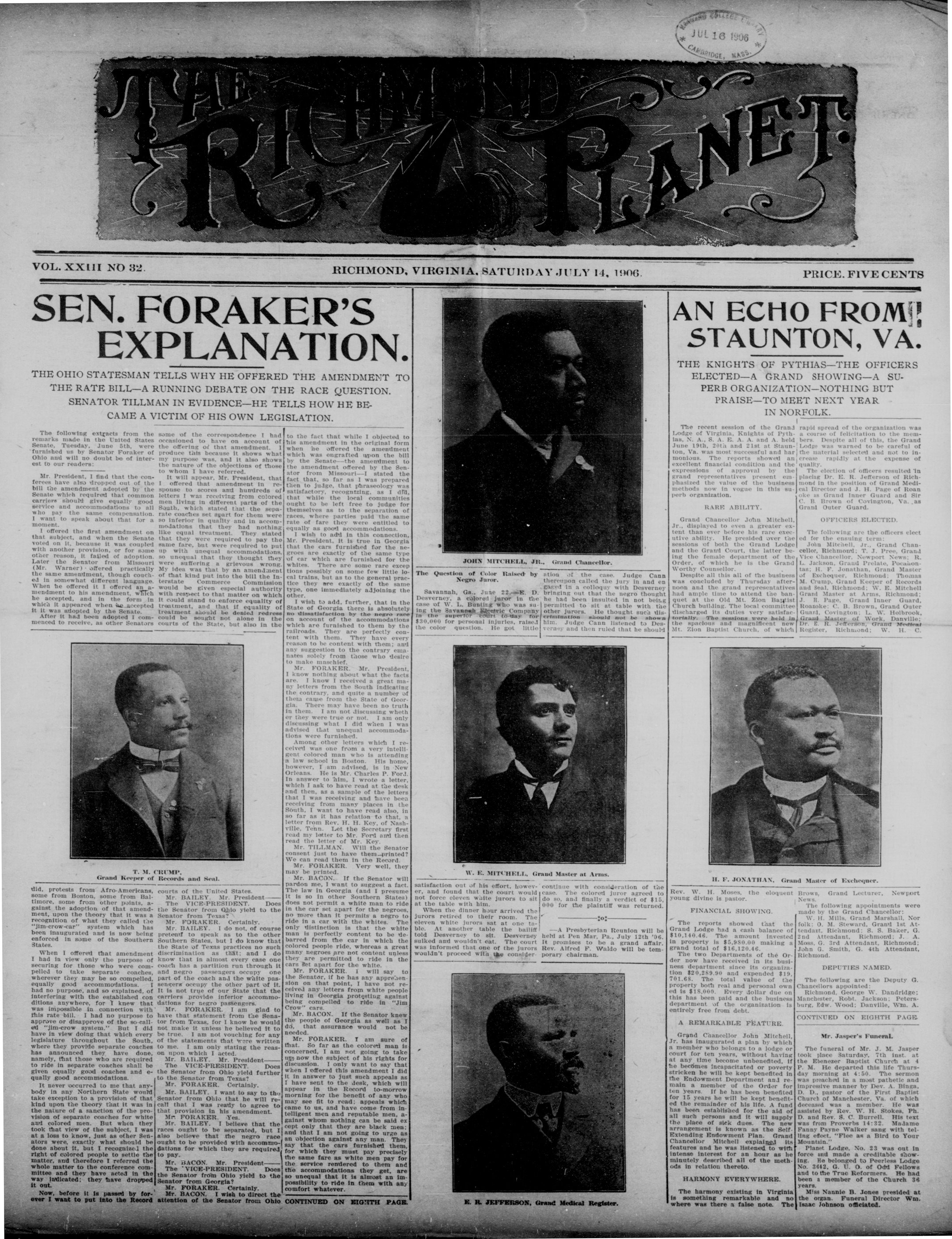
SEN. FORAKER'S EXPLANATION.
THE OHIO STATESMAN TELLS WHY HE OFFERED THE AMENDMENT TO THE RATE BILL—A RUNNING DEBATE ON THE RACE QUESTION.
SENATOR TILLMAN IN EVIDENCE—HE TELLS HOW HE BE-CAME A VICTIM OF HIS OWN LEGISLATION.
The following extracts from the remarks made in the United States Senate, Tuesday, June 5th, were furnished us by Senator Foraker of Ohio and will no doubt be of interest to our readers:
Mr. President, I find that the confeeers have also dropped out of the bill the amendment adopted by the Senate which required that common carriers should give equally good service and accommodations to all who pay the same compensation. I want to speak about that for a moment.
I offered the first amendment on that subject, and when the Senate voted on it, because it was coupled with another provision, or for some other reason, it failed of adoption. Later the Senator from Missouri (Mr. Warner) offered practically the same amendment, though couched in somewhat different language. When he offered it I offered an amendment to his amendment, which he accepted, and in the form in which it appeared when he accepted it it was adopted by the Senate.
After it had been adopted I commenced to receive, as other Senators some of the correspondence I had occasioned to have on account of the offering of that amendment. I produce this because it shows what my purpose was, and it also shows the nature of the objections of those to whom I have referred.
It will appear, Mr. President, that I offered that amendment in response to scores and hundreds of letters I was receiving from colored men living in different parts of the South, which stated that the separate coaches set apart for them were so inferior in quality and in accommodations that they had nothing like equal treatment. They stated that they were required to pay the same fare, but were required to put up with unequal accommodations, so unequal that they thought they were suffering a grievous wrong. My idea was that by an amendment of that kind put into the bill the Interstate Commerce Commission would be given especial authority with respect to that matter on which it could stand to enforce equality of treatment, and that if equality of treatment should be denied redress could be sought not alone in the courts of the State, but also in the fact that while I objected to this amendment in the original form when he offered the amendment which was engrafted upon the bill by the Senate—the amendment to the amendment offered by the Senator from Missouri—I stated the fact that, so far as I was prepared then to judge, that phraseology was satisfactory, recognizing, as I did, that while the local communities ought to be left free to judge for themselves as to the separation of races, where parties paid the same rate of fare they were entitled to equally as good accommodations.
I wish to add in this connection, Mr. President, it is true in Georgia that the cars furnished for the negroes are exactly of the same type of car which are furnished for the whites. There are some rare exceptions possibly on some few little local trains, but as to the general practice they are exactly of the same type, one immediately adjoining the other.
I wish to add, further, that in the State of Georgia there is absolutely no dissatisfaction by the negro race on account of the accommodations made available to the public.
[Name]
T. M. CRUMP,
Grand Keeper of Records and Seal.
tild, protests from Afro-Americans, some from Boston, some from Baltimore, some from other points, against the adoption of that amendment, upon the theory that it was a recognition of what they called the "jim-crow-car" system which has been inaugurated and is now being enforced in some of the Southern States. When I offered that amendment I had in view only the purpose of securing for those who were compelled to take separate coaches, wherever they may be so compelled, equally good accommodations. I had no purpose, and so explained, of interfering with the established conditions anywhere, for I knew that was impossible in connection with this rate-bill. I had no purpose to approve or disapprove of the so-called "jim-crow system." But I did have in view doing that which every legislature throughout the South, where they provide separate coaches has announced they have done, namely, that those who are required to ride in separate coaches shall be given equally good coaches and equally good accommodations.
It never occurred to me that anybody in any Northern State would take exception to a provision of that kind upon the theory that it was in the nature of a sanction of the provision of separate coaches for white and colored men. But when they took that view of the subject, I was at a loss to know, just as other Senators were, exactly what should be done about it, but I recognized the right of colored people to settle the matter, and therefore I referred the whole matter to the conference committee and they have acted in the way indicated; they have dropped it out.
Now, before it is passed by forever I want to put into the Record
some of the correspondence I had occasioned to have on account of the offering of that amendment. I produce this because it shows what my purpose was, and it also shows the nature of the objections of those to whom I have referred.
It will appear, Mr. President, that I offered that amendment in response to scores and hundreds of letters I was receiving from colored men living in different parts of the South, which stated that the separate coaches set apart for them were so inferior in quality and in accommodations that they had nothing like equal treatment. They stated that they were required to pay the same fare, but were required to put up with unequal accommodations, so unequal that they thought they were suffering a grievous wrong. My idea was that by an amendment of that kind put into the bill the Interstate Commerce Commission would be given especial authority with respect to that matter on which it could stand to enforce equality of treatment, and that if equality of treatment should be denied redress could be sought not alone in the courts of the State, but also in the
[Name]
courts of the United States.
Mr. BAILEY. Mr. President——
The VICE-PRESIDENT. Does the Senator from Ohio yield to the Senator from Texas?
Mr. FORAKER. Certainly.
Mr. BAILEY. I do not, of course pretend to speak as to the other Southern States, but I do know that the State of Texas practices no such discrimination as that; and I do know that in almost every case one coach has a partition run through it and negro passengers occupy one part of the coach and the white passengers occupy the other part of it. It is not true of our State that the carriers provide inferior accommodations for negro passengers.
Mr. FORAKER. I am glad to have that statement from the Senator from Texas, for I know he would not make it unless he believed it to be true. I am not vouching for any of the statements that were written to me. I am only stating the reason upon which I acted.
Mr. BAILEY. Mr. President——
The VICE-PRESIDENT. Does the Senator from Ohio yield further to the Senator from Texas?
Mr. FORAKER. Certainly.
Mr. BAILEY. I want to say to the Senator from Ohio that he will recall that I was ready to agree to that provision in his amendment.
Mr. FORAKER. Yes.
Mr. BAILEY. I believe that the races ought to be separated, but I also believe that the negro race ought to be provided with accommodations for which they are required to pay.
Mr. BACON. Mr. President——
The VICE-PRESIDENT. Does the Senator from Ohio yield to the Senator from Georgia?
Mr. FORAKER. Certainly.
Mr. BACON. I wish to direct the attention of the Senator from Ohio
RICHMOND, VIRGINIA, SATURDAY JULY 14, 1906
to the fact that while I objected to this amendment in the original form when he offered the amendment which was engrafted upon the bill by the Senate—the amendment to the amendment offered by the Senator from Missouri—I stated the fact that, so far as I was prepared then to judge, that phraseology was satisfactory, recognizing, as I dff, that while the local communities ought to be left free to judge for themselves as to the separation of races, where parties paid the same rate of fare they were entitled to equally as good accommodations.
I wish to add in this connection, Mr. President, it is true in Georgia that the cars furnished for the negroes are exactly of the same type of car which are furnished for the whites. There are some rare exceptions possibly on some few little local trains, but as to the general practice they are exactly of the same type, one immediately joining the other.
I wish to add, further, that in the State of Georgia there is absolutely no dissatisfaction by the negro race on account of the accommodations which are furnished to them by the railroads. They are perfectly content with them. They have every reason to be content with them; and any suggestion to the contrary emanates solely from those who desire to make manschief.
Mr. FORAKER. Mr. President, I know nothing about what the facts are. I know I received a great many letters from the South indicating the contrary, and quite a number of them came from the State of Georgia. There may have been no truth in them. I am not discussing whether er they were true or not. I am only discussing what I did when I was advised that unequal accommodations were furnished.
Among other letters which I received was one from a very intelligent colored man who is attending a law school in Boston. His home, however, I am advised, is in New Orleans. He is Mr. Charles P. Forl. In answer to him, I wrote a letter, which I ask to have read at the desk and then, as a sample of the letters that I was receiving and have been receiving from many places in the South, I want to have read also, in so far as it has relation to that, a letter from Rev. H. H. Key, of Nashville, Tenn. Let the Secretary first read my letter to Mr. Ford and then read the letter of Mr. Key. Mr. TILLMAN. Will the Senator consent just to have them printed? We can read them in the Record. Mr. FORAKER. Very well, they may be printed. Mr. BACON. If the Senator will pardon me, I want to suggest a fact. The law in Georgia (and I presume it is so in other Southern States) does not permit a white man to ride in the car set with the negroes, no more than it perishing to ride in a car with the whites. The only distinction is that the white man is perfectly content to be barred from the car in which the colored people ride, whereas a great many negroes are not content unless they are permitted to ride in the cars set apart for the white
Mr. FORAKER. I will say to the Mr. BACON. If he has any apprehension on that point, I have not received any letters from white people living in Georgia protesting against being compelled to ride in "Jim Crow" cars.
Mr. BACON. If the Senator knew the people of Georgia as well as I do, that assurance would not be needed.
Mr. FORAKER. I am sure of that. So far as the colored man is concerned, I am not going to take up now the subject of his rights for discussion. I only want to say that when I offered this amendment I did it in answer to just such appeals as I have sent to the desk, which will appear in the Record to-morrow morning for the benefit of any who may see fit to read; appeals which came to us, and have come from intelligent men and reputable men, against whom nothing can be said except only that they are black men; and that I am not going to urge as an objection against any man. They say that the cars furnished them, for which they must pay precisely the same fare as white men pay for the service rendered to them and the accommodations they get, are so unequal that it is almost an impossibility to ride in them with any comfort whatever.
CONTINUED ON EIGHTH PAGE.
J.
JOHN MITCHELL, JR., Grand Chancellor.
The Question of Color Raised by Negro Juror.
Savannah, Ga., June 22.—E. D. Desverney, a colored juror in the case of W. L. Bunting who was suing the Savannah Electric Company in the superior court to-day for $30,000 for personal injuries, raised the color question. He got little institution of the case thereupon called the gaced in a colloquy bringing out that the he had been insults permitted to sit at other jurors. He the crimination should him. Judge Cann lverney and then rule
[Name]
M.
W. E. MITCHELL, Grand Master at Arms.
satisfaction out of his effort, however, and found that the court would not force eleven white jurors to sit at the table with him. continue with considerer case. The colored jurors do so, and finally a ver 000 for the plaintiff.
When the dinner hour arrived the jurors retired to their room. The eleven white jurors sat at one table. At another table the bailiff told Desverney to sit. Desverney sulked and wouldn't eat. The court was informed that one of the jurors wouldn't proceed with the consider-
[Name]
[Image of a man in a suit with a tie and a mustache].
E. R. JEFFERSON. Grand Medical Register.
ation of the case. Judge Cann thereupon called the jury in and engaged in a colloquy with Deswerney bringing out that the negro thought he had been insulted in not being permitted to sit at table with the other jurors. He thought such discrimination should not be shown him. Judge Cann listened to Deswerney and then ruled that he should
IRELAND
continue with consideration of the case. The colored juror agreed to do so, and finally a verdict of $15,000 for the plaintiff was returned.
—A Presbyterian Reunion will be held at Pen Mar, Pa., July 12th '06 promises to be a grand affair, to be a Valdo will be temporary chairman.
T
AN ECHO FROM STAUNTON, VA.
THE KNIGHTS OF PYTHIAS-THE OFFICERS ELECTED-A GRAND SHOWING-A SUPERB ORGANIZATION-NOTHING BUT PRAISE-TO MEET NEXT YEAR IN NORFOLK.
H. F. JONATHAN. Grand Master of Exchequer.
The recent session of the Grand Lodge of Virginia, Knights of Pythias, N. A., S. A. E. A. A. and A. held June 19th, 20th and 21st at Staunton, Va. was most successful and har monous. The reports showed an excellent financial condition and the expressions of approval by the grand representatives present emphasized the value of the business methods now in vogue in this superb organization.
RARE ABILITY.
Grand Chancellor John Mitchell, Jr., displayed to even a greater extent than ever before his rare executive ability. He presided over the sessions of both the Grand Lodge and the Grand Court, the latter being the female department of the Order, of which he is the Grand Worthy Counselor. Despite all this all of the business was concluded by Thursday afternoon and the grand representatives had ample time to attend the banquet of the Baptist Church building. The local council discharged its duties very satisfactorily. The sessions were held in the spacious and magnificent new Mt. Zion Baptist Church, of which
H. F. JONATHAN, Gran
Rev. W. H. Moses, the eloquent young divine is pastor.
FINANCIAL SHOWING
The reports showed that the Grand Lodge had a cash balance of $10,140.46. The amount invested in property is $5,980.00 making a grand total of $16,120.46.
The two Departments of the Order now have received in its business department since its organization $20,289.90 and expended $19,701.68. The total value of the property both real and personal owned is $18,000. Every dollar due on this has been paid and the business department of the organization is entirely free from debt.
A REMARKABLE FEATURE
Grand Chancellor John Mitchell, Jr. has inaugurated a plan by which a member who belongs to a lodge or court for ten years, without having at any time become unbenefited, if he becomes incapacitated or poverty stricken he will be kept benefited in the Endowment Department and remain a member of the Order for ten years. If he has been benefited for 15 years he will be kept benefited the remainder of his life. A fund has been established for the aid of all such persons and it will supply the place of sick dues. The new arrangement is known as the Self-Extending Endowment Plan. Grand Chancellor Mitchell explained its features and he was listened to with intense interest for an hour as he minutely described all of the methods in relation thereto.
HARMONY EVERYWHERE.
The harmony existing in Virginia is something remarkable and no where was there a false note. The
PRICE. FIVE CENTS
O FROM! TON, VA.
THIAS—THE OFFICERS AND SHOWING—A SU-ION—NOTHING BUT GET NEXT YEAR RFOLK.
rapid spread of the organization was a course of felicitation to the members. Despite all of this, the Grand Lodge was warned to be careful of the material selected and not to increase rapidly at the expense of quality.
The election of officers resulted 'in placing Dr. E. R. Jefferson of Richmond in the position of Grand Medical Director and J. H. Page of Roan oke as Grand Inner Guard and Sir C. B. Brown of Covington, Va., as Grand Outer Guard.
OFFICERS ELECTED
The following are the officers elected for the ensuing term:
John Mitchell, Jr., Grand Chancellor, Richmond; T. J. Pree, Grand Vice Chancellor, Newport News; R. L. Jackson, Grand Prelate, Pocaiontas; H. F. Jonathan, Grand Master of Exchequer, Richmond; Thomas M. Crump, Grand Keeper of Records and Seal, Richmond; W. E. Mitchell Grand Master at Arms, Richmond; J. H. Page, Grand Inner Guard, Roanoke; C. B. Brown, Grand Outer Guard, Bovington; L. W. Holbrook, Dr. E. R. Jefferson, Grandville, Dr. E. R. Jefferson, Grandville, Register, Richmond; W. H. C.
and Master of Exchequer.
Brown, Grand Lecturer, Newport News. The following appointments were made by the Grand Chancellor:
made by the Grand Chancellor;
W. H. Mills, Grand Marshall, Norfolk;
O. M. Steward, Grand 1st Attendant, Richmond; S. S. Baker, G. 2nd Attendant, Richmond; J. A. Moss, G. 3rd Attendant, Richmond;
John G. Smith, G. 4th Attendant, Richmond.
DEPUTIES NAMED
The following are the Deputy G. Chancellors appointed:
Richmond, George W. Dandridge;
Manchester, Robt. Jackson; Petersburg, Edw. Wood; Danville, Wm. A.
CONTINUED EIGHTH PAGE
Mr. Jasper's Funeral
the funeral of Mr. J. M. Jasper took place Saturday, 7th inst. at the Ebenezer Baptist Church at 4 P. M. He departed this life Thursday morning at 4:50. The sermon was preached in a most pathetic and impressive manner by Dev. A. Binga, D. D., pastor of the First Baptist Church of Manchester, Va. of which deceased was a member. He was assisted by Rev. W. H. Stokes, Ph. D. and Rev. S. C. Burrell. His text was from Proverbs 14:32. Malame Fanny Payne Walker sang with telling effect, "Flee as a Bird to Your Mountain." Planet Lodge, No. 23 was out in force and made a creditable showing. He belonged to Peerless Lodge No. 3642, G. U. O. of Odd Fellows and to the True Reformers. He had been a member of the Church 36 years.
Miss Nannie B. Jones presided at the organ. Funeral Director Wm. Isaac Johnson officiated.
FILE NO. 113.
ONE OF THE MYSTERIES OF PARIS, AND HOW IT WAS SOLVED.
(By KIMLE GABORIAU.)
CHAPTER XIV.
In 18—lived in his ancestral castle, on the banks of the Rhone, the old Marquis de Clameran, and his two sons, Gaston and Louis. They were objects of his love in the same measure as for his hate he viewed his neighbor, the Countess de la Verberie. Stern, cold, and arrogant, she would have been the general detestation as she was this individual one, had it not been for her beautiful and gentle daughter, Valentine. The estates were separated only by the river, here narrow, but swiftly flowing. It was no barrier for love. Valentine saw Gaston, and from that moment his image filled her heart. But so many obstacles separated them!
Yet they met happily, until one fatal evening, when she saw her lover swim the tide at the greatest risk, and fall at her feet, almost exhausted.
"Is it you," she murmured, trying to lift him up. "Then Heaven has heard my prayers, and had pity." "No," was his gloomy answer, "Heaven has not been pitiful, for I am forced to flee. Our love is the sport of the rustics, and to punish the insolent I have killed two of the scoundrels. But what does this exile matter? You will accompany me, and share my home in the wilds." "I can not leave my mother, Gaston." "But if my father consents to our union—" "She never will, for you are poor, and she is determined I shall marry a wealthy man that she may end her days in luxury."
"She shall have it," said Gaston, bitterly; "make her wait three years, when I shall return rich, or you will be free to wed for money. Meanwhile keep for me these jewels of my mother's, which I vowed should be worn by my beloved alone."
She accepted the pledge, and watched her lover depart in the gloom.
Three days after he was on ship, bound for Valparaiso, happy that he had baffled justice, while she was in misery acute.
Her mother had soon heard the story of her disgrace. It was tempered but by two causes for rejoicing in this wicked woman's heart; all believed that Gaston had been drowned in the Rhone, and the fear this was true had carried death to his father's heart.
Valentine could have wished death had included her in this swoop, but for one reason to preserve her, even in pain and travail. She was soon to be the mother of Gaston's child. She had not revealed this secret to him, but her mother divined it.
Luckily she was a woman for emergencies. She escorted her daughter to England, where the child was born, and left with persons hired to adopt it, without, of course, knowing what an aristocratic scion they were fostering.
The young mother, bereft of her son, and of its father, returned home with her mother in passive resignation. She sorrowed for four years without receiving any intelligence of either.
Her mother remained a marble image to her, but she was alive to her selfish interests. She was always looking about her for the means to rise from her genteel poverty, and at this period it presented itself.
They made the acquaintance of the young banker, Andre Fauvel.
The first time he met Valentine he was struck by her beauty, and after once looking into her large, melancholy eyes, his admiration deepened into love—a love so earnest and passionate that he felt that he could never be happy without her.
Before being introduced to her his heart had surrendered itself to her charms.
He was wealthy; a splendid career was open to him, and he swore that Valentine should be his.
He confided all his matrimonial plans to an old friend of Mine, de la Verberie, who had no sooner broached them to the match-making mamma than the alliance was arranged. During the courtship the countess conduct was a masterpiece.
She suddenly ceased to importune her daughter, and with tearful resignation said she would not attempt to influence her decision, that her happy settlement in life was the only anxiety that weighed upon her mind. But she went about in the house sighing and groaning as if she were upon the eve of starving to death. She also made arrangements to be tormented by the bailiffs. Attachments and notices to quit poured in at La Verberie, which she would show to Valentine, and, with tears in her eyes, say:
"God grant we may not be driven from the home of our ancestors before your marriage, my darling!"
Knowing that her presence was sufficient to freeze any confession on her daughter's lips, she never left her alone with Andre.
"Once married," she thought, "they can settle the matter to suit themselves. I shall not then be disturbed by it."
She was as impatient as Andre, and hastened the preparations for the wedding. She gave Valentine no opportunity for reflection.
Eighteen months after her marriage Mme. Fauvel presented her husband with a son. But neither this child, nor a second son, born a year after, could make her forget the first one of all, the poor, forsaken babe who had been thrown upon strangers, mercenaries, who valued the money, but not the child for whom it was paid.
She would look at her sons, sur-
TWO
rounded by every luxury which money could give, and murmur to herself: "Who knows if the abandoned one has bread to eat?" Louis de Clameran was given no news of his brother by Valentine, and, like all the rest, he believed that his life was lost in the river. He was the more inclined to believe, as he had long chafed under the burden of being the younger son. Now he was the heir, by the two removals of those who stood between him and enjoyment of the patrimony. All the unjust precautions taken by the marquis to elude the law, and insure beyond dispute the possession of his entire fortune to his eldest son, turned against him. By means of a fraudulent deed of trust, drawn by his dishonest lawyer, M. de Clameran had disposed of everything, so that, on the day of his death every farthing he owned would be Gaston's.
Louis alone was benefited by this precaution. He came into possession without even being called upon for the certificate of his brother's death.
This sudden, unexpected fortune so completely turned his head that he felt fettered in the country, and hastened, after disposing of nearly everything, to Paris. He plunged into the sea of dissipation until the day came when he dragged himself out on the shore, penniless, and glad to live quietly, while meditating any means to regain wealth. Forced to quit his country, he was eighteen years abroad, living from hand to mouth for the most of the time, when at a gaming resort he broke the bank and thought that he might see his home once more, where perhaps the evil he had done had not lived after his departure.
He had been twenty-five years absent, but the old tenants remembered him, and warmly gave their welcome.
He, the adventurer, the bully, the base accomplice of London swindlers, delighted in these marks of respect and veneration, bestowed upon him as the representative of the house of Clamaran; it seemed to make him once more feel a little self-respect, as if the future were not utterly hopeless.
One of the farmers was eager to buy a piece of land which he had rented so long that he almost felt it was his own; Louis disposed of it for ready money, and, already tired of rusticity, hurried again to the gay city.
Besides, he had learned the secret of Valentine; he knew of the shameful offspring of his brother and the sinning girl who was now the wife of one of the most opulent of Parisian bankers. Louis meant to levy blackmail on her to increase his store.
CHAPTER XV.
Time had dulled the remorse and anxiety of Valentine. In the genial atmosphere of a happy home she had found rest and almost forgetfulness. She had suffered so much at being compelled to deceive Andre that she hoped she was now even with fate.
She began to look forward to the future, and her youth seemed buried in an impenetrable mist, and was, as it were, the memory of a painful dream.
One rainy November day her husband had gone to Provence on business. She was sitting, gazing into the bright fire, and thankfully meditating upon her present happiness, when the servant brought her a letter, which had been left by a stranger, who refused to give his name.
Without the faintest presentiment of evil she carelessly broke the seal, and in an instant was almost petrified by the words which met her terrified eye:
"Madame—Would it be relying too much upon the memories of the past to hope for half an hour of your time?
"To-morrow, between two and three, will do myself the honor of calling upon you.
"THE MARQUIS OF CLAMERAN."
Ah! she had hoped and believed that the fatal past was atoned for, and buried in oblivion; and now it stood before her, pitiless and threatening.
Poor woman! As if all human will could prevent what was fated to be!
It was in this hour of security, when she imagined herself pardoned, that the storm burst upon the fragile edifice of her happiness and destroyed her every hope.
The dreaded day came, and with it the man. But to her amazement it was not Gaston whom she saw, but his brother, Louis! Her emotion was too deep not to serve his purpose, and though she preserved enough coolness not to place herself in his power, by accepting his fiction of Gaston dying in his brother's arms later in Paris, and consigning to him the care of his son, she could not altogether shake him off.
On the other hand, she dared not confess to her husband, who would never have confidence in her again, and she refused the sympathy of Madeleine. The girl had divined that she was in distress, and had pleaded to learn the cause.
The plotter gave time for the poison to work; when he communicated with her again, it was to ask her to call on him at his hotel.
The poor woman, in the colls, dared not stay away. Here another surprise awaited her. The marquis was not in the rooms. He who received her was a cherubic youth, who announced
THE RICHMOND PLANET, RICHMOND, VIRGINIA
himself in a sweet voice, which wring her heart, as Raoul Valentine "Wilson." It was her castaway son!
This voice was so like Gaston's that she seemed once more to be listening to the lover of her almost forgotten youth.
It seemed only yesterday that Gaston had pressed her to his faithful heart; she saw him still, saying, gently:
"In three years, Valentine! Wait for me!"
Andre, her two sons, Madeleine—all were forgotten in this new-found affection.
In her maternal love—her folly—she did not so much as glance at the proofs which this young man was abundantly provided with.
From that moment she was inextricably entangled in the toils by Clameran and Raoul de Lagors, for the plotter passed him off as her nephew that he might visit the banker's wife with impunity.
No remorse for the past, no apprehensions for the future, disturbed the satisfied present. To her the future was to-morrow; eternity was the sixteen hours which must elapse before another interview.
She seemed to think that Gaston's death absolved the past and changed the present.
Her sole regret was her marriage. Free, with no family ties, she could have consecrated herself exclusively to Raoul. How gladly would she have sacrificed her affluence to enjoy poverty with him!
She felt no fear that her husband and sons would suspect the thoughts which absorbed her mind; but she dreaded her niece.
She imagined that Madeleine looked at her strangely on her return from the Hotel du Louvre. She must suspect something, but did she suspect the truth?
For several days she asked embarrassing questions as to where her aunt went, and with whom she had been during these long absences from home.
This disquietude and seeming curiosity changed the affection which Mme. Fauvel had hitherto felt for her adopted daughter into positive dislike.
She regretted having placed over herself a vigilant spy from whom she could not escape. She pondered what means she could take to avoid the penetrating watchfulness of a girl who was accustomed to read in her face every thought that crossed her mind.
With unspeakable satisfaction she solved the difficulty in a way which she thought would please all parties. She would have her married, and thus removed from her path and her son's. Cleraner espoused her idea, but wanted to modify it; it was himself that he proposed for the girl's hand, undertaking to shelve Bertomy, to whom she had been tacitly engaged, and he promised, as a substantial inducement for the banker's wife to consent to this change, to transfer to Raoul all the dower that came with the bride.
This time the creature in his talons presumed to rebel. He left her with fear that his plans were not working smoothly as before.
Cleraner had cause for fear. Mme. Fauvel's determination was not feigned. She was firm in her resolve to confess.
"Yes," she cried, with the enthusiasm of a noble resolution; "yes, I will tell Andre everything!" She believed herself to be alone, but turned around suddenly at the sound of footsteps, and found herself face to face with Madeleine, who was pale and swelled-eyed from weeping. "You must obey this man," she quietly said.
"I despise M. de Clameran, and shall always regard him as the basest of men; nevertheless, I will marry him. I will not suffer dishonor to fall upon this house, which is my home, while I have power to prevent it. Am I not indebted to you for more than life? What would I now be bead you not taken pity on me? A factory girl in my native village. You warmly welcomed the poor orphan, and became a mother to her. It is not to your husband that I owe the fortune which excites the cupidity of this wicked Clameran? Are not Abel and Lucien brothers to me? And now, when the happiness of all who have been loving and generous to me is at stake, do you suppose I would hesitate? No. I will become the wife of Clameran."
Then began a struggle of self-sacrifice between Mine. Fauvel and her niece as to which should be the victim, only the more sublime, because each offered her life to the other, not from any sudden impulse, but deliberately and willingly.
But Madeleine carried the day, fired as she was by that holy enthusiasm of sacrifice which is the sustaining element of martyrs.
"Have courage; we two can fight the world and silence our enemies. You shall be saved, aunt; only trust in me."
The Marquis of Clameran was agreeably surprised that evening by receiving a letter from Mine. Fauvel, saying that she consented to everything, but must have a little time to carry out the plan.
A line from Madeleine, at the bottom of the letter, assured him that she fully concurred with her aunt.
Poor girl, she did not spare herself. The next day she took Prosper aside, and forced from him the fatal promise to shun her in the future, and to take upon himself the responsibility of breaking their engagement.
The marquis prudently absented himself, awaiting the propitious moment.
At the end of three weeks he met the banker at a friend's, and was invited to dinner the next day.
Twenty people were seated at the table, and as the desert was being served the banker suddenly turned to Clameran, and said:
"I have a piece of news for you, monsieur. Have you any relatives of your name?"
"None that I know of, Monsieur."
"I am surprised. About a week ago I became acquainted with another
Marquis of Clameran."
Although so hardened by crime, impudent enough to deny anything, Clameran was so taken aback that he sat with pale face and a blank look, silently staring at M. Fauvel.
But he soon recovered enough self-control to say, hurriedly:
"Oh, indeed. That is strange. A Clameran may exist, but I can not understand the title of marquis."
M. Fauvel was not sorry to have the opportunity of annoying a guest whose aristocratic pretensions had often piqued him.
"Marquis or not," he replied, "the Clameran in question seems to be able to do honor to the title."
"Is he rich?"
"I have reason to suppose that he is very wealthy. I have been notified to collect for this M. Gaston 400,000 francs."
But this time Louis betrayed no emotion or alarm; he had had sufficient time to recover his self-possession, and nothing could now throw him off his guard.
"Gaston!" he queried, carelessly. "I know who he is now. He must be the son of my father's sister, whose husband lived at Havana. I suppose, upon his return to France, he must have taken his mother's name, which is more sonorous than his father's, that being, if I recollect aright, Moirot or Boirot."
The banker laid down his memorandum book, and, resuming his seat, went on:
"Boirot or Clameran," said he, "I hope to have the pleasure of inviting you to dine with him before long. Of the 400,000 francs which I was ordered to collect for him he only wishes to draw 100, and tells me to keep the rest on running account. I judge from this that he intends coming to Paris."
"I shall be delighted to make his acquaintance."
Clameran broached another topic, and seemed to have entirely forgotten the news told him by the banker. At last the dinner ended, and, as the guests passed into the drawing room, Clameran and Raoul managed to remain last in the dining room.
When they were alone they no longer attempted to conceal their anxiety.
"It is he!" said Raoul.
"I have no doubt of it."
"Then all is lost; we had better make our escape."
But a bold adventurer like Clameran had no idea of giving up the ship till forced to do so.
"Who knows what may happen?" he asked, thoughtfully. "There is hope yet. Why did not that muddled-headed banker tell us where this Clameran is to be found?"
Here he uttered a joyful exclamation. He saw M. Fauvel's memorandum book lying on the table.
"Watch!" he said to Raoul.
Seizing the note book, he hurriedly turned over the leaves, and, in an undertone, read: "Gaston, Marquis of Clameran, Gloron, Lower Pyrenees."
Two hours later Clameran was on the road to Vesinet with Raoul, explaining to him his plans.
"It is my precious brother, and no mistake," he said. "But that need not alarm you so easily, my lovely nephew."
"Merciful powers! Don't the banker expect to see him any day? Is he not liable to pounce down on me tomorrow?"
"Don't be an idiot!" interrupted Clameran. "Does he know that Fauvel is Valentine's husband? That is what we must find out. If he knows that little fact we must take to our heels; if he is ignorant of it our case is not desperate."
"How will you find out?"
"By simply asking him."
Raoul exclaimed at his ally's cunning:
"That is a dangerous thing to do," he said.
"Tis not as dangerous as sitting down with our hands folded. And, as to running away at the first suspicion of alarm it would be imbecility."
"Who is going to look for him?"
"I am."
"Oh," exclaimed Raoul. Clameran's audacity confounded him.
"But what am I going to do?" he inquired, after a moment's silence.
"You will oblige me by remaining here and keeping quiet. I will send you a dispatch if there is danger, and then you can decamp."
As they parted at Raoul's door Clameran said:
"Now remember. Stay here, and during my absence be very intimate at your devoted mother's. Be the most dutiful of sons. Abuse me as much as you please to her, and, above all, don't indulge in any folly; make no demands for money; keep your eyes open. Good-by. To-morrow evening I will be at Oloron talking with this new Clameran."
CHAPTER XVI
After leaving Valentine de la Verberie, Gaston underwent great peril and difficulty in effecting his escape. But for the experienced and faithful Menouil he never would have succeeded in embarking. Having left his mother's jewels with Valentine, his sole fortune consisted of not quite a thousand francs, and with this paltry sum in his pocket, the murderer of two men, a fugitive from justice, and with no prospect of earning a livelihood, he took passage for Valparaiso. Before Gaston had been on board the Tom Jones forty-eight hours he saw that chance had cast him among a collection of the most depraved bandits and cut-throats. The vessel, which seemed to have recruited at all points of the compass, possessed a crew composed of every variety of thievish knaves; each country had contributed a specimen.
But Gaston's mind was undisturbed as to the character of the people with whom his lot was cast for several months.
The Tom Jones set sail for Valparaiso, but certainly went in a roundabout way to reach her destination.
The real fact was that Capt. Warth proposed visiting the gulf of Guinea. Gaston soon saw that he was serving his apprenticeship on a slaver, one
of the many ships which made immense fortunes by carrying on the slave trade. Although this discovery filled Gaston with indignation and shame he was prudent enough to conceal his impressions. When Gaston had been with Capt. Warth about three years the Tom Jones stopped at Rio Janiero for a month, to lay in supplies. He now decided to leave the ship. He possessed 12,000 francs, as his share of the profits, when he landed at Brazil. As a proof that the slave trade was repugnant to his nature, he left the slaver the moment he possessed a little capital with which to enter some honest business. But he was no longer the high-minded, pure-hearted Gaston, who had so devotedly loved and periled his life for the little fairy of La Verberie.
Three years, after which he had pledged himself to return, had passed; perhaps Valentine was expecting him. Before deciding on any definite project he wrote to an intimate friend at Beaucaire to learn what had happened during his long absence.
He also wrote to his father, asking why he had never answered the many letters which he had sent to him by returning sailors, who would have safely forwarded the replies.
At the end of a year he received an answer from his friend. This letter almost drove him mad.
It told him that his father was dead; that his brother had left France, Valentine was lately married, and that he, Gaston, had been sentenced to ten years' imprisonment for murder.
Henceforth he was alone in the world, with no country, no family, no home, and disgraced by a public sentence.
But Gaston was not a man to be long cast down.
"Money is the cause of it all!" he said, with rage. "If the lack of money can bring such misery its possession must bestow intense happiness. Henceforth I will devote all my energies to getting money."
He set to work with a greedy activity, which increased each day.
Finally, after long weary years of toil and struggle, he was worth a million in gold, besides immense tracts of land.
He had often said that he would never leave Brazil, that he wanted to end his days in Rio. He had forgotten that love for his native land never dies in the heart of a Frenchman. Now that he was rich, he wished to die in France.
He made inquiries, and found that the law of limitations would permit him to return without being disturbed by the authorities. He left his property in charge of an agent, and embarked for France, taking a large portion of his fortune with him. Twenty-three years and four months had elapsed since he fled from home. An iron mill was for sale near Oloron, on the borders of the Gara;
he bought it with the intention of utilizing the immense quantity of wood, which, for want of means of transportation, was being wasted in the mountains.
He was soon settled comfortably in his new home, and enjoying a busy, active life.
One evening, as he was ruminating over the past, the servant brought him a card, and said the gentleman was waiting to see him.
He read the name on the card: Louis de Clameran.
Like one in a dream, he toterted toward the door, gasping, in a smothered, broken voice:
"My brother! oh, my brother!"
Hurriedly passing by the frightened servant, he ran down stairs.
In the passage stood a man; it Louis.
Gaston threw his arms around his neck and held him in a close embrace for some minutes, and then drew him into the room.
Seated close beside him, with his two hands tightly clasped in those of Louis, Gaston gazed at his brother as a fond mother could gaze at her son just returned from the battlefield.
"Are you married, Louis?"
"No."
"Then we will have to do the best we can, and keep house for ourselves. We will live together like two old bachelors, as we are, and be as happy as kings; we will lead a gay life and enjoy everything that can be enjoyed. I feel 20 years younger already. The sight of your face renews my youth, and I feel as active and strong as I did the night I swam across the swollen Rhone."
"I think you look the younger."
"Would you have recognized me?"
"Instantly. You are very little changed."
And Louis was right. He himself had an old, worn-out, used-up appearance, while Gaston, in spite of his gray hair and weather-beaten face, was a robust man, in the full maturity of his prime.
"We must thank Providence for this happy meeting," he replied. "Three days ago a friend of mind returned from the baths, and mentioned that he had heard that a Marquis of Clameran was near there, and in the Pyrenees. You can imagine my surprise. I instantly supposed that some impostor had assumed our name. I took the next train, and finally found my way here."
"Then you did not expect to see me?"
"My dear brother, how could I hope for that? I thought that you were drowned 23 years ago."
"Drowned! Mile. de la Verberie certainly told you of my escape. She promised that she would go herself, the next day, and tell my father of my safety."
Louis assumed a distressed look, as if he hesitated to tell the sad truth, and said, in a regretful tone: "Alas! she never told us."
Gaston's eyes flashed with indignation. He thought that perhaps Valentine had been glad to get rid of him.
After a long silence Gaston arose, and walked up and down the room as if to shake off a feeling of sadness, then he said, cheerfully:
"Well, it is of no use to mourn over the past. All the memories in the
world, good or bad, are not worth one slender hope for the future; and thank God, we have a bright future before us. Let us bury the past, and enjoy life together."
Louis was silent.
Gaston kept up an uninterrupted stream of questions. He wished to know all that had happened during his absence.
"What about Clameran?" he abruptly asked.
Louis hesitated a moment. Should he tell the truth, or not?
"I have sold Clameran," he finally said.
"The chateau, too?"
"Yes."
"You acted as you thought best." said Gaston, sadly, "but it seems to me that if I had been in your place I should have kept the old homestead. Our ancestors lived there for many generations, and our father lies buried there."
Seeing that Louis' face remained clouded he went on:
"Ah, I see what annoys you, my dear Louis; you are rich, and think that I am poor, and too proud to accept anything from you. Is it not so?"
Louis started at this question. How could he reply so as not to commit himself?"
"I am not rich," he finally said.
"The salary of an office which I hold in Paris is all that I have to support me."
"Yet you wanted to pay me back half of the family inheritance! Louis, that is unkind; you are not acting as a brother should."
"I should be a burden to you, Gaston."
"A burden! Why, Louis, you must me mad! Did I not tell you I am very rich? Do you suppose that you have seen all I possess? This house and the iron-works de not constitute a fourth of my fortune. Do you think that I would have risked my twenty years' savings in an experiment of this sort? The force may be a failure, and then what would become of me if I had nothing else?
"I have invested money which yields me an income of eighty thousand francs. Besides, my grants in Brazil have been sold, and my agent has already deposited four hundred thousand franc to my credit as part payment."
Louis trembled with pleasure. He was, at last, to know the extent of the danger hanging over him. Gaston had finally broached the subject
which had caused him so much anxiety, and he determined that it should now be explained before their conversation ended.
"Who is your agent?" he asked, with assumed indifference.
"My old partner at Rio. He deposited the money at my Paris banker's."
"Is this banker a friend of yours?"
"No; I never heard of him until my banker at Pau recommended him to me as an honest, reliable man; he is immensely wealthy, and stands at the head of the financiers in Paris. His name is Fauvel, and he lives on the Rue de Provence."
Although prepared for hearing almost anything, and determined to betray no agitation, Louis turned deadly pale.
"Do you know this banker?" asked Gaston.
"Only by reputation."
"Then we can make his acquaintance together; for I intend accompanying you to Paris, when you return there to settle up your affairs before establishing yourself here to superintend the forge."
At this unexpected announcement of a step which would prove his utter ruin, Louis was stupefied. In answers to his brother's questioning look he gasped out:
"You are going to Paris?"
"Certainly I am. Why should I not go."
"There is no reason why."
"I hate Paris, although I have never been there. But I am called there by interest, by sacred duties," he hesitatingly said. "The truth is, I understand that Mille, de la Verberie lives in Paris, and I wish to see her." "Ah!"
Gaston was silent and thoughtful for some moments, and then said, nervously:
"I will tell you, Louis, why I wish to see her, I left our family jewels in her charge, and I wish to recover them."
"Do you intend, after a lapse of twenty-three years, to claim these jewels?"
"Yes—or rather no. I only make the jewels an excuse for seeing her. I must see her because—because she is the only woman I ever really loved!"
"But how will you find her?"
"Ob! that is easy enough. Anyone can tell me the name of her husband, then I will go to see her. Perhaps the shortest way to find out would be to write to Beaucaire. I will do so to-morrow."
Louis trembled like a man who had just made a narrow escape from death. He well knew that he would have to fly the country if Gaston learned the truth. It was necessary to prevent it ever reaching him this side of the grave.
A few days after Gaston was suddenly taken ill.
CHAPTER XVII.
He had a sort of vertigo, and was so dizzy that he was forced to lie down.
"I know what is the matter," he said. "I have often been ill in this way at Rio. A couple of hours' sleep will cure me. I will go to bed, and you can send some one to awaken me when dinner is ready, Louis; I shall be all right by that time."
At the same time he ordered Manuel, his old Spanish servant, who had lived with him for ten years, to prepare him some lemonade.
The next day Gaston appeared to be much better. He ate his breakfast, and was about to take a walk when the pains of the previous day suddenly returned, in a more violent form.
Without consulting his brother Louis sent to Oloron for Dr. C., whose wonderful cures at Eaux
Bonnes had won him a wide reputation.
The doctor declared that there was no danger, and merely prescribed a dose of valerian, and a blister with some grains of morphine sprinkled on it.
But in the middle of the night all the symptoms suddenly changed for the worse. The pain in the head was succeeded by a fearful oppression, and the sick man thus suffered torture in trying to get his breath; daybreak found him still tossing restlessly from pillow to pillow.
When Dr. C—— came early in the morning he appeared very much surprised at this change for the worse. He inquired if they had not administered an overdose of morphine. Manuel said that he had put the blister on his master, and the doctor's directions had been accurately followed.
The doctor after having examined Gaston, and found his breathing heavy and irregular, prescribed a heavy dose of sulphate of quinine; he then retired, saying he would return the next day. As soon as the doctor had gone Gaston sent for a friend of his, a lawyer, to come to him as soon as possible.
ton sent for a friend of his, a lawyer,
to come to him as soon as possible.
"For Heaven's sake, what do you
want with a lawyer?" inquired Louis.
"I want his advice, brother. It is
useless to try and deceive ourselves;
I know I am extremely ill. Only tim-
id fools are superstitious about mak-
ing their wills; if I defer it any longer
I may be suddenly taken without
having arranged my affairs. I would
rather have the lawyer at once, and
then my mind would be at rest."
Gaston did not think he was about
to die; but, knowing the uncertainty
of life, determined to be prepared for
the worst; he had too often imperiled
his life, and been face to face with
death, to feel any fear now.
He had made his will while ill at
Bordenux, but now that he had found
Louis, he wished to make him his partner
and possessor of half his fortune
should he survive.
The strangest sensations now filled Louis' breast.
He was in a state of delirious excitement often felt by persons suddenly raised from poverty to affluence.
Whether Gaston lived or died, Louis was the lawful possessor of an income of twenty-five thousand francs, without counting the eventual profits of the iron works.
At no time in his life had he hoped for or dreamed of such wealth. His wildest wishes were surpassed. What more could he want?
Alas! he wanted the power of enjoying these riches; they had come too late.
This fortune, fallen from the skies, should have filled his heart with joy; whereas it only made him melancholy and angry.
This unlooked-for happiness seemed to have been sent by cruel fate as a punishment for his past sins. What could be more terrible than seeing this haven of rest open to him, and to be prevented from enjoying it because of his own vile plotting? Although his conscience told him that he deserved this misery he blamed Gaston entirely for his present torture. Yes, he held Gaston responsible for the horrible situation in which he found himself.
His letters to Raoul for several days expressed all the fluctuations of his mind, and revealed glimpses of coming evil.
Gaston would never be turned from his search for his first love, as he proved by calling for her in the most beseeching tones when he was suffering the worst paroxysms of pain.
He grew no better. In spite of the most careful nursing his symptoms changed, but showed no improvement. Each attack was more violent than the preceding.
At midnight Gaston's sufferings returned with renewed violence, and a fatal termination seemed inevitable. Gaston's pain left him in a measure, but he was growing weaker every moment. His mind wandered, and his feet were as cold as ice. On the fourteenth day of his illness, after lying in a stupor for several hours, he revived sufficiently to make Louis promise to carry on the iron works, embraced him for the last time, and sunk back on his pillow in a dying state.
As the bell tolled for noon he quietly breathed his last, murmuring, softly:
"In three years, Valentine; wait for me."
Now, Louis was in reality Marquis of Clameran, and besides was a millionaire.
Two weeks later, having made arrangements with the engineer in charge of the iron works to attend to everything during his absence, he took his seat in the train for Paris.
He had sent the following telegram to Raoul the night previous:
CHAPTER XVIII
During the month of Louis' absence Mme. Fauvel was in a state of comparative happiness.
Never had this mother and wife—this pure, innocent woman, in spite of her first and only fault—enjoyed such tranquility. She felt as one under the influence of enchantment, while reveling in the sunshine of filial love, which almost bore the character of a lover's passion, for Raoul's devotion was ardent and constant, his manner so tender and winning that anyone would have taken him for Mme. Fauvel's suitor.
As she was still at her country seat, and M. Fauvel went to business every morning at nine o'clock, and did not return till six, she had the whole of her time to devote to Raoul. When she had spent the morning with him at his house in Vesinet she would often bring him home to dine and pass the evening with her.
All his past faults were forgiven, or rather the whole blame of them was laid upon Clameran, for, now that he was absent, had not Raoul once more become her noble, generous, affectionate son, the pride and consolation of her life?
Raoul enjoyed the life he was leading, and took such an interest in the part he was playing, that his act-
THE PLANET
SATURDAY...JULY 14TH. 1906
ing was perfect. He possessed the faculty which makes cheats successful—fairly in his own impostures. Sometimes he would stop to think whether he was telling the truth, or acting a shameful comedy.
His success was wonderful. Even Madelineine, the prudent, distrustful Madelineine, without being able to shake off her prejudice against the young adventurer, confessed that perhaps she had been influenced by appearances, and had judged unjustly.
Raoul not only never asked for money, but even refused it when offered, saying that, now that his uncle was away, his expenses were but trifling.
Affairs were in this happy state when Louis arrived from Oloron. Although now immensely rich, he resolved to make no change in his style of living, but returned to his apartments at the Hotel du Loye.
His only outlay was the purchase of a handsome carriage, and this was driven by Manuel, who consented to enter his servie, although Gaston had left him a handsome little sum, more than sufficient to support him comfortably.
Louis' dream, the height of his ambition, was to be ranked among the great manufacturers of France.
He was prouder of being called "iron-founder" than of his marquisate.
Louis now thirsted for the homage of the world. All the badly-digested humiliations of the past weighed upon him.
He had suffered so much contempt and scorn from his fellow man that he burned to avenge himself. After a disgraceful youth he longed to live a respected and honored old age.
The first interview between the accomplices took place at the Hotel du Louvre.
Raoul, having a practical turn of mind, said he thought that they both ought to be contented with the result already obtained, and that it would be folly to try and grasp anything more.
"What more do we want?" he asked his uncle. "We now possess over a million; let us divide it, and keep quiet. We had better be satisfied with our good luck, and not tempt Providence."
But this moderation did not suit Louis.
"I am rich," he replied, "but I desire more than wealth. I am determined to marry Madeleine; I swear she shall be my wife! In the first place, I madly love her; and then, as the nephew of the most eminent banker in Paris, I at once gain high position and public consideration."
"I tell you, uncle, your courtship will involve you in great risks."
"I don't care if it does. I choose to run them. My intention is to share my fortune with you; but I will not do so till the day after my wedding. Madeleine's fortune will then be yours."
Raoul was silent. Clameran bore the purse, and was therefore master of the situation.
"You don't seem to anticipate any difficulty in carrying out your wishes," he said, discontentedly; "how are you to account for your suddenly-acquired fortune?"
"The banker, his wife, and Mademaine must be informed that the Clameran of Oloron was a natural son of my father, consequently my brother, born at Hamburg, and recognized during the enigration. Of course, he wished to leave his fortune to his own family. This is the story which you must tell Mme. Fauvel to-narrow. She will not believe you, but that makes no difference. The important thing is for you to appear convinced of the truth of what you tell her."
"Consider me convinced."
"Five days hence I will call on M. Fauvel, and confirm the notification sent to him by my notary at Oloron, that the money deposited in the bank now belongs to me. I will repeat, for his benefit, the story of the natural father, and ask him to keep the money until I call for it, as I have no occasion for it at present. You, who are so distrustful, my good nephew, may regard this deposit as a guarantee of my sincerity."
"We will talk of that another time. Go on."
"Then I will go to Mme. Fauvel, and say: 'Being very poor, my dear madam, necessity compelled me to claim your assistance in the support of my brother's son, who is also yours. This youth is worthless and extravagant.'
makes my good uncle.
"He has poisoned your life when he should have added to your happiness. He is a constant anxiety and sorrow to your maternal heart. I have come to offer my regrets for past trouble, and to assure you that you will have no annoyance in the future. I am now rich, and henceforth take the whole responsibility of Raoul upon myself. I will provide handsoul for him."
"Is that what you call a scheme?"
"You will see whether it is or not. After listening to this speech, Madame Faurel will feel inclined to throw herself in my arms by way of expressing her gratitude and joy. She will refrain, however, on account of her niece. She will ask me to relinquish my claim on Medeleine's hand, now that I am rich. I will roundly tell her no. She has been promised to me, and I must insist upon this one article of our agreement. This must be the price of my silence. And, to prove that I am not influenced by fortune, I give you my sacred prom-
ise that, the day after the wedding. I will settle on Raoul twenty-five thousand per annum." Louis expressed himself with such convincing candor that Raoul, an artist in knavery, was charmed and astonished. "Beautifully done," he cried, clapping his hands with glee. "That last sentence will create a chasm between Madame Fauvel and her niece. The promise of a fortune for me will certainly bring my mother over to our side."
"I hope so," said Louis, with pretended modesty. "But remember, you must scorn to receive any assistance from me. You must swear that you will brave all privations, want, famine even, rather than accept a sou from a base man whom you hate and despise; a man who——. But you know exactly what you are to say. I can rely upon you for good acting." "No one can surpass me when I am interested in my part. In pathetic roles I am always a success, when I have had time to prepare myself." "I know you are. But this disinterestedness need not prevent you from resuming your dissipations. You must gamble, bet, and lose more money than you ever did before. You must increase your demands, and say that you must have money at all cost. You need not account to me for any money you can extort from her. All you get is your own to spend as you please."
"You don't say so! If you mean that—"
"You will hurry up matters, I'll be bound."
"I can promise you, no time shall be wasted."
"Now listen to what you are to do, Raoul. Before the end of three months you must have exhausted the resources of these two women. You must force from them every france they can raise, so that they will be wholly unable to procure money to supply your increasing demand. three months I must find them penilleas, absolutely ruined, without even a jewel left."
Raoul was startled at the passionate vindictive tone of Louts' voice as he uttered these last words.
"The day on which you lead Mme, Fauvel and her niece to the extreme of the precipice, pointed out its dark depths, and convinced them that they are irrefriably lost, I shall appear, and rescue them. Why, it will be the crowning scene of our drama. I will play my part with such grandeur, such lofty magnamity, that Madeleine will be touched, will forget her past enmity, and regard me with favorable eyes. When she finds that it is her sweet self, and not her money, that I want, she will soften, and in time yield to my entreaties. No true woman can be indifferent to a grand passion. I don't pretend to say that she will love me at first; but, if she will only consent to be mine, I ask for nothing more; time will do much, even for a poor devil like myself." Raoul was shocked at this cold-blooded perversity of his uncle, but Clameran showed his immense superiority in wickedness, and the apprentice admired the master.
"You would certainly succeed, uncle," he said, "were it not for the cashier. Between you and Madeleine, Prosper will always stand; if not in person, certainly in memory." Louis smiled scornfully, and throwing away his cigar, which had died out, said:
"I don't mind Prosper, or attach any more importance to him than to that cigar."
"But she loves him."
"So much the worse for him. Six months hence he will despise him; he is already morally ruined, and at the proper time I will make an end of him socially. With your aid I will so cover him with disgrace and infamy that Madeleine will drive every thought of him from her mind, and her love will turn to hate."
"Louis' tone of rage and vengeance startled Raoul, and made him regard the affair in a worse light than ever.
"You have given me a shameful, dastardly role to play," he said, after a long pause. "Still I have never been rich enough to be honest, but I must say it goes hard with me to torture two defenseless, frightened women, and ruin the character of a poor devil who regards me as his best friend. It is a low business."
This resistance exasperated Louls to the last degree.
"You are the most absurd, ridiculous fool I ever met," he cried. "An opportunity occurs for us to make an immense fortune. All we have to do is to stretch out our hands and take it; when you must needs prove refractory, like a whimpering baby. Nobody but an ass would refuse to drink when he is thirsty, because he sees a little mud at the bottom of the bucket. I suppose you prefer theft on a small scale, stealing by driblets. And where will your system lead you? To the alms-house or the police station. You prefer living from hand to mouth, supported by Mme. Fauvel, having small sums doled out to you to pay your little gambling debts." "I am neither ambitious nor cruel." "And suppose Mme. Fauvel dies tomorrow; what will become of you? Will you go cringing up to the widower, and implore him to continue your allowance?"
"Enough said," cried Raoul, angrily interrupting his uncle. "I never had an idea of retreating. This arrangement suits me very well, but where are my securities?"
"Where am I to obtain justice if you deceive me? From this pretty little knife. No, thank you? I would be made to pay as dear for your hide as for that of an honest man's."
Finally, after long debate and much recrimination, the matter was arranged, and they shook hands before separating.
Alas! Madame Fauvel and her niece soon felt the evil effects of the understanding between the villians.
Everything happened as Louis had arranged.
The day came when Mme. Fauvel and Medeleine found it impossible to give another franc.
The evening previous Mme. Fauvel had a dinner-party, and with difficult-
ty scraped together enough money to defray the expenses.
Raoul appeared, and said that he was in the greatest need of money, being forced to pay a debt of two thousand francs at once.
In vain they implored him to wait a few days, until they could with propriety ask M. Fauvel for money. He declared that he must have it now, and that he would not leave the house without it.
"But I have no way of getting it for you," said Mme. Fauvel, desperately; "you have taken everything from me. I have nothing left but my diamonds; do you want them? If they can be of use, take them."
Stifling his better impulses, he said, harshly, to Mme. Fauvel:
"Give me the jewels; I will take them to the pawn brother's."
Mme. Fauvel handed him a box containing a set of diamonds. It was a present from her husband the day he became worth a million.
And so pressing was the want of these women, surrounded by princely luxury, with their dozen servants, beautiful blooded horses, and jewels which were the admiration of Paris, that they implored him to bring them some of the money procured on the diamonds, to meet their daily wants. He promised, and kept his word. But they had revealed a new source, a mine to be worked; he took advantage of it.
One by one all Mme. Fauvel's jewels followed the way of the diamonds, and when hers were all gone those of Madeleine were given up.
The end was nearer than Clameran supposed. Toward the latter part of November Mme. Fauvel saw that it was impossible to postpone the catastrophe any longer, and as a last effort determined to apply to the marquis for assistance.
He received her with cold, studied politeness, like a man who had been misunderstood and had been unjustly wounded.
After listening to her report of Raoul's scandalous behavior, he became very indignant, and swore that he would soon make him repent of his heartlessness.
But when Mme. Fauvel told of the immense sums of money forced from her, Clamerain seemed confounded, as if he could not believe it.
"The worthless rascal!" he exclaimed; "the idea of his audacity! Why, during the last four months I have given him more than twenty thousand francs, which I would not have done except to prevent him from applying to you as he constantly threatened to do."
Seeing an expression of doubtful surprise upon Mme. Fauvel's face, Louis arose, and took from his desk some receipts signed by Raoul. The total amount was twenty-three thousand five hundred francs.
Mme. Fauvel was shocked and amazed.
"He has obtained forty thousand francs from me," she faintly said, "so that altogether he has spent sixty thousand francs in four months."
"I can't imagine what he does with it," said Clameran.
He appeared to pity Mme. Fauvel sincerely, he promised that he would at once see Raoul, and reason with him about the shameful life he was leading; perhaps he could be persuaded to reform. Finally, after many protestations of friendship, he wound up by placing his fortune at her disposal.
Although Mme. Faulvel refused his offer, she appreciated the kindness of it, and on returning home said to Madeleine:
"Perhaps we have mistaken his character; he may be a good man after all."
Madeleine sadly shook her head. She had anticipated just what happened. Clameran's magnanimity and generosity confirmed her presentiments.
Raoul came to see his uncle, and found him radiant.
"Everything is going on swimmingly, my smart nephew," said Clameran, "your receipts acted like a charm. Ah, you are a partner worth having. I congratulate you upon your success. Forty thousand francs in four months."
"Yes," said Raoul, carelessly. "I got about that much from the pawnbrokers."
"Peste! Then you must have a nice little sum laid by."
"That is my business, uncle, and not yours. Remember our agreement, I will tell you this much; Madame Fauvel and Madeleine have turned everything they could into money; they have nothing left, and I have had enough of my role."
"Your role is ended. I forbid you to hereafter ask for a single centime."
"What are you about to do? What has happened?"
"The mine is loaded, nephew, and I am awaiting an opportunity to set fire to it."
Louis de Cleraner relied upon making his rival, Prosper Bertomy, furnish him this ardently desired opportunity.
He imagined that there would be no difficulty in ruining the unfortunate young man. He soon found himself mistaken.
Though Prosper led a life of reckless dissipation, he preserved order in his disorder. If in a state of miserable entaglement, and obliged to resort to all sorts of makshifts to escape his creditors, his caution prevented the world from knowing it.
Vainly did Raoul, with his pockets full of gold, try to tempt him to play high; every effort to hasten his ruin failed.
When he played he did not seem to care whether he lost or won; nothing aroused him from his cold indifference.
His friend, Nina Gipsy, was extravagant, but her devotion to Prosper restrained her from going beyond certain limits.
Raoul's great intimacy with Prosper enabled him to fully understand the state of his mind; that he was trying to drown his disappointment in excitement, but had not given up all hope.
"You need not hope to beguile Prosper into committing any piece of folly," said Faoul to his uncle, "his head is as cool as a usurer. We
THE RICHMOND PLANET, RICHMOND, VIRGINIA
money to
that he
money, of
two
wait a
th pro-
vey. He
it now,
the house
ting it
desper-
erything
left but
them? If
it "n."
he said,
can't galvanize a dead man. Madeleine
killed him the day she jilted him. He
takes no interest in anything on the
face of the earth."
"We can wait and see."
They did wait, and to the great
surprise of Mme. Fauvel, Raoul once
more became an affectionate and du-
tiful son, as he had been during Cha-
meran's absence. From reckless ex-
travagance he changed to great econ-
omy. Under pretext of saving money,
he remained at Vesnit, although it
was very uncomfortable and disagree-
able there in the winter. He said he
wished to expiate his sins in solitude.
The truth was that by remaining in
the country he insured his liberty, and
escaped his mother's visits.
THE KICK
If the Animal Is
erally Some G
—Find Out
The best cure to
try to find out
to avoid the caus
for fun or for "m
because they are
Of course you can
causing them mo-
terror with the w
but it is not rig
method of milking
your cow. The k
consciously, if the
hurt and the bet
This sudden lull, after so many storms, appeared ominous to Madeleine. She was more certain than ever that the plot was now ripe, and would suddenly burst upon them, without warning. She did not impart her presentiment to her aunt, but prepared herself for the worst.
"What can they be doing?" Mme. Faurel would say: "can they have ceased to persecute us?"
"Yes; what can they be doing?" Madeleine would murmur.
Louls and Raoul gave no signs of life, because, like expert hunters, they were silently hiding and watching for a favorable opportunity of pouncing upon their victims.
Never losing sight of Prosper for a day, Raoul had exhausted every effort of his fertile mind to compromise his honor, to insure him into some inextricable entanglement. But, as he had foreseen, the cashier's indifference offered little hope of success.
Clamaser began to grow impatient at this delay, and had fully determined to bring matters to a crisis himself, when one night, about three o'clock, he was aroused by Raoul.
He knew that some event of great importance must have happened to make his nephew come to his house at this hour of the night.
"What is the matter?" he anxiously inquired.
"Perhaps nothing; perhaps everything. I have just left Prosper."
"Well?"
"I had him, Madame Gipsy, and three other friends to dine with me. After dinner I made up a game of baccarat, but Prosper took no interest in it, although he was quite tipsy."
"You must be drunk yourself to come here waking me up in the middle of the night, to hear this idle gabble," said Louis, angrily. "What the devil do you mean by it?"
"Now, don't be in a hurry; wait until you have heard the rest."
"Pooh! speak then!"
"After the game was over we went to supper; Prosper became intoxicated, and betrayed the secret name with which he closes the money safe."
At these words Clameran uttered a cry of triumph.
"What was the word?"
"The name of his friend."
"Glipsy! Yes, that would be five letters."
Louis was so excited that he jumped out of bed, slipped on his dressing-gown, and began to stride up and down the chamber."
"Now, we have got him!" he said, with vindictive satisfaction. "There's no chance of escape for him now. Ah, the virtuous cashier won't touch the money confided to him; so we must touch it for him. The disgrace will be just as great, no matter who opens the safe. We have the word; you know where the key is kept."
"Yes; when M. Fauvel goes out he always leaves the key in the drawer of his secretary, in his chamber."
"Very well. Go and get this key from Mme. Fauvel. If she does not give it up willingly use force, so that you get it; that is the point; then open the safe, and take out every frane it contains. Ah, Master Bertomy, you shall pay dear for being loved by the woman whom I love!"
The plan seemed feasible. The scoundrel made all their arrangements, and fixed the day for committing the crime.
They selected the evening of the 27th of February, because Raoul knew that M. Fauvel would be at a bank directors' dinner, and Madeleine was invited to a party on that evening.
Unless something unforeseen should occur, Raoul knew that he would find Mme. Fauvel alone at half-past eight o'clock.
After breakfasting together, they separated.
Clamerman was so elated by the prospect of success that he lost sight of the great crime intervening. Raoul was calm, but resolute. The shameful deed he was about to commit would give him riches, and release him from a hateful servitude. His one thought was liberty, as Louis' was Madeline.
Everything seemed to progress finely. The banker did not ask for the notice of time, but promised to pay the money at the specific hour. Prosper said that he would have it ready early in the morning.
The certainty of success made Louis almost wild with joy. He counted the hours, and the minutes, which passed but too slowly.
"When this affair is ended," he said to Raoul, "I will reform, and be a model of virtue. None will dare hint that I ever indulged in any sins, great or small."
But Raoul became more and more sad as the time approached. Reflection gradually betrayed the blackness of the contemplated crime.
TO BE CONTINUED.
Why She Doesn't Look It
Why She Doesn't Look It
Eyth Jack says I look like a poster girl.
Mayme—Yes. Of course, you are a trifle thin, but you don't look flat.—Chicago Daily News.
"Ah! Show the gentleman in"—
Tit-Bita.
Knights of Pythias,
This organization is one of the most powerful in the country and its progress has been phenomenal. The Grand Lodge of Virginia has jurisdiction over all of the cities and counties in this state. Thirty males are required to organize a new lodge. The benefits paid constitute one of its strongest features, but the principles are greater than anything else. Founded on Friendship, based on Charity and established on Benevolence, the respectable, upright people of the state will find it an order worthy of their heartiest support.
It pays an endowment and burial benefit of of $200.00 for all ages. It pays $4.00 per week sick dues. The badge costing 75 cents each is the only absolutely necessary regalia. For information concerning the organization of lodges apply at the main office.
The Courts of Calanthe
Is the Female Department of the Order. It requires a membership of thirty persons to organize a court. Its members are pledged to exhibit Fidelity, exercise Harmony and prove Love one for the other. It pays an endowment and burial benefit of $150.00. It pays $3.00 per week sick dues. The only expense for regalia is the cost of the badge, 50 cents and a rosette, costing 25 cents for funeral occasions.
THE BANDS OF CALANTHE or Children's Department also constitutes a feature and persons cannot do better than to enter the little ones into this mystic circle. The expense is nominal and the benefits all that could be expected. It pays from $1.00 to $1.50 sick dues and death benefits of from $30.09 to $40.00. If you have no Pythian Lodge or Court or Band in your neighborhood, orgrnize one.
For all information concerning the Children's Department address.
For all information concerning special rates of membership in the lodges and courts, address
THE KICKING COW.
If the Animal Kicks There Is Generally Some Good Reason for It
—Find Out What It Is.
The best cure for a kicking cow is to try to find out why she kicks, and to avoid the cause. Cows don't kick for fun or for "mastery." They kick because they are hurt or started. Of course you can "break" them by causing them more serious pain and terror with the whip than by milking, but it is not right, and your wrong method of milking may be injuring your cow. The kick comes almost unconsciously, if the udder of the cow is hurt, and the better the cow the more sensitive the udder.
My best cow was a "confirmed klicker," says a correspondent of the Country Gentleman, and gave little milk in the winter, until I milked her myself and found that cold hands against her udder made her shudder all over, contract her udder and klick. Probably a whip would have caused her to stop klicking, but it would not bring the milk, nor have been anything less than cruel.
Again, last summer the man said a big, stolid cow that always stood like a post, kicked. I tried her, and I should think she did kick. After I found the remnants of the pall and stool, convinced myself that barring brushes I was uninjured, and that there was no hole in the roof, I tried to find out why. Apparently she was well and her udder normal. Three days I milked her that way, only I dodged the kick. I learned she kicked only when one teat was touched. The other three were all right. The third day I could feel a little grain in the milk duct, and characterized it as a boll from a bruise. Until that boll broke, milking was a "function". I could have omitted. But I can truthfully say I never struck her, and the day it broke she was as quiet as ever, with no memory of blows or harsh treatment to alarm her or the herd.
Ebb and Flow.
"Say, doesn't our congressman do anything but draw his salary?"
"Oh, yes."
"What?"
"He spends it."--Cleveland Leader.
KNIGHTS OF PYTHIAS.
F.C.B.
only absolutely necessary rega
apply at the main office.
The Court
Is the Female Department of the
thirty persons to organize a co-
Fidelity, exercise Harmony and
an endowment and burial bene-
dues. The only expense for re-
rosette, costing 25 cents for fri
THE BANDS OF CALA
stitutes a feature and persons co-
circle. The expense is nomina-
$1.00 to $1.50 sick dues and de-
Lodge or Court or Band in you
For all information concerni
For all information concen-
membership in the lodges and
STRAUS' SPECIAL
Old Yacht Club,
PURE WHISKEY
Will Satisfy the lover of the right kind of stimulant. Special prices. We have all grades of good liquors, Cigars and Tobacco. Call and see us.
ISAAC STRAUS & CO.,
422 E. Broad St.,
Richmond, Virginia.
60 YEARS'
EXPERIENCE
TRADE MARKS
DESIGNS
COPYRIGHT LLC.
Anyone sending a sketch and description may quickly ascertain our opinion free whether an answer is properly written, communicated strictly confidential, WANDBOOK on Patents sent free. Oldest agency for securing patients. Patients taken through Muni & Co. receive special notice without charge in the
Scientific American.
A handsomely illustrated weekly. Largest circulation of any scientific journal. Terms. $3 a year. four months. $1. Sold by all newudent.
MUNN & Cg 3618headway, New York
Branch Office, 625 W. St., Washington, D. C.
GEORGE O. BROWN,
PHOTOGRAPHER,
603 N. 2nd St., Richmond, Va.
Fine Photographs. True to Life. High-class service. Latest Improvements in Photograph-
tics. New Service. Recognized timestamps and Prompt Service. Pictures Enlarged from Old negatives or Photographs. P. nn.
United Aid Insurance Company.
THE PEOPLE'S REAL ESTATE AND
Man Medicine Free.
You can now obtain a large dollar size free package of Man Medicine—free on request.
Man Medicine cures man-weakness.
Man Medicine gives you once more the gusto, the joyful satisfaction, the pulse and throb physical pleasure, the keen sense of man-sensation, the luxury of life, body power and body comfort—free. Man Medicine does it.
Man Medicine cures man-weakness, nervous debility, early decay, discouraged manhood, functional failure, vital weakness brain fag, backache, prostatitis, kidney trouble and nervousness.
You can cure yourself at home by Man Medicine, and the full size dollar package will be delivered to you free, plain wrapper, sealed, with full directions how to use it. The full size dollar package free, nº payments of any kind, no receipts, no promises, no papers to sign. It is free.
All we want to know is that you are not sending for it out of idle curiosity, but that you want to be well curiosity, but that you want to be well and become your strong natural self once more. Mr. Medicine will do what you want it to do; make you a real man, man-like, man-powerful. Your name and address will bring it; all you have to do is send and get it. We send it free to every discouraged one of the man sex. Interstate Remedy Company, 263 Luck Building, Detroit, Mich.
His Favorite Play
"What is your favorite play?" asked the girl who quotes Shakespeare.
Chance for Her.
Cora—Paul told me last night that he wouldn't marry the prettiest woman living.
Fannie—Then your chances of getting him ought to be very good.—Titt-Bits.
Organization is one of the most powerful has been phenomenal. The Grand Jury over all of the cities and counties is needed to organize a new lodge. The longest features, but the principles are based on Friendship, based on Charity, the respectable, upright people of their heartiest support. An endowment and burial benefit of up to per week sick dues. The badge of regalia. For information concerning the Courts of Calantia.
In the Order. It requires a member court. Its members are pledged and prove Love one for the other. Benefit of $150.00. It pays $3.00 per regalia the cost of the badge, 500 funeral occasions.
ANTHE or Children's Department cannot do better than to enter the final and the benefits all that could be death benefits of from $30.09 to $40 per neighborhood, orgrize one. Administering the Children's Department adopts Mrs. ANNA TAY 120 W. H.
Operating special rates of JOHN and courts, address 312
United Aid Insurance
HOME OFFICE, 312 East
Incorporated 1894 under the lawsof Has written over Three Million business since organization.
Over sixty-five thousand p. Over twenty-five Branches.
All claims paid to date.
Ten Thousand Dollars on Deposit w.
OFFICE
J. E. Byrd, P.
W. W. Lee, J.
D. S. Alston,
W. J. Spratley,
R. L. Clay,
R. H. Stokes,
R. C. Malloy,
BOARD OF F.
J. E. Byrd, W. J. Spratley, W. W. L.
Balley, W. C. Carter, P. S. B.
Stokes, F. E.
Reliable men can find employment and Address, U.
THE PEOPLE'S REAL
INVESTMENT COMPANY
WHY NOT CALL ON US?
J. J. CARTER, President.
W. F. DENNY, Secretary.
THREE
H F Jonathan
FISH, OYSTERS AND
PRODUCE.
120 N. 17TH St., RICHMOND, VA.
ALL ORDERS WILL RECEIVE
PROMPT ATTENTION.
Long Distance Phone. 758.
406 E. Baker Street,
RICHMOND. VIRGINIA.
Chartered June 14, 1905. Co-educational. The only Colored College in Virginia for a thorough course in Medicine, Dentistry and Pharmacy. Session: 1905—1909 begins Oct. 2, 1905.
For further information, write.
J. ALEX. LEWIS, M. D.,
Secretary.
9-23-3mos.
"THE ECONOMY,"
303 and 305 N. 3rd St.,
Fine Tailoring.
CLEANING,
DYEING,
AND REPAIRING
TURNER & WHITE,
PROPRIETORS.
BOARDING & LODGING
Rates Reasonable. All the Comforts
Officers received by letter of telegraph
MRS. BOOKER LEFTWICH,
PROPRIETRESS,
816 N. 2nd St., Richmond, Va.
ythias,
powerful in the country and its
Lodge of Virginia has juris-
in this state. Thirty males
the benefits paid constitute one
are greater than anything
clarity and established on Be-
of the state will find it an order
of of $200.00 for all ages. It
the costing 75 cents each is the
ing the organization of lodges
MINT
ment also con-
e little ones into this mystic
and be expected. It pays from
$40.00. If you have noPythian
address,
A. TAYLOR, W. M.,
Hill St., Richmond, Va.
N. MITCHELL, JR.,
111 N. 4th St., Richmond, Va.
Insurance Company,
First Broad St., Richmond, Va.
of Virginia. Capital Stock, $25,000.
(in $3,000,000-00) Dollars worth of
policy holders.
mes.
with the Treasurer of Virginia.
BUCERS.
President.
1st Vice President.
2nd Vice President.
ley, Sect'y. and Gen'l. Manager.
Asst. Secretary.
Cashier and Treasurer.
General Inspector.
DIRECTORS.
Lee, D. S. Alston, R. L. Clay, V.
Brown, C. H. Jones, R. H.
E. Puryear.
as solicitors and agents.
UNITED AID INSURANCE CO.,
312 E. Broad St., Fchmond, Va
REAL ESTATE AND
PANY.
When renting,
When buying,
When leading money,
When borrowing money,
When you want an estate manor,
When you have Real Estate for sale,
Just call Phone No. 4884.
FOUR
Published every Saturday by JOHN MITCHELL,
JR. at 311 North 4th Street, Richmond Va.
JOHN MITCHELL, JR. • EDITOR
AL communications intended for publication
should be sent so as to reach us by Wednesday.
One Copy, one year. $1.50
One Copy, eight months 1.00
One Copy, six months 0.00
One Copy, four months 0.00
One Copy, three months 0.00
Single Copy 0.00
ADVERTISING RATES.
For one inch, one insertion, $0.50
For one inch, each subsequent insertion.
For two inches, three months, 4.00
For two inches, six months, 10.00
For two inches, nine months, 14.00
For two inches, twelve months 20.00
Marriage and Fumeral Notices, one inch, $0.50
Standing and Transient Notices per line, 1.00
#POSTAGE STAMPS OF A HIGHER DEMONATION THAN TWO CENTS NOT RECEIVED ON BUBSCRIPTIONS.
THE PLANET is issued weekly. The subscription price is $1.50 per year in advance.
There are FOUR WAYS by which money can be sent by mail at our risk—In a Post Office Money Order, by Bank Check or Draft, or an Exempt Money Order, by a Bank Check or Draft, or an Exempt Money Order, by a Registered Letter.
MONEY ORDERS—You can buy a Money Order at your Post-Office, payable at the Richmond Post Office, and we will be responsible for the safe arrival.
EXPRESS MONEY ORDERS can be obtained at any office of the American Express Co., the United States Express Co., and the Well Fare Company. We will be responsible for money orders of all types of companies. The Express Money Order is a safe and convenient way for forwarding money.
REGISTERED LETTER—If a money Order is registered, the Postmaster will Register your letter you wish to send on us payment of ten cents. Then, if the letter is lost or stolen, the Postmaster can send money in this manner at our risk.
We cannot be responsible for money sent in letters in any other way than one of the four ways mentioned above. If you send your money in another way, you must do it at your risk.
RENEWALS, ETC.—If you do not want THE PLANET continued for another year after your subscription has run out, you then notify by card or discontinuing it. The course should decided that subscribers to newspaper, who do not order their paper discontinued at the ex-closure, for which it has been paid, are held liable for the payment of the subscription up to date when they order the paper discontinued.
COMMUNICATIONS—When writing to us to renew your subscription or to discontinue your paper, you should give your name and address in full, otherwise we cannot find your name on our database.
CHANGE OF ADDRESS.—In order to change the address of a subscriber, we must be sent the former as well as the present address.
Entered at the Post-Office at Richmond, Va., second-class matter.
SATURDAY, JULY 14TH, 1906.
SENATOR FORAKER AND THE NEGRO.
We reproduce in another column the very interesting discussion with reference to the insertion in the Hepburn Rate Bill of an amendment guaranteeing equally as good accommodations upon all inter-state trains where the same fare is paid. We have carefully considered every phase of the question and we are of the opinion that the elimination of the amendment entirely was the wisest course to be pursued in the premises.
The agitation of the question has really done more harm than good. Men who dispassionately study the cause and effect and who are skilled in parliamentary debate and legislative advantages and disadvantages will agree with us.
The original propositions submitted by Hon. George H. White and Prof. Kelly Miller are no more to be compared with the Warner and the Foraker amendments than is chalk to be compared with cheese.
In the once case it was provided that no discrimination on account of race, color or previous condition of servitude should be made where the same fare was paid. In the other it was virtually provided that where discriminations were made, the accommodations should be equally as good where the same fare was paid.
The one discountenanced and forbade racial discrimination in its entirety. The other countenanced racial discrimination and practically legalized it.
While the anti Negro United States Supreme Court has decided that in the matter of the separation of the races the accommodations accorded to either race must be equal and has later construed equal not to mean like or identical or duplicate accommodations still it has recognized the fact that inter-state passengers are not subject to local regulations and state laws. That in order to be subject to such provisions the passenger must be travelling from one local point in the state to another local point in the same state.
To be plain there is no "Jim Crow" regulation [de jure] in law on any inter-state railroad from Maine to Texas or from Massachusetts to California. There is a "Jim Crow" regulation [de facto] in fact on every inter-state railroad south of the Mason and Dixon line, the miasma of race prejudice reaching even across the Potomac into the railroad sheds at Washington, the capital of the nation.
It would have been the sheerest folly for the far-seeing men of the
race to permit the incorporation into this great measure of an amendment which would virtually legally recognize and countenance the very discriminations which we unitedly submit to now in this section under protest.
To argue that because the white race is similarly treated makes the wrong right is to make faces at logic and ridicule reason. Despite all of their alleged blunders, certainly on this issue, Mr. James Monroe Trotter, his associates and their journal, The Boston, Mass. Defender were right and the wiping out of the "equally as good" amendment was a long step in the direction of emphasizing our oppositions to all discriminations against us on account of race, color or previous conditions of servitude.
It should not be forgotten that on all vital issues, involving basic and fundamental principles there can be no compromise with wrong. "The half a loaf, better than no loaf theory" will not meet the situation for the acceptance of the half-loaf will prevent forever the securing the oth er half loaf, which goes to make up the whole loaf.
On these issues, the forces of right and wrong are arrayed against each other and the annihilation or the surrender of the one or the other must be the logical outcome of the contest. We are frank to say that we believe that Senator J. B. Foraker and his associates meant well, and that they labored under the impression that they were doing the best thing for us.
For our part we are not looking to Washington for relief. Our hopes are centered at the state capitals of the Southern States. There are liberal minded white men down here and their numbers are being steadily augmented.
"The day will yet break; the shadows will yet flee away."
We hope to see the veil of race prejudice lifted and all of our rights and privileges granted and guaranteed. This innovation will come, we believe from within and not from without. It may take twenty-five years. It may take fifty years; or it may take an hundred years, but it will come and all of these make-shifts and expedients might as well be abandoned.
Senator Tillman admitted upon the floor of the United States Senate that he had at one time become disgusted with his own law and had sought the quiet confines of a "Jim Crow" car coach with the pleasant companionship of two Negroes thus emphasizing the ludicrous features of the situation.
So we might as well ask the Lord for ten million hogsheads more of Job's patience, feeling satisfied that in the morning of our vindication God's smile will cheer us and with His own hand He will wipe all of the tears from our eyes.
We should not despair. All will come right bye and bye.
The Galilean Fisherman's Net has certainly made a record in the issuance of its Golden Jubilee Number of June 30th, 1906. Rev. T. H. Shorts, D. D. is the moving spirit in the business enterprise and he is showing rare ability along the lines of financial advancement and material prosperity. The Journal and the enterprises in conjunction therewith deserve success and should be liberally supported.
PRODUCE QUOTATION
The Latest Closing Prices In the Principal Markets.
PHILADELPHIA — FLOUR dull
winter extrems. $1.10%; $3.35%; city mills
fancy, $4.60%; RYE FLOUR firm;
per barrel, $40.00; WHEAT firm. No
barrel, $10.00; cured meat. No
steady; No. 2 yellow, local. $59@%38;
OATS steady; No. 2 white, clipped
44%c; lower grades, $43%c. HAY steady;
No. 1 timothy, $17. PORK firm; family
$19.50. BEED steady; beef hams, $19
POULTRY. Live firm; hens, 14%c;
lower grades, $43%c. Pressed firm; choic
fowl, 14%c; old roofer, 14%c. Steady; creamy, 23c. EGGS firm; dee
selected, 19%c; 21%c; nearby, 18c; western, 19c; southern, 14%c; POTATOES firm; new per barrel, $2.25@%75
BALTIMORE — WHEAT easier. No
2 spot, 18%c. steamer 2 spot, 18%c. steamer 2 spot,
mixed spot, 57%c. steamer mixed
55c; southern, 58c. OATS steady;
white, No. 2, 4c. No. 3, 43c;
No. 4, 42@%42c; mixed No. 2, 42c;
No. 3, 41@%41c; No. 4, 40@%40c
TUTTER stady; creamy separator
print, 21@%22c; Maryland and
Pennsylvania dairy prints, 16@%17c. EGGS quiet and easy; fancy Maryland and
Pennsylvania, 17c; Virginia, 17c.
Shrewd Woman
"That doorbell of ours doesn't ring at all," growned Poorman. "I'm going right down and make that landlord fix it, right away—"
"Oh! don't be in a hurry, dear," interrupted his wife. "Let it go for a week or so. This is about the time for the installment man to be coming around."—Philadelphia Press.
Native - Bite? Say, stranger, we have to muzzle 'em so they won't chaw up the innermost bystander.—N. Y. Sun.
The Ball Player and the Umpire.
The pantomime appears to be
Expressive of a mood seve-
It's well we're close enough to see
But just too far away to hear.
-Washington Star.
Railroad Company Will Take It to United States Supreme Court.
United States Supreme Court.
Scranton, Pa. July 11. — Papers were signed here preparatory to taking an appeal in the celebrated Shaleen miners' certificate case to the supreme court of the United States. The Delaware & Hudson company is the real appellant.
The attack on the validity of the certificate act has been successfully defended in the local superior and supreme courts of this state, although in the superior court the company gained a ruling that residence in the anthracite region was not an essential qualification, such a requirement being in conflict with the Constitution of the United States, in that it discriminated against residents of other states. This advantage was lost when the company went into the supreme court in an effort to have the remainder of the act declared unconstitutional. By going to the federal supreme court the company hopes to regain this lost advantage, and also to defeat the whole net.
KILLED BY LIGHTNING
Brother of Victim Was Completely
Paralyzed By Same Polt.
Williamsport, Pa., July 11—An electrical storm which passed over the city was especially severe and the cause of a sad fatality near Muncy, 14 miles below here in this county. At the home of Brady Frantz, a mile and a half east of Muncy, Mr. Frantz was standing on the rear porch talking to his two sons, Edward and Jacob, when a bolt of lightning struck the porch, and going through the roof, instantly killed Edward, aged 17, hurting him out into the yard onto a lawn mower which cut a large gash in his head. His hat was burned off and his shoe torn off. Jacob, aged 19, was so badly burned all over his body that his foe is blistered from hand to foot, and is completely paralyzed, being unable to speak. The doctor does not think he will die, but will be permanently paralyzed. The father escaped injury. The rural mail carrier, entrusted to Muncy, was held up two hours at the Frantz home by the heavy hail accompanying the storm.
WARRANT FOR ROCKEFELLER
Ohio Sheriff Ordered to Take John Do
If He Can Find Him In State
Findlay, O., July 11—A warrant for John D. Rockefeller, which is now in the hands of the sheriff of Hancock county, is accompanied by a copy of the information and affidavit which was filed last Thursday in the probate court here by Prosecutor David, and charging Rockefeller with violation of the anti-trust laws in organizing and maintaining a monopoly of the oil business.
The warrant directs the sheriff to "take the said John D. Rockefeller, if found in your county or if he shall have fled that you pursue him into any other county in the state, and take and safely keep the said John D. Rockefeller so that you have his body before this court to answer the said complaint and he further dealt with according to law."
The warrant is signed by Judge Banker, of the probate court of Hancock county.
Murdered a Boy.
Norfolk, Va., July 11. — Because Frank Spence, a 17 year old boy, is able to have circulated a report detrimental to his character, Charles A. O'Connor, known as "Chunk" O'Connor, 30 years old, shot the boy to death at Pine Bench, a resort near the Jamestown Exposition grounds. O'Connor fired two bullets, both taking effect in the boy's throat. Death was instantaneous.
The Dewey Near Destination.
Manila, July 10.—The dry dock Dewey has arrived at Olongapo. The trip from Singapore was uneventful.
POLICYHOLDERS ORGANIZE
To Overthrow the Management of Two Life Insurance Companies.
New York, July 10—The international policyholders committee, organized to overthrow the present management of the New York Life Insurance company and the Mutual Life Insurance company of New York, effected a permanent organization at a meeting here by the election of the following officers:
Chairman, Richard Olney, of Massachusetts; vice chairman, Governor J. Frank Hanly, of Indiana; executive committee, Alton B. Parker, of New York; Governor J. D. Johnson, of Minnesota; Charles Emory Smith, of Pennsylvania; Harlow N. Higginbotham, of Illinois; A. M. Shook, of Tennessee; Governor Henry Roberts, of Connecticut; Governor Samuel W. Pennypacker, of Pennsylvania; PePennypacker, of Pennsylvania; finance committee, Thomas B. Wanmaker, of Pennsylvania; F. G. Neidringhaus, of Missouri; Samuel Newhouse, of Utah; Samuel Untermyer, of New York (of counsel); Seymour Eaton (secretary), G. B. Scrugham (organizer).
After the meeting the committee issued an address to the policyholders explaining the inception of the committee and outlining its plan of action.
Reciting that the voting power has gradually been transferred from the policyholders to a few of the executive officers centered in New York, the address says that it is necessary for the 1,200,000 policyholders to organize without delay, as this year under the law recently enacted affords the policyholders their only opportunity to obtain complete control in one election, while hereafter only half the directors can be chosen in any one election.
Live Stock Markets
PITTSPURG (Union Stock Yards)-
CATTLE steady; choice, $5.65@5.90
prime, $5.40@5.60. HOGS active; prime
heavies, $7.15; mediums and heavy York
pigs, $7.15; light Yorkers, $7.15
pigs, $7.15; light Yorkers, $7.15
steady, $7.15; prime wethers, $5.70@5.85
culls and common, $2.50@3.50; jambs
$4@7; veal calves, $7.75.
Subscribe to the PLANET.
THE RICHMOND PLANET, RICHMOND, VIRGINIA
THAW DENIES
HE IS INSANE
Slayer of Stanford White Issues a Formal Statement.
NO COMMISSION TO EXAMINE HIM
New York, July 11—Harry Kendall Thaw in the Tombs prison gave out his first formal statement since he shot and killed Stanford White on the Madison Square roof garden. In it the young man utters a protest against being regarded as insane, and declares his counsel assure him that no such course as the appointment of a commission to inquire into his mental condition is contemplated. The statement was handed by Thaw in person to the newspaper representatives. He gave it out with permission of his counsel, with whom he pleaded all day to be allowed to deny in person the current reports as to his insanity, and especially the publication of a purported interview with one of his counsel quoting the attorney to saying the prisoner was undoubtedly insane. Young Thaw's statement follows:
"I am informed by Mr. Olcott and Mr. Gruber that the interview with the latter in one of the evening papers quoting him (Gruber) to the effect that I am now insane and that a lunatic commission would be appointed to determine that fact has no foundation whatever; that Mr. Gruber never made such a statement and that no such course is contemplated.
"Mr. Olcott further tells me that he did not go to Philadelphia for the purpose of seeing or inquiring about Harriet Thaw or her alleged insanity; and that his visit had nothing whatever to do with the question of my mental condition or that of any member of my family."
The statement was signed with the initials "H. K. T."
When asked if he had anything further to remark, Thaw said: "That statement embodies all that I have to say."
Judge Olcott, leading counsel for Thaw, when asked about the prisoner's statement, said: "Harry has been pestering me all day to make a statement to the newspapers. Finally at his request I outlined, in a general way what Harry wished to say and left it with him to be typewritten. It was his desire that he should hand it in person to the newspaper men, and I gave him that permission."
Assistant District Attorney Garvan continued vigorously to prosecute his inquiry into the case and had before him several prospective witnesses. Among them was James L. Lederer, of Philadelphia, who was manager of "The Wild Rose" theatrical company at the time Evelyn Nesbitt, now Mrs. Thaw, was a member of the organization; May MacKenzie, an actress and friend of Mrs. Thaw, and Mary Leahy, Mrs. Thaw's maid.
Mr. Lederer told the assistant district attorney that it was his belief young Thaw is crazy. He based his opinion on the man's actions during the time Miss Nesbit was a member of "The Wild Rose" company. Miss MacKenzie and the maid were questioned but briefly, being told to report again next week for a further examination. Edna McClure, the actress, who was examined by Mr. Garvan Sunday afternoon, denied that she made many of the statements attributed to her in the newspapers, saying specifically that she did not tell the assistant district attorney of any threats she is supposed to have heard Thaw make against White.
The district attorney's office issued a subpoena for Mrs. Beatrice Schwartz to appear in John Doe proceedings before the grand jury. It is said the district attorney wishes to question Mrs. Schwartz as to alleged threats she overheard Thaw against White.
DROWNED AT OCEAN CITY
Washington High School Cadet Gets Beyond Dearth in Surf.
Ocean City, N. J., July 9.—Charles L. Erdman, 17 years old, of Washington, D. C., was drowned in the ocean while bathing here. The south was a member of a newsboys' band, which accompanied the Washington high school cadets, which are in camp here. With a number of others, he went into bathe and was carried beyond his death by the undertow. Captain M. C. Auerbach of the cadets, without waiting to divest himself of his uniform, leaped into the ocean and swam to the struggling boy, but was unable to save him. Captain Auerbach himself was pulled out by means of a rope, being thoroughly exhausted by his efforts to rescue Erdman.
Child Burned to Death.
Lynchburg, Va. July 10.—The home of Fitzhugh Moore, 25 miles from here, was burned, and the 8-year-old daughter was burned to death and two other daughters injured. The family was aroused by the flames, and the father did not discover that the daughter had not gotten out until it was too late to rescue her. It was only by the most desperate efforts that he was kept from rushing into the toottering building as he heard the cries of the child for help:
Robbers Got $50,000; Missed $400,000.
Warsaw, July 11.—Ten armed men attacked the cashier of the Vistula railway, who was proceeding to the state bank to deposit the dav's receipts. He was accompanied by an attendant and two soldiers. The assailants stopped the carriage, shot the soldiers dead and got off with $50,000. The cashier escaped, saving $400,000.
PANIC ON YOUNG'S PIER
Moving Picture Machine Takes Fire
In Atlantic City Resort.
Atlantic City, N. J., July 9.—A slight fire in a moving picture machine, in operation in the theatre on Young's pliere here started a panic among the several hundred persons who were in the auditorium, and a number of persons were injured in the rush for the exits. Those who were injured disap-
peared in the crowd on the boardwalk and their names could not be learned. Assistant Stage Manager Freund, of the pier theatre, was slightly hurt. When the moving picture machine took fire there was a puff of smoke and then darkness. Some one cried "fire," and then a rush was made for the doors. Women were knocked down and children were separated from their parents, but all escaped from the building without serious injury, so far as known. The fire was out in an instant, but some one turned in an alarm and the entire Atlantic City fire department answered the call, causing additional excitement on the pier.
NEW LAWS ENACTED BY CONGRESS
Esume of Principal Measures Passed by Session Now Ending.
ECONOMY THE WATCHWORD
Washington. June 25. — Important measures extending federal regulation and control have been enacted at the first session of the 59th congress, now rapidly drawing to a close. The railroad rate bill and the mugat inspection bill will soon become laws, and before adjournment of congress both houses will have passed pure food bills, which, though dissimilar in terms, are both based on the same principle of federal control. It is the present intention to try and adjust these differences before adjournment.
Besides branching off into this new field of legislative endeavor, the present session of congress has made itself important in other ways. It has added one, and perhaps two, new states to the Union, and by so doing has disposed of four territories. Great results to the people are expected from the removal of the tax on denatured alcohol. If predictions are fulfilled heat, light and power are to be supplied by alcohol made from the corruffs of the country, from sugar beets and sugar cane, from fruits and other vegetation.
By a doft turn of legislative points of view, the questions which have perplexed congress for some time regarding the Panama canal have been settled. The president may dig a lock canal as fast as he pleases. A joint resolution was agreed to requiring canal supplies to be made of American manufacture.
Before discussing the number of acts passed. It is interesting to note that with all the strenuous exertions of an appropriation committee in the house with a new chairman—Representative Tawney—it has been impossible to hold the appropriations down to much less than $800,000,000, although "economy" was the watchword from the start.
Organized labor has succeeded in its requests of the present session of congress to the extent of securing the enactment of what is known as the "employers' liability bill." This enactment will make it possible for an employee to secure damages for his injuries, notwithstanding his own negligence may have been in part responsible for that injury. Another bill which has received the approval of the senate, and will doubtless become a law before the end of the session, is that limiting the hours of continuous service of railway trainmen to 15 consecutive hours' work to be followed by 10 hours' rest. The much-agitated eight-hour day bill received a favorable vote from the labor committee of the house, but too late to secure action at the hands of congress. The anti-injunction bill was postponed in committee until the next session of congress, upon a direct vote on that proposition.
One of the novel features of law-making was the enactment of the measure to preserve the scenic beauty of Niagara Falls. Hazing at the naval academy was given a further legislative rebuke by the passage of a bill giving the secretary of the navy discretion to dismiss or otherwise punish hazers at that institution. Important to the southern states was the enactment of the general quarantine bill, providing for co-operation of state and federal authorities in suppressing yellow fever. President Roosevelt was given $25,000 to pay traveling expenses of himself and invited guests. The private pension legislation of the session was heavy, and many hundred acts will be signed before the end comes. The Jamestown, Va., ter-centennial is expected to be recognized by law before the session ends.
Wife Murderer Electrocuted
Wife murdered. Electrocited.
Boston, July 9.—John Schidlofski, a Lithuanian, was electrocuted at the state prison at Charlestown for the murder of his wife at Belmont, July 12, 1805.
NOW DENIES SHE KILLED LOVER
Pottsville Girl Says Two Men Shot Her Sweetheart.
Pottsville, Pa., July 11.—After having twice contested to shooting James W. Frizzel, her lover, Emma Stephany has again retracted and now insists that she does not know who killed him. The police do not believe that she committed the murder, but they are certain that she is shieuding some one.
According to the latest version of her story, as she and Frizzell stood along the roadside two men unknown to her sprang from a yard, and one of them fired three shots in quick succession. She was frightened and ran home. Next day she feared to tell of having witnessed the killing, and left Pottsville for Shamokin to try to forget, as much as possible, the horrible crime.
Her latest "confession" is nothing new to the police, for, despite her insistence that it was she who fired the shot, they did not believe her. Neither do they believe her now, when she says that she did not know the man who did the shooting.
Coal! Coal! Coal!
OF THE VERY BEST ANTHRACITE COAL IN STOVE, EGG and NUT SIZES. SPLINT COAL: LUMP and HAIL SIZES. All of our product whether purchased by the Bushel or by the Ton carefully screened before leaving our yards.
Good Seasoned Wood.
SOLD AT THE LOWEST PREVAILING PRICES. SATISFACTION GUARANTEED.
'Phone Us Your Orders, if you haven't the time to send them. A call on Long Distance 'Phone 83 will receive prompt attention.
Now is the time to place your WINTER ORDERS.
CRUMP & WEST Coal Co. YARDS, 18th and Cary Streets, and 16th and Clay Sts., Richmond, Va.
ALL KINDS
Good Season
SOLD AT THE LOWEST
SATISFACTION
'Phone Us Your Orders, if you
them. A call on Long
ceive prompt attention.
Now is the time to place
CRUMP & W
YARDS, 18th and Cary
and 16th and C
SECRETARY TAFT FIRES FIRST GUN
Opens Congressional Campaign With Speech at Greensboro, N. C.
GIVES ADVICE TO THE SOUTH
Greensboro, N. C., July 10.—Secretary of War Taft, before a meeting of North Carolinans on the eve of their convention, delivered a speech that was generally anticipated as the opening gun of the congressional campaign of 1906. The speech dealt with corrupt political questions and opening with advice to the rank and file of the party in North Carolina and the south particularly referred to the achievements of the party in the session of congress just closed. Mr. Taft said in part:
In opening he said that when he was invited to address this meeting the committee advised him "that the political situation was such that if a proper effort was made at the coming election it would be possible to carry the state for the Republican party." The secretary added:
"I believe that nothing that could happen in the politics of this country would work greater advantage to the country at large, and to the south in particular, than the breaking up of what has been properly known as the "solid south." I say this in no partisan spirit, for I am not one of those who think that this result would necessarily increase the probability of the continuance in power of the Republican party.
"The solidity of the south has, in a measure, furnished its own antidote in restraining many voters in the north, who might have left the Republican party but for what they regard as the injustice and danger of southern political conditions.
"The south has been kept solid by the spectre of negro domination and by stirring up racial prejudices and arousing unfounded alarm over an impossible return of reconstruction days," said the secretary. "After a long struggle of the negro's vote was made to count for nothing and then the political leaders of the dominant party came to realize that dreadful demoralization of all society that followed in a government if law was flouted and fraud was to constitute its basis. They cast about to make the law square with existing conditions by property and educational qualifications which should exclude the negro. They adopted amendments to the state constitution, with the so-called 'grandfather's clauses', intended to apply the new qualifications to the negro and not to apply them to the whites."
"The secretary said it is impossible to frame a law establishing an educational qualification for suffrage which will stand the test of the 15th amendment, and which will not operate ultimately to exclude impartially the negroes and whites from the ballot who lack educational acquirement. A policy in the south, he said, which excludes from the ballot impartially black and white, when ignorant and irresponsible, cannot be criticised.
During the past decade, Mr. Taft pointed out, a period of unprecedented prosperity has come for the fair southern states." Under the circumstances," he said, "it is not to be expected that the sensible, clear-headed business men of the south do not perceive the tremendous disadvantage under which the southern states labor in having only one party with any voice in their state governments, and in being herded together always as the hide-bound support of the Democratic party of the country, no matter what wild falacies it may adopt in its platform nor what candidate it may put before the country.
"The effect of the change of industrial conditions in eliminating the cry of negro domination from the politics of the former slave owning states has manifested itself first in the border states. West Virginia has become permanently Republican, and Maryland and Missouri put themselves in the Republican column in the last presidential election, while Kentucky nearly brought forth works meet for repentance in the first McKinley campaign."
Mr. Talt contended that if the southern people "had kept up with the times; had they at the ballot box expressed their sentiments on the living issues of the day, instead of allowing themselves to be frightened by a spectre and a shadow of the past, their:
```markdown
```
political importance as communities and the significance of their views upon measures and men would have been vastly enhanced." "The Republican party and Theodore Roosevelt," he declared, "are in favor of the just and equal operation of the law, whether it be by civil suit, by the process of injunction in equity or by indictment at the bar of the criminal court against the man who violates the law and another's right, whether he be rich or poor, a corporation president or a wage earner. They are against immunity from prosecution for violation of law either on the ground that a man has money or industrial or political power, or on the ground that he has not either."
Saloonkeepers Admit Defeat
Kansas City, July 10-10 -Brewers who control saloons in Kansas City, Kan., admitted defeat in their effort to keep saloons open in defiance of law, and announced that they will agree never to sell liquor in Kansas City, Kan., again, promising to give bond as a guarantee of good faith.
MINE STRIKE SETTLED
Men In Central Pennsylvania to Receive 5.55 Per Cent Increase.
Philadelphia, July 11.—Virtual settlement of the strike of mine workers in the central Pennsylvania bituminous field, which began last April, was made in this city at a conference between representatives of the United Mine Workers of America and the operators in that field. The principal terms of the settlement are:
A 5.55 per cent. increase in wages for all mine workers over the scale which existed before the strike; application of the check-off system to miners, but not to laborers.
The check-off was really the only obstacle in the final discussion of the terms of the settlement. Thirty thousand men were affected by the strike.
TRIED TO CREMATE EIGHT ALIVE
Diabolical Avenger at Reading Oils and Fires Their Home.
Reading, Pa., July 9.—The police were informed of a dastardly attempt to take the lives of six adults and two children when a person, whom the police hope to take into custody, cooled and fired the house of Peter Katzenmeyer.
The family who narrowly escaped cremation consists of the following: Mr. and Mrs. Katzenmeyer, aged 60 and 65 years, respectively; Mrs. Caroline Fritz, their daughter; Samuel and Peter K. Katzenmeyer, their sons; Frederick Smith and children, Eva, aged 10, and Leo, aged 3 years.
The fire department saved the house and inmates after hard work. The police believe the crime was executed by one bent on wreaking vengeance upon Mrs. Fritz for some fancied grievance.
KIDNAPPED BOY MURDERED
Body Found in Car Was Literally Cut to Pieces.
Francis, I. T., July 10.—The mutilated body of 8-year-old Harry Friester, of West Tulsa, was found in a St. Souls and San Francisco wheat car Sunday night. The body had been abducted by a tramp last Thursday from his home and is supposed to have been murdered and his body placed in the car to hide the crime. The body was literally cut to pieces. There is no clue to the murderer.
Murderer Collapsed In Court.
Murderer Collapsed in Court.
East, Pa., July 10.—A most distressing scene occurred in the criminal court. Joseph Boccia, an Italian, convicted of murdering his 14-year-old wife, was refused a new trial, and when Judge Scott mentioned the word hang in sentencing him, Boccia collapsed and fell to the floor. He became semi-conscious, and in that state moaned piteously. He had to be carried from the court room by deputy sheriffs. Boccia shot his wife on the streets here because she refused to live with him and expressed a preference for the company of American men to that of the Italian.
Awful Death From Dog's Bite
Louisville. Ky., July 9.—Lynch Henson, a moulder, died of hydrophobia after frightful suffering. Henson was bitten two weeks ago. He had 200 convulsions, and during his last hours his agonies were such that it required the efforts of three men to hold him in bed.
Lovers Killed By Train
Cumberland, Md., July 11. — Carl
Neff, aged 25, of Piedmont, W. Va.
and his sweetheart, Miss Daisy Reed,
aged 22, of West Virginia Junction,
were struck by a fast train at Bloom-
ington, Md., and instantly killed
THE PLANET
SATURDAY...JULY 14TH. 1906
EYES AND EYEBROWS
Upon What Soulful Beauty of the Eye Is Dependent and Upon What the Physical Beauty.
If you think there is no power in a woman's eye, ask any husband and he will tell you that there's more meaning in a quick glance of disapproval than in all the works of the philosophers. Ask the lover and he will tell you that a woman's eye holds in its depths a mysterious and sweet wonder—that one look would mean misery to him, while a tender glance would open up the gates of paradise.
A woman's heart shines forth in a look. Lips may frame false words, but the eye can never deceive, writes Mme. Qui Vive. If anger and hatred and revenge are a part of one's character the eyes are hard and steely. If one has tenderness in one's soul, affection and sympathy in one's thoughts, then the eyes are soft, lovable and radiant with the light of human kindness.
No argument is needed to prove the importance of beautiful eyes. Look
PERFECT EYES AND BROWS.
into the eyes of your friend and read the message they give out. Gaze into the eyes of a wondering little child, and what do you see there?
Beautiful eyes will glorify the plainest face. Without beauty of these soul windows, the face cannot be perfect.
The physical beauty of the eye depends more upon its size and elongation than upon the color. If it is not well set in the head or if the eye is small and cold, no color can make it beautiful. The white of the eye, the sclerotic, should be quite clear and of a violet-white, rather than bluish.
The cornea is sometimes spoken of as the "white of the eye," but it is a tough, colorless, highly polished surface, as transparent as crystal, through which the iris and pupil are seen. It is inserted in the sclerotic as a watch crystal is inserted into its case. The brightness of the eye depends upon the perfection of the cornea's essential qualities, and perfect vision upon its normal curvature.
Nothing in the world can change or alter the color of the eyes. The color is deepened or intensified by emotions, and a joyous frame of mind is the greatest thing in the world to make a soul window shine up and be sparkling. The use of belladonna to brighten the eyes cannot be too strongly condemned, and feminine vanity should never take one to such extreme methods of beautifying. The practice is invariably followed by injury to the most delicate organ of the human body.
USE THE BATH BAG.
How to Prepare and the Beneficial Effects—A Word About Daily Beautifying.
Wise women wonder why their sisters do not more generally use the invaluable bath bag. They are made by filling a thick muslin or tint calico bag with two-thirds of bran or oatmeal, bits of soap, and orris root, just to give a sweet savor. Let this soak in the water before entering the bath, and make a splendid latter all over the skin; if you use this only two or three times a week it will make the body smooth.
But each bag is good for only twice using; once sour it does more harm than good. It is a great secret in most toilet preparations to use them while fresh. There is a most delightful cream which works veritable wonders if employed as soon as it is made, and never after it has been mixed more than a week or so. Blanch for the purpose four ounces of sweet almonds and pound them till they are quite smooth, add the yolks of three eggs, and mix with fresh milk or cream; boil as you would a custard, stirring all the time, and remove as soon as it thickens; then add the perfume you prefer. Seal while hot.
Every night before retiring is the best time for devoting just a little while to the care of the complexion and hands. Ten minutes can be spared and no more should be taken. It would else be time wasted. We cannot give our energy and hours to beauty work when so many more useful pursuits invite attention. Apply any inexpensive, harmless cold cream to the face and neck to remove the grime of the day, wipe with a soft old cloth, and wash with pure unscented soap, using the hands instead of a wash cloth. Hinse with an abundance of warm water and a dash of cold water, and apply a fine white cream for the night.
Use a Cream.
You must never massage the face without using some kind of cream. If you do not use the cream you break the tissues of the skin and cause wrin-
kles. But it is not necessary to use much of the cream. A very little on the ends of the fingers is sufficient. Make the movements, light and in a circular motion, always up, never down.
A WEEK'S NEWS CONDENSED
Thursday, July 5.
The North Carolina Democrat state convention endorsed William J. Bryan for president.
Edward Guthrie, aged 17 years, was killed by the explosion of a toy cannon which he was firing at Memphis, Tenn.
Harry F. West, president of the Penn Mutual Life Insurance company, of Philadelphia, died at Atlantic City, N. J., of heart disease.
William Javis, of Charleston, W. Va., was shot by his wife and his body was left all night in the yard at their home. Just before he died he called his little children to him and told them their mother had killed him.
Friday, July 6.
During the fiscal year it closed there were 3713 rural mail routes put into operation.
Julius Weiner jumped from the Williamsburg bridge in New York to the street, 100 feet below, and nearly every bone in his body was broken.
Harlow C. Voorhees, of Philadelphia, son of Vice President Voorhees, of the Reading railway, lost an eye by the premature explosion of fireworks.
Susan M. Wykoff, widow of General Charles A. Wykoff, who was killed at the battle of San Juan Hill, in Cuba, in 1898, died at her home in Easton, Pa.
Mrs. William Snyder, while witnessing the display of fireworks in Bluffton, Ind., was hit on the top of the head by an unexploded aerial bomb and killed.
Saturday, July 7.
James Pearlsall, colored, convicted of criminal assault on a white woman, was hanged at Lexington, Ky.
Two persons were killed and six injured by the explosion of a gasoline tank in a dye works at Saginaw, Mich.
Five members of the Illinois naval reserves were drowned by the capsize of a small boat on Lake Michigan at Chicago.
Miss Eleanor Brown, daughter of the president of the Southern Refining company, was killed in a runaway accident at Los Angeles, Cal.
The plant of the Reading (Pa.) Slaughter House company, containing 40,000 pounds of lard and the meat of 40 steers, was burned, entailing a loss of $20,000.
Monday. July 9.
Kellar Savidge, while horseback riding near Seven Points, Northumberland county, Pa., was thrown by his horse stumbling, and fatally hurt.
Mrs. K. F. MacKinnon was burned to death and two of her daughters were seriously injured in a fire which destroyed their home in Buffalo.
The Twelfth Cavalry at Fort Oglethorpe, Tenn., has started on a practice march to Knoxville, 112 miles away, over the old line of march of Burnside's men in 1864.
Guilty of conspiracy to defraud the government in connection with government lands, S. A. D. Porter was sent to jail for two years at Portland, Ore., and sentenced also to a fine of $7500.
Tuesday. July 10.
Will Anderson, a negro, was hanged at Tillard, Ark. by a mob for assaulting a white woman.
The German-American Tymnastic Alliance will hold their next meeting in 1908 in Cincinnati, O.
President Roosevelt has appointed Charles Earle as socioliter for the department of commerce and labor.
Mrs. Clara Stone Hay, widow of the late Secretary of State Hay, is ill at her summer home near Newbury, N. H.
J. B. Sloan, Jr., chief of the president's secret service corps, was fined $10 at Oyre Bay for assaulting a New York photographer.
Wednesday. July 11.
Dependent because he was out of work. Arthur Brock attempted to commit suicides in Philadelphia by cutting his throat. George Mitchell, who shot and killed Franz Crefield, leader of the "Holy Rollers," at Seattle, Wash., was acquitted on the plea of insanity. Ellijah Leggett, of Bordentown, N.J., a fireman in a Pennsylvania railroad train was killed by blinding streak by an
FORD'S HAIR POMADE
Formerly known as "OZONIZED OX MARROW"
SO
STRAIGHTENS
KINKY or CURLY HAIR that it can be put up in any style desired consisters with its length.
Kord's Hair: Fomade was formerly a "OZONIZED OX MARROW" and is the only safe preparation known to us that is very small. It is used as a short-length, white, white-thick, flunky or curly hair soft, duron, harsh, flunky or curly hair, and may be obtained from one treatment: 2 and 4 bottles are used in sufficient for a very good use. The OX MARROW / Hair Fomade is a OZONIZED OX MARROW / removes and prevents damage to the hair from falling on or breaking off, stops the hair and, by����随着的the root, driven by the air. It is a toilets, perturbed and a harmilious, it is a toilets and a harmilious. OZONIZED OX MARROW / has been made and sold continually since 1800 and has been sold in the United States. Patient Office, in 1874. In all that long period of time since the power been a both the returned from the hundreds of thousands we have sold and effective, no matter how long you keep it. Be sure to get Ford's, as it is the most of the hair. ORTHOPEDIC, and EMBLE, Beware of limitations. Remember the Marrow is not only a postcard, or a gourmet, and is made only in Chicago and by us. The gourmet is a sign of the power of the use of each package. Refuse all others. Full disractions with every bottle. Price only 80 cts. and by raffles and dealers. If your drug is not in the right place, you can process it from him jobber or wholesal dealer or sold us in the 1900s, only the postcard, or express paid. We pay postcard and express charges to all points in U.S. A. When ordering and the postcard or express money order, and the postcard is the only way to address plainly to
The Ozonized OX Marrow Co.
(None genesis without my signature)
Charles Ford
78 Wabash Ave., Chicago, IL
Agents wanted everywhere.
STRAIGHTENS
THE RICHMOND PLANET, RICHMOND, VIRGINIA
1
IF YOU WILL
BORS AND INTER
WE WILL HELP YOU
IN ORDER TO
RICHMOND PLANET.
IF YOU WILL TALK WITH YOUR NEIGH-
BORS AND INTEREST THEM IN THE PLANET,
WE WILL HELP YOU TO OBTAIN A PREMIUM.
SHOULD YOU DESIRE ANY COLOUR
JOURNAL IN THE UNITED STATES, WE W
SEND IT TO YOU IN CONJUNCTION WITH
PLANET AT A GREATLY REDUCED R
FOR BOTH.
IN ORDER TO FURTHER INCREASE OUR STEADILY GROWING CIRCULATION WE WILL OFFER PRIZES.
WE WILL SEND YOU THE PLANET
AND THE ST LOUIS, MISSOURI, SEMI-WEEKLY
GLOBE DEMOCRAT, ONE OF THE LEADING
REPUBLICAN JOURNALS IN THE UNITED
STATES FOR $2.25 PER YEAR FOR BOTH.
WE WILL SEND YOU THE PLANET AND
THE COSMOPOLITAN MAGAZINE FOR $2.25
PER YEAR FOR BOTH.
FURNISH THE PHOTOGRAPH, ONE F
TAIN PEN, GOLD POINT; ONE LADIES P
ONE BREAST-PIN, GOLD FILLED; HALF I
EN LINEN HANDKERCHIEFS, ONE AL
CLOCK, ONE DOZEN NAPKINS, ONE H
DOZEN TOWELS, ONE CHOCOLATE POT,
PAIR VASES, ONE PAIR KID GLOVES,
HAM, ONE TURKEY.
WE WILL SEND YOU THE PLANET AND McCLURE'S MAGAZINE FOR $2.25 PER YEAR FOR BOTH.
OR THEIR EQUIVALENT, WE WILL SEND PICTURES, ONE ONLY, OF PRESIDENT THEODORE ROOSEVELT, DR. BOOKER T. WASHINGTON, BATTLE OF SANTIAGO, LAND BATTLE OF QUASIMAS NEAR SANTIAGO, JUNE 24, 1898, SHOWING THE NINTH AND TENTH COLORED CAVALRY IN SUPPORT OF ROUGH RIDERS, SIZE 20X28 AND 20X24 INCHES, LAND BATTLE AND CHARGE OF THE 24TH & 25TH
COLORED INFANT RIDERS AT SAN JUY 20X28 AND 20X24 IN GREAT NAVAL BANILA BAY, MAY 1 DESTRUCTION OF SPANISH FLEET ONLY 3RD, 1898, SIZE TLE, CAPTURE OF FORTIFICATIONS AND SECOND, 189 INCHES. WE WILL OF THE FOLLOWING WAR ON THE SAM LIKE THE OTHER COLORS. THEY A TAIL AT ONE D FURNISH FRAMES CHROMOS FOR 2 DICTIONAL. BATTLE TLE OF SHILOH, B BATTLE OF ATT SPOTTSYLVANIA., BURG, MISS., BAT TAIN, TENN., BAT TOR AND THE MI RUN, VA., BATTLE BATTLE OF THE CHARGE) STORM C., (COLORED TLE OF NEW OR DEATH OF SITTLE DIAN CHIEFTAIN; FALL OF PETERSE CHESTER, VA., B WE WILL SEND F 28, WHICH CON GRAPHS OF PAR WE WILL SEND SOTIFICATE OF SERV MY.)
COLORED INFANTRY IN RESCUE OF ROUGH RIDERS AT SAN JUAN HILL, JULY 2, 1898, SIZE 20X28 AND 20X24 INCHES, ADMIRAL DEWEY'S GREAT NAVAL BATTLE OFF CAVITE IN MANILA BAY, MAY 1ST, 1898, NAVAL BATTLE, DESTRUCTION OF ADMIRAL CERVERA'S SPANISH FLEET OFF SANTIAGO DE CUBA, JULY 3RD, 1898, SIZE 22X28 INCHES; LAND BATTLE, CAPTURE OF EL CANEY, EL PASO AND FORTIFICATIONS OF SANTIAGO, JULY FIRST AND SECOND, 1898, SIZE 22X28 AND 22X27 INCHES. WE WILL SEND YOU ONE OF ANY OF THE FOLLOWING BATTLES OF THE CIVIL WAR ON THE SAME TERMS. THE PICTURES LIKE THE OTHER BATTLES ARE FINISHED IN COLORS. THEY ARE 22X28 INCHES AND RETAIL AT ONE DOLLAR EACH. WE WILL FURNISH FRAMES FOR ANY OF THESE FINE CHROMOS FOR 2 DOLLARS & 50CTS. EACH ADDITIONAL. BATTLE OF GETTYSBURG, BATTLE OF SHILOH, BATTLE OF FIVE FORKS, VA., BATTLE OF ATLANTA, GA., BATTLE OF SPOTTSYLVANIA, VA., BATTLE OF VICKSBURG, MISS., BATTLE OF LOOKOUT MOUNTAIN, TENN., BATTLE BETWEEN THE MONITOR AND THE MERRIMAC, BATTLE OF BULL RUN, VA., BATTLE OF CHANCELLORSVILLE, BATTLE OF THE BIG HORN, (CUSTER'S LAST CHARGE) STORMING OF FORT WAGNER, S.C., (COLORED TROOPS IN THIS FIGHT), BATTLE OF NEW ORLEANS, LA., CAPTURE AND DEATH OF SITTING BULL, THE GREAT INDIAN CHIEFTAIN; FORT PILLOW MASSACRE, FALL OF PETERSBURG, VA., BATTLE OF WINCHESTER, VA., BATTLE OF OLUSTEE, FLA. WE WILL SEND FAMILY RECORD, SIZE 22 BY 28, WHICH CONTAINS SPACE FOR PHOTOGRAPHS OF PARENTS AND TEN CHILDREN. WE WILL SEND SOLDIERS WAR RECORD (CERTIFICATE OF SERVICE IN UNITED STATES ARMY.)
FOR FIVE NEW SUBSCRIBERS.
FOR ONE YEAR LENT, WE WILL CLE TOM'S CABIN TERESTING BOOK WILL SEND YOU WITH YOUR PIC
THE YEAR EACH, OR THEIR
WE WILL SEND YOU A COPY
MIS CABIN, THE MOST INTEN-
TING BOOK IN THE COUNT
END YOU A GOLD-PLATED
YOUR PICTURE. THEREIN, Y
FOR ONE YEAR EACH, OR THEIR EQUIVALENT, WE WILL SEND YOU A COPY OF UNCLE TOM'S CABIN, THE MOST INTENSELY INTERESTING BOOK IN THE COUNTRY. WE WILL SEND YOU A GOLD-PLATED BROOCH WITH YOUR PICTURE THEREIN, YOU TO
1
To interest yourself in promoting the CIRCULATION of the
READ THE GREAT INDUCEMENTS OFFERED BY THE PLANET
FOR TWO YEARLY SUBSCRIBERS
REQUISITE NUMBER IS OBTAINED, WE WILL FORWARD THE PRESENT INDICATED. A PERSON WHO TRIES TO GET FORTY SUBSCRIBERS AND GETS TIRED MAY INDICATE HIS WISH AND WE WILL SEND THE PRESENT FOR THE NUMBER HE HAS SECURED OVER FIVE. THE NUMBER WILL BE FOR NOT LESS THAN FIVE NOR MORE THAN TEN AND NOT LESS THAN TEN NOR MORE THAN TWENTY AND NOT LESS THAN TWENTY NOR MORE THAN FORTY, TO DETERMINE THE PRIZE TO WHICH THE WORKER IS ENTITLED.
IF ANYTHING IS DESIRED NOT SPECIFIED IN THIS LIST, WRITE US ABOUT IT AND WE WILL TELL YOU IN WHAT CLASS IT BELONGS
A B
LANET
WEEKLY
READING
UNITED
H.
T AND
R $2.25
T AND
YEAR
ND PIC-
THEO-
WASH-
D BAT-
JUNE 24,
H COL-
NGH RI-
LAND
& 25TH
```markdown
```
REQUISE FOR WA
SHOULD YOU DESIRE ANY COLORED JOURNAL IN THE UNITED STATES, WE WILL SEND IT TO YOU IN CONJUNCTION WITH THE PLANET AT A GREATLY REDUCED RATE FOR BOTH.
FURNISH THE PHOTOGRAPH, ONE FOUNTAIN PEN, GOLD POINT; ONE LADIES RING, ONE BREAST-PIN, GOLD FILLED; HALF DOZEN LINEN HANDKERCHIEFS, ONE ALARM CLOCK, ONE DOZEN NAPKINS, ONE HALF DOZEN TOWELS, ONE CHOCOLATE POT, ONE PAIR VASES, ONE PAIR KID GLOVES, ONE HAM, ONE TURKEY.
WE WILL SEND ONE CHINA SET, THIRTY-ONE PIECES; ONE NECKLACE; DICKENS, SHAKESPEARE, BYRON WORKS; ONE UMBRELLA, ONE PLAIN GOLD RING, ONE PAIR LACE CURTAINS 1,000 ENVELOPES, 1,000 SHEETS OF PAPER PRINTED AND DELIVERED; ONE TOILET SET, ONE HALF CORD OF SAWED WOOD.
FOR TWENTY NEW SUBSCRIBERS
WE WILL GIVE ONE HANDSOME GOLD RING WITH OPALS, RUBIES OR PEARLS; ONE JEWELRY BOX FINISHED IN GOLD OR SILVER; ONE SILK SHIRT WAIST; ONE READY MADE DRESS, ONE GOLD WATCH, FILLED, WARRANTED FOR TEN YEARS, ONE ROCKING CHAIR, ONE LOAD OF COAL, ONE GROSS OF SOAP, EITHER WASHING OR TOILET; ONE BARREL OF BEST FLOUR, ONE PAIR BLANKETS, ONE MANICURE SET, ONE SEAMSTRESS' WORK BOX, ONE PAIR SHOES, GENTS OR LADIES.
FOR FORTY YEARLY SUBSCRIBERS
OR EQUIVALENT, WE WILL GIVE ONE SEWING MACHINE, ONE DIAMOND RING, ONE GOLD WATCH, ONE PAIR FINE GOLD EARRINGS, ONE MUSIC BOX, ONE PHONOGRAPH, ONE READY MADE DRESS, ONE SUIT OF GENTLEMEN'S CLOTHES, ONE GOLD-HEADED CANE, ONE GOLD-HEADED UMBRELLA, ONE CHINA SET, ONE DOZEN SILVER-PLATED KNIVES AND FORKS, ONE HAT-RACK, ONE SILK DRESS, ONE WEEK'S TRIP TO THE SEASHORE, RAILROAD FARE AND HOTEL BILL PAID, FOR ANY RICHMOND WORKER. THESE OFFERS MAY BE TAKEN ADVANTAGE OF BY SENDING ONE OR TWO SUBSCRIBER'S NAMES AT A TIME. WE WILL KEEP A RECORD OF THEM; AS SOON AS THE
FOR TEN NEW SUBSCRIBERS
FIVE
NOT= THE
COLORED WE WILL WITH THE RATE
RIZES.
ONE FOUNDED RING,
MALF DOZZ,
THE ALARM
ONE HALF
POT, ONE
MOVES, ONE
ERS
HIRTY-ONE
IS, SHAKES-
BELLA, ONE
CURTAINS
OF PAPER
DILET SET,
ERS
GOLD RING
ONE JEW-
ER SILVER;
ADY MADE
LED, WAR-
ROCKING
GROSS OF
FILET; ONE
IR BLANK-
AMSTRESS'
ITS OR LA-
ERS
ONE SEW-
RING, ONE
GOLD EAR-
NOGRAPH,
ATT OF GEN-
D-HEADED
BELLA, ONE
ER-PLATED
ACK, ONE
TO THE SEA-
NOTEL BILL
ER.
IN ADVAN-
TWO SUB-
WE WILL
ON AS THE
.
---
THE VENET
FARM AND GARDEN
Methods Recommended by the Agricultural Department at Washington.
Nearly every district west of the Mississippi river is more or less infeated with the pocket gopher, so very destructive to crops. Gophers may be destroyed by polson, by traps and by the use of carbon bisulphide. Poisoning with strychnine is the most effective means, as it may be done at the lowest cost. As recommended by the
rested with the pocket gopher, so very destructive to crops. Gophers may be destroyed by polson, by traps and by the use of carbon bisulphide. Poisoning with strychime is the most effective means, as it may be done at the lowest cost. As recommended by the United States de-
partment of agriculture. Dissolve one ounce of strychnine sulphate in one pint of boiling water, add a pint of thick sugar syrup and stir. Preserve in a close vessel. This quantity is sufficient to poison one-half bushel of shelled corn or other grain. Steep the corn in hot water and allow it to soak over night. Then drain and allow it to soak for several hours in the polson syrup. Corn may be rubbed in meal to remove the excess of moisture.
This polsoned corn may be introduced into the runways by the use of a dipple and a spoon. This dipple, shown in the sketch, may be made from a spade handle with a metal point and a strong bar upon which to place the foot in forcing it into the ground. The bar should be about 15 inches from the point. A hole is made, a spoonful of polsoned corn dropped into it and the hole left open. The corn, of course, must be put in or near the main runways.
Trapping is a good method if followed persistently. It is adapted to
POCKET GOPHER AND ITS BURROW.
small fields, where only a few gophers are present. A small steel trap may be employed, but there are a number of special gopher traps on the market. These traps must be set in the main gopher tunnel.
Carbon bisulphide has been used extensively for khung gophers. If the burrows are large in dry soil, however, the gas evaporates so rapidly that much of the liquid is required to kill the animals and the methods is expensive. If the burrows are small in moist soil, an ounce of the liquid to each burrow is sufficient. Pour the carbon bisulphide over a bunch of cotton rags or other waste material and push this quickly into the burrow and close the opening. All the farmers in a community, says the Orange Judd Farmer, must cooperate in order to exterminate the pocket gopher. Unless they are eradicated from the neighborhood they will soon come in and restock the territory.
A FEW PLOW POINTS.
The Proper Care of the Tool and an Easy Method of Drawing It to the Field.
Before taking plow to the field, carefully go over it and tighten up all bolts, etc., and your plow will run almost like new. If the plow has become badly rusted from standing out in weather, apply kerosene oil and rub briskly for a few minutes with a brick. A simple device for transferring the plow from one part of the farm to another, as suggested by the Farm and Home, is made of a block of wood 2x4 or five inches wide and 18 to 24 inches long. Iron pins, a between which land slide sets, and c d is a loop to receive plow point. Where a loop or clamp is not at hand, use pins as shown by dotted lines.
FARM NOTES.
A mulch works well around the gooseberry bushes.
Save your own seed, or buy the nest seed at four times the cost, if necessary.
Get all the wood ashes you can and apply them to the garden and truck patch.
Don't buy a lot of things you do not need, merely because the agent's
tongue is hung in the middle and loose at both ends.
Now, give the boy a few acres to farm with a team, and seeds, and see what he will make of it. It will make him feel like a man and bind him to the farm.—Farm Journal.
RAILS AND WIRE FENCING.
Old Style Fencing Giving Way Slowly
But Surely to the More Modern Method.
Much of the old rail fence is still in use in many sections. Though not so neat and attractive as the wire or board fence, it has some points of advantage over other kinds. The rail fence can be easily opened to pass through from field to field with binder or other machinery. Also rails make handy cross fences or hog lot fences, being easily taken down and put up again, so as to change size of, or subdivide lots or fields. About the first rails made were split out of white oak and many of these, after 40 or 50 years' use, are yet sound. The same may be said of chestnut rails, but those made of black oak are not so lasting. Stock, especially horses, are seldom hurt by rail fences, yet many are ruined or blemished for life by barbed wire cuts.
The barbed or woven wire fence is a necessity in places where little other material is to be had, and eventually, when the wooden tances have all rotted down, we must use the wire, which is neat, looks well, takes up little room and fewer posts than the rail fence. It will stand up longer and better against wind and proves an effective barrier to passage of farm stock or some wild animals.
As fast as needed supplant rails with woven wire about 37 inches high of nine strands. Two inches above it stretch a barbed wire. This will turn horses, cattle, hogs and sheep, but another wire eight inches higher makes it safer for horses or unruly stock, says the Farm and Home. Posts should be placed about eight feet apart and alternate ones need only reach to top of woven wire, and these might be of old rails cut five feet long. Long posts should be of heavy white oak and six and one-half to seven feet long, inserted two to two and one-half feet in ground. Stretch two all wires tightly and anchor end or corner posts well with heavy braces. Such a fence with two barbed wires will be about 48 inches high and cost for wire and posts from 30 to 35 cents per rod.
A FERTILIZER TEST.
Way a Farmer May Experiment and Ascertain the Elements Needed in Soil.
The writer was recently talking with Prof. C. G. Hopkins of the University of Illinois on the use of phosphorous on the clover being grown at the university farm. The professor gave the following 6 figures on the test on several experimental plots last year. Ten plots were used, two of which were check plots and received no treatment. The yield of dried clover hay in tons on the ten plots was as follows:
No treatment, 1.26.
Legumes, 1.21.
Legumes, 1.21.
By comparing the above it will be seen that this land did not lack nitrogen, as the plowing under of the legumes did not increase the yield. The limed plot gave a slightly increased yield. The next five plots yielded as follows:
Legumes, lime, phosphorus, 2.91.
Legumes, phosphorus, 2.91.
This seemed to indicate that the lime was not needed, and without doubt this was the case.
Legumes, lime, phosphorus, potassium, 3.19.
Lime, phosphorus, potassium, 3.19.
Lime, phosphorus, potassium, 3.41.
The above three plots also indicated that nitrogen was not needed, as the plots yielded about the some with and without the legumes. The story that this set of experiments tells is that the land needs phosphorus and potassium, but does not need nitrogen or lime.
What is to hinder our farmers from carrying on experiments like this on their farms and finding out just what elements are needed in their soils?
LOCUST STUMPS.
How They May Be Removed by the Use of a Home-Made Device and Without Digging.
The best way to remove locust stumps without digging is to use a stump-puller and pull them out. If they are not large, one can rig up a home-made lever puller or twister. The accompanying cut shows a home-made device which will answer the purpose if the stumps are not too large. The upright, explains the Ohio Farmer, should be of good material, eight feet long, seven inches thick at the butt and tapering to four inches at the top. At the butt mortise in a piece of plank, three feet long and seven inches wide. At $2\frac{1}{2}$ to three feet from the butt bore holes through the upright and insert heavy bolts
A
THE STUMP PULLER.
with hooks or eyes at one end. On the opposite side put a thin iron plate as shown in A and screw the bolts up tight. Attach a hook as shown, of 1½-inch iron, two feet long. When ready to use fasten the hook over the top of the post, cant-hook style and hitch team to the top of lever.
Her Father's Opinion
"How does your father seem to regard my coming here?" anxiously asked Adolphus of little Bobby white
THE RICHMOND PLANET. RICHMOND. VIRGINIA
JOB DEPARTMENT
EXCURSION
We print Handbills, Quarter-Sheet posters, Tags, Tickets, Placard utes, Visiting Cards, Mourning Stations
WE HAVE
Our St
OF THE LATE
WE CAN PRINT A BILL AS SMALL
A Three-Sheet
AS LARGE AS A FRO
Our street-entrance is retired and fastidious lady being able to enter w
MISSION WORK
Quarter-Sheets, Half and Whole
Placards, Society Cards, Mini-
ing Stationery.
WE AN ELE
WHICH WE WILL
Stock Ro
LATEST STYLE BOND, F
AS SMALL AS A DODGER
Sheet Poster
A FRONT DOOR.
OUR PRESENT CORP OF EMPLOYE
IS WITHIN EASY REACH OF
tired and has no objectionable
enter without embarrassment
, 2213.
EXCURSION WORK OF ALL DESCRIPTIONS
EXCURSION WORK OF ALL DESCRIPTIONS
We print Handbills, Quarter-Sheets, Half and Whole Sheet posters, Tags, Tickets, Placards, Society Cards, Minutes, Visiting Cards, Mourning Stationery. OUR AIM is to please our patrons and to give them the best service at the lowest prices, consistent with satisfactory work. We furnish "cuts" when desired and we will arrange to complete special work in our line. When in need of any work in our line, call and see us and estimates will be furnished.
WE CAN PRINT A BILL AS SMALL AS A DODGER. A Three-Sheet Poster AS LARGE AS A FRONT DOOR. WE HAVE ONE OF THE LARGEST OF WOOD-
Our street-entrance is retired and has no objectionable features, the most fastidious lady being able to enter without embarrassment or annoyance.
LONG DISTANCE TELEPHONE, 2213.
C. Branum, 657 Shawmut Ave.
J. W. White, 832 Tremont St.
R. E. Crusenbery, 113 Hammond St
S. M. Peterson, 79 Shawmut
CAMBRIDGEPORT, MASS.
A. E. White, 402 Mass. Ave.
BLUEFIELD, W. VA.
John B. Hill
ASTORIA, L. I.
Frank R. Wood, 144 Broadway,
ATLANTIC CITY, N. J.
Hursey Bros., 1217 Commerce Ave.
MALDEN, MASS.
E. J. Derricotte, 505 Main St.
HAVERHILL, MASS.
J. B. Mobley, 25 Main St.
It is thoroughly equipped to do all kinds of printing on short notice. We make a specialty of Society printing and work for Insurance Companies, such as Financial
Miss Maud was upstairs getting ready to present herself.
"He don't care nothin' about it," replied Bobby, carelessly.
"So he has no objection, eh? But what did he say, my little man?"
"He said if Maud had a mind to make a fool of herself, why let her."—Tit-Bits.
Letters Got Her Lots of Allmony.
Pattence—She has a dandy collection of love letters from the first man she ever loved.
Petrice—Did she marry the man?
"No."
"Then why does she keep the 'letters'? I understand she's been married to four other men?"
"That's right, and divorced from all four. She used the letters in all of her divorce proceedings."—Yonkers Statesman.
Turned to Account
Beryl—Do you remember all the boxes of sweets Jack used to bring Ethel when he was courting? Well, she saved them all, because of her teeth. Rose—And what did she do with them?
"Why, after their marriage Jack lost his money, so she opened a confectioner's shop."—Cassell's Journal.
WANTED TO RETAIN EM.
Jessie—You seem to like his attentions. Why don't you marry him? Jennie—Because I like his attentions
Fashion's Changes.
Mr. De Style—Why, my dear, I'm glad to see you so compass. When I left this morning you were weeping, and walling, and tearing your hair because Fido was sick.
Mrs. De Style—Well, you see, just after you left, Mrs. Tiptop came in and told me that dogs of Fido's breed were going out of fashion. So I dried my tears and kicked him out.—N. Y. Weekly.
Improved.
He—Suppose you think you im-
proved me when you married me?
She—Why, yes, I do. You haven't
written any of that soft poetry since
I married you!—Yonkers Statesman.
The Beginning of the End.
First Cigarette Holder—And they—
r—married and lived happily ever
after, I suppose?
Second Cigarette Holder—Yes, after
he divorce!
Cards, Policies, both straight life and benevolent, Physician's Certificates, Sick Cards, Application blanks, Agents Report Sheets, Rate Cards, etc.
N WORK C
is to please
give them
the lowest
with satis
AN ELEGANT
WHICH WE WILL SHOW AN
Rock Room
STYLE BOND, FINE WRITTEN
ALL AS A DODGER.
Poster
DOOR.
PRESENT CORP OF EMPLOYEES ARE
IN EASY REACH OF THE PUBLIC
as no objectionable features, the
but embarrassment or annoyance
WHICH WE WILL SHOW ANY ONE DESIRING TO SEE THEM.
OUR PRESENT CORP OF EMPLOYEES ARE COMPETENT AND QUICK-WORKING. OUR OFFICE IS WITHIN EASY REACH OF THE PUBLIC, BEING WITHIN FIFTY YARDS OF BROAD ST.
PLANET DEPOTS.
NEW YORK CITY.
Charles Devan, 11 W. 90th St.
C. H. Laneau, 56 W. 99th St.
W. J. Buckner, 10 W. 53rd St.
J. W. Watkins, 439 W. 35th St.
R. Plummer, 124 W. 134th St.
M. W. Slaughter, 312 W. 40th St.
W. W. Johnson, 247 W. 47th St.
L. F. Croft, 332 W. 52nd St.
E. H. Mitchell, 152 W. 27th St.
Standard News Co., 323 W. 37th 38
Turner R. Robinson, 12-6th Ave.
E. A. Williams, 200 W. 63rd St.
M. B. Walker, 309 W. 37th St.
J. H. Jarrett, 453-7th Ave.
Smith & Miles, 232 W. 41st St.
M. B. Wineglass, 322 W. 59th St.
P. Bell, 239 W. 124th St.
J. E. Middleton, 24 W. 99th St.
PHILADELPHIA, PA
M. Clay, 1801 Fitzwater St.
J. H. Gray, 1233 Pine St.
Alpheus Stevens, 1630 Lombard St.
J. A. Stokes, 1411 Fitzwater St.
E. P. Mackens, 1116 Pine St.
James E. Warwick, 254 S. 11th St.
Mrs. B. Homsher, 1040 Pine St.
S. Fingerot, 1218 Pine St.
William Parker, 631 Pine St.
Mrs. Lavinia Aldridge, 521 S. 12th.
Chas. A. George, 4063 Market St.
F. A. Stewart, 1730 Federal St.
PITTSBURG, PA.
Jos. Evans, care Jones & Laughlin
E. K. Thumm., 1402 Wylie Ave.
A. Johnson, 1230 Wylie Ave.
BOSTON. MASS.
NORFOLK, VA.
John Debona, 610 Church St.
T. E. W. Perry, 2 Jones Place.
CLEVELAND, OHIO.
J. H. Jackson, 3315 Central Ave.
Lee Ricks, 782 Fulton St.
William A. Dabney, 3 Quincy St.
William Pope, 174 Myrtle Ave.
CHARLESTON, W. VA.
L. C. Farrar, 501 Brooks St.
BALTIMORE, MD.
Henry Albert, 203 Richmond St.
WORK OF ALL
OUR AIM
is to please our patrons and to
give them the best service at
the lowest prices, consistent
with satisfactory work.
LEGANT
SHOW ANY ONE DESIRE
from Embra
INE WRITING—FLAT AN
LOYEES ARE COMPETENT AND
OF THE PUBLIC, BEING WITHIN
features, the most
or annoyance.
FOR FUL
Jo
LEXINGTON, VA.
James Godfrey Roane.
PLAINFIELD, N. J.
Thos. H. Bridges, 614 W. 4th St.
LOW MOOR, VA.
Blaine G. Ross.
TERRE HAUTE, IND.
H. P. Bredlove. 27 N. 4th St.,
WARE NECK, VA.
Alex. Jones.
SCARBRO, W. VA.
Walter Johnson, Box 38.
FLUSHING, N. Y.
C. B. Smith, 33 S. Prince St.
MEMPHIS, TENN.
G. J. Gary, 327 Beale St.
NEWPORT NEWS, VA.
E. J. Jefferson, 1211-30th St.
George T. Hall, 1332-30th St.
TARBORO, N. C.
V. E. Howard.
NEWARK, N. J.
Joseph Ray, 10 Green St.,
WINSTON-SALEM, N. C.
Avery C. Woodruff,
520 Sycamore Street.
WILMINGTON, N. C.
William H. Moore.
STAUNTON, VA.
Wm. C. Johnston, 111 E. Main St.,
LYNCHBURG, VA.
Charles Morgan, 702 Taylor St.
HAMPTON, VA.
John M. Phillips.
DANVILLE, VA.
O. P. Clark, 233 N. Union St.,
PORTSMOUTH, VA.
H. S. Cooper, 1332 County St.,
JACKSONVILLE, FLA.
John H. Johnson, 210 Bridge St.,
PROVIDENCE, R. I.
Douglass A. A. P. Agency,
YOUNGSTOWN OHIO.
Howard Thompson,
327 W. Myrtle Ave.
DEMOPOLIS, ALA.
John W. Anderson.
MILWAUKEE, WIS.
J. D. Cook, 26 Juneau Ave.,
HUNTINGTON, W. VA.
Cary Lightfoot, 1201-7th Ave.
HEMPSTEAD, L. L., N. Y.
Leander Jones, 16 Grove St.
WATERTOWN, N. Y.
Fred. A. Johnson, 59 Factory St.
ELIZABETH CITY, N. C.
Mrs. L. V. Mebane, 403 S. Road St
We print Wedding Invitations, and High Class Stationery for Balls, Parties, Picnics and all entertainments of a social nature. We print Church Envel-
ALL DESCRIBE
and to
service at
consistent
t.
We furnish "cuts" when de-
complete special work in our
in our line, call and see us an
ST LINE OF S
RESIRING TO SEE THEM.
traces a full
T AND LINEN PAPER, ENVELOP
WE HAVE ONE OF THE
OF WOOD
Of Any Job Printing E
T AND QUICK-WORKING. OUR OFFICE
THIN FIFTY YARDS OF BROAD ST.
FOR FURTHER INFORMATION, AP
John Mitch
311 N. 4th St
'Phone 2048
112 W. Leigh St
FOR FURTHER INFORMATION, APPLY TO
John Mitchell, Jr.,
John Mitchell, Jr.,
Residence, 1 E. Orange St.
Prompt attention given to all mail
lers. Satisfaction guaranteed.
Kinds of Painting Done Cheap.
Give me a call before going else-
where.
New 'Phone, 478.
ROBT. S. FORRESTER,
FLURIST
Refrigerators,
Mattings, Oil-Cloths,
And in fast everything that is need-
ed in house furnishings.
RUGS AND CARPETS.
Of every description; also the la-
test designs in ROOKERS and spe-
cial OHAIRS. Our goods are the
best for the price and the price is
very low.
C. G. Jurgen's Son
431 EAST BROAD ST., 7
between 4th and 5th Streets.
WE HAVE ONE OF THE LARGEST ASSORTMENTS OF WOOD-TYPE Of Any Job Printing Establishment in the city.
311 N. 4th St., Richmond, Va.
John H. Braxton
REAL ESTATE & LOANS
Private Banker and Broker,
Loans negotiated on Real Estate,
Interest allowed on Deposits,
Estates managed,
Rent collected and prompt returns
Special attention to repairs.
Notary With Seal.
Frank Waller, Jr
PRACTICAL HOUSE PAINTER.
212 E. Leigh Street,
RICHMOND. VIRGINIA
VIRGINIA
Plant Decorations, Choice Rosebuds, Cut Flowers, Funeral Designs,
House Decorations for Wedding Parties, &c. a specialty. Give me a call.
Pure and Fresh Mediessms only will
sure you then purchase your
Drugs-and Medicine from:
724 North Second Street.
BEFORE
MAKING
Your purchase you would do well
to call at the most reliable furniture
house in the city and see the fine
line of
opes, Note and Letter Paper, Bill-heads, Monthly Statements, Business Cards, Financial and Order Books, Circulars, Check-books, Pampullets.
SCRIPTIONS
insired and we will arrange to
line. When in need of any work
and estimates will be furnished.
SAMPLES
Line
PES, ETC.
LARGEST ASSORTMENTS
OD-TYPE
Establishment in the city.
PLY TO
nell, Jr.,
Richmond, Va.
'Phone, 1589.
Residence. No. 911-82d 84.
ROBT. W. WILLIAMS,
FUNERAL DIRECTOR &
EMBALMER.
NO. 8019 P. STREET, BETWEEN
30TH AND 31ST STREETS.
Special attention given to all business entrusted to me. Carriages for funerals, receptions and marriages at all hours. Satisfaction guaranteed to all.
A. Hayes
727 North Second Street
RESIDENCE, 725 N. 2nd St.
First-class Hacks and Caskets of all decriptions. I have a spare room for bodies when the family have not a suitable place. All country orders are given special attention. Your special attention is called to the new style Oak Casketea Call and see me and you shall be watted on kindly.
'Phone, 2778.
Custalo House,
Having remodeled my BAR, and having an up-to-date place, I am prepared to serve my friends and the public at the same old stand.
CHOICE WINES, LIQUORS & CIGARS.
FIRST CLASS RESTAURANT,
MEALS AT ALL HOURS.
New 'Phone 1261,
WM. STALO, - Prop.
S. W. ROBINSON.
NO. 23 NORTH 18TH ST.
DEALER IN
DEALER IN
FINE WINES, LIQUORS CIGARS, &c.
JOHN M. HIGGINS,
DEALER IN
CHOICE GROCERIES,
WINES LIQUORS,
AND CIGARS.
PURE GOODS, FULL VALUE FOR
THE MONEY.
1610 East Franklin Street
[Near Old Market.]
RICHMOND, VIRGINIA.
HEY PLANET
SATURDAY...JULY 14TH. 1900
DIES AS FORETOLD IN STRANGE DREAM
WESTERN EDUCATOR EXPIRES
AT APPOINTED TIME.
HIS MYSTERIOUS WARNING
Map of Life Was Unfolded in Sleep a Year Ago and Voice Whispered When Fatal Illness Would Begin.
Omaha, Neb.—William H. Allen, formerly a well-known and popular educator of Omaha, Kansas City and other western cities, who died the other day of apoplexy at Edgmont, S. D., where he was superintendent of the public schools, had a strange dream a year ago in which he was forewarned of the precise time of his death.
In his dream, as Mr. Allen related it later, he saw a map representing a review of 50 years, or all but one year of his life. The map was divided into five sections, each section representing a decade of his life, all the principal events and many of the incidents of which were clearly revealed to him. He examined the map section by section, smiling here over some bit of comedy in his life, weeping there over some bit of tragedy, and living over again the years that were gone. When he was done with the fifth section of the map, he laid it aside and reached for a sixth. But he found no sixth.
Again picking up the fifth section, he discovered in bright red letters in a corner thereof a command to turn it over and read what was written on the reverse side. He did so, and there found a map representing a clear view of the last, or fifty-first year of his life, and a forecast of the next, or fifty-second year. The forecast told him that a sickness would befall him at the end of his fifty-second year and besought him to be careful of his health lest the sickness should end his life, and then a voice whispered in his ear, telling him that he would fall ill on his fifty-second birthday, and that if he did not die then he would live to be 80 or 90 years of age.
Mr. Allen was amused rather than depressed by the dream and treated it lightly when he related it to his family.
Mr. Allen, on his fifty-second birthday arose apparently in excellent health.
"Do you know," he said to his wife at the breakfast table, "that I never thought of that strange dream of a
IN A DREAM THE MAP OF LIFE WAS UNFOLDED TO HIM.
year ago until I got up this morning. It came into my mind again when I was dressing. I never felt better or less like dying in my life than I do this morning."
Mrs. Allen then told of her worries, and urged her husband to be careful about his health.
Mr. Allen went to the school, but in a short time returned to his home and complained of not feeling well. The family physician came and assured Mr. Allen that he would soon be well again.
A short time later Mr. Allen was sitting in his armchair by a window reading his morning paper. Suddenly the paper fell from his hand and he tumbled forward upon the floor. His wife heard the sound made by the falling body, and hastened to her husband's side, but he was dead. Physicians who were summoned pronounced the cause of death to have been opiolexy.
Twenty years ago Mr. Allen's infant son died, and a psychic expert, a friend of his, to whom the story of the dream was related, said: "It was Mr. Allen's son who whispered to him in this strange dream a year ago. The son was old enough to warn him. He could not tell his father that he would die at the end of a year, for he was earth-bound and was not permitted to do so. But he gave him all the warning he could, so that when the summons came he might be prepared to die."
Not Too Much Grease
Grease is death to lice, but do not use too much of it on the chicks. Their skin is tender and the grease is powerful stuff. Chicks two or three days old are often killed by an overdose of grease applied to their bodies. This is one case where it is possible to get too much of a good thing.
GIRLS TORTURED WITH FIERY IRONS BY INHUMAN PARENTS
Shocking Case of Cruelty Discovered in Chicago—Child Branded Until Flesh Blazes Into Flame.
Chicago.—Parental love has been woefully lacking in the lives of Mary and Annie Janoszek, aged six and four years respectively, and in their wretched home on Concord place they have known more of burns from red hot pokers than of caresses and kindness, according to testimony of the little girls, corroborated by the evidence of neighbors, who have witnessed the injuries inflicted upon the children by Mrs. Mary Janoszek, the mother.
Reluctant to interfere, neighbors have silently sympathized with the unfortunate little ones, until, sickened beyond endurance at the continual torture, they notified the officers of the Illinois Humane society.
ing on a chair, peered into the room. Ioree she saw the little girl bared to the waist. With one hand the mother held her daughter, while she used the other in applying a heated iron to the exposed flesh till it blazed into a smoky flame. The horror of it surprised a scream from the watcher, at which the woman dropped her instrument of torture and Annie fled to another room shrieking with agony. The witness said the victim's cries could be heard for hours.
On another occasion when Mrs Straus was at the house she chlldren were sent to the woodshed and remained there two days, subsisting on small doles of bread and coffee. Other
Investigation resulted in the arrest of the woman and her husband, John, who are now in the county jail, white Mary and Annie are being cared for at the Children's Memorial hospital, where it is feared Mary, the elder, may die of her injuries.
All during the hearing the other day before Justice Mayer the woman maintained a stolid indifference, and even when her neighbors detailed instances in which the helpless little ones were branded with irons fired to white heat, and made to endure other sufferings for trivial causes, she only yawned as if to show her weariness of the entire proceedings.
"When parents are like you they should be horsewhipped," said Justice Mayer indignantly from the bench, and at the time of the outburst he had not heard half of the horrible storm.
That the tortures they have undergone have bred in the children a loathsome fear of their mother was shown in Inspector Lavin's office, where the mother interrupted the examination by the Inspector and spoke sharply to them in Polish. Instinctively they shrank and cowered, not realizing that they were safe even with the protection of the officers. The testimony of acquaintances of the family indicate that the mother delighted in flendish acts of cruelty.
In winter the two girls were denied shoes and stockings, and in their bare feet were sent on errands, particularly to the near by saloons. Nicholas Naumes, who lives across from the Janoszeks, testified that one day last winter, during a bitter cold spell, Annie was seen coming from the groggy in tears. Naumes saw the door opened by the mother, who, when the child spoke a few words to her, picked her up bodily and threw her to the sidewalk, where she lay senseless and bleeding from wounds in the face. Naumes subsequently learned that the child's offense was losing 15 cents' change, also that she suffered a broken arm and a fractured nose. Naumes reported the case to the Humane society.
That the cruelty has been recent was indicated when Ethel Butzbach, who lives in the rear of the Janoszek home, told what she saw a week ago. She heard Annie scream, and stand-
GOAT'S APPETITE DISPELS
SALOONKEEPER'S DREAM
Animal Rudely Ejects Owner and Friend, Then Calmly Disposes of Free Lunch.
Chicago.—No bock beer flowed in Ike Epstein's saloon on South Halsted street, the other night and all because of a goat.
The evening was young when a crony of Ike's entered. "Good evening," sald the crony.
"Good evening," answered Ike.
"Haf you pock peer?" queried the crony.
"Sure," answered Ike, and a glass
FREE LUNCH
OCK
BEER
of the foaming book was placed on the bar.
"Excuse me," said Ike, and disappeared in the neighborhood of the kitchen. He was gone a few minutes when he appeared with a dish filled with lettuce that was green.
"You seem to be doing fine business?" ventured the customer.
"I shust got next to the finest advertisement vat ever vas," commented like.
"Yes-" queried the other.
"A goat," answered .ke. "He was a pully aftersentment. Pelnys to my son
A Remarkable Clock
A remarkable clock has just been made in this country for the palace of an eastern potentate. It has thirteen dials, showing the time in as many different otties, via: London, Paris, Rome, Berlin, Vienna, St. Petersburg, Constantinople, Washington, Yokohama, Pekin, Bombay, Sarasota, and Teheran. — Birmingham) Post.
THE RICHMOND PLANET, RICHMOND, VIRGINIA
ing on a chair, peered into the room. I there she saw the little girl bared to the waist. With one hand the mother held her daughter, while she used the other in applying a heated iron to the exposed flesh till it blazed into a smoky flame. The horror of it surprised a scream from the watcher, at which the woman dropped her instrument of torture and Annie fled to another room shrrieking with agony. The witness said the victim's cries could be heard for hours.
On another occasion when Mrs. Strauss was at the house the children were sent to the woodshed and remained there two days, subsisting on small doles of bread and coffee. Other neighbors told how Mrs. Janoszek found a mop handle handy in her scheme of inflicting suffering. She would entwine it in the hair of the
BURNED THE CHILDREN WITH A HOT POKER.
BURNED THE CHILDREN WITH A HOT POKER.
victims and twist until the screams because of the excruciating pain could be heard across the street.
"I have never heard of a case approaching this in cruelty," said Miss Minnie Jacobs, a juvenile court officer.
The testimony and the pitiable condition of the children evoked the sympathy of the court attaches and spectators, and found expression in a substantial collection being taken for them. Particularly pathetic is the case of Annie, the little one who may die. While Inspector Lavin was questioning her an elderly woman, whose tear-flooded eyes were mute evidence of the shock of the revelation and of the outpouring of love and sympathy she felt for the abused child, gently touched her on the shoulder. With a sharp exclamation of pain the little girl jumped back out of reaching distance. Where the motherly hand of the stranger had touched her was a remembrance of her legal mother—a raw spot of quivering flesh that had been seared with the iron.
The Janoszeks were held in $10,000 ball and the two younger children, one a babe in arms, were taken by charitable workers to be cared for.
George I paints a sign. I puts it on his neck. It tells of de fine peer vot I haf and all de peoples read. Und pizness? My you vust valt."
"I vill," answered Ike's customer.
"Excuse me," said Ike and disappeared. This time he was bearing a dish filled with onions when he returned.
"Haf von?" queried Ike.
"Shure," and the customer reached. It was then the cyclone struck. And it came with terrific force. Ike saw a gray streak and the next moment he was sitting in the middle of the street. The lone customer saw it coming and attempted to duck. But he was a moment too late and the next instant he was standing on his head in the middle of the pavement.
"Vot us it?" queried Ike.
"I don't know," answered the customer.
"Let's go in," suggested Ike.
"No, let's look through the window," advised the customer.
And they did. They saw the goat reaching for the onions. They stood on the lunch counter and were just beyond the reach of the animal. But he was not to be outdone. He stepped back a pace or two. Then he went forward with lowered head.
"Ach du lieber," broke from Ike. "It was a fine counter," agreed the customer.
The goat stood in the midst of the ruins. He ate the onions and he ate the lettuce. He ate the radishes and he ate the carrots.
"He's yours if you take him avay," agreed Ike.
"I don't want him. I got no use for a goat."
Then lke performed an act that will ever live in the memory of those kho worship him. He entered the saloon. He dodged the infuriated animal and caught him by the horns. He sat on his head until the lone customer could enter. Then they dragged the animal to his stall in the rear of the saloon, locked the door and nailed it and placed heavy pieces of timber against it.
"Vat you suppose caused it?" queried like.
"It must have peen de onions. Dey smell you know."
Never Idle
The Idle rumor is always buster than any other king.—Houston Post.
In 2006
Lover—There's another shooting star, Lovey, I claim another kisel. Lovey — Now, John, you stopl You're ringing in airshipa — Judga
Those Dear Glyle
Madge—Well, yes, she does paint well.
"Do you think that the automobile will displace the horse?" asked the conversational young woman "it will," answered the nervous young man as he gazed down the road. "If it ever hits him."—Lampoon.
"You owe me an apology, sir. You called me a deg." "My remark was too sweeping. I do apologize to the injured party. Not all dogs are curs."—Baltimore American.
Same Old Story.
Mrs. Smith—Oh, dear, I'm completely worn out! I was up more than half the night with a toothache.
Mrs. Jones—That's too bad. Did you go to the dentist this morning?
Mrs. Smith—Oh, my, no! It was my husband's tooth that ached.
Mrs. Talkwords—Henry, you were talking in your sleep last night.
Often So.
"Jack and Mildred, before they were married, were always quarrelling as to whether they would get an automobile or a horse and trap."
"I suppose, of course, Mildred finally had her way?" "No; they compromised on a baby carriage."—Puck.
Caught.
"I must confess," he said in a sudden burst of confidence, "that I'm an odd man. I long to be different—" "O! this is so sudden," exclaimed Miss Passay, throwing herself upon his neck, for she, too, was odd and longed to be even.—Philadelphia Press
Got Busy
"Do you believe a man can be at two places at the same time?" asked the country editor's wife.
"I certainly do," replied the man of the pen, rubbing his discloed eye; "there was an indignant citizen in my office, this morning, and he was all over the place!"
How. Indeed.
They had not been married very long, and that complete blissful trust which young husbands and wives have in each other had not yet been broken. But one morning wife meekly remarked:
"I mended the hole in your trousers pocket last night after you had gone to bed, John dear. Now, am I not a thoughtful little wife?"
Husband (dublously)—Well—er—ye-es, you are thoughtful enough, my dear. But how the mischief did you discover there was a hole in my pocket?—Judge.
Anti-Alcohol In Mexico.
The authorities in the City of Mexico are striving to curb the retail liquor traffic by every honorable means. To this end they are encouraging the women members of the Anti-Alcohol League to visit workshops and factories to instruct operatives in matters of hygiene and temperance.
Widow of 70 Weds Lad of 19.
Merididen, Conn.-Mrs. Alice Wilbur,
a widow of nearly 70, was led to the
altar in East Meridien the other day
by Benjamin Hitchcock, who has just
passed his nineteenth birthday.
He says this is his first love affair. The
neighbors who have been keeping tabs
on the brief though ardent courtship
say "Bennie," as they call him. must
have been instructed in the art of love
making by the bride, for he always
bore the reputation of being a most
bashful lad. At the conclusion of the
ceremony, performed by the Methodist
minister, a "Vesuvius" reception was
given to the couple.
Dense.
"She said I was the best thing goi-
tng."
"When was that?"
"Last evening at her house."
"At what time?"
"At about 11:30, I guess. Why, do
—oh, gee whiz! That was a hint for
me to be going and I never tumbled!"
—Houston Post.
CURING HORSE OF BAD HABIT
What Is Better Than a Muzzle in Keeping Animal from Gnawing Wood or Halter.
I notice that your veterinary advised placing a muzzle on a horse or mule to keep him from gnawing the woodwork of his stall, writes a correspondent of Rural New Yorker. This would be a troublesome remedy, as it would have to be removed every time the animal was fed. I have found that by painting the woodwork with coal tar the worst wood-gnawing horses would never bite it afterward. The tar should be put on while hot. An old broom or whisk brush may serve as a palit brush. I have also found a way to cure a horse biting his halter strap or rope by bolling the rope in water in which a bar of cheap washing soap has been dissolved. This remedy tried never failed. One horse, when I first on several horses which I have gotten got him, would bite a heavy rope in two almost as soon as tled. A small soaped rope cured him completely. That was nearly ten years ago and it has not been necessary to tie him with a chain since.
Make Plan of Garden
Make a careful plan beforehand of the garden, dividing it into plots, then decide what is to be planted or sown in each plot, and when planting time comes begin at one side of the plot, leaving space for successive sowings or plantings. This method will not only save time but it will also make the garden look more ship-shape, I should perhaps say garden-shape.
Time to Do Wife a Favor
Don't get too busy to make your wife a flower bed, or a half-dozen, if she wants them. Remember, she has to live with you 365 days in the year, and she needs something to brighten her up—Farm Journal.
THE BEST.
Refrigerators!
Baby Carriages!
Summer Furniture!
Bridal Suits!
SYDNOR & HUNDLEY, LEADERS,
709-711-713 E. Broad St.
[Image of a man in a military uniform with a sword and a hat.]
Mechanics' Savings Bank
OF RICHMOND, VA.
511 NORTH THIRD STREET
received on deposit and interest
$1.00 which remains 60 days
based on Satisfactory Security.
Accounts Handled Promptly.
Ten cents and upwards receive
is fitted up in the most improved
of steel chest, electric lights and even
the accommodation of the public.
in concerning Stocks, Deposits, Loans.
have been arranged for the special conven-
tion 9 A. M. to 4 P. M. Saturdays, 9 A. M.
to 4 P. M. open again at 5 P. M., remi-
some from work.
OFFICERS:
R., President. H. F. JONATHA
THON. H. WYATT, Cashier.
BOARD OF DIRECTORS:
AM. D. JNO. R CHILES B.
H. F. JONATHAN, THOMAS SMITH
FARLEY. JN. TAYLOR
on deposit and interest paid on
which remains 60 days and over.
Satisfactory Security.
Handled Promptly.
ents and upwards received on deposit
up in the most improved style, having a large
heat, electric lights and every modern conven-
tion of the public.
ing Stocks, Deposits, Loans, etc., apply to the
arranged for the special convenience of the work
to 4 P. M. Saturdays, 9 A. M. to 8 P. W.
open again at 5 P. M., remaining open until
work.
OFFICERS:
Ident. H. F. JONATHAN, Vice-President
N. H. WYATT, Cashier.
RD OF DIRECTORS:
J. JNO R CHILES B. P. VANDERVALL,
JONATHAN, THOMAS SMITH D. J. CHAVERE
JN. TAYLOR.
Money received on deposit and amounts above $1.00 which remains 60%
Money Loaned on Satisfactory Seed
Business Accounts Handled Prom
Amounts of ten cents and upward.
This establishment is fitted up in the most im-
white vanit, burhar-proof chest cheat, electric light
lence for safety and the accommodation of the pub.
For all information concerning Stocks, Deposit
Cashier.
Banking Honors have been arranged for the spee-
ing people as follows: 9 A. M. to 4 P. M. Saturday
close Saturday at 8 P. M. and open again at 5 P.
P. M. Call by as you come from work.
OFFICERS:
JOHN MITCHELL, JR., President. H. F. J.
THOS. H. WYATT, CASH
BOARD OF DIRECTOR
REV. W. F. GRAHAM, D. D., JNO R CHILL
K. R. JEFFERSON H. F. JONATHAN, THOM
J. O. FARLEY, JN.
Money received on deposit and interest paid on amounts above $1.00 which remains 60 days and over.
Money Loaned on Satisfactory Security.
Business Accounts Handled Promptly.
Amounts of ten cents and upwards received on deposit. This establishment is fitted up in the most improved style, having a large white vanit, burlar-proof steel chest, electric lights and every modern convenience for safety and the accommodation of the public.
For all information concerning Stocks, Deposits, Loans, etc., apply to the Cashier.
Banking Hours have been arranged for the special convenience of the working people as follows: 9 A.M. to 4 P.M. Saturdays, 9 A.M. to 3 P.M. We close Saturday at 3 P.M. are open again at 5 P.M., remaining open until 9 P.M. Call by as you come from work.
OFFICERS:
JOHN MITCHELL, JR., President, H. F. JONATHAN, Vice-President.
THON, H. WYATT, Cashier.
BOARD OF DIRECTORS.
E. A. WASHINGTON. R. W. WHITING. WIL. JOHN MITCHELL, JR. FRES. THOMA
W. I. JOHN
FUNERAL DIRECTOR AND
Office & Warerooms, 207 N. Foush
KACKS FOR HI
Officers by Telephone or Telegraph
pers and Entertainments prom
Old Phone, 686, Residence in Built
N. JOHNSON
DIRECTOR AND ENG
Rooms, 207 N. Foushee St.
HACKS FOR HIRE:
Telephone or Telegraph filled.
Entertainments promptly at
66. Residence in Building, N.
KNIGHTS OF COLUMBUS
V. P. & F. K.
JOHNSON,
DIRECTOR AND EMBALMER.
207 N. Foushee St. Corner Broad
BCKS FOR HIRE:
or Telegraph filled. Wedding, Sup
tainments promptly attended.
Evidence in Building, New Phone,
RIGHTS OF COLUMBUS OF T
V. P. & F. K. of W.
W. I. JOHNSON FUNERAL DIRECTOR AND EMBALMER.
Office & Warerooms, 207 N. Foushee St. Corner Broad HACKS FOR HIRE:
Officers by Telephone or Telegraph filled. Wedding, Suppers and Entertainments promptly attended.
Old Phone, 686. Residence in Building, New Phone,
TO WHOM IT MAY CONCERN:
This organization has been chari-
stituted under the laws and statu-
York, for the purpose of uniting
men on the Broad Bases of Cha-
note the Social and Moral condition of h
military and uniform ranks will secure f
Departments of all sacred institutions of modern
wanted in all sections of the
kindly address,
V. ALLEN Supreme voyage
This organization has been chartered and legally
ated under the laws and statute of the state of New
York, for the purpose of uniting together all acceptable
on the Broad Bases of Charity—Beneficial as
social and Moral condition of humanity.
and uniform ranks will secure for this organization
accredited institutions of modern events, a grand oppo-
ses wanted in all sections of the country to orga-
nize address.
LEN Supreme voyager.
This organization has been chartered and legally situated under the laws and statute of the state of New York, for the purpose of uniting together all acceptable men on the Broad Bases of Charity - Beneficial
Praternal and to promote the Social and Moral cond
Its two distinct military and uniform ranks will
place in the front ranks of all sacred institutions of
unity for active men. Deputies wanted in all sect
lodges Kindly address,
W. ALLEN Supreme
Its two distinct military and uniform ranks will secure for this organization place in the front ranks of all sacred institutions of modern events, a grand opportunity for active men. Deputies wanted in all sections of the country to organize lodges. Kindly address. W. ALLEN Supreme voyager. 48 W. 87th Street, New York City.
The J. V. Hawkin's HAIR GROWER & RESTORER
[TRADE MARK REGISTERED.]
Has proved to be a fortune to many of the unfortunate, who are to-day delighted with its wonderful results. The merits of this great hair preparation naturally places it in a sphere all of its own, and the glowing terms in which our patrons speak of it reassures us of its satisfactory results. We can well boast of a large patronage throughout this and other States and also enjoys the commendation of the very best white and colored people in this immediate community. In order to convince the most skeptic readers of the merits and results of the J. V. Hawkin's Hair Grower and Restorer, we will from time to time produce in print the photographs of those giving us permission to do sc, who have used our preparation.
among the many bearing witness of its genuine quor correspondence of those expecting a miracle or anyr ration is a natural and pure compound, the ingredi hesitate to put in print. We will just here remind States Government has placed national patent right which it is protected and we are in turn responsible est methods and square dealings. It will positively remove Dandruff, Oure Scalp of all impurities, Restore Hair on Clean Temples or Bald Heads, where the roots are not dead.
ing witness of its genuine qualities
we expecting a miracle or anything nure
pure compound, the ingredients of wot.
We will just here remind the publ is placed national patent rights on our
and we are in turn responsible to the gree dealings.
Dandruff, Cure Scalp store Hair on Clean Temples
the roots are not dead.
less of its genuine qualities. We do not desire the miracula or anything unreasonable. Our prepound, the ingredients of which we would not ill just here remind the public that the United national patent rights on our hair preparation by in turn responsible to the government for honors.
rruff, Cure Scalp
among the many bearing witness of its genuine qualities. We do not desire the correspondence of those expecting a miracle or anything unreasonable. Our preparation is a natural and pure compound, the ingredients of which we would not hesitate to put in print. We will just here remind the public that the United States Government has placed national patent rights on our hair preparation by which it is protected and we are in turn responsible to the government for honest methods and square dealings.
It will positively remove Dandruff, Oure Scalp of all impurities. Restore Hair on Clean Temples or Bald Heads, where the roots are not dead.
PRICES:- 25 cts. per box (local orders) 35 cts. ont city; eight boxes, $2.80 express prepaid.
The Face Beautifier makes the use of powder entirely unnecessary, and is perfectly harmless. Sale prices: 25.50cts and $1.00.
The Face Beautifier makes the use of powder entirely unnecessary, and is perfectly harmless. Sale prices; 25, 50cts and $1.00. Money can be sent by Post Office Money Order or Express Money Order A charge of 10cts, extra is imposed on all out of city orders. Address all communications to MME. J. V. HAWKINS, 612 N. First Street, Richmond, Va 'PHONE, 4601. Correspondence strictly confidential. 'Phone, 577.
makes the use of powder en-
sures perfectly harmless. Sale
100.
Post Office Money Order
A charge of 10cts.
all out of city orders.
communications to
V. HAWKINS,
Richmond, Va
ONE, 4601.
strictly confidential.
Money can be sent by Post Office Money Order or Express Money Order A charge of 10cts. extra is imposed on all out of city orders.
Richmond, Va
. PRICE,
Embalmer and Liveryman.
It shortnotice by telegraph or telephone and nice entertainments. Plenty of room spaces. Large picnic or band wagons for nothing but first-class carriages, buggies and fine funeral supplies.
2 East Leigh Street.
A. D. PRICE,
All orders promptly filled at shortnotice by telegraph or telephone Halls rented for meetings and nice entertainments. Plenty of room with all necessary conveniences. Large plank or band wagons for hire at reasonable rates and nothing but first-class carriages, buggies etc. Keeps constantly on hand fine funeral supplies.
OPEN ALL DAY & NIGHT.—Man on Duty All Night
1
A. B.
Capital, $25,000
WIL. AM CUSTALO, J. J. OARTER
THOMAS M. ORUMP, SRC.c'
WILLIAM
SEVEN
SOUTHERN RAILWAY
TRAINS LEAVE RICHMOND.
7 0 1 0 -Daily. Local for Charlotte also
connecting at Keysville for Chase City, Clarks
ville with Lakewood. Buffet Pullman
8 2 0 0 p.m.-Daily. Limited Buffet Pullman
o Atlanta and Birlingham, New Orleans
Miami and Naples and all the South.
Through coach at Chase City, Oxford,
Durham and Raleigh.
11 0 0 0 p.m.-Ex. Sunday, Keysville Local.
11 1 0 0 p.m.-Ex. Sunday, Pullman ready
at 12 0 0 0 p.m. for all the South.
YORK RIVER LINE
4 3 0 0 p.m. Except Sunday, No. 16, Baltimore
limited
2 1 5 0 p.m. Except Sunday, No. 10, Local to
West Point
4 4 5 0 p.m. Except Sunday, No. 74, Local to
West Point
TRAINS AREIVE RICHMOND.
7 0 1 0 -From all the South.
3 0 0 0 p.m. From Chase City, Chase
City, Raleigh and local stations.
9 1 5 0 p.m. No 15. From Baltimore and West
Point.
10 45 a. m. No. 9, 5 15 p. m. No. 78 From West point and local stations.
No. 10 and No. 11 Stop Quinton, Tunstilla White Houses-and Lester Manor.
W. WESTBURY, D. P. A. 820 E Main St., Nickibond, Va.
S. H. HARWICK, Pass Traf M'g r.
B. SPENCER, General Manager,
W. H. TAYLOR, G. P. A. Washington, D. C.
SCENIC ROUTE TO THE WEST
ROUTE
CINCINNATI, INDIANAPOLIS, ST.
LOUIS CHICAGO, LOUISVILLE,
NASHVILLE, MEMPHIS, 2:15 p.
m. and 11:00 p. m. daily.
WESTBOUND LOCAL TRAINS.
7:30 a. m. daily and 5:15 p. m. week days
5 a. m. and 4 p. m. daily
Local For Newport News and
OLD POINT
7:35 a. m. next week days
JAMES RIVER LINE:
10:20 a. m. daily; 5:15 p. m. daily
Arrive Main Line from West; 7:35 A. M.
*8:35 A. M. from West; 7:35 A. M. from
East; *10:35 A. M.; *11:45 A. M.; *12:45 A. M.
*8:00 F. M. James River r; *8:40 A. M.; *8:55
P. M. (*Daily); **Ex. Sunday.**
LD DOMINION
STEAMSHIP CO.
NIGHT LINE FOR NORFOLK
Loate Richmond every evening (foot
Ash Street) and stopping at Newport
News en route. Fare: $10.00 round trip, in luding stateroom berth, meals
50. each. Steamer's Wharf
FOR NEW VIA
Via Night Line Steamers (except Satday
making connection in Norfolk with Main Line
ship, following day at P. M. also Norfolk and
Newport, following day at P. M. also Norfolk
and peake & Ohio R. at 9 A. M. and 12 P. M.
making connection daily (except Sunday) at
7 P. M. sailing at 7 P. M.
Tickets: 80 S. E Main Street
**Royal Bury Linc.**
Steamer Poocheson station. Wednesday. Wednesday and Friday at 7 a.m. for Norfolk Portsmouth, Old Point, Newport News, in mono and James River landings, and connembrance Washington, Baltimore and the North. State and moderate prices. Electric to the wharf. Fare only $1.50s. Norfolk. Freight received for above named places an IRAVIN MIDDLEMIA and North Caolina. IRVIN WEINGRIDGE MG'lmr Colina. E.A. Burbor, J.S. Secretary.
SEABOARD
AIR LINE RAILWAY
Schedule Effective, May 27, 1906.
Short Line to the principal Cities of the South and Southwest, Florida, Cuba and Mexico.
SOUTHBOUND TRAINS LEAVE RICHDOWN DAILY
9 a.m. m. Local for Norlina, Durham, Raleigh Hamlet, Wilmington and Charlotte.
2 30 p. m. Fast train with through sleeper amps and Florida points, through Jacksonville and Florida points, through sleeper amps, Birmingham, making fastest time to lanta, Birmingham, and the entire south-west.
10 00 p. m. Through the entire south-west.
Columbia, Savannah, Jacksonville and Florida points, also to Atlanta, Birmingham and Memphis, with the Frisco system, making immediate connection for all south-western points.
Northbound Train Arrive Richmond Daily
A 6:10 p. m.
H S LEARD, D P A, G T A
880 East Main street, Richmond, Va.
R. F. & P. Richmond, Fredericksburg, and Pote. mac Railroad.
Trains Leave Richmond—Northward
5:20 a. m. daily, Byrd St. Through.
6:20 a. m Daily, Main St. Through.
7:40 a. m. week days, Elba. Ashland a com-
munication.
8:40 a. m. daily Byrd st. Through
laboratory.
12:05 noon, week days, Byrd st. through
4:00 p. m. week days. Byrd st. Frederick
bus accommodation.
6:30 p. m. week days. Elba. Ashland ac-
mulation.
6:30 p. m. week days. Elba. Ashland acm
8.20 p. m., daily, byrd st. Through.
8:20 a.m. week days, Byrd St. Frederick-
burg accommodation.
9:20 a.m. daily, Byrd St. Through.
11:30 a.m. week days, Byrd St. Through
Local stops.
2:14 p.m. daily Main St. Through.
3:14 p.m. week days, Eibla Ashland accom
modation.
7:15 p.m. daily, Byrd St. Through.
9:15 p.m. daily, Byrd St. Through. Local
stops.
9:20 p.m. daily, Main St. Through.
NOTE - Pullman Sleeping or Parior Cars on
all above trains except train arriving Rich-
mond 11:30 a.m. week days and local accom-
modation.
Time of arrivals and departures and con
connections not guaranteed.
W. D. DUKE, C. W. CULP, W. P. TAYLOR,
Asst. t. Pres. G'eni St'up. Traf. Mgr
Norfolk and Western R. R.
LEAVE RICHMOND (DAILY), BYRD
STREET STATION.
OROL LIMITED LIMITED Arrives
Norfolk 11-20) only at Petersburg
Waverly and Suffolk.
9.00 A.M. CHICAGO EXPRESS Buffet Par-
lorsburg to Lynchburg and Roanoke
Pullman State Park to Camden and
Bluefield to Cincinnati, also Roanoke
Knoxville and Knoxville to Chattanooga and Memphis.
12.10 P.M. Roanoke Express for farmville,
Lynchburg and Roanoke
3:00 P. M. Ocean Shore Limited Arrives
Norfolk 5:20 P. M. Stops only at Petersburg
Connects with Steamer to Boston, providence, New York, Baltimore and Washington.
6:20 P. M., for Norfolk and all stations cost of Petersburg.
8:00 P.M. M. NEW ORLEANS SHORT STREET. Pullman Sneaker Richmond to Lynchburg, Petersburg to Memphis and New Orleans. Cate Dining Car Trains arrive from the west 7:35 a.m., 2:05 p.m. Train arrives from the east 8:00 a.m., 2:05 p.m. Train Ng 888 East Main Street. W. Office Ng 888 Holley. W. Office Ng 888 Holley. Ten. Pass. Ass.
ATLANTIC COAST LINE
EFFECTIVE MAY 27TH
Trains leave Richmond daily;
For Florida and, outh. 9:05 A. M., 7:25 and
For Norfolk, 9:00 A. M., 3:00 P. M. and
6:20 P. M.
For N. & W. Ry. West, 12:10 and 9:30
P. M.
For Petersburg, 9:00 A. M., 12:10, 3:00, 6:30,
9:00 and 11:30 P. M.
For Goldsboro and Payetteville, *$*8.58 P. M.
Trains arrive Richmond daily, 5:10, *$*8.58
*10*:45 and 11:40 A. M., *1*:00, 2:05, 6:30, 8:00 and
8:50 P. M.
*Except Sunday, ***Sunday only,**
C. S. CAMPBELL, D. P. A.
EIGHT
THE YANET
SATURDAY...JULY 14TH. 1906
FUSION IN PENNSYLVANIA
Lincoln Party Nominates Ticket Named By Democrats.
WEAVER WILL STUMP STATE
Philadelphia, July 11. — Lincolnites and Democrats will fight shoulder to shoulder in the political battle that is to be waged this fall. Fusion of the two forces was made complete by the substitution on the Lincoln Party state ticket of the Democratic nominee for lieutenant governor, auditor general and secretary of internal affairs, and the assurance was given that Mayor John Weaver would stump the state in the interests of the fusion movement.
This assurance was given by John S. Longstreth, and fairly electrified the convention. Mr. Longstreth had risen to second the nomination of Jeremiah S. Black for lieutenant governor, and the concluding portion of his address was the message from Mayor Weaver.
The following fusion ticket was nominated:
For governor—Lewis Emery, Jr., of McKean county, Independent Republican.
For lieutenant governor—Jeremiah S. Black, of York, Democrat.
For auditor general — William T. Creasy, of Columbia, Democrat.
For secretary of internal affairs— John F. Green, of Philadelphia.
The following resolution was adopted:
"The Republicans of Pennsylvania represented in this reconvened convention of the Lincoln Party accept cooperation with all good citizens who are ready for the salvation of the state to subordinate party prejudice and to temporarily ignore differences of opinion in regard to national policies.
"The recognition by the Democratic convention of June 27 of Lewis Emery, Jr., as the fittest leader of the aroused people in their determination to redeem the commonwealth is an earnest of a general readiness in this crisis to rise above partisan considerations for the general good.
"The rare self-abnegation of our other selected leaders, Blankenburg, Merrick and Coray, in voluntarily renouncing all personal claim in order that the public enemy may be meet with solid front, is proof of their nobility of character and example of the highest civic virtue. Their noble sacrifice endears them to us and should command general gratitude and respect of more lasting value than emolument or office.
"In concurring with the withdrawal of these three of our eminently qualified candidates and the substitution of others pledged to the same purposes, we are actuated by the conviction that no personal or party advantage or pride must be permitted to endanger the great cause in which we are enlisted, the complete success of which can only be accomplished by the united effort of the friends of right.
"The combined force of the promoters of purer politics can permanently sweep from power the contemptible manipulators who have made merchandise of sacred public trust and can re-establish that constitutional representative free government of which bosses and machines have sought to rob us.
"The old party cry is without meaning in this emergency, and the hypocritical injecting of national questions about which good men may well differ, ought not to delude the friends of good government into fatal division.
"We pledge ourselves and our constituents to single-minded effort with all others of true patriotic impulse, of whatever previous party affiliations, for the purging of the evils of the commonwealth and the election of the joint ticket this day announced.
"Confident that this movement for political independence and commercial equality and justice, the result of that revived public spirit and quickened conscience, of which the teaching and work of Theodore Roosevelt has been the inspiration, is necessary to the preservation of our free institutions, we appeal for support to the honest and right-loving voters of the commonwealth."
GUARANTEES OUR MEAT
President Roosevelt Says Under New Law Quality Is Assured.
Sheffield, England, July 11. — The Grocers' Federation, whose annual conference is proceeding here, has received a communication from Ambassador Whitelaw Reld, enclosing a message from President Roosevelt, as follows:
"You are at liberty to inform the Grocers' Federation that under the new law we can and will guarantee the fitness in all respects of tinned meats bearing the government stamp. If any trouble arises therewith protest can at once be made not merely to the sellers of the goods, but to the United States government itself."
547 Natal Rebels Killed.
Durban, Natal, July 9—Natal troops have completely surrounded and defeated a rebel body in the Umvoti district. Five hundred and forty-seven rebels were killed and few escaped. There were no white casualties.
AN ECHO FROM
STAUNTON, VA
CONTINUED FROM FIRST PAGE
Millner; Portsmouth, Wm. A. Myers; Suffolk, John M. Boothe; Norfolk, W. H. Mills; Lynchburg, W. J. Wells; Newport News, J. C. Allen; Pocahontas, D. C. Johnson; Clifton Forge, E. F. Scott; Charlottesville, W. J. Gunnell; Stonega, Wise Co, A. E. Miller; Norton, H. S. Staples; Covington, C. B. Brown; Staunton, J. H. Allen; Radford, R. M. Pettis; South Boston A. D. Rugland; Sutherlins, Halifax Co. A. B. Betts; Martinsville, J. L. Hill; Blackstone, H. L. Jackson; Pulaski, W. E. Mitchell; Roanoke, Dr. I. D. Burrell; Berkley, T. H. Walker; Harrisonburg, J. C. Holmes; Chase City, W. E. Davis; Rural Retreat, J. F. Bentley; Buckingham Co., Rev. Caesar Perkins, D. D.; North Danville, C. M. Smith; Hanover Co., John G. Smith; Waynesboro, Rev. W. T. Hughes; Prince George Co., John Bland; Lexington, C. E. Woodford; Bristol, Dr. E. O. Woodward; Manassas, T. S. Lyle.
ROLL OF COMMITTEES
The following are the committees as finally appointed:
Endowment Advisory Board—W. A. Millner, S. M. Wilson, M. Isbell, Jesse Scruggs, Frank Proctor, Willis Wyatt, John R. Chiles, Anderson Branch, U. S. G. Patterson, Wm. A. Myers, Dr. I. D. Burrell, Dr. W. E. Atkins.
Committee on Business—John T. Taylor, George W. Rison, H. L. Jackson, W. R. Smith, E. F. Scott.
Committee on Law and Supervis.
THE WORLD'S FIRST WORLD WAR
R. L. JACKSON, Grand Prelate.
Ion—A. W. E. Bassette, Wm. A. Merchant, D. J. Chavers.
Committee on Finance—B. H. Peyton, Thomas H. Wyatt, D. C. Johnson.
Committee on Returns and Credentials—A. C. Mabrey, George W. Dandridge, W. H. Johnson.
Committee on Appeals and Grievances—Dr. P. A. Scott, S. H. Clark, Dr. D. A. Ferguson.
Committee on Dispensation and Charter—Lee Hunt, James L. Hill, Rev. L. L. Downing.
Committee on Printing and Supplies—Thomas M. Crump, C. W. Jordan, Frank Proctor.
Committee on State of the Order—Lee Jackson, E. W. R. Glenn, B. A. Graves.
Committee on Obituary—J. H. Page, G. E. Woodford, A. V. Norrell.
The next session of the Grand Lodge will be held at Norfolk, Va.
SEN. FOR
CONTINUED
Now, what were received modulations, to not hurt any equally good, to be put into be enforced, pays $10 to another ought service and jion as the w the same pri South Carolina to say he mendment, and the author of soon as the S Olina made
TENTS FOR ENCAMPMENT
Upon recommendation of Grand Chancellor Mitchell the Grand Lodge by unanimous consent made an appropriation of $100 for the purchase of tents for the purpose of holding encampments of the Uniform Rank
L. W. HOLBROOK,
Grand Master of Work.
at its annual sessions. It made a further appropriation of $150.00 to be divided pro-rata among those companies attending the Grand Lodge sessions. The order observed by the grand representatives was superb. They were complimented by the citizens of Staunton regardless of color, and many white persons were outspoken in their commendations.
THE VICTIM BURNED.
Chickasaw, I, T., July 1.—A colored man who committed a criminal assault upon the 16 year old daughter of Ira Robertson, near Womack was captured last night and after being taken back to the scene of his crime, was hanged and burned near the spot where he committed the deed. He confessed and offered no resistance to the mob.
To one person the man gave his name as Cliff Mays, of Marshall, Tex and he told another that it was Will Newbright, of San Antonio. By the time the man was overtaken near Bradley last night fully 400 men had joined in the chase, and soon after
the capture the march to Womack began. It was nearly 3 o'clock this morning when the Robertson home was reached and the man was brought before the assaulted girl.
"That's the one," said she at once, and the man replied: "Yes, lady, I'm the one. Gentlemen, I admit the crime."
The mob then proceeded with their victim past the spot where he had committed the crime and to a tree near the road, where a rope was thrown over a limb about 18 feet high and the other end knotted about the man's neck. He was given an opportunity to speak and again he confessed his guilt, and after a fervent prayer to God for forgiveness he was drawn into the air to die by strangulation.
Before life was extinct the body was lowered to the ground and logs and brush were heaped upon it and the mass ignited. For a moment the body writhed, a few groans were heard and the flames completed the work. Two hours later the charred body was buried under the same tree under the direction of a deputy marshal from Purcell, who had been thwarted in his effort to take the man from the mob. Miss Robertson's condition is not serious
Mr. Matthew E. V. Moore of St. Louis, Mo. is in the city. He is stopping at 604 Catherine St.
Miss A. V. Taylor of 716 North Third St. has left the city to attend the Teachers Association at Hampton, Va.
Subscribe to the PLANET.
M.
SEN. FORAKER'S
EXPLANATION.
CONTINUED FROM FIRST PAGE.
Now, what I thought was, if they were receiving equally good accommodations, this amendment would not hurt anybody. If they are not equally good, the amendment ought to be put into the law, and ought to be enforced, for the black man who pays $10 to ride from one point to another ought to have just as good service and just as good accommodation as the white man has who pays the same price. The Senator from South Carolina was one of the first to say he heartily approved the amendment, and I really think he is the author of all the trouble, for as soon as the Senator from South Carolina made that announcement I commenced getting letters of objection from every direction. [Laugh-ter.]
Mr. TILLMAN. Well, Mr. President, if my honest adoption and earnest advocacy of the Senator's proposed amendment has resulted in causing northern politicians who are colored people to deluge the Senator and others with protests, I am very sorry, because I heartly sym-
J. H. B.
Grand In
J. H. PAGE.
pathize with that proposed legislation. I said so when it was first introduced, and I am in favor of it yet. I yielded that amendment the very last one in the conference committee, and I should like to see it go back. I hope the Senate will instruct us before we get through to put it back.
While I am on my feet, if the Senator will permit me, I want to tell a little incident in regard to the discrimination against the colored people and white people in keeping them apart in South Carolina. No doubt some of these complaints come from South Carolina.
Four or five years ago, when the law was first enacted—I think it
THE RICHMOND PLANET, RICHMOND, VIRGINIA
J. H. PAGE,
Grand Inner Guard.
was the succeeding winter—I went to Columbia to our State fair. I mean the law separating the races by compelling the railroads to give separate coaches. I went to the fair, and realizing that there was a great crowd there and that the train at night, the excursion train, would be very much crowded, I decided that I would go home on the noon train, about 1 o'clock. So I got my grip and went to the depot, and, although it was an hour or more before the train was to go out, I already found every seat occupied in the white cars and a throng in the passageway. There were several of those cars. So, not liking to stand up for the distance of 60 miles, I began to perambulate along from one car to another. Finally I got to a perfectly empty coach with no one in it except two darkies. Well, I quietly and very modestly enclosed myself in one of the seats. It was just as good as any of the cars I had passed through, but it was marked "colored," and under the law set apart for colored people.
I had no right there, but I thought "If I behave myself my colored fellow-citizens will not object." After a while toward the time the train would leave, several colored gentlemen came in, among them a very bright, copper-colored fellow-citizen of mine, who evidently had been to college, because a little later on, after sitting down opposite me and smiling entering into conversation, he said: "I know you, sir. I went to Benedict College while you were governor, and I know you." I said, "Fell. I hope you never heard anything very bad about me." He said "No. We owed people like you. Some of us, though, make a terrible racket about some things you haws said. Your bark is worse than your bite."
Finally he said, with a gleam of humor, which simply convulsed me afterwards, although I did not relish it right off. "Governor, don't you think that the white folks ought to obey the laws they put on the books?" I did not need any more hint, I quietly reached down, got my grip, and said, "You are all right. I surely believe in obeying that law, because we would not let you ride either in the cars for the whites; and if you object to my riding here I will go back;" and I walked back and stood up.
Mr. FORAKER. Mr. President,
I do not, in view of the lateness of
the hour, care to probing the
discussion of that subject. I only want
to quit it, as I began by saying that
I offered the amendment upon the
theory that I was securing a benefit to
the $,000,000 of colored people
living in the Southern States from
whom I was receiving many letters
of the character I have described
and of the character that will appear
in the Record in the morning.
But since colored men who understand
the subject object to it upon the
ground that has been suggested, I
propose to leave it to the conferences
to dispose of it as they may see fit.
S. H. Dudley's Jolly Ethiopians
Beginning Monday, July 16th, Richmond and vicinity are to be the recipients of a rare musical treat, in the advent of S. H. Dudley's Jolly Ethiopians in their Mammoth Water Proof Opera Tent. For several years the Famous Troubadours have made their annual appearance to the manifest delight of thousands. After their last season's summer tour they joined S. H. Dudley in the greatest of all colored shows "The Smart Set Co." which, owing to the artistic popularity of S. H. Dudley their Star, broke all records for similar metropolitan attractions. During the past season Mr. Dudley, who has unlimited experience with summer shows, affected a conjunction with the Famous Troubadours, and the Company now known as the Jolly Ethiopians comprises the former "Famous Troubadours" and the principle members of the "Smart Set" making a company of forty of the best colored talent America can produce. Including S. H. Dudley, Salem Tutt Whitney, Wm. A. Baynard, James Burris, J. C. Wright, The Great Peewee, George M'Clain, Tom Seldom, Charles Taylor, John Warren, George Wilson, Sam Wise, The Ethiopian Quartette, John Hopkins, Wm. White, Geo. Wright, Homer Tutt, Sherdian Davis, Sam Reading, Bertie Ormes Dudley, Nettle
I am a man of great importance and great interest. I am a man of great importance and great interest.
Taylor, Emma Baynard, Hilda Harris, Sara Venable, Marguerite Ward, Dora Weaver, Tillie Cottman, Alice Alix, Emma Golding, Vlola Adams and others. No expense has been spared to make this the most stupendous attraction ever seen under canvas. A new tent with adequate seating capacity for 2500 people, special scenery, gorgeous costumes and brilliant lighting and electrical effects.
Mr. Dudley has brought his famous Beauty Chorus from the "Smart Set" comprising 12 of the most beautiful colored women seen on any stage. The shows will be staged under Mr. Dudley's personal direction which alone insures artis-
A Dreadful Blunder
C.
I slept all through the sermon, so when they passed the plate
I made a dreadful blunder and noticed it too late.
I surely try to stay awake in church another time,
For, oh, instead of papa's cent, I gave my silver dime!
I slept all through the sermon, so when they passed the plate
I made a dreadful blunder and noticed it too late.
I surely try to stay awake in church another time,
For, oh, instead of papa's cent, I gave my silver dime!
tic success and will be replete with sweet singing, beautiful songs and unique dances; Salem Tutt Whitney (Lucky Bill) assisted by several other eminent comedians will insure the comedy success of the show.
The Jolly Ethiopians go from here to the principal cities of the South. There will be a Grand Street Parade at 11:45. Tickets for Box and reserved seats can be secured for the entire engagement.
Matinees Tuesday, Thursday and Saturday for ladies and children. Prices 10, 15 and 25cts; no higher. Daily Concerts at Tent: 12:30 and 7:15. Rain or Shine.
Passed Away.
COX—Entered into rest Friday, June 1st, at 4 o'clock A. M., Mrs Phoebe Payne Cox after a long sickness which she bore with Christian patience and resignation. During her sickness she expressed the wish that she might be conscious at the last so she could testify to her faith in her loving Lord.
This wish being gratified she repeated several beautiful hymns which were sung at her funeral. She also repeated the 23rd Psalm to the lady whom she had served so many years and from whom she shrank from parting, knowing what a strong bond of love bound them together and how she would be missed. She said "Good bye, Jesus is calling I must go."
She was a devout Christian. She never turned a deaf ear to the cry of distress of any one no matter how humble and destitute they were. She was highly respected and loved by all who knew her, both white and colored.
A NEW COURT AT LOW MOOR.
Low Moor, Va. July 10, '06.
Grand Worthy Counselor John Mitchell, Jr. came here this afternoon from covington, Va. He drove the eight miles in about an hour and a half and was accompanied by Miss M. L. Chiles Mrs. Emma B. Brown, Mrs. N. B. Newsome, Dr. J. A. Lewis and District Deputy C. B. Brown. The latter held the reins and the pair horses were kept in good condition.
The new court was organized at the True Reformers' Hall with a membership of 31. The following are the officers of the new body which will be known as Daughters of Zion Court:
Worthy Counselor, Mrs. Julia A. Scott; Worthy Inspectix, Mrs. Leanna Woodson; Worthy Inspector, Mrs. Lula B. Broady; Senior Directress, Mrs Mary E. Fuller; Junior Directress, Mrs Alice Woodford; Orator, Mrs Fanny Ross; Register of Deeds, Mrs Lillie Hancock; Register of Accounts, Mrs Rachael Williams; Receiver of Deposits, Mrs Florence Rose; Escort, Mrs Annie Williams; Conductress, Mrs Callie Broady; Assistant Conductress, Mrs Dora Burks; Herald, Mrs Esther Johnson; Protector, Mrs Pollie Johnson; Trustees: Sir M. B. Ross, M. T. Smith, Mrs Adsonia Robinson.
Those who assisted from Clifton Forge were Mrs. Beatrice Taylor, Miss Amanda Scott, Mrs Patsy Lewis, Miss Adeline Randolph, Dr. E. T. Connor. Those from Covington were Mrs. Emma B. Brown, Mrs. N. B. Newsome, Sir C. B. Brown
This Court was organized through the persistent efforts of Mrs. Arnie Banks, District Deputy Grand Worthy Counsellor of Clifton Forge assisted by Dr. E. T. Connor who is tireless in advancing the interests of Pythianism. Grand Worthy Counsellor Mitchell and party left for Covington, Va.
Anniversary Exercises of the Bands of Calanthe.
The Bands of Calanthe celebrated their 8th Thanksgiving Exercises at the Leigh St. M. E. Church Sunday, June 17, 1906. Owing to the inclement weather the exercises were delayed until 4 o'clock P. M. after which the programme was excellently rendered by the little ones. Much credit is due to Mrs. S. Alice Burrell and Mrs. Mary L. Johnson for West End and for East End Miss Mary E. Allen and Mrs. Sarah Steward. An address was ably delivered by Rev. W. H. White. A few brief remarks were made by the following persons: Misses Lucy E. Christian.
S. H. Dudley's Jolly Ethiopians.
ARE COMING UNDER A LARGE WATERPROOF OPERA TENT. WILL EXHIBIT AT Harrison and Leigh Sts. ONE WEEK BEGINNING MONDAY, JULY 16TH.
Special Matinees for Ladies and Children, Tuesday, Thursday and Saturday.
ADMISSION: 10, 15 and 25cts.—No Higher
Tickets will be placed on sale daily at show grounds at 12:30 P. M. Reserved seats can be secured for the entire engagement. Street parade every day at noon.
CONCERTS DAILY, 12:30 and 7:15 P. M.
(Including Medical, Dental and Pharmaceutical Colleges,)
WASHINGTON, D. C.
Thirty-ninth Annual Session will begin October 1st, 1906 and continue eight months. Students Matriculated for day instruction only.
Four Years graded course in Medicine.
Three Years' graded course in Dental Surgery.
Three Years' graded course in Pharmacy.
Instruction is given by didactic lectures, quizzes, clinics, and practical laboratory demonstrations. Well-equipped laboratories in all departments. Unexcelled hospital facilities. All students must register before October 12th, 1906. For catalogue or further information, apply to
F. J. SHADD, M. D.,
Secretary, 901 R Street.
Instruction is given by didactic lectures, quizzes, clinics, and practical laboratory demonstrations. Well-equipped laboratories in all departments. Unexcelled hospital facilities. All students must register before October 12th, 1906. For catalogue or further information, apply to OSPR 707.
Marion Steward and Mrs. S. Alice Burrell. The G. W. G. M. Mrs. Anna E. Taylor spoke in glowing terms to the delight of all present. A gold medal was awarded to Miss Mary E. Taylor for having carried in the most children into her band and a white parasol to Miss West for some of Band No. 8, East End; also a gold jewel to Capt. Roscoe C. Mitchell for his faithful performance in the Bands of Calanthe. Mrs. Nannie Cobbs presided at the piano.
—Mr. and Mrs. J. W. Cary, St. Louis, Mo., have been visiting Mr. Cary's sister, Mrs. Mary B. Wood of Petersburg, Va.
WANTED—A good cook at once
Good wages. Apply
For Picnics and Excursions.
Good Lawn, Fine Shade and Elegant Bathing on Hampton Roads at Pine Beach Va. Address
C. W. PEARCE, Norfolk, Va.
:o:
Established 1899. Phone 4160.
JOHN FOXEL,
Dealer in General Line of
FANCY AND STAPLE GROCERIES,
NOTIONS, FRESH MEATS, CI-
GARS, TOBACCO, ICE,
WOOD, COAL, &c.
11 S. 4TH ST., RICHMOND, VA.
:o:
—Bring or send us your JOB
WORK; we do it nicely. We do it
quickly.
ful Blunder
so when they passed the plate noticed it too late. church another time. I gave my silver dime!
--Youth's Companion.
VIRGINIA—In the Law and Equity Court of the City of Richmond, this 20th day of June, 1906.
IN CHANCERY. . . .
The object of this suit is to obtain a divorce, a vincuole matrimonium by the plaintiff from the defendant. And an affidavit having been made and filed that the defendant, Montgomery Green, is a non-resident of that he appear here within fifteen days after due publication hereof and do what is necessary to protect his interest in this suit.
A Copy—Teate: P. P. Winston, Clerk J. C. Page, pg.
VIRGINIA—In the Law and Equity
Court of the City of Richmond,
June 28th, 1906.
Mary A. Davis Plaintiff.
vs.
Thomas Davis Defendant.
IN CHANCERY.
The object of this suit is to obtain
a divorce, a vinculo matrimonili by
the plaintiff from the defendant.
And affidavit having been made
and filed that the defendant is not
a resident of the State of Virginia,
it is hereby ordered that he do appear
here within fifteen days after
due publication of this notice, and
what is necessary to protect his
interest herein.
To Thomas Davis:
Take notice that I shall, on the
fourteenth day of August, 1906, take
the depositions of witnesses in this
case at my office, 1112 E. Main St.,
Room No. 6, Richmond, Va., between
the hours of 9 A. M. and 6:30 P.
M., to be read as evidence in my
behalf in the above styled suit. If not
completed on that day, shall continue
same from day to day until it is
completed.
MARY A. DAVIS.
By Counsel.
Paul F. Newell, pg.
VIRGINIA:—In the Law and Equity Court of the City of Rechmond
. June 11th, 1906.
Eliza A, Branch, Complainant
vs.
Charles H, Branch, Defendant.
The object of this suit is to obtain a divorce from the defendant on the ground of desertion, and it appearing by affidavit duly filed according to law that Charles H. Branch, the above named defendant is a non-resident of this state, it is ordered that the said Charles H. Branch do appear within fifteen days after the due publication of this order, in the Clerk's Office of our said Court, and do what is necessary to protect his interests.
A Copy—Teste:
P. P. Winston, Clerk.
Leary and Kean, no.
Knights of Pythias Installation Exercises.
Installation exercises will be held at the Fifth Street Baptist Church, Monday, July 16th, 1906 at 8 P.M. The officers of the various lodges and courts of Richmond and Manchester will be installed and reports from the Grand Lodge of Virginia, Knights of Pythias and the Grand Court will be made. An interesting programme has been arranged. The meeting will be open to the public. Nine hundred officers will be regularly installed by the Grand Chancellor, John Mitchell, Jr. The Uniform Rank will also be out and the entire church will be occupied.