Richmond Planet
Saturday, July 21, 1906
Richmond, Virginia
Page text (machine-generated)
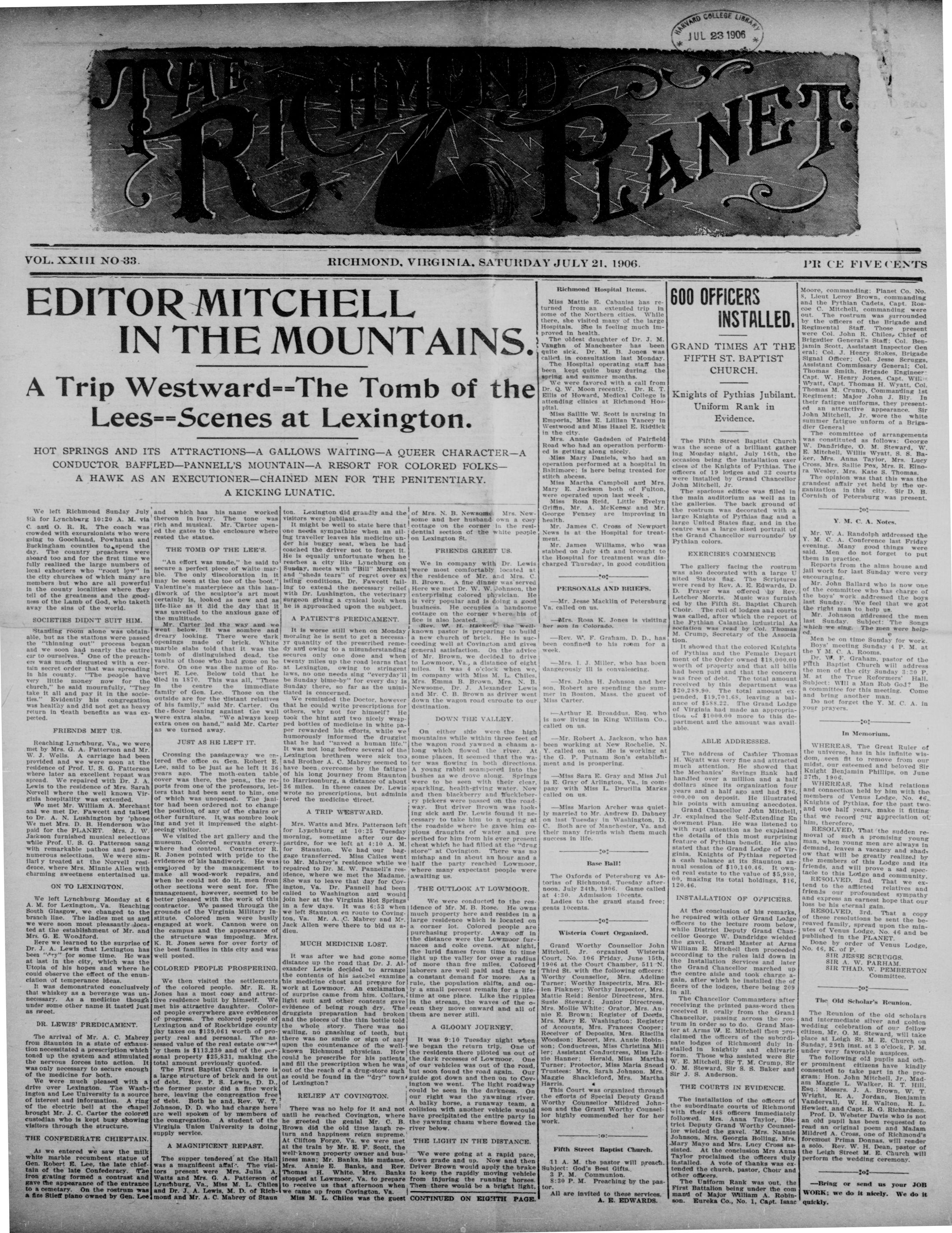
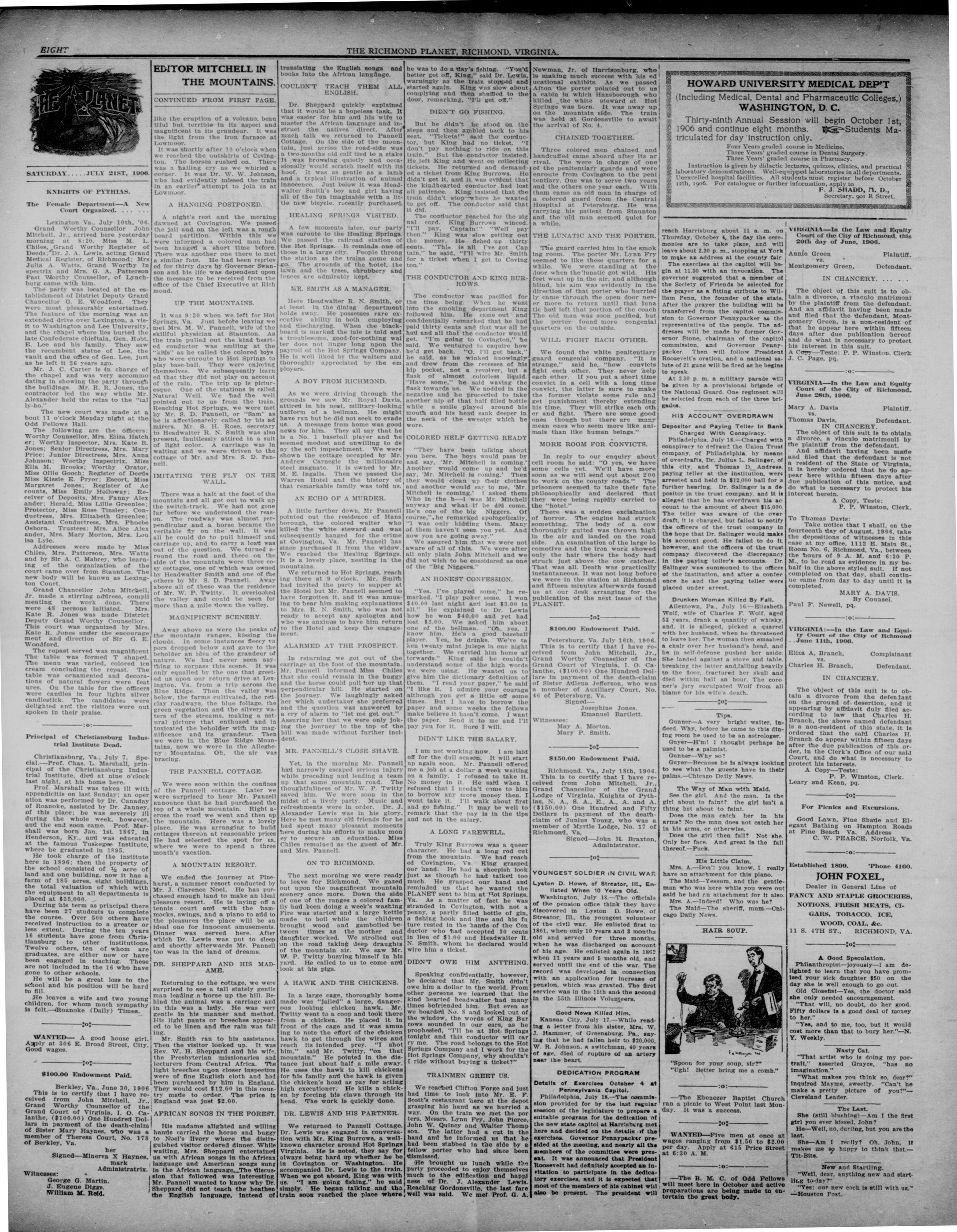
THE RICHMOND PLANET
EDITOR MITCHELL IN THE MOUNTAINS.
A Trip Westward==The Tomb of the Lees==Scenes at Lexington.
HOT SPRINGS AND ITS ATTRACTIONS-A GALLOWS WAITING-A QUEER CHARACTER-A CONDUCTOR BAFFLED-PANNELL'S MOUNTAIN-A RESORT FOR COLORED FOLKS- A HAWK AS AN EXECUTIONER-CHAINED MEN FOR THE PENITENTIARY.
VOL. XXIII NO-33.
EDITOR
IN
A Trip W
Lees
HOT SPRINGS AND ITS
CONDUCTOR BAFF
A HAWK AS
We left Richmond Sunday July 8th for Lynchburg 10:20 A. M. via C. and O. R. R. The coach was crowded with excursionists who were going to Goochland, Powhatan and Buckingham counties to spend the day. The country preachers were here to teach for a day, fully realized the large numbers of local exhorters who "roost low" in the city churches of which many are members but who are all powerful in the county localities where they tell of the greatness and the goodness of the Lamb of God, who taketh away the sins of the world.
SOCIETIES DIDN'T SUIT HIM.
"Standing room alone was obtainable, but as the stations were passed the "thinning out" process began and we soon had nearly the entire car to ourselves." One of the preachers was much disgusted with a certain secret order that was spreading in his county. "The people have very little money now for the church," he said mournfully. "They take it all and pay it in the societies." Evidently his congregation was healthy and did not get as heavy return in teath benefits as was expected.
FRIENDS MET US
Reaching Lynchburg, Va., we were met by Mrs. G. A. Patterson and Mr. W. J. Wells. A carriage had been provided and we were soon at the residence of Prof. U. S. G. Patterson where later an excellent repast was spread. We repaired with Dr. J. A. Lewis to the residence of Mrs. Sarah Norvell where the well known Virginia hospitality was extended. We met Mr. William A. Merchant and we met Dr. Fawcett and talked to Dr. A. N. Lushington by 'phone we met Mrs. D. B. Henderson who paid for the PLANET. Mrs. J. W. Jackson furnished musical selections while Prof. U. S. G. Patterson sang with remarkable pathos and power numerous selections. We were similarly treated at the Norvell residence, where Mrs. Minnie Allen with charming sweetness entertained us.
ON TO LEXINGTON
We left Lynchburg Monday at 6 A. M. for Lexington, Va. Reaching South Glasgow, we changed to the branch line. The ladies met us and we were soon most pleasantly located at the establishment of Mr. and Mrs. G. E. Woodford.
Here we learned to the surprise of Dr. J. A. Lewis that Lexington has been "dry" for some time. He was at last in the city, which was the Utopia of his hopes and where he could observe the effect of the enunciation of temperance ideas.
It was demonstrated conclusively that whiskey as a beverage was unnecessary. As a medicine though under some other name it tasted just as sweet.
DR. LEWIS' PREDICAMENT
The arrival of Mr. A. C. Mabrey from Staunton in a state of exhaustion necessitated a prescription which toned up the system and stimulated the nervous forces into action. It was only necessary to secure enough of the medicine for both. We were much pleased with a drive over Lexington. The Washington and Lee University is a source of interest and information. A ring of the electric bell at the chapel brought Mr. J. C. Carter the colored custodian who is kept busy showing visitors through the structure.
THE CONFEDERATE CHIEFTAIN
As we entered we saw the milk white marble recumbent statue of Gen. Robert E. Lee, the late chieftain of the late Confederacy. The iron gracing formed a contrast and gave the appearance of the entrance to a cemetery. On the rostrum was a fine Stiff plane owned by Gen. Lee
A KICKING LUNATIC.
and which has his name worked thereon in ivory. The tone was rich and musical. Mr. Carter opened the gates to the enclosure where rested the statue.
THE TOMB OF THE LEE'S
"An effort was made," he said to secure a perfect piece of white marble. The only tiscoloration in it may be seen at the toe of the boot." Valentine's masterpiece as this handwork of the sculptor's art most certainly is, looked as new and as life-like as it did the day that it was unveiled to the anxious gaze of the multitude.
Mr. Carter led the way and we went below. It was sombre and dreary looking. There were dark openings made of brick. White marble slabs told that it was the tomb of distinguished dead, the vaults of those who had gone on be fore. On one was the name of Robert E. Lee. Below told that he tiled in 1870. This was all, "These in the centre the immediate family of Gen. Lee. Those on the outside are for the tistant relatives of his family," said Mr. Carter. On the floor leaning against the wall were extra slabs. "We always keep extra ones on hand," said Mr. Carter as we turned away.
JUST AS HE LEFT IT
Crossing the passageway we entered the office on Gen. Robert E. Lee, said to be just as he left it 36 years ago. The moth-eaten table cover was there, the pens, the reports from one of the professors, letters that had been sent to him, one of which was unopened. The janitor had been ordered not to change the position of any of the chairs or other furniture. It was sombre looking and yet it impressed the sightseeing visitor. We visited the art gallery and the museum. Colored servants everywhere had control. Contractor R. R. Jones pointed with pride to the evidences of his handiwork. He was employed by the management to make all wood-work repairs, and when he could not do it, men from other sections were sent for. The management, however, seemed to be better pleased with the work of this contractor. We passed through the grounds of the Virginia Military Institute. Colored men were busily engaged at work. Cannon were on the campus and the appearance of the structure was imposing. Mrs. K. R. Jones sews for over forty of the best families in this city and was well posted.
COLORED PEOPLE PROSPERING
We then visited the settlements of the colored people. Mr. R. R. Jones has a most cosy and attractive residence built by himself. We met his attractive daughter. Colored people everywhere gave evidences of progress. The colored people of Lexington and of Rockbridge county pay taxes on $139,061 worth of property real and personal. The assessed value of the real estate owned by them is $113,230 and of the personal property $25,831, making the total amount previously quoted. The First Baptist Church here is a large structure of brick and is out of debt. Rev. P. S. Lewis, D. D., the former pastor did a fine work here, leaving the congregation free of debt. Both he and Rev. W. T. Johnson, D. D. who had charge here are well spoken of by members of the congregation. A student of the Virginia Union University is doing supply service.
A MAGNIFICENT REPAST.
The supper tendered at the Hall was a magnificent affair. The visitors present were Mrs. Julia A. Watts and Mrs. G. A. Patterson of Lynchburg, Va., Miss M. L. Chiles and Dr. J. A. Lewis, M. D. of Richmond and Mr. A. C. Mabrey of Stann
ton. Lexington did grandly and the visitors were lustful.
It might be well to state here that one needs sympathize when an ailing traveller leaves his medicine under his buggy seat, when he had coached the driver not to forget it. He is equally unfortunate when he reaches a city like Lynchburg on Sunday, meets with "Bill" Merchant and "sheds tears" of regret over existing conditions, Dr. Fawcet failing to extend the necessary relief with Dr. Lushington, the veterinary surgeon giving a cynical look when he is approached upon the subject.
A PATIENT'S PREDICAMENT
It is worse still when on Monday morning he is sent to get a necessary quantity of the prescribed remedy and owing to a misunderstanding secures only one dose and when twenty miles up the road learns that at Lexington, owing to stringent laws, no one needs sing "everyday'll be Sunday blime-by" for every day is Sunday there, so far as the uninitiated is concerned.
We reminded the Doctor, however that he could write prescriptions for others, why not for himself? He took the hint and two nicely wrapped bottles of medicine in white paper rewarded his efforts, while we humorously informed the druggist that he had "saved a human life." It was not long before several of the Lexington brethren were sick too and Brother A. C. Mabrey seemed to have been overcome by the fatigue of his long journey from Staunton to Harrisonburg, a distance of about 36 miles. In these cases Dr. Lewis wrote no prescriptions, but adminis tered the medicine direct.
A TRIP WESTWARD
Mrs. Watts and Mrs. Patterson left for Lynchburg at 10:25 Tuesday morning, sometime after our departure, for we left at 4:10 A. M. for Staunton. We had our baggage transferred. Miss Cailes went to Mr. Mabrey's residence while we repaired to Dr. M. W. Pannell's residence, where we met the Madame, She was to leave that day for Covington, Va. Dr. Pannell had been called to Washington and would join her at the Virginia Hot Springs in a few days. It was 6:53 when we left Staunton en route to Covington, Va. Mr. A. C. Mabrey and Mr. Jack Allen were there to bid us adieu.
MUCH MEDICINE LOST
It was after we had gone some distance up the road that Dr. J. Alexander Lewis decided to arrange the contents of his satchel examine his medicine chest and prepare for work at Lowmoor. An exclamation of surprise came from him. Collars, light suit and other contents gave evidence of being rough dry. The drugists preparation had broken and the pieces of the thin bottle told the whole story. There was no walling, no grashing of teeth, but there was no smile or sign of any upon the countenance of the well-known Riehmond physician. How could he prescribe for his patients and fill the prescription when he was out of the reach of a drug-store such as could be found in the "dry" town of Lexington?
RELIEF AT COVINGTON
There was no help for it and not until he reached Covington, where he greeted the genial Mr. C. B. Brown did the old time laugh return and happiness reign supreme. At Clifton Forge, Va. we were met at the train by Mr. E. F. Scott, the well-known property owner and business man; Mr. Banks, his madame, Mrs. Annie E. Banks, and Rev. Thomas H. White, Mrs. Banks stopped at Lowmoor, Va. to prepare to receive us that afternoon when we came up from Covington, Va.
Miss M. L. Chiles was the guest
RICHMOND, VIRGINIA, SATURDAY JULY 21, 1906.
of Mrs. N. B. Newsome. Mrs. Newsome and her husband own a cozy cottage on the corner in the residential section of the white people on Lexington St.
FRIENDS GREET US.
We in company with Dr. Lewis were most comfortably located at the residence of Mr. and Mrs. C. B. Brown. A fine dinner was served Here we met Dr. W. W. Johnson, the enterprising colored physician. He is very popular and is doing a good business. He occupies a handsome cottage on the corner where his of fice is also located.
Rev. W. H. Hackett, the well-known pastor is preparing to build a new church of brick. He is succeeding well at Covington and gives general satisfaction. On the advice of Mr. Brown, we decided to drive to Lowmoor, Va., a distance of eight miles. It was 4 o'clock when we, in company with Miss M. L. Chiles, Mrs. Emma B. Brown, Mrs. N. B. Newsome, Dr. J. Alexander Lewis and Mr. C. B. Brown as driver went down the wagon road enroute to our destination.
DOWN THE VALLEY
On either side were the high mountains while within three feet of the wagon road yawned a chasm along which flowed the river. At some places, it seemed that the water was flowing in both directions. A young rabbit scampered into the bushes as we drove along. Springs were to be seen with their clear, sparkling, health-giving water. Now and then blackberry and flickleberry pickers were passed on the roadway. But driver Brown was looking sick and Dr. Lewis found it necessary to take him to a spring at the roadside where he gave him copious draughts of water and prescribed for him from his ever present chest which he had filled at the "drug store" at Covington. There was no mishap and in about an hour and a half the party reached Lowmoor, where many expectant people were awaiting us.
THE OUTLOOK AT LOWMOOR
We were conducted to the residence of Mr. M. B. Rose. He owns much property here and resides in a large residence which is located on a corner lot. Colored people are purchasing property. Away off in the distance were the Lowmoor furnaces and coke ovens. At night, the lurid flames from time to time light up the valley for over a radius of more than five miles. Colored laborers are well paid and there is a constant demand for more. As a rule, the population shifts, and only a small percent remain for a lifetime at one place. Like the ripples in the stream, the waves of the ocean they move onward and all of them are never still.
A GLOOMY JOURNEY
It was 9:10 Tuesday night when we began the return trip. One of the residents there piloted us out of the dark recesses of Lowmoor. One of our vehicles was out of the road, but soon found the road again. Our guide got down and then on to Covington we went. The light roadway could be seen in the darkness. On our right was the yawning river. A balky horse, a runaway team, a collision with another vehicle would have precipitated the entire party in the yawning chasm where flowed the river below.
THE LIGHT IN THE DISTANCE
We were going at a rapid pace, down grade and up. Now and then Driver Brown would apply the brake to keep the rapidly moving vehicle from injuring the running horses. Then there would be a bright light.
CONTINUED ON EIGHTH PAGE.
Richmond Hospital Items.
Miss Mattle E. Cabanan has returned from an extended trip in some of the Northern cities. While there, she visited many of the large Hospitals. She is feeling much improved in health. The oldest daughter of Dr. J. M. Vaughn of Manchester has been quite sick. Dr. M. B. Jones was called in consultation last Monday. The Hospital operating staff has been kept quite busy during the spring and summer months. We were favored with a call from Dr. Q. W. Moon recently. Dr. R. T. Ellis of Howard, Medical College is attending clinics at Richmond Hospital. Miss Saillie W. Scott is nursing in Emporia, Miss E. Lillian Yancey in Westwood and Miss Hazel E. Riddick in the city. Mrs. Annie Gadsden of Fairfield Road who had an operation performed is getting along nicely. Miss Mary Daniels, who had an operation performed at a hospital in Baltimore; is here being treated for stitch abcess. Miss Martha Campbell and Mrs. Mary E. Jackson both of Fulton, were operated upon last week. Miss Rosa Reid, Little Evelyn Griffin, Mr. A. McKenny and Mr. George Fenney are improving in health. Mr. James C. Cross of Newport News is at the Hospital for treatment.
Mr. James Williams, who was stabbed on July 4th and brought to the Hospital for treatment was discharged Thursday, in good condition
PERSONALS AND BRIEFES
—Mr. Jesse Macklin of Petersburg Va. called on us.
—Mrs. Rosa K. Jones is visiting her son in Colorado.
—Rev. W. F. Graham, D. D., has been confined to his room for a week.
—Mrs. I. J. Miller, who has been dangerously ill is convalescing.
—Mrs. John H. Johnson and her son, Robert are spending the summer in Boston, Mass. the guest of Miss Carter.
—Arthur E. Broadus, Esq. who is now living in King William Co., called on us.
—Mr. Robert A. Jackson, who has been working at New Rochelle, N. Y. called on us. He is working at the G. P. Putnam Son's establishment and is prospering.
—Miss Sara E. Gray and Miss Julia E. Gray of Arlington, Va., in company with Miss L. Drucilla Marks called on us.
—Miss Marion Archer was quietly married to Mr. Andrew D. Dabney on last Tuesday in Washington, D. C. Both are of Manchester, Va. and their many friends wish them much success in life.
Base Ball!
The Oxfords of Petersburg vs Astorias of Richmond. Tuesday afternoon, July 24th, 1906. Game called at 4:30. Admission 10cents. Ladies to the grand stand free; gents 10cents.
Wisteria Court Organized.
Grand Worthy Counselor John Mitchell. Jr. organized Wistoria Court, No. 106 Friday, June 15th, 1906 at the Court Chamber, 511 N. Third St. with the following officers: Worthy Counselor, Mrs. Adeline Turner; Worthy Inspectrix, Mrs. Ellen Pinkney; Worthy Inspector, Mrs. Mattie Reid; Senior Directress, Mrs. Susie Steward; Junior Directress, Mrs. Mollie White; Orator, Mrs. Annie E. Brown; Register of Deeds, Mrs. Mary E. Washington; Register of Accounts, Mrs. Frances Cooper; Receiver of Deposits, Mrs. Riscilla Woodson; Escort, Mrs. Annie Robinson; Conductress, Miss Christina Miller; Assistant Conductress, Miss Lizzie Hanner; Herald, Miss Martha Turner; Protector, Miss Maria Snead Trustees: Mrs. Sarah Johnson. Mrs. Maggie Shackleford, Mrs. Martha Harris.
This Court was organized through the efforts of Special Deputy Grand Worthy Counselor Mildred Johnson and the Grand Worthy Counselor highly commended her for her work.
Fifth Street Baptist Church
11 A. M. the pastor will preach
Subject: God's Best Gifts.
3 P. M. Communion.
8:30 P. M. Preaching by the pas
tor.
All are invited to thee services.
A. E. EDWARDS.
600 OFFICERS INSTALLED.
GRAND TIMES AT THE FIFTH ST. BAPTIST CHURCH.
Knights of Pythias Jubilant Uniform Rank in Evidence.
The Fifth Street Baptist Church was the scene of a brilliant gathering Monday night, July 16th, the occasion being the installation exerces of the Knights of Pythias. The officers of 19 lodges and 32 courts were installed by Grand Chancellor John Mitchell, Jr.
The spacious edifice was filled in the main auditorium as well as in the galleries. The back ground of the rostrum was decorated with a large Knights of Pythias flag and a large United States flag, and in the centre was a large sized portrait of the Grand Chancellor surrounde by Pythian colors.
EXERCISES COMMENCE
The gallery facing the rostrum was also decorated with a large United States flag. The Scriptures were read by Rev. A. E. Edwards, D. D. Prayer was offered by Rev. Letcher Morris. Music was furnished ed by the Fifth St. Baptist Church Choir. The roll of lodges and courts was called, after which the report of the Pythian Calanthe industrial Asociation was read by Col. Thomas M. Crump, Secretary of the Association.
It showed that the colored Knights of Pythias and the Female Department of the Order owned $18,000.00 worth of property and that all bills had been paid and that the concern was free of debt. The total amount received by this department was $20,289.90. The total amount expended, $19,701.68, leaving a balance of $588.22. The Grand Lodge of Virginia had made an appropriation of $1000.00 more to this department and the amount was available.
ABLE ADDRESSES
The address of Cashier Thomas H. Wyatt was very fine and attracted much attention. He showed that the Mechanics' Savings Bank had handled over a million and a half dollars since its organization four years and a half ago and had $96,000.00 on deposit. He illustrated his points with amusing anecdotes. Grand Cancellor John Mitchell, Jr. explained the Self-Extending En dowment Plan. He was listened to with rapt attention as he explained the details of this most surprising feature of Pythian benefit. He also stated that the Grand Lodge of Virginia, Knights of Pythias reported a cash balance at its Staunton annual session of $10,140.46. It owned real estate to the value of $5,980.00, making its total holdings, $16,120.46.
INSTALLATION OF OFFICERS
At the conclusion of his remarks, he repaired with other Grand Lodge officers to the lecture room below, while District Deputy Grand Chancellor George W. Dandridge wielded the gavel. Grand Master at Arms William E. Mitchell then proceeded according to the rules laid down in the Installation Services and later the Grand Chancellor marched up the centre aisle and took charge again, after which he installed the officers of the lodges, there being 209 in all.
The Chancellor Commanders after receiving the printed pass-word then received it orally from the Grand Chancellor, passing across the rostrum in order to do. Grand Master at Arms W. E. Mitchell then proclaimed the officers of the subordinate lodges of Richmond duly installed in knightly and chilvarie form. Those who assisted were Sir W. W. E. Mitchell, Sir T. M. Crump, Sir O. M. Steward, Sir S. S. Baker and Sir J. S. Anderson.
THE COURTS IN EVIDENCE
The installation of the officers of the subordinate courts of Richmond with their 448 officers immediately followed. Mrs. Anna Taylor, District Deputy Grand Worthy Counselor wielded the gavel. Mrs. Nannie Johnson, Mrs. Georgia Bolling, Mrs. Mary Mayo and Mrs. Lucy Cross assisted. At the conclusion Mrs Anna Taylor proclaimed the officers duly installed. A vote of thanks was extended the church, pastor, Choir and other officers.
The Uniform Rank was out, the First Battalion being under the command of Major William A. Robinson. Eureka Co. No. 1, Capt. Isaac
Moore, commanding; Planet Co. No. 8, Lieut Leroy Brown, commanding and the Pythian Cadets, Capt. Roscoe C. Mitchell, commanding were out. The rostrum was surrounded by the officers of the Brigade and Regimental Staff. Those present were Col. John R. Chiles, Chief of Brigadier General's Staff; Col. Benjamin Scott, Assistant Inspector General; Col. J. Henry Stokes, Brigade Signal Officer; Col. Jesse Scruggs, Assistant Commissary General; Col. Thomas Smith, Brigade Engineer; Capt. W. Henry Jones, Capt. Willy Watt, Capt. Thomas H. Wyatt, Col Thomas M. Crump, Commanding 1st Regiment; Major John J. Bly. In their fatigue uniforms, they presented an attractive appearance. Sir John Mitchell, Jr. wore the white summer fatigue uniform of a Brigadier General.
The committee of arrangements was constituted as follows: George W. Dandridge, O. M. Steward, W. E. Mitchell, Willis Wyatt, S. S. Baker, Mrs. Anna Taylor, Mrs. Lucy Cross, Mrs. Sallie Fox, Mrs. R. Elinora Wesley, Mrs. Kate S. Thomas.
The opinion was that this was the grandest affair yet held by the organization in this city, Sir D. B. Cornish of Petersburg was present
Y. M. C. A. Notes
Mr. W. A. Randolph addressed the Y. M. C. A. Conference last Friday evening. Many good things were said. Men do not forget to put them in practice.
Reports from the alms house and jail work for last Sunday were very encouraging.
Mr. John Ballard who is now one of the committee who has charge of the boys' work addressed the boys last Sunday. We feel that we got the right man to help us.
Mr. Johnson addressed the men last Sunday. Subject: The Songs which we sing. The men were helped.
Men be on time Sunday for work.
Boys' meeting Sunday 4 P. M. at the Y M. C. A. Rooms.
Dr. W. F. Graham, pastor of the Fifth Baptist Church will address the men of the city Sunday 3:30 P. M. at the True Reformers' Hall. Subject: Will a Man Rob God? Be a committee for this meeting. Come and bring another man.
Do not forget the Y. M. C. A. in your prayers.
In Memorium.
WHEREAS. The Great Ruler of the universe, has in his infinite wisdom, seen fit to remove from our midst, our esteemed and beloved Sir Knight Benjamin Phillips, on June 27th, 1906.
WHEREAS. The kind relations and connection held by him with the members of Venus Lodge, No. 46, Knights of Pythias, for the past two and one half years, make it fitting that we record our appreciation of him, therefore.
RESOLVED. That the sudden removal of such a promising young man, when young men are always in demand, leaves a vacancy and shadow that will be greatly realized by the members of this Lodge and its friends, and will prove a sad spectacle to this Lodge and community.
RESOLVED. 2nd. That we extend to the afflicted relatives and friends our profoundest sympathy and express an earnest hope that our loss be his eternal gain.
RESOLVED. 3rd. That a copy of these resolutions be sent the bereaved family, spread upon the minutes of Venus Lodge, No. 46 and be published in the PLANET.
Done by order of Venus Lodge, No. 46, K. of P.
SIR JESSE SCRUGGS.
SIR A. W. PARHAM.
SIR THAD. W. PEMBERTON Committee.
The Old Scholar's Reunion
The Reunion of the old scholars and intermediate silver and golden wedding celebration of our fellow citizen, Mr. O. M. Steward, will take place at Leigh St. M. E. Church on Sunday, 29th inst. at 3 o'clock, P. M. under very favorable auspices.
The following old pupils and other prominent citizens have kindly consented to take part in the program: Hon. John Mitchell, Jr., Madam Maggie L. Walker, R. T. Hill, Esq.: Messrs. J. A. Brown, W. T. Wright, R. A. Jordan, Benjamin Vandervall, W. H. Walton, R. L. Hewlett, and Capt. R. G. Richardson. Prof. D. Webster Davis who is not an old pupil has been requested to read an original poem and Madam Mildred A. Cross, one of Richmond's foremost Prima Donnas, will render a solo. Rev. W. H. Dean, pastor of the Leigh Street M. E. Church will perform the wedding ceremony.
—Bring or send us your JOB WORK; we do it nicely. We do it quickly.
FILE NO. 113.
ONE OF THE MYSTERIES OF PARIS, AND HOW IT WAS SOLVED.
THE MILE GABORIAU.)
CHAPTER XIX
Clamerun's last injunction to Raoul was:
"Be very cautious when you enter the room; your appearance must tell everything; so you can avoid preliminary explanations."
The recommendation was useless.
The instant that Raoul went into the little salon, the sight of his pale, haggard face and wild eyes caused Mme.Fauvel to spring up with clasped hands, and cry out:
"Raoul, what has happened? Speak, my son!"
The sound of her tender, affectionate voice acted like an electric shock upon the young handit. He shook like a leaf. But, at the same time, his mind seemed to change. Louis was not mistaken in his estimate of his companion's character. Raoul was on the stage; his part was to be played; his assurance returned to him; his cheating, lying nature assumed the ascendant, and stifled any better facing his heart.
"This misfortune is the last I shall ever suffer, mother!"
Mme. Fauvel rushed, toward him, and, seizing his hand, gazed searchingly into his eyes, as if to read his very soul.
"What is the matter? Raoul, my dear son, do tell me what troubles you."
He gently pushed her from him.
"The matter is, my mother," he said, in a voice of heartbroken despair,
"that I am an unworthy, degenerate son! Unworthy of you, unworthy of my noble father!"
She tried to comfort him by saying that his errors were all her fault, and that he was, in spite of all, the pride of her heart.
"Alas!" he said, "I know and judge myself. No one can reproach me for my infamous conduct, more bitterly than does my own conscience. I am not naturally wicked, but only a miserable fool. At times I am like an insane man, and am not responsible for my actions. Ah, my dear mother, I would not be what I am, if you had watched over my childhood. But brought up among strangers, with no guide but my own evil passions, nothing to restrain me, no one to advise me, no one to love me, owning nothing, not even my stolen name, I am cursed with vanity and unbounded ambition. Poor, with no one to assist me but you. I have the tastes and vices of a millionaire's son.
"Alas for me! When I found you the evil was done. Your affection, your maternal love, the only true happiness of my life, could not save me. I, who had suffered so much, endured so many privations, even the pangs of hunger, became spoiled by this new life of luxury and pleasure which you opened before me. I rushed headlong into extravagance, as a drunkard long deprived of liquor seizes and drains to the dregs the first bottle in his reach."
Mme. Fauvel listened, silent and terrified, to these words of despair and remorse, which Raoul uttered with vehemence.
She dared not interrupt him, but felt certain some dreadful piece of news was coming.
Raoul continued in a sad, hopeless tone:
"Yes, I have been a weak fool. Happiness was within my reach, and I had not the sense to stretch forth my hand and grasp it. I rejected a heavenly reality to eagerly pursue a vain phantom. I, who ought to have spent my life at your feet, and daily striven to express my gratitude for your lavish kindness, have made you unhappy, destroyed your peace of mind, and instead of being a blessing, I have been a curse ever since the first fatal day you welcomed me to your kind heart. Ah, unfeeling brute that I was, to squander upon creatures whom I despised, a fortune, of which each gold piece must have cost you a tear! Too late, too late! With you, I might have been a good and happy man!" He stopped, as if overcome by the conviction of his evil deeds, and seemed as if about to burst into tears.
"It is never too late to repent, my son," murmured Mme. Fauvel, in comforting tones.
"Ah, if I only could!" cried Raoul; "but no; it is too late! Besides, can I tell how long my good resolutions will last? This is not the first time that I have condemned myself pitilessly. Stinging remorse for each new fault made me swear to lead a better life, to sin no more. What was the result of these periodical repentances! At the first temptation I forgot my remorse and good resolutions. I am weak and mean-spirited, and you are not firm enough to govern my vacillating nature. While my intentions are good, my actions are villainous. The disproportion between my extravagant desires, and the means of gratifying them, is too great for me to endure any longer. Who knows to what fearful length my unfortunate disposition may lead me? However, I will take my fate in my own hands!" he finally said, with a reckless laugh.
"Oh, Raouil my dear son!" cried Mme. Fauvel, in an agony of terror, "explain these dreadful words. Am I not your mother? Tell me what distresses you; I am ready to hear the worst."
He appeared to hesitate, as if afraid to crush his mother's heart by the terrible blow he was about to inflict. Then in a voice of gloomy despair he replied:
"Yes, ruined; and I have nothing more to expect or hope for. I am dishonored; and all through my own
TWO
"Ruined?"
fault; no one is to blame but myself."
"Raoul!"
"It is the sad truth, my poor mother; but fear nothing. I shall not trail in the dust the name which you bestowed upon me I will at least have the courage not to survive my dishonor. Come, mother; don't pity me, or distress yourself; I am one of those miserable beings fated to find no peace save in the arms of death. I came into the world with misfortune stamped upon my brow. Was not my birth a shame and disgrace to you? Did not the memory of my existence haunt you day and night, filling your soul with remorse? And now, when I am restored to you after many years' separation, do I not prove to be a bitter curse, instead of a blessing?
"Ungrateful boy! Have I ever reproached you?"
"Never! Your poor Raoul will die with your beloved name on his lips; his last words a prayer to Heaven to heap blessings upon your head, and reward your long-suffering devotion."
"Die! You die, my son?"
"It must be, my dear mother; honor compels it. I am condemned by judges from whose decision no appeal can be taken—my conscience and my will."
An hour ago Mme. Faurel would have sworn that Raoul had made her suffer all the torments that a woman could endure; but now she felt that all her former troubles were nothing compared with her present agony.
"My God! Raoul, what have you been doing?" she gasped.
"Money was intrusted to me; I gambled, and lost it."
"Was it a large sum?"
"No; but more than you can replace. My poor mother, have I not taken everything from you? Did you not give me your last jewel?"
"But Monsieur de Clameran is rich. He placed his fortune at my disposal. I will order the carriage and go to him."
"But Monsieur de Clameran is absent, and will not return to Paris until next week; and if I do not have the money this evening I am lost. Alas! I have thought deeply, and, although it is hard to die so young, still, fate wills it so."
He pulled a pistol from his pocket, and, with a forced smile, said:
"This will settle everything."
Mme. Fauwel was too excited and frightened to reflect upon the horror of Raoul's behavior, and that these wild threats were a last resort for obtaining money. Forgetful of the past, careless of the future, her every thought concentrated upon the present, she comprehended but one fact—that her son was about to commit suicide, and that she was powerless to prevent the fearful deed.
"Ah, wait a little while, my son!" she cried. "Andre will soon return home, and I will ask him to give me—How much did you lose"
"Thirty thousand francs."
"You shall have them to-morrow."
"But I must have the money tonight."
Mme. Fauvel wrung her hands in despair.
"Oh! why did you not come to me sooner, my son? Why did you not have confidence enough in me to come at once for help? This evening? There is no one in the house to open the money safe; if it were not for that—if you had only come before Andre went out—"
"The safe!" cried Raoul with sudden joy, as if this magic word had thrown a ray of light upon his dark despair; "do you know where the key is kept?"
"Yes; it is in the next room."
Yes! it is in the next room.
"Well!" he exclaimed, with a bold look that caused Mme. Fauvel to lower her eyes and keep silent.
"Give me the key, mother," he said in a tone of entreaty.
"Oh, Raoul, Raoul!"
"It is my life I am asking of you."
These words decided her; she snatched up a candle, rushed into her chamber, opened the secretary, and took out M. Fauvel's key.
But, when about to hand it to Raoul, she seemed suddenly to see the enormity of what she was doing.
"Oh, Raoul! my son," she murmured, "I can not! Do not ask me to commit such a dreadful deed!"
He said nothing, but sadly turned to leave the room; then, coming back to his mother, said:
"Ah, well; it makes but little difference in the end! At least you will give me one last kiss, before we part forever, my darling mother!"
"What could you do with the key, Raoul?" interrupted Mme. Fauvel. You do not know the secret word of the buttons."
"No; but I can try to open it without moving the buttons."
"You know that money is never kept in the safe over night."
"Nevertheless, I can make the attempt. If I open the safe and find money in it, it will be a miracle, showing that Heaven has pitted my misfortunes and provided relief."
"And if you are not successful, will you promise me to wait until to-morrow, to do nothing rash to-night?" "I will swear it, by my father's memory."
"Then take the key and follow me."
CHAPTER XX
Pale and trembling, Raoul and Mme. Fauvel passed through the banker's study, and down the narrow staircase leading to the offices and cashroom below. Raoul walked in front, holding the light, and the key of the safe. Mme. Fauvel was convinced that it would be utterly impossible to open the safe, as the key was useless without the secret word, and, of course, Raoul had no way of discovering what it was.
THE RICHMOND PLANET, RICHMOND, VIRGINIA.
Even granting that some chance had revealed the secret to him, he would find but little in the safe, since everything was deposited in the Bank of France. Everyone knew that no large sum was ever kept in the safe after banking hours.
The only anxiety she felt was, how Raoul would bear the disappointment, how she could calm his despair.
She thought that she would gain time by letting Raoul try the key; and then, when he could not open the safe, he would keep his promise, and wait until the next day. There was surely no harm in letting him try the lock, when he could not touch the money.
"When he sees there is no chance of success," she thought, "he will listen to my entreaties; and to-morrow—to-morrow—"
What she would do to-morrow she knew not; she did not even ask herself. But in extreme situations the least delay inspires hope, as if a short respite meant sure salvation.
The condemned man, at the last moment, begs for a reprieve of a day, an hour, a few seconds. Raoul was about to kill himself; his mother prayed to God to grant her one day, not even a day, one night; as if in this space of time some unexpected relief would come to end her misery.
They reached Prosper's office, and Raoul placed the light on a high stool, so that it lighted the whole room.
Rapidly, with the dexterity of experience, he slipped the buttons on the five letters composing the name of G. i, p, s, y.
His features during this short operation, expressed the most intense anxiety. He was fearful that his nervous energy might give out; of not being able to open the safe; of not finding the money there when he opened it; of Prosper having changed the word; or perhaps having neglected to leave the money in the safe.
Mme. Fauvel saw these visible apprehensions with alarm. She read in his eyes that wild hope of a man, who, passionately desiring an object, ends by persuading himself that his own will suffices to overcome all obstacles.
Having often been present when Prosper was preparing to leave his office, Raoul had fifty times seen him move the buttons and look the safe, just before leaving the bank. Indeed, having a practical turn of mind, and an eye to the future, he had even tried to lock the safe himself on several occasions while waiting for Prosper.
He inserted the key softly, turned it around; pushed it further in, and turned it a second time; then thrust it in suddenly, and turned it again.
His heart beat so loudly that Mme. Fauvel could hear its throbs.
The word had not been changed; the safe opened.
Raoul and his mother simultaneously uttered a cry; she of terror; he of triumph.
"Shut it again!" cried Mme. Fauvel, frightened at the incomprehensible result of Raoul's attempt. "Come away. Don't touch anything, for Heaven's sake! Raoul!"
And, half frenzied, she clung to Raoul's arm, and pulled him away so abruptly, that the key was dragged from the lock, and, slipping along the glossy varnish of the safe door, made a deep scratch some inches long.
But at a glance Raoul discovered, on the upper shelf of the safe, four bundles of bank notes. He snatched them up with his left hand, and slipped them inside his vest.
Exhausted by the effort she had just made, Mme. Fauvel dropped Raoul's arm, and, almost fainting with emotion, clung to the back of a chair.
"Have mercy, Raoul!" she moaned.
"I implore you to put back the money, and I solemnly swear that I will give you twice as much to-morrow. Oh, my son, have pity on your unhappy mother!"
He paid no attention to these words of entreaty, but carefully examined the scratch on the safe. He was almost alarmed at this trace of the robbery, which it was impossible for him to cover up.
"At least, you will not take all," said Mime. Faueil; "just keep enough to save yourself, and put back the rest."
"What good would that do? The discovery will be made that the safe has been opened; so I might as well take all as a part."
"Oh, no! not at all. I can account to Andre; I will tell him I had a pressing need for a certain sum, and opened the safe to $q$ it."
In the meantime,ne Raoul had carefully closed the safe.
"Come, mother, let us go back to the sitting-room. A servant might go there to look for you, and be astonished at our absence."
Raoul's cruel indifference and cold calculation at such a moment filled Mme. Fauvel with indignation. She saw that she had no influence over her son, that her prayers and tears had no effect upon his hard heart.
"Let them be astonished," she cried; "let them come here and find us. I will be relieved to put an end to this tissue of crime. Then Andre will know all, and drive me from his house. Let come what will, I shall not sacrifice another victim. Prosper will be accused of this theft to-morrow. Clameran defrauded him of the woman he loved, and now you would deprive him of his honor! I will have nothing to do with so base a crime."
She spoke so loud and angrily that Raoul was alarmed. He knew that the errand boy slept in a room close by, and might be in bed listening to her, although it was early in the evening.
"Come upstairs," he said, seizing Mme. Fauvel's arm.
But she clung to a table, and refused to move a step.
"I have been cowardly enough to sacrifice Madeleine," she said, "but I will not ruin Prosper."
Raoul had an argument in reserve which he knew would make Mme. Fauvel submit to his will.
"Now, really," he said, with a cyn
ical laugh, "Do you pretend that you do not know Prosper and I arranged this little affair together, and that he is to have half the booty?" "Impossible! I will never believe such a thing of Prosper!" "Why, how do you suppose I discovered the secret word? Who do you supposed disobeyed orders and left the money in the safe?" "Prosper is honest." "Of course, he is, and so am I, too. The only thing is that we both need money." "You are telling a falsehood, Raoul!" "Upon my soul I am not. Madeleine rejected Prosper, and the poor fellow has to console himself for her cruelty; and these sorts of consolations are expensive, my good mother." He took up the candle, and gently but firmly led Mme. Fauvel toward the staircase.
She mechanically allowed herself to be led along, more bewildered by what she had just heard than she was at the opening of the safe door.
"What!?" she gasped, "can Prospar be a thief?"
She began to think herself the victim of a terrible nightmare, and that, when she waked, her mind would be relieved of this intolerable torture. She helplessly clung to Raoul's arm as he helped her up the narrow little staircase.
"You must put the key back in the secretary," said Raoul, as soon as they were in the chamber again.
But she did not seem to hear him; so he went and replaced the safe-key in the place from which he had seen her take it.
He then led, or rather carried, Mme. Faulve into the little sitting-room and placed her in an easy chair.
The set, expressionless look of the wretched woman's eyes, and her dazed manner, frightened Raoul, who thought that she had lost her mind, that her reason had finally given way beneath this last terrible shock.
"Come, cheer up, my dear mother," he said, in coaxing tones, as he rubbed her icy hands, "you have saved my life, and rendered an immense service to Prosper. Don't be alarmed; everything will come out right in the end. Prosper will be accused, perhaps arrested; he expects that, and is prepared for it; he will deny his culpability; and, as there is no proof against him, he will be set at liberty immediately."
But these falsehoods were wasted on Mime. Faunel, who was incapable of understanding anything said to her.
"Raoul," she moaned, in a broken-hearted tone. "Raoul, my son, you have killed me."
Her gentle voice, kind even in its despairing accents, touched the very bottom of Raoul's perverted heart, and once more his soul was wrung by remorse; so that he felt inclined to put back the stolen money, and comfort the despairing woman whose life and reason he was destroying. The thought of Clameran restrained him. Finding his efforts to restore Mme. Faavel fruitless; that, in spite of all his affectionate regrets and promises, the still sat silent, motionless, and death-like; and, fearing that M. Faavel or Madeleine might enter at any moment, and demand an explanation—he hastily pressed a kiss upon his mother's brow, and hurried from the house. At the restaurant, in the room where they had dined, Clameran, tortured by anxiety, awaited his accomplice.
He wondered if at the last moment, when he was not near to sustain him, Raoul would prove a coward, and retreat; if any unforeseen trifle had prevented his finding the key; if any visitors were there; and, if so, would they depart before M. Faavel's return from the dinner party?
He had worked himself into such a state of excitement, that, when Raoul returned, he flew to him with ashy face and trembling all over, and could scarcely gasp out:
"Well?"
"The deed is done, uncle, thanks to you; and I am now the most miserable, abject villain on the face of the earth."
He umbuttoned his vest, and, pulling out the four bundles of bank notes, angrily dashed them upon the table, saying in a tone of scorn and disgust:
"Now, I hope, you are satisfied. This is the price of the happiness, honor, and perhaps the life, of three people."
Clameran paid no attention to these angry words. With feverish eagerness he seized the notes, and rattled them in his hand, as if to convince himself of the reality of success.
"Now Madeleine is mine!" he cried, excitedly.
Raoul looked at Clameran in silent disgust. This exhibition of joy was a shocking contrast to the scene in which he had just been an actor. He was humiliated at being the tool of such a heartless scoundrel as he now knew Clameran to be.
Louis misinterpreted this silence, and said, gayly:
"Did you have much difficulty?"
"I forbid you ever to allude to this evening's work," cried Raoul, fiercely.
"Do you hear me? I wish to forget it."
Clamaser shrugged his shoulders at this outburst of anger, and said in a bantering tone: "Just as you please, my handsome nephew; I rather think you will want to remember it, though, when I offer you these 350,000 francs. You will not, I am sure, refuse to accept them as a slight souvenir. Take them; they are yours." This generosity seemed neitner to surprise nor satisfy Raoul. "According to our agreement," he said, suddenly, "I was to have more than this." "Of course; this is only part of your share." "And when am I to have the rest, if you please?"
"The day I marry Madeleine, and not before, my boy. You are too valuable an assistant to lose at present; and you know that, though I don't distrust you, I am not altogether sure of your sincere affection for me."
Raoul reflected that to commit a crime, and not profit by it, would be the height of absurdity. He had come with the intention of breaking off all connection with Clamaran; but he now determined that he would not abandon his accomplice until he had been well paid for his services.
"Very well," he said, "I accept this on account; but, remember, I will never do another piece of work like this of to-night. You can do what you please; I shall flatly refuse."
Clamaran burst into a loud laugh, and said:
"That is sensible; now that you are rich, you can afford to be honest. Set your conscience at rest, for I promise you I will require nothing more of you save a few trifling services. You can retire behind the scene now, while I appear upon the stage. My role begins."
CHAPTER XXL
For more than an hour after Raoul's departure, Mme. Faavel remained in a state of stupor bordering upon unconsciousness.
Gradually, however, she recovered her senses sufficiently to comprehend the horrors of her present situation; and, with the faculty of thought that of suffering returned.
The dreadful scene in which she had taken part was still before her affrighteed vision; all the attending circumstances, unnoticed at the time, now struck her forcibly.
She saw that she had been the dupe of a shameful conspiracy; that Raoul had tortured her with cold-blooded cruelty, had taken advantage of her tenderness, and had speculated upon her fright.
But had Prosper anything to do with the robbery? This Mme. Fauvel had no way of finding. Ah! Raoul knew how the blow would strike when he accused Prosper. He knew that Mme. Fauvel would end by believing in the cashier's complicity. The unhappy woman sat and thought over every possible way in which Raoul could find out the secret word without Prosper's knowledge. She rejected with horror the idea that the cashier was the instigator of the crime; but in spite of herself, it constantly recured. And finally she felt convinced that what Raoul said must be true; for who but Prosper could have betrayed the word? and who but Prosper could have left so large an amount of money in the safe, which, by order of the banker, was to be always left empty at night?
Knowing that Prosper was leading a life of extravagance and dissipation, she thought it very likely he had, from sheer desperation, resorted to this bold step to pay his debts; her blind affection, moreover, made her anxious to attribute the crime to any one rather than to her darling son.
She had heard that Prosper was supporting one of those worthless creatures whose extravagance impoverishes men, and whose evil influence perverts their natures. When a young man is thus degraded, will he stop at any sin or crime? Alas! Mme. Fauvel knew, from her own sad experience, to what depths even one fault can lead. Although she believed Prosper guilty, she did not blame him, but considered herself responsible for his sins.
Had she not herself banished the poor young man from a fireside which he had begun to regard as his own? Had she not destroyed his hopes and happiness by crushing his pure love for a noble girl, whom he looked upon as his future wife, and thus driven him into a life of dissipation and sin? She was undecided whether to confide in Madeleine or bury the secret in her own breast. Fatally inspired, she decided to keep silent.
When Madeleine returned home at 11 o'clock, Mine, Fauvel not only was silent as to what had occurred, but even succeeded in so concealing all traces of her agitation, that she escaped any questions from her niece. Her calmness never left her when M. Fauvel and Luden returned, although she was in terror lest her husband should go down to the cashroom to see that everything was safely locked up. It was not his habit to open the money safe at night, but he sometimes did so.
As fate would have it, the banker, as soon as he entered the room began to speak of Prosper, saying how distressing it was that so interesting a young man should be thus throwing himself away, and wondering what could have happened to make him suddenly cease his visits at the house, and resort to bad company.
If M. Faulvel had looked at the faces of his wife and niece while he harshly blamed the cashier, he would have been puzzled at their strange expressions.
All night long Mine. Faulvel suffered the most intolerable agony. She counted each stroke of the town clock as the hours dragged on.
"In six hours," she said to herself.
"In five hours—in four hours—in three hours—in one hour—and all will be discovered; and then what will happen? Heaven help me!"
At sunrise she heard the servants moving about the house; then the office shutters opened; then, later, she heard the clerks going into the bank.
She attempted to get up, but felt so ill and weak, that she sunk back on her pillow; and lying there, trembling like a leaf, bathed in cold perspiration, she awaited the discovery of the robbery.
She was leaning over the side of the bed, straining her ear to catch a sound from the cash-room, when Madeleine, who had just left her, rushed into the room.
The white face and wild eyes of the poor girl told Mme. Fauvel that the crime was discovered.
"Do you know what has happened, aunt?" cried Madeleine, in a shrill, horrified tone. "Prosper is accused of robbery, and the police have come to take him to prison!"
A groin was Mme. Fauvel's only answer.
"Raoul or the marquis is at the bottom of this," continued Madeleine, excitedly.
"How can they be concerned in it, my child?"
"I can't tell yet; but I only know that Prosper is innocent. I have just seen him, spoken to him. He would never have looked me in the face had he been guilty."
Mine. Fauevel opened her lips to confess all; fear kept her silent.
"What can these wretches want?" said Madeleine; "what new sacrifice do they demand? Dishonor Prosper! Good heavens! why did they not kill him at once? He would rather be dead than disgraced!"
Here the entrance of M. Fauevel interrupted Madeleine. The banker was so angry that he could scarcely speak.
"The worthless scoundrel!" he cried; "to think of his daring to accuse me! to insinuate that I robbed my own safe! And that Marquis de Clameran must needs doubt my good faith in keeping my engagement to pay his money!"
Then, without noticing the effect of his story upon the two women, he proceeded to relate all that had occurred downstairs.
"I was afraid this extravagance would lead to something terrible," he said, in conclusion; you know I told you last night that Prosper was growing worse in his conduct, and that he would get into trouble.
Throughout the day Madeline's devotion to her nunt was severely tried. The generous girl saw disgrace heaped on the man she loved. She had perfect faith in his innocence; she felt sure she knew who had laid the trap to ruin him; and yet she could not say a word in his defense.
Fearing that Madeline would suspect her of complicity in the theft, if she remained in bed and displayed so much agitation, Mme. Fauvel arose and dressed for breakfast.
It was a dreary meal. No one tasted a morsel. The servants moved about on their tiptoes, as silently as if a death had occurred in the family. About two o'clock a servant came to M. Fauvel's study, and said that the Marquis de Clameran desired to see him.
"What!" cried the banker, "does he dare to-"
Then, after a moment's reflection, he added:
"Ask him to walk up."
The very name of Clameran had sufficed to arouse all the slumbering wrath of M. Fauvel. The victim of a robbery, finding his safe empty at the moment that he was called upon to make a heavy payment, he had been constrained to conceal his anger and resentment, but now he determined to have his revenge upon his insolent visitor!
But the marquis declined to come upstairs. The messenger returned with the answer that the gentleman had a particular reason for seeing M. Fauvel in the office below, where the clerks were.
"What does this fresh impertinence mean?" cried the banker, as he angrily jumped up and hastened downstairs.
M. de Clameran was standing in the middle of the room adjoining the cash-room: M. Fauvel walked up to him and said, bluntly:
"What do you want now, Monsieur? You have been paid your money, and I have your receipt."
To the surprise of all the clerks, and the banker himself, the marquis seemed not in the least offended at this rude greeting, but answered in a deferential, but not at all humble, manner:
"You are hard upon me, Monsieur; but I deserve it, and that is why I am here. A gentleman always acknowledges when he is in the wrong. In this instance I am the offender; and I flatter myself that my past will permit me to say so without being accused of cowardice or lack of self-respect. I insisted upon seeing you here instead of in your study, because, having been rude to you in the presence of your clerks, I wished them to hear me apologize for my behavior of this morning."
Clameran's speech was so different from his usual overbearing, haughty conduct, that surprise almost stupefied the banker, and he could only stammer:
"I must say that I was hurt by your doubts, insinuations, suspicions of my honor—"
"This morning," continued the marquis, "I was irritated, and thoughtlessly gave way to my temper. Although I am gray-headed, my disposition is as excitable as that of a fiery young man of 20 years; and I hope you will forget words uttered in a moment of excitement, and now deeply regretted."
M. Fanvel, being a kind-hearted, though quick-tempered man, could appreciate Clameran's feelings; and, knowing that his own high reputation for scrupulous honesty could not be affected by any hasty or abusive language uttered by a creditor, at once calmed down before so frank an apology, and holding out his hand to Clameran, said:
"Let us forget what happened, Monsieur."
They conversed in a friendly manner for some minutes, and, after Clameran had explained why he had such pressing need of the money at that particular hour of the morning, turned to leave, saying that he would do himself the honor of calling upon Mme. Fauvel during the day.
"That is, if a visit from me would not be considered intrusive," he said, with a shade of hesitation. "Perhaps, after the trouble of this morning, she does not wish to be disturbed."
"Oh, no!" said the banker; "come, by all means. I think a visit from you would cheer her mind. I shall be from home all day, trying to trace this unfortunate affair."
Mme. Fauvel was in the same room where Raoul had threatened to kill himself the night previous; she looked very pale and ill as she lay on her面. Madeleine was bathing her forehead. When M. de Clameran was announced they both stupped up as if a phantom had appeared before them.
Although Louis had been gay and smiling when he parted from M. Fauvel downstairs, he now wore a melan-choly aspect, as he gravely bowed, and refused to seat himself in the chair which Mine. Fauvel motioned him to take
"You will excuse me, ladies, for intruding at this time of your affliction; but I have a duty to fulfill."
The two women were silent. They seemed to be waiting for him to explain. He added in an undertone: "I know all."
By an imploring gesture Mme. Fauvel tried to stop him. She saw that he was about to reveal her secret to Madeleine.
But Louis would not see this gesture. He turned his whole attention to Madeleine, who haughtily said: "Explain yourself, Monsieur."
"Only one hour ago," he replied, "I discovered that Raoul last night forced from his mother the key of the money safe, and stole 350,000 francs."
Madeleine crimsoned with shame and indignation. She leaned over the sofa, and seizing her aunt's wrist shook it violently, and in a hollow voice cried:
"It is false, is it not, aunt? Speak!" "Alas! alas!" gronned Mme. Fauvel. "What have I done?" "You have allowed Prosper to be accused," cried Madeleine. "You have suffered him to be arrested and disgraced for life." "Forgive me!" sighed Mme. Fauvel. "He was about to kill himself; I was so frightened! Then, you know—Prosper was to share the money; he gave Raoul the secret word—" "Good heaven! Aunt, how could you believe such a falsehood as that?" Clameran interrupted them. "Unfortunately, what your aunt says of M. Bertomy is the truth," he said, in a sad tone. "Your proofs, Monsieur; where are your proofs?" "Raoul's confession." "Raoul is false."
"That is only too true; but how did he find out the word, if M. Bertomy did not reveal it? And who left the money in the safe but M. Bertomy?"
These arguments had no effect upon Madeleine.
"You are the instigator of the robbery, and, of course, have possession of the money."
This harsh accusation from a girl whom he so passionately loved, when, grasping bardit, as he was, he gave up for her sake all the money gained by his crime, so cruelly hurt Clamauer that he turned livid. But his mortification and anger did not prevent him from pursuing the part he had prepared and studied.
"A day will come, Mademoiselle," he said, "when you will deeply regret having treated me so cruelly. I understand your insinuation; you need not attempt to deny it."
"I have no idea of denying anything, Monsieur."
"Madeleine!" remonstrated Mme. Faunel, who trembled at the rising anger of the man, who held her fate in her hands. "Madeleine, be careful!"
"Mademoselle is pitiless," said Clameran, sadly. "She cruelly punishes an honorable man whose only ruin is having obeyed his brother's dying injunctions. And I am here now, because I believe in the joint responsibility of all the members of the family."
Here he slowly drew from his pocket several bundles of bank notes, and laid them on the mantelpiece.
"Raoul stole 350,000 francs," he said. "I return the same amount. It is more than half my fortune. Willingly would I give the rest to insure this being the last crime committed by him."
Too inexperienced to penetrate this bold, yet simple, plan of Clameran's, Madeleine was dumb with astonishment; all her calculations were upset. Mme. Faurel, on the contrary, accepted this restitution as salvation sent from Heaven.
"Oh, thanks; Monsieur; thanks!" she cried, gratefully, clasping Chameran's hand in hers. "You are goodness itself!" Louis' eye lit up with pleasure. But he rejoiced too soon. A minute's reflection brought back all of Madeleine's distrust. She thought this magnanimity and generosity unnatural in a man whom she considered incapable of a noble sentiment, and at once concluded that it must conceal some snare beneath.
"What are we to do with this money?" she demanded.
"Restore it to M. Fauvel, Mademoiselle."
"We restore it, Monsieur, and how? Restoring the money is denouncing Raoul, and ruining my aunt. Take back your money, Monsieur. We will not touch it."
Clameran was too shrewd to insist; he took up the money and prepared to leave.
"I comprehend your refusal, made-moiselle, and must find another way of accomplishing my wish. But, before retiring, let me say that your injustice pains me deeply. After the promise you made to me, I had reason to hope for a kinder welcome."
"I will keep my promise, monsieur; but not until you have furnished security."
"Security! and for what? Pray explain yourself."
"Something to protect my aunt against the molestations of Raoul after my—marriage. What is to prevent his coming to extort money from his mother after he has squandered my dovry? A man who spends a hundred thousand francs in four months will soon run through my little fortune. We are making a bargain; I give you my hand in exchange for the honor and life of my aunt; and, of course, you must give me some guaranty to secure the performance of your promise."
"Oh! I will give you ample securities," cried Clamieran; "such as will quiet all your suspicious doubts of my good faith. Alas! you will not believe in my devotion; what shall I do to convince you of its sincerity? shall I try to save Monsieur Bertomy?"
"Thanks for the offer, monsieur," replied Madeleine, disdainfully. "If Prosper is guilty, let him be punished by the law; if he is innocent God will protect him."
Here Madeleine stood up, to signi-
THE PLANET
SATURDAY...JULY 21ST. 1906
fy that the interview was over. Clamerman bowed and left the room. Never had Clamerman been so irritated. Madeleine's quiet determination and forethought had unexpectedly thrown him off his well-laid track; not anticipating any such self assertion on her part, he was disconcerted, and at a loss how to proceed. He knew that it would be useless to attempt deceiving a girl of Madeleine's character a second time; he saw that she had penetrated his motives sufficiently to put her on the defensive, and prepare her for any new surprise. Moreover, she would prevent Mme. Fauvel from being frightened or forced into submission any longer. With mortification and rage, Louis saw that after all his plotting, when success was in his reach, when his hopes were almost crowned, he had been foiled and sooonfully set at defiance by a girl; the whole thing would have to be gone over again. Although Madeleine had resigned herself to sacrifice, it was still evident that she had no idea of doing so blindly, and would not hazard her aunt's and her own happiness upon the uncertainty of an oral promise. Clamerman racked his brain to furnish guarments; how could he convince her that Raoul had no idea or desire of annoying Mme. Fauvel in the future?
He could not tell Maddeleine that her dowry was to be the price received by Raoul for his future good behavior and past crimes.
The knowledge of all the circumstances of this shameful criminal intrigue would have reassured her upon her aunt's peace of mind; but then it would never do to inform her of these details, certainly not before the marriage.
What securities could he give? Not one could he think of.
But Clameran was not one of those slow-minded men who take weeks to consider a difficulty. When he could not untie a knot, he would cut it.
Raoul was a stumbling block to his wishes, and he swore to rid himself of his troublesome accomplice as soon as possible.
Although it was not an easy matter to dispose of so cunning a knave, Clameran felt no hesitation in undertaking to accomplish his purpose. He was incited by one of those passions which are renders terrible.
The more certain he was of Maddeleine's contempt and dislike, the more determined he was to marry his. His love seemed to be a sort of insane desire to possess and call his own that one being whom he recognized as his superior in every way.
But he had sense enough to see that he might ruin his prospects by undue haste, and that the safest course would be to await the result of the robbery and its effect upon Prosper.
He awaited in anxious expectation of a summons from Mme. Fauvel. At last he concluded that Madelineine was waiting for him to make the next move in the direction of yielding. He was right; Madeline knew that after the last bold step the accomplices would remain quiet for awhile; she knew that resistance could have no worse results than would cowardly submission; and, therefore, assumed the entire responsibility of managing the affair so as to keep at bay both Raoul and Clameran. She knew that Mme. Fauvel would be anxious to accept any terms of peace, but determined to use all her influence to prevent her doing this, and to force upon her the necessity of preserving a dignified silence. This accounted for the silence of the two women, who were quietly waiting for their adversaries to renew hostilities. They even succeeded in concealing their anxiety beneath, assumed indifference; never asking any questions about the robbery, or who were in any way connected with it. M. Fauvel brought them an account of Prosper's examination, the many charges brought against him, his obstinate denial of having stolen the money; and, finally, how, after great perplexity and close study of the case by the judge of instruction, the cashier had been discharged for want of sufficient proof against him.
Since Clamaser's offer to restore the notes, Mme Fauvel had not doubled Prosper's guilt. She said nothing, but inwardly accused him of having seduced her son from the path of virtue, and enticed him into crime—her son whom she would never cease to love, no matter how great his faults. Madeline had perfect faith in Prosper's innocence.
She was so confident of his being restored to liberty, that she ventured to ask her uncle, under pretext of some charitable object, to give her 16,000 francs, which she sent to the unfortunate victim of circumstantial evidence; who, from what she had heard of his poverty, must be in need of assistance.
In the letter—cut from the prayerbook to avoid detection by writing—accompanying the money, she advised Prosper to leave France, because she knew that it would be impossible for a man of his proud nature to remain on the scene of his disgrace; the greater his innocence, the more intolerable his suffering.
Besides, Madeline, at that time feeling that she would be obliged to marry Clamerman, was anxious to have the man she loved far, far away from her.
On the day that this anonymous present was sent, in opposition to the
wishes of Mme. Fauvel, the two poor women were entangled fearfully in pecuniary difficulties.
The tradesmen whose money had been squandered by Raoul, refused to give credit any longer, and insisted upon their bill being paid at once; saying they could not understand how a man of M. Fauvel's wealth and position could keep them waiting for such insignificant sums.
The butcher, grocer and wine merchant had bills of one, two and five hundred frances only; but, not having even that small amount, Mme. Fauvel had difficulty in prevailing upon them to receive part in account, and wait a little longer for the residee.
Some of the storekeepers threatened to ask the banker for their money, if everything was not settled before the end of the week.
Alas! Mme. Fauvel's indebtedness amounted to 15,000 francs.
Madeleine and her aunt had declined all invitations during the winter, to avoid purchasing evening dresses; having always been remarkable for their superb toilets, seldom appearing in the same ball dress twice, they dared not give rise to comment by wearing their old dresses, and knowing that M. Fauvel would be the first to ask the cause of this sudden change, as he liked to see them always the best dressed women in the room.
But at last they were obliged to appear in public. Mme. Fauvel's most intimate friends, the Messrs. Jandier, were about to give a splendid ball, and, as fate would have it, a fancy ball, which would require the purchasing of costumes.
Where would the money come from?
They had been owing a large bill to their dress maker for over a year. Would she consent to furnish them dresses on credit? They were ashamed to ask her.
Madeleine's new maid, Palmyre Chocareille, extricated them from this difficulty.
This girl, who had suffered all the minor ills of life—which, after all, are the hardest to bear—seemed to have divined her mistress' anxiety.
At any rate, she voluntarily informed Madeleine that a friend of hers, a first-class dress maker, had just set up for herself and would be glad to furnish materials and make the dresses on credit, for the sake of obtaining the patronage of Mme. Fauvel and her niece, which would at once bring her plenty of fashionable customers.
But after this dilemma was settled, a still greater one presented itself.
Mme. Fauvel and her niece could not appear at a ball without jewelry; and every jewel they owned had been taken by Raoul, and pawned.
After thinking the matter over, Madeleine decided to ask Raoul to take some of the stolen money, and redeem the last set of jewels he had forced from his mother. She informed her aunt of her intention, and said, in a tone that admitted of no contradiction:
"Appoint an interview with Raoul; he will not dare to refuse you; and I will go in your stead."
The next day, the courageous girl took a cab, and, regardless of the inclement weather, went to Vesinet.
She would have been filled with consternation had she known that M. Dureture and Prosper were following close behind, and witnessed her interview from the top of a ladder.
Her bold stop was fruitless. Raoul swore that he had divided with Prosper; that his own half of the money was spent, and that he had not a napoleon wherewith to redeem anything.
He even refused to give up the pledges, and Madeleine had to resort to threats of exposure, before she could induce him to surrender the tickets of four or five trifling articles that were indispensable to their toilet.
Clameran had ordered him to refuse positively to give up a single ticket, because he hoped that in their distress they would call upon him for relief.
The violent altercation witnessed by Clamerman's new valet, Joseph Dubois, had been caused by the exaction of this promise.
The accomplices were at this time on very bad terms. Clamerman was seeking a safe means of getting rid of Naoul; and the young scamp, having a presentiment of his uncle's intentions, was determined to outwit him.
Nothing but the certainty of impending danger could reconcile them. The danger was revealed to them both at the Jandidier ball.
Who was the mysterious mountebank that indulged in such transparent allusions to Mme. Fauvel's private troubles, and then said with threatening significance to Louis:
"I was the best friend of your brother Gaston?"
Who he was, where he came from, they could not imagine; but they clearly saw that he was a dangerous enemy, and forthwith attempted to assassinate him upon his leaving the ball.
Having been followed and watched by their would-be victim, they became alarmed—especially when he suddenly disappeared—and wisely decided that the safest thing they then could do was to return quietly to their hotel.
"We can not be too guarded in our conduct," whispered Clamerman; "we must discover who he is, before tak
ing any further steps in this matter."
Once more, Raoul tried to induce him to give up his project of marrying Madeleine.
"Never!" he exclaimed, fiercely, "I will marry her, or perish in the attempt!"
He thought that, now they were warned, the danger of being caught was lessened; when on his guard, few people could entrap so experienced and skillful a rogue.
Little did Clamieran know that a man who was a hundredfold more skillful than he, was closely pursuing him.
TO BE CONTINUED.
The PLANET delivered at your door for only $1.50 per year.
SPREAD AND PICNIC
SCHOOLGIRL SHOULD KNOW
HOW TO SERVE DAINTILY.
Schoolgirls Can Cook as Well as Caterers—How to Make a Sandwich a Work of Art—Old-Fashioned Cookies Are a Toothsome Relish—Be Good Tempered When on a Picnic; One Cross Person Can Spoil the General Pleasure — Arrange Every Detail Beforehand—A Picnic Where the Lunch Was Left Behind.
BY MARGARET E. SANGSTER.
(Copyright, 1906, by Joseph B. Bowles.)
I wonder if you girls read Ruskin?
(Copyright 1995, by Joseph E. Bowiez).
I wonder if you girls read Ruskin?
Of course you know that John Ruskin was a great critic and essayist, the close friend of several great artists and as well the friend and champion of working men. Besides all this Mr. Ruskin wrote books which are models of good and beautiful English, so that no class in English literature can afford to neglect a study of his graceful and vigorous style. In one of his books, Sesame and Lillies, Mr. Ruskin devotes a good deal of attention to young girls and gives them in his charming way no little excellent advice. He says among other things that a girl's work, her mission in life, is to please people and to feed them in dainty ways.
You are pretty sure to please people if you set before them the things they like to eat served in a manner that tempts appetite. No young girl can be considered well educated who does not know how to cook.
I have been told that cooks are born and not made, but I do not believe a bit of it. Any girl with a clever brain and two hands may learn how to make everything that is needed in an ordinary meal and every girl who attends a cooking class will tell you that the art of cooking includes no end of fun. To cook admirably and to waste no good material is a real feminine accomplishment.
"That young girl writes a good composition." I once heard a man say, "but does she know how to broil a beef steak?" I could have told him that the girl who could write and speak correctly and wao stood highest in her classes was far more likely to be an adept in broiling and baking and preparing a salad or a pudding than her stupid neighbor who never set her mind on gaining intellectual culture. Whoever cultivates her brain most carefully will likewise excel when she tries manual training and will show the best results as an all-round girl.
I will suppose that you intend giving a class entertainment.
To do this successfully you should have a spread of some sort and your guests will appreciate the repast all the more if it be of home production. Instead of contributing mere pocket money and ordering everything from a caterer, why not do as good housekeepers used to in years gone by, and make ready for the feast yourselves? A school spread need not be very elaborate, but you will want plenty of whatever you decide to offer. Sandwiches in variety and abundance, cake and lemonae will furnish an appetizing bill of fare. Now note that a sandwich may be a coarse make-shift or a work of art. If one takes a loaf, hacks off a couple of thick slices and butters them in lumps, putting between them an unsightly fragment of meat, she will have the travesty of a sandwich. It will satisfy a farnished walf, but it will not please the palate of anybody who is refined and fastidious. To make sandwiches properly for a spread, you should have a sharp knife and a steady hand. Bread one day old is better than bread freshly baked. Carefully remove the crust and first buttering each slice before cutting it. spread it with minced ham or chicken, or with nuts finely chopped, or with a paste of hard boiled egg, or with leaves of lettuce, crisp and green and flavored with a mayonnaise dressing.
A girl who can make a dalty maynaise is already a good cook, and shows herself possessed of a fine intelligence.
The pile of sandwiches placed on a great platter may have a touch of beauty if every one is tied with baby ribbon of your class colors.
Do not be too ambitious about the cake you provide for a school spread. Nothing for this purpose surpasses old fashioned ginger snaps and nicely browned cookies made from your grandmother's recipe. Ask her to give it you and you will acknowledge that I am telling the truth. Sugar cookies have a toothsome flavor that is just a little heightened by the addition of nuts chopped and liberally sprinkled into the dough.
A picnic differs from a spread in the important item of environment. One may have a spread in the classroom or in one's own room or at a friend's house. A picnic implies an excursion to a selected objective point. It may be by rail or by water or one may prefer as a picnic ground a place within walking distance. We picnic out of doors.
One of the most delightful pics in my experience was on the Long Island shore at a point where the waves of the great South bay comes rolling and tumbling in. We started on the picnic at four in the afternoon driving to the shore, a merry company of boys and girls with an aunt or two and a mother and a jolly old sailor uncle, and we unpacked our baskets at six and ate our supper in the sunset light. We boiled the kettle and made tea and we feasted on cold broiled chicken and ham, bread and butter, biscuits cheese and pound cake, and later went home by moonlight singing all the way.
An essential thing for the success of any social function, whether it be an informal spread or a formal dinner, is good temper. A single cross or fretful person may act as a wet blanket on everyone concerned. There is no surer way to spoil a good time than to carry along somebody who is selfish or blue or disposed to find fault and to
THE RICHMOND PLANET, RICHMOND, VIRGINIA
NIC
KNOW
ILY.
as Candwich
fashioned
lish-on
on a Spoil
arrange
Picnic
left Be-
ER.
owles?
skin?
in Rus-
ssassist,
at art-
cham-
Try for the best place and the least labor. Very possibly there is no such girl in your school, but once in a while she strays in at a picnic or a party from some other locality. For ourselves the best recipe for good times is a sunny disposition united to a brave heart and real unselfishness.
Everything in this world goes better if judiciously planned for and managed according to system. Before inviting people to a function be sure that you have arranged every detail. If you are going on a picnic let it be thoroughly understood at what time you start and from what place, how much it will cost each person for car fare or steamboat ticket and at what hour you will set out for home.
If possible always on such occasions have the company of a teacher, a mother or an old friend. Emergencies sometimes arise when the presence of somebody with experience is a comfort and a safeguard, and a sympathetic older friend adds to the enjoyment of the hour instead of detracting from it.
Change
Getrox (doeui
going to marry
there any truth in
Miss DeSweet—
unless he all m
to a fortune and
cage Daily News.
This Worth
This world would
If cunningly all m
To make their sauna
With what their
earn.
Chicago Record-H
LEADI
Do not leave the provisions in the care of an absent minded person who may blunder into forgetting them when she steps from the boat. This once happened at a picnic where I was a guest, and we all stood forlornly on the beach watching the departing boat that carried away our lunch baskets and left us lamenting because the contents of our combined pocketbooks were not sufficient to purchase anything except a few dry crackers at a country store.
A NEAT LITTLE FROCK.
The Color Is a Dark Shade of Straw-
berry Pink and a Black Silk
Sash Is Worn.
A simple school dress is shown in
this number; it is in a dark shade
of strawberry-pink foule. The bodice
has a long-waisted lining of sateen;
the material is then arranged in three
wide box-pleats back and front. They
are each stitched, and the fastening
is made under the center back one.
A SCHOOL DRESS.
The spaces between the pleats of the material is tucked from the neck to the bust. The waist is pouched and sewn to the lining. The full skirt, which is sewn to the lining, is also tucked and pleated like the bodice, only the stitching on pleats is carried part way down. A black silk sash is worn round the waist. The cuffs and collar are faced with lace.
Material required: Three and one-half yards 46 inches wide, 1½ yards lining, and a silk sash.
BEAUTY "DO'S."
See that you never sleep in the underclothes you have worn all day, for they have absorbed much of the perspiration and effete matter thrown off by your body, and need to be turned, shaken and aired all night. To sleep in them would be but to give your skin a chance to reabsorb these waste stuffs and that you know is bad even without my telling you.
Let never a morning pass that you do not draw a dozen deep breaths, expanding and lifting the chest with every one, before you leave your bed and take a few brisk arm exercises trunk bendings and some tipe tice work on rising—only a minute, perhaps, but you do not know how much it may mean to you to form the habit.
At night give at least five or ten minutes to this work and emphasize the chest work and trunk bendings at the waist line, the weak part of your anatomy now and possibly made so by the fashion of wearing two-piece garments, skirts and waists, as well as by the corset, which more or less restricts activity just at the waist line.
Keep the skin clean. A daily sponge and hard, brisk rub will not only prevent your taking cold so easily, but be fine exercise for your arms, stimulate the skin to better work, strengthen your heart and increase your lung capacity.
Be sure to go out some time during the day. Fill your lungs and exercise your body in the open air and sunshine for at least ten minutes daily. Never let rain keep you in, for as long as you are able to be up and working about the house you are able to run out for a bit into the open.
One of the Family
Hal—Congratulate me, old man;
henceforth we are brothers.
Ned—How's that?
Hal—Your sister has just promised
to be a sister to me, also.—Chicago
Daily News.
Stated on Authority.
"Do you think wealth brings happiness?"
"Mine does," answered Mr. Cumrox.
"The hotel keeper always cheers up
when I pay my bill."—Washington
Star.
Divined
She was ready to sink through the floor. She did not speak, but he had only to look into her great, shy eyes to divine her mind. "Going down!" he yelled, accord-
"Going down!" he yelled, accord-
ingly, to the elevator boy.—Puck.
Knights of Pythias,
This organization is one of the most powerful in the country and its progress has been phenominal. The Grand Lodge of Virginia has jurisdiction over all of the cities and counties in this state. Thirty males are required to organize a new lodge. The benefits paid constitute one of its strongest features, but the principles are greater than anything else. Founded on Friendship, based on Charity and established on Benevolence, the respectable, upright people of the state will find it an order worthy of their heartiest support.
It pays an endowment and burial benefit of of $200.00 for all ages. It pays $4.00 per week sick dues. The badge costing 75 cents each is the only absolutely necessary regalla. For information concerning the organization of lodges apply at the main office.
The Courts of Calanthe
Is the Female Department of the Order. It requires a membership of thirty persons to organize a court. Its members are pledged to exhibit Fidelity, exercise Harmony and prove Love one for the other. It pays an endowment and burial benefit of $150.00. It pays $3.00 per week sick dues. The only expense for regalia is the cost of the badge, 50 cents and a rosette, costing 25 cents for funeral occasions.
THE BANDS OF CALANTHE or Children's Department also constitutes a feature and persons cannot do better than to enter the little ones into this mystic circle. The expense is nominal and the benefits all that could be expected. It pays from $1.00 to $1.50 sick dues and death benefits of from $30.09 to $40.00. If you have no Pythian Lodge or Court or Band in your neighborhood, orgrnize one.
For all information concerning the Children's Department address
For all information concerning special rates of membership in the lodges and courts, address
Change for Him.
Gotrox (dooleyily)—I hear you are going to marry Mr. Goodwin. Is there any truth in the report?
Miss DeSweet—I should say not—er—unless he should suddenly fall heir to a fortune and then ask me.—Chicago Daily News.
This Would Help Some
This world would be a pleasant place
if cunningly all men might learn
to make their salaries keep pace
With what, what, who, where, and the
With what their wives pretend they earn.
—Chicago Record-Herald.
LEADING TOPIC.
Marle—His wife "nags" him awfully.
Clara—Why?
Marle—For driving a nag instead of an auto.
Clara—Well, she certainly hasn't horse sense—Chicago Daily News.
Wasted Sweetness.
"Nature never makes anything in vain," said the moralist.
"I suppose not," answered Col. Stillwell of Kentucky, "but it kinds of puzzles me to see a handsome bind of mint growing in a prohibition township."—Washington Star.
"He'el be a rich man one of these days."
"Because he is in favor of an income tax."—Houston Post.
KNIGHTS OF PYTHAS
ECCE
This orga
progress ha
diction over
are required
of its strou
else. Four
nevolence, t
worthy of t
It pays a
only absolutely necessary rega
apply at the main office.
The Court
Is the Female Department of the
thirty persons to organize a co-
Fidelity, exercise Harmony and
an endowment and burial bene-
dues. The only expense for re-
a rosette, costing 25 cents for f
THE BANDS OF CALA
istitutes a feature and persons o
circle. The expense is nomin-
$1.00 to $1.50 sick dues and de
Lodge or Court or Band in you
For all information concerni
For all information concern
membership in the lodges and
STRAUS' SPECIAL
Old Yacht Club,
PURE WHISKEY
Will Satisfy the lover of the right kind of stimulant. Special prices.
We have all grades of good liquors,
Cigars and Tobacco. Call and see us.
ISAAC STRAUS & CO.,
422 E. Broad St.,
Richmond, Virginia.
60 YEARS'
EXPERIENCE
PATENTS
TRADE MARKS
DESIGNS
COPYRIGHTS & C.
Anyone reading a sketch and description may quickly assert our opinion free whether an invention is probably patentable. Communications strictly confidential. MARKUP on Patents sent free. Oldest agency for securing patents.
Patents taken through Mann Co. receive
accreditation. We will do so in the
Scientific American.
A handsomely illustrated weekly. Largest circulation of any scientific journal. Terms. $3 a year; four months. $1. Sold by all newsmen.
MUNN & Co. 361 Broadway, New York
Branch Office, 635 F St., Washington, D.C.
GEORGE O. BROWN,
PHOTOGRAPHER,
603 N. 2nd St., Richmond, Va.
Free Photographs. True to Life. High-class service. Latest Improvements in Photograph-
ing. Old shows Work represented. Easily timed and Prompt Service. Pictures Enlarged from Old negatives or Photographs. $-ms.
rs. ANNA TAYLOR, W. M.,
12c W. Hill St., Richmond, Va.
of JOHN MITCHELL, JR.,
311 N. 4th St., Richmond, Va.
United Aid Insurance Company.
THE PEOPLE'S REAL ESTATE AND
DOLLAR PACKAGE FREE.
Man Medicine Free
You can now obtain a large dollar size free package of Man Medicine—free on request.
Man Medicine cures man-weakness.
Man Medicine gives you once more the gusto, the joyful satisfaction, the pulse and throb, physical pleasure, the keen sense of man-sensation, the luxury of life, body power and body comfort—free. Man Medicine does it.
Man Medicine cures man-weakness, nervous debility, early decay, discouraged manhood, functional failure, vital weakness brain fag, backache, prostatitis, kidney trouble and nervousness.
You can cure yourself at home by Man Medicine, and the full size dollar package will be delivered to you free, plain wrapper, sealed, with full directions how to use it. The full size dollar package free, nº payments of any kind, no receipts, no promises, no papers to sign. It is free.
All we want to know is that you are not sending for it out of idle curiosity, but that you want to be well risiosity, but that you want to be well and become your strong natural self once more. Man Medicine will do what you want t. to do; make you a real man, man-like, man-powerful.
Your name and address will bring it; all you have to do is to send and get it. We send it free to every discouraged one of the man sex. Interstate Remedy Company, 263 Luck Building, Detroit, Mich.
Real Economy.
"My wife is very economical."
"In what way?"
"Well, she wears laced instead of buttoned shoes on account of the saving it effects in hairplins."—Cleveland Leader.
A Water Drinker.
Take a drink? No, not I.
Reason's taught me better
Than to bind my very soul
With a galling letter.
Water, sweet and cool and free,
Has no cruel chains for me.
—National Advocate.
Organization is one of the most powerful has been phenomenal. The Grand Court over all of the cities and counties is needed to organize a new lodge. The strongest features, but the principles founded on Friendship, based on Charity, the respectable, upright people of their heartiest support. An endowment and burial benefit of $5 per week sick dues. The badge of regalia. For information concerning the Courts of Calantia, set the Order. It requires a member court. Its members are pledged and prove Love one for the other. Benefit of $150.00. It pays $3.00 per regalia is the cost of the badge, 500 funeral occasions.
ANTHE or Children's Department cannot do better than to enter the final and the benefits all that could death benefits of from $30.09 to $40.00 your neighborhood, or organize one.
Mrs. ANNA TAY
120 W. H.
Emerging special rates of JOHN and courts, address
United Aid Insurance
HOME OFFICE, 312 East
Incorporated 1894 under the Lawson Has written over Three Million business since organization.
Over sixty-five thousand over twenty-five Branches All claims paid to date.
Ten Thousand Dollars on Deposit with OFFICE
J. E. Byrd, W. W. Lee, D. S. Alston, W. J. Spratley, R. L. Clay, R. H. Stokes, R. C. Malloy, BOARD OF
J. E. Byrd, W. J. Spratley W. W. L. Bailey, W. C. Carter, P. S. H. Stokes, F. H.
Reliable men can find employment at Address, U
THE PEOPLE'S REAL INVESTMENT COMM
J. J. CARTER, President.
W. P. DENNY, Secretary.
THREE
H F Jonathan
FISH, OYSTERS AND
PRODUCE.
120 N. 17TH St., RICHMOND, VA.
ALL ORDERS WILL RECEIVE
PROMPT ATTENTION.
Long Distance Phone. 759.
RICHMOND MEDICAL COLLEGE,
406 E. Baker Street,
RICHMOND, VIRGINIA.
RICHMOND. VIRGINIA.
Chartered June 14, 1905. Co-educational. The only Colored College in Virginia for a thorough course in Medicine, Dentistry and Pharmacy. Session: 1905—1900 begins Oct. 2, 1905.
For further information, write:
J. ALEX. LEWIS, M. D.,
Secretary.
9-23-3mos.
"THE ECONOMY,"
303 and 305 N. 3rd St.
CLEANING,
DYEING,
AND REPAIRING
TURNER & WHITE.
BOARDING & LODGING
Rates Reasonable. All the Comforts
of Home
Orders received by letter or telegraph
MRS. BOOKER LEFTWICH,
PROPRIETRESS.
816 N. 2nd St., Richmond. Va
pythias,
powerful in the country and its
Lodge of Virginia has jurisdiction in this state. Thirty males
the benefits paid constitute one
is greater than anything
clarity and established on Be-
f the state will find it an order
of of $200.00 for all ages. It
the costing 75 cents each is the
ing the organization of lodges
MINT
ment also con-
e little ones into this mystic
and be expected. It pays from
$40.00. If you have noPythian
address,
'AYLOR, W. M.,
Hill St., Richmond, Va.
N MITCHELL, JR.,
N. 4th St., Richmond, Va.
Insurance Company,
First Broad St., Richmond, Va.
of Virginia. Capital Stock, $25,000.
(n $3,000,000-00) Dollars worth of
policy holders.
ches.
with the Treasurer or Virginia.
ICERS.
President.
1st Vice President.
2nd Vice President.
Sect'y. and Gen'l. Manager.
Asst. Secretary.
Cashier and Treasurer.
General Inspector.
DIRECTORS.
Lee, D. S. Alston, R. L. Clay, V.
Brown, C. H. Jones, R. H.
E. Puryear.
as solicitors and agents.
UNITED AID INSURANCE CO.
312 E. Broad St., Fchmond, Va.
REAL ESTATE AND
IPANY.
When renting.
When buying.
When lending money.
When borrowing money.
When you want an estate managed.
When you have Real Estate for sale.
Just call Phone No. 4854.
No. 717 H. Bed St.
When a southern judge has the he wore protected him. J. Wesley
FOUR
THE PLANET
JOHN MITCHELL, JR. - EDITOR
All communications intended for publication
should be sent so as to reach us by Wednesday.
TERMS IN ADVANCE
One Copy, one year -
One Copy, six months -
One Copy, six months -
One Copy, four months -
Three months,
Single Copy
ADVERTISING RATES
For one inch, one insertion,
For one inch, each subsequent insertion,
For two inches, three months,
For two inches, six months,
For two inches, nine months,
For two inches, twelve months
Marriage and Funeral Notices, one inch,
Standing and Transient Notices per line,
POSTAGE STAMPS OF A HIGHER DEMONINATION THAN TWO CENTS NOT RECEIVED ON SUBSCRIPTIONS.
IRE PLANET is issued weekly. The subscription price is $1.00 per year in advance.
There are FOUR WAYS by which money can be sent by mail at our mail risk—In a Post Office Mon-
ney Order, or Drift, or an Express Money Order, and we will be responsible
can be procured, in a Registered Letter.
MONEY ORDERS—You can buy a Money Order at your Post-Office, payable at the Rich-
ter, and we will be responsible for its safe arrival.
EXPRESS MONEY ORDERS can be obtained at any office of the American Express Co. the
United States Express Co., and the Well's Fur-
reliance Company. We will be responsible for money sent by any of the
companies. The Express Money Order is a safe
and convenient way for forwarding money.
REGISTERED LETTER—If a money Order
is registered, your Postmaster will Register
your reach, your Postmaster will Register
Letter you wish to send on us payment of ten
cents. Then, if the letter is lost or stolen, it
can be can send money in this manner at our risk.
We cannot be responsible for money sent in
letters in any other way than one of the four
ways mentioned above. If you send your mon-
ney in any other way, you must do it at your wrists.
RENEWALS, ENO.—If you do not want THE PLANET continued for another year after your description has run out, you then notify us by phone, but we will continue. We decided that subscribers to newspaper, who do not order their paper-discontinued at the expiration of time or which it has been paid for, but should give their name and address in full, otherwise we cannot find your name on our books.
COMMUNICATIONS:—When writing to us to renew your subscription or to discontinue your subscription, but should give their name and address in full, otherwise we cannot find your name on our books.
CHANGE OF ADDRESS:—In order to change the address of a subscriber, we must be sent the former as well as the present address.
Entered at the Post-Office at Richmond, Va..
second-class matter.
SATURDAY. JULY 21ST, 1906
The following telegraphic report explains itself:
Montgomery, Ala., July 17—At Carlowville, Dallas County, this afternoon, Joe Matthews, a young white man, was shot to death by Phillip Washington, colored.
Matthews and his brother, Sam, went to the home of the colored man for some purpose, not ascertained. As they approached the house the colored man appeared in the door with a shot gun and fired, the load tearing away part of Joe Matthews's head. Washington made his escape
Every man's home is his castle and this colored man evidently knew it. That these white men went there for no good purpose is evident. Colored men are learning white folk's sense. Washington did just as a white man would have done and these two would be law breakers have themselves to blame for their undoing. Had they followed Washington's example and had stayed at home, the unfortunate tragedy would not have taken place.
When Washington took "foot-leave," he showed as much sense as he did when he protected his home. It will be too hot thereabouts for some time to come and if he is not yet running, he should be for there'll be sad times for him for some time in Alabama.
LYNCHING IS MURDER
A mob of white men lynched John V. Johnson, also white at Wadesboro, North Carolina, May 20th, 1906 and the members of it are now on trial before Judge Thomas J. Shaw at Monroe, N. C. Many legal questions are being discussed and points raised. The charge of Judge Shaw to the grand jury July 16th, 1906 is of special interest, emphasizing as it does a phase of the lynching question that has always been perfectly clear to our mind. He said:
"There is no reason why we should deal with this question with gloved hands. I had just as well face it squarely. The charge against these men overshadows all the other charges on the docket, and I don't know what else is on the dock."
He emphasized then the oath they had taken and elucidated the crime by perjury. The only escape for the guilty men is through perjury. So help him God, he declared to the jury, if justice should miscarry in this case, he (the judge) would not be responsible for it. He described the lynchers of Johnson as a mob of cowards and satirized their claim to good citizenship; he warned the jury against improper influences, and said that the issue here was clearly drawn between law and lawlessness, and that the men who participated in that mob "are guilty of murder in the first degree."
courage to state so plain a legal fact it is evident that the day is breaking and that lawlessness will be surely checked in some of the states in the Southland. The amusing phase of the situation is the effort now being made by counsel for the alleged murders to have the cases sent back to Anson county where the crime was committed. After hearing that charge the lynchers felt that they had not only reached the gates of Hell, so to speak, but that they were well-nigh in Hell itself.
NORTH CAROLINA AND THE NE GRG.
The Republican State Convention of North Carolina, under the leadership of Congressman Blackburn has taken a long step backwards by passing a resolution calling upon the legislature of that state to submit to the people for their approval a provision whereby the grandfather clause of the constitutional amendment shall be continued in force until 1920 instead of 1908 as now provided.
This is a bold step and it will no doubt attract the attention of the managers of the National Republican Party. Whenever the doctrine of "hily-whitism" has been enunciated in the national councils of the party, it has been put to sleep. Secretary Taft's recent concessions have been construed in a way that will astonish many people in this country. His advice to the North Carolina Republicans was conservative and to some extent unsatisfactory to the colored people.
He will now have an opportunity to express an opinion of the work of this Negro hating body. We feel sure that he has received his first and last invitation to visit the state during the present political campaign at least and we are of the opinion that he will not be sorry.
In our judgment, the so-called Republican Party will not make good "horse fodder" and it deserves to be "whipped out of its boots" as it certainly will be. It would be well for the colored voters in that state to sit down on a stump and watch the fun. For our part we refer being eaten by a lion to being killed by a jackass. Both parties can draw their own conclusions.
A WORD ABOUT THE STREET-CARS.
The "Jim Crow" Street car law continues to be a source of annoyance and irritation to both white and colored passengers. The latest phase of the inquisitive measure was shown in the arrest of Mr. J. Wesley Jones by Street-car Conductor Robert Davis. Mr. Jones was in the active service of the United States government. He wore the mail-carrier's uniform and carried the mail bag with the mail therein at the time he was arrested.
Despite all of this, Conductor Davis delayed the mail by having Jones arrested because he refused to move from one seat to another, although he was sitting in the seat provided by the company for white and colored passengers. The Conductor and his counsel have since attempted to show that he was arrested for disorderly conduct, but the "sum and substance" of this disorderly conduct was his expression of indignation at the action of the Conductor in attempting to prevent his securing a resting place upon one of the seats specified by the rules of the company.
The case was so frivolous that the charge against Mall-carrier Jones was dismissed in the Police Court. The amusing part of the case was the declaration of Conductor Davis that he had not been discharged by the company and the declaration of Attorney A. B. Guligon that he had been discharged and the order posted. It seems though that upon a closer examination of the facts, he was reinstated.
The United States Postal authorities knowing that a mail-carrier cannot be arrested for a misdemeanor, while on duty, if the United States laws are observed swore out warrants for the police officer and for Conductor Davis upon the charge of delaying the United States mails. The policeman was discharged by United States Commissioner Brady and the street-car conductor sent on to the grand jury.
It is indeed unfortunate that so much power should have been given to so many of these incompetent white men. They are in many instances drawn from the lowly walks of life, with but little experience and no judgment. The fact that this conductor testified on the stand that he got mad because Mr. Jones called him "a dirty little upstart" is of itself evidence of his lack of qualification for the job which he holds. A person who has to deal constantly with the aggravating pub lic must bear and forbear. If his temperament and disposition will not permit him to do this, he should not accept a job for which he is clearly unfitted.
Conductor Davis could have secured Mr. Jones name and number and he could have secured a warrant against him afterwards. Mr. Jones was right, when he said the uniform he wore protected him. I. Wesler
Jones was there, but in front of him was the uniform of Uncle Sam. For our part, we regret the unfortunate affair, and we hope to hear of no further trouble from our quarter. The street-cars are a source of irritation and annoyance and colored people who pocket their pride, in order to humor their feelings should be prepared to take any insult offered. The mail-carriers are required to ride by the rules but the public or rather the Negro portion of it can make their own rules. The safest and best way is to stay off the cars. Street-car travel is a habit. It is a luxury and not a necessity.
People, who live in the country know this. We can save our money and manners too. Let every colored person in Virginia, who live in cities practice walking and put away five cents every time they feel disposed to ride on a street-car. This money will come in well for Christmas times and it will touch the "pocket nerve" of the white people in this state who own these railroad lines. These laws were passed on the theory that financial loss would not follow for the reason that colored people would soon get accustomed to the changed conditions and ride just as much as before. Let every colored family that can afford it make arrangements for outings in furniture wagons' on horseback, in carriages and those who are poorest may be able to utilize pushcarts. A determined constituency will command respect and the liberal minded white people will find some way of lessening or eliminating the humiliation from which the better class of colored people is now suffering.
CAPTAIN DREYFUS FULLY VINDICATED
French Court Annals His Condemnation Without Retrial.
WILL BE RESTORED TO RANK
Paris, July 13.—Alfred Dreyfus was completely acquitted of the charges on which he was condemned as a traitor, dismissed from the army and imprisoned on Devils Island, and regarding which France has been torn 12 years by the most bitter political and racial agitation. His vindication is twofold, the supreme court first announcing its decision establishing the entire innocence of the accused man, and the ministry later deciding to present an urgent bill in parliament restoring Dreyfus to the army with advanced rank and otherwise giving the government's most ample reparation.
The decision of the court was a foregone conclusion, as exhaustive inquiries had completely demolished the fabric of the accusation against Dreyfus, showing that the real culprit was Major Count Estheinzy. The decision therefore annulled the condemnation of the Rennes court martial and ordered that the acquittal be posted and published throughout France. The decision of the court held that as all the accusations against the accused fell to the ground there is no necessity for a new trial, and consequently the judgment in condemnation is annulled as unwarranted by the evidence.
The ministers held a protracted special session at the Elysee Palace under President Fallieres, and determined on the government's course in carrying out the decision. The text of two bills was formulated, which will be introduced in the chamber of deputies, concerning respectively Dreyfus and Colonel Picquart, with the object of restoring both to the ranks they would have held if they had continuously served in the army. Dreyfus consequently will be nominated a major with eventual early promotion to a lieutenant colonelship. Picquart will immediately become a brigadier general. Dreyfus' name also will be inscribed on the list for the Legion of Honor, but he will not be directly nominated to that distinction, though probably a decree placing him on the list will shortly appear.
DUEL OVER DREYFUS CASE
French Under Secretary of State Dangerously Wounded
Paris, July 14.—The scene of tumultuous disorder which marked the enactment of the law restoring Alfred Dreyfus to the army was followed by a bloody duel, in which Under Secretary of State Sarrat was dangerously wounded by the sword of M. Pugliesi-Conti. The duel assumed the aspect of a veritable combat between the government and the opposition, as M. Sarrat's seconds were Ministers Clemenceau and Thomson, while M. Pugliesi-Conti's were M. Millevoye and General Jacquet, who were drawn from the elements which bitterly resist the government's rehabilitation of Dreyfus.
Despite this sanguinary conflict, laws were finally enacted by the chamber of deputies reinstating Dreyfus, who obtains the rank of a chief of squadron of artillery, and Piequart, who is made a brigadier general. Both houses were overwhelmingly favorable to Dreyfus and Piequart. Throughout the day feeling was stirred intensely between the Dreyfus and anti-Dreyfus elements. This was heightened by fierce attacks by Dreyfusists against General Mercier and other prominent officers who were responsible for Dreyfus' condemnation.
Elks Elect Exalted Ruler
Denver, July 18—Judge Henry Melvin, of Oakland, Cal., was unanimously elected grand exalted ruler of the Benevolent and Protective Order of Eks in the convention. Dr. Hardland, of Montana, refused to permit his name to go before the convention.
THE RICHMOND PLANET, RICHMOND, VIRGINIA
MINERS UNION
FALLING OFF
Membership in Anthracite District No.1 Decreases 10,244
MITCHELL DELIVERS ADDRESS
Scranton, Pa., July 17.—A serious decrease in the membership was reported at the annual convention of district No. 1 of the United Mine Workers which opened in Carbondale with President John Mitchell in the chair. The report of Secretary-Treasurer Dempsey showed that the membership of the district on June 30 last was 12,990, a decrease of 10,244 as compared with June 30 of last year. There are 168 locals in the district. The average membership during the year 1905 was 22,512, and it rose to 32,929 during the year, while just before the suspension this year the membership was 44,627. During the year there were three new locals organized, one reorganized and four lapsed. The total receipts were $29,303.24, and expenditures $26,510.07.
A caucus was held by a number of delegates who are in favor of reducing the expenses of the district, and will submit a model to the convention to reduce the number of organizers from 8 to 4, and to reduce the salaries of the other officials. They are strenuous in their demand for economy, and it looks as if they will have a strong following in the convention. President Mitchell, in response to repeated demands, addressed the convention and said in part:
"Since my last meeting with you the organization has passed through its greatest industrial struggle, and while the men in the bituminous field, like their workers in the anthracite region, did not secure all that they asked for, yet great success attended their efforts, and the organization finds itself enjoying better conditions than ever before. It is my earnest hope and my firm belief that the mine workers have seen their worst days, and that from now on they may look for better conditions generally. I must say now that the hope of the anthracite workers, in fact all workers, must depend in a large degree upon their own efforts. Better wages, shorter hours and improved conditions will not come to you on a silver plate; you will receive them only when you struggle for them.
"I am not sure that I can continue this work for many years, but I have reached the conclusion that it does not matter if one man drops out, but it is of paramount importance that the men be true to themselves. Your fathers were miners, you are miners, and your children will be miners. The great number will be workers and should strive not as individuals, but as a class; not for one man to raise himself up at the expense of others. I am not deterred by those failures, but I have learned by experience that, like my predecessors, I may pass away without reaching the solution. What we hope to do is to make life easier, to lighten the burdens that must be borne; that the men and children of the miners receive a little more of the wealth they produce, but of greater importance that they develop intellectually, that their homes life be more cheerful, and that they be uplifted generally. It has always been and will always be my ambition to see the mine workers of America improve their conditions, their children advanced and to uplift them as a class."
THREE MEN BURNED TO DEATH
Upset Oil Lamp During Drunken Rev
als and Flight Hoses Wound
els and Light Houses Were Burned.
Allentown, Pa., July 16. - During drunken ruins among Slavonian laborers at Mill H, of the Lehigh Portland Cement company, at Fogelsville, an oil lamp was upset, setting fire to Boarding House No. 2. Eight of the 14 frame houses were destroyed, and Stefan John Evonic, aged 58; his son, Michael Evonic, aged 23, and Michael Tebuth, aged 33, were burned to death. The first named two were overcome in their beds. Tebuth had fled, but rushed back to save him money and perished. John Nuckey was brought to the Allentown hospital with a broken back, sustained in jumping out of a second-story window. The pecuniary loss is about $4000.
Killed Girl In Quarrel
Wilmington, Del., July 18—During a quarrel on the street here, Louis Johns, colored, aged 30 years, struck Minnie Jones, also colored, in the head with the leg of a stove. The woman's skull was crushed to a pulp, and she died in the Delaware hospital without regaining consciousness. Johns jumped a north-bound Pennsylvania railroad train in attempting to escape. Police Captain Kane telephoned to the Chester, Pa., authorities, and half an hour after the crime had been committed the negro was captured on the train at Linwood, Pa. He will be returned here.
Lady Curzon Seriously Ill.
London, July 18.—Lady Curzon, of Kedleston, has been seriously ill for some days, and the latest bulletin says her condition shows no improvement Lord Curzon has postponed his engagements, including that for the dinner 'to be given in his honor by the Constitutional club next Thursday night.
Two Boys Drowned.
Jamestown, N. Y., July 18.—Edwin McGrew and F. W. Whisall, members of the Boys' Brigade of the Episcopal church of Pittsburg, were drowned while swimming in Chauntauq lake, where the brigade was in camp.
Lightning Upset Stove
Harrisburg, Pa., July 17. — While a fierce thunderstorm was raging here lightning struck the flue connecting with the kitchen stove in the home of Moses Fischman, upsetting the stove and scattering live coals all over the room, Mrs. Ida Cezelser, a married daughter, was fatally burned, and four others in the room sustained painful burns.
DEADLOCKED ON FUSION
Pennsylvania Prohibitionists Can't Agree on Gubernatorial Candk'ate.
BETWEEN EMERY AND CASTLE
Pittsburg, Pa., July 18.—After a long session the state executive committee of the Prohibitionist party adjourned at 1 o'clock in the morning without reaching a decision as to the gubernatorial candidate. The next meeting will be at the call of the chair, and it is understood will be held in Harrisburg within three weeks.
* The committee had met earlier in the day, but adjournment was taken to await the arrival of Homer L. Castle from the west. It had been planned to go ahead without Castle and fill the vacancies on the state ticket, but after an hour and a half of heated discussion the adjournment was taken. When Mr. Castle arrived the committee again went into session.
After the meeting it was announced that the names of Lewis Emery, Jr., the candidate on the Democratic ticket, was presented for consideration by John E. Gill; that of Mr. Castle by Elisha Kent Kane, and that of James Mansel, of Williamsport, by Dr. Silas C. Swallow.
No official statement was given out after the meeting had adjourned, but it was said that the committee stood six to six on Emery and Castle. One of the foremost of the men for Castle said after the meeting that in all probability the ticket of the party would be a strictly party arrangement, indicating the elimination of Emery from the candidacy.
Mr. Castle said that he had no statement to make beyond the fact that he thought that every member of the committee was a loyal friend of his, and that he would do what was for the best interests of the party. Mr. Castle further said that the adjournment was taken that further light on the situation might be secured. He said that he had been out of the state for some weeks and was not in touch with matters as he would like to be, and that probably at the next meeting the vacancies would be filled.
It was rumored about the hotel after the meeting that the adjournment was taken without action because of the vigorous fight put up by the opponents of Emery.
CHARGED WITH EM3EZZLEMENT
Warrant Issued For David Locher
President of Defunct Trust Co.
Lancaster, Pa, July 17.—A warrant
was issued by Alderman Moser, of
this city, for David R. Locher,
of Philadelphia, on a charge of embez-
lement. The accused succeeded his
father, the late C. H. Locher, as pres-
ident of the City Trust company, of
this city, in October, 1994. Three
months later the institution failed owing
depositors $1,000,000.
The prosecutor in this suit, John eit, of Columbia, alleges that three days before the bank closed its doors he deposited $900, and he claims that at that time Locher knew that the bank was insolvent. An officer left for Philadelphia to serve the warrant. D. R. Locher has frequently stated on the witness stand that he did not know the bank was insolvent until the night before it failed. He is well known in financial circles in Philadelphia and was treasurer and receiver of the Eastern Milling and Export company of that city.
Warship Damaged In Collision
Warship Damaged In Collision.
Newport News, Va., July 18.—During a violent wind and rain storm which swept over the harbor here the Norwegian "turret" steamship Guernsey dragged anchor and crashed stern on into the starboard side of the battleship Rhode island, then at anchor off Chesapeake & Ghio pier 9. The battleship at once got under way and steamed further out into the harbor for anchorage. Several plates on the side of the Rhode island are said to have been slightly bent, and a hole was stove in the side of the tramp.
Preferred Death to Arrest:
Paterson, N. J., July 16.—To avoid the disgrace of arrest on the charge of defaulcation, Albert O'Brien, tax collector of the borough of Totowa, shot himself while officers were approaching his house. He died instantly. His accounts had been involved for some time, but owing to his personal popularity every chance was given him to make good the deficit, believed to be about $4000. After O'Brien's father had failed in an effort to ralse the sum it was decided to arrest O'Brien, and a warrant was issued.
Rockefeller's Gift to Frisco Y. M. C. A.
New York, July 17. H.-J. M. McCoy,
secretary of the San Francisco Young Men's Christian Association, announced in this city that he received an offer by cable from John D. Rockefeller to give $250,000 toward rebuilding the San Francisco Y. M. C. A. buildings, provided an equal amount was secured from others. Mr. McCoy said he has already obtained $105,000 in addition to the Rockefeller offer.
Three Heat Deaths in New York.
New York, July 18. With an official maximum of 87 degrees and street temperature nearly 10 degrees higher, New York suffered severely from the heat as at any time this summer, and before a refreshing shower brought relief three persons had perished from the combined heat and excessive humidity, and several scores were prostrated, some of whom may succumb.
Counterfeiter Gets Six Years
Counterfeiter Gets Six Years.
Trenton, N. J., July 17. - Judge Cross
In the United States court sentenced
Luigi Zambino, a Italian counterfeiter,
to six years in state prison. Zambino
was one of a number of counterfeiters
operating in and about New York and
Hoboken. The spurious money was
made in Italy and brought over here
by Zambino and disposed of.
Coal! Coal! Coal!
OF THE VERY BEST ANTHRACITE COAL IN STOVE, EGG and NUT SIZES. SPLINT COAL: LUMP and HAIL SIZES. All of our product whether purchased by the Bushel or by the Ton carefully screened before leaving our yards.
Good Seasoned Wood.
SOLD AT THE LOWEST PREVAILING PRICES. SATISFACTION GUARANTEED.
'Phone Us Your Orders, if you haven't the time to send them. A call on Long Distance 'Phone 83 will receive prompt attention.
Now is the time to place your WINTER ORDERS.
CRUMP & WEST Coal Co.,
YARDS, 18th and Cary Streets,
and 16th and Clay Sts., Richmond, Va.
A WEEK'S NEWS CONDENSED
Thursday. July 12.
Abner C. Martin, charged with murder, committed suicide in jail at Towner, N. D., by taking poison.
After 20 years' experience as a "steepie jack" James H. Glenn was killed at Chicago by falling 165 feet.
Dr. Barnet C. Walter, one of the oldest practicing physicians in Eastern Pennsylvania, died at his home at Farmersville, near Easton, aged 74 years.
For killing Robert Lane because he would not pay for riding in a chair car, Special Officer John L. Howery, of the Cheesapeake & Ohio railway, was sentenced to eight years in prison at Charleston, W. Va.
Friday. July 13.
Governor Pennypacker Fixed September 6 as the time for the execution of Riccardo Forte, of Chester county, Pa.
Giovanni Malline, an Italian, was hanged at Untontown, Pa., for the murder of Antonio Reppi, another Italian.
Otto Amerus and M. D. Kent, brothers-in-law, fought a pistol duel at Noble, Okla., and Amerus was killed and Kent was mortally wounded.
N. M. Riggs, who was arrested at Elroy, Wis., charged with murdering Millie Ellison in a Minnesota hotel, committed suicide by shooting himself in the head.
Saturday. July 14.
Andrew I. Davenport, colored, was hanged at Norfolk, Va., for the murder of William Thomas.
Leonardo De Luca, who killed Antonia Trapone, committed suicide in prison at Lancaster, Pa., by hanging himself.
United States Senator Francis G. Newlands, of Nevada, had his collarbone broken by being thrown from a horse at San Mateo, Cal.
Henry Kraft, a Bellaire, O., saloon-keeper, was fatally shot and Michael Maxson dangerously wounded by massed men who attempted to rob the saloon.
Monday, July 16.
In South Bethlehem, Pa., Mary Silko jumped head first from a rapidly moving trolley car and may die from a crushed skull.
Rev. Frederick W. Perkins, of Lynn, Mass, has been re-elected president of the Young People's Christian Union of the Universalist church.
The first ground for the numerous state buildings at the Jamestown exposition was broken Saturday by the Rhode Island commissioners.
Without apparent reason, Mrs. Matilda Dubs, a widow and octogenerian of Blooming Grove, York county, Pa., committed suicide by hanging.
Tuesday, July 17.
Three boys were drowned in the Monongahela river at Pittsburg by the capsizing of their boat.
A powder mill of the Atlantic Dynamite company, near Ashland, Wis., blew up, killing three men and injuring 20.
While returning from picking blackberries, Charles Dougherty, of Philadelphia, was struck by a train and instantly killed near Camden, N. J.
While on his vacation, George Snyder, a clerk in the Carnegie Steel Works, Pittsburg, Pa., committed suicide by cutting his throat at Kingston, Ont.
A passenger train on the Erie railroad was wrecked by a defective switch at Port Jervis, N. Y., and the engineer was killed and two other trainmen severely injured.
Wednesday, July 18.
Christopher Spindleman, who shot and killed his wife, hanged himself in jail at Windsor, Ont.
The warehouse of the Franklin Peanut company, at Franklin, Va., was destroyed by fire, causing a loss of $150,000.
George B. Ulrich, one of the leading members of the Lebanon county (Pa.) bar, and a prominent secret society man, died at his home, aged 53 years.
President Roosevelt has appointed General Felix Agnus, editor and proprietor of the Baltimore American, as president of the commission to survey the elaware & Chesapeake canal.
PRODUCE QUOTATIONS
The Latest Closing Prices In the Principal Markets.
PHILADELPHIA — FLOUR dull;
winter extras. $31 @12.95; Pennsylvania roller driver. $3.35 @3.50; city mills, fancy. $4.60 @4.15. RYE FLOUR firm; per barrel. $3.55. WHEA firm. No. barrel. red. $20.80; firm. steady; No. 2 yellow, local. 60%, OATS steady; No. 2 white, clipped. 44%, lower grade. 34AY stead;
No. 11mothy 3.BEF; PORK firm; family.
$19.50 BEEF steady; beef bams.$19
POULTRY: Live firm; heens, 15c;
old roosters, 10c. Dressed firm; choice
fowls, 14c; old roosters, 9c. BUTTER
steady; creamyery, 23c. EGG firm; se-
ced roosters, 14c; westerner, 19c.
POTATOES steady, 14%@19c; per-
dozen. POTATOES steady, new, per
barrel, $2.25@2.75.
BALTIMORE—WHEAT active under
brisk demand; No. 2 spot, 75%c;
steamer No. 2 spot, 74%c; southern,
75c. CORN mixed; mixed spot, 56%c;
steamer No. 2 spot, 54%c; OATS quiet; white, No. 2, 44%@44%c; No. 3, 43%c; No. 4, 42%@44%c; mixed, No. 2, 41%@42%c; No. 3, 40%@41%c; No. 4, 39%@40%c. BUTTER steady; creamyery
separator extras, 20%@21c; held, 17@18c; prints, 21@22c; Maryland and
connissiany dairy prints, 16@17c;
connissiany dairy Mary Jane, Bunny
vania, Virginia and West Virginia, 17
@17%c; southern, 16 dozen.
Live Stock Markets
PITTSBURG (Union Stock Yards)—
CATTLE steady; choice, $5.75;@6
CATTLE steady; HOO steady;
prime heavies $7;@7.05; medium
@7;20; heavy Yorkers $7;25; light
Yorkers and pigs $7;20;7.25; roughs,
$5.56;@6; SHEEP slow; prime wothers,
prime wothers; common sheep,
$2.50;@5; sprout lambs $7;7.75;
veal calves, $7.50;@7.75
ALFRED BEIT IS DEAD
Noted Financier Dies at His Home in England.
London, July 17.—Alfred Belt, the well-known South African financier, died at his home here. He had been in bad health for some time.
Mr. Belt was one of the richest men in England, being worth $125,000,000 to $150,000,000, yet he was seldom seen in public, and was hardly known outside of the circles of scientific finance. He controlled the output and price of the world's diamond industry, had a great distaste of notoriously, was very popular with his intimates, and was usually referred to as the "little man." Mr. Belt, who was a staunch friend of Cecil Rhodes, arrived in South Africa several years ahead of the latter, and when he died was by far the largest individual owner of mines and lands in South Africa.
LEAR MUST SERVE SENTENCE
Judge Gray Donies New Trial to Doylestown Bank Wrecker. Philadelphia, July 17.—Judge Gray, in the United States Court of Appeals, handed down an opinion in the case of Henry Lear, the convicted former president of the Doylestown National Bank, affirming the decision of the lower court, which denied the defendant a new trial. Judge Archbald concurred in the decision.
Dog Has a Gold Tooth.
Wilkes-Barre, Pa. July 16.—Dr. Fried S. Birchard, of Scranton, has an English dog with a solid gold tooth. A few days ago, noticing that one of its front teeth was very much decayed, Dr. Birchard took him to a dentist. The dentist suggested that the best thing to do was to insert a gold tooth, and the operation took a little more than half an hour. All that time the intelligent animal laid back in his master's arms, submitting with an occasional whine of pain, and now he sports about with the fine gold tooth, a curiosity for all the small boys of the community.
Defender of Mrs. Surratt Dead
Indianapolis, July 18.—John W. Clampitt, who with Roverdy Johnson, defended Mrs. Surratt following the assassination of President Abraham Lincoln, died at the Indianapolis city hospital. He was born in the District of Columbia in 1838, and for many years was an employee of the postoffice department in the west.
Senator Pettus' Wife Dead
Selma, Ala., July 16.—Mrs. Edmund W. Pettus, wife of United Staets Senator Pettus from Alabama, died at her home here, aged 82 years. She has been ill since her return from Washington at the close of the session of Congress.
Secretary Root in Brazil
Washington, July 18.—The navy department has received a cablegram from Para, Brazil, announcing the safe arrival of Secretary Root and his party at that city on the United States cruiser Charleston.
German Ambasador Heat Victim
German Ambassador Heat Victim.
New York, July 18.—Baron Spec Von Sternburg, the German ambassador to the United States, was overcome by the heat at the South station in Boston as he was about to take a train for New York. He was immediately taken to a hospital, where he was quickly revived and discharged within an hour. The ambassador then continued his journey and arrived here feeling little worse for his experience. To all appearances he had completely recovered from the temporary breakdown.
```markdown
```
IT WILL PAY YOU To interest yourself in promot ing the CIRCULATION of the RICHMOND PLANET.
HEY PLANET
SATURDAY...JULY 21ST, 1900
WORKMAN MADE MANIAC
BY AWFUL EXPERIENCE
WORKMAN MADE MANIAC
BY AWFUL EXPERIENCE
Trapped in Underground Tunnel, He Faces Death for Three Hours— Raves When Rescued.
Milwaukee, Wis.—Imprisoned in the third compartment of the city water company's Knapp street tunnel, under the Milwaukee river, with water slowly pouring in through a gap above his head and filling the lock in which he stood, John Slater, a laborer, faced death for nearly three hours the other
A boy is trying to lift a large book.
THE WATER ROSE ALMOST TO HIS SHOULDERS.
morning until rescued by the heroic work of Capts. Peter Lancaster and Harris G. Giddings, of the Milwaukee fire department.
With six companions Slater was caught while working in the tunnel at 11 o'clock in the morning, when a sandpocket above the tunnel gave way, leaving a gaping hole through which water poured upon them. All but Slater escaped. In turning he fell on the slimy bottom of the tunnel. Rushing water closed the heavy iron door of the diaphragm and he was locked within before he could arise.
When assistance was first called the fire department was summoned. As soon as he reached the scene Capt. Lancaster descended to the bottom of the shaft, where he was soon joined by Capt. Giddings and Assistant Chief Lawrence Hannon. After repeated attempts the two captains succeeded in forcing open the door and shortly after 1:15 o'clock Slater was dragged out more dead than alive.
During the terrible ordeal Slater lost his mind, raving like a maniac. When he was brought to the surface he was blue and numbed from exposure to the cold water, which had risen nearly to his shoulders during the three hours' battle. Staring wildly and muttering unintelligibly, he was hurried to the emergency hospital, where it is believed that he will recover without serious results.
80 Years Old; Walks 192 Miles
60 Years Old, Waits 192 Miles.
Paris - Antoine Denis, aged 80, has just arrived here, having walked all the way from his home, 192 miles distant. Denis is a villager, living near Dieppe, who wished to come to Paris to see his daughter. Feeling that he could not afford to pay his way by train, he walked. He is none the worse for his long tramp, and would have gladly walked home again, but the police commissary of the quarter in which the old man's daughter lived were so touched by his example of parental devotion that he has offered to pay old M. Denis' railway fare home.
Is Nearly Drowned in Eggs
Allentown, Pa.—Joshua Schoener, of Lonhill was on his way to the city with a two-horse wagon laden with butter, eggs and poultry for the market, when the two rear wheels suddenly rolled off. Schoener turned a back somersault when the rear part of the wagon dropped. The horses started to run, but Schoener clung to the lines, though he lost his stock in trade, except what clung to his clothes. He was nearly drowned in broken eggs.
Still a Chance.
Little Arthur—Grandpa, why do you look so sad?
Grandpa—I was just thinking. Here I am, 60 years of age, and I have never done anything that will be likely to make posterity remember me.
Little Arthur—Oh, well, don't worry. 'Praps you'll still have a chance to live in history as somebody's grandfather.'—Royal Magazine.
"Are you ready to live on my income?" he asked, softly.
She looked up into his face trustingly.
"Certainly, dearest," she answered, "if—if—"
"If what?"
"If you can get another one for yourself." - Judge.
An Unconscious Humorist.
"You have a great respect for that critic's opinion."
"I have the highest opinion for his probity and discernment," answered Mr. Storminton Barnes. "His comments on my performances have invariably been most favorable."—Washington Star.
BORS AND INTEREST THEM IN THE PLANET WE WILL HELP YOU TO OBTAIN A PREMIUM.
COLORED INFANTRY IN RESCUE OF ROUGH RIDERS AT SAN JUAN HILL. JULY 2, 1898, SIZE 20X28 AND 20X24 INCHES, ADMIRAL DEWEY'S GREAT NAVAL BATTLE OFF CAVITE IN MANILA BAY, MAY 1ST, 1898, NAVAL BATTLE, DESTRUCTION OF ADMIRAL CERVERA'S SPANISH FLEET OFF SANTIAGO DE CUBA, JULY 3RD, 1898, SIZE 22X28 INCHES; LAND BATTLE, CAPTURE OF EL CANEY, EL PASO AND FORTIFICATIONS OF SANTIAGO, JULY FIRST AND SECOND, 1898, SIZE 22X28 AND 22X27 INCHES. WE WILL SEND YOU ONE OF ANY OF THE FOLLOWING BATTLES OF THE CIVIL WAR ON THE SAME TERMS. THE PICTURES LIKE THE OTHER BATTLES ARE FINISHED IN COLORS. THEY ARE 22X28 INCHES AND RETAIL AT ONE DOLLAR EACH. WE WILL FURNISH FRAMES FOR ANY OF THESE FINE CHROMOS FOR 2 DOLLARS & 50CTS. EACH ADDITIONAL. BATTLE OF GETTYSBURG, BATTLE OF SHILOH, BATTLE OF FIVE FORKS, VA., BATTLE OF ATLANTA, GA., BATTLE OF SPOTTSYLVANIA, VA., BATTLE OF VICKSBURG, MISS., BATTLE OF LOOKOUT MOUNTAIN, TENN., BATTLE BETWEEN THE MONITOR AND THE MERRIMAC, BATTLE OF BULL RUN, VA., BATTLE OF CHANCELLORSVILLE, BATTLE OF THE BIG HORN, (CUSTER'S LAST CHARGE) STORMING OF FORT WAGNER, S.C., (COLORED TROOPS IN THIS FIGHT), BATTLE OF NEW ORLEANS, LA., CAPTURE AND DEATH OF SITTING BULL, THE GREAT INDIAN CHIEFTAIN; FORT PILLOW MASSACRE, FALL OF PETERSBURG, VA., BATTLE OF WINCHESTER, VA., BATTLE OF OLUSTEE, FLA. WE WILL SEND FAMILY RECORD, SIZE 22 BY 28, WHICH CONTAINS SPACE FOR PHOTOGRAPHS OF PARENTS AND TEN CHILDREN. WE WILL SEND SOLDIERS WAR RECORD (CERTIFICATE OF SERVICE IN UNITED STATES ARMY.)
FOR ONE YEAR EACH, OR THEIR EQUIVALENT, WE WILL SEND YOU A COPY OF UNCLE TOM'S CABIN, THE MOST INTENSELY INTERESTING BOOK IN THE COUNTRY. WE WILL SEND YOU A GOLD-PLATED BROOCH WITH YOUR PICTURE THEREIN, YOU TO
NEW MOVE IN THAW CASE
Court Issues Injunction Stopping District Attorney Taking Testimony
```markdown
```
trict Attorney Taking Testimony. New York, July 18.—The defense in the case of Harry K. Thaw, accused of the murder of Stanford White, made an unusual and unexpected move, when a writ of prohibition was secured from Justice Blanchard in the supreme court restraining the district attorney, and the July grand jury from taking any further evidence under oath against the prisoner.
Counsel for Thaw allege that through the illegal use of grand jury subpoenas the district attorney is summoning all possible witnesses in the case to his office, putting them under oath there and taking depositions which may be detrimental to the prisoner's interest. It is further alleged that as Thaw is already under indictment, and no new indictment for the murder of White is contemplated, the district attorney has no right to use the grand jury as a cloak for his own inquisition. Almost every person who can appear as a witness in the case, 47 of them so far, have been sworn by the district attorney, it is asserted, and depositions made for use at the trial. Through all of this counsel for the defense has not been allowed to be present.
The World Says: "Harry Thaw will never be placed on trial for the murder of Stanford White. An application will be made for the appointment of a commission to inquire into his sanity. There is no doubt that he will be declared insane and sent to the hospital for the criminal insane at Matteawan. This authoritative statement was made to the World immediately after the conclusion of a conference at the Hotel Lorraine by one who was present."
POSTOFFICE ROBBERS GET $1000
Knocked Acting Postmaster Sensez
less and Cleaned Out the Safe
less and Cleaned Out the Sare.
Baltimore. Md., July 16.—The post-office at Glenburnie, a station on the Baltimore & Annapolis Short Line railroad, in Anne Arundel county, eight miles from this city, was robbed of about $1000, the robbers knocking senseless the acting postmaster, Adam Wingert, whom they bound and gagged before making good their escape.
When Wingert took the day's receipts to the safe and had opened the doors he was knocked senseless by a blow on the head. When he recovered consciousness an hour later he found himself bound hand and foot and gagged. When help finally came it was found that the safe had been stripped of all the money it had contained, but the exact amount taken cannot be ascertained until the books of the office are examined. Although there are indications that the crime was committed by experienced hands, no clue to the identity of the robber or robbers has been discovered. Wingert was acting temporarily in place of the postmaster, William F. Kueche.
GOV. STOKES NOT ENGAGED
Denial of Report That He Is to Marry North Carolina Girl.
Camp Stokes, Sea Girt, N. J., July 17. Absolute denial of the report that Governor Edward C. Stokes is to marry Miss Anna D. Green, of North Carolina, was made by the young lady's mother, who is a guest of Mrs. Harry Salter, wife of the second regiment's quartermaster, at the Beach House. Mrs. Green was deeply chagrined by the report and requested that it be denied.
The report said that the governor met Miss Green last year when at Beaufort, N. C., with a delegation from New Jersey, returning the Beaufort battle flag to the Confederates, and that since that time the governor had become engaged to her.
Two-Cent-a-Mile Railroad Rate Law
Declared Void in Virginia.
Richmond, Va., July 18. At Staunton, Judge Henry A. Holt, of the corporation court, handed down an opinion in the case of Virginia vs. the Baltimore & Ohio railroad declaring the Churchman two-cent-a-mile rate bill to be in violation of the 14th amendment to the federal constitution and therefore unconstitutional and void. On this ground he dismisl ed the suit.
FORD'S
HAIR POMADE
Formerly known as
"OZONIZED OX MARROW"
SO
STRAIGHTENS
KINKY or CURLY hair that it can be put up in any style desired consistent with its Ford's Hair Pomade was formerly known to us that simply safe preparation known to us that gives kinky or curly hair straight, as born, harsh, kinky or curly hair soft, born, harsh, kinky or curly hair soft, may be obtained from one treatment of bottles are usually sufficient for a year. The Ford's Hair Pomade ("OZONIZED OX MARROW") removes and prevents dandruff given above, and does not scaly the hair from falling out, breaking, makes it grow and, by nourishing the roots, performs and harms it, is a police necessity for ladies, gentlemen and children. Ford's Hair Pomade ("OZONIZED OX MARROW") has been made and sold continual since 1844. Ford's Hair Pomade ("OZONIZED OX MARROW") was registered in the United States Patent Office, in 1844. In all that long period of time since its registration we have sold Ford's Hair Pomade remains kept in our office. Be sure to get Ford's it as you may make it. Beware of imitations. Remain with Ford's. Hair Pomade ("OZONIZED OX MARROW") is made only in Chicago and by us. The genuine has the signature, Charles Ford. Proof of original receipts with every bottle. Price only 60 cts. dealer can not supply your drugstore it from his jobber or wholesale dealer for $1.49 for both bottles or $1.49 for six bottles. Postage and express charges to all points. Postage and express sending postal or express money order, and address plainly to
The Ozonized OX Marrow Co.
(None genuines without my signature)
Chris Ford Co.
70 Wabash Ave, Chicago, IL.
Agents wanted everywhere
STRAIGHTENS
IN ORDER TO FURTHER INCREASE OUR STEADILY GROWING CIRCULATION WE WILL OFFER PRIZES.
WE WILL SEND YOU THE PLANET AND THE ST LOUIS, MISSOURI, SEMI-WEEKLY GLOBE DEMOCRAT, ONE OF THE LEADING REPUBLICAN JOURNALS IN THE UNITED STATES FOR $2.25 PER YEAR FOR BOTH.
WE WILL SEND YOU THE PLANET AND THE COSMOPOLITAN MAGAZINE FOR $2.25 PER YEAR FOR BOTH.
WE WILL SEND YOU THE PLANET AND McCLURE'S MAGAZINE FOR $2.25 PER YEAR FOR BOTH.
FURNISH THE PHOTOGRAPH, ONE FOR TAIN PEN, GOLD POINT; ONE LADIES PEN ONE BREAST-PIN, GOLD FILLED; HALF ONE LINEN HANDKERCHIEFS, ONE ALL CLOCK, ONE DOZEN NAPKINS, ONE H DOZEN TOWELS, ONE CHOCOLATE POT, PAIR VASES, ONE PAIR KID GLOVES, HAM, ONE TURKEY.
FOR TEN NEW SUBSCRIBERS
OR THEIR EQUIVALENT, WE WILL SEND PICTURES, ONE ONLY, OF PRESIDENT THEODORE ROOSEVELT, DR. BOOKER T. WASHINGTON, BATTLE OF SANTIAGO, LAND BATTLE OF QUASIMAS NEAR SANTIAGO, JUNE 24, 1898, SHOWING THE NINTH AND TENTH COLORED CAVALRY IN SUPPORT OF ROUGH RIDERS, SIZE 20X28 AND 20X24 INCHES, LAND BATTLE AND CHARGE OF THE 24TH & 25TH
READ THE GREAT INDUCEMENTS OFFKRED BY THE PLANET
THE RICHMOND PLANET, RICHMOND, VIRGINIA
```markdown
```
FOR TWO YEARLY SUBSCRIBERS
FOR FIVE NEW SUBSCRIBERS
REQUISITE NUMBER IS OBTAINED, WE WILL FORWARD THE PRESENT INDICATED. A PERSON WHO TRIES TO GET FORTY SUBSCRIBERS AND GETS TIRED MAY INDICATE HIS WISH AND WE WILL SEND THE PRESENT FOR THE NUMBER HE HAS SECURED OVER FIVE. THE NUMBER WILL BE FOR NOT LESS THAN FIVE NOR MORE THAN TEN AND NOT LESS THAN TEN NOR MORE THAN TWENTY AND NOT LESS THAN TWENTY NOR MORE THAN FORTY, TO DETERMINE THE PRIZE TO WHICH THE WORKER IS ENTITLED.
IF ANYTHING IS DESIRED NOT SPECIFIED IN THIS LIST, WRITE US ABOUT IT AND WE WILL TELL YOU IN WHAT CLASS IT BELONGS.
A man in a suit is sitting in a chair and gesturing with his hand.
ALANET
WEEKLY
READING
UNITED
TH.
T AND
R $2.25
T AND
YEAR
ND PIC-
THEO-
WASH-
D BAT-
JUNE 24,
H COL-
UGH RI-
LAND
& 25TH
1
REQUISE FOR WA
SHOULD YOU DESIRE ANY COLORED JOURNAL IN THE UNITED STATES, WE WILL SEND IT TO YOU IN CONJUNCTION WITH THE PLANET AT A GREATLY REDUCED RATE FOR BOTH.
FURNISH THE PHOTOGRAPH, ONE FOUNTAIN PEN, GOLD POINT; ONE LADIES RING, ONE BREAST-PIN, GOLD FILLED; HALF DOZEN LINEN HANDKERCHIEFS, ONE ALARM CLOCK, ONE DOZEN NAPKINS, ONE HALF DOZEN TOWELS, ONE CHOCOLATE POT, ONE PAIR VASES, ONE PAIR KID GLOVES, ONE HAM, ONE TURKEY.
WE WILL SEND ONE CHINA SET, THIRTY-ONE PIECES; ONE NECKLACE; DICKENS, SHAKESPEARE, BYRON WORKS; ONE UMBRELLA, ONE PLAIN GOLD RING, ONE PAIR LACE CURTAINS 1,000 ENVELOPES, 1,000 SHEETS OF PAPER PRINTED AND DELIVERED; ONE TOILET SET, ONE HALF CORD OF SAWED WOOD
FOR TWENTY NEW SUBSCRIBERS
WE WILL GIVE ONE HANDSOME GOLD RING WITH OPALS, RUBIES OR PEARLS; ONE JEWELRY BOX FINISHED IN GOLD OR SILVER; ONE SILK SHIRT WAIST; ONE READY MADE DRESS, ONE GOLD WATCH, FILLED, WARRANTED FOR TEN YEARS, ONE ROCKING CHAIR, ONE LOAD OF COAL, ONE GROSS OF SOAP, EITHER WASHING OR TOILET; ONE BARREL OF BEST FLOUR, ONE PAIR BLANKETS, ONE MANICURE SET, ONE SEAMSTRESS' WORK BOX, ONE PAIR SHOES, GENTS OR LADIES.
FOR FORTY YEARLY SUBSCRIBERS
OR EQUIVALENT, WE WILL GIVE ONE SEWING MACHINE, ONE DIAMOND RING, ONE GOLD WATCH, ONE PAIR FINE, GOLD EARRINGS, ONE MUSIC BOX, ONE PHONOGRAPH, ONE READY MADE DRESS, ONE SUIT OF GENTLEMEN'S CLOTHES, ONE GOLD-HEADED CANE, ONE GOLD-HEADED UMBRELLA, ONE CHINA SET, ONE DOZEN SILVER-PLATED KNIVES AND FORKS, ONE HAT-RACK, ONE SILK DRESS, ONE WEEK'S TRIP TO THE SEASHORE, RAILROAD FARE AND HOTEL BILL PAID, FOR ANY RICHMOND WORKER. THESE OFFERS MAY BE TAKEN ADVANTAGE OF BY SENDING ONE OR TWO SUBSCRIBER'S NAMES AT A TIME. WE WILL KEEP A RECORD OF THEM; AS SOON AS THE
FOR TEN NEW SUBSCRIBERS
FIVE
```markdown
```
.
THE PLANET
SATURDAY.....JULY 21ST, 1906
DIES IN ATTEMPT TO PROVE THEORY
COLORADO MAN STARVES AS RESULT OF STRANGE VISION.
HOPE IS IMMORTAL LIFE.
Convinced That Mortal Being Can Exist Forever on This Earth, He Tries to Find Solution—Succumbe
Denver, Col.—In a vain attempt to win immortal life on earth by a method revealed to him in a vision and from a morbid study of the philosophy of the life hereafter, Charles La Mountain, of Arvada, died of starvation after a self-imposed fast of 60 days.
The story is a most wonderful one of the striving of a human soul to reach immortality and a knowledge of the after life; groping around, studying, thinking, in a vain effort to arrive at a solution.
He died in an effort to prove that upon the human trime a new body could be built repeatedly, after the old one had been wasted away by starvation. More than two months ago he began the process of starvation, and such was his iron will that for two months he kept alive, never tasting food, but finally nature got the better of him. When he started he weighed 250 pounds, and was a giant in strength and ruggedness. He weighed 115 pounds the day before his end.
According to Mrs. M. L. Martin, the sister, La Mountain was born 57 years ago. At the age of 17 he enlisted and served throughout the civil war. At the end of the civil war he went to Mexico, serving under Diaz and the patriots against the invasion of the French and Maximillan, who were there trying to establish an empire. He never returned east, but came to Colorado and became a railroad engineer. He served as engineer until the boiler of his engine exploded, near Leadville, in the early days of the great camp, and since that time he has been engaged in various enterprises, mining, sheep raising and inventing. He retired several years ago with money enough to keep himself, sister, and a crippled brother, whom he has been supporting all his life. In his everyday behavior he was always normal, clear to the end, and there seemed no trace of insanity.
His peculiar interest in the unknown problems of life and his striving after immortality began at the death of a niece and her two children many years ago, upon whom his affections were centered. He had been an infidel, not believing in any religion and in the answers they give in regard to the future life.
"He began the study of everything that promised to throw light on the mystery," said his brother. "He read everything, strange books on mesmerism, psychology, science, weird philosophies of the Hindus, Egyptians, and of all the people on earth you can think of. It became a passion with him.
"Some years ago he came to us in the morning with the remark: 'It is all right. Don't worry about Lizzie. She is better off then we are.' Then he told us a story of remarkable vision.
"I was lying on the bed in my room," he said, "when suddenly I became conscious that I—the real I—had left the mortal body. I turned and saw my body lying on the bed. I was a spirit, or something I know not what."
"I BECAME CONSCIOUS THAT I—THE REAL I—HAD LEFT THE MORTAL BODY."
Impelled by some unknown and unseen power, I left the house and soon felt myself rising in the air. After awhile we stopped. It was a place something like this world of ours, only much more beautiful. But there was no sun there.
"We moved on and finally reached the most beautiful spot that eyes have ever seen. There were flowers and long vistas of beautiful trees. I heard music and sweet voices. It seemed as if all the grand music I had ever heard was joined into one. Away in the distance I saw a great crowd. And there I saw Lizzie."
"From that time my brother became more morbid than ever on the subject. He was sure that the vision was real
and that he had been taken to another life. Finally, from his vision, he became convinced that a person can live forever in this world, provided only he can renew his body, and that it was possible to leave it temporarily and wander to the next world. He developed a theory that starvation was necessary to get rid of the old body and before a new one could take its place.
"He began the great experiment. Of course, we knew he was just starving himself to death. We tried in every way to persuade him to eat. But he was a man of inflexible will. He kept getting weaker, thinner and thinner, until everybody saw that he could not live much longer, but still he would not eat.
"He recognized his mistake a few days before the end. He felt he was going. He said then that he would take nourishment, but he had been a vegetarian all his life, and we could not get him to take any broth or meat. We called in Dr. E. P. Greene, but it was too late.
"He passed away cheerfully, saying: I've made the great experiment, and I guess I have failed. But I am not sorry. It is all for the best."
Embar, Wyo.-C. E. Blondie, of this place, is under doctors' care for wounds which he received in an encounter which is unique in the annals of the daring exploits of the hunters of the Big Horn country. Blondie is a ranchman who has suffered severely from the ravages of wolves among his cattle, and a few weeks ago he set about systematically to clear his ranges of the wolves. Recently he discovered a den on a rocky hillside in which were six half-grown wolves. Armed only with his six
HE FIRED HIS REMAINING SHOT. shooter the hunter entered the den and had killed five of the pups when the mother, hearing their cries, entered the den
It was too small for Blondie to stand upright, so with only one cartridge in his gun he was compelled to meet the attack of the enraged mother on his hands and knees and in darkness that prevailed his reloading his six-shooter. The old wolf hesitated as she entered the den, but the smell the blood of her dead offspring and the yelps of the pup still alive, emboldened her to rush at the hapless rancher and fix her teeth in his arm.
Just as she took hold of him he fired his remaining shot into her skull and fortunately killed her instantly, but her teeth remained fixed in the rancher's arm, while the great body blocked the way out of the little cavern.
After frantic efforts, using the barrel of his six-shooter as a lever, Blondie succeeded in loosening the jaws of the wolf and made his way into the open.
His horse, terrified by the approach of the old wolf or the commotion in the cave, had fled, compelling the wounded man to walk several miles to him home with his wounded arm, causing intense pain and his nerves shaken by the experience he had passed through. Prompt medical treatment was given him and the wounds caucerized, and no infection by blood poison is now feared.
The killing of six wolves with six pistol shots is a feat never before duplicated in this section.
Terrapin Alive in Ashes.
San Francisco.—One of the strangest incidents following the great fire was the finding of a live terrapin in the ruins of a building at the corner of Powell and Washington streets. Miss Charlotte Estes and Miss Lillie Plowman went to the ruins of the Normal school, where Miss Estes was a student, and while investigating conditions, noticed something move in the ashes in the basement. Miss Estes climbed down and removed the ashes and debris and found the terrapin. It was so active that when placed on the ground near water it ran into the bay and swam away. This animal had undoubtedly passed through the fire and lived for ten days in the ashes of the basement in which it was found.
Iowa Baby Is a Chameleon
Town Baby is a Chameleon.
Des Moines, Ia.—A baby who changes color three times every 24 hours is a curiosity in Des Moines.
The strange child is Ell Rami, the 14-months-old son of Count Natho, who married an American girl in Quincy, Ill., three years ago. When the little fellow awakens at sunrise he is a pretty, pink, fair-complexioned boy; at noon he changes color, and within an hour he is of the dark ginger color of his princely ancestor. At night he becomes an alabaster white. The mixture of blood is said to be accountable for the strange phenomenon.
No Change.
Knicker- If wishes were horses beggars would ride.
Bocker—Not much; they would walk home after the race as usual.—N. Y. Sun.
THE RICHMOND PLANET, RICHMOND, VIRGINIA
JOB DEPARTMENT
EXCURSION
We print Handbills, Quarter-Sheet posters, Tags, Tickets, Placards, Notes, Visiting Cards, Mourning Stations
WE HAVE
Our St
OF THE LATE
WE CAN PRINT A BILL AS SMALL
A Three-Sheet
AS LARGE AS A FRO
Our street-entrance is retired and fastidious lady being able to enter w
VISION WORK
Charter-Sheets, Half and Whole
Placards, Society Cards, Min-
ing Stationery.
WE AN EL
WHICH WE WILL
Stock Ro
LATEST STYLE BOND, F
AS SMALL AS A DODGER
Sheet Poster
A FRONT DOOR.
OUR PRESENT CORP OF EMPLOYE
IS WITHIN EASY REACH OF
refired and has no objectionable
enter without embarrassment
2213.
EXCURSION WORK OF ALL DESCRIPTIONS
We print Handbills, Quarter-Sheets, Half and Whole Sheet posters, Tags, Tickets, Placards, Society Cards, Minutes, Visiting Cards, Mourning Stationery. OUR AIM is to please our patrons and to give them the best service at the lowest prices, consistent with satisfactory work. We furnish "cuts" when desired and we will arrange to complete special work in our line. When in need of any work in our line, call and see us and estimates will be furnished.
WE CAN PRINT A BILL AS SMALL AS A DODGER. A Three-Sheet Poster AS LARGE AS A FRONT DOOR. WE HAVE ONE OF THE LARGEST OF WOOD-
Our street-entrance is retired and has no objectionable features, the most fastidious lady being able to enter without embarrassment or annoyance.
LONG DISTANCE TELEPHONE, 2213.
His Objection.
Charles Devan, 1.1 W, 30th St.
C. H. Laneau, 56 W, 99th St.
W. J. Buckner, 150 W, 53rd St.
J. W. Watkins, 439 W, 35th St.
R. Plummer, 124 W, 134th St.
M. W. Slaughter, 312 W, 40th St.
W. W. Johnson, 247 W, 47th St.
L. F. Croft, 332 W, 52nd St.
E. H. Mitchell, 152 W, 27th St.
Standard News Co., 323 W, 37th St
Turner R. Robinson, 12-6th Ave.
E. A. Williams, 200 W, 63rd St.
M. B. Walker, 309 W, 37th St.
J. H. Jarrett, 453-7th Ave.
Smith & Miles, 232 W, 41st St.
M. B. Wineglass, 322 W, 59th St.
P. Bell, 239 W, 124th St.
J. E. Middleton, 24 W, 99th St.
CHICAGO, ILL.
E. H. Faulkner, 3104 State St.
BROOKLYN, N. Y.,
CHARLESTON, W. VA.
L. C. Farrar, 501 Brooks St.
CAMBRIDGEPORT, MASS.
A. E. White, 402 Mass. Ave.
BLUEFIELD, W. VA.
John B. Hill
ASTORIA, L. I.
Frank R. Wood, 144 Broadway.
ATLANTIC CITY, N. J.
Hursey Bros., 1217 Commerce Ave.
BALTIMORE, MD.
Henry Albert, 203 Richmond St.
MALDEN, MASS.
E. J. Derricotte, 505 Main St.
Exemplified.
She (superstitious)—I should never propose to a girl on Friday. It's unlucky.
He (cynical)—Not always. I once knew a fellow who did it, and the girl refused him.—Chicago Journal.
Pop's Idea.
"Pop!"
"Yes, my son."
"Why do they always tie sausages together with a string?"
"So they can't walk away, I suppose my boy."—Yonkers Statesman.
It is thoroughly equipped to do all kinds of printing on short notice. We make a specialty of Society printing and work for Insurance Companies, such as Financial
His Objection
"Poets an' sich make me tired, the way they talk about 'dull care,' growled the chronic kicker.
"Why? What's the matter with that?" demanded Aesum.
"Why, every cure I ever had was most infernal sharp."-Philadelphia Press.
Cold Blooded
"I hate a man who thinks he knows it all, and wants to run everything."
"Well," answered the placid person, "there is usually one way to get even with him."
"What is that?"
"Put him next to a sail boat."—Washington Star.
The Cynic.
"Here's an example of devotion. A widow saves up for ten years after her husband's death and then puts up a magnificent monument to him, though it takes all her money.
"Bet ten dollars she did it to spite her second husband." — Cleveland Leader.
Cave Free.
"Prehistoric man was very ignorant; he did not know how to build a house nor dam a river."
ALWAYS TAKING SOMETHING.
Will—I don't believe "Burglar Bill" can be reformed. He has an unconquerable ruanla 'to taking things.
Bill—Why, he even can't control his ruanla in jail; he took cold the very first day they sent him back.—Philadelphia Press.
Exemplified.
Pop's Idea.
Cards, Policies, both straight life and benevolent, Physician's Certificates, Sick Cards, Application blanks, Agents Report Sheets, Rate Cards, etc.
IS, Half and Whole Society Cards, Ministry.
is to please give them the lowest with satisfaction.
AN ELEGANT WHICH WE WILL SHOW A Rock Room D STYLE BOND, FINE WRITING
AL AS A DODGER.
Poster DOOR.
PRESENT CORP OF EMPLOYEES ARE IN EASY REACH OF THE PUBLIC.
as no objectionable features, the out embarrassment or annoyance
WHICH WE WILL SHOW ANY ONE DESIRING TO SEE THEM.
OUR PRESENT CORP OF EMPLOYEES ARE COMPETENT AND QUICK-WORKING. OUR OFFICE IS WITHIN EASY REACH OF THE PUBLIC, BEING WITHIN FIFTY YARDS OF BROAD ST.
PLANET DEPOTS.
NEW YORK CITY.
PHILADELPHIA. PA.
M. Clay, 1801 Fitzwater St.
J. H. Gray, 1233 Pine St.
Alpheus Stevens, 1630 Lombard St.
J. A. Stokes, 1411 Fitzwater St.
E. P. Mackens, 1116 Pine St.
J. James E. Warwick, 254 S. 11th St.
Mrs. B. Homsher, 1040 Pine St.
S. Fingerot, 1218 Pine St.
William Parker, 631 Pine St.
Mrs. Lavinia Aldridge, 521 S. 12th.
Chas. A. George, 4063 Market St.
F. A. Stewart, 1730 Federal St.
PITTSBURG, PA.
Jos. Evans, care Jones & Laughlin.
E. K. Thumm., 1402 Wylie Ave.
A. Johnson, 1230 Wylie Ave.
BOSTON MASS.
C. Branum, 657 Shawmut Ave.
J. W. White, 832 Tremont St.
R. E. Crusenbery, 113 Hammond St
S. M. Peterson, 79 Shawmut
John Debona, 610 Church St.
T. E. W. Perry, 2 Jones Place.
CLEVELAND, OHIO.
J. H. Jackson, 3315 Central Ave.
Lee Ricks, 782 Fulton St.
William A. Dabney, 3 Quincy St.
William Pope. 174 Myrtle Ave.
1211 Commerce Ave.
ATIMORE, MD.
St. 203 Richmond St.
OLDEN, MASS.
Lette, 505 Main St.
URHILL, MASS.
25 Main St.
WATE
Fred. A. John
MER
T. Murray, 5
ELIZABE
Mrs. L. V. M.
WORK OF ALL
OUR AIM
is to please our patrons and to
give them the best service
the lowest prices, consistent
with satisfactory work.
LEGANT
SHOW ANY ONE DESIRED
from Embra
INE WRITING—FLAT AN
ELOYEES ARE COMPETENT AND
OF THE PUBLIC, BEING WITHIN
features, the most
or annoyance. FOR FU
JO
LEXINGTON, VA.
James Godfrey Roane.
PLAINFIELD, N. J.
Thos. H. Bridges, 614 W. 4th St.,
LOW MOOR, VA.
Blaine G. Ross.
TERRE HAUTE, IND.
H. P. Bredlove 27 N. 4th St.,
WARE NECK, VA.
Alex. Jones.
SCARBRO, W. VA.
Walter Johnson., Box 38.
MEMPHIS, TENN.
G. J. Gary, 327 Beale St.
NEWPORT NEWS, VA.
E. J. Jefferson, 1211-30th St.
George T. Hall, 1332-30th St.
TARBORO, N. C.
V. E. Howard.
NEWARK, N. J.
Joseph Ray, 10 Green St.
WINSTON-SALEM, N. C.
Avery C. Woodruff,
520 Sycamore Street.
WILMINGTON, N. C.
William H. Moore.
STAUNTON, VA.
Wm. C. Johnston, 111 E. Main St.
LYNCHBURG, VA.
Charles Morgan, 702 Taylor St.
HAMPTON, VA.
John M. Phillips.
DANVILLE, VA.
O. P. Clark, 233 N. Union St.
PORTSMOUTH, VA.
H. S. Cooper, 1332 County St.
PROVIDENCE, R. I.
Douglass A. A. P. Agency.
DEMOPOLIS, ALA.
John W. Anderson.
HUNTINGTON, W. VA.
Cary Lightfoot, 1201-7th Ave.
HEMPSTEAD, L. I., N. Y.
Leander Jones, 16 Grove St.
WATERTOWN, N. Y.
Fred. A. Johnson, 59 Factory St.
MERIDIAN, MISK.
T. Murray, 5 St-2511.
ELIZABETH CITY, N. C.
Mrs. L. V. Mebane, 403 S. Road 50
We print Wedding Invitations, and High Class Stationery for Balls, Parties, Picnics and all entertainments of a social nature. We print Church Envel
ALL DESCR
ans and to
service at
consistent
work.
We furnish "cuts" when de-
complete special work in our
in our line, call and see us an
T LINE OF S
DESIRING TO SEE THEM.
oraces a full
AT AND LINEN PAPER, ENVELOP
WE HAVE ONE OF THE
OF WOOD
Of Any Job Printing E
NT AND QUICK-WORKING. OUR OFFICE
WITHIN FIFTY YARDS OF BROAD ST.
FOR FURTHER INFORMATION, A
John Mitch
311 N. 4th St
'Phone 2048 112 W. Leigh St
FOR FURTHER INFORMATION, APPLY TO
John Mitchell, Jr.,
John Mitchell, Jr.,
Residence, 1 E. Orange St.
Prompt attention given to all mail
iers. Satisfaction guaranteed.
Kinds of Painting Done Cheap.
Give me a call before going else-
where.
New 'Phone, 478.
ROBT. S. FORRESTER,
FLORIST
212 E. Leigh Street,
Leonard's
Reliable
Prescription
Drug Store,
724 North Second Street.
BEFORE
MAKING
S. re.,
RG
Refrigerators,
Mattings, Oil-Gloths,
And in fact everything that is need ed in house furnishings.
A. Ave.
RUGS AND CARPETS.
S. C. G. Jurgen's Son
IN EAST BROAD ST.
between the and the market
A man is sitting in a chair. A man is standing next to him.
WE HAVE ONE OF THE LARGEST ASSORTMENTS OF WOOD-TYPE Of Any Job Printing Establishment in the city.
311 N. 4th St., Richmond, Va.
John H. Braxton
REAL ESTATE & LOANS
Private Banker-and Broker,
Loans negotiated on Real Estate,
Interest allowed on Deposits,
Estates managed,
Rent collected and prompt returns
Special attention to repairs.
Notary With Seal.
Frank Waller, Jr
PRACTICAL HOUSE PAINTER.
RICHMOND, VIRGINIA
Plant Decorations, Choice Rosbudgs, Cut Flowers, Funeral Designs,
House Decorators for Wedding Parties,
& c. a speciality. Give me a call.
When You Are Sick
Pure and Fresh Mediences only wi
enure you, then purchase your
Drugs and Medicine from;
Your purchase you would do well to call at the most reliable furniture house in the city and see the fine line of
Of every description; also the latest design in BOOKERS and spec-
ARS. Our goods are the best for the price and the price is very low.
opes, Note and Letter Paper, Bill-heads, Monthly Statements, Business Cards, Financial and Order Books, Circulars, Check-books, Pamphlets.
SCRIPTIONS
insired and we will arrange to
line. When in need of any work
estimates will be furnished.
SAMPLES
Line
PES, ETC.
LARGEST ASSORTMENTS
OD-TYPE
establishment in the city.
PLY TO
nell, Jr.,
Richmond, Va.
'Phane, 1589.
Residence. No. 911-82d 84.
ROBT. W. WILLIAMS,
FUNERAL DIRECTOR & EMBALMER.
NO. 5019 P. STREET, BETWEEN
30TH AND 81ST STREETS.
RICHMOND, . . . VA.
Special attention given to all business entrusted to me. Carriages for funerals, receptions and marriages at all hours. Satisfaction guaranteed to all.
A. Hayes
727 North Second Street
9 RESIDENCE, 725 N. 2nd St.
First-class Hacks and Caskets of all decriptions. I have a spare room for bodies when the family have not a suitable place. All country orders give special attention. Your special attention is called to the new style Oak Caskets Call and see me and you shall be wetted on kindly.
Custalo House,
Having remodeled my BAR, and having an up-to-date place, I am prepared to serve my friends and the public at the same old stand.
CHOICE WINES, LIQUORS & CIGARS.
FIRST CLASS RESTAURANT,
MEALS AT ALL HOURS.
New Phone 1261,
WM. OSTALO, - Prop.
S. W. ROBINSON.
NO. 23 NORTH 18TH ST.
DEALER IN
FINE WINES, LIQUORS
CIGARS, &c.
All Stock Sold as Guaranteed.
*PROMPT ATTENTION.
Your patronage is respectfully solicited.
JOHN M. HIGGINS,
DEALER IN
CHOICE GROCERIES,
WINES LIQUORS,
AND CIGARS.
PURE GOODS, FULL VALUE FOR
THE MONEY.
1610 East Franklin Street
[Near Old Market.]
THE YANG
STOPS A RUNAWAY AND WINS BRIDE
PROFESSOR RESCUES YOUNG
WOMAN FROM DEATH.
Cupid Takes Part in a Colorado Adventure Where Scientist Had Gone to Seek Rest and Recreation.
Grinnell, Ia.—A wedding which has occurred at Linneus, Mo., marked the culmination of a pretty romance. The principals in the wedding were Prof. Walter S. Hendrisson, for the past ten years head of the chemistry department of Iowa college, at this place, and Miss Elizabeth Bradley, daughter of a well-to-do citizen of Linneus.
When two or three summers ago Prof. Hendrixson locked the door upon his choice assortment of test tubes, retorts and noxious-smelling chemicals and started for Colorado to seek rest and recreation after an arduous siege in the university laboratory, he probably had not an idea in the world that Cupid was at that moment putting an extra sharp point on an arrow he soon expected to launch at the studious professor. To recuperate his health, the professor had decided upon a walking tour through the park region of Colorado. He had been enjoying his outing for a week, and already his face had a tanned and healthful appear and his step was right and buoyant.
He started one day on a tour of the Garden of the Gods. The highly rare-fled air and the grandeur of the scenery filled him with exhilaration.
He was enjoying himself to the full when suddenly he was aroused from his contemplation of the beauties of nature by the scream of a woman and the loud clatter of a horse hoofs. Looking up, he was a young woman clinging to a horse, both arms tightly clasped about its neck, and the maddened animal dashing at frightful speed along the edge of the road which skirted a precipice.
The professor acted quickly. Sprinting at top speed, he started down the narrow roadway ahead of the runaway, knowing that its own superior speed soon would put them on an equal footing. The horse continued, veering only slightly as it neared the professor. Calling sharply to the girl to loosen her hold on the animal's neck and to remove her feet from the stirrup, the professor seized her about the waist and with a mighty effort landed her safely upon the ground. Womanlike, as soon as the danger was over the young woman, who proved to be decidedly nice looking, proceeded to faint in the professor's arms. The professor never had been what is known as a "ladies' man." an
A
WITH A MIGHTY EFFORT HE LANDED HER
the contretemps seemed to him fun of awkwardness. Nevertheless he bore his unconscious burden to a near-by spring where, by dashing water into her face, he soon succeeded in reviving her. One of the characters in a play says that no man can carry an unconscious woman in his arms without proposing to her. It is not of record that Prof. Hendrixson did this, not just then, at least. however, he probably must have done so at a later period, for the acquaintance begun in so romantic a manner ripened into love, and, as witnessed by the marriage at Linneus, it all ended as it should.
The Bud—How did you get your first start in life, senator?
The Senator—Why—er—I haven't really got started yet. you know. I am only worth ten millions as yet.—Judge.
Superstition?
"Burglar are superstitious."
"How do you know?"
"No burglar will knowingly break into a house where there is a mother-in-law."—Houston Post.
"I don't see you shedding a tear," he retorted, and his ready wilt saved the day.—Tit-Bits.
The Kite
SUCH FUN! SUCH FUN!
TO BOMP AND RUN
TO FLY A KITE
WITH ALL OUR MIGHT
TO HOLD THE STRING
OF THE LIGHT THING
THAT GOARS OUT OF SIGHT.
BROOKLYN
EAGLE
JERRY'S SYSTEM.
It Was Undoubtedly Good, But He Had Not Got It Into Working Order.
Jerry came home from school full of a new idea.
"The superintendent came in our room to-day," he told his mother, "and was talking about memories, and he said some one a long ago ago invented having places to put things in, kind of like pigeonholes in father's desk; then, when you want anything out of them, you look in, and there you are."
"Very good idea," said mother, "and you need something of the sort. Did you order the sugar and spice on the way home this noon, as I told you to this morning?"
"No," said Jerry, blushing. "I forgot. You see, mother, the system hasn't started up yet."
"Well, you must go back now and get them," said his mother.
"Before dinner?" asked Jerry, ruefully.
"It will help you to remember next time," said mother.
So Jerry, stopping only to get Solomon, his pet land tortoise, ran back.
He stopped for the mail, though, and there he found a catalogue of football supplies for himself, and he studied that so long that the first school bell rang before he started home.
Then he went flying. On the way he met Mrs. Nelson.
"Tell your father, father, to come and see the baby this afternoon," she said.
"He's very sick."
"All right; I will," said Jerry.
There was only time for a very little dinner, and Jerry put Solomon, the tortoise, down in the library, that led into his father's office. This was strictly forbidden, for Jerry's father was a specialist in nerve diseases, and
SOLOMON PAUSED IN MILD WONDER.
Solomon's way of suddenly and quietly appearing on the floor, or of trying to climb on a patient's lap, did not assist the owner of disordered nerves toward recovery.
But Jerry intended to get the tortoise after luncheon. Only, he forgot. He also forgot about Mrs. Nelson, and, the mall for his father, which was in his overcoat pocket.
He dashed off to school with his precious catalogue (which he remembered
HE DASHED OFF TO SCHOOL WITH HIS PRECIOUS CATALOGUE, to take) in his hand, and was almost late.
Something, just as he was about to sit down, caused him to remember all three things at once, and he stood up in his seat frantically signalling to the teacher.
"Well, Jerry?" she asked. Jerry hardly waited for permission, but rushed home.
A piercing shriek came from the library just as he opened the door. A very little old woman was standing in her chair, her eyes shut and with her skirts gathered tightly around her.
The Kit
SUCH FUN! SUCH F
TO BOMP AND RUN
TO FLY A KITE
WITH ALL OUR MIG
TO HOLD THE STE
OF THE LIGHT T
THAT SOARS OUT'OF
BROOKLYN
EAGLE
Friend—What became of that college catcher you thought was a find?
Baseball Manager—Had to sell him for a song. The paid attendance refused to stand for his darn snobblishness.
Friend—How did he offend?
Baseball Manager—Why, instead of chewing tobacco, he used to molest his glove with a sponge!—Puck.
THE RICHMOND PLANET, RICHMOND, VIRGINIA
while Solomon paused in mild wonder in his act of climbing up in the chair whereon she stood.
Jerry grabbed him just as his father came in one door and his mother in the other.
“What all this about?” asker his father, sternly.
“Oh, father,” said Jerry, bringing the mail out of his pocket. “Here’s the mail, and I forgot Solomon, and Mra. Nelson’s baby—and great aunt Susan was scared at Solomon.
“Solomon, indeed!” said great-aunt Susan, opening one eye. “The critter came walking up to me in a to scare the wits out of a graven image.”
“The system isn't working yet. evidently,” said his mother, gently, and trying not to laugh.
"Humph!" she said at its conclusion. "The best system I know of is to think of something and some one, besides yourself!" And Jerry, after he had put Solomon in his room, as he dejectedly walked back to school, was bound to admit that she was right.—Boston Globe.
WINNING THE "V. C."
Exploit in the Zulu Country Which
Flaced Sir William Beresford
in the Honored Ranks.
The recent jubilee in honor of the
founding of the Victoria cross brings
to mind many instances of bravery
which won that token of courage.
Among the heroic exploits which
gained the cross is that of Sir William
Beresford, who won the trophy for a
deed performed during the Zulu war.
The incident is recalled by a writer in
the English Illustrated Magazine.
During an encounter the Zulu pretended to flee—a well-calculated snare, as it brought the pursuing British into a carefully prepared ambush. A long line of over 2,000 warriors suddenly sprang up, flanking the horsemen. Then the whole plain flashed into life. Hordes had been hiding in the grass.
Buller's alert eye caught the danger instantly and his voice rang out with "Retire!" There was a quick volley of Zulu bullets, and three Englishmen went down. Beresford, looking back, saw one move into a sitting posture. He who would extend succor at such a crists must be brave and prompt, quick to decide and quick to act. The Zulus were perilously near the fallen soldier. Beresford measured the distance with his eye, and thought he might just do it. He galloped back to the wounded man, dismounted and ordered him to get on the horse.
The poor fellow, dazed and hurt as he was, was not less full of the spirit of sacrifice. He bade Beresford mount and go—why should two die Then Beersford, in his desperation, declared that he would punch the man's head if he did not get on and be saved! The droll argument prevailed. The wounded soldier allowed himself to be hustled on the horse, his rescuer scrambled on in front, and set the good little beast going at his best pace.
As it was, the two would have been speared had not Sergeant O'Toole turned back and with his rifle held the close-pressing Zulus at bay.
When Sir William received the notification that the Victoria cross had been awarded him, he returned the answer that he could not receive any recognition of service unless it was shared by Sergeant O'Toole. Immediately another award was made. Both heroes received the badge of distinction that marks England's highest approval of "conspicuous bravery."
As It Impressed Him.
"What is reform?" asked the impressive speaker.
"Well," answered Senator Sorghum.
"I don't know exactly what it is. But it's something we've all got to holler for, whether we want it or not."—Washington Star.
Johnny Knew.
Sunday School Teacher—Who loves everybody, Johnnie?
Johnnule—My pa does, 'cos he's trying to get into the town council.—Tit-Bits.
Coming and Going.
"There's the luckiest man in town."
"What's happened to him?"
"His wife eloped last night with his biggest creditor." — Cleveland Leader.
Staylate (looking at his watch)
Why, my watch has run down.
Miss Wearyun (suppressing a yawn)
—Well, there's a calendar in the hall.
Cambridge. Mass.—A "ghost story" that has many unusual features and bears upon its face the marks of authenticity has startled that portion of this city bordering on the botanical gardens of Harvard university.
A three-year-old youngster d-clares that his mother appeared before him, spoke his name and held out her arms to him—and at the identical moment the body of that mother, three days dead, was being lowered into its last resting place in a cemetery several miles away. Moreover, the boy didn't know she was dead.
The boy is Walter Landry and his mother, the wife of William Landry, a coachman living at North Carr.
A
HIS MOTHER APPEARED BEFORE HIM
bridge, died at the city hospital a few days ago.
It was to Leap from the little boy the bitter grief that must have assailed him that his father thought it best not to tell him of the death of his devoted mother.
Mary O'Connor, cousin of Mr. Landry, tells the story.
"Mr. Landry had gone to the cemetery," said Miss O'Connor, "and Walter and I were alone in the house. I was tidying up the place a bit and I sent Walter downstairs to get a hammer.
"He had barely time to reach the kitchen when I heard a scream that made my blood run cold in my veins. Rushing down into the kitchen, I found Walter crouching in the corner, his face like chalk, his eyes staring and pointing with a trembling hand across the room to the sink.
"See,' he cried, 'there's mamma.' "I tried to persuade him there was nothing there, but the little boy persisted. "Yes, it's mamma,' he cried. "Her dress is all yellow and her hands are out. She said: 'Hello, Waiter,' and with a shriek he tried to break away from me and rush up stairs." That the baby did see something there is little doubt, for it appears unlikely that a child of three years would or could perpetrate a hoax. Moreover the little boy thought his mother was still alive.
Pallbearers Buried Alive
La Crosse, Wis.—By a cave-in at the grave two pall bearers were buried alive at the Seldon cemetery while the body of Hugh Samples, a Houston county charge, was being lowered into its last resting place. They were precipitated to the bottom of the grave beneath the coffin and covered with several feet of earth. The frantic efforts of the remaining pall bearers and the grave digger resulted in their being liberated before they suffocated. Both men were almost dead when released from their wrecked predicament. The cave-in was so large the entire day was devoted to redigging the grave and the interment of the corps.
Kin Forget Corpse: Fight
Fremont, O.—While relatives are fighting for his money, the corpse of John Grabowsky lies in its coffin, half forgotten and denied a burial, because the relatives have been too busy to hold a funeral. Grabowski is the farmer who jumped from a wagon a week ago and received fatal injuries, from which he died at the hospital. His wife is Mrs. Leenhart Lederly. After the tragedy she had to leave town on business, and during her absence Grabowski's sister and her husband appeared on the scene and took possession of the property on the ground that they were his only legal heirs.
London.—A Lancashire correspondent tells a story which illustrates the strange conduct of a hen belonging to T. Fitten, of Deep Moss farm, Walmersley, near Bury. A fortnight ago this bird, which has apparently arrived at an age at which she should have no difficulty in distinguishing between a pup and a chicken, deliberately adopted a litter of little dogs. She has, presumably, become very attached to her remarkable family, for she is still acting as foster mother to the puppies.
Aged Cow Is a Pensioner.
Terre Haute, Ind.—A 27-year-old cow owned by Miss Sue Hemenway is receiving the attention of a veterarian and a caretaker, now that old age has made the animal too infirm to stand. Miss Hemenway raised her from a calf, and will not consent that the animal be chloroformed.
Three-Legged Duckling Hatched.
Alton, Ill.-George S. Shelton, of Alton discovered a three legged duck which was being hatched out by a hen, in time to keep the hen from killing it. Two of the duckling's legs are attached in the usual place, and the third, a perfectly formed limb, is appended to the tip of the duckling's tail. The hen manifested an intense dialike for the freak and would not allow it to stay in her brood.
THE BEST.
Retrigerators!
Eaby Carriages!
Summer Furniture!
Bridal Suits!
SYDNOR & HUNDLEY, LEADERS.
709-711-713 E. Broad St.
Mechanics' Savings Bank
OF RICHMOND, VA.
511 NORTH THIRD STREET
ed on deposit and inter-
tio which remains 60 days
on Satisfactory Security.
ounts Handled Promptly.
in cents and upwards recei-
fitted up in the most improved s
steel chest, electric lights and evi-
communication of the public.
increasing Stocks, Deposits, Loans
open arranged for the special convo-
mance A. M to 4 P. M. Saturday, 9 A.
M open again at 5 P. M., rem
from work.
OFFICERS:
President. H. F. JONATH
THOS. H. WYATT, Cashier.
BOARD OF DIRECTORS:
D. D., JNO R CHILLES B.
F. JONATHAN, THOMAS SMITH
ARLEY, JN. TAYLOR
on deposit and interest paid on
which remains 60 days and over.
Satisfactory Security.
Handled Promptly.
cuts and upwards received on deposit
up in the most improved style, having a largest,
electric lights and every modern conveni-
cation of the public.
ing Stocks, Deposits, Loans, etc., apply to ther
arranged for the special convenience of the work
to 4 P. M. Saturday, 9 A. M. to 8 P. W.
open again at 5 P. M., remaining open until
work.
OFFICERS:
Ident. H. F. JONATHAN, Vice-President
S. H. WYATT, Cashier.
ORD OF DIRECTORS:
L. JNO. R. CHILES B. P. VANDERVALL,
JONATHAN, THOMAS SMITH D. J. OHAVERI
JN. TAYLOR.
Money received on deposit and amounts above $1.00 which remains 60%
Money Loaned on Satisfactory Secured
Business Accounts Handled Promptly
Amounts of ten cents and upward.
This establishment is fitted up in the most impure white vault, burlar-proof steel chest, electric lights, ience for safety and the accommodation of the public.
For all information concerning Stocks, Deposit, Cashier.
Banking Hours have been arranged for the special people as follows: A.M. to 4.P.M. Saturday close Saturday at 8 P.M. and 3 open again at 5 P.M. P.M. Call by as you come from work.
OFFICERS:
JOHN MITCHELL, JR., President. H.F.J.
THOS. H.WYATT, Cashier BOARD OF DIRECTOR
REV. W.F. GRAHAM, D.D., JNO.R. CHILE
K.R. JEFFERSON H.F. JONATHAN, THOM
J.O. FARLEY, JN.
K.A. WASHINGTON, K.W. WHITING, WEL.
JOHN MITCHELL, JR. FREE, THOM.
W. I. JOHN
FUNERAL DIRECTOR AND
Office & Warerooms, 207 N. Foush, KACKS FOR HI
Orders by Telephone or Telegraph papers and Entertainments prompt.
Old Phone, 686, Residence in Bullock
Money received on deposit and interest paid on amounts above $1.00 which remains 60 days and over.
Money Loaned on Satisfactory Security.
Business Accounts Handled Promptly.
Amounts of ten cents and upwards received on deposit. This establishment is fitted up in the most improved style, having a large white vault, burlar-proof steel chest, electric lights and every modern convenience for safety and the accommodation of the public.
For all information concerning Stocks, Deposits, Loans, etc., apply to the Cashier.
Banking Hours have been arranged for the special convenience of the work people as follows: 9 A.M. to 4 P.M. Saturdays, 9 A.M. to 8 P.M. W. close Saturday at 8 P.M. and open again at 5 P.M., remaining open until P.M. Call by as you come from work.
OFFICERS:
JOHN MITCHELL, JR., President. H. F. JONATHAN, Vice-President.
THOS. H. WYATT, Cashier.
BOARD OF DIRECTORS:
REV. W. F. GRAHAM, D. D., JNO. R. CHILES, B. P. VANDERVALL,
K. R. JEFFERSON, H. F. JONATHAN, THOMAS SMITH, D. J. CHAVERI,
J. O. FARLEY, JN. TAYLOR.
JOHNSON
DIRECTOR* AND E
IMS, 207 N. Foushee St.
KACKS FOR HIRE:
phone or Telegraph filled.
entertainments promptly a
Residence in Building, N
KNIGHTS OF COLUMBUS
V. P. & F. K.
OHNSON,
RECTOR AND EMBALMER.
207 N. Foushee St. Corner Broad
BKS FOR HIRE:
or Telegraph filled. Wedding, Sup
tainments promptly attended.
Evidence in Building, New Phone,
RIGHTS OF COLUMBUS OF T
V. P. & F. K. of W.
W. I. JOHNSON, FUNERAL DIRECTOR AND EMBALMER.
Office & Warerooms, 207 N. Foushee St. Corner Broad HACKS FOR HIRE: Orders by Telephone or Telegraph filled. Wedding, Suppers and Entertainments promptly attended.
TO WHOH IT MAY CONCERN:
This organization has been ch
stituted under the laws and statu
York, for the purpose of uniting
men on the Broad Bases of Ch
The Social and Moral condition of L
ry and uniform ranks will secure
all sacred institutions of modern
eputies wanted in all sections of t
ly address.
ALLEN Supreme voyage
W. 87th Street, New York City.
Hawkin's HAIR
REST
This organization has been chartered and legally
ated under the laws and statute of the state of New
york, for the purpose of uniting together all acceptable
on the Broad Bases of Charity - Beneficial
social and Moral condition of humanity.
and uniform ranks will secure for this organization
accredited institutions of modern events, a grand oppo-
sition wanted in all sections of the country to organi-
zate.
EN Supreme voyager,
97th Street, New York City.
hawkin's HAIR GROWER &
RESTORER
This organization has been chartered and legally situated under the laws and statute of the state of New York, for the purpose of uniting together all acceptable men on the Broad Bases of Charity—Beneficial
Praternal and to promote the Social and Moral condi-
tions. Its two distinct military and uniform ranks will
place in the front ranks of all sacred institutions of
tuity for active men. Deputies wanted in all sect
lodges Kindly address,
G. W. ALLEN Supreme V
846 W. 87th Street, New York
The J. V. Hawkin's
Its two distinct military and uniform ranks will secure for this organisation a place in the front ranks of all sacred institutions of modern events, a grand opportunity for active men. Deputies wanted in all sections of the country to organise lodges. Kindly address.
The J. V. Hawkin's HAIR GROWER & RESTORER
[TRADE MARK REGISTERED.]
Has proved to be a fortune to many of the unfortunate, who are to-day delighted with its wonderful results. The merits of this great hair preparation naturally places it in a sphere all of its own, and the glowing terms in which cur patrons speak of it reassures us of its satisfactory results. We can well boast of a large patronage throughout this and other States and also enjoys the commendation of the very best white and colored people in this immediate community. In order to convince the most skeptical readers of the merits and results of the J. V. Hawkins' Hair Grower and Restorer, we will from time to time produce in print the photographs of those giving us permission to do sc, who have used our preparation said.
among the many bearing witness of its genuine quar-
correspondence of those expecting a miracle or anyth-
ration is a natural and pure compound, the ingredi-
ce hesitate to put in print. We will just here remind
States Government has placed national patent right
which it is protected and we are in turn responsible
est methods and square dealings.
witness of its genuine qualities.
expecting a miracle or anything unreal
compound, the ingredients of w
We will just here remind the pub
acced national patent rights on our
we are in turn responsible to the g
gallows.
less of its genuine qualities. We do not desire the a miracle or anything unreasonable. Our prepa ground, the ingredients of which we would not ill just here remind the public that the United national patent rights on our hair preparation by in turn responsible to the government for hon.
among the many bearing witness of its genuine qualities. We do not desire the correspondence of those expecting a miracle or anything unreasonable. Our preparation is a natural and pure compound, the ingredients of which we would not hesitate to put in print. We will just here remind the public that the United States Government has placed national patent rights on our hair preparation by which it is protected and we are in turn responsible to the government for honest methods and square dealings.
It will positively remove Dandruff, Oure Scalp of all impurities, Restore Hair on Clean Temples or Bald Heads, where the roots are not dead.
Prices:—35 cts. per box (local orders) 35 cts. on city; eight boxes; $2.80 express prepaid.
The Face Beantifier makes the use of powder entirely unnecessary, and is perfectly harmless. Sale prices: $25, 50cts and $1.00.
Money can be sent by Post Office Money Order or Express Money Order. A charge of 10cts. extra is imposed on all out of city orders.
Address all communications to
MME. J. V. HAWKINS,
612 N. First Street,
Richmond, Va
PRONE, 4601.
Correspondence strictly confidential.
local orders. 35 sts.
express prepaid.
uses the use of powder en-
perfectly harmless. Sale
Post Office Money Order
A charge of 10cts.
at of city orders.
communications to
HAWKINS,
Richmond, Va
, 4601.
fectly confidential.
out city; eight boxes; $2.80 express prepaid.
No Face Beautifier makes the use of powder entir-
ly unmade and perfectly harmless. Sale
prices; $25.0cts and $1.00.
Money can be sent by Post Office Money Order
or Express Money Order. A charge of 10cts.
extra is imposed on all out of city orders.
Richmond, Va
PRICE,
Embalmer and Liveryman.
A short notice by telegraph or telephone and nice entertainments. Plenty of room spaces. Large plasic or band wagons for nothing but first-class carriages, buggies and fine funeral supplies.
East Leigh Street.
A. D. PRICE.
All orders promptly filled at short notice by telegraph or telephone Halls rented for meetings and nice entertainments. Plenty of room for meetings and convictions. Large plasic or band wagons for hire at reasonable rates, large baggage carriages, buggies etc. Keeps constantly on hand the funeral supplies.
```markdown
```
```markdown
```
A
Capital, $25,000.
WIL. AM CUSTALO. J. J. CARTER
THOMAS M. ORUMP. Sec'c.
M
SEVEN
SOUTHERN RAILWAY
TRAINS LEAVE RICHMOND.
N. B.—Following schedule figures published on our information, and are guaranteed. 7:50 a.m. to 9:30 a.m. connecting at Keysville for Chase City, Clarksville and Little City Springs.—Daily at Atlanta and Birmingham, New Orleans to Atlanta and Birmingham, New Orleans and all the South. Through coach for Chase City, Oxford, Durham and Raleigh.
8:00 p.m.—Daily at Keysville Local. 11:30 a.m.—Daily, 4:15 p.m. fullman ready at 9:30 p.m. for all the South.
4 45 a.m. Except Sunday, No. 74, Local to West Point
S 340 a. m — From Kowayte and local stations.
S 340 a. m No 15, From Baltimore and West Point.
10 45 a. m. No. 9, 15 p. m. No. 73. From West Point and local stations.
No. 15 and No. 15 stop Quinton, Tunstalls White House and No. 15 Lester Mauer, C. W. WESTERBY, D. P. A., 620 E Main St., Richmond, VA.
S. H. HARDWICK, Traf. M. G'r., H. B. SPENNER, General Manager, W. H. TAYLOR, G. P. A.
Washington, D. C.
SCENIC ROUTE TO THE WEST
CINCINNATI, INDIANAPOLIS, ST. LOUIS CHICAGO, LOUISVILLE, NASHVILLE, MEMPHIS, 2:15 p. m. and 11:00 p. m. daily.
WESTBOUND LOCAL TRAINS.
7:30 a. m. daily and 5:15 p. m. week days.
NEWPORT NEWS, NORFOLK AND OLD POINT.
9 a. m. and 4 p. m. daily.
Local For Newport News and
10:20 a. m. daily: 5:15 p. m. daily
*8:20 Main Line from West: 7:30 A. M.
*8:2030 A. M. 10:05 A. M. 7:15 A. M. 7:0 P. M.
*8:300 A. M. 11:45 A. M. 7:0 A. M. 4:35 P. M.
*8:300 P. M. ("Ex. Sunday")
LINE FOR NORFOLK
Leave Richmond to arrive in Newport
Ash Street) at 7 P. , M stop,摩根街 (meet
on route. Fare $20 on way, round
round, round, round, round, meals
sc. each. Street cars to Steameries. Wharf
FOR NEW YORK
Via Night Train (except Saturday
making connection in city, ship,
following day at 7 P. , also Norfolk and
M ship, following day at 7 P. , also Norfolk and
Capee and Ohio Railway (except Sunday)
making connection daily (except Sunday)
for Norfolk with Main Line ships calling at 7 P.
Steamer Poochesouth for Bay Lim.
Wednesday and Friday at 7 a.m. for Norfolk
nursery and James River landing for New
mont and James River landing for New
mont. *Point for We. wington. Baltimore or
room reserved for t o night at moderate price to
the wharf. Fare only $1.50. Nororo
move nown at all points in Eastern Virginia and Norco
all points in Eastern Virginia and Norco
callei in WEI SELG, Gen'L昂
SEABOARD
Schedule Executive, May 27, 1906.
Short Line to the principal Cities of
the South and Southwest,
Florida, Cuba and Mexico.
SOUTHBOUND TRAINS LEAVE RICHMOND DAILY
9 30 a.m. Local for Norrlin, Durham, Raleigh
Hamlet, Wilmington and Charlotte.
2. Go to rain with through sleeper and coaches in Birmingham, Jacksonville and Florida points, through Atlanta, Birmingham, making fastest time to these points and the entire south-west.
3. Go through Pallimans and coaches, Columbia, Florida points, also to Atlanta, Birmingham and Memphis, in connection with the system, making immediate connection for training.
4. Northbound Trains Arrive Richmond Daily.
5. 6-10 A, M, 4-5 P, M. 5-30 F M
6. H S LEARD, D
7. W M, H S LEARD, C T A.
8. E80 East Main street, Richmond, Va.
R. F. & P. Richmond, Fredericksburg, and Potomac Railroad. Training Library Richmond.
5:20 a. m , daily, Byrd St. Through
6:20 a. m Daily, Meir St. Through
12:35 noon, week days. Byrd st. Through
4:00 p. m. week days. Byrd st. Fredericks
burg accommodation.
5:00 p. m. daily. Main st. Through.
6:30 p. m. week days. Elba. Ashland accom-
mation.
8:30 p. m. daily. Byrd st.
8:20 a.m., week days, Byrd St. Frederickburg accommodation.
9:00 p. m., daily, Byrd St. Through. Local stop.
9:00 p. m., daily, Main St. Through
NOTE: Minimal Sleeping or Parian Cars on all above trains except train arriving Richmond 11:30 a. m. week days and local accommodations.
Time of arrivals and departures and con-
ductance is guaranteed.
W.D. DUKE, C. W. GENLP, W. P. TAY,
Ass't to Fres. Gen'l Sup't Trf Mgr
Norfolk and Western R. R.
LEAVE RICHMOND (DAILY), BYRD
STREET STATION.
LIMITED LIMITED Arrives at
Norfolk 11:40. Only on Petersburg
Waxley and Buffalo.
Buffalo.
, CHICAGO EXPRESS Buffet Parcel Car Seater Burbank and Roanoks Pullman Steeper Roanoks Bluefield to Cincinnati, also Roanok to Knox and Knoxville to Chattanooga and Memphis
12:15 P.M. Roanoke Express for Farmville, Lynchburg and Roanoke
3:30 P.M. M. Ocean Shore Limited Arrives
5:30 P.M. M. Stops only at Petersburg
Waverly 5:30 P.M. Connects with Steamer
to Boston, rividence. New York, Baltimore
and Washington.
6:20 P. M., for Norfolk and all stations east of Petersburg.
210 F. M. NEW ORLEANS SEORT LINE. Pull-
P.O. Box 1111 Lynchburg, Lynchburg, Peters
urg to Roanoke: Lynchburg, Lynchburg, Memphis
and New Orleans. Cafe Dining.
Travel: New York, 1885 a. m.-3.25
Oakland, 85 p. 10 in, from Norfolk, 85 p. 10 in,
from Ng 388 East Main Street.
W. H. BOSLEY
Gen. Pass. Ass.
BOSLEY
ATLANTIC COAST LINE
EFFECTIVE MAY 21.
For Florida and south, 9:05 A. M., 7:25 and
For Norfolk, 9:00 A. M., 3:00 P. M. and
6:00 M. & W. Ry. West, 12:10 and 9:30
P. M.
For N. M. and W. Ry. West, 12:10 and 9:30
9:00 and 11:30 P. M.
For Goldsboro and Fayetteville, *2:38 P. M.
To arrive Richmond daily, 3:10, *8:33
**10:15** 11:40 A. M., *1:00, 6:30, 8:00 and
8:50 P. M.
* Except Sunday, * **Sunday only.**
C. S. CAMPBELL, D. P. A.
HEY PLANET
SATURDAY...JULY 21ST, 1906
KNIGHTS OF PYTHIAS.
The Female Department—A New
Court Organized. . . .
Lexington Va., July 10th, '06
Grand Worthy Counsellor John
Mitchell, Jr., arrived here yesterday
morning at 8:20. Miss M. L.
Chiles, Grand Worthy Register of
Deeds; Dr. J. A. Lewis, acting Grand
Medical Register, of Richmond; Mrs
Julia A. Watts, Grand Worthy In
specrix and Mrs. G. A. Patterson
Past Worthy Counsellor, of Lynch-
burg came with him.
The party was located at the
establishment of District Deputy Grand
Chancellor G. E. Woodford. They
were most pleasurably entertained.
The feature of the morning was an
extended drive over Lexington, a visit
to Washington and Lee University,
and the chapel where lies buried the
late Confederate chieftain, Gen. Robt.
E. Lee and his family. They saw
the recumbent statue of Lee, the
vault and the office of Gen. Lee, just
as he left it, 36 years ago.
Mr. J. C. Carter is 4n charge of the chapel and was very accomodating in showing the party through the buildings. Mr. R. R. Jones, the contractor led the way while Mr. Alexander held the reins to the "tall-ho." The new court was made at a bout 11 o'clock Monday night at the Odd Fellows Hall.
The following are the officers: Worthy Counselor, Mrs. Eliza Hatcher; Worthy Inspector, Mrs. Kate R. Jones; Senior Directress, Mrs. Mary Price; Junior Directress, Mrs. Anna Johnson; Worthy Inspectrix, Miss Ella M. Brooks; Worthy Orator, Miss Ollie Gooch; Register of Deets Miss Kissle E. Pryor; Escort, Miss Margaret Jones; Register of Ac counts, Miss Emily Holloway; Receiver of Deposits, Mrs. Fanny Alexander; Herald, Miss Lillie Greenlee; Protector, Miss Rose Tinsley; Conductress, Mrs. Elizabeth Greenlee; Assistant Conductress, Mrs. Phoebe Osborn. Trustees: Mrs. Alice Alexander, Mrs. Mary Morton, Mrs. Lou Isa Lyle. Addresses were made by Miss Chiles, Mrs. Patterson, Mrs. Watts and by Sir A. C. Mabrey, who learning of the organization of the court came over from Staunton. The new body will be known as Lexington Court.
Grand Chancellor John Mitchell, Jr. made a stirring address, compiling the work done. There were 48 persons initiated. Mrs. Kate R. Jones was made District Deputy Grand Worthy Counsellor. This court was organized by Mrs. Kate R. Jones under the encourage ment and direction of Slr G. E. Woodford. The repast served was magnificent. The table was formed T shape. The menu was varied, colored ice cream and the repast. The table was ornamental and decorations of natural flowers were features. On the table for the officers were candles in four lights silver candlestick. The candidates were delighted and the visitors were out spoken in their praise.
Principal of Christiansburg Indus trial Institute Dead.
Christiansburg, Va., July 7. Special.-Prof. Chas. L. Marshall, principal of the Christiansburg Industrial Institute, died at nine o'clock last night, at his home here.
Prof. Marshall was taken ill with appendicitis on last Sunday; an operation was performed by Dr. Canaday of Roanoke, assisted by Dr. Janney, of this place; he was severely ill during the whole week, however, and the end soon came. Prof. Marshall was born Jan. 1st. 1867, In Henderson, Ky., and was educated at the famous Tuskegee Institute, where he graduated in 1895.
He took charge of the institute here in 1896; then the property of the school consisted of $ \frac{1}{2} $ acre of land and one building, now it has a farm of 185 acres, eight buildings, the total valuation of which with the equipment in all departments is placed at $25,000.
During his term as principal there have been 27 students to complete the course. Over 500 others have received instruction to a greater or less extent. During the ten years 16 students have gone from Christiansburg to other institutions. Twelve others, ten of whom are graduates, are either now or have been engaged in teaching. These are not included in the 16 who have gone to other schools.
He will be a great loss to the school and his position will be hard to fill.
He leaves a wife and two young children, for whom much sympathy is felt.—Roonoke (Daily) Times
WANTED— A good house girl
Apply at 306 E. Broad Street, City
Good wages.
$100.00 Endowment Paid
Berkley, Va. June 30, 1906
This is to certify that I have received from John Mitchell, Jr.
Grand Worthy Counsellor of the
Grand Court of Virginia, I. O. C.
兰脂, $100.00) One Hundred Dollars in payment of the death-claim
of Sister Mary Haynes, who was a
member of Theresa Court, No. 178
of Berkley, Va.
Witnesses:
George G. Martin.
J. Eugene Diggs.
William M. Reid.
EDITOR MITCHELL IN THE MOUNTAINS
CONTINUED FROM FIRST PAGE.
Like the eruption of a volcano, beautiful but terrible in its aspect and magnificent in its grandeur. It was the light from the iron furnace at Lowmoor.
It was shortly after 10 o'clock when we reached the outskirts of Covington. The horses rushed on. There was a hailing cry as we whirled a corner. It was Dr. W. W. Johnson, who had evidently missed the train in an earlier attempt to join us at Lowmoor.
A HANGING POSTPONED.
A night's rest and the morning dawned at Covington. We passed the fall and on the left was a rough board partition. Within this we were informed a colored man had been hanged a short time before. There was another one there to met a similar fate. He had been reprieved for thirty days by Governor Swanson and his life was dependent upon the message to be received from the office of the Chief Executive at Rich mond.
UP THE MOUNTAINS
It was 9:30 when we left for Hot Springs, Va. Just before leaving we met Mrs. M. W. Pannell, wife of the skilful physician at Staunton. As the train pulled out the kind hearted conductor was smiling at the "kids" as he called the colored boys who were enroute to Hot Springs to play base-ball. They were enjoying themselves. We subsequently learned that they did not play on account of the rain. The trip up is picturesque. One of the stations is called Natural Well. We had the well pointed out to us from the train. Reaching Hot Springs, we were met by Mr. S. D. Pannell, or "Sam" as he is affectionately called by his ad mirrors. Mr. S. H. Rose, secretary to Headwaiter R. N. Smith was also present, faultlessly attired in a suit of light color. A carriage was in waiting and we were driven to the cottage of Mr. and Mrs. S. D. Pannell.
IMITATING THE FLY ON THE WALL
There was a halt at the foot of the mountain and all got out to walk up the switch-track. We had not gone far before we understood the reason. The roadway was almost perpendicular and a horse became the veritable fly on the wall. It was all he could do to pull himself and carriage up, and to carry a load was out of the question. We turned around the road and there on the side of the mountain were three cozy cottages, one of which was owned by Headwinter Smith and one of the others by Mr. S. D. Pannell. Away above all of these was the residence of Mr. W. P. Twitty. It overlooked the valley and could be seen for more than a mile down the valley.
MAGNIFICENT SCENERY.
Away above us were the peaks of the mountain ranges, kissing the clouds. In some instances fleecy vapors dropped below and gave to the beholder an idea of the grandeur of nature. We had never seen anything to surpass this scene. It was only equalled by the one that greeted us upon our return drive at Lexington, Va. from a trip across the Blue Ridge. Then the valley was below, the farms cultivated, the redclay roadways, the blue foliage, the green vegetation and the silvery waters of the streams, making a natural picture that enthused and in toxicated the beholder with its magnificence and its grandeur. Then we were in the Blue Ridge Mountains, now we were in the Allegheny Mountains. Oh, the air was bracing.
THE PANNELL COTTAGE
We were soon within the confines of the Pannell cottage. Later we were surprised to hear Mr. Pannell announce that he had purchased the top of a whole mountain. Right across the road we went and then up the mountain. Here was a lovely place. He was arranging to build cottages thereon at reasonable prices. He had selected the spot for us, where we were to spend a three month's vacation.
A MOUNTAIN RESORT
We ended the journey at Pinehurst, a summer resort conducted by Mr. J. Clarence Noel. He has purchased enough land to make an ideal pleasure resort. He is laying off a tennis court and with the hammocks, swings, and a piano to add to the pleasures the place will be an ideal one for innocent amusements. Dinner was served here. After which Dr. Lewis was put to sleep and shortly afterwards Mr. Pannell too was in the land of dreams.
DR. SHEPPARD AND HIS MAD- AME.
Returning to the cottage, we were surprised to see a tall stately gentle man leading a horse up the hill. Behind the animal was a carriage and in this was a lady. He was very gentle in his manner and method. His light pants or breeches appeared to be linen and the rain was falling.
Mr. Smith ran to his assistance. Then the visitor looked up. It was Rev. W. H. Sheppard and his wife, the Presbyterian missionaries and lecturers from Central Africa. The light breeches upon closer inspection were of fine English cloth and had been purchased by him in England. They would cost $12.00 in this country made to order. The price in England was just $2.00.
AFRICAN SONGS IN THE FOREST
His madame alighted and willing hands carried the horse and buggy to Noel's Ivory where the distinguished visitor ordered dinner. Whilewaiting, Mrs. Sheppard entertained us with African songs in the African language and American songs sung in the African language. The discussion that followed was interesting. Mr. Pannell wanted to know why Dr. Sheppard did not teach the heathen the English language, instead of
THE RICHMOND PLANET, RICHMOND, VIRGINIA.
translating the English songs and books into the African language.
Dr. Sheppard quickly explained that it would be a hopeless task. It was easier for him and his wife to master the African language and instruct the natives direct. After much talk we returned to Pannell Cottage. On the side of the mountain, just across the road-side was a two-months old calf tied to a stake. It was browsing quietly and occasionally would scratch itself with its hoof. It was as gentle as a lamb and a typical illustration of animal innocence. Just below it was Head-waiter Smith's boy and girl having all of the fun imaginable with a little new bicycle, recently purchased.
HEALING SPRINGS VISITED.
A few moments later, our party was enroute to the Healing Springs. We passed the railroad station of the Hot Springs. It reminds one of those in a large city. People throng the station as the trains come and go. The grounds of the hotel, the lawn and the trees, shrubbery and fences are admirably bent.
MR. SMITH AS A MANAGER.
Here Headwaiter R. N. Smith, or at least in the dining department holds sway. He possesses rare executive ability in both employing and discharging. When the blackboard is marked the tale is told and a troublesome, good-for-nothing waiter does not linger long upon the payroll of the Hot Springs Company. He is well liked by the waiters and thoroughly appreciated by the employers.
A BOY FROM RICHMOND
As we were driving through the grounds we saw Mr. Royal Davis, attired in his neat, military-looking uniform of a bellman. He might have run but he did not seek to evade us. A message from home was good news for him. They all say that he is a No. 1 baseball player and he seemed modest and unwilling to deny the soft impeachment. We were shown the cottage occupied by Mr. Andrew Carnegie the millionaire steel magnate. It is owned by Mr. M. E. Ingalls. It then passed the Warren Hotel and the history of that remarkable family was tolus me.
AN ECHO OF A MURDER.
A little further down, Mr Pannell pointed out the residence of Hans borough, the colored waiter who killed the white steward and was subsequently hanged for the crime at Covington, Va. Mr. Pannell has since purchased it from the widow. We reached the Healing Springs. It is a lovely place, nestling in the mountains.
We returned to Hot Springs, reaching there at 9 o'clock. Mr. Smith had invited the party to supper at the Hotel but Mr. Pannell seemed to have forgotten it, and it was amusing to hear him making explanations to Mrs. R. N. Smith, who was not ready to accept any apologies and who was anxious to have him return to the Hotel and keep the engagement.
ALARMED AT THE PROSPECT
In returning we got out of the carriage at the foot of the mountain. Mr. Pannell informed Miss Chiles that she could remain in the buggy and the horse could pull her up that perpendicular hill. He started on the journey. We laughingly asked her which undertaker she preferred and the question was answered by a cry of alarm to "let me get out." Assuring her that we were only joking the journey to the top of the hill was made without further incident.
MR. PANNELL'S CLOSE SHAVE.
Yet, in the morning Mr. Pannell had narrowly escaped serious injury while preceding and leading a team up that same mountain road. The thoughtfullness of Mr. W. P. Twitty saved him. We were soon in the midst of a lively party. Music and refreshments were in order. Dr. J. Alexander Lewis was in his glory. Here he met many old friends for he had spent many pleasant moments here during his efforts to make money to secure an education. Miss Chiles remained as the guest of Mr. and Mrs. Pannell.
ON TO RICHMOND.
The next morning we were ready to leave for Richmond. We gazed out upon the magnificent mountain scenery once more. Down the side of one of the ranges a colored family had been doing a week's washing. Fire was started and a large kettle made to boil while the children brought wood and gambolled between times as the mother and daughter worked. We strolled out on the road taking deep draughts of the mountain air. We saw Mr. W. P. Twitty busy living himself in his yard. He called to us to come and look at his pigs.
A HAWK AND THE CHICKENS.
In a large cage, thoroughly home made was "jailed" a large, dangerous looking chicken hawk. Mr. Twitty went to a coop and took there from a chicken. He placed it in front of the cage and it was amusing to note the effort of the chicken hawk to get through the wires and reach its intended prey. "I shot him," said Mr. Twitty, "on that mountain." He pointed in the distance just about half a mile away. He uses the hawk to kill chickens for his family and the hawk is given the chicken's head as pay for acting high executioner. He kills a chicken by forcing his claws through its head. The work is quickly done.
DR. LEWIS AND HIS PARTNER.
We returned to Pannell Cottage, Dr. Lewis was engaged in conversation with Mr. King Burrows, a well-known character around Hot Springs Virginia. He is noted, they say for always being hard up whether he be in Covington or Washington. He accompanied Dr. Lewis to the train. When we got aboard, King was with us. "I am going fishing" he said simply. He began talking and the train soon reached the place where
he was to do a day's fishing. "You'd better get off, King," said Dr. Lewis, warningly as the train stopped and started again. King was slow about complying and then shuffled to the door, remarking. "I'll get off."
DIDN'T GO FISHING.
But he didn't he stood on the steps and then ambled back to his seat. "Tickets!" said the conductor, but King had no ticket. "I don't pay nothing to ride on this train." But the conductor insisted. He left King and went on collecting tickets. He returned and demanded a ticket from King Burrows. He didn't get it, and it was evident that the kindhearted conductor had lost all patience. King insisted that the train didn't stop where he wanted to get off. The conductor said that it did.
The conductor reached for the signal cord. King Burrows winced. "I'll pay, Captain!" "Well pay then." King was slow getting out the money. He faded up thirty cents. "This is all I've got Cap tain," he said. "I'll wire Mr. Smith for a ticket when I get to Coving ton."
THE CONDUCTOR AND KING BUR
ROWS.
The conductor was pacified for the time being. When he went into the smoking department King followed him. He came out and confidentially remarked that he had paid thirty cents and that all he had and all that the conductor would get. "I'm going to Covington," he said. We ventured to enquire how he'd get back. "O. I will get back." he said, as he winked knowingly and drew from the recesses of his hlp pocket, not a revolver, but a flask of almost colorless liquid. "Have some," he said waving the flask towards us. We nodded in the negative and he proceeded to take another nip of that half filled bottle while a smile played around his mouth and his head sank deeper in the neck of the sweater which he wore.
COLORED HELP GETTING READY
"They have been talking about you here. The boys would pass by and say, 'Mr. Mitchell is coming.' Another would come up and he'd say, 'Mr. Mitchell is coming.' They would clean up their clothes and another would say to me, 'Mr. Mitchell is coming.' I asked them Who in the h—I was Mr. Mitchell anyway and what if he did come. He's one of the big Niggers. Of course," he remarked apologetically, "I was only kidding them. Many of them haven't seen you yet. And now you are going away." We assured him that we were not aware of all of this. We were after all only plain John Mitchell and we did not wish to be considered as one of the "Big Niggers."
AN HONEST CONFESSION.
"Yes. I've played some," he remarked. "I play poker some. I won $40.00 last night and lost $3.00 in all." He explained to Dr. Lewis how he won $40.00 and yet had lost $3.00. We asked him about one of the bellmen. "Oh, yes. I know him. He's a good baseball player. Yes, he drinks. We've taken twenty mint juleps in one night together. We carried him home afterwards." King said he couldn't understand some of the high words we were using. He wanted us to give him the dictionary definition of them. "I read your paper," he said "I like it. I admire your courage although you get a little off some times. But I have to borrow the paper and some weeks the fellows make believe it hasn't come. I want the paper. Send it to me and I'll pay you for it. Sure I will.
DIDN'T LIKE THE SALARY
I am not working now. I am laid off for the dull season. It will start up again soon. Mr. Pannell offered me a job at a dollar a week waiting on a family. I refused to take it. No money in it. He said when I refused that I needn't come to him to borrow any more money then. I wont take it. I'll walk about first and go fishing." It may be well to remark that the pay is in the tips and not in the salary.
A LONG FAREWELL
Truly King Burrows was a queer character. He had a long rod cut from the mountain. We had reached Covington, Va. King grasped our hand. He had a sheepslook just as though he had talked too much. He grasped our hand and reminded us that he wanted the PLANET sent to him at Hot Springs, Va. As a matter of fact he was stranded in Covington, with not a penny, a partly filled bottle of gin, a fishing hook and line and his fu ture rested in the hands of the Conductor who had accepted 30 cents in lieu of $1.00 and Headwaiter R. N. Smith, whom he declared would wire him a ticket.
DIDN'T OWE HIM ANYTHING
Speaking confidentially, however, he declared that Mr. Smith didn't owe him a dollar in the world. From other persons we learned that the kind hearted headwaiter had many times befriended him. But even as we boarded No. 8 and looked out of the window, the words of King Bur rows sounded in our ears, as he prophesied, "I'll be at Hot Springs tonight and this conductor will carry me. The road belongs to the Hot Springs Company and I work for the Hot Springs Company, why shouldn't I ride without buying a ticket?"
TRAINMEN GREET US
We reached Clifton Forge and just had time to look into Mr. E. F. Scott's restaurant here at the depot grasping his hand as we hurried a way. On the train we met the porters, Messrs. Lynn Fry, John Pierce, John W. Quincy and Walter Thompson. The latter had a cut in the hand and he informed us that he had been stabbed in the side by a fellow porter who had since been dismissed.
He brought us lunch while the party proceeded to enjoy themselves much to the edification and happi ness of Dr. J. Alexander Lewis. Reaching Gordonville, the last fare well was said. We met Prof. G. A.
Newman, Jr. of Harrisonburg, who is making much success with his ed educational exhibits. As we passed Afton the porter pointed out to us a cabin in which Hansborough who killed the white steward at Hot Springs was born. It was away up on the mountain side. The train was held at Gordonsville to await the arrival of No. 4.
CHAINED TOGETHER.
Three colored men chained and handcuffed came aboard after its arival. The were in charge of one of the penitentiary guards and were enroute from Covington to the penitentiary. One was to serve two years and the others one year each. With them came an old man in charge of a colored guard from the Central Hospital at Petersburg. He was carrying his patient from Staunton and the old man seemed quiet for a while.
THE LUNATIC AND THE PORTER
The guard carried him in the smoking room. The porter Mr. Lynn Fry seemed to like these quarters for a while. We were standing at the door when the lunatic got wild. His feet went up in the air, and although blind, his aim was evidently in the direction of that porter who hurriedly came through the open door never more to return until that luna tic had left that portion of the coach. The old man was soon pacified, but the porter found more congenial quarters on the outside.
WILL FIGHT EACH OTHER
We found the white penitentiary guard congenial company. "It is strange," said he, "how convicts fight each other. They never help each other. If you put a short time convict in a cell with a long time convict, the latter is sure to make the former violate some rule and get punishment thereby extending his time. They will strike each other and fight. There are some good ones though but there are many mean ones who seem more like animals than like human beings."
MORE ROOM FOR CONVICTS.
In reply to our enquiry about cell room he said: "O yes, we have some cells yet. We'll have more soon as we will send out about 200 to work on the county roads." The prisoners seemed to take their fate philosophically and declared that they were being rapidly carried to the "hotel." There was a sudden exclamation of horror. The engine had struck something. The body of a cow thoroughly gutted was thrown high in the air and landed on the road side. An examination of the large lo comotive and the iron work showed only the hair where the body had struck just above the cow catcher, the all Death was practically instantaneous. It was not long before we were in the station at Richmond and fifteen minutes afterwards found us at our desk arranging for the publication of the next issue of the PLANET.
$100.00 Endowment Paid.
Petersburg, Va. July 16th, 1906.
This is to certify that I have received from John Mitchell, Jr.
Grand Worthy Counsellor of the Grand Court of Virginia, I. O. C.
兰anche, ($100.00) One Hundred Dollars in payment of the death-claim of Sister Altena Jefferson, who was a member of Auxiliary Court, No. 46 of Petersburg, Va.
May A. Morton.
Mary P. Smith.
$150.00 Endowment Paid.
Richmond, Va., July 18th, 1906.
This is to certify that I have received from John Mitchell, Jr.,
Grand Chancellor of the Grand Lodge of Virginia, Knights of Pythias, N. A., S. A., E., A., A. and A. ($150.00) One Hundred and Fifty Dollars in payment of the deathclaim of Junius Young, who was a member of Myrtle Lodge, No. 17 of Richmond, Va.
Signed—John H. Braxton, Administrator.
YOUNGEST SOLDIER IN CIVIL WAR
Lyston D. Howe, of Streator, III, En-
listed When 10 Years Old.
Washington, July 18—The officials of the pension office think they have discovered in Lyston D. Howe, of Streator, IL, the youngest volunteer of the civil war. He enlisted first in 1861, when only 10 years and 3 months old and served for three months, when he was discharged on account of his age. He enlisted again in 1862 when 11 years and 5 months old, and served until the end of the war. The record was developed in connection with an application for increase of pension, which was granted. The first service was in the 15th and the second in the 55th Illinois Volunteers.
Good News Killed Him
Kansas City, July 17. While reading a letter from his sister, Mrs. W. J. Hammer, of Greensburg, Pa., saying that he had fallen heir to $20,000, W. R. Johnson, a switchman, 40 years of age, died of rupture of an artery near the heart.
DEDICATION PROGRAM
Details of Exercises October 4 at
Pennsylvania Centifol
Philadelphia, July 18—The commission provided for by the last regular session of the legislature to prepare a suitable program for the dedication of the new state capitol at Harrisburg met here and decided on the details of the exercises. Governor Pennypacker presided at the meeting, and nearly all the members of the committee were present. It was announced that President Roosevelt had definitely accepted an invitation to participate in the dedicatory exercises, and it is expected that most of the members of his cabinet will also be present. The president will
Thirty-ninth Annual Session will begin October 1st, 1906 and continue eight months. Students Matriculated for day instruction only.
Instruction is given by didactic lectures, quizzes, clinics, and practical laboratory demonstrations. Well-equipped laboratories in all departments. Unexcelled hospital facilities. All students must register before October 12th, 1906. For catalogue or further information, apply to
reach Harrisburg about 11 a. m. on Thursday, October 4, the day the ceremonies are to take place, and will leave about 2.30 p. m., stopping at York to make an address at the county fair. The exercises at the capitol will begin at 11.30 with an invocation. The governor suggested that a member of the Society of Friends be selected for the prayer as a fitting stribute to William Penn, the founder of the state. After the prayer the building will be transferred from the capitol commission to Governor Pennypacker as the representative of the people. The addresses will be made by former Governor Stone, chairman of the capitol commission, and Governor Pennypacker. Then will follow President Roosevelt's oration, and a national salute of 21 guns will be fired as he begins to speak.
At 2.30 p.m. n. military parade will be given by a provisional brigade of the National Guard. One regiment will be selected from each of the three brigades.
HIS ACCOUNT OVERDRAWN
Depositor and Paying Teller In Bank
Charged. With Consignary.
Charged With Conspiracy.
Philadelphia, July 18—Charged with conspiracy to defraud the Union Trust company, of Philadelphia, by means of overdrafts, Dr. Julius L. Salinger, of this city, and Thomas D. Andress, paying teller at the institution, were arrested and held in $12,000 ball for a further hearing. Dr. Salinger is a depositor in the trust company, and it is alleged that he has overdrawn his account to the amount of about $15,000. The teller was aware of the overdraft, it is charged, but failed to notify the officers of the trust company in the hope that Dr. Salinger would make his account good. He failed to do it, however, and the officers of the trust company discovered the discrepancy in the paying teller's accounts. Dr. Salinger was summoned to the officers of the institution, and after a conference he and the paying teller were placed under arrest.
Drunken Woman Killed By Fall
Drunken Woman Killed By Fall.
Allentown, Pa., July 15—Elizabeth Wolf, wife of Charles F. Wolf, aged 53 years, drank a quantity of whiskey, and it is alleged, picked a quarrel with her husband, when he threatened to leave her. The woman then amused a chair over her husband's head, and he in self-defense pushed her aslide. She landed against a stove and table, breaking the latter and falling heavily to the floor, fractured her skull and died within half an hour. The coroner's jury exculped Wolf from all blame for his wife's death.
Gunner—A very bright waiter, indeed. Why, before he came to this dining room he used to be an astrologer.
Guyer—H'm! I thought perhaps he used to be a palmist.
Gunner—Why so?
Guyer—Because he is always looking to see what the guests have in their palms.—Chicago Daily News.
The Way of Man with Maid.
See the girl. And the man. Is the girl about to faint? the girl isn't a thing but about to faint.
Does the man catch her in his arms? No the man does not catch her in his arms, or otherwise.
Does the girl then fall? Not she. Only her face. And great is the fall thereof.—Puck.
His Little Claim
Mrs. A.—Don't you know, I really have an attachment for this piano.
The Maid—Yessum, and the gentleman who was here while you were out said he had an attachment for it also.
Mrs. A.—Indeed! Who was he?
The Maid—The sheriff, mum—Chicago Daily News.
HAIR SOUP.
"Spoon for your soup, sir?"
"Ugh! Better bring me a comb."
The Ebenezer Baptist Church ran a place to Point last Monday, with a success.
WANTED—Five men at once at
wages ranging from $1.50 to $2.00
per day. Apply at 615 Price Street
at 6:30 A. M.
The B. M. C. of Odd Fellows will meet here in October and active preparations are being made to entertain the great body.
VIRGINIA—In the Law and Equity
Court of the City of Richmond, this
20th day of June, 1906.
Annie Green Plaintiff.
vs.
Montgomery Green Defendant.
IN CHANCERY. . . .
The object of this suit is to obtain a divorce, a vinculo matrimoni
by the plaintiff from the defendant.
An an affidavit having been made
and filed that the defendant, Mont-
gomery Green, is a non-resident of
that he appear within fifteen
days after due publication hereof
and do what is necessary to protect
his interest in this suit.
A Copy—Teste: P. P. Winston, Clerk
J. C. Page, p.
VIRGINIA—In the Law and Equity Court of the City of Richmond, June 28th, 1906.
Mary A. Davis Plaintiff.
Mary A. Davis Plaintiff.
vs.
Thomas Davis, Defendant.
IN CHANCERY.
The object of this suit is to obtain a divorce, a vinculo matrimonii by the plaintiff from the defendant.
And affidavit having been made and held that the defendant is not a resident of the State of Virginia, it is hereby ordered that he do appear here within fifteen days after publication of this notice, and do what is necessary to protect his interest herein.
To Thomas Davis:
Take notice that I shall, on the fourteenth day of August, 1906, take the depositions of witnesses in this case at my office, 1112 E. Main St., Room No. 6, Richmond, Va., between the hours of 9 A. M. and 6:30 P. M., to be read as evidence in my behalf in the above styled suit. If not completed on that day, shall continue same from day to day until it is completed.
MARY A. DAVIS.
By Counsel.
Paul F. Newell, pg.
VIRGINIA:—In the Law and Equity Court of the City of Rhondm... June 11th, 1906.
Eliza A, Branch, Complainant vs.
Charles H. Branch, Defendant.
IN CHANCERY
The object of this suit is to obtain a divorce from the defendant on the ground of desertion, and it appearing by affidavit duly filed according to law that Charles H. Branch, the above named defendant is a non-resident of this state, it is ordered that the said Charles H. Branch do appear within fifteen days after the due publication of this order, in the Clerk's Office of our said Court, and do what is necessary to protect his interests.
A Copy—Teste:
P. P. Winston, Clerk.
Leary and Kean, no.
For Picnics and Excursions
Good Lawn, Fine Shade and Elegant Bathing on Hampton Roads at Pine Beach Va. Address
C. W. PEARCE, Norfolk, Va.
:0:
Established 1899. 'Phone 4160.
JOHN FOXEL,
Dealer in General Line of
FANCY AND STAPLE GROCERIES,
NOTIONS, FRESH MEATS, CI-
GARS, TOBACCO, ICE,
WOOD, COAL, &c.
11 S. 4TH ST., RICHMOND, VA.
A Good Speculation
Philanthropist—joyously—I am delighted to learn that you have promised your sick daughter $50 on the day she is well enough to go out.
Old Closefist—Yes, the doctor said she only needed encouragement.
"That will, no doubt, do her good. Fifty dollars is a good deal of money to her."
"Yes, and to me, too, but it would cost more than that to bury her."—N. Y. Weekly.
Nasty Cat.
"That artist who is doing my portrait," asserted Grayce, "has no imagination."
"What makes you think so, dear?" inquired Mayme, sweetly. "Can't he make a pretty picture of you?"—Cleveland Leader.
The Last.
She (still blushing)—Am I the first girl you ever kissed, John?
He—Well, no, darling, but you are the last.
She—Am I really? Oh. John, It makes me so happy to think that.—Tit-Bits.
"Yes; our new cock is still with us." —Houston Post.