Richmond Planet
Saturday, August 4, 1906
Richmond, Virginia
Page text (machine-generated)
THE RICHMOND PLANET.
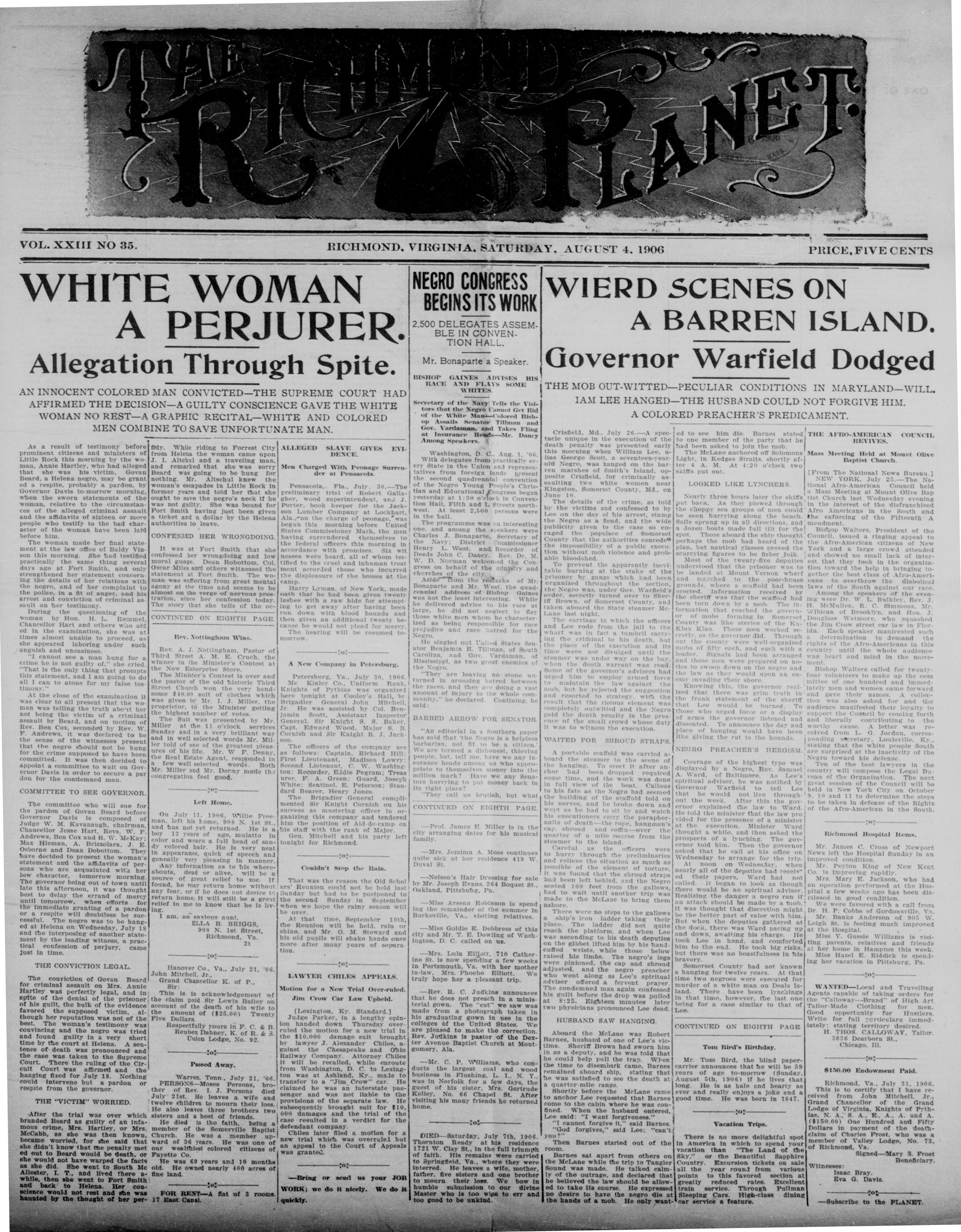
WHITE WOMAN A PERJURER. Allegation Through Spite.
AN INNOCENT COLORED MAN CONVICTED—THE SUPREME COURT HAD AFFIRMED THE DECISION—A GUILTY CONSCIENCE GAVE THE WHITE WOMAN NO REST—A GRAPHIC RECITAL—WHITE AND COLORED MEN COMBINE TO SAVE UNFORTUNATE MAN.
VOL. XXIII NO 35.
WHITE
Allegation
AN INNOCENT COLORED
AFFIRMED THE DECISION
WOMAN NO REST—A
MEN COME
As a result of testimony before prominent citizens and ministers of Little Rock this morning by the woman, Annie Hartley, who had alleged that she was his victim, Govan Beard, a Helena negro, may be granted a respite, probably a pardon, by Governor Davis to-morrow morning, when the sworn statements of the woman, relative to the circumstances of the alleged criminal assault and the affidavits of sixteen or more people who testify to the bad character of the woman have been laid before him.
The woman made her final statement at the law office of Baldy Vinson this morning. She had testified practically the same thing several days ago at Fort Smith, and only strengthened her statement concerning the details of her relations with the negro, and of her complaint to the police, in a fit of anger, and his arrest and conviction of criminal assault on her testimony.
During the questioning of the woman by Hon. H. L. Remmel, Chancellor Hart and others who afl ed in the examination, she was at times almost unable to proceed, as she appeared laboring under such anguish and uneasiness.
"I cannot see a man hung for a crime he is not guilty of," she cried. "That is the only thing that prompts this statement, and I am going to do all I can to atone for my false testimony."
At the close of the examination it was clear to all present that the woman was telling the truth about her not being the victim of a criminal assault by Beard, and on motion of Rev. Ben Cox, seconded by Rev. W. F. Andrews, it was declared to be the sense of the witnesses present that the negro should not be hung for the crime supposed to have been committed. It was then decided to appoint a committee to wait on Governor Davis in order to secure a parson for the condemned man.
COMMITTEE TO SEE GOVERNOR
The committee who will sue for the pardon of Govan Beard before Governor Davis is composed of Judge W. M. Kavanaugh, chairman, Chancellor Jesse Hart, Revs. W. F. Andrews, Ben Cox and R. W. McKay; Max Hieman, A. Brizzolara, J. E. Osborne and Dean Dobottom. They have decided to present the woman's statement and the affidavits of persons who are acquainted with her low character, tomorrow morning. The governor being out of town until late this afternoon, it was thought best to delay the errand of mercy until tomorrow, when efforts for the immediate granting of a pardon or a respite will doubtless be successful. The negro was to be hanged at Helena on Wednesday, July 18 and the interposing of another statement by the leading witness, a practical confession of perjury, came just in time.
THE CONVICTION LEGAL
The conviction of Govan Beard for criminal assault on Mrs. Annie Hartley was perfectly legal, and in spite of the denial of the prisoner of his guilt, the bulk of the evidence favored the supposed victim, although her reputation was not of the best. The woman's testimony was convincing and the negro was tried and found guilty in a very short time by the court at Helena. A sentence of death was pronounced and the case was taken to the Supreme Court. There the ruling of the Circuit Court was affirmed and the hanging fixed for July 18. Nothing could intervene but a pardon or respite from the governor.
THE "VICTIM" WORRIED
After the trial was over which branded Beard as guilty of an infamous crime, Mrs. Hartley, or Mrs. McCabb, as she was then known, became worried, for she said that she didn't know that the penalty met ed out to Beard would be death, or she would not have warped the facts as she did. She went to South Mc Allester, I. T., and lived there awhile, then she went to Fort Smith and back to Helena. Her conscience would not rest and she was haunted by the thought of her per-
fidly. While riding to Forrest City from Helena the woman came upon J. I. Altchul and a travelling man, and remarked that she was sorry Beard was going to be hung for nothing. Mr. Altschul knew the woman's escapades in Little Rock in former years and told her that she ought to save the negro's neck if he was not guilty. She was bound for Fort Smith having just been given a ticket and a dollar by the Helena authorities to leave.
CONFESSED HER WRONGDOING
It was at Fort Smith that she confessed her wrongdoing and low moral guage. Dean Robottom, Col Oscar Miles and others witnessed the statement at Fort Smith. The woman was suffering from great mental agony at the time and seems to be almost on the verge of nervous prostration, since her confession today. The story that she tells of the oc CONTINUED ON EIGHTH PAGE.
Rev. Nottingham Wins.
Rev. A. J. Nottingham, Pastor of Third Street A. M. E. Crutch, the winner in the Minister's Contest at the New Enterprise Store.
The Minister's Contest is over and the pastor of the old historic Third Street Church won the very handsome $40.00 suit of clothes which was given by Mr. I. J. Miller, the proprietor, to the Minister getting the highest number of votes.
The Suit was presented by Mr. Miller at the 11 o'clock services Sunday and in a very brilliant way and in well selected words Mr. Miller told of one of the greatest pleasures of his life. Mr. W F. Denny, the Real Estate Agent, responded in a few well selected words. Both Mr. Miller and Mr. Denny mute the congregation feel good.
Left Home.
On July 11, 1906, Willie Freeman, left his home, 908 N. 1st St., and has not yet returned. He is a boy 13 years of age, mulatto in color and wears a full head of sandy colored hair. He is very neat in appearance, quick of speech and generally very pleasing in manner.
Any information as to his whereabouts, dead or alive, will be a source of great relief to me. If found, he may return home without any fear, or if he does not desire to return home, it will still be a great relief to me to know that he is living.
I am, an anxious aunt,
ELLA B. BRIGGS,
908 N. 1st Street,
Richmond, Va.
2t
Hanover Co., Va., July 21, '06.
John Mitchell, Jr.
Grand Chancellor K. of P.,
Sir:
This is in acknowledgement of the claim paid Sir Lewis Bailey on account of the death of his wife to the amount of ($25.00) Twenty Five Dollars.
Respectfully yours in F. C. & B.
Reuben Dabney, K. of R. & S.
Ulson Lodge, No. 92.
Passed Away.
Warren, Tenn., July 21, '06.
PERSONS—Moses Persons, brother of Rev. I. J. Persons died July 21st. He leaves a wife and twelve children to mourn their loss. He also leaves three brothers two sisters and a host of friends.
He died in the faith, being a member of the Somerville Baptist Church. He was a member upward of 36 years. He was one of our wealthiest colored citizens of Fayette Co.
He was 69 years and 10 months old. He owned nearly 400 acres of fine land.
FOR RENT—A flat of 3 rooms.
17 East Canal.
RICHMOND, VIRGINIA, SATURDAY, AUGUST 4, 1906
ALLEGED SLAVE GIVES EVI
DENCE.
Men Charged With Peonage Surren der at Pensacola.
Pensacola., Fla., July. 30.—The preliminary trial of Robert Gallagher, wood superintendent, and J. Porter, book keeper for the Jackson Lumber Company at Lockhart, Ala., on the charge of peonage, was begun this morning before United States Commissioner Marh, the men having surrendered themselves to the federal officers this morning in accordance with promises. Six wit nesses were heard, all of whom testified to the cruel and inhuman treatment accorded those who incurred the displeasure of the bosses at the camp.
Harry Lyman, of New York, made oath that he had been given twenty lashes with a raw hide for attempting to get away after having been run down with blood hounds and then given an additional twenty because he would not plead for mercy. The hearing will be resumed tomorrow.
A New Company in Petersburg.
Petersburg, Va., July 30, 1906. Mc Kinley Co., Uniform Rank. Knights of Pythias was organized here tonight at Cooley's Hall, by Brigadier General John Mitchell. Jr. He was assisted by Col. Benjamin Scott, Assistant Inspector General. Sir Knight S. S. Baker, Capt. Edward Wood, Major S. B. Cornish and Sir Knight R. J. Jackson.
The officers of the company are as follows: Captain, Richard Hill; First Lieutenant, Madison Lowry; Second Lieutenant, C. W. Washington; Recorder, Eldie Pegram; Treasurer, F. A. Green; Guard, Joseph White; Sentinel, E. Peterson; Standard Bearer, Henry Jones.
The Brigadier General complimented Sir Knight Cornish on his success as mustering officer in organizing this company and tendered him the position of Aid-de-camp on his staff with the rank of Major.
Gen. Mitchell and his party left tonight for Richmond.
Couldn't Stop the Rain.
That was the reason the Old Scholars' Reunion could not be held last Sunday but had to be postponed to the second Sunday in September when we hope the rainy season will be over.
At that time, September 10th, the Reunion will be held, rain or shine, and Mr. O. M. Steward and his old pupils will shake hands once more after many years of separation.
LAWYER CHILES APPEALS
Motion for a New Trial Over-ruled.
Jim Crow Car Law Uphold.
[Lexington, Ky. Standard.]
Judge Parker, in a lengthy opinion handed down Thursday overruled the motion for a new trial in the $10,000 damage suit brought by lawyer J. Alexander Chiles, against the Chesapeake and Ohio Railway Company. Attorney Chiles it will be recalled, while enroute from Washington, D. C. to Lexington was at Ashland, Ky., made to transfer to a "Jim Crow" car. He claimed he was an interstate passenger and was not liable to the provisions of the separate law. He subsequently brought suit for $10,000 damages and the trial of the case resulted in a verdict for the defendant company.
Chiles later filed a motion for a new trial which was overruled but an appeal to the Court of Appeals was granted.
—Bring or send us your JOB WORK; we do it nicely. We do it quickly.
NEGRO CONGRESS BEGINS ITS WORK
NEGRO CONGRESS BEGINS ITS WORK
2,500 DELEGATES ASSEMBLE IN CONVENTION HALL.
Mr. Bonaparte a Speaker.
BISHOP GAINES ADVISES HIS RACE AND FLAVS SOME WHITES.
Secretary of the Navy Tells the Visitors that the Negro Can't Get Rid of the White Man—Colored Bishop Assails Senator Tillman and Gov. Vardaman, and Takes Fling at Insurance Heads—Mr. Dany Among Speakers.
Washington, D. C. Aug. 1, '06. With delegates from practically every State in the Union and representatives from foreign lands present the second quadrennial convention of the Negro Young People's Christian and Educational Congress began yesterday at 1:30 o'clock in Convention Hall, Fifth and L Streets northwest. At least 2,500 persons were in the hall.
The programme was an interesting one, and among the speakers were Charles J. Bonaparte, Secretary of the Navy; District Commissioner Henry L. West, and Recorder of Deeds John C. Dancy, Rev. Dr. M. W. D. Norman welcomed the Congress on behalf of the ministry and churches of the city.
Aside. From the redarks of Mr. Bonaparte and Mr. West, the quadrennial address of Bishop Gaines was not the least interesting. While he delivered advice to his race at large, he did not neglect to play those white men whom he characterized as being responsible for race prejudice and race hatred for the Negro. He singled out United States Senator Benjamin R. Tillman, of South Carolina, and Gov. Vardaman, of Mississippi, as two great enemies of the Negro.
"They are leaving no stone unturned in arousing hatred between the races, and they are doing a vast amount of injury to the whole community," he declared. Continuing, he said:
BARBED ARROW FOR SENATOR
"An editorial in a Southern paper has said that 'the Negro is a helpless barbarian, not fit to be a citizen. We are termed a dishonest, thieving people, but, tell me, have we any insurance heads among us who appropriate to themselves money into the million mark? Have we any Senators hurrying to put money back in its right place? "They call us brutish, but what
CONTINUED ON EIGHTH PAGE.
—Prof. James E. Miller is in the city arranging dates for his musical family.
—Mrs. Jemima A. Moss continues quite sick at her residence 419 W. Duval St.
—Nelson's Hair Dressing for sale by Mr. Joseph Evans, 364 Boquet St., Oakland, Pittsburg, Pa.
—Miss Arsena Robinson is spending the remainder of the summer in Burkeville, Va., visiting relatives.
—Miss Goldie E. Debbress of this city and Mr. T. E. Dowling of Washington, D. C. called on us.
—Mrs. Lula Elliott, 710 Catherine St. is now spending a few weeks in Portsmouth, Va. with her mother in-law, Mrs. Phoebe Elliott. We truly hope her a pleasant trip.
—Rev. R. C. Judkins announces that he does not preach in a ministerial gown. The "cut" we saw was made from a photograph taken in his graduating gown in use in the colleges of the United States. We are pleased to make the correction. Rev. Judkins is pastor of the Dexter Avenue Baptist Church at Montgomery, Ala.
—Mr. C. P. Williams, who conducts the largest coal and wood business in Flushing, L. I., N. Y. was in Norfolk for a few days, the guest of his sister, Mrs. Gertrude Kelley, No. 66 Chapel St. After visiting his many friends he returned home.
DIED-Saturday, July 7th, 1906.
Thornton Ready at his residence
1721 W. Clay St., in the full triumph
of faith. His remains were carried
to Springfield, Va., where they were
interred. He leaves a wife, mother,
father, five sisters and one brother
to mourn their loss. We bow in
humble submission to our divine
Master who is too wise to err and
too good to be unkind.
WIERD SCENES ON A BARREN ISLAND. Governor Warfield Dodged
THE MOB OUT-WITTED—PECULIAR CONDITIONS IN MARYLAND—WILL IAM LEE HANGED—THE HUSBAND COULD NOT FORGIVE HIM. A COLORED PREACHER'S PREDICAMENT.
Crisfield, Md., July 26.—A spectacle unique in the execution of the death penalty was presented early this morning when William Lee, alias George Scott, a seventeen-year-old Negro, was hanged on the barren marshes of Smith's Island, opposite Crisfield, for criminally assaulting two white women near Kingston, Somerset County, Md., on June 10.
The details of the crime, as told by the victims and confessed to by Lee on the day of his arrest, stamp the Negro as a fend, and the wide publicity given to the case so enraged the populace of Somerset County that the authorities conceded the impossibility of a public execution without mob violence and probable bloodshed.
To prevent the apparently inevitable burning at the stake of the prisoner by gangs which had been organized throughout the section, the Negro was, under Gov. Warfield's order, secretly turned over to Sheriff Brown, of Somerset County, and taken aboard the State steamer McLane last night.
ed to see him die. Barnes stated to one member of the party that he had been asked to join the mob.
The McLane anchored off Solomons Light, in Kedges Straits, shortly after 4 A. M. At 4:20 o'clock two skiffs put out.
LOOKED LIKE LYNCHERS.
Nearly three hours later the skiffs put back. As they plowed through the choppy sea groups of men could be seen hurrying along the beach. Sails sprang up in all directions, and a dozen boats made full tilt for the spot. Those aboard the ship thought perhaps the mob had heard of the plan, but nautical glasses proved the scurrying figures to be fisher folk.
Most of the twenty-five deputies understood that the prisoner was to be landed at Mount Vernon wharf and marched to the poor-house grounds, where a scaffold had been erected. Information received by the sheriff was that the scaffold had been torn down by a mob. The information that reached the governor of the county.
THE AFRO-AMERICAN COUNCIL REVIVES.
Mass Meeting Held at Mount Olive Baptist Church.
[From The National News Bureau.]
NEW YORK, July 25.—The National Afro-American Council held a Mass Meeting at Mount Olive Baptist Church last Wednesday evening in the interest of the disfranchised Afro-Americans in the South and the enforcing of the Fifteenth Amendment.
Bishop Walters, President of the Council, issued a ringing appeal to the Afro-American citizens of New York and a large crowd attended and showed no small lack of interest that they took in the organization toward the help in bringing together the best class of Afro-Americans to overthrow the diabolical laws of the South against our race.
Among the speakers of the evening were Dr. W. L. Bulkley, Rev. J. H. McMullen, R. C. Simmons, Mr. Wibullen of Brooklyn, and Hon. J.
The carriage in which the officers and Lee rode from the jail to the wharf was in fact a tumblr carrying the criminal to his death, but the place of the execution and its time were not divulged until the steamer was under way on the bay, when the death warrant was read. Some of the governor's advisers had urged him to employ armed force to maintain the law against the mob, but he rejected the suggestion and resorted to strategy, with the result that the riotous element was completely outwitted and the Negro paid the death penalty in the presence of the small crowd whose duty it was to witness the execution.
WAITED FOR SHROUD STRAPS
A portable scaffold was carried aboard the steamer to the scene of the hanging. To erect it after anchor had been dropped required some time, and the work was done in full view of the boat. Callous to his fate as the Negro had seemed the building of the scaffold told on his nerves, and he broke down and wept as he had to sit by and watch his executioners carry the paraphernalia of death—the rope, hangman's cap, shroud and coffin—over the quarter of a mile course from the steamer to the island.
Careful as the officers were to hurry through the preliminaries and relieve the situation as much as possible of the element of torture, it was found that the shroud straps had been left behind, and the Negro seated 100 feet from the gallows, had to wait until another trip was made to the McLane to bring them ashore.
There were no steps to the gallows a ship's iron ladder taking their place. The ladder did not quite reach the platform, and when Lee was ascending to his death deputies on the gibbet lifted him by his hand-cuffed wrists, while those below raised his limbs. The negro's legs were pinioned, the cap and shroud adjusted, and the negro preacher who went along as Lee's spiritual adviser offered a fervent prayer. The condemned man again confessed his guilt before the drop was pulled at 8:25. Eighteen minutes later two physicians pronounced Lee dead.
HUSBAND SAW HANGING
Aboard the McLane was Robert Barnes, husband of one of Lee's victims. Sheriff Brown had sworn him in as a deputy, and he was told that he could help pull the trap. When the time to disembark came, Barnes remained aboard ship, stating that he was satisfied to see the death at a quarter-mile range.
Shortly before the McLane came to anchor Lee requested that Barnes come to the cabin where he was confined. When the husband entered, Lee said: "I want forgiveness." "I cannot forgive it," said Barnes. "God forgives," said Lee; "can't you?"
Then Barnes started out of the room.
Barnes sat apart from others on the McLane while the trip to Tangler Sound was made. He talked calmly of the outrage, and declared that he believed the law should be allowed to take its course. He expressed no desire to have the negro die at the hands of a mob. He only want-
ed to see him die. Barnes stated to one member of the party that he had been asked to join the mob.
LOOKED LIKE LYNCHERS
Nearly three hours later the skiffes put back. As they plowed through the choppy sea groups of men could be seen hurrying along the beach. Sails sprang up in all directions, and a dozen boats made full tilt for the spot. Those aboard the ship thought perhaps the mob had heard of the plan, but nautical glasses proved the scurrying figures to be fisher folk.
Most of the twenty-five deputies understood that the prisoner was to be landed at Mount Vernon wharf and marched to the poor-house grounds, where a scaffold had been erected. Information received by the sheriff was that the scaffold had been torn down by a mob. The information that reached the governor or mobs forming in Somerset County was like stories of the Kuklux Klan. These men worked secretly, as the governor did. Through out the county were well-organized mobs of fifty each, and each with a leader. Signals had been arranged and these men were prepared on notice to swoop down on the negro and the law as they would upon an enemy invading their shore.
Knowing this, the governor realized that there was grim truth in the frank statement of the sheriff that Lee would be burned. To those who urged force or a display of arms the governor listened and dissented. To announce the day and place of hanging would have been like giving the rat to the hounds.
NEGRO PREACHER'S HEROISM
Courage of the highest type was displayed by a Negro, Rev. Samuel A. Ward, of Baltimore. As Lee's spiritual adviser, he was notified by Governor Warfield to tell Lee that he would not live throughout the week. After this the governor explained the law to Ward. He told the minister that the law provided for the presence of a minister at the execution. Minister Ward thought a while, and then asked the prospects of a lynching. The governor told him. Then the governor asked that he call at his office on Wednesday to arrange for the trip. At noon on Wednesday, when nearly all of the deputies had received their papers, Ward had not called. It began to look as though there would be no spiritual adviser, Realizing the danger a negro ran if an attack should be made by a mob, it was thought that discretion might be the better part of valor with him. But when the deputies gathered at the dock, there was Ward pacing up and down, awaiting his charge. He took Lee in hand, and comforted him to the end. He took big risks, but there was no boastfulness in his bravery. Somerset County had not known a hanging for twelve years. At that time two negroes were executed for murder of a white man on Deals Island. There have been lynchings in that time, however, the last one being for a case similar to that of Lee.
CONTINUED ON EIGHTH PAGE
Tom Bird's Birthday.
Mr. Tom Bird, the blind papercarrier announces that he will be 59 years of age to-morrow (Sunday, August 5th, 1906) if he lives that long. He is as hale and hearty as ever and really enjoys a joke and a good time. He was born in 1847.
Vacation Trips.
There is no more delightful spot in America in which to spend your vacation than "The Land of the Sky," or the Beautiful Sapphire Country. Excursion tickets on sale all the year round from various points to this favored section at greatly reduced rates. Excellent train service. Through Pullman Sleeping Cars. High-class dining car service a feature.
PRICE, FIVE CENTS
ON
ISLAND.
d Dodged
S IN MARYLAND—WILL.
NOT FORGIVE HIM.
CAMENT.
THE AFRO-AMERICAN COUNCIL
REVIVES.
Mass Meeting Held at Mount Olive Baptist Church.
[From The National News Bureau.]
NEW YORK, July 25 — The National Afro-American Council held a Mass Meeting at Mount Olive Baptist Church last Wednesday evening in the interest of the disfranchised Afro Americans in the South and the enforcing of the Fifteenth Amendment.
Bishop Walters, President of the Council, issued a ringing appeal to the Afro-American citizens of New York and a large crowd attended and showed no small lack of interest that they took in the organization toward the help in bringing together the best class of Afro-Americans to overthrow the diabolical laws of the South against our race. Among the speakers of the evening were Dr. W. L. Bulkley, Rev. J. H. McMullen, R. C. Simmons, Mr. Wibican of Brooklyn, and Hon. J. Douglass Wetmore, who squashed the Jim Crow street car law in Florida. Each speaker manifested such a determination to demand the rights of the Afro-Americans in this country until the whole audience was heart and mind in the movement.
Bishop Walters called for twenty-four volunteers to make up the committee of one hundred and immediately men and women came forward and gave their names. A collection was also asked for and the audience manifested their loyalty to support the Council by coming forth and liberally contributing to the worthy cause. A letter was received from L. G. Jordan, corresponding secretary, Louisville, Ky., stating that the white people South are surprised at the inactivity of the Negro toward his defense.
Ten of the best lawyers in the country will compose the Legal Bureau of the Organization. The next great session of the Council will be held in New York City on October 9, 10 and 11 to determine the steps to be taken in defense of the Rights of the Afro-American in the South.
Richmond Hospital Items
Mr. James C. Cross of Newport News left the Hospital Sunday in an improved condition.
Mr. Peyton King of New Kent Co. is improving rapidly.
Mrs. Mary E. Jackson, who had an operation performed at the Hospital a few weeks ago has been dismissed in good condition.
We were favored with a call from Dr. H. P. Cobbs of Gordonsville, Va.
Mr. Banks Anderson of 905 W. Leigh St. is feeling much improved at the Hospital.
Miss V. Gussie Williams is visiting parents, relatives and friends at her home in Hampton this week.
Miss Hazel E. Riddick is spending her vacation in Pittsburgh, Pa.
WANTED—Local and Travelling Agents capable of taking orders for the "Calloway—Brand" of High Art Tailor-Made Clothing for men. Good opportunity for Hustlers. Write for full particulars immediately; stating territory desired. H. THOS. CALLOWAY, Tailor. 3636 Dearborn St., Chicago, Ill.
$150.00 Endowment Paid
Richmond, Va., July 31, 1906.
This is to certify that I have received from John Mitchell, Jr.,
Grand Chancellor of the Grand
Lodge of Virginia, Knights of Pythias, N. A., S. A., E., A., A. and A. ($150.00) One Hundred and Fifty Dollars in payment of the death-claim of Charles Frost, who was a member of Valley Lodge, No. 73,
of Richmond, Va.
Signed—Mary S. Frost
Beneficiary.
Witnesses:
Isaac Bray.
Eva G. Davis.
Subscribe to the PLANET.
FILE NO. 113.
ONE OF THE MYSTERIES OF PARIS, AND HOW IT WAS SOLVED.
BY EMILE GABORIAUJ
As M. Verduret had anticipated, Prosper's letter had a terrible effect upon M. Fauvel.
It was toward nine o'clock in the morning, and M. Fauvel had just entered his study when his mail was brought in.
After opening a dozen business letters, his eyes fell on the fatal missive sent by Prosper.
Something about the writing struck him as peculiar.
It was evidently a disguised hand, and although, owing to the fact of his being a millionaire, he was in the habit of receiving anonymous communications, sometimes abusive, but generally begging for money, this particular letter filled him with an indefinite presentiment of evil. A cold chill ran through his heart, and he dreaded to open it.
With absolute certainty that he was about to learn some new calumny, he broke the seal, and opening the course cafe paper, was shocked by the following words:
"DEAR SIR—You have, handed your cashier over to the law, and you acted properly, convinced as you were of his dishonesty.
"But if it was he who took three hundred and fifty thousand francs from your safe, was it he also who took Madame Fauvel's diamonds?"
"This was a terrible blow to a man whose life hitherto had been an unbroken chain of prosperity, who could recall the past without one bitter regret, without remembering any sorrow deep enough to bring forth a tear.
What! his wife deceive him! And among all men, to choose one vile enough to rob her of her jewels, and force her to be his accomplice in the ruin of an innocent young man."
For did not the letter before him assert this to be the fact, and tell him how to convince himself of its truth?
M. Fauvel was as bewildered as if he had been knocked on the head with a club. It was impossible for his scattered ideas to take in the enormity of what these dreadful words intimated. He seemed to be mentally and physically paralyzed, as he sat there staring blankly at the letter.
But this stupefaction suddenly changed to indignant rage.
"What a fool I am!" he cried, "to listen to such base lies, such malicious charges against the purest woman whom God ever sent to bless a man!"
And he angrily crumpled up the letter, and threw it into the empty fireplace, saying:
"I will forget having read it. I will not soil my mind by letting it dwell upon such turpitude!"
He said this, and, he thought it; but, for all that, he could not open the rest of his letters. The anonymous missive stood before his eyes in letters of fire, and drove every other thought from his mind.
That penetrating, clinging, all-corroding worm, suspicion, had taken possession of his soul; and as he leaned over his desk, with his face buried in his hands, thinking over many things which had lately occurred, insignificant at the time, but fearfully omnious now, this unwillingly admitted germ of suspicion grew and expanded until it became certainty.
But, resolved that he would not think of his wife in connection with so vile a deed, he imagined a thousand wild excuses for the mischief maker who took his mode of annoying him; of course there was no truth in his assertions, but from curiosity he would like to know who had written it. And yet suppose—"Merciful God! can it be true?" he wildly cried, as the idea of his wife's guilt would obstinately return to his troubled mind.
Thinking that the writing might throw some light on the mystery, he started up and tremblingly picked the fatal letter out of the ashes. Carefully smoothing it out, he laid it on his desk, and studied the heavy strokes, light strokes, and capitals of every word.
It must be from some of my clerks," he finally said; "some one who is angry with me for refusing to raise his salary; or perhaps it is the one that I dismissed the other day."
Clinging to this idea, he thought over all the young men in his bank; but not one could he believe capable of resorting to so base a vengeance. Then he wondered where the letter had been posted, thinking this might throw some light upon the mystery. He looked at the envelope, and read the postmark:
"Rue du Cardinal Lemoine."
This fact told him nothing. Once more he read the letter, spelling over each word, and trying to put a different construction on the horrible phases that stored him in the face.
It is generally agreed that an anonymous letter should be treated with silent contempt, and cast aside as the malicious lies of a coward who dares not to say to a man's face what he secretly commits to paper, and forces upon him.
This is all very well in theory, but it is difficult to practice when the anonymous letter comes. You throw it in the fire, it burns; but, although the paper is destroyed by the flames, doubt remains. Suspicion arises from its ashes, as a subtle poison penetrates the inmost recesses of the mind, weakens its holiest beliefs, and destroys its faith.
The trail of the serpent is left.
The wife suspected, no matter how unjustly, is no longer the wife in whom her husband trusted as he would trust himself; the pure being who was above suspicion no longer exists. Suspicion, no matter when the source, has irreovocably tarnished
The brightness of his idol.
Unable to struggle any longer against these conflicting doubts, M. Faurel determined to resolve them by showing the letter to his wife; but a torturing thought, more terrible than any he had yet suffered, made him sink back in his chair in despair. "Suppose it be true!" he muttered to himself: "suppose I have been miserably duped! By confiding in my wife, I shall put her on her guard, and lose all chance of discovering the truth."
Thus were realized all Verduret's presumptions.
He had said, "If Monsieur Fauvel does not yield to his first impulse, if he stops to reflect, we have time to repair the harm done."
After a long and painful meditation, the banker finally decided to wait, and watch his wife.
It was a hard struggle for a man of his frank, upright nature to play the part of domestic spy and jealous husband.
Accustomed to give way to sudden bursts of anger, but quickly mastering them, he would find it difficult to be compelled to preserve his self-restraint, no matter how dreadful the discoveries might be. When he collected the proofs of guilt one by one, he must impose silence upon his resentment until fully assured of possessing certain evidence.
There was one simple means of ascertaining whether the diamonds had been pawned.
If the letter lied in this instance, he would treat it with the scorn it deserved. If, on the other hand, it should prove to be true!
At this moment, the servant announced breakfast; and M. Fauvel looked in the glass before leaving his study, to see if his face betrayed the emotion he felt. He was shocked at the haggard features which it reflected.
"Hate I no nerve?" he said to himself. "Oh! I must and shall control my feelings until I find out the truth."
At table he talked incessantly, so as to escape any questions from his wife, who, he saw, was uneasy at the sight of his pale face.
But, all the time he was talking, he was casting over in his mind expedients for getting his wife out of the house long enough for him to search her bureau.
At last he asked Mme. Fauvel if she were going out before dinner.
"Yes," said she; "the weather is dreadful, but Madeleine and I must do some shopping."
"At what time shall you go?"
"Immediately after breakfast."
He drew a long breath as if relieved of a great weight.
In a short time he would know the truth.
His uncertainty was so torturing to the unhappy man that he preferred the most dreadful reality to his present agony.
Breakfast over, he lighted a cigar, but did not remain in the dining-room to smoke it, as was his habit.
He went into the study to try and compose his nerves.
He took the precaution to send Lucien on a message so as to be alone in the house.
After the lapse of half an hour, he heard the carriage roll away with his wife and niece.
Hurrying into Mme. Fauvel's room, he opened the drawer of the chiffonier, where she kept her jewels.
The last dozen or more leather and velvet boxes containing superb sets of jewelry which he had presented to her were gone
Twelve boxes remained. He nervously opened them.
They were all empty!
The anonymous letter had told the truth.
"Oh, it can not be!" he gasped in broken tones. "Oh, no, no!"
He wildly pulled open every drawer in the vain hope of finding them packed away. Perhaps she kept them elsewhere.
He tried to hope that she had sent them to be reset; but no, they were all superbly set in the latest fashion; and, moreover, she never would have sent them all at once. He looked again.
Nothing! not one jewel could he find.
He remembered that he had asked his wife at the Jandidier ball why she did not wear her diamonds; and she had replied with a smile:
"Oh! what is the use? Everybody knows them so well; and, besides, they don't suit my costume."
Yes, she had made this answer without blushing, without showing the slightest sign of agitation or shame. What boarded it is.
What barefaced impudence! What base hypocrisy concealed beneath an innocent, confiding manner!
And she had been thus deceiving him for twenty years! But suddenly a gleam of hope penetrated his confused mind—slightly, barely possible; still a straw to cling to—
"Perhaps Valentine has put her diamonds in Medeleine's room."
Without stopping to consider the indulgence of what he was about to do, he hurried into the young girl's room, and pulled open one drawer after another. What did he find?
Not Mme. Fauvel's diamonds, but Medeleine's seven or eight boxes also empty.
Great heavens! Was this gentle girl, whom he had treated as a daughter, an accomplice in this deed of shame? Had she contributed her jewelry to add to the disgrace of the roof that sheltered her?
This last blow was almost too much for the miserable man. He sunk almost lifeless into a chair, and wringing his hands, groaned over the wreck of his happiness. Was this the happy future to which he had looked for-
THE RICHMOND PLANET, RICHMOND, VIRGINIA
Ward? Was the fabric of his honor, well-being, and domestic bliss, to be dashed to the earth and forever lost in a day? Were his 20 years' labor and high standing to end thus in shame and sorrow?
Apparently, nothing was changed in his existence; he was not materially injured; he could not reach forth his hand, and heal or revenge the smarting wound; the objects around him were unchanged; everything went on in the outside world just as it had gone on during the last 20 years; and yet what a horrible change had taken place in his own heart! While the world envied his prosperity and happiness, here he sat, more heart-sore and weared of life than the worst criminal that ever stood before the inquisition.
What! Valentine, the pure young girl whom he had loved and married in spite of her poverty, in spite of her cold offering of calm affection in return for his passionate devotion: Valentine, the tender, loving wife, who, before a year of married life had rolled by, so often assured him that her affection had grown into deep, confiding love, that her devotion had grown stronger every day, and that her only prayer was that God would take them both together, since life would be a burden without her noble husband to shield and cherish her—could she have been acting a lie for 20 years?
She, the darling wife—the mother of his sons?
His sons? Good God! Were they his sons?
He was like a man who is told that the exquisite wine he has drank contains poison.
Confidence is never half-way; it is or it is not. His confidence was gone; his faith was dead.
The wretched banker had rested his every hope and happiness on the love of his wife. Believing that she had proved faithless, that she had played him false, and was unworthy of trust, he admitted no possibility of peaceful joy, and felt tempted to seek consolation from self-destruction. What had he to live for now, save to mourn over the ashes of the past?
But this dejection did not last long. Indignant anger, and thirst for vengeance, made him start up and swear that he would lose no time in vain regrets.
M. Fauvel well knew that the fact of the diamonds being stolen was not sufficient ground upon which to bring an accusation against any of the accomplices. He must possess overwhelming proofs before taking any active steps. Success depended upon present secrecy. He began by calling his valet, and ordering him to bring him every letter that should come to the house.
Finally, following the advice of the anonymous letter, he went to the prefecture of police, hoping to obtain a biography of Clameran. But the police, fortunately for many people, are as discreetly silent as the grave. They guard their secrets as a miser his treasure. Nothing but an order from the chief judge could open those formidable green boxes, and reveal their secrets. M. Fauvel was politely asked what motives urged him to inquire into the past life of a French citizen; and, as he declined to state his reasons, the chief of police told him he had better apply to the procureur for the desired information. This advice he could not follow. He had sworn that the secret of his wrongs should be confined to the three persons interested. He chose to avenge his own injuries, to be alone the judge and executioner.
He returned home more angry than ever; there he found the dispatch answering the one he had sent to St. Remy. It was as follows:
"The Lagors are very poor, and there never has been any member of the family named Raoul. Madame Lagors had no son, only two daughters."
This information dashed his last hope.
The banker thought, when he discovered his wife's infamy, that she had sinned as deeply as woman could sin; but he now saw that she had practiced a system more shocking than the crime itself.
"Wretched creature!" he cried, with anguish; "in order to see her loves constantly, she dared introduce him to me under the name of a nephew who never existed. She had the shameless courage to bring him beneath her husband's roof, and seat him at my fireside, between my sons; and I, confiding fool that I was, welcomed the villain, and let him money."
Nothing could equal the pain of wounded pride and mortification which he suffered at the thought that Raoul and Mme. Fauvel had amused themselves with his good-natured credulity and obtuseness.
Nothing but death could wipe out an injury of this nature. But the very bitterness of his resentment enabled him to restrain himself until the time for punishment came. With grim satisfaction he promised himself that his acting would be as successful as theirs.
That day he succeeded in coneaseling his agitation, and kept up a flow of talk at dinner; but at about nine o'clock, when Clameran called on the ladies, he rushed from the house, for fear that he would be unable to control his indignation at the sight of this destroyer of his happiness; and did not return home until late in the night.
The next day he reaped the fruit of his prudence.
Among the letters which his valet brought him at noon, was one bearing the postmark of Vesinet.
He carefully opened the envelope, and read:
"Dear Aunt—it is imperatively necessary for me to see you to-day, so do not fail to come to Vosnet.
"I will explain why I give you this trouble, instead of calling at your house.
RAOUL."
"I have them now!" eried M. Fauvel, trembling with satisfaction at the near prospect of vengeance.
Eager to lose no time, he opened a drawer, took out a revolver, and examined the hammer to see if it worked easily.
He imagined himself alone, but a vigilant eye was watching his movements. Gipsy, immediately upon her return from the Archangel, stationed herself at the key-hole of the study-door, and saw all that occurred.
M. Fauvel laid the pistol on the mantel piece, and nervously resealed the letter, which he then took to the box where the letters were usually left, not wishing anyone to know that Raoul's letter had passed through his hands.
He was only absent two minutes, but, inspired by the iminence of the danger, Gipay darted into the study, and rapidly extracted the balls from the revolver.
"Thank Heaven!" she murmured; "this peril is averted, and Monsieur Verduret will now perhaps have time to prevent a murder. I must send Cavaillon to tell him."
She hurried into the bank, and sent the clerk with a message, telling him to leave it with Mme. Alexandre, if M. Verduret had left the hotel.
An hour later, Mme. Fauvel ordered her carriage, and went out.
M. Fauvel jumped into a hackney-coach, and followed her.
"God grant that Monsieur Verduret may reach there in time!" creed Nina to herself, "otherwise Madame Fauvel and Raoul are lost."
CHAPTER XXIV
The moment that the Marquis of Clameran perceived that Raoul de Lagors was the only obstacle between him and Madeleine, he swore that the obstacle should soon be removed. That very day he took steps for the accomplishment of his purpose. As Raoul was walking out to Vesnet about midnight, he was stopped at a lonely spot by three men, who asked him what o'clock it was; while looking at his watch, the ruffles fell upon him suddenly, and but for Raoul's wonderful strength and agility, would have left him dead on the spot. As it was, he soon, by his skillfully-plied blows (for he had become a proficient in fencing and boxing in England), made his enemies take to their heels. He quietly continued his walk home, fully determined to be hereafter well armed when he went out at night.
He never for an instant suspected his accomplice of having instigated the assault.
But two days afterward, while sitting in a cafe a burly, vulgar-looking man, a stranger to him, interrupted him several times while talking, and, after making several rough speeches, as if trying to provoke a quarrel, finally threw a card in his face, saying its owner was ready to grant him satisfaction when and where he pleased.
Raoul rushed toward the man to chastlee him on the spot; but his friends held him back, telling him it would be much more gentlemanly to run a sword through his vulgar hide, than have a scuffle in a public place.
"Very well, then; you will hear from me to-morrow," he said, scornfully, to his assailant. "Wait at your hotel until I send two friends to arrange the matter with you."
As soon as the stranger had left, Raoul recovered from his excitement, and began to wonder what could have been the motive for this evidently pre-meditated insult. Picking up the card of the bully, he read:
W. H. B. JACOBSON
W. H. B. JACOBSON.
Formerly Garibaldian volunteer.
Ex-officer of the army of the South.
(Italy, America.)
30 Rue Leonie.
Raoul had seen enough of the world
to know that these heroes who cover
their visiting cards with titles have
very little glory elsewhere than in
their own conceit.
Raoul sent two of his friends to make arrangements for a duel. He gave them M. Jacobson's address, and told them to report at the Hotel du Louvre, where he would wait for them.
Having dismissed his friends, Raoul went out to find out something about M. Jacobson; and, being an expert at the business of unraveling plots and snares, he determined to discover who was at the bottom of this duel into which he had been decoyed.
The information obtained was not very promising.
M. Jacobson, who lived in a very suspicious-looking little hotel whose inmates were women of light character, was described as an eccentric gentleman, whose mode of life was a problem difficult to solve. No one knew his means of support.
He reigned despotically in the hotel, went out a great deal, never came in until midnight, and seemed to have no capital to live upon, save his military titles, and a talent for carrying out whatever was undertaken for his own benefit.
"That being his character," thought Raoul, "I can not see what object he can have in picking a quarrel with me. What good will it do him to run a sword through my body? Not the slightest; and, moreover, his pugnacious conduct is apt to draw the attention of the police, who, from what I hear, are the last people this warrior would like to have after him. Therefore he must have some reason for pursuing me; and I must find out what it is."
The result of his meditations was, Raoul, upon his return to the Hotel du Louvre, did not mention a word of his adventure to Clameran, whom he found already up.
At half-past eight his seconds arrived.
M. Jacobson had selected the sword,
and would fight that very hour, in
the woods of Vincennes.
"Well, come along," cried Raoul, gayly. "I accept the gentleman's conditions."
They found the Garibaldian waiting; and after an interchange of a few thrusts, Raoul was slightly wounded in the right shoulder.
The "Ex-officer of the South" wished to continue the combat; but Raoul's seconds—brave young men—declared that honor was satisfied, and that they had no intention of subjecting their friend's life to unnecessary hazards.
The ex-officer was forced to admit that this was but fair, and unwillingly retired from the field. Raoul went home delighted at having escaped with nothing more serious than a little loss of blood, and resolved to keep clear of all so-called Garibaldians in the future.
In fact, a night's reflection had convinced him that Clameran was the investigator of the two attempts to kill him. Mme. Fauvel having told him what conditions Madeline placed on her consent to marriage. Raoul instantly saw how necessary his removal would be, now that he was an impediment in the way of Clameran's success. He recalled a thousand little remarks and events of the last few days, and, on skillfully questioning the marquis, had his suspicions changed into certainty.
This conviction that the man whom he had so materially assisted in his criminal plans was so basely ungrateful as to turn against him and hire-assassins to murder him in cold blood, inspired in Raoul a resolution to take speedy vengeance upon his treacherous accomplice, and at the same time insure his own safety.
This tresson seemed monstrous to Raoul. he was as yet not sufficiently experienced in ruffianism to know that one villain always sacrifices another to advance his own projects; he was credulous enough to believe in the adage, "there's honor among thieves."
His rage was naturally mingled with fright, well knowing that his life hung by a thread, when it was threatened by a daring scoundrel like Clamerman.
He had twice miraculously escaped: a third attempt would more than likely prove fatal.
Knowing his accomplice's nature, Raoul saw himself surrounded by snakes; he saw death before him in every form; he was equally afraid of going out and of remaining at home. He only ventured with the most suspicious caution into the most public places; he feared poison more than the assassin's knife, and imagined that every dish placed before him tasted of strychnine.
As this life of torture was intolerable, he determined to anticipate a struggle which he felt must terminate in the death of either Clameran or himself, and, if he were doomed to die, to be first revenged. If he went down, Clameran should go too; better kill the devil than be killed by him.
In his days of poverty, Raoul had often risked his life to obtain a few guineas, and would not have hesitated to make short work of a person like Clameran.
But with money prudence had come. He wished to enjoy his 400,000 frames without being compromised by committing a murder which might be discovered: he, therefore, began to devise some other means of getting rid of his dreaded accomplice. Meanwhile, he devoted his thoughts to some discreet way of thwarting Clameran's marriage with Madeleine. He was sure that he would thus strike him to the heart, and this was at least a satisfaction.
Raoul was persuaded that, by openly siding with Madeleine and her aunt, he could save them from Clameran's clutches. Having fully resolved upon this course, he wrote a note to Mme. Fauvel asking for an interview.
The poor woman hastened to Vesinet convinced that some new misfortune was in store for her.
Her alarm was groundless. She found Raoul more tender and affectionate than he had ever been. He saw the necessity of reassuring her, and winning his old place in her forgiving heart, before making his disclosures.
He succeeded. The poor lady had a smiling and happy air as she sat in an arm-chair, with Raoul kneeling before her.
"I have distressed you too long, my dear mother," he said in his softest tones, "but I repent sincerely; now listen to my—"
He had not time to say more; the door was violently thrown open, and Raoul, springing to his feet, was confronted by M. Fauvel.
The banker had a revolver in his hand, and was deadly pale.
It was evident that he was making superhuman efforts to remain calm, like a judge whose duty it is to justly punish crime.
"Ah," he said, with a horrible laugh, "you look surprised, you did not expect me? You thought that my imbecile credulity insured your safety."
Raoul had the courage to place himself before Mme. Fauvel, and to stand prepared to receive the expected bullet.
"I assure you, uncle—" he began.
"Enough!" interrupted the banker with an angry gesture, "let me hear no more infamous falsehoods! End this acting, of which I am no longer the dupe."
"I swear to you—"
"Spare yourself the trouble of denying anything. I know all. I know who pawned my wife's diamonds. I know who committed the robbery for which an innocent man was arrested and imprisoned."
Mme Fauvel, white with terror, fell upon her knees.
At last it had come—the dreadful day had come. Vainly had she added falsehood to falsehood; vainly had she sacrificed herself and others; all was discovered.
She saw that all was lost, and wringing her hands she tearfully moaned:
At these heart-broken tones the banker shook like a leaf. This voice brought before him the twenty years of happiness which he had owed to this woman, who had always been the mistress of his heart, whose slightest wish had been his law, and who, by a smile or a frown, could make him the happiest or the most miserable of men. Alas! those days were over now.
Could this wretched woman crouch at his feet be his beloved Valentine, the pure, innocent girl whom he had found secluded in the chateau of La Verberie, who had never loved any other than himself? Could this be the cherished wife whom he had worshiped for so many years?
The memory of his lost happiness was too much for the stricken man. He forgot the present in the past, and was almost melted to forgiveness.
"Unhappy woman!" he mournured,
"unhappy woman! What have I done
that you should thus betray me! Ah,
my only fault was loving you too
deeply, and letting you see it. One
wearies of everything in this world,
even happiness. Did pure domestic
joys pall upon you and weary you,
driving you to seek the excitement of
sinful passion? Were you so tired of
the atmosphere of respect and affection which surrounded you that you must needs risk your honor and mine by braving public opinion? Oh,
into what an abyss you have fallen,
Valentine! and oh, my God! if you
were wearied by my constant devotion,
had the thought of your
children no power to restrain your
evil passions; could you not remain
untarnished for their sake?"
M. Fauvel spoke slowly, with painful effort, as if each word choked him.
Raoul, who listened with attention, saw that if the banker knew some things he certainly did not know all.
He saw that erroneous information had misled the unhappy man, and that he was still a victim of false appearances.
He determined to convince him of the mistake under which he was laboring, and said:
For some moments nothing was heard but the sobs of Mine. Fauvel.
"I came here," continued the banker, "with the intention of killing you both. But I can not kill a woman, and I will not kill an unarmed man." Raoul once more tried to speak.
"Let me finish!" interrupted M Fauvel. "Your life is in my hands; the law excuses the vengeance of an injured husband, but I refuse to take advantage of it. I see on your mantle a revolver similar to mine; take it, and defend yourself."
"Never!"
"Defend yourself!" cried the banker, raising his arm, "if you do not—"
Feeling the barrel of M. Fauvel's revolver touch his breast, Raoul, in self-defense, seized his own pistol, and prepared to fire.
"Stand in that corner of the room, and I will stand in this," continued the banker; "and when the clock strikes, which will be in a few seconds, we will both fire."
They took the places designated, and stood perfectly still.
But the horror of the scene was too much for Mme. Fauvel to witness any longer without interposing. She understood but one thing: her son and her husband were about to kill each other before her very eyes. Fright and horror gave her strength to start up and rush between the two men.
"For God's sake, have mercy, Andrei!" she cried, wringing her hands with anguish, "let me tell you everything; don't kill—"
This burst of maternal love, M.Fauvel thought the pleadings of a criminal woman defending her lover.
He roughly seized his wife by the arm, and thrust her aside, saying with indignant scorn:
"Get out of the way!"
But she would not be repulsed; rushing up to Raoul, she threw her arms around him, and said to her husband:
"Kill me, and me alone; for I am the guilty one!"
At these words M. Fauvel glared at the guilty pair, and, deliberately taking aim, fired.
Neither Raoul nor Mme. Fauvel moved. The banker fired a second time; then a third.
He cocked the pistol for a fourth shot, when a man rushed into the room, snatched the pistol from the banker's hand, and, throwing him on the sofa, ran toward Mme. Fauvel.
"Thank Heaven!" he cried, "she is unhurt."
"How dare you interfere?" cried the banker, who by this time had joined the group. "I have the right to avenge my honor when it has been degraded; the villain shall die!"
M. Verduret seized the banker's wrists in a vice-like grasp, and whispered in his ear:
"Thank God, you are saved from committing a terrible crime; the anonymous letter deceived you."
In violent situations like this, all the untoward, strange attending circumstances appear perfectly natural to the participants, whose passions have already carried them beyond the limits of social propriety.
Thus M. Fauvel never once thought of asking this stranger who he was and where he came from.
He heard and understood but one fact: the anonymous letter had lied.
"So she is," replied M. Verduret; "but not of the crime you imagine. Do you know who that man is, that you attempted to kill?" "Her lover!" "No, her san!" The words of this stranger, showing his intimate knowledge of the private affairs of all present, seemed to confound and frighten Raoul more than M. Faunel's threats had done. Yet he had sufficient presence of mind to say: "It is the truth!"
his haggard eyes on his wife, exclaimed:
"It is false! you are all conspiring to deceive me! Proofs!"
"You shall have proofs," replied M. Verduret; "but first listen."
And rapidly, with his wonderful talent for exposition, he related the principal points of the plot he had discovered.
The true state of the case was terribly distressing to M. Fauvel, but nothing compared with what he had suspected.
His throbbing, yearning heart told him that he still loved his wife. Why should he punish a fault committed so many years ago, and atoned for by twenty years of devotion and suffering?
For some moments after M. Verduret had finished his explanation, M. Fauvel remained silent.
So many strange events had happened, rapidly following each other in succession, and culminating in the shocking scene which had just taken place, that M. Fauvel seemed to be too bewildered to think clearly.
If his heart counseled pardon and forgetfulness, wounded pride and self-respect demanded vengeance.
If Raoul, the baleful witness, the living proof of a far-off sin, were not in existence, M. Fauvel would not have hesitated. Gaston de Clameran was dead; he would have held out his arms to his wife and said:
"Come to my heart! your sacrifices for my honor shall be your absolution; let the sad past be forgotten."
But the sight of Raoul froze the words upon his lips.
"So this is your son," he said to his wife—"this man, who has plundered you and robbed me!"
Mme. Fauvel was unable to utter a word in reply to these reproachful words.
"Oh!" said M. Verduret, "madame will tell you that this young man is the son of Gaston de Clameran; she has never doubted it. But, the truth is—"
"What?"
"That, in order to swindle her, he has perpetrated a gross imposture."
During the last few minutes Raoul had been quietly creeping toward the door, hoping to escape while no one was thinking of him.
But M. Verduret, who anticipated his intention, was watching him out of the corner of one eye, and stopped him just as he was about leaving the room.
"Not so fast, my pretty youth," he said, dragging him into the middle of the room; "it is not polite to leave us so unceremoniously. Let us have a little conversation before parting; a little explanation with be edifying."
The jeering words and mocking manner of M. Verduret made Raoul turn deny pale, and start back as if confronted by a phantom.
"The clown!" he gasped.
"The same, friend." said the fat man. "Ah, now that you recognize me, I confess that the clown and myself are one and the same. Yes, I am the mountebank of the Jandidier ball; here is proof of it."
And turning up his sleeve he showed a deep cut on his arm.
"I think that this recent wound will convince you of my identity," he continued. "I imagine you know the villain that gave me this little decoration, that night I was walking along the Rue Bourdaloue. That being the case, you know, I have a slight claim upon you, and shall expect you to relate to us your little story."
But Raoul was so terrified that he could not utter a word.
"Your modesty keeps you silent." said M. Verduret. "Bravo! modesty becomes talent, and for one of your age you certainly have displayed a talent for knavery."
"Reassure yourself, monsieur," replied M. Verduret, with great respect. "After what I have been constrained to tell you, what remains to be said is a mere trifle. I will finish the story.
"On leaving Mihonne, who had given him a full account of the misfortunes of Mile. Valentine de la Varberie, Clameran hastened to London.
"He had no difficulty in finding the farmer's wife to whom the old countess had intrusted Gaston's son.
But here an unexpected disappointment greeted him.
"He learned that the child, whose name was registered on the parish books as Raoul-Valentine Wilson, had died of the croup when 18 months old."
"Did anyone state such a fact as that?" interrupted Raoul: "It is false!"
"It was not only stated, but proved, my pretty youth," replied M. Verduret. "You don't suppose I am a man to trust to oral testimony, do you?" He drew from his pocket several officially-stamped documents, with red seals attached, and laid them on the table.
"These are the declarations of the nurse, her husband, and four witnesses. Here is an extract from the register of births; this is a certificate of registry of his death; and all these are authenticated at the French embassy. Now are you satisfied, young man?"
"What next?" inquired M. Fauvel.
"The next step was this," replied M. Verduret. "Clamerman, finding that the child was dead, supposed that he could, in spite of this disappointment, obtain money from Mme. Fauvel; he was mistaken. His first attempt failed. Having an inventive turn of mind, he determined that the child should come to life. Among his large circle of rascally acquaintances, he selected a young fellow to personate Raoul-Valentine Wilson; and the chosen one stands before you."
Mme. Fauvel was in a pitiful state. And yet she began to feel a ray of hope; her acute anxiety had so long tortured her, that the truth was a relief; she would thank Heaven if this wicked man was proved to be no son of hers.
"Can this be possible?" she murmured; "can it be?"
"Impossible!" cried the banker; "an infamous plot like this could not be
THE PLANET
SATURDAY.....AUG. 4TH. 1906
executed in our midst."
"All this is false!" said Raoul, boldly; "it is a lie!"
M. Verduret turned to Raoul, and bowing with ironical gesture, said
bowing with frontal respect, said:
"Monsieur desires proofs, does he? Monsieur shall certainly have convincing ones. I have just left a friend of mine, Monsieur Palot, who brought me valuable information from London. Now, my young gentleman, I will tell you the little story he told me, and then you can give your opinion of it.
"In 1847 Lord Murray, a wealthy and generous nobleman, had a jockey named Spencer, of whom he was very fond. At the Epsom races this jockey was thrown from his horse and killed. Lord Murray grieved over the loss of his favorite, and, having no children of his own, declared his intention of adopting Spencer's son, who was then but four years old.
"Thus James Spencer was brought up in affluence, as heir to the immense wealth of the noble lord. He was a handsome, intelligent boy, and gave satisfaction to his protector until he was 16 years of age, when he became intimate with a worthless set of people, and turned out badly.
"Lord Murray, who was very indulgent, pardoned many grave faults; but one fine morning he discovered that his adopted son had been imitating his signature upon some checks. He indignantly dismissed him from his house, and told him never to show his face again.
"James Spencer had been living in London about four years, managing to support himself by gambling and swindling, when he met Clameran, who offered him 25,000 francs to play a part in a little comedy which he had arranged to suit the actors."
"You are a detective!" interrupted Raoul.
The fat man smiled grimly.
"At present," he replied, "I am merely a friend of Prosper Bertomy. It depends entirely upon your behavior which character I appear in while settling up this little affair."
"What do you expect me to do?"
"Restore the 350,000 francs which you have stolen."
The young rascal hesitated a moment, and then said:
"The money is in this room."
"Very good. This frankness is credible, and will benefit you. I know that the money is in this room, and also exactly where it is to be found. Be kind enough to look behind that cupboard, and you will find the 350,000 francs."
Raoul saw that his game was lost. He tremblingly went to the cupboard and pulled out several bundles of bank notes and an enormous package of pawnbroker's tickets.
"Very well done," said M. Verduret, as he carefully examined the money and papers; "this is the most sensible step you ever took."
Raoul relied on this moment, when everybody's attention would be absorbed by the money, to make his escape. He sild toward the door, gently opened it, slipped out, and locked it on the outside; the key being still in the lock.
"He has escaped!" cried M. Fauvel. "Naturally," replied M. Verduret, without even looking up; "I thought he would have sense enough to do that."
"But is he to go unpunished?"
"My dear sir, would you have this affair become a public scandal? Do you wish your wife's name to be brought into a case of this nature before a police court?"
"Oh, Monsleur!"
"Then the best thing you can do is to let the rascal go soot free. Here are receipts for all the articles which he has pawned, so that we should consider ourselves fortunate. He has kept fifty thousand frames, but that is all the better for you. This sum will enable him to leave France, and we shall never see him again."
Like everyone else, M. Fauvel yielded to the ascendency of M. Verduret. Gradually he had awakened to the true state of affairs; prospective happiness no longer seemed impossible, and he felt that he was indebted to the man before him for more than life. But for M. Verduret, where would have been his honor and his domestic peace?
With honest gratitude he seized M. Verduret's hand as if to carry it to his lips, and said in broken tones:
"Oh, monsieur! how can I ever find words to express how deeply I appreciate your kindness? How can I ever repay the great service you have rendered me?"
M. Verduret reflected a moment, and then said:
"If you feel under any obligations to me, monsieur, you have it in your power to return them. I have a favor to ask of you."
"A favor? you ask of me? Speak, monsieur, you have but to name it. My fortune and life are at your disposal."
"I will not hesitate, then, to explain myself. I am Prosper's friend, and deeply interested in his future. You can exonerate him from this infamous charge of robbery; you can restore him to his honorable position. You can do more than this, monsieur. He loves Mademoiselle Madeleine."
"Madeleine shall be his wife, mossieur," interrupted the banker; "I give you my word of honor. And I will so publicly exonerate him that not a shadow of suspicion will rest upon his name. I will place him in a position which will prevent slander from reproaching him with the painful remembrance of my fatal error."
The fat man quietly took up his hat and cane as if he had been paying an ordinary morning call, and turned to leave the room, after saying "good morning." But, seeing the weeping woman raise her clasped hands appealingly toward him, he said, hesitatingly:
"Monsieur, excuse my intruding any advice; but Madame Fauvel—"
"Andre!" murmured the wretched wife, "Andre!"
The banker hesitated a moment; then, following the impulse of his heart, ran to his wife, and clasping her in his arms, said tenderly:
"No, I will not be foolish enough to struggle against my deep-rooted love. I do not pardon, Valentine; I forget; I forget all!"
M. Verduret had nothing more to do at Vesetin.
Without taking leave of the banker, he quietly left the room, and jumping into his cab, ordered the driver to return to Paris, and drive to the Hotel du Louvre as rapidly as possible.
His mind was filled with anxiety about Clameran. He knew that Raoul would give him no more trouble; the young rogue was probably taking his passage for some foreign land at that very moment. But Clameran should not escape unpunished; and how this punishment could be brought about without compromising Mme. Fauvel was a problem to be solved.
M. Verduret thought over the various cases similar to this, but not one of his former expedients could be applied to the present circumstances. He could not deliver the villain over to justice without involving Mme. Fauvel.
After long thought, he decided that an accusation of poison must come from Oloron. He would go there and work upon "public opinion," so that to satisfy the townspeople, the authorities would order a post-mortem examination of Gaston. But this mode of proceeding required time; and Clameran would certainly escape before another day passed over his head. He was too experienced a knave to remain on slippery ground, now that his eyes were open to the danger which menaced him. It was almost dark when the carriage stopped in front of the Hotel du Louvre. M. Verduret noticed a crowd of people collected together in groups, eagerly discussing some exciting event, which seemed to have just taken place. Although the policeman attempted to disperse the crowd by authoritatively ordering them to "Move on! move on!" they would merely separate in one spot to join a more clamorous group a few yards off.
"What has happened?" demanded M. Verduret of a louder near by.
"The strangest thing you ever heard of," replied the man. "Yes, I saw him with my own eyes. He first appeared at that seventh story window; he was only half-dressed. Some men tried to seize him; but, basta! with the agility of a squirrel, he jumped out upon the roof, shrieking, 'Murder! murder!' The recklessness of his conduit led me to suppose—"
The gossip stopped short in his narrative, very much surprised and vexed; his questioner had vanished.
"If it should be Clameran," thought M. Verduret; "if terror has deranged that brain, so capable of working out great crimes! Fate must have interposed—"
While thus talking to himself, he elbowed his way through the crowded court yard of the hotel.
At the foot of the staircase he found M. Fanferlot and three peculiar-looking individuals standing together, as if waiting for some one. "Well," cried M. Verduret, "what is the matter."
With laudable simulation the four men rushed forward to report to their superior officer. "Patron," they all began at once.
"Silence!" said the fat man, with an oath; "one at a time. Quick! what is the matter?" "The matter is this, patron," said Panferlot, dejectedly, "I am doomed to ill-luck. You see how it is; this is the only chance I ever had of working out a beautiful case, and, paf! my criminal must go and flieze! A regular case of bankruptcy! "Then it is Clameran who——"
"Of course it is. When the rascal saw me this morning, he scampered off like a hare. You should have seen him run; I thought he would never stop this side of Ivry; but not at all. On reaching the Boulevard des Ecoles, a sudden idea seemed to strike him, and he made a bee-line for his hotel; I suppose, to get his pile of money. Directly he gets here, what does he see? These three friends of mine. The sight of these gentlemen had the effect of a sunstroke upon him; he went raving mad on the spot. The idea of serving me such a low trick at the very moment I was sure of success!"
"Where is he now?"
"At the prefecture, I suppose. Some policeman handcuffed him, and drove off with him in a cab."
"Come with me."
M. Verduret and Fanferlot found Clameran in one of the private cells reserved for dangerous prisoners.
He had on a strait-jacket, and was struggling violently against three men, who were striving to hold him, while a physician tried to force him to swallow a potion.
"Help!" he shrieked; "help, for God's sake! Do you not see my brother coming after me? Look! he wants to poison me!"
M. Verduret took the physician aside, and questioned him about the maniac.
"The wretched man is in a hopeless state," replied the doctor; "this species of insanity is incurable. He thinks some one is trying to poison him, and nothing will persuade him to eat or drink anything; and, as it is impossible to force anything down his throat, he will die of starvation, after having suffered all the tortures of poison."
M. Verduret, with a shudder, turned to leave the prefecture, saying to Fanferlot:
"Madame Fauvel is saved, and by the interposition of God, who has Himself punished Clamers!"
THE RICHMOND PLANET, RICHMOND, VIRGINIA
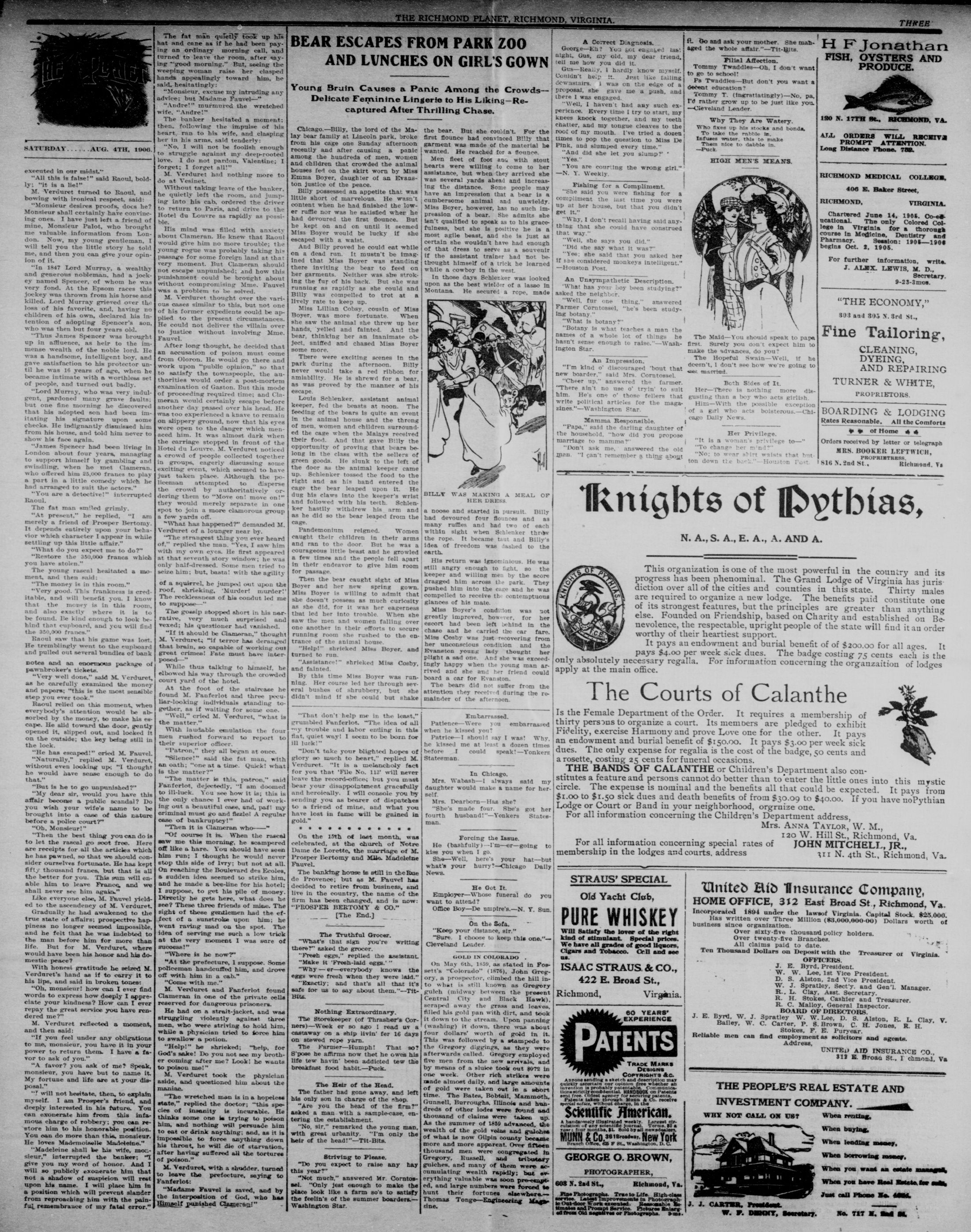
BEAR ESCAPES FROM PARK ZOO AND LUNCHES ON GIRL'S GOWN
Young Bruin Causes a Panic Among the Crowds—Delicate Feminine Lingerie to His Liking—Recaptured After Thrilling Chase.
Chicago.—Billy, the lord of the Malay bear family at Lincoln park, broke from his cage one Sunday afternoon recently and after causing a panic among the hundreds of men, women and children that crowded the animal houses fed on the skirt worn by Miss Emma Boyer, daughter of an Evanson justice of the peace.
Billy possessed an appetite that was little short of marvelous. He wasn't content when he had finished the lower ruffle nor was he satisfied when he had devoured the first flounce. But he kept on and on until it seemed Miss Boyer would be lucky if she escaped with a waist.
the bear. But she couldn't. For the first flounce had convinced Billy that garment was made of the material he wanted. He reached for a flounce.
Men fleet of foot and with stout hearts were willing to come to her assistance, but when they arrived she was several yards ahead and increasing the distance. Some people may have an impression that a bear is a cumbersome animal and unwieldy. Miss Boyer, however, has no such imposition of a bear. She admits she isn't qualified to speak as to his gracefulness, but she is positive he is a most agile beast, and she is just as astonishing.
And Billy proved he could eat while on a dead run. It mustn't be imagined that Miss Boyer was standing there inviting the bear to feed on her garments. Neither was she stroking the fur of his back. But she was running as rapidly as she could and Billy was compelled to trot at a lively rate to keep up.
Miss Lillian Cobsey, cousin of Miss Boyer, was more fortunate. When she saw the animal she threw up her hands, yelled and fainted. And the bear, thinking her an inanimate object, sniffed and chased Miss Boyer some more.
There were exciting scenes in the park during the afternoon. Billy never would take a red ribbon for amiability. He is shrewd for a bear, as was proved by the manner of his escape.
Louis Schlenker, assistant animal keeper, fed the beasts at noon. The feeding of the bears is quite an event in the animal house and the throng of men, women and children surrounded the cage when the Malays received their food. And that gave Billy the opportunity of proving that bears belong in the class with the sellers of green goods. He slunk to the left of the door as the animal keeper came up. Schlenker tossed the food to the right and as his hand entered the cage the bear leaped upon it. He dug his claws into the keeper's wrist and followed with his teeth. Schlenker hastily withdrew his arm and as he did so the bear leaped from the cage.
Pandemonium reigned. Women caught their children in their arms and ran to the door. But he was a courageous little beast and he growled a few times and the people fell apart in their endeavor to give him room for passage.
Then the bear caught sight of Miss Boyer and her new spring gown. Miss Boyer is willing to admit that she doesn't possess as much curiosity as she did, for it was her eagerness that led her into trouble. When she saw the men and women falling over one another in their efforts to secure running room she rushed to the entrance of the animal house.
"Help!!" shrieked Miss Boyer, and turned to run.
"Assistance!" shrieked Miss Cosby, and fainted.
By this time Miss Boyer was running. Her course led her through several bushes of shrubbery, but she didn't mind if she could but shake
"That don't help me in the least," grumbled Fanflorlot. "The idea of all my trouble and labor enting in this flat, quiet way! I seem to be born for ill luck!"
"Don't take your blighted hopes of glory so much to heart," replied M. Verduret. "It is a melancholy fact for you that 'File No. 113' will never leave the record-office; but you must bear your disappointment gracefully and heroically. I will console you by sending you as bearer of dispatches to a friend of mine, and what you have lost in fame will be gained in gold."
On the 15th of last month, was celebrated, at the church of Notre Dame de Lorette, the marriage of M. Prosper Bertomy and Milo. Madeleine Fauvel.
The banking house is still in the Rue de Provence; but as M. Fauvel has decided to retire from business, and live in the country, the name of the firm has been changed, and is now: "PROSER BERTOMY & CO."
[The End.]
The Truthful Grocer
"What's that sign you're' writing there?" asked the grocer.
"Fresh eggs," replied the assistant.
"Make it 'Fresh-ladd eggs'."
Nothing Extraordinary
The Storekeeper (of Thrasher's Corners)—Week er so ago! I read uv a castaway on a ship livin' fer 16 days on stewed rope yarn.
The Farmer—Humph! That so? S'pose he affirms now that he owes his life tew havin' been addicted tew the breakfast food habit—Puck.
The Heir of the Head
"Are you the head of the firm?" asked a man with a sample-case, entering the establishment. "No, sir." remarked the young man, with great urbanity. "I'm only the heir of the head!"—Tit-Bits.
Striving to Please
"Do you expect to raise any hay this year?"
"Not much," answered Mr. Corntossel.
"Only jest enough to make the place look like a farm so's to satisfy the feelin's of the summer boarders.—Washington Star.
the bear. But she couldn't. For the first flounce had convinced Billy that garment was made of the material he wanted. He reached for a flounce. Men fleet of foot and stout hearts were willing to come to her assistance, but when they arrived she was several yards ahead and increasing the distance. Some people may have an impression that a bear is a numbersome animal and unwieldy. Miss Boyer, however, has no such impression of a bear. She admits she isn't qualified to speak as to his gracefulness, but she is positive he is a most agile beast, and she is just as certain she wouldn't have had enough of that dress to serve as a souvenir if the assistant trainer had not be thought himself of a trick he learned while a cowboy in the west. In those days Schlenker was looked upon as the best wizard of a lasso in Montana. He secured a rope made
H.
BILL WAS MAKING A MEAL OF
HER DRESS
BILLY WAS MAKING A MEAL OF HER DRESS.
a noose and started in pursuit. Billy had devoured four flouces and as many ruffles and had two of each within sight when Schlenker throw the rope. It became taut and Billy's idea of freedom was dashed to the earth.
His return was ignominious. He was still angry enough to fight, so the keeper and willing men by the score dragged him across the park. They pushed him into the cage and he was compelled to receive the contemptuous glances of his mate.
Miss Boyer's condition was not greatly improved, however, for her escort had been left behind in the chase and he carried the car fare. Miss Cosby was just recovering from her unconscious condition and the Evanston young lady thought her plight a sad one. And she was exceedingly happy when the young man arrived and she and her friend could board a car for Evanston. The bears did not suffer from the attention they received during the remainder of the afternoon.
Embarrassed.
Patience—Were you embarrassed when he kissed you?
Patrice—I should say I was! Why, he kissed me at least a dozen times before I could speak!—Yonkers Statesman.
In Chicago.
Mrs. Wabash—1 always said my daughter would make a name for herself.
Mrs. Dearborn—Has she?
"She's made four. She's got her fourth husband!"—Yonkers Statesman.
Forcing the Issue
He (bashfully)—I'm—er—going to kiss you when I go.
She—Well, here's your hat—but what's your hurry?—Chicago Dally News.
He Got It.
Employer—Whose funeral do you want to attend? Office Box- Do analysis. N. K. C.
Office Boy—De umpire's.—N. Y. Sun
On the Sofa.
"Sure. I choose to keep this one."—
Cleveland Leader.
GOLD IN COLORADO
On May 6th, 1859, as stated in Fossett's "Colorado" (1876), John Gregory, a prospector, climbed the hill into what is still known as Gregory gulch (midway between the present Central City and Black Hawk), scraped away the grass and leaves, filled his gold pan with dirt, and took it down to the stream. Upon panning (washing) it down, there was about four dollars' worth of gold in it. This was followed by a stumpede to the Gregory diggings, as they were afterwards called. Gregory employed five men from the new arrivals, and by means of a sluice took out $972 in one week. Other rich strikes were made almost daily, and large amounts of gold were taken out in a short time. The Bates, Bobtail, Mammoth, Gunnell, Burroughs, Illinois and hundreds of other lodes were found and thousand of claims were taken up. As the summer of 1859 advanced, the wealth of the gold veins and gulches of what is now Gilpin county became more and more apparent. Over fifteen thousand men were congregated in Gregory, Russell, and tributary gulches, and many of them were accumulating wealth rapidly; but everything valuable was soon pre-empted, and large numbers were forced to hunt their fortunes elsewhere. Thomas Tonge-Engineering Magazine.
Knights of Pythias,
This organization is one of the most powerful in the country and its progress has been phenominal. The Grand Lodge of Virginia has jurisdiction over all of the cities and counties in this state. Thirty males are required to organize a new lodge. The benefits paid constitute one of its strongest features, but the principles are greater than anything else. Founded on Friendship, based on Charity and established on Benevolence, the respectable, upright people of the state will find it an order worthy of their heartiest support.
pays $4.00 per week sick dues. The badge costing 75 cents each is the only absolutely necessary regalla. For information concerning the organization of lodges apply at the main office.
The Courts of Calanthe
Is the Female Department of the Order. It requires a membership of thirty persons to organize a court. Its members are pledged to exhibit Fidelity, exercise Harmony and prove Love one for the other. It pays an endowment and burial benefit of $150.00. It pays $3.00 per week sick dues. The only expense for regalia is the cost of the badge, 50 cents and a rosette, costing 25 cents for funeral occasions.
THE BANDS OF CALANTHE or Children's Department also constitutes a feature and persons cannot do better than to enter the little ones into this mystic circle. The expense is nominal and the benefits all that could be expected. It pays from $1.00 to $1.50 sick dues and death benefits of from $30.09 to $40.00. If you have no Pythian Lodge or Court or Band in your neighborhood, orgrnize one.
For all information concerning the Children's Department address.
For all information concerning special rates of membership in the lodges and courts, address
George—Eh? You got engaged last night, Gus, my old, my dear friend, tell me how you did it.
Gus—Really, I hardly know myself. Couldn't help it. Just like falling downstairs. I was on the edge of a proposal, she gave me a push, and there I was engaged.
"Well, I haven't had any such experience. Every time I try to start, my knees knock together, and my teeth chatter, and my tongue cleaves to the roof of my mouth. I've tried a dozen times to pop the question to Miss De Pink, and slumped every time."
"And did she let you slump?" '
"Yes."
"You are courting the wrong girl."
—N. Y. Weekly.
Fishing for a Compliment.
"She said you were fishing for a compliment the last time you were up at her house, but that you didn't get it."
"Why, I don't recall having said anything that she could have construed that way."
"Well, she says you did."
"Did she say what it was?"
"Yes; she said that you asked her if she considered monkeys intelligent."
—Houston Post.
An Unsympathetic Description.
"What has your boy been studying?" asked the neighbor.
"Well, fur one thing." answered Farmer Corntossel, "he's been studying botany."
"What is botany?"
"Botany is what teaches a man the names of a whole lot of things he hasn't sense enough to raise."—Washington Star.
An Impression
"I'm kind o' discouraged 'bout that
new boaster" said Mrs. Gorman.
new boarder," said Mrs. Corntossel.
"Cheer up," answered the farmer.
"There ain't no use o' tryin' to suit him. He's one o' those fellers that write political articles for the magazines."—Washington Star.
Mamma Responsible.
"Papa," said the darling daughter of the household, "how did you propose marriage to mamma?"
"Don't ask me, answered the old man. 'I can remember a thing about
knigh
KNIGHTS OF PYTHIAS.
F.C.B.
only absolutely necessary rega
apply at the main office.
The Court
Is the Female Department of the
thirty persons to organize a co-
Fidelity, exercise Harmony and
an endowment and burial bene-
dues. The only expense for re-
rosette, costing 25 cents for f
THE BANDS OF CALA-
stitutes a feature and persons o
circle. The expense is nomine-
$1.00 to $1.50 sick dues and do
Lodge or Court or Band in you
For all information concerni
For all information concer-
membership in the lodges and
STRAUS' SPECIAL
Old Yacht Club,
PURE WHISKEY
Will Satisfy the lover of the right kind of stimulant. Special prices.
We have all grades of good liquors,
Cigars and Tobacco. Cell and see us.
ISAAC STRAUS. & CO.,
422 E. Broad St.,
Richmond, Virginia.
60 YEARS' EXPERIENCE
PATENTS
TRADE MARKS DESIGNS
COPYRIGHTS & C.
Anyone sending a sketch and description may quickly ascertain our opinion free whether an invention is patentable, patentable, Commissions strictly credential, HANDBOOK on Patents sent free. Oldest agency for securing patents, MUNN & Co. Receive special notice, without charge, to the
Scientific American.
A handsomely illustrated weekly. Largest circulation of any scientific journal. Terms. $3 a year four months. $1. Sold by all new dealers.
MUNN & Co. 3815 Broadway, New York
Branch Office, 635 F. St. Washington, D.C.
GEORGE O. BROWN,
PHOTOGRAPHER,
608 N. 2nd St., Richmond, Va.
Fine Photographs. True to Life. High-class
service. Latest Improvements in Photograph-
cut-out doors. Work extened. Reasonable
Estimates and Work Services. Enlarged
from Old premises or Photographs.
It. Go and ask your mother. She managed the whole affair."—Tit-Bits.
Filial Affection.
Tommy Twaddles—Oh, I don't want to go to school!
Ps Twaddles—But don't you want a decent education?
Tommy T. (ingratiatingly)—No, pa, I'd rather grow up to be just like you.—Cleveland Leader.
A
The Maid—You should speak to papa first. Surely you don't expect him to make the advances, do you?
The Hopeful Swain—Well, if he doesn't, I don't see how we're going to see married.
Her—There is nothing more disgusting than a boy who acts girlish.
Him—With the possible exception of a girl who acts boisterous.—Chicago Daily News.
"It is a woman's privilege to—"
"To change her mind?"
"No: to wear shirt waists that but
ton down the back."—Houston Post.
Pythias,
A. AND A.
the most powerful in the country and its
The Grand Lodge of Virginia has juris-
counties in this state. Thirty males
lodge. The benefits paid constitute one
principles are greater than anything
based on Charity and established on Be-
ht people of the state will find it an order
trial benefit of of $200.00 for all ages. It
The badge costing 75 cents each is the
in concerning the organization of lodges
N. A., S. A., E. A., A. AND A.
organization is one of the most powerful has been phenominal. The Grand jury over all of the cities and counties is needed to organize a new lodge. The strongest features, but the principles are founded on Friendship, based on Charity, the respectable, upright people of their heartiest support. An endowment and burial benefit of $20 per week sick dues. The badger galla. For information concerning courts of Calantia.
Of the Order. It requires a memorial court. Its members are pledged and prove Love one for the other. Benefit of $150.00. It pays $3.00 per regalia is the cost of the badge, 500 funeral occasions.
ANTHE or Children's Department cannot do better than to enter the final and the benefits all that could death benefits of from $30.09 to $40 your neighborhood, orgrnize one. Admining the Children's Department at Mrs. ANNA TA 120 W. H. Cornering special rates of JOHN and courts, address
United Aid Insurance
HOME OFFICE, 312 East
Incorporated 1804 under the laws.
Has written over Three Million business since organization.
Over sixty-five thousand.
Over twenty-five Branche.
All claims paid to date.
Ten Thousand Dollars on Deposit at OFFICE.
Department also con-
to enter the little ones into this mystic
al that could be expected. It pays from
$30.09 to $40.00. If you have noPythian
grnize one.
Department address,
rs. ANNA TAYLOR, W. M.,
120 W. Hill St., Richmond, Va.
of JOHN MITCHELL, JR.,
311 N. 4th St., Richmond, Va.
Insurance Company,
312 East Broad St., Richmond, Va.
Under the lawsof Virginia. Capital Stock, $25,000.
Three Million ($3,000,000-00) Dollars worth of
ation.
Five thousand policy holders.
Five-five Branches.
Paid to date.
On Deposit with the Treasurer or Virginia.
OFFICERS.
Incorporated 1894 under the lawsof Virginia. Capital Stock, $25,000.
Has written over Three Million ($3,000,000-00) Dollars worth of business since organization.
J. E. Byrd, President.
W. W. Lee, 1st Vice President.
D. S. Alston, 2nd Vice President.
W. J. Spratley, Sect'y. and Gen'l. Manager.
R. L. Clay, Asst. Secretary.
R. H. Stokes, Cashier and Treasurer.
R. C. Malloy, General Inspector.
BOARD OF DIRECTORS
J. E. Byrd, W. J. Spratley W. W. Lee, D. S. Alston, R. L. Clay, V. Bailey, W. C. Carter, P. S. Brown, C. H. Jones, R. H. Stokes, E. F. Burroughs
J. E. Byrd, W. J. Spratley W. W. J.
Bailey, W. C. Carter, P. S. J.
Stokes, F. J.
Reliable men can find employment a
Address,
THE PEOPLE'S REAL
INVESTMENT COM
WHY NOT CALL ON US?
LE'S REAL ESTATE AND ENT COMPANY.
THE PEOPLE'S REAL ESTATE AND
Mansion
Filial Affection
Why They Are Watery.
Who fixes up his stocks and bonds.
To take the rabble in.
Infuses water, this to make
Them nice to dabble in.
—Puck
HIGH MEN'S MEANS
Both Sides of It
Her Privilege
THREE
H F Jonathan FISH, OYSTERS AND PRODUCE.
120 N. 17TH St., RICHMOND, VA.
ALL ORDERS WILL RECEIVE
PROMPT ATTENTION.
Long Distance Phone. 758.
406 E. Baker Street,
RICHMOND, VIRGINIA.
Chartered June 14, 1905. Co-educational. The only Colored College in Virginia for a thorough course in Medicine, Dentistry and Pharmacy. Session: 1905—1906 begins Oct. 2, 1905.
For further information, write:
J. ALEX. LEWIS, M. D.
Secretary.
9-23-3 mos.
303 and 305 N. 3rd St..
Fine Tailoring.
CLEANING, DYEING, AND REPAIRING TURNER & WHITE.
BOARDING & LODGING
Rates Reasonable. All the Comforts
of Home
Orders received by letter or telegraph
MRS. BOOKER LEFTWICH,
PROPRIETRESS.
816 N. 2nd St. Richmond, Vt.
MINT
UNITED AID INSURANCE CO..
312 E. Broaag ST. I. Chmoula, Va
When renting,
When buying,
When lending money,
When borrowing money,
When you want an estate managed,
When you have Real Estate for sale,
Just call Phone No. 4026.
No. 717 N. 2nd St.
THE PLANET
JOHN MITCHELL, JR. • EDITOR.
All communications intended for publication
should be sent as to reach us by Wednesday.
TERMS IN ADVANCE
One Copy, one year,
six months,
1.00
One Copy, six months,
1.00
One Copy, four months,
5.00
One Copy, three months,
4.00
Single Copy,
.00
ADVERTISING RATES
There are FOUR ways by which money can be sent by mail at our risk—In Post Office Monument, or an Express Money Order, and when money can be procured, in a Registered Letter.
MONEY ORDERS—You can buy a Money Order at your Post-Office, payable at the Richmond, and we will be responsible for its safe arrival.
EXPRESS MONEY ORDERS can be obtained at any office of the American Express Co., the United States Express Co., and the Wells Fargo Company, and will be responsible for money sent by any of the companies. The Express Money Order is a safe and convenient way for forwarding money.
REGISTERED LETTER—If a money Order is registered, your Postmaster will Register Letter you wish to send us on payment of ten cents. Then, if the letter is lost or stolen, it can be sent money in the manner at our risk.
We cannot be responsible for money sent in letters in any other way than one of the four ways mentioned above. If you send your money in any other way, you must do it at your
RENEWAL, ENCO.—If you do not want THE PLANET continued for another year after your subscription has run out, you then notify us by email or by telephone, and we will decide that subscribers to newspaper, who do not order their paper discontinued at the expiration time of it, which it has been paid for, make for the payment of the subscription up to date when they order the paper discontinued.
COMMUNICATIONS—When writing to us to renew your subscription or to discontinue your subscription, give us a copy and send it in full, otherwise we cannot find your name on our books.
CHANGE OF ADDRESS—In order to change the address of a subscriber, we must be sent the former as well as the present address.
Entered at the Post-Office at Richmond, Va. the second-class matter.
SATURDAY.....AUG. 4TH, 1906
THE TIMES-DISPATCH'S BLUNDER
The Richmond, Va. Times-Dispatch seems never to tire of discussing some phase of the Negro question and from the tone of some of its editorials one would think that it had its information first hand and was well versed in all of the practices and habits of all kinds of Negroes. As a matter of fact the average white man hereabouts does not know any more about the inner life of the better class of Negroes than do the white men of the North.
He has no means of knowing for he has shut himself up within his own cocoon, so to speak. He is constantly enacting laws to keep the better class of Negroes from coming in contact with him. He refuses as a rule to listen to an address by a Negro and he must therefore glean all information from the servant class that he may have about him. Of course the better class of white people have the better, self-respecting servant class. The lower or medium class employ any Negro woman or man they can find. If the servant spends the night in riotous living in the slums of the city and reports on time or even after time in the morning, it is all right with this class of emplovers.
Many of these kind of people are shipped North too, much to the disgust of the self-respecting Negro servants, who persistently refuse to associate with them.
The Times-Dispatch in it editorial columns of July 27th, 1906 under the caption of "Negroes Draw the Line," says:
An enterprising Negro in New York has purchased apartment houses in the best residential sections of the city, and proposes to fill them with Negro tenants. One of his houses is now occupied by whites, but he is putting them out as fast as possible to make room for families of his own race. He says that although there is objection on the part of the whites, the time will come when whites and blacks in New York will live peaceably and happily together in the same apartment houses.
That is a matter for the New Yorkers themselves to settle, and does not concern us, but there is another statement from this colored reformer which is of general interest. He says that he is fighting the colonization idea; that the New York Negroes have been forced to live in designated sections, where there are bad as well as good Negroes, and that the respectable element have been made to suffer from evil associations, from bad sanitary conditions and from a lack of police protection, all of which are peculiar to the Negro settlements. His purpose he declares, is to provide house room in better localities that the respectable element may move out of the negro colonies and find a more a-
greeable situation for themselves, their wives and their children.
This marks a new era in the history of the American Negro. It is a remarkable fact that so far the Negroes have failed to draw any social lines in their own race. Among the whites there are many grades of society: among the blacks there are no social distinctions. There may be exceptions here and there, but we state the rule. The Times-Dispatch has frequently called attention to this situation in Richmond, and has politely advised the respectable Negroes of the community that for their own protection and improvement and especially for the good of their offspring they should follow the rule adopted by the whites, form their own social circles, and exclude the corrupt and corrupting elements. Until this is done, the Negro race cannot hope to make progress in culture or morality.
The tone of the editorial is all right, but its statements that there are no grades of society among the Negroes of this section is as glaring a mis-statement of fact as any we have ever seen in public print. The colored people of this city are divided into classes, and the disreputable colored people are not permitted to cross this social line. There are colored families here, who do not permit other colored families to cross the threshold of their doors. It is strange that the editor of the Times-Dispatch did not know this.
It is a fact that social entertainments are broken up if certain persons, whose reputations are unsavory are invited. We have known here of a certain social club running a private plenic to Buckroe and taking with them disreputable women as boon companions. The indignation of the community became so pronounced that these kind of entertainments had to be abandoned The better class of colored people would not stand for it.
The white people of this community in many instances seem to be laboring under the same impression as the editor of the Times-Dispatch for they are permitting the establishment of disreputable houses and "speak-ensies" in the very heart of Richmond colored society. In some portions of the town a respectable family cannot secure accommodations without soon being handicapped and annoyed by these questionable houses, which should be confined to their illegitimate limits.
If the editor of the Times-Dispatch or some one he designates will accept the invitation, we will show him the upper society of social Richmond so far as it relates to colored people. Without such chaperoning as we propose to give him, he would be barred from admittance across the thresholds of these doors as much so as would the disreputable Negroes of whom he has made complaint. See straight, Mr. Editor, please before yiu again throw your hatchet.
---
DR. RANSOM'S VINDICATION
The Afro-American press is still teeming with the discussion as to whether Rev. Dr. R. C. Ransom was drunk or whether he was sober upon the occasion of his recent trip to Normal. Ala. There are two things apparent to our minds and the first one is that he was very badly treated on that Pullman sleeping car. We have been on the verge of similar treatment and had the matter reached as an acute a stage as it did in Rev. Ransom's case, we would not not now be writing for the edification and amusement of the public. We were there for business or pleasure and we were not physically disturbed.
The second one is that Rev. R. C. Ransom was not in a proper condition to deliver the address to The Agricultural and Mechanical College of which the able Dr. W. H. Councill is President. If he was treated as he alleges, this will surprise no one. If he took several drinks of alcoholic stimulant as a medicine and not as a beverage, even though it temporarily dazed him, all of the medical school of latter day physicians will excuse him. The public however is made of sterner stuff and it exacts conditions and insists upon performances that it does not itself observe or follow
We are disposed to be charitable to the Rev. Dr. R. C. Ransom. He is a brilliant race leader and had he fallen, we have in our mind's eye many able white pulpit orators who have resorted to similar excesses and lived long behind the sacred desk, and before which many people wondered. But now we have before us the usually emphatic statement of Bishop H. M. Turner, D. D., who presided over the New England Conference that unanimously acquitted Rev. Ransom and announced his character passed. He makes a strong plea for the distinguished Massachusetts' orator and his endorsement will no doubt do him much good.
We confess that we are of the opinion that Rev. Dr. Ransom was not given full justice in the sense that we understand it. He was tried in Rhode Island for an offense committed in Alabama, and with no reasonable opportunity for the witnesses to the affair to be present and give testimony. They acquitted him on exparte evidence, on his own statement of the charge against him. It should create no surprise then that the enemies of Rev. Ransom
should raise the cry of "white-wash" and to a disinterested observer, it would look that way. The proper course to have been pursued was to appoint a committee to go to Alabama to investigate these charges to summon and hear witnesses and to make their report to the next meeting of that same Conference. In the meantime Dr. Ransom should have been treated as an innocent man and this report when submitted. If the facts are as the New England Conference alleges them to be would undoubtedly have cleared this distinguished divine and all right thinking, conscientious men would have been forced to the conclusion that he had been grievously slandered and scandalously wronged.
We did not intend to have anything to do with the discussion, but we have already been bombarded by advocates of both sides of the controversy and we are driven in self defense, even if with poor judgment to express an opinion formed after an impartial review of the facts presented.
Viewed from any standpoint, how ever, it seems that Dr. Ransom has been punished enough and we hope that our friends and our enemies will take this view of the situation and cease firing in the direction of this able and eloquent churchman. Still, this is hardly possible as long as the Niagara movement is in evidence and the Booker T. Washington venture occupies the front of the foot-lights.
"GOV. WARFIELD'S BLUNDER."
We would to God that William Lee, colored, who criminally assaulted two white females in Somerset County, Maryland had never been born. His crime was heinous and his death on the gallows deserved, but the Rihmond, Va. Times-Dispatch stated the truth and the whole truth, when it said in its issue of the 27th ult.:
William Lee, the Maryland Negro who assaulted two white women in Somerset county was sneaked out of Baltimore on a boat by the sheriff, taken to an island in the county and executed. This was done by direction of Governor Warfield, in order, we are informed, to escape the fury of the mob and prevent the Negro from being taken from the officers and lynched.
This, as our neighbor, The News Leader, has already indicated, was a pitiful—not to say disgraceful—surrender to the mob, and a discredit to the government of Maryland. The Governor is sworn to up hold the law, and he should have called out, if necessary, the entire military forces of Maryland to protect the State's prisoner from mob violence and enable the officers to execute the sentence of the court in the usual manner and at the designated place.
Say what you may in favor of lynching, when the State has once taken a prisoner into custody, it must protect him at all hazard and at whatever cost, and there must be no compromise with the mob. It is a reflection upon the dignity of government: it is a travesty upon our institutions, when the Governor of a great State resorts to bushwhacking in order to dodge the mob and execute the sentence of the court.
Governor Warfield had an opportunity to make a demonstration and give the mob a much-needed lesson. Instead he gave it official recognition and made obeisance. Nor can we refrain from adding that this action was taken after the Governor of Virginia had saved William Lee from the Somerset mob by sending Virginia troops to the rescue.
Gov. Warfield did well in the beginning, but he made a big blunder at the close. His action was the next worse thing to permitting the lynching. The after effect will be felt by Maryland and the dollars saved in this instance will no doubt be spent many times over upon a similar occasion, when the criminal may be a white man instead of a colored one. There was no danger of a loss of life, if Maryland's Chief Executive had sent enough troops to overwea the mob and to maintain the dignity of the commonwealth.
The mistake made by him was caused no doubt by the fact that he was looking at the fiend Lee rather than the majesty of the law, which he was sworn to uphold and protect at all hazards.
It is unfortunate, though that the race at this peculiar stage if its existence should be handicapped and embarrassed by such lawless characters like Lee. We are no wise responsible for his existence and every-where colored men will be found who feel relieved at his legal taking off.
We must continue to relieve the situation as much as possible and do all in our power to reform the lawless classes in our midst. White people are similarly afflicted, but the rancor of race prejudice is not here for them to combat with reference to their depraved classes. Every would-be lyncher who craves to burn a Negro victim is just as bad as William Lee was and would be liable to commit a crime as heinous as the one of which he stood convicted.
We need to show the good side of the Afro-American and make friends with every white person, North and South, who seems disposed to help us. In the meantime we should strive to increase our financial holdings and multiply our tax-paying
THE RICHMOND PLANET, RICHMOND, VIRGINIA.
e-wash" rver, it proper was to to Ala-charges ses and the nextference. should properties. This will bring respect where nothing else will. If we stop spending the larger proportion of our earnings in pleasure and riotous living and invest it in real-estate and business enterprises, the sunlight of material prosperity will dawn upon us and many of the ills from which we now suffer will disappear forever.
TEN DROW AT ANGEL
Yachts Nora and With Fa
RUSSIAN TROOPS MUTINY IN FINLAND
Uprising Said to Be Part of Huge Military Conspiracy.
NSPIRED BY THE "RED GUARD"
Helsingfors, Aug. 1.—A gigantic military conspiracy, aiming at the simultaneous capture of Russia's three great sea fortresses, Cronstadt, Sebastopol and Sveaborg, arranged by the revolutionary military league, was prematurely sprung by an attempt to arrest members of a company of sappers who had mutinied on account of the death of one of their comrades, alleged to have been due to ill treatment.
The entire garrison of the fortress at Sveaborg flamed out instantly in revolt. All the artillerymen and sappers garrisoning the place were involved. Only four companies of infantrymen remained loyal. The mutineers seized 40 machine guns and practically all the quick fireers and light artillery in the fortress, but even with this aid they were unable to hold the main fort against the loyal infantry. The fighting continued all night long. The heaviest firing was heard from 10 o'clock in the evening until 1 in the morning.
A detachment of civilian revolutionaries seized the marine barracks on Skatudden Island, hoisted the red flag and were joined by all the marines. Nine cruisers, torpedo boats and destroyers opened fire on the barracks. This fire was answered from the third-story windows of the barracks with machine guns and rifles. The torpedo boats and destroyers which were lying closer to the shore were subjected to such a hot fire from the barracks that their crews were driven below decks. They finally steamed out and joined in the bombardment with the cruisers. This sea attack was in co-operation with attacks by cossacks and infantry from the land side, which began at 9 o'clock in the morning and continued through the whole day.
The exact situation at Sveaborg is not known. Rumors are in circulation that the entire fortress has now fallen into the hands of the insurgents, but they lack confirmation. It is believed that this cessation of fighting is but a prelude to the renewal of the battle between the mutineers and the government troops.
An authoritative estimate of the killed and wounded cannot be obtained, but the casualty list on both sides must be heavy, for the fighting was waged with desperation. Some reports say that more than 600 were killed or wounded.
There are various rumors to be heard regarding the fate of the officers who were at Sveaborg and in the Skatudden barracks. According to one rumor almost all the officers, and according to another, almost all the junior officers, sided with the mutineers.
The "Red Guard," whose leaders were cognizant of the plot, dispatched an expedition by a special train, as soon as the revolt broke out, to cut the railroad track outside of the city in order to prevent the arrival of reinforcements. A general strike was declared, and was obeyed by the workmen of all factories.
EMERY ACCEPTS NOMINATION
Lincoln and Democratic Tickets.
Bradford, Pa., July 30.—Hon. Lewis Emery, Jr., of this city, has sent his letter accepting the nomination for governor, to the state chairmen of the Lincoln party and the Democratic party, respectively. The letter is quite lengthy.
On July 17 Mr. Emery was notofled by letters from the chairmen respectively of the Lincoln and Democratic state conventions of his nomination by those bodies for governor of Pennsylvania.
It was originally planned that committees should notify him in the usual way, but subsequently it was decided that the notification should be by letter. However, the other candidates on the tickets of the affiliated parties will be given formal notice of their nominations at a public meeting to be held in Pittsburg, August 23, and the candidate for governor will be one of the speakers on that occasion.
ROOSEVELT GIVES A DOLLAR
Bends Contribution to Aid In Electing
Republican Congressman
Republican Congressmen.
New York, Aug. 1—President Roosevelt has contributed $1 to the Republican congressional committee campaign fund. The contribution was sent in response to a general appeal for $1 contributions. Chairman Sherman, of the congressional committee, made public the president's letter enclosing his contribution to the fund. The letter follows:
"Oyster Bay, N. Y., July 25, 1906.
"Dear Mr. Sherman—I have your letter of the 24th instant and enclosures.
I send my dollar. I think it an admirable plan. I and I congratulate you upon the success that bids fair to attend the movement. Sincerely yours,
"THEODORE ROosevelt."
Negro Tries to Kill Entire Family.
Macon, Ga. July 31.—Joseph Morris,
a negro youth, attempted to take the
lives of the entire family of George E
Bloodworth at their home near Macon.
While the family were at supper Morris
stopped up to the house and fired
with a shot gun. Over 60 shot struck
Bloodworth's face, and nearly as many
struck his wife. Mrs. Bloodworth held
an infant daughter, who was un-
harmed. The negro escaped, but is
being pursued by citizens.
TEN DROWNED AT ANGLESEA, N. J.
Yachts Nora and Alvin B. Capsize,
With Fatal Results.
VICTIMS WERE OUT FISHING
Anglesea, N. J., July 30.—Two yachts
coming in from the fishing banks capsize
on Hereford Inlet bar off here,
and so far as can be ascertained ten
persons lost, their lives. There were
22 persons on one yacht, of whom
nine were lost, and 12 on the other,
all of whom but one were saved. That
not more fell victims to the rough sea
was due to the heroism of Captain
Henry S. Ludlam, of the Hereford Inlet
life saving station, and a crew of five
men. It was at first thought that from
14 to 28 persons had been lost.
The correct list of dead, of which
the first six bodies have been recovered
and identified, is as follows:
Herbert Hammell, 20 years old, Crescentville, Montgomery county, Pa. Edward Snyder, 51 years old, No. 15 South Sailor street, Philadelphia. Frederick R. Fisher, 27 years old, No. 339 Lamonte street, Roxborough, Philadelphia. Mathias Reid, corner William street and Josephine avenue, West Conshocken, Pa. Samuel Moore, No. 2832 Stiles street, Philadelphia. Thomas Green, Gloucester, N. J. Griffith Williams, 60 years old. No. 1240 Point Breeze avenue, Philadelphia. Calvin Weaver, No. 4971 Thompson street, Philadelphia.
George Howard, No. 2921 Norris
street, Philadelphia.
Jeremiah Crosson, No. 3916 Reno
street.
The two that got into trouble were the sloop yacht Nora, which had on board Captain Herbert Shivers, his mate and 30 passengers, and the sloop Alvin B., with a party of 12. The Nora had gone to the fishing banks at Five Fathom bank, about 10 miles out to sea, early in the day. When the wind began to freshen Captain Shivers decided it was time to make port, and with the assistance of a gasoline engine and a good spread of canvass he made good time towards Angiesea. As the sloop bowled along, the wind was getting stiffer and the sea rougher. Captain Shivers, from long experience, knew how treacherous is the Hereford bar, and approached it with his usual caution. The sand obstruction is about a mile from shore. Just as he was about to go over it a heavy squall struck the Nora. Despite the efforts of the captain, the craft keeled over and was hit by a huge wave. The wind and the wave coming together was more than the yacht could stand, and it turned completely over, throwing the 32 occupants into the sea. As the boat turned over the mast snapped like a reed. There was an agonizing cry as the yacht turned turtle, which was quickly silenced when nearly all the victim disappeared beneath the water. In the unequal fight against the elements the struggling men disappeared one by one, until only 18 were left clinging to the boat. After hanging to the yacht for nearly an hour, and as hope of rescue had almost been abandoned, a government life boat, commanded by Captain Henry S. Ludlam, of the Haverford Inlet life saving station, hove in sight. As he came near he shouted encouragement to the men clinging to the Nora and after some maneuvering managed to get close to the capsized vessel. He was not a moment too soon, for as he came within a boat's length of the Nora four men, weakened from ex haustion, let go their holds and began floating away. Captain Ludlam threw his boat around, and the four half drowned men were drawn out of the water.
Shortly after the survivors of the Nora were brought ashore, another yacht, the Alvin B. was seen to capsize about a mile above the place where the Nora went over. There were several boats in the vicinity at the time, and all but one person were saved. The Alvin B. was owned by E. L. Hallman, a lawyer, of Pottsville, Pa. He and a party of friends were on board at the time.
The inquest which was held by Coroner Thompson found no blame attaching to any one in connection with the disaster. Witnesses were questioned regarding the mishap to both boats, and the jury, of which John W. Young was foreman, returned a verdict of accidental drowning. In its report the jury highly commended Captain Sbivers, of the Nora, for his heroic behavior in diving into the hold of the submerged vessel after life preservers, and also heartily praised Captain Ludlam, of the Hereford life saving station, and his crew of volunteers, who rescued the drowning men, and Captain Lilley, of the catboy Violet, who added very materially in the work of reeve.
1906 AUGUST 1906
Su. Mo. Tu. We. Th. Fr. Sa.
1 2 3 4
5 6 7 8 9 10 11
12 13 14 15 16 17 18
19 20 21 22 23 24 25
26 27 28 29 30 31
Railroad Foreman Shot and Killed.
Bluefield, W. Va., July 21—Asa Dillon, a section foreman on the Norfolk & Western railroad, was shot and killed at Rock, near Bluefield, Saturday night in a fight that occurred at a dance, and in which Dillon, Robert Mustard, Lige Davidson and Philip Horn were the principals. Horn, Davidson and Mustard surrendered and were given a hearing today.
Coal! Coal! Coal!
OF THE VERY BEST ANTHRACITE COAL IN STOVE, EGG and NUT SIZES. SPLINT COAL: LUMP and HAIL SIZES. All of our product whether purchased by the Bushel or by the Ton carefully screened before leaving our yards.
Good Seasoned Wood.
SOLD AT THE LOWEST PREVAILING PRICES. SATISFACTION GUARANTEED.
'Phone Us Your Orders, if you haven't the time to send them. A call on Long Distance 'Phone 83 will receive prompt attention.
Now is the time to place your WINTER ORDERS.
CRUMP & WEST Coal Co.,
YARD3, 18th and Cary Streets, and 16th and Clay Sts., Richmond, Va.
A WEEK'S NEWS CONDENSED
Thursday. July 26.
A. Baldwin Johnson, one of the leading coal dealers of Washington, D. C., was found dead in bed from heart disease.
The 14th annual meeting of the United States League of Building and Loan Associations was held at Cincinnati, O.
Two men were killed and four injured, one fatally, in a freight wreck on the Northern Pacific railroad at Valley City, N. D.
The home of Mr. and Mrs. Daniel Sartivel, near Carlton, Minn., was struck by lightning, and three children were burned to death and Mrs. Sartivel was fatally injured.
Friday. July 27.
Henry Wise, of Philadelphia, is under arrest at Reading, Pa., charged with 20 robberies.
Mary F. Idler, aged 65 years, of Philadelphia, was found starved to death in her home, her body being covered with filth.
The plant of the Monroe Lumber company at Monroe, La., the largest in north Louisiana, was destroyed by fire, causing a loss of $150,000.
Mrs. H. A. Leaptrot was shot and killed and her husband fatally injured while sitting on their porch at Wynne, Ark., by three mounted men, who then escaped.
Saturday. July 28.
Thirty persons were injured, two fatally, in a wreck of passenger trains at Springfield, Mo.
Fire at Maryville, Tenn., destroyed the county court house and several buildings, entailing a loss of $150,000. Alexander Cruickshank, one of the founders of the Bath Silk company, died at his home at Bethlehem, Pa., of cancer, aged 67 years.
In a collision between an engine and a car on the Reading railway near Reading, Pa. William Smith was killed and A. F. Bender severely injured. Francis B. Reynolds, a New York bookmaker, either fell or threw himself from the fifth-story window of the Martin House and was instantly killed.
Monday, July 30.
Charles P. Neill, of Washington, D. C., has been re-elected president of the bureau of statistics and labor. Leopold Lewith, a well-known Wilkes-Barre, Pa., merchant, 56 years old, dropped dead in his store. He was a former resident of Cleveland. Michael Locuskey was killed and David Harney fatally injured by the accidental discharge of a blast at the Richards colliery, near Shamokin, Pa. William Harway, of Danville, Va., was killed near Sunbury, Pa., while stealing a ride on a Pennsylvania railroad freight train by falling between the cars.
Tuesday, July 31.
Secretary Bonaparte, of the navy, who has been ill at Lenox, Mass., has returned to Washington and resumed his duties.
The Commercial LLaw League of America met in convention at Asheville, N. C. Nearly 300 delegates are in attendance.
Harry Mitchell, aged 70, an old soldier and one of "Buffalo Bill's" scouts when fighting for the government, was found dead in bed at his home near Berrien Centre, Mich.
The cruiser Marblehead, which recently furnished neutral ternitory upon which peace was negotiated between Salvador and Guatemala, has arrived at Corinto, Nicaragua, on her way to San Francisco.
Wednesday, August 1.
A new telegraph cable was opened between Japan and the United States, via Bonin.
The National Prison Association will hold its annual convention at Albany, N. Y., September 15-21.
Fred M. Warner was nominated for governor of Michigan by the Republican state convention at Detroit.
In a lovers' quarrel at Jacksonville, Fla., Paul Daniel fatally shot Bertie Toomer and then killed himself.
The Syrian leaper, George Marun Rashid, has been returned to West Virginia by the Maryland authorities.
The 72d annual convention of the Christian Missionary Society of Eastern Pennsylvania opened in Wilkes-Barre, with 100 delegates present.
PRODUCE QUOTATIONS
The Latest Closing Prices In the Principal Markets.
PHILADELPHIA — FLOUR steady;
winter extras. $3.19@3.25. Pennsylvania
nailer roller, clear. $3.35@3.50. city mails
fancy. $4.60@4.65. RYE FLOUR nirm;
per barrel. $3.55@3.75. WHEAT firm.
No 2. Pennsylvania vanilla red. $77@77%CORN steady; No 2 yellow local, 60c
OATS steady; No 2 white clipped, 43@42%gc; lower grades, 41c. HAY
stress; No 1 timothy. $17.80
PORK firm; family, $19.59. BEET
steady; beef hams, $19. Poultry.
Live fish; hens, 14@14%c; old roo-
ters, 9@19%c; Dressed firm; choice
rooers, 0@10%c; old oysters, 9c.
TER steady; cream cheese, 14@EGG
firm; selected, 21@22%; nearby, 19c.
western, 19%c; southern, 16%c @18c
per dozen. POTATOES steady; new
per barrel, $1.50@17.5.
BEEAT weak; No.
2 spot, 78%@78%c; steamer. No.
2 spot, 72%@72%c; southern, 73%@
77%c; CORN quiet; mixed spot, 53%
@55%c; steamer mixed, 52%@52%c;
southern, 59c. OATS barely steady;
southern, 59c. OATS barely steady;
No. 4, 39%@39%c; mixed, 0, 3
29c; No. 3, 38%@38%c; No. 4, 37%
@37%c. BUTTER steady; creamery
separator extras, 20%@21c; held, 17%
18c; prints, 21%@22c; Maryland and
Maryland, 15@16%c. EGGS steady; fancy Mar-
silla, 17%c; Virginia, 17%c.
West Virginia, 17c; southern, 16%c.
Live Stock Markets.
PITTSBURG (Union Stock Yards)—
CATTLE steady, choice, $7.55@6;
prime heavies, $8.00; medium, $7;
heavy Yorkers, $7.05@7.10; light Yorkers
and plgs, $7.25@7.30; roughs, $5.50;
HEEP slow; prime wethers,
$5.50@7.30; culla and common, $2.50@
3.50; lambs, $4.50@7.00; veal calves,
$6.50@7.
Missing Girl a Suicide.
Harrisourg, Pa., Aug. 1.—Miss Lille Frantz, who was to have been married next month at Newport, Perry county, and who disappeared from her home there two weeks ago, was found dead two miles west of Newport, along the railroad tracks, by a trackwalker, with every evidence of having committed suicide by taking strychaine.
Fails to Swim the English Channel. Dover, July 31.—Jabez Wolfe, the amateur swimmer, has made another unsuccessful attempt to swim the English Channel. He started late last night, but abandoned his effort early this morning on account of his injured leg.
Foreshadows End of Guillotine. Paris, July 30.—The budget committee in taking up the estimates for 1907 struck out the salary of M. Diebler, Jr., the public execution-r, thus foreshadowing the disappearance of the guillotine.
Killed By Divorced Wife
Shreveport, La., July 31—Charles Attaway was shot and instantly killed at Blanchard, near this city, by his divorced wife, Mrs. William Kent, Jr. Attaway, who was insane, went to Kent's home and demanded his children. Kent appeared on the scene, and while he was wrestling with Attaway Mrs. Kent secured a rifle and shot her former husband through the heart.
NEW YORK POLICEMAN A HERO
Loses His Own Life Trying to Save a Drowning Boy.
New York. July 30.—In an unsuccessful attempt to save a drowning boy, policeman William Hedderman lost his life in Cromwell creek at 161st street and Jerome avenue, when help was near at hand. Weighed down by his clothes, the policeman struggled desperately to keep his head above the surface, but he was soon exhausted and sank.
A brother policeman, who jumped into the creek in an endeavor to save his comrade, was nearly drowned. He too, found his uniform dragging him under the water, but managed to reach the shore. The boy who was drowned was one of several who were in swimming.
EXPLOSION OF GUN COTTON
Four Men Killed and One Missing at Newark, N. J.
Newark, N. J., Aug. 1.—Four men were killed and a fifth is missing as a result of an explosion of gun cotton in the works of the Cooper Chemical company on the outskirts of this city. The known dead are: Albert Stark, Charles Zoelitzel, Max Merklinger, Antonio Buchwald. The missing man's name is not known. It is believed that he was blown to pieces. The building was totally destroyed.
Spanish Steamer Burned at Sea.
Madrid, Aug. 1.—The Spanish steamer Cabo-Trafalgar has been burned at sea. Her crew was rescued by the British steamer Universal, which also towed the shell of the burned steamer's hull to Santander. The cargo of the Cabo-Trafalgar is a total loss.
Jeweler, Robbed and Murdered
Madison, Wis., July 31.—The dead body of Joseph D. Bardenheir, a jeweler, missing since last Monday, was found in the woods three miles east of here. He had been robbed and murdered.
IT WILL PAY YOU To interest yourself in promot ing the CIRCULATION of the RICHMOND PLANET.
```markdown
```
THE FAYLOR
SATURDAY.....AUG. 4TH. 1906
GRAIN FOR COWS ON GRASS
Several experiments have been conducted to test the advantage of feeding grain thus. The conclusions reached were, that the grain fed when grass was plentiful and while it was yet succulent, did not bring any profit over and above the cost of the grain. In some instances, as when grain was fed in large quantities, it was said that the increase in milk and butter fat did not pay for the cost of the grain. The conclusion has gone extensively abroad, therefore, that it does not pay to feed cows grain or meal on grass, when the supply of the grass is abundant.
I am not prepared to accept such a view, Prof. Shaw goes on to declare in presenting his views in the Orange Judd Farmer. It seems to me it is a conclusion reached without considering any phase of the question. If the increased return in milk or butter fat pays for the cost of the grain, and no more, my contention is, that in the end, such feeding is attended with profit.
If the grain is thus paid for, one item of profit is found in the pasture saved. It is only reasonable to suppose that for every pound of dry matter consumed in the grain, an equal amount of dry matter will remain unconsumed in the pasture. This would mean that the carrying power of a pasture is increased to the extent of the saving effected by feeding grain.
A second item of profit will probably be found in what is termed the residual effect of the grain feeding. This has been well brought out by Prof. Roberts, of Cornell. Six cows were selected that had been given a liberal allowance of grain on pasture the previous season, and six were also selected that had been grazed in the same field but without grain. All were put upon pasture without grain. The lot grained the preceding summer produced 16 per cent. more milk than the other lot. The heifers in this lot in milk, also, made a better development than the heifers in the other. This result is in accord with the view of many practical men on this question.
A third item of profit would arise from the fertilizer obtained from the grain. Where wheat, bran and cottonseed meal were fed, the advantage would be considerable from this source. Putting these three items together, they should represent a satisfactory profit, even when the increase in milk production and butterfat did not more than pay the cost of the grain.
OUTDOOR ROUGHAGE RACK
One Devised by Nebraska Experiment Station Which Will Give Good
In the accompanying illustration is shown a roughage feeding rack that is used with considerable success upon
ROUGHAGE RACK FOR SHEEP.
the Nebraska experiment station farm. The corners of the rack stand between seven and eight feet high, with a plank-sided bottom. The width is about four feet, and length can be whatever may be desired. The general plan of the work is brought out in the accompanying illustration.
ANIMAL POINTS
Poor care degenerates good stock. Hogs are frequently made sick by soap in the kitchen slop. Hog feeds from restaurants and hotels should be carefully looked over for soap, glass and other dangerous things. We used to think we would not have a separator as there was so much to wash, but would not have cows without one now. Keep the colts in a pasture by themselves. They will run more flesh off cows and sheep than you can put on with the best of feed. There should be a good stallion in every locality. Often he would have to be purchased by a horse breeders' association of local breeders. The heavily padded collar is all right for heavy drawing in cool or cold weather, but not the thing for a hot summer's day.
Keep a big lump of rock salt where the cows can get at it every day. If salted only once a week they eat too much at a time causing looseness of the bowels. It also retards digestion
Good Cattle Feeds
For feeding cattle for the general market, I find clover and timothy give the best results. This, of course, is supplemented by pasturage. The grains I feed are corn and some oats. During the usual fattening period I give to each steer from 30 to 60 bushels of corn. I give oil meal the last six weeks, one to two pounds per day per steer. I grind all corn, cob and corn together. I have my own grinder and a 12-horsepower steam engine. I can grind enough corn in one day to supply a load of cattle three weeks.
BORS AND INTEREST THEM IN THE PLANET. WE WILL HELP YOU TO OBTAIN A PREMIUM.
COLORED INFANTRY IN RESCUE OF ROUGH RIDERS AT SAN JUAN HILL, JULY 2, 1898, SIZE 20X28 AND 20X24 INCHES, ADMIRAL DEWEY'S GREAT NAVAL BATTLE OFF CAVITE IN MANILA BAY, MAY 1ST, 1898, NAVAL BATTLE, DESTRUCTION OF ADMIRAL CERVERA'S SPANISH FLEET OFF SANTIAGO DE CUBA, JULY 3RD, 1898, SIZE 22X28 INCHES; LAND BATTLE, CAPTURE OF EL CANEY, EL PASO AND FORTIFICATIONS OF SANTIAGO, JULY FIRST AND SECOND, 1898, SIZE 22X28 AND 22X27 INCHES. WE WILL SEND YOU ONE OF ANY OF THE FOLLOWING BATTLES OF THE CIVIL WAR ON THE SAME TERMS. THE PICTURES LIKE THE OTHER BATTLES ARE FINISHED IN COLORS. THEY ARE 22X28 INCHES AND RETAIL AT ONE DOLLAR EACH. WE WILL FURNISH FRAMES FOR ANY OF THESE FINE CHROMOS FOR 2 DOLLARS & 50CTS. EACH ADDITIONAL. BATTLE OF GETTYSBURG, BATTLE OF SHILOH, BATTLE OF FIVE FORKS, VA., BATTLE OF ATLANTA, GA., BATTLE OF SPOTTSYLVANIA, VA., BATTLE OF VICKSBURG, MISS., BATTLE OF LOOKOUT MOUNTAIN, TENN., BATTLE BETWEEN THE MONITOR AND THE MERRIMAC, BATTLE OF BULL RUN, VA., BATTLE OF CHANCELLORSVILLE, BATTLE OF THE BIG HORN, (CUSTER'S LAST CHARGE) STORMING OF FORT WAGNER, S.C., (COLORED TROOPS IN THIS FIGHT), BATTLE OF NEW ORLEANS, LA., CAPTURE AND DEATH OF SITTING BULL, THE GREAT INDIAN CHIEFTAIN; FORT PILLOW MASSACRE, FALL OF PETERSBURG, VA., BATTLE OF WINCHESTER, VA., BATTLE OF OLUSTEE, FLA. WE WILL SEND FAMILY RECORD, SIZE 22 BY 28, WHICH CONTAINS SPACE FOR PHOTOGRAPHS OF PARENTS AND TEN CHILDREN. WE WILL SEND SOLDIERS WAR RECORD (CERTIFICATE OF SERVICE IN UNITED STATES ARMY.)
FOR ONE YEAR EACH, OR THEIR EQUIVALENT, WE WILL SEND YOU A COPY OF UNCLE TOM'S CABIN, THE MOST INTENSELY INTERESTING BOOK IN THE COUNTRY. WE WILL SEND YOU A GOLD-PLATED BROOCH WITH YOUR PICTURE THEREIN, YOU TO
STANDARD OIL COMPANY SUED
Atlantic Refining Company Accused of Interference With Oil Inspector.
```markdown
```
Interference With Oil Inspector.
Philadelphia, Aug. 1. — Complaint was made to Attorney General Hampton L. Carson by former Judge James Gay Gordon, with the request that suit be entered, to restrain the Atlantic Refining company from obstructing Captain Frank G. Edwards, oil inspector of Philadelphia-county, in the performance of his duties.
Mr. Gordon said his action was taken "to defend the rights of the commonwealth and to protect the public from being openly cheated by the Standard Oil company, of which the Atlantic Refining company is part and parcel."
In their depositions Mr. Gordon and Captain Edwards aver that the Atlantic Refining company has endeavored to practically abolish the office* of oil inspector, a position to which Mayor Weaver appointed Captain Edwards March 6 of this year, to fill the vacancy created by the resignation of Peter Lane, Jr. The office is authorized by an act of assembly of 1874, which provides that all oils used as an illuminant and not reaching a 110-degree fire test shall be prohibited from sale.
Judge Gordon in his statement declared that the Atlantic Refining company paid Inspector Lane a lump sum of $4000 instead of the fees required by law; that Mr. Lane had never attended to the duties of his office, and that the inspection brands were "handed over to employees and agents of the company to use as they saw fit."
"Mr. Edwards found when he went into office," said Judge Gordon, "that it was conducted by a clerk and a deputy inspector, one employed by the Atlantic Refining company, which is nothing more than another name for the Standard Oil company."
C
The attorney general asked that the complaint be filed in writing, and fixed August 14 for another hearing.
MURDER VICTIMS BURIED
Mrs. Pearce and Her Two Children Consigned to the Grave.
Washington, Pa., Aug. 1.—Mrs. Samuel Pearce and two of her children, all of whom were killed at their home in Cecil township on Sunday night by the negro, Elmed Dempster, was held from the Presbyterian church at Miller's Run, a mile from the scene of the tragedy.
The body of Mrs. Pearce and the 6-months-old, baby were buried in one coffin, while the 5-year-old daughter, Margaret, was buried beside the mother and babe.
Samuel Pearce, the husband and father, went to the funeral, attended by a brother. He was in a seriously nervous condition, broken by grief and shock. He has not been at his home since the tragedy, and says he will never go there again.
Officers visited the scene of the murder and carried with them the negro Dempster's shoes, which they fitted into the tracks in the soil about the Pearce home. Dempster was taken before a justice of the peace, but waived a hearing, replying to the charge read to him. "What's the use; I'm guilty, and there's no use having a trial now." The inquest into the murder, it was announced, will be held on Friday. "Gus" Patterson and John Rucker, the two negroes whom Dempster implicates in another murder and who were arrested upon Dempster's information, were placed in jail here. They will be held for the grand jury.
Marquis Sent to Prison.
Paris, Aug. 1.—The Marquis of Montebello, a recent candidate for election to the chamber of deputies, was sentenced to 15 days' imprisonment and $100 fine for assaulting his successful opponent, M. Larguier, in the street.
Samoan Volcanoes Active
Tutula, Samoa, July 9, via San Francisco, Aug. 31. The volcanoes on Savail are still active, and the island is increasing in area. Several new springs have appeared where water was not known to exist before.
Trick in Leading Horses
When leading several horses to and from the pasture if one lags behind I tie him quite close to another. I often tie them in pairs and teach them to go without leading.
STRAIGHTENS
KINKEY or CURLY HAIR that it can be put
up in any style desired consistent with the
WE WILL SEND YOU THE PLANET AND THE ST LOUIS, MISSOURI, SEMI-WEEKLY GLOBE DEMOCRAT, ONE OF THE LEADING REPUBLICAN JOURNALS IN THE UNITED STATES FOR $2.25 PER YEAR FOR BOTH.
WE WILL SEND YOU THE PLANET AND THE COSMOPOLITAN MAGAZINE FOR $2.25 PER YEAR FOR BOTH.
WE WILL SEND YOU THE PLANET AND McCLURE'S MAGAZINE FOR $2.25 PER YEAR FOR BOTH.
FURNISH THE PHOTOGRAPH, ONE FOR TAIN PEN, GOLD POINT; ONE LADIES FOR ONE BREAST-PIN, GOLD FILLED; HALF FOR EN LINEN HANDKERCHIEFS, ONE AL CLOCK, ONE DOZEN NAPKINS, ONE DOZEN TOWELS, ONE CHOCOLATE POT, PAIR VASES, ONE PAIR KID GLOVES, HAM, ONE TURKEY.
FOR TEN NEW SUBSCRIBERS
OR THEIR EQUIVALENT, WE WILL SEND PICTURES, ONE ONLY, OF PRESIDENT THEODORE ROOSEVELT, DR. BOOKER T. WASHINGTON, BATTLE OF SANTIAGO, LAND BATTLE OF QUASIMAS NEAR SANTIAGO, JUNE 24, 1898, SHOWING THE NINTH AND TENTH COLORED CAVALRY IN SUPPORT OF ROUGH RIDERS, SIZE 20X28 AND 20X24 INCHES, LAND BATTLE AND CHARGE OF THE 24TH & 25TH
READ THE GREAT INDUCEMENTS OFFERED BY THE PLANET
THE RICHMOND PLANET, RICHMOND, VIRGINIA
IF YOU WILL TALK WITH YOUR NEIGH-
FOR TWO YEARLY SUBSCRIBERS
FOR FIVE NEW SUBSCRIBERS.
REQUISITE NUMBER IS OBTAINED, WE WILL FORWARD THE PRESENT INDICATED. A PERSON WHO TRIES TO GET FORTY SUBSCRIBERS AND GETS TIRED MAY INDICATE HIS WISH AND WE WILL SEND THE PRESENT FOR THE NUMBER HE HAS SECURED OVER FIVE. THE NUMBER WILL BE FOR NOT LESS THAN FIVE NOR MORE THAN TEN AND NOT LESS THAN TEN NOR MORE THAN TWENTY AND NOT LESS THAN TWENTY NOR MORE THAN FORTY, TO DETERMINE THE PRIZE TO WHICH THE WORKER IS ENTITLED.
IF ANYTHING IS DESIRED NOT SPECIFIED IN THIS LIST, WRITE US ABOUT IT AND WE WILL TELL YOU IN WHAT CLASS IT BELONGS.
A man in a suit is talking to a woman in a chair.
PLANET
WEEKLY
READING
UNITED
H.
T AND
R $2.25
T AND
YEAR
ND PIC-
THEO-
WASH-
D BAT-
JUNE 24,
H COL-
HIGH RI-
LAND
& 25TH
```markdown
```
REQUISITE
FORWARD TO
A PERSON
SUBSCRIBER
CATE HIS W
PRESENT F
CURED OVER
THE NUM
THAN FIVE
LESS THAN
AND NOT L
THAN FORTE
WHICH THE
IF A
FIED IN THI
WE WILL T
LONGS.
RICHMOND,
CEMENTS OFFERED
SHOULD YOU DESIRE ANY COLORED JOURNAL IN THE UNITED STATES, WE WILL SEND IT TO YOU IN CONJUNCTION WITH THE PLANET AT A GREATLY REDUCED RATE FOR BOTH.
FURNISH THE PHOTOGRAPH, ONE FOUNTAIN PEN, GOLD POINT; ONE LADIES RING, ONE BREAST-PIN, GOLD FILLED; HALF DOZEN LINEN HANDKERCHIEFS, ONE ALARM CLOCK, ONE DOZEN NAPKINS, ONE HALF DOZEN TOWELS, ONE CHOCOLATE POT, ONE PAIR VASES, ONE PAIR KID GLOVES, ONE HAM, ONE TURKEY.
WE WILL SEND ONE CHINA SET, THIRTY-ONE PIECES; ONE NECKLACE; DICKENS, SHAKESPEARE, BYRON WORKS; ONE UMBRELLA, ONE PLAIN GOLD RING, ONE PAIR LACE CURTAINS 1,000 ENVELOPES, 1,000 SHEETS OF PAPER PRINTED AND DELIVERED; ONE TOILET SET, ONE HALF CORD OF SAWED WOOD
FOR TWENTY NEW SUBSCRIBERS
WE WILL GIVE ONE HANDSOME GOLD RING WITH OPALS, RUBIES OR PEARLS; ONE JEWELRY BOX FINISHED IN GOLD OR SILVER; ONE SILK SHIRT WAIST; ONE READY MADE DRESS, ONE GOLD WATCH, FILLED, WARRANTED FOR TEN YEARS, ONE ROCKING CHAIR, ONE LOAD OF COAL, ONE GROSS OF SOAP, EITHER WASHING OR TOILET; ONE BARREL OF BEST FLOUR, ONE PAIR BLANKETS, ONE MANICURE SET, ONE SEAMSTRESS' WORK BOX, ONE PAIR SHOES, GENTS OR LADIES.
FOR FORTY YEARLY SUBSCRIBERS
OR EQUIVALENT, WE WILL GIVE ONE SEWING MACHINE, ONE DIAMOND RING, ONE GOLD WATCH, ONE PAIR FINE GOLD EARRINGS, ONE MUSIC BOX, ONE PHONOGRAPH, ONE READY MADE DRESS, ONE SUIT OF GENTLEMEN'S CLOTHES, ONE GOLD-HEADED CANE, ONE GOLD-HEADED UMBRELLA, ONE CHINA SET, ONE DOZEN SILVER-PLATED KNIVES AND FORKS, ONE HAT-RACK, ONE SILK DRESS, ONE WEEK'S TRIP TO THE SEASHORE, RAILROAD FARE AND HOTEL BILL PAID, FOR ANY RICHMOND WORKER. THESE OFFERS MAY BE TAKEN ADVANTAGE OF BY SENDING ONE OR TWO SUBSCRIBER'S NAMES AT A TIME. WE WILL KEEP A RECORD OF THEM; AS SOON AS THE
FOR TEN NEW SUBSCRIBERS
FIVE
```markdown
```
```markdown
```
REXYLONET
FARM AND GARDEN
MARKETING LIMA BEANS.
Some of the Things to Remember in Order to Best Dispose of the Crop.
August is the month for heavy production of lima beans. They continue to bear, however, till the first hard killing frost. The amount and length of profitable bearing depends largely upon keeping the vines picked clean and not allowing pods to get dead ripe, for the ripened seed of any kind takes most vital substance out of the plant and causes it to die. Besides the beans when not quite ripe bring the highest prices. The time to pick the pods is when they show faint traces of light green to yellow. After the pod be-
TRAY OF LIMA BEANS READY FOR MARKET.
TRAY OF LIMA BEANS READY FOR MARKET.
comes yellow, the beans Inside are ripe, turn white and are then considered "dry" beans. White ones mixed with the green damage the selling price from a few cents to half their value per quart.
On the market lima beans are sold by the quart, hence the best pack is the ordinary 16 or 24 quart berry crate. Real early beans often sell better in pint boxes, as the price is so high that customers of the retail stores do not want as many as a full quart. The peek market basket is another package used, six to ten quarts being put in each basket with a covering of green netting to enhance the greenness of the beans.
Many beans cannot be shipped in bulks, because they heat the easiest of all vegetables, and heating results in souring, sprouting, mildew, spotting and decay. Although itself green and full of water, the lima bean must be absolutely free from outside moisture when packed for shipment, says Farm, Field and Fireside. Nor must the package in any way get wet, or a total loss will result inside of 12 hours. A novice in the business often blames the express company or commission merchant for the spoiling of his goods and consequent bad returns, when it is his own fault in allowing the beans to be packed in a damp condition.
Shelling, as well as picking, must be done by hand. Shelling is the more tedious process. A good sheller can shell eight to 12 quarts per hour. One and a half to two cents per quart is usually the price for shelling, children most often doing the work, although the supervision of a competent grown person is necessary at all times.
If for any reason the beans after being shelled are damp, they should be placed for an hour or more before packing on a clean cloth, or some other clean, absorbing substance, in the open air—but not in the sun. This is to dry the outer surfaces. They should be spread not more than an inch deep and rolled from side to side every few minutes to secure even drying. The cloth will absorb a part of the moisture and the air the rest. Usually, however, no such drying process is necessary.
SEEDING PASTURES
How One Man Handled His Land After Prairie Grasses Had Been Fed Out.
My experience is not very extensive, but I will say that I seeded a prairie pasture after the prairie grasses had been fed out, with one part timothy, one part red top and one part blue grass. I found that the timothy and blue grass took good on the high ground and the red top took best on the low ground. I found, too, that after about three years the blue grass had crowded everything else out, even the weeds to a certain extent. It takes blue grass about two years to get a good start. But the red top did fine on low ground the first year. If I were going to seed a pasture for cattle, horses and sheep, especially if the land had been under cultivation, I should sow two parts red clover, one part timothy and one part blue grass, and on low lands I would put one part timothy and one part red top, for the reason red top best on low ground. I find in my pastures on the high, dry knolls that in June and July, when the weather is dry and the sun is hot, these knolls dry out and give little or no feed, hence my reason for sowing red top on the for stock during the dryest part of the season, and, too, there is always a heavy growth around the sloughs or low places that make fine grazing during the winter months when it is not covered with snow. Now, continues the correspondent of Farmers' Review, my reason for sowing timothy
and clover is that the clover helps to shade the timothy and blue grass after the harvest has been taken off, and it also helps to fill out the stand until the timothy and blue grass get a good start.
TILE DRAINAGE.
Six Distinct Benefits to Be Derived When Dealing with Clayey Soils.
The benefits of tile drainage, or tiling, as it is commonly called, are most pronounced in clay or clay loam soils, and especially so when these lands are nearly level, although clay lands if rolling enough to quickly run off all water falling on them, are nevertheless greatly helped by tiling.
Let us confine our thoughts to these rolling clay soils. If there are six distinct benefits in tiling these, there cannot be less on level lands.
First—If these rolling lands are well tiled they may be worked quickly after a hard rain, much time saved and better crops secured. The land will never bake, but will be pliable and easily tended.
Second—In seasons of drought the crops do not suffer when properly cultivated, as the moisture rising from the lowered water table is sufficient.
Third—In seasons of excessive rain the fertility is not washed off the land, but enters at once into the loose, open soil, where the fertility is left while all surplus water descends to the tile.
Fourth—As the water finds a quick way to the tile anywhere on properly drained land, the air will follow, and this means that various elements in the soil will be oxygenized and fitted for plant food. In other words, it fertilizes the soil, and puts the fertility where we can so well put it, just where the roots of the plant can best find it.
Fifth—Tiled soil is much warmer and the surface is some ten degrees warmer during the growing season. This lengthens the season at both ends and makes intensive farming easy.
Sixth—The fertility you put on tiled land is more productive. You never need fall in getting a good seeding of clover on such land, and we all know what this means. These are positive benefits, and I have not named all.
SMUT GRASS.
Species Which Originated in India, and Which Is Evidently Valuable for Forage.
This grass originated in India, but has now been carried to many other lands. It is found quite abundantly in the southern states. It is called smut
S. aureus
SMUT GRASS (Sporobulus INDICUS)
grass from the fact that its heads become covered with a blackish smut after flowering. It grows luxuriously on uncultivated lands, and cattle and horses eat it with evident relish. To all appearances, says the Farmers' Review, it is a valuable grass. All parts of the plant are pliant and succulent. If it is closely pastured it sprouts again quickly and has a long growing season, lasting from May till the coming of heavy frosts. It usually grows in low and small tufts. As yet it has not been largely cultivated, but scientists express the belief that it may become very valuable under cultivation.
FOR PULLING OLD POSTS.
Simple, But Effective Device Which
Can Be Rigged Up in a Few
Minutes.
A simple, yet effective, device for
pulling old fence posts is shown in
is shown in The sketch. By hitching one or two borses to the chain and placing a brace solidly in the ground, almost any post may be drawn with little difficulty. Place a stone or stake under the lower end of the brace if the ground is soft. This may be replaced by a tim-
The sketch. By hitching one or two horses to the chain and placing a brace solidly in the ground, almost any post may be drawn with little difficulty. Place a stone or stake under the lower end of the brace if the ground is soft. This may be replaced by a timber if many posts are to be drawn. The Farm and Home cautions the user to be sure to hitch the horse far enough away so that the post will not strike him as it is drawn from the ground.
Two points in a good farm wagon are a low body to save lifting, and a cut under for convenience in turning. The latter, however, calls for very low fore wheels, and the low wheels call for springs to modify the suddenness of the lift over obstacles.
If disease breaks out in the hog yard, take the well hogs away from the sick ones.
Green Food for Hens.
While a hen can live without green food, she is better with it. Whatever benefits her health and adds to her comfort increases her usefulness.
THE RICHMOND PLANET, RICHMOND, VIRGINIA.
JOB DEPARTMENT
SION WORK
Quarter-Sheets, Half and Whole
Placards, Society Cards, Min-
ing Stationery.
WE AN ELE
WHICH WE WILL
Stock Ro
THE LATEST STYLE BOND, F
AS SMALL AS A DODGER
Sheet Poster
A FRONT DOOR.
OUR PRESENT CORP OF EMPLOYE
IS WITHIN EASY REACH OF
tired and has no objectionable
enter without embarrassment
, 2213.
EXCURSION
We print Handbills, Quarter-Sheet posters, Tags, Tickets, Placard utes, Visiting Cards, Mourning Stations
WE HAVE
Our St
OF THE LATE
WE CAN PRINT A BILL AS SMALL
A Three-Sheet
AS LARGE AS A FRO
Our street-entrance is retired and fastidious lady being able to enter w
We print Handbills, Quarter-Sheets, Half and Whole Sheet posters, Tags, Tickets, Placards, Society Cards, Minutes, Visiting Cards, Mourning Stationery.
OUR AIM is to please our patrons and to give them the best service at the lowest prices, consistent with satisfactory work.
We furnish "cuts" when desired and we will arrange to complete special work in our line. When in need of any work in our line, call and see us and estimates will be furnished.
WE HAVE AN ELEGANT LINE OF SAMPLES
WHICH WE WILL SHOW ANY ONE DESIRING TO SEE THEM.
WE CAN PRINT A BILL AS SMALL AS A DODGER. A Three-Sheet Poster AS LARGE AS A FRONT DOOR. WE HAVE ONE OF THE LARGEST OF WOOD-
Our street-entrance is retired and has no objectionable features, the most fastidious lady being able to enter without embarrassment or annoyance.
LONG DISTANCE TELEPHONE, 2213.
HELPING YOUNG MINISTER OUT OF HIS DIFFICULTY.
P. Ritzheimer, 7 N. 134th St.
M. B. Wineyglass, 334 N. 53d St.
Green and Bailey, 249 E. 127th St.
J. W. Watkins, 1931 Broadway.
Mrs. M. Gibbs 120 W. 30th St.
J. H. Parker, 144 W. 26th St.
Charles Devan, 1.1 W. 30th St.
C. H. Laneer, 56 W. 99th St.
W. J. Buckner, 150 W. 53rd St.
R. Plummer, 124 W. 134th St.
M. W. Slaughter, 312 W. 40th St.
W. W. Johnson, 247 W. 47th St.
E. H. Mitchell, 152 W. 27th St.
Standard News Co., 323 W. 37th St.
Turner R. Robinson, 12-6th Ave.
E. A. Williams, 200 W. 63rd St.
M. B. Walker, 309 W. 37th St.
J. H. Jarrett, 453-7th Ave.
Smith & Miles, 232 W. 41st St.
M. B. Wineyglass, 322 W. 59th St.
P. Bell, 239 W. 124th St.
M. Clay, 1801 Fitzwater St.
J. H. Gray, 1233 Pine St.
Bishop Robinson, 1234 Melon St.
E. P. Mackens, 1116 Pine St.
James E. Warwick, 254 S. 11th St.
Mrs. B. Homsher, 1040 Pine St.
S. Fingerot, 1218 Pine St.
William Parker, 631 Pine St.
Mrs. Lavinia Aldridge, 521 S. 12th.
Chas. A. George, 4063 Market St.
F. A. Stewart, 1730 Federal St.
Jos. Evans, care Jones & Laughlin
E. K. Thumm., 1402 Wylie Ave.
A. Johnson, 1230 Wylie Ave.
C. Branum, 657 Shawmut Ave.
J. W. White, 832 Tremont St.
John Debona, 610 Church St.
T. E. W. Perry, 2 Jones Place.
CLEVELAND, OHIO.
J. H. Jackson, 3315 Central Ave.
CHICAGO, ILL.
E. H. Faulkner, 3104 State St.
BROOKLYN, N. Y.
J. A. Hursey, 1486 Bergen St.
Lee Ricks, 782 Fulton St.
William A. Dabney, 3 Quincy St.
William Pope, 174 Myrtle Ave.
CHARLESTON, W. VA.
L. C. Farrar, 501 Brooks St.
ASTORIA, L. I.
Frank R. Wood, 144 Broadway.
ATLANTIC CITY, N. J.
Hursey Bros., 1217 Commerce Ave.
P. E. Baptist, 21 N. Kentucky Ave.
J. E. Carroll, 21 N. Kentucky Ave.
Frank A. Hursey, 945 Baitic Ave.
W. J. Stanford, 1 N. Michigan Ave.
BRONX BOROUGH, N. Y.
J. H. Barrett, 603-162d St.
It is thoroughly equipped to do all kinds of printing on short notice. We make a specialty of Society printing and work for Insurance Companies, such as Financial
A young minister in a college town was embarrassed by the thought of criticism in his cultivated congregation. He sought counsel from his father, an old and wise minister, saving:
"Father, I am hampered in my ministry in the pulpit I am now serving. If I cite anything from geology, there is Prof. A.— teacher of this science, right before me. If I use an illustration of Roman mythology, there is Prof. B— ready to trip me up for my little inaccuracy. If I instance something in English literature that pleases me, I am covered by the presence of the learned man that teaches that branch. What shall I do?" The sagacious old man replied: "Do not be discouraged. Preach the gospel. They probably know very little of that."
The Woman's Suffragist.
Her views of men and things I note—
I hope I don't misquote her.
Although they somehow seem remote,
Her views of men and things I note;
And though she'd like to have a vote,
She'd rather have a vote!
Her views of men and things I note—
I hope I don't misquote her.
-Puck.
THEY HAVE ARRIVED.
Custom Officer—Have you anything to declare?
Sea Serpent and His Friend, the Summer Girl—No, only that we intend hanging in for the next few months.
Injun Giver.
A youth from Pottawatomie
Said: "If you think a latomie,
Dear girl you wits,
Not like me.
Right back you estwile gatomie.
-Houston Post
Will I—hear Tom is going touring in his motor-car. Is he familiar with the route?
Jack I—should say he was. Why, he knows just where every repair shop is—Cassell's Journal.
"Yes, indeed. And painted by one who knows the business. She's an artist, that woman."—Cleveland Leader.
Cards, Policies, both straight life and benevolent, Physician's Certificates, Sick Cards, Application blanks, Agents Report Sheets, Rate Cards, etc.
IS, Half and Whole Society Cards, Ministry.
is to please give them the lowest with satisfaction.
AN ELEGANT WHICH WE WILL SHOW A Rock Room Style Bond, Fine Writing.
AS A DODGER.
Poster DOOR.
PRESENT CORP OF EMPLOYEES ARE IN EASY REACH OF THE PUBLIC.
Is no objectionable features, the but embarrassment or annoyance.
OUR PRESENT CORP OF EMPLOYEES ARE COMPETENT AND QUICK-WORKING. OUR OFFICE IS WITHIN EASY REACH OF THE PUBLIC, BEING WITHIN FIFTY YARDS OF BROAD ST.
PLANET DEPOTS.
NEW YORK CITY.
PHILADELPHIA, PA.
PITTSBURG, PA.
BOSTON MASS.
NORFOLK, VA.
1217 Commerce Ave.
21 N. Kentucky Ave.
21 N. Kentucky Ave.
Casey, 945 Baitie Ave.
1, 1 N. Michigan Ave.
SARATOGA
W. W. Wright
BALT
WORK OF ALL
OUR AIM
is to please our patrons and to
give them the best service at
the lowest prices, consistent
with satisfactory work.
LEGANT
ALL SHOW ANY ONE DESIRING
from Embra
FINE WRITING—FLAT AND
EMPLOYEES ARE COMPETENT AND QUIET
OF THE PUBLIC, BEING WITHIN LINES
features, the most
or annoyance.
FOR FUR
Jo
PLAINFIELD, N. J.
Thos. H. Bridges, 614 W. 4th St.
BRADDOCK, PA.
G. A. Nevels, 421-6th St.
W. L. Smith, 2201-71th St., N. W.
F. O. Robinson, 634 O St., N. W.
Miss E. Morris, 2000-11th St.
H. L. Hingleton, 20th and E Sts.
R. S. Douglass, 1405 F. St.
Southwestern Drug Co.
732-2d Street, S. W.
LAWRENCE, MASS.
A. E. Evans, 382 Essex St.
SPRINGFIELD, MASS.
W. H. Brown, 13 Stockbridge St.
COVINGTON, VA.
Daniel Braxton, Box 91.
NEWPORT NEWS, VA.
E. J. Jefferson, 1211-30th St.
George T. Hall, 1332-30th St.
TARBORO, N. C.
V. E. Howard.
WILMINGTON, N. C.
William H. Moore.
STAUNTON, VA.
Wm. C. Johnston, 111 E. Main St.,
LYNCHBURG, VA.
Charles Morgan, 702 Taylor St.
HAMPTON, VA.
John M. Phillips.
DANVILLE, VA.
O. P. Clark, 233 N. Union St.,
PORTSMOUTH, VA.
H. S. Cooper, 1332 County St.,
JACKSONVILLE, FLA.
John H. Johnson, 210 Bridge St.,
PROVIDENCE, R. I.
Douglass A. A. P. Agency,
YOUNGSTOWN OHIO.
Howard Thompson,
327 W. Myrtle Ave.
DEMOPOLIS, ALA.
John W. Anderson.
MILWAUKEE, WIS.
J. D. Cook, 26 Juneau Ave.,
ANACOSTIA, D. C.
Dr. Wm. E. Gales, Douglass Hall.
WATERTOWN, N. Y.
Fred. A. Johnson, 59 Factory St.
MERIDIAN, MISS.
T. Murray, 5 St-2511.
OKLAHOMA CITY, O. T.
E. P. Feagan.
SARATOGA SPRINGS, N. Y.
W. W. Wright, 8 Cowen St.
BALTIMORE, MD.
Henry Albert, 202 Richmond St.
Geo. W. Crump, 514 Druld Hill Ave.
W. H. Johnson, 942 Druld Hill Ave.
H. E. Young, 1100 Druld Hill Ave.
We print Wedding Invitations, and High Class Stationery for Alls, Parties, Picnics and all entertainments of a social nature. We print Church Envel-
ALL DESCRIBE
ans and to
service at
consistent
work.
We furnish "cuts" when do
complete special work in our
in our line, call and see us an
T LINE OF S
DESIRING TO SEE THEM.
oraces a full
AT AND LINEN PAPER, ENVELOP
WE HAVE ONE OF THE
OF WOOD
Of Any Job Printing H
NT AND QUICK-WORKING. OUR OFFICE
WITHIN FIFTY YARDS OF BROAD ST.
FOR FURTHER INFORMATION, A
John Mitch
311 N. 4th St
FOR FURTHER INFORMATION, APPLY TO
John Mitchell, Jr.,
John Mitchell, Jr.,
St.,
St.
Residence, 1 E. Orange St.
Prompt attention given to all mail
lers. Satisfaction guaranteed.
Kinds of Painting Done Cheap.
Give me a call before going else-
where.
C.
Main St.,
for St.
New 'Phone, 478.
ROBT. S. FORRESTER,
FLORIST
Reliable Prescription Drug Store. 724 North Second Street. BEFORE MAKING
Refrigerators,
Mattings, Oil-Cloths,
And in fact everything that is need-
ed in house furnishings.
RUGS AND CARPETS.
Of every description; also the la-
stest designs in BOOKEES and spe-
cial OHAIRS. Our goods are the
best for the price and the price is
very low.
C. G. Jurgen's Son
491 EAST BROAD ST.,
between 4th and 5th Street.
WASHINGTON, D. C.
WE HAVE ONE OF THE LARGEST ASSORTMENTS OF WOOD-TYPE Of Any Job Printing Establishment in the city.
211 N. 4th St., Richmond, Va.
John H. Braxton
REAL ESTATE & LOANS
Private Banker and Broker,
Loans negotiated on Real Estate,
Interest allowed on Deposits,
Estates managed,
Rent collected and prompt returns
Special attention to repairs.
Frank Waller, Jr
PRACTICAL HOUSE PAINTER.
212 E. Leigh Street,
RICHMOND, VIRGINIA.
Plant Decorations, Choice Rosebuds, Cut Flowers, Funeral Designs.
House Decorators for Wedding Parties, &c. a specialty. Give me a call.
Pure and Fresh Mediames only will
sure you then purchase your
Drugs and Medicine from;
Leonard's
a Your purchase you would do well to call at the most reliable furniture house in the city and see the fine line of
opes, Note and Letter Paper, Bill-heads, Monthly Statements, Business Cards, Financial and Order Books, Circulars, Check-books, Pamphlets.
SCRIPTIONS
resired and we will arrange to
line. When in need of any work
estimates will be furnished.
SAMPLES
Line
PES, ETC.
LARGEST ASSORTMENTS
OD-TYPE
Establishment in the city.
PLY TO
nell, Jr.,
., Richmond, Va.
'Phane, 1589.
Residence. No. 911-82d 84.
ROBT. W. WILLIAMS,
FUNERAL DIRECTOR &
EMBALMER.
NO. 8019 P. STREET, BETWEEN
30TH AND 31ST STREETS.
RICHMOND, - - - VA.
Special attention given to all business entrusted to me. Carriages for funerals, receptions and marriages at all hours. Satisfaction guaranteed to all.
A. Hayes
OFFICE AND WARE-ROOMS,
727 North Second Street
RESIDENCE, 725 N. 2nd St.
First-class Hacks and Caskets of all descriptions. I have a spare room for bodies when the family have not a suitable place. All country orders are given special attention. Your special attention is called to the new style Oak Caskets Call and see me and you shall be waited on kindly.
'Phone, 2778.
THE
Custalo House,
702 East Broad Street.
Having remodeled my BAR, and having an up-to-date place, I am prepared to serve my friends and the public at the same old stand.
CHOICE WINES, LIQUORS & CIGARS.
FIRST CLASS RESTAURANT,
MEALS AT ALL HOURS.
New 'Phone 1261.
WM. STALO, - Prop.
S. W. ROBINSON.
NO. 23 NORTH 18TH ST.
DEALER IN
FINE WINES, LIQUORS,
CIGARS, &c.
All Stock Sold as Guaranteed.
*PROMPT ATTENTION.
Your patronage is respectfully solicited.
JOHN M. HIGGINS,
DEALER IN
CHOICE GROCERIES,
WINES LIQUORS,
AND CIGARS.
PURE GOODS, FULL VALUE FOR THE MONEY.
1610 East Franklin Street
[Near Old Market.]
RICHMOND VIRGINIA
HEAVY LANET
SATURDAY... AUG. 4TH. 1900
THE
CHURCH
AT
WORK
Reported to Be Arranging to Merge Their Interests with Other Churches.
One of the denominations which is arranging to merge its interests with the Congregational churches and the United Brethren, under a new name, is the Methodist Protestant, says the Interior. The agencies of the missionary activities of the Methodist Protestant church have received and disbursed $500,000 for missionary work, about $400,000 of this amount in the foreign field. With about $100,000 has helped to establish and maintain 73 churches, with property worth $500,000, and 6,000 members, paying pastors' salaries amounting to $25,000 and contributing to all purposes over $3,000 annually. Japan is at present its only foreign field, but arrangements are being made to send four missionaries to China very soon. The board has sent 26 missionaries to Japan and the Woman's society perhaps half as many, and the entire force in Japan at present must number nearly 50, including pastors, evangelists, teachers and Bible women. The revival spirit pervades the churches. The mission workers are said to be greatly encouraged and the only real discouragement is the lack of men and means to improve opportunities. The Methodist Protestants in common with other Methodists in Japan, it is said, are very desirous of a union of all the Methodisms there upon a basis adopted unlawfully there and submitted for consideration by the mission authorities of the home churches. Two meetings of the joint commissioners appointed by the Methodist churches in the United States and Canada have been held recently; but disagreement on the policy has thus far prevented the adoption of the basis of union.
GAILEY'S WORK IN CHINA.
What Consecrated College Man Has
Accomplished Among Young
Men at Tientsin.
Mr. Robert Galley, who was known during the '90s as a champion football player in Princeton, has for the past seven years been in charge of the Young Men's Christian association rooms at Tientsin, China, where the organization occupies what was formerly a mandarin's palace containing 100 apartments. Some of these rooms have been fitted up with scientific apparatus, and the Princeton secretary gives lectures upon electricity, astronomy and, by the aid of a very large globe, upon geography. He has convinced the intelligent young men of Tientsin that an eclipse is not caused by a great dog attempting to eat up the moon; that electricity can be produced without an appeal to the thunder god, and that China is not the only country on the globe. Mr. Galley is seeking a larger endowment for his work and will doubtless get it, since it is through such agencies the isolation of the Celestial empire must be finally overcome. The Y. M. C. A. reaches a class older than that reached by the missionary schools, but a class not as yet too old to be reached at all. At Tientsin 94 per cent. of the cost of the association support is met by the non-Christian population, who have come to appreciate the worth of such an institution.
HOLY RIVALRY IN GIVING.
What the Converted Natives of the New Hebrides Are Doing for the Spread of Gospel.
The heathen of the New Hebrides love plunder, and delight in fighting with neighboring tribes. But the Gospel works a great transformation. In several villages on Paama island there has been a happy rivalry to see which church subscribed the most. They proposed to build a church, and a day was set apart for contributions. The teachers of some of the villages made the excuse that the people were waiting to see what their neighbors gave. And that was indeed the reason. On the first day the village of Lull contributed £1 5s. On the following Sunday the village of Lirissa gave £2 5s., stimulated by the other village to give more. On the Sabbath following, the people of Tahl, prevailed upon by their teacher, Peter Toro, reached £4 2s. 1d. Every person in that village gave, even an infant a fortnight old, who, says the teacher, dropped a 3d. piece in the plate. Such liberality puts us to shame!
When She Just Really Knew Him.
"When did you first become acquainted with your husband?"
"The first time I asked him for money after we were married."—Life
Behind His Back
"Ranter says he has never had stage fright."
"It is evident, then, that he isn't afraid of spilled eggs and decayed vegetables." - Chicago Record-Herald.
A Home-Made Merry-Go-Round
There is a fascination about the merry-go-round, with its music and its animals, which we cannot resist. The diagram here will show how a miniature one may be constructed at little or no expense, much to the gratification of everyone concerned. Any bright boy can build this merry-go-round from articles obtainable in his own back yard.
The mainspring of the whirl is a stout post, driven far enough the ground to insure its steady and unvarying position. It should be about six feet in height and smooth on top, with an iron pin set squarely in the middle.
Much after the fashion of a seesaw, next place a good, stout plank from
SEAT
THE HOME-MADE FLY-AROUND
SEAT
the CANE RINGER
18 to 20 feet in length, upon the post, a hole for it being bored, thus holding it in position. Two or three whirls around will give the plank free action upon the pin, and a little ordinary axle grease might complete the spinning powers.
Four more smaller holes now are to be bored, two in either end of the plank. Ropes, knotted here, and suspending small seat planks, as shown in the diagram, complete the technical
TWO SIMPLE TRICKS
The Perambulating Toothpicks and the Key That Remains Upright.
To find out if a person's hand is firm and steady, which it never is, split the ends of a match (not ...e sulphur end) and smooth the end of another match so that it will fit into the split one. Then bend the matches so that they will look like the figure 1. Then place them over a knife blade
HOW THE TRICKS ARE DONE.
just to show how steady the land is. If the person holding the knife should then lower the blade so that the ends of the matches will touch the table, the matches will walk along on the knife blade.
A key, one of the kind that stand erect, is required for the second trick, says the Cincinnati Enquirer. Place it as in figure 2 upon a strip of paper about six inches long and not more than an inch wide near the edge of a table, remove the paper without making the key fall. It is easy enough. Just strike the paper a sharp tan.
Two Ears and One Mouth
The teacher told the children how a wise man once said that we have only one mouth and two ears so that we may listen and hear twice as much as we speak. Afterward, to see how much of the instruction was remembered, she asked:
"Why is it that we have two ears and only one mouth, Frances?"
"Because we would not have room in our face for two mouths and we would look too crooked if we had only one ear."
"No; that is not the reason. You know, do you, Rosie?"
"Yes, ma'm. So that what we hear may go in one ear and out of the other."—Chicago Daily News.
A CAPITAL GUESS
"For whom was our national capital named?" the teacher asked one day. And Johnny Jones responded, in his hesitating way:
But clearly proved beyond a doubt he had the fact, at least: "On the day C. was named for Washington, deceased." —Nixon Waterman, in St. Nicholas.
When we plant a tree, we are doing what we can to make our planet a more wholesome and happier dwelling place for those who come after us, if not for ourselves. As you drop the seed, as you plant the sapling, your left hand hardly knows what your right hand is doing. But nature knows, and in due time the power that sees and works in secret will reward you openly.-Holmes.
Young Queen's Lace.
Queen Wilhelmina of Holland boasts the finest collection of lace in Europe.
Uncle Allen's Helpful Suggestion.
"Speaking of that girl who broke her arm while trying to fasten the middle button at the back of he shirt waist," said Uncle Allen Sparks,
"there isn't the slightest excuse for such an accident. Let an even number of buttons always be sewed on the back of a shirt waist, and there won't be any middle button."—Chicago Tribune.
Planting a Tree
parts of the whirl. The diagram shows just how these small swings may be arranged, although there are many schemes by which the same result may be obtained. Now, for elaboration of the whirl, so that it may have a holiday appearance, says the Chicago Inter-Geican. A barrel from the grocer's can be placed over the pin in the center of the board and festooned with 'running and flags. It will turn with the plank, and gives a fine suggestion of spanning, whirling color. More flags can he stuck in the plank wherever they will not interfere with its free action or the occupants of the swings. An additional feature can be made by driving two more roots smaller
The CANE RINGER
than the first, on the outside circle, far enough away from the flying whirl to prevent striking them. Slender sticks fastened to these will serve as a target for rings, which the children, as they whirl around, can attempt to throw upon them. The proprietor of this pretentious amusement scheme is expected, of course, to start the whirl, running around several times until its speed is sufficiently exciting.
SOME NEW MARBLE GAMES
Suitable for Indoors When the Weather Will Not Permit of Outdoor Play.
An indoor game of marbles is a good thing for a rainy day, when outdoor sport is impossible. There is the battle game, for instance, which is full of possibilities. In its simpler form it is played by two boys, each using the same number of marbles, which represent the soldiers.
The two boys sit on the floor at opposite sides of the room, so that the seams in the carpet or the cracks in the wooden floor run to their right and left. The seam or line nearest the middle of the room forms the enemy's line to both players. The line next to that, on each side is the dead line. Each player may place his marbles as he chooses between the enemy's line and his own dead line.
One marble is selected as a sharp-shooter and is used by the two players alternately, each of whom tries to shoot his opponent's men beyond their dead line. All men so driven beyond the dead line, either directly by the shooter or by being struck by another marble, are "dead," and the player who first "kills" his opponent's men is the winner of the "battle."
The hand must never be advanced beyond the dead line in shooting; and if, by accident, a player hits one of his own men and drives him beyond the enemy's line into his opponent's field that man becomes a prisoner and may be placed by the opponent among his
A NEW MARBLE GAME.
own men. When a game is over prisoners may be exchanged, if both players so desire.
"The Pyramid" is another good game, says the People's Home Journal, in which one boy is selected as "banker," another becoming "banker," in turn, after each game. A ring about four or five feet in diameter is drawn, and the banker places in it at the beginning of the game four marbles, three close together and the fourth on top of them, to form the pyramid.
Each player takes a shot, in turn, from a point agreed upon outside the circle, and whoever hits the pyramid can have as many marbles as he knocks out of the ring, his turn continuing until he fails to knock one outside.
If any player falls to hit the pyramid he must give a marble to the banker then in charge of the ring. When all the marbles are out of the ring a new game begins, with another banker, who, in turn, supplies the four marbles for the pyramid. Order of turns may be agreed upon as in the ring game, as it might happen that only one would have a chance to shoot under a certain banker, if he were expert enough to konck all four marbles out of the ring at one turn.
"I wish you could tell me a good way to get rid of book agents."
"I can."
"Well?"
"Buy their books."
"I said a 'good' way."—Houston Post.
There Be Such Things
"Do you believe there really is any such thing as a painless dentist?"
such thing as a painless dentist?"
"Yea. I attended the funeral of one a few days ago."—Chicago Record-Herald.
Backward, Turn Backward.
Cholly—How old is your sister?
Johnny—Twenty-six, going on 25.—N. Y. Sun.
THE RICHMOND PLANET, RICHMOND, VIRGINIA
Not a Good Way.
FOR YOUNG FOLKS
WORK FOR NIMBLE FINGERS
How to Make Pretty Little Boxes Out of Stiff Paper.
Do you know how to make a paper box? Not the cardboard kind in which things come from the store, but pretty little toy boxes. If you do not know how, here are the directions for making a neat box:
Cut a piece of stiff colored paper eight inches square. Fold the paper diagonally from corner to corner, making creases in every direction. Then
```markdown
```
FIG.1
FIG.2
HOW TO MAKE THE BOX.
fold each corner in turn to the center, creasing the paper well along the folds. Then fold each corner into the new creases until your paper is creased like Fig. 1.
Now cut out corners until the paper looks like Fig. 2. Cut little slits along the lines marked in heavy ink. The square a, b, c, d forms the bottom of the box. Fold the loose squares marked o inside of the box. Fold the points x and m and stick them through the slits cut in l and y, and the box will be finished. To fill it with candy will be an easy matter, provided you have the candy.
CHEMICAL CURIOSITIES
Some Interesting Experiments For
Our Boys and Girls to Make.
Wet a large piece of blotting paper with red litmus water and throw on to it a small piece of potassium. The potassium will run about the paper, and wherever it touches it will leave a blue track behind it, which is caused by the formation of potash.
Cut a block of ice about six inches square and bore a hole in it half an inch wide and two inches deep. Enlarge the bottom of the hole to form a sort of cavity and drop into it a piece of potassium about the size of a pea. The potassium will instantly take fire and will burn beautifully in the ice, making a very pretty sight, especially if the room is otherwise dark. The room should also be warm when you make the experiment.
Would you believe that an olecule can fire a cannon? Try this with a toy one; Load the cannon and on the gunpowder on the touchhole put a piece of potassium no larger than a pinhead. Now touch the speck of potassium with a piece of ice, and it will flare up, setting fire to the gunpowder. Drop a piece of potassium about the size of a pea into a bowl of water. It will take fire and run around the surface of the water until it is burned up, looking like some fiery serpent in the water by reason of its rapid movement.
Square Numbers.
Every boy knows that a square number is a number produced by the multiplication of any number by itself. Thus 7 multiplied by itself gives 49 as a result; 49 consequently is a square number, 7 being termed the square root from which it springs. In high numbers the extraction of the square root is an affair of time and trouble, and after all the necessary calculations have been made it may perhaps be found that the number is not a square number. This unnecessary trouble may be saved if the following instructions are remembered: Every square number ends with one of the figures 1, 4, 5, 6 or 9, or with two ephers preceded by one or other of these figures. Again, every square number is equally divisible by 4, or when divided by 4 will have a remainder of 4. Thus, as shown above, the square of 7 is 49, which divided by 4 gives us a quotient 12 and 1 over; 64 again is a square number, and it is exactly divisible by 4.
Poor Little Queen.
The queen of Holland when a child was in consequence of her position shut away from many youthful pleasures and often denied the companionship of those of her own aga
On one occasion she was heard to say to a supposed refractory doll, "Now, be good and quiet, because if you don't I will turn you into a queen, and then you will not have anything to play with at all."
The Restless Brook.
Do you suppose the babbling brook Would stop and rest its head If one got a scoop and took The babbling brook
John Kendrick Raines in St. Nicholas
Maternal Wisdom.
"George, dear, I wish you'd telephone to the Swidgertons and have them send Willie home."
"I thought you were not going to let him go over there any more."
"Yes, I told him this morning that he was never to play with the Swidgerton boys again. That's the reason I know he must be there now."—Chicam Record-Herald
THE BEST.
Refrigerators!
Baby Carriages!
Summer Furniture!
Bridal Suits!
SYDNOR & HUNDLEY, LEADERS.
709-711-713 E. Broad St.
OF RICHMOND, VA.
511 NORTH THIRD STREET
received on deposit and interest paid on
$1.00 which remains 60 days and over.
used on Satisfactory Security.
accounts Handled Promptly.
stored cents and upwards received on deposit
is fitted up in the most improved style, having a large
foot steel chest, electric lights and every modern conven-
ence accommodation of the public.
on concerning Stocks, Deposits, Loans, etc., apply to the
have been arranged for the special convenience of the work
9 A. M. to 4 P. M. Saturday, 9 A. M. to 8 P. W.
M. and open again at 5 P. M., remaining open until
some from work.
Money received on deposit amounts above $1.00 which remain
Money Loaned on Satisfactory
Business Accounts Handled
Amounts of ten cents and up
This establishment is fitted up in the white vault, burlar-proof steel chest, electric lence for safety and the accommodation of the For all information concerning Stocks, Cashier,
Banking Hours have been arranged for ing people as follows: 9 A. M. to 4 P. M. close Saturday at 8 P. M. and open again at P. M. Call by as you come from work.
OFFICE
JOHN MITCHELL, JR., President.
THOS. H. WYAT
BOARD OF DIV
REV. W. F. GRAHAM, D. D., JNO. R.
E. R. JEFFERSON H. F. JONATHAN,
J. O. FARLEY,
E. A. WASHINGTON, R. W. WHITING,
JOHN MITCHELL, JR. FRES.
W. I. JOHN
FUNERAL DIRECTOR
Office & Warerooms, 207 N. HACKS FO
Offices by Telephone or Telegram papers and Entertainments
Old Phone, 686, Residence in
Money received on deposit and interest paid on amounts above $1.00 which remains 60 days and over.
Money Loaned on Satisfactory Security.
Business Accounts Handled Promptly.
Amounts of ten cents and upwards received on deposit.
This establishment is fitted up in the most improved style, having a large white vault, burlar-proof steel chest, electric lights and every modern convenience for safety and the accommodation of the public.
For all information concerning Stocks, Deposits, Loans, etc., apply to the Cashier.
Banking Hours have been arranged for the special convenience of the work people as follows: 9 A. M. to 4 P. M. Saturdays, 9 A. M. to 3 P. We close Saturday at 8 P. M. and open again at 5 P. M., remaining open until 7 P. M. Call by as you come from work.
OFFICERS
R., President. H. F. JONATHAN, Vice-President
THON, W. HYATT, Cashier.
BOARD OF DIRECTORS:
JAM, D. D., JNO. R. CHILES, B. P. VANDERVALL,
H. F. JONATHAN, THOMAS SMITH D. J. CHAYER &
FARLEY, JNO. S. TAYLOR.
JOHN MITCHELL, JR., President. H. F. JONATHAN, Vice-President THOS. H. WYATT, Cashier. BOARD OF DIRECTORS: REV. W. F. GRAHAM, D. D., JNO. R. CHILES; B. P. VANDERVALL, E. B. JEFFERSON H. F. JONATHAN, THOMAS SMITH D. J. CHAYER& J. O. FARLEY. JNO. S. TAYLOR.
N. JOHNSON, DIRECTOR AND EMBALMER. Rooms, 207 N. Foushee St. Corner Broad HACKS FOR HIRE: Telephone or Telegraph filled. Wedding, Sup Entertainments promptly attended. 6. Residence in Building, New Phone,
W. I. JOHNSON, FUNERAL DIRECTOR AND EMBALMER.
Office & Warerooms, 207 N. Foushee St. Corner Broad HACKS FOR HIRE: Offers by Telephone or Telegraph filled. Wedding, Suppers and Entertainments promptly attended. Old Phone, 686, Residence in Building, New Phone,
KNIGHTS OF COLUMBUS OF T
TO WHOM IT MAY CONCERN:
This organization has been chartered and legally instituted under the laws and statute of the state of New York, for the purpose of uniting together all acceptable men on the Broad Bases of Charity - Beneficial and note the Social and Moral condition of humanity.
Military and uniform ranks will secure for this organization all of all sacred institutions of modern events, a grand oppose. Deputies wanted in all sections of the country to organi- kindly address.
V. ALLEN Supreme voyager
This organization has been chartered and legally situated under the laws and statute of the state of New York, for the purpose of uniting together all acceptable men on the Broad Bases of Charity—Beneficial
Fraternal and to promote the Social and Mo
Its two distinct military and uniform re
place in the front ranks of all sacred institu
unity for active men. Deputies wanted in
lodges Kindly address,
W. ALLEN Supp
It is two distinct military and uniform ranks will secure for this organization a place in the front ranks of all sacred institutions of modern events, a grand opportunity for active men. Deputies wanted in all sections of the country to organize lodges. Kindly address.
W. ALLEN Supreme voyager.
Sen. W. 37th Street, New York City.
The J. V. Hawkin's HAIR GROWER & RESTORER
[TRADE MARK REGISTERED.]
Has proved to be a fortune to many of the unfortunate, who are to-day delighted with its wonderful results. The merits of this great hair preparation naturally places it in a sphere all of its own, and the glowing terms in which our petrons speak of it reassures us of its satisfactory results. We can well boast of a large patronage throughout this and other States and also enjoys the commendation of the very best white and colored people in this immediate community. In order to convince the most skeptical readers of the merits and results of the J. V. Hawkins' Hair Grower and Restorer, we will from time to time produce in print the photographs of those giving us permission to do so, who have used our preparation and
who have a
among the many bearing witness of its gen-
correspondence of those expecting a miracle
ration is a natural and pure compound, the
haste to put in print. We will just here
States Government has placed national pat-
which it is protected and we are in turn res
est methods and square dealings.
It will positively remove Dandruff, Out
of all impurities, Restore Hair on Clean
or Bald Heads, where the roots are not dead
PRICES:—35 oats. per box (local orders)
out city; eight boxes, $2.80 express prepaid.
The Face Beautifier makes the use of pow
tirely unnecessary, and is perfectly harmless
prices; 25, 50cts and $1.00.
Money can be sent by Post Office Money
or Express Money Order A charge of
extra is imposed on all out of city orders.
Address all communications to
MME. J. V. HAWKINS
612 N. First Street,
PHONE, 4601.
Correspondence strictly confidential
ing witness of its genuine qualities. We do not desire the expecting a miracle or anything unreasonable. Our prepure compound, the ingredients of which we would not. We will just here remind the public that the United is placed national patent rights on our hair preparation by and we are in turn responsible to the government for honne dealings. Move Dandruff, Cure Scalp!
among the many bearing witness of its genuine qualities. We do not desire the correspondence of those expecting a miracle or anything unreasonable. Our preparation is a natural and pure compound, the ingredients of which, we would not hesitate to put in print. We will just here remind the public that the United States Government has placed national patent rights on cur hair preparation by which it is protected and we are in turn responsible to the government for honest methods and square dealings.
It will positively remove Dandruff, Cure Soapp of all impurities, Restore Hair on Clean Temples or Bald Heads, where the roots are not dead.
PRICES:—25 cts. per box (local orders) 35 cts. out city; eight boxes, $2.80 express prepaid.
The Face Beautifier makes the use of powder entirely unnecessary, and is perfectly harmless. Sale prices; 25, 50cts and $1.00.
Money can be sent by Post Office Money Order or Express Money Order. A charge of 10cts extra is imposed on all out of city orders.
Address all communications to
MME. J. V. HAWKINS,
612 N. First Street,
Richmond, Va.
PRONE, 4601.
Correspondence strictly confidential.
A. D. P
Funeral Director, Embalr
All orders promptly filled at shortnotice
Halls rented for meetings and nice en-
tails with all necessary conveniences. La-
hire at reasonable rates and nothing but
etc. Keeps constantly on hand fine fun-
No. 212 East L
Residence New
OPEN ALL DAY & NIGHT
D. PRICE,
Actor, Embalmer and Liveryman.
y filled at shortnotice by telegraph or telephone
settings and nice entertainments. Plenty of room
conveniences. Large plasic or band wagons for
cars and nothing but first-class carriages, buggies,
y on hand fine funeral supplies.
No. 212 East Leigh Street.
Residence Next Door.
Y & NIGHT.—Man on Duty All Night
A. D. PRICE.
All orders promptly filled at short notice by telegraph or telephone dials rented for meetings and nice entertainments. Plenty of room converts to large plasic or band wagons for hire at reasonable rates and nothing but carriages, buggies, etc. Keeps constantly on hand fine funeral supplies.
1820
9
C
'Phone, 577.
Capital, $25,000
WILL AM CUSTALO, J. J. CARTER
THOMAS M. ORUMP, Sect'c.
A.
Richmond, Va
SEVEN
SOUTHERN RAILWAY
TRAINS LEAVE RICHMOND
N.B.—Following schedule figures published
only as information, and are not guaranteed.
Daily. Local for Charlotte also.
connecting to Chase City, Chase
ville and Buffalo Litchi Springs.
12:30 p.m.—Daily. Limited. Buffalo Pullman
o Atlanta and Bir singham, New Orleans
attentionmoza and all the South.
Through coach for Chase City, Oxford,
Durham and Raleigh.
6:00 p.m.—ex. unday, Keysville Local.
11:30 p.m.—Daily. Limited. pullman read
at 9:30 p.m. for all the South.
4:30 p.m.—Except Sunday, No. 16, Baltimore
lake Point.
2:45 p.m. Except Sunday, No. 16, Local to
West Point.
4:45 a.m. Except Sunday, No. 74, Local to
West Point.
INS ARRIVE RICHMOND.
6:58 a.m. and 7:50 p.m. From the South.
3:35 p.m. From Charlotte, Durham, Chase
ville, Raleigh and local stations.
Keyville and local stations
9 15 a.m No 15. From Battimr and West
Point.
10 45 a. w. No. 9, 5 15 p. No 73. From West point and local stations.
Washington, D. C.
SCENIC ROUTE
TO THE WEST
CINCINNATI, INDIANAPOLIS, ST.
LOUIS CHICAGO, LOUISVILLE,
NASHVILLE, MEMPHIS, 2:15 p.
m. and 11:00 p. m. daily.
WESTBOUND LOCAL TRAINS.
7:30 a. m. daily and 5:15 p. m. week
days.
NEWPORT NEWS, NORFOLK AND
OLD POINT.
9 a. m. and 4 p. m. daily.
Local For Newport News and
52 p.m daily
Arrive Main Lain
*8:30 A. M, *8:35 P. M, *7:45 P. M. F from
*8:30 A. M, *8:35 P. M, *7:45 A. M, *7:0 P. M,
*8:00 P. M, James Jain, *60 A. M, *6:55
P. M, *Daily* (Ex. Sunday)
NIGHT LINE FOR NORFOLK
Leave Richmond every evening (look
Ash Street) at 7 P. M., stopping at Newport
en route. Fare, $2.50 on- way, $4.50
round trip. Catch stateroom berth, meals
50c each. Street Catch in Wharton's Whart
FOR NEW YORK
Via Night Line Steamers (except Saturday making connection in Norfolk with Main Line following day at 1 P. M., also Norfolk and Westchester, and Chester and peake & Ohio Ry. at 9 A. M., and making connection daily (except Sunday) at 1 P. M. Sailing at 7 P. M. Tickets: 86 E. Main Street
VIRGINIA NAVIGATION COMPANY
James River Bay Line.
Steamer Point Bay Lines Monday. We
nesday and Friday. Newport North.
Portsmouth, Old Point, Newport News. In-
mon6 and James River landings, and connec-
ng at Old Point for Washington, Baltimore or
night for moderate prices. Fare care dire to
the wharf. Fare only $1.90 and.
Freight received for above named places an
all points in Eastern Virginia and North Ca-
lifornia. IN WEISIGEN, GEN. Migr
E. A. Barrer.
SEABOARD
AIR LINE RAILWAY
Schedule Effective, May 27, 1906.
Short Line to the principal Cities of
the South and Southwest,
Florida, Cuba and Mexico.
SOUTHBOUND TRAINS LEAVE RICHMOND DAILY
9 30 a.m. Local for Norlina, Durham, Raleigh
Hamlet, Wilmington and Charlotte.
290 m. Fast train with through sleeper and coaches to Raleigh, Columbia, Jacksonville and Nashville, making sleeper to Atlanta, Birmingham, making sleeper to these points, and the entire south-west.
10 00 p. m. Through Pullmanah and coaches
Savannah, Jacksonville ant
Florida golf course also to Atlanta, Berm
ham and Memphis, in connection with the
Fresco system, making immediate connec
tom for golf courses.
Northbound Trains Arrive Richmond Daily.
6-10 A. M. 4-55 P. M. 5-30 P.
H S LEARD, M.
W. M. TAYLOR, C. T. A.
830 East Main street, Richmond, Va
Richmond, Frederickburg, and Poto
mac Railroad.
*trains Leave Richmond—Northward.*
2. 26 a. m. daily, Byrd St. Through.
3. 20 a. m. Daily, Main St. Through
4. 29 a. m. weeks days, Elia. Aslash a. con-
mation
8. 40 a. m. daily, Byrd St. Through
8:40 a. m., daily Byrd st. Through
lake stops
8:40 a. m., week days Byrd st. Through
4:00 p. m., week days. Byrd st. Frederick
burg accommodation.
8:40 a. m., daily Byrd st. Through
6:20 p. m., week days Elba. Ashiand accom
modation
8:20 p. m., daly, Byrd st. Through.
8:25 a.m. , week days, Byrd St. Frederickburg accommodation.
9:25 a.m. , week days, Byrd St. Through.
11:25 a.m. , week days, Byrd St. Through.
Local stops.
2:25 a.m. , daily Main St. Through.
5:30 p.m. , week days, Ella Ashland accommodation.
7:15 p.m. , daily, Byrd St. Through.
9:25 p.m. , daily, Byrd St. Through. Local stops.
9:50 p.m. , daily, Main St. Through.
NO MONDAY Sleeping or Parior Cars on all above trains except train arriving Richmond 11:25 a.m. , week days and local accommodations.
of arrivals and departures and con-
nections guaranteed.
W. D. DUKER C. W. WILLEY, W. F. TAYLOR,
Assit to Pres.
Gen'l Sup't. Tref. Mgr.
Norfolk and Western R. R.
LEAVE RICHMOND (DAILY), EYED
STREET STATION.
100 A. in NORFOLK LIMITED. Arrives at
Norfolk 11:30. Only at Petersburg
Waverley and Suffolk.
9.00 A.M. , CHICAGO EXPRESS Buffet Par-
lour Car Petersburg to Lynchburg and Roanoke
Columbus and Rielfield to Cincinnati, also Roanoke
Boxville and Knoxville to Chattanooga and Mem-
phis. 12:19 P. Roanoke Express for Farmville,
Lynchburg and Roanoke.
3300 P. P. Ocean Shore Limited Arrives
Nassau and Suffolk. Stope only at Petersburg
Waverly and Maffey. Connects with Steamer to
Boston. rowdence. New York, Baltimore
and Washington.
6:20 P. M., for Norfolk and all stations east of Petersburg.
9:20 I.M. NEW ORLEANS SPORT LINE. Pull
baggage from New Orleans. Lyndon burg,
burg to Roanoke; Lyndon burg to
Memphis and New Orleans. Cafe Dining
0 m., 25 p. m. or 50 p. m. from Norfolk.
Office Ng88 East Main Street
918-262-3000
Gen. Pas, Aztl
Dvl, Pas, Aztl
Wp, Pas, Aztl
For Florida and cuth, 9:35 A. M., 7:25 and
For Norfolk, 9:00 A. M., 3:00 P. M. and
M. B. for W. Ry. West, 12:10 and 9:30
P. M.
For N. B. W. Ry. West, 12:10 and 9:30
P. M.
Petersburg, 9:00 A. M., 12:10, 8:00, 6:20,
9:00 and 11:20 P. M.
For Goldsboro and Fayetteville, **3:38 P. M.**
Paints arrive Richmond daily, 5:10, **3:10**
**11:40** 11:40 A. M., **11:00** 8:30, **8:30** and
**8:50**
* Except Sunday. * Sunday only.
C. S. CAMPBELL. D. P. A
EIGHT ii
MRS. GOREY IS
GRANTED DIVORCE
Reno, Nev. July 31.—Mre William
Ellie Corey, wife of the president of
the United States Steel corporation,
was awarded a divorce in the Second
istrict court of Nevada, sitting at
Reno. The case was submitted with-
out argument, and the Jury took but
one ballot. The jury was out but a few
minutes.
Mrs. Corey was in tears when told
that she had been given a decree and
the custody of her 16-year-old son,
Allan Corey. She drove at once to her
home on Riverside avenue, where she
says she will continue to reside. No
evidence was submitted by the defense
and there was no argument.
‘The question of altmony was not In-
troduced. Mrs. Corey made am inter-
esting admission, however, touching
upon this phase of the case, stating
that in May, 1806, several weeks be-
fore her petition for divorce waa filed
she negotiated through her attorneys
@ financial settlement with her hue
band.
“Iam a resident of Reno, Nevada,”
eid Mrs. Corey, when pinced on the
stand, “and the wife of William Ellis
Corey, the defendant in this action.
‘We were married on December 1, 1883,
at Pittsburg, Pa, and lived together
until May 1, 1905. At that time my
hhusband deserted me and went to New
York. I followed him and held a con-
Versation with him at the Hotel Tor.
raine. It was there that he told me
that he had decided to live apart. He
Said that it was impossible for us to
live happily together, and that I would
Rever see him again. He stated that
he intended going to Europe for sev-
eral months. There was no scene, 1
talked with him about the matter, and
urged bim to again resume his place
in ovr home, but he refused. I have
Rever seen him since."
Mrs. Corey added that she came to
Reno for her health, and that she had
Ro intention of bringing an action fot
divorce at the time she took up het
Fesidence in Nevada, She stated that
She selected Reno upon the advice of
her sister-in-law, Miss Addie Corey
that they considered this place theit
future home and expected to live here
in the future. She stated that she was
Dest suited for the custody of her sor
and asked the court to place him ir
her care.
Mrs. Corey was visibly affected while
telling her story. She testified with
out evasion end in a clear voice. Het
attorneys feared that she would col
Inpse, as her health has suffered since
the separation. In his opening state
ment her attorney, J. R. Redding, of
New York, stated that she had beep
driven to a separation and the divorce
Proceedings by the sonsational stories
printed in the newspapers.
“Is it true that newspaper notoriety
Was the principal factor in your sep:
aration from Mr. Corey and is respon-
sible for this divorce proceedings?”
asked Benjamin Curler, another of her
attorneys,
“Such is not the case. The stories
that may have appeared in the prest
had nothing to do with it,” said Mre
Corey.
Miss Addie Corey, sister of the re-
spondent, was an interesting witness
Bhe corroborated Mrs. Corey's state-
‘ment that Corey had deserted his wife,
and told how she and her aged mother
had made several ineffectual attempts
to effect a reconciliation.
‘THREE DROWN AT HOPATCONG
Boat Containing Six Persens From
Brooklyn, N. Y. Capsizes.
New York, July 20.—Three of a par
ty of six persons who were boating on
‘Lake Hopatcong, N. J., were drowned
when their craft capsized through the
apparent inexperience of the men who
had undertaken to handle the boat.
‘The dead are George Latt, 24 years
old; Miss May Klemmer, 20 years old,
and Miss Bertha Smith, aged 22, all of
Brooklyn. Those rescued were John
O'Connor, 24 years of age, whose oon
dition ts so serious that he may die;
Christopher Merker, 25, uninjured;
and Paul Revere, 24. who was taken
home seriously ill. ‘The rescued mom-
bers also came from Brooklyn.
Whole Town to Move on Rollers.
Gregory, S. D., July 30.—Tuesday,
July 31, is moving day for the town
of Dallas, in the Rosebud country.
‘Tomorrow morning the 150 inhabi-
tants of the town wilb riso and eat
breakfast in their homes in Dalias.
‘The next morning they will have
Dreakfast in the same homes, but
they will be in the town of Gregory.
‘The houses will be put on rollers and
“snaked” across the prairie three
miles to Gregory, while the families
will come trooping after.
Greene and Gaynor Apoeal.
Augusta, Ga, Aug. 1.—A special from
Savannab, Ga, to the Chronicle, says:
“The Greene and Gaynor case has been
‘appealed to the United States circuit
ourt. The transcript was forwarded
to Charles H. Ledrum, of New Orleans,
clerk of the court. The main ground
named therein was the modus procen.
i of the drawing of the Jury, There
fre numbers of other grounds upon
which the appes! is made.”
WIERD SCENES ON
A BARREN ISLAND.
CONTINUED FROM FIRST PAGE.
STORY OF THE CRIME.
The crime for which Lee (or
Scott) was tried was committed on
Sunday afternoon, June 10, near
Kingston, Somerset Co., Md. Two
ladies were returning from church
when they were attacked by Lee
in a small strip of woods through
which the road passed. Mrs. Barnes
had with her a young baby in a baby
carriage. The negro met them to
the woods, and, by threats of mur-
dering the child and the display of
a knife, compelled the women to go
into the woods, where he assaulted
both. He compelled the women to
remain in the woods for about two
hours. He escaped and made his
way to Rehoboth, Md., where he
stole a team, drove some distance,
and caught a freight train for Cape
Charles, Va.. where he was arrested.
He was put in the jail of Northamp
ton County. A mob having gathered
about the jail, the sheriff called on
the governor of Virginia for assis-
tance, and the latter sent two com-
panies of militia to the scene from
Norfolk. They arrived just in time
to prevent the lynching of the negro
as Marylanders were arriving from
Somerset County to join the Virgin-
fans in hanging the criminal or burn
ing him at the stake.
The negro was removed to Norfolk
and held there for more than a week’
by order of the governor of Maryland
Then, on June 20, he was removed
to Baltimore City for safekeeping.
TRIAL LASTED THREE HOURS.
‘Lee was Indicted June 20 by a spe
cial grand jury and convicted in the
Criminal Court in Baltimore on July
5. after a trial lasting three hours.
He was promptly sentenced to death
by Chief Judge Harlan.
Princess Anne, Md., July 26.—
The first authoritative negy of the
hanging of Lee reache J thie ate
ternoon at 1:31 o’claM® To the
conservative element @mong Princess
Anne's population the news that the
hanging had been done in a legal
manner and unattended by any mob
violence was a decided relief,
Jim Crowism in Austin,
fAnustin, Texas, Watehman.}
Nearly five months ago our Ne-
gro bating Citv Council passed the
jim Crow Street car ordinance
‘The yery next morning the colored
people of this city woke up walking.
They have been walking every
Fince. Of course a few who are
crippled, old or infirmed and who
circumstances have forced do rida,
but as a rule every man, woman and
child who could possibly do so have
avoided the cars and refused to pay
their fare and sit behind the screen
in “the Jim Crow corner.” They
have been doing this not because of
any grievances against the street-
car company because it has always
been kind and considerate to its
colored patrons but because they
believe there was no crying neces-
sity for the law, that it was enacted
simply to humiliate them, and that
for one race to legislate against a-
nother is class legislation and is
Wrong in principle. The white race
has no more right to legislate a-
gainst the black race than the rich
against the poor, capital against 1a
bor.
We admit that many of our peo-
ple are {ll mannered and bolsterous
but there is no race under the sun
that is free from this class of cattle
‘There should be a law not to allow
them on a car but it should also
apply to the same class of white
rufflans,
We do not belleve that the intelli.
gent and well-behaved white man
sheuld be made to suffer for the
short-comings vf their lower ele-
ment and at the same time we con-
tend that the respectable law-abid-
Ing property owning, tax paying col-
ored citizen should not have his
rights ‘and privileges curtailed on
account of the hoodlnms of his race.
Another thing, if the great white
race was put in a compartment by
itself and the Syrians, Mexicans, Ne-
kroes and other colored races were
shoved off into a Jim-crow corner
the law would not be so offensive.
To single the poor Negro out and
put him beneath all others ts more
than we can stand.
‘The law seems to say: The most
cultivated and refined, the best men
and women of the black race are
not as good as the lowest, the most
ignorant, the most licentious dirty
and filthy vagabonds among the Syr-
fans, the Mexicans and other races
who do not equal the Negro in
thriftiness, intelligence and_ proper-
ty owning. When we consider these
things no wonder the Negroes are
buying horses and buggies and au-
tomobiles and are paying 10 éent
per ride in colored hacks rather
than pay 5 cent fare in Jim crow
cars.
CANCER—CAN IT BE CURED?
An_ Account of Some Experiments
With Trypsin, and a Theory of
Cancer Growth and Origir:.
‘With ites usual promptness in
printing the first authentic an re-
Hable accounts of all important dis-
coveri@s in the field of medicine,
McClure’s offers its readers jn is
August number an extremely “ee
esting article “Cancer—Can It
Cured?” by C. W. Saleeby, M. D.,
F. R. 8. (Edin.) which gives an ac-
count of experiments made by Dr.
John Beard in the treatment of that
Wisease by Trypsin; experiments
that seemed to prove that the active
agent of the pancreas will Jestroy
the malignant cancer cells and
bring about an absolute cure. The
theories of embryology developed
by Dr. Beard, which led to the dis-
covery of the curative agent, are
given fn full by the author and form
an exceedingly interesting part of
the article.
Briefly, according to Dr. Beard’s
theory, a cancer develops from cells
remaining in the body from an as-
exual stage of the embryo; coils
which should have been degenera-
ted asl absorbed or digested by the
fluids of the pancreas, an organ
which develops just after the asex-
wal stage. These are really germ:
cells might have developed in-
THE RICHMOND PLANET, RICHMOND, VIRGINIA.
to another organism, and therefore
death by cancer is fratricide—one
germ-cell Killing the organism that
has developed from its brother.
The article gives an account of the
experiments upon mice by which
this theory was established, and re:
ports upon the trial treatments that
were made by several physicians on
human beings.
——-—— ie: ——_—__
Low Rate Excursion Via Southern
Railway.
Low rate excursion tickets _ on
sale to points as indicated below
open to the public:
To Atlanta, Ga. Nation Dental
Association. ickets on sale Sept
12th: return Mmit Sept. 26th, with
privilege of extension of return
mit to October 20th.
To Atlanta, Ga. Home-coming
for Georgians. Tickets on sale Oc-
tober 9th and 10th. Return lmit
October 20th, with privilege of ex:
tension of return Mmit to October
30th,
To Atlanta, Ga, Carriage Build-
ers National Association. Tickets
on sale October 19th and 20th, with
return limit October 30th.
To Atlanta, Ga. National Asso-
ciation Retail Druggists. Tickets
on sale Sept. 27th to October 3rd;
return limit October 7th, with priv-
flege of extension nnal limit to Oc-
tober 224.
To Gulfport, Miss. United Dangh-
ters of Confederacy. Tickets on
sale Nov. 12th and 18th, with re-
turn limit Nov. 28th.
To Lexington, Ky. Tickets on
sale July 30th to August 1st. Final
limit August 5th.
To Memphis, Tenn. Internation-
al Convention, Brotherhood of St
Andrew. Tickets on sale October
15th to 18th: return Mmit October
30th, with privilege of extension of
return Hm{t to November 30th.
To Memphis, Tenn. — National
Baptist Convention. Tickets on
sale September 9th to 12th; return
limit Sept. 20th.
To Mexico City, Mexico. Inter-
national Geological Congress. Tick.
ets on sale August 14th to 3ist, lim
ited 90 days from uate of sale.
To Monteagie, Tenn. Woman's
Congress and | Womans Sunday
School Institute. Tickets on sale
July 28th to 30th, and August 16th
and 17th: return limit Aug. 31st,
with privilege of extension return
limit to October 31st.
“To New Orleans, La. Biennial
Meeting Supreme Lodge, Knights of
Pythias. Tickets on sale October
12th to 15th; return Mmit October
20th, with privilege of extension of
return limit to Nov. 30th.
To Richmond, Va. Tickets on
sale October Ist and 2nd; return
Umit October Sth.
To_ Richmond, Va. Tickets on
sale Sept. 2nd to Sth; return mit
Sept. 15th
Further information will be furn-
ished upon applicatton to ticket a-
gents.
©. W. WESTBURY, D. P. A.
No. 920 E. Main St,
Richmond, Va.
VIRGINIA:—In the Law and Equi-
ty Court for the City of Richmond
this 28th day of July, 1906,
Mary Wilson, Plaintify.
v8.
James Wilson, Defendant.
IN CHANCERY.
‘The object of this suit fs to obtain
@ Divorce, a Vinewlo Matrimontl from
the defendant on behalf of the plain
Um. And an affidavit having been
made and filed that the plaintiff has
used due diligence to ascertain in
what county or corporation the We-
fendant James Wilson Is, without ef-
fect and that the plaintif! Mary Wil-
son does not know his whereabouts:
it fs ordered that the said defendant
appear here within fifteen days after
the due publication of this order and
do what is necessary to protect his
Interests herein.
A Copy—Teste:
P. P. Winston, Clerk.
3. Henry Crutchfield, pa:
To James Wilson:
You'll take notice that I shall on
the 20th day of Sept., 06 at the of-
fice of Phil B. Shievas, room No. 60,
Chamber of Commerce B'l'd’g. situ-
ated S. W. corner Main and 9th Sts.
in the city of Richmond, Virginia,
between the hours of 9 o'clock A. M.
and 6 o'clock P. M. of that day, pro-
ceed to take the depositions of wit-
nesses to be read aa evidence ta my
behalf in a certain suit in Chancery
depending in the Law and Equity
Court for the eity of Richmond, Vir-
ginia, wherein vou are defendant
and Tam plaintiff: and if from any
cause the taking of the said depost-
tions be not commenced on that day,
or, if commenced, be not concluded
on that day the taking of the same
will be adjourned and continued
from day to day, or from time to
time at the same place and between
the same hours until the same shall
be completed.
Respectfully,
Mary Wilson,
By Counsel.
J. Henry Crutchfield, pa.
| 121% E. Broad St.
Richmond, Va.
Noticet
Richmond, Va., July 24th, 1906.
Dear Brethren anti’ Sisters:
We are aware of the fact that in
less time than a month from now,
the great Sunday School and B. Y.
P. U. convention of Virginia will
meet in the great Fifth Street Bap-
tist Church of Richmond. The com-
mittee {s untiring in its efforts
in making preparation for the del-
exates that will attend the conven-
tion. ‘We earnestly hope that all the
schools will rally with a large del-
egation and contribution for ettu-
cational, state and foreign mission.
We earnestly request that all parties
that will be in attendance at the
convéntion will notify the committee
at once. Send names to the pastor
Dr. A. E. Edwards, 916 Turpin St.
or B. H. Peyton, 613 N. 2nd St.
‘We hope to see you all in August
and that all will rally together to
lay $1000.00 on the table.
Respectfully,
B. H. PEYTON,
ee ee
WHITE WOMAN
| A PERJURER.
era FROM FIRST PAGE.
currence .s enough to cause the op-
timist to despair and the pessimist
to chuckle. Such a tale of wanton-
ness and loose living has never been
aired so “publicly before and the
climax was reached in her recountal
of her associations with the negro
last December at Helena.
She declared that she met the man
in @ negro restaurant and demanded
money, which he refused to give her.
A policeman happened to be coming
toward her at the time and she im-
mediately made a complaint to him
saying that the negro bad assaulted
her. After seeing him. arrestet! and
placed in jail, she started to leave
town on foot ‘but was arrested and
kept to testify im the case. She
says that she knew all the time that
her damaging testimony to the court
was false, but that she did not know
the penalty was so great after con-
vietfon.
HAD A BAD RECORD.
In addition to being the star wit.
ness in the Beard case, she was one
of the principals in a case of im-
morality In Little Rock some time
ago, her deserted husband being the
complainant. Her first husband was
Henry Ludwig, whom she deserted
land gave good’ cause for an absolute
divorce on statutory crounds. She
married Hartley some time later,
but left him ami has been known in
many parts of the state as having a
bad character. While she was in Lit
tle Rock last year and the year be-
fore, the police knew her as a habi-
tue of the red-light district. She
was living with a blacksmith by the
name of John MeAbles at Helena,
according to her story, when she be-
came destitute of provisions and mon
ey, and committed the offense which
has come near sending a negro to
his Meath on the scaffold.
A SPARK OF WOMANHOOD.
When she was talking to Rev.
Ben Cox about her reckless disregard
of all moral principles in living with
McAbles at Helena, she declared that
she was guilty of no indiscretion
until he became cruel and would
not support her. She said she had
@ little daughter,.10 years old, who
was in need also, acti she just had
to have money in order that she
might go to Lonoke. where her father
lived. When she spoke of her little
girl she seemed almost choked with
grief and shame and self-reproach,
WENT TO CHURCH.
| when Pastor Cox asked her if she
knew him, at the beginning of the
conversation, she declared that she
aid. amd said she and her Uttle girl
had been to his church “lots of times
When they lived in Little Rock.”
She seemed visibly affected by. the
kind tones of the pastor and could
only speak in low whispers, her
shame was so great.
Her father was formerly a rest-
Went of Little Rock and a carpenter
of some note among the local bulld-
ers. Her maiden name was Annie
Sutton and her life has been of the
most checkered variety. Marrying
first’ into a good family, she was
guilty of some indiscretion, and a
divorce started her on the down-
ward path.
AFFIDAVITS AGAINST HER.
The father of her first husband
amt her two former brothers-In law
Jed in testifying to her low character
two policemen followed, the landlady
of a boarding house where the first
was heard of her tow morals by the
publie, and many others who knew
her, state in their affidavits that she
fs morally depraved.
MANY CITIZENS UNITE.
en at the meeting this morning in
the office of Baldy Vinson, who was
Beard’s attorney ami has been work-
ing on the case ever since it came
up, many leading cftzens and min-
isters were present to hear the ex.
amination of Mrs. Hartley. Those
Who were present fneluded H. 1.
Remmel, Max Heiman, W. 8, Holt
Capt. Tucker, Charles McKee, W. Mt
Kavanaugh, A. Brizzolara, J. E. Os
borne, Jesse Hart, Revs. W. F. An-
direws, Ben Cox, R. W. McKay and
Dean Robottom and others.
| The examination continued for
More than an hour, until the entire
story of the discraceful affair had
been drawn from the nervous antl
halt-distracted woman. After — its
concluston several of those present
stated the most probable conclusion
to be that the woman was even
‘& worse character than she admitted,
when the affidavits fad been proper.
ly considerad, They were a unit
in wanting the negro to be given his
liberty and released from the death
sentence on the criminal assault
charge, and the committee appoint
bee to wait on Governor Davis in the
morning will present the case strong
Jy Jn favor of the pardon of Beard,
and his resumption of his razor and
scissors at his little barber shop. at
‘Helena,
NEGRO CONGRESS
BEGINS ITS WORK.
CONTINUED FROM FIRST PAGE.
makes brutes? Brutal treatment.
It’s like the old kitchen proverb,
‘the pot ralling the kettle Diack,’
only in this instance the pot is a
whole lot bigger and a whole lot
blacker than the kettle. They say
“have patience,’ and cite Job of Bi-
blical fame as an example. IT want
to tell you that Job never was a Ne-
sro living in the United States.
“As to the question of soctal e-
quality it’s all wrong, What we Ne-
groes want is not equality, but our
rights before the law. I do not
wish to be on a social level with any
white man unless he wants me there
but I regret that the white youth
and the colored youth of to-day are
not as friendly as their fathers were,
We want to make friends with the
white people. It won't do to antag-
Salto fem, but af the same time
want to say to the people of
America that the Negro will con.
tinge te Sent for hae Bet
; ‘the fs abso-
lute master in many sections, so far
as labor is concerned. It behooves
him to be industrious. People come
to me and say they cannot get good
laborers down there; that the Negro
does not do good work. Let them
pay good wages and they'll get good
work, I tell them.”
‘The speaker was defiant at sever-
al stages of his address, but at its
conclusion he aroused enthusiasm by
declaring that the Stars and Stripes
is loved by the Negro as well as the
white mam, and that the Negro will
never see ft trail in the dust.
MR. BONAPARTE’S ADDRESS.
Secretary Bonaparte’s appearance
was the signal for a general uprising
and an enthusiastic salute with hand
kerehiefs, hats, and fans.
His theme dealt with the future of
the Negro. As to the question of
What part the Negro would play in
‘future American civilization, he said
it was too problematical to be dealt
‘with in positive terms. “Any man,”
he declared, “who presumes to know
or prophesies on this subject is
not worth listening to.”
As to their future im the United
States, he sald that it was a promis.
‘Ing one, “since the Negro race ts the
only one which has been able to
live with white people, both races in
¢reasing and prospering on a large
scale.”
‘Mr. Bonaparte devoted some time
to the adaptability of either race to
certain climates, and said, by way
of summing up the subject, that there
are some climates in which the white
man cannot live, but none in which
the Negro cannot.
“But you cannot get rid of the
white man,” he continued. “You
can neither get away from him nor
drive him away from you. In cer-
tain Negro communities there are
laws forbidding any white man to
own real estate or to acquire politi-
cal rights; and even were there no
such laws the deadly climate would
have probably answered the same
purpose. But in such countries the
outlook is decidedly unpromising; it
has been questioned as to whether
they are moving forward at all;
some competent and unprejudiced
observers see, or think they see, a
tendency in those communities to
relapse into barbarism.”
Mr. Bonaparte, in conclusion, said
that current impressions on the sub-
ject of decadence, to be fair, were
due in a large degree to observers
neither unprejudiced nor competent.
John C. Dancy, recorder of deeds,
said in part: “If we Negroes consid-
er that we are one in all and all in
one, become united, there must be
unity In this great gathering, we
will find that the world will come
and say to us, ‘You are my broth-
ers.”
“The Wty of this great body,”
said Mr. Dancy, “is to save the young
people and start our youth on a ca-
reer of usefulness, industry, and man
ly triumph.”
RESPONSES BY CLERGY.
The afternoon was devoted to the
responses, which were made by Rev.
Dr. H. T. Johnson, of Philadelphia;
Rev. R. H. Bowling, of Norfolk; Rev
€. ©. Jacods, D. D, of Sumpter, §.
C:; Rev. J. F. Moreland, of Char-
lotte; Rev. W. 4. Credit, Philade!
phia;: Rey. T. H. Jackson, Little Rock
Ark.; Rev, R. 5. Stout, Little Rock;
Rev. George C. Clement, Charlotte;
Rey. G. T. Dillard, Columbia, 8. C.,
and Rev. A. C. Garner, Washington.
Throughout the afternoon all re-
ferences to President Roosevelt were
met with wild applause, and many
of the speakers referred to him in
terms of highest praise. The fall
was decorated In the colors of the
congress, red and black, fnterminglea
with bunting and the Stars and
Stripes, which swang from the vault
ed roof, while flowers and potted
plants lined the big platform which
was occupied by speakers, guests,
and the choir of a thousand voices,
Last night the 8, Coleridge-Taylor
Choral Society gave a concert ora-
torlo, “Hiawatha” being the selec
tion.
$150.00 Endowment Paid.
Richmond, Va., July 28, 1906.
This is to certify that I have re-
ceived from John Mitchell, Jr.
Grand Chancellor of the Grand
Lodge of Virginia, Knights of Pyth-
fas, N. A, 5S. A. EB. A., A. and A.
($150.00) One Hundred ond Fifty
Dollars in payment of the death-
claim of William Jackson, who was
a member of North Star Lodge, No.
52 of Richmond, Va.
Signed—E. R. Jefferson, M. D
Guardian for Beneficiary,
Pearletta Jackson.
PENNSY REDUCES RATES
1000-Mile Books Wit Be Sold For $20,
Being Also Transferable,
Philadeiphta, Aug. 1, — Important
changes in passongor rates were an
nounced by Fourth Vice President John
B. Thayer, of the Pennsylvania rail-
road following a meeting of the baard
of directors of that corporation.
The company has decided to rettice
the maximum one-way fares fren 3%
and Bcente to 2% cents a mile. This
action will involve a readjustment of
all through fares from the south, and
owing to the vast amount of work en
tailed by reason of the change, the
new rate of fare will not become op-
erative for some time, probably No
Yember 1. It Is assumed that the com-
peting lines which reach New York by
way of Cincinnati and Louisville will
meet the Pennsylvania Railroad com.
panyf's reduction by a readjustment of
fares, #0 that ali southern passenger
traMc, whether by way of Washington,
Cincinnati or Louisville, will be on an
equal basis.
‘The company will also, on Septem
der 1, place on vale 1600-mile tickets,
‘alld only on its tines east of Pitts
‘burg and Erie, at the flat price of $20
These mileage tickets will be transfer
‘able, No change is to be made in the
price of the interchangeable mileage
tickets now sold by the company, whict
‘are not transferable, and upon which
& deposit of $10 above the regula:
Drice is required. It is estimated tha
50,000 iuterchangenble mileage book
aro presented daily on the various
‘Toads, and of this number 65 per cent
| S7e used On the lines of the Peusay!
vania railroad. Z ¢
HOWARD UNIVERSITY MEDICAL DEP’T
STE eee nnteneineninanenttataintall
, (Including Medical, Dental and Pharmaceutic Colleges,)
; WASHINGTON, D.C.
, _Thirty-ninth Annual Session wil! begin October Ist,
; 1906 and continue eight months. XGe=Students Ma-
| triculated for day instruction only,
: Four Neare graded course in Medicine.
: ‘hs Years’ graded cours ental Surgery.
: ‘Three Years’ cued Fotis Pharmacy. = |
| _rastruction is given by didactic lectures, quizes, clinica, and practical
} laboratory demonstrations. Well-equipped laboratories in all departments.
| Unexcelled hospital facilities. All students must register before October
| TR, pos, Po etalgue of fortherinfocmatigns apply
: F!J.SHADD, M.D. |
Secretary, gor R Street. aa
bia UE ee eR RRDERPOM RPRARINMARRRRRRR:
oe
By Septimus Winner
AMONG the most popular of American songs have been
< “Listen tothe Mocking. Mira’ and “What Is. Home
: 7 Without © Mother?" from the pea of Septimps Wiaeer,
: 2) Mr. Winner wae born in Philadelphia May tie Inst eed
dict there Nov. 2% IM2" Ail his life’ was opent fa the
E writing. publishing and teaching of music, aed he com,
Posed ‘many songs besides: the two that brourst bina
® fame. "During the civil war his song “Give Us Bast
x Our Old Commander,” @ demand for the reinstatement
SA of General McClellan, ‘was inerdicted by the fens
government.
"M dreaming now of Hally, sweet Hally, eweet Haily,
I'm dreaming now of Hally, for the thought of her ts one that
never dies,
She's sleeping in the valley. the valley, the valley,
She's sleeping in the valley, and the mocking bird {s singing where she
Hes
cnonvs
Listen to the mocking bird, listen to the mocking bird,
The mocking bird still singing o'er ber grave:
Listen to the mocking bird, Nsten to the mocking bird,
Sull singing where the weeping willows wave.
‘Ah, well I yet remember, remember, remember:
Ab, well I yet remember when we gathered in the cotton side by side,
“Twas tn the wild September, September, September:
‘Twas in the wild September, and the mocking bird was singing far and
Chorus.
When the charms of spring awaken, awaken, awaken;
When the charts of spring awaken and the mocking bind is singing
I feel like one forsaken, forsaken, forsaken,
F I feel like one forsaken, since my Haily is no longer with me now.
; Chorus. :
MOB SHOOTS NEGRO
Pays Penalty For Assaulting Young
White Weesa.
Atlanta, Ga., Aug. 1.—Floyd Carmt.
chael. a negro, about 22 years o!3, wiv
was identified by Miss Anni- Pool»,
of Lakewood, a suburb of Atinnta, a:
the man who had assaulted her, war
shot in front of the Poole residenc> {2
sight of his victim by a posse wai-n
had captured him. After he had bees
shot, there were cries of “Burn him,”
but the county police arrived at tais
me and prevented such action.
While returning from a visit to-her
brother, Miss Annie Poole, 15 years
old, daughter of J. K. L. Poole, was
attacked by the negro and choked into
unconsciousness. When the alarm was
given a posse quickly formed, but it
was not until late im tho afternoon
that the negro was captared and
brought into Miss Poole’s presence,
who immediately identified him, cry.
ing, “That's him.” A volley of shots
Tang out and the neero fell dead.
‘Time Saving Kitchen Utensils.
Among the many useful and time
saving kitchen utensils that cause the
old fashioned housekeeper to open her
eyes in amazement are ollve stoners,
potato and orange peelers, pea shellers,
almond grinders, fee shavers and
crushers, cheese tonsters, corn scrap-
ers, pineapple snips (for taking out the
eyes of pineapples, which every house-
Keeper knows is a difficult process with
an ordinary knife), flower scissors,
alarm bell egg botiers, salad ol! drop-
pers (an arrangement for pouring oll
in dressing drop by drop), clothes sprin-
klers, ple and cake lfters, frult jar
holders (for holding hot glass jars
when preserving), sandwich cutters
(these are for various fancy shapes),
ete. To these are ndded odorless stew:
ing pots and frying pans, which are
said to prevent turnips, cabbage and
other vegetables from giving odors
while cooking: self wringing mops and
knee rests for use when scrubbing
floors.—New York Post.
‘Sau Wieden
Frenchwomen have always taken
great pride in tapering fluger tips, and
to this ts probably due the invention
of little devices for training them in
the way they should xo. They are Iit
tle things, like steel thimbles, and are
Nned with soft felt. There are different
sizes for the various fingers, and these
are adjusted by pressing them to the
desired size. The pressure should not
be hard enough to cause any discom.
fort. Of course, results are not at
once visible, but by continually wear-
ing these little devices at night and as
often during the day as convenient
even very thick finger ends may be
trained Into a much more tapering ef-
feet,
WHALE ATTACKS FISHERMEN
Mammal Comes to the Surface and
‘Smashes Boat to Bits.
Boston, Mass. July 31—A savage
attack by a whale upon a fisherman's
dory was observed by the crew of the
fishing schooner Thomas 8. Gorton, of
Gloucester, while coming in from the
Georges.
| The schooner was passing the South
(Channe! fishing grounds, 75 miles
southeast of Highland Light, when a
whale was seen to spout several miles
to windward.
| Suddenly the whale came up almost
under a doryman who was tending bis
trawis about a mile away. The whate
|gave a mighty thrash of bis tail, apJ
Established 1899. "Phone 4160.
JOHN FOXEL,
Dealer in General Line of
FANCY AND STAPLE GROCERIES,
NOTIONS, FRESH MEATS, CI-
GARS, TOBACCO, ICE,
WOOD, COAL, &c.
11S. 4TH ST., RICHMOND, VA.
; WANTED—100 Colored girls to
do light manufacturing work, will be
well pald while learning. Can soon
make from $3.00 to $5.00 a week,
according to capacity and willingness
to work. Steady employment. On-
ly girls of good character wanted.
Apyly at once to,
. 516 N. 12th Street.
Opposite Colored Normal School.
oe
‘out of the water fully 20 feet Into tlie
alr went doryman and dory. The dory
was smashed and the man fell among
the wreckage.
Captain Phillips started to tack to
the distressed fisherman, when another
doryman # short distance off was seen
to row down to the man and iake him
aboard.
It fs belleved by tie Gorton’s crew
that the whale was feeding on the fish
when he got snarled up in the dory-
man’s trawls und came suddenly to
the top. _
Cena eek Wee
Did you ever stop to think that chil-
dren, us a rule, know each other far
better than thelr parents and teachers:
do? Boys and gtris show their real
characters at play, when they have not
the restraint of the presence of their
elders or any Incentive to appear at
thelr best, So when you tell your boy
Fou wish he would be as gentlemanly
and polite as Harry Lee your view-
point Is that of Harry's conduct in
Your house when he comes on an er-
rand or to play with your boy. Your
son knows him es he fs when off guard
on the playground—selfish, rude, sly,
perhaps—and he resents being asked to
copy such a character, says a writer in
tho Mother's Magazine. Quite likely
your boy hus on his company manners,
too, when away to an extent you would
hardly believe. Children have pride in
their behavior, and it is an old saying,
well proved, ‘that they often bebave
Detter when their parents are not
around. _
World's Finest Tomb.
The most magnificent tomb In the
world is the Taj Mehal in Agra, Hin-
dustan. It was erected by Shah Jehan
to the memory of his favorite queen.
It Is octagonal In form, of pure white
marble, inlaid with jasper, carnelian,
tarquoise, agate, “amethysts and sap-
phires. The work took 22,000 men
twenty years to complete, and, though
there were free gifts and the labor was
free, the cost was $16,000,000.
An Anclent Tree.
In Japan Is a venerable tree which, It
1s anid, will hold fifteen full grown per-
sons in its holiow trunk. According to
Japanese tradition, it grew from the
walking stick of the famous philoso-
pher Kabodaris, who flourished about
‘the year 780. The tree is certainly a
thousand years old.