Richmond Planet
Saturday, August 11, 1906
Richmond, Virginia

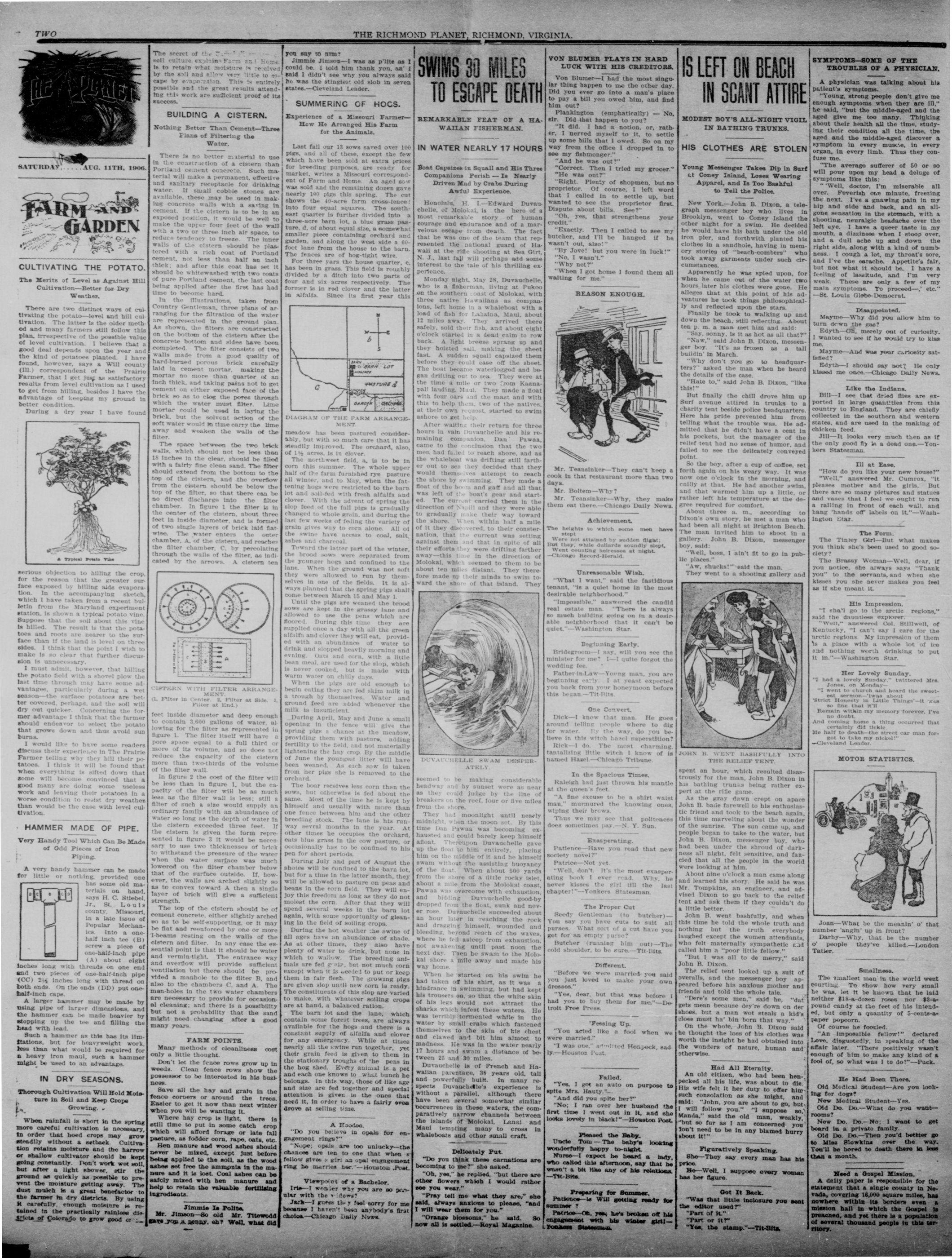
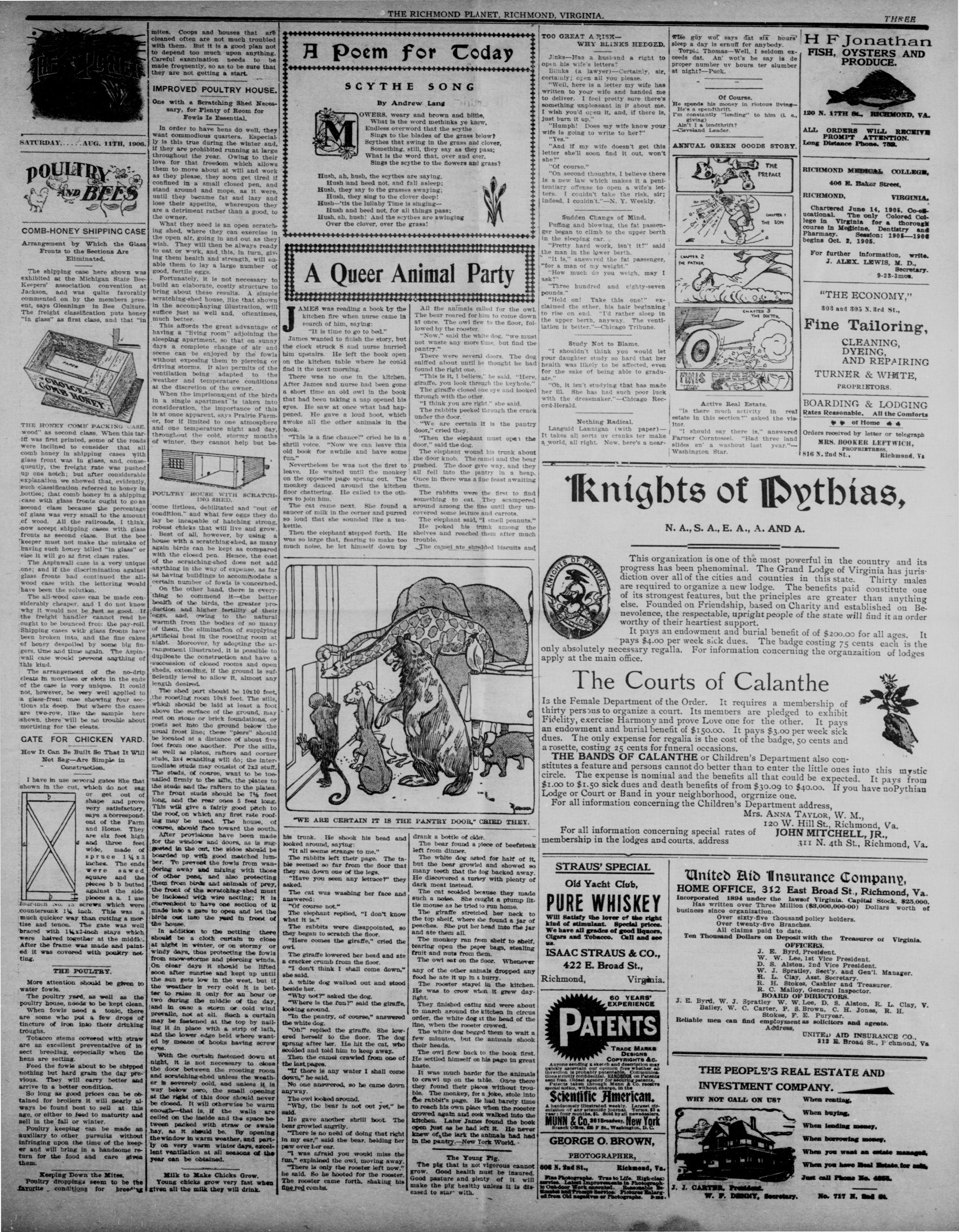
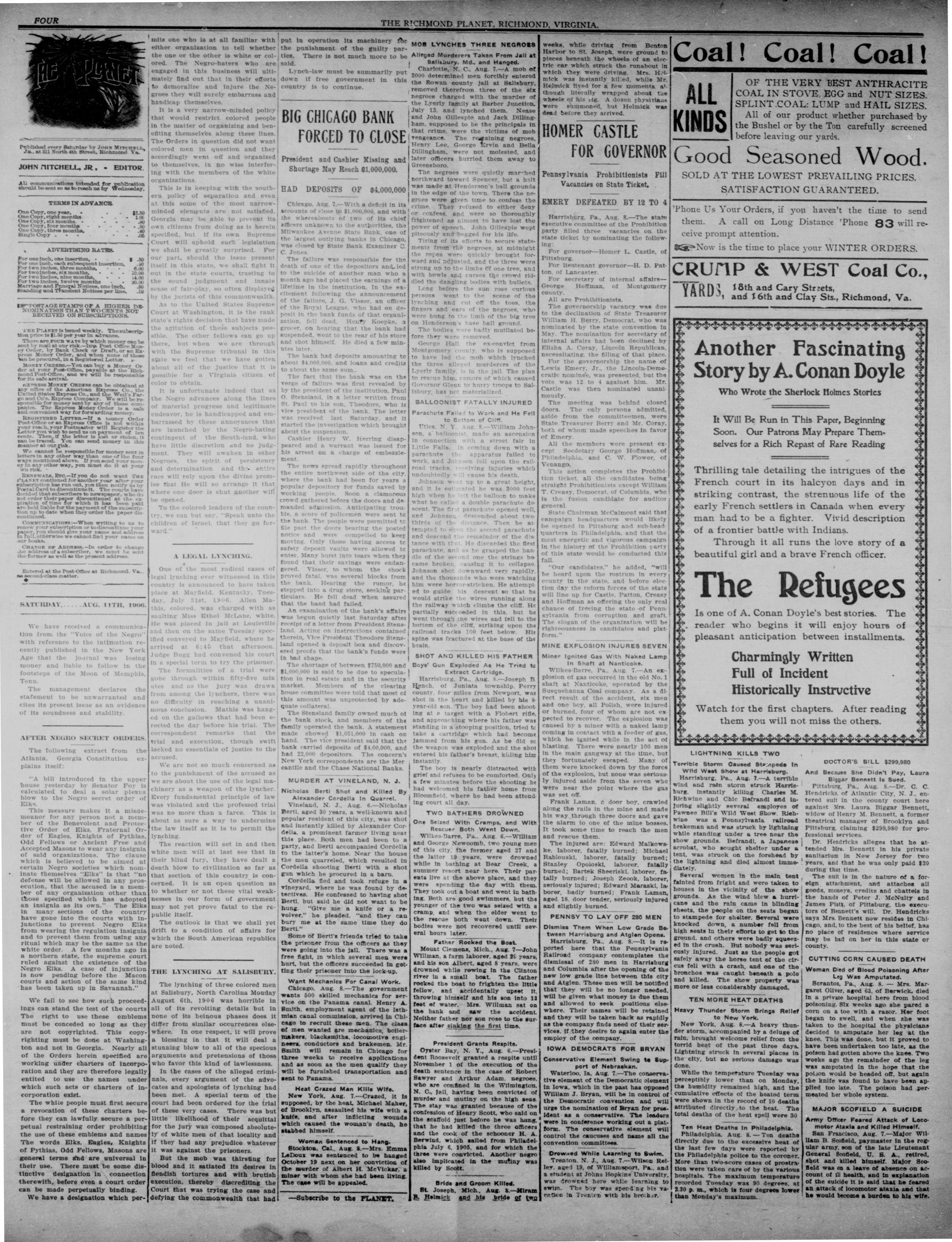
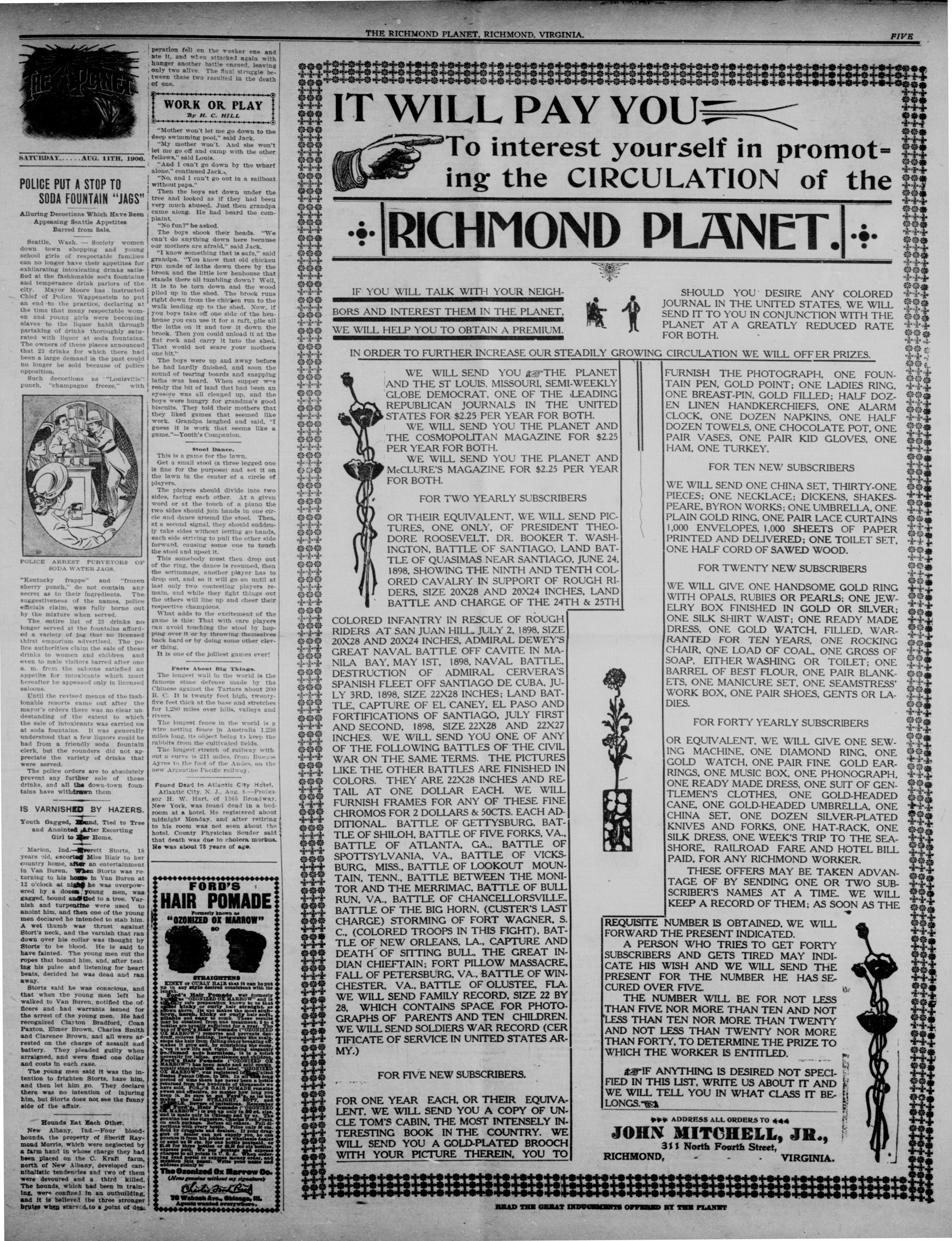
Page text (machine-generated)
THE RICHMOND PLANET
A RINGING ADDRESS TO THE COUNTRY. Race Leaders Draft Model Document
AGAINST LAWLESSNESS IN ALL OF ITS FORMS-A PLEA FOR FAIR PLAY-JUSTICE DEMANDED-A STORMY SESSION BUT A CALM CONCLUSION.
VOL. XXIII NO 36.
A RING
T
Race Lea
AGAINST LAWLESS
DEMA
Washington, D. C., Aug. 6, '06
As the last official act of the Negro Young People's Christian and Educational Congress, assembled here since last Tuesday afternoon, there was read last night before the largest assemblage of the convention, 6000 strong, an "Address to the American Public."
Its reading to the gathering, which occupied every available seat in the vast auditorium, evoked applause that could be heard blocks away. Again and again the crowd wildly shouted approval of the document, which is most comprehensive and touches on every phase of the social and economic welfare of the race. It was adopted with a storm of approval that seemed to shake the Convention Hall to its foundations, after which 6000 voices were lifted in the final hymn of the big congress, "God Be With You Till We Meet Again." The paper follows in full:
"The Negro Young People's Educational and Christian/ Congress, assembled in its second quadrennial session, presents to the American public the following appeal and declaration of principles:
"We wish to acknowledge the guidance of an all wise Providence, which for the second time brings together the various religious denominations among us in the spirit of Christian fellowship to deliberate for the common good of the race and for the spread of the cause of righteousness.
"We glory in the prosperity of our common country and in the lead ing part it has taken to bring about peace and Christian amity among the nations of the earth.
"We rejoice in the higher standard of civic righteousness which is being brought to bear upon some of our domestic problems, as seen in the crusade against municipal corruption and the just restrictions placed upon corporate greed and rapacity.
AMERICA'S GREAT PROBLEM.
"We express the hope that this aroused public conscience may be directed to America's most troublesome and complex problem—the harmonious adjustment of the races.
"We wish to direct the energies of our people to the Christian training and nurture of the young, and to greater evangelical effort toward spiritual awakening, believing, as we do, that the Christian religion is a solvent for all human problems.
"The negro is heavily handicapped in his upward struggle. We appeal to the friends of humanity everywhere to aid and encourage him in the development of character and the acquisition of intelligence, thrift and frugality, as means to reach a higher level of life.
"The progress already attained is but an earnest and a hopeful indication of the larger development necessary to meet the requirements of our civilization.
"It is often claimed that the means and effort devoted to the education of the negro race have been wasted. On the contrary, we affirm that no like sum of money during the same period, expended in any other direction, has produced such moral and material advantage to any other class of citizens or to the general welfare. We invite a candid and dispassionate investigation of the basis of this affirmation.
"We are greatful to Northern philanthropy for means and service contributed in our behalf. We also appreciate the fact that the Southern States have devoted a considerable part of their general fund to the education of the negro youth. We wish to commend the fair-minded attitude of those Southern white men who stand for equal educational advantages for all the children of their respective States.
"We wish, however, to state, in the most positive terms, that the prevail ing dogma to the effect that the white race voluntarily imposes taxes upon itself for the education of the negro contains a mischievous fallacy. On final analysis labor pays every tax in the world. The laborer more than any other class, bears the weight of the public burden, and is justly entitled to share in all public benefits.
NEGRO HELPS BEAR BURDEN.
"The apportionment of such ben-
elts according to taxpaying abilities is never advanced except where the race issue is involved. This policy would be laughed to scorn in any other section of our country, and would be considered as suicidal as to mete out punishment for crime according to the taxpaying ability of the criminal. Directly or indirectly the negro contributes his full share toward bearing the public burden in every Southern State, and is, therefore, entitled to the education of his children on equal terms with the rest, as his just and equitable portion, and not as a civic gratuity.
"We deprecate the controversy now happily waning, between the advocates of higher and of industrial education. The negro requires every kind and degree of education to meet the wide circle of his needs. The question of industrial, higher, or professional training is merely one of ratio and proportion, and must be left to individual attitude, incination, and opportunity.
"We believe that the individual should be developed as a man, as well as a workman; that his training should lead to a broader conception of truth and duty, as well as to the performance of specific modes of service.
"We advocate national aid to local education in those States and parts of States where existing conditions demand it.
"Crime has no color: the criminal no race. The wrongdoer should be isolated and dealt with as an enemy to society. To impute to a race the evil deeds of individuals tends to promote rather than diminish crime. It engenders race animosity and incites the spirit of revenge and reprisal, which always finds lodgment in the breasts of the baser members of both races, thus perpetuating a constant state of hatred and strife.
OPPOSE VICE AND CRIME
"All the forces of law and order, without regard to race, should be solidly arrayed against vice and crime, and especially against its most heinous and repugnant forms. There should be inculcated in the minds of white and black alike the necessity for higher respect and relevance for law and order. We stand pledged to continue to do our utmost in this respect and to cooperate with our white fellow-citizens to bring about the desired result.
"It is the duty of every citizen to obey and uphold the law of the land and of the community in which he resides, to fulfill cheerfully every civic obligation, and to uphold the highest patriotic principles and ideals. It is the reciprocal duty of the government to protect every citizen in the full and equal enjoyment of guaranteed rights and privileges. For any State or community to enact oppressive regulations tending to humiliate and degrade any part of its citizens is a mistaken and a shortsighted statismanship.
"Equality before the law and behind the law lies at the basis of our institutions. Every citizen should have due weight and influence in making the laws by which he is to be governed, as well as equal protection and benefits of such laws. We are anxious to be clearly understood on this point. We enter our determined and unalterable protest against all regulations subversive of this principle, under whatever guise or disguise they may appear. In this attitude we believe that we represent the true American and Christian ideal.
"Pessimism is a remedy for nothing. It rights no wrongs, corrects no evils, leads to no constructive results. It chills our spirit and paralyzes our energies. We urge the negro to maintain a mainly Christian courage and to preserve an optimistic spirit, even amid conditions which baffle and buffet him. God reigns and the negro is an optimist.
SITUATION DEMANDS UNION
"The situation demands union of aim and effort among all those who are subject to the same burdensome conditions. The counsel of division is the counsel of death. We rejoice in the growing spirit of harmony and cooperation among negroes of various beliefs and shades of thought for the common good of the race. In our united endeavor we invite the cooperation of all A-
RICHMOND, VIRGINIA, SATURDAY, AUGUST 11, 1906.
mericans who feel it a human duty to help bear the burden of those who are cast down and overborne.
"We believe that our cause is just, and therefore we confidently submit our appeal to the considerate judgment of our fellow-men without regard to race or section.
"Believing as we do in the efficacy of prayer, even as did our fathers and mothers in the darker days of slavery, we propose that the first day of January, which marks the period of our emancipation in this land, be devoted to praise, prayer and supplication touching conditions of our race. We invite all our fellow citizens who believe in the influence and power of prayer to unite their prayers with ours in behalf of this great human cause."
Prior to the adoption of the resolution the choir of a thousand voices rendered several sacred selections. Solos, instrumental and vocal, and vocal duets were parts of the musical programme.
The entire evening was one of farewell exercises. Parting addresses were delivered by Bishop W. B. Derrick, of New York; Rev. J. W. E. Bowen, of this city, who took for his theme, "The Voice of the Negro;" Rev. J. B. Rives, of Philadelphia; Bishop R. S. Williams of Augusta, Ga., and the final farewell address was delivered by the new president of the congress, Bishop George W. Clinton.
Prof. I. Garland Penn. correspond ing secretary, read the address to the American public. It has not been definitely settled as to where the next quadrennial meeting of the congress will be held.
ADVICE FOR YOUNG MEN
In the afternoon more than 1000 men gathered in Convention Hall, at 3 o'clock when addresses teeming with advice to the young man were delivered. They were confined to suggestions as to how he should conserve moral probity, physical and mental force.
Bishon J. W. Smith, of this city spoke on "The Consecration of the Physical Man to Christ;" Rev. E. J. Gregg, D. D., of Jacksonville, Fla. on "The Consecration of the Intellectual Man to Christ," and Rev. D. Webster Davis of Richmond, Va. on "The Consecration of the Spiritual Man to Christ."
A woman meeting was held in the Metropolitan A. M. E. Church, when "Woman's Place in the World's Work and Results Therefrom" was discussed. "Woman in Social Reform" was the theme of Miss Nannle H. Burroughs, of Louis ville, Ky.
Mrs. S. W. Layton, of Philadelphia, spoke on "The Rescue of Colored Girls Coming North;" Mrs. W. A. Hunton, of Atlanta, on "Enthusiasm for Race Service;" and Mrs. I. Garland Penn of Atlanta, on "Woman's Place in the Home." Other speakers discussed like themes during the meeting which lasted until 5 o'clock.
A missionary mass meeting, at which fully 2000 persons were present, occupied the morning. The speeches all dealt with the work being done by the colored churches of the country for the dissemination of the Gospel both in this and other countries. Rev. J. L. Gordon, of Louisville, Ky.; Rev. H. B. Parks, of New York and Rev. W. B. West, of Dallas, Tex., were the speakers.
Sympathy Extended.
Mr. and Mrs. Richard T. Cogbill and family of Manchester, Va. extend their sympathy to the bereaved family of Mr. Richard Drew of Washington, D. C. in the loss of his Daughter Mabel, who departed this life on the 30th alt. We can but bow in humble submission to the divine Ruler of the universe who is too wise to err and too good to be unkind.
"Peace to her ashes!"
—Dr. I. D. Burrell, the accomplished and popular physician of Roanoke was in the city this week. He was looking well and during his stay here was the guest of Mr. and Mrs. J. H. Gray.
WILLIS ELLIS GETS TEN YEARS
Verdict of Murder in Second Degree for Killing Mr. W. H. Childress.
Buckingham Courthouse, Va., August 3.—Willis Ellis, colored, was sentenced to ten years by the Circuit Court here to-day for the murder of Mr. W. H. Childress.
This case, according to local lawyers, is one of the most peculiar in the history of Virginia. No parallel case can be found in any of the law books, which will fit this case.
On May 26th, of this year, Wm. H. Childress, an inoffensive, friendly old veteran, was shot down in the middle of the road between here and Dillwyn by Willis Ellis. Childress was riding to Dillwyn, in company with P. A. Grigg, when suddenly Ellis appeared in a curve of the road and without warning raised a shotgun to his shoulder and fired. Mr. Grigg at once wheeled his horse and disappeared into the woods, making for Dillwyn as fast as possible.
When Mr. Grigg reached Dillwyn he already found Ellis there, hunting for a doctor. Dr. Mitchell was found, and at once, with Mr. Grigg and Editor White, of the Outlook, went to the scene of the murder, and found a crowd gathering around and Childress lying in the road dead Ellis gave himself up and was brought here to jail. At the time feeling ran high here and summary punishment was talked of strongly, but has finally quieted down.
Ellis testified in his own behalf, and claimed that he shot Childress, thinking he was Reuben Jones. His story is credited, people believing generally that he is telling the truth.
It seems that several years ago Ellis's wife was bent up badly by Jones, and that himself suffered in a scrap between the two. A warrant was issued for Jones, and after a trial he was fined. However, the two shook hands and made up, although there has been considerable ill feeling between the two since. The day before the death of Childress Jones paid another visit to Ellis's wife and whipped her badly, and when Willis came home in the evening he was told of the occurrence. He took down a gun, went to Dillwyn, had a warrant issued for Jones, bought some cartridges and started home again, when he met Childress riding a horse that looked like Jones's and Ellis raised his gun and shot.
Ellis, as soon as he found out what he had done, jumped on the dead man's horse and rode to Dillwyn, where he told his story just as he told it in court, and sent help to his victim, but too late. He expressed extreme sorrow for what he has done, and there is considerable sympathy expressed for him.
A number of good people of the county testified to the good character of Ellis.
All day Wednesday was taken up with witnesses, and most of Thursday was used in an effort to get instructions before the jury. Attorneys Flood, of Appomattox; Strode of Amherst, and Gayle, of Buckingham, appeared for the defense, while Commonwealth Attorney Hub ard was assisted by Frank Moon, of Scottsville. Mr. Moon made the opening address to the jury Thursday evening and was followed by Mr. Strode. Mr. Gayle and Mr. Flood closed for the defense this morning, leaving Mr. Hubbard to close for the State.
The verdict was murder in the second degree, with punishment as above noted.
Fifth Baptist Church Alive.
Rev. Dr. Graham preached at the Fifth Baptist Church last Sunday for the first time for six weeks. He is just recovering from an attack of malarial fever. Large crowds at tended church last Sunday. The church clubs are all thoroughly organized and the church is working like a bee hive to raise five hundred dollars in October. Friends on all sides are promising help. Dr. Graham thinks he can clear the church of debt in twenty-four months.
BARBARISM RAMPANT IN NORTH CAROLINA. Three Colored Men Lynched
MURDERED WHILE ON TRIAL—THE JUDGE IMPOTENT—THE SHERIFF LACKS NERVE—STATE TROOPS COWED AND NOT ORDERED TO FIRE.
Not a Shadow of Excuse Offered—Law-Abiding Citizens North and South Indignant.
Salisbury, N. C., Aug. 7.—There has been great excitement in Salisbury to-day following the storming of the county jail last night by a mob of 3000 people when Nease Gillespie, John Gillespie, Jack Dillingham, Della Dillingham, Henry Gillespie and George Irvin, colored, on trial for murdering the Lylery family, were taken from the prison cells and the three first named lynch ed by the frenzled crowd.
rar, Lillie Holmes, Susie Glover, Katie Brown, Messrs. Willie Williams Roscoe Mitchell, Percy Johnson, James Grey, Leroy Frayser, James Gatewood, Walter Poytress, Douglass Edwards, Willie Randolph, John Goode, Willie Williams, Thomas Stuetley, Richard Lucas.
An excellent repast was spread an all heartily enjoyed themselves.
President Smallwood Speaks.
Rev. Dr. John J. Smallwood, foun
Little Ollie Laid to Rest.
Little Ollie Price, the little daughter of Mr. and Mrs. Jacob R. Price, died in Steelton, Pa., Sunday morning, Aug 5, 6 A.M.
She had been sick only nine days and though only six years old, requested to be brought to Richmond and buried beside her grandmother. She was exceptionally bright and intelligent for her age and was loved by all who knew her.
Her funeral took place in Steelton, Pa. Rev. Merrit and Rev. Crittendon officiated. Beautiful floral
GATLING GUNS TOO LATE
Late to-night the Queen City Guards placed two large gatling guns at the jail, one in front and one in the rear.
The arrest and incarceration of several well known citizens alleged to have been in the mob last night is rumored, but the officers will not talk. The governor has been notified that the troops are on duty, and it is believed will maintain order. The crowd which to-night filled the streets near the jail began to disperse when the gatling guns were placed in position.
TROOPS AFTER THE LYNCHING
The Iredell Blues, of Statesville, arrived here to night, sixty strong. The company was at once assigned to duty around the county jail. Large crowds had gathered on the streets, and the officers were shouting for order, and marching the people from place to place. A mob of from 500 to 1000 men assembled in the suburbs of the city and were for a time expected to attempt to liberate George Hall, a distiller, held as a leader in the trouble last night. Hall is an exconvict and has a long list of crimes to his credit.
INVESTIGATING THE MURDERS
The Queen City Guards, of Charlotte, with fifty men, arrived in the city to night, are patrolling the streets. Solicitor Hammer and Sheriff Julian are on the scene. Judge Long and Solicitor Hammer turned their attention to day to an investigation of the lynching with the result that George Hall was placed in jail as an accessory to the crime. The sheriff has many more names and arrests will follow as rapidly as practicable. There is intense feeling here to night against a prosecution of the lynchers. Judge Long to day warned all citizens not to enter the jail premises at the peril of their lives, and also ordered the arrest of all who engaged in unlawful assemblages.
JAIL A WRECK
The jail was a veritable wreck this morning. Not only had every window pane been broken, but the blinds and sashes had been literally thrashed to splinters by the fury of last night's mob, members of which used bricks and stones with telling effect.
The first entrance to the prison was effected by the leaders of the mob chopping down the large rear doors. After gaining the stairway, the locks to the cells were soon battered off and the prisoners taken. In the melee Ed. Taylor, a white prisoner and Tom Broyn, charged with burglary, escaped from the prison. The latter returned an hour afterward, begging for protection.
BARBARIANS IMITATED
Following the lynching of the three colored men, thousands of people visited the scene. Some of CONTINUED ON EIGHTH PAGE.
Pleasant Evening Spent.
On last Wednesday evening there was an entertainment given at the residence of Miss L. Irene Brown, No. 8 E. Baker St., in honor of Miss Robnett Quarles, of Washington; Miss Helen Taylor, of Canada, and Miss Bessie Wilson of Baltimore. Among those present were Misses Mary L. Smith, L. Irene Brown, Mildred Bowling, Sarah Morton, Martha Ellet, Vergie Morton, Alma Far-
rar, Lillie Holmes, Susie Glover, Katie Brown, Messrs, Percy Williams Roscoe Mitchell, Percy Johnson, James Grey, Leroy Frayser, James Gatewood, Walter Poytress, Douglas Edwards, Willie Randolph, John Goode, Willie Williams, Thomas Stuetley, Richard Lucas.
An excellent repast was spend an all heartily enjoyed themselves.
President Smallwood Socaks
Rev. Dr. John J. Smallwood, founder and President of the Temperance Industrial and Collegiate Institute at Claremont, Va. created the greatest possible sensation here in Kingston, Sunday, Aug. 5th. He spoke four times to the greatest throng of human souls each time. Never in the history of the Negro race, has anyone of that much discontented people created such an impression here in the advocacy of human rights. Dr. Smallwood is a man winning white and colored people by his amazing boldness, his profound eloquence and his exceptional jolliness and personal dignity. The white people have requested Dr. Smallwood to speak here in the City Hall on Wednesday night. Aug. 8th.
President Smallwood was born in this state and the masses are delighted at his great advancement. He paid the Negro business men and women of Richmond a fine tribute His manner of denouncing lynching and peace disturbers was indeed eloquent. He said: "that all lynchers are willful murderers and the meanest enemies the South has. There is no doubt about it we must condemn crime, but we must never allow a set of moral cowards to take our civil law in hands and murder our accused before they are given a fair trial by our laws.
We have no race problem between the best white people and the best colored people. The best white peo ple and the best Negroes are friends. The infamous, ignorant politician and office seeker keep up the false cry of social equality and Negro domination. Let us shut the mouths of the politicians and these rum shops. Let us shut up forever. Dr. Smallwood has done his work well here in this Southern town for his race.
Miss Dolly Adams left for Wytheville, Va. Aug. 5th, to spend her vacation with her friends. We hope her a pleasant stay.
Mr. John A. Turner, Jr., of Manchester left the city this week for West Point, Va. to spend his vacation.
Miss Bertha E. Hughes has arrived in the city from Petersburg, Va., where she has been visiting friends.
Misses Lottie A. Lomax and Pinkie Lee of Abbeville, S. C. are in Manchester, Va. visiting Mr. and Mrs. James Rogers of No. 20 W. 19th St. They will remain in the city several weeks.
Mrs. P. L. Walker of Lynchburg, Va. is in the city visiting her aunt, Mrs. J. A. Moss, who has been very sick for four weeks. Mrs. Moss is improving slowly at her residence 419 W. Duval St. Mrs. P. L. Walker will be glad to meet her friends at her aunt's.
Mrs. W. F. Denny, the wife of our hustling Real Estate Agent left the city Monday in company with her three sweet, little children to visit relatives and friends in Alken, S. C., Augusta, Ga., Atlanta, Ga. and other cities of the South. The PLANET wishes her a pleasant stay and a safe trip.
MT. OLIVET'S DATE CHANGED
The excursion of the Mount Olivet Baptist Church to Buckroe Beach, changed to Monday, August 20th, in order to secure a sufficient number of coaches. The train leaves Richmond 9 A. M.; Buckroe, S P. M.
REV. J. ANDREW BOWLER, Pastor 2t
PRICE, FIVE CENTS
MPANT
ROLINA.
Lynched
POTENT—THE SHERIFF
OT ORDERED TO FIRE.
Little Ollie Laid to Rest.
Little Ollie Price, the little daughter of Mr. and Mrs. Jacob R. Price, died in Steelton, Pa., Sunday morning, Aug 5, 6 A.M.
She had been sick only nine days and though only six years old, requested to be brought to Richmond and buried beside her grandmother She was exceptionally bright and intelligent for her age and was loved by all who knew her.
Her funeral took place in Steelton, Pa. Rev. Merrit and Rev. Crittendon officiated. Beautiful floral designs from her Sunday School teacher, class mates and friends covered the little casket. Mrs. Bruce of Harrisburg, Pa. sang a very sweet solo entitled "At Rest."
Dear little Ollie thou hast left us, And thy loss we deeply feel. But 'tis God who hath called thee; He will all our sorrows heal.
Thy little hands are folded. Thy sweet voice is still; One little chair is vacant. That no other can fill.
Farewell, dear little angel, With us you will be no more. But we shall strive to meet thee On the bright and shining shore.
The remains of little Olive reached the city Tuesday, Aug. 7, 2 P. M., accompanied by her mother, Mrs. Nannie Price. Mr. A. D. Price, the well known undertaker met the remains and followed by a number of friends the little body was laid to rest in Evergreen Cemetery. Mr. and Mrs. Jacob R. Price formerly lived in this city and is sister to Mrs. R. Beecher Taylor.
Notice!
The time of the Sunday School and B. Y. P. U. Convention is near at hand and the committees are very active. As the Convention is expected to be the largest in its history, all friends and lovers of a good cause are asked to assist in caring for the delegates.
The Virginia Seminary Board will meet during the convention. Matters touching the advancement of the school will be discussed.
Next Sunday will be convention day at the Fifth Street Baptist Sunday School. All parties holding envelopes are requested to turn them in. A fine programme will be rendered and we hope to raise a large collection.
The National Baptist Sunday School Union will meet with the Fifth Baptist Church (Rev. W. F. Graham, D. D., Pastor). As this is the last union before the convention, it is hoped that a large crowd will be present. Be on time with a contribution for the work.
WOMAN RETRACTS, BUT DAVIS
WILL NOT SAVE NEGRO.
First Swore to Guilt—Committee of Citizens Pleads with Arkansas Governor in Vain.
LITTLE ROCK, ARK., July 13—After carefully reading the sworn statement of Annie Hartley, in which she declares the innocence of Govan Beard, the colored man who was convicted for criminal assault upon her and sentenced to be hanged at Helena July 18, and reading the man my affidavits concerning her character, Gov. Davis today refused to respite the condemned man. He declared he would take no action whatever in the case.
A committee of prominent citizens waited on the governor to-day and asked for his pardon.
Govan Beard was tried and convicted for criminal assault at the circuit court at Helena some months ago, on the testimony of his alleged victim, Mrs. Annie Hartley. At the time she was the state's witness and was positive in her statement concerning the assault made upon her by the colored man, and he was sentenced to be hanged. The Hartley woman recently became very repentant since she found that Beard's neck is to be broken for the crime she testified to his committing, and has made confessions to many parties completely exonerating him of the assault.
° Two
inca ee ik
ee ahaa
FAR ASD
= GARDEN
CULTIVATING THE a Sue
The Merits of Level as Against Hill
Cultivation—Better for Dry
‘Weather.
‘There are two distinct ways of cul
tivating the potato—level and hill cul:
tivation. The latter ts the older meth
od and many farmers still follow this
plan, trrespective of the possible value
of level cultivation. I delleve that a
Bood deal depends upon the year and
the kind of potatoes planted. I have
found, however, says a Wil county
lL) correspondent of the Prairie
Farmer, that I get jug as satisfactory
Tesults from level cultivation as I used
to get from hilling, besides I have the
advantage of keeping my ground tn
better condition.
During a dry year I have found
Saee 3
QA &s
x
SIR
ot 4 is SS
tl & Troteal Potts Vine j
Serious objection to hilling the crop,
for the reason that the greater sur
face exposed by hilling aids evapora
tion. In the accompanying sketch,
which I have taken from a recent bul:
Jetin from the Maryland experiment
station, is shown a typical potato vine.
Suppose that the soll about this vine
fs hilied. The result {x that the pota-
toes and roots are nearer to the sur-
face than {f the land is level on three
@ides. I think that the point I wish to
make ts so clear that further discus-
sion ts unnecessary.
I must admit, however, that hilling
the potato field with a shovel plow the
Jast time through may have some ad-
vantages, particularly during a wet
season—the surface potatoes are bet-
ter covered. perhaps, and the soll will
ary out quicker. Concerning the for-
mer advantage I think that the farmer
should endeavor to select the potato
that grows down and thus avoid sun
Durns.
I would like to have some readers
@trcuss thelr experience In The Prairie
Farmer telling why they hill thetr po-
tatoes. I think it will be found that
when everything {s sifted down that
gome will become convinced that a
good many are doing some useless
‘Work and leaving their potatoes In a
sworse condition to resist dry weather
‘than would be the case with level cul
‘tration.
» HAMMER MADE OF PIPE.
Very Handy Tool Which Can Be Mado
of Odd Pieces of Iron
j Piping.
‘A very handy hammer can be made
for little or nothing provided one
has some old ma-
terials on hand,
PEL EG says H. C. Stebel,
Jr, St Louts
county, Missourt,
in a late tusne of
Popular Mechan-
ics. Into one-
half inch tee (B)
screw a piece of
2 one-half-tnch pipe
CA.) waema? aman
and Seo gia eres et ee eee
terials on hand,
FEL: EA says H. C. Stlebel,
Jr, St Louts
county, Missourt,
in a late Issue of
Popular Mechan-
ica. Into a one
half inch tee (B)
screw a piece of
one-balf-tach pipe
(A) about eight
finches long with threads on one end
end two pieces of one-half-inch pipe
(CC) 234 Inches long with thread on
Both ends. On the ends (DD) put one-
fbalf-inch caps.
A larger hammer may be made by
‘Using pipe of larger dimensions, and
the hammer can bv made heavier by
‘stopping up the tee and filling the
head with lead.
Such a hammer as thie has {ts Mm-
Mtations, but for heavyweight work,
dees than what would be required for
@ heavy fron maul, such a hammer
might de used to an advantage
$ IN DRY SEASONS.
Thorough Cultivation Will Hold Mots-
ture in Soil and Keep Crops
b ‘Ainiiiiae os
When rainfall is short in the spring
more careful cultivation te necessary,
‘m order that hoed crops may grow
steadily without @ setback. Cultive
tion retains moisture and the harrow
or shallow cultivator should be kept
going constantly. Don't work wet #otl
Dut after a light shower, stir the
ground as quickly ss possible to pre.
Vent the moisture getting away. The
ust mulch is a great benefactor to
‘the farmer tm dry districts. By using
& carefully, enough moininre ix _re-
tained t2 the practically rainless dis
Ackts_of Colerago wo grow good ors _
‘The seeret of the Tate Tr
sol! culture, exsizint Farm en! Home
fe to retain what moisture Js -evelved
by the so! and rllow very little to ¢=-
cape by evapozetion. This ‘ entirely
Possible end the great results attend-
ing this work are sufficient proof of its
‘success.
BUILDING A CISTERN.
Nothing Better Than Cement—Three
Plans of Filtering the
Water,
‘There is no better material to use
in the coustruction of a cistern than
Portlaad cement concrete. Such ma-
terial will make a permanent, effective
and sanitary receptacle for drinking
water. If small cobble stones are
available, these may be used in mak-
fag concrete walls with a saving tn
cemeat. If the cistern is to be in an
exposed position, {t would be well to
make the upper four feet of the wall
with a two or three Inch air space, to
reduce tendeacy to freeze. The inner
walls of the cistern should be plas
tered with a rich coat of Portland
cement, not less than half an inch
thick; and after this coat has set It
should be whitewashed with two coats
of pure Portland coment, the last coat
being applied after the first has had
time to become hard.
In the {flustrations, taken from
Country Gentleman, three plans of ar-
ranging for the filtration of the water
are represented tn the ground plan.
As shown, the filters are constructed
on the bottom of the cistern after the
concrete bottom and sides have been
completed. The filter consists of two
walls made from a good quality of
hard-burned porous brick carefully
laid in cement mortar, making the
mortar no more than quarter of an
Inch thick, aud taking pains not to get
cement on either exposed face of the
brick so as to clog the pores through
which the water must filter. Lime
Mortar could be used in laying the
Drick. but the solvent action of the
soft water would in time carry the lime
Away and weaken the walls of the
filter.
The space between the two brick
walls, which should not be lees than
18 inches in the clear, should be filled
with a fairty fine clean sand. The filter
should extend from the bottom to the
top of the cistern, and the ovrerfiow
from the cistern should be below the
top of the fitter. so that there can be
Ro direct discharge into the filter
chamber. In fisure 1 the filter ts in
the center of the cistern, about three
feet In Inside diameter, and is formed
of two single layers of brick laid flat
wise. The water enters the outer
chamber, A. of the cistern, and reaches
the filter chamber, C, by percolating
through the walls of the filter, as indi
cated by the arrows. A cistern ten
SO
CIVTERN WITH FILTER ARRANGE-
MENT,
G, Fitter in Center. 2 Filter at Side 2,
Filter at End.)
feet inside diameter and deep enough
to contain 3,600 gallons of water, al
lowing for the filter as represented in
figure 1. The filter Itself will have a
pore space equal to a full third or
more of its volume, and so does not
reduce the capacity of the cistern
more than two-thirds of the volume
of the filter wall,
In Oigure 2 the cost of the filter will
be leas than In figure 1, but the ca-
pacity of the filter will be as much
leas ag the filter wall fs less; still a
filter of such a stze would supply an
ordinary famtly with an abundance of
water so long as the depth of water tn
the cistern exceeded three feet. If
the cistern Is given the form repre-
sented in figure 3 {t would be neces.
sary to use two thicknesses of brick
to withstand the pressure of the water
when the water surface was much
lowered on the filter chamber below
that of the surface outside. If, how-
‘ever, the walls are arched slightly so
as to convex toward A then a single
layer of brick will give a sufficient
strength.
The top of the cistern should be of
coment concrete, either slightly arched
#0 as to be self-supporting, or ft may
de flat and reenforced by one or more
‘T-beams resting on the walls of the
elstern and filter. In any case the es-
sential point is that {t should be water
and vermintight. The entrance way
and overflow will provide sufficient
‘Ventilation but there should be pro-
vided a manhole to the filter B, and
also to the chambers C, and A. The
man-holes in the two water chambers
are necessary to provide for occasion-
al cleaning; and there ts a possibility
Dut not a probability that the sand
might need changing after a good
many years.
FARM POINTS,
Many methods of cleanliness cost
only « little thought.
Don't let the fence rows grow up in
weeds. Clean fence rows show the
possessor to be interested in his bust
ees
Save ali the hay and gram in the
fence corners or around the trees.
Easier to get it now than next winter
‘when you will be wanting tt.
Where hay crop is light, there is
still time to put in some catch crop
which will afford forage or late fall
pasture, as fodder corn. rape, oats, etc.
Hen manure and wood ashes should
never be mixed, except just betore
‘Detng applied to the soll, as the wood
aabos sot free the ammonia in the ma-
mure and it is lost. Coal ashes can be
‘safely mixed with hen manure and
help to retain the valuable fertilising
ingredients.
Jimmie Is Polite
‘Mr. Jimson—So old Mr. Titewodd|
7% A REDDY. eh? Well, what did]
THE RICHMOND PLANET, RICHMOND, VIRGINIA.
yOR my W OTT ie oe
Jimmie Jimson—I was as p'iite as I
could be. { told him thank you, an’ 1
‘Baid I didn’t see why you always sald
De was the stingies: old slob in seven
states.—Cleveland Leader.
SUMMERING OF HOGS.
Experience of a Missouri Farmer—
How He Arranged His Farm
for the Animals,
Last fall our 12 sows saved over 100
pigs, und all of these, except the few
‘which have been sold at extra prices
for breeding purposes, are ready for
market, writes a Missourl correspond-
ent of Farm and Home. An aged sow
Was sold and the remaining dozen gave
‘nearly 100 pies this spring. The cut
‘shows the (J-acre farm cross-tence!
into four equal squares. The south-
jeast quarter is further divided into a
three-acre barn lot, a blue grass pas-
‘ture, d, of about equal size, a somewhat
smaller piece containing orchard and
garden, nnd along the west side a 60-
foct Jane from the house to the barn.
The fences are of hog-tight wire.
For three yars the house quarter, ¢,
has been in grass. This field is roughly
divided by a ditch into two parts of
four and six scres respectively. The
former is in red clover and the latter
fm alfalfa. Since its first year this
ae
aes
ie
ARIA OF THE FARM ARRANGE-
| MENT
Meadow has been pasturet consider-
Rbly, but with so much care that t has
Mteadily improved. The orchard, also,
of 134 acres, is in clover.
The northwest field, a, ts to be in
corn this summer. The whole upper
half of the farm furnished rye pasture
all winter, and to May, when the fat-
tenting hogs were restricted to the barn
Jot and soll-fed with fresh alfalfa and
clover. With the advent of spring the
slop feed of the fall pigs 1s gradually
changed to whole grain, and duriug the
last few weeks of feding the variety of
grain gives way to corn alone. All of
the swine have access to coal, salt,
‘ashes and charcoal
Toward the latter part of the winter,
the brood sows were separated from
the younger hogs and confined to the
Jane. When the ground was not soft
they were allowed to run by them-
selves in one of the flelds. It ts al-
wuys planned that the spring pigs shall
come between March 15 and May 1.
Until the pigs are weaned the brood
sowy are kept in the grassy lane and
allowed to use the pens which are
floored. During this time they are
supplied once a day with all the green
alfalfa and clover they will eat, provid-
ed with an abundance of water to
drink and slopped heavily morning and
evning. Oats and corn, with a iletle
bean meal, are used for the slop, which
fs never cooked, but is made with
warm water on chilly days
When the pigs are old enough to
begin eating they are fed skim milk in
a trough by themselves. Water and
ground feed are added whenever the
milk is insunictent
During April, May and June a small
opening in the fence will give the
Spring plge a chance at the meadow,
providing them with pasture, adding
fertility to the field, and not materially
lightening the hay crop. By the middle
of June the youngest litter will have
been weaned. Ax eich sow is taken
from her pigs she is removed to the
orchard.
The boar recetves less corn than the
sows, but otherwise Is fed about the
Same. Most of the time he ts kept by
himself and usually with more than
‘one fence between him and the other
breeding stock. The lane is hia run-
way sevral mouths in the year. At
other times be occupies the orchard,
eats blue grass in the cow pasture, or
occasionally has to be confined to his
pen for short periods,
During July and part of August the
shotes will be continued to the barn lot,
Dut for a time in the latter month, they
‘Will be allowed to pasture on peas and
Deans In the corn field. They will en-
Joy this freedom ss long as they do not
molest the corn. After that they will
Spend several weeks in the barn lot
again, with some opportunity of glean-
ing in the field of soiling crops.
During the hot weather <he swine of
all ages have an abundance of shade.
As ut other times, they also have
plenty of water to drink, but none in
which to wallow. The breeding ant-
mals are fed sip, but not much corn
except when it is weeded to put or keep
them in fair flesh. The growing pigs
are given slop untli new corn ts ready.
‘The constituents of this slop are varied
to make, with whatever soiling crops
are at hand, a balanced ration,
The barn jot and the lane, which
contain some forest trees, are always
available for the hogs and there is a
for any. cmorsency.” While at ‘ies
for any . While at times
nearly all the swine run together, yet
thefr grain feed is given to them in
the stationary troughs of ‘he pens in
the hog shed. Every ania) isa pet
and each one knows to whet bunch he
belongs. In this way, those of like age
ese ae together. an, eyactel
attention given wo ones that
need it, in order to have a fairly oven
drove at selling time. 7
: A Eoodoo.
| “Do you believe in opals for en-
gagement rings?”
| “Nope; opals are too unlucky—the
‘chances are ten to one that when «
fellow gives » girl an opal engagement
ring be marries her."—Houstou ,Post.
Viewpoint of « Bachelor.
Irie—I wonier why you are so eo
‘ular with the + dows?
) Jack—I guess th 7 fool sorry for me
Deoause I haven't heen anybody's frst
cholea—Chicago Daily Nowa,
REMARKABLE FEAT OF A HA.
WAIIAN FISHERMAN.
IN WATER NEARLY 17 HOURS
Boat Capsizes in Squall and His Three
Companions Perish —Is Nearly
Driven Mad by Crabs During
itn) Exvertesne
Honolulu, H. 1—Edward Duvau
chelie, of Molokai, is the hero of s
most remarkable story of human
courage and endurance and of a mar.
velous estape trom death. The fact
that he was one of the team that rep.
resented the national guard of Ha
wall at the rifle shooting at Sea Girt,
'N. J, last fal! will perhaps add some
interest to the tale of his thrilling ex.
‘pertence.
_ Monday night, May 28, Davauchelle,
who is a fisherman, living at Pukoo
on the southern cast of Molokai, with
three native Huwailans as compan-
fons, left home |» a whaleboat with a
Joad of fish for Lahaina, Maul, about
12 miles away. They arrived there
safely, sold their fish, and about eight
o'clock started in a dead caim to row
back. A light breese sprang up and
they hoisted sail, making the sheet
fast. A sudden squall capsized them
before they could ease off the sheet.
The boat became waterlogged and be
gan drifting ou: to sea They were at
the time @ mile or two from Kaana.
pall landing, Moai. They made a float
with four oars aod the mast and with
this to help them, two of the natives,
at thelr own roquest, started to swim
ashore to get help.
After waitin: their return for three
hours in vain [uvauchelle and his re-
maining companion, Dan’ Pawaa,
came to the conclusion that the two
men had fa.led to reach shore, and as
the whaleboat was drifting still farth-
er out to sen ‘hey decided that they
would thems: ives attempt to reach
the shore by «»imming. They made a
float of the bo: - and gaff and all that
was left of t!« boat's gear and start-
ed. The cursot carried them tn the
direction of Na) il! and they were able
to gradually wake thelr way toward
the shore, When within half a mile
of It they disc vered, to their conster-
nation, that th« current was setting
against them ond that in spite of all
their efforts th<) were drifting farther
away—this tine im the direction of
Molokai, whic! seemed to them to be
about ten miles distant, They there-
fore made up ‘heir minds to swim to-
ward the shore of that tsland. They
se \\ \
sy) ' wy
= ee) |)
7 pe
SB
Seemed to be making considerable
headwn by sunset were as near
as they could judge by the line of
breakers on the reef, four or five miles
from the shore,
They 1 moonlight until nearly
midnight, when the moon set. By this
time Dan Pawaa was becoming ex.
hausted and could barely keep himself
afloat. ereupon Duvauchelle gave
up the flow: te him entirely, placing
Bim on the middle of it and he himself
swam without the ussisting buoyancy
of the at. When about 500 yards
from the ore of & tittle rocky islet,
about a mile from the Molokat coast,
Pawaa was overcome with exhaustion,
and = bidding Duvauchele good-by
dropped from the flcat, sunk and nev-
er rose Duvauchelle succeeded about
an hour later im reaching the rock
and dragzing himself, wounded and
bleeding. teyond reach of the waves,
Where he fell asleep from exhaustion,
not awakening until past noon the
next day. Then he swam to the Molo-
kal shore a mile away and made his
way home
When he ‘started on his swim he
had taken off his shirt, as tt was a
hindrance in swimming, but had kept
hls trousers on, so that the white skin
of his lees would not attract the
sharks which infest these waters. He
Was terribly/tormented while in the
water by small crabs which fastened
themselves to the skin of kis chest
and clawed and bit him almost to
‘Madness. He was in the water nearly
AT hours and swam a distance of be-
‘tween 25 and 40 miles.
Duvauchelle Is of French and Ha-
waiian parentage, 38 years old, tall
and powerfully bul. In many re-
‘spects Duvauchelle's experience 1s
without a parallel, although there
have been several somewhat similar
osterences i Chase, waters. the cox
paratively between
‘the islands of 7 Lanai and
‘Maui tempting many to cross in
[halebosts sit Other small cratt:
Delicately Put.
“Do you think these carnations are
Decoming to me?” she asked.
“Oh, yes,” he replied, “but there are
other flowers which [ would rather
‘see you wear.”
| “Pray tell me what they are,” she
sald, always anxious to please, “and
1 will wear them for you.”
“Orange blossoms,” he sald. 30
now all is settled. —Royal Magazine.
VON BLUMER PLAYSIN HARD
LUCK WITH HIS CREDITORS.
‘Von Blumer—I had the most singu
Jar thing happen to me the other day.
‘Did you ever go into a man's place
to pay a bill you owed him, and find
him out?
Plankington (emphatically) — No,
sir. Did that happen to you?
“It did. I had a notion, or, rath.
er, I nerved myself to it, to settle
‘up some bills that | owed. So on my
‘way from the office I dropped in to
‘see my fishmonger.” in
| “And he was out?”
“Correct. Then I tried my grocer.”
“He was out?”
“Right. Plenty of shopmen, but no
Proprietor. Of course, I left word
that I called in to settle up, but
wanted to see the proprietor first.
Dispute about bills. See?”
“Oh, yes, that strengthens your
credit.”
“Exaetly. Then I called to see my
butcher, and I'll be hanged if he
wasn't out, also!"
“By Jove! but you were in luck!"
“No, I wasn't.”
“Why not?"
“When I got home I found them all
walting for me.”
REASON ENOUGH.
_=—
re.
he aD al
Ce
3h
‘Unreasonable Wish. _
“What I want,” said the fastidious
tenant, “is a quiet home in the most
desirable neighborhood.”
“Impossible,” answered the candid
real estate man. “There is always
‘So much building gofng on in a desir
able neighborhood that it can't be
quiet.”"—Washington Star.
Beginning Barly.
Bridegroom—I say, will you see the
minister for me? I—I quite forgot the
wedding fee. =
Father-in-Law—Yonng man, you are
beginning early. I at yeast expected
you back from yeur honeymoon before
this began. —Tit-Bits,
One Convert.
Dick—I know that man. He goes
around telling people where to. dig
for water. Ty the way, do you be-
Ueve in this witch hazel superstition?
Rick—I do. The most charming,
tantalizing ittle witch | know of is
hamed Hagel —Chicago Tribune.
In the Spacious Times,
Raleigh had just thrown his mantle
jae the queen's feet.
“A fine excuse to be a shirt waist
man,” murmured the Knowing ones,
wiping thelr brows.
‘Thus we may see that politeness
does sometimes pay.—N. Y. Sun.
; Exasperating.
Patience—Have you read that new
society novel?”
Patrice—Not yet
“Well, don't. It’s the most exasper
ating book I ever read. Why, he
‘never kisses the rir! wil the Inst
Shapter!"Yonkers Statesman
‘The Proper Cut
Seedy Gentleman (to butcher) —
You say you have cuts to sult al
‘purses. What sort of a cut have you
got for’an empty purse?
Butcher (running him out)—The
cold shoulder, to be eure—Tit-Btes,
Different.
“Before we wore married: you said
you Just loved to make your own
dresses.”
“Yes, dear, but that was before {
had you to buy them for me”—De
trott Free Press,
'Fessing Up.
“You acted tke @ fool when we
were married.”
“I was one.” atmttted Henyeck, sad.
ly-—Houston Post.
enn
| “Yes, I got an auto on purpose to
spite Mrs, Hauty.~
| “And did you spite her?”
| “No; I ran over her husband the
first time I went out in ft, aad she
looks lovely in black!~—Houston Post.
Piensed the Baby.
Uacte Tom—The baby's looking
wonderfully happy to-night.
| Nurse—I expect he heart a indy,
who calted this afternoon, say that be
‘wnso't & DK Hike any of his relations
—T-Bits.
Premearine fer Gemenee
Pationce—is Will getting ready for
summer 1
Patrice—Oh, yes; he’s broken off his
engagement with bis winter girt!—
Yonkers Stetesmun.
MODEST BOY'S ALL-NIGHT VIGIL
IN BATHING TRUNKS.
HIS CLOTHES ARE STOLEN
Young Messenger Takes Dip in Surf
&t Coney Island, Loses Wearing
Apparel, and Is Too Bashful
to Tell the Police.
New York.—Joha B. Dixon, a tele
graph messenger boy who lives in
Brooklyn, went to Coney Island the
other night for a swim. He decided
he would have his bath under the old
tron pler, and forthwith planted bis
clothes in a sandhoie, having in mem-
ory stories of ~beach-combers” who
took away garments under such cir-
cumstances.
Apparently he was spied upon, for
when he came out of the water two
hours later his clothes were gone. He
alleges that at this point of his ad.
ventures he took things philosophical-
ly and reflected upon the stars.
Finally he took to walking up and
down the beach, still reflecting. About
ten p. m. a man met him and sald:
“Say, sonny, 1s it as hot as all that?”
“Naw,” sald John B, Dixon, messen-
ger boy. “It's as frozen as a tall
buildin’ in Mareh.
“Why don't you go to headquar-
ters?” asked the man when he heard
the details of the case.
“Hate to,” said John B. Dixon, “like
this!”
But finally the chill drove him up
Surf avenue attired in trunks to a
charity tent beside potice headquarters.
Here his pride prevented him from
‘telling what the trouble was. He ad-
‘mitted that he didn’t have a cent in
his pockets, but the manager of the
‘relief tent had no sense of humor, and
failed to see the delicately conveyed
point.
So the boy, after a cup of coffee, set
forth again on his weary way. It was
now one o'clock in the morning, and
cnilly at that. He had another swim,
and that warmed him up a little, or
rather left his temperature at the de-
gree required for comfort.
About three a. m., according to
Dixon's own story, he met a man who
had been all night at Brighton Beach.
The man invited him to shoot in a
gallery. John B. Dixou, messenger
doy, sald:
“Weil, boss, I ain't fit to go in pub-
lie places.”
“Aw, shucks!” said the man,
They went to a shooting gallery and
Ae,
OO es) 4 \
spent an hour, which resulted disas-
trously for the man, John B, Dixon in
his bathing trunks being rather ex-
pert at the ritle game.
As the gray dawn crept on apace
John B. bade farewell to his enthusias-
tic friend and took to the beach again,
this time marveling about the wonder
of the sunrise. The sun came up, and
people began to take to the water, but
John B. Dixon, messenger boy, who
had been under the shroud of dark-
hess all night, felt sensitive, and fan-
efed that all the people in the world
were looking at him.
About nine o'clock a man came along
and learned his story. He sald he was
Mr. Tompkins, an engineer, and ad-
vised Dixon to go back to the relief
tent and ask them If they couldn't do
a little better.
John B. went bashfully, and when
this time he told the whole truth and
nothing but the truth everybody
laughed except the women attendants,
who felt maternally sympathetic cad
called him a “poor Httle fellow.”
“But I was all to de merry,” said
John B. Dixon.
The relief tent looked up a suit of
overalls, and the messenger boy ap-
peared before his anxious mother and
friends and told the whole tale.
“Dere's some men,” said he, “dat
gets mean because dey're down on der
shoes, but a man wot steals a kid's
cloes must ha’ bin born that way.”
On the whole, John B. Dixon said
he thought the loss of his clothes was
worth the insight he had obtattied into
the wonders of nature, human and
‘otherwise.
Had All Eternity.
An old citizen, who had been hen-.
pecked all his life, was about to die.
His wife felt it her duty to offer him.
such consolation as she might, and
maid: “John, you are about to go, but
{ will follow you.” “I suppose 80,
Manda,” said the old man, weakly,
“bat so fur as I am concerned you’
‘Yon't need to be in any blamed hurry
sbout it!”
Figaratively Speaking,
She—They say every man has bis
price.
He—Well, | suppose every woman
bas ber figure.
Got It Back.
“Was that little inclosure you sent
the editor used"
rere of > -
art or it? .
ee a 5
SYMPTOMS—SOME OF THE
TROUBLES OF A PHYSICIAN.
A physician was talking about bis
patient's symptoms.
“Young, strong people don’t give me
enough symptoms when they are ill,”
he said, “but the middle-aged and the
aged give me too many. Thinking
about their health all the time, study-
ing thelr condition all the time, the
aged and the middle-aged discover a
symptom in every muse, in every
organ, in every limb. Thus they con-
fuse me.
“The average sufferer of 50 or s0
will pour upon my head a deluge of
‘symptoms like this:
"“ "Well, doctor, I'm miserable all
over, Feverish one minute, freezing
the next. I've a gnawing pain in my
hip and side and back, and an all-
gone sensation in the stomach, with a
shooting. neuralgic headache over the
left eye. I have a queer taste in my
mouth, a dizziness when I stoop over,
and a dull ache up and down the
right side, along with a kind of num>
ness. I cough a lot, my throat’s sore,
and I've the earache Appetite’s fair,
but not what it should be. I have a
feeling of lassitude, and I'm very
weak. These are only a few of my
main symptoms. To proceed—,’ etc.”
—St. Louis Globe-Democrat.
a
Mayme—Why did you allow him to
turn Sa hot
Easth. merely out of curiosity.
1 wanted to See if he would try to kiss
me.
Mayme—And was your cariosity sat-
fstied?
Edyth—I should say not? He only
‘Kissed me once.—Chicago Daily News.
. te tin tein”
‘Bill—I see that dried flies are ex-
ported in large quantities from this
country to England. They are chiefly
collected in the southern and western
‘states, and are used in the making of
chicken feed.
Ji—It looks very much then as if
the only good fly in a dead one—Yon-
kers Statesman.
Til at Ease,
“How do you lke your new house?”
“Well.” answered Mr. Cumrox, “it
pleases mother and the girls. But
there are so many pictures and statues
And vases that I feol we ought to run
‘@ railing in front of each wall, and
bang ‘hands off labels on it."—Wash-
ington Star.
The Form.
‘The Tintey Girl—But what makes
you think she’s been used to good so-
cety?
The Brassy Woman—Well, dear, if
You notice, she always says “Thank
you” to the servants,and when she
kisses you she never makes you feel
as if she meant it.
His Impression.
“I sha‘l go to the arctic regions,”
said the dauntios explorer
“Welt,” answered Col, Stillwell, of
Kentucky, “I can't say I care for the
uretic regions. My impression of them
‘s a place with a whole lot of ice
and nothing worth drinking to put
it in."—Washington Star.
Her Lovely Sunday.
“~ had m lovely Sunday,” twiviored Mra
Seine, Sar hendar
“x went to chureh and hoard the swest-
Strict Honerty. in Lite Things’—it vie
to fine, that itl
Remain within my memory forever, I've
no doube
‘And coming home a thing ocourred’ thet
Sertaniy’ aid’ lente
Ms alt to ceathe-the street ar win for
sot to tabs ey nickel
—eierenna Loner
MOTOR STATISTICS,
As Ad :
ae he
ae
y ‘é Ss i,
ES
bs eee!
i, S
bas Ki
feo
Joan—What be the meantin’ o’ that
number ‘angin’ up in frout
Darby—Why, that be the number
0 people they've killed —London
Tatler,
Smallness,
The smallest man iu the world went
courting. To shew how very small
he was, let ft be known that he laid
neither $18-a-dozen roses nor §3-e-
pound candy at the feet of his intend-
ed, but only @ quantity of 5-cents-a
paper popcorn.
Of course he foorled.
“An impossible fellow!” declared
Love, disgustedly, in speaking of the
affair later. “There positively waan’t
enough of bim to make any kind of a
fool of, so what was I to do?”—Puck.
He Had Boen There.
Old Medical Student—Are you look-
ing for dogs?
New Medical Student—Yes.
Old Do. Do.~—-What do you want—
rooms?
New Do. Do—No; I want to get
‘board im a private family. %
to Miss Slowkins over the
‘You'll be bored to death there in
‘than « month, 2
Stent a Bamnel Bieden ~
A daily paper is responsible for the
atatement that a single county in Ne-
vada, covering 16,000 square miles, has
nowhere within its borders even @
mission hall in which the Gospel is
Dreacnea, and yet there is a population
of severa! thousand people tm this tar
THE PLANET
SATURDAY.....AUG. 11TH. 1906.
POULTRY AND BEES
Arrangement by Which the Glass Fronts to the Sections Are Eliminated.
The shipping case here shown was exhibited at the Michigan State Bee-Keepers' association convention at Jackson, and was quite favorably commented on by the members present, says Gleanings in Bee Culture. The freight classification puts honey "in glass" as first class, and that "in
CHOICE
COMB HONEY
THE HONEY COME PACKING CASE wood" as second class. When this tariff was first printed, some of the roads were inclined to consider that all comb honey in shipping cases with glass front was in glass, and, consequently, the freight rate was pushed up one notch; but after considerable explanation we showed that, evidently, such classification referred to honey in bottles; that comb honey in a shipping case with glass fronts ought to go as second class because the percentage of glass was very small to the amount of wood. All the railroads, I think, now accept shipping cases with glass fronts as second class. But the bee keeper must not make the mistake of having such honey billed "in glass" or else it will go at first class rates.
The Aspinwall case is a very unique one; and if the discrimination against glass fronts had continued the all-wood case with the lettering would have been the solution.
The all-wood case can be made considerably cheaper, and I do not know why it would not be just as good. If the freight handler cannot read he ought to be bounced from the pay-roll. Shipping cases with glass fronts have been broken into, and the fine cakes of honey despolled by some big fingers, time and time again. The Aspinwall case would prevent anything of this kind.
The arrangement of the no-drip cleats in mortises or slots in the ends of the case is very unique. It could not, however, be very well applied to a glass-front case showing four sections six deep. But where the cases are two-row, like the sample here shown, there will be no trouble about mortising for the cleats.
GATE FOR CHICKEN YARD.
How It Can Be Built So That It Will
Not Sag—Are Simple in
Construction.
I have in use several gates like that
shown in the cut, which do not sag
or get out of
shape and prove
very satisfactory,
says a correspond-
ent of the Farm
and Home. They
are six feet high
and three feet
wide, made of
spruce $1\frac{1}{4}$ x 3
inches. The ends
were sawed
square and the
pieces b b butted
against the side
pieces a a. I use
or get out of shape and prove very satisfactory, says a correspondent of the Farm and Home. They are six feet high and three feet wide, made of spruce 1 1/4 x 3 inches. The ends were sawed square and the pieces b b butted against the side pieces a a. I use four-inch No. 15 screws which were countersunk 1 1/4 inch. This was a much quicker way than cutting a mortise and tenon. The gate was well braced with 1 1/4 x 2-inch stays which were halved together at the middle. After the frame was made and painted it was covered with poukry netting.
THE POULTRY
More attention should be given to water fowls.
The poultry yard, as well as the poultry house, needs to be kept clean. When fowls need a tonic, there are some who put a few drops of tincture of iron into their drinking troughs.
Tobacco stems covered with straw are an excellent preventative of insect breeding, especially when the hens are setting.
Feed the fowls about to be shipped nothing but hard grain the day previous. They will carry better and arrive in a better condition.
So long as good prices can be obtained for broilers it will nearly always be found best to sell at this age, or either to feed to maturity and sell in the fall or winter.
Poultry keeping can be made an auxiliary to other pursuits without infringing upon the time of the keeper and will bring in a handsome return for the food and care given them.
mites. Coops and houses that are cleaned often are not much troubled with them. But it is a good plan not to depend too much upon anything. Careful examination needs to be made frequently, so as to be sure that they are not getting a start.
IMPROVED POULTRY HOUSE
One with a Scratching Shed Necessary, for Plenty of Room for Fowls Is Essential.
In order to have hens do well, they want commodious quarters. Especially is this true during the winter and, if they are prohibited running at large throughout the year. Owing to their love for that freedom which allows them to move about at will and work as they please, they soon get tired if confined in a small closed pen, and stand around and mope, as it were, until they became fat and lazy and lose their appetite, whereupon they are a detriment rather than a good, to the owner.
What they need is an open scratching shed, where they can exercise in the open air, going in and out as they wish. They will then be always ready to eat or work, and this, in turn, giving them health and strength, will enable them to lay a large number of good, fertile eggs. Fortunately, it is not necessary to build an elaborate, costly structure to bring about these results. A simple scratching-shed house, like that shown in the accompanying illustration, will suffice just as well and, oftentimes, much better. This affords the great advantage of having a "living room" adjoining the sleeping apartment, so that on sunny days a complete change of air and scene can be enjoyed by the fowls without exposing them to piercing or driving storms. It also permits of the ventilation being adapted to the weather and temperature conditions at the discretion of the owner.
When in the imprisonment of the birds in a single apartment is taken into consideration, the importance of this is at once apparent, says Prairie Farmer, for if limited to one atmosphere and one temperature night and day, throughout the cold, stormy months of winter, they cannot help but be-POULTRY HOUSE WITH SCRATCHING SHED. come listless, debilitated and "out of condition," and what few eggs they do lay be incapable of hatching strong, robust chicks that will live and grow.
Best of all, however, by using a house with a scratching-shed, as many again birds can be kept as compared with the closed pen. Hence, the cost of the scratching-shed does not add anything in the way of expense, as far as having buildings to accommodate a certain number of fowls is concerned.
On the other hand, there is everything to commend it—the better health of the birds, the greater production and higher fertility of their eggs, and, owing to the natural warmth from the bodies of so many of them, the elimination of supplying artificial heat in the roosting room at night. Moreover, by adopting the arrangement illustrated, it is possible to duplicate the construction and have a succession of closed rooms and open sheds, extending, if the ground is sufficiently level to allow it, almost any length desired.
The shed part should be 10x10 feet, the roosting room 10x8 feet. The sills, which should be laid at least a foot above the surface of the ground, may rest on stone or brick foundations, or posts set into the ground below the usual frost line; these "piers" should be located at a distance of about five feet from one another. For the sills, as well as plates, rafters and corner studs, 2x4 scantling will do; the intermediate studs may consist of 2x3 stuff. The studs, of course, want to be toenailled from the sills, the plates to the studs and the rafters to the plates. The front studs should be 7½ feet long, and the rear ones 5 feet long. This will give a fairly good pitch to the roof, on which any first rate roofing may be used. The house, of course, should face toward the south.
After provisions have been made for the window and doors, as is suggested in the cut, the sides should be boarded up with good matched lumber. To prevent the fowls from wandering away and mixing with those of other penn, and also protecting them from birds and animals of prey, the front of the scratching-shed must be inclosed with wire netting; it is convenient to have one section of it made into a gate to open and let the birds out into the yard in front of the house.
In addition to the netting there should be a cloth curtain to close at night in winter, or on stormy or windy days, thus protecting the fowls from snow-storms and piercing winds. On clear days it should be lifted soon after sunrise and kept up until the sun gets low in the west, but if the weather is very cold it is better to raise it only for an hour or two during the middle of the day, and in case a storm or cold wind prevail, not at all. Such a curtain may be fastened at the top by nailing it in place with a strip of lath, and the lower edge held where wanted by means of hooks having screw eyes.
With the curtain fastened down at night, it is not necessary to close the door between the roosting room and scratching-shed unless the weather is severely cold, and unless it is way below zero, the small opening at the right of this door should never be closed. It will otherwise be warm enough that is, if the walls are celled on the inside and the space between packed with straw or swale hay, as it should be. By opening the window in warm weather, and partly on very warm winter days, excellent ventilation at all seasons of the year can be obtained.
Milk to Make Chicks Grow.
Young chicks grow very fast when given all the milk they will drink.
A Poem for Today
SCYTHE SONG
By Andrew. Lang
WERS, weary and brown and blithe,
What is the word methinks ye know,
Endless overword that the scythe
Sings to the blades of the grass below?
Scythe that swing in the grass and clover,
Something, still, they say as they pass;
What is the word that, over and over,
Sings the scythe to the flowers and grass?
Hush, ah, hush, the scythes
Hush and heed not, and d
Hush, they say to the grasse
Hush, they sing to the clo
Hush—'tis the lullaby Time i
Hush and heed not, for al
Hush, ah, hush! And the scy
Over the clover, over the
A Queer A
A Queer Animal Party
JAMES was reading a book by the kitchen fire when nurse came in search of him, saying: "It is time to go to bed." James wanted to finish the story, but the clock struck 8 and nurse hurried him upstairs. He left the book open on the kitchen table where he could find it the next morning. There was no one in the kitchen. After James and nurse had been gone a short time an old owl in the book that had been taking a nap opened his eyes. He saw at once what had happened. He gave a loud hoot, which awoke all the other animals in the book. "This is a fine chance!" cried he in a shrill voice. "Now we can leave this old book for awhile and have some fun."
Nevertheless he was not the first to leave. He waited until the monkey on the opposite page sprang out. The monkey danced around the kitchen floor chattering. He called to the others to join him.
The cat came next. She found a saucer of milk in the corner and purrred so loud that she sounded like a teakettle.
Then the elephant stepped forth. He was so large that, fearing to make too much noise, he let himself down by
WE ARE CERTAIN IT IS TH
J. H. H.
his trunk. He shook his head and looked around, saying: "It all seems strange to me." The rabbits left their page. The table seemed so far from the floor that they ran down one of the legs. "Have you seen any lettuce?" they asked. The cat was washing her face and answered: "Of course not." The elephant replied, "I don't know what it is." The rabbits were disappointed, so they began to scratch the floor. "Here comes the giraffe," cried the owl. The giraffe lowered her head and ate a cracker crumb from the floor. "I don't think I shall come down," she said.
drank a bottle of elder. The bear found a piece of beefsteak left from dinner. The white dog asked for half of it, but the bear growled and showed many teeth that the dog backed away. He discovered a turkey with plenty dark meat instead. The cat scolded because they made such a noise. She caught a pump in the mouse as he tried to run home. The giraffe stretched her neck the top shelf, where she found a jar peaches. She put her head into the jar and ate them all. The monkey ran from shelf to shee tearing open the paper bags, stealing fruit and nuts from them. The owl sat on the floor. Whenever any of the other animals dropped and food be it up in a hurry.
A white dog walked out and stood beside her.
"Why not?" asked the dog.
"Where is the fun?" said the giraffe, looking around.
"In the pantry, of course," answered the white dog.
"Oh!" replied the giraffe. She lowered herself to the floor. The dog sprang after her. He hit the cat, who scolded and told him to keep away.
Then the camel crawled from one of the last pages.
"If there is any water I shall come down," he said.
No one answered, so he came down anyway.
The owl looked around.
"Why, the bear is not out yet," he said.
He gave another shrill boot. The bear growled angrily.
"There is no need of doing that right in my ear," said the bear, holding her paw over her ear.
"I was afraid you would miss the run," explained the owl, moving away.
"There is only the rooster left now," he said. So he hooted for the rooster.
The rooster came forth, shaking his fine red combs.
M
M
All the animals called for the owl. The bear roared for him to come down at once. The owl flew to the floor, followed by the rooster.
"Now," said the white dog. "we must not waste any more time, but find the pantry."
There were several doors. The dog sniffed about until he thought he had found the right one.
"This is it, I believe," he said. "Here, giraffe, you look through the keyhole."
The giraffe closed one eye and looked through with the other.
"I think you are right," she said.
The rabbits peeked through the crack under the door.
"We are certain it is the pantry door," cried they.
"Then the elephant must open the door," said the dog.
The elephant wound his trunk about the door knob. The camel and the bear pushed. The door gave way, and they all fell into the pantry in a heap. Once in there was a fine feast awaiting them.
The rabbits were the first to find something to eat. They scampered around among the fins until they uncovered some lettuce and carrots.
The elephant said, "I smell peanuts." He poked his trunk among the shelves and reached them after much trouble.
The camel ate shredded biscuits and
drank a bottle of older.
The bear found a piece of beefsteak left from dinner.
The white dog asked for half of it, but the bear growled and showed so many teeth that the dog backed away.
He discovered a turkey with plenty of dark meat instead.
The cat scolded because they made such a noise. She caught a pump little mouse as he tried to run home.
The graffite stretched her neck to the top shelf, where she found a jar of peaches. She put her head into the jar and ate them all.
The monkey ran from shelf to shelf, tearing open the paper bags, stealing fruit and nuts from them.
The owl sat on the floor. Whenever any of the other animals dropped any food he ate it up in a hurry.
The rooster stayed in the kitchen. He was to crow when it grew daylight.
They finished eating and were about to march around the kitchen in circus order, the white dog at the head of the line, when the rooster crowed. The white dog begged them to wait a few minutes, but the animals shook their heads. The owl flew back to the book first. He settled himself on his page in great haste. It was much harder for the animals to crawl up on the table. Once there they found their places without trouble. The monkey, for a joke, stole into the rabbit's page. He had barely time to reach his own place when the rooster crowed again and cook walked into the kitchen. Later James found the book open just as he had left it. He never knew of the lark the animals had had in the pantry. -New York World.
The Young Pig:
The plg that is not vigorous cannot grow. Good health must be insured. Good pasture and plenty of it will make the plg healthy unless it is diseased to star with.
Knights of Pythias,
This organization is one of the most powerful in the country and its progress has been phenominal. The Grand Lodge of Virginia has jurisdiction over all of the cities and counties in this state. Thirty males are required to organize a new lodge. The benefits paid constitute one of its strongest features, but the principles are greater than anything else. Founded on Friendship, based on Charity and established on Benevolence, the respectable, upright people of the state will find it an order worthy of their heartiest support.
It pays an endowment and burial benefit of of $200.00 for all ages. It pays $4.00 per week sick dues. The badge costing 75 cents each is the only absolutely necessary regalla. For information concerning the organization of lodges apply at the main office.
The Courts of Calanthe
Is the Female Department of the Order. It requires a membership of thirty persons to organize a court. Its members are pledged to exhibit Fidelity, exercise Harmony and prove Love one for the other. It pays an endowment and burial benefit of $150.00. It pays $3.00 per week sick dues. The only expense for regalia is the cost of the badge, 50 cents and a rosette, costing 25 cents for funeral occasions.
THE BANDS OF CALANTHE or Children's Department also constitutes a feature and persons cannot do better than to enter the little ones into this mystic circle. The expense is nominal and the benefits all that could be expected. It pays from $1.00 to $1.50 sick dues and death benefits of from $30.09 to $40.00. If you have noPythian Lodge or Court or Band in your neighborhood, orgrnize one.
For all information concerning the Children's Department address.
For all information concerning special rates of JOHN MITCHELL, JR. membership in the lodges and courts. address 311 N. 4th St. Richmond, Va.
TOO GREAT A RISK
Jinks—Has a husband a right to open his wife's letters?
Blinks (a lawyer)—Certainly, sir, certainly; open all you please.
"Well, here is a letter my wife has written to your wife and handed me to deliver. I feel pretty sure there's something unpleasant in it about me. I wish you'd open it, and, if there is, just burn it up."
"Humph! Does my wife know your wife is going to write to her?"
"Yes."
"And if my wife doesn't get this letter she'll soon find it out, won't she?"
"Of course."
"On second thoughts, I believe there is a new law which makes it a pen-tentary offense to open a wife's letters. I couldn't take the risk, sir; indeed, I couldn't."—N. Y. Weekly.
Sudden Change of Mind.
Puffing and blowing, the fat passenger began to climb to the upper berth in the sleeping car.
"Pretty hard work, isn't it?" said the man in the lower berth.
"It is," answered the fat passenger, "for a man of my weight."
"How much do you weigh, may I ask?"
"Three hundred and eighty-seven pounds."
"Hold on! Take this one!" exclaimed the other, his hair beginning to rise on end. "I'd rather sleep in the upper berth, anyway. The ventilation is better."—Chicago Tribune.
Study Not to Blame
"I shouldn't think you would let your daughter study so hard that her health was likely to be affected, even for the sake of being able to graduate."
"Oh, it isn't studying that has made her ill. She has had such poor luck with the dressmaker."—Chicago Record-Herald.
Nothing Radical
Languld Lannigan (with paper)— It takes all sorts uv cranks ter make a world, all right. Now, here's a near- Knigh
KNIGHTS OF PYTHIAKS.
F.C.B.
only absolutely necessary rega
apply at the main office.
The Court
Is the Female Department of the
thirty persons to organize a co-
Fidelity, exercise Harmony and
an endowment and burial bene-
dues. The only expense for me
a rosette, costing 25 cents for f
THE BANDS OF CALA-
stitutes a feature and persons o
circle. The expense is nomine
$1.00 to $1.50 sick dues and de
Lodge or Court or Band in you
For all information concern
For all information concer
membership in the lodges and
STRAUS' SPECIAL
Old Yacht Club,
PURE WHISKEY
Will Satisfy the lover of the right kind of stimulant. Special prices. We have all grades of good liquors, Cigars and Tobacco. Call and see us.
ISAAC STRAUS & CO.,
422 E. Broad St.,
Richmond, Virginia.
60 YEARS' EXPERIENCE
PATENTS
TRADE MARKS
DESIGNS
COPYRIGHTS & C.
Anyone sending a letter to Munn Co. should quickly accept our opinion for whether an invention is probably patented. Communications from Munn Co. or Patent sent free. Oldest agency for securing patents. Patents taken through Munn Co. receive special charge, without charge, in the
Scientific American.
A handsomely illustrated weekly. Largest circulation of any scientific journal from perennial sites. Sold by new salesmen
MUNN & Co. 3618 Broadway, New York
Branch Office, 261 F St., Washington, D.C.
GEORGE O. BROWN,
PHOTOGRAPHER,
608 N. 2nd St., Richmond, Va.
Pine Photographs. True to Life. High-class
services. Latest Improvements in Photographs.
On door-work unmounted. Reasonable Borrow-
ing from Old negative or photographic. $4.99.
Wise guy wot says dat six hours' sleep a day is eruft fer anybody.
Torpid Thomas—Well, I seldom exceeds dat. An' wot's he say is de proper number uv hours ter slumber at night?—Puck.
Of Course.
He spends his money in riotous living—He's a spendthrift.
I'm constantly "lending" to him (l. e., giving).
Ain't I a lendthrift?
—Cleveland Leader.
ANNUAL GREEN GOODS STORY.
THE
PREFACE
CHAPTER 1
THE SOM
CHAPTER 2
THE FATHER
CHAPTER 3
THE DOCTOR
FITS
"Is there much activity in real estate in this section?" asked the visitor. "I should say there is," answered Farmer Corntossel. "Had three land slides an' a washout last year."—Washington Star.
hts of Pythia N.A.S.A.E.A.A.AND A.
organization is one of the most powerful has been phenominal. The Grand over all of the cities and counties in need to organize a new lodge. The longest features, but the principles are founded on Friendship, based on Charity, the respectable, upright people of their heartiest support. An endowment and burial benefit of $o per week sick dues. The badge of regalia. For information concerning courts of Calanty of the Order. It requires a member court. Its members are pledged and prove Love one for the other. Benefit of $150.00. It pays $3.00 per regalia is the cost of the badge, 50 funeral occasions. ANTHE or Children's Department it cannot do better than to enter the final and the benefits all that could death benefits of from $30.09 to $4our neighborhood, orgrize one. ning the Children's Department ad
is the most powerful in the col-
cal. The Grand Lodge of Virg
and counties in this state.
New lodge. The benefits paid
the principles are greater to
based on Charity and estab-
right people of the state will
port.
burial benefit of of $200.00 for
s. The badge costing 75 cen-
tion concerning the organiza-
tion.
Calanthe
requires a membership of
are pledged to exhibit
for the other. It pays
pays $3.00 per week sick
of the badge, 50 cents and
men's Department also con-
tain to enter the little ones int
all that could be expected.
from $30.09 to $40.00. If you b
orgrnize one.
Department address.
Mrs. ANNA TAYLOR, W. M..
United Aid Insurance
HOME OFFICE, 312 East
Incorporated 1894 under the laws
Has written over Three Million
business since organization.
Over sixty-five thousand
Over twenty-five Branches
All claims paid to date.
Ten Thousand Dollars on Deposit to
OFFICE
J. E. Byrd, B
W. W. Lee,
D. S. Alston,
W. J. Spratley
R. L. Clay,
R. H. Stokes,
R. C. Malloy,
BOARD OF
J. E. Byrd, W. J. Spratley W. W. L.
Bailey, W. C. Carter, P. S. H.
Stokes, F. H.
Reliable men can find employment at
Address,
THE PEOPLE'S REAL
INVESTMENT COMPANY
WHY NOT CALL ON US?
Aid Insurance Company
CE, 312 East Broad St., H
at under the lawsof Virginia. Capita
over Three Million ($3,000,000-00)
organization.
sixty-five thousand policy holders.
twenty-five Branches.
ims paid to date.
dollars on Deposit with the Treasur
OFFICERS.
J. E. Byrd, President.
W. W. Lee, 1st Vice President.
D. S. Alston, 2nd Vice President.
W. J. Spratley, Sect'y. and Ge
R. L. Clay, Asst. Secretary.
R. H. Stokes, Cashier and Tr.
R. C. Malloy, General Inspector
BOARD OF DIRECTORS.
Spratley W. W. Lee, D. S. Alston
C. Carter, P. S. Brown, C. H. Jo
Stokes, F. E. Puryear.
find employment as solicitors and
Address,
UNITED AID INS
312 E. Broad
PEOPLE'S REAL ESTATE A
MENT COMPANY.
L ON US? When renting.
United Aid Insurance Company.
THE PEOPLE'S REAL ESTATE AND
J. J. CARTER, President.
W. P. DIRNY, Secretary.
Of Course.
H F Jonathan
FISH, OYSTERS AND
PRODUCE.
120 N. 17TH St., RICHMOND, VA.
ALL ORDERS WILL RECEIVE
PROMPT ATTENTION.
Long Distance Phone. 752.
RICHMOND MEDICAL COLLEGE,
406 E. Baker Street,
RICHMOND, VIRGINIA.
Chartered June 14, 1905. Co-educational. The only Colored College in Virginia for a thorough course in Medicine, Dentistry and Pharmacy. Session: 1905—1908 begins Oct. 2, 1905.
For further information, write.
J. ALEX. LEWIS, M. D.
Secretary.
9-23-3mos.
"THE ECONOMY,"
303 and 305 N. 3rd St.
CLEANING,
DYEING,
AND REPAIRING
PROPRIETORS.
BOARDING & LODGING
Rates Reasonable. All the Comforts
of Home
Orders received by letter or telegraph
MRS. BOOKER LEFTWICH,
PROPRIETRESS.
ythias,
werful in the country and its
Lodge of Virginia has juris-
in this state. Thirty males
the benefits paid constitute one
are greater than anything
clarity and established on Be-
f the state will find it an order
of of $200.00 for all ages. It
the costing 75 cents each is the
ing the organization of lodges
nt also con-
e little ones into this mystic
d be expected. It pays from
40.00. If you have noPythian
address.
Hill St., Richmond, Va.
N MITCHELL, JR.,
N. 4th St., Richmond, Va.
Insurance Company,
First Broad St., Richmond, Va.
of Virginia. Capital Stock, $25,000.
on ($3,000,000-00) Dollars worth of
policy holders.
ches.
THREE
VIRGINIA.
MINT
FOUR
THE PLANET
Published every Saturday by JOHN MITCHELL,
JR., at 311 North 4th Street, Richmond Va.
JOHN MITCHELL, JR., - EDITOR.
All communications intended for publication
should be sent so as to reach us by Wednesday.
TERMS IN ADVANCE
One Copy, one year.
One Copy, eight months
One Copy, six months
One Copy, four months
One Copy, three months
Single Copy
ADVERTISING RATES
For one inch, one insertion.
For one inch, each subsequent insertion.
For two inches, three months.
For two inches, six months.
For two inches, nine months.
For two inches, twelve months.
Marriage and Funeral Notice, one inch.
Standing and Transient Notice per line.
POSTAGE STAMPS OF A HIGHER DEMONATION THAN TWO CENTS NOT RECEIVED ON SUBSCRIPTIONS.
THE PLANET is issued weekly. The subscription price is $1.50 per year in advance.
There are FOUR ways by which money can be sent by mail at our risk. In-邮 Post Office Money Order, by Bank Cheq or Draft, or an Ex-邮 Post Office money can be procured, in a Registered Letter.
MONEY ORDERS.—You can buy a Money Order at your Post-Office, payable at the Richmond Post Office, and we will be responsible for the EXPRESS MONEY ORDERS can be obtained at any office of the American Express Co. the United States Express Co. and the Well Fargo and Coin Express Company. We will be responsible for your payment of the companies. The Express Money Order is a safe and convenient way for forwarding money.
REGISTERED LETTER.—If a money Order is registered, we will be within your reach, your Postmaster will register the Letter you wish to send us on payment of ten cents. Then, if the letter is lost or stolen, we can send money in this manner at our risk.
We cannot be responsible for money sent in letters in any other way than one of the four ways mentioned above. If you send your money in another way, you must do it at your risk.
RENWALS, ETC.—If you do not want THE PLANET continued for another year after your subscription has run out, you then notify by as soon as possible that you are committed. The court has decided that subscribers to newspaper, who do not order their paper discontinued at the expiration of time for which it has been paid, pay the payment of the subscription up to date when they order the paper discontinued.
COMMUNICATIONS—When writing to us to renew your subscription or to discontinue your paper, you should give your name and address correctly we cannot find your name on our books.
CHANGE OF ADDRESS—In order to change the address of a subscriber, we must be sent the former as well as the present address.
Entered at the Post-Office at Richmond, Va. as second-class matter.
SATURDAY.....AUG. 11TH, 1906
We have received a communication from the "Voice of the Negro" with reference to the intimation recently published in the New York Age that the journal was losing money and liable to follow in the footsteps of the Moon of Memphis, Tenn. The management declares the statement to be unwarranted and cites its present issue as an evidence of its soundness and stability.
AFTER NEGRO SECRET ORDERS
The following extract from the Atlanta, Georgia Constitution explains itself:
"A bill introduced in the upper house yesterday by Senator Foy is calculated to deal a solar plexus blow to the Negro secret order of Elks.
This measure makes it a mismeanor for any person not a member of the Benevolent and Protective Order of Elks, Fraternal Order of Eagles, Knights of Pythias, Odd Fellows or Ancient Free and Accepted Masons to wear any insignia of said organizations. The clause which is believed to be aimed at certain Negro societies which nominate themselves "Elks" is that "no defense will be allowed in any prosecution, that the accused is a member of any organization other than those specified which has adopted an insignia as its own." The Elks in many sections of the country have gone into the courts with injunctions to prevent Negro Elks from wearing the regulation insignia and to prevent them from using any ritual which may be the same as the white order. A few months ago in a northern state, the supreme court ruled against the existence of the Negro Elks. A case of injunction is now pending before the Macon courts and action of the same kind has been taken up in Savannah."
We fail to see how such proceedings can stand the test of the courts. The right to use these emblems must be conceded so long as they are not copyrighted. This copyrighting must be done at Washington and not in Georgia. Nearly all of the Orders herein specified are working under charters of incorporation and they are therefore legally entitled to use the names under which such acts or charters of incorporation exist.
The white people must first secure a revocation of these charters before they can lawfully secure a perpetual restraining order prohibiting the use of these emblems and names The words Elks, Eagles, Knights of Pythias, Odd Fellows, Masons are general terms and are universal in their use. There must be some distinctive designation in connection therewith, before even a court order can be made perpetually binding. We have a designation which per-
mits one who is at all familiar with either organization to tell whether the one or the other is white or colored. The Negro-haters who are engaged in this business will ultimately find out that in their efforts to demoralize and injure the Negroes they will surely embarrass and handicap themselves.
It is a very narrow-minded policy that would restrict colored people in the matter of organizing and benefiting themselves along these lines. The Orders in question did not want colored men in question and they accordingly went off and organized to themselves, in no wise interfering with the members of the white organizations.
This is in keeping with the southern policy of separation and even at this some of the most narrow-minded elements are not satisfied. Georgia may be able to prevent its own citizens from doing as is herein specified, but if its own Supreme Court will uphold such legislation we shall be greatly surprised. For our part, should the issue present itself in this state, we shall fight it out in the state courts, trusting to the sound judgment and innate sense of fair-play, so often displayed by the jurists of this commonwealth.
As to the United States Supreme Court at Washington, it is the rank state's rights decision that have made the agitation of these subjects possible. The other fellows can go up there, but when we are through with the Supreme tribunal in this state we feel that we have gotten about all of the justice that it is possible for a Virginia citizen of color to obtain.
It is unfortunate indeed that as the Negro advances along the lines of material progress and legitimate endeavor, he is handicapped and embarrassed by these annoyances that are launched by the Negro-hating contingent of the South-land, who have little discretion and no judgment. They will awaken in other Negroes, the spirit of persistence and determination and the entire race will rely upon the divine promise that He will so arrange it that where one door is shut another will be opened.
To the colored leaders of the country, we can but say, "Speak unto the children of Israel, that they go forward."
A LEGAL LYNCHING.
One of the most radical cases of legal lynching ever witnessed in this country is announced to have taken place at Mayfield, Kentucky, Tuesday, July 31st, 1906. Allen Mathis, colored, was charged with as saulting Miss Ethel McLane, white. He was placed in jail at Louisville and then on the same Tuesday specified conveyed to Mayfield, where he arrived at 6:45 that afternoon. Judge Bugg had convened his court in a special term to try the prisoner.
The formalities of a trial were gone through within fifty-five minutes and as the jury was drawn from among the lynchers, there was no difficulty in reaching a unanimous conclusion. Mathis was hanged on the gallows that had been erected the day before his trial. The correspondent remarks that the trial and execution, though swift lacked no essentials of justice to the accused.
We are not so much concerned as to the punishment of the accused as we are about the use of the legal machinery as a weapon of the lyncher. Every fundamental principle of law was violated and the professed trial was no more than a farce. This is about as sure a way to undermine the law itself as it is to permit the lynching.
The reaction will set in and then white men will at last see that in their blind fury, they have dealt a death blow to civilization so far as that section of this country is concerned. It is an open question as to whether or not these vital weaknesses in our form of government may not yet prove fatal to the republic itself. The outlook is that we shall yet drift to a condition of affairs for which the South American republics are noted.
THE LYNCHING AT SALISBURY
The lynching of three colored men at Salisbury, North Carolina Monday August 6th, 1906 was horrible in all of its revolting details but in none of its heinous phases does it differ from similar occurrences elsewhere. In one respect, it will prove a blessing in that it will deal a stunning blow to all of the specious arguments and pretensions of those who favor this kind of lawlessness. In the cases of the alleged criminals, every argument of the advocates and apologists of lynching had been met. A special term of the court had been ordered for the trial of these very cases. There was but little likelihood of their acquittal for the jury was composed absolutely of white men of that locality and if they had any prejudice whatever it was against the prisoners.
But the mob was thrusting for blood and it satiated its desires in flendish tortures and with brutish execution, thereby discrediting the Court that was trying the case and defying the commonwealth that had
THE RICHMOND PLANET, RICHMOND, VIRGINIA
put in operation its machinery for the punishment of the guilty parties. There is not much more to be said. Lynch-law must be summarily put down if free government in this country is to continue.
BIG CHICAGO BANK FORCED TO CLOSE
President and Cashier Missing and
Shortage May Reach $1,000,000.
HAD DEPOSITS OF $4,000,000
Chicago, Aug. 7.—With a deficit in its
accounts of close to $1,000,000, and with
the whereabouts of two of its chief
officers unknown to the authorities, the
Milwaukee Avenue State Bank, one of
the largest outlying banks in Chicago,
was closed by State Bank Examiner C.
C. Jones.
The failure was responsible for the death of one of the depositors and led to the suicide of another man who a month ago had placed the earnings of a lifetime in the institution. In the excitement following the announcement of the failure, J. G. Visser, an officer of the Royal League, who had on deposit in the bank funds of that organization, fell dead. Henry Koepke, a grocer, on hearing that the bank had suspended, went to the rear of his store and shot himself. He died a few minutes later.
The bank had deposits amounting to about $4,000,000, and loans and credits to about the same sum.
The fact that the bank was on the verge of failure was first revealed by by the president of the institution, Paul O. Stensland, in a letter written from St. Paul to his son, Theodore, who is vice president of the bank. The letter was received last Saturday, and it started the investigation which brought about the suspension. Cashier Henry W. Herring disappeared and a warrant was issued for his arrest on a charge of embezzlement.
The news spread rapidly throughout the entire northwest side of the city, where the bank had been for years a popular depository for funds saved by working people. Soon a clamorous crowd gathered before the doors and demanded admission. Anticipating trouble, a score of policemen were sent to the bank. The people were permitted to file past the doors bearing the posted notice and were compelled to keep moving. Only those having access to safety deposit vaults were allowed to enter. Many burst into tears when they found that their savings were endangered. Visser, to whom the shock proved fatal, was several blocks from the bank. Hearing the rumor, he stepped into a drug store, seeking particulars. He fell dead when assured that the band had failed.
An examination of the bank's affairs was begun quietly last Saturday after receipt of a letter from President Stensland. Acting on instructions contained therein, Vice President Theodore Stensland opened a deposit box and discovered proofs that the bank's funds were in bad shape. The shortage of between $750,000 and $1,000,000 is said to be due to speculation in real estate and in the security market. Members of the clearing house committee were told that most of this amount was unprotected by adequate collateral.
The Stensland family owned much of the bank stock, and members of the family operated the bank. A statement made showed $1,051,000 in cash on hand. The vice president said that the bank carried deposits of $4,000,000, and had 22,000 depositors. The concern's New York correspondents are the Mercantile and the Chase National Banks.
MURDER AT VINELAND. N. J.
Nicholas Berti Shot and Killed By Alexander Cordella in Quarrel. Vineland, N. J., Aug. 6.—Nicholas Berti, aged 30 years, a well-known and popular resident of this city, was shot and instantly killed by Alexander Cordella, a prominent farmer living near this place. Both men had been to a party, and Berti accompanied Cordella to the latter's home. Near the house the men quarreled, which resulted in Cordella shooting Berti with a shot gun which he procured in a barn. Cordella fled and took refuge in a vineyard, where he was found by detectives. He confessed to having shot Berti, but said he did not want to be hung. "Give me a knife or a revolver," he pleaded. "and they can bury me at the same time they do Berti."
Some of Bert's friends tried to take the prisoner from the officers as they were going into the jail. There was a free fight, in which several men were hurt, but the officers succeeded in getting their prisoner into the lock-up.
Want Mechanics For Canal Work.
Chicago, Aug. 8.—The government wants 500 skilled mechanics for service on the Panama canal. Henry A. Smith, employment agent of the Isthmian canal commission, arrived in Chicago to recruit these men. The class of men wanted are mechanics, boilermakers, blacksmiths, locomotive engineers, conductors and brakemen. Mr. Smith will remain in Chicago for three weeks to receive applications and as soon as the men qualify they will be furnished transportation and sent to Panama.
Heat Crazed Man Kills Wife
New York, Aug. 7.—Crazed, it is supposed, by the heat, Michael Maher, of Brooklyn, assaulted his wife with a knife, and after inflicting wounds which caused the woman's death, he stabbed himself.
Woman Sentenced to Hang.
Stockton, Cal., Aug. 8.—Mrs. Emma LaDoux was sentenced to be hanged October 19 next on her conviction of the murder of Albert H. McVickar, a miner with whom she had been living. The case will be appealed.
—Subscribe to the PLANET.
MOB LYNCHES THREE NEGROES
Alleged Murderers Taken From Jail at Sallisbury, Md., and Hanged.
Charlotte, N. C., Aug. 7.—A mob of 3000 determined men forcibly entered the Rowan county jail at Sallisbury, removed therefrom three of the six negroes charged with the murder of the Lyerly family at Barber Junction, July 13, and lynched them. Nease and John Gillespie and Jack Dillingham, supposed to be the principals in that crime, were the victims of mob vengeance. The remaining negroes, Henry Lee, George Lurvin and Bella Dillingham, were not molested, and later officers hurried them away to Greensboro.
The negroes were quietly marched northward toward Spencer, but a halt was made at Henderson's ball grounds in the edge of the town. There the negroes were given time to confess the crime. They refused to either deny or confess, and were so thoroughly frightened as almost to have lost the power of speech. John Gillespie wept piteously and begged for his life.
Tiring of its efforts to secure statements from the negroes, at midnight the ropes were quickly brought forward and adjusted, and the three were strung up to the limbs of one tree, and with howls and curses the crowd riddled the dangling bodies with bullets.
Long before the sun rose curious persons went to the scene of the lynching and cut off the toes, the fingers and ears of the negroes, who were hung to the limb of the big tree on Henderson's base ball ground.
The bodies were badly mutilated before they were removed.
George Hall the ex-convict from Montgomery county, who is supposed to have led the mob which lynched the three alleged murderers of the Lyerly family, is in the jail. The plan to rescue him, rumors of which caused Governor Glenn to hurry troops to Salisbury, has not materialized.
BALLOONIST FATALLY INJURED
Utica, N. Y. Aug. 8.—William Johnson, a balloonist, made an ascension in connection with a street fair in Little Falls. In coming down with a parachute the apparatus failed to work, and Johnson fell upon the railroad tracks, receiving injuries which undoubtedly will cause his death.
Johnson went up to a great height, and it is estimated he was 3000 feet high when he left the balloon to make what he called a double parachute descent. The first parachute opened well, and Johnson descended about two-thirds of the distance. Then he attempted to open the second parachute and descend the remainder of the distance with that. He discarded the first parachute, and as he grasped the handle of the second one the strings became broken, causing it to collapse. Johnson shot downward very rapidly, and the thousands who were watching him were horror-stricken. He attempted to guide his descent so that he would strike the wires running along the railway which climbs the cliff. He partially succeeded in this, but he went through the wires and fell to the bottom of the cliff, striking upon the railroad tracks 100 feet below. His spine was fractured at the base of the brain.
SHOT AND KILLED HIS FATHER
Boys' Gun Exploded As He Tried to
Extract Cartridge.
Harrisburg, Pa., Aug. 8.—Joseph B. Hench, of Juniata township, Perry county, four miles from Newport, was shot in the heart and killed by his 8-year-old son. The boy had been shooting at a target with a Flobert rifle, and approaching where his father was standing in a stooping position, tried to take a cartridge which had become jammed from his gun. As he did so the weapon was exploded and the shot entered his father's breast, killing him instantly.
The boy is nearly distracted with grief and refuses to be comforted. Only a few minutes before the shooting he had welcomed his father home from Bloomfield, where he had been attending court all day.
TWO BATHERS DROWNED
One Seized With Cramps, and With Rescue, Both Went Down
Rescuer Both Went Down.
Wilkes-Barre, Pa., Aug. 6.—William and George Newcomb, two young men of this city, the former aged 27 and the latter 19 years, were drowned while in bathing at Bear Creek, a summer resort near here. Their parents live at the above place, and they were spending the day with them. They took out a boat and went in bathing. Both are good swimmers, but the younger of the two was seized with a cramp, and when the elder went to the rescue both went down. Their bodies were not recovered until several hours later.
Father Rocked the Boat
Mount Clemens, Mich., Aug. 7—John Willman, a farm laborer, aged 26 years, and his son Albert, aged 8 years, were drowned while rowing in the Clinton river in a small boat. The father rocked the boat to frighten the little fellow, and accidentally upset it, throwing himself and his son into 12 feet of water. Mrs. Willman sat on the bank and saw the accident Neither father nor son rose to the surface after sinking the first time.
President Grants Reapite
Oyster Bay, N. Y., Aug. 6.—President Roosevelt granted a respite until November 1 of the execution of the death sentence in the case of Robert Sawyer and Arthur Adam, negroes, who are confined in the Wilmington, N. C., jail, having been convicted of murder and mutiny on the high seas. The stay was granted because of the confession of Henry Scott, who said on the scaffold just before he was hung, that he had killed the three officers and the cook of the schooner H. A. Berwind, which sailed from Philadelphia July 6, 1905, and for which the three were convicted. Another negro also implicated in the mutiny was killed by Scott.
Bride and Groom Killed.
St. Joseph, Mich., Aug. 8.—Hiram R. Helmick and his bride of two
weeks, while driving from Benton Harbor to St. Joseph, were ground to pieces beneath the wheels of an electric car which struck the runabout in which they were driving. Mrs. Helmick was instantly killed, while Mr. Helmick lived for a few moments, although literally wrapped about the wheels of his pig. A dozen physiants were summoned, but Helmick was dead before they arrived.
HOMER CASTLE FOR GOVERNOR
Pennsylvania Prohibitionists Fill Vacancies on State Ticket.
EMERY DEFEATED BY 12 TO 4
Harrisburg, Pa., Aug. S.—The state executive committee of the Prohibition party filled three vacancies on the state ticket by nominating the following:
For governor—Homer L. Castle, of Pittsburg.
For lieutenant governor—H. D. Patton, of Lancaster.
For secretary of internal affairs—George Hoffman, of Montgomery county.
All are Prohibitionists.
The governorship vacancy was due to the declination of State Treasurer William H. Berry, Democrat, who was nominated by the state convention in May. The nomination for secretary of internal affairs had been declined by Elisha A. Coray, Lincoln Republican, necessitating the filling of that place. For the governorship the name of Lewis Emery, Jr., the Lincoln-Democratic nominee, was presented, but the vote was 12 to 4 against him. Mr. Castle was then nominated unanimously.
The meeting was behind closed doors. The only persons admitted, aside from the committeeemen, were State Treasurer Berry and Mr. Coray, both of whom made speeches in favor of Emery.
All the members were present except Secedetary George Hoffman, of Philadelphia, and C. W. Flower, of Venango.
This action completes the Prohibition ticket, all the candidates being straight Prohibitionists except William T. Creasy, Democrat, of Columbia, who is the fusion candidate for auditor general.
State Chairman McCalmont said that campaign headquarters would likely be opened in Pittsburg and sub-headquarters in Philadelphia, and that the most energetic and vigorous campaign in the history of the Prohibition party of this state would be conducted this fall.
"Our candidates," he added, "will be heard upon the rostrum in every county in the state, and before election day the reform forces of the state will line up for Castle. Patton, Creasy and Hoffman as offering the only real chance of freeing the state of Pennsylvania from corruption and graft.
The slogan of the organization will be righteousness in candidates and platform."
MINE EXPLOSION INJURES SEVEN
Wilkes-Barre, Pa. Aug. 7.—An explosion of gas occurred in the old No. 1 shaft at Nanticoke, operated by the Susquehanna Coal company. As a direct result of the accident, six men and one boy, all Polish, were injured or burned, four of whom are not expected to recover. The explosion was caused by a miner with a naked lamp coming in contact with a feeder of gas, which he ignited while in the act of blasting. There were nearly 100 men in the main gangway at the time, but they fortunately escaped. Many of them were knocked down by the force of the explosion, but none was seriously injured aside from the seven who were near the point where the gas was set off.
Frank Laman, a door boy, crawled along the rails in the mine and made his way through three doors and gave the alarm to one of the mine bosses. It took some time to reach the men and rescue them.
The injured are: Edward Malkowske, laborer, fatally burned; Michael Rablouski, laborer, fatally burned; Stanley Opoloski, laborer, fatally burned; Bartek Sheeriski, laborer, fatally burned; Joseph Zeook, laborer, seriously injured; Edward Maraski, laborer, badly burned; Frank Laman, aged 18, door tender, seriously injured and slightly burned.
PENNSY TO LAY OFF 280 MEN
tween Harrisburg and Atglen Opens.
Harrisburg, Pa., Aug. 8.—It is reported here that the Pennsylvania Railroad company contemplates the dismissal of 280 men in Harrisburg and Columbia after the opening of the new low grade line between this city and Atglen. These men will be notified that they will be no longer needed, will be given what money is due them and allowed to seek positions elsewhere. Their names will be retained and they will be taken back as rapidly as the company finds need of their services, if they desire to again enter the employ of the company.
IOWA DEMOCRATS FOR BRYAN
Conservative Element Swing to Support of Nebraska.
Waterloo, Ia, Aug. 7.—The conservative element of the Democratic element in Iowa, which in the past has opposed William J. Bryan, will be in control of the Democratic convention and will urge the nomination of Bryan for president as a conservative. The leaders were in conference working out a platform. The conservative element will control the caucuses and name all the convention committees.
Drowned While Learning to Swim.
Trenton, N. J., Aug. 7.—Wilson Relley, aged 19, of Williamsport, Pa., and a student at Johns Hopkins University, was drowned here while learning to swim. The boy was spending his vacation in Trenton with his brother.
Coal! Coal! Coal!
OF THE VERY BEST ANTHRACITE COAL IN STOVE, EGG and NUT SIZES. SPLINT.COAL: LUMP and HAIL SIZES. All of our product whether purchased by the Bushel or by the Ton carefully screened before leaving our yards.
Good Seasoned Wood.
SOLD AT THE LOWEST PREVAILING PRICES. SATISFACTION GUARANTEED.
'Phone Us Your Orders, if you haven't the time to send them. A call on Long Distance 'Phone 83 will receive prompt attention.
Now is the time to place your WINTER ORDERS.
YARDS, 18th and Cary Streets, and 16th and Clay Sts., Richmond, Va.
Another Fascinating Story by A. Conan Doyle
Who Wrote the Sherlock Holmes Stories
It Will Be Run in This Paper, Beginning Soon. Our Patrons May Prepare Themselves for a Rich Repast of Rare Reading
Thrilling tale detailing the intrigues of the French court in its halcyon days and in striking contrast, the strenuous life of the early French settlers in Canada when every man had to be a fighter. Vivid description of a frontier battle with Indians. Through it all runs the love story of a beautiful girl and a brave French officer.
The Refugees
Is one of A. Conan Doyle's best stories. The reader who begins it will enjoy hours of pleasant anticipation between installments.
Watch for the first chapters. After reading them you will not miss the others.
ALL KINDS
Good Season
SOLD AT THE LOWEST
SATISFACTION
'Phone Us Your Orders, if you
them. A call on Long
ceive prompt attention.
Now is the time to place
CRUMP & W
YARDS, 18th and Cary
and 16th and C
Another
Story by A. C.
Who Wrote the She
It Will Be Run in The
Soon. Our Patrons
selves for a Rich Rep
Thrilling tale detailing
French court in its
striking contrast, the
early French settlers in
man had to be a fight
of a frontier battle wi
Through it all run
beautiful girl and a br
The R
Is one of A. Conan Doyle
reader who begins it
pleasant anticipation
Charmingly
Full of Inc
Historically
Watch for the first ch
them you will no
LIGHTNING KILLS TWO
Terrible Storm Caused Stempede In
Wild West Show at Harrisburg
Wild West Show at Harrisburg.
Harrisburg, Pa., Aug. 7. A terrible wind and rain storm struck Harrisburg, instantly killing Charles M. Richwine and Chic Befrandi and injuring slightly several employees of Pawnee Bill's Wild West Show. Richwine was a Pennsylvania railroad brakeman and was struck by lightning while standing under a tree near the show grounds. Befrandi, a Japanese acrobat, who sought shelter under a tent, was struck on the forehead by the lightning and died almost immediately.
Several women in the main tent fainted from fright and were taken to houses in the vicinity of the show grounds. As the wind blew a hurricane and the rain came in blinding sheets, the people on the seats began to stampede for shelter. Several were knocked down, a number fell from high seats in their efforts to get to the ground, and others were badly squeezed in the crush. But nobody was seriously injured. Just as the people got safely away the horse tent of the circus fell with a crash, and one of the bronchos was caught beneath a pole and killed. The show property was more or less considerably damaged.
TEN MORE HEAT DEATHS
Heavy Thunder Storm Brings Relief to New York.
New York, Aug. 8.—A heavy thunder storm, accompanied by a deluge of rain, brought welcome relief from the torrid heat of the past three days. Lightning struck in several places in the city, but no serious damage was done.
While the temperature Tuesday was perceptibly lower than on Monday, the humidity remained high, and the cumulative effects of the heated term were shown in the record of 10 deaths attributed directly to the heat. The total deaths of the heat spell were 30
Ten Heat Deaths In Philadelphia
Ten Heat Deaths in Philadelphia.
Philadelphia, Aug. 8. — Ten deaths directly due to the excessive heat of the last few days were reported by the Philadelphia police to the coroner.
More than two-score cases of prostration were taken care of by the various hospitals. The maximum temperature recorded Tuesday was 90 degrees. at 2.30 p. m., which is four degrees lower than Monday's maximum.
```markdown
```
DOCTOR'S BILL $299,980
And Because She Didn't Pay, Laura
Biggar Bennett Is Sued.
Pittsburg, Pa., Aug. S.-Dr. G. C.
Hendricks, of Atlantic City, N. J., en-
tered suit in the county court here
against Mrs. Laura Biggar Bennett,
widow of Henry M. Bennett, a former
theatrical manager of Brooklyn and
Pittsburg, claiming $299,980 for
professional services.
Dr. Hendricks alleges that he att-
ended Mrs. Bennett in his private
sanitarium in New Jersey for two
years, and that he was only paid $20
during that time.
The suit is in the nature of a foreign attachment, and attaches all goods, moneys, credits and chattels in the hands of Peter J. McNulty and James Platt, of Pittsburg, the executors of Bennett's will. Dr. Hendricks says Mrs. Bennett now resides in Chicago, and, to the best of his belief, has no place of residence where service may be had on her in this state or county.
CUTTING CORN CAUSED DEATH
Woman Died of Blood Poisoning After
Leg Was Amputated.
Scranton, Pa., Aug. 8. — Mrs. Margaret Oliver, aged 63, of Berwick, died in a private hospital here from blood poisoning. Six weeks ago she pared a corn on a toe with a razor. Her foot began to swell, and when she was taken to the hospital the physicians decided to amputate her leg at the knee. This was done, but it proved to have been undertaken too late, as the poison had gotten above the knee. Two weeks ago the remainder of the leg was amputated in the hope that the poison would be headed off, but again the knife was found to have been applied too late. The poison had permeated her whole system.
MAJOR SCOFIELD A SUICIDE
Army Officer Feared Attack of Locomotion Ataxia and Killed Himself
San Francisco, Aug. 7. —Major William B. Scofield, paymaster in the regular army, son of the late Lieutenant General Scofield, U. S. A., retried, shot and killed himself. Major Scofield was on a leave of absence on account of ill health, and in explanation of the suicide it is said that he feared an attack of locomotor ataxia and that he would become a burden to his wife.
IT WILL PAY YOU To interest yourself in promoting the CIRCULATION of the RICHMOND PLANET.
---
THE PLANET
SATURDAY.....AUG. 11TH, 1906.
POLICE PUT A STOP TO SODA FOUNTAIN "JAGS"
Alluring Decoctions Which Have Been Appeasing Seattle Appetites Barred from Sale.
Seattle, Wash. — Society women down town shopping and young school girls of respectable families can no longer have their appetites for exhilarating intoxicating drinks satisfied at the fashionable soda fountains and temperance drink parlor of the city. Mayor Moore has instructed Chief of Police Wappenstein to put an end to the practice, declaring at the time that many respectable women and young girls were becoming slaves to the liquor habit through partaking of drinks thoroughly saturated with liquor at soda fountains. The owners of these places announced that 23 drinks for which there had been a large demand in the past could no longer be sold because of police opposition.
Such decoctions as "Louisville" punch, "champagne freeze" with
POLICE ARREST PURVEYORS OF
SODA WATER JAGS
"Kentucky frappe" and "frozen sherry punch," do not contain any secret as to their ingredients. The suggestiveness of the names, police officials claim, was fully borne out by the mixture when served. The entire list of 23 drinks no longer served at the fountains afforded a variety of jag that no licensed thirst emporium advertised. The police authorities claim the sale of these drinks to women and children and even to male visitors barred after one a. m. from the saloons satisfied an appetite for intoxicants which must hereafter be appeased only in licensed saloons.
Until the revised menus of the fashionable resorts came out after the mayor's orders there was no clear understanding of the extent to which the sale of intoxicants was carried on at soda fountains. It was generally understood that a few liquors could be had from a friendly soda fountain clerk, but the rounders did not appreciate the variety of drinks that were served. The police orders are to absolutely prevent any further sale of these drinks, and all the down-town fountains have withdrawn them.
IS VARNISHED BY HAZERS.
Marion, Ind.—Everett Storts, 18
years old, escorted Miss Blair to her
country home, after an entertainment
in Van Buren. When Storts was re-
turning to his home in Van Buren at
12 o'clock at night he was overpowered
by a dozen young men, was
gagged, bound and tied to a tree. Varnish
and turpentine were used to anoint him, and then one of the young
men declared he intended to stab him.
A wet thumb was thrust against
Stort's neck, and the varnish that ran
down over his collar was thought by
Storts to be blood. He is said to
have fainted. The young men cut the
ropes that bound him, and, after test-
ing his pulse and listening for heart
beats, decided he was dead and ran
away.
Storts said he was conscious, and that when the young men left he walked to Van Buren, notified the officers and had warrants issued for the arrest of the young men. He had recognized Clayton Bradford, Coan Paxton, Elmer Brown, Charles Smith and Clarence Brown, and all were arrested on the charge of assault and battery. They pleaded guilty when arraigned, and were fined one dollar and costs in each case.
The young men said it was the intention to frighten Storts, haze him, and then let him go. They declare there was no intention of injuring him, but Storts does not see the funny side of the affair.
Hounds Eat Each Other
New Albany, Ind.-Four blood-hounds, the property of Sheriff Raymond Morris, which were neglected by a farm hand in whose charge they had been placed on the C. Kraft farm, north of New Albany, developed cannibalistic tendencies and two of them were devoured and a third killed. The hounds, which had been in training, were confined in an outbuilding, and it is believed the three stronger brutes when starved to a point of des
BORS AND INTEREST THEM IN THE PLANET WE WILL HELP YOU TO OBTAIN A PREMIUM.
COLORED INFANTRY IN RESCUE OF ROUGH RIDERS AT SAN JUAN HILL, JULY 2, 1898, SIZE 20X28 AND 20X24 INCHES, ADMIRAL DEWEY'S GREAT NAVAL BATTLE OFF CAVITE IN MANILA BAY, MAY 1ST, 1898, NAVAL BATTLE, DESTRUCTION OF ADMIRAL CERVERA'S SPANISH FLEET OFF SANTIAGO DE CUBA, JULY 3RD, 1898, SIZE 22X28 INCHES; LAND BATTLE, CAPTURE OF EL CANEY, EL PASO AND FORTIFICATIONS OF SANTIAGO, JULY FIRST AND SECOND, 1898, SIZE 22X28 AND 22X27 INCHES. WE WILL SEND YOU ONE OF ANY OF THE FOLLOWING BATTLES OF THE CIVIL WAR ON THE SAME TERMS. THE PICTURES LIKE THE OTHER BATTLES ARE FINISHED IN COLORS. THEY ARE 22X28 INCHES AND RETAIL AT ONE DOLLAR EACH. WE WILL FURNISH FRAMES FOR ANY OF THESE FINE CHROMOS FOR 2 DOLLARS & 50CTS. EACH ADDITIONAL. BATTLE OF GETTYSBURG, BATTLE OF SHILOH, BATTLE OF FIVE FORKS, VA., BATTLE OF ATLANTA, GA., BATTLE OF SPOTTSYLVANIA, VA., BATTLE OF VICKSBURG, MISS., BATTLE OF LOOKOUT MOUNTAIN, TENN., BATTLE BETWEEN THE MONITOR AND THE MERRIMAC, BATTLE OF BULL RUN, VA., BATTLE OF CHANCELLORSVILLE, BATTLE OF THE BIG HORN, (CUSTER'S LAST CHARGE) STORMING OF FORT WAGNER, S.C., (COLORED TROOPS IN THIS FIGHT), BATTLE OF NEW ORLEANS, LA., CAPTURE AND DEATH OF SITTING BULL, THE GREAT INDIAN CHIEFTAIN; FORT PILLOW MASSACRE, FALL OF PETERSBURG, VA., BATTLE OF WINCHESTER, VA., BATTLE OF OLUSTEE, FLA. WE WILL SEND FAMILY RECORD, SIZE 22 BY 28. WHICH CONTAINS SPACE FOR PHOTOGRAPHS OF PARENTS AND TEN CHILDREN. WE WILL SEND SOLDIERS WAR RECORD (CERTIFICATE OF SERVICE IN UNITED STATES ARMY.)
FOR ONE YEAR EACH, OR THEIR EQUIVALENT, WE WILL SEND YOU A COPY OF UNCLE TOM'S CABIN, THE MOST INTENSELY INTERESTING BOOK IN THE COUNTRY. WE WILL SEND YOU A GOLD-PLATED BROOCH WITH YOUR PICTURE THEREIN. YOU TO
peration fell on the weaker one and ate it, and when attacked again with hunger another battle ensued, leaving only two alive. The final struggle between these two resulted in the death of one.
WORK OR PLAY
By H. C. HILL
"Mother won't let me go down to the deep swimming pool," said Jack.
"My mother won't. And she won't let me go off and camp with the other fellows," said Louis.
"And I can't go down by the wharf alone," continued Jack.
"No, and I can't go out in a sailboat without papa."
Then the boys sat down under the tree and looked as if they had been very much abused. Just then grandpa came along. He had heard the complaint.
"No fun?" he asked.
The boys shook their heads. "We can't do anything down here because our mothers are afraid," said Jack.
"I know something that is safe," said grandpa. "You know that old chicken run made of laths down there by the brook and the little low henhouse that stands there all tumbled down? Well, it is to be torn down and the wood piled up in the shed. The brook runs right down from the chicken run to the walk leading up to the shed. Now, if you boys take off one side of the henhouse you can use it for a raft, pile all the laths on it and tow it down the brook. Then you could unload it at the flat rock and carry it into the shed. That would not scare your mothers one bit."
The boys were up and away before he had hardly finished, and soon the sound of tearing boards and snapping laths was heard. When supper was ready the bit of land that had been an eyesore was all cleaned up, and the boys were hungry for grandma's good biscuits. They told their mothers that they liked games that seemed like work. Grandpa laughed and said, "I guess it is work that seems like a game."-Youth's Companion.
Stool Dance.
This is a game for the lawn.
Get a small stool (a three legged one is fine for the purpose) and set it on the lawn in the center of a circle of players.
The players should divide into two sides, facing each other. At a given word or at the touch of a plano the two sides should join hands in one circle and dance around the stool. Then, at a second signal, they should suddenly take sides without letting go hands, each side striving to pull the other side forward, causing some one to touch the stool and upset it.
This somebody must then drop out of the ring, the dance is resumed, then the scrimmage, another player has to drop out, and so it will go on until at last only two contesting players remain, and while they fight things out the others will line up and cheer their respective champions.
What adds to the excitement of the game is this: That with care players can avoid touching the stool by hopping over it or by throwing themselves back hard or by doing some other clever thing.
It is one of the jolliest games ever!
Facts About Big Things
Facts About Big Things.
The longest wall in the world is the famous stone defense made by the Chinese against the Tartars about 200 B. C. It is twenty feet high, twenty-five feet thick at the base and stretches for 1,280 miles over hills, valleys and rivers.
The longest fence in the world is a wire netting fence in Australia 1,230 miles long, its object being to keep the rabbits from the cultivated fields.
The longest stretch of railway without a curve is 211 miles, from Buenos Ayres to the foot of the Andes, on the new Argentine Pacific railway.
Found Dead In Atlantic City Hotel.
Atlantic City, N. J., Aug. 8. —Professor H. W. Hart, of 1265 Broadway, New York, was found dead in a bedroom at a hotel. He registered about midnight Monday, and after retiring to his room was not seen about the hotel. County Physician Souder said that death was due to cholera morbus. He was about 75 years of age.
STRAIGHTEN
IN ORDER TO FURTHER INCREASE OUR STEADILY GROWING CIRCULATION WE WILL OFFER PRIZES.
WE WILL SEND YOU THE PLANET AND THE ST LOUIS, MISSOURI, SEMI-WEEKLY GLOBE DEMOCRAT, ONE OF THE LEADING REPUBLICAN JOURNALS IN THE UNITED STATES FOR $2.25 PER YEAR FOR BOTH.
WE WILL SEND YOU THE PLANET AND THE COSMOPOLITAN MAGAZINE FOR $2.25 PER YEAR FOR BOTH.
WE WILL SEND YOU THE PLANET AND McCLURE'S MAGAZINE FOR $2.25 PER YEAR FOR BOTH.
FURNISH THE PHOTOGRAPH, ONE FOR TAIN PEN, GOLD POINT; ONE LADIES FOR ONE BREAST-PIN, GOLD FILLED; HALF FOR EN LINEN HANDKERCHIEFS, ONE AL CLOCK, ONE DOZEN NAPKINS, ONE DOZEN TOWELS, ONE CHOCOLATE POT, PAIR VASES, ONE PAIR KID GLOVES, HAM, ONE TURKEY.
FOR TEN NEW SUBSCRIBERS
OR THEIR EQUIVALENT, WE WILL SEND PICTURES, ONE ONLY, OF PRESIDENT THEODORE ROOSEVELT, DR. BOOKER T. WASHINGTON, BATTLE OF SANTIAGO, LAND BATTLE OF QUASIMAS NEAR SANTIAGO, JUNE 24, 1898, SHOWING THE NINTH AND TENTH COLORED CAVALRY IN SUPPORT OF ROUGH RIDERS, SIZE 20X28 AND 20X24 INCHES, LAND BATTLE AND CHARGE OF THE 24TH & 25TH
READ THE GREAT INDUCEMENTS OFFERED BY THE PLANET
THE RICHMOND PLANET. RICHMOND. VIRGINIA.
IF YOU WILL TALK WITH YOUR NEIGH-
```markdown
```
FOR TWO YEARLY SUBSCRIBERS
FOR FIVE NEW SUBSCRIBERS.
REQUISITE NUMBER IS OBTAINED, WE WILL FORWARD THE PRESENT INDICATED. A PERSON WHO TRIES TO GET FORTY SUBSCRIBERS AND GETS TIRED MAY INDICATE HIS WISH AND WE WILL SEND THE PRESENT FOR THE NUMBER HE HAS SECURED OVER FIVE. THE NUMBER WILL BE FOR NOT LESS THAN FIVE NOR MORE THAN TEN AND NOT LESS THAN TEN NOR MORE THAN TWENTY AND NOT LESS THAN TWENTY NOR MORE THAN FORTY, TO DETERMINE THE PRIZE TO WHICH THE WORKER IS ENTITLED.
IF ANYTHING IS DESIRED NOT SPECIFIED IN THIS LIST, WRITE US ABOUT IT AND WE WILL TELL YOU IN WHAT CLASS IT BELONGS.
A man sitting at a desk.
DILY GROWING
LANET
WEEKLY
READING
UNITED
H.
T AND
R $2.25
T AND
YEAR
ND PIC
THEO-
WASH-
D BAT-
UNE 24,
H COL-
UGH RI-
LAND
& 25TH
花
REQUISITE
FORWARD TO
A PERSON
SUBSCRIBER
CATE HIS W
PRESENT F
CURED OVER
THE NUM
THAN FIVE
LESS THAN
AND NOT L
THAN FORTE
WHICH THE
IF A
FIED IN THE
WE WILL T
LONGS.
RICHMOND,
JUICEMENTS OFFERED
SHOULD YOU DESIRE ANY COLORED JOURNAL IN THE UNITED STATES, WE WILL SEND IT TO YOU IN CONJUNCTION WITH THE PLANET AT A GREATLY REDUCED RATE FOR BOTH.
FURNISH THE PHOTOGRAPH, ONE FOUNTAIN PEN, GOLD POINT; ONE LADIES RING, ONE BREAST-PIN, GOLD FILLED; HALF DOZEN LINEN HANDKERCHIEFS, ONE ALARM CLOCK, ONE DOZEN NAPKINS, ONE HALF DOZEN TOWELS, ONE CHOCOLATE POT, ONE PAIR VASES, ONE PAIR KID GLOVES, ONE HAM, ONE TURKEY.
WE WILL SEND ONE CHINA SET, THIRTY-ONE PIECES; ONE NECKLACE; DICKENS, SHAKESPEARE, BYRON WORKS; ONE UMBRELLA, ONE PLAIN GOLD RING, ONE PAIR LACE CURTAINS 1,000 ENVELOPES, 1,000 SHEETS OF PAPER PRINTED AND DELIVERED; ONE TOILET SET, ONE HALF CORD OF SAWED WOOD.
FOR TWENTY NEW SUBSCRIBERS
WE WILL GIVE ONE HANDSOME GOLD RING WITH OPALS, RUBIES OR PEARLS; ONE JEWELRY BOX FINISHED IN GOLD OR SILVER; ONE SILK SHIRT WAIST; ONE READY MADE DRESS, ONE GOLD WATCH, FILLED, WARRANTED FOR TEN YEARS, ONE ROCKING CHAIR, ONE LOAD OF COAL, ONE GROSS OF SOAP, EITHER WASHING OR TOILET; ONE BARREL OF BEST FLOUR, ONE PAIR BLANKETS, ONE MANICURE SET, ONE SEAMSTRESS' WORK BOX, ONE PAIR SHOES, GENTS OR LADIES.
FOR FORTY YEARLY SUBSCRIBERS
OR EQUIVALENT, WE WILL GIVE ONE SEWING MACHINE, ONE DIAMOND RING, ONE GOLD WATCH, ONE PAIR FINE, GOLD EARRINGS, ONE MUSIC BOX, ONE PHONOGRAPH, ONE READY MADE DRESS, ONE SUIT OF GENTLEMEN'S CLOTHES, ONE GOLD-HEADED CANE, ONE GOLD-HEADED UMBRELLA, ONE CHINA SET, ONE DOZEN SILVER-PLATED KNIVES AND FORKS, ONE HAT-RACK, ONE SILK DRESS, ONE WEEK'S TRIP TO THE SEASHORE, RAILROAD FARE AND HOTEL BILL PAID, FOR ANY RICHMOND WORKER. THESE OFFERS MAY BE TAKEN ADVANTAGE OF BY SENDING ONE OR TWO SUBSCRIBER'S NAMES AT A TIME. WE WILL KEEP A RECORD OF THEM; AS SOON AS THE
FOR TEN NEW SUBSCRIBERS
FIVE
not= the
COLORED WE WILL WITH THE RED RATE
RIZES.
ONE FOUNDEDIES RING,
HALF DOZZLE ALARM
ONE HALF POT, ONE MOVES, ONE
BERS
THIRTY-ONE BIS, SHAKESPELLA, ONE CURTAINS OF PAPER TOILET SET, D.
BERS
GOLD RING;
ONE JEW-DR SILVER;
READY MADE PALED, WARD ROCKING GROSS OF TOILET; ONE AIR BLANK-AMSTRESS'ANTS OR LA-
BERS
ONE SEW-RING, ONE GOLD EAR-ONOGRAPH, SUIT OF GEN-OLD-HEADED SPELLA, ONE EAR-PLATED MACK, ONE TO THE SEA-HOTEL BILL KER.
EN ADVANT-TWO SUBWE WILL CON AS THE
5
```markdown
```
THE PLANET
SATURDAY.....AUG. 11TH. 1906.
LIVE STOCK
STOCK-LOADING CHUTE.
Can Be Permanently Located Near the Scale House Where Animals Are Welghed.
In addition to having a set of wagon scales snugly housed, every farm ought to have a loading chute, so that when five stock is ready for market and has been weighed, the animals, especially hogs and sheep, can readily be driven into the wagon and drawn to market.
In the accompanying illustration is shown a plan that has been adopted with considerable success by a reader
A HANDY STATIONARY LOADING CHUTE.
of The Prairie Farmer in Livingston county, Michigan. His loading chute is built at the side of the scale house so that when the hogs or sheep have been weighed the door can be roadly opened and the animals urged out into the chute and then driven into the wagon.
In building a chute in this way the matter of measurements must be governed largely by condition. The height must be according to the wagon. It will be well to have considerable length, so that the slant will not be too great.
Strong posts must be set in the ground so as to support the frame. The bottom should be of plank with cleats across so as to provide footing. The sides may be made of inch lumber, but should be high enough so that whatever is being loaded cannot jump out.
WATER IN THE PASTURAGE
Vital Importance of Having Fresh Water and Plenty of It for the Stock.
Few farms are provided with an abundance of good, fresh water in the pasture fields. Water may be obtained in most farms without going into very heavy expense. Cows require a great deal of water and they should have it as fresh and pure as possible. Where water may be obtained at a reasonable depth it is economy to sink a well as near as possible to the corners of four fields. A zig-zag fence and a long trough may be reached from each pasture, or a short pipe underground may be used. Wind mills are cheaper for pumping than any other power. A small mill will keep the trough full most of the time. The few days when it is necessary to pump by hand are just about sufficient to give a man a correct idea of the value of the mill, and he also can get a good deal better idea of the amount of water the cows will drink. Cows having water constantly before them will drink a great deal more than they will if obliged to travel some distance to get it, and they will give more milk in proportion, says the Standard Guide. A few pounds of milk additional each day will easily pay the interest on the cost of the outfit.
HOG HELPS.
Do not keep the hogs in one lot till it gets dusty.
A good sow in perfect health always loses flesh while suckling a litter of pigs and needs to be well fed.
Usually the hogs with coarse, straight hair will not fatten near so rapidly as the one with the soft, fine hair.
As a rule aged brood sows are the most prolific, the best mothers and produce the most vigorous offspring.
The thumps in pigs is often caused by an excess of fat about the internal organs and especially around the heart.
Every farrowing sow should have a shelter to herself and be put in it in time to get soainted with her surroundings.
To make hogs most profitable a steady daily gain must be secured from the time the pig is farrowed until it is marketed.
Pigs often lack vigor because the brood sows are kept too fat. A good, thrifty condition is much better for the pigs than too much fat. Give the pigs a fair start in life by feeding the sow upon milk producing rations. There is nothing much better than skim milk mixed with shorts. All waste from the kitchen are wholesome and suitable as food for pigs, but a swill barrel that is never empty and never clean impairs the system of a hog and his owner's profits.
Feeding Milk.
Milk as a food for pigs has a feeding value far beyond its actual food elements if given in the proper com-
blination with other rations, but it is a great waste to raise pigs exclusively upon it, no matter how pleniful it may be. Middlings and grass should be fed with it, and so double the number of pigs kept with the same amount of milk.
FEEDING TANKAGE TO HOGS
What the Experiments at the Michigan Experiment Station Demonstrated.
Often a farmer feels the need of something that will take the place of or else help out the skim milk portion of the ration for pigs. Up in Michigan creameries and cheese factories have been making serious inroads into the supply of skim milk on the farm. The farmers have seen fit to sell this product, and at the same time desire to false pigs. How to sell their milk and yet at the same time raise their pigs successfully has been a problem with many of them
The state experiment station has come to their assistance in an effort to provide a link for the gap. In Bulletin 237, just issued, Shaw shows what he has been able to do with digester tankage, which is a packing house product. After a number of experiments Shaw has reached conclusions which are substantially as follows:
1. The gains were greater in every case where tankage was used in the ration fed to the pigs.
2. The gains of the pigs were more marked as the feeding period was prolonged, showing that the digester taken not only made good gains, but agreed well with the pigs.
3. In every test made the pigs which had the tankage made the cheapest gains, though in one or two cases better gains were made with the milk.
The tankage used in this experiment as sold by a leading packer at the Union stockyards, Chicago. It was guaranteed to contain 60 per cent. protein, 10 per cent. fat and 6 per cent. phosphorus. The cost to the station was $32.50 a ton. The corn meals used was valued at $20 per ton, middlings $20 per ton, and skim milk 20 cents per hundredweight.
VALUE OF DAIRY PRODUCTS
Figures Which Mount Into the Billions Show Importance of Industry.
There were 12,147,304,550 pounds of milk and 588,186,471 pounds of cream used in 1904 in the manufacture of 551,278,141 pounds of butter, $13,685,290 pounds of cheese, and 308,485,182 pounds of condensed milk.
These figures are part of the census of manufactures for 1905. The total cost of the material used in the industry was $142,920,277, while the value of the products was $168,182,789, an increase of the former of 31.3 per cent, and of the latter of 28.6 per cent.
The number of establishments dropped from 9,242 to 8,926, while the capital increased 30 per cent, to $47,265,556. There were 3,507 salaried officials and clerks and 15,557 engaged in the manufacture of these articles. These received salaries and wages amounting to $7,839,036.
RINGING HOGS UNAIDED.
Easily Done with Slip Noose When
Work Is Done Near a
Fence.
I have rung some very large hogs
with no assistance whitower. Proceed
whatever. Procure
a rope five or six
feet long and tie
at one end, as
a running loop
shown. At the
other end, the an
old stirrup, for a
foot rest Lay the
noose on the
ground close to
the fence. Scatter
corn around
a rope five or six feet long and the at one end, as a running loop shown. At the other end, the an old stirrup, for a foot rest Lay the noose on the ground close to the fence. Scatter corn around the loop, and let the hog get interested in his eating before you try catching him.
A little maneuvering is often required before you can get the rope in his mouth, but when once in, there is no get away, says Farm and Home. Be quick about tightening the noose. Now draw his head up until his front feet are off the ground, place your foot in the stirrup, and you are ready to insert the rings. Have the ringer and rings in your pocket. A half-rope, if new, is large enough. With the proper kind of noose, simply pull the end of rope to loose it.
Blue Grass His Only Pasture
Blue Grass His Only Pasture.
The pasture that suits me best for the grazing of cattle is the blue grass pasture, writes an Ogle county correspondent of the Farmers' Review. I cannot compare this with other grass in wild pasture, as I have never had any experience with pastures other than the blue grass pastures. My method is to buy my feeders in the fall, keep them on full feed in the winter and in the spring turn them on the pastures with a full feed of corn. Of course our pastures can be improved because there is room for improvement in everything.
The World's Goat Population
The use of goat flesh throughout the world assumes very large dimensions. We know something of the numbers killed in cultivated countries, but we know nothing of the millions slaughtered for food in the interior of China and Central Africa. One writer declares that if we could take account of the goats used in these populous countries the figures of the annual consumption of goats would have to be increased by at least 70,000,000 head.
IT WAS ALL FOR THE BEST AFTER ALL.
Bronson—Yes, my daughter's commencement essay was very fine.
Woodson—Did you enjoy it?
Bronson—I should say so! I wish I could write something like it.
Woodson—You regret not having applied yourself to literary pursuits!
Bronson—No. If I had I probably
THE RICHMOND PLANET, RICHMOND, VIRGINIA
JOB DEPARTMENT
EXCURSION
We print Handbills, Quarter-Sheet posters, Tags, Tickets, Placard utes, Visiting Cards, Mourning Stats
WE HAVE
Our St
OF THE LATE
WE CAN PRINT A BILL AS SMALL
A Three-Sheet
AS LARGE AS A FRO
Our street-entrance is retired and fastidious lady being able to enter w
VISION WORK
Quarter-Sheets, Half and Whole
Placards, Society Cards, Mini-
ing Stationery.
WE AN ELE
WHICH WE WILL
Stock Rooms
THE LATEST STYLE BOND, FOLLOWED AS SMALL AS A DODGER
Sheet Poster
A FRONT DOOR.
OUR PRESENT CORP OF EMPLOYEES IS WITHIN EASY REACH OF
tired and has no objectionable
enter without embarrassment
, 2213.
EXCURSION WORK OF ALL DESCRIPTIONS
EXCURSION WORK OF ALL DESCRIPTIONS
We print Handbills, Quarter-Sheets, Half and Whole Sheet posters, Tags, Tickets, Placards, Society Cards, Minutes, Visiting Cards, Mourning Stationery. OUR AIM is to please our patrons and to give them the best service at the lowest prices, consistent with satisfactory work. We furnish "cuts" when desired and we will arrange to complete special work in our line. When in need of any work in our line, call and see us and estimates will be furnished.
WE CAN PRINT A BILL AS SMALL AS A DODGER. A Three-Sheet Poster AS LARGE AS A FRONT DOOR. WE HAVE ONE OF THE LARGEST OF WOOD- Of Any Job Printing Establishment
Our street-entrance is retired and has no objectionable features, the most fastidious lady being able to enter without embarrassment or annoyance.
LONG DISTANCE TELEPHONE, 2213.
P. Ritzhelmer, 7 N. 134th St.
M. B. Wineglass, 334 N. 53d St.
Green and Balley, 249 E. 127th St.
J. W. Watkins, 1931 Broadway.
Mrs. M. Gibbs 130 W. 20th St.
J. H. Parker, 144 W. 26th St.
Charles Devan, 1.1 W. 20th St.
C. H. Lane, 56 W. 99th St.
W. J. Buckner, 150 W. 53rd St.
R. Plummer, 124 W. 134th St.
M. W. Slaughter, 312 W. 40th St.
W. W. Johnson, 247 W. 47th St.
E. H. Mitchell, 152 W. 27th St.
Standard News Co., 323 W. 37th St.
Turner R. Robinson, 12-6th Ave.
E. A. Williams, 200 W. 63rd St.
M. B. Walker, 309 W. 37th St.
J. H. Jarrett, 453-7th Ave.
Smith & Miles, 232 W. 41st St.
M. B. Wineglass, 322 W. 59th St.
P. Bell, 239 W. 124th St.
M. Clay, 1801 Fitzwater St.
H. J. Gray, 1233 Pine St.
Bishop Robinson, 1234 Melon St.
E. P. Mackens, 1116 Pine St.
James E. Warwick, 254 S. 11th St.
Mrs. B. Homsher, 1040 Pine St.
S. Fingerot, 1218 Pine St.
William Parker, 631 Pine St.
Mrs. Lavinia Aldridge, 521 S. 12th.
Chas. A. George, 4083 Market St.
F. A. Stewart, 1730 Federal St.
Jos. Evans, care Jones & Laughlin
E. K. Thumm., 1402 Wylie Ave.
A. Johnson, 1230 Wylie Ave.
C. Brannum, 657 Shawmut Ave.
J. W. White, 832 Tremont St.
NORFOLK, VA.
John Debona, 610 Church St.
T. E. W. Perry, 2 Jones Place.
CLEVELAND, OHIO.
J. H. Jackson, 3315 Central Ave.
CHICAGO, ILL.
E. H. Faulkner, 3104 State St.
BROOKLYN, N. Y.
J. A. Hursey, 1486 Bergen St.
Lee Ricks, 782 Fulton St.
William A. Dabney, 3 Quincy St.
William Pope, 174 Myrtle Ave.
CHARLESTON, W. VA.
L. C. Farrar, 501 Brooks St.
ASTORIA, L. I.
Frank R. Wood, 144 Broadway.
ATLANTIC CITY, N. J.
Hursey Bros., 1217 Commerce Ave.
P. B. Baptist, 21 N. Kentucky Ave.
J. B. Carroll, 21 N. Kentucky Ave.
Frank A. Hursey, 945 Baltic Ave.
W. J. Stanford, 1 N. Michigan Ave.
BRONX BOROUGH, N. Y.
J. H. Barrett, 603-162d St.
It is thoroughly equipped to do all kinds of printing on short notice. We make a specialty of Society printing and work for Insurance Companies, such as Financial
couldn't have afforded to give Virginia
the education which enabled her to
produce this masterpiece.—Judge.
Taking No Chances.
Some folks is like de whippoorwill
Dar keeps a good 'cause
Dey's hard work they keep still
Dur won't be no applause.
—Washington Star.
A CASE OF EXPOSURE.
A
She (referring to scandal case)—I should hate to be exposed like that.
The Major—'Um! Yes. I think these exposures are sometimes somewhat too pronounced.
First Backset.
"Bryyan't win!" says
Jimkay Jones.
"Clonl! I can feel it
In my bones!"
-Chicago Tribune.
HE DIDN'T LIE—WHAT
THE GOOD BOOK SAID.
There is in the service of a Baltimore man an elderly darky, who is much given to rebuking the mischievousness of his grandson, also in the employ of the Baltimorean. One day the latter chanced to overhear a conversation between the first and third generations, from which it was at once apparent that old Mose was scolding the boy for some trifling fault. The cross-examination appeared unsatisfactory to old Mose, he suspecting the pickainny of concealing something.
"Jackson Brown," said the grandfather, sternly, "yo is shore keepin' sumthin' back! 'Member' what de Good Book says, chile."
"Yassah," glibly responded the third generation; "I knows dat de Bible says yo' all mustn't lie; but it don't say yo' all got to tell de truf all de time!"—N. Y. Times.
Diplomatic Refusal.
"Charlie, old man, lend me a do-
or a few days."
"I will when I come back from
France."
"Didn't know you were going to
France."
"I'm not."—Tit-Bits.
Cards, Policies, both straight life and benevolent, Physician's Certificates, Sick Cards, Application blanks, Agents Report Sheets, Rate Cards, etc.
N WORK C
Half and Whole Society Cards, Ministry.
is to please give them the lowest with satisfaction
AN ELEGANT WHICH WE WILL SHOW AN
Rock Room D
STYLE BOND, FINE WRITE
AS A DODGER.
Poster
DOOR.
PRESENT CORP OF EMPLOYEES ARE
IN EASY REACH OF THE PUBLISHER
is no objectionable features, the but embarrassment or annoyance
WHICH WE WILL SHOW ANY ONE DESIRING TO SEE THEM.
OUR PRESENT CORP OF EMPLOYEES ARE COMPETENT AND QUICK-WORKING. OUR OFFICE IS WITHIN EASY REACH OF THE PUBLIC, BEING WITHIN FIFTY YARDS OF BROAD ST.
PLANET DEPOTS.
NEW YORK CITY
PHILADELPHIA, PA.
PITTSBURG, PA.
RFOLK, VA.
610 Church St.
y, 2 Jones Place.
PROVIN
Douglas A. A.
YOUNG
501 Brooks St.
FORIA, L. L.
Bod, 144 Broadway.
CIC CITY, N. J.
1217 Commerce Ave.
21 N. Kentucky Ave.
21 N. Kentucky Ave.
Rossey, 945 Baltic Ave.
1, 1 N. Michigan Ave.
BOROUGH, N. Y.
602-162d St.
MER
T. Murray, 5
OKLAHO
E. P. Feagan
SARATOGA
W. W. Wright
BALT
Henry Albert,
Geo. W. Crump
W. H. Johnson
H. H. Young.
WORK OF ALL
OUR AIM
is to please our patrons and
give them the best service
the lowest prices, consisted
with satisfactory work.
LEGANT
SHOW ANY ONE DESIR
from Embra
INE WRITING—FLAT AN
LOYEES ARE COMPETENT AND
THE PUBLIC, BEING WITHIN
features, the most
or annoyance.
FOR FU
PLAINFIELD, N. J.
Thos. H. Bridges, 614 W. 4th St.,
BRADDOCK, PA.
G. A. Nevels, 421-6th St.,
WASHINGTON, D. C.
W. L. Smith, 2201-7th St., N. W.
F. O. Robinson, 634 O. St., N. W.
Miss E. Morris, 2000-11th St.
L. H. Singleton, 20th and E. Sts.
R. S. Douglass, 1405 F. St.
Southwestern Drug Co.
732-2d Street, S. W.
LAWRENCE, MASS.
A. E. Evans, 382 Essex St.
SPRINGFIELD, MASS.
W. H. Brown, 13 Stockbridge St.
COVINGTON, VA.
Daniel Braxton, Box 91.
NEWPORT NEWS, VA.
E. J. Jefferson, 1211-30th St.,
George T. Hall, 1332-30th St.
TARBORO, N. C.
V. E. Howard.
WILMINGTON, N. C.
William H. Moore.
STAUNTON, VA.
Wm. C. Johnston, 111 E. Main St.
LYNCHBURG, VA.
Charles Morgan, 702 Taylor St.
HAMPTON, VA.
John M. Phillips.
DANVILLE, VA.
O. P. Clark, 233 N. Union St.
PORTSMOUTH, VA.
H. S. Cooper, 1332 County St.
JACKSONVILLE, FLA.
John H. Johnson, 210 Bridge St.
PROVIDENCE, R. I.
Douglass A. A. P. Agency,
YOUNGSTOWN OHIO.
Howard Thompson,
327 W. Myrtle Ave.
DEMOPOLIS, ALA.
John W. Anderson.
MILWAUKEE, WIS.
J. D. Cook, 26 Janeau Ave..
ANACOSTIA, D. C.
Dr. Wm. E. Gales, Douglass Hall
WATERTOWN, N. Y.
Fred. A. Johnson, 59 Factory St.
MERIDIAN, MISS.
T. Murray, 5 St.-2511.
OKLAHOMA CITY, O. T.
E. P. Feagan.
SARATOGA SPRINGS, N. Y.
W. W. Wright, 8 Cowen St.
BALTIMORE, MD.
Henry Albert, 208 Richmond St.
Geo. W. Crump, 514 Druid Hill Ave.
W. H. Johnson, 942 Druid Hill Ave.
H. H. Young, 1100 Druid Hill Ave.
We print Wedding Invitations, and High Class Stationery for Balls, Parties, Picnics and all entertainments of a social nature. We print Church Envel-
ALL DESCR
and to
service at
consistent
t.
We furnish "cuts" when do
complete special work in our
in our line, call and see us an
ST LINE OF S
RESIRING TO SEE THEM.
races a full
T AND LINEN PAPER, ENVELO
WE HAVE ONE OF THE
OF WOO
Of Any Job Printing H
T AND QUICK-WORKING. OUR OFFICE
WITHIN FIFTY YARDS OF BROAD ST.
FOR FURTHER INFORMATION, A
John Mitch
311 N. 4th St
'Phone 2048 112 W. Leigh St
FOR FURTHER INFORMATION, APPLY TO
John Mitchell, Jr.,
John Mitchell, Jr.,
Residence, 1 E. Orange St.
Prompt attention given to all mail
ters. Satisfaction guaranteed.
Kinds of Painting Done Cheap.
Give me a call before going else-
where.
New 'Phone, 478.
ROBT. S. FORRESTER,
FLORIST
212 E. Leigh Street,
RICHMOND, VIRGINIA.
Plant Decorations, Choice Rose-
buds, Cut Flowers, Funeral Designs,
House Decorations for Wedding Part-
ies, &c. a specialty. Give me a call.
When You Are Sick
Prescription
Drug Stores
724 North Second Street.
BEFORE
MAKING
Rerrigeraors,
Mattings, Oil-Cloths
And in fast everything that is nee
ed in house furnishings.
RUGS AND CARPETS.
Of every description; also the least
fast dresses in BOOKERS and speci
nal OLARIES. Our goods are the
boss for the price and the price is
very low.
C. G. Jurgen's Son
451 EAST BROAD ST.,
between 51st and 52nd Street.
WE HAVE ONE OF THE LARGEST ASSORTMENTS OF WOOD-TYPE Of Any Job Printing Establishment in the city.
311 N. 4th St., Richmond, Va.
John H. Braxton
REAL ESTATE & LOANS
Private Banker and Broker,
Loans negotiated on Real Estate,
Interest allowed on Deposits,
Estates managed,
Rent collected and prompt returns
Special attention to repairs.
Notary With Seal.
Frank Waller, Jr
PRACTICAL HOUSE PAINTER.
Pure and Fresh Mediences only will
sure you then purchase year
Drugbrand Medicine from:
Leonard's
Reliable
Your purchase you would do well to call at the most reliable furniture house in the city and see the fine line of
opes, Note and Letter Paper, Bill-heads, Monthly Statements, Business Cards, Financial and Order Books, Circulars, Check-books, Pamphlets.
SCRIPTIONS
resired and we will arrange to
line. When in need of any work
estimates will be furnished.
SAMPLES
Line
PES, ETC.
LARGEST ASSORTMENTS
OD-TYPE
Establishment in the city.
PLY TO
nell, Jr.,
Richmond, Va.
'Phone, 1589.
Residence. No. 911-82d 84.
ROBT. W. WILLIAMS,
FUNERAL DIRECTOR & EMBALMER.
NO. 3019 P. STREET, BETWEEN 80TH AND 81ST STREETS.
RICHMOND, . . . VA.
Special attention given to all business entrusted to me. Carriages for funerals, receptions and marriages at all hours. Satisfaction guaranteed to all.
A. Hayes
First-class Hacks and Caskets of all descriptions. I have a spare room for bodies when the family have not a suitable place. All country orders are given special attention. Your special attention is called to the new style Oak Caskets Call and see me and you shall be waited on kindly.
'Phone, 2778.
THE
Custalo House,
702 East Broad Street.
Having remodeled my BAR, and having an up-to-date place, I am prepared to serve my friends and the public at the same old stand.
CHOICE WINES, LiquORS & CAGARS.
FIRST CLASS RESTAURANT,
MEALS AT ALL HOURS.
New 'Phone 1261,
WM. STALO. - Prop.
S. W. ROBINSON.
NO. 23 NORTH 18TH ST.
DEALER IN
FINE WINES, LIQUORS,
CIGARS, &c.
All Stock Sold as Guaranteed.
*PROMPT ATTENTION.
Your storage is respectfully solicited.
JOHN M. HIGGINS,
DEALER IN
THE PLANET
SATURDAY.....AUG. 11TH. 1906.
THE
CHURCH
AT
WORK
CHURCH GROWTH.
Rapid Increase in Membership Mark ed by Obliteration of Denominational Lines.
It is wonderful how complete and rapid has been the change in the attitude of our churches within the past quarter of a century. No one can fail to notice how denominational lines have been swept away and how sectarian differences and teachings are being disregarded, the churches now trying to emphasize points of agreement rather than a difference and are working harmoniously together for moral and humanitarian ends, says the Cincinnati Enquirer. Theology and doctrine have been sent to the rear, and it is recognized that the true work of the church is here and now, in making this world a happier and better place for everybody to live in, on a basis of unselfishness and brotherly love. In this effort agnostic and churchman, Jew and infidels are working together, and what a man believes is regarded as of comparatively little consequence.
He can't be wrong whose life is in the right."
Has come to be recognized as good sense and pretty safe theology. It is under these conditions that the growth of the churches is taking place in our time, and the figures given for 1905 are interesting. They are given by an ecclesiastical statistician as follows: In the year 1905 the total number of communicants was 31,148,445, a net gain for that year of 519,155. This membership was distributed as follows: Roman Catholies first, with 10,785,496, net gain 192,122; Methodists second, with 9,428,815, gain 102,892; Baptists come third, with 4,974,047, gain 72,667; Lutherans fourth, with 1,841,346, gain 51,580; Presbyterians fifth, with 1,723,871, gain 1,428; Disciples of Christ sixth, with 1,325,294, gain 1,428; Episcopals seventh, with 827,127, gain 19,203; Congregationalists eighth, with 687,042, gain 13,321; Reformed (Dutch and German) ninth, with 405,022, gain 4,021. In their percentage of increase they stand in this order: Lutheran, .028; Episcopalians, .023; Congregationalists, .019; Roman Catholics, .017; Methodists, .015; Presbyterians, .05; Baptists, .014; Reformed, .008; Disciples of Christ, .001. Methodists and Baptists are doing most for the negro in the south, and are very strong in that section. The Baptists' growth in the north, where they number 1,075,833, was but 4,864; but the Methodist Episcopal church North, 2,910,779 strong, had a growth of 62,847.
A GOOD SHOWING
Gratifying Record of the Congregational Home Missionary Society
The Congregational Home Missionary society held its eightieth annual meeting recently. This organization had been a self-perpetuating body, empowered at the expiration of a term of service to elect new members to succeed to the offices. At the Oak Park meeting this was so far changed that hereafter each contributing state society will have a voice in the constitution of the body. Four out of every five of the 7,000 Congregational churches have been brought by it to self-support. In connection with its auxiliaries it has raised and expended $23,401,528. During the past year $130,000 has been added to the endowment of the society, and the increase of gifts for the current work of the year was $70,000. It employs 1,641 missionaries who have during the year preached at 2,216 stations. during the year 5,100 converts have been added to these home missionary churches. Forty-five churches have been organized during the year and 57 houses of worship completed. Forty-one young men connected with the home missionary churches are preparing for the ministry.
Missionaries as Bible Translators.
Rev. J. S. Dennis has recently stated that the number of translations made by missionaries covering the entire Bible—including three versions now obsolete—is 101; number of additional translations by missionaries covering the entire New Testament—including 22 versions now obsolete—127; number of additional languages into which missionaries have translated only portions of the O'd and New Testaments—including 15 versions now obsolete—254; the resultant total being 482, to which may be added the versions prepared by transliteration.
A Chilly Comparison.
"Which is better, brains or money?" "Well," answered Mr. Dustin Stax, "I hate to say it, but it seems to me that people with brains always have to have money, while people with money can, on a pinch, manage to get on without help."—Washington Star.
STORY OF LOVE AND MURDER REVEALED BY HERMIT'S DEATH
Queer Character of Whom Little Was Known, Dies in Montana Cabin--Kilis Rival in Germany and Fees to America.
AERONAUT BRAVES SEA AND STORM IN BALLOON AND LIVES
Twin Bridges, Mont.—Letters and papers discovered in a rusty old tin box hidden beneath a board in the floor of a little old weather-beaten, dilapidated miner's cabin clinging to a mountainside not far from here tell one of the strangest stories that has come to light in this region in many years.
The story is of an eccentric old hermit who died in the cabin in which the papers and letters were discovered. The name of this hermit was Roscoe Overhardt. For years before he died Overhardt lived alone in the little old cabin and wandered over the mountains hereabout in quest of game and gold.
It was always supposed by those who knew him, or rather by those who saw him, for no one hereabouts knew him, that Overhardt was mentally unbalanced and that he was extremely poor. In the twenty-old years that he made his home in the little old cabin on the mountainside he never spoke of his own free will to any person, never raised his eyes to look into those of a man or woman with whom he met face to face and never bought groceries or clothing at a store in Twins Bridges or any other town in this part of Montana.
The furniture in the one room of his cabin was of the meanest sort. The clothing upon the old man's back was shabbier than the furniture in his cabin. A dog was the hermit's only friend and companion. For the dog he seemed to cherish a deep, warm affection, while the faithful animal's love for him was well-nigh human in its tenderness and constancy.
The strange, silent old man fell ill a few weeks ago in his shabby little cabin on the mountain side and could not leave his bed thereafter. No one knew he was ill until the day he died, when a prospector, happening to pass that way, stopped at his door to ask for a drink of water and found him dying. Before a doctor could be reached the hermit went to his final rest.
A careful search of the dead man's cabin brought to light a rusty tin box containing a few gold coins and the letters and papers which tell in part the story of his life before he came west to spend his declining years in loneliness.
Roscoe Overhardt was born in Germany, according to the story these letters and papers tell. His father was a well-to-do merchant in Berlin and he gave his son a university education, intending him to adopt the profession of medicine. In his student days young Overhardt paid court to pretty Katharine Meller, and finally won her consent to marry him.
Katherine Meller had had another sutor before she met Overhardt. His name was Matthew Schoenfeldt, and he belonged to a dignified family at Frankfort. Schoenfeldt flew into a high passion when he learned of Miss Meller's engagement to Overhardt; sought out the girl's accepted lover and picked a quarrel with him. In the quarrel Overhardt stabbed Schoenfeldt, who died of his wounds soon afterward revealing the identity of his slayer.
Overhardt, well-night crazed with grief, went immediately to his sweetheart and confessed his crime to her. She begged him to flee to the United States, promising to join him in this
Is Rescued Far Out in Ocean After Being Buffeted by Wind and Twice Drenched by the Waves.
Boston.—After being buffeted by a thunderstorm, twice ducked in the ocean and spending the night in the car attached to his balloon, James K. Allen, a veteran aeronaut, was rescued off Block island by the crew of
A
THE CAR DASHED INTO THE WATER.
the fishing schooner, Frances V. Silva and brought to this city by the tug Clara E. Ula. Though he has made more than 400 ascensions. Allen says this latest one was the most thrilling of his life.
Power of Love
There are few souls so base but some fond heart is ready to trust them. God sometimes sends the clinging vine up the dead trunk of the tree to teach us that even in death his grace clings green and vigorous, and to remind us that the wrecked life, though deformed and unsightly, can be made beautiful by ever-clinging love—United Presbyterian.
THE RICHMOND PLANET, RICHMOND, VIRGINIA
country as soon as he should send for her to come to him.
The death of Schoenfeldt was still shrouded in mystery, so far as the police and relatives and friends of the dead man were concerned, when Overhardt left Germany and fled to Paris. He remained in Paris a few weeks and then went to London, whence a few weeks later he came to the United States.
He sought and obtained employment in New York under an assumed name, but, fearing that the mystery surrounding Schoenfeldt's death might be cleared up and that he might be discovered and arrested there as his slayer, he set out for the west.
T
IN THE QUARREL OVERHARDT
STABBED SCHOENFELDT.
spent a few weeks in Cincinnati, being
attracted there by the large German
element in the population. Then he
went to Louisville, where he remained
several months. From Louisville he
went to St. Louis and from St. Louis
to Milwaukee. He remained in Milwaukee six months.
Meanwhile he was writing regularly
to and receiving letters regularly from
his sweetheart in Germany. He told
her that he should send for her as
as soon as he should settle down and
become able to support her and himself
in comfort.
On coming to this state he began
prospecting for gold, and within a year
he struck a rich lead. Thereupon he
dispatched a letter to his sweetheart,
begging her to come to hm at once
She answered his letter, saying that because of the illness of her mother she could not leave her home. A few weeks later he received another letter from her, saying that her mother was better but that for other reasons she could not then come to the United States to join him. Apparently realizing finally that his sweetheart did not intend to join him, Overhardt ceased writing to her and abandoned hope. He disposed of his mine several months after he received his last letter from his sweetheart and, coming to this region, built the little cabin on the mountainside, in which he spent the rest of his miserable life. It is believed that in his loneliness and his grief his mind finally became deranged and that was responsible for his eccentric habits. What became of the fortune which the old man realized from the sale of his gold mine is a mystery.
Allen started from Providence at noon. It was raining at the time, and soon the lightning was playing about the big gas bag. There was something wrong with the anchor rope, and Allen let out enough gas to bring the balloon to earth. The trouble was righted, ballast was thrown out, and the balloon shot into the air to such a height that the aeronaut was able to look down and see the storm raging far below.
The wind was blowing from the west, and at dark Allen found himself over the tip end of Cape Cod and being rapidly carried out to sea. The balloon sank lower and lower, and Allen drifted rapidly at a height of 100 feet above the water, the anchor rope trailing through the waves and retarding the progress. Twice the car was dashed into the water, but each time Allen threw over ballast and the balloon rose.
At daybreak no land was in sight. The captain of a tug towing a string of barges heard Allen's cries for help, and gave chase, but the balloon was going too rapidly, and soon the vessel dropped out of the race.
Several hours later Allen came near the schooner. The vessel started toward him, but failed to reach the drag rope in time. Members of the crew were out in dories, however, and one of them managed to seize the rope. The dory was dragged through the water at a great rate for a time, but Allen let out gas and managed to step from the car attached to the balloon to the dory without getting his feet wet.
In spite of his thrilling experience Allen retains his nerve, and says he is ready to make another ascent.
Reckoned Up.
"How long is it going to take to get through this case?" asked the man who was under remand for housebreaking.
"Well," replied the young lawyer, thoughtfully, "it'll take me about two weeks to get through with it, but I'm afraid it's going to take you about five years." - Cassell's Journal.
Dorothy's Dream
Not a word had she said about it to any one, but for days and weeks—yes, for months, indeed, ever since the Truemans had moved in across the street—Dorothy's dearest dream had been—but I am going too fast. What I meant to tell you was how two people who had not had a hint of the dream together made it come true.
One shiny, frosty morning Dorothy's Aunt Frances, who lived in the suburbs, came into the city to do some shopping at her favorite department store. What should be going on there but a special sale and dazzling display in dolldom! Dorothy's Aunt Frances, passing by the bright bazaar, paused to look and linger. How, indeed, could she help doing so?
All at once she thought of Dorothy and her coming birthday, but not a whisper had there been about the dream.
One frosty, shiny afternoon Dorothy's Cousin Beth from the east side went downtown to do some shopping in her favorite department store. And what should it be but the very same day and the very same store with the very same special sale and dazzling display in dolldom!
Dorothy's Cousin Beth, passing by the bright bazaar, paused to look, and she lingered, as indeed, how could she help doing?
All at once she thought of Dorothy and her coming birthday, but not a snipcion had she about the dream.
Not many days later on a particularly shining and frosty morning Dorothy sat up in bed and rubbed her eyes and began to remember it was her birthday—when, oh, wonder! On the right side of her pillow, close by the "sleepy hollow" her tumbled curls had made, lay the most beautiful big baby doll she had ever in her life beheld.
It had just such blue eyes and golden curls as all dolls and as many babies as possible should have. The dress was a lovely, long, white baby robe and cunning white cap tied with a blue bow. Dorothy gave one delightful scream and was just reaching out her arms when, oh, wonder of wonders! On the left side of her pillow, close by the "sleepy hollow" her tumbled curls had made, lay the most beautiful big baby doll she had ever in her life beheld—until a moment before! Blue eyes it had and golden curls. It was dressed in a lovely, long, white baby robe and cunning white cap tied with a pink bow.
Two delighted screams Dorothy gave this time, for in that waking moment she knew her dearest dream had come true! Twins—twin dolls—just like the Trueman twins across the street! Exactly alike they were, as all thoughtful twins should be, except that Aunt Frances had preferred pink, where Cousin Beth had liked blue!
Asla and Australia were the names already awaiting the twins, and downstairs with them she bounced to introduce them to Europenn, her favorite before the dream came true, and Cuba, her wooden horse of undying fame—Washington Star.
A Lapland Birthday Present.
As soon as a Lapp baby is born a reindeer is presented to him. This reindeer is literally his start in life, for not only that deer, but all its young—and as they grow up all their young deer—belong to the child. When he is of age he has quite a herd of his own.
An Optical Illusion.
Here is a rather curious illusion, showing how easy it is for the eye to deceive the judgment.
At first sight which dotted line—the horizontal or the vertical—would you suppose is the longer?
Now take a measure and test the accuracy of your eye's estimate.
DON'TS FOR THIN WOMEN.
Don't walk to excess. A short walk will be beneficial, but long walks are flesh reducing.
Don't strive for long waisted effects. The longer you make yourself look the thinner you will appear.
Don't wear black. Black has a tendency to make any one look slender. Light clothes are the most becoming.
Don't stay up late at night. Get at least nine hours' good sleep. A woman needs more sleep than a man, and nothing keeps her in good condition like lots of sleep.
Don't wear stripes. Checks, plaids and horizontal effects are better for thin women. They should strive for becoming, deceiving effects if they study art in dressing at all.
Don't forget that a well rounded figure makes you look younger and is considered a mark of beauty. Starchy foods, massage, moderate exercise, rest and sleep should produce this.
Bible Circulation in Samoa
Bible Circulation in Samoa.
Writing from Apla, Samoa, Rev. G. W. Sibree, of the London Missionary society, asks for a further consignment of 2,500 Samoa Bibles, and reports that the German governor has granted permission to import Bibles or educational books free of duty. Mr. Sibree has remitted $1,410, representing the proceeds of sales of Bibles in Samoa during 1904.
THE BEST.
100
Mechanics' Savings Bank
OF RICHMOND, VA.
511 NORTH THIRD STREET.
received on deposit and interest
$1.00 which remains 60 days
signed on Satisfactory Security.
Accounts Handled Promptly.
In ten cents and upwards receipt
that is fitted up in the most improved st
of steel chest, electric lights and even
the accommodation of the public.
on concerning Stocks, Deposits, Loans.
have been arranged for the special conven-
tion 9 A. M. to 4 P. M. Saturdays, 9 A. M.
and open again at 5 P. M., remain
come from work.
OFFICERS:
JR., President. H. F. JONATH.
THOS. H. WYATT, Cashier.
BOARD OF DIRECTORS:
on deposit and interest paid on
which remains 60 days and over.
Satisfactory Security.
Handled Promptly.
nts and upwards received on deposit
up in the most improved style, having a larg-
hest, electric lights and every modern conven-
tion of the public.
ing Stocks, Deposits, Loans, etc., apply to the
arranged for the special convenience of the work
to 4 P. M. Saturdays, 9 A. M. to 8 P. . W
open again at 5 P. M., remaining open until
work.
OFFICERS:
Ident. H. F. JONATHAN, Vice-President
S. H. WYATT, Cashier.
RD OF DIRECTORS:
Money received on deposit and amounts above $1.00 which remains 60
Money Loaned on Satisfactory Seed
Business Accounts Handled Prom
Amounts of ten cents and upward.
This establishment is fitted up in the most imp
white vanit, burlar-proof steel chest, electric lights
fence for safety and the accommodation of the publ
For all information concerning Stocks, Deposit,
Cashier.
Banking Hours have been arranged for the speci
people as follows: 9 A. M. to 4 P. M. Saturday
close Saturday at 3 P. M. and open again at 5 P.
P. M. Call by as you come from work.
OFFICERS:
JOHN MITCHELL, JR., President. H. F. J.
THOS. H. WYATT, Cashier
BOARD OF DIRECTOR
REV. W. F. GRAHAM, D. D., JNO. R. CHILE
E. R. JEFFERSON H. F. JONATHAN, THOM
J. C. FARLEY, JNO.
Money received on deposit and interest paid on amounts above $1.00 which remains 60 days and over.
Money Loaned on Satisfactory Security.
Business Accounts Handled Promptly.
Amounts of ten cents and upwards received on deposit.
This establishment is fitted up in the most improved style, having a large white vault, burlar-proof steel chest, electric lights and every modern convenience for safety and the accommodation of the public.
For all information concerning Stocks, Deposits, Loans, etc., apply to the Cashier.
Banking Hours have been arranged for the special convenience of the working people as follows: 9 A. M. to 4 P. M. Saturday, 9 A. M. to 8 P. . We close Saturday at 3 P. M. and open again at 5 P. M., remaining open until 7 P. M. Call by as you come from work.
OFFICERS:
JOHN MITCHELL, JR., President.
H. F. JONATHAN, Vice-President.
THOS. H. WYATT, Cashier.
BOARD OF DIRECTORS.
E. A. WASHINGTON. B. W. WHITING. WILL A.
JOHN MITOHELL, JR., FRES. THOMA.
W. I. JOHN
FUNERAL DIRECTOR AND
Office & Warerooms, 207 N. Foush,
HACKS FOR HI
Offices by Telephone or Telegraph
pers and Entertainments prom
Old Phone, 686, Residence in Build
M. JOHNSON
DIRECTOR AND E
rooms, 207 N. Foushee St.
KACKS FOR HIRE:
Telephone or Telegraph filled.
Entertainments promptly a
6, Residence in Building, N
KNIGHTS OF COLUMBUS
V. P. & F. K.
JOHNSON,
DIRECTOR AND EMBALMER.
207 N. Foushee St. Corner Broad
BCKS FOR HIRE:
or Telegraph filled. Wedding, Sup
tainments promptly attended.
Evidence in Building, New Phone,
RIGHTS OF COLUMBUS OF T
V. P. & F. K. of W.
W. I. JOHNSON, FUNERAL DIRECTOR AND EMBALMER.
Office & Warerooms, 207 N. Foushee St. Corner Broad HACKS FOR HIRE: Officers by Telephone or Telegraph filled. Wedding, Suppers and Entertainments promptly attended. Old Phone, 686, Residence in Building, New Phone, 4.4
TO WHOM IT MAY CONCERN:
This organization has been chari-
stituted under the laws and statu-
York, for the purpose of uniting
men on the Broad Bases of Cha-
note the Social and Moral condition of H
military and uniform ranks will secure
of all national institutions of modern
Deputies granted in all sections of the
Kindly address.
W. ALLEN Supreme voyage
This organization has been chartered and legally
ated under the laws and statute of the state of New
York, for the purpose of uniting together all acceptable
on the Broad Bases of Charity—Beneficial social and Moral condition of humanity.
and uniform ranks will secure for this organization
accredited institutions of modern events, a grand oppo-
ses wanted in all sections of the country to organise
address.
LEN Supreme voyager
This organization has been chartered and legally situated under the laws and statute of the state of New York, for the purpose of uniting together all acceptable men on the Broad Bases of Charity—Beneficial
Praternal and to promote the Social and Moral condi
Its two distinct military and uniform ranks will
place in the front ranks of all sacred institutions of
unity for active men. Deputies wanted in all sect
lodges
G. W. ALLEN Supreme
Praternal and to promote the Social and Moral condition of humanity. Its two distinct military and uniform ranks will secure for this organisation a place in the front ranks of all sacred institutions of modern events, a grand opportunity for active men. Deputies wanted in all sections of the country to organize lodges. Kindly address. G. W. ALLEN Supreme voyager. 346 W. 37th Street, New York City.
The J. V. Hawkin's HAIR GROWER & RESTORER
The J. V. Hawkin's HAIR GROWER & RESTORER
[TRADE MARK REGISTERED.]
Hass proved to be a fortune to many of the unfortunate, who are to-day delighted with its wonderful results. The merits of this great hair preparation naturally places it in a sphere all of its own, and the glowing terms in which our patrons speak of it reassures us of its satisfactory results. We can well boast of a large patronage throughout this and other States and also enjoys the commendation of the very best white and colored people in this immediate community. In order to convince the most skeptical readers of the merits and results of the J. V. Hawkin's Hair Grower and Restorer, we will from time to time produce in print the photographs of those giving us permission to do so, who have used our preparation and are to
among the many bearing witness of its genuine qu
correspondence of those expecting a miracle or anyn
ration is a natural and pure compound, the ingredie
hissite to put in print. We will just here remind
States Government has placed national patent right
which it is protected and we are in turn responsible
est methods and square dealings.
It will positively remove Dandruff, Cure Scalp
of all impurities, Restore Hair on Clean Temples
or Bald Hands, where the roots are not dead.
PRICES—35 cts. per box (local orders) 35 cts.
out city: eight boxes. $60 per box.
ing witness of its genuine qualities.
use expecting a miracle or anything unreal
pure compound, the ingredients of what
it. We will just here remind the public
as placed national patent rights on curry
and we are in turn responsible to the gree dealings.
move Dandruff, Cura Scalp
store Hair on Clean Temples
the roots are not dead.
r box (local orders) 35 cts.
80 cts.
less of its genuine qualities. We do not desire the magi miracle or anything unreasonable. Our prepound, the ingredients of which we would not ill just here remind the public that the United national patent rights on our hair preparation be in turn responsible to the government for honors.
ndruff, Oure Scalpt
among the many bearing witness of its genuine qualities. We do not desire the correspondence of those expecting a miracle or anything unreasonable. Our preparation is a natural and pure compound, the ingredients of which we would not hesitate to put in print. We will just here remind the public that the United States Government has placed national patent rights on our hair preparation by which it is protected and we are in turn responsible to the government for honest methods and square dealings.
It will positively remove Dandruff, Oure Scalp of all impurities, Restore Hair on Clean Temples or Bald Heads, where the roots are not dead.
PRICES:—25 cts. per box (local orders) 35 cts. out city; eight boxes, $2.80 express prepaid.
The Face Beautifier makes the use of powder entirely unnecessary, and is perfectly harmless. Sale prices; 25, 50cts. and $1.00.
Money can be sent by Post Office Money Order, or Express Money Order. A charge of 10cts. extra is imposed on all out of city orders.
Address all communications to:
MME. J. V. HAWKINS,
612 N. First Street, Richmond, Va.
'PHONE, 4601.
Correspondence strictly confidential.
'Phone, 577.
A. D. PR
Funeral Director, Embalmer
All orders promptly filled at short notice by
Halls rented for meetings and nice entertainm
V. HAWKINS,
Richmond, Va
ONE, 4601.
e strictly confidential.
D. PRIC
Director, Embalmer and I
fully filled at shortnotice by telegraph
meetings and nice entertainments.
. PRICE,
Embalmer and Liveryman.
Not shortnotice by telegraph or telephone,
and nice entertainments. Plenty of room
ances. Large picnic or band wagons for
nothing but first-class carriages, buggies,
and fine funeral supplies.
2 East Leigh Street.
Residence Next Door.
NIGHT.—Man on Duty All Night
A. D. PRICE,
Funeral Director, Embalmer and Liveryman. All orders promptly filled at shortnotice by telegraph or telephone. Halls rented for meetings and nice entertainments. Plenty of room with all necessary conveniences. Large plasic or band wagons for hire at reasonable rates and nothing but first-class carriages, buggies, etc. Keeps constantly on hand fine funeral supplies.
OPENALL DAY & NIGHT.—Man on Duty All Night
```markdown
```
A. B.
Capital. $25,000
CHILES, B. P. VANDERVALL,
THOMAS SNAKE, D. J. CHAVERS
WILL AM CUSTALO, J. J. CARTM
THOMAS M. ORUMP, SC'c.
M.
Richmond, Va
SEVEN
SOUTHERN RAILWAY
TRAINS LEAVE RICHMOND
N. B.-Following schedule figures published
only as information, and are not guaranteed.
7:30 a.m. - Daily. Located for Charlotte also
connecting at Keysville for Chase City, Clarks
Valley, and Lakewood. Daily. Limited. Get Pullman
o Atlanta and Birningham, New Orleans
Memphis. Chattanooga and all the South.
Through coach for Chase City, Oxford. Durah.
6:00 p.m. - Ex.午, keysville Local.
11:30 m.-Daily. Limited: Pullman ready
at 9:30 p.m. for all the South.
WORK RIVER LINE
4:30 p.m. Except Sunday, No. 16, Baltimore
Limited
TRAINS ARBRE BICHMOND.
6 58 a.m and 7 50 p.m. - From all the South
6 58 a.m to Charlotte, Durham, Chase
City, Baleigh and local stations.
8 40 a.m - From
Keyville and local stations
9:35 a.m. No 15. Baltimore and West
Point.
10 45 a. m., No. 9, 5 15 p. m. No. 78. From
West Point and local stations.
No 15 and No 16 stop Quinton, Tuastalls
White House and Letter Manor.
C. W. WESTERBY. D. P. a. 200 E Main St.
Richmond, Va.
S. H. HARRICK, Pass. Traf M'g r.
B. SPENCER, General Manager,
W. H. TATLOE, G. r. a
Washington, D. C.
SCENIC ROUTE
TO THE WEST
CINCINNATI, INDIANAPOLIS, ST.
LOUIS CHICAGO, LOUISVILLE,
NASHVILLE, MEMPHIS, 2:15 p.
m. and 11:00 p. m. daily.
WESTBOUND LOCAL TRAINS.
7:30 a. m. daily and 5:15 p. m. week
days.
NEWPORT NEWS, NORFOLK AND
OLD POINT.
9 a. m. and 4 p. m. daily.
Local For Newport News and
OLD POINT.
10:20 a.m. daily; 5:15 p.m. daily.
Aveiro Main Line from West; *7:30 A.M.*
*8:30 A.M.* A.M. *7:45 A.M.* M. From
East; *10:30 A.M.* A.M. *11:45 A.M.* M. From
*8:00 P.M.* James River; *8:40 A.M.* M. *0:35*
P.M. (*Daily.* *Ex. Sunday.)
OLD DOMINION
STEAMSHIP CO.
NIGHT LINE FOR NORFOLK
Leave Richmond, every evening (food
Ash Street) at 7 P.M. Mapping in Newport
News en route. Fare M. 205 one way, 40
round trip, in inding stateroom berth, meals
each, each. FOR NEW YORK
Via Night Line Steamers (except Saturday night) connection in Norfolk with Main Line Ship, Birthday day at 5 P. M., also Norfolk and Western Railway at 6 P. M., also Norfolk and Ohio & Michigan Ry at 9 A. M., and 4 P. M. making connection daily (except Sunday) at Norfolk Railway at 7 P. M. Tickets: 808 E. Main Street
VIRGINIA NAVIGATION COMPANY.
LIGHT
Steamer Pocosontah leaves Wednesday
wednesday and Friday at 7 a.m. for Norfolk
Portsmouth, Old Point, Newport News, la-
mont and James River landings, and com-
mencement. Ride Washington, Baltimore,
and the North State rooming for t o
night at moderate prices. Electricity to
the wharf. Fare only $1.50 and Norfolk
feign received for above named places an
all rights reserved and North Ca-
olina.
IRVIN WEISGUNG Mgr
E. A. Barber, JR. Secretary.
SEABOARD
Schedule Effective, May 27, 1906.
Short Line to the principal Cities of the South and Southwest, Florida, Cuba and Mexico.
SOUTHBOUND TRAINS LEAVE RICHMOND DAILY
9 20 a.m. m. Local for Norlina, Durham, Raleigh Hamble, Wilmington and Charlotte.
2 0 p.m. f.ast train with through sleeper and other trains, thru Jacksonville, Jacksonville and Florida points, thru Birmingham, making fastest time to lanta, Birmingham, making fastest time to the entire south-west.
10 0 p.m. m. trains and the entire south-west.
Columbia, Savannah, Jacksonville and Florida points also to Atlanta, Birmingham, Birmingham, with the Frisco System, making immediate connection for all south-western points.
Northbound Trains Arrive Richmond Daily
H S LEARO, D P A.
H S LEARO, D P A.
800 East Main street, Richmond, Va.
R. F. & P. Richmond, Fredericksburg, and Poto mac Railroad.
5:20 a.m. m., daily Byrd St. Through.
5:29 a.m. Daily, Main St. Through.
5:30 a.m. weekdays, Elba. Ashland accommodation.
m., m., daily Byrd St. Through
Local stops.
12:03 noon, week days. Byrd st. Through
4:00 p.m. week days. Byrd st. Fredericks
burg accommodation.
5:05 p.m. daily. Main st. Through.
6:30 p.m. week days. Elba. Ashland accommodation.
7:30 daily. Byrd st. Through.
8:20 p. m., daily, Byrd st. Through.
Trains Arrive Richmond — Southward.
6:40 a. m., week days. Elba Ashland acom
modation.
8:20 a.m., week days, Byrd St. Fredericks
burg accommodation.
8:25 a.m. m., daily, Byrd St. Through.
11 a.m. m., week days, Byrd St. Through.
Local apartment
2:14 p.m. m., daily Main St. Through.
3 a.m. m., week days, Elba Ashland accom-
modation
7:15 p.m. Byrd St. Through.
9:00 p.m. m., daily, Byrd St. Through. Local
apartment
6:50 p.m. m., daily, Main St. Through.
NOTE: Pullman Sleeping or Parior Cars on
trains except train arriving Richmond
11:50 a.m. m., week days and local accom-
modations.
Time of arrivals and departures and con nections not guaranteed.
Norfolk and Western R. R.
LEAVE RICHMOND (DAILY), BYRD
STREET STATION.
6:00 A. m. MORFOLK LIMITED. Arrives at
Waverley and Suffolk. Tops only at Petrisherville,
Waverley and Suffolk.
9:00 A. m. CHICAGO EXPRESS Buffet Par-
tor Car Petersburg to Lynchburg and Roanoke
to Lynchburg and Roanoke and Bluedeck to Cincinnati, also Roanoke to Kendall and Knoxville to Chattanooga and Mem
12:10 P. M. Roanoke Express for Farmville,
Lynchburg and Roanoke.
3:00 P.M. M. Ocean Shore Limited Arrives
Norfolk 5:30 P.M. M. stops only at Petersburg
Connecticut to Boston, Baltimore to
Boston, providence, New York, Baltimore
and Washington.
6:30 P. M. for Norfolk and all stations east of Newburg
6:30 P. M. for New Orleans SHORT Line. Pallman Sleeper Richmond to Lynnhurst, Patterson to Roanoke: Lynnhurst to Chattanooga, Memphis and New Orleans. Cafe Dining Car Trains arrives from the west 7:30 a. m. -2:00 p. m.
Office Ng 988 Heart Main Street
E. HO BOLLEY
Teen. Paula 988
Jean. Paula 988
ATLANTIC COAST LINE
For Florida and south, 9:05 A. M., 7:25 and
For Norfolk, 9:00 A. M., 9:00 P. M. and
6:20 P. M.
For N. & W. Ry. West, 12:10 and 9:30
P. M.
For Petersburg 9:00 A. M., 12:10, 6:20,
6:20 P. M.
For Goldbabor and Fayetteville, "8:38 P. M.
Trats arrive Richmond daily, 5:10, "8:38
"10:15 and 11:40 A. M., "10:00, 6:30 and
8:50.
* Except Sunday * **Bunday only**
C. S. CAMPBELL, D. P. A
EIGHT
THE PLANET
STEAMER WRECKED
300 DROWNED
Italian Vessel Struck Reef Off the Coast of Spain.
DUE TO CAPTAIN'S NEGLIGENCE
Cartagena, Spain, August 6.—A terrible marine disaster occurred off Cape Palos. The Italian steamship Siro, from Genoa for Barcelona, Cadiz, Montevideo and Buenos Ayres, with about 800 persons on board, was wrecked off Hormigas island.
Three hundred emigrants, most of them Italians and Spaniards, were drowned.
The bishop of Sao Pedro, Brazil, also was lost, and it is reported that another bishop is among the missing.
The remainder of the passengers and the officers and crew got away in the ship's boats or were rescued by means of boats sent to them from the shore. A number of fishermen who made attempts at rescue were drowned. Those rescued from the vessel are now at Cape Palos in a pititable condition, being without food or clothing.
The Siro struck a rocky reef known as Bajos Hormigas, and soon after, stern first. Hormigas Island lies about two and a half miles to the eastward of Cape Palos.
Before he committed suicide the captain declared the steamer had 645 passengers on board, and that her crew numbered 127 men. The Siro had 570 passengers when leaving Genoa, but additional Spanish passengers were taken on board at Barcelona, where the vessel touched a few hours before the disaster.
The steamer was threading a difficult passage through the Hormigas group, where the Bajos Hormigas reef is a continual menace to navigation. The vessel began to settle rapidly immediately she had struck, and a terrible scene of confusion and panic ensued on board. The fishermen along the coast sought to render every assistance in their power and sent out boats which brought many survivors ashore. Most of the officers and crew of the Sirio are among the saved.
From the broken narratives of the terror-striken survivors it would appear that it was the intention of the captain of the Sirio, after leaving Barcelona, to call at Cadiz before proceeding to Brazil. The captain, in order to shorten the route and gain time, purposed to pass as close as possible to the dangerous rocky ledges surrounding the Hormigines Islands. Without any warning and while running at full speed, the Sirio crashed upon the rocks with terrific force. A few minutes later the stern of the vessel sank beneath the waves. The passengers were in a state of horror and panic. Crowds rushed forward, pushing each other and fighting for places in the bow of the boat. Many fell and were trampled to death. Dozens of men and women threw themselves into the sea. A young mother who was carrying her baby was advised to abandon the child and try to save herself alone. This she refused to do, declaring she preferred that they die together. Both eventually were picked up alive from the water.
The Italian emigrants, with knives in their hands and without regard for the women or children, fought with: the greatest brutality for the possession of life buoys and boats. Many were killed or wounded, including several members of the crew, who were attacked by emigrants.
Eye witnesses give awful pictures of the brutal panic on board. For half an hour the emigrants were masters of the situation. One report even states, the correspondent continues, that a group of emigrants approached one of the ship's boats which already was full and which was about to be launched, and dislodged the people, killing several with their knives. Just as they were about to occupy the boat themselves, another body of armed emigrants came up and a fierce fight for the possession of the lifeboat followed.
An additional sadness is added to the catastrophe owing to the fact that a number of fishermen who were conducting rescuing operations were drowned in consequence of the overturning of a boat. The captain of the Sirio just before he killed himself attributed the wreck to his own imprudence.
THE BEDROOM.
It Should Have as Little Furniture
In It as Possible.
Decorations and hangings for a bedroom should be of the daintiest material both in color and design.
Printed dimity is quite the prettiest and most inexpensive to use in furnishing a sleeping apartment. Curtains, bedspread, dresser covers and chair cushions may be made of it, though for the latter chinz in the same design is heavier and more desirable.
In the properly appointed modern bedroom as little furniture as possible is used. This insures proper sanitary conditions, for the less there is to collect dust the better.
The floor should be either plain varnished wood, with a few rugs on it, or a denim carpet tacked close to the wall. The bed is best of iron or brass, as it is less apt to collect dust or dirt. A pretty cover can be made for it of dimity, with ruffles at the edge, hanging well over the sides, but clearing the floor by several inches.
IN COOKING MEAT.
Cure Should Be Taken to Preserve the Juices.
Except for soup stock, meat should be cooked in a way to preserve its juices. In the first few minutes of boiling it should be subjected to a temperature higher than boiling point, so that a crust will form and keep in the juices. Then the temperature should be lowered and the meat merely smothered till done.
In roasting and broiling the same principle is followed. The meat is put directly into an extremely hot oven or over the flames and allowed to become seared over the surface, after which the temperature is lowered.
For soup stock meat should be put into cold stock or water and gradually brought to the boiling point in order that the juices may flow from it, adding strength to the stock.
When roasting beef some housewives to give it flavor rub the surface with an onion or place an onion on top of it. A certain housewife who prepares delicious roasts says that she never bastes her meat with water, but uses the drippings instead.
Demented Woman Burned to Death. South Bend, Ind., Aug. 7.—As a result of a gasoline fire, Mrs. E. H. Denzlow, demented, was burned to death. H. E. Denzlow and Mrs. Eugene Balfour were probably fatally burned, and Mrs. G. E. Hunt and her child were seriously burned. Mrs. Denzlow, taking advantage of a temporary release from her husband's watchfulness, poured gasoline on the parlor carpet and applied a match. She was immediately enveloped in flames. The others were burned while trying to rescue the burning woman.
Seven Little Pussy Cats.
Seven little pussy cats, invited out to tea,
Cried: 'Mother, let us go. Oh, do, for
good we'll surely be!
We'll wear our bibs and hold our things
as Tom has shown us how-
Spoons to give us cups in left—and
make a pretty bow.
We'll always say, 'Yes, if you please,'
and 'Only half of that.'
"Then go, my darling children," said the
happy mother cat.
The womb with pussy cats went out that
night to tea.
The heads were smooth and glossy; their
tails were swinging free;
They held their new things as they had
learned and tried to be polite!
With snowy bibs beneath their chins they
were bright and neat.
But, alas for manners beautiful and coats
as soft as silk.
They put their noses in the cups, and all began to drink!
PRODUCE QUOTATIONS
The Latest Closing Prices In the Principal Markets
PHILADELPHIA — FLOUR steady; winter exerts. $3 @ 13.15; Pennsylvania roller, clear, $2.25 @ 3.40; city mills fancy, $4.50 @ 4.60; RYE FLOUR firm; per barrel, $3.55 @ 3.75; WHEAT firm; No 2. Pennsylvania red. $75 @ 1/8; 75C CORN stendy; No 2 yellow, local, 59C stendy; steady, white, clipped 44/4 @ 1/4 lower grade; 44/4 @ 1/4 lower grade; 44/4 @ 1/4 lower grade; 44/4 @ 1/4 lower grade; No 1 timothy, $17.50 @ 18 PORK firm; family, $19.50 BEEN stendy; beef hams, $19.1 POULTRY Live firm; hens, $13 @ 14/1; old roosters, $9 @ 19/2; Dressed firm; choice fowls, $14/2; old roosters, $9.8 BUTTER steady; creamery, 25c. EGGS firm; selected, $22 @ 23c; 20c. EGGS firm; selected, 17@ 19c. per dozen POTATOES steady; new, per barrel $150 615 71
BALTIMORE - WHEAT steady; No. 2 spot, 74% @75c; No. 2 spot, 68% @68%c; southern, 68% @73%c. CORN quiet; mixed spot, 54% @54%c; mixed steamer, 51% @51%c; southern 55% @55%c; mixed steamer, 51% @51%c; sales; No. 3 39% @40c; No. 4 38% @39c; mixed, No. 2 88%c salos; No. 3 27% @37%c; No. 4 36% @38c. BUTTER firm, creamy separator extras, 21% @22c; held, 18@20c; prints, 22@23c. Maryland and Pennsylvania dairy; EGG, 20@20c. Maryland and Pennsylvania, 18c Virginia, 18c; West Virginia, 175% southern, 17c per dozen.
Live Stock Markets.
PITTSBURG (Union Stock Yards)—
CATTLE slow, choice, $5.75@6;
prime, $3.00@6; HOGS slow, prime
$6.00@6; $8.00@6; HOGS slow, $6.90;
$6.90; heavy Yorkers, $8.90; light
Yorkers and plga, $7.70; roughs
$5.50@6; SHEEP steady; prime weth
$5.00@6; culls and common
$2.50@8; lambs, $4.50@7.50; vee
calves, $7.25.
A Freak In Names
Among the thousand and one kinds of people that it takes to make the world may be reckoned the man who has a fancy for grewsome and freakish names. Two such cases came under the editor's notice the other day.
One was that of a man named Death, who had one of his sons christened Jolly and another Sudden, so that he had a Jolly Death and a Sudden Death in the family. Is there any subject so serious that people will not joke about it?
Another case was that of a man named Rose, who called his daughter Wild, and she then became Wild Rose, a pretty name indeed, but she afterward married a man named Bull, when she became Wild Bull, which is not so pretty.
An Early Bird.
"Procrastination is a dangerous thing in business, isn't it?" said the young man who is anxious to learn. "I should say so," answered Dustin Stax. "You don't know how thankful I am that I made my pile before all that furore for investigation started in."—Washington Star.
Easy.
Young Dedstuk—Miss Hope, here's a new conundrum. Why is a cow with only one horn like an unabridged dictionary? What's your answer to that?
Miss Dora Hope (with a dreamy, faraway gaze)—The answer is "Yea."—Chicago Tribune.
"You must remember," said the bestress who was talking about her love affair, "that he is of noble lineage."
"Yes," answered Miss Cayenne," but we should not select husbands as we do bocks, merely because we like the titles."—Washington Star.
THE RICHMOND PLANET, RICHMOND, VIRGINIA
WILD MAN ROOSTS IN BRANCHES OF TREES
WILD MAN ROOSTS IN BRANCHES OF TREES
Long Island People Thrown Into Panic
Over Antics of Creature Who
Inhabits Nests.
Baldwin, L. I.—That a wild man
lurks in the woods hard by this villa
lence there can be no possible doubt.
Constable Stephen Petit sed a posee
into the haunts of the creature, but
was able to find only a few deserted
nests in the trees where the unwel-
come visitor had lodged. Residents
are in a state bordering on terror.
They bar and bolt their doors at night
and two or three of the inhabitants
have set spring guns on their front
porches.
Because the creature has been seen
perched like a wild turkey the story
has gained circulation that he has
wings. Miss Sempronia Jenkins, prin
cipal of the Freeport high school, has
called him Dracula, after the principal
character in one of Bram Stoker's novels,
and the watchword of all Nassau is
"Dracula alive or dead."
Dracula has been wandering near the pumming station, which is used to
A
PERCHED LIKE A WILD TURKEY IN A TREETOP.
supply a portion of Brooklyn. He has also appeared at dawn to Mr. Simpkin, who was gathering the products of his Plymouth Rocks. The wild man seized the rubber dating stamp with which Mr. Simpkin was about to imprint an egg, and with a flendifish cry tore across the railroad track and disappeared in a clump of blackberry bushes.
Young persons who are accustomed to visit the kissing bridge at [twilight now shun it, for the unpleasant experience of a Freeport couple there has alarmed the community. They were leaning against the rail when the wild man approached and laid a heavy hand on the youth's shoulder, and then laughing in his face suddenly swung himself into the branches of a weeping willow which was on the overhanging bank of the stream.
Miss Conway, who lives outside of the main portion of this village, declares that the other afternoon she saw a tall man emerge from the woods. His clothing, which was torn and threadbare, was black. His hair was intensely black, and he also wore a black mustache.
His eyes had a wild and restless expression, and she noted also that his feet, which were incased in patent leather shoes, seemed small and that he apparently had little or no toes. The wild man looked about him in every direction, and, catching sight of an automobile, gave vent to ribald laughter and receded into the underbrush.
Wild men have been seen from time to time in this vicinity, for several sanatoriums for the weak-minded are within a radius of ten miles, but this is the first one who goes to roost Rude platforms of branches on which he had been in the habit of sleeping are in evidence.
GIRL FIXED HOUR OF DEATH
Writes Her Obituary with Strange Exactness Two Months Before End Comes.
Newcastle, Pa.—Miss Nannie Kyle, a handsome young woman of Springfield township, handed a sealed envelope to William Johnston, an undertaker of Newcastle, two months ago, with instructions that it be not opened until after her death.
The undertaker laughingly took the envelope, and declared that, judging from appearances, he would keep it a long time, as Miss Kyle, who was 27 years old, was the picture of good health. He placed the envelope in his safe and forgot about it.
Johnston was called to the Kyle residence the other day and found Miss Kyle dead. She had died of stomach trouble. When the undertaker returned to his office he opened the envelope and found that it contained the announcement of the girl's death, giving the day and hour correctly, the cause of her death, and her biography.
Ear Nipped Off by a Horse.
New Rochelle. N. Y.—Harry S. Green, a dairman, had his left ear bitten off by his pet horse. Green grabbed the chewed ear in his handkerchief and, boarding a trolley car, hurried to the home of Dr. Emerson, where it was grafted in place. There is hope of the dismembered ear growing in place. Green was horseback riding when the accident occurred. The animal stumbled and throw Green over his head, rendering him unconscious. The horse attempted to assist him to his feet and in doing so nipped off the ear.
True Prophecy.
Comedian—Yes, and now he is moving an audience every night.
Soubrette—You don't mean it?
Comedian—Sure! He is selling peanuts and popcorn and every time he comes down the aisle the audience has to get up—Chicago Daily News.
BARBARISM RAMPANT IN NORTH CAROLINA
CONTINUED FROM FIRST PAGE.
them cut off fingers, ears and other parts from the dead bodies and carried away the grewsome souvenirs. At a very early hour this morning, Misses Maggie and Addie Lyerly, the only surviving members of the murdered family, were driven to the scene of the lynching and viewed with awe the three bodies swimming to a limb. The girls have borne up thus far, and it is believed will survive the shock, which at one time threatened their lives.
REMOVED THE BODIES
The bodies of the lynched colored men were to-day viewed by Coroner Borsett and taken down from the limb to which they had been hanged. J. C. McLendon, the Southern Railway engineer who was shot in the mouth during the riot last night is in a critical condition. An officer is said to have shot the engineer as he was battering a window. Others say say that he was merely a spectator.
MOB LEADERS SHOOT EACH
OTHER
Fireman Sells and Brakeman Mauney, both of whom were dangerously shot in the attack upon the jail last night, were taken to a hospital in this city, where they are being treated.
When the court convened this morning there was a slight diminution in the crowd, though every seat was taken. There was noticeable suffering written on the face of Judge Long, his attitude was yet determined, but it was changed completely. His references to yesterday to mob talk were always characterizing it as vaporings, and of the men most interested here, and most anxious to see the trial proceed, he appeared to fear violence less. His disappointment and humiliation are complete.
THOSE NOT KILLED
At the earnest entreaty of some level-headed citizens in the mob, Della Dillingham, Henry Gillespie, and George Irvin, concerning whose guilt there was some doubt, were turned over to a posse of deputies who hustled them away in the darkness to an unused country building for safety. It was at first reported that all had been lynched and the latter three had been burned. They were however, to-day spirited away by officers to Charlotte, but before leaving were taken to the spot where the three lifeless bodies of their cellmates were dangling in the air, with hundreds of bullet holes exposed to view.
A DEATH QUARREL
Eyewitnesses to the lynching state that Nease Gillespie and Jack Dillingham, who have at all times been considered the leaders of the gang of murderers, quarreled outright while the death rope was being placed around their necks as they gazed at the huge limb which was to hold their bodies.
"You are to blame for all this," said Gillespie to Dillingham. The latter replied that Nease was the cause of the calamity, who in turn blamed Della Dillingham with the entire affair.
GOV. LONG INDIGNANT.
Raleigh, N. C., Aug. 7.—This afternoon Gov. Glenn received a telegram from Judge B. F. Long, at Salisbury to the effect that one person had been identified as a member of the mob that lynched the alleged murderers of the Lyerly family last night, and he has been placed in jail; that evidence was in hand against others, and that the investigation is being pushed as rapidly and thoroughly as possible. The governor, at the request of Sheriff Julian and Judge Long, telegraphed an order to the military company at Charlotte to go to Salisbury at once and guard the刀 to prevent the liberation of any alleged lynchers arrested.
Salisbury, N. C., Aug. 6.—At 11 o'clock to-night an infuriated mob of several thousand citizens from Salisbury and surrounding country overpowered Sheriff D. R. Julian, Jailler J. H. Krider, and about fifty officers, and took from the jail three of the colored men charged with the murder of the Lerly family, near this city, three weeks ago. The colored men were carried by main force to the outskirts of the city, where they were lynched. The local military company was called out but was powerless in the face of the howling mob bent on the destruction of the criminals.
The mob began gathering at sundown. Mayor Boyden promptly ordered the saloons closed and, with other prominent citizens, United States Senator Overman, Judge Long who was holding the special term of court to try the colored people, and Solicitor Hammer, gathered on the jail steps and addressed the crowd, which at that time numbered 2000. There were howls and cat calls from the mob, but for a time there was no move—the mob lacking a leader. While citizens were appealing to the mob, two men slipped through the crowd and were entering the jail with hammers. They were discovered and arrested. The mob continued its yelling, but there was still no concerted move.
THE ROWAN RIFLES.
About 9 o'clock, Mayor Boyden called upon the local military company, the Rowan Rifles, for aid. They assembled quickly, but were supplied only with blank cartridges, having no orders to shoot to kill. At the first attack several shots were fired in the jail door, and Engineer J. C. McLenden, of Spencer; Fireman Sells and Brakeman Mauney were dangerously shot. Private Maxwell, of the Rowan Rifles, was also shot in the foot. The firing of pistols became miscuscious, and the militin, not having authority from the Governor to
slow, let the scene.
The arc lights around the jail were knocked out by the mob, after which the prisoners were soon hurried out in the darkness.
Sheriff Julian and his assistants pleaded earnestly for the mob to allow the law to have its course, but to no avail. The blow to the community is keenly felt.
PROPERTY WILL SUFFER
When the crisis came, Sheriff Julian exclaimed: "They have got the prisoners, and you men of property in Salisbury will suffer for it." Time after time the mob surged and yelled till the jail doors flew open. Then came shriek after shriek from the inmates of the prison. "They have got them!" came the response from one in the entrance to the prison, and the infuriated mass of humanity seemed appeased and satisfied. The officers could have killed many, but there seems to have been no authority for such a course. The lynching to-night terminates the trial began to-day, but it is not known what steps will be taken by Judge Long and Sollicitor Hammer, now on the ground, as to the prosecution of the members of the mob.
HORRIBLE ATROCITIES
The lynching took place one mile from Salisbury, and while from one to two thousand persons surrounded the jail at the time it was stormed, a very much smaller crowd accompanied the colored men to the place of execution. The mob treated the cowering wretches with the greatest ferocity, cutting them with knives and otherwise torturing them. The prisoners were dragged to the scene with ropes around their necks, crying and pleading for mercy.
ROPE BROKE
As soon as a convenient spot was reached one of the Gillespie men was strung up, but the rope broke and he fell to the ground. While preparing to swing lim up again, some one suggested that he be given an opportunity to pray. The crowd then waited several minutes while the colored men all prayed aloud, and then swung them to a single limb and fired hundreds of shots from pistols into their bodies. The crowd was made up of citizens from Salisbury and six or seven counties around, and there were a number of persons also from other States in the lynching party.
FEELING OF HORROR
The affair has caused the greatest feeling of horror here, and all action of authority seems paralyzed. Nease and John Gillespie and Jack Dillingham, supposed to be the principals in the crime, were the victims of the mob's violence.
It is said the mob was augmented by fully 500 men from Whitney, where the Whitney Reduction Company is developing the Yadkin water power. It was said to have been this crowd that helped form a sort of flying wedge, made a break for the jail doors, overpowered the officers and effected an entrance.
The great crowd outside surged in behind the leaders and in a few moments the leaders emerged from the door with their victims.
MAINTAIN INNOCENCE
After the lynching, George Irvin was taken from the jail with his associates and closely questioned. Then he was led back to his cell. Nease Gillespie maintained his innocence to the end. Edd. Barber, a relative of the murdered man, followed the mob with the prisoners to the scene of the lynching and pleaded with them to return the colored men to the jail, and let the law take its course, but the mob heeded him not.
FIREMAN McLendon wounded by a stray bullet from the mob, will die. His home is in Charlotte.
THE RE
BY A. CON
Creator of the Famous
Every reader of fiction is this writer whose stories tained people of every nat
THE REFUGEES BY A. CONAN DOYLE Creator of the Famous Sherlock Holmes Stories
Every reader of fiction is familiar with the work of this writer whose stories have fascinated and entertained people of every nationality.
The Refugees
The Refugees
Is one of his most famous to be the best he has ever tale of the troublous times driven from France. The and America, then the new free and oppressed from all Beginning in the course the life of the vacillating exploiting the intrigues of the story carries the reader world where a band of bra experiences with ferocious peace at last when they re about New York and Bost
Is one of his most famous productions, said by many to be the best he has ever written. It is a stirring tale of the troublous times when the Huguenots were driven from France. The scenes are laid in France and America, then the newly founded home of the free and oppressed from all climes.
Beginning in the court of Louis XIV, detailing the life of the vacillating and pleasure loving king, exploiting the intrigues of the leisure class about him, the story carries the reader to the shores of the new world where a band of brave refugees have thrilling experiences with ferocious Indian warriors and find peace at last when they reach the English provinces about New York and Boston.
THIS ALL ABSORBING TALE WILL BE PUBLISHED IN THIS PAPER
We have secured the right readers can look for somet
Watch for the Which Will Appe
We have secured the rights for this section and our readers can look for something worth while.
Watch for the Opening Chapters Which Will Appear at an Early Date
shoot, left the scene.
(Including Medical, Dental and Pharmaceutic Colleges.) WASHINGTON, D. C. Thirty-ninth Annual Session will begin October 1st, 1906 and continue eight months. Students Matriculated for day instruction only.
Instruction is given by didactic laboratory demonstrations. Well-eccled hospital facilities. All s 12th, 1906. For catalogue or further
Instruction is given by didactic lectures, quizzes, clinics, and practical laboratory demonstrations. Well-equipped laboratories in all departments. Unexcelled hospital facilities. All students must register before October 12th, 1906. For catalogue or further information, apply to
Left Home.
On July 11, 1906, Willie Freeman, left his home, 908 N. 1st St., and has not yet returned. He is a boy 13 years of age, maltatto in color and wears a full head of sandy colored hair. He is very neat in appearance, quick of speech and generally very pleasing in manner. Any information as to his whereabouts, dead or alive, will be a source of great relief to me. If found, he may return home without any fear, or if he does not desire to return home, it will still be a great relief to me to know that he is living.
I am, an anxious aunt,
ELLA B. BRIGGS,
908 N. 1st Street,
Richmond, Va.
2t
Vacation Trips.
There is no more delightful spot in America in which to spend your vacation than "The Land of the Sky," or the Beautiful Sapphire Country. Excursion tickets on sale all the year round from various points to this favored section at greatly reduced rates. Excellent train service. Through Pullman Sleeping Cars. High-class dining car service a feature.
FOR RENT—A flat of 3 rooms.
17 East Canal.
WANTED—100 Colored girls to do light manufacturing work, will be well paid while learning. Can soon make from $3.00 to $5.00 a week, according to capacity and willingness to work. Steady employment. Only girls of good character wanted. Apply at once to.
516 N. 12th Street.
Opposite Colored Normal School.
2t
Richmond, Va., July 24th, 1906.
Dear Brethren and Sisters:
We are aware of the fact that in less time than a month from now, the great Sunday School and B. Y. P. U. convention of Virginia will meet in the great Fifth Street Baptist Church of Richmond. The committee is uniring in its efforts in making preparation for the delegates that will attend the convention. We earnestly hope that all the schools will rally with a large delegation and contribution for educational, state and foreign mission. We earnestly request that all parties that will be in attendance at the convention will notify the committee at once. Send names to the pastor Dr. A. E. Edwards, 916 Turpin St. or B. H. Peyton, 613 N. 2nd St.
We hope to see you all in August and that all will rally together to lay $1000.00 on the table.
B. H. PEYTON.
FUGEES
MAN DOYLE
Sherlock Holmes Stories
is familiar with the work of
have fascinated and enter-
niality.
the productions, said by many
or written. It is a stirring
s when the Huguenots were
the scenes are laid in France
newly founded home of the
all climes.
Art of Louis XIV, detailing
and pleasure loving king,
of the leisure class about him,
her to the shores of the new
have refugees have thrilling
us Indian warriors and find
reach the English provinces
on.
Opening Chapters
ear at an Early Date
Four Years graded course in Medicine. Three Years' graded course in Dental Surgery. Three Years' graded course in Pharmacy.
1st Vice President 2t
Notice!
Low Rate Excursion Via Southern Railway.
Low rate excursion tickets on sale to sales points as indicated below, open to the public:
To Atlanta, Ga. Nation Dental Association. Tickets on sale Sept. 12th; return limit Sept. 25th, with privilege of extension of return limit to October 30th.
To Atlanta, Ga. Home-coming for Georgians. Tickets on sale October 9th and 10th. Return limit October 20th, with privilege of extension of return limit to October 30th.
To Atlanta, Ga. Carriage Builders National Association. Tickets on sale October 19th and 20th, with return limit October 30th.
To Atlanta, Ga. National Association Retail Druggists. Tickets on sale Sept. 27th to October 3rd; return limit October 7th, with privilege of extension nnal limit to October 22d.
To Gulfport, Miss, United Daughters of Confederacy. Tickets on sale Nov. 12th and 13th, with return limit Nov. 28th.
To Lexington, Ky. Tickets on sale July 30th to August 1st. Final limit August 5th.
To Memphis, Tenn. International Convention, Brotherhood of St. Andrew. Tickets on sale October 15th to 18th; return limit October 30th, with privilege of extension of return limit to November 30th.
To Memphis, Tenn. National Baptist Convention. Tickets on sale September 9th to 12th; return limit Sept. 20th.
To Mexico City, Mexico. International Geological Congress. Tickets on sale August 14th to 31st, limited 90 days from date of sale.
To Monteagle, Tenn. Woman's Congress and Womans Sunday School Institute. Tickets on sale July 28th to 30th, and August 16th and 17th; return limit Aug. 31st, with privilege of extension return limit to October 31st.
To New Orleans, La. Biennial Meeting Supreme Lodge, Knights of Pythias. Tickets on sale October 12th to 15th; return limit October 30th, with privilege of extension of return limit to Nov. 30th.
To Richmond, Va. Tickets on sale October 1st and 2nd; return limit October 8th.
To Richmond, Va. Tickets on sale Sept. 2nd to 5th; return limit Sept. 13th.
Further information will be furnished upon application to ticket agents.
C. W. WESTBURY, D. P. A.,
No. 920 E. Main St.,
Richmond, Va.
VIRGINIA:—In the Law and Equity Court for the City of Richmond this 28th day of July, 1906.
Mary Wilson, Plaintiff.
vs.
James Wilson, Defendant.
IN CHANCERY.
The object of this suit is to obtain a Divorce, a Vinculo Matrimonii from the defendant on behalf of the plain tiff. And an affidavit having been made and filed that the plaintiff has used due diligence to ascertain in what county or corporation the defendant James Wilson is, without effect and that the plaintiff Mary Wilson does not know his whereabouts: it is ordered that the said defendant appear here with'n fifteen days after the due publication of this order and do what is necessary to protect his interests herein.
A Copy—Teste:
P. P. Winston, Clerk.
J. Henry Crutchfield, no.
To James Wilson:
You'll take notice that I shall on the 20th day of Sept., '06 at the office of Phil B. Shields, room No. 60, Chamber of Commerce B't'dg, situated S. W. corner Main and 9 Sts. in the city of Richmond, Virginia, between the hours of 9 o'clock A. M. and 6 o'clock P. M. of that day, proceed to take the depositions of witnesses to be read as evidence in my behalf in a certain suit in Chancery depending in the Law and Equity Court for the city of Richmond, Virginia, wherein you are defendant and I am plaintiff; and if from any cause the taking of the said depositions be not commenced on that day, or, if commenced, be not concluded on that day the taking of the same will be adjourned and continued from day to day, or from time to time at the same place and between the same hours until the same shall be completed.
Respectfully,
Mary Wilson,
By Counsel.
J. Henry Crutchfield, pq.
1211½ E. Broad St.
Richmond, Va.
—Bring or send us your JOB
WORK; we do it nicely. We do it
quickly.