Richmond Planet
Saturday, September 22, 1906
Richmond, Virginia
Page text (machine-generated)
THE PLANET
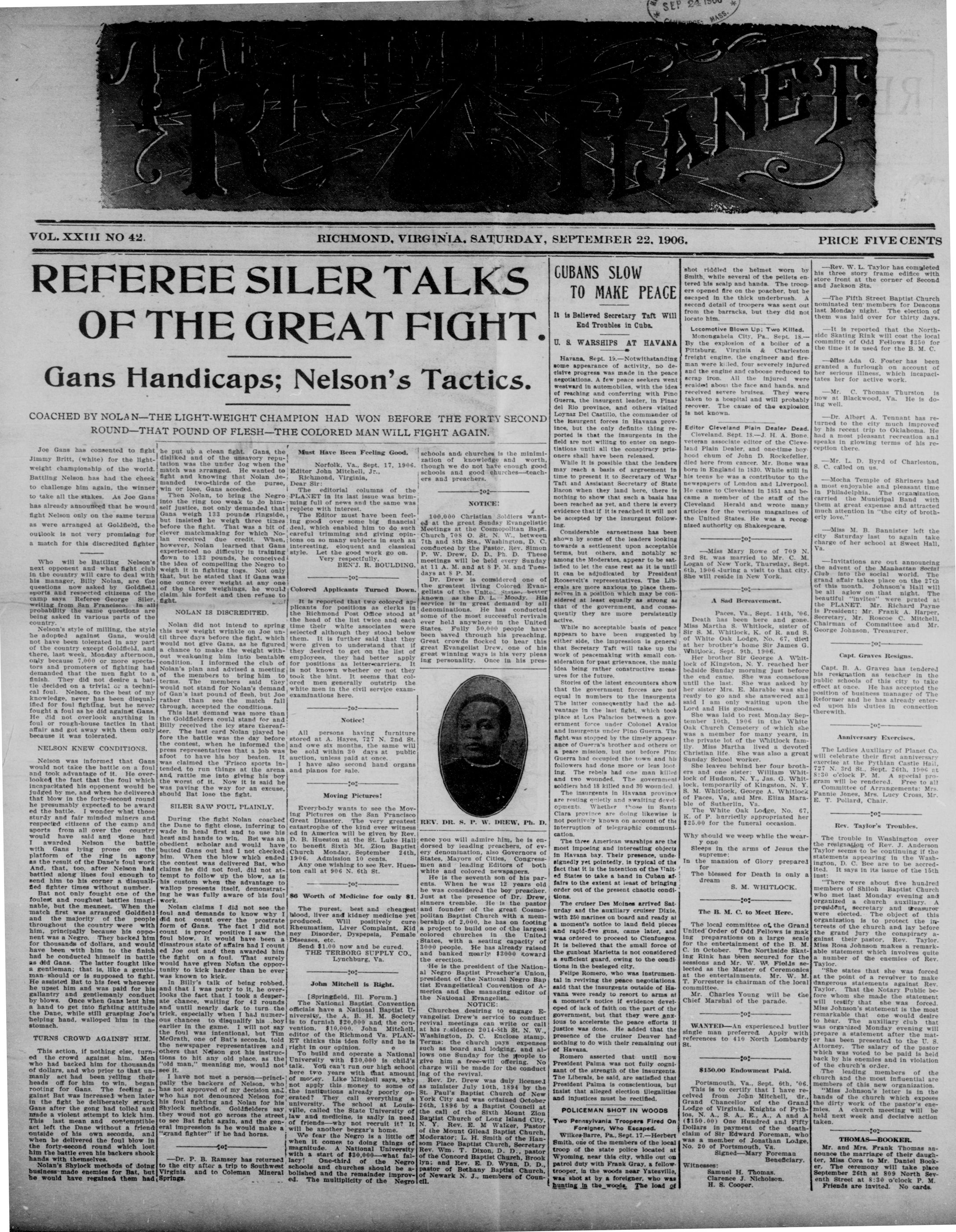
REFEREE SILER TALKS OF THE GREAT FIGHT
Gans Handicaps; Nelson's Tactics.
COACHED BY NOLAN—THE LIGHT-WEIGHT CHAMPION HAD WON BEFORE THE FORTY SECOND ROUND—THAT POUND OF FLESH—THE COLORED MAN WILL FIGHT AGAIN.
VOL. XXIII NO 42.
REFER
OFT
Gans Ha
COACHED BY NOLAN—T
ROUND—TH
Joe Gans has consented to fight Jimmy Britt, (white) for the lightweight championship of the world. Battling Nelson has had the check to challenge him again, the winner to take all the stakes. As Joe Gans has already announced that he would fight Nelson only on the same terms as were arranged at Goldfield, the outlook is not very promising for a match for this discredited fighter
Who will be Battling Nelson's next opponent and what fight club in the country will care to deal with his manager, Billy Nolan, are the questions now asked by Goldfield sports and respected citizens of the camp says Referee George Siler, writing from San Francisco. In all probability the same questions are being asked in various parts of the country.
Nelson's style of milling, the style he adopted against Gans, would not have been tolerated in any part of the country except Goldfield, and there, last week, Monday afternoon, only because 7,000 or more spectators and promoters of fighting had demanded that the men fight to a finish. They did not desire a battle decided on a trivial or a technical foul. Nelson, to the best of my knowledge, never has been disqualified for foul fighting, but he never fought a foul as he did against Gans. He did not overlook anything in foul or rough-house tactics in that affair and got away with them only because it was tolerated.
NELSON KNEW CONDITIONS
Nelson was informed that Gans would not take the battle on a foul and took advantage of it. He overlooked the fact that the foul which incapacitated his opponent would be judged by me, and when he delivered that blow in the forty-second round he presumably expected to be awarded the battle. I wonder what those sturdy and fair minded miners and respected citizens of the camp and sports from all over the country would have said and done had I awarded Nelson the battle with Gans lying prone on the platform of the ring in agony as the result of the Dane's foul work And, that, too, after Nelson had battled along lines foul enough to send him to his corner a disqualified fighter times without number.
Bat not only fought one of the fouste and roughest battles imaginable, but the meanest. When the match first was arranged Goldfield and the majority of the people throughout the country were with him, principally because his opponent was a Negro. They backed him for thousands of dollars, and would have been with him to the finish had he conducted himself in battle as did Gans. The latter fought like a gentleman; that is, like a gentleman should or is supposed to fight. He assisted Bat to his feet whenever he upset him and was paid for his gallantry and gentlemanly conduct by blows. Once when Gans lent him a hand to get into fighting attitude the Dane, while still grasping Joe's helping hand, walloped him in the stomach.
TURNS CROWD AGAINST HIM.
This action, if nothing else, turned the crowd against him. Men who had backed him for thousands of dollars, and who prior to that unmanly act had been yelling their heads off for him to win, began rooting for Gans. The feeling against Bat was increased when later in the fight he deliberately struck Gans after the gong had toiled and made a violent attempt to kick him. This last mean and contemptible act left the Dane without a friend outside of his own seconds, and when he delivered the foul blow in the forty-second round which lost him the battle even his backers shook hands with themselves.
Nolan's Shylock methods of doing business-made enemies for Bat, but he would have regained them had
he put up a clean fight. Gans, the disliked and of the unsavvy reputation was the under dog when the match was arranged. He wanted to fight and knowing that Nolan demanded two-thirds of the purse, win or lose, Gans acceded. Then Nolan, to bring the Negro into the ring too weak to do himself justice, not only demanded that Gans weigh 133 pounds ringside, but insisted he weigh three times before the fight. That was a bit of clever matchmaking for which Nolan received due credit. When, however, Nolan learned that Gans experienced no difficulty in training down to 133 pounds, he conceived the idea of compelling the Negro to weigh it in fighting togs. Not only that, but he stated that if Gans was one ounce over weight at any one of the three weighings, he would claim his forfeit and then refuse to fight.
NOLAN IS DISCREDITED
Nolan did not intend to spring this new weight wrinkle on Joe until three days before the fight, which would not give Gans, as he figured a chance to make the weight without weakening him into beatable condition. I informed the club of Nolan's plan and advised a meeting of the members to bring him to terms. The members said they would not stand for Nolan's demand of Gan's last pound of flesh, but Joe rather than see the match fall through, accepted the conditions. This last demand was more than the Goldfielders could stand for and Billy received the key stare thereafter. The last card Nolan played before the battle was the day before the contest, when he informed the press representatives that a job was afoot to have his boy beaten. It was claimed the 'Frisco sports intended, to run things at the arena and rattle me into giving his boy the worst of it. Now it is said he was paving the way for an excuse, should Bat lose the fight.
SILER SAW FOUL PLAINLY
During the fight Nolan coached the Dane to fight close, inferring to wade in head first and to use his heart and hands to win. Bet was an obedient scholar and would have butted Gans out had I not checked him. When the blow which ended the contest was delivered Bat, who claims he did not foul, did not attempt to follow up the blow, as is his custom when the advantage to wallop presents itself, demonstrating he was fully aware of his foul work.
Nolan claims I did not see the foul and demands to know why I did not count over the prostrate form of Gans. The fact I did not count is proof positive I saw the foul blow. It would have been a disastrous state of affairs had I count ed Joe out and then awarded him the fight on a foul. That surely would have given Nolan the opportunity to kick harder than he ever was known to kick.
In Billy's talk of being robbed, and that I was party to it, he overlooks the fact that I took a desperate chance, waiting for 42 rounds and until nearly dark to turn the trick, especially when I had numerous chances to disqualify his boy earlier in the game. I will not say the foul was intentional, but Tim McGrath, one of Bat's seconds, told the newspaper representatives and others that Nelson got his instructions to hit any old place, as the "old man," meaning me, would not see it.
I have not met a person—principally the backers of Nelson, who has not approved of my decision and who has not denounced Nelson for his foul fighting and Nolan for his Shylock methods. Goldfielders say they would not go across the street to see Bat fight again, and the general impression is he would make a "grand fighter" if he had horns.
—Dr. P. B. Ramsey has returned to the city after a trip to Southwest Virginia and to Coleman Mineral Springs.
RICHMOND, VIRGINIA, SATURDAY, SEPTEMBER 22, 1906.
Must Have Been Feeling Good.
Norfolk, Va., Sept. 17, 1906.
Editor John Mitchell, Jr.,
Richmond, Virginia,
Dear Sir:
The editorial columns of the
PLANET in its last issue was brimming full of news and the same was replete with interest.
The Editor must have been feeling good over some big financial deal, which enabled him to do such careful trimming and giving opinions on so many subjects in such an interesting, eloquent and classical style. Let the good work go on.
Very respectfully.
BENJ. R. BOULDING.
Colored Applicants Turned Down
It is reported that two colored applicants for positions as clerks in the Richmond Post Office stood at the head of the list twice and each time their white associates were selected although they stood below them. It is further said that they were given to understand that if they desired to get on the list of employees, they had better apply for positions as lettercarriers. It is not known whether or not they took the hint. It seems that colored men generally outstrip the white men in the civil service examinations here.
All persons having furniture stored at A. Hayes, 727 N. 2nd St. and owe six months, the same will be sold within 30 days at public auction, unless paid at once. I have also second hand organs and pianos for sale.
Moving Pictures!
Everybody wants to see the Moving Pictures on the San Francisco Great Disaster. The very greatest catastrophe of the kind ever witnessed in America will be given by Rev. D. B. Hueston at the St. Luke Hall to benefit Sixth Mt. Zion Baptist Church Monday, September 24th, 1906. Admission 10 cents. Any one wishing to see Rev. Hueston call at 906 N. 6th St.
$6 Worth of Medicine for only $1
The purest, best and cheapest blood, liver and kidney medicine yet produced. Will positively cure Rheumatism, Liver Complaint, Kidney Disorder, Dyspepsia, Female Diseases, etc. Send $1.00 now and be cured. THE TERBORG SUPPLY CO., Lynchburg, Va.
John Mitchell is Right.
[Springfield. Ill. Forum.]
The National Baptist Convention officials have a National Baptist University, the A, B. H. M. Society is to furnish $20,000 and the convention, $10,000. John Mitchell, editor of the Richmond Va. PLANET thinks this idea folly and he is right in our opinion.
To build and operate a National University with $20,000 is child's talk. You can't run our high school here two years with that amount of money. Like Mitchell says, why not apply this money to some of the institutions already poorly operated? They call everything a university. The school at Louisville, called the State University of law and medicine, is sadly in need of friends—why not recruit it? It will be another beggar's home.
We fear the Negro is a little off when it comes to doing things of magnitude. A National University with a start of $30,000—what fallacy! One-third of the Negro schools and churches should be abolished and the remainder improved. The multiplicity of the Negro
schools and churches is the minimization of knowledge and worth though we do not have enough good schools and good churches—teachers and preachers.
NOTICE:
100,000 Christian Soldiers wanted at the great Sunday Evangelistic Meetings at the Cosmopolitan Bapt. Church, 708 O. St. N. W., between 7th and 8th Sts., Washington, D. C. conducted by the Pastor, Rev. Simon P. W. Drew, D. D., Ph. D. These meetings will be held every Sunday at 11 A. M. and at 8 P. M. and Tuesdays at 8 P. M.
Dr. Drew is considered one of the greatest living Colored Evangelists of the United States, better known as the D. L. Moody. His service is in great demand by all denominations. He has conducted some of the most successful revivals ever held anywhere in the United States. Fully 50,000 people have been saved through his preaching. Great crowds flocked to hear this great Evangelist Drew, one of his great winning ways is his very pleasing personality. Once in his pres-
REV. DR. S. P. W. DREW, Ph. D.
ence you will admire him, he is endorsed by leading preachers, of every denomination, also Governors of States, Mayors of Cities, Congressmen and leading Editors of both white and colored newspapers.
He is the seventh son of his parents. When he was 12 years old he was considered the boy preacher. Just at the presence of Dr. Drew, sinners tremble. He is the pastor and founder of the great Cosmopolitan Baptist Church with a membership of 2,000, he has on footing a project to build one of the largest colored churches in the United States, with a seating capacity of 3000 people. He has already raised and banked nearly $3000 toward the erection.
He is the president of the National Negro Baptist Preacher's Union, president of the National Negro Baptist Evangelistical Convention of America and the managing editor of the National Evangelist.
NOTICE:
Churches desiring to engage Evangelist Drew's service to conduct revival meetings can write or call at his residence 2014-8th St. N. W. Washington, D. C. Enclose stamp. Terms: the church pays expenses such as board and lodging, and allows one Sunday for the people to give him a free-will offering. No charge will be made for the conducting of the revival.
Rev. Dr. Drew was duly licensed as minister July 10th, 1904 by the St. Paul's Baptist Church of New York City and was ordained October 26th, 1896 by a Baptist Council at the call of the Sixth Mount Zion Baptist Church of Long Island City, N. Y. Rev. E. M Walker, Pastor of the Mount Glead Baptist Church, Moderator; L. H. Smith of the Hansom Place Baptist Church, Secretary Rev. Wm. T. Dixon, D. D., pastor of the Concord Baptist Church, Brook lyn; and Rev. E. D. Wynn, D. D., pastor of Bethany Baptist Church, of Newark N. J., members of Council.
CUBANS SLOW TO MAKE PEACE
It is Believed Secretary Taft Will End Troubles in Cuba.
U. S. WARSHIPS AT HAVANA
Havana, Sept. 19.—Notwithstanding some appearance of activity, no decisive progress was made in the peace negotiations. A few peace seekers went westward in automobiles, with the idea of reaching and conferring with Pino Guerra, the insurgent leader, in Pinar del Rio province, and others visited Loynaz Del Castillo, the commander of the insurgent forces in Havana province, but the only definite thing reported is that the insurgents in the field are not willing to enter on negotiations until all the conspiracy prisoners shall have been released.
While it is possible that the leaders may reach a basis of agreement in time to present it to Secretary of War Taft and Assistant Secretary of State Bacon when they land here, there is nothing to show that such a basis has been reached as yet, and there is every evidence that if it is reached it will not be accepted by the insurgent following.
Considerable earnestness has been shown by some of the leaders looking towards a settlement upon acceptable terms, but others, and notably so among the Moderates, appear to be satisfied to let the case rest as it is until it can be adjudicated by President Roosevelt's representatives. The Liberals are more anxious to place themselves in a position which may be considered at least equally as strong as that of the government, and consequently they are more persistently active.
While no acceptable basis of peace appears to have been suggested by either side, the impression is general that Secretary Taft will take up the work of peacemaking with small consideration for past grievances, the main idea being rather constructive measures for the future.
Stories of the latest encounters show that the government forces are not equal in numbers to the insurgents. The latter consequently had the advantage in the last fight, which took place at Los Palacios between a government force under Colonel Avalos and insurgents under Pino Guerra. The fight was stopped by the timely appearance of Guerra's brother and others or a peace mission, but not before Pino Guerra had occupied the town and his followers had done more or less footing. The rebels had one man killed and two wounded. The government soldiers had 18 killed and 30 wounded.
The insurgents in Havana province are resting quietly and awaiting developments. Whether those in Santa Clara province are doing likewise is not positively known on account of the interruption of telegraphic communication.
The three American warships are the most impoising and interesting objects in Havana bay. Their presence, undesignedly yet pointedly, is typical of the fact that it is the intention of the United States to take a hand in Cuban affairs to the extent at least of bringing order out of the present chaotic conditions.
The cruiser Des Moines arrived Saturday and the auxiliary cruiser Dixie, with 250 marines on board and ready at a moment's notice to land field pieces and rapid-five guns, came later, and was ordered to proceed to Cienfuegos. It is believed that the small force of the gunboat Marietta is not considered a sufficient guard, owing to the conditions in the besieged city.
Felipe Romero, who was instrumental in reviving the peace negotiations, said that the insurgents outside of Havana were ready to resort to arms at a moment's notice if evidence developed of lack of faith on the part of the government, but that they were anxious to accelerate the peace efforts if justice was done. He added that the presence of the cruiser Denver had nothing to do with their remaining out of Havana.
Romero asserted that until now President Palma was not fully cognizant of the strength of the insurgents. The Liberals, he said, are satisfied that President Palma is conscientious, but insist that alleged election illegalities and injustices must be rectified.
POLICEMAN SHOT IN WOODS
Two Pennsylvania Troopers Fired On Foreigner, Who Escaped.
Wilkes-Barre, Pa., Sept. 17.—Herbert Smith, one of the members of the local troop of the state police located at Wyoming, near this city, while out on patrol duty with Frank Gray, a fellow trooper, in the woods near Yatesville, was shot at by a foreigner, who was hunting in the woods. The load of
shot riddled the helmet worn by Smith, while several of the pellets entered his scalp and hands. The troopers opened fire on the poacher, but he escaped in the thick underbrush. A second detail of troopers was sent out from the barracks, but they did not locate him.
Lecomotive Blown Up; Two Killed.
Monongahela City, Pa., Sept. 18.—By the explosion of a boiler of a Pittsburg, Virginia & Charleston freight engine, the engineer and fireman were killed, four severely injured and the engine and caboose reduced to scrap iron. All the injured were scalded about the face and hands, and received severe bruises. They were taken to a hospital and will probably recover. The cause of the explosion is not known.
Editor Cleveland Plain Deck
Editor Cleveland Plain Dealer Dead.
Cleveland. Sept. 18. J. H. A. Bone,
veteran associate editor of the Cleveland
Plain Dealer, and one-time boyhood
chum of John D. Rockefeller,
died here from cancer. Mr. Bone was
born in England in 1830. While still in
his teens he was a contributor to the
newspapers of London and Liverpool.
He came to Cleveland in 1851 and
became a member of the staff of the
Cleveland Herald and wrote many
articles for the various magazines of
the United States. He was a recognized
authority on Shakespeare.
—Miss Mary Rowe of 709 N.
3rd St. was married to Mr. C. M.
Logan of New York, Thursday, Sept.
6th, 1906 during a visit to that city.
She will reside in New York.
A Sad Bereavement.
Paces, Va. Sept. 14th, '06.
Death has been here and gone. Miss Martha S. Whitlock, sister of Sir S. M. Whitlock, K. of R. and S. of White Oak Lodge, No. 67, died at her brother's home Sir James G. Whitlock, Sept. 9th, 1906.
Her brother Sir George A. Whitlock of Kingston, N. Y. reached her bedside Sunday morning just before the end came. She was conscious until the last. She was asked by her sister Mrs. E. Marable was she ready to go and she answered and said I am only waiting upon the Lord and His goodness.
She was laid to rest Monday September 10th, 1906 in the White Oak Church Cemetery of which she was a member for many years, in the private lot of the Whitlock family. Miss Martha lived a devoted Christian life. She was also a great Sunday School worker.
She leaves behind her four brothers and one sister: William Whitlock of Hudson, N. Y., Jas. G. Whitlock, temporarily of Kingston, N. Y. S. M. Whitlock, George A. Whitlock of Paces, Va, and Mrs. Elliza Marable of Sutherlin, Va.
The White Oak Lodge, No. 67, K. of P. hurriedly appropriated her $25.00 for the funeral occasion.
Why should we weep while the weary one
Sleeps in the arms of Jesus the supreme:
In the mansion of Glory prepared for
The blessed for Death is only a
dream.
The B. M. C. to Meet Here.
The local committee of the Grand United Order of Odd Fellows is making preparations on a large scale for the entertainment of the B. M. C. in October. The Northside Skating Rink has been secured for the sessions and Mr. W. W. Fields selected as the Master of Ceremonies at the entertainments. Mr. W. M. T. Forrester is chairman of the local committee. Mr. Charles Young will be the Chief Marshal of the parade.
WANTED—An experienced butler single man preferred. Apply with references to 410 North Lombardy St.
$150.00 Endowment Paid.
Portsmouth, Va., Sept. 6th, '06.
This is to certify that I have received from John Mitchell, dr.
Grand Chancellor of the Grand Lodge of Virginia, Knights of Pythios, N. A., S. A., E., A, A and A ($150.00) One Hundred and Fifty Dollars in payment of the death-calm of Sir Edward Foreman, who was a member of Jonathan Lodge, No. 20 of Portsmouth, Va.
Signed—Mary Foreman Beneficiary.
Witnesses:
Samuel H. Thomas.
Clarence J. Nicholson.
H. S. Cooper.
PRICE FIVE CENTS
—Rev. W. L. Taylor has completed his three story frame edifice with store front at the corner of Second and Jackson Sts.
—The Fifth Street Baptist Church nominated ten members for Deacons last Monday night. The election of them was laid over for thirty days.
—It is reported that the Northside Skating Rink will cost the local committee of Odd Fellows $350 for the time it is used for the B. M. C.
—Miss Ada G. Foster has been granted a furlough on account of her serious illness, which incapacitates her for active work.
—Mr. C. Thomas Thurston is now at Blackwood, Va. He is doing well.
—Dr. Albert A. Tennant has returned to the city much improved by his recent trip to Oklahoma. He had a most pleasant recreation and speaks in glowing terms of his reception there.
—Mr. L. D. Byrd of Charleston, S. C. called on us.
—Mocha Temple of Shriners had a most enjoyable and pleasant time in Philadelphia. The organization carried the Municipal Band with them at great expense and attracted much attention in "the city of brotherly love."
—Miss M. B. Bannister left the city Saturday last to again take charge of her school at Sweet Hall, Va.
—Invitations are out announcing the advent of the Manhattan Social Club into the social world. The grand affair takes place on the 27th of this month. Johnson's Hall will be all aglow on that night. The beautiful "invites" were printed at the PLANET. Mr. Richard Payne is President; Mr. Frank A. Harper, Secretary, Mr. Roscoe C. Mitchell, Chairman of Committee and Mr. George Johnson, Treasurer.
Capt. Graves Resigns.
Capt. B. A. Graves has tendered his resignation as teacher in the public schools of this city to take effect at once. He has accepted the position of business manager of The Reformer and he has already entered upon his duties in connection therewith.
Anniversary Exercises.
The Ladies Auxiliary of Planet Co. will celebrate their first anniversary exercise at the Pythian Castle Hall, 727 N. 3rd St., Sept. 26th, 1506 at 8:30 o'clock P. M. A special program will be rendered. Free to all Committee of Arrangements: Mrs. Fannie Jones, Mrs. Lucy Cross, Mr. E. T. Pollard, Chair.
Rev. Taylor's Troubles.
The trouble in Washington over the resignation of Rev. J. Anderson Taylor seems to be continuing if the statements appearing in the Washington, D. C. Bee are to be accredited. It says in its issue of the 15th inst:
"There were about five hundred members of Shiloh Baptist Church who met last Monday evening and organized a church auxiliary. A president, secretary and treasurer were elected. The object of this organization is to protect the interests of the church and lay before the grand jury the conspiracy against their pastor, Rev. Taylor. Miss Rosa Johnson makes a remarkable statement which involves quite a number of the enemies of Rev. Taylor.
"She states that she was forced at the point of a revolver to make dangerous statements against Rev. Taylor. That the Notary Public before whom she made the statement will testify that she was forced. Miss Johnson's statement is the most remarkable that one would desire to hear. The auxiliary club that was organized Monday evening will prepare a statement after the matter has been presented to the U. S. Attorney. The salary of the pastor which was voted to be paid is held back by his enemies and in violation of the church's order.
The leading members of the church and the most influential are members of this new organization."
"Miss Johnson's letter is in the hands of the church which exposes the dirty work of the pastor's enemies. A church meeting will be held next week and decisive action taken.
THOMAS—BOOKER
Mr. and Mrs. Frank Thomas announce the marriage of their daughter, Miss Cora to Mr. Daniel Booker. The ceremony will take place September 26th at 809 North Seventh Street at 8:30 o'clock P. M. Friends are invited. No cards.
5 =) ae ee oe
=a THESA!
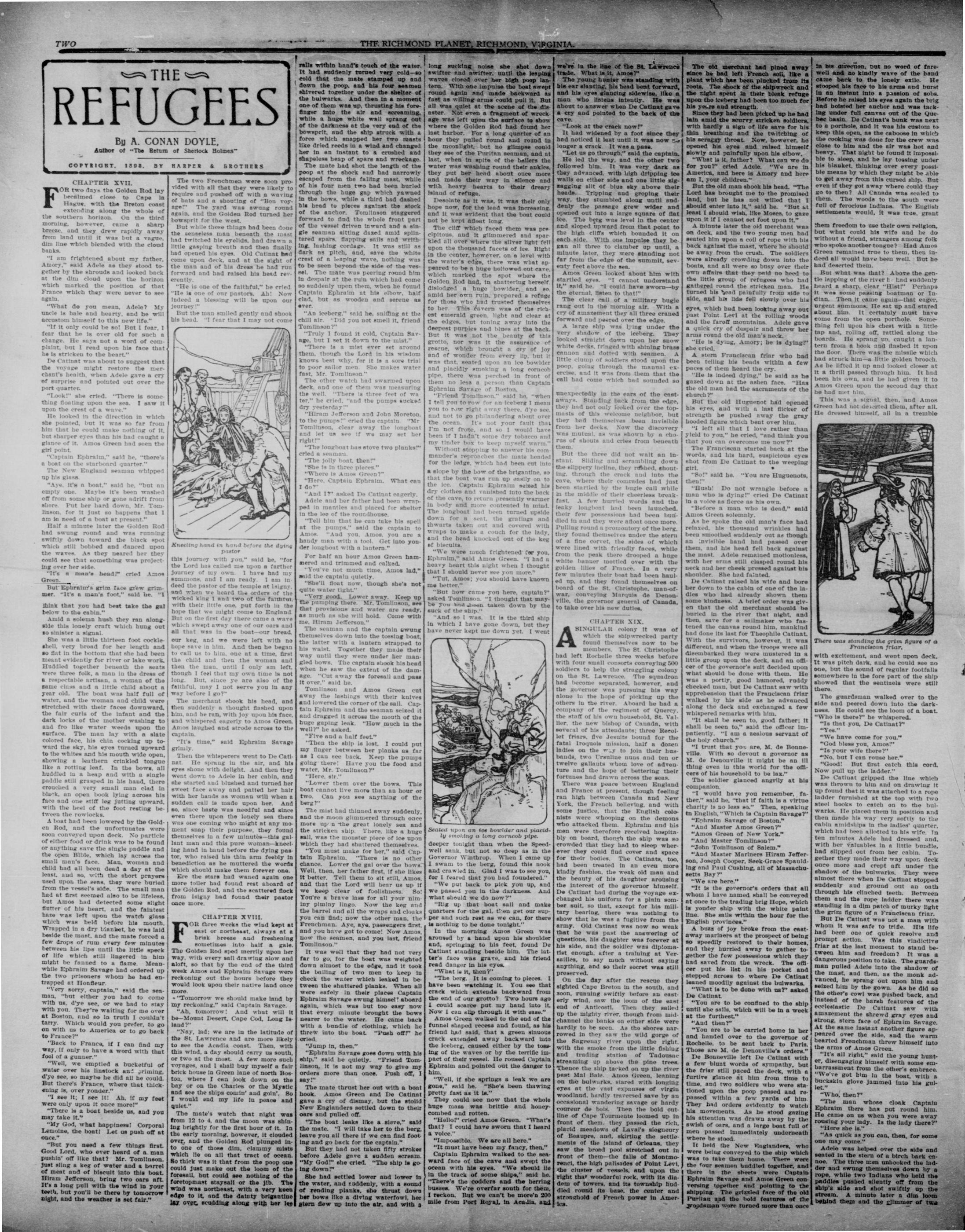
By A. CONAN DOYLE,
Autbor of “The Retum of Sherlock Holmes”
coprniaer, 1898.. BY SARPED. & SudTERhaD n>
Two
CHAPTER YXVYTIT
at the dim cloud upon the horizon
which marked the position of that
France which they were never to see
again.
“What Go you mean, Adele? My
uncle is hale and hearty, and be will
accustom bimself to this new life.”
“If it only could be so! But I fear, 1
fear that he ts over old for such a
change. He says not a word of com:
Plaint, but I read upon bis face that
he Is stricken to the beart.”
De Catinat was about to suggest that
the voyage might restore the mer-
chant's health, when Adele gave a cry
of surprise and polated out over the
Port quarter.
“Look!” she cried. “There is some
thing floating upon the sea. I saw it
upon the crest of a wave.”
He looked tn the direction in which
she pointed, but it was so far from
him that he could make nothing of it
Dut abarper exes than his bad caught 2
glance of It. Amos Green had seen the
Bir! point.
“Captain Ephrata,” said be, “there's
8 boat on the starboanl quarter.”
The New England seaman whipped
up his glass,
“Aye. it's a boat,” said he, “bet an
empty one. Maybe it's been washed
off from some ship of gone adrift from
store. Put ber hard down, Mr. Tom
Hinson, for tt Just so happens that I
am in need of a boat at present.”
Half a minute Inter the Golden Rod
bad swung round and was running
swiftly down toward the biack spot
which still Sobbed and danced upon
the waves, AB they neared ber ther
coull see that something was project:
ing over her side.
“It's @ man's bead!” cried Amos
Green.
But Epbraim’s grim face grew grim-
mer. “It's a man's foot.” sald be. “I
Mink that you had best take the gal
below to the cabin.”
Amid a solemn hush they ran along-
Bide this lonely craft which hung out
to sinister a signal
She was a little thirteen foot cockle-
shell, very broad for her length and
0 fat in the bottom that she had been
meant evidently for river or lake work.
Huddied together beneath the seats
‘were three folk, a man in the dress of
& respectable artisan, a woman of the
Same class and a little child about a
year ol. The boat was half full of
‘water, and the woman and child were
Stretched with their faces downward,
the fair curls of the Infant and the
dark locks of the mother washing to
and fro lke water weeds upon the
surface. The man lay with a slate
colored face, his chin cocking up to
‘ward the sky, his eyes turned upward
to the whites and his mouth wide open,
showing a leathern crinkled tongue
Mke a rotting Jenf. In the bows, all
huddled in a heap and with a single
paddle still grasped in bis hand, there
crouched a very small man clad in
black, an open book lying across his
face and one stiff leg jutting upward,
with the heel of the foot resting be-
tween the rowlocks.
A boat had been lowered by the Gold-
en Rod, and the unfortunates were
‘soon conveyed upon deck. No particle
of either food or drink was to be found
or anything save the single paddle and
‘the open Bible, which lay acrons the
‘small man’s face. Man, woman and
child had all been dead a day at the
Teast, aud so, with the short prayers
used upon the sens, they were buried
from the vessel's side. The small man
had at first seemed also to be lifeless,
but Amos had detected some slight
flutter of bis heart, and the faintest
haze was left upon the watch glass
which was beld before his mouth.
‘Wrapped in a dry Vianket, be was laid
beside the mast, and the mate forced a
few drops of rum every few minutes
between bis lips until the ttle speck
of ife which still lingered in him
might be fanned to a flame. Mean-
while Ephraim Savage bad ordered up
the two prisoners whom he had en-
trapped at Honfleur.
“Very sorry, captain,” sid the sea-
man, “but either you had to come
with us, d'ye see, or we bad to stay
With you. They're waiting for me over
at Boston, and eo in truth I coulda’t
tarry. Which would you prefer, to go
on with us to America or to go back
to France?”
“Back to France, if I can nd my
‘way, If only to bave a word with that
foo) of a gunuer.”
“Well, we emptied a bucketful of
water over his linstock anc oriming,
dye see, so maybe he did al! he could.
But there’s France, where that thick-
ening is, over yonder.”
“T seo it; I see it! Ab. if my feet
‘were only upon it once more!”
“There is a boat beside us, aud you
may take it.” .
“My God, what bappiness! Corporal
Lemoine, the boat! Let us push off at
once.”
“But you meed a few things first.
Good Lord, who ever heard of a man
a keg a 4
‘Of meat and of biscuit into this boat.
Tee snake
‘The two Frenchmen were soon pro
vided with all that they were likely t
require and pushed off with a waving
of bats and a shouting of “Bon voy
ager The yard was swung round
‘again, and the Golden Rod turned her
dowsprit for the west.
But while these things had been done
the senseless man beneath the wast
had twitched bis eyelids, had drawn a
Uttle gasping breath and then fually
had opened his eyes. Old Catinat had
come upon deck, and at the sight of
the man and of bis dress he had run
forward and had ratsed bis head rer.
erentiy.
“He is one of the faithful,” be ried
“He ie one of our pastors. Ab! Now
Indeed a blessing will be upon our
Journes!”
But the man smiled gently and shook
bie head. “T fear that I may not come
e if
Ce?
ORIN. :
Cm \ : \l
ee a ‘ :
ee oes
this Journey with you," sald be, “for
the Lord has called me upon # farther
Journey of my own. I have had my
Summons, and 1 am ready. Tam tn
deed the pastor of the temple at Isigny,
and when we beard the orders of the
wicked king T and two of the fattnrar,
with their little one, put forth in the
hope that we might come to England.
But on the first day there came a wave
which swept away one of our oars and
all that was in the boat—our bread,
our keg, and we were left with no
bope save in him. And then be began
to call us to him, one at a time, frst
the child and then the woman and
then the man, until I only am left,
though I feel that my own time ts not
long. But, since ye are also of the
faithful, may I uot serve you In any
way before [ go?*
‘The merchant shook his head, and
then suddenly a thought flashed upon
Rim, and he ran, with Joy upon his face,
and whispered eagerly to Atmos Green.
Amos laughed and strode across to the
captain,
“It’s time,” sald Ephraim Savage
grimly.
‘Then the whisperers went to De Catt.
nat. He sprang iu the air, and bis
eyes shone with delight. And then they
‘went down to Adele in her cabin, and
she started and blushed and turned her
sweet face away and patted her halr
‘with ber bands as woman will when a
sudden call {s made upon her. And
0, since haste was needful and since
even there upon the lonely sea there
Was ove coming who might at any mo-
ent snap thelr purpose, they found
themselves in a few minutés—this gal-
lant man and this pure woman—kneel-
ing band in band before the dying pas-
tor, who raised bis thin arm feebly In
Denediction as be muttered the words
Which should make them forever one,
Ere the stare had waned again one
more totler bud found rest aboard of
the Golden Rod, and the scattered flock
from Isigny had found thelr pastor
enne more.
CHAPTER ewte
OR three weeks the wind kept at
east or northeast, always at a
brisk breeze and freshening
sometimes into half a gale.
The Golden Rod sped merrily upon her
‘Way, with every sali drawing alow and
aloft, so that by the end of the third
Week Amos and Ephraim Savage were
reckoning out the hours before they
‘Would look upon their native land once
more
+“Tomorrow we should make land by
my reckoning,” sald Captain Savage.
“Ab, tomorrow! And what will It
be—Mount Desert, Cape Cod, Long Is-
Mand?”
“Nay, iad: we are in the latitude of
the St. Lawrence and are more likely
to see the Acadia coast. Then, with
this wind, a day should carry us south,
or two at the most. A few more such
voyages, and I shall buy myself a fair
brick house ia Green lane of north Bos-
ton, where I can jook down on the
bay or on the Charles or the Mystic
and see the ships comin’ and goin’, So
T would end my life in peace and
quiet.”
The mate's watch that night was
from 12 to 4, and the moon was shin-
ing brightly for the first hour of ft. In
tho early morning, however, it clouded
over, and the Golden Rod plunged in-
to one of those dim, clammy mists
Which lie on all that tract of ocean.
So thick was it that from the poop one
could just make out the loom of the
foresail, but could see nothing of the
foretopmast staysall-or the jib. The
‘Wind was northeast, with a very keen
edge to it, and the dainty brigantine
‘Jey over, scudding along with ber lee
THE, RICHMOND PLANET, RICHMOND, ViRGINIA.
laniveret (onether under the abelter o
oe gy oe
etc he 9 ting le fore
While « huge white wall sprang 08
the darkness at the very end of th
‘bowsprit, and the ship str: a
force which snapped her two
Ake dried reeds in a wind and changed
her in an instant to a crusbed and
shapeless heap of spars and wreckage.
‘The mate had shot the length of the
Poop at the shock and had narrowly
escaped from the falling mast, while
of bis four men two had been buried
through the huge gap which yawned
im the bows, while a third bad dashed
‘Dis heed to pieces agninst the stock
of the anchor. Tomlinson staggered
forward to find the whole front part
‘Of the vessel driven inward and a sin-
gle seaman altting dazed amid splin-
tered spars. Sapping sails and writh-
ing. lashing cordage. It was still as
ark ns pitch, and, save the white
‘crest of a ivaping wave, nothing was
‘to be seen beyond the side of the ves-
sel. The mate was peering round him
tn despair at the ruin which had come
80 suddenly upon them, when he found
Captain Ephraim at hia elbow, half
clad, but as wooden and serene as
ever,
“An iceberg,” said he, sniffing at the
chill air, “Did you not smell it, friend
Tomlinson?"
“Truly 1 found it cold, Captain Say-
age, but I set 1t down to the mist.”
“There is a mist ever set around
them, though the Lord in his wisdom
knows best why, for it is a sore trial
to poor sailor men. She makes water
fast. Mr. Tomlinson”
The other watch had swarmed upon
deck, nod one of them was measuring
the well, “There Is three feet of wa
ter.” he cried, “and the pumps aucked
ary yesterday"
“Hiram Jefferson and John Moreton.
to the pumps"” cried the captain “Mr
Tomlinson, clear away the longboat
and let us see if we may wet her
right!"
“The lonzhoat has atove two planks!"
cried a seaman
“The jolly boat, then!”
“She is In three pleces.
“Where is Amos Green?”
“Here, Captain Ephraim, What ean
1 40
“And TY" asked De Catinat eagerly.
Adele and ber father had been wrap.
ped in mantles and placed for shelter
in the lee of the roundhouse.
“Tell bim that he can take his spell
at the pumps.” sald the captain to
Amos. “Aud you, Amos, you are a
handy man with a tool. Get {ato you
der Jongboat with a lantern.”
For half an hour Amos Green ham-
mered and trimmed and calked.
“You're not much time, Amos lad,"
mid the captain quietly.
“She'll foat now, though she’s not
quite water Ught.”
“Very good, Lower away. Ke
the pumping there. Mr. Tonillasoey wes
that provisions aid water are ready,
as much as she will hold, Come with
me, Hiram Jefferson.”
The seaman and the captain ewung
themselves down tnto the tossing boat,
the latter with a lantern strapped to
Lis waist. Together they made their
way until they were under ber man.
gled bows, The captain shook his head
when he saw the extent of the dam-
age. “Cut away the foresall and pass
ft over,” ald he.
Tomlinson and Amos Green cut
away the lashings with thelr knives
and lowered the corner of the sail. Cap-
tain Ephraim and the seaman seized it
and dragged It across the mouth of the
huge gaping leak. “How much In the
well?” he asked.
“Five and a half feet.”
“Then the ship is lost. I could put
my finger between ber planks as far
as I can see back. Keep the pumps
going there! Have you the food and
water, Mr, Tomlinson?”
“Here, sir.”
“Lower them over the bows. This
boat cannot ive more then an hour or
two. Can you see anything of the
berg?”
The mist had thinned away suddenly,
and the moon glimmered through once
more up n the grest lonely sea and
the stricken sbip. There, like a buge
sail, was the monster plece of ice upon
which they bad shuttered themselves.
“You must make for her,” sald Cap-
tain Ephraim. “There is no other
chance. Lower the gal over the bows.
‘Well, then, her father first, if she likes
Mt better. Tell them to sit still, Amos,
and that the Lord will bear us up if
We keep clear of foolishness. So!
You're a brave laws for ell your nim:
iny piminy lingo. Now the keg and
the barrel and all the wraps and cloaks
you can find; now the other man, the
Frenchman. Aye, aye, passengers first,
and you have got to come! Now Amos,
now the seamen, and you last, friend
Tomlinson.”
It was well that they had not very
far to go, tor the boat was weighted
down almost to the edge, and it took
‘the bailing of two men to keep to
check the water which leaked in be-
‘tween the shattered planks. When all
were safely in their places Captain
ae Sey SS ee eee aes
a ; ere
Ne re Solna Bak
| waves cloeedl over her. big poop la
ound ae ae gay gee nm ogy
Pete Fede seg ge
pel Cenen: St enemas aeay:
ee ne ent of wreck
° the Gold nad found be
last harbor. For a long quart an
‘Dour they pulled round and roani
the moonlight; but no glimpse co
they see of the Puritan seaman, and ¢
Inst, when of the ballers the
water was round thelr ankles,
they put about once more
and made their way in sllence apd
with heavy hearts to thelr dreary
island of refuge, s ;
Desolate ax it was, it was thelt only
hope now, for the tend was Increasing.
and it was evident that the boat could
not be kept @foat tong. :
The cit? which faced them was pre
cipitous, and it gliimmered and spar-
kled all ovef where the silver light fel!
‘upon the thousand facets of ice. Right
in the center, however, on a level with
the water's edge, there was what ap-
peared to be n huge hottowed out cave.
which marked the spot where the
Golden Rod had, tn shattering herself.
Gisiodged a huge bow!lder, and so,
amid ber own ruin. prepared a refuge
for those who bed trusted themselves
to her. This @avern was of the rich.
est emerald green, light and clear at
‘the edges, but toning away Into the
deepest purples and biues at the back.
But {t was not the beauty of this
Krotto, Hor was it the assurance of
rescue, whieh broucht a ers of Joy
and of wonder from every lip, but it
was that, seated upon an ice bowlder
and placidiy smoking a tong eorncoh
pipe, there was perched in front of
them no Jess a person than Captain
Ephraim Sarage of Roston,
“Friend Tomlinson,” said ho, “when
I tell you torow for un tcebere 1 mean
Fou to row right away there. d'ye see.
and not to go phiiandering about over
the ocean. It's not your fault that
Tm not froze, and so I would have
been if Thadn't some dry tobacco and
my tinder box to keep myeelt warm,”
Without stopping to answer his com
mander’s repronches the mate headel
for the ledge, which had been ext Int
* slope by the bow of the brigantine, so
that the boat was run up easily on to
the ice. Captuin Ephraim seized his
dry clothes and vanished tnto the back
of the cave, to return presently warmer
in body and more contented In mind.
‘The jongboat had been turned upside
down for @ seat, the gratings and
thwarts taken out and covered with
wraps to make a couch for the lady,
and the head koocked out of the keg
of biscults,
“We were much frightened’ ter you,
Ephraim," nald Amos Green. “I had a
heavy heart this night when I thought
that I should never see you more.” /
| “Tut, Amos; you should have known
‘me better.”
“But how came you here, captatn?*
asked Tomlinson. “I thought that may-
De Fou nd deen taken down by the
suck of the ship.”
“And so 1 was. It Is the third ship
in which I have gone down, but they
pel ceca eg: cet pianalig tee Aco Bh nace.
, VS fo
ey Y
Pes tee SK
een
ao
BS ig ee
Seated upon an tos bowlder and piacid-
ly smoking @ long corneod pipe.
deeper tonight than when the Speed-
Well sank, but not so deep as in the
Governor Winthrop. When I came up
I swam to the berg, found this nook
and crawled in, Glad I was to see you,
for I feared that you had foundered.”
“We put back to pick you up, and
We passed you Iu the darkness. And
what sbould we do now?"
“Rig up that boat sall and make
quarters for the gal, then get our sup-
Der und such rest as we can, for there
ia nothiug to be done tonight.”
In the morning Anos Green was
aroused by a band upon his shoulder
and, springing to bis feet, found De
Catinat standing beside him. The lat-
ter's face was grave, and his friend
Fead danger in his eyes,
“What is it, then?”
“The berg. It is coming to pieces. 1
have been watching it. You see that
erack which extends backwani from
the end of our grotto? Two hours ago
I could scarce put my band into it
Now I can slip through It with ease.”
Amos Green walked to the end of the
funnel shaped recess and found, as his
friend had said, that a green sinuous
crack extended away backward into
the iceberg, caused either by the toss-
tng of the waves or by the terrific im-
pact of their vessel. He roused Captain
Ephraim and pointed out the danger to
him.
“Well, if she springs a leak we are
gone,” said he. “She's been thawing
Pretty fast as it te.”
‘They could see now that the whole
huge mass was brittie and houey-
combed and rotten.
“Hello!” cried Amos Green. “What's
that? I could have sworn that I heard
& vole.”
“Impossible, We are all here.”
“It must have been my fancy, then.”
Captain Ephraim walked to the sen-
ward face of the cave and swept the
ocean with his eyes. “We should ite
im the track of some ships,” said he.
“There's the codders and the herring
busses, We're overfar south for them,
I reckon. we can’t be more'n 200
tmile from Port RoyaJ, in Acadia, and
ee toe
| ‘The young bumter was s 1.
pe nate gh so agen eeu ee.
ee. bo ‘intense iaten 1 =a
bees ant cote eon eee
Ce =
3 mee +S
‘Tt had 8 foot since they
had noticed it — now Ba
longer @ crack. . :
“Let i go through ‘the
‘He led the way, and the other =
followed him. It was very dark as
‘they advanced. with Ligh dripping fce
‘walls on either side and one little xig-
Bagging slit of blue sky above thelr
heads. Tripping aud groping their
way, they stumbled along until snd-
denly the passage grew wider and
‘opened out into a large square of flat
fee. The berg was level In the center
and sloped upward from that point to
the high cliffs which bounded It on
each.side. With one impulse they be-
gan all three to clamber up until, a
minute later, they were standing not
far from the edge of the summit, sev-
enty feet above the sea.
Amos Green looked about him with
startled eyes. “I cannot understand
it” said he. “I could have sworn—by
the eternal, Ifsten to that!”
‘The clear call of a military bugle
Fang out In the morning alr. With a
cry of amazement they all three craned
forward and peered over the edge,
A large ship was lying under the
very shadow of the leeberg. ‘They
looked straight down upon her snow
white decks. fringed witb shining brass
ernnon and dotted with seamen. A
Uttle clump of soldiers stood upofi the
poop. goiug through the manual ex-
ercise, and {t was from them that the
call bad come which bad sounded so
unexpectediy in the ears of the east-
aways. Standing back from the edge,
they had not ouly looked over the top-
masts of this weleome neighbor, but
they had themselves been invisible
from her decks. Now the discovery
was mutual, as was shown by a cho.
Tus of shoute and erles from beneath
them,
But the three did not walt an in:
stant. Sliding and scrambling down
the slippery incline, they rf&hed, ehout
Ing. through the crack and into the
cave, where thelr comrades had just
been startled by the bugle call while
im the middle of their cheerlesa break-
fost. A few hurried words and the
leaky longboat had been launched.
their few possessions had been butt
died tn and they were afloat once more.
Pulling round a promontory of the berg.
they found themselves under the stern
of a fine corvet, the sides of which
were lined with friendly faces, while
from the peak there drooped a huge
white banuer mottled over with the
golden lilies of Fmance. In a very
few minutes their boat had been haul
ed up, and they found themselves on
board of the St. Christophe, man-of-
war, conveying Marquis de Denon-
Ville, the governor general of Canada,
to take over his new duties,
CHAPTER XIX.
eee te eee. ee Led
which the stipwrecked party
found themselves now to be
members, The St. Christophe
had left Rochelle three weeks before
with four small consorts conveying G00
jsoldiers to help the straggling colony
on the St. Lawrence, ‘The squadron
‘had become separated, however, and
the governor was pursuing his way
alone in the hope of picking up the
others In the river. Aboard he bad a
company of the regiment of Quercy.
the staff of bis own household, St. Val.
Her, the new bishop of Canada, with
several of bis attendants; three Reeol-
let friars, Ove Jesuits bound for the
fatal Iroquois mission, half a dozen
Indies on the wy to join their hus-
bands, two Ursulive ouus and ten oF
twelve gallants whom love of adven-
ture and the hope of bettering their
fortunes had drawn across the seas.
There was poace between England
and France at present, though feeling
ran high between Canada and New
York, the French belleving, and with
some justice, that the English colo
ists were whooping on the demons
who attacked them. Ephraim and his
men were therefore received hospita-
bly on board, thorgh the ship was so
crowded that they had to sleep wher-
ever they could find cover and space
for their bodies, The Catinats, too,
had been treated in an even more
kindly fasbion, the weak old man and
the beauty of his daughter arousing
‘the interest of the governor himself.
De Catinat had during the voyage ex-
changed his uniform for a plain som-
ber suit, so that, except for his mill-
tary bearing, there was nothing to
show that be was a fugitive from the
army. Old Catinat was now so weak
that he was past the answering of
questions, his daugbter waa forever at
his side, and the soldier was dipioma-
tist enough, after a tratuing at Ver-
asilles, to say much without saying
anything, and so their secret was still
preserved.
On the day after the rescue they
sighted Cape Breton in the south, and
300n, running swiftly before an east-
erly wind. saw the loom of the east
end of Anticostl, Then they sailed
up the mighty river, though from mid-
channel the banks on either side were
hardly to be seen. As the shores nar-
rowed in they saw the wild gorge of
the Sagvenay river upon the right,
with the smoke from the little fishing
and trading station of Tadousac
Streaming up above the pine trees,
‘Thence the ship tacked on up the river
past Mal Bale. Amos Green, leaning
on the bulwarks, stared with longing
eyes at the vast expanses of virgin
‘woodland, hardly traversed save by an
occasional wandering savage or hardy
coureur de bols. Then the bold out-
Une of Cape Tourmente loomed up in
front of them. they passed the rich,
placid meadows of Laval's siogueury
of Beaupre, and, skirting the settle.
ments of the sland of Orleans, they
saw the broad pool stretched out in
front of them—the fulls of Montmo-
renci, the high palisades of Point Levi,
‘the cluster of vessels, and upon the
| right that wonderful rock, with its dia-
dem of towers, and its township bud.
OPRAU AE Feeney Comet i Amat
roots, ‘The shock of the shipwreck
[spo he toners: te + pins
Maan mae hs ae
ard a Men ol ike aa
} thin breathing and the twi of
=, po Bi show
father? What con we
for ou?" ered ‘Adele. “We are in
America, and here is Amory and here
em 1, your children.”
‘But the old man shook his head. “The
‘Lord bas brought me to the promised
Jand, but he has not willed that I
should enter Into It,” said be. “But st
Yeast I should wish, Ike Moses, to gaze
‘upon it if I cannot set foot upon tt.”
A minute later the old merchant was
‘on deck, and the two young men had
seated him upon a coll of rope with his
back against the mast, where he should
be away from the crush. The soldiers
were already crowding down into the
Donte, and all were so busy over their
own affairs that they paid no heed to
‘the little group of refugees who had
gathered round the stricken man. He
turned his Sead palnfully from side to
aide, and bis lide fell slowly over his
eyes, which bad been looking away out
Past Point Leri at the rolling woods
and the faroff mountains. Adele gave
& quick cry of despair and threw her
arms round the old man’s neck,
“He Is dying, Amory; be is dying!”
abe cried,
A stern Franciscan friar who bad
deen telling bie beads within a few
paces of them heard the ery.
“He 1s indeed dying,” he sald as he
gazed down at the ashen face. “Has
the old man bad the sacraments of the
ebareb ?”
But the old Huguenot had opened
bis eyes, aud with a last flicker of
strength he pushed away the gray
hooded figure which bent over him.
“I left all that I love rather than
Field to you,” he cried, “and think you
that you can overcome me now?”
The Franciscan started back at the
words, and his hard, suspicious eyes
shot from De Catinat to the weeping
girl, .
“Sot* sald he, “You are Huguenots,
then!”
“Hush! Do not wrangle before a
man who is dying! cried De Catinat
in a voice as flerce as his own,
“Before a man who ts dead,” sald
Amos Green solemnly.
As be spoke the old man's face had
relaxed, bis thousand wrinkles had
been smoothed suddenly out as though
an invisible band had passed over
them, and his head fell back against
the mast. Adele remained motionless,
with ber arms still clasped round bis
neck and ber cheek pressed agalust bis
shoulder. She bad fainted,
De Catinat raised bis wife and bore
ber down to the cabin of one of the la-
@ies who had already shown them
some Kindness. A brief order was giv-
en that the old merchant should be
buried im the river that night, and
then, save for a sallmaker who fas-
tened the canvas round him, mankind
had done its last for Theophile Catinat.
With the survivors, bowever, it was
different, and when the troops were all
disembarked they were wustered in a
ttle group upon the deck, and an offi-
cer of the governor's sult decided upon
what should be done with them. He
‘was & portly, good humored, raddy
cheeked man, but De Catinat saw with
apprebension that the Franciscan friar
walked by his side as he advanced
along the deck and exchanged a few
whispered remarks with him,
“It shall be seen to, good father; it
shall be seen to,” sald the officer im-
patiently. “I am a zealous servant of
the holy church.”
“I trust that you are, M. de Bonne-
Ville. With so devout a governor as
M. de Denonville it might be an {il
‘thing even in this world for the ofi-
cers of his household to be lax.”
The soldier glanced angrily at bis
companion,
“I would have you remember, fa-
ther,” said he, “that if faith is a virtue
charity Is no less #0.” Then, speaking
tm English, “Which te Captain Savage?”
“Ephraim Savage of Boston.”
“And Master Amos Green?”
“Amos Green of New York.”
“And Master Tomlinson?”
“John Tomlinson of Salem.”
“And Master Mariners Hiram Jeffer-
son, Joseph Cooper, Seek-Grace Spauld-
Ing and Paul Cushing, all of Massachu-
setts Bay?”
“We are here.”
“It ts the governor's orders that all
whom I hare named sball be conveyed
at once to the trading brig Hope, which
is yonder ship with the white peint
Mne. She sails within the bour for the
English provinces.”
A buzz of joy broke from the enst-
‘away mariners at the prospect of being
80 speedily restored to their homes,
and they hurried away to gather to-
gether the few possessions which they
had saved from the wreck. The offi.
cer put his list in his pocket and
stepped across to where De Catinat
leaned moodily against the bulwarks,
“What is to be done with us?” asked
Te Catinat
in bie airéction, Dut no word of fare-
y = hye
a » the lonely exile. He
stooped bis face to bis arms nnd burst
t san iatant into a passion of sols.
Before he raised bis eyes again the brig.
ing u full canvas out of the Que-
Dec basin. De Catinat’s bunk was next
‘8 porthole, and It was his custom to
‘keep this open, as the caboose in which
{the cooling was done for the crew was
to him and the air was hot and
heavy. That night he found it imposal-
ble fo sleep, and be lay tossing under
his blauket, thinking over every possi-
ble means by which they might be able
to get away frow this cursed ship. But
even if they got away where could they
go to then? All Canada was sealed to
them. The woods to the south were
fell of ferocious Indians. The Englist:
settioments would, ft was tree, grant
them freedom to use their own religion,
but what could his wife and he do
without a friend, strangers among folk
who spoke another tongue? Had Amos
Green remained true to them, then in-
deed all would bave been well. But be
bad deserted them.
But what was that? Above the gen-
tle lapping of the river b- Lad suddenty
beard a sharp, clear “Hist! Perhaps
it was some passing boatman or In-
dian, Then it came again—that eager,
Urgent summons, He sat up and stared
about bin. It certainly must have
ome from the open porthole. Some
thing fel! upon his chest with a litte
tap and, rolling off, rattled along the
boards. He sprang un, caught a lan.
tern from @ hook and flashed it upon
the floor. ‘There was the missile which
bad struck him—a ttle golden brooch.
Aa be lifted it up and looked closer at
it a thrill passed through him. Tt had
been his own, and he had given It to
Amos Green upon the second day that
be had met blew.
This was 9 signal, then, and Amos
Green had hot descrted them, after all
He dressed bimeelf, all in a tremble
A : A, rN
‘There was standing the grim Agure of &
Franciscan friar,
ae excitement, and went upon deck.
Tt was pitch dark, and he could see no
one, but the sound of regular footfalis
somewhere tn the fore part of the ship
showed that the sentinels were stil!
there,
The guardeman walked over to the
side and peered down into the dark-
tess, He could see the loom of a boat.
“Who Is there?" he whispered.
“Is that you, De Catinat?”
“Ten”
“We have come for you."
“God bless you, Amos!"
“Is your wife there?"
“No, but T can rouse her.”
“Good! But first catch this cord,
Now pull up the ladder.”
De Cativat gripped the Ine which
was thrown to him and on drawing it
up found that it was attached toa rope
ladder furnished at the top with two
steel hooks to eatch on to the bul:
warks. He placed them {n position and
then made his way very softly to the
cabin amidships tn the ladies’ quarter,
which had been allotted to bis wife. In
ten minutes Adele had dressed and,
with her Faluables in a little bundle,
had slipped out from her cabin. To-
gether they made their way upon deck
once more and crept aft under the
shadow of the bulwarks. They were
‘almost there when De Catinat stopped
suddenly and ground out an oath
through his clinched teeth. Between
them and the rope Indder there was
standing in a dim patch of murky light
the grim figure of a Franciscan friar,
But De Catinat was uot a man with
whom it was safe to trife. His life
had beer one of quick resolve and
Prompt action. Was this vindictive
friar at the last moment to stand be-
tween him and freedom? It was @
angerous position to take. The guards-
man pulled Adele into the shadow of
the mast, and then, as the monk ad-
anced, he sprang out upon him and
seized Lim by the gown. As he did so
the other's cowl wae Dushed back, and
instead of the barsh features of the
ecclesiastic De Catinat saw with
amazement the shrewd gray eyes and
strong, stern face of Ephraim Savage.
At the same instant another figure ap-
Peared over the side, and the warm
‘bearted Frenchman threw himself into
the arms of Amos Green,
“It’s all right,” said the young hunt-
er, disengaging himself with some em-
barrassment from the other's embrace.
“We've got blm Iu the boat, with s
— glove jammed into his gul-
“Who, then?"
“The man whose cloak Captain
Ephraim there bas put round him.
Toaaing Your int’ 'fe ho ody tare
rousing your lady. Is the lady
“Here she is.”
“As quick as you can, then, for some
one may come.” 2 +d
Adele was helped over the aide and
seated in the stern of a birch bark
cae enone Rvas-aeee seas
ee area erica ee
ES ye, while two India: a who Bell
eee ne eee
[Sety"s side ‘and shot swittiy ap
bs sind th a ae i. ae
SATURDAY.....SEPT. 22D, 1906.
yellow lights were all that they could see of the St. Christophe.
"Take a paddle, Amos, and I'll take one," said Captain Savage, stripping off his monk's gown. "I felt safer in this on the deck of yen ship, but it don't help in a boat."
"I hope, madame, that all is well with you," said Amos.
"Nay, I can hardly understand what has happened or where we are."
"Nor can I, Amos."
"Did you not expect us to come back for you, then?"
"I did not know what to expect."
"Well, now, surely you could not think that we would leave you without a word."
"I confess that I was cut to the heart by it."
"I feared that you were when I looked at you with the tail of my eye and saw you staring so blackly over the bulwarks at us. But if we had been seen talking or planning they would have been upon our trail at once."
"And what did you do?"
"We left the brig last night, got ashore on the Beaupre side, arranged for this canoe and lay dark all day. Then tonight we got alongside and I roused you easily, for I knew where you sapt. The friar nearly spoiled all when you were below, but we gagged him and passed him over the side."
"Ah, it is glorious to be free once more! And where are we going?"
"Ah, there you have me. It is this way or none, for we can't get down to the sea. We must make our way overland as best we can, and we must leave a good stretch between Quebec and us before the day breaks, for, from what I hear, they would rather have a Huguenote prisoner than an Iroquois sagamore. By the eternal, I cannot see why they should make such a fuss over how a man chooses to save his own soul."
All night they toiled up the great river, straining every nerve to place themselves beyond the reach of pursuit. By keeping well into the southern bank and so avoiding the force of the current they sped swiftly along, for both Amos and De Catinnat were practiced hands with the paddle, and the two Indians worked as though they were wire and whipcord instead of flesh and blood. When at last morning broke and the black shaded imperceptibly into gray they were far out of sight of the citadel and of all trace of man's handiwork. Virgin woods in their wonderful many colored autumn dress flowed right down to the river's edge on either side, and in the center was a little island.
"I've passed here before," said De Catinnat. "I remember marking that great map with the blaze on its trunk when last I went with the governor to Montreal. That was in Frontenac's day, when the king was first and the bishop second."
The redskins, who had sat like terra cotta figures, without a trace of expression upon their set, hard faces, pricked up their ears at the sound of that name.
"My brother has spoken of the great Onontio," said one of them, glancing round. "We have listened to the whistling of evil birds who tell us that he will never come back."
"He is with the great white father," answered De Catatin. "I have myself seen him in his council, and he will assuredly come across the great water if his people have need of him."
The Indian shook his shaven head.
"The rutting month is past, my brother," said he, speaking in broken French "but ere the mouth of the bird laying has come there will be no white mar upon this river save only behind stone walls."
"What then? We have heard little Have the Iroquois broken out so fiercely?"
The Indian waved his hand along the whole southern and western horizon. "Where are they not? The woods are rustling with them. They are like a fire among dry grass, so swift and so terrible." "On my life," said De Catinat, "if these devils are indeed unchained they will need old Frontenac back if they are not to be swept into the river." "He was an enemy of the church, and the right hand of the foul fiend in this country," said a voice from the bottom of the canoe.
It was the friar, who had succeeded in getting rid of the buckskin glove and belt with which the two Americans had gagged him.
"Why should we take him farther?" asked Amos. "He is but weight for us to carry, and I cannot see that we profit by his company. Let us put him out."
"And have him maybe in front of us warning the blackjackets," said old Ephraim.
"On that island, then."
"Very good. He can hail the first of his folk who pass."
They shot over to the island and landed the friar, who said nothing, but cursed them with his eye. They left with him a small supply of biscuit and of flour to last him until he should be picked up. Then, having passed a bend in the river, they ran their canoe ashore in a little cove, where they laid out their small stock of provisions and ate a hearty breakfast while discussing what their plans should be for the future.
They were not badly provided for their journey. The captain of the Gloucester brig in which the Americans had started from Quebec know Ephraim Savage well, as who did not upon the New England coast? He had accepted his bill, therefore, at three months' date, and he had let him have in return three excellent guns, a good supply of
ammunition and enough money to provide for all his wants. In this way he had bired the canoe and the Indians and had fitted her with meat and biscuit to last them for ten days at the least.
"It's like the breath of life to me to feel the heft of a gun and to smell the trees round me," said Amos. "Why, it cannot be more than a hundred leagues from here to Albany or Scheectady right through the forest."
"Aye, lad, but how is the gal to walk a hundred leagues through a forest?" No, no; let us keep water under our keel and lean on the Lord."
"Then there is only one way for it. We must make the Richelieu river and keep right along to Lake Champlain and Lake St. Sacrement. There we should be close by the headwaters of the Hudson."
"It is a dangerous road," said De Catinat, who understood the conversation of his companions even when he was unable to join in it. "We should need to skirt the country of the Mohawks."
"It is the only one, I guess. It is that or nothing."
"And I have a friend upon the Richelieu river who, I am sure, would help us on our way," said De Catinat, with a smile. "You have heard me talk of Charles de la Noue, Seligneur de Ste. Marte. His selignour lies on the Richelieu, a little to the south of Fort St. Louis."
"Good!" cried Amos. "If we have a friend there we shall do well. That clinches it, then, and we shall hold fast by the river."
And so for a long week the little party toiled up the great waterway, keeping ever to the southern bank, where there were fewer clearings. The clearings radiated out from the villages, and every cottage was built with an eye to the military necessities of the whole, so that the defense might make a stand at all points and might finally center upon the stone manor house and the mill.
At every step in this country, whether the traveler were on the St. Lawrence or west upon the lakes or down upon the banks of the Mississippi or south in the country of the Cherokee and of the Creeks, he would still find the inhabitants in the same state of dreadful expectancy and from the same cause. The Iroquois, as they were named by the French, or the Five Nations, as they called themselves, hung like a cloud over the whole great continent.
For half a century these tribes had nursed a grudge toward the French since Champlain and some of his followers had taken part with their enemies against them. During all these years they had brooded in their forest villages, flashing out now and again in some border outrage, but waiting for the most part until their chance should come. And now it seemed to them that it had come. They had destroyed all the tribes who might have allied themselves with the white men. They had isolated them. They had supplied themselves with good guns and plenty of ammunition from the Dutch and English of New York. The long, thin line of French settlements lay naked before them.
Such was the situation as the little party of refugees paddled along the bank of the river, seeking the only path which could lead them to peace and to freedom. Yet it was, as they well knew, a dangerous road to follow. All down the Richelieu were the outposts and blockhouses of the French. The blockhouses themselves might hold their own, but to the little party who had to travel down from one to the other the situation was full of deadly peril. It was true that the Iroquois were not at war with the English, but they would discriminate little when on the warpath, and the Americans, even had they wished to do so, could not separate their fate from that of their two French companions.
As they ascended the St. Lawrence they met many canoes coming down. More than once these wayfarers wished to have speech with the fugitives, but they pushed onward, disregarding their signs and halls. From below nothing overtook them, for they paddled from early morning until late at night.
On the seventh day they rested at a point but a few miles from the mouth of the Richelieu river, where a large blockhouse, Fort Richelieu, had been built by M. de Saurel. Once past this, they had no great distance to go to reach the souneglery of De Catinat's friend of the noblesse, who would help them upon their way. They had spent the night upon a little island in midstream, and at early dawn they were about to thrust the canoe out again from the sand lined cove in which she lay when Ephraim Savage growled in his throat and pointed out across the water.
A large canoe was coming up the river, flying along as quick as a dozen arms could drive it. In the stern sat a dark figure, which bent forward with every swing of the paddles as though consumed by eagerness to push onward. Even at that distance there was no mistaking it. It was the fanatical monk whom they had left behind them.
Concealed among the brushwood, they watched their pursuers fly past and vanish round a curve in a stream. "We'd have done better either to put him overboard or to take him as ballast," said Ephraim.
"Well, we can't take the back track anyhow," said Amos.
"And yet how can we go on?" said De Catinat despondently. "This vindictive devil will give word at the fort and at every other point along the river."
"Let me cipher it out." Amos Green sat on a fallen maple with his head sunk upon his hands. "Well," said he presently, "if it's no good going on and no good going back, there's only one way, and that is to go to one side. We can't go to the north, so it follows that we must go to the south."
"Leave the canoe?" "It's our only chance. We can cut through the woods and come out near this friendly house on the Rickettsien. The friar will lose our trail then, and we'll have no more trouble with him if he stays on the St. Lawrence."
"There's nothing else for it" said
THE RICHMOND PLANET. RICHMOND. VIRGINIA
Captain Ephraim ruefully. "It's not my way to go by land if I can get by water, so you must lay the course and keep her straight. Amos." "It is not far, and it will not take us long. Let us get over to the south-ern bank, and we shall make a start. If madame tires, De Catinat, we shall take turns to carry her." "Ah, monstrour, you cannot think what a good walker I am! In this splendid air one might go on forever." "We will cross, then." In a very few minutes they were at the other side and had landed at the edge of the forest. There the guns and ammunition were allotted to each man, and his share of provisions and of the scanty baggage. Then, having paid the Indians and having instructed them to say nothing of their movements, they turned their backs upon the river and plunged into the silent woods.
CHAPTER XX
LEAVING Fort St. Louis upon their right, the travelers pushed onward as swiftly as they could, for the sun was so low in the heavens that the bushes in the clearings threw shadows like trees. Then suddenly as they peered in front of them between the trunks the green of the sword turned to the blue of the water, and they saw a broad river running swiftly before them. Amos and De Catinaat had both been upon the bosom of the Richelieu before, and their hearts bounded as they looked upon it, for they knew that this was the straight path which led them, the one to home and the other to peace and freedom.
Across the river was the terrible Iroquois country, and at two points they could see the smoke of fire curling up into the evening air. They followed the track which led down the eastern bank. As they pushed onward a stern military challenge suddenly brought them to a stand, and they saw the gleam of two musket barrels which covered them from a thicket overlooking the path.
"We are friends," cried De Cattnat.
"Whence come you, then?" asked an invisible sentinel.
"From Quebec."
"And whither are you going?"
"To visit M. Charles de la Noue, seligneur of Ste. Marle."
"Very good. It is quite safe, Du Lhut. They have a lady with them too. I greet you, madame, in the name of my father."
Two men had emerged from the bushes, one of whom might have passed as a full blooded Indian had it not been for these courteous words, which he uttered in excellent French. He was a tail, slight young man, very dark, with piercing black eyes and a grim, square, relentless mouth which could only have come with Indian descent.
The other was undoubtedly a pure Frenchman, elderly, dark and wiry, with a bristling black beard and a fierce, eager face. Leaning upon his long brown gun, he stood watching the party, while his companion advanced toward them.
"You will excuse our precautions," said he. "We never know what device these rascales may adopt to entrap us. I fear, madame, that you have had a long and very tiring journey. My mother will be very glad to welcome you and to see to every want. But you, sir, I have surely seen you before."
"And I you," cried the guardsman. "My name is Amory de Catatin, once of the regiment of Picardy. Surely you are Achille de la Noue de Ste. Marle."
"Yes, it is I," the young man answered, holding out his hand and smiling in a somewhat constrained fashion. "I do not wonder that you should hesitate, for when you saw me last I was in a very different dress from this. We have one life for the forest and one for the cities, though, indeed, my good father will not have it so and carries Versailles with him wherever he goes. But it is time for our relief, and so we may guide you home."
Two men in the rude dress of Canadian censitaires, or farmers, but carrying their muskets in a fashion which
BOO
"Yes, it is 1." the young man answered, told De Catinat's trained senses that they were disciplined soldiers, had suddenly appeared upon the scene. Young De la Nue gave them a few curt injunctions and then accompanied the refugees along the path.
"You may not know my friend here," said he, pointing to the other sentinel, "but I am quite sure that his name is not unfamiliar to you. This is Greysolon du Lhut."
Both Amos and De Catinat looked with the deepest curiosity and interest at the famous leader of conurets de bols, a man whose whole life had been spent in pushing westward, ever westward, saying little, writing nothing, but always the first wherever there was danger to meet or difficulty to overcome.
"What do you think of those fires over yonder, Du Lhut?" asked young De la Nue.
The adventurer glanced over at the two little plumes of smoke which stood straight against the red evening
say. "I don't like them," said he. "They are Iroquois, then?" "Yes." "Well, at least it proves that they are on the other side of the river." Du Lhut lit his pipe from a tinder paper. "The Iroquois are on this side," said he. "They crossed to the south." "And you never told us! How do you know that they crossed, and why did you not tell us?" "I did not know until I saw the fires over yonder." "And how did they tell you?" "Tut! An Indian papoose could have told," said Du Lhut impatiently. "Iroquois on the trail do nothing without an object. They have an object, then, in showing that smoke. If their war parties were over yonder there would be no object. Therefore their braves must have crossed the river. And they could not get over to the north without being seen from the fort."
"Then they may be in the woods round us. We may be in danger!" cried De la Noue.
De Catinat cast a glance round him at the grand tree trunks, the fading foliage, the smooth sward underneath, with the long evening shadows barred across it. How difficult it was to realize that behind all this beauty there lurked a danger so deadly and horrible that a man alone might well shrink from it, far more one who had the woman whom he loved walking within hand's touch of him! It was with a long heartfelt sigh of relief that he saw a wall of stockade in the midst of a large clearing in front of him, with the stone manor house rising above it. In a line from the stockade were a dozen cottages, with cedar shingled roofs turned up in the Norman fashion, in which dwelt the habitants under the protection of the seigneur's chateau. At either corner a small brass cannon peeped through an embrasure. As they passed the gate the guard inside closed it and placed the huge wooden bars into position. A little crowd of men, women and children were gathered round the door of the chateau, and a man appeared to be seated on a high backed chair upon the threshold.
"You know my father," said the young man, with a shrug of his shoulders. "He will have it that he has never left his Norman castle and that he is still the Seignour de la Noue, the greatest man within a day's ride of Rouen and of the richest blood of Normandy. He is now taking his dues and his yearly oaths from his tenants. He would not think it becoming, if the governor himself were to visit him, to pause in the middle of so august a ceremony. But, if it would interest you, you may step this way and wait until he has finished. You, madame, I will take at once to my mother, if you will be so kind as to follow me."
The sight was, to the Americans at least, a novel one. A triple row of men, women and children were standing round in a semicircle, the men rough and sunburned, the women homely and clean, with white capes up on their heads, the children open mouthed and round eyed, awed into an unusual quiet by the reverent bearing of their elders. In the center, on his high backed carved chair, there sat an elderly man, very stiff and erect, with an exceedingly solemn face. He was a fine figure of a man, tall and broad, with large, strong features, clean shaven and deeply lined, a huge beak of a nose and strong, shaggy eyebrows, which arched right up to the great wig, which he wore full and long, as it had been worn in France in his youth. On his wig was placed a white hat, cocked jauntily at one side, with a red feather streaming round it, and he wore a cont of cinnamon colored cloth, with silver at the neck and pockets, which was still very handsome, though it bore signs of having been frayed and mended more than once.
As the seligneur rose, his son, who had returned, took De Catinat by the sleeve.
"Father," said he, "this is M. de Catinat, whom you may remember some years ago at Quebec."
The seligneur bowed with much condescension.
"You are extremely welcome to my estates, both you and your body servants."
"They are my friends, monsleur. This is M. Amos Green, and Captain Ephraim Savage. My wife is traveling with me, but your courteous son has kindly taken her to your lady."
"I am honored—honored indeed!" cried the old man, with a bow and a flourish. "I remember you very well, sir, for it is not so common to meet men of quality in this country. Now that I think of it, the second son of your great-grandfather married the niece of one of the De la Noues of Andelys, which is one of our cadet branches. Kinsman, you are welcome!" He threw his arms suddenly round De Catnat.
The young guardsman was only too delighted to find himself admitted to such an intimacy. "I will not intrude long upon your hospitality," said he. "We are journeying down to Lake Champlain, and we hope in a day or two to be ready to go on."
"A suit of rooms shall be laid at your disposal as long as you do me the honor or remain here. Peste! It is not every day that I can open my gates to a man with good blood in his veins. Ah, sir, that is what I feel most in my exile, for who is there with whom I can talk as equal to equal? You are weary and hungry, you and your friends. Come up with me to the tapestried saloon, and we shall see if my stewards can find anything for your refreshment. You play pluet, if I remember right.
Ah, my skill is leaving me, and I should be glad to try a hand or two with you."
The manor house was high and strong, built of graystone in a framework of wood. The large iron clamped door through which they entered was pierced for musketry fire and led into a succession of cellars and storehouses in which the beets, carrots, potatoes, cabbages, cured meat, dried eels and other winter supplies were placed. A winding stone staircase led them through a huge kitchen, flagged and lofty, from which branched the rooms of the servants, or retainers, as the old nobleman preferred to call them.
Knights of Pythias,
This organization is one of the most powerful in the country and its progress has been phenominal. The Grand Lodge of Virginia has jurisdiction over all of the cities and counties in this state. Thirty males are required to organize a new lodge. The benefits paid constitute one of its strongest features, but the principles are greater than anything else. Founded on Friendship, based on Charity and established on Benevolence, the respectable, upright people of the state will find it an order worthy of their heartiest support.
It pays an endowment and burial benefit of of $200.00 for all ages. It pays $4.00 per week sick dues. The badge costing 75 cents each is the only absolutely necessary regalla. For information concerning the organization of lodges apply at the main office.
The Courts of Calanthe
Is the Female Department of the Order. It requires a membership of thirty persons to organize a court. Its members are pledged to exhibit Fidelity, exercise Harmony and prove Love one for the other. It pays an endowment and burial benefit of $150.00. It pays $3.00 per week sick dues. The only expense for regalia is the cost of the badge, 50 cents and a rosette, costing 25 cents for funeral occasions.
THE BANDS OF CALANTHE or Children's Department also constitutes a feature and persons cannot do better than to enter the little ones into this mystic circle. The expense is nominal and the benefits all that could be expected. It pays from $1.00 to $1.50 sick dues and death benefits of from $30.09 to $40.00. If you have noPythian Lodge or Court or Band in your neighborhood, orgrnize one.
For all information concerning the Children's Department address.
For all information concerning special rates of membership in the lodges and courts. address
Above this again was the principal suit, centering in the dining hall, with its huge fireplace and rude homemade furniture. The seigneur explained that he had already suppied; but, having allowed himself to be persuaded into joining them, he ended by eating more than Ephraim Savage and drinking more than Du Lhut.
[TO BE CONTINUED.]
BOTH THIN--A BARBER SHOP
COMEDY.
"Hair's getting pretty thin," said
the barber, patronizingly.
"Getting kind o' thin on top," remarked the customer.
"Needs a good rubbing up followed
by a tonic," suggested the barber.
"I suppose so."
"I've seen lots of heads just like
yours," went on the knight of the
shears, "and I always brought 'em
round all right. A good tonic is what
it needs."
"I suppose," grunted the victim.
"Made one man's hair come out curly, just by the use of my celebrated tonic. Best in the world."
"Indeed."
"Yes, sir. Made it come out rich and curly. Would you like a little of it right here where the hair is getting thin?"
"Nope. I don't like your talk. It's too much like my hair."
"How's that, sir?"
"Thin."—Milwaukee Sentinel.
Bullfrog Ate Ten Chicks.
Winsted, Conn.—A Stepney farmer missed one of his thoroughbred leg-horn chicks nearly every day till ten had mysteriously vanished. Because of his abdominal proportions a large bullfrog which made its home in the potato patch was suspected, as the chicks disappeared whenever they wandered among the vines. The frog was killed, and a post-mortem examination disclosed the remains of a chick.
Samson struck out a great many times when he beat the Philistines.
A Canton (O. theological student interested in baseball wrote a thesis on "Baseball Among the Ancients," from which are gleaned the following facts:
KNIGHTS OF PYTHIAST
CIVIL
F.C.B.
only absolutely necessary rega
apply at the main office.
The Court
Is the Female Department of the
thirty persons to organize a co-
Fidelity, exercise Harmony and
an endowment and burial bene-
dues. The only expense for m
a rosette, costing 25 cents for f
THE BANDS OF CALA
stitutes a feature and persons o
circle. The expense is nomin
$1.00 to $1.50 sick dues and d
Lodge or Court or Band in you
For all information concern
For all information cone
membership in the lodges and
STRAUS' SPECIAL
Old Yacht Club,
PURE WHISKEY
Will Satisfy the lover of the right kind of stimulant. Special prices. We have all grades of good liquors, Cigars and Tobacco. Call and see us.
ISAAC STRAUS & CO.,
422 E. Broad St.,
Richmond, Virginia.
60 YEARS'
EXPERIENCE
PATENTS
TRADE MARKS
DESIGNS
COPYRIGHTS & C.
wishing a sketch and description may
accompany our common free whether an
product or patentable document
confidential. HANDBOOK on Patents
must be confidential. HANDBOOK on Patents
must be confidential. MANN & Co. receive
without charge, in the
nortic American.
illustrated weekly. Largest cir-
cumulative scientific journal. Terms, $3 a
months. $2 sold by newadvertiser.
Co. 361 Broadway, New York
place, 65 F. St., Washington, D.C.
GEORGE O. BROWN,
PHOTOGRAPHER,
608 N. 2nd St., Richmond, Va.
Fine Photographs. True to Life. High-class
service. Latest improvements in Photograph-
ic Out-door Work executed. Reasonable
Estimates and Prompt Service. Pictures Enlarged
from Old negative or Photographs. 8-m
UNITED AID INSURANCE COMPANY,
HOME OFFICE, 312 East Broad St., Richmond, Va.
Incorporated 1894 under the lawsf Virginia. Capital Stock, $25,000.
Has written over Three Million ($3,000,000-00) Dollars worth of business since organization.
Over sixty-five thousand policy holders.
Over twenty-five Branches.
All claims paid to date.
Ten Thousand Dollars on Deposit with the Treasurer of Virginia.
OFFICERS.
J. E. Byrd, President.
W. W. Lee, 1st Vice President.
D. S. Alston, 2nd Vice President.
W. J. Spratley, Sec'ty. and Gen'l. Manager.
R. L. Clay, Asst. Secretary.
R. H. Stokes, Cashier and Treasurer.
R. C. Malloy, General Inspector.
BOARD OF DIRECTORS.
J. E. Byrd, W. J. Spratley W. W. Lee, D. S. Alston, R. L. Clay, V.
Bailey, W. C. Carter, P. S. Brown, C. H. Jones, R. H.
Stokes, F. E. Puryear.
Reliable men can find employment as solicitors and agents.
Address,
UNITED AID INSURANCE CO.,
312 E. Broad St., Richmond, Va.
THE PEOPLE'S REAL ESTATE AND
"That fellow Mulkley you were engaged to at one time may have some of your old love-letters, may he not?" asked the husband. "And aren't you afraid he might be cadd enough to—" "Not a bit of it," replied the wife, decisively. "He knows I've got half a trunkful of his love-letters to reciprocate with if he ever does."—Judge.
Nautical.
The reason why most boats go down Doe Dave Jones locker Is either that they strike a rock Or else they strike a rocker. -N. Y. Sun.
CHAPMAN AND BROTHERS
Drumly—Yes, that suitcase has a label on it from about every city on earth!
Asker—What's that black thumb print?
Drumly—Oh, that's from Pittsburg.
—Chicago Daily News.
Harrowing Memory.
"You must feel very happy in this lovely cottage you call your own?"
"How can I, when I think of my family that owned an estate of thousands of acres, with a castle and a whole regiment of servants?"
"Why, when did they lose it?"
"During the eleventh century."—Tit-Bits.
Organization is one of the most powerful has been phenomenal. The Grand Court all of the cities and counties in need to organize a new lodge. The longest features, but the principles founded on Friendship, based on Charity, the respectable, upright people of their heartiest support. An endowment and burial benefit of $150.00. It pays $3.00 per regalia is the cost of the badge, 500 funeral occasions.
ANTHE or Children's Department cannot do better than to enter the final and the benefits all that could death benefits of from $30.09 to $40 your neighborhood, orgnize one.
Mrs. ANNA TAY
120 W. H.
Norning special rates of JOHN and courts, address
United Aid Insurance
HOME OFFICE, 312 East
Incorporated 1894 under the laws
Has written over Three Million business since organization.
Over sixty-five thousand.
Over twenty-five Branch.
All claims paid to date.
Ten Thousand Dollars on Deposit
OFFICE
J. E. Byrd,
W. W. Lee,
D. S. Alston,
W. J. Spratley
R. L. Clay,
R. H. Stokes,
R. C. Malloy.
BOARD OF
J. E. Byrd, W. J. Spratley W. W. L.
Bailey, W. C. Carter, P. S. L.
Stokes, F. L.
Reliable men can find employment at Address,
THE PEOPLE'S REAL
INVESTMENT COMMISSION
WHY NOT CALL ON US?
J. J. CARTER, President.
W. F. DENNY, Secretary.
"THE ECONOMY,"
303 and 305 N. 3rd St.,
Fine Tailoring,
CLEANING,
DYEING,
AND REPAIRING
TURNER & WHITE,
PROPRIETORS.
BOARDING & LODGING
Rates Reasonable. All the Comforts
of Home
Orders received by letter or telegraph
MRS. BOOKER LEFTWICH,
PROPRIETRESS,
816 N. 2nd St., Richmond, Va
RICHMOND, VIRGINIA.
Chartered June 14, 1905. Co-educational. The only Colored College in Virginia for a thorough course in Medicine, Dentistry and Pharmacy. Session: 1905-1906 begins Oct. 2, 1905.
For further information, write,
J. ALEX. LEWIS, M. D.,
Secretary.
9-23-3mos.
H F Jonathan
FISH, OYSTERS AND
PRODUCE.
120 N. 17TH St., RICHMOND, VA.
ALL ORDERS WILL RECEIVE
PROMPT ATTENTION.
Long Distance Phone, 758.
ythias,
A.
powerful in the country and its
Lodge of Virginia has juris-
in this state. Thirty males
the benefits paid constitute one
are greater than anything
arity and established on Be-
f the state will find it an order
of of $200.00 for all ages. It
the costing 75 cents each is the
ing the organization of lodges
MINT
ment also con-
e little ones into this mystic
d be expected. It pays from
$40.00. If you have noPythian
address,
TAYLOR, W. M.,
Hill St., Richmond, Va.
N MITCHELL, JR.,
311 N. 4th St., Richmond, Va.
Insurance Company,
First Broad St., Richmond, Va.
of Virginia. Capital Stock, $25,000.
on ($3,000,000.00) Dollars worth of
and policy holders.
ches.
with the Treasurer of Virginia.
TICERS.
, President.
, 1st Vice President.
, 2nd Vice President.
, Secty. and Gen'l. Manager.
, Asst. Secretary.
, Cashier and Treasurer.
, General Inspector.
DF DIRECTORS.
Lee, D. S. Alston, E. L. Clay, V.
Brown, C. H. Jones, R. H.
E. Puryear.
as solicitors and agents.
UNITED AID INSURANCE CO.,
212 E. Broad St., Richmond, Va
REAL ESTATE AND
COMPANY.
When renting,
When buying,
When lending money,
When borrowing money,
When you have Real Estate for sale,
When you want an estate managed,
Just call Phone 4854.
No. 717 N. 2nd St.
FOUR
Published every Saturday by JOHN MITCHELL,
JR., at 311 Norta 4th Street, Richmond Va.
JOHN MITCHELL, JR. • EDITOR.
sih communications intended for publication
should be sent so as to reach us by Wednesday.
TERMS IN ADVANCE
One Copy, one year. $1.50
One Copy, eight months 1.00
One Copy, six months - $0.50
One Copy, four months - $0.50
One Copy, three months - $0.40
Single Copy - $0.05
ADVERTISING RATES.
For one inch, one insertion, $0.50
For one inch, each subsequent insertion, $0.40
For two inches, three months, $0.60
For two inches, six months, $10.00
For two inches, nine months, $14.00
For two inches, twelve months $20.00
Marriage and Financial Notice, one inch, $0.50
Standing and Transient Notices per line, $10
POSTAGE STAMPS OF A HIGHER DEMONINATION THAN TWO CENTS NOT RECEIVED ON SUBSCRIPTIONS.
THE PLANET is issued weekly. The subscription price is $1.50 per year in advance.
There are four ways by which money can be sent by mail as our risk - Inva Post Office Money Order, by Bank Check or Draft, or an XR card. Money can be sent by mail as it can be procured in a Registered Letter.
MONEY ORDERS.—You can buy a Money Order at your Post-Office, payable at the Richmond Post-Office, and we will be responsible for your expense. EXPRESS MONEY ORDERS can be obtained at any office of the American Express Co., the United States Express Co., and the Well Fargo and Co.'s Express Company. We will be responsible for your expense. The Express Money Order is a safe and convenient way for forwarding money.
REGISTERED LETTER.—If a money Order Post-Office or an Express Office is not within your address, you may send to us on payment of ten cents. Then, if the letter is lost or stolen, it can be traced. You can send money in this form. You may send to us on payment of ten cents. We cannot be responsible for money sent in letters in any other way than one of the four ways mentioned above. If you send your money in any other way, you must do it at your BENEWALS, ETC.—If you do not want THE PLANET continued for another year after your subscription has run out, you then notify us by Postal Card to discontinue it. The courts have not ordered their paper discontinued at the expiration time for which it has been paid are held liable for the payment of the subscription at date when the order the paper discontinued.
COMMUNICATIONS:—When writing to us to renew your subscription or to discontinue your post, you should give your name and address in full, otherwise we cannot find your name on our books.
CHANGE OF ADDRESS—In order to change the address of a subscriber, we must be sent the former as well as the present address.
Entered at the Post-Office at Richmond, Va., as second-class matter.
SATURDAY.....SEPT. 22D, 1906.
Rev. L. G. Jordan, Corresponding Secretary of the National Afro-American Council is calling for help in order to fight the battle of the race in the matter of oppression and racial discriminations. He asks that the donations for this purpose be sent to the One Cent Savings Bank, Nashville, Tenn., J. C. Napler, Cashier. He is also calling upon the colored people to offer prayer, Sunday, October 7th for the betterment of our condition. The cause is a worthy one and should be supported. Bishop A. Watters is at the head of the movement.
The fact that Senator Benjamin R. Tillman received a mighty uncomfortable "set back" in South Carolina at the recent Democratic Primary has not been properly heralded by the Afro-American press. It seems that all of his candidates took an untimely cruise up "Salt River" and he ran twenty thousand votes behind his ticket although he had no competitor. The average Democratic South Carolinian seems content to have him in the United States Senate as they might go further and fare worse.
It was well that "Battling" Nelson butted a colored man from Baltimore instead of one from the South. There are Negroes about here, who would not wish a better thing than to have gone into a butting contest with this alleged lightweight champion. One square butt would have put him out of business and two of them would have practically ordered an ambulance for him, while three good blows delivered by a Negro with that end of his anatomy would have caused the morgue hearse to carry a passenger.
If "Battling" Nelson is looking for the lightweight butting championship he should come down south where he can be fairly tested. Some of these colored folks can split an inch plank with their heads and not half try. When it comes to butting, we shall place our money on our own folks and we are just as sure to win as were the white folks, who placed their money on Joe Gans of Baltimore, the undisputed lightweight champion of the world.
LYNCHING AND LYNCHERS.
The effect of the lawless actions of the mob is being seen in this country by the steady increase in crime. Even in the Southland.
where the white people have the judges, the juries and every known method of civilized punishment for crime, the lyncher openly breathes defiance and takes from the sworn officers of the law the culprit and kills him.
It was alleged that this form of lawlessness was the result of the law's delays. We knew better and as if to prove the strength of our position, courts were converted into rump tribunals and prisoners hurried to their doom with twenty minute trials. It was alleged that by this method the necessity for lynching would be done away and that as the court subserved the purpose, the lawless-elements would-be satisfied.
That this view was erroneous admits now of no question for prisoners on trial, even where their fate was certain were taken from the court room and hanged almost in sight of the presiding judge. The case at Salisbury, North Carolina, fittingly illustrates this view of the situation, while the lynching of three colored men at Springfield, Missouri emphasizes it. That it is practically impossible to secure the conviction of the lynchers after the crime has been committed hardly admits of a question.
This brings the matter back to our original proposition and that is, the lyncher should be punished at the time he is doing the lynching. One volley from a determined body of officers of the law will settle all disputes as to the identity of the men engaged in the crime. When lynching becomes dangerous, then it will become unpopular. As the matter now stands an unarmed man is to be the victim and dummy officers of the law are his protectors. It seems to us that if a sheriff does not intend to defend a prisoner, he should be required to arm the unfortunate victim in order that he may sell that life as dearly as possible. The death of one or two lynchers at every lynching would prove a powerful deterent.
It is no use to argue that a demand for a fair and impartial trial is sympathy for the criminal Negro. Colored people of intelligence are as much opposed to Negroes of this kind as are the white people who con done the lynching. The low, degraded, criminal Negro deals a blow at his own race far more deadly than the one he levels at his victim. We want to see the criminal elements of both races punished and we want to see the law-abiding elements of both races combine to accomplish this result.
Crime is not an exclusive asset of either race and there is no act of a Negro, be it ever so helenous that has not been duplicated by the members of the white race. History emphasizes this fact and all scholars know it. We desire to have our people imitate the good traits in the white man and shun the bad ones. In the meantime, education and wealth and moral training will do much to lighten the clouds that are gathering and are persistently hovering over us.
TROUBLE IN CUBA
The action of President Roosevelt in notifying the Cuban Republic that its independence is in danger and that outside intervention will result in its obliteration is quite significant and indicates that the end of its dream of freedom is at hand. It seems to us that the President's message is rather an invitation for those who desire the annexation of the island to continue the struggle. It has been announced that the insurrection was inaugurated for this very purpose.
If the language of Mr. Roosevelt's letter means anything, it means that if he has to intervene to restore peace, he will not withdraw the troops after peace is restored. President Palma was made Chief Executive by American influences and it seems that no one else will be permitted to hold office. It will be Palma or nobody.
Spain could not preserve order in this island when it had two hundred thousand troops upon its shore. If any one presumes that the Republic can preserve it with ten thousand, he is an optimist indeed. The United States might do it by cutting off the supply of fire-arms from the states, and even then, it is hardly possible to believe that our present force of twenty-five thousand troops could do in a year what Spain's two hundred thousand troops could not do in ten years.
AN UNWISE MOVE IN FLORIDA
The Richmond, Va. 'Times-Dispatch in its issue of the 12th inst. under the caption, "An Unwise Move in Florida" makes some startling admissions with reference to the decisions of the Supreme Court of the United States. Its assertions show plainly that it agrees with the opinions so often expressed in these columns relative to the anti-Negro decisions of that august tribunal. It says:
It is announced that when the Florida Legislature next meets, Hon John S. Beard, State Senator and a prominent jurist, will introduce a bill providing that none but white
THE RICHMOND PLANET, RICHMOND, VIRGINIA.
persons shall be eligible as electors in that State. His purpose is to test the legality of the fifteenth amendment to the Constitution of the United States. For the sake of the South it is to be hoped that Mr. Beard will reconsider before the Legislature meets; if not, that his bill will be defeated, for we can see no good to be accomplished, and possibly much harm, by forcing the Supreme Court of the United States to make a flat deliverance on this subject.
So far, so good. For our purposes, nothing could please us better than to have this bourbon representative from Florida do this very thing. It would do more to open the eyes of the phlegmatic North than anything that we could suggest. It would be the "straw that broke the camel's back" and it would bring to the front as a living issue, a principle that had long been laid aside. It is evident that the far-seeing editor of the Times-Dispatch has had a close insight as to this view of the situation and that he is correct from his standpoint goes without saying. The "fire-eaters" of the Southland are responsible for much of the trouble from which their section suffers. They never learn and they are not content to "let well enough alone."
The colored people of the United States have nothing to fear from this species of agitation. It will tend to fire the northern heart and open again the flood-gates of passion. The amendments to the Constitution of the United States are in separably connected with fruits and the results of the late Civil War. When you attempt to destroy the one, you attack the other.
It subserves our purpose very well for it will emphasize the fact that the average southern bourbon is even more opposed to the yankees than he is to the Negroes and that he uses the latter in the equation to even up with the former. The wounds of the late unpleasantness are far from being healed and occasionally a hot-headed enthusiast "breaks out in a fresh place" as a means of securing prominence in order to be elected to a higher office. There are tens of thous ands of conservative southerners like the one presiding over the destinies of the Times-Dispatch, who have a difficult time keeping this element within bounds and, who are seriously handicapped in having them keep quiet when "company is around."
The Times-Dispatch says:
There is little doubt that the resolution proposing the fifteenth amendment passed Congress by less than a constitutional majority, and there is doubt whether or no it was legally ratified by the States. Mr. A. C. Braxton, of Virginia, made that claim, and ably maintained it in a paper read before the Virginia Bar Association several years ago. The vote in the Senate was challenged at the time by Mr. Davis, of Kentucky. He pointed out that the Constitution received a two-third majority of the entire membership of the Senate, whereas the resolution had received only two-thirds of the votes present, being five less than a constitutional majority. In the House the measure received only 144 votes when 145 were required but contrary to all precedent the Speaker voted aye, and declared the measure carried.
It continues:
But granting all this to be true, and, to our knowledge, it has never been challenged, would the court at this late day decide that the fifteenth amendment was illegal? Such a decision would cause confusion and consternation bordering on panic. It would be simply revolutionary. Even if it could be established to the satisfaction of the court that the resolution under which the amendment was proposed lacked a constitutional majority, it would also hold, beyond a reasonable doubt, that so long a time had elapsed before raising the point that the fifteenth amendment had become established by forty years of popular acquiescence, and had become the settled policy of the government.
There is hardly a conservative citizen in the country, who would doubt this fact and the Times-Dis patch is correct in its conclusions as to what would be the decision of the Supreme Court. It says further:
What would be the effect of such a decision upon the South? We do not venture to say, but it is obvious that it would bode no good for us. It is prudent to let a sleeping lion continue to slumber, unless one be prepared to reckon with him. The Supreme Court has shown patriotic discretion in dodging the question of Negro suffrage whenever it has been brought to its attention from the South by Negro voters through their attorneys. There is reason to believe that that tribunal will continue to slip gracefully through the side door as often as the question is raised in the usual way. Why then should a Southern State undertake to bar the door which has served the South and the court so well?
There you have it. The Times-Dispatch, the beneficiary of the United States Supreme Court's decisions admitting that this tribunal has been slipping gracefully through the side door as often as the question has been raised relative to Negro suffrage. But what kind of figure must an august tribunal cut, in dodging questions of law and fact. It must have caused England's judiciary to "shake its sides" with laughter. Certainly it has lowered itself in the estimation of the civilized world and caused the ridiculous 4 to 5 decisions in the insular
cases and the remarkable somersault in rendering an opinion upon the question of the much-mooted income tax.
And yet there were upon the bench of this tribunal Republicans and Democrats and citizenus from Louisiana and Massachusetts. O. the pity of it:
The Times-Dispatch concludes:
The fifteenth amendment was a blunder which the North itself now recognizes and confesses. For that reason it has become a dead letter, and should be stricken from the Constitution. But the way to repeal it is by vote of the States, not by decision of the court.
Well, let the issue be raised. The North will be aroused against the South just as much one way as it would be the other. As for the Negroes, they will begin the slogan:
"Woodman, spare that tree.
Touch not a single bough;
It sheltered me in days of youth
And I'll protect it now."
"THE TRAGEDY OF COLOR."
Mr. H. G. Wells, under the caption of "The Tragedy of Color" discusses "America's Racial Problem" in Harper's Weekly of September 15th, 1906. He says:
I seem to find the same hastiness and something of the same note of harshness that strike me in the cases of MacQueen and Gorky in America's treatment of her colored population. I am aware how intricate, how multitudinous, the aspects of this enormous question have become but looking at it in the broad and transitory manner I have proposed for myself in these papers, it does seems to present many parallel elements. There is the same disposition toward an indiscriminating verdict, the same disregard of proportion as between small evils and great ones, the same indifference to the fact that the question does not stand alone, but is a part, and this time a by no means small part, in the working out of America's destinies.
In relation to the colored population, just as in relation to the great and growing accumulations of unassimilated and increasingly unpopular Jews, and to the great and growing multitudes of Roman Catholics whose special education contradicts at so many points those conceptions of individual judgment and responsibility upon which America relies. I have attempted time after time to get some answer from the Americans I have met to what is to me the most obvious of questions. "Your grandchildren and the grandchildren of these people will have to live in this country side by side; do you propose, do you believe it possible, that they should be living then in just the same relations that you and these people are living now? If you do not, then what relations do you propose shall exist between them?"
This is the question of questions and it demands a thoughtful, dispassionate answer. He continues:
It is not too much to say that I have never once had the beginnings of an answer to this question. Usually one is told with great gravity that the problem of color is one of the most difficult that we have to consider, and the conversation then breaks up into discursive anecdotes and statements about black people. One man will dwell upon the uncontrollable violence of a black man's evil passions, (In Jamaica and Barbados colored people for an overwhelming proportion of the population, and they have behaved in an exemplary fashion for the last thirty years); another will dilate upon the incredible stupidity of the fullhooded Negro (during my stay in New York the prize for oratory at Columbia University, oratory which was the one redeeming charm of Daniel Webster, was awarded to a Zulu of unmitigated blackness); a third will speak of his physical offensiveness, his peculiar smell which necessitates his social isolation (most well to do Southerners are brought up by Negro "mammies"); others again, will enter upon the painful history of the years that followed the war, though it seems a foolish thing to let those wrongs of the past dominate the outlook for the future. And one charming Southern lady expressed the attitude of mind of a whole class very completely. I think, when she said, "You have to be one of us to feel this question at all as it ought to be felt."
There, I think, I got something tangible. There emotions are a cult.
Mr. Wells is certainly giving information in accordance with his own and the observations of others. He says further:
My globe-trotting impudence will seem, no doubt, to mount to its zenith when I declare that hardly any Americans at all seem to be in possession of the elementary facts in relation to this question. These broad facts are not taught, as of course they ought to be taught, in school; and what each man knows is picked up by the accidents of his own untrained observation, by conversation always tinctured by personal prejudice, by hastily read newspapers and magazine articles and the like. The quality of this discussion is very variable, but on the whole pretty low. While I was in New York opinion was very much swayed by an article in, if I remember rightly, the Century Magazine, by a gentleman who had deduced from a few week's observation in the slums of Khartoum the entire incapacity of the Negro to establish a civilization of his own. He never had, therefore he never could; a discouraging ratiocination. We English, a century ago, said all these things of the native Irish. If there is any trend of opinion at all in this matter at present, it lies in the direction of a generous decision on the part of the North and West to leave the black more and more to the judgment and mercy of the
white people with whom he is locally associated. This judgment and mercy points, on the whole, to an accentuation of the colored man's natural inferiority, to the cessation of any other educational attempts than those that increase his industrial usefulness (it is already illegal in Louisiana to educate him above a contemptible level), to his industrial exploitation through usury and legal chicane, and to a systematic strengthening of the social burriers between colored people of whatever shade and the whites.
Meanwhile, in this state of general confusion, in the absence of any determining rules or assumptions, all sorts of things are happening—according to the accidents of local feeling. In Massachusetts you have people with, I am afraid, an increasing sense of sacrifice to principle, lunching and dining with people of color. They do it less than they did I was told. Massachusetts stands, I believe at the top of the sente of tolerant humanity. One seems to reach the bottom at Springfield, Missouri, which is a county seat with a college, an academy, a high school and zoological garden. There the exemplary method reaches the nail. Last April three unfortunate Negroes were burnt to death, apparently because they were Negroes, and as a general corrective of impertinence. They seem to have been innocent of any particular offense. It was a sort of racial sacrament. The edified Sunday School children hurried from their gospel teaching to search for souvenirs among the ashes and competed with great spirit for a fragment of charred skull.
Mr. Wells is an Englishman of the highest, type. His irony and satire are prominent characteristics of his dissertations. Still his articles are fair and they state the case even from a southerner's standpoint. It is refreshing to read such utterances. We regret that we cannot give more of it in this issue, but next week we shall give copious extracts from this most entertaining discussion of a great subject.
DELL DEFEATED IN NEW YORK
Higgins Faction Controle Republicans
While Troubles Rise
While Tammany Retains Murphy.
New York, Sept. 19.—In a bitter clash of opposing factions in the primary elections in New York county, Congressman Herbert Parsons, president of the New York county committee, won a sweeping victory for the control of the Republican organization, while leader Charles F. Murphy, of Tammany Hall, retained his position at the head of the organization by a narrow margin.
The Parsons victory in the Republican party was a complete rout for the faction led by State Chairman B. B. Gell, Jr., and Lemuel E. Quigg. Mr. Parsons had the backing of President Roosevelt and Governor Higgins. He telephoned the President at Oyster Bay telling him of the victory, and received Mr. Roosevelt's warmest congratulations.
"This means," said Mr. Parsons, "that Mr. Odell will not succeed himself as state chairman."
In the Democratic battle Leader Murphy had the fight of his life. The friends of Mayor McClellan had banded together to wrest the control of Tammany from Murphy and were very nearly successful in doing so. While Mr. Murphy is accredited with a victory on the face of the returns, some of the leaders recorded as Murphy men are not pronounced in their affiliation and may swing the result around when the test really comes in the county convention.
BOY DESPERADOS' OATH
Swore Fealty to Black Flag 61 Blesch ed Skull and Bones
Easton, Pa., Sept. 18.—Two members of the Jesse James, Jr., gang of Hellertown, were arraigned before Judge Scott, pleaded guilty to the larceny of books and other articles from the public school buildings at that place and were sent to the house of refuge. They were William Bast, 15 years old, who was captain of the gang, and Floyd Ettwein, 16 years of age.
Chief of Police Zimpfer told how "Captain" Bast had made a confession after his arrest, and of the oath each member of the gang had taken before he was admitted to membership. This is a copy of the oath, administered by the captain while the candidate for membership had his hand resting on a skull that had been stolen:
"I swear on this skull, the emblem of death, to be true to the black flag under which I have enlisted. I will be faithful and true to my comrades in all action and will obey the commands of my captain. Father or mother, wife or child shall not be sacred in my eyes if duty demands their death. If I fall in any of these things may I be killed and my bones left to bleach like this skull I now grasp. "This is my coth."
TREPOFF FOUND DEAD
Protector of the Czar Died Alone In
His Apartments.
St. Petersburg, Sept. 17. — General Trepoff, feeling relieved of the trying duty of protecting his imperial master, who last left Thursday on a cruise to Bjorko, at 5 o'clock Saturday afternoon retired to his cabinet to rest, and gave orders talt he should not be disturbed until dinner was served. When at half-past 7 o'clock dinner was announced, General Trepoff did not answer the call, and finally a member of his staff at 8 o'clock knocked at the door of his cabinet. Receiving no reply, he entered and found the general lying stretched out at the foot of his couch, with a newspaper in his hand, dead. It was a plain that he had died shortly after he retired to the cabinet, and had been lying for three hours where he fell. Although he died a natural death, the threat of the revolutionists last winter that he would not die by being shot or blown up with a bomb, but would be killed in his own bed, is clearly brought to mind.
TYPHGON SPREADS DEATH AND HAVOG
1000 Persons Said to Have Perished in Storm at Hong Kong.
GREAT DAMAGE TO SHIPPING
Hong Kong, Sept. 18. - A terrific storm broke suddenly here, lasting two hours and destroying innumerable native craft and causing much loss of life. The harbor is literally strewn with wreckage, and the streets of the city are blocked with debris. It is estimated that 1000 persons were drowned. The loss to property will reach millions of dollars.
Under ordinary precautions the usual harbor work was in progress, when the storm struck the shipping without warning. Vessels pitched ashore along the water front, and the docks and sea walls were strewn with wreckage. Ocean liners, junks, sampans and ferryboats were piled up in the streets and the flooded highways blocked with the wreckage.
The greatest loss of life was among the natives. Pearl river was crowded with boats, and the storm sent hundreds to the bottom. It is impossible now to estimate the number who perished.
The French torpedo boat destroyer Froude was damaged in a collision, and 20 persons were lost. The American sailing ship S. P. Hitchcook was thrown high and dry.
The British government officials immediately started to succor the homeless.
A complete estimate of the damage will not be obtainable for weeks.
An unknown steamer collided with the British steamer Strathmore, seriously damaging the latter.
The British steamer Loong-Sang collided with the British steamer Chip-Shing, with slight damage.
The river boat Fatshang fouled the French mall boat Polynesian.
The British steamer Monteagle, the German steamer Signal, the German steamer Emma Luyken, the British steamer Changsha, the German steamer Sexta, the Kowloon ferryboat and a water boat were driven ashore.
The American steamer Sorsogon and the German steamer Johanne are awash.
A Japanese steamer is stranded on Kellets Island.
The British river gunboat Moorhen is leaking badly.
The British steamer Empress of Japan was saved by the dock company's tugs keeping her steady.
The American steamer S. P. Hitchcock was driven high and dry on shore.
The British river steamers Kwong Chow, San Cheung and Sun Lee foundered. The French steamer Charles Hardouin was damaged. The little Chinese steamer Wing-Chal was beached.
Numerous steam launches and lighters foundered and most of the wooden piers on the water front were demolished.
[Hong Kong is an island lying off the southeast coast of China, at the mouth of the Chu-Kiang, and belongs to Great Britain. It is 75 miles southeast of Canton and is separated from the mainland of China by a narrow passage. The population is about 275,000 and there are 200,000 people in the smaller towns on the island.]
COATESVILLE POLICEMAN SHOT
But Killed Negro Who Threatened to Shoot Him On Sight.
West Chester, Pa., Sept. 13.—Policeman Charles Jackson, of Coatesville, was shot and probably fatally injured by Niles Staton, a negro desperado of that place. While falling to the ground Jackson whipped out his pistol and shot Staton in his tracks, the bullet severing his jugular vein.
Staton was the leader of a gang or Coatesville outlaws, most of whom are southern negroes. Staton bought a rifle and then sent word to Jackson that he would kill him on sight. Jackson accepted the challenge, and he at once went to arrest Staton, who took aim and shot the officer as soon as he came in sight. The bullet from Staton's rifle passed through Jackson's thighs, and just as he was falling he shot the negro dead.
Jackson is a colored policeman, and he is a terror to the many bad negroes of the town, and was the only officer who dared to go single handed among desperate characters who frequent Bernardtown and other suburbs of Coatesville. Jackson is in the Coatesville Hospital, and his wound is very dangerous, the physicians fearing it will result fatally.
DIED ON BRYAN'S TRAIN
North Carolina Educator Dropped Dead of Apoplexy
Raleigh, N. C., Sept. 18.—Charles D. McLvor, president of the North Carolina Normal and Industrial College at Greensboro, one of the greatest educators of the south, dropped dead of apoplexy on the Bryan special from Raleigh to Greensboro just after the train left Durham.
He was president of the Southern Educational Association last year.
Children Met Fiery Death
Wilkes-Barre, Sept. 18—A barn owned by the Lackawanna Railroad company at Nanticoke was destroyed by fire, and two sons of James Badman, aged 3 and 5 years, who were playing in the barn, were burned to death. The origin is not known.
Voliva Succeeds Dowle
Chicago, Sept. 19.—Wilbur Glenn Volliva was chosen by the people of Zion City as their leader by the overwhelming vote of 1911 to six for his opponent. A. E. Bills. The election was held under the direction of Judge Landis, who was asked some time ago to settle the controversy between John Alexander Dowle, founder of the church, and Volliva as to who should have control of Zion City.
TRAIN FELL INTO RIVER
Eight Dead and Twenty Injured By Plunge Through Bridge.
Guthrie, Okla., Sept. 19.—Eight persons are dead, 20 more or less injured and as many more missing as the result of the wrecking of a Rock Island passenger train three miles from Dovor, Okla.
The engine, tender, baggage and mail cars, smoking car and day coach of passenger train No. 12, northbound, left the high bridge that spans the Climarron river and plunged into the stream, which is flanked by treacherous quicksands. The locomotive disappeared almost immediately. The mail and baggage clerks escaped from their cars and swam to the shore.
The accident was due to driftwood, which piled against the bridge and swerved it out of line.
The current whirled the day coach down stream and lodged it against a sand bank. The occupants were helped out through the doors and windows. The smoking car floated to a sand bar, and four men were seen to clamber through the windows and pull themselves on top of the car, calling loudly for help. Those on shore were unable to reach them on account of the high water, and while they were begging for assistance a mass of driftwood swept them away.
One man was fissed out of the river at Cashion, 20 miles from the disaster. He was almost dead. Others have been reported floating down the river.
COMPROMISED BANK'S CLAIM
Joseph Wainwright Placed In False Position By Dead Bank President.
Philadelphia, Sept. 19.—After a fourhours' conference between Receiver Earle, of the defunct Real Estate Trust company, District Attorney Bell and George S. Graham, counsel for Joseph R. Wainwright, Mr. Earle announced that a compromise had been reached concerning the claim for $250,000 which the receiver made against Mr. Wainwright.
Mr. Earle stated that the trust company is not in possession of the original note on which the loan was made, but other evidence was found which Mr. Wainwright says was fraudulently created by Frank K. Hipple, the suicide president of the bank. Mr. Wainwright does not acknowledge his liability, but claims that through the manipulations of Hipple he has been placed in a false position.
Assents to Mr. Earle's plan for reorganizing the trust company have been received from depositors representing $4,000,000. The first cash to be recalled on the disposition of any of the enterprises of Adolf Segal, the promoter whose heavy borrowings wrecked the bank, was received by Mr. Earle in the form of a check for $10,000, obtained through the sale of some of Segal's properties in Altoona, Pa.
DEFRAUDED THE GOVERNMENT
Assistant Welger of Philadelphia
Mint Faiyal Scales.
Philadelphia.Sept.18.—Charged with falsifying the scales used in weighing gold, Thomas W. Huruf, for 12 years assistant welcher and representative of the colner at the United States mint, in this city, and a respected citizen of Woodbury, N. J., was arrested by Secret Service Operatives Griffin and Sauters. He was taken before United States Commissioner Craig and held in $1000 ball for a further hearing on Friday next.
The system by which it is alleged Hurff defrauded the government was a simple one. A copper planchette, or unstamped penny, was either fastened on the bottom or laid in the pan of the scale in which the gold is weighed. One of these planchettes weighed 11-100 of an ounce, which is the exact weight of the $3 Mexican gold pieces being coined at the mint. At each weighing the government lost $3 in gold, and, figuring on six "weighs" a day, the loss per day was $18. Hurff, it is said, has been adding the disc to the scales for several months.
PACIFIC LINER AGROUND
The Mongolia Gods Ashore On Reef
Near Hawaiian Islands.
Midway Island, North Pacific Ocean, Sept. 17.—The Pacific Mali steamship Mongolia, a sister ship of the Manchuria, is aground on Midway reef, northwest of the Hawaiian Islands. The ship is being lightered and her passengers are being landed safely. The steamship Mongolia sailed from Yokohama for San Francisco September 10. The steamer is owned by the Pacific Mali Steamship Company of New York and is a sister ship of the Manchuria, which went ashore on Rabbit Island August 20 and was only floated yesterday (Sunday). The Mongolia was built at Camden, N. J. in 1904. Her length is 600 feet, beam 65.3, and she registers 13,638 tons gross.
Confesses Attack On Delaware Women
Wilmington, Del, Sept. 19 —Charles
Couley, colored, has confessed to the
attempted assault on September 9 on
Mrs. Albert Frankish and her daughter,
Miss Leitch. He asserts that he
was crazed with drink at the time.
Couley was arrested at Brandywine
Springs.
ELECTRICITY CURES DISEASE
Doctor Declares Cancer and Stomach Disorders Yield to It.
Philadelphia, Sept. 19. Electricity as a means of curing disease was discussed at the opening session of the 16th annual meeting of the American Electro-Therapeutic Association. It was asserted by the various speakers that locomotor ataxia, cancer and chronic diseases of the stomach are daily yielding to this mysterious force, while the absorption of inflammatory matter is an event of every-day occurrence.
More than 100 physicians and surgeons from the United States and Canada, and one from Rome, representing the greatest skill in their branch of the profession, are attending the meeting. Dr. William Benjamin Snow, of New York, is president of the association.
THE PLAYER
SATURDAY...SEPT. 22D, 1906.
CHURCH AND CLERGY.
Newton Moore, the new premier of West Australia, is a Congregationalist
Bishop Wilson, of the Methodist Episcopal church, will hold nine fall conferences in nine successive weeks
Through the efforts of Bishop Allen of Mobile, Ala., mass is now being celebrated in Tuskegee institute for Cath olic inmates.
The United Free church of Scotland has opened two new churches in a new station in the Old Calabar mission in West Africa.
Bishop Warren A. Chandler, of Atlanta, Ga., is about to start for the far east to be present at the Methodist conference in China, Korea and Japan.
The American Tract society prints not only tracts, but also books in native African languages, such as Mpongwe, Bulu, Umbundu, Benga and Fang.
The Franciscan fathers of the Cincinnati province are establishing a new mission station at Chen Lee, in the Indian reservation of Navajo; also among the Moqui Indians.
Rev. Henry Abraham, pastor of the Presbyterian church at Morris, Ill., is supplying the pulpit for the Normal Park church during the absence of Rev. Dr. J. A. Rondthaler, who has gone to Richmond, Ind., for his vacation.
Rev. Joseph Aulino, priest of the Church of Our Lady of the Valley, at Orange, N. J., has applied to the apostolic delegate for permission to take out a patent upon an invention by means of which, he says, the navigation of the air will be accomplished.
The Moody institute of Chicago, after long waiting has secured a pastor to take the place of Rev. Dr. Torrey, the well-known revivalist. Rev. Dr. A. C. Dixon, of Boston, Mass., has accepted the call extended to him several weeks ago and will begin work in his new parish as soon as necessary ecclesiastical changes can be made.
JUST JOTTINGS.
Isn't dyspepsia a food product?
A woman never listens to half the things she says.
Only a fool would expect to get any fun out of a funnel.
A pessimist is a man with liver spots on his disposition.
Easy money is so called because it is so easy to get rid of.
A man's wife may be his better half, but he usually does all the betting.
Go to the gas meter, thou sluggard; consider its ways and become busy.
People are fond of telling their imaginary troubles, but not their real ones.
If you want a woman to take your advice pretend to be handing it to some one else.
Some people refuse to take physical exercise for their health because it doesn't come in bottles.
Perhaps you never wrote a letter of regret, but how about the letters you regret having written?
A successful financier is a man who can separate other men from their hard-earned coin without using a sand-bag.
THINGS WORTH KNOWING.
Beans.
Your way home.
When you are well off.
That you don't owe a cent.
Enough to go in when it rains.
Where you can borrow ten dollars.
When the rent collector is going to call.
What your best girl will say when you propose.
What cards the other bluffer holds in his hands.
That your wife really doesn't care for expensive hats.
What a head you'll have to-morrow morning if you drink those other three. —Judge.
How to say "No" to Phyllis when she offers you one of her own Welsh rarebits.
PROVERBS AND PHRASES.
The end crowns the work.—From the French.
He that endures, overcomes.—From the Scotch.
Everything would be well were there not a but.—From the German.
A man's voluntary expense should not exceed his income.—Dr. Johnson.
SENTENCE SERMONS.
Silent goodness speaks loudest.
Our loads lift us up to strength.
Nothing sublimine is open to the self-indulgent.
The spirit of the father never works separation in the family.
A big reputation can be built out of a mighty small character.
When the heart is lifted up the head often is bowed down.
People who are farsighted for faults are nearsighted for virtues.
From the grind of drudgery comes at last the glorious divine spark.
The proof of a faith is not in its prestige, but in its present power.
The best training for the golden streets is cleaning earth's alleys.
That day best fulfills its purpose which is a preparation for the next.
He gets little good out of his own faith who sees no good in any other.
You cannot conquer the world for good by winning over its wickedness.
The last man to improve the world is the one who is satisfied with himself.
The man whose religion is a bluff always wants to cash in with the chips.
Some preaching is only a prescribing of prescriptions for a heart sick world.
It's easy to determine your principles when you have postulated your interests.—Chicago Tribune.
SENTENCE SERMONS.
Slander is the coward's sword.
Little sins open the doors to large ones.
Things unreal are foes to righteousness.
Activity is the best amen to any prayer.
The best way to win men to God is to be a man.
Suspicion is the substitute of the slothful for vigilance.
It's no use calling people to happiness in a sepulchral tone.
Only a destitute age counts being rich as the greatest virtue.
The sunshiny man drives all the moonshine out of his religion.
It's not always the saving man who has most chance of salvation.
It takes more than the ability to say "dear sister" to make a real saint.
You always will find the poorest player wears the most professional clothes.
In the religious game the fans always want their pictures taken with the pennant.
There is no virtue in the Sunday that makes children say: "I wish it was Monday."—Chicago Tribune.
POINTED PARAGRAPHS
A very young man likes to be mistaken for a cynic.
Most women expect to draw blanks in the matrimonial lottery.
May a man's good fortune is due to the will power of a deceased relative.
If a boy doesn't earn more than he gets he will never amount much as a man.
Is it a coincidence that the worldly parson revolves around the collection plate?
The man that shouts halleujah the loudest frequently does it just to drown his misery.
Some folks would get out of the world at once, were it not for the fact that the other fellow's livin' in it, too.
Instead of trying to whip the devil round the stump, the safest plan is to climb a tree when you see him coming. But, then, here's the trouble: Suppose the devil burns down the tree?—Atlanta Constitution.
OFFERED OBSERVATIONS.
All things are perfectly lovely to
the girl who is in love.
A little flattery now and then will
soften up the hardest men.
Mr. Talent is the man who usually
enjoys himself on the money that Mr.
Genius earns.
If no one had an appetite for any
thing that was not good for his stomach,
the cost of living would be greatly reduced.
A Lover's Mood.
In this great city of ten thousand faces,
One face is still a part of all I see.
The others pass me by and leave no
matter.
I only know the eyes that smile on me.
-Eugene C. Dolson, in The Bohemian.
THE RICHMOND PLANET, RICHMOND, VIRGINIA
JOB DEPARTMENT
EXCURSION WORK OF ALL DESCRIPTIONS
EXCURSION WORK OF ALL DESCRIPTIONS
We print Handbills, Quarter-Sheets, Half and Whole Sheet posters, Tags, Tickets, Placards, Society Cards, Minutes, Visiting Cards, Mourning Stationery. OUR AIM is to please our patrons and to give them the best service at the lowest prices, consistent with satisfactory work. We furnish "cuts" when desired and we will arrange to complete special work in our line. When in need of any work in our line, call and see us and estimates will be furnished.
WE HAVE AN ELEGANT LINE OF SAMPLES
Our Stock Room Embraces a Full Line
WE CAN PRINT A BILL AS SMALL AS A DODGER. A Three-Sheet Poster AS LARGE AS A FRONT DOOR. WE HAVE ONE OF THE LARGEST OF WOOD-
Our street-entrance is retired and has no objectionable features, the most fastidious lady being able to enter without embarrassment or annoyance.
It is thoroughly equipped to do all kinds of printing on short notice. We make a specialty of Society printing and work for Insurance Companies, such as Financial
EXCURS
We print Handbills, Quat
Sheet posters, Tags, Tickets, L
utes, Visiting Cards, Mourning
WE HAVE
Our
OF THE
WE CAN PRINT A BILL
A Three-S
AS LARGE AS A
Our street-entrance is reti
fastidious lady being able to
LONG DISTANCE TELEPHONE,
Turning it to Account.
Scribbles—Would you—er—mind repeating your refusal of my offer of marriage?
Miss Chillem—Certainly not. But why?
Scribbles—Oh, I want to take it down in shorthand for use in my next novel—Chicago Daily News.
Strangers Now.
"Well, Jack and I are engaged at last."
"You are! Since when?"
"Last night."
"Oh, I am so glad, dear!"
"Are you, honest?"
"Yes, indeed! Now he won't pester me any more."—Houston Post.
Couldn't Play and Talk, Too.
"How did you come out in that game you played with the deaf and dumb college ball team?"
"I guess they'd have beaten us if their pitcher hadn't thrown his arm out of joint while he was in the coach's box yelling to men on bases."—Judge.
"He does; he's got an ugly boss, and you know what Mrs. Henpeck is—if he didn't have that dog he'd bust."—Houston Post.
FORD'S
HAIR POMADE
Formerly known as
"OZONIZED OX MARROW"
80
STRAIGHTENS
up in any style desired consistent with its
length.
◆ Hair Pomade was formerly
known as "OZONIZED OX MARROW" and is
the thickest, pre preparation known to us that
can be used to create a thick, smooth,
shown above. Its use makes the most stub-
pillable and easy to comb. These results
may be obtained from one treatment; 2 to 4
times of Ford's Hair Pomade ("OZONIZED
OX MARROW") and 1 to 2 times of Ford's
Hair Pomade ("OZONIZED OX
MARROW"). relieves itching, invigorates the scalp,
stops the hair from falling out or breaking off,
gives it new life and vigor. Be elegantly
perfumed and harmless, it is a toilet
fork. Ford's Hair Pomade ("OZONIZED OX
MARROW") was registered in the United
States since about and label, "OZONIZED
OX MARROW" of time there has never been a bottle
returned from the hundreds of thousands we
sweet and effective, no matter how long you
keep it. Be sure to get it gently, as its use
needs to be handled with care.
PLABLE. Beware of仪itions. Remember
OX MARROW) is put up only in 60 cft. size,
and is made only in Chicago and by us. The
use of it on each package. Refuse all others. Full
directions with every bottle. Price only 60 cft.
glist or dealer can not supply you, he can
proceed to us from his jobber or wholesale dealer
for $1.99 for three bottles or $2.59 for six bottles.
$1.99 for three bottles or $2.59 for six bottles.
charges so all points in U.S. A. When ordering
send postal or express money order, and
address plainly to
The Ozenized Ox Merrrow Co.
(None genuine without my signature)
Charles Ford Co.
78 Wabash Ave., Chicago, Ill.
Agents wanted everywhere.
Cards, Policies, both straight life and benevolent, Physician's Certificates, Sick Cards, Application blanks, Agents Report Sheets, Rate Cards, etc.
VISION WORK
Charter-Sheets, Half and Whole
Placards, Society Cards, Min-
ing Stationery.
WE AN EL
WHICH WE WILL
Stock Roo
LATEST STYLE BOND, FI
AS SMALL AS A DODGER.
Sheet Poster
A FRONT DOOR.
OUR PRESENT CORP OF EMPLOYE
IS WITHIN EASY REACH OF
ired and has no objectionable f
enter without embarrassment o
2213.
N WORK C
is to please
give them
the lowest
with satis
AN ELEGANT
WHICH WE WILL SHOW A
Rock Room
STYLE BOND, FINE WRITT
AL AS A DODGER.
Poster
DOOR.
PRESENT CORP OF EMPLOYEES ARE
IN EASY REACH OF THE PUBLIC
as no objectionable features, the
but embarrassment or annoyance
WHICH WE WILL SHOW ANY ONE DESIRING TO SEE THEM.
OUR PRESENT CORP OF EMPLOYEES ARE COMPETENT AND QUICK-WORKING. OUR OFFICE IS WITHIN EASY REACH OF THE PUBLIC, BEING WITHIN FIFTY YARDS OF BROAD ST.
PLANET DEPOTS.
P. Ritzheimer, 7 N. 134th St.
M. B. Wineyglass, 334 N. 53d St.
Green and Bailley, 249 E. 127th St.
J. W. Watkins, 1931 Broadway.
Mrs. M. Gibbs 180 W. 30th St.
J. H. Parker, 144 W. 26th St.
Charles Devan, 111 W. 20th St.
C. H. Laneau, 56 W. 99th St.
W. J. Buckner, 150 W. 53rd St.
R. Plummer, 124 W. 124th St.
M. W. Slaughter, 312 W. 40th St.
W. W. Johnson, 247 W. 47th St.
E. H. Mitchell, 152 W. 27th St.
Standard News Co., 323 W. 37th St.
Turner R. Robinson, 12-6th Ave.
E. A. Williams, 200 W. 63rd St.
M. B. Walker, 309 W. 37th St.
J. H. Jarrett, 453-7th Ave.
Smith & Miles, 232 W. 41st St.
M. B. Wineyglass, 222 W. 59th St.
P. Bell, 239 W. 124th St.
PHILADELPHIA, PA.
M. Clay, 1801 Fitzwater St.
J. H. Gray, 1233 Pine St.
Bishop Robinson, 1234 Melon St.
E. P. Mackens, 1116 Pine St.
James E. Warwick, 254 S. 11th St.
Mrs. B. Homeher, 1040 Pine St.
S. Fingerot, 1218 Pine St.
William Parker, 631 Pine St.
Mrs. Lavinia Aldridge, 521 S. 12th.
Chas. A. George, 4063 Market St.
F. A. Stewart, 1730 Federal St.
PITTSBURG, PA.
Joe. Evans, care Jones & Laughlin.
E. K. Thumm., 1402 Wylie Ave.
A. Johnson, 1230 Wylie Ave.
BOSTON. MASS.
Jos. Evans, care Jones & Laughlin.
E. K. Thumm., 1402 Wylie Ave.
A. Johnson, 1230 Wylie Ave.
BOSTON. MASS.
C. Branum, 657 Shawmut Ave.
J. W. White, 832 Tremont St.
NORFOLK, VA.
John Debona, 610 Church St.
T. E. W. Perry, 2 Jones Place.
CLEVELAND, OHIO.
J. H. Jackson, 3315 Central Ave.
CHICAGO, ILL.
E. H. Faulkner, 3104 State St.
BROOKLYN, N. Y.,
LYN
Charlee Morr.
HA
John M. Phi
DA
O. P. Clark,
POR
H. S. Cooper
JACKS
John H. John
PROV
Douglass A.
YOUN
Howard Th
327 W. M.
DEE
John W. An
J. A. Hursey, 1486 Bergen St.
Lee Ricks, 782 Fulton St.
William A. Dabney, 3 Quincy St.
William Pope, 174 Myrtle Ave.
CHARLESTON, W. VA.
L. C. Farrar, 501 Brooks St.
ASTORIA, L. I.
Frank R. Wood, 144 Broadway,
ATLANTIC CITY, N. J.
Hursey Bros., 1217 Commerce Ave.
P. E. Baptist, 21 N. Kentucky Ave.
J. E. Carroll, 21 N. Kentucky Ave.
Frank A. Hursey, 945 Baltic Ave.
W. J. Stanford, 1 N. Michigan Ave.
BRONX BOROUGH, N. Y.
J. H. Barret', 603-1624 St.
RK OF AL
OUR AIM
is to please our patrons and to
give them the best service at
the lowest prices, consistent
with satisfactory work.
LEGANT I
SHOW ANY ONE DESIRING
om Embrac
INE WRITING—FLAT AND
ELOWERS ARE COMPETENT AND QUIET IN THE PUBLIC, BEING WITHIN FEATURES, the most or annoyance. FOR FURT Jol
PLAINFIELD, N. J.
Thos. H. Bridges, 614 W. 4th St.,
BRADDOCK, PA.
G. A. Nevels, 421-6th St.,
WASHINGTON, D. C.
W. L. Smith, 2201-7th St., N. W.
F. O. Robinson, 634 O St., N. W.
Miss E. Morris, 2000-11th St.
L. H. Singleton, 20th and E Sts.
R. S. Douglass, 1405 F. St.
Southwestern Drug Co.,
732-2d Street, S. W.
LAWRENCE, MASS.
A. E. Evans, 382 Essex St.
SPRINGFIELD, MASS.
W. H. Brown, 13 Stockbridge St.
COVINGTON, VA.
Daniel Braxton, Box 91.
E. J. Jefferson, 1211-30th St.,
George T. Hall, 1332-30th St.
TARBORO. N. C.
V. E. Howard.
WILMINGTON, N. C.
William H. Moore.
STAUNTON, VA.
Wm. C. Johnston, 111 E. Main St.,
LYNCHBURG, VA.
Charles Morgan, 702 Taylor St.
HAMPTON, VA.
John M. Phillips.
DANVILLE, VA.
O. P. Clark, 233 N. Union St.,
PORTSMOUTH, VA.
H. S. Cooper, 1332 County St.,
JACKSONVILLE, FLA.
John H. Johnson, 210 Bridge St.,
PROVIDENCE, R. L.
Douglass A. A. P. Agency,
YOUNGSTOWN OHIO.
Howard Thompson,
327 W. Myrtle Ave.
DEMOPOLIS, ALA.
John W. Anderson.
MILWAUKEE, WIS.
J. D. Cook, 26 Janeau Ave.,
ANACSTIA, D. C.
Dr. Wm. B. Gales, Douglass Hall.
WATERTOWN, N. Y.
Fred. A. Johnson, 59 Factory St.
MERIDIAN, MISS.
T. Murray, 5 St-2511.
OKLAHOMA CITY, O. T.
E. P. Feagan.
SARATOGA SPRINGS, N. Y.
W. W. Wright, 8 Cowen St.
BALTIMORE, MD.
Henry Albert, 203 Richmond St.
Geo. W. Crump, 514 Druld Hill Ave.
W. H. Johnson, 948 Druld Hill Ave.
W. H. Young, 1100 Druld Hill Ave.
We print Wedding Invitations, and High Class Stationery for Balls, Parties, Pictures and all entertainments of a social nature.
We print Church Envel-
ALL DESCRIBE
We furnish "cuts" when des-
tions and to
service at
consistent
work.
T LINE OF S
DESIRING TO SEE THEM.
braces a full 2
LAT AND LINEN PAPER, ENVELOP
WE HAVE ONE OF THE I
OF WOOD
Of Any Job Printing E
ENT AND QUICK-WORKING. OUR OFFICE
WITHIN FIFTY YARDS OF BROAD ST.
OR FURTHER INFORMATION, APPLY
John Mitch
311 N, 4th St.
'Phone, 1589.
Residence.
No. 911-824 84.
ROBT. W. WILLIAMS,
FUNERAL DIRECTOR &
EMBALMER.
NO. #019 P. STREET, BETWEEN
30TH AND 31ST STREET.
RICHMOND, - - - VA.
FOR FURTHER INFORMATION, APPLY TO
John Mitchell, Jr.,
John Mitchell, Jr.,
CHOICE WINES, LIQUORS & CIGARS.
FIRST CLASS RESTAURANT,
MEALS AT ALL HOURS.
New 'Phone 1261,
WM. CUSTALO, - Prop.
NO. 23 NORTH 18TH ST.
DEALER IN
JOHN M. HIGGINS,
DRALER IN
CHOICE GROCERIES,
WINES LIQUORS,
AND CIGARS.
PURE GOODS, FULL VALUE FOR
THE MONEY.
1610 East Franklin Street
[Near Old Market.]
RICHMOND, VIRGINIA.
```markdown
```
NEWPORT NEWS, VA.
MILWAUKEE, WIS.
WE HAVE ONE OF THE LARGEST ASSORTMENTS OF WOOD-TYPE Of Any Job Printing Establishment in the city.
311 N, 4th St., Richmond, Va.
Special attention given to all business entrusted to me. Carriages for funerals, receptions and marriages at all hours. Satisfaction guaranteed to all.
A. Hayes
OFFICE AND WARE-ROOMS,
727 North Second Street.
RESIDENCE, 725 N. 2nd St.
First-class Hacks and Caskets of all descriptions. I have a spare room for bodies when the family have not a suitable place. All country orders are given special attention. Your special attention is called to the new style Oak Caskets. Call and see me and you shall be waited on kindly.
Custalo House,
702 East Broad Street.
Having remodeled my BAR, and having an up-to-date place, I am prepared to serve my friends and the public at the same old stand.
S. W. ROBINSON.
DEALER IN
FINE WINES, LIQUORS CIGARS, &c. All Stock Sold as Guaranteed. PROMPT ATTENTION. Your prompt is respectfully solicited
FIVE
opes, Note and Letter Paper, Bill-heads, Monthly Statements, Business Cards, Financial and Order Books, Circulars, Check-books, Pamphlets.
SCRIPTIONS
sired and we will arrange to
line. When in need of any work
estimates will be furnished.
SAMPLES
Line
PES, ETC.
LARGEST ASSORTMENTS
OD-TYPE
Establishment in the city.
PLY TO
nell, Jr.,
Richmond, Va.
'Phone 2048 112 W. Leigh S
John H. Braxton
REAL ESTATE & LOANS
Private Banker and Broker,
Loans negotiated on Real Estate,
Interest allowed on Deposits,
Estates managed,
Rent collected and prompt returns
Special attention to repairs.
Notary With Seal.
Established 1892.
SMITH'S BUSINESS COLLEGE
LYNCHBURG, VA.
COURSES:
Phonographic, Commercial, Penning
English, Electric wiring, Civil
Engineering.
No Vacation.
Instruction Thorough...Positions Se
cured. Correspondence Sollicited.
Send 2c for particulars. Address:
T. P. SMITH, A. B.
President
ROBT. S. FORRESTER,
FLORIST
RICHMOND, VIRGINIA
Plant Decorations, Choice Rosebugs, Cut Flowers, Funeral Designs,
House Decorators for Wedding Parties,
&c. a speciality. Give me a call.
When You Are Sick
Pure and Fresh Modismes only will
sure you then purchase your
Drugs and Medicine from;
Leonard's
Reliable
Prescription
Drug Store,
724 North Second Street.
BEFORE MAKING
Your purchase you would do well to call at the most reliable furniture house in the city and see the fine line of
Refrigerators,
Mattings, Oil-Gloths,
And in fast everything that is need-
ed in house furnishings.
RUGS AND CARPETS
Of every description; also the la-
test designs in BOOKERS and speci-
nal OHAIRS. Our goods are the
best for the price and the price is
very low.
S. C. G. Jurgen's Son
431 EAST BROAD ST.,
between 4th and 5th Street
LE PLANET
SATURDAY.....SEPT. 22D, 1900.
LOVE'S MILITARY.
"Have you heard that pretty and simple composition on love's military rules?" asked an author of another the other day. "You haven't? Well, here it is: Pages (sweet) 16 to 40 (perhaps) of Life's Book. Capt. Cupid, commanding man, private, and woman, daughter of the regiment.
"Attention! pay to her, assiduously and respectfully.
"Right face! popping the question like a man, and she will accept you.
"Quick march! to the parents and ask their consent.
"Right turn! with her to church, and go through the service of holy matrimony.
"Halt! and reflect seriously for a few months which you must devote to your wife.
"Right about face! from the haunts you frequent when single, and prefer your own home.
"Fall in! love with some amiable and virtuous young woman on the first opportunity you have.
"Break off! billiard playing, betting and staying out late at night if you wish to have a happy home."
"Advance arms! to your wife when together, and don't let her walk three steps ahead of you or behind you.
SIGNS OF DETERIORATION OF CHARCTER.
When commonness doesn't trouble you.
When you begin to think your father is an old fogy.
When you can listen without a protest to indecent stories.
When you are satisfied to do a thing "just for now," expecting to do it better later.
When you do not make a confident of your mother, as you once did, or are ill at ease with her.
When you do not feel troubled by a poor day's work, or when a slight job does not haunt you as it once did.
When you can work untroubled in the midst of confused, systemless surroundings which you might remedy.
When your ambition begins to cool, and you no longer demand the same standard of excellence that you once did.
When you begin to associate with people whom you would not think of taking to your home, and whom you would not want the members of your family to know that you know—O. S. Marden, in Success Magazine.
TO CLEAN A BRUSH
Use tepid water.
But do not have enough to flow over the back.
Have enough to reach the back of the brush.
Then sop them up and down till they look clean.
Add a tablespoonful of borax to each quart of water.
Let the brushes soak, bristles down, for ten minutes.
It is almost necessary to dry them in a current of air.
Rinse them in plenty of clean cold water; many use the running water.
Never dry them in great heat, as it is likely to dissolve the glue used in their manufacture.
Ammonia may be substituted for borax, but it may spoil the finish on the back of a wood brush.
TEN TIPS.
Women are invariably much longer lived then men.
Salmon, pike and goldfish are the only fish that never sleep.
Spanish bull-fighters average $5,000 a year. Stars sometimes get $5,000 a performance.
Van Eyck, of Bruges, originated the art of painting in oils in the fourteenth century.
Some insurance companies refuse to issue policies on the lives of those who dye their hair.
REFLECTIONS OF A BACHELOR.
The discomfort of having a son with a good disposition is you will always have to support him.
Going camping is a very nice thing for all the ants and bugs that like to crawl under your clothes.
It ought to be about as comfortable
to have diseases as these science beliefs that say there aren't any.
A girl would have to have very blond hair not to wonder if she couldn't make it seem more rea, by touching it up a little.—N. Y. Press.
ONE HUNDRED YEARS AGO.
Every gentleman wore a queue and powdered his hair.
There was not a public library in the United States.
An old copper mine in Connecticut was used as a prison.
A horseman who galloped on a city street was fined four shillings.
Virginia contained a fifth of the whole population of the country.
Two stage coaches bore all the travel between New York and Boston.
The Mississippi valley was not so well known as the heart of Africa now is.
All the population of a village assembled at the fun on "post day" to hear the news.
Quinine was unknown. When a man had ague fits he took Peruvian bark and whisky.
The church collection was taken in a bag at the end of a pole with a bell attached to arouse sleepy contributors.
RUSSIAN PROVERBS
Every cricket knows its own hearth.
A fool shoots; God guides the bullet.
A present is cheap but love is dear.
The morning is wiser than the evening.
The slower you go the farther you be.
A great guest is always dear to a host.
Dogs bark and the wind carries it away.
Honor is on his tongue and ice under it.
When money speaks, truth keeps silent.
The open mouth never remains hungry.
A fox sleeps but counts hens in his dreams.
A word of kindness is better than a fat ple.
SUNFLOWER PHILOSOPHY.
Look yourself over carefully. Are you a fool? And nothing pays so well as a little sense.
When a man finds fault with a reporter watch the reporter quit using that man's name.
How men are abused! Yet is it not a fact that you know a dozen good men to every unreliable one?
When people are kind to you, do you become insolent and overbearing? That's the effect kindness has on certainly seven people out of them.
A farmer doesn't have a chance to do much work at this season being compelled to stand guard with a gun all day to keep his neighbors from stealing his hired hands.—Atchison (Kan.) Globe.
SAYS THE OWL
Almost any girl can attract attention in an abbreviated bathing suit.
Some characters are like certain books. They are best appreciated before the leaves are cut.
Perhaps it is because they are seldom overdressed that chorus girls possess such powers to charm.
The paths of glory lead but to the grave. Still, that doesn't give other paths any advantage over them.
The man who tells a girl that she is all the world to him, generally has broader views after they get married.
"OLD BATCH" SAYS—
Either a man is good, and can't be clever, or he is clever and won't be good.
Tact is being sure not to look solemn when your rich uncle makes an awful flat joke.
If the rules for getting to heaven were more exciting there would be lots more candidates.
Half the money that a boy's college education costs would buy a better annuity for him than he can ever earn.
It makes a girl a good deal madder for you not to want to kiss her than for you to do it when she doesn't want you to.
SENTIMENTS OF THE SCHOOL-MASTER.
Let us have more of the religion of a square meal.
A little philanthropy covers a multitude of frauds.
Men must help one another or you can rest certain they will hurt one another.
Money is one of those irresistible flirts which even your theologian winks at knowingly.
Some er us want golden harps w'en we gits ter heaven; on yt' we'll be tired enough ter des creep in en rest.
Atlanta Constitution.
THE RICHMOND PLANET, RICHMOND, VIRGINIA
DK
IF YOU WILL T
BORS AND INTERES
WE WILL HELP YOU
IN ORDER TO FU
YOU WILL TALK WITH YOURS
AND INTEREST THEM IN THE DATE
WILL HELP YOU TO OBTAIN A PRINT
ORDER TO FURTHER INCREASES
WE WILL SEND YOU AND THE ST LOUIS, MISSOURI, GLOBE DEMOCRAT, ONE OF REPUBLICAN JOURNALS. STATES FOR $2.25 PER YEAR.
WE WILL SEND YOU THE COSMOPOLITAN MAGAZINE PER YEAR FOR BOTH.
WE WILL SEND YOU THE McCLURE'S MAGAZINE FOR BOTH.
FOR TWO YEARLY SUMMER OR THEIR EQUIVALENT, WITURES, ONE ONLY, OF DORE ROOSEVELT, DR. INGTON, BATTLE OF SANTLE OF QUASIMAS NEAR S. 1898, SHOWING THE NINTH ORED CAVALRY IN SUPPORTERS, SIZE 20X28 AND 20X28 BATTLE AND CHARGE OF.
IND INFANTRY IN RESCUE OF THEAT SAN JUAN HILL, JULY 2, 1898, SIZE 20X24 INCHES, ADMIRAL DE NAVAL BATTLE OFF CAVITE, MAY 1ST, 1898, NAVAL INFECTION OF ADMIRAL CEREMONY FLEET OFF SANTIAGO DE CALIFORNIA, SIZE 22X28 INCHES; LAKE CAPTURE OF EL CANEY, EL PACIFICATIONS OF SANTIAGO, JULY 2ND, 1898, SIZE 22X28 AND WE WILL SEND YOU ONE OF FOLLOWING BATTLES OF THE IN THE SAME TERMS. THE PRESENT OTHER BATTLES ARE FINISHED. THEY ARE 22X28 INCHES AND ONE DOLLAR EACH. WITH FRAMES FOR ANY OF THEM, FOR 2 DOLLARS & 50 CTS. EL AL, BATTLE OF GETTYSBURG, SHILOH, BATTLE OF FIVE FORCES OF ATLANTA, GA., BATTLE OF SYLVANIA, VA., BATTLE OF MISS., BATTLE OF LOOKOUT, GENN., BATTLE BETWEEN THE MERRIMAC, BATTLE OF WA., BATTLE OF CHANCELLOR, OF THE BIG HORN, (CUSTER) STORMING OF FORT WAGON, CORED TROOPS IN THIS FIGHT, IN NEW ORLEANS, LA., CAPTURE OF SITTING BULL, THE GRANDE HIEFTAIN; FORT PILLOW MARK OF PETERSBURG, VA., BATTLE, VA., BATTLE OF OLUSTER, ALL SEND FAMILY RECORD, SIZE WHICH CONTAINS SPACE FOR 10 PARENTS AND TEN CHILDREN. SEND SOLDIERS WAR RECORD OF SERVICE IN UNITED STATES.
IF YOU WILL TALK WITH YOUR NEIGH-
BORS AND INTEREST THEM IN THE PLANET.
WE WILL HELP YOU TO OBTAIN A PREMIUM.
IN ORDER TO FURTHER INCREASE OUR STEADILY GROWING CIRCULATION WE WILL OFF
WE WILL SEND YOU THE PLANET AND THE ST LOUIS, MISSOURI, SEMI-WEEKLY GLOBE DEMOCRAT, ONE OF THE LEADING REPUBLICAN JOURNALS IN THE UNITED STATES FOR $2.25 PER YEAR FOR BOTH.
WE WILL SEND YOU THE PLANET AND THE COSMOPOLITAN MAGAZINE FOR $2.25 PER YEAR FOR BOTH.
FURNISH THE PHOTOGRAPHY TAIN PEN, GOLD POINT; ONE BREAST-PIN, GOLD FILL EN LINEN HANDKERCHIEFS CLOCK, ONE DOZEN NAPKOZEN TOWELS, ONE CHOCOPAIR VASES, ONE PAIR KILHAM, ONE TURKEY.
WE WILL SEND YOU THE PLANET AND McCLURE'S MAGAZINE FOR $2.25 PER YEAR FOR BOTH.
OR THEIR EQUIVALENT, WE WILL SEND PICTURES, ONE ONLY, OF PRESIDENT THEODORE ROOSEVELT, DR. BOOKER T. WASHINGTON, BATTLE OF SANTIAGO, LAND BATTLE OF QUASIMAS NEAR SANTIAGO, JUNE 24, 1898, SHOWING THE NINTH AND TENTH COLORED CAVALRY IN SUPPORT OF ROUGH RIDERS, SIZE 20X28 AND 20X24 INCHES, LAND BATTLE AND CHARGE OF THE 24TH & 25TH
COLORED INFANTRY RIDERS AT SAN JUAN 20X28 AND 20X24 IN GREAT NAVAL BAY NILA BAY, MAY 1ST DESTRUCTION OF SPANISH FLEET OFF LY 3RD, 1898, SIZE 2 TLE, CAPTURE OF FORTIFICATIONS OF AND SECOND, 1898 INCHES. WE WILL OF THE FOLLOWING WAR ON THE SAMI LIKE THE OTHER B COLORS. THEY ARE TAIL AT ONE DO FURNISH FRAMES IN CHROMOS FOR 2 DO DITIONAL. BATTLE TLE OF SHILOH, BAY BATTLE OF ATLA SPOTTSYLVANIA, W BURG, MISS., BATT TAIN, TENN., BATT TOR AND THE MER RUN, VA., BATTLE, BATTLE OF THE B CHARGE) STORMIN C., (COLORED TROT TLE OF NEW ORLE DEATH OF SITTING DIAN CHIEFTAIN; FALL OF PETERSBU CHESTER, VA., BAY WE WILL SEND FAIL 28, WHICH CONTA GRAPHS OF PAREN WE WILL SEND SOL TIFICATE OF SERVI MY.)
COLORED INFANTRY IN RESCUE OF ROUGH RIDERS AT SAN JUAN HILL, JULY 2, 1898, SIZE 20X28 AND 20X24 INCHES, ADMIRAL DEWEY'S GREAT NAVAL BATTLE OFF CAVITE IN MANILA BAY, MAY 1ST, 1898, NAVAL BATTLE, DESTRUCTION OF ADMIRAL CERVERA'S SPANISH FLEET OFF SANTIAGO DE CUBA, JULY 3RD, 1898, SIZE 22X28 INCHES; LAND BATTLE, CAPTURE OF EL CANEY, EL PASO AND FORTIFICATIONS OF SANTIAGO, JULY FIRST AND SECOND, 1898, SIZE 22X28 AND 22X27 INCHES. WE WILL SEND YOU ONE OF ANY OF THE FOLLOWING BATTLES OF THE CIVIL WAR ON THE SAME TERMS. THE PICTURES LIKE THE OTHER BATTLES ARE FINISHED IN COLORS. THEY ARE 22X28 INCHES AND RETAIL AT ONE DOLLAR EACH. WE WILL FURNISH FRAMES FOR ANY OF THESE FINE CHROMOS FOR 2 DOLLARS & 50CTS. EACH ADDITIONAL. BATTLE OF GETTYSBURG, BATTLE OF SHILOH, BATTLE OF FIVE FORKS, VA., BATTLE OF ATLANTA, GA., BATTLE OF SPOTTSYLVANIA, VA., BATTLE OF VICKSBURG, MISS., BATTLE OF LOOKOUT MOUNTAIN, TENN., BATTLE BETWEEN THE MONITOR AND THE MERRIMAC, BATTLE OF BULL RUN, VA., BATTLE OF CHANCELLORSVILLE, BATTLE OF THE BIG HORN, (CUSTER'S LAST CHARGE) STORMING OF FORT WAGNER, S. C., (COLORED TROOPS IN THIS FIGHT), BATTLE OF NEW ORLEANS, LA., CAPTURE AND DEATH OF SITTING BULL, THE GREAT INDIAN CHIEFTAIN; FORT PILLOW MASSACRE, FALL OF PETERSBURG, VA., BATTLE OF WINCHESTER, VA., BATTLE OF OLUSTEE, FLA. WE WILL SEND FAMILY RECORD, SIZE 22 BY 28, WHICH CONTAINS SPACE FOR PHOTOGRAPHS OF PARENTS AND TEN CHILDREN. WE WILL SEND SOLDIERS WAR RECORD (CERTIFICATE OF SERVICE IN UNITED STATES ARMY.)
FOR FIVE NEW SUBSCRIBERS
FOR ONE YEAR E
LENT, WE WILL SE
CLE TOM'S CABIN,
TERESTING BOOK
WILL SEND YOU A
WITH YOUR PICT
THE YEAR EACH, OR THEIR
WE WILL SEND YOU A COPY
HIM'S CABIN, THE MOST INTEN-
TING BOOK IN THE COUNTY
SEND YOU A GOLD-PLATED
YOUR PICTURE THEREIN, Y
FOR ONE YEAR EACH, OR THEIR EQUIVALENT, WE WILL SEND YOU A COPY OF UNCLE TOM'S CABIN, THE MOST INTENSELY INTERESTING BOOK IN THE COUNTRY. WE WILL SEND YOU A GOLD-PLATED BROOCH WITH YOUR PICTURE THEREIN, YOU TO
ADDRESS ALL ORDERS TO
JOHN MITCHELL, JR.,
311 North Fourth Street,
RICHMOND, VIRGINIA.
```markdown
```
To interest yourself in promoting the CIRCULATION of the
READ THE GREAT INDUCEMENTS OFFERED BY THE PLANET
FOR TWO YEARLY SUBSCRIBERS
REQUISITE NUMBER IS OBTAINED. WE WILL FORWARD THE PRESENT INDICATED
A PERSON WHO TRIES TO GET FORTY SUBSCRIBERS AND GETS TIRED MAY INDICATE HIS WISH AND WE WILL SEND THE PRESENT FOR THE NUMBER HE HAS SECURED OVER FIVE.
THE NUMBER WILL BE FOR NOT LESS THAN FIVE NOR MORE THAN TEN AND NOT LESS THAN TEN NOR MORE THAN TWENTY AND NOT LESS THAN TWENTY NOR MORE THAN FORTY, TO DETERMINE THE PRIZE TO WHICH THE WORKER IS ENTITLED.
IF ANYTHING IS DESIRED NOT SPECIFIED IN THIS LIST, WRITE US ABOUT IT AND WE WILL TELL YOU IN WHAT CLASS IT BE LONGS.
JOHN MITCHELL, JR. 311 North Fourth Street, RICHMOND, VIRGINIA
A
LANET
WEEKLY
READING
UNITED
H.
T AND
R $2.25
T AND
YEAR
ND PIC
THEO-
WASH-
D BAT-
JUNE 24.
H COL-
GH RI-
LAND
& 25TH
```markdown
```
09 RIA
REQUEST
FOR WAR
SHOULD YOU DESIRE ANY COLORED JOURNAL IN THE UNITED STATES, WE WILL SEND IT TO YOU IN CONJUNCTION WITH THE PLANET AT A GREATLY REDUCED RATE FOR BOTH.
FURNISH THE PHOTOGRAPH, ONE FOUNTAIN PEN, GOLD POINT; ONE LADIES RING, ONE BREAST-PIN, GOLD FILLED; HALF DOZEN LINEN HANDKERCHIEFS, ONE ALARM CLOCK, ONE DOZEN NAPKINS, ONE HALF DOZEN TOWELS, ONE CHOCOLATE POT, ONE PAIR VASES, ONE PAIR KID GLOVES, ONE HAM, ONE TURKEY.
FOR TEN NEW SUBSCRIBERS
WE WILL SEND ONE CHIC PIECES; ONE NECKLACE PEARE, BYRON WORKS; PLAIN GOLD RING, ONE 1,000 ENVELOPES, 1,000 PRINTED AND DELIVERY ONE HALF CORD OF SAVES.
FOR TWENTY NETS
WE WILL GIVE ONE HALF WITH OPALS, RUBIES OF ELRY BOX FINISHED IN ONE SILK SHIRT WAIST DRESS, ONE GOLD WAISTRANTED FOR TEN YEAR CHAIR, ONE LOAD OF OIL SOAP, EITHER WASHING BARREL OF BEST FLOUR ETS, ONE MANICURE SET WORK BOX, ONE PAIR SHOES.
FOR FORTY YEARS OR EQUIVALENT, WE WILLING MACHINE, ONE DIG GOLD WATCH, ONE PAIR RINGS, ONE MUSIC BOX, ONE READY MADE DRESS, TLEMEN'S CLOTHES, CANE, ONE GOLD-HEAD CHINA SET, ONE DOG KNIVES AND FORKS, ONE SILK DRESS, ONE WEEK SHORE, RAILROAD FAIR PAID, FOR ANY RICHMOND.
THESE OFFERS MAY TAGE OF BY SENDING SCRIBER'S NAMES AT A KEEP A RECORD OF THE NUMBER IS OBTAINED, WED THE PRESENT INDICATED PERSON WHO TRIES TO GET BERS AND GETS TIRED MEN'S WISH AND WE WILL SEND FOR THE NUMBER HE OVER FIVE.
NUMBER WILL BE FOR NIVE NOR MORE THAN TEN A THAN TEN NOR MORE THAN TWENTY NOR FORTY, TO DETERMINE THE WORKER IS ENTITLED.
IF ANYTHING IS DESIRED NO THIS LIST, WRITE US ABOUT TELL YOU IN WHAT CLAS
ALL SEND ONE CHINA SET, THIRD
ONE NECKLACE; DICKENS, S.
BYRON WORKS; ONE UMBRELLA,
GOLD RING, ONE PAIR LACE CU
ENVELOPES, 1,000 SHEETS OF
AND DELIVERED; ONE TOILET
FELT CORD OF SAWED WOOD.
FOR TWENTY NEW SUBSCRIBER
ALL GIVE ONE HANDSOME GOLD
OPALS, RUBIES OR PEARLS; ONE
BOX FINISHED IN GOLD OR
SKIRT WAIST; ONE READY
ONE GOLD WATCH, FILLED
FOR TEN YEARS, ONE R
ONE LOAD OF COAL, ONE G
EITHER WASHING OR TOILE
OF BEST FLOUR, ONE PAIR,
ONE MANICURE SET, ONE SEAM
BOX, ONE PAIR SHOES, GENTS.
FOR FORTY YEARLY SUBSCRIBER
EQUIVALENT, WE WILL GIVE ONE
MACHINE, ONE DIAMOND RING
WATCH, ONE PAIR FINE GOLD
ONE MUSIC BOX, ONE PHONO
ADY MADE DRESS, ONE SUIT
N'S CLOTHES, ONE GOLD-K
ONE GOLD-HEADED UMBRELL
SET, ONE DOZEN SILVER-
AND FORKS, ONE HAT-RAC
PRESS, ONE WEEK'S TRIP TO T
RAILROAD FARE AND HOT
FOR ANY RICHMOND WORKER
THESE OFFERS MAY BE TAKEN
OF BY SENDING ONE OR TW
ER'S NAMES AT A TIME. WE
RECORD OF THEM; AS SOON
IS OBTAINED, WE WILL
SENT INDICATED.
DO TRIES TO GET FORTY
GETS TIRED MAY INDI
WE WILL SEND THE
NUMBER HE HAS SE-
WILL BE FOR NOT LESS
MORE THAN TEN AND NOT
MORE THAN TWENTY
THAN TWENTY NOR MORE
DETERMINE THE PRIZE TO
ER IS ENTITLED.
IS DESIRED NOT SPECI-
WRITE US ABOUT IT AND
IN WHAT CLASS IT BE-
WE WILL SEND ONE CHINA SET, THIRTY-ONE PIECES; ONE NECKLACE; DICKENS, SHAKESPEARE, BYRON WORKS; ONE UMBRELLA, ONE PLAIN GOLD RING, ONE PAIR LACE CURTAINS 1,000 ENVELOPES, 1,000 SHEETS OF PAPER PRINTED AND DELIVERED; ONE TOILET SET, ONE HALF CORD OF SAWED WOOD.
FOR TWENTY NEW SUBSCRIBERS
WE WILL GIVE ONE HANDSOME GOLD RING WITH OPALS, RUBIES OR PEARLS; ONE JEWELRY BOX FINISHED IN GOLD OR SILVER; ONE SILK SHIRT WAIST; ONE READY MADE DRESS, ONE GOLD WATCH, FILLED, WARRANTED FOR TEN YEARS, ONE ROCKING CHAIR, ONE LOAD OF COAL, ONE GROSS OF SOAP, EITHER WASHING OR TOILET; ONE BARREL OF BEST FLOUR, ONE PAIR BLANKETS, ONE MANICURE SET, ONE SEAMSTRESS' WORK BOX, ONE PAIR SHOES, GENTS OR LADIES.
FOR FORTY YEARLY SUBSCRIBERS
OR EQUIVALENT, WE WILL GIVE ONE SEWING MACHINE, ONE DIAMOND RING, ONE GOLD WATCH, ONE PAIR FINE GOLD EARRINGS, ONE MUSIC BOX, ONE PHONOGRAPH, ONE READY MADE DRESS, ONE SUIT OF GENTLEMEN'S CLOTHES, ONE GOLD-HEADED CANE, ONE GOLD-HEADED UMBRELLA, ONE CHINA SET, ONE DOZEN SILVER-PLATED KNIVES AND FORKS, ONE HAT-RACK, ONE SILK DRESS, ONE WEEK'S TRIP TO THE SEASHORE, RAILROAD FARE AND HOTEL BILL PAID, FOR ANY RICHMOND WORKER. THESE OFFERS MAY BE TAKEN ADVANTAGE OF BY SENDING ONE OR TWO SUBSCRIBER'S NAMES AT A TIME. WE WILL KEEP A RECORD OF THEM; AS SOON AS THE
ADDRESS ALL ORDERS TO
MIN MITCHELL,
311 North Fourth Street,
ND,
RED BY THE PLANET
MICHELL, JR.,
on Fourth Street,
VIRGINIA.
```markdown
```
THE PLANET
RATS ON A JAG ATTACK
WOMAN IN HER CELLAR
Drank Elderberry Wine from Vat and Nearly Caused Death of a Maine Woman.
Patten, Me—Rats which got drunk on elderberry wine attacked Mrs. Jeremiah Sibley two weeks ago and so badly lacerated her that for several days her life was despaired of. Blood poison was feared, but as prompt measures were taken it is believed that all danger of this dread disease is now passed and that the woman will eventually regain her full health. The wine was in a vat in the Sibley cellar and one day when the housewife went to draw a bottle for a sick friend she saw half a dozen rats scurrying away. Closer inspection showed that they had gnawed through the cover and helped themselves. Setting the light on a barrel, she retired for a broom. When she returned she says that one of the rats was holding an-
M
The Drunken Rodents Attacked Her
Viciously.
other by the tail head down in the
vat, and he was sucking himself, full
This so angered Mrs. Sibley that she started in with the broom and whacked at every rat she saw. One began to squail and instantly the cellar seemed full of drunken rodents. They ran for the woman, fastened their teeth in her legs, tore her dress to shreds and ripped her shoes from her feet. When attacked she started to run, but fell over a shovel and a score of the animals bit her in the neck and shoulders before she could make her way up the stairs to the kitchen. There she fainted and was later found by the husband of the sick neighbor when he came for the elderberry wine.
Investigation showed that the rats had got into the vat only the night before, and that the whole colony was drunk when Mrs. Sibley went into the cellar.
SOCIETY GIRLS WORK ON FARM.
Ex-Senator's Four Pretty Daughters Solve Labor Problem.
Walla Walla, Wash.—Insolent and worthless men who are out to kill time or get unreasonable wages have no more terrors for John L. Yeend, former state senator, who resides in Walla Walla and owns a large ranch on Dry Creek.
The labor problem was becoming vexing for Mr. Yeend, his grain being ripe and requiring immediate attention. Men being scarce and unreasonable in their demands, it looked anything but encouraging for Mr. Yeend, when his wife and daughters surprised him by proposing to go to the fields and help harvest the crop.
Mr. Yeend has four pretty daughters who are among the popular society Women of Walla Walla. Two of them were already assisting their father by cooking for the harvest crew. At first Mr. Yeend was inclined to refuse the offer, but as his daughters were so much in earnest he has decided to let them assist.
Miss Alma will drive a header box while Miss Bertha will operate the derrick. But the four sisters will probably change about with the work.
Schoolteacher Shoots Mad Dog.
Minneapolis. Minn.-Dean J. F. Downey, of the state university summer school, gave his class in pedagogy a lesson not in the regular course of study when by example he taught its members how to dispose of a mad dog when it rushes into the schoolroom. The dean had before him in his classroom an interesting group of prospective "schoolmaans" when a dog, snarling, snapping and frothing at the mouth, ran in through the doorway. The young women with one accord climbed into the seats and desks Dean Downey fortunately had a revolver and he speedily shot the maddened animal
Under Protest.
Noah Webster was compiling his dictionary.
"To a certain extent," he said. "I have to take the language as I find it."
The:eupon, with a pang of regret, he added the word "awfully" to his collection. He foresaw that it would be awfully overworked—Chicago Tribune.
Unusual Vocations Taken Up by Two Young Ladies
One, Longing for Open-Air Life, Is Cultivating a Farm in the Wilds of Ozark Mountains--Teacher, Unable to Get School, Takes Up Blacksmithing.
Little Rock, Ark—Out of St. Louis to the virgin wilds of the Ozarks has come Miss Amy Rosemary Miller, a city-bred stenographer, who has become a homesteader on her 80-acre square tract. Single-handed she entered into the project, and if determination, health, strength and grit count for anything she is going to transform the wilderness into a cultivated region.
Time was when business men in the Century building, St. Louis, sought her as the most reliable and accurate means of transcribing their letters. But the cramped and conventional life of the city palled upon her off and one becomes accustomed to being addressed as "Howdy, Amy?" The first name is always used and "howdy" is always the salutation. In introductions are entirely unnecessary, and if one lives in the same county the privilege of acquaintance is demanded.
Miss Miller's bill of expense for the undertaking shows $14 for filling papers at the land office preparatory to taking possession of the 160 acres, $25 for the log cabin and $10.50 for the fence that surrounds it. Her living expenses for one year were $1.50 per week.
She says she has no rent to pay, no car fares and no gas bills. There are
Unaccompanied by relatives or friends of the male sex, Miss Miller started for the Ozarks, erected a modest home of rough hewn logs, and is now living there alone and unmolested. Before selecting the government land which was afterward allotted to her, Miss Miller took counsel from older heads and selected a well-watered tract, heavily timbered and near a public road in order to obtain the rural delivery service. "Clearwater," as Miss Miller has named her farm, in is the shape of a square, 80 acres long by 80 acres in width. This is the most economical shape, requiring the least amount of fencing material. Steel's creek, a branch of the Big Buffalo, runs through "Clearwater" from south to north, making a huge fork near the center, cutting the farm into three parts.
The creek roars down over several waterfalls in its winding course, disappearing here and there in the densely wooded part of the farm and emerging to traverse an open space with its banks lined with maldenferns and viollets.
There is a five-acre tract as level as a table between the prongs of the fork in the stream. This level space has been cleared and planted with 50 choice apple trees and a large number of grapevines. On other cleared parts of the farm Miss Miller has planted strawberries, raspberries, Concord grapes, peach, plum and cherry trees.
The hillsides of the Ozark country are remarkably well adapted to the growth of the Arkansas black apple, and is the home of the famous Elberta peach. The conditions for a vineyard are ideal. With the extent of slope of mountain side facing the south and protected from the biting winds of the north by the huge hills, vines of every variety thrive and bear abundant fruit.
Out of her big tract, Miss Miller selected 160 acres on a hillside and contracted to have erected there a log house, 16x16 feet, having one wi-dow. When the house was completed in September, bidding farewell to St. Louis
A WOMAN PULLING A HORSE
Miss Miller Handles a Plow with the Skill of a Farmer.
Miss Miller Handles a Plow with the Skill of a Farmer.
Miss Miller packed her two trunks with dishes, kettles, bedding and other household necessities and moved to the new home in the forest.
Miss Miller's mother was her guest for the first two or three weeks, during which they spent much time each evening barring and bolting the door and window against a possible intruder.
Lack of any call from unwelcome visitors has induced Miss Miller to leave the window unbarred and open in fair weather, and the door is closed only against prowling dogs. At one time she spent nine months alone in the little log cabin without a thought of fear.
Miss Miller says the easy familiarity of the mountainers is bracing and encouraging when the bluntness wears
snake in Sewing Machine.
Mahoney City, Pa—When Mrs. Jacob Zimmerman, of Burnside, opened the top of her sewing machine a rattlesnake, three feet long, glided out onto the floor. The woman leaped back, seized a stove poker and dealt the reptile a telling blow. The snake retreated into a corner, where Mrs. Zimmerman attacked it. As the reptile coiled to strike her she struck it, and broke its back. More blows ended its life. It had nine rattles. How the snake got into the sewing machine is a mystery, though it is believed that some joker placed it there to scare whoever might open the machine.
The Only Way.
The Newest Boarder (sarcastically)
—How as I to distinguish the milk
from the cream, Mrs. Skinner?
Mrs. Skinner (of Slyvandale Farm)
—You'll allus find the milk in that
there pitcher with the chip off n its
anout!—Puck.
THE RICHMOND PLANET, RICHMOND, VIRGINIA
off and one becomes accustomed to being addressed as "Howdy, Amy?" The first name is always used and "howdy" is always the saturation. Introductions are entirely unnecessary, and if one lives in the same county the privilege of acquaintance is demanded. Miss Miller's bill of expense for the undertaking shows $14 for filing papers at the land office preparatory to taking possession of the 160 acres. $25 for the log cabin and $10.50 for the fence that surrounds it. Her living expenses for one year were $1.50 per week. She says she has no rent to pay, no car fare and no gas bills. There are no office hours, and she is her own boss.
School Teacher Makes Living as Blacksmith.
Lincoln, Neb—Urable to secure an appointment as teacher in the rural school districts of Kansas where she resided, Mrs. Philo P. Wilcox has
ANVIL WORKER
Miss Wilcox Earns Her Living at the Anvil.
turned to blacksmithing, which was her husband's trade. In the last 15 years she has reared a family of four children, and as her husband failed in health she has worked more and more into the business until now in the suburb of College View she does all the work offered, with the aid of three of her children.
Horseshoeing is the only part of the business at which Mrs. Wilcox balks. She is able to prepare a horse for its shoes, but owing to the handicap of skirts cannot affix the shoes to the animal's hoofs in the style long approved by blacksmithing.
Mrs. Wilcox is 40. She has a clear complexion and her hardened muscles are evidence of the long hours she has put in at the force.
During her girlhood days she received a good education and was a teacher when Wilcox married her at Roseille, Kan. In Kansas married women are not wanted as schoolma's ams and, barred out of teaching, she turned to tie forge.
"I like the work," she says. "At first the tendency of people to stop and stare was disconcerting. But now I don't mind it. I know of no other woman blacksmith in the country.
"Most of my work is in using the sledge, making horseshoes, repairing wagons and farm implements, sharpening tools and the like. I am kept busy all the time. One of the girls take care of the house and the other three help in the shop.
"Two of my girls, aged 17 and 15 respectively, are expert bicycle repairers. One makes from five to eight dollars a week at this work. The oldest is a natural-born mechanic. She can take the most complicated machinery to pieces, tell what is wrong, repair it and put it together again.
"My husband is now in Mexico for his health. The work is hard upon him, but the rest of us like it and thrive upon it.
"My oldest girl went out last summer with a thrashing machine outfit and was with it all summer. She cut bands, fired the engine, fed the separator and did part of the cooking for the men. It is hardly girl's work, but it does not harm her. She is as lithe and strong as a young lion and in bicycle races has proved more than a match at long distances for the young men in the neighborood.
"I still have a license to teach and shall turn to that this winter, when the blacksmithing is dulest. I like this work better than the schoolroom."
Was Afraid of Losing It.
George—The ring doesn't seem to fit very well, Clara. Hadn't I better take it back and have it made smaller?
Clara—No, George; an engagement ring is an engagement ring, even if I had to wear it round my neck.—Tit Bits.
Concerning a Good Man.
"You can't keep a good man down," quoted the moralizer.
"That's right," replied the demoralizer. "A good man is like a wet sheet in a washtub—you no sooner push him down in one place than he bulges up in another."—Chicago News.
Persistent Indred
Bacon—And you say be is a patient and persistent fisherman?
Egbert—Well, I should say so! I saw him trying for two hours, once, to get an eel off his hook!—Yonkers Statesman.
BALLOONING ON SMALL SCALE
Amusement Device Gives Patrons a Swing Through the Air.
An amusement feature devised by a New York city inventor verges on the sensational. It is called a "round-about."
In the center is a tower, probably 150 feet high. Supported at the top of the tower is a frame consisting of
```markdown
```
Cars Swing in the Air.
semi circular ribs, which revolve with a shaft in the center of the tower. Suspended from the ribs on cables are a number of cars. When the shaft and circular frame are revolved at great speed the cars gradually leave the level of the ground and shoot out on each side, the cables assuming the position indicated by the dotted lines. The position of the cars would be similar to that of a car swung on the end of a cord.
LIVED MANY YEARS ON POISON.
Wonderful Old Turk Told of by Century Old Journal.
There is now living at Constantinople a very extraordinary character, known throughout that city by the name of "Solyman, the eater of corrosive sublimate," says a quotation from the Times of 1806. He is now 106 years old, and in his youth he accustomed himself, like all the Turks, to take opium, but after increasing the dose to a great extent, without the wished effect, he adopted the use of sublimate, and had taken daily, for upward of 30 years, 60 grains.
He some time since went into the shop of a Turkish Jew, to whom he was unknown, and asked for a drachm of sublimate, which he diluted in a glass of water and swallowed in an instant. The apothecary became greatly alarmed lest he should be accused of poisoning the Turk, but his astonishment may be conceived when the next day the Turk came again and asked for a similar dose.
Lord Elijah S. Smith and several gentlemen now in England, continues our century old authority, have conversed with this extraordinary character and have heard him declare that the happiness, he derived after swallowing that active poison was greater than he experienced by any other means.
EAGLE PUT UP STIFF FIGHT.
Monarch of the Air Resented Interference with His Dinner.
Thomas Haywood, a homesteader near Turtle Lake, Minn., sustained serious injuries in a desperate battle with a large eagle which had attacked a calf. Haywood saw the eagle descend into the clearing where the calf was grazing and attempt to carry it away. He rushed at the big bird with a club and the eagle at once left the calf and attacked Haywood.
The man was beaten into partial insensibility with heavy blows from its wings, but managed to protect his face by crouching on his hands and knees. Finally he hit the bird on the head, knocking it to the ground.
Scratched, bruised and exhausted, Haywood still had enough strength left to get up and with another blow or two dispatch the bird. The eagle measured five feet seven inches from tip to tip.
For Threshing Corn.
The noreg is a machine used by the modern Egyptians for threshing corn.
Dog Carries Idaho Mail
Lucifer, the big St. Bernard dog employed in carrying mail from Halley, Maho, to Corral, an inland town, is six years old, and it seems likely that he will have a steady job in coming winter drawings his sled over the snow on the 28-mile round trip he is making daily between the points mentioned.
Mr. Floyd's contract provides penalty in case mails are not delivered on time each day. Lucifer has saved many dollars by siding his master in transportation of the mails in a sled fitted up with suitable harness. The faithful St. Bernard has no difficulty in drawing the sled, and often has more than 100 pounds of mail on the load.—Walla Walla Statesman
The Dog's Fault
"So Jinx is drinking again, eh?"
"Yes."
"But I thought he had sworn off?"
"So he did; but he started drinking again because of his dog."
"Because of his dog?"
"Yes; the first night he went home sober his dog didn't recognize him, and he had to go away and get drunk before he could get in the yard."—Houston Post.
The old housekeeper met the master at the door on his arrival home.
"If you please, sir," she said, "the cat has had chickens."
"Nonsense, Mary," laughed he; "you mean kittens. Cats don't have chickens."
"Was them chickens or kittens as you brought home last night?" asked the old woman.
"Why, they were chickens, of course."
"Just so, sir," replied Mary, with a twinkle. "Well, the cat's had 'em!"
—Tit-Bits.
THE BEST
Refrigerators!
Baby Carriage
Summer B
Bride
SYDNOR & HUNDL
709-711-713 E.
BEST
Votors!
Carriage
Summer I
Bride
& HUNDL
111-713 E. I.
Mechs
Savin
OF R.
511 NORT
BEST.
Vectors!
Carriages!
Summer Furniture!
Bridal Suits!
& HUNDL Y LEADERS.
111-713 E. Broad St.
Mechanics'
Savings Bank
OF RICHMOND, VA.
511 NORTH THIRD STREET.
THE BEST.
Refrigerators!
Baby Carriages!
Summer Furniture!
Bridal Suits!
SYDNOR & HUNDL Y LEADERS.
709-711-713 E. Broad St.
on deposit and
which remains
Satisfactory S
Handled Pro
nts and upward
up in the most i
east, electric light
modulation of the pu-
rning Stocks, Depos
arranged for the sp
to 4 P. M. Saturn
open again at 5 P.
work.
on deposit and interest paid on a
which remains 60 days and over.
Satisfactory Security.
Is Handled Promptly.
nts and upwards received on deposit
up in the most improved style, having a large,
hest, electric lights and every modern conven-
modation of the public.
ning Stocks, Deposits, Loans, etc., apply to the
arranged for the special convenience of the work
to 4 P. M. Saturdays, 9 A. M. to 8 P. M.
We open again at 5 P. M., remaining open until
a work.
Money received on deposit and amounts above $1.00 which remains 60%
Money Loaned on Satisfactory Service
Business Accounts Handled Prom
Amounts of ten cents and upwards
This establishment is fitted up in the most in white vanit, burlar-proof steel chest, electric lightance for safety and the accommodation of the pub.
For all information concerning Stocks, Deposit Cashier.
Banking Hours have been arranged for the speaking people as follows: 9 A. M. to 4 P. M. Saturday close Saturday at 3 P. M. and open again at 5 P. P. M. | Call by as you come from work.
Money received on deposit and interest paid on amounts above $1.00 which remains 60 days and over.
Money Loaned on Satisfactory Security.
Business Accounts Handled Promptly.
Amounts of ten cents and upwards received on deposit. This establishment is fitted up in the most improved style, having a large white vault, burlar-proof steel chest, electric lights and every modern convenience for safety and the accommodation of the public.
For all information concerning Stocks, Deposits, Loans, etc., apply to the Cashier.
Banking Hours have been arranged for the special convenience of the work people as follows: 9 A. M. to 4 P. M. Saturday, 9 A. M. to 3 P. We close Saturday at 3 P. M. and open again at 5 P. M., remaining open until 9 P. M.|Call by as you come from work.
OFFICERS
JOHN MITCHELL, JR., President. H. F.
THOS. H. WYATT, C
BOARD OF DIRECTOR
REV. W. F. GRAHAM, D. D., JNO. R. CHI
E. R. JEFFERSON H. F. JONATHAN, THO
J. O. FARLEY. JNO.
E. A. WASHINGTON, R. W. WHITING, WIL
JOHN MITCHELL, JR., PRES.
W. I. JOHN
FUNERAL DIRECTOR AND
Office & Warerooms, 207 N. Fouss
HACKS FOR H
Officers by Telephone or Telegraph
pers and Entertainments prom
Old 'Phone, 686, Residence in Bull
The J. V. Hawkin's
Identent. H. F
S. H, WYATT. H. F
RD OF DIRECT
JNO, R CHI
NONATHAN, THE
JNO
Resident. H. F. JONATHAN, Vice-President
D.S. H. WYATT, Cashier.
BRD OF DIRECTORS:
D., JNO. R. CHILES, B. P. VANDERVALL,
JONATHAN, THOMAS SMITH D. J. CHAVERS
V., JNO. C. TAYLOR.
JOHN MITCHELL, JR., President. H. F. JONATHAN, Vice-President
THOS. H. WYATT, Cashier.
JOHN
VECTOR AND
207 N. Fouss
KKS FOR H
or Telegraph
tainments pro
idence in Buff
awkin's
JOHNSON,
DIRECTOR AND EMBALMER.
207 N. Foushee St. Corner Broad
BCKS FOR HIRE:
or Telegraph filled. Wedding, Sup
tainments promptly attended.
Evidence in Building, New Phone, 18
Hawkin's HAIR GROWER & RESTORER
W. I. JOHNSON, FUNERAL DIRECTOR AND EMBALMER.
Office & Warerooms, 207 N. Foushee St. Corner Broad HACKS FOR HIRE:
Officers by Telephone or Telegraph filled. Wedding, Suppers and Entertainments promptly attended.
Old Phone, 686, Residence in Building, New Phone, 18
The J. V. Hawkin's HAIR GROWER & RESTORER
[TRADE MARK REGISTERED.]
Has proved to be a fortune to many of the unfortunate, who are to-day delighted with its wonderful results. The merits of this great hair preparation naturally places it in a sphere all of its own, and the glowing terms in which our patrons speak of it reassures us of its satisfactory results. We can well boast of a large patronage throughout this and other States and also enjoys the commendation of the very best white and colored people in this immediate community. In order to convince the most skeptical readers of the merits and results of the J. V. Hawkin's Hair Grower and Restorer, we will from time to time produce in print the photographs of those giving us permission to do so, who have used our preparation and
among the many bearing witness of its genuine qu
correspondence of those expecting a miracle or anyi
ration is a natural and pure compound, the ingredi
hostile to put in print. We will just here remi
States Government has placed national patent right
which it is protected and we are in turn responsi
est methods and square dealings.
It will positively remove Dandruff, Cure Soal
of all impurities, Restore Hair on Clean Templa
or Bald Heads, where the roots are not dead.
PRICES;-25 cts. per box (local orders) 38 cts
out city; eight boxes, $2.80 express prepaid.
The Face Beautifier makes the use of powder en
truly unnecessary, and is perfectly harmless. Sal
prices; 25, 50cts and $1.00.
Money can be sent by Post Office Money Order
or Express Money Order. A charge of 10cts
extra is imposed on all out of city orders.
Address all communications to
MME. J. V. HAWKINS,
612 N. First Street,
Richmond, Va
PHONE. 4601.
ass of its genuine quail
giraffe or any
compound, the ingred
just ill just here remi-
national patent right
in turn responsibility.
druff, Cure Soap
on Clean Temple
are not dead.
local orders) 35 or
prepaid.
use of powder or
easily harmless. Sa-
fice Money Order
A charge of 10c
easy orders.
tations to
WKINS,
Richmond, V
011.
less of its genuine qualities. We do not desire the miracle or anything unreasonable. Our preparation, the ingredients of which we would not till just here remind the public that the national patent rights on our hair preparation by use in turn responsible to the government for honors.
undruff, Cure Soalp²
among the many bearing witness of its genuine qualities. We do not desire the correspondence of those expecting a miracle or anything unreasonable. Our preparation is a natural and pure compound, the ingredients of which we would not hesitate to put in print. We will just here remind the public that the United States Government has placed national patent rights on our hair preparation by which it is protected and we are in turn responsible to the government for honest methods and square dealings.
It will positively remove Dandruff, Cure Soalp of all impurities, Restore Hair on Clean Temples or Bald Heads, where the roots are not dead.
PRICES:—25 ots. per box (local orders) 35 ots. out city; eight boxes, $2.80 express prepaid.
The Face Beautifier makes the use of powder entirely unnecessary, and is perfectly harmless. Sale prices; 25, 50 ots and $1.00.
Money can be sent by Post Office Money Order or Express Money Order. A charge of 10 ots. extra is imposed on all out of city orders.
Correspondence strictly confidential.
'Phone, 577.
A. D. PR
Funeral Director, Embalmer
All orders promptly filled at short notice by Halls rented for meetings and nice entertainments with all necessary conveniences. Large p hire at reasonable rates and nothing but first etc. Keeps constantly on hand fine funeral su
No. 212 East Leigh
Residence Next Door
OPEN ALL DAY & NIGHT.—M
. PR
Embalmer
at short notice by
and nice entertain-
ances. Large
nothing but first
and fine funeral s
2 East Leigh
Residence Next Duo
NIGHT.—M
. PRICE,
Embalmer and Liveryman.
at shortnotice by telegraph or telephone.
and nice entertainments. Plenty of room
enches. Large plasic or band wagons for
nothing but first-class carriages, buggies,
and fine funeral supplies.
2 East Leigh Street.
Evidence Next Door.
NIGHT.—Man on Duty All Night
A. D. PRICE.
Funeral Director, Embalmer and Liveryman. All orders promptly filled at shortnotice by telegraph or telephone. Halls rented for meetings and nice entertainments. Plenty of room with all necessary conveniences. Large plasic or band wagons for hire at reasonable rates and nothing but first-class carriages, buggies, etc. Keeps constantly on hand fine funeral supplies.
OPEN ALL DAY & NIGHT.—Man on Duty All Night
[Image of a man in a military uniform, surrounded by trees and foliage].
A. B.
"Don't be afraid of the dog," said the housewife. "He merely wants to follow you."
"I know dat." answered Plodding Pete. "But it don't ease my mind. I once saw a locomotive follow a cow up de track."—Washington Star.
"I see the druggists say the demand for toilet soaps is almost four times greater this summer than last."
"Why is that?"
"The girls who wear elbow sleeves have to use more to keep their arms clean."—Milwaukee Sentinel.
Capital, $25,000
WILI. M. CUSTAULO, J. J. CARTER
THOMAS M. CRUMP, SBC.x'
Apprehension.
Increased Demand
VIRGINIA
Richmond, Va
SEVEN
SOUTHERN RAILWAY
TRAINS LEAVE RICHMOND
N. B.-Following schedule figures published
only as information, and are not guaranteed.
7:30 a. m.-Daily. Local for Charlotte.
12:30 p. m.-Daily. Limited, Buffet Pilmaus
m.a. b. birmingham, New Orleans
Memphis, Chattanooga, South
Through coach for Chase City, Oxford, Durham and Kaleigh.
p, m, m, m, m, sunday, Kavysilva Local.
11:30 m, Daily, Kavysilva well ready
at 9:30 p, for all the South,
m
4 45 a.m. Except RYECH, No. 74. Local to West Point.
TRAINS ARRIVE RYCHOND.
6 58 a.m. and 7 50 p.m. - From all the South.
3 35 p.m. from Charlotte, Durham, Chase Caleigh and local stations.
8 40 a.m. from Littleville and local stations.
9 15 a.m. No. 15. From Baltimore and West Point.
4 35 a.m., No. 9, 5 15 p.m. No. 73. From West Point and local stations.
No. 15 and No. 16 stop Quinton, Tunstalls White House and Lester Manor.
C. W. WESTFIELD, D. P. A.
H. B. SPENGER, 620 E. Main St., Richmond, Vs.
H. B. HARDWICK, General Manager. Pass Traf. Mgr'r.
H. B. TATLOE, G. P. A.
Washington
SCENIC ROUTE
TO THE WEST
CINCINNATI, INDIANAPOLIS, ST.
LOUIS CHICAGO, LOUISVILLE,
NASHVILLE, MEMPHIS, 2:15 p.
m. and 11:00 p. m. daily.
WESTBOUND LOCAL TRAINS.
7:30 a. m. daily and 5:15 p. m. week
days.
NEWPORT NEWS, NORFOLK AND
OLD POINT.
9 a. m. and 4 p. m. daily.
Local For Newport News and
D.20 s. m. daily; 5:15 p. m. daily.
Airline Main Line from West: A. M.
*8:30 A. M. *7:15 A. M. *7:00 P. M.
From East: 10:30 A. M. *11:45 A. M. *7:00 P. M.
From P. M.: 10:30 A. M. *11:45 A. M. *7:00 P. M.
P. M. (*Daily; *Ex. Sunday.)
LD DOMINION
STEAMSHIP CO
DOMINION
NIGHT LINE FOR NORFOLK
Leave Richmond every evening (food
Ash Street) at 7 P. M., stopping at Newport
en route. Fare, $2.50 one way, $4.50
new round. Including sateroom berth, meals
round trip, including Wharf, Wharf
50c. each.
FOR NEW YORK
Via Night Line Steamers (except Saturday night connection in Norfolk with Main Lineship and Western Ry. at 9 A.M. and also Norfolk and Western Ry. at 9 A.M. and 8 A.M. and peake & Ohio Ry. at 9 A.M. and 4 A.M. making connection night (except Sunday) at 7 P.M. M. Tickets, 80 S. Main Street
**Ocean Bay Linn.**
Steamer Poolehouses. Live Monday. Wednesday and Friday at 7:30. Portsmouth, Old Point, Newport News, Clim monte and James River landings, and connec Washington, Baltimore and the North State reserves for night at moderate prices. Drive to the wharf. Fare only $1.50 and Now. Freight received for above named places in Hawaii, Triginia and North Cali colina. IHVYRENY, Secretor, Mgr E. A. Barber, JR. Secretary.
SEABOARD
AIR LINE RAILWAY
Schedule Effective, May 27, 1906.
Short Line to the principal Cities of
the South and Southwest,
Florida Cuba.
2 20 p. m. Fast train with through sleeper and
aeroplane to Lehigh, Collegiate, Jacksonville
and Florida. Birmingham, making fast time to
those points and the entire south-west.
2 20 p. m. Pilgrims and coaches
Columbia, Savannah, Florida points, also to Atlanta, Birmin
ham and Memphis, in connection with the
Free System main station, immediate connec
tion for all south-western Richmond.
Northbound Trains Arrive Richmond Daily.
6 10 p. m. M-45. 3 P. M.-5 30 P. M.
H S. LEEP P. D. W. M. TAYLOR. C T. A.
8 30 East Main street, Richmond, Va.
R. F & F Richmond, Fredericksburg, and Potomac
Railroad.
Trains Leave Richmond — Northward.
5 20 a. m. daily, Bryd St. Through.
6 20 a. m. daily, Main St. Through.
7 30 a. m. week days, Eiba. Ashland accom-
modation.
8 30 a. m., daily Bryd st. Through.
Local stops.
12 30 noon, week days, Bryd st. Through.
4 30 p. m. week days, Bryd st. Fredericksburg.
5 30 p. m., Main St. Through.
6 30 p. m., week days, Eiba. Ashland accom-
modation.
8 30 a. m., daily Bryd st. Through.
8:20 p. m., daily. Byrd st. Through.
Trains Arrive Richmond — Southward.
6:40 a. m., week days. Elba Ashland accom
modation.
8:20 a. m., week days, Byrd St. Fredericksburg accommodation.
1:22 p. m., daily Main St. Through.
8:25 p. m., week days. Eiba Ashland accommodation.
7:15 p. m., daily, Byrd St. Through.
9:00 p. m., daily, Byrd St. Through. Local stop.
1:50 p. m., daily, Main St. Through NOTE-*Pullman Sleeping or Panic* events on all above trains except train arriving Richmond 11:50 a. m. week days and local accommodations.
Time of arrivals and departures and connections not guaranteed.
W. D. DUKE. C. W. CULP. W. P. TAYLOR. Ass t. Ass to Pres. G. '81up' Traf. Mgr.
Norfolk and Western R. R.
LEAVE RICHMOND (DAILY), BYRD
STREET STATION.
4:00 A. m. NORFOLK LIMITED. Arrives at
Waverley and Suffolk. Kops only at Petersburg
Waverley and Suffolk.
9:00 A. m., CHICAGO EXPRESS Buffet Par-
lors. On Lynchburg to Lynchburg and Roanoke
to Lynchburg. On Lynchburg to Cincinnati and
Bluefield to Cincinnati, also Roanoke to
Village and Knoxville to Chattanooga and Mem-
phis.
12:10 P. M. Roanoke Express for Farmville
Lynchburg and Roanoke
3:00 P.M. M, Ocean Shore Limited Arrives
Norfolk 5:20 P.M. Stops only at Petersburg
Boston, Connects with Steamer
to Boston, 'rovidence, New York, Baltimore'
and Washington.
6:30 P. M., for Norfolk and all stations east of Petersburg.
9:20 P.M. M. NEW ORLEANS SHORT LINE. Pull-
north of New Orleans. Lynchburg, Peters
burg to Knoxville; Lynchburg to New
Memphis and New Orleans. Cafe Dining on
m. and 5:00 p.m., from Norfolk; on
m. 2:05 p.m. and 5:00 p.m., from Norfolk.
Office Ng88 East Main Street
W Office Ng88 West Main Street
Wooseley
Sen. Pam. Art
Sen. Pam. Art
Oy. Pam. Art
ATLANTIC COAST LINE
EFFECTIVE MAX 72H
Trains leave Richmond daily; M., 7.25 and
For Norfolk, 9.00 A. M., 8.00 P. M.
and 6.20 P. M.
For N. W. & W. Ry. West, 12.10 and 9.30
P. M.
For Petersburg 9.00 A. M., 12.10, 6.20,
6.20 P. M.
For Goldsboro and Fayetteville, '83.88 P. M.
Trains arrive Richmond daily; '83.88
P. M., '11.40 A. M., '10.00, 6.50, 8.10
and 8.50 P. M.
* Except Sunday, **Sunday only,
C. S. CAMPBEL** D. P. A
EIGHT
THE PLANET
M'NICHOL WILL SUE PHILADELPHIA
Filtration Contractors to Charge Breach of Contract
THE EQUITY SUIT POSTPONED
Philadelphia, Sept. 18.—Inceded by the pastponement granted of the trial of the city's equity suit against D. J. McNichol & Co. for an accounting in the municipal filtration contract, State Senator J. P. McNichol, a member of the firm, declared that within 48 hours he will institute proceedings against the city for breach of contract. The trial of the city's suit had been scheduled for Monday, and the defendants were anxious to proceed, but City Solicitor Kinsley and Major Gillette, chief of the filtration bureau, requested a postponement on the ground that John D. MacLennan, of New York, an expert engineer, could not be produced at this time to testify. The city still owes Mr. MacLennan $22,000, his bill for expert services in connection with the investigation of the filter plant. It was stated in court that Mr. MacLennan had refused to testify unless his bill was paid. The court fixed December 3 as the date for the trial.
The suit against D. J. McNichol & Co. is one result of Mayor Weaver's move for reform after his break with the regular Republican organization in May, 1905. An investigation of the city's filtration plant in course of construction by D. J. McNichol & Co. resulted in the arrest of John W. Hill, then chief of the filtration bureau, on charges of conspiracy to defraud the city. Mr. Hill was acquitted. The report of Mapor Gillette, J. Barclay Parsons and J. D. MacLennan, the experts engaged by Mayor Weaver to investigate the work, charged that the city had been defrauded of about $6,000,000 in excess profits to the contracting firm. Suit was entered to recover this amount, and it was the trial of this suit which was postponed. In the meantime the McNichol contract was annulled.
POLICE SEARCHING FOR DOCTOR
Believed He Can Throw Light On Murder of Mrs. Lewis In Philadelphia.
Pittsburg, Pa., Sept. 19.—Still another person is sought by the Philadelphia detectives in connection with the murder of Mrs. Maurice K. Lewis in that city last week.
Due to a hope that he may be able to give the authorities a clew as to Mrs. Lewis' admirers before her marriage, they are trying to get in touch with Dr. Edward G. Long, formerly of Pittsburg, but believed to be living in Baltimore. Dr. Long is said to have written numerous letters to the sisters of Mrs. Lewis shortly after her marriage, and these letters are in the hands of the Philadelphia officers, who have gone to Baltimore to find the physician. He is not believed to be directly implicated in the murder, but the detectives believe that he has some valuable information in his possession.
Dr. Long was formerly a resident of this city and an admirer of Mrs. Lewis, then Miss Mollie Ness. The physician is said to have made several efforts to get into communication with Mrs. Lewis, who had married without Dr. Long's knowledge. He is also said to have written to her three sisters, Mary, Emma and Sophie, requesting that they tell him where to find Mollie, as he wished to see her very much.
ADDICKS' FARM SOLD
Bid In For $34,000, Presumably By the Gas Man.
Wilmington, Del., Sept. 18. — Sheriff Harry I. Gillis sold the farm belonging to J. Edward Addicks, at Carrcroft, near Claymont. There were a number of bidders, as the farm is one of the best in the state and at one time was occupied by Addicks as his home. The purchaser was Alexander B. Cooper, an attorney, who is said to have represented Addicks at the sale. His bid was $34,000. The property was seized on a judgment obtained by Mrs. Ida Carr.
Many New Members for Miners' Union
Menty New Members for Miners' Union Tower City, Pa., Sept. 19.—According to the report of Secretary-Treasurer George H. Hartellin, of the United Mine Workers of America, of the Ninth district, now in annual session here, the membership increased 5000 in August. The organization, he said, is in better condition than ever before. This is the result of the new system of collecting dues at the collieries on pay days. This was one of the concessions granted by the operators when the men agreed to return to work last May.
WEEK'S NEWS CONDENSED
In a collision between two freight trains on the Western & Atlantic railroad at Ringgold, Georgia, seven trainmen were killed. The Order of Hoos-Hoos has chosen Atlantic City, N. J., as the place for the next convention. Four persons were killed and many injured in the collapse of a hotel at Chihuahua, Mexico. The 35th annual meeting of the Lutheran Synod of New York and New Jersey was held at Berlin, Ont. The California Democratic State convention endorsed William J. Bryan
For the presidency and pledged him their support.
Friday, September 14.
The Select Castle of Pennsylvania Knights of the Mystic Chain will meet next year at York.
Colonel W. H. Knauss, of Columbus, O., was elected commander-in-chief of the Union Veterans Legion.
William Butler, of Philadelphia, tried to commit suicide by cutting his throat with the blade of a safety razor, but will recover.
A street rumor started by a drunken man caused a run on Exchange National Bank at Atchison, Kan., and $50,000 was withdrawn.
George A. Fuller, of Syracuse, N. Y., who was nominated for state treasurer of New York by the Inde, endurance League, has refused to accept the nomination.
Saturday, September 15.
The boiler in a saw mill at Marlba, Ky., exploded and killed three employs.
Lightning struck a building of the New Jersey state reformatory at Kahway and rendered four boys unconscious.
Mrs. Mary A. Bigley, mother of Cassie Chadwick, the frzenized financier, of Cleveland, O., died at Woodstock, Ontario.
The Wyoming Democratic state convention adopted resolutions endorsing "W. J. Bryan, the triumphant presidential candidate in 1908."
Monday, September 17.
Four robbers blew open the safes of two banks at Underwood, N. D., and escaped with about $10,000 cash. W. J. Bryan will address the national meeting of the Presbyterian Brotherhood at Indianapolis November 14. The resignation of several Methodist ministers from that church and application for admittance to the, Episcopal church in the Corry district, Pa., has aroused much discussion. Six men and one woman were stabbed in a fight among Poles and Austrians at the mining settlement at Long Run, O., and three men will die. Governor Pennypacker, of Pennsylvania, has notified Albert C. Lefsening, of Upper Lehigh, that he had selected him as a delegate to represent Pennsylvania at the Mining Congress at Denver in October.
James W. Hall, night watchman of the Air Line Manufacturing company, at Norfolk, Va., was murdered and robbed.
The 275th anniversary of the founding of Boston was celebrated Monday.
In jumping from a moving train at Cairo, Ill., P. J. Thistlewood, a wealthy grain dealer, fell and broke his neck, dying instantly.
A. H. Baker was murdered in his store at Barbourville, W. Va., and the place robbed.
Wednesday, September 19.
The National Negro Baptist Convention will meet next year in Washington, D. C.
John Strothcamp died at Harrison, N. Y., from a knock-out blow received in a boxing bout with Philip Ryan.
While sitting in the street before his home in Philadelphia, Benjamin Goldsmith, aged 3 years, was run over by a trolley car and killed.
Two laborers were killed and nine injured, two fatally, by the collapse of a steel superstructure at the Woodworsted mills, Lawrence, Mass. Despondent because of ill health, Walter Brooke, a farmer, living near Newtown Square, committed suicide by shooting at the home of his brother in Philadelphia.
PRODUCE QUOTATIONS
The Latest Closing Prices In the Principal Markets.
PHILADELPHIA — FLOUR quiet; winter extras, $2.90@3.10; Pennsylvania roller, clear, $3.15@8.30; city mll� fancy, $4.40@4.45. RYE FLOUR firm; per barrel, $3.50@3.55. WHEAT firm; No. 2 Pennsylvania red, 71½ @ 72c CORN firm; No. 2 yellow local, 56½ OATS steady; No. 3 white, clipped 37c; lower grades, 35c. HAY steady; No. 1 timothy, $17@17.50, large bales PORK steady; family, $19.50. BEEF firm; beef hams, $19. POULTRY: Live firm; hams, 13½@14c; old roosters, 9@9½c. Dressed steady; choice fowls, 14c.; old roosters, 9c. BUTTER firm; creamery, extra, 28c. EGGS firm; selected, 25@27c; nearby, 23c.; western 23c.; southern, 20@22c. POTATOES steady; per bushel, 70@75c.
BALTIMORE—WHEAT was quiet; prices steady; No. 2 spot, 75c; steamer No. 2 spot, 64½c; October, 70½c; December, 73½c; January, 74½c; CORN was nominal; mixed spot, 54c; September, 52½c; Southern, 55c; September, 54c; October, 52½c, 46½c; OATS firm; No. 2 white, 36® 66½c; No. 3, 35® 65½c; No. 4, 32½c; mixed, No. 2, 24½c 35c; No. 3, 33½c 34c; No. 4, 32½c BUTTER was firmer; creamy separator, extras, 25® 25½c; prints, 26® field, 20® 21c; Maryland and Pennsylvania, 20® 21c; EGGS easy, fancy Maryland and Pennsylvania, 24c; Vidgina, 24c; West Virginia, 23c; southern, 22c.
Live Stock Markets
PITTSBURG (Union Stock Yards)—
CATTLE slow; choice, $7.5$6; prime;
prime heavy;
les, $6.70@6.75; medium;
Yorkers, $6.80@6.85; light;
Yorkers, $6.75@6.80; plugs, $6.50@6.65; roughs,
$6.50@6.75; SHEEP slow; prime wethers,
$6.50@6.75; LAMB lower; spring lambs,
$6.50@6.70; veal calves, $7.50@8.25.
Jeweler's Son a Suicide
Trenton, N. J., Sept. 19.—William D. Lutz, aged 27 years, son of F. R. Lutz, a jeweler, of this city, committed suicide by shooting himself. Temporary insanity is given as the cause.
Negro Lynched for Trivial Oeffense.
Houston, Tex., Sept. 17.—At Rosebud 100 farmers hanged Mitchell Frazier, a negro, because he pushed Frank Hess, a white farmer, from a walk. Hess struck the negro and the latter used a knife on Hess. The mob stormed the town prison. Mayor Stipping tried to stop them. They pushed him aside, and, breaking in the door, took the negro to a scaffolding supporting a tank and hanged him.
Fell 350 Feet to Death.
Mahanoy City, Pa., Sept. 17—John Llewellyn, a contract miner, made a misstep and plunged 350 feet to his death in the St. Nicholas colliery of the Philadelphia & Reading Coal and Iron company. Llewillyn was 33 years of age.
THE RICHMOND PLANET, RICHMOND, VIRGINIA
A Change of Spirits.
"Do you believe in corners, Mr. Jones?"
"No, indeed; I would die before I would go into a corner or countenance a monopoly. Why?"
"Why, Miss Petrie, whom you admire so much, is all alone in a corner of the conservatory, and—what, going?"—Houston Post.
Accounted For.
"It's strange," said the piano teacher, "that you can't learn to run the scales correctly."
"That is probably one of the trails I inherit from father," replied the young lady pupil. "He made his money in the grocery business, you know."—Chicago News.
The Evening Struggle.
"Tis sad to see young Notleywed, Each evening she belongs To try and make his little lawn Look better than his neighbor. Judge.
THE DRESSMAKER COW.
A
Mr. Muggs—Don't you like to stroll through the meadows and vernal vales in spring?
Miss Diehl—Not since a cow acted like a dressmaker and put a gore in my new skirt.—Chicago Chronicle.
Attempting the impossible.
She—My beauty doctor wants to give me some lessons in the proper way to open and shut the mouth. He says it has a great bearing on a woman's looks.
He—Why, my dear, you open yours gracefully enough, and as for shutting it, what's the use throwing away good money?—Detroit Free Press.
Rehearsing the Play.
The Author—In this scene some one comes in suddenly and tells you that your husband has run away with another woman, and then you swoon.
The Actress—Oh, that will be nice.
"Then the leading man comes in and brings you to."
"What—brings me two husbands?"
-Yonkers Statesman
PROF. D. D. BRUCE, M. D.
Strange, Wonderful but True are
the awe stricken tests given by The
Great Austrialian Medium,
PROF. D. D. BRUCE, M. D.,
the only Living Apostle of Science
of the Mysteries.
$5000 in Gold to any one in the
World to compete with him. Possessing more power than any four mediums combined.
No card, trance or hand humbug.
Greatest Hindoo Medium in the World.
SO GREAT IS HIS POWER that
he can tell you while in a Clairroy-
ant state, all you wish to know with
out a word being spoken. Come,
all ye unbelievers, scoffers and jeerers;
bring all your skepticism with you—he will open your eyes to the
private chamber mystery. Come all
ye broken hearted wives, all with
low spirits and let him lift the burden from your aching and jealous
heart. He challenges the World to
compete with him in causing a speedy
marriage with the one you love;
uniting the separated and bring
back the lost one. Traces lost or
stolen goods. Unearths hidden
treasures. Removes evil influences
Crosses, Spells, Ill Luck, cures tricks
and Conjurations, gives Luck and
Success in all you undertake. Cures
the Tobacco and Liquor Habits.
Allows the Captive to be set Free.
He is the only one that will give a Written Guarantee to complete your business or refund your money Are you sick? Do you know what the trouble is with you? Come and Consult Nature's Doctor. Rheumatism, Indomnia, Hysteria and all Diseases cured. Points given on Horse Racing and all Games of Chance. No matter what ails you, come and see this wonderful man. Reader have you noticed that some people have a hard time to get along, no matter how they toll, while others have success. Many wealthy men and women owe their success to this wonderful man. He will tell you whom you will marry. Will you be happy? He will tell you who your friends and enemies are. Can you tell? Don't take a leap in the dark, but be advised by this wonderful man. Greatest Prophet in existence.
He always Succeeds when others fail. This is the chance of a life time. Don't let it pass you.
Office hours: 9 A. M. to 9:30 P. M.
Sunday: 2:30 to 7:30 P. M.
N. B.-Our consultation Fee is 50 cents. Sittings, $1.00. All letters containing $1.00 will be answer ed in full.
MAIN OFFICE:
510 S. 9th St.. Philadelphia, Pa.
Some Summer Fancies in Dress
1
As to Hats, Gloves and Neckwear
What a rage for white there has been this summer. White gowns, white shoes, white hats and veils, and, shall we say it—even white faces, for no longer is the beaming face of old Sol courted for that delicious tan that eratwhile so popular. Much as I dislike the illly whiteness, it nevertheless is true that it is not considered correct at this season of the year to have more than the faintest tinge of color in the cheeks. And the ultra-fashionable woman exploits a complexion of ivory, dusted with pearl powder. It is not expected that women shall be quite reasonable, and so no one—unless it be an unregenerate man—will be surprised when I say that the very latest fad is white mourning.
Of course this is not really a novelty. The women mourn in white at least one European capital, but in France it will be a very real change, for there the robes of sombre crepe hold rigid sway. But this new idea of white mourning comes from Paris, and it is hard to say just at present whether the idea will obtain favor with the women who control the fashions, but a famous dressmaker is strongly advocating the innovation, and already pure white crepe gowns, accompanied by pure white crepe toques, with long veils hanging at the back, are to be seen.
But to turn from so somber a subject. Veils are playing a very important role in the world of dress this summer. They are long, extremely voluminous, and of every possible tint. The very latest novelty is a Turkish arrangement of lengths of chiffon-tulle. Two distinct veils are worn, one to cover the hat and forehead and the other the lower part of the face from the nose down. It is a truly hideous arrangement, but a perfect disguise. Your best friend would not recognize you in a "Newport veil". Tallored costumes in a soft rose Irish linen are much fancied this season and the biscuit and brown linens have a great vogue.
As to the dress accessories for fall wear there are several striking innovations. One which promises to meet with success is the Peter Pan hat. During the summer this shape found much favor in straw, and now it is to take its place as a winter article. The Peter Pan is somewhat similar to a Scotch cap, being long and narrow, with a dent in the crown. These hats for winter wear will be of felt or velvet, although other material may be used. For trimming wings
The Volle Dress. are in favor and quilts will also be used. Silk gloves are unquestionably going to be worn very much this winter, especially for evening wear, which of course means long gloves. Black and white will be the favorite colors, although the light colors will be in de- and.
Of Attitude Merely.
"I know, but he told her last winter that her ball gowns came too low." "Oh, then it is merely a question of altitude and not of money."—Houston Post
The ever faithful blouse is always in favor, and finds a large place in my lady's wardrobe. Three of unusually pretty design are shown in our illustration. They may be copied in any of the dainty thin materials that are to be purchased this summer. Muslin, cotton volle, mercerized lawn, and cambric are all inexpensive and from them and by the aid of a little lace trimming any of these designs may be made.
The first is in gray cotton volle spotted with a darker shade. The yoke is composed of horizontal puffs of the volle and cream lace insertion, straps of the insertion coming over the shoulders. The elbow sleeves are gathered up under a band of insertion, and are finished with pleatings of volle. It takes about two and one-half yards of 40 inch wide material to make this blouse, and about three yards of lace insertion.
The second blouse shown is in white spotted muslin. The upper part is gauged to form three round puffs, then the center front is gauged just above the bust. The frills of muslin that are carried from the waist back and front over the shoulder is headed by lace insertion. The sleeves are gathered into a deep puckered band with a frill at the back. Materials required: Four yards of muslin 28 inches wide, and two and one-half yards of lace insertion.
The third blouse shown is of blue print mercerized lawn. The yoke of lace is cut with deep scallop in front. The lawn for the blouse joins this without fullness. The two frills which join the joke are hemmed at the edge; the upper frill is continued all around the yoke, the under one is carried under the arms. The puffed sleeves have one frill attached; the one that is attached to the yoke falls over this. The elbows are gathered into tight bands finished by ruffles of lawn. Materials: Five yards lawn 28 inches wide, and one-half yard of lace for yoke.
The princess yoke will be in favor this fall. It will be made of lace or have a certain amount in its construction. Heavy silk lace is considered particularly good for the purpose, although Venice and Irish will also be used.
As to boss and ruffs there is little question that they will again be popular. Maline will probably be the leading material used, both in plain and in small figured effects, and in black, brown and blue more than in any other colors, some of these being dotted with white.
But to come back once more to the present, a very handsome volle dress is shown herewith. The skirt is a simple full shape gathered to a shaped yoke; it is trimmed at the foot with two bands of lace insertion. The deep corselet belt is mounted on a Featherbone foundation, and is worn with an embroidered net slip. The smart little bolero is trimmed with a band of lace insertion threaded with ribbon, which is formed into loops and ends each side the front. Beneath this insertion is a frill of the volle; the sleeves are trimmed in the same way, and are finished with deep lace ruffles. Hat of pale blue straw, trimmed with white roses, ostrich tips, and black ribbon velvet. Materials required for the dress: Seven yards 46 inches wide, 12 yards insertion, five yards ribbon, $2\frac{1}{2}$ yards lining silk.
Further Irrigation Needed.
Chief Justice Fuller was not long ago the guest of a southern gentleman who had a servant named John, famous for his mint julep. Soon after Judge Fuller's arrival John appeared, bearing a tray on which was a long, cool glass, topped with crushed ice and a small tree of mint. With low bows and many smiles he presented it, and watched anxiously while Judge Fuller appreciatively slipped it. "That touch the right spot, sah?" he queried. "It does, John, it does," the judge replied. John disappeared, but was soon recalled by the tinkle of a hand-bell. The glass was now empty. The judge looked up with a twinkle in his eye. "I think I've got another spot, John," he said.
Discriminating.
A thoughtful hostess gave a children's party, and decided it would be healthier to serve only mineral waters.
"No, ma'am. Please may I have some water that you've paid for"—
(Including Medical, Dental and Pharmaceutical Colleges.)
WASHINGTON, D. C.
Thirty-ninth Annual Session will begin October 1st, 1906 and continue eight months. Students Matriculated for day instruction only.
Four Years graded course in Medicine.
Three Years' graded course in Dental Surgery.
Three Years' graded course in Pharmacy.
Instruction is given by didactic lectures, quizzes, clinics, and practical laboratory demonstrations. Well-equipped laboratories in all departments. Unexcelled hospital facilities. All students must register before October 12th, 1906. For catalogue or further information, apply to
Instruction is given by didactic laboratory demonstrations. Well-equipped hospital facilities. All s. 12th, 1906. For catalogue or further
THE JOHN A. DIX N.
DINWIDDIN
Advanced and Elementary Instruction in the Trade given with special n. and the home. The
Terms, $42.00 per session
Term begins October 2nd or further info
JAS. M. CO
THE JOHN A. DIX INDUSTRIAL SCHOOL
Advanced and Elementary Academic Courses of Study. Instruction in the Trades and Domestic Sciences given with special reference to Agriculture and the home. Thirteen Instructors. Terms, $42.00 per session of eight months. Fall Term begins October 2nd, 1906. For catalogue or further information, address JAS. M. COLSON, Superintendent, DINWIDDIE, VIRGINIA.
I Can Sell
YOUR REAL ESTATE
OR BUSINESS.....
No Matter Where Located.
Properties and Business of all kinds
sold quickly for cash in all parts
of the United States. Don't wait.
Write to day describing what you
have to sell and give cash price on
same.
If you want to buy any kind of
Business or Real Estate anywhere,
at any price, write me your require
ments. I can save you time and
money.
DAVID P. TAFF, The Land Man.
415 Kansas Avenue,
Topeka. Kansas.
St. John's School to Open.
St. John's School, north First St. will re-open on Monday, Sept. 17th. A first class English education will be given to the pupils. Special branches in singing, music, sewing, and embroidery are also taught.
In connection with this school a fully equipped kindergarten for children from 4 to 6 years will be opened on Wednesday, Sept. 19th. Pupils will be enrolled for the latter on Monday and Tuesday.
SHOES! SHOES!! SHOES!!!
To Fit all Feet at Prices to Suit all
Rockets—A. New, Enterprise
New Enterprise.
The Capitol Shoe and Supply Co., Inc., John T. Taylor, President, W. A. Saunders, Vice Pres., Thomas M. Crump, Sec., R. T. Hill, Treas. and Wm. H. Hayes, Manager threw open its doors to the public Sat. morning Sept. 8th, 1906 at 210 E. Broad St., with a fine stock of shoes for men, women and children, children's school shoes being a special feature of the opening.
The building has been fitted up in an up-to-date manner and presents a most pleasing appearance, the comfort and convenience of patrons being especially looked after.
The selection of the stock was carefully made by the stock committee at whose head is Mr. E. F. Johnson. These gentlemen have had considerable experience in the Shoe Business, some of them having served for a number of years the most influential shoe firms in the city.
The store is under the management of Mr. Wm. H. Hayes. Mr. Hayes's knowledge of shoes made it possible for him to assist in putting in just such stock as will be suited to the trade from point of style, beauty and Quality. He is polite, courteous, affable and thoroughly versed in the business. Associated with him is Mr. J. E. Harris who for a number of years served the Richmond Berserial Insurance Co. as General Inspector. He is easily approached and his wide experience in dealing with the public makes him a man altogether suited to the position he occupies with the concern. The public will receive at his hands the best of attention. Every man, woman and child is invited to call and inspect our place and stock. We guarantee polite attention and the best of service. Your patronage is solicited. The Capital Shoe & Supply Co. Inc.
itol Shoe & Supply Co. Inc.
210 E. Broad St.
John T. Taylor, Pres
Do You Know There?
I desire to know the whereabouts of my mother and father Minerva and Henry Williams. When last heard from they were living in Rich mond. Address, MISS LENA WILLIAMS, 311 W. 37th St., New York, N. Y.
WANTED—An experienced house maid. Good wages for right party. Apply at once to 410 North Lombardy St.
"If I lose you it will wreck my life," sighed the impecunious lover to the heiress.
"Papa said something of the sort last night."
"Ah! he realizes that my life hangs upon your answer?"
"No, not your life exactly, but your credit."—Houston Post.
Same Thing.
F. J. SHADD, M. D. Secretary, 901 R Street
SORE FEET
Itching, burning and offensive percipitation are instantly relieved and speedily cured by warm baths and afterwards by using BURKE'S FOOT POWDER
Sent by mail on receipt of price,
10c. and 25c.
Address,
BURKE L. GRINDLE,
725 Tremont St., Boston, Mass.
Dealer in General Line of
FANCY AND STAPLE GROCERIES,
NOTIONS, FRESH MEATS, CIGARS,
TOBACCO, ICE,
WOOD, COAL, &c.
VIRGINIA—In the Clerk's Office of the Law and Equity Court of the City of Richmond, the 31st day of August, 1906.
John Richardson. Plaintiff.
vs.
Alberta Richardson. Defendant
IN CHANCERY.
The object of this suit is to obtain a divorce, a vinculo matrimonii by the plaintiff from the defendant. And an avidavit having been made and filed that the defendant Alberta Richardson is a non resident of the State of Virginia: it is ordered that she do appear here within fifteen days after the due publication of this order and do what is necessary to protect her interest in this suit.
A Copy—Teste:
P. P. WINSTON, Clerk.
R. W. Ivey, pg.
VIRGINIA:—In the Law and Equity Court for the City of Richmond this 28th day of July, 1906.
Mary Wilson, Plaintiff.
vs.
James Wilson, Defendant.
IN CHANCERY
The object of this suit is to obtain a Divorce, a Vinculo Matrimonii from the defendant on behalf of the plain tiff. And an affidavit having been made and filed that the plaintiff has used due diligence to ascertain in what county or corporation the defendant James Wilson is, without effect and that the plaintiff Mary Wilson does not know his whereabouts: it is ordered that the said defendant appear here within fifteen days after the due publication of this order and do what is necessary to protect his interests herein.
A Copy—Teste:
P. P. Winston, Clerk.
J. Henry Crutchfield, pg.
To James Wilson:
You'll take notice that I shall on the 20th day of Sept., '06 at the office of Phil B. Shields, room No. 60, Chamber of Commerce B'T'dg. situated S. W. corner Main and 9th Sts. in the city of Richmond, Virginia, between the hours of 9 o'clock A. M. and 6 o'clock P. M. of that day, proceed to take the depositions of witnesses to be read as evidence in my behalf in a certain suit in Chancery depending in the Law and Equity Court for the city of Richmond, Virginia, wherein you are defendant and I am plaintiff; and if from any cause the taking of the said depositions be not commenced on that day, or, if commenced, be not concluded on that day the taking of the same will be adjourned and continued from day to day, or from time to time at the same place and between the same hours until the same shall be completed.
J. Henry Crutchfield, pq
1211 $ \frac{1}{2} $ E. Broad St.
Richmond, Va.
—Bring or send us your JOB WORK; we do it nicely. We do it quickly.