Richmond Planet
Saturday, September 29, 1906
Richmond, Virginia
Page text (machine-generated)
THE RICHMOND PLANET
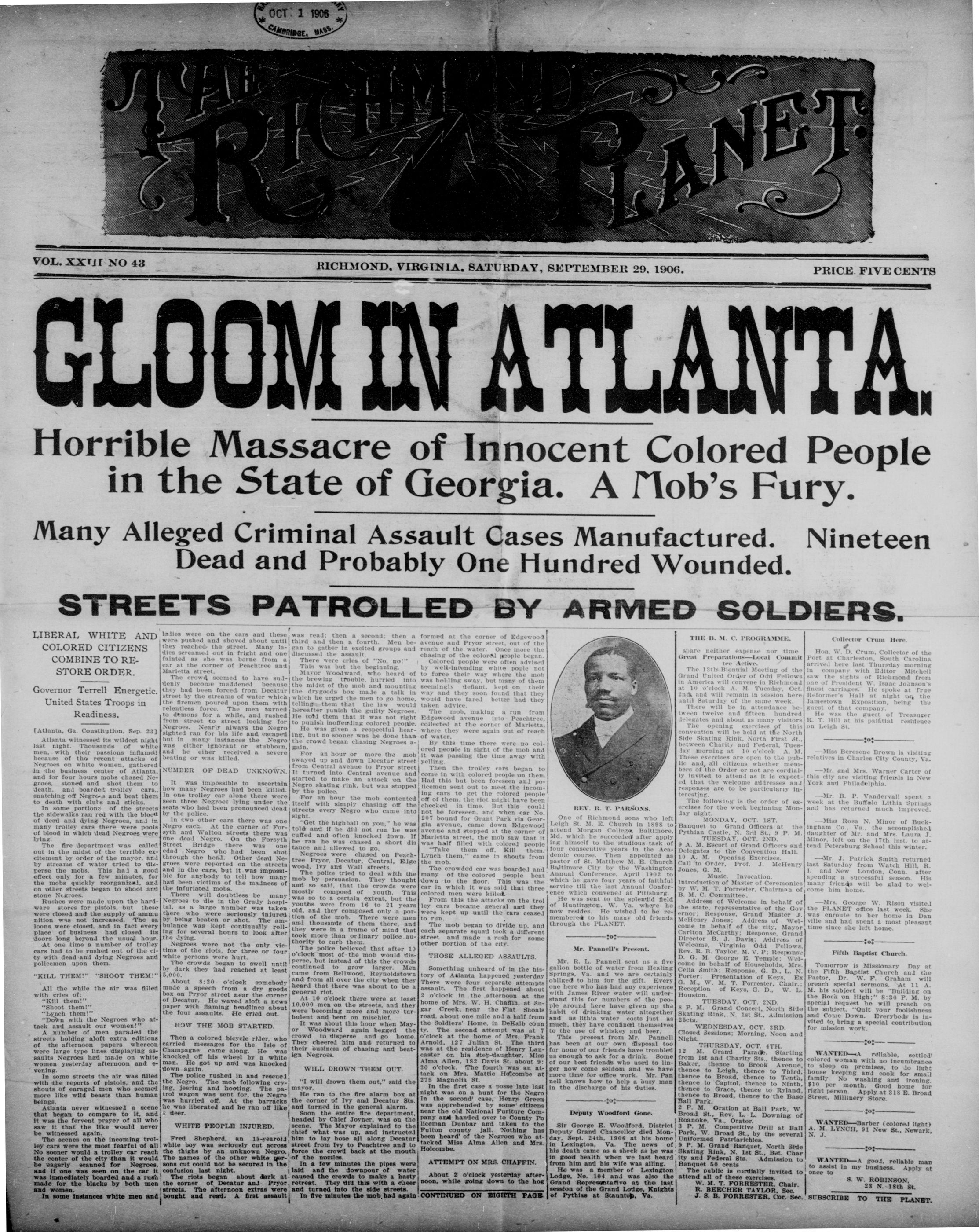
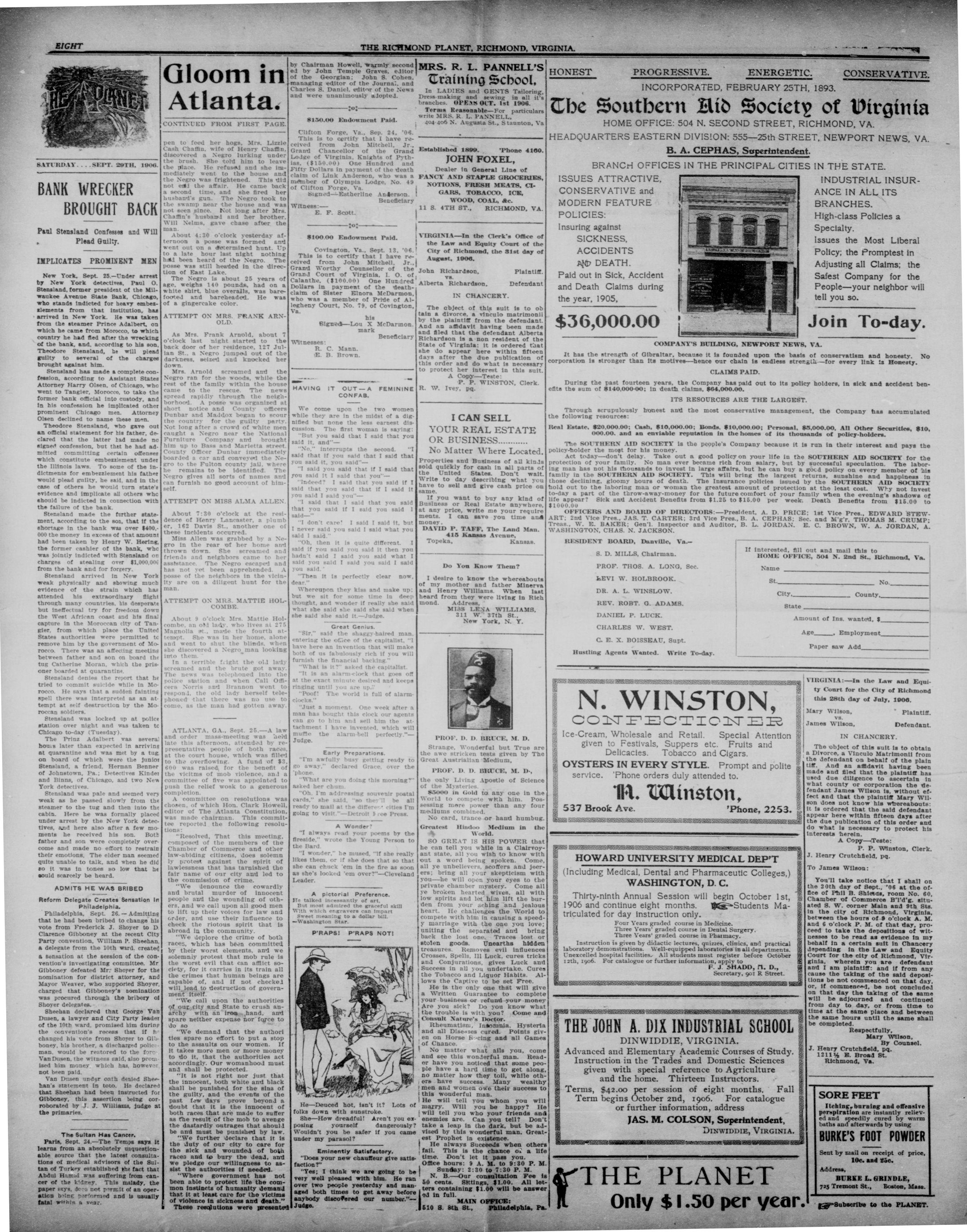
GLOOM IN ATLANTA.
Horrible Massacre of Innocent Colored People in the State of Georgia. A Mob's Fury.
Many Alleged Criminal Assault Cases Manufactured. Nineteen Dead and Probably One Hundred Wounded.
STREETS PATROLLED BY ARMED SOLDIERS.
VOL. XXII NO 43
Horribly in Many All STRE
LIBERAL WHITE AND COLORED CITIZENS COMBINE TO RE- STORE ORDER.
Governor Terrell Energetic United States Troops in Readiness.
[Atlanta, Ga. Constitution, Sep. 23]
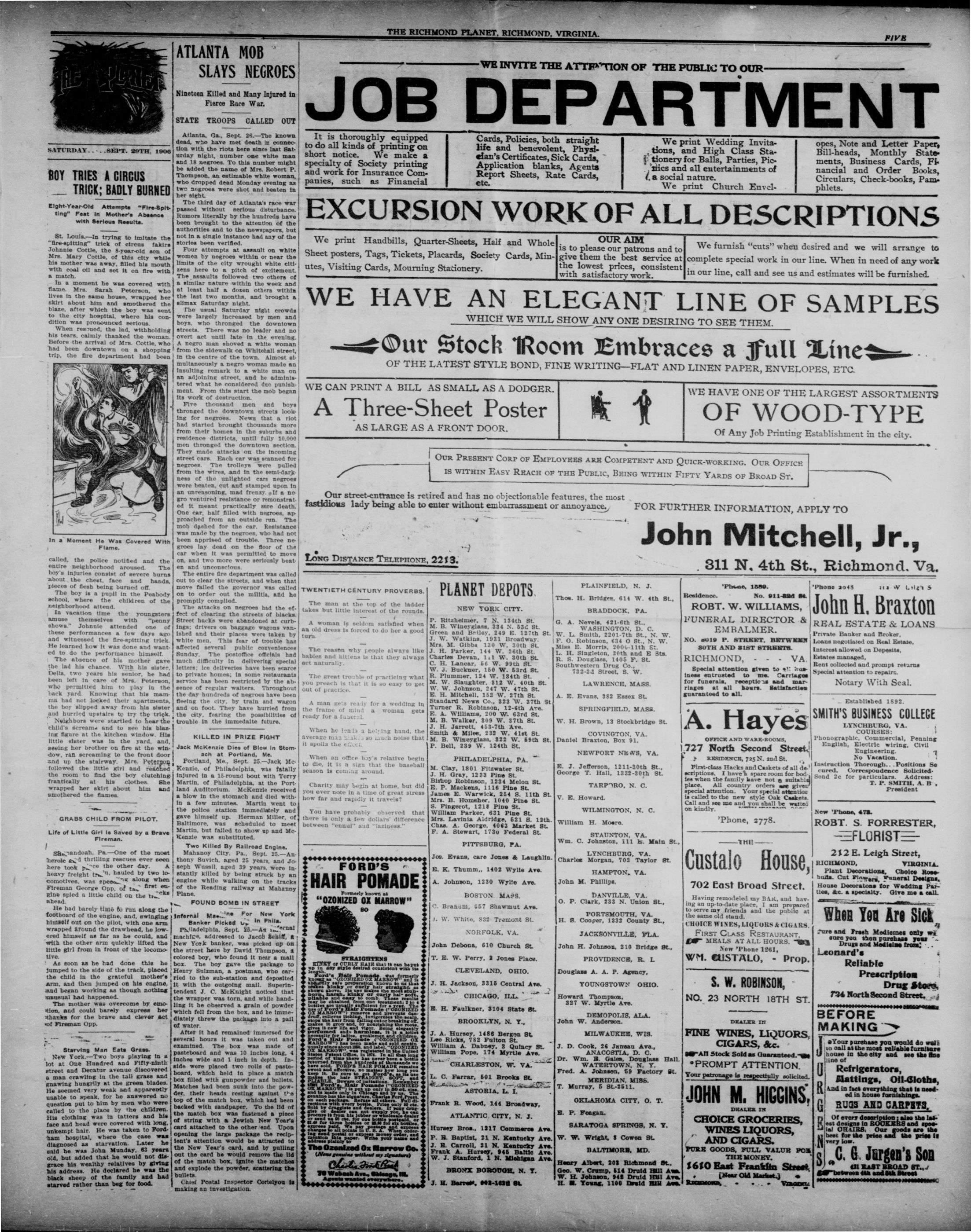
Atlanta witnessed its wildest night last night. Thousands of white men, with their passions inflamed because of the recent attacks of Negroes on white women, gathered in the business center of Atlanta, and for four hours mobs chased Negroes, stoned and shot them to death, and boarded trolley cars, snatching off Negroes and beat them to death with clubs and sticks.
In some portions of the streets the sidewalks ran red with the blood of dead and dying Negroes, and in many trolley cars there were pools of blood in which dead Negroes were lying.
The fire department was called out in the midst of the terrible excitement by order of the mayor, and by streams of water tried to disperse the mobs. This hal a good effect only for a few minutes, for the mobs quickly reorganized, and on other streets began to shoot and stone Negroes.
Rushes were made upon the hardware stores for pistols, but these were stored and the supply of ammunition was not increased. The saoons were closed, and in fact every place of business had closed its doors long beyond the usual hour.
At one time a number of trolley cars had to be rushed out of the city with dead and dying Negroes and policemen upon them.
"KILL THEM!" "SHOOT THEM!"
All the while the air was filled with cries of:
"Kill them!"
"Shoot them!"
"Lynch them!"
"Down with the Negroes who attack and assault our women!"
A number of men paraded the streets holding aloft extra editions of the afternoon papers whereon were large type lines displaying assaults Negroes had made on white women yesterday afternoon and evening.
In some streets the air was filled with the reports of pistols, and the shouts of enraged men who seemed more like wild beasts than human beings.
Atlanta never witnessed a scene that began to compare to it, and it was the fervent prayer of all who saw it that the like would never be witnessed again.
The scenes on the incoming trolley cars were the most fearful of all No sooner would a trolley car reach the center of the city than it would be eagerly scanned for Negroes, and if one was seen on the car it was immediately boarded and a rush made for the blacks by both men and women.
In some instances white men and
ladies were on the cars and these were pushed and shoved about until they reached the street. Many ladies screamed out in fright and one fainted as she was borne from a car at the corner of Peachtree and Marietta street.
The crowd seemed to have suddenly become maddened because they had been forced from Decatur street by the streams of water which the firemen poured upon them with relentless force. The men turned to demons for a while, and rushed from street to street looking for Negroes. Nearly always the Negro sighted ran for his life and escaped but in many instances the Negro was either ignorant or stubborn, and he either received a severe beating or was killed.
NUMBER OF DEAD UNKNOWN
It was impossible to ascertain how many Negroes had been killed. In one trolley car alone there were seen three Negroes lying under the seats who had been pronounced dead by the police. In two other cars there was one Negro each. At the corner of Forsyth and Walton streets there was one dead Negro. On the Forsyth Street Bridge there was one edad Negro who had been shot through the head. Other dead Negroes were reported on the streets and in the cars, but it was impossible for anybody to tell how many had been victims of the madness of the infuriated mobs. There will doubtless be many Negroes to die in the Graly hospital, as a large number was taken there who were seriously injured by being beaten or shot. The ambulance was kept continually rolling for several hours to look after the dying. Negroes were not the only victims of the riots, for three or four white persons were hurt. The crowds began to swell until by dark they had reached at least 5,000. About 8:30 o'clock somebody made a speech from a dry goods box on Pryor street near the corner of Decatur. He waved aloft a news paper with flaming headlines about the four assaults. He cried out.
HOW THE MOB STARTED.
Then a colored bicycle rider, who carried messages for the Isle of Champagne came along. He was knocked off his wheel by a white man. He got up and was knocked down again.
The police rushed in and rescued the Negro. The mob following crying, jeering and hooting. The patrol wagon was sent for, the Negro was hurried off. At the barracks he was liberated and he ran off like deer.
WHITE PEOPLE INJURED.
Fred Shepherd, an 18-yearold white boy was seriously cut across the thighs by an unknown Negro. The names of the other white persons cut could not be secured in the confusion last night.
The riots began about dark at the corner of Decatur and Pryor streets. The afternoon extras were bought and read. A first assault
RICHMOND, VIRGINIA, SATURDAY, SEPTEMBER 29, 1906.
was read; then a second; then a third and then a fourth. Men began to gather in excited groups and discussed the assault.
There were cries of "No, not!"
This was but the beginning.
Mayor Woodward, who heard of the brewing trouble, hurried into the midst of the mob and mounting the drygoods box made a talk in which he urged the men to go home, telling them that the law would hereafter punish the guilty Negroes. He told them that it was not right to punish loitering colored people. He was given a respectful hearing, but no sooner was he done than the crowd began chasing Negroes again.
For an hour or more the mob swayed up and down Decatur street from Central avenue to Pryor street It turned into Central avenue and started to make an attack on the Negro skating rink, but was stopped by the police.
For an hour the mob contented itself with simply chasing off the streets every Negro who came into sight.
"Get the highball on you," he was told and if he did not run he was cuffed and often knocked down. If he ran he was chased a short distance and allowed to go.
Negroes were chased on Peachtree Pryor, Decatur, Central, Elge wood, Ivy and Wall streets.
The police tried to deal with the mob by persuasion. They thought and so said, that the crowds were mostly composed of youth. This was so to a certain extent, but the youths were from 16 to 21 years old, and they composed only a portion of the mob. There were men and thousands of them there, and they were in a frame of mind that took more than ordinary police authority to curb them.
The police believed that after 10 o'clock most of the mob would disperse, but instead of this the crowds continued to grow larger. Men came from Bellwood, Reynoldstown and from all over the city when they heard that there was about to be a general riot.
At 10 o'clock there were at least 10,000 men on the streets, and they were becoming more and more turbulent and bent on mischief.
It was about this hour when Mayor Woodward again begged the crowd to disperse and go home. They cheered him and returned to their business of chasing and beat-ign Negroes.
WILL DROWN THEM OUT
"I will drown them out," said the mayor.
He ran to the fire alarm box at the corner of Ivy and Decatur Sts. and turned in the general alarm.
Soon the entire fire department, headed by Chief Joyner, was on the scene. The Mayor explained to the chief what was up, and instructed him to lay loye all along Decatur street from Ivy to Peachtree and to force the crowd back at the mouth of the nozzles.
In a few minutes the pipes were laid and the downpour of water caused the crowds to make a hasty retreat. They did this with a cheer and turned into the side streets.
In five minutes the mob had again
formed at the corner of Edgewood avenue and Pryor street, out of the reach of the water. Once more the chasing of the colored people began. Colored people were often advised by well-intending white people not to force their way where the mob was holding sway, but many of them seemingly defiant, kept on their way and they soon found that they would have fared better had they taken advice. The mob, making a run from Edgewood avenue into Peachtree, collected at the corner of Marietta, where they were again out of reach of water. By this time there were no colored people in sight of the mob and it was passing the time away with yelling. Then the trolley cars began to come in with colored people on them. Had this but been foreseen and policemen sent out to meet the incoming cars to get the colored people off of them, the riot might have been checked in time. But this could not be foreseen, and when car No. 207 bound for Grant Park via Georgia avenue, came down at Edgewood avenue and stopped at the corner of Marietta street, the mob saw that it was half filled with colored people "Take them off, Kill them, Lynch them," came in shouts from the mob. The crowded car was boarded and many of the colored people beat down to the floor. This was the car in which it was said that three colored men were killed.
From this the attacks on the troopley cars became general and they were kept up until the cars ceased to run.
The mob began to divide up, and each separate squad took a different street and made a rush for some other portion of the city.
THOSE ALLEGED ASSAULTS
Something unheard of in the history of Atlanta happened yesterday There were four separate attempts assault. The first happened about 2 o'clock in the afternoon at the home of Mrs. W. H. Chaffin, at Sugar Creek, near the Flat Shoals road, about one mile and a half from the Soldiers' Home, in DeKalb county. The second attempt was at 7 o'clock at the home of Mrs. Frank Arnold, 127 Julian St. The third was at the residence of Henry Lancaster on his step-daughter, Miss Alma Allen, 182 Davis St. about 9:30 o'clock. The fourth was an attack on Mrs. Mattie Hodcombe at 275 Magnolia St. In the first case a posse last night was on a hunt for the Negro In the second case, Henry Green was apprehended by some citizens near the old National Furiture Company and handed over to County Policeman Dunbar and taken to the Fulton county jail. Nothing has been heard' of the Negroes who attacked Miss Alma Allen and Mrs. Holcombe.
ATTEMPT ON MRS. CHAFFIN
About 2 o'clock yesterday afternoon, while going down to the hog CONTINUED ON EIGHTH PAGE
REV. R. T. PARSONS
One of Richmond sons who left Leigh St. M. E. Church in 1898 to attend Morgan College, Baltimore, Md. which he succeeded after applying himself to the studious task of four consecutive years in the Academic course. Then appointed as pastor of St. Matthew M. E. Church Baltimore City by the Washington Annual Conference, April 1902 to which he gave four years of faithful service till the last Annual Conference which convened at Pittsburg. He was sent to the splendid field of Huntington, W. Va. where he now resides. He wished to be remembered to his many old friends through the PLANET.
Mr. Pannell's Present.
Mr. R. L. Pannell sent us a five gallon bottle of water from Healing Springs, Va. and we are certainly obliged to him for the gift. Every one here who has had any experience with James River water will understand this for numbers of the people around here have given up the habit of drinking water altogether and as lithia water costs just as much, they have confined themselves to the use of whiskey and beer.
This present from Mr. Pannell has been at our own disposal too for none of our friends have troubled us enough to ask for a drink. Some of our best friends who used to linger now come seldom and we have more time for office work. Mr. Panell knows how to help a busy man in the discharge of his duties.
Deputy Woodford Gone.
Sir George E. Woodford, District Deputy Grand Chancellor died Monday, Sept. 24th, 1906 at his home in Lexington, Va. The news of his death came as a shock as he was in good health when we last heard from him and his wife was alling.
He was a member of Lexington Lodge, No. 104 and was also the Grand Representative at the last session of the Grand Lodge, Knights of Pythias at Staunton, Va.
THE B. M. C. PROGRAMME.
spare neither expense nor time
Great Preparations—Local Committee Active.
The 13th Biennial Meeting of the Grand United Order of Odd Fellows in America will convene in Richmond, at 10 o'clock A. M. Tuesday, Oct. 2nd, and will remain in session here until Saturday of the same week.
There will be in attendance between twelve and fifteen hundred delegates and about as many visitors
The opening exercises of this convention will be held at the North Side Skating Rink, North First St., between Charity and Federal, Tuesday morning at 10 o'clock A. M.
These exercises are open to the public and, all citizens whether members of the Order or not are cordially invited to attend as it is expected that the welcome addresses and responses are to be particularly interesting.
The following is the order of exercises for the week beginning Monday night.
MONDAY, OCT. 1ST.
MONDAY, OCT. 1ST.
Banquet to Grand Officers at the
Pythian Castle, N. 3rd St., 9 P. M.
TUESDAY, OCT. 2ND
TUESDAY, OCT. 2ND
9 A. M. Escort of Grand Officers and Delegates to the Hall.
10 A. M. Opening Exercises.
Call to Order, Prof. J. McHenry
Call to Order, Prof. J. McHenry
Jones, G. M.
Music. Invocation.
Introduction of Master of Ceremonies
by W. M. T. Forrester, Chairman of
B. M. C. Committee.
Address of Welcome in behalf of
the state, representative of the Gov
ernor; Response, Grand Master J.
McHenry Jones; Address of Welcome
in behalf of the city, Mayor
Carlton McCarthy; Response, Grand
Director B. J. Davi; Address of
Welcome, Virginia Odd Fellows.
Rev. R. B. Taylor, M. V. P; Response
D. G. M. George E. Temple; Welcome
in behalf of Households, Mrs.
Celia Smith; Response, G. D., L. N.
Porter; Presentation of Keys, Ex
G. M. W. M. T. Forrester, Chair;
Reception of Keys, G. D., W. L.
Houston.
TUESDAY, OCT. 2ND
8 P. M. Grand Concert, North Side Skating Rink, N. 1st St. Admission 25cts.
WEDNESDAY, OCT. 3RD.
Closed Sessions; Morning, Noon and Night.
THURSDAY, OCT. 4TH.
12 M. Grand Parade. Starting from 1st and Charity Sts., thence to Baker, thence to Brook Avenue, thence to Leigh, thence to Third, thence to Broad, thence to Tenth, thence to Capitol, thence to Ninth, thence to Grace, thence to Ryland, thence to Broad, thence to the Base Ball Park.
2 P. Oration at Ball Park, W. Broad St., Rev. L. L. Downing of Roanoke, Va., Orator.
3 P. M. Competitive Drill at Ball Park, W. Broad St., by the several Uniformed Patriarchicles.
9 P. M. Grand Banquet, North Side Skating Rink, N. 1st St. Bet. Charity and Federal Sts. Admission to Banquet 50 cents
The public is cordially invited to attend all of these exercises.
W. M. T. FORRESTER, Chair.
R. BEECHER TAYLOR, Sec.
J. S. B. FORRESTER, Cor. Sec.
PRICE. FIVE CENTS
TA
People
ry.
Nineteen
Collector Crum Here.
Hon. W. D. Crum, Collector of the Port at Charleston, South Carolina arrived here last Thursday morning in company with Editor Mitchell saw the sights of Richmond from one of President W. Isaac Johnson's finest carriages. He spoke at True Reformer's Hall at night on the Jamestown Exposition, being the guest of that company. He was the guest of Treasurer R. T. Hill at his palatial residence on Lehigh St.
—Miss Beresene Brown is visiting relatives in Charles City County, Va.
—Mr. and Mrs. Warner Carter of this city are visiting friends in New York and Philadelphia.
—Mr. B. P. Vandervall spent a week at the Buffalo Lithia Springs and has returned much improved.
—Miss Rosa N. Minor of Buckingham Co., Va., the accomplished daughter of Mr. and Mrs. Laura J. Minor, left on the 17th inst. to attend Petersburg School this winter.
—Mr. J. Patrick Smith returned last Saturday from Watch Hill, R. I. and New London, Conn. after spending a successful season. His many friends will be glad to welcome him home.
—Mrs. George W. Rison visited the PLANET office last week. She was enroute to her home in Danville and had spent a most pleasant time since she left home.
Fifth Baptist Church.
Tomorrow is Missionary Day at the Fifth Baptist Church and the Pastor, Dr. W. F. Graham will preach special sermons. At 11 A. M. his subject will be "Building on the Rock on High;" 8:30 P. M. by special request he will preach on the subject. "Quit your foolishness and Come Down. Everybody is invited to, bring a special contribution for mission work.
WANTED—A reliable, settled, colored woman with no incumbrance to sleep on premises, to do light house keeping and cook for small family. No washing and ironing, $10 per month. Good home for right person. Apply at 318 E. Broad Street, Millinery Store.
WANTED—Barber (colored light)
A. M. LYNCH, 91 New St., Newark,
N. J.
WANTED—A good, reliable man to assist in my business. Apply at opn
SUBSCRIBE TO THE PLANET
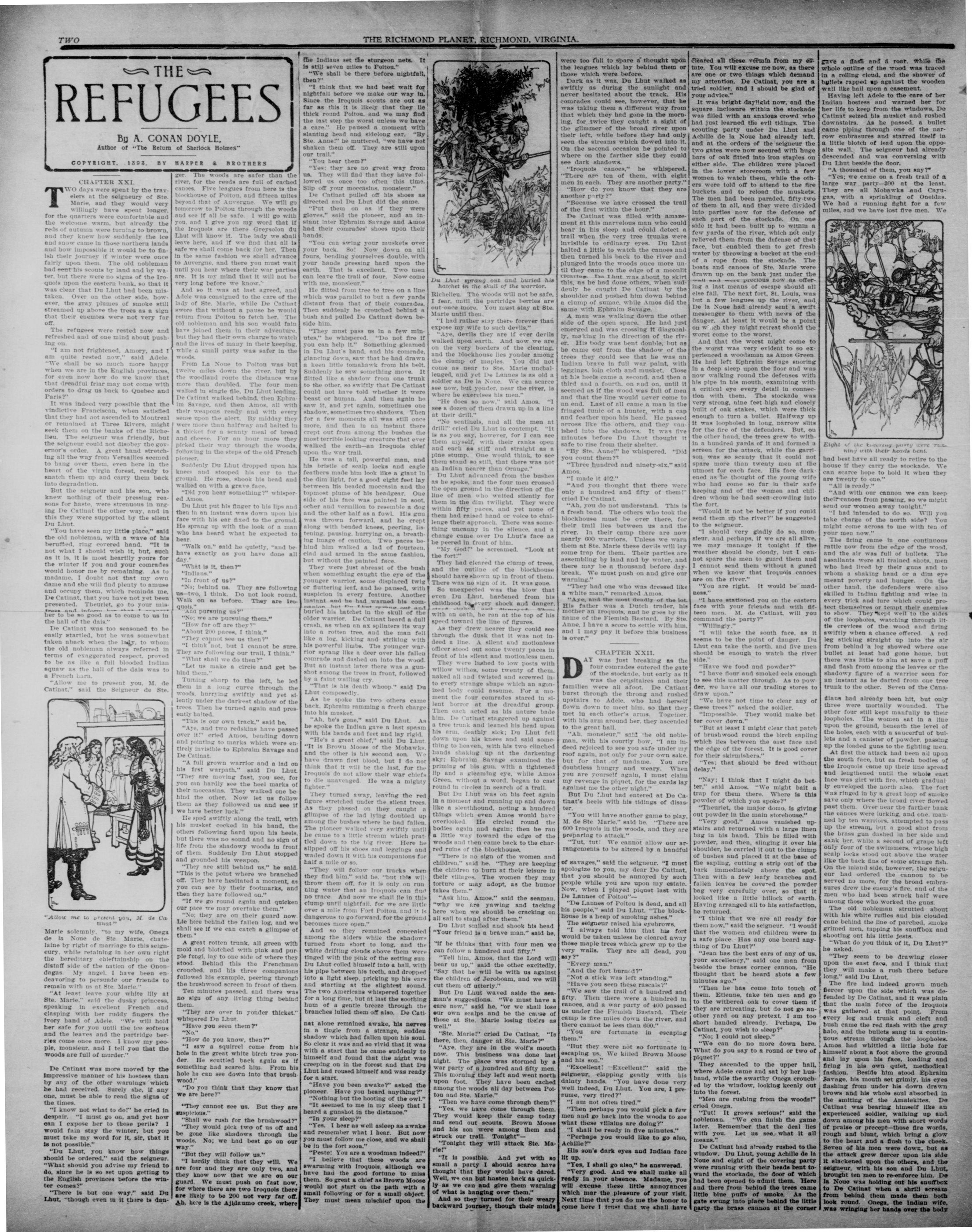
REFUGEES
By A. CONAN DOYLE,
Author of "The Return of Sherlock Holmes"
COPYRIGHT, 1893, BY HARPER & BROTHERS
CHAPTER XXI
ger. The woods are safer
river. for the reeds are full
TWO days were spent by the travelers at the seigneury of Ste Marie, and they would very
Marie, and they would very willingly have spent longer, for the quarters were comfortable and the welcome warm, but already the reds of autumn were turning to brown, and they knew how suddenly the ice and snow came in those northern lands and how impossible it would be to finish their journey if winter were once fairly upon them. The old nobleman had sent his scouts by land and by water, but there were no signs of the Iroquois upon the eastern bank, so that it was clear that Du Lhut had been mistaken. Over on the other side, however, the gray plumes of smoke still streamed up above the trees as a sign that their enemies were not very far off.
The refugees were rested now and refreshed and of one mind about pushing on.
"I am not frightened, Amory, and I am quite rested now." said Adele.
"We shall be so much more happy when we are in the English provinces, for even now how do we know that that dreadful friar may not come with orders to drag us back to Quebec and Paris?"
It was indeed very possible that the vindictive Franciscan, when satisfied that they had not ascended to Montreal or remained at Three Rivers, might seek them on the banks of the Richelieu. The seigneur was friendly, but the seigneur could not disobey the governor's order. A great hand stretching all the way from Versailles seemed to hang over them, even here in the heart of the virgin forest, ready to snatch them up and carry them back into degradation.
But the seigneur and his son, who knew nothing of their pressing reasons for haste, were strenuous in urging De Catinat the other way, and in this they were supported by the silent Du Lhut.
"You have seen my little place," said the old nobleman, with a wave of his beruffed, ring covered hand. "It is not what I should wish it, but, such as it is, it is most heartily yours for the winter if you and your comrades would honor me by remaining. As to madame, I doubt not that my own dame and she will find plenty to amuse and occupy them, which reminds me, De Catinat, that you have not yet been presented. Theurief, go to your mistress, and inform me that her to be so good as to come to us in the hall of the dais."
De Catinat was too seasoned to be easily startled, but he was somewhat taken aback when the lady, to whom the old nobleman always referred in terms of exaggerated respect, proved to be as like a full blooded Indian squaw as the hall of the dals was to a French barn.
"Allow me to present you, M. de Catinat," said the Seigneur de Ste.
THE TRIUMPH
"Allow me to present you, M. de Cattat"
Marle solemnly, "to my wife, Onega de la Noue de Ste Marle, chatelaine by right of marriage to this seigneury, while retaining in her own right the hereditary chieftainship on the distaff side of the nation of the Ondoagas. My angel, I have been endeavoring to persuade our friends to remain with us at Ste Marle."
"At least leave your white lily at Ste. Marle," said the dusky princess, speaking in excellent French and clasping with her ruddy fingers the ivory hand of Adele. "We will hold her safe for you until the ice softens and the leaves and the partridge berries come once more. I know my people, monsieur, and I tell you that the woods are full of murder."
De Catinat was more moved by the impressive manner of his hostess than by any of the other warnings which he had received. Surely she, if any one, must be able to read the signs of the times.
"I know not what to do!" he cried in despair. "I must go on, and yet how can I expose her to these perils? I would fain stay the winter, but you must take my word for it, sir, that it is not possible."
"Du Lhut, you know how things should be ordered," said the seigneur. "What should you advise my friend to do, since he is so set upon getting to the English provinces before the winter comes."
"There is but one way," said Du Lhut, "though even in it the is dan-
ger. The woods are safer than the river, for the reeds are full of cached canoes. Five leagues from here is the blockhouse of Polton, and fifteen miles beyond that of Auvergne. We will go tomorrow to Polton through the woods and see if all be safe. I will go with you, and I give you my word that the Iroquois are there Greysolon du Lhut will know it. The lady we shall leave here, and if we find that all is safe we shall come back for her. Then in the same fashion we shall advance to Auvergne, and there you must wait until you hear where their war parties are. It is my mind that it will not be very long before we know."
And so it was at last agreed, and Adele was consigned to the care of the lady of Ste. Marle, while De Catinat swore that without a pause he would return from Poitou to fetch her. The old nobleman and his son would fain have joined them in their adventure, but they had their own charge to watch and the lives of many in their keeping, while a small party was safer in the woods.
From La Noue to Poitou was but twelve miles down the river, but by the woodland route the distance was more than doubled. The four men walked in single file, Du Lhut leading, De Catinat walked behind, then Ephraim Savage, and then Amos, all with their weapons ready and with every sense upon the alert. By midday they were more than halfway and halted in a thicket for a scanty meal of bread and cheese. For an hour more they picked their way through the woods, following in the steps of the old French pioneer.
Suddenly Du Lhut dropped upon his knees and stooped his ear to the ground. He rose, shook his head and walked on with a grave face.
"Did you hear something?" whispered Ames.
Du Lhut put his finger to his lips and then in an instant was down upon his face with his ear fixed to the ground. He sprang up with the look of a man who has heard what he expected to hear.
"Walk on," said he quietly, "and behave exactly as you have done all day."
"What is it, then?"
"Indians."
"In front of us?"
"No; behind us. They are following us-two, I think. Do not look round. Walk on as before. They are Iroquels."
"And pursuing us?"
"No; we are pursuing them."
"How far off are they?"
"About 200 prices, I think."
"They cannot see us then?"
"I think not, but I cannot be sure. They are following our trail, I think."
"What shall we do then?"
"Let us make a circle and get behind them."
Turning sharp to the left, he led them in a long curve through the woods, hurrying swiftly and yet silently under the darkest shadow of the trees. Then he turned again and presently halted.
"This is our own track," said he.
"Aye, and two redskins have passed over it!" cried Amos, bending down and pointing to marks which were entirely invisible to Ephraim Savage and De Catinat.
"A full grown warrior and a lad on his first warpath," said Du Lhut. "They are moving fast, you see, for you can hardly see the heel marks of their moocasins. They walked one behind the other. Now let us follow them as they followed us and see if we have better luck."
He sped swiftly along the trail, with his musket cocked in his hand, the others following hard upon his heels, but there was no sound and no sign of life from the shadowy woods in front of them. Suddenly Du Lhut stopped and grounded his weapon.
"They are still behind us," he said. "This is the point where we branched off. They have hesitated a moment, as you can see by their footmarks, and then they have followed on."
"If we go round again and quicken our pace we may overtake them."
"No; they are on their guard now. Lie here behind the fallen log, and we shall see if we can catch a glimpse of them."
A great rotten trunk, all green with mold and blotched with pink and purple fungi, lay to one side of where they stood. Behind this the Frenchman crouched, and his three companions followed his example, peering through the brushwood screen in front of them. Ten minutes passed, and there was no sign of any living thing behind them.
"They are over in yonder thicket." whispered Du Lhut.
"Have you seen them?"
"No."
"How do you know, then?"
"I saw a squirrel come from his hole in the great white birch tree yonder. He scuttled back again as if something had scared him. From his hole he can see down into that brushwood."
"Do you think that they know that we are here?"
"They cannot see us. But they are usurpious."
"Shall we rush for the brushwood?"
"They would pick two of us off and be gone like shadows through the woods. No; we had best go on our way."
"But they will follow us."
"I hardly think that they will. We are four and they are only two, and they know now that we are on our guard. We must push on fast now, for where there are two Iroquois there are likely to be 200 not very far off. Ab, here is the Ajidamo creek, where
The Indians set the sturgeon nets. It is still seven miles to Polton."
"We shall be there before nightfall, then?
"I think that we had best wait for nightfall before we make our way in. Since the Iroquois scouts are out as far as this it is likely that they lie thick round Polton, and we may find the last step the worst unless we have a care." He paused a moment with slanting head and sidelong ear. "By Ste. Anne" he muttered, "we have not shaken them off. They are still upon our trail."
"You hear them?"
"Yes; they are no great way from us. They will find that they have followed us once too often this time. Slip off your moccasin, monsieur."
De Catinaf pulled off his shoes as directed and Du Lhut did the same.
"Put them on as if they were gloves," said the pioneer, and an instant later Ephraim Savage and Amos had their comrades' shoes upon their hands.
"You can swing your muskets over your back. So! Now down on all fours, bending yourselves double, with your hands pressing hard upon the earth. That is excellent. Two men can leave the trail of four. Now come with me, monsieur."
He flitted from tree to tree on a line which was parallel to but a few yards distant from that of their comrades. Then suddenly he crouched behind a bush and pulled De Catinat down beside him.
"They must pass us in a few minutes," he whispered. "Do not fire if you can help it." Something gleamed in Du Lhuf's band, and his corrude, glancing down, saw that he had drawn a keen little tomahawk from his belt. Suddenly he saw something move. It fitted like a shadow from one trunk to the other, so swiftly that De Catnait could not have told whether it were beast or human. And then again he saw it, and yet again, sometimes one shadow, sometimes two shadows. Then for a few moments all was still once more, and then in an instant there crept out from among the bushes the most terrible looking creature that ever walked the earth—an Iroquois chief upon the war trail.
He was a tall, powerful man, and his bristle of scalp locks and eagle feathers made him look like a giant in the dim light, for a good eight feet lay between his beaded moccasin and the topmost plume of his headgear. One side of his face was painted in soot, ocher and vermilion to resemble a dog and the other half as a fowl. His gun was thrown forward, and he crept along with bended knees, peering, listening, pausing, hurrying on, a breathing image of caution. Two paces behind him walked a lad of fourteen, clad and armed in the same fashion, but without the painted face.
They were just abreast of the bush when something caught the eye of the younger warrior, some displaced twig or futtering leaf, and he paused, with susplicon in every feature. Another instant and he had warned his companion, but Du Lhut received a burst of his hatchet in the skull of the older warrior. De Catatin heard a dull crash, as when an ax splinters its way into a rotten tree, and the man fell like a log, kicking and striking with his powerful limbs. The younger warrior sprang like a deer over his fallen comrade and dashed on into the wood. But an instant later there was a gunshot among the trees in front, followed by a faint walling cry. "That is his death whoo," said Du Lhut composedly. As he spoke the two others came back. Ephraim ramming a fresh charge into his musket.
"Ah, he's gone," said Du Lhut. As he spoke the Indian gave a last spasm with his hands and feet and lay rigid. "He's a great chief," said Du Lhut. "It is Brown Moose of the Mohawks, and the other is his second son. We have drawn first blood, but I do not think that it will be the last, for the Iroquois do not allow their war chiefs to die unavenged. He was a mighty fighter."
They turned away, leaving the red figure stretched under the silent trees. As they passed on they caught a glimpse of the lad lying doubled up among the bushes where he had fallen. The pioneer walked very swiftly until he came to a little stream which prattled down to the big river. Here he slipped off his shoes and legrighes and waded down it with his companions for half a mile or so.
"They will follow our tracks when they find him," said he, "but this will throw them off, for it is only on running water that an froquois can find no trace. And now we shall lie in this clump until nightfall, for we are little over a mile from Fort Poiton, and it is dangerous to go forward, for the ground becomes more open."
And so they remained concealed among the alders while the shadows turned from short to long, and the white drifting clouds above them were tinged with the pink of the setting sun. Du Lhut colled himself into a ball, with his pipe between his teeth, and dropped into a light sleep, pricking up his ears and starting at the slightest sound. The two Americans whispered together for a long time, but at last the soothing hum of a gentle breeze through the branches lulled them off also. De Cati
nat alone remained awake, his nerves in a tingle from a strange, sudden shadow which had fallen upon his soul. So clear it was and so vivid that it was with a start that he came suddenly to himself and found that the night was creeping on in the forest and that Du Lhut had roused himself and was ready for a start.
"Have you been awake?" asked the pioneer. Have you heard anything?"
"Nothing but the hooting of the owl." "It seemed to me in my sleep that I heard a gunshot in the distance."
"In your sleep?"
"Yes. I hear as well asleep as awake and remember what I hear. But now you must follow me close, and we shall be in the fort soon."
"Peste! You are a woodman indeed!"
"I believe that these woods are swarming with Iroquois, although we have had the good fortune to miss them. So great a chief as Brown Moose would not start on the path with a small following or for a small object. They must mean mischief upon the
L.
Du Lhut sprang out and buried his hatchet in the skull of the warrior. Richelieu. The woods will not be safe, I fear, until the partridge berries are out once more. You must stay at Ste. Marie until then.
"I had rather stay there forever than expose my wife to such devils." "Aye, devils they are if ever devils walked upon earth. And now we are on the very borders of the clearing, and the blockhouse lies yonder among the clump of maples. You did not come as near to Ste. Marie unchallenged, and yet De Lannes is as old a soldier as De La Noue. We can scarce see now, but yonder, near the river, is where he exercises his men."
"He does so now," said Amos. "I see a dozen of them drawn up in a line at their drill."
"No sentinels, and all the men at drill" cried Du Lhut in contempt. "It is as you say, however, for I can see them myself, with their ranks open and each as stiff and straight as a pine stump. One would think to see them stand so still, that there was not an Indian nearer than Orange."
Du Lhut advanced from the bushes as he spoke, and the four men crossed the open ground in the direction of the line of men who waited silently for them in the dim twilight. They were within fifty paces, and yet none of them had raised hand or voice to challenge their approach. There was something uncanny in the silence, and a change came over Du Lhut's face as be peered in front of him.
"My God!" he screamed. "Look at the fort!"
They had cleared the clump of trees, and the outline of the blockhouse should have shown up in front of them. There was no sign of it. It was gone. So unexpected was the blow that even Du Lhut, hardened from his childhood to every shock and danger, stared and dared. Then with an anth, he ran at the top of his speed toward the line of figures.
As they drew nearer they could see through the dusk that it was not indeed a line. A silent and motionless officer stood out some twenty paces in front of his silent and motionless men. They were lashed to low posts with willow withes, some twenty of them, naked all and twisted and screwed into every strange shape which an agonized body could assume. For a moment the four comrades stared in silent horror at the dreadful group. Then each acted as his nature bade him. De Catintt staggered up against a tree trunk and leaned his head upon his arm, deathly slick; Du Lhut fell down upon his knees and said something to heaven, with his two clinched hands shaking up at the darkening sky; Ephraim Savage examined the priming of his gun, with a tightened lip and a gleaming eye, while Amos Green, without a word, began to cast round in circles in search of a trail.
But Du Lhut was on his feet again in a moment and running up and down like a sleuthhound, noting a hundred things which even Amos would have overlooked. He circled round the bodies again and again; then he ran a little way toward the edge of the woods and then came back to the charred ruins of the blockhouse.
"There is no sign of the women and children," said he. "They are keeping the children to burn at their leisure in their villages. The women they may torture or may adopt, as the humor takes them."
"Ask him, Amos," said the seaman, "why we are yawing and tacking here when we should be cracking on all sall to stand after them."
"If he thinks that with four men we can follow a hundred and fifty."
"Tell him, Amos, that the Lord will bear us up," said the other excitedly.
"Say that he will be with us against the children of Jeroboam, and we will cut them off utterly."
But Du Luit wade aside the seaman's suggestions. "We must have a care now," said he, "or we shall lose our own scalps and be the cause of those at Ste. Marie losing theirs as well."
"Ste. Marie!" cried De Catinat. "Is there, then, danger at Ste. Marie?"
"Aye, they are in the wolf's mouth now. This business was done last night. The place was stormed by a war party of a hundred and fifty men. This morning they left and went north upon foot. They have been cached among the woods all day between Potou and Ste. Marie."
"Then we have come through them?"
"Yes, we have come through them. They would keep their camp today and send out scouts. Brown Moose and his son were among them and struck our trail. Tonight"—
"Tonight they will attack Ste. Marle."
"It is possible. And yet with so small a party I should scarcely have thought that they would have dared. Well, we can but hasten back as quickly as we can and give them warning of what is hanging over them."
And so they turned for their weary backward journey, though their minds
were too full to spare a thought upon the leagues which lay behind them or those which were before.
Dark as it was, Du Lhut walked as swiftly as during the sunlight and never hesitated about the track. His comrades could see, however, that he was taking them a different way from that which they had gone in the morning, for twice they caught a sight of the glimmer of the broad river upon their left, while before they had only seen the streams which flowed into it.
On the second occasion he pointed to where on the farther side they could see dark shadows.
"Iroquois canoes," he whispered.
"There are ten of them, with eight men in each. They are another party."
"How do you know that they are another party?"
"Because we have crossed the trail of the first within the hour."
De Catinat was filled with amazement at this marvelous man who could hear in his sleep and could detect a trail when the very tree trunks were invisible to ordinary eyes. Du Lhut halted a little to watch the canoes and then turned his back to the river and plunged into the woods once more until they came to the edge of a moonlit clearing. Du Lhut was about to skirt this, as he had done others, when suddenly he caught De Catinat by the shoulder and pushed him down behind a clump of sumac, while Amos did the same with Ephraim Savage.
A man was walking down the other side of the open space. He had just emerged and was crossing it diagonally, making in the direction of the river. His body was bent double, but as he came out from the shadow of the trees they could see that he was an Indian brave in full war paint, with leggings, loin cloth and musket. Close at his heels came a second, and then a third and a fourth, on on and, until it seemed as if the wood was full of men and that the line would never come to an end. Lost of all came a man in the fringed tunic of a hunter, with a cap and feather upon his head. He passed across like the others, and they vanished into the shadows. It was five minutes before Du Lhut thought it safe to rise from their shelter.
"By Ste. Anne," he whispered. "Did you count them?" "Three hundred and ninety-six," said Amos.
"I made it 402."
"And you thought that there were only a hundred and fifty of them!" cried De Catinat.
"Ah, you do not understand. This is a fresh band. The others who took the blockhouse must be over there, for their trail lies between us and the river. In their camp there are now nearly 600 warriors. Unless we warn them at Ste. Marie these devils will lay some trap for them. Their parties are assembling by land and by water, and there may be a thousand before daybreak. We must push on and give our warning."
"They had one who was dressed like a white man," remarked Amos.
"Aye, and the most deadly of the lot. His father was a Dutch trader, his mother an Iroquois, and he goes by the name of the Flemish Bastard. By Ste. Anne, I have a score to settle with him, and I may pay it before this business is over."
CHAPTER XXII
AI was just breaking as the four comrades entered the gate of the stockade, but early as it was the censitai and their families were all afoot. De Catinat burst through the throng and rushed upstairs to Adele, who had herself down to meet him, so that they met in each other's arms. Together, with his arm around her, they ascended to the great hall.
"Ah, monsieur," said the old nobleman, with his courtly bow, "I am indeed rejoiced to see you safe under my roof again, not only for your own sake, but for that of madame. You are doubtless hungry and weary. When you are yourself again, I must claim my revenge in pliquet, for the cards lay against me the other night."
But Du L'hut had entered at De Catinat's heels with his tidings of disaster.
"You will have another game to play, M. de Ste. Marle," said he. "There are 600 Iroquois in the woods, and they are preparing to attack."
"Tut, tut! We cannot allow our arrangements to be altered by a handful of savages," said the seigneur. "I must apologize to you, my dear De Catnatt, that you should be annoyed by such people while you are upon my estate. Now, when I played pliquet last with De Lannes of Potton"—
"De Lannes of Potton is dead, and all his people," said Du Lhut. "The block-house is a heap of smoking ashes."
The seigneur raised his eyebrows.
"I always told him that his fort would be taken unless he cleared away those maple trees which grew up to the very walls. They are all dead, you say?"
"Every man."
"And the fort burned?"
"Not a stick was left standing."
"Have you seen these rascals?"
"We saw the trail of a hundred and fifty. Then there were a hundred in canoes, and a war party of 400 passed us under the Flemish Bastard. Their camp is five miles down the river, and there cannot be less than 600."
"You are fortunate in escaping them."
"But they were not so fortunate in escaping us. We killed Brown Moose and his son."
"Excellent! - Excellent!" said the seigneur, clapping gently with his dainty hands. "You have done very well indeed, Du Lhut. You are, I presume, very tired!"
"I am not often tired."
"Then perhaps you would pick a few men and go back into the woods to see what these villains are doing?"
"I shall be ready in five minutes."
"Perhaps you would like to go also, Achille?"
His son's dark eyes and Indian face lit up.
"Yes, I shall go also," he answered.
"Very good. And we shall make all ready in your absence. Madame, you will excuse these little annoyances which mar the pleasure of your visit.
Next time that you do me the honor to come here I trust that we shall have
Cleared all these vermin from my estate. You will excuse me now, as there are one or two things which demand my attention. De Catinat, you are a tried soldier, and I should be glad of your advice."
It was bright daylight now, and the square inclosure within the stockade was filled with an anxious crowd who had just learned the evil tidlings. The scouting party under Du Lhut and Achille de la Noue had already left, and at the orders of the seigneur the two gates were now secured with huge bars of oak fitted into iron staples on either side. The children were placed in the lower storeroom with a few women to watch them, while the others were told off to attend to the fire buckets and to reload the muskets. The men had been paraded, fifty-two of them in all, and they were divided into parties now for the defense of each part of the stockade. On one side it had been built up to within a few yards of the river, which not only relieved them from the defense of that face, but enabled them to get fresh water by throwing a bucket at the end of a rope from the stockade. The boats and canoes of Ste. Marie were drawn up on the bank just under the wall and were precious now as offering a last means of escape should all else fail. The next fort, St. Louis, was but a few leagues up the river, and De la Noue had already sent a swift messenger to them with news of the danger. At least it would be a point on which they might retreat should the worst come to the worst.
And that the worst might come to the worst was very evident to so experienced a woodsman as Amos Green. He had left Ephraim Savage snoring in a deep sleep upon the floor and was now walking round the defences with his pipe in his mouth, examining with a critical eye every detail in connection with them. The stockade was very strong, nine feet high and closely built of oak stakes, which were thick enough to turn a bullet. Halfway up it was loopholed in long, narrow slits for the fire of the defenders. But, on the other hand, the trees grew to within in a hundred yards of it and formed a screen for the attack, while the garrison was so scanty that it could not spare more than twenty men at the utmost for each face. His face darkened as he thought of the young wife who had come so far in their safe keeping and of the women and children whom he had seen-crowding into the fort.
"Would it not be better if you could send them up the river?" he suggested to the seigneur.
"I should very gladly do so, monsieur, and perhaps, if we are all alive, we may manage it tonight if the weather should be cloudy, but I cannot spare the men to guard them and I cannot send them without a guard when we know that Iroquois canoes are on the river."
"You are right. It would be madness."
"I have stationed you on the eastern face with your friends and with fifteen men. M. de Catinat, will you command the party?"
"Willingly."
"I will take the south face, as it seems to be the point of danger. Du Lhut can take the north, and five men should be enough to watch the river side."
"Have we food and powder?"
"I have flour and smoked eels enough to see this matter through. As to powder, we have all our trading stores to draw upon."
"We have not time to clear any of these trees?" asked the soldier.
"Impossible. They would make better cover down."
"But at least I might clear that patch of brushwood round the birch sapling which lies between the east face and the edge of the forest. It is good cover for their skirmishers."
"Yes; that should be fired without delay."
"Nay; I think that I might do better," said Amos. "We might bait a trap for them there. Where is this powder of which you spoke?" "Theuriet, the major domo, is giving out powder in the main storehouse."
out powder in the main storehouse." "Very good." Amos vanished upstairs and returned with a large linen bag in his hand. This he filled with powder, and then, slinging it over his shoulder, he carried it out to the clump of bushes and placed it at the base of the sapling, cutting a strip out of the bark immediately above the spot. Then with a few leafy branches and fallen leaves he covered the powder bag very carefully over, so that it looked like a little hillock of earth. Having arranged all to his satisfaction, he returned. "I think that we are all ready for them now," said the seigneur. "I would that the women and children were in a safe place. Has any one heard anything of Du Lhut?" "Jean has the best ears of any of us, your excellency," said one man from beside the brass corner cannon. "He thought that he heard shots a few minutes ago."
"Then he has come into touch of them. Etienne, take ten men and go to the withered oak to cover them if they are retreating, but do not go another yard on any pretext. I am too short handed already. Perhaps, De Catinat, you wish to sleep?"
"No; I could not sleep."
"We can do no more down here. What do you say to a round or two of plquet?"
They ascended to the upper hall, where Adele came and sat by her husband, while the swarthy Onega crouched by the window, looking keenly out into the forest.
"Men are rushing from the woods!" cried Onega.
"Tut! It grows serious!" said the nobleman. "We can finish the game later. Remember that the deal lies with you. Let us see what it all means."
De Catnat had already rushed to the window. Du Lhut, young Achille de la Noue and eight of the covering party were running with their heads bent toward the stockade, the door of which had been opened to admit them. Here and there from behind the trees came little blue puffs of smoke. As the gate swung into place behind the little party the brass cannon at the corner
gave a flash and a roar, while the whole outline of the wood was traced in a rolling cloud, and the shower of bullets rapped up against the wooden wall like hall upon a casement.
Having left Adele to the care of her Indian hostess and warned her for her life to keep from the windows, De Catinat seized his musket and rushed downstairs. As he passed, a bullet came piping through one of the narrow embrasures and starred itself in a little blotch of lead upon the opposite wall. The seigneur had already descended and was conversing with Du Lhut beside the door.
"A thousand of them, you say?"
"Yes; we came on a fresh trail of a large war party--800 at the least. They are all Mobhawks and Cayugas, with a sprinkling of Onelidas. We had a running fight for a few miles, and we have lost five men. We
I
Eight of the beating party were running with their heads bent. had best have all ready to retire to the house if they carry the stockade. We can scarce hope to hold it when they are twenty to one."
"All is ready." "And with our cannon we can keep their canoes from passing, so we might send our women away tonight." "I had intended to do so. Will you take charge of the north side? You might come across to me with ten of your men now."
The firing came in one continuous rattle now from the edge of the wood, and the air was full of bullets. The assailants were all trained shots, men who had lived by their guns and to whom a shaking hand or a dim eye meant poverty and hunger. On the other hand, the defenders were also skilled in Indian fighting and wise in every trick and lure which could protect themselves or tempt their enemies to show. They kept well to the sides of the loopholes, watching through little crevices of the wood and firing swiftly when a chance offered. A red leg sticking straight up into the air from behind a log showed where one bullet at least had gone home, but there was little to aim at save a puff and flash from among the leaves or the shadowy figure of a warrior seen for an instant as he darted from one tree trunk to the other. Seven of the Cana-
dians had already been hit, but only three were mortally wounded. The other four still kept manfully to their loopholes. The women sat in a line upon the ground, beneath the level of the holes, each with a saucerful of bullets and a canister of powder, passing up the loaded guns to the fighting men.
At first the attack had been all upon the south face, but as fresh bodies of the Iroquois came up their line spread and lengthened until the whole east face was gift with fire, which gradually enveloped the north also. The fort was ringed in by a great loop of smoke save only where the broad river flowed past them. Over near the farther bank the canoes were lurking, and one, manned by ten warriors, attempted to pass up the stream, but a good shot from the brass gun dashed in her side and sank her, while a second of grape left only four of the swimmers, whose high scalp locks stood out above the water like the back fins of some strange fish. On the inland side, however, the seigneur had ordered the cannon to be served no more, for the broad embrasures drew the enemy's fire, and of the men who had been struck half were among those who worked the guns.
The old nobleman strutted about with his white ruffles and his clouded cane behind the line of parched, smoke grimed men, tapping his snuffbox and shooting out his little jests.
"What do you think of it, Du Lhut?" he asked.
"They seem to be drawing closer upon the east face, and I think that they will make a rush there before long," said Du Lhut.
The fire had indeed grown much fiercer upon the side which was defended by De Catnat, and it was plain that the main force of the Iroquois was gathered at that point. From every log and trunk and cleft and bush came the red flash with the gray halo, and the bullets sang in a continuous stream through the loopholes. Amos had whittled a little hole for himself about a foot above the ground and lay upon his face, loading and firing in his own quiet, methodical fashion. Beside him stood Ephraim Savage, his mouth set grimly, his eyes flashing from under his down drawn brows and his whole soul absorbed in the smiting of the Amalekites. De Catnat was bearing himself like an experienced soldier, walking up and down among his men with short words of praise or precept—those fire words, rough and blunt, which bring a glow to the heart and a flush to the cheek. Seven of his men were down, but as the attack grew fiercer upon his side it slackened upon the others, and the seigneur, with his son and Du Lhut, brought ten men to re-enforce him. De la Nowe was holding out his snuffbox to De Catnat when a shrill scream from behind them made them both look round. Ongea, the indian wife, was wringing her hands over the body
SATURDAY...SEPT. 20TH. 1906
of her son. A glance showed that the bullet had pierced his heart and that he was dead.
For an instant the old nobleman's thin face grew a shade paler and the hand which held out the little gold box shook like a branch in the wind.
"The De la Nues always die upon the field of honor," he remarked. "I think that we should have some more men in the angle by the gun."
And now it became clear why it was that the Iroquois had chosen the eastern face for their main attack. It was that the clump of cover lay midway between the edge of the forest and the stockade. A storming party could creep as far as that and gather there for the final rush. First one crouchling warrior and then a second and then a third darted across the little belt of open space and threw themselves down among the bushes. The fourth was hit and lay with his back broken a few paces out from the edge of the wood, but a stream of warriors continued to venture the passage until thirty-six had got across, and the little patch of underwood was full of lurking savages. Amos Green's time had come.
From where he lay he could see the white patch where he had cut the bark from the birch sapling, and he knew that immediately underneath it lay the powder bag. He sighted the mark and then slowly lowered his barrel until he had got to the base of the little tree as nearly as he could guess it among the tangle of bushes. The bullet penetrated the bag, and there was an explosion which shook the manor house and swayed the whole line of stout stockades as though they were cornstalks in a breeze. Up to the highest summits of the trees went the huge column of blue smoke, and after the first roar there was a deathly silence, which was broken by the patter and thud of failing bodies.
The blow was a heavy one. Of the thirty-six warriors, all picked for their valor, only four regained the shelter of the woods and those so torn and shattered that they were spent men. Already the Indians had lost heavily, and this fresh disaster made them reconsider their plan of attack. Their fire gradually slackened.
"Is it possible that they are going to abandon the attack?" cried De Catlinat joyously.
But the wily Du Lhut shook his head. "A wolf would as soon leave a half gnawed bone as an Iroquois such a prize as this."
"But they have lost heavily."
"Aye, but not so heavily as ourselves in proportion to our numbers. They have lost fifty out of a thousand and we twenty out of threescore. No, no: they are holding a council, and we shall soon hear from them again. But it may be some hours first, and if you will take my advice you will have an hour's sleep, for you are not, as I can see by your eyes, as used to doing without it as I am."
De Cathat was indeed weary to the last pitch of human endurance. Amos Green and the seaman had already wrapped themselves in their blankets
and sunk to sleep under the shelter of the stockade. The soldier rushed upstairs to say a few words of comfort to the trembling Adele, and then, throwing himself down upon a couch, he slept the dreamless sleep of an exhausted man. When at last he was aroused by a fresh sputter of musketry fire from the woods the sun was already low in the heavens, and the mellow light of evening tinged the bare walls of the room. He sprang from his couch, seized his musket and rushed downstairs. The defenders were gathered at their loopholes once more, while Du Lhut, the seigneur and Amos Green were whispering eagerly together.
"What is it, then? Are they coming on?" he asked.
"They are up to some devilty," said Du Lhut, peering out at the corner of the embrasure. "They are gathering thickly at the east fringe, and yet the firing comes from the north. It is not the Indian way to attack across the open, and yet, if they think help is coming from the fort, they might venture."
"The wood in front of us is alive with them," said Amos. "They are as busy as beavers among the underwood."
"Perhaps they are going to attack from this side and cover the attack by a fire from the flank."
"That is what I think," cried the seigneur. "Bring the spare guns up here and all the men except five for each side."
The words were hardly out of his mouth when a shrill yell rose from the wood, and in an instant a cloud of warriors burst out and charged across the open, howling, springing and waving their guns and tomahawks in the air. Some of those in front bore canoes between them, and as they reached the stockade they planted them against it and swarmed up them as if they had been scaling ladders. Others fired through the embrasures and loopholes, the muzzles of their guns touching those of the defenders, while others again sprang unaided on to the tops of the pallisades and jumped fearlessly down upon the inner side. The Canadians fired while they had time to load, and then, clubbing their muskets, they smashed furiously at every red head which showed above the rails.
The din within the stockade was infernal, the shouts and cries of the French, the whoping of the savages and the terrified screaming of the frightened women blending into one dreadful uproar, above which could be heard the high, shrill voice of the old seigneur imploring his consensuals to
stand last. With Du Lhut, Amos, De Catinat and Ephraim Savage, he was ever in the forefront of the defense. So desperately did they fight, the sword and musket butt outreaching the tomahawk, that though at one time fifty Iroquois were over the palisades they had slain or driven back nearly all of them, when a fresh wave burst suddenly over the south face, which had been stripped of its defenders. Du Lhut saw in an instant that the inclusion was lost and that only one thing could save the house.
"Hold them for an instant!" he screamed, and, rushing at the brass gun, he struck his flint and steel and fired it straight into the thick of the savages. Then, as they recouled for an instant, he stuck a nail into the touch-hole and drove it home with a blow from the butt of his gun. Dashing across the yard, he spiked the gun at the other corner and was back at the door as the remnants of the garrison were hurled against it by the rush of the assailants. The Canadians darted in and swung the ponderous mass of wood into position, breaking the leg of the foremost warrior who had striven to follow them. Then for an instant they had time for breathing and for counsel.
CHAPTER XXIII
BUT their case was a very evil one. Had the guns been lost, so that they might be turned upon the door, all further resistance would have been vain, but Du Lhut's presence of mind had saved them from that danger. The two guns upon the river face and the canoes were safe, for they were commanded by the windows of the house. But their numbers were terribly reduced, and those who were left were weary and wounded and spent. Nineteen had gained the house, but one had been shot through the body, while a second had his shoulder cleft by a tomahawk and could no longer raise his musket. Du Lhut, De la Noue and De Catinat were uninjured, but Ephraim Savage had a bullet hole in his forearm and Amos was bleeding from a cut upon the face.
A few shots from the barricaded windows sufficed to clear the enclosure, for it was all exposed to their aim, but on the other hand the Indians had the shelter of the stockade now, and from the farther side of it they kept up a fierce fire upon the windows. Half a dozen of the consti-taires returned the fusillade, while the leaders consulted as to what had best be done.
"We have twenty-five women and fourteen children," said the seigneur. "I am sure that you will agree with me, gentlemen, that our first duty is toward them. Some of you, like myself, have lost sons or brothers this day. Let us at least save our wives and sisters."
"No Iroquois canoes have passed up the river," said one of the Canadians. "If the women start in the darkness they can get away to the fort."
"By Ste. Anne of Beaupre," exclaimed Du Lhut. "I think it would be well if you could get your men out of this also, for I cannot see how it is to be held until morning."
"Tutt tutt! What nonsense is this?" cried De in Nono. "Are we to abandon the manor house of Ste. Marle to the first gang of savages who choose
to make an attack upon it? No, no, gentlemen; there are still nearly a score of us, and when the garrison learns that we are so pressed, which will be by tomorrow morning at the latest, they will certainly send us relief."
"If you stand by the fort I will not desert you," said Du Lhut. "and yet it is a pity to sacrifice brave men for nothing."
"The canoes will hardly hold the women and children as it is," cried Theurlet. "There are but two large and four small. There is not space for a single man."
The Iroquois were very quiet now, and an occasional dropping shot from the trees or the stockade was the only sign of their presence. The twilight was gathering in and the sun had already sunk beneath the treetops. Leaving a watchman at each window, the leaders went round to the back of the house, where the canoes were lying upon the bank. There were no signs of the enemy upon the river to the north of them.
"We are in luck," said Amos. "The clouds are gathering, and there will be little light."
"It is luck, indeed, since the moon is only three days past the full," answered Du Lhut. "I wonder that the Iroquois have not cut us off upon the water, but it is likely that their canoes have gone south to bring up another war party."
"In an hour it might be dark enough to start."
"I think that there is rain in those clouds, and that will make it darker still."
The women and children were assembled, and their places in each boat were assigned to them. To Omega, the Indian wife of the seigneur, who was as wary and as experienced as a war sachem of her people, the command of the women was intrusted.
"It is not very far, Adele," said De Catinat. "It is but a league or two."
"But I do not wish to leave you, Amory. We have been together in all our troubles."
"My dear love, you will tell them at the fort how things are with us, and they will bring us help."
"Let the others do that, and I will stay. I will not be useless, Amory. Omega has taught me to load a gun. I will not be afraid, indeed I will not."
"You must not ask it, Adele. It is impossible, child. I could not let you stay. It is for my sake, dear. You do not know what a load it will be from my heart when I know that you are safe. And you need not be afraid for me. We can easily hold the place until morning." Adele was silent, but her hands tightened upon his arm. Her husband was still endeavoring to reassure her when a groan burst from the watcher in the window which overlooked the stream.
"There is a canoe on the river to the north of us!" he cried.
"How many warriors are in it?" asked the seigneur.
"I cannot see. The light is not very
THE RICHMOND PLANE, RICHMOND, VIRGINIA
good, and it is in the shadow of the bank."
"Which way is it coming?"
Then way is it coming."
"It is coming this way." Ah, it shoots out into the open now, and I can see it! May the good Lord be praised!"
"What is it then?" cried De la Noue impatiently.
"It is not an Iroquois canoe. There is but one man in it. He is a Canadian."
"A Canadian" cried Du Lhut, springing up to the window. "Who but a madman would venture into such a hornets' nest above? Ah, yes; I can see him now. He keeps well out from the bank to avoid their fire. Now he is in midstream, and he turns toward us."
"It is a Jesuit," said one, craning his neck. "They are everywhere there is most danger."
"No. I can see his capote," said another. "It is a Franciscan frar."
An instant later there was the sound of a canoe grounding upon the pebbles, the door was unbarred, and a man strode in attired in the long, dark gown of the Franciscanans. He cast a rapid glance around and then, stepping up to De Catinat, laid his hand upon his shoulder.
"So! You have not escaped me," said he. "We have caught the evil seed before it had time to root." "What do you mean, father?" asked the seigneur. "You have made some mistake. This is my good friend Amory de Catinat, of a noble French family." "This is Amory de Catinat, the heretic and Huguenot" cried the monk. "I have followed him up the St. Lawrence, and I have followed him up the Richelieu, and I would have followed him to the world's end if I could but bring him back with me." "Tut, father! Your zeal carries you too far," said the seigneur. "Whither would you take my friend, then?" "He shall go back to France with his wife. There is no place in Canada for heretics." Du Lhut burst out laughing. "By Ste. Anne, father," said he. "if you could take us all back to France at present we should be very much your debtors."
"And you will remember," said De la Noue sternly, "that you are under my roof and that you are speaking of my guest."
But the friar was not to be abashed. "Look at this," said he, whipping a paper out of his bosom. "It is signed by the governor, and calls upon you, under pain of the king's displeasure, to return this man to Quebec. But I have you now and I shall never leave you until I see you on board of the ship which will carry you and your wife back to France."
De Cathat could but admire the energy and tenacity of the man.
"It seems to me, father, that you would have shone more as a soldier than as a follower of Christ." said he,
"but since you have followed us here and since there is no getting away we may settle this question at some later time."
A great brown cloud had overspread the heavens and the night had fallen so rapidly that they could hardly see the gleam of the river in front of them. The savages in the woods and behind the captured stockade were quiet, save for an occasional shot. Suddenly a dull red glow began to show above one of the roofs of the cottages.
"They have set it on fire!" cried Du Lhut. "The canoes must go at once, for the river will soon be as light as clay. In! in! There is not an instant to be lost!"
There was no time for leave taking. One impassioned kiss and Adele was torn away and thrust into the smallest canoe, which she shared with Omega, two children and an unmarried girl. The others rushed into their places, and in a few moments they had pushed off and had vanished into the drift and the darkness. The great cloud had broken and the rain patterned heavily on the roof.
"Thank God for this storm" murmured Du Lhut. "It will prevent the cottages from blazing up too quickly." but he had forgotten that, though the roofs might be wet, the interior was as
A
"This is Amory de Catinat, the heretic and Huguenot!" dry as tinder. He had hardly spoken before a great yellow tongue of flame licked out of one of the windows, and again and again, until suddenly half of the roof fell in, and the cottage was blazing like a pitch bucket. The flames hissed and sputtered in the pouring rain; but, fed from below, they grew still higher and fiercer, fashing redly upon the great trees and turning their trunks to burnished brass. Their light made the inclosure and the manor house as clear as day and exposed the whole long stretch of the river. A fearful yell from the woods announced that the savages had seen the canoes. "They are rushing through the woods. They are making for the water's edge," cried De Catinat.
"They have some canoes down there," said Du Lhut.
"But they must pass us," cried the seigneur of Ste. Murle. "Get down to the cannon and see if you cannot stop them."
They had hardly reached the guns when two large canoes filled with warriors shot out from among the reeds below the fort.
"Jean, you are our best shot," cried De la None. "Lay for her as she passes the great pine tree. Lambert, do you take the other gun."
The two wrinkled old artillerymen glanced along their guns and waited for the canoes to come abreast of them. The fire blazed higher and higher, and the broad river lay like a sheet of dull metal, with the two dark lines which marked the canoes sweeping swiftly down the center. One was fifty yards in front of the other, but in each the Indians were bending to their paddies and pulling frantically, while their comrades from the wooded shores whooped them on to fresh exertions. The fugitives had already disappeared around the bend of the river.
As the first canoe cane abreast of the lower of the two guns the Canadian made the sign of the cross over the touchhole and fired. A cheer and then a groan went up from the eager watchers. The charge had struck the surface close to the mark and dashed such a shower of water over it that for an instant it looked as if it had been sunk. The next moment, however, the splash subsided, and the canoe shot away uninjured save that one of the rowers had dropped the paddle, while his head fell forward upon the back of the man in front of him. The second gunner sighted the same canoe as it came abreast of him.
It was a beautiful shot. The whole charge took the canoe about six feet behind the bow and doubled her up like an eggshell. Before the smoke had cleared she had foundered, and the second canoe had paused to pick up some of the wounded men.
"Quick, quick!" cried the seigneur,
"Load the gun! We may get the second one yet!"
But it was not to be. Long before they could get it ready the Iroquois had picked up their wounded warriors and were pulling neatly downstream. As they shot away the fire died suddenly down in the burning cottages, and the rain and the darkness closed in upon them once more.
"My God!" cried De Cattat furiously. "They will be taken! Let us abandon this place, take a boat and follow them! Come, come! Not an instant is to be lost!"
"I do not think that they will be caught," said DU Lhut, laying his hand soothingly upon his shoulder. "Do not fear. They had a long start, and the women here can paddle as well as the men. Besides, these canoes of the Mohawks are not as swift as the Algonquin birch barks which we use. In any case, it is impossible to follow, for we have no boat."
"There is one lying there."
"Ah, it will but hold a single man. It is that in which the fear came."
"Then I am going in that! My place is with Adele!"
He flung open the door, rushed out and was about to push off the frail skiff when some one sprang past him and with a blow from a hatchet stove in the side of the boat.
"It is my boat," said the flar, throwing down his ax and folding his arms.
"I have found you and you shall not escape me again."
The hot blood fushed to the soldier's head, and, picking up the ax, he took a quick step forward. The light from the open door shone upon the grave, harsh face of the friar, but not a muscle twitched nor a feature changed as he saw the ax whirl up in the hands of a furious man. He only signed himself with the cross and muttered a Latin prayer under his breath. It was that composure which saved his life. De Caratin hurled down the ax again with a bitter curse and was turning away from the shattered boat when in an instant, without a warning, the great door of the manor house crashed inward and a flood of whooping savages burst into the house.
【TO BE CONTINUED.】
MAXIMS OF HETTY GREEN.
There is no war between capital and labor.
Pay what you owe and make others pay you likewise.
Russell Sage was one of the highest types of business men.
Determination and good sense will be of more use to him than books.
I attribute my own personal success to the fact that I never 'sold short."
If there were less talk in the world there would be fewer fools in the world.
I should say, Keep out of Wall street. Indeed, it is foolish to attempt any sort of speculation.
I am heartily opposed to the income tax. I believe it to be unjust and iniquitous. It imposes a tax upon thrift, industry and commercial brilliancy.
The men who stir up agitation in financial circles are the buzzards who subsist upon dead men's estates, who promote corporations and who settle estates. They fear to tackle the living.
BY THE GENTLE CYNIC.
Every man has had ancestors of some sort.
One way to encourage a thing is to pass a law prohibiting it.
Many a man who takes off his hat to the flag will dodge his taxes.
Even with a doctor practice doesn't make perfect, but it often makes him rich.
It's the unexpected that happens, but we generally bring it on ourselves.
Knights of Pythias,
This organization is one of the most powerful in the country and its progress has been phenominal. The Grand Lodge of Virginia has jurisdiction over all of the cities and counties in this state. Thirty males are required to organize a new lodge. The benefits paid constitute one of its strongest features, but the principles are greater than anything else. Founded on Friendship, based on Charity and established on Benevolence, the respectable, upright people of the state will find it an order worthy of their heartiest support.
It pays an endowment and burial benefit of of $200.00 for all ages. It pays $4.00 per week sick dues. The badge costing 75 cents each is the only absolutely necessary regalia. For information concerning the organization of lodges apply at the main office.
The Courts of Calanthe
Is the Female Department of the Order. It requires a membership of thirty persons to organize a court. Its members are pledged to exhibit Fidelity, exercise Harmony and prove Love one for the other. It pays an endowment and burial benefit of $150.00. It pays $3.00 per week sick dues. The only expense for regalia is the cost of the badge, 50 cents and a rosette, costing 25 cents for funeral occasions.
THE BANDS OF CALANTHE or Children's Department also constitutes a feature and persons cannot do better than to enter the little ones into this mystic circle. The expense is nominal and the benefits all that could be expected. It pays from $1.00 to $1.50 sick dues and death benefits of from $30.09 to $40.00. If you have no Pythian Lodge or Court or Band in your neighborhood, orgrnize one.
For all information concerning special rates of membership in the lodges and courts, address
From a woman's point of view, suffering in silence takes all the pleasure from it.
Lots of people spend their money to make a show, only to have the show bust.
Dress doesn't make the women either. You can't always tell a typewriter by her ribbons.
We close our eyes to our own faults on the same principle that an ostrich burles his head in the sand.
Some people never sympathize with the under dog until they are reasonably sure he is going to get on top.
WISDOM WHISPERS
A man may adore a woman and yet regard her brain power as limited.
Woman's views on woman's worth take on varied and far-reaching turns.
A woman worries over such small affairs that great troubles give her little concern.
Most men have a sense of satisfaction in being able to attract the notice of big persons.
If women handled men as wisely as they believe they do life would take on a different aspect.
Men always show a desire for justice no matter what their personal feelings on the subject.
A woman likes to argue a question entirely from the viewpoint of what should be rather than what is.
While men devote their best thoughts to money getting they are willing to agree that there is more in life than lucre.
BADGER PHILOSOPHY
It seems to be lots of fun for rich people to be cranky.
The trouble with experience is that you have to pay to get it.
KNIGHTS OF PYTHIAAS.
F.C.B.
pays $4.00 only absolutely necessary rega apply at the main office.
The Court
Is the Female Department of the thirty persons to organize a co Fidelity, exercise Harmony and an endowment and burial bene dues. The only expense for r a rosette, costing 25 cents for f THE BANDS OF CALA stitutes a feature and persons o circle. The expense is nomin $1.00 to $1.50 sick dues and de Lodge or Court or Band in yor For all information concerni
For all information concern membership in the lodges and
STRAUS' SPECIAL
Old Yacht Club,
PURE WHISKEY
Will Satisfy the lover of the right kind of stimulant. Special prices.
We have all grades of good liquors,
Cigars and Tobacco. Call and see us.
ISAAC STRAUS & CO.,
422 E. Broad St.,
Richmond, Virginia.
60 YEARS' EXPERIENCE
PATENTS
TRADE MARKS
DESIGNS
COPYRIGHTS & C.
sending a sketch and description may
be required. It is probably patentable. Communications confidential. HANDBOOK on Patents
agency for securing patent rights.
taken through Munn & Co. receive
without charge, in the
Misc. American.
illustrated weekly. Largest cir-
culating scientific journal. Terms. $3 a
month. $1. Sold by all newadvertis-
ers. Co 361 Broadway, New York
ince. 625 F St. WASHINGTON, D.C.
GEORGE O. WASHING, PHOTOGRAPHER,
608 N. 2nd St., Richmond, Va.
Fine Photographs. True to Life. High-class
service. Latest Improvements in Photograph-
is Out-door Work executed. Reasonable In-
charge. From Old negative or Photographs. $3 m
We would an see better men and women if we would forget ourselves for awhile.
Most people aren't satisfied unless they do just a little less than is expected of them.
Lots of people can't pray unless they have a cushion upon which to rest their knees.
It's a pretty good test of a man's character when he can be good on a large salary.—Milwaukee Sentinel.
Beaumont and Fletcher were the first to collaborate plays in English literature.
It is said that the czar of Russia receives more than 100 petitions daily from his subjects. The petitions pass through the hands of a confidential secretary first.
Franz Ferdinand, who will succeed the Austrian emperor, is credited with the assertion that Hungary needs to be reconquered at least once in every century.
Rt. Rev. Joseph Weber, of Lemberg has been appointed by the pope as bishop for the United States to look after the welfare of the 3,000,000 Poles in America.
Ambition.
Knicker—Wouldn't you like to wake up some morning and find yourself famous?
Subbubs—I'd rather sleep till I bad missed every blamed train to the city—N. Y. Sun.
He—By Jove! I believe you get
prettier every day.
She—Oh, no, I'm sure I don't.
He—Well, then, let's say every
other day.
"I found a bargain in men's shoes to-day," said Meeker.
"That's more than I ever found," rejoined Mrs. Meeker, in a tone redolent with significance.—Chicago News.
Pythias,
A. AND A.
is most powerful in the country and its
The Grand Lodge of Virginia has juris-
counties in this state. Thirty males
ledge. The benefits paid constitute one
principles are greater than anything
based on Charity and established on Be-
tight people of the state will find it an order
special benefit of of $200.00 for all ages. It
The badge costing 75 cents each is the
in concerning the organization of lodges
N. A., S. A., E. A., A. AND A.
organization is one of the most powerful has been phenomenal. The Grand Jury over all of the cities and counties in need to organize a new lodge. The biggest features, but the principles founded on Friendship, based on Charity, the respectable, upright people of their heartiest support. An endowment and burial benefit of $20 per week sick dues. The badge of regalia. For information concerning courts of Calanta.
Of the Order. It requires a member court. Its members are pledged and prove Love one for the other. Benefit of $150.00. It pays $3.00 per regalia is the cost of the badge, 500 funeral occasions.
ANTHE or Children's Department cannot do better than to enter the final and the benefits all that could death benefits of from $30.09 to $40our neighborhood, orgnize one.
Mrs. ANNA TA
120 W. H.
Norning special rates of JOHN and courts, address
United Aid Insurance
HOME OFFICE, 312 East
Incorporated 1894 under the laws
Has written over Three Million business since organization.
Over sixty-five thousand
Over twenty-five Branche
All claims paid to date.
Ten Thousand Dollars on Deposit
Department also con-
to enter the little ones into this mystic
al that could be expected. It pays from
$30.09 to $40.00. If you have noPythian
urnize one.
Department address,
Ms. ANNA TAYLOR, W. M.,
120 W. Hill St., Richmond, Va.
JOHN MITCHELL, JR.,
311 N. 4th St., Richmond, Va.
Insurance Company,
312 East Broad St., Richmond, Va.
Under the lawsof Virginia. Capital Stock, $25,000.
Three Million ($3,000,000-00) Dollars worth of
ation.
Five thousand policy holders.
Five-five Branches.
Paid to date.
Pers on Deposit with the Treasurer of Virginia.
CFFICERS.
United Aid Insurance Company.
HOME OFFICE, 312 East Broad St., Richmond, Va.
Incorporated 1894 under the lawsof Virginia. Capital Stock, $25,000.
Has written over Three Million ($3,000,000-00) Dollars worth of business since organization.
J. E. Byrd, President.
W. W. Lee, 1st Vice President.
D. S. Alston, 2nd Vice President.
W. J. Spratley, Sect'y, and Gen'l. Manager.
R. L. Clay, Asst. Secretary.
R. H. Stokes, Cashier and Treasurer.
R. C. Malloy, General Inspector.
BOARD OF DIRECTORS
J. E. Byrd, W. J. Spratley W. W. L.
Balley, W. C. Carter, P. S. F.
Stokes, F. H
Reliable men can find employment at
Address,
THE PEOPLE'S REAL
INVESTMENT COMP
WHY NOT CALL ON US?
LE'S REAL ESTATE AND NT COMPANY.
THE PEOPLE'S REAL ESTATE AND
J. J. CARTER, President
W. F. DENNY, Secretary.
PERSONAL POINTS:
Ambition
A Compromise.
What She Missed
THREE
"THE ECONOMY,"
303 and 305 N. 3rd St..
Fine Tailoring,
CLEANING,
DYEING,
AND REPAIRING
TURNER & WHITE,
PROPRIETORS.
BOARDING & LODGING
Rates Reasonable. All the Comforts
Orders received by letter or telegraph
MRS. BOOKER LEFTWICH,
PROPRIETRESS,
816 N. 2nd St.,
Richmond, Va
RICHMOND MEDICAL COLLEGE,
406 E. Baker Street,
RICHMOND, VIRGINIA.
Chartered June 14, 1905. Co-educational. The only Colored College in Virginia for a thorough course in Medicine, Denistry and Pharmacy. Session: 1905-1906 begins Oct. 2, 1905.
For further information, write,
J. ALEX. LEWIS, M. D.,
Secretary.
9-23-3mos.
H F Jonathan
FISH, OYSTERS AND
PRODUCE.
120 N. 17TH St., RICHMOND, VA.
ALL ORDERS WILL RECEIVE
PROMPT ATTENTION.
Long Distance Phone. 758.
MINT
UNITED AID INSURANCE CO.,
312 E. Broad St. 1, chmoul, Va
When renting,
When buying,
When lending money,
When borrowing money,
When you have Real Estate for sale,
When you want an estate managed,
Just call Phone 4854.
FOUR
THE PLANET
Published every Saturday by JOHN MITCHELL,
Jr., at 511 North 4th Street, Richmond Va.
JOHN MITCHELL, JR., • EDITOR.
i communications intended for publication
would besent so as to reach us by Wednesday.
TERMS IN ADVANCE
One Copy, one year, $1.50
One Copy, eight months 1.00
One Copy, six months 90
One Copy, four months 50
One Copy, three months 40
Single Copy 0.06
ADVERTISING RATERS
For one inch, one insertion, $0.50
For one inch, each subsequent insertion, $0.40
For two inches, three months, $0.60
For two inches, six months, $0.00
For two inches, nine months, $0.40
For two inches, twelve months, $0.00
Marriage and Financial Notices, one inch, $0.50
Standing and Transient Notices per line, $0.10
POSTAGE STAMPS OF A HIGHER DEMONATION THAN TWOCENTS NOT RECEIVED ON SUBSCRIPTIONS.
The Planet is issued weekly. The subscription price is $1.50 per year in advance.
there are four ways by which money can be sent by mail at our risk—in a Post Office Money Order or by Banker, or in an X-ray Office Money Order, and when money these can be procured, in a Registered Letter.
MONEY ORDERS.—You can buy a Money Order at your Post-Office, payable at the Richmond office, and we will be responsible for its safe arrival.
EXPRESS MONEY ORDERS can be obtained at any office of the American Express, Co. the Richmond office, or Co.'s Express Company. We will be responsible for money sent by any of these companies and convenient way for forwarding money.
REGISTERED LETTER.—If a money Order Post-Office or an Express Office is not within your reach, your Postmaster will register it. Register it at the Post Office and pay the cents. Then, if the letter is lost or stolen, it can be traced, you can send money in this manner or risk it.
We cannot be responsible for money sent in letters in any other way than one of the four ways mentioned above. If you send your money in another way, you must do it at your risk.
BENEFITS, ETC.—If you do not want THE MONEY ORDER, another year after your subscription has run out, you can Post-Mail Card to discontinue it. The snubs have decided that subscribers to newspaper, who do not subscribe, can no longer preparation of time for which it has been paid are held liable for the payment of the subscription up to date when they order the paper盘.
COMMUNICATIONS—When writing to us to renew your subscription or to discontinue your paper, you should give your name and address in full otherwise we cannot find your name on our books.
CHANGE OF ADDRESS.—In order to change the address of a subscriber, we must be sent the former as well as the present address.
Entered at the Post-Office at Richmond, Va.
to second-class matter.
SATURDAY . SEPT. 29TH, 1906
It would be well to remember that Prof. W. E. B. DuBois, the leader of the Niagara Movement and its most able and brilliant member is located at Atlanta University overlooking the bloody work of the mob that killed innocent, defenseless men and women and it seems to emphasize many passages of that most timely address to the country, in which he preached manhood rights as in opposition to cringing servility.
EDITOR WHITE'S UNDOING
The fact tha. Rev. W. J. White, D. D., editor of the Augusta, Georgia Baptist and one of the most conservative and influential colored men in the country has been notified to leave the home of his later years is a sad reflection upon the existence of a civilized form of government in this free country. We sometimes think that it is too free for some classes.
Here is a man, who is educated and who owns property. If we mis take not, if it has not been many months since he installed a Simplex type-setting machine in his plant which is one of the best owned by any Negro concern in the South. Yet he is a stranger in his own country and to him so far as Augusta is concerned, the "door of hope" is closed forever more. He is now a virtual wanderer upon the face of the earth. He is not black for it would be a difficult thing to determine his race by the features which show no trace of Negro origin.
But the Ku Klux Klan of his native town says he must leave and at once. He had voiced no incendiary language, but he must leave Georgia. So be it. He is another exiled victim. He is an old man now and what could he do? It is a heart rending picture, one that appeals to the sympathies of the people of this country.
All right, old man! Pack up your belongings, leave them for some one to send after you and start upon your errand to find another home. You are a minister of the gospel. You have prayed to Daniel's God and he has never forsaken you. He will hear your appeals now, even though with your broken heart, he shall gather you unto himself. It is a touching conclusion to your brilliant life. It may be that after all, "It is God's way; His will be done, not ours," and so we closed the chapter on what might have been a bloody tragedy. We felt when we read of your un-
doing and we feel now that if we could have offered up our life in your defense and stayed the tide that was bearing you away from your peaceful home, we would have done it.
The end of usefulness is at hand and your time is set for you to go to your reward. Cheer up. It won't be always winter and on the other side of the river. He will greet you, and bear you towards the Eternal City, where there will be no more sickness, sorrow, pain or death for with His own hand. He will wipe all of the tears from your eyes.
BLOODY WORK OF THE MOB.
Viewed from any standpoint, the outbreak of mob violence at Atlanta Georgia Saturday, September 22d, 1906 was brutal, cruel, merciless murder. The disappointing feature of it all is the failure of the hunted, colored people to inflict punishment upon those actually engaged in the bloody revelry. It is too late now to do it, for it would be retaliation in a form where innocent white men would be as liable to receive punishment as the guilty.
We have carefully read every line of the sad story and no where, not even in Mr. John Temple Graves masterly plea of palliation and given to the press of the country do we find one scintilla of lawful or justifiable excuse for this barbarous maiming, wounding and killing of innocent men and women, whose only offense was that of being born a Negro.
We dare say that if the dead people could be brought back to life and questioned, not one could be found who had not deplored the alleged era of lawlessness said to exist in the neighborhood of Atlanta. The principal sufferers are those who have lived upright, Godly Christian lives and the suffering of the children crying for bread and mothers, wives, and relatives mourning over the death of those who have been so unceremoniously butchered. What are the facts as culled from the columns of the Atlanta, Georgia Constitution? It is alleged that four assaults occurred in one day. The logical deductions are that they were criminal assaults, that is assault in which rage was attempted.
Mrs. Lizzie Cash Chaffin saw a colored man in the brush and she told him to leave the place. He did not go and she went to the house and got a gun. The colored man was frightened. He came back in the brush again and she fired the gun and he has not been seen since. The logical deduction is since the massacre occurred that he is still running. So ends one attempted criminal assault charge, distorted and magnified by scare line headings in the newspapers.
Mrs. Frank Arnold started to her door at about 7 o'clock in the evening when a colored man jumped out from the darkness and knocked her down, immediately running for the woods. There is no statement that the colored man attempted to criminally assault her.
Miss Alma Allen was grabbed by a colored man in the rear of her home and thrown down. He did not tarry, but disappeared on short notice. Her screams brought the whole neighborhood, but the man escaped. There is no allegation that the man made any indecent proposals to her or that he disarranged her clothing or that he knocked her down in getting away.
Mrs. Mattie Holcombe, an old lady that had no attractions for a white man much less a colored one went to close her blinds when she saw a colored man looking in the window. She screamed and the colored man disappeared, although he had not said anything, neither had he made any effort to injure her. This too was tortured into an attempted assault case and upon this evidence the work of killing innocent, hard working colored people began.
The case that had been tried the day before in the court at Atlanta was that of a colored man confessedly drunk, who went into a lighted room where there were a white lady and her three children together. He tried to strike one of the children with a shoe which he held in his hand. The family screamed and ran out while the eldest girl ran into a closet. The colored man was arrested and is now in jail in Atlanta.
The explanation of the colored man was characteristic. He said:
"Judge, I don't remember a thing that happened last night. If the white folks say I was in that house I reckon it must be so. I got drunk with another Negro and the last thing I remember was when I was in a bar-room on Decatur street. I don't remember anything about taking off a part of my clothes."
This then was the most serious allegation made against any of them and this Negro confessed that he had been the victim of some of the white man's "rot-gut" whiskey which a congressman recently declared would transform a peaceful man into a maniac and make a rabbit fight a bull-dog.
But this can hardly be made a plea in abeyance and Negroes of this stripe should be placed where they can do no harm. They handicap
THE RICHMOND PLANET, RICHMOND, VIRGINIA
the race seriously and they are on a par with the murderous white mob that has been guilty of these barbarous outrages. The people behind the scenes who are responsible for this bloody work are not now in the limelight. They are hiding behind the actions of others. The editor of the Atlanta News, who offered a reward of one thousand dollars for a lynching in this gateway to the South is now seen in a meeting held to restore confidence and to check the billows of crime now sweeping over Atlanta.
Rev. Thomas Dixon, Jr., who has also been a prominent figure in this effort to bring on a real race war with all of its harrowing details is now silent. The officers of the law have continued the work to a modified extent of shattering more Negroes and in their senseless zeal are reported to have placed two schools under arrest with the officers of the same. Among these are Rev. Dr. J. W. E. Bowen, one of the ablest colored men in this country. He is in charge of Gammon Theological Seminary. The other institution is Clark University. It is alleged that colored people are being arrested for having firearms in their houses although the federal constitution plainly says:
"The right to keep and bear firearms shall not be infringed."
These officials had no right to do as they have done without first placing that locality under martial law and then "everything goes" so to speak.
There is a very gratifying spirit of reaction now being manifested in Atlanta and it may be that the sacrifice made will have its beneficent results. It will tend to prove the blowing off of the safety valve, so to speak and thereby prevent a greater explosion in the future. It will also give colored people in other localities an insight into conditions that may confront them at any time. If they do not take steps to meet it, their blood will be upon their own heads. In such cases, the liberal minded white men, who are friendly to us are for the time being powerless and can do but little until after the first damage is done.
The latent feeling in our favor will now assert itself throughout the country and it may be that the temporary check of the anti-Negro agitation will enable us to recuperate and prepare for the next. It is needless for us to condemn the Negro criminal for all of the leaders of color have been waging a systematic war against him. He is the logical product of the white man's brutality and bestiality.
We shall continue to exercise ourselves in eliminating him for he is really more dangerous to us and our interests than he is to himself. The white hoodlum is also a factor to be considered and if the better classes of both races will combine to restrict and punish both of these irritating elements, the prosperity of this section will not again be materially retarded and the South held up to the scorn of the civilized world.
We have no doubt, but what the Russian Ambassador at Washington has cabled copious extracts from the massacreing of Negroes in Atlanta to his imperial master at St. Petersburg, by way of the Foreign Office and all resolutions bearing upon the slaughtering of the Jews will be answered, by a cynical reference to the revolutionary conditions now existing in one of the leading cities in the Southland.
It would be well to remark that because about eleven Negroes frightened and struck white people a mob undertook to kill thirty-five thous and other colored people who were in no wise responsible. But, such are the ways of the mob.
This brings us back to our original proposition that the only way to deal effectually with a lawless body of this kind, be it black or white is to shoot the life out it or convince it that you are ready to do it.
Colored men should not retaliate. The country will not stand for it and the race cannot afford it. The time to punish is when the lyncher, the mob-leader is about to take your life. When that time ends, the chance is gone. Atlanta is in mourning and the colored people of the country are in tears. Let us have peace.
LEADERS SHOULD STAND FIRM
Colored leaders of the Southland should stand their ground and not be driven out because the lawless elements see fit to threaten their lives. The situation down here is critical, we know, but already the work of depriving the race of able, courageous leadership has been too successfully carried out. Few peo ple realize the risk being taken in this section of the country in speaking for the rights of a progressive but down trodden and oppressed people.
The cringing servile elements are with us and will be to the end of the chapter, but still manhood is at a premium. The trouble is with the vicious, hoodlum white elements, who are on a par with the vicious, hoodlum Negro elements. The bet
ter class of both races have much trouble in controlling both elements when led by unscrupulous men anxious to secure notoriously.
Just as white men find it difficult to repress a feeling of resentment against all Negroes for crimes committed against white people by some Negroes, so colored men find it difficult to repress a feeling of resentment against all white people for crimes committed against Negroes by some white people. We should understand that we must discriminate in this matter and visit condemnation only in quarters where it is deserved.
The doctrine now being enunciated in the South that Negroes must not have firearms, while white men must own all that they can buy or have given them is not the logic or the doctrine that will have favor with any fair minded man be he white or black. A man's home is his castle and so long as he con fines his efforts to its defense, he is within his legal rights.
Despite all of the appearances to the contrary, there are tens of thousands of white men favorable to the Negro in Georgia. They are woefully in the minority however and the occurrences of the last few days would indicate that until the Negro decides to make friends with himself and in the matter of lynch law and mob rule protect himself, his last condition will be worst than the first.
Colored leaders, let us stand our ground either on top of the earth or within its bosom. Others have died for us. It seems to us that we can at least die for ourselves, while we "earnestly contend for the faith once delivered unto the saints." We can voice the words of Shakes peare in our reply to hideous warmings:
"There is no terror, Cassius in your threats.
For I am armed so strong in hon esty,
That they pass me by like the idle winds.
DRAGGED BY THE HEELS
Colored Woman Assaulted and Threatened With Death by Two Negroes. York, Sept. 26.—A posse of constables armed with shotguns is scouring the river hills of Peach Bottom township in search for Charles Jamison, colored, charged with an assault on Mrs. George Johnson, colored. Jamison and a companion of the same color named Charles Smith are charged by Mrs. Johnson with assault and attempted murder. Mrs. Johnson says she was assaulted by two colored men and dragged by the heels a long distance on the public road, when she was strapped to a board, thrown into a wagon and conveyed three miles to an abandoned quarry, where her assailants intended to drown her to hide their crime. One of the men lost his nerve when the quarry was reached and a quarrel took place between the two, during which she managed to escape her captors. Smith was captured and confessed. Jamison is still at large, and is said to be armed and is hiding in the river hills.
WILL SUE SUGAR TRUST
Receiver of Looted Philadelphia Bank After a Refinery
Philadelphia. Sept. 26.—President Roosevelt is in possession of evidence furnished by Receiver Earle, of the wrecked Real Estate Trust company, which is expected to result in proceedings by the department of justice against the so-called sugar trust. One of the assets of the Real Estate Trust company is the sugar refinery in this city built by Adolph Segal, the promoter, whose borrowings from Frank K. Hipple, the suicide president of the bank, were responsible for the collapse of the institution. The American Sugar Refining company holds a controlling interest in the refinery, which has never been operated, and Receiver Earle hopes to show that it was tied up as a result of a conspiracy in which the sugar combine was involved.
them Open Fire on Him.
Danville, Va., Sept. 25. As the result of a fight on a bridge near the city between C. L. Perrow, 18 years old, son of a prominent farmer, and four negros, young Perrow lies at the point of death and Ed Graves, one of the negros, was perhaps fatally stabbed by the white man. Perrow and the negros had been drinking together, and Perrow became involved in a difficulty with Graves, stabbing him several times with a knife. The negros then fired at Perrow 17 times. George Roberts, one of the negros arrested, had two pistols, the chambers of which were all empty. Ed Graves, the negro who was cut, is guarded at his home. Three bullets took effect in the body of Perrow.
Labor Unionists In Politics
Labor Unionists In Politics.
Scranton, Pa., Sept. 25—George A. Kotzwinkle, an officer of the Cigar-makers' Union, was nominated for the legislature by the Democrats of the Third Lackawanna district, in which Fred Erhart has been renominated by the Republicans. Kotzwinkle is the sixth labor unionist nominated for the legislature by the Lackawanna Democrats. The Republicans have nominated two. In addition to this, the Democrats have nominated District President T. D. Nicholls, of the United Mine Workers, for congress.
Valuable Cargo of Canned Fruit
Valuable Cargo of Canned Fruit.
San Francisco, Sept. 26.—The British sslp Wanderer has cleared for England with 70,000 cases of canned fruit, valued at over $250,000, of which 60 per cent. was prepared here in a cannery built and equipped since the April fire.
U. S. INTERVENTION IS NOW CERTAIN
Cuban Officials Force It by Resigning Rather Than Yield to Rebels.
READY TO RUSH TROOPS THERE
Havana, Sept. 26.—The Cuban republic stands on the verge of a second period of American intervention. The Moderate party, which six weeks ago was in absolute control of every office in the island, national, provincial and municipal, is determined to abdicate everything and compel the United States to intervene. In fact every government official, from President Palma down, is sincerely anxious to force such intervention rather than yield to any one of the terms offered by the Liberal party and those in arms against the government. It is declared on very high authority that American intervention in Cuba is certain. Furthermore, it is expected that the proclamation of intervention will be issued from Oyster Bay.
The Liberal leaders characterize the conduct of the government as treason to the republic, while Secretary of War Taft regards it as an unwarranted and dishonorable attempt to force the hand of the United States into intervention. This, it has been stated, is precisely what the Roosevelt administration has been most anxious to avoid. It is still just barely possible that President Roosevelt, through Secretary Taft and Assistant Secretary of State Bacon, may yet arrange to establish the Liberals in control of the Cuban government, but this is regarded only as the remotest sort of possibility. With either party installed in power, there would still remain a condition of deplorable dissatisfaction and unrest, and there appears nothing whatever to promise relief save full control by the United States.
The real feeling at the palace is one of relief in the prospect that the adversaries of the government will not win, even though the government loses, combined with the satisfaction that the United States will be obliged to take over Cuba indefinitely and possibly forever.
Palma Calls Extra Session Congress. President Palma has called a special session of congress for Friday, when he will present the resignations of himself and Vice President Mendez Capote. The Moderates, however, will not attend that session of congress, for in their hurriedly called national Moderate assembly they decided unanimously simply to quit forthwith. They will not even attend the approaching session or have anything more to do with the government of Cuba, alleging that they have been unjustly treated by President Roosevelt's commissioners.
This determination is taken by Meesss, Taft and Bacon, however, as another indication that the Moderate leaders, since they can no longer control the government themselves, are determined, at whatever cost, that the Liberals shall not now or hereafter obtain control.
At the conclusion of the Moderate assembly Vice President Mendez Capote called on the American commissioners and declared that he had been instructed by the Moderate national assembly to draft a reply to Secretary Taft's letter to President Palma, in which peace terms were suggested. After this interview Senior Mendez Capote said to the Associated Press:
Vice President Capote Resigns.
"I have resigned freeworcably my position as vice president of the republic. I resigned because the resignation of President Palma was forced upon him by causes detrimental to the dignity and decorum of the office of chief executive. The president will convene congress in extraordinary session on Friday to consider his resignation and my own."
Mendez Capote said further that the entire body of Moderates in both houses, as well as the entire Liberal National, or Nunez party, would refrain from attending the extraordinary session. As the Moderates and the Nationalists comprise more than two thirds of each house, there will be no quorum. This will block action and prove that the structure of constitutional government no longer exists.
Condemned: Capote Resigns.
Mendez Capote emphatically condemned the policy of the American peace commissioners, and said he expressed the opinion of many of the members of his party when he declared that Secretaries Taft and Bacons had placed themselves unreservedly on the side of the Liberals and against the existing recognized government. He said that even had they accepted the basis of peace first presented by the mediators he did not think the island would have remained at peace for 30 days. The formal draft of the terms sent to the palace was rejected. This action was not expected by Secretary Taft, notwithstanding the fact that it had been threatened by certain of the government officials, and it practically caused him to abandon his efforts toward a settlement that would continue the sovereignty of the republic.
Although intervention appears to be certain, both Secretaries Taft and Bacon say that such a course would not be taken so long as a government remains with which they can treat, but in face of the personal communication from President Palma that he is about to throw over the whole matter, Secretary Taft has no great expectation that the present government will endure for long.
Secretary Taft feels keenly that President Palma has been insincere in the negotiations with the American commissioners, in that he had entered upon the negotiations with the voluntary promise to abide by the decision of the commissioners, and then rejected the very first suggestion made, and also refused to offer any counter plans. This convinced Secretary Taft that President Palma intended to accept only in the event that the decision favored the existing政
ernment, and when Palma sent word that he intended to resign, Mr. Taft was further convinced that the president of Cuba would wreck the government of the republic rather than make personal or party sacrifices.
RUSHING MARINES TO CUBA
The Navy Department Orders 1500 More to Sail
Washington, D. C., Sept. 26.—Fifteen hundred more American marines were ordered to Cuba by the navy department. Five hundred marines from the Atlantic fleet sailed on the battleships Indiana and Kentucky from Provincetown, Mass.; 800 or 900 marines will sail on Thursday from Boston, Norfolk and Philadelphia, and the remainder will probably leave New Orleans for Havana on a Morgan line steamer scheduled to leave there Saturday.
In addition to the marines there will be nearly 2000 more bluejackets sent to Cuba. As there are now 1200 marines in Cuba and over 3000 bluejackets, when the vessels sailing this week arrive in Havana the United States will be ready to land a force of more than 7000 on Cuban soil. The American warships which will sill on Thursday will be the cruiser Brooklyn now at League island navy yard, Philadelphia; the battleship Texas, which is being repaired hastily at the Norfolk navy yard, and the converted cruiser Prairie, which is at Boston.
Ready to Land Troops There.
That the events as told in the press dispatches have hastened plans which have been long in preparation seems apparent. Additional warships will reach Cuba within a few days, and will be ready to land marines, if necessary, long before the regular troops now awaiting orders can be moved. Should armed intervention come, these forces will undoubtedly form the vanguard of the invading army.
AUTO CAUSED RUNAWAY
Young Lady May Die Of Injuries Received in Fall From Carriage.
Easton, Pa., Sept. 25.—A runaway accident, due to the frightening of a horse by an automobile near Bangor, may result in the death of *I Miss Bellinda Graham*, of Wilkes-Barre. Miss Graham was out driving with Harry Ferans, of that place. The couple had stopped at the Nazareth junction of the Delaware, Lackawanna & Western railroad when an automobile came tearing down the hill. The horse became frightened and started on a mad run. The carriage was thrown against a fence and the occupants fell out.
A sharp stick entered *I Miss Graham*'s neck within an eighth of an inch of the jugular vein and she bled profusely. She was hurried to the home of her sister, where her condition is precarious. Ferans was seriously hurt. The automobile that caused the trouble got beyond the control of the driver. Miss Graham is about 26 years old.
GUNBOAT HELENA NOT LOST
Vessel Reported Wrecked in Storm Arrives at Shanghai. Washington. Sept. 25.—A cablegram received at the navy department from Commander Cutler, of the cruiser Galveston at Shanghai, China, announces the safe arrival at that port of the United States gunboat Helena. It was reported that the Helena had been lost in the great hurricane which recently swept over the Chinese sea.
Freshman Shot Sophomore
President shot Sophomore.
Charlotte, N. C., Sept. 26. — J. J. Hatch, a member of the freshman class at the University of North Carolina, shot and perhaps fatally wounded Bernard O'Neill, a sophomore. O'Neill received a bullet in his right groin and was carried to the college infirmary, where he is in a serious condition. Hatch, who is a youth of 17, stated that while crossing the campus in a patch of woods in semi-darkness a crowd of students caught hold of him and he fired. O'Neill's companions say they were strolling along the campus with no thought of Hatch until they came upon him. He drew his gun and then they caught hold of him in self-defense.
VIII. P. 100
Will Burn "Booz" Nostrums in Lamps
Chicago, Sept. 26—The Woman's
Christian Temperance Union has
discovered a new use for whisky and
patent medicines against the use of
which as beverages the organization
has made a world-wide fight for the
last half century. At the Cook county
W. C. T. U. convention at the First
Methodist Episcopal church the women
will demonstrate the utility of these
liquors as "illuminating fluids".
Whisky of various brands and 70
"popular" patent medicines will be
burned in genuine lamp fashion.
A WEEK'S NEWS CONDENSED
Thursday, September 20.
General Adam E. King, former consul general at Paris, is critically ill at his home, in Baltimore, Md.
The American Red Cross Society sent $4000 to Chile in aid of the Valparaiso earthquake sufferers.
The Religious Educational association will hold its convention next year in Rochester, N. Y., September 5 to 7. Lehigh university, at South Bethlehem, Pa., began its 41st scolastic year with over 650 students, 200 being in the freshman class.
In a pistol sight between the Mullins and Fleming faction, near Sergeant, Ky., James Anderson was killed and Hiram Mullins fatally injured.
Friday, September 21
Friday, September 21.
John Torrey Morse, the oldest graduate of Harvard University, died in Boston, aged 83 years.
dropped dead from paralysis of the heart on board a yacht at Still Pond, Md.
While standing on the porch of his home at Berwick, Pa., Dominick Caulse, an Italian, was shot to death by unknown men.
Eight masked men held the people of White Cloud, a village near Grand Rapids, Mich., at bay and robbed the bank of over $3000 in cash.
Howard Pilmore, colored, was sentenced to five years' imprisonment and fined $500 for shooting and slightly injuring Cornelia Jenkins, colored, in Wilmington, Del.
Saturday, September 22.
The Sovereign Grand Lodge of Odd Fellows will meet in St. Paul next year.
T. Edward Hambleton, a retired banker, of Baltimore, Md., died at his country home, aged 78 years.
Application has been made in Trenton, N. J., for a receiver for the Paterson Press, liabilities, $20,000; assets, not given.
William Sheets, a well-known resident of Bellaire, O., was killed by a stray bullet during a fight between policemen and tramps.
General James C. Hill, a distinguished Confederate officer and the first railway commissioner of Virginia, died at his home in Scottsville, Va.
Monday. September 24.
Michael Kolin was blown to pieces by a mine blast at the Enterprise colliery, Shamokin, Pa.
Warfare between the Standard Oil and the labor unions has been started with a strike at Whiting, Ind., a wage increase being demanded.
While working behind a vicious horse in his stable at Wolfburg, Bedford county, Pa., Theodore Lehman, aged 58, was kicked to death.
Despondent over loss of rank, acting Drum Major T. M. Doherty, of the fourth United States infantry, killed himself at Fort Thomas, Ohio.
The fire insurance companies of Hartford, Conn., have paid on San Francisco losses to date $15,952,749, or about 6 per cent. less than the claims.
Tuesday, September 25.
October 19 has been designated as autumn arbor day in Pennsylvania. The United States battleship Georgia has been placed in commission at the Charleston, Mass., navy yard. The 16th annual convention of the Medal of Honor Legion of the United States was held at Winsted, Conn. The national encampment of the Spanish war veterans will be held in Washington, D. C., beginning October 8. Eighteen prisoners convicted of crimes ranging from misdemeanors to murder escaped from the jail at Abington, Va.
Wednesday, September 26.
Six people were injured, several fatally, by the collapse of a building at Memphis, Tenn.
The bank of Brady, Neb., was wrecked by robbers and a large amount of money was taken.
Colonel Isaac Hill, for 35 years an employee of the national house of representatives, died in Washington of a complication of diseases.
Tying bed-clothes around his neck and swinging himself from a bedpost so that he slowly strangled to death.
John Hozier committed suicide at his home at Mt. Holly, N. J.
PRODUCE QUOTATIONS
The Latest Closing Prices In the Principal Markets
PHILADELPHIA — FLOUR firm;
winter extras, $2.90@10.0; Pennsylvania
nancy roller, clear, $3.15@13.30; city mills,
fancy, $4.00@13.30; FLOUR firm;
bailer, $5.50@13.50; WILLOW firm;
No. 2 Pennsylvania red, $7.25@17.30;
CORN firm: No. 2 yellow, local, 56½@16.
OATS steady; No. 2 white, clipped,
38½@c; lower grades, $36½; HAY steady;
NORK steady, $17@17.50; large bales,
beef hams, $19.00; POULTRY: Live
firm; hens, $12@12½; old roosters,
9c. Dressed steady; choice fowls,
14c. old roosters, 9c. BUTTER firm;
creamer, extra, 28c. EGGS firm; se-
thern, extra, 28c. EGGS firm; se-
thern, southern, 21@23c. POTATOES
steady; bushel, 70@75c.
BALTIMORE—WHEAT quiet, but firmer; No. 2 spot, 76%c; steamer No. 2 spot, 66%c; southern, 66%c; CORN quiet and steady; mixed spot, 64%c; steamer mixed, 53%c; southern, 54%c; OATS firm, white, No. 2, 37%c@3c. No. 3, 35%c@37c, No. 4, 35%c@35c. No. 4, 35%c@35c, No. 4, 34%c@34c BUTTER for creamy separator extras, 25%@54c held, 19@20c; prints, 25@27c; Maryland and Pennsylvania dairy prints, 18@17c. EGGS firm; fancy Maryland and Pennsylvania, 24c; Virginia, 24c; West Virginia, 23c; southern, 22c.
Liva Stock Markets.
PITTSBURG (Union Stock Yards)—
CATTLE steady; choice, $5.75 @ 6;
prime, $5.40 @ 6.65. SHEEP steady;
prime wethers, $5.60 @ 5.75; culls and
common, $2.50 @ 3.50; lambs, $4.50 @
7.65; veal calves, $7.50 @ 8.25. HOGS
active; prime heavies, $6.75 @ 6.80;
mediums and heavy Yorkers, $6.90 @ 6.95;
light Yorkers, $6.80 @ 6.90; pigs, $6.70 @
6.75; roughs, $5.70.
Fatality Injured in Prize Eight
Patent Injured in Prize Fight.
Buffalo, N. Y., Sept. 25.—Following a prize fight held Saturday night at Titus' hotel, Woodland Beach, Richard Munson, 20 years old, one of the contestants, died. Injuries to the brain, resulting from a blow behind the left ear, are said to have caused the young man's death. Walter Robinson, colored, 26 years old, Munson's opponent, was arrested.
Big Land Frauds Unearthed
Chicago, Sept. 25. — An extensive scheme of frauds in the procuring of government lands near Alliance, Neb., was unearthed, and Patrick J. King, for many years the head "policy" promoter of Chicago, was arrested on a charge of being the ringleader. One arrest was made on complaint of Secret Service Operative Robert Hobbs, of Washington. Subordination of perjury was the specific charge on which King was arrested. United States Commissioner Foote released King on $2500 bonds until October 4.
Meat Law Don't Apply to Foreigners. Washington, Sept. 26.—A decision has been reached by the department of justice that the meat inspection law recently enacted by congress does not apply to foreign meat products shipped into this country. The question was raised by importers of foreign meats and meat products.
PLAYER
SATURDAY....SEPT. 29TH. 1906
BOY TRIES A CIRGUS
TRICK; BADLY BURNED
Eight-Year-Old Attempts "Fire-Spitting" Feat in Mother's Absence with Serious Results.
St. Louis.—In trying to imitate the "fire-spitting" trick of circus fakirs Johnnie Cottle, the 8-year-old son of Mrs. Mary Cottle, of this city while his mother was away, filled his mouth with coal oil and set it on fire with a match.
In a moment he was covered with flame. Mrs. Sarah Peterson, who lives in the same house, wrapped her skirt about him and smothered the blaze, after which the boy was sent to the city hospital, where his condition was pronounced serious.
When rescued, the lad, withholding his tears, calmly thanked the woman. Before the arrival of Mrs. Cottle, who had been downtown on a shopping trip, the fire department had been
H. W.
In a Moment He Was Covered With Flame.
called, the police notified and the entire neighborhood aroused. The boy's injuries consist of severe burns about the chest, face and hands, pieces of flesh being burned off.
The boy is a pupil in the Peabody school, where the children of the neighborhood attend.
In vacation time the youngsters amuse themselves with "penny shows." Johnnie attended one of these performances a few days ago and witnessed the fire-spitting trick.
He learned how it was done and wanted to do the performance himself.
The absence of his mother gave the lad his chance. With his sister, Della, two years his senior, he had been left in care of Mrs. Peterson, who permitted him to play in the back yard. Knowing that his mamma had not locked their apartments, the boy slipped away from his sister and hurried upstairs to try the trick. Neighbors were startled to hear the child's screams and to see his blazing figure at the kitchen window. His little sister was in the yard, and, seeing her brother on fire at the window, ran screaming to the front door and up the stairway. Mrs. Peterson followed the little girl and reached the room to find the boy clutching frantically at his clothes. She wrapped her skirt about him and smothered the flames.
Life of Little Girl Is Saved by a Brave Fireman.
Sheandoah, Pa.—One of the most heroic and thrilling rescues ever seen here took place the other day. A heavy freight train, hauled by two locomotives, was speeding along when Fireman George Opp. of the first engine sped a little child on the track ahead.
He had barely time to run along the footboard of the engine, and, swinging himself out on the pilot, with one arm wrapped around the drawhead, he lowered himself as far as he could, and with the other arm quickly lifted the little girl from in front of the locomotive.
As soon as he had done this he jumped to the side of the track, placed the child in the grateful mother's arm, and then jumped on his engine, and began working as though nothing unusual had happened.
The mother was overcome by emotion, and could barely express her thanks for the brave and clever act of Fireman Opp.
New York.—Two boys playing in a lot at Ona Hundred and Fifth-ninth street and Decatur avenue discovered a man crawling in the tall grass and gnawing hungrily at the green blades. He seemed very weak and apparently unable to speak, for he answered no question put to him by men who were called to the place by the children. His clothing was in tatters and his face and head were covered with long, unkempt hair. He was taken to Fordham hospital, where the case was diagnosed as starvation. Later he said he was John Munday, 63 years old, but added that he would not disgrace his wealthy relatives by giving his address. He declared he was the black sheep of the family and had starved rather than beg for food.
ATLANTA MOB
SLAYS NEGROES
Nineteen Killed and Many Injured in Fierce Race War.
STATE TROOPS CALLED OUT
Atlanta, Ga., Sept. 26.—The known dead, who have met death in connection with the riots here since last Saturday night, number one white man and 18 negroes. To this number might be added the name of Mrs. Robert P. Thompson, an estimable white woman, who dropped dead Monday evening as two negroes were shot and beaten in her sight.
The third day of Atlanta's race war passed without serious disturbance. Rumors literally by the hundreds have been brought to the attention of the authorities and to the newspapers, but not in a single instance had any of the stories been verified.
Four attempts at assault on white women by negroes within or near the limits of the city wrought white citizens here to a pitch of excitement. The assaults followed two others of a similar nature within the week and at least half a dozen others within the last two months, and brought a silimax Saturday night.
The usual Saturday night crowds were largely increased by men and boys, who thronged the downtown streets. There was no leader and no overt act until late in the evening. A negro man showed a white woman from the sidewalk on Whitehall street, in the centre of the town. Almost simultaneously a negro woman made an insulting remark to a white man on an adjoining street, and he administered what he considered due punishment. From this start the mob began its work of destruction.
Five thousand men and boys thronged the downtown streets looking for negroes. News that a riot had started brought thousands more from their homes in the suburbs and residence districts, until fully 10,000 men thronged the downtown section. They made attacks on the incoming street cars. Each car was scanned for negroes. The trolleys were pulled from the wires, and in the semi-darkness of the unlighted cars negroes were beaten, cut and stamped upon in an unreasoning, mad frenzy. If a negro ventured resistance or remonstrated it meant practically sure death. One car, half filled with negroes, approached from an outside run. The mob dashed for the car. Resistance was made by the negroes, who had not been apprised of trouble. Three negroes lay dead on the floor of the car when it was permitted to move on, and two more were seriously beaten and unconscious.
The entire fire department was called out to clear the streets, and when that move failed the governor was called on to order out the militia, and he promptly compiled.
The attacks on negroes had the effect of clearing the streets of blacks. Street hacks were abandoned at curbings; drivers on baggage wagons vanished and their places were taken by white men. This fear of trouble has affected several public conveniences Sunday. The postoffice officials had much difficulty in delivering special letters; ice deliveries have been scarce to private homes; in some restaurants service has been restricted by the absence of regular waiters. Throughout the day hundreds of negroes have been fleeing the city, by train and wagon and on foot. They have hurried from the city, fearing the possibilities of trouble in the immediate future.
KILLED IN PRIZE FIGHT
Jack McKenzie Dies of Blow In Stomach at Portland, Me
Portland, Me., Sept. 25.—Jack McKenzie, of Philadelphia, was fatally injured in a 15-round bout with Terry Martin, of Philadelphia, at the Portland Auditorium. McKenzie received a blow in the stomach and died within a few minutes. Martin went to the police station immediately and gave himself up. Herman Miller, of Baltimore, was scheduled to meet Martin, but failed to show up and McKenzie was substituted.
Two Killed By Railroad Engine.
Mahanoy City, Pa., Sept. 25.—Anthony Suvich, aged 25 years, and Joseph Wussil, aged 39 years, were instantly killed by being struck by an engine while walking on the tracks of the Reading railway at Mahanoy Plane.
FOUND BOMB IN STREET
Infernal Machine For New York Banker Picked In Phila. Philadelphia, Sept. 25.—An infernal machine, addressed to Jacob Schiff, a New York banker, was picked up on the street here by David Thompson, a colored boy, who found it near a mail box. The boy gave the package to Henry Sulzman, a postman, who carried to the sub-station and deposited it with the outgoing mall. Superintendent J. C. McKnight noticed that the wrapper was torn, and while handling it he observed a grain of powder which fell from the box, and he immediately threw the package into a pail of water.
After it had remained immersed for several hours it was taken out and examined. The box was made of pasteboard and was 10 inches long, 4 inches wide and 1 inch in depth. Inside were placed two rolls of pasteboard, which held in place a match box filled with gunpowder and bullets. Matches had been sunk into the powder, their heads resting against the top of the match box, which had been backed with sandpaper. To the lid of the match box was fastened a piece of string with a Jewish New Year's card attached to the other end. Upon opening the large package the recipient's attention would be attracted to the New Year's card, and by pulling out the card he would remove the lid of the match box, ignite the matches and explode the powder, scattering the bullets.
Chief Postal Inspector Cortelyou is making an investigation.
THE RICHMOND PLANET, RICHMOND, VIRGINIA.
JOB DEPARTMENT
EXCURSION WORK OF ALL DESCRIPTIONS
EXCURSION WORK OF ALL DESCRIPTIONS
We print Handbills, Quarter-Sheets, Half and Whole Sheet posters, Tags, Tickets, Placards, Society Cards, Minutes, Visiting Cards, Mourning Stationery. OUR AIM is to please our patrons and to give them the best service at the lowest prices, consistent with satisfactory work. We furnish "cuts" when desired and we will arrange to complete special work in our line. When in need of any work in our line, call and see us and estimates will be furnished.
WE CAN PRINT A BILL AS SMALL AS A DODGER. A Three-Sheet Poster AS LARGE AS A FRONT DOOR. WE HAVE ONE OF THE LARGEST OF WOOD-T
Our street-entrance is retired and has no objectionable features, the most fastidious lady being able to enter without embarrassment or annoyance.
It is thoroughly equipped to do all kinds of printing on short notice. We make a specialty of Society printing and work for Insurance Companies, such as Financial
EXCURS
We print Handbills, Quat
Sheet posters, Tags, Tickets, L
utes, Visiting Cards, Mourning
WE HAVE
Our
OF THE
WE CAN PRINT A BILL
A Three-S
AS LARGE AS A
Our street-entrance is retu
fastidious lady being able to
LONG DISTANCE TELEPHONE,
TWENTIETH CENTURY PROVERBS.
The man at the top of the ladder takes but little interest of the rounds.
A woman is seldom satisfied when an old dress is forced to do her a good turn.
The reason why people always like babies and kittens is that they always act naturally.
The great trouble of practicing what you preach is that it is so easy to get out of practice.
A man gets ready for a wedding in the frame of mind a woman gets ready for a funeral.
When he lends a helping hand, the average man makes so much noise that it spoils the effect.
When an office boy's relative begin to die, it is a sign that the baseball season is coming around.
Charity may begin at home, but did you ever note in a time of great stress how far and rapidly it travels?
You have probably observed that there is only a few dollars' difference between "ennuif" and "laziness."
---
Cards, Policies, both straight life and benevolent, Physician's Certificates, Sick Cards, Application blanks, Agents Report Sheets, Rate Cards, etc.
VISION WORK
arter-Sheets, Half and Whole
Placards, Society Cards, Min-
ing Stationery.
WE AN EL
WHICH WE WILL
Stock Roof
LATEST STYLE BOND, FI
AS SMALL AS A DODGER
Sheet Poster
A FRONT DOOR.
OUR PRESENT CORP OF EMPLOY
IS WITHIN EASY REACH OF
ired and has no objectionable in
enter without embarrassment o
2213.
AN WORK CALL
is, Half and Whole Society Cards, Ministry.
C is to please give them the lowest with satisfaction.
AN ELEGANT WHICH WE WILL SHOW AN
Rock Room
STYLE BOND, FINE WRITING
ALL AS A DODGER.
Poster
DOOR.
PRESENT CORP OF EMPLOYEES ARE
IN EASY REACH OF THE PUBLIC
as no objectionable features, the out embarrassment or annoyance
OUR PRESENT CORP OF EMPLOYEES ARE COMPETENT AND QUICK-WORKING. OUR OFFICE IS WITHIN EASY REACH OF THE PUBLIC, BEING WITHIN FIFTY YARDS OF BROAD ST.
PLANET DEPOTS
NEW YORK CITY.
P. Ritzheimer, 7 N. 134th St.
M. B. Wineyglass, 334 N. 53d St.
Green and Betley, 249 E. 127th St.
J. W. Watkins, 1931 Broadway.
Mrs. M. Glbsa 130 W. 30th St.
J. H. Parker, 144 W. 26th St.
Charles Devan, 111 W. 30th St.
C. H. Lanear, 56 W. 99th St.
W. J. Buckner, 150 W. 53rd St.
R. Plummer, 124 W. 134th St.
M. W. Slaughter, 312 W. 40th St.
W. W. Johnson, 247 W. 47th St.
E. H. Mitchell, 152 W. 27th St.
Standard News Co., 323 W. 37th St.
Turner R. Robinson, 12-6th Ave.
E. A. Williams, 200 W. 63rd St.
M. B. Walker, 309 W. 37th St.
J. H. Jarrett, 453-7th Ave.
Smith & Miles, 232 W. 41st St.
M. B. Wineyglass, 322 W. 59th St.
P. Bell, 239 W. 124th St.
PHILADELPHIA. PA.
M. Clay, 1801 Fitzwater St.
J. H. Gray, 1233 Pine St.
Bishop Robinson, 1234 Melon St.
E. P. Mackens, 1116 Pine St.
James E. Warwick, 254 S. 11th St.
Mrs. B. Homsher, 1040 Pine St.
S. Fingerot, 1218 Pine St.
William Parker, 631 Pine St.
Mrs. Lavinia Aldridge, 521 S. 12th
Chas. A. George, 4063 Market St.
F. A. Stewart, 1730 Federal St.
PITTSBURG, PA.
Jos. Evans, care Jones & Laughlin.
E. K. Thumm., 1402 Wylie Ave.
A. Johnson, 1230 Wylie Ave.
BOSTON. MASS.
C. Branum, 657 Shawmut Ave.
J. W. White, 832 Tremont St.
NORFOLK, VA.
John Debona, 610 Church St.
T. E. W. Perry, 2 Jones Place.
CLEVELAND, OHIO.
Jos. Evans, care Jones & Laughlin.
E. K. Thumm., 1402 Wylie Ave.
A. Johnson, 1230 Wylie Ave.
BOSTON. MASS.
C. Branum, 657 Shawmut Ave.
J. W. White, 832 Tremont St.
NORFOLK, VA.
John Debona, 610 Church St.
T. E. W. Perry, 2 Jones Place.
CLEVELAND, OHIO.
J. H. Jackson, 3315 Central Ave.
CHICAGO, ILL.
LYNE
Charlee Morgan
HAK
John M. Phillip
DAN
O. P. Clark,
PORT
H. S. Cooper,
JACKSON
John H. John
PROV
Douglass A. A
YOUNG
Howard Thor
J. A. Hursey, 1486 Bergen St.
Lee Ricks, 782 Fulton St.
William A. Dabney, 3 Quincy St.
William Pope, 174 Myrtle Ave.
CHARLESTON, W. VA.
L. C. Farrar, 501 Brooks St.
ASTORIA, L. I.
Frank R. Wood, 144 Broadway.
ATLANTIC CITY, N. J.
CHARLESTON, W. VA.
L. C. Farrar, 501 Brooks St.
ASTORIA, L. I.
Frank R. Wood, 144 Broadway,
ATLANTIC CITY, N. J.
Hursey Bros., 1217 Commerce Ave.
P. E. Baptist, 21 N. Kentucky Ave.
J. E. Carroll, 21 N. Kentucky Ave.
Frank A. Hursey, 945 Baltic Ave.
W. J. Stanford, 1 N. Michigan Ave.
BRONX BOROUGH, N. Y.
J. H. Barrett, 602-1628 St.
WATER
Fred. A. John
MER
T. Murray, 5
OKLAHCO
E. P. Feagan
SARATOGO
W. W. Wright
BALT
Henry Albert,
Geo. W. Crum
W. H. Johnson
H. M. Young,
---
WORK OF ALL
OUR AIM
is to please our patrons and to
give them the best service at
the lowest prices, consistent
with satisfactory work.
LEGANT I
SHOW ANY ONE DESIRING
from Embrace
LINE WRITING—FLAT AND
ELEVEEES ARE COMPETENT AND QUALIFIED IN THE PUBLIC, BEING WITHIN F
features, the most
or annoyance. FOR FUR
Jol
PLAINFIELD, N. J.
Thos. H. Bridges, 614 W. 4th St.,
BRADDOCK, PA.
G. A. Nevels, 421-6th St.,
WASHINGTON, D. C.
W. L. Smith, 2201-7th St., N. W.
F. O. Robinson, 634 O. St. N. W.
Miss E. Morris, 2000-11th St.
L. H. Singleton, 20th and E Sts.
R. S. Douglass, 1405 F. St.
Southwestern Drug Co.,
732-21 Street, S. W.
LAWRENCE, MASS.
A. E. Evans, 382 Essex St.
SPRINGFIELD, MASS.
W. H. Brown, 13 Stockbridge St.
COVINGTON, VA.
Daniel Braxton, Box 91.
NEWPORT NEWS, VA.
E. J. Jefferson, 1211-30th St.,
George T. Hall, 1332-30th St.
TARPORO, N. C.
V. E. Howard.
WILMINGTON, N. C.
William H. Moere.
STAUNTON, VA.
Wm. C. Johnston, 111 E. Main St..
LYNCHBURG, VA.
Charlee Morgan, 702 Taylor St.
HAMPTON, VA.
John M. Phillips.
DANVILLE, VA.
O. P. Clark, 233 N. Union St..
PORTSMOUTH, VA.
H. S. Cooper, 1332 County St..
JACKSONVILLE, FLA.
John H. Johnson, 210 Bridge St..
PROVIDENCE, R. L.
Douglass A. A. P. Agency,
YOUNGSTOWN OHIO.
Howard Thompson,
227 W. Myrtle Ave.
DEMOPOLIS, ALA.
John W. Anderson.
MILWAUKEE, WIS.
J. D. Cook, 26 Janeau Ave.,
ANACOSTIA, D. C.
Dr. Wm. B. Gales, Douglass Hall.
WATERTOWN, N. Y.
Fred. A. Johnson, 59 Factory St.
MERIDIAN, MISS.
T. Murray, 5 St-2511.
OKLAHOMA CITY, O. T.
E. P. Feagan.
SARATOGA SPRINGS, N. Y.
W. W. Wright, $ Cowen St.
BALTIMORE, MD.
Henry Albert, 203 Richmond St.
Geo. W. Crump, 514 Druid Hill Ave.
W. H. Johnson, 942 Druid Hill Ave.
H. M. Young, 1100 Druid Hill Ave.
We print Wedding Invitations, and High Class Stationery for Balls, Parties, Picnics and all entertainments of a social nature. We print Church Enrol
ALL DESCRIBE
ons and to service at consistent work.
We furnish "cuts" when desired special work in our line, call and see us an
T LINE OF S
DESIRING TO SEE THEM.
braces a full
LAT AND LINEN PAPER, ENVELOP
WE HAVE ONE OF THE
OF WOOD
Of Any Job Printing E
ENT AND QUICK-WORKING. OUR OFFICE WITHIN FIFTY YARDS OF BROAD ST.
OR FURTHER INFORMATION, AP
John Mitch
311 N. 4th St
'Phone, 1589.
Residence. No. 911-52d St.
ROBT. W. WILLIAMS,
FUNERAL DIRECTOR & EMBALMER.
NO. 8019 P. STREET, BETWEEN 30TH AND 31ST STREETS.
RICHMOND, - - VA.
FOR FURTHER INFORMATION,APPLY TO
John Mitchell, Jr.,
John Mitchell, Jr.,
A. Hayes OFFICE AND WARE-ROOMS, 727 North Second Street VA.
CHOICE WINES, LIQUORS & CIGARS.
FIRST CLASS RESTAURANT,
MEALS AT ALL HOURS.
New Phone 1261,
WM. CUSTALO, - Prop.
All Stock Sold as Guaranteed.
*PROMPT ATTENTION.
Your patronage is respectfully solicited.
JOHN M. HIGGINS,
DEALER IN
PURE GOODS, FULL VALUE FOR THE MONEY.
1610 East Franklin Street
[Near Old Market.]
RICHMOND. VIRGINIA.
A
WE HAVE ONE OF THE LARGEST ASSORTMENTS OF WOOD-TYPE Of Any Job Printing Establishment in the city.
811 N. 4th St., Richmond, Va.
Special attention given to all business entrusted to me. Carriages for funerals, receptions and marriages at all hours. Satisfaction guaranteed to all.
First-class Hacks and Caskets of all descriptions. I have a spare room for bodily needs, but not a suitable place. All country orders special attention. Your special attention is called to the new style Oak Caskets. Call and see me and you shall be waited on kindly.
Custalo House,
Having remodeled my BAK, and having an up-to-date place, I am prepared to serve my friends and the pubile at the same old stand.
S. W. ROBINSON.
NO. 23 NORTH 18TH ST.
FINE WINES, LIQUORS CIGARS, &c.
CHOICE GROCERIES WINES LIQUORS AND CIGARS.
opes, Note and Letter Paper, Bill-heads, Monthly Statements, Business Cards, Financial and Order Books, Circulars, Check-books, Pamphlets.
RIPTIONS
resired and we will arrange to
line. When in need of any work
estimates will be furnished.
SAMPLES
Line
PES, ETC.
LARGEST ASSORTMENTS
OD-TYPE
Establishment in the city.
PLY TO
nell, Jr.,
., Richmond. Va.
John H. Braxton
REAL ESTATE & LOANS
Private Banker and Broker,
Loans negotiated on Real Estate,
Interest allowed on Deposits,
Estates managed,
Rent collected and prompt returns
Special attention to repairs.
Notary With Seal.
Established 1892.
SMITH'S BUSINESS COLLEGE
LYNCHBURG, VA.
COURSES:
Phonographic, Commercial, Penning
English, Electric wiring, Civil
Engineering.
No Vacation.
Instruction Thorough...Positions Se
cured. Correspondence Sollicited.
Send 2c for particulars. Address:
T. P. SMITH, A. B.
President
ROBT. S. FORRESTER,
FLORIST
RICHMOND, VIRGINIA
Plant Decorations, Choice Rosebuds, Cut Flowers, Funeral Designs,
House Decorations for Wedding Parties, &c. a speciality. Give me a call.
When You Are Sick
Pure and Fresh Medicines only we
sure you then purchase yours
Drugs and Medicine from:
Leonard's
Reliable
Prescription
Drug Store.
724 North Second Street.
BEFORE
Your purchase you would do well to call at the most reliable furniture house in the city and see the fine line of
Refrigerators,
Mattings, Oil-Cloths,
And in fast everything that is needed in house furnishings.
RUGS AND CARPETS.
Of every description; also the laest designs in ROOKERS and special GHAIRS. Our goods are the best for the price and the price is very low.
S. C. G. Jurgen's Son
421 EAST BROAD ST.../
between 4th and 5th Street
IT WILL PAY YOU To interest yourself in promot- ing the CIRCULATION of the RICHMOND PLANET.
---
AEC PLANET
SATURDAY...SEPT. 29TH, 1906.
THE DAIRY
FOR SELF-SUCKING COW.
The self-sucking cow is a nuisance. A correspondent of the Montreal Herald has this to say about preventive methods: I have tried the spiked halter and the neck cradle, but have found that a determined cow was equal to circumventing either device. I have a cow now that has smashed up two neck cradles and to which a spiked halter proved useless, but since but since using the contrivance on her nose she finds it absolutely impossible to suck herself, and I find the
To Keep Cow from Sucking.
benefit: in the milk pail. The device is very simple and does not hinder the animal from feeding in the pasture. It consists of two pieces of iron (1) and a small piece of wood (2). The iron is shaped like the orinary "humbug" to fit into the nostrils and the lower ends are screwed firmly to the wood. When fixed in the animal's nostrils the wood hangs down over her lips and prevents any attempt to take the teat in her mouth. I have found it an absolute preventative and don't think there can be any better contrivance of a simple nature.
PARAFINING CHEESE
It Must Not Be Done Until the Cheese Has Done Shrinking.
Paraffining is a profitable process, and is not likely to be abandoned. But there are things about it that must be learned. One of these is that cheese must not be paraffined too quickly after coming from the hoops. In that case the shrinking of the cheese afterwards causes the paraffine to crack and the air gets into the cracks and of course quickly dries out the cheese in spots. After coming from the hoops the cheese should be permitted to remain uncoated for about a week, according to the experiences of some cheesemakers. The paraffining of cheese, says Farmers' Review, is to save the loss from shrinkage. Probably the cheese is better for retaining this moisture, as a dry cheese is not so desirable as a moist one. It is probable that the ripening will go on more uniformly in a moist cheese than in a dry one and that the curing will be more complete.
DAIRY NOTES.
Begin to feed those that are to be turned off. It seidom pays to feed old animals for profit.
Now is the time to put old animals in condition to sell.
Uses the test and know which are the best. Don't guess at it.
The best time to fatten is in warm weather; the best way, a little grain with the pasture.
Dry off the poor cows now and fatten them before the weather is cold. Be wise and keep only the best.
Are the cows well supplied with green fodder? If not you cannot expect them to keep up the supply of milk.
Keep the calves away from the torture of files. Remember that the future prosperity of the dairy is dependent upon these calves.
I still see, in driving around the country, calves in the pig pasture. It is a loss to the owners, to say nothing of the suffering of the poor defenseless calves.
They should be protected from the torture of flies by the use of some good spray, and kept in out of the sun during the hottest part of the day. Farm Journal.
FARM BITS.
In Germany $12\frac{1}{2}$ per cent. of all the land cultivated is planted to potatoes. This is for human food, stock feeding and alcohol making.
Take advantage of rainy days and mend some of the harness. It is not safe to allow the harness to get weak. The springs are low now. Good time to dig them out and make them larger and better. Stone them up, too, and put a good cover over them. I know of some good calves that have been drowned in open springs.
Fix up just the best you can when you go out driving. It makes the wife and children proud when they see "what a fine looking man father is."
Keep your eye out for a sapling that will make a good harness hook. Often, when in the woods, you may come across one. Cut it and take it home to be nailed up in the right place in the stable.
Best Time to Cut Timber.
The best time to cut timber to have
BORS AND INTEREST THEM IN THE PLANET WE WILL HELP YOU TO OBTAIN A PREMIUM
COLORED INFANTRY IN RESCUE OF ROUGH RIDERS AT SAN JUAN HILL, JULY 2, 1898, SIZE 20X28 AND 20X24 INCHES, ADMIRAL DEWEY'S GREAT NAVAL BATTLE OFF CAVITE IN MANILA BAY, MAY 1ST, 1898, NAVAL BATTLE, DESTRUCTION OF ADMIRAL CERVERA'S SPANISH FLEET OFF SANTIAGO DE CUBA, JULY 3RD, 1898, SIZE 22X28 INCHES; LAND BATTLE, CAPTURE OF EL CANEY, EL PASO AND FORTIFICATIONS OF SANTIAGO, JULY FIRST AND SECOND, 1898, SIZE 22X28 AND 22X27 INCHES. WE WILL SEND YOU ONE OF ANY OF THE FOLLOWING BATTLES OF THE CIVIL WAR ON THE SAME TERMS. THE PICTURES LIKE THE OTHER BATTLES ARE FINISHED IN COLORS. THEY ARE 22X28 INCHES AND RETAIL AT ONE DOLLAR EACH. WE WILL FURNISH FRAMES FOR ANY OF THESE FINE CHROMOS FOR 2 DOLLARS & 50CTS. EACH ADDITIONAL. BATTLE OF GETTYSBURG, BATTLE OF SHILOH, BATTLE OF FIVE FORKS, VA., BATTLE OF ATLANTA, GA., BATTLE OF SPOTTSYLVANIA, VA., BATTLE OF VICKSBURG, MISS., BATTLE OF LOOKOUT MOUNTAIN, TENN., BATTLE BETWEEN THE MONITOR AND THE MERRIMAC, BATTLE OF BULL RUN, VA., BATTLE OF CHANCELLORSVILLE, BATTLE OF THE BIG HORN, (CUSTER'S LAST CHARGE) STORMING OF FORT WAGNER, S. C., (COLORED TROOPS IN THIS FIGHT), BATTLE OF NEW ORLEANS, LA., CAPTURE AND DEATH OF SITTING BULL, THE GREAT INDIAN CHIEFTAIN; FORT PILLOW MASSACRE, FALL OF PETERSBURG, VA., BATTLE OF WINCHESTER, VA., BATTLE OF OLUSTEE, FLA. WE WILL SEND FAMILY RECORD, SIZE 22 BY 28, WHICH CONTAINS SPACE FOR PHOTOGRAPHS OF PARENTS AND TEN CHILDREN. WE WILL SEND SOLDIERS WAR RECORD (CERTIFICATE OF SERVICE IN UNITED STATES ARMY.)
FOR ONE YEAR EACH, OR THEIR EQUIVALENT, WE WILL SEND YOU A COPY OF UNCLE TOM'S CABIN, THE MOST INTENSELY INTERESTING BOOK IN THE COUNTRY. WE WILL SEND YOU A GOLD-PLATED BROOCH WITH YOUR PICTURE THEREIN, YOU TO
it last and make the best of firewood and posts, is after the leaves get fully ripe and before the first frost. There is less sap in the wood then. Just cut it off the stump at this time of the year if you are in a hurry, and let it leu until you have time to trim it up.
```markdown
```
Judgment as to Her Value as a Milker Should Not Be Passed Too Early.
The young cow is an unknown quantity. No man living can tell the first year whether a cow is worth little or much. Some of the cows that have produced such small quantities of milk and butter fat that their owners have thought it wise to sell them have in later years developed into remarkable milkers. This fact is not only known to individual farmers, but has been demonstrated at our experiment stations. At the Michigan station one young cow that was a very small producer of milk and butter fat, and had more of the beef form than the dairy form, in subsequent years greatly changed her characteristics. As she grew older the beef form largely disappeared, and her form took on the wedge-shaped peculiar to the dairy cow. She became a producer of milk in such immense quantities and of such richness that she obtained a national reputation.
In the early days of the Babcock test, many farmers disposed of young cows on the presumption that the test the first year had shown about what the cows would do in subsequent years. It was not long, however, before the professors of dairying and dairy experts everywhere began to advise the farmers against the practice. The young cow, if poorly fed, will develop but slowly (or not at all) into a good cow. If with her the old practice is followed of giving her only dry forage in winter and nothing but pasture grass in summer, it is doubtful if she will develop her full capacity for milk giving before she is seven or eight years of age. It, however, she is fed a good ration and one in accordance with the best scientific methods, she will develop about her full capacity by the time she is four or five years of age. It will take about three years of milking, says the Farmers' Review, to show what she is worth in any case. Our advice concerning the young cow is to give her a bountiful supply of feed, balancing up the concentrated foods with a large quantity of rough feeds, such as hay or silage, so that she will not overeat. There is no danger of an animal overeating if the bulky foods are in sufficient proportion. Danger only comes when she is allowed to eat a quantity of concentrated foods, or when she is given an unlimited quantity of green alfalfa, which is excessively rich in nitrogen.
```markdown
```
A SANITARY MILK STRAINER.
Careful straining of milk is important if it is to be gotten to the dairy in the very best condition. One difficulty with many strainers, says the Farm and Home, is they are hard to clean and very unsanitary. The
Milk Strainer.
sketch shows a form of tin strainer over which a piece of cheese cloth is stretched which is easily cleaned and very simple to use. Two or three thicknesses of cheese cloth are pressed over the top of the funnel shaped tin and a ring, which is slightly larger, pulled down tightly to hold strainer cloth. This strainer will set comfortably in the can or other vessel and may be cleaned quickly and thoroughly.
Feed According to Individual Needs. Dairy cows should be fed according to their age, size and requirements. Large cows need more feed than the smaller ones and any cow in the flush of her milk flow needs more food than when she is only giving a limited quantity.
A. Bulnous Policy.
Selling the whole milk off the farm is ruinous of fertility and can only be afforded when the receipts for the milk are so good as to afford a return to the land by the purchase of food for the stock or of fertilizers.
A. Winning Combination.
The combination that wines is pure, well bred, well kept stock. These are important. But it is equally important to have the cows well trained. Milking habits may be ideal also.
The Young Cow.
A young cow should not be judged too hastily. She is not at her best with her first calf. If she has the right breeding, and the right feeding, she probably will come out all right with her second calf.
The Feeding of the Calf.
If a calf is fed skim milk, the butter fat should be replaced by something else. Otherwise an important element is lacking in its food, and it will be seen in its growth and maturity.
Cultivation of the Orchard.
Cultivation should be kept up during the life of the orchard, yet after trees are well established it is not so imperative. It is highly advisable to keep up high cultivation for at least the first four or five years.
Never send beets, turnips, radishes, etc., to market with quantities of soil adhering to them. 'It soils the hands of the buyer and the reputation of the seller.
Expert Testimony.
Dottie - I wonder if a blonde is more attractive to men than a brunette?
Lottie - Ask Tottie - she's been both - Cleveland Leader.
IN ORDER TO FURTHER INCREASE OUR STEADILY GROWING CIRCULATION WE WILL OFF
WE WILL SEND YOU THE PLANET AND THE ST LOUIS, MISSOURI, SEMI-WEEKLY GLOBE DEMOCRAT, ONE OF THE LEADING REPUBLICAN JOURNALS IN THE UNITED STATES FOR $2.25 PER YEAR FOR BOTH. WE WILL SEND YOU THE PLANET AND THE COSMOPOLITAN MAGAZINE FOR $2.25 PER YEAR FOR BOTH. WE WILL SEND YOU THE PLANET AND McCLURE'S MAGAZINE FOR $2.25 PER YEAR FOR BOTH
OR THEIR EQUIVALENT, WE WILL SEND PICTURES, ONE ONLY, OF PRESIDENT THEODORE ROOSEVELT, DR. BOOKER T. WASHINGTON, BATTLE OF SANTIAGO, LAND BATTLE OF QUASIMAS NEAR SANTIAGO, JUNE 24, 1898, SHOWING THE NINTH AND TENTH COLORED CAVALRY IN SUPPORT OF ROUGH RIDERS, SIZE 20X28 AND 20X24 INCHES, LAND BATTLE AND CHARGE OF THE 24TH & 25TH
READ THE GREAT INDUCEMENTS OFFERED BY THE PLANET
THE RICHMOND PLANET, RICHMOND, VIRGINIA.
IF YOU WILL TALK WITH YOUR NEIGH-
FOR TWO YEARLY SUBSCRIBERS
FOR FIVE NEW SUBSCRIBERS.
REQUISITE NUMBER IS OBTAINED, WE WILL FORWARD THE PRESENT INDICATED. A PERSON WHO TRIES TO GET FORTY SUBSCRIBERS AND GETS TIRED MAY INDICATE HIS WISH AND WE WILL SEND THE PRESENT FOR THE NUMBER HE HAS SECURED OVER FIVE. THE NUMBER WILL BE FOR NOT LESS THAN FIVE NOR MORE THAN TEN AND NOT LESS THAN TEN NOR MORE THAN TWENTY AND NOT LESS THAN TWENTY NOR MORE THAN FORTY, TO DETERMINE THE PRIZE TO WHICH THE WORKER IS ENTITLED.
IF ANYTHING IS DESIRED NOT SPECIFIED IN THIS LIST, WRITE US ABOUT IT AND WE WILL TELL YOU IN WHAT CLASS IT BELONGS.
A
FREDILY GROWN
LANET
WEEKLY
READING
UNITED
TH.
BAT AND
BAT $2.25
BAT AND
YEAR
S
BAT PIC-
THEO-
WASH-
D BAT-
JUNE 24,
TH COL-
UGH RI-
LAND
& 25TH
```markdown
```
REQUISE FORWA
SHOULD YOU DESIRE ANY COLORED JOURNAL IN THE UNITED STATES, WE WILL SEND IT TO YOU IN CONJUNCTION WITH THE PLANET AT A GREATLY REDUCED RATE FOR BOTH.
FURNISH THE PHOTOGRAPH, ONE FOUNTAIN PEN, GOLD POINT; ONE LADIES RING, ONE BREAST-PIN, GOLD FILLED; HALF DOZEN LINEN HANDKERCHIEFS, ONE ALARM CLOCK, ONE DOZEN NAPKINS, ONE HALF DOZEN TOWELS, ONE CHOCOLATE POT, ONE PAIR VASES, ONE PAIR KID GLOVES, ONE HAM, ONE TURKEY.
WE WILL SEND ONE CHINA SET, THIRTY-ONE PIECES; ONE NECKLACE; DICKENS, SHAKESPEARE, BYRON WORKS; ONE UMBRELLA, ONE PLAIN GOLD RING, ONE PAIR LACE CURTAINS 1,000 ENVELOPES, 1,000 SHEETS OF PAPER PRINTED AND DELIVERED; ONE TOILET SET, ONE HALF CORD OF SAWED WOOD.
FOR TWENTY NEW SUBSCRIBERS
WE WILL GIVE ONE HANDSOME GOLD RING WITH OPALS, RUBIES OR PEARLS; ONE JEWELRY BOX FINISHED IN GOLD OR SILVER; ONE SILK SHIRT WAIST; ONE READY MADE DRESS, ONE GOLD WATCH, FILLED, WARRANTED FOR TEN YEARS, ONE ROCKING CHAIR, ONE LOAD OF COAL, ONE GROSS OF SOAP, EITHER WASHING OR TOILET; ONE BARREL OF BEST FLOUR, ONE PAIR BLANKETS, ONE MANICURE SET, ONE SEAMSTRESS' WORK BOX, ONE PAIR SHOES, GENTS OR LADIES.
FOR FORTY YEARLY SUBSCRIBERS
OR EQUIVALENT, WE WILL GIVE ONE SEWING MACHINE, ONE DIAMOND RING, ONE GOLD WATCH, ONE PAIR FINE GOLD EARRINGS, ONE MUSIC BOX, ONE PHONOGRAPH, ONE READY MADE DRESS, ONE SUIT OF GENTLEMEN'S CLOTHES, ONE GOLD-HEADED CANE, ONE GOLD-HEADED UMBRELLA, ONE CHINA SET, ONE DOZEN SILVER-PLATED KNIVES AND FORKS, ONE HAT-RACK, ONE SILK DRESS, ONE WEEK'S TRIP TO THE SEASHORE, RAILROAD FARE AND HOTEL BILL PAID, FOR ANY RICHMOND WORKER. THESE OFFERS MAY BE TAKEN ADVANTAGE OF BY SENDING ONE OR TWO SUBSCRIBER'S NAMES AT A TIME. WE WILL KEEP A RECORD OF THEM; AS SOON AS THE
FOR TEN NEW SUBSCRIBERS
```markdown
```
THE PLANET
SATURDAY...SEPT. 29TH. 1906.
SENTENCE SERMONS.
Things dismal cannot be divine.
The Lord's lambs do not need to look sheepish.
The forethought that sows is the faith that reaps.
It's never hard to read the spiritual significance of other people's sorrows.
To be genuine is a long step towards being godly.
Nobody talks much about the back doors on Easy street.
He is false to his God who fears to be true to himself.
The rewards of faith are not given for the service of fear.
The dogmatic man's bark comes out of a toothless mouth.
ou will never find the kingdom by looking for it in a cash box.
Take care of your character, and your credit will take care of itself.
There are few things more misleading than a manufactured martyrdom.
No man ever did anything heroic so long as he had one eye fixed on his halo.
The man who calls himself a vile worm usually is crawling after the dust.
The man who has a bed roses usually sits up nights picking out the thorns.
The apepal to heroism within wins more men than the promise of heaven beyond.—Chicago Tribune.
SAID BY THE SAGES.
Time is the herald of truth.—Cicero.
Success is man's god.—Aeschylus.
It is virtue to fly vice.—Horace.
What is bred in the bone will never come out of the flesh.—Pilplay.
We know how to tell many fictions like to truths.—Hesiod.
No one goes to Hades with all his wealth.—Theognls.
The truth is always the strongest argument.—Sophocles.
Silence is better than unmeaning words.—Pythagoras.
Many receive advice, few profit by it.—Publius Syrus.
Whom they have injured they also hate.—Seneca.
Life is short and art long.—Hippocrates.
So very difficult a matter is it to trace and find out the truth of anything by history.—Plutarch.
Every one is bound to bear patiently the results of his own example.—Phaedrus.
ALL SORTS FROM ALL PLACES.
Empress Eugenie's favorite flower has always been the violet.
"Grass" widow means in reality courtesy widow, from the French word "grace."
Germany is now making 1,800,000 tons of beet sugar yearly, and exporting more than a million tons.
During the year 1905 the Methodist Episcopal church sent out 72 new missionaries to reenforce its workers in foreign lands.
Ivy does not make a house damp; on the contrary, its small roots extract every particle of moisture from the brick or stone to which it clings.
The temperance committee of the Southern M. E. conference reported in favor of a rule which would prohibit the use of tobacco by young pastors.
Prof. Rinaldo Lothrop Perkins, one of the most scholarly men of Boston, at the age of 80, lives a simple life in a small attic room, surrounded by his books.
In ancient Rome men only grew beards as a sign of mourning. In Egypt all went clean shaven; but in Assyria only the slaves and peasants shaved.
Switzerland will probably soon enact a law in accordance with which exhorting to crime or glorifying it will be a prison offense. It is aimed chiefly at anarchists.
The trials of electric locomotives within the Stimpson tunnel have given a speed of 43% miles an hour, which would reduce the passage through to about 17 minutes.
Many of the younger children in Jerusalem saw snow and ice for the first time in their life last February. One child came in with a piece of ice and said: "I have found a piece of glass, but it is very cold."
New Ways of Fixing the Hair.
COiffure WITH HIGH PUFFS AND CURLS NO.1.
NEAT POMPADOUR WITH COLL AT BACK OF HEAD NO.4.
A DRACTICAL, EVERY-DAY WAY OF DRESSING THE HAIR
BACK VIEW OF NO.1 SHOWING CURLS.
SAME AS NO.4 WITH CURLS ON NECK.
1. Coifure with high puffs and curls.
2. Back view of No. 1, showing the curls.
3. A practical everyday way of dressing the hair.
4. Neat pompadour with coil at back of head.
5. Same arrangement as No. 4 with curls at neck
AIDS FOR HOSTESS.
SUGGESTIONS FOR ENTERTAINMENTS THAT WILL PLEASE HER GUESTS.
A Novel Literary Contest That Will Afford Much Amusement for a Goodly Number of Persons—Other Suggestions.
Make book-shaped programmes and attach the small ball-room pencils; the outside cover may be decorated with sketches in water color or ink, according to the ability of the hostess, or it may simply bear the day and date. Inside inscribe the following questions, the answers to which are all in the titles of well-known books. Other questions and other titles may be submitted as the hostess desires. If both ladies and gentlemen are included among the guests, award a prize to the lady and one to the man having the best lists.
QUESTIONS.
1. Who was the colonial bride?
2. Who was the colonial bride groom?
3. Where did they meet?
6. With what feeling did they look forward to their wedding?
7. What date was set for the wedding.
8. Who performed the ceremony?
9. Who assisted him in the ceremony?
10. What did everyone give the bride on her appearance?
11. What vow did they take?
12. Who furnished the flowers?
13. Where did they go on their wedding journey?
14. What house was their first home?
15. What came to them a year later?
16. What did their married life prove?
1. "Janice Meredith"—Paul Leicester Ford.
2. "Richard Carvel" — Winston Churchill.
3. "Castle Craneyerow" — George Barr McCutcheon.
4. "Twice Told Tales"—Hawthorne.
5. "A Study in Scarlet"—Conan Doyle.
6. "Great Expectations"—Dickens.
7. "Middlemarch"—George Eliot.
8. "The Vicar of Wakefield"—Goldsmith.
9. "The Little Minister"—Barrie.
10. "The Right of Way"—Gilbert Parker.
11. "To Have and to Hold"—Mary Johnston.
12. "Elizabeth and Her German Garden"—Anon.
13. "Far from the Madding Crowd"—Hardy.
14. "The House of the Seven Gables"—Hawthorne.
15. "Heavenly Twins" — Sarah Grand.
16. "Bitter Sweet"—Holland.
17. "The Gentleman from Indiana"—Booth Tarkington.
A correspondent asks how to present the gifts to a bride-elect at a "china" shower.
A pretty way is to have each article marked with the donor's name and a suitable sentiment or jingle with it to be read as each package is delivered by a special messenger; or the parcels may be brought in on a tray at the table if a luncheon is being served. This prolongs the feast, and is an entertainment all sufficient. They may also be presented in the form of a "cob-web;" this necessitates the articles being sent to the hostess beforehand. Still another way is to hide the parcels, then have some one play loud and soft music on the piano, according to whether the "bride" in her search is "warm" or "cold," in other words, whether "she" is far or near the object.
Can't Please 'Eny
Mr. Jawbeck (propitatingly)—My dear, you are pretty than you were when I married you.
Mrs. Jawback—Oh! I was homely then, was I? Brute! —Cleveland Leader.
Hattie~Gorgeous! When does it come off?~Puck.
THE RICHMOND PLANET, RICHMOND, VIRGINIA
The Present Day
Doctrine of Beauty.
It Demands More Than Good Looks That Are Only Skin Deep.
Deep.
The present day doctrine of beauty demands serenity and patience through small trials as well as fortitude in meeting life's larger ills.
Wrinkles and lines are an index to one's life book.
The selfish, cold, unsympathetic woman has a signboard on her face and she advertises her unloveliness by growing box plaits between her eyes, by allowing her mouth to droop at the corners and take on a doleful air and by making a portrait of misery out of herself in which she really rejoices.
But the optimist, the individual of good cheer and laughter and helpful deeds, sails serenely along the high seas with a pleasant, beaming face, which makes her remain so young that she never really outgrows her happy days of mud ples and pinafores.
She is a general delight and beauty to humanity.
While drug shops and masseuses will do a lot to preserve one's youth, the really youthful woman is the optimistic, sympathetic one.
Beauty that attracts the admiration of the crowd brings small reward, but the beauty that creates love and friendship is the foundation of a youthful old age.
Be pretty and young looking if you can—it will help some.
Beauty is not beauty that is only skin deep.
A Delightful Gown for Afternoon Wear.
It Is Made of a Natural Tone Rajah
Silk with a Panel Front
Skirt.
Here is a delightful model for a gown in natural tone rajah silk. The skirt has a panel front formed of fine tucks running from waist to foot line, otherwise it is quite plain. The unique waist, however, is the charming feature. There is an artistic arrangement of heavy ecu lace, edged with a tiny ruching of silk which matches the rajah material in color. A yoke
THE FASHION OF THE NINETEENTH CENTURY
Dainty and Attractive.
and stock are similarly treated and over each shoulder there is a strap of brown velvet ribbon, extending to bust line, where it fastens to lower part of blouse with a tiny gold buckle.
Short sleeves are finished with velvet ribbon and a cap of lace over shoulder, and a girdle of brown velvet fastens in front with a large dull-gold buckle.
To Shorten Skirt Pattern.
In shortening a skirt pattern always fold a plait across the middle of the pattern. Never shorten from the top or bottom of the skirt, or the shape will be spoiled.
"What makes you think Blinks hasn't any troubles?"
"Because he never has any to tell."
—Detroit Free Press.
"We reap as we sow," said the moralizer.
"I never do," rejoined the demoralizer.
"I'm an amateur gardener, you know."—Chicago Daily News.
BOB CASE'S TRIUMPH.
Story of a Cripple's Dream That
Came True.
Baseball was in the air. And no wonder, for it was the afternoon of the great game between the Easts and the Wests, rival teams who for generations of Hillsdale boys had battled hard against each other. A low-lying common a short distance from the town had always been the field of action.
Bobby Case, a cripple, was the first boy on the diamond. He walked from base to base and lovingly touched them with his foot. He was discouraged. "Gee, I wish I could play just once. It's such a bully day, too," he said. He then looked across the field. Not a boy was in sight, and he gave a sigh of relief. How ashamed he would have been to have let the fellows know he had come early just to touch the bases. Bobby had never expressed a wish to the boys that he wanted to play ball, or even dreamed of doing so.
Presently the noisy whistling and calling announced the Easts and
"Thank You." He Said.
Wests and their respective admirers.
The opposing teams were well matched. Enthusiasm reigned supreme. But Bobby sat silent on the fence. He was called "hon. sub." for the Easts. There was a little argument, and the game started. The Wests had scored and the Easts had failed. Then the Easts held first place, and then by some mysterious chance the game became a tie.
"If I could play just once," thought poor Bobby.
It was Jim's turn to bat. The boy's freckled face was flushed with excitement; he understood that so much depended upon him. He grasped the old worn bat firmly in his dirty hands. He paused, then, strangely attracted toward Bobby, he looked at the little fellow. The longing in the boy's face stirred within Jim's heart a deep understanding that startled him in its intensity. He dropped the bat, and held out his hands toward the boys.
"Born," he said.
"Boys," he said, "I can't bat. And, say, let Bob Case bat in my place." There was a deep silence. Such a thing had never before happened in the annals of Hillsdale's baseball history. The game tie! Did the law allow such a queer thing?
"Why?" stammered the captain of the Easts.
"Oh, Bobby can bat," replied Jim, wondering at his audacity in the face of possible defeat. "I've seen him bat, heaps of times, practicing in his dad's orchard." And this was true. "I say, fellows, he's a sub; so it's all square, you know."
"Your arm tired?" jeered the Wests' bleachers.
In the meantime Bobby sat, confused, on the fence. He was strangely happy to know that he had even been considered by Jim, for he had no hope that his wish could be gratified.
"I'll risk Bobby," continued Jim. "Please, fellows, say 'yes.' I'll run for him, too." "Go ahead!" shouted the Wests. "All right," answered the Easts, confidently.
Another brief discussion of ways and means and Bobby was given a place of honor. Enthusiasm and disapproval were shown by the audience. But Bobby was confident. He would show his comrades his worth. He assumed the air of a professional, even though it was his first public appearance.
"Let her go!" he called.
One strike, one ball—two balls, three balls, two strikes. Bobby was still alert and confident. The bleachers became suddenly interested. One of the boys called out: "Casey at the Bat," then the others echoed the words. This encouraged Bobby; it was like his dream. Then Jim had said he could bat. The pitcher paused, measuring his opponent. Then Bobby hit. Such a ball—nothing like it in the annals of the Easts' history. Jim was on second, third. What were the Wests doing, and where were their quick plays? The boys were wild. Jim had touched the home base. The Easts had won.
"Casey at the bat!" the boys called over and over again. Even the Wests were obliged to acknowledge that Bobby was a "blinger."
Bobby stood, bashful and very happy, receiving the homage of his friends. They no longer considered him a "girl boy." He had had his chance and was now a "Casey at the Bat." The lonely practice days in his father's orchard had proved of some avail. He could bat. The Easts had won, and he had helped.
"Thank you," he said, holding out his hand to Jim.
"Casey at the bat" still clings to Bobby Case. Though he cannot always play, the honor of that one day makes him happy and proud.—Detroit Free Press.
"He said he'd kill himself if she refused him."
"And she did and he didn't, eh?"—Austin Post.
Knicker--has Jones got luck?
Bocker--Yes, he is the kind of fellow who can sow the wind and reap a cyclone cell--(N)YJLNDLL
THE BEST
Refrigerators!
Baby Carriage
Summer L
Brid
SYDNOR & HUNDL
709-711-713 E.
BEST.
tors!
Carriages!
Summer Furniture!
Bridal Suits!
& HUNDL Y LEADERS.
1-713 E. Broad St.
THE BEST.
Refrigerators!
Baby Carriages!
Summer Furniture!
Bridal Suits!
SYDNOR & HUNDL Y LEADERS.
709-711-713 E. Broad St.
Mechanics' Savings Bank
511 NORTH THIRD STREET
in deposit and interest paid on
which remains 60 days and over.
Satisfactory Security.
Handled Promptly.
ats and upwards received on deposit
up in the most improved style, having a large
nest, electric lights and every modern conven-
tion of the public.
ing Stocks, Deposits, Loans, etc., apply to the
arranged for the special convenience of the work
to 4 P. M., Saturdays, 9 A. M. to 8 P. . Wen
en again at 5 P. M., remaining open until
work.
Money received on deposit and amounts above $1.00 which remains in Money Loaned on Satisfactory S Business Accounts Handled Pro Amounts of ten cents and upward This establishment is fitted up in the most in white vanit, burlar-proof steel chest, electric light for safety and the accommodation of the pub For all information concerning Stocks, Depos Cashier. Banking Hours have been arranged for the sping people as follows: 9 A.M. to 4 P.M. Satur close Saturday at 3 P.M. and open again at 5 P. P.M. Call by as you come from work.
Money received on deposit and interest paid on amounts above $1.00 which remains 60 days and over.
Business Accounts Handled Promptly.
Amounts of ten cents and upwards received on deposit.
This establishment is fitted up in the most improved style, having a large white vanit, burlar-proof steel chest, electric lights and every modern convenience for safety and the accommodation of the public.
For all information concerning Stocks, Deposits, Loans, etc., apply to the Cashier.
Banking Hours have been arranged for the special convenience of the working people as follows: 9 A.M. to 4 P.M. Saturdays, 9 A.M. to 3 P.A. We close Saturday at 3 P.M. and open again at 5 P.M., remaining open until 9 P.M. Call by as you come from work.
OFFICERS
JOHN MITCHELL, JR., President, H. F.
THOS, H. WYATT, C.
BOARD OF DIRECT
REV. W. F. GRAHAM, D. D., JNO. R CUI
E. R. JEFFERSON H. F. JONATHAN, TH
J. O. FARLEY, JN
Ident,
H. F. JONATHAN, Vice-President
S. H. WYATT, Cashier.
RD OF DIRECTORS:
JNO. R. CHILES.
JONATHAN,
THOMAS SMITH
JN.
TAYLOR.
JOHN MITCHELL, JR., President, H. F. JONATHAN, Vice-President
THOS. H. WYATT, Cashier,
BOARD OF DIRECTORS:
REV. W. F. GRAHAM, D. D., JNO. R. CHILES, B. P. VANDERVALL.
E. R. JEFFERSON, H. F. JONATHAN, THOMAS SMITH, D. J. CHAVER
J. O. FARLKY, JN. TAYLOR
W. I. JOHN
FUNERAL DIRECTOR AND
Office & Warerooms, 207 N. Fouss
HACKS FOR H
Orders by Telephone or Telegraph
pers and Entertainments pro
Old 'Phone, 686, Residence in Buff
The J. V. Hawkin's
OHNSON,
LECTOR AND EMBALMER.
207 N. Foushee St. Corner Broad
BKS FOR HIRE:
or Telegraph filled. Wedding, Sup
tainments promptly attended.
Evidence in Building, New Phone,
Hawkin's HAIR GROWER & RESTORER.
W. I. JOHNSON, FUNERAL DIRECTOR AND EMBALMER
Office & Warerooms, 207 N. Foushee St. Corner Broad HACKS FOR HIRE:
Officers by Telephone or Telegraph filled. Wedding, Suppers and Entertainments promptly attended.
Old Phone, 686. Residence in Building, New Phone, 48
The J. V. Hawkin's HAIR GROWER & RESTORER
- [TRADE MARK REGISTERED.]
Has proved to be a fortune to many of the unfortunate, who are to-day delighted with its wonderful results. The merits of this great hair preparation naturally places it in a sphere all of its own, and the glowing terms in which our patrons speak of it reassures us of its satisfactory results. We can well boast of a large patronage throughout this and other States and also enjoys the commendation of the very best white and colored people in this immediate community. In order to convince the most skeptical readers of the merits and results of the J. V. Hawkin's Hair Grower and Restorer, we will from time to time produce in print the photographs of those giving us permission to do so, who have used our preparation and are to-day
among the many bearing witness of its genuine or correspondence of those expecting a miracle or any ration is a natural and pure compound, the ingress hesitate to put in print. We will just here remit States Government has placed national patent right which it is protected and we are in turn responsible methods and square dealings.
It will positively remove Dandruff, Cure Soil of all impurities, Restore Hair on Clean Temp or Bald Heads, where the roots are not dead.
PRICES:-25 cts. per box (local orders); 35 out city; eight boxes, $2.80 express prepaid.
The Face Beautifier makes the use of powder of tirely unnecessary, and is perfectly harmless. S prices; $25, 50cts and $1.00.
Money can be sent by Post Office Money Order or Express Money Order A charge of 10c extra is imposed on all out of city orders.
Address all communications to
MME. J. V. HAWKINS,
612 N. First Street,
Richmond, W
PHONE, 4601.
Correspondence strictly confidential.
less of its genuine qualities. We do not desire the magma miracle or anything unreasonable. Our preparation, the ingredients of which we would not ill just here remind the public that the United national patent rights on our hair preparation by me in turn responsible to the government for honour.
undruff, Cure Scalp*
among the many bearing witness of its genuine qualities. We do not desire the correspondence of those expecting a miracle or anything unreasonable. Our preparation is a natural and pure compound, the ingredients of which we would not hesitate to put in print. We will just here remind the public that the United States Government has placed national patent rights on our hair preparation by which it is protected and we are in turn responsible to the government for honest methods and square dealings.
It will positively remove Dandruff, Cure Scalp of all impurities, Restore Hair on Clean Temples or Bald Heads, where the roots are not dead.
Prices:—25 cts. per box (local orders) 35 cts. out city; eight boxes, $2.80 express prepaid.
The Face Beautifier makes the use of powder entirely unnecessary, and is perfectly harmless. Sale prices; 25, 50 cts and $1.00.
Money can be sent by Post Office Money Order or Express Money Order. A charge of 10cts. extra is imposed on all out of city orders.
. PRICE,
Embalmer and Liveryman.
at short notice by telegraph or telephone
and nice entertainments. Plenty of room
ences. Large picnic or band wagons for
nothing but first-class carriages, buggies
and fine funeral supplies.
2 East Leigh Street.
Residence Next Door.
NIGHT.—Man on Duty All Night
A. D. PR
Funeral Director, Embalmer
All orders promptly filled at short notice by
Halls rented for meetings and nice entertain-
with all necessary conveniences. Large
hire at reasonable rates and nothing but
etc. Keeps constantly on hand fine funeral
No. 212 East Leigh
Residence Next Day
OPEN ALL DAY & NIGHT.—
A. D. PRICE,
Funeral Director, Embalmer and Liveryman. All orders promptly filled at shortnotices by telegraph or telephone. Halls rented for meetings and nice entertainments. Plenty of room with all necessary conveniences. Large plasic or band wagons for hire at reasonable rates and nothing but first-class carriages, buggies, etc. Keeps constantly on hand fine funeral supplies.
Stox—So your new house is finished throughout with mahogany. Don't you find it a very restful color?" Bonds—On the contrary, it keeps me in a continual state of nervous worry.—Detroit Free Press.
Something Quite Different
The young woman eluded his grasp,
"You're not afraid of microbes, are you,
dear?" he exclaimed, in surprise,
"Sh! No!" she whispered. "Some-
thing a great deal larger. Mamma is
listening at the keyhole."—Chicago
Tribune.
[Image of a man in a military uniform, surrounded by foliage and a river.]
E. A. WASHINGTON, R. W. WHITING,
JOHN MITCHELL, JR. FRES.
A. B.
'Phone, 577.
"There's no bridge over the Hellespont," mused Hero, "and where there's no bridge, there's no society in the true sense, so I'll just stay on this side."
And that was why Leander had to swim for it.—Puck.
Similarity.
Eva—When you kissed me last night you said I reminded you of a star. Did you mean Venus?
Jack—No; Mars.
Eva (in surprise)—Mars? Why so?
Jack—Because you turned so red.
—Chicago Daily News.
OF RICHMOND, VA.
Capital, $25,000
WILI AU CUSTALO, J. J. CARTER
THOMAS M. CRUMP, SEC.
A
Richmond, Va
SEVEN
SOUTHERN RAILWAY
TRAINS LEAVE RICHMOND
N. B.-Following schedule figures published
only as information, and are not guaranteed.
7:50 a. m.-Daily. Local for Charlotte.
only as information, and are not guaranteed.
m—Daily. Local for Charlotte.
12:30 p.m.—Local for Palmira.
to Atlanta and Birningham, New Orleans.
Memphis. Chattanooga and all the South.
Through coach for Chase City, Oxford, Durham.
6:00 p.m.—Ex. zunday, Keysville Local.
11:30 p.m.—Daily. limited. tullman read
at 9:30 p.m. for all the South.
45 a.m. Except Sunday, No. 74, Local to West Point.
TRAINS ARISE RICHMOND.
6:58 a.m. and 7:30 p.m. - From all the South.
Chase burial, Burham, Chase City, Raleigh and local stations.
6:58 a.m - From Keysville and local stations.
No. 15, Baltimore and West Point.
920 E. Main St. Fleighwood, VP
H. B. SPENCER, S. H. HARDWICK,
General Manager, C. Pass. Traf. M.g't.
W. H. TATLOR, Q. F.
Washington, D. C.
SCENIC ROUTE
TO THE WEST
CINCINNATI, INDIANAPOLIS, ST.
LOUIS CHICAGO, LOUISVILLE,
NASHVILLE, MEMPHIS, 2:15 p.
m. and 11:00 p. m. daily.
WESTBOUND LOCAL TRAINS.
7:30 a. m. daily and 5:15 p. m. week
days.
NEWPORT NEWS, NORFOLK AND
OLD POINT.
9 a. m. and 4 p. m. daily.
Local For Newport News and
OLD POINT.
7:35 a. m. and 5 p. m. week days.
JAMES RIVER LINE.
10:30 a. m. daily, 5:35 p. m. daily.
Arrive Main Line from West; *7:30 A. M.
*8:30 A. M. *7:35 A. M. *7:45 P. M. From
East; *10:30 A. M. *11:45 A. M. *7:40 P. M.
*8:00 P. M. James River; *8:00 A. M. *6:35
P. M. ("Daily." "Ex. Sunday.")
NIGHT LINE FOR NORFOLK
Leave Richmond every evening
Ash Street) at 7 P. M., stopping at Newport
Road) route. Fare, $2.50 one way, $4.50
round trip. Call stateroom berth, meals
50c. each. Street Carriage Wharf
FOR NEW YORK
**WORK**
Via Night Line Steamers (except Saturday making connection in Norfolk with Main Line ships, following day at 7 P. M., also Norfolk and Lake Champlain at 7 P. M., and Peake and Ohio Ry. at 9 A. M., and 4 P. making connection daily (except Sunday at main Line ships sailing at 7 P. M. Ticket).
VIRGINIA NAVIGATION COMPANY.
Steamer Pocahontas leaves Monday Wednesday and Friday at 7 a.m. for Norfolk Portsmouth, Old Point, Newport News, Clamond and James River landings, and connecting at Old Point for Washington, Baltimore and the North State rooms reserved for the night at moderate prices. Electric cars direct to the wharf. Fare only $1.50 and Norfolk Freight received for above named places an all points in Eastern Virginia and North Carolina. IRVIN WEISIGEN, Gen'l Mgr E. A. Barber, Jr., Secretary.
SEABOARD
AIR LINE RAILWAY
Schedule Effective, May 27, 1906.
Short Line to the principal Cities of
the South and Southwest,
Florida, Cuba and Mexico.
SOUTHBOUND TRAINS LEAVE RICHMOND DAILY
9 30 a.m. Local for Norlina, Durham, Raleigh
Hamlet, Wilmington and Charlotte.
2 20 p.m. Fast train with through sleeper ane
and Wilmington, Jacksonville and
Florida points, through Jacksonville
laarta, Birmingham, making fastest time to
the points and the entire south west.
masters and coaches
Columbia, Savannah, and Florida points, also to Atlanta, Birman ham and Memphis, in connection with the Free System on eastern points, for all locations.
Northbound Trains Leave Richmond Daily.
6-10 A.M. M-45 P.M. 3-10 P.M
H S. LEARP, D. M.
W M. TAYLOR, C T.A.
800 East Main street, Richmond, Va
R. H. P. Richmond, Frederickicksburg, and Poto mac Railroad.
Trains Leave Richmond — Northward.
5:20 a.m. daily, Bryd St. Through.
6:20 a.m. Daily Main St. Through.
7:30 a.m. week days, Ella. Ashland accommodation.
8:40 a. m., daily Byrd st. Through
top stops
12:00 a. m., week days. Byrd st. Through
4:00 p. m., week days. Byrd st. Fredericks
burg accommodation.
4:00 p. m., daily. Byrd st. Through
5:30 a. m., weekly. Eiba. Ashland accommodation
5:30 a. m., weekly. Eiba. Ashland accommodation
8:20 p. m., daily, Byrd st. Through.
8:20 a.m. week days, Byrd St. Fredrick-
burg accommodation.
8:30 a.m. daily St. Through.
11:30 a.m. week days, Byrd St. Through.
Local stops.
8:30 a.m. daily Main St. Through.
1:40 a.m. week days. Elba Ashland accom-
modation.
7:35 a.m. daily Byrd St. Through.
8:30 a.m. daily, Byrd St. Through. Loca
stops.
9:50 a.m. daily Main St. Through
NOTE: Pullman Sleeping or Porter Cars on
a trains except train arriving Rich-
mond 11:30 a.m. week days and local accom-
modations.
Time of arrivals and departures and con-
nections not guaranteed.
W. D. DUKE, C. W. CULP, W. F. TAYLOR,
Asst t. Pres. GENl'Sup t. Traf. Mgr.
Norfolk and Western R. R.
LEAVE RICHMOND (DAILY), BYRD
STREET STATION.
6:00 A. m. NORFOLK LIMITED. Arrives at
Waverly and Suffolk cops only at Petersburg,
Waverly and Suffolk
9:00 A. m. CHICAGO EXPRESS Buffet Parlor
Car Petersburg to Lynchburg and Roanoke
Columbus, and Columbus and
Bluedeel to Cincinnati, also Roanoke,
ville and Knoxville to Chattanooga and Mem
phas.
P. M. Roanoke Express for Farmville
Lynchburg and Roanoke
3:00 P. M. Ocean Shore Limited Arrives Norfolk 5:20 P. M. Stops only at Petersburg Connects with Steamer to Boston. - rividence. New York, Baltimore and Washington.
6:20 P. M., for Norfolk and all stations east of Petersburg.
9:20 P. M. NEW ORLEANS SHORT LINE. Pull man Sleeper Richmond to Lynchburg, Petersburg to Roanoke: Lynchburg to Chattanooga, Memphis and New Orleans. Cafe Dining Car. Trains arrive from the west 7:35 a.m. 3:05 p. m. and p. m. from Norfolk 11:45 a.m. Office: East Market W. B. BEVILLA. C. H. BOLEY Gen. Pass. Arg Div. Pass Agen.
Traina leave Richmond daily;
M., 7.25 and
For Norton and
For Norton 9:00 A.M., M., 3:00 P.M. and
6:20 P.M.
N. & W. RY. West, 12:10 and 9:30
P.M.
For Petersburg 9:00 A.M., 12:10, 6:20,
6:20
For Goldsboro and Fayetteville, *8:38 P.M.
Trains arrive Richmond daily, 8:10, *8:38
P.M. 11:40 A.M., *11:00, 6:30, 8:50
& 8:50 P.M.