Richmond Planet
Saturday, October 6, 1906
Richmond, Virginia
Page text (machine-generated)
THE RICHMOND PLANET.
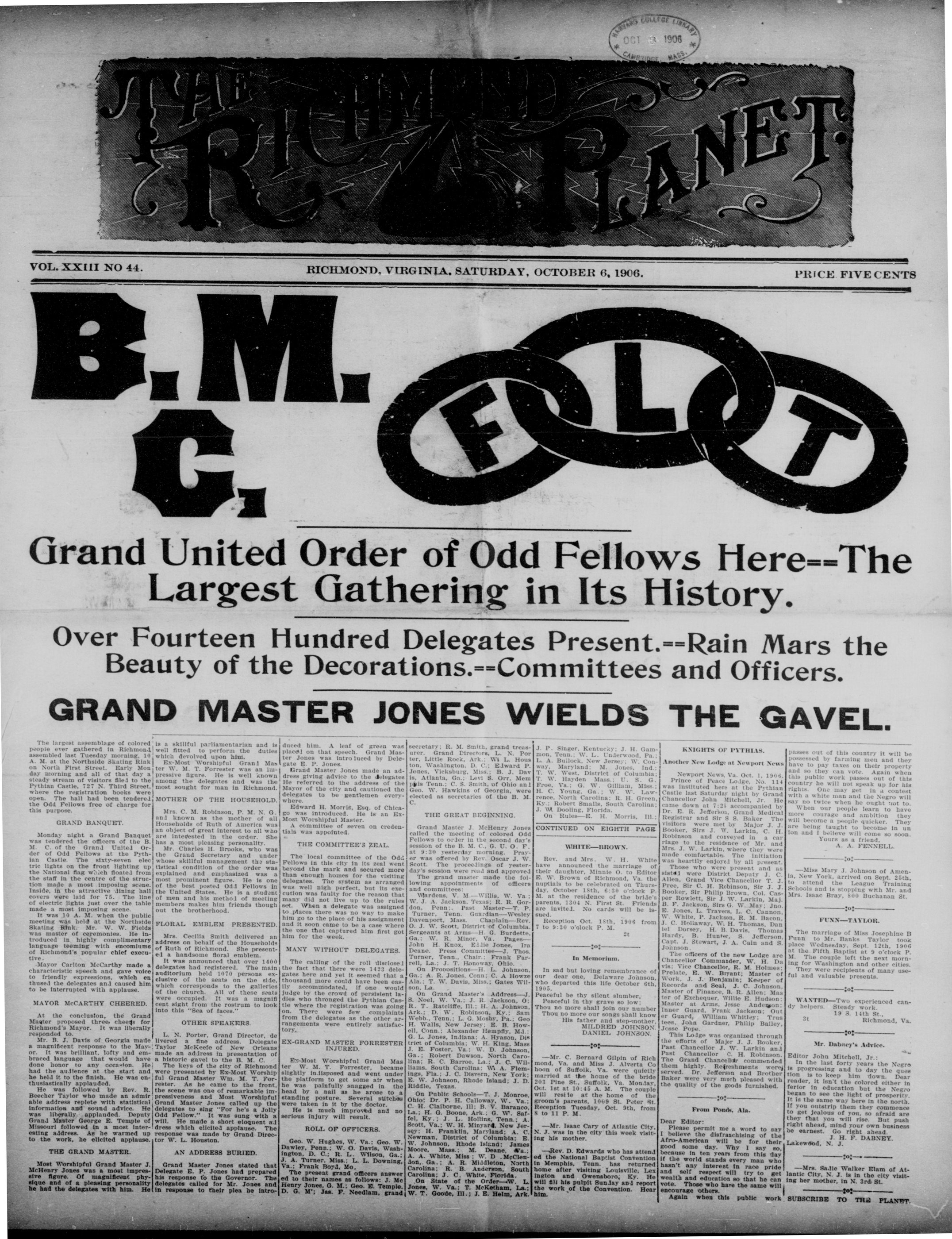
B.M. FOOT
Grand United Order of Odd Fellows Here==The Largest Gathering in Its History.
Over Fourteen Hundred Delegates Present.==Rain Mars the Beauty of the Decorations.==Committees and Officers.
GRAND MASTER JONES WIELDS THE GAVEL.
VOL. XXIII NO 44.
Grand Over F Bea GRAN
The largest assemblage of colored people ever gathered in Richmond assembled last Tuesday morning, 10 A. M. at the Northside Skating Rink on North First Street. Early Monday morning and all of that day a steady stream of visitors filed to the Pythian Castle, 727 N. Third Street, where the registration books were open. The hall had been tendered the Odd Fellows free of charge for this purpose.
GRAND BANQUET
Monday night a Grand Banquet was tendered the officers of the B. M. C. of the Grand United Order of Odd Fellows at the Pythian Castle. The sixty-seven electric lights on the front lighting up the National flag which floated from the staff in the centre of the struction made a most imposing scene. Inside, in the attractive dining hall covers were laid for 75. The line of electric lights just over the table made a most imposing scene.
It was 10 A. M. when the public meeting was held at the Northside Skating Rink. Mr. W. W. Fields was master of ceremonies. He introduced in highly complimentary language teeming with encomiums of Richmond's popular chief executive.
Mayor Carlton McCarthy made a characteristic speech and gave voice to friendly expressions, which en thused the delegates and caused him to be interrupted with an aplause.
MAYOR McCARTHY CHEERED.
At the conclusion, the Grand Master proposed three cheeses for Richmond's Mayor. It was liberally responded to.
Mr. B. J. Davis of Georgia made a magnificent response to the Mayor. It was brilliant, lofty and embraced language that would have done honor to any occasion. He had the audience at the start and he held it to the finish. He was enthusiastically applauded.
He was followed by Rev. R. B. Beecher Taylor who made an admirable address replete with statistical information and sound advice. He was liberally applauded. Deputy Grand Master George E. Temple of Missouri followed in a most interesting address. As he warmed up to the work, he elicited applause.
THE GRAND MASTER.
Most Worshipful Grand Master J. McHenry Jones was a most impressive figure. Of magnificent physique and of a pleasing personality he had the delegates with him. He
is a skillful parliamentarian and is well fitted to perform the duties which devolved upon him. Ex-Most Worshipful Grand Master W. M. T. Forrester was an impressive figure. He is well known among the delegates and was the most sought for man in Richmond.
MOTHER OF THE HOUSEHOLD
Mrs. C. M. Robinson, P. M. N. G. and known as the mother of all Households of Ruth of America was an object of great interest to all who are interested in the order. She has a most pleasing personality. Mr. Charles H. Brooks, who was the Grand Secretary and under whose skillful management the statistical condition of the order was explained and emphasized was a most prominent figure. He is one of the best posted Odd Fellows in the United States. He is a student of men and his method of meeting members makes him friends though out the brotherhood.
FLORAL EMBLEM PRESENTED
Mrs. Cecilia Smith delivered an address on behalf of the Households of Ruth of Richmond. She presented a handsome floral emblem. It was announced that over 1400 delegates had registered. The main auditorium held 1070 persons exclusive of the seats on the side, corners and to the galleries of the church. All of these persons were occupied. It was a magnif cent sight from the rostrum to look into this "Sea of faces."
OTHER SPEAKERS
L. N. Porter, Grand Director, delivered a fine address. Delegate Taylor McKeeet of New Orleans made an address in presentation of a historic gavel to the B. M. C. The keys of the city of Richmond were presented by Ex-Most Worshipful Grand Master Wm. M. T. Forrester. As he came to the front, the scene was one of remarkable impressiveness and Most Worshipful Grand Master Jones called up the delegates to sing "For he's a Jolly Odd Fellow." It was sung with a will. He made a short eloquent address which elicited applause. The response was made by Grand Director W. L. Houston.
AN ADDRESS BURIED.
Grand Master Jones stated that Delegate E. P. Jones had prepared his response to the Governor. The delegates called for Mr. Jones and in response to their plea he intro-
RICHMOND, VIRGINIA, SATURDAY, OCTOBER 6, 1906.
duced him. A leaf of green was placed on that speech. Grand Master Jones was introduced by Delegate E. P. Jones. Grand Master Jones made an address giving advice to the delegates He referred to the address of the Mayor of the city and cautioned the delegates to be gentlemen everywhere. Edward H. Morris, Esq. of Chicago was introduced. He is an Ex-Most Worshipful Master. A committee of seven on credentials was appointed.
THE COMMITTEE'S ZEAL
The local committee of the Old Fellows in this city in its zeal went beyond the mark and secured more than enough homes for the visiting delegates. The system as arranged was well nigh perfect, but its execution was faulty for the reason that many did not live up to the rules set. When a delegate was assigned to places there was no way to make him go to the place of his assignment and it soon came to be a case where the one that captured him first got him for the week.
MANY WITHOUT DELEGATES
The calling of the roll disclose. the fact that there were 1423 delegates here and yet it seemed that a thousand more could have been easily accommodated, if one would judge by the crowd of persistent ladies who thronged the Pythian Castle where the registration was going on. There were few complaints from the delegates as the other arrangements were entirely satisfactory.
EX-GRAND MASTER FORRESTER
INJURED.
Ex-Most Worshipful Grand Master W. M. T. Forrester, became slightly indisposed and went under the platform to get some air when he was painfully snagged in the head by a nail as he arose to a standing posture. Several slitches were taken in it by the doctor. He is much improved and no serious injury will result.
ROLL OF OFFICERS.
Geo. W. Hughes, W. Va.; Geo. W. Dawley, Penn.; W. O. Davis, Washington. D. C.; R. L. Wilson, Ga.; J. A. Turner, Miss.; L. L. Downing, Va.; Frank Boyd, Mo.
The present grand officers answer ed to their names as follows: J. Mc Henry Jones, G. M.; Geo. E. Temple, D. G. M.; Jas. F. Needlam, grand
secretary; R. M. Smith, grand treasurer, Grand Directors, L. N. Porter, Little Rock, Ark; WI L. Houson, Washington, D. C.; Edward P. Jones, Vicksburg, Miss; B. J. Davis, Atlanta, Ga.; Levi S. Orr, Memphis Tenn.; C. S. Smith, of Ohio and Geo. W. Hawkins of Georgia, were elected as secretaries of the B. M. C.
THE GREAT BEGINNING
On Public Schools—T. J. Monroe
Ohio; Dr. P. H. Calloway, W. Va.;
C. H. Clalborne, Ill; B. V. Baranco,
La.; H. G. Boone Ark; G. W. Safel,
Kv.; J. L. Hollins, Tenn.; A.
Scott, Va.; W. H. Minyard. New Jersey;
H. Franklin, Maryland; A. C.
Newman, District of Columbia; E.
W. Johnson, Rhode Island; James
Moore, Mass.; M. Deane, Wa.;
A. A. White, Miss; W. D. McClendon,
Ga.; A. R. Middleton, North
Carolina; R. B. Anderson, South
Carolina; J. C. White, Florida.
On State of the Order—W. L.
Lones, W. Va.; T. McKeham, La.;
W. T. Goode, Ill.; J. E. Helm
Another New Lodge at Newport News
Newport News, Va. Oct. 1, 1906.
Prince of Peace Lodge, No. 114
was instituted here at the Pythian
Castle last Saturday night by Grand
Chancellor John Mitchell, Jr. He
came down at 7:25 accompanied by
Dr. E. R. Jefferson, Grand Medical
Registrar and Sir S S. Baker The
visitors were met by Major J. J.
Booker, Sirs J. W. Larkin, C. H.
Robinson and conveyed in a car
riage to the residence of Mr. and
Mrs. J. W. Larkin, where they were
made comfortable. The initiation
was heartily enjoyed by all present.
Those who were present and as
sister 1 were District Deputy J. C.
Alton, Grand Vice Chancellor T. J.
Pree, Sirs J. W. Larkin, Sir J. J.
Booker, Sir Philip Brown, Col. Casper
Rowlett, Sir W. Larkin, Maj.
B. F. Jackson, Sirs G. W. May; J.
E. Jones, L. Traven, I. C. Cannon,
W. White, P. Jackson, W. H. M. Bacon,
C. J. Holiaway, W. H. Thomas, Dan
liel Dorssey, H. B. Davis, Thomas
Hardy, B. Hunter, S. Jefferson,
Capt. J. Stewart, J. A. Cain and S.
Johnson.
2t
o:
In Memorium.
The officers of the new Lodge are Chancellor Commander, W. H. Davis; Vice Chancellor, R. M. Holmes; Prelate, E. W. Bryant; Master of Work, J. J. Benjamin; Keeper of Records and Seal, J. C. Johnson, Master of Finance, B. R. Allen; Master of Exchequer, Willie E. Hudson; Master at Arms, Jesse Anderson; Inner Guard, Frank Jackson; Outer Guard, William Whitley; Trustees, John Gardner, Philip Batley, Jesse Pope.
This Lodge was organized through the efforts of Major J. J. Booker, Past Chancellor J. W. Larkin and Past Chancellor C. H. Robinson. The Grand Chancellor commended them highly. Refreshments were served. Dr. Jefferson and Brother Baker were very much pleased with the quality of the goods furnished.
Dear Editor:
Please permit me a word to say
I believe the distranchising of the Afro-American will be for their
good some day. Why I say so,
because in ten years from this day
if the world stands every man who
hasn't any interest in race pride
and self respect will try to get
wealth and education so that he can
vote. Those who have the same will
encourage others.
Again when this public work
J. P. Singer, Kentucky; J. H. Gammon, Tenn.; W. L. Underwood, Pa. L. A. Bullock, New Jersey; W. Conway, Maryland; M. Jones, Ind. T. W. West, District of Columbia; T. W. Hayden Mass.; U. S. G. Froe, Va.; G. W. Gilliam, Miss. H. C. Young, Ga.; W. W. Lawrence, North Carolina; R. H. Green, Ky.; Robert Smalls, South Carolina; J. M. Dooling, Florida. On Rules, E. Marrion, H.
On Rules—E. H. Morris, Ill.
CONTINUED ON EIGHTH PAGE
WHITE—BROWN
Rev. and Mrs. W. H. White have announced the marriage of their daughter, Minnie O. to Editor E. W. Brown of Richmond, Va. the nuptials to be celebrated on Thursday, October 18th, 6:30 o'clock P. M. at the residence of the bride's parents, 1304 N. First St. Friends are invite! No cards will be issued. Reception Oct. 18th, 1906 from 7 to 9:30 o'clock P. M.
In Memorium
In sad but loving remembrance of our dear one, Delaware Johnson who departed this life October 6th 1905.
Peaceful be thy silent slumber.
Peaceful in thy grave so low;
Thou no more shall join our number
you no more small join our number
Thou no more our songs shall know
His father other father
MILDERD JOHNSON
DANIEL JOHNSON.
---
—Mr. C. Bernard Gilpin of Rich mond, Va. and Miss J. Alverta Co hoon of Suffolk, Va. were quietly married at the home of the bride 203 Pine St., Suffolk, Va. Monday, Oct. 1st at 10:45 A. M. The couple will resile at the home of the groom's parents, 1009 St. Peter St. Reception Tuesday, Oct. 9th, from 8 to 11 P. M.
—Mr. Isaac Cary of Atlantic City, N. J. was in the city this week visiting his mother.
—Rev. D. Edwards who has attended the National Baptist Convention in Memphis, Tenn. has returned home after visiting Louisville, Lexington and Owensboro, Ky. He will fill his pulpit SunJay and report the work of the Convention. Hear him.
KNIGHTS OF PYTHIAS
From Ponds, Ala.
PRICE FIVECENTS
e==The
ars the
cers.
GAVEL.
passes out of this country it will be possessed by farming men and they have to pay taxes on their property and so they can vote. Again when this public work passes out of this country he will not speak up for his rights. One may get in a contest with a white man and the Negro will say no twice when he ought not to. When our people learn to have more courage and ambition they will become a people quicker. They are being taught to become in union and I believe will come so soon.
—Miss Mary J. Johnson of Amendia, New York, arrived on Sept. 25th, to attend the League Training Schools and is stopping with Mr. and Mrs. Isaac Bray, 800 Buchanan St.
FUNN—TAYLOR.
The marriage of Miss Josephine B Funn to Mr. Banks Taylor took place Wednesday, Sept. 12th, 1906 at the Fifth Baptist at 9 o'clock P. M. The couple left the next morning for Washington and other cities. They were recipients of many useful and valuable presents.
WANTED—Two experienced candy helpers. Steady work.
19 S. 14th St.,
Editor John Mitchell, Jr.:
In the last forty years the Negro is progressing and to day the question is to keep him down. Dear reader, it isn't the colored either in inferior in education but the Negro began to see the light of prosperity. It is the same way here in the north. If you outstrip them they commence to get jealous of you, so afraid are they that you will rise. But push right ahead, mind your own business be earnest. Go right ahead.
J. H. F. DABNEY.
Lakewood, N. J.
Mrs. Sallie Walker Elam of Atlantic City, N. J. is in the city visiting her mother, in N. 3rd St.
SUBSCRIBE TO THE PLANET.
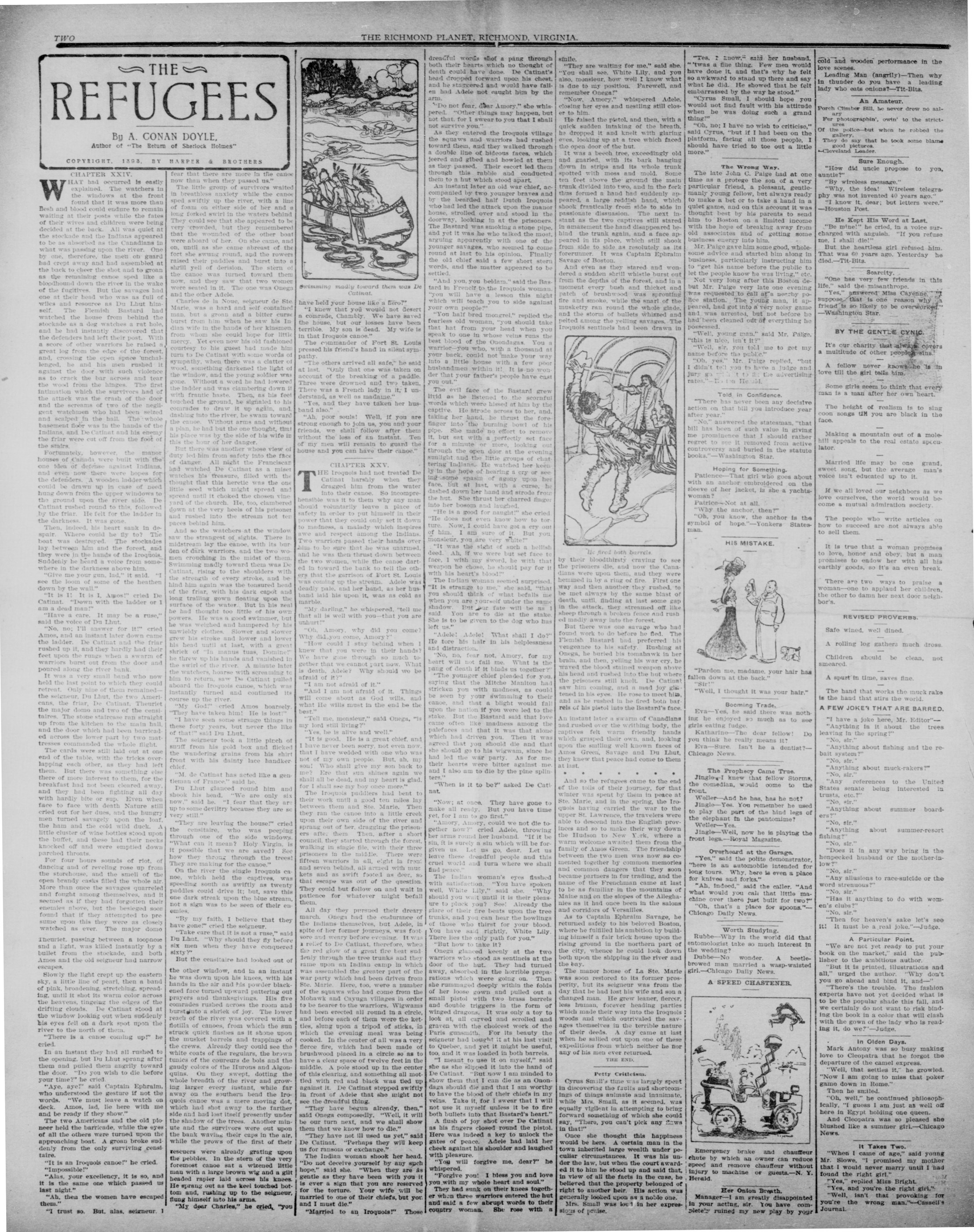
REFUGEES
By A. CONAN DOYLE,
Author of "The Return of Sherlock Holmes"
COPYRIGHT. 1893. BY HARPER & BROTHERS
CHAPTER XXIV. fear that there are more in
HAT had occurred is easily explained. The watchers in the windows at the front found that it was more than
flesh and blood could endure to remain waiting at their posts while the fates of their wives and children were being decided at the back. All was quiet at the stockade and the Indians appeared to be as absorbed as the Canadians in what was passing upon the river. One by one, therefore, the men on guard had crept away and had assembled at the back to cheer the shot and to groan as the remaining canoe sped like a bloodhound down the river in the wake of the fugitives. But the savages had one at their head who was as full of wiles and resource as Du Lhut himself. The Flemish Bastard had watched the house from behind the stockade as a dog watches a rat hole, and he had instantly discovered that the defenders had left their post. With a score of other warriors he raised a great log from the edge of the forest, and, crossing the open space 'unchallenged, he and his men rushed it against the door with such violence as to crack the bar across and tear the wood from the hinges. The first intimation which the survivors had of the attack was the crash of the door and the screams of two of the negligent watchmen who had been seized and scaled in the hall. The whole basement floor was in the hands of the Indians, and De Catatat and his enemy the friar were cut off from the foot of the stairs.
Fortunately, however, the manor houses of Cattaina were built with the one idea of defense against Indians, and even now there were hopes for the defenders. A wooden ladder which could be drawn up in case of need hung down from the upper windows to the ground upon the river side. De Catatin rushed round to this, followed by the friar. He felt for the ladder in the darkness. It was gone. Then, indeed, his heart sank in despair. Where could he fly to? The boat was destroyed. The stockade lay between him and the forest, and they were in the hands of the Iroqnois. Suddenly he heard a voice from somewhere in the darkness above him. "Give me your gun, lad," it said. "I see the boom of some of the heathen down by the wall." "It is I! It is I, Amos!" cried De Catatin. "Down with the ladder or I am a dead man!" "Have a care. It may be a ruse," said the voice of Du Lhut.
"No, no; I'll answer for it!" cried Amos, and an instant later down came the ladder. De Catinat and the friar rushed up it, and they hardly had their feet upon the rungs when a swarm of warriors burst out from the door and poured along the river bank. It was a very small band who now held the last point to which they could retreat. Only nine of them remained—the seigneur, Du Lhut, the two Americans, the friar, De Catinat. Theuerlet the major domo and two of the censalaires. The stone staircase ran straight up from the kitchen to the main hall, and the door which had been barricaded across the lower part by two mattresses commanded the whole flight.
The cards were still laid out at one end of the table, with the tricks overlapping each other, as they had left them. But there was something else there of more interest to them, for the breakfast had not been cleared away, and they had been fighting all day with hardly bite or sup. Even when face to face with death Nature still crieled out for her dues, and the hungry men turned savagely upon the laff, the ham and the cold wild duck. A little cluster of wine bottles stood upon the buffet, and these had their necks knocked off and were emptied down parched throats.
For four hours sounds of riot, of dancing and of reveling rose up from the storehouse, and the smell of the open brandy casks filled the whole air. More than once the savages quarreled and fought among themselves, and it seemed as if they had forgotten their enemies above, but the besieged soon found that if they attempted to presume upon this they were as closely watched as ever. The major domo Theuriet, passing between a loopnoe and a light, was killed instantly by a bullet from the stockade, and both Amos and the old seigneur had narrow escapes. Slowly the light crept up the eastern sky, a little line of pearl, then a band of pink, broadening, stretching, spreading, until it shot its warm color across the heavens, tingeing the edges of the drifting clouds. De Catinat stood at the window looking out when suddenly his eyes fell on a dark spot upon the river to the north of them.
"There is a canoe coming up!" he cried.
In an instant they had all rushed to the opening, but Du Lhut sprang after them and pulled them angrily toward the door. "Do you wish to die before your time?" he cried.
"Aye, aye!" said Captain Ephraim, who understood the gesture if not the words. "We must leave a watch on deck, Amos, lad, lie here with me and be ready if they show."
The two Americans and the old pioneer held the barricade, while the eyes of all the others were turned upon the approaching boat. A groan broke suddenly from the only surviving censoria.
"It is an Iroquois canoe!" he cried.
"Impossible!"
"Alas, your excellency, it is so, and it is the same one which passed us last night."
"Ah, then the women have escaped them."
"I trust so. But, alas, seigneur, I
TWO
W
fear that there are more in the canoe now than when they passed us."
The little group of survivors waited in breathless anxiety while the canoe sped swiftly up the river, with a line of foam on either side of her and a long forked swirl in the waters behind. They could see that she appeared to be very crowded, but they remembered that the wounded of the other boat were aboard of her. On she came, and, until as she came abreast of the fort she swung round, and the rowers raised their paddles and burst into a shrill yell of derision. The stern of the canoe was turned toward them now, and they saw that two women were seated in it. The one was Onega and the other Adele.
Charles de la Noue, soigneur de Ste Marie was a hard and self contained man, but a groan and a bitter curse burst from him when he saw his Indian wife in the hands of her kinsmen, from whom she could hope for little mercy. Yet even now his old fashioned courtesy to his guest had made him turn to De Catinat with some words of sympathy, when there was a clatter of wood, something darkenel the light of the window, and the young soldier was gone. Without a word he had lowered the ladder and was clambering down it with frantic haste. Then, as his feet touched the ground, he signaled to his comrades to draw it up again, and, dashing into the river, he swam toward the canoe. Without arms and without a plan, he had but the one thought, that his place was by the side of his wife in this the hour of her danger.
But there was another whose view of duty led him from safety into the face of danger. All night the Franciscan had watched De Cathat as a miser watches his treasure, filled with the thought that this heretic was the one little seed which might spread and spread until it choked the chosen vineyard of the church. He, too, clambered down at the very heels of his prisoner and rushed into the stream not ten spaces behind him.
And so the watchers at the window saw the strangest of sights. There in midstream lay the canoe, with its burden of dark warriors, and the two women crouching in the midst of them. Swimming madly toward them was De Catinat, rising to the shoulders with the strength of every stroke, and behind him again was the tonsured head of the friar, with his dark capot and long trailing gown floating upon the surface of the water. But in his zeal he had thought too little of his own powers. He was a good swimmer, but he was weighed and hampered by his unwieldy clothes. Slower and slower grew his stroke and lower and lower his head until at last, with a great skriff of "In manus tuas, Domine," he threw up his hands and vanished in the swirl of the river. A minute later the watchers, hoarse with screening to him to return, saw De Catinat pulled aboard the Iroquois canoe, which was instantly turned and continued its course up the river.
"My God!" cried Amos hoarsely,
"They have taken him! He is lost!"
"I have seen some strange things in these forty years, but never the like of that!" said Du Lhut.
The selgurne took a little pinch of snuff from his gold box and flicked the wandering grains from his shirt front with his dainty lace handkerchief.
"M. de Catinat has acted like a gentleman of France," said he.
Du Lhut glanced round him and shook his head. "We are only six now," said he. "I fear that they are up to some deviltry because they are so very still."
"They are leaving the house!" cried the censitaire, who was peeping through one of the side windows.
"What can it mean? Holy Virgin, is it possible that we are saved? See how they throng through the trees! They are making for the canoe."
On the river the single Iroquois canoe, which held the captives, was speeding south as swiftly as twenty paddles could drive it; but, save this one dark streak upon the blue stream, not a sign was to be seen of their enemies.
"By my faith, I believe that they have gone!" cried the seigneur.
"Take care that it is not a ruse," said Du Lhut. "Why should they fly before six men when they have conquered sixty?"
But the censitaire had looked out of
the other window, and in an instant he was down upon his knees, with his hands in the air and his powder blackened face turned upward patterning out prayers and thanksgivings. His five comrades rushed across the room and burst into a shriek of joy. The lower reach of the river was covered with a flotilla of canoes, from which the sun struck quick flashes as it shone upon the musket barrels and trappings of the crews. Already they could see the white coats of the regulars, the brown tunics of the coureurs de bols and the gaudy colors of the Hurons and Algonquins. On they swept, dotting the whole breadth of the river and growing larger every instant, while far away on the southern bend the Iroquois canoe was a mere moving dot, which had shot away to the farther side and had lost itself presently under the shadow and had lost itself presently under the minute and the survivors were out upon the bank waving their caps in the air, while the prows of the first of their
rescueers were already grating upon the pebbles. In the stern of the very foremost canoe sat a wizened little man with a large brown wig and a gift headed rapier laid across his knees. He sprang out as the keel touched bottom and, rushing up to the seigneur, flung himself into his arms.
"My dear Charles," he cried, "you
THE RICHMOND PLANET, RICHMOND, VIRGINIA
THE CANADIAN INDIANS
Swimming madly toward them was De Catinat.
have held your house like a hero."
"I knew that you would not desert a comrade, Chambly. We have saved the house, but our losses have been terrible. My son is dead. My wife is in that Iroquois canoe."
The commander of Fort St. Louis pressed his friend's hand in silent sympathy.
"The others arrived all safe," he said at last. "Only that one was taken on account of the breaking of a paddle. Three were drowned and two taken. There was a French lady in it; I understand, as well as madame."
"Yes, and they have taken her husband also."
"Ah, poor souls! Well, if you are strong enough to join us, you and your friends, we shall follow after them without the loss of an instant. Ten of my men will remain to guard the house and you can have their canoe."
CHAPTER XXV
Catinat harshly when they dragged him from the water into their canoe. So incomprehensible was it to them why any man should voluntarily leave a place of safety in order to put himself in their power that they could only set it down to madness, a malady which inspires awe and respect among the Indians. Two warriors passed their hands over him to be sure that he was unarmed, and he was then thrust down between the two women, while the canoe darted in toward the bank to tell the others that the garrison of Fort St. Louis was coming up the stream. Adele was deadly pale, and her hand, as her husband laid upon it, was as cold as marble.
"My darling," he whispered, "tell me that all is well with you—that you are unhurt."
"Oh, Amory, why did you come? Why did you come, Amory?"
"How could I stay behind when I knew that you were in their hands? We have gone through so much together that we cannot part now. What is death, Adele? Why should we be afraid of it?" "I am not afraid of it."
"And I am not afraid of it. Things will come about as God wills, and what He wills must in the end be the best."
"Tell me, monsieur," said Omega, "is my lord still living?"
"Yes, he is alive and well."
"It is good. He is a great chief, and I have never been sorry, not even now, that I have welded with one who was not of my own people. But, ah, my son! Who shall give my son back to me? Ere that sun shines again we shall all be dead, and my heart is glad, for I shall see my boy once more."
The troopos paddlers had bent to their work until a good ten miles lay between them and Ste. Marie. Then they ran the canoe into a little creek upon their own side of the river and sprout out of her, dragging the prisoners after them. Then, after a short council, they started through the forest, walking in single file, with their three prisoners in the middle. There were fifteen warriors in all, eight in front and seven behind, all armed with muskets and as swift footel as deer, so that escape was out of the question. They could but follow on and wait in patience for whatever might befall them.
All day they pursued their dreary march. Omega had the endurance of the Indians themselves, but Adele, in spite of her former journeys, was foot-sore and weary before evening. It was a relief to De Catatin, therefore, when the red glow of a great fire beat suddenly through the tree trunks and they rame upon an Indian camp in which was assembled the greater part of the war party which had been driven from Ste. Marie. Here, too, were a number of the squaws who had come from the Mohawk and Cayuga villages in order to be nearer to the warriors. Wigwams had been erected all round in a circle, and before each of them were the kettles, slung upon a tripod of sticks, in which the evening meal was being cooked. In the center of all was a very fierce fire, which had been made of brushwood placed in a circle so as to have a clear space of twelve feet in the middle. A pole stood up in the center of this clearing, and something all mottled with red and black was tied up against it. De Catatin stepped swiftly in front of Adele that she might not see the dreadful thing.
"They have begun already, then," said Omega composedly. "Well, it will be our turn next, and we shall show them that we know how to die."
"They have not ill used us yet," said De Catinat. "Perhaps they will keep us for ransom or exchange."
The Indian woman shook her head. "Do not deceive yourself by any such hope," said she. "When they are as gentle as they have been with you it is ever a sign that you are reserved for the torture. Your wife will be married to one of their chiefs, but you and I must die."
"Married to an Iroquois!" Those
dreadful words shot a pang through both their hearts which no thought of death could have done. De Catinat's head dropped forward upon his chest, and he staggered and would have fallen had Adele not caught him by the arm.
"Do not fear, dear Amory," she whispered. "Other things may happen, but not that, for I swear to you that I shall not survive you."
As they entered the Iroquois village the squawns and warriors had rushed toward them, and they walked through a double line of hideous faces, which jeered and glibed and howled at them as they passed. Their escort led them through this rabble and conducted them to a hut which stood apart.
An instant later an old war chief, accompanied by two younger braves and by the bearded half Dutch Iroquois who had led the attack upon the manor house, strolled over and stood in the doorway, looking in at the prisoners. The Bastard was smoking a stone pipe, and yet it was he who talked the most, arguing apparently with one of the younger savages, who seemed to come round at last to his opinion. Finally the old chief said a few short stern words, and the matter appeared to be settled.
"And you, you beldarn." said the Bastard in Frencht to the Iroquois woman, "you will have a lesson this night which will teach you to side against your own people."
"You half bred mongrel," replied the fearless old woman, "you should take that hat from your head when you speak to one in whose veins runs the best blood of the Onondagas. You a warrior—you who, with a thousand at your back, could not make your way into a little house with a few poor husbandmen within it. It is no wonder that your father's people have cast you out."
The evil face of the Bastard grew livid as he listened to the scornful words which were hissed at him by the captive. He strode across to her, and, taking her hand, he thrust the forefinger into the burning bowl of his pipe. She made no effort to remove it, but sat with a perfectly set face for a minute or more, looking out through the open door at the evening sunlight and the little groups of clattering Indians. He watched her keenly in the hope of hearing a cry or seeing some spasm of agony upon her face, but at last, with a curse, he dashed down her hand and strode from the hut. She thrust her charred finger into her bosom and laughed.
"He is a good for naught!" she cried. "He does not even know how to torture. Now, I could have got a cry out of him. I am sure of it. But you monsieur, you are very white."
"It was the sight of such a hellish deed. Ah, if we were but set face to face, I with my sword, he with that weapon he chose, he should pay for it with his heart's blood!" The Indian woman seemed surprised, "It is strange to me," she said, "that you should think of what befalls me when you are yourself under the same shadow. But our fate will be us I said. You are to die at the stake. She is to be given to the dog who has left us." "Adele! Adele! What shall I do?" He tore his hair in his helplessness and distraction. "No, no, fear not, Amory, for my heart will not fail me. What is the pang of death if it blinds us together?"
"The younger chief pleaded for you, saying that the Mitche Maniton had stricken you with madness, as could be seen by your swimming to their canoe, and that a blight would fall upon the nation if you were led to the stake. But the Bastard said that love came often like madness among the palefaces and that it was that alone which had driven you. Then it was agreed that you should die and that she should go to his wigwam, since he had led the war party. As for me, their hearts were bitter against me, and I also am to die by the pine splinters."
"When is it to be?" asked De Cattat.
"Now; at once. They have gone to make all ready. But you have time get, for I am to go first."
"Amory, Amory, could we not die to together now?" cried Adele, throwing her arms round her husband. "If it be sin, it is surely a sin which will be forgiven us. Let us go, dear. Let us leave these dreadful people and this cruel world and turn where we shall find peace."
The Indian woman's eyes flashed with satisfaction. "You have spoken well, White Lily," said she. "Why should you wait until it is their pleasure to pluck you? See! Already the glare of their fire beats upon the tree trunks, and you can hear the howlings of those who thirst for your blood. You have said rightly, White Lily. There hes the only path for you."
"But how to take it?"
Omega glanced keenly at the two warriors who stood as sentinels at the door of the hut. They had turned away, absorbed in the horrible preparations which were going on. Then she rummaged deeply within the folds of her loose gown and pulled out a small pistol with two brass barrels and double triggers in the form of winged dragons. It was only a toy to look at, all carved and scrolled and graven with the choicest work of the Paris gunsmith. For its beauty the seigneur had bought it at his last visit to Quebec, and yet it might be useful, too, and it was loaded in both barrels.
"I meant to use it on myself," said she as she slipped it into the hand of De Catain. "But now I am minded to show them that I can die as an Onondaga should die and that I am worthy to have the blood of their chiefs in my veins. Take it, for I swear that I will not use it myself unless it be to fire both bullets into that Bastard's heart." A flush of joy shot over De Catain as his fingers closed round the pistol. Here was indeed a key to unlock the gates of peace. Adele laid her cheek against his shoulder and laughed with pleasure.
"You will forgive me, dear?" he whispered.
"Forgive you! I bless you and love you with my whole heart and soul."
you with my whole heart and soul."
They had sunk on their knees together when three warriors entered the hut and said a few abrupt words to their country woman. She rose with a
smile.
"They are waiting for me," said she.
"You shall see. White Lilly, and you also, monsieur, how well I know what is due to my position. Farewell, and remember Onega."
"Now, Amory," whispered Adele, closing her eyes and nestling still closer to him.
He failed the pistol, and then, with a quick sudden intaking of the breath, he dropped it and knelt with glaring eyes, looking up at a tree which faced the open door of the hut.
It was a beech tree, exceedingly old and gnarled, with its bark banging down in strips and its whole trunk spotted with moss and mold. Some ten feet above the ground the main trunk divided into two, and in the fook thus formed a hand had suddenly appeared, a large reddish hand, which shook frantically from side to side in passionate discussion. The next instant as the two captives still stared in amazement the hand disappeared behind the trunk again, and a face appeared in its place, which still shook from side to side as resolutely as its forerunner. It was Captain Ephraim Savage of Boston.
And even as they stared and wondered a sudden shrill whistle burst out from the depths of the forest, and in a moment every bush and thicket and patch of brushwood was spruffing fire and smoke, while the snarl of the muskety ran round the whole glade, and the storm of bullets whizzed and pelted among the yelling savages. The Iroonols sentinels had been drawn in.
1
lic fired both barrels
by their bloodthirsty craving to see the prisoners die, and now the Canadians were upon them, and they were hemmed in by a ring of fire. First one way and then another they rushed, to be met always by the same blast of death, until, finding at last some gap in the attack, they streamed off like sheep through a broken fence and rushed madly away into the forest.
But there was one savage who had found work to do before he fled. The Flemish Bastard had preferred his vengeance to his safety. Rushing at Omega, he buried his tomahawk in his brain, and then, yelling his war cry, he waved the blood stained weapon above his head and rushed into the hut where the prisoners still knelt. De Catinnat saw him coming, and a mad joy glitten in his eyes. He rose to meet him, and as he rushed in he fired both barrels of his pistol into the Bastard's face.
An instant later a swarm of Canadians sad rushed over the wetting body, the captives felt warm friendly hands which grasped their own, and, looking upon the smiling well known faces of Amos Green, Savage and Du Lhut, they knew that peace had come to them at last.
And so the refugees came to the end of the toils of their journey, for that winter was spent by them in peace at Ste. Marie, and in the spring, the Iroquois having carried the war to the upper St. Lawrence, the travelers were able to descend into the English provinces and so to make their way down the Hudson to New York, where a warm welcome awaited them from the family of Amos Green. The friendship between the two men was now so cemented together by common memories and common dangers that they soon became partners in fur trading, and the name of the Frenchman came at last to be as familiar in the mountains of Maine and on the slopes of the Alleghanies as it had once been in the salons and corridors of Versailles.
As to Captain Ephraim Savage, he returned safely to his beloved Boston, where he fulfilled his ambition by building himself a fair brick house upon the rising ground in the northern part of the city, whence he could look down both upon the shipping in the river and the bay.
The manor house of La Ste. Marle was soon restored to its former prosperity, but its seigneur was from the day that he had lost his wife and a changed man. He grew leaner, fiercer, less human, forever heading parties which made their way into the Iroquois woods and which outvivaled the savages themselves in the terrible nature of their deeds. A day came at last when he salied out upon one of these expeditions from which neither he nor any of his men ever returned.
Petty Criticism
Cyrus Small's time was largely spent in discovering the faults and shortcomings of things animate and inanimate, while Mrs. Small, as it seemed, was equally vigilant in attempting to bring forward something of which she could say, "There, you can't pick any dows in that!" Once she thought this happiness would be hers. A certain man in the town inherited large wealth under peculiar circumstances. It was his under the law, but when the court awarded it to him he stood up and said that, in view of all the facts in the case, he believed that the property belonged of right to another heir. His action was generally looked upon as a noble one. Mrs. Small was loud in her expressions of praise.
"Tes. I know," said her husband,
"twas a fine thing. Few men would have done it, and that's why he felt so awkward to stand up there and say what he did. He showed that he felt embarrassed by the way he stood."
"Cyrus Small, I should hope you would not find fault with his attitude when he was doing such a grand thing"
"Oh, no; I have no wish to criticise," said Cyrus, "but if I had been on the platform, facing all those people, I should have tried to toe out a little more."
The Wrong Way.
The late John G. Paige had at one time as a protege the son of a very particular friend, a pleasant, gentlemanly young fellow, but always ready to make a bet or to take a hand in a quiet game, and on this account it was thought best by his parents to send him to Boston on a limited income with the hope of breaking away from old associates and of getting some business energy into him.
Mr. Paige gave him some good, wholesome advice and started him along in business, particularly instructing him to "get his name before the public to let the people know he was living," etc.
Not very long after this Boston debut Mr. Paige very late one evening was requested to call at a nearby police station. The young man, it appeared, had got into a very noisy game and was arrested, but not before he had been cleaned out of everything he possessed.
"Well, young man," said Mr. Paige, "this is nice, isn't it?"
"Well, sir, you told me to get my name before the public."
"Oh, yes!" Mr. Faige replied, "but I didn't tell you to have a judge and jury go with it to fit the advertising rates."—D. Don Heald.
Told in Confidence
"There has never been any decisive action on that bill you introduce year after year."
"No," answered the statesman, "that bill has been of such value in giving me prominence that I should rather regret to see it removed from active controversy and buried in the statute books."—Washington Star.
Hoping for Something
Patience—That girl who goes about with an anchor embroidered on the sleeve of her jacket, is she a yachtswoman?
Patrice—Not at all.
"Why the anchor, then?"
"Oh, you know, the anchor is the symbol of hope."—Yonkers Statesman.
HIS MISTAKE.
"Pardon me, madame, your hair has fallen down at the back."
"Sir!"
"Well, I thought it was your hair."
Booming Trade.
Eva—Yes, he said there was nothing he enjoyed so much as to see girls eating fudge.
Katharine—The dear fellow! Do you think he really means it?
Eva—Sure. Isn't he a dentist?—Chicago News.
The Prophecy Game True
Jingle—I knew that fellow Storms, the comedian, would come to the front.
Weller—And he has, has he not?
Jingle—Yes. You remember he used to play the part of the hind legs of the elephant in the pantomime?
Weller—Yes.
Jingle—Well, now he is playing the front lega—Royal Magazine.
Overheard at the Garage
"Yes," said the polite demonstrator, "here is an automobile intended for long tours. Why, here is even a place for knives and forks."
"Ah, indeed," said the caller. "And what would you call that little machine over there just built for two?"
"Oh, that's a place for spoons."—Chicago Daily News
Worth Studying
Rubbie-Why in the world did that entomologist take so much interest in the wedding?
Dubble-No wonder. A beetle-browed man married a wasp-waisted girl.-Chicago Daily News.
A SPEED CHASTENER.
J.P. HARRIS
Emergency brake and chauffeur chute by which an owner can reduce speed and remove chauffeur without injury to machine or guests.-N. Y. Herald.
Her Onion Breath.
Manager- I am greatly disappointed in your acting, sir. You have completely ruined my new play by your
cold and wooden performance in the love scenes.
Leading Man (angrilly)—Then why in thunder do you have a leading lady who eats onions—Tit-Bits.
An Amateur
Porch Climber Bill, he never drew no salary
For photographin', owin' to the strictures
Of the police-but when he robbed the gallery,
They do say that he took some blame
pictures.
Sure Enough.
"How did uncle propose to you, auntie?"
"By wireless message."
"Why, the idea! Wireless telegraphy was not invented 40 years ago."
"I know it, dear; but letters were."
"Houston Post."
He Kept His Word at Last.
"Be mine!" he cried, in a voice surcharged with anguish. "If you refuse me, I shall die!"
But the heartless girl refused him. That was 60 years ago. Yesterday he died.—Tit-Bits.
Scarcity
"One has very few friends in this life," said the misanthropo.
"Yes," answered Miss Cayenne.
" suppose that is one reason why a friend is so likely to be overworked.
—Washington Star.
It's our charity that always covers a multitude of other people's sins.
A fellow never knows he is in love till the girl tells him.
Some girls seem to think that every man is a man after her own heart.
The height of realism is to sing coon songs tlM you are black in the face.
Making a mountain out of a molehill appeals to the real estate speculator.
Married life may be one grand, sweet song, but the average man's voice isn't educated up to it.
If we all loved our neighbors as we love ourselves, the world would become a mutual admiration society.
The people who write articles on how to succeed are not always able to sell them.
It is true that a woman promises to love, honor and obey, but a man promises to endow her with all his earthly goods, so it's an even break.
There are two ways to praise a woman—one to applaud her children, the other to damn her next door neighbor's.
REVISED PROVERBS
Safe wined, well dined.
A rolling log gathers much dross.
Children should be clean, not smeared.
A spurt in time, saves fine.
The hand that works the muck rake is the hand that stirs the world.
A FEW JOKE'S THAT ARE BARRED.
"I have a joke here, Mr. Editor"—
"Anything in it about the trees leaving in the spring?"
"No, srl."
"Anything about fishing and the re-bait system?"
"No, srl."
"Anything about muck-rakers?"
"No, srl."
"Any references to the United States senate being interested in trusts, etc."
"Anything about summer boarders?"
"No, sir."
"Anything about summer-resort fishing?"
"No, sir."
"Does it in any way bring in the henpecked husband or the mother-in-law?"
"No, sir."
"Any allusions to race-suicide or the word strenuous?"
"No, sir."
"Has it anything to do with women's clubs?"
"No, sir."
"Then for heaven's sake let's see it! It must be a real joke."—Judge.
A. Particular Point.
"We are not yet ready to put your book on the market," said the publisher to the ambitious author.
"But it is printed, illustrations and all," urged the author. "Why don't you go ahead and bind it, and—"
"There's the trouble. The fashion experts have not yet decided what is to be the popular shade this fall, and we certainly do not want to risk binding the book in a color that will clash with the gown of the lady who is reading it, do we?"—Judge.
In Olden Days.
Mark Antony was so busy making love to Cleopatra that he forgot the departure of the camel express.
"Well, that settles it," he growled.
"Now I am going to miss that poker game down in Rome."
Then he smiled.
"Oh, well," he continued philosophically, "I guess I am just as well off here in Egypt holding one queen.
And Cleopatra was so pleased she blushed like a summer girl."—Chicago News.
It Takes Two.
"When I came of age," said young Mr. Slowe, "I promised my mother that I would never marry until I had found the right girl."
"Yes," replied Miss Bright.
"Yes, and you're the right girl."
"Well, isn't that provoking for you're the wrong man."—Cassell's Journal.
THE PLANET
SATURDAY ... OCTOBER 6, '06
HORTICULTURE
A FARMER'S NURSERY
It Is Easily Managed and Should Be a Feature of Every Farm.
A small home nursery is easily managed and in many cases highly profitable. Where old orchards of good standard varieties exist, it is a comparatively simple matter to grow young trees. By planning a little ahead, the farmer may grow his own fruit trees and plant a considerable orchard at slight expense.
Seeds of good quality must be preserved to grow stocks for budding or grafting. This is done by cleaning and washing them when they are removed from the fruit and allowed to dry in the sun. They may be kept over winter in a box of moist sand, or pile of leaves left out of doors. It is best to allow them to freeze, which will crack the shells sufficiently for sprouting. The seeds are sown in rows three feet wide, and three to six inches apart in the row. Stocks usually attain sufficient size to bud or graft with one year's growth.
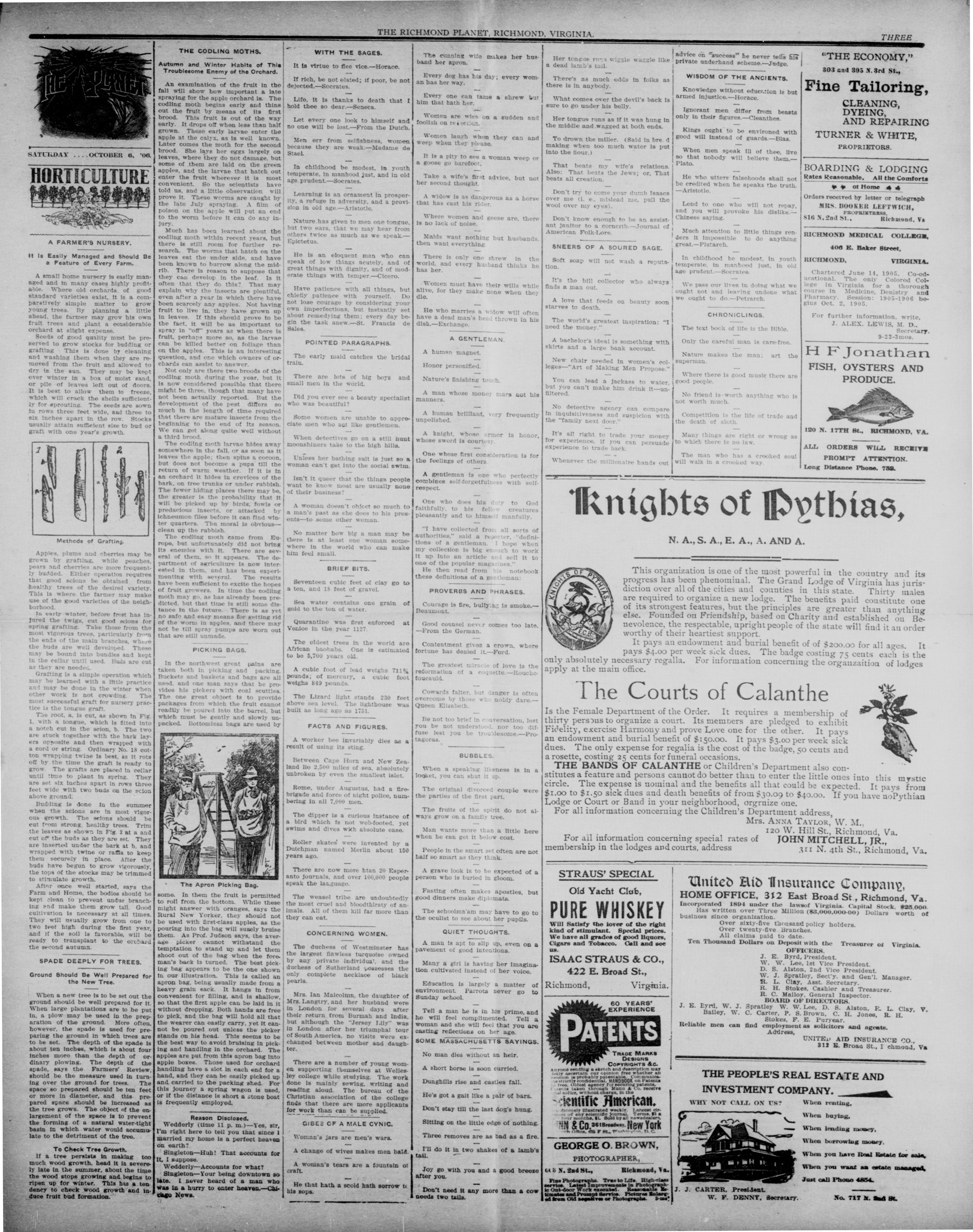
Methods of Grafting.
Apples, plums and cherries may be grown by grafting, while peaches, pears and cherries are more frequently budded. Either operation requires that good sclons be obtained from healthy trees of the desired variety. This is where the farmer may make use of the good varieties of the neighborhood.
In early winter, before frost has injured the twigs, cut good scions for spring grafting. Take those from the most vigorous trees, particularly from the ends of the main branches, where the buds are well developed. These may be bound into bundles and kept in the cellar until used. Buds are cut as they are needed.
Grafting is a simple operation which may be learned with a little practice and may be done in the winter when other work is not crowding. The most successful graft for nursery practice is the tongue graft.
The root, a, is cut, as shown in Fig. 1, with a tongue, which is fitted into a notch cut in the secon, b. The two are stuck together with the bark layers opposite and then wrapped with a cord or string. Ordinary No. 18 cotton wrapping twine is best, as it rots off by the time the graft is ready to grow. The grafts are placed in cellar until time to plant in spring. They are set six inches apart in rows three feet wide with two buds on the secon above ground.
Budding is done in the summer when the secons are in most vigorous growth. The secons should be cut from strong, healthy trees. Trim the leaves as shown in Fig. 2 at a and cut off the buds as they are set. They are inserted under the bark at b, and wrapped with twine or raffa to keep them securely in place. After the buds have begun to grow vigorously, the tops of the stocks may be trimmed to stimulate growth.
After once well started, says the Farm and Home, the bodios should be kept clean to prevent undue branching and make them grow tall. Good cultivation is necessary at all times. They will usually grow from one to two feet high during the first year, and if the soil is favorable, will be ready to transplant to the orchard the second autumn.
SPADE DEEPLY FOR TREES
Ground Should Be Well Prepared for the New Tree.
When a new tree is to be set out the ground should be well prepared for it. When large plantations are to be put in, a plow may be used in the preparation of the ground. More often, however, the spade is used for preparing the ground in which trees are to be set. The depth of the spade is about ten inches, which is about four inches more than the depth of ordinary plowing. The depth of the spade, says the Farmers' Review, should be the measure used in turning over the ground for trees. The space so prepared should be ten feet or more in diameter, and this. prepared space should be increased as the tree grows. The object of the enlargement of the space is to prevent the forming of a natural water-tight basin in which water would accumulate to the detriment of the tree.
To Check Tree Growth.
If a tree persists in making too much wood growth, head it in severely late in the summer, about the time the wood stops growing and begins to ripen up for winter. This has a tendency to check wood growth and induce fruit bud formation.
THE CODLING MOTHS.
Autumn and Winter Habits of This
Troublesome Enemy of the Orchard.
An examination of the fruit in the fall will show how important a late spraying for the apple orchard is. The codling moth begins early and thins out the fruit by means of its first brood. This fruit is out of the way early. It drops off when less than half grown. These early larvae enter the apple at the calyx, as is well known. Later comes the moth for the second brood. She lays her eggs largely on leaves, where they do not damage, but some of them are laid on the green apples, and the larvae that hatch out enter the fruit wherever it is most convenient. So the scientists have told us, and a little observation will prove it. These worms are caught by the late July spraying. A film of polson on the apple will put an end to the worm before it can do any injury.
Much has been learned about the codling moth within recent years, but there is still room for further research. The worms that hatch on the leaves eat the under side, and have been known to burrow along the midrib. There is reason to suppose that they can develop in the leaf. Is it often that they do this? That may explain why the insects are plentiful, even after a year in which there have been scarcely any apples. Not having fruit to live in, they have grown up in leaves. If this should prove to be the fact, it will be as important to spray in "off" years as when there is fruit, perhaps more so, as the larvae can be killed better on foliage than on the apples. This is an interesting question, and one which owners of orchards can assist to answer.
Not only are there two broods of the codling moth during the year, but it is now considered possible that there might be three, though that many have not been actually reported. But the development of the pest differs so much in the length of time required that there are mature insects from the beginning to the end of its season. We can get along quite well without a third brood. The codling moth larvae hides away somewhere in the fall, or as soon as it leaves the apple; then spins a cocoon, but does not become a pupa till the return of warm weather. If it is in an orchard it hides in crevices of the bark, on tree trunks or under rubbish. The fewer hiding places there may be, the greater is the probability that it will be picked up by birds, fowls or predacious insects, or attacked by lechneum files before it can find winter quarters. The moral is obvious—clean up the rubbish.
The coding moth came from Europe, but unfortunately did not bring its enemies with it. There are several of them, so it appears. The department of agriculture is now interested in them, and has been experimenting with several. The results have been sufficient to excite the hopes of fruit growers. In time the coding moth may go, as has already been predicted, but that time is still some distance in the future. There is as yet no safe and easy means for getting rid of the worm in apples, and there may not be till spray pumps are worn out that are still unmade.
PICKING BAGS.
In the northwest great paths are taken both in picking and packing, Buckets and baskets and bags are all used, and one man says that he provides his pickers with coal scuttles. The one great object is to provide packages from which the fruit cannot readily be poured into the barrel, but which must be gently and slowly unpacked. Bottomless bags are used by
The Apron Picking Bag.
some. In them the fruit is permitted to roll from the bottom. While these might answer with oranges, says the Rural New Yorker, they should not be used with first-class apples, as the pouring into the bag will surely bruise them. As Prof. Judson says, the average picker cannot withstand the temptation to stand up and let them shoot out of the bag when the foreman's back is turned. The best pickling bag appears to be the one shown in our illustration. This is called an apron bag, being usually made from a heavy grain sack. It hangs in from convenient for filling, and is shallow, so that the first apple can be laid in it without dropping. Both hands are free to pick, and the bag will hold all that the wearer can easily carry, yet it cannot be poured out unless the pickler stands on his head. This seems to be the best way to avoid bruising in picking and handling in the orchard. The apples are put from this apron bag into apple boxes. Those used for orchard handling have a slot in each end for a hand, and they can be easily picked up and carried to the packing shed. For this journey a spring wagon is used, or if the distance is short a stone boat is frequently employed.
Reason Disclosed.
Wedderly (time 11 p. m.)—Yes, str,
I'm right here to tell you that since
I married my home is a perfect heaven
on earth?
Singleton—Huh! That accounts for
it, I suppose.
Wedderly—Accounts for what?
Singleton—Your being downtown so
late. I never heard of a man who
was in a hurry to enter heaven.—Chi-
cago News.
THE RICHMOND PLANET, RICHMOND, VIRGINIA
WITH THE SAGES.
It is virtue to flee vice.—Horace.
If rich, be not elated; if poor, be not dejected.—Socrates.
Life, it is thanks to death that I hold thee so dear.—Seneca.
Let every one look to himself and no one will be lost.—From the Dutch.
Men err from selfishness, women because they are weak.—Madame de Stael.
In childhood be modest, in youth temperate, in manhood just, and in old age prudent.—Socrates.
Learning is an ornament in prosperity, a refuge in adversity, and a provision in old age.—Aristotle.
Nature has given to men one tongue, but two ears, that we may hear from others twice as much as we speak.—Epictetus.
He is an eloquent man who can speak of low things acutely, and of great things with dignity, and of moderate things with temper.—Cicero.
Have patience with all things, but chiefly patience with yourself. Do not lose courage by considering your own imperfections, but instantly set about remedying them; every day begin the task anew.—St. Francis de Sales.
POINTED PARAGRAPHS
The early maid catches the bridal train.
There are lots of big boys and small men in the world.
Did you ever see a beauty specialist who was beautiful?
Some women are unable to appreciate men who act like gentlemen.
When detectives go on a still hunt moonshiners take to the high hills.
Unless her bathing suit is just so a woman can't get into the social swim.
Isn't it queer that the things people want to know most are usually none of their business?
A woman doesn't object so much to a man's past as she does to his presents—to some other woman.
No matter how big a man may be there is at least one woman somewhere in the world who can make him feel small.
BRIEF BITS.
Seventeen cubic feet of clay go to a ton, and 18 feet of gravel.
Sea water contains one grain of gold to the ton of water.
Quarantine was first enforced at Venice in the year 1127.
The oldest trees in the world are African baobabs. One is estimated to be 5,700 years old.
A cubic foot of lead weighs 711% pounds; of mercury, a cubic foot weighs 849 pounds.
The Lizard light stands 230 feet above sea level. The lighthouse was built as long ago as 1751.
FACTS AND FIGURES.
A worker bee invariably dies as a result of its sting.
Between Cape Horn and New Zealand lie 2,500 miles of sea, absolutely unbroken by even the smallest islet.
Rome, under Augustus, had a fire-brigade and force of night police, numbering in all 7,000 men.
The dipper is a curious instance of a bird which is not web-footed, yet swims and dives with absolute ease.
Roller skates' were invented by a Dutchman named Merlin about 150 years ago.
There are now more htan 20 Esperanto journals, and over 100,000 people speak the language.
The weasel tribe are undoubtedly the most cruel and bloodthirsty of animals. All of them kill far more than they can eat.
CONCERNING WOMEN.
The duchess of Westminster has the largest flawless turquoise owned by any private individual, and the duchess of Sutherland possesses the only complete necklace of black pearls.
Mrs. Ian Malcolm, the daughter of Mrs. Langtry, and her husband were in London for several days after their return from Burmah and India, but although the "Jersey Lily" was in London after her triumphal tour of South America, no visits were exchanged between mother and daughter.
There are a number of young women supporting themselves at Wellesley college while studying. The work done is mainly sewing, writing and reading aloud. The bureau of the Christian association of the college finds that there are more applicants for work than can be supplied.
GIBES OF A MALE CYNIC.
Woman's jars are men's wars.
A change of wives makes men bald.
A woman's tears are a fountain of craft.
He that hath a scold hath sorrow to his sops.
The cunning wife makes her husband her apron.
Every dog has his day; every woman has her way.
Every one can tame a shrew but him that hath her.
Women are wise on a sudden and foolish on rejection.
Women laugh when they can and weep when they please.
It is a pity to see a woman weep or a goose go barefoot.
Take a wife's first advice, but not her second thought.
A widow is as dangerous as a horse that has cast his rider.
Where women and geese are, there is no lack of noise.
Malds want nothing but husbands, then want everything.
There is only one shrew in the world, and every husband thinks he has her.
Women must have their wills while alive, for they make none when they die.
He who marries a widow will often have a dead man's head thrown in his dish.—Exchange.
A GENTLEMAN
A human magnet.
Honor personified.
Nature's finishing touch.
A man whose money mars not his manners.
A human brilliant, very frequently unpolished.
A knight, whose armor is honor, whose sword is courtesy.
One whose first consideration is for the feelings of others.
A gentleman is one who perfectly combines self-forgetfulness with self-respect.
One who does his duty to God faithfully, to his fellow creatures pleasantly and to himself manfully.
"I have collected from all sorts of authorities," said a reporter, "definitions of a gentleman. I hope when my collection is big enough to work it up into an article and sell it to one of the popular magazines." He then read from his notebook these definitions of a gentleman:
PROVERBS AND PHRASES
Courage is fire, bullying is smoke.—Beaumont.
Good counsel never comes too late.—From the German.
Contentment gives a crown, where fortune has denied it.—Ford.
The greatest miracle of love is the reformation of a coquette.—Rouchee foucauld.
Cowards falter, but danger is often overcome by those who nobly dare.—Queen Elizabeth.
Be not too brief in conversation, lest you be not understood, nor too diffuse lest you be troublesome.—Protagoras.
BUBBLES.
When a speaking likeness is in a loquet, you can shut it up.
The original divorced couple were the parties of the first part.
The fruits of the spirit do not always grow on a family tree.
Man wants more than a little here when he can get it below cost.
People in the smart set often are not half so smart as they think.
A grave look is to be expected of a person who is buried in gloom.
Fasting often makes apostles, but good dinners make diplomats.
The schoolma'am may have to go to the oculist to see about her pupils.
QUIET THOUGHTS.
A man is apt to slip up, even on a pavement of good intentions.
Many a girl is having her imagination cultivated instead of her voice.
Education is largely a matter of environment. Parrots never go to Sunday school.
Tell a man he is in his prime, and he will feel complimented. Tell a woman and she will feel that you are casting reflections on her age.
SOME MASSACHUSETTS SAYINGS.
No man dies without an heir.
A short horse is soon curried.
Dunghills rise and castles fall.
He's got a gait like a pair of bars.
Don't stay till the last dog's hung.
Sitting on the little edge of nothing.
Three removes are as bad as a fire.
I'll do it in two shakes of a lamb's tail.
Joy go with you and a good breeze after you.
Don't need it any more than a cow needs two tails.
Knights of Pythias,
This organization is one of the most powerful in the country and its progress has been phenomenal. The Grand Lodge of Virginia has jurisdiction over all of the cities and counties in this state. Thirty males are required to organize a new lodge. The benefits paid constitute one of its strongest features, but the principles are greater than anything else. Founded on Friendship, based on Charity and established on Benevolence, the respectable, upright people of the state will find it an order worthy of their heartiest support.
It pays an endowment and burial benefit of of $200.00 for all ages. It pays $4.00 per week sick dues. The badge costing 75 cents each is the only absolutely necessary regalla. For information concerning the organization of lodges apply at the main office.
The Courts of Calanthe
Is the Female Department of the Order. It requires a membership of thirty persons to organize a court. Its members are pledged to exhibit Fidelity, exercise Harmony and prove Love one for the other. It pays an endowment and burial benefit of $150.00. It pays $3.00 per week sick dues. The only expense for regalia is the cost of the badge, 50 cents and a rosette, costing 25 cents for funeral occasions.
THE BANDS OF CALANTHE or Children's Department also constitutes a feature and persons cannot do better than to enter the little ones into this mystic circle. The expense is nominal and the benefits all that could be expected. It pays from $1.00 to $1.50 sick dues and death benefits of from $30.09 to $40.00. If you have no Pythian Lodge or Court or Band in your neighborhood, orgrnize one.
For all information concerning special rates of membership in the lodges and courts, address
Her tongue runs wiggle waggle like a dead lamb's tail.
There's as much odds in folks as there is in anybody.
What comes over the devil's back is sure to go under his belly.
Her tongue runs as if it was hung in the middle and wagged at both ends.
To drown the miller. (Said in bre. d making when too much water is put into the hour.)
That beats my wife's relations. Also: That beats the Jews; or, That beats all creation.
Don't try to come your dumb Isaacs over me (i. e., mislead me, pull the wool over my eyes).
Don't know enough to be an assistant janitor to a corncrib.—Journal of American Folk-Lore.
Soft soap will not wash a reputation.
It's the bill collector who always finds a man out.
A love that feeds on beauty soon starves to death.
The world's greatest inspiration: "I need the money."
A bachelor's ideal is something with skirts and a large bank account.
You can lead a jackass to water, but you can't make him drink it—unfiltered.
No detective agency can compare in inquisitiveness and suspicion with the "family next door."$^{3}$
It's all right to trade your money for experience, if you can persuade experience to trade back.
Whenever the millionaire hands out
Knigh
KNIGHTS OF PYTHIAAS.
E.C.E.
only absolutely necessary rega
apply at the main office.
The Court
Is the Female Department of the
thirty persons to organize a co-
Fidelity, exercise Harmony and
an endowment and burial bene-
dues. The only expense for r
a rosette, costing 25 cents for f
THE BANDS OF CALA
stitutes a feature and persons o
circle. The expense is nomin
$1.00 to $1.50 sick dues and do
Lodge or Court or Band in you
For all information concern
For all information concer-
membership in the lodges and
STRAUS' SPECIAL
Old Yacht Club,
PURE WHISKEY
Will Satisfy the lover of the right kind of stimulant. Special prices.
We have all grades of good liquors,
Cigars and Tobacco. Call and see us.
ISAAC STRAUS & CO.,
422 E. Broad St.,
Richmond, Virginia.
60 YEARS' EXPERIENCE
PATENTS
TRADE MARKS
DESIGNS
COPYRIGHTs &c.
Anyone sending a sketch and description may
ackly ascertain our opinion free whether an
recurring patent is patented, or not,
must strictly confidential. HANDBOOK on Patents
is free. Oldest agency for securing patents.
Patents taken through Munn & Co. receive
no notice without claim.
Scientific American.
Scientific illustrated weekly. Largest collection of any scientific journal. Terms. $3 a four months. $1. Sold by all new dealers.
HN & Co. 361Broadway, New York
Office, 625 F St., Washington, D.C.
GEORGE O. BROWN,
PHOTOGRAPHER,
O S N. 2nd St., Richmond, Va.
Fine Photographs. True to Life. High-class service. Latest Improvements in Photographic Out-door Work executed. Recognizable and valuable. Photographs Included from Old sensitive or Photographs. 2 m².
hts of Pyth
Organization is one of the most powerful in the
has been phenominal. The Grand Lodge,
over all of the cities and counties in this
need to organize a new lodge. The benefits
longest features, but the principles are great
based on Friendship, based on Charity and
the respectable, upright people of the state
their heartiest support.
Can endowment and burial benefit of of $25
per week sick dues. The badge costing
gallia. For information concerning the o
Curtis of Calanthe
of the Order. It requires a membership
court. Its members are pledged to exh
and prove Love one for the other. It付
benefit of $150.00. It pays $3.00 per week s
regalia is the cost of the badge, 50 cents
of funeral occasions.
ANTHE or Children's Department also o
cannot do better than to enter the little e
nal and the benefits all that could be exp
death benefits of from $30.09 to $40.00.
our neighborhood, orgrnize one.
Using the Children's Department address,
Mrs. ANNA TAYLOR,
120 W. Hill St.
Norning special rates of
JOHN MITC
and courts, address
311 N. 4
United Aid Insurance
HOME OFFICE, 312 East Broad
Incorporated 1894 under the lawsof Virginia
Has written over Three Million ($8,000,
business since organization.
Over sixty-five thousand policy h
Over twenty-five Branches.
All claims paid to date.
Ten Thousand Dollars on Deposit with the
OFFICERS.
J. E. Byrd, President
W. W. Lee, 1st Vice
D. S. Alston, 2nd Vice
W. J. Spratley, Sect's
R. L. Clay, Asst. Sec.
R. H. Stokes, Cashier
R. C. Malloy, General
BOARD OF DIRECTOR
J. E. Eyrd, W. J. Spratley W. W. Lee, D.
Bailey, W. C. Carter, P. S. Brown,
Stokes, F. E. Pury
Reliable men can find employment as soliciti
Address,
UNITED
312
THE PEOPLE'S REAL ESTATE
rs. ANNA TAYLOR, W. M.,
120 W. Hill St., Richmond, Va.
of JOHN MITCHELL, JR.,
311 N. 4th St., Richmond, Va.
United Aid Insurance Company.
HOME OFFICE, 312 East Broad St., Richmond, Va.
Incorporated 1894 under the lawsof Virginia. Capital Stock, $25,000.
Has written over Three Million ($3,000,000-00) Dollars worth of business since organization.
Over sixty-five thousand policy holders.
Over twenty-five Branches.
All claims paid to date.
Ten Thousand Dollars on Deposit with the Treasurer of Virginia.
OFFICERS.
J. E. Byrd, President.
W. W. Lee, 1st Vice President.
D. S. Alston, 2nd Vice President.
W. J. Spratley, Sect'y. and Gen'l. Manager.
R. L. Clay, Asst. Secretary.
R. H. Stokes, Cashier and Treasurer.
R. C. Malloy, General Inspector.
BOARD OF DIRECTORS.
J. E. Eyrd, W. J. Spratley W. W. Lee, D. S. Alston, R. L. Clay, V.
Bailey, W. C. Carter, P. S. Brown, C. H. Jones, R. H.
Stokes, F. E. Puryear.
Reliable men can find employment as solicitors and agents.
Address,
UNITED AID INSURANCE CO.,
312 E. Broad St., Ichmoud, Va.
THE PEOPLE'S REAL ESTATE AND
INVESTMENT COMPANY.
advice on "success" he never tells his private underhand scheme.-Judge
Knowledge without education is but armed injustice.—Horace.
Ignorant men differ from beasts only in their figures.—Cleanthes.
Kings ought to be environed with good will instead of guards.—Blas.
When men speak ill of thee, live so that nobody will believe them.—Plato.
He who utters falsehoods shall not be credited when he speaks the truth.—Aristotle.
Lend to one who will not repay, and you will provoke his dislike.—Chinese saying.
Much attention to little things renders it impossible to do anything great.—Plutarch.
In childhood he modest, in youth temperate, in manhood just, in old age prudent.—Socrates.
We pass our lives in doing what we ought not and leaving undone what we ought to do.—Petrarch.
CHRONICLINGS
The text book of life is the Bible.
Only the careful man is care-free.
Nature makes the man; art the superman.
Where there is good music there are good people.
No friend is worth anything who is not worth much.
Competition is the life of trade and the death of sloth.
The man who has a crooked soul will walk in a crooked way.
N. A., S. A., E. A., A. AND A.
J. J. CARTER, President.
W. F. DENNY, Secretary.
THREE
"THE ECONOMY,"
303 and 305 N. 3rd St..
Fine Tailoring,
CLEANING,
DYEING,
AND REPAIRING
TURNER & WHITE,
PROPRIETORS.
BOARDING & LODGING
Rates Reasonable. All the Comforts
Orders received by letter or telegraph
MRS. BOOKER LEFTWICH,
PROPRIETRESS.
816 N. 2nd St.,
Richmond. Vs
RICHMOND MEDICAL COLLEGE
Chartered June 14, 1905. Co-educational. The only Colored College in Virginia for a thorough course in Medicine, Denistry and Pharmacy. Session: 1905-1906 begins Oct. 2, 1905.
For further information, write,
J. ALEX. LEWIS, M. D.,
Secretary.
9-23-3mos.
H F Jonathan
FISH, OYSTERS AND
PRODUCE.
120 N. 17TH St., RICHMOND, VA.
ALL ORDERS WILL RECEIVE
PROMPT ATTENTION.
Long Distance Phone, 759.
ythias,
powerful in the country and its
Lodge of Virginia has juris-
in this state. Thirty males
benefits paid constitute one
are greater than anything
clarity and established on Be-
f the state will find it an order
of of $200.00 for all ages. It
the costing 75 cents each is the
ing the organization of lodges
MINT
ment also con-
lure the little ones into this mystic
d be expected. It pays from
$40.00. If you have noPythian
address,
TAYLOR, W. M.,
Hill St., Richmond, Va.
N MITCHELL, JR.,
311 N. 4th St., Richmond, Va.
Insurance Company,
First Broad St., Richmond, Va.
of Virginia. Capital Stock, $25,000.
on ($3,000,000-00) Dollars worth of
and policy holders.
ches.
with the Treasurer of Virginia.
ICERS.
President.
1st Vice President.
2nd Vice President.
Mey, Sect'y. and Gen'l. Manager.
Asst. Secretary.
Cashler and Treasurer.
General Inspector.
DIRECTORS.
Lee, D. S. Alston, R. L. Clay, V.
Brown, C. H. Jones, R. H.
E. Puryear.
as solicitors and agents.
UNITED AID INSURANCE CO.,
312 E. Broad St., I chmond, Va
REAL ESTATE AND
COMPANY.
When renting,
When buying,
When lending money,
When borrowing money,
When you have Real Estate for sale,
When you want an estate managed,
Just call Phone 4854.
No. 717 N. 2nd St.
FOUR
THE VANET
Published every Saturday by JOHN MITCHELL,
jm., at 311 North 4th Street, Richmond Va.
s. communications intended for publication
would be sent so as to reach us by Wednesday.
TERMS IN ADVANCE
One Copy, one year, $1.50
One Copy, eight months 1.00
One Copy, six months 0.80
One Copy, four months 0.50
One Copy, three months 0.40
Single Copy 0.05
ADVERTISING RATES
For one inch, one insertion,
For one inch, each subsequent insertion,
For two inches, three months,
For two inches, six months,
For two inches, nine months,
For two inches, twelve months
Marriage and Funeral Notices, one inch,
Standing and Transient Notices per line,
POSTAGE STAMPS OF A HIGHER DE-
NOMINATION THAN TWO CENTS NOT
RECEIVED ON SUBSCRIPTIONS.
THE PLANET is issued weekly. The subscription price is $1.50 per year in advance.
There are FOUR WAYS by which money can be sent by mail at our mail risk—In a Post Office Money Order, by Bank Check or Draft, or an Excharge. In a Post Office Money Order, and we will be responsible can be procured, in a Registered Letter.
MONEY ORDERS. You can buy a Money Order at your Post-Office, payable at the Richmond Office, and we will be responsible for expenses.
EXPRESS MONEY ORDERS can be obtained at any office of the American Express Co. on the United States Express Co., and the Well Fargo and Colonial Express Company. You will be responsible for expenses of the companies. The Express Money Order is a safe and convenient way for forwarding money.
REGISTERED LETTER. If a money Order is registered within your reach your Postmaster will keep the Letter you wish to send on us payment of ten cents. Then, if the letter is lost or stolen, it can be sent money in this manner at our risk.
We cannot be responsible for money sent in letters in any other way than one of the four ways mentioned above. If you send your money in another way, you must do it at your risk.
RENWALS, Erc.—If you do not want THE PLANET continued for another year after your subscription has run out, you then notify by mail that you have decided that subscribers to newspaper, who do not order their paper discontinued at the expiration of time for which it has been paid, are unable to pay the payment of the subscription up to date when they order the paper discontinued.
COMMUNICATIONS—When writing to us to renew your subscription or to discontinue your subscription, you should give your name and address in full otherwise we cannot find your name on our books.
CHANGE OF ADDRESS—In order to change the address of a subscriber, we must be sent the former as well as the present address.
Entered at the Post-Office at Richmond, Va.
the second-class matter.
SATURDAY.....OCTOBER 6th, '06
The industrial edition of the Petersburg, Va. Index Appeal was highly creditable to that most entertising journal and it should be the beginning of a new era in the business prosperity of that enterprising city. At one time, we thought that the management had given up the project, but from the magnificent showing, it was con plaining only at the time it was making the greatest effort of its journalistic career. The Index Appeal is a strictly high class journal run on the most conservative lines.
MAYOR McCARTHY'S SUGGESTION
Mayor Carlton McCarthy, the distinguished and popular Chief Executive in his admirable address delivered to the B. M. C. of the Grand United Order of Odd Fellows expressed his desire to see a meeting called for the purpose on the part of the colored people of this state to express their confidence in the white people of the commonwealth. We confess that we liked the idea and if it would not be misconstrued, we should heartily lead or follow the movement.
If this distinguished gentleman refers to the class of liberal white people like himself, who have always believed in giving the colored people a "square deal," we tell him right here that such a movement would elicit the cordial support of every reputable citizen of color in the commonwealth. But there are designing politicians who would take it to mean as a tecit approval of all of the mischievous legislation that mischievous politicians have inflicted upon us. We know that there are white men, who regret the racial rancor that is everywhere apparent. The very method and plans and policies that were said to tend to allay racial antipathy have only aggravated it and the higher principles, the fundamental laws have been forgotten. Still, we will join in such a movement for we have implicit confidence in some of the white people in Virginia. As to some others, we would not trust a potato pie on the outside of our window sill if we wanted it and the Negro haters were coming around.
When the better class of white people and the better class of colored ones decide to combine for the common good, the day of jubilee will be at hand. We are pleased to note the fact that Mayor McCarthy has decided to be the chief executive of all the people. The people of this city and state have confidence in his integrity and stern good
judgment and they are assets to be value 1 and not despised.
From the utterances of some of these Republican politicians around here on this race question we would sooner cast a vote for the present Mayor, or for Senator John W. Daniel, Senator Thomas S. Martin or Hon John Lamb. Yes, let us have such a meeting and let us talk about the good white folks and leave the bad ones to be disposed of by the Prince of Darkness, where suffering is primeval and pain is for evermore.
"THE TRAGEDY OF COLOR."
Mr. H. G. Wells, one of the most brilliant writers in this world today, who is the author of "The War of the Worlds" has been contributing a series of articles to Harper's Weekly. The title of his dissertation on the Negro question is "The Tragedy of Color." We cited extracts from it in our issue of Sept. 23d, 1906. In continuing his remarks on the lynching of three innocent colored men at Springfield, Mo., he says:
It is true that in this latter case Governor Folk acted with vigor and justice and that the better element of Springfield society was evidently shocked when it was found that quite innocent Negroes had been used in these instructive pyrtechnics; but the fact remains that a large and numerically important section of the American public Joes think that fierce and cruel reprisals are a necessary part of the system of relationships between white and colored man. In our dispersed British community we have almost exactly the same range between our better attitudes and our worse—I'm making no claim of national superiority. In London, perhaps, we outdo Massachusetts in liberality; in the National Liberal Club or the Reform a black man meets all the courtesies of humanity—as though there was no such thing as color. But, on the other hand, the Cape won't bear looking into for a moment. The same conditions give the same results; a half-educated white population of British or Dutch or German ingredients greedy for gain, I controlled and feebly influenced in contact with a black population, is bound to reproduce the same brutal and stupid aggressions, the same half-honest prejudices to justify those aggressions, the same ugly, mean excuses. "Things are better in Jamaica and Barbados," said I. in a moment of pathetic weakness to Mr. Booker T. Washington.
What a magnificent description!
What a vivid pen-pleture and in it
all this scholarly writer diplomatically criticises the English in South
Africa as much so as he does the
Americans in the United States, so
far as their attitude relates to the
races of a darker hue. He says
further:
"Ah! You don't know the real
nigger," said one American to me
when I praised the colored people I
had seen. "You should see the buck
nigger down South. Congo brand.
Then you'd understand, sir."
His voice, his face had a gleam
One could see he had been brooding himself out of all relations to reality in this matter. He was a man beyond reason or pity. He was obsessed. Hatred of that imaginary diabolical "buck nigger" blackened his soul. It was no good to talk to him of the "buck" American, Packingtown brand," or the "buck Englishman, suburban race-meeting type," and to ask him if these intensely disagreeable persons justified outrages on Senator Lodge, let us say, or Mrs. Longworth. No reply would have come from him. "You dbn't understand the ouesa
tion." he would have answered. "You don't know how we Southerners feel."
Well, one can make a tolerable guess.
The above is admirably stated. He continues under the caption of "The White Strain."
I certainly did not begin to realize one most important aspect of this question until I reached America. I thought of those eight millions as men, black as ink. But when I met Mr. Booker T. Washington, for example, I met a man certainly as white in appearance as our Admiral Fisher, who is as a matter of fact, quite white. A very large proportion of these colored people, indeed, is more than half white. One hears a good deal about the high social origins of the Southern planters, very many derive indisputably from the first families of England. It is the same blood flows in these mixed colored people's veins. Just think of the sublime absurdity, therefore, of the ban. There are gentlemen of education and refinement, qualified lawyers and doctors, whose ancestors assisted in the Norman Conquest, and they dare not enter a car marked "white" and intrude upon the dignity of the rising loan-monger from Esthonia. For them the "Jim Crow" car . . .
One tries to put that aspect to the American in vain. These people," you say, "are neuer your blood, nearer your temper, than any of those brightened, ringled immigrants on the East Side. Are you ashamed of your poor relations? Even if you don't like the half, or the quarter of negro blood, you might deal civilly with the three-quarters white. It doesn't say much for your faith in your own racial propotency, anyhow. . . ."
The answer to that is usually in terms of mania.
"Let me tell you a little story just to illustrate," said one deponent to me in an impressive undertone—"just to illustrate, you know. A few years ago a young fellow came to Boston from New Orleans. Looked all right. Dark—he explain el that by an Italian grandmother. Touch of French in him, too. Popular. Well, he made advances to a Boston girl—good family. Gave a fairly straight account of himself. Married."
He paused. "Course of time—off spring. Little son." His eye made me feel what was coming. He was as as as dance very, very black!" I whispered.
"Yes, sir. Black! Black as your hat. Absolutely negligal. Projecting jaw, thick lips, frizzy hair, flat nose—everything ..."
"But consider the mother's feelings, sir, consider that! A pure-minded, pure white womma!" What can one say to a story of this sort, when the taint in the blood surges up so powerfully as to blacken the child at birth beyond even the habit of the pure-blooded negro? What can you do with a public opinion made of this class of ingredient? And this story of the lamentable results of intermarriage was used, not as an argument against intermarriage, but as an argument against the extension of quite rudimentary civilities to the men of color. "If you eat with them you've got to marry them," he said, an entirely fabulous post-prandial responsibility.
Well, no one need doubt the force of Mr. Wells argument and the manner in which he tears to a frazzle the finest fabric of the Negro haters weaving. But it is needless to comment further. We shall let Mr. Wells tell the whole story in our next issue.
THE ATLANTA HORROR
There was one feature of the Atlanta, Georgia massacre that will yet command the attention of the country and incidentally will provoke discussion everywhere. It is as to where a citizen's rights end and how far he should go in the matter of surrendering his life and his liberty into the hands of irresponsible sheriffs and their deputies giving up their arms and depending solely upon these people for a safe conveyance to the insecure jails in the locality.
Let us see. Two colored men, Sam McGruder and Wiley Brooks, said to be about thirty years of age were arrested Monday, Sept. 24th, 1906 by officers of the law. These colored men were placed on a street car. As they neared the corner of Crew and Jefferson Sts., the car was stopped by a mob and the colored men attacked. In the struggle the colored men escaped and ran up Crew St. with the mob in full pursuit. They ran into the yard of Commissioner Manley for refuge, being unable to out-run the mob that was steadily gaining on them. As they reached the front steps of the residence, both men fell thoroughly exhausted. The members of the mob poured shot after shot into their bodies. Blood oozed from the wounds and yet the spark of life remained. They were carried to the hospital, but their injuries were fatal.
Another case in point. A colored man had armed himself and was arrested on this account on the suburbs of Atlanta. He did not carry concealed weapons. He was placed in the county jail and the next morn ing the limb of a tree was bearing human fruit, while the blood dripped slowly down from the bullet holes that had served as outlets for the soul that had gone to the God who gave it.
The question arises again to what extent should colored men submit to arrest in these cases and right here comes one of the most delicate questions that has been raised in any quarter. Have we the moral right to give up our weapons of defense
wered. thern- erable upon the demand of a man who is unable or unwilling to protect us with his life and in cases of this kind go to certain death or shall we fight all comers until a force sufficiently large to guarantee us protection makes its appearance?
Would white men do it under similar circumstances? When a man resists, is he justified in offering such resistance? These are delicate questions and can be answered in the negative only under the well-known declaration, "Self preservation is the first law of nature." If an officer of the law has not the right to arrest unless he is able to guarantee protection from injury by outside parties, then has a citizen the right to resist and to refuse to submit to arrest until he is afforded the necessary protection?
We have thought along these lines often and we have been forced to the conclusion that there is some weak place in our form of government and that some provisions should be made along these lines. The situation is getting so acute that a colored man who is attacked by the hoodlum element of the white race might as well make up his mind to die fighting. We are not of the class who believe in lying like rats in a trap. The time to fight is when one is attacked and not afterwards. There can be no mistake when fire is opened on a murderous mob even though some alleged deputy sheriffs may be among the number. In the way that parties are organized down here now a man never knows whether he is called upon to surrender by the officers of the law or by the mob, for sheriffs pick up men anywhere and call them posses. By the time a colored man makes him read his authority, he is a prisoner and a few moments later he is trying to find a landing place in the empty air.
In cases of the kind previously cited, death is but death and when the mobs learn that it is not the prosecution in the courts afterwards that they have to fear, but rather the repeating rifles in the hands of the hurted citizen, be he black or white, this mania for killing innocent people will cease.
When colored men follow this course, there will be no danger of estrangering our white friends by wounding or killing the innocent. The time to shoot is when you are attacked and after that to do so would be retaliation and this will do us harm.
Colored men, be brave, law-abid ing, God-fearing and so polite that every white man and colored one too will respect you. We must unload the hoodlum Negro. He is an incubus upon our prosperity. Let us cultivate the friendship of the liberal minded white people and do all in our power to put the lawless colored people amongst us in the jails and penitentaries and when they commit helnous crimes, let us legally introduce them to the gallows. If we will adopt this policy our success will be assured and even if we do go to heaven in defending ourselves and our families, we can rest assured that we will have all the rights and privileges that the white folks enjoy "in that city not made with hands, but eternally in the heavens."
ANNEXATION OUT OF THE QUESTION
President Roosevelt Declares Cubans Will be Given Another Chance.
MAY SEND C. E. MAGOON THERE
Washington. Oct. 3.—President Roosevelt discussed freely with his cabinet and with individual callers, among whom were Senators Knox and Foraker, the present situation in Cuba and its temporary occupation by the American forces. The matter was talked over at the cabinet meeting, but no definite announcement of the result of the deliberations was given out. The president reiterated to the cabinet and to the other callers with whom he talked that the action taken by the American government was destined solely for the benefit of the people of the island with a view to the complete restoration of order there and the protection of American interests. He declared that he had no such motive in view as the possible annexation of the government of the island by the United States. What he wanted now was that the Cubans should be given another chance at self-government.
Unless extraordinary conditions arise, no extra session of congress will be called to deal with the Cuban situation, as the president considers he has ample authority to proceed in the matter.
It seems to be well settled that Governor Charles E. Magoon, of the Panama canal zone, who has just returned from Panama, will be appointed governor of the provisional government of Cuba in succession to Secretary Taft. Both the president and Secretary Taft had in view the designation of Governor Beekman Winthrop, of Foxton Rico, for this office.
The president, however, has expressed the belief that he can better spare Governor Magoon from his duties in the Philippine Islands, where he has been appointed a member of the Philippine commission and vice governor general of the islands, than he can the services
M.
of Governor Winthrop for the several months during which he expects the provisional governorship of Cuba will continue. Governor Magoon is anxious to go to Cuba, and his selection for the place is expected to be announced soon. The president expects Mr. Taft to return to Washington in a fortnight or less. Secretary Taft cabled to the war department requesting that Brigadier General Frederick Funston be designated to command the American troops in Cuba, and the military secretary immediately issued an order to that effect.
Secretary Root has been interesting himself in the Cuban situation since his return to duty in the state department, and in doing so has been going over the diplomatic correspondence that took place between Washington and Havanna before Secretary Taft was sent to Cuba by the president. It is quite likely that the correspondence will be made public in a short time, in order to give the people of both the United States and Cuba a clear idea of what efforts this government made to avoid intervention. No information has been received in Washington which indicates the length of time that the United States will occupy the island of Cuba, and none of the officials will venture a prediction on this subject, but the presumption is that it will be some time before > stable government can again be placed in power.
Quartermaster. General Humphreys has concluded the charters of 11 vessels which will be used for the transportation of animals from this country to Cuba for the first expeditionary brigade. Their cargoes will consist of horses and mules and the necessary vehicles required.
PALMA LEAVES HAVANA
Former President of Cuba Goes to His Home in Matanzas
His Home in Matanzas.
Havana, Oct. 3.—The attitude of the authorities of the United States in Cuba regarding the possibilities of the present situation seemed fairly expressed when Colonel Waller, commanding the marines, remarked to the Associated Press that an ounce of prevention was worth a pound of cure.
The remark was called forth by preparations that were going on at Camp Columbia to transport 450 marines from the encampment westward for the purpose of having them in adjacent towns when the first installations of General Guerra's disbanded
men reach these places. While no disorder is anticipated when the former revolutionists reach their homes, the provisional government and the military authorities consider the actual military occupation of the Pinar del Rio region quite as essential as the occupation of other portions of the island and regard it best to have an American force there to insure the preservation of order.
It is believed that all the revolutionists in the vicinity of Havana will have been peacefully dispersed in three days. Generals Guerra and Del Castillo are actively co-operating to this end. They thanked Governor Taft for his courtesies and discussed the projected amnesty proclamation. Governor Taft told his visitors that he would take up the subject later, not having time now to give it the necessary attention, and said that when the matter did come up he would investigate personally all cases which might require his attention in order that justice be done.
While the departure from Havana of ex-President Palma was the most important event of the last 24 hours, the former president left the capital so quietly that the public did not realize he had gone until the news was given in the papers. Only his cabinet ministers and a few intimate friends accompanied the ex-president and his family to the railroad station. Some of these friends went with the family to Matanzas and did not return to Havana until they had seen the Palma family safe in the home of other friends in that city. A great crowd awaited the train at Matanzas, which is the Moderate stronghold of the island. The numbers at the station had been augmented by an excursion from Cardenas and people from the surrounding country. The provincial and municipal officers welcomed the ex-president, who was escorted to the home of Manuel Florente. Here the friends who had come over from Havana took their final farewell, leaving the Palma family to that quiet retirement which they desire. The Palmas will remain in Matanzas for some time, going later to the Valmar plantation at Bayamo, Santiago province.
TWO KILLED IN RUNAWAY
Meet Death in Glasgow, D.1
Wilmington, Del., Oct. 1—Dr. William T. Skinner, of Glasgow, near here, one of the best-known physicians in the state, and his daughter, Rhea, were killed in a runaway accident near their home. Dr. Skinner had just left the railroad station in a carriage with his daughter when the horse became frightened by the locomotive of a nearby train and ran away. The carriage was upset and Dr. Skinner sustained a fracture of
the skull and died in a few minutes.
The daughter was also injured about
the head and died a short time after
her father.
President Woodrow, of Princeton,
Could Not Leave His Work.
Could Not Leave His Work.
New York, Oct. 3.—The Evening Post publishes a telegram from Woodrow Wilson, president of Princeton University, saying he could not leave Princeton to take a seat in the United States senate. The Post sent the following cablegram to President Wilson:
"Your name was being used as a candidate for United States senator from New Jersey. Did you authorize this?" President Wilson's reply was sent from Ambleside, England. It reads:
"Did not authorize use of my name. Very much complimented that I should be thought of for senate, but could not leave my work at Princeton."
BACK TO THE WHITE HOUSE
President Roosevelt and Family Return to Washington. Washington, Oct. 2.—President and Mrs. Roosevelt and three of their children, Miss Ethel and Archie and Quentin, returned to Washington from their summer home at Oyster Bay, L. L, where they have spent the past three months. The president looked the picture of health as he stepped from the train and cordially greeted a number of acquaintances who were awaiting his arrival. He and Mrs. Roosevelt entered their carriage and were driven to the White House.
ENGINEER ELECTROCUTED
Howard Abbott Instantly Killed at Wilmington, Del.
Wilmington, Del., Oct. 3.—Howard Abbott, aged 29 years, an expert electrician and engineer in the employ of the Wilmington City Electric company, was electrocuted. He received 2000 volts and died instantly. Abbott was instructing a new employee at the switchboard, when he grasped an arc light and incandescent light in each hand, the entire current passing through his body.
Packers Sold Short Weight Lard.
Chicago, Oct. 3.—The Onaha Packing company, Armour & Co. and Libby, McNeil & Libby were adjudged guilty of selling short weight lard, and a fine of $25 was imposed upon each firm by Justice Sheldon. The packers, through their attorney, Ralph Crews, contended that there was no violation of the law so long as the lard and its package equaled the weight of lard they purported to sell.
Two Killed by Karosene Explosion
AMERICAN WINS BALLOON RACE
Lieutenant Lahm Victor in Paris Contest For Bennett Cup.
CROSSED THE ENGLISH CHANNEL
Paris, Oct. 2.—The Aero club semi-officially announced that Lieutenant Frank P. Lahm, of the Sixth United States cavalry, one of the American contestants, was the victor in the first competition for the James Gordon Bennett cup for international aeronauts. The race was started Sunday afternoon, when 15 balloons, representing seven countries, sailed away from the Tulleries Gardens, in Paris.
Up to the present time, however, the performance of Lahm and Hersey, in the balloon United States, in reaching 15 miles north of Scarborough. England, is the best record attained by any one of the 15 starters. The members of the Aero club are inclined to believe that the United States was only prevented from proceeding farther because a current of air again threatened to carry her out over the North sea, with no apparent prospect, unless the direction of the wind changed, of finding land before making the coast of Norway.
Crowds of prominent aeronauts were at the club house awaiting telegrams reporting arrivals. The first reports recorded the landing of five balloons in Normandy. It was then considered certain that the remainder would cross the Channel, and a few hours later came dispatches telling of the landing of the Spanish and one French balloon on the south coast of England, and the report that four others, including the United States, had passed over Hastings, going due north.
In the meantime, the news of the accident to Santos Dumont aroused general sympathy, the Brazilian being very popular here. His arm was caught in the mechanism of his motor. His subsequent arrival at the Aero Club with one arm bandaged relieved the tension regarding the seriousness of his mishap. The Frenchmen were then aroused to cheerfulness at the report that Count de la Vaulx in the Walhalla had arrived at Norfolk. Later, however, when the landing at Hull of the Italian contestant, Signor Von Miller, in the Elfe, was announced it was seen that France's chances of winning had gone. Then the report of Lieutenant Lahm showed that he had reached farther north than any other starter, and it was generally thought that he would win. His balloon was in the air 23 hours.
AL. ADAMS A SUICIDE
Policy King Shot Himself Through the Head in New York Home
New York, Oct. 2.—Albert J. Adams, who made a large fortune as the head of the policy gambling combine, shot himself in the head at his home in this city. The fatal shot was fired while Mr. Adams sat in a chair in front of a mirror in his room in his
apartments in the Ansonia. The bullet passed through his head and embedded itself in the wall of a hallway adjoining the room. Death must have been instantaneous.
Adams had been in poor health since his release from Sing Prison, where he served a term for having conducted a policy game in this city. Soon after his release he became president of the Guanajuato Amalgamated Gold Mines company. He was reported to be the financial backer of the firm of M. J. Sage & Co. of this city and New Jersey, the offices of which were raided in August on a complaint that the company was conducting a bucket shop.
THAW MAY ESCAPE TRIAL
Will Probably Be Declared Insane By Lunacy Commission.
New York, Oct. 3—Harry K. Thaw, the slayer of Stanford White, will probably never be brought to trial. His case is No. 14 in a list of 28 homicide cases to be disposed of by the district attorney, and there are strong indications that a commission in lunacy will be applied for by one side or the other some time before No. 14 is reached. Clifford W. Hartridge, attorney for Thaw, said that there would be no application for a lunacy commission. He would not say, however, that he would not at some time make such an application. In this connection it is known that the associate counsel retained by Hartridge is in favor of applying for a lunacy commission. It is considered practically certain that a commission will declare Thaw insane. Several prominent alienists have already so found.
RESCUED BY LIFE SAVERS
Yacht With Eight Persons Aboard
Nearby Swimming Off Coast Mayo
Nearly Swamped Off Cape May.
Atlantic City, N. J., Oct. 1.—Advices
received here say that the sloop yacht
Fannie E. Moffitt, of Camden, with a
crew of three men and eight pass-
engers, was caught in a heavy sea off
Cape May and that the United States
life savers rescued the imperilled
passengers. The engine broke down and
the boat was in danger of being
swamped.
Literally Cooked Alive
Vincennes, Ind., Oct. 3. —Literally cooked alive in a boiler into which steam was turned by mistake. Boilermaker Gustav F. Friend, 30 years old. lived five hours with his flesh dropping from him in chunks. He remained conscious and arranged all his worldly affairs, bade his people goodbye, and then prayed with his pastor till death came.
FATALLY SHOT BY MOB
Attempted to Storm Jail at Mobile, Ala., to Lynch Negro.
Ala., to Lynch Negro.
Mobile, Ala., Oct. 3—Roy Hoyle, a special officer of the Mobile & Ohio railroad and one of the most widely known men in this vicinity, was fatally shot, and Alderman Sidney Lyons, chairman of the city council of Mobile, was slightly wounded in the hand during a fight at the county jail between deputy sheriffs and a crowd of men determined to capture Dick Robinson, a young negro. The mob is still hunting the negro, and will lynch him if possible. The negro, who is only 17 years of age, attacked Ruth, the 12-year-old daughter of Blount Sossaman, who lives about three miles from here.
The girl was passing a secluded spot not far from her home when she was attacked. Later she was found lying unconscious by the roadside and was taken to her home. Detectives captured the negro within three hours. The Sossaman girl at once identified him. Deputy Sheriff Fatch, as a precautionary measure, sent him to a station several miles up the Mobile & Ohio railroad. He was not taken to the jail at all, and was at least eight miles from the city when the mob approached the building.
LOCKJAWFOLLOWSVACCINATION
Six-Year-Old Boy Dying In Heartrending Agony.
Tottenville, N. Y., Oct. 1. -Six-year-old Charles Tyan, of Stapleton, is dying in the infirmary at Tompkinsville from an attack of lockjaw caused by vaccination. On Labor Day he was vaccinated by Dr. Charles Pearson, of Tompkinsville. The boy was getting along all right until last week, when his jaws became locked and he stiffened out. Dr. Pearson ordered his removal to the infirmary, where every remedy known to the medical profession has been unavailing. He has gradually grown weaker daily, and Sunday he was seized with convulsions. The intense suffering of the child is heartrending.
DROPPED DEAD AT FUNERAL
Woman Expires in Church During the Services.
Scranton, Pa., Oct. 2.—Mrs. Hartin Kilmer, of East Scranton, dropped dead while attending the funeral of her brother-in-law in the Moosic M. E. church. The pastor was just in the act of reading his text, "In the midst of life we are in death," when Mrs. Kilmer fell from her seat and expired almost instantly. Her husband and two children were sitting with her.
Heart disease was the supposed cause of death.
M. E. Book Concern Grants 8-Hour Day
New York, Oct. 2.—Nearly 1000 printers and others employed by the Methodist Book Concern in this city and Cincinnati will work on an eighth-hour a day basis beginning November 1. This announcement was made by Eaton & Mains, agents for the company. The change in hours will affect workmen in all departments.
Taft Offered Supreme Bench Toga Washington, Oct. 3.—The president will not make any appointment to fill the vacancy on the bench of the supreme court of the United States until the reassembling of congress in December. Secretary Taft has been offered the position, and has had the question of accepting or declining it under consideration for some time.
THE PLANET
SATURDAY.....OCTOBER 6th, '06
ROAD AND FARM IMPROVEMENT
WHEAT MIDGE.
Description and Habits of This Enemy of the Wheat Plant.
Prof. H. A. Gossard, entomologist of the Ohio station, says:
The fly, which is a close relative of the Hessian fly, is a very small, delicate insect, appearing on the wing some time in June, usually about the date when the fireflies first appear and the blossoms of the locust trees are fading and falling to the ground.
The eggs are laid in a cavity or groove at the upper end of the outermost chaff, so that the young maggots on hatching can readily reach the incipient kernel. These reddish larvae imbibe nourishment from the milky kernel, ceasing to feed after the grain becomes hard. When full grown they seek the earth, generally by crawling down the stalk when it is wet with dew or by sliding down in a raindrop. Going about one-half an inch beneath the surface, they make cocoons not
Wheat Midge (Diplosis tritici), a, female fly; b, male fly; c, larvae from below.
Wheat Midge (Diplosis triticic), a, female fly; b, male fly; c, larvae from below.
larger than mustard seeds, very difficult to find, in which they remain until the following summer, when they again issue as flies. However, many of the larvae have not left the heads by harvest time and these are carried into the barn or stack; they soon become dry and shrink away from their skins, becoming "cased larvae"; these do not feed; they again become active when thoroughly moistened, even after having lain quiescent for more than half a year. Since the chaff from the threshing machine contains countless numbers of these "cased larvae," it should be promptly burned; the bulk of the straw can be put to its customary use without special danger. All seed wheat should be well fanned or screened to prevent sowing midge larvae along with the seed. The screenings should be burned.
The great majority of the flies are always derived from the pupae buried in old wheat fields. Rotation of crops will be of some help in controlling them, many of the files becoming lost and perishing while hunting new fields in which to lay their eggs. However, the only thorough remedy is to plow the stubble under in the fall to such a depth that the files cannot make their way to the surface the next year. This should be done as soon after harvest as possible. Plowing to a depth of eight or nine inches is sufficient. Burying the stubble before plowing will help. Neighborhood cooperation in all these remedial measures is important.
FOR GOOD ROADS.
What Pennsylvania is Doing to Improve Her Highways.
Pennsylvania thinks it has the most liberal good roads law in the country and thinks it is doing more to make good roads than any other state in the union. The law, which was passed in 1905, runs for five years and appropriates a total for the state's share in making good roads, $6,356,232. Nearly $1,000,000 was expended for the fiscal year of 1905 and for the years 1906'07, each, $1,250,000 is set aside. For the next two years the annual expenditure will be $1,500,000. This represents three-fourths of the sum expended. Of the remainder the county pays one-eighth and the township one-eighth. The roads must be permanent and the standard is very high. There is a state department of highways, and when the state first began this system that department complained that the counties and townships refused to do, or were very slow in doing their part. But the small beginning won for itself, and now the local bodies are most eager for the work, making greater demands than the appropriation can meet. The amount of work already applied for by the counties outruns the state appropriation by millions of dollars. In other words, the farmers, seeing what good roads mean to them, are eager to pay their part where the state helps so liberally. In 48 of the 66 counties the entire amount allotted has been absorbed. Chester county, for example, has made 11 miles of road and has applied for 13 miles more, which exhausts its share of the state aid. But it has additionally applied for 229 miles more. Altogether the state is so pleased with the good roads experiment that it is believed the legislature will enlarge the appropriation. The state treasury has a large surplus, and it is proposed to exhaust it in giving the state good roads.
Mend the Grain Bags.
Grain bags with holes in them are a big nuisance. Pretty good ideas to
mend the holes before thrashing time.
Turn the bag that has a hole in it
wrong side out and neatly stitch on
the patch. The bag will look much
better than it would be the piece
put on the outside.
SOME EXPERIMENTAL ROADS.
What Is Being Done in Illinois by the Highway Commission.
The Illinois state highway commission is pushing as rapidly as possible the construction of a number of experimental roads in various sections of the state. There has been much delay in getting this work started, owing to the negotiations it was necessary to take up with the various railroads for freight rates. This has permitted work to begin at some points and to be delayed at others.
One stretch of road has been completed at Salem, Ill. This road is situated in Salem township, just outside the limits of the city of Salem. The highway commissioners of Salem township applied for broken stone, which was furnished them, and a piece of road built by the local commissioners; owing to the lack of proper methods, the road thus laid was poorly made, says the Farmers' Review. The state highway commission completed about 2,200 feet of the work with the aid of a steam roller and modern methods of construction, making as smooth and fine appearing a piece of road as can be found anywhere.
The width of the macadam is about 14 feet and put on eight inches deep; part of the work was resurfacing the road laid by the local commissioners, at the end of which was about 600 feet of newly constructed road. The exact cost of this work cannot be ascertained, owing to lack of records on the work done prior to that under charge of the state highway commission. The estimated cost of this work per mile, including grading and shaping the subgrade, hauling the stone a distance of about a mile and a quarter, spreading and rolling, is about $2,500. The material was furnished free by the state from the state rock crushed at the Southern Illinois pententary at Menard. The freight on the stone over the Illinois Southern railroad was paid in ballast.
The contract between the portion of road built with the steam roller and that upon which the roller was not used, furnishes a most striking illustration of the importance of proper equipment and technical experience in highway construction.
The improved piece of road is attracting a great deal of attention locally, and the travel over other routes in the vicinity is almost entirely diverted to the new road, in spite of the fact that the distance is thus increased.
There is another interesting piece of road work in the vicinity of Saiem, which has been carried on through the efforts of Mr. John H. Greene, who for the past six years has dragged and kept in excellent condition one mile of road near his farm. During the past winter it is said that the Greene road was the best piece of road in the county. This piece of road has been kept in better condition than the average road in the county for less money than was spent on other roads where a grader and four to six horses are used. It is an interesting fact that Mr. Greene has been using off and on for the past 15 years, a road drag very similar to what is known as the "Split Log Drag," and has done much to interest the people generally in this work, and recommends its general adoption for the maintenance of earth roads.
HIDING A CELLAR DOOR.
By Arrangement of Boxes It Can Be Done Very Easily.
My cellar is situated just under the kitchen and for a long time we wanted a door that would not be unsightly and in the way, writes a correspondent of the Farm and Home. Finally we constructed an arrangement shown in cut. A heavy frame-
Cover for Cellar Door.
work was built of 2x8 inch stuff covered with matched board. The two parts, a and b, are the same size and hinge together with heavy hinges. The top of this is used as a table, except when it is desired to go into the cellar, when part b is drawn aside, exposing the cellar stairs.
A USEFUL DEVICE.
Ring with Legs on it for Holding Kettle Over Fire.
A very useful device is a ring with legs on it like that shown in the cut.
shown in the cut,
to support an iron
kettle when used
out of doors for
heating water.
Place the band as
near the base of
the kettle as pos-
sible, so that it
to support an iron kettle when used out of doors for heating water. Place the band as near the base of the kettle as possible, so that it will not tip over, and you will find it a great convenience when building the fire.
A Child's Question
A little girl of four was riding past a cemetery with her mother. Looking up, she said:
"Mamma, how long Is it after they bury a person before the gravestones come up?"—Royal Magazine.
THE RICHMOND PLANET, RICHMOND, VIRGINIA
JOB DEPARTMENT
EXCURSION
We print Handbills, Quarter-Sheet posters, Tags, Tickets, Placards, Notes, Visiting Cards, Mourning Stations
WE HAVE
Our St
OF THE LATES
WE CAN PRINT A BILL AS SMALL
A Three-Sheet
AS LARGE AS A FRO
OUR H
IS W
Our street-entrance is retired and fastidious lady being able to enter w
EXCURSION WORK OF ALL DESCRIPTIONS
We print Handbills, Quarter-Sheets, Half and Whole Sheet posters, Tags, Tickets, Placards, Society Cards, Minutes, Visiting Cards, Mourning Stationery. OUR AIM is to please our patrons and to give them the best service at the lowest prices, consistent with satisfactory work. We furnish "cuts" when desired and we will arrange to complete special work in our line. When in need of any work in our line, call and see us and estimates will be furnished.
WE CAN PRINT A BILL AS SMALL AS A DODGER. A Three-Sheet Poster AS LARGE AS A FRONT DOOR. WE HAVE ONE OF THE LARGEST OF WOOD-T Of Any Job Printing Establishment
Our street-entrance is retired and has no objectionable features, the most fastidious lady being able to enter without embarrassment or annoyance.
LONG DISTANCE TELEPHONE, 2213.
The heaviest collection plate doesn't always indicate the most religion.
The woman who sues for a man's favor may live to sue for her freedom.
We always hate a man who has grasped an opportunity we failed to see.
The woman who is ambitious to run things generally practices on her own husband.
There isn't anything much more deceptive than a five minutes' walk from the station.
When we say of a man that he won't listen to reason, he is probably saying the same of us.
Arbitration doesn't always work. Sometimes the dove of peace is mistaken for a clay pigeon.
---
It is thoroughly equipped to do all kinds of printing on short notice. We make a specialty of Society printing and work for Insurance Companies, such as Financial
PESSIMISTIC PHRASINGS.
An optimist is a man who polishes up the dark side of life.
Clothes may not make the man, but they sort of classify him.
Lots of people view life through the wrong end of the telescope.
FORD'S HAIR POMADE
Formerly known as "OZONIZED OX MARROW"
80
STRAIGHTENS
KINKY or CURLY HAIR that it can be put usy any style desired consistent with its length.
Ford's Hair Pomade is the only safe preparation known to us that may be applied to curly or curly hair straight, as shown above. Hair, kink or curly hair soft, born, harsh, kink or curly hair soft, may be obtained from one treatment; 2 to 4 bottles are usually sufficient for a year. The OZONIZED OX MARROW" removes and prevents dandruff, stops the hair from falling out or breakage, makes it grow and, by nourishing the roots, perfumes and harmless, is a soilless necessity and gentlemen's remedy. Hair Pomade (OZONIZED OX MARROW") has been made and sold continual. Hair Pomade (OZONIZED OX MARROW") was registered in the United States Patent Office, in 1874. In all that long period of time, the Pomade remains sweet and effective, no matter how long it keeps it. Be sure to get Ford's, as its use is plain and reliable. Beware of imitations.
Remember that Ford's Hair Pomade ("OZONIZED OX MARROW") is made and is only in Chicago and by us. The Pomade is made in the United States and on each package. Refuse all other. Full reactions with every bottle. Price only 68 cents. gist or dealer can not supply you, he can procure it from his jobber or wholesaler dealer. It costs 1.45 for three bottles or 2.55 for six bottles. Express charges to all points is U.S. rate. When sending post or express money order, and mailing post. Write your name and address plainly to
The OZONIZED OX Marrow Co.
(None genuine without my signature)
Chicago City Lines
70 Wabash Ave, Chicago, IL.
Agents wanted everywhere.
Cards, Policies, both straight life and benevolent, Physician's Certificates, Sick Cards, Application blanks, Agents Report Sheets, Rate Cards, etc.
ATION WORK
arter-Sheets, Half and Whole
Placards, Society Cards, Min-
ing Stationery.
WE AN ELSE
WHICH WE WILL
Stock Roof
LATEST STYLE BOND, F
AS SMALL AS A DODGER
Sheet Poster
A FRONT DOOR.
OUR PRESENT CORP OF EMPLOYE
IS WITHIN EASY REACH OF
ired and has no objectionable
center without embarrassment
2213.
IS, Half and Whole Society Cards, Ministry.
is to please give them the lowest with satis
AN ELEGANT WHICH WE WILL SHOW AN
Rock Room D STYLE BOND, FINE WRITING
ALL AS A DODGER.
Poster DOOR.
PRESENT CORP OF EMPLOYEES ARE IN EASY REACH OF THE PUBLIC
has no objectionable features, the out embarrassment or annoyance
OUR PRESENT CORP OF EMPLOYEES ARE COMPETENT AND QUICK-WORKING. OUR OFFICE IS WITHIN EASY REACH OF THE PUBLIC, BEING WITHIN FIFTY YARDS OF BROAD ST.
PLANET DEPOTS.
P. Ritzhelmier, 7 N. 134th St. M. B. Wineyglass, 334 N. 53d St. Green and Bailey, 249 E. 127th St. J. W. Watkins, 1931 Broadway. Mrs. M. Gibbs 130 W. 30th St. J. H. Parker, 144 W. 26th St. Charles Devan, 111 W. 30th St. C. H. Lane, 56 W. 99th St. W. J. Buckner, 150 W. 53rd St. R. Plummer, 124 W. 134th St. M. W. Slaughter, 312 W. 40th St. W. W. Johnson, 247 W. 47th St. E. H. Mitchell, 152 W. 27th St. Standard News Co., 323 W. 37th St. Turner R. Robinson, 12-6th Ave. E. A. Williams, 200 W. 63rd St. M. B. Walker, 309 W. 37th St. J. H. Jarrett, 453-7th Ave. Smith & Miles, 232 W. 41st St. M. B. Wineyglass, 332 W. 59th St. P. Bell, 239 W. 124th St.
PHILADELPHIA, PA.
M. Clay, 1801 Fitzwater St.
J. H. Gray, 1233 Pine St.
Bishop Robinson, 1234 Melon St.
P. Mackens, 1116 Pine St.
James E. Warwick, 254 S. 11th St.
Mrs. B. Homsher, 1040 Pine St.
S. Fingerot, 1218 Pine St.
William Parker, 631 Pine St.
Mrs. Lavinia Aldridge, 521 S. 12th
Chas. A. George, 4063 Market St.
F. A. Stewart, 1730 Federal St.
PITTSBURG, PA.
Jos. Evans, care Jones & Laughlin
E. K. Thumm., 1402 Wylie Ave.
A. Johnson, 1230 Wylie Ave.
BOSTON. MASS.
C. Branum, 657 Shawmut Ave.
J. W. White, 832 Tremont St.
NORFOLK, VA.
John Debona, 610 Church St.
T. E. W. Perry, 2 Jones Place.
CLEVELAND, OHIO.
J. H. Jackson, 3315 Central Ave.
CHICAGO, ILL.
E. H. Faulkner, 3104 State St.
BROOKLYN, N. Y.,
Icare Jones & Laughlin.
mm., 1402 Wylie Ave.
1230 Wylie Ave.
BOSTON MASS.
657 Shawmut Ave.
832 Tremont St.
ORFOLK, VA.
, 610 Church St.
Berry, 2 Jones Place.
VELAND, OHIO.
, 3315 Central Ave.
LYN
Charles Morr
HA
John M. Phi
DA
O. P. Clark,
POR
H. S. Cooper
JACKS
John H. John
PROV
Douglass A.
YOUNG
J. A. Hursey, 1486 Bergen St.
Lee Ricks, 782 Fulton St.
William A. Dabney, 3 Quincy St.
William Pope, 174 Myrtle Ave.
CHARLESTON, W. VA.
L. C. Farrar, 501 Brooks St.
ASTORIA, L. I.
Frank R. Wood, 144 Broadway.
ATLANTIC CITY, N. J.
Hursey Bros., 1217 Commerce Ave.
P. E. Baptist, 21 N. Kentucky Ave.
J. E. Carroll, 21 N. Kentucky Ave.
Frank A. Hursey, 945 Baltic Ave.
W. J. Stanford, 1 N. Michigan Ave.
BRONX BOROUGH, N. Y.
J. H. Barrelt, 603-1626 St.
MILLESTON, W. VA.
Mr. 501 Brooks St.
STORIA, L. I.
Good, 144 Broadway,
NATIC CITY, N. J.
St., 1217 Commerce Ave.
St. 21 N. Kentucky Ave.
St. 21 N. Kentucky Ave.
Surrey, 945 Baltic Ave.
Ord. 1 N. Michigan Ave.
BOROUGH, N. Y.
P. 602-1628 St.
Dr. Wm. B.
WATTE
Fred. A. Joo
ME
T. Murray, U
OKLAH
E. P. Feagar
SARATON
W. W. Wrigle
BAL
Henry Albert
Geo. W. Crue
W. H. Johns
H. E. Young
WORK OF ALL
OUR AIM
is to please our patrons and give them the best service at the lowest prices, consistent with satisfactory work.
LEGANT
SHOW ANY ONE DESIRE
from Embra
INE WRITING—FLAT AN
LOYEES ARE COMPETENT AND THE PUBLIC, BEING WITHIN
features, the most annoyance. FOR FU
Jo
PLAINFIELD, N. J.
Thos. H. Bridges, 614 W. 4th St.,
BRADDOCK, PA.
G. A. Nevels, 421-6th St.,
WASHINGTON, D. C.
W. L. Smith, 2201-7th St., N. W.
F. O. Robinson, 634 O. St., N. W.
Miss E. Morris, 2000-11th St.
L. H. Singleton, 20th and E Sts.
R. S. Douglass, 1405 F. St.
Southwestern Drug Co.,
732-2d Street, S. W.
LAWRENCE, MASS.
A. E. Evans, 382 Essex St.
SPRINGFIELD, MASS.
W. H. Brown, 13 Stockbridge St.
COVINGTON, VA.
Daniel Braxton, Box 91.
NEWPORT NEWS, VA.
E. J. Jefferson, 1211-30th St.,
George T. Hall, 1332-30th St.
TARPORO, N. C.
V. E. Howard.
WILMINGTON, N. C.
William H. Moore.
STAUNTON, VA.
Wm. C. Johnston, 111 E. Main St.
LYNCHBURG, VA.
Charles Morgan, 702 Taylor St.
HAMPTON, VA.
John M. Phillips.
DANVILLE, VA.
O. P. Clark, 233 N. Union St..
PORTSMOUTH, VA.
H. S. Cooper, 1332 County St..
JACKSONVILLE, FLA.
John H. Johnson, 210 Bridge St..
PROVIDENCE, R. I.
Douglass A. A. P. Agency,
YOUNGSTOWN OHIO.
Howard Thompson,
327 W. Myrtle Ave.
DEMOPOLIS, ALA.
John W. Anderson.
MILWAUKEE, WIS.
J. D. Cook, 26 Juneau Ave.,
ANACOSTIA, D. C.
Dr. Wm. E. Gales, Douglass Hall
WATERTOWN, N. Y.
Fred. A. Johnson, 59 Factory St
MERIDIAN, MISS.
T. Murray, 5 St-2511.
OKLAHOMA CITY, O. T.
E. P. Feagan.
SARATOGA-SPRINGS, N. Y.
We print Wedding Invitations, and High Class Stationery for Balls, Parties, Picnics and all entertainments of a social nature.
ALL DESCRIBE
We furnish "cuts" when des-
complete special work in our line
in our line, call and see us and
T LINE OF S
DESIRING TO SEE THEM.
braces a full 2
LAT AND LINEN PAPER, ENVELOP
WE HAVE ONE OF THE
OF WOOD
Of Any Job Printing E
ENT AND QUICK-WORKING. OUR OFFICE
WITHIN FIFTY YARDS OF BROAD ST.
FOR FURTHER INFORMATION, APPLY
John Mitch
311 N. 4th St.
'Phone, 1589.
Residence. No. 911-32d St.
ROBT. W. WILLIAMS,
FUNERAL DIRECTOR &
EMBALMER.
NO. 8019 P. STREET, BETWEEN
30TH AND 31ST STREETS.
RICHMOND, . . . VA.
FOR FURTHER INFORMATION, APPLY TO
John Mitchell, Jr.,
A. Hayes
OFFICE AND WARE-ROOMS,
727 North Second Street
RESIDENCE, 725 N. 2nd St.
First-class Hacks and Caskets of all descriptions. I have a spare room for bodies when the family have not a suitable place. All country orders are given special attention. Your special attention is called to the new style Oak Caskets. Call and see me and you shall be watted on kindly.
'Phone, 2778.
THE
702 East Broad Street.
Having remodeled my BAR, and having an up-to-date place, I am prepared to serve my friends and the public at the same old stand.
CHOICE WINES, LIQUORS & CIGARS.
FIRST CLASS RESTAURANT,
MEALS AT ALL HOURS.
New 'Phone 1261,
WM. CUSTALO, - Prop.
LA. DEALER IN
VIS. FINE WINES, LIQUORS
Ava., CIGARS, &c.
JOHN M. HIGGINS,
DEALER IN
CHOICE GROCERIES,
WINES LIQUORS,
AND CIGARS.
PURE GOODS, FULL VALUE FOR
THE MONEY.
1610 East Franklin Street,
[Near Old Market.]
RICHMOND, VIRGINIA.
WE HAVE ONE OF THE LARGEST ASSORTMENTS OF WOOD-TYPE Of Any Job Printing Establishment in the city.
311 N. 4th St., Richmond, Va.
Special attention given to all business entrusted to me. Carriages for funerals, receptions and marriages at all hours. Satisfaction guaranteed to all.
Custalo House,
S. W. ROBINSON.
NO. 23 NORTH 18TH ST.
All Stock Sold as Guaranteed.
* PROMPT ATTENTION.
Your patronage is respectfully solicited.
FIVE
opes, Note and Letter Pape Bill-heads, Monthly Statements, Business Cards, Financial and Order Books, Circulars, Check-books, Pamphlets.
SCRIPTIONS
sired and we will arrange to
line. When in need of any work
estimates will be furnished.
SAMPLES
Line
PES, ETC.
LARGEST ASSORTMENTS
OD-TYPE
Establishment in the city.
PLY TO
nell, Jr.,
., Richmond. Va.
John H. Braxton
REAL ESTATE & LOANS
Private Banker and Broker,
Loans negotiated on Real Estate,
Interest allowed on Deposits,
Estates managed,
Rent collected and prompt returns
Special attention to repairs.
Notary With Seal.
Established 1892.
LYNCHBURG, VA.
COURSES:
Phonographic, Commercial, Penning
English, Electric wiring, Civil
Engineering.
No Vacation.
Instruction Thorough...Positions Secured. Correspondence Solicited.
Send 2c for particulars. Address:
T. P. SMITH, A. B ,
President
New 'Phone, 478.
ROBT. S. FORRESTER,
FLORIST
212 E. Leigh Street,
RICHMOND, VIRGINIA.
Plant Decorations, Choice Rose-
buds, Cut Flowers, Funeral Designs,
House Decoratons for Wedding Part-
ties, &c. a specialty. Give me a call.
When You Are Sick
ture and Fresh Medicines only we
sure you then purchase your
Drugs and Medicine from:
Leonard's
Reliable
Prescription
Drug Store.
724 North Second Street.
BEFORE
MAKING
Your purchase you would do well
to call at the most reliable furniture
house in the city and see the fine
line of
Refrigerators,
Mattings, Oil-Cloths,
And in fact everything that is need-
ed in house furnishings.
RUGS AND CARPETS.
Of every description; also the la-
test designs in ROOKERS and spe-
cial OHAIRS. Our goods are the
best for the price and the price is
very low.
C. G. Jurgen's Son
421 EAST BROAD ST.,
between 4th and 5th Street
```markdown
```
IT WILL PAY YOU To interest yourself in promot ing the CIRCULATION of the RICHMOND PLANET.
---
THE PLANET
SATURDAY ... OCTOBER 6, '06
WINS A FORTUNE BUT LOSES WIFE
KLONDIKER RETURNS TO FIND
HELPMEET MARRIED AGAIN.
STORY LIKE A ROMANCE
Judson E. Lathrop Turns Up in South
Dakota After Absence of Years
and Discovers Conditions
Are Changed.
Mitchell, S. D.—The Klondike country has furnished its share of romantic stories of separated families and the return of wealthy individuals who have been grubstaked and have come home with wealth untold, but there is more to the story of Judson E. Lathrop than the mere returning with gold galore, for he finds that his wife has been divorced from him and married to another man, and that his mother and sister have passed away.
For fourteen years Lathrop had not heard from his relatives and it was generally believed he was dead. Lathrop was traveling on the road for a milling company, but little of his money, it is said, went for the comforts of his family; in fact, he did very little to support them, and they were left more or less to their own devices.
Starting out on one of his trips, he left home fourteen years ago and never returned until now, not even writing home or giving any clew to his whereabouts. Two weeks ago he returned to his home at Appleton, and informed his son Alfred, who is employed in a railroad office at Milwaukee, of his desire to renew his standing with his family. His son notified him of his acceptance after writing to his sisters, Misses Hazel and Bernice Lathrop of this city. The meeting occurred at Summit, S. D., where Lathrop has a brother teaching school.
Mr. Lathrop started for the Klondike with $50 in cash, and on reaching Seattle he was without funds, but was taken through by a party of Friends who were making the trip together. On reaching the gold fields
THE NEW YORK TIMES
He Returned to Find His Wife Remarried.
the party went 3,000 miles into the interior and started operations.
At the end of five years Lathrop had amassed $20,000, and with that he started back home. On reaching Ketchikan he was taken sick with the scurvy, and for one year he lay in the hospital. When he came out he said he did not have a dollar left of his small fortune. There was nothing for him to do but to make the start all over again, and he met with better results. He secured a number of mines that were profitable and sold out some of them for $500,000, retaining about thirty, which he still owns, besides owning a bank at Ketchikan.
Two years ago, prompted by the love that he still bore for his family, he decided to return to his old home. He reached Seattle and there learned that his wife had obtained a divorce and had been married again. Without more ado Mr. Lathrop retraced his steps to the Klondike. After two years his wealth had increased to a larger sum, and again the longing came over him to see his relatives, and two weeks ago he reached his former home at Appleton.
After his meeting with his children he took them to Appleton, which visit, however, was saddened by the death of his mother and his sister. He brought home golden gifts for them and was grieved to find that they were not there to receive them.
Lathrop is now a thoroughly changed man and leads a Christian life. At Seattle and in Alaska he has given large sums of money to aid in church work.
Three years after Mr. Lathrop went away his wife obtained a divorce on the ground of desecration, and moved to Ashton, S. D., and made her home with relatives. Nine years ago she was married to I. W. Seaman, of Aberdeen, a wealthy ranch and stock owner, who has a handsome residence near the business district. The two daughters will continue to make their residence, with him.
Mr. Lathrop expressed himself to his daughters as being satisfied with
WE WILL HELP YOU TO OBTAIN A PREMIUM
COLORED INFANTRY IN RESCUE OF ROUGH RIDERS AT SAN JUAN HILL, JULY 2, 1898, SIZE 20X28 AND 20X24 INCHES, ADMIRAL DEWEY'S GREAT NAVAL BATTLE OFF CAVITE IN MANILA BAY, MAY 1ST, 1898, NAVAL BATTLE, DESTRUCTION OF ADMIRAL CERVERA'S SPANISH FLEET OFF SANTIAGO DE CUBA, JULY 3RD, 1898, SIZE 22X28 INCHES; LAND BATTLE, CAPTURE OF EL CANEY, EL PASO AND FORTIFICATIONS OF SANTIAGO, JULY FIRST AND SECOND, 1898, SIZE 22X28 AND 22X27 INCHES. WE WILL SEND YOU ONE OF ANY OF THE FOLLOWING BATTLES OF THE CIVIL WAR ON THE SAME TERMS. THE PICTURES LIKE THE OTHER BATTLES ARE FINISHED IN COLORS. THEY ARE 22X28 INCHES AND RETAIL AT ONE DOLLAR EACH. WE WILL FURNISH FRAMES FOR ANY OF THESE FINE CHROMOS FOR 2 DOLLARS & 50CTS. EACH ADDITIONAL. BATTLE OF GETTYSBURG, BATTLE OF SHILOH, BATTLE OF FIVE FORKS, VA., BATTLE OF ATLANTA, GA., BATTLE OF SPOTTSYLVANIA, VA., BATTLE OF VICKSBURG, MISS., BATTLE OF LOOKOUT MOUNTAIN, TENN., BATTLE BETWEEN THE MONITOR AND THE MERRIMAC, BATTLE OF BULL RUN, VA., BATTLE OF CHANCELLORSVILLE, BATTLE OF THE BIG HORN, (CUSTER'S LAST CHARGE) STORMING OF FORT WAGNER, S. C., (COLORED TROOPS IN THIS FIGHT), BATTLE OF NEW ORLEANS, LA., CAPTURE AND DEATH OF SITTING BULL, THE GREAT INDIAN CHIEFTAIN; FORT PILLOW MASSACRE, FALL OF PETERSBURG, VA., BATTLE OF WINCHESTER, VA., BATTLE OF OLUSTEE, FLA. WE WILL SEND FAMILY RECORD, SIZE 22 BY 28, WHICH CONTAINS SPACE FOR PHOTOGRAPHS OF PARENTS AND TEN CHILDREN. WE WILL SEND SOLDIERS WAR RECORD (CERTIFICATE OF SERVICE IN UNITED STATES ARMY.)
FOR ONE YEAR EACH, OR THEIR EQUIVALENT, WE WILL SEND YOU A COPY OF UNCLE TOM'S CABIN, THE MOST INTENSELY INTERESTING BOOK IN THE COUNTRY. WE WILL SEND YOU A GOLD-PLATED BROOCH WITH YOUR PICTURE THEREIN, YOU TO
his lot and does not blame any member of the family for all that has taken place. As soon as he finishes his business in this country, which is to buy an immense quantity of machinery for his mining plants, he will return to the Klondike country.
...
PICTURES ON LEAVES.
How They Can Be Reproduced on Green Foliage.
Many of the young folks will find amusement and pleasant diversion in making pictures on leaves which may be easily skeletonized, causing the pictures to stand out as shown in the illustrations. The process is exceed-
Huntsman and Dogs.
ingly simple, and oak, maple or chestnut leaves—in fact, leaves from almost any tree, may be utilized.
Press the leaves for a few days in a book or by some other device to make them smooth and stiff. When the leaves are ready for skeletonizing, cut out of paper the pictures which are to be reproduced, trimming them closely with sharp scissors.
Paste the pictures on the leaves with common flour paste or mucillage. Before the paste has time to dry lay the leaves, with paper pictures uppermost, on an ironing board or other smooth surface on which a cloth has been spread as for ironing.
Take a common clothes brush or a shoe brush and beat the leaves with the bristles. The paper protects the parts of the leaves covered, and the uncovered parts are skeletonized by the beating. When through beating,
The Merry Dancer.
pull off the paper and the pictures will stand out in the leaves as shown in the illustrations.
illustrated papers and magazines
An Oriental Scene.
furnish an infinite variety of pictures which may be thus reproduced, and the leaves may be used for ornaments of many kinds.
TRICK WITH PAPER BANDS.
By Clever Manipulation They Multiply in a Surprising Way.
Try this trick with paper bands. Take three strips of paper six inches long and about an inch wide and mark dotted lines lengthwise down the mid-
dle of each. Paste the two ends of the first one straight and squarely, as shown in Fig. 1. Before pasting the second, directs the Boston Herald, give the strip a twist, as shown in Fig. 2. The third strip you twist before pasting.
Now cut each band along the dotted line, and you will have as a result two separate rings from No. 1, as in Fig. 4; from No. 2, one ring half as wide as the original, but with twice the diameter, as in Fig. 5, and from No. 3, two rings linked together, as in Fig. 6.
The Rule of Three.
Three things to wish for-health, friends and a cheerful spirit.
Three things to delight in—frankness, freedom and beauty.
Three things to admire—power, gracefulness and dignity.
Three things to love—purity, truth-
fulness and honon.
Three things to be—brave, gentle
and kind.
Some people talk about the demor-
alizing influence of the theater be-
cause, it costs more than going to
church.
IN ORDER TO FURTHER INCREASE OUR STEADILY GROWING CIRCULATION WE WILL OFF
WE WILL SEND YOU THE PLANET AND THE ST LOUIS, MISSOURI, SEMI-WEEKLY GLOBE DEMOCRAT, ONE OF THE LEADING REPUBLICAN JOURNALS IN THE UNITED STATES FOR $2.25 PER YEAR FOR BOTH.
WE WILL SEND YOU THE PLANET AND THE COSMOPOLITAN MAGAZINE FOR $2.25 PER YEAR FOR BOTH.
WE WILL SEND YOU THE PLANET AND McCLURE'S MAGAZINE FOR $2.25 PER YEAR FOR BOTH.
OR THEIR EQUIVALENT, WE WILL SEND PICTURES, ONE ONLY, OF PRESIDENT THEODORE ROOSEVELT, DR. BOOKER T. WASHINGTON, BATTLE OF SANTIAGO, LAND BATTLE OF QUASIMAS NEAR SANTIAGO, JUNE 24, 1898, SHOWING THE NINTH AND TENTH COLORED CAVALRY IN SUPPORT OF ROUGH RIDERS, SIZE 20X28 AND 20X24 INCHES, LAND BATTLE AND CHARGE OF THE 24TH & 25TH
READ THE GREAT INDUCEMENTS OFFERED BY THE PLANET
THE RICHMOND PLANET, RICHMOND, VIRGINIA
IF YOU WILL TALK WITH YOUR NEIGH-
```markdown
```
FOR TWO YEARLY SUBSCRIBERS
FOR FIVE NEW SUBSCRIBERS.
REQUISITE NUMBER IS OBTAINED, WE WILL FORWARD THE PRESENT INDICATED. A PERSON WHO TRIES TO GET FORTY SUBSCRIBERS AND GETS TIRED MAY INDICATE HIS WISH AND WE WILL SEND THE PRESENT FOR THE NUMBER HE HAS SECURED OVER FIVE. THE NUMBER WILL BE FOR NOT LESS THAN FIVE NOR MORE THAN TEN AND NOT LESS THAN TEN NOR MORE THAN TWENTY AND NOT LESS THAN TWENTY NOR MORE THAN FORTY, TO DETERMINE THE PRIZE TO WHICH THE WORKER IS ENTITLED.
IF ANYTHING IS DESIRED NOT SPECIFIED IN THIS LIST, WRITE US ABOUT IT AND WE WILL TELL YOU IN WHAT CLASS IT BELONGS.
A
DIDLY GROW
LANET
WEEKLY
READING
UNITED
H.
T AND
R $2.25
T AND
YEAR
ND PIC-
THEO-
WASH-
D BAT-
JUNE 24,
H COL-
GH RI-
LAND
& 25TH
```markdown
```
REQUISE FORWA
SHOULD YOU DESIRE ANY COLORED JOURNAL IN THE UNITED STATES, WE WILL SEND IT TO YOU IN CONJUNCTION WITH THE PLANET AT A GREATLY REDUCED RATE FOR BOTH.
FURNISH THE PHOTOGRAPH, ONE FOUNTAIN PEN, GOLD POINT; ONE LADIES RING, ONE BREAST-PIN, GOLD FILLED; HALF DOZEN LINEN HANDKERCHIEFS, ONE ALARM CLOCK, ONE DOZEN NAPKINS, ONE HALF DOZEN TOWELS, ONE CHOCOLATE POT, ONE PAIR VASES, ONE PAIR KID GLOVES, ONE HAM, ONE TURKEY.
FOR TEN NEW SUBSCRIBERS
WE WILL SEND ONE CHINA SET, THIRTY-ONE PIECES; ONE NECKLACE; DICKENS, SHAKESPEARE, BYRON WORKS; ONE UMBRELLA, ONE PLAIN GOLD RING, ONE PAIR LACE CURTAINS 1,000 ENVELOPES, 1,000 SHEETS OF PAPER PRINTED AND DELIVERED; ONE TOILET SET, ONE HALF CORD OF SAWED WOOD
FOR TWENTY NEW SUBSCRIBERS
WE WILL GIVE ONE HANDSOME GOLD RING WITH OPALS, RUBIES OR PEARLS; ONE JEWELRY BOX FINISHED IN GOLD OR SILVER; ONE SILK SHIRT WAIST; ONE READY MADE DRESS, ONE GOLD WATCH, FILLED, WARRANTED FOR TEN YEARS, ONE ROCKING CHAIR, ONE LOAD OF COAL, ONE GROSS OF SOAP, EITHER WASHING OR TOILET; ONE BARREL OF BEST FLOUR, ONE PAIR BLANKETS, ONE MANICURE SET, ONE SEAMSTRESS' WORK BOX, ONE PAIR SHOES, GENTS OR LADIES.
FOR FORTY YEARLY SUBSCRIBERS
OR EQUIVALENT, WE WILL GIVE ONE SEWING MACHINE, ONE DIAMOND RING, ONE GOLD WATCH, ONE PAIR FINE GOLD EARRINGS, ONE MUSIC BOX, ONE PHONOGRAPH, ONE READY MADE DRESS, ONE SUIT OF GENTLEMEN'S CLOTHES, ONE GOLD-HEADED CANE, ONE GOLD-HEADED UMBRELLA, ONE CHINA SET, ONE DOZEN SILVER-PLATED KNIVES AND FORKS, ONE HAT-RACK, ONE SILK DRESS, ONE WEEK'S TRIP TO THE SEASHORE, RAILROAD FARE AND HOTEL BILL PAID, FOR ANY RICHMOND WORKER. THESE OFFERS MAY BE TAKEN ADVANTAGE OF BY SENDING ONE OR TWO SUBSCRIBER'S NAMES AT A TIME. WE WILL KEEP A RECORD OF THEM; AS SOON AS THE
```markdown
```
THE PLANET
SATURDAY ... OCTOBER 6, '06
YOUNG HUNTER SPENDS
NIGHT IN WILLOW TREE
Memphis Youth Is Lost in Mississippi
Cane Bottoms and Has a Terrifying Time.
Memphis, Tenn.—Lost for twenty-four hours in a bleak Mississippi canebreak, and for over twelve hours in a tree seeking safety from numerous wild beasts which besteged him, Bert Lancaster, of Memphis, had an experience which he is not likely to forget.
Lancaster, together with a companion, Billy Sheld, recently returned from what is "commonly termed a "pleasure outing trip." However, they do not refer to their escapade in the same happy phrasing, particularly Lancaster, who was made a victim because of his ignorance of woodcraft. He is & exhibiting to friends myriads of mosquito bites, and emphatically discouraging hunting in the land made famous by President Roosevelt a few years ago.
Lancaster and Shea sought the Mississippi canebrake for several days' pleasure in hunting and fishing, and incidentally to recuperate from the stern realities of business. They went with all the necessary paraphernalia, and, because of the wildness and wooliness of the region, carried along in addition a guide. Camp was pitched they were fairly successful hunting and fishing, and everything went along smooth until the fourth day rolled around and completely altered all their plans.
It was late in the afternoon of that day when Bert Lancaster decided to go squirrel hunting. Accompanied by his guide, Lancaster walked about three miles from the camp, when the guide left him, after admonishing him to keep close to a large lake in the vicinity, which had been fixed upon by all as a good landmark.
For some time the ambitious nimrom obeyed instructions, but being beckoned on by good luck, and bagging many squirrels, he went further from the lake than he intended. When he started to return the shades of night were beginning to thicken, and he was not entirely sure of his way. The imp of the perverse changed his course, and he began walking in a circle. This maneuver he continued until he came to a complete realization of the situation.
To be lost in a Mississippi bottom after nightfall is enough to give the most stout-hearted rigors. Bears there are and plenty of catamounts in this territory, and everyone acquainted with the latter knows him
A boy climbing a tree.
The Lost Man Took to a Tree.
to be a most formidable feline, particularly after dark.
The lost man took to a tree. He confesses that he heard some blood-curdling scream that immediately brought his decision to climb to a head. Into an old willow tree he quickly climbed, and there spent the night in considerable trepidation. To add to his terrors, a terrific thunderstorm came up during the night, and the wayfarer was exposed to its full force.
Lancaster was found the next day by a negro on a mule, who was one of a party of thirty engaged in the search for the missing hunter. The finder of the lost man was liberally rewarded.
Father Puts Chains on Son
Pather Puts Chains on Son.
Montgomery, W. Va.-Justice of the Peace Dacls while horseback riding the other morning near Edgewater, saw a little boy cross the road dragging a heavy chain from one of his legs and carrying two buckets of water. He found that a heavy piece of chain eight feet in length had been fastened about the little fellow's leg. The limb was calloused and bore deep chain sores. The child's father, a miner named Samples, said his boy was hard to control and that he had placed the chain upon him to restrain him. The chain had been there day and night for months, the father having lost the key. A chisel had to be used in freeing the boy. A warrant has been issued for the father.
Goods Delivered. Nevertheless.
The Young Lady (newly engaged and triumphantly proclaiming it to a friend)—Ah, you see. Emily, the oracle-flower was right about it—that he loved me. Only it was another fellow!—Flegende Blatter.
REMARKABLE SLEEPING SPELL WHICH HAS ATTACKED AN INDIANA GIRL
WOMAN MAKES THRILLING BUT UNEXPECTED TRIP THROUGH AIR
Kokomo, Ind.-Miss Maude Snow has completed the fourth week of one of the most remarkable sleeps in medical records. She is a resident of Jackson township, eastern Howard county, Indiana, and the daughter of D. H. and Mrs. Snow, humble farming folks. Saturday night, four weeks ago, Miss Snow was seized with a sleepy spell. She told her parents that she would retire for the night. The next day she had not arisen late in the afternoon and when her parents undertook to awaken her she could not be aroused. Violent methods were resorted to but without success. A physician was summoned.
He was unable to tell what was the matter with the young woman. Various theories were advanced, among them that, being of a frail constitution, naturally she had broken down from overstudy. A more sensational surmise was that she had quarreled with her lover and nervous worry had produced the strange condition with which she was afflicted. It was a fact that she had a lover and that he had gone to Virginia and that the young woman had taken his departure very much to heart. If her condition is due to a lover's quarrel she has not revealed the fact during her waking moments.
But none of these conjectures afforded a satisfactory explanation of the condition of the young woman, who continued to sleep, and all the doctors summoned to her bedside have as yet been unable to explain the case.
She lay like one in a trance. Her face is chalky white, but her breathing is slow and regular. At times her features assume the innocence of childhood.
These conditions have led Spiritualists and hypnotists to besiege the parents for experiments. They insist that the young woman is under trance control which can be broken and that she is possessed by a spirit ignorant of the conditions with which it is surrounding her. Hypnotists believe she is the victim of a deep and powerful suggestion to which she yields immediately after being rudely waked from the strange state which enthralls her.
The parents are skeptical of all these things and decline to permit experiments. Meanwhile Miss Snow remains in a profound slumber. To arouse her it is necessary to prick her with pins and pour cold water down her back, first standing her in an upright position. She is violently beaten and shouted at, for it is felt
Aeronaut.
Middleton. N. Y.-Hanging head downward from a raplow ascending balloon, Mrs. Roper, of Brooklyn, a spectator at a balloon ascension at Ellenville, was carried nearly a thousand feet into the air the other after-
THE BALLOON
The Balloon Rose Rapidly Carrying Miss Roper Head Downward. noon while 10,000 horror stricken people expected to see her dashed to death every moment. The occasion was the Ulster county fair, and a large crowd had been attracted by the announcement that Miss Maggie Dalley, an amateur aeronaut of this city, would make an ascension. Miss Dalley leaped into fame
Disappointed.
"Why am yu in sech a bad humor?" asked the head waiter in the southern hotel.
"Why," replied the new waiter, "dat last man told me to hold out man palm en Ah stood deh holding it out foh en hour."
"En he gib yu a quatah?"
"No, he wanted me to gib him a quatah. He was a palmist."—Chicago News.
THE RICHMOND PLANET: RICHMOND, VIRGINIA.
that if not awakened at intervals she will sleep the sleep of death. When she comes to herself, as the result of this treatment, it is any normal person emerging from natural slumber. She rubs her eyes and begins a conversation upon topics of special interest to her. Her mind is as clear as at any time in her life. She talks intelligently and with interest upon
A
To Arouse Her It Is Necessary to
Pour Cold Water Down Her Back.
To Arouse Her It Is Necessary to Pour Cold Water Down Her Back.
topics presented to her attention.
Finally the heavy slumber seizes upon her and she falls into peaceful sleep.
She will go to sleep while talking.
Miss Snow is given but little of solid food. Of recent days she has subsisted entirely upon water. How long she will live in her present state or how long it may be until she recovers is a mystery to all who know of her strange case.
Dog that takes tobacco.
Evansville, Ind.—At Illinois Junction, a small telegraph office 80-feet in the air, on the long Carla bridge, just below Moundde, Ill., there lives a little spotted dog known as "Old Timer." It was taken to the office more than a year ago and has been away from the big bridge a dozen times a day, and should it hear a train coming it will try to run toward the office. Should this be impossible, the dog will hug one side of the treestreet work until the train has passed. "Old Timer" is a tobacco eater; he swallows the weed after eating it.
several weeks ago by making a balloon ascension on a dare. Since then she has made six ascensions successfully.
An immense crowd had gathered around the balloon at three o'clock in the afternoon, the balloon was fully inflated, and Miss Dalley was sitting on the tapee. Her manager, Charles Williams, begged the crowd to stand back so as to allow the balloon to be cast off. Finally he gave the word, and the guy ropes were loosened. One of the ropes whirled into the crowd and the loop caught about Mrs. Roper. The balloon rose rapidly, carrying Mrs. Roper swinging head down from the rope, and Miss Dalley sitting on the trapee. Mrs. Roper gave one shriek of fright and then was still, having fainted.
The crowd was stricken dumb by the occurrence, but Manager Williams kept his head and shouted to Miss Dalley not to cut loose in her parachute. The latter understood and was apparently cool. The guy rope, which was fastened around Mrs. Roper's leg, hung from the top of the balloon, and she swung by Miss Dalley, describing great areas in the air. The crowd below was frantic, women fainted, and men shouted themselves hoarse. There was a stiff south wind, and the gas bag was carried rapidly northward.
Soon Miss Dalley was seen trying to grasp Mrs. Roper as the latter swung by her. She finally succeeded in getting hold of Mrs. Koper's hair. Then it was seen that the balloon was descending. The crowd rushed madly in the direction of the balloon. Men, women and children climbed fences and rushed wildly through the fields and woods. Miss Dalley, still holding Mrs. Roper by the hair, leaped from the balloon with her when it was a few feet from the ground. She succeeded in throwing off the rope when the balloon again soared into the clouds and was lost to view.
Mrs. Roper was carried to the home of Dr. Alice Divine, where after some time she recovered consciousness. Her injuries consist of a broken hand and many cuts and bruises.
It was only a short 15 minutes from the time the balloon went up until the women were back on the ground, but to the crowd it seemed hours.
It Cost a Fortune.
The Claus Spreckels mansion on Van Ness avenue, San Francisco, is to be rebuilt at an expenditure of $800,000. Before the fire the Spreckels mansion was one of the most pretentious homes in America.
Nickicker—How old is Jones?
Bocker—Going on football, and his father is over tennis.—N. Y. Sun.
THE SUSCEPTIBLE YOUTH IS AL
MOST CONVINCED.
"Do you know Miss Peachleigh?" asked the diffident young man.
"Sure thing," replied his friend; "she's the full cream, genuine Horkimer county, too."
"I met her up in the woods where I spent my vacation. She and I were together nearly all the time for three weeks. One day when we were out walking in a lovely place she sprained her ankle, and I had to carry her nearly all the way back to the hotel. Every time I went fishing she asked if she might go with me, and as we sat on the banks of streams alone I often caught her looking at me. She always blushed when that happened, and drew long sighs. A few days before I came away she and I were out in a boat, and when we were nearly half a mile from shore she put one of her little, soft hands on mine and asked me if I would try to save her life in case she fell over board. And—"
"Well, it may have been that she had heard bad news from somewhere, or she might have had a headache or something of that kind, but the day I left there she came down to the station, and when she said good-by to me there were tears in her eyes. Say, I believe if she and I had been together a few weeks longer and I had been to marry me she'd have said 'yes.'"—Chicago Record Herald.
Sweet Attraction
"Labor like the ant," advised the wise mother.
The lazy boy suked. Presently he rushed back in great glee.
"Oh, mammal!" he exclaimed, excitedly.
"Can I labor like the ant right now?"
"You certainly can, my son," replied the delighted mother, "but what prompted you so suddenly?"
"Why, I just found an army of ants laboring around your jam jars."—Chicago News.
The woman who never wonders what her husband does with so much pocket change is a pearl of great price.
The man who turns out in the rain to go to church feels that he is entitled to a double measure of blessedness.
It is always difficult for a young man to understand what there is about his sister that attracts other young men.
When there is plenty of champagne at the wedding reception, all the guests never saw such a pretty bride before.
Summer-Hotel Proprietor (proudly)
—Nearly all of my waiters are college men who are working their way through college.
Guest—Well, judging by the way they work your guests, they'll all be graduated with honors.—Judge.
Jersey Wisdom.
Second mosquito—Say, my boy,
don't you know any better than to
listen to the hot air of these get-rich
quick sharks?—Judge
Awful!
He—Neither male nor female convicts in English prisons are permitted to see a mirror during the period of their incarceration.
She—Oh, now, that's carrying punishment too far. Yonkers Statesman.
Probably Not.
"This poet says that there is in the mind of woman a multitude of thoughts which she cannot express." "I'll bet he never roused his wife out to open the door for him at three a.m." -Houston Post.
Down on the Beach
Miss Passe—I don't see why the men should snub me. Last year they all said I was a peach.
Miss Tabasco—Yes, but last year's peaches are not very much in demand this year, you know—Chicago News.
Known at Home
O Schmidt—I'm not as well known here as I am in the town I came from. Von Cassidy—Why, don't you owe money to many people here yet?—Cleveland Leader.
NOT COMPLIMENTARY TO HER.
He (trying to strike an acquaintance) Ah, how d'you do? Lovely evening for a walk.
She—Sir, I am rather particular who I walk with.
He—Are you? You see I'm not, good evening.
"Yes, he speaks United States like a native."
"I don't think so; whenever I have heard him speak it he has spoken it grammatically."-Houston Post.
Fond of Paper.
"How did my little kid behave at the party?" asked the mother goat.
"I made an awful mistake, ma," he confessed.
"I ate up the menu card."
—Detroit Free Press.
Milk Too Expensive.
Miss Tabasco—Yes, some of the boys said you were a milk-and-water dude.
Reggy Sapp—Gwacious! I hope you denied it.
Miss Tabasco—Most assuredly. I told them you were a plain water turtle. Chicago Dally News.
he offered you the insult of bribe" asked the new alderman. "Catch him offering anybody bribe" exclaimed the alderman fro the "Steenth ward." "The dirty job wad wanted me to do it for nothing
THE BEST
Refrigerators!
Baby Carriage
Summer F
Brida
SYDNOR & HUNDLY
709-711-713 E. B.
BEST
tors!
Carriage
Summer N
Brid
& HUNDLE
11-713 E.
BEST.
Artors!
Carriages!
Summer Furniture!
Bridal Suits!
& HUNDLY LEADERS,
111-713 E. Broad St.
THE BEST.
Refrigerators!
Baby Carriages!
Summer Furniture!
Bridal Suits!
SYDNOR & HUNDLY LEADERS.
709-711-713 E. Broad St.
Mechanics' Savings Bank
OF R
511 NORT
OF RICHMOND, VA.
511 NORTH THIRD STREET.
Capital, $25,000.
on deposit and interest paid on a which remains 60 days and over.
Satisfactory Security.
Handled Promptly.
nts and upwards received on deposit up in the most improved style, having a large chest, electric lights and every modern conveniomation of the public.
ing Stocks, Deposits, Loans, etc., apply to the arranged for the special convenience of the work to 4 P. M. Saturdays, 9 A. M. to 3 P. W. open again at 5 P. M., remaining open until a work.
on deposit and interest paid on a
which remains 60 days and over.
Satisfactory Security.
Handled Promptly.
unts and upwards received on deposit
up in the most improved style, having a large
largest, electric lights and every modern conven
modification of the public.
Using Stocks, Deposits, Loans, etc., apply to the
arranged for the special convenience of the work
to 4 P. M. Saturdays, 9 A. M. to 3 P. A. We
open again at 5 P. M., remaining open until
a work.
Money received on deposit and amounts above $1.00 which remains 60%
Money Loaned on Satisfactory Sec
Business Accounts Handled Prom
Amounts of ten cents and upward
This establishment is fitted up in the most imp
white vault, burlar-proof steel chest, electric lights
lence for safety and the accommodation of the public
For all information concerning Stocks, Deposit,
Oashier.
Banking Hours have been arranged for the speci
people as follows: 9 A. M. to 4 P. M. Saturday
close Saturday at 3 P. M. and open again at 5 P.
P. M. Call by as you come from work.
Money received on deposit and interest paid on amounts above $1.00 which remains 60 days and over.
Money Loaned on Satisfactory Security.
Business Accounts Handled Promptly.
Amounts of ten cents and upwards received on deposit
This establishment is fitted up in the most improved style, having a large white vault, burlar-proof steel chest, electric lights and every modern convenience for safety and the accommodation of the public.
For all information concerning Stocks, Deposits, Loans, etc., apply to the Cashier.
Banking Hours have been arranged for the special convenience of the work people as follows: 9 A. M. to 4 P. M. Saturdays, 9 A. M. to 3 P. A. We close Saturday at 3 P. M. and open again at 5 P. M., remaining open until 3 P. M. Call by as you come from work.
OFFICERS
JOHN MITCHELL, JR., President. H. F. J.
THOS. H. WYATT, Cast
BOARD OF DIRECTOR
REV, W. F. GRAHAM, D. D., JNO. R CHILI
E. R. JEFFERSON H. F. JONATHAN, THOM
J. O. FARLEY, JNO.
Identent. H, F
S, H, WYATT, H
ORD OF DIRECT
J., JNO. R CUI
NONATHAN, TRI
TRI
Resident. H. F. JONATHAN, Vice-President
M.S. H. WYATT, Cashier.
RAND OF DIRECTORS:
D., JNO. R CHILES, B. P. VANDERVALL,
JONATHAN, THOMAS SMITH D. J. CHAVERS
V., JNO. TAYLOR.
JOHN MITCHELL, JR., President. H. F. JONATHAN, Vice-President
THOS. H. WYATT, Cashier.
BOARD OF DIRECTORS:
REV, W. F. GRAHAM, D. D., JNO. R. CHILES, B. P. VANDERVALL,
E. R. JEFFERSON H. F. JONATHAN, TOMAS SMITH D. J. CHAVERS
J. O. FARLEY, JNO. C. TAYLOR.
E. A. WASHINGTON, R. W. WHITING, WILLIAM
JOHN MITCHELL, JR. FREES.
THOMAS
W. I. JOHN
FUNERAL DIRECTOR AND
Office & Warerooms, 207 N. Foush,
KACKS FOR HI
Officers by Telephone or Telegraph to
pers and Entertainments prom
Old Phone, 686, Residence in Buffalo
The J. V. Hawkin's
JOHN
VECTOR AND
207 N. FOUS
BARKS FOR H
or Telegraph
tainments pro
idence in Buff
awkin's
NOHNSON,
LECTOR AND EMBALMER.
207 N. Foushee St. Corner Broad.
CKS FOR HIRE:
or Telegraph filled. Wedding, Sup
tainments promptly attended.
Evidence in Building, New Phone,
Hawkin's HAIR GROWER &
RESTORER
ISTERED.]
W. I. JOHNSON, FUNERAL DIRECTOR AND EMBALMER.
Office & Warerooms, 207 N. Foushee St. Corner Broad HACKS FOR HIRE: Oysters by Telephone or Telegraph filled. Wedding, Suppers and Entertainments promptly attended. Phone, 686, Residence in Building, New Phone,
The J. V. Hawkin's HAIR GROWER & RESTORER
[TRADE MARK REGISTERED.]
Has proved to be a fortune to many or the unfortunate, who are to-day delighted with its wonderful results. The merits of this great hair preparation naturally places it in a sphere all of its own, and the glowing terms in which our patrons speak of it reassures us of its satisfactory results. We can well boast of a large patronage throughout this and other States and also enjoys the commendation of the very best white and colored people in this immediate community. In order to convince the most skeptical readers of the merits and results of the J. V. Hawkin's Hair Grower and Restorer, we will from time to time produce in print the photographs of those giving us permission to do so, who have used our preparation and
among the many bearing witness of its genuine qua
correspondence of those expecting a miracle or any
ration is a natural and pure compound, the ingredie
hesitate to put in print. We will just here remind
States Government has placed national patent right
which it is protected and we are in turn responsible
est methods and square dealings.
It will positively remove Dandruff, Cure Scalp
of all impurities, Restore Hair on Clean Temples
or Rald Heads, where the roots are not dead.
Prices: -25 cts. per box (local orders) 35 cts.
out city; eight boxes, $2.80 express prepaid.
The Face Beautifier makes the use of powder
entirely unnecessary, and is perfectly harmless. Sale
prices; 25, 50cts and $1.00.
loss of its genuine o-
ning a miracle or any
impound, the ingre-
tion will just here remain
in national patent ri-
tles in turn responsi-
bilities.
druff, Cure Scar
on Clean Templat
are not dead,
local orders) 35 cus-
tess prepaid.
use of powder e
equally harmless. Se
less of its genuine qualities. We do not desire the miracle or anything unreasonable. Our preparation, the ingredients of which we would not will just here remind the public that the United national patent rights on our hair preparation by me in turn responsible to the government for honors. rruff, Cure Scalp*
among the many bearing witness of its genuine qualities. We do not desire the correspondence of those expecting a miracle or anything unreasonable. Our preparation is a natural and pure compound, the ingredients of which we would not hesitate to put in print. We will just here remind the public that the United States Government has placed national patent rights on our hair preparation by which it is protected and we are in turn responsible to the government for honest methods and square dealings.
It will positively remove Dandruff, Cure Scalp of all impurities, Restore Hair on Clean Temples or Bald Heads, where the roots are not dead.
Prices:—25 cts. per box (local orders) 35 cts. out city; eight boxes, $2.80 express prepaid.
The Face Beautifier makes the use of powder entirely unnecessary, and is perfectly harmless. Sale prices: $25, 50cts and $1.00.
Money can be sent by Post Office Money Order or Express Money Order. A charge of 10cts. extra is imposed on all out of city orders.
Correspondence strictly confidential.
Phone, 577.
A. D. PR
Funeral Director, Embalmer
All orders promptly filled at short notice by calls rented for meetings and nice entertainment with all necessary conveniences. Large p. are at reasonable rates and nothing but first c. Keeps constantly on hand fine funeral su.
No. 212 East Leigh
Residence Next Door
OPEN ALL DAY & NIGHT.—M
A. D. PR
Funeral Director, Embalmer
All orders promptly filled at short notice by the
Halls rented for meetings and nice entertainment
with all necessary conveniences. Large pli-
hire at reasonable rates and nothing but first-
etc. Keeps constantly on hand fine funeral sup-
No. 212 East Leigh S.
Residence Next Door.
OPEN ALL DAY & NIGHT.—Ma
. PRICE,
Embalmer and Liveryman.
Not short notice by telegraph or telephone and nice entertainments. Plenty of room ences. Large picnic or band wagons for nothing but first-class carriages, buggies and fine funeral supplies.
2 East Leigh Street.
Residence Next Door.
NIGHT.—Man on Duty All Night
A. D. PRICE.
Funeral Director, Embalmer and Liveryman. All orders promptly filled at short notice by telegraph or telephone Halls rented for meetings and nice entertainments. Plenty of room with all necessary conveniences. Large plasic or band wagons for hire at reasonable rates and nothing but first-class carriages, buggies etc. Keeps constantly on hand fine funeral supplies.
OPEN ALL DAY & NIGHT.—Man on Duty All Night
Worse Than an Insult
1820
A. B. C. D. E. F. G. H. I. J. K. L. M. N. O. P. Q. R. S. T. U. V. W. X. Y. Z.
'Phone, 577.
Stopiep Again.
Mr. Stoplate—I think it mus
time for me to go.
Miss Tersleep—Oh, no it isn't.
Miss Tersleep—That time is past, and won't come again till to-morrow evening—Cleveland Leader.
Mrs. Blank—So you never offer to mend your husband's trousers any more?
Mrs. Tank—No. He got so he transferred all his money to his other pants' pocket before handing them to me—Detroit Fargo Pass.
Capital, $25,000
WILL AM CUSTAO, J. J. OARTER
THOMAS M. CRUMP, SSC'x
Stopplate Again.
Incentive Gone.
A
Richmond, Va
SEVEN
SOUTHERN RAILWAY
TRAINS LEAVE RICHMOND
N. B.-Following schedule figures published only as information, and are not guaranteed.
7:00 a. m.-Daily. Local for Charlotte.
12:30 p. m.—Daily, Limited, Buffet Pullman
Atlanta and Birmingham, New Orleans
Miami and Monroeville and the South.
Through coach for Chase City, Oxford, Dur-
ham and Raleigh.
6:30 p. m.—Exc. Sunday, Keysville Local.
11:30 p. m.—Exc. Sunday, Pullman ready
at 8:30 p. m. for all the teams.
YORE RIVER LINE
4:30 p. m. Except Sunday, No. 16, Baltimore
Lincoln
2:15 p. m. Except Sunday, No. 10, Local to
West Point.
4 45 a. m. Except Sunday, No. 74, Local to West Point.
m. - From Keysville and local stations.
9:15 a. m. No. 15. From Baltimore and West Point.
10:45 a. m., No. 9, 5:15 p. m. No. 73, From West Point and local stations.
(820) E. Main St., Richmond, Vt.
H. B. SPENCER. S. H. HARDWICK.
General Manager. Pass. Traf. M'g'r.
W. H. TAYLOR. G. F.
Washington, G. C.
SCENIC ROUTE
TO THE WEST
CINCINNATI, INDIANAPOLIS, ST.
LOUIS CHICAGO, LOUISVILLE,
NASHVILLE, MEMPHIS, 2:15 p.
m. and 11:00 p. m. daily.
WESTBOUND LOCAL TRAINS.
7:30 a. m. daily and 5:15 p. m. week
days.
NEWPORT NEWS, NORFOLK AND
OLD POINT.
```text
daily 5:15 p m daily
Arrive Main
*830 A.M. 6:45 P.M. 7:40 P.M. M. From
*830 A.M. 6:45 P.M. 7:40 P.M. M. From
*830 P.M. James River. 7:40 P.M. M.,
*830 P.M. (Daily. Ex.Sunday)
```
NIGHT LINE FOR NORFOLK
Leave Richmond every evening (food
Ash Street) at 7 P. M., stopping at Newport
Round trip, including stateroom berth, meals
50c. each, Carriage Cars, Wharf
FOR NEW YORK
Via Night Line Steamers (except Saturday
line connection in Norfolk with Main Line
Ship, Ferry, or day at sea) and Norfolk and
Western Ry. at sea and M. and Chessa
pears & Ohio Ry. at 9 A. M.
Steamers on Monday daily (except Sunday) at
Norfolk with M. station calling at 7
M. Tickets. 8o S. Main Line
River Bay Line, L.C.
Steamer Posechene leaves Monday We
nesday and Friday. Newport, Norfolk
Portsmouth, Old Point, Newport News
monroe and James River landings, and connec
tion at Fort Washington, Baltimore or
the North St. Louis reserved for t
night at nt moderate prices. We cars dire
to the wharf. Fare only $1,500.
Freight received for above named places an
lumber in Eastern Virginia, North Cala
ohana. IHRA, IHRA, GenI Mgr
E. A. Barber, JR, Syster
SEABOARD
AIR LINE RAILWAY
Schedule Effective, May 27, 1906.
Short Line to the principal Cities of the South and Southwest,
Florida, Cuba and Mexico.
Hamlet, Wilmington and Charlotte.
2:00 p.m. Mast train with through sleeper and
Jacksonville and Florida lines, through
lanta, Birmingham, making fastest time to
lanta, Birmingham, making fastest time to
lanta, Birmingham, making fastest time to
10:00 p.m. Through Pulaski县 south-west.
Fulton, Savannah, Jacksonville and
Tampa, Savannah, Jacksonville and
Tampa, also to Atlanta, Birmingham
and Memphis, making immediate connec-
tion for all south-western points.
Northbound Train, making immediate
Daily.
6-10 A.M, M 455 M. 5:30 P.M
H S LEAMED D P.A.
H S LEAMED C T.A.
800 East Main street, Richmond Va.
R. F. & P. Richmond, Fredericksburg, and Potomac Railroad.
Trains Leave Richmond—Northward.
5:20 a.m., daily. Byrd st. Through.
6:20 a.m. daily. Main St. Through.
7:30 a.m., week days. Elba. Ashland accommodation.
8:30 a.m., daily. Byrd st. Through Local stops.
12:05 noon, week days. Byrd st. Through
14:00 a.m., week days. Byrd st. Fredericksburg accommodation.
15:05 p.m., daily. Main St. Through.
16:05 p.m., week days. Elba. Ashland accommodation.
18:20 p.m., daily. Byrd st. Through
Trains Arrive Richmond—Southward.
6:40 a.m., week days. Elba Ashland accommodation.
8:20 a.m. week days, Byrd St. Frederick'sburg accommodation.
8:20 a.m. daily, Byrd St. Through.
11:50 a.m. week days, Byrd St. Through. Local stops.
1:25 p.m. daily Main St. Through.
1:25 p.m. week days Elba Ashland accommodation.
7:15 p.m. daily, Byrd St. Through.
9:00 p.m. daily, Byrd St. Through. Local stops.
9:50 p.m. daily, Main St. Through NOTE: Pullman Sleeping or Pair Cars on all above trains except train arriving Richmond.
11:50 a.m. week days and local accommodation. Time of arrivals and departures and connections not guaranteed.
Norfolk and Western R. R.
LEAVE RICHMOND (DAILY), BYRD
STREET STATION.
4:00 A. m. NORFOLK LIMITED. Arrives at
Waverley and Suffolk. Hops only at Petersburg,
Waverley and Suffolk.
9:00 A. m. CHICAGO EXPRESS Buffet Par-
lors. Burgstay to Lynchburg and Roanoke
Pullman Sleep. Burgstay to Bluefield
and Cincinnati. Roanoke to Kenville
and Knoxville to Chattanooga and Mem
bailors.
12:10 P. M. Roanoke Express for Farmville
Lynchburg and Roanoke.
3:00 P. M. Ocean Shore Limited Arrives
Norfolk 5:20 P. M. Stops only at Petersburg
Waverley and Suffolk. Connects with Steamer
Boston, Providence, New York, Baltimore
at Jackson.
6:20 P. M. Norfolk and all stations east
of Petersburg.
$820 P. M. NEW ORLEANS SHORT LINE. Pull-
north of New Orleans. Potter's
burg to Koenigsburg; Louchengburg to
Mamphis and New Orleans. Cafe Dining Car
$50 p.m. to $50 p.m., from Norfolk 11:40 a.m.
and $50 p.m., from Norfolk 11:40 a.m.
g 838 East Main Street
W. B. BREVILLE Diy MOBEY
Gen. Pass. Art
Diy, Dv. Pass. Art
ATLANTIC COAST LINE
EFFECTIVE MAY 37TH.
For Florida and south, 9:30 A.M. 7:25 and
For Norfolk, 9:00 A.M. 3:00 P.M. M and
8:00 P.M.
For N. W. By. West, 12:10 and 9:30
P.M.
For St. Petersburg, 9:00 A.M. 12:10, 8:00, 6:30,
9:00 and 11:20 P.M.
For Goldsboro and Fayetteville, "8:38 P.M.
to arrive Richmond daily, 5:10, "8:38
"10:45 and 11:40 A.M. "1:00, 6:30, 8:00 and
8:00 P.M.
accept Sunday, **** Sunday only.
C. S. CAMPBEE' D. P. A
EIGHT
BEYOND
B. M. C.
CONTINUED FROM FIRST PAGE.
R. B. Brown, Ark.; R. M. Smith, Va;
F. M. Wright, W. Va.; John C. Dancy,
District of Columbia.
On Visit to Mayor—General Robt.
Small, South Carolina; R. W. Lacy,
Ill.; J. H. Black, Kentucky.
On Union University and Hartshorn College—L. J. Owensby, Ill.; T. R. Ramer W. Va.; T. Triplett, Ohio; J. C. Torrey, Louisiana; J. S. Drew, Ark; Rev. J. M. Mundy, Ky.; W. O. Smith, Penn.; N. W. N. Sanders, Penn.; G. E. Morris, New Jersey; J. E. Jones, Connecticut; J. Garrett, Ma.; Dr. C. H. Marshall,
District of Columbia; J. T. Allen,
Rhode Island; R. H. Carter, Mass.; E. P. Johnson, Va.; A. M. Addison,
Miss.; Dr. R. H. Cobb, Ga. J. H. Collins, North Carolina; E. L. Moore
Kentucky; S. A. Williams, Fla.
On Visit to Banks, Fraternal Organizations and Stores—Charles Stewart, La.; J. Morris, Ind.; M. B. Moten, Ga.; B. B. F. Moseley, Ill.; G. W. Jackson, W. Va.; J. E. Bell, Ky; J. R. Page, Fla.
On Memorials—George T. Kersey, Ill.; C. Madison, Ohio; F. H. Jackson, W. Va.; T. J. Williams, La.; R. C. Holbrooke, Ark.; B. J. Lilly, Ky.; Fowler, Jenn; Rev. E. Epns, Pa.; J. W. Hamlin, New Jersey; C. W. Pullett, Maryland; Dr. W. H. White, Ind.; J. W. Lee, District of Columbia; G. T. Tanner, Mass.; W. H. Skinner, Va.; T. G. Young, Miss.; E. B. Gibson, Ga.; M. A. Fuller, North Carolina; J. W. Bowles Ky.; T. J. Green, South Carolina, D. Jackson, Florida.
WAS DELEGATE TO ENGLAND
J. McHenry Jones, grand master, made his address.
This is Grand Master Jones's second term he having served four years. His administration has been one of great benefit to the order. He stands well with the members of the entire brotherhood. He is an educator, and is the president of West Virginia College Institute. He was the fraternal delegate to England in 1897, when he made a great impression on the English brethren of the G. U. O. of D. F.
$120,000 BUILDING.
The grand master in his address referred to many important things touching the good of the order numerically and financially. Among the many other things he said that the erection of headquarters was fixed at $120,000, and plans had been made at a cost of $2,5000. The number of dispensations issued to lodges, households and other branches has reached 1,520, showing that the order has doubled its branches in the past few years. He approved of the establishment of a national bureau of endowment, where no State has compulsory endowment in operation, if so desired by any lodge. He stated that he had received a letter from Secretary Wilde, of England, touching on Federation of Friendly Society movement in England, which he approved of in America among the colored people's societies, for common understanding among them, who need as a race more than any other one thing, union—union, in business, in charity and in race for life. He stated that this was not politics, but a plea for fraternal union, for the good of all concerned, that they may by faith see through the dark clouds of the threatening future the golden sun of a new emancipation.
He referred to the death of Chas. B. Wilson, who served in his time as deputy grand master of the order, and was the author of the Old Fellows' Manual. In closing his address he thanked the order for its support in the past and wished that the great God may bless them temporally and spiritually in the future. He bade them hail and farewell.
THE SECRETARY'S REPORT
Grand Secretary James F. Needham, of Philadelphia, made his report. He is a prominent member of the order and stands well as an Odd Fellow true and tried. He was up to his election as secretary four years ago, a clerk in the tax collector's office for twenty-five years in his city, and resigned only when he took his present position in the order. In presenting his report to the B. M. C. he shows that 4,643 lodges are enrolled: household', 2,636; P. G. M. Councils, 274; juvenile societies, 395; patriarchies, 142; D. G. lodges, 39; district households, 26; total number of branches 8,155; total number of members in all branches, 285,931.
Georgia leads with the largest number of lodges with Alabama a close second; then follows South Carolina, Mississippi, North Carolina and Arkansas. There are lodges in Canada, Liberia, Africa, Hawaii, Cuba, Hayti, San Domingo, Trinidad, Costa Rico, Panama, British Honduras, Nicaragua and 1 Islands of Bahama, Danish, Turks and many others.
ORDER INCREASING
The grand secretary shows further with facts and figures that the order grows and increases with gigantic power. He respectfully refers to the efficient service his Assistant Secretary Vandyke has rendered him in his arduous labors and winds up his report with the hope that the order be crowned with success. Grand Treasurer R. M. Smith, of Virginia, submitted his report, which tallied with that of the grand secretary's so far as the finances are concerned, and which were kept in a
systematic form and on business principles.
THE ORGAN OF THE ORDER.
Editor and Manager J. C. Asbury made a flattering report of the running of the Odd Fellow's Journal, the organ of the order. He showed that he had received from all sources $26,466.85, with the plant valued at $5,600. The editor has shown himself worthy of the honors bestowed upon him, and has made the Journal felt throughout the country, not only in the interest of the order but that of the race in general. The Grand Auditor's report was made through E. H. McKessack, with Jared W. Ford, his associate. They show that the books of the different grand officers were correctly kept, and that the finances were being properly handled. In the report they say the order may well feel proud of the officers now in charge of affairs, and they were pleased to find the order in such good condition. They found the valuation of the order to be $99,697.95, showing that the phenomenal growth of the order is inspiring to its great membership.
REPORTS ADOPTED
All the reports, as read, were unanimously adopted after so well passed upon by the auditors, whose report was also adopted. The legislative work of the B. M. C. was next taken up by the secretary reading the propositions—the first, second and third propositions from Pilgrim Rest Lodge, No. 1829, Memphis, Tenn.
PREFERRED LASH TO HEMPEN
TIE.
Toccoa People Punish an Impident Negro.
Toccoa, Ga., Sept. 22.—For some time past Bill Sadler has been in the employ of the Falls City Bottling works, of Toccoa, and on various occasions had imbibed a little too freely, and given the community some trouble on account of his impudence.
Yesterday afternoon he was at the home of J. M. Hogan, superintendent of the Cappus cotton mills, on a business errand.
It is said that he was drinking, and while there slapped two of Mr. Hogan's little girls, aged about 9 and 11 years old.
Mr. Hogan was absent from home and without his knowledge, Mrs. Hogan notified the police, and the colored man was arrested and placed in the lockup.
Late in the afternoon, when Mr. Hogan learned the facts, he tried to obtain admittance to the city prison so as to administer summary justice to Sadler, but was prevented by the officers, and was persuaded by friends to return to his home after swearing out a state warrant for the colored man.
This morning when the city officers visited the calaboose Sadler was not to be found.
During the afternoon and evening there was talk on the streets of lynch Sadler, but cooler heads prevailed, and by midnight the town was perfectly quiet.
Investigation shows that during the night five or six men visited the prison and took the colored man out. He was taken outside the city limits towards the Carolina line, stripped of his clothing, and given the choice between hanging or forty-nine lashes and leaving the state, never to return.
It is said he chose the latter, that a buggy trace was used, and that the party who had him in charge forgot to count the number of lash-
MAGNIFICENT PARADE
the parade of the Grand Patriarchie and the commanderies connected therewith, together with the subordinate lodges connected therewith took place last Thursday afternoon with Charles W. Young as Chief Marshal. It was unquestionably the finest display ever made in this city by any organization, white or colored and everywhere, praise was bestowed upon the management. There were fully three thousand men in line marching with the precision of veterans. The Old Fellow organization showed, itself in all of its glory and demonstrated that under its present management, it is not only growing but progressing.
MUCH MONEY REPRESENTED
The amount of money represented in that display must have been enormous. Representatives of the House holds of Ruth were present. The day was dark and dreary and rains of the most drenching character had marred the early part of it, but there was a cessation of the downpour and with the exception of the muddy streets all went well. Richmond acknowledged the supremacy of this great organization last Thursday. By a mighty effort the B. M. C. and its various departments have won out
* ALL MEET TOGETHER
The sessions of the B. M. C. last Thursday were confined strictly to business and Grand Master Jones ruled rigidly. It was decided that hereafter that the Grand Patriarchile and the Household of Ruth will meet at the same time and place as the B. M. C. There was some opposition to the propositions, but they were overwhelmingly carried. The Steamer Jane Moseley brought a delegation of about 200 from Washington including the Patriarchile from that section. They have quarters on the steamer and had a most pleasant trip. The contest for Grand Master and Grand Treasurer is stirring the B. M. C. from centre to circumference. The leading factors in the struggle are Director W. L. Houston of Washington, Director E. P. Jones of Mississippi for Grand Master and B. J. Davis for Grand Treasurer.
The time of holding office is now limited to two terms.
THE RICHMOND PLANET, RICHMOND, VIRGINIA
STORM RAZES
TWO CITIES
Many Lives Lost and Great Damage
Done at Mobile and Pensacola.
THE PROPERTY LOSS $8,000,000
Pensacola, Fla., Oct. 1.—The loss of life and the damage resulting from the hurricane which struck this city Thursday morning is something terrible. The list of dead has grown to 26, and it is known that many more have been lost and others injured, while 3000 are homeless. For two days rescuing parties have been working to bring conditions to some degree of order, but their efforts have not been successful to any great extent, and many bodies are still underneath the wreckage. The property loss is estimated at $5,000,000.
For 10 miles east and west of the city are strewn the wrecks of homes and vessels of all classes. Commencing at Fort McRae, on a point overlooking the Gulf and continuing to Escambia bridge, east of the city, theer is nothing but devastation, ruin and desolation.
The navy yard suffered probably to the extent of $1,000,000. Many of the new buildings have been damaged or destroyed completely, the floating dock crushed against a stone one, the latter damaged, and the gunboats Vixen, Isle de Luzon, Gloucester, Machias and Wasp, as well as the naval tugs Wauban and Accomac and a number of smaller tugs and launches rendered complete wrecks. Some of these vessels have been driven in shore for more than 200 yards. The homes of the workmen at Warrington and Woolsey were demolished and three lives lost.
Across in the city here the scene beggars description, and it will be fully three months before the vessels can be dug from their positions. Of of the 22 ships and barks of foreign flags anchored in the harbor, only one remains and it is badly damaged. The steamers fared better, but they are damaged. Some ocean ships of 2000 tons are resting in front yards; others have been driven through houses; some have their noses pointed tinto stores, while others are keeled on on their side in the bay or piled up on the beach. Only four tug boats out of about 20 remain. About 80 fishing schooners of 50 tons were moored alongside wharves, and two remain intact. Some of them are half a mile in shore.
HARVEST OF DEATH AT MOBILE
Known Dead is 79 and May Reach 102—Cleaning Up Debris.
Mobile, Ala., Oct. 1.—The number of casualties in the great storm of last Wednesday is slowly increasing as messages are received from places which have heretofore been inaccessible. The total of the known dead is 79, and a possibility of 102 by the reports that reached Mobile. It is estimated that 23 lives have been lost from the oyster fleet around Cedar Point. The property loss is $30,000,000. Among the steamers sunk were the J. P. Schuh, the Mary E. Staples, the Mary S. Biees, Cama, Overton, Hattie B. Moore, City of Camden, the United States revenue cutter Alert and many other smaller craft.
Mobile's shipping suffered more than anything else. Many of the river boats are now beached or sunken, all complete wrecks.
Fruit trees and fall vegetable crops all over Southern Alabama and Mississippi are ruined. So also is the cotton sugar cane and other crops. One Mississippi planter said he would willingly accept $15 for his cotton crop and feel that he had a fair deal.
TRANSPORT SHERIDAN BEACHED
After Being Floated She Was Run Ashore to Prevent Sinking.
Honolulu, Oct. 2.—The transport Sheridan, which ran aground on Barber's Point, at the southeast extremity of the island of Oahu, was floated with assistance of the transport Buford. While both vessels were on the way to this port it became apparent the Sheridan was about to founder and she was beached. She was driven on the beach at the entrance of Pearl harbor, where she is now in a worse position than before, and may become a total wreck.
CABINET OFFICERS TO RETIRE
Attorney General Moody and Secretary Shaw to Resign.
Washington, Oct. 3.—Two retirements from the president's cabinet are slated for the coming winter. They are those of Attorney General Moody, whose resignation will become effective about the first of December, and that of Secretary of the Treasury Shaw, who, according to present intentions, will retire in February. For one of the vacancies to be created the president will nominate George V. L. Meyer, American ambassador to Russia, but for the other he is not yet ready to announce a successor. Mr. Roosevelt has sought to prevail on Attorney General Moody to remain in the cabinet, but the latter, because of business arrangements he has made, has found it impossible to do so. He also would like to have Secretary Bonaparte take Mr. Moody's place when the latter retires, but the former prefers the position at the head of the navy department, with whose workings he has become thoroughly familiar. Some suggestion has been made that Secretary Metcalf, of the department of commerce and labor, take one of the positions to be made vacant in the proposed shifting of cabinet officers, but he also has expressed a preference to remain where he is.
SHIP OFFICERS STRIKE
Demand Higher Pay and May Tie-Up
Baltimore Shipping.
Baltimore, Md. Oct. 2.—The fight of the licensed officers of the steamboats of the Baltimore, Chesapeake & Atlantic and the Maryland, Delaware & Virginia Railway companies for higher
Everthing Everything
IN FURNITURE AND
FLOOR COVERINGS
SYDNOR & HUNDLEY, INC.
LEADERS.
709 711 713 EAST BROAD STREET.
pay is fairly on, and the men express themselves as satisfied with the result of the first day's fighting, which would seem to be in the nature of a stand-off. Four boats scheduled to sail did so, while four others that were to have sailed remained tied to their wharves. The officials of the companies express themselves confident that they will be able to cope successfully with the situation by putting the winter schedules into effect somewhat earlier than usual.
The men demand an increase in pay. Captains have been getting $75 to $100 a month, first mates $40 to $60 and second mates $30 to $40, which they claim is altogether inadequate, considering the services rendered and the responsibilities assumed. The advanced range about 25 per cent. The commander of a steamer on any of the routes involved must hold a government license, which can only be obtained after a certain term of service and the passing of a difficult examination as to routes, distances, etc.
1906 OCTOBER 1906
Su. Mo. Tu. We. Th. Fr. Sa.
1 2 3 4 5 6
7 8 9 10 11 12 13
14 15 16 17 18 19 20
21 22 23 24 25 26 27
28 29 30 31
A WEEK'S NEWS CONDENSED
Edward C. Crummer, business manager of the Baltimore (Md.) Sun, died suddenly of heart failure.
Rev. Thomas J. Leonard, of Brooklyn, was elected president of the Catholic Young Men's National Union at the convention in New York.
Colonel J. L. Lustk, of the engineer corps of the United States army, committed suicide by cutting his throat at the home of his daughter at Sandy Hook, N. J.
Angered because his elder brother refused to share a penny's worth of candy with him, Fred Fanter, a 4-year-old Chicago boy, hurled a stone at the former and killed him.
Friday. September 28.
Two carloads of cold storage chickens and over 10 carloads of meat were condemned by Chicago food inspectors.
An explosion of natural gas at Cherryvale, Kan., demolished a smelter plant, killed two workmen and injured four others, two fatally.
Jean de Nemours, a Chicago contractor, committed suicide by taking poison rather than face trial for having threatened to kill a man.
William Robinson, an advocate of the "simple life," who lived in the mountains near Wilkes-Barre, Pa., became so depressed he committed suicide by shooting.
Saturday, September 29.
Pope Pius received in the Vatican at Rome 50 American sailors from the warships now at Naples.
Mayer Edward F. Dunne, of Chicago, was elected president of the League of the American Municipalities.
J. H. Loomis, for many years real estate agent of the Reading Railway company, died at his home in Philadelphia.
The 10-story building of the Pittsburg Plate Glass company in Cleveland, O., was destroyed by fire, entailing a loss of $200,000.
John Maxwell, aged 18 years, was sentenced to prison for 20 years for killing Policeman Slaymaker in Philadelphia last May.
Monday. October 1.
The United States army transport Sherman has reached San Francisco with some passengers of the wrecked transport Sheridan.
Seven hundred ballots were taken by the congressional convention of the First Georgia district before Samuel B. Adams, of Savannah, was finally chosen.
A mass meeting of Democrats at Quitman. Tex., has expressed its disapproval of Senator Bailey's course in acting as counsel for a Standard Oll concern.
John Marriot, a popular amateur ball player, was instantly killed by being squeezed between cars at Penn Haven Junction, Pa., where he was employed as a brakeman on the Lehigh Valley.
Tuesday. October 2.
Mrs. Ellen Nagle, a society woman of Canton, Ill., was robbed of $2800 in cash and diamonds in a Chicago hotel. Sunday was the hottest day of the year at Los Angeles. Cal., the thermometer registering 112 degrees in the
shade.
Mrs. H. E. Collins, wife of a farmer near Parker, S. D., is dead and Collins and two children are very ill, the result of chloroform administered by burglar, who secured but $200.
Deserted by her husband, Mrs. Marle Smith, of Philadelphia, attempted to commit suicide by jumping from the third-story window of her home; she was badly injured, but will recover.
Wednesday. October 3.
Insurance commissioners from all over the United States held their 37th annual convention in Washington. In a head-on collision on the Illinois Central railroad at Murphysboro, Ill., 11 persons were injured, none fatally. Over 30,000 pounds of decomposed poultry was condemned and seized at two Chicago cold storage warehouses. Crazed by liquor, John F. Noble fired six shots into a crowd of men in a saloon at Oklahoma City, Okla., fatally wounding two. Cummings' Wild West show, owned by Walter S. Main, was destroyed by fire in winter quarters at Geneva, O.; loss, $40,000; no insurance.
PRODUCE QUOTATIONS
The Latest Closing Prices In the Principal Markets.
PHILADELPHIA — FLOUR firm;
winter extras, $2.90@10:10; Pennsylvania
roller clear, $3.15@3.30; city mills,
fancy, $4.40@4.74; RYE FLOUR firm;
basket, $2.90@4.74; No. 2 Pennsylvania red, $74@744;
CORN firm; No. 2 yellow, local, $56@24;
OATS stready; No. 2 white, clipped,
$94@24; lower grades, $85.AY steady;
No. 1 timothy, $17@17.50; large bales,
ORB stready; family, $19.50. BEEF
firm; family, $19.50. BEEF firm;
firm, $12@12.24; old rooster, 9c;
dressed stready; choice fowl, 14c; old
roosters, 9c. BUTTER firm; cremery
extra, 28c. EGGS firm; selected, 27@
28c. nearby, 25c. western, 25c. south,
28c. POTATOES firm; peanut
bushel, 27@75c
BALTIMORE—WHEAT quiet: No. 2 spot, 77¾ cup; steamer No. 2 spot, 69¾ cup; southern, 68¾ Cup; NORMAL quiet; mixed spot, 54¾ cup; steamer mixed, 52¾ cup; southern, 54¾ cup; OATS firm; white No. 2, 38¾ cup; @39 cup; No. 3, 37¾ cup; No. 4, 34¾ cup; @39 cup; mixed No. 2, 36¾ cup; No. 3, 35¾ cup; @36 cup; No. 4, 34¾ cup; BUTTER very firm; creamer separator extrax 22¾ cup; creamer separator extrax 22¾ cup; Maryland and Pennsylvania dairy prints, 16¾ cup; EGGS quiet and easier, fancy Maryland and Pennsylvania, 23¾ cup; Virginia, 23¾ cup; West Virginia, 22¾ cup; southern, 21¾ cup.
Gone Before.
The funeral of Richard Wilmer Robinson, son of Mr. and Mrs. Thaal. Robinson took place next Wednesday at 3 P. M. at the Sharon Baptist Church. Rev. A. S. Thomas preached the funeral sermon. The deceased ed had been a patient sufferer. He became ill at Lewlsburg where he owned a barber shop. He grew steadily worse until the end came Monday night.
He leaves a mother, father, four brothers, four sisters and a host of friends to mourn their loss. Funeral al Director W. Isaac Johnson officiated. Interment in Evergreen Cemetery. The deceased was a member of Sharon Baptist Church and died in the full triumph of faith.
VIRGINIA—In the Circuit Court of
Henrico County this 29th day of
September, 1906.
IN VACATION.
Nancy Rowe Plaintiff
vs
Thomas Rowe Defendant
Thomas Rowe Defendant.
And an afidavit having been made and filed that due diligence has been used by and on behalf of the plain tiff to ascertain in what county or corporation the defendant Thomas Rowe is without effect and that said plaintiff does not know his where bouts; it is ordered that the said Thomas Rowe do appear here with in fifteen days after the due publication of this order and do whatever is or may be necessary to protect his interest herein.
3. Henry Crutchfield, pq.
To Thomas Rowe:
You'll take notice that I shall on the 22d day of November, 1906 at the office of Phil B. Shields, room numbered 60, Chamber of Commerce Building, situated S. W. Corner 9th and Main Sts. in the city of Richmond, Virginia between the hours of 9o'clock A. M. and 6 o'clock P. M. of that day proceed to take the depositions of Witnesses to be read as evidence in my behalf in a certain suit in Chancery depending in the Circuit Court for the County of Henrico, Virginia wherein you are defendant and I am plaintiff. And if from any cause the taking of the said depositions be not commenced on that day or if commenced be not concluded on that day the taking of the same will be adjourned and continued from day to day or from time to time until the same shall be concluded.
Respectfully.
Nancy Rowe,
By Counsel.
J. Henry Crutchfield, pq.
1211½ E. Broad St.,
WINSTON
INFECTION
Wholesale and Retail. Spee
Festivals, Suppers etc. Fr
Publicacies. Tobacco and Cigar
IN EVERY STYLE. Prom
Phone orders duly attended to
M. Winston
Ave. 'P
ED UNIVERSITY MEDICAL
Medical, Dental and Pharmaceu
WASHINGTON, D.C.
Each Annual Session will begin
continue eight months.
Sunday instruction only.
Four Years graded course in Medicine.
Three Years' graded course in Dental Su
Three Years' graded course in Pharmacy
is given by didactic lectures, quizzes, clin
estrations. Well-equipped laboratories in
total facilities. All students must register
catalogue or further information, apply
F. J. SH
Secretar
N. A. DIX INDUSTRIAL
CONFECTIONER Ice-Cream, Wholesale and Retail. Special Attention given to Festivals, Suppers etc. Fruits and Delicacies. Tobacco and Cigars. OYSTERS IN EVERY STYLE. Prompt and polite service. 'Phone orders duly attended to.
HOWARD UNIVERSITY
(Including Medical, Dental and
WASHING)
Thirty-ninth Annual Session
1906 and continue eight mo-
triculated for day instruction
Three Years' graded
Three Years' graded
Instruction is given by didactic le-
laboratory demonstrations. Well-equ
Unexcelled hospital facilities. All stu
12th, 1906. For catalogue or further
THE JOHN A. DIX I
HOWARD UNIVERSITY MEDICAL DEP'T
(Including Medical, Dental and Pharmaceutic Colleges,) WASHINGTON, D.C. Thirty-ninth Annual Session will begin October 1st, 1906 and continue eight months. Students Matriculated for day instruction only.
THE JOHN A. DIX INDUSTRIAL SCHOOL
DINWIDDIE, VIRGINIA.
Advanced and Elementary Academic Courses of Study. Instruction in the Trades and Domestic Sciences given with special reference to Agriculture and the home. Thirteen Instructors. Terms, $42.00 per session of eight months. Fall Term begins October 2nd, 1906. For catalogue or further information, address JAS. M. COLSON, Superintendent, DINWIDDIE, VIRGINIA.
Advanced and Elementary
Instruction in the Trader
given with special re
and the home. The
Terms, $42.00 per session
Term begins October 2nd
or further inform
JAS. M. CO
Established 1899. Phone 4160.
JOHN FOXEL,
Ed Elementary Academic Coun-
s in the Trades and Domestic
with special reference to Ag-
the home. Thirteen Instruc-
tion 000 per session of eight m
ins October 2nd, 1906. For
or further information, address
JAS. M. COLSON, Super-
DINWIDD
'Phone 4160. MRS. R. L.
OXEL, Training
Dealer in General Line of FANCY AND STAPLE GROCERIES, NOTIONS, FRESH MEATS, CI-GARS, TOBACCO, ICE, WOOD, COAL, &c. 11 S. 4TH ST., RICHMOND, VA.
I CAN SELL
YOUR REAL ESTATE
OR BUSINESS.....
SELL
REAL ESTATE
ESS.....
No Matter Where Located.
Properties and Business of all kinds sold quickly for cash in all parts of the United States. Don't wait. Write to day describing what you have to sell and give cash price on same.
If you want to buy any kind of Business or Real Estate anywhere, at any price, write me your require ments. I can save you time and money.
DAVID P. TAFF, The Land Man.
415 Kansas Avenue,
Topeka, Kansas.
VIRGINIA: In the Law and Equity Court for the City of Richmond this 28th day of July, 1906.
Defendant
IN CHANCERY
The object of this suit is to obtain a Dforce, a Vinculo Matrimonii from the defendant on behalf of the plain tiff. And an afildavit having been made and filed that the plaintiff has used due diligence to ascertain in what county or corporation the defendant James Wilson is, without effect and that the plaintiff Mary Wilson does not know his whereabouts: it is ordered that the said defendant appear here within fifteen days after the due publication of this order and do what is necessary to protect his interests herein.
A Copy—Teste:
P. P. Winston, Clerk.
J. Henry Crutchfield, no
You'll take notice that I shall on the 20th day of Sept., '06 at the office of Phil B. Shields, room No. 60, Chamber of Commerce B'd'g, situated S. W. corner Main and 9 Sts. in the city of Richmond, Virginia, between the hours of 9 o'clock A. M. and 6 o'clock P. M. of that day, proceed to take the depositions of witnesses to be read as evidence in my behalf in a certain suit in Chancery depending in the Law and Equity Court for the city of Richmond, Virginia, wherein you are defendant and I am plaintiff; and if from any cause the taking of the said depositions be not commenced on that day, or, if commenced, be not concluded on that day the taking of the same will be adjourned and continued from day to day, or from time to time at the same place and between the same hours until the same shall be completed.
Respectfully,
Mary Wilson,
By Counsel.
J. Henry Crutchfield, pq.
12111, E. Broad St.
Richmond, Va.
Subscribe to the PLANET.
537 Brook Ave.
Mary Wilson,
vs.
James Wilson.
To James Wilson:
INSTON,
TIONER
Retail. Special Attention
appers etc. Fruits and
bacco and Cigars.
STYLE. Prompt and polite
fully attended to.
CITY MEDICAL DEPT'
and Pharmaceutical Colleges,)
BUTTON, D. C.
Action will begin October 1st,
months. Students Ma-
tain only.
course in Medicine.
course in Dental Surgery.
course in Pharmacy.
lectures, quizzes, clinics, and practical
hipped laboratories in all departments.
students must register before October
information, apply to
F. J. SHADD, M. D.,
Secretary, 901 R Street.
INDUSTRIAL SCHOOL
Academic Courses of Study. Arts and Domestic Sciences. Reference to Agriculture. Thirteen Instructors. No of eight months. Fall, 1906. For catalogue formation, address OLSON, Superintendent, DINWIDDIE, VIRGINIA.
MRS. R. L. PANNELL'S Training School, In LADIES and GENTS Tailoring, Dress-making and sewing in all its branches. OPENS OUT. 1st 1906. Terms Reasonable—For particulars
Terms Reasonnable—For particulars write MRS, R. L. PANNELL.
write MRS.K. K. LUGL, PANNBLL,
404 406 Nl August St, Staunton, Va
PROF. D. D. BRUCE, M. D.
Strange, Wonderful but True are the awe stricken tests given by The Great Austriallan Medium,
PROF. D. D. BRUCE, M. D.,
the only Living Apostle of Science of the Mysteries.
$5000 in Gold to any one in the World to compete with him. Possessing more power than any four mediums combined.
No card, trance or hand humbug.
Greatest Hindoo Medium in the
World.
SO GREAT IS HIS POWER that
he can tell you while in a Clairvoyant state, all you wish to know with out a word being spoken. Come, all ye unbelievers, scotters and jeerers; bring all your skepticism with you—he will open your eyes to the private chamber mystery. Come all ye broken hearted wives, all with low spirits and let him lift the burden from your aching and jealous heart. He challenges the World to compete with him in causing a speedy marriage with the one you love; uniting the separated and bring back the lost one. Traces lost or stolen goods. Unearths hidden treasures. Removes evil influences Crosses, Spells, Ill Luck, cures tricks and Conjurations, gives Luck and Success in all you undertake. Cures the Tobacco and Liquor Habits. Allows the Captive to be set Free.
He is the only one that will give a Written Guarantee to complete your business or refund your money Are you sick? Do you know what the trouble is with you? Come and Consult Nature's Doctor.
Rheumatism, Insomnia, Hysteria and all Diseases cured. Points given on Horse Racing and all Games of Chance.
No matter what ails you, come and see this wonderful man. Reader have you noticed that some people have a hard time to get along, no matter how they toil, while others have success. Many wealthy men and women owe their success to this wonderful man.
He will tell you whom you will marry. Will you be happy? He will tell you who your friends and enemies are. Can you tell? Don't take a leap in the dark, but be advised by this wonderful man. Greatest Prophet in existence.
He always Succeeds when others fail. This is the chance of a life time. Don't let it pass you.
Office hours: 9 A. M. to 9:30 P. M.
Sunday: 2:30 to 7:30 P. M.
N. B.—Our consultation Fee is 50 cents. Sittings, $1.00. All letters containing $1.00 will be answer ed in full.
MAIN OFFICE:
510 S. 8th St. Philadelphia, Pa.
'Phone, 2253.