Richmond Planet
Saturday, November 10, 1906
Richmond, Virginia
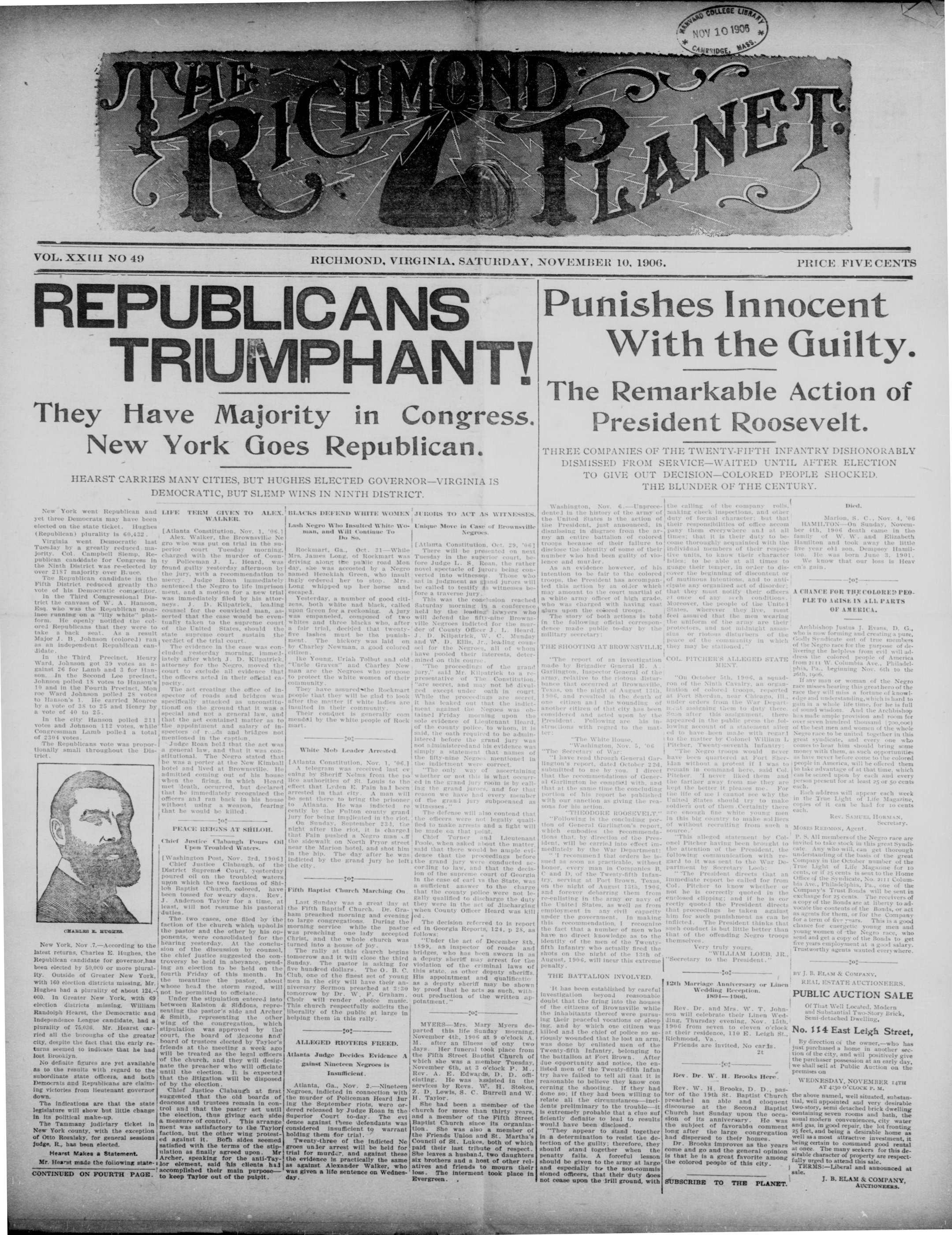
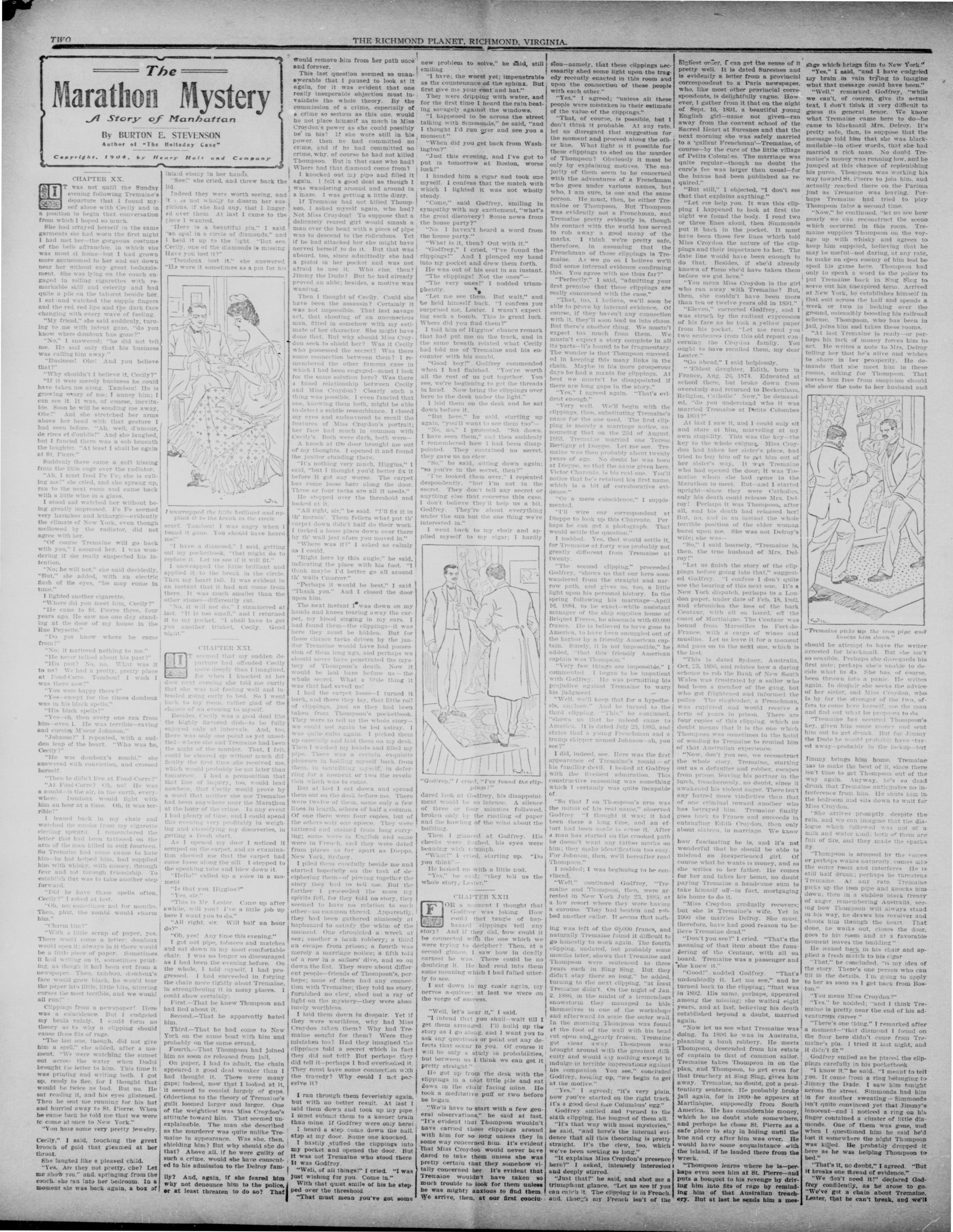
Page text (machine-generated)
THE RICHMOND PLANET
REPUBLICANS TRIUMPHANT!
They Have Majority in Congress. New York Goes Republican.
HEARST CARRIES MANY CITIES, BUT HUGHES ELECTED GOVERNOR-VIRGINIA IS DEMOCRATIC, BUT SLEMP WINS IN NINTH DISTRICT.
VOL. XXIII NO 49
REP
TI
They Ha
New
HEARST CARRIE
New York went Republican and yet three Democrats may have been elected on the state ticket. Hughes (Republican) plurality is 60,432. Virginia went Democratic last Tuesday by a greatly reduced majority. Col. Campbell Slepem, Republican candidate for Congress in the Ninth District was re-elected by over 2187 majority over Bruce. The Republican candidate in the Fifth District reduced greatly the vote of his Democratic competitor. In the Third Congressional District the canvass of W. A. Hanson, Esq. who was the Republican non-niece running on a "illly white" platform. He openly notified the colored Republicans that they were to take a back seat. As a result Major J. B. Johnson (colored) ran as an independent Republican candidate. In the Third Precinct, Henry Ward, Johnson got 39 votes as against 26 for Lamb and 3 for Hanson. In the Speech Lee precinct, Johnson polled 18 votes to Hanson's 10 and in the Fourth Precinct, Monroe Ward Johnson polled 28 votes to Hanson's 1. He carried Monroe by a vote of 38 to 25 and Henry by a vote of 40 to 25. In the city Hanson polled 211 votes and Johnson 112 votes, while Congressman Lamb polled a total of 2304 votes. The Republicans vote was proportionally small throughout the District.
CHARLES E. HUGHES.
New York, Nov. 7.—According to the latest returns, Charles E. Hughes, the Republican candidate for governor, has been elected by 50,000 or more plurality. Outside of Greater New York, with 160 election districts missing, Mr. Hughes had a plurality of about 124,000. In Greater New York, with 69 election districts missing, William Randolph Hearst, the Democratic and Independence League candidate, had a plurality of 75,036. Mr. Hearst carried all the boroughs of the greater city, despite the fact that the early returns seemed to indicate that he had lost Brooklyn.
No definite figures are yet available as to the results with regard to the subordinate state officers, and both Democrats and Republicans are claiming victories from leutenant governor down.
The indications are that the state legislature will show but little change in its political make-up.
The Tammany judiciary ticket in New York county, with the exception of Otto Rosalsky, for general sessions judge, R. has been elected.
Hearst Makes a Statement.
Mr. Hearst made the following state-
CONTINUED ON FOURTH PAGE.
---
LIFE TERM GIVEN TO ALEX. WALKER.
[Atlanta Constitution, Nov. 1, '06.] Alex. Walker, the Brownsville Negro who was put on trial in the superior court Tuesday morning, charged with the murder of County Policeman J. L. Heard, was found guilty yesterday afternoon by the jury, with a recommendation to mercy. Judge Roan immediately sentenced the Negro to life imprisonment, and a motion for a new trial was immediately filed by his attorneys. J. D. Kilpatrick, leading counsel for the convicted man, asserted that the case would be eventually taken to the supreme court of the United States, should the state supreme court sustain the verdict of the trial court.
The evidence in the case was concluded yesterday morning, immediately after which J. D. Kilpatrick, attorney for the Negro, moved the court to exclude all evidence that the officers acted in their official capacity.
The act creating the office of inspector of roads and bridges was specifically attacked as unconstitutional on the ground that it was a special and not a general law, and that the act contained matter as to the appointment and salary of inspectors of roads and bridges not mentioned in the caption.
Judge Roan held that the act was a general law, and that it was constitutional. The Negro stated that he was a porter at the New Kimball hotel and lived at Brownsville. He admitted coming out of his house when the firing, in which Heard met death, occurred, but declared that he immediately recognized the officers and ran back in his house without using a weapon, fearing that he would be killed.
PEACE REIGNS AT SHILOH
Chief Justice Clabaugh Pours Oil Upon Troubled Waters.
[Washington Post, Nov. 3rd, 1906]
Chief Justice Clabaugh, of the District Supreme Court, yesterday poured oil on the troubled waters upon which the two factions of Shiloh Baptist Church, colored, have been tossed for weary days. Rev. J. Anderson Taylor for a time, at least, will not resume his pastoral duties.
The two cases, one filed by the faction of the church which upholls the pastor and the other by his opponents, were consolidated for the hearing yesterday. At the conclusion of the discussion by counsel, the chief justice suggested the controversy be held in abeyance, pending an election to be held on the fourth Friday of this month. In the meantime the pastor, about whose head the rage, will not be permitted to officiate.
Under the stipulation entered into between Ralston & Siddons, representing the pastor's side and Archer & Smith, representing the wing of the congregation which stipulation was approved by the court, the board of deacons and board of trustees elected by Taylor's friends at the meeting a week ago will be treated as the legal officers of the church, and they will designate the preacher who will officiate until the election. It is expected that the litigation will be disposed of by the election.
Chief Justice Clabaugh at first suggested that the old boards of deacons and trustees remain in control and that the pastor act until the election, thus giving each side a measure of control. This arrangement was satisfactory to the Taylor faction, but the other wing protested against it. Both sides seemed to agree that the terms of the stipulation as finally agreed by the Archer, speaking for the anti-Taylor element, said his clients had accomplished their main purpose—to keep Taylor out of the pulit.
RICHMOND, VIRGINIA, SATURDAY, NOVEMBER 10, 1906.
Lash Negro Who Insulted White Woman, and Will Continue To Do So.
Rockmart, Ga., Oct. 31—While Mrs. James Long, of Rockmart was driving along the public road Monday, she was accosted by a Negro named Hezeekiah Green, who insultingly ordered her to stop. Mrs. Long whipped up her horse and escaped.
Yesterday, a number of good citizens, both white nad black, called upon Green for a reckoning. A jury was empaneled, composed of two whites and three blacks who, after a fair trial, decided that twenty-five lashes must be the punishment. The hickory was laid on by Charley Newman, a good colored citizen.
Ike Young, Uriah Tolbut and old "Uncle Graves" and Charley Newman are the Negroes who propose to protect the white women of their community.
They have assured the Rockmart people that they will be glad to look after the matter if white ladies are insulted in their community.
Their conduct is generally commended by the white people of Rock mart.
White Mob Leader Arrested
[Atlanta Constitution, Nov. 1, '06.] A telegram was received last evening by Sherif Nelms from the police authorities of St. Louis to the effect that Lyden E. Fain ha1 been arrested in that city. A man will be sent there to bring the prisoner to Atlanta. He was indicted recently by the Fulton county grand jury for being implicated in the riot. On Sunday, September 231, the night after the riot, it is charged that Fain pushed a Negro man off the sidewalk on North Pryor street near the Marion hotel, and shot him in the hip. The day after he was indicted by the grand jury he left the city.
Fifth Baptist Church Marching On
Last Sunday is a great day at the Fifth Baptist Church. Dr. Graham preached morning and evening to large congregations. During the morning service while the pastor was preaching one lady accepted Christ, and the whole church was turned into a house of joy.
The rally at this church begins tomorrow and it will close the third Sunday. The pastor is asking for five hundred dollars. The O. B. C. Club, one of the finest set of young men in the city will have their anniversary Sermon preached at 3:30 tomorrow by Dr. W. F. Graham. Choir will render choice music. This church respectfully solicits the liberality of the public at large in helping them in this rally.
Atlanta Judge Decides Evidence Against Nineteen Negroes is Insufficient.
Atlanta, Ga., Nov. 2.—Nineteen Negroes, indicted in connection with the murder of Policeman Heard Juring the September riots, were ordered released by Judge Roan in the Superior Court to-day. The evidence against these defendants was considered insufficient to warrant holding them for trial.
Twenty-three of the indicted Negroes' arrest will be held for trial for murder, and against these the evidence is practically the same as against Alexander Walker, who was given a life sentence on Wednesday.
JURORS TO ACT AS WITNESSES.
Unique Move in Case of Brownsville Negroes.
[Atlanta Constitution, Oct. 29, 1861]
There will be presented on next Tuesday in the superior court, before Judge L. S. Roan, the rather novel spectacle of jurors being converted into witnesses. Those who sat in judgment as grand jurors will be called to testify as witnesses before a traverse jury.
This was the conclusion reached Saturday morning in a conference held by the leading lawyers who will defend the fifty-nine Brownsville Negroes indicted for the murder of County Officer J. L. Heard, J. D. Kilpatrick, W. C. Munday and W. D. Ellis, Jr., leading counsel for the Negroes, all of whom have pooled their interests, determined on this course.
"The proceedings of the grand jury," said Mr. Kilpatrick to a representative of The Constitution, "are secret, and may not be divulged except under oath in court. While the proceedings are secret, it has leaked out that the indictment against the Negroes was obtained Friday morning upon the sole evidence of Lieutenant Heard, of the county police, to whom, it is said, the oath required to be administered before the grand jury was not administered and his evidence was simply a statement that names of the fifty-nine Negroes mentioned in the indictment were correct.
"The only way of ascertaining whether or not this is what occurred in the grand jury room is by calling the grand jurors, and for that reason we have had every member of the grand jury subpoenaed as witnesses."
The defense will also contend that the officers were not legally qualified to make arrests and a fight will be made on that point.
Chief Turner and Lieutenant Poole, when asked about the matter, said that there would be ample evidence that the proceedings before the grand jury were conducted according to law, and that the decision of the supreme court of Georgia in the case of earl or the State, was a sufficient answer to the charge that the county police were not legally qualified to discharge the duty they were in the act of discharging when County Officer Heard was killed.
The decision referred to is reported in Georgia Reports, 124, p 28, as follows:
"Under the act of December 8th, 1899, an inspector of roads and bridges, who has been sworn in as a deputy sheriff may arrest for the violation of the criminal laws of this state, as other deputy sheriffs. His appointment and qualification as a deputy sheriff may be shown by proof that he acts as such, without production of the written appointment."
MYERS—Mrs. Mary Myers departed this life Sunday morning, November 4th, 1906 at 9 o'clock A.M. after an illness of only two days. Her funeral took place from the Fifth Street Baptist Church of which she was a member Tuesday, November 6th, at 3 o'clock P. M., Rev. A. E. Edwards, D. D. officiating. He was assisted in the services by Revs. W. H. Stokes, Z. D. Lewis, S. C. Burrell and W. H. Taylor.
She had been a member of the church for more than thirty years, and a member of the Fifth Street Baptist Church since its organization. She was also a member of the Friends Union and St. Martha's Council of St. Lukes, both of which paid their last tribute of respect. She leaves a husband, two daughters six brothers and a host of other relatives and friends to mourn their loss. The interment took place in Evergreen.
Punishes Innocent With the Guilty. The Remarkable Action of President Roosevelt.
THREE COMPANIES OF THE TWENTY-FIFTH INFANTRY DISHONORABLY DISMISSED FROM SERVICE—WAITED UNTIL AFTER ELECTION TO GIVE OUT DECISION—COLORED PEOPLE SHOCKED. THE BLUNDER OF THE CENTURY.
Washington, Nov. 6.—Unprecedented in the history of the army of the United States is the action of the President, just announced, in dismissing in disgrace from the army an entire battalion of colored troops because of their failure to disclose the identity of some of their number who had been guilty of violence and murder.
As an evidence however, of his intention to be fair to the colored troops, the President has accompanied this action by an older which may amount to the court martial of a white army officer of high grade, who was charged with having cast slurs upon the colored troops.
The story of both actions is told in the following official correspondence made public to-day by the military secretary:
the calling of the company rolls, making check inspections, and other duty of formal character; but that their responsibilities of office accompany them everywhere and at all times; that it is their duty to become thoroughly acquainted with the individual members of their respective units, to know their character lics; to be able at all times toguage their temper, in order to discover the beginning of discontent or of mutinous intentions, and to anticipate any organized act of disorder; that they must notify their officers at once of any such conditions. Moreover, the people of the United States, wherever they live, must feel assured that the men wearing the uniform of the army are their protectors, and not midnight assassins or riotous disturbers of the
Died.
Marlon, S. C., Nov. 4, '06
HAMILTON—On Sunday, November 4th, 1906 death came in the family of W. W. and Elizabeth Hamilton and took away the little five year old son, Dempsey Hamilton. He was born June 3, 1901. We know that our loss is Heaven's gain.
A CHANCE FOR THE COLORED PEOPLE TO ARISE IN ALL PARTS OF AMERICA.
Archbishop Justus J. Evans, D. G., who is now forming and creating a pure,
THE SHOOTING AT BROWNSVILLE
"The report of an investigation made by Brigadier General E. A. Garlington, Inspector General of the army, relative to the riotous disturbance that occurred at Brownsville, Texas, on the night of August 13th, 1906, and resulted in the death of one citizen and the wounding of another citizen of that city has been considered and acted upon by the President. Following are his instructions with regard to the mat-
"The White House.
"Washington, Nov. 5, '06
"The Secretary of War:
"I have read through General Garlington's report, datal October 23d, submitted to me by you. I direct that the recommendations of General Garlinston be computed with, and that at the same time the conclusion portion of his report be published with our sanction as giving the reasons for his action.
"THEODORE ROOSEVELT."
"Following is the concluding portion of General Garlinston's report, which embodies the recommendations that, by direction of the President, will be carried into effect immediately by the War Department:
"I recommend that orders be issued as soon as practicable, without honor, every man in Companies B, C and D, of the Twenty-fifth Infantry, serving at Fort Brown, Texas, on the night of August 13th, 1906, and forever debarring them from re-enlisting in the army or navy of the United States, as well as from employment in any civil capacity under the government. In making this recommendation, I recognize the fact that a number of men who have no direct knowledge as to the identity of the men of the Twenty-fifth Infantry who actually fired the shots on the night of the 13th of August, 1906, will incur this extreme penalty.
THE BATTALION INVOLVED
It has been established by careful investigation beyond reasonable doubt that the firing into the houses of the citizens of Brownsville while the inhabitants thereof were pursuing their peaceful vocations or sleeping, and by which one citizen was killed and the chief of police so seriously wounded that he lost an arm, was done by enlisted men of the Twenty-fifth Infantry, belonging to the battalion at Fort Brown. After due opportunity and notice, the enlisted men of the Twenty-fifth Infantry have failed to tell all that it is reasonable to believe they know concerning the shooting. If they had done so; if they had been willing to relate all the circumstances—incidents preliminary to the trouble—it is extremely probable that a clue sufficiently definite to lead to results would have been disclosed.
"They appear to stand together in a determination to resist the detection of the guilty; therefore, they should stand together when the penalty falls. A forceful lesson should be given to the army at large and especially to the non-commis sloned officers, that their duty does not cease upon the drill ground, with
the calling of the company rolls, making cheek inspections, and other duty of formal character; but that their responsibilities of office accompany them everywhere and at all times; that it is their duty to become thoroughly acquainted with the individual members of their respective units, to know their character lattice; to be able at all times to guage their temper, in order to discover the beginning of discontent or of mutinous intentions, and to anticipate any organized act of disorder; that they must notify their officers at once of any such conditions. Moreover, the people of the United States, wherever they live, must feel assured that the men wearing the uniform of the army are their protectors, and not midnight assassins or riotous disturbers of the peace of the community in which they may be stationed."
COL. PITCHER'S ALLEGED STATE MENT.
"On October 5th, 1996, a squadron of the Ninth Cavalry, an organization of colored troops, reported at Fort Sheridan, near Chicago, III., under orders from the War Department assigning them to duty there. Seen after this assignment, there appeared in the public press the following account of a statement alleged to have been made with regard to the matter by Colonel William L Pitcher, Twenty-seventh Infantry: "The Negro troops would never have been quartered at Fort Sheridan without a protest if I was to remain in command here, said Col. Pitcher. 'I never liked them and the farther away from me they are kept the better it pleases me. For the life of me I cannot see why the United States should try to make soldiers' out of them. Certainly there are enough fine white young men in this big country to make soldiers of without recruiting from such a source." "This alleged statement by Colonel Pitcher having been brought to the attention of the President, the following communication with regard to it was sent to the War Department by Secretary Loeb:
"The President directs that an immediate report be called for from Col. Pitcher to know whether or not he is correctly quoted in the enclosed clipping; and if he is correctly quoted the President directs that proceedings be taken against him for such punishment as can be inflicted. The President thinks that such conduct is but little better than that of the offending Negro troops themselves.
12th Marriage Anniversary or Linen Wedding Reception. 806-606-6060
Rev. Dr. and Mrs. W. T. Johnson will celebrate their Linen Wedding. Thursday evening, Nov. 15th 1906 from seven to ecloon'clock at their residence, 110 E. Leigh St., Richmond, Va. Friends are invited, No cards. 2t
Rev. Dr. W. H. Brooks Here.
Rev. W. H. Brooks, D. D., pastor of the 19th St. Baptist Church preached an able and eloquent discourse at the Second Baptist Church last Sunday upon the occasion of its anniversary. He was the subject of favorable comment long after the large congregation had dispersed to their homes.
Dr. Brooks improves as the years come and go and the general opinion is that he is a great favorite among the colored people of this city.
SUBSCRIBE TO THE PLANET.
PRICE. FIVE CENTS
ocent
Guilty.
Action of
sevelt.
FANTRY DISHONORABLY
L AFTER ELECTION
PEOPLE SHOCKED.
TURY.
Died.
Died.
Marlon, S. C., Nov. 4, '06
HAMILTON—On Sunday, November
4th, 1906 death came in the
family of W. W. and Elizabeth
Hamilton and took away the little
five years old son, Dempsey Hamilton
He was born June 3, 1901.
We know that our loss is Heav
e's gain.
A CHANCE FOR THE COLORED PEOPLE TO ARISE IN ALL PARTS OF AMERICA.
Archbishop Justus J. Eyans, D. G., who is now forming and creating a pure, Godly Syndicate out of true members of the Negro race for the purpose of delivering the helpless from evil will address the colored people of America from 2111 W. Columbia Ave., Philadelphia, Pa., beginning Nov. 6th to the 26th, 1906. If any man or woman of the Negro race misses hearing this great hero of the race they will miss a fortune of knowledge and understanding, which is hard to gain in a whole life time, for he is full of sound wisdom. And the Archbishop has made ample provision and room for over seven hundred thousand (700,000) of the best men and women of the whole Negro race to be united together in this great syndicate, and every one who money with them, as such opportunities as have never before come to the colored people in America, will be offered to take advantage of at that time, which can be seized upon by each and every person present for at least 25 or 50 cents each. Each address will appear each week in the True Light of Life Magazine, copies of it can be had for 10 cents each.
Rev. SAMUEL HORMAN.
MOSES REDMON, Agent.
P. S. All members of the Negro race are invited to take stock in this great Syndicate. Any who will, can get thorough understanding of the basis of the great Company in the October number of the True Light of Life Magazine for 10 cents, or if 25 cents is sent to the Home Office of the Syndicate, No. 2111 Columbia Ave., Philadelphia, Pa., one of the Company's Trust Bonds will be sent in exchange for 25 cents. The receivers of a copy of the Bonds are at liberty to advocate the contents of the Bonds, or act as agents for them, or for the Company for a term of five years. This is a good chance for energetic young men and young women of the Negro race, who send and get a copy of the Bonds to get five years employment at a good salary, Trustworthy agents wanted everywhere.
BY J. B. ELAM & COMPANY.
PUBLIC AUCTION SALE
Of That Well Located, Modern and Substantial Two-Story Brick, Semi-detached Dwelling
No.114 East Leigh Street.
By direction of the owner,—who has just purchased a home in another section of the city, and will positively give the purchaser possession at an early day, we shall sell at Public Auction on the premises on
WEDNESDAY, NOVEMBER 14TH
AT 43'0 O'CLOCK P. M.
the above named, well situated, substantial, well appointed and very desirable two-story, semi detached brick dwelling containing seven rooms and bath, the usual modern conveniences, city water and gas, in good repair, the lot fronting 25 feet, and being a desirable home as well as a most attractive investment, it being certain to command good rental at once. The many seekers for this desirable character of property are respectfully urged to attend this sale.
TERMS:—Liberal and announced at sale.
J. B. ELAM & COMPANY,
AUCTIONEERS.
=== The ——
Marathon Mystery
A Story of Manhattan ;
By BURTON E. STEVENSON
Author of The Molladay Case”
Two
CTIAPTER XX.
ee neta ee ee ee ee
I bad met her—the gorgeous costume
of the belle affranchie, in which she
‘was most at home—but I had grown
more accustomed to her and sat down
near her without any great bedazzle
ment. She was lying on the couch en-
Saged in rolling cigarettes with re
markable skill and celerity and had
quite a pile on the taboret beside her.
I satrand watebed the supple fingers
and the red, red lips and the dark face
changing with every wave of feeling.
“My friend,” she said suddenly, turn-
ing to me with intent gaze, “do you
know where doudoux has gone?"
“No,” 1 answered: “he did not tell
me. He said ouly that his business
was calling him away.”
“Business! Ohe! And you believe
that?”
“Why shouldn't I betieve it, Cecily?"
“If it were merely business he conld
have taken me along. Tambou! He is
stowlng weary of me; I annoy him: I
can sce it, It was, of course, inevita-
bie. Soon he will be sending me away,
Obe:” And she stretched her arms
above ber bead with that gesture T
had seen before. “Ah, weil, d'amour,
de rires et d’oublis!” And she laughed,
Dut I fancied there was a sob beneath
the laughter, “At least I shall be again
at St. Pierre.”
Suddenly there came a soft hissing
from the litte cage over the radiator.
“Ab, I must feed Fe Fe; she Is eall-
fng me? sbe cried, and she sprang up,
Fan to the next room and came back
with a littl wine in 4 glass,
T stood and watched her without be-
ing greatly impressed. Fe Fe seemed
very harmless and lethargic—evidently
the climate of New York, even though
mellowed by the radiator, did not
agree with her.
“Of coure Tremaine will go back
with you," | assured her. 1 was won-
dering If she really suspected bis in-
tention,
“No; he will not.” she said decidedly.
“But,” she added, with an electric
flash of the eyes, “he may come in
ume.”
I lighted another cigarette,
“Where did you meet him, Cecily?"
“He came to St. Pierre three, four
Years ago, He saw mo one day stand-
Ing at the door of my house In the
Rue Peysette.”
“Do you know where he eame
from?"
“No; it mattered nothing to me.”
“He never talked about bis past?” |
“Ills past? No, no. What was tt
to ue? We had a pretty, pretty place
at Fond-Corre. Tambou! 1 wish T
was there now?”
“You were happy there ?*
“Yes—except for the times doudoux
was in his black spetis.”
“Eis black spells?”
“Yes—oh, then every one ran from
him—even |. He was terrible—raving
and cursiax M’seur Jobuson.”
“Johnson?” I repeated, with a sud-
den leap of the heart. “Who was he,
Cecily?"
“He was doudoux’s xombi," she
answered with conviction, and crossed
herselt.
“Then Ne didn't live at Fond-Corre?*
“At Food-Corre? Ob, not He was
& xombl—In the air, In the earth, every
where. Dondous would fight with
him an hoor ata time. Ob, it was ter-,
rible!"
T leaned back fo my chair and
watched the smoke from my cigarette
cireling upward. 1 remembered the
letter that had been tattooed on the
ari of the man killed in suit fourteen
80 Tremaine tind some eanse to hate
bim—he had helped him, bad supplied
him with whisky, with mouey, throug
fear and not through friendship. To
establish that was fo take another step
forward
“Bid he have those spells often,
Cecily?" 1 asked at hist.
“Oh, no; seuetiaies not for months.
‘Theo, phut, the zombi would ehorm
him."
“Charm him?”
“With a little serap of paper, yes.
There wonll come a letter; dondonx
would open it: always In It there wonld
be a little piece of paper. Sometimes
Mt had writing on It, sometimes print-
ing, as thoogl it had been cut from a
newspaper. Then, tambou, doudoux’s
face would grow black, he wou'd tear
the paper into Hittle, tittle bits, uttering
curses the most terrible, and we woukd
all run!”
Clippings from a uewspaper! Here
was a colacilence. But I endgeled |
my brala vainly. I could form no
theory as to why a clipping should,
canse thowe fits of rage.
“The last one, though, did not give
im a spel.” she added, atter a to:
ment. “We were watching the sunset
out cross the water when Dodol
brought tue letter to him. This time ft
was printing and writing both, 1 got
‘up, ready to flee, for 1 ee
would be twice as bad. But no. He
gat reading it, and bis eyes glistened.
Then he sent me running for bis hat
and hurried away to St, Pierre. When
he came back be told me that we were
te come at once to New York.”
“You have some very pretty Jewelry,
Cecily,” I said, touching the great
brooch of gold that gleamed at ber
‘plaid ebony tp ber hands,
“See! she cried, and threw back the
Ma.
Indeed they were worth seeing, and
it 4s not wholly to disarm her sus.
ficlons. if she had any, that I Linger.
4d over them At last I came to the
tlece 1 wanted.
“Here ts a beautiful pia" 1 sald.
“an opal in a circle of diamonds.” and
4 beld it up to the light. “But see.
Cecily, one of the diamonds Is missing
Have you lost it?
“Doudoux lost it." she answered
“He wore it sometimes as a pin for his
Tel a
ile]
Y WY) ie |
Ne 5 aXe
PeeN iN)
AW EY
i | fi lg <2
Be Sage |
i
ek
THOS
| ee
fe nee
ee ae an ee ee ne BP
plied tt t» the break tn the etrete.
searf. Tambou! I was angry when 1
found it gone. You should have heard
met”
“I bave a diamond," I sald, getting
out my pocketbook, “that might do to
Feplace it. Let us see if It will ft.”
I unwrapped the litte brilliant and
applied it to the break in the circle,
Then my heart fell. It was evident In
an instant that it had not come from
there. 1 was much smaller than the
other stones—differently cut,
“No, it will not do,” I stammered at
last. “It is too swall,” and T returned
it to my pocket, “I shall have to get
You auother trinket, Cecily. Good
uigut.”
CHAPTER xx
T 1 that my sudden de
I © had offended Cecily
- thar Tisangnten
is f en T Knocked at her
@ t evening she tok me curtly
t fecling well and in
35 3 to Ded. 80,1 wen
t " er glad of the
Besides, ¢ 3 J deal Uke
the : to be fully
¢ 1 t lntervala And, t
t ony point as yet unset
tle reinuine lad bee
the nigh rier. That, I felt
fenlty : e received me,
whicl y later than
to Thad @ premonition that
that line of inquiry, too, would lead
nowhere, that Cecliy would prove by
& wonl that usither she nor Tremaine
had been any the Marathon
at the hoor of the crime. Sa any event
Thad plenty of time, and T could spend
this « Atably in weigh
ing and « ty discoveries, iu
getting a { tart
As 1 opencd my door { noticed It
scraped on the carpet, and an examina.
tion sh cl me that the carpet had
come foose along the sill. T stepped to
the speaking tube and blew down it
Hellot” called up a voice in a mo.
ment
“Is that you, Hixgina#*
eee
“This is Mr Lester. Come up after
awhile, will you? I've a little Job up
here T want you to do.”
“AM right, sir. WHI half an hour
ee
“Ob, yes! Any time this evening.”
1 got out pipe, tobacco and matches
and sat down in my most comfortable
chair. I was no longer so discouraged
a8 I had been the evening before. On
the whole, I told myself, 1 had pro-
gressed. T had sneceeded In forging
the chain more tigutly about Tremaine,
In strengthening it iu many places. 1
could show certainiy:
First.—That he knew Thompson and
had lied about it,
Second.—That be apparently hated
him,
Third—That he had come to New
York on the same boat with him and
Probably on the same errand.
Fourth.—That Thompsou had Joined
him as soon #8 released from fail,
On paper, I had to admit, the chain
appeared a good deal weaker than I
had thought it. There were many
gaps; indeed, now that I looked at It,
It seemed to consist largely of gaps.
Objections to the theory of Tremaiue’s
guilt loomed larger and larger, One
of the weightiest was Miss Croydon’s
attitude toward him. That seemed un-
explainable. ‘The man she described
as the murderer was quite unlike Tre-
twaine in appearance. Was she, then,
shielding him? But why should ake do
that? Above all. if he were guilty of
such a crime, would she have conscnt-
€d to his admission to the Delroy fam-
My? And, again, 1 she feared him
"why not denounce bim fo the a
(OF at least threaten to do 60?
‘THE RICHMOND PLANET, RICHMOND, VIRGINIA.
- Rould remove him from fer path oncé
‘This last question seemed so unan-
‘Swerable that I paused to look at It
again, for it was evident that one
really insuperable must in-
validate the whole the
commission of a crime, of
* crime so serious as this one, would
‘he not place himself as much in Miss
Crosdon's power as she could possibly
be’ in bis? It she were still in bie
power. then he had committed no
crime, and if he bad committed no
crime, why, of course he had not killed
‘Thompson. But in that case who had?
Where had that diamond come from?
| “Uknocked out my pipe and Aled it
“again. I felt a good deal as though I
| Was wandering around and around in
a hhaze. 1 was getting a little dizzy.
Af Tremaine had uot killed Thomp:|
son, | asked myself again, who bad?
Not Miss Croydout To suppose that a
deticatety reared girl would smash a
man over the head with a piece of plpe
was to descend to the ridiculous. Yet
If be had attacked her she might have
herved herself to do it. But that was
absurd. too, siuce admittedly she bad
@ pistol in her pocket and was not
afraid to use it. Who else, then?
Jimmy the Dude? But he had already
Proved an alibi; besides, a motive was
wanting
Then 1 thought of Cecily. Could she
have been the assassin? Certainly it
was not Linpossible. ‘That last savage
act. that shooting of an unconscious
tan, fitted in somehow with my esti-
mate of ber character. She might have,
done that. But why should Miss Croy-
don seek to shield her? Waa it Ceclly
who possessed the secret? Was there
some connection between them? 1 re-|
membered the other femous cae in
which I had been engaged—must I look
for the same solution here? Was there
4 blood relationship between Cecily
thing was possible, t even fancied that |
one, knowing them both, might be able|
to detect a subtle resemblance. I ioeea
iy eyes and endeavored to recall the
features of Miss Croydon's portrait;|
her face had much in common with
Cecity's Both were dark, both were—
A knock at tite door brought me out
of my thoughts. T opened it and found
the janitor standing there,
“iis nothing very much, Higging,” 1
‘seid, “but I thought you'd better fix tt
before It got any worse, The carpet
has come loose here along the door.
Three or four tacks are ail It weeds.”
He stepped over the threshold and
looked xt it
“AI right, sir,” be sald. “Il fx it in
th’ mornin’. Them fellers what put tht
carpet down didn’t half do their work.
I tacked a loose piace down over there
by th’ wall Jest afore you moved in”
“Where was it?? I asked as calmly
as Tconid,
“Right here by this angle,” be said,
indicating the place with his foot. “T
think maybe I'd better go all around
th’ walls ('morrer.”
“Perhaps it would be best,” I sald
“Thank you.” And T closed’ the door
upon him.
The next instant was down on my
hands and knees tearing away the car-
pet, my blood singing In my cars. 1
had found them—the clippings—it was
here they must be hidden. But for
those chance tacks driven by the Jan
‘itor Tremaine would have had posses
ston of them long ago, and perhaps we
should never haye penetrated the mys
would be laid bare before us— the
Jwhole secret. What a little thing It
was that had saved ust
Toe naar tun catpel Seaced Ganson HE
back, and there they lay, that lttle roll
ot clippings, just wn they. had heen
taken from Thompson's pocketbook.
They were to tell us the whole story—
Wwe could not axain be led astray. 1
was quite calm again. T pleked them
up earefalty and laid them oa my desk,
‘Then I washed my bauds and filled my
pipe, There was a certain exquisite
pleasure ia Voldiug myself back from
them, in tantalliaz wyself, In defer
ring for a momeat or two the revela
tion which was to come.
|" But at lat 1 eat dows and epreed
‘them out on the desis hefore me, ‘There
were twelve of thiem, some ouly a few
Hanes in loath, others of half a column,
Of one there were four copies, but of
the others only one apiece. ‘They were
tattered and stained from long earry-
ing: some were in English and some
were In French, anid they were dated
from places as far apart as Dieppe,
New York, Syduey.
T piled them cavefatly beside me and
started hopefully on the tusk of de:
ciphering them—of piecing together the:
story they bad 10 tell me, But the
farther I proceeded the more my
spirits fell, for they told no story, they
seemed to have no relation to each
other—no common thread. Apparently,
they had been gathered alinleasly at
haphazard to satisfy the whim of the
sioment One chronicled a wreek xt
sea; another a bank robbery; a thind
an escape from prison; a fourth was
merely @ marriage notice; @ fifth told
of a row in # sailors’ dive, aud x0 on
eet eee eee ee
P eo EE ees eS
new problem “be Shia,
pemiing. <a gy
“I have; the wo + Impenetrable
as the sphinx. But
first give me your eoat’and bat”
They were drip with water, and
for the Grst time I heard the rain beat-
tng savagely the windows.
“I happened to be across the street
talking with Simmouds,"” be said, “and
1 thooght I'd run gyer and see you a
moment”
“When did you get back from Wash-
Angtou?”
“Just this evening, and I've got to
put in tomorrow at Boston, worse
luck!"
1 handed him a cigar and took one
myself. I confess that the mateh with
which I lighted it was not wholly
steady.
“Come,” said Godfrey, smiling In
sympathy with my excitement, “what's
the great discovery? Some news from
the house party?”
“No. 1 haven't heard a word from
the house party."
“What Is it, then? Out with it”
“Godfrey.” I cried, “I've found the
clippings!” And 1 plunged my band
into my pocket and drew them forth.
He was out of his seat in an instant.
“The clippings! Not the ones"—
“The very ones!” I nodded trium-
phantly. %»
“Let me see them. But wait,” and
te held himself back. “I confess you
surprised me, Lester. 1 wasn't expect
ing such a bomb. This Is great luck.
Where did you find them?”
T told him of Higgins’ chance remark
that had put me on the track, and in
the same breath related what Cecily
had told me of ‘Tremaine and his en-
counter with his zombi,
“Good boy!" Godfrey commended
when I had finished. “You're worth
all the rest of us put togethor. You
see, we're beginning to get the threads
in hand. Now bring the clippings over
here to the desk under the light.”
I Ini them on the desk and he sat
down before it
“But here," he sald. starting up
again, “you'll want to see them too”
“No, no.” [ protested. “Sit down.
T have *een them,” and then suddenly
T remembered how 1 had been disap.
pointed. They contained no secret
they gave us no clew
“So.” he said, sitting down again:
“so you're In the secret, then ?*
Tre looked them over,” I repeated
despondentiy, “but I'm not in. the
secret. They don't tell any secret or
anything else that concerns this case.
1 don't believe they'll help us a bit
Godfrey. They're about everything
under the sun but the one thing we're
interested in.”
I went back to my chair and ap-
plied myself to my cigar; I hardly
y VF TI
mye \?
SY LA Wed ~
a | \lasy, WN
iM | | \
ll [ss \
Ne
he eal Hes
os S ae
dared look at Godfrey, bis disappoint.
ment would be 39 Intense, A silence
of three or four minutes followed,
Droken only by the rustling of paper
and the howling of the wind about the
building.
‘Then 1 glanced at Godfrey. His
cheeks were toshed, his eyes were
beaming with ttumph.
“What!” 1 cried, starting up. “Do
you think” —
He looked up with a little nod.
“Yes.” he said: “they tell us the
whole story. Lester”
CHAPTER XX
OR « moment T thought that
cont that tangle of bap
er) | Clippings “tell any
story? And if they did, how could it
be connect with the one which we
were trying to decipher? ‘Then, at a
second 4 1 saw how In deadly
earnest he ‘There could be no
doubting it. Me had read into them
sotue tucaning which I bad falled utter
Iy to see
Txat down in my enair agein, my
nerves a-quiver: at last we were on
the verge of success.
“Well, let's uear it,” I sald.
“E intend that you shall—watt ti T
get them arranged, I'l build up the
Mory as 1 go aloug, and 1 want you to
Ask any questions OF poiut out any de-
fects that occur t9 you. Of course It
Will be only w study in probabilities,
but between us [think we can got It
pretty stralsut”
He got vp from the desk with the
tlippings in a nat Uttle pile and sat
gown in the chair facing mine. He
took a meditative puff or two before
be began
“We'll have to start with a few gen.
eral observation” be said at last.
“It's evident tbat Thompson wouldn't
Dave carried these clippings around
with bim for so jong unless they in
some way concerned bim. it's evident
That Miss Croydon would never beve
dared to take them unless she was
pretiy certain that they somehow vi-
tally concerned ber It’s evideut that
‘Trewaise wouldn't have taken so
Much trouble to for a ene
be was mighty 18 to find them.
We arrive, pur first conciu-
chee tae uaakiaaeneh ak Waaner eeco!
th eat gab eee
SRR 2 Se Oa
_1 agreed; “unless all these
Se ‘ ans
course, 18 possible, /
arn probable At any rate,
Jet us disregard that suggestion for
the moment and proceed along the oth-
er line. What light ts It possible for
these clippings to shed on the murder
of Thompson? Obviously it must be
only by explaining motives. ‘The ma-
jority of them seem to be concerned
with the adventures of a Frenchman
who goes under various names, but
who, Iam sure, is one and the same
person. He must, thea, be either ‘Tre
maine or Thompson, But Thompson
was evidently not a Frenchman, and
Tremaine pretty evidently ts, though
his contact with the world has served
to rub away a good many of the
marks. I think we're pretty safe,
therefore, in assuming that the
Frenchman of these clippings is Tre-
maine. Ax we go on I believe we'll
find some internal evidence confirming
this. You agree with me thus far?"
“Perfectly,” 1 sald, “admitting your
first premise that these clippings are
really concerned with the case.” .
“That, to, 1 believe, we'll soon be:
able to prove by luternal evidence. Of
course, If they haven't any connection
With it, they'll soon lead us Into chaos.
But there's another thing. We mustn't
expect too much from them, We
mustn't expect story complete In all
its parts—It's bound to be fragmentary.
The wonder is that Thompson succeed.
ed in keeping thts many Tinks In the
chain, Maybe in bis more prosperous
days he had a mania for clippings. At
best we mustn't be disappointed if
there are long gaps in the story.”
“Yes,” I agreed again. “That's evi.
dent enongh.”
“Very well. We'll begin with the
clippings, then, substituting Tremaine's
name for the one used. ‘The first ellp
ping Is merely a marriage notice, an
‘houncing that on the 234 of August
1882, ‘Tremalie married one ‘Terese
Bertigny at Dieppe. Let me see. ‘Tre.
maine was then probably abont twenty
Fears of ago. No doubt hte was born
at Dieppe, 80 that the naine given here
Victor Charonte. ix hls real one. Youll
notice that he's retained his first name,
which Isa bit of corroborative evi
“Or a mere coincidence,” 1 supple
mented
“Kil wire our correspondent at
Dieppe to look up this Charente, Per
haps he can got a photograph. ‘That
Would seitle the question.”
T nodded. Yes, that would settle It,
for Tremaine at forty was probably not
greatly different from ‘Tremaine at
twenty.
“The second clipping.” proceeded
Godfrey, “shows us that our hero soon
wandered from the straight and nar
row path, and gives us, too, a Iittle
light upon bis personal history. In the
spring following bis marriage—April
Bianager of the ship mppilles bouse of
Briquet Freres, be abssconids with 60,000
francs. Ie is believed to have gone to
America, to have been snuggled out of
the harbor by a friemtly American cap-
tain. Surely, it is not impossible,” he
added, “that this friendly American
captain was Thompssn.”
| “Very few things are Impossible,” 1
commented. began to be impatient
with Godfrey, Ho was permitting bis
[prejudice against Tremaine to warp
bis Judgment -
} “Well, we'll keep that for a hypothe.
sls, anyhow." And he turned to. the
thind clipplag, “This.” he continued,
j“shiows us that be indeed came to
America. {tis dated July 23, 1885, and
states that'a young Frenchman and a
tramp skipper uamed Johnson—ab, you
see?"
| T did, indeed, see. Here was the first
appearance of Tremaine’s zombl—of
his familiar devil. I looked at Godfrey
With the Hveliest admiration. ‘This
constructive reasoning was something
Which T certainly was quite incapable
of
“So that J on Thompson's arm was
[the initia! of his reat name," observed
Godfmy “I thought it was; it had
been there a tong time, and an ef
fort had been made to erase It After
4 man has started on the croaked path
he doesn't want any tattoo marks on
him; they make identifeation too easy
For Johnson, then, we'll hereafter read
Thompson.”
1 nodded; 1 was beginning to be con-
vinced.
“Well.” continned Goilfrey, “Tre.
maine and ‘Thompson, then, were ar
Tested In New York July 2% 1885, at
8 Low resort where they were having
A carouse. They had beaten and rob.
bed another sailor. It seems that noth-
ing was left of the 6,000 franes, and
naturally Tremaine found it dificult to
go honestly to work again. The fourth
clipping, undated, but probably some.
months later, shows that Tremaine and
Thompson were seatenced to three
years each in Sing Sing But they
@idn’t stay there so long.” he added,
turning to the next clipping, “at feast
‘Tremaine dida't. On the night of Jan.
2, 1886, mm the midst of a Wwemendous!
‘rho ue tow ebee pein
spondents, is
of - 16, 1801, a young,
gitl—name not given—ran
away from the convent school of the
Sacred Heart at Suresnes and that the
— she was safely sarsied
a ‘Frenchman’—Tremaine,
‘course—by the cure of the little village
of Petits Colomies, The marriage was
quite regular—though no doubt the
cure's fee was larger than usual—for
the banus had been published as re-
quired”
“But still,” { objected, “1 don't see
‘that that explains anything.”
“Let me help you. It was this elip-
ping { happened to look at first the
ulght we found the body. I read two
or three Mines aloud, then Simmonds
put it back in the pocket. It must
have been those few lines which told
Miss Croydon the nature of the clip-
pings and their importance to her. The
date line would have been enough to
do that, Resides, if she'd already
known of them she'd bave taken them
before we got here.”
“You mean Miss Croydon ts the girl
who ran away with Tremaine? But,
then, she couldn't have been more
than ten or twelve years old in 1891." |
“Eleven.” corrected Godfrey, and 1
was struck by the radiant expression
of his face ax he took a yellow paper
from his pocket. “Let me read you
two sentences trom this old report con-
cernins the Croydoa family. You
ought to have recalled them, my dear
Lester.”
“Go ahead,” T sald helplessly,
““Eldest daughter, Edith, born tn
France, Ang. 20 1874. Edueated at
school there, but broke down from |
overstudy and returned to Beckenham,
Religion, Catholic’ Now," be demand.
ed, “do you understagd who it was
married Tremaine at Petits Colombes
in is917"
At last I saw It, and 1 could only sit
and stare at him, marveling at my
own stupidity. ‘This was the key—the
key to the whole enigma. Miss Croy-
don had taken ber sister's place, had
tried to buy him off to get him out of
her sister's way. It was Tremaine
who had opened the door; It was Tre-
maine whom she bad come to the
Marathon to meet. But—aad I started
upright—since they were Catholics,
only his death could release Mrs, Del-
roy! Perhaps tt was Thompson, after
all, and bis death bad released her!
But, no, and io an iustant the whole
terrible position of the elder woman
burst upon me. She was not Delroy’s
wife; she was
“So.” 1 said hoarsely, “Tremaine Is,
then, the true busbaud of Mra. Del
corr
“Let us finish the story of the clip.
pings before golug Into that.” suggest-
ed Godfrey. “1 confess 1 don't quite
see the bearing of this next one. Its a
New York dispatch, perhaps to a Lon-
don paper, under date of Feb, 18, 1500,
and chronicles the loss of the. bark
Centaur, with all on board, of the
coast of Martinique. ‘The Centaur was
bound from Marseilles to Fortde-
France, with a cargo of wines and
maslins. Let us leave it for a moment
And pass on to the next one, which I
the last
“This ts dated Sydney, Australia,
Oct, £3, 1896, and relates how a daring
scheme to rob the Bank of New South
Wales was frustrated by a sailor who
bad been a member of the gang, but
who got frightened and Informed the
Police ‘The ringleader, a Frenchman,
Was captered and would receive a
term of years In prison, ‘There are
four copies of this clipping, which no
doubt means that It is the oue which
Thompson was sometimes In the habit
of sending to Tremaine to remind him
of that Austratian experience.
“Now, don't you see, we reconstruct
the whole story. Tremaine, starting
out as a defaniter and robber, escapes
from prison, Raving bis partner in the
lurch, treacheronsly, no doubt, sinee it
awakeued his violent auger. There tsn't
any hatred more vindictive than that
of one criminal toward another who
has betrayed him. ‘Tremaine finally
goes bel to Prance and sneceeds: In
entangling Edith Croydon, then only
about sixteen, in marriage. We know
bow fasciuating he is, and it's not’
wonderful that he should be able to
mistead an inexperienced girl Of
course what he wants is money, and so
she writes to her father. He comes
for her and takes her home, no doubt
paying Tremaine a handsome sum to
take himself of—in fact, mortgaging
bis home to do it.
“Miss Croydon gradually recovers;
but she is Tremaine’s wife. Yet in
1900 she marries Delroy. She must,
therefore, have had good reason to be:
Heve Tremaine dead.”
“Don't you see?” L cried. “That's the
meaning of that item about the foua-
dering of the Centaur, with all on
board. Tremaine was a passenger and
“she knew it.”
| “Good!” nodded Godfrey. “That's
undoubtedly it. Let me see.” and he
turned back to the clipping; “that was
in 1802. Ils name, perhaps, appeared
eee, eee wee eet eee
Bm See eet nae
“Yes,” i said, “and endgcled
aay brain in rain tr¥ing to imagine
what that message conid have been.”
“Well.” remarked Godtrey, “while
we can't, of course, give its actual
text, I don't think it very diMeult to
guess its general tenor. We know
what ‘Tremaine came here to do—he
came to blackmail Mrs. Delroy. It's
pretty safe, thon, to suppose that the
message told bim that she was black-
mailable—in other words, that she had
married a rich man. No doubt Tre
maine’s Money was running low, and he
Jumped at this chance of replenishing
his purse. Thompsou was working hia
way toward St. Pierre to join him, and
actually reacbed there on the Parima
Just os ‘Tremaine was leaving. Per-
baps Tremaine bad tried to play
Thompson false a second time.
“Now,” he continued, “let us see bow
nearly we cau reconstruct the scene
which occurred im this room. Tre-
maine supplies Thompson on the voy-
age up with whisky and agrees to
keep him supplied, believing that he
may be useful—not daring, at any rate,
to make an open enemy of ita lest he
Spoil bis game here. Thompson bad
ouly to speak a word to the police to
put Tremaine back in Sing Sing to
serve out his Unexpired term. Arrived
at New York, be establishes hiinseif in
that suit across the hall and spends a
week of two in looking over the
ground, ostensibly boosting his rallroad
Scheme. Thompson, who bis been in
Jail, joins him and takes these rooms.
“At last Tremaine Is ready—or per-
haps his Inck of money forces him to
act. He writes a note to Mrs. Delroy
telling her that he's alive and wishes
to share in ber prosperity. He de-
mands that sbe meet him in these
rooms, asking for ‘Thompson. ‘That
leaves him free from suspicion should
ahs chow the dete to hee bonbend saa
y IV GS
eo
ae Oke
CH
WN
1 A 7h, Ys Foe
POW 7
: Aephin: es
ea
St Aaa celal
Se = pee
“Tremaine picks up the iron pipe and
p picks up the iron
should he attempt to have the writer
Arrested for blackmail. Tut ste isn't
a0 sensible. Perhaps she disregards hie
first note Perhaps she's unable to de-
jelde what to @>. She hits of course,
heen thrown into a panic. He weites
Again, Iu destiiir she socks the advice
Of her sister. and Miss Croydon, who
Is by far the stronger of the two, of
fore to come bore herself, see the man
and find out what be proposes to do.
“Tremaine has secured Thompson's
key, given him some mon ‘d sent
‘him out to get drnuk. Bot for Jimmy
the Dude he woul! prohabts have'«tay
fed away—protably in the tockup—bnt
Jimmy brings him home. Tremaine
aas to make tho best of It, since there
‘Isn't tine to get Thompson out of the
way again. Answay, he's so dead
drunk that Treaine anticipates no ins
terference from him. He sluts him tp
the bedroom aud sits down to wait for
| Miss Croydon,
| "She arrives promptly. despite the
rain, and we ean imagine that the dia-
logue which followed was not of a
milk and water kind; both of them are
fnll of Sire, aud they made the sparks
ny.
“Thompson is aroused by the voices
oF perhaps wakes naturally, comes into
the outer room und interferes He t
still bait drunk; perbaps be thmatens
Tremaine. At any rate, Tremame
Dicks up the {ron pipe and knocks bim
down, then In a sudden vlack frenzy
of anger, remembering Australia, see:
ing Low Thompson wilt always stand
in bis way, be draws bis revolver and
shoots biti through the ueart That
done, te walks out, closes the door,
goes to bis room and at a favorable
Moment leaves the building”
He ieaned back in bis chair and ap-
Plied @ fresh match to his cizur
| “That.” be concluded. “is my idea of
‘the story. There's one person who cam
0 in the details, I'm going to apply
to her as soon as I get back from Bos-
ton.”
| “You mean Miss Croydon?
“Yes.” be nodded; “and 1 think Tre-
maine is pretty near the end of his ad-
venturous career.”
| “There's one thing.” 1 remarked after
@ moment—"that diamond I found on
the floor here didn’t come from Tre-
maine’s pin. 1 tried it last night, and
it didn't fit”
Godfrey smiled as he placed the elipy
pings carefully in his pocketbook
“L know ft." he said. “I meant to tell
Fon. It came from a ring belonging to
Jimmy the Dude. [ saw bim tonight
across the street. Simmonds had bin
in for another sweating — Simmonds
isn't quite convinced yet that Jimmy's
{nnocent—and { noticed a ring on his
finger contained a cluster of little dia-
Monds, One of them was Sa ae
when I questioned bim he said be'd.
was | ‘] z %
bed.” 5 RTE i
eee "agreed. “But
reaks one thrend of evidence.” —~
Srey confidently, as be arose
ere ot a: chain at
FOUR
THE PLANET
ai, communications intended for publication
be sent so as to reach us on Wednesday,
TERMS IN ADVANCE
ADVERTISING RATES.
There are FOUR WAYS by which money can be sent by mail at our risk.—In a Post Office Money Order, by Bank Check or Drift, or an Excuse Card, by Mail. Money can be procured, in a Registered Letter.
MONEY ORDERS.—You can buy a Money Order at your Post-Office, payable at the Richmond, and we will be responsible for its safe arrival.
EXPRESS MONEY ORDERS can be obtained at any office of the American Express Co., the United States Express Co., and the Wells Fargo and Co. Express Company. We will be responsible for the money order and the companies. The Express Money Order is a safe and convenient way for forwarding money.
REGISTERED LETTER.—If a money Order is registered, you will be within your reach, your Postmaster will Register Letter you wish to send on us payment of ten cents. Then, if the letter is lost or stolen, it may be canceled. You can send money in this manner at our risk.
We cannot be responsible for money sent in letters in any other way than one of the four ways mentioned above. If you send your money in any other way, you must do it at your
RENEWALS, ETC.—If you do not want THE PLANET continued for another year after your subscription has run out, you then notify us by email to to discontinue it. The council has decided that subscribers to newspaper, who do not order their discontinued at the expiration of time for which it has been paid, report for the payment of the subscription up to date when they order the paper discontinued.
COMMUNICATIONS.—When writing to us to renew your subscription or to discontinue your address should give your name and address in full otherwise we cannot find your name on our books.
CHANGE OF ADDRESS.—In order to change the address of a subscriber, we must be sent the former as well as the present address.
Entered at the Post-Office at Richmond, Va.
second-class matter.
SATURDAY . NOV. 10th. 1906
THE PRESENT OUTLOOK
The situation in the South is interesting, if not to say puzzling to some people. It presents two separate and distinct sides. In the realm of politics, the Negro is a nonentity. He is absolutely out of the equation. As this situation was announced to be the solution of all the embarrassing questions affecting the race in this part of the country the people at the North have necessarily been wondering why the southerners should now be talking about the Negro question and why it is they do not divide on economic issues as they promised they would do, if they were permitted to eliminate the Negro as a voting quantity in the government
The southerners claimed that all they wanted at that time was to be let alone and left alone to deal with these issues as they saw fit. The North took them at their word and for forty years, every species of deviltry has been permitted by the national government so long as its perpetration was confined to Negroes and old issue white Publicans. The Supreme Court of the United States with a skill that was wonderful and sleight of hand side step that was marvelous, parried every attempt made to get a case squarely before it with reference to the War Amendments and nullified every act of legislation that could be construed to give the black man that chance for the equality before the law that has oeen the burden of every orator's song for a decade in this Republic.
Colored men saw that they must look to the states for their rights that questions presumed to have been settled by the late war, save the one claiming the right for states to secede in accordance with their will and pleasure had been nullified openly by the defiant cohorts of this Southern land. All support of a tangible kind was withdrawn and the blood of Negroes began to flow in steadily increasing quantities. The colored people at least submitted to the inevitable and proceeded to follow the advice of the Republicans, whom they elected to office. They went about trying to make friends with their bitter enemies and now and then they found a steadfast friend, who sympathized with them in their undone conition and vouchsafed assistance in their misery.
But the white people of the south land had virtually separated into two camps. One represented the political Negro-hating element that found out that the safest and surest way to ride into office was by unlimited abuse of the "brother in black."
whom they painted in colors so black and portrayed in conditions so revolting that the average minl of the white man did not realize that this creature so described was the product of the South and reflected in its countenance the heartlessness of the oppressor. The Negro-haters constituted the great majority. Nothing is so popular in this southern land as the abuse of this humblest of God's creatures. The liberal minded white man, who loves justice, hates oppression and counsels mercy is therefore handicapped in that he is ridiculed whenever he attempts to make himself heard and while he wins to a great extent between election times, much of his argument and labor is nullified when the slogan of the politician is heard in the land.
The remarkable part of the present situation is the virtual acknowledgement that the South has failed. It demands in some quarters that the impossible be granted, to wit, that the Negro be removed to Africa or some other distant land or that he be exterminated upon our shores. When this demand is insisted upon then the national government, backed by the sympathy of the civilized world will step in and demand that the question be settled in accordance with the principles of equity and justice.
In the meantime, the seeming dark pall that has settled over the Negro and his hopes in the Southland hides from view the remarkable pro progress that he is making. He is being tried by fire and he is acquiring property, securing an education and piling up money. It will only be a question of a decade when the dissolute, money-spending qualities in culcated in him by the white man will have been eliminated and he will in a large measure become to the United States what the Jews of this day and generation are to France.
We see much good in the situation and at no time have we lost hope. Our future prosperity and permanent glory rests in this land where we have borne the heat and burden of the day and suffered from the chilling blasts beneath the rays of a heatless sun.
MR. ROOSEVELTS BLUNDER
The action of President Theodore Roosevelt in dismissing without honor every man in Companies B, C and D of the Twenty fifth Infantry because they did not disclose the names of the men of the battalion alleged to have been concerned in the riotous disturbance and tragedy at Brownsville, Texas on the night of August 13th, 1906 is without a precedent in the history of the country.
When we state that it is conceded that not more than twelve men were concerned in the escapade and that more than one hundred of them are confessedly innocent, we have made out our case and President Roosevelt stands in a position which is too embarrassing for any gentleman of his position and station in life to occupy. It certainly is out of harmony with the principles of this republic and it is in violation of every guarantee of the federal constitution that he is sworn to observe and ex amplify.
He has summarily punished these men without a trial by either judge, jury or court martial and he has gone so far as to say that confessedly in nocent men shall be forever barred from service, not only in the army and navy of the United States, but from civil appointments. What has come over the President? We have felt disposed to deal with the question in a far more drastic manner, but it seems to us that the mere statement of the facts is the severest condemnation of his action
There are some colored people of this country who have been too blind to see and some others too prejudiced in this distinguished gentleman's favor to hear, but if this action does not make them both see hear and feel and measure Mr. Roosevelt by the same rule that he has manufacture for other people's benefit then we shall consider them beyond the pale of intelligent argument and fit candidates for the oblivion that lies beyond. Pres. Roosevelt has made the most monumental blunder of his administration. The fact that he with-held his decision until after the election emphasizes the fact that he is about as much of a politician as he is a statesman
The announcement of his intentions would have changed the complexion of the vote in several north ern states and if it does not figure in many elections to come we shall have been greatly mistaken in the independent attitude of the Republi can voters of the north.
The result of Mr. Roosevelt's southern tour is now painfully apparent. We propresied this at the time and we now venture the assertion that he would not have dared to have visited the severest punishment known to the law upon a battalion of white troops, who had been guilty of a similar action in a white neighborhood. Had he done so delegation after delegation would have voiced its protest and he would have met with such a disapproving wave of opinion that he would not have been able for a long time to rest
THE RICHMOND PLANET. RICHMOND. VIRGINIA
easy in the White House.
Every state in the Union that has any citizens of color should voice a protest and Theodore Roosevelt, the President should know in no uncertain language the opinion of the Negroes as citizens of this Republic.
LOST AND FOUND—A STORY WITH
A MORAL.
Opportunity knocked once at a man's door.
"Come in," said the man. "Who are you and what do you want?"
"I am Opportunity," replied the visitor.
"I'm sorry," said the man; "but this is my busy day. Can't you drop in to tomorrow?"
Some days later Opportunity, happening in the vicinity again, met Failure.
"Hello!" cried Failure. "Where are you going?"
"I really don't know," replied Opportunity. "I was to call on a man, but I guess I'm lost."
"Then I guess I'm found!" shouted Failure; and he hurried to the man and dwelt with him ever after.—Judge.
SPEECHLESS.
M.
"You've no idea, Clara, how bashful this man is! He speaks ten languages, but doesn't propose in any of them!" —Fillegende Blatter.
Circumstances Alter Cases.
"You will excuse me, please," said the tailor, "but as this is to be your wedding suit, I shall expect payment on delivery."
"Why, sir, what do you mean?" querled the young man. "Haven't I always paid you promptly heretofore?"
"Yes, sir," replied the tailor, "but you were a bachelor and had the handling of your own money." —Chicago Daily News.
He Does.
"What looks more ridiculous than a peek-a-boo waist?"
"Well, a man in white canvas shoes, passionate socks and turned-up trousers, smoking a cigarette, crowds it might close."—Houston Post.
For All He was Worth.
"Yes," said the man who had failed in business, "I was trying to get into politics."
"And couldn't you?"
"No; politics got into me."—Houston Post.
Dottie—Dick's an impudent thing
isn't he?
Lottie—Oh, I don't know.
Dottie—Didn't he try to kiss you?
Lottie—Not very hard.—Cleveland
Leader.
Time's Healing Power.
"But she appeared to be heartbroken
and said she could never love
again."
"I know; but that was last week."—
Houston Post.
Sometimes So.
Teacher—Wille, can you tell me the meaning of leisure?
Bright Scholar—It's a place where married people repent.—Cassell's Journal.
REPUBLICANS TRIUMPHANT.
CONTINUED FROM FIRST PAGE.
ment:
"In view of the result, I have only to repeat what I have said in my speeches. I am enlisted in this fight against the control of the government by the trusts and corrupt corporations, and I will fight it to the end.
"But I will serve in the lead or in the ranks just exactly as the people desire, and earnestly and loyally in one place as in the other. The people have decided to retain the Republican party in power. I will make my fight in the ranks, therefore, and as a private citizen do my best to promote the interests of my fellow citizens."
In Brooklyn, where Senator Patrick H. McCarran made a bitter fight against Hearst, the latter carried the borough by a small plurality, 4000. At one time it seemed that Hughes had been successful in Brooklyn, but the late returns were all strongly in favor of the Democratic candidate.
Mr. Hearst has been given a majority of nearly 70,000 in Manhattan and the Bronx. Queens county, which includes Long Island City, has gone for Hearst by from 6000 to 8000, and Richmond (Staten Island) has also given the Democratic candidate a plurality.
Hearest's Greatest Strength in Cities
As was generally expected, Mr. Hearest showed his greatest strength in the cities throughout the state and took out of the Republican column a number of the more important municipalities which heretofore have been Republican. Among the cities which gave Hearest a plurality were Buffalo Rochester, Utica, Troy, Elimira, Rome Little Falls and Johnstown. All of these, except Utica and Rome, were Republican two years ago. Mr. Hughes did not gain a single city. The Republican ticket was successful, but sustained serious losses in Syracuse, Gloversville, Amsterdam, Ithaca, Schenectee, Watertown and Plattsburgh.
Great interest centered here in New York in the campaign waged for the judiciary ticket named by a committee of lawyers, headed by Joseph H. Choate and former Judge Alton B. Parker. The Tammy and Independence League joint ticket won over the non-partisan candidates by big pluralities. State Senator Thomas F. Grady, of Tammy Hall, has been reelected over Thomas Rock, who has been known in the campaign as "Eight Hour" Rock, and who claimed he had been "tricked" by the Independence League. Throughout the state there has been a notable falling off in the vote from 1904, which was a presidential year. The Republican ticket showed the greatest loss in this respect, especially in the cities.
There were many odd turns to the balloting. Here in New York it was Richmond borough that defeated Mr. Hearst for mayor a year ago, and it was Brooklyn, with a big plurality, which hepens him to make the race so close. Mr. Hearst barely carried Brooklyn Tuesday, but ran ahead in Richmond. In Schenectady, one of the best organized lab r cities in the United States, it was expected Mr. Hearst would have a substantial plurality. The Republican ticket was successful by 374 votes, as against a Higgins plurality of 1621 two years ago. While both the state senate and assembly will be strongly Republican, the Democrats are claiming that they have made gains.
PRESIDENT RECEIVED RETURNS
His Greatest Interest Was Centered in Gubernatorial Fight in New York. Washington, Nov. 7 — President Roosevelt eagerly awaited the returns from the elections as they came in over the telegraph wires to the executive offices. After dining with his family on his return from Oyster Bay he hurried to his office, where, with Secretary Root, Postmaster General Cortellou, Assistant Secretary Bacon, Secretary Loeb and Assistant Attorney General Cooley, he scanned the reports furnished him by the Press Association, and by various private sources all over the country. The greatest interest centred in the reports from New York, where the early returns indicated that if Mr. Hughes were elected, the claims of his managers of large majorities for him would be materially reduced. Early in the evening Secretary Root estimated that Mr. Hughes majority might vary between 60,000 and 75,000. One of the dispatches received by Secretary Root came from the editor of the Press at Utica, in which city the secretary made his only speech of the campaign. This dispatch indicated the re-election of Representative Sherman and the success of Mr Hughes in Oneida county by a majority of about 3000.
An early personal telegram to the president said that Hughes had carried Oyster Bay by 152 majority.
MASSACHUSETTS REPUBLICAN
Governor Guild Re-Elected and En-
larged State Ticket Gaps Through
Tire State Ticket Goes Through.
Boston, Nov. 7. The Republicans, after a short but spirited campaign, were victorious in the state election, Governor Guild being re-elected by 37,000 plurality. His opponent, District Attorney John B. Moran, of Boston, the candidate of the Democratic and Prohibition party and the Independence League, received a somewhat larger vote than that given the Democratic candidate a year ago.
The Republicans re-elected their entire state ticket, although Lieutenant Governor Draper fell considerably behind Governor Guild. The next legislature will be Republican by the usual large majority in both houses, and this will insure the election of United States Senator W. Murray Crane, who is at present completing a brief term.
The Massachusetts delegation to congress will remain practically the same, although spirited contests in the Fifth, Sixth, Tenth and Eleventh districts made the result in those section doubtful at an early stage of the tabulation.
The outcome of the election was a considerable disappointment to Mr. Moran and his fellow campaigners—E. Gerry Brown, of Brockton, candidate for lieutenant governor, and George Fred Williams, of Dedham.
THE VOTE IN MARYLAND
Three Republicans and Three Democ
rists Established in C
crats Elected to Congress.
Baltimore, Md., Nov. 7.—Maryland's delegation in the 60th congress will be three Republicans and three Democrats, proportionately the same as at present, but with a change in two of the districts. Harry B. Wolf D., popularly known as the "Newsboy" candidate, defeated his Republican opponent, W. W. Johnson, and takes the place of the present incumbent, Frank Wachier, R., who had declined renomination. Wolf is only 25 years old, while his opponent is a veteran in Baltimore politics. The other change was in the First district, where Thomas A. Smith, D., was defeated by William H. Jackson, R., after, it is claimed by the Democrats, a lavish use of money by the Republicans.
The labor campaigns against Congressman Mudd told heavily in that portion of the Fifth district within Baltimore city, but was counterbalanced in the counties within the district.
STUART SWEEPS PENNSYLVANIA
Is Elected Governor By Nearly 100.000 Plurality.
IMMENSE REPUBLICAN GAINS
Latest Returns From Counties Show Heavy Losses to Fusion Candidate, Compared With Berry's Vote—Republicans Carry Philadelphia By 40,000 and Elect Rotan District Attorney.
Philadelphia, Nov. 7.—The most exciting campaign in Pennsylvania in 25 years has ended in a triumph for Edwin S. Stuart, Rep. for governor, over Lewis Emery, Jr., Dem, and Lincoln Party, by a plurality of nearly 100,000.
Aside from the contest for governor and other state officers, the chief interest centered in the battle in Philadelphia for district attorney and in a
EDWIN S. STUART
few of the congressional districts. Members of the house of representatives and county officers were elected in nearly every county, and state senators were chosen in 25 of the 50 districts.
Samuel P. Rotan, R., was elected district attorney in Philadelphia by a vote which will exceed 40,000, defeating D. Clarence Gibboney, who had the support of the reform forces and the Democrats.
The incoming legislature will be strongly Republican, although not so overwhelmingly for that party as it was two years ago.
The new personal registration law, which went into effect since the last election, reduced the normal vote in many of the cities. The corrupt practices act, which also became operative since the last election, also operated to cut down the vote in some localities. The act prohibits the use of money at elections, except for legitimate purposes, and is claimed to have deterred many poll workers from buying votes.
One of the chief issues in the state campaign was the new capitol, which was dedicated on October 4. The Fusionists claimed that several million dollars of overcharges and duplications are represented in furnishing and equipping the building. The Republican candidates pledged themselves if elected to honestly investigate those charges and to place the responsibility for the alleged extravagance where it rightfully belonged.
Of the congressional contests the hottest was that against John Dalzell, one of the Republican floor leaders. Dalzell was opposed by Dr. R. J. Black, who was nominated by the Fusionists because it was thought he would be popular with the labor unions, which are strong in this district. There were contests against Congressman Acheson in the Washington district; Olmsted in the Dauphin district; Lafean in the York district; Lilly in the Bradford district, and Dale in the Lackawanna district. Thomas D. Nichols, district president of the United Mine Workers, was the Democratic nominee and was elected over Dale. Deemer was defeated by William B. Wilson, D., national secretary and treasurer of the Mine Workers. John Mitchell, president of the United Mine Workers, made speeches for Nichols and Wilson in their districts.
The state senators who were elected will serve in the next two regular sessions of the legislature, and will vote for a United States senator in the session of 1909, when a successor to Boles Penrose will be chosen. The state was apportioned by the legislature at the extra session, and Tuesday's election was the first under the new apportionment.
State Senators Elected.
The following state senators were elected:
Selected:
2d district—John M. Scott, R.
6th—F. S. Mellhenny, F.
8th—John T. Murphy, R.
12th—A. B. Roberts, R.
14th—G. Frank Rowland, D.
20th—E. F. James, R.
24th—J. Henry Cockran, D.
26th—A. G. Dewalt, D.
28th—B. Frank Miller, D.; Warren
F. Cresman, R.
30th—C. O. Templeton, R.
33d—E. F. Blewitt, D.
24th—G. M. Dimeking, D.
25th—W. C. Miller, R.
26th—J. K. P. Hall, R.
28th—C. H. Kilne, R.
40th—R. J. Cunningham, R.
42d—Elliot Rodgers, R.
44th—J. A. Langft, R.
46th—D. J. Walton, R.
48th—Willis J. Hallings, R.
50th—J. N. Campbell, R.
HEAVY REPUBLICAN GAINS
Vote For Governor of Pennsylvania By Counties.
Montgomery—Gives Stuart, R., a plurality of 1000. Same county gave Berry, F., 5614. a Republican gain of 6514.
Congressman Wanger, R., carried the county by 3500 plurality, and is elected in the district.
Algernon B. Roberts, R., carried the
county by 2000 plurality for senator.
Charles A. Amber, John H. Rex, Josiah N. Landis and George A. Welds. R., were elected to the legislature by majorities of 1000 to 2000.
Leighigh—Gives Emery, F., 2500 plurality. Same county last year gave Berry, F., 2536, a Republican gain of 496.
Dr. R. K. Hertzell, D.; A. S. Hafnes, R., and William N. Decker, D., were elected to the legislature.
A. G. DeWalt, D., is elected to the state senate by 2300 plurality.
Northumberland—Gives Emery, F., a plurality of 2000. Same county last year gave Berry, F., 4631, a Republican gain of 2631.
Chester—Gives Stuart, R., 300 plurality. Same county gave Berry, F., 3001 plurality, a Republican gain of 3301.
William M. Hayes, Walter E. Greenwood, Ira McCord, Rs., were elected to the legislature.
Thomas S. Butler, R., for congress, has 2000 plurality in the county, and is elected from the district. Delaware—Gives Stuart 2000 plurality. Same county gave Plummer, R., a plurality of 44, a Republican gain of 1956. Thomas V. Cooper, Milton J. Lutz and Samuel Clyde, Rs., were elected to the legislature. Thomas B. Butler, R., carried the county by 4000 plurality, and is elected from the district. Columbia—Gives Emery, F., 2400 plurality. Same county last year gave Berry 2577, a Republican gain of 177. William G. Creasy, D., was elected to the legislature by 2600 plurality. Cochran, D., for the state senate, carreid the county by 2100 plurality.
Butler—Glives Stuart, R., for governor, a plurality of 1000. The same county last year gave Berry, F., 560 plurality, a Republican gain of 1560. Cumberland — Glives Emery, F., for governor, 400 plurality. The same county last year gave Berry, F., 1994 plurality, a Republican gain of 1594. Northampton—Glives Berry, F., 3006 plurality. Same county gave Berry, F., 4965 plurality, a Republican gain of 1965. Lancaster — Glives Stuart, R., 7506 plurality. Same county gave Plummer, R., 4256 plurality, a Republican gain of 3244.
McClain, R.; Hilbsham, R.; Hoffman, R., and Homsher, R., are elected to the legislature. H. Burd Cassel, R., was elected to congress by 8500 plurality. Monroe—Gives Emery, F., a plurality of 1700. Same county gave Berry, F., 1353 plurality, a Fusion gain of 347. Mifflin—Gives Emery, F., 360 plurality. Same county gave Berry, F., a plurality of 724, a Republican gain of 424. Indiana—Gives Stuart, R., a plurality of 2800. Same county gave Plummer, R., 1818 plurality, a Republican gain of 982. Luzerne—Gives Emery, F., a plurality of 5000. Same county gave Berry, F., a plurality of 8196, a Republican gain of 3196. John T. Lenahan, D., for congress, has been elected by 4000 majority over Dr. Cobleigh, the Roosevelt Square Deal candidate.
Franklin—Gives Emery, F., a plurality of 1200. Same county gave Berry, F., a plurality of 1022, a Fusion gain of 178.
Erie—Gives Stuart, R., 500 plurality. Same county gave Berry, F., 467, a Republican gain of 967.
Berks—Gives Emery, F., a plurality of 5200. Same county gave Berry, F., 12,583 plurality, a Republican gain of 7383.
W. Wayne Weber, D.; John W. Morrison, D.; H. G. McGowan, D.; I. M. Shanaman, D., and D. H. G. Kuser, D., were elected to the legislature.
John H. Rothermel, D., has a plurality for congress of 5000.
Cambria—Gives Stuart, R., 2000. Some county last year gave Berry, F., a plurality of 1663, a Republican gain of 2663.
Barnhart, R.; James, R., and Sherbine, R., were elected to the legislature.
Bucks—Gives Stuart, R., 600 plurality. Same county gave Berry, F., a plurality of 1461, a Republican gain of 2061.
Flack, R., and Thomas, R., were elected to the legislature.
Wanger, R., for congress, has a plurality of 1500 in the county.
Cressman, R., is elected state senator by 700 plurality.
Lebanon—Gives Stuart, R., 1500 plurality. Same county gave Berry, F., 543 plurality, a Republican gain of 2043.
Freeman, R., and Moyer, R., were elected to the legislature.
Olmsted, R., for congress, has a plurality of 1860 in the county.
Blair—Gives Emery, F., a plurality of 200. Same county, last year Berry, F., 639 plurality, a Republican gain of 439.
Union—Gives Stuart, R., a plurality of 400. Same county gave Dummer, R., 174, a Republican gain of 276.
Charles A. Snyder, R.; Fred Frendenberger, R.; J. N. Hunter, D.; P. J. Graham, D., and John Carr, D., were elected to the legislature.
Charles N. Brum, R., was elected to
Adams—Gives Emery, F., 90 plurality. Same county last year gave Berry, F., a plurality of 1198, a Republican gain of 298.
The whole Democratic county ticket was elected by a small majority.
Huntingdon—Gives Stuart, R., a plurality of 350. Same county last year gave Berry, F., a plurality of 12, a Republican gain of 362.
Greene—Gives Emery, F., a plurality of 600. Same county gave Berry, F., 95 plurality, a Republican gain of 656.
Warren-Gives Emery, F., 200 plurality. Same county last year gave Berry, F., a plurality of 315, a Republican gain of 115.
THE RESULT IN JERSEY
Republicans Control Legislature, Although Democrats Make Gains,
Trenton, N. J., Nov. 7.—The next legislature will be Republican on joint ballot, but both houses will not be Republican. This means the election of a Republican as the successor of United States Senator John F. Dryden. The Democrats elect Learn and Hammill to congress in the Ninth and Tenth districts. The Republicans carry the First, Second, Third, Rourth, Fifth Seventh and Eighth districts. The Sixth district is in doubt. This gives the Republicans seven congressmen and the Democrats two, with one in doubt. The Democrats have elected Hinchcliff to the state senate from Passaic county. Two of the Passaic solemnies are Democrats and three are Republicans.
In Essex county the assembly ticket is in some doubt, but with the chances favoring the Democrats, Newark has elected Jacob Hanssling, D., mayor. Should the Democrats elect their assembly ticket in Essex it will deprive Mr. Dryden of the support of his home county and man mean the choice of some other Republican to go to the United States senate.
Congressmen elected in New Jersey are:
First District—*Henry C. Loudenslager, R.
Second—*John J. Gardner, R.
Third—*Benjamin F. Howell, R.
Fourth—*Ira W. Wood, R.
Seventh—*Richard W. Parker, R.
Eighth—Henry J. Gotthob, R.
Ninth—Eugent W. Leake, D.
Tenth—James A. Hamill, D.
The state senators elected in New
Jersey are:
Burlington county—Samuel K. Robbins, R.
Cape May county—Robt. E. Hand, R.
Hunterdon county—William C. Gebhardt, D.
Middlesex county—W. H. C. Jackson, R.
Passaic county—*John Hinchcliffe, D.
Sussex county—Jacob C. Price, D.
*Replaces a Republican.
Hold-over senators—Republican, 13;
Democrats, 2.
Elected—Republicans, 3; Democrats,
3. Totals—Republicans, 16; Democrats,
5.
Present senate—Republicans, 17;
Democrats, 4.
REPUBLICANS CARRY DELAWARE
Elected Congressman and Will Control the Legislature.
Wilmington, Del., Nov. 7.--Delaware went Republican by a majority of 2506 Congressman Hiram R. Burton, R., of Lewes, is re-elected over ex-Judge David T. Marvel, D., of Wilmington.
State Treasurer Thomas N. Rawlins, R., of Seaford, is re-elected over Robert H. Wilson, D., of Dover.
Thomas C. Roe, R., of Dover, is elected auditor of accounts over Kendall M. Wiley, D., of Bridgeville.
The Republicans will also control the next legislature that will elect a successor to United States Senator Allee, R. It is probable the Republicans will have a two-thirds majority in the house.
State Senator Sparks, R. was reelected in Wilmington over Democratic State Chairman Bayard and Bradley, U. P. The separate Union Republican (Addicks) ticket in New Castle county ran poorly. It is estimated its vote will not exceed 300.
WEST VIRGINIA REPUBLICAN
Elect All Congressmen and Assure Re-
Election of U. S. Senator Elkins.
Wheeling, W. Va., Nov. 7.—Returns
from counties in West Virginia show
the success of all five of the Repub-
lican congressional nominees by the
following pluralities:
Hubbard, R. First district, 3000.
Susquehanna R. 1500.
The legislature will be Republican with the present joint ballot majority of 57, insuring the re-election of Senator S. B. Eikins.
Oklahoma Democratic
Guthrie, Okla., Nov. 7.—The constitution of the new state of Oklahoma will be written by Democrats. Vernon H. Whiting, secretary of the Oklahoma Republican committee, concedes the Democrats the three delegates, while Chairman Jesse Dunn, of the Democratic committee, says there will be at least 78 Democratic delegates on the floor of the convention. Republican managers admit that Oklahoma proved a great disappointment. The "unknown" quantity of the Indian territory was a concession to the Democrats, but nine Oklahoma districts, counted on by the Republican leaders, were carried by the opposition. The Osage nation elected two Democrats. The Indians as a general rule voted the Democratic ticket.
Very Small Vote In South Carolina.
Charleston, S. C., Nov. 7. The election held in South Carolina was without incident and a very small vote was polled. For governor M. F. Ansel, B., and the entire state ticket was elected, the only opposition being J. L. Chandler, who received half a hundred Socialist votes. Seven Democratic congressmen were elected, five without opposition. The Republican nominees in the Fourth and Seventh districts got only a handful of votes.
THE PLANET
SATURDAY.....NOV. 10th. 1906.
DISCLOSED HER IDENTITY.
Mr. Greene—I met a woman to-day that I used to think a good deal of at one time.
Mrs. Greene—Oh, you did!"
"Yes. I used to do my very best to please her."
"Hum!"
"I did everything I could to win her affection."
"Goodness!"
"And at last I succeeded."
"Wha—"
"Sne granted all that I asked, and by so doing made me the happiest man alive."
"Mercy—"
"I asked her to come up to the house with me at once, but she had some shopping to do, and cannot get here until evening."
"Mr. Greene, I am going home to my mother."
"She isn't at home, my dear. It was your mother that I met. She gave you to me."
WANTED TO BE SURE.
He—It is reported around that you and I are engaged.
Don't you delay you?
He—No; I was afraid to do so with
out first seeing you.
The True Course of Love.
There was a lass in our town,
Shut tight her lovely eyes,
And jumped into a bramble bush.*
And when, to her surprise,
She saw what she was up against,
She merely cried: "Oh, bother?"
And shut her lovely eyes once more,
And jumped into another.**
*Matrimony** **Litigation.
—Puck.
A True Patriot
The Gent—Why don't you go to work?
The Hobo—Why should I?
The Gent—Don't you know that a laborer is a king?
The Hobo—Dat's it. We're livin' in a free country, an' I scorns ter be a tyrant.—Cleveland Leader.
"I hear the woman midget is going to marry the india-rubber man," said the living skeleton. "I wonder what she sees in him?" "Oh." replied the obese lady, "she probably realized that it was a splendid opportunity to get a husband she could twist around her finger."—Chicago Dally News.
Her Position.
"Do you think your latest matrimonial venture will be for the better or the worse?"
"I can't say," answered the sensational actress, with a look of resignation. "Everything is now in the hands of my press agent."—Washington Star.
The Only Way.
Browne—You asked your wife to go with you to the matinee, and then got tickets for the evening?
Towne—Yes. You see, I really want to see the show, and she will probably be ready to go to the matinee in time for the evening performance.—Puck.
Facts in the Case
Singleton—A sensible girl is apt to request the young man she is engaged to not to spend so much money on her. Mrs. Wedderly — Yes; but she doesn't have occasion to make such a request after marriage. — Chicago Daily News.
In One Way.
Singleton—Did you give your wife that lecture on economy you said you were going to?
Wedmore—Yes, I did!
Singleton—Have any effect?
Wedmore—Yes; I'm going to make my last year's suit do for this year.—Cassell's Monthly.
Creating and Criticizing
Jinks (joyously)—My great American drama has been accepted by the manager of the Fashion theater. Wife—isn't that glorious. Now, are you going to resign your position as dramatic critic of the Daily Knowall? "Um—I guess I'll wait and see if the play succeeds, first." N. Y. Weekly.
See?
Guest-I can't see how this restaurant keeps any of its patrons, if the service is all as rotten as yours.
New Walter-Oh, they won't let me wait on any o' the regular customers.
I get the strangers.-Cleveland Leader.
A
He—Why do you persist in your refusal to marry me, when I have declared my inability to live without you?
She—Simply curiosity. I want to see how long you will survive!
It Is.
An aching tooth,
I rise to shout,
Is just about
The best thing out.
-Judge.
Sweet Revenge.
"Have you any of these 'Back in a Few Minutes' signs?"
"Yes, sir."
"Till take one. I want to put it on my office door. I am about to go away on a vacation and I expect a call from a man with a bill."—Chicago Tribune.
Modest. But—
"Blenks isn't a bit conceited, is he?" "Not a particle, although he admits that any man with his abilities doubtless would be."—Milwaukee Sentinel.
Susan C. Cowan
"The music teacher has started the undertaker's little girl learning her first piece."
"Do tell! What is it?"
"Waiting at the church."—Chicago Journal.
Philosophy.
Servant—Oh, please, sir, your daughter has eloped with the coachman.
Mr. Highliver—Well, it might have been worse. She might have run off with my French cook—N. Y. Weekly.
The Latest Ead
fence a good deal next winter. "She ought to be an expert, she's been fencing all her life with her tongue."-Detroit Free Press.
C
Edith—Is Lone;vill e a good place to spend one's vacation?
Jack—Yes; If you go there you will wish less that you had gone some where else than any place I know of.—Chicago Daily News.
POOR MOTHER!
Caller—Is your mother at home, Johnny? Mother is ill, very ill. The doctor says she has got an eternal chill.—Scrap.
THE RICHMOND PLANET, RICHMOND, VIRGINIA
JOB DEPARTMENT
EXCURSION
We print Handbills, Quarter-Sheet posters, Tags, Tickets, Placard notes, Visiting Cards, Mourning Stations
WE HAVE
Our St.
OF THE LATE
WE CAN PRINT A BILL AS SMALL
A Three-Sheet
AS LARGE AS A FRO
Our street-entrance is retired and fastidious lady being able to enter w
EXCURSION WORK OF ALL DESCRIPTIONS
We print Handbills, Quarter-Sheets, Half and Whole Sheet posters, Tags, Tickets, Placards, Society Cards, Minutes, Visiting Cards, Mourning Stationery.
WE CAN PRINT A BILL AS SMALL AS A DODGER. A Three-Sheet Poster AS LARGE AS A FRONT DOOR. WE HAVE ONE OF THE LARGEST OF WOOD-
Our street-entrance is retired and has no objectionable features, the most fastidious lady being able to enter without embarrassment or annoyance.
LONG DISTANCE TELEPHONE, 2213.
Paying the Bill.
"When you go to a summer hotel the first thing you should do is to have all your money put in the hotel safe."
"That is the last thing I do."—Houston Post.
Knowledge.
The Ozonized Ox Marrow Co.
(None genuine without my signature)
Charles Ford Bank
78 Wabuch Ave., Chicago, Ill.
Agents wanted everywhere.
It is thoroughly equipped to do all kinds of printing on short notice. We make a specialty of Society printing and work for Insurance Companies, such as Financial
A Man of Desda.
"I know my rival has untold acres of real estate while I have nothing but the words in which I tell my love; but—"
"That will do, Mr. Slimpurse; I intend to marry a man of deeds, not of words."—Houston Post.
Not Romantic
Mother—You shouldn't have laughed when Charlie was proposing.
Dora—I couldn't help, it, mother;
he was so scared his teeth chattered.
—Detroit Free Press.
Remuneration:
Bocker—One gets a five dollar salary and the other ten-dollar wages.
-N. Y. Sun.
Knowledge.
Church—Did you ever learn anything of value by going to a clairvoyant?
Gotham—Yes, I learned that a fool and his money are soon parted.—Yonkers Statesman.
FORD'S
HAIR POMADE
Formerly known as
"OZONIZED OX MARROW"
SO
STRAIGHTENS
KINKY or CURLY HAIR that it can be put
up in any style desired consistent with its
leave.
Cards, Policies, both straight life and benevolent, Physician's Certificates, Sick Cards, Application blanks, Agents Report Sheets, Rate Cards, etc.
VISION WORK
Charter-Sheets, Half and Whole
Placards, Society Cards, Min-
ing Stationery.
WE AN ELE
WHICH WE WILL
Stock Roof
LATEST STYLE BOND, F
AS SMALL AS A DODGER
Sheet Poster
A FRONT DOOR.
OUR PRESENT CORP OF EMPLOYE
IS WITHIN EASY REACH OF
refired and has no objectionable
center without embarrassment o
2213.
WORK
is Half and Whole Society Cards, Ministry.
is to please give them the lowest with satisfaction.
AN ELEGANT WHICH WE WILL SHOW AN
Rock Room
STYLE BOND, FINE WRITING
ALL AS A DODGER.
Poster DOOR.
PRESENT CORP OF EMPLOYEES ARE
MIN EASY REACH OF THE PUBLIC
as no objectionable features, the but embarrassment or annoyance
WHICH WE WILL SHOW ANY ONE DESIRING TO SEE THEM.
OUR PRESENT CORP OF EMPLOYEES ARE COMPETENT AND QUICK-WORKING. OUR OFFICE IS WITHIN EASY REACH OF THE PUBLIC, BEING WITHIN FIFTY YARDS OF BROAD ST.
PLANET DEPOT
NEW YORK CITY.
P. Ritzheimer, 7 N. 134th St.
M. B. Wineyglass, 334 N. 53d St.
Green and Bailey, 249 E. 127th St.
J. W. Watkins, 1931 Broadway.
Mrs. M. Gibbs 130 W. 20th St.
J. H. Parker, 144 W. 26th St.
Charles Devan, 1.1 W. 20th St.
C. H. Lanear, 56 W. 99th St.
W. J. Buckner, 150 W. 53rd St.
R. Plummer, 124 W. 134th St.
M. W. Slaughter, 312 W. 40th St.
W. W. Johnson, 247 W. 47th St.
E. H. Mitchell, 152 W. 27th St.
Standard News Co., 323 W. 37th St
Turner R. Robinson, 12-6th Ave.
E. A. Williams, 200 W. 63rd St.
M. B. Walker, 309 W. 37th St.
J. H. Jarrett, 453-7th Ave.
Smith & Miles, 232 W. 41st St.
M. B. Wineyglass, 322 W. 59th St.
P. Bell, 239 W. 124th St.
PHILADELPHIA, PA.
M. Clay, 1801 Fitzwater St.
J. H. Gray, 1233 Pine St.
Bishop Robinson, 1234 Melon St.
E. P. Mackens, 1116 Pine St.
James E. Warwick, 254 S. 11th St.
Mrs. B. Homsher, 1040 Pine St.
S. Fingerot, 1218 Pine St.
William Parker, 631 Pine St.
Mrs. Lavinia Aldridge, 521 S. 12th.
Chas. A. George, 4063 Market St.
F. A. Stewart, 1730 Federal St.
PITTSBURG, PA.
Jos. Evans, care Jones & Laughlin. E. K. Thumm., 1402 Wylie Ave.
BOSTON. MASS.
C. Branum, 657 Shawmut Ave.
J. W. White, 832 Tremont St.
NORFOLK, VA.
John Debona, 610 Church St.
T. E. W. Perry, 2 Jones Place.
CLEVELAND, OHIO.
J. H. Jackson, 3315 Central Ave.
CHICAGO, ILL.
J. A. Hursey, 1486 Bergen St.
Lee Ricks, 782 Fulton St.
William A. Dabney, 3 Quincy St.
William Pope, 174 Mytle Ave.
L. C. Farrar, 501 Brooks St.
ASTORIA, L. I.
Frank R. Wood, 144 Broadway,
ATLANTIC CITY, N. J.
Hursey Bros., 1217 Commerce Ave.
P. E. Baptist, 21 N. Kentucky Ave.
J. E. Carroll, 21 N. Kentucky Ave.
Frank A. Hursey, 945 Baltic Ave.
W. J. Stanford, 1 N. Michigan Ave.
J. H. Barrett, 603-162d St.
WORK OF ALL
OUR AIM
is to please our patrons and to
give them the best service at
the lowest prices, consistent
with satisfactory work.
LEGANT I
SHOW ANY ONE DESIRI
from Embrace
LINE WRITING—FLAT AN
ELOYEES ARE COMPETENT AND QUIET
IN THE PUBLIC, BEING WITHIN F
features, the most
or annoyance. FOR FUR
Jol
PLAINFIELD, N. J.
Thos. H. Bridges, 614 W. 4th St.,
BRADDOCK, PA.
G. A. Nevels, 421-6th St.,
WASHINGTON, D. C.
W. L. Smith, 2201-7th St., N. W.
F. O. Robinson, 634 O St., N. W.
Miss E. Morris, 2000-11th St.
L. H. Singleton, 20th and E Sts.
R. S. Douglass, 1405 F. St.
Southwestern Drug Co.,
732-24 Street, S. W.
LAWRENCE, MASS.
A. E. Evans, 382 Essex St.
SPRINGFIELD, MASS.
W. H. Brown, 13 Stockbridge St.
COVINGTON, VA.
Daniel Braxton, Box 91.
E. J. Jefferson, 1211-30th St.,
George T. Hall, 1332-30th St.
TARPORO, N. C.
V. E. Howard.
WILMINGTON, N. C.
William H. Moore.
STAUNTON, VA.
Wm. C. Johnston, 111 E. Main St..
LYNCHBURG, VA.
Charles Morgan, 702 Taylor St.
HAMPTON, VA.
John M. Phillips.
DANVILLE, VA.
O. P. Clark, 233 N. Union St.,
John H. Johnson, 210 Bridge St.,
PROVIDENCE, R. I.
Douglass A. A. P. Agency,
YOUNGSTOWN OHIO.
Howard Thompson,
327 W. Myrtle Ave.
DEMOPOLIS, ALA.
John W. Anderson.
J. D. Cook, 26 Juneau Ave.,
ANACCSTIA D. C.
Dr. Wm. E. Gales, Douglass Hall.
WATERTOWN, N. Y.
Fred. A. Johnson, 59 Factory St.
MERIDIAN, MISS.
T. Murray, 5 St.-2511.
OKLAHOMA CITY, O. T.
E. P. Feagan.
SARATOGA SPRINGS, N. Y.
W. W. Wright, 8 Cowen St.
BALTIMORE, MD.
Henry Albert, 203 Richmond St.
Geo. W. Crump, 514 Druld Hill Ave.
W. H. Johnson, 942 Druld Hill Ave.
H. E. Young, 1100 Druld Hill Ave.
We print Wedding Invitations, and High Class Stationery for Balls, Parties, Picnics and all entertainments of a social nature.
ALL DESCRIPT
ons and to
service at
consistent
work.
We furnish "cuts" when desired and
complete special work in our line. When
in our line, call and see us and estimates.
T LINE OF SAM
DESIRING TO SEE THEM.
oraces a full Line
AT AND LINEN PAPER, ENVELOPES, ETC.
WE HAVE ONE OF THE LARGEST
OF WOOD-
Of Any Job Printing Establishment
NT AND QUICK-WORKING. OUR OFFICE
WITHIN FIFTY YARDS OF BROAD ST.
FOR FURTHER INFORMATION, APPLY TO
John Mitchell
311 N. 4th St., Rich
FOR FURTHER INFORMATION, APPLY TO
John Mitchell, Jr.
John Mitchell, Jr.
EMBALMER.
NO. 5019 P. STREET, BETWEEN 30TH AND 31ST STREETS.
RICHMOND, - - VA
FIRST CLASS RESTAURANT MEALS AT ALL HOURS. New Phone 1261, WM. CUSTALO, - Prop.
A man sitting in a chair and a man standing in front of him.
MILWAUKEE, WIS.
BALTIMORE, MD.
opes, Note and Letter Paper
Bill-heads, Monthly Statements,
Business Cards, Financial and Order Books,
Circulars, Check-books, Pamphlets.
SCRIPTIONS
sired and we will arrange to
line. When in need of any work
estimates will be furnished.
SAMPLES
Line
TYPES HTC
LARGEST ASSORTMENTS
OD-TYPE
Establishment in the city.
PLY TO
nell, Jr.,
Richmond, Va.
WE HAVE ONE OF THE LARGEST ASSORTMENTS OF WOOD-TYPE Of Any Job Printing Establishment in the city.
'Phone 2048
REAL ESTATE & LOANS
Private Banker and Broker,
Loans negotiated on Real Estate,
Interest allowed on Deposits,
Estates managed,
Rent collected and prompt returns
Special attention to repairs.
Notary With Seal.
SMITH'S BUSINESS COLLEGE
LYNCHBURG, VA.
COURSES:
Phonographic, Commercial, Penning
English, Electric wiring, Civil
Engineering.
No Vacation.
Instruction Thorough...Positions Se-
cured. Correspondence Sollicited.
Send 2c for particulars. Address:
T. P. SMITH, A. B.
President.
Reliable Prescription Drug Store 724 North Second Street. BEFORE MAKING
S. C. G. Jurgen's Son
421 EAST BROAD ST., 7
between 4th and 5th Street
We print Church Envel-
Phone, 1889.
Residence. No. 911-82d 89
ROBT. W. WILLIAMS,
FUNERAL DIRECTOR &
Special attention given to all business entrusted to me. Carriages for funerals, receptions and marriages at all hours. Satisfaction guaranteed to all.
A. Hayes
OFFICE AND WARN-ROOMS,
727 North Second Street
RESIDENCE, 725 N. 2nd St.
First-class Hacks and Caskets of all descriptions. I have a spare room for bodies when the family have not a suitable place. All country orders are given special attention. Your special attention is called to the new style Oak Caskets Call and see me and you shall be wattled or indly.
'Phone, 2778.
Custalo House,
702 East Broad Street.
Having remodeled my BAR, and having an up-to-date place, I am prepared to serve my friends and the public at the same old stand.
CHOICE WINES, LIQUORS & CIGARS.
FIRST CLASS RESTAURANT
S. W. ROBINSON.
NO. 23 NORTH 18TH ST
DEALER IN
FINE WINES, LIQUORS
CIGARS, &c.
All Stock Sold as Guaranteed.
PROMPT ATTENTION.
Your patronage is respectfully solicited.
JOHN M. HIGGINS,
DEALER IN
CHOICE GROCERIES,
WINES LIQUORS,
AND CIGARS.
1610 East Franklin Street [Near Old Market.] RICHMOND
Established 1892.
NELSON'S
HAIR
DRESSING
A deHightfully perfumed Hair Pomade
A delightfully perfumed Hair Salon
in the heart of Richmond, Virginia.
People, Nelson's Hair Dressing makes Harsh,
Stubberson, Kinky, Curly Hair Soft, Pilant and
Glossy. By supplying the needed oil directly to the
hair it is so soft, the scalp stuns the hair from
tailing out, increases its growth, prevents its
splitting and breaking off, removes Dandruff, and cures itching,
irritating Scalp Diseases. Large boxes at Drug Stores 25c,
creates by mail (or female). Good Agents
Wanted (male or female). Write for terms.
Address NELSON MANUFACTURING CO.,
Richmond, Virginia.
When You Are Sick
fure and Fresh Mediences only will
sure you then purchase your
Drugs and Medicine from:
Your purchase you would do wait to call at the most reliable furniture house in the city and see the fine line of Refrigerators, Mattings, Oil-Cloths, And in fact everything that is needed in house furnishings.
Of every description; also the laest designs in ROCKERS and speci al CHAIRS. Our goods are the best for the price and the price is very low.
```markdown
```
THE PLANET
SITS LONG HOLDING HAND OF DEAD WIFE
YOUNG MAN SPENDS TWO WEEKS BY SIDE OF COFFIN.
ORDERS THE BURIAL STOPPED
Body Withdrawn as it Is About to Be Covered—Bereaved Husband Having Vault Built So He Can Visit It.
Pottstown, Pa—Every night for two weeks W. H. R. Roth, a rising young engineer, has sat at the side of a coffin, looking on the face of his dead wife and holding a stiff, icy hand in his own. While earth was being thrown on the coffin in Mount Zion cemetery Roth ordered the work to stop. He declared he could not bear to see the body of his wife hidden by clay, and that he would watch the white, fixed face by night and every day lay fresh flowers on the coffin.
Roth's actions have caused great uneasiness to his relatives and friends. He is keeping the body in an undertaker's shop until a vault is built in the cemetery. He has given orders that the vault be airy and light so that he can go there and continue his vigils.
The man's wife was Miss Della Irene Rhoades, a daughter of Squire Rhoades, one of the foremost citizens of the town. She was married on her nineteenth birthday, just two years ago, the bridegroom being two years the elder. The girl's father furnished a home for the couple, and as Roth occupied a profitable position and had a prospect of going into business for himself, life looked rosy for the couple. A boy was born about six months ago. Mrs. Roth was in splendid health all summer until late in August, when she fell ill, and in two days was dead.
The funeral day was set. Roth wanted to delay it indefinitely, but was arbitrarily overruled by his relatives. It was with difficulty he was induced to go to the cemetery. Finally when he consented to enter a carriage he rode all the way to Mount Zion without speaking a word. He sat with his elbows on his knees and his 'face' in his hands, and until the cemetery was reached it was impossible to rouse him.
The grave was lined with moss and ferns, and Roth, looking into it, expressed the belief it was just as his wife would have wished it. He was contained until the first shovelful of earth was dropped on the coffin. The
THE FUNERAL
"Stop!!" He Cried.
minister had just spoken the last prayer, when Roth became frantic at the sound of the thump of the clay on the coffin lid.
"Stop!" he cried, raising his hand. "I can't stand it—I can't."
Men gathered around and protested quietly, but the man would not listen. He waved them all away, and then in shaking voice said:
"It's not right. Bella doesn't want to lie there. I can't have her covered with clay."
There was a tense silence, and Roth cried out:
"Why do you delay? Take Bella out or I will do it myself."
There was a consultation between the men around the grave, and at length Roth's excitement became so great that it was decided to accede to his wish. The coffin was drawn out of the grave, and with Roth following on foot it was taken to the undertaker's establishment. There Roth uncovered the face, and with his hands stroked the cheeks.
"My wife. My wife," he kept repeating. "They will not take you from me."
It was thought that the man soon would consent to the burial. He was told that the authorities would not permit the body to remain long above ground, and he exclaimed:
"Then I'll build a vault—a little house—in the cemetery, where I can go and sit and talk to Della. I will see her and tell her my love is as of old every day."
Work on the vault is being rushed, and it is expected that the body may be transferred there in a few days. Roth goes to work as usual, but hurries to the undertaker's shop at noon
IT WILL PAY YOU
BORS AND INTEREST THEM IN THE PLANET WE WILL HELP YOU TO OBTAIN A PREMIUM.
COLORED INFANTRY IN RESCUE OF ROUGH RIDERS AT SAN JUAN HILL, JULY 2, 1898, SIZE 20X28 AND 20X24 INCHES, ADMIRAL DEWEY'S GREAT NAVAL BATTLE OFF CAVITE IN MANILA BAY, MAY 1ST, 1898, NAVAL BATTLE, DESTRUCTION OF ADMIRAL CERVERA'S SPANISH FLEET OFF SANTIAGO DE CUBA, JULY 3RD, 1898, SIZE 22X28 INCHES; LAND BATTLE, CAPTURE OF EL CANEY, EL PASO AND FORTIFICATIONS OF SANTIAGO, JULY FIRST AND SECOND, 1898, SIZE 22X28 AND 22X27 INCHES. WE WILL SEND YOU ONE OF ANY OF THE FOLLOWING BATTLES OF THE CIVIL WAR ON THE SAME TERMS. THE PICTURES LIKE THE OTHER BATTLES ARE FINISHED IN COLORS. THEY ARE 22X28 INCHES AND RETAIL AT ONE DOLLAR EACH. WE WILL FURNISH FRAMES FOR ANY OF THESE FINE CHROMOS FOR 2 DOLLARS & 50CTS. EACH ADDITIONAL. BATTLE OF GETTYSBURG, BATTLE OF SHILOH, BATTLE OF FIVE FORKS, VA.. BATTLE OF ATLANTA, GA., BATTLE OF SPOTTSYLVANIA, VA., BATTLE OF VICKSBURG, MISS., BATTLE OF LOOKOUT MOUNTAIN, TENN., BATTLE BETWEEN THE MONITOR AND THE MERRIMAC, BATTLE OF BULL RUN, VA., BATTLE OF CHANCELLORSVILLE, BATTLE OF THE BIG HORN, (CUSTER'S LAST CHARGE) STORMING OF FORT WAGNER, S. C., (COLORED TROOPS IN THIS FIGHT), BATTLE OF NEW ORLEANS, LA., CAPTURE AND DEATH OF SITTING BULL, THE GREAT INDIAN CHIEFTAIN; FORT PILLOW MASSACRE, FALL OF PETERSBURG, VA., BATTLE OF WINCHESTER, VA., BATTLE OF OLUSTEE, FLA. WE WILL SEND FAMILY RECORD, SIZE 22 BY 28, WHICH CONTAINS SPACE FOR PHOTOGRAPHS OF PARENTS AND TEN CHILDREN. WE WILL SEND SOLDIERS WAR RECORD (CERTIFICATE OF SERVICE IN UNITED STATES ARMY.)
FOR ONE YEAR EACH, OR THEIR EQUIVALENT, WE WILL SEND YOU A COPY OF UNCLE TOM'S CABIN, THE MOST INTENSELY INTERESTING BOOK IN THE COUNTRY. WE WILL SEND YOU A GOLD-PLATED BROOCH WITH YOUR PICTURE THEREIN, YOU TO
to look on his dead wite.
```markdown
```
Visitor—What are you doing here,
my poor man?"
Convict—Time, mum."
SENTENCE SERMONS.
Hard licks make good luck.
Godliness is manliness made perfect.
Only an insignificant temper is lost easily.
We find in the world what lies in
our hearts.
The common task makes the un-
common hero.
Grumbling does not help your
growth in grace.
Many a cross disposition is mistaken
for a divine cross.
The way to find life's gloom is to seek only your own glory.
You cannot chase away the world's gloom with a cast iron smile.
Some of the best sermons ever given have come in soup plates.
The bitter tongue sends most of its poison back into its own heart.
Many a soul has chosen real sin because chastised for imaginary ones.
If men treated their stomachs better, their souls would worry them less.
No one knows any more about heaven than he finds out by making others happy.
It will be hard to cash your repentance in heaven unless it is indorsed by reformation.
When a man looks on his religion as a ticket, he is apt to find himself on the wrong train.
When you meet a truth that is afraid of any other truth, you know you have found a falsehood.—Chicago Tribune.
PROVERBS AND PHRASES.
Faith flourishes in solitude.—Beaumont.
A short man and a long dinner.—From the French.
When two fall out, the third wins.—From the German.
From saying to doing is a long way
—From the Italian.
If the eyes do not admire, the heart
will not desire.—From the Italian.
When the mouse has had enough,
the meal is bitter.—From the Dutch.
The prick of a pin is enough to
make an empire insipid for a time.
—From the French.
A great man must be happy in a
state of slavery as well as in a state
of freedom.—Plato.
We carry our neighbor's fallings in
sight; we throw our own over our
shoulder.—From the French.
All extremes are vicious, and come
from man. All compensation is just,
and comes from God.—La Bruyere.
SUNFLOWER PHILOSOPHY.
We sometimes think the greatest of all the virtues is politeness.
We have always thought we would have to sleep in a bed that had to be undressed before we could get into it.
Looking for business is like looking for four-leaf clovers, which somebody else always finds easily enough.
If Luther Burbank is so smart, why doesn't he grow watermelons that have handles on them to carry them by?
After a girl reaches 15 and puts on long dresses what happens to her legs? They are covered up, and so far as people know they become crooked.
It has happened many times when Miss Princess returns to her father's palace and is happy in the thought of the imposing appearance she made when on the streets, that she finds the torn hem of her petticoat was dragging all the time she was down town, and she is so humiliated that her haughtiness falls from her like a garment.—Atchison (Kan.) Globe
LOVE AND MARRIAGE
Long engagements keep a fellow short.
Matches are made in heaven—misfits in the other place.
All men are capable liars—but married men have the greater opportunities.
Warm love is sometimes less successful in melting a girl than cold cash.
With That Exception
"I hope you had no trouble in holding the congregation while I was away," said Rev. Dr. Fourthly, who had just returned from his summer vacation.
"Well, no," said Rev. K. Mowatt Laightly, the young clergyman who had occupied the pulpit during his absence, "except on one occasion. I had announced the Sunday previous that I should preach a sermon for the benefit of the heathen, and there didn't anybody come. I think the congregation must have misunderstood me, somehow."—Chicago Tribune.
To interest yourself in promot ing the CIRCULATION of the
RICHMOND PLANET.
IN ORDER TO FURTHER INCREASE OUR STEADILY GROWING CIRCULATION WE WILL OFF
WE WILL SEND YOU THE PLANET AND THE ST LOUIS, MISSOURI, SEMI-WEEKLY GLOBE DEMOCRAT, ONE OF THE LEADING REPUBLICAN JOURNALS IN THE UNITED STATES FOR $2.25 PER YEAR FOR BOTH. WE WILL SEND YOU THE PLANET AND THE COSMOPOLITAN MAGAZINE FOR $2.25 PER YEAR FOR BOTH. WE WILL SEND YOU THE PLANET AND McCLURE'S MAGAZINE FOR $2.25 PER YEAR FOR BOTH
OR THEIR EQUIVALENT, WE WILL SEND PICTURES, ONE ONLY, OF PRESIDENT THEODORE ROOSEVELT, DR. BOOKER T. WASHINGTON, BATTLE OF SANTIAGO, LAND BATTLE OF QUASIMAS NEAR SANTIAGO, JUNE 24, 1898, SHOWING THE NINTH AND TENTH COLORED CAVALRY IN SUPPORT OF ROUGH RIDERS, SIZE 20X28 AND 20X24 INCHES, LAND BATTLE AND CHARGE OF THE 24TH & 25TH
READ THE GREAT INDUCEMENTS OFFERED BY THE PLANET
THE RICHMOND PLANET, RICHMOND, VIRGINIA
IF YOU WILL TALK WITH YOUR NEIGH-
```markdown
```
FOR TWO YEARLY SUBSCRIBERS
FOR FIVE NEW SUBSCRIBERS
REQUISITE NUMBER IS OBTAINED, WE WILL FORWARD THE PRESENT INDICATED.
A PERSON WHO TRIES TO GET FORTY SUBSCRIBERS AND GETS TIRED MAY INDICATE HIS WISH AND WE WILL SEND THE PRESENT FOR THE NUMBER HE HAS SECURED OVER FIVE.
THE NUMBER WILL BE FOR NOT LESS THAN FIVE NOR MORE THAN TEN AND NOT LESS THAN TEN NOR MORE THAN TWENTY AND NOT LESS THAN TWENTY NOR MORE THAN FORTY, TO DETERMINE THE PRIZE TO WHICH THE WORKER IS ENTITLED.
IF ANYTHING IS DESIRED NOT SPECIFIED IN THIS LIST, WRITE US ABOUT IT AND WE WILL TELL YOU IN WHAT CLASS IT BE LONGS.
ADDRESS ALL ORDERS TO
JOHN MITCHELL, JR.,
311 North Fourth Street,
RICHMOND, VIRGINIA
A man in a suit is sitting in a chair. A man in a suit is standing next to him.
DIDILY GROW
LANET
WEEKLY
READING
UNITED
H.
T AND
R $2.25
T AND
YEAR
ND PIC-
THEO-
WASH-
D BAT-
JUNE 24,
H COL-
UGH RI-
LAND
& 25TH
```markdown
```
REQUISIT
FORWAR
SHOULD YOU DESIRE ANY COLORED JOURNAL IN THE UNITED STATES, WE WILL SEND IT TO YOU IN CONJUNCTION WITH THE PLANET AT A GREATLY REDUCED RATE FOR BOTH.
FURNISH THE PHOTOGRAPH, ONE FOUNTAIN PEN, GOLD POINT; ONE LADIES RING, ONE BREAST-PIN, GOLD FILLED; HALF DOZEN LINEN HANDKERCHIEFS, ONE ALARM CLOCK, ONE DOZEN NAPKINS, ONE HALF DOZEN TOWELS, ONE CHOCOLATE POT, ONE PAIR VASES, ONE PAIR KID GLOVES, ONE HAM, ONE TURKEY.
FOR TEN NEW SUBSCRIBERS
WE WILL SEND ONE CHINA SET, THIRTY-ONE PIECES; ONE NECKLACE; DICKENS, SHAKESPEARE, BYRON WORKS; ONE UMBRELLA, ONE PLAIN GOLD RING, ONE PAIR LACE CURTAINS 1,000 ENVELOPES, 1,000 SHEETS OF PAPER PRINTED AND DELIVERED; ONE TOILET SET, ONE HALF CORD OF SAWED WOOD.
FOR TWENTY NEW SUBSCRIBERS
WE WILL GIVE ONE HANDSOME GOLD RING WITH OPALS, RUBIES OR PEARLS; ONE JEWELRY BOX FINISHED IN GOLD OR SILVER; ONE SILK SHIRT WAIST; ONE READY MADE DRESS, ONE GOLD WATCH, FILLED, WARRANTED FOR TEN YEARS, ONE ROCKING CHAIR, ONE LOAD OF COAL, ONE GROSS OF SOAP, EITHER WASHING OR TOILET; ONE BARREL OF BEST FLOUR, ONE PAIR BLANKETS, ONE MANICURE SET, ONE SEAMSTRESS' WORK BOX, ONE PAIR SHOES, GENTS OR LADIES.
FOR FORTY YEARLY SUBSCRIBERS
OR EQUIVALENT, WE WILL GIVE ONE SEWING MACHINE, ONE DIAMOND RING, ONE GOLD WATCH, ONE PAIR FINE GOLD EARRINGS, ONE MUSIC BOX, ONE PHONOGRAPH, ONE READY MADE DRESS, ONE SUIT OF GENTLEMEN'S CLOTHES, ONE GOLD-HEADED CANE, ONE GOLD-HEADED UMBRELLA, ONE CHINA SET, ONE DOZEN SILVER-PLATED KNIVES AND FORKS, ONE HAT-RACK, ONE SILK DRESS, ONE WEEK'S TRIP TO THE SEASHORE, RAILROAD FARE AND HOTEL BILL PAID, FOR ANY RICHMOND WORKER
THESE OFFERS MAY BE TAKEN ADVANTAGE OF BY SENDING ONE OR TWO SUBSCRIBER'S NAMES AT A TIME. WE WILL KEEP A RECORD OF THEM; AS SOON AS THE
```markdown
```
cies WANE
Ae nde
he ae
E Ns .
‘ \
Sere ge”
SATURDAY... .NOV. 10th, 1006.
ss 3
Le Fete eg ees
& 5 ee Cove) Vie
ORE ORES
No Wo n~
rs SaRcan THIRTY YEARS.
Eventful Life of a Faithful Soldier
Wis, Rallvac be oc Cckcalan
“Thirty years that I enjoyed,” sald
Ordnance Sergeant -Kelly the other
day, as be wac packing bis boxes on
“Noncom” street, in Jefferson bar-
racks, St. Louls, for a hike to Boston,
where he is going Into business.
An adventurons life it was upon
which the veteran looked back, and a
‘queer sort of good time it would seem
to the peaceful ctvitian, fond of his
ease, and not broken to the whistle
of bullets or the acrid dust clouds of a
glaring alkail plain.
But Sergeant Kelly sticks to ft that
it was a good time for him, and that
in earning his enviable record under
the flag he has enjoyed live to the
full. Perhaps he has. At any rate,
he has the feeling that a long nervice
is ended honorably, with every duty
done.
His “good times” do not sound like
Stories of picnics. Among these pleas-
urable experiences may be mentioned
fighting for two days in command of a
platoon against a band of Minnesota
Indians who surrounded his company
in a forest and killed the captain and
Seven men. Another “good time” he
experienced was through the attempt
of an Indian chief in Dakota to burn
the camp of his company by settitng
fire to all the woods encircling it.
Sul another “good ume” Sergeant
Kelly had was serving 36 hours con-
tinuonsly in a water filled trench at
San Juan hill, within 300 yards of
‘the Spanish lines. An equally “good
time” the sergeant enjoyed in the
Philippines on more than one occasion
chasing the nimble insurgent through
the rice elds or dodging bullets
which played a tattoo on the Amer-
fean camp at night.
‘The veteran sergeant ts the type of
that good soldier who can fight better
-_ 7
i \. AR
C7 %
pS aI
pa ———"}
1s rs a : dha
= >! y A aay
MV Bo 4, Ss ve =
emacs Le
be Nn ox
ae ig aN
ae . yi +
<n eee
oes —— So >
Poe oo
LEER
Se
ethig Coffee on the Top of Entrench
than he can tell about his fights, de.
clares the Chicago Inter Ocean. All
the offcers who know Kelly join in
his praises. Put Sergeant Kelly him.
self, when asked to tell about his bat-
tles, blushed and stammered and said
that he had never done anything
worth talking about,
Much persnasion was necessary to
induce him to talk of his military
eareer. He entered in Boston when he
was about 20 years old. That ought
to make him 50 years old; but he is
not. As a matter of fact, he did not
enlist 30 years ago; In fact, it was
hardly 25 years ago; but the depart-
ment allows double time for forelgn
service, and, ss the sergeant served
‘a little more than five years in Cuba
and the Philippines, his quota of 30
years has been completed. and he still
is a comparatively youig man. He
looks forwerd yet to many years of
Usefuiness, but he looks tack over a
career that was fall of opportunities
for its abrupt ending.
‘When Kelly joined the army he was
assigned to the Third United States
infantry. That was October 20, 1880,
Enlistments are for five years. Dur-
Ing this first en}istment Eelly rose to
be first sergoant of bis company—
something rather unusual. His was
I company of the Third, and it was
stationed fn Dakota. Soon after ft ar
rived ig that territory I and one other
company of the Third were ordered.
with fonr troops of cavalry, to the
forks of the Cheyenne river to protect
white men who were cutting timber
there from the raids and attacks of
Big Foot and his band of Stoux and
Cheyenne Indians.
~“It was my first experience with the
Indians,” sald Sergeant Kelly, “and it
‘was the hottest time T ever had. We
had camped ona flat near the Chay-
‘enne river, and when he couldn't se-
Hlously annoy us otherwise Big Foot
ung to bura us up. He started
fires at the same tine In a circle sev-
Sermed fa mr Same, Se ey
Zoran ana
cea a> Sioa Ned ee og et ee
them with a noise like revolver
“That was the closest call I had
with Big Foot's band of Indians. The
detachment I was with had orders not
to fire on the Indians except as a last
resort. Big Foot found this out, and
a8 a result. wes very brave in his at
tempts to annoy us. He brought his
painted tribe in on2 night with thelr
tom-toms and held a war daace right
in our camp. But, wader the orders,
the commanding of'cer let them alone,
And he rode away, daring the soldiers
to come out and get him.
“He got too gey one day and his
bluff was called. One troop of cavalry
was out scouting by itself, and Big
Foot and his entire tribe met it Big
Foot detailed two braves to seize the
horse of each cavalryman and turn it
back to camp. They went back in
view of their orders not to fire until
necessary,
“When Capt. Hennissee saw them
he was red-hot. ‘Go back,’ he said,
‘and stay there.’ The lieutenant in
command ordered his men to draw
their pistols. Then they rode back.
Big Foot saw they meant business and
quit his bluffing.”
The Indian campaign in the north-
west, in which Sergeant Kelly did
Rot get # better taste of active service
than he has described, reruited In his
losing his job, the only time in his
military career. The war department
docited to abciish two companies of
each [afantr® reciment and recruit
two Indiaa companies instead. Kelly's
company, I, was abolished and a red-
skin outfit recruited in tts place. A
brave named Hairy Ceat became first
Sergeant Instead of Thomas Kelly.
But Kelly was not long out, The
officers of the Third would not lose
him, and he scon reappeared on the
roster as first sergeaat of B company,
in this company and in this eapactty
he bad experience enough to Ml fat
a Bock.
After @ humdrum barracks life of
ten years or more, Kelly's company
and regiment were ordered to Cuba
with Shafter’s command. It was In
the battle of El Caaey, July 1, 1898,
and in the campaizn against Santiago,
July 1 to 11, 1898; it was in Gen.
Bates’ “fying column” in the battle
of San Juan Hi. Second Lieutenant
Paul Giddings was In command of the
company there and First Sergeant
Kelly was next in command. The
company had most of its experiences
in the trenches. /
Sergeant Kelly teils a story of how,
A coffee pot served us a flag of truce
while his company was encamped
within 300 yards of the Spanish Lines.
“We had strict orders not to stick
our heads above the trenches,” he
saya, “except when firing. I did not
know it, but I guess now the Span
jards had the same orders. We had
had a heavy rain, the water in the
trenches up to our waists, and we bad
been In it for 24 hours. ‘There was no
sleep for us, and. apparently, no eat
ing. We had hard tack, bacon and
fren coffee. You see what a meat
that makes without a fire. We could
n't build a fire anywhero, except on
top of the trenches. The orders were
positive not to even put our heads up.
Bat one morning one of the mea—I
won't tell his name—sald he was so
ing on top of the trenches to make a
fire. 1 warned him not to go, but he
said he'd just as soon be shot as starve
to death. So he climbed on top, took
& few sticks and yt a coffee pot on
top of them, and what do you suppose
happened?
“As soon as the smoke went up. uy
pops @ Spanish soldier's head, and, in
stead of firing. he picks up a few
sticks and sticks a coffee pot on them
and touches a mateh under {t, too
He didn’t ‘see’ our man and none of
us ‘saw’ him, Both sides had coffee.
if any officer on elther side saw it, be
didn’t interfere, and I didn’t think it
was my place to do {t.
“It was no fun in those trenches,”
Sergeant Kelly remarked reminiscent
ly, “although a trench fs not a dan
gerous place. You only expose your
head while you alm and fire; no mat
ter how many bullets whistle over
you, you are not In danger.
“Most of our boys who were affect
ed by the trenches and the heat suf.
fered from mataria. More of our com:
pany would have d'et there if it hadn't
been for Lieutenant Giddings, who
sent every night for a five gation juz
of wine out of his own money, and
gave A sup of it to every weak soldier
in the command.”
Returning from Cuba, the Third in-
fantry was sent to Fort Snelling, Minn.
Lleut. Giddings went home on leave.
and Capt. Wilkinsgn rejoined the com-
pany of which Kelly was first ser
Beant. The company was locking for
| Uttle rest after Its arduous. foreign
‘service, but it fell {nto the hottest
work {! ever had.
October 5, 1898, it was ordered to.
Leach Lake, Mina.. to protect white
‘tmbermen there from attacks by hos-
tile Indians. The company was.sent
‘alone, the uprising not being regard.
Wiles of the Raft Spider.
The raft spider gets its name from
tts habit of building a raft of ary
leaves and other light materials, fas
tened together by threads of silk, im
‘der to pursue its prey in water:
THE RICHMOND PLANET, RICHMOND, VIRGINIA
Going to the Dentist. lo
Rae ee eee few da
Expert Should Be Consuted Regular y--Our National oe
Indu'gence in Sweets Makes Big Dentist Bils--No |’
One Need Have Irregular, Ugly Teeth. a
eRe ED Sais re ar oe Stearate nee ran “
Expert Should Be Consulted Regular y--Our National
Indu'gence in Sweets Makes Big Dentist Bils--No
One Need Have Irregular, Ugivy Teeth.
As everybody knows, the peculiar
Jy firm expression notices ia we pur:
tralts of Gea. Washington is due to
the artificial teeth worn by the Fa.
ther of H's Country. In bis day, dent-
istry was in its ivfancy, and the sev-
eral processes of removing and re-
placing tcoth were crude and primi-
tive.
Among the various forward marches
of modern civilization nothing is
more marked and conspicuous for
good results than the progress of
American dentistry. Somewhere
“about 1812 that indispensable article
‘of the tollet, the tooth brush, came
into common uae. A socicty belle
visiting friends in Albany wrote to
her mother in Philadelphia that she
had received a singular and very ase-
fal present. ‘The present was a tooth
brush, and it was a curiosity to the
sirl and her friends.
A little Inter than this period a
brilliant British essayist in a talk
addressed to workingmen, alluded
with scorn to the effeminate practice
of brushing the tecth. “The teeth
of a healthy man,” he said, “should
clean themselves.” Certainly it may
be true that teeth decay faster and
last a shorter time among refined
and luxurious people than among sav-
ages. Yet for all we know, the lat-
ter may lose their teeth and say
Uttle about it, accepting the loss with
resignation as a decree of fate.
A very prevaleat opinion, for ex-
ample, is to the effect that the red
man of the plains, with wide reaches
of earth and sky, retains his sight in
independence of oculists and glasses
long after his brother of the white
race has parted with his and resort-
ed to such help from lenses ashe
can get. This general impression is
not supported by evidence. Those
who are familiar with’ Indian life tell
us that blindness {sa common af:
fiction in the wigwam and tepee, and
that the smoke from the fires on the
hearth is anything but good for the
eyes of old and young. A similar
fallacy may be the statement that
dentists would find ttle to do out-
side of civilization.
However that may be, there are
few of us who have not more oF less
experience in the disagreeable bust-
ness of sitting In the dentist's chair.
‘Toothache 1s the most flendish of tor-
tures, An ulcerated tooth is the
most malignant and excruciating il
to which flesh is heir. When a dent-
ist proceeds with tranquillity to treat
such a tooth, in order that he may
save it for its owner, it is well to
call up one’s renerve forces of pa-
tence and make up one’s mind that
for some days and nights he must
know what It fs to suffer and be
still, or to suffer and complain; of
the suffering part he may be as-
sured.
Constantly ono sees in letters so
large that he who runs may read,
signs and placards attracting atten:
tion from office windows and bearing
the legend: “Palnless Dentistry.”
‘This must be taken with a grain of
salt. Probably there is comparative
ly painless dentistry at this date, but
as for absolute painless dentistry, it
does not exist. There is, of course,
very great difference in the nervous
susceptibility of the dentist's patients
T have a friend woo tells me that
her semiannual visits to her dent-
ist are productive of delight. She
anticipates them not only withqut a
tremor, but with actual pleasure, and
the buzzing thing that frightens me
and the hammering and polishing end
other details that I regard with hor-
ror, only put her to sleep. “I take
delictous naps in the dentist's chair,”
she declares, with a smile.
ee mt wl ie ee
In making out the annual schedule
of domestic expenses, it is essential
to leave margin for dentistry. How
Peseta dente 2 sopteyp Sages egal
Marie Antoinette Hats.
ec
Cf FES Za
we ID ZR
AWN Nees aN
5 a
We are certainly going to revive the fashion of the unfortunate Marie
| Antoinette: her elahnrate headdreasee and her uracefal fohie, Whee ie
a growing tendency toward hatrdressing of an extremely claborate order,
and whon the wivter season commences in Paris we shail certainly find that
“hair” is more-fashionable than ever, writes Idalia de Villiers. ‘To fill up the
back of the head. when the hat is raised in an exagcerated manner, many
curls and soft cole a-e necessary. Already the general outline of many fash
fonable beads y Marle Antoinette, and we are only at the begin
Wee Wetared i ae
ett oy A Poor Boardi /
Gritty Georze—Why ain yu looking! iss de Pink—I will be so glad
#0 sad dis mawnlo’, pard? when George and I are married, and.
Sandy Pikes—Why, I am suffering | ne can have a home of bis own,
from irrigation. Friend—He boards now, I suppose.
Gritty | George—irrigation? You! “Yes, and such a time as he must
‘mean irritation. have. Even thelr coffee can't be any-
panty Pikes—No; irrigation, De} thing but hot water and burnt peas,
‘Woman in de wayside cottage emptied because he has a chow real cotes
© pail of hot water on my head—Chi- nai the time to make wp" —N.
‘cago Daily News. ‘oe
ee Ee ee, ee eee
amount of care that kas been be:
stowed upon teeth from childhood. 1
the teeth have never biea neglected,
the cost of keeping them in repair
during life will be small. The penny:
wise and pound-fcoush policy of
those who let their visits to the dent-
ist wait until there is a great deal
to do, puts money into the pocket of
the specialist, and takes it out of
the other's purse. “A stitch In time
saves nine.” ‘Timely precaution ts
worth everything in this particular
department.
It Is a great mistake to fancy that
the milk teeth of children need no at
tention. From the first hour tha’
| teeth make their first appearance, cut
(ting through infantile gums, to the
latest hour of old age, teeth’ demand
looking after at the price of dis
/ease and sorrow, ff they are neglect
ed. The strengih and firmness of
the permanent tecth depead more
(than the untnitluted dream, not only
(on good advice during the first seven
years, on the removal of a tooth here
jor there that the newcomer may
have room to grow, bat aso on the
right kind of food. Our national tn.
|duigence In sweets ant our univer.
}sal fondness for candy undo us in
the maiter of teeth; from the hour of
lour birth only the miaority :aheritins
| strength atid vicor here.
Much illness in ebildhood and the
|continiial tating ‘of moiliciuc act as
“® factor In injuring teeth, so. that
|uabroken health during the first 2)
years of life is a boon to be desire
\f for no other reason than that {i
would insure excellent results n the
teeth, and preserve them in health
ané beauty.
| Perfect digestion and proper assim
‘Mation of food cannot be had unless
the teeth are able to do their work
of mastication. Mr. Glatstone's great
age and wonderful vigor of mind aad
body to the ninetieth year of his ex
traordinary career, were partly a
counted for by the homely fact that
he devoted a great deal of me and
thought to chewing his food. The
common method of hurrying over
meats and eating food without chew:
ing {€ produces chronic indigestion,
M1 temper, and a host of incidental
grievances and disturbaices. Teeth
were made to chew with, and if used
as they should be, they are the
gainers,
A beautiful set of teoth is pleasing
and adds charm to the plainest face
If Nature has not done her best for
one, there fs no reason why art
should rot step in and repair “the
lack. No one need have projecting
Irregular or tusk-like teeth. No one
need be fn any way remarkable for
uncouthness and clumsiness in %0
Prominent a feature as the mouth
while there are skilled dentists who
know just what to do and who are
ready to do It if confidonee ts reposoit
in them, and the patient summons
‘sufffcent fortitude to be made both
comely and comfortable tn the end
Imperfect articulation and enuncta:
tion result frum defective tooth. No
one can speak bis mother tongue
crisply and agreeably if teeth are
wanting or if they are Improperly ad
Justed to the mouth. Going to the
dentist Is one of those experiences
that are trying enoush in the pres
ent, but that give a harvest of sat
fsfaction in the future
KCopmright: 20k by Jon-ghih dbowten).
‘To Be Season of Broadcloth.
The newest cloths ara soft and fine,
with a satin-like finish, and will hang
{n graceful folds. I \s to be a broad.
cloth season, and this fabrie Is no
longer of the heavy, somewhat clumsy
texture of years gone by, but It is as
easy to produce beautiful effects with
it as with the veivets and the chiiton
pannes that have been thought neces.
sary for an elegant costume. Hence
perhaps, the aaze chiffon broadcloth
given to some of {t. =
A Poor Boarding-House.
Miss de Pink~I will be so glad
when George and I are married, and
he can have a home of his own.
Friend—He boards now, I suppose.
“Yes, and such a time as he must
have. Even thelr coifee can't be any.
thing but hot water and burnt peas
because he has a chéw real coffee
half the time to make up."—N. Y.
Weekly.
2 ,
* Mechanics
Ie i Bank
Ewaee. \ Savings Ban |
| "Spaeamias sScee OF RICHMOND, VA.
a EY se \
SNe Eee S 511 NORTH THIRD STREET.
tea Pct Mena 5 eee ert acne
ae es
Vee Capital, $25,000.
Money received on deposit and interest paid on +
amounts above $1.00 which remains 60 days and over
Money Loaned on Satisfactory Security.
Business Accounts Handled Promptly.
Amounts of ten cents and upwards received on deposi
‘This establishment is fitted up in the most improved style, having a Iacg
white vault, buriar-proof steel chest, electric lights and every modern conver
tence for —— and the accommodation of the public.
ae all information concerning Stocks, Deposits, Loans, etc., apply to the
hier.
Banking Hours have been arranged for the speciat convenience of the work
ing people as follows: 9 A.M. to4 P.M. Saturdays,9 A.M. to 8 P. =. W
close Saturday at $ PM. and open regain at 5 P. Mt, remaining open -atil *
P M.Call by as you come from work.
OFFICERS:
JOUN MITCHELL, JR., President. HLF. JONATHAN, Vice-President
THOS. H. WYATT, Cashier,
BOARD OF DIREOTORS:
Rev. W. F Granam, D. D., dso. Ro Ontes. B. P. Vawpervane.
&.R, Jerrreson H. F. Joyvatuan, ‘Tomas Sarita D. J. Onaven
J. 0. Fantey, da TaYLor,
B. A. Waswixoros, R, W. Warmisa, Whe am Ovsraio, J.J. Canta
JOUN MITONELL, JR. Pres. THOMAS M ORUMP. See ¢
W. |. JOHNSON,
.
FUNBRaL DIRECTOR AND EMBALMER.
Ofter & Warerooms, 207 N. Foushee St. Corner Broad
KACKS FOR HIRE:
wefiee by Telephone or Telegraph filled. Wedding, Sup
pers and Entertainments promptly attended.
‘¥s ‘Phone, 686, Residence in Butlding, New Phone, ##
Sa casseienempensesscessssnurentsyennsemconcooeeres ee
Che J. V. Hawkin’s HAIR GROWER &
ee, eee ee ee eee en ee ee, PN nS
| Has proved to be a fortune to many of the un
. . fortunates, who are to-day delighted with it
‘ es wonderfal’ results. ‘The merits of this grea
eo ca hair preparation naturatly places it in a sehen
“J allof taown, and tho glowing terme so weet
a : Our patrons speak of it reassures us uf its satie
| ame factory results, We can welt boast of © lati
i mn ¥ Patronage thrsoghout this and other States and
( ‘ E98] — also enjuvs the commendation of the very best
\ oe | white and colored peoole in this immediate oom.
\es eee munity. In order to convince the most sicuets
> cul readers of the merits and reanite of the J. ¥
Cee Vi Hawkin'’s Hair Grower and Restorer, we wil
" i from tume to time produce in print the photo
ere graphs of those giving us permission to do ac
who have used our preparation and are to-day
among the mony bearing witness of its genuine qualities, We do not desire the
correspondence of those expecting a miracle or anvthing unreasonable. Our prepa
Tation is a natural and pure compound, the ingredients of which we would pot
hesitate to put in print, We will just here remind the pablic that the United
States Government bas placed national patent nights on cur hair preparation by
which it is protected and we are in turn responsible to the government for hoc,
est methods and eqnare dealings.
Tt will positively remove Dandroff, Cure Scalp
of all imparities, Restore Hair on Clean Temples
or Bald tends, where the roots are not dead ha
Prices;—25 cta. per box (local orders) 85 ote. Loi ee
ont city: eight boxes, $2.80 express prepaid. (“fits Cos
"The Face Beautifice makes the ase of powder cn. (Ae
Uiroly unnecessary, and is perfectly harmless. Sale A S
1ces; 25, H0cts and $1.00. fee ree es
P¥Moncy can be sent by Post Office Money Order [i a
or Express Money Order "A charge of Wets, \p3 as, of
extra is imposed on all on; of city orders. “By \ en
‘Address all communications to Wiese he
MME. J. V. HAWKINS, Wee
G12. Firat Streets | = eo,, Richmond, Fa e558
» 4601.
{O] Correspondence strictly confidential “Way
"Phone, 577. Richmond, Va
A. D. PRICE,
funeral Director, Embalmer and Liveryman.
All erders promptly filled at shortnotice by telegraph or telepnone
Halls rented for meetings and nice entertainments. Plenty o roo
with all necessary conveniences. Large pisnic or band wagons fo
hire at reasonable rates and nothing but first-class carriages, buggies
ete. Keeps constantly on hand fine funeral supplies.
oa” ~ No. 212 Ee re eo
OPEN ALL DAY & NIGHT.—Man on Doty All Night
PLEASURES OF CAMPING OUT.
Se ree wees et
‘Shen
‘A few Gays of unsiloyed bliss? $
i
Te what yout na it out to bet
We
‘Tried It this year Just for a rpett
Well.
Rain fell in torrents every day.
Say.
Noah never had such a food,
Mud
Up to our ankles: we were dosed,
Soused!
And then the Invects, brates with wings,
Things
You've read about, but never seen,
Red, yellow, black, of every nie,
Tew!
We thought our Nemisis hat comet
Hon
Like fury all the day and nicht.
Bite,
Sting, get Into your drink and food!
Food
Heav‘ns! not to spexk of emmets’ nests,
Festa
That crawl down your neck, and a score
More
Of beastly Insects. not for met
He,
Who says this sort of thing's all right,
Might
Be reasonably on the spot
Shot!
=N. ¥. sun,
Se Seeer
“Pop.”
“Yes, my son.”
“When a fellow goes to’a circus and
gets red lemonade and peanuts.
doesn't he have to give money for
‘on?
“Certainly he dees, my boy.”
“Weil, this paper says bere that
Money won't buy happiness."—Yon-
kers Statesman.
A Species.
“Mrs. Kwivvery is one of those an-
tictpatory people, and 1 simply can't
—— [TRADE MARK REGISTERED.)
Has prove
oan fortunate
: FeSO wonderfa
; hatr prep
Ka E all of ins
a : our patron
| a factory re
en oa patronage
t ES ae
\ Nema | white ane
\ | ae < munity
ape cul reader
Na Hawkin's
SF from tune
graphs of
who have
‘mong the many bearing witness of its ge
aireamendionan ofl thoes aamention a wivent
‘eArry on a conversation with her with-
out getting so nervous I fee) as
though I should fly to pieces,” says
the lady with the jade brooch.
“Anticipatory?” says the lady with-
out any long gloves. “How is that?
“She listens faster than you talk
to her."—Lite.
Angels
“What is your {dea of heaven?”
asked the man who asks blunt ques.
tions.
“Heaven,” answered Mr. Storming:
ton Barnes, absent mindedly, “is a
place where angels are so. plentiful
that there should be no difficulty in
finding one to back a production."—
Washington Star.
Couldn® Rick te
_ Clara—I don't think Jack ts very
sincere.
- Bess—Why?
Clara—Just before we left the sum-
mer resort he wanted me to give him
back all the snap shots that had been
taken of us in silly positions. —De-
troit Free Press.
Before and After.
A man said to a friend one day:
“Do you think two can live as
cheaply as one?"
“Htefore my marriage T thought they
could,” the friend replied,
“And afterward?”
“Afterward Tf found they had to."—
Casseli’s Journal,
Something to Heat.
“What you bave on yonr face,
sir?” anked the polite barber,
“Little arnica and court plaster, if
you don’t mind.” replied the vietim
—Milwaukee Sentinel.
SEVEN
eS
:
TRAING LEAVE RICRMOND
N. B.—Following schedule figures published
only as information, and are net guatanteg™
Ge a —Dauty “Local tor Cherlonses
Hap Dally, Tilted, ‘Beget Polina
Soctinate and Bie rineham,, New Ores
feonohia. Chnttnmooen ni oe
Baroueh conch for Chise City, Oxford, Dar
um ad Beal
€MMip- mtx." Gnday Keysville Local.
11 50 m—Daliy.Cautited Pulltwae end
at 0205 me Tor All ty Soman
VORP h VER LIN
14200, m. Except Sunday, No", Baltimore
irettes
2:8. m. Except Sunday, No. 10, Local to
weet Point
Hx m. Except Sunday, No. 74, Local to
Wet Buin
TRAINS 4 BBIVE RICHMOND.
6 tes. m mee T S0p im = Freie ait ane Benth
Be, bron Charlotte, Duirhiee, Chvee
city? Raleigh nd local estione
| tiie es ttoe Keyovilte nnd lecal stetiome
plea.’ No is, Brom Baitinnc 6 wet we
Poe
qi am, mu. Xo. 9, 5.15 pm. No. £8, From
No isnnd No 18 stop Quinton, ‘Tanstalle
#2) E. Main =t.. Riekmord, Va
+B Spencer SH Hanowrom,
Gencral Natmarer, Pass ‘Trat Mgr
WW Tayi, G .
Washington, S ¢
SCENIC ROUTE
a TO THE WEST
CINCINNATI, INDIANAPOLIS, sT.
LOUIS CHICAGO, LOUISVILLE,
NASHVILLE, MEMPHIS, 2:15 p.
m. and 11:00 p.m. daily.
WESTROUND LOCAL TRAINS.
7:30 a. m, daily amt 5:15 P. m, week
days.
NEWPORT NEWs, NORFOLK AND
OLD Porn.
9a. m. and 4 p, m. daily.
Local For Newport News and
oun rent,
JAMES RIVER Lina
Arcive Malina ftouk Woot Peay a
SEPA ag oe SS Pa
Bats i Ain ts a ie 8
Ta (yy dames ttn Salts 2 8 Pag
0 Cay? i. Nay)
Ow DOMINION
<THAMSHIP CQ,
NIGHT LINE Fo NORFOLK
FOR NEW YORK
Nin Nia Line srecery Yentoni Ratanday
i. tiomins ine nt Phe Na Ma tae
Waricem yah A Sande 3 antg ie an
peace a ORL ye at dae Mat Cs
Beaches, ui Mca ed
VIKGINIA NAVIG ATION
COMPANY,
Tames Ihivor Bay Line.
Steamer iocahontns lentes Monday Woe
peniay ard Friday at f'n. ma. for ote
Portemoulh, ld Coint, Newiurt Sows oreo
ond ani’ Jnmex Ikivor landing sat conte
Re tld Point tor” Wa: hington hele oe
SS tite reo Near org
tore whart Babe only shinee AR are
Freight roetved for mote naed pier ey
al! pointe in Ranicen ‘Woreinin ard herch Ce
Olin EVEN WEISS, Gon Mee
B.A. Barbor.drs seorsteny
| Arm Line Rarway
_Sehedule Effective, May 27, 1906.
Short Line to the Jrineten Vities o
the “South and Southwest,
; Florida, Cuba and Mexico.
PovrisounD rastne tava memes nary
9.00)». m. Local for Norlina, Durham, Rated
Mamet, » fimington and Charlatte im
2.20pm. Past train with thinnchaiteuer ane
function ts Raleigh, Columbia deckenewine
and F Taide points, theaech scene tee
tvs ta, Birmitatbmin. taking facto tiene co
0 ollie Potn's amit the entine sentientee
10 00 na Through Pallmare ch etethen
Colunibis, “Savannah Jacksoovilie eat
| Florida pan tn'aieens gecereaealin am
| Rani ane Memphin, in connentitn eink tae
Tospeeic aking tmmtine ‘uma
Hon Tor all wuithewentem eaten
Nortlibound drains Arties eine Dainy,
CAM, AG be he
HS Lesne DPA
Wi vavion,.c-T A,
$20 Kast Main attest, Bichiewn, Vo,
Richmond, Preder=
4 icksburg, and Pote
. .
_ oe ‘mac Railroad.
“Bae Naliroad.
‘Trains Leave Richinond—Northward,
2308. m daily, Byrd St. Throwen.
6.20 am Daily, Main st ‘Through
7 a a, Week nye. Bite AShland accom
Sd) & m, dally Byrd at. Through.
"Sie sm, seh dark. nese a
WO oom, week dave. f
4:00 ptm wckdaye. "Bytd ot. "Feeders
arg acectimedntian:
3b: lie Main we. Throng
8% p. m,. week days. Bile: Askiana accom.
modntfon
‘2p: m.. daily, Hyrd wt. Through.
‘Traine Arrive Kicnmond—southward.
4:4.%. m., week days. Elbm Ashland accom:
RCE swenk days, Byrd St. Frederick
"Eee daily, Hiyrd st. Through
UVa ni, week days, Byrd St. Through.
Lowal stopa:
122'p. m., daily Matn #t. Through
8:40 p.m "Week days. Bim Ashland accom
7:15 p. m., daily. Byrd 8t, Throneh.
biop. ms dally Tore be Thssten, Lee
2 870 p. m: daily, Main 8t. ‘Through
NOTe °-Pultuan Sleeping oF Parlor Care on
i above traine except train meriving ie
mond 11:08. 19. Week days and local “scoam:
Time of arrivals and departures and con
nection not Foe
8D DER Uw CULY, Ww.» TAYLOR,
Amit to bres.” “Geni Bup't Beat Mere
Norlolk and Western R. R.
CEAVE RICHMOND (BAILY), BYRD
STREET STATION”
netedk 1S) eh ITED Arrives at
cca 1 DAM Stope only at Peaeeane
sverty and Bettont
TIGA’ CHICAGG EXPRESS Battet Par
n Cur Petersburg es Coens er aes
Faitmoan ‘sicgper oan oe te es
Bluctieid to Clacianatth aint easeie te Kea
Tile and Knoxville Chnattanconga one Se
*GieF wt Repiela Rosen or Frome
a o Pr cca Shore, Limited Arrives
ortolk 520 bS8 sesee seat mate, Arete
Waverly and suffotc Connects with Steere
mieten, “rovidence, New York wetness
mod Wenkingerat
620. Mfr Serfolk and all stations wast
of Petersinire.
soe Se oueeane sone cone, Pe
arg Wo Roanoke: Lvncbourg to Chattaneeen
‘empas and Now Grieane, “cote tanta Re
Traian arrives owe the’ woot Te ne ote
vals gma Feo Norn if he ae
Otiey Sai Rast Sat Pare
Ws Bevin CH bOsLRy
Som Pane at Oty. Pass Anes
ate alia ae
ATLANTIC COAST LINE
EFFECTIVE MAY 77TH.
‘Traine lear Richmwod dally:
For Forunani ou Swed. M125 ang
For Norfolk, #0 A.M, 30 FM Aaa
Pur Ne & W. Ry. West, 12:10 and oa
Zor Paterstvary 90 A. M., 1240, $06, Ti
For Goldskors enti Payetievite,
Traine Taig. aie, os
y .
seects "aM, "E0020 Boy 0 ead
S Fipctet Sar day, * conty.
CoS CAMPERS, Pa