Richmond Planet
Saturday, November 17, 1906
Richmond, Virginia
Page text (machine-generated)
THE RICHMOND PLANET
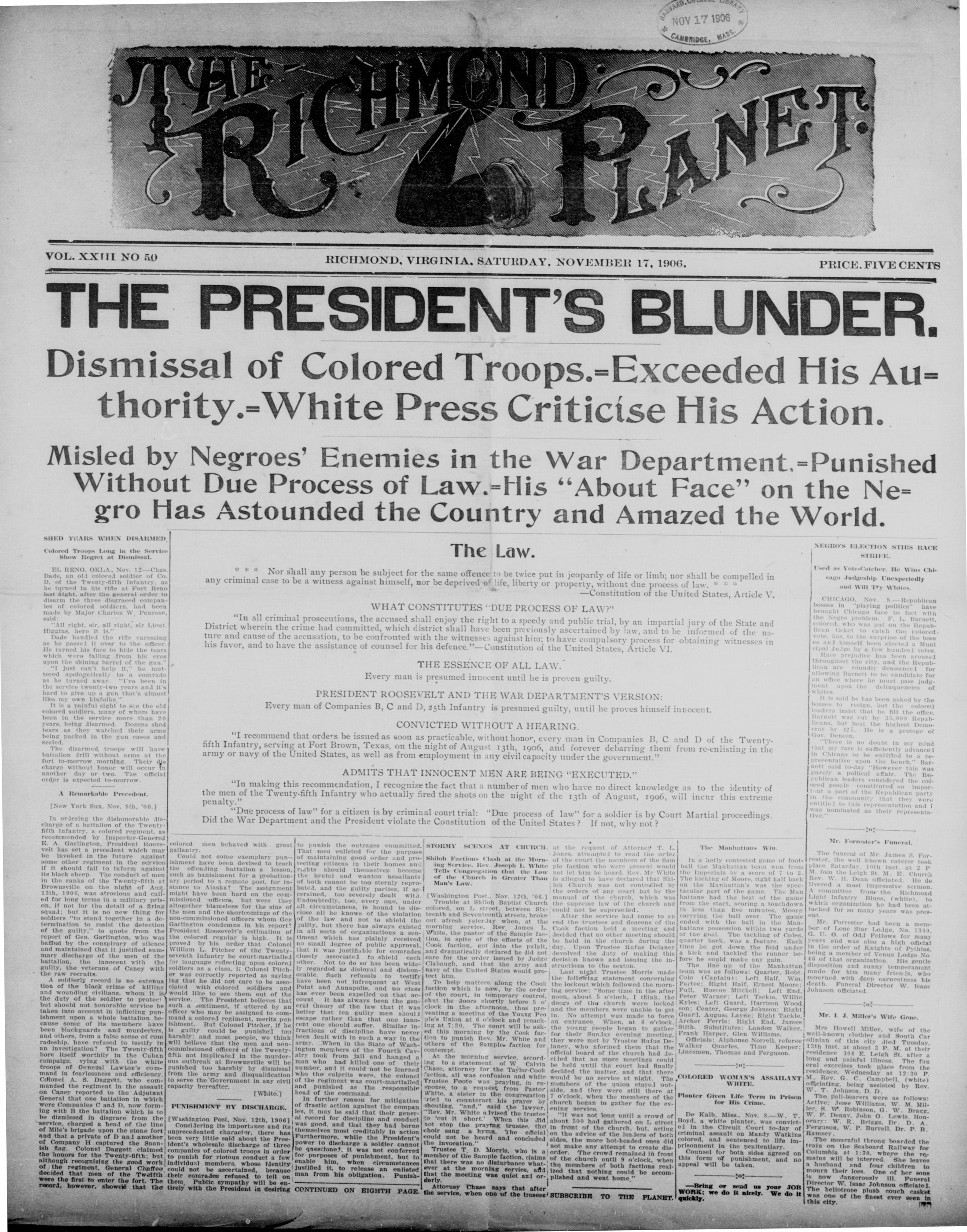
THE PRESIDENT'S BLUNDER.
Dismissal of Colored Troops.=Exceeded His Au=thority.=White Press Criticise His Action.
Misled by Negroes' Enemies in the War Department.=Punished Without Due Process of Law.=His "About Face" on the Ne= gro Has Astounded the Country and Amazed the World.
VOL. XXUl NO 50
THE
Dismiss
thor
Misled by
Without
gro H
SHED TEARS WHEN DISARMED.
Colored Troops Long in the Service
Show Regret at Dismissal.
EL RENO, OKLA., Nov. 12—Chas.
Dade, an old colored soldier of Co.
D, of the Twenty-fifth Infantry,
as he turned in his rifle at Fort Reno
last night, after the general order to
disarm the three disgraced companies
of colored soldiers, had been
made by Major Charles W. Penrose,
said:
"All right, sir, all right, sir Lieut.
Higgins, here it is."
Dade handled the rifle caressing
as he passed it over to the officer.
He turned his face to hide the tears
which were falling from his eyes
upon the shining barrel of the gun.
"I just can't help it," he muttered
apologetically to a comrade
as he turned away. "I've been in
the service twenty-two years and it's
hard to give up a gun that's almost
like my own kinfolks."
It is a painful sight to see the old
colored soldiers, many of whom have
been in the service more than 20
years, being disarmed. Dozens shed
tears as they watched their arms
being packed in the gun cases and
sealed.
The disarmed troops will have
battalion drill without arms at the
fort to-morrow morning. Their dis
charge without honor will occur in
another day or two. The official
order is expected to-morrow.
A Remarkable Precedent
[New York Sun, Nov. 8th, '06.]
In ordering the dishonorable discharge of a battalion of the Twenty-fifth Infantry, a colored regiment, as recommended by Inspector-General E. A. Garlington, President Roosevelt has set a precedent which may be invoked in the future against some other regiment in the service if it should fail to inform against its black sheep. The conduct of men in the ranks of the Twenty-fifth at Brownsville on the night of Aug. 13th, 1906, was atrocious and called for long terms in a military prison, if not for the detail of a firing squad; but it is no new thing for soldiers "to stand together in a determination to resist the detection of the guilty," to quote from the report of Gen. Garlington, who was baffled by the conspiracy of silence and maintained that it justified summary discharge of the men of the battalion, the innocent with the guilty, the veterans of Caney with the raw recruits.
A soldierly record is no extenuation of the black crime of killing and wounding civilians, whom it is the duty of the soldier to protect; but should not honorable service be taken into account in inflicting punishment upon a whole battalion because some of its members have been blackguards and murderers, and others, from a false sense of com radeship, have refused to testify in an investigation? The Twenty-fifth bore itself worthily in the Cuban campaign, vying with the white troops of General Lawton's command in fearlessness and efficiency, Colonel A. S. Daggett, who commanded the regiment in the assault on Caney reported to the Adjutant General that one battalion in which were Companies C and D, now forming with B the battalion which is to be dismissed in disgrace from the service, charged a head of the line of Mile's brigade upon the stone fort and that a private of D and another of Company H captured the Spanish flag. Colonel Daggett claimed the honors for the Twenty-fifth; but although recognizing the good work of the regiment, General Chaffee decided that men of the Twelfth were the first to enter the fort. The record, however, showed that the
* * * Nor shall any person be subject for the same offence to be twice put in jeopardy of life or limb; nor shall be compelled in any criminal case to be a witness against himself, nor be deprived of life, liberty or property, without due process of law. * * *
"In all criminal prosecutions, the accused shall enjoy the right to a speedy and public trial, by an impartial jury of the State and District wherein the crime had committed, which district shall have been previously ascertained by law, and to be informed of the nature and cause of the accusation, to be confronted with the witnesses against him; to have compulsory process for obtaining witnesses in his favor, and to have the assistance of counsel for his defence."—Constitution of the United States, Article VI.
PRESIDENT ROOSEVELT AND THE WAR DEPARTMENT'S VERSION: Every man of Companies B, C and D, 25th Infantry is presumed guilty, until he proves himself innocent.
"I recommend that orders be issued as soon as practicable, without honor, every man in Companies B, C and D of the Twenty-fifth Infantry, serving at Fort Brown, Texas, on the night of August 13th, 1906, and forever debarring them from re-enlisting in the army or navy of the United States, as well as from employment in any civil capacity under the government."
"In making this recommendation, I recognize the fact that a number of men who have no direct knowledge as to the identity of the men of the Twenty-fifth Infantry who actually fired the shots on the night of the 13th of August, 1906, will incur this extreme penalty."
"Due process of law" for a citizen is by criminal court trial: "Due process of law" for a soldier is by Court Martial proceedings. Did the War Department and the President violate the Constitution of the United States? If not, why not?
colored men behaved with gallantry.
Could not some exemplary punishment have been devised to teach the offending battalion a lesson such as banishment for a probationary period to a remote place, for instance to Alaska? The assignment might have been hard on the commissioned officers, but were they altogether blameless for the sins of the men and the shortcomings of the non-commissioned officers whom Ger Garlington condemns in his report. President Roosevelt's estimation of the colored regular is high. It is proved by his order that Colonel William L. Pitcher of the Twenty-seventh Infantry be court-martialled for language reflecting upon colored soldiers as a class. If Colonel Pitcher was correctly reported as saying that he did not care to be associated with colored soldiers and would like to see them out of the service. The President believes that such a sentiment, if uttered by an officer who may be assigned to command a colored regiment, merits punishment. But Colonel Pitcher, if he is guilty could be punished1 too harshly; and most people, we think will believe that the men and non-commissioned officers of the Twenty-fifth not implicated1 in the murderous outbreak at Brownsville will be punished too harshly by dismissal from the army and disqualification to serve the Government in any civil capacity hereafter.
PUNISHMENT BY DISCHARGE.
[Washington Post, Nov. 12th, 1906]
Considering its importance and its unprecedented character, there has been very little said about the President's wholesale discharge of three companies of colored troops in order to punish for riotous conduct a few individual members, whose identity could not be ascertained, because their comrades refused to tell on them. Public sympathy will be entirely with the President in desiring
RICHMOND, VIRGINIA, SATURDAY, NOVEMBER 17, 1906.
WHAT CONSTITUTES "DUE PROCESS OF LAW?"
Every man is presumed innocent until he is proven guilty.
CONVICTED WITHOUT A HEARING
ADMITS THAT INNOCENT MEN ARE BEING "EXECUTED."
to punish the outrages committed. That men listed for the purpose of maintaining good order and protecting citizens in their homes and rights should themselves become the brutal and wanton assailants of both cannot be too sternly reprobated, and the guilty parties, if ascertained, too severely dealt with Undoubtedly, too, every one, under all circumstances, is bound to disclose all he knows of the violation of the law and not to shield the guilty, but there has always existed in all sorts of organizations a sentiment which has plainly received no small degree of public approval, that it was justifiable for comrades closely associated to shield each other. Not to do so has been widely regarded as disloyal and dishonorable. Such refusals to testify have been not infrequent at West Point and Annapolis, and no class has ever been expelled on that account. It has always been the general theory of the law that it was better that ten guilty men should escape rather than that one innocent one should suffer. Similar infractions of discipline have never been dealt with in such a way in the army. When in the State of Washington members of the Fourth Cavalry took from jail and hanged a man who had killed one of their number, and it could not be learned who the culprits were, the colonel of the regiment was court-martialled and punished as the responsible head of the command.
In further reason for mitigation of drastic action against the companies, it may be said that their general record for discipline and conduct was good, and that they had borne themselves most creditably in action. Furthermore, while the President's power to discharge a soldier cannot be questioned, it was not conferred for purposes of punishment, but to enable him, when circumstances justified it, to release an enlisted man from his obligation. Punish
CONTINUED ON EIGHTH PAGE
The Law.
or the same offence to be twice put in
nor be deprived of life, liberty or pre
CONSTITUTES "DUE PROCESS O
shall enjoy the right to a speedy and
district shall have been previously as
with the witnesses against him; to ha
r his defence."—Constitution of the
THE ESSENCE OF ALL LAW
is presumed innocent until he is pro-
SEWELT AND THE WAR DEPART
D, 25th Infantry is presumed guilty
INVICTED WITHOUT A HEARING
was practicable, without honor, every
the night of August 13th, 1906, and
employment in any civil capacity u
INNOCENT MEN ARE BEING
ze the fact that a number of men who
fired the shots on the night of the
final court trial: "Due process of la
the Constitution of the United Stat
STORMY SCENES AT CHURCH.
Shiloh Factions Clash at the Mor-
ing Service. Rev. Joseph L. White
Tells Congregation that the Law
of the Church is Greater Than
Man's Law.
[Washington Post., Nov. 12th, '06.]
Trouble at Blohist Baptist Church colored, on L street, between Sixteenth and Seventeenth streets, broke out afresh yesterday when, at the morning service, Rev James L. White, the pastor of the Sample faction, in spite of the efforts of the Cook faction, got into the pulpit, and dramatically declared he did not care for the order issued by Judge Clabaugh, and that the army and navy of the United States would protect him.
To help matters along the Cook faction which is now, by the order of the court, in temporary control, shut the doors shortly before 5 o'clock in the afternoon, thus preventing a meeting of the Young People's Union at 6 o'clock and preaching at 7:30. The court will be asked this morning by the Cook faction to punish Rev. Mr. White and others of the Sample faction for contempt.
At the morning service, according to a statement of W Calvin Chase, attorney for the Taylor-Cook faction, all was confusion and white Trustee Foote was praying, in response, to a request from Pastor White, a sister in the congregation tried to counteract his prayer by shouting, "and," said the lawyer, "Rev Mr. White avised the trustee to 'cut it short.' When this Did not stop the praying trustee, the choir sang a hymn. The official could not be heard and concluded the invocation."
Trustee T. D. Morris, who is a member of the Sample faction, claims that there was no disturbance whatever at the morning service, and that the meeting was quiet and orderly. Attorney Chase says that after the service, when one of the trustees
at the request of Attorney' T. L. Jones, attempted to read the order of the court the members of the Sam ple faction who were present would not let him be heard. Rev. Mr White is alleged to have declared that Shiloh Church was not controlled by the orders of any court by the manual of the church, which was the supreme law of the church and could not be supersealed.
After the service had come to an end the trustees and deacons of the Cook faction held a meeting and decided that no other meeting should be held in the church during the day. Upon Trustee Rufus Delaney devolved the Juty of making this decision known and issuing the instructions to the sexton.
Last night Trustee Morris made the following statement concerning the lockout which followed the morning service: "Some time in the after noon, about 5 o'clock. I think, the doors of the church were locked and the members were unable to get in. No attempt was made to force an entrance. When, at 6 o'clock, the young people began to gather for their Sunday evening meeting, they were met by Trustee Rufus De兰耶, who informed them that the official board of the church had decided that no more meetings could be held until the court had finally decided the matter, and that there would be no service at night. The members of the union stayed outside, and they were still there at 7 o'clock, when the members of the church began to gather for the evening service.
"It was not long until a crowd of about 500 had gathered on L street in front of the church, but, acting on the advice of the leaders of both sides, the more hot-headed ones did not make any attempt to create disorder. The crowd remained in front of the church until 9 o'clock, when the members of both factions realized that nothing could be accomplished and went home."
SUBSCRIBE TO THE PLANET
The Manhattans Win
In a hotly contested game of football the Manhattan team won from the Imperials by a score of 7 to 2. The kicking of Moore, right half back on the Manhattan's was the spectacular part of the game. The Manhattan had the best of the game from the start, scoring a touchdown in less than five minutes. Moore carrying the ball over. The game ended with the ball in the Manhattan possession within two yards of the goal. The tackling of Coles, quarter back, was a feature. Each time he got down the field under a kick and tackled the runner before he could make any gain. The line up of the Manhattan team was as follows: Quarter, Robt. Cole (Captain); Left Half, Wm. Partee; Right Half, Ernest Moore; Full, Roscoe Mitchell; Left End, Peter Warner; Left Tackle, Willie Kyles; Left Guard, Harrison Wood; Center, George Johnson; Right Guard, Augusta Layne; Right Tackle, Archer Ferris; Right End, James Stith. Substitutes: Landon Walker, Frank Harper, Glen Williams. Officials: Alphonso Norrell, referee Walker Quarles, Time Keeper; Linesmen, Thomas and Ferguson.
COLORED WOMAN'S ASSAILANT
WHITE.
Planter Given Life Term in Prison for His Crime.
De Kalb, Miss., Nov. 8.—W. T. Boyd, a white planter, was convicted in the Circuit Court to-day of criminal assault on Mandy Watkins colored, and sentenced to life imprisonment in the penitentiary.
Counsel for both sides agreed on this form of punishment, and no appeal will be taken.
Bring or send us your JOB WORK; we do it nicely. We do it quickly.
PRICE.FIVE CENTS
DER.
His Au= tion.
=Punished the Ne= World.
NEGRO'S ELECTION STIRS RACE STRIFE.
Used as Vote-Catcher, He Wins Chicago Judgeship Unexpectedly and Will Try Whites.
CHICAGO, Nov. 8.—Republican bosses in "playing politics" have brought Chicago face to fact with the Negro problem. F. L. Barnett, colored, who was put on the Republican ticket to catch the colored vote, has, to the surprise of the bosses and himself been elected a Muni cipal Judge by a few hundred votes.
Race prejudice has been aroused throughout the city, and the Republican are roundly denounced for allowing Barnett to be candidate for an office where he must pass judgment upon the delinquencies of whites.
It is said he has been asked by the bosses to resign, but the colored leaders insist that he fill the office. Barnett was cut by 35,000 Republicans, but beat the highest Democrat by 425. He is a protege of Gov. Deneen.
"There is no doubt in my mind that my race is sufficiently advanced in Chicago to be entitled to a representative upon the bench," Barnett said to-day "However this was purely a political affair. The Republican leaders considered the colored people constituted so important part of the Republican party in the community that they were entitled to this representation and I was nominated as their representative."
Mr. Forrester's Funeral
The funeral of Mr. James S. Forrester, the well known caterer took place Saturday, 10th inst. at 2 P. m. from the Leigh St. M. E. Church Rev. W. H. Dean officiated. He delivered a most impressive sermon. A committee from the Richmond Light Infantry Blues, (white), to which organization he had been attached for so many years was present. Mr. Forrester had been a member of Lone Star Lodge, No. 1340, G. U. O. of Odd Fellows for many years and was also a high official in the order of Knights of Pythias, being a member of Venus Lodge No. 46 of that organization. His gentle disposition and sunny temperament made for him many friendls, who mourned with deep earnestness his death. Funeral Director W. Isaac Johnson officiated.
Mr. L. J. Miller's Wife. Gone
Mrs Howell Miller, wife of the well-known clothier and South Car olinian of this city Jled Tuesday, 13th inst. at about 3 P. M. at their residence 104 E. Leigh St. after a long and painful illness. The funeral exercises took place from the residence. Wednesday at 12:30 P. M. Rev. G. C. Campbell, (white) officiating, being assisted by Rev. W. T. Johnson, D. D.
The pall-bearers were as follows: Active: Jesse Williams, W. M. Miller, S. W. Robinson, G. W. Bragg, W. F. Denny, John O. Lewis, Honorary: W. R. Briggs, Dr. D. A. Ferguson, W. P. Burrell, Dr. P. B. Ramsey.
The mournful throng boarded the train on the Seaboard Railway for Columbia at 1:30, where the remains will be interred. She leaves a husband and four children to mourn their loss. One of her sons is now dangerously ill. Funeral Director W. Isaac Johnson officiate. The hellotrople plush couch casket was one of the finest ever seen in this city.
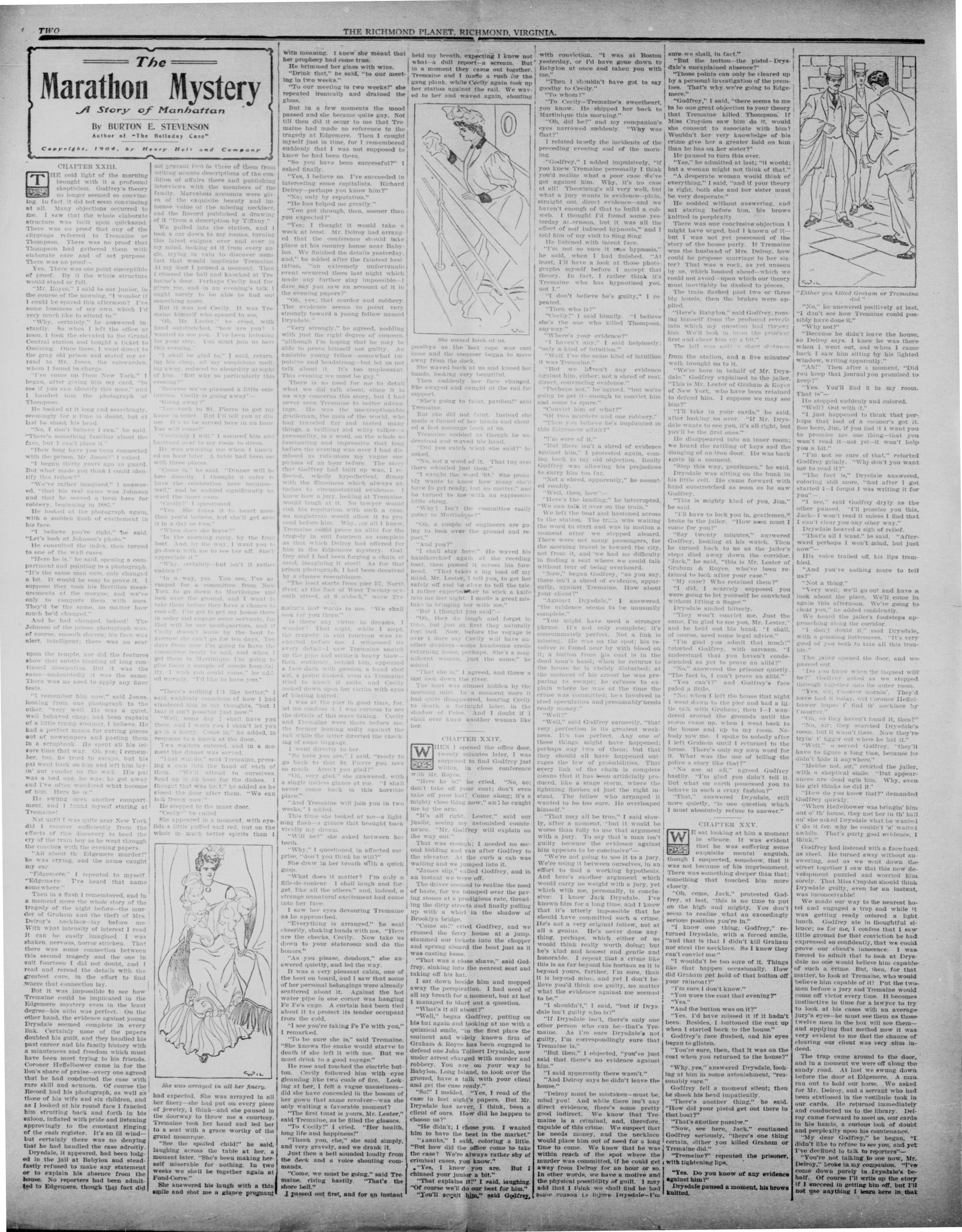
The Marathon Mystery A Story of Manhattan
By BURTON E. STEVENSON
Author of "The Holladay Case"
Copyright, 1904, by Henry Holt and Company
CHAPTER XXIII.
THE cold light of the morning brought with it a profound skepticism. Goldfrey's theory no longer seemed so convincing. In fact it did not seem convincing at all. Many objections occurred to me. I saw that the whole elaborate structure was built upon quicksand. There was no proof that any of the clippings referred to Tremaine or Thompson. There was no proof that Thompson had gathered them with elaborate care and of set purpose. There was no proof—Yes. There was one point susceptible of proof. By it the whole structure would stand or fall.
not prevent two or three of them writing minute descriptions of the dition of affairs there and public interviews with the members of family. Marvelous accounts were en of the exquisite beauty and mense value of the missing necks and the Record published a draw of it "from a description by Tiffan.
We pulled into the station, and took a car down to my rooms, turn this latest enigma over and ove my mind, looking at it from every gle, trying in vain to discover a fact that would implicate Tremaine. At my door I paused a moment. I crossed the hall and knocked at mine's door. Perhaps Cecily had
"Mr. Royce," I said to our junior, in the course of the morning, "I wonder if I could be spared this afternoon? I've some business of my own which I'd very much like to attend to."
"Why, certainly," he answered instantly. So when I left the office at noon, I took the elevated to the Grand Central station and bought a ticket to Ossining. Once there, I went direct to the gray old prison and stated my errand to Mr. Jones, the subwarden, whom I found in charge.
"I've come up from New York," I began, after giving him my card, "to see if you can identify this man," and I handed him the photograph of Thompson.
He looked at it long and searchingly, seemingly for a time in doubt, but at last he shook his head.
"No, I don't believe I can," he said. "There's something familiar about the face, but I can't place it."
"How long have you been connected with the prison, Mr. Jones?" I asked. "I began thirty years ago as guard. But what made you think I could identify this fellow?" "We've rather imagined," I answered, "that his real name was Johnson and that he served a term here for robbery, beginning in 1854."
"I believe you're right," he said. "Let's look at Johnson's photo." He consulted the index, then turned to one of the wall cases.
"Here he is" he said, opening a compartment and pointing to a photograph. "It's the same man sure, only changed a lot. It would be easy to prove it. I suppose they took his Bertillon measurements at the morgue, and we've only to compare them with ours. They'd be the same, no matter how much he'd changed."
And he had changed, indeed! The Johnson of the prison photograph was, of course, smooth shaven; his face was alert, intelligent; there was no scar upon the temple, nor did the features show that subtle bloating of long continued dissipation. But it was the same—undoubtedly it was the same. There was no need to apply any finer tests.
"I remember him now," said Jones, looking from one photograph to the other, "very well. He was a quiet, well behaved chap; had been captain of a little tramp steamer, I believe. He had a perfect mana for cutting pieces out of newspapers and pasting them in a scrapbook. He spent all his leisure time that way. Oh yes; I remember, too, he tried to escape, but his pal went back on him and left him layin' out over the wall. His pal was a bad one, he was; he got away and I've often wondered what become of him. He is he."
He swung open another compartment, and I found myself staring at Tremaine!
Not until I was quite near New York did I recover sufficiently from the effects of this discovery to heed the cry of the train boy as he went through the coaches with the evening papers.
"All about th' Edgemere murder!" he was crying, and the name caught my ear.
"Edgemere." I repeated to myself. "Edgemere. I've heard that name somewhere."
Then in a flash I remembered, and in a moment more the whole story of the tragedy of the night before—the murder of Graham and the lay of Mrs. Delroy's necklace—lay before me. With what intensity of interest I read it can be easily imagined. I was shaken, nervous, horror stricken. That there was some connection between this second tragedy and the one in suit fourteen I did not doubt, and I read and reread the details with the greatest care, in the effort to find where that connection lay.
But it was impossible to see how Tremaine could be implicated in the Edgemere mystery even in the least degree—his alibi was perfect. On the other hand, the evidence against young Drysdale seemed complete in every link. Certainly none of the papers doubted his guilt, and they handled his past career and his family history with a minuteness and freedom which must have been most trying to his friends. Coroner Heffelbower came in for the lion's share of praise—every one agreed that he had conducted the case with rare skill and acumen. Of course the Record had his photograph, as well as those of his wife and six children, and as I looked at his round face I fancied him strutting back and forth in his saloon, inflated with pride and listening approvingly to the constant ringing of the cash register. It's an ill wind—but certainly there was no denying that he had handled the case adroitly.
Drysdale, it appeared, had been lodged in the jail at Babylon and steadfastly refused to make any statement or to explain his absence from the house. No reporters had been admitted to Edgemere, though that fact did
not prevent two or three of them from writing minute descriptions of the condition of affairs there and publishing interviews with the members of the family. Marvelous accounts were given of the exquisite beauty and immense value of the missing necklace and the Record published a drawing of it "from a description by Tiffany."
We pulled into the station, and I took a car down to my rooms, turning this latest enigma over and over in my mind, looking at it from every angle, trying in vain to discover some fact that would implicate Tremaine. At my door I paused a moment. Then I crossed the hall and knocked at Tremaine's door. Perhaps Cecily had for given me, and in an evening's talk I ought surely to be able to find out something more.
But it was not Cecily. It was Tremaine himself who opened to me.
"Oh, Mr. Lester," he cried, with hand outstretched, "how are you? I wanted to see you. I've been listening for your step. You must join us here this evening."
"I shall be glad to," I said, returning his clasp, all my suspicions melting away, reduced to absurdity at sight of him. "But why so particularly this evening?"
"Because we've planned a little celebration. Cecily is going away"—
"Going away?"
"Yes—back to St. Pierre to get my house in order. But I'll tell you at dinner. It's to be served here in an hour. You will come?"
"Certainly I will," I assured him and hastened over to my room to dress.
He was awaiting me when I knocked an hour later. A table had been set with three places.
"Come in" he said. "Dinner will be here directly. I thought it safer to have the celebration here because—well," and he nodded significantly to ward the inner room. "Cecily?" I questioned. "Yes. She takes it to heart more than you'd believe, but she'll get over it in a day or two."
"When does she leave?"
"In the morning early, by the fruit boat. And, by the way, I want you to go down with me to see her off. She'll appreciate it."
"Why, certainly—but isn't it rather sudden?"
"In a way, yes. You see, I've arraged for a committee from New York to go down to Martinique and look over the ground, and I want to take them before they have a chance to cool off. I've got to get my house there in order and engage some servants, for that will be our headquarters, and if Cecily doesn't leave by the boat to tomorrow she can't go for ten days. Ten days from now I'm going to have the committee ready to sail, and when I get them to Martinique I'm going to give them a sample of creole hospitality. I wish you could come," he edded warmly. "I'd like to have you."
"There's nothing I'd like better," I said, suddenly conscious of how I had slandered him in my thoughts, "but I fear it isn't possible just now."
"Well, some day I shall have you there, and I warn you I shan't let you go in a hurry. Come in." he added, in response to a knock at the door.
Two waiters entered, and in a moment the dinner was served.
"That will do," said Tremaine, pressing a coin into the hand of each of them. "We'll attend to ourselves. Send up in an hour for the dishes. I thought that was best." he added as he closed the door after them. "We can talk freely now."
He stepped to the inner door.
"Cecily?" he called.
She appeared in a moment, with eyelids a little puffed und red, but on the whole in much better spirits than I
WIL.
She was arrayed in all her finery. had expected. She was arrayed in all her finery—she had put on every piece of jewelry, I think—and she paused in the doorway to throw me a courtesy. Tremaine took her hand and led her to a seat with a grace worthy of the grand monarque. "See the spoiled child!" he said, laughing across the table at her, a moment later. "She's been making herself miserable for nothing. In two weeks we shall be together again at Fond-Corre." She answered his laugh with a thin smile and shot me a glance pregnant
with meaning. I knew she meant that her prophecy had come true.
He brimmed her glass with wine.
"Drink that," he said, "to our meeting in two weeks."
"To our meeting in two weeks!" she repeated ironically and drained the glass.
But in a few moments the mood passed and she became quite gay. Not till then did it occur to me that Tremaine had made no reference to the tragedy at Edgemere. Then I caught myself just in time, for I remembered suddenly that I was not supposed to know he had been there.
"So you have been successful?" I asked finally.
"Yes, I believe so. I've succeeded in interesting some capitalists. Richard Delroy—perhaps you know him?"
"He has helped me greatly."
"You got through, then, sooner than you expected?"
"Yes; I thought it would take a week at least. Mr. Delroy had arranged that the conference should take place at his country house near Babylon. We finished the details yesterday, and," be added after the faintest hesitation, "an extremely unfortunate event occurred last night which made any further stay impossible—I dare say you saw an account of it in the evening papers?"
"Oh, yes; that murder and robbery. The evidence seems to point very strongly toward a young fellow named Drysdale."
"Very strongly," he agreed, nodding with just the right degree of concern, "although I'm hoping that he may be able to prove himself not guilty. An amiable young fellow—somewhat impulsive and headstrong—but let us not talk about it. It's too unpleasant. This evening we must be gay."
There is no need for me to detail what we did talk about, since it in no way concerns this story, but I had never seen Tremaine to better advantage. He was the unexceptionable gentleman, the man of the world, who had traveled far and tasted many things, a brilliant and witty talker—a personality, in a word, on the whole so fascinating and impressive that long before the evening was over I had dismissed as ridiculous my vague suspicions of an hour before. The story that Godfrey had built up was, I reflected, wholly hypothetical, filmsy with the filmmess which always attaches to circumstantial evidence. I knew how a jury, looking at Tremaine, would laugh at it. No lawyer would risk his reputation with such a case, no magistrate would allow it to proceed before him. Why, or all I knew, Tremaine could prove an alibil for the tragedy in suit fourteen as complete as that which Delroy had offered for him in the Edgeworth mystery. Godfrey and I had been forging a chain of sand, imagining it steel! As for that prison photograph, I had been deceived by a chance resemblance.
"The boat starts from pier 57. North river, at the foot of West Twenty-seventh street, at S o'clock," were Tremaine's last words to me. "We shall look for you there."
Is there any virtue in dreams, I wonder? That night, while I slept, the tragedy in suit fourteen was reenacted before me. I witnessed its every detail-I saw Tremaine snatch up the pipe and strike a heavy blow—then, suddenly, behind him, appeared a face dark with passion, a hand shot out, a pistol fashed even as Tremaine tried to knock it aside, and Cecely looked down upon her victim with eyes of blazing hatred.
I was at the pier in good time, for, let me confess it. I was curious to see the details of this leave taking. Cecely and Tremaine were there before me, the former leaning sadly against the wall while the latter directed the checking of some baggage.
"So here you are," I said, "ready to go back to that St. Pierre you love so much. Aren't you glad?"
"Oh, very glad," she answered, with a single histress glance at me. "I shall never come back to this horrible place."
"And Tremaine will join you in two weeks," I added.
This time she looked at me—a lightning flash—a glance that brought back vividly my dream.
"Will he?" she asked between her teeth.
"Why," I questioned, in affected surprise, "don't you think he will?"
She drew in her breath with a quick gasp.
"What does it matter? I'm only a fille-de-couleur. I shall laugh and forget, like all the others," and, indeed, a strange unnatural excitement had come into her face.
I saw her eyes devouring Tremaine as he approached.
"Everything is arranged," he said cheerily, shaking hands with me. "Here are the checks, Cecily. Now take us down to your stateroom and do the honors."
"As you please, doudoux," she answered quietly, and led the way.
It was a very pleasant cabin, one of the best on board, and I saw that some of her personal belongings were already scattered about it. Against the hot water pipe in one corner was hanging Fe Fe's cage. A curtain had been tied about it to protect its tender occupant from the cold.
"I see you're taking Fe Fe with you," I remarked.
"To be sure she is," said Tremaine.
"She knows the snake would starve to death if she left it with me. But we must drink to a good voyage."
He rose and touched the electric button. Cecily followed him with eyes gleaming like two coals of fire. Looking at her, I felt a vague uneasiness—did she have concealed in the bosom of her gown that same revolver—was she only waiting a favorable moment?
"The first toast is yours, Mr. Lester," said Tremaine, as he filled the glasses.
"To Cecily!" I cried. "Her health, long life and happiness!"
"Thank you, che," she said simply, and very gravely, and we drank it.
Just then a bell sounded loudly from the deck and a voice shouting commands.
"Come, we must be going." said Tremaine, rising hastily. "That's the shore bell."
I passed out first, and for an instant
held my breath, expecting I know not what—a dull report—a scream. But in a moment they came out together. Tremaine and I made a rush for the gang plank, while Cecily again took up her station against the rail. We waved to her and waved again shouting
S. WILLIAM
She waved back at us. goodbys as the last rope was cast loose and the steamer began to move away from the dock. She waved back at us and kissed her hands, looking very beautiful. Then suddenly her face changed. She swayed and caught at the rail for support. "She's going to faint, pardieu!" said Tremaine. But she did not faint. Instead she made a funnel of her hands and shouted a last message back at us. Tremaine nodded as though he understood and waved his hand.
"Did you catch what she said?" he asked.
"No, not a word of it. That tug over there whistled just then."
"I caught the word 'lit.' She probably wants to know how many she'll have to get ready, but no matter," and be turned to me with an expressive little shrug.
"Why? Isn't the committee really going to Martinique?"
"Oh, a couple of engineers are going to look over the ground and report."
"And you?"
"I shall stay here." He waved his handkerchief again at the receding boat, then passed it across his forehead. "That takes a big load off my mind, Mr. Lester, I tell you, to get her safely off and be alive to tell the tale. I rather expected her to stick a knife into me last night. I made a great mistake in bringing her with me."
"Oh, they do laugh and forget in time, but just at first they naturally feel bad. Now, before the voyage is over I dare say Cecely will have another doudoux—some handsome creole returning home, perhaps. She's a magnificent woman, just the same," he added.
"That she is," I agreed, and threw a inst look down the river.
The boat was almost hidden by the morning mist. In a moment more it had quite disappeared, bearing Cecely to death, a fortnight later, in the shadow of Pelee. And I doubt if I shall ever know another woman like her.
CHAPTER XXIV
W
W
HEN I opened the office door, twenty minutes later, I was surprised to find Godfrey just within, in close conference with Mr. Royce.
"Here he is!" he cried. "No, no; don't take off your coat; don't even take off your hat! Come along; it's a mighty close thing now," anl he caught me by the arm.
"It's all right, Lester," said our junior, seeing my astonished countenance. "Mr. Godfrey will explain on the way out."
That was enough; I needed no second bidding and ran after Godfrey to the elevator. At the curb a cab was waiting and we jumped into it.
"James slip," called Godfrey, and in an instant we were off.
The driver seemed to realize the need of haste, for we bumped over the paying stones at a proligious rate, threading the dirty streets and finally pulling up with a whirl in the shadow of Brooklyn bridge.
"Come on!" cried Godfrey, and we crossed the ferry house at a jump, slammed our tickets into the chopper and sprang aboard the boat just as it was casting loose.
"That was a close seal," said Godfrey, sinking into the nearest seat and taking off his hat.
I sat down beside him and mopped away the perspiration. I had need of all my breath for a moment, but at last I managed to blurt out a question.
"What's it all about?"
"Well," began Godfrey, putting on his hat again and looking at me with a quizzical smile. "in the first place the eminent and widely known firm of Graham & Royce has been engaged to defend one John Tolbert Drysdale, now under arrest charged with murder and robbery. You are on your way to Babylon, Long Island, to look over the ground, have a talk with your client and get the case ready."
"So!" I nodded. "Yes, I read of the case in last night's papers. But Mr. Drysdale has never, I think, been a client of ours. How did he happen to choose us?"
"He didn't; I chose you. I wanted him to have the best in the market."
"Ianks," I said, coloring a little.
"But how did the office come to take the case? We're always rather shy of criminal cases, you know."
"Yes, I know you are. But I chinned your junior a bit."
"That explains it!" I said, laughing. "Of course we'll do our best for him." "You'll accult him," said Godfreel.
with conviction. "I was at Boston yesterday, or I'd have gone down to Babylon at once and taken you with me."
"Then I shouldn't have got to say goodby to Cecily."
"To whom?"
"To Cecily—Tremaine's sweetheart, you know. He shipped her back to Martinique this morning."
"Oh, did he?" and my companion's eyes narrowed suddenly. "Why was that?"
I related briefly the incidents of the preceding evening and of the morning.
"Godfrey," I added impulsively, "if you knew Tremaine personally I think you'd realize what a poor case we've got against him. Why, it's no case at all! Theorizing's all very well, but what a jury wants is evidence-plain, straight out, direct evidence—and we haven't enough of that to build a cobweb. I thought I'd found some yesterday at earmoon, but it was all the effect of self induced hypnosis," and I told him of my visit to Sing Sing.
He listened with intent face.
"I'm not so sure it was hypnosis," he said, when I had finished. "At least, I'll have a look at those photographs myself before I accept that theory. In fact, I rather think it's Tremaine who has hypnotized you, not I."
"I don't believe he's guilty," I repeated.
"Then who is?"
"Cecily?" I said bluntly. "I believe she's the one who killed Thompson, anyway."
"Where's your evidence?"
"Well, I've the same kind of intuition it was Treemine."
"But we haven't any evidence against him, either, not a shred of real, direct, convincing evidence."
"Perhaps not," he agreed, "but we're going to get it—enough to convict him and some to spare."
"Convict him of what?"
"Of two murders and one robbery."
"Then you believe he's implicated in this Edgeneence affair?"
"I'm sure of it."
"But there isn't a shred of evidence against him." I protested again, coming back to my old objection. Really Godfrey was allowing his prejudices to carry him too far.
"Not a shred, apparently," he assented readily.
"Well, then, how"—
"Here's the landing." he interrupted.
"We can talk it over on the train."
We left the boat and hastened across to the station. The train was waiting the word to start and was in motion a moment after we stepped aboard. There were not many passengers, for the morning travel is toward the city, not from it, and we had no difficulty in finding a seat where we could talk without fear of being overheard.
"Now," began Godfrey, "as you say, there isn't a shred of evidence, apparently, against Tremaine. How about your client?"
"Against Drysdale," I answered, "the evidence seems to be unusually complete."
"You might have used a stronger phrase. It's not only complete; it's consummately perfect. Not a link is missing. He was on the spot; his revolver is found near by with blood on it; a button from his coat is in the dead man's hand; when he returns to the house he is visibly disturbed; at the moment of his arrest he was preparing to escape; he refuses to explain where he was at the time the crime was committed; he's involved in steel speeulation and presumably needs ready money."
"Well," said Godfrey earnestly, "that very perfection is its greatest weakness. It's too perfect. Any one of those things might have happened; perhaps any two of them; but that they should all have happened outrages the law of probabilities. That every link of the chain is complete means that it has been artificially produced, like a stage storm, where the lightning flashes at just the right instant. The fellow who arranged it wanted to be too sure. He overleaped himself."
"That may all be true," I said slowly, after a moment, "but it would be worse than folly to use that argument with a jury. To say that a man isn't guilty because the evidence against him appears to be conclusive"—
"We're not going to use it to a jury. We're using it between ourselves, in an effort to find a working hypothesis. And here's another argument which would carry no weight with a jury, yet which with me, personally, is conclusive: I know Jack Drysdale. I've known him for a long time, and I know that it's utterly impossible that he should have committed such a crime. He's not a very original fellow, not at all a genius. He's never done anything, perhaps, which either of us would think really worth doing; but he's kind and honest and gentle and honorable. I repeat that a crime like this is as far beyond his horizon as it is beyond yours, farther, I'm sure, than it is beyond mine, and yet I don't believe you'd think me guilty, no matter what the evidence against me seemed to be."
"I shouldn't," I said, "but if Drysdale isn't guilty who is?"
"If Drysdale isn't, there's only one other person who can be—that's Tremaine. As I'm sure Drysdale's not guilty, I'm correspondingly sure that Tremaine is."
"But then." I objected, "you've just said that there's no evidence against him."
"I said apparently there wasn't."
"And Delroy says he didn't leave the house."
"Delroy must be mistaken—must be, mind you! And while there isn't any direct evidence, there's some pretty good indirect. We know that Tremaine is a criminal, and, therefore, capable of this crime. We suspect that he needs money, and the necklace would place him out of need for a long time to come. We know that he was within reach of the spot where the murder was committed, if he could get away from Delroy for an hour or so. In other words, we have a motive and the physical possibility of guilt. I may add that I think we shall find he had some reason to injure Drysdale—I'm
sure we shall, in fact."
"But the button—the pistol—Drysdale's unexplained absence?"
"Those points can only be cleared up by a personal investigation of the premises. That's why we're going to Edgemere."
"Godfrey," I said, "there seems to me to be one great objection to your theory that Tremaine killed Thompson. If Miss Croydon saw him do it, would she consent to associate with him? Wouldn't her very knowledge of his crime give her a greater hold on him than he has on her sister?"
He paused to turn this over.
"Yes," he admitted at last; "it would; but a woman might not think of that."
"A desperate woman would think of everything," I said, "and if your theory is right, both she and her sister must be very desperate."
He nodded without answering, and sat staring before him, his brows knitted in perplexity.
There was one conclusive objection I might have urged, had I known of it—but I was not yet possessed of the story of the house party. If Tremaine was the husband of Mrs. Delroy, how could he propose unmarriage to her sister? That was a rock, as yet unseen by us, which loomed ahead—which we could not avoid—upon which our theory must inevitably be dashed to pieces.
The train flashed past two or three big hotels, then the brakes were applied.
"Here's Babylon," said Godfrey, rousing himself from the profound revive into which my question had thrower him. We'll look in upon the prisoner first and cheer him up a bit."
The fall was only a short distance from the station, and a five minutes' walk brought us to it.
"We're here in behalf of Mr. Drysdale," Godfrey explained to the jailer, "This is Mr. Lester of Graham & Royce of New York, who have been retained to defend him. I suppose we may see him?
"I'll take in your cards," he said, after looking us over, "If Mr. Drysdale wants to see you, it's all right, but you'll be the first ones."
He disappeared into an inner room; we heard the rattling of keys and the glanging of an iron door. He was back again in a moment.
"Step this way, gentlemen," he said. Drysdale was sitting on the bunk in his little cell. He came forward with hand outstretched as soon as he saw Godfrey.
"This is mighty kind of you, Jim," he said.
"I'll have to lock you in, gentlemen," broke in the jailer. "How soon must I come for you?"
"Say twenty minutes," answered Godfrey, looking at his watch. Then he turned back to us as the jailer's steps died away down the corridor, "Jack," he said, "this is Mr. Lester of Graham & Royce, who've been retained to look after your case." "My case? Who retained them?" "I did, I scarcely supposed you were going to let yourself be convicted without lifting a finger." Drysdale smiled bitterly.
"They won't convict me. Just the same. I'm glad to see you, Mr. Lester," and he held out his hand. "I shall, of course, need some legal advice."
"I'm glad you admit that much!" retorted Godfrey, with sarcasm. "I understand that you haven't condescended as yet to prove an alibi?"
"No," answered the prisoner quietly. "The fact is, I can't prove an alibi."
"You can't?" and Godfrey's face paled a little.
"No; when I left the house that night I went down to the pier and had a little talk with Graham; then I-I wandered around the grounds until the storm came up, when I went back to the house and up to my room. Nobody saw me. I spoke to nobody after I left Graham until I returned to the house. There's only my own word for it. What was the use of telling the police a story like that?"
"No use at all," agreed Godfrey hastily. "I'm glad you didn't tell it. But what on earth possessed you to behave in such a crazy fashion?" "That," answered Drysdale, still more quietly, "is one question which I must absolutely refuse to answer."
CHAPTER XXV.
W
1926
"Oh, come, Jack," protested Godfrey, at last, "this is no time to put on the high and mighty. You don't seem to realize what an exceedingly serious position you're in."
"I know one thing, Godfrey," returned Drysdale, with a forced smile, "and that is that I didn't kill Graham nor steal the necklace. So I know they can't convict me."
"I wouldn't be too sure of it. Things like that happen occasionally. How did Graham get hold of that button off your raincoat?"
"I'm sure I don't know."
"You wore the coat that evening?"
"Yes."
"And the button was on it?"
"Yes, I'd have missed it if it hadn't been. Besides, I buttoned the coat up when I started back to the house."
Godfrey's face flushed, and his eyes began to glisten.
"You're sure, then, that it was on the coat when you returned to the house?"
"Why, yes," answered Drysdale, looking at him in some astonishment, "reasonably sure."
Godfrey fell a moment silent; then he shook his head impatiently.
"There's another thing," he said.
"How did your pistol get out there in that bout?"
"That's another puzzler."
"Now, see here, Jack," continued Godfrey seriously, "there's one thing certain, either you killed Graham or Tremaine did."
"Tremaine?" repeated the prisoner, with tightening lips.
"Yes. Do you know of any evidence against him?"
Drysdale paused a moment, his brows knitted.
G. W. H.
"Either you killed Graham or Tremaine did"
"No," he answered positively at last.
"I don't see how Tremaine could possibly have done it."
"Why not?"
"Because he didn't leave the house, so Delroy says. I know he was there when I went out, and when I came back I saw him sitting by his lighted window, writing apparently."
"Ah!" Then after a moment, "Did you keep that journal you promised to keep?"
"Yes. You'll find it in my room. That is"—
"He stopped suddenly and colored."
"Well? Out with it."
"I just happened to think that perhaps that tool of a coroner's got it. See here, Jim, if you had it I want you to promise me one thing—that you won't read it—not yet—it won't help you a bit."
"I'm not so sure of that." retorted Godfrey grimly. "Why don't you want me to read it?"
"The fact is," Drysdale answered, coloring still more. "that after I got started I—I forgot I was writing it for you"—
"I see," said Godfrey dryly as the other paused. "I'll promise you this, Jack-I won't read it unless I find that I can't clear you any other way." Drysdale heaved a sigh of relief. "That's all I want," he said. "Afterward perhaps I won't mind, but just now"—His voice trailed off, his lips trembled. "And you've nothing more to tell us?"
"Not a thing"
"Very well; we'll go out and have a look about the place. We'll come in again this afternoon. We're going to clear you," he added confidently.
We heard the jailer's footsteps approaching along the corridor.
The jailer opened the door, and we passed out.
"Do you know when the inquest will be?"
Goffrey asked as we stepped through together into the outer room.
"Yes, sir; I corner mornin'. They'd have had it today, but Coroner Helfbower hopes t' find it' necklace by t'morror."
"Oh, so they haven't found it, then?"
"No, sir; they searched Drrysdale's room, but it wasn't there. Now they're tryin' t'igger out where he hid it."
"Well, o served Godfrey, 'they'll have to figure a long time, because he didn't hide it anywhere."
"Mebbe not, sir," retorted the jailer, with a skeptical smile. "But appearances are dead agin him. Why, even his girl thinks he did it."
"How do you know that?" demanded Godfrey quickly.
"When Heilbower was bringin' him out o' 't house, they met her in th' hall an' she asked Drysdale what he wanted t' do it fer, why he couldn't 'a waited awhile. That's purty good evidence, I think."
Godfrey had listened with a face hard as steel. He turned away without answering, and as we went down the street together I saw that this new development puzzled and worried him sorely. That Miss Croydon should think Drysdale guilty, even for an instant, was inconceivable!
We made our way to the nearest hotel and engaged a trap and while it was getting ready ordered a light lunch. Godfrey ate in thoughtful silence; as for me, I confess that I saw little ground for that conviction he had expressed so confidently, that we could prove our client's innocence. I was forced to admit that to look at Drysdale no one would believe him capable of such a crime. But, then, for that matter, to look at Tremaine, who would believe him capable of it? Put the two men before a jury and Tremaine would come off victor every time. It becomes instinctive in time for a lawyer to try to look at his cases with an average jury's eyes—he must see them as those twelve men in the box will see them—and applying that method now it was very evident to me that the chance of clearing our client was very slim indeed.
The trap came around to the door, and in a moment we were off along the sandy road. At last we swung down before the door at Edgeneere. A man ran out to hold our horse. We asked for Mr. Delroy, and a servant who had been stationed in the vestibule took in our cards. He returned immediately and conducted us to the library. Delroy came forward to meet us, our cards in his hands, a curious look of doubt and perplexity upon his countenance.
"My dear Godfrey," he began, "I didn't like to refuse to see you, and yet I've declined to talk to reporters"—
"You're not talking to one now, Mr. Delroy," broke in my companion. "I've come down purely in Drysdale's behalf. Of course I'll write up the story if I succeed in getting him off, but I'll not use anything I learn here in that
THE PLANET
SATURDAY...NOV. 17TH. 1906
"Ob, that's all right then," and Delroy breathed a sigh of relief. "Glad to see you. And you too, Mr. Lester."
"Yes, I hope you will. Sit down, won't you? Ridiculous, that's the word for it, and yet," he added, passing his hand before his eyes in a dazed way, "there are so many points of evidence which seem unexplainable that I've grown giddy thinking about them. It's such a terrible thing my wife is quite prostrated, even a little delicious six times; her sister is almost ill; we've all been terribly upset."
"No doubt," nodded Godfrey, his face curiously intent. "We're not going to trouble you much now, Mr. Delroy. The only thing I should like you to do is to give us an account of all that happened that evening. I hope you will do that."
"Yes, I'll be glad to do that." And he proceeded to tell in detail the story the reader already knows.
"There's one thing," said Godfrey when it was ended. "Is it true that Miss Croydon seemed to believe Drysdale guilty?"
"Yes," answered Delroy, "for an instant she did, but she explained to me afterward that she thought it was Tremaine who had been killed."
Godfrey's eyes blazed with sudden interest.
"Tremaine! Then there's been ill feeling between them?"
"Yes, at least on Drysdale's part. He'd conceived some absurd suspicion of Tremaine, fold me I'd done wrong in inviting him here, acted rather nastily about it, in fact."
"Thank you," said Godfrey quietly, though his eyes were still shining. "Now I should like your permission to look over the grounds and to examine the rooms which Drysdale and Tremaine occupied."
"Certainly." And Delroy touched the bell. "Thomas," he said to the servant who entered, "you will take these gentlemen wherever they wish to go and answer any questions they may ask you."
We went first to the boathouse and pler and looked over the scene of the tragedy. I was struck at once by the change in Godfrey's demeanor. He no longer seemed either perplexed or worried. His face was shining with triumph. Evidently he had discovered a way out of the labyrinth.
To the boathouse he gave a particularly careful scrutiny, searching in every corner, apparently for some minute object which he failed to find. Out on the pier again he stood, looking up and down with thoughtful face. "Pshaw!" he said suddenly. "I might have known I was just wasting my time in there. Come this way, Lester."
He hurried back through the boathouse and down to the beach. Along the edge of it he walked, scrutinizing the inch of the sand. Suddenly he stooped, with a little cry of triumph, and caught up a small bottle. It was quite empty. He removed the cork, sulfited it and replaced it quickly.
"Do you mean to say, Godfrey, 'I demanded in astonishment, 'that you have been looking for that bottle?'
"It's precisely what I've been looking for," he returned exultantly. "And I've learned one thing—never to mistrust a logical deduction. Now let's go back to the house. And, Thomas, he added to our guide, 'take us back by the way that will bring us opposite the room occupied by Mr. Tremaine.'
"All right, sir," said Thomas. "His room was right next to Mr. Drysdale's in 'th' east wing—there it is now, sir—'th' third and fourth windows from 'th' end."
"And the fifth and sixth windows belong to Mr. Drysdale's room?"
"Yes, sir."
A sort of balcony ran along the entire wing just beneath the windows, half covered with creeping vines, which in summer no doubt completely draped it. Godfrey examined it with shining eyes. Then he walked straight to the end of the building.
"Now, Lester," he said, "I'm going to make a prediction. I predict that we'll find the wall at the corner freshly scratched in more than one place. Ah, now, see there!"
The marks were plain enough, and the cluster of heavy vines which ran up here against the house also showed signs of abrasion.
"What would you say those marks meant, Lester?" Godfrey asked.
"I should say," I answered, readily enough, "that some one had recently climbed up to the balcony or down from it."
"Both ways, Lester; both up and down. Oh, this is much simpler than I'd expected! Now take us up to the rooms, Thomas."
But in the vestibule he paused.
"Is that the rack where the coats hang, Thomas?" he asked.
"Yes, sir."
"And where Mr. Drysdale hung his coat that night?"
"Did you happen to notice, Thomas, when he came in whether or not the top button of his raincoat was missing?
"Yes, sir," answered Thomas slowly. "I thought about it afterward, and it's mighty funny, sir, but I'd swear he had his coat buttoned up tight around his throat. How could he 'a' done that if th' top button wasn't there?
"How indeed?" mused Godfrey, gazing at the rack with eyes intent. Ther, they softened, brightened; his
way."
>
face broke into a smile.
"Of course," he said, half to himself.
"How dense of me not to have thought of it! Now, Thomas, we'll go upstairs."
【TO BE CONTINUED.】
IDEAS FOR THE HOSTESS
Thanksgiving Day Reception and Other Entertainments. A Thanksgiving Day Reception.
How to entertain a club of ladies on the afternoon of November 29 is answered by the following suggestions: For the table centerpiece get a perfectly formed pumpkin, hollow it out and line it with oiled paper; fill it with fruit, grapes, bananas, rosy cheeked apples and golden oranges. If a basket in the shape of a horn of plenty can be purchased at the florists, suspend it over the table by ribons or tulle filled with chrysanthemums, which are the flower for November; Louise Alcott mentions them in "Little Men" as being used on the Thanksgiving day table.
It would be a very pretty idea to ask the ladies to powder their hair and to wear dark gowns with white 'kerrchefs; in fact, to wear anything suggestive of colonial days. Make boxes to hold salted nuts out of yellow tissue paper chrysanthemums and have the candle shades carry out the same idea. This menu may be written on little pumpkin shaped books, with the name of the guest, the day and date. A small prize might be awarded the person guessing the most courses on the menu before they appear on the table.
"Here's a fowl without a feather."—(Oysters or clams.)
"Tell me where is fancy bred?"—(Bread or rolls.)
"He must have a long spoon."—(Soup.)
"Trifles light as air."—(Wafers.)
"Can you eat roots?"—(Celery.)
"The Ottoman Empire."—(Turkey.)
"A groundling."—(Potatoes.)
— (potatoes)
"Good words, good cabbage."
(Cabbage salad).
"Tis time I were choked on a piece
of toasted cheese." (Cheeseboard st.)
"Sweets to the sweet."—(Cakes and bon-bons.)
"Grapes were made to eat."—(Grapes.)
"The cup that cheers."—(Tea.)
Ask some member of the club to prepare a 20-minute paper on Thanksgiving day in New England a hundred years ago. Let this be followed by a discussion of the best method of keeping Thanksgiving, which is our one distinctly national holiday.
A Unique Card Party.
Any game of cards may be played that the hostess prefers or that is popular in the town. Request the guests to dress in costumes representing either the face or suit cards. For instance, have two five of diamonds, one a lady and one a man, so that when all have arrived partners may be chosen for the first game. The prizes may be a handsome deck of cards in a case, a book on card games, ferns growing in a pretty jar, a bit of brass, or a piece of pottery. The score cards may be cut out of cardboard in the shape of diamonds, hearts, clubs and spades; the markers may be of these same figures, cut out of thin colored paper and gummed a few days before they are used, so they will be dry. Serve hot boulon in cups, oyster patties, sweetbread salad, orange sherbet, small cakes, coffee, nuts, bon-bons. If ice cream is preferred use the brick, cut in thin slices, ornament with tiny hearts, diamonds, clubs and spades cut from citron and candied cherries.
The hostess asked her guests, who were all intimate friends of the bride-to-be, to each bring an article used in the kitchen. When all arrived they were served with a cup of tea, wafers were passed in a new skillet, ornamented with a huge bow of white satin in ribbon. Popcorn was passed in a large brass kettle, dipped out with a poached egg lifter, bon-bons were passed on tin pie plates and fruit was eaten with kitchen paring knives. At intervals the maid appeared with all sorts of odd-shaped packages, which were delivered to the guest of honor. After this, the hostess distributed cards decorated with pictures of kitchen utensils and the word "Kitchen Quiz" on them. Inside the folds were these questions:
What a good workman has and to rent?—Skill-let.
A poet and a dog?—Poe-cur
A vegetable and a conceived dude?
—Potato-masher.
A number of mountains?—Range.
Member of a baseball nine.—Pitcher.
What men sometimes do with their money?—Sink (it).
The appearance of being ill.—Pall (pale).
What curious people try to do?—Pump.
Impudence and a receptacle for ple?
—Sauce-pan.
A football ground?—Grid-iron.
A letter and what you are in?—Broom.
The branching of a river?—Fork.
An affectionate couple?—Spoons.
What the guest of honor is about to become and what every well regulated household needs?—Cook.
THE LAW OF AVERAGES
The average man is bald at 40.
The average minister marries 1,000 couples.
Glasses for old age are adopted on the average of 43.
The average cat mother blesses the world with 100 kittens.
The world's gold mines yield on an average $560,000 or 28,000 ounces of gold a year.
THE RICHMOND PLANET, RICHMOND, VIRGINIA
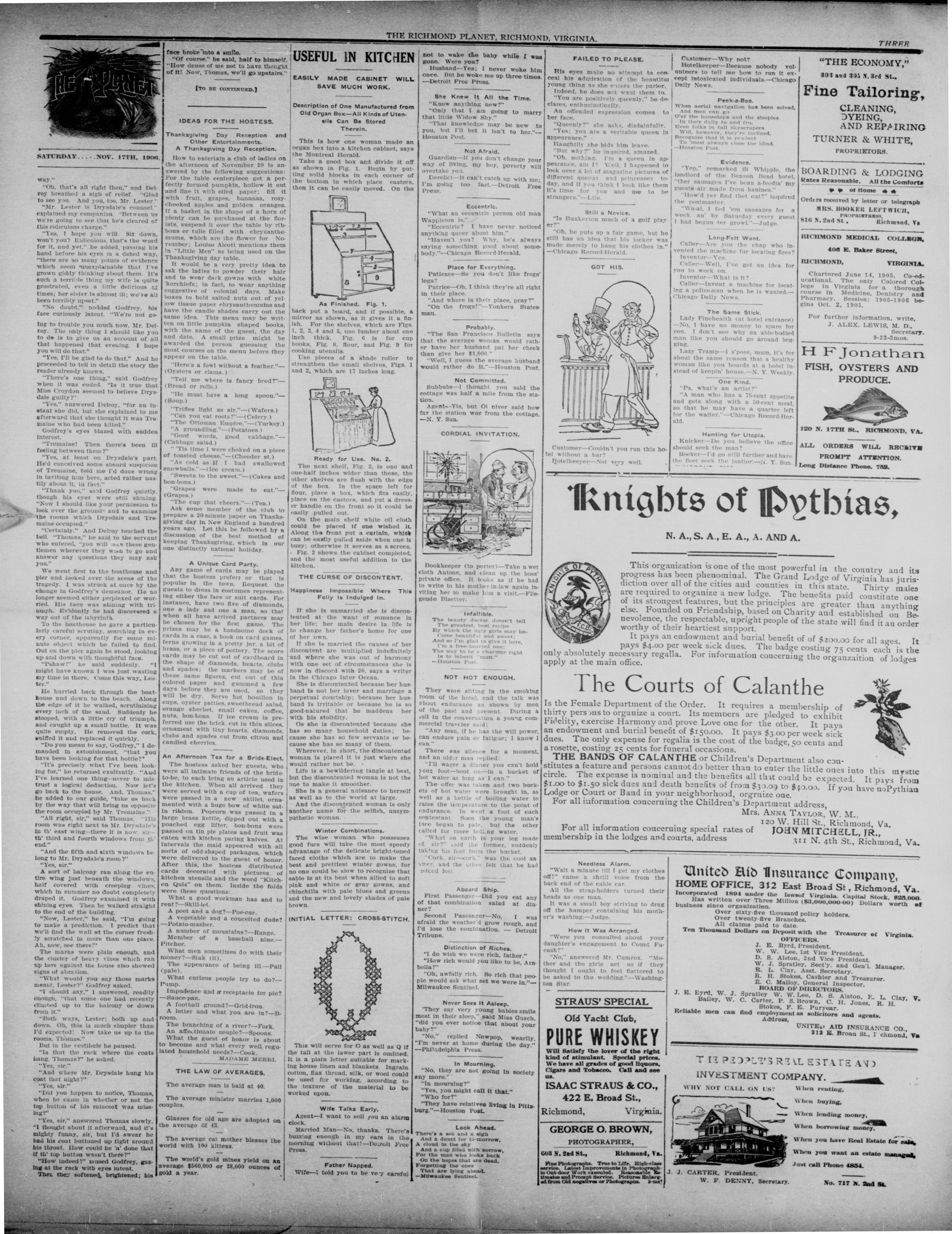
USEFUL IN KITCHEN
EASILY MADE CABINET WILL SAVE MUCH WORK.
Description of One Manufactured from Old Organ Box—All Kinds of Utensils Can Be Stored
Therein.
This is how one woman made an organ box into a kitchen cabinet, says the Montreal Herald.
Take a good box and divide it off as shown in Fig. 1. Begin by putting solid blocks in each corner of the bottom in which place castors, then it can be easily moved. On the
back put a board, and if possible, a mirror as shown, as it gives it a finish. For the shelves, which are Figs. 1, 2, 3, 4 and 5, use lumber about one inch thick. Fig. 6 is for cup books, Fig. 8, flour, and Fig. 9 for cooking utensils.
Use pieces of a shade roller to strengthen the small shelves. Figs. 1 and 2, which are 17 inches long.
The next shelf, Fig. 3, is one and one-half inches wider than these, the other shelves are flush with the edge of the box. In the space left for flour, place a box, which fits easily, place on the castors, and put a dresser handle on the front so it could be easily pulled out.
On the main shelf white oil cloth could be placed if one wished it. Along the front put a curtain, which can be easily pulled aside when one is busy; otherwise it serves as a screen.
Fig. 2 shows the cabinet completed, and the most useful addition to the kitchen.
THE CURSE OF DISCONTENT.
Happiness Impossible Where This
Folly Is Indulged In.
If she is unmarried she is discontented at the want of romance in her life; her main desire in life is to change her father's home for one of her own.
If she is married the causes of her discontent are multiplied indefinitely and where she was out of harmony with one set of circumstances she is now in discord with 20, says a writer in the Chicago Inter Ocean.
She is discontented because her husband is not her lover and marriage a perpetual courtship; because her husband is irritable or because he is so good-natured that he maddens her with his stolidity.
Os she is discontented because she has so many household duties; because she has so few servants or because she has so many of them.
Wherever, in short, the discontented woman is placed it is just where she would rather not be.
Life is a bewildering tangle at best, but the discontented woman is not the one to make it smoother.
She is a general nuisance to herself as well as to the world at large.
Winter Combinations.
The wise woman who possesses good furs will take the most speedy advantage of the delicate bright-toned faced cloths which are to make the best and prettiest winter gowns, for no one could be slow to recognize that sable is at its best when allied to soft pink and white or gray gowns, and chinchilla with pale blues and greens and the new and lovely shades of pale brown.
INITIAL LETTER: CROSS-STITCH.
This will serve for O as well as Q if the tail at the laver part is omitted. It is a plain letter suitable for marking house linen and blankets. Ingrain cotton, flax thread, silk, or wool could be used for working, according to the texture of the material to be worked upon.
Wife Talks Early
Agent—I want to sell you an alarm clock.
Married Man—No, thanks. There's buzzing enough in my ears in the morning without that!—Detroit Free Press.
not to wake the baby while I was gone. Were you?
Husband—Yes; I never woke him once. But he woke me up three times.
—Detroit Free Press.
She Knew It All the Time.
"Know anything new?"
"Only that I am going to marry that little Widow Shy."
"That knowledge may be new to you, but I'll bet it isn't to her."—Houston Post.
Not Afraid.
Guardian—If you don't change your way of living, my boy, poverty will overtake you.
Derelict—It can't catch up with me; I'm going too fast—Detroit Free Press.
Eccentric
"What an eccentric person old man Wappleton is."
"Eccentric? I have never noticed anything queer about him."
"Haven't you? Why, he's always saying something good about somebody."—Chicago Record-Herald.
Place for Everything
Patience—So you don't like frogs' legs?
Patrice—Oh, I think they're all right in their place.
"And where is their place, pray?"
"On the frogs!"—Yonkers Statesman.
Probably.
"The San Francisco Bulletin says that the average woman would rather have her husband pat her cheek than give her $1,000."
"Well, I guess the average husband would rather do it." -Houston Post.
Not Committed
Subbuhs—I thought you said the cottage was half a mile from the station.
Agent--Yls, but Ol niver said how far the station wor from the cottage.
—N. Y. Sun.
CORDIAL INVITATION.
Bookkeeper (to porter)—Take a wet cloth Antone, and clean up the boss' private office. It looks as if he had to write to his mother-in-law again inviting her to make him a visit.—Fliegende Blaetter.
Infallible
The beauty doctor doesn't tell
The greatest, best recipe
By which the ugly girls may be
Come beautiful and sweet;
And so I am glad to give it here,
I'm a free-hearted one;
The woman is a charmer right
To inherit "mum."
—Houston Post.
NOT HOT ENOUGH.
They were sitting in the smoking room of the hotel, and the talk was about endurance as shown by men of the past and present. During a趴 in the conversation a young commercial traveler said:
"Any man, if he has the will power, can endure pain or fatigue; I know I can."
There was silence for a moment, and an older man replied:
"I'll wager a dinner you can't hold your foot—boot on—in a bucket of hot water as long as I can."
The offer was taken and two buckets of hot water were brought in, as well as a kettle of boiling water to raise the temperature to the point of endurance. In went a foot of each contestant. Soon the young man's face began to pale, but the other called for more boiling water.
"What on earth is your leg made of, sir?" said the former, suddenly taking his foot from the bucket.
Cork, sli—cork," was the cool an
swee, and the other felt that he had
grown.
Aboard Ship
First Passenger—Did you eat any of that combination salad at dinner?
Second Pasesnger—No. I was afraid the weather'd grow rough, and I'd lose the combination. — Detroit Tribune.
"Oh, awfully rich. So rich that people would ask what set we were in."—Milwaukee Sentinel.
Never Sees It Asleep
"They say very young babies smile most in their sleep," said Miss Gusch, "did you ever notice that about your baby?" "No," replied Newpop, wearily, "I'm never at home during the day." —Philadelphia Press.
"No, they are not going in society any more."
"In mourning?"
"Yes, you might call it that."
"Who for?"
"They have relatives living in Pittsburg."—Houston Post.
Look Ahead.
There's a sob and a sigh
And a doubt for to-morrow,
A cloud in the sky
And a cup filled with sorrow,
For the man who looks back
On the hopes that are dead,
Forgetting the ones
That are lying ahead.
-Milwaukee Sentinel.
Knights of Pythias,
This organization is one of the most powerful in the country and its progress has been phenominal. The Grand Lodge of Virginia has jurisdiction over all of the cities and counties in this state. Thirty males are required to organize a new lodge. The benefits paid constitute one of its strongest features, but the principles are greater than anything else. Founded on Friendship, based on Charity and established on Benevolence, the respectable, upright people of the state will find it an order worthy of their heartiest support.
It pays an endowment and burial benefit of of $200.00 for all ages. It pays $4.00 per week sick dues. The badge costing $100.00 is not included.
The Courts of Calanthe
Is the Female Department of the Order. It requires a membership of thirty persons to organize a court. Its members are pledged to exhibit Fidelity, exercise Harmony and prove Love one for the other. It pays an endowment and burial benefit of $150.00. It pays $3.00 per week sick dues. The only expense for regalia is the cost of the badge, 50 cents and a rosette, costing 25 cents for funeral occasions.
THE BANDS OF CALANTHE or Children's Department also constitutes a feature and persons cannot do better than to enter the little ones into this mystic circle. The expense is nominal and the benefits all that could be expected. It pays from $1.00 to $1.50 sick dues and death benefits of from $30.09 to $40.00. If you have no Pythian Lodge or Court or Band in your neighborhood, orgnize one.
For all information concerning the Children's Department address
For all information concerning special rates of JOHN MITCHELL, JR. membership in the lodges and courts, address 311 N. 4th St. Richmond, Va.
FAILED TO PLEASE.
Inneed, he does not want them to.
"You are positively queenly," he declares, enthusiastically.
An offended expression comes to her face.
"Queenly?" she asks, disdainfully.
"Yes; you are a veritable queen in appearance."
Haughtily she bids him leave.
"But why?" he inquired, amazed.
"Oh, nothing. I'm a queen in appearance, am I? Well, I happened to look over a lot of magazine pictures of different queens and princesses today, and if you think I look like them it's time for you and me to be strangers."—Life
Still a Novice
"Is Bunkerton much of a golf player?"
"Oh, he puts up a fair game, but he still has an idea that his locker was made merely to hang his clothes in."
—Chicago Record Herald.
GOT HIS.
Customer—Couldn't you run this hotel without a bar?
Hotelkeeper—Not very well.
KNIGHTS OF PYTHIAAS.
F.C.E.
only absolutely necessary rega
apply at the main office.
The Court
Is the Female Department of the
thirty persons to organize a court
Fidelity, exercise Harmony and
an endowment and burial bene
dues. The only expense for re
a rosette, costing 25 cents for fu
THE BANDS OF CALA
stitutes a feature and persons c
circle. The expense is nomina
$1.00 to $1.50 sick dues and de
Lodge or Court or Band in you
For all information concerni
For all information concern
membership in the lodges and
Needless Alarm
"Walt a minute till I get my clothes off!" came a shrill voice from the back end of the cable car.
All the strap-holders turned their heads as one man.
It was a small boy striving to drag off the hamper containing his mother's washing.—Judge.
How It Was Arranged.
"Were you consulted about your daughter's engagement to Count Fucash?"
"No," answered Mr. Cumrox. "Mother and the girls act as if they thought I ought to feel flattered to be asked to the wedding"—Washington Star.
STRAUS' SPECIAL
Old Yacht Club,
PURE WHISKEY
Will Satisfy the lover of the right kind of stimulant. Special prices.
We have all grades of good liquors,
Cigars and Tobacco. Call and see us.
ISAAC STRAUS & CO.,
422 E. Broad St.,
Richmond, Virginia.
GEORGE O. BROWN.
Fine Photographs. True to Life. High-class service. Latest Improvements in Photographs to Get Door Works erected. Reusable Estimates and Prompt Service. Pictures Enlarged from Old negatives or Photographs. 3-ms!
Hotelkeeper—Because nobody volunteers to tell me how to run it except intoxicated individuals.—Chicago Daily News.
When aerial navigation has been solved
And men can go
O'er the houseets and the steeples
In their daily to and fro.
Even folks in tall skyscrapers
Will follow in steep inclined.
Recognize that it is present
To 'most always close the blind.
—Houston Post.
"Yep," remarked Si Whipple, the landlord of the Benson Bend hotel, "ther sausages I've bean a-feedin' my guests air made from kanines." "How'd yer find the out?" inquired the postmaster. "Wa-al, I fed 'em sausages fer a week, an' by Saturday every guest I had begun ter growl."—Judge
Caller—Are you the chap who invented the machine for locating fires?
Inventor—Yes.
Caller—Well, I've got an idea for you to work on.
Inventor—What is it?
Caller—Invent a machine for locating a policeman when he is wanted.—Chicago Daily News.
Lady Finchealth (at hotel entrance)—No, I have no money to spare for you. I don't see why an able-bodied man like you should go around begging.
Lazy Tramp—I's'pose, mum, it's far about the same reason that a healthy woman like you boards at a hotel instead of keepin' house.—N. Y. Weekly.
"A man who has a 75-cent appetite and gets along with a 50-cent meal, so that he may have a quarter left for the waiter."—Chicago Record-Herald.
Hunting for Utopia.
Knicker—Do you believe the office should seek the man?
Bocker—I'd go still further and have the fleet seek the janitor—N. Y. Sun.
Pythias,
A. AND A.
the most powerful in the country and its
The Grand Lodge of Virginia has juris-
counties in this state. Thirty males
ledge. The benefits paid constitute one
principles are greater than anything
based on Charity and established on Be-
ight people of the state will find it an order
trial benefit of of $200.00 for all ages. It
The badge costing 75 cents each is the
in concerning the organization of lodges
N. A., S. A., E. A., A. AND A.
organization is one of the most powerful has been phenomenal. The Grand Dauver all of the cities and counties in need to organize a new lodge. The biggest features, but the principles founded on Friendship, based on Charity, the respectable, upright people of their heartiest support. An endowment and burial benefit of per week sick dues. The badge of regalia. For information concerning courts of Calanthe.
at the Order. It requires a member court. Its members are pledged and prove Love one for the other. Benefit of $150.00. It pays $3.00 per regalia is the cost of the badge, 50 funeral occasions.
ANTHE or Children's Department cannot do better than to enter the final and the benefits all that could death benefits of from $30.09 to $40 our neighborhood, orgnize one.
using the Children's Department ad Mrs. ANNA TAY 120 W. H.
perning special rates of JOHN and courts, address 31
United Aid Insure HOME OFFICE, 312 East Incorporated 1894 under the laws. Has written over Three Million business since organization. Over sixty-five thousand Over twenty-five Branche All claims paid to date. Ten Thousand Dollars on Deposit w OFFICE
Department also con-
to enter the little ones into this mystic
al that could be expected. It pays from
$30.09 to $40.00. If you have noPythian
ernize one.
Department address,
Ms. ANNA TAYLOR, W. M..
120 W. Hill St., Richmond, Va.
JOHN MITCHELL, JR.,
311 N. 4th St., Richmond, Va.
Insurance Company,
No. 312 East Broad St., Richmond, Va.
Under the lawsof Virginia. Capital Stock, $25,000.
Three Million ($3,000,000·00) Dollars worth of
ation.
Five thousand policy holders.
Five-five Branches.
Paid to date.
On Deposit with the Treasurer of Virginia.
OFFICERS.
United Aid Insurance Company.
United Aid Insurance Company.
Incorporated 1894 under the lawsof Virginia. Capital Stock, $25,000.
Has written over Three Million ($3,000,000.00) Dollars worth of business since organization.
J. E. Byrd, President.
W. W. Lee, 1st Vice President.
D. S. Alston, 2nd Vice President.
J. W. Spratley, Sect'y, and Gen'l. Manager.
R. L. Clay, Asst. Secretary.
R. H. Stokes, Cashier and Treasurer.
R. C. Malloy, General Inspector.
BOARD OF DIRECTORS
J. E. Eyrd, W. J. Spratley W. W. Lee, D. S. Alston, F. L. Clay, V. Bailey, W. C. Carter, P. S. Brown, C. H. Jones, R. H.
J. E. Eyrd, W. J. Spratley W. W. L.
Bailey, W. C. Carter, P. S. H.
Stokes, F. E.
Reliable men can find employment at
Address,
U
TIE PEOPLE'S REAL
INVESTMENT COMP
WHY NOT CALL ON US?
LE'S REAL ESTATE AND
NT COMPANY.
N US? When renting,
When buying,
THE PEOPLE'S REAL ESTATE AND
J. J. CARTER, President.
W. F. DENNY, Secretary.
---
Peek-a-Boo.
Evidence.
Long-Felt Want
The Same Stick.
One Kind.
Hunting for Utopia
THREE
"THE ECONOMY,"
303 and 305 N. 3rd St..
Fine Tailoring,
CLEANING,
DYEING,
AND REPAIRING
TURNER & WHITE,
PROPRIETORS.
BOARDING & LODGING
Rates Reasonable. All the Comforts
Orders received by letter or telegraph
MRS. BOOKER LEFTWICH,
PROPRIETRESS,
816 N. 2nd St. Richmond, Va
RICHMOND MEDICAL COLLEGE
406 E. Baker Street.
Chartered June 14, 1905. Co-educational. The only Colored College in Virginia for a thorough course in Medicine, Denistry and Pharmacy. Session: 1905-1906 begins Oct. 2, 1905.
For further information, write,
J. ALEX. LEWIS, M. D.,
Secretary.
9-23-3mos.
H F Jonathan
FISH, OYSTERS AND
PRODUCE.
ALL ORDERS WILL RECEIVE
PROMPT ATTENTION.
Long Distance Phone. 752
M
UNITED AID INSURANCE CO.,
312 E. Broa St. I. chmgh. Vv
When lending money,
When borrowing money,
When you have Real Estate for sale,
When you want an estate managed,
Just call Phone 4854.
No. 717 N. 2nd St.
FOUR
THE PLANET
Publication cover statement by JOHN MITCHELL
JR, at all North 4th Street, Richmond Va.
JOHN TITCHELL, JR, • EDITOR
We communications intended for publication
would be sent so as to reach us by Wednesday
ADVERTISING BATES
REWENALE, Eto.—If you do not want THE PLANET continued for another year after your subscription has run out, you then notify us by a Card to be continued. The council have decided that subscribers to newspaper, who do not order their paper discontinued at the expiration time for which it has been paid for, for the payment of the subscription up to date when they order the paper discontinued.
COMMUNICATIONS—When writing to us to renew your subscription or sodicontinue your paper, you should give your name and address to ourselves we cannot find your name on our books.
CHANGE OF ADDRESS—In order to change the address of a subscriber, we must be sent the former as well as the present address.
Entrusted at the Post-Office at Richmond, Va. in second class matter.
SATURDAY. NOV. 17TH, 1906
White folks cannot legislate against Negroes without ultimately injuring themselves.
Richmond is to have a larger police force by twenty five men. This is all right. If the right persons secure appointments.
The South punishes the innocent for the guilty just as President Roosevelt and the War Department have done, but it uses the mob to do it.
Colored men, we must continue to be polite and obliging and above all save money. Religion is a good thing for heaven and earth too for that matter, but buy land and get an education.
We have endeavored to believe that the New York situation was in a measure responsible for President Roosevelt's action in endorsing the report of the War Department.
We are pleased to note the election of Attorney F. L. Barnett to a municipal judgeship in Chicago, Ill. He is able, diplomatic and manly and the people of that city, in our judgment will have no cause to regret his selection.
White southerners will feel all right so long as President Roosevelt "boots" out of the army all of the Negroes from the North, but when it comes to doing the same favor for the Negroes of the South there will be a protest from that quarter.
Every colored man of influence and responsibility should write a letter marked "Personal" to President Roosevelt, White House, Washing ton, D. C. It should contain a protest against punishing innocent colored men of Campanies B, C, and D of the Twenty fifth Infantry and asking for the revocation of the order dismissing them from the service.
We have advised against the blaming of the liberal minded white men of the South for the action of those of the Negro hating kind, and now President Roosevelt has virtually said that we are wrong and should blame and condemn every last one of them.
Colored men should not be cast
Jown and discouraged by the attitude
of the War Department and Presi-
dent Roosevelt. For every Negro
hater who smiled there were two
justice loving loving white men who
frowned.
The antipathy of the War Department to the Negro as a soldier has been known for a decade, but the antipathy of President Roosevelt to this same class of people has been known only for about a couple of weeks.
We have been wondering what became of that "Square Deal" book of ethics, when President Roosevelt was approving that report of Inspector General Garlington. He wrote it no doubt, but he had evidently forgotten some of its most elementary passages.
We did not refer to the recent escapade of the son of President Roosevelt and his companions at Boston recently, because it seemed to us to be in poor taste and a delicate reference to the private life side of the Distinguished Chief Executive and those who are reminding us of it will please take notice.
One thing we believe and that is that the President did not consult Dr. Booker T. Washington before he issue1 his order punishing the innocent soldiers of the 25th Infantry. We have not seen as yet a copy of any journal in the country even intimating that he did.
All of those colored folks who did not succeed in grasping the presidential hand during the occasion of his recent trip through the Southland will understand why since they have read the official order of the War Department that the President has approved.
We should not wipe out or minimize all of the good things that President Roosevelt has Jone because he has made a blunder in the case of the three companies of the Twenty-fifth Infantry. He may see his way clear to rescind his order and he may see his way cloudy to stick to it. In either case, the public will see what it had not seen before.
The presence of even one innocent colored soldier in Companies B. C. and D of the 25th Infantry made it utterly impossible for Press, Roosevelt to justly promulgate and approve of the recommendations of the War Department, and yet there were a couple of hundred of them just as innocent as the one man to whom a reference is made.
The Roosevelt-Washington "Social Equality" picture wont be so popular through this section of the country just now. Crepe dealers should take notice and prepare for orders to drape this wall ornament that has been so popular in all sections of the country, where colored folks have a habitation and a name.
The members of Companies B, C and D of the Twenty-fifth Infantry should appeal from the decision of the War Department and President Roosevelt dismissing them from the service and barring them from civil and military service. They should "fight it out on this line, if it takes all summer." It may be that President Roosevelt will revoke the order when the case is presented to him in the proper light by able counsel and this course should first be followed before an appeal is made to the courts.
---
When President Roosevelt almitte that there were men in the three companies of the Twenty-fifth Infantry, who did not commit the offenses charged against some of the members at Brownsville, Texas, and who did not have any information as to who committed them he gave away his case and classed his own action as one of the most unjust and arbitrary exercises of power ever resorted to in this or any other country.
During a period of thirty years, we have no recollection of noticing a case where a Southern Democratic official ever knowingly meted punishment to a colored man confessedly innocent at the time that he meted it and who openly acknowledged that he was punishing the innocent for the guilty and yet after all of the facts are considered, this is what the War Department and President Roosevelt have done in the case of the dismissed companies of the Twenty-fifth Infantry.
The War Department at Washington is evidently somewhat worried
THE RICHMOND PLANET, RICHMOND, VIRGINIA.
by the wholesale condemnation it has received and it now announces that it will publish a report of the findings in the case of the killing of the Chief of Police at Brownsville, Texas. We would like to know how that would affect the situation. When it can justify the punishment of a confessedly innocent man for other alleged guilty ones, it will then be in a position to give its slide of this controversy to the public.
President Roosevelt used Col. Pitcher as a buffer to show that he did not punish the innocent colored soldiers on account of their color, and now comes Col. Pitcher and says that he did not make any such remark concerning colored troops. On the contrary, he has served with them in the past and he is willing to serve with them in the future. His language is so strong that it seems that the enemies of the Negro troops are not only anxious to punish them, but one of their white friends as well. It seems in order though, in keeping with the policy of Brigaller General E. A. Garlington and Commander in Chief Theodore Roosevelt to punish somebody. It is evident that some white officer said it and it is "proper" to punish Colonel Pitcher for this alleged offense unless the man who did say it comes forward and gives himself up or unless Col. Pitcher finds out and tells who made this ungentlemanly remark concerning the brave soldiers of the 9th and 10th Cavalry.
GENERAL SHAFTER PASSES AWAY
Retired Army Officer Dies of Pneumonia in California.
COMMANDED TROOPS IN CUBA
Bakersfield, Ca., Nov. 13. — Major General William Rufus Shafter, U. S. A., retired, died at the ranch of Captain W. H. McKittrick, his son-in-law, 20 miles south of this city, after an illness of seven days, despite the best medical attention available in California.
Captain and Mrs. Kitttrick, the general's son-in-law and daughter; Miss
GENERAL W. R. SHAFTER.
Edmunds, a niece, and Captain James
N. Shafter, a brother, were at the bed-
side when the end came.
Sketch of Major General W. R. Shafter.
The son of a pioneer farmer, Major General William R. Shafter was born in Galesburg, Mich., October 16, 1825. With scant educational opportunities, he toiled on his father's fram until he attained his majority. By that time he had saved sufficient money to carry him through the winter term at the Prairie seminary. He returned to agricultural pursuits, but the monotony of a farmer's life was irksome to his ambitious spirit, and the outbreak of the civil war found him ready and eager to become a soldier.
In the summer of 1862 the 19th Michigan Regiment was organized and Shafter was assigned to it, with the rank of major. The regiment joined the western army, and for a year or more saw a great deal of hard service in Kentucky and Tennessee. Together with other Federal officers, he was captured by the Confederates, but his gallantry in battle had been so conspicuous that his captors allowed him to retain his horse and side arms. He was a prisoner of war for three months and was exchanged in May, 1863.
On May 3, 1897, Colonel Shafter was promoted to be brigadier general of the United States army, and was assigned to the command of the Department of the Columbia. Soon afterward he was transferred to the Department of California, becoming the department commander at the same station where he had for so many years been post commandant.
With the development of plans for the invasion of Cuba, after the war with Spain began in 1898, the president and secretary of war began to look about for suitable leaders. Prominent among the eligibles was General Shafter. President McKinley made him a major general of volunteers on May 4, 1898, and he was assigned to command the troops in the Santiago campaign.
Shafter was put in command, and he conducted the Santiago campaign in an original and peculiar style. He is a big man and has long been afflicted with the gout, and he ordered the advance on Santiago while lying at ease in a transport off the landing place, far from the enemy's guns. According to the accounts of President Roosevelt and others present in the field, he ordered the men to march through the chaparral under the murderous fire of the Spaniards, and but for the good judgment of the officers in command our army would have suffered ignoble defeat and terrible loss of life. They concluded to ignore Shafter's orders and proceeded on their own plans, preventing further se-
rious loss and gaining such advantages that the Spaniards, under General Toral, were forced to surrender. October, 1859, General Shafter went on the retired list of the regular army, having reached the prescribed age of 64 years. He, however, remained in command of the Department of the Pacific until July 1, 1901, when enlistment of Spanish war volunteers expired. He retired with the rank of major general.
Sister Mary Julia is Dead.
Chicago. Nov. 14. — Sister Mary Julia, founder and mother superior of St. Vincent's orphan asylum, in this city, who gained an international reputation in religious circles because of her benevolence and assistance to the poor, died at the orphanage of pneumonia after an illness of a few days. Sister Julia, whose former name was Sophie Woolfel, entered the convent of the Sisters of Charity at St Vincent's de Paul Society, at Emmitsburg, Md., when she was 15 years old, and for the last 25 years has b en actively connected with the religious and county work of the society. Several years ago, while connected with the St. Agnes hospital, Baltimore, Sister Julia founded the new water cure sanitarium.
Dropped Dead Running For Train.
Trenton, N. J., Nev 14 — V. C. Sweetman, of 1508 Green street, Philadelphia, dropped dead here while running to catch a train. Mr. Sweetman was 55 years old and was visiting here
A WEEK'S NEWS CONDENSED
Thursday, November 8
THURSDAY, NOVEMBER 8.
John D. Rockefeller has given close to $2,000,000 to Chicago University this year.
Henry Faltermayer was struck and instantly killed by an electrion on the Pennsylvania railroad at Glassboro, N. J.
While despondent over financial losses, due to the election, S. Henry McCabe, of Philadelphia, shot and killed himself.
Samuel Strother, formerly assistant prosecuting attorney of Kansas City, Mo., was arrested on the charge of trying to bribe voters.
The fourstory brick building of the Harvest King Distilling company at Kansas City, Mo., was destroyed by fire, entailing a loss of $400,000.
Friday, November 9.
Mrs. Mary Brown died in Philadelphia of acute heart disease brought on by taking a headache powder.
In a tenement house fire in New York Mrs. James Ryan and John McGuire 11 years old, were fatally burned.
A powder magazine of the Dupont company, at Tinley Park, near Chicago, exploded, killing one man and doing great damage to property.
The department of justice at Washington has issued instructions to S. J. Lehman, special counsel, to begin proceedings against the person or persons believed to be implicated in the recent embezzlement of $61,500 from the subtreasury at St. Louis.
Saturday, November 10.
Goat skins to the value of $32,000,000 were imported into the United States during the fiscal year 1906.
The Aero Club of America will hold next year's balloon race for the James Gordon Bennett cup at St. Louis.
The Standard Oil company granted a 5 and 10 per cent. advance in wages to all employees of the refining branch. Mrs. William Rush, 30 years old, was asphyxiated in bed at her home at Martin's Creek, Pa., by coal gas from the kitchen range. Jacob Hauser, Sr., father of Jacob Hauser, Jr., who was hanged last February at Johnstown, Pa., for wife murder, committed suicide from worry over his son's fate. Monday, November 12. Miners John Zonosky and Joe Zolsky were killed by falling rock in a Mayfield, Pa., mine. A board flew from a machine saw at Lewistown, Pa., and stabbed J. M. Mowery in the abdomen. The Illinois Grand Lodge, Knights of Pythias, has ordered the immediate construction of a $150,000 home at De-Francis A. Wesley, of New Smithsville, stored and marketed 796 bushels of apples, the largest crop so far raised in Lehigh county, Pa.
Brigadier General Funston has left Kansas City for St. Louis to take command of the division of the southwest, catur for old persons and orphans.
Tuesday, November 13.
All the building contractors of Mobile, Ala., have declared for the open shop basis.
William Auth, of Newark, N. J., shot and killed herself in Central Park, New York, while suffering from ill health.
Bert Seely, who was under suspicion of murder at Owosso, Mich., was found dead in bed, and beside him was his young wife, also dead.
A Michigan Central railroad engine ran away in Detroit, Mich., and crashed into the depot, killing one person and injuring several others.
The United States supreme court will take a recess from Monday, November 19, to Monday, December 3, over the Thanksgiving holidays.
Wednesday, November 14.
The Erie Railroad company has placed orders for 58,550 tons of steel reils for delivery during 1907.
Vincent Moore and his 11-year-old son were burned to death in a fire which destroyed their home at Paoli, Ind.
Two lives were lost and the village of Richland, O., practically wiped out by a fire which was caused by an explosion of gas.
Armed bandits held up a Southern Pacific express at Carlin, Nev., and escaped with over $1000 and the suit cases of the passengers.
President Roosevelt will be asked to deliver the address at the unveiling of the monument to General Lawton at Indianapolis, Ind., on next Memorial Day.
Whiskey Kills Little Girl
Hopkinsville, Ky., Nov. 14. — A 6-year old daughter of James Cannon, a saloonkeeper, died from the effects of four ounces of whiskey which she drank from a bottle she found on the mantle. Physicians worked for 24 hours in an effort to save her life.
FRAMING UNIFORM DIVORCE BILL
National Congress in Session at Philadelphia.
PART OF MEASURE ADOPTED
Philadelphia, Nov. 14—The National Congress on Uniform Divorce Laws, in session in this city, adopted about one-third of the proposed uniform bill as drafted by the committee appointed at the meeting held in Washington nine months ago. The portions adopted include seven causes under which annulment of a marriage may be obtained and six causes for absolute divorce.
Delegates from 27 states and the District of Columbia and representatives of all Protestant denominations who attended the international conference on marriage, together with the Catholic prelate, Bishop Shanley, of North Dakota, attended the sessions, which were presided over by Governor Pennypacker. The important changes in the bill are the striking out of all reference to proceedings and practice, leaving the question for the various legislative bodies to pass upon. The committee decided that so long as open hearings are held and the laws provide for direct service on the respondent and fix a punishment for collusion, the measure need not conform to any fixed rule.
The causes for which divorce can be granted are infidelity, felony, bigamy, desertion, habitual drunkenness and intolerable cruelty, and in the discussions of the various sections there was little opposition to any of these provisions, but in the list of causes for annulment of marriage, opposition was presented against several.
Governor Pennypacker took exceptions to the clause which provides that if either party unknown to the other was insane at the time of marriage, it should be annulled. The governor held that the clause not only gave the sane party the right to begin suit, but also to a committee of the lunatic. This would give a commission appointed by the court a right to begin a suit in the name of an insane party, even if the person not insane did not want divorce. He argued that marriage was a personal relation and a third party had no rights in the contract.
Seneca N. Taylor, of St. Louis, and C. La Rue Munson, of Williamsport, Pa. clashed with the governor on the subject. Mr. Taylor said the third party is the public, and it has a right to forbid the propagation of children from the insane. The question of property rights he also held was involved. Mr. Munson said the clause was the only protection for an insane person against a designing man or woman. He cited a case where relatives and friends were helpless to protect an imbecile who had married a designing woman. The clause was adopted.
There was also opposition to the clause annulling the marriage of a girl under the age of 16 and a youth under 18. Ernest Merten, of Wisconsin, held that a girl under 18 years was incapable of making a proper marriage contract, and Frank H. Kerr, of Ohio, favored the law of his state, which makes the marriage of a boy under 21 and a girl under 18 void. Miss Rachael Siegel, of Utah, the only woman speaker, held that 16 years for the girl was all right. She said: "We women ought to know." The clause was adopted.
Though personally opposed to divorce, Bishop Shanley voted for the sections in behalf of his state because the other delegates were not present.
WILL PROSECUTE OIL TRUST
Government Will Try to Dissolve Standard As It Now Exists
Standard As It Now Exists.
Washington, Nov. 13. While no au-
thoritative statement could be ob-
tained in regard to the matter, there
is good reason to believe that the政
府 has decided to institute proce-
cutions against the Standard Oil
company under the Sherman anti-
trust act, with a view of obtaining an
order of the court dissolving the com-
pany as it now exists and restoring to
each of the 75 or 89 constituent
companits its proportionate share of the
stock and also compelling the observa-
tion of the law inhibiting them from
entering into any contract, agreement
or understanding with each other with
a view to maintaining prices on oil.
JOHN MITCHELL RENOMINATED
Mine Workers' Leader Will Not Retire From Union.
Indianapolis, Nov. 13—All doubts as to whether President Mitchell intends continuing as president of the United Mine Workers of America or not have been set at rest by the announcement that Mr. Mitchell has been renominated for the office, and that he will permit his nomination to stand.
Two Killed By a Train.
Baltimore, Md., Nov. 12. — George Strohecker and Paul Meyer, brothers-in-law, while walking on the tracks of the Pennsylvania railroad on their way to a cemetery to visit the graves of relatives, were struck by an express train. Strohecker being instantly killed and his body horribly mangled, and Meyer dying, without regaining consciousness, about an hour after the accident, which occurred a short distance from Carroll station, near the city.
Stands On Steeple to Win $25 Bet.
Mahanoh City, Pa., Nov. 12. — Hand-over-hand Gus Sleik, a young miner, to win a bet of $25, climbed 160 feet to the top of St. Joseph's church steeple here and stood upright upon the bars of the gilfer cross.
Roads Impassable From Snow.
Washington, Pa., Nov. 14.—Rural mail carriers traveling routes northeast of Washington reported that snow in such quantities had fallen that some of the roads were impassable and they were forced to take to the fields to get around drifts.
A CHANCE FOR THE COLORED PEOPLE
TO ARISE IN ALL PARTS OF AMERICA.
Archbishop JUSTICE
Who is Now Forming and Creating Members of the Negro Race, the Helpies.
WILL ADDRESS THE COLONIAL
From 2111 W. Columbus
BEGINNING NOW.
If any man or woman of the this great hero of the race, knowledge and understand a whole life time, for he is Archbishop has made ample seven hundred thousand (700,000 of the whole Negro Race to be syndicate, and every one who bring some money with them, never before come to the color offered them to take advantage seized upon by each and every or 50 cents each.
Each address will appear of Life Magazine; copies of it.
REV. SAY MOSES REDMON, Agent.
P. S. All members of the Negro race areate. Any who will, can get thorough Company in the October number of the cents, or if 25 cents is sent to the Home bia Ave., Philadelphia, Pa., one of the exchange for 25 cents. The receivers of vocate the contents of the Bonds, or act for a term of five years. This is a good young women of the Negro race, who five years employment at a good salary.
Who is Now Forming and Creating a Pure, Godly Syndicate out of True Members of the Negro Race for the Purpose of Delivering the Helpless from Evil
WILL ADDRESS THE COLORED PEOPLE OF AMERICA.
From 2111 W. Columbia Ave., Philadelphia, Pa.
BEGINNING NOV. 6th to 26th, 1906
If any man or woman of the Negro Race misses hearing this great hero of the race, they will miss a fortune of knowledge and understanding which is hard to gain in a whole life time, for he is full of sound wisdom. And the Archbishop has made ample provision and room for over seven hundred thousand (700,000) of the best men and women of the whole Negro Race to be united together in this great syndicate, and every one who comes to hear him should bring some money with them, as such opportunities as have never before come to the colored people in America, will be offered them to take advantage of at that time, which can be seized upon by each and every person present for at least 25 or 50 cents each.
Each address will appear each week in the True Light of Life Magazine; copies of it can be had for 10 cents each.
REV. SAMUEL HORMAN, Secretary.
MOSES REDMON, Agent.
P. S. All members of the Negro race are invited to take stock in this great Syndicate. Any who will, can get thorough understanding of the basis of the great Company in the October number of the True Light of Life Magazine for 10 cents, or if 25 cents is sent to the Office of the Syndicate, No. 2111 Columbia Ave., Philadelphia, Pa., one of the Company's Trust Bonds will be sent in exchange for 25 cents. The receivers of a copy of the Bonds are at liberty to advocate the contents of the Bonds, or act as agents for them, the Company for a term of five years. This is a good chance for energetic young women and young women of the Negro race, who send and get a copy of the Bonds to get five years employment at a good salary. Trustworthy agents wanted everywhere.
47 DEAD IN BURNING WRECK
Immigrant Train Takes Fire After Collision With Freight.
45 BODIES WERE CREMATED
Chicago. Nov. 13.—More than one half the passengers on an immigrant train on the Baltimore & Ohio road were killed and injured in a collision between the passenger train and a freight near Woodville, Ind.
One hundred and sixty-five passengers were on the train. Of these 47 were either killed outright or were burned to death in a fire that broke out in the wreckage immediately after the collision. The names of all of the dead will probably never be known as 45 of the bodies were consumed in the flames or were so badly burned that identification will be out of the question.
Thirty-eight people were injured, and several of these will die. Eighty others escaped unhurt, but lost nearly all their baggage and clothing.
The disaster was caused by a blunder of some employee of the railroad company, but just where the blame lies has not as yet been determined. The passenger train, which was loaded with Russian Jews, Servians and Poles, all of them recent arrivals in this country, and bound for Chicago or places in the northwest, was the second section of a through train from Baltimore.
A light snow was falling, and as the freight was rounding a sharp curve just west of Woodville the second section of the immigrant train came in sight a short distance away, tearing toward Chicago at the rate of 40 miles an hour. The two trains came together with unslackened speed, and in the crash six passenger coaches and several freight cars were knocked into kindling wood, and, together with the locomotives, went rolling down the 10-foot embankment.
Fire broke out almost immediately in the wreckage, and although a number of the injured were saved by the desperate efforts of the train crew and surviving passengers, the greater part of those who were pinned down in the debris were burned to death. The flames spread through the wreckage so rapidly that it was impossible to save a number of people who were only slightly hurt, but were held fast by timbers that weighted them down. These were burned in plain sight of the throng that stood around the scene of the disaster utterly unable to lend assistance in any way. The fire continued until all of the shattered cars were entirely consumed, and of the 47 people whose death followed the collision, 45 were burned to ashes. All of the six cars of the immigrant train were burned, as were three freight cars.
The depot in Chicago was crowded with men and women who had come to this country to escape the massacres in Russia, and who, after months of hard work, had saved enough to pay the passage of members of their families, and their grief, when they became aware that possibly all their sacrifice and effort had resulted only in the death of those whom they had sought to bring to them, was pitiful. Crowds of Russians and Poles waited around the depot all day for news from Woodville, and when a train came in bearing the 38 injured persons, all of whom were taken to Mercy hospital for treatment, it was with the greatest difficulty that the police were able to open a passageway for the wounded.
Schooley Indicted For Forgery.
Scranton, Pa., Nov. 14. — George B. Schooley, the central figure in the contest over the estate of the late J. I. Crawford, was indicted for forgery by the grand jury. Shortly after Schooley started the contest he was arrested at the instance of James G. Sheperd, one of the heirs, and held in ball for court on the charge of forging the name of Mr. Crawford to the will and codicil, which he was endeavoring to have probated. Schooley will be tried at the next term of criminal court.
US J. EVANS, D. G.
A Pure, Godly Syndicate out of True
for the Purpose of Delivering
its from Evil
FREED PEOPLE OF AMERICA.
A Ave., Philadelphia, Pa.
26th to 26th, 1906
The Negro Race misses hearing
they will miss a fortune of
ing which is hard to gain in
full of sound wisdom. And the
provision and room for over
ooo) of the best men and women
united together in this great
comes to hear him should
as such opportunities as have
people in America, will be
of at that time, which can be
person present for at least 25
each week in the True Light
can be had for 10 cents each.
MUEL HORMAN, Secretary.
We invited to take stock in this great Syndi-
understanding of the basis of the great
True Light of Life Magazine for to
Office of the Syndicate, No. 2111 Colum-
Company's Trust Bonds will be sent in
a copy of the Bonds at liberty to ad-
as agents for them, or for the Company
chance for energetic young men and
send and get a copy of the Bonds to get
Trustworthy agents wanted everywhere.
Shot Little Sister Dead.
Burlington, N. J., Nov. 13—Henry Prisco, 10 years old, shot and instantly killed his 13-year-old sister, Mamie, in their home in the Italian quarter at West Palmyra. The shooting was done with a muzzle loading shotgun to repel burglaries. The boy got the weapon from a closet and intended to frighten his sister, who was still in bed. He did not know the gun was loaded and pulled the trigger. Part of the little girl's head was blown off.
Three Per Cent. Raise For Miners.
Hazleton, Pa., Nov. 12—The wages of the anthracite miners for the current month will be 7 per cent. above the $4.50 basis. This is 3 per cent. higher than the October wages and as high as the rate ever was under the sliding scale. Notice of the increase was received from United States Commissioner of Labor Charles P. Nell, who, under the agreement between the operators and miners, computes the rate every month.
Killed In Football Scrimmage
Great Falls, Mont. Nov. 12—In a football game at Fort Shaw between the Great Falls team and the Fort Shaw Indian team James Curtis, fullback for the Great Falls team, was killed in a scrimmage, internal injuries bringing about death. Curtis was 25 years old and a native of Syracuse, N. Y., where his parents live.
KILLED BY PET DEER
Wealthy Flour Exporter, of Montclair, N. J., Fatally Gored. New York. Nov. 12.--It was definitely established at Montclair, N. J., that a pet buck deer killed Herbert Bradley, a wealthy flour exporter, whose dead body was found on the preserves at his home there. Deputy County Physician Simmons, of Orange, found that Mr. Bradley's death was due primarily to the deer's ripping open an artery in his hip. The horns of the buck, the largest one belonging to Mr. Bradley, and his special pride, were found to be covered with blood. The animal also attacked him with his hoofs.
President's Party Nearing the lstmthus Washington. Nov. 14.—According to a wireless message which reached the White House, the battleship Louisiana with the president and party on board, was 600 miles off Colon. The weather was reported to be fine. The message came from the naval station at Guantanamo to Key West and thence to the Washington wireless station.
KILLED BY A BURGLAR
Son of Wealthy Pittsburg Man Shot to Death By Thief.
Pittsburg, Pa., Nov. 12.—Henry F. Smith, 25 years old, son of Joseph Smith, a prominent and wealthy business man of this city, was shot twice and almost instantly killed by a burglar whom he surprised in the dining room of his father's residence in the East End section of the city.
That a desperate battle took place between Smith and the burglar is evident from the disorder in the dining room and kitchen of the Smith home. In addition to two bullets which were found to have entered Smith's body, five other balls were found lodged in the floors and waist of the two rooms. Three cartridges of Smith's revolver had been discharged. Neighbors adjacent to the Smith home heard the shots and ran to their windows, but say they saw no one running from the house. Hundreds of dollars worth of silver plate had been gathered together by the burglar, who apparently had been in the house some time before being heard by young Smith. The entire police and detective forces are working on the case, but so far no clue has been discovered.
ADVOCATE BRYAN'S CANDIDACY
WORK For His Nomination.
New York, Nov. 13.—At a meeting of the Commercial Travelers' Anti-Trust League William Hoge, president of the league, in an address, advocated William Jennings Bryan for the next Democratic presidential candidate, and urged the members of the organization to assist in establishing clubs to work in behalf of Mr. Bryan, Harry W.
THE PLANET
SATURDAY...NOV. 17TH. 1906
Walker, chairman of the executive committee spoke along the same lines as Mr. Hoge.
It was voted that a committee be appointed to consist of 5000 Democratic commercial travelers, to be known as the "Traveling Committee." It was pointed out that the members on their journeys over the United States will distribute literature and organize Bryan clubs. It was also voted to establish a "record bureau," in which articles attacking the trusts will be kept, to be required in pamphlet form for distribution.
One of Oldest Twins Dead
Amsterdam, N. Y., Nov. 13.—Jacob Steen died at the home of his granddaughter here in his 91st year. He and his brother, Walter, of Syracuse, who was at his bedside when he passed away, were the oldest twins in the United States. The Steens were born May 19, 1816, in the town of Florida, a few miles from here.
STRIKE CLOUDS BREAK
Eastern Railroads Reach Agreement With Employees
New York, Nov. 14. — There no longer appears to be any danger of a strike of railroad employees in the east, as the situation with reference to the demand of the members of certain organizations was considerably cleared. The New York, New Haven & Hartford and the New York Central came to an agreement with committees representing the firemen of the two roads affecting the status of the men on the new electric locomotives, and the adjustment committee of the Erle locomotive engineers announced it had come to an agreement with the officials of that system.
It was stated at the offices of the Erie system that there will be no trouble in reaching an agreement with the firemen at the proper time, as President Underwood's letter to Chief Hannahn was not a refusal to grant concessions to the dissatisfied men, but simply a request to hold off until settlements could be made with yardmen, switchmen, brakemen and other employees of the company. It was said that when these adjustments shall have been made, the demands of the firemen will be taken up and those considered reasonable be granted.
GRANTED 10 PER CENT. RAISE
Railroads Controlled by Pennsy Authorize Increase in Wages.
honorize increase in wages.
Philadelphia, Nov. 14—Carrying out the action taken by the board of directors of the Pennsylvania Railroad company, the directors of the Northern Central railway, the West Jersey & Seashore railroad and the Philadelphia, Baltimore & Washington railroad, which companies are controlled by the Pennsylvania railroad, authorized an increase of 10 per cent. in the wages of all permanent employees receiving less than $200 a month. On the Northern Central 6924 men out of 7150 employed are affected by the increase. The present monthly wages of the men concerned amount to $39,530. The increase for the year will be $443,436.
On the Philadelphia, Baltimore & Washington 9611 are affected and the increase for the year will be $615,264.
In the case of the West Jersey and Seashore railroad 3382 men will receive the increase. Their present monthly wages amount to $179,942, the increase amounting to $215,928 a year.
Cumberland R. R. Raises Wages.
Cumberland, Pa., Nov. 14—An increase of 10 per cent. in the wages of all employees receiving less than $200 per month was announced by the Cumberland Valley Railroad company. The increase is effective December 1st.
DOUGHERTY DEATH ACCIDENTAL
Long Needle Pierced His Heart When He Embraced Sweetheart.
Scranton, Pa., Nov. 13.—After a day spent in investigating the death of Thomas Dougherty, of Dunmore, who was killed by being pierced In the heart by a hat pin or long needle, the local police and County Detective Phillips decided to withdraw the warrant that had been issued for the arrest of Katie Burke, the girl who was suspected of having feloniously caused his death.
The authorities are of the opinion that they can never break down her story that the wound was accidentally inflicted. She says that she had been mending her brother's clothes with a long needle, used commonly hereabouts in mending miners' heavy outer clothing, and that on going down town in the evening she stuck the pin the bosom of her dress. Dougherty, who had been her sweetheart, halted her and asked her to take a walk with him. She consented and they repaired to a field, where they sat on a log to talk. After a time he attempted to embrace her and the point of the needle that was in her dress caught in his vest, while the "eye" or blunt end, rested against her corset. In the embrace the needle was forced into his body, through the fifth rib and into the cavity between the pericardium and the heart. Half an inch of the needle was fixed in the rib in such a manner that every time the heart beat the apex of the heart was prodded by the point of the needle. Hemorrhages resulted that caused death.
Coroner Stein, who performed the autopsy, declares that Dougherty must have suffered more agony during the 15 that he lived than any victim of the most cruel inquisition that history or
fiction records. With 70 pulsations to the minute, it is figured, that the heart was prodded no less than 60,000 times. He was conscious 13 of the 15 hours.
FARMER MURDEPED
Was Shot In the Back While Driving Home.
Bellefonte, Pa., Nov. 14. — Josiah Dale, a prominent farmer of this county, was murdered while on his way from his farm on Nittany mountain to his home in Centre Hall. Dale, who had been at his farm nearly all day, did not start for his home until dark. This was the last seen of him alive. When he did not reach home friends started out to search for him. The searching party had not proceeded far when it came upon Dale's horse and buggy. On investigation the farmer's body was found hanging over the dashboard of the vehicle. Dale had been shot in the back about two inches below the left shoulder blade, and so close was the murderer to his victim that the entire charge of shot penetrated Dale's body, boring a hole nearly two inches in diameter through the man's body. Part of the charge penetrated the victim's heart, and death must have been instantaneous.
The murderer used a shotgun loaded with No. 6 shot, and must have placed the muzzle of the gun within a few inches of the farmer's back. There is no clue as to the identity of the murderer.
BAD NEGRO THIS
Shoots and Kills Three Men at Asheville, N.C. and Escapes.
Ville, N. C., and Escape.
Asheville, N. C., Nov. 14.—Fighting bravely in defense of their police captain, Patrolmen Charles Blackstock and William Baley, of this city, were shot to death on South Main street by a negro, who also killed one negro and fatally wounded another. The murderer gave his name as Will Harris, of Charlotte, N. C., a desperado, for whom a large reward has been standing for some time. Prior to the death of the two officers a negro restaurant keeper named Ben Allison was shot and killed by Harris without provocation. Another negro named Tom Neilies mortally wounded, he, too, being shot before the officers took a hand in the melee. The negro escaped.
A general alarm was turned in by the chief of police to call out the militia companies, and several armed posses quickly formed to pursue the murderer.
PRODUCE QUOTATIONS
The Latest Closing Prices In the Principal Markets.
PHILADELPHIA — FLOUR firm;
winter extras, $2.80@; $3.00; penna, roller;
clear, $3.05@; 3.20; cty mills, fancy,
$4.40@; 4.50; RYE FLOUR firm; per bbl.
$3.60; WHEAT firm; No. 2 Penna, red,
74½@; CORN firm; No. 2 yellow,
bottle, 3½@; steak, 3½@, white,
clipped, 39½@; low grades, 39½@;
firm No. 1 timothy, $17.17@. PORK
steady; family, $19.50; BEEF steady;
beef hams, $19. Poultry: Live firm;
hens, 14@14½c; old roosters, 10c;
dressed steady; choice fowls, 15c; old
roosters, 10c; BUTTER firm; cremery
steady, 33½@; steady, 33½@; selected
33½@; nearby, 28½@; sternest,
southern, 28½@; 28½@; POTATOES steady,
70@; 75€ per bush.
BALTIMORE — WHEAT steady; No 2 spot, 73½¢; steamer No. 2 spot, 68½¢; southern, 63½¢; CORN steady; mixed spot, 49½¢; steamer mixed, 47½¢; southern, 48¢; OATS firm; white No. 2, 35½¢@40¢; No. 3, 38½¢@3¢; No. 4, 35½¢@3¢; mixed, No. 2, 38½¢; No. 4, 35½¢@3¢; mixed, No. 4, 34½¢@3¢; BUTTER steamed; ornamentator extras, 27¢@27¢; held, 20¢@24¢; prints, 27¢@23¢; Maryland and Pennal dairy prints, 17¢@18¢; EGGS steady; fancy Maryland and Penna., 22¢; Virginia, 22¢; West Virginia, 28¢; southern, 26¢@27¢
Live Stock Markets.
PITTSBURG (Union Stock Yards)—
CATTLE fair; choice, $7.55 @ 6; prime
$5.40 @ 6.75. SHEEP steady; prime
wethers, $5.60 @ 5.75; culls and commo-
$2.50 @ 3.50; lambs $5 @ 7.25; veal calves
@ $8.05. HOGS fair; pigs heavy
$6.55; medians, yorkers and pigs, $6.45
@ 6.50; roughs, $5 @ 6.55.
AN ELUCIDATION
"Ah!" sighed the poet, "she comes and goes, uncertain, evanescent; now appearing, now vanishing; now charming us with her wiles and ways, and casting over our hearts the spell of her presence, luring us and leading us on to believe that she is ours forever, again hastening from us just when our clasp grows warm, just when we have come to know the dulce sweetness of her voice; as flickle as a shadow, as—" "What in the world is he talking about?" asked the large lady with the purple beads, in the rear seat. "A cook, I think," offered the other large lady with the turquose rings and the new lorgnette.—Judge.
Around.
"How is the arm you injured the other evening, Mr. Swift?"
"Oh, it is able to be around."
"Now, Mr. Swift, if you don't stop squeezing me I'll call mamma."—Houston Post.
Natural.
Did I not love my neighbor
As myself I'd be a churl;
Because you see my neighbor
Is a very pretty girl.
A QUESTION OF DOLLARS.
Jinks—Is Scribbler's new book out? Winks—Yes, but I don't know now much.—Topeka Journal.
Jinks—Is Scribbler's new book out?
Winks—Yes, but I don't know now much.—Topeka Journal.
THE RICHMOND PLANET, RICHMOND, VIRGINIA
JOB DEPARTMENT
EXCURSION WORK OF ALL DESCRIPTIONS
We print Handbills, Quarter-Sheets, Half and Whole Sheet posters, Tags, Tickets, Placards, Society Cards, Minutes, Visiting Cards, Mourning Stationery. OUR AIM is to please our patrons and to give them the best service at the lowest prices, consistent with satisfactory work. We furnish "cuts" when desired and we will arrange to complete special work in our line. When in need of any work in our line, call and see us and estimates will be furnished.
WE CAN PRINT A BILL AS SMALL AS A DODGER. A Three-Sheet Poster AS LARGE AS A FRONT DOOR. WE HAVE ONE OF THE LARGEST OF WOOD-
Our street-entrance is retired and has no objectionable features, the most fastidious lady being able to enter without embarrassment or annoyance.
It is thoroughly equipped to do all kinds of printing on short notice. We make a specialty of Society printing and work for Insurance Companies, such as Financial
EXCURS
We print Handbills, Quat-
Sheet posters, Tags, Tickets, I
utes, Visiting Cards, Mourning
WE HAVE
Our
OF THE
WE CAN PRINT A BILL A
A Three-S
AS LARGE AS A
Our street-entrance is reti-
fastidious lady being able to e
LONG DISTANCE TELEPHONE,
It Might Have Been Worse.
Evelyn—Weren't you awfully embarrassed when they named you as a correspondent in the Allingham divorce case?
Gladys—Oh, no; I didn't mind it much. The papers managed to print quite a decent-looking picture of me.
—Judge.
Had Noticed It.
Church—Did you know that pigs were afraid of water?
Gotham—Well, I noticed, to-day, on a car, when it began to rain, that all the end-seat hogs got up in the middle of the car.—Yonkers Statesman.
Tommy Gets Informed.
"Paw?"
"Yes, Tommy."
"What is Roquefort?"
"Spoiled cheese, my son."
"And what is Limburger?"
"Spoiled Roquefort."—Judge.
A Doubtful Influence.
"Do you think that music has a refining influence?"
"Not to judge by the language used in some of our popular songs."—Washington Star.
On the Farm.
"What did you enjoy most about your visit to the country?"
"There wasn't a blessed piece of furniture in the house that folded up!"—Detroit Free Press.
FORD'S
HAIR POMADE
Formerly known as
"OZONIZED OX MARROW"
80
The Ozonized Ox Marrow Co.
(None genuine without my signature)
Charles Ford Puck
76 Wabash Ave., Chicago, IL.
Agents wanted everywhere.
Cards, Policies, both straight life and benevolent, Physician's Certificates, Sick Cards, Application blanks, Agents Report Sheets, Rate Cards, etc.
VISION WORK
Charter-Sheets, Half and Whole
Placards, Society Cards, Min-
ing Stationery.
WE AN EL
WHICH WE WILL
Stock Roof
LATEST STYLE BOND, FIRE
AS SMALL AS A DODGER.
Sheet Poster
A FRONT DOOR.
OUR PRESENT CORP OF EMPLOYE
IS WITHIN EASY REACH OF
refired and has no objectionable f
enter without embarrassment o
2213.
IS, Half and Whole Society Cards, Ministry.
is to please give them the lowest with satis
AN ELEGANT WHICH WE WILL SHOW AT
Rock Room D
STYLE BOND, FINE WRITE
ALL AS A DODGER.
Poster DOOR.
PRESENT CORP OF EMPLOYEES ARE IN EASY REACH OF THE PUBLIC
has no objectionable features, the out embarrassment or annoyance
WHICH WE WILL SHOW ANY ONE DESIRING TO SEE THEM.
OUR PRESENT CORP OF EMPLOYEES ARE COMPETENT AND QUICK-WORKING. OUR OFFICE IS WITHIN EASY REACH OF THE PUBLIC, BEING WITHIN FIFTY YARDS OF BROAD ST.
PLANET DEPOT
NEW YORK CITY.
P. Ritzheimer, 7 N. 134th St.
M. B. Wineyglass, 334 N. 53d St.
Green and Bailey, 249 E. 127th St.
J. W. Watkins, 1931 Broadway.
Mrs. M. Gibbs 130 W. 30th St.
J. H. Parker, 144 W. 26th St.
Charles Devan, 1.1 W. 30th St.
C. H. Lanear, 56 W. 99th St.
W. J. Buckner, 150 W. 53rd St.
R. Plummer, 124 W. 134th St.
M. W. Slaughter, 312 W. 40th St.
W. W. Johnson, 247 W. 47th St.
E. H. Mitchell, 152 W. 27th St.
Standard News Co., 323 W. 37th St.
Turner R. Robinson, 12-6th Ave.
E. A. Williams, 200 W. 63rd St.
M. B. Walker, 309 W. 37th St.
J. H. Jarrett, 453-7th Ave.
Smith & Miles, 232 W. 41st St.
M. B. Wineyglass, 322 W. 59th St.
P. Bell, 239 W. 124th St.
PHILADELPHIA, PA.
M. Clay, 1801 Fitzwater St.
J. H. Gray, 1233 Pine St.
Bishop Robinson, 1234 Melon St.
E. P. Mackens, 1116 Pine St.
James E. Warwick, 254 S. 11th St.
Mrs. B. Homsher, 1040 Pine St.
S. Fingerot, 1218 Pine St.
William Parker, 631 Pine St.
Mrs. Lavinia Aidridge, 521 S. 12th
Chas. A. George, 4063 Market St.
F. A. Stewart, 1730 Federal St.
PITTSBURG, PA.
Jos. Evans, care Jones & Laughlin.
E. K. Thumm., 1402 Wylle Ave.
A. Johnson, 1230 Wylle Ave.
BOSTON MASS.
C. Branum, 657 Shawmut Ave.
J. W. White, 832 Tremont St.
NORFOLK, VA.
T. E. W. Perry, 2 Jones Place.
CLEVELAND, OHIO.
J. H. Jackson, 3315 Central Ave.
CHICAGO, ILL.
E. H. Faulkner, 3104 State St.
BROOKLYN, N. Y.,
J. A. Hursey, 1486 Bergen St.
Lee Ricks, 782 Fulton St.
William A. Dabney, 3 Quincy St.
William Pope, 174 Myrtle Ave.
CHARLESTON, W. VA.
L. C. Farrar, 501 Brooks St.
Frank R. Wood, 144 Broadway,
ATLANTIC CITY, N. J.
Hursey Bros., 1217 Commerce Ave.
P. B. Baptist, 21 N. Kentucky Ave.
J. E. Carroll, 21 N. Kentucky Ave.
Frank A. Hursey, 945 Baltic Ave.
W. J. Stanford, 1 N. Michigan Ave.
BRONX BOROUGH, N. Y.
J. H. Barrett*, 603-162d St.
---
WORK OF ALL
OUR AIM
is to please our patrons and to
give them the best service at
the lowest prices, consistent
with satisfactory work.
LEGANT I
SHOW ANY ONE DESIRING
from Embrace
INE WRITING—FLAT AND
ELOYEES ARE COMPETENT AND QUIET
IN THE PUBLIC, BEING WITHIN F
features, the most
or annoyance. FOR FURT
Jol
PLAINFIELD, N. J.
Thos. H. Bridges, 614 W. 4th St.,
BRADDOCK, PA.
G. A. Novels, 421-6th St., WASHINGTON, D. C.
W. L. Smith, 2201-7th St., N. W.
F. O. Robinson, 634 O St., N. W.
Miss E. Morris, 2000-11th St.
S. Singleton, 2000 and E. Sts.
R. S. Dovell, F. St. Southwestern Drug Co.
732-2d Street, S. W.
A. E. Evans, 382 Essex St.
SPRINGFIELD, MASS.
W. H. Brown, 13 Stockbridge St.
COVINGTON, VA.
Daniel Braxton, Box 91.
NEWPORT NEWS, VA.
E. J. Jefferson, 1211-30th St.,
George T. Hall, 1332-30th St.
TARPORO, N. C.
V. E. Howard.
WILMINGTON, N. C.
William H. Moore.
STAUNTON, VA.
Wm. C. Johnston, 111 E. Main St..
LYNCHBURG, VA.
Charles Morgan, 702 Taylor St.
HAMPTON, VA.
John M. Phillips.
DANVILLE, VA.
O. P. Clark, 233 N. Union St.,
John H. Johnson, 210 Bridge St.
PROVIDENCE, R. I.
Douglass A. A. P. Agency,
YOUNGSTOWN OHIO.
Howard Thompson,
327 W. Myrtle Ave.
DEMOPOLIS, ALA.
John W. Anderson.
J. D. Cook, 26 Juneau Ave.,
ANACCSTIA D. C.
Dr. Wm. B. Gales, Douglass Hall.
WATERTOWN, N. Y.
Fred. A. Johnson, 59 Factory St.
MERIDIAN, MISS.
T. Murray, 5 St.-2511.
OKLAHOMA CITY, O. T.
E. P. Feagan.
SARATOGA SPRINGS, N. Y.
W. W. Wright, 8 Cowen St.
BALTIMORE, MD.
Henry Albert, 203 Richmond St.,
Geo. W. Crump, 514 Druld Hill Ave.
W. H. Johnson, 942 Druld Hill Ave.
H. E. Young, 1100 Druld Hill Ave.
---
We print Wedding Invitations, and High Class Stationery for Balls, Parties, Picnics and all entertainments of a social nature.
ALL DESCRIPTION
ons and to service at consistent work.
We furnish "cuts" when desired complete special work in our line in our line, call and see us and
T LINE OF S
DESIRING TO SEE THEM.
oraces a full
AT AND LINEN PAPER, ENVELOP
WE HAVE ONE OF THE OF WOOD
Of Any Job Printing E
NT AND QUICK-WORKING. OUR OFFICE WITHIN FIFTY YARDS OF BROAD ST.
FOR FURTHER INFORMATION, APPLY
John Mitch
311 N. 4th St.
J.
4th St.,
C.
N. W.
N. W.
St.
E Sts.
t.
'Phone, 1589.
Residence. No. 911-524 St.
ROBT. W. WILLIAMS,
FUNERAL DIRECTOR & EMBALMER.
NO. 8019 P. STREET, BETWEEN 30TH AND 31ST STREETS.
RICHMOND, . . . VA
FOR FURTHER INFORMATION, APPLY TO
John Mitchell, Jr.
Main St.,
A.
Taylor St.
THE
Custalo House,
702 East Broad Street.
O. T. JOHN M. HIGGINS. DEALER IN
D. PURE GOODS, FULL VALUE FOR THE MONEY.
1610 East Franklin Street
[Near Old Market.]
RICHMOND, VIRGINIA.
A man sitting in a chair and a man standing in front of him.
MILWAUKEE, WIS.
BALTIMORE, MD.
WE HAVE ONE OF THE LARGEST ASSORTMENTS OF WOOD-TYPE Of Any Job Printing Establishment in the city.
311 N. 4th St., Richmond, Va.
We print Church Envel-
Special attention given to all business entrusted to me. Carriages for funerals, receptions and marriages at all hours. Satisfaction guaranteed to all.
A. Hayes
OFFICE AND WARE-ROOMS,
727 North Second Street
RESIDENCE, 725 N. 2nd St.
First-class Hacks and Caskets of allied scriptures. I have a spare room for bodies when the family have not a suitable place. All country orders are given special attention. Your special attention is called to the new style Oak Caskets Call and see me and you shall be written indy.
'Phone, 2778.
Having remodeled my BAR, and having an up to-date place, I am prepared to serve my friends and the public at the same old stand.
WM. CUSTALO, - Prop.
S. W. ROBINSON.
NO. 23 NORTH 18TH ST
FINE WINES, LIQUORS CIGARS, &c. All Stock Sold as Guaranteed. PROMPT ATTENTION Your patronage is respectfully solicited.
CHOICE GROCERIES, WINES LIQUORS, AND CIGARS.
FIVE
opes, Note and Letter Paper
Bill-heads, Monthly Statements,
Business Cards, Financial and Order Books,
Circulars, Check-books, Pamphlets.
SCRIPTIONS
resired and we will arrange to
line. When in need of any work
estimates will be furnished.
SAMPLES
Line
PES, ETC.
LARGEST ASSORTMENTS
OD-TYPE
Establishment in the city.
PLY TO
nell, Jr.,
Richmond. Va.
Phone 2048 W. Lodge S
John H. Braxton
REAL ESTATE & LOANS
Private Banker and Broker,
Loans negotiated on Real Estate,
Interest allowed on Deposits,
Estates managed,
Rent collected and prompt returns
Special attention to repairs.
Notary With Seal.
Established 1892.
SMITH'S BUSINESS COLLEGE
LYNCHBURG, VA.
COURSES:
Phonographic, Commercial, Penning
English, Electric wiring, Civil
Engineering.
No Vacation.
Instruction Thorough...Positions Se
cured. Correspondence Solicited.
Send 2c for particulars. Address:
T. P. SMITH, A. B ,
President
NELSON'S
HAIR
DRESSING
A delightfully perturbed Hair Foundation
of the day, a beautiful Hair Dressing makes Harsh,
Stubborn, Kinky, Curly Hair Soft, Pliant and
Glossy. By supplying the needled oil directly to the
hair of the client, you allow the hair from falling
on, increases its growth, prevents its splitting
and breaking off, removes Dandruff, and cures itching,
irritating Scalp Diseases. Large boxes at Drug Stores 25C,
wanted male or female). Write for terms.
Address NELSON MANUFACTURING CO.,
Richmond, Virginia.
When You Are Sick
care and Fresh Medicines only we
eure you then purchase your
Drugs and Medicine from:
Leonard's
Reliable
Prescription
Drug Store,
724 North Second Street.
BEFORE
MAKING
Your purchase you would do wait
to call at the most reliable furniture
house in the city and see the fine
line of
Refrigerators,
Mattings, Oil-Cloths,
And in fact everything that is need-
ed in house furnishings.
Of every description; also the latest designs in ROCKERS and special CHAIRS. Our goods are the best for the price and the price is very low.
C. G. Jurgen's Son
421 EAST BROAD ST.,
between 4th and 5th Street
```markdown
```
IT WILL PAY YOU To interest yourself in promot ing the CIRCULATION of the RICHMOND PLANET.
```markdown
```
THE PLANET
SIX WIVES TAKE UNIQUE REVENGE
HUSBANDS "OUT," MATRONS AR
RANGE PRIVATE PARTY.
COCKTAILS, WINE AND TEA
Women Eat, Drink and Have Gay Time, Then Have Bills Sent to "Hubbles"—Cheerful Surprise for Several Gentlemen.
New York.—"There will be six of us. We will be there at midnight. We want a good supper, with cocktails to start on and a nice partridge for each of us. And the wine? Oh, yes, I for got that. Three bottles will be enough. No, we don't want any coffee and brandy. But we will wind up on tea."
"Think of a supper party winding up on tea," mused Tom Healy, the restaurant man, as he hung up the telephone receiver and set about giving
No Merrier Party Ever Gathered at Healy'e.
the necessary orders for serving the midnight repast. "Must be a lot of hot sports," he said to his brother "P. J.," as every one calls him.
"Oh, well, they won't stay long," comforted "P. J." "A crowd that wants only three bottles of wine and cuts out brandy and coffee, will not be troublesome."
Promptly at midnight the party of six arrived, four brunettes and two blondes. The man at the door looked for the male escorts, as he assisted the ladies to doff their wraps. There is a rule in Healey's that no women unaccompanied by mail escorts can be served after the dinner hour, which ends at nine o'clock. The door attendant politely informed the ladies of the fact.
"Send for Mr. Healy," commanded one of them, a substantial matron of considerably more than 45. Mr. Healy obeyed the summons. He shook hands with all the women, asked after their husbands and children and stood attentive.
"It's this way, Mr. Healy," said the lady who had sent for him. "We have turned, and are going to have our revenge on our husbands. They are away somewhere to-night, at their lodges, playing poker or something else. We are tired of this sort of thing and want to get even. So we are going to have a party of our own. We want you to serve it and send each of our husbands one-sixth of the bill. Will you do it?"
"With the greatest pleasure," replied Healy. "I thought the dinner was for six men, or three men and three ladies. I thought it strange that tea instead of coffee was ordered; but I understand it now. Come right this way." He piloted the ladies, flushed and expectant, through a maze of tables to one set with six ciders in the center of the north room of his establishment. Almost every table in the room was occupied with well-dressed people, the chandeliers flooded the room with light and the men and women looked with interest at the six handsome women who sat alone and clinked their glasses in a toast heard only by themselves.
No merrier party ever gathered at Healy's. The ladies paid not the slightest attention to the other persons in the room. They laughed and joked with one another, hummed the words of the popular songs played by the orchestra, and seemed to be having the time of their lives.
With the wine five of them began to tease the sixth, a demure little woman, into whose black tresses tiny skins of silver were creeping.
"Oh, cheer up," admonished the robust lady who had acted as spokeswoman and toastmaster. "You don't want to worry about anything. The children are all right, and you want to have a good time. It will teach him a lesson."
With the tea, over the making of which there was much conversation and ceremony, one of the ladies suggested something that inspired gleeful little shrieks of approval. Two of them went to the telephone and called up their husbands. They dhil their talking in inclosed booths, so that what they said could not be heard. But when they came out their eyes were tapping with pleasure; and
WE WILL HELP YOU TO OBTAIN A PREMIUM.
COLORED INFANTRY IN RESCUE OF ROUGH RIDERS AT SAN JUAN HILL, JULY 2, 1898, SIZE 20X28 AND 20X24 INCHES, ADMIRAL DEWEY'S GREAT NAVAL BATTLE OFF CAVITE IN MANILA BAY, MAY 1ST, 1898, NAVAL BATTLE, DESTRUCTION OF ADMIRAL CERVERA'S SPANISH FLEET OFF SANTIAGO DE CUBA, JULY 3RD, 1898, SIZE 22X28 INCHES; LAND BATTLE, CAPTURE OF EL CANEY, EL PASO AND FORTIFICATIONS OF SANTIAGO, JULY FIRST AND SECOND, 1898, SIZE 22X28 AND 22X27 INCHES. WE WILL SEND YOU ONE OF ANY OF THE FOLLOWING BATTLES OF THE CIVIL WAR ON THE SAME TERMS. THE PICTURES LIKE THE OTHER BATTLES ARE FINISHED IN COLORS. THEY ARE 22X28 INCHES AND RETAIL AT ONE DOLLAR EACH. WE WILL FURNISH FRAMES FOR ANY OF THESE FINE CHROMOS FOR 2 DOLLARS & 50CTS. EACH ADDITIONAL. BATTLE OF GETTYSBURG, BATTLE OF SHILOH, BATTLE OF FIVE FORKS, VA., BATTLE OF ATLANTA, GA., BATTLE OF SPOTTSYLVANIA, VA., BATTLE OF VICKSBURG, MISS., BATTLE OF LOOKOUT MOUNTAIN, TENN., BATTLE BETWEEN THE MONITOR AND THE MERRIMAC, BATTLE OF BULL RUN, VA., BATTLE OF CHANCELLORSVILLE, BATTLE OF THE BIG HORN, (CUSTER'S LAST CHARGE) STORMING OF FORT WAGNER, S. C., (COLORED TROOPS IN THIS FIGHT), BATTLE OF NEW ORLEANS, LA., CAPTURE AND DEATH OF SITTING BULL, THE GREAT INDIAN CHIEFTAIN; FORT PILLOW MASSACRE, FALL OF PETERSBURG, VA., BATTLE OF WINCHESTER, VA., BATTLE OF OLUSTEE, FLA. WE WILL SEND FAMILY RECORD, SIZE 22 BY 28. WHICH CONTAINS SPACE FOR PHOTOGRAPHS OF PARENTS AND TEN CHILDREN. WE WILL SEND SOLDIERS WAR RECORD (CERTIFICATE OF SERVICE IN UNITED STATES ARMY.)
FOR ONE YEAR EACH, OR THEIR EQUIVALENT, WE WILL SEND YOU A COPY OF UNCLE TOM'S CABIN, THE MOST INTENSELY INTERESTING BOOK IN THE COUNTRY. WE WILL SEND YOU A GOLD-PLATED BROOCH WITH YOUR PICTURE THEREIN, YOU TO
when they recount their experiences to their companions, there were hysterical little shrieks of joy. Then two others went to the telephone, and finally the last two. No children over a favored game ever experienced half the pleasure as did the six mature matrons over the individual narratives of their telephone talks with their husbands.
"Serves them right," was the most frequent comment.
The only dissappointment was that one of the husbands could not be reached.
"Woll," said the toastmaster, with delicious malice, "there are five nervous husbands anyway, let's have some nesslerode pudding to swell the bill for them to pay."
The suggestion met with unanimous approval. While the ladies were enjoying it the Sixty-sixth street door opened and a big man with a gray mustache and a good-natured florid complexion came in.
"Gimme a high-ball," he said to the waiter at one of the tables in the middle room. While the waiter went to fetch it be looked curiously through the opening into the north room. Clutching his hat, he said, "Well, I'll be d——d."
Just as he arose as if to retreat the ladies caught sight of him and charled in glee at his discomfiture. With a sheepish look, such as illumes the face of a small boy caught in the jam, he went forward, tapped the little gray-haired woman affectionately on the cheek and said: "What are you doing Puss? Making a night of it?" The little woman didn't reply, but the others did. From the five versions of himself advanced he secured a pretty fair idea of his standing as a husband and citizen. He took it all good-naturedly and in fact, seemed to enjoy it more than the ladies. "Well, Healy," he said to P. J., "I guess I've got to be the goat. Bring two nice cold bottles of wine, order three cabs and sand me the bill. I've got to take these young ladies home and help tell their husbands what we think of them."
At just about three o'clock, as the merry party filed out, the big man, with his arm linked through that of his wife confided to Healy: "P. J., I'm a lucky man. I'm going to have a good time to night with five men who won't see the humor of the situation."
BUSY BEES TAKE CHARGE OF A GROCERY STORE
Saturday Purchasers of Supplies for Sunday Have to Wait Until Monday.
Minneapolis.—In total disregard of the fact that it was Saturday and that customers on that day bought their supplies for over Sunday, a swarm of bees took possession of the grocery store of M. H. Johnson, at Thirty-fourth street and Nicoletta avenue, and held it against all comers, for the bees had detected an open sugar bin and other sweets, and would brook no interference in their plans.
Over in the vicinity of Bethany Home there is an apiary, and, according to bee fascinators, the winged brigade which invaded the store came from the Bethany hives. A broken window gave the foragers their chance, and before the clerks in the store realized where the attacking party came from they were driven into the street.
In the respite between the retreat of the clerks and the first attack on the invaders, the bees continued to swarm through the broken window, and when the clerks advanced to the charge the store was well filled with insect occupants.
All afternoon the battle waged, and although the clerks were able, after a determined stand with brooms and other implements of warfare, to handle the orders which come in by tele-
The Bees Took Possession of the Grocery Store.
phone, there was a decided let-up in trade, and the majority of customers who personally conducted their marketing tours stood on the sidewalk outside and veiled their orders through the open door.
On the next day Mr. Johnson and his assistants, armed for the fray and wearing official beekeepers' costumes, started in on a campaign of extermination that the last stand of the bee warriors had been overcome and the last assailant of the sugar bin had succumbed to superior force. Trade is progressing as usual.
Trades of Value to Boys.
The extension of manual training so that every boy would have an opportunity to fit himself for a trade would make the problem of parents much easier of solution, says the Pittsburgh Dispatch. Boys, instead of being set at work as doers of odd jobs, wasting the years when they should be qualifying themselves for work as journeymen, should be a chance to prepare themselves for their lifework. The great number of youths anxious to take advantage of the opportunity offered by the Carnegie schools proves the need.
The yearly sale of newspapers throughout the world three-fourths million tons.
IN ORDER TO FURTHER INCREASE OUR STEADILY GROWING CIRCULATION WE WILL OFF
WE WILL SEND YOU THE PLANET AND THE ST LOUIS, MISSOURI, SEMI-WEEKLY GLOBE DEMOCRAT, ONE OF THE LEADING REPUBLICAN JOURNALS IN THE UNITED STATES FOR $2.25 PER YEAR FOR BOTH. WE WILL SEND YOU THE PLANET AND THE COSMOPOLITAN MAGAZINE FOR $2.25 PER YEAR FOR BOTH. WE WILL SEND YOU THE PLANET AND McCLURE'S MAGAZINE FOR $2.25 PER YEAR FOR BOTH.
OR THEIR EQUIVALENT, WE WILL SEND PICTURES, ONE ONLY, OF PRESIDENT THEODORE ROOSEVELT, DR. BOOKER T. WASHINGTON, BATTLE OF SANTIAGO, LAND BATTLE OF QUASIMAS NEAR SANTIAGO, JUNE 24, 1898, SHOWING THE NINTH AND TENTH COLORED CAVALRY IN SUPPORT OF ROUGH RIDERS, SIZE 20X28 AND 20X24 INCHES, LAND BATTLE AND CHARGE OF THE 24TH & 25TH
READ THE GREAT INDUCEMENTS OFFERED BY THE PLANET
THE RICHMOND PLANET, RICHMOND, VIRGINIA
IF YOU WILL TALK WITH YOUR NEIGH-
```markdown
```
FOR TWO YEARLY SUBSCRIBERS
FOR FIVE NEW SUBSCRIBERS.
REQUISITE NUMBER IS OBTAINED, WE WILL FORWARD THE PRESENT INDICATED.
A PERSON WHO TRIES TO GET FORTY SUBSCRIBERS AND GETS TIRED MAY INDICATE HIS WISH AND WE WILL SEND THE PRESENT FOR THE NUMBER HE HAS SECURED OVER FIVE.
THE NUMBER WILL BE FOR NOT LESS THAN FIVE NOR MORE THAN TEN AND NOT LESS THAN TEN NOR MORE THAN TWENTY AND NOT LESS THAN TWENTY NOR MORE THAN FORTY, TO DETERMINE THE PRIZE TO WHICH THE WORKER IS ENTITLED.
IF ANYTHING IS DESIRED NOT SPECIFIED IN THIS LIST, WRITE US ABOUT IT AND WE WILL TELL YOU IN WHAT CLASS IT BELONGS.
A man is sitting in a chair. A woman is standing next to him and is shaking his hand.
BODILY GROWN
LANET
WEEKLY
READING
UNITED
H.
T AND
R $2.25
T AND
YEAR
ND PIC
THEO-
WASH-
D BAT-
JUNE 24,
H COL-
GH RI-
LAND
& 25TH
```markdown
```
REQUISIT
FORWAR
SHOULD YOU DESIRE ANY COLORED JOURNAL IN THE UNITED STATES, WE WILL SEND IT TO YOU IN CONJUNCTION WITH THE PLANET AT A GREATLY REDUCED RATE FOR BOTH.
FURNISH THE PHOTOGRAPH, ONE FOUNTAIN PEN, GOLD POINT; ONE LADIES RING, ONE BREAST-PIN, GOLD FILLED; HALF DOZEN LINEN HANDKERCHIEFS, ONE ALARM CLOCK, ONE DOZEN NAPKINS, ONE HALF DOZEN TOWELS, ONE CHOCOLATE POT, ONE PAIR VASES, ONE PAIR KID GLOVES, ONE HAM, ONE TURKEY.
FOR TEN NEW SUBSCRIBERS
WE WILL SEND ONE CHINA SET, THIRTY-ONE PIECES; ONE NECKLACE; DICKENS, SHAKESPEARE, BYRON WORKS; ONE UMBRELLA, ONE PLAIN GOLD RING, ONE PAIR LACE CURTAINS 1,000 ENVELOPES, 1,000 SHEETS OF PAPER PRINTED AND DELIVERED; ONE TOILET SET, ONE HALF CORD OF SAWED WOOD
FOR TWENTY NEW SUBSCRIBERS
WE WILL GIVE ONE HANDSOME GOLD RING WITH OPALS, RUBIES OR PEARLS; ONE JEWELRY BOX FINISHED IN GOLD OR SILVER; ONE SILK SHIRT WAIST; ONE READY MADE DRESS, ONE GOLD WATCH, FILLED, WARRANTED FOR TEN YEARS, ONE ROCKING CHAIR, ONE LOAD OF COAL, ONE GROSS OF SOAP, EITHER WASHING OR TOILET; ONE BARREL OF BEST FLOUR, ONE PAIR BLANKETS, ONE MANICURE SET, ONE SEAMSTRESS' WORK BOX, ONE PAIR SHOES, GENTS OR LADIES.
FOR FORTY YEARLY SUBSCRIBERS
OR EQUIVALENT, WE WILL GIVE ONE SEWING MACHINE, ONE DIAMOND RING, ONE GOLD WATCH, ONE PAIR FINE GOLD EARRINGS, ONE MUSIC BOX, ONE PHONOGRAPH, ONE READY MADE DRESS, ONE SUIT OF GENTLEMEN'S CLOTHES, ONE GOLD-HEADED CANE, ONE GOLD-HEADED UMBRELLA, ONE CHINA SET, ONE DOZEN SILVER-PLATED KNIVES AND FORKS, ONE HAT-RACK, ONE SILK DRESS, ONE WEEK'S TRIP TO THE SEASHORE, RAILROAD FARE AND HOTEL BILL PAID, FOR ANY RICHMOND WORKER. THESE OFFERS MAY BE TAKEN ADVANTAGE OF BY SENDING ONE OR TWO SUBSCRIBER'S NAMES AT A TIME. WE WILL KEEP A RECORD OF THEM; AS SOON AS THE
```markdown
```
THE PLANET
AROUND THE HOUSE
LITTLE THINGS FOR ORNAMENT AND UTILITY.
Quaint Bib for the Small Sovereign of the Home—Two New Ideas in Cushions—Pretty Gift Baby's Mother Would Like.
The quaintest baby bibs are being made for small, cunning little mortals. They are long, full sleeves in addition to the deep bib itself, which is big and loose enough to slip comfortably over the dress, and buttons in the back, so that there are no strings to knot up unpleasantly.
Beautiful and inexpensive hall curtains can be made of bobinet with inch and a half hems all around. Down one side and across the bottom is a design four inches wide in the old-fashioned darning pattern.
A pretty cushion for the dresser is in the shape of a bag, and comes in pink, blue or yellow. It is tied about three-quarters of the way from the top with green ribbon to represent stems, calyx and leaves, while the remaining quarter of the ribbon is tied firmly, then wrought into a wild rose, a pansy or a poppy.
One cushion, which is to lie flat on the dresser, represents a big rose and leaves. Satin is used to form the rose itself, the stem being of wire firmly wound with green ribbon, the leaves being formed in the same fashion. A collection of these ribbon pin cushions would form a good representation of an old-fashioned flower garden.
As if the matter of initials hadn't been properly taken care of by people who embroider, and supplemented by tiny machine-made ones as well, lacemakers have invented the prettiest cobweb affaits imaginable. It is an open bit, as open and lacy as can be, the only heavy part about it the strong little edge, and the letter, which apparently "happens" right in the center. Even if there's no lace on chemise or corsest cover, such an initial adds a pretty little touch of individuality without adding the work of embroidering.
A pretty gift for baby's mamma is a clasp-pinholder, which is made by taking a strip of white flannel, 20 inches in length and two in width. Pin the edges evenly. Then take a strip of satin ribbon the same length, but a little wider. Midway between each end of the ribbon flannel cut a silt large enough to admit the head of a tiny bisque doll. Gather materials tightly at the waist, and tie a sash of narrow ribbon, ending in a bow and streamers, about the waist. A similar bit of ribbon should then be tied about the neck and a loop made at the back, from which is suspended the holders. Clasp-pins of various sizes should be placed evenly in the flannel.
LETTER BOARD FOR HALL.
Enables One's Own Correspondence to be Seen at Glance.
This board is intended for hanging in the hall, and is of simple construction. Bands of elastic run across and
across, under which letters are easily slipped in and taken out when required, and the names of the owners can be read at a glance.
For the foundation a piece of stout cardboard must be obtained, and this should be covered with a nice dark green art serge, and edged all round with a cording. It is suspended from the wall by means of a loop of ribbon with a small bow at the top.
Convenient Pocket Fad.
About the queerest fad modern woman has adopted is the wearing of separate pockets pinned to her waist, skirt or coat, as the case may be.
These pockets are made of linen, white or tan, and embroidered with decorations to match the dress, which is usually of wash material. They are attached with fancy pins—an excellent chance to show off superfluous jewelry, by the way—and are used to carry the handkerchief, or small change, or a couple of tiny toilet articles.
A Hat Tied On.
The automobile has done a great deal to rationalize women's dress. A few years ago a woman with her hat really securely tied on by a vell could not be found outside a turnip patch—now such an object is the sweltest thing in sight, because her automobile is supposed to be just around the corner.
Mink and Tulle Combined.
A striking example of the becoming
If somewhat incongruous, mixing 60 tulle and fur in headgear is shown in a delightful little toque of mink and tucked brown tulle, trimmed with a large white paradise plume, which is held in place with a head and two tails of mink.
SET OFF DINNER TABLE.
Two Suggestions in the Latest Fash ionable Designs.
No home-maker ever despises the gift of a hand-made centerpiece, to add to her linen drawer, and the mountmellick stitches are specially adapted for general use. Nowadays
no refined woman cares for a lot of linen too fine to use, for she no longer has the care of them herself, and preters the washable kinds above all others. White satin jean makes a good, durable material to have stamped if satin damask seems too expensive. Of course, linen is the most durable, but there are housekeepers who draw such a fine line of distinction that if they use a damask cloth they must have a damask centerpiece. However, that is but a matter of preference.
This mountmellick work is splendid on the damask, but the eyelet doilies need to be stamped on linen. Here
are two suggestions in fashionable designs which would add much to Thanksgiving dinner tables, some to be used on trays, others in small sizes to be placed under ramekins and finger bowls.
CHEAP GLOVES NOT ECONOMY
Wear Out Quickly and Never Look Well—Their Proper Care.
Bargain sales may be attractive in most lines of goods, but the woman is wise who does not patronize bargain sales of gloves. Economy in this line does not pay, for the wearing qualities which are had with the more expensive glove makes up for the extra cost. Cheap black suede gloves in particular are a poor investment, for the finger tips will grow white quickly.
Economy in gloves lies also in the care of them. New ones put on for the first time must be carefully treated. The hands should be perfectly dry, and care should be taken that the fingers are worked well down into their proper places. It is said that French women possess, best of all, the art of putting on their gloves to perfection. They give plenty of time to the process, and when buying gloves they see that they are well powdered and stretched a little. The rule is to first turn back the glove, keeping the thumb outside until all the fingers are fitted in place. In taking off a glove, turn the wrist part back as far as the knuckles, then loosen the finger tips and pull the glove off. It is not the best way to pull them off inside out. In putting gloves away they should be smoothed out lengthwise and made to look as much as possible as they did when they were new. To clean white suede gloves, French clay is the best.
Popular Dress Materials
Popular Dress Materials.
Serge is more popular than for many years, particularly the heavier grades, known in America as storm serge, but its weave is smoother and it seems to be rather less stiff and wry than that we have known in past seasons. There is an extremely pleasing variation of this material, which has been dubbed Berkeley storm without reason, unless because in its firm, even texture it takes on some of the qualities of the Berkeley cotton. Such goods require very little trimming, beyond a bit of oriental embroidery, or a touch of galon. Some of the chiffon cloths are the loveliest things imaginable, and they have a price. Still, broadcloth is always very wide in comparison with many other materials that it really is not much more expensive. The golden browns, which run from the dull wood shades to palest amber, are irresistible for dressy afternoon toilettes or for street wear, and are the only colors not used extensively in combination. They have a richness all their own, which is not enhanced by contact with other colors, although occasionally there is a velvet collar, a row of velvet-covered buttons, or a piping of a darker shade.
Like Hats in Old Pictures
The newest hats in the millinery emporiums are almost exact reproductions of those seen in the old paintings by Watteau and his contemporaries. There are queer, cumbersome shapes, often of heavy velvet, but undeniably picturesque. In general, hats are not so large as they were, but they are still architectural in construction.
Electric.
"Oh, what will bring that matchless light
'To your door over?' said I.
"A matchless light. Why sparking, sir!"
The maiden made reply.
THE RICHMOND PLANET. RICHMOND. VIRGINIA
WATCH THE OUTGO
WATCH THE OUTGO
HOW TO LIVE WELL ON A SMALL INCOME.
Many Wasteful Expenditures Incurred That Could Easily Be Done Away With—Practice Small Economies.
BY MARGARET E. SANGSTER.
It all depends on your idea of the meaning of the adjective small as applied to an income.
I have known a couple who started in life with what their friends thought flying colors. The man had a business berth with a salary of $8,000 a year. The man's wife went to housekeeping with him in a beautiful house furnished completely from roof to basement by her liberal father. Her mother agreed to give her all her clothes just as when she had been a girl at home. At the end of a year these two people came to their respective parents, and with tears and protestations declared that they could not live in town on the meager pittance of the husband's salary. Either they must have twice as much money or else they must emigrate to some cheap country place. Parents proving inexorable, the establishment in town was broken up and messieur and madame betook themselves to a rural environment. What became of them I never learned, or whether they discovered Utopia in a cheap village, if such a village there be under the blue canopy that stretches over our heads.
Extravagant people can run through immense sums without much trouble. It is only necessary to want, everything one sees, buy everything one wants, take no care of anything, do nothing one's self and be wasteful and improvident generally, to achieve brilliant success in this direction.
All over this country there are people who have solved the problem of living comfortably on incomes that range from $500 or $300 to $3,000 a year.
The first thing to be thought of is shelter. A place to protect one from the weather and to provide one's family with the outside shell of that sweet intangible thing we call home, is the initial requisite. The home being selected, its furnishing comes next; this may be simple or elaborate, costly or inexpensive. It may be and often is, fully as artistic and fully as refined and beautiful when its cost has been trifling as when large sums have been absorbed in the item of upholstery, of chairs, tables, wall paper and decorations.
If it be practicable to build and own one's home, it is in the long run an economical procedure, as in a few years rent eats up in actual cash a sufficient amount to buy and wholly pay for a comfortable home. It is not an unwise thing to have a mortgage on the home to be 'gw' with, if there is enough forethought and self denial to make payments and reduce it annually, until the house is altogether one's own.
. . . . .
A great deal of wasteful expenditure is incurred by those who have the too prevalent American habit of frequently changing their residences. At times this tendency almost indicates a morbid and diseased social restlessness. People move apparently only to try another house on another street, when there is not the least advantage gained by the change and considerable money and strength are lost in the needless removal.
People who make a study of it and who have very small incomes on which to draw, have assured me that they can live best by purchasing household supplies in very small quantity. In Paris, where frugality is reduced to its lowest terms, the householder buys a tiny pat of butter, a single chop or a single egg at need. In America a great deal is thrown away for the reason that too much was originally bought. A housekeeper who tided her family over a particularly difficult crisis in its affairs, told me that she knew precisely how many potatoes to cook for a family of four, how many spoonsful of coffee should be used in a week, and how many lumps of sugar. It must have been rather a strain to calculate so closely as she did, but her husband and children had enough to eat and made a good appearance when they went respectively to business and to school, and they got over their troubles and swept triumphantly forward into financial ease. A family in the neighborhood with three times their income, but none of their management, were always on the ragged edge of distress and were at last sold out by the sheriff.
. . . . .
Fuel is always expensive and is the one feature that resists the careful manager. In winter we cannot freeze, and in most parts of this country we have plenty of cold weather. It is the provoking nature of fire to burn fiercely on a hot day and to smolder or give out only little heat on a cold day. Many a time the heads of the house feel as if the shovels of coal that rattle into the furnace in winter, are menacing their very life, since coal is never cheap and burns away like mad once the match and the kindling wood have set it going. Gas is scarcely an economy because in the control of heartless monopolies the householder is almost certain to be presented with a bill that surprises him by its size and extent, and against the payment of which it is vain to protest. On the whole, the stunting, paring and scraping must be applied somewhere else. To live at all one must have fire with which to cook food and to keep warm, and the saving must touch some other point.
Two cautions may be given people who would live well on a small income. Economize in the matter of the wardrobe. A great deal of money is needlessly frittered away on dress. It is by no means essential to be always at the height of the fashion. A good cut of dress or coat should last two or three seasons instead of one. They who understand economy and who pay cash often do well by shopping a lit-
fe out of season. Women are by no means the only transgressors in this way. Men are often as extravagant as their wives, when the affair of expenditure concerns clothing. Cut down the feminine folly of wasting money on soda water and chocolate creams, cut down, too, the masculine folly of cigars and cigarettes. Put the money spent for these indulgences in the savings bank and you will soon have a margin for the rainy day.
Avo'd running accounts. They are perfectly safe and a very great convenience if one's income is fixed and large. If it be on the other hand, small and uncertain, there is no sense in buying what one cannot at the moment pay for. Trades-people charge percentage for the privilege of credit. The customer would be amazed should he stop to compute the interest he pays for the accommodation given him by the butcher or the baker who civily waits 60 or 90 days for the settlement of a bill that would better have been paid, at the latest, each Saturday night.
Everything depends after all on the standard of living. One person may live well and save on what is impossible to another because the other has not thought it worth while to regard the homely virtue of good management and the practice of wise economy as prudent and desirable.
(Copyright, 1906, by Joseph B. Bowles)
PROPER WEARING OF VEILS.
Fashion's Decrees That Are Worthy of Remembrance.
Some long veils are seen, but the majority are face vails, of various colors, with large or small dots as are most becoming, and a great number of real face vails are noticed. These seem most becoming when worn thrown back from, the face, thus softening the somewhat hard lines of the brins which fashion has ordained must needs be seen on most of the hats. The lace veils are in all colors and must be in accord with the color of the hat. There has been a craze for brown veils of all kinds for the last few months, and it now has extended to the brown lace veil, which is the fad of the moment, and, while becoming, is not a good contrast with anything but a hat with which brown looks well. Some women make the mistake of wearing it with a black hat and the result is anything but satisfactory. Small hats are for the moment more in evidence than large ones, the fact being that the picture hat is not in keeping with the tailor gown that is worn at this time of the year, consequently the principal hats now seen are quite small, extremely smart and decidedly eccentric. They are trimmed with flowers or large, stiff ribbon bows, massed together until they form almost a cockade, and this mass of ribbon is placed at one side or at the back of the hat—Dress.
FOR LOVERS OF EMBROIDERY.
Pocketbook Cover That Will Make a Charming Gift.
Embroidery designs for cover for pocketbook. Half of one side is shown, and this again is to be dulled.
```markdown
```
cated for the other side. The four sections of the design are to be stamped on a single piece of material, the dotted lines crossing at the center of the material. It may be worked in over and over stitch or in outline and in silk or silk and gold colors mixed. Linen, cloth, or velvet or tapestry may be used for the material.
Baby Pillows.
English eyelite work adapted to baby pillows form one of the most attractive as well as practical of decorations. Either over plain white or a color it is equally effective, and it possesses the further advantage of laundering beautifully.
Done on the finest and softest of round thread linens with the eyelites symmetrically formed, the work is decorative and satisfactory to do. So many designs in the English eyelite work are to be found in the shops now that to select a suitable one for a baby pillow will be the work of a moment.
There is always the possibility of adapting a design so that it will be perfectly suitable for the object to which it is to be applied, and in no sort of fancy work is this so true as with the eyelite embroidery. If one is sufficiently ingenuous to draw special designs some really charming effects may be obtained.
A Confident Assertion
"What kind of a dog is that?" asked the inquisitive man. "I dumno jes' what kind of a dog he is," answered Mr. Erastus Pinkley, "but he's got good stock in 'im. Dan dog is so many kinds of dog dat dar's got to be a good dog somewhere."—Washington Star.
Cheap Information
Gyer—If a man isn't feeling well, he is foolish to hand a doctor two dollars to ascertain what's the matter with him.
Myer—Why do you think so?
Gyer—Because he can find out free of charge by perusing a patent medicine almanac—Chicago Daily News.
Barely Lived.
"How did you get along with the simple life?"
"I just got by."—Milwaukee Sentinel.
Mechanics'
Savings Bank
OF RICHMOND, VA.
511 NORTH THIRD STREET.
Money received on deposit as amounts above $1.00 which remains
Money Loaned on Satisfactory S
Business Accounts Handled Pro
Amounts of ten cents and upward
This establishment is fitted up in the most white vanit, burlar-brood steel chest, electric light science for safety and the accommodation of the pr
For all information concerning Stocks, Depo Cashier.
Banking Hours have been arranged for the sng people as follows: 9 A.M. to 4 P.M. Saturn close Saturday at 8 P.M. and open again at 5 P.M. Call by as you come from work.
on deposit and interest paid on
which remains 60 days and over.
Satisfactory Security.
Handled Promptly.
bits and upwards received on deposit
up in the most improved style, having a large
most, electric lights and every modern conven-
tion of the public.
ing Stocks, Deposits, Loans, etc., apply to the
arranged for the special convenience of the work
to 4 P. M. Saturdays, 9 A. M. to 3 P. = Wen
again at 5 P. M., remaining open until
work.
Money received on deposit and interest paid on amounts above $1,000 which remains 60 days and over
Business Accounts Handled Promptly.
Amounts of ten cents and upwards received on deposit.
This establishment is fitted up in the most improved style, having a large white vault, burlair-proof steel chest, electric lights and every modern convenience for safety and the accommodation of the public.
For all information concerning Stocks, Deposits, Loans, etc., apply to the Cashier.
Banking Honors have been arranged for the special convenience of the work people as follows: 9 A. M. to 4 P. M. Saturdays, 9 A. M. to 8 P. M. We close Saturday at 3 P. M. and open again at 6 P. M., remaining open until 3 P. M. Call by as you come from work.
OFFICERS
JOHN MITCHELL, JR., President. H. F.
THRON, H. WYATT, C.
BOARD OF DIRECT
REV. W. F. GRAHAM, D. D., JNO. R. CH
S. R. JEFFERSON H. F. JONATHAN, TH
J. O. FARLEY, JN
Instident. H. F. JOMATHAN, Vice-President
S. R. WYATT, Cashier.
RD OF DIRECTORS:
P. JNO. R CHILES B. P. VANDERVALL.
JOMATHAN, THOMAS SMITH D. J. CHAVELS.
P. JNO. C. TAYLOR.
JOHN MITCHELL, JR., President. H. F. JONATHAN, Vice-President
THOS. H. WYATT, Cashier.
BOARD OF DIRECTORS:
REV. W. F. GRAHAM, D. D., JNO. R. CHILES B. P. VANDERVALL.
R. R. JEFFERSON H. F. JONATHAN, TOMAS SMITH D. J. GHAVERS
J. O. FARLEY, JNO. TAYLOR.
W. I. JOHN
FUNERAL DIRECTOR AND
Office & Warerooms, 207 N. Fou-
HACKS FOR H
Odure by Telephone or Telegraph
pere and Entertainments pro
Old Phone, 686, Residence in Bu
The J. V. Hawkin's
JOHNSON,
LECTOR AND EMBALMER.
207 N. Foushee St. Corner Broad
KES FOR HIRE:
or Telegraph filled. Wedding, Sup
tainments promptly attended.
Evidence in Building, New Phone,
Hawkin's HAIR GROWER & RESTORER
W. I. JOHNSON, FUNERAL DIRECTOR AND EMBALMER
Office & Warerooms, 207 N. Foushee St. Corner Broad HACKS FOR HIRE: Dusare by Telephone or Telegraph filled. Wedding, Suppers and Entertainments promptly attended. Old Phone, 686, Residence in Building, New Phone, 12
[TRADE MARK REGISTERED.]
Has proved to be a fortune to many of the unfortunate, who are to-day delighted with its wonderful results. The merits of this great hair preparation naturally places it in a sphere all of its own, and the glowing terms in which our patrons speak of it reassures us of its satisfactory results. We can well boast of a large patronage throughout this and other States and also enjoys the commendation of the very best white and colored people in this immediate community. In order to convince the most sklearnic readers of the merits and results of the J. V. Hawkin's Hair Grower and Restorer, we will from time to time produce in print the photographs of those giving us permission to do so who have used our preparation, and as
among the many bearing witness of its genuine correspondence of those expecting a miracle or any anomaly is a natural and pure compound, the ingress hesitate to put in print. We will just here remit States Government has placed national patent rights which it is protected and we are in turn respond best methods and square dealings.
It will positively remove Dandruff, Oure Soil of all impurities, Restore Hair on Clean Temp or Bald Heads, where the roots are not dead. PRICES:- 25 cts. per box (local orders); 35 cts. per city; eight boxes, $2.80 expire prepaid. The Face Beautifier makes the use of powder a firely unnecessary, and is perfectly harmless. S prices; 25, 50cts and $1.00. The case is by Post Office Money Order or Express Money Order. A charge of 18c extra is imposed on all out of city orders.
Address all communications to
MME. J. V. HAWKINS,
less of its genuine qualities. We do not desire the
tog a miracle or anything unreasonable. Our prepa-
sond, the ingredients of which we would not
just tell here remind the public that the United
national patent rights on our hair preparation by
we turn responsible to the government for hone-
s.
among the many bearing witness of its genuine qualities. We do not desire the correspondence of those expecting a miracle or anyning unreasonable. Our preparation is a natural and pure compound, the ingredients of which we would not hesitate to put in print. We will just here remind the public that the United States Government has placed national patent rights on our hair preparation by which it is protected and we are in turn responsible to the government for honest methods and square dealings.
It will positively remove Dandruff, Cure Scalp of all impurities, Restore Hair on Clean Temples or Bald Heads, where the roots are not dead.
PRICES:—25 cts. per box (local orders) 35 cts.
out city: eight boxes, $2.80 express, unpaid
The Face Beautifier makes the use of powder entirely unnecessary, and is perfectly harmless. Sale prices; 25. 50cts and $1.00.
Money can be sent by Post Office Money Order or Express Money Order A charge of 10cts, extra is imposed on all out of city orders.
PRICE,
Embalmer and Liveryman.
It shortnotice by telegraph or telephone.
and nice entertainments. Plenty of room
nees. Large plasic or band wagons for
nothing but first-class carriages, buggies
and fine funeral supplies.
2 East Leigh Street.
Residence Next Door.
NIGHT.—Man on Duty All Night
A. D. PRICE.
Funeral Director, Embalmer and Liveryman. All orders promptly filled at shortnotice by telegraph or telephone. Halls rented for meetings and nice entertainments. Plenty of room with all necessary conveniences. Large plasic or band wagons for hire at reasonable rates and nothing but first-class carriages, buggies, etc. Keeps constantly on hand fine funeral supplies.
OPEN ALL DAY & NIGHT.—Man on Duty All Night
ONE BENEFIT OF MUSIC.
"Do you think that music is of any practical benefit?"
"Well," replied the cyclic, "judging from the photographs of eminent violinists, it must keep the hair from falling out." -Chicago Journal.
Too Full for Utterance
The poet was a frantic thing.
And blood was in his eye:
His poem had read "I drank of rue,"
The parlor made it "rye."
- Houston Post
Surprised.
Miss Mugley—Did Mr. Knox seem surprised to hear that I was engaged?
Miss Cutting—Oh, a little bit.
Miss Mugley—Did he ask when it happened?
Miss Cutting—No, not "when," but "how on earth?"—Tit-Bit.
1820
5. A. WASHINGTON, R. W. WHITING,
JOHN MITCHELL, JR. FARMS.
A. B.
A FABLE FROM NATURE.
A nightingale wooded, in a garden green,
the loveliest rose that ever was seen.
And he sang for her, with his wild art*
The tremulous plaint of a wistful heart*
"Dearest nightingale," said the little rose*
"Such a wonderful gift you songs dis*
close.
That long for this world to share with*
me.
The magical charm of your melody."
The nightingale thrilled with a joyous*
pride.
As a neww to the tree-tops far and wide*
And plaintive and tender and sweet he*
sang.
Till the whole green earth with his praises*
rang.
But the rose no echo nor tidings knew,
And paler and frailer each day she grew.
Yet, bravely she answered the jeering*
rain*
"Nay, hush! for my love will come back*
again."
When the first wild joy of his song was*
spent.
The nightingale back to the garden went.
"Dear rose I have brought you my
darry. See you."
But no answer came-for the rose was
dead.
Delayed.
"You are mighty late with the milk this morning."
"Yes'm: we had some men out there fixin' the pump and pop couldn't get at the water till long after milkin'time."—Houston Post.
Agreeing with Her
"Yes, he proposed, and I am very happy and proud—it seems wonderful. I don't see what he sees in me to love."
"Neither do I."
"You mean thing"—Hazleton Beat
Capital, $25,000
WILL AM CUSTALO, J. J. CARTER
THOMAS M. CRUMP, SEC.
[Picture of a woman]
Richmond, Va
SEVEN
SOUTHERN RAILWAY
TRAINS LEAVE RICHMOND
N. B.-following schedule figures published on us information, and are not guaranteed.
7:30 p.m.-daily. Local for Charlotte.
12:30 p.m.-daily. Local for Birmingham, New Orleans.
Atlanta and Birmingham, New Orleans.
Mittsburg, Chattanooga and all the South.
Chicago, Chase Island, Oxford, Durham and Raleigh.
6:40 p.m.-x. sunday, Keysville Local.
12:30 p.m.-x. pilman ready at 9:30 p.m. for all the South.
YORK RIVER LINE
4:20 p.m. Except Sunday, No. 16, Baltimore Limited.
2:15 p.m. Except Sunday, No. 10, Local to West Point.
2:15 p.m. Except Sunday, No. 74, Local to West Point.
TRAINS AREIVE RICHMOND.
6:58 p.m. From all the South.
3:35 p.m. From Chattanooga, Durham, Chase City, Raleigh and local stations.
8:34 p.m.-x. Keysville and local stations.
9:34 p.m.-15. From Baltimore and West Point.
10:45 p.m., No. 9, 5:15 p.m. No. 73. From West Point and local stations.
10:45 p.m., No. 73. From Tunstalls White House and Lester Manor.
C. W. WESTFIELD D.
920 E. Main st. Richmond and Va.
B. SPENNER.
General Manager.
Pass Traf Mgr'.
W. TAVLLO, G. L.
Washington.
SCENIC ROUTE
TO THE WEST
CINCINNATI, INDIANAPOLIS, ST.
LOUIS CHICAGO, LOUISVILLE,
NASHVILLE, MEMPHIS, 2:15 p.
m. and 11:00 p. m. daily.
WESTBOUND LOCAL TRAINS.
7:30 a. m. daily and 5:15 p. m. week
days.
NEWPORT NEWS, NORFOLK AND
OLD POINT.
9 a. m. and 4 p. m. daily.
Local For Newport,
Arrive Main: daily 5:15 p m daily.
*A M, 30 *A M, 3 *M, 35 *M, 4 *M, 7 *M, 4 *P M, from
*A M, 30 *A M, 3 *M, 35 *M, 4 *M, 7 *M, 0 *P M,
*8 *9 *P M, James J, 35 *M, 4 *M, 7 *0 *P M,
*8 *9 *P M, James J, 35 *M, 4 *M, 7 *0 *P M,
*P M, (Daily) *Ex. Sunday)
DOMINION
TEAMSHIP CO.
NIGHT LINE FOR NORFOLK
Leave Richmond, even after foot
Ash St. (out at 7:15) M. St. School in Newport
routes. Routes. Fare $250 one way.
round trip. Bring staircase bench, meals
$60. each. Bring Wharf
FOR NEW YORK
On Night Time Steamers (exceed Saturday
male connection in Norfolk with Main Line
ship, male connection in M. AlsoNorfolk and
Western Ky. at 9 A.M. M. at Norfolk and
deepsease & Ohio Ky. at 9 A.M. M. and 4
deepsease & Ohio Ky. at 9 A.M. (exceed Sunday) at
Norfolk with Main Line (exceed 7 P.
M. Tickets, 10S K. Main Street
James River Bay Line.
Steamer can leave Montauk Wednesday and Friday. For Norfolk Portsmouth, Old Point, Newport, Portsmouth and James River landings, and conn a mont6 and James River landings, and conn a washington, Baltimore and the North. State rooms reserved for t night at odorate prices. The cars drive to the wharf. Fare only 15 a.m.
Freight received for above named pieces in Virginia and North Cali- cola. I.R.V. WEST, Gen'l Mgr E. A. Barber, JR. Secrets
SEABOARD
AIR LINE RAILWAY
Schedule Effective, May 27, 1906.
Short Line to the principal cities o
the South and Southwest,
Florida.
8:30 a. m., daily byrd st. Through
London st.
12:00 a.m. week days. Byrd st. Through
12:00 p.m. week days. Byrd st. Fredericks
b. accommodation.
12:00 p.m. daily days. Through
6:30 p.m. week days. Elba. Anhall accom-
mation.
8.20 p.m., daily, Byrd st. Through
8:20 a.m., week days, Byrd St. Frederick-
burg accommodation.
8:30 a.m., daily, Byrd St. Through.
8:30 a.m., week days, Byrd St. Through.
Local stores.
1:53 p. m., daily Main st. Through.
5:40 p. m., week days. Ela, Ashley.
5:50 p. m. week days Eiba Ashland accom-
modation.
7:50 p. m., daily. Byrd St. Through.
8:50 p. m., daily. Byrd St. Through. Loc-
steps.
9:50 p. m., daily. Main St. Through
NOTE: Pullman Sleeping or Piorar Cars on
all air trains except train arriving Rich-
mond 11:50 p. m. week days and local accom-
modations.
Time of arrivals and departures and con-
nections not guaranteed.
Norfolk and Western R. R.
LEAVE RICHMOND (DAILY), BYRD
STREET STATION.
500 A. m. NORFOLK LIMITED. Arrives at
Waverly and Sfoof. Stops only at
Petersburg and Sfoof.
9,00 A.M., CHICAGO EXPRESS Bufet Pat
Fulman 9,10 A.M. to Lynchbarn and Roamok
Fulman 10,10 A.M. to Lynchbarn and Roamok
inclined to Cine麻atti, also Roamok to Koxw
and Knoville to Chattanooga and Mem
phias.
12:10 P.M. Roanoke Express for Farmville Lynchburg and Roanoke.
3340 P O M O Ocean Shore Limited Arrives
Northeast of New York, only at Petersburg
Waverly and Suffolk. A charter
arrives to Boston, providence, New York, Baltimore
and Washington. Northeast of Norfolk and all stations.
For Norfolk and all stations east of Petersonville.
520 P.M. NEW ORLEANS SHORT LINE. Pallman Sleeper Richmond to Lynchburg, Petersburg to Roscoe; Lynchburg to Chattanooga. Trains arrive from Petersburg. Dine Bining Car. Trains arrive from Petersburg. Dine Bining Car. p.m. and 8 50 p.m., from Norfolk 11 40 p.m. and 8 50 p.m., from Norfolk 11 40 p.m. W. B. BEVILLE D. BERLEY Ten. Pass. Art. D. DRYLEE
ATLANTIC COAST LINE
EFFECTIVE MAY 5TH.
For Florida and south; 9:09 A.M., 7:25 and
For Norfolk, 9:09 A.M., 3:00 P.M. and
M. 6:00 P.M.
For N. & W. Ry. West, 12:10 and 6:00
P.M.
For Petersburg 9:00 A.M., 12:10, 3:00, 6:00
9:00 and 11:30 P.M.
For Goldabor and Fayetteville,"S:38 P.M.
Trains arrive Richmond daily, 5:10,"S:38
* and Fayetteville,"S:38, 1:00, 6:00, 8:00
and 8:50 P.M.
* Except Sunday, **Sunday only,
C. S. CAMPBEL** D. P. A
THE PLANET
THE PRESIDENT'S BLUNDER.
CONTINUED FROM FIRST PAGE
ment is supposed to follow a trial. When to a discharge, ordered as a matter of punishment, is added, as in this case, penalties which cannot be inflicted without due process of law, it is an innovation not a little startling and likely to be challenged. If the President can arbitrarily, without trial, deprive a citizen, who happens for the time being to be a soldier, of the right to enter the military service of the country or any civil branch of it as long as he lives, as he has assumed to do in this case, why may he not deprive him of citizenship or of property, or even of life?
[White.]
"DUE PROCESS OF LAW."
[New York Times, Nov. 8, 1966.]
The action of the President in directing the dishonorable Hischarge of all the enlisted men of three companies of infantry is entirely unprecedented. The announcement of it will grate harshly upon the ears of those who are accustomed to believe that they are living under a Government of aws. It seems incredible the Secretary of War, who is an accomplished lawyer, can have advised the "direction" which is all dressed to him, or been consulted about it beforehand.
The report of General Garlington is by no means that all the men taus discharged had been guilty either of the lawless conduct he had been investigating, or of any offense known either to civil or military law. They had simply shown an unwillingness, as he viewed it, to tell all they knew about the affray in question. If he told all they knew, Gen. Garlington he thinks, have been able to identify the persons actually and criminally responsible comparatively few as he admits them to have been.
Evidently, on this state of facts it would be absolutely out of the question to frame an indictment that would hold in any civil court. Apparently it would be as impossible to frame charges that would hold before a military court. The discipline of the United States Army is not a matter of arbitrariness and ca price. It is embraced in certain well defined and understood and published documents—the Articles of War and the Regulations of the U. S. Army. Courts-martial have a wider latitude than civil courts, and rightly. "Conduct unbecoming an officer and a gentleman" is conduct which it is well that no attempt should be made to define beforehand with scientific exactness. Much must be left to the discretion of the court-martial, checked by the discretion of the reviewing authority. But that a court martial, should have power to discharge a whole battalion of soldiers because they had secreted what they knew would be a stretch of authority beyond the proper competency of such a tribunal. Much more beyond the authority of the President, on the simple recommendation of his Inspector General, to inflict upon a whole battalion of men the extreme penalty of dishonorable discharge and incapacity to be employed in the military or civil service of the Government without any trial or pretense of trial whatsoever. It is in flat contravention of that provision of the Constitution which declares that no person shall be deprived of life, liberty, or property "without due process of law."
COLORED SOLDIERS BRAVE
Numbers of Those Discharged Have Splendid Records.
[Washington Post, Nov. 13th, '06]
Since the discharge of Companies B C and D of the Twenty-fifth (colored) Infantry by President Roosevelt, friends of the colored soldiers have looked up their army records. The records show that a number of the colored men have been given either medals of honor or certificates of merits of despicable gallantry. The following case shows colored soldiers being rewarded for bravery are from the official records.
Thompkins, William H., sergeant Company H. Twenty-fifth Infantry—For distinguished gallantry at Tayabacon, Cuba, where, after a force had succeeded in landing and had been compelled to withdraw to the boats, leaving a number of killed and wounded ashore, he voluntarily went ashore in the face of the enemy and aided in the rescue of his wounded comrades, who otherwise would have fallen into the hands of the enemy. This after several previous attempts had been frustrated, June 30th, 1898, while serving as private, Troop G, Tenth Cavalry, Gray, Conny, private, Company H. Twenty-fifth Infantry—For special gallantry displayed by him at El Cauley, Cuba, July 1, 1898, in fearlessly exposing himself under a heavy fire, applying a first aid bandage and carrying his wounded captain a considerable distance to the rear to shelter, and then rejoining his company, participating in the action to its close, while serving as a private Company D. Twenty-fifth Infantry.
Parker, Jesse E. private, first class, Hospital Corps—For brave and faithful conduct in assisting a wounded officer to a place of safety while exposed to severe fire, Santiago, Cuba, July 1, 1898; while serving as artificer, Company D, 24th Infantry. Williams, Squire, corporal, retired—For gallantry in action May 11, 1899, while escorting Paymaster Wham and party; being attacked by robbers, though shot through the leg, he continued to fire; while serving as private, Company K, Twenty-fourth Infantry. Stevens, Jacob W., first sergeant.
Company K.. Twenty-fourth Infantry—For coolness and good judgment in engagement at Santa Ana. P. I., Oct. 6th, 1899; while serving as first sergeant, Company K, Twenty-fourth Infantry.
White, Joseph, retired—For distinguished conduct in rescuing a comrade from drowning in the Rio Grande de Pampanga, at Cabatanu, P. L, Nov. 8, 1900, while serving as musician, Company B, Twenty-fourth Infantry.
Others who received certificates of bravery are:
Sergt. Peter McCown, Tenth Cavalry; Sergt. Peter Jackson, 24th Infantry; Color Sergt. Adam Houston, 10th Cavalry; Wagoner Thomas H., Herbert, 10th Cavalry; Sergt. Oscar G. Ogden, 10th Cavalry; Post Commissary Sergt. William Payne, 10th Cavalry; Sergt. George W. Pumphrey, 9th Cavalry; Q. M. Sergt. James Satchel, 24th Infantry; Trumpeter Lunchious Smith, 10th Cavalry; Sergt William Richards, 24th Infantry; Corp. James Ellott, 10th Cavalry; Corp. Scott Crosby, 24th Infantry; Private James Bates, 9th Cavalry.
Making Punishment Fit Crime
R. R. McDonald, who committed the act which led to all the recent lawlessness in Argenta, was given orders this afternoon to leave that city and never return. He was given until midnight to take his departure, and immediately began making arrangements to leave. The order was issued by Mayor Faucette upon the demand of prominent citizens of Argenta, and the notice was served on McDonald late this afternoon by Chief Pratt.
About three weeks ago Wiley Shebly, a colored musician, well liked among a class of colored people in Argenta was killed by R. R. McDonald, a white man, formerly a brake man, as a result of a quarrel in the wine room of an Argenta saloon over Minnie Wright, a colored woman. A few hours after the killing/ while an inquest was being held at the Colum undertaking establishment over the body of Shebly a dispute arose between Garrett Colum and Patrolman Milton Lindsay of the Argenta police force, rewarding the colored man who should be admitted to the Colum establishment during the inquest. When the trouble was over Robert Colum, brother of Garrett and C. C. Colum, was jead; Deputy Ed Lindsay, broth er of Milton Lindsay and son of Jao. B. Lindsay, was seriously wounded; Garrett Colum was badly injured and Milton Lindsay was slightly wounded. Following this was the killing on Saturday night of John B. Lindsay and the wounding of his son Milton, the burning of the Colum establishment and his home and the residence of Lewis Styles, the lynching of H. G. Blackman Sunday night and the killing of Alex. Champion Tuesday morning in the Giles saloon in Argenta.
The order given to R. R. McDonald to leave town meets the general approval of law-abiding citizens of both Argenta and Little Rock. —Memphis Commercial-Appeal
RACE FEELING RAMPANT AMONG
NEGRO SOLDIERS
[New York Times, Nov. 8th, '06.] WASHINGTON, Nov. 7th—The order dismissing the recalcitrant Negro soldiers of Companies B, C, and D, Twenty-fifth Infantry, will not be issued for a few days yet. It will be basel upon the latest muster roll of the companies, and will be prepared as soon as that roll arrives from Fort Reno, where the troops are now stationed.
Some of the men who belonged to the three companies at the time of the Brownsville riot which has led to the disgrace of their regiment have already escaped the punishment that is about to overtake their comrades, by virtue of expiration of their terms of enlistment since the riot. These men have received honorable discharge papers in the ordinary course. The only punishment that can now overtake them is the refusal to enlist any of them who might want to continue in the service.
The punishment of the Negro troops has been much discussed at the War Department to-day. The almost unanimous opinion of army officers is that, although it is tremendous and unheard of, the men have only themselves to blame and are without ground to complain of injustice.
At the same time, more than one soft-voiced reference has been made to-day to the luncheon given to Booker T. Washington by the President at the White House. No army officer will say out loud what many of them believe, that that incident had a great deal to do with the surprising change in bearing that has taken place in the Negro regiments in the last few years. There is plenty of comment on that change. It is usually described as a strange development of "cockiness" on the part of the men. It has occurred in each of the four colored regiments, and has caused a lot of talk among army officers.
it has been foreseen that a crisis was coming which would necessitate some form of severe discipline, and it has not surprised officers familiar with the situation that the Brownsville riot should have this result.
An extraordinary situation was developed by the effort of Inspector General Garlington to ascertain the truth of the situation at Brownsville. In the investigation which was held immediately after the riot in August many of the men testified freely before Major Bloxham that they had been persecuted by the whites of Brownsville. They gave places, names, dates and details of different incidents. They refused, however, to inculpate any of their comrades in the rioting, or to give any information which might lead to the detection of the crime.
When Gen. Garlington went to Fort Reno he paraded the men of the three companies and read them his orders, including the threat of the President to discharge every man in them in case they persisted in their refusal to assist the officers in getting at the facts. Then Gen. Garlington took each man separately and labored with him. It was of no use at all. Not a man remembered anything. They had even forgotten the incidents to which they had testified before Major Bloxham. They told General Garlington that they had never had any trouble at Brownsville. They had no complaint
THE RICHMOND PLANET, RICHMOND, VIRGINIA
to make against anybody, and no grievances to redress. There are men in the companies who have served twenty-five years or more, and whose sleeves are covered with service stripes. Several of the non-commissioned officers are approaching the retirement limit. They have been in Indian campaigns in Cuba, and in the Philippines. They have numerous discharges with "excellent" for their character rating. But they had made the Brownsville affair a race issue, and they took exactly the same stand with regard to it that Negroes generally through the South take in regard to assisting in the capture of their fellows accused of crime. Gen. Garlington came back from his investigation completely baffled as far as the facts of the Brownsville riot were concerned.
The procedure by which the men will be punished comes to the American Army directly from the British practice. The authority to discharge an individual or a regiment without trial and without explanation is held to be fundamental, and comes from the right of the Crown to protect itself, as from mutiny or other form of treason. In this case it is held that the men threw away their opportunity to talk to Gen. Garlington, and cannot claim any right of arpeal. The army regulations provide that dishonourable discharge cannot be imposed even after trial, but that discharge without honor may be given either after the report of a board of officers or by the Direct order of the President or the Secretary of War. In such a case no explanation is necessary.
Such discharge does not forfeit the travel pay of the soldier—the allowance to take him back to the place of enlistment—nor does it bar him from obtaining a pension on his service if otherwise entitled to it. It does bar him from re-enlistment, and by that fact cuts him off from the privilege of retirement. It does not legally bar him from civil employment under the Government, as General Garlington recommended and the infliction of that punishment depends upon the length of the official memory.
It is not a disbandment of the 3 companies. At once upon the discharge of the men now on their rolls the recruiting officers will go to work to fill the ranks again. The regiment was established by law and the president is required to maintain two regiments of infantry and two of cavalry, whose enlisted strength shall be colored men. The law dates back to 1866, at the time of the reorganization of the army upon the close of the civil war. What the effect of this wholesale discharge up on the recruiting of colored men will be it is too early yet to say. It would not surprise officers at the War Department to see the whole matter come in for a Congressional airing at the approaching session.
Every army officer in Washington who would say anything about the affair to-day had only regret to express, not that the order was issued but that it was necessary to issue it. He was recognized everywhere that the situation of Insubordination had been created which could find no other solution
Col. "Bill" Pitcher of the Twenty-seventh Infantry, known through out Cuba as "Ten Dollars, Ten Days," from his Provost Marshal service during the first intervention, because to have an unpleasant time explaining the newspaper interview in which he expressed an unrestrained opinion on the subject of colored troops. The President's order for an explanation was forwarded to Col. Pitcher on Monday, and it will be some time before his reply is received. Men who know him well say that the reported interview would be stamped by a literary crifle as genuine on its inherent evidence, and if that proves to be the fact a court-martial is certainly awaiting the Colonel.
COURT ENJOINS PREACHER.
Pastor White Must Not Direct Wandering Lambs of Shiloh.
Restrained from Itinerfering With Church Services—Leaders of Anti-Taylor Faction Charged with Contempt.
[Washington Post., Nov. 13th, '06.]
An injunction was issued by Chief Justice Clabaugh, of the District Supreme Court yesterday, forbidding Rev. James L. White to act as pastor or assistant pastor of Shiloh Baptist Church, colored. He is also restrained from interfering with any of the services of the church.
The injunction was granted by the chief justice on the petition of Rev. J. Anderson Taylor's faction of the congregation, setting up in detail the trouble at the Sunday morning service. The petition was supported by several affidavits. The leaders of the anti-Taylor faction are required to show cause on Nov. 23 why they should not be adjudged in contempt of court for their alleged part in the disturbance Sunday.
Those cited to appear in the contempt proceedings are James G. Sample, William J. Lenier, Charles P. Roy, Washington Grady, James A. Payne, Thaddeus Fields, Peter D. Morris, James R. Moss, Minor Williams, Arthur E. Brown, Earnest Payne, Samuel Hunter, James Mosey, Walker Campbell, John A. Miles, Jacob Lucas, Alfred Glimor, Alfred Coleman, Charles Ritchie, and James L. White.
$150.00 Endowment Paid
Richmond, Va., Nov. 12th, '06.
This is to certify that I have received from John Mitchell, Jr.
Grand Chancellor of the Grand
Lodge of Virginia, Knights of Pythias,
N. A., S. A., E. A., A. and A.
( $150.00 ) One Hundred and Fifty
Dollars in payment of the death-
claim of James M. Jasper, who was
a member of Planet Lodge, No. 23
of Richmond, Va.
Signed—Maria H. Jasper.
Per W. I. J.
WANTED—A cook and laundress also a nurse to go to West Virginia. Good wages. References required. Apply Monday morning. 1006 Park Avenue.
'Neath the Willows Long Ago.
By the gentle, gliding river,
Where the willows droop so low.
By the soft and shining river,
By the river's gentle flow.
There a maiden met her lover,
With the watchful stars above her
'Neath the willows, long ago.
By the gleaming, glistening river,
In the moonlight, long ago.
With the smiling stars above her,
By the river's gentle flow.
By the restless, roaming river,
Where the waters fall'ring flow,
By the sad and sighing river,
Where the waters murmur low,
There a midden, broken hearted,
Weeping, from a lower parted
'Neath the willows, long ago.
In the restless, ruthless river,
Where the weeping willows grow,
In the cold and cruel river
Where the waters darkly flow,
There the chilly water parted,
Hid a maiden, broken hearted,
In its bosom, long ago.
—J. H. GRAY.
REV. S. P. W. DREW HONORED.
Elected President of the McKinley Normal School of Alexandria.
[Washington Herald, Nov. 5, '06]
Rev. Simon P. W. Drew, pastor of the Cosmopolitan Baptist Church last night received official notification of his election as president of the William McKinley Normal and Industrial School of Alexandria, Va. the announcement being made by Rev. R. B. Robinson, secretary of the school, before the congregation of Dr. Drew's Church.
Dr. Drew, who will enter upon the duties of his new position about December 1, will continue as pastor of the Cosmopolitan Church and retain his residence in Washington. He is already president of the National Negro Baptist Evangelical Convention, and believes in an industrial and higher education for the members of his race. He is known as an ardent admirer of Booker T. Washington.
Dr. Drew's wife, Mrs. C. Blanche Drew, who has taught in public schools in Virginia and North Carolina, will be a teacher in the Mc Kinley School.
Dr. Drew is one of the best known Evangelists of the Negro race in the United States, fully 50,000 per sons have been converted and accepted Christ as their Saviour by his preaching. He is the founder of the St. Stephen's Baptist Church, Long Island City, N. Y and former Pastor of the old St. Paul's Baptist Church, of Boston, Mass, pastor and founder of the Cosmopolitan Baptist Church, of Washington, D. C. and has on footing to erect one of the largest colored churches in the United States, with a seating capacity of 3,000 people and has raised and banked toward the erection nearly $3,000.
His present congregation is one of the largest in the Capital City, His membership is 2000. He is also the Managing Editor of the National Baptist Evangelist. Dr. Drew will not resign from his present pastorate to accept the Presidency of the William McKinley Normal and Industrial Institute of Alexandria, Va. He will retain his pastoral residence at 2014 8th St. N. W., Washington, D. C. where persons wishing information can obtain it.
There will be a Foreign Missionary Mass Meeting at the Fifth Street Baptist Church, Nov. 20th, under the auspices of Dr. L. G. Jordan, Cor. Sec. of the Foreign Mission Board of the National Baptist Convention.
Pastors of the city are invited to attend and take part in these services. Proceeds for our parting Missionaries. Principal speaker at this service, Dr. L. G. Jordan.
$150.00 Endowment Paid
Richmond, Va. Nov. 13, '06
This is to certify that I have received from John Mitchell, Jr.
Grand Chancellor of the Grand Lodge of Va. K. of P., N. A., S. A.
A. and A. and A. ($150.00-On Hundred and Fifty Dollars in payment of the death claim of Christopher Monroe who was a member of Royal Lodge, No. 26 of Richmond Virginia.
Willis Wyatt.
D. J. Bradford
$150.00 Endowment Paid
Danville, Va., Nov. 8th, '06.
This is to certify that I have received from John Mitchell, Jr.
Grand Chancellor of the Grand Lodge of Virginia, Knights of Pythias, N. A., S. A., E., A., A. and A. ($150.00) One Hundred and Fifty Dollars in payment of the death-claim of R. H. Dews, who was a member of Moving Light Lodge, No. 86 of Danville, Va.
Signed—S. W. Dews.
Administrator.
Witnesses:
D. L. Banks.
G. W. Kilgore.
W. A. Millner, D. D. G. C.
Up-to-Date Hair Culturing Establishment.
Ladies are often perplexed and worried because they fail to get satisfaction in hair-culturing and the preparations used in such artistic work. They need not worry any longer; Mrs. W. F. Graham, No. 108 E. Leigh St., Richmond, Va. has solved the problem. She has returned from Philadelphia, Pa. where she took a most thorough course of study and practical training from a scientific basis in this line of art work.
learn the latest and best methods of hair-culturing. The finest ingredients for manufacturing preparations for the hair scalp, face and hands. She therefore placed herself in the finest hair-culturing school in the North at great cost and completed the full course. Her work in Philadelphia received the praise of the most tasty customers. Mrs. Graham asks that she only be given a trial to convince any person that her work and preparations are the best.
Mrs. Graham's Scalp food has no equal for giving rich growth of soft, pliant hair. Mrs. Graham's Liquid powders for the face is the best on market for beautifying the skin. Try it and be convinced. Mrs. Graham's Skin food softens and gives fresh liffto the hands and face.
She gives special attention to man leuring, massaging the scalp, face and neck. She makes a speciality of hair dyeing, shampooing and restoring hair on bare temples.
Her prices are moderate, call and see her.
Do You Know Her?
New York, Nov. 14th, 1906.
Mr. John Mitchell, Jr.
Dear sir:
In the New York Morgue is the body of a girl from Richmond, Va.
by the name of Rachel Pryor. Her mother once lived on William Street near Leigh Street in Richmond. As I understand she has a life insurance on the girl and if she is not heard from by Saturday morning her daughter will be buried in Potter's Field.
As I know of no other way I write to you; being an Editor perhaps you could find the poor girl's mother. I formerly lived in Richmond and naturally I feel interested in it.
Respectfully,
Mrs. C. H TREADWELL
117 E. 84th St.
New York City.
Inexpensive, but—
Oldun—I just paid $50 for a new set of teeth. How do you like them? Youngun—Oh, they look all right. But why didn't you call on Jones and get a full set inserted free? Oldun—Why, I didn't know Jones was a dentist. Youngun—He isn't, but he keeps a savage dog—Chicago Daily News.
Those Dear Girls.
"I am not anxious to marry," said the girl who was beginning to be now so young. "I am fully able to fight life's battles alone."
"But how do you know that when you have never had an engagement?" asked the young widow.—Chicago Daily News.
In Explanation:
"Aren't you sometimes remorseful over the way you have crushed out your rivals in business?" "My dear sir," answered the billionaire, "I did nothing to my rivals that they would not have done to me if they had thought of it first."—Washington Star.
First Prisoner—What are you here for?
Second Prisoner—Fast riding. What are you here for?
"I ran off with a bicycle."—Cassell's Journal.
VIRGINIA—In the Circuit Court of the County of Goochland.
Winnie Franklin,
vs
William Franklin
IN CHANCERY.
The suit of this is to obtain an absolute divorce from the defendant by the plaintiff, on the grounds of desertion and abandonment. And an affidavit having been made and filed that the defendant is not a resident of the State of Virginia, it is ordered that he do appear here within fifteen days (15) after duplication of this notice to protect his interest in this suit.
A copy Teste;
MOSES T. MONTEIRO, Clerk.
B. E. M. Roscher, pq.
B. M. Roscher, pq.
To William Franklin:
Take notice that I shall, on the 26th day of December, 1906 at the office of E. M. Roscher, 1122 E. Maiu St., Richmond, Va., between the hours of 9 A. M. and 5 P. M. on that day take the depositions of Mary Smith, and others, to be read in evidence in my behalf in a certain suit depending in the Circuit Court of the County of Goochland, Va., where in you are the defendant and I am the plaintiff, and if, from any cause, the taking of the said depositions be not commenced on that day, the taking of the same will be adjourned and continued from day to day, or, if commenced, be not concluded on that day, the taking of the same will be adjourned and continued from day to day, or from time to time at the same place and between the same hours, until the same shall be completed.
Respectfully yours,
WINNIE FRANKLIN,
By Counsel,
E. M. ROSCHER
To Lacy P. Jasper:
Take notice that I shall, on the 3rd day of December, 1906 at the office of R. R. Florence, Merchants National Bank Building Cor. 11th and Main street in the city of Richmond, Va., between the hours of 9 A. M. and 6 P. M. on that day take the depositions of John White and others, to be read in evidence if my behalf in a certain suit depending in the Law and Equity Court of the city of Richmond, Va., wherein you are the defendant and I am the plaintiff, and if, from any cause, the taking of said depositions be not commenced on that day, or if commenced be not concluded on that day, the taking of the same will be adjourned and continued from day to day, or from time to time at the same place and between the same hours until the same shall be completed.
Respectfully,
MINNIE JASPER.
By counsel.
E. M. Roscher, pg
N. WINSTON.
CONFECTIONER Ice-Cream, Wholesale and Retail. Special Attention given to Festivals, Suppers etc. Fruits and Delicacies. Tobacco and Cigars. OYSTERS IN EVERY STYLE. Prompt and polite service. 'Phone orders duly attended to.
THE JOHN A. DJX INDUSTRIAL SCHOOL
Advanced and Elementary Academic Courses of Study. Instruction in the Trades and Domestic Sciences given with special reference to Agriculture and the home. Thirteen Instructors. Terms, $42.00 per session of eight months. Fall Term begins October 2nd, 1906. For catalogue or further information, address JAS. M. COLSON, Superintendent DINWIDDIE, VIRGINIA.
Everything Everything IN FURNITURE AND FLOOR COVERINGS SYDNOR & HUNDLEY, INC. LEADERS.
709 711 713 EAST BROAD STREET.
A SCHOOL FOR THE RACE. WHERE?
414 North Third St., Richmond, Va.
We teach Shorthand and Typewriting, Bookkeeping, Banking, Penmanship, Commercial Law, English and Business Practices. A Well Organized and Equipped
A Well Organized and Equipped Business College for Colored Young Men and Women , Board and Lodging secured for out-of-town Students in good homes for $10 per month. Tuition Reasonable. Day, and Night Sessions: Strong Faculty.
PROF. D. D. BRUCE, M. D.
Strange, Wonderful but True are the awe stricken tests given by The Great Austrianian Medium,
PROF. D. D. BRUCE, M. D.,
the only Living Apostle of Science of the Mysteries.
$5000 in Gold to any one in the World to compete with him. Possessing more power than any four mediums combined.
No card, trance or hand humbug. Greatest Hindoo Medium in the World.
SO GREAT IS HIS POWER that
he can tell you while in a Clairmovant state, all you wish to know with out a word being spoken. Come, all ye unbelievers, scoffers and jeerers; bring all your skepticism with you—he will open your eyes to the private chamber mystery. Come all ye broken hearted wives, all with low spirits and let him lift the burden from your aching and jealous heart. He challenges the World to compete with him in causing a speedy marriage with the one you love; uniting the separated and bring back the lost one. Traces lost or stolen goods. Unearths hidden treasures. Removes evil influences Crosses, Spells, Ill Luck, cures tricks and Conjurations, gives Luck and Success in all you undertake. Cures the Tobacco and Liquor Habits. Allows the Captive to be set Free. He is the only one that will give a Written Guarantee to complete your business or refund your money Are you sick? Do you know what the trouble is with you? Come and Consult Nature's Doctor.
Rheumatism, Inomnia, Hysteria and all Diseases cured. Points given on Horse Racing and all Games of Chance.
No matter what ails you, come and see this wonderful man. Reader have you noticed that some nec-
Unsurpassed Facilities. Positions
Scurred for Graduates. Bookkeepers
and Stenographers Furnished
Business Men.
No Vacation. School Open all the
Year.
Full Course may be completed by
a good English Scholar in from ten
to twelve months.
For further information address
J. H. BLACKWELL, A. M.
President.
ple have a hard time to get along,
others have success. Many wealthy
men and women owe their success to
this wonderful man.
He will tell you whom you will
marry. Will you be happy? He
will tell you who your friends and
enemies are. Can you tell? Don't
take a leap in the dark, but be
advised by this wonderful man. Greatest Prophet in existence.
He always Succeeds when others fail. This is the chance of a life time. Don't let it pass you.
Office hours: 9 A. M. to 9:30 P. M.
Sunday: 2:30 to 7:30 P. M.
N. B.—Our consultation Fee is
50 cents. Sittings, $1.00. All letters containing $1.00 will be answered in full.
MAIN OFFICE:
510 S. 8th St., Philadelphia, Pa.
JOHN FOXEL
Dealer in General Line of FANCY AND STAPLE GROCERIES, NOTIONS, FRESH MEATS, CI-GARS, TOBACCO, ICE, WOOD, COAL, &c.
11 S. 41H ST., RICHMOND, VA.
I CAN SELL
YOUR REAL ESTATE
OR BUSINESS.....
No Matter Where Located.
Properties and Business of all kinds sold quickly for cash in all parts of the United States. Don't wait. Write to day describing what you have to sell and give cash price on same.
If you want to buy any kind of Business or Real Estate anywhere, at any price, write me your requirements. I can save you time and money.
DAVID P. TAFF, The Land Man.
415 Kansas Avenue,
Topeka, Kansas.
Information Wanted.
I would like to find my son, Johnny Brown who some times lives in Danville, Va. then again in Richmond. Age 16. I ask that the ministers will please ask the people to assist me in finding him.
MRS. NANNIE DEPEW,
517 Waverley St.
Brooklyn, N. Y.