Richmond Planet
Saturday, November 24, 1906
Richmond, Virginia
Page text (machine-generated)
THE RICHMOND PLANET
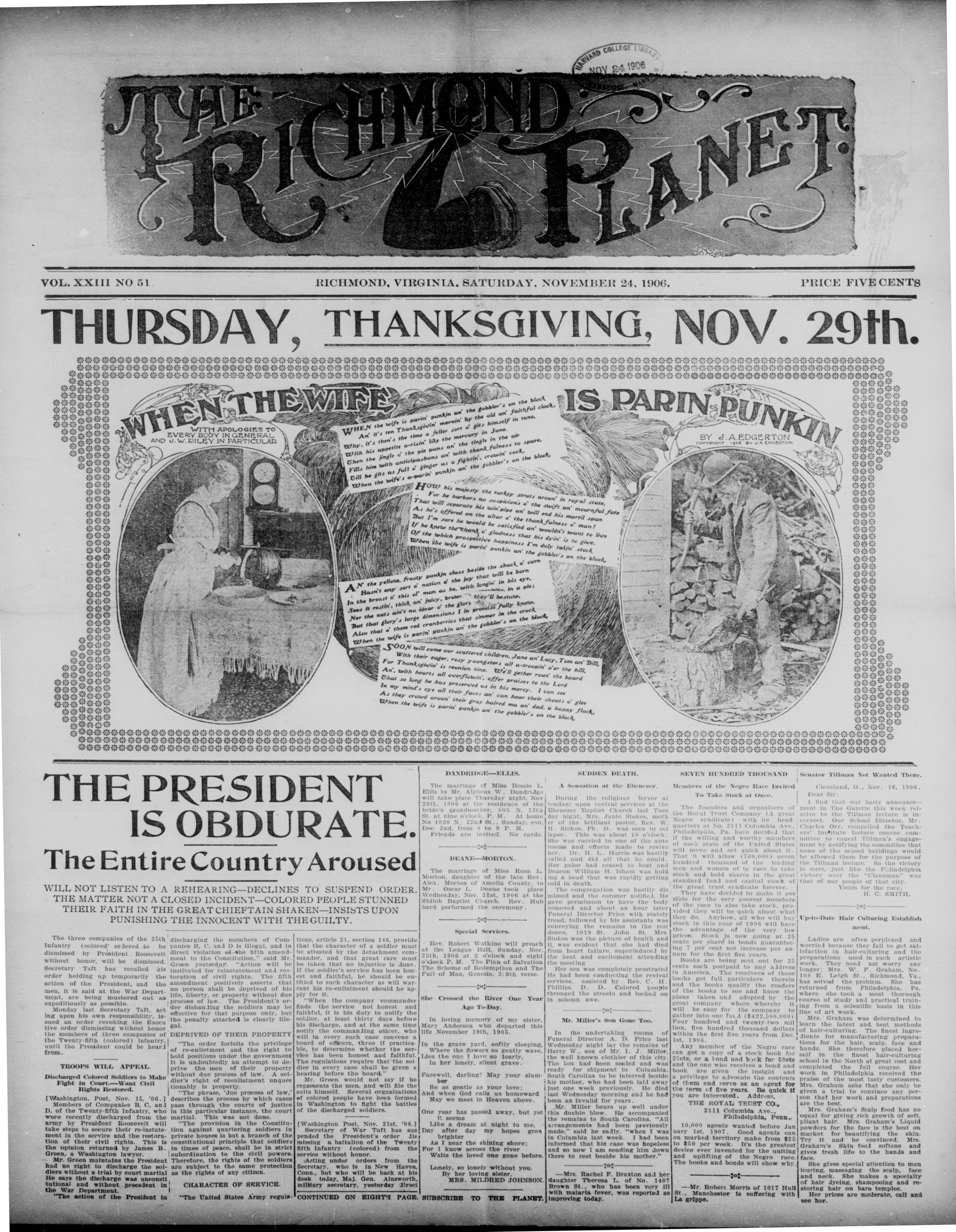
THURSDAY. THANKSGIVING. NOV.29th.
```markdown
```
THE PRESIDENT IS OBDURATE. The Entire Country Aroused
WILL NOT LISTEN TO A REHEARING—DECLINES TO SUSPEND ORDER. THE MATTER NOT A CLOSED INCIDENT—COLORED PEOPLE STUNNED THEIR FAITH IN THE GREAT CHIEFTAIN SHAKEN—INSISTS UPON PUNISHING THE INNOCENT WITH THE GUILTY.
VOL. XXIII NO 51
THURS
THE P
IS
The Entir
WILL NOT LISTEN TO A
THE MATTER NOT A C
THEIR FAITH IN THE
PUNISHING
The three companies of the 25th Infantry (colored) ordered to be dismissed by President Roosevelt without honor, will be dismissed. Secretary Taft has recalled his order holding up temporarily the action of the President, and the men, it is said at the War Department, are being mustered out as expeditiously as possible. Monday last Secretary Taft, act ing upon his own responsibility, issued an order revoking the Executive order dismissing without honor the members of three companies of the Twenty-fifth (colored) Infantry, until the President could be heard from.
TROOPS WILL APPEAL
Discharged Colored Soldiers to Make Fight in Court.—Want Civil Rights Restored.
[Washington, Post, Nov. 15, '06.]
Members of Companies B, C, and D, of the Twenty-fifth Infantry, who were recently discharged from the army by President Roosevelt will take steps to secure their re-institution in the service and the restoration of their civil rights. This is the opinion returned by James B. Green, a Washington lawyer.
Mr. Green maintains the President had to discharge the soldiers without a trial or court martial. He says the discharge is unconstitutional] and without precedent in the War Department.
"The action of the President in
discharging the members of Companies B, C, and D is illegal, and in direct violation of the fifth amendment to the Constitution," said Mr. Green yesterday. "Action will be instituted for reinstatement and restoration of civil rights. The fifth amendment positively asserts that no person shall be deprived of his life, liberty, or property without due process of law. The President's order disbanding the soldiers may be effective for that purpose only, but the penalty attached is clearly illegal.
DEPRIVED OF THEIR PROPERTY
"The order forfeits the privilege of re-enlistment and the right to hold positions under the government It is undoubtedly an attempt to deprive the men of their property without due process of law. A soldier's right of reenlistment unquestionably is property.
"The phrase, 'due process of law,' describes the process by which cases pass through the courts of justice in this particular instance, the court martial. This was not done.
"The provision in the Constitution against quartering soldiers in private houses is but a branch of the constitutional principle that soldiers in times of peace, shall be in strict subordination to the civil powers. Therefore, the rights of the soldiers are subject to the same protection as the rights of any citizen.
CHARACTER OF SERVICE.
RICHMOND, VIRGINIA, SATURDAY, NOVEMBER 24, 1906.
tions, article 21, section 146, provide that the character of a soldier must be attested by the detachment commander, and that great care must be taken that no injustice is done. If the soldier's service has been honest and faithful, he should be entitled to such character as will warrant his re-enlistment should he apply for it.
"When the company commander finds the service not honest and faithful, it is his duty to notify the soldier, at least thirty days before his discharge, and at the same time notify the commanding officer, who will in every such case convene a board of officers, three if practicable, to determine whether the service has been honest and faithful. The regulations require that the soldier in every case shall be given a hearing before the board."
Mr. Green would not say if he represents the men, and will file the suits himself. Several organizations of colored people have been formed in Washington to fight the battles of the discharged soldiers.
[Washington Post, Nov. 21st, '06.]
Secretary of War Taft has suspended the President's order Jis missing a battalion of the Twenty fifth Infantry (colored) from the service without honor.
Acting under orders from the Secretary, who is in New Haven, Conn., but who will be back at his desk tolay, Maj. Gen. Ainsworth, military secretary, yesterday direct
DANDRIDGE—ELLIS.
The marriage of Miss Bessie L, Ellis to Mr. Alpheus W. Dandridge will take place Thursday night, Nov 29th, 1906 at the residence of the bride's grandmother, 505 N. 133a St. at nine o'clock, P. M. At home 10 020 N. 22nd St., Sunday, eve, Dec. 2nd, from 6 to 9 P. M. Friends are invited. No cards.
DEANE—MORTON.
The marriage of Miss Rosa L. Morton, daughter of the late Rev. Alex. Morton of Amelia County, to Mr. Oscar L. Deane took place Wednesday, Nov. 21st, 1906 at the Shiloh Baptist Church. Rev. Hubbard performed the ceremony.
Special Services.
Rev. Robert Watkins will preach at the League Hall, Sunday, Nov. 25th, 1906 at 3 o'clock and eight o'clock P. M. The Plan of Salvation The Scheme of Redemption and The Fall of Man, Genesis, 3:9th verse.
She Crossed the River One Year
Ago To-Day.
In loving memory of my sister,
Mary Anderson who departed this
life November 19th, 1905.
In the grave yard, softly sleeping,
Where the flowers so gently wave,
Lies the one I love so clearly,
In her lonely, silent grave.
Farewell, darling! May your slumber.
One year has passed away, but yet it seems
Like dream at night to me.
Day after day my hopes grow brighter
Lonely, so lonely without you.
By her loving sister,
MRS. MILDRED JOHNSON
SUBSCRIBE TO THE PLANET
SUDDEN DEATH.
A Sensation at the Ebenezer.
During the religious fervor attendant upon revival services at the Ebenezer Baptist Church last Tues day night, Mrs. Janie Stokes, moth er of the brilliant pastor, Rev. W. H. Stokes, Ph. D. was seen to collapse. This was about 10 o'clock. She was carried to one of the ante rooms and efforts made to revive her. Dr. H. L. Harris was hastily called and did all that he could. Her pulse had ceased to beat and Deacon William H. Isham was holding a head that was rapidly getting cold in death. The congregation was hastily dis missed and the coroner notified. He gave permission to have the body removed and about an hour later Funeral Director Price with stately tread, followed by his assistants was conveying the remains to the residence, 1019 St. John St. Mrs. Stokes was the picture of health and it was evident that she had died from heart failure, superinduced by the heat and excitement attending the meeting. Her son was completely prostrated He had been conducting the revival services, assisted by Rev. C. H. Phillips, D. D. Colored people thronged the streets and looked on in solemn awe.
Mr. Miller's Son Gone Too.
In the undertaking rooms of Funeral Director A. D. Price last Wednesday night lay the remains of Harry W., son of Mr. I. J. Miller, the well known clothrer of this city. The box had been sealed and was ready for shipment to Columbia, South Carolina to be interred beside his mother, who had been laid away just one week previously. He died last Wednesday morning and he had been an invalid for years.
Mr. Miller bears up well under this double blow. He accompanied the remains to South Carolina. "All arrangements had been previously made," said he sadly, "when I was in Columbia last week. I had been informed that his case was hopeless and so now I am sending him down there to rest beside his mother."
—Mrs. Rachel F. Braxton and her daughter Theresa L. of No. 1407 Brown St., who has been very ill with malaria fever, was reported as improving today.
SEVEN HUNDRED THOUSAND
Members of the Negro Race Invited To Take Stock at Once.
The founders and organizers of the Royal Trust Company (A great Negro syndicate) with its headquarters at No. 2111 Columbia Ave., Philadelphia, Pa. have decided that if the willing and worthy members of each state of the United States will move and act quick about it. That it will allow (700,000) seven hundred thousand of the leading men and women of te race to take stock and hold shares in the great standard fund and capital stock of the great trust syndicate forever. They have decided to make it possible for the very poorest members of the race to also take stock, provided they will be quick about what they do. Anyhow, all who will buy stock in this year of 1906 will have the advantage of the very low prices. Stock is now going at 25 cents per share in bonds guaranteeing per cent net increase per annum for the first five years. Books are being set out for 25 cents each postpaid to any address in America. The receipts of these books get full particulariers there and the books qualify the readers of the books to see and know the plans taken and adopted by the great company where whereby it will be easy for the company to gather into one fund ($422,500,000). Four hundred and twenty-two million, five hundred thousand dollars within the first five years from Dec. 1st, 1906.
Any member of the Negro race can get a copy of a stock book for 25cts, or a bond and book for 50cts and the one who receives a bond and book are given the insight and ability to advocate the contents of them and to present content or the term of five years. Be quick if you are interested. Address
10,000 agents wanted before January 1st, 1907. Good agents can on marked territory make from $25 to $50 per week. It's the greatest device ever invented for the uniting and uplifting of the Negro race. The books and bonds will show why.
—Mr. Robert Morris of 1017 Hull St., Manchester is suffering with La grippe.
PRICE FIVE CENTS
29th.
Senator Tillman Not Wanted There.
Cleveland, O., Nov. 16, 1906.
Dear Sir:
I find that our hasty announcement in The Gazette this week relative to the Tillman lecture is incorrect. Our School Director, Mr. Charles Orr, compelled the Teachers' Institute lecture course committee to cancel Tillman's engagement by notifying the committee that none of the school buildings would be allowed them for the purpose of the Tillman lecture. So the victory is ours, just like the Philadelphia victory over the "Clansman" was that of our people of that city.
Yours for the race,
H. C. SMITH.
Up-to-Date Hair Culturing Establish ment.
Ladies are often perplexed, and worried because they fail to get satisfaction in hair-culturing and the preparations used in such artistic work. They need not worry any longer; Mrs. W. F. Graham, No. 108 E. Leigh St., Richmond, Va., has solved the problem. She has returned from Philadelphia, Pa. where she took a most thorough course of study and practical training from a scientific basis in this line of art work.
Mrs. Graham was determined to learn the latest and best methods of hair-culturing. The finest ingredients for manufacturing preparations for the hair, scalp, face and hands. She therefore placed herself in the finest hair-culturing school in the North at great cost and completed the full course. Her work in Philadelphia received the praise of the most tasty customers. Mrs. Graham asks that she only be given a trial to convince any person that her work and preparations are the best.
Mrs. Graham's Scalp food has no equal for giving rich growth of soft, pliant hair. Mrs. Graham's Liquid powders for the face is the best on market for beautifying the skin. Try it and be convinced. Mrs. Graham's Skin food softens and gives fresh life to the hands and face.
She gives special attention to man icuring, massaging the scalp, face and neck. She makes a speciality of hair dyeing, shampooing and restoring hair on bare temples.
Her prices are moderate, call and see her.
== The =
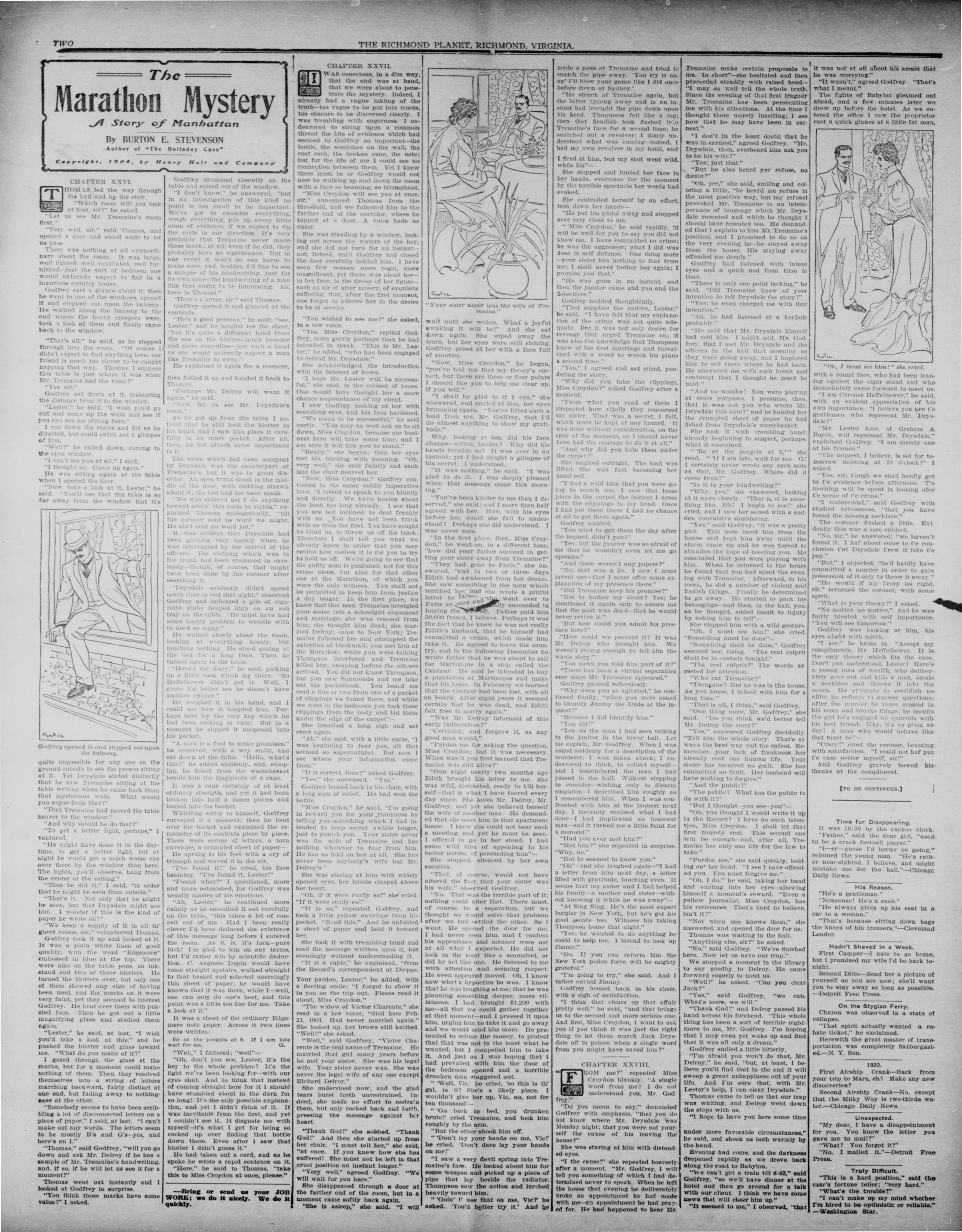
A Story of Manhattan
By BURTON E. STEVENSON
Author of “The Holladay Case™
Copyright. 1904, by Henry Mott and Company
Two
CHAPTER XX VI
|HOMAS led the way through
TT the ball and up the stair.
“Which room will you look
ae at first, sir?’ he asked,
“Let us see Mr. Tremaine’s room
first.”
“Very well, sir,” sald ‘Thomas, and
opened a door and stood aside to let
Us pase
There was nothing at all extraonti-
wary about the room. It was large,
‘well lighted. well ventilated, well fur.
Rished—just the sort of bedroom one
Would naturally expect to find In a
Texurious country house.
Godfrey cast a glance abont It; then
he went to one of the windows, opened
Mt and stepped out upon the balcony.
He walked along the balcony to the
end where the heavy creepers were,
took 2 look at them and finally ceme
back to the window,
“That's all," he said, as he stepped
through into the room. “Of course I
didn’t expect to find anything here; our
friend ts much too clever to be caught
napping that way. Thomas, I suppose
this table Is just where It was when
Mr. Tremaine bad the room?"
“Yes, sir.”
Godfrey ‘sat down at it, mensuring
the distance from it to the window.
“Lester,” he sald, “I wish you'd go
out and come up the walk and see if
you can see me sitting here.”
I ran down the stairs and did as he
@irectod, but could catch not a glimpse
of bim.
“Well?” he called down, coming to
the open window.
“I can't see you at all," T sald.
“1 thought so. Come up again.
He was sitting again at the table
when I opened the door.
“Now, take a look at It, Lester,” he
seid. “You'll see that the table Is eo
far away from the window that It's
eH eS)
lle iy Had
Bere
x Vv q
NG AYE
| p NG
“a AN
=e ae
7a CS _
poh Rare
ote
Sa ee
wre ——
Rit cette cpa tte
quite Impossible for any one on the
ground outside to see the person sitting
at It. Yet Drysdale stated distinctly
that he saw Tremaine sitting at the
table writing when he came back from
that mysterious walk. What would
you argue fro that?”
“That Tremaine had moved the table
nearer to the window.”
“And why should he do that?”
“To get a better light, perhaps,” I
ventured
“He might bave done it In the day
time, to get a better light, but at
night he would get a much worve one
over there by the wiudow than bere.
The lights, you'll observe, hang from
the center of the celling.”
“Then he did t." 1 said, “in order
that he might be seen from outside.”
“That's it. Not only that he might
be seen, but that Drysdale might see
him. I wonder if this is the kind of
Paper he wrote on”
“We keep a supply of It In all tr
guest rooms, sir,” volunteered Thomas,
Godfrey took it up and looked at it.
It was u plain white linen of good
guality, with the word “Edgemere”
embossed in blue at the top. ‘There
Were also on the table pens, an ink
stand and two or three blotters, He
turned the blotters over, but ouly one
of them showed any sign of having
been used, and the marks on it were
very faint, yet they seemed to luterest
Godfrey. He bent over them with puz-
gied face. Then he got out a little
magnifying glass aud studied them
again,
“Lester,” be said, at last, “I wish
you'd take a jook at this,” and he
pushed the blotter and glass toward
me. “What do you make of it?”
I gazed through the glass at the
marks, but for a moment could make
nothing of them. Then they resolved
themselves into a string of letters
marching backward, fairly distinct at
one end, but fading away to nothing:
mess at the other.
“Somebody seems to have been serib-
bling a lot of disconnected letters on a
piece of paper,” I said, at last, “I can’t
make out any words, The letters seem
to be mostly B's and G’s—yes, and
bere’s ap I.”
“Thomas,” said Godfrey, “will you go
down and ask Mr. Delroy if he bas «
sample of Mr. Tremaine’s handwriting,
and, if so, if he will Jet us see it for a
moment?”
‘Thomas went out iustantly and 1
looked ut Godfrey in surprise.
“You think those marks have some
value?" I asked.
Point is too small to be important
We've got to examine everything
weigh everything. pile up every littl
atom of evilence, if we expect to tip
the scale in our direction, It's very
probable that Tremaine never made
these mark. nt all; even if he did, they
Probably have no significance. But in
any event it won't do any barm to
make sure; and, besides, I'd like to see
a sample of bis handwriting, Just for
its own sake—the handwriting of a man
like that ought to be Interesting. Ah,
bere is ‘Thomas
“Here's a letter, sir" said Thomas.
Godfrey opened it and glanced at the
contents.
“He's a good penmin.” he sald; “see
Lester," and he handed me the xbeet,
“but it’s quite a different hand from
the one on the blotter—much broader
and more masculine—just such a hand
as one would naturally expect a man
like Tremaine to write.”
He explained tt again for a moment,
then folded it up and handed tt back to
Thomas.
“Perhaps Mr, Delroy will want tt
again,” he sald.
“Now, let Us see Mr. Drysdale’s
As he got up from the table I no-
ticed that he still held the blotter tn
his hand, and 1 saw him place tt care-
fully tu an inner pocket. After all,
thea, be did attach some importance
to tt
‘The room which had been occupied
by Drysdale was the counterpart of
Tremaine's, but i was in great dis-
order. An open trunk stood In the mid-
‘die of the floor, with clothing strewn
| about It; the bed had not been made.
| “We was ordered uot t' do anything
towand settin’ this room to rights,” ex-
plained ‘Thowus apologetteaily, | “ttl
the coroner sent us word we might.
He ain't sent no word yet.”
It was evident that Drysdale bad
been packing very hastily when he
Was interrupted by the arrival of the
officers. The clothing which was In
the trunk had been crammed in care.
lessiy—thouxh, of course, that might
have been done by the coroner after
searching it
“Drysdale evidently didn’t spend
much time {a bed that night,” observed
Godfrey aud indicated a pile of clga-
rete stubs heaped high on an ash
tray on the table. “He must have had
some knotty problem to wrestle with
to need so many.”
He walked slowly about the room,
looking at everything keenly, but
touching nothing. He stood gazing at
the bed for a long time. Then he
turned again to the table,
“Here's the Mary,” he sald, pleking
‘up a little book whieh lay there. “So
‘Heffelbower didn't get it Well, I
guess I'd better see he doesn’t have
Another chance.”
He weighed it in his hand, and 1
could see how it tempted him. Per-
haps here ny the very key which he
had Ween seeking in vain! But in a
moment be slipped It unopened into
his pocket.
eo cas wa tere promises,”
jhe observed, with a wry smile, and
sat down at the table. “Hello, what's
[this?™ he added suddenly, and, stoop-
Ing, he fished from the wastebasket
‘beside bim the fraginents of a cane,
It was a caue certainly of at least
ordinary strength, and yet it had been
broken into half a dozen pleces and
hurled into the basket.
Whistling softly to himself, Godfrey
surveyed it a moment; then he bent
over the basket and examined the re-
mainder of Its coutents plece by plece.
‘There were scraps of letters, a torn
envelope, a crumpled sheet of paper—
He sprang to bis feet with a ery of
triumph and waved it in the air.
“ve found it! he crted, his face
beaming. “I've found it, Lester!”
“Found what?" I questioned, more
and wore astonished, for Godfrey was
usually master of his emotions.
“Ah, Lester,” he coutinued more
calmly as be smoothed it out carefully
on the table, “this takes a lot of con-
ceit out of me. Had I been really
clever I'd have deduced whe existence
of this message long before I entered
the room. As it is, it’s luck—pure
luck! I'm glad to win on any terms,
but Pd rather win by selentifle dedue-
tion. C. Auguste Dupin would have
come straight upstairs, walked straight
to that basket and selected uuerringly
this sheet of paper; he would bave
known that it was there, while I—well,
one can only do one’s best, and this
point was a little too fine for me. Take
8 look at it.”
It was a sheet of the ordinary Edge
mere note paper. Across it two lines
were written:
Be at the pergola at 9 If I am late
‘wait for me. a
“Weli,” I faltered; “well"—
“Oh, don't you see, Lester, it's the
key to the whole problem? It's the
light we've been looking for—with out
eyes shut. And to think that instead
of coming straight here for it I should
have stumbled about In the dark fot
80 long! It's the only possible explana.
ton, and yet 1 didn’t think of it 11
‘Was inevitable from the first, and yet
3 coniée’e ace Mh. 6 Gieceste ee OO
——Bring or send us your JOB
WORK; wo do it nicely. We do it
quickly.
THE RICHMOND PLANET, RICHMOND, VIRGINIA.
SS
ely
ioe
‘was trembling with eagerness. I ep:
Geavored to string upon a common
‘thread the bits of evidence which had
seemed to Godfrey so Important—the
bottle, the seratetes on the wall, the
coat rack, the broken cane, the note;
but for the life of me I could see no
connection between them. Yet I knew
there must be or Godfrey would pot
now be walking up and down the room
With @ face so beaming, #o triumphant.
“Miss Croydon will see you at once,
sir,” announced ‘Thomas from the
threshold, and we followed him to the
farther end of the corridor, where he
tapped at a door. A voice bade us
enter.
She was standing by a window, look-
ing out across the waters of the bay,
and she did not turn for an instant—
not, indeed, until Godfrey had closed
the door carefully behind him. I have
Seen few women more regal, more
magnificent. yet there was about her—
in her face, In the droop of her figure—
‘such an air of utter misery, of exquisite
suffering, that, after the first moment,
one forgot to admire her in the desire
to be of werviee.
“You wished to see me?” she asked,
in a low voice.
“Yes, Miss Croydon,” replied God.
frey, more gently perhaps than he had
intended to speak. “This is Mr. Lew
ter,” he added, “who has been engaged
to defend Mr. Drysdale.”
She acknowledged the Introduction
with the faintest of bows.
“I hope Mr. Lester will be success-
ful,” she said, in the coldest of tones.
One would have thought her a mere
chance acquaintance ef my client.
saw Godfrey looking at her with
‘searching eyes, and his face hardened.
| “We mean to be successful,” he sald
‘curtly. “You may as well ask us to sit
‘down, Miss Croydon, because our busl-
ness here will take some time, and I
am sure it will tire you to stand.”
“Really.” she began; then her eyes
met his, burning with meaning. “Ob,
Yery well,” she said faintly and sank
into the chair nearest her.
“Now, Miss Croydon,” Godfrey con-
tinued in the same coldly imperative
tone, “I Intend to speak to you bluntly
and directly. We bave beaten about
‘the bush too long already. I see that
You are not inclined to deal frankly
with us. You have not been frank
with us from the first. You bave sought
to blind us, to throw uy off the track.
‘Therefore I shall tell you what we
already know in order that you may
realize how useless It Is for you to try
to hold us off. We're going to see that
the guilty man ts punished, not for this
crime alone, but also for that other
one at the Marathon, of which you
were the only witness. You shall not
be permitted (o keep him from justige
& day longer. In the first place, we
know that this man Tremaine inveigled
Four sister Into a schoolgirl elopement
and marriage; she was rescued from
‘him; she thought him dead; she mar-
‘ried’ Delroy; came to New York; ‘Tre
maine followed her and attempted the
extortion of blackmail; you met him at
the Marathon; while you were talking
Thompson interfered and Tremaine
killed him, escaping before the officers
arrived. You did not know ‘Thompson,
but you saw Simmonds and me take
out bis pocketbook, You heaid me
read a line or two from one of a packet
of clippings we found there, and while
we were in the bedroom you took those
clippings from the body and hid them
under the edge of the carpet”—
She breathed a long sigh and sat
erect again,
“Ah,” she said, with a little smile, “L
was beginuing to fear you, all that
seemed so superaatural, But now I
seo where your information came
from.”
“It Is correct, then?” asked Godfrey.
“Yes,” she answered, “Yes,”
Godfrey leaned back in his chair, with
4 long sign of relief. He had won the
battle.
“Miss Croydon,” he said, “I'm going
to reward you for your frankness by
telling you something whieh T had In.
tended ‘to keep secret awhile longer,
Just to punish you. Your sister never
was the wife of ‘Tremaine and bas
nothing whatever to fear from him.
He has no hold on her at all. She bas
never been anybody's wife but Mr.
Detroy’s.”
She was stariug at him with widely
opened eyes, her hands clasped above
her heart.
“Oh, if it were really so!” she cried.
“If it were really so!
“It is so.” repeated Godfrey, and
took a little yellow envelope from his
Docket, “Itead this.” And he unfolded
| sheet of paper and held It toward
her.
She took it with trembling hand and
read the message written upon it, but
seemingly withont understanding it.
“It is a cable,” he explained, “from
the Record’s correspondent at Dieppe.
Your pardon, Lester,” he added, with
& fleeting smile; “I forgot to show It
to you on the trip out. Please read it
aloud, Miss Croydon.”
“The widow of Victor Charente,” she
read in a low voice, “died here Feb.
21, 1001. Had never married again.”
She looked up, her brows still knitted.
a
Site
ee a Ce
ld
“Your sister never was the wife of Tre
maine.”
wait until she wakes. What a joyfal
awaking It will be!" And she sat
down again. She wiped away the
tears, but her eyes were still shining.
Godfrey gazed at her with a face full
of emotion,
“Now, Miss Croydon,” he began,
“you've told me that my theory's cor.
rect, but there are three or four points
I sould like you to help me clear up,
if you will.”
“I shall be glad to if 1 can,” she
answered, and smiled at bim, her eyes
brimming again, “You've lifted such a
load from me, Mr. Godfrey, that I'd
do almost anything to show my grati
tude.”
Why, looking at her, did his face
change—soften, harden? Why did bis
hands tremble so? It was over In an
instant; yet [hed caught a glimpse of
his secret. I understood.
“It was nothing,” he sald. “I was
glad to do it, I was deeply pleased
when that message came this. morn-
tng.”
“You've been kinder to me than I de.
served.” she sald; und I more than halt
agreed with her. How, with bis eyes
before her, could she fail to under-
stand? Perhaps she did understand.
was never sure.
“In the first place, then, Migs Croy-
don,” he went on, in a different tone,
“how did your father succeed in get.
‘ting your sister away from Trematne?”
| “They had gone to Paris,” she an-
| swered, “and in two or three days
Edith had awakened from her dream
She saw something in the man which
terrified her and she wrote a pitiful
letter to Soe went over to
Paris ss cuce els succeeded In
buying the . Father paid bim
50,000 francs, I believe. Perhaps {t was
the fact that he knew he was not really
Edith’s husband, that he himself had
committed a crime, which mude him
‘take It, He agreed to leave the coun.
try, and in the following December he
wrote father that he was abont to sail
for Martinique In a ship called the
Centaur. He sald he intended to buy
}a plantation at Martinique and make
that his home, In February we learned
‘that the Centour had been lost, with all
on board. After elght years it seemed
certain that he was dead, and Edith
felt free to marry again,”
“Was Mr. Delroy informed of this
early indiscretion?”
“Certainly, and forgave It, as any
good man would”
“Pardon me for asking the question,
Miss Croydon; but It waa necessary.
When was it you first learned that ‘Tre.
maine was still alive?”
“One night nearly two months ago
Edith brought bis letter to me. She
Was wild, distracted, ready to kill ber-
self—that Is what T have feared every
day since. She loves Mr, Delroy, Mr.
Godfrey, and yet ahe believed herself
the wife of another man. He demand.
ed that she meet him fn that apartment
house. T knew she could not bear such
& meeting, and yet he must be seen.
I offered to go fm her stead. 1 bad
some will idea of appealing to his
better nature, of persuading him’—
She stopped, silenced by her own
emotion
“That, of course, would not have
altered the fact that your sister was
his wife.” observed Godfrey.
“No, That was the terrible part of It;
nothing could! alter that. There must,
of course, be a separation, but we
thought we would solve that problem
after we had settled the other. So I
went. He opened the door for me.
I had never seem him, and I confess
his appearance and manner were uot
at all what I expected. He did not
look in the least like a scoundrel, or
did be act like one. He Mstened to me
with atteution and seéming respect.
He even appeared moved. Ob, I know
now what a hypocrite he was. 1 know
that he was laughing at me; that he was
Planning something deeper, more vil-
lainous. I bad brought $1,200 with
Mme—all that we could gather together
at that moment—and I pressed it upon
him, urging him to take it and go away
and we would send him more. He pre-
tended to refuse the money, to protest
that that was not in the least what he
wanted, bot I compelled him to take
it. And just ag I was hoping that I
had prevailed with him the door of
the bedroom opened and a horrible
drunken man staggered out.
“Well, Vic, he eried, ‘so this f* th’
gal, is it? She's a likely piece. I
wouldn't give her up, Vie, no, not fer
ten thousand’—
“"Go back to bed, you drunken
brate! cried Tremaine, and took him
roughly by the arm.
Et the cee MRE
“Don’t lay your hands on me,
he cried. ‘Don't dare lay your bands
on me”
“I saw a devil spring into Tre-
maine’s face. He] about him for
some weapon ‘up a piece of
that lay the radiator.
saw the action and lurched
heavily toward
“ ‘Goin’ on me, Vie? he
asked. “You'd ‘try it’ And be
bane at ‘Tremal ee
the latter cprang away and in an fn.
stant had yromuht the pipe down upon
his head. ‘Thowipson fell Hke a los;
‘then that flendish look flashed tn:
“Tremaine's face for ® second time; he
snatehed out a revolver: I dimly un-
derstood what was coming—indeed, t
had wy own revolver In my hand, and
T fired at bim, but my shot went wild,
while his"—
She stopped and buried her face tn
her hands, overcome for the moment
hy the terrible spectacle her words had
evoked.
She controlled herself by an effort,
took down her hands—
“He put bis pistol away and stepped
over very close to me.
“ ‘Miss Croydon,’ he sald rapidly, tt
will be well for you to say you did not
know me. T bave committed no crime;
he was the aggressor; what I did was
done in self defense. One thing more
~—your sister has nothing to fear from
me; I shall never bother her again; I
promise you that.’
“He was gone in an instant, and
then the Janitor came and you and the
fetectives.”
Godfrey nodded thoughtfully.
“That supplies the motive, Lester,”
he said. “I have felt that my explana-
tion of the crime was not quite ade-
quate. But it was not only desire for
revenge that urged Tremaine on; ft
was also the knowledge that Thompson
knew of his first marriage and threat-
ened with a word to wreck his plans
@ second time.”
“Yes,” I agreed and sat silent, pon-
dering the story.
“Why did you take the clippings,
Miss Croydon?” asked Godfrey after a
moment.
“From what you read of them I
suspected how vitally they concerned
my sister. That was a secret, I felt,
which must be kept at any hazard. It
was done without consideration, on the
spur of the moment, or I should never
have had the courage to do it at all.”
“And why did you hide them under
the carpet?”
She laughed outright. ‘The load was
lifted. She was fast becoming her
sual self
“I had a wild idea that you were go-
fag to search me. { saw that loose
place In the carpet the instant I arose
with the clippings In my hand. Once
I had put them there 1 had no chance
at all to get them again.”
Godfrey nodded.
“You tried to get them the day after
the inquest, didn’t you?"
“Yes; but the Janitor was so afraid of
me that he wouldn't even let me go
upstairs.”
“And there weren't any papers ?*
“No: that was a ie. I saw 1 must
invent one—that T must offer some ex-
Planation of my presence there.”
“Did Tremaine keep his promise?”
“Not to bother my sister? Yes; he
mentioned it again only to assure me
‘that the past was derd—that he would
never revive It.”
“But how could you admit his pres-
ence here?”
{How could we prevent it? It was
Mr. Delroy who brought bim, We
Weren't strong enough to tell him the
waole story.””
“You mean you told him part of It?”
“There has been a virtual separation
ever since Mr. Tremaine appeared.”
Godfrey paused retlectively.
“Why Were you so agitated,” be con-
tinued tally, “when you were asked
to identity Jimmy the Dude at the in-
quest?"
“Because I did identify him.”
“You did?"
“Yes—as the man I had seen talking
to the janitor in the lower hall. Let
me explain, Mr. Godfrey. When I was
asked suddenly for a description of the
murderer, T was taken aback; 1 en-
deavored to think, to collect myself—
and I remembered the man I had
passed in the hall, Without stopping
to cousider—wishing only to disarm
suspiciou—I described bim roughly as
I remembered him. When I was con-
fronted with hit at the Inquest next
day, I instantly realized what I bad
done—I had implicated an tanocent
man—and it turned me a little faint for
A moment.”
“Had you ever met him?"
“Met him?” she repeated in surprise.
“Why, no.”
“Bat he seemed to know you.”
“Oh"—and she laughed again—“I bad
A letter from him next day, a letter
filled with gratitude, touching even. It
seems that my sister and I had belped
his family—a mother and sister—with-
out knowing it while he was away”—
“At Sing Sing. He's the most expert
burglar in New York, but he's got his
good points too. Witness bis taking
‘Thompsou bome that night.”
“Yes; he wanted to do anything he
could to help me. 1 intend to look up
Jimmy.” ¥
“Do. If you can reform him the
New York police force will be mighty
grateful.”
“I'm going to try,” she said. And I
rather envied Jimmy.
Godfrey leaned back in his chair,
with a sigh of satisfaction.
“ ROM me?’ repeated Miss
SSMS) understand you, Mr. God
&
“Do you mean to say,” demanded
not know where Mr. Drysdale Was
self the cause of his leaving the
house?”
She was staring at him with distend.
ed eyes.
“I the cause!" she repeated hoarsely
after a moment. “Mr. Godfrey, I will
tell you something of which I had de-
termined never to speak. When be left
the house that evening he deliberately
broke an appointment he had made
with me—en appointment be had pray
ed for. He had happened to hear Mr.
OR ae a ae eae em Ce gee er ea
thought them merely Insulting; I see
now that he may have been in ear-
nest.”
“I don’t in the least doubt that he
Yas In earnest,” agreed Goifrey. “Mr.
Drysdale, then, overheard him ask you
to bo his wife?”
“Yes: just that.” :
“But he also heard yor refuse, no
doubt?"
“Ob, yes,” she said, smiltng and col-
oring a little, “be heard me refuse in
“the most positive way, but my refusal
Provoked Mr. Tremaine to an intem-
Perance of language which Mr. Drys-
dale resented aud which he thought I
should have resented too. He demand-
ed that [ explain to him Mr. Tremaine's
position, and I promised to do so on
the very evening he—he stayed away
from the house. His staying away
offended me deeply.”
Godfrey bad listened with Intent
eyes and a quick nod from time te
time.
“There is only one point lacking,” he
said. “Did Tremaine know of your
Intention to tell Drysdale the story?”
“Yes; he even charged me with that
Intention.”
“Ab, he had listened at a keyhole
probably.”
“He said that Mr. Drysdale himself
had tokt him. I might add, My. God.
frey, that I met Mr. Drysdale and the
officers in the hail that morning as
they were going away, and 1 implored
him to tell them where he had been.
He answered me with such Insult and
contempt that I thought be must be
mad."
“And no wonder! You were playing
at cross purposes. I presume, then,
that it was not you who wrote Mr.
Drysdale this note?" and he banded her
the crumpled sheet of paper he had
fished from Drysdale's wastebasket.
She took it with trembling hand;
already beginning to suspect, perhaps,
what it contained.
“Be at the pergoln at 9’" she
read. “If Lam late, walt for me. G!
I certaiuly uever wrote any such note
as that, Mr. Godfrey. Where did it
come from?”
“Is it In your handwriting?”
“Why. yes,” she answered, looking
at it more closely. “That is, it Is some-
thing like. Oh! I begin to sce!” she
erled, and I saw her seized with a sud.
den convulsive shuddering,
“Yes,” said Godfrey, “It was a pretty
plot. ‘This note lured him from the
house and kept bim away until the
storm came up and he was forced to!
abandon the hope of meeting you. He
concluded that you were playing with
him. When he returned to the house
he found that you had spent the even
ing with Tremaine. Afterward, In his
room, he did a number of violent and
foolish things. Finally he determined
to go away. He started to pack his
delongings—and then, In the hall, you,
as he thought, added insult to injury
by asking him to tell”—
She stopped him with a wild gesture,
“Oh, T must see him!" she cried.
“Something must be done"-
“Something shall be done,” Godfrey
assured her, rising. “The real culprit
shall be in custody tonight.”
“The real culprit?” The words ar
rested her attention
“Who but Tremaine?*
“Trenyine? But be was tn the house,
As you know, I talked with him for a!
Jong time.”
“That is all, I think,” sald Godfrey.
“One thing more, Mr. Godfrey,” she
said. “Do you think we'd better tell
Mr. Delroy the story?”
“Yes,” answered Godfrey decidedly,
“Tell him the whole story. That's al-
ways the best way and the safest. Re.
member, your Inck of frankness has
already ‘cost one human life. Your!
sister has incurred no guilt. She bas|
committed no fault. Her husband will)
have nothing to forgive.”
“And the public?*
“The public? What has the public to
do with ity?
“But I thought—you see—you"—
“Oh, you thought I would write it up)
tn the Record? I have no such inten-
tion, Miss Croydon. I shall let that
first tragedy rest. This second one|
wih be enough—and, after all, Tre-|
maine has only ove life for the law to)
take.”
“Pardon me,” she sald quickly, hold-
ing our her hand. “I see I have offend-
ed you. You must forgive me.”
“Oh, I do,” he said, taking her hand
and smiling into her eyes—allowing|
himself 2 moment's reward. “Even a
yellow Journalist, Miss Croydon, bas|
his reticences, That's hard to belleve,
isn't it?”
“Not when one knows them,” she|
answered, and opened the door for us.
‘Thomas was waiting in the hall.
“Anything else, sir?” he asked.
“No,” said Godfrey. “We've finished
here. Now let us have our trap.”
‘We stopped a moment in the Ubrary
to say goodby to Delroy. He came
forward eagerly to meet us.
“Well?’ he asked. “Can you clear
Jack?"
“Yes," said Godfrey, “we can,
‘What's more, we will.”
“Thank God!" and Delroy passed his
hand across bis forehead. “This whole
thing bas been a sort of terrible night-
mare to me. Mr. Godfrev. I’m honing.
it was not at ati about his arrest fhat
he was worrying.”
“It wasn't.” agreed Godfrey. “That's
what I meant.”
‘The Ughts of Babylon glesmed out
ahead, and a few minutes later we
drew up before the hotel. As we en-
tered the office I saw the proprietor
cast a quick glance at 2 little fat man,
sacs Fs
om
tt ae
(f a Kan
-\) RSS
Wimpy
ee PgR Te ter Pe Some e a e
with a round face, who had been lean-
ing against the cigar stand and who
Immediately came forward to meet us.
“I am Coroner Heffelbower,” he said,
With an evident appreciation of his
‘own importance. “I believe you are t'e
gentlemen who represent Mr. Drys-
dale?"
"Mr. Lester here, of Graham &
Royce, will represent Mr, Drysitale,”
explained Godfrey, “I am merely one
of his friends,”
“The inquest, I believe, Is set for to-
morrow morning at 10 o'clock? I
asked.
“Yes, sir; tongh we shall hardly get
to Ce evidence before afternoon, T'e
morning will be spent in looking ofer
Ye ncene of t'e crime.”
“I understand,” said Godfrey with
studied artlessness, “that you have
found the missing necklace.”
The coroner flushed a Ittle. Evt-
‘dently this was a sore subject.
“No, sir.” he answered; “we haven't
found it. I haf about come to t’e con-
clusion tat Drysdale trew it into t'e
pay.”
“But.” I objected, “he'd hardly have
committed a murder In order to gain
Possession of It only to throw It away.”
“He would if my Yeory ist right,
sir.” returned the coroner, with some
spirit.
“What is your theory?" I asked.
“No matter, no matter." And he was
fairly bloated with self Importance.
“You will see tomorrow.”
Godfrey was looking at him, bis
eyes alight with mirth.
“I see.” he broke in. “Accept my
compliments, Mr. Heffelbower. It is
the only theory which fits the case.
Don't you understand, Lester? Here's
& young man of wealth, who deliber-
ately goes out and kills a man, steals
& necklace and throws It into the
ooo. He attempts to establish no,
alll: he refures to answer questions;
after the miurier he rages around in
his room and breaks things; be insults.
the girl he's engagod to: quarrels with
his best frieud. Why, it’s as plain as
day! A man who would bebave like
that must be"—
“Crazy! cried the coroner, beaming
with satisfaction. “I could not haf put
te case petter myself, sir!”
And Godfrey gravely bowed his
thanks at the compliment.
{v0 pF contixven.)
Time for Disappearing.
It_was 10:20 by the cuckoo clock.
“Father,” sald the dear girl, “used
to be a crack football player.”
“I—er—guess I'd better be going,”
rejoined the young man. “He's rath-
er nearsighted, I believe, and might
mistake me for the ball.”—Chicage
Daily News.
His Reason.
“He's a gentleman.”
“Nonsense! He's a snob.”
“He always gives up bis seat in a
car to &@ woman.”
“That's because sitting down bags
the knees of his trousers.”—Cleveland
Leader.
Hadn't Shaved in a Week.
First Camper—I nate to go home,
but I promised my wife I'd be back to-
night.
Second Ditto—Send her a picture of
yourself as you are now; she'll want
you to stay away as long as possible,
—Detorit Free Press.
On the Stygian Ferry.
Charon was observed In a state of
collapse,
“That spirit actually wanted a re
bate ticket,” he exclaimed.
Herewith the great master of trans-
portation was completely fiabbergast-
ed.—N. ¥. Sun.
1920.
First Airship Crank—Back from
your trip to Mars, eh? Make any new
discoveries?
Second Airship Crank—No, except
that the Milky Way Is two-thirds wa-
ter.—Chicago Daily News.
Ganmenina:
“My dear, I have a disappointment
for you. You know the letter you
gave me to mail?”
“What? You forgot it?”
“No, 1 mailed it."—Detroit Free
Press.
Truly Difficult.
“This Is a hard position,” said the
czar’s fortune teller; “very hard.”
“What's the trouble?”
“I can't make up my mind whether
T'ra Bired to be optimistic or reliable.”
—Washington Star.
THE PLANET
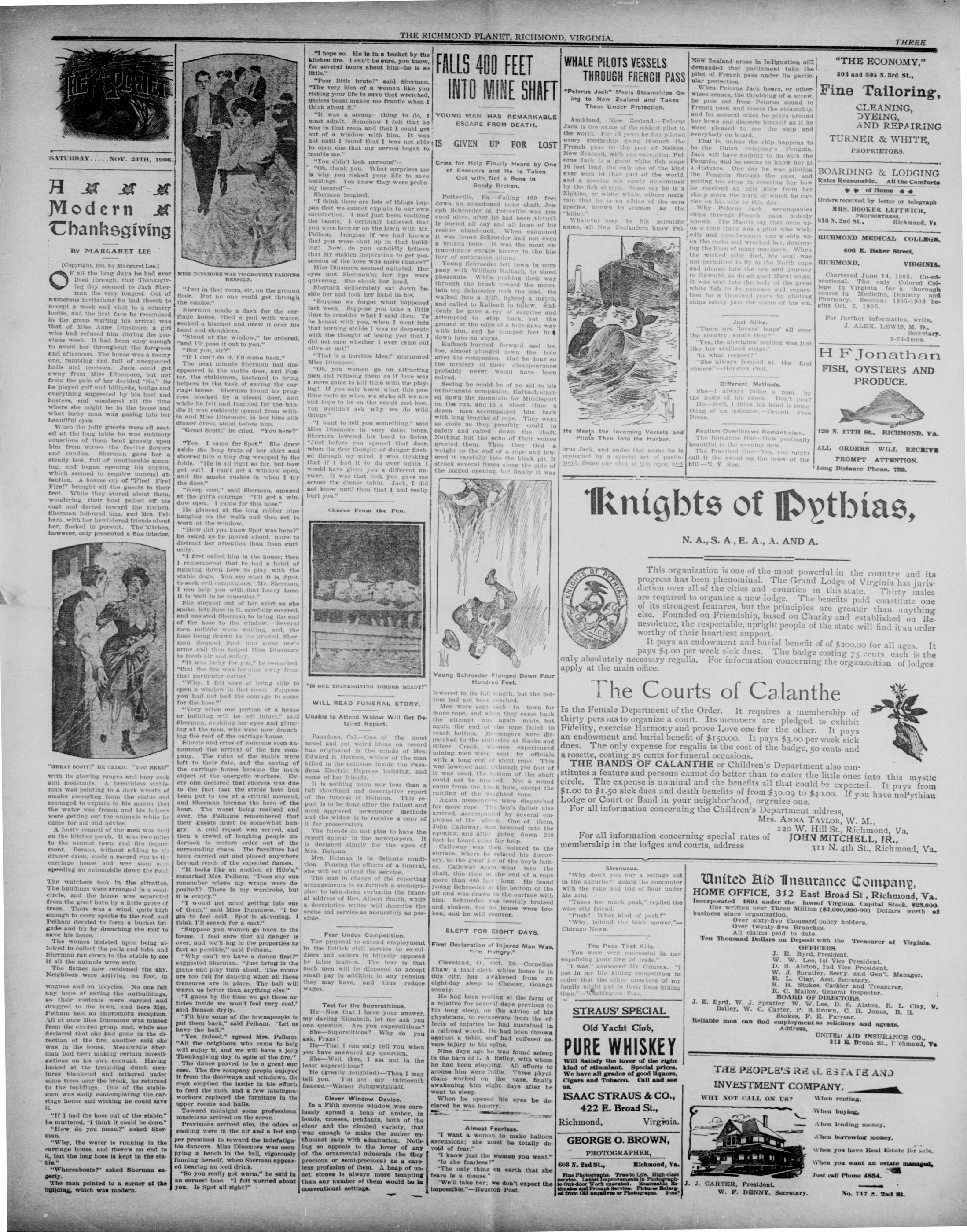
Modern Thanksgiving
By MARGARET LEE
[Copyright, 1905, by Margaret Lee.]
F all the long days he had ever lived through, that Thanksgiving day seemed to Jack Sher-
numerous invitations he had chosen to accept a week end visit to a country house, and the first face he recognized in the group waiting his arrival was that of Miss Anne Dinsmore, a girl who had refused him during the previous week. It had been easy enough to avoid her throughout the forwent and afternoon. The house was a roomy one, rambling and full of unexpected halls and recesses. Jack could get away from Miss Dinsmore, but not from the pain of her decided "No." So he played golf and billiards, bridge and everything suggested by his host and hostess, and wondered all the time where she might be in the house and what lucky man was gazing into her beautiful eyes.
When the jolly guests were all seated at the long table he was suddenly conscious of them bent gravely upon him from across the festive flowers and candles. Sherman gave her a steady look, full of unutterable meaning, and began opening his napkin, which seemed to require unusual attention. A hoarse cry of "Fire! Fire! Fire!" brought all the guests to their feet. While they stared about them, wondering, their host pulled off his coat and darted toward the kitchen. Sherman followed him, and Mrs. Pelham, with her bewildered friends about her, flocked in pursuit. The kitchen, however, only presented a fine interior.
J.
"GREAT SCOTT!" HE CRIED. "YOU HERE!" with its glowing ranges and busy cook and assistants. A breathless stabler man was pointing to a dark wreath of smoke ascending from the stable and managed to explain to his master that the water was frozen and his helpers were getting out the animals while he came for aid and advice.
A hasty council of the men was held on the kitchen porch. It was two miles to the nearest town and fire department. Benson, without adding to his dinner dress, made a record run to the carriage house and was soon seen speeding an automobile down the road.
The watchers took in the situation. The buildings were arranged in a semi-circle, and the house was separated from the great barn by a little grove of trees. There was a wind, quite high enough to carry sparks to the roof, and Pelham decided to form a bucket brigade and try by drenching the roof to save his home.
The women insisted upon being allowed to collect the pails and tubs, and Sherman ran down to the stable to see if all the animals were safe.
The flames now reddened the sky. Neighbors were arriving on foot, in wagons and on bicycles. No one felt any hope of saving the outbuildings, so their contents were carried and dragged to the lawn, and here Mrs. Pelham held an impromptu reception. All at once Miss Dinsmore was missed from the excited group, and, while one declared that she had gone in the direction of the fire, another said she was in the house. Meanwhile Sherman had been making certain investigations on his own account. Having looked at the trembling dumb creatures blanketed and tethered under some trees near the brook, he returned to the buildings. One of the stablemen was sadly contemplating the carriage house and wishing he could save it.
"If I had the hose out of the stable," he muttered. "I think it could be done."
"How do you mean?" asked Sherman.
"Why, the water is running in the carriage house, and there's no end to it, but the long hose is kept in the stable."
"Whereabouts?" asked Sherman eagerly.
The man pointed to a corner of the building, which was modern.
S. ROGER
MISS DINSMORE WAS VIGOROUSLY PANNING
HERSELP.
MISS DINSMORE WAS VIGOROUSLY FANNING HERSELF.
"Just in that room, sir, on the ground floor. But no one could get through the smoke."
Sherman made a dash for the carriage house, filled a pail with water, soaked a blanket and drew it over his head and shoulders.
"Stand at the window," he ordered, "and I'll pass it out to you."
"But you, sir?"
"If I can't do it. I'll come back."
The next minute Sherman had disappeared in the stable door, and Foster, the stableman, hastened to bring helpers to the task of saving the carriage house. Sherman found his progress blocked by a closed door, and while he felt and fumbled for the handle it was suddenly opened from within and Miss Dinsmore, in her blue silk dinner dress, stood before him.
"Great Scott!" he cried. "You here?"
"Yes. I came for Spot." She drew aside the long train of her skirt and showed him a tiny dog wrapped in the folds. "He is all right so far, but how get out? I can't get a window open, and the smoke rushes in when I try the door."
"Keep cool," said Sherman, amazed at the girl's courage. "I'll get a window open. I came for this hose."
He glanced at the long rubber pipe hanging on the walls and then set to work at the window.
"How did you know Spot was here?" he asked as he moved about, more to distract her attention than from curiosity.
"I first called him in the house; then I remembered that he had a habit of running down here to play with the stable dogs. You see what it is, Spot, to seek evil companions. Mr. Sherman, I can help you with that heavy hose. It is well to be muscular."
She stepped out of her skirt as she spoke, left Spot in it, carefully covered, and assisted Sherman to bring the end of the hose to the window. Several men outside were waiting, and, the hose being drawn to the ground, Sherman dropped Spot into some one's arms and then helped Miss Dinsmore to fresh air and safety.
"It was lucky for you," he remarked "that the fire was burning away from that particular corner."
"Why, I felt sure of being able to open a window in that room. Suppose you had not had the courage to come for the hose?" "Very often one portion of a house or building will be left intact," said Sherman, avoiding her eyes and glancing at the men, who were now drenching the roof of the carriage house.
Shouts and cries of welcome soon announced the arrival of the fire company. The ruins of the stable were left to their fate, and the saving of the carriage house became the main object of the energetic workers. Every one declared that success was due to the fact that the stable hose had been put to use at a critical moment, and Sherman became the hero of the hour. The worst being realized and over, the Pelhams remembered that their guests must be somewhat hungry. A cold repast was served, and then a crowd of laughing people undertook to restore order out of the surrounding chaos. The furniture had been carried out and placed anywhere beyond reach of the expected flames. "It looks like an auction at Hilo's," remarked Mrs. Pelham. "Does any one remember where my wraps were deposited? There is my wardrobe, but it is empty."
"I would not mind getting into one of them," said Miss Dinsmore. "I begin to feel cold. Spot is shivering. I think I'll search for a coat."
"Suppose you women go back to the house. I feel sure that all danger is over, and we'll lug in the properties as fast as possible," said Pelham.
"Why can't we have a dance first?" suggested Sherman. "Just bring in the piano and play turn about. The rooms are too full for dancing when all these treasures are in place. The ball will warm us better than anything else."
"I guess by the time we get these articles inside we won't feel very cool," said Benson dryly.
"I'll hire some of the townspeople to put them back," said Pelham. "Let us have the ball."
"Yes, indeed," agreed Mrs. Pelham. "All the neighbors who came to help will enjoy it, and we will have a jolly Thanksgiving day in spite of the fire."
The dance proved to be a great success. The fire company people enjoyed it from the doorways and windows, the cook emptied the larder in his efforts to feed the mob, and a few intelligent workers replaced the furniture in the upper rooms and halls.
Toward midnight some professional musicians arrived on the scene.
Provisions arrived also, the odors of cooking were in the air and a hot sup per promised to reward the indefatigable dancers. Miss Dinmore was occupying a bench in the hall, vigorously fanning herself, when Sherman appeared bearing an ice drink.
"So you really got warm," he said in an earnest tone. "I felt worried about you. Is Spot all right?"
THE RICHMOND PLANET, RICHMOND, VIRGINIA
"I hope so. He is in a basket by the kitchen fire. I can't be sure, you know, for several hours about him—he is so little."
"Poor little brute!" said Sherman.
"The very idea of a woman like you risking your life to save that wretched, useless beast makes me frantic when I think about it."
"It was a strange thing to do. I must admit. Somehow I felt that he was in that room and that I could get out of a window with him. It was not until I found that I was not able to open one that my nerves began to trouble me."
"You didn't look nervous"—
"Oh, thank you. What surprises me is why you risked your life to save buildings. You knew they were probably insured"—
Sherman laughed.
"I think there are lots of things happen that we cannot explain to our own satisfaction. I had just been soothing the beasts, I certainly believed that you were here or on the lawn with Mr. Pelham. Imagine if we had known that you were shut up in that building! Now, do you candidly believe that my sudden inspiration to get possession of the hose was mere chance?" Miss Dinsmore seemed agitated. Her eyes met Sherman's; her lips were quivering. She shook her head. Sherman deliberately sat down beside her and took her hand in his.
"Suppose we forget what happened last week. Suppose you take a little time to consider what I said then. To be honest with you, when I went into that burning stable I was so desperate with the thought of losing you that I did not care whether I ever came out alive or not."
"That is a horrible idea!" murmured Miss Dinsmore.
"Oh, you women go on attracting men and refusing them as if love was a mere game to kill time with the playing! If you only knew what this pastime costs us when we stake all we are and hope to be on the result and lose, you wouldn't ask why we do wild things."
"I want to tell you something," said Miss Dinsmore in very faint tones, Sherman lowered his head to listen. "Just before you opened that door, when the first thought of danger flashed through my mind, I was thinking that if I had it to do over again I would have given you a different answer. It was that look you gave me across the dinner table. Jack, I did not know until then that I had really burt you."
"IS OUR THANKSGIVING DINNER READY?"
WILL READ FUNERAL STORY.
Unable to Attend Widow Will Get Detailed Report.
Pasadena, Cal.—One of the most novel and yet weird ideas on record has originated in the minds of Mrs. Edward B. Heiman, widow of the man killed in the collision inside the Pasadena Electric Express building, and some of her friends.
It is nothing more nor less than a full shorthand and descriptive report of the funeral of Heiman. This report is to be done after the fullest and most approved newspaper methods and the widow is to receive a copy of it for preservation.
The friends do not plan to have the report appear in the newspapers. It is designed simply for the eyes of Mrs. Heiman.
Mrs. Heiman is in delicate condition. Fearing the effects of a funeral, she will not attend the service.
The man in charge of the reporting arrangements is to furnish a stenographer to take-down verbatim the funeral address of Rev. Albert Smith, while a descriptive writer will describe the scene and service as accurately as possible.
Fear Undue Competition:
The proposal to extend employment in the British civil service to ex-soldiers and sailors is bitterly opposed by labor leaders. The fear is that such men will be disposed to accept small pay in addition to any pension they may have, and thus reduce wages.
Test for the Superstitious
He—Now that I have your answer,
my darling Elizabeth, let me ask you
one question. Are you superstitious?
She—Superstitious? Why do you
ask, Franz?
He—That I can only tell you when
you have answered my question.
She—Well, then, I am not in the
least superstitious?
He (greatly delighted)—Then I may
tell you. You are my thirteenth
fiancier. Wienner Salon wiltzblatt.
Clever Window Device
In a Fifth avenue window was carelessly spread a heap of amber, in heads, crosses, pendants, both of the clear and the clouded variety, that was enough to make the amber enthusiast gasp with admiration. Nothing so appeals to the lover of any of the ornamental minerals (be they precious or semi-precious) as a careless profusion of them. A heap of unset stones is always more tempting than any number of them would be in conventional settlags.
FALLS 400 FEET INTO MINE SHAFT
YOUNG MAN HAS REMARKABLE
ESCAPE FROM DEATH.
Cries for Help Finally Heard by One of Rescuers and He Is Taken Out with Not a Bone in Boody Broken.
Pottsville, Pa.—Falling 400 feet down an abandoned mine shaft, Joseph Schroeder of Pottsville was rescued alive, after he had been virtually buried all day and all hope of his rescue abandoned. When examined it was found Schroeder had not even a broken bone. It was the most extraordinary escape known in the history of anthracite mining.
Young Schroeder left town in company with William Kalbach, to shoot pheasants. While pushing their way through the brush toward the mountain top Schroeder took the lead. He walked into a drift, lighted a match, and called to Kalbach to follow. Suddenly he gave a cry of surprise and attempted to step back, but the ground at the edge of a hole gave way with him, and he plunged feet fir down into an abyss.
Kalbach hurried forward and he, too, almost plunged down the hole after his companion. Had he done so the mystery of their disappearance probably never would have been solved.
Seeing he could be of no aid to his unfortunate companion, Kalbach started down the mountain for Middleport on the run, and in a short time a dozen men accompanied him back with long lengths of rope. They went as close as they possibly could in safety and called down the shaft. Nothing but the echo of their voices greeted them. Then they tied a weight to the end of a rope and lowered it carefully into the black pit. It struck several times along the side of the jagged opening, but finally it was
JACKSON
Young Schroeder Plunged Down Four Hundred Feet.
lowered to its full length, but the bottom had not been reached.
Men were sent back to town for more rope, and when they came back the attempt was again made, but again the end of the rope failed to reach bottom. Messengers were dispatched to the collieries at Kaska and Silver Creek, whence experienced mining men were sent by officials with a long coll of stout rope. This was lowered and, although 200 feet of it was used, the bottom of the shaft could not be touched. Not a sound came from the black hole, except the rattling of the weighted rope.
Again messengers were dispatched for more rope. The boy's father also arrived, accompanied by several employees of the shops. One of them, John Calloway, was lowered into the opening, and after going down 200 feet he heard cries for help.
Calloway was then hoisted to the surface, where he related his discovery, to the great joy of the boy's father. Calloway again went into the shaft, this time at the end of a rope more than 400 feet long. He found young Schroeder at the bottom of the pit and was drawn to the surface with him. Schroeder was terribly bruised and shaken, but no bones were broken, and he will recover.
SLEPT FOR EIGHT DAYS
First Declaration of Injured Man Was, "I'm Hungry."
Cleveland, O., Oct. 20.—Cornelius Shaw, a mall clerk, whise home is in this city, has awakened from an eight-day sleep in Chester, Geanga county.
He had been resting at the farm of a relative for several days previous to his long sleep, on the advice of his physicians, to recuperate from the effects of injuries he had sustained in a railroad wreck. He had been thrown against a table, and had suffered severe injury to his spine.
Nine days ago he was found asleep in the barn of L. A. Bailey, with whom he had been stopping. All efforts to arouse him were futile. Three physicians worked on the case, finally awakening him eight days after he went to sleep.
When he opened his eyes he declared he was hungry.
Almost Fearless.
"I want a woman to make balloon ascensions; she must be totally devoid of fear."
"We'll take her; we don't expect the impossible."-Houston Post.
Knights of Pythias,
This organization is one of the most powerful in the country and its progress has been phenomenal. The Grand Lodge of Virginia has jurisdiction over all of the cities and counties in this state. Thirty males are required to organize a new lodge. The benefits paid constitute one of its strongest features, but the principles are greater than anything else. Founded on Friendship, based on Charity and established on Benevolence, the respectable, upright people of the state will find it an order worthy of their heartiest support.
It pays an endowment and burial benefit of of $200.00 for all ages. It pays $4.00 per week sick dues. The badge costing 75 cents each is the only absolutely necessary regalla. For information concerning the organization of lodges apply at the main office.
The Courts of Calanthe
Is the Female Department of the Order. It requires a membership of thirty persons to organize a court. Its members are pledged to exhibit Fidelity, exercise Harmony and prove Love one for the other. It pays an endowment and burial benefit of $150.00. It pays $3.00 per week sick dues. The only expense for regalia is the cost of the badge, 50 cents and a rosette, costing 25 cents for funeral occasions.
THE BANDS OF CALANTHE or Children's Department also constitutes a feature and persons cannot do better than to enter the little ones into this mystic circle. The expense is nominal and the benefits all that could be expected. It pays from $1.00 to $1.50 sick dues and death benefits of from $30.09 to $40.00. If you have no Pythian Lodge or Court or Band in your neighborhood, orgnize one.
For all information concerning special rates of membership in the lodges and courts, address
WHALE PILOTS VESSELS
THROUGH FRENCH PASS
WHALE PILOTS VESSELS
THROUGH FRENCH PASS
"Pelorus Jack" Meets Steamships Going to New Zealand and Takes Them Under Protection.
Auckland, New Zealand—Pelorus Jack is the name of the oldest pilot in the world. For 16 years he has piloted every steamship going through the French pass to the port of Nelson, New Zealand, with one exception. Pelorus Jack is a great white fish some 16 feet long, the only one of the kind ever seen in that part of the world, and a species not surely determined by the fish sharks. Some say he is a Ziphius, or white whale, others maintain that he is an albino of the oca species, known to seamen as the "killer."
Whatever may be his scientific name, all New Zealanders know Pel
H
He Meets the Incoming Vessels and Pilots Then Into the Harbor
He Meets the Incoming Vessels and Pilots Then Into the Harbor. orus Jack, and under that name he is protected by a special act of parlia ment. Some one shot at him once, and Knigh
KNIGHTS OF PYTHIAAS.
FCB.
only absolutely necessary rega
apply at the main office.
The Court
Is the Female Department of the
thirty persons to organize a court
Fidelity, exercise Harmony and
an endowment and burial bene
dues. The only expense for re
a rosette, costing 25 cents for f
THE BANDS OF CALA
stitutes a feature and persons co
circle. The expense is nomine
$1.00 to $1.50 sick dues and de
Lodge or Court or Band in you
For all information concerni
For all information concern
membership in the lodges and
"Why don't you buy a cottage out in the suburbs?" asked the commuter with the rake and bag of flour under his arm.
"Takes too much push," repiled the wise city friend.
"Push? What kind of push?"
"Why, behind the lawn mower."—Chicago News.
The Pace That Kills
"You were very successful in monopolizing your line of trade."
"I was," answered Mr. Cumrox. "I put in my life killing competition in order that the other members of my family might put in their lives killing time." Washington Star.
STRAUS' SPECIAL
Old Yacht Club,
PURE WHISKEY
Will Satisfy the lover of the right kind of stimulant. Special prices.
We have all grades of good liquors,
Cigars and Tobacco. Call and see us.
ISAAC STRAUS & CO.,
422 E. Broad St.,
Richmond, Virginia.
GEORGE O. BROWN,
Fine Photographs. Trace to Life. High-class service. Latest improvements in Photographer-Out-door Work executed. Seasonal Photographs. Photo-Enlargement. Photo-Enlargement from Old negative or Photographs. $m+t
United Aid Insurance Company.
UNITED AID INSURANCE COMPANY,
HOME OFFICE, 312 East Broad St, Richmond, Va.
Incorporated 1894 under the lawsof Virginia. Capital Stock, $25,000.
Has written over Three Million ($3,000,000-00) Dollars worth of business since organization.
Over sixty-five thousand policy holders.
Over twenty-five Branches.
All claims paid to date.
Ten Thousand Dollars on Deposit with the Treasurer of Virginia.
OFFICERS.
J. E. Byrd, President.
W. W. Lee, 1st Vice President.
D. S. Alston, 2nd Vice President.
W. J. Spratley, Secty. and Gen'l. Manager.
R. L. Clay, Asst. Secretary.
R. H. Stokes, Cashler and Treasurer.
R. C. Malloy, General Inspector.
BOARD OF DIRECTORS.
J. E. Eyrd, W. J. Spratley W. W. Lee, D. S. Alston, R. L. Clay, V.
Bailey, W. C. Carter, P. S. Brown, C. H. Jones, R. H.
Stokes, F. E. Puryear.
Reliable men can find employment as solicitors and agents.
Address,
UNITED AID INSURANCE CO.,
312 E. Broad St., Richmond, Va.
THE PEOPLE'S REAL ESTATE AND
New Zealand arose in Indignation and demanded that parliament take the pilot of French pass under its particular protection. When Pelorus Jack hears, or otherwise senses, the throbbing of a screw, he puts out from Pelorus sound to French pass, and meets the steamship, and for several miles he plays around her bows and disports himself as if he were pleased to see the ship and everybody on board.
That is, unless the ship happens to be the Union company's Penguin. Jack will have nothing to do with the Penguin, and he seems to know her at a distance. One day he was piloting the Penguin through the pass, and getting too close in crossing her bow he received an ugly blow from her sharp stern the mark of which he carries on his side to this day.
Why Pelorus Jack accompanies ships through French pass nobody knows. The Maoris say that once upon a time there was a pilot who wickedly and treacherously ran a ship up on the rocks and wrecked her, destroying the lives of many mariners. When the wicked pilot died, his soul was not permitted to fly to the North Cape and plunge into the sea and journey to Hawali, as do all good Maori souls. It was sent into the body of the great white fish to do pennace and reparation for a thousand years by piloting ships safely past the scene of his sin.
Just Allike.
"There are 'lovers' leaps' all over the country, aren't they?"
"Yes, the aboriginal malden was just like her civilized sister."
"In what respect?"
Just Alike.
"She always jumped at the first chance."-Houston Post.
Different Methods
She-I always judge a man by the looks of his shoes. Don't you? He—Well, I think his head is something of an indicator.—Detroit Free Press.
Realism Overthrows Romanticism. The Romantic One—How poetically beautiful is the evening dew. The Practical One—Yes, you might call it the sweat on the brow of the hill.—N. Y. Sun.
N. A., S. A., E. A., A. AND A.
Organization is one of the most powerful has been phenomenal. The Grand Court all of the cities and counties in need to organize a new lodge. The longest features, but the principles founded on Friendship, based on Charity, the respectable, upright people of their heartiest support. An endowment and burial benefit of $5 per week sick dues. The badge of regalia. For information concerning Courts of Calantia.
In the Order. It requires a member court. Its members are pledged and prove Love one for the other. Benefit of $150.00. It pays $3.00 per regalia is the cost of the badge, 500 funeral occasions.
ANTHE or Children's Department cannot do better than to enter the final and the benefits all that could death benefits of from $30.09 to $40 per neighborhood, orgrize one.
Mrs. ANNA TAY
120 W. H.
Werning special rates of JOHN and courts, address
United Aid Insurance
HOME OFFICE, 312 East
Incorporated 1894 under the laws
Has written over Three Million business since organization.
Over sixty-five thousand over twenty-five Branche
All claims paid to date.
Ten Thousand Dollars on Deposit
OFFICE
J. E. Byrd,
W. W. Lee,
D. S. Alston,
W. J. Spratley
R. L. Clay,
R. H. Stokes,
R. C. Malley.
BOARD OF
J. E. Eyrd, W. J. Spratley W. W. I.
Bailey, W. C. Carter, P. S. I.
Stokes, F. I.
Reliable men can find employment at Address, U
THE PEOPLE'S REAL INVESTMENT COMPANY
WHY NOT CALL ON US?
J. J. CARTER, President.
W. F. DENNY, Secretary.
THREE
"THE ECONOMY,"
303 and 305 N. 3rd St..
Fine Tailoring,
CLEANING,
DYEING,
AND REPAIRING
TURNER & WHITE,
PROPRIETORS.
BOARDING & LODGING
Rates Reasonable. All the Comforts
Orders received by letter or telegraph
MRS. BOOKER LEFTWICH,
PROPRIETRESS,
816 N. 2nd St.,
Richmond, Va
RICHMOND MEDICAL COLLEGE
Chartered June 14, 1905. Co-educational. The only Colored College in Virginia for a thorough course in Medicine, Denistry and Pharmacy. Session: 1905-1906 begins Oct. 2, 1905.
For further information, write,
J. ALEX. LEWIS, M. D.
Secretary.
9-23-3mos.
H F Jonathan
FISH, OYSTERS AND
PRODUCE.
ALL ORDERS WILL RECEIVE
PROMPT ATTENTION.
Long Distance Phone. 752
ythias,
A.
powerful in the country and its
and Lodge of Virginia has juris-
in this state. Thirty males
the benefits paid constitute one
s are greater than anything
security and established on Be-
of the state will find it an order
of of $200.00 for all ages. It
are costing 75 cents each is the
ing the organization of lodges
```markdown
```
ment also con-
e little ones into this mystic
uld be expected. It pays from
$40.00. If you have noPythian
address,
TAYLOR, W. M.,
Hill St., Richmond, Va.
MITCHELL, JR.,
311 N. 4th St., Richmond, Va.
Insurance Company,
First Broad St., Richmond, Va.
Lawson Virginia. Capital Stock, $25,000.
(on $3,000,000-00) Dollars worth of
and policy holders.
ches.
it with the Treasurer of Virginia.
FICERS.
I. President.
He, 1st Vice President.
On, 2nd Vice President.
Tley, Sect'y. and Gen'l. Manager.
W, Asst. Secretary.
Kees, Cashier and Treasurer.
Oy, General Inspector.
OF DIRECTORS.
T. Lee, D. S. Alston, R. L. Clay, V.
S. Brown, C. H. Jones, R. H.
E. Puryear.
at as solicitors and agents.
UNITED AID INSURANCE CO.,
312 E. Broad St., Richmond, Va
REAL ESTATE AND
COMPANY.
When renting,
When buying,
When lending money,
When borrowing money,
When you have Real Estate for sale.
When you want an estate managed,
Just call Phone 4854.
No. 717 N. 2nd St.
FOUR
THE PLANET
Published every Saturday by John Mitchell
Jr., at 311 North 4th Street, Richardson Va.
Al. communications intended for publication should be sent so as to reach us by Wednesday.
TERMS IN ADVANCE
ADVERTISING RATES
REGISTERED LETTER—If a money Order, Post Office or an Express Office is not within your letter you wish to send us on payment of 20 cents. Then, if the letter is lost or stolen it can be traced on us can send money in this manner on our账. We cannot be responsible for money sent in letters in any other way than one of the four ways mentioned above. If you send your money in another way, you must do it at your risk.
RENEWALS, ETC. If you do not want the PLANET continued for another year after your payment, you must do it at your Postal Card to discontinue it. The courts have decided that subscribers to newspaper, who do not order their paper discontinued at the expense of the subscribers, are held liable for the payment of the subscription up to date when they order the paper issuance.
COMMUNICATIONS—When written to us to recover your subscription or to discontinue your paper, you should give your name and address in lieu of otherwise we cannot find your name on our books.
CHANGE OF ADDRESS—In order to change the address of a subscriber, we must be sent the former as well as the present address.
Entered at the Post-Office at Richmond, Va., second class matter.
SATURDAY . . . NOV. 24TH, 1906.
Secretary of War Taft states that immediate steps will be taken to recruit colored soldiers to take the places of those dismissed in disgrace from the service. All of the colored folks anxious for jobs to pay about fifty cents a day with a chance of being "kicked out of the service" without honor whether guilty or innocent, when they can get good paying ones now for $2.00 per day and upwards with honor can rush to the recruiting stations at once and be sent to El Reno, Ok lahoma or to Fort Brown, Texas.
THE PRESIDENTS REFUSAL
The curt refusal of President Roosevelt to grant a stay pending the granting of a rehearing in the case of the colored troops confessed by innocent of having participated in the riotous conduct at Brownsville, Texas on the night of August 13th, 1906 is in keeping with the unprecedented order dismissing them from the service. President Roosevelt should know that the gravity of the offense charged against the guilty parties does not in any manner justify the punishment of the innocent ones.
We have been puzzled to understand this occupant of the White House and this last ebullition of temper is the unfortunate culmination of a record that has been remarkable for its fairness and a seeming disposition to give all men, regardless of race, color or previous condition a "square deal." If the beginning of the "setting of the Roosevelt sun" does not date from the issuance of this now famous order, we shall be mightily surprised. One thing we know that there is a higher power than even the President of the United States. We shall "appeal to Caesar" with the hope that the conscience of the American nation is not deadened, even if the ears of the Chief Executive of the nation have become deaf to all appeals.
Sing.
Banish the sighs,
For sighing is leaden,
There was never a heart
Made lighter by sighs;
Sing of to-morrow,
Forgetting the sorrow—
A song to the heart
Will go high to the skies!
-Milwaukee Sentuel.
Worked Before Eating
"Do you ever take any exercise after a hearty meal, my man?" asked the lady at the back door, with an eye in the direction of her wood-pile.
"Do it?" replied the tramp between bites. "Why, ma'am, I've been walking all morning after this one!"— Yonkers Statesman.
BOMB EXPLODED IN FAMOUS CHURCH
Miscreant's Deed Caused Wild Panic in St. Peter's, at Rome.
THERE WERE NO FATALITIES
Rome, Nov. 19.—A bomb exploded in St. Peters. The edifice was crowded, and an indescribable scene of confusion followed. There were no fatalities. As soon as the echoes of the tremendous roar had ceased a canon sought by reassuring words to quiet the people, but in vain. They fled in all directions and a number of women fainted. Women and children screamed and men tried to protect their families in the crush. The church is so large, however, that there was ample room for the crowd to scatter and no one was injured. No trace of the perpetrator of the deed has been found. Since St. Anacletus, who was ordained by Peter himself, erected an oratory in 90 A.D., on the site of the present basilica to mark the spot where the remains of St. Peter are buried, no such dastardly occurrence is noted in the annals of the church.
Panic Followed Explosion
Panic Followed Explosion.
Sunday was the anniversary of the dedication of the basilica to St. Peter, and it was beautifully decorated for the occasion. Holy relics were exposed and a large number of the faithful attended the services. Cardinal Ram polla, formerly papal secretary of state, was among those present. He took part in the service in the choir chapel. The last mass had just been concluded when the explosion occurred, and only one canon, who had not quite finished, remained at the altar of St. Petromilla. This altar is at the end of the right aisle, and it was near here that the bomb had been placed. As the canon turned to bless the communicants there was a tremendous roar, which echoed through the lofty archs of the immense dome like a thunder clap. At the same time a dense smoke spread throughout this portion of the basilica and a strong odor of gunpowder filled the air. Confusion and panic at once seized the people. The canon at the altar tried to stem the tide of fear. He shouted out: "Do not be afraid; it is nothing merely the noonday gun." His words, however, had little effect. They were refuted by the smoke and the pungent smell of powder, and the people continued their headlong flight. Chairs were overthrown, making the confusion more serious. Men and women fled, stumbling in all directions, the screams of children and cries of anguish were heard on all sides, and for a few moments it seemed as if nothing could obviate a grave disaster. The vast size of the church, however, gave room for the crowd to scatter, and at the end of a few moments the people were surging toward the doors, excited and nervous, but orderly.
As soon as the smoke cleared away a hasty examination showed that nobody had been hurt in the crush, and furthermore, that no one had been wounded by the explosion. Calm was gradually restored and people returned to view the extent of the damage.
Was Placed Under Scaffolding.
It was discovered that the bomb had been placed under a scaffolding which had been erected to facilitate repairs to the roof exactly over the celebrated tomb of Clement XIII, by Canova, which consists of a figure of the pope and two lions, and which is the most remarkable piece of sculpture in the basilica. When the first gondarmes reached the spot the scaffolding was found to be smouldering, but this fire was easily extinguished. The tomb was found to be absolutely uninjured, and even the pavement shows scarcely any signs of the explosion. An examination of the remains of the bomb leads to the supposition, unless it was crudely prepared on purpose to mislead, that it was manufactured in the country and brought into Rome. It is believed that the bomb had a very long fuse, in order to enable the criminal to gain the plaza before the explosion. It has been impossible to trace him, and no one has any recollection of seeing a man who, by his movements, might have aroused suspicion.
Pope Heard Explosion.
The pope was engaged in his regular noon-hour devotions when the bomb went off. He heard a muffled sound which surprised, but did not alarm him. Monsignor Miscatelli, sub-prefect of the apostolic palaces, and Monsignor Bisleti, major domo of the Vatican, at once hurriedly entered the pontiff's chamber. They were so pale that the pope immediately asked, "What has happened?"
"Do not be alarmed, holy father," was the answer. "A bomb has exploded in the Basilica, but fortunately there are no deaths to deplore, and no one has been wounded."
The pontiff asked anxiously if the church had been injured. Upon being reassured, he fell on his knees, saying he must implore mercy for the misguided persecutor of the deed.
A three days' service of prayer will be celebrated in all the churches in explication of this offense to religion.
POPE'S LIFE THREATENED
Pontiff Receives Letters Predicting He Will Be Assassinated.
Rome, Nov. 20.—The pope has received personal letters containing treats that he will be assassinated in the Apostolic Palace as a protest against the present organization of tre society. The anarchists, it is added, are ready to employ every means to destroy all institutions supported by religion or by military force.
Quite an Idea.
"Why do you find young Flathead so amusing?"
"He has an idea."
"Indeed, what is it?"
"That he can think."
Talked Hain Enough.
"Do you understand women?"
"Sure, except when they sing. No one could understand them then."
THE RICHMOND PLANET, RICHMOND, VIRGINIA
PRESIDENT LEAVES ISTHMUS
Mr. Roosevelt and His Party Sail For Porto Rico.
Colon, Nov. 19.—President Roosevelt and his party sailed Saturday night at 10 o'clock for Ponce, Porto Rico, on board the United States battleship Louisiana.
After riding on horseback through the muddy streets of Colon Saturday afternoon, the the president went to the residence of Mr. Biers, general manager of the Panama Railroad, for dinner. Those present included Chairman of the Canal Commission Shontz, Chief Engineer Stevens and their wives, Secretary Latta and Surgeon General Rixey. The secret service men with the presidential party dined at an adjoining house.
The president went off to the Louisiana at 9 p. m. He was accompanied by Surgeon General Rixey, Secretary Latta, Lieutenant Evans and the secret service men. The Louisiana sailed at 10 p. m. The Washington and the Tennessee were delayed in coaling at Chiriqui, and did not get back here in time to sail with the Louisiana. They doubtless will join that warship on the way to Porto Rico. The presidene is expected to arrive at Ponce Wednesday. After landing there he will cross the island in an automobile, and will embark at San Juan Thursday for Hampton Roads.
COLORED SOLDIERS MUST GO
President Won't Suspend Dismissal Order Unless Facts Are Proven.
New York, Nov. 21.—A cablegram from President Roosevelt, declining to suspend his order discharging colored troops of the 25th regiment unless the facts as known to him are shown to be false, but expressing his willingness to hear new facts bearing on that case, was made public by Gilchrist Stewart, of the Constitutional League.
Mr. Stewart cabled to President Roosevelt at Ancon, Panama, as follows:
"Republican county committee unanimously denounced discharge of colored soldiers, Parsons, Olcott, Bennett, committee petitioning department. Newspapers emphatic. Developments and new facts warrant. Ask immediate suspension order."
The president's reply contained the following:
"Unless facts as known to me are shown to be false the order will under no circumstances be revoked, and I shall not for one moment consider suspending it on a simple allegation that there are new facts until these new facts are laid before me. Inform any persons having new facts to have them in shape to lay before me at once on my return, and I will then consider whether or not any further action by me is called for.
"THEODORE ROOSEVELT."
SEVEN KILLED BY LANDSLIDE
Laborers Were Swept Down Mountainside Into River.
Bluefield, W. Va., Nov. 21.—Seven trackmen of a gang of 19 employed in removing a slide on the Dry Fork branch of the Norfolk & Western railroad, were killed as the result of a big slip of land. The men were swept down the mountainside and into the river. Twelve escaped. The bodies of four of the victims were recovered and three of the bodies are buried under hundreds of tons of earth. All of the victims were Italian laborers and were known only by numbers, not names.
SHOT IN HIS OFFICE
Woman Charged With Killing Her
Forger Employer
New York, Nov. 29—Gustave Simon, senior member of the Queen Walst company, with headquarters at 604 Broadway, was shot In his office, receiving a wound in the neck, from the effects of which he died. A woman, a former employee of the company, is under arrest, charged with the shooting. She had called upon Simon to collect money said to be due her from the firm.
Threw Baby Overboard in Mid-Ocean.
New York, Nov. 20—On the arrival at New York of the steamship New Amsterdam from Amsterdam it was reported to the police that while the vessel was in mid-ocean on Thursday Rosa Naegle, a Swiss governess, in a fit of temporary insanity grasped a baby from a crowd of children at play on the deck and threw it overboard. Only the prompt interference of the officers of the vessel prevented other passengers, led by the mother of the child, from inflicting serious injury upon the crazed governess. The steamer was stopped and a search was made for the infant's body, but it was not recovered. Miss Naegle after throwing the child into the sea ran about the vessel uttering inarticulate cries.
Protest Against Tillman's Lecture.
Chicago, Nov. 21.—Protest against
the delivery of an address in Chicago
by Senator Benjamin Tillman was
made to Mayor Dunne by a delegation
of colored citizens. Dr. A. J. Carey,
pastor of Bethesda church, was the
spokesman of the party, and he de-
clared that Senator Tillman's speech
would destroy the harmony now ex-
isting in this city among the colored
citizens. Mayor Dunne would not dis-
cuss the matter. "I will only say," he
said, "that a man who justifies lynch-
ing cannot be a consistent believer in law."
Deeds His Home to College
Baltimore, Md., Nov. 21.—President John F. Goucher, of the Woman's College, deeded to the college his private residence for use as an administration building. The property cost $140,000 and in its architecture harmonizes with the others of the group of college buildings among which it stands.
Fell Twenty-five Feet to Death
Bridgeport, Conn.. Nov. 21. — Two men killed, a third dying, another seriously injured and a fifth man cut and bruised, was the result of the slipping of a clutch on one side of a staging on which 30 men were working on the new railroad bridge over the Housatonic river between Stratford and Milford, tilting the staging and throwing the men to the deck of the bridge. 25 feet below
STEAMER SUNK;
42 DROWNED
Seattle Ship Goes Down After Collision With Liner.
37 PASSENGERS WERE SAVED
Seattle, Wash., Nov. 20.—Forty-two lives, were lost in the disaster of Alki Point, when the little steamer Dix was run down by the Alaskainer Jenie, Thirty-seven of the 79 passengers on the Dix were rescued. Of the five female passengers on the Dix the only one to escape was Alice Apison, a 15-year-old girl. She is believed to be the only person who escaped from the main deck of the steamer, where more than half of the Dix's passengers were shut in when the fatal crash came. She could not swim, but her clothing kept her afloat until she was pulled aboard one of the lifeboats lowered by the steamship Jenie.
It is believed that the 27 passengers who were rescued included every person who was on the open deck of the Dix when the little craft plunged down stern foremost into 100 fathoms of water. It is doubtful whether she can be raised.
The Jeanie was hacking when she collided with the Dix and the impact was very slight. The Dix was struck abaft of amidships on the starboard side. She listed heavily to port for a brief period, righted herself, then sank stern first. There was hardly time to launch life rafts or boats before she was almost entirely submerged. Passengers jumped from the decks into the water; women screamed and officers and men called orders that could hardly be heard above the din. The passengers from the Dix who could swim made their way to the sides of the Jeanie and were dragged aboard.
When the Dix started to sink, stern first, passengers and members of the crew leaped into the sound. Some of the passengers huddled together in groups on the deck, while others knelt in prayer.
The women, who had little chance for their lives, stayed with the sinking steamer and were drowned as in a trap.
All the members of the crew, save Captain Lermond, who happened to be above in his fare collecting round, and a deck hand, went down with their steamer. So far as known every one who managed to get free from the wreck was saved.
Immediately after the Jeanie brought the story of the collision to Seattle the tugs Bahada and Tyee, the passenger steamer Florence K, and the Jeanie were ordered out to cruise about the sound for floating bodies. One by one the boats have put back, without having found any one. The tide was obbling when the collision occurred, and if there were any bodies at the surface they have probably been swept far down the sound. The others are likely buried with the Dix, 100 fathoms below the water's surface.
RECEIVED BLACK HAND LETTERS
Reinforced With Death Unless They Pay.
Pittsburgh, Pa. Nov. 21.—Following
the murder of a member of the Black
Hand society by an Italian who
had been threatened with death if he
failed to pay the society $500, Leen
Sadowski, a prominent physician, and
J. M. Nowak, a banker and financial
controller of the Polish National
Alliance, received letters from the Black
Hand society demanding $1000, and
threatening death unless they accede
to the demands of the society.
The Polish residents of the city are greatly excited over the matter and believe Russian spies, endeavoring to discourage the Polish National Alliance, are responsible for the authorship of the letters. Mr. Nowak has control over a large sum of money, which is received from all parts of the United States as contributions to the Polish National Alliance, whose purpose is said to be to liberate Poland from Russian domination. The police department took charge of the matter and, aided by the United States authorities, hope to arrest the persons who sent the letters.
TOM COOPER KILLED
Noted Bicyclist Met Death In Auto
Accident In New York
New York, Nov. 20—Tom Cooper, the bicyclist and automobilist, was instantly killed in an automobile accident in Central Park. While riding at full speed on the drive in the park near 77th street, in company with Miss Virginia Vernon, of Jersey City, and Miss Helen Hall, of this city, his automobile ran into an automobile standing still on the drive awaiting a supply of gasoline. Cooper was hurled 20 feet and struck upon his head. His women companions were thrown out also and seriously injured. They were taken to Roosevelt hospital. The occupants of the car with which Cooper collided were taken to the arsenal police station in the park.
Washington Bars Engines.
Washington, D. C., Nov. 19.—Steam engines will be prohibited entrance to the District of Columbia on the completion of the new Union station in Washington. The commissioners of the District of Columbia took final action in an order prohibiting the use of anything but electric engines in drawing trains into the new Union station. This applies to all railroads entering the city and is made in the interest of the anti-smoke crusade which has waged here for years.
Poisoned by Wild Parsnips.
Washington, Pa., Nov. 21.—Two foreigners are dead and 36 are violently ill, several of whom will die at Millsboro, Pa., from eating wild parsnips. The men lived at a boarding house and the parsnips were prepared for the evening meal and the boarders became ill after partaking of them. Physicians were summoned but before their arrival two of the men died. Three others are expected to die and all the others are still seriously ill.
SUGAR TRUST GUILTY
Convicted of Accepting $26,000 in Rebates From New York Central.
New York. Nov. 21.—The American Sugar Refining company was found guilty by a jury in the United States circuit court of accepting rebates amounting to $26,000 from the New York Central railroad. The New York Central was recently found guilty of giving rebates to the American Sugar Refining company and fined $108,000.
Joseph H. Chate, former ambassador to Great Britain, in his argument for the defense at the trial, declared that there was no precedent in American law for such an enormous fine as the statute against rebating provided. It was necessary, he added, to go back several centuries in English law to find an instance in which a penalty amounting to more than $100,000 had been imposed.
Mr. Chote and former Justice Alton R. Parker, for the American Sugar Refining company, and United States District Attorney H. L. Stimson, for the government, who appeared as counsel in the case, argued along the same lines as they did in the New York Central rebate hearings. The defense of ferred no testimony. After Judge Hoir's charge the jury took the case, and in accordance with the instructions of the court, returned a verdict of guilty. The jury was out an hour and a half.
CONDEMNS DR. CRAPSEY
Him From Episcopal Church.
Buffalo, N. Y., Nov. 20—Rev. Dr. Algernon S. Crapsey, of St. Andrew's Protestant Episcopal church, Rochester, is condemned to suspension from the church as a result of the decision of the ecclesiastical court of review. The court sustains the decision of the lower court which was that Dr. Crapsey should be suspended for heretical teachings.
The announcement of the decision was made as follows: "The court of review has affirmed unanimously the decision of the lower court in the case of Rev. Algernon S. Crapsey, D. D." This decision apparently brings the Crapsey case to an end. Under it Dr. Crapsey will be suspended from exercising the functions of a minister of the Protestant Episcopal church until such time as his teachings conform to the doctrines of the Apostles and Nicene Creeds. There can be no further appeal, as the board of review which heard the appeal from the original decision is the highest court in the church.
Dr. Crapsey in his sermons and writings questioned the Virgin birth of Jesus. He also contended that there were fallacies in other beliefs and doctrines forming the foundation of the Protestant Episcopal church.
BURNED BABIES' BODIES
Daughters of Midwife Cause Her Arrest in New York.
New York, Nov. 21—Mrs. Wilhelmina Eckhart, a German midwife, 66 years of age, was arrested at her home on the East Side, and after arraignment locked up wiltrout ball on a charge of malpractice. Of two other women occupants of the Eckhart house one was sent to a hospital and the other taken to the district attorney's office, where she was interrogated.
In asking that the prisoner be refused bail, a representative of the district attorney's office stated that the charge against her would probably be changed to infanticide when she was given a hearing.
He said that affidavits made by Mrs. Eckhardt's own daughters had formed the basis of the charges preferred. A representative of the New York Medical Society, which is also interested in the case, told the court that his office had evidence that the bodies of 12 infants had been burned in a cook stove at the Eckhardt house
Troops to Protect Negro at Trial
Troops to Protect Negro at Trial.
Norfolk, Va. Nov. 21—Company B of the 71st Virginia regiment, was ordered to Princess Anne county court house to protect during his trial John Smith, a negro charged with criminal assault on Mrs. Leggett, the prisoner who has been in the Norfolk jail for safekeeping, was taken to the Princess Anne county court house by the troops. Princess Anne farmers threatened to lynch Smith, and the judge and state's attorney asked for troops which Governor Swanson ordered out.
Found $15,000 Hidden Under Carpet
Detroit, Mich., Nov. 21.—It became
known that during an auction sale of
the household effects of the late John
Mullin at his former home, 235 Vine-
wood avenue, $15.00 in gold was found
hidden away under a dusty old carpet
which the auctioneer had just sold as
it lay on the floor. When the purchaser ripped it up the money was
found. Mr. Mullin was at one time
prominent in the iron industry at
Pittsburg, Pa.
Robbed of $4000 Worth of Samples
Robbed of $4000 Worth of Samples.
Philadelphia, Nov. 20.—C. F. Willemin, a salesman for a jewelry firm at 13 Malden Lane, New York, was robbed of a case containing $4000 worth of jewelry. Willemin went into a Chestnut street store carrying two cases of jewelry. He left one in the salesroom and carried the other to the office. When he returned to the salesroom the case he left there was gone.
Suspected of Burglary
Butler, Pa., Nov. 21.—A. H. Blumond, of Trenton, N. J., was arrested here suspected of complicity 1 the many recent burglaries in Western Pennsylvania. Seven dozen drills, two dozen files and other burglary tools were found in his possession.
Middies to Get Dewey's Flagship.
Washington, D. C., Nov. 19. — The protected cruiser Olympia, which was Admiral Dewey's flagship during the Spanish-American war, is to be fitted up as a training ship for midshipmen during the summer months and will in future be stationed at Annapolis. Work on the Olympia will be begun at once at the Norfolk navy yard, and it is planned to have the cruiser ready for its new duty by April.
A CHANGE FOR THE COLORED PEOPLE!!
TO ARISE IN ALL PARTS OF AMERICA.
Archbishop JUST
Who is Now Forming and Creating
Members of the Negro Race
the Helpless
WILL ADDRESS THE COL
From 2111 W. Columbia
BEGINNING NOV
If any man or woman of the
this great hero of the race,
knowledge and understand,
a whole life time, for he is
Archbishop has made ample
seven hundred thousand (700,
of the whole Negro Race to be
syndicate, and every one who
bring some money with them,
never before come to the color
offered them to take advantage
seized upon by each and every
or 50 cents each.
Each address will appear
of Life Magazine; copies of it
REV. SA
MOSES REDMON, Agent.
P. S. All members of the Negro race are
ate. Any who will, can get thorough
Company in the October number of the
cents, or if 25 cents is sent to the Home
bia Ave., Philadelphia, Pa., one of the
exchange for 25 cents. The receivers of
vocate the contents of the Bonds, or act
for a term of five years. This is a good
young women of the Negro race, who
five years employment at a good salary.
Archbishop JUSTUS J. EVANS, D. G.
Who is Now Forming and Creating a Pure, Godly Syndicate out of True Members of the Negro Race for the Purpose of Delivering the Helpless from Evil WILL ADDRESS THE COLORED PEOPLE OF AMERICA.
If any man or woman of the Negro Race misses hearing this great hero of the race, they will miss a fortune of knowledge and understanding which is hard to gain in a whole life time, for he is full of sound wisdom. And the Archbishop has made ample provision and room for over seven hundred thousand (700,000) of the best men and women of the whole Negro Race to be united together in this great syndicate, and every one who comes to hear him should bring some money with them, as such opportunities as have never before come to the colored people in America, will be offered them to take advantage of at that time, which can be seized upon by each and every person present for at least 25 or 50 cents each.
Each address will appear each week in the True Light of Life Magazine; copies of it can be had for 10 cents each.
REV. SAMUEL HORMAN, Secretary. MOSES REDMON, Agent.
P. S. All members of the Negro race are invited to take stock in this great Syndicate. Any who will, can get thorough understanding of the basis of the great Company in the October number of the True Light of Life Magazine for 10 cents, or if 25 cents is sent to the Home Office of the Syndicate, No. 2111 Columbia Ave., Philadelphia, Pa., one of the Company's Trust Bonds will be sent in exchange for 25 cents. The receivers of a copy of the Bonds are at liberty to advocate the contents of the Bonds, or act as agents for them, or for the Company for a term of five years. This is a good chance for energetic young men and young women of the Negro race, who send and get a copy of the Bonds to get five years employment at a good salary. Trustworthy agents wanted everywhere.
HARRIMAN ATTACKS R.R.RATE LAW
Says Powers of Interstate Commission
Is a Menace.
THEY CONTROL ALL RAILROADS
Kansas City, Mo., Nov. 21—E. U. Harriman, the railroad president, attacked the present law regulating railroads, in a speech at the Trans-Mississippi Commercial Congress. We asserted that the power given the interstate commerce commission was dangerous to the railroads and to the industrial interests of the country. Mr. Harriman said:
"The impression prevails that I control more miles of railroads than any other man. That statement is made frequently. I deny it; it is not true. I do not control one mile of railway. I do not believe in one man or any one company controlling vast interests of this kind. There are 14,000 or 15,000 persons who co-operate in the control of railroads and other corporations in which I am interested. One man could not do the work and do it right.
"Last year this congress passed a resolution antagonistic to the general clamor that increased power be given to the interstate commerce commission in the regulation of railroads and other corporations. Your contention was that the Sherman anti-trust law gave the commission sufficient power to correct existing evils. But since your congress passed that resolution the congress of the United States has passed a measure, which is now a law, that gives to the interstate commerce commission almost unlimited power. The commission is given the power to control all of the railroads of this country. It is composed of seven men, and four of these men constitute a quorum, which can control all of the transportation lines of this country.
"I do not want to criticise the commission. I believe it acted in good faith when it said it needed more power. But the president in his Harrisburg speech intimated that still greater power should be conferred on the commission. Now, before any further action is taken I should like to see how the power which exists under the present law will be used. Perhaps it may not be necessary for the commission to act under the new law. I hope not.
"If the commission makes a mistake in the use of its power, conditions may ensue from which the business interests of this country will not recover in a decade. The transportation business is the most vital for the development of the country. No community could prosper without transportation facilities. Your success and the success of the interests you represent depend largely upon the transportation lines of the country.
"I think the railway traffic men have learned by this time that they do not make rates, but equalize them. The rates are made by the communities served by the railroads. Common centers must be treated alike. You could not disturb rates at this distribution center without affecting all other distributing centers. The rates are controlled by commercial necessities.
"But, under the new law, the rates controlled from commercial necessity now may be controlled by political opportunity. The politician may promise a reduction in rates for election to office.
"The railroads have reached almost the limit of economy in transportation. If the rates are to be lowered the railroads must be able to carry traffic at less cost than now. If the railroads are too soon subject to a reduction of income, where is the money coming from to develop the railroads further and to develop your interests?"
Chance to Look Around.
Mand—Do you believe in long engagement?
Esther—That would depend on whether I wanted to marry the man or not.
Was I a Touch?
"Days are getting short again."
"Yes, I think it is contagious."
"What do you mean?"
"I am short myself."
JUS J. EVANS, D. G.
A Pure, Godly Syndicate out of True
for the Purpose of Delivering
from Evil
FRED PEOPLE OF AMERICA.
A Ave., Philadelphia, Pa.
6th to 26th, 1906
The Negro Race misses hearing
they will miss a fortune of
ing which is hard to gain in
full of sound wisdom. And the
provision and room for over
(00) of the best men and women
united together in this great
comes to hear him should
as such opportunities as have
people in America, will be
of at that time, which can be
person present for at least 25
each week in the True Light
can be had for 10 cents each.
MUEL HORMAN, Secretary.
We invited to take stock in this great Syndi-
understanding of the basis of the great
True Light of Life Magazine for to
Office of the Syndicate, No. 2111 Colum-
Company's Trust Bonds will be sent in
a copy of the Bonds are at liberty to ad-
as agents for them, or for the Company
chance for energetic young men and
send and get a copy of the Bonds to get
Trustworthy agents wanted everywhere.
Humor and Philosophy
By DUNCAN M. SMITH
THE PRIZE BEAUTY
Oh, glorious Indian summer,
Queen of the dying year,
We like to compliment you on
The fact that you are here!
Beyond a doubt, sweet creature,
Hunted here, beat him,
And so we hate to see you pack
Your lovely duds and flit.
There is no other season
That hands it to us right.
Inaught to hunt for dry;
In winter it's too white.
Of course we like the spring time
When it floats round again,
But how it does come down the plike
With mud enough for ten!
We like your gaudy colors.
It seems to give us rest
The way you paint the landscape
When you are at your best.
No haughty human artist
Could imitate your touch,
Though he had been to Paris
And was a child.
You make the whole blame country
All up and down the line
Look like a circus poster
Look like a sunset
We almost think, fair lady,
When you have been about
What we are doing in the department
To put the landscape
Curing a Cold.
A cold is different from a ham. You cure a ham to save it, and you cure a cold to lose it. If it is a ham actor who is afflicted, you cure the cold to save the ham, although the audience may not thank you for doing it.
There are as many remedies for curing a cold as there are people. That would mean, roughly speaking, about 80,000,000 remedies. It will be seen that a man cannot try all of them if he wants to keep up his music and art and the side issue by which he earns his living.
Probably the best way to cure a cold is by the old woman remedies applied by a young woman if possible. Soak the feet for an hour in boiling water, drink a gallon of herb tea and go to bed with a hot brick wrapped up in all of the blankets around the place.
If the cold is not gone by morning, look at it reproachfully a few times and consult a doctor.
DID YOU EVER EVER AND IN KAISAS TOO!
Slim was the eating for the tramp,
And weary were his feet.
He hired as a harvest hand.
And he learned in the shop.
And, oh, the language that he used!
It almost shocked the wheat.
It Distinguished Him.
"They picked up a leg on one side of the road, an arm on the other and one of his ears a little farther down."
"Did I understand that he was a prominent citizen?"
"Well, after the auto had run over him he was a man of parts."
Wouldn't Stand For It.
"Don't bother me; I am engaged in reflection."
"Well, don't shy any at me or you may be deflecting something solid."
Same Thing.
They soon grow old who strive for gold
And hold but treasure dear,
And also they who only play
Grow old as well, I hear.
"Why do women scold?"
"Well, you know, somebody has to, or the race would revert to barbarism."
PERT PARAGRAPHS
People who have an inordinate fondness for drink ought to be shown a big water tank and told to pitch in.
A woman makes allowances for her husband much more regularly than she takes one from him.
Not Quite.
THE PLANET
SATURDAY.....NOV. 24TH, 1906.
WEEK'S NEWS CONDENSED
Thursday, November 15.
One man was killed and another fatally injured in a fire in a tenement house in Brooklyn.
Dan McFeeters, promoter of a hotel at Chester, Pa., was committed to kill on the charge of murdering his butler.
The comptroller of currency has called on a statement of the condition of national banks at the close of business on Monday, November 12.
Justin McGlynn, 11 months old, pulled a basin of boiling lard from the store in his home at Philadelphia and was so badly burned that he died.
The safe in the jewelry store of Roy L. Leonard, at Endicott, near Binghamton, N. Y., was blown open by burglar, who escaped with $3000 worth of goods.
Friday, November 16.
The Standard Oil company of New
Jersey declared a quarterly dividend of
$1 a share.
Lieutenant Samuel N. Kane, U. S.
N., retired, of New York, died sud-
dently in a train at Manassas, Va.
Rev. Dr. James M. Hoppin, 56 years
old, professor emeritus of art at Yale
University, died at New Haven, Conn.,
of old age.
It was announced in New York that
the wages of the employees of the
American Express company have been
increased 10 per cent.
The home of William Whiteley, near
Goodland, Ind., was destroyed by fire
and two small children and a farm
laborer were burned to death.
Saturday, November 17.
The Bank of Henderson, Ia., was dynami-
ted by robbers, who escaped with
$3000.
Charles E. Grant, a negro, was hanged
at Washington, D. C., for killing
Sya Barnes, also colored.
Luxuries were purchased by the United States from abroad to the extent of $100,000 during the fiscal year 1906.
Mike Ward, the pugilist, died at Grand Rapids, Mich., as the result of a knock-out in a fight with Harry Lewis, of Philadelphia.
While suffering from rheumatism, George Scaffie shot and killed himself in the presence of his 86-year-old mother in his home in Philadelphia.
Monday, November 19.
George Keller, an aged ore miner, was found dead in an ane pit on the road leading from Allentown to Minersville, Pa.
The Mine Owners' Association at Leadville, Colo., will do away with the card system and run its mines on an open shop basis.
The Chicago committee on secondary schools has condemned school secret societies as fetish, comical, unsocial and of a degenerate influence.
Miss May Rickert was shot and killed in her home at Paterson, N. J., and the police are looking for Harry Leddy, who was calling on her at the time.
Tuesday, November 20.
Mrs. Frank R. Stockton, widow of the novelist, died at her home in Washington.
General C. C. Van Worst, a veteran of the Civil War, died at Milford, Del., aged 84 years.
The Alabama state agricultural school at Athens was wrecked by a storm, but no lives were lost.
Jacob Schulz, former supervisor of South Milwaukee, Wis., pleaded guilty to bribery and was fined $200.
The employees of the Norfolk & Western railroad were granted an incerase of 10 per cent. in wages.
The American Federation of Labor at the convention in Minneapolis declared in favor of women's suffrage.
Wednesday, November 21.
The business section of Stockton, Md., was destroyed by fire and one man burned to death. Property loss, $60,000.
Ernest Buckalew, of Chester, Pa. fell under a train and received injuries which necessitated the amputation of both legs.
A combination mail and express car on a Pennsylvania railroad train took fire at Mansfield, O., and was destroyed, with 1500 letters.
Mrs. Jennie Anderson was convicted of manslaughter in beating her 6-year-old stepdaughter to death at Youngstown, O., and sentenced to 15 years in prison.
PRODUCE QUOTATIONS
The Latest Closing Prices In the Principal Markets.
PHILADELPHIA — FLOUR firm;
winter extras, $2.80@; Penna. roller;
clear, $3.05@;2.20; city mills, fancy,
$4.40@.4.65; RYE FLOUR firm; per
milk, fancy, $4.40@.4.65; RYE FLOUR firm;
Penna red, $75@.75%; CORK steady;
No. 2 yellow, local, 55%; OATS firm;
No. 2 white, clipped, 40c; lower
grades, 39c. HAY firm; No. 1 timothy,
$17.17@.50; large bales. PORK firm;
$17.17@.50; large bales. PORK firm;
hams, $19. POULTRY steady; beef
hens, $14@.14%; old roosters, 10c;
Dressed steady; choice fowls, 15c;
old roosters, 10c. BUTTER steady; creamery extra, 31c. EGGS steady; select-
ery extra, nearby, 31c.; western,
31c.; southern, nearby, 31c.; OATOES steady; per bushel, 70@.75c
BALTIMORE — WHEAT quiet and steady; No. 2 spot, 76% @ 68%; No. 2 spot steamer, 68% @ 68%; southern 68% @ 75%; CORN steamer; mixed spot, 69% @ 49%; steamer mixed, 45% @ 45%; white, No. 2 40%; mixed, 3. 38% @ 39%; white, No. 2 40%; No. 3. 38% @ 39%; No. 4. 36% @ 37%; mixed, No. 2 88%; No. 3. 37% @ 37%; No. 4. 35% @ 35%; BUTTER firm; creamy separator extras, 27 @ 27%; held, 20 @ 22%; prints, 27 @ 29c; Maryland and Penna. prints, 18 @ 18%; EGGS steady; fancy Maryland, and Virginia, 30c; West Virginia, 29c; southern 27 @ 28c per dozen.
Live Stock Markets.
PITTSBURG (Union Stock Tards)—
CATTLE slow; choice, $5.65@5.90;
prime, $5.25@5.60. SHEEP slow;
prime wethers, $5.40@5.50; culls
and common, $2@3; lambs, $5@7.35; veal
calves, $7.56@8. HOGS lower; prime
heavies, $6.35@6.40; other grades,
$6.35; roughs, $5.80.
$100 For Conscience Fund
Harrisburg, Pa. Nov. 20. — State Treasurer Berry received a check for $100 from a man in Erie with the request that it be applied to the "Conscience Fund," and that his name be withheld. In a letter the maker of the check says he failed to make a return of certain money he had at interest and that he preferred to make his settlement direct with the state treasurer instead of with the county authorities.
GREAT ART GALLERY
Plan to Provide Home For Work of American Artists. A movement is on foot, it was learned the other day, to build and endow a home for a national gallery of American art in New York at a cost of about $2,000,000, says the New York Tribune. The National Academy of Design will provide a site on Cathedral Parkway drive covering sixteen city lots. Several prominent members of the academy are interested in the movement, which has been started by J. C. Nicoll, a member of the council of the academy. Regarding the movement, J. C. Nicoll said:
"There should be established here a permanent gallery exclusively for the exhibition of American art showing the work of early native artists in the past and how American art has progressed. It should be a gallery like the Tate gallery in London. The man who will give enough money to endow such an institution will build for himself a bigger monument than if he endowed a hospital.
"The purposed scheme is, with a suitable endowment, to erect a monumental building with the aid of academy funds on the academy site at One Hundred and Ninth street and Amsterdam avenue. With the necessary endowment this national gallery of American art would cost about $2,000,000, and the academy will put $500,000 into the scheme. If a central site in the city should be insisted upon an expenditure of from $4,000,000 to $5,000,000 would be required, according to where the site was bought.
"My idea is that there should be established here a gallery devoted to American art in all its branches, freely open to the public every day in the year. The academy has already several hundred works available for this purpose which would be a fine nucleus. "Historically the academy has the best collection of works of American artists in the United States. One reason is that every academician after election has been required to present to the academy a fair specimen of his work. It will be necessary, of course, in carrying out this scheme to raise a sufficient fund for maintenance, and that we hope to secure.
"This scheme will not conflict with the project to erect a united fine arts building to house the societies comprising the Fine Arts federation. The academy never has had any idea of working for purely selfish ends and so long as I have been an academician has been anxious, as far as its funds would permit, to assist art in all its branches."
DUMMY HORSE AS A BALKER
Fun In the Dark With a Horseman
Victimized by Jokers.
Julius Fowler, employed at the Wononsco hotel, in Lakeville, Conn., entered the barn in the dark the other night and after seating himself comfortably in a wagon to which he had previously hitched his mare, Dollie, told her to "get up," says a special dispatch from Winsted, Conn., to the New York World. The supposed horse in the shafts did not move, and blows with the whip failed to start her.
Fowler decided that the mare had gone balky, but on lighting a lantern discovered that a large paperhanger's horse, covered with a blanket, was in the shafts. With his discovery came cries from outside: "Twist her tall!" "Blow in her ear!" "Build a fire under her!" "Lick her into it!" and "Be careful she don't kick you!"
Tricycle Airship.
Having invented a tricycle which is propelled by a screw acting upon the air, Professor William H. Pickering, Harvard astronomer, will exhibit for the first time the vehicle at the show of the Aero club to be held in New York on Dec. 1 to 8, says a special dispatch from Cambridge, Mass., to the New York Herald. The tricycle is manipulated by pedals, the difference from former vehicles being that the pedals instead of transmitting the force through gears to the axles gives motion to a screw propeller, which, acting on the air, gives motions to the tricycle. The speed is estimated at ten miles an hour.
Pipling Oil to Panama
A pipe line for conveying petroleum on the isthmus of Panama has been completed by an oil company of Los Angeles, Cal., says the Engineering News. The line is forty-five miles long and will convey California petroleum carried to Panama by tank steamers. The daily consumption is expected to amount to 2,000 barrels, as the Panama railroad and the power and electric plants of the isthmus will convert their coal furnaces to oil burners.
Undermining a Noted Wall.
The Great Wall of China will soon be undermined in one place by a railway tunnel.
The man who is intoxicated by success is already down and out.
Being a sport is an uneuphonious term for playing the fool.
Not many people injure their conscience by overworking it in forgiving their enemies.
There is nothing so stylish as a fustionable woman.
THE RICHMOND PLANET, RICHMOND, VIRGINIA
JOB DEPARTMENT
EXCURSION
We print Handbills, Quarter-Sheet posters, Tags, Tickets, Placard utes, Visiting Cards, Mourning Stati
WE HAVE
Our St
OF THE LATE
WE CAN PRINT A BILL AS SMALL
A Three-Sheet
AS LARGE AS A FRO
Our street-entrance is retired and fastidious lady being able to enter w
VISION WORK
Charter-Sheets, Half and Whole
Placards, Society Cards, Min-
ing Stationery.
WE AN ELE
WHICH WE WILL
Stock Ro
LATEST STYLE BOND, F
AS SMALL AS A DODGER
Sheet Poster
A FRONT DOOR.
OUR PRESENT CORP OF EMPLOYE
IS WITHIN EASY REACH OF
tired and has no objectionable
enter without embarrassment
, 2213.
EXCURSION WORK OF ALL DESCRIPTIONS
We print Handbills, Quarter-Sheets, Half and Whole Sheet posters, Tags, Tickets, Placards, Society Cards, Minutes, Visiting Cards, Mourning Stationery. OUR AIM is to please our patrons and to give them the best service at the lowest prices, consistent with satisfactory work. We furnish "cuts" when desired and we will arrange to complete special work in our line. When in need of any work in our line, call and see us and estimates will be furnished.
WE CAN PRINT A BILL AS SMALL AS A DODGER. A Three-Sheet Poster AS LARGE AS A FRONT DOOR. WE HAVE ONE OF THE LARGEST OF WOOD-
Our street-entrance is retired and has no objectionable features, the most fastidious lady being able to enter without embarrassment or annoyance.
LONG DISTANCE TELEPHONE, 2213.
Safe All Around.
He—Aren't you ever afraid to be
in the house alone?
She—Not at all. I own a loaded
revolver.
P. Ritthelmer, 7 N. 134th St.
M. B. Wineyglass, 334 N. 53d St.
Green and Bailey, 249 E. 127th St.
J. W. Watkins, 1931 Broadway.
Mrs. M. Gibbs 130 W. 30th St.
J. H. Parker, 144 W. 26th St.
Charles Devan, 1.1 W. 30th St.
C. H. Lanear, 56 W. 99th St.
W. J. Buckner, 150 W. 53rd St.
R. Plummer, 124 W. 134th St.
M. W. Slaughter, 312 W. 40th St.
W. W. Johnson, 247 W. 47th St.
E. H. Mitchell, 152 W. 27th St.
Standard News Co., 323 W. 37th St.
Turner R. Robinson, 12-6th Ave.
E. A. Williams, 200 W. 63rd St.
M. B. Walker, 309 W. 37th St.
J. H. Jarrett, 453-7th Ave.
Smith & Miles, 232 W. 41st St.
M. B. Wineyglass, 322 W. 59th St.
P. Bell, 239 W. 124th St.
Pandora haughtily caused her press agent to hand him a newspaper clipping.
"As I expected," quoth the warder of the dread portal. "You'll have to check your luggage at the office. The rule is imperative."
He pointed, as he spoke to the placer over the desk: "Ye who enter here leave all hope behind."
"Don't blame me, blame Dante!" he added, hastily, when Pandora bit her pretty lip and seemed about to cry.—Puck.
Hereclam.
Standard Turner I. E. A. W. M. B. W. J. H. J. Smith & M. B. W. P. Bell,
P. Clay. J. H. Gr. Bishop R. E. P. Ma. James E. B.
FORD'S HAIR POMADE Formerly known as "OZONIZED OX MARROW"
Jos. Evans, care Jones & Laughlin.
E. K. Thumm., 1402 Wylie Ave.
A. Johnson, 1230 Wylie Ave.
BOSTON. MASS.
C. Branum, 657 Shawmut Ave.
C. W. White, 822 Tremont St.
NORFOLK, VA.
John Debona, 610 Church St.
T. E. W. Perry, 2 Jones Place.
CLEVELAND, OHIO.
J. H. Jackson, 3315 Central Ave.
CHICAGO, ILL.
E. H. Faulkner, 3104 State St.
BROOKLYN, N. Y.,
J. A. Hursey, 1486 Bergen St.
Lee Ricks, 782 Fulton St.
William A. Dabney, 3 Quincy St.
William Pope, 174 Myrtle Ave.
L. C. Farrar, 501 Brooks St.
Frank R. Wood, 144 Broadway,
ATLANTIC CITY, N. J.
Hursey Bros., 1217 Commerce Ave.
P. E. Baptist, 21 N. Kentucky Ave.
J. E. Carroll, 21 N. Kentucky Ave.
Frank A. Hursey, 945 Baltic Ave.
W. J. Stanford, 1 N. Michigan Ave.
The Ozonized Ox Marrow Co.
(None genuine without my signature)
Charles Ford Prairie
78 Wabash Ave., Chicago, Ill.
Agents wanted everywhere.
BRONX BOROUGH, N. Y.
J. H. Barrett, 603-162d St.
It is thoroughly equipped to do all kinds of printing on short notice. We make a specialty of Society printing and work for Insurance Companies, such as Financial
He—But aren't you afraid of that?
She—Mercy not! I keep it locked in a trunk where it can't possibly go off!
Detroit Free Press.
HOPE.
"Pandora, my girl, what have you in your suit-case?" asked Cerberus, trying to make goo-goo eyes with all of his heads at one and the same time.
Hereclam.
"A man is never a hero to his valet." "No," answered Mr. Gazzle. "But considering the chances I have learned to take without finchling I ought to be one to my chauffeur."—Washington Star.
80
Cards, Policies, both straight life and benevolent, Physician's Certificates, Sick Cards, Application blanks, Agents Report Sheets, Rate Cards, etc.
IN WORK C
is, Half and Whole Society Cards, Ministry.
is to please give them the lowest with satisfaction.
AN ELEGANT WHICH WE WILL SHOW AND ROCK ROOM D STYLE BOND, FINE WRITING.
ALL AS A DODGER.
Poster DOOR.
PRESENT CORP OF EMPLOYEES ARE IN EASY REACH OF THE PUBLIC.
has no objectionable features, the out embarrassment or annoyance.
WHICH WE WILL SHOW ANY ONE DESIRING TO SEE THEM.
OUR PRESENT CORP OF EMPLOYEES ARE COMPETENT AND QUICK-WORKING. OUR OFFICE IS WITHIN EASY REACH OF THE PUBLIC, BEING WITHIN FIFTY YARDS OF BROAD ST.
PLANET DEPOT
NEW YORK CITY
PHILADELPHIA, PA.
M. Clay, 1801 Fitzwater St.
J. H. Gray, 1233 Pine St.
Bishop Robinson, 1234 Melon St.
E. P. Mackens, 1116 Pine St.
James E. Warwick, 254 S. 11th St.
Mrs. B. Homsher, 1040 Pine St.
S. Fingerot, 1218 Pine St.
William Parker, 631 Pine St.
Mrs. Lavinia Aldridge, 521 S. 12th.
Chas. A. George, 4063 Market St.
F. A. Stewart, 1730 Federal St.
PITTSBURG. PA.
Care Jones & Laughlin.
Ana., 1402 Wylie Ave.
1230 Wylie Ave.
STON. MASS.
557 Shawmut Ave.
832 Tremont St.
RFOLK, VA.
610 Church St.
ory, 2 Jones Place.
ELAND, OHIO.
3315 Central Ave.
LYNE
Charles Morgan
HAM
John M. Philips
DAN
O. P. Clark,
PORT
H. S. Cooper,
JACKSO
John H. John
PROV
Douglass A. A.
YOUNG
RK OF ALL
OUR AIM
is to please our patrons and to
give them the best service at
the lowest prices, consistent
with satisfactory work.
LEGANT
SHOW ANY ONE DESIRE
om Embra
INE WRITING—FLAT AN
ELEVEEES ARE COMPETENT AND SPECIFIC OF THE PUBLIC, BEING WITHIN THE
features, the most
or annoyance. FOR FUR
JO
PLAINFIELD, N. J.
Thos. H. Bridges, 614 W. 4th St.,
BRADDOCK, PA.
G. A. Nevels, 421-6th St.,
WASHINGTON, D. C.
W. L. Smith, 2201-7th St. N. W.
F. O. Robinson, 634 O St. N. W.
Miss E. Morris, 2000-11th St.
L. H. Singleton, 20th and E Sts.
R. S. Douglass, 1405 F. St.
Southwestern Drug Co.,
732-23 Street, S. W.
LAWRENCE, MASS.
A. E. Evans, 382 Essex St.
SPRINGFIELD, MASS.
W. H. Brown, 13 Stockbridge St.
COVINGTON, VA.
Daniel Braxton, Box 91.
E. J. Jefferson, 1211-30th St,
George T. Hall, 1332-30th St
TARPORO, N. C.
V. E. Howard.
WILMINGTON, N. C.
William H. Moore.
STAUNTON, VA.
Wm. C. Johnston, 111 E. Main St.,
LYNCHBURG, VA.
Charles Morgan, 702 Taylor St.
HAMPTON, VA.
John M. Phillips.
DANVILLE, VA.
O. P. Clark, 233 N. Union St.,
PORTSMOUTH, VA.
H. S. Cooper, 1332 County St.,
JACKSONVILLE, FLA.
John H. Johnson, 210 Bridge St.,
PROVIDENCE, R. I.
Douglass A. A. P. Agency,
YOUNGSTOWN OHIO.
Howard Thompson,
327 W. Myrtle Ave.
DEMOPOLIS, ALA.
John W. Anderson.
J. D. Cook, 26 Juneau Ave.,
ANACCSTIA D. C.
Dr. Wm. B. Gales, Doughass Hall.
WATERTOWN, N. Y.
Fred. A. Johnson, 59 Factory St.
MERIDIAN, MISS.
T. Murray, 5 St-2511.
OKLAHOMA CITY, O. T.
E. P. Feagan.
SARATOGA SPRINGS, N. Y.
W. W. Wright, 8 Cowen St.
BALTIMORE, MD.
Henry Albert, 203 Richmond St.,
Geo. W. Crump, 514 Druld Hill Ave.
W. H. Johnson, 942 Druld Hill Ave.
H. E. Young, 1100 Druld Hill Ave.
We print Wedding Invitations, and High Class Stationery for Balls, Parties, Picnics and all entertainments of a social nature.
ALL DESCRIBE
ons and to service at consistent work.
We furnish "cuts" when complete special work in our line in our line, call and see us an
T LINE OF DESIRING TO SEE THEM.
braces a full coat and linen paper, envelop.
WE HAVE ONE OF THE OF WOOD
Of Any Job Printing
ENT AND QUICK-WORKING. OUR OFFICE WITHIN FIFTY YARDS OF BROAD ST.
FOR FURTHER INFORMATION, AND
John Mitch
311 N. 4th St.
'Phone, 1589.
Residence. No. 911-826 84
ROBT. W. WILLIAMS,
FUNERAL DIRECTOR & EMBALMER.
NO. 8019 P. STREET, BETWEEN 80TH AND 318T STREETS.
RICHMOND, VA
FOR FURTHER INFORMATION,APPLY TO
John Mitchell, Jr.
'Phone, 2778.
Main St., THE
CHOICE WINES, LIQUORS & CIGARS.
FIRST CLASS RESTAURANT,
MEALS AT ALL HOURS.
New 'Phone 1261,
WM. CUSTALO, - Prop.
DEALER IN FINE WINES, LIQUORS CIGARS, &c.
DEALER IN CHOICE GROCERIES, WINES LIQUORS, AND CIGARS. PURE GOODS, FULL VALUE FOR THE MONEY. 1610 East Franklin Street [Near Old Market.] RICHMOND, VIRGENT.
A
MILWAUKEE, WIS.
BALTIMORE, MD.
WE HAVE ONE OF THE LARGEST ASSORTMENTS OF WOOD-TYPE Of Any Job Printing Establishment in the city.
311 N. 4th St., Richmond, Va.
Special attention given to all business entrusted to me. Carriages for funerals, receptions and marriages at all hours. Satisfaction guaranteed to all.
A. Hayes
OFFICE AND WARE-ROOMS,
727 North Second Street
RESIDENCE, 725 N. 2nd St.
First-class Hacks and Caskets of all descriptions. I have a spare room for bodies when the family have not a suitable place. All country orders are given special attention. Your special attention is called to the new style Oak Caskets. Call and see me and you shall be waited in indy.
Custalo House.
Having remodeled my BAR, and having an up-to-date place, I am prepared to serve my friends and the public at the same old stand.
S. W. ROBINSON.
NO. 23 NORTH 18TH ST
All Stock Sold as Guaranteed.
PROMPT ATTENTION.
Your patronage is respectfully solicited
JOHN M. HIGGINS.
FIVE
opes, Note and Letter Paper, Bill-heads, Monthly Statements, Business Cards, Financial and Order Books, Circulars, Check-books, Pamphlets.
SCRIPTIONS
resired and we will arrange to
line. When in need of any work
estimates will be furnished.
SAMPLES
Line
TYPES, ETC.
LARGEST ASSORTMENTS
OD-TYPE
Establishment in the city.
PLY TO
nell, Jr.,
Richmond, Va.
'Phone 2048 111 W. Lights S
John H. Braxton
REAL ESTATE & LOANS
Private Banker and Broker,
Loans negotiated on Real Estate,
Interest allowed on Deposits,
Estates managed,
Rent collected and prompt returns
Special attention to repairs.
Notary With Seal.
Established 1892.
SMITH'S BUSINESS COLLEGE
LYNCHBURG, VA.
COURSES:
Phonographic, Commercial, Penning
English, Electric wiring, Civil
Engineering.
No Vacation.
Instruction Thorough...Positions Secured.
Correspondence Solicited-
Send 2c for particulars. Address:
T. P. SMITH, A. B,
President
NELSON'S
HAIR
DRESSING
A delightfully perfumed Hair Pomade
Wear brightly colored, brightly colored, brightly colored
People. Nelson's Hair Dressing makes Harsh,
Stubborn, Kinky, Curly Hair Soft, Pliant and
Glossy. By applying the oil directly to the hair,
the hair grows faster, falls out less, falls out
falling out, increases its growth, prevents its
spliting and break off, removes Dandruff, and cures itse
surely. The hair is washed, dried, and orally
or sent by mail for 30C (stamp or silver). Good Agents
Wanted (male). Write for terma.
Address NELSON MANUFACTURING CO., Richmond, Virginia.
When You Are Sick
Pure and Fresh Medicines only will cure you then purchase yours Drugs and Medicine from;
Leonard's
Reliable
Prescription
Drug Store
724 North Second Street.
BEFORE MAKING
Your purchase you would do wait to call at the most reliable furniture house in the city and see the fine line of
Kerrigators,
Mattings, Oil-Cloths.
And in fact everything that is needed in house furnishings.
RUGS AND CARPETS.
Of every description; also the latest designs in ROCKERS and special OHAIRS. Our goods are the best for the price and the price is very low.
C. G. Jurgen's Son
421 EAST BROAD ST.,
between 4th and 5th Street
THE PLANET
John Hay's Thanksgiving Oration
By ARTHUR JAMES JANES
JOHN HAY, the great secretary of state, delivered at least one Thanksgiving day address. He may have delivered others and doubtless did, but this is the only one on record so far as known. It was delivered while Mr. Hay was ambassador to London in 1807. Three hundred Americans sat down to Thanksgiving
Photo copyright by J. E. Purdy, Boston
JOHN HAY.
dinner at the Hotel Cecil in London and grew as patriotic over the turkey as though they had been in New York or Chicago. At this cosmopolitan feast an archdeacon of the Church of England proposed a toast to the ladies. It was responded to by Miss Genevieve Ward, the well known actress. The very thought of an actress responding to a toast proposed by a deacon would make the Puritan founders of Thanksgiving turn over in their graves.
Ambassador Hay spoke in his hap plest vein. In making out a list of reasons for gratitude, he mentioned this:
We are thankful that we speak English, or if our friends on this side of the ocean think that is boasting, that we talk United States, which answers equally well for telling the truth.
A tribute was paid to the spirit of the day, likewise to the turkey:
Some of our peculiar institutions, thank heaven, we have lost. The worst passed away in the tempest of the war it caused, but this, the most unquestionably peculiar event, can trust to abide with us forever. This one is the few threats we can do that offends nobody, threatens no one and competes with no one. There can never be too much gratitude in the world. Seventy millions of voices praising God together would not justify the addition of one ironclad to any navy on earth.
Mr. Hay paid an eloquent tribute to "the unknown, nameless artist who in the days of early New England first brought to perfection the pumpkin pie," and indorsed Benjamin Franklin's suggestion that the turkey be the national emblem instead of the eagle, "who with aristocratic profile, loud voice and predatory disposition hardly commends himself as the emblem of modest, industrious and conscientious democracy, while the turkey, like a true altruist, exists only for the good of others and perishes by thousands yearly for the public welfare."
Nine years have passed since that Thanksgiving day oration—nine years filled with great world events in which John Hay played a part. This is the second celebration of the day when his chair will be vacant at the national table.
LINES TO SIR PUMPKIN.
Lieutenant General of the Autumn
and Thanksgiving Day Hero.
By SYDNEY PORTER
Golden brown friend of my youth, thrice welcome! From between the rustling corn rows at last you have come in your field uniform of khakl, lieutenant general of the autumn and one of the grand old heroes of Thanks-giving day.
Waiter, remove the insipid concoctions of culinary art—the goose liver pie, the canvasback duck, the truffles and champagne. Place Sir Pumpkin upon a golden platter and withdraw. I would commute with my friend from the country. Let the orchestra play softly. I would hear the cawing of the crow, the pipe of bobwhite from the stubble, the rasp of the fodder as the hired man thrusts upon the shock each salient stalk of corn. Play me no strains from Liszt or Beethoven. My old friend here has set a melody going in my heart—a pastoral symphony that shall not be marred.
Place your stem in my hand, old brown faced comrade, and shake! I wonder why the world has seen proper to assign you a comedy part on the bill of fare. Why should we smile at the mention of your name? What a singular thing is that gamut of the fruits and vegetables, running from farce to tragedy! Why do we look arrogant at mushrooms, digified at asparagus, serious at grapes, calm at potatoes, smiling at pumpkins, jolly at spinach and break into roars of laughter at turnips?
Women, Friend Pumpkin, should cherish a kindly feeling toward you on account of that very generous act of
yours in the affair of Cluderella. Mer
should reverse and uphold you always.
B
NEVER MIND, PUMPKIN, OLD FELLOW, MY HEART IS STILL YOURS.
when they remember what a welcome asylum and relief you afforded Mr. Peter Pumpkinkeater on the occasion of his little marital infidelities with Mrs. P. And yet, thankless, they have relegated you to the list of absurd and ignoble vegetables. Ingrates!
Never mind, Pumpkin, old fellow; my heart is still yours. Stay close by me here, all out of place as you seem among the dainty napery and the shining silver, and let us recall the old days on the farm when—
What is that, waiter? Sautern? No, by the gods—eater! And bring it quickly! I am dining with my friend from the country.
Side Lights on History
"But," urged one of the tyrant's associates, "William Tell is a power in the land. Why not write to him and try to win him over to your support, instead of making an enemy of him?" Gessler broke into a discordant laugh. "Do you think," he said, "I am going to take trouble to compose an overture to William Tell?" So he left the job to Rossini, who, upon the whole, did the work a great deal better than he could have done it.—Chicago Tribune.
A. Tired Skeleton
Living Skeleton (only one In America, at dime museum)—These folks make me tired.
Sympathetic Visitor—In what way?
"Here I am earning $500 a week as the greatest living skeleton, yet hour after hour, day in an' day out, one old woman after another stops an' chins and chins at me about the things I ought to eat to eat to fat."—N. Y. Weekly.
Obliging.
The young man with dandruff on his coat collar and a roll of paper in his hand approached the editor.
"I have some verses here which I would be pleased to have you go over," he said.
"Very well," replied the editor.
"Just lay them on the floor and I will go over them when I go out."—Milwaukee Seentinel.
Of Course Not.
"I don't doubt it. But she doesn't say whose choice it was."—Milwaukee Sentinel.
By Deduction.
Wiseman—Primitive men plowed the earth with a sharpened stick.
Sloccombe—You don't mean to say golf dated so far back?—Cassell's Journal.
THE INVITATION DECLINED.
THE INVITATION DECLINED.
"Come and dine with me to-night, dear boy?"
"No, thanks, old chapple. That would mean I should have to wire to my wife and it isn't worth it."—London Tatler.
The Bright Side.
The boy stood on the burning deck
And smiled serenely, too;
He said: "There's no one here to ask:
'Is it hot enough for "our"'
—Houston Post.
It is.
"While fishing at Seabrook the other day a man caught a five-pound catfish that had a beautifully engraved solitaire engagement ring in its stomach."
"That's a most original place to wear an engagement ring, isn't it?"—Houston Post.
Reform.
"What is reform?" asked the argumentative man.
"Reform," answered the world-weary one, "usually consists in merely compelling a man to stop doing things his way and making him do them yours."—Washington Star.
THE RICHMOND PLANET, RICHMOND, VIRGINIA
```markdown
```
1
RI
IF YOU WILL
BORS AND INTERE
WE WILL HELP YOU
IN ORDER TO F
IF YOU WILL TALK WITH YOUR NEIGH-
WE WILL HELP YOU TO OBTAIN A PREMIUM.
IN ORDER TO FURTHER INCREASE OUR STEADILY GROWING CIRCULATION WE WILL OFF
WE WILL SEND YOU THE PLANET AND THE ST LOUIS, MISSOURI, SEMI-WEEKLY GLOBE DEMOCRAT, ONE OF THE LEADING REPUBLICAN JOURNALS IN THE UNITED STATES FOR $2.25 PER YEAR FOR BOTH. WE WILL SEND YOU THE PLANET AND THE COSMOPOLITAN MAGAZINE FOR $2.25 PER YEAR FOR BOTH. WE WILL SEND YOU THE PLANET AND McCLURE'S MAGAZINE FOR $2.25 PER YEAR FOR BOTH.
OR THEIR EQUIVALENT, WE WILL SEND PICTURES, ONE ONLY, OF PRESIDENT THEODORE ROOSEVELT, DR. BOOKER T. WASHINGTON, BATTLE OF SANTIAGO, LAND BATTLE OF QUASIMAS NEAR SANTIAGO, JUNE 24, 1898, SHOWING THE NINTH AND TENTH COLORED CAVALRY IN SUPPORT OF ROUGH RIDERS, SIZE 20X28 AND 20X24 INCHES, LAND BATTLE AND CHARGE OF THE 24TH & 25TH
COLORED INFANTRY RIDERS AT SAN JUAN 20X28 AND 20X24 IN GREAT NAVAL BAY NILA BAY, MAY 15TH DESTRUCTION OF SPANISH FLEET OFF July 3RD, 1898, SIZE 2 TLE, CAPTURE OF CORTIFICATIONS OF AND SECOND, 1898. INCHES. WE WILL OF THE FOLLOWING WAR ON THE SAME LIKE THE OTHER B COLORS. THEY ARE ATIL AT ONE DOURNISH FRAMES IN CHROMOS FOR 2 DOITIONAL. BATTLE TLE OF SHILOH, BATTLE TLE OF ATLAS POTTSYLVANIA, VURG, MISS., BATT TAIN, TENN., BATT TOR AND THE MER RUN, VA., BATTLE, BATTLE OF THE BIC CHARGE) STORMING, (COLORED TROOP TLE OF NEW ORLEA DEATH OF SITTING DIAN CHIEFTAIN; FALL OF PETERSBUR CHESTER, VA., BATT WE WILL SEND FAN 88, WHICH CONTA GRAPHS OF PAREN WE WILL SEND SOLID TIFICATE OF SERVICE (MY.)
COLORED INFANTRY IN RESCUE OF ROUGH RIDERS AT SAN JUAN HILL, JULY 2, 1898, SIZE 20X28 AND 20X24 INCHES, ADMIRAL DEWEY'S GREAT NAVAL BATTLE OFF CAVITE IN MANILA BAY, MAY 1ST, 1898, NAVAL BATTLE, DESTRUCTION OF ADMIRAL CERVERA'S SPANISH FLEET OFF SANTIAGO DE CUBA, JULY 3RD, 1898, SIZE 22X28 INCHES; LAND BATTLE, CAPTURE OF EL CANEY, EL PASO AND FORTIFICATIONS OF SANTIAGO, JULY FIRST AND SECOND, 1898, SIZE 22X28 AND 22X27 INCHES. WE WILL SEND YOU ONE OF ANY OF THE FOLLOWING BATTLES OF THE CIVIL WAR ON THE SAME TERMS. THE PICTURES LIKE THE OTHER BATTLES ARE FINISHED IN COLORS. THEY ARE 22X28 INCHES AND RETAIL AT ONE DOLLAR EACH. WE WILL FURNISH FRAMES FOR ANY OF THESE FINE CHROMOS FOR 2 DOLLARS & 50CTS. EACH ADDITIONAL. BATTLE OF GETTYSBURG, BATTLE OF SHILOH, BATTLE OF FIVE FORKS, VA., BATTLE OF ATLANTA, GA., BATTLE OF SPOTTSYLVANIA, VA., BATTLE OF VICKSBURG, MISS., BATTLE OF LOOKOUT MOUNTAIN, TENN., BATTLE BETWEEN THE MONITOR AND THE MERRIMAC, BATTLE OF BULL RUN, VA., BATTLE OF CHANCELLORSVILLE, BATTLE OF THE BIG HORN, (CUSTER'S LAST CHARGE) STORMING OF FORT WAGNER, S. C., (COLORED TROOPS IN THIS FIGHT), BATTLE OF NEW ORLEANS, LA., CAPTURE AND DEATH OF SITTING BULL, THE GREAT INDIAN CHIEFTAIN; FORT PILLOW MASSACRE, FALL OF PETERSBURG, VA., BATTLE OF WINCHESTER, VA., BATTLE OF OLUSTEE, FLA. WE WILL SEND FAMILY RECORD, SIZE 22 BY 28, WHICH CONTAINS SPACE FOR PHOTOGRAPHS OF PARENTS AND TEN CHILDREN. WE WILL SEND SOLDIERS WAR RECORD (CERTIFICATE OF SERVICE IN UNITED STATES ARMY.)
FOR FIVE NEW SUBSCRIBERS
FOR ONE YEAR EA
ENT, WE WILL SEN
LE TOM'S CABIN, T
ERESTING BOOK
WILL SEND YOU A
WITH YOUR PICTURE
THE YEAR EACH, OR THEIR
WE WILL SEND YOU A COPY
HIM'S CABIN, THE MOST INTEN-
TING BOOK IN THE COUNTY
END YOU A GOLD-PLATED
YOUR PICTURE THEREIN, Y
READ T
FOR ONE YEAR EACH, OR THEIR EQUIVALENT, WE WILL SEND YOU A COPY OF UNCLE TOM'S CABIN, THE MOST INTENSELY INTERESTING BOOK IN THE COUNTRY. WE WILL SEND YOU A GOLD-PLATED BROOCH WITH YOUR PICTURE THEREIN, YOU TO
ADDRESS ALL ORDERS TO
JOHN MITCHELL, JR.,
311 North Fourth Street,
RICHMOND, VIRGINIA.
```markdown
```
```markdown
```
To interest yourself in promoting the CIRCULATION of the
READ THE GREAT INDUCEMENTS OFFERED BY THE PLANET
FOR TWO YEARLY SUBSCRIBERS
REQUISITE NUMBER IS OBTAINED, WE WILL FORWARD THE PRESENT INDICATED. A PERSON WHO TRIES TO GET FORTY SUBSCRIBERS AND GETS TIRED MAY INDICATE HIS WISH AND WE WILL SEND THE PRESENT FOR THE NUMBER HE HAS SECURED OVER FIVE. THE NUMBER WILL BE FOR NOT LESS THAN FIVE NOR MORE THAN TEN AND NOT LESS THAN TEN NOR MORE THAN TWENTY AND NOT LESS THAN TWENTY NOR MORE THAN FORTY, TO DETERMINE THE PRIZE TO WHICH THE WORKER IS ENTITLED.
IF ANYTHING IS DESIRED NOT SPECIFIED IN THIS LIST, WRITE US ABOUT IT AND WE WILL TELL YOU IN WHAT CLASS IT BE LONGS.
JOHN MITCHELL, JR.,
311 North Fourth Street,
RICHMOND. VIRGINIA
A man in a suit is talking to a woman in a chair.
DIDILY GROW
LANET
EEEKLY
READING
UNITED
H.
T AND
R $2.25
T AND
YEAR
D PIC
THEO-
WASH-
D BAT-
NINE 24,
H COL.
GH RI-
LAND
R 25TH
I
REQUISIT FORWAR
```markdown
```
SHOULD YOU DESIRE ANY COLORED JOURNAL IN THE UNITED STATES, WE WILL SEND IT TO YOU IN CONJUNCTION WITH THE PLANET AT A GREATLY REDUCED RATE FOR BOTH.
FURNISH THE PHOTOGRAPH, ONE FOUNTAIN PEN, GOLD POINT; ONE LADIES RING, ONE BREAST-PIN, GOLD FILLED; HALF DOZEN LINEN HANDKERCHIEFS, ONE ALARM CLOCK, ONE DOZEN NAPKINS, ONE HALF DOZEN TOWELS, ONE CHOCOLATE POT, ONE PAIR VASES, ONE PAIR KID GLOVES, ONE HAM, ONE TURKEY.
FOR TEN NEW SUBSCRIBERS
WE WILL SEND ONE CHINA SET, THIRTY-ONE PIECES; ONE NECKLACE; DICKENS, SHAKESPEARE, BYRON WORKS; ONE UMBRELLA, ONE PLAIN GOLD RING, ONE PAIR LACE CURTAINS 1,000 ENVELOPES, 1,000 SHEETS OF PAPER PRINTED AND DELIVERED; ONE TOILET SET, ONE HALF CORD OF SAWED WOOD
FOR TWENTY NEW SUBSCRIBERS
WE WILL GIVE ONE HANDSOME GOLD RING WITH OPALS, RUBIES OR PEARLS; ONE JEWELRY BOX FINISHED IN GOLD OR SILVER; ONE SILK SHIRT WAIST; ONE READY MADE DRESS, ONE GOLD WATCH, FILLED, WARRANTED FOR TEN YEARS, ONE ROCKING CHAIR, ONE LOAD OF COAL, ONE GROSS OF SOAP, EITHER WASHING OR TOILET; ONE BARREL OF BEST FLOUR, ONE PAIR BLANKETS, ONE MANICURE SET, ONE SEAMSTRESS' WORK BOX, ONE PAIR SHOES, GENTS OR LADIES.
FOR FORTY YEARLY SUBSCRIBERS
OR EQUIVALENT, WE WILL GIVE ONE SEWING MACHINE, ONE DIAMOND RING, ONE GOLD WATCH, ONE PAIR FINE GOLD EARRINGS, ONE MUSIC BOX, ONE PHONOGRAPH, ONE READY MADE DRESS, ONE SUIT OF GENTLEMEN'S CLOTHES, ONE GOLD-HEADED CANE, ONE GOLD-HEADED UMBRELLA, ONE CHINA SET, ONE DOZEN SILVER-PLATED KNIVES AND FORKS, ONE HAT-RACK, ONE SILK DRESS, ONE WEEK'S TRIP TO THE SEASHORE, RAILROAD FARE AND HOTEL BILL PAID, FOR ANY RICHMOND WORKER. THESE OFFERS MAY BE TAKEN ADVANTAGE OF BY SENDING ONE OR TWO SUBSCRIBER'S NAMES AT A TIME. WE WILL KEEP A RECORD OF THEM; AS SOON AS THE
```markdown
```
HEET PLANET
HORTICULTURE
FALLING LEAVES.
The Scientific Reason for Their Dropping from Trees.
If we ask why leaves fall, it may be difficult to find a complete answer, but some of the advantages to the tree are apparent. The most rigorous season of the year is the winter, and at this time most of our trees are without leaves. Leaves are the most delicate parts of the tree and are poorly fitted to withstand the severity of northern winters, although we may notice the reduced size and firmer structure of those of the conifers which remain on the trees during cold weather. The absence of leaves makes the trees less exposed to being overturned or broken by the fierce blasts
LEAVES BEING CUT OFF.
Section of a Horse-chestnut Twig Enlarged.
of the winter's winds, but probably the greatest advantage to the tree is the very much smaller surface for the evaporation of water. During cold weather all plants absorb water very slowly and probably the greatest danger the tree has to meet during the winter is that more water will be lost by evaporation and transpiration than can be supplied by absorption. Then the vital process of food manufacture is almost entirely stopped by cold weather and hence the work of the leaves may be said to be done as the autumn temperature lowers.
The process by which leaves are removed from the trees is an interesting one, although they are neither pushed off by the newly-formed buds nor loosened by the frost. In order to understand this process, it is necessary to examine the structure of the petiole where it joins the twig. The horse-chestnut shows the various parts very plainly. The central portion of the twig is a cylinder of woody fibre, which, during the life of the tree, conveys the prepared food in a downward passage, the outer portion or fibres of the bark conducting the sap in its upward flow. One or more strands of woody conducting fibre passes out into the petiole of each leaf (A). As the season advances and preparatory to the falling of the leaves a layer of thin-walled cells forms at the base of the petiole (B). These cells are very similar to the cork cells found in the bark of the tree and check the passage of all fluids except through the central strand of fibres. Through this central strand most of the prepared food passes from the leaf to the tree, there to be used in growth or stored for another season, leaving in the leaf only useless waste products. As the cutting off layer is completed many of the cells in the center break down and nothing holds the leaf in place except the fibres of the central strand, then a light breeze or even the weight of the leaf is enough to snap this slender thread and the leaf flutters to the ground. The cells which cut off the leaf now form a protecting layer excluding all moisture from the twig.
Trees vary greatly with respect to the formation of this cutting off layer, says the Montreal Herald; in some like the horse-chestnut it is thick and corky, being easily seen by the naked eye, in the ash, butternut and many others it is well devoured, while in some like the bcech it is scarcely present at all.
ORCHARD AND GARDEN.
Attend the horticultural meetings.
The lawn should be always kept in perfect condition.
Who has ever been able to use the surplus strawberries for vinegar or jam at a profit?
A hot solution of lye will kill peach borers. Not "hot air," though they are often the same!
All the sorting that apples require ought to be done when they are gathered, and if it is properly done there will be almost no risk at all in the matter of keeping.
There are two circumstances in favor of fall pruning of grape vines. There is little danger of bleeding and the work being done cannot be procrastinated in spring until too late, as is often done.
Little pruning need be done the first year if trees have been properly pruned when set. Cut off dead shoots and, later in the season, should rank growing shoots develop at places not needed, remove them or head them in.
Manure Bushes in Fall.
For best results currant bushes should be well manured in the fall
and the manure plowed in so that the injured rootlets may have time during the winter months to replenish themselves. Plow quite shallow next to the bushes. Give shallow cultivation early in spring and at intervals during the summer.
BLIGHT CANKER
When It Appears It Should Be Cut
Out at Once.
Every once in awhile we receive from some reader a communication giving his opinion of the cause of blight in apple and pear trees. Usually the correspondent suggests some mechanical reason for the blight. Now it is no longer necessary for us to guess concerning the cause of this disease. It is perfectly well known. There are different kinds of fungi causing different kinds of blight. These different fungi families are well known and have been named. One that has proved very destructive is bacillus amylovorus.
In the main these blight producing plants are favored by the rapid growth of trees whether the trees be pear or apple. The rapidity of growth helps the minute plant to get a foothold and develop. The plant that produces blight is very small and is a parasite. It lives from the sap in the plant it makes its home. A seed of this minute plant is called a spore. It gets into the tender parts of a leaf or a twig and sends its developing trunk all through the tissue near which it has fallen. When a thousand of these plants exist side by side they use up all the material in the cells. We will suppose the clump of these parasites have developed on a leaf. They quickly exhaust all the sap in their immediate vicinity and leave nothing but dry dead fiber. One such spot would not injure the tree, but when all the leaves of the tree are covered by such spots the leaves are killed and the life blood of the tree ceases to circulate. The twig or the limb whose leaves are dead in early summer is dead also. The blight kills by exhaustion, just as insect parasites kill the tree by exhausting it.
That the minute fungous growths are the cause of the blight is demonstrated positively. One method of proving it has been to take some of the spores and place them in a wound made in a well tree. The blight soon develops around such an affected spot. Water sprouts on apple trees preve be a point of infection. This is probably due to the fact that the water sprouts grow rapidly and are open in texture. One way of keeping off the blight is to prevent the developing of water sprouts. When cut off, the wounds should be smeared with some antiseptic solution. Such a solution can be made with corrosive sublimate or copper sulphate. As wounds on trees are points of infection, all such wounds should receive the treatment suggested.
Some trees are very resistant to the blights, while others fall an easy prey. Among apples on the Cornell university farm in New York the two most resistant varieties were found to be Wolf River and Talman Sweet. The varieties most subject to blight there were Baldwin and Ben Davis. Where blight appears the wood should be cut out and burned, and early in the spring before the buds open the trees should receive a treatment of lime sulphur wash.
HOME-MADE GRAPE MASHER.
How the Making of Grape Juice Is Made Easy.
I have a home-made grape masher which I find very convenient, and which I will describe for the benefit of others, writes a correspondent of the Prairie Farmer. The long pieces on each side are 2x3 and three feet long. The cross pieces are of the same sized material, but are 14 inches long. Both are mortised together so as to make a good frame. Legs may be attached after the manner shown in the cut.
On this frame there are two rollers six inches in diameter made corrugated with a half-round half inch chisel. The axles may be made from any old wash ringer by cutting the rubber off or from any other straight rod. The shafts must extend out for
Labor-Saving Grape Masher. enough so that two six-inch cog wheels may be attached so that both rollers may be worked with one crank.
The hopper which is shown in the illustration is cut so as to fit over the rollers so that there will be no danger of any berries getting through unmashed. This machine will save a good deal of time in mashing the grapes which many people put into a tub and use a plunger to crush. No grapes get by this machine.
Keeping Celery
Celery may be kept for winter use by banking with earth and covering the tops by means of leaves or straw to keep it from freezing, or it may be dug and removed to a cellar, cold frame, vacant hotbed, or pit, and reset close together, with the roots bedded in earth. While in storage, celery should be kept as cool as possible without freezing.
Many a woman trusts a man with her affections who won't trust him with his own wages.
THE RICHMOND PLANET, RICHMOND, VIRGINIA
Marriage is for discipline.
It assumes that the parties thereto are faulty.
They have different tastes, temperaments and dispositions.
If it meant the unison of a salut
and an angel, things would be different.
Their needs are different, and they
have different ways of looking at
things.
On earth it's different; neither hus-
band nor wife are angelic, but strong-
ly human.
The trouble is that each one tries
to make the other over after his or
her own pattern.
In that case there'd be no problems
to solve, no perfection to attain, no
progress to make.
This is but natural, but it demands
that each should allow the other a
good deal of latitude.
They can't be allike, and the sooner they agree to disagree amicably, the sooner they will insure their mutual peace.
At any critical moment, if both express at the same time a desire to defer to the other's taste, the result is foreordained for happiness.—Chicago American.
COMPRESSIONS.
Tight collars cause short sight.
The tall live longer than the short.
The sale of the Bible averages 5,000,000 copies a year.
Egyptologists say that there are still 3,000,000 mummies in Egypt.
Over 4,000,000 false teeth are manufactured annually in the United States.
The post office has a profit of $15,000 a year through unclaimed money orders.
Peach stones sell in California for six dollars a ton. They make as good fuel as coai.
In Norway he who cuts down a tree must always plant three young trees in its place.
In one pound of coal there is enough coloring matter to dye 500 yards of flannel magenta, to dye 120 yards aurin, to dye 2,500 yards scarlet, and 255 yards Turkey-red.
PERSONAL.
Gen. R. G. Shaver, one of the few surviving commanders of the confederate army, is practicing law at the age of 75 at Mena, Ark.
J. B. Martin, an Ohio man, who owns large mining properties in Alaska, asserts that he will give $500-000 a year to the cause of prohibition.
William Pinckney Whyte, United States senator from Maryland, who recently celebrated his $2d birthday, has never been inside a saloon, never smoked, and never rode in a cab.
Fletcher Moulton, who has recently been elevated to the British Court of Appeals bench and is now known as Lord Justice Moulton, is one of the most famous mathematicians in England.
Catherine and Margie Snyder, aged 20 and 16, respectfully, run the ferry across the Susquehanna at Shenks Ferry, Pa., as their father did before them. The passengers pay the regular fare charged and add generally a generous tip in recognition of the pluck of the young women.
PROVERBS ABOUT LOVE
Vanity ruins more women than love.
Love is the history of a woman's life.
Love can hope where reason would despair.
The deepest love is that which professes least.
The man who can govern a woman can govern a nation.
Woman is the sweetest present which God has given to man.
Women, cats and birds are creatures that waste most time on their toilet.
RUSSIAN SAYINGS.
He who fears a sparrow will never sow millet.
An untried friend is like an uncracked nut.
When you die even your tomb shall be comfortable.
Better to beg than steal, but better to work than beg.
The absent minded man looks for
the horse he rides on.
BY THE GENTLE CYNIC.
A woman has less logic than a man,
but more instinct.
Even marriage doesn't take the conceit
out of some men.
The fellow who courts trouble generally
ends by marrying it.
If we had our lives to live over, we
Some people get religion with as little forethought as a child gets measles.
There wouldn't be so many sinners if people struggled to get into heaven as they do to get into society.
The trouble about being rich is that you are apt to have a pate de fois gras appetite and one of those milk toast stomachs.
BUBBLES.
A thing that is above criticism is never beneath notice.
When a man's single sometimes he has double the friends.
It takes push to make a success of a wheelbarrow manufactory.
Somehow the fastest burglar seems willing to take another man's "dust."
Those who think they're the whole thing leave small holes when they are gone.
TRIO OF LITTLE TRAILERS
How many could be made happy with the blessings which are recklessly thrown away!
Some women will miss heaven because they sit so long by the wayside dissecting their guide books.
We do many things because they are called pleasure, which we should hate if they went by any other name.
NEWSPAPER WAIFS.
"In what form of literary work do you indulge?" "I am an inventor of reminiscences." — Cleveland Plain Dealer.
Mrs. Hoyle—"I hear that your son had to leave college." Mrs. Doyle—"Yes; he studied too hard, learning the football signals."—Puck.
She—"So you are a war veteran. Did you face the music like a soldier?" He—"Well, yes. During an engagement the bands stay in the rear." —Harvard Lampoon.
"I hear there's talk of some councilmen framing a new gas lease bill." "Yes? By the way, how is a gas lease bill generally framed, anyway?" "In gilt, usually." —Chicago Daily News.
"Now, I am ready, how do I look, dear?" "You remind me of a Sioux in his war paint." "Oh, you nasty thing, you—" "Don't cry, darling; I only meant you were dressed to kill."—Baltimore American.
"Who does you reckon is de lazies?" said one colored woman, "yuh husband or mine?" "I ain' gwintu guess," answered the other. "It's bad enough now, wifou stahtin' no competition."—Washington Star.
Dick (looking at picture-book)—"I wonder what the Noahs did with themselves all day long in the Ark?" Mabel—"Fished, I should think." Bobbie—"They didn't fish for long." Dick and Mabel—"Why not?" Bobbie—"Well, you see, there were only two worms!"—Punch.
WISDOM OF THE ANCIENTS.
True friendship is imperishable.—
Phythagoras.
Habit is stronger than nature.—
Quintus Curtius Rufus.
Nothing is more annoying than a
tardy friend.—Plautus.
It is proof of nobility of mind to
despise injuries.—Seneca.
God has many names, though he is
only one being.—Aristotle.
He hastens to repentance who hastily
judges.—Publius Syrus.
They are countless roads on all
sides to the grave.—Cicero.
Flattery is like friendship in show
but not in fruit.—Socrates.
How few know their own good, or knowing it pursue.—Juvenal.
Fear of the future is worse than one's present lot.—Quintillian.
Frugality is the sure guardian of our virtues.—Ancient Brahmin.
He who hurries cannot walk with a stately step.—Chinese proverb.
What you do for an ungrateful man is thrown away.—Latin saying.
SUNFLOWER PHILOSOPHY.
The difference between a five and a ten-cent cigar is five cents.
A shoe clerk always looks at your feet and a haberdasher at your head.
Most people think you don't know what trouble is, but that they can tell you.
Do you enjoy having a fool come up to you and tell you what you should do?
When a woman comes out of a grocery store she is usually chewing something.
A boy likes to whistle to hear himself whistle. When he grows up he talks instead.
When a man is a candidate he looks back and thinks of lots of things he shouldn't have done before he entered politics.
Don't be a wall flower. Get up and dance. People may frown on you for
a time, but they will soon learn to keep out of your way.—Atchison (Kan.) Globe.
Don't forget to play the game.
Don't say what you are going to do.
Do it.
Don't get flurried. Make haste
slowly.
Don't be too sure. Allow for the
other man.
Don't lose your temper. Leave
that to the other man.
—
Don't keep people waiting. They
have good memories for lost time.
—
Don't jump to conclusions. Things
are not what they seem and paper
profits are only ink or pencil.
—
Don't lose hope. It does not spring
eternal in every breast. Sometimes
it will not stand a five-minute storm.
Live on an optimistic diet.
An exelted, middle-aged lady bounced into the local police-station the other day and accosted the inspector on duty.
"Where's my Jim?" she demanded.
"Beg pardon, madam—dog, I presume?" the soldier.
"Don't you dare to presume nothing of the kind," snapped the lady. "Dog, indeed! No, sir, husband—my hus-
Mechanics'
Savings Bank
OF RICHMOND, VA.
511 NORTH THIRD STREET.
Cap
on deposit and
which remains
Satisfactory S
Handled Pro
nts and upwair
up in the most in
chest, electric light
modification of the pu
ning Stocks, Depos
arranged for the sp
to 4 P. M. Satur
open again at 5 P.
a work.
on deposit and interest paid on
which remains 60 days and over.
Satisfactory Security.
Handled Promptly.
ents and upwards received on deposit
up in the most improved style, having a large
chest, electric lights and every modern conven
modulation of the public.
ing Stocks, Deposits, Loans, etc., apply to the
arranged for the special convenience of the work
to 4 P. M. Saturdays, 9 A. M. to 8 P. M.
Open again at 5 P. M., remaining open until
work.
Money received on deposit and amounts above $1.00 which remains in Money Loaned on Satisfactory S Business Accounts Handled Pro Amounts of ten cents and upward This establishment is fitted up in the most in white vault, burlar-proof steel chest, electric light for safety and the accommodation of the pu For all information concerning Stocks, Depos Cashier. Banking Hours have been arranged for the sping people as follows: 9 A. M. to 4 P. M. Suture close Saturday at 3 P. M. and open again at 5 P. M. Call by as you come from work.
Money received on deposit and interest paid on amounts above $1.00 which remains 60 days and over.
Money Loaned on Satisfactory Security.
Business Accounts Handled Promptly.
Amounts of ten cents and upwards received on deposit.
This establishment is fitted up in the most improved style, having a large white vault, burlar-proof steel chest, electric lights and every modern convenience for safety and the accommodation of the public.
For all information concerning Stocks, Deposits, Loans, etc., apply to the Cashier.
Banking Hours have been arranged for the special convenience of the work people as follows: 9 A.M. to 4 P.M. Saturday, 9 A.M. to 3 P. W. close Saturday at 3 P.M. and open again at 5 P.M., remaining open until 9 P.M. Call by as you come from work.
OFFICERS
JOHN MITCHELL, JR., President. H. F.
THON, H. WYATT, C.
BOARD OF DIRECT
REV. W. F. GRAHAM, D. D., JNO. R CHI
E. R. JEFFERSON H. F. JONATHAN, TH
J. G. FARLEY, JN.
H. F
S. H, WYATT,
DR. OF DIRECT
JNO. R CHI
ONATHAN, THE
Y.
H. F. JONATHAN, Vice-President
OS. H. WYATT, Cashier.
ORD OF DIRECTORS:
J. JNO. R. CHILES. B. P. VANDERVALL,
JONATHAN, THOMAS SMITH D. J. CHAWEK
Y. JNA. TAYLOR
JOHN MITCHELL, JR., President. H. F. JONATHAN, Vice-President
THON. H. WYATT, cashier.
BOARD OF DIRECTORS:
REV. W. F. GRAHAM, D. D., JNO. R. CHILES, B. P. VANDERVALL,
K. R. JEFFERSON H. F. JONATHAN, THOMAS SMITH D. J. CHAVEK
J. O. FARLEY, JNO. TAYLOR
E. A. WASHINGTON, R. W. WHITING, WILLIAM
JOHN MITCHELL, JR. FRES. THOMAS
W. I. JOHN
FUNERAL DIRECTOR AND
Office & Warerooms, 207 N. Fouse
HACKS FOR H
Dollars by Telephone or Telegraph
pers and Entertainments pro
Old Phone, 686, Residence in Bull
The J. V. Hawkin's
JOHN
VECTOR AND
207 N. Fouss
BCKS FOR H
or Telegraph
tainments pro
idence in Butt
Hawkin's
OHNSON,
LECTOR AND EMBALMER.
207 N. Foushee St. Corner Broad.
BKS FOR HIRE:
or Telegraph filled. Wedding, Sup
tainments promptly attended.
Evidence in Building, New Phone,
Hawkin's HAIR GROWER & RESTORER
W. I. JOHNSON, FUNERAL DIRECTOR AND EMBALMER
Office & Warerooms, 207 N. Foushee St. Corner Broad HACKS FOR HIRE:
Dollars by Telephone or Telegraph filled. Wedding, Suppers and Entertainments promptly attended.
Old Phone, 686, Residence in Building, New Phone.
The J. V. Hawkin's HAIR GROWER & RESTORER
— [T H E M A R K REGISTERED.] —
Has proved to be a fortune to many of the unfortunate, who are to-day delighted with its wonderful results. The merits of this great hair preparation naturally places it in a sphere all of its own, and the glowing terms in which our patrons speak of it reassures us of its satisfactory results. We can well boast of a large patronage throughout this and other States and also enjoys the commendation of the very best white and colored people in this immediate community. In order to convince the most skeptical readers of the merits and results of the J. V. Hawkin's Hair Grower and Restorer, we will from time to time produce in print the photographs of those giving us permission to do so, who have used our preparation.
among the many bearing witness of its genuine qu
correspondence of those expecting a miracle or anyu
ration is a natural and pure compound, the ingred
hesitate to put in print. We will just here remine
States Government has placed national patent right
which it is protected and we are in turn responsi
est methods and square dealings.
It will positively remove Dandruff, Oure Scale
of all impurities, Restore Hair on Clean Temple
or Bald Heads, where the roots are not dead.
Prices:—25 cts. per box (local orders) 35 cts
out city; eight boxes, $2.80 express prepaid.
The Face Beautifier makes the use of powder en
tirely unnecessary, and is perfectly harmless. Sal
prices; 25, 50cts and $1.00.
Money can be sent by Post Office Money Order
or Express Money Order
A charge of 10cts
extra is imposed on all out of city orders.
Address all communications to
MME. J. V. HAWKINS,
612 N. First Street,
Richmond, Va
'PHONE. 4601.
less of its genuine qu-
a miracle or any other
impound, the ingredi-
tion will just here remi-
nant national patent right
in turn responsible.
druff, Oure Scall,
On Clean Temple
are not dead.
local orders) 35 ot-
tess prepaid.
use of powder en-
titly harmless. Sal-
office Money Order
A charge of 10cts
quality orders.
tions to
WKINS,
Richmond, Va.
and are to-day
less of its genuine qualities. We do not desire the
rag a miracle or anything unreasonable. Our prepa-
pound, the ingredients of which we would not
just here remind the public that the United
national patent rights on our hair preparation
in turn responsible to the government for hon-
druff, Cure Scalp
among the many bearing witness of its genuine qualities. We do not desire the correspondence of those expecting a miracle or anything unreasonable. Our preparation is a natural and pure compound, the ingredients of which we would not hesitate to put in print. We will just here remind the public that the United States Government has placed national patent rights on our hair preparation by which it is protected and we are in turn responsible to the government for honest methods and square dealings.
It will positively remove Dandruff, Oure Scalp of all impurities, Restore Hair on Clean Temples or Bald Heads, where the roots are not dead.
Prices:—25 cts. per box (local orders) 35 cts. out city; eight boxes, $2.80 express prepaid.
The Face Beautifier makes the use of powder entirely unnecessary, and is perfectly harmless. Sale prices; 25, 50 cts and $1.00.
Money can be sent by Post Office Money Order or Express Money Order. A charge of 10 cts. extra is imposed on all out of city orders.
Correspondence strictly confidential.
Phone, 577.
A. D. PR
Funeral Director, Embalmer
All orders promptly filled at short notice by falls rented for meetings and nice entertainments with all necessary conveniences. Large fire at reasonable rates and nothing but first etc. Keeps constantly on hand fine funeral su
No. 212 East Leigh
Residence Next Door
OPEN ALL DAY & NIGHT.—M
A. D. PR
Funeral Director, Embalmer
All orders promptly filled at short notice by
Halls rented for meetings and nice entertain-
ment with all necessary conveniences. Large p
hire at reasonable rates and nothing but first
etc. Keeps constantly on hand fine funeral su
No. 212 East Leigh
Residence Next Door
OPEN ALL DAY & NIGHT.—M
PRICE,
Embalmer and Liveryman.
short notice by telegraph or telephone.
and nice entertainments. Plenty of room
faces. Large picnic or band wagons for
something but first-class carriages, buggies,
and fine funeral supplies.
2 East Leigh Street.
Residence Next Door.
NIGHT.—Man on Duty All Night
A. D. PRICE.
Funeral Director, Embalmer and Liveryman.
All orders promptly filled at short notice by telegraph or telephone. Halls rented for meetings and nice entertainments. Plenty of room with all necessary conveniences. Large plasic or band wagons for hire at reasonable rates and nothing but first-class carriages, buggies, etc. Keeps constantly on hand fine funeral supplies.
No. 212 East Leigh Street.
Residence Next Door.
OPEN ALL DAY & NIGHT.—Man on Duty All Night
DON'TS FOR ALL.
JIM WAS WISE.
1820
A. B.
'Phone, 577.
band. He's missing, disappeared, despeded—"
"You don't say so!"
"But I'd have you to understand that I do say so, young man. How dare you sit there and flatly contradict a ratepayer—leastways, the lawful wife of one. I'll report you, sir. Do you hear that? I'll report you! Where's my husband?"
"My dear madam—"
"How dare you call me your dear madaf? Do you think I come here to be insulted? I tell you my husband has decamped, and you sit there like a dummy! What do you think of that?"
"Well, madam," responded the polite inspector, "I haven't the pleasure of your husband's acquaintance, but I should say he's a very wise man. Constable Blunt, show this lady out."
The reporter had been sent to get an interview out of the noted burghar who had been caught in the act and was behind the bars at the police station.
"The boys say you put up a pretty stiff fight, Bill," said the reporter. "I'd like to have your version of the affair. It ought to make a good story."
"It'll make a good story, all right," sullenly answered Bill, "but I'll see you in Pittsburgh before I'll give it to your paper. It was in your society columns that I saw the item that the Thompson had sent up their house and gone away for the summer—and they hadn't."—Chicago Tribune.
The artist has his coterie, the clergyman his vesterle and the cook his panterle.
Capital, $25,000
WILI AM CUSTALO, J. J. CARTEN
THOMAS M. CURUMP, SRC.
Revenue
[Picture of a woman]
Richmond, Va
SEVEN
SOUTHERN RAILWAY
N. B.-Following schedule figures published only as information, and are not guaranteed.
m.—Daily. Local for Charlotte.
12:30 p. m.—Pulaski. Local for Palmetto.
12:30 p. m.—Atlanta and Birmingham, New York.
Memphis. Chattanooga and all the South.
Through coach for Chase City, Oxford, Durham.
6:00 p. m.—Fax. unday. Keysville Local.
11:30 p. m.—Daily. Limited. tulman ready at 9:30 p. m. for all the South.
RIVER LINE
4:30 p. m. Except Sunday. No. 16, Baltimore Limited
2:15 p. m. Except Sunday. No. 10, Local to West Point
4:45 a. m. Except Sunday. No. 74, Local to West Point
Keysville and local stations.
9:15 a. m No L. From Baltimore and West
Point.
10 45 a. m., No. 9, 5 15 p. m. No. 73. From West Point and local stations.
320 E. Main St., Richmond, Va.
R. R. SPENCER, S. H. HARDWICK,
General Manager, Pass Traf M'g'r.
W. H. TAYLOR, G. C.
W. H. TAYLOR, D. C.
SCENIC ROUTE
TO THE WEST
CINCINNATI, INDIANAPOLIS, ST.
LOUIS CHICAGO, LOUISVILLE,
NASHVILLE, MEMPHIS, 2:15 p.
m. and 11:00 p. m. daily.
WESTBOUND LOCAL TRAINS.
7:30 a. m. daily and 5:15 p. m. week
days.
NEWPORT NEWS, NORFOLK AND
OLD POINT.
9 a. m. and 4 p. m. daily.
Local For Newport, News.
OLD DOMINION
STREET
NIGHT LINE FOR NORFOLK
Leave Richmond, evening (foot
Ash Street) at 7 P. M. Supplies on way,
News en route. Fare, $2.50 on way,
50 round trip, in-luding stateroom beech, meals
50 each. In-station stateroom Wharf
FOR NEW YORK
In Night Line Steamers (except Saturday
making connection in Norfolk with Main Line
Ship, in Norfolk, also Norfolk and Western Ry. at 9 A. M. and 13 A. M. and Cheapeau
and Ohio Ry. at 9 A. M. and 13 A. M. and connection daily (except Sunday) at Norfolk for steamship sailing at 7 P.
M. Tickets, 80 E. Main Street.
VIRGINIA NAVIGATION COMPANY.
James River Bay Litt.
Steamer Pocahontas leaves Sunday W
nesday and Friday at 7 a. M. for Norfolk
Smouth, Old Point, Newport News, in
Smouth, Old Point, Burlings, and conn
ing at Old Point for Wawona, Migr. o.
and the North State rooms reserved
for the wharf. Fare, $1.50 on way
Freight received for above named place
at points in Eastern Virginia and North Co
alion. HAVING WESTERN Gen'l Migr
E. A. Barber, J. E. Secretr
SEABOARD
AIR LINE RAILWAY
Schedule Effective, May 27, 1906.
Short Line to the principal Cities on the South and Southwest, Florida, Cuba and Mexico.
SOUTHBOUND TRAINS LEAVE RICHMOND DAILY
2 a.m. local for Norlina, Durham, Raleigh Hampton, Winston and Charlotte.
2 20 p.m. fast for Colquhoun, sleeper and coaches to Raleigh, Colquhoun, Jacksonville and Florida points, through sleeper on 5 a.m. lanta, Birningham, making fastest time to the point, entire south-west.
10 0 p.m. through Pinehurst, Columbia, Savannah, Jacksonville and Florida points, also to Atlanta, Birningham and Tampa, making immediate connection with the Frisco System, making immediate connection for all south-western points.
Northbound Trains Arrive Richmond Daily.
R. F. & P. 455 P. M., 5:30 P. M.
H S. LEARTH, D. P. A.
W. M. TAYLOR, C. T. A.
800 East Main street, Richmond, Va.
Trains Leave Richmond — Northward.
5:20 a.m. daily, Byrd st. Through.
6:30 a.m Daily, Main St. Through.
7:30 a.m week days, Elba. Ashland accommodation.
8:40 a.m m., daily Byrd st. Through
London.
12:00 noon, week days, Byrd st. Through
4:00 p.m, week days. Byrd st. Fredericksburg accommodation
6:30 a.m daily, Byrd st. Through.
6:30 p.m, week days, Elba. Ashland accommodation.
daily, Byrd st.
8:20 p.m., daily, Byrd st. Through
8:20 a.m. week days, Byrd St. Frederick-
burg accommodation.
8:30 a.m. daily, Byrd St. Through.
11:30 a.m. week days, Byrd St. Through.
Local stops.
1:23 p.m. daily Main St. Through.
5:23 p.m. week days, Eiba Ashland ac-
mulation.
7:15 p.m. daily, Byrd St. Through.
9:00 p.m. daily, Byrd St. Through. Loca-
stations.
9:50 p.m. daily, Main St. Through
NOTE - Pullman Sleeping or Parlor cars on
all above trains except train arriving Rich
monton 8:50 a.m. week days and local ac-
mulation.
Time of arrivals and departures and con-
nections not guaranteed.
Norfolk and Western R. R.
LEAVE RICHMOND (DAILY), BYRD
STREET STATION.
ORFOLK LIMITED. Arrives at
Norfolk 11:30 ORFOLK limits only at
Petersburg Waverly and Suffolk.
10 A.M., CHICAGO EXPRESS Buffet Par
Lynchburg to Lynchburg and Roanok
Pullman Slave to Cincinnati, and
Buffetland to Cincinnati, also Roanok
ville and Knoxville to Chattanooga and
Memphis.
12:10 P.M. Roanok Express for Fa-mville
Lynchburg and Roanok.
Ocean Shore Limited Arrives
Norfolk 5:20 P.M. stops only at Petersburg
Waverly and Suffolk. Connects with Steamer
to Boston, Providence, New York, Baltimore
and Washington.
6:20 P. M., for Norfolk and all stations east of Petersburg.
9:30 P.M. M. NEW ORLEANS SHORT LINE. Pull-Up
Bike. Lunch at Loonchuck, L昂拿胡特
burg to Roanoke: L昂拿胡特 L昂拿胡特
Memphis and New Orleans. Cafe Dining On-
line. Trains arrived from the west. 7:38 a.m. m.3.05
p.m. Loonchuck. L昂拿胡特 L昂拿胡特
m.3.05 p.m. Office Ng 888 East Main Street.
W. B. BOSLEY. C. H. BOSLEY.
Gen. Pen. Ass.
ATLANTIC COAST LINE
EFFECTIVE MAY 7TH.
For Florida and south, 9:05 A.M. 7, 25 and
For Norfolk, 9:00 A.M. 3, 60 P.M. M and
For Chicago, 9:00 A.M. 3, 60 P.M. M
For N. & W. Ry. West, 12:10 and 9:30
P.M.
For Petersburg, 9:00 A.M. 12:10, 9:00, 6:20
9:00 and 11:30 P.M.
For Goldsboro and Fayetteville, "5:38 P.M.
Trans arrive Bechmond daily, 5:18, "8:38
Trans arrive Bechmond daily, 5:18, 8:00
& 8:50 P.M.
Except Sunday, **Sunday only.**
C. S. C. CAMPBEE' D. P. A.
EIGHT
HE PLANET
GREATEST OF EXPOSITIONS
Jamestown Ter-Centennial, Commemorating America's Three Hundredth Anniversary, to be an Elaborate Naval, Military, Historical, Educational and Industrial Celebration.
Of all exhibitions held in the United States since the Philadelphia Centennial in 1876, the Jamestown Ter-Centennial to be held on the shores and waters of Hampton Roads near the cities of Norfolk, Portsmouth and Newport News, Va., April 28th to Nov. 30th, 1907 is to be the most unique and in originality and novelty will completely eclipse all previous Expositions.
The celebration commemorates the most important event in history—the founding of the first English-speaking settlement in America, at Jamestown, Va., in 1607, where Captain John Smith and a small party of colonists established a village from which has grown America, with nearly one hundred million population. The celebration will show the remarkable position attained by the United States in history and education, together with the marvelous industrial development and commercial expansion during the three hundred years. Contemporaneous with the Exposition will be held on the waters of Hampton Roads the greatest naval pageant ever witnessed in the world in which every type of war vessel in the navies of all foreign nations will participate. Another attractive feature will be the international military encampment in which detachments of troops of European countries will unite with the soldiers of the United States in a series of drills, maneuvers, parade etc.
The site of the Exposition is located within twenty-minutes' ride of the Tidewater cities of Virginia reached either by trotley or steamer, and nature has combined with the ingenuity of man in making a beautiful and picturesque spot. The grounds cover more than 400 acres, with two miles of water front facing the greatest waterway in the world, and commands an unsurpassed view of innumerable points of national and historic interest. The scheme of landscape decoration will be novel and elaborate, one of the attractive features being the floral face, which surrounds the ground. It is made of trumpet vines, trained on wooden wire, intertwined with honeyuckle and crimson rambler roses, the effect being an artistic triumph of flowering beauty.
More than twenty-five exhibit palaces are now nearing completion comprising Auditorium, Manufacture and Liberal Arts, Mines and Matalury, Marine Appliances, Machinery Food Products Arts and Crafts Transportation, Social Economy, etc in addition to the government and States buildings and pavilions. They will be of semi-permanent construction and in appointments will exceed any similar group of buildings ever erected. In architecture they will all be of the colonial period, forming an appropriate setting to the natural beauties of the environment.
Another attractive feature will be the government pleasure pier extending 2,000 feet into Hampton Roads. At either end it will be surrounded with light towers and a working exhibit of wireless telegraphy. The entire structure will be illuminated by thousands of arc and incandescent electric lights, affording an unexcelled view of the naval A museums have not been lost sight and the "Warpath," covering more than a mile, will offer a diversified class of original novelties.
In assembling the exhibits, especially those representing the varied industries and the liberal arts the managers of the Exposition have been careful to select only such as show the latest and best attainments in every line of industry. Hence, it will be the first "selective" Exposition ever held in the United States, in which every phase of commercial and industrial development will be displayed so arranged and classified intelligent visitors may obtain an intelligent understanding of the history and growth of the expoitive branch of the trades and industries, without the necessity of visiting other buildings to inspect another part of the same exhibit.
Many reasons combine to make the celebration the most successful ever attempted, and when President Roosevelt touches an electric button April 26th, of next year, signifying the formal opening of the gates, the thousands of visitors will not be disappointed in the wonders and attractions of the Jamestown Ter Centennial.
Shot by the Constable.
Portsmouth, Va., Nov. 19, 1906.
Dear Editor:
There happened just outside the city limits of Portsmouth, Va. one of the greatest outrages in the history of the city. I was born in Portsmouth 57 years ago and have had a chance to know. A young man by the name of Cornellus John son about 22 years of age was shot and killed by a county constable on no provocation at all.
He stood for $4.50 fine which was for his friend. When the constable went to collect it he did not have the money to pay and the constable shot him three times, causing death on the spot. His brother Lem Johnson came up to know the cause and the constable shot him al so. The coroner's jury exonerated the constable, claiming that the shooting was done in self-defense.
Miss Mary Miller of Norfolk is waitress at the Peoples Restaurant. 750 N. Third Street.
THE PRESIDENT IS OBDURATE.
CONTINUED FROM FIRST PAGE.
ed that further discharges of the men of the three negro companies of the Twenty fifth Infantry be suspended pending further orders.
Protests without number have been received at the department against this order of dismissal, and the action of Secretary Taft affords the President the opportunity to change his mind if he cares to do so. The President was made aware of the state of feelings here by a cable Saturday before he left the isthmus for Porto Rico, but no reply has been received.
Upon his own responsibility Secretary Taft suspended the execution of the order of dismissal.
SHOT UP THE TOWN
This battalion of the Twenty fifth Infantry, composed of Companies B C and D, were stationed at Brownsville, Texas last summer. During the month of August some of the men in these companies "shot up the town," in which escapade one white man was killed another woundJ, and the people generally put in terror. An effort on the part of the officers, of the men and of an inspector subsequently sent to Brownsville by the department, to identify the men who had done the shooting, was fruitless. The soldiers refused to give any testimony. The feeling against the troops became so intense that the government, in order to prevent any further trouble, ordered the three companies transferred from Fort Sam Houston to Fort Reno, in Oklahoma.
Finishing that conviction of the culprits was impossible because of the attitude of the men, the President finally issued his order for the dismissal of the entire battalion without honor. This order was executed in the case of six or seven men left at Brownsville in the guard house when the battalion left, but has not been executed in the case of the remaining members of the battalion, aggregating about 160
MANY PROTESTS MADE
Since his return to Washington, Secretary Taft has discovered that this proposed action of the President has been made the subject of vicious protests from all parts of the country. Saturday he was visited by Mrs. Mary Church Terrell, member of the District school board, in her capacity as a member of the Constitution League, of New York, who urged him to suspend the order until the representatives of the league could see the President upon his return from Panama.
The most potent of all the protests, however, seems to have been that of the New York Republican Club, which adopted resolutions condemning the action of the President as unjust and demanding that it be rescinded. Letters also have been received from every section of the country, demanding fair play for these troops and that many of the men admitted innocent of wrong-doing should not be disgraced by dishonorable dismissal. Protests all so been received from ministers of the gospel condemning the action of the President, which in some cases, has been characterized as hasty and ill-advised.
NO REPLY FROM PRESIDENT
These matters were laid before the President briefly in a cable sent him before he left the Isthmus Saturday, when he was asked if, in view of all these circumstances, the order should be carried out. No reply has yet been received.
The War Department has prepared and will soon make public the full reports of the investigations which were made of the Brownsville troubles. Three officers were sent out to look into the matter and all made reports. These have been printed and will be published.
Among officers there is a feeling that the action of the War Department and the President in ordering the dismissal of the men has been misunderstood throughout the country, and there is considerable concern manifested because of this belief. It is pointed out that the 3 companies are being dismissed because of the firm conviction of those in charge that, as a body, it is dangerous to allow them to remain in the army.
Acting Secretary of War Oliver said yesterday that the belief had become prevalent all over the country that the men were ordered discharged because they would not tell the names of those who were really guilty, and because they were black. This, Gen. Oliver said, was not precisely so, and the real reason for the drastic action was that the organization had shown themselves to be dangerous.
COUNTRY IN THE DARK
"The country seems to be in the dark somewhat," Gen. Oliver said. "The idea is abroad that these men were ordered dismissed because they would not tell the names of those who were guilty, and because they were black. That is not the case. It has been shown by the investigations made by the War Department that the companies concerned are dangerous to have in the service. If, on account of the feeling that they had a grievance as was the case in Brownsville, the same companies, or men from them participated in another disturbance of the same nature, in a place to which they were transferred, what would the country say? It is impossible, both on account of safety and army discipline to allow the men to remain in the service. Some members of the company organizations now ordered dismissed 'shot up the town' at Brownsville, killing one man and endangering the lives of other men, and, as the official reports show, of women and children. That is not what soldiers are for. They are supposed to protect citizens instead of endangering their lives.
MEN WOULD NOT TELL
"Three officers were sent out to get the facts, but could learn nothing as to just who were the guilty ones. One of the reports which has been made is very long, containing interviews between one of the in-
spectors general with every man in the organizations who could have had anything to do with the case or who would know about it. The results were nothing, and the guilty persons not found.
"The War Department found the army with three companies of soldiers in it containing men who were capable, because of real or fancied grievances, of "shooting up a town and killing citizens. What could be done? The army had to be rid of the men who were guilty. Every effort to find just who these were failed. The department could not let the case pass, and discipline had to be maintained. There was but one course, and that has been followed. It was not because the soldiers were black: the same thing would have happened under similar circumstances if they had been white. If the department had allowed the affair to go unpunished, the result might have been disastrous, and the same troops might again do the same thing."
Asked if it would not have been possible to get at the facts through courts-martial, Gen. Oliver answer ed:
"A court-martial of any of the men was impossible. To try a man it is necessary to have charges against him. There was no one against whom direct charges could be filed. In maning an arrest and ordering a court, the charge must be specifically set forth, followed by the specifications and a list of witnesses. Under the circumstance in this case it was impossible.
—It is announced that the Man hattans will play the U. U. V's for the football championship of the city at an early date.
Fifth Baptist Church in Her Glory
Dr. W. F. Graham has been pastor of Fifth Baptist Church ten (10) months. In that short time he has raised $1800 on the debt of the church and kept up all current expenses. This church has 350 members, about 200 active. The church is in a prosperous condition. Last Sunday was rally day and the amount raised was $410.00 with nearly a hundred still to come in. The church is thoroughly organized and works with a will. The following is the report of the Clubs.
Christian Ald Club, Mrs. W. F. Graham, president; Ida Moore, secretary; $118.49; Willing Workers Club, M. L. Crittendon, pres. $81.09; Oriental Beneficial Club, James T. Gordon, president; Otto Johnson, secretary, $42.69; Busy Bee Club, Mrs. Salle Redd, president $35.12; Tarkis Club, Mrs. Addie Wilson, president; Lutitia Bolling, secretary, $29.50; Young Boys' Club, Moses Jasper, president, $13.50; Silver Leaf Club, Mrs. P. L. Ferguson president, $10.75.
This speaks well for the club workers The table collections brought up the entire amount to $410.00. Gleaners and subscriptions which are out are expected to be reported on tomorrow.
W. E. FERGUSON, Ch. Clerk
versary
Rev. Dr. and Mrs. W. T. Johnson celebrated their Twelfth Marriage Anniversary at their residence 110 E. Leigh St. Thursday Evening Nov. 15th, from seven to eleven of clock. The occasion was indeed a brilliant affair, and enjoyed by all present. Promptly at the hour of seven, frie dles began to assemble to bring to the bride and groom of twelve years their hearty congratulations and tokens of appreciation. The parliors were profusely and exquisitely decorated with pink roses and chrysanthemums against a green background of palms which indeed presented a beautiful picture. The bride was elegantly gowned in cream silk Elione over tacetta, with Princess effect, having trimmings of lace, Paon velvet and silk braid. The groom wore the conventional black. The ladies who assisted in receiving were tastefully attired in costumes of white. The gentlemen who assisted (the deans of Rev. Johnson's church) wore the full dress.
The presents on this occasion were numerous and handsome. Not only did the many friends of this city present tokens of kind re membrances, but letters and tokens of congratulations came from friends in various parts of the country wishing the Dr. and Mrs. W. T. Johnson many years of continued happiness, peace and prosperity.
VIRGINIA—In the Circuit Court of the County of Goochland.
Winnie Franklin,
vs
William Franklin
IN CHANCERY
The object of this suit is to obtain an absolute divorce from the defendant by the plaintiff, on the grounds of desertion and abandonment. And an affidavit having been made and filed that the defendant is not a resident of the State of Virginia, it is hereby ordered that he be appear here within fifteen days (15) after due publication of this notice to protect his interest in this suit.
A copy Teste:
MOSES T. MONTEIRO, Clerk.
E. M. Roscher, pq.
To William Franklin:
Take notice that I shall, on the 26th day of December, 1906 at the office of E. M. Roscher, 1112 E. Main St., Richmond, Va., between the hours of 9 A. M. and 5 P. M. on that day take the depositions of Mary Smith, and others, to be read in evidence in my behalf in a certain suit depending in the Circuit Court of the County of Goochland, Va., where in you are the defendant and I am the plaintiff, and if, from any cause, the taking of the said depositions be not commenced on that day, the taking of the same will be adjourned and continued from day to day, or, if commenced, be not concluded on that day, the taking of the same will be adjourned and continued from day to day, or from time to time at the same place and between the same hours, until the same shall be completed.
Respectfully yours,
WINNIE FRANKLIN,
By Counsel.
E. M. ROSCHER, pq.
THE RICHMOND PLANET, RICHMOND, VIRGINIA
A Big Round Dollar's Worth of Man Medicine Free for a DIME.
full sized dollar's worth of Man Medicine absolutely free. It has cured thousands—perfectly and permanently—and we know what it will do for you. We want you to have a whole dollar's worth to prove its merits on yourself. We want to prove it to you at our expense—and we give you the medicine—make you a present of it. Your dime sim ply helps to cover the cost of packing and postage one whole dollar package for you.
There is no other expense—absolutely none. Simply enclose your 10 cents, silver or stamps, in your letter, at our risk, and the full dollar package of Man Medicine, carefully packed in plain wrapper, will reach you by return mail. This is a square deal men. We say "Man Medicine is great—it is worth more than money to weak men—it will add pounds to your horse power—it will cure you." We know this but you don't—you have to take our word for it. Just one package will prove it however. So we take the hundred cents risk to your ten cents risk to prove it to you. That's fair. It means more than dollars and dimes to you—it means life, vigor, strength, endurance.
That weary, worn condition, that debility, that lost animation, that prostatitis and kidney trouble due to the exhaustion of your strength, the drains, losses and weakness peculiar to men will not get well "of itself." You must get help somewhere, and there is none so sure and quick as Man Medicine.
That's why we offer you Man Medicine for a trifle—so you can stop and mend—now. Enclose one dime and send for the dollar package of Man Medicine today. Interstate Remedy Co., 263 Luck Bldg., Detroit, Mich.
A dime—ten cents—the price of a smoke or two beers—isn't much money. No man longing with all his soul to feel again the vigor of life in his bones will balk at the amount.
There is a chance, though, that you might miss this offer of real help to weak men if we don't put in a word or two on why it is a dime for a dollar's worth.
You might say "only a dime—they can't afford to do anything real for me for a dime." Right you are; a dime is not the measure of value of Man Medicine; we are not trying to make money on this proposition, but for one dime we are going to prove to you that Man Medicine is all that you need.
This dime is not for the medicine. We give you that. We give you a
full sized dollar's worth of Man M
cured thousands—perfectly and pern
do for you. We want you to have a
merits on yourself. We want to pro
we give you the medicine—make you
ply helps to cover the cost of packing
package for you.
There is no other expense—absol
cents, silver or stamps, in your lett
package of Man Medicine, carefully p
you by return mail. This is a squa
cine is great—it is worth more than
pounds to your horse power—it will
don't—you have to take our word for
it however. So we take the hundred
to prove it to you. "That's fair. It
to you—it means life, vigor, strength
That weary, worn condition, that d
prostatis and kidney trouble due to
the drains, losses and weakness pecu
itself." You must get help somehow
quick as Man Medicine.
That's why we offer you Man Medi
and mend—now. Enclose one dime
of Man Medicine today. Interstate B
trot, Mich.
—Dr. W. W. F. Graham, our popular and eloquent spokesman will address the people of Alexandria, Va. Monday night, December 10th, 1906 in the True Reformers' Hall of that city under the auspices of The Industrial Advocate, of which the veteran journalist, Magnus L. Robinson is editor. The Alexandria people propose to give Dr. Graham the largest audience he has ever faced at any time in this city.
STATEMENT OF THE FINANCIAL CONDITION OF
The Mechanics' Savings Bank, located at Richmond, in the State of Virginia, at the close of business Nov. 12th, 1906, made to the State Corporation Commission.
RESOURCES
Loans and discounts ..... $3497.11
Overdrafts ..... 1051.52
Stocks, bonds & mortgages 2837.36
Other real estate ..... 72716.46
P furniture & fixtures ..... 2160.62
Exchanges for clear g house 292.21
Due from Nat. Banks ..... 23507.58
Specie, nickels and cents ..... 673.96
Paper Currency ..... 1537.
Total ..... $108273.82
LIABILITIES
Capital stock paid in ... $13004.17
Surplus fund ... 6250.
Insurance fund ... 6250.
to check ..... 30255.73
Time certificates of deposit 58139.49 Cashier's checks outstand'd g ..... 17.25
Total ..... $108273.82
I. Thomas H. Wyatt, do solemnly swear that the above is a true statement of the financial condition of the Mechanics Savings Bank, located at Richmond, in the State of Virginia at the close of business on the 12th day of November, 1906 to the best of my knowledge and belief
THOMAS H. WYATT, Cashier
THOMAS H. WYATT. Cashier
Correct—Attest
John Mitchell, Jr.
Thomas M. Crump.
D. J. Chavers
Directors.
State of Virginia,
City of Richmond.
Sworn to and subscribed before
me this 21st day or Nov. 1906.
J. Thomas Hewin, Notary Public My Commission expires April 18th, 1910.
STATEMENT OF THE FINANCIAL CONDITION
Of the Nickel Savings Bank, located at Richmond in the State of Virginia, at the close of Business, November 12th, in the State Corporation, Commission.
RESOURCES
Loans and discounts.....$6897.20
Other real estate.....7630.00
Furniture and fixtures.....1950.00
Echanges for clear'g house ..138.00
Due from Nat. Banks.....1950.47
Specie, nickels and cts.....1623.33
Paper currency .....3720.00
Total.....$23909.00
LIABILITIES
Capital stock paid in.....$8998.00
Surplus fund.....2831.22
Individual deposits subject
to check.....8770.98
Time certificates of deposit 3308.80
Total.....$23909.00
I. R. F. Tancil, do solemnly swear
that the above is a true statement
of the financial condition of the
Nickel Savings Bank, located at
Richmond, in the State of Virginia,
at the close of business on the 12th
day of Nov., 1906 to the best of my
knowledge and belief.
R. F. TANCIL, President.
Correct-Attest:
Charles West.
Elijah Berkley.
Benjamin Smith.
Director.
State of Virginia,
City of Richmond.
Sworn to and subscribed before me this 19th day of Nov. 1906.
Jos. R. Pollard. Notary Public.
My Commission expires Feb. 21st,
1907.
in Medicine absolutely free. It has permanently—and we know what it will be a whole dollar's worth to prove its prove it to you at our expense—so you a present of it. Your dime sim king and postage one whole dollarolutely none. Simply enclose your 10 letter, at our risk, and the full dollar packed in plain wrapper, will reach are deal men. We say "Man Medi an money to weak men—it will add ill cure you." We know this but you for it. Just one package will prove dred cents risk to your ten cents risk. It means more than dollars and dimes length, endurance, at debility, that lost animation, that to the exhaustion of your strength, secular to men will not get well "of where, and there is none so sure and medicine for a trifle—so you can stop me and send for the dollar package eRemedy Co., 263 Luck Bldg., De-
THE VIRGINIA BUSINESS COLLEGE
We teach Shorthand and Typewriting, Bookkeeping, Banking, Penmanship, Commercial Law, English and Business Practices.
A Well Organized and Equipped Business College for Colored Young Men and Women.
Young Men and Women,
Board and Lodging secured
for out-of-town Students in good
homes for $10 per month.
Tuition Reasonable. Day, and
Night Sessions: Strong Faculty.
The People's R
750 North Third St
MEALS at All Hours—
Day, Week or Mon
POLITE ATTENTION.....
Mme. SYLVIA
PROPRIET
$8.00 FOR
THE FINEST HAIR T
Will send enough to fill 32, 4 ounces
for ONE DOLLAR. (In package
.....IT STOPS FALLING HAIR
Address, J. F.
$8.00 FOR $1.00
THE FINEST HAIR TONIC THAT'S MADE
Will send enough to fill 32, 4 ounce bottles and labels to go on same
for ONE DOLLAR. (In package) 4 ounce bottles sell for 25c.
.....IT STOPS FALLING HAIR AND CURES DANDRUFF....
Address, J. F. CLARK, Conway, Ark.
X
Staunton, Va., Nov. 13th, 1906.
This is to certify that I have received from Joan Mitchell, Jr.,
Grand Chancellor of the Grand Lodge of Va. K. of P. N. A., S. A.
E., A., A. and A. ($150.00) One Hundred and Fifty Dollars in payment of the death claim of George H. Davenport of Staunton, Va., who was a member of Staunton Lodge.
No. 62.
Signed—M. W. Pannell.
Administrator.
Witnesses:
WANTED—Colored young man compositor. Practical knowledge of Job and Press Work on small 4 page newspaper. Will send copy by Era). Small salary to begin. Bright face for one who has an am in life, also 10 per cent additional for job work. A True Reformer preferred.
A. B.
$150.00 Endowment Paid
This is to certify that I have received from John Mitchell, Jr.
Grand Chancellor of the Grand
Lodge of Virginia, Knights of Pytha
las, N. A., S. A., E., A., A, and A.
($150.00) One Hundred and Fifty
Dollars in payment of the death
claim of J. H. Thomas, who was a
member of Mountain Valley Lodge
No. 103 of Georgel, Wise Co., Va.
Signed—Paradee J. Brice.
Beneficiary
Witnesses:
C. W. Hoge.
Robert McIntroff
WANTED—A young lady to take charge of a school at New Store Buckingham Co., Va. Address REV. CAESAR PERKINS, Buckingham C. H., Va.
PROF. D. D. BRUCE, M. D.
Strange, Wonderful but True are the awe stricken tests given by The Great Austrialian Medium.
PROF. D. D. BRUCE, M. D.
the only Living Apostle of Science
of the Mysteries.
$5000 in Gold to any one in the
World to compete with him. Possessing
more power than any four
mediums combined.
No card, trance or hand humbug.
Greatest Hindoo Medium in the
World.
SO GREAT IS HIS POWER that
he can tell you while in a Clairvoyant state, all you wish to know with out a word being spoken. Come, all ye unbelievers, scoffers and jeerers; bring all your skepticism with you—he will open your eyes to the private chamber mystery. Come all ye broken hearted wives, all with low spirits and let him lift the burden from your aching and jealous heart. He challenges the World to compete with him in causing a speedy marriage with the one you love; uniting the separated and bring back the lost one. Traces lost or stolen goods. Unearths hidden treasures. Removes evil influences Crosses, Spells, Ill Luck, cures tricks and Conjurations, gives Luck and Success in all you undertake. Cures the Tobacco and Llquor Habits. Allows the Captive to be set Free. He is the only one that will give a Written Guarantee to complete your business or refund your money Are you sick? Do you know what the trouble is with you? Come and Consult Nature's Doctor.
Rheumatism, Insomnia, Hysteria and all Diseases cured. Points given on Horse Racing and all Games of Chance.
No matter what asks you, come and see this wonderful man. Reader have you noticed that some people have a hard time to get along, no matter how they toll, while others have success. Many wealthy men and women owe their success to this wonderful man.
He will tell you whom you will marry. Will you be happy? He will tell you who your friends and enemies are. Can you tell? Don't take a leap in the dark, but be advised to this wonderful man. Greatest Property in existence.
He always Succeeds when others fail. This is the chance of a life time. Don't let it pass you.
Office hours: 9 A.M. to 5 P.M.
Office hours: 9 A. M. to 9:30 P. M.
Sunday: 2:30 to 7:30 P. M.
Sunday, 2:50 to 7:30 P. M.
N. B.—Our consultation Fee is
50 cents. Sittings, $1.00. All let-
ters containing $1.00 will be answer
ed in full.
MAIN OFFICE:
510 S. 8th St., Philadelphia, Pa.
—Subscribe to the PLANET.
Ice-Cream, Wholesale and Retail. Special Attention given to Festivals, Suppers etc Fruits and Delicacies. Tobacco and Cigars.
OYSTERS IN EVERY STYLE. Prompt and polite service. 'Phone orders duly attended to.
THE JOHN A. DIX INDUSTRIAL SCHOOL
Advanced and Elementary Academic Courses of Study. Instruction in the Trades and Domestic Sciences given with special reference to Agriculture and the home. Thirteen Instructors. Terms, $42.00 per session of eight months. Fall Term begins October 2nd, 1906. For catalogue or further information, address JAS. M. COLSON, Superintendent. DINWIDDIE, VIRGINIA.
Everything Everything
IN FURNITURE AND
FLOOR COVERINGS
SYDNOR & HUNDLEY, INC.
LEADERS.
709 711 713 EAST BROAD STREET
414 North Third St., Richmond, Va.
750 North Third St., Richmond, Va.
MEALS at All Hours—Hot or Cold. Board by
Day, Week or Month. Soft Drinks.
POLITE ATTENTION.....GIVE ME A CALL.
Mme. SYLVIA L. MITCHELL,
PROPRIETRESS.
$150.00 Endowment Paid
M. L. Brown.
James M. Morris.
J. H. FERGUSON,
Editor New Era,
272 Main Street,
E. Orange, N. J.
'Phone, 2253.
INDUSTRIAL SCHOOL
LEE, VIRGINIA.
Many Academic Courses of Study.
Classes and Domestic Sciences
Preference to Agriculture
Thirteen Instructors.
On of eight months. Fall
and, 1906. For catalogue
information, address
COLSON, Superintendent.
DINWIDDIE, VIRGINIA.
Everything
MATURE AND
COVERINGS
HUNDLEY, INC.
LADERS.
ST BROAD STREET.
THE RACE. WHERE?
IS COLLEGE
RESPONDENCE SCHOOL,
St., Richmond, Va.
Unsurpassed Facilities. Positions
Secured for Graduates. Bookkeepers
and Stenographers Furnished.
Business Men.
No Vacation. School Open all the
Year.
Full Course may be completed by
a good English Scholar in from ten
to twelve months.
For further information address
J. H. BLACKWELL, A. M.
President
restaurant,
St., Richmond, Va.
Hot or Cold. Board by
enth. Soft Drinks.
.....GIVE ME A CALL.
L. MITCHELL,
BETRESS.
OR $1.00
TONIC THAT'S MADE
the bottles and labels to go on same
age) 4 ounce bottles sell for 25c.
AND CURES DANDRUFF.....
CLARK, Conway, Ark.
Established 1899. Phone 4160.
JOHN FOXEL,
Dealer in General Line of FANCY AND STAPLE GROCERIES,
NOTIONS, FRESH MEATS, CI-
GARS, TOBACCO, ICE,
WOOD, COAL, &c.
11 S. 47H ST., RICHMOND, VA
I CAN SELL
No Matter Where Located.
Properties and Business of all kinds sold quickly for cash in all parts of the United States. Don't wait.
Write to day describing what you have to sell and give cash price on same.
If you want to buy any kind of Business or Real Estate anywhere, at any price, write me your require ments. I can save you time and money.
DAVID P. TAFF, The Land Man.
415 Kansas Avenue,
Topeka, Kansas