Richmond Planet
Saturday, December 8, 1906
Richmond, Virginia
Page text (machine-generated)
THE RICHMOND PLANET
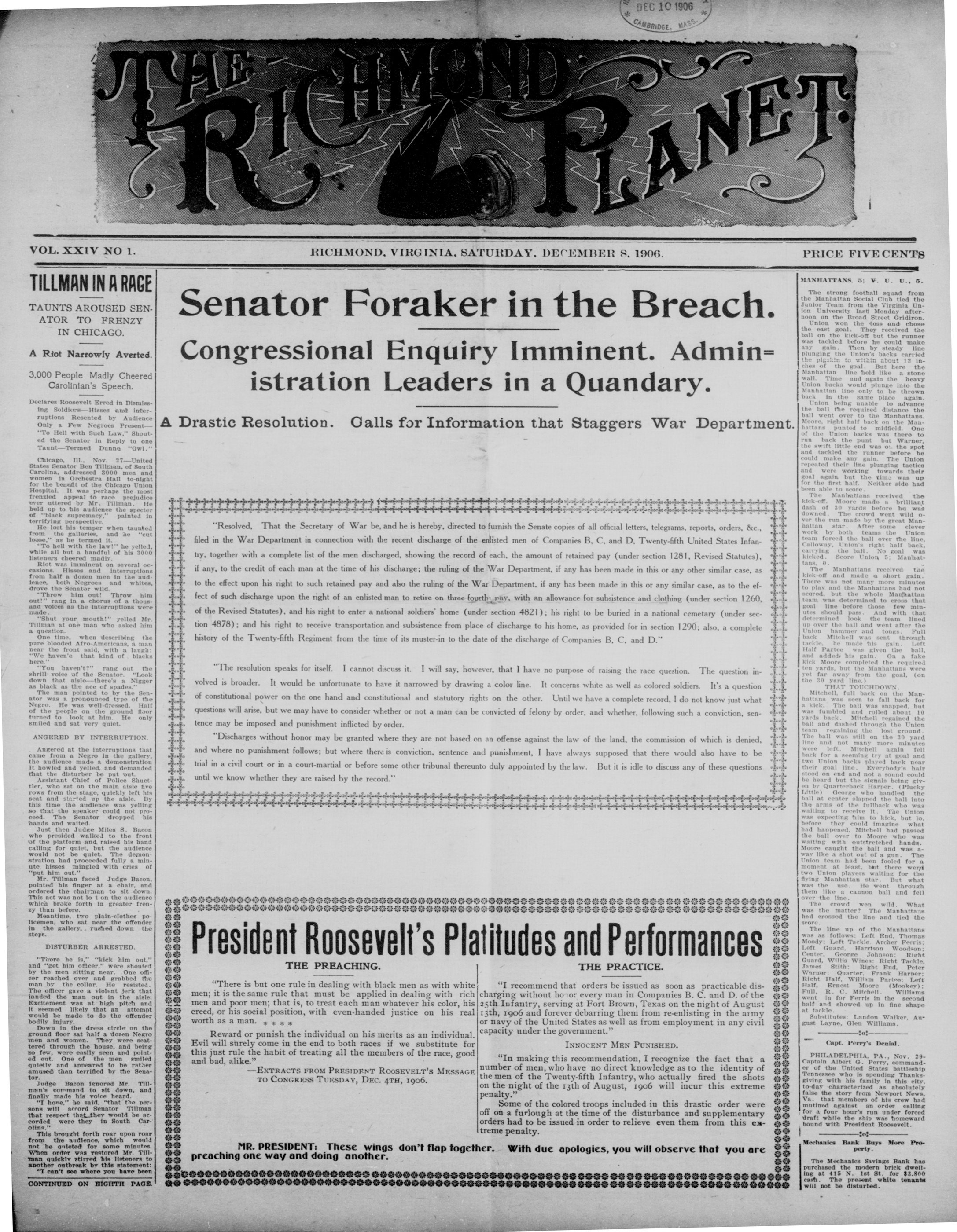
Senator Foraker in the Breach. Congressional Enquiry Imminent. Admin- istration Leaders in a Quandary.
A Drastic Resolution. Galls for Information that Staggers War Department.
```markdown
```
"The resolution speaks for itself. I cannot discuss it. I will say, however, that I have no purpose of raising the race question. The question involved is broader. It would be unfortunate to have it narrowed by drawing a color line. It concerns white as well as colored soldiers. It's a question of constitutional power on the one hand and constitutional and statutory rights on the other. Until we have a complete record, I do not know just what questions will arise, but we may have to consider whether or not a man can be convicted of felony by order, and whether, following such a conviction, sentence may be imposed and punishment inflicted by order.
"Discharges without honor may be granted where they are not based on an offense against the law of the land, the commission of which is denied, and where no punishment follows; but where there is conviction, sentence and punishment, I have always supposed that there would also have to be trial in a civil court or in a court-martial or before some other tribunal thereunto duly appointed by the law. But it is idle to discuss any of these questions until we know whether they are raised by the record."
```markdown
```
President Roosevelt's Platitudes and Performances
MR. PRESIDENT: These wings don't flap together. With due apologies, you will observe that you are preaching one way and doing another.
"There is but one rule in dealing with black men as with white men; it is the same rule that must be applied in dealing with rich men and poor men; that is, to treat each man whatever his color, his creed, or his social position, with even-handed justice on his real worth as a man. * * * *
Reward or punish the individual on his merits as an individual. Evil will surely come in the end to both races if we substitute for this just rule the habit of treating all the members of the race, good and bad, alike."
VOL. XXIV NO 1.
TILLMAN IN A RAGE
TAUNTS AROUSED SEN-
ATOR TO FRENZY
IN CHICAGO.
A Riot Narrowly Averted.
3,000 People Madly Cheered
Carolinian's Speech.
Declares Roosevelt Erred in Dismiss-
ing Soldiers—Hisses and interru-
ptions Resented by Audience
Only a Few Negroes Present—
"To Hell with Such Law," Shout-
ed the Senator in Reply to one
Taunt—Termed Dunne "Owl."
Chicago, Ill., Nov. 27—United
States Senator Ben Tillman, of South
Carolina, addressed 3000 men and
women in Orchestra Hall to-night
for the benefit of the Chicago Union
Hospital. It was perhaps the most
frenzied appeal to race prejudice
ever uttered by Mr. Tillman. He
held up to his audience the specter
of "black supremacy," painted in
terrifying perspective.
He lost his temper when taunted from the galleries, and he "cut loose," as he termed it.
"To hell with the law!" he yelled, while all but a handful of his 3000 listeners cheered madly.
Riot was imminent on several occasions. Hisses and interruptions from half a dozen men in the audience, both Negroes and whites, drove the Senator wild.
"Throw him out! Throw him out!" rang in a chorus of a thousand and voices as the interruptions were made.
"Shut your mouth!" yelled Mr. Tillman at one man who asked him a question.
One time, when describing the pumice blooded Afro-Americans, a man near the front said, with a lauga: "We haven't that kind of blacks here."
"You haven't?" rang out the shrill voice of the Senator. "Look down that aisle—there's a Nigger as black as the ace of spades."
The man pointed to by the Senator was a pronounced type of the Negro. He was well-dressed. Half of the people on the ground floor turned to look at him. He only smiled and sat very quiet.
ANGERED BY INTERRUPTION
Angered at the interruptions that came from a Negro in the gallery, the audience made a demonstration. It howled and yelled, and demanded that the disturber be put out.
Assistant Chief of Police Shuettler, who sat on the main aisle five rows from the stage, quickly left his seat and started up the aisle. By this time the audience was yelling so that the speaker could not proceed. The Senator dropped his hands and waited.
Just then Judge Miles S. Bacon who presided walked to the front of the platform and raised his hand calling for quiet, but the audience would not be quiet. The demonstration had proceeded fully a minute, hisses mingled with cries of "put him out."
Mr. Tillman faced Judge Bacon, pointed his finger at a chair, and ordered the chairman to sit down. This act was not lo t on the audience which broke forth in greater frenzy than before.
Meantime, two plain-clothes policemen, who sat near the offender in the gallery, rushed down the steps.
DISTURBER ARRESTED
"There he is," "kick him out," and "gret him officer," were shouted by the men sitting near. One officer reached over and grabbed the man by the collar. He resisted. The officer gave a violent jerk that landed the man out in the aisle. Excitement was at high pitch and it seemed likely that an attempt would be made to do the offender bodily injury. Down in the dress circle on the ground floor sat half a dozen Negro men and women. They were scattered through the house, and being so few, were easily seen and pointed out. One of the men smiled quietly and appeared to be rather amused than terrified by the Senator.
Judge Bacon ignored Mr. Tillman's command to sit down, and finally made his voice heard.
"I hone," he said, "that the persons will accord Senator Tillman that respect that they would be accorded were they in South Carolina."
This brought forth roar upon roar from the audience, which would not be quieted for some minutes. When order was restored Mr. Tillman quickly stirred his listeners to another outbreak by this statement: "I can't see where you have been
CONTINUED ON EIGHTH PAGE.
RICHMOND, VIRGINIA, SATURDAY, DECEMBER 8, 1906.
"Resolved,
THE PREACHING.
—EXTRACTS FROM PRESIDENT ROOSEVELT'S MESSAGE TO CONGRESS TUESDAY, DEC. 4TH, 1006.
THE PRACTICE. that orders be issued as soon nor every man in Companies at Fort Brown, Texas on ever debarring them from ree- ed States as well as from emp government."
"I recommend that orders be issued as soon as practicable discharging without honor every man in Companies B. C. and D. of the 25th Infantry, serving at Fort Brown, Texas on the night of August 13th, 1906 and forever debarring them from re-enlisting in the army or navy of the United States as well as from employment in any civil capacity under the government."
INNOCENT MEN PUNISHED.
"In making this recommendation, I recognize the fact that a number of men, who have no direct knowledge as to the identity of the men of the Twenty-fifth Infantry, who actually fired the shots on the night of the 13th of August, 1906 will incur this extreme penalty."
Some of the colored troops included in this drastic order were off on a furlough at the time of the disturbance and supplementary orders had to be issued in order to relieve even them from this extreme penalty.
PRICE FIVE CENTS
MANHATTANS, 5; V. U. U., 5.
The strong football squad from the Manhattan Social Club tied the Junior Team from the Virginia Union University last Monday afternoon on the Broad Street Gridiron. Union won the toss and chose the east goal. They received the ball on the kick-off but the runner was tackled before he could make any gain. Then by steady line plunging the Union's backs carried the piggin to within about 12 inches of the goal. Here the Manhattan line held like a stone wall. Time and again the heavy Union backs would plunge into the Manhattan line only to be thrown back in the same place again. Union being unable to advance the ball the required distance the ball went over to the Manhattan. Moore, right half back on the Manhattan punted to midfield. One of the Union backs was there to run back the punt but Warner, the swift little end was on the spot and tackled the runner before he could make any gain. The Union repeated their line plunging tactics and were working towards their goal again but the time was up for the first half. Neither side had been able to score.
The Manhattans received the kick-off. Moore made a brilliant dash of 30 yards before hq was downed. The crowd went wild over the run made by the great Manhattan star. After some clever work by both teams the Union team forced the ball over the line, Calloway, Union's right half back, carrying the ball. No goal was kicked. Score Union 5; Manhattans, 0.
The Manhattans received the kick-off and made a short gain. There was not many more minutes to play and the Manhattans had not scored, but the whole Manhattan team was determined to cross that goal line before those few minutes should pass. And with that determined look the team lined up over the ball and went after the Union hammer and tongs. Full back Mitchell was sent through tackle, he made his gain. Left Half Partee was given the ball, and added his gain. On a fake kick Moore completed the required ten yards, but the Manhattans were yet far away from the goal, (on the 30 yard line.)
MITCHELL, full back on the Manhattans was seen to fall back for a kick. The ball was snapped, but was fumbled and rolled about 10 yards back. Mitchell regained the ball and dashed through the Union team, regaining the lost ground. The ball was still on the 30 yard line and not many more minutes were left. Mitchell again fell back for a seeming try at goal and two Union balls played back near their goal line. Everybody's hair stood on end and not a sound could be heard but the signals being given by Quarterback Harper. (Plucky Little) George who handled the ball at center slapped the ball into the arms of the fullback who was waiting to receive it. The Union was expecting him to kick, but lo, before they could imagine what had happened. Mitchell had passed the ball over to Moore who was waiting with outstretched hands. Moore caught the ball and was way like a shot out of a gun. The Union team had been fooled for a moment at least, but there werft two Union players waiting for the flying Manhattans star. But what was the use. He went through them like a cannon ball and fell over the line.
The crowd wen wild. What was the matter? The Manhattans had crossed the line and tailed the score.
The line up of the Manhattan was as follows: Left End, Thomas Moody; Left Tackle Archer Ferris; Left Guard, Harrison Woodson; Center, George Johnson; Right Guard, Willis Wines; Right Tackle, James Stith; Right End, Peter Warmer; Quarter, Frank Harper; Right Half, William Partee; Left Half, Ernest Moore (Mookey); Full, R. C. Mitchell. Williams went in for Ferris in the second half and showed up in fine shape at tackle. Substitutes: Landon Walker, August Laven, Glen Williams.
PHILADELPHIA, PA., Nov. 29
Captain Albert G. Perry, commander of the United States battleship Tennessee who is spending Thanksgiving with his family in this city, to-day characterized as absolutely false the story from Newport News, Va. that members of his crew had mutined against an order calling for a four hour's run under forced draft while the ship was homeward bound with President Roosevelt.
Mechanics Bank Buys More Property.
The Mechanics Savings Bank has purchased the modern brick dwelling at 415 N. 1st St. for $3,800 cash. The present white tenants will not be disturbed.
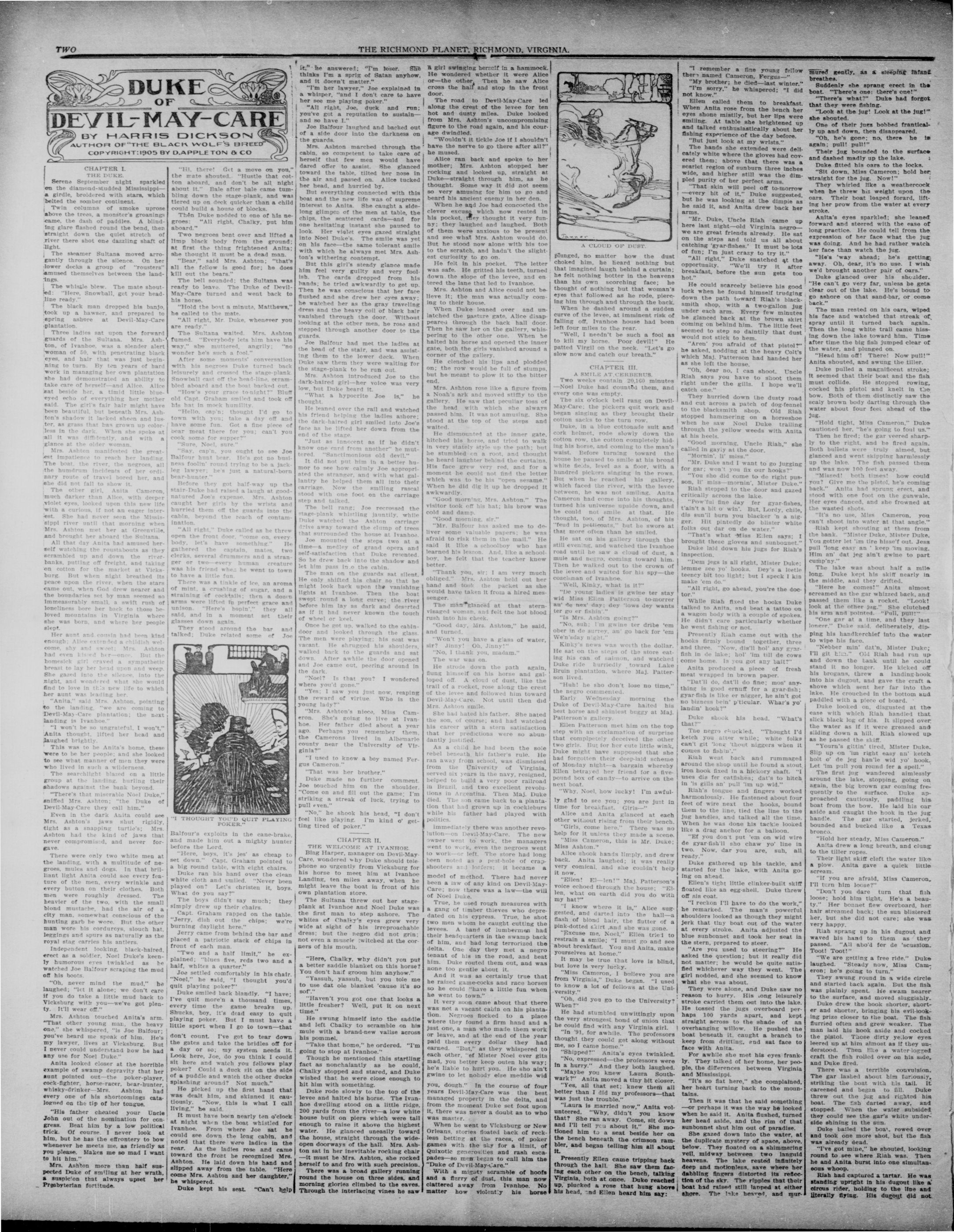
DUKE
OF
DEVIL-MAY-CARE
BY HARRIS DICKSON
AUTHOR OF "THE BLACK WOLF'S BREED"
COPYRIGHT:1905 BY D.APPLETON & CO
TWO
CHAPTER I.
THE DUKE.
Serena September night sparkled on the diamond-studded Mississippi—a girlle, broidered with stars, which belted the somber continent.
Twin columns of smoke uprose above the trees, a monster's groomings came, the dash of paddles. A blinding glare flashed round the bend, then straight down the quiet stretch of river there shot one dazzling shaft of light.
The steamer Sultana moved arrogantly through the silence. On her lower decks a group of "rousters" amused themselves between the landings.
The whistle blew. The mate shouted: "Here, Snowball, get your headline ready."
The black man dropped his banjo, took up a hawser, and prepared to spring ashore at Devil-May-Care plantation.
Three ladies sat upon the forward guards of the Sultana. Mrs. Ashton, of Ivanhoe, was a slender alert woman of 50, with penetrating black eyes, and hair that was just beginning to turn. By ten years of hard work in managing her own plantation she had demonstrated an ability to take care of herself—and Alice. Alice sat beside her, a timid little blue-eyed echo of everything her mother said. The girl's fair hair might have been beautiful, but beneath Mrs. Ashton's shadow it lacked sheen and luster, as grass that has grown up colorless in the dark. When she spoke at all it was diffidently, and with a glance at the older woman.
Mrs. Ashton manifested the greatest impatience to reach her landing. The boat, the river, the negroes, all the humdrum incidents of her ordinary route of travel bored her, and she did not fall to show it.
The other girl, Anita Camaron, much darker than Alice, with deeper violet eyes, looked upon this new life with a curious, if not an eager interest. She had never seen the Mississippi river until that morning when Mrs. Ashton met her at Greenville, and brought her aboard the Sultana. All that day Anita had amused herself watching the roostabouts as they scrambled up and down the riverbanks, putting off freight, and taking on cotton for the market at Vicksburg. But when night breathed its peace upon the river, when the stars came out, when God drew nearer and the boundaries set by man seemed so immeasurably small, a swift rush of loneliness bore her back to those beloved mountains in Virginia where she was born, and where her people slept.
Her aunt and cousin had been kind enough; Alice extended a childish welcome, shy and sweet; Mrs. Ashton had even kissed her—once. But the homesick girl craved a sympathetic breast to lay her head upon and weep. She gazed into the silence, into the night, and wondered what she would find to love in this new life to which her aunt was leading her.
"Anita," said Mrs. Ashton, pointing to the landing, "we are coming to Devil-May-Care plantation; the next landing is Ivanhoe."
"I won't be so ungrateful. I won't," Anita thought, lifted her head and laughed brightly.
This was to be Anita's home, these were to be her people; and she looked to see what manner of men they were who lived in such a wilderness.
The searchlight blazed on a little group at the landing, hurling their shadows against the bank beyond. "There's that miserable Noel Duke," sniffed Mrs. Ashton; "the Duke of Devil-May-Care they call him."
Even in the dark Anita could see Mrs. Ashton's jaws shut, rigidly, tight as a snapping turtle's; Mrs. Ashton had the kind of jaws that never compromised, and never forgave.
There were only two white men at the landing, with a multitude of negroes, mules and dogs. In that brilliant light Anita could see every feature of the men, every wrinkle and every button on their clothes. Both men were roughly dressed. The heavier of the two, with the small blond mustache, had the air of a city man, somewhat conscious of the hunting garb he wore. But the other man wore his corduroys, slouch hat, leggings and spurs as naturally as the royal stag carries his antlers.
Independent looking. black-haired, erect as a soldier, Noel Duke's keenly humorous eyes twinkled as he watched Joe Balfour scraping the mud off his boots.
"Oh, never mind the mud," he laughed; "let it alone; we don't care if you do take a little mud back to Vicksburg with you—we've got plenty. It'll wear off."
Mrs. Ashton touched Anita's arm. "That other young man, the heavy one," she whispered, "is Joe Balfour; you've heard me speak of him. He's my lawyer, lives at Vicksburg. But I never could understand how he had any use for Noel Duke."
Anita looked closer at the horrible example of swamp depravity that her aunt pointed out—the poker-player, cock-fighter, horse-racer, bear-hunter, whisky-drinker—Mrs. Ashton had every one of his shortcomings cataloged on the tip of her tongue.
"His father cheated your Uncle John out of the nomination for congress. Beat him by a low political trick. Of course. I never look at him, but he has the effrontery to bow whenever he meets me, as friendly as you please. Makes me so mad I want to hit him."
Mrs. Ashton more than half suspected Duke of smiling at her wrath, a suspicion that always upset her Presbyterian fortitude.
"Hi, there! Get a move on you," the mate shouted. "Hustle that cotton aboard, and don't be all night about it." Bale after bale came tumbling down the stage-plank, and was ttered on up deck quicker than a child could build a house of blocks.
Then Duke nodded to one of his negroes: "All right, Chalky, put him aboard."
Two negroes bent over and lifted a limp black body from the ground; at first the thing frightened Anita; she thought it must be a dead man.
"Bear," said Mrs. Ashton; "that's all the fellow is good for; he does kill out the bears."
The bell sounded: the Sultana was ready to leave. The Duke of Devil-May-Care turned and went back to his horse.
"Hold the boat a minute, Matthews," he called to the mate.
"All right, Mr. Duke, whenever you are ready."
The Sultana waited. Mrs. Ashton fumed. "Everybody lets him have his way," she muttered, angrily, "no wonder he's such a fool."
After some moments' conversation with his negroes Duke turned back leisurely and crossed the stage-plank. Snowball cast off the head-line, scrambled aboard and the boat backed out. "How's your grace to night?" Bluff old Capt. Graham smiled and took off his hat in mock humility.
"Hello, cap'n; thought I'd go to town with you; take a day off and have some fun. Got a fine piece of bear meat there for you; can't you cook some for supper?"
"Sure, Noel, sure."
"Say, cap'n, you ought to see Joe Balfour hunt bear. He's got no business foolin' round trying to be a jack-leag lawyer; he's just a natural-born bear-hunter."
Before they got half-way up the stair-Duke had raised a laugh at good-natured Joe's expense. Mrs. Ashton caught her girls by the wrists and hurried them off the guards into the cabin, beyond the reach of contamination.
"All right," Duke called as he threw open the front door, "come on, everybody, let's have something." He gathered the captain, mates, two clerks, several drummers and a stranger or two—every human creature was his friend when he went to town to have a little fun.
There was a tinkle of ice, an aroma of mint, a crushing of sugar, and a straining of cocktails; then a dozen arms were lifted in perfect grace and unison. "Here's hopin'," they all said, and in a moment set their glasses down again.
They stood around the bar and talked: Duke related some of Joe.
THE TANK
"I THOUGHT YOU'D QUIT PLAYING POKER."
Balfour's exploits in the cane-brake, and made him out a mighty hunter before the Lord.
"Here, boys, it's jest' as cheap to set down." Capt. Graham pointed to a big round table with sight chairs.
set down. Capt. Graham pointed to a big round table, with eight chairs. Duke ran his hand over the clean white cloth and smiled. "Never been played on? Let's christen it, boys. What do you say?" The boys didn't say much; they simply drew up their chairs. Capt. Graham rapped on the table. "Jerry, dish out the chips; we're burning daylight here." Jerry came from behind the bar and placed a patriotic stack of chips in front of each man. "Two and a half limit," he explained; "blues five, reds two and a half, whites a quarter." Joe settled comfortably in his chair. "Noel," he said, "I thought you'd quit playing poker?" Duke smiled back blandly. "I have; I've quit more'n a thousand times, every time the game breaks up. Shucks, boy, it's dead easy to quit playing poker. But I must have a little sport when I go to town—that
don't count. I've got to tear down the gates and take the bridles off for a day or so; my system needs it. Look here, Joe, do you think I could sit here and watch you fellows play poker? Could a duck sit on the side of a puddle and watch the other ducks splashing around? Not much."
He picked up the first hand that was dealt him, and skinned it cautiously. "Now, this is what I call living," he said.
It must have been nearly ten o'clock at night when the boat whistled for Ivanhoe. From where Joe sat he could see down the long cabln, and noted that there were ladies in the rear. As the ladies rose and came toward the front he recognized Mrs. Ashton. He laid down his hand and slipped away from the table. "Here come Mrs. Ashton and her daughter," he whispered.
Duke kept his seat. "Can't help
it," he answered; "I'm loser. She thinks I'm a sprig of Satan anyhow, and it doesn't matter."
"I'm her lawyer." Joe explained in a whisper, "and I don't care to have her see me playing poker."
"All right, Joe, duck and run; you've got a reputation to sustain—and so have I."
Joe Balfour laughed and backed out of a side door into the darkness on the guards.
Mrs. Ashton marched through the cabin, so competent to take care of herself that few men would have dared offer to assist. She glanced toward the table, tilted her nose in the air and passed on. Alice tucked her head, and hurried by.
a girl swinging herself in a hammock. He wondered whether it were Alice or—the other. Then he saw Alice cross the hall and stop in the front door.
The road to Devil-May-Care led along the crest of the levee for ten hot and dusty miles. Duke looked from Mrs. Ashton's uncompromising figure to the road again, and his courage dwindled.
"Wouldn't it tickle Joe if I shouldn't have the nerve to go there after all?" he mused.
Alice ran back and spoke to her mother; Mrs. Ashton stopped her rocking and looked up, straight at Duke—straight through him, as he thought. Some way it did not seem
But everything connected with this boat and the new life was of supreme interest to Anita. She caught a side-long glimpse of the men at table, the chips, the scattered cards—and for one hesitating instant she paused to look. Her violet eyes gazed straight into Noel Duke's. The smile was yet on his face—the same tolerant smile with which he always met Mrs. Ashton's withering contempt.
But this girl's steady glance made him feel very guilty and very foolish. The cards dropped from his hands; he tried awkwardly to get up. Then he was conscious that her face flushed and she drew her eyes away; he watched her as the gray traveling dress and the heavy coil of black hair vanished through the door. Without looking at the other men, he rose and stepped through another door to the guards.
Joe Balfour had met the ladies at the head of the stair, and was assisting them to the lower deck. When Duke saw them they were waiting for the stage-plank to be run out.
Mrs. Ashton introduced Joe to the dark-haired girl—her voice was very low, but Duke heard it.
"What a hypocrite Joe is," he thought.
He leaned over the rail and watched his friend helping the ladies ashore; the dark-haired girl smiled into Joe's face as he lifted her down from the end of the stage.
"Just as innocent as if he didn't know one card from another" he muttered.
"Sanctimonious old devil."
It did not put him in a better humor to see how calmly Joe appropriated the stranger, and with what gallantry he helped them all into their carriage. Now the smiling rascal stood with one foot on the carriage step and talked.
The bell rang; Joe recrossed the stage-plank whistling jauntily, while Duke watched the Ashton carriage drive away toward the clump of trees that surrounded the house at Ivanhoe. Joe mounted the steps two at a time—a medley of grand opera and self-satisfaction that Duke resented. So he drew back into the shadow and let him pass in the cabin.
The man on the guards sat silent. He only shifted his chair so that he might look back upon the vanishing lights at Ivanhoe. Then the boat swept round a long curve; the river before him lay as dark and deserted as if it had never known the touch of wheel or keel.
Once he got up, walked to the cabin door and looked through the glass. The men were playing; his seat was vacant. He shrugged his shoulders, walked back to the guards and sat down. After awhile the door opened and Joe came out, peering around in the dark.
"Noel? Is that you? I wondered where you'd gone."
"Yes; I saw you just now, reaping the reward of virtue. Who is the young lady?"
"Mrs. Aeshton's niece, Miss Cameron. She's going to live at Ivanhoe. Her father died about a year ago. Perhaps you remember them, the Camerons lived in Albamarie county near the University of Virginia?"
"I used to know a boy named Fergus Cameron."
"That was her brother."
Duke made no further comment. Joe touched him on the shoulder. "Come on and fill out the game; I'm striking a streak of luck, trying to pull even."
"No," he shook his head, "I don't feel like playing. I'm kind o' getting tired of poker."
CHAPTER II
THE WELCOME AT IVANHOE
Bling Harper, manager on Devil-May-Care, wondered why Duke should telephone so urgently from Vicksburg for his horse to meet him at Ivanhoe Landing, ten miles away, when he might leave the boat in front of his own plantation store.
The Sultana threw out her stage-plank at Ivanhoe and Noel Duke was the first man to step ashore. The whites of Chalky's eyes grew very wide at sight of his irreproachable dress; but the negro did not grin; not even a muscle switched at the corners of his mouth.
"Here, Chalky, why didn't you put a better saddle blanket on this horse? You don't half groom him anyhow."
"Yassuh, yassuh, but you tome me to use dat ole blanket 'cause it's so sof."
"Haven't you got one that looks a little fresher? Well, put it on next time."
He swung himself into the saddle and left Chalky to scramble on his mule with a brand-new valise across his pommel.
"Take that home," he ordered. "I'm going to stop at Ivanhoe."
Though he mentioned this startling fact as nonchalantly as he could, Chalky stopped and stared, and Duke wished that he were close enough to hit him with something.
Duke rode slowly to the top of the levee and halted his horse. The Ivanhoe dwelling stood on a little ridge, 200 yards from the river—a low white house built on piers which were tall enough to raise it above the highest water. He glanced uneasily toward the house, straight through the wide-open doorways of the hall. Mrs. Ashton sat in her inevitable rocking chair—it must be Mrs. Ashton, she rocked herself to and fro with such precision.
There was a broad gallery running round the house on three sides, and morning glories climbed to the eaves. Through the interlacing vines he saw
a girl swinging herself in a hammock.
He wondered whether it were Alice or—the other. Then he saw Alice cross the half and stop in the front door.
The road to Devil-May-Care led along the crest of the levee for ten hot and dusty miles. Duke looked from Mrs. Ashton's uncompromising figure to the road again, and his courage dwindled.
"Wouldn't it tickle Joe if I shouldn't have the nerve to go there after all?" he mused.
Alice ran back and spoke to her mother; Mrs. Ashton stopped her rocking and looked up, straight at Duke—straight through him, as he thought. Some way it did not seem so very amusing for him to go and beard his ancient enemy in her den.
When he and Joe had concocted the clever excuse which now rested in his pocket, they thought it very funny; they laughed and laughed. Both of them were anxious to be present and see what Mrs. Ashton would do. But he stood now alone with his toe to the scratch, and hadn't the slightest curiosity to go on.
He felt in his pocket. The letter was safe. He gritted his teeth, turned down the slope of the levee, and entered the lane that led to Ivanhoe.
Mrs. Ashton and Alice could not believe it; the man was actually coming to their house.
When Duke leaned over and unlatched the pasture gate, Alice disappeared through the back hall door. Then he saw her on the gallery, whispering to the other one. When he halted his horse and opened the inner gate, both the girls vanished around a corner of the gallery.
He clenched his lips and plodded on; the row would be full of stumps, but he meant to plow it to the bitter end.
Mrs. Ashton rose like a figure from a Noah's ark and moved stiffly to the gallery. He saw that peculiar toss of the head with which she always passed him. It was not amusing. She stood at the top of the steps and waited.
He dismounted at the inner gate, hitched his horse, and tried to walk in very stately style up the path; but he stumbled on a root, and thought he heard laughter behind the curtains. His face grew very red, and for a moment he could not find the letter which was to be his "open sesame." When he did dig it up he dropped it awkwardly.
"Good morning, Mrs. Ashton." The visitor took off his hat; his brow was cold and damp.
"Good morning, sir."
"Mr. Balfour has asked me to deliver some valuable papers; he was afraid to risk them in the mail." He said it like a schoolboy who has learned his lesson. And, like a schoolboy, he felt that the teacher knew better.
"Thank you, sir; I am very much obliged." Mrs. Ashton held out her hand and took the packet as she would have taken it from a hired messenger.
The man glanced at that stern-visaged woman, and felt the hot blood rush into his cheek.
"Good day, Mrs. Ashton," he said, and turned.
"Won't you have a glass of water, sir? Jinny! Oh, Jinny!"
"No, I thank you, madam."
The war was on.
He strode down the path again, flung himself on his horse and galloped off. A cloud of dust, like the trail of a rocket, rose along the crest of the levee and followed him toward Devil-May-Care. Not until then did Mrs. Ashton smile.
She had hated his father. She hated the son, of course; and had watched his career with a stern satisfaction that her predictions were so abundantly justified.
As a child he had been the sole rebel beneath his father's rule. He ran away from school, was dismissed from the University of Virginia, served six years in the navy, resigned, helped to build a very poor railroad in Brazil, and two excellent revolutions in Argentina. Then MaJ. Duke died. The son came back to a plantation that had grown up in cockleburs while his father had played with politics.
Immediately there there was another revolution—on Devil-May-Care. The new owner went to work, the managers went to work, even the negroes went to work—or left. The store had long been noted as a pest-hole of crampshooters and loafers; it became a model of method. There had never been a law of any kind on Devil-May-Care; now there was a law—the will of Noel Duke.
True, he used rough measures with a gang of timber thieves who depredated on his cypress. True, he shot two men whom he caught cutting the levees. A band of lumberman had their headquarters in the swamp back of him, and had long terrorized the delta. One day they met a negro tenant of his in the road, and beat him. Duke routed them out, and was none too gentle about it.
And it was as certainly true that he raised game-cocks and race horses so he could "have a little fun when he went to town."
It very soon came about that there was not a vacant cabin on his plantation. Negroes flocked to a place where they found a firm hand and a just one, a man who made them work or leave, and at the end of the year paid them every dollar they had earned. "But," as they whispered to each other, "ef Devil Mier ever gits mad, you better keep outen his way; he's liable to hurt you. He so ain't gwine to let nobody else meddle wid you, dough." In the course of four years Devil-May-Care was the best managed property in the delta, and from the moment Duke set foot upon it, there was never a doubt as to who was master.
When he went to Vicksburg or New Orleans, stories floated back of reckless betting at the races, of poker games with the sky for a limit, of Quixotic generosities and rash escapades—so men began to call him the "Duke of Devil-May-Care."
With a migyit scramble of hoofs and a flurry of dust, this man now clattered away from Ivanhoe. No matter how violently his horse
Tanner.
A CLOUD OF DUST.
plunged, no matter how the dust choked him, he heard nothing but that imagined laugh behind a curtain; he felt nothing hotter in the heavens than his own scorching face; he thought of nothing but that woman's eyes that followed as he rode, piercing him through and through the back. When he dashed around a sudden curve of the levee, at imminent risk of falling off, Ivanhoe house had been left four miles to the rear.
"Well, I needn't be such a fool as to kill my horse. Poor devil!" He patted Virgil on the neck. "Let's go slow now and catch our breath!"
CHAPTER III
A SMILE AT CERBERUS
Two weeks contain 20,160 minutes—Noel Duke had counted them, and every one was empty.
The six o'clock bell rang on Devil-May-Care; the pickers quit work and began singing as they brought their cotton sacks to the turn row.
Duke, in a blue cottonade suit and cork helmet, rode slowly down the cotton row, the cotton completely hiding his horse, and coming to the man's waist. Before turning toward the house he paused to smile at his broad white fields, level as a floor, with a hundred pickers singing in the rows. But when he reached his gallery, which faced the river, with the levee between, he was not smiling. Anita Cameron had come into his thoughts, turned his universe upside down, and he could not smile at that. He thought, too, of Mrs. Ashton, of his "feud in pottecans," but he swore at that more often than he smiled.
He sat on his gallery through the still evening, and watched the Ivanhoe road until he saw a cloud of dust, a mule and negro, coming toward him. Then he walked out to the crown of the ievee and waited for his spy—the coachman of Ivanhoe.
"Well, Kinky, what is it?"
"De young ladies is gwine ter stay wid Miss Ellen Patterson to-morrer an' de nex' day; dey 'lows dey wants ter go er fishin.'"
"Ims Mrs. Ashton going?"
"No, suh; I am gwine ter dribe 'em ober in de surrey, an' go back for 'em Wen'sday night."
Kinky's news was worth the dollar. He sat on the steps of the store eating his can of salmon, and watched Duke ride hurriedly toward Lake Braun plantation, where Maj. Patterson lived.
"Huh! he sho don't lose no time," the negro commented.
Early Wednesday morning the Duke of Devil-May-Care hailed his best horse and shiniest buggy at Maj. Patterson's gallery.
Ellen Patterson met him on the top step with an exclamation of surprise that completely deceived the other two girls. But for her cute little wink, Duke might have supposed that she had forgotten their deep-laid scheme of Monday night—a bargain whereby Ellen betrayed her friend for a five-pound box of candy—to arrive on the next boat.
"Why, Noel, how lucky! I'm awfully glad to see you; you are just in time for breakfast. Girls—"
Alice and Anita glanced at each other without rising from their bench.
"Girls, come here." There was no help for it unless they made a scene.
"Miss Cameron, this is Mr. Duke; Miss Ashton."
Alice shook hands limply, and drew back. Anita laughed; it was really very comical, and she couldn't help it now.
"Ellen! El—len!" Maj. Patterson's voice echoed through the house; "Ellen, what on earth did you do with my hat?"
"I know where it is," Alice suggested, and darted into the hall—a flash of blond hair, the flutter of a pink-dotted skirt, and she was gone.
"Excuse me, Noel," Ellen tried to restrain a smile; "I must go and see about breakfast. You and Anita, make yourselves at home."
It may be true that love is blind, but love is very lucky.
"Miss Cameron, I believe you are from Virginia," Duke began. "I used to know a lot of fellows at the University."
"Oh, did you go to the University? When?"
He had stumbled unwittingly upon the very strongest bond of union that he could find with any Virginia girl.
"In '91, for awhile. The professors thought they could get along without me, so I came home."
"Shipped?" Anita's eyes twinkled.
"No, expressed—the professors were in a hurry." And they both laughed.
"Maybe you knew Laura Southwark?" Anita moved a tiny bit closer.
"Yes, all that set; knew them all better than I did my professors—that was just the trouble."
"Laura is married now," Anita volunteered. "Why, didn't you know that? She ran away. Come, sit down and I'll tell you about it." She motioned him to a seat beside her on the bench beneath the crimson rambler, and began telling him all about it.
Presently Ellen came tripping back through the hall. She saw them facing each other on the bench, talking Virginia, both at once. Duke reached up, plucked a rose that hung above his head, and Ellen heard him say:
"I remember a fine young fellow there named Cameron, Fergus—"
"My brother; he died—last winter."
"I'm sorry," he whispered; "I did not know."
Ellen called them to breakfast. When Anita rose from the bench her eyes shone mistily, but her lips were smiling. At table she brightened up and talked enthusiastically about her fishing experience of the day before.
"But just look at my wrists."
The hands she extended were delicately white where the gloves had covered them; above that there was a scarlet region of sunburn three inches wide, and higher still was the dimpled purity of her perfect arms.
"That skin will peel off to-morrow—every bit of it," Duke suggested, but he was looking at the dimple as he said it, and Anita drew back her arms.
"Mr. Duke, Uncle Riah came up here last night—old Virginia negro—we are great friends already. He sat on the steps and told us all about catching 'gyar-fishes.' It must be lots of fun; I'm just crazy to try it."
"All right," Duke snatched at the opportunity. "We'll try it after breakfast, before the sun gets too hot."
He could scarcely believe his good luck when he found himself trudging down the path toward Riah's black-smith shop, with a two-gallon jug under each arm. Every few minutes he glanced back at the brown skirt coming on behind him. The little feet seemed to step so daintily that dust would not stick to him.
"Aren' you afraid of that pistol?" he asked, nodding at the heavy Colt's which Maj. Patterson had handed her as she left the house.
"Oh, dear no, I can shoot. Uncle Riah says you have to shoot them right under the gills. I hope we'll catch one."
They hurried down the dusty road and cut across a patch of dog-fennel to the blacksmith shop. Old Riah stopped hammering on a horseshoe when he saw Noel Duke trailing through the yellow weeds with Anita at his heels.
"Good morning, Uncle Riah," she called in gavay at the door.
"Mornin', li' miss."
"Mr. Duke and I want to go jugging for gar; won't you fix our hooks?"
"You she wont come to de right pusson, li' miss—mornin', Mister Duke."
Riah stepped to the door and gazed critically across the lake.
"Powful fine day fer gyar-fishes, t'ain't a bit o win'. But, Lordy, chile, dis sun' burn you blacker n a nigger. Hit pintedly do blister white folks out dar on de water."
"That's what Miss Eilen says; I brought these gloves and sunboatet." Duke laid down his jugs for Riah's inspection.
"Dem jegs is all right, Mister Duke; lemme see yo' hooks. Dey's a leetle teency bit too light; but I speck I kin make 'em do."
"All right, go ahead, you're the doctor."
While Riah fixed the hooks Duke talked to Anita, and beat a tattoo on a wagon body with a couple of spokes. He didn't care particularly whether he went fishing or not.
Presently Riah came out with the hooks firmly bound together, three and three. "Now, dis'll hol' any gyar-fish in de lake; hol' im till de cows come home. Is you got any hait?"
Anita produced a piece of fresh meat wrapped in brown paper.
"Dat'l do, dat'll do fine; mos' anything is good ernuff for a gyar-fish; gyar-fish is like er nigger, he ain't got no biness bein' p'ticular. Whar's yo' landin' hook?"
Duke shook his head. "What's that?"
The negro chuckled. "Thought I'd ketch you after while; white folks can't git 'long 'thout niggers when it comes to fishin'."
Riah went back and rummaged around the shop until he found a stout iron hook fixed in a hickory shaft. "I uses dis fer catfishes; dat's to hitch in 'is gills an 'pull 'im up wid."
Riah's tongue and fingers worked harmoniously. He fastened about four feet of wire next the hooks, bound them to the line, tied the line to the jug handles, and talked all the time. When he was done his tackle looked like a drag anchor for a balloon.
"If you don't put 'em on wid wire de gyar-fish'll sho chaw yo' line in two. Now, dar you are, suh, all ready."
Duke gathered up his tackle, and started for the lake, with Anita going on ahead.
Ellen's tight little clinker-built skiff floated like an egg-shell. Duke threw off his coat.
"I reckon I'll have to do the work," he remarked. The man's powerful shoulders looked as though they might jerk that tiny boat out of the water at every stroke. Anita adjusted the blue sunbonnet and took her seat in the stern, prepared to steer.
"Are you used to steering?" He asked the question; but it really did not matter; he would be quite satisfied whichever way they went. The girl nodded, and she seemed to know what she was about.
They were alone, and Duke saw no reason to hurry. His long leisurely stroke carried them out into the lake. He tossed the jugs overboard perhaps 100 yards apart, and kept straight across to the shade of an overhanging willow. He pushed the boat beneath it, caught a branch to keep from dripping, and sat face to face with Anita.
For awhile she met his eyes frankly. They talked of her home, her people, the differences between Virginia and Mississippi.
"It's so flat here," she complained, her heart turning back to the mountains.
Then it was that he said something—or perhaps it was the way he looked when he said it. Anita flushed, turned her head aside, and the rim of that sunbonnet shut him out of paradise.
She gazed down into the water, at the duplicate mystery of space, above, below. They floated on a shimmering veil, midway between two languid heavens. The lake rested infinitely deep and motionless, save where her dabbling fingers distorted its reflection of the sky. The ripples that their boat had raised still lapped at either shore. The lake heaved, and mur-
mured gently, as a sleeping infant breathes.
Suddenly she sprang erect in the boat. "There's one: there's one!"
"There's what?" Duke had forgot that they were fishing.
"Look at the jug! Look at the jug!" she abouted.
One of their jubs hobbed frantically up and down, then disappeared.
"Oh, he's gone; no, there he is again; pull! pull!"
Their jug bounded to the surface and dashed madly up the lake.
Duke fitted his oars to the locks.
"Sit down, Miss Cameron; hold her, straight for the jug. Now!"
They whirled like a weathercock when he threw his weight upon the oars. Their boat leaped forward, lifting her prow from the water at every stroke.
Anita's eyes sparkled; she leaned forward and steered with the ease of long practice. He could tell from the expression of her face what the jug was doing. And he had rather watch her face than watch the jug.
"He's 'way ahead; he's getting away. Oh, dear, it's no use. I wish we'd brought another pair of oars."
Duke glanced over his shoulder,
"He can't go very far, unless he gets
clear out of the lake. He's bound to
go ashore on that sand-bar, or come
back."
The man rested on his oars, wiped
his face and watched that streak of
spray until it turned back again.
Then the long white trail came hissing
down the lake toward him. Time
after time the big fish jumped clear of
the water, and plunged on.
"Head him off! There! Now pull!"
Anita shouted, and swung the tiller.
Duke pulled a magnificent stroke;
it seemed that their boat and the fish
must collide. He stopped rowing,
cocked his pistol and knelt in the
bow. Both of them distinctly saw the
scaly brown body darting through the
water about four feet ahead of the
fug.
"Hold tight, Miss Cameron." Duke cautioned her, "he's going to foul us." Then he fired; the gar veered sharply to the right, and he fired again. Both bullets were truly aimed, but glanced and went skipping harmlessly up the lake. The fish passed them and was now 100 feet away.
"Missed! both times! how could you? Give me the pistol, he's coming back." Anita had sprung erect, and stood with one foot on the gunwale. Her eyes danced, and she frowned at the wasted shots.
"It's no use, Miss Cameron, you can't shoot into water at that angle." Risha kept shouting at them from the bank. "Mister Duke, Mister Duke. You got letter 'im tire hiself' out. Jess pull 'long easy an' keep 'im moving. Him an' dat jeg 'an' gwine to part cump'ny."
The lake was about half a mile long. Duke kept his skiff nearly in the middle, and they drifted.
"Here he comes!" Anita almost screamed as the gar whizzed back, and passed them like a rocket. "Look! look at the other jug." She clutched his arm and pointed. "Pull, pull!" "One gar at a time, and they last longer." Duke said, deliberately, dipping his handkerchief into the water to wipe his face.
"Nebber min' dat'n. Mister Duke, I'll git him." Old Riah had run up and down the tank until he could stand it no longer. He kicked off his brogans, threw a landing hook into his dugout, and gave the craft a shove which sent her far into the lake. He crouched in the bottom and paddled with a piece of board.
Duke looked on, disgusted at the ease with which Riah handled that slick black log of his. It slipped over the water as if it were greased and sliding down a hill. Riah slowed up as he passed the skiff.
"Yourn's gittin' tired, Mister Duke. Slip up on 'im right easy an' ketch holt o' de jeg han'le wid yo' hook. Let 'im pull you round fer a spell." The first jug wandered aimlessly around the lake, stopping, going on again, the big brown gar coming frequently to the surface. Duke approached cautiously, paddling his boat from the bow. He laid his car aside and caught the hook in the jug handle. The gar started, jerked, bounded and bucked like a Texas bronco. "Hold her steady, Miss Cameron." Anita drew a long breath, and clung to the tiller ropes. Their light skiff cleft the water like a plow. Anita gave a quick little scream. "If you are afraid, Miss Cameron, I'll turn him loose?"
"Don't you dare turn that fish loose; hold him tight. He's a beauty." Her bonnet flew overboard, her hair streamed back; the sun blistered her, but she did not care; she was very happy.
Riah sprang up in his dugout and waved his hand to them as they passed. "All ahd'o fde de 'scusion. Toot! Toot!"
"We are getting a free ride." Duke laughed. "Steady now, Miss Cameron; he's going to turn."
They swung round in a wide circle and started back again. But the fish was plainly spent. He swam nearer to the surface, and moved sluggishly.
Duke drew the hook shorter, shorter and shorter, bringing his evil-looking prize closer to the boat. The fish flurried often and grew weaker. The man laid his hook aside and cocked the pistol. Those dirty yellow eyes leered up at him almost as if they understood. Then like a water-logged craft the fish rolled over on his side, and Duke fired.
There was a terrible convulsion. The gar lashed about him furiously, striking the boat with his tail. It careened and began to fill. Duke threw out the jug and righted his boat. The fish darted away, and stopped. When the water subsided they could see the gar's white underside shining in the sun.
Duke bailed the boat, rowed over and took one more shot, but the fish was already dead.
"I've got mine," he shouted, looking round to see where Riah was. Then he and Anita burst into one simultaneous whoo.
Riah had captured a tartar. He was standing upright in his dugout like a circus rider, holding to the line and literally flying. His dugout did not
TAC PLANET
SATURDAY...DEC. 8TH. 1906.
stir up water like the skiff; in fact, it scarcely seemed to touch the water at all.
"Better git outen de road, Mister Duke," he shouted, "we're runnin' away."
Suddenly the gar whirled, and snapped Riah off the end of the line, head over heels into the lake. The black face came up instantly, blowing and puffing. He caught his dugout, and, by a quick jerky motion back and
Janner
"GOOD-BY, MR. DUKE."
forth, dashed out every drop of water.
He had climbed into it again before Duke and the skiff could reach him.
"Hub! th'owed me, didn't he? Gyarfish trickler' a mule." Riah picked up his paddle and went after the fish again.
The sun shone down so fiercely that they were forced to be content with a single prize. They picked up Anita's bonnet and started back, towing their gar, to the landing place. When they stepped ashore their combined strength could not lift the huge fish from the water.
"Oh, dear, we can't get him out; I'll have to call some one."
Anita turned, and Mrs. Ashton confronted her. "Oh!" she gasped, "when did you come?"
"I came a little bit, too late, it seems," Mrs. Ashton replied frigidly.
"Go straight to the house, Anita; get out of this sun; put on some dry clothes; you are a sight."
Duke kept tugging at the gar, with a cold chill running up and down his back. He knew what was coming. "All right," Anita sald, and she even dared to laugh. "Good-by, Mr. Duke, I am very glad to have met you." Duke had not had time to nerve himself, but he looked around and saw Mrs: Ashton glare at Anita as the girl held out her hand to him. Their eyes met, and then he did not care a snap for what Mrs. Ashton might have to say.
Anita wrung the water from her bonnet and went tripping up to the house as smilingly as if she did not understand.
"Mr. Duke—"
"Mrs. Ashton—" They stood face to face, and he looked as sober as a judge.
"Noel Duke," the old lady blazed out, "what do you mean, sneaking around when my back is turned—what do you mean?"
His face flamed; he was not a patient man at best. Then he answered quietly:
"Mean? I mean to marry her, unless she tells me 'no.'"
TO BE CONTINUED
THE PRESIDENT HOME FROM TRIP
Returns to White House From Visit to Isthmus and Porto Rico.
WILL SAY NOTHING OF CANAL
Washington, Nov. 27.—Completing a remarkable trip to Panama, during which he traveled several thousand miles by sea and visited not only the lathmus, but Porto Rico as well, and voicing his thorough enjoyment of the entire voyage, President Roosevelt returned to Washington Monday night. The trip up the Potomac on the converted yacht Mayflower, to which he and his party were transferred from the Louisiana at Piney Point, was made without special incident. As the Mayflower pulled into the dock at the rear of the office of the commandant of the yard navy Miss Ethel Roosevelt, the president's daughter, and Miss Hagner, Mrs. Roosevelt's secretary, were awaiting to greet the party. Miss Roosevelt immediately rushed on board as soon as the gang plank was laid and affectionately greeted her father and mother. The president landed within 10 minutes after the arrival of the Mayflower. To those who met him he stated that he had had a delightful trip and that he was feeling finely.
The president and Mrs. Roosevelt immediately proceeded to the White House. As the president alighted from his carriage he shook hands with all the attaches and others waiting on the portico. Speaking of his trip, the president said: "We had a very pleasant, very enjoyable time, and I am deeply impressed with the United States navy, with Panama and with Porto Rico."
The Panama canal, it was stated by the president, will be a subject of a special message, and consequently on that subject the president will say nothing at this time.
Pedro Roquena Bermudez, charge d'affaires of Uruguay, was the only member of the diplomatic corps who greeted the president upon his arrival. At the front entrance to the navy yard Senior Bermudez was delayed by the marine guard, who refused to admit him without the consent of the commandant. After being delayed for 20 minutes he was admitted, and when the president appeared on the deck of the Mayflower the diplomat was the first to rush up the gangplank. He protested to the president against the manner in which he had been treated by the marine guard.
Lutherans Barred From Church By the Reformed Faction.
Lancaster, Pa., Nov. 26.—The unusual spectacle of a clergyman locked out of church, and preaching to his congregation from the church steps, was the result of the dispute that has caused a schism in the United Evangelical Lutheran Church, in Eden township, this county. The congregation was organized some years ago in the Lutheran faith. Recently a number of the members accepted the Reform doctrine, elected a pastor of their own, and, it is alleged, refused to permit the Lutherans to hold services in the church. Last Thursday the Lutherans petitioned the court, and an injunction was issued restraining the Reformed faction from interfering with them. However, when the Rev. Emil Meister, of this city, went to the church to hold services he found the doors locked and the sexton missing. He took the church steps for his pulpit and preached a sermon, in which he counseled his hearers to bear their trials with patience and forbearance. Litigation is threatened.
TRIED TO BURN MAN ALIVE
Tramps Beat Teamster Unconscious and Throw Him Into Fire
Steubenville, O., Nov. 27.—Edward Coulter, a teamster, was attacked by tramps on the West Virginia side of the Ohio river, and after he had been beaten into unconsciousness he was thrown into a fire, and so badly burned he will die. Coulter was walking home when the tramps attacked him, took his money, stripped him of his clothing and left him unconscious with his body lying across the still burning coals of a fire. He revived sufficiently to roll away from the fire and give a description of his assailants, who have not yet been arrested.
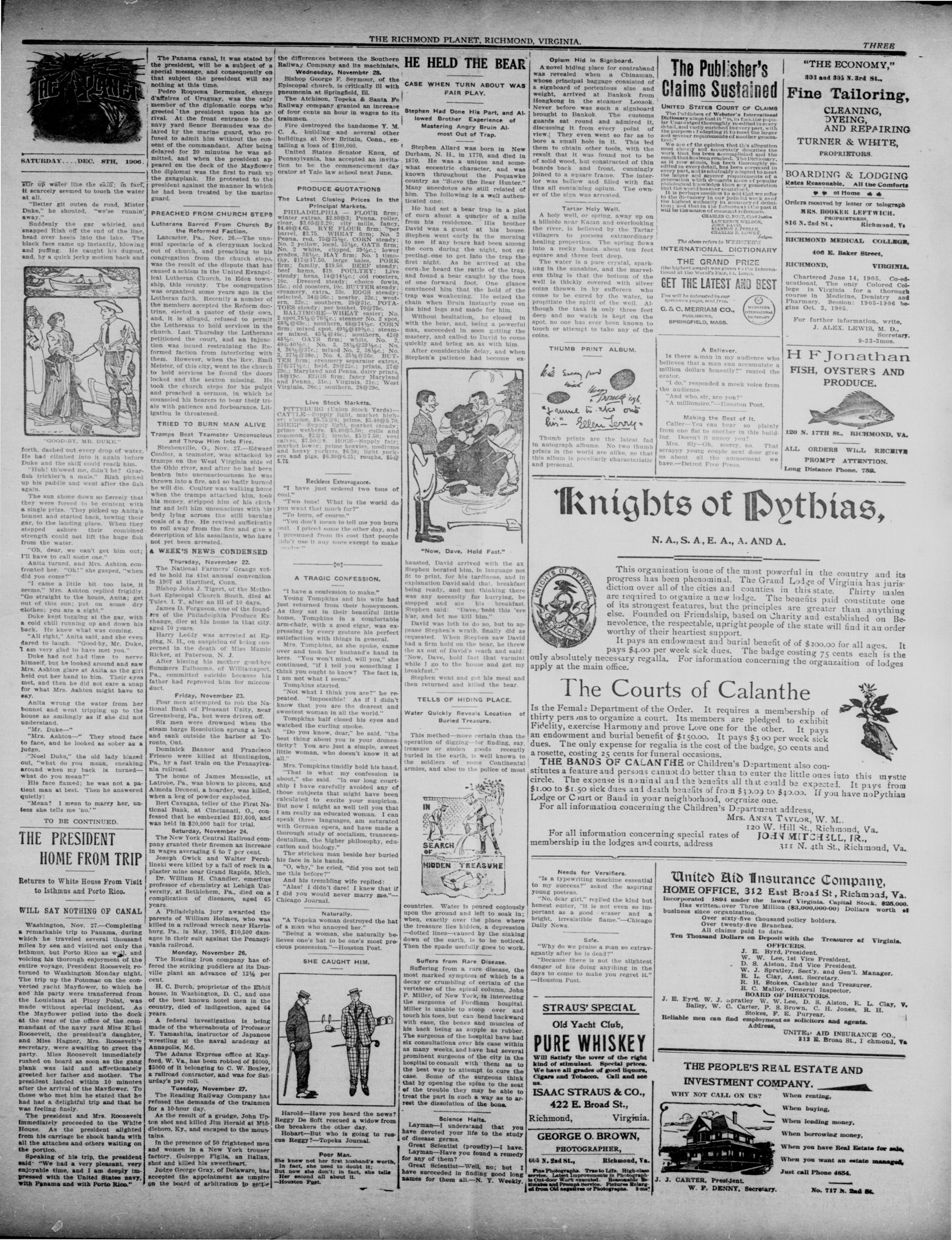
A WEEK'S NEWS CONDENSED
The National Farmers' Grange voted to hold its 41st annual convention in 1907 at Hartford, Conn.
Bishop John J. Tigert, of the Methodist Episcopal Church South, died at Tules, I. T., after an ill of 10 days.
James D. Ferguson, one of the founders of the Philadelphia Produce Exchange, dier at his home in that city, aged 70 years.
Harry Leddy was arrested at Epping, N. H., on suspicion of being concerned in the death of Miss Mamie Ricker, at Paterson, N. J.
After kissing his mother good-bye Summers Falbsome, of Williamsport, Pa., committed suicide because his father had reproved him for misconduct.
Friday, November 23.
Four men attempted to rob the National Bank of Pleasant Unity, near Greensburg, Pa., but were driven off.
Six men were drowned when the steam barge Resolution sprung a leak and sank outside the harbor at Toronto, Ont. Dominick Bannor and Francisco Friescoe were killed at Huntingdon, Pa., by a fast train on the Pennsylvania railroad.
The home of James Menseille, at Latrobe, Pa., was blown to pieces, and Almeda Dronesi, a boarder, was killed, when a keg of powder exploded.
Bert Cavagna, teller of the First National Bank, at Cincinnati, O., confessed that he embezzled $31,600, and was held in $20,000 ball for trial.
Saturday, November 24.
The New York Central Railroad company granted their firemen an increase in wages averaging 6 to 7 per cent.
Joseph Owick and Walter Pershlinski were killed by a fall of rock in a plaster mine near Grand Rapids, Mich.
Dr. William H. Chandler, emeritus professor of chemistry at Lehigh University, at Bethelehem, Pa., died on a complication of diseases, aged 65 years.
A Philadelphia jury awarded the parents of William Holmes, who was killed in a railroad wreck near Harrisburg, Pa., in May, 1905, $10,500 damages in their suit against the Pennsylvania railroad.
Monday, November 26.
The Reading iron company has offered the striking puddlers at its Danville plant an advance of $12½ per cent.
H. C. Burch, proprietor of the Ebbit house, in Washington, D. C., and one of the best known hotel men in the country, died of indigestion, aged 64 years.
A federal investigation is being made of the whereabouts of Professor Y. Yamashita, instructor of Japanese wrestling at the naval academy at Annapolis, Md.
The Adams Express office at Kayford, W. Va., has been robbed of $6000, $5000 of it belonging to C. W. Boxley, a railroad contractor, and was for Saturday's pay roll.
Tuesday, November 27.
The Reading Railway Company has refused the demands of the trainmen for a 10-hour day.
As the result of a grudge, John Upon shot and killed Jim Herald at Middleboro, Ky., and escaped to the mountains.
In the presence of 50 frightened men and women in a New York trouser factory, Guiseppe Figlia, an Italian, shot and killed his sweetheart.
Judge George Gray, of Delaware, has accepted the appointment asumpire on the board of arbitration to settle
THE RICHMOND PLANET, RICHMOND, VIRGINIA
the differences between the Southern Railway Company and its machinists. Wednesday, November 28. Bishop George F. Seymour, of the Episcopal church. is critically ill with pneumonia at Springfield, Ill. The Atchison, Topeka & Santa Fe Railway company granted an increase of four cents an hour in wages to its trainmen. Fire destroyed the handsome Y. M. C. A. building and several other buildings at New Britain, Conn., entailing a loss of $100,000. United States Senator Knox, of Pennsylvania, has accepted an invitation to be the commencement day orator at Yale law school next June.
PRODUCE QUOTATIONS
The Latest Closing Prices In the Principal Markets.
PHILADELPHIA FLOUR firm;
winter extras, $2.80@;30.0
penna, roller, clear, $3.05@;3.20; city mills, fancy, $4.40@;4.00; RYB FLOUR firm; per
penna, roller, clear, $4.00; Penna, red, $75@;75%C; CORN steady;
No. 2 yellow, local, 55%C; OATS firm;
No. 2 white, clipped, $39%C;; lower
grades, 38%C; HAY firm; No. 1 tim-
othy, $17@;17.50; large bales, PORK
steady; $17@;17.50; large bales, PORK
steady; beef hams, $19, POUILTRY
steady; hens, $14@;14%C; old roosters,
10c. Dressed steady; choice fowls,
15c. old roosters, 10c. BUTTER steady;
creamery, extra, 33c. EGGs steady;
creamery, extra, 33c. EGGs steady;
western, 32c. southern, 29@;31c.
PATA-TOES steady; per bushel, 70@;75c
BALTIMORE—WHEAT easier; No. 2 spot, 76%@76%c; steamer No. 2 spot, @68%@68%c; southern, 68%@74%c; CORN firm mixed, @45%@45%c; firm mixed, @45%@45%c; southern, @48%@48%c; OATS firm; white, No. 2, @40%@40%c; No. 3, @38%@38%c; No. 4, @37%@37%c; No. 3, @38%@38%c; No. 4, @35%@35%c; BUY TERM firm; cremery separator extrus, 27@27%c; held, 20@22c; prints, 27@29c; Maryland and Penna. dairy prints, 27@29c; Penna. fancy dairy, Maryland and Penna. 31c; held, 20@29c; West Virginia, 31c; southern, 28@29c
Live Stock Markets.
PITTSBURG (Union Stock Yards)—CATTLE—Supply light, market higher; choice, $5.75@6; prime, $5.40@5.70. SHEEP—Supply light, market steady; prime wethers, $5.40@5.50; culls and common, $2.33; lambs, $5.70@; veal, $5.33; sheep, $5.33; supply fair; market lower; prime heavy culls and heavy yorkers, $6.39; light yorkers and pigs, $6.30@6.35; rougha, $5@5.75
Reckless Extravagance
"I have just ordered two tons of coal."
"Two tons! What in the world do you want that much for?"
"To burn, of course."
"You don't mean to tell me you burn coal. I priced some the other day, and I presumed from its cost that people didn't use it any more except to make money."
A TRAGIC CONFESSION.
Young Tompkins and his wife had just returned from their honeymoon. As they sat in their beautiful little home, Tompkins in a comfortable arm-chair, with a good cigar, was expressing by every gesture his perfect satisfaction with things in general. Mrs. Tompkins, as she spoke, came over and took her husband's hand in hers. "You won't mind, will you," she continued, "if I tell you something I think you ought to know? The fact is, I am not what I seem." Tompkins started. "Not what I think you are?" he repeated. "Impossible! As if I didn't know that you are the dearest and sweetest woman in all the world." Tompkins half closed his eyes and watched the curling smoke. "Do you know, dear," he said, "the best thing about you is your domesticity? You are just a simple, sweet little woman, who doesn't know it at all."
Mrs. Tompkins timidly held his hand. "That is what my confession is about," she said. "In our long courtship I have carefully avoided any of those subjects that might have been calculated to excite your suspicion. But now I might as well tell you that I am really an educated woman. I can speak three languages, am saturated with German opera, and have made a thorough study of socialism, transcendentalism, the higher philosophy, education and biology."
The stricken man beside her buried his face in his hands.
"O, why," he cried, "did you not tell me this before?"
And his trembling wife replied: "Alas! I didn't dare! I knew that if I did you would never marry me."—Chicago Journal.
Naturally.
"A Topeka woman destroyed the hat of a man who annoyed her."
"Being a woman, she naturally believes one's hat to be one's most precious possession." - Houston Post.
Harold—Have you heard the news? Reggy De Soft rescued a widow from the breakers the other day. Hobart—But who is going to rescue Reggy?—Topeka Journal.
She knew not her first husband's worth
In fact, she used to doubt it;
But now she don't; in fact, she tells
He was still talk about it.
-Houston Pogt.
HE HELD THE BEAR
HE HELD THE BEAR
CASE WHEN TURN ABOUT WAS FAIR PLAY.
Stephen Had Done His Part, and Allowed Brother Experience of Mastering Angry Bruin Almost Out of Trap.
Stephen Allard was born in New Durham, N. H., in 1770, and died in 1870. He was a unique and somewhat eccentric character, and was known throughout the Pequawke country as "Steve the Bear Hunter." Many anecdotes are still related of him. The following is a well authenticated one:
He had set a bear trap in a plot of corn about a quarter of a mile from his residence. His brother David was a guest at his house. Stephen went early in the morning to see if any bears had been among the corn during the night, not expecting one to get into the trap the first night. As he arrived at the corn he heard the rattle of the trap, and found a bear caught by the toes of one forward foot. One glance convinced him that the hold of the trap was weakening. He seized the chain when Brain instantly rose on his hind legs and made for him. Without hesitation, he closed in with the bear, and, being a powerful man, succeeded in soon getting the mastery, and called to David to come quickly and bring an ax with him. After considerable delay, and when Stephen's patience had become ex-
A
"Now, Dave, Hold Fast."
hausted, David arrived with the ax. Stephen berated him, in language not fit to print, for his tardiness, and in explanation David said that, breakfast being ready, and not thinking there was any necessity for hurrying, he stopped and ate his breakfast. Stephen said: "Dave, hold this 'ere b'ar, and let me kill him."
David was loth to do so, but to appease Stephen's wrath, finally did as requested. When Stephen saw David had a firm hold on the bear, he threw the ax out of David's reach and sald: "Now, Dave, hold fast that varmint while I go to the house and get my breakfast."
Stephen went and got his meal and then returned and killed the bear.
TELLS OF HIDING PLACE
Water Quickly Reveals Location of Buried Treasure.
This method—more certain than the operation of digging—for finding, say, treasure or stolen goods recently buried in the earth, is well known to the soldiers of some Continental armies, and also to the police of most
IN SEARCH OF HIDDEN TREASURE countries. Water is poured copiously upon the ground and left to soak in; when, exactly over the place where the treasure lies hidden, a depression—dotted lines—caused by the sinking down of the earth, is to be noticed. Then the spade usefully goes to work.
Suffers from Rare Disease.
Suffering from a rare disease, the most marked symptom of which is a decay or crumbling of certain of the vertebrae of the spinal column, John P. Miller, of New York, is interesting the surgeons of Fordham hospital. Miller is unable to stoop over and touch his toes, but can bend backward with ease, the bones and muscles of his back being as supply as rubber. The surgeons of the hospital have had six consultations over his case within as many weeks, and have had several prominent surgeons of the city in the hospital to consult with them as to the best way to attempt to cure the case. Some of the surgeons think that by opening the spine to the seat of the trouble they may be able to treat the part in such a way as to arrest the dissolution of the bone.
Science Halts.
Layman—I understand that you have devoted your life to the study of disease germs.
Great Scientist (proudly)—I have.
Layman—Have you found a remedy for any of them?
Great Scientist—Well, no; but I have succeeded in finding good long names for them all—N. Y. Weekly.
Knights of Pythias,
This organization is one of the most powerful in the country and its progress has been phenominal. The Grand Lodge of Virginia has jurisdiction over all of the cities and counties in this state. Thirty males are required to organize a new lodge. The benefits paid constitute one of its strongest features, but the principles are greater than anything else. Founded on Friendship, based on Charity and established on Benevolence, the respectable, upright people of the state will find it an order worthy of their heartiest support.
The Courts of Calanthe
Is the Female Department of the Order. It requires a membership of thirty persons to organize a court. Its members are pledged to exhibit Fidelity, exercise Harmony and prove Love one for the other. It pays an endowment and burial benefit of $150.00. It pays $300 per week sick dues. The only expense for regalia is the cost of the badge, 50 cents and a rosette, costing 25 cents for funeral occasions.
THE BANDS OF CALANTHE or Children's Department also constitutes a feature and persons cannot do better than to enter the little ones into this mystic circle. The expense is nominal and the benefits all that could be expected. It pays from $1.00 to $1.50 sick dues and death benefits of from $30.09 to $40.00. If you have no Pythian Lodge or Court or Band in your neighborhood, orgnize one.
For all information concerning the Children's Department address.
For all information concerning special rates of JOHN MITCHELL, JR., membership in the lodges and courts, address 311 N. 4th St. Richmond, Va.
Oplum Hid in Signboard.
A novel hiding place for contraband was revealed when a Chinanman, whose principal baggage consisted of a signboard of portentous size and weight, arrived at Bankok from Hongkong in the steamer Loosok. Never before was such a signboard brought to Bankok. The customs guards sat round and admired it, discussing it from every point of view. They even went so far as to bore a small hole in it. This led them to obtain other tools, with the result that it was found not to be of solid wood, but constructed of thin boards back and front, cunningly joined to a square frame. The interior was hollow and filled with flat tins all containing opium. The owner of the sign was arrested.
Tartar Holy Well
A holy well, or spring, away up on a hillside near Kazan and overlooking the river, is believed by the Tartar villagers to possess extraordinary healing properties. The spring flows into a rocky basin about ten feet square and three feet deep. The water is a pure crystal, sparkling in the sunshine, and the marvelous thing is that the bottom of the well is thickly covered with silver coins thrown in by sufferers who come to be cured by the water, to propitiate the spirit of the well. Although the tank is only three feet deep and no watch is kept on the spot, no one has ever been known to touch or attempt to take any of the coins.
THUMB PRINT ALBUM.
Thumb prints are the latest fad in autograph albums. No two thumb prints in the world are alike, so that this album is peculiarly characteristic and personal.
Knight
KNIGHTS OF PYTHIAAS
F.C.B.
pays $4.00 only absolutely necessary rega apply at the main office.
The Court
Is the Female Department of the thirty persons to organize a court Fidelity, exercise Harmony and an endowment and burial benefues. The only expense for re a rosette, costing 25 cents for f THE BANDS OF CALA stitutes a feature and persons of circle. The expense is noin $1.00 to $1.50 sick dues and da Lodge or Court or Band in you For all information concerni
For all information concern membership in the lodges and
Needs for Versifiers.
"Is a typewriting machine essential to my success?" asked the aspiring young poetess.
"No, dear girl," replied the kind but honest editor, "it is not even so important as a good eraser and a bright, irresistible flame."—Chicago Daily News.
"Why do we praise a man so extravagantly after he is dead?"
"Because there is not the slightest danger of his doing anything in the days to come to make you regret it."
—Houston Post.
STRAUS' SPECIAL
Old Yacht Club,
PURE WHISKEY
Will Satisfy the tower of the right kind of stimulant. Special prices.
We have all grades of good liquors, Cigars and Tobacco. Call and see us.
ISAAC STRAUS & CO.,
422 E. Broad St.,
Richmond, Virginia.
GEORGE O. BROWN.
Fine Photographs. True to Life. High-class
service. Latest improvements in Photograph-
to Outdoor Work executed. Reasonable
business and Prompts Service. Pictures Enlarged
from Old negatives or Photographs. $-ms!
United Aid Insurance Company.
THE PEOPLE'S REAL ESTATE AND
The Publisher's Claims Sustained
UNITED STATES COURT OF CLAIMS
UNITED STATES COURT OF CLAIMS
The Publishers of Webster's International Dictionary neglect the work in fact, the popular Unabridged thoroughly, and vastly enriched in every part, with the purpose of adapting it to meet the larger ever requirements of another generation.
We are of the opinion that this allegation remains clear, and accurately describes the work in fact, and corrected in every part, and is admirably required of the larger and soverior requirements of a generation which demands more of popular bibliographical knowledge than any generation that the world has ever received.
It is perhaps needless to add that we refer to the dictionary in our judicial work as of the highest authority, and that in the future it will be the source of constant reference.
CHARLES C. NOTT, Chief Judson
LAWRENCE WELDON,
JOHN STANTON J. FEELLE,
CHARLES R. LOWRY
The above refers to WEIBSTER'S INTERNATIONAL DICTIONARY
THE GRAND PRIZE
(the highest award) was given to the Interna-
tional at the World's Fair, St. Louis.
GET THE LATEST AND BEST
You will be interested in our
specimen pages, sent free.
WEINSTER'S
INTERNATIONAL
DICTIONARY
G. & C. MERRIAM CO.,
PUBLISHERS,
SPRINGFIELD, MASS.
A Believer.
Is there a man in my audience who believes that a man can accumulate a million dollars honestly?" ranted the orator.
"I do," responded a meek voice from the audience.
"And who, sir, are you?"
"A millionaire."—Houston Post.
Making the Best of it
Making the Best of It.
Caller- You can hear so plainly from one flat to another in this building. Doesn't it annoy you?
Mrs. Sly—Oh, mercy, no. That scrappy young couple next door give us about all the amusement we have.—Detroit Free Press.
Organization is one of the most powerful has been phenomenal. The Grand Jury over all of the cities and counties in need to organize a new lodge. The biggest features, but the principles founded on Friendship, based on Charity, the respectable, upright people of their heartiest support. An endowment and burial benefit of $50 per week sick dues. The badge of galla. For information concerning courts of Calantia.
In the Order. It requires a member court. Its members are pledged and prove Love one for the other. Benefit of $150.00. It pays $3.00 per regalia is the cost of the badge, 50 funeral occasions.
ANTHE or Children's Department cannot do better than to enter the final and the benefits all that could death benefits of from $30.09 to $40 per neighborhood, organize one.
Using the Children's Department and Mrs. ANNA T. 120 W. H. Werning special rates of JOHN and courts, address
United Aid Insurance
HOME OFFICE, 312 East
Incorporated 1804 under the laws.
Has written over Three Million business since organization.
Over sixty-five thousand.
Over twenty-five Branches.
All claims paid to date.
Ten Thousand Dollars on Deposit
OFFICE
J. E. Byrd, W. W. Lee, D. S. Alston, W. J. Spratley R. L. Clay, R. H. Stokes R. C. Malloy.
BOARD OF
J. E. Eyrd, W. J. Spratley W. W. Bailey, W. C. Carter, P. S. Stokes, F. H. Reliable men can find employment at Address,
J. J. CARTER, President.
W. F. DENNY, Secretary.
THREE
"THE ECONOMY,"
303 and 305 N. 3rd St..
Fine Tailoring,
CLEANING,
DYEING,
AND REPAIRING
TURNER & WHITE,
PROPRIETORS.
BOARDING & LODGING
Rates Reasonable. All the Comforts
Orders received by letter or telegraph
MRS. BOOKER LEFTWICH.
PROPRIETRESS,
816 N. 2nd St.,
Richmond, Va.
RICHMOND MEDICAL COLLEGE
RICHMOND, VIRGINIA.
Chartered June 14, 1905. Co-educational. The only Colored College in Virginia for a thorough course in Medicine, Denistry and Pharmacy. Session: 1905-1906 begins Oct. 2, 1905.
For further information, write,
J. ALEX. LEWIS, M. D.,
Secretary.
9-23-3mos.
H F Jonathan
FISH, OYSTERS AND
PRODUCE.
ALL ORDERS WILL RECEIVE
PROMPT ATTENTION.
Long Distance Phone. 759.
ythias,
A.
powerful in the country and its
and Lodge of Virginia has juris-
in this state. Thirty males
the benefits paid constitute one
is greater than anything
security and established on Be-
of the state will find it an order
of of $200.00 for all ages. It
are costing 75 cents each is the
ing the organization of lodges
```markdown
```
ment also con-
e little ones into this mystic
uld be expected. It pays from
$40.00. If you have noPythian
address,
TAYLOR, W. M.,
Hill St., Richmond, Va.
MITCHELL, JR.,
311 N. 4th St., Richmond, Va.
Insurance Company,
First Broad St, Richmond, Va.
Lawsof Virginia. Capital Stock, $25,000.
On ($3,000,000-00) Dollars worth of
and policy holders.
ches.
e.
It with the Treasurer of Virginia.
OFFICERS.
1. President.
2. 1st Vice President.
3. 2nd Vice President.
4. Secretary, Sect'y. and Gen'l. Manager.
5. Asst. Secretary.
6. Cashier and Treasurer.
7. General Inspector.
OF DIRECTORS.
1. Lee, D. S. Alston, R. L. Clay, V.
2. Brown, C. H. Jones, R. H.
3. E. Puryear.
It as solicitors and agents.
UNITED AID INSURANCE CO.,
312 E. Broaq St., I chmond, Va
REAL ESTATE AND
COMPANY.
When renting,
When buying,
When lending money,
When borrowing money,
When you have Real Estate for sale,
When you want an estate managed,
Just call Phone 4854.
No. 717 N. 2nd St.
FOUR
THE PLANET
JOHN MITCHELL, JR. • EDITOR
b. communications intended for publication
would be sent so as to reach us by Wednesday.
TERMS IN ADVANCER
ADVERTISING RATES.
FOR one inch, one insertion, . . . $ .50
For one inch, each subsequent insertion, . . . $ .50
For two inches, three months, . . . $ 6.00
For two inches, six months, . . . $ 6.00
For two inches, ten months, . . . $ 14.00
For two inches, twelve months, . . . $ 20.00
Marriage and Funeral Notices, one inch, . . . $ 10
Stapling and Transient Notices per line, . . . $ 10
## POSTAGE STAMPS OF A HIGHER DENOMINATION THAN TWO CENTS NOT RECEIVED ON SUBSCRIPTIONS.
THE PLANET is issued weekly. The subscription price is $1.50 per year in advance.
There are four WAYS by which money can be obtained: In a Post Office Money Order, by Bank Check or Draft, or an Express Money Order, and when none of these can be procured, in a Registered Letter.
MONEY ORDERS. You can buy a Money Order at your Post Office, payable to the Richmond Post Office, and we will be responsible for its safe arrival.
Express Money ORDERS can be obtained at a office of the American Express Co., the United States Post Office, and Co.'s Express Company. We will be responsible for money sent by any of these companies, the Express Money Order is a safe deposit box.
REGISTERED LETTER. - If a money Order Pursuefile or an Express Office is not within your address, you must send the letter you wish to send us on payment of ten cents. Then, if the letter is lost or stolen, it can be traced, you can send money in this manner on your plan.
We cannot be responsible for money sent in letters in any other way than one of the four ways mentioned above. If you send your money in another way, you must do it at your risk.
RENEWAL, ETO. - If you do not want the PLANET continued for another year after your payment, you must discontinue it. The courts have decided that subscribers to newspaper, who do not order their paper discontinued at the time of payment, are held liable for the payment of the subscription up to date when they order the paper listed in our books.
COMMUNICATIONS. - When writing to us to renew your subscription or so discontinue your paper, you should give your name and address to us, otherwise we cannot find your name on our books.
CHANGE OF ADDRESS. - In order to change the address of a subscriber, we must be sent the former as well as the present address.
Entered at the Post office at Richmond, Va. as second-class matter?
We have received a most interesting publication entitled, "The Curse of Race Prejudice," by James F. Morton, Jr., A. M. and it may be obtained from the author for 25cts by addressing him at No. 244 W. 143d St., New York, N. Y.
The Richmond, Va. Times-Dispatch has been vehemently defending Senator Tillman in his right to speak in Chicago and elsewhere. This was before the speech was delivered. After the publication of his remarks, it makes the following observation in its issue of Nov. 29th 1906:
Of course, Senator Tillman must not be suppressed by Negro intolerance, but we wish he would suppress himself. He is getting a good bit of free advertising that helps his lecture business, but he is making a sorry spectacle of himself prancing up and down the country, abusing the Negroes calling them natural born liars and thieves, and declaring that "lynch law is all we have left." In strutting and mouthing in this silly and disgusting way, he certainly does not represent the decent white men of the South, and they are growing very tired of his antics. No possible good to either race can come out of his violent and incendiary speeches, and if he does not stop advertising himself in this way, the public will conclude that he is doing it for revenue only.
We do not see that there should be any doubt about his doing it for revenue only, "for he himself hath said it." One thing we know, the Republican managers could well afford to furnish the revenue. He has already furnished that party with enough political ammunition to keep its artillery and small arms in service for a long while. Ben Tillman may be hitting the Negro hard, but then he is hitting the Southern contingent of the Democratic Party much harder. The members of that party will be trying to explain away his utterances for many months to come.
THE PRESIDENT'S MESSAGE
President Roosevelt's Message to Congress is characteristic of the distinguished occupant of the White House. It is full of energy, vim and pugnacity. He has made up his mind upon many subjects and he has taken the public via the national representatives into his confidence. His dissertation upon lynching and its attendant evils is rather belated, but it is nevertheless well suited to the all important subject. His views with reference to speedy trials lead us to believe that he is disposed to favor legal lynching as was done in the case
where a prisoner was arraigned, tried and hanged within the space of two hours. If the prisoner had any witnesses in his favor, he could not produce them.
He leaves the impression upon the country that rape is a crime that is primarily accredited to the Negro race, a conclusion as misleading as it is erroneous. The same crime was alleged against the allied armies when they went to the defense of the legations at Pekin, China. White men are just as lustful as black men and vice versa and we think we see a probable unintentional attempt to do us an injury.
His references to the colored people as individuals grated harshly upon our ears, following as they do his utterances concerning the recent dishonorable discharge of Companies B, C, and D of the Twenty-fifth Infantry. Here is what he says:
Moreover, where any crime committed by a member of one race is avenged in such fashion that it seems as if not the individual, but the whole race, is attacked, the result is to exasperate to the highest degree race feeling. There is but one safe rule in dealing with black men as with white men; it is the same rule that must be applied in dealing with rich men and poor men; that is, to treat each man whatever his color, his creed, or his social position, with even-handed justice on his real worth as a man. White people owe it quite as much to themselves as to the colored race to treat well the colored man who shows by his life that he deserves such treatment; for it is surely the highest wisdom to encourage in the colored race all those individuals who ar honest, industrious, law-abiding and who therefore make good and safe neighbors and citizens.
Reward or punish the individual on his merits as an individual. Evil will surely come in the end to both races if we substitute for this just rule the habit of treating all the members of the race, good and bad alike. There is no question of "social equality" or negro domination" involved; only the question of relentlessly punishing bad men, and of securing to the good man the right to his life, liberty, and the pursuit of his happiness as his own qualities of heart, head, and hand enable him to achieve it.
Did President Roosevelt do tails in the cases of the colored troops? Did he encourage in the colored race all who are honest, industrious and law-abiding? Did he "reward or punish the individual on als merits as an individual? Did he punish the good and bad alike, or did he mob-like include the whole three companies innocent with the guilty, or all innocent as the case may be in his blanket order, dismissing these colored troops from the service?
Here is an extract from that famous Czar-like conviction by official order:
I recommend that orders be issuer or soon as practicable discharging without honor every man in Companies B, C, and D of the Twenty-fifth Infantry serving at Fort Brown, Texas on the night of August 13th, 1906 and forever debarring them from re-enlisting in the army or navy of the United States as well as from employment in any civil capacity under the government."
This was drastic enough for it included even the colored soldiers, who were on furlough at the time that the affair took place. He corrected this blunder, however, by taking them back or rather suspending the order in their cases. That he knew that he was not punishing individuals according to their merits as individuals is evident, for he admitted that he was punishing men who not only did not commit the offense, but who did not know who did commit it. Here is the language:
"In making this recommendation, I recognize the fact that a number of men, who have no direct knowledge as to the identity of the men of the Twenty-fifth Infantry, who actually fired the shots on the night of the 13th of August, 1906 will incur this extreme penalty."
This seems to settle the case and places the President of the United States in the embarrassing predicament of saying one thing after he has done another. His preaching is all right, but his practice is open to suspicion. For our part, we confess that the effect of the former is lost not only upon us, but upon thousands of others, who have the courage of their convictions and the manhood to fearlessly express them. It is with sorrow that ten million "images of God cut in ebony" turn their eyes heavenward with the hope that some change may come over Theodore Roosevelt, to the end that he may see the "error of his way and turn before it be too late." He has wounded us deeply, but we pray for the best believing that even if he continues to harden his heart and keep on his way, that some other eloquent lover of right and admirer of justice will be heard in the land and our heart-pangs, and our weepings will not have been in vain.
Colored men, do not becast down; do not be disheartened. "It is God's way, His way be done, not ours." A few more days of suffering, a few more briny tears, a few more desertions by those whom we regard as faithful friends, and we shall be able to say, "Let us cross over the River, and rest beneath the snake
THE RICHMOND PLANET, RICHMOND, VIRGINIA
of the trees." Sympathy, justice and mercy will then be ours for with His own hand He will wipe all of the tears from our eyes.
"TO HELL WITH SUCH LAW."
Senator Benjamin R. Tillman's address at Chicago, Ill., Tuesday, November 27th, 1906 was all his bitterest enemy could wish. He lost his equilibrium and threw away his temper in a manner that left him a sorry spectacle for the civilized world. His abuse of Mayor Dunne, the executive head of the municipality that was affording him protection showed bad taste and poor judgment.
Every reflection upon that distinguished gentleman reacted with terribly effect upon the Senator making them. What must be thought of the Chicago Union Hospital officials, who permitted such performances? Certainly, the colored people who protested against permitting Senator Tillman to deliver his address were amply justified.
There was one feature of the address that should not be forgotten, and that was Senator Tillman's exclamation when confronted with the Fifteenth Amendment to the Constitution of the United States that he is sworn to maintain and support. In a frenzy of passion, he is said to have exclaimed, "The law? To hell with such law." It should not be forgotten that if Senator Till man did utter such language, he was guilty of perjury in its most offensive sense. If he cannot and will not accept the Constitution of the United States as a whole then he is not eligible to the office of United States Senator.
But in what sense does the attitude of Hon. B. R. Tillman, the Senator differ from that of Hon. Theodore Roosevelt, the President? When the Hepburn Rate Bill was pending, the former was admittedly the spokesman of the latter by means of a third party. Senator Tillman states boldly his contempt for the law, while President Roosevelt professes to be observing it. Let us see.
The law which Senator Tillman renounces and denounces reads as follows:
"The right of citizens of the United States to vote shall not be denied or abridged by the United States or by any State, on account of race, color, or previous condition of servitude."
To this Senator Tillman replies, "The law? To hell with such law." The law to which white and colored citizens called the attention of Pres. Roosevelt after he had issued the o. der discharging from the service of the United States and forever barring the colored soldiers of Companies B, C, and D of the Twenty-fifth Infantry from holding civil or military positions in the government reads as follows:
"Nor shall any person be subject for the same offense to be twice put in jeopardy of life or limb; nor shall be compelled in any criminal case to be a witness against himself, nor be deprived of life, liberty or property, without due process of law. ***"—Constitution of the United States, Article V.
"In all criminal prosecutions, the accused shall enjoy the right to a speedy and public trial, by an impartial jury of the State and District wherein the crime had been committed, which district shall have been previously ascertained by law, and be informed of the nature and cause of the accusation, to be confronted with witnesses against him; to have compulsory process for obtaining witnesses in his favor, and to have the assistance of counsel for his defense."—Constitution of the United States, Article VI.
Were any of these provisions com plied with in the cases of the colored soldiers? They were presumed guilty and the entire mode of legal procedure reversed by attempting to make them prove themselves innocent.
Here is the recommendation of Inspector General Garlington, which recommendation President Roosevelt approved and adopted as his own language:
"I recommend that orders be issued as soon as practicable discharging without honor every man in Companies B, C, and D of the 25th Infantry, serving at Fort Brown, Tex. on the night of August thirteenth, 1906, and forever debarring them from re-enlisting in the army or navy of the United States, as well as from employment in any civil capacity under the government."
This language is as drastic as that used in dealing with the soldiers of the Confederacy at the close of the Civil War. At that time these men of the Southland were regarded as traitors by the victorious armies of the North and yet they were not more harshly dealt with by congressional enactment than were these colored soldiers who were confessedly innocent of any crime. So drastic was the order that men absent at the time on furlough were at first included within its provisions.
...The question has arisen and "like Banquo's ghost will not down." Did President Roosevelt under the law cited have the power to visit such rigorous punishment upon a soldier without a trial by court-martial? Could he visit upon these troops infamous punishment without due pro
cess of law? In answer to this phase of the question he gives us the Tillmanic answer, not saying, "To hell with such law," but in the suave diplomatic language of a statesman. When the law was cited, he authorized the following statement:
"He (the President) states that the action was taken after due deliberation and that the only matter to which he can pay heed is the presentation of facts showing the official reports to be in whole or in part untrue or clearly excupulating some individual. If any such facts later appear, he can act as he deem's advisable, but thus far nothing has been introduced to warrant the suspension of the order and he directs that it be executed."
This is President Roosevelt's reply to the plain citation of Article V and Article VI of the Constitution of the United States. Senator Tillman's reply to Article XV of the same instrument is, "The law? To hell with the law." While the one is undiplomatic, we cannot see any difference in the conclusions reached by Senator Tillman and those reached by President Roosevelt. The latter has made his dictum a law unto himself and the other has followed the same process of reasoning. Granting that military law is arbitrary, during days of peace, although during times of war it is absolute, being then justified under the beneficent plea of "a military necessity." But the War Department and President Roosevelt grievously erred when they stepped outside of the pale of the military role and intruded their Czar-like orders upon the civil side of a soldier's life. They encroached upon the territory of civil tribunals and clearly violated the plain provisions of the Constitution itself, for they said:
***and forever debar them*** from employment in any civil capacity under the government."
This was adding insult to injury and injury to insult. This was following the soldiers, who had bared their breasts to the bullets of the enemies of this country and risked their lives for their country's honor, into private life and it was an attempt to cast opprobrium and dishonor upon them and their children in defiance of the plain provisions of the Federal Constitution, which says that it shall not be done. Will some one tell us the difference between Senator Tillman's contentious references to the law which he did not approve and the curt utterances of President Roosevelt with reference to that portion of the same Constitution that he had after careful deliberation decided to ignore and violate? We are abusing Ben Tillman in the one case, what are we to say of Theodore Roosevelt in the other? To the blind, it may not be visible and to the deaf, it may not be hearable, but to a person in active possession of all his faculties, it seems that both of them are saying in unison, "To hell with such law!"
GILLETTE FOUND
GUILTY OF MURDER
Slayer of Grace Brown Faces Death in Electric Chair.
JURY OUT FIVE HOURS
Herkimer, N. Y., Dec. 5.—The jury in the trial of Chester E. Gillette for the murder of his sweetheart, Grace Brown, at Big Moose Lake on July 11 last, returned a verdict of guilty in the first degree after being out five hours.
Sentence will be pronounced on Thursday to which time court adjourned after the jury had reported. Former Senator Mills, Gillette's counsel, announced that when court reconvened he would move to have the verdict set aside.
Pale and a trifle nervous apparently Gillette faced the jury and when Marshall Hatch, the foreman, declared that a verdict of guilty in the first degree had been found the youthful prisoner gave no sign of emotion.
Gillette sat motionless, and as one after another the 12 jurors arose to their feet and declared that they were united in their decision. When the 12th man had responded the stolid indifference or studied composition of the boy was exhibited as never before. Leaning over a nearby table, he drew towards him a bit of white paper and, taking a pencil from his pocket, wrote deliberately this message
"Father—I am convicted."
(Sirred) "CHESTER."
(Sigried)
This was one of the earliest dispatches carrying the news of Gillette's doom beyond the walls of the court house. It went to his father in Denver. It was learned that the jury had some difficulty in reaching an agreement and six ballots were taken before the 12 men agreed. Up to that time the jury had stood 11 for conviction and one for acquittal.
In his charge Judge Davendorf said: "To all concerned this is a case of great importance. You have no right to be influenced or controlled by anything but the evidence as it has been presented to you and the law governing it as given to you by the court. You have no right to permit either sympathy or favor with one or the other party to sway your judgment.
"None of us was present on the 11th of July when it is said this crime occurred. The evidence that Grace Brown lost her life at Big Moose Lake admits of no doubt. But there is no testimony on the part of the people as
to an eye witness, as to what occurred at the fatal moment, other than the defendant, to detail the last scene in the alleged tragedy. But all evidence is more or less circumstantial, whether consisting of facts which permit the inference of the guilt or whether given by an eye witness.
"Gentlemen, evidence is not to be discredited or decried because it is circumstantial. It may often be more reliable evidence than direct evidence.
"Something has been said with reference to the motive. Proof of motive of crime is not indispensable or essential to conviction. While a motive may be shown as a circumstance to aid in fixing crime, yet the people are not required to prove a motive. The motive in this case is said by the people to be because of the relations that existed between this man and this girl. Now whether the situation in which he was placed furnished a motive sufficient for him to commit this crime rests with the jury to say.
"I say to you gentlemen that I know of no law, in fact there is no law, that requires that a defendant should be present at the autopsy or that he should be represented. He has no particular right to be present; in fact he cannot be expected to be a witness. This is not an issue in the case and is not to be considered."
The judge then touched on the question of the crime and later said: "If the jury finds that Grace Brown jumped overboard voluntarily and that the defendant made no attempt to rescue her that does not make him guilty."
PRESIDENT SPENCER'S FUNERAL
Remains of Southern Railway President Laid to Rent.
Washington, Dec. 3. — All that is mortal of Samuel Spencer, late president of the Southern railway, whose tragic death on his own railroad on the morning of Thanksgiving day shocked the people of two hemispheres, was laid to rest in the receiving vault at the Oak Hill cemetery, there to await final disposition.
The funeral services, held in St. John's Episcopal Church, were attended by railway officials, financiers and public men from all parts of the country. Many of them were lifelong associates. Hundreds of friends came from the south.
Bishop Henry W. Saterlee, of Washington, assisted by Rev. Dr. Roland C. Smith, rector of St. John's Church, conducted the services, which were according to the ritual of the Episcopal Church.
Professor Bloomberg Dead in Germany
Easton, Pa., Dec. 3. —Word was received here of the death in Germany on Saturday last of Rev. Augustus A Bloomberg, professor of modern languages at Lafayette college. Last June he was given a year's leave of absence and went abroad.
American Ladies Honored By Sultana
Constantinople, Dec. 4. —It was officially announced in the Gazette that the sultan had bestowed the Shefakat order upon Mrs. and Miss Jackson wife and daughter respectively of John B. Jackson, the American minister to Greece, Montenegro and Servia.
FATALLY INJURED IN RUNAWAY
Skull When Thrown From Carriage.
Philadelphia, Dec. 5.—Thrown from his carriage in a runaway Dr. W. Joseph Hearn, author and surgeon, was probably fatally injured. Dr. Hearn, who occupies a chair in the Jefferson Medical College and is one of the chief surgeons at the Jefferson hospital, was on his way to the Philadelphia hospital when his horse became frightened and ran away. Both the physician and his driver were thrown into an excavation made by the tearing up of trolley tracks and Dr. Hearn's skull was fractured. He was taken to the University hospital, where he lies unconscious despite the efforts of a score of eminent physicians and surgeon from both hospitals to revive him.
SOLD INTO SERVITUDE
Kentucky Convict Brings Only $10 For Nine Months' Labor.
Elizabethtown, Ky., Dec. 4.—Dick Aubury, who was convicted of vagrancy, and who was ordered sold into servitude for nine months, according to the law of the state, was disposed of at public auction to J. Johnson, a farmer, for the sum of $10. Aubury's reputation for general shiftiness was such that even the most strenuous efforts of the sheriff were not sufficient to bring about many bids.
German Prince Victim of Swindlers.
Paris, Dec. 5. — Prince Frederick
Charles von Hohenlohe, a son of the
former German chancellor, has started
proceedings to cause the arrest of
Philip Simeoni de Fieres & Dixmer, a
firm of so-called bankers, on the
allegation of having swindled him out of
nearly $100,000 by means of fictitious
financial operations. It is said that this
firm has succeeded in obtaining about
$2,000,000 from other persons, including
members of the family of the Duc
de Brogile, who are said to have lost
$1,200,000; the Marquis de Ganay, the
Marquis de Castejas and Prince Groffo
who are said to have lost $200,000
each.
Scranton's Oldest Resident
Scranton's Oldest Resident Dead.
Scranton, Pa. Dec. 4—Mrs. Jane Halpin, the oldest resident of Scranton, died in the House of the Good Shepherd, aged 104 years. Her oldest son, James Halpin, is 82, and her baby boy, Martin, is 79. Mrs. Halpin was a native of Ireland, and had resided in South Scranton for half a century. She was an inmate of the House of the Good Shepherd for the past five years, not because of any waywardness, but at her own request, that she might end her days in a religious institution.
Wealthy Bachelor a. Suicide
Pittsburg, Dec. 4.—L. Lee Dilworth, 52 years old and a bachelor, a member of one of the wealthy families of Pittsburg, committed suicide by shooting. No cause can be assigned for the deed and all avenues of information were closed to newspapers and inquirers by the friends and members of the family. He was very wealthy.
A CHANCE FOR THE COLORED PEOPLE!!
TO ARISE IN ALL PARTS OF AMERICA.
Archbishop JUSTU
Who is Now Forming and Creating a Members of the Negro Race for the Helpless
WILL ADDRESS THE COLORS
From 2111 W. Columbia
BEGINNING NOV. 6
If any man or woman of the this great hero of the race, the knowledge and understanding a whole life time, for he is full Archbishop has made ample p seven hundred thousand (700,000 of the whole Negro Race to be u syndicate, and every one who bring some money with them, a never before come to the colored offered them to take advantage seized upon by each and every or 50 cents each.
Each address will appear e of Life Magazine; copies of it
REV. SAM
Archbishop JUSTUS J. EVANS, D. G.
Who is Now Forming and Creating a Pure, Godly Syndicate out of True Members of the Negro Race for the Purpose of Delivering the Helpless from Evil WILL ADDRESS THE COLORED PEOPLE OF AMERICA.
If any man or woman of the Negro Race misses hearing this great hero of the race, they will miss a fortune of knowledge and understanding which is hard to gain in a whole life time, for he is full of sound wisdom. And the Archbishop has made ample provision and room for over seven hundred thousand (700,000) of the best men and women of the whole Negro Race to be united together in this great syndicate, and every one who comes to hear him should bring some money with them, as such opportunities as have never before come to the colored people in America, will be offered them to take advantage of at that time, which can be seized upon by each and every person present for at least 25 or 50 cents each.
Each address will appear each week in the True Light of Life Magazine; copies of it can be had for 10 cents each.
REV. SAMUEL HORMAN, Secretary. MOSES REDMON, Agent.
P. S. All members of the Negro race are
cate. Any who will, can get thorough
Company in the October number of the
cents, or if 25 cents is sent to the Home O
bia Ave, Philadelphia, Pa., one of the O
exchange for 25 cents. The receivers of a
vocate the contents of the Bonds, or act a
for a term of five years. This is a good
young women of the Negro race, who so
five years employment at a good salary.
P. S. All members of the Negro race are invited to take stock in this great Syndicate. Any who will, can get thorough understanding of the basis of the great Company in the October number of the True Light of Life Magazine for to cents, or if 25 cents is sent to the Home Office of the Syndicate, No. 2111 Columbia Ave., Philadelphia, Pa., one of the Company's Trust Bonds will be sent in exchange for 25 cents. The receivers of a copy of the Bonds are at liberty to advocate the contents of the Bonds, or act as agents for them, or for the Company for a term of five years. This is a good chance for energetic young men and young women of the Negro race, who send and get a copy of the Bonds to get five years employment at a good salary. Trustworthy agents wanted everywhere.
BRIBE OF $70,000
PUT UP TWICE
Startling Evidence Given In Hearing of Pittsburg Bribery Scandal.
$LEUTH "DISCOVERS" LOST COIN
Pittsburg, Dec. 3.—To escape imprisonment for contempt, C. R. Richardson, a broker, went on the stand at the hearing of Common Councilman William A. Martin, charged with soliciting bribes in the Pittsburg and Tube City franchise ordinance scandal, and told how a fund of $70,000 had twice been put up to influence councilmen, and said that Martin, alleged to be treasurer of the councilmanic combine, was present each time. The money, which has disappeared, was intended, it is charged, to go to certain councilmen should the Tube City railroad franchise be passed.
Richardson testified that on October 17 he, with Martin and C. S. Cameron, president of the railroad, placed $70,000 in a safety deposit box in the Union Trust company. When they counted the money over Martin remarked, said Richardson, that one $10,000 bank note looked good to him." As soon as Martin left Richardson took the money away, substituting a package of newspaper clippings. On October 22 Richardson sore Martin had the box opened to get the money, and found the package of papers. That night common council sent the Tube City ordinance to a special committee.
On November 20 Richardson again got the $70,000 from his partner, A. B. McGrew. He turned it over to Cameron, and with Martin went to the Union Safe Deposit company's vaults in the Frick building. Cameron, Richardson testified, reached into his pocket for the package and declared that it was lost. Martin refused to stand a search, and Richardson had both men arrested on charges of conspiracy to defraud.
The next day a package containing $65,000 of the $70,000 was found on the seventh floor hall of the Hotel Antler by G. B. Perkins, a detective, who had been employed by Richardson. Cameron's brother and father were both living at the Antler. The remaining $5000 was made up by Cameron, and after deducting a fee of $10,000, Perkins turned the money over to McGrew.
A number of witnesses were called to corroborate Richardson, one of them being Perkins, who admitted that he got $10,000 for recovering the $70,000, or $65,000, as the case might be. Attorney Marron, representing the city, and Rody P. Marshall, representing Martin, almost clinched when Marshall accused Marron of trying to "shield some one higher up." When Marshall demanded to know who was back of the "whole deal," a hot argument followed, and Marshall made his accusation.
SEVEN MEN HORRIBLY BURNED
Pa., Demolished by Explosion.
Huntingdon, Pa., Dec. 4.—The oil storage house of the Pennsylvania Railroad Company here was completely demolished by a terrific explosion and seven workmen who were in the building were horribly burned. The injured are: William McMahon and William Richardson, probably fatal; Mack Wilson, Samuel Winnemore, James Hawk, Dale Roffs and Robert Miller. The building was used for the storage of oil and gasoline. The explosion was the result of the men entering the building with a lighted torch.
Dr. Cransey Formally Deposed
Dr. Crapsey Formally Deposed.
Buffalo, N. Y., Dec. 5. — Bishop Walker, of the Protestant Episcopal diocese of Western New York, formally deposed the St. Andrew's church, Crapsey, rector of the St. Andrew's church, Rochester, N. Y., from the ministry of the Episcopal church. The ceremony took place in St. John's Episcopal church, and was witnessed by three Episcopal ministers selected by the bishop to act as official witnesses. Dr. Crapsey was found guilty recently of teaching doctrines contrary to the creeds of his church.
A Pure, Godly Syndicate out of True
for the Purpose of Delivering
from Evil
SUPPLIED PEOPLE OF AMERICA.
Avenue., Philadelphia, Pa.
16th to 26th, 1906
A Negro Race misses hearing
they will miss a fortune of
giving which is hard to gain in
full of sound wisdom. And the
provision and room for over
ooo) of the best men and women
united together in this great
comes to hear him should
as such opportunities as have
people in America, will be
of at that time, which can be
person present for at least 25
each week in the True Light
can be had for 10 cents each.
MUEL HORMAN, Secretary.
invited to take stock in this great Syndi-
understanding of the basis of the great
True Light of Life Magazine for 10
office of the Syndicate, No. 2111 Colum-
Company's Trust Bonds will be sent in
a copy of the Bonds are at liberty to ad-
as agents for them, or for the Company
chance for energetic young men and
send and get a copy of the Bonds to get
Trustworthy agents wanted everywhere.
OPENING SESSION OF 59TH-CONGRESS
President Sends Nominations For New Cabinet to Senate.
PENROSE SPRINGS A SURPRISE
Washington, Dec. 4.—The 59th congress began its last session Monday. It took the senate 15 minutes to arrange its preliminaries, and the house of representatives an hour. The senate received from President Roosevelt a long list of appointments for its confirmation, and in an executive session of 19 minutes decided that, as the nominations had been received before the body had been organized formally, to make no confirmations until the president's annual message had been received and the session fairly started. Senators Penrose, of Pennsylvania, and Foraker, of Ohio, came forward with resolutions of inquiry regarding the discharge of the negro troops of the 25th Infantry. One was addressed to the president and the other to the secretary of war. After the ripple of surprise had passed, and Vice President Fulrbanks had suggested that it was unusual to transact any business until the president's message had been received, the resolutions "went over" by unanimous consent.
Senator Penrose's action is regarded as significant.
The incident is regarded by some as an indication of the senator's resentment of Secretary Loeb's statement a few days after the election, that the president could not deny all political statements attributed to him. This was issued just after Penrose had announced on leaving the house that Roosevelt was for Stuart.
Senator Dupont, of Delaware, took the oath of office.
The opening of the two houses was witnessed by an animated throng, which filled the galleries to their capacity. Hundreds went away disappointed in not gaining admission to witness the session of either senate or house.
President Roosevelt's message was read both in the house and senate today (Tuesday).
Seven cabinet changes and one appointment to the supreme court bench were sent to the senate by President Roosevelt, but they were not confirmed immediately, in accordance with general customs concerning such important nominations. It is said that there is no opposition to the appointees for the cabinet, and to the nomination of Attorney William H. Moody to be associate justice of the supreme court, despite the fact that it was determined to refer these nominations to committees for report.
The important nominations follow: Secretary of the treasury—George B. Cortelyou.
Attorney general—Charles J. Bonaparte.
Postmaster general—George Von L. Meyer.
Secretary of the navy—Victor H. Metcalf.
Secretary of the interior—James R. Garfield.
Secretary commerce and labor—Oscar S. Straus.
Associate justice supreme court—William H. Moody.
Civil service commissioner, John Avery McIlhenny, of Louisiana; interstate commerce commissioners, Edgar E. Clark, Iowa; James S. Harlan, Illinois; Judson C. Clements, Georgia.
Officials of the United States court for China, Judge Lebleus W. Wilfley, Missouri; district attorney, Arthur Bassett, Missouri; marshall, Orvice R. Leonard, Michigan; clerk, Frank E. Hinckley, California.
Minister to Panama — Herbert G. Squilers, New York.
Postmasters—Maryland, A. H. Hambleton, Saint Michael's. Pennsylvania, J. C. Jacobs, Burnham; N. M. Zimmerman, Derry Church. Virginia, W. H. Lantz, Pennsboro.
DIPLOMATIC CHANGES
Henry White to be United States Ambassador to France. Washington, Dec. 5.—Hon. Henry White, American ambassador to Rome, will be transferred in the near future
THE PLANET
from that post to Paris, where he will succeed Hon. Robert S. McCormick as ambassador. Mr. White will be succeeded at Home by Hon. Lloyd C. Griscom, now American ambassador to Brazil. Mr. White is now in Washington.
Tom Lawson's Horses Sold.
New York, Dec. 4—One hundred and twenty-one horses from Thomas W. Lawson's Dreamwall stud farm was sold at auction in Madison Square Garden. The total receipts amounted to $4,550. Dare Devil, a trotting stallion, was bought by W. H. Reid, of New York, for $9700, the top price. That Mr. Lawson was disappointed over the price became known when he telegraphed from Boston authorizing the auctioneer to buy the animal back at a reasonable price. The return sale was made by Mr. Reid at $11,000.
Five Years For Horse Thief
Chambersburg, Pa., Dec. 5. In court here Judge Gillan sentenced Harry Sheetz, who pleaded guilty to horse stealing, to five years in the Eastern Penitentiary. Officers were here from Blair and Lancaster counties to serve warrants on Sheetz for similar offenses, in case he was acquitted. He was arrested in Cleveland, O., last month, taken to Somerset county and then brought here to answer the charge of stealing a team at Greencastle.
Charged With Wrecking Train.
Pittsburg, Dec. 5.—Patrick Eagan, a former employee of the Baltimore & Ohio railroad, living near where the B. & O. train was wrecked last Saturday night, has been placed under arrest and charged with wrecking the train. Eagan was found at the wreck soon after it occurred and said he was attracted by the crash. He has possessed a switch key since he was charged by the road and this key he claims to have lost. Conflicting stories as to his movements told by his wife led to his arrest.
Will Fight in Baltimore.
New York, Dec. 4. — "Young" Corbett and Terry McGovern will fight before the Eureka Athletic Club of Baltimore the last week in January. All Herford, representing the club, offered 70 per cent of the gross receipts, and his bid was accepted. He posted a $1000 forfeit.
Fifty Drowned In Flood.
Phoenix, Ariz. Dec. 5.—It is reported that 50 persons have been drowned in the floods at Clifton, Ariz. Attempts to confirm this have been futile, as all wires are down.
Canal Engineer Resigns.
Panama, Dec. 4.—It is reported here that John G. Sullivan, assistant chief engineer of the 1stmian canal commission, has resigned. He was up
SPARK DROPPED INTO POWDER
Three Killed and Thirteen Injured in the Explosion.
New York, Dec. 4.—A spark from a candle carried by a laborer dropped into a can of giant powder and caused an explosion among a gang of workmen in the Pennsylvania railroad tunnel under the East river.
Three men were killed outright and a fourth is dying. Of 12 others less seriously hurt two required hospital treatment. The others, suffering chiefly from burns, were attended on the spot and sent home. The explosion occurred in the tube close to a shaft sunk between the Long Island railroad station at Long Island City and the river.
Died Trying to Save Companion
Died Trying to Save Companion.
Vineyard Haven, Mass., Dec. 4.
Captain Pierce, of the schooner Henry S. Little, bound from Philadelphia for Portland with coal, came ashore here and announced the loss of two of his men, John Rosperson, of Norway, and Emil Olsen. Both men were shipped in Philadelphia. When the schooner was 20 miles off Barnegat Olsen fell from the fore-rigging into the sea. Rosperson at the time was on the main deck, but he saw his companion fall, and without hesitating a moment he sprang over the rail and dived after him. A boat was lowered by other sailors, but no trace could be found of either Rosperson or Olsen.
Matches Explode, Firing a Child. Chester, Pa., Dec. 3.—While playing with matches Harry, the 3-year-old son of James McGuire, a Chester Traction conductor, was burned about the body and sustained internal injuries, inhaling the flames. Hearing her child's screams, Mrs. McGuire extinguished the flames by wrapping a coat about the burning lad. The boy had picked up the box of matches, then dropped them on the kitchen floor, when they exploded. Heroic efforts are being made to save the child's life.
Dropped Dead as His Home Burned. Lancaster, Pa., Dec. 4.—A defective flue caused a fire which destroyed the home of Samuel Burns, in Drumore township, this county. Burns, who was 72 years of age, dropped dead from excitement when he saw the destruction of his home was complete.
Lehigh Valley Lays Off Extra Crews.
Mahanoy City, Dec. 5. The Lehigh
Valley railroad issued an order suspend-
ing all extra crews and repair-
men on the Mahanoy-Hasleton divi-
sion for the winter. About 100 hands
are included in the order.
Annual Convention of the National Medical Association.
The Executive Board of the National Medical Association of Physicians, Dentists and Pharmacists convened at Baltimore on the 23d inst. for the purpose of appointing the state vice-presidents, the various standing committees under the new Constitution and of appointing the local committee who will take charge of the entertainment of the national body. Dr. Mossell and Dr. G. W. Cabanell, President and Vice President of the national body called the Executive Board to order. After a brief settlement with the President setting forth the duties of the Executive Board the Board went into session. Dr. P. A. A. Johnson was elected Chairman and Dr. H. S. McCard, Secretary.
The members of the Board are Drs. P. A. Johnson, New York; A. R. Collins, Washington, D. C.; Amanda V. Gray, Washington, D. C.; M. A. Van Horne, Newport, R. I.; H. S. McCard, Baltimore, Md.; R. F. Boyd, Nashville, Tenn.; H. F. Gamble, Charleston, W. Va.; John E. Hunter, Lexington, Ky.; W. E. Sterrs, Decatur, Ala. The President of the National body, the Vice President, Secretary and Treasurer under the Constitution are ex-officio members of the Executive Board A quorum being present the Board proceeded with its duties.
The local committee appointed to take charge of the Convention consists of the principal physicians of the city under the following officers: Chairman, Dr. W. H. Wright; Vice Chairman, Dr. D. G. Scott; Secretary, Dr. S. B. Hughes, Treasurer, Dr. E. B. Fitzgerald. A partial report of the state vice presidents is as follows: Rhode island—Dr. W. H. Higgins; New York, Dr. Wm. H. Johnson; New Jersey, Dr. W. G. Alexander; Delaware, Dr. J. B. Stubbs; Maryland, Dr. W. H. Wright; Pennsylvania, Dr. J. Q. McDougald, District of Columbia, Dr. M. Marshall; Virginia, Dr. F. B. Ramsey; North Carolina, Dr. Charles Shepherd; South Carolina, Dr. Matilda Evans; Georgia, Dr. George M. Stoney; Mississippi, Dr. H. E. Connor; Tenn., Dr. T. W. Stevens Ohio, Dr. Wilbur Gordon; Illinois, Dr. J. W. Lewis.
The Board held a long session from ten o'clock A. M. until nine P. M., there being many points in the new Constitution that required amplification and interpretation. The new Constitution is now a very complete instrument following closely in many respects the Constitution of the American Medical Association.
The Executive Board was elaborately and well taken care of during their day's session in the city of Baltimore, sustaining well the reputation the city has for hospitality and giving us a forecast of themagnificent entertainment that is in store for the national body that it convenes August next. Dr. W. T. Carr, President of the Board of Directors of the Provident Hospital with its magnificent facilities tendered to the national body the gratituous use of the hospital in August next.
A reception to the Executive Board at which we also present a few prominent lay citizens of Baltimore, was tendered at nine P. M. by the local medical fraternity. It was especially noted for its features of social conviviality which were serenely impressive; held in the elaborate parliars of the Young Men's Christian Association where some interesting discussions took place. The disbandment carried in its wake a greater anticipation of the grand meeting of next August of which the pleasures of the 23d inst. are regarded as a fortable.
Go On With Our Cause at Heart
Editor John Mitchell Jr.,
Dear Sir:
May the following lines find their
way into your able paper. I
wish to commend you for your edit-
torials in your paper on three of
the most vital questions of the age
and how impartial you have dealt
with them. "The Atlanta Riot."
Your editorials acted as a great
factor in bringing peace out of many
troubled hearts.
Second, "The Senator from South Carolina." One must fail to know just what this Senator means for we are told that his help is the colored people and they too are worthy people. Now just what allows the Senator to tell the public everywhere he goes that the colored people are by nature liars and all would steal is hard to understand. And this same Senator has said he had faith in one colored person who has been a helper for the Senator for many years. We would like to know how much the Senator would stand from them, the colored helpers, if he once supposed they did anything wrong. The third subject is our beloved colored soldiers who have been discharged. Here is a fine piece of noble editorial in your issue of Dec. 1st, 1906, which people of all races should read with understanding. They will find all three of these subjects, imperial.
Let me say as a citizen, who holds love in my heart for all races that I am sorry for these troubles which bear harder upon us, the faithful helpers of the nation than upon any other people.
$100.00 Endowment Paid.
Newport News, Va. Nov. 27, '06
This is to certify that I have received from Joan Mitchell, Jr.,
Grand Worthy Counselor of the
Grand Court of Virginia, I. O. of
Calanthe, ($100.00) One Hundred
Dollars in payment of the Jeatha
claim of Sister Rosa Scott, who was
a member of Calanthe Court, No.
102 of Newport News, Va.
Witnesses:
Victoria L. Hobson, P. W. C
Julia Jackson.
J. E. Byrd, W. C.
Lillie D. Byrd, D. D. G. W. C.
RICHMOND PLANET, RICHMOND, VIRGINIA
JOB DEPARTMENT
VISION WORK
Charter-Sheets, Half and Whole
Placards, Society Cards, Min-
ing Stationery.
WE AN EL
WHICH WE WILL
Stock Ro
LATEST STYLE BOND, F
AS SMALL AS A DODGER
Sheet Poster
A FRONT DOOR.
OUR PRESENT CORP OF EMP
IS WITHIN EASY REACH OF
tired and has no objectionable
enter without embarrassment
, 2213.
FORD'S
HAIR POMADE
Formerly known as
EXCURSION
We print Handbills, Quarter-Sheet posters, Tags, Tickets, Placards, Notes, Visiting Cards, Mourning Stations
WE HAVE
Our St
OF THE LATES
WE CAN PRINT A BILL AS SMALL
A Three-Sheet
AS LARGE AS A FRO
Our street-entrance is retired and fastidious lady being able to enter w
EXCURSION WORK OF ALL DESCRIPTIONS
We print Handbills, Quarter-Sheets, Half and Whole Sheet posters, Tags, Tickets, Placards, Society Cards, Minutes, Visiting Cards, Mourning Stationery.
OUR AIM is to please our patrons and to give them the best service at the lowest prices, consistent with satisfactory work.
We furnish "cuts" when desired and we will arrange to complete special work in our line. When in need of any work in our line, call and see us and estimates will be furnished.
WE HAVE AN ELEGANT LINE OF SAMPLES
WHICH WE WILL SHOW ANY ONE DESIRING TO SEE THEM.
OF THE LATEST STYLE BOND, FINE WRITING—FLAT AND LINEN PAPER, ENVELOPES, ETC.
WE CAN PRINT A BILL AS SMALL AS A DODGER.
A Three-Sheet Poster
AS LARGE AS A FRONT DOOR.
WE HAVE ONE OF THE LARGEST
OF WOOD-T
Our street-entrance is retired and has no objectionable features, the most fastidious lady being able to enter without embarrassment or annoyance.
LONG DISTANCE TELEPHONE, 2213.
The Ozonized Ox Marrow Co.
(None genuine without my signature)
Charlie Ford Peak
76 Wabash Ave., Chicago, IL.
Agents wanted everywhere.
P. Ritzhelmer, 7 N. 134th St.
Green and Balley, 12 E. 127th St
J. H. Parker, 144 W. 26th St
Charles Devan, 111 W. 30th St
W. J. Buckner, 150 W. 53rd St
M. W. Slaughter, 312 W. 40th St
W. W. Johnson, 247 W. 47th St
E. H. Mitchell, 152 W. 27th St
Turner R. Robinson, 12-6th Ave.
E. A. Williams, 200 W. 63rd St
M. B. Walker, 309 W. 37th St
J. H. Jarrett, 453-7th Ave.
Smith & Miles, 232 W. 41st St
M. B. Wineglass, 322 W. 59th St
M. Clay, 1801 Fitzwater St.
M. H. Gray, 1233 Pine St.
Bishop Robinson, 1234 Melon St.
E. P. Mackens, 1116 Pine St.
James E. Warwick, 254 S. 11th St.
Mrs. B. Homsher, 1040 Pine St.
William Parker, 631 Pine St.
Mrs. Lavinia Aldridge, 521 S. 12th.
Chas. A. George, 4063 Market St.
F. A. Stewart, 1730 Federal St.
PITTSBURG, PA.
Jos. Evans, care Jones & Laughlin.
E. K. Thumm., 1402 Wylie Ave.
It is thoroughly equipped to do all kinds of printing on short notice. We make a specialty of Society printing and work for Insurance Companies, such as Financial
—Mr. J. A. Langford, the well-known colored architect of Washington called on us recently. He has secured city and state licenses here for the conduct of his increasing business. He is the first colored person so to do. He stated that his plans for the Jamestown Exposition building had been pronounced No. 1 by the Supervising Architect of the government at Washington, although he did not get the contract.
—Mr. George W. Rison of Danville, Va. was in the city on business last Wednesday. He left at 12:30 for home. He reports conditions prosperous.
—Rev. R. B. Hardy, B. D. of Charlottesville, Va. called on us.
—Rev. James H. Smith, D. D. of Newport News, Va. was in the city last week.
00
New Life extract, a positive cure for all blood diseases, stomach and liver difficulties, such as dyspepsia, billiousness, syphilis, scrofa, erysipelas, catarrh, liver complaint, rheumatism, enlargement of the liver and all diseases of the kidneys. Price $1 per bottle with DONALDSON, 902 Lombard Street, Philadelphia, Pa
Little Ones Were Left Alone in Their Homes and First Resulted.
Homes and Fires Rescued.
Westfield, N. J., Dec. 5.—Four children, two boys and two girls, ranging in age from 2 months to 5 years, were burned to death at their home near here. Mrs. W. F. Wezel and Mrs. Oscar Felter, who lived to either with their two children each, went out to work leaving their little ones at home one. During their absence the house caught fire. Firemen extinguished the flames and found the bodies of the children burned beyond recognition.
Two Burned to Death in Kitchen
Two Burned to Death in Kitchen.
Scranton, Pa., Dec. 6.—Two children, a boy and a girl, belonging to Alfred Small, were burned to death at their home in Pittsburgh. The mother had gone to a neighbor on an errand leaving the children in the kitchen.
She left the baby boy fastened in a high chair and it is thought the girl played with paper in the kitchen stove fire setting herself ablaze and also the boy. Both were burned to a crisp before neighbors discovered the kitchen on fire.
1906 DECEMBER 1906
Su. Mo. Tu. We. Th. Fr. Sa.
1
2 3 4 5 6 7 8
9 10 11 12 13 14 15
16 17 18 19 20 21 22
23 24 25 26 27 28 29
30 31
Cards, Policies, both straight life and benevolent, Physician's Certificates, Sick Cards, Application blanks, Agents Report Sheets, Rate Cards, etc.
IS, Half and Whole Society Cards, Ministry.
is to please give them the lowest with satisfaction.
AN ELEGANT WHICH WE WILL SHOW A Rock Room D STYLE BOND, FINE WRITING AS A DODGER. Poster DOOR.
PRESENT CORP OF EMPLOYEES ARE MINIMAL EASY REACH OF THE PUBLIC.
as no objectionable features, the but embarrassment or annoyance.
ORD'S POMADE
formerly known as
OUR PRESENT CORP OF EMPLOYEES ARE COMPETENT AND QUICK-WORKING. OUR OFFICE IS WITHIN EASY REACH OF THE PUBLIC, BEING WITHIN FIFTY YARDS OF BROAD ST.
"OZONIZED OX MARROW"
so
Lizod Ox Marrow Co.
(one without my signature)
Rolls Ford Peak
Rush Ave., Chicago, Ill.
wanted everywhere.
LAW
A. E. Evans
SPRIN
W. H. Brown
COY
PLANET DEPOT
PHILADELPHIA, PA.
PITTSBURG, PA.
WORK OF ALL
OUR AIM
is to please our patrons and to
give them the best service at
the lowest prices, consistent
with satisfactory work.
ELEGANT
SHOW ANY ONE DESIRE
om Embra
NE WRITING—FLAT AN
JOYEES ARE COMPETENT AND REASONABLE TO THE PUBLIC, BEING WITHIN THE
features, the most annoyance. FOR FUL
BOSTON. MASS.
C. Branum, 657 Shawmut Ave.
J. W. White, 832 Tremont St.
NORFOLK, VA.
John Debona, 610 Church St.
T. E. W. Perry, 2 Jones Place.
CHICAGO, ILL.
E. H. Faulkner, 3104 State St.
BROOKLYN, N. Y.,
Lee Ricks, 782 Fulton St.
William A. Dabney, 3 Quincy St.
William Pope, 174 Myrtle Ave.
CHARLESTON, W. VA.
L. C. Farrar, 501 Brooks St.
ASTORIA, L. I.
Frank R. Wood, 144 Broadway.
ATLANTIC CITY, N. J.
Hursey Bros., 1217 Commerce Ave.
BRONX BOROUGH, N. Y.
We print Wedding Invitations, and High Class Stationery for Balls, Parties, Picnics and all entertainments of a social nature. We print Church Envel-
ALL DESCR
ons and to
service at
consistent
work.
We furnish "cuts" when de-
complete special work in our L
in our line, call and see us and
T LINE OF S
DESIRING TO SEE THEM.
braces a full
LAT AND LINEN PAPER, ENVELOP
WE HAVE ONE OF THE
OF WOOD
Of Any Job Printing E
NT AND QUICK-WORKING. OUR OFFICE
WITHIN FIFTY YARDS OF BROAD ST.
FOR FURTHER INFORMATION, AP
John Mitch
311 N. 4th St.
FOR FURTHER INFORMATION, APPLY TO
John Mitchell, Jr.
John Mitchell, Jr.
---
WE HAVE ONE OF THE LARGEST ASSORTMENTS OF WOOD-TYPE Of Any Job Printing Establishment in the city.
311 N. 4th St., Richmond, Va.
DEMOPOLIS, ALA.
John W. Anderson.
MILWAUKEE, WIS.
J. D. Cook, 26 Juneau Ave.,
OKLAHOMA CITY, O. T.
E. P. Feagan.
BALTIMORE, MD.
Henry Albert, 203 Richmond St.'
Phone 2048 112 W. Leigh S
John H. Braxton
REAL ESTATE & LOANS
Private Banker and Broker,
Loans negotiated on Real Estate,
Interest allowed on Deposits,
Estates managed,
Rent collected and prompt returns
Special attention to repairs.
Residence. No. 911-82d 84.
ROBT. W. WILLIAMS,
FUNERAL DIRECTOR &
EMBALMER.
NO. 8019 P. STREET, BETWEEN
30TH AND 31ST STREETS.
RICHMOND, - - - VA
Special attention given to all business entrusted to me. Carriages for funerals, receptions and marriages at all hours. Satisfaction guaranteed to all.
A. Hayes
First-class Hacks and Caskets of all descriptions. I have a spare room for books when the family have not a suitable place. All country orders give special attention. Your special attention is called to the new style Oak Caskets Call and see me and you shall be wetted or indly.
Custalo House.
702 East Broad Street.
Having remodeled my BAR, and having an up-to-date place, I am prepared to serve my friends and the public at the same old stand.
CHOICE WINES, LIQUORS & CIGARS.
FIRST CLASS RESTAURANT,
MEALS AT ALL HOURS.
New 'Phone 1261,
WM. CUSTALO. - Prop.
S. W. ROBINSON.
NO. 23 NORTH 18TH ST
FINE WINES, LIQUORS CIGARS, &c. All Stock Sold as Guaranteed. PROMPT ATTENTION Your patronage is respectfully solicited.
FIVB
opes, Note and Letter Paper, Bill-heads, Monthly Statements, Business Cards, Financial and Order Books, Circulars, Check-books, Pamphlets.
SCRIPTIONS
sired and we will arrange to
line. When in need of any work
estimates will be furnished.
SAMPLES
Line
PES, ETC.
LARGEST ASSORTMENTS
OD-TYPE
establishment in the city.
PLY TO
nell, Jr.,
Richmond, Va.
Phone 2048 112 W. Lalgh S
John H. Braxton
REAL ESTATE & LOANS
Private Banker and Broker,
Loans negotiated on Real Estate,
Interest allowed on Deposits,
Estates managed,
Rent collected and prompt returns
Special attention to repairs.
Notary With Seal
Established 1892.
SMITH'S BUSINESS COLLEGE
LYNCHBURG, VA.
COURSES:
Phonographic, Commercial, Penning
English, Electric wiring, Civil
Engineering.
No Vacation.
Instruction Thorough...Positions Secured.
Correspondence Sollicited.
Send 2c for particulars. Address:
T. P. SMITH, A. B,
President
NELSON'S
HAIR
DRESSING
A delightfully perfumed Hair Ponade prepared especially for the hair of our clients. Hair massaging makes Harsh, Stubborn, Kinky, Curly Hair Soft, Pillant and Glossy. By supplying the needed oil directly to the hair, we help to prevent it from falling out, increases its growth, prevents its splitting and breaking off, removes Dandruff, and cures itching. We also provide hair extensions or sent by mail for 30 (stamps or silver). Good Agenta Wanted (male or female). Write for terms.
When You Are Sick
Fure and Fresh Mediames only will
sure you then purchase your
Drugs and Medicine from:
Leonard's
Reliable
Prescription
Drug Store.
724 North Second Street.
BEFORE
MAKING
Your purchase you would do well
to call at the most reliable furniture
house in the city and see the fine
line of
Refrigerators,
Mattings, Oil-Cloths,
And in fact everything that is need-
ed in house furnishings.
RUGS AND CARPETS.
Of every description also the la-
stest designs in ROOKERS and speci-
ial GHAIRS. Our goods are the
best for the price and the price is
very low.
C. G. Jurgen's Son
421 EAST BROAD ST.,
between 4th and 5th Street
ov
lem aa" Sh °
CAME BACK TO HER
The banks give secret passwords to
depositors who cannot read or write.
When one of these depositors goes to
draw out money the cashier leans
forward and whispers:
“What's your password?”
‘The depositor whispers an answer
and, If the correct password is given,
the money fs paid out.
In a bank the other day a negro
woman sat upon a bench, her face
indicating intense application of
mind. The cashier nodded toward
her and said:
“She's forgotten her password and
4s trying to think of it. She came to
the window awhile azo and wanted
to get some money. She only want-
ed a small amount. But she can't
write. She's one of quite a number
of our depositors who are given pass-
=S2=>_>
ha
j >
we wy ag
e Elie
Oo rae
(3 — it] ae
a_i
cia it —_
rn
“Hit Done ‘Scaped Mah X'ind.”
words when they open an account.
When she came in I asked her to give
her name and address. She answer.
ed right up. ‘What's your password?’
I asked her.
“Mom, she exclaimed, pursing her
Ups, ‘let me see. Ain't dat pecullah?
Hit done ‘scaped mah mind now.
‘Can't you think of it?” I said.
“You know I can’t pay the money un-
til you give me the password?”
“"Lord, honey,’ she exclaimed.
‘Ah’s mighty nigh dat money. But
Ahj es’ can't remember hit now.’
“Well sit down and think It over,
T suggested to her. ‘It may come to
oar
In a few minutes the old woman
arose, with a happy look upon her
face, and went up to the cashier's
window. She put her face as far in-
‘side the narrow window as she could
and whispered:
“Abraham Linkun.”
“Correct.” answered the cashier,
and he paid her the money she was
after.
“Ah, jes’ couldn't place dat man’s
name at first,” she said, as she went
out.
MOUNT OF THE HOLY Cross.
Report That Colorado Curiosity was
Destroyed is Unfounded.
It has been persistently rumored for
several years past that the famous
Mount of the Holy Cross in Colorado
had been robbed of its distinction be-
cause of a rock slide which was sup-
pesed to have destroyed one of the
arms of the cross, or rather filled up
one of the transverse canyons which
hhad served as a part of the holy sym-
bol. It was the snow which winter
and summer filied these canyons that
formed the immense white cross on
the side of the mountains. Naturally
@ great deal of regret was caused by
the rumor of the destruction of the
cross, which ever since it was first
ca i Ln
> cae Abs
Z AN, SENN NZ ANS
Ya RAY
YAK
YI, UUAWWS SWAG
G7 UN RN WS)
Lo ate vw SO ~
Bg", SYSSSS
seen by white men has been regarded
&s one of the greatest natural wonders
of America. In order to find out
whether the story was true or not thie
Denver & Rio Grande Railroad com-
pany recently sent photographers with
their cameras into the wild regions of
the mountain. After much hard trav-
ling through an unbroken wilderness
the men reached Notch mountain, di-
rectly opposite Mount of the Holy
Cross, and from the first point of
view they were led to believe that one
of the arms of the cross had actually
Deen destroyed. As they journeyed
upward, however, a thin line of snow
began to make its appearance at the
place where it was needed to form the
missing section. Finally they reached
@ point from which they could see that
the cross remained as perfect and
Reautiful as ever. A comparison of
‘THe new photographs with the first
‘ones that were ever made ofthe Mount
of the Holy Cross shows that the
‘spots of spow and the masses of rock
are exactly as they were 33 years ago.
‘SCOTCH PLACE OF EXECUTION. |
Beheading Stone at Stirling Preserved
as a Curiosity.
The beheading stone at Stirling
was protected in 1887 by public sub-
scription, raised at the instance of
the Stirling Natural History and
Archaeological society. It was then
enclosed in an fron cage. There is
another relic of public execution in
Stirling in the museum of the Smith
nstitute in that city. It is the bow!
which the public executioner used
when he went round the market tak-
ing a measure cf meal from every
farmer's sack, This method of paying
/ Yh <4
( Of G
+t MOA
Bs | \
Z fy fot} \
MEL Lt TENS
Thi 4 aN
ial Sa
= ———E4\
= EA \
——— az
= SS
the executioner obtained also in
France uatil the time of the firat M.
Delbler, who had a salary of £10,000.
The office of “M. de Paris” han been
holiahed, as no district of Parls will
within its bo M. Delbler’s
son may thus say, with Othello, “my
occupation’s cone
SNAKES FILLED THE OFFICE.
Fifty Serpents Escape from Express
Sex: at: arlicld: Cone.
William H. Dowling. of Rockwell,
manager of the local office of the Ad:
ams Express company, bas had a bt-
tue with burslars, but his worst expe-
rience came recently, says the
Hartford (Coun.) correspondent of
the New York Herald. After he had
opened the office he moved a crate
and bebeld in the corner a huge rat-
tlesnake ready to spring. Dowling
Jumped back, but only to land in
cwse proximity to a bunch of ser.
pents in the opposite corner. Then
he saw the reptiles crawling every-
where, over boxes and bundles, and
one was entwined around a leg of
his desk.
He called assistance from the
street, and the reptiles were driven
into barrels and bags.
Finally the arrival of a traveling
showman explained the presence of
‘the snakes. The box of 10 snakes
had been consigned to the showman
for exhibition at the Rockville fair.
Cardboard around the box having
been softened by rain, the captives
had made their way through. There
were several deadly polzon snakes in
the lot.
‘Dime! ie ected: CoS ales
While W. 5S. Ayn, of Marion, 0,
was carrying a panful of fresh eggs
one of the eggs exploded. Imbedded
in the yolk was a large acorn. How
Mt got inside the exe is a mystery,
but it is presumed that as the result
of the acorn’s swelling the egg burst.
‘The curiosity was placed on exhibs
tion,
A LA MODE.
“Why do you want to marry me,
Gerald?” asked the beautiful girl, with
her most bewitching smile, as she
snuggled up to him. “I am the most
mercenary wretch that ever powdered
her face, I like you well enough, but
I can't afford to be your wife. My
tastes are expensive. The man I marry
must be able to give me a trip through
Europe, provide we with yachts, auto-
mobiles, diamonds, servants, and a
costly establishment. You can’t afford
to do that. I have looked you up in
Bradstreet’s. You haven't much money
and your credit is not overly good. Be-
sides all this, I am older than I look,
and I have a vicious disposition.”
“I know it, Glycerine,” he said, mak-
ing a futile effort to twirl the mustache
he had shaved off the day before, “and
I suspect you of dyeing your hair, eat:
ing onions, and being fond of cats.
‘That's why I want you, darling. As
for me, I am even poorer than you
think. I smoke cheap cigars and go in
debt for them. I have an incurable
thirst for liquor, and all my people be
come prematurely bald. In fact,” he
added, embracing her yielding form, “I
am the only man that's a fitting mate
for you, and this thing of living single
bores me.”
“But J am already engaged to a mil
Monaire.”
“And there is a beautiful young
heiress who will sue me for breach of
Promise if I marry you.”
“Say no more, Gerald!” she mur
mured, dropping her head on his shoul
der with a dull thud, “We'll hiteh!”—
‘Chicago Tribune.
Capable S-rvants.
‘The timid man and the pretty girl
were occupying a sofa in the parlor
scene.
“Would you—er—scream for help if
T attempted to kiss you?” he asked.
“I should say not,” she replied. “The
help we employ are perfectly capable
of doing their own screaming."—Chi-
cago Dally News.
A Sure Way.
“No, I have no longer anything to
live for!”
“But don't commit suicide!”
“There's nothing else to do; I'm
tired of life.”
“I know, but suicide is a disgrace;
30 up into the Maine woods and hire
out to sume party as a guide.”"—Hous-
wn Post.
THE RICHMOND PLANET, RICHMOND, VIRGINIA.
IF YOU WILL TALK WITH YOUR NEIGH-
I TEE ES
RS AND INTEREST THEM IN THE PLANET,
SCRE ESR
WILL HELP YOU TO OBTAIN A PREMIUM.
CIRCULATION WE WILL OFF
FURNISH THE PHOTOGRAPH, ONE FOUN-
TAIN PEN, GOLD POINT; ONE LADIES RING,
ONE BREAST-PIN, GOLD FILLED; HALF DOZ-
EN LINEN HANDKERCHIEFS, ONE ALARM
CLOCK, ONE DOZEN NAPKINS, ONE HALF
DOZEN TOWELS, ONE CHOCOLATE POT, ONE
PAIR VASES, ONE PAIR KID GLOVES, ONE
HAM, ONE TURKEY.
FOR TEN NEW SUBSCRIBERS
WE WILL SEND ONE CHINA SET, THIRTY-ONE
PIECES; ONE NECKLACE; DICKENS, SHAKES-
PEARE, BYRON WORKS; ONE UMBRELLA, ONE
PLAIN GOLD RING, ONE PAIR LACE CURTAINS
1,000 ENVELOPES, 1,000 SHEETS OF PAPER
PRINTED AND DELIVERED; ONE TOILET SET,
ONE HALF CORD OF SAWED WOOD.
FOR TWENTY NEW SUBSCRIBERS
WE WILL GIVE ONE HANDSOME GOLD RING
WITH OPALS, RUBIES OR PEARLS; ONE JEW-
ELRY BOX FINISHED IN GOLD OR SILVER;
ONE SILK SHIRT WAIST; ONE READY MADE
DRESS, ONE GOLD WATCH, FILLED, WAR-
RANTED FOR TEN YEARS, ONE ROCKING
CHAIR, ONE LOAD OF COAL, ONE GROSS OF
SOAP, EITHER WASHING OR TOILET; ONE
BARREL OF BEST FLOUR, ONE PAIR BLANK-
ETS, ONE MANICURE SET, ONE SEAMSTRESS’
WORK BOX, ONE PAIR SHOES, GENTS OR LA-
DIES.
FOR FORTY YEARLY SUBSCRIBERS
OR EQUIVALENT, WE WILL GIVE ONE SEW-
ING MACHINE, ONE DIAMONU RING, ONE
GOLD WATCH, ONE PAIR FINE. GOLD EAR-
RINGS, ONE. MUSIC BOX, ONE. PHONOGRAPH,
ONE READY MADE DRESS, ONE SUIT OF GEN-
TLEMEN’S CLOTHES, ONE GOLD-HEADED
CANE, ONE GOLD-HEADED UMBRELLA, ONE.
CHINA SET, ONE DOZEN SILVER-PLATED
KNIVES AND FORKS, ONE HAT-RACK, ONE
SILK DRESS, ONE WEEK'S TRIP TO THE SEA-
SHORE, RAILROAD FARE AND HOTEL BILL
PAID, FOR ANY RICHMOND WORKER.
THESE OFFERS MAY BE. TAKEN ADVAN.
TAGE OF BY SENDING ONE OR TWO SUB-
SCRIBER'S NAMES AT A TIME. WE WILL
KEEP A RECORD OF THEM; AS SOON AS THE
NUMBER IS OBTAINED, WE WILL
THE PRESENT INDICATED.
ON WHO TRIES TO GET FORTY ~~
‘S AND GETS TIRED MAY INDI-
WISH AND WE WILL SEND THE
‘OR THE NUMBER HE HAS SE-
=R FIVE.
JMBER WILL BE FOR NOT LESS
NOR MORE THAN TEN AND NOT
TEN NOR MORE THAN TWENTY
LESS THAN TWENTY NOR MORE
rY, TO DETERMINE THE PRIZE TO
= WORKER IS ENTITLED.
NYTHING IS DESIRED NOT SPECI :
IS LIST, WRITE US ABOUT IT AND
ELL YOU IN WHAT CLASS IT BE-
® ADDRESS ALL ORDERS TO 444
ae tart, vitiar.t a a wwe
: Sis 1 FOR BOTH
: yi FOR TWO YEARLY SUBSCRIB
= ¥) OR THEIR EQUIVALENT, WE WILL
. TURES, ONE ONLY, OF PRESIDE!
+ DORE ROOSEVELT, DR. BOOKER
: p INGTON, BATTLE OF SANTIAGO, L
* i TLE OF QUASIMAS NEAR SANTIAG(
$ \ 1898, SHOWING THE NINTH AND TE
ORED CAVALRY IN SUPPORT OF F
: | DERS, SIZE 20X28 AND 20X24 INCE
BATTLE AND CHARGE OF THE 241
: COLORED INFANTRY IN RESCUE OF nese
* RIDERS AT SAN JUAN HILL, JULY 2, 1898, SIZE
20X28 AND 20X24 INCHES, ADMIRAL DEWEY’S
: GREAT NAVAL BATTLE OFF CAVITE IN MA-
* NILA BAY, MAY IST, 1898, NAVAL BATTLE,
DESTRUCTION OF ADMIRAL CERVERA'’S
SPANISH FLEET OFF SANTIAGO DE CUBA, JU-
LY 3RD, 1898, SIZE 22X28 INCHES; LAND BAT-
TLE, CAPTURE OF EL CANEY, EL PASO AND
: FORTIFICATIONS OF SANTIAGO, JULY FIRST
AND SECOND, 1898, SIZE 22X28 AND 22X27
$ INCHES. WE WILL SEND YOU ONE OF ANY
> OF THE FOLLOWING BATTLES OF THE CIVIL
WAR ON THE SAME TERMS. THE PICTURES
LIKE THE OTHER BATTLES ARE FINISHED IN
COLORS. THEY ARE 22X28 INCHES AND RE-
TAIL AT ONE DOLLAR EACH. WE WILL
FURNISH FRAMES FOR ANY OF THESE FINE.
# CHROMOS FOR 2 DOLLARS & 50CTS. EACH AD
% DITIONAL. BATTLE OF GETTYSBURG, BAT
TLE OF SHILOH, BATTLE OF FIVE FORKS, VA..
BATTLE OF ATLANTA, GA. BATTLE OF
%@ SPOTTSYLVANIA, VA., BATTLE OF VICKS-
* BURG, MISS. BATTLE OF LOOKOUT MOUN-
# TAIN, TENN., BATTLE BETWEEN THE MONI-
%@ TOR AND THE MERRIMAC, BATTLE OF BULL
* RUN, VA. BATTLE OF CHANCELLORSVILLE,
BATTLE OF THE BIG HORN, (CUSTER'S LAST
@ CHARGE) STORMING OF FORT WAGNER. S.
‘* C., (COLORED TROOPS IN THIS FIGHT), BAT-
TLE OF NEW ORLEANS, LA., CAPTURE AND
4 DEATH OF SITTING BULL, THE GREAT IN-
% DIAN CHIEFTAIN; FORT PILLOW MASSACRE,
FALL OF PETERSBURG, VA., BATTLE OF WIN-
@ CHESTER, VA. BATTLE OF OLUSTEE, FLA
WE WILL SEND FAMILY RECORD, SIZE 22 BY
28, WHICH CONTAINS SPACE FOR PHOTO.
GRAPHS OF PARENTS AND TEN CHILDREN.
$ WE WILL SEND SOLDIERS WAR RECORD (CER
“¥ TIFICATE OF SERVICE IN UNITED STATES AR:
MY.)
’ FOR FIVE NEW SUBSCRIBERS.
FOR ONE YEAR EACH, OR THEIR EQUIVA.
LENT, WE WILL SEND YOU A COPY OF UN.
CLE TOM’S CABIN, THE MOST INTENSELY IN.
TERESTING BOOK IN THE COUNTRY. WE
WILL SEND YOU A COLD-PLATED BROOCH
eRe eee SE Sh ee, ee
fe?
t
i
ons
ee
cj Ks
ee 7 | rhe
ley Glee
BS = Se
‘ \)
: hv
SATURDAY....DEC. #TH, 1900.
POISONED FIVE
FOR INSURANCE
Woman Charged With Killing Her
Family and Two Tenants,
COLLECTED 1000 ON DEATHS
Philadelphia, Nov. 28.—The most re-
markable case of wholesale poisoning
bf persons to secure insurance money
that has ever been unearthed in this
city ts charged against Bridget Carey,
‘who was arrested by Detectives Isaacs
and Miller and Deputy Coroner Paul.
The woman, who is 32 years old, {=
charged with having poisoned her hus-
band, Patrick; her two children, Mary,
aged 8 years, and Annie, aged 6, who
dled a week ago, and Patrick and Ce-
celia Cook, tenants in the Carey
house at 1843 Hamilton street.
All of the alleged victims died with-
n 11 months, and the police allege
that Mrs. Carey benefited by their
deaths to the extent of $1000, through
the collection of insurance.
‘The woman's arrest followed an In-
Yestigation made into the deaths of
her two cbildren, wuich occurred last
week. It was said at the time that
their deaths were caused by eating
poisoned candy or candy that con
tained deleterious substances. An an-
alysis of candy such as the children
are said to have purchased showed
that it contained no poisonous sub-
stance, and when Coroner’s Physician
Wadsworth made an analysis of the
stomachs of the children he found the
little girls died from arsenical pot-
soning.
According to Captain of Detectives
Donaghy, it was learned that the chil-
dren were insured for $125 each and
that Mrs. Carey collected this amount
after their deaths. The police officials
say they learned that the woman had
secured rat poison, and on further {a:
vestigation it was found that Patrick
and Cecelia Cook, brother and sister,
who lived with Mrs, Carey, had dird
within a few months under suspicious
circumstances,
Miss Cook had been the lessor of
the house and Mrs. Carey was a ten
ant. The police officials say that Miss
Cook was insured for $200 in favor of
Patrick Cook, her brother, and that on
August 13 she died. Patrick had beer
Insured for $500 in favor of his sister
He collected the insurance on her pol
fey after her death, and Mrs. Carey
took up the loase of the house. There
upon Patrick Cook made his insur
ance in favor of Mrs, Carey, and short
ly thereafter was stricken fll and
died.
When Miss Cook died a physictar
who had attended her was visited by
Mrs. Carey, the police say, and aske¢
to sign a death certificate for insur
ance, attesting that she died of hear
disease. As he had previously at
tended her for heart trouble and knew
that she was Hable to die at any mo
ment, he alcned the certificate, thong?
he had not been in attendance on th
woman just prior to her death. Mis:
Cook died on August 13, and on Sep
tember 17 her brother died suddeniy
in much the same manner as his sis
ter. The police officials say that Mrs
Carey secured the insurance, After
the death of the children the police
learned that the woman's husband dic¢
suddenly about 10 months ago, an¢
from physicians who were called in a
various times during the illness of t'x
alleged victims, they were urged
make a rigid investigation. The hod
‘of the woman's husband was interreé
at Centralia and will be exhumed.
DENIAL IN PATRICK CASE
Governor Higgins Has Not Given Any
‘Prtatien oF Goemeutstion,
Albany, N. Y., Nov. 27.—"The state-
ment that I have promised or intimated
to anybody that I will commute the
sentence of Albert T. Patrick is abso-
Tutely and unqualifiedty false,” said
Governor Higgins. “I have made no
Promise on the subject, directly or in-
directly to any living man.”
‘The governor added that, so far as he
knew, the case was still within the
Jurisdiction of the United States su-
Preme court.
Three Killed In Collision.
New Haven, Conn., Nov. 27.—Three
men were killed and five others were
injured seriously in a collision of a
work car crowded with Italian labor-
ers on the railway and a string of
three gravel cars, In the yards of the
New York, New Haven & Hartford
railway. About 60 men were in the
work car when the crash came and
panic-stricken, they fought with one
another in their efforts to got out. As
soon as the laborers recovered from
their panic, after having reached the
ground, a large part of them, with
picks, shovels and knives, started for
the remaining engine. The engineer
and fireman, however, seeing the
danger, it is said, ran their engine
away from the scene and escaped from
them.
Qutuidietie thee ee
Chester, S. C., Nov. 27.—P. Butler
Wood, a retired merchant, shot and
killed himself by fastening a shot gun
in front of hfs bedroom door and a
string from the trigger to the knob and
then slamming the door. He lett a note
saying he had to dle and preferred
dying by bis own hand. He had been
suffering from acute nervous trouble,
Floating Mine Kills Ten.
‘London, Nov. 28.—The Kobe corres
pondent of the Standard cables that 4
floating mine, a legacy from the
Russo-Japanese war, has been driven
ashere at Akita, on the west coast of
Honcon, where {t exploded, kili'es 10
‘villagers and wounding 56.
WILL APPEAL TO PRESIDENT
Several Dismissed Negro Soldiers on
Their Way to Washington.
Oklahoma City, Ok., Nov. 28.—Ser-
geants Israel Harris, Jacob Frasier,
Mingo Sanders, Thornton and Holly,
of the negro troops discharged at Fort
Reno were in this city on their way
to make an appeal to President Roose
welt.
Sergeant Harris sald: “We do not
go so much to ask for reinstatement
as to ask that our discharge papers
carry with them a record of service.
Some of the men have served 25 years
and we believe that much is due them.
‘We do not believe the president would
have discharged the troops had he
been in Brownsville at the time of the
trouble.”
| May Reinstate Those Innocent.
‘Washington. Nov, 28. — President
Roosevelt holds that he has the power
to reinstate in the army any of the
members of the three companies of
the 25th regiment of colored infantry
who were discharged without honor
25 & result of the trouble at Browns-
ville, Texas, some time ago, if the clr
‘cumstances of any individual case jus-
tify such action. Whether he will
avail himself of that power will de
pend on what evidence may be pre-
sented to him in the case of any cno
‘or more soldiers which may tend to
‘clearly exeulpate them from any par
ticipation in the riot. Those who talk-
ed with the president of the subject
found him unyielding on his original
‘stand in the matter with the exception
that in Individual cases where the
facts warranted he said the man might
Pe reinstated.
“TRYING TO RAISE PRICE OF MILK
ee ee ee ee oe ee et
For Their Product or Sell Stock.
Philadelphia, Nov. 27.—During tho
Jast few days a committee represent:
ing the Dairymen’s Association of
North Philadelphia has been touring
Montgomery and Bucks counties with
the view of getting the farmers to co-
operate with them in raising the price
of milk,
‘The Dairymen's Association of
North Philadelphia has been in extst-
ence for about two months, its object
being to protect the interests of those
farmers who are engaged in cattle
raising, also the selling of milk to
dealers who supply a large percentage
of the residents of the city proper.
For years past these same dairymen
have been disposing of thelr milk to
the dealers at the rate of 4 to 4% cents
& quart, but now they claim that the
‘Present price of 4% cents does not
‘pay, and if they are unable to obtain
5% cents a quart for their product
they will be obliged to dispose of their
herd of cattle. And it ts all on account
of the price of feed, which at the pres
ent time fs the highest known for the
last ten yoars.
MOTHER AND TWO CHILDREN DIE
Turned On the Gas and Lay Down
With Little Ones to Await Death.
Providence, R. 1, Nov. 27. — Mrs.
Charles G. Checkley and her two chil
dren, a girl of 2% years and one §
months old, were found dead tn their
home. ‘The ‘woman had turned on the
gas and, taking her two children tn
her arms, law down with them. She
left a penciled note which read as fol.
lows
“To the dearest man on earth. I am
unhappy and want to dle, so 1 mignt
‘as well go now. You will find my pin
and ring on the little girl's heart |
love my husband, my home and my
children. Don't blame me. In want o
thought we may do harm when we
mean to do nood.”
Many Pittsbarg Councilmén Threat-
| ened With Arrest.
GIGANTIC SCANDAL REVEALED
| Pittsburg, Pa, Nov. 28.—With the
rearrest of C. & Caweron, president
of the Tube City rallroad, and Com-
mon Councilman Wililam A. Martin
on a charge of conspiracy to defraud
the railroad out of $70,000, this time
the police authorities being the prose-
cntors, and their subsequent release
in $10,000 bail cach, the alleged coun-
eilmante bribery scandal is to be thor-
oughly and publicly ventilated. The
hearing in the case has been set for
Saturday morning.
Mayor George W. Guthrie has taken
4 charge.of the cage, directing
the police investigation, and reiterates
emphatically that every person found
to be implicated, either counctimen or
railroad officials, in the distribution of
the $70,000 graft money will be ar
Tested and prosecuted.
More arrests are to follow those of
Cameron and Martin, it is said, and in
each case the charge will be bribery.
Forty-seven members of select coun-
‘ef and 25 members of common coun-
cil are sald to be implicated in the
conspiracy. The police have the names
of these men and are keeping them
under surveillance. Any attempt on
the part of any of them to leave the
city will mean thelr immediate ar
Fest.
According to the evidence, said to
have been gathered by the police and
now in the possession of Mayor Guth
rie, the councilmen were to act favor
ably on the ordinances desired passed
by the Tube City railroad. The rail
road was to distribute $70,000. Of this
sum $40,000 was to have been distrib-
uted among 69 councilmen, while the
remainder was to have been given to
three other councilmen, who acted, as
agents in the deal. The position taken
by C. R. Richardson, who entered the
first suit against Cameron and Martin
fer conspiracy, was that of a broker.
THE RICHMOND PLANET, RICHMOND, VIRGINIA.
Richardson had made a statement to
the police alleging he loaned Cameron
$70,600 at the legal rate of interest.
Cameron was to deposit this money in
the bank, after showing {t to a cont
mittee of councilmen. The money d's-
‘appeered mysteriously, and Richard-
son, belicving a conspiracy was on to
beat him out of the money, entered
suit. Richardson's action disclosed
several suspicious details, and the
matter was taken up by Mayor Guth-
rie, with the result that evidence has
been gathered, it is said, revealing to
the police one of the most gigantic
counciimanic bribery scandals ever
known in Pittsburg.
John S. Robb, Jr., assistant district
attorney, arrived from the east on a
summons of District Attorney Stewart.
It Is possible that a special session of
the grand jury will be called to inves
tigate the scandal.
SWEPT OVER NIAGARA FALLS
Sangli heresies gh ad oy aaa eames a ge
Man Failed.
Niagara Falls, N. Y., Nov. aoe
unknown man was swept over the
Horseshoe Falls in a small boat after
a daring attempt had been made to
save him. An employe of the Ontario
Power company first saw the little
craft coming down the river in the
grasp of the swift current. The occ
Pant, a man, was standing up frant!
cally waving his hands. Two rowboats
Started down the Chippewa river
toward Ningara to attempt a rescue
at the mouth of the small stream. The
rescuers went far beyond what is con:
sidered the danger line, but a cross
enrrent carried the unfortunate man
away from them toward Goat Island,
and In a few minutes he was carried
over the Horseshoe Falls. The would:
be rescuers were by this time in a
perilous position, and it was with great
diMeulty that they succeeded in get
ting back to shore.
RECEIVED BOMB THROUGH MAILS
Infernal Machine Intended to Kill Bur.
eit ie aie, Se ihe
Washington, Pa. Nov. 28.—An at
tempt was made by unknown parties
to kill Burgess A. C. Marsh through
the medium of an infernal machino
which he recefved by mail. ‘The ar
rangement failed to explode when
‘opened however. It was carefully pre
pared and when opened three sticks
of dynamite fastened together~ with s
wire were found. A percussicn cap
was attached to one of the dynamite
sticks. The sending of the infernal
machine is credited to the Black Hand
Society, which has been active in
Washington county for months, and
which Burgess Marsh has tried to
break up. The authorities are inves
tigating and several arrests are ex
fected shortly.
Department Store For Nearoes Onily.
New York, Nov. 28.—A new enter
prise along commercial and soclolost
cal lines is that of the Metropo.itan
Mercantilo and Realty company, or
ganized with a capital of $1,000,000,
‘and which proposes to operate a de
partment store here for colored peo
ple. A large building, xt 46th stree
and Eighth avenue, has been pur
chased, and several hundred colored
persons will be employed. The com
pany now operates several similai
stores in the south.
Famous Ruins Destroyed By Fire.
Marysville, Cal., Nov. 28.—The ruins
of Yubaday, once a famous mining
camp. and made more famous by Bret
Harte’s poem, were destroyed by fire.
REV. CRAPSEY WON'T RETRACT
Convicted Heretic Refuses to Make a
“Cowardly Retraction.”
Rochester, N. Y., Nov. 26.—Bowing
to the will of the church, but refusing
to make a “cowardly retraction” of the
belief which induced the church to
terminate his ministry, Rev. Algernon
¥. Crapsey, rector of St. Andrew's
ehureh of Rochester, N. ¥., renounced
his ministry in the Protestant Eply-
copal church in a letter ty Bishop Wil-
liam David Walker, of tl> western dio-
cexe of New York. In this letter Rev.
Mr. Crapsey reaffirmed his belief that
the “notion of the origin of Jesus that
@ son of man was born without human
father is without foundation in bis-
tory.”
He also asserted that “when [ say
of Jesus that He ascended into heaven
I do not mean and cannot mean that
with His physical body of flesh, blood
and bones he floated Into space and
has for 2000 years been existing some-
where in the sky, in that very physt-
cal body of flesh. blood and bones.
Such an existence would seem to me
not glorious, but horrible.”
Declaring that he fs about to carry
the case to the free intelligence and
enlightened conscience of the world,
he counsels the “hundreds of clergy-
men and thousands of laymen in the
Protestant Episcopal church who have
reached the same conclusion” as he
has not to be dismayed, and to stay
where they are.
“I appeal,” he says, “from those In
places of authority in the church itself
to the great body of people.” He as-
serted that he does not blame his
Indges, and though he bows to their
will and feels that {t ts final for him,
he says: “I am equally certain that if
is not final for the church. When the
great tribunal of free thought has de-
lded this contention, the men who ad-
minister the church on earth will con-
form to this decision.”
| COUNTERFEITERS CAUGHT
Secret Service Men Make Important
Arrest In. Philadeiohia.
| Philadelphia, Pa, Nov. 27.—Import-
ant developments are expected to fol-
low the arrest tn this ccity of Edward
Todd, of Darby, on a charge of mak-
ing engraved plates for the manufac
ture of counterfeit bank notes of the
$1 and $5 denominations. Todd was
‘arrested in a house on Wood streot
by Secret Service Operatives Griffin,
‘Elsmer and Keats, after an investl-
gation that followed the finding of a
bundles of plates in an alley near the
Wood street house some time ago.
‘When arrested Todd had in his pos
session several plates. In the house
where he made his headquarters they
found several genuine notes which had
been stripped and ured in making the
bogus plates. The tools used by the
counterfeiters were also found” As
‘Todd is a painter, the officers do not
believe he was competent to make the
plates, and they are looking for con-
federates. They are looking for the
printing plant also. Todd refuses to
make any statement.
Bart Ruello, known as the “King
of the Counterfeiters,” and who has
served several terms, was also arrest
ed by the secret service, together with
Vito Vincenzo, for passing counterfeit
coins.
A CONVICT TRAIN
Eighty-seven Federal Prisoners Taken
to Prison at Atlanta, Ga.
Washington, Nov. 28—A train prac.
tically unique In the annals of rait:
roading left Washington for Atlanta,
Ga. A special prison train of five or.
dinary day coaches over the Southern
Rallway, the passengers being 87 fed.
eral prisoners from various state peni-
tentiaries in the eastern states, and
47 guards. The convicts will be trans-
ferred to the United States penal in-
stitution at Atlanta which recently
was thrown open to federal prisoners
from all parts of the country.
Fifteen of the convicts came from
Pittsburg, 10 from Auburn, N. Y.; 24
from New York city, six from north-
ern New York, eight from Boston,
nine from Trenton, N. J., elght from
Philadelphia and seven from Balti-
more. On the train they were band-
cuffed in couples, each patr betng al-
loted four seats, so that they might
make the long trip of 648 mties in com-
fort and be able to obtain some sleep.
‘Tke prisoners ranged in age from 19
to 75 years.
TWENTY-EIGHT DROWNED
Coasting Steamer Founders and All On|
Gime thn ein
‘Wiarton, Ont., Nov. 28.—The coast-
Ing steamer J. H. Jones, owned by the
Crawford Tug company, a local con:
cern, foundered off Cape Cocker, and
all hadns were lost. The crew consist:
ed of 12 men, all from Wiarton, and
the number of passengers is estimated
at 16,
Part of the cabin. a life boat and two
unidentified bodies have been found
by Indians on the north shore of the
Christian Islands, Boats are now out
from here, Owen Sound, Petanguis-
hene and Parry Sound looking for sur-
vivors and wreckage.
Burned to Death In His Home.
Mahanoy City, Pa. Nov. 28.—Wil-
Ham Blake, aged 56 years. a police-
man at Mahanoy Plane, was burned
to death in his home. He was found
by his daughter Just before he died
lying beside a kitchen stove, Hot
coals from the stove, it is balleved
ignited his clothes.
Prominent Odd Fellow Dead.
‘Trenton, N. J., Nov. 26.—James C.
Robbins, for many years grand treas-
urer of the grand encampment of Odd
Fellows of New Jersey, died suddenly
of acute indigestion at his home in this
city. Mr. Robbins was taken ill at a
church supper.
| SLOWLY BLEEDING TO DEATH
Slip of Dentist's Forceps Cut Artery
Sr iis ta ee
New Castle, Pa. Nov. 28.—John Pol-
lock is dying here as the result of
having a tooth extracted last Saturday.
During the operation the forceps slip
ped, cutting an artery in the tongue.
All attempts to stop the flow of blood
from the wound failed, and for several
days the man’s life has been slowly
ebbing away. The physicians an:
nounced that they had exhausted’ their
resources and tat death was inevit
able.
Beaten to Death With Pick Handle.
Newport News, Va, Nov, 28\—Dous:
lass Gourley, 58 years old, was found
dead in his room over a saloon just
across Salters .ieek, near this city
‘The man's head was beaten to a pulp,
and near the corpse was found a pick
haadle, which the murderer evident!y
had used "s 2 weapon. There is no
clue to the identity of the murderer,
but {t Is supposed that robbery was
his purpose.
Died From His ‘Injuries.
Altoona, Pa. Nov. 27, — Lawrence
Fagan, a prominent and wealthy resi-
dent of Altoona, died as the result of
a trolley accident in front of his home.
He was knocked from his carriage tw
weeks 2g0, and since then he has
heen hovering between life and death.
He was ono of the richest men in Al-
toona, and owned eight fine farms.
Suicide Jumped From Window.
Richmond, Va, Nov. 28—R. W. Far-
rigs, a druggist. committed suicide at
hia store here by jumping from a third
story window. He met death instant-
ly. “He was 40 years old and unmar.
ried. He came bere from Lynchburg
‘© few years ago
Weeithy Women a Suicide
Pittsburg, Pa., Nov. 28.—While hos
pitals were being searched and the
police were seeking for Mrs. Addison
H. Gfbson, 61 years old, wife of a
wealthy oil operator of this city, the
woman lay dead on the third floor of
the handsome residence on Fifth ave
nue, where she had committed suicito.
Mrs. Gibson had been fil for some
months and of late had been despon-
dent. She had shot herself twice aod
had also taken a quantity of arsenic.
No American Deaths on Isthmus.
‘Washington, Nov. 27.—Not a single
American died on the canal zone from
disease in che last three months, ac-
cording to a report the isthmian canal
commission has just received from Col-
onel W. C. Gorgas, the chief sanitary
officer on the zone. The decrease in
the death rate among the employes,
Colonel Gorgas reports, is due almost
entirely to the decrease in pneumonia.
In October the deaths among the canal
amployes were 86 negroes and 2 whites.
Date For C. E. Day at Jamestown Fair.
Norfolk, Va, Nov. 28. — Christian
Endeavor day will be celebrated at
the Jamestown Exposition on October
18, 1907. This date was set aside by
the department of congresses and spe-
‘elal events at the request of the Vir-
‘Sinta Christian Endeavor Union, which
‘Mill hold its annual gathering at tho
‘game time the national body is here.
A @& ~~ Mechanics
.
ce. \ I
{ Soe. \ Savings Bank
i ear > | OF RICHMOND, VA.
"Eker x 531 NORTH THIRD STREET.
- — Capital, $25,000.
Money received on deposit and interest paid on +
amounts above $1.00 which remains 60 days and over.
Money Loaned on Satisfactory Security.
Business Accounts Handled Promptly.
Amounts of ten cents and upwards received on deposit
‘This ostablishment is fitted up in the most improved style, having a large
white vault. burlar-proof steel chest, electric lights and every modern conver
tence for safety and the accommodation of the public.
For all information concerning Stocks, Deposits, Loans, eto., apply to the
Oashier.
Banking Hours have been arranged for the specia! convenience of the work
ing people as follows: 9 A.M. to4 P.M. Saturdays,9 A.M. to 3 P. a We
close Saturday at 3 P M. ard open again at 5 P. M., remaining open :otil ‘
P M. Call by as you come from work.
OFFICERS:
JOHN MITCHELL, JR., President, HAF. JONATHAN, Vice-President
/ THOS. H. WYATT, Cashter,
BOARD OF DIREOTORS:
Rey. W. F. Granam, D. D., Jxo. R Cumes. B. P. Vawprnvat.,
8. BR. Jerrensos H. F. Joxarnas, ‘Tuomas Ssirn D. J. Onaven
J. 0. Faruey, Jn . TaYLor,
RB. A. Wasmrvetor, R. W. Wairixa, Wii am Ousta.o, J.J, Oantes
JOHN MITOHELL, IR. Pres. THOMAS M. ORUMP, Skee‘
| OW. I. JOHNSON,
RUNBRaL DIRECTOR AND RMBALMER.
‘Office & Waserooms, 207 N. Foushee St. Corner Broad
KACKS FOR HIRE:
Avex by Telephone or Telegraph filled. Wedding, Sup
pers and Entertainments promptly attended.
Od "Phone, 686, Residence in Butiding, New Pnone, +#
CaS emer
‘The J. V. Hawkin’s HAIR GROWER 4
Has proved to be a fortune to many of the un
_ fortanates, who are to-day delighted with it
Bei wonderfal’ results. ‘The merits of this grea
“3 BS hair preparation naturally places it in a apher
f DS all of its-wn, and the giowmg terms in whict
ae ar patrons speak of it reassures us of ite satis
BeMMS:) © factory results. Wo can well tonst of a Ince
ee EOF patronage throughoat this and other States ant
-— * also enjoys the commendation of the very bes
‘ ie —s white and colored peoole in this immediate com-
= munity. In order to convince the most. skepti
- j oal readers of the merits aud reanlts of the JV
ae yf Hawkin’s Hair Grower and Restorer, we wil
e J from time to time produce in print the photo
—_— graphs of thove giving us permission to do se
who have used our preparation and are to-day
among the many bearing witness of its genuine qualities. We do not desire th
correspondence of those expecting a miracle or anything unreasonable. Our prepa
ration i¢ & waturai and pure compound, the ingredients of which we would no
hesitate to put in print, We will just here remind the pablic that the Unite
States Government bas placed patioual patent rights on cur hair preparation by
whish it is protected and we are im turn responsible to the government for hon
est methods and sqoare dealings.
It wlll positively romove Dandraff, Cure Scalp
of all impurities, Restore Hair on Clean Temples
or Bald Heads, where the roots are not dead.
Pnices;—25 ota. per box (local orders? 35 ots.
ont city; eight boxes, $2.80 express prepaid.
"The Face Beautificr makes the are of powder en-
tirelv unnecessary, and is perfectly harmless. Sale
prices; 25, 50cts and $1.00.
Money can be sent by Post Office Money Order
or Express Money Order §O@"A charge of lets.
exira is imposed on all out ef elty orders.“
Address all communications to
MME. J. V. HAWKINS,
GIZN. First Street, - Richmond, Va
"PHONE, 4601.
(OF Correspondence strictly confidential. “Wy
"Phone. 577. Richmond, Va
A.D. PRICE,
Funeral Director, Embaimer and Liveryman.
All erders promptly filled at shortnotice by telegraph or telephone
Halls rented for meetings and vice entertainments. Plenty % room
with all necessary conveniences. i tue. or band . tor
tie) “Keope constantly oe band ane funeral coppice eS
as No. 212 East Leigh Street. ~~
OPEN ALL DAY & NIGHT.--—Man on Doty All Night
SOME HONKS.
He who malms and speeds away
‘Will live to drive another day?
Fainthearted driver never won fair
jady.
“Ob, that this too, too solid flesh
would meit, thaw and resolve itself
{ato a dew"—so as not to make a jar
‘when the machine strikes It.
Don't ery over spilt milk—be thank.
fal it wasn’t the gasoline,
But trailing clouds of gory do we
come.
‘Where ignorance ts bliss, ‘t!s folly to
Jet them know you got it in a rae.
Man wants but little here below.
(This makes no reference to the po
Nee judge).
A very ancfent and fish-like smell.
A bribe in time saves a fine.
There is so much bad in the best of
them;
‘There is so much good In the worst of
them,
‘That It does not behoove us owners of
any of them
‘To talk about the machines of the rest
of them.
—By Gasoline, in Life.
Destroyed by a Breath.
A doom—Iits course is hard to tell;
It ts a most capricious flower,
It takes some years to start ft well,
‘And it can perish In an hour.
=Washinaten Star.
Most every growing boy would Iike
to be a pirate, but only trust magnates,
fee dealers and a few others are Incky
enouzh to realize their youthful
dreams.
Keep a sharp eye for happiness;
we're mighty apt to pass him in a gal
‘op in the intitle e° the road.
——|TKADE MARK REGISTERED, )—
| Has proved to
| — fortanates, Ww!
Goa eo Wouderfal re
a BS hair preparati
fi DS all of its-wn,
| Be oc patrons sp.
ame factory results
FT | patronage thr.
eM] — also enyoys th
aaa white and colc
| i munity. Ino
N P 2 cal readers of
St ee Hawkin’s Hai:
Gey from time tot
| — graphs of thos
| who have usec
| among the many bearing witness of its genuin
| correspondence of those expecting a miracle or a
en
Couldn't Stand That.
“She married the man she had dl-
orced for extreme cruelty and gross
neglect.”
“What in the world possessed her?”
“An old-time rival was making eyes
at him.”—Hicusion Post.
What Did She Mean?
‘The Singie One—I am a great lover
of dogs
‘The Married Gne—It seems strange
if you have such a itking for dogs
hat you never ge married!"—Yon-
kera Statesman.
My Loss.
‘What have I left behind
In the Joyous youth that is dead?
A love that was truly blind,
‘A phantom that quickly fled.
‘What have T buried deep
In the grave of the vanished past?
A night of distressing sleep,
‘A horror that could not last.
What have 1 tossed for ave
In the echoless past's abyna?
‘The hopes of a mocking day:
The pain of @ faise, false kiss,
What have I lost deep. deep
In the realm whgre but shadows meet?
The blessed power to sometimes weep,
‘The faith that was once no sweet.
—Lurana W. Sheldon, In N.Y. Herald,
Days.
Daughters of time, the hypocritic days,
Mufied and dumb, like barefoot dev'shes,
And marching ainile In an endless fle,
Bring diadems and fagots in thelr handa
To each they offer gifts after his will,
Bread, kingdoms, stars and sky that holds
‘them all.
1, in my pletched garden, watchod the
"pomp,
Forgot my morning wishes hastily,
Took a few herbs and apples, and the
‘day
Turned and departed silent, 1, too Inte,
Under her solemn fillet saw the scorn
inthateh Walde ienerack.
SEVEN
eestor
TRAISRLRAVR RICHMOND
$n naietecdandaters reniions
dh, Roceaatarige eects Segre pee
FEB, Sobag omega Pra
ey abe ae =
ot fe ey
Sateen Seceeeer hie noe
sive ak etn Ge cae
seas
1 aes bate, eye Lat
Soe Sabah meee ol
wens ort ate
meh tet Ne
imam Rae ae ee, Dates
san
EE m Rae teaday acta Lol
whee
“SST heaps beniey/ mk Ye CLE
Wave annrve picawon,
Sania xan sam we es
ig Hater ae Laer
Weta r, maceane
cre, be eae
wadkee BG
SCENIC ROUTE
| te TO THE WEST
CINCINNATI, INDIANAPOLIS, 8ST.
LOUIS CHICAGO, LOUISVILLE,
NASHVILLE, MEMPHIS, 2:15 Pp.
mand 11:00 p.m duit.
WESTBOUND LOCAL 1RAINS.
7:30 a. m. daily amt 5:15 p.m. week
days.
NEWPORT NEWS, NORFOLK AND
OUD Pont
9 a m. and 4 p. m. dally.
Local For Newport News and
OLD Punt,
TAMESRIVER TiS
pirige ats ta oe BS aa we
eta Wha ane Rom Beast, Hana. a
Bey dt a uns AT rR
Sree eee mete Sek Pe
Ol DOMINION
STEAMSHIP CO,
MGNT LINE FOR NORFOLK
FOR NEW Yorn
Ben coe tape oh
VIkKGINIA NAVIGATION
COMPANY.
Jamon iver Ray Line
Steamer iocchovtas lentes Monday We
powlay ard Friday at Zar 'm. fer Norte
Fortaino.th, «oid Point, Newson News rte
newest Hage Mrergeotingy, anh cinae
RE stOld Point “or Wa hingtan Bolte or
nia the North | State toon. fearved fur t
RUHL’ “calernte prices, Elevtric tenet
tolthe whart "Fate‘only shivee: “Rare
af Saeki ona ete pai win an
a navi WRITGEN Genter
B.A. Barbor.Jry secretary.
rome ee re
Aur Line Ramway
Schedule #Mfeciive, May 27, 1906,
Short Line to the principal Cities @
the South and southwest,
Florida, Cuba and Mexico.
SOUTHBOUND TRAINS LEAVE KICHMOND DAILY
$90.» m. Local fr Norlinn, Durham, Kaleigh,
Haivie eS timington and Charlotion ees
2 20pm. Fant train with thts ch slecver and
eacl ew to Kntench, Colum bin, ducks
que +E ida pointn, through tieeper tres
Insta, Birncinghn taking fastest thrme Wo
rw obi see sciat te tire wont
Ghambin, ‘Sevmanahe Feckoneaiee eat
Flot din pots te nto 10 Atlanta, Birman
Bain ‘ane Memphis, im combectarn swith the
¥rseo System, wali g immediate cone,
Nortitanud trait angie tioned Day
ee as ee ee
HS bese DPA
W'S Tavion. CT A.
{90 Fast Main sereet. Kichinond, Va
Richmond, Fredere
x icksburg. and Pot
a re
“rains Leave Richmond——Nerthward.—
8:20. m daily, Ried St. Throne
$308 m Daily, Maint Through
1 aA 't., wecw Gare: Kile. Ashlané accom
st am. daily Byrd st, Through.
oeul stops.
12" noon, week dave, tyra at Throngh.
£0 p/m. week daye Byrd st. Fredericks:
baing accommodate
Shp. mm: dally. Min at. Toyah
2). my. week Guys: ibe Aching nocom-
“sae ™..daily, byrd st. Through.
Trains Arrive Hienmona—southwart,
6:40 a. m., week days. Elba Ashinnd wacom:
medaton
Sta. 'm., week days, Byrd St. Fredericks
arg accommo”
Tanta ay ed st Trough
Laisilam.,aeeek days, Byed Se Through.
“Tray, “te datty Moin st. Through,
5:40 p.m ‘week days. Kila Ashland scoom
modelos
Fb p. m., daddy Byrd St, Through,
$00 p. mo, daily, Vigra Be Tkrtegh. Loca
Ue p. 1m. aaily, Main 88. Through
NOTE" Pultuan Sleeping oF Panor Care om
Sil above traine except, train ‘arriving Wich
ond Ii mm. week daye and local "accor
Matlatione
acctitne not puaremtors, “aPereares smd som
foun riot et Oe
Meee ewe CULY, WwW. TAYLOR,
‘ase’ to Free.” “Geni Bip” Trak Mer
Norfolk and Western R. R.
LEAVE RICHMOND (DAILY), BYRD
RICHMOND (DAILY
100 Am. NORFOLK LIMITED Arrives at
{orden Ti 2A Be Geope nay an Peters,
Vinverty and. Pediott
O00 A; Mtv CHICAGO EXPRESS Bottet Par
lor Car Petersburg to Lowentere ted haa
Pullinan ‘sicepor Koancke to Gosche aa
Blasio to Chacinnatty size Rossen ee Kise
tile and Kvoxvilie to Conttancogs and ‘ilsas
- 12:20 P.M Roanoke Express for Farmville
Ugpshines oot Noses
Bio PW Ocean Shore Limited Arrives
Norfolk 520 b M. Stops only at Petersburg.
Waverly and Sutoti“ Coamesa with Srennee
to'eomtene "rowidence, New Yorks Baitarss
hd Washington
ec
20'S Mew onteane auont Love, Pull
aa tlepar Rlcniondd tn Ey mctbury Petors
Sure wo Roanoke: Lr eokusegee
Memphis and New Orleans. “Cafe Dining Cet
‘Trains arrives From the wot Poe ae 95
Oe gies Ngai Bot Mess press
<
W. 8 Bevitn. CH. SOsLEY
Fon Pane: Ae Div. Pane Aen
—
EFFECTIVE MAY 27TH.
‘Traine lea: Richmond daily :
For Foride and. outh, 308 A. M.. 725 and
Bor Neyfoiny Vo" 'a a S07. "ie and
“For No & W. Ry. West, 12:10 and_0.30
PM =
For 900 A. M., 12:10, 8:90, 6:20,
omer BS”
ruins eerige, Michmona aly Se os
see gee aS, Ft, 2, Lin, tb
Demonte rev. ys
EIGHT
HE PLANET
SATURDAY...DEC. 8TH. 1900
TILLMAN IN A RAGE.
CONTINUED FROM FIRST PAGE
hurt yet." With emphasis on the "hurt." "If you'll wait a minute, I'll say something that will touch the raw. I haven't started on this race question yet. I'm going to start right now."
READY TO THROW MISSILE
One man, and a more dangerous one than the person arrested, was escaped the clutches of the police. He sat in the front row in the gallery, when a policeman saw him. In one hand he held a length of gas pipe and in the other a pair of pilers. He was rising in his chair when the officer saw him. The hand that held the pilers was raised as if to throw in the direction of the stage. The officer leaped and so did the man. The latter brushed past the officer and jumped to the steps that took him to the street and safety.
PAID RESPECTS TO DUNNE
He termed Mayor Dunne a "political owl." "Snub me? A United States Senator for twelve years? A United States Senator who has dared to say what he thinks on any and all things? This political owl snub me?" A yell broke forth that thrilled the big audience. Hisses sounded above the medley. "Why," continued the speaker, "I haven't the honor of your mayor, acquaintance. I never saw him. I never wrote to him. I never sent any one to see him. What honor," he declared, "could this man in Chicago confer on me?" The audience was wild Tillman never let his hold on the sympathetic listeners slim.
"I have been advertised to discuss the annexation of Cuba," said Senator Tillman. "but in view of the fact that I could not discuss that subject without discussing the race question. I am going to go at the matter hammer and tongs. Therefore, I shall discuss the race problem pure and simple from an American standpoint and not from a Cuban standpoint. Owing to my experience with the question and the diligent study I have made of it, I believe I am better qualified to discuss this question than any other man in America."
LOST HIS TEMPER
While discussing the fifteenth amendment to the Constitution which he declared gave the Negro every right that a white man had. Senator Tillman was interrupted several times by one of his listeners, who kept asking, "How about Kentucky." Finally Mr. Tillman seemd to lose his temper, and exclaimed:
"Oh, shut your mouth. You don't know the A, B, C of this thing I forgot forty years ago more than you ever knew."
"You make up your minds that equality before the law which the fifteenth amendment guarantees is right and should be enforced notwithstanding its results. If this law was enforced it would result in two States at least being dominated absolutely by Negroes, while four other States would be so near being governed by the Negro that there would practically be an equal division of officers."
A voice—"How about the law?"
Senator Tillman—"The law? To hell with such law."
After telling in detail how the Negro is prevented from casting his ballot in the South, Senator Tillman said:
"There is a great deal more to this question than the little racket here in Chicago."
A voice: "How about the Negro judge?"
CHICAGO'S NEGRO JUDGE.
Senator Tillman: "Well, I will tell you about your Negro judge and about your political machines putting him on your ticket and bamboozling those poor, ignorant baboons into electing him, and then afterward you fellows who voted the ticketwithout knowing what was on it, find a way to cheat him out of it.
"No matter what the people in the North may say or do, the white race in the South will never be dominated by the Negro, and I want to tell you now that if some State should ever make an attempt to 'save South Carolina,' we will show them in their fanaticism that we will make it red before we make it black.
"God Almighty made the Caucasian of better clay than the Mongolian or the African or any other race. The Ethiopian is a burdenbearer. He has done absolutely nothing for history; nor has he ever achieved anything of great importance. There are no great men among the race. Yet this people has been picked out by the fanatics of the North and lifted up to the equality of citizenship and to the rights of suffrage. No doubt many of you have listened to the oratory of the greatest colored man of this country—Booker Washington. He had a white father, however, and his brains and his character he has inherited from that father."
NORTH RESPONSIBLE
Senator Tillman then told his audience of the attacks on white women by Negroes in the South and declared that the people of the North were in a great measure responsible for this state of affairs. In conclusion Senator Tillman said: "Now, as a general illustration of
WHEN LOVE MEETS LOVE
What happens may be seen if you will read the new serial which begins in this issue, entitled.
the south. One in which every reader will find interest. All of Mr. Dickson's stories have been masterpieces of literature, and this is one of his best productions. We have promised our readers a literary treat and this story fulfills every promise. IT BEGINS IN THIS ISSUE
the injustice that is sometimes done President Roosevelt discharged three companies of colored soldiers without a court-martial, and in doing this he punished innocent men for the crime of a few. In doing this he transcended the authority of the law, and he ought not to have done it.
When the South Carolina Senator arrived in Chicago, early in the afternoon, he was told of threatened injunction proceedings to prevent him from appearing on the platform and of a money consideration that had been offered if he would cancel his engagement, but Mr. Tillman expressed scorn for both.
Until he leaves for Fon du Lac Wis., to morrow. Senator Tillman will be guarded by police and private detectives. This is in accordance with an order issued by Mayor Edward F. Dunne who was scheduled to preside at to-night's meeting, but who refused to have anything to do with the affair after a committee of colored citizens had visited him a few days ago. Senator Tillman gave his address protected by forty detectives. In anticipation of trouble a number of policemen were kept at near-by stations in reserve but they were not called for. Six Negro policemen mingled with the crowd which blocked the street in front of the hall.
The Grand Worthy Governess Matron, Sister Anna E. Taylor, paid a flying trip to Suffolk, Va. on the 19th inst. She was met at the depot by Mrs. Sarah P. Marshall Special Deputy of Suffolk, Va. and was escorted to her beautiful residence. After resting awhile they wended their way to the hall where a large gathering of children awaited them ready to be organized into a band.
The G. W. G. M. organized the band known for Forget-me not, which name was selected by Miss Mariet ta L. Chiles. The G. W. G. M. expressed herself as having been treated royal while in Suffolk, Va. wishing she could have stayed longer.
After the organization of the Band she visited the young court of Mrs. Sarah P. Marshall and the members seemed highly grafted.
Long live the Bands of Calanthe.
$100.00 Endowment Paid
Suffolk, Va., Nov. 27th, '06.
This is to certify that I have received from John Mitchell, Jr.
Grand Worthy Counselor of the Grand Court of Virginia, I. O. of Calanthe, ($100.00) One Hundred Dollars in payment of the leach claim of Sister Mary White, who was a member of Bethel Court, No. 99 of Suffolk, Va.
Signed—Junius C. White.
Beneficiary
Witnesses:
Mattie A. Morris, R. of D.
Polly M. E. Taylor.
Julia A. Powell, Deputy.
KNIGHTS OF PYTHIAS.
Another New Lodge in Petersburg.
Petersburg, Va., Dec. 1st, '06.
Grand Chancellor John Mitchell Jr., instituted another lodge of K. of P, here last night. He was assisted by Dr. E. R. Jefferson, Grand Medical Registrar; Sir W. E. Mitchell, Grand Master at Arms; Col. Thomas M. Crump, Grand Keeper of Records and Seal, Deputy Grand Chancellor Albert Smith, Dr. J. Alexander Lewis, P. C.; Sir J. R. Griffin and members of the local lodge at Petersburg. Deputy Grand Chancellor John Bland of Prince George County also was present. This lodge was organized through the efforts of District Deputy Grand Chancellor Edward Wood. Others who assisted were Sirs J. W. Harris, Joseph White, John Evans, Frank Batts, Thomas Day, Fred Bland, William F. Brown, W. T. Stokes, William Jones, E. H. Pegram, John J. Elam, Madison Lowry, W. M. Thomas, Edward Branch George Jones and Henry Jones.
The new body will be known as Cross Street Lodge, No. 121. The following officers were installed by the Grand Chancellor; Chancellor Commander, Joe Gelliger; Vice-Chancellor, C. Fitzgerald; Prelate, W. F. Clements; Master of Work, Charley Crawley; Keeper of Records and Seal, Albert Ford; Master of Finance, Sydney Brooks; Master of Exchequer, Robert Warren; Master at Arms, Waverly Buchanan;
WHEN LOVE
What happens may be s new serial which begins
Duke of Devil- May- Care
By HARRIS DICKSON
Author of "The Black Wolf's
Breed," Etc.
It is a stirring story of
romance and adventure in
the south. One in which ever
All of Mr. Dickson's stories
literature, and this is one of
have promised our readers a
fulfills every promise.
IT BEGINS IN
Inner Guard, Henry Austin; Outer Guard, William Mackling; Trustees, Richard Lee, Eddie Stokes, Joe Lynch.
Major D. B. Cornish for the first time were the late regulation fatigue uniform. He tendered a collation to the Grand Cancellor and his associates at his establishment. A fine supper was served under the management of Mrs. Edward Ward, District Deputy Grand Worthy Councillor Martha Harvey and their assistants. The table was graced with all the delicacies of the season. The party left at 4:27 this morning for Richmond.
PRAISED BLACK TROOPS
[Washington Post, Nov. 29th, '06] Maj. Charles W. Penrose, of the Twenty-fifth Infantry, has been called upon by the War Department to make an explanation of remarks he is reported to have made at Fort Reno, Okla., Tuesday when the last of the three companies of the 25th Infantry were dismissed from the army without honor because of the participation of some of the members of the organizations in the raid upon Brownsville, Texas in August. Maj. Penrose was quoted newspaper dispatches as follows: "Here goes the last of the best disciplined, best behaved, and best regulated battalion in the United States army." "Is that statement for publication." Maj. Penrose, according to the report was asked.
"It certainly is," he replied, "and I will vouch for it anywhere, backed by my armyrecord. I will add that there was but little evidence to convict these brave men. No court in the world would consider the charges seriously."
This direct reflection upon his superiors—not only those who investigated and reported to the President on the Brownsville affair, but upon the President as well—attract immediate attention and it was decided that Maj. Penrose should be directed to report upon the accuracy of the interview with him. If he acknowledges having said that the charges would not have been upheld by any court in the world and that there was little evidence against the men dismissed, there will be action taken against him by the department. He can be court-martialled for violating one of the articles of war in the army regulations prohibiting criticism of superiors.
JORDAN—Watson P. Jordan, a long respected resident of Nansemond Co., Va. departed this life Friday night Nov 30th, 1906, age 78 years. Funeral services took place Sunday afternoon, Dec. 2nd, from the Pine Street Bapt. Church Suffolk, Va.
A large ambience filled the church to its utmost capacity. The following divines were present and took part in the services and spoke touchingly upon the Christian life and character of this great man: Rev. William Taompson, Rev. Robert Davis, Rev. W. H. Gray and Rev. Jacob Gaskins. He leaves to mourn their loss: a devoted wife, three sons; John T., James E. and Cornelius W. Jordan, three daughters; Rosann Ranner, Elmira Folk, and Maria Thompson.
The following gentlemen were pall-bearers: Henry Hollman, Henry Drew, R. M. Holland, W. W.
His remains were laid to rest in Oak Lawn Cemetars under the di-
livery of the late Rev. James C.
Millinery Sale.
I have over 500 trimmed hats to sell at a great sacrifice to make room for Xmas goods. Untrimmed velvet shapes, 98cts. Children's hats at a price all little girls can have one for Xmas.
Store open until 10 P. M. for the benefit of those employed during the day.
M. D. CHAMLEE.
New Life Extract
Made from roots, herbs, gums, berries, blossoms and leaves. It is the kind your foreparents used in steeping teas, which held the old age and health up for a century. Price $1.00 per bottle. Address all orders to T. B. DONALDSON, 902 Lomabrd Street, Philadelphia, Pa.
MEETS LOVE
seen if you will read the s in this issue, entitled,
```markdown
```
every reader will find interest. have been masterpieces of his best productions. We literary treat and this story IN THIS ISSUE
THE RICHMOND PLANET, RICHMOND, VIRGINIA
A Big Round Dollar's Worth of Man Medicine Free for SIX CENTS.
full sized dollar's worth of Man Medicine absolutely free. It has cured thousands—perfectly and permanently—and we know what it will do for you. We want you to have a whole dollar's worth to prove its merits on yourself. We want to prove it to you at our expense—so we give you the medicine—make you a present of it. Your 6cts simply helps to cover the cost of packing and postage one whole dollar package for you.
There is no other expense—absolutely none. Simply enclose your 6 cents, silver or stamps, in your letter, at our risk, and the full dollar package of Man Medicine, carefully packed in plain wrapper, will reach you by return mail. This is a square deal men. We say "Man Medicine is great—it is worth more than money to weak men—it will add pounds to your horse power—it will cure you." We know this but you don't—you have 'o take our word for it. Just one package will prove it however. So take the hundred cents risk to your ten cents risk to prove it to you. That's fair. It means more than six cents to you—it means life, vigor, strength, endurance.
That weary, worn condition, that debility, that lost animation, that prostatis and kidney trouble due to the exhaustion of your strength, the drains, losses and weakness peculiar to men will not get well "of itself." You must get help somewhere, and there is none so sure and quick as Man Medicine.
That's why we offer you Man Medicine for a trifle—so you can stop and mend—now. Enclose six cents and send for the dollar package of Man Medicine today. Interstate Remedy Co., 263 Luck Bldg., Detroit, Mich.
THE AFRO-AMERICAN AUTO CORRESPONDENCE SCHOOL. Here is your chance to become a first-class Chauffeur and earn $25.00 to $30.00 per week. We teach you in 12 weeks at one dollar per week. Call or write, R. J. STOWE, Manager; W. H. Greenfield, Sec. 486 Main St., Springfield, Mass.
Six Cents—the price of a smoke or two beers—isn't much money. No man longing with all his soul to feel again the vigor of life in his bones will balk at the amount.
There is a chance, though, that you might miss this offer of real help to weak men if we don't put in a word or two on why it is a dime for a dollar's worth.
You might say "only six cents"—they can't afford to Jo anything real for me for six cents." Right you are 6 cents is not the measure of value of Man Medicine; we are not trying to make money on this proposition, but for six cents we are going to prove to you that Man Medicine is all that you need.
This 6cts, is not for the medicine We give you that. We give you a
full sized dollar's worth of Man Medicine cured thousands—perfectly and properly do for you. We want you to have merits on yourself. We want to provide we give you the medicine—make youply helps to cover the cost of packing package for you.
There is no other expense—absolute cents, silver or stamps, in your letter package of Man Medicine, carefully pack you by return mail. This is a square cine is great—it is worth more than nine pounds to your horse power—it will not—don't you have to take our word for it however. So, take the hundred to prove it to you. That's fair. It to you—it means life, vigor, strength.
That weary, worn condition, that do prostatis and kidney trouble due to the drains, losses and weakness peculiar itself." You must get help somehow quick as Man Medicine.
That's why we offer you Man Medicine and mend—now. Enclose six cent s of Man Medicine today. Interstate Rt.roit, Mich.
THE AFRO-AMERICORRESPONDENCE
Here is your chance to be fear and earn $25.00 to teach you in 12 weeks week. Call or write Manager; W. H. 486 Main St.,
WANTED—A young lady to take charge of a school at New Store, Buckingham Co., Va. Address
REV. CAESAR PERKINS,
Buckingham C. H., Va.
Up-to-Date Hair Culturing Establish
Ladies are often perplexed and worried because they fail to get satisfaction in hair-culturing and the preparations used in such artistic work. They need not worry any longer: Mrs. W. W. F. Graham, No. 108 E. Leigh St., Richmond, Va., has solved the problem. She has returned from Philadelphia, Pa. where she took a most thorough course of study and practical training from a scientific basis in this line of art work.
Mrs. Graham was determined to learn the latest and best methods of hair-culturing. The finest ingredients for manufacturing preparations for the hair, scalp, face and hands. She therefore placed herself in the finest hair-culturing school in the North at great cost and completed the full course. Her work in Philadelphia received the praise of the most tasty customers. Mrs. Graham asks that she only be given a trial to convince any person that her work and preparations are the best.
Mrs. Graham's Scalp food has no equal for giving rich growth of soft pliant hair. Mrs. Graham's Liquid powders for the face is the best on market for beautifying the skin. Try it and be convinced. Mrs. Graham's Skin food softens and gives fresh life to the hands and face.
She gives special attention to man leuring, massaging the scalp, face and neck. She makes a speciality of hair dyeing, shampooing and restoring hair on bare temples.
Her prices are moderate, call and see her.
VIRGINIA—In the Circuit Court of the County of Goochland.
Winnie Franklin,
vs
William Franklin.
IN CHANCERY
The object of this suit is to obtain an absolute divorce from the defendant by the plaintiff, on the grounds of desertion and abandonment. And an affidavit having been made and filed that the defendant is not a resident of the State of Virginia, it is hereby ordered that he do appear here within fifteen days (15) after due publication of this notice to protect his interest in this suit.
A copy Teste;
MOSES T. MONTFIRO, Clerk.
E. M. Roscher, pq.
Take notice that I shall, on the 26th day of December, 1906 at the office of E. M. Roscher, 1112 E. Main St., Richmond, Va., between the hours of 9 A. M. and 5 P. M. on that day take the depositions of Mary Smith, and others, to be read in evidence in my behalf in a certain suit depending in the Circuit Court of the County of Goochland, Va., where in you are the defendant and I am the plaintiff, and if, from any cause, the taking of the said depositions be not commenced on that day, the taking of the same will be adjourned and continued from day to day, or, if commenced, be not concluded on that day, the taking of the same will be adjourned and continued from day to day, or from time to time at the same place and between the same hours, until the same shall be completed.
Respectfully yours,
WINNIE FRANKLIN,
By Counsel.
E. M. ROSCHER, pq.
Subscribe to the PLANET.
A. B.
in Medicine absolutely free. It has permanently—and we know what it will be a whole dollar's worth to prove its prove it to you at our expense—so you a present of it. Your 6ets simlng and postage one whole dollar lately none. Simply enclose your 6 letter, at our risk, and the full dollar packed in plain wrapper, will reach are deal men. We say "Man Medi money to weak men—it will add cure you." We know this but you for it. Just one package will prove red cents risk to your ten cents risk it means more than six cents th. endurance. credibility, that lost animation, that the exhaustion of your strength, tular to men will not get well "of here, and there is none so sure and icine for a trifle—so you can stop s and send for the dollar package Remedy Co., 263 Luck Bldg., De-
AMERICAN AUTO NCE SCHOOL.
become a first-class Chauf- to $30.00 per week. We rks at one dollar per site, R. J. STOWE, I. Greenfield, Sec. Springfield, Mass.
Christmas and New Year's Holiday
Excursions via Southern Rail-
way.
On December 20th to 25th, 1906
inclusive and December 30th and
31st, 1906 and January 1st, 1907,
the Southern Railway will sell
special excursion tickets to and
all points at reduced rates; return
limit Jan. 7th, 1907.
PROF. D. D. BRUCE, M. D.
Strange, Wonderful but True are the age stricken tests given by The Great Austrianian Medium,
PROF. D. D. BRUCE, M. D.
the only Living Apostle of Science of the Mysteries.
$5000 in Gold to any one in the World to compete with him. Possessing more power than any four mediums combined.
No card, trance or hand humbug.
Greatest Hindoo Medium in the World.
SO GREAT IS HIS POWER that
he can tell you while in a *Clairvoyant* state, all you wish to know with out a word being spoken. Come, all ye unbelievers, scoffers and jeerers; bring all your skepticism with you—he will open your eyes to the private chamber mystery. Come all ye broken hearted wives, all with low spirits and let him Hft the burden from your aching and jealous heart. He challenges the World to compete with him in causing a speedy marriage with the one you love; uniting the separated and bring back the lost one. Traces lost or stolen goods. Unearths hidden treasures. Removes evil influences Spells, Crosses, Ill Luck, cures tricks and Conjurations, gives Luck and Success in all you undertake. Cures the Tobacco and Liquor Habits. Allows the Captive to be set Free. He is the only one that will give a Written Guarantee to complete your business or refund your money Are you sick? Do you know what the trouble is with you? Come and Consult Nature's Doctor.
Rheumatism, Insomnia, Hysteria and all Diseases cured. Points given on Horse Racing and all Games of Chance.
No matter what alls you, come and see this wonderful man. Reader have you noticed that some people have a hard time to get along, no matter how they toll, while others have success. Many wealthy men and women owe their success to this wonderful man.
He will tell you whom you will marry. Will you be happy? He will tell you who your friends and enemies are. Can you tell? Don't take a leap in the dark, but be advised by this wonderful man. Greatest Prophet in existence.
He always Succeeds when others fail. This is the chance of a life time. Don't let it pass you.
Office hours: 9 A. M. to 9:30 P. M.
Sunday: 2:30 to 7:30 P. M.
N. B.—Our consultation Fee is 50 cents. Sittings, $1.00. All letters containing $1.00 will be answered in full.
MAIN OFFICE:
510 S. 8th St., Philadelphia, Pa.
—Subscribe to the PLANET.
CONFECTIONER Ice-Cream, Wholesale and Retail. Special Attention given to Festivals, Suppers etc Fruits and Delicacies. Tobacco and Cigars. OYSTERS IN EVERY STYLE. Prompt and polite service. 'Phone orders duly attended to.
THE JOHN A. DJX INDUSTRIAL SCHOOL
DINWIDDIE, VIRGINIA.
Advanced and Elementary Academic Courses of Study.
Instruction in the Trades and Domestic Sciences given with special reference to Agriculture and the home. Thirteen Instructors.
Terms, $42.00 per session of eight months. Fall Term begins October 2nd, 1906. For catalogue or further information, address
JAS. M. COLSON, Superintendent,
DINWIDDIE, VIRGINIA.
---
Everything Everything
IN FURNITURE AND
FLOOR COVERINGS
SYDNOR & HUNDLEY, INC.
LEADERS.
709 711 713 EAST BROAD STREET
A SCHOOL FOR THE RACE. WHERE?
The People's Restaurant,
750 North Third St., Richmond, Va.
MEALS at All Hours—Hot or Cold. Board by Day, Week or Month. Soft Drinks.
POLITE ATTENTION.....GIVE ME A CALL.
Mme. SYLVIA L. MITCHELL,
PROPRIETRESS.
THE FINEST HAIR TONIC THAT'S MADE
Will send enough to fill 32, 4-ounce bottles and labels to go on same for ONE DOLLAR (In package) 4 ounce bottles sell for 25c. .... IT STOPS FALLING HAIR AND CURES DANDRUFF.....
Address, J. F. CLARK, Conwav, Ark.
We teach Shorthand and Typewriting, Bookkeeping, Banking, Penmanship, Commercial Law, English and Business Practices.
A Well Organized and Equipped Business College for Colored Young Men and Women
Board and Lodging secured for out-of-town Students in good homes for $10 per month.
Tuition Reasonable. Day, and Night Sessions. Strong Faculty.
The People's R
750 North Third S
MEALS at All Hours—
Day, Week or Mon
POLITE ATTENTION.....
Mme. SYLVIA
PROPRIET
$8.00 FOR
THE FINEST HAIR T
Will send enough to fill 32, 4 ounces
for ONE DOLLAR. (In package
.....IT STOPS FALLING HAIR
Address, J. F.
$150.00 Endowment Paid.
Portsmouth, Va., Nov. 21, '06.
This is to certify that I have received from John Mitchell, Jr.,
Grand Chancellor of the Grand
Lodge of Virginia, Knights of Pythias,
N. A. S. A. E., A. A. and A.
$150.00 One Hundred and Fifty
Dollars in payment of the death-
claim of William L. Hunt, who was
a member of Jonathan Lodge, No.
20 of Portsmouth, Va.
Signed—Edith Hunt.
Beneficary
Witnesses:
Creighton Elliott.
Willie Biclust.
WANTED—Colored young man compositor. Practical knowledge of Job and Press Work on small 4 page newspaper. Will send copy (New Era). Small salary to begin. Bright future for one who has an aim in life, also 10 per cent additional for job work. A True Reformer preferred.
J. H. FERGUSON,
Editor New Era.
272 Main Street,
E. Orange, N. J.
Unsurpassed Facilities. Positions
Secured for Graduates. Bookkeepers
and Stenographers Furnished
Business Men.
No Vacation. School Open all the
Year.
Full Course may be completed by
a good English Scholar in from ten
to twelve months.
For further information address
J. H. BLACKWELL, A. M.
President.
restaurant,
St., Richmond, Va.
Hot or Cold. Board by
month. Soft Drinks.
GIVE ME A CALL.
L. MITCHELL,
NETRESS.
FOR $1.00
TONIC THAT'S MADE
Use bottles and labels to go on same
page) 4 ounce bottles sell for 25c.
AND CURES DANDRUFF....
CLARK, Conwav, Ark.
Established 1899. 'Phone 4160.
JOHN FOXEL,
Dealer in General Line of
FANCY AND STAPLE GROCERIES,
NOTIONS, FRESH MEATS, CIGARS, TOBACCO, ICE,
WOOD, COAL, &c.
11 S. 41H ST., RICHMOND, VA.
I CAN SELL
YOUR REAL ESTATE
OR BUSINESS.....
No Matter Where Located.
Properties and Business of all kinds
sold quickly for cash in all parts of
the United States. Don't wait.
Write to da, describing what you
have to sell and give cash price on
same.
If you want to buy any kind of
Business or Real Estate anywhere,
at any price, write me your require
ments. I can save you time and
money.
DAVID P. TAFF, The Land Man.
415 Kansas Avenue,
Topeka, Kansas.