Richmond Planet
Saturday, December 15, 1906
Richmond, Virginia
Page text (machine-generated)
THE RICHMOND PLANET
filed in the War Depart
try, together with a com
if any, to the credit of e
to the effect upon his ri
fect of such discharge u
of the Revised Statutes)
tion 4878); and his rig
history of the Twenty-f
Ellen Terry contributes an intimate history of the English drama of our day. This writing teams with anecdotes and incidents from the lives of the great actors whom she knew intimately. From these droll, amusing and interesting happenings we can understand why these men and women of genius became loved and famous.
Illustrators of note and merit will also contribute their share and add to the authors productions and enhance the writings and stories by
VOL. XXIV. NO. 2.
DISCHARGE STIGMA BURNS.
Sergeant in Twenty-fifth Infantry
Asks Right to Re-enlist.
[Washington Post, Dec. 8th, '06.] Seeking permission to re-enlist in the United States army, First Sergt. Mingo Saunders and Private Elmer Brown, formerly of Company B, Twenty-fifth Infantry, both of whom were members of the organization at the time of the Brownsville riot, and were discharged by the President's order, were at the War Department yesterday, and waited long at the door of the private office of Secretary Taff. They were unable to see the Secretary of War, however, and were sent to see Maj. Gen. Alnsworth, the military secretary of the army. Both have made their formal applications for re-enlistment, claiming that they were asleep at the time of the trouble and knew nothing of it. It was said at the War Department that a hearing will be given the men within a day or two.
Sergt. Saunders, as shown by the service strips on his sleeve, was serving his seventh enlistment when the trouble arose, and Private Brown was serving his fourth. Saunders had been in the army for twenty-six years and Brown sixteen years. Both say they court the fullest investigation of their records, and of their conduct during the entire time the battalion to which they were attached was stationed at Brownsville. They claim they have absolutely no knowledge of the affair or of the identity of the participants.
Sergt. Saunders made his first visit to the department Thursday, being told at that time that Secretary Taft was too busy to see him, and to call again the next day. Yesterday he was accompanied by Private Brown. They were in uniform. They called in the forenoon, but failed to see the Secretary, because he was not busy. His annual report and could not be interrupted and it was also Cabinet day at the White House. In the afternoon they called again and were referred to Maj. Gen. Alnsworth. Maj. A. P. Blockson, inspector general, who made an investigation of the affair and who was the first to suggest the dismissal of the entire battalion, conferred with Secretary Taft yesterday. It is said they discussed the Brownsville riot with a view to preparing information for the Senate in accordance with the resolution adopted Thursday.
The Case of the Negro Troops.
[St Louis Globe-Democrat]
[St. Louis Globe-Democrat]
The inquiry which the Senate is to make into the dishonorable discharge of the three companies of colored soldiers is what the country expected. But it is well to understand at the start that the democrats will fall in their attempt to divide and weaken the republican party on this issue. The republicans who have been condemning the president's action in this case make no reflection on his sincerity and faithfulness. Unquestionably he believed that the law under the law to put those soldiers out of the service. Unquestionably also he supposed that this punishment was deserved.
On both these points a large element of Mr. Roosevelt's party is against him. But no personal attacks will be made upon him. A full and fair inquiry into the facts and the law in the case will probably take place, and subsequent action, if any be found to be desirable, will be based on the result of the investigation. A great many persons in the United States believe that the President's action was wrong, in morals and in law. But the matter will be investigated in a dignified way. No partisan capital can be made by the democrats out of the divergence between the president and a large section of his party on this question. Good temper will be maintained throughout by the republicans who are against the president on this issue.
Reports as to the number of the Negro soldiers engaged in the Brownsville disturbance conflict. There is also a divergence in the stories about the extent of the provocation which was offered. No amount of provocation, however, would justify the outbreak. The culpits violated both military and civil law. They ought to be punished to the full extent prescribed in the statutes. They, however, comprise only a small fraction of the three companies which the president has outlawed. Under the American theory of the law a person is supposed to be innocent unless proven to be guilty. The president has adjudged, three companies of soldiers to be guilty without a trial of any of them. The inquiry which is to be on set on foot will show how this action stands in ethics and in law.
—Rev. A. E. Edwards, D. D. pas tor of the Fifth Street Bapt. Church continues indisposed at his residence.
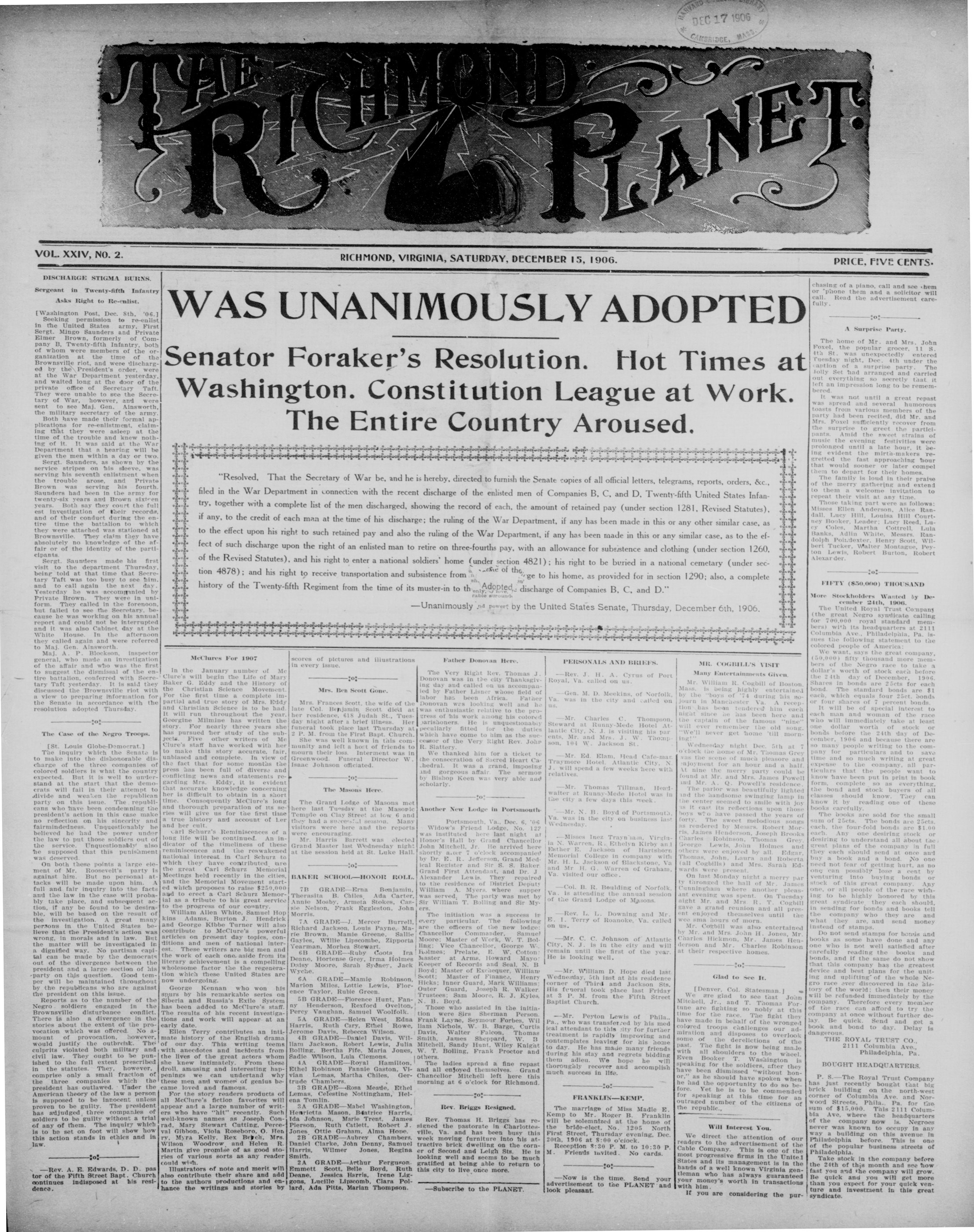
WAS UNANIMOUSLY ADOPTED
Senator Foraker's Resolution. Hot Times at Washington. Constitution League at Work. The Entire Country Aroused.
```markdown
```
---
```markdown
```
"Resolved.
McClures For 1907
In the January number of Me Clure's will begin the Life of Mary Baker G. Eddy and the History of the Christian Science Movement. For the first time a complete impartial and true story of Mrs. Eddy and Christian Science is to be had. It will run throughout the year. Georgine Milmine has written the story. For nearly three years she has pursued her study of the subjects. Five other writers of Me Clure's staff have worked with her to make this story accurate, fair, unbiased and complete. In view of the fact that for some months the press has been full of diverse and conflicting news and statements regarding Mrs. Eddy, it is evident that accurate knowledge concerning her is difficult to obtain in a short time. Consequently McClure's long and thorough preparation of its series will give us for the first time a true history and account of Ler and her cult. Carl Schurz's Reminiscences of a long life will be continued. An indicator of the timeliness of these reminiscences and the reawakened national interest in Carl Schurz to which they have contributed, are the great Carl Schurz Memorial Meetings held recently in the cities, and the Memorial Movement started which proposes to raise $250,000 and to erect a Carl Schurz Memorial as a tribute to his great service to the progress of our country.
William Allen White, Samuel Hopkins Adams, Burton J. Hendrick and George Kibbe Turner will also contribute to McClure's powerful articles on present day topics, conditions and men of national interest. These writers are big men and the work of each one aside from its literary achievement is a compelling wholesome factor the regeneration which these United States are now undergoing.
George Kennan who won his spurs by his remarkable series on Siberia and Russia's Exile System has been added to McClure's staff. The results of his recent investigations and work will appear at an early date.
For the story readers products of all McClure's fiction favorites will appear and a large number of writers who have "hit" recently. Such well-known names as Joseph Conrad, Mary Stewart Cutting, Perceval Gibbon, Viola Roseboro, O. Henry, Myra Kelly, Rex Berch, Mrs. Wilson Woodrow and Helen R. Martin give promise of as good stories of various sorts as any reader could wish.
RICHMOND, VIRGINIA, SATURDAY, DECEMBER 15, 1906.
scores of pictures and illustrations in every issue.
Mrs. Ben Scott Gone.
Mrs. Frances Scott, the wife of the late Col. Benjamin Scott died at her residence, 618 Judah St., Tuesday night after a brief illness. Her funeral took place last Thursday at 2 P. M. from the First Baptist Church. She was well known in tails community and left a host of friends to mourn their loss. Interment was in Greenwood. Funeral Director W. Isaac Johnson officiated.
The Masons Here
The Grand Lodge of Masons met here last Tuesday at the Masonic Temple on Clay Street at low 6 and they had a successful session. Many visitors were here and the reports were encouraging. Mr. Harris Barrett was elected Grand Master last Wednesday night at the session held at St. Luke Hall.
BAKER SCHOOL—HONOR ROLL
7B GRADE—Erna Benjamin, Therasita B. Chiles, Ada Carter, Annie Mosby, Armeta Stokes, Cassie Nelson, Frank Eggleston, John Morris.
7A GRADE—I. Mercer Burrell, Richard Jackson Louis Payne, Marie Brown, Mamie Greene, Salle Gayles, Willie Liacombe, Zipporia Yearman, Morhea Stewart.
6B GRADE—Ruby Coots Ira Deane, Hortense Grey, Arma Holmes Daisy Moore, Sarah Sydney, Jack Wyche.
6A GRADE—Mamie Robinson, Marlon Miles, Lottie Lewis, Florence Taylor, Rubie Green.
5B GRADE—Florence Hunt, Fanny Henderson, Rexford Ovelton, Percy Vaughan, Samuel Woolfolk.
5A GRADE—Helen West, Edna Harris, Ruth Cary, Ethel Rowe, Jerome Davis, Rebecca Wilson.
4B GRADE—Daniel Davis, William Jackson, Robert Lewis, Julia Bolling, Berta Fife, Maria Jones, Sadie Wilson, Lula Clemons.
4A GRADE—Royal Hamilton, Ethel Robinson Fannie Gaston, Vivian Lemas, Martha Chiles, Gertrude Chambers.
3B GRADE—Rosa Meade, Ethel Lemas, Celestine Nottingham, Helena Tomlin.
3A GRADE—Mabel Washington, Hervetta Mason, Batrice Harris, Ida Johnson, Marie Trent, James Plerson, Ruth Catlett, Robert J. Jones, Otte Graham, Alma Hope.
2B GRADE—Aubrey Chambers,
Daniel Clarke, John Denny, Samuel
Harris, Wilmer Jones, Regina
Smith.
2A GRADE—Arthur Ferguson.
Emmett Scott, Belle Boyd, Ruth
Deane, Jessica Harris, Irene Lig
gons, Lucille Lipscomb, Clara
Pollard, Ada Pitts, Marrian Thompson.
—Unanimously and power by the United States Senate, Thursday, December 6th, 1906.
Father Donovan Here
The Very Right Rev. Thomas J. Donovan was in the city Thanksgiving day and called on us accompanied by Father Lisner whose field of labor has been Africa. Father Donovan was looking well and he was enthusiastic relative to the progress of his work among his colored parishoners. He is unquestionably peculiarly fitted for the duties which have come to him as the successor of the Very Right Rev. John R. Slattery.
We thanked him for a ticket to the consecration of Sacred Heart Cathedral. It was a grand, imposing and gorgeous affair. The sermon by Bishop Keen was very able and scholarly.
Another New Lodge in Portsmouth
Portsmouth, Va., Dec. 6, '06
Widow's Friend Lodge, No. 122
was instituted here last night at
Honor's Hall by Grand Chancellor
John Mitchell, Jr. He arrived here
shortly after 7 o'clock accompanied
by Dr. E. R. Jefferson, Grand Medi-
cal Register and Sir S. S. Baker
Grand First Attendant, and Dr. J.
Alexander Lewis. They repaired
to the residence of District Deputy
William A. Myers, where supper
was served. The party was met by
Sir William T. Bolling and Sir Myers.
The initiation was a success in
every particular. The following
are the officers of the new lodge:
Chancellor Commander, Samuel
Moore; Master of Work, W. T. Bolling; Vice Chancellor, George W.
Holmes; Prelate, E. W. Cotton;
master at Arms, Howard Mayo;
Keeper of Records and Seal, N. B
Boyd; Master of Excaequer, William
Scott; Master of Finance, Henry
Hicks; Inner Guard, Mark Williams;
Outer Guard, Joseph R. Walker;
Trustees; Sam Moore, R. J. Kyles,
N. B. Boyd.
Those who assisted in the initiation were Sirs Sherman Person.
Frank Layne, Seymour Forbes, William Nichols, W. B. Barge, Curtis Davis, Walter Falcon, Thomas Smith, James Sheppard, W. B.
Mitchell, Sandy Hunt, Wiley Knight
W. T. Bolling, Frank Proctor and
others.
The ladies spread a fine repast and all enjoyed themselves. Grand Chancellor Mitchell left here this morning at 6 o'clock for Richmond.
Rev. Briggs Resigned.
Rev. Thomas H. Briggs has resigned the pastorate in Charlotteville, Va. and has been busy this week moving furniture into his attractive brick dwellings on the corner of Second and Leigh Sts. He is looking well and seems to be much gratified at being able to return to this city to live once more.
—Subscribe to the PLANET
PERSONALS AND BRIEFS
—Rev. J. H. A. Cyrus of Port Royal, Va. called on us.
—Gen. M. D. Meekins, of Norfolk, Va. was in the city and called on us.
—Mr. Charles C. Thompson, Steward at Runny-Mede Hotel Atlantic City, N. J. is visiting his parents, Mr. and Mrs. J. W. Thompson, 104 W. Jackson St.
—Mr. Ed. Elam, Head Cafe-mar Traymore Hotel, Atlantic City, N. J. will spend a few weeks here with relatives.
—Mr. Thomas Tillman, Head-walter at Runny-Mede Hotel was in the city a few days this week.
—Mr. N. B. Boyd of Portsmouth, Va. was in the city on business last Wednesday.
—Misses Inez Traynham, Virginia N. Warren, R. Ethellyn Kirby and Esther E. Jackson of Hartshorn Memorial College in company with Mr. H. L. Jackson of Blackstone, Va. and Mr H. G. Warren of Graham, Va. visited our office.
—Col. B. R. Boulding of Norfolk, Va. is attending the annual session of the Grand Lodge of Masons.
—Rev. L. L. Downing and Mr. E. I. Terry of Roanoke, Va. called on us.
—Mr. C. C. Johnson of Atlantic City, N. J. is in the city and will remain until the first of the year. He is looking well.
—Mr. William D. Hope died last Wednesday, 5th inst at his residence corner of Third and Jackson Sts, His feueral took place last Friday at 3 P. M. from the Fifth Street Baptist Church.
—Mr. Peyton Lewis of Phila. Pa., who was transferred by his medical attendant to this city for further treatment is rapidly improving and contemplates leaving for his home to day. He has made many friends during his stay and regrets bidding them adieu. We hope he will thoroughly recover and accomplish much success in life.
FRANKLIN—KEMP
The marriage of Miss Madie E. Kemp to Mr. Roger B. Franklin will be solemnized at the home of the bride-elect, No. 1205 North First Street, Thursday evening, Dec. 20th, 1966 at 8:00 o'clock.
Reception 8:30 P. M. to 10:30 P. M. Friends invited. No cards.
Now is the time. Send your advertisement to the PLANET and look pleasant.
```markdown
```
MR. COGBILL'S VISIT
Many Entertainments Given
Mr. William R. Cogbill of Boston, Mass. is being highly entertained by the "boys of 74 during his sojourn in Manchester Va. A reception has been tendered him each night since he has been here and the captain of the famous "nine" will ever remember the old song, "We'll never get home 'till morning!"
Wednesday night Dec. 5th at 7 o'clock the home of Mr. Thomas Grey was the scene of much pleasurable and enjoyment for an hour and a half. At nine the merry party could be found at Mr. and Mrs. James Powell and Mr. A. Q. Powell's residence. The parlor was beautifully lighted and the handsome swinging lamp in the center seemed to smile with joy as it cast its reflections upon those boys who have passed the years of forty. The sweet melodious songs as rendered by Messrs. Robert Morris, James Henderson, Joseph Brooks Charles Robinson, Thomas Grey, George Lewis, John Holmes and others were enjoyed by all. Edgar, Thomas, John, Laura and Roberta (all Cogbills) and Mrs. Sarah Edwards were present.
On last Monday night a merry party thronged the hall of Mr. James Cunningham where another pleasant evening was spent. On Tuesday night Mr. and Mrs. R. T. Cogbill gave a grand reunion and all present enjoyed themselves until the wee sma hours of morn.
Mr. Cogbill was also entertained by Mr. and Mrs. John H. Jones, Mr. Charles Hickmon, Mr. James Henderson and Mr. Charles Robinson at their respective homes.
Glad to See It
[Denver, Col. Statesman.]
We are glad to see that Joan Mitchell, Jr., and T. Thomas Fortune are fighting so nobly at this time for the race. The fight they have made in behalf of the wronged colored troops challenges our admiration and disposes to overlook some of the derelictions of the past. The fight is now being made with all shoulders to the wheel. Even Booker T. Washington is speaking for the soldiers, after they have been dismissed "without honor," as he should have spoken when he had the opportunity to do so before. Yet he is to be commended for speaking at this time for an outraged number of the citizens of the republic.,
Will Interest You.
We direct the attention of our readers to the advertisement of the Cable Company. This is one of the most progressive firms in the United States and its management is in the hands of a well known Virginia gentleman who has always guaranteed your money's worth in transactions with him.
If you are considering the pura
PRICE, FIVE CENTS
chasing of a piano, call and see them or 'phone them and a solicitor will call. Read the advertisement carefully.
A Surprise Party.
The home of Mr. and Mrs. John Foxel, the popular grocer, 11 S. 4th St. was unexpectedly entered Tuesday night, Dec. 4th under the canion of a surprise party. The Jolly Set had arranged and carried out everything so secretly that it left an impression long to be remembered.
It was not until a great repast was spread and several humorous toasts from various members of the party had been recited, did Mr. and Mrs. Foxel sufficiently recover from the surprise to greet the participants. Amid the sweet strains of music the evening festivities were prolonged until a late hour, it being evident the mirta-makers regretted the fast approaching hour that would sooner or later compel them to depart for their homes.
The family is loud in their praise of the merry gathering and extend to them a welcome invitation to repeat their visit at any time.
Those taking part were as follows: Misses Ellen Anderson, Alice Randall, Lucy Hill, Louisa Hill Courtney Booker, Leader; Lucy Reed, Lucy Coles, Martha Cottrell, Lula Banks, Adlin White, Messrs. Randolph Polidexter, Henry Scott, Wilbert Tucker, Walter Montague, Peyton Lewis, Robert Burton, Robert Alexander.
FIFTY ($50,000) THOUSAND
More Stockholders Wanted by December 24th, 1906.
The United Royal Trust Company (the great Negro syndicate calling for 700,000 royal standard members) with its headquarters at 2111 Columbia Ave, Philadelphia, Pa. issues the following statement to the colored people of America: We want, says the great company, (50,000) fifty thousand more members of the Negro race to take a dollar's worth of stock each before the 24th day of December, 1906. Shares in bonds are 25cts for each bond. The standard bonds are $1 each, which equals four 25ct. bonds or four shares of 7 percent bonds. It will be of special interest to each man and woman of the race who will immediately take at least one dollar worth of stock or bonds before the 24th day of December, 1906 and because there are so many people writing to the company for particulars and to save time and so much writing at great expense to the company, all particulars that the people want to know have been put in print in book form, complete so as everything, the bond and stock buyers of all classes should know. They can know it by reading one of these books carefully.
The books are sold for the small sum of 25cts. The bonds are 25cts, each, the four-fold bonds are $1.00 each. Any one desiring stock or desiring to understand all about tae great plans of the company in full they each should send at once and buy a book and a bond. No one need not fear of getting hurt, as no one can possibly lose a cent by venturing into buying bonds or stock of this great company. Any one, or all people of the race wishing to be highly honored by this great syndicate, they each should, in sending for bonds and books tell the company who they are and what they are, and send money instead of stamps.
Do not send stamps for bonus and books as some have done and any one who is not well satisfied after carefully reading the books and bonds, and if the same do not show that this company has the greatest device and best plans for the uniting and uplifting' of the whole Negro race ever discovered in the history of the world; then their money will be refunded immediately by the company. Therefore every member of the race can afford to try the company at once without further delay. Be quick. Send and get a book and bond to day. Delay is dangerous.
THE ROYAL TRUST CO., 2111 Columbia Ave., Philadelphia, Pa.
BOUGHT HEADQUARTERS
P. S.—The Royal Trust Company has just recently bought that big brick building on the north-west corner of Columbia Ave. and Norwood Streets, Phila. Pa. for the sum of $15,000. This 2111 Columbia Ave, where the headquarters of the company now is. Negroes never was known to occupy in any way a building on this avenue in Philadelphia before. This is one of the popular business streets of Philadelphia.
Take stock in the company before the 24th of this month and see how fast you and the company will grow. Be quick and you will get more than you expect for your quick venture and investment in this great syndicate.
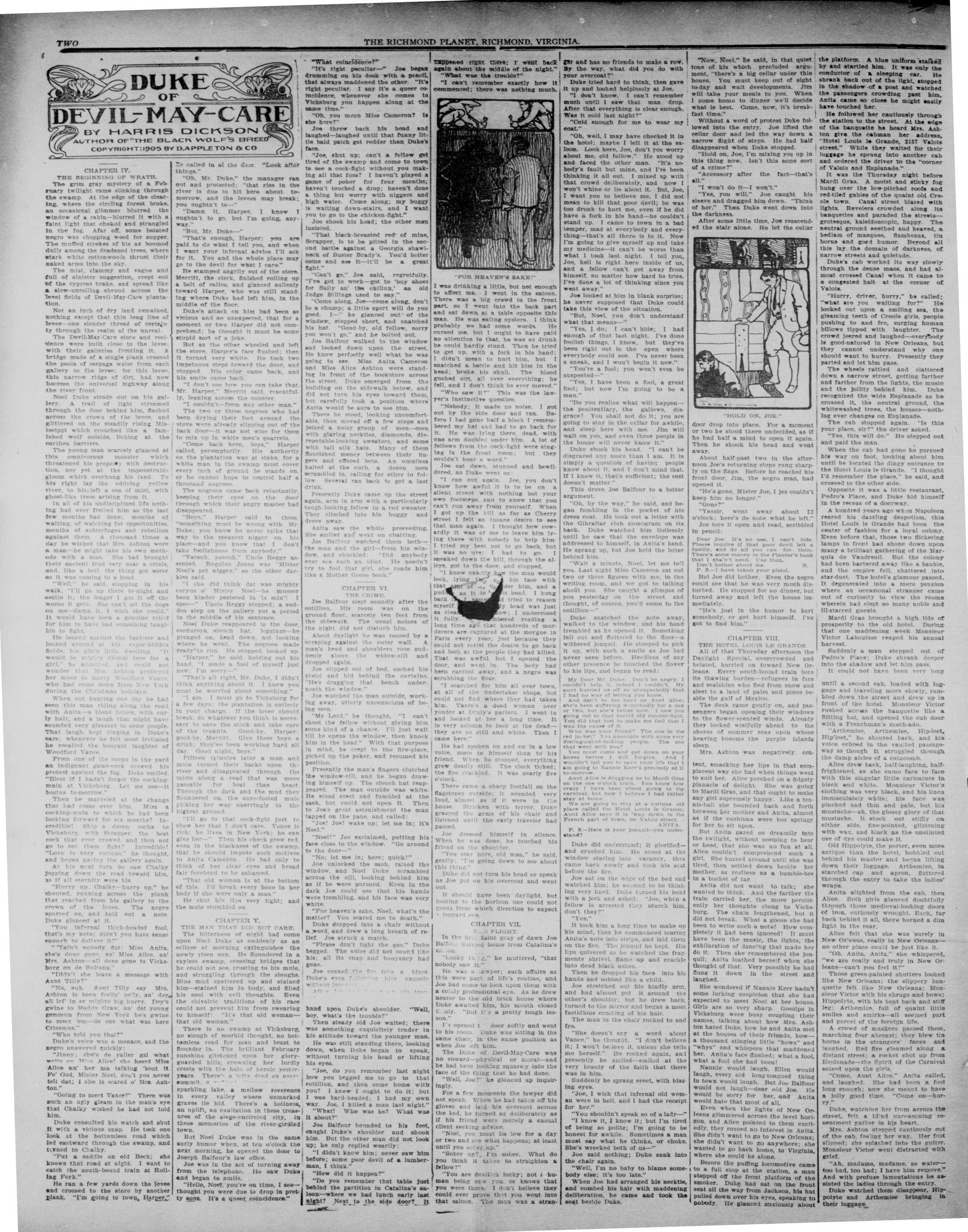
DUKE
OF
DEVIL-MAY-CARE
BY HARRIS DICKSON
AUTHOR OF "THE BLACK WOLF'S BREED"
COPYRIGHT:1905 BY D.APPLETON & CO
THE BEGINNING OF WRATH.
The grim gray mystery of a February twilight came slinking through the swamp. At the edge of the clearing, where the circling forest broke, an occasional glimmer blurred the window of a cabin—blurred it with a faint light that choked and strangled in the fog. Afar off, some belated negro was chopping wood for supper. The muffled strokes of his ax boomed dully among the deadened trees, where stark white cottonwoods thrust their naked arms into the sky. The mist, clammy and vague and full of sinister suggestion, crept out of the cypress brake, and spread like a slow-unroiling shroud across the level fields of Devil-May-Care plantation.
Not an inch of dry land remained, nothing except that thin long line of levee—one slender thread of certainty through the realm of the unreal.
The Devil-May-Care store and residence were built close to the levee, with their galleries fronting it. A bridge made of a single plank crossed the pools of seepage water from each gallery to the levee; for this levee, this narrow ridge of dirt, had now become the universal highway along the river front.
Noel Duke strode out on his gallery. A trail of light streamed through the door behind him, flashed across the crown of the levee, and glittered on the steadily rising Mississippi which crouched like a famished wolf outside, licking at the earthen barriers.
The young man scarcely glanced at this omnivorous monster which threatened his property with destruction, nor yet at the impenetrable gloom which overhung his land. To his right lay the eddying yellow river, to his left a sea of mist, with ghost-like trees arising from it.
In all of his undisciplined life nothing had ever fretted him as the last few months had done; months of waiting, of watching for opportunities, months of subterfuge and rebellion against them. A thousand times a day he wished that Mrs. Ashton were a man—he might take his own methods with a man. She had brought their ancient feud very near a crisis, and, like a boll, the thing got sorer as it was coming to a head.
"Well," he said, stopping in his walk, "I'll go up there to-night and settle it; the longer I put it off the worse it gets. She can't set the dogs on me—damn it, I wish she could." It would have been a genuine relief for him to have had something tangible to fight.
He leaned against the banister and looked around at his vapor-hidden fields, his plain little dwelling. "It would be mighty dermal here for a girl," he admitted, and could not wonder that Mrs. Ashton preferred her niece to marry Woodford Vance, who had come down from New York during the Christmas holidays.
When out hunting one day he had seen this man riding along the road with Anita—a blond fellow, with curly hair, and a laugh that might have sounded very pleasant to some people.
That laugh kept ringing in Duke's ears; whenever he felt most irritated he recalled the buoyant laughter of Woodford Vance.
From one of the coops in the yard an indignant game-cook crowed his protest against the fog. Duke smiled. "Blest if I hadn't forgot the cooking-main at Vicksburg. Let me see—it begins to-morrow."
Then he marveled at the change that had come over him. Miss a cocking-main to which he had been looking forward for six months? Incredible! Ship a dozen cocks to Vicksburg, with Scraper, the best cock that ever crowed, and then not go to see them fight? Incredible! "Love is very curious," he thought, and began pacing the gallery again. At his next turn he saw Chalky jogging down the road toward him, as if all eternity were his. "Hurry up. Chalky-hurry up," he shouted, running across the plank that reached from his gallery to the crown of the levee. The negro spurred on, and held out a note. Duke glanced at it. "You infernal thick-headed fool, that's my note; didn't you have sense enough to deliver it?" "Tain't nobody dar; Miss Anita, she's done gone, an' Miss Alice, an' Mrs. Ashton all done gone to Vicksburg on de Sultana."
"Didn't she leave a message with Aunt Tilly?"
"No, suh. Aunt Tilly say Mrs. Ashton is been feelin' nolly, an' day, all left in er mightin' big hurry. Dey's gwine to Moddy Graw, an' dat young germmun from New York he's gwine to meet 'em—de one what was here Crissmus."
"Who told you that?"
Duke's voice was a menace, and the negro answered quickly:
"Jinny; she's de yaller gal what wats on Miss Alice! she heed Miss Alice an' her ma talking 'bout it. Fo' God, Mister Noel, don't you never tell dat; I sho is scared o' Mrs. Ashton."
"Going to meet Vance?" There was such an ugly gleam in the man's eye that Chalky wished he had not told him.
Duke consulted his watch and shut it with a vicious snap. He took one look at the bottomless road which led eastward through the swamp, and twned to Chalky.
"Put a saddle on old Beck; she knows that road at night. I want to catch the south-bound train at Rolling Fork."
He ran a few yards down the levee and crossed to the store by another plank. "I'm going to town, Harper."
He called in at the door. "Look after things."
"Oh, Mr. Duke," the manager ran out and protested; "that rise in the river is due to hit here about tomorrow, and the levees may break; you oughtn't to—"
"Damn it, Harper. I know I oughtn't to go, but I'm going, anyway."
"But Mr. Duke—"
"That's enough, Harper; you are paid to do what I tell you, and when I want your informal advice I'll ask for it. You and the whole place may go to the devil for what I care."
He stamped angrily out of the store. Merritt, the clerk, finished rolling up a bolt of calco, and glanced sullenly toward Harper, who was still standing where Duke had left him, in the middle of the floor.
Duke's attack on him had been so vicious and so unexpected, that for a moment or two Harper did not comprehend; he thought it be some stupid sort of a joke.
But as the other wheeled and left the store, Harper's face flushed; it turned very white. He took two impetuous steps toward the door, and stopped. His color came back, and his smile came back.
"I don't see how you can take that, Mr. Harper." Merritt said, resentfully, leaning across the counter.
"I couldn't—from any other man."
The two or three negroes who had been drying their feet around the stove were already slipping out of the back door—it was not wise for them to mix up in white men's quarrels.
The negroes came back reluctantly, keeping their eyes on the door through which their angry master had disappeared.
"Boys," Harper said to them, "something must be wrong with Mr. Duke; you know he never talks that way to the meanest nigger on his place—and you know that I don't take foolishness from anybody." "Yassuah, yassuuh." Uncle Reggy assented. Regulus Jones was "Mister Noel's pet nigger," so the other darkles said.
"I so did think dat was mighty curyus o' Mister Noel—he musser been kinder pestered in 'is min'! I spec—" Uncle Reggy stopped; a sudden step on the gallery put a period in the middle of his sentence.
Noel Duke reappeared in the door, corduroys, slouch hat, leggings—he plunged on, head down, not looking where he went. The negroes made ready* to run. He stopped, looked up.
"Harper," he said, holding out his hand. "I made a fool of myself just now; I'm sorry—"
"That's all right, Mr. Duke, I didn't think anything about it. I knew you must be worried about something."
"I am. I must go to Vicksburg for a few days; the plantation is entirely in your charge. If the levee should break, do whatever you think is necessary to save the stock and take care of the tenants. Good-by, Harper; good-by, Merritt. Give these boys a drink; they've been working hard all day. Good night, boys."
Fifteen minutes later a man and mule turned their backs upon the river and disappeared through the mists along a road that was more passable for boat than beast. Through the dark and the mud they floundered on the sure-footed mule picking her way unerringly to the highest ground.
"I'll go to that cock-flight just to show her that I don't care. Vance is rich; he lives in New York; he can give her-" Then his cheek grew red, even in the blackness of the swamp, that he should impute such motives to Anita Cameron. He had only to think of her clear eyes and broad fair forehead to be ashamed.
"That old woman is at the bottom of this. I'd break every bone in her body if she were only a man."
He shut his lips very tight; and the mule stumbled on.
CHAPTER V
THE MAN THAT DID NOT CARE.
The bitterness of night had come upon Noel Duke as suddenly as an eclipse at morning extinguishes the newly risen sun. He floundered in a rayless swamp, crossing bridges that he could not see, trusting to his mule, and struggling through the sloughs. Blue mud spattered up and stained him—stained him in body, and filled his soul with evil thoughts. Even the chivalric traditions of his race could not prevent him from swearing to himself: "It's that old woman—that old woman."
There is no swamp at Vicksburg, no slough of morbid thought, no bottomless road for man and beast to flounder in. The brilliant February sunshine glistened upon her glory-guarded hills, crowning her lordly crests with the halo of heroic yester-years. There's a lofty deed on every summit. a sparkling lake, a mellow reverence in every valley where unmarked graves lie hid. There's a holiness, an uplift, an exaltation in these treasures of the siege-encircled city, in these memories of the river-girdled town.
But Noel Duke was in the same surly humor when, at ten o'clock the next morning, he opened the door to Joseph Balfour's law office.
Joe was in the act of turning away from the telephone. He saw Duke and began to smile.
"Hello, Noel, you're on time, I see—thought you were due to drop in pretty soon. It's a queer coincidence."
THE RICHMOND PLANET. RICHMOND. VIRGINIA
"What coincidence?"
"It's right peculiar—" Joe began drumming on his desk with a pencil, that always maddened the other. "It's right peculiar. I say it's a queer coincidence, whenever she comes to Vicksburg you happen along at the same time."
"Oh, you mean Miss Cameron? Is she here?"
Joe threw back his head and laughed-laughed until that funny little bald patch got redder than Duke's face.
"Joe, shut up; can't a fellow get tired of the swamp and come to town to see a cock-fight without you making all that fuss? I haven't played a game of poker for four months; haven't touched a touch; haven't done a thing but worry with niggers and high water. Come along; my buggy is waiting down-stairs, and I want you to go to the chicken-fight."
Joe shook his head; the other man insisted.
"That black-breasted red of mine, Scrapper, is to be pitied in the second battle against a Georgia shawl-neck of Buster Brady's. You'd better come and see it—it'll be a great fight."
"Can't go," Joe said, regretfully. "I've got to work—got to 'buy shoes for Sally an' the chillun', as old Judge Billings used to say."
"Come along. Joe—come along, don't be a chump; a little sport will do you good. I—" he glanced out of the window, stopped short, and snatched his hat. "Good-by, old fellow, sorry you won't go." and he bolted out.
Joe Balfour walked to the window and looked down upon the street. He knew perfectly well what he was going to see. Miss Anita Cameron and Miss Alice Ashton were standing in front of the bookstore across the street. Duke emerged from the building on the sidewalk below, and did not turn his eyes toward them, but carefully took a position where Anita would be sure to see him. There he stood, looking uncomfortable, then moved off a few steps and joined a noisy group of men—men with glaring neckties, diamonds, disreputable-looking sweaters, and some with tall silk hats. Many of them flourished money between their fingers and offered bets. An omnibus halted at the curb, a dozen men scrambled in, calling for other to follow. Several ran back to get a last drink.
Presently Duke came up the street again, arm in arm with a particularly tough-looking fellow in a red sweater. They climbed into his buggy and drove away.
Anita saw the whole proceeding. She smiled and went on chatting.
Joe Balfour watched them both—the man and the girl—from his window, and chuckled: "Did anybody ever see such an idiot. He needn't try to fool that girl, she reads him like a Mother Goose book."
CHAPTER VI.
Joe Balfour slept soundly after the cotillion. His room was on the ground floor, scarcely ten feet from the sidewalk. The usual noises of the night did not disturb him.
About daylight he was roused by a scraping against the outer wall. A man's head and shoulders rose suddenly above the widow-sill and dropped again.
Joe slipped out of bed, cocked his pistol and hid behind the curtains. "He's dragging that bench underneath the window."
Joe watched the man outside, working away, utterly unconscious of being seen.
"My Lord," he thought, "I can't shoot the fellow without giving him some kind of a chance. I'll just wait till he opens the window, then knock him in the head." With that purpose in mind, he crept to the fire-place, picked up the poker, and resumed his position.
Presently the man's fingers clutched the window-sill, and he began drawing himself up. The slouch hat reappeared. The man outside was white. He stood erect and tumbled at the sash, but could not open it. Then to Joe's great astonishment the man tapped on the pane, and called:
"Joe! Joe! wake up; let me in; it's Noel."
"Noel!" Joe exclaimed, putting his face close to the window. "Go around to the door—"
"No; let me in; here; quick!"
Joe unlocked the sash, raised the window, and Noel Duke scrambled across the sill, looking behind him as if he were pursued. Even in the dark Joe could see that his hands were trembling, and his face was very white.
"For heaven's sake, Noel, what's the matter? You scared me to death."
Duke dropped into a chair without a word, and drew a long breath of relief. Joe struck a match.
"Please don't light the gas." Duke begged. The voice did not sound like his; all its snap and buoyancy had gone.
Joe coaxed the fire into a blaze. Duke's eyes following him vaguely without interest.
hand upon Duke's shoulder. "Well, boy, what's the trouble?"
Then steady old Joe waited; there was something exquisitely tender in his attitude toward the younger man. He was still standing there, looking down, when Duke began to speak, without turning his head or lifting his eyes.
"Joe, do you remember last night how you begged me to go to that cotillion, and then come home with you? I knew I ought to do it; but I was hard-headed; I had my own way. Joe, I killed a man last night."
"What! Who was he? What was it about?"
Joe Balfour bounded to his feet, caught Duke's shoulder and shook him. But the other man did not look up; he only replied wearly:
"I didn't know him; never saw brim before; some poor devil of a lumberman, I think."
"How did it happen?"
"Do you remember that table just behind the partition in Catalina's saloon—where we had lunch early last night? Next to the side door? It
ger and has no friends to make a row.
By the way, what did you do with your overcoat?"
Duke tried hard to think, then gave it up and looked helplessly at Joe.
"I don't know. I can't remember much until I saw that man drop. After that everything is clear enough. Was it cold last night?" "Cold enough for me to wear my coat."
"Oh, well, I may have checked it in the hotel; maybe I left it at the saloon. Look here, Joe, don't you worry about me, old fellow." He stood up and faced the other man. "It's nobody's fault but mine, and I've been thinking it all out. I mixed up with that crowd deliberately, and now I won't whine or lie about it. But, Joe, I want you to believe me, I did not mean to kill that poor devil; he was too drunk to hurt me, even if he did have a fork in his hand—he couldn't stand up. I came to town in a bad temper, mad at everybody and everything—that's all there is to it. Now I'm going to give myself up and take my medicine—it can't be worse than what I took last night. I tell you, Joe, hell is right here inside of us, and a fellow can't get away from himself, no matter how hard he tries. I've done a lot of thinking since you went away."
Joe looked at him in blank surprise; he never supposed that Duke could take this view of the situation.
"But, Noel, you don't understand what that means—"
"Yes, I do; I can't hide; I had enough of that last night. I've done foolish things, I know, but they've been right out in the open where everybody could see. I've never been a sneak, and I won't begin it now."
"You're a fool; you won't even be suspected—"
"Yes, I have been a fool, a great fool; but now I'm going to be a man."
"Do you realize what will happen—the penitentiary, the gallows, disgrace? You shall not do it; you are going to stay in the collar for awhile, and sleep here with me. Jim will wait on you, and even these people in the house will never know it."
Duke shook his head. "I can't be disgraced any more than I am. It is simply a question of having people know about it, and I don't mind that. If I know it, that's sufficient; the rest doesn't matter."
This drove Joe Balfour to a better argument.
"Oh, by the way," he said, and began fumbling in the pocket of his dress coat. He took out a letter with the Gibraltar club monogram on its back. Duke watched him listlessly until he saw that the envelope was addressed to himself, in Anita's hand. He sprang up, but Joe held the letter behind him.
"Wait a minute, Noel, let me tell you. Last night Miss Cameron sat out two or three figures with me, in the writing room, and we got to talking about you. She caught a glimpse of you yesterday on the street and thought, of course, you'd come to the cottillion—"
Duke smatched the note away, walked to the window, and his hand trembled as he opened it. Something fell out and fluttered to the floor—a withered jonquil. He stooped to pick it up, with such a smile as Joe had never seen before. Heheadless of any other presence he touched the flower to his lips, and began to read:
My Dear Mr. Duke: Don't be angry; I couldn't help it, indeed I couldn't. My aunt hurried us off so unexpectedly that I had no way of letting you know. And then too hard on Anu Alice; she had suffered terribly for a day or two, but she's better now. I saw you going out to that horrid old rooster-fight. You did that just to make me feel that I was the cause of it. I友友!" The one in the red jacket? You associate with some very distinguished-looking people. The one that went with you?
You must come and get down on your knees before I will forgive. And I wouldn't tell you to save your life that I am going to Nannie Kerr's precisely at 11 o'morrow.
Aunt Alice is dragging us to Mardi Gras on the one o'clock train. You know how crazy I have been about going to the carnival, but now I believe I had rather stay at home. We are going to stay at a curious old place called the Hotel Louis le Grande; Aunt Alice says it is 'way down in the French part of town, on Valois street. ANITA. P. S.-Here is your jonquil-you understand? Duke did understand; it glorified—and crushed him. He stood at the window starring into vacancy, then came back slowly and took his seat before the fire.
It took him a long time to make up his mind, then he commenced tearing Anita's note into strips, and laid them on the fire. The jonquil he kept. His lips quivered as he watched the fragments shrivel, flame up and crackle into dead black ashes.
happened right there; I went back again about the middle of the night." "What was the trouble?" "I can't remember exactly how it commenced; there was nothing much.
A
"FOR HEAVEN'S SAKE"
I was drinking a little, but not enough to affect me. I went in the saloon. There was a big crowd in the front part, so I went into the back part and sat down at a table opposite this man. He was eating oysters. I think probably we had some words. He cursed me, but I ought to have paid no attention to that, he was so drunk he could hardly stand. Then he tried to get up, with a fork in his hand; I didn't mean to hurt him, but I smatched a bottle and hit him in the head; broke his skull. The blood gushed out, all over everything; he fell, and I don't think he ever moved."
"Who saw it?" This was the lawyer's instinctive question.
"Nobody; it made no noise. I got out by the side door and ran. Before I had gone half a block I remembered my hat and had to go back for it. He was lying there, dead, with one arm doubled under him. A lot of fellows from the cock-fight were singing in the front room; but they couldn't hear a word."
Joe sat down, stunned and bewildered, as Duke went on:
"I ran out again. Joe, you don't know how awful it is to be on a silent street with nothing but your own footsteps, and to know that you can't run away from yourself. When I got up the hill as far as Cherry street I felt an insane desire to see that man again. I thought how cowardly it was of me to leave him lying there with nobody to help him. I tried my best not to go back, but it was no use; I had to go. I sneaked down the hill, through the alleys, got to the door, and stopped.
"I knew exactly how the man would look, lying the face on his face with that out of it under him, and a puddle as it is in his head. I hung back in. I came and tried to reason myself. My head was just as clean as mine now. I understood it fully. I learned reading a
I knew exactly how the man would look, lying the one his face with that out of it, under him, and a pudder as it is his head. I hung back in. I rame and tried to reason myself. My head was just as clean as now; I understood it fully. I numbered reading a long time ago that hundreds of murderers are captured at the morgue in Paris every year. Just because they could not resist the desire to go back and look at the people they had killed. That was awful, but I opened the door, and went in. The body had been carried away, and a negro was scrubbing the floor.
"I searched for him all over town, at all of the undertaker shops, but could not find where they had taken him. There's a dead woman over yonder at Druly's parlors. I went in and looked at her a long time. It is very solemn to look at the dead—they are so still and white. Then I came here."
He had spoken on and on in a low voice, more to himself than to his friend. When he stopped, everything grew deadly still. The clock ticked; the fire crackled. It was nearly five o'clock.
There came a sharp footfall on the flagstones outside; it sounded very loud, almost as if it were in the house. Stricken with terror, Duke grasped the arms of his chair and listened until the early traveler had passed.
Joe dressed himself in silence. When he was done, he touched his friend on the shoulder.
"You stay here, old man," he said, gently: "I'm going down to see about this thing."
Duke did not turn his head or speak as Joe put on his overcoat and went out.
It should have been daylight, but looking to the horizon one could not guess from which direction to expect a jaggard sun.
CHAPTER VII.
In the first faint gray of dawn Joe Balfon, hurried home from Catalina's saison.
"Lucky thing," he muttered, "that nobody saw it."
He was a lawyer; such affairs as this were part of life's routine, and Joe had come to look upon them with a colly professional eye. As he drew nearer to the old brick house where Duke awaited him, his mouth closed firmly. "But it's a pretty tough lesson."
He opened the door softly and went to his room. Duke was sitting in the same chair, in the same position as when Joe left him.
The Duke of Devil-May-Care was no coward—physical or moral—and he had been looking squarely into the face of the thing that he had done.
"Well, Joe?" he glanced up inquiringly.
For a few moments the lawyer did not speak. When he had taken off his gloves and laid his overcoat across the bed, he turned as deliberately as if his friend were merely a casual client seeking advice.
"Noel, you must be low for a day or two and see what happens; at least until you sober up."
"Sober up? I'm sober. What do you think it takes to straighten a fellow?"
"You are devilish lucky; not a human being saw you, or knows that you were there. I don't believe they could ever prove that you went into that saloon. The man was a stran-
Joe sat on the edge of the bed and watched him; he seemed to be thinking very hard. Duke turned his head with a jerk and asked: "Joe, when a fellow is arrested they search him, don't they?"
"Yes."
Then he dropped his face into his hands and sobbed like a child.
Joe stretched out his kindly arm, and had almost put it around the other's shoulder; but he drew back, turned to the mirror and began a most fastidious combing of his hair.
The man in the chair rocked to and fro.
"She doesn't say a word about Vance," he thought. "I don't believe it; I won't believe it, unless she tells me herself." He rocked again, and presently he smiled—smiled at the very beauty of the faith that there was in him.
Suddenly he sprang erect, with blazing eyes.
"Joe, I wish that infernal old woman were in hell, and I had the receipt for her."
"You shouldn't speak so of a lady—"
"I know it, I know it; but I'm tired of being so polite; I'm going to be honest for awhile. Sometimes a man must say what he thinks, or choke. She's wrecked both of us—"
Joe said nothing; Duke sank into the chair again.
"Well, I'm no baby to blame somebody else; it's too late."
When Joe had arranged his necktie, and combed his hair with maddening deliberation, he came and took the seat beside Duke.
"Now, Noel," he said, in that quiet tone of his which precluded argument. "there's a big cellar under this house. You must keep out of sight to-day and wait developments. Jim will take your meals to you. When I come home to dinner we'll decide what is best. Come, now, it's breakfast time."
Without a word of protest Duke followed into the entry. Joe lifted the cellar door and led the way down a narrow flight of steps. He had half disappeared when Duke stopped.
"Hold on, Joe, I'm mixing you up in this thing now. Isn't this some sort of a crime?"
"Accessory after the fact—that's all."
"I won't do it—I won't."
"Yes, you will." Joe caught his sleeve and dragged him down. "Think of her." Then Duke went down into the darkness.
After some little time, Joe reascended the stair alone. He let the cellar
DANIEL
"HOLD ON, JOE."
door drop into place. For a moment or two he stood there undecided, as if he had half a mind to open it again. Then he shook his head and went away.
About half-past two in the afternoon Joe's returning steps rang sharply on the flags. Before he reached his front door, Jim, the negro man, had opened it.
"He's gone, Mister Joe, Ijes couldn't keep him no longer."
"Gone?"
"Yassir, went away about 12 o'clock; here's de note what he left."
Joe tore it open and read, scribbled in pencil:
Dear Joe: It's no use, I can't hide. Please inquire if that poor devil left a family, and do all you can for them. There's some money in the Planter's bank that he about uses that.
Don't bother about me. N.
P. S.-I have taken your pistol.
But Joe did bother. Even the negro could see that he was very much disturbed. He stopped for no dinner, but turned away and left the house immediately.
"He's just in the humor to hurt somebody, or get hurt himself. I've got to find him."
CHAPTER VIII.
THE HOTEL LOUIS LE GRANDE
All of that Thursday afternoon the Daylight Special, overcrowded and belated, hurried on toward New Orleans. Every south-bound train bore its thawing burden—refugees in furs and sealskins who fled from snow and sleet to a land of palm and pines beside the gulf of Mexico.
The dusk came gently on, and passengers began opening their windows to the flower-scented winds. Already they looked wistfully ahead to the shores of summer seas upon whose heaving bosoms the purple islands sleep.
Mrs. Ashton was negatively con-
tent, smacking her lips in that complacent way she had when things went to suit her. Alice perched on a fidgety pinnacle of delight. She was going to Mar迪 Gras, and that ought to make any girl supremely happy. Like a tennis-ball she bounded back and forth between her mother and Anita, almost as if the cushions were too springy for her to sit upon.
But Anita gazed so dreamily into the twilight, without seeming to hear or heed, that she was no fun at all. Alice couldn't comprehend such a girl. She buzzed around until she was tired, then settled down beside her mother, as restless as a bumble-bee in a bucket of tar.
Anita did not want to talk; she wanted to think. And the farther the train carried her, the more persistently her thoughts clung to Vicksburg. The chain lengthened, but it did not break. What a goose she had been to write such a note! How completely it had been ignored! It must have been the music, the lights, the exhilaration of dancing that made her do it. Then she remembered the jonquil; Anita loathed herself when she thought of that. Very possibly he had flung it down in the street and laughed.
She wondered if Nannie Kerr hadn't some lurking suspicion that she had expected to meet Noel at her house. Girls are so very sharp. Gossips in Vicksburg were busy coupling their names, talking about how Mrs. Ashton hated Duke, how he and Anita met at the houses of their friends, how—a thousand stinging little "hows" and "whys" and whispers that maddened her. Anita's face flushed; what a fool, what a fool she had been!
Nannie would laugh, Ellen would laugh, every old long-tongued in town would laugh. But Joe Balfour would not laugh—dear old Joe. He would be sorry for her, and Anita would hate that most of all.
Even when the lights of New Orleans glimmered across the level horizon, and Alice pointed to them excitedly, they roused no interest in Anita. She didn't want to go to New Orleans; she didn't want to go anywhere; she wanted to go back home, to Virginia, where she could be alone.
Before the puffing locomotive came to a full stop at the station, a man stepped off the front platform of the smoker. Duke had sat on the front seat all the way from Jackson, his hat pulled down over his eyes, speaking to nobody. He glanced anxiously about
the platform. A blue uniform stalked by and started him. It was only the conductor of a sleeping car. He shrank back out of the light, stopped in the shadow of a post and watched the passengers crowding past him. Anita came so close he might easily have touched her.
He followed her cautiously through the station to the street. At the edge of the banquette he heard Mrs. Ashon give the cabman her address, "Hotel Louis le Grande, 2157 Valois street." While they waited for their luggage he sprang into another cab and ordered the driver to the "corner of Valois and Espiaade."
It was the Thursday night before Mardi Gras. A moist and sticky fog hung over the low-pitched roofs and red-tiled gables of the quaint old Creole town. Canal street blazed with lights. Revelers crowded along its banquettes and paraded the streets—grotesque, kaleidoscopic, happy. The neutral ground seethed and beaved, a bedlam of masques, flambeaux, tin horns and good humor. Beyond all this lay the domain of darkness, of narrow streets and quietude. Duke's cab worked its way slowly through the dense mass, and had almost crossed Canal when it came to a congested halt at the corner of Valois.
"Hurry, driver, hurry," he called; "what are you waiting for?" He looked out upon a smiling sea, the gleaming teeth of Creech girls, people pushing to and fro, surging human billows tipped with laughter. The crowd jeered and laughed—everybody is good-natured in New Orleans, but they cannot understand why one should want to hurry. Presently they parted and let him pass. The wheels rattled and clattered down a narrow street, getting farther and farther from the lights, the music and the jollity behind him. Duke recognized the wide Esplanade as he crossed it, the neutral ground, the whitewashed trees, the houses—nothing ever changes on Esplanade. The cab stopped again. "Is this your place, sir?" the driver asked. "Yes, this will do." He stepped out and paid the man.
When the cab had gone he pursued his way on foot, looking about him until he located the dingy entrance to the Hotel Louis le Grande. "I thought I'd remember the place," he said, and crossed to the other side.
Opposite it was a little restaurant, Pedro's Place, and Duke hid himself in the recess of a doorway.
A hundred years ago when Napoleon reared his dazzling despotism, this Hotel Louis le Grande had been the center of fashion for a loyal colony. Even before that, those two flickering lamps in front had shone down upon many a brilliant gathering of the Marquis de Vaudreuil. But the colony had been bartered away like a bauble, and the empire fell, shattered into star-dust. The hotel's glamour passed. It degenerated into a mere pension where an occasional stranger came out of curiosity to view the rooms wherein had slept so many noble and ill-starred guests.
Mardi Gras brought a high tide of prosperity to the old hotel. During that one maddening week Monsieur Victor Labouisse reaped his annual harvest. Suddenly a man stepped out of Pedro's Place; Duke shrank deeper into the shadow and let him pass. It could not have been very long until a second cab, loaded with luggage and traveling more slowly, rumbled down the street and drew up in front of the hotel. Monsieur Victor rushed across the banquette like a flitting bat, and opened the cab door with a Frenchman's much-ado. "Arthemise, Arthemise, Hip-leet, Hip-leet," he shouted back, and his voice echoed in the vaulted passageway as though it struggled through the damp aisles of a cuttlecomb.
Alice drew back, half-laughing, half-frightened, as she came face to face with this singular little caricature in black and white. Monsieur Victor's clothing was very black, and his line immaculately white; his face was pinched and thin and pale, but his mustache—ah, the glossy glory of that mustache. It stuck out stiffly on either side, fine-pointed, glistening with wax, and black as the unstinted use of dye could make it.
Old Hippolyte, the porter, even more antique than the hotel, hobbled out behind his master and began lifting down their luggage. Arthemise, in starched cap and apron, fluttered through the entry to take the ladies' wraps.
Anita alighted from the cab, then Alice. Both girls glanced doubtfully through those medieval-looking doors of iron, curiously wrought. Back, far back behind it all, there burned a dim light in the rear.
Alice felt that she was surely in New Orleans, really in New Orleans—no other place could be just like it.
"Oh, Anita, Anita," she whispered, "we are really and truly in New Orleans—can't you feel it?"
Those green-painted shutters looked like New Orleans; the slippery banquette felt like New Orleans; Monsieur Victor with his shrugs and bows; Hippolyte, with his bent back and stiff leg; Arthemise, of quaint little smiles and smirks—all seemed part and parcel of the foreign life.
A crowd of maskers passed them, marching four abreast; they blew tin horns in the strangers' faces and laughed. Red fire gleaned along a distant street; a rocket shot up from Esplanade—the Spirit of the Carnival seized upon the girls.
"Come, Aunt Alice," Anita called, and laughed. She had been a fool long enough; now she meant to have a jolly good time. "Come on—hurry."
Duke, watching her from across the street, felt a blind unreasoning resentment gather in his heart.
Mrs. Ashton stepped cautiously out of the cab, feeling her way. Her foot slipped; she splashed into the gutter. Monsieur Victor went distracted with grief.
"Ah, madame, madame, ze water—too bad, too bad; I have him remove."
And with profuse lamentations he assisted the ladies through the entry.
Duke watched them disappear. Hippolyte and Arthemise bringing in their luggage.
FOUR
THE YELLOW
Published every Saturday by JOHN MITCHELL,
JR., at 311 North 4th Street, Richmond Va.
JOHN MITCHELL, JR., - EDITOR
all communications intended for publication
should be sent so as to reach us by Wednesday.
TERMS IN ADVANCE
There are FOUR WAYS by which money can be sent by mail at our risk. — In a Post Office Money Order, by bank Check or Draft, or an Exchange Office Order, and we will be responsible if these can be procured, in a Registered Letter.
MONEY ORDERS. — You can buy a Money Order at your Post-Office, payable at the Richmond Post-Office, and we will be responsible if EXPRESS MONEY ORDERS can be obtained at any office of the American Express Co. the United States Express Co. and the Wells Fargo and Gos Express Company. We will be responsible if you send us a payment in japanes. The Express Money Order is a safe and convenient way for forwarding money.
REGISTERED LETTER. — If a money Order Post-Office or an Express Company is not within the United States Express Co. the Express Money Order is a safe and convenient way for forwarding money. Then, if the letter is lost or stolen it can be traced. You can send money in this manner. Letter you wish to send us on payment of ten cents.
We cannot be responsible for money sent in letters in any other way than one of the four ways mentioned above. If you send your money in any other way, you must do it at your
RENWATE, FLC.—If you do not want THE PLANET continued for another year after your subscription has run out, you then notify my adress of the fact that you decontaminated. The council has decided that subscribers to newspaper, who do not order their paper discontinued at the expiration of time for which it has been paid, receive the payment of the subscription up to date when they order the paper is discontinued.
COMMUNICATIONS.—When writing to us to renew your subscription or to discontinue your paper, you should give your name and address to the person we cannot direct your name on our books.
CHANGE OF ADDRESS.—In order to change the address of a subscriber, we must be sent the former as well as the present address.
Entered at the Post-Office at Richmond, Va.
second-class matter.
The colored citizens in Speaker "annon's district adopted some "red hot" resolutions on Monday night December 3d, 1906 condemning the action of the President, who is alleged to have been misled in the matter in discharging without honor Companies B, C, and D of the Twenty-fifth Infantry. The meeting was largely attended being held at Danville, Illinois, the home of the distinguished leader of the House of Representatives.
Dr. H. E. Rowan was president of the committee and Mr. J. M. Batchman was chairman of the committee on resolutions. An amusing feature of this document is the request made for Speaker Cannon to say whether or not he will give the petition his support. The colored folks of Danville, Ill. are going after this proposition right and they have learned that "soft words butter no parsing."
SECRETARY TAFT AND THE COL
ORED SOLDIERS.
The annual report of Hon. William H. Taft, Secretary of War, so far as it relates to the dismissal of the colored soldiers of Companies B C, and D of the Twenty-fifth Infantry is one of the most remarkable deliverances ever transmitted to the congress. Its reasoning is faulty and its logic irrational. As one ponders its lines, it becomes evident that this distinguished statesman exercised rare skill and good judgment when he declined the tender of the position as Associate Justice of the Supreme Court of the United States.
In his effort to defend the position taken by his subordinates and his Chief, he violates the fundamental principles of criminal jurisprudence and upsets every declaration made by some of the most learned jurists in this and other lands. We have carefully considered all that he was unkind enough to say and to assert that we have followed his course and noted his utterances with amazement but expresses it mildly. Those colored enthusiasts, who nominated him as candidate for the presidency will now have a chance to change their opinions and to revise their conclusions.
Secretary Taft "out-Roosevelt's Roosevelt" and hands out a brand of justice that has not had a label on it before in any northern state, and so far as we know has not been officially endorsed in many southern ones. But what does he say? Let us see:
"11. Out of a battalion of 170 enlisted men in the army of the United States from nine to twenty men formed a preconcerted plan to
revenge themselves upon the people of a town in which they were stationed for the insults they felt that the townspeople had heaped upon them. In accordance with the plan they left their barracks under cover of the darkness—about midnight—and proceeded to discharge their weapons into the houses of the town for the purpose of killing those against whom they felt a grievance. They came very near killing some one or more of the three women and seven children who were sitting or sleeping in two of the lighted rooms into which they fired. They, in fact, did kill one man, wound another and seriously injure the chief of police.
They accompanied their firing with expressions indicating the maize which promoted their action. There can be no doubt, therefore, that the squad of men who moved together from the fort to the town and did this shooting were guilty of murder, and murder in the first degree, and that if they were discovered they could be properly subjected to capital punishment. The purpose of one was the purpose of all."
The remarkable part of this statement is shown in the fact that Secretary Taft virtually becomes prosecuting attorney, jury and judge, announces as facts, allegations that the troops have denied. There is one admission here, however, that overshadows all others. He asserts in unqualified language that 150 soldiers were innocent of either shooting up the town or of murder. It would take a wise man indeed who could successfully justify the branding and punishment of one hundred and fifty innocent men because twenty of them were alleged to be guilty. Secretary Taft, this eminent jurist takes an expatriate statement and upon this bases his findings.
His definition of malice is far fetched and could not be maintained in any court of law. When he attempts to say that a man can have malice against another man or woman whom he had never seen to know and of whom it is doubtful that he ever heard, he is grievously in error in the premises. When he asserts that the purpose of one was the purpose of all, he reads an indictment in a case that is hardly justified by the facts since alleged.
When he asserts that colored soldiers in a Texas town would attack a whole town in the night-time and kill its inhabitants when the aforesaid inhabitants were not armed and took no part in the "gun-play." Secretary Taft shows an ignorance of Texan habits and practices that is both amusing and ludicrous. Six shooters are one of the prominent part of a Texan's outfit and that they should have played the part of rabbits on this occasion shows a remarkable change likened only to the fighting proclivities of the "Molly-cottontails" that have repeatedly assaulted and hunted for Secretary Loeb, if the reports of the newspaper humorists are to be believed.
Secretary Taft waxes highly indignant over the killing and wounding of a few white Texans, but no where during his entire career have we seen a similar condemnation of the outraging, killing and burning at the stake of citizens of color whose shrieks startled the neighbor hood and whose prayers were sent to Daniel's God. This distinguished jurist seems to have forgotten that murderers are common in some portions of Texas and it sometimes takes a bold, desperate man to live in some sections of a state that has at times been declared to be the "gateway to hell."
But we are not justifying twenty guilty Negroes, we are speaking in the defense of the one hundred and fifty innocent ones. But Judge William H. Taft after having "convicted" these soldiers proceeds to cite evidence which seems to establish their innocence. He says:
"2. Within ten minutes or more after this crime was committed, when the whole garrison was aroused by the noise of the fusillade and by the call to arms which followed it, the guilty men returned to their places, and must have been among the last men to take their places, for the reason that the firing continued after the formations had begun. The absence of the rifles from the racks could not have escaped the attention of the sergeants who had the keys of the racks, if, indeed, they had the keys; and yet all the sergeants swear that the rifles were in the racks, untouched. Before the next morning, all the guns were clean. It is impossible that many of the battalion who did not take part as active members of the conspiracy to murder were not made aware by one circumstance or another of the identity of the persons who committed this heinous offense.
"3. Instead of giving to their officers or to the military inspectors who were directed to make the examination, the benefit of anything which they know tending to lead to a conviction of the guilty persons, there was a conspiracy of silence on the part of the many who must have known something of importance in this regard. Thus the murders were taken back into the battalion and protected entirely from punishment."
This statement seems to us to emphasize the sworn affidavits of the soldiers. The firing was going on while the men were answering roll-call and the guns were in the gunracks. The men assert that they had no part in "shooting up" the town. But Secretary Taft discounts the sworn testimony of "comrades in arms." He accepted the simple denial of Col. Pitcher relative to his assertions on colored troops and he accepted the denial of Major Pen-
THE RICHMOND PLANET, RICHMOND, VIRGINIA
rose relative to commendatory references to his own battalion, and yet he brands as liars the non-commissioned officers of Companies B. C, and D of the Twenty-fifth Infantry as against the assertions of Texans, who swore that twelve colored soldiers were guilty of the crime, when an investigation of the charges in their own court established the fact that there was not one scintilla of evidence upon which to hold them. Secretary Taft then plunges into a discussion of the subject that would serve its purposes well on the frontier, where Vigilance Committees and lynching parties are the rule and trial by legal tribunals the exception.
What is to be thought of such bun come indulged in by one of the greatest men in the United States to-day? Read the following:
"Under these circumstances the question arises. Is the government helpless? Must it continue in its service a battalion many of the members of which show their willingness to condone crime of a capital character committed by from ten to twenty of its members, and put on a front of silence and ignorance which enables the criminals to escape just punishment? These enlisted men took the oath of allegiance to the government, and were to be used under the law to maintain its supremacy. Can the government properly therefore keep in its employ for the purpose of maintaining law and order any longer a body of men, from 5 to 10 per cent of whom can plan and commit murder, and rely upon the silence of a number of their companions to escape detection?"
Secretary Taft loses sight of the fact that he has no right to alleges that any of the members of the companies designated committed the crimes. He does not know who committed the offenses charged and he can only legally know by civil trial or by court martial. The civil court in Texas declared that it did not know who committed the crime and it discharged the colored soldiers who were alleged to have committed it. In *this the Texas court showed more of a leaning to justice than did the distinguished Secretary of War and the transcendent President of the United States.
We venture the assertion that no southern white man outside of the Tillman-Vardaman type would have indulged in the use of such language. Traced to its logical conclusion, it would bar every white man south of the Mason, and Dixon line from the army and navy of the United States. Has not the national government itself continued in the Union states, whose officials have shown a willingness to condone crimes of a capital character, committed by from ten to twenty thousand of its white citizens? Have they not put on a front of silence when efforts were made to discover the butchers of men, women and children? Have they not successfully concealed the murderers of helpless citizens of color and enabled criminals to escape punishment? These citizens who have condoned these crimes had taken the oath of allegiance to the government and were to be used under the law to maintain its supremacy. Nay more, did not a Senator of the United States openly boast on the floor of the United States Senate that he had killed Negroes and that he would do it again?
Has any effort been made to either punish him or to expel him from that body? Did not this same Senator Tillman declare in Chicago recently, when confronted with constitutional law say, "To hell with such law!" and did not this same Hon. William H. Taft sit down to supper with this same Tillman at the annual banquet of the Gridiron Club at Washington, D. C., Saturday, December 1st, 1906? Was not President Roosevelt also present as the guest of this club?
Secretary Taft should remember that the sword that he is using is two-edged and "cuts both ways." For our part, we do not believe in combining the innocent with the guilty. We believe that there are as good white men even in Texas as ever walked the green carpet of the globe.
Under Secretary Taft's rule of conduct, all of the white people of Atlanta, Georgia would have been placed in jail and kept there as felons until they proved themselves innocent of the massacre of the colored people. Under the same rule of reasoning, all of the colored people of Brownsville, a suburb of Atlanta would have been kept in jail until they cleared themselves of the charge of shooting a white officer. But the white Democratic people of Atlanta were more liberal than has been the distinguished Secretary of War and the great Theodore Roosevelt, President of the United States. These Democratic white folks gave these Republican Negroes a jury trial and so far as we have heard only one of them has been convicted. He was given a life sentence and his case is now pending on an appeal to a higher court.
With these facts before us, we should elect to be tried in Georgia under a Democratic Governor to being tried in Washington under a Republican President of the United States. Despite all of these expressions of horror, President Roosevelt shook hands with these murderers of Negroes and Secretary
Taft spoke words of cheer to North Carolinians who had a Wilmington on its list of cities.
We cannot understand this kind of reasoning and we never intend to subscribe to this kind of logic. We can understand in a measure why a statesman of the type of President Roosevelt could be misled with reference to these nice distinctions, but how a jurist like Hon. William H. Taft could make such blunders is to us a mystery. He calls men murderers with out one scintilla of legal evidence to sustain his affirmation. In the position he occupies, he could not with propriety do this until they had been duly tried and convicted.
But here is another species of this distinguished statesman's reasoning. He says:
"It may be that in the battalion are a number of men winfully innocent who know neither who the guilty men are, nor any circumstance which will aid in their detection, though this can not be true of many. Because there may be innocent men in the battalion, must the government continue to use it to guard communities of men, women and children when it contains so dangerous an element impossible of detection? Certainly not. When a man enlists in the army he knows that, for the very purpose of protecting itself, the government reserves to itself the absolute right of discharge, not as a punishment, but for the public safety or interest. In such a case as this, the inconvenience and hardship to those innocent of participation or knowledge, arising from arbitrarily terminating the contract of enlistment in accordance with the right which the government by statute reserves, must be borne by them in the public interest."
This is a case of arguing backwards. You charge a battalion with being composed of murderers; you declare It to be dishonorable; you kick the entire body into the "middle of next week," and debar the members thereof from ever reenlisting in the army or navy of the United States as well as from ever being employed in any position under the government and then suavely inform the country that this is not a punishment. Now really, Mr. Secretary of War, do you take us for a lobster or a terrapin or do you take us to be just one of the old time jack-asses, with due apologies to that long-eared animal?
Pardon us please for the out-spoken assertions, but we are just so astounded at your presumption, with reference to the public that it is with difficulty that we restrain ourselves from expressing a more emphatic opinion. It seems to us that the man to know whether or not it is a punishment is the one who received the blow.
We confess too that we cannot see how a statesman could descent to the level of a ward politician in stating a case in this manner so that it would appear that what is, is not. He continued:
"It goes without saying that if the guilty could be ascertained they should and would be punished, but the guilty can not be ascertained, and the very impossibility of determining who are the guilty makes the whole battalion useless to the government as an instrument for maintaining law and order. The only means of ridding the military service of a band of would-be murderers of women and children, and actual murderers of one man, is the discharge of the entire battalion."
Was this true of the states? Was this true of Chattanooga, Tennessee? Was this true of Wilmington North Carolina? Was this true of Lake City, South Carolina? Was this true of Springfield, Mo.? Was this true of Paris, Texas? If it was true, why is it that these localities are not useless to the government as recruiting stations?
Secretary Taft, you admit in a previous communication that the colored troops are no worse than the white ones. Here is your own language:
"It is a fact, however as shown by our records that colored troops are quite as well disciplined and behaved as the average of other troops and it does not seem logical to anticipate any greater trouble from them than from the rest. Friction occasionally arises with intemperate soldiers wherever they are stationed, but the records of the army also tend to show that white soldiers average a greater degree of intemperance than colored ones. It has sometimes happened that communities which objected to the coming of colored soldiers have on account of their good conduct, entirely changed their view and commended their good behavior to the War Department."
Yet these are the same soldiers that Secretary of War Taft would have us believe are now unsafe guardians of the peace, thugs and murderers, men who go around for the purpose of assassinating men, women and children in the night time. What fair-minded person in this land believes it? Was this a conspiracy to rid the army of the colored soldiers as has been done in the militia service of every southern state or was it an appeal to the worst passions of the nation with a view to prejudicing the world at large against one of the kindiest races of people on the face of the globe, or was it for both purposes?
We are frank to say that a Teft on the one hand is easily offset by a Foraker on the other hand. We
can now see to what extent our professed friends are now our enemies. It looks to us that the Negro is best off in the hands of the liberal minded white men of the Southland rather than at the mercy of this new element at the North, imbibing as they do all of the ultra anti-Negro race hatred and serving it to us in allopathic doses.
One thing can be said about Ben Tillman, pardon the tone of familiarity, you know where to find him and when the end comes we wont have to be searching Heaven for his residence for if there are any such openings down there at the other place, his name will be found on the front-door. But as to some of these other folks, a messenger will be all tired out before he car locate them.
But enough for Secretary Taft this week. We shall continue the discussion in our next issue.
SHOT BY WOMAN HE SCORNED
SHOT BY WOMAN HE SCORNED
Former U. S. Senator Wounded by Alleged Mother of His Children.
BEGGED HIM TO MARRY HER
Washington, Dec. 11.—The life of former United States Senator Arthur Brown, of Utah, who was shot by Mrs. Anna M. Bradley in his hotel apartments here Saturday afternoon, is hanging by a mere thread. Little hope for his recovery is held out by attendants at the emergency hospital, but his physician, Dr. W. P. Carr, still has some hope that his patient may survive. Senator Brown's temperature reached 104 and, according to his friends, he is steadily growing weaker. Mrs. Bradley spent another restless day in her cell at the house of detention, and her only thought seems to be for the man whom she shot down.
According to the police, a number of prominent western politicians have notified her they are willing to furnish money for her defense. Several local restaurants telephoned the matron at the house of detention that they would gladly serve Mrs. Bradley's meals free of charge. A representative of the Salvation Army also offered assistance, Mrs. Bradley is held without bail on the charge of assault with intent to kill. She will not be given a preliminary hearing until the extent of Mr. Brown's injuries are known. Mrs. Bradley declares she is the mother of Brown's two children.
The shooting occurred in Senator Brown's apartment in the Raleigh hotel, where Mrs. Bradley also had registered under the name of "A. R. Brown." Two shots were fired, one grazing his left hand and the other entering the abdomen and lodging in the pelvic cavity. The tragedy was the result of the old, old story of "a woman scorned." Senator Brown and Mrs. Bradley have achieved much unpleasant notoriously in Salt Lake City by their alleged intimacy. It resulted in the woman's husband divorcing her and in a charge of immorality being filed against Brown and Mrs. Bradley by the senator's late wife. Mrs. Bradley pleaded guilty, but the charge was afterward withdrawn and the case dismissed.
Three years ago the senator's wife died, and since that time, it is said. Mrs. Bradley has persistently pursued him from place to place, beeching him to marry her and to acknowledge her two children.
MET A FRIGHTFUL DEATH
Man Plunged Several Hundred Feet Down, Mine, Shaft.
Wilkes-Barre, Dec. 12. — Sanford Apt, aged 38 years, a highly respected citizen of Pittston, met a frightful death by plunging down No. 14 shaft of the Pennsylvania Coal company, a distance of several hundred feet. He had been employed there as a machinist and had charge of one of the departments in the shops near the shaft. When found in a sump below his neck and almost every bone in his body was broken. The indications are that the act was a deliberate one on his part.
Aged Woman Burned to Death.
Mahanoy City, Pa., Dec. 12. — Mrs. Marv Cooper, aged 80 years, was burned to death. Her clothing caught fire while she was warming herself before an open gate.
GET THE BEST
WEBSTER'S
INTERNATIONAL
DICTIONARY
GRAND PRIZE
Highest Award
WORLD'S FAIR
ST. LOUIS
WEBSTER'S
INTERNATIONAL
DICTIONARY
25,000 New Words
New Gazetteer of the World
with more than 25,000 titles, based on the
latest census returns.
NewBiographical Dictionary
containing the names of over 10,000 noted
persons, date of birth, death, etc.
Edited by W. T. HARRIS, Ph.D., LL.D.,
G. & C MERRIAM CO.
Publishers, Springfield, Mass.
PLANET DEPOTS
PLANET DEPOTS
NEW YORK CITY.
P. Ritzhelmer, 7 N. 134th St.
Green and Bailey, 249 E. 127th St.
J. H. Parker, 144 W. 26th St.
Charles Devan, 1.1 W. 30th St.
W. J. Buckner, 150 W. 53rd St.
M. W. Slaughter, 312 W. 40th St.
W. W. Johnson, 247 W. 47th St.
E. H. Mitchell, 152 W. 47th St.
Turner R. Robinson, 12-6th Ave.
E. A. Williams, 200 W. 63rd St.
M. B. Walker, 309 W. 37th St.
J. H. Jarrett, 453-7th Ave.
Smith & Miles, 232 W. 41st St.
M. B. Wineyglass, 322 W. 59th St.
PHILADELPHIA, PA.
M. Clay, 1801 Fitzwater St.
J. H. Gray, 1233 Pine St.
Bishop Robinson, 1234 Melon St.
E. P. Mackens, 1116 Pine St.
James E. Warwick, 254 S. 11th St.
Mrs. B. Homsher, 1040 Pine St.
William Parker, 631 Pine St.
Mrs. Lavinia Aidridge, 521 S. 12th
Chas. A. George, 406S Market St.
F. A. Stewart, 1739 Federal St.
Jos. Evans, care Jones & Laughlin
E. K. Thumm., 1402 Wylie Ave.
BOSTON MASS.
C. Branum, 657 Shawmut Ave.
L. W. White, 832 Tremont St.
NORFOLK, VA.
John Debona, 610 Church St.
T. E. W. Perry, 2 Jones Place.
CHICAGO, ILL.
Lee Ricks, 782 Fulton St.
William A. Dabney, 3 Quincy St.
William Pope, 174 Myrtle Ave.
CHARLESTON, W. VA.
L. C. Farrar, 501 Brooks St.
ASTORIA, L. I.
Frank R. Wood, 144 Broadway,
ATLANTIC CITY, N. J.
Hursey Bros., 1217 Commerce Ave.
BRONX BOROUGH, N. Y.
J. H. Barrett, 603-162d St.
PLAINFIELD, N. J.
Thos. H. Bridges, 614 W. 4th St.
WASHINGTON, D. C.
L. H. Singleton, 20th and E Sts.
Southwestern Drug Co.,
732-2d Street, F W.
LAWRENCE, MASS.
A. E. Evans, 382 Essex St.
SPRINGFIELD, MASS.
W. H. Brown, 13 Stockbridge St.
COVINGTON, VA.
Daniel Braxton, Box 91.
NEWPORT NEWS, VA.
E. J. Jefferson, 1211-30th St.
George T. Hall, 1332-30th St.
TARPORO, N. C.
V. E. Howard.
WILMINGTON, N. C.
William H. Moore.
STAUNTON, VA.
Wm. C. Johnston, 111 E. Main St.
LYNCHBURG, VA.
Charles Morgan, 702 Taylor St.
HAMPTON, VA.
John M. Phillips.
DANVILLE, VA.
O. P. Clark, 233 N. Union St.
PORTSMOUTH, VA.
H. S. Cooper, 1332 County St.
JACKSONVILLE, FLA.
John H. Johnson, 210 Bridge St.
PROVIDENCE, R. I
Douglass A. A. P. Agency.
DEMOPCLIS, ALA.
John W. Anderson.
MILWAUKEE, WIS.
J. D. Cook, 26 Juneau Ave.
OKLAHOMA CITY, O. T.
E. P. Feagan
BALTIMORE, MD.
Henry Albert, 203 Richmond St.
BEFORE
MAKING
Your purchase you would do was to call at the most reliable furniture house in the city and see the end line of
Refrigerators,
Mattings, Oil-Clothes
And in fact everything that is need ed in house furnishings.
RUGS AND CARPETS.
Of every description; also the latest designs in ROOKERS and special OHAIRS. Our goods are the best for the price and the price is very low.
C. G. Jurgen's Son
421 EAS | BROAD ST.,
between 4th and 5th Street
Residence. No. 911-32d St.
ROBT. W. WILLIAMS,
FUNERAL DIRECTOR &
EMBALMER.
NO. 5019 P. STREET, BETWEEN
30TH AND 31ST STREETS.
RICHMOND, - - - VA.
Special attention given to all business entrusted to me. Carriages for funerals, receptions and marriages at all hours. Satisfaction guaranteed to all
S. W. ROBINSON.
NO. 23 NORTH 18TH ST.
DEALER IN
FINE WINES, LIQUORS,
CIGARS, &c.
All Stock Sold as Guaranteed.
PROMPT ATTENTION.
Your patronage is respectfully solicited.
John H. Braxton
REAL ESTATE & LOANS
Private Banker and Broker,
Loans negotiated on Real Estate,
Interest allowed on Deposits,
Estates managed,
Rent collected and prompt returns
Special attention to repairs.
Notary With Seal.
SMITH'S BUSINESS COLLEGE
LYNCHBURG, VA.
COURSES:
Phonographic, Commercial, Penning
English, Electric wiring, Civil
Engineering.
No Vacation.
Instruction Thorough...Positions Secured.
Correspondence Sollicited.
Send 2c for particulars. Address:
T. P. SMITH, A. B.
President
NELSON'S
HAIR
DRESSING
When You Are Sick
ture and Fresh Mediences only
sure you then purchase your
Drugs and Medicine from:
Leonard's
Reliable
Prescription
Drug Store
724 North Second Street.
FORD'S
HAIR POMADE
Formerly known as
"OZONIZED OX MARROW"
80
Custato House.
Having remoolel my BAR, and having an up-to-date place, I am preyed to serve my friends and the public at the same old stand.
CHOICE WINES, LIQUORS & CIGARS.
FIRST CLASS RESTAURANT,
MEALS AT ALL HOURS
ew Phone 1261,
WM. CUSTALO, - Prop.
—Bring or send us your JOB
WORK; we do it nicely. We do it
quickly.
RICHMOND PLANET, RICHMOND, VIRGINIA.
FIVE
oe ee ee wwe SERIES SS SPIVIEVOSKSSHSeossesoeoo a: SICKSIeoroHggesasoesegocesaosssoaoeoseseesesane:
Senokot : : raeettietaee
VUGCKGKILGHRSG ARKH SHo ee soosoagoasoaesseasaaaeesd SILO KIRSSHIHGS SHO Sgoggorsagscgsgoaseasaasseaseas:
e e
uy at ristmas Piano oO=-da
e
WS We have closed one of our temporary Branch Houses and the stock is being sold at our Annual Christmus sale. We are slashing prices to close out our stock by Xmas.
Pi Organs, Pbonograpbs and Musical Instruments
$200,000.00 W orth of 1anos, must be closed out by December 24th.
All prices quoted below will positively not be considered after Mond. ay, December 24th. If you want a Piano, there is no time like now to buy. The Annual Christmas Sale is
strictly a Cable institution, and this year, owing to the closing of a branch store, we intend to dispose of the entire stock in our ware-rooms here, MAKING IT THE GREATEST
OPPORTUNITY THAT HAS EVER EXISTED TO BUY A PIANi ), ORGAN OR MUSICAL INSTRUMENT. 1 he stock is some thing tremendous, and we have cut prices
from ro to 30 per cent. of the original cost on pianos that are good as new. Stool and Scarf free with every Piano, and The Cable Company’s guarantee governs.
“7 ORDER IT TO-DAY; WE’LL DELIVER IT CHRISTMAS EVE IF YOU DESIRE. ==
1 : f Rs ae > - ‘
Note the Bargains Below and Remember that the Prices ex pire Dec. 24:
i . .
_ Great Piano Bargains.
1 used $1,500 Knabe Grand now. . . . . . . $400
| lJ used $1,500 Knabe Grand now. . . . . . . $500
| 1 used Booth Bros. $300 Upright now. . - . $148
| 1 used $300 Booth Bros Upright now. . . . . $200
| 1 used $300 Waters Upright now. . os SI
| 1 used $325 Halleck & Davis Upright now | | . $125
| 1 used $600 Knabe Uprightnow. . . . . . . $275
1 used $400 [mperiai Uprightnow. . . . - $135,
| _l used $400 Fischer Uprightnow. . . . . . .$125
| 24 used $600 Conover Uprights. . . . $2C0 to $400
| 18 used $400 Kingsbury Uprightsnow. . . . $255
| 22 used $375 Kingsbury Uprights now. . . . . $248
16 used $350 Kingsbury Uprights now... - $224
11 used $450 Cable Uprights now. . . . . . . $298
9 used $450 Cable Uprights now. . . . . . . $269
12 used $250 Dekoven Uprights now. . . . . . $168
23 used $300 Wellington Uprights now. . . . . $238
18 used $275 Wellington Uprights now. . . . . $212
9 used $275 Wellington Uprights now - . $190
Most of these Pianos are from our branch house stock but many of them
are slightly used instruments, that have been out on rental. In every case
whether new or slightly used, they'are in perfect order, newly. polished,
tuned and regulated. gh They are absolutely the biggest value for the
dollar ever offered by us.
Galking [T\achine
Department.
We are distributors for Victor Talking Machines. A car
load of Victors—10,000 Victor Records—the latest
out—on sale for Xmas.
The latest Marches, Ban® Concerts, Operas, Grand Operas in full,
GET A VICTOR—It makes an ideal Christmas present
They will appreciate this gift.
$150.00
$100 CHEAPER THAN ANY OTHER
HIGH-GRADE PLAYER sige le
Plays the Piano with the technique and expression of
| the best musicians without previous study. Any kind of
| music can be played by anybody. Call and see it Sold
on easy terms, if desired
rel aa
Small Instruments, Sheet Music ac.
Sanans Gores eonwevotens, Sie mae pe ee ee a
craicidenes Caciecchten :
Banjos from $1.50 Up
Viciliss from $5 00 4p
Music Relln, #5c: Sti, $2.00, #3
oe 12 used $290 Dekoven Uprights now. . . . . . $168 . -LO. S Small Instruments, Sheet Music ac.
Ob 23 used $300 Wellington Uprights now. . . . . $238 Bey EEA E cae LOADS Smat ie " Gultare: Basfoe, sand
oe 18 used $275 Wellington Uprights now. . . . . $212 BRAND NEW UPRIGHT PIA WS “ ee 1 Music Cabinets. V ,
on 9 used $275 Wellington Uprights now $190 ‘ { 1 Petit itdoe Sec ietet og :
Bb secallumigaees tanveuieoniniet uate ee Caeie acta ene ee Full Sized, Seven Octave Pianos. guaranteed in every ae ae
‘oe whether new or slightly weed. theyare in perfect order. newly. polished respect for ten years. Sweet toned, handsome cases in G Bs
ek Ke ee et mahogany, oak and wallnut. Stool and scarf free, $150 00 Latgent auortuent:in the clip ole ee
gp ke ——————
e+ in a
ob re
st fHeE CaBL COMPANY, Richmond, Va.
. tp de
Wego ete-bocherhectecfechectclachech | SechenJeclechectenhecleclenhenfechesSecke-teclechechecfectectestectectj hig Ott ardenhecerh Sefenhe-Se-Secfeclecleche-SechenfecleeSecfecfechectecdeclecledecdec} { Secdectecteclechente-
Gece cee trees eerste Pete tosetststepeletotelorctoputaborotorstotetotd es SUssseeceasseeaaae GHCGSSES oko agsdeaggooan a ae
NGS eects pectectectectectecebentententente-tententeatenteateatiateateatenten!¢ Lententententententententententent PEELE A LALA ERS RCESRER CEES LE ceneeea eet
FG scccecseseacsestennse ee Oa A E825 25 Eb S85 Ob 8S SE EA Ont te mL
st peeo goto ros Pole teleLetstoretetetetay VHC oso oeecoasees VIG GHG oo ooo VSI oHeowoescoees VU
sSotslots to lotslateteteretstegetey VUGUSRHS See Goceaos UWIIS AKI ge caeocesoca o THiS OHS OH OS De WOOD
a ————— WE INVITE THE ATTF’"TION OF THE PUBLIC TO OUR—————_____—____
reer
It is thoroughly equipped Cards, Policies, both straight We print Wedding Invita- opes, Note and Letter Paper,
to do all kinds of printing on life and benevolent, “Physi- tions, and High Class Sta- Bill-heads, Monthly State
short notice. We make a eian’s Certificates, Sick Cards, tionery for Balls, Parties, Pic- ments, Business Cards, Fé
specialty of Society printing Application blanks, Agents nics and all entertainments of nancial and Order Books,
and work for [nsurane: Com- Report Sheets, Rate Cards, ‘a social nature. Circulars, Check-books, Pam-
panies, such as Financial ete. We print Church Envel- phlets.
rc Evel thle
eee
We print Handbills, QuarterSheets, Half and Whole]. ., Aious aie andto| We furnish “cuts” when desired and we will arrange te
Sheet posters, Tags, Tickets, Placards, Society Cards, Min-|give them the best service at|complete special work in our line. When in need of any work
utes, Visiting Cards, Mourning Stationery. by ied dee in our line, call and see us and estimates will be furnished.
ae aati deieaih ate lacidlacilnkias
HAVE AN ELE Tl LINE OF SAMPLES
WE V GAN Bars LES
WHICH WE WILL SHOW ANY ONE DESIRING TO SEE THEM. __
—_—_ & k b iN1C
—= Our Stock Room Embraces a full Lines
OF THE LATEST STYLE BOND, FINE WRITING—FLAT AND LINEN PAPER, ENVELOPES, ETC
WE CAN PRINT A BILL AS SMALL AS A DODGER. WE HAVE ONE OF THE LARGEST ASSORTMENTS
A Three-Sheet Poster & ; OF WOOD-TYPE
AS LARGE AS A FRONT DOOR. ! Of Any Job Printing Establishment in the city.
aaitaaliiatesitliniaialisseiainlicLlliaanlcni a ae
Go ee a ena aia ae
aes ! Our Presewr Corr or EmpLovEEs ARR CoMPRTENT AND QUICK-WORKING. OUR OFFICE
eer 1s wiTHIn Easy RRAcH oF THE Punic, Berne wirsin Firty Yarps or Broap Sr. a
Our street-entrance is retired and has no objectionable features, the most
fastidious lady bein, able to enter without embarrassment or annoyance, FOR FURTHER INFORMATION, APPLY TO
John Mitchell, J
ohn Mitchell, Jr.,
Lone Distance Teteronr, 2213, 3il N. 4th St., Richmond, Va
Ge ah ahs aie eee he hehe has Meee es 1 SHS HSSS SSS SOSH SSOS OHSS GOSS S066 004 O46 S2E ENS SESE BASE oem
FATALLY SHOT HER FATHER
Daughter Fired Two Bullets into Par
ent's Head Defending Mother.
Philadelphia, Dec. 11.— Miss Mary
MeAtee shot and probably fatally
wounded her father, the Rev, John
Quiney McAtee, at their home here.
‘The shooting, according to police offl-
clals, followed a quarrel between Rev.
McAtee and his wife, in which the
minister, {t is asserted, was trying to
throw Ars. MeAtee down the cellar
stairs, ‘Tne daughter, who was in the
upper portion of the house, rushed
down stairs with a small revolver in
her hand, and fired three shots at her
father, two of which took effect in the
head. One of the bullets penetrated
the brain. Mrs. McAtee and the
daughter told the police that the hus
and and father had been drinking
Jately and had been quarrelsome and
caused them much trouble. A short
time ago, the daughter said, he had
choked her and tried to throw her over
4 stair rail while in one of his quarrel:
some moods. The mother, daughter
and a colored servant who was in the
house were arrested.
The McAtee family is widely
Known. Rev. McAtee was a member
‘of the Lutheran Synod. He was for
merly pastor of the Lutheran Chureb
of the Holy Communion in this city,
but is now on the retired list. He was
for five yenrs in Nova Scotia, and re-
turned a short time ago from Pal>siine
ani the Holy Land, where he went in
the interst of the church, The daugh
ter who did the shooting is 23 years
of age.
FINED $150,000 FOR REBATING
Sugar Trust Muct Pay $80,000 and
Cocperage Company $70,000.
New York, Dec. 12.—Fines aggre
gating $150,000 were imposed by Judge
Holt in the United States circuit court
upon the American Sugar Refining
company and the Brooklyn Conperag
company. after the defendants throngh
counsel had pleaded guilty to indict
ments charging the acceptance of re
bates on sugar shipments in violati
of the Eckin anti-rebating act. The
sugar refining company was fined
80.000 and the cooperage company
$70,000.
No Hazing at Annapolis.
Annapolis, Md., Dec. 12—After an-
other quiet investigation the board #)
pointed by Admiral Sands during the
Merriweather court martial last win-
ter to keep an official lookout for in:
dications of hazing at the naval acad:
emy, reported to the superintendent
that they have found no further evi
dences of hazing or running ani that
the Indications are that the practice
has died out.
ite be a Treen.
Philadelphia, Dec. 11.—C. R. Dixon,
a contractor at the Baldwin Loc m>
tive Works, was etruck and kiled be a
train on the Reading raiirond here,
Mr. Dixon, who was 60 y-ar-o! , vas
crossing the railroad trecks pear an
fron wer'ts wher he > place
an order when tw © wees
killet
THE PLANET
SATURDAY....DEC. 15TH. 1906
Disadvantage of Great Riches.
One pathetic phase attending the accumulation of great riches is the necessity of dying, remarks the editor of the North American Review, and goes on to tell us of a recently deceased millionaire who never uttered the word death and always resented its utterance in his presence, and of another who suffers from the same dislike in a degree even more intense. All obituary notices must be clipped from the newspapers before they reach his eye. It is not because he is fearful of consequences in the hereafter, for he sincerely believes himself to be a good man and if his name were given the consensus of opinion would be that he has lived a better life than the majority of human beings. Having this conviction, and being satisfied further that he can rely upon the justice at least of the One in whose image he himself was created, he feels no apprehension of an untoward fate. He simply can not bear the thought of dying. He loves to live to do good. It may be that, being human, he enjoys the distinction of his exceptional opportunities, and that, like Thomas Jefferson, he objects to going even to heaven as one of a flock. The greatest of philosophers pronounced the building of a church or chapel by a rich man an act of cowardice. Mark Twain calls it hedging. But this man is not a coward; nor does he feel the necessity of currying favor with the Almighty. It simply is that the consciousness of what he can do now is present in his mind in every waking moment, and the apprehension that he may be less efficient in the beyond is what troubles him. In business, it is the difference between certainty and speculation. Powerbler, the gambler does not fear to die. Death is only one of his many hazards. But the truly good man, having much to lose, not only in worldly possessions but in opportunities for doing good, is tormented often to the limit of endurance by his inability to pierce the clouds. Doubtless, if there were any prospect of success, a large fund could be raised to promote a society of inquiry that could discover what Croesus is now doing, and whether or not, or in what way, he is enjoying himself.
Though the ancient Greeks and Romans used ice for table purposes to get through even hotter weather than we have been having lately, they knew nothing of "ice." These were introduced into France from Italy about 1600, and known at first as "fromages glaces," ice cheeses, although they were made of strawberries, apicets, and so forth, and contained not a drop of cream, says the London Chronicle. From 1762 the use of "glaces" in the plural was sanctioned by the academy, but not before 1825 did "une glace" force its way into recognized acceptance. "Ices" are referred to from time to time in the eighteenth century in English people's letters from abroad. "Iced creams," however, were known as early as the year when William of Orange came over, and by the middle of the eighteenth century "ice cream" figured in cookery books.
Within the past month the maritime journals have contained the advertisements of three ships and barks and two brigs offered for sale by their owners immediately upon their return from their voyages. The presumption is that these vessels will be dismasted and join the increasing list of coal barges recruited from the ranks of the old square riggers. This process, which has been going on steadily for many years past, appears to be more rapid than ever of late, says the New York Post. Between 1894 and the present time the number of vessels of this class under the American flag has decreased from 633 to 290. The United States commission of navigation predicts their entire disappearance inside of 20 years.
An Iowa farmer, like Lady Macbeth, talked in his sleep, and that is the way in which he convicted himself of murder. He killed a man two years ago, though no clew to the crime was found, and later he married the widow of his victim. The woman reported to the authorities that while talking in his sleep her new husband gave an account of the manner in which he had poisoned her first spouse, an inquiry followed and as a result the murderer was convicted and given a life sentence. The story may not be up to the requirements of a stately Shakespearean tragedy, says the Troy Times, but it might provide the groundwork for an exciting modern melodrama.
The island of St. Helena, where Napoleon was six years a captive, is to be abandoned as a garrison by Great Britain. Since the opening of the Suez canal it is no longer important as a stopping place on the route to India.
Upton Sinclair, author of "The Jungle," is to go on the stage. It remains to be seen whether he'll make good in packing houses.
English View of America and England.
The new Bank of England is America! If we propose to build a railway we have to go to the United States for the necessary capital. If we wish to develop some industrial concern we apply to an American financier for assistance. If we have to sell a large property, a valuable picture, a rare work of art or a celebrated racehorse we offer it to an American millionaire. If any well-known bachelor among us is in pecuniary difficulties it is to the United States that he harries to find a bride with a fortune. If a more obscure Englishman is unable to earn a living in this country it is to the United States that he generally crosses to obtain employment. It is probable that at the very least America will have twice as much wealth and power in 20 years hence as she has acquired in the last 20 years, says London Truth. If so, what country will then be her equal? "The Future of the United States" would be a useful subject for some essay writer to deal with, for an America that is twice as rich, as powerful and as populous, that has double the fleet of men-of-war and merchantmen and that does double the trade with the outside world that the America of to-day has and does will be a monster among the nations.
Uncle Sam is a great admirer of health, youth and beauty, but he has no use for fraudulent preparations sold on the deceptive promise to produce such results. The post office authorities have barred from the mails an "elixir" which the government chemists found to contain six per cent. of alcohol and a small proportion of peppermint, the remainder being plain, ordinary water. Of course the guilts who were buying this worthless concoction in the belief that it would make them strong, young and beautiful were paying fancy prices for it, and the sellers were reaping sung fortunes. When the truth becomes fully appreciated that the surest and least expensive method of acquiring health, strength and such measure of good looks as nature allots is to cultivate good habits, eat proper food and indulge in ample exercise, the charlatans who get rich by preying on human vanity will go out of business.
A world without mistakes and without suffering would be a world without real men and women, without literature, without music, without painting or sculpture and without love, and even without history, for history is a record of struggles toward better and higher things. Without obstacles to overcome and errors to correct, remarks the Louisville Courier-Journal, men and women would lapse to a level with beasts in mentality. Intellectual and spiritual development would cease and souls not refined by the fire of ordeals would die of something alkn to fatty degeneration. The races would perish of ennul or inanity. After all it's a pretty fair sort of world as it stands. Much advice might have been offered at the world's making if a few experienced old ladies had been standing by, but the odds are that it would not have been so good a world as it is.
If the women of the United States who go shopping in their carriages think they are models of exclusiveness they should visit Mexico. Not so many years ago when a Mexican woman went shopping she remained in her carriage in the street and sent her servant into the store to call one of the clerks to wait upon her. He came out and received her orders and brought the goods to her for examination. This peculiar method of shopping was due to the old Mexican idea that a lady of good family should shield herself from the gaze of the public, and, in fact, from every one except her immediate relatives and most intimate friends. This idea has been dying hard for over a century, and it is still far from being completely buried in some parts of the republic.
The Spanish minister of public instruction is to introduce in the Cortes a bill providing for the expenditure of $10,000,000 for the construction of 5,000 primary schools during the next five years. This means a departure in the way of encouraging education that promises the highest benefit to the nation. The enlightened statesmanship of Spain is learning that ignorance is the greatest handicap to progress and prosperity.
Some of the men's colleges are prohibiting cane and flag rushes. But nothing is heard from the women's colleges on the subject of bargain counter rushes.
A fish warden has been sent to prison for perjury. This should serve as a warning to all fishermen not to let their enthusiasm lead them into oaking oats.
Says a paper manufacturer, "the addition of a small quantity of rubber would make bank notes more durable." Would give us that elastic currency, too.
His Little Joke.
"I never permit my hired man to go
tight," said the farmer.
"And why have you made such a
le as that?"
"Oh, just to keep my hand in."—
uston Post.
Out of Date.
"What do you think will be the first ow the candidate will get after his action?" "The sight of all his baby pictures a print."—Detroit Free Press.
```markdown
```
IT WILL PAY YOU To interest yourself in promot ing the CIRCULATION of the RICHMOND PLANET.
IF YOU WILL TALK WITH YOUR NEIGH BORS AND INTEREST THEM IN THE PLANET. WE WILL HELP YOU TO OBTAIN A PREMIUM.
IN ORDER TO FURTHER INCREASE OUR STEADILY GROWING CIRCULATION WE WILL OFF
COLORED INFANTRY IN RESCUE OF ROUGH RIDERS AT SAN JUAN HILL, JULY 2, 1898, SIZE 20X28 AND 20X24 INCHES, ADMIRAL DEWEY'S GREAT NAVAL BATTLE OFF CAVITE IN MANILA BAY, MAY 1ST, 1898, NAVAL BATTLE, DESTRUCTION OF ADMIRAL CERVERA'S SPANISH FLEET OFF SANTIAGO DE CUBA, JULY 3RD, 1898, SIZE 22X28 INCHES; LAND BATTLE, CAPTURE OF EL CANEY, EL PASO AND FORTIFICATIONS OF SANTIAGO, JULY FIRST AND SECOND, 1898, SIZE 22X28 AND 22X27 INCHES. WE WILL SEND YOU ONE OF ANY OF THE FOLLOWING BATTLES OF THE CIVIL WAR ON THE SAME TERMS. THE PICTURES LIKE THE OTHER BATTLES ARE FINISHED IN COLORS. THEY ARE 22X28 INCHES AND RETAIL AT ONE DOLLAR EACH. WE WILL FURNISH FRAMES FOR ANY OF THESE FINE CHROMOS FOR 2 DOLLARS & 50CTS. EACH ADDITIONAL. BATTLE OF GETTYSBURG, BAITLE OF SHILOH, BATTLE OF FIVE FORKS, VA.. BATTLE OF ATLANTA, GA., BATTLE OF SPOTTSYLVANIA, VA., BATTLE OF VICKSBURG, MISS., BATTLE OF LOOKOUT MOUNTAIN, TENN., BATTLE BETWEEN THE MONITOR AND THE MERRIMAC, BATTLE OF BULL RUN, VA., BATTLE OF CHANCELLORSVILLE, BATTLE OF THE BIG HORN, (CUSTER'S LAST CHARGE) STORMING OF FORT WAGNER, S. C., (COLORED TROOPS IN THIS FIGHT), BATTLE OF NEW ORLEANS, LA., CAPTURE AND DEATH OF SITTING BULL, THE GREAT INDIAN CHIEFTAIN; FORT PILLOW MASSACRE, FALL OF PETERSBURG, VA., BATTLE OF WINCHESTER, VA., BATTLE OF OLUSTEE, FLA. WE WILL SEND FAMILY RECORD, SIZE 22 BY 28, WHICH CONTAINS SPACE FOR PHOTOGRAPHS OF PARENTS AND TEN CHILDREN. WE WILL SEND SOLDIERS WAR RECORD (CERTIFICATE OF SERVICE IN UNITED STATES ARMY.)
FOR ONE YEAR EACH, OR THEIR EQUIVALENT, WE WILL SEND YOU A COPY OF UNCLE TOM'S CABIN, THE MOST INTENSELY INTERESTING BOOK IN THE COUNTRY. WE WILL SEND YOU A GOLD-PLATED BROOCH WITH YOUR PICTURE THEREIN, YOU TO
ADDRESS ALL ORDERS TO
JOHN MITCHELL, JR.,
311 North Fourth Street,
RICHMOND, VIRGINIA.
---
```markdown
```
THE RICHMOND PLANET, RICHMOND, VIRGINIA.
A man in a suit is sitting in a chair and talking to another man in a suit.
WE WILL SEND YOU THE PLANET AND THE ST LOUIS, MISSOURI, SEMI-WEEKLY GLOBE DEMOCRAT, ONE OF THE LEADING REPUBLICAN JOURNALS IN THE UNITED STATES FOR $2.25 PER YEAR FOR BOTH. WE WILL SEND YOU THE PLANET AND THE COSMOPOLITAN MAGAZINE FOR $2.25 PER YEAR FOR BOTH. WE WILL SEND YOU THE PLANET AND McCLURE'S MAGAZINE FOR $2.25 PER YEAR FOR BOTH.
FOR TWO YEARLY SUBSCRIBERS
OR THEIR EQUIVALENT, W
TURES, ONE ONLY, OF I
DORE ROOSEVELT, DR. I
INGTON, BATTLE OF SANT
TLE OF QUASIMAS NEAR S
1898, SHOWING THE NINTH
ORED CAVALRY IN SUPPOR
DERS, SIZE 20X28 AND 20X
BATTLE AND CHARGE OF
IND INFANTRY IN RESCUE OF
AT SAN JUAN HILL, JULY 2, 1898
AND 20X24 INCHES, ADMIRAL D
NAVAL BATTLE OFF CAVITE
WAY, MAY 1ST, 1898, NAVAL IN
ACTION OF ADMIRAL CER
IN FLEET OFF SANTIAGO DE C
1898, SIZE 22X28 INCHES; LA
CAPTURE OF EL CANEY, EL PAC
CATIONS OF SANTIAGO, JUL
SECOND, 1898, SIZE 22X28 AND
WE WILL SEND YOU ONE
FOLLOWING BATTLES OF THE
IN THE SAME TERMS. THE P
HE OTHER BATTLES ARE FINI
AL. THEY ARE 22X28 INCHES A
T ONE DOLLAR EACH. W
WH FRAMES FOR ANY OF THE
ROS FOR 2 DOLLARS & 50CTS. E.
AL. BATTLE OF GETTYSBURG
SHILOH, BATTLE OF FIVE FOR
E OF ATLANTA, GA., BATT
YLVANIA, VA., BATTLE OF
MISS., BATTLE OF LOOKOUT
BENN., BATTLE BETWEEN THE
AND THE MERRIMAC, BATTLE OF
A., BATTLE OF CHANCELLOR
OF THE BIG HORN, (CUSTER
E) STORMING OF FORT WAG
FORED TROOPS IN THIS FIGHT
IN NEW ORLEANS, LA., CAPTU
OF SITTING BULL, THE GR
CHIEFTAIN; FORT PILLOW MA
F PETERSBURG, VA., BATTLE,
AR, VA., BATTLE OF OLUSTE
AL SEND FAMILY RECORD, SIZ
WHICH CONTAINS SPACE FOR
S OF PARENTS AND TEN CH
AL SEND SOLDIERS WAR RECORD
E OF SERVICE IN UNITED STAT
HEIR EQUIVALENT, WE WILL SEND PIC-ICS, ONE ONLY, OF PRESIDENT THEO- ROOSEVELT, DR. BOOKER T. WASH- DON, BATTLE OF SANTIAGO, LAND BAT- OF QUASIMAS NEAR SANTIAGO, JUNE 24, SHOWING THE NINTH AND TENTH COL- LAND CAVALRY IN SUPPORT OF ROUGH RI- LAND SIZE 20X28 AND 20X24 INCHES, LAND BATTLE AND CHARGE OF THE 24TH & 25TH ENTRY IN RESCUE OF ROUGH JUAN HILL, JULY 2, 1898, SIZE 24 INCHES, ADMIRAL DEWEY'S BATTLE OFF CAVITE IN MA- LIST, 1898, NAVAL BATTLE, OF ADMIRAL CERVERA'S BATTLE OFF SANTIAGO DE CUBA, JU- ZE 22X28 INCHES; LAND BAT- OF EL CANEY, EL PASO AND BATTLE OF SANTIAGO, JULY FIRST 1898, SIZE 22X28 AND 22X27 SILL SEND YOU ONE OF ANY DIVING BATTLES OF THE CIVIL FAME TERMS. THE PICTURES FOR BATTLES ARE FINISHED IN ARE 22X28 INCHES AND RED-DOLLAR EACH. WE WILL SEND FOR ANY OF THESE FINE DOLLARS & 50CTS. EACH AD BATTLE OF GETTYSBURG, BAT- BATTLE OF FIVE FORKS, VA., ATLANTA, GA., BATTLE OF VA., VA., BATTLE OF VICKS- BATTLE OF LOOKOUT MOUN- BATTLE BETWEEN THE MONI- MERRIMAC, BATTLE OF BULL BATTLE OF CHANCELLORSVILLE, THE BIG HORN, (CUSTER'S LAST MING OF FORT WAGNER, S. ROOPS IN THIS FIGHT), BAT- RLEANS, LA., CAPTURE AND BATTING BULL, THE GREAT IN- N; FORT PILLOW MASSACRE, SUSBURG, VA., BATTLE OF WIN- BATTLE OF OLUSTEE, FLA. FAMILY RECORD, SIZE 22 BY INTAINS SPACE FOR PHOTO- PRENTS AND TEN CHILDREN. SOLDIERS WAR RECORD (CER- SERVICE IN UNITED STATES AR-
OR THEIR EQUIVALENT, WE WILL SEND PICTURES, ONE ONLY, OF PRESIDENT THEODORE ROOSEVELT, DR. BOOKER T. WASHINGTON, BATTLE OF SANTIAGO, LAND BATTLE OF QUASIMAS NEAR SANTIAGO, JUNE 24. 1898, SHOWING THE NINTH AND TENTH COLORED CAVALRY IN SUPPORT OF ROUGH RIDERS, SIZE 20X28 AND 20X24 INCHES, LAND BATTLE AND CHARGE OF THE 24TH & 25TH
I
FOR FIVE NEW SUBSCRIBERS.
THE YEAR EACH, OR THEIR WE WILL SEND YOU A COPY M'S CABIN, THE MOST INTEN TING BOOK IN THE COUNTY END YOU A GOLD-PLATED YOUR PICTURE THEREIN,
EACH, OR THEIR EQUIVA- SEND YOU A COPY OF UN- IN, THE MOST INTENSELY IN- OK IN THE COUNTRY. WE U A GOLD-PLATED BROOCH PICTURE THEREIN, YOU TO
READ THE GREAT INDUCEMENTS OFFERED BY THE PLANET
SHOULD YOU DESIRE ANY COLORED JOURNAL IN THE UNITED STATES, WE WILL SEND IT TO YOU IN CONJUNCTION WITH THE PLANET AT A GREATLY REDUCED RATE FOR BOTH.
FURNISH THE PHOTOGRAPH, ONE FOUNTAIN PEN, GOLD POINT; ONE LADIES RING, ONE BREAST-PIN, GOLD FILLED; HALF DOZEN LINEN HANDKERCHIEFS, ONE ALARM CLOCK, ONE DOZEN NAPKINS, ONE HALF DOZEN TOWELS, ONE CHOCOLATE POT, ONE PAIR VASES, ONE PAIR KID GLOVES, ONE HAM, ONE TURKEY.
WILL SEND ONE CHINA SET, THIRTY-ONE
SES; ONE NECKLACE; DICKENS, SHAKES-
RE, BYRON WORKS; ONE UMBRELLA, ONE
IN GOLD RING, ONE PAIR LACE CURTAINS
ENVELOPES, 1,000 SHEETS OF PAPER
TED AND DELIVERED; ONE TOILET SET,
HALF CORD OF SAWED WOOD.
WE WILL SEND ONE CHINA SET, THIRTY-ONE PIECES; ONE NECKLACE; DICKENS, SHAKESPEARE, BYRON WORKS; ONE UMBRELLA, ONE PLAIN GOLD RING, ONE PAIR LACE CURTAINS 1,000 ENVELOPES, 1,000 SHEETS OF PAPER PRINTED AND DELIVERED; ONE TOILET SET, ONE HALF CORD OF SAWED WOOD.
FOR TWENTY NEW SUBSCRIBERS
WILL GIVE ONE HANDSOME GOLD RING
H OPALS, RUBIES OR PEARLS; ONE JEW-
Y BOX FINISHED IN GOLD OR SILVER;
ONE SILK SHIRT WAIST; ONE READY MADE
ESS, ONE GOLD WATCH, FILLED, WAR-
TED FOR TEN YEARS, ONE ROCKING
AIR, ONE LOAD OF COAL, ONE GROSS OF
P, EITHER WASHING OR TOILET; ONE
REL OF BEST FLOUR, ONE PAIR BLANK-
ONE MANICURE SET, ONE SEAMSTRESS'
K BOX, ONE PAIR SHOES, GENTS OR LA-
WE WILL GIVE ONE HANDSOME GOLD RING WITH OPALS, RUBIES OR PEARLS; ONE JEWELRY BOX FINISHED IN GOLD OR SILVER; ONE SILK SHIRT WAIST; ONE READY MADE DRESS, ONE GOLD WATCH, FILLED, WARRANTED FOR TEN YEARS, ONE ROCKING CHAIR, ONE LOAD OF COAL, ONE GROSS OF SOAP, EITHER WASHING OR TOILET; ONE BARREL OF BEST FLOUR, ONE PAIR BLANKETS, ONE MANICURE SET, ONE SEAMSTRESS' WORK BOX, ONE PAIR SHOES, GENTS OR LADIES.
FOR FORTY YEARLY SUBSCRIBERS
EQUIVALENT, WE WILL GIVE ONE SEW MACHINE, ONE DIAMOND RING, ONE WATCH, ONE PAIR FINE, GOLD EAR
OR EQUIVALENT, WE WILL GIVE ONE SEWING MACHINE, ONE DIAMOND RING, ONE GOLD WATCH, ONE PAIR FINE GOLD EARRINGS, ONE MUSIC BOX, ONE PHONOGRAPH, ONE READY MADE DRESS, ONE SUIT OF GENTLEMEN'S CLOTHES, ONE GOLD-HEADED CANE, ONE GOLD-HEADED UMBRELLA, ONE CHINA SET, ONE DOZEN SILVER-PLATED KNIVES AND FORKS, ONE HAT-RACK, ONE SILK DRESS, ONE WEEK'S TRIP TO THE SEASHORE, RAILROAD FARE AND HOTEL BILL PAID, FOR ANY RICHMOND WORKER. THESE OFFERS MAY BE TAKEN ADVANTAGE OF BY SENDING ONE OR TWO SUBSCRIBER'S NAMES AT A TIME. WE WILL KEEP A RECORD OF THEM; AS SOON AS THE
FOR TEN NEW SUBSCRIBERS
REQUISITE NUMBER IS OBTAINED, WE WILL FORWARD THE PRESENT INDICATED. A PERSON WHO TRIES TO GET FORTY SUBSCRIBERS AND GETS TIRED MAY INDICATE HIS WISH AND WE WILL SEND THE PRESENT FOR THE NUMBER HE HAS SECURED OVER FIVE. THE NUMBER WILL BE FOR NOT LESS THAN FIVE NOR MORE THAN TEN AND NOT LESS THAN TEN NOR MORE THAN TWENTY AND NOT LESS THAN TWENTY NOR MORE THAN FORTY, TO DETERMINE THE PRIZE TO WHICH THE WORKER IS ENTITLED.
IF ANYTHING IS DESIRED NOT SPECIFIED IN THIS LIST, WRITE US ABOUT IT AND WE WILL TELL YOU IN WHAT CLASS IT BE LONGS.
ADDRESS ALL ORDERS TO
JOHN MITCHELL, JR.,
311 North Fourth Street,
RICHMOND,
VIRGINIA.
```markdown
```
```markdown
```
THE YLANGT
SATURDAY....DEC. 15TH. 1906
ANTIQUACK SOCIETY
Protection of Public Health and Morals Its Intent.
TO WAGE WAR ON FAKE DOCTORS
Child Labor and Adulterated Foods
Also to Be Fought by National Organization Formed In New York.
Cleveland Reporter's Description of His Crusading Experiences.
More than 125 delegates representing organizations in New York, Philadelphia and cities of the south and middle west assembled in the Hudson theater in New York the other afternoon to form a national body to fight against deleterious proprietary medicines, quack medical institutes and kindred evils, says the New York Sun. Deputy State Attorney Eugene O'Dunne of Baltimore suggested that the organization be called the Public Health Defense league, and this name was adopted.
Austen G. Fox presided. President McGowan of the board of aldermen welcomed the delegates to New York for Mayor McClellan, who was unable to be present, and Mgr. Lavelle of St. Patrick's cathedral, speaking for Archbishop Farley, said that anything that the clergy and laity of the Catholic church in America could do to help on the crusade would gladly be done.
Many of the delegates were women. Mrs. Martha M. Allen, head of the department of medical temperance of the W. C. T. U., made an address.
The longest speech and the one that caught the audience the most was made by Charles F. Stuart, a reporter for the Cleveland News. Mr. Stuart told how his city editor called him up one day and told him to get after the quacks of Cleveland "regardless of expense."
"First, I went to two big physicians of Cleveland," began Mr. Stuart, "and told them to go through me with a dark lantern. They said there was nothing the matter with me except a little bronchial affection, due to cigarettes. Then under an assumed name I visited every big advertising quack in town. I didn't give them a list of fake symptoms, because even a reputable physician now present could be fooled that way. [Laughter.]
"First I called on one with whiskers. They all have whiskers, yknow, but somehow or other this fellow's whiskers didn't gee with the whiskers in his pictures published with his advertisements. He said I could be cured of stomach, liver, lung, kidney and other diseases—of all which he discovered I had—for $50. I jewed him down to $5, and then he took me into a department with a name on the door a yard long, stretched me on a table, and while he began to massage me he turned on a lot of fake machinery and colored lights that had the aurora borealis faded. I—but say, I never made a speech in my life, and I don't know whether I'm making good. [Cries of you are: go on, and laugher.] "Well, he made me sit in a 'static chair' for three-quarters of an hour. Suddenly I asked him for a guarantee that I would be cured of all the diseases he had found.
"You're almost half cured now,' said the 'doctor,' but when I in listed that I must have a written guarantee he handed me one finally that said I would be cured of—what do you think 'Prostatic nephritis'? Now, if any doctor here can tell me what the—what 'prostatic nephritis' is I'd be glad to be interrupted. [Laughter.] I asked the quick what it was, and he said, 'That phrase covers all the other diseases.' Can you beat it? Also their private drug stores are the greatest system of graft in existence.
"After my paper we sent me the rounds of the city we scourged them right and left and called them robbers, cheats and everything else by name. By that crusade we put out of business, at least so far as Cleveland was concerned, firms that had been spending $80,000 a year for postage stamps alone and whose annual business was over $600,000."
"It is time the community began to realize the evil that threatens it," said Chairman Austen Fox. "Exposure of quacks and quack medicines may put one or two out of business, but what we need is laws that will make these offenses punishable by fines and imprisonment. And, as the English say, 'It's doggedness as does it,' we need to go at them doggedly not only in a local way, but national as well. I don't believe the enforcement of criminal law should be placed in the hands of private organizations, but the organizations can wage the fight to bring the sponsors of these abuses to justice.
"Our great power will be the press. Heretofore the press has been the most recrent to its duty. It is generally believed here that you must make yourself solid with the press, but now I feel sure the newspapers are ashamed of their part in these matters."
Thomas W. Barlow of Philadelphia spoke principally of the work done by Anthony Comstock for the promotion of sweetness and light in New York, and later Mr. Comstock took the floor and spoke in the same strain. No specific legislation was discussed. The sole purpose of the conference as embodied in the blanket resolutions that were adopted was to form a national body to fight not only quackery, fake medicines and allied evils, but to take in the cause of child labor, adult-
ferrated foods, "to work for the enlightenment of the public on all matters affecting these subjects, to work for the enactment of laws for the protection of and preservation of the public health and morals."
HURRAH FOR PUSHMOBILES
Well Contested Race of One Boy Power Vehicles In Flushing
The pushmobile race in Flushing, N. Y., the other morning was a greater success than the promoters of the event anticipated, says the New York Herald. The fact that William K. Vanderbilt, Jr., had encouraged the contest by a substantial contribution toward a silver cup offered added zeal to the contestants and also was responsible for much of the crowd which assembled at the course before 7 o'clock in the morning. Fourteen contestants took part in the race. The course was four and a half miles, being ten laps around the square bounded by Murray, Amity and Botanic streets and Broadway. The start was made at Murray street and Broadway at seventeen minutes past 7 o'clock. It was well done, all the boys getting off in good shape and being loudly cheered by the spectators. Paul Baumeister and M. Boyajian were the judges.
Car No. 11, driven by Harry Brown, Jr., and Austin Lawrence, came in first in 27 minutes 12 seconds. Car No. 1, driven by Horn Selder and J. Reinhart, was second in 31 minutes 47 seconds. The others trailed in later, and some dropped out because of "troubles" with the one boy power "engines."
Protest was entered against awarding the cup to the winning car on the ground that the rule of the race that the two drivers should not change more than once had been violated by Brown and Lawrence, who were accused of changing once every lap. The judges decided, however, that as the boys had made such good time they should have the prize, and it was given them accordingly. No accidents happened.
CUPID'S DANGER SIGNAL
Why a Girl Stopped Freight Train With Her Red Petticoat.
The "Huckleberry" freight on the Saginaw division of the Pere Marquette railroad was about eight miles from Flint, Mich., the other day running along at a lively clap when the engineer saw a girl on the track ahead waving a red channel petticoat for the train to stop, says a special from Flint to the New York World. Visions of misplaced switches, landslides, fallen bridges and other terrors of the road filled the mind of the engineer, and he jammed the train to a stop ten feet from the danger signal. Then, with the conductor, he jumped off to learn what was the trouble.
Heedless of the excited questions popped at her, the girl brushed by, climbed up into the cab, handed the fireman a folded sheet of note paper, then jumped down and darted away. The bewildered fireman opened the note and read it while the engineer and the conductor and all the rest of the train crew goggled over his shoulder:
Dear Mr. Huckleberry—Do you want me to be your wife or are you only fooling me?
It appears that the basis for the girl's act was a flirtation the fireman carried on with her from his engine. As he passed her home he would wave his hand to her. Some say he threw kisses to her.
TO SAVE OLD PAYNE HOME
Society Plans Museum to Honor Author of "Home Sweet Home"
THOR OF "Home, Sweet Home."
If the plan of Matilda Ackley Donahue is carried out the birthplace and home of John Howard Payne, author of "Home, Sweet Home," in Easthampton, N. Y., will be preserved as a museum, says the New York Press. The old mansion has been bought by the St. Luke's Episcopal church of Easthampton, and the plan of the church was to raze the structure and build a parish house on the site.
Miss Donahue and others are forming a society to buy the house and adjoining land and maintain it as a historical museum. Miss Donahue accompanied her proposal with a $100 gift. Those giving $50 will be enrolled as founders, those giving $10 will become patrons and those contributing a dollar or more will be listed as fellows. The movement has received the hearty cooperation of the townspeople and promises to be successful.
The Turkey's scheme
"I declare!" exclaimed the duck. "Look at the rakih way that young turkey gobbler is strutting about." "Yes," replied the wise goose; "it's getting near Thanksgiving day." "Well!" "Well, he wants to appear tough."—Philadelphia Press.
The Age of Artificial Beauty.
Writers on topics concerning women's matters would fain have us believe that the present is the age of beauty. The fact is, says the London Opinion, that never before have the arts of artificiality been so widely adopted among all classes as they are today.
[A popular scientist says the human anatomy is merely a great electric battery.
Oh, do not blame me when my nerves Crow fault and tempest tossed!
'Tis pity that my fate deserves--
Perchance we are crossed.
And when in indolence I dream,
With all ambition fled.
I'm not so lazy as I seem--
I'm just short circured.
'Tis not my fault if I have skipped The ways of fame and power.
It happens that I am equipped For some few volts an hour.
The best that's in us let us do
And seem a pain--
Some making just a snook or two.
While some move railway trains.
—Washington Star.
PREACHER HANGED
Rev. J. G. Rawlings and Negro Pay Penalty For Murder. Valdosta, Ga., Dec. 5—With a do
THE RICHMOND PLANET, RICHMOND, VIRGINIA
claration that he had fold the truth and that his son had no connection with the crime, Rev. J. G. Rawlings, a former Baptist minister, ascended the scaffold and paid the penalty for the murder of Willie and Carrie Carter in July, 1905. Alf Moore, a negro, whose confession connected Rawlings with the crime, was hanged at the same time. Both men stepped upon the scaffold without a tremor. They stood on the trap together and fell together. The expectation that Moore would make a final confession exonerating Milton, Jesse and Leonard Rawlings from participation in the murder was not fulfilled. He reiterated his previous statement and declared that Milton fired the fatal shots.
The Georgia prison commission will meet Thursday to consider the petition for commutation of sentence for Milton and Jesse. Leonard has been sentenced to life imprisonment on the recommendation of clemency by the trial jury.
CRITICISED THE PRESIDENT
Anti-Imperialist Asks When Roosevelt
Became the Alaskan State
BECAME the United States.
Boston, Dec. 4. At the adjourned annual meeting of the Anti-Imperialist League resolutions were adopted expressing confidence in the success of the cause of the complete independence of the Philippine Islands.
In his annual address President Storey criticised President Roosevelt for his interference in the recent difficulties in Cuba, claiming that it was a menace to the future independence of the Cuban republic, as well as a usurpation of the rights of congress.
"The United States," said President Storey, "has the right under the Platt amendment to interfere for the preservation of Cuban independence, but since when has President Roosevelt become the United States?"
Humor and Philosophy BY DUNCAN M. SMITH
ANCESTORS.
It's fine to have an ancestor,
A king or priate only.
And killed the ones he didn't like
And rounded up their cattle.
We decorate our humble walls
With pictures of their features
As though they had their pure as snow
And very lovely creatures.
But, looking at it in the light
Of all the circumstances.
We'd hate to meet them late at night
Alone and take our chances.
And had they not been dead and gone
For many and many a season.
We'd swear they'd have to mend their
ways.
Or we would know the reason.
It's all right for an ancestor
Love.
And yet in spite of every fault
And every shady story
We like to hang them up that we
May get reflected glory,
But still in spite of all our praise,
Our proud, puffed up haranguing,
They needed, if the truth were told,
The other kind of hanging.
A Labored Effort.
IT'S MANLY ART, SIR!
"You call that a work of art?"
"I certainly do."
"I see the work all right, but where is the art?"
Ready Made Thoughts
A society that proposes to place canned thought on the market is being organized in the west.
What we need to develop the race and make it great and powerful is not a thought factory into which a man might step on his way home and, laying down a quarter, take home a package of tinted thought to the loved ones. No indeed.
We should rather encourage men to take thought culture exercises so that they might do a neat line of thinking for themselves. Ready made thought might do in social functions, but for the actualities of life it would hardly be a small boy trying to look over a ten foot board fence.
Instead of depending on a trust for our thoughts, let the full grown citizen spend half an hour thinking each morning, being careful not to think loud enough to wake the neighbors.
Humor is that quality which makes you able to turn the worst of it into something a little better.
People who use religion are responsible for other people having no use for it.
PERT PARAGRAPHS
A bum job is often worth more than a good lecture.
Your own: interests make your entire change of front quite obvious and matter of course, and it looks so silly and envious of your acquaintances to talk about consistency.
We cannot understand why people bent on suicide do not hire some one to tickle them to death.
Women talk so much more than men do because they have the men to talk about.
WEEK'S NEWS CONDENSED
Friday. November 30
Gambling devices valued at over $18,000 were seized in a police raid at the Tulleys Express company in New York.
Three children of Titus Blessing and Len Keilam, aged 16 years, were drowned while skating at Wallace, Idaho.
Twenty-four persons were killed, 96 seriously injured and several hundred slightly injured by an explosion of the Roburit factory at Annen, Germany.
T. B. Dornit Company's stove and tinware store, G. A. Coleman's shoe store and Annie & Martin's hardware store at Lynchburg, Va., were destroyed by fire. Loss over $100,000.
Saturday, December 1.
Lawrence Hannon and Daniel Davis, serving time for burglary, escaped from the jail at Pottsville, Pa.
Jewels valued at $5000 were stolen from the home of Mrs. Jacob Siesel, at Pittsburg, Pa., and there is no clue to the thief.
Richard J. Garvey, congressmanelect from the second Missouri district, died at his home in St. Joseph of pneumonia.
Thomas McCarthy, a clerk in a hotel at New Castle, Pa., and his brother, Michael McCarthy, inherited $3,000,000 from an uncle that died in Australia.
Monday, December 3.
The national convention of the Phl Delta Theta Fraternity closed with a reception by President Roosevelt at Washington.
While trying to board a trolley car at Easton, Pa., 12-year-old Frank Offenwick fell under the wheels and had both legs cut off.
A tablet in memory of Rev. Dr. J. W. Hassler will be erected in the Advent Lutheran Church. Lancaster, Pa., its founder and first pastor.
Gordon Du Bose, president of the First National Bank of Ensley, Ga., was convicted of embezzlement and sentenced to five years' imprisonment:
Tuesday, December 4.
President Roosevelt has reappointed Judson B. Clements to be a member of the interstate commerce commission.
Colonel James W. Watts, a prominent financier and coal operator, died at Lynchburg, Va., after an illness of two years.
Thomas Piernan, of Philadelphia, while working in the plant of the ideal Cocoa Company, at Littitz, Pa., fell down two flights of stairs and was killed.
The dreaded San Jose scale has been discovered in several fruit orchards at Leominster, Mass., and it is thought that the insects may have been brought here on nursery stock from the west.
Wednesday, December 5.
Edward McCoy, a negro cochman, was cremated in a fire which destroyed the stable of Charles Bruckman, at Pittsburg, Pa.
Lorenzo D. Short shot and killed Constable M. M. Singer at Proctorville, O., when the officer attempted to arrest him for larceny. The United Traction company, of Reading, Pa., granted their motormen and conductors an increase of 5 per cent. in wages to begin January 1. An explosion in the Pocahontas mines at Bluefield, W. Va., injured 10 Hungarians, one of whom set off a keg of powder while lighting a cigarette. Mrs. Harry Coons, of Albany, N. Y. was fatally burned by her clothing catching fire at the kitchen stove and her husband was seriously burned trying to save her.
THAW TRIAL DELAYED
Commission to Take Evidence of Wit
nesses Outside of New York
hesses Outside of New York.
New York, Dec. 4. — A motion of counsel for Harry K. Thaw that a commission be appointed to take the testimony of witnesses outside the state was granted by Judge Newburger in the supreme court. It will be an interrogatory commission and testimony will be taken of witnesses for both the prosecution and defense.
The motion was made by Clifford W. Hartridge, one of Thaw's counsel, who suggested an open commission, and named as the witnesses whose testimony is desired. Thomas McCaleb and Truxon Beale, both of whom he said, are in California.
District Attorney Jerome told Justice Newburger he had no objection to the appointment of a commission to take testimony, providing it be allowed to take the testimony of witnesses for the prosecution who are outside the state. He also said that an open commission, as suggested by Mr. Hartridge, would be unsatisfactory, for the reason that it could ask all kinds of questions and that it would take considerable time to get the testimony in hand. He said that an interrogatory commission could be appointed, and that only prepared questions would then be asked. Mr. Jerome said he wanted the testimony of the mother, brother and sister of the defendant's wife and possibly that of a witness who is now in South Africa.
The witness in South Africa is Miss Ida Veronica Simonton, daughter of Dr. Simonton, of Pittsburg. She sailed from this country August 1. Miss Simonton has gone to Africa to study the monkeys in the jungle.
FIGHTING A MINE FIRE
Flames Discovered In a Colliery at Pittston, Pa.
Wilkes-Barre, Pa., Dec. 5—A fire was discovered in the No. 7 colliery at Pittston, that has been burning for many hours. It was located about 4000 feet from the foot of the mine shaft and was raging in a heavy deposit of coal known as the 14-foot vein. The mine is owned by the Pennsylvania Coal company, who have hundreds of men constantly at work fighting the flames. Gangs of 30 men are sent into the mine at a time, and they are being frequently relieved. Several prominent mine officials are on the grounds assisting in directing the fire fighting. The outlook is that the flames may be extinguished, but it will take several days before the fire can be entirely wiped out. It is believed that a miner ignited the coal accidentally by lighting a small feeder of gas and not noticing it at the time.
Mechanics' Savings Bank OF RICHMOND, VA. 511 NORTH THIRD STREET.
Capital, $25,000.
on deposit and interest paid on
which remains 60 days and over.
Satisfactory Security.
Is Handled Promptly.
ents and upwards received on deposit
up in the most improved style, having a large
chest, electric lights and every modern conven
modification of the public.
ning Stocks, Deposits, Loans, etc., apply to the
arranged for the special convenience of the work
to 4 P. M. Saturdays, 9 A. M. to 8 P. . W.
open again at 5 P. M., remaining open until
a work.
Money received on deposit and amounts above $1.00 which remains 60%
Money Loaned on Satisfactory Service
Business Accounts Handled Prom
Amounts of ten cents and upward
This establishment is fitted up in the most im-
white vault, burlar-proof steel chest, electric light
lence for safety and the accommodation of the pub.
For all information concerning Stocks, Deposit
Oashier.
Banking Hours have been arranged for the spe-
ple people as follows: 9 A. M. to 4 P. M. Saturday
close Saturday at 3 P. M. and open again at 5 P.
P. M. Call by as you come from work.
Money received on deposit and interest paid on amounts above $1.00 which remains 60 days and over.
Money Loaned on Satisfactory Security.
Business Accounts Handled Promptly.
Amounts of ten cents and upwards received on deposit. This establishment is fitted up in the most improved style, having a large white vault, burlar-proof steel chest, electric lights and every modern convenience for safety and the accommodation of the public.
For all information concerning Stocks, Deposits, Loans, etc., apply to the Cashier.
Banking Hours have been arranged for the special convenience of the work ing people as follows: 9 A. M. to 4 P. M. Saturday, 9 A. M. to 8 P. We close Saturday at 3 P. M. and open again at 5 P. M., remaining open until P. M. Call by as you come from work.
OFFICERS
JOHN MATCHELL, JR., President. H. F.
THON, H. WYATT, CA
BOARD OF DIRECTOR
REV. W. F. GRAHAM, D. D., JNO. R. CHRI
E. R. JEFFERSON H. F. JONATHAN, THO
J. O. FARLEY, JN.
Resident. H. F. JONATHAN, Vice-President
D. H. WYATT, Cashier.
ARD OF DIRECTORS:
D., JNO. R. CHILES, B. P. VANDERVALL,
JONATHAN, THOMAS SMITH, D. J. CHAVERE
Y., JNO. TAYLOR.
JOHN MATCHELL, JR., President. H. F. JONATHAN, Vice-President
THOS. H. WYATT, Cashier.
BOARD: JOANNE H.
W. I. JOHN
FUNERAL DIRECTOR AND
Office & Warerooms, 207 N. Foush
HACKS FOR HI
Draft by Telephone or Telegraph
pers and Entertainments prom
Old Phone, 686, Residence in Buffet
The J. V. Hawkin's
OHNSON,
SECTOR AND EMBALMER.
207 N. Foushee St. Corner Broad
BKS FOR HIRE:
or Telegraph filled. Wedding, Sup
tainments promptly attended.
Evidence in Building, New Phone,
Hawkin's HAIR GROWER & RESTORER
W. I. JOHNSON, FUNERAL DIRECTOR AND EMBALMER
Office & Warerooms, 207 N. Foushee St. Corner Broad HACKS FOR HIRE: Distance by Telephone or Telegraph filled. Wedding, Suppers and Entertainments promptly attended. Old Phone, 686, Residence in Building, New Phone.
[TRADE MARK REGISTERED.]
Has proved to be a fortune to many of the unfortunate, who are to-day delighted with its wonderful results. The merits of this great hair preparation naturally places it in a sphere all of its own, and the glowing terms in which our patrons speak of it reassures us of its satisfactory results. We can well boast of a large patronage throughout this and other States and also enjoys the commendation of the very best white and colored people in this immediate community. In order to convince the most skeptical readers of the merits and results of the J. V. Hawkin's Hair Grower and Restorer, we will from time to time produce in print the photographs of those giving us permission to do so, who have used our preparation.
among the many bearing witness of its genuine quail correspondence of those expecting a miracle or anyrritation is a natural and pure compound, the ingrediate hesitate to put in print. We will just here remind States Government has placed national patent right which it is protected and we are in turn responsible est methods and square dealings.
It will positively remove Dandruff, Cure Scalp of all impurities, Restore Hair on Clean Temples or Bald Heads, where the roots are not dead.
PRICES:-25 cts. per box (local orders) 35 cts.
less of its genuine qualities. We do not desire the
trag a miracle or anything unreasonable. Our prepa-
pound, the ingredients of which we would not
just here remind the public that the United
national patent rights on our hair preparation by
we in turn responsible to the government for hon-
ndruff, Cure Scalp
among the many bearing witness of its genuine qualities. We do not desire the correspondence of those expecting a miracle or anything unreasonable. Our preparation is a natural and pure compound, the ingredients of which we would not hesitate to put in print. We will just here remind the public that the United States Government has placed national patent rights on our hair preparation by which it is protected and we are in turn responsible to the government for honest methods and square dealings.
It will positively remove Dandruff, Care Scalp of all impurities, Restore Hair on Clean Temples or Bald Heads, where the roots are not dead.
PRICES:—25 cts. per box (local orders) 35 cts. out city; eight boxes, $2.80 express prepaid.
The Face Beautifier makes the use of powder entirely unnecessary, and is perfectly harmless. Sale prices: 25.50 cts and $1.00.
Money can be sent by Post Office Money Order or Express Money Order A charge of 10cts extra is imposed on all out of city orders. Address all communications to MME. J. V. HAWKINS, 612 N. First Street Richmond, Va. 'PHONE, 4601. Correspondence strictly confidential. 'Phone, 577. A. D. PR Funeral Director, Embalmer All orders promptly filled at short notice by Halls rented for meetings and nice entertainment
Money can be sent by Post Office Money Order or Express Money Order A charge of 10cts, extra is imposed on all out of city orders. Address all correct.
PRICE,
Embalmer and Liveryman.
It short notice by telegraph or telephone and nice entertainments. Plenty of room spaces. Large pisanic or band wagons for nothing but first-class carriages, buggies, and fine funeral supplies.
2 East Leigh Street.
Residence Next Door.
NIGHT.—Man on Duty All Night
A. D. PRICE,
Funeral Director, Embalmer and Liveryman.
All orders promptly filled at shortnotice by telegraph or telephone. Halls rented for meetings and nice entertainments. Plenty of room with all necessary conveniences. Large pismic or band wagons for hire at reasonable rates and nothing but first-class carriages, buggies, etc. Keeps constantly on hand fine funeral supplies.
No. 212 East Leigh Street.
Residence Next Door.
Her Right.
Doolittle--She pays for them.—Detroit Free Press.
Well Managed
Beulah—Yes. Haven't you ever noticed how quiet her husband it?—Yonkers Statesman.
The Average Man
I don't know what he's ever done
To gain renown or win applause;
He does not have the look of one
Woman who lead men in some great
cause;
But this I will say, not knowing what
Ability or scope is his;
I wished we were half as great
As he would think he is.
—Chicago Record-Herdal.
"Here, Gertie, is a kiss for you." "Silly boy! Don't you know that a kiss over the telephone is like a
1820
K. WASHINGTON, R. W. WHITING,
JOHN MOTHELL, JR. PRES.
WILLIAM H. HARRIS
etraw hat?"
"Why, no, sweetheart. How's that?"
"It's not felt, dear."—Jester.
Fatal.
"I see some one declares that the quick lunch is responsible for many divorces."
"I don't know about that, but I know it makes lots of widows."—Milwaukee Sentinel.
Getting a Stand-In
Bilkins—Why in the world do you spend so much time reading bear stories?
Wilkins—I'm courting the mother of a four-year-old. — Detroit Free Press.
To the Point.
Office Boy—What can I do to get a raise in salary, sir?
The Boss—Earn what you're getting now.—Detroit Free Press.
Woman-Like.
Patience—You say she's under the weather again?
Patrice—Yes; she disobeyed the doctor's orders.
"That was wrong, of course."
"It was nothing of the kind. She did perfectly right. Her doctor is her husband!"—Yonkers Statesman.
Different Then
Husband—it's strange that I can never find anything about the house that belongs to me without your assistance.
Wife—How did you manage before we were married, dear?
Husband—Oh, things stayed where I put them then—Chicago Daily News.
WILL AN CUSTALO, J. J. CARTER
THOMAS M. CRUMP, Sec.
1870
Richmond, Va
SEVEN
SOUTHERN RAILWAY
TRAIN LEAVE RICHMOND
N. B.-Following schedule figures published only as information, and are not guaranteed.
Local for Charlotte.
12 30 p.m.-Daily. Local for Pleasant to Atlanta and Birmingham, New Orleans Membis. Chattanooga and all the South Through Chicago for Chase City, Oxford, Durham. Raleigh.
6 00 p.m.-kindy. Keysville Local.
11 30 p.m.-Daily. limited. rullman ready at 9 30 p.m.
YORK R. VERINE
4 30 p.m. Except Sunday, No. 16, Baltimore limited.
5 15 p.m. Except Sunday, No. 10, Local to West Point.
4 45 p.m. Except Sunday, No. 74, Local to West Point
INS ABRIVE RICHMOND.
6 58 a.m. and 7 50 p.m. from the South 3 35 p.m. From Charlotte, Durham, Chase City, Raleigh and local stations.
9 15 a.m. No 15. From Baltimore and West Point.
620 E. Main St. Richmond Va.
C. "1" ACKBURT S H. HARDWICK
4th V. P. & Gen. Mgr. "ass Traf. M.g'r.
W. H. TAYLOR, G. "2
Washington, D. C.
R. F & P. Richmond, Fredericksburg, and Pote mac Railroad.
5:20 a. m., daily. Byrd st. Through.
6:55 a. m., Daily. Main st. Through.
7:55 a. m., week days. Elba. Ashland accom-
modation.
8:40 a. m., daily. Byrd st. Through
Local stops.
12:08 noon, week days. Byrd st. Through
4:50 p. m., week days. Byrd st. Frederickls
bureaux.
5:50 p. m., daily. Main st. Through.
6:30 p. m., week days. Elba. Ashland accom-
modation.
8:20 p. m., daily, Byrd st. Through.
Trains arrive Richmond — Southward.
6:40 a. m. m., week days, Elba Ashland accom-
modation.
6:30 a. m., week days, Byrd st. Fredericks
burg accomodation.
8:25 a. m., daily, Byrd st. Through.
1:50 a. m., week days, Byrd st. Through.
Local stops
2:12 p. m., daily Main st. Through.
5:40 p. m. week days, Elba Ashland accom-
modation.
7:50 p. m., daily, Byrd st. Through.
9:00 p. m., daily, Byrd st. Through. Loca
stops
6 p. m. daily, Main st. Through.
NOTE—Pall Mallesse or Piar Carrs on all
above trains except train arriving Rich-
mond 11:50 a. m. week days and local accom-
modations.
Towns arrivals and departures and con
nections not guaranteed.
W. D. DUKE, G. W. CULP, W. P. TAYLOR
Asst. to res. Geer'Snpt' Traf Mgr.
SCENIC ROUTE
TO THE WEST
CINCINNATI, INDIANAPOLIS, ST.
ST. LOUIS CHICAGO, LOUISVILLE,
NASHVILLE, MEMPHIS, 2:15 p.
m. and 11:00 p. m. daily.
WESTBOUND LOCAL TRAINS.
7:30 a. m. daily and 5:15 p. m. week
days.
NEWPORT NEWS, NORFOLK AND
OLD POINT.
9 a, m, and 4 p, m, daily.
Local For. Newport
```text
daily:5:15 p m daily:
Arrive Main: M:45 p M:45 p M:45 p M:
*8:30 A M: *8:45 A M: *8:45 A M:
*8:30 A M: *11:45 A M: *7:0 p M:
*8:30 A M: *8:40 A M: *8:30 A M:
*M (Daily: *Ex. Sunday):
```
NIGHT LINE FOR NORfolk
Leave Richmond every evening (foot
Ash St set) at 7 P.M. stopping at New
Rock on route. Fare. $2.50 on-way, $4.50
round trip. Catch stateroom beeh, meals
50c. each. Strip Coffee and Wharf
FOR NEW YORK
Via Night Line Steamers (except Saturday)
connection to Norfolk with Main Laundry
ship, following day at 17 P. M., also Norfolk and
Western River, 17 P. M., also Chessen and
peace & Ohi. Ry. at 9 A. M., Norfolk
connection daily (except Sunday) at
Norfolk, 8 O.K. Main Street, sailing at 7 P.
M. Tickets, 8 O.K. Main Street
James River Bay Line
Steamer shoottas leaves Monday We noseday and Friday in for Norfolk Portsmouth, Old Point, Newport, Portsmouth, Old Point or Wa-hington, Baltion or the Norfolk Portsmouth, reserved for t night & o ode价机; care cars due to the wharf. Fare only $1,990.
Freight received for o n avenued places on a journey in EAST Virginia and North Carolina.
E. A. Barr, JR, GenNr
SEABOARD
Schedule Effective, May 27, 1906.
Short Line to the principal Cities or the South and Southwest, Florida, Cuba and Mexico.
SOUTHBOUND TRAINS LEAVE HICHOND DAILY
9 30 a.m. Local for Norlina, Durham, Raleigh, Hamlet, ilmington and Charlotte.
2:30 p.m. Fast train with through sleeper and
coaches to Colleen, Columbus, Jacksonville
and Birmingham, through sleeper to 11
ha, Birmingham, fastest time to
these 10:00 p.m. Through Pullman on coaches
Colleen, Columbus, Jacksonville and
Florida point to 11, Atlanta, Birmin
ham and Memphis, in connection with
Fresco System, making immediate connec
for all pilots. Arrive western train
Northbound Trains to Lake Richmond Daily.
6:10 A.M. M 5:30 P.M.
H S. LEARO, D P A.
W M. TAYLOR, C T A.
830 East Main street, Richmond, V
Norfolk and Western R. R.
LEAVE RICHMOND (DAILY), BYRD
STREET STATION.
*0:00 a.m. NORFOLK LIMITED. Arrives at
Norfolk 11:30 a.m. NORFOLK only at Petersburg.
Waverley and Ruffolk.
9.00 A.M. , CHICAGO EXPRESS Buffet Par
Lake Car Petersburg to Lynchburg and Roanok
Park to Columbus and Columbus and
Bluesfield to Cincinnati, also Roanok to Knoxville and Knoxville to Chattanooga, and Item
12.10 P.M. Roanok Express for Fa-mville
Lynchburg and Roanok
Baltimore and Roanoke
Baltimore and Roanoke Limited
Norfolk 5:20 P.M. Steps only at Peterson
Waverly and Suffolk Connects with Steaming
Baltimore, Lawrence, New York, Baltimore
and Washington.
0.29 T. M. for Norfolk and all stations east of Petersburg.
9:30 M. NEW ORLEANS SHORT LINE. Pullman
museum to Roanoke lynchburg to Lynchburg, Peters
burg to Roanoke lynchburg to Chattanooga
Memphis and New Orleans. Cafe Dining. Cw
Trains arrives from the west 7:35 m. 2:05
p.m. and 10:50 p.m. from Norfolk 1:40 m.
office. 8:58 East Main Street.
W. B. BEVILLE
Gen. Pass. Art
Div. Pass Agent
ATLANTIC COAST LINE
EFFECTIVE MAY 27TH.
Trains leave - Richmond daily;
Trains to capita and outh, 9:0 A. M., 7:25 and
Fornokl, 9:00 A. M., 3:30 P. M. and
6:20 P. M.
For N. & W. Ry. West, 12:10 and 9:30
P. M.
For Petersburg 9:00 A. M., 12:10, 2:00, 6:30,
9:00 and 11:30 P. M.
For Goldsboro and pawtucket, 7:58 P. M.
For Goldsboro and chattanooga daily, 5:10, 8:39
Trains arrive 8:40, 8:30, 8:00 and
10:10, 11:40, 8:00, 8:00 and
8:00 P. M.
*Except Sunday only.
*S. CAMPBEE* D. P. A
A Big Round Dollar's Worth of Man Medicine Free for TEN CENTS.
full sized dollar's worth of Man Medicine absolutely free. It has cured thousands—perfectly and permanently—and we know what it will do for you. We want you to have a whole dollar's worth to prove its merits on yourself. We want you to prove it to you at our expense—so we give you the medicine—make you a present of it. Your time simply helps to cover the cost of packing and postage one whole dollar package for you.
There is no other expense—absolutely none. Simply enclose your ten cents, silver or stamps, in your letter, at our risk, and the full dollar package of Man Medicine, carefully packed in plain wrapper, will reach you by return mail. This is a square deal men. We say "Man Medi cine is great—it is worth more than money to weak men—it will add pounds to your horse power—it will cure you." We know this but you don't—you have "to take our word for it. Just one package will prove it however. So we take the hundred cents risk to your ten cents risk to prove it to you. That's fair. It means more than ten cents to you—it means life, vigor, strength, endurance.
That weary, worn condition, that debilitation, that lost animation, that prostatis and kidney trouble due to the exhaustion of your strength, the drains, losses and weakness peculiar to men will not get well "of itself." You must get help somewhere, and there is none so sure and quick as Man Medicine.
That's why we offer you Man Medicine for a trifle—so you can stop and mend—now. Enclose ten cents and send for the dollar package of Man Medicine today. Interstate Remedy Co., 263 Luck Bldg., Detroit, Mich.
THE PLANET
SPECIAL MESSAGE
ON PORTO RICO
President Urges Citiseaship be Conferred on islanders.
MUCH PROSPERITY THERE
Washington. Dec. 12. — The president's message to congress giving the result of his recent observation in Porto Rico and making recommendation concerning the government of that island was delivered to the senate. It was read at length and received careful attention. The message was as follows:
On November 21 I visited the island of Porto Rico, landing at Ponce, crossing by the old Spanish road by Cayey to San Juan, and returning next morning over the new American road from Arecibo to Ponce; the scenery was wonderfully among the mountains of the interior where tute a veritable tropic Switzerland. I could not embark at San Juan because the harbor has not been dredged out and cannot receive an American battleship. I do not think this fact creditable to us in nation and I earnestly hope that imminent dredging will be made for dredging San Juan harbor.
I stopped at a dozen towns all told, and one of the notable features in every town was the gathering of school children. The work that has been done in Riordan for education has been noteworthy. The work that has been done wisely and proper, has been put upon primary education; in addition to this there is a normal school, an agricultural school, three industrial and three high schools. Every effort is being made to provide elementary education to all the Porto Ricans of the next generation, but also as far as means will permit to train them so that the industrial, agricultural and commercial opportunities of the island can be utilized to the best possible advantage. We are aware that the teachers, both Americans and native Porto Ricans, were devoted to their work, took the greatest pride in it, and were endeavoring to train their pupils, not only in mind, but in what counts far more than mind in citizenship, that
I was very much struck by the excellent character both of the insular police and of the Porto Rico regiment. They are both of them bodies that reflect credit upon the American administration of the island. The insular police are under the control of the Rican regiment of troops must be appropriated for by congress. I earnestly hope that this body will be kept permanent. There should certainly be troops in the island, and it is wise that these troops should be themselves native Porto Ricans. It would be from every standpoint a mistake not to perpetuate this regiment.
In traversing the island even the most cursory survey leaves the beholder struck with the evident rapid growth in the culture both of the sugar cane and tobacco. The fruit industry is also growing. Last year, the island was the largest in the island and the island has ever known before or since the American occupation. The total of exports and imports of the island was $45,000,000 as against $18,000,000 in 1801. This is the largest in the island's history. Prior to the American occupation, the island was the largest in that of 1886, when it reached nearly $23,000,000. Last year, therefore, there was double the trade that there was in the most prosperous year under the Spanish regime. There were 21,273 tons of sugar exported last year, of the value $15,553,000. There were 28,250,222 pounds of coffee of the value $3,481,102. Unfortunately, what used to be Porto Rico's prime crop—coffee—has not shared this prosperity. It has never recovered from the disaster of the hurricane of 1887, when it opened our market to it has not compensated for the loss inflicted by the closing of the markets to it abroad. I call your attention to the accompanying memorial on this subject, of the Board of Trade of San Juan, and I earnestly make the benefit of the excellent and high grade Porto Rico coffee.
A dime—ten cents—isn't much money. No man longing with all his soul to feel again the vigor of life in his bones will bulk at the amount.
There is a chance, though, that you might miss this offer of real help to weak men if we don't put in a word or two on why it is a dime for a dollar's worth.
You might say "only a dime"—they can't afford to do anything real for me for ten cents." Right you are 10 cents is not the measure of value of Man Medicine; we are not trying to make money on this proposition, but for 10 cents we are going to prove to you that Man Medicine is all that you need.
This dime is not for the medicine We give you that. We give you a
where is it matter to which I wish to call your special attention, and that is the desirability of conferring full American citizenship upon the people of Porto Rico. If you are not sure you will be done, I cannot see how any harm can possibly result from it, and it seems to me a matter of right and justice to the people of Porto Rico. They may be making rapid progress along the path of orderly liberty. Surely we should show our appreciation of them, our pride in what they have done and our pleasure in extending recognition and granting them full American citizenship.
Under the wise administration of the present governor and council, marked progress has been made in the difficult matter of granting to the people of the island of Puerto Rico the power to govern that can with safety be given at the present time. It would have been a very serious mistake to have gone any faster than we have already gone in this direction. The Porto Ricanas have committed to municipal governments, the only power over them possessed by the insular government being that of removing corrupt or incompetent municipal officials. This has created the clearest proof of corruption or of incompetence—such as to jeopardize the interests of the people of the island; and under such circumstances it has been fearlessly to the immense benefit of any kind results from it, which it would be safe, for the sake of the island itself to dispense at present. The lower house is absolutely elective, while the upper house is appointive, which is the reason for no injustice of any kind results from it, benefit to the island, and it should certainly not be changed at this time. The machinery of the elections is administered entirely by the Porto Rican people, which is the reason for a council keeping only such supervision as necessary in order to insure an orderly election. Any protest as to electoral frauds is settled in the courts. Here again it would not be safe to make any changes in the laws of the governor and council are co-operating with all of the most enlightened and most patriotic of the people of Porto Rico in educating the citizens of the island in the principles of orderly liberty and justice. It has been made clear that the basic principles of our American system, principle that the majority must rule and the principle that the minority has rights which must not be disregarded or trampled upon. Yet real progress has been made in the principles accepted as elementary, as the foundations of success' ul self-government.
Do You Know Them?
I ~could like to know the whereabouts of Emma Wilson, Miles Wilson, Enoch Wilson and Edward Wilson of Portsmouth, Va. The sister Emma Wilson left Portsmouth, Va. and went to Deep Creek, Va. Mother her name was Margaret Wilson also of Portsmouth, Va.
I, the sister Annie Wilson left Portsmouth, Va. in the year A. D. 1871. If any of these relatives living or anybody knows of the whereabouts of them or can furnish any information of them, please write
Y. M. C. A. Notes.
The Y. M. C. A. Conference is doing a good work for our men. Last Friday Evening was a profitable hour. Keep at it men.
New faces were seen in the class for the explanation of the Sunday School lesson last Saturday. Come again.
Still the good work of the Lord goes on in the city jail. 19 prisoners were led to accept Christ.
The inmates of the almshouse were made to rejoice last Sunday.
Prof. J. H. Raorer conducted the boys' meeting last Sunday. A very large crowd was present.
The men enjoyed the open meeting last Sunday led by General Secretary S. C. Burrell. Subject: A Good Soldier for Christ.
Bring a friend to the explanation of the Sunday School Lesson to-day 5 P. M. at the Y. M. C. A. Rooms. A Great Evangelistic Meeting for men only Sunday, 3:30 P. M. at the True Reformers' Hall. Prof. B. F. McWilliams of the Virginia Union University will address the men. Warm singing conducted by Prof. Walter D. Jones. Do not forget, men, that you are invited to spend Christmas with the Y. M. C. A. The Y. M. C. A. still needs your prayers. n
J. B.
THE RICHMOND PLANET, RICHMOND, VIRGINIA
HONEST PROGRESSIVE INCORPORATE The Southern A HOME OFFICE: 504 N. S HEADQUARTERS EASTERN DIVISION B. A. CEP BRANCH OFFICES IN THE
CORPORATED, FEBRUARY 25TH
Barn Aid Society
CE: 504 N. SECOND STREET, RI
ERN DIVISION: 555-25TH STREET
INCORPORATED, FEBRUARY 25TH, 1893.
The Southern Aid Society of Virginia
HOME OFFICE: 504 N. SECOND STREET, RICHMOND, VA. HEADQUARTERS EASTERN DIVISION: 555-25th STREET, NEWPORT NEWS, VA
B. A. CEPHAS, Superintendent
BRANCH OFFICES IN THE PRINCIPAL CITIES IN THE STATE.
IS ATTRACTIVE,
SERVATIVE and
BURN FEATURE
IES:
ag against
BLOCKNESS,
ACCIDENTS
TO DEATH.
It in Sick, Accident
Death Claims during
er, 1905,
5,000.00
INDUSTRIAL
ANCE IN ALL I
BRANCHES.
High-class Policie
Specialty.
Issues the Most
Policy; the Promp
Adjusting all Clai
Safest Company
People—your nei
tell you so.
Join To-
Insuring against
SICKNESS,
ACCIDENTS
AND DEATH.
Paid out in Sick, Accident
and Death Claims during
the year, 1905,
$36,000.00
COMPANY'S BUILD
It has the strength of Gibraltar, because it
corporation is stronger than its motives—hence it
During the past fourteen years, the Compa-
efits the sum of $140,000.00; in death claims, $60
ITS RESOURCES
Through scrupulously honest and the most
the following resources:
Real Estate, $20,000.00; Cash, $10,000.00; Bone
000.00 and an enviable reputation.
The SOUTHERN AID SOCIETY is the people
policy-holder the most for his money.
Act today—don't delay. Take out a good
protection of your family. No man ever became
man has not his thousands to invest in large
family in the SOUTHERN AID SOCIETY. This
those declining, gloomy hours of death. The
hold out to the laboring man or woman the gre-
to-day a part of the throw-away-money for the
life appear? Sick and Accident Benefits from $1
1000.00
OFFICERS AND BOARD OF DIRECTORS
ART: 2nd Vice Pres., JAS. T. CARTER; 3rd Vice
Treas., W. E. BAKER; Gen'l. Inspector and A.
WASHINGTON, CHAS. N. JACKSON.
COMPANY'S BUILDING, NEWPORT NEWS, VA.
It has the strength of Glbaltar, because it is founded upon the basis of conservatism and honesty. No corporation is stronger than its motives—hence our chain is endless strength—for every link is Honesty.
mars, the Company has paid out to its policy
death claims, $64,000.00.
ITS RESOURCES ARE THE LARGEST.
It and the most conservative management
$10,000.00; Bonds, $10,000.00; Personal, $5,000.00;
table reputation in the homes of its thousand
SOCIETY is the people's Company because it is
money.
Take out a good policy on your life in the $10,000.00.
You can ever became rich from salary, but by the
invest in large affairs, but he can buy a g
SOCIETY. This will bring the largest re-
death. The Insurance policies issued by
a woman the greatest amount of protection
money for the future comfort of your fam
benefits from $1.25 to $15.00 per week.
DIRECTORS:—President, A. D. PRICE;
MATER; 3rd Vice Pres., B. A. CEPHAS; Sec.
Spectator and Auditor, B. L. JORDAN. E.
ON.
Se, Va.—
Man.
ONG, Sec.
OK.
W.
AMS.
ST.
Supt.
If interested, fill out
HOME OFFICE
Name _____
St _____
City _____
State _____
Amount _____
Age _____
During the past fourteen years, the Company has paid out to its policy holders, in sick and accident benefits the sum of $140,000-00; in death claims, $64,000.00.
ITS RESOURCES ARE THE LARGEST.
Through scrupulously honest and the most conservative management, the Company has accumulated the following resources:
Real Estate, $20,000.00; Cash, $10,000.00; Bonds, $10,000.00; Personal, $5,000.00; All Other Securities, $10,000.00 and an enviable reputation in the homes of its thousands of policy-holders.
The SOUTHERN AID SOCIETY is the people's Company because it is run in their interest and pays the policy-holder the most for his money.
Act today—don't delay. Take out a good policy on your life in the SOUTHERN AID SOCIETY for the protection of your family. No man ever became rich from salary, but by successful speculation. The laboring man has not his thousands to invest in large affairs, but he can buy a good policy on every member of his family in the SOUTHERN AID SOCIETY. This will bring the largest returns, sunshine and happiness in those declining, gloomy hours of death. The Insurance policies issued by the SOUTHERN AID SOCIETY hold out to the laboring man or woman the greatest amount of protection at the least cost. Why not invest to-day a part of the throw-away-money for the future comfort of your family when the evening's shadows of life appear? Sick and Accident Benefits from $1.25 to $15.00 per week. Death Benefits from $1000.00
OFFICERS AND BOARD OF DIRECTORS:—President, A. D. PRICE; 1st Vice Pres., EDWARD STEW ART; 2nd Vice Pres., JAS. T. CARTER; 3rd Vice Pres., B. A. CEPHAS; Sec. and M'g'r, THOMAS M. CRUMP Treas., W. E. BAKER; Gen'l Inspector and Auditor, B. L. JORDAN, E. C. BROWN, W. A. JORDAN, A. WASHINGTON, CHAS. N. JACKSON.
S. D. MILLS, Chairman.
PROF. THOS. A. LONG, Sec.
LEVI W. HOLBROOK.
DR. A. L. WINSLOW.
REV. ROBT. G. ADAMS.
DANIEL P. LUCK.
CHARLES W. WEST.
C. E. X. BOISSEAU, Supt.
—Other visitors to our office this week were Mr. John F. Harris, Staunton, Va.; Mr. John W. Thompson Mrs. Leatha Howard and Clementine Meinekins, Chester, Pa; Prof. T. P. Smith and Dr. A. N. Lusalington, Veterinarian of Lynchburg, Va.; W. A. Robinson, Wytheville, Va.; Dr. E. O. Woodward, Bristol, Tena; Mr. Aaron Lash, Marion, Va.; and Mr. James R. Cheeks, Abingdon, Va.
CONSUMPTION THROUGH MILK
German Professor Says Germs From
Cattle Are Dangerous
Stuttgart, Germany, Dec. 12.—Professor von Behrling read a paper here before the Society for the Care of the Sick in the Colonies, on his method of treating tuberculosis. According to his view, consumption is the "lost verse of the song of which the first verse was sung in the infant's cradle." In other words, he believed that the tubercle bacilli find their way into the human system through milk. His theory directly contradicts Dr. Robert Koch's doctrine that tuberculous milk is not dangerous, and that consumption, in most cases, is contracted by the breathing in of germs. Professor von Behrling says that germs "omu barcular cattle are more dangerous than the germs from a human being."
MRS. JOSIE A. GRAHAM.
108 E. Leigh St., - Richmond, Va.
'Phone, 1034.
Private Parlors, Confidential Interviews and Correspondence.
The largest and most up-to-date Hair Dressing Parlors in Richmond. The very best preparations that can be made for the hair, scalp, face and skin.
Graham's Superior Scalp Food for growing hair on bald heads and bare temples, 25 and 50 cents a jar.
Graham's Superior Orange Flower Skin Food for developing and beauti fying the skin, 25 cents a jar.
Beneficary. bare temple
Witnesses:
Graham's
Minnie Price.
Skin Food
Adella Hick.
flying the s
Graham's
Powder for
hfoll fat.
Graham's Superior Velvet Liquid
Powder for giving the face a beautiful fair color, 25 cents a bottle.
Graham's Vegetable Hair Dye the best on market giving a rich natural color, $1 a bottle.
Mrs. Graham makes a specialty of massaging and beautifying ladies' faces for parties and public gatherings, 35 cents.
Mrs. Graham shampoos the head and puts it in a healthy condition, 25 cents.
All ladies who attend parties and other social gatherings should have their finger nails manicured and made beautiful, 25 cents.
Mrs. Graham's preparations sell at sight. Ladies living in other cities and towns can make good money by selling these preparations.
Write for terms to Mrs. J. A. Graham, No. 108 E. Leigh St., Richmond, Va.
mend, Va.
```markdown
```
HONEST
ISSUES ATTRACTIVE CONSERVATIVE and MODERN FEATURE POLICIES:
RESIDENT BOARD. Danville. Va.—
$150.00 Endowment Paid
Lynchburg, Va., Dec. 10th, '06.
This is to certify that I have received from John Mitchell, Jr.,
Grand Chancellor of the Grand
Lodge of Virginia, Knights of Pythias,
N. A., S. A., E., A., A, and A.
($150.00) One Hundred and Fifty
Dollars in payment of the death
claim of E. B. Branch, who was a
member of Golden Star Lodge, No.
48 of Lynchburg, Va.
her
Signed—Julia X Branch.
mark
Beneficiary
Witnesses:
W. J. Wells, D. D. G. C.
Thos. W. Merchant, P. C.
Randolph White, K. of R & S
$100.00 Endowment Paid
Martinsville, Va., Dec. 6, 1906.
This is to certify that I have received from John Mitchell, Jr.,
Grand Worthy Counselor of the
Grand Court of Virginia, I. O. of
Calanthe ($100.00). One Hundred
Dollars in payment of the death-
claim of Sister Lucy Hickman, who
was a member of Jupiter Court, No.
80 of Martinsville, Va.
Signed—D. T. Hickman,
Beneficiary.
Witnesses:
Dissie Hayle.
Mary L. Carter.
Vinnie Hairston.
$100.00 Endowment Paid.
Berkley, Va., Dec. 6, 1906.
This is to certify that I have received from John Mitchell, Jr,
Grand Worthy Counselor of the Grand Court of Virginia, I. O. of Calanthe ($100.00) One Hundred Dollars in payment of the death-
claim of Sister May J. Williams, who was a member of Wilhelmina
Court, No. 214 of Berkley, Va.
his
Signed—John X Williams.
mark
Beneficary.
Witnesses:
Minnie Price.
Adela Hick.
$100.00 Endowment Paid.
Petersburg, Va., Dec. 4th, '06
This is to certify that I have received from John Mitchell, Jr.,
Grand Worthy Counsellor of the
Grand Court of Virginia, I. O. of
Calanthe ($100.00) One Hundred
Dollars in payment of the death-
claim of Sister Rosa White, who
was a member of Arneta's Court,
No. 72, of Petersburg, Va.
Signed—Martha Richard
Beneficiary
Witnesses:
Sarah B. Norris, R. of D.
Katie E. Lowry, R. of A.
Pattie Crumpler, P. W. C.
Martha Harris, Deputy
—Subscribe to the PLANET.
ENERGETIC RUARY 25TH, Society STREET, RI 25TH STREET
NEWPORT NEWS,
and upon the basis
of its endless strength
aid.
did out to its policy
THE LARGEST.
inive management.
$0.00; Personal, $55
homees of its thousand
company because it is
your life in the S
m salary, but by s
but he can buy a g
giving the largest ret
policies issued by
amount of protection of your fam
$5.00 per week.
ment, A. D. PRICE;
A. A. CEPHAS; Sec.
L. L. JORDAN. E.
If interested, fill out
HOME OFFICE,
Name _____
St _____
City _____
State _____
Amount
Age _____
CLAIMSPAID
If interested, fill out and mail this to
HOME OFFICE, 504 N. 2nd St., Richmond, Va.
Name _____
St._____ No.___
City,_____ County,_____
State _____
Amount of Ins. wanted, $_____
Age_____, Employment_____
Paper saw Add_____
Virginia's Most Successful Hair Culturist
---
IC. CONSERVATIVE.
H, 1893.
City of Virginia
RICHMOND, VA.
EET, NEWPORT NEWS, VA.
nt.
ES IN THE STATE.
INDUSTRIAL INSUR-
ANCE IN ALL ITS
BRANCHES.
High-class Policies a
Specialty.
Issues the Most Liberal Policy; the Promptest in Adjusting all Claims; the Safest Company for the People—your neighbor will tell you so.
Join To=day.
S. VA.
is of conservatism and honesty. No length—for every link is Honesty.
policy holders, in sick and accident ben-
tent,
the Company has accumulated
$5,000.00, All Other Securities, $10.000s of policy-holders.
is run in their interest and pays the
SOUTHERN AID SOCIETY for the
very successful speculation. The labor
is good policy on every member of his
returns, sunshine and happiness in
by the SOUTHERN AID SOCIETY
on at the least cost. Why not invest
family when the evening's shadows of
. Death Benefits from $15.00 to
E; 1st Vice Pres., EDWARD STEW
Sec. and M'g'r, THOMAS M. CRUMP
E. C. BROWN, W. A. JORDAN, A.
out and mail this to
CE, 504 N. 2nd St., Richmond, Va.
No.
County.
amount of Ins. wanted, $
Age, Employment
Paper saw Add
PROF. D. D. BRUCE, M. D.,
Strange, Wonderful but True are
the awe stricken tests given by The
Great Austrianian Medium.
PROF. D. D. BRUCE, M. D.,
the only Living Apostle of Science
of the Mysteries.
$5000 in Gold to any one in the
World to compete with him. Possessing mere power than any four mediums combined.
No card, trance or hand humbug
Greatest Hindoo Medium in the
World.
SO GREAT IS HIS POWER that we can tell you while in a Clairoway ant state, all you wish to know with out a word being spoken. Come, all ye unbelievers, soffers and jeerers; bring all your skepticism with you—he will open your eyes to the private chamber mystery. Come all ye broken hearted wives, all with low spirits and let him lift the burden from your aching and jealous heart. He challenges the World to compete with him in causing a speedy marriage with the one you love; uniting the separated and bring back the lost one. Traces lost or stolen goods. Unearths hidden treasures. Removes evil influences Crosses, Spells, Ill Luck, cures tricks and Conjurations, gives Luck and Success in all you undertake. Cures the Tobacco and Liquor Habits. Allows the Captive to be set Free.
He is the only one that will give a Written Guarantee to complete your business or refund your money Are you sick? Do you know what the trouble is with you? Come and Consult Nature's Doctor. Rheumatism, Insomnia, Hysteria and all Diseases cured. Points given on Horse Racing and all Games of Chance. No matter what alls you, come and see this wonderful man. Reader have you noticed that some people have a hard time to get along, no matter how they toll, while others have success. Many wealthy men and women owe their success to this wonderful man. He will tell you whom you will marry. Will you be happy? He will tell you who your friends and enemies are. Can you tell? Don't like him in the dark, but be advised by this wonderful man. Greatest Prophet in existence. He always Success when others fail. This is the chance of a life time. Don't let it pass you. Office hours: 9 A.M to 9:30 P.M
Office hours: 9 A. M. to 9:30 P. M.
Sunday: 2:30 to 7:30 P. M.
Sunday: 2:30 to 7:30 P. M.
N. B.—Our consultation Fee is
50 cents. Sittings, $1.00. All let-
ters containing $1.00 will be answer-
ed in full.
MAIN OFFICE:
510 S. 8th St., Philadelphia, Pa.
CONFECTIONER Ice-Cream, Wholesale and Retail. Special Attention given to Festivals, Suppers etc Fruits and Delicacies. Tobacco and Cigars. OYSTERS IN EVERY STYLE. Prompt and polite service. 'Phone orders duly attended to.
THE JOHN A. DIX INDUSTRIAL SCHOOL
Advanced and Elementary Academic Courses of Study. Instruction in the Trades and Domestic Sciences given with special reference to Agriculture and the home. Thirteen Instructors. Terms, $42.00 per session of eight months. Fall Term begins October 2nd, 1906. For catalogue or further information, address JAS. M. COLSON, Superintendent DINWIDDIE, VIRGINIA.
Everthing! Everthing! IN FURNITURE AND FLOOR COVERINGS SYDNOR & HUNDLEY, INC. Leaders.
709 711 713 EAST BROAD STREET.
A SCHOOL FOR THE RACE. WHERE? THE VIRGINIA BUSINESS COLLEGE
AND CORRESPONDENCE SCHOOL
414 NORTH THIRD ST., RICHMOND, VA.
Unsurpassed Facilities. Positions
Secured for Graduates. Bookkeepers
and Stenographers FurnisheI
Business Men.
No Vacation. School Open all the Year.
Full Course may be completed by a good English Scholar in from ten to twelve months.
For further information address
J. H. BLACKWELL, A. M.
President.
The People's Restaurant
750 North 3rd St., Richmond, W
MEALS at All Hours—Hot or Cold. Board by
or Month. SOFT DRINKS.
POLITE ATTENTION.....
Mme. SYLVIA L. MITCHELL, Prop.
$8.00 FOR $1.0
THE FINEST HAIR TONIC THAT'S
It stop FALLING HAIR, cures DANDRUFF and make
soft and glossy, it builds up a good trade wherever it goes.
$10.00 package will fill 32, 4 oz bottles. Agents if you
work try this it will sell the year round $1.00 per package. S
money right back if not more than satisfied.
Restaurant,
Richmond, Va
For Cold. Board by Day, Week
FT DRINKS.
GIVE ME A CALL.
TCHELL, Proprietress.
OR $1.00
TONIC THAT'S MADE.
ANDRUFF and make the hair grow
like wherever it goes.
bottles. Agents if you are looking for
and $1.00 per package. Sample 25c and
satisfied.
ARK,
MEALS at All Hours—Hot or Cold. Board by Day, Week or Month. SOFT DRINKS.
```markdown
```
THE FINEST HAIR TONIC THAT'S MADE.
It stop FALLING HAIR, cures DANDRUFF and make the hair grow soft and glossy, it builds up a good trade wherever it goes.
$10.00 package will fill 32, 4 oz bottles. Agents if you are looking for work try this it will sell the year round $1.00 per package. Sample 25c and money right back if not more than satisfied.
Established 1899. Phone 4160.
JOHN FOXEL,
Dealer in General Line of
FANCY AND STAPLE GROCERIES,
NOTIONS, FRESH MEATS, CI-
GARS, TOBACCO, ICE.
WOOD, COAL, &c.
11 S. 41H ST., RICHMOND, VA.
OFFICE AND WARE-ROOMS,
727 North Second Street
RESIDENCE, 725 N. 2nd St.
First-class Hacks and Caskets of all decriptions. I have a spare room for bodies when the family have not a suitable place. All country orders are given special attention. Your special attention is called to the new style Oak Caskets Cali and see me and you shall be written or indly.
'Phone, 2778.
No Matter Where Located.
Properties and Business of all kinds sold quickly for cash in all parts of the United States. Don't wait. Write to day, describing what you have to sell and give cash price on same.
If you want to buy any kind of Business or Real Estate anywhere, at any price, write me your require ments. I can save you time and money.
DAVID P. TAFF, The Land Man.
415 Kansas Avenue,
Topeka,
Kansas.
---
We teach Shorthand and Type-
writing, Bookkeeping, Banking, Pen-
manship, Commercial Law, English
and Business Practices.
A Well Organized and Equipped Business College for Colored
Young Men and Women , Board and Lodging secured for out-of-town Students in gool homes for $10 per month. Tuition Reasonable. Day, and Night Sessions- Strong Faculty.
Address, J. F. CLARK.
Excursions via Southern Rail-
On December 20th to 25th, 1906 inclusive and December 30th and 31st, 1906 and January 1st, 1907, the Southern Railway will sell special excursion tickets to and all points at reduced rates; return limit Jan. 7th, 1907.
A. Hayes
First-class Hacks and Caskets of all descriptions. I have a spare room for bodies when the family have not a suitable place. All country orders are given special attention. Your special attention is called to the new style Oak Caskets Cali and see me and you shall be written or indly.
'Phone, 2778.
I CAN SELL