Richmond Planet
Saturday, December 29, 1906
Richmond, Virginia
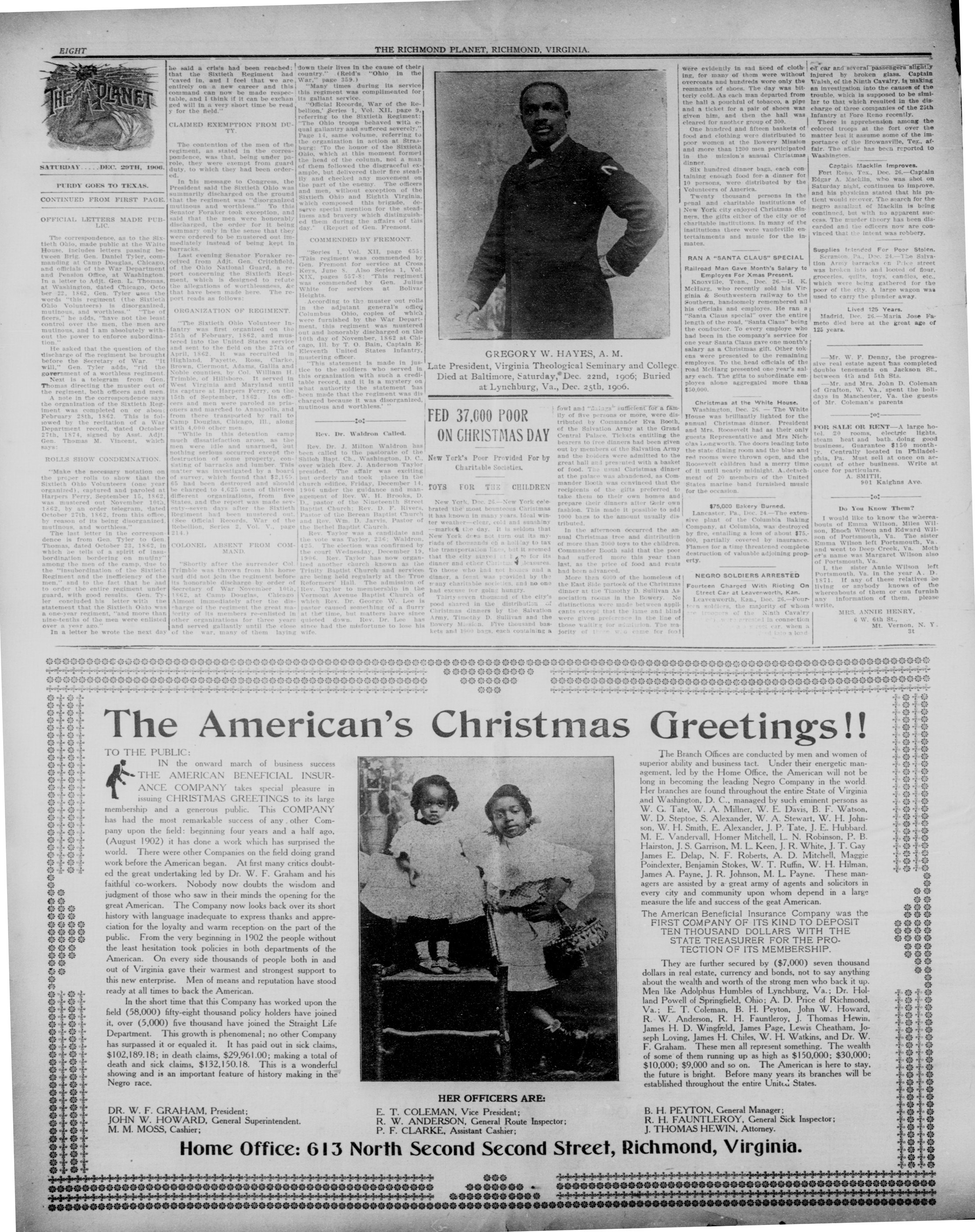
Page text (machine-generated)
THE RICHMOND PLANET
VOL. XXIV, NO. 4.
PURDY GOES TO TEXAS.
Will Investigate Browsville Riot for President—Foraker's Gage Accepted.
[Washington Post, Dec. 23d, '06.]
President Roosevelt made two moves yesterday in his contest with Senator Foraker over the dismissal of the battalion of colored soldiers stationed at Brownsville, Texas, when the town was "shot up" on the night of August 13th last. First, he instructed Milton D. Purdy, assistant to the Attorney General, to proceed to Brownsville to secure legal evidence tending to prove that the shooting was done by members of the battalion. Second, he gave out at the White House official correspondence intending to show he was justified in making the statement that the Sixtieth Ohio regiment of Civil War Volunteers "was summarily discharged on the ground that the regiment was disorganized, mutinous and worthless." The President's action in sending Mr. Purdy to Texas in search of evidence has created a tremendous sensation, not only because of the unusualness of the proceeding, but in view of the fact that in his message to the Senate the President said, alluding to the testimony upon which he acted in dismissing the battalion:
PRESIDENT'S FORMER STAND
"The effort to confute this testimony so far has consisted in the assertion or implication that the townpeople shot one another in order to discredit the soldiers—an absurdity too gross to need discussion and unsupported by a shred of evidence. There is no question as to the murder and the attempted murders; there is no question that some of the soldiers were guilty there; there is no question that many of their comrades privy to the deed have combined to shelter the criminals from justice. In short, the evidence proves conclusively that a number of the soldiers engaged in a deliberate and concerted attack, as cold blooded as it was cowardly; the purpose being to terrorize the community and to kill or injure men women and children in their homes and beds or on the streets, and this at an hour of the night when concerted or effective resistance or defense was out of the question, and when detection by identification of the criminals in the United States uniform was well-nigh impossible." In giving Mr. Purdy this assignment, the President is preparing to combat the contention of Senator Foraker that the "testimony is utterly unsatisfactory and insufficient," and that the President "has misconstrued the testimony upon which his action is based." The Senator on Thursday issued a defiant challenge to him to produce conclusive evidence of the guilt of the negro soldiers, and now Mr. Roosevelt accepts it.
EARLY REPORT EXPECTED
Mr. Purdy will leave Washington without delay, and is expected to submit a report to the President before Congress reassembles, on Jan. 3. On that day the Senate will resume consideration of Mr. Foraker's resolution, directing the Committee on Military Affair of which he is a member, to conduct a searching investigation of the melee at Brownsville, with a view to determining whether the colored battalion was unjustly convicted and illegally deprived of military and civil rights. The President sent Mr. Purdy on this important mission after conferring with Secretaries Root and Taft, the leading lawyers of the Cabinet, and Solicitor General Hoyt, who is now acting as Attorney General in the absence of Mr. Bonaparte. Mr. Purdy ranks next to the Solicitor General in the Department of Justice and to him are assigned the cases against law-violating trusts. It is he who will represent the Attorney General at the trial in the suit filed in the United States Circuit Court at St. Louis to dissolve the Standard Oil "combine," and the very fact that the President has seen fit to send him away from the Capital for a week or more indicates how serious he considers the emergency to be.
LEGAL EVIDENCE NECESSARY
During his conference with Secretaries Root and Taft, the Secretaries it is understood, told their chief that while he doubtless did right in discharging the battalion, he would have to fortify himself with evidence of the kind that counts in court if he expected to hold his own with a lawyer of the sagacity and ability of Senator Foraker. They pointed out that Mr. Foraker was demanding legal evidence of the guilt of the Negroes, and that he held the whip hand so long as the President or the War Department could not furnish it.
The President is deeply stirred over the situation, and realizes all that is involved in the controversy with the Buckeye Senator. Yester-
```markdown
```
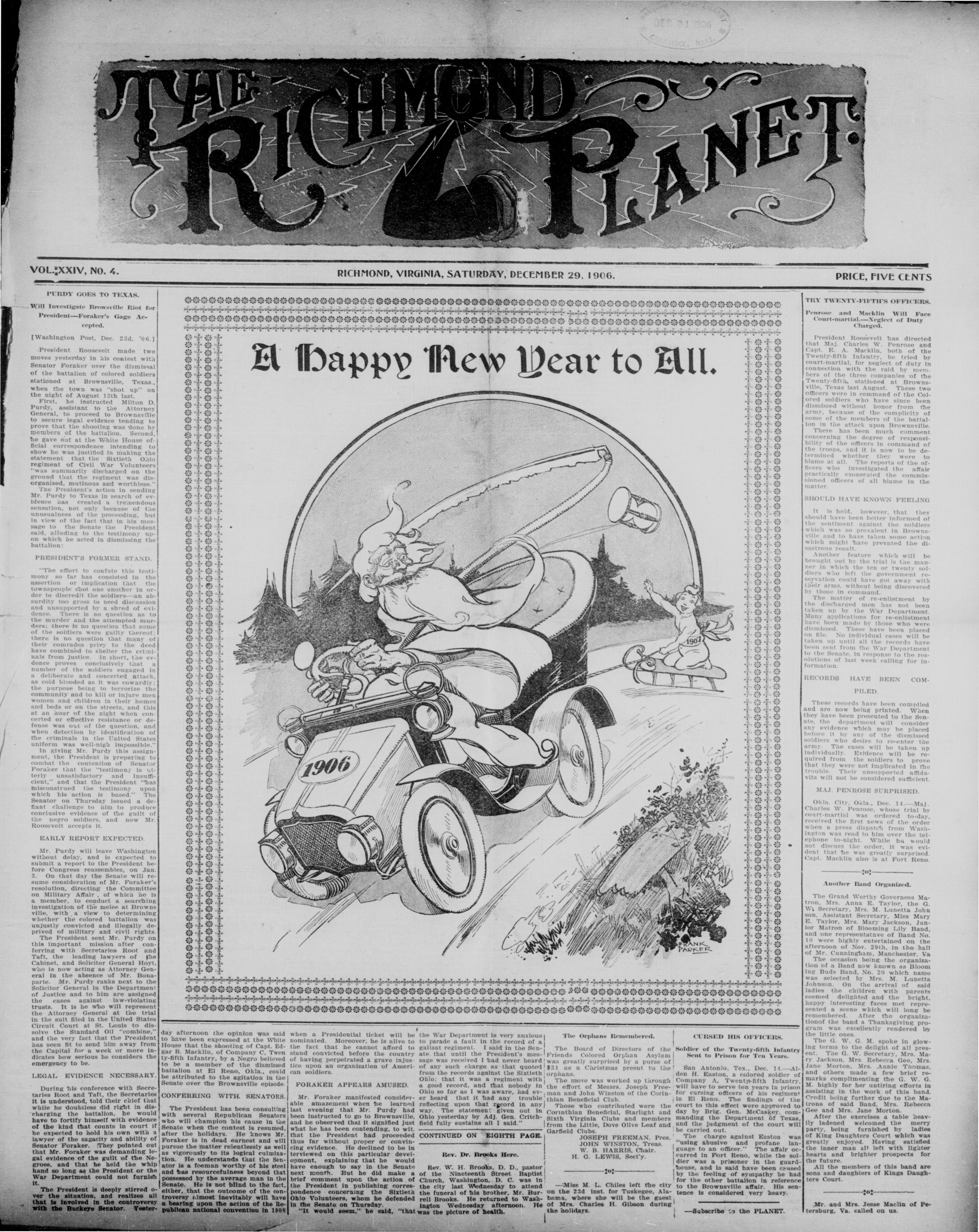
A Happy New Year to All.
1906
FRANK
PARKER
```markdown
```
```markdown
```
day afternoon the opinion was said to have been expressed at the White House that the shooting of Capt. Edgar B. Macklin, of Company C, Twen ty-fifth Infantry, by a Negro believed to be a member of the dismissed battalion at El Reno, Okla., could be attributed to the agitation in the Senate over the Brownsville episode
CONFERRING WITH SENATORS
The President has been consulting with several Republican Senators who will champion his cause in the Senate when the contest is resumed, after the holidays. He knows Mr. Foraker is in dead earnest and will pursue the matter relentlessly as well as vigorously to its logical culmination. He understands that the Senator is a foeman worthy of his steel and has resourcefulness beyond that possessed by the average man in the Senate. He is not blind to the fact, either, that the outcome of the controversy almost inevitably will have a bearing upon the action of the Republican national convention in 1908.
RICHMOND, VIRGINIA, SATURDAY, DECEMBER 29, 1906.
when a Presidential ticket will be nominated. Moreover, he is alive to the fact that he cannot afford to stand convicted before the country of having perpetrated a grave injustice upon an organization of American soldiers.
FORAKER APPEARS AMUSED.
Mr. Foraker manifested considerable amazement when he learned last evening that Mr. Purdy had been instructed to go to Brownville, and he observed that it signified just what he has been contending, to witt that the President had proceeded thus far without proper or convincing evidence. He declined to be in interviewed on this particular development, explaining that he would have enough to say in the Senate next month. But he did make a brief comment upon the action of the President in publishing correspondence concerning the Sixteenth Ohio Volunteers, whom he defended in the Senate on Thursday.
the War Department is very anxious to parade a fault in the record of a gallant regiment. I said in the Senate that until the President's message was received I had never heard of any such charge as that quoted from the records against the Sikithel Ohio; that it was a regiment with a good record, and that nobody in Ohio so far as I was aware, had ever heard that it had any trouble reflecting upon that record in any way. The statement: given out in Ohio yesterday by Adj. Gen. Critchfield fully sustains all I said."
CONTINUED ON EIGHTH PAGE.
Rev. Dr. Brooks Here.
Rev. W. H. Brooks, D. D., pastor of the Nineteenth Street Baptist Church, Washington, D. C. was in the city last Wednesday to attend the funeral of his brother, Mr. Burrell Brooks. He returned to Washington Wednesday afternoon. He was the picture of health.
The Orphans Remembered.
The Board of Directors of the Friends Colored Orphan Asylum was greatly surprised by a purse of $31 as a Christmas present to the orphans.
The move was worked up through the effort of Messrs. Joseph Freeman and John Winston of the Corinthian Beneficial Club.
Those who contributed were the Corinthian Beneficial, Starlight and Sixth Virginia Clubs and members from the Little, Dove Olive Leaf and Garfield Clubs.
JOSEPH FREEMAN, Pres.
JOHN WINSTON, Treas.
W. B. HARRIS, Chair.
H. G. LEWIS, Secty.
—Miss M. L. Chiles left the city on the 23d inst. for Tuskegee, Alabama, where she will be the guest of Mrs. Charles H. Gibson during the holidays.
```markdown
```
CURSED HIS OFFICERS
Soldier of the Twenty-fifth Infantry Sent to Prison for Ten Years.
San Antonio, Tex., Dec. 14.—Alden H. Easton, a colored soldier of Company A, Twenty-fifth Infantry, will have to serve ten years in prison for cursing officers of his regiment in El Reno. The findings of the court to this effect were approved to day by Brig. Gen. McCaskey, commanding the Department of Texas, and the judgment of the court will be carried out.
The charge against Easton was "using abusive and profane language to an officer." The affair occurred in Fort Reno, while the soldier was a prisoner in the guard-house, and is said have been caused by the feeling of sympathy he had for the other battalion in reference to the Brownsville affair. His sentence is considered very heavy.
Subscribe to the PLANET.
PRICE, FIVE CENTS
TRY TWENTY-FIFTH'S OFFICERS.
Penrose and Macklin Will Face Court-martial—Neglect of Duty Charged.
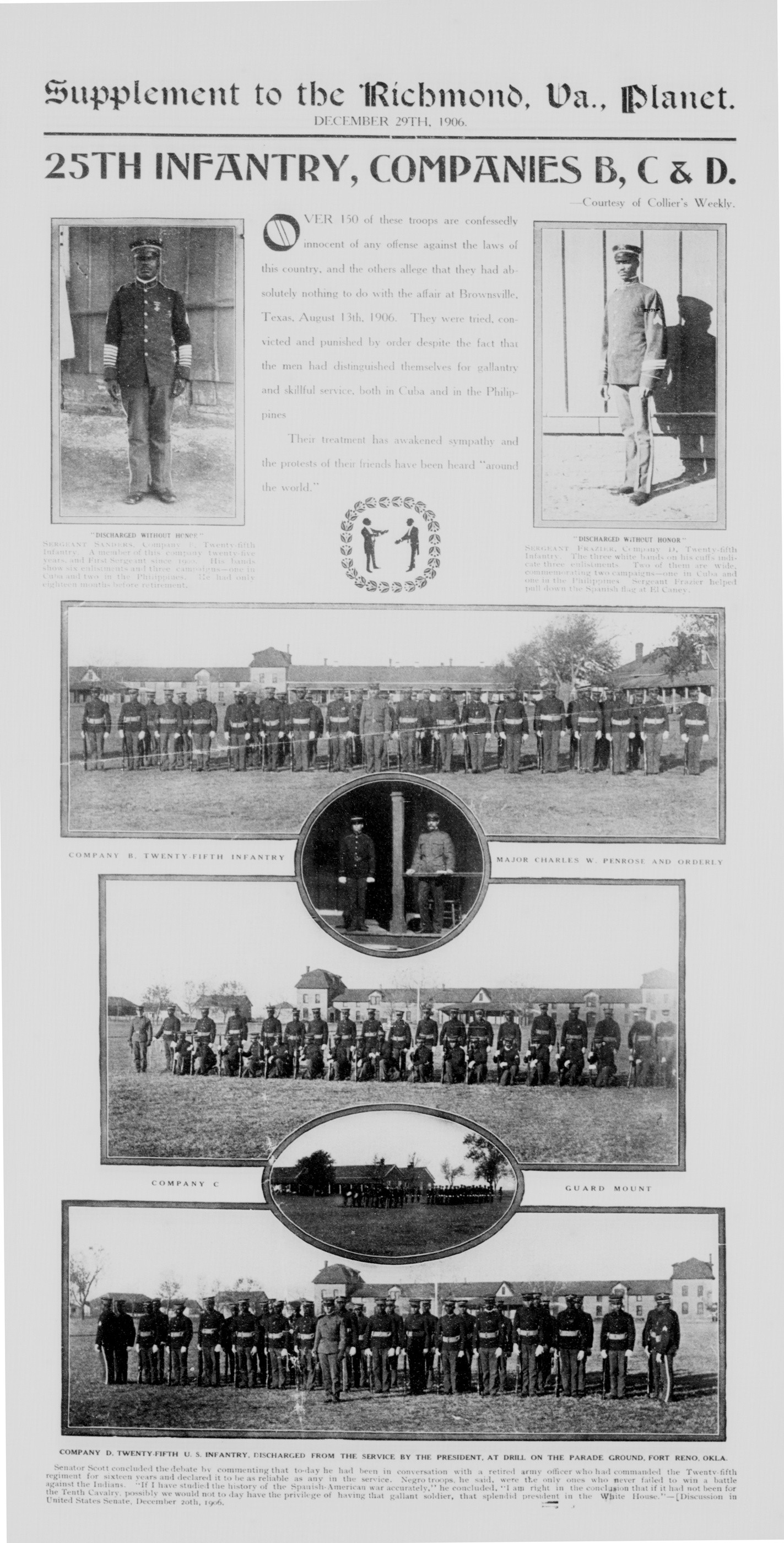
President Roosevelt has directed that Maj. Charles W. Penrose and Capt. E. A. Macklin, both of the Twenty-fifth Infantry, be tried by court-martial, for neglect of duty in connection with the raid by members of the three companies of the Twenty-fifth, stationed at Brownsville, Texas last August. These two officers were in command of the Colored soldiers who have since been dismissed without honor from the army, because of the complicity of some of the members of the battalion in the attack upon Brownsville.
There has been much comment concerning the degree of responsibility of the officers in command of the troops, and it is now to be determined whether they were to blame at all. The reports of the officers who investigated the affair practically exonerated the commissioned officers of all blame in the matter.
SHOULD HAVE KNOWN FEELING
It is held, however, that they should have been better informed of the sentiment against the soldiers which was so prevalent in Brownsville and to have taken some action which might have prevented the disastrous result.
Another feature which will be brought out by the trial is the manner in which the ten or twenty soldiers who left the government reservation could have got away with their arms, without being discovered by those in command.
The matter of re-enlistment by the discharged men has not been taken up by the War Department. Many applications for re-enlistment have been made by those who were dismissed. These have been placed on file. No individual cases will be taken up until all the records have been sent from the War Department to the Senate, in response to the resolutions of last week calling for information.
RECORDS HAVE BEEN COM-
PILED
These records have been compiled and are now being printed. When they have been presented to the Senate, the department will consider any evidence which may be placed before it by any of the dismissed soldiers who desire to re-enter the army. The cases will be taken up individually. Evidence will be required from the soldiers to prove that they were not implicated in the trouble. Their unsupported affiliations will not be considered sufficient.
MAJ. PENROSE SURPRISED
Okla. City, Okla., Dec. 14.—Maj. Charles W. Penrose, whose trial by court-martial was ordered to-day, received the first news of the order when a press dispatch from Washington was read to him over the telephone to-night. While he would not discuss the order, it was evident that he was greatly surprised. Capt. Macklin also is at Fort Reno.
Another Band Organized.
The Grand Worthy Governess Matron, Mrs. Anna E. Taylor, the G. W. Secretary, Mrs. M. Lunetta Johnson, Assistant Secretary, Miss Mary E. Taylor, Mrs. Mary Jackson, Junior Matron of Blooming Lily Band, and one representative of Band No. 10 were highly entertained on the afternoon of Nov. 29th, in the hall of Mr. Cunningham, Manchester, Va. The occasion being the organization of a Band now known as Blooming Buds Band, No. 20 which name was selected by Mrs. M. Lunetta Johnson. On the arrival of said ladies the children with parents seemed delighted and the bright, happy interesting faces met represented a scene which will long be remembered. After the organization of the band a Thanksgiving program was excellently rendered by the little ones. The G. W. G. M. spoke in glowing terms to the delight of all present. The G. W. Secretary, Mrs. Mary Jackson, Mrs. Rebecca Gee, Mrs. Jane Morton, Mrs. Annie Thomas, and others made a few brief remarks complimenting the G. W. G. M. highly for her untiring efforts in assisting in the work of this band. Credit being further due to the Matrons of said Band, Mrs. Rebecca Gee and Mrs. Jane Morton.
After the exercises a table heavily ladened welcomed the merry party, being furnished by ladies of King Daughters Court which was greatly enjoyed. Having satisfied the inner man all left with lighter hearts and brighter prospects for the future.
All the members of this band are sons and daughters of Kings Daughters Court.
Mr. and Mrs. Jesse Maclin of Petersburg, Va. called on us.
DUKE
OF
DEVIL-MAY-CARE
BY HARRIS DICKSON
AUTHOR OF "THE BLACK WOLF'S BREED"
COPYRIGHT:1905 BY D.APPLETON & CO
TWO
CHAPTER X.
INTO THE VOID.
Monsteur Victor Laboulisso followed the girls from the room and closed the door—the door that had the broken knob. Anita and Alice stood bewildered in the hall, watching him lock it, listening to the rasping bolt as it slipped into place.
"Mother did come here with us, didn't she, Anita?" Alice sobbed.
Anita tightened her clasp about the younger girl. It seemed a thousand years ago—last night—a thousand miles away, a confused entangled memory of some strange land, some vanishing castle, where men whispered, and where a pair of tense black eyes stared at her from a window.
Instinctively her thoughts turned to Noel Duke, if, indeed, they had ever straved from their usual abiding-place. She forgot his neglect, forgot her resentment, she felt only her weakness, and hoped he might be near. She would appeal to him; even if he did hate Mrs. Ashton he would come, for her sake. He would compel this shriveled little mummy to tell the truth. Yes, yes, she would go to the street door and call him. "Come, Alice," she said; and half supporting her cousin, Anita moved decisively toward the door at the end of the hall.
But if that were Noel, why did he sit in that window across the street and stare? Why did he look so pale and haggard? What was it that he and Victor were talking about so earnestly? What agreement was there between them? Why should Noel be so anxious to hide something? Why did he agree not to come back to this house if Victor would not tell? What was it that Victor could tell? Victor had said "ladies must be protect;" what did he mean by that? What woman did Noel mean to harm?
A thousand jumbled ideas flashed through Anita's mind. "No, no," she stopped herself at the threshold. But she must do something; Monsieur Victor—wretched little creature—kept watching her with his toad's eyes, and Alice was worse than helpless.
"I shall call the police," she said, vaguely.
"What for does mademoiselle wish ze police?" Victor inquired, blandly, with palms outspread.
"I want the police!" she almost screamed back to him.
"Oui, oui, ma'm'sselle; I have zem in one minute." Victor bowed with the air of doing a foolish thing in order to pacify a child. "Hip!peet! Hip!peet!" he called. "run! quick, fetch ze police for ma'm'sselle—"
Hippolyte came from the court below and hobbled up the stair, his cap in hand; he had not understood.
Anita advanced to meet him at the door. Again she stopped, a choking fear clutching at her throat.
"The man across the street," she thought, and shuddered; "what had he done? Perhaps he knew—perhaps."
She raised her hand. "On, no, no, Monsleur Victor, do not call the police—yet—"
Victor shrugged his shoulders hopefully; was ever man so beset? Hippolyte had scarcely disappeared before he came back again. Anita turned to him as she might have turned to any trifle which promised explanation.
"Two gentleman; zey wait," he said, and handed Anita their cards—"Mr. Felix Chaudron, Mr. Woodford Vance." Anita read the names aloud, and dully wondered how Woodford Vance happened to be here.
"Oh," Alice exclaimed, "I know! Mother wrote him a month ago; he was to meet us here, and surprise you."
She tore herself away from Anita, sped through the hall, down the steps, and without noticing a stranger's presence, ran straight to Woodford Vance.
"Oh, I'm so glad you came," she burst out; "something terrible has happened. Mother was here with us last night. Now she's gone, and we can't find her anywhere. Come."
She caught his hand, led him stumbling up the stair, round the balcony and into the back hall.
The young Creole followed—a slender fellow with tiny mustache, and indolent-looking eyes. Victor greeted this man with elaborate politeness, for he knew the Chaudrons.
They came upon Anita standing in the hall where Alice had left her, her deep eyes gazing through the doorway. She held out her hand to Woodford Vance without a word.
"What's the matter?" he asked after he had hurriedly presented Chaudron.
"I don't know—exactly; we came down from Vicksburg last night with my aunt. She went to sleep in that room. I think it was that room."
"No, Anita, it was not that room," Alice corrected.
"I'm sure that was the room," Anita insisted, "and now she isn't here; she isn't in the house. These people say she did not come."
"IImpossible! How foolish!" Vance was a practical business man, and would have laughed outright but for Alice's hysterical distress. Felix Chaudron looked from one mystified girl to the other, then straight at the hotelkeeper.
"What about this, Monsieur Labouisse?"
"Ma'm'selle me mistake." Victor spread out his palms with a deprecatory gesture, heart-broken at having to take issue with a lady. "Ze two young lady zey come to my house las' night; I give zem a room-ais
morning fey sleak of one more lady.
I know nutting of her. One young lady say her muzzer sleep in zat room—one say she do not. One say 'yes,' one say 'no'—as you hear, m'sleur; I am in one great perplex. Zat ees my room; I sleep zere las' night." The bewildered Frenchman shrugged his shoulders helplessly.
Chaudron called Monsieur Victor aside; they conversed earnestly in French. He questioned Arthemise, then went down-stairs and talked with Hippolyte who was feeding pigeons in the courtvard. When Chaudron came up the stairs again he walked slowly around the balcony, thoroughly puzzled, not knowing what to think.
"Miss Cameron." he asked, dubiously, "you cannot be mistaken? You are quite sure that Mrs. Ashton came to this house with you last night?"
"Certainly, we could not have come here alone."
"Which room did your aunt occupy?"
Anita pointed to the broken knob; Alice shook her head stubbornly.
Victor reopened the door; the three men went in together and looked around. There was nothing unusual in the room, nothing suspicious, nothing to attract attention; an ordinary bedroom, littered with a man's belongings, that was all.
Alice watched them from the threshold. "No, I am sure now," she decided; "mother was never in here."
"Where was she then?"
Alice shook her head. "Oh, I don't know. I'm so mixed up that I can't remember anything."
"Vance," Chaudron spoke sharply; his sleepy Creole eyes were thoroughly aroused. "I don't like this a bit, there's something wrong. You stay here with the ladies, and I'll get somebody that will find out."
CHAPTER XI
THE INQUISITION OF JIMMY FITZ.
A newsboy on the banquette nudged his companion and pointed to one of two men in plain clothes who entered the Hotel Louis le Grande on either side of Felix Chaudron. "Dat's
JENNIE
Jimmy Fitz—dere's sump'n doin' in dere," he explained.
James Fitzgerald, of the secret service, terror of the crook, idol of the gamin, was a clean-shaven man with close-cropped iron-gray hair, and a pair of quiet blue eyes. He walked along quietly, listening to young Chaudron. Jimmy Fitz always listened; it was a dogma of his religion to let the other fellow do the talking. "The fellow that talks always pulls the laboring car," thought Jimmy Fitz. If he had not known young Chaudron so well, Jimmy Fitz might have been inclined to laugh. He hadn't much faith in excitements raised by a lot of women.
"Better sit down there. Casey, and kind o' notice things;" he pointed his companion to one of the green benches in the court, while he himself followed Felx Chaudron up the stairs.
Casey took his seat negligently in the courtyard, at the table where Victor Labouisse had been sitting, and picked up a newspaper. The parrot chattered, the pigeons strutred, the fountain sparkled, and Casey's careless eye took in what little there was to be seen.
Chaudrom led Jimmy Fitz into the rear hall. Victor was still standing there talking to Woodford Vance.
"Not a word; it is the most remarkable thing I ever ran across."
"This is Capt. Fitzgerald, Mr. Vance; I brought him because it's better to be as quiet about this as we can."
Fitz shook hands cordially with both Victor and Vance.
"What's all this trouble about, Mr. Labouisse?" Fitzgerald questioned in his good-natured way that always disarmed suspicion; those transparblue eyes of his seemed very childlike and trustful.
"It is one great foolishness, Monsieur Fitz; two young lady come here last night—zey take a room. Zis morning they say zey haf lose zair muzzer—zey cry an' zey search my house. I haf many times already determine zat I take only gentleman in my house, and—"
"Where is their mother?"
"Ze good God in Heaven—He know."
Fitzgerald turned to Chaudron.
"Let me speak to the young ladies."
"They're in their room; I'll call them," suggested Vance, as he went back and knocked on their door.
THE RICHMOND PLANET, RICHMOND, VIRGINIA
Anita opened it = Anita, tall, straight and fearless.
"Have you found her?" she asked instantly; then she saw from Vance's face that he had not.
"No; the police are here; they want to see you and Miss Ashton."
Alice sprang up from the bed and ran to the door. "What is it? What is it?"
"The police," Anita answered quietly.
"Oh!" Alice covered her face; the police made the situation so real, so very terrible. She sat down helplessly.
"Come." Anita took the girl's hand and led her into the hall.
"Here is Capt. Fitzgerald," said Chaudron; "he wants to ask you a few questions."
Fitzgerald was very courteous and very delicate for so rough a man. He asked a number of questions, and learned nothing more than Chaudron had already told him. Mrs. Ashton went to sleep last night in a big bed with green silk curtains hung all around it. This morning she could not be found; that was all the two girls knew.
"Which room was that in, miss?" Again Anita pointed to the door with the broken knob; again Alice shook her head. Fitzgerald looked from one to the other, puzzled and tolerant. He had the door opened.
From the outside Anita always felt certain that this was the room. But every time the door was opened and she looked in, she felt that she might be mistaken. Alice was very positive that she had not left her mother in this room.
"Why, there was a big green bed over here in this corner," Alice insisted, "and a piece of tapestry hung right here, with a Crusader on it—right where this door is." She pointed to a pair of white sliding doors striped with gold. "The room that mother was in didn't have a door like this at all. And there was an old cabinet; Anita, you remember that cabinet?"
Anita nodded. Yes, she remembered all those things, but—she walked to the door and looked up and down the hall again.
"It was the first door to the right as we came into the hall," she asserted positively.
"It's very queer," Fitz whispered to Chaudron; then he turned to Anita in the hall.
"When did you get to New Orleans, miss?"
"Our train was late; we must have reached this house about 11 o'clock."
"Last night?"
"Last night."
"How did you come, in a cab or on a car?"
"A cab."
"Do you remember the number of the cab?"
"No sir, but the man had side whiskers; I think I should know him."
Fitz made no comment; it should be very easy to find this man.
"Miss Cameron"—Fitzgerald picked his chance and questioned her apart from Alice, for Anita had shown the greatest self-control"—I don't want to scare you, but did your aunt have any large amount of money with her, or valuables of any kind?"
"No, I think not; I'm sure of it. I heard her say she would have to go to the bank the first thing this morning. Why? Do you think she has been killed?" She steadied herself, and waited for the man to answer.
"No, I do not think so," he said, but Anita saw the fear that was in his mind.
"Who did you see when you came to this house?" Fitzgerald pursued the inquiry.
"A girl named Arthemise—that one"—Anita pointed—"and the old porter, I think he is called Hippolyte—"
"No one else?"
"No one else."
"That is, no one but the servants of the hotel?"
"Yes, and Monsleur Victor."
"Did Mrs. Ashton have enemies? Was there anyone who might wish—wish her harm?"
The last vestige of color faded from Anita's lips.
"Who was it?" Fitzgerald asked, for he knew that there was some one. Anita's eyes evaded his; she answered unsteadily:
"Nobody; that is—I don't know." Fitzgerald looked at her queerly, it seemed for several minutes. She turned her face away. Then he asked again:
"What baggage did you bring?"
"Twe baga."
"Where are they?"
"One of them is in our room."
"The other?"
"My aunt teek that into the room with her."
Fitzgerald glanced inquiringly at Victor. The Frenchman shook his head. "The trunks have just come, Measleur Fitz," he said.
"How many?"
"Three." Victor replied.
"They probably checked one on each ticket!" Fitz commented; and Anita nodded that he was right.
"That is all, Miss Cameron."
Allo! came up and stood beside Anita, listening. "Where is my mother?" she asked Fitzgerald, with the sublime faith of a child.
"I don't know—yet," the detective answered frankly.
"Now, Mr. Labouisse, I shall question your servants."
"As you please, monsieur."
"May I use this room?"
"It is at monsieur's service."
Fitzgerald glanced at the young ladies, and motioned Chaudron to take them to their room.
Jimmy Fitz took calm possession of the room that had the broken knob upon its door. "Send the girl Arthemise," he said.
Arthemise, greatly furried, saw the dreaded Fitz sitting at the table with a pencil and paper. She hesitated on the threshold and glanced appealingly at Victor, who waved her into the room.
"Take this seat, please," Fitz pointed to a chair. "Will you kindly close the door, Mr. Laboussée?"
Victor Laboussée did not stir from the door while Jimmy Fitz was putting Arthemise through the mill. Presently the girl came out, hurriedly.
wife shifting eyes, and dodged down the hall, glad to escape such a piercing inquisition.
Chaudron saw that Fitz was drumming on the table; he looked puzzled and disappointed.
"Where is that old porter?" Fitz locked up; "tell him to come here."
"Hip! leet! Hip! leet!" Victor shouted ed from the balcony. "Come here; z-Monsleur Fitz-wish to see you."
Hippolyte came round the curving balcony, holding back at every step as if some one behind she shovin him on. When he saw Fitz sitting at the table, and no one else in the room he stopped entirely.
"Come in, old man," the thin lip called from the table. Hippolyte dropped his cap on the floor and glanced apprehensively behind him when Victor closed the door, shutting him in with that pair of eyes that bored him through and through.
Chaudron, Vance and Labouisse talked in the hall until they heard Fitzgerald shove back his chair. Hippolyte appeared in the door, much relieved, and Fitzgerald followed him. "Can't get a thing out of these people," he whispered to Chaudron. "They say positively that those two young ladies came to the house alone. Mr. Labouisse," he spoke aloud, and beckoned to Victor that it was his turn.
It seemed to those outside that Fitzgerald questioned Victor Labouisse a much shorter time than he had either of the others. Then Fitz opened the door himself, and marched out, abrupt and decided.
"Mr. Chaudron. I'm going to search this house, just to satisfy myself and the young ladies. The sooner it's done, the better. I'll have a house full of men here in ten minutes."
"And you have learned nothing?" Fitz shook his head.
Felix Chaudron called Woodford Vance aside. "These girls ought not to stay here," he said. "This thing is getting serious, and there's no telling what we may find. I'm going to telephone my mother to come and take them to our house."
For hours and hours, as it seemed to Alice and Anita, men went tramping through the hotel, slamming doors, and making a great noise. Alice threw herself across the bed, and listened. Every few moments, at some unusual sound, she sprang up expectantly, but dreading to ask what had happened.
For half an hour Anita stood leaning against the window, looking out upon the prim old Creole garden with the high wall around it. It was a barbarous-looking wall, with broken bottles sunk in the cement on its top, capping the bricks with jagged spikes of glass. Of course, nobody could climb such a wall as that.
She saw several men out there, Casey, Chaudron and Vance, thrashing about among the shrubbery, poking into the tangled honeysuckles, searching everywhere. Anita, terror-stricken, watched the men pulling aside the vines and peering into those damp dark corners. What could they expect to find? She kept her fascinated eyes upon them and could not turn away. Then they all came in; they had discovered nothing.
Presently someone knocked. She and Alice rushed to the door together. It was Vance and Chaudron. Both men were dusty and covered with spider webs from their search in garden and garret. Both looked very grave.
"Miss Cameron," said Vance, "you can't stay here to night. Mr. Chaudron has telephoned his mother; she is on her way to take you and Miss Ashton to her house—"
"No, no," Alice protested; "I don't want to go; I want to stay here. It would be deserting mother—"
"But you can't help her—"
"I don't care; I won't go—I won't."
"Leave her to me." Anita whispered. "We will go; of course we cannot stay here."
It must have been about two o'clock in the afternoon when Mrs. Chaundron's carriage stopped in front of the Hotel Louis Le Grande, and Mrs. Chaundron stepped out—a dark little lady who had once been very beautiful. Her son hurriedly explained to her what had happened.
"Where are the poor little dears?" she asked; and he led her to them. Chaundron left his mother alone with the girls. In a few moments Anita opened the door and handed out her baggage to Woodford Vance.
"Put that! in the carriage," she whispered; "Alice will be ready. We are trying to persuade her to go quietly."
Alice developed more of her mother's determination than one might have suspected; Mrs. Chaudron and Anita were quite a little while in overseeing it. Presently they emerged from the room and came slowly through the hall. Alice made no resistance until she came to the door with the broken knob.
"Oh, I don't want to go—I don't want to go," she cried, and held back. They forced her on as gently as they could, past the room, and out to the carriage. She dropped on the seat and hid her face in Mrs. Chaudron's lap.
Anita sat bot upright on the front seat, staring about her—staring at those garrish banners of purple and gold which flaunted from every balcony in honor of King Rex. It was early afternoon, and all the world seemed dressed for a holiday. Chaundron leaned on the carriage door, talking to his mother.
Anita tried to think. It all seemed so unreal and so terrible that she could not comprehend. There must be some explanation of it, if she could only think—could only think. But she could not think. In spite of herself she kept her eyes fixed on the window of that dingy little cafe across the street. There! There he was, that same man, peering at her again; a face of wrath and wildness. She shivered; it seemed uncanny to be afraid of a man because he happened to look like Noel Duke.
Chaudron stepped back from the carriage and stood beside young Vance on the banquette. "All right," he nodded to the driver. "Home." "Wait a minute, please," Anita begged; "Mr. Chaudron, I wish you would telegraph Mr. J. E. Balfour at Vickersburg--you know Joe, Ask him
Knights of Pythias,
This organization is one of the most powerful in the country and its progress has been phenominal. The Grand Lodge of Virginia has jurisdiction over all of the cities and counties in this state. Thirty males are required to organize a new lodge. The benefits paid constitute one of its strongest features, but the principles are greater than anything else. Founded on Friendship, based on Charity and established on Benevolence, the respectable, upright people of the state will find it an order worthy of their heartiest support.
It pays an endowment and burial benefit of of $200.00 for all ages. It pays $4.00 per week sick dues. The badge costing 75 cents each is the only absolutely necessary regalla. For information concerning the organization of lodges apply at the main office.
The Courts of Calanthe
Is the Female Department of the Order. It requires a membership of thirty persons to organize a court. Its members are pledged to exhibit Fidelity, exercise Harmony and prove Love one for the other. It pays an endowment and burial benefit of $150.00. It pays $300 per week sick dues. The only expense for regalia is the cost of the badge, 50 cents and a rosette, costing 25 cents for funeral occasions.
THE BANDS OF CALANTHE or Children's Department also constitutes a feature and persons cannot do better than to enter the little ones into this mystic circle. The expense is nominal and the benefits all that could be expected. It pays from $1.00 to $1.50 sick dues and death benefits of from $30.09 to $40.00. If you have no Pythian Lodge or Court or Band in your neighborhood, orgnize one.
For all information concerning the Children's Department address
For all information concerning special rates of membership in the lodges and courts, address
To come down here at once, he is Mrs. Ashon's lawyer, and I'm sure she would want him."
Chaudhur gazed after the disappearing carriage. Then he and Vance walked off a little way to consult, and another man watched them from his post at the window across the street.
"Vance!" Chaudhur spoke with deliberate conviction—"something crooked is going on in yonder."
"Yes; they ought to arrest that Frenchman, maybe the girl. My God! we ought to do something."
"No; Fitzgerald says we have no proof against them yet; we had better let them alone, not appear to suspect them. He'll watch them close, and they can't get away. The minute Victor bats his eye, Fitz says he'll cap him in jail."
"We ought to arrest somebody." Vance kept insisting.
"Well, I can't explain it exactly."
Chaudron continued, "but I'm not satisfied. I'm going to get a detective of my own, an Englishman I know, named Baker; he's sharp as tacks, and he'll get at the bottom of this business if anybody can. You stay around here and watch things until I send this telegram. Then I'll get hold of Baker and start him to work."
Late that afternoon a dapper-looking Englishman, with a tweed suit, fore-and-aft cap, and a valise plastered over with foreign hotel labels, took a room at the Hotel Louis le Grande.
Neither Chaudron nor Vance gave any sign of recognition as they passed Mr. "Henny" Baker in the entry.
(TO BE CONTINUED.)
WANTED—A good Alto and Soprano and Tenor Singer to travel with a company of reliable backing. Your money sure. Will pay salary by the week and pay all expenses. A good position to the right party. Must be ladies and gentleman. Good voice readers preferred For particulars address
S. R. OVERSTREET,
care Duncan Litho. Co.
Hamilton, Ontario.
knigh
KNIGHTS OF PYTHIAAS
F.C.B.
only absolutely necessary rega
apply at the main office.
The Court
Is the Female Department of the
thirty persons to organize a court
Fidelity, exercise Harmony and
an endowment and burial benefit
dues. The only expense for rea
a rosette, costing 25 cents for fun
THE BANDS OF CALAN
stitutes a feature and persons ca
circle. The expense is nominal
$1.00 to $1.50 sick dues and dea
Lodge or Court or Band in you
For all information concerning
For all information concern
membership in the lodges and o
I CAN SELL
YOUR REAL ESTATE
OR BUSINESS.....
No Matter Where Located.
Properties and Business of all kinds
sold quickly for cash in all parts of
the United States. Don't wait.
Write to day describing what you
have to sell and give cash price on
same.
If you want to buy any kind of
Business or Real Estate anywhere,
at any price, write me your require
ments. I can save you time and
money.
DAVID P. TAFF, The Land Man.
415 Kansas Avenue,
Topeka, Kansas.
STRAUS' SPECIAL
Old Yacht Club,
PURE WHISKEY
Will Satisfy the lover of the right kind of stimulant. Special prices.
We have all grades of good liquors,
Cigars and Tobacco. Call and see us.
ISAAC STRAUS & CO.,
422 E. Broad St.,
Richmond, Virginia.
GEORGE O. BROWN.
Fine Photographs. True to Life. High-class service. Latest improvements in Photographer Out-door Work executed. Reasonable Estimates and Props' Service. Pictures Earlings
United Aid Insurance Company.
THE PEOPLE'S REAL ESTATE AND
Stockholders Attention!
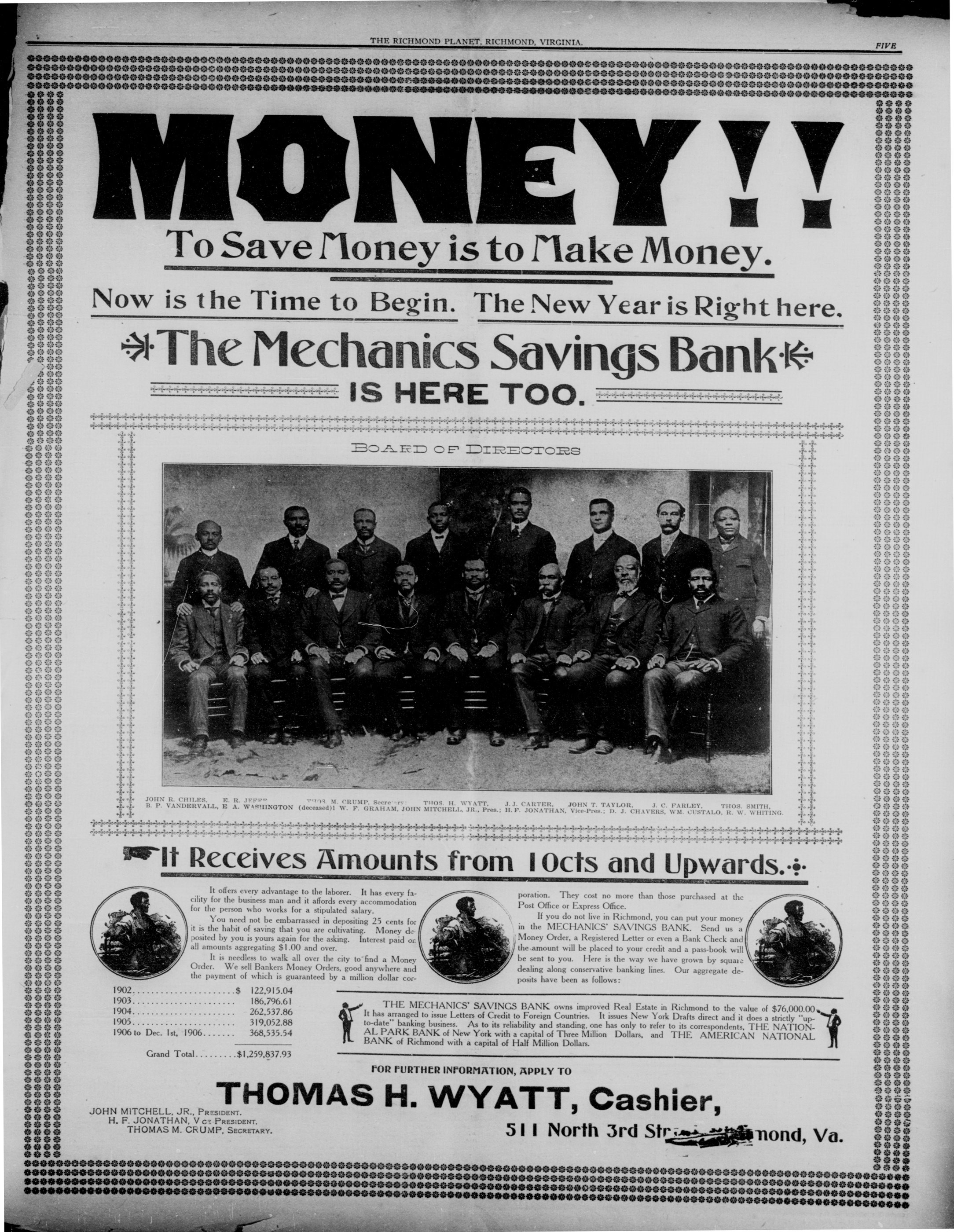
The regular annual meeting of the Stockholders of the Mechanics' Savings Bank will be held on Wed. Jan. 2nd, 1907 at the Pythian Castle, 727 North Third St. Richmond, Va. Meeting will be called to order at 8 o'clock P. M. All Stockholders are requested to be present in person or be represented by proxy. By order of the Directors
JOHN MITCHELL, JR., Pres.
THOMAS M. CRUMP, Sec'y.
BEFORE
MAKING
Your purchase you would do wait to call at the most reliable furniture house in the city and see the fine line of
Mattings, Oil-Cloths,
And in fact everything that is needed in house furnishings.
Of every description; also the latest designs in ROOKERS and special CHAIRS. Our goods are the best for the price and the price is very low.
C. G. Jurgen's Son
421 EAST BROAD ST.,
between 4th and 5th Street
A. Hayes
First-class Hacks and Caskets of all decriptions. I have a spare room for bodles when the family have not a suitable place. All country orders are given special attention. Your special attention is called to the new style Oak Caskets Call and see me and you shall be waste or indly.
Phone, 2778.
Organization is one of the most powerful has been phenomenal. The Grand Court over all of the cities and counties is intended to organize a new lodge. The largest features, but the principles based on Friendship, based on Charity, the respectable, upright people of their heartiest support. An endowment and burial benefit of $150.00 per week sick dues. The badge of regalia. For information concerning Courts of Calantia.
In the Order. It requires a member court. Its members are pledged and prove Love one for the other. Benefit of $150.00. It pays $300 per regalia is the cost of the badge, 500 funeral occasions.
ANTHE or Children's Department cannot do better than to enter the final and the benefits all that could death benefits of from $30.09 to $40.00 neighborhood, orgrnize one. Using the Children's Department ad Mrs. Anna Tau 120 W. H. morning special rates of JOHN and courts, address 31
United Aid Insurance HOME OFFICE, 312 East Incorporated 1894 under the lawson Has written over Three Million business since organization. Over sixty-five thousand p. Over twenty-five Branches All claims paid to date. Ten Thousand Dollars on Deposit w OFFICE J. E. Byrd, P. W. W. Lee, D. S. Alston, W. J. Spratley R. L. Clay, R. H. Stokes, R. C. Malloy, BOARD OF J. E. Eyrtl, W. J. pratley W. W. L. Bailey, W. C. Carter, P. S. B. Stokes, F. E Reliable men can find employment at Address, U
THE PEOPLE'S REAL INVESTMENT COMPANY WHY NOT CALL ON US?
THE HOME OF THE MAYFIELD MUSEUM
JOHN FOXEL
Dealer in General Line of
FANCY AND STAPLE GROCERIES,
NOTIONS, FRESH MEATS, CIG-
GARS, TOBACCO, ICE,
WOOD, COAL, &c.
BOARDING & LODGING
Rates Reasonable. All the Comforts
of Home
Orders received by letter or telegraph
MRS. BOOKER LEFTWICH.
PROPRINTRESS,
816 N. 2nd St. Richmond, KY
RICHMOND MEDICAL COLLEGE
RICHMOND. VIRGINIA.
Chartered June 14, 1905. Co-educational. The only Colored College in Virginia for a thorough course in Medicine, Denistry and Pharmacy. Session: 1905-1906 begins Oct. 2, 1905.
For further information, write,
J. ALEX. LEWIS, M. D.,
Secretary.
9-23-3mos.
H F Jonathan
FISH, OYSTERS AND
PRODUCE.
ALL ORDERS WILL RECEIVE
PROMPT ATTENTION.
Long Distance Phone. 758
rythias,
A.
powerful in the country and its
and Lodge of Virginia has juris-
in this state. Thirty males
the benefits paid constitute one
are greater than anything
quarity and established on Be-
of the state will find it an order
of of $200.00 for all ages. It
are costing 75 cents each is the
ing the organization of lodges
```markdown
```
ment also con-
e little ones into this mystic
and be expected. It pays from
$40.00. If you have noPythian
address,
TAYLOR, W. M.,
Hill St., Richmond, Va.
MITCHELL, JR.,
N. 4th St., Richmond, Va.
Insurance Company,
First Broad St., Richmond, Va.
of Virginia. Capital Stock, $25,000.
(in $3,000,000-09) Dollars worth of
policy holders.
with the Treasurer of Virginia.
BUCERS.
President.
1st Vice President.
2nd Vice President.
Sect'y. and Gen'l. Manager.
Asst. Secretary.
Cashier and Treasurer.
General Inspector.
DIRECTORS.
Lee, D. S. Alston, R. L. Clay, V.
Brown, C. H. Jones, R. H.
E. Puryear.
Ins solicitors and agents.
UNITE. AID INSURANCE CO.,
312 M. Broa St., I chmond, Va.
AL ESTATE AND
PANY.
When renting,
When buying,
When lending money,
When borrowing money,
When you have Real Estate for sale,
When you want an estate managed.
Just call Phone 4854.
---
IT WILL PAY YOU To interest yourself in promot ing the CIRCULATION of the RICHMOND PLANET.
---
THE PLANET
WISDOM FOR WOMEN.
Woman alone knows true loyalty of affection.—Schiller.
If men knew all that women think, they would be 20 times more audacious.—Karr.
When we speed to the devil's house, woman takes the lead by a thousand steps.—Goethe.
Women especially are to be talked to as below men and above children.—Chesterfield.
Beauty is worse than wine; it intoxicates both the holder and the beholder.—Zimmerman.
When joyous, a woman's license is not to be endured, when in terror, she is a plague.—Aeschylus.
Modesty in woman is a virtue most deserving, since we do all we can to cure her of it.—Iingree.
A heart which has been domesticated by matrimony and maternity is as tranquil as a tame bullfinch.—Holmes.
A beautiful woman pleases the eye, a good woman pleases the heart; one is a jewel, the other a treasure.—Napoleon I.
Women know by nature how to disguise their emotions far better than the most consummate male courtier can do.—Thackeray.
When a woman pronounces the name of a man but twice a day, there may be some doubt as to the nature of her sentiments; but three times!—Balzac.
RECORDS.
In the number of his titles the Duke of Atholl, with 23, holds the record.
The record bean for costliness is the vanilla, which sells at $12 a pound retail.
The record for ham sandwich making is 1,000 sandwiches in 11 hours and 25 minutes.
The record for lodging house is one for pilgrims at Mecca, which accommodates 6,000 persons.
The record steam-heating apparatus cost $180,000. It is that which heats the 11,000 rooms of the Vatican.
The record soprano voice was Lucrezia Agujardi's. This lady, who died in 1783, could easily strike C in altissimo.
The record for millionaire honesty was held by the late Charles T. Yerkes, who, on recovering his fortune after his failure, repaid the claims of all his old creditors with 6 per cent compound interest.
The record for letter deliveries is daily made on the 750-mile route between Paris and Berlin. Letters mailed in Paris often reach Berlin in 35 minutes, and never in less than an hour. They are transmitted, of course, pneumatically.
PERSONAL.
Dr. Joseph Samade, the royal dentist to the khevede of Egypt, studied surgery in Chicago for three years.
Dr. Frederich Hegar, the foremost Swiss composer, has retired from public life after 40 years' activity as a conductor.
Lord Townshend, declared an imbecile by the English courts and restrained from managing his own affairs, retains his seat and vote in the house of lords.
Landstrat von Usler, whom the kaiser sent to southwest German Africa to discover water with the aid of his divining rod, is said to have found 53 springs.
Solomon Gompers, father of Samuel, the president of the American Federation of Labor, lives in Roxbury, Mass. He is 78 years old and has been totally blind for nine years. He was born in London, where he joined a trade union in 1849.
R. T. Lowery has the distinction of being the only peripatetic editor. He is the publisher of Lowery's Claim, formerly issued from Nelson, B. C., but, as the Canadian postoffice officials have excluded this publication from the mails, he has taken to the road and is issuing his paper from wherever he happens to be.
JUNIOR CONUNDRUMS
What increases the more we press
st?—A pillow.
When is a book like the holy days?
—When it is lent.
What ship carries the most passeng-
ters?—Courtship.
When are old people like toasted
bread?—When crusty.
When should a man make a stop?
—When he comes to a period.
Why are lans like day laborers?
—They have to scratch for a living.
BORS AND INTEREST THEM IN THE PLANET.
WE WILL HELP YOU TO OBTAIN A PREMIUM.
COLORED INFANTRY IN RESCUE OF ROUGH RIDERS AT SAN JUAN HILL, JULY 2, 1898, SIZE 20X28 AND 20X24 INCHES, ADMIRAL DEWEY'S GREAT NAVAL BATTLE OFF CAVITE IN MANILA BAY, MAY 1ST, 1898, NAVAL BATTLE, DESTRUCTION OF ADMIRAL CERVERA'S SPANISH FLEET OFF SANTIAGO DE CUBA, JULY 3RD, 1898, SIZE 22X28 INCHES; LAND BATTLE, CAPTURE OF EL CANEY, EL PASO AND FORTIFICATIONS OF SANTIAGO, JULY FIRST AND SECOND, 1898, SIZE 22X28 AND 22X27 INCHES. WE WILL SEND YOU ONE OF ANY OF THE FOLLOWING BATTLES OF THE CIVIL WAR ON THE SAME TERMS. THE PICTURES LIKE THE OTHER BATTLES ARE FINISHED IN COLORS. THEY ARE 22X28 INCHES AND RETAIL AT ONE DOLLAR EACH. WE WILL FURNISH FRAMES FOR ANY OF THESE FINE CHROMOS FOR 2 DOLLARS & 50CTS. EACH ADDITIONAL. BATTLE OF GETTYSBURG, BATTLE OF SHILOH, BATTLE OF FIVE FORKS, VA., BATTLE OF ATLANTA, GA., BATTLE OF SPOTTSYLVANIA, VA., BATTLE OF VICKSBURG, MISS., BATTLE OF LOOKOUT MOUNTAIN, TENN., BATTLE BETWEEN THE MONITOR AND THE MERRIMAC, BATTLE OF BULL RUN, VA., BATTLE OF CHANCELLORSVILLE, BATTLE OF THE BIG HORN, (CUSTER'S LAST CHARGE) STORMING OF FORT WAGNER, S.C., (COLORED TROOPS IN THIS FIGHT), BATTLE OF NEW ORLEANS, LA., CAPTURE AND DEATH OF SITTING BULL, THE GREAT INDIAN CHIEFTAIN; FORT PILLOW MASSACRE, FALL OF PETERSBURG, VA., BATTLE OF WINCHESTER, VA., BATTLE OF OLUSTEE, FLA. WE WILL SEND FAMILY RECORD, SIZE 22 BY 28, WHICH CONTAINS SPACE FOR PHOTOGRAPHS OF PARENTS AND TEN CHILDREN. WE WILL SEND SOLDIERS WAR RECORD (CERTIFICATE OF SERVICE IN UNITED STATES ARMY.)
FOR ONE YEAR EACH, OR THEIR EQUIVALENT, WE WILL SEND YOU A COPY OF UNCLE TOM'S CABIN, THE MOST INTENSELY INTERESTING BOOK IN THE COUNTRY. WE WILL SEND YOU A GOLD-PLATED BROOCH WITH YOUR PICTURE THEREIN, YOU TO
Popular appreciation of your work will not be created by the depreciation of that of others.-Chicago Tribune.
```markdown
```
SUNFLOWER PHILOSOPHY
Do you always get your way? If you do you have a lot of enemies.
If you want to make anyone anxious, tell him you heard him talk in his sleep.
A woman should succeed better than a man; a woman isn't compelled to waste any time in barber shops.
About the time people conclude we are to have no more winter a fierce old blizzard will arrive and freeze their ears.
When a man is notoriously in bad health, and notoriously looking tough, it is a positive affront to say to him: "Why, how well you look!"
Bill Barleycorn, John's brother, is also attracting attention. Bill drinks beer, plays cards during business hours and aspires to be a "good fellow."
Here is something more to be grateful for: Cranberries are selling at $7 a barrel, and so long as they remain this high we will not be compelled to look cranberry jelly in the face.
A man may have the pleasure of paying for the piano, but it is never his after it is paid for. The piano always belongs to the oldest daughter, and when she marries she has the privilege of taking it with her if she is mean enough.—Atchison (Kan.) Globe.
CHINESE PHILOSOPHY.
Absintence from talking to one's self is the best way to see how absurd it seems in others.
No matter how skillfully you may have played your part in any of the games of life, you are judged only by this test: "Did you win?"
When you are laughing at the mistakes of another, think of what may call you to action in the same nature of proceedings in the future.
No one really hates you if you are not doing much in the world, and if every one is pleasant to you you are not getting very far from the beaten path.
Remember that your ability is rated in the world's clearing house by the things you have accomplished, not by what you meant to do.—Wing Tu Foo, eminent Chinese scholar.
Remember, when some one seems to be much overjoyed at seeing you after an absence, that it may be only the outbreaking of the pent-up pleasure he felt at your absence.
MEDITATIONS OF A SPINSTER.
It seems that a man's enjoyment of a cigar is entirely governed by the price he pays for it.
It's an unchangeable moral law that it is always the thin girl who thinks low-necked gowns bad taste.
A kiss is about the only thing in the world that is equally satisfactory in the future, in the present and in the past.
When Old Nick found that man was getting so he did not have to swear at golf he then set to work and invented the automobile.
When somebody else's wife dies many a married man thinks secretly to himself: "It beats all, the way other people have all the luck!"
An English physician says clergymen live too long. The ministers will give him short shrift—if they get the chance.
If we had the angels for our friends we'd soon be borrowing their wings, and breakin' our necks tryin' to fly without flyin' lessons.—Atlanta Constitution.
MRS. JOSIE A. GRAHAM
Virginia's Most Successful Hair Culturist.
.....PARLORS
108 E. Leigh St. - Richmond, Va.
'Phone, 1034
Private Parlors, Confidential Interviews and Correspondence.
The largest and most up-to-date Hair Dressing Parlors in Richmond. The very best preparations that can be made for the hair, scalp, face and skin.
Graham's Superior Scalp Food for growing hair on bald heads and bare temples, 25 and 50 cents a jar.
Graham's Superior Orange Flower Skin Food for developing and beautifying the skin, 25 cents a jar.
Graham's Superior Velvet Liquid Powder for giving the face a beautiful fair color, 25 cents a bottle.
Graham's Vegetable Hair Dye the best on market giving a rich natural color, $1 a bottle.
Mrs. Graham makes a specialty of massaging and beautifying ladies' faces for parties and public gatherings. 35 cents.
Mrs. Graham shampoos the head and puts it in a healthy condition, 25 cents.
All ladies who attend parties and other social gatherings should have their finger nails manicured and made beautiful, 25 cents.
Mrs. Graham's preparations sell at sight. Ladies living in other cities and towns can make good money by selling these preparations.
Write for terms to Mrs. J. A. Graham, No. 108 E. Leigh St., Riccardo, Va.
WE WILL SEND YOU THE PLANET AND THE ST LOUIS, MISSOURI, SEMI-WEEKLY GLOBE DEMOCRAT, ONE OF THE LEADING REPUBLICAN JOURNALS IN THE UNITED STATES FOR $2.25 PER YEAR FOR BOTH.
WE WILL SEND YOU THE PLANET AND THE COSMOPOLITAN MAGAZINE FOR $2.25 PER YEAR FOR BOTH.
WE WILL SEND YOU THE PLANET AND McCLURE'S MAGAZINE FOR $2.25 PER YEAR FOR BOTH.
FURNISH THE PHOTOGRAPHY TAIN PEN, GOLD POINT; ONE ONE BREAST-PIN, GOLD FILL EN LINEN HANDKERCHIEFS CLOCK, ONE DOZEN NAPKI DOZEN TOWELS, ONE CHOCO PAIR VASES, ONE PAIR KID HAM, ONE TURKEY.
FOR TEN NEW SUBSC
OR THEIR EQUIVALENT, WE WILL SEND PICTURES, ONE ONLY, OF PRESIDENT THEODORE ROOSEVELT, DR. BOOKER T. WASHINGTON, BATTLE OF SANTIAGO, LAND BATTLE OF QUASIMAS NEAR SANTIAGO, JUNE 24, 1898, SHOWING THE NINTH AND TENTH COLORED CAVALRY IN SUPPORT OF ROUGH RIDERS, SIZE 20X28 AND 20X24 INCHES, LAND BATTLE AND CHARGE OF THE 24TH & 25TH
READ THE GREAT INDUCEMENTS OFFERED BY THE PLANET
THE RICHMOND PLANET, RICHMOND, VIRGINIA
IF YOU WILL TALK WITH YOUR NEIGH-
```markdown
```
FOR TWO YEARLY SUBSCRIBERS
FOR FIVE NEW SUBSCRIBERS
REQUISITE NUMBER IS OBTAINED, WE WILL FORWARD THE PRESENT INDICATED. A PERSON WHO TRIES TO GET FORTY SUBSCRIBERS AND GETS TIRED MAY INDICATE HIS WISH AND WE WILL SEND THE PRESENT FOR THE NUMBER HE HAS SECURED OVER FIVE. THE NUMBER WILL BE FOR NOT LESS THAN FIVE NOR MORE THAN TEN AND NOT LESS THAN TEN NOR MORE THAN TWENTY AND NOT LESS THAN TWENTY NOR MORE THAN FORTY, TO DETERMINE THE PRIZE TO WHICH THE WORKER IS ENTITLED.
IF ANYTHING IS DESIRED NOT SPECIFIED IN THIS LIST, WRITE US ABOUT IT AND WE WILL TELL YOU IN WHAT CLASS IT BELONGS.
A man in a chair
PLANET WEEKLY READING UNITED BATH. T AND R $2.25 T AND YEAR ND PIC- THEO- WASH- BAT- JUNE 24. H COL- HIGH RI- LAND & 25TH
```markdown
```
REQUISIT
FORWAR
SHOULD YOU DESIRE ANY COLORED JOURNAL IN THE UNITED STATES, WE WILL SEND IT TO YOU IN CONJUNCTION WITH THE PLANET AT A GREATLY REDUCED RATE FOR BOTH.
FURNISH THE PHOTOGRAPH, ONE FOUNTAIN PEN, GOLD POINT; ONE LADIES RING, ONE BREAST-PIN, GOLD FILLED; HALF DOZEN LINEN HANDKERCHIEFS, ONE ALARM CLOCK, ONE DOZEN NAPKINS, ONE HALF DOZEN TOWELS, ONE CHOCOLATE POT, ONE PAIR VASES, ONE PAIR KID GLOVES, ONE HAM, ONE TURKEY.
WE WILL SEND ONE CHINA SET, THIRTY-ONE PIECES; ONE NECKLACE; DICKENS, SHAKESPEARE, BYRON WORKS; ONE UMBRELLA, ONE PLAIN GOLD RING, ONE PAIR LACE CURTAINS 1,000 ENVELOPES, 1,000 SHEETS OF PAPER PRINTED AND DELIVERED; ONE TOILET SET, ONE HALF CORD OF SAWED WOOD
FOR TWENTY NEW SUBSCRIBERS
WE WILL GIVE ONE HANDSOME GOLD RING WITH OPALS, RUBIES OR PEARLS; ONE JEWELRY BOX FINISHED IN GOLD OR SILVER; ONE SILK SHIRT WAIST; ONE READY MADE DRESS, ONE GOLD WATCH, FILLED, WARRANTED FOR TEN YEARS, ONE ROCKING CHAIR, ONE LOAD OF COAL, ONE GROSS OF SOAP, EITHER WASHING OR TOILET; ONE BARREL OF BEST FLOUR, ONE PAIR BLANKETS, ONE MANICURE SET, ONE SEAMSTRESS' WORK BOX, ONE PAIR SHOES, GENTS OR LADIES.
FOR FORTY YEARLY SUBSCRIBERS
OR EQUIVALENT, WE WILL GIVE ONE SEWING MACHINE, ONE DIAMOND RING, ONE GOLD WATCH, ONE PAIR FINE GOLD EARRINGS, ONE MUSIC BOX, ONE PHONOGRAPH, ONE READY MADE DRESS, ONE SUIT OF GENTLEMEN'S CLOTHES, ONE GOLD-HEADED CANE, ONE GOLD-HEADED UMBRELLA, ONE CHINA SET, ONE DOZEN SILVER-PLATED KNIVES AND FORKS, ONE HAT-RACK, ONE SILK DRESS, ONE WEEK'S TRIP TO THE SEASHORE, RAILROAD FARE AND HOTEL BILL PAID, FOR ANY RICHMOND WORKER. THESE OFFERS MAY BE TAKEN ADVANTAGE OF BY SENDING ONE OR TWO SUBSCRIBER'S NAMES AT A TIME. WE WILL KEEP A RECORD OF THEM; AS SOON AS THE
FOR TEN NEW SUBSCRIBERS
THREE
```markdown
```
```markdown
```
FOUR
THE PLANET
Published every Saturday by JOHN MITCHELL,
JR., at 811 Norton 4th Street, Richmond Va.
JOHN MITCHELL, JR., - EDITOR.
All communications intended for publication
could be sent so as to reach us by Wednesday.
TERMS IN ADVANCE
One Copy, one year, $1.50
One Copy, six months, 1.00
One Copy, six months, 0.50
One Copy, four months, 0.30
One Copy, three months, 0.20
Single Copy, $0.00
ADVERTISING RATES
There are FOUR WAYS by which money can be sent by mail at our邮局—In a Post Office Money Order, or in an Express Money Order, and when money of these can be procured, in a Registered Letter.
MONEY ORDERS—You can buy a Money Order at your Post-Office, payable at the Richmond, and we will be responsible for its safe arrival.
EXPRESS MONEY ORDERS can be obtained at any office of the American Express Co., the United States Express Co., and the Well-Farmer's Express Co., and will be responsible for money sent by any of these families. The Express Money Order is a safe and convenient way for forwarding money.
REGISTERED LETTER—If a money Order is registered, your postmaster will Register Letter you wish to send on payment of ten cents. Then, if the letter is lost or stolen it you can send money in this manner at our risk.
We cannot be responsible for money sent in letters in any other way than one of the four ways mentioned above. If you send your money in any other way, you must do it at your
RENEWALS, ENC.—If you do not want THE RELENT continued for another year after your subscription has run out, you then notify us to change it. We will decide that subscribers to newspaper, who do not order their paper discontinued at the expiration time for which it has been paid, should be sent up to date when they order the paper discontinued.
COMMUNICATIONS—When writing to us to request a subscription, we should give your name and address to 1 otherwise we cannot find your name on our books.
OR ADDRESS—In order to change the address of a subscriber, we must be sent the former as well as the present address.
PRESIDENT ROOSEVELT AND THE COLORED SOLDIERS
"A wrong avenged is doubly perpetrated;
Two sinners stand where lately stood but one."—Mackellar.
President Roosevelt's action on Wednesday, December 19th, 1906 in sending to the Congress of the United States a special message, with reference to his summary dismissal and punishment of the soldiers of Companies B, C and D, Twenty-fifth Infantry is one of the most remarkable documents ever sent from the White House. Viewed from any standpoint, he "out Herods Herod" in his malignant denunciation of both the alleged guilty, and the admitted innocent ones. And yet there are colored soldiers of that battalion, who are as ignorant of the real perpetrators of the alleged outrage as are the commissioned officers of the battalion, not excepting Major Penrose himself.
In his furious state, the distinguished occupant of the White House seems to lose sight of the fact that it is this very species of indignation, which when aroused in the breast of the average Southerner converts him into the devote of the lynching habit. He forgets that a charge by order, a trial by order, a conviction by order and a punishment by order is no less a form of lynching than is the usual practice of that method of punishment by the cow-boys of the plains or by the farmers of the Lone Star State.
The Constitution of the United States provides that it shall not be done, but President Roosevelt says that it shall be done because he has the power and the men at hand to execute it. The plea that the dismissal is not a punishment because it is an inadequate punishment is puerile and childish and certainly does not comport with the dignity and ability of the Chief Executive of a great nation.
Why, even a reprimand is a punishment, even though in the minds of some, it may be an inadequate punishment for the offense committed. But there are men in the companies dismissed, who neither committed the alleged crime nor do they know who committed it. Yet President Roosevelt in his fury denominate them liars, thugs and murderers. We have read carefully every line of this most remarkable dissertation, and taken all in all, it would have been better for him and the country that he had not sent it. The effect has been to subject him to ridicule and lower the estimate that some people had as to his ability and stern good judgment. There is only one redeeming feat-
ure about the whole affair and that is that he believes he is rigat, even though the country at large knows he is wrong. He seems very sensitive about the fact that in some quarters, it may be thought that his action was taken because the troops in question are Negroes. We have not charged him with any such feeling. Our opinion co-incedes with that of the distinguished Senator from Ohio, when he stated that President Roosevelt had been imposed upon.
While the President had no race feeling, those who made the report were evidently afflicted with it to an alarming extent and in approving their report and coinciding with the punishment, he became a party to a great wrong. The virus of race prejudice is in that report even though its poisonous effect has not been felt by the Commander-in-Chief of the United States Army.
When Sergeant Sanders of Company B, Twenty-fifth Infantry says "I did not take any part in the 'shooting up' of Brownsville, Texas. I do not know who were the participants therein. I am innocent of any wrong-doing and I have not shielded the guilty parties," it comes with poor grace for even a great statesman to take advantage of his helplessness by "kicking" him out of the army, just eighteen months before his right to retirement had expired and then to add to this cruel order the epithet of murderer.
President Roosevelt, you may send on your messages to Congress, you may send your officials to Texas, but you have left one blot on your escutcheon, that "time will not efface, nor eternity wash away." President Roosevelt was unfortunate in citing instances where troops were dismissed during the late civil war. His attack upon the 60th Ohio Regiment has brought forth a mass of evidence to disprove his assertions. He seemed to be oblivious of the fact that all of these instances cited "look place during times of war when 'everything goes.'"
The action of the President in the case of Companies B, C and D took place during days of peace when the constitution and the laws are supreme. President Roosevelt has no right to go beyond that instrument and it seems to us that he has selected some other instrument as his compass. But what does this distinguished statesman say? Here it is:
Maj. Pereuro, in command of the post, gives the reasons way he was reluctantly convinced that some of the men under him—as he thinks, from 7 to 10—got their rifles, slipped out of quarters to do the shooting, and returned to the barracks without being discovered, the shooting all occurring within two and a half short blocks of the barracks. It was possible for the raiders to go from the fort to the farthest point of firing and return in less than ten minutes, for the distance did not exceed 350 yards.
This is a plain and unequivocal admission that out of 200 soldiers in the battalion, one hundred and ninety of them had absolutely notuing to do with the escapade. Yet he went in direct violation of law upon the presumption that all of them were guilty and required them to prove themselves innocent. This has been the attitude of every southern mob, where innocent men, women and children have been butchered. It partakes of the nature of the punitive expedition sent against savages to punish tribes for the alleged offenses of other members of the tribe.
The practice has never been justified in times of peace and it has been severely condemned in times of war. It is akin to the execution of non-combatants in times of war. He says further:
"The effort to confute the testimony so far has consisted in the assertion or implication that the towns people shot one another in order to discredit the soldiers—an absurdity too gross to need discussion and unsupported by a shred of evidence. There is no question as to the murder and the attempted murders; there is no question that some of the soldiers were guilty thereof; there is no question that many of their comrades privy to the deed have combined to shelter the criminals from justice. These comrades of the murderers, by their own action, have rendered it necessary either to leave all the men, including the murderers, in the army, or to turn them all out; and under such circumstances there was no alternative, for the usefulness of the army would be at an end were we to permit such an outrage to be committed with impunity.
And yet this view of the situation is no more gross, no more absurd than were the findings of the court-martial at the West Point Military Academy, if we mistake not in the case of Cadet Whittaker, colored, who had been grossly maltreated and hazed by his white comrades. They decided that he slit his own ears in order to get out of the college, when as a matter of fact, it could well be presumed that he would have submitted to having them slit in order to stay there.
He left the institution in disgrace and these facts are a matter of record. In the cases cited, so far as the colored soldiers are concerned, President Roosevelt has left the bench as a judge to accept service as a prosecutor. He has stabbed Justice and slaughtered Mercy, while Fair-play may be seen running in
THE RICHMOND PLANET, RICHMOND, VIRGINIA
the fields afar off. He declares that there is no question but that many of their comrades have combined to shelter the guilty, but he has proceeded to punish all of them, without a legal trial as specifically provided for by the Constitution and laws of this country.
The President seems to intentionally forget that he did not only turn them all out as he had a right to do, but he coupled with this an infamous punishment denominating the men as being thugs and murderers and forever debarring them from civil or military service. Here is the order:
"I recommend that orders be issued as soon as practicable discharging without honor every man in Companies B, C, and D of the Twenty-fifth Infantry serving at Forb Brown. Texas on the night of August 13th, 1906 and forever debarring them from re-enlisting in the army or navy of the United States as well as from employment in any civil capacity under the government."
And here is the law:
"Nor shall any person be subject for the same offense to be twice put in jeopardy of life or limb; nor shall be compelled in any criminal case to be a witness against himself, nor be deprived of life, liberty or property, without due process of law. ****—Constitution of the United States, Article V.
"In all criminal prosecutions, the accused shall enjoy the right to a speedy and public trial, by an impartial jury of the State and District wherein the crime and been committed, which district shall have been previously ascertained by law, and be informed of the nature and cause of the accusation, to be confronted with witnesses against him; to have compulsory process for obtaining witnesses in his favor, and to have the assistance of counsel for his defense."—Constitution of the United States, Article VI.
Granting that the members of Companies B, C and D were guilty and we do not admit anything of the kind, they could not be compelled to give evidence against themselves and this is exactly what President Roosevelt and the War Department are punishing them for not doing.
He charges them with being criminals and murderers, without establishing that fact before a legal tribunal and then proceeds to dismiss them from the army and debar them from re-enlistment or employment in any military or civil capacity under the government.
He convicts and punishes these men by order and then seeks to secure evidence to justify the aforesaid punishment, thereby admitting the insufficiency of the evidence on which he acted.
It will be astounding to every one who reads this extract from his message. Here are his exact words:
"People have spoken as if this discharge from the service was a punishment. I deny emphatically that such is the case, because as punishment it is utterly inadequate."
Now, let us see. The American Cyclopaedic Dictionary says:
"Punishment. That which is inflicted as a penalty; any pain, loss confinement, or other penalty, inflicted on a person for any crime or offense by a duly qualified authority to which the offender is subject."
Webster says:
"Any pain, suffering, or loss inflicted upon a person because of a crime or offense."
What then becomes of President Roosevelt's emphatic assertion that the discharge from the service, with the order debarring the victims from the civil and military branches of the government is not a punishment? He argues that a lashing is not a lashing, because it is an inadequate lashing; that a blow is not a blow, because it is an inadequate blow, that a whipping is not a whipping, because it is an inadequate whipping; that a stab is not a stab, because it is an inadequate stab. Was ever language more ridicuously absurd coming as it does from the pen of a statesman and a scholar? Why any schoolboy knows better. He said further;
"The punishment meet for mutilees and murderers such as those guilty of the Brownsville assault is death; and a punishment only less severe ought to be meted out to those who have aided and abetted mutiny and murder and treason by refusing to help in their detection. I would that it were possible for me to have punished the guilty men. I regret most keenly that I have not been able to do so."
And yet Blackstone, the celebrated English jurist and advocate in discussing this very phase of the question says:
"Punishments of unreasonable severity have less effect in preventing crimes and amending the manners of a people, than such as are more merciful in general, yet properly intermixed with due distinctions of servery."
Which of these authorities are we to accept? The American Cyclopaedic Dictionary, Webster's Dictionary, Blackstone's Commentaries or Theodore Roosevelt's Home-made Orders and Messages? President Roosevelt's attempts to cite precedents for his action by the records of the late civil war are unfortunate for the reason that things done in the times of war under the
plea of military necessity, are not tolerated in times of peace under the plea "for the good of the service."
In none of the cases cited do we find a single instance where the soldiers were called criminals and murderers, neither do we find where any of them were debarred from the privilege of re-enlistment or from being appointed to office in the civil branch of the government. President Roosevelt says:
"More evil and sinister counsel never was given to any people than that given to colored men by those advisers, whether black or white, who, by apology and condonation encourage conduct such as that of the three companies in question.
We might well add that more evil and sinister counsel never was given any people than that given to white men by those advisers, whether white or black, who enunciated the pernicious doctrine that it is better that twenty innocent colored soldiers should be punished than that one guilty soldier should escape. It upsets one of the fundamental principles of the legal part of Anglo-Saxon civilization and sets a precedent which if followed to its logical conclusion would substitute anarchy for our forms of law. President Roosevelt continues:
"If the colored men elect to stand by criminals of their own race because they are of their own race, they assuredly lay up for themselves the most dreadful day of rock oning. Every farsighted friend of the colored race in its efforts to strive onward and upward should teach first, as the most important lesson, alike to the white man and the black, the duty of treating the individual man strictly on his wort' as he shows it. Any conduct by colored people which tends to substitute for this rule, the rule of standing by and shielding an evil doer because he is a member of their race means the inevitable degradation of the colored race. It may and probably does mean damage to the white race, but it means ruin to the black race."
The foremost statesman in this country reads us a lecture for which in a measure at least we are sincerely thankful. On the other hand we note that his practices are out of tune with his preaching, for had he treated the individual members of Companies B, C and D according to their worth as men, this controversy would not have arisen and he would be at peace with this part of the world.
We trust that he will believe us when we iterate and reiterate that our sympathies are with the nineteen innocent men and that they do not go out to the twentieth guilty one. The latter has a right to a bearing though according to our forms of law and the attempt even by the President of the United States to prejudice his case before he even has a legal trial is contrary to one of the fundamental tenets of the Constitution of the United States which guarantees to every man a fair and impartial trial by a jury of his peers as well as being a direct afront to that equally as forcible declaration that "every one is presumed innocent, until he is proven guilty."
The South or at least some of His citizens have been very successful in following an exactly opposite course from that advised by the Chief Executive of the nation. So true is this that he now appears as the champion of the poor, defenseless Texans, and at his side we find standing the chieftain of the Texas Rangers. In some parts of that section of the country, a Negro has no more show than "a bob-tailed mule in fly-time" and his life is no more valued than is that of a coyote or a prairie hen. But then Mr. Roosevelt doesn't know all of this. The distinguished occupant of the White House concludes this remarkable message as follows:
"In one policy, as in the other, I do not claim as a favor, but I challenge as a right, the support of every citizen of this country, whatever his color, provided only he has in him the spirit of genuine and farsighted patriotism."
This language is spectacular as well as impressive and to it we can fittingly reply that in the one policy of securing our rights we do not claim as a favor, but we demand as a right the fundamental guarantee that the soldiers of Companies B, C and D shall be accorded a fair and impartial trial by a legally constituted tribunal to determine their guilt or innocence, where they may be afforded the opportunity of confronting the witnesses against them and of producing evidence in their favor.
We deny the right of any power or individual in this republic, be it the United States Supreme Court or the President of the United States, to force a person or a company to be a witness or witnesses against himself or themselves and we give as our authority the plain provisions of the Constitution of the United States, which we have previously cited.
The issue is plainly drawn and we are prepared to meet it. Essays and dissertations will not do. The question is, Did Hon. Theodore Roosevelt, President of the United States have the legal power and the legal authority to punish the members of Companies B, C and D of the Twenty-fifth Infantry for an alleged criminal offense committed in Tex-
as? If he did not have such an authority, why did he dismiss them from the United States Army and forever debar them from re-enlistment in the military service and from employment in any civil capacity by the government?
When he has answered these questions satisfactorially, he will be in a position to continue his lecture bureau to us as colored people, Afro-Americans or Negroes, just as he may elect. One thing we believe, and that is that the Texans are having a hard time holding their sides with laughter at the ridiculous predicament in which they have placed our President by having him believe that Texans are being butchered by Negroes and that they need his assistance in saving the town of Brownsville from future annihilation. When rabbits attack wolves and sheep kill lions, then will there be danger from the annihilation of the white folks of Texas by the Negroes of the Lone Star State.
"He is resolved to understand no man's reason but his own, because he finds no man can understand his but himself. His wits are like a sack which the French proverb says is tied faster before it is full than when it is; and his opinions are like plants that grow upon rocks, that stick fast though they have no rooting. His understanding is hardened like Pharaoh's heart and is proof against all sorts of judgments whatsoever."—Bishop Butler.
PRESIDENT HAYES GONE
"Alas! Poor Yorick, I knew him well. Horatio."
The death of Gregory W. Hayes, President of the Virginia Theological Seminary and College at Lynchburg, Va. removes from the field of action one of the most brilliant citizens of color in this country to-day. As a student, scholar, educator, he had few equals and as a man devoted to the cause he espoused, he had no superior. We have known him for a period approximating eighteen years and during that time, there has been no rift in the friendship once cemented. He was a man of an antagonistic mold. He loved his friends and he despised his enemies. He was a leader of rare merit and insisted upon having first place in the field he had chosen for the exercise of his remarkable skill and transcendent ability.
In his death, the Baptist denomination has lost one of its most strenuous advocates. He had enemies, but what man has not? The very nature of his vocation breeded them. He contended for what he believed to be right and none of his friends ever had a stronger advocate. We knew of his undone physical condition and we felt at times, that we would have given the world to save him.
He drooped like a flower and uncomplainingly sought his grave. His life was one of pain and sorrow and now it is over-shadowed with death. Still, he had his joys and his triumphs and in the glad huzzas that greeted many of his achievements, he found unstinted praise. On the other side of the river, where all is peace and love we hope to meet him and in the language of the Scriptures, he has found the life that lies beyond.
"Nothing in his life
Became him like the leaving of it; he died.
As one that had been studied in his death.
To throw away the dearest thing he owed
As 't were a careless trifle."
—Macbeth.
NEGRO LYNGHED AT ANNAPOLIS
Taken From Jail by Mob, Hanged and Riddled With Bullets.
HE CONFESSED HIS CRIME
Annapolis, Md., Dec. 22. — A mob numbering 25 or 30 men broke down the door of the Annapolis jail, took out Henry Davis, the negro who on last week criminally assaulted Mrs. John Reid (white), near ligharts Station, and lynched him. Davis, who was also known by the name of Chambers, confessed his guilt before being put to death. Little or no resistance was offered to the mob by the officers at the jail, and none whatever by the prisoner. The negro was dragged by the mob from the jail to a vacant lot on College creek, a quarter of a mile distant, where he was strung up to a limb of a tree and a volley of bullets fired into him. He is thought to have died instantly. As the body was being let down some one cried out: "Another white woman is avenged!"
On the way to the place of execution members of the lynching party kicked and cuffed Davis whenever opportunity was offered. His body was left lying under the tree which had served as the gallows. It was viewed by hundreds of persons during the day. Later a coroner's jury was empanelled, and after hearing the testimony of witnesses returned a verdict of death at the hands of persons unknown to the jury.
The prison from which Davis was taken is 100 years old. It is situated in Calvert street and is only about 500 yards from the state house and the executive mansion of the governor. The lynching party used senior hall of St. John's College for its assembling
place. This fact is taken to indicate that most of the men connected with the affair were Annapolitans and did not come from Igleharts Station, where Mrs. Reid lives. Its members had blackened their faces and some of them had donned masks. They were tied in their movements, but some of the students were awakened. These after came down and watched the proceedings, but did not interfere or fire any alarm. The college authorities strongly denied that any of the students were implicated in the lynching. Most of them are at their homes for the holidays.
In a statement made after the man was taken from the jail, Deputy Sherif Reuben L. Smallwood said that a man appeared outside the jail and rang. He said that he had a prisoner. Deputy Smallwood saw that he had no prisoner and refused to admit him, where upon he left. Son afterwards a mob of about 60 men appeared before the jail with a hitching post and endeavored to batter down the door. Unsuccessful with that means, they procured a sledge and pick and managed to break a hole in the door, through which one of the men crawled and unlocked the door. Then five or six men entered the building and proceeded to the warden's room, where they encountered Warden George Taylor, Deputies Smallwood and James C. Crouse and Night Watchman Frank Marcellus. At the point of a pistol the warden surrendered the keys. In a few moments more Davis was secured and carried out bodily. He made no resistance. His appearance outside the jail was greeted with yells. He was kicked and beaten by members of the lynching party, and in a few minutes was taken to a vacant lot on College creek.
Here Davis was closely questioned and again admitted that he had criminally assaulted his victim, and repeated that he would have done it living or dead.
As he made this assertion those who heard him raised a cry, a rope was quickly knotted and the noose slipped over his head. By this time Davis was nearly unconscious from fright and the blows which had been rained upon him. While in this condition he was hoisted up to the limb of a tree. Almost before his feet had left the ground a revolver cracked and a bullet cut a gash through his scalp. It was the signal for general firing, and at least 100 bullets must have riddled the man's body.
After a few minutes the body was cut down, and after a few had examined it and a few took pieces of rope and clothing as souvenirs, the mob dispersed.
Mrs. Reid is a white woman. Davis was arrested on Sunday, the 16th inst., on suspicion. At first he protested his innocence of any connection with the crime, but the next day, after being confronted by his victim, who identified him as her assailant, he confessed. Rumors that efforts would be made to lynch the negro had been rife ever since his arrest, and several additional guards were stationed at the jail. Davis had already served a term in the penitentiary for a crime similar to the one for which he was lynched.
Cut to Pieces By Train
Altoona, Pa., Dec. 26—George W. Ammerman, aged 25 years, laborer, of Pemberton, was killed by train 26 at Union Furnace. He was lying on the track and was cut to pieces. Half an hour later John Jenkins, aged 52, of Unica Furnace, was killed by train 12 four miles away.
Value of Mineral Production
Washington, Dec. 24. — The total value of the mineral production in the United States in 1965 amounted to $1,623,777,127, being an increase over 1904 of over $260,000,000, according to a statement issued by the geological survey.
SHE GIVES TOYS TO 3000
Widow of Great Coal Operator Makes Miners' Children Rejoice.
Miners Children Reqeite.
Hazleton, Pa., Dec. 24. — Distribution of the Christmas gifts to the 3000 children of the miners employed at the collieries formerly controlled by Coxe Bros. & Co., now operated by the Lehigh Valley Coal Company, was begun by Mrs. Coxe, of Dritton, widow of the millionaire operator. The distribution took place in the school houses at a majority of the villages. The gifts consisted of useful articles—toys, books, clothing, candies and fruits. Mrs. Coxe not only remember the children, but the age, feeble and deserving poor, and thereby gives cheer to the homes of hundreds whose Christmas without her kindness would be dismal.
Every patient in the state hospital here received a useful gift, besides a purse containing money.
DIED OF HIS WOUNDS
Frederick Schaffhauser, Shot In Phila delphia City Hall, Is Dead.
Geilpha City Hall, is Dead.
Philadelphia, Pa., Dec. 26—Frederick J. Schaffhauser, who was looked upon as the most important witness in the suit of the city to recover $5,000,000 from James P. McNichol on the filtration contracts, died from wounds received on November 9, when he was shot in the city hall by Frederick Hornberger. Schaffhauser was the chief witness for the city in the trial of John W. Hill, former chief of the bureau of filtration, when the latter was acquitted of the charge of conspiring to cheat the city in the filtration contracts. Schaffhauser was a civil engineer in the water bureau. Hornberger was assistant engineer and said he shot Schaffhauser because the latter ruined his home. Hornberger is said to be demented.
New Ambassador Declined Peerage.
London. Dec. 24—James Bryce, it would appear, has declined a peerage; but at any rate, according to the Daily Telegraph, he will go to the United States as British ambassador without changing his name and thus be the first plain citizen to represent his country at Washington. And says the Chronicle, "Americans who know and honor him as James Bryce will esteem him all the more because he declined a title."
WAS ENTOMBED FIFTEEN DAYS
L. B. Hicks Rescued After a Grusome Experiencia.
Bakersfield, Cal. Dec. 24.—Lindsay B. Hicks, released from an entombment of 15 days in a caved-in tunnel, appeared well and happy after his gruesome experience, spending much time in receiving congratulations of friends and neighbors, to whom he related as best he could the feelings he underwent within the dark, close quarters of his tomb-like prison near the dead bodies of five less fortunate companions, while scores of men worked like beavers day and night for more than two weeks to save him from death by digging through many feet of earth and rock. Hicks' bravery under the trying conditions won for him the admiration of hundreds of persons who watched the progress of his exhumation. So strong was Hicks at the finish that he helped to scrape away the last barrier of earth, and crawled, with slight assistance, from death to life.
Hicks was not emaciated. He was so strong that the stimulants that had been prepared for him were not needed.
No sooner was the last segment of debris removed and the way left open, than Hicks began to scrape away the rocks and earth and crawl toward the opening. With arms in front of his head, he went into the miniature tunnel and began to work his way slowly through to the other side of a dump car, near which he has remained during the excavating. His arms were seized by Dr. Stinchfield and a miner. The two, exerting all their strength, pulled the miner into the main tunnel, where he was placed in a sitting position. The blindfold that Hicks had been ordered to put on was removed, as the tunnel was only dimly lighted by candle.
And there, 100 feet from the face of the mountain and within a few steps of the place where the miner had lain entombed for nearly 16 days, there occurred a pathetically joyful scene. Dr. Stinchfield, with tears in his eyes, and his hands laid affectionately on Hicks' shoulders, said: "Well, how are you, old boy?" And there were tears in the eyes of Hicks as well, the only tears that he had shed in all the days and nights since he was entombed, as he replied: "I am feeling fine. I can never thank you, doctor, for what you have done."
While working on a tunnel that was building by the Edison Power company near Bakersfield on December 7, the vertical walls of a deep cut fell in on Hicks and five-fellow workmen. It was at first thought that all had perished under the hundreds of tons of rock and earth.
Three days later a tapping on the iron rail of the little tramway running through the drift gave the first intimation that a man still alive was buried beneath the debris. A 70-foot pipe, two inches in diameter, was immediately forced through the debris. It reached the spot where Hicks was entombed. A heavy dirt cart had become wedged in the debris in such a way as to keep the immense weight from crushing him.
When Hicks pulled the wooden plug from the iron pipe and called to the men above him his voice sounded like one from the grave. Through the pipe the men working on top learned from Hicks that for several hours after the cave-in he had talked with his companions, but that they had become silent and he believed they were dead.
By means of the pipe Hicks kept in communication with a big force of rescuers which was at once organized. Milk was poured down the pipe. This was the only sustenance it was possible to give the man for nearly two weeks. During the first two days Hicks said he had existed on a plug of tobacco he had with him at the time of the cave-in. He had just exhausted this when the pipe was forced into the crevice in which he was pinned. Every day gallons of milk were poured down the pipe to keep him alive. Through the pipe he directed the work of rescue, guiding the course of the tunnel the miners started toward his prison, so that it would not by some chance disturb the equilibrium of the car, which was all that lay between him and death.
POISONED BY INFANT SON
Three-Year. Old Puts Antiseptic Tabs
Jets In Mother's Medicine.
Jets in Mother's Medicine.
Roanoke, Va., Dec. 24—Mrs. Kate Obenchain, the young wife of J. E. Obenchain, a Norfolk & Western engineer, died of convulsions from poison administered unknowingly by her 3-year-old son. Mrs. Obenchain put some medicine in a glass of water to dissolve and left the room for a moment. During her absence the child put a quantity of antiseptic tablets in the glass, and when the woman returned she drank the potion.
Divorced For Failure to Bathe
Scattie, Wash., Dec. 24.—Because Christian Fredericksen had not taken a bath in three years Judge Frater considered the grounds sufficient and granted a divorce to Mary Fredricksen, his wife.
Bad Candy Kills Child
Bridgeton, N. J., Dec. 26.—Following a liberal indulgence in candy, Ada McPherson, the 5-year-old daughter of Herbert McPherson, died in convulsions. Physicians pronounced the case one of poisoning and the candies are now being analyzed.
Two Found Dead Along Railer
Scranton, Pa., Dec. 26.—Edward
dridge, aged 21 years, of New
and Albert Caromfy, aged 1
Scranton, were found dead alon,
Lackawanna tracks at Clarks Sur
Their bodies were badly mangled,
they came to their deaths is not k
and no explanation has been ma
their presence in the vicinity.
```markdown
```
MONEY!!
To Save Money is to Make Money.
Now is the Time to Begin. The New Year is Right here. The Mechanics Savings Bank IS HERE TOO.
---
[A group of 11 men in formal attire, posed in a row with their hands on their shoulders, facing the camera. The men are dressed in suits and ties, with some wearing bow ties. The background is a plain wall with a palm tree visible on the left side.]
JOHN R. CHILES, E. R. JEFFE THOS. M. CRUMP, Secretary THOS. H. WYATT, J. J. CARTER, JOHN T. TAYLOR, J. C. FARLEY, THOS. SMITH,
B. P. VANDERVALL, E. A. WASHINGTON (deceased)1 W. F. GRAHAM, JOHN MITCHELL, JR., Pres.; H.F. JONATHAN, Vice-Pres.; D. J. CHAVERS, WM. CUSTALO, R. W. WHITING.
It Receives Amounts from 10cts and Upwards.
THE MECHANICS' SAVINGS BANK owns improved Real Estate in Richmond to the value of $76,000.00 It has arranged to issue Letters of Credit to Foreign Countries. It issues New York Drafts direct and it does a strictly "upto-date" banking business. As to its reliability and standing, one has only to refer to its correspondents, THE NATIONAL PARK BANK of New York with a capital of Three Million Dollars, and THE AMERICAN NATIONAL BANK of Richmond with a capital of Half Million Dollars.
THOMAS H. WYATT, Cashier,
---
It offers every advantage to the laborer. It has every facility for the business man and it affords every accommodation for the person who works for a stipulated salary.
You need not be embarrassed in depositing 25 cents for it is the habit of saving that you are cultivating. Money deposited by you is yours again for the asking. Interest paid on all amounts aggregating $1.00 and over.
It is needless to walk all over the city to find a Money Order. We sell Bankers Money Orders, good anywhere and the payment of which is guaranteed by a million dollar cor-
1902.....$ 122,915.04
1903.....186,796.61
1904.....262,537.86
1905.....319,052.88
1906 to Dec. 1st, 1906.....368,535.54
Grand Total.....$1,259,837.93
FOR FURT
THOMAS H.
JOHN MITCHELL, JR., PRESIDENT.
H. F. JONATHAN, V C3 PRESIDENT.
THOMAS M. CRUMP, SECRETARY.
---
```markdown
```
---
A
THE RICHMOND PLANET, RICHMOND, VIRGINIA
NE
oney is to Ma
to Begin. The New
hanics Savi
IS HERE TOO.
BOARD OF DIRECTORS
RUMP, Secretary: THOS. H. WYATT, J. J. CARTER, JOHN F. GRAHAM, JOHN MITCHELL, JR., Pres.; H. F. JONATHAN, Vice-
THE MECHANICS' SAVINGS BANK owns in It has arranged to issue Letters of Credit to Foreign Countrie to-date" banking business. As to its reliability and standing AL PARK BANK of New York with a capital of Three BANK of Richmond with a capital of Half Million Dollars FOR FURTHER INFORMATION, APPLY TO
S H. WYATT,
511 Nor
poration. They cost no more than those purchased at the Post Office or Express Office.
If you do not live in Richmond, you can put your money in the MECHANICS' SAVINGS BANK. Send us a Money Order, a Registered Letter or even a Bank Check and the amount will be placed to your credit and a pass-book will be sent to you. Here is the way we have grown by square dealing along conservative banking lines. Our aggregate deposits have been as follows:
511 North 3rd Strmond, Va.
SAMUEL BENNETT
FIVE
14
---
VIRGINIA
A
AC PLANET
On New Year's Morning
MARY awoke in the early dawn of New Year's morning with an idea. This was most unfortunate for John, but he, with no premonition of impending disaster, slept in the same early dawn the sleep of the man whose best girl lives in the suburbs and who doesn't reach his downy couch until 2 a. m.
Presently the front doorbell clanged, and John was roused from sweet dreams to be informed that he was wanted at the nearest pay station to receive a long distance message.
A long distance message! As he tumbled out of bed in the chill early morning and hastily got into a few clothes John reviewed in his mind every long distance relative he owned and each long distance investment he had made, prepared to learn of the death of all the former and of the total collapse of each of the latter.
At last, shivering with apprehension as well as with cold, he reached the pay station and sent a trembling "Hello!" through the phone.
The vocabulary of the party of the other part seemed to be limited to the one word "Hello!" and it was not until John's patience was almost exhausted that be recognized the voice as Mary's. He demanded in agitated tones, "What's the matter?"
"Letter?" said Mary. "I didn't get any letter. Did you write to me after you got home last night?"
"At 2 o'clock!" roared John. "Well, I guess not. I said matter. What—is—the-matter? What brings you out so early in the morning?"
"I'm not out," laughed Mary. "Didn't you know you had had a telephone
LONG MUSTANG
"WHAT'S THE MATTER?"
put in the house? It's right outside my door. It's so convenient."
"Convenient!" growled John, his alarm giving way to rage.
"Yes," Mary prattled on; "I can call you up any time now—day or night."
"What a delightful prospect!"
"Isn't it? And"— Mary's voice was suddealy cut off by a babel of "centrales" and John was about to hang up the receiver in disgust when it occurred to him that possibly Mary did have something important to say, and so he waited until the lines cleared and again said "Hello!"
"Hello!" answered Mary.
"Oh, he!"
"Why, John!"
—"Io, I mean. But, Mary, for heaven's sake, say what you've got to say and let me get back to bed!"
"Why, John, you sound real cross."
"That's strange too. Getting a man out of bed before daylight and making him wade through half a mile of snowdrifts is so conducive to angelic ambivalence."
"And new you're sarcastic! I—I think you're perfectly horrid!"
"Did you call me up to tell me that? If so, you could have done it cheaper by mail." said John coldly. Even the three distinct sobs that the receiver convexed to him did not soften his heart. He merely calculated that each of those sobs was probably costing his future father-in-law a quarter.
"Well, Mary, if you really haven't anything to say"—John was preparing at last to hang up the receiver when Mary's voice again struggled through her sobs:
"B-but I have!"
"Then, for heaven's sake, say it!"
"It was only that—you're a mean, ungrateful thing—it was only that I wanted to wish you a h-happy New Year, but I won't do it now. I thought you'd be so pleased to know I had thought of you the first thing in the morning, and now I'll never"—
"Hello Through, 740 River?" called Central.
"Yes" said John emphatically.—New York Press.
The Wassail Bowl
Some of the old English fashions of keeping the day have become obsolete. Drinking from the "wassail bowl" was one of the popular ways of merry-making. The head of the house would assemble his family around a bowl of spiced ale called the wassail bowl, the name being derived from the ancient Saxon phrase "wass hael," meaning "to your health." And after drinking to their long life and happiness the bowl was passed that all might share it. Pittaway Dispatch.
"ARMLESS AND LEGLESS."
Queer Toast at Queerer Dinner of a New York Broker.
It would be difficult to give a more eccentric party than one held in New York last New Year's day. It was the idea of a wealthy broker of that city and was held at his private residence, which was specially decorated for the occasion.
The guests were twelve men who had lost a leg and twelve women who had only one arm each. They were entertained to quite a magnificent repast, in the preparation of which particular regard was paid to the fact of the ladies having but one hand with which to help themselves at table.
As they "paired" into the dining room the guests presented a curious yet pathetic spectacle, and after dinner each was invited to tell the company how he or she happened to lose his or her missing limb, the one who had lost it in the most curious manner being promised by the host a reward of $25.
This was won by a male guest whose leg had to be amputated through having been mauled by a tiger in a menagerie where the man was employed. The toast of "The arm less and legless throughout the world" was drunk with enthusiasm before the company dispersed. - New York Times
COFFIN ON THEIR TABLE.
Grewsome New Year's Dinner of
Jovial Undertakers.
Three or four years ago there was an
undertakers' New Year's dinner in a
certain north of England town. The
guests all drove to the rendezvous in
mourning coaches and attired in full
regulation somber clothes.
On entering the dining room they
found it draped in black and decorated
professively with artificial and other
wreaths. Even the tablecloth was
adorned with a broad black border,
and in the center of the table there was
a miniature coffin filled with choice
flowers.
The guests, however, did not fail to enjoy themselves, for the dinner was a good one, well served and to everybody's liking. When the chairman rose to propose the toast of the evening, "Health to ourselves and prosperity to our business during the new year," he was greeted with a storm of applause, albeit the latter part of the toast would not be received with much enthusiasm in an ordinary company. During the evening appropriate songs, such as "The Gravedigger," "Down Among the Dead Men." "I Took His Measure," and similar cheerful ditties, were excellently rendered. Pearson's Weekly.
When the Kaiser Was Young.
Emperor William II, when a young and lively roisterer, was fond of joining in the New Year's sport of "knocking hats" and desisted from it only after receiving a severe injury to his right hand. There was an old gentleman of the court who regularly every year lost one or more silk hats by walking abroad on New Year's day with the tabooed headgear. Finally resolving to get even with his pursuers, he had a leather skullcap made, studded with horseshoe nails that had been carefully sharpened for the occasion, and after adjusting his porcupine headpiece he sailed forth into the street full of confidence that the first person that spolled his hat would get the worst of the encounter. Along came the future emperor, with two or three been companions, and in a jiffy the princely fist descended or the offending tile. The consequences were dire, for two or three of the nails went quite through the princess's hand, which was so badly torn that for awhile there was fear he would lose it.—Philadelphia Press.
"Honest Graft" in Henry's Day.
The practice of sending presents on New Year's day has often been turned to advantage by people who were in a position to make it unpleasant for others. In the olden days it was customary for every tenant to make his landlord a New Year's gift and for every loyal subject of a baron, knight or king to testify his loyalty by sending his master a gift. This custom was regarded with such favor by the money loving Tudor sovereigns that they let their wish be distinctly understood that the presents should take the form of cash, and there is a curious manuscript memorandum by the Marquis of Bath, who held an official position in the court of Henry VIII. It contains a list of all those who made presents to the king on New Year's day of that year, together with the amount contributed by each, the sum total considerably exceeding £7,000.
Mohammed's New Year Motto.
Every good act is charity. Giving water to the thirsty is charity. Removing stones and thorns from the road is charity. Exhorting your fellow men to virtuous deeds is charity. Smiling in your brother's face is charity. Putting a wanderer in the right path is charity. A man's true wealth is the good he does in this world. When he dies mortals will ask, "What property has he left behind him?" but angels will inquire, "What good deeds hast thou sent before thee?"—Mohammed.
New Year's on Skates.
In Holland on New Year's the people may be seen skating along the canals in gay holiday attire. In Scandinavia the picture is similar, while in Russia, wrapped to the ears in furs, the people travel around in sledges to make their New Year calls, but not on the same day that we are making ours, for their Jan. 1 falls twelve days earlier. Russia belongs the only Christian country where the Julian calendar is still used. —Chicago Tribune.
Two Big Gold Nuggets Found.
Melbourne, Dec. 19. — Several big gold nuggets discovered recently near Tarnishville and two were found weighing actively 967 and 373 ounces, the largest seen in Australia
A New Year Motto:
"Nothing is impossible to the man who can will." said Mirabeen. "It that necessary? Then that shall be." This is the only law of success.
THE RICHMOND PLANET, RICHMOND, VIRGINIA
A Big Round Dollar's Worth of Man Medicine Free for TEN CENTS.
A dime—ten cents—isn't much money. No man longing with all his soul to feel again the vigor of life in his bones will balk at the amount.
There is a chance, though, that you might miss this offer of real help to weak men if we don't put in a word or two on why it is a dime for a dollar's worth.
You might say "only a dime"—they can't afford to do anything real for me for ten cents." Right you are 10 cents is not the measure of value of Man Medicine; we are not trying to make money on this proposition, but for 10 cents we are going to prove to you that Man Medicine is all that you need.
This dime is not for the medicine We give you that. We give you a
Dollar's worth of Man Medicine absolutely
wards—perfectly and permanently—and we know
We want you to have a whole dollar's worth
yourself. We want to prove it to you at o
the medicine—make you a present of it.
cover the cost of packing and postage once
you.
No other expense—absolutely none. Simply ex-
or stamps. In your letter, at our risk, and
Man Medicine, carefully packed in plain wra-
nail mall. This is a square deal men. We
say it is worth more than money to weak me
our horse power—it will cure you. We kn
have "to take our word for it. Just one pack
So, take the hundred cents risk to you
to you. That's fair. It means more the
means life, vigor, strength, endurance.
We now offer you Man Medicine for a trifle—so
enclose ten cents and send for the
Man Medicine today. Interstate Remedy Co., 263 L.
EVERTHING! Everthe
FURNITURE
FLOOR COVERING
DONOR & HUNDLEY,
Leaders
JOHN A. DIX INDUSTRIAL
DINWIDDIE, VIRGINIA.
Used and Elementary Academic Course
duction in the Trades and Domestic
men with special reference to Agriculture
and the home. Thirteen Instructors
$42.00 per session of eight months
begins October 2nd, 1906. For co-
or further information, address
JAS. M. COLSON, Superin-
DINWIDDIE,
N. WINSTON
CONFECTION
Team, Wholesale and Retail. Special
men to Festivals, Suppers etc. Fruit,
Delicacies. Tobacco and Cigars.
ERS IN EVERY STYLE. Prompt
ce. 'Phone orders duly attended to.
M. Winston,
Brook Ave.
'Phon
The People's Restaurant
- 750 North 3rd St., Richmond, W
at All Hours—Hot or Cold. Board by
or Month. SOFT DRINKS.
VENTION .....
The. SYLVIA L. MITCHELL, Proprietor
$8.00 FOR $1.00
FINEST HAIR TOUC THAT'S
FALLING HAIR, cures DANDRUFF and makes it builds up a good trade wherever it goes.
Package will fill 32, 4 oz bottles. Agents if you it will sell the year round $1.00 per package. Sell back if not more than satisfied.
curtized dollar's worth of Man Medicine absolutely free. It has curt thousands—perfectly and permanently—and we know what it will do for you. We want you to have a whole dollar's worth to prove its merits on yourself. We want to prove it to you at our expense—so we give you the medicine—make you a present of it. Your time simply helps to cover the cost of packing and postage one whole dollar package for you.
There is no other expense—absolutely none. Simply enclose your ten cents, silver or stamps, in your letter, at our risk, and the full dollar package of Man Medicine, carefully packed in plain wrapper, will reach you by return mail. This is a square deal men. We say "Man Medicine is great—it is worth more than money to weak men—it will add pounds to your horse power—it will cure you." We know this but you don't—you have "to take our work for it. Just one package will prove it however. So, take the hundred cents risk to your ten cents risk to prove it to you. That's fair. It means more than ten cents to you—it means life, vigor, strength, endurance.
That weary, worn condition, that debility, that lost animation, that prostatis and kidney trouble due to the exhaustion of your strength, the drains, losses and weakness peculiar to men will not get well "of itself." You must get help somewhere, and there is none so sure and quick as Man Medicine.
That's why we offer you Man Medicine for a trifle—so you can stop and mend—now. Enclose ten cents and send for the dollar package of Man Medicine today. Interstate Remedy Co., 263 Luck Bldg., Devolt, Mitch.
Everthing! Everthing!
IN FURNITURE AND
FLOOR COVERINGS
SYDNOR & HUNDLEY, INC.
Leaders.
7c9 711 713 EAST BROAD STREET.
Advanced and Elementary Academic Courses of Study Instruction in the Trades and Domestic Sciences given with special reference to Agriculture and the home. Thirteen Instructors. Terms, $42.00 per session of eight months. Fall Term begins October 2nd, 1906. For catalogue or further information, address
N. WINSTON.
CONFECTIONER Ice-Cream, Wholesale and Retail. Special Attention given to Festivals, Suppers etc Fruits and Delicacies. Tobacco and Cigars. OYSTERS IN EVERY STYLE. Prompt and polite service. 'Phone orders duly attended to.
537 Brook Ave
The People's
750 North 3rd St
MEALS at All Hours—Hot or
or Month. SO
POLITE ATTENTION......
Mme. SYLVIA L. MIT
$8.00 FOR
THE FINEST HAIR T
It stop FALLING HAIR, cures DAL
soft and glossy, it builds up a good trade
$1.00 package will fill 32, 4 oz b
work try this it will sell the year round
money right back if not more than satis
MEALS at All Hours—Hot or Cold. Board by Day, Week or Month. SOFT DRINKS.
THE FINEST HAIR TONIC THAT'S MADE.
It stop FALLING HAIR, cures DANDRUFF and make the hair grow soft and glossy, it builds up a good trade wherever it goes.
$1 OO package will fill 32, 4 oz bottles. Agents if you are looking for work try this it will sell the year round $1 00 per package. Sample 25c and money right back if not more than satisfied.
Address, J. F. CLARK,
CONWAY, ARK.
A. B.
medicine absolutely free. It has
namentely—and we know what it will
whole dollar's worth to prove its
love it to you at our expense—so
a present of it. Your time simig-
and postage one whole dollar
eely none. Simply enclose your ten
er, at our risk, and the full dollar
kicked in plain wrapper, will reach
deal men. We say "Man Medi
money to weak men—it will add
are you." We know this but you
it. Just one package will prove
cents risk to your ten cents risk
means more than ten cents
endurance, that lost animation, that
e exhaustion of your strength,
dar to men will not get well "of
ere, and there is none so sure and
ne for a trifle—so you can stop
and send for the dollar package
comedy Co., 263 Luck Bldg., De-
EVERTHING!
ATURE AND
OVERINGS
UNDLEY, INC.
ders.
BROAD STREET.
INDUSTRIAL SCHOOL
VIRGINIA.
Academic Courses of Study.
and Domestic Sciences
ference to Agriculture
e teen Instructors.
of eight months. Fall
1906. For catalogue
uation, address
LSON, Superintendent.
DINWIDDIE, VIRGINIA.
ISTON,
TIONER
Retail. Special Attention
pers etc Fruits and
acco and Cigars.
TYLE. Prompt and polite
ly attended to.
inston,
Restaurant,
Richmond, Va
Cold. Board by Day, Week
FT DRINKS.
GIVE ME A CALL
CHELL, Proprietress.
OR $1.00
PIC THAT'S MADE.
NDRUFF and make the hair grow
wherever it goes.
Battles. Agents if you are looking for
$1.00 per package. Sample 25c and
ed.
'Phone, 2253.
uniting the separated and bring back the lost one. Traces lost of stolen goods. Unearths hidden treasures. Removes evil influences Crosses, Spells, Ill Luck, cures tricks and Conjurations, gives Luck and Success in all you undertake. Cures the Tobacco and Liquor Habits. Allows the Captive to be set Free. He is the only one that will give a Written Guarantee to complete your business or refund your money Are you sick? Do you know what the trouble is with you? Come and Consult Nature's Doctor.
PROF. D. D. BRUCE. M. D.
Rheumatism, Insomnia, Hysteria and all Diseases cured. Points given on Horse Racing and all Games of Chance.
Strange, Wonderful but True are the awe stricken tests given by The Great Austrianian Medium.
No matter what ails you, come and see this wonderful man. Reader have you noticed that some people have a hard time to get along, no matter how they toll, while others have success. Many wealthy men and women owe their success to this wonderful man.
the only Living Apostle of Science
of the Mysteries.
$5000 in Gold to any one in the
World to compete with him. Possessing mere power than any four mediums combined.
He will tell you whom you will marry. Will you be happy? He will tell you who your friends and enemies are. Can you tell? Don't take a leap in 'e dark, but be advised by this wonderful man. Greatest Prophet in existence.
No card, trance or hand humbug
Greatest Hindoo Medium in the
World.
He always Succeeds when others fail. This is the chance of a life time. Don't let it pass you. Office he
SO GREAT IS HIS POWER that we can tell you while in a Clairowant state, all you wish to know with out a word being spoken. Come, all ye unbelievers, scoffers and jeers; bring all your skepticism with you—he will open your eyes to the private chamber mystery. Come all ye broken hearted wives, all with low spirits and let him lift the burden from your aching and jeous heart. He challenges the World to compete with him in causing a speedy marriage with the one you love:
Office hours: 9 A. M. to 9:30 P. M.
Sunday; 2:30 to 7:30 B. M.
Sunday: 2:30 to 7:30 P. M.
N. B.—Our consultation Fee is
50 cents. Sittings, $1.00. All let-
ters containing $1.00 will be answer-
ed in full.
MAIN OFFICE:
510 S. 8th St., Philadelphia, Pa.
Now is the time. Send your
advertisement to the PLANET and
look pleasant.
Mechanics' Savings Bank
511 NORTH THIRD STREET
in deposit and
which remains 60
Satisfactory Se-
Handled Pro-
duits and upward
up in the most in-
chest, electric light
modulation of the pu-
sing Stocks, Depos-
arranged for the sp
to 4 P. M., Satur-
open again at 5 P.
work.
in deposit and interest paid on
which remains 60 days and over.
Satisfactory Security.
Handled Promptly.
cuts and upwards received on deposit
up in the most improved style, having a larg-
hest, electric lights and every modern conven-
tion of the public.
ing Stocks, Deposits, Loans, etc., apply to the
arranged for the special convenience of the work
to 4 P. M. Saturdays, 9 A. M. to 3 P. W.
Open again at 5 P. M., remaining open until
work.
Money received on deposit and
amounts above $1.00 which remains 60.
Money Loaned on Satisfactory Sec
Business Accounts Handled Prompt
Amounts of ten cents and upwards.
This establishment is fitted up in the most imp
white vault, burlar-proof steel chest, electric lights
fence for safety and the accommodation of the publi
For all information concerning Stocks, Deposits
Cashier.
Banking Hours have been arranged for the speci
ing people as follows: 9 A. M. to 4 P. M. Saturday
close Saturday at 3 P. M. and open again at 5 P.
P. M. Call by as you come from work.
Money received on deposit and interest paid on amounts above $1.00 which remains 60 days and over.
Money Loaned on Satisfactory Security.
Business Accounts Handled Promptly.
Amounts of ten cents and upwards received on deposit. This establishment is fitted up in the most improved style, having a large white vault, burial-proof steel chest, electric lights and every modern convenience for safety and the accommodation of the public.
For all information concerning Stocks, Deposits, Loans, etc., apply to the Oashier.
Banking Hours have been arranged for the special convenience of the working people as follows: 9 A.M. to 4 P.M. Saturday, 9 A.M. to 3 P. We close Saturday at 3 P.M. and open again at 5 P.M., remaining open until 9 P.M. Call by as you come from work.
OFFICERS
JOHN MITCHELL, JR., President. H. F. J.
THOS. H. WYATT, CRI
BOARD OF DIRECTOR
REV. W. F. GRAHAM, D. D., JNO. R. CHIL
S. R. JEFFERSON H. F. JONATHAN, THOS.
J. C. FARLEY, JNO.
ident. H. F
S. H. WYATT, C.
ORD OF DIRECT
O., JNO. R CH
JONATHAN, TH
JN
Resident. H. F. JONATHAN, Vice-President
DS. H. WYATT, Cashier.
ORD OF DIRECTORS:
D., JNO. R. CHILES, B. P. VANDERVALL,
JONATHAN, THOMAS SMITH D. J. CHAVERS
Y., JN. TAYLOR.
JOHN MITCHELL, JR., President. H. F. JONATHAN, Vice-President THON. H. WYATT, Cashier. BOARD OF DIRECTORS:
S. A. WASHINGTON. R. W. WHITING, WILLI
JOHN MITOHELL, JR., PRESS. THOM
The J. V. Hawkin's
awkin's
awkin's HAIR GROWER & RESTORER.
The J. V. Hawkin's HAIR GROWER & RESTORER
The J. V. Hawkin's HAIR GROWER & RESTORER
- [TRADE MARK REGISTERED.]
Has proved to be a fortune to many of the unfortunate, who are to-day delighted with its wonderful results. The merits of this great hair preparation naturally places it in a sphere all of its own, and the glowing terms in which our patricus speak of it reassures us of its satisfactory results. We can well boast of a large patronage throughout this and other States and also enjoys the commendation of the very best white and colored people in the very immediate community. In order to convince the most skeptical readers of the merits and results of the J. V. Hawkin's Hair Grower and Restorer, we will from time to time produce in print the photographs of those giving us permission to do so, who have used our preparations.
among the many bearing witness of its genuine qu
correspondence of those expecting a miracle or anyth
ration is a natural and pure compound, the ingredie
haste to put in print. We will just here remind
States Government has placed national patent right
which it is protected and we are in turn responsible
est methods and square dealings.
ess of its genuine o-
ing a miracle or any
compound, the ingre-
ture will just here remi-
nant national patent rig-
e in turn responsi-
g.
less of its genuine qualities. We do not desire that a miracle or anything unreasonable. Our preparation, the ingredients of which we would not just here remind the public that the United national patent rights on our hair preparation by me in turn responsible to the government for honors.
among the many bearing witness of its genuine qualities. We do not desire the correspondence of those expecting a miracle or anything unreasonable. Our preparation is a natural and pure compound, the ingredients of which we would not hesitate to put in print. We will just here remind the public that the United States Government has placed national patent rights on our hair preparation by which it is protected and we are in turn responsible to the government for honest methods and square dealings.
It will positively remove Dandruff, Oure Scalp of all impurities, Restore Hair on Clean Temples or Bald Heads, where the roots are not dead. PRICES:—25 cts. per box (local orders) 35 cts. ont city; eight boxes, $3.80 express prepaid.
The Face Beautifier makes the use of powder on
irresply unnecessary, and is perfectly harmless. Sale
prices; 25, 50cts and $1.00.
Money can be sent by Post Office Money Order
or Express Money Order. A charge of iticts.
extra is imposed on all out of city orders.
Address all communications to
MME. J. V. HAWKINS,
612 N. First Street,
'PHONE, 4601.
Correspondence strictly confidential.
tations to
WKINS,
Richmond, V.
I. confidential.
. PR
Embalmer
at short notice by
and nice entertain-
nces. Large
Funeral Director, Embalmer
All orders promptly filled at short notice by the Halls rented for meetings and nice entertainment with all necessary conveniences. Large pliure at reasonable rates and nothing but first-etc. Keeps constantly on hand fine funeral sup
No. 212 East Leigh S
Residence Next Door.
OPEN ALL DAY & NIGHT.—Ma
PRICE,
Embalmer and Liveryman.
It shortnotice by telegraph or telephone and nice entertainments. Plenty of rooms.
Large plank or band wagons for nothing but first-class carriages, buggies and fine funeral supplies.
2 East Leigh Street.
Residence Next Door.
NIGHT.—Man on Duty All Night
A. D. PRICE,
Funeral Director, Embalmer and Liveryman.
All orders promptly filled at shortnotice by telegraph or telephone. Halls rented for meetings and nice entertainments. Plenty of rooms with all necessary conveniences. Large picnic or band wagons for hire at reasonable rates and nothing but first-class carriages, buggies etc. Keeps constantly on hand fine funeral supplies.
No. 212 East Leigh Street.
Residence Next Door.
OPEN ALL DAY & NIGHT.—Man on Duty All Night
W. I. JOHNSON, FUNERAL DIRECTOR AND EMBALMER.
Office & Warrooms, 207 N. Foushee St. Corner Broad HACKS FOR HIRE: Orders by Telephone or Telegraph filled. Wedding, Sup pers and Entertainments promptly attended.
M.
PBOF. D. D. BRUCE. M. D.
[Military Medal of the Republic of Greece]
A. B. C. D. E. F. G. H. I. J. K. L. M. N. O. P. Q. R. S. T. U. V. W. X. Y. Z.
'Phone. 577.
Capital, $25,000.
WILI A M CUSTALO, J. J. CARTER
THOMAS M. CRUMP, SEC. r.
10
Richmond, Va
SEVEN
SOUTHERN RAILWAY
TRAIN LEAVE RICHMOND
N. B.-Follow schedule figures published only as information, and are not guaranteed.
7:00 a.m. - m.-Daily
12:30 p.m. - m.-Daily. Limited. Buffet Pullman
Lanta and Birr-ringham, New Orleans
Emma's moorings and all the South.
Through coach for Chase City, Oxford, Durham and kaleigh.
6:30 p.m. - m.-x. unday, Keysville Local.
6:30 p.m. - m.-D. - limited. Pullman read
8:90 p.m. - m.-x. limited.
YORK R. VER LINE
4:30 p.m. M. Except Sunday. No. 16, Baltimore limited
8:30 p.m. M. Except Sunday. No. 16, Baltimore limited
2:15 p. M. Except Sunday. No. 10, Local to West Point.
4 a.m. m. Except Sunday. No. 74. Local to West Point
TRAINS AR2IVE RICHMOND.
6.58 a.m. 15 a.m. p.m. From all the Month.
3.35 a.m. From. Durham. Chase City. Raleigh and local station.
8.40 a.m. o. Keville and local stations.
Keysville and local stations.
9 15 a. in No 15, Baltimore and West
Point.
10 45 m. No. 9, 5 15 p. m. No. 73. From West · oint and local stations.
No. B and No 16 stop Quinton, Tunstalls White House and Nester Manor.
W. WESTERWY 290 E. Main St. Richmond Va.
A · ACKNET S H. HARDWINE
4th V. P. & Gen. Mer. Paste. Traf. Mgr.
W. H. TAYLOR, P. A
Washington, D.
R. F & P. Richmond, Fredericksburg, and Poto mac Railroad.
Trains Leave Richmond — Northward.
52 a. m. daily, Byrd St. Through.
6 55 a. daily, Main St. Through
7 50 a. m. week days, Eliza Ashland ascom
modified.
8 40 a. m. daily, Byrd St. Through.
8:49 a. m., daily Byrd st. Tarough.
Local stops.
burge, week days. Byrd st. Through
4.30 p. m. bya. Byrd st. Fredericks
bung accommodation
6.30 p. m. daily. Main st. Through
6.30 p. m. weekdays. Elba. Aashland accom-
pation.
8:20 p. m., daily, Byrd st. Through.
320 a.m. week days, Byrd St. Fredericks
burs accommodation.
3:20 a.m. daily, Byrd St. Through.
11:30 a.m. week days, Byrd St. Through.
Local stops.
9:30 p. m., delly, kyrd St. Through. Locat
stopa
9:30 p. m. daily, Main St. Through
N 12th St—Pulliam Sleeping or Porter Cars on all
street except train arriving Richmond
11:30 a. in weekdays and local accommodations.
Time of arrivals and departures and connec tions not guaranteed.
SCENIC ROUTE
TO THE WEST
CINCINNATI, INDIANAPOLIS, ST.
LOUIS CHICAGO, LOUISVILLE,
NASHVILLE, MEMPHIS, 2:15 p.
m. and 11:00 p. m. daily.
WESTBOUND LOCAL TRAINS:
7:30 a. m. daily and 5:15 p. m. week
days.
NEWPORT NEWS, NORFOLK AND
OLD POINT.
9 a. m. and 4 p. m. daily.
Local For Newport News and
OLD POINT.
7:35 a. m. and 5 p. m. week days.
TES RIVER LINE:
daily; 5:35 p. m. daily.
Artist:
Line from West; 7:30 A.M.
From
Everyday;
A.M.; 11:45 A.M.; 7:0 P.
From
James Riv r.; 7:30 A.M.; 6:30
T.M. Daily; Ex. Sunday.
LD DOMINION
STREAKHIP CO.
NIGHT LINE FOR NORFOLK
Leave Richmond every evening (foot
Ash Street) at 7 P. M., stopping at Newport
Rock, $2.50 one way, $4.50
round trip, in trip inside classroom bench, beams
50c.each, Street Cars wharf
FOR NEW YORK.
Via Night Line Steamers (except Saturday)
making connection in Norfolk with Main Line
ship, following Norfolk to Norfolk and
Western Ry. at 9 A. M. and 9 M. M. on
Peace and Ohi Ry. at 9 A. M., and 4 M.
M. making connection daily (except Sunday)
at 9 A. M. and 9 M. M. sailing at 7 P.
Tickets, $0.8 E. M.
Lim Lym, Lym Lym
Steamer Pocosontas township Wa
and Friday at 7 a.m. for Nortel
Portsouthern airport, wintor News,
lmonton and James River inn,
among at Old Point "or" Waingham,
bathing room reserved for
night it odorate prices $15, car
cars dire to the wharf. Fare only $15
own named places an all points in Eastern, North Ga-
tona.
IRVIN WEIISGEN, GEN.
SEABOARD
Schedule Effective, May 27, 1906.
Short Line to the principal Cities
of the South and Southwest,
Florida, Cuba and Mexico.
SOUTHBOUND TRAINS LEAVE RICHMOND DAILY
9 30 a.m., Local: Norlina, Durham, Baleigh
Hamlet, wilmington DURHAM, Raleigh
2 20 p. M. fast train with through sleeper and
cow to Raleigh, Columbia, Jacksonville
and Fayette, through sleeper to 1 2
lasta, Birmingham, through sleeper to
these three s and the entire south-west.
10 00 M. through Pullman s en coaches
Columbia, maryland, via VIRGINIA and
Florida pois s, also to Atlanta, Birm
ham and Memphis, in connection with
the train system making immediate conne
tion for all southwest trains.
Northbound Trains Arrive Richmond Daily.
6 300 A. P. M. 5-30 P M
H S. LEAVE D. P. D.
W M. TAYLOR, C. T. A.
880 East Main street, Richmond, V
Norfolk and Western R. R.
LEAVE RICHMOND (DAILY), BYRD
STREET STATION.
OLK LIMITED Arrives at
torcoll 11-20 A M only on Petersburg,
sawley and S. Munford.
9.00 A.M. CHICAGO EXPRESS Buffet Packet
9.00 A.M. Burgers to Lyndhurst and Roanoke
Pullman Mall. Use Roanoke, Columbus and
Bluefield to Cincinnati. Use Roanoke to Knoxville and Knoxville to Chattanooga and Memphis.
12.10 P.M. Roanoke Express for Famille-y
lyndhurst and Roanoke
12.10 P.M. Ocean Shore Limited Arrives
3.00 P.M. Ocean Shore Limited Arrives
Nashville. Ships only at Pet-ru-
wasser and Waverly. Connects with tiger
to Boston, providence, New York, Baskin-
and Washington.
6:20 P. M., for Norfolk and all stations east of Petersburg.
Nice NgSS East Main Street
W. B. HORLEY H. B. HORLEY
Gen. Pen, Agt
ATLANTIC COAST LINE EFFECTIVE MAY 27TH.
For Florida and outh. 9:15 A. M. 7, 25 and
For Norfolk. 9:00 A. M. 3:00 P. M. and
6:00 P. M.
For N. & W. Ry. West. 12:10 and 9:20
P. M.
For Pete藩bury 9:00 A. M. 12:10, 8:00, 6:20,
9:00 and 11:20 P. M.
For Goldborow and Fayetteville. *3:38 P. M.
You arrive Richmond daily. 5:10, *8:38
**10:30** 1:40 A. M. *7:00, 8:30, 8:00 and
6:50 P. M.
* Except Sunday, **Sunday only.**
C. S. CAMPBELL, D.
Supplement to the Richmond, Va., Planet. DECEMBER 29TH. 1906
25TH INFANTRY, COMPANIES B, C & D.
COMPANY B. TWENTY-FIFTH INFANTRY
MAJOR CHARLES W. PENROSE AND ORDERLY
COMPANY C
GUARD MOUNT
COMPANY D. TWENTY-FIFTH U. S. INFANTRY, DISCHARGED FROM THE SERVICE BY THE PRESIDENT, AT DRILL ON THE PARADE GROUND, FORT RENO, OKLA.
Senator Scott concluded the debate by commenting that to-day he had been in conversation with a retired army officer who had commanded the Twenty-fifth regiment for sixteen years and declared it to be as reliable as any in the service. Negro troops, he said, were the only ones who never failed to win a battle against the Indians. "If I have studied the history of the Spanish-American war accurately," he concluded, "I am right in the conclusion that if it had not been for the Tenth Cavalry, possibly we would not to day have the privilege of having that gallant soldier, that splendid president in the White House."—(Discussion in United States Senate, December 20th, 1966)
S. H.
"DISCHARGED WITHOUT HONCE"
SERGEANT SANDERS, Company B, Twenty-fifth Infantry. A member of this company twenty-five years, and First Sergeant since 1909. His bands show six enlistments and three campaigns—one in Cuba and two in the Philippines. He had only eighteen months before retirement.
VER 150 of these troops are confessedly innocent of any offense against the laws of this country, and the others allege that they had absolutely nothing to do with the affair at Brownsville, Texas, August 13th, 1906. They were tried, convicted and punished by order despite the fact that the men had distinguished themselves for gallantry and skillful service, both in Cuba and in the Philippines
Their treatment has awakened sympathy and the protests of their friends have been heard "around the world."
Courtesy of Collier's Weekly.
A
"DISCHARGED WITHOUT HONOR"
SERGEANT FRAZIER, Company D, Twenty-fifth Infantry. The three white bands on his cuffs indicate three enlistments. Two of them are wide, commemorating two campaigns—one in Cuba and one in the Philippines. Sergeant Frazier helped pull down the Spanish flag at El Caney.
The American's Christmas Greetings!!
THE PLANET
SATURDAY...DEC. 29TH, 1906.
PURDY GOES TO TEXAS.
CONTINUED FROM FIRST PAGE.
OFFICIAL LETTERS MADE PUB
LIC.
The correspondence, as to the Sixteenth Ohio, made public at the White House, includes letters passing between Brig. Gen. Daniel Tyler, commanding at Camp Douglas, Chicago, and officials of the War Department and Pension Office, at Washington. In a letter to Adjt. Gen. L. Thomas, at Washington, dated Chicago, October 22, 1862, Gen. Tyler uses the words "this regiment (the Sixteenth Ohio Volunteers) is disorganized, mutinous, and worthless." "The of officers," he adds, "have not the least control over the men, the men are mutinous, and I am absolutely without the power to enforce subordination."
He asked that the question of the discharge of the regiment be brought before the Secretary of War. "It will," Gen. Tyler adds, "rid the government of a worthless regiment. Next is a telegram from Gen. Thomas directing the muster out of the regiment, both officers and men.
A note in the correspondence says the organization of the Sixteenth Regiment was completed on or about February 28th, 1862. This is followed by the recitation of a War Department record, dated October 27th, 1874, signed by Asst. Adjut General Thomas M. Vincent, waich SAYS:
ROLLS SHOW CONDEMNATION
"Make the necessary notation on the proper rolls to show that the Sixtieth Ohio Volunteer (one year organized), captured and paroled at Harpers Ferry, September 15, 1862, was mustered out November 10th, 1862, by an order telegram, dated October 27th, 1862, from this office, by reason of its being disorganized, mutinous, and worthless."
The last letter in the correspondence is from Gen. Tyler to Gen. Thomas, dated October 23, 1862, in which he tells of a spirit of insubordination bordering on mutiny" among the men of the camp, due to the "insubordination of the Sixtieth Regiment and the inefficiency of the men," and to the fact that he had to order the entire regiment under guard, with good results. Gen. Tyler concluded his letter with the statement that the Sixtieth Ohio was a one-year regiment, "and more than nineteenth of the men were enlisted over a year ago."
In a letter he wrote the next day
The
```markdown
```
TO THE PUBLIC IN the THE AMER ANCE CON issuing CHRI membership and a g has had the most re pany upon the field: (August 1902) it has world. There were ot
IN the onward march of business success THE AMERICAN BENEFICIAL INSURANCE COMPANY takes special pleasure in issuing CHRISTMAS GREETINGS to its large membership and a generous public. This COMPANY has had the most remarkable success of any other Company upon the field: beginning four years and a half ago, (August 1902) it has done a work which has surprised the world. There were other Companies on the field doing grand work before the American began. At first many critics doubted the great undertaking led by Dr. W. F. Graham and his faithful co-workers. Nobody now doubts the wisdom and judgment of those who saw in their minds the opening for the great American. The Company now looks back over its short history with language inadequate to express thanks and appreciation for the loyalty and warm reception on the part of the public. From the very beginning in 1902 the people without the least hesitation took policies in both departments of the American. On every side thousands of people both in and out of Virginia gave their warmest and strongest support to this new enterprise. Men of means and reputation have stood ready at all times to back the American.
In the short time that this Company has worked upon the field (58,000) fifty-eight thousand policy holders have joined it, over (5,000) five thousand have joined the Straight Life Department. This growth is phenomenal; no other Company has surpassed it or equaled it. It has paid out in sick claims, $102,189.18; in death claims, $29,961.00; making a total of death and sick claims, $132,150.18. This is a wonderful showing and is an important feature of history making in the Negro race.
DR. W. F. GRAHAM, President;
JOHN W. HOWARD, General Superintendent.
M. M. MOSS, Cashier;
```markdown
```
```markdown
```
he said a crisis had been reached; that the Sixtieth Regiment had "caved in, and I feel that we are entirely on a new career and this command can now be made respectable, and I think if it can be exchanged will in a very short time be read y for the field."
CLAIMED EXEMPTION FROM DU TY.
The contention of the men of the regiment, as stated in the correspondence, was that, being under parole, they were exempt from guard duty, to which they had been ordered.
In his message to Congress, the President said the Sixteenth Ohio was summarily discharged on the ground that the regiment was "disorganized mutinous and worthless." To this Senator Foraker took exception, and said that the men were honorably discharged, the order for it being summary only in the sense that they were ordered to be mustered out immediately instead of being kept in barracks.
Last evening Senator Foraker received from Adjt. Gen. Critchfield of the Ohio National Guard, a report concerning the Sixteenth Regiment, which is designed to refute the allegations of worthlessness, & that have been made here. The report reads as follows:
ORGANIZATION OF REGIMENT
"The Sixteenth Ohio Volunteer Infantry was first organized on the 25th of February, 1862, and mustered into the United States service and sent to the field on the 27th of April, 1862. It was recruited in Highland, Fayette, Ross, Clarke Brown, Clermont, Adams, Gallia and Noble counties, by Col. William H. Trimble, of Hillsboro. It served in West Virginia and Maryland until its capture at Harpers Ferry, on the 15th of September, 1862. Its officers and men were paroled as prisoners and marched to Annapolis, and from there transported by rail to Camp Douglas, Chicago, Ill., along with 4,000 other men.
"While in this detention camp much dissatisfaction arose, as the men were idle and unarmed, but nothing serious occurred except the destruction of some property, consisting of barracks and lumber. Tats matter was investigated by a board of survey, which found that $2,165.65 had been destroyed and should be charged to 4,625 men of thirteen different organizations, from five States, and the report was made seventy-seven days after the Sixthi Regiment had been mustered out: (See Official Records, War of the Rebellion, Series 2, Vol. V., page 214.)
COLONEL ABSENT FROM COM
MAND.
"Shortly after the surrender Col. Trimble was thrown from his horse and did not join the regiment before its honorable discharge by order of Secretary of War November 10th, 1862, at Camp Doughlas, Chicago. Almost immediately after the discharge of the regiment the great majority of its members re-enlisted in other organizations for three years and served gallantly until the close of the war many of them laying
Home Office: 613 North Second Second Street, Richmond, Virginia.
THE RICHMOND PLANET, RICHMOND, VIRGINIA
THE LADY AND THE SISTER
E. T. COLEMAN, Vice President;
R. W. ANDERSON, General Route Inspector;
P. F. CLARKE, Assistant Cashier;
down their lives in the cause of their country." (Reid's "Ohio in the War," page 359.) "Many times during its service this regiment was complimented for its gallant service. "Official Records, War of the Rebellion,' Series 1, Vol. XII, page 9, referring to the Sixtieth Regiment: "The Ohio troops behaved with equal gallantry and suffered severely." Page 14, same volume, referring to the organization in action at Strasburg: "To the honor of the Sixtieth Ohio, which at this moment formed the head of the column, not a man of them followed the disgraceful example, but delivered their fire steadily and checked any movement on the part of the enemy. The officers and men, without exception of the Sixtieth Ohio and Eighth Virginia, which composed this brigade, deserve special mention for the steadiness and bravery which distinguished them during the affairs of this day." (Report of Gen. Frenon.
COMMENDED BY FREMONT
"Series 1, Vol. XII, page 655: 'This regiment was commended by Gen. Fremont for service at Cross Keys, June 8. Also Series 1, Vol. XIX, pages 557-8: 'This regiment was commended by Gen. Julius White for services at Bolivar Heights.
According to the muster out rolls in the adjutant general's office Columbus Ohio, copies of which were furnished by the War Department, this regiment was mustered out and honorarily discharged on the 10th day of November. 1862 at Chicago, Ill. by T. O. Bain, Captain E-Eleventh United States Infantry, mustering officer.
"This statement is made in justice to the soldiers who served in this organization with such a creditable record, and it is a mystery on what authority the statement has been made that the regiment was discharged because it was disorganized, mutinous and worthless."
Rev. Dr. Waldron Called.
Rev. Dr. J. Milton Waldron has been called to the pastorate of the Shiloh Bapt. Ch., Washington, D. C., over which Rev. J. Anderson Taylor presided. The affair was exciting but orderly and took place in the church edifice, Friday, December 14, 1906 under the guidance and management of Rev. W. H. Brooks, D. D., pastor of the Nineteenth Street Baptist Church; Rev. D. F. Rivers, Pastor of the Berean Baptist Church and Rev. Wm D. Jarvis, Pastor of the Bethel Baptist Church.
Rev. Taylor was a candidate and the vote was Taylor, 236; Waldron, 425. The election was confirmed by the court Wednesday, December 19, 1906. Rev. Taylor has now organized another church known as the Trinity Baptist Church and services are being held regularly at the True Reformers' Hall. The admission of Rev. Taylor to membership in the Vermont Avenue Baptist Church of which Rev. Dr. George W. Lee is pastor caused something of a flurry at the time, but matters have since quieted down. Rev. Dr. Lee has since had the misfortune to lose his wife.
V
GREGORY W. HAYES, A. M. Late President, Virginia Theological Seminary and College Died at Baltimore, Saturday, Dec. 22nd, 1906; Buried at Lynchburg, Va., Dec. 25th, 1906.
```markdown
```
```markdown
```
FED 37,000 POOR ON CHRISTMAS DAY
FED 37,000 POOR ON CHRISTMAS DAY
New York's Poor Provided For by Charitable Societies.
TOYS FOR THE CHILDREN
New York, Dec. 25 — New York celebrated the most bounteous Christmas it has known in many years. Ideal winter weather — clear, cold and sunshine — mark the day. It is seldom that New York does not turn out its miraids of thousands on a holiday to tax the transportation lines, but it seemed that the city stayed at home for its dinner and other Christmasasures. To those who had not homes and a dinner, a feast was provided by the many charitable societies, and no one had excuse for going hungry. Thirty-seven thousand of the city's pood shared in the distribution of Christmas dinners by the Salvation Army, Timothy D. Sullivan and the Bowery Mission. Five thousand baskets and 1000 bags, each containing a
The Branch Offices are conducted by men and women of superior ability and business tact. Under their energetic management, led by the Home Office, the American will not be long in becoming the leading Negro Company in the world. Her branches are found throughout the entire State of Virginia and Washington, D. C., managed by such eminent persons as W. G. Tate, W. A. Millner, W. E. Davis, B. F. Watson, W. D. Steptoe, S. Alexander, W. A. Stewart, W. H. Johnson, W. H. Smith, E. Alexander, J. P. Tate, J. E. Hubbard, M. E. Vandervall, Homer Mitchell, L. N. Robinson, P. B. Hairston, J. S. Garrison, M. L. Keen, J. R. White, J. T. Gay James E. Delap, N. F. Roberts, A. D. Mitchell, Maggie Poindexter, Benjamin Stokes, W. T. Ruffin, W. H. Hilman, James A. Payne, J. R. Johnson, M. L. Payne. These managers are assisted by a great army of agents and solicitors in every city and community upon whom depend in a large measure the life and success of the geat American.
the American Beneficial Insurance Company was the FIRST COMPANY OF ITS KIND TO DEPOSIT TEN THOUSAND DOLLARS WITH THE STATE TREASURER FOR THE PROTECTION OF ITS MEMBERSHIP.
They are further secured by ($7,000) seven thousand dollars in real estate, currency and bonds, not to say anything about the wealth and worth of the strong men who back it up. Men like Adolphus Humbles of Lynchburg, Va.; Dr. Holland Powell of Springfield, Ohio; A. D. Price of Richmond, Va.; E. T. Coleman, B. H. Peyton, John W. Howard, R. W. Anderson, R. H. Fauntleroy, J. Thomas Hewin, James H. D. Wingfreld, James Page, Lewis Cheatham, Joseph Loving, James H. Chiles, W. H. Watkins, and Dr. W. F. Graham. These men all represent something. The wealth of some of them running up as high as $150,000; $30,000; $10,000; $9,000 and so on. The American is here to stay, the future is bright. Before many years its branches will be established throughout the entire United States.
B. H. PEYTON, General Manager;
R. H. FAUNTLEROY, General Sick Inspector;
I. THOMAS HEWIN, Attorney.
fowl and "dalags" sufficient for a family of five persons or more, were distributed by Commander Eva Booth, of the Salvation Army at the Grand Central Palace. Tickets entitling the bearers to free dinners had been given out by members of the Salvation Army and the holders were admitted to the great hall and presented with a basket of food. The usual Christmas dinner at the palace was abandoned, as Commander Booth was convinced that the recipients of the gifts preferred to take them to their own homes and prepare their dinners after their own fashion. This made it possible to add 1000 bags to the amount usually distributed.
In the afternoon occurred the annual Christmas tree and distribution of more than 3000 toys to the children. Commander Booth said that the poor had suffered more this year than last, as the price of food and rents had been advanced.
More than 6000 of the homeless of the East Side partook of the Christmas dinner at the Timothy D. Sullivan Association rooms in the Bowery. No distinctions were made between applicants except that the fame and blind were given preference in the line of those waiting for admission. The majority of those who came for food
were evidently in sad need of clothing, for many of them were without overcooks and hundreds were only the remnants of shoes. The day was bitterly cold. As each man departed from the hall a pouchful of tobacco, a pipe and a ticket for a pair of shoes was given him, and then the hall was cleared for another group of 300.
One hundred and fifteen baskets of food and clothing were distributed to poor women at the Bowery Mission and more than 1200 men participated in the mission's annual Christmas dinner.
Six hundred dinner bags, each containing enough food for a dinner for 10 persons, were distributed by the Volunteers of America.
Twenty thousand persons in the penal and charitable institutions of New York city enjoyed Christmas dinners, the gifts either of the city or of charitable institutions. In many of the institutions there were vaudeville entertainments and music for the inmates.
RAN A "SANTA CLAUS" SPECIAL
Employees For Xmas Present.
Knoxville, Tenn., Dec. 26.—H. K. McHarg, who recently sold his Virginia & Southwestern railway to the southern, handsomely remembered all his officials and employees. He ran a "Santa Claus special" over the entire length of the road, "Santa Claus" being the conductor. To every employee who had been in the company's service for one year Santa Claus gave one month's salary as a Christmas gift. Other tokens were presented to the remaining employees. To the head officials of the road McHarg presented one year's salary each. The gifts to subordinate employees alone aggregated more than $50,000.
Christmas at the White House.
Washington, Dec. 26. — The White
House was brilliantly lighted for the
annual Christmas dinner. President
and Mrs. Roosevelt had as their only
guests Representative and Mrs Nichel
olas Longworth. The doors leading into
the state dining room and the blue
and red rooms were thrown open, and the
Roosevelt children had a merry time
of it until nearly midnight. A detach-
ment of 29 members of the United
States marine band furnished music
for the occasion.
$75,000 Bakery Burned.
Lancaster, Pa., Dec. 24.—The extensive plant of the Columbia Baking Company, at Columbia, was destroyed by fire, entailing a loss of about $75,000, partially covered by insurance. Flames for a time threatened complete destruction of valuable adjoining property.
NEGRO SOLDIERS ARRESTED
Fourteen Charged With Rioting On Street Car at Leavenworth, Kan.
Leavenworth, Kan., Dec. 26.—Fourteen soldiers, the majority of whom are troopers of the Ninth Cavalry (10), were arrested in connection with a street car, when a load into a load.
ed car and several passengers slightly injured by broken glass. Captain Walsh, of the Ninth Cavalry, is making an investigation into the causes of the trouble, which is supposed to be similar to that which resulted in the discharge of three companies of the 25th Infantry at Fore Reno recently. There is apprehension among the colored troops at the fort over the matter least it assume some of the importance of the Brownsville, Tex. affair. The affair has been reported to Washington.
Captain Macklin Improves
Fort Reno, Tex., Dec. 26.—Captain Edgar A. Macklin, who was shot on Saturday night, continues to improve, and his physician stated that his patient would recover. The search for the negro assault of Macklin is being continued, but with no apparent success. The murder theory has been discarded and the officers now are convinced that the intent was robbery.
Supplies intended For Poor Stolen.
Scranton, Pa., Dec. 24.—The Salvation Army barracks on Price street was broken into and looted of flour, groceries, quilts, toys, candies, etc., which were being gathered for the poor of the city. A large wagon was used to carry the plunder away.
Lived 125 Years.
Madrid, Dec. 26.—Maria Jose Fameto died here at the great age of 125 years.
—Mr. W. F. Denny, the progressive real estate agent has completed double tenements on Jackson St. between 4th and 5th Sts.
—Mr. and Mrs. John D. Coleman of Grafton, W. Va., spent the holidays in Manchester, Va. the guests of Mr. Coleman's parents
FOR SALE OR RENT—A large hotel,
12 rooms, electric lights,
steam heat and bath. doing good
business. Guarantee $150 month-
ly. Centrally located in Philadelphia,
Pa. Must sell at once on account
of other business. Write at
once for particular.
A. SMITH,
901. Kaighns Ave.
Do You Know Them?
I would like to know the whereabouts of Emma Wilson, Miles Wilson, Enoch Wilson and Edward Wilson of Portsmouth, Va. The sister Emma Wilson left Portsmouth, Va. and went to Deep Creek, Va. Moth et's name was Margaret Wilson also of Portsmouth, Va.
I, the sister Annie Wilson left Portsmouth, Va. in the year A. D. 1871. If any of these relatives be living or anybody knows of the whereabouts of them or can furnish any information of them, please write.
MRS. ANNIE HENRY,
6 W. 6th St,
Mt. Vernon, N. Y.
3t
```markdown
```