Richmond Planet
Saturday, January 5, 1907
Richmond, Virginia
Page text (machine-generated)
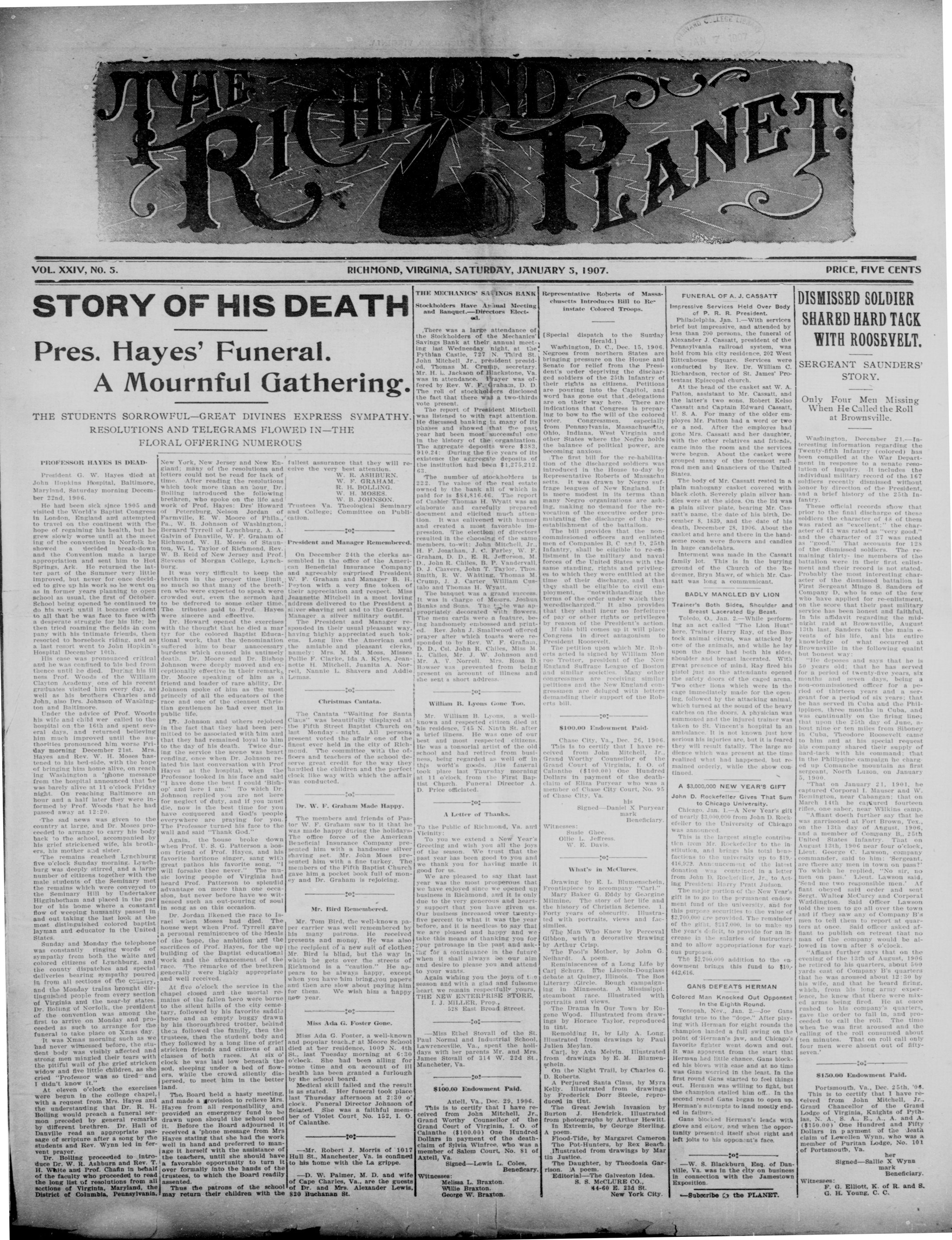
THE RICHMOND PLANET
STORY OF HIS DEATH
Pres. Hayes' Funeral. A Mournful Gathering.
VOL. XXIV, NO. 5.
STORY
Pres. Hay
A Mo
THE STUDENTS SORRO
RESOLUTION
FLO
PROFESSOR HAYES IS DEAD
President G. W. Hayes died at John Hopkins Hospital, Baltimore, Maryland, Saturday morning December 22nd, 1906.
He had been sick since 1905 and visited the World's Baptist Congress in London, England and attempted to travel on the continent with the hope of regaining his health, but he grew slowly worse until at the meeting of the convention in Norfolk he showed a decided break-down and the Convention made a large appropriation and sent him to Hot Springs, Ark. He returned the latter part of the Summer very little improved, but never for once decided to give up his work so he went on as in former years planning to open school as usual, the first of October. School been opened he continued to do his work until it became evident to all that he was face to face with a desperate struggle for his life; he then tried roaming the fields in company with his intimate friends, then resorted to horseback riding, and as a last resouce went to John Hopkins in December 1906.
His case was pronounced critical and he was confined to his bed from thence until he died. During his illness Prof. Woods of the William Clayton Academy one of his recent graduates visited him every day, as well as his brothers Charles and John, also Drs. Johnson of Washington and Baltimore.
Under the advice of Prof. Woods his wife and child wer called to the hospital on the 16th and spent several days, and returned believing him much improved until the authorities pronounced him worse Friday morning December 21st. Mrs. Hayes and Rev. W. H. Moses hastened to his bed-side, with the hope of bringing him home alive, on reaching Washington a 'phone message from the hospital announced that he was barely alive at 11 o'clock Friday night. On reaching Baltimore an hour and a half later they were informed by Prof. Woods that he had passed away at 12:20.
The sad news was given to the country at large, and Dr. Moses proceeded to arrange to carry his body back to the school, accompanied by his grief stricken wife, his brothers, his mother and sister.
The remains reached Lynchburg five o'clock Sunday morning. Lynchburg was deeply stirred and a large number of citizens together with the male students of Seminary met in the school which were conveyed to the Seminary Hill by Undertaker Higginbotham and placed in the parlor of his home where a constant flow of weeping humanity passed in and out taking the last look at the most distinguished colored baptist layman and educator in the United States.
Sunday and Monday the telephone was constantly ringing words of sympathy from both the white and colored citizens of Lynchburg, and the county dispatches and special deliveries bearing sympathy poured in from all sections of the country, and the Monday trains brought distinguished people from every section of Virginia and the near-by states. Dr. Bolling of Norfolk, the president of the convention was among the first to arrive on Monday and proceeded as such to arrange for the funeral to take place on Xmas day. It was Xmas morning such as we had never witnessed before, the student body was visibly affected and strong men mingled their tears with the pitiful wall of the grief stricken widow and five little children, as she cried "Professor was so tired and I didn't know it." At eleven o'clock the exercises were begun in the college chapel, with a request from Mrs. Hayes and the understanding that Dr. R. H. Bolling would preach a funeral sermon preceded by general remarks by different brethren. Dr. Hall of Danville read an appropriate passage of scripture after a song by the students and Rev. Wynn led in fervent prayer. Dr. Bolling proceeded to introduce Dr. W. R. Ashburn and Rev. T. H. White and Prof. Chafin in behalf of the faculty who proceeded to read the long list of resolutions from all sections of Virginia, Maryland, the district of Columbia, Pennsylvania.
Society of Commerce, County
FLORAL OFFERING NUMEROUS
ad at more, becem-
andgress apted
h the but he
meet
lk he down
large
Hot the little
out on open
ober, need to evident with
New York, New Jersey and New England; many of the resolutions and letters could not be read for lack of time. After reading the resolutions which took more than an hour, Dr. Bolling introduced the following brethren, who spoke on the life and work of Prof. Hayes: Drs' Howard of Petersburg, Nelson Jordan of Farmville, E. W. Moore of Phila., Pa., W. B. Johnson of Washington, Bernard Tyrrell of Lynchburg, A. A. Galvin of Danville, W. F. Graham of Richmond, W. H. Moses of Staunton, W. L. Taylor of Richmond, Rev. W. B. Reid of New Jersey and Prof. Stevens of Morgan College, Lynchburg.
It was very difficult to keep the brethren in the proper time, limit, so much so that many of the brethren who were expected to speak were crowded out, even the sermon had to be deferred to some other time. The tributes paid to Prof. Hayes were sincere and effective.
Dr. Howard opened the exercises with the thought that he died a martyr for the colored Baptist Educational work, that the denomination suffered him to bear unnecessary burdens which caused his untimely death. Dr. Moore and Dr. Bishop Johnson were deeply moved and exceptionally effective in their remarks. Dr. Moore speaking of him as a friend and leader of rare ability. Dr. Johnson spoke of him as the most princely of all the educators of the race and one of the cleanest Christian gentlemen he had ever met in public life.
Dr. Johnson and others rejoiced in the fact that they had been permitted to be associated with him and that they had remained loyal to him to the day of his death. Twice during the service the scene was heart rending, once when Dr. Johnson related his last conversation with Pete Hayes the hospitalist. The Professor looked in his face and said "I have done the best I could "Bishop" and here I am." To which Dr. Johnson replied you are not here for neglect of duty, and if you must die, now is the best time for you have conquered and God's people everywhere are praying for you. The Professor turned his face to the wall and said "Thank God."
Again, the house broke down when Prof. U. S. G. Patterson a bossom friend of Prof. Hayes, and his favorite baritone singer, sang with great pathos his favorite song, "I will forsake thee never." The music loving people of Virginia had heard Prof. Patterson to splendid advantage on more than one occasion, but never before have we witnessed such an out-pouring of soul in song as on this occasion.
Dr. Jordan likened the race to Israel when Moses had died. The house wept when Prof. Tyrrell gave a personal reminiscence of the ideals of the hope, the ambition and the sacrifices of Prof. Hayes, for the up building of the Baptist educational work and the advancement of the race. The remarke of the brethren generally were highly appropriate and well received.
At five o'clock the service in the chapel closed and the mortal remains of the fallen hero were borne to the silent hills of the city cemetery, followed by his favorite saddle horse and an empty buggy drawn by his thoroughbred trotter, behind them followed the family, then the trustees, then the student body and they followed by a long line of grief stricken friends and citizens of all classes of both races. At six o'clock he was laid low beneath the soul, sleeping under a bed of flowers, while the crowd silently dispersed, to meet him in the better land.
The Board held a hasty meeting, and made a provision to relieve Mrs. Hayes from all responsibility, and provided an emergency fund to be drawn upon should the school need it. Before the Board adjourned it received a 'phone message from Mrs Hayes stating that she had the work well in hand and preferred to manage it herself with the assistance of the teachers, until she should have a favorable opportunity to turn it over formally into the hands of the trustees, to which the Board readily assented.
Thus the patrons of the school may return their children with the
RICHMOND, VIRGINIA. SATURDAY. JANUARY 5. 1907.
fullest assurance that they will receive the very best attention.
Trustees Va. Theological Seminary and College; Committee on Publication.
President and Manager Remembered
On December 24th the clerks assembled in the office of the American Beneficial Insurance Company and agreeably surprised President W. F. Graham and Manager B. H. Peyton with a very fine token of their appreciation and respect. Miss Jeannette Mitchell in a most loving address delivered to the President a silver shaving set and to the General Manager a silver military outfit. The President and Manager responded in their usual pleasant way, having highly appreciated such tokens. Long live the American Clerk and pleasant Clerk namely: Mrs. M. M. Moss, Misses Pelle F. Clarke, Ida A. Kyles, Jeannette H. Mitchell, Juanita A. Norrell, Nannie L. Shavers and Addie Lemus.
Christmas Cantata.
The Cantuta "Waiting for Santa Claus" was beautifully displayed at the Fifth Street Baptist Church on last Monday - night. All persons present voted the affair one of the finest ever held in the city of Richmond. The committee with the officers and teachers of the school deserve great credit for the way they handled the children and the perfect clock like way with which the affair was conducted.
Dr. W. F. Graham Made Happy
The members and friends of Pastor W. F. Graham saw to it that he was made happy during the holidays. The office force of the American Beneficial Insurance Company presented him with a handsome silver shaving set. Mr. John Moss presented him with a fine turkey. The members of the Fifth Baptist Church gave him a pocket book full of money and Dr. Graham is relocing.
Mr. Bird Remembered.
Mr. Tom Bird, the well-known paper carrier was well remembered by his many patrons. He received presents and money. He was also the recipient of a new suit of clothes. Mr. Bird is blind, but the way in which he gets over the streets of Richmond is a "caution." He appears to be always happy, except when you have him bring you papers and then are slow about paying him for them. We wish him a happy new year.
Miss Ada G. Foster Gone.
Miss Ada G. Foster, a well-known and popular teacher_r at Moore School died at her residence, 1009 N. 4th St., last Tuesday morning at 6:30 o'clock. She had been ailing for some time and on account of ill health has been granted a furlough by the school board.
Medical skill failed and the result is as stated. Her funeral took place last Thursday afternoon at 2:30 o'clock. Funeral Director Johnson of ficiated. She was a faithful member of Violet Court. No. 152, I. O. of Calanthe.
—Mr. Robert J. Morris of 1017 Hull St., Manchester, Va. is confined to his home with the La grippe.
—D. W. Palmer, M. D. and wife of Cape Charles, Va., are the guests of Dr. and Mrs. Alexander Lewis, 820 Buchanan St.
THE MECHANICS' SAVINGS BANK
Stockholders Have Annual Meeting and Banquet.—Directors Elect-ed.
There was a large attendance of the Stockholders of the Mechanics' Savings Bank at their annual meeting last Wednesday night, at the Pythian Castle, 727 N. Third St. John Mitchell Jr., president presided, Thomas M. Crump, secretary, Mr H. L. Jackson of Blackstone, Va. was in attendance. Prayer was offered by Rev. W. F. Graham, D. D. The roll of stockholders disclosed the fact that there was a two-thirds vote present.
The report of President Mitchell, was listened to with rapt attention. He discussed banking in many of its phases and showed that the past year had been most successful one in the history of the organization. The aggregate deposits were $383, 919.24. During the five years of its existence the aggregate deposits of the institution had been $1,275,212. 63.
The number of stockholders is 222. The value of the real estate owned by the bank all of which is paid for is $84,816.46. The report of Cashier Thomas H. Wyatt was an elaborate and carefully prepared document and elicited much attention. It was enlivened with humor and created a most favorable impression. The election of directors resulted in the choosing of the same members, to-wit: John Mitchell, Jr., H. F. Jonathan, J. C. Farley, W. F. Graham, D. D. E. R. Jefferson, M. D., John R. Chiles, B. P. Vandervall, D. J. Chavers, John T. Taylor, Thos. Smith, R. W. Whiting, Thomas M. Crump, J. J. Carter, William Custalo and Thomas H. Wyatt.
The banquet was a grand success. It was in charge of Messrs. Joshua Banks and Sons. The table was ap propriately decorated with flowers. The menu cards were a feature, being handsomely embossed and printed. Rev. John J. Smallwood offered prayer after which toasts were responded to by Rev. W. F. Graham, D. Col, John R. Chiles, Miss M. L. Chiles, Mr. J. W. Johnson and Mr. A. V. Norrell, Mrs. Rosa D. Bowser was prevented from being present on account of illness and she sent a short address.
William B. Lyons Gone Too
Mr. William B. Lyons, a well-known and respected citizen died at his residence, 745 N. Ninth St. after a brief illness. He was one of our best and most respected citizens. He was a tonsorial artist of the old school and had retired from business, being regarded as well off in this world's goods. His funeral took place last Thursday morning at 11 o'clock from the First Baptist Chprch. Funeral Director A. D. Price officiated.
A Letter of Thanks.
To the Public of Richmond, Va. and Vicinity:
To you we extend a New Year's Greeting and wish you all the joys of the season. We trust that the past year has been good to you and we thank you for having made it good for us.
We are pleased to say that last year was the most prosperous that we have enjoyed since we opened up business in Richmond, and it is only due to the very generous and hearty support that you have given us. Our business increased over twenty-five percent to what it was the year before, and it is needless to say that we are pleased and happy and we take this means of thanking you for your patronage in the past and asking for a continuance in the future when it shall always be our aim and desire to please you and attend to your wants.
Again wishing you the joys of the season and with a glad and fulsome heart we remain respectfully yours, THE NEW ENTERPRISE STORE,
I. J. MILLER, Prop,
528 East Broad Street
—Miss Ethel Stovall of the St Paul Normal and Industrial School Lawrenceville, Va., spent the holidays with her parents Mr. and Mrs James Stovall of 314 W. 22d St. Manchester, Va.
$100.00 Endowment Paid.
Axtell, Va., Dec. 29, 1906.
This is to certify that I have received from John Mitchell, Jr.,
Grand Worthy Counsellor of the
Grand Court of Virginia, I. O. of
Calanthe ($100.00) One Hundred
Dollars in payment of the death-
claim of Sylvia Winfree, who was a
member of Salem Court, No. 81 of
Axtell, Va.
Signed—Lewis L. Coles,
Beneficary.
Witnesses:
Melissa L. Braxton.
Willle Braxton.
George W. Braxton.
Representative Roberts of Massa chusetts Introduces Bill to Reinstate Colored Troops.
[Special dispatch to the Sunday Herald.]
Washington, D. C., Dec. 15, 1906. Negroes from northern States are bringing pressure on the House and Senate for relief from the President's order depriving the discharged soldiers of the 25th Infantry of their rights as citizens. Petitions are pouring into the Capitol, and word has gone out that delegations are on their way here. There are indications that Congress is preparing to bow to the will of the colored voter. Congressmen, especially from Pennsylvania, Massachusetts, Ohio, Indiana, West Virginia and other States where the Negro holds the balance of political power, are becoming anxious.
The first bill for the re-habilitation of the bill discharged soldiers was introduced in the House to-day by Representative Roberts of Massachusetts. It was drawn by Negro suffrage leagues of New England. It is more modest in its terms than many Negro organizations are asking, making no demand for the revocation of the executive order promulgating the discharge of the re-establishment of the battalion.
The bill provides that the noncommissioned officers and enlisted men of Companies B, C and D, 25th Infantry, shall be eligible to re-enlistment in the military and naval forces of the United States with the same standing, rights and privileges to which they were entitled at the time of their discharge, and that they shall be eligible to civil employment, "notwithstanding the terms of the order under watch they were discharged." It also provides that they shall incur no forfeiture of pay or other rights or privileges by reason of the President's action. If this bill comes up it will place Congress in direct antagonism to President Roosevelt. The petitioner in which Mr. Roberts acted is signed by William Monroe Trotter, president of the New England Suffrage League of Boston and similar societies. Many other congressmen are receiving similar petitions and the New England congressmen are deluged with letters demanding their support of the Roberts bill.
$100.00 Endowment Paid
Chase City, Va., Dec. 26, 1906.
This is to certify that I have received from John Mitchell, Jr.
Grand Worthy Counselor of the Grand Court of Virginia, I. O. of Calanthe ($100.00) One Hundred Dollars in payment of the death-claim of Eliza Puryear who was a member of Chase City Court, No. 95 of Chase City, Va.
his
Signed—Daniel X Puryear
mark
Beneficiary
Witnesses:
Susie Ghee.
Ollie L. Jeffress
W. E. Davis.
What's in McClures
Drawing by E. L. Blumenschein,
Frontispiece to accompany "Carl."
Mary Baker G. Eddy by Georgine Milime.
The story of her life and the history of Christian Science.
1. Forty years of obscurity. Illustrated with portraits, views and facsimiles.
The Man Who Knew by Perceval Gibbon, with a decorative drawing by Arthur Crisp.
The Fool's Mother, by John G. Neilhard. A poem.
Reminiscences of a Long Life by Carl Schurz. The Lincoln-Douglass debate at Quincy, Illinois. The Bos Literary Circle. Rough campaigning in Minnesota. A Mississippi steamboat race. Illustrated with portraits and views.
The Drama in Our Town by Eugene Wood. Illustrated from drawings by Horace Taylor, reproduced in tint.
Remolding It, by Lily A. Long. Illustrated from drawings by Paul Julien Meylan.
Carl, by Ata Melvin. Illustrated from drawings by E. M. Blumenschein.
On the Night Trail, by Charles G. D. Roberts.
A Perjured Santa Claus, by Myra Kelly. Illustrated from drawings by Frederick Dorr Steele, reproduced in tint.
The Great Jewish Invasion by Burton J. Hendrick. Illustrated from photographs by Arthur Hewitt.
Extremis, by George Sterling. A poem.
Flood-Tide, by Margaret Cameron
The Pot-Hunters, by Rex Beach.
Illustrated from drawings by Mar-
tin Justice.
The Daughter, by Theodosia Garri-
ron. A poem.
Calvert, Colleen Idea.
New York City.
FUNERAL OF A. J. CASSATT
Impressive Services Held Over Body
of P. B. B. President.
Philadelphia. Jan. 1.—With services brief but impressive, and attended by less than 200 persons, the funeral of Alexander J. Cassatt, president of the Pennsylvania railroad system, was held from his city residence, 202 West Rittenhouse Square. Services were conducted by Rev. Dr. William C. Richardson, rector of St. James' Protestant Episcopal church.
At the head of the casket sat W. A. Patton, assistant to Mr. Cassatt, and the latter's two sons, Robert Kelso Cassatt and Captain Edward Cassatt, U. S. A. For many of the older employees Mr. Patton had a word or two or a nod. After the employees had gone Mrs. Cassatt and her daughter, with the other relatives and friends, came into the room and the services were begun. About the casket were grouped many of the foremost railroad men and financiers of the United States.
The body of Mr. Cassatt rested in a plain mahogany casket covered with black cloth. Severely plain silver handles were at the sides. On the lid was a plain silver plate, bearing Mr. Cassatt's name, the date of his birth, December 8, 1839, and the date of his death, December 28, 1906. About the casket and here and there in the handsome room were flowers and candles in huge candelabra.
Interment was made In the Cassatt family lot. This is in the burying ground of the Church of the Redeemer, Bryn Mawr, of which Mr. Cassatt was long a communicant.
BADLY MANGLED BY LION
Trainer's Both Sides, Shoulder and
Pretend Lamented, Fur Roost
Breast Lacerated By Beast.
Toledo, O. Jan. 2. - While performing an act called "The Lion Hunt" here, Trainer Harry Ray, of the Bostock animal circus, was attacked by one of the animals, and while he lay upon the floor had both his sides, shoulder and breast lacerated. With great presence of mind, Ray fired his pistol just as the attendants opened the safety doors of the caged arena. Two other lions which were in the cage immediately made for the opening, followed by the attacking animal, which turned at the sound of the heavy catches on the doors. A physician was summoned and the injured trainer was taken to St. Vincent's hospital in an ambulance. It is not known just how serious his injuries are, but it is feared they will result fatally. The large audience which was present at the time realized what had happened, but remained orderly, while the show continued.
A $3,000,000 NEW YEAR'S GIFT
John D. Rockefeller Gives That Sum to Chicago University.
Chicago, Jan. 1.—A New Year's gift of nearly $3,000,000 from John D. Rockefeller to the University of Chicago was announced.
This is the largest single contribution from Mr. Rockefeller to the institution, and brings his total benefactions to the university up to $19,416,922. Announcement of the latest donation was contained in a letter from John D. Rockefeller, Jr., to Acting President Harry Pratt Judson.
The major portion of the New Year's gift is to go to the permanent endowment fund of the university, and for this purpose securities to the value of $2,700,000 are provided. The remainder of the gift, $217,000, is to make up the year's deficit, to provide for an increase in the salaries of instructors and to allow appropriations for various purposes.
The $2,700,000 addition to the endowment brings this fund to $10,442,616.
GANS DEFEATS HERMAN
Colored Man Knocked Out Opponent
In the Eighth Round.
Tonopah, Nev., Jan. 2.—Joe Gans
fought true to the "dope." After play-
ing with Herman for eight rounds the
champion landed a full swing on the
point of Herman's jaw, and Chicago's
favorite fighter went down and out.
It was apparent from the start that
Herman had little chance. Gans blocked
his blow with ease and at no time
was Gans worried in the least. In the
first round Gans started to feel things
out. Herman was willing to fight, but
the champion stalled him off. In the
second round Gans began to open up.
Herman's attempts to land mostly end-
ed in failure.
Gans blocked Herman's leads with
glove and elbow, and when the opportu-
nity presented itself shot right and
left jolts to his opponent's face.
—W. S. Blackburn Esq. of Danville, Va. was in the city on business in connection with the Jamestown Exposition.
Subscribe to the PLANET.
PRICE. FIVE CENTS
DISMISSED SOLDIER SHARED HARD TACK WITH ROOSEVELT.
SERGEANT SAUNDERS'
STORY.
Only Four Men Missing
When He Called the Roll
at Brownsville.
Washington, December 21.—Interesting information regarding the Twenty-fifth Infantry (colored) has been compiled at the War Department in response to a senate resolution of inquiry. It includes the individual military record of the 167 soldiers recently dismissed without honor by direction of the President, and a brief history of the 25th Infantry.
These official records show that prior to the final discharge of these soldiers the character of 48 of them was rated as "excellent;" the character of 43 was rated as "very good." and the character of 37 was rated as "good." That accounts for 128 of the dismissed soldiers. The remaining thirty-ine members of the battalion were in their first enlistment and their record is not stated. Probably the most interesting character of the dismissed battalion is First Sergeant Mingo S. Sanders of Company D, who is one of the few who have applied for re-enlistment, on the score that their past military career has been honest and faithful. In his time reminding the midnight raid at Brownsville, August 13th last, Sanders tells the main events of his life, and his entire knowledge of what occurred at Brownsville in the following quaint but honest way:
"He deposes and says that he is 50 years old; that he has served for a period of twenty-five years, six months and seven days, being a non-commissioned officer for a period of thirteen years and a sergeant for a period of six years; that he has served in Cuba and the Philippines, three months in Cuba, and was continually on the firing line; that upon the 25th day of June, about nine or ten miles from Siboney in Cuba, Theodore Roosevelt came to him and at his special request his company shared their supply of hard-tack with his command; that in the Philippine campaign he charged Comanche mountain as first sergeant, North Luzon, on January 5, 1900.
"That on January 21, 1901, he captured Corporal L. Mauser and W. Redington, near Cabangan; that on March 14th he captured fourteen rifles, one saber, near Wilkins camp.
"Affiant doeth further say that he was garrisoned at Fort Brown, Tex., on the 13th day of August, 1906, and a member of Company B., 25th United States Infantry. That on August 13th, 1906 near four o'clock, Lleut. George C. Lawson, company commander, said to him: 'Sergeant, are there any men in town on pass?' To which he replied, "No sir, no men on pass.' Lleut. Lawson said, 'Send me two responsible men.' Afiant obeyed said order and sent Sergt. Walter McCurry and Corporal Waddington. Said Officer Lawson told the men to go all over the town and if they saw any of Company B's men to tell them to report at quarters at once. Said officer asked affiant to publish on retreat that no man of the company would be allowed in town after 8 o'clock.
"Affiant further says that on the evening of the 13th of August, 1906 he retired to his quarters, about 590 yards east of Company B's quarters that he was aroused about 12:30 by his wife, and that he heard firing, which, from his long army experience, he knew that there were mixed arms being fired. He at once rushed to his company's quarters, gave the order to fall in, and proceeded to call the roll. The time when he was first aroused and the calling of the roll consumed about ten minutes. That on roll call only four men were absent out of fifty-seven."
$150.00 Endowment Paid.
Portsmouth, Va., Dec. 25th, '06.
This is to certify that I have received from John Mitchell, Jr.,
Grand Chancellor of the Grand Lodge of Virginia, Knights of Pythias, N. A., S. A., E., A., A. and A. ($150.00) One Hundred and Fifty Dollars in payment of the jeatha claim of Lewellen Wynn, who was a member of Puritan Lodge, No. 101 of Portsmouth, Va.
her
Signed—Sallie X Wynn
mark
Beneficiary.
Witnesses:
F. G. Ellott, K. of R. and S.
G. H. Young, C. C.
a —“l gga
SS SF.
suenle > DNC ae
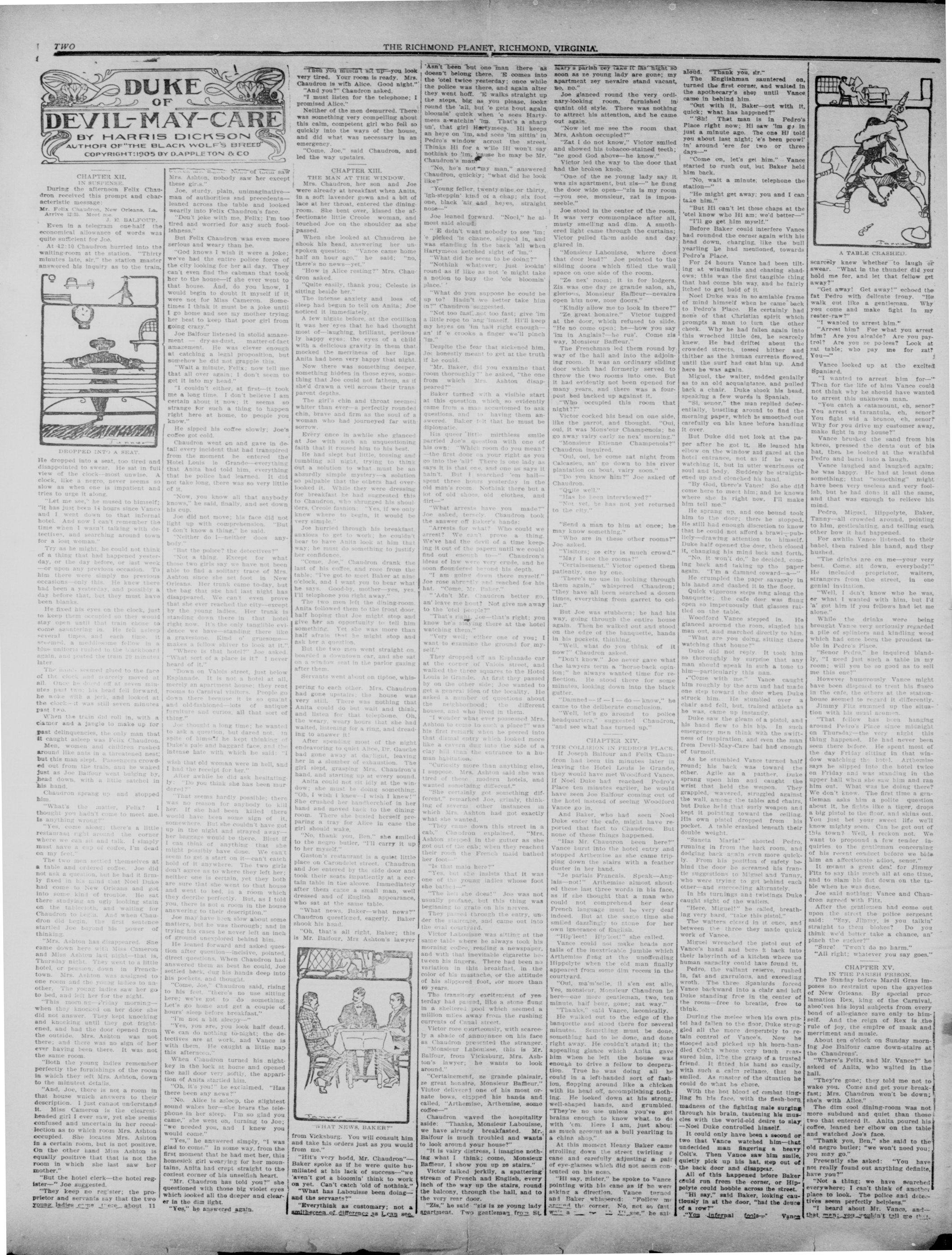
DEV IL-7 MAY-CARE)
Fa oe ten Wan ae
Two
1
t
CHAPTER XI.
Daring ths aflersaee, Weitz Chas
‘real rensived this trowot cok cues
‘oO >
f-4a
=a SN
p<
ee
ET
——
EEN
OZ CA MME
DROPPED INTO A SEAT.
He dropped into a seat, too tired and
Aisappointed to awear. “He sat in full
view of the clock-—-most unwise. A
clock, ke a negro, never seems 80
slow ‘as when one is impatient and
tries to urge it along.
“Let me see," he mused to himself;
“it has just been 14 hours since Vanco
and I went down to that infernal
hotel. And now I can't remember the
time when 1 wasn't talking with de
tectives, and searching around town
for a jost woman.
‘Try as he might, he could not think
of a thing that had happened yester-
day, or the day before, or last week
him there were simply no previous
oceasions—only this. He knew there
had been a yesterday, and possibly a
day before that, but they must have
been blanks
He fixed his eyes on the clock, just
to keep them occupled so they would
stay open until that train chore to
come sauntering in. He fel asleep
several times, and each time. it
isle: waliisena Hitehed ia she aneucecs
later
of the « ! iy: moved at
all. Once b f at seven min
ates pact t s head fell forward,
he woke with a jerk, and looked at
the clock —it was still seven minutes
past to.
When the train did roll im, with a
Ciamor and a jangle to make up tor
Pest delinquencies, the only man that
@ caught asleep was Felix Chaudron,
Men, women and chitiren rushed
around Ike ants in a tireatoned nest:
Dut this man slept. Passengers crowd
4 out from the train, and he waked
Just as Joe Baifour went bulging by,
dead down, with a little satchel in
‘his hand.
Chaudron sprang up and stopped
him.
“What's the matter, Felix? 1
thought you huitn't come to meet me.
is anything wrou
“Yes, come along; there's a Uttle
Featauraut right around the corner
where we ean sit and talk. [ slinply
must have a cup of coifee, I'm dead
on my fer
The two men settied themselves at
@ table and ordered coffee. Joe did
not mek @ question, but he had it frm-
Ay fixed in his saind tiat Noel Duke
had come t New Orleans and got
into some kind of trouble, He sat
there studying an ugiy looking stain
on the tablecioth, and waiting for
Chaudron to Lexa. And when Chau-
@ron did besin, the first sentence
startied Joe beyond ts power of
thinking,
“Mrs, Ashton has dicappeared. Sne
came down here with Miss Cameron
and Miss Ashu Jast night—that ts,
Thursday nist. They went to a litue
hotel, or pension, down im French-
town. Mrs. Ashton was assigned to
One room and the yocug ladies to aa.
other, ‘The young ladies saw her go
to bed, and left her for the night.
“This mors.ng—iriday mornins—
when they knocxed on her door she
did not answer. Tuey kept knocking
and knocking until they got fright-
ened, and had the door opened from
the outside. Mrs. Ashton was not
‘there; and there was no sign of her
ever having been there. It was not
the same room.
“Both the young ladies remember
perfectly the furnishings of the room
in which they ieft Mrs. Ashton, down
to the minutest detatis.
“And, Joe, there is not a room in
that house waich answers to their
description. 1 just canaot understand
Mt. Miss Cameron is the clearest-
headed girl I ever caw, yet she seems
confused and uncertain in her recol-
lection as to which room Mrs. Ashton
occupied. She locates Mrs. Ashton
in @ certain room, but is not positive.
On the other hand Miss Ashton 15
equally positive that that is not the
room in which she last saw her
mother.”
oe clerk—the hotel reg-
ister—' suggested.
“They keep no res’ster; the pro-
cttafoy) servants say that the ~~
young ladies core 1° ere about
‘wearily into Felix Chaudron’s face.
“Don't joke with me, Felix; I'm too
tired and worried for any such fool
tshness,”
But Felix Chaudron was even more
serfous and weary than he.
“God knows I wish it were a joke;
we've had the entire police force of
the city looking for her ail day. They
can't even find the cabman that took
her to the house—if she ever went to
that house. And, do you know, I
would begin to doubt it myself if it
were not for Miss Cameron. Some-
times I think it must be a joke until
YT go home and see my mother trying
her best to keep that poor girl from
going crazy.”
Joe Balfour listened in stolid amaze-
ment — dry.as-dust, matter-of-fact
amazement. He was clever enoush
at catching a legal proposition, but
somehow he did not grapple this
“Wait a minute, Fellx; now tell me
that all over again; 1 don’t seem to
get It into my head.”
“I couldn't either, at first—it took
me a long time. I don't believe I am
certain about it now; it seems so
strange for such a thing to happen
right here at home, to people you
know.”
He sipped his coffee slowly; Joe's
coffee got cold. :
Chaudron went on and gave in de
tall every incident that had transpired
from the moment he entered the
‘Hotel Louis le Grande—evorything
‘that Anita had told him, everything
that he police had learned. It did
nat take long, there was so very little
of it
“Now, you know all that anybody
knows,” he sald, finally, and set down
his cup.
Joe did not move; his face did not
Ugbt up with comprehension. “But
{ don’t know a thing,” he suid
“Neither do I—neither docs any-
body.
"But the pohee? the detectives?”
Not a thing. Except for what
those two girls say we have not heen
able to find a solitars trace of Mrs.
Ashton since she set foot in New
Orleans. Her trunk came to-day, but
the bag that ste had last night has
disappeared. We can't even prove
that she ever reached the elty—except
by the young ladies. Her trunk ts
standing down there In that hotel
right now. It's the only tanglible evi
dence we have—standing there like
& gravestone. Kindo” grucsome—
makes a fellow shiver to look at It.”
| “Where Is that hotel?” Joe asked
“What sort of a place is It? 1 never
heard of it
“Down on Valois street, Just below
Esplanade. It ts not a hotel at all,
merely an apartment house: they rent
rooms to Carntval visitors. People go
down there because it is eo quaint
and oldfashioned—lots of antique
furniture and curios, all that sort of
thing.”
Joe thourht a long time; he wanted
to ask a question, but dared not. in
spite of hime he kept thinking of
Duke's pale and haggard face, and the
intense hate with which he sald: “i
wish that olf woman were in hell, sud
Thad the receipt for her.”
Atter awhile he did ask hesitating.
ly: “Do you think she has been mur
dered?
That seems hardly possible; there
was no reason for anybody to kill
her. If she had been killed thera
would have been some sign of it,
somewhere, But she couldn't have got
up in the night and strayed away—
her bagxage would Le there. Blest If
! can think of anything that she
might possibly have done. We can't
seem to get a start on it—can't catch
hold of {t anywhere. The two girls
don't agree us to where they left her;
neither one is certain, yet they both
are sure that she went to that house
and went to bed, in a room which
they dectibe perfectly. But, as I told
you, there {s not « room in ‘the house
Answering to their deseription.”
Joe may have bsex slow about some
matters, but he was thorough; and in
trying his cases he never left an inch
of ground unexplored behind him,
He leaned forward and asked ques-
tion after question—inelsive, pointed,
direct questions, When Chaudron had
answered them as best he could, Joe
Settled back, duz his hands deep into
his pockets, and thought.
“Come, Joe,” Chaudron sald, rising
to his feet, “there's no use sitting
here; we've got to do something.
Let's go home and get a couple of
hours’ sicep before breakfast.”
“I'm not a bit sleepy—"
“Yes, you are, you look half dead.
We can do nothing to-night; the de-
tectives are at work, and Vance is
with them. He caught a little nap
this afternoon,”
Whea Chaudron turned his night-
key in the lock at home and opened
the nall door very softly, the appar
tion of Anita startied him,
“Oh, it's you!” he exclaimed, “Has
there been any news?”
“No. Alice ts asleep, the slightest.
found wakes her—she hears the tele-
phone in her steep. I'm so glad you
came,” she went on, turning to Joe;
“we needed you, and I knew you
would come.”
“Yes,” be answered simply. “I was.
THE RICHMOND PLANET, RICHMOND, VIRGINIA.
TRG ou ANTI eit TP—you look
‘Yery tired. Your room is ready. Mrs.
Chaudron is with Alice. Good night.”
“and you?” Chandron asked.
“I must listen for the telephone; I
promised Alice.”
Neither of the men demurred. There
was something very compelling about
this calm, competent girl who feil so
quickly into the ways of the house,
and did what was necessary In an
emergency
“Come, Joe,” said Chaudron, and
led the way upstairs.
Ege
| THE MAN AT THE WINDOW,
1 Min comonomer pee aaa aa
‘were already at breakfast when Anita,
4m a soft lavender gown and a bit of
lace at her throat, entered the dining:
| Foom. She Vent over, kissed the at
fectionate little Creole woman, and
touched Joe on the shoulder as she
passed.
When she looked at Chaudron he
shook his head, answering her un:
spoken question: “Vance came home
half an hour ago.” he said; “no,
there's no news—yet."
“How ig Alice resting?" Mrs, Chau:
dron asked
“Quite easily, thank you; Celeste is
sitting beside her.”
Tho intense anxiety and loss of,
sleep had begun fo tell on Anita; Joe
noticed it immediately.
A few nigiite before, at the cotillion
it was her ‘eyes that he had thought
most of—Inughing, brilliant, peritous’
ly happy eyes; the eyes ot a child
with a delicious gravity In them that,
mocked the merriness of her lips.
Anita had been very happy that might
Now there was something deeper,
something hidden in those eyes, some.
thing that Joe could not fathom, as if
she'd drawn a voll across their trans
parent depths.
The girl's chin and throat seemoi
whiter than ever—a perfectly rounded
chin, brave and firm as the soul of a
woman who had journeyed far with
sorrow.
Every once in awhile she glanced
at Joe with such an unquestioning
faith that {¢ roused him to hls best
He had slept bat little, tossing and
tumbling all nigtt, trying to think
out a solution to what must be an
absurdly simple mystery—a_ solution
£0 palpable that the others had over-
looked it. While they were dressing
for breakfast he had surrested this
to Chaudron, who shrupzed hls shou!
Mera, Creole fashion: “Yes, if we only
knew where to begin, tt would be
very simple
Joe hurried through his breakfast
anxious to get to work; he couldn't
bear to have Anita look at him that
way; he must do something to justify
her confidence.
“Come, Jor,” Chaudron drank the
last of his coffee, and roe from the
table; “I've got to meet Baker at nine
O'clock, and I want you to bear what
he says. Goodby, mother—yes, yea.
TL telephone yon right away.”
‘The two men left the dining-room
Anita followed them to the front door,
half hoping that Joe might stop and
give her an opportunity te tell him
something. Yet she wax inore than
Balt (Atrain: thet ‘he GMEht! wise cad
4B her & qnontinn.
But the two men went straight on,
boarded a downtown ear, and she eat
on a window seat In the parlor gazing
after them
Servants went about on tiptoe, whls-
| Pering to each other. Mrs. Chaudron
-had gone upstairs; the house was
very stlil There was nothing that
Anita could do but wait and think,
and Ustea for that telephone. Oh,
the weary, weary hours that she had
waited, listening for a ring, and dread-
Ing to anewer it!
After spending most of the might
endeavoring to quiet Alten, Dr. Gauche
bad gone away at dartigut, leaving
her in a slumber of exhaustion. The
Biri slept, grasping Mrs, Chaudron’s
hand, and starting up at every sound.
Anita could not rit idly at the win.
dow; she must be doing something,
“Ob, 1 wish 1 knew—1 wish T knew!"
She crushed her handkerchief In her
hand and moved tack to the dining
room. There she busied herself pre-
Paring a tray for Alice in ease the
srl should wake,
“No, thank you, Ben,” she emiled
to the negro butler, “Till carry it up
to her myself.”
Gaston's restaurant is a quiet little
Place on Carondelet street. “Chaudron
and Joe entered by the side door and
took their seats tmpatiently at a cer-
tain table in the alcove. Immediately
after them came a small man, well
@ressed and of English appearance,
who sat at the same table.
“What news, Maker—what news?"
Chaudron questioned, eagerly. Baker
shook his head.
“Oh, that’s all right, Baker; this
is Mr. Balfour, Mrs Ashton's lawyer |
IRAN ers)
DSTO
ee ent A
= by
<< an a
ES TAee Uf v7
ia Pe MS
es nef
ase fT / ee
Se beer ae
= ote ros
a7 Gy FS +
ey iy
pases
WHAT NEWS, BAKER?"
from Vicksburg. You will consult him
and take his orders just as you would
from me.”
| “Hit’s very hodd, Mr. Chaudron"—
Baker spoke as if he were quite hu-
miliated at his lack of success—“we
‘aven't got a bioomin’ think to work
om yet. Can't catch ‘old of nothink.”
| “What has Luboulsse been doing—
‘and the servants?”
“Everythink as customary; not a
qmithereen of difference as Lean se,
| tha Sellen acter Seem and cme
ee ae ee ee
ore ee rr
| ro {ail at "gots tout asain
mees n ‘tp. That's a sharp
un’, that aaad Ht ;
an heye on “im, and sees ‘lm sittin’ in
Pedro's window acrost the street.
Thinks Hi for a wile Ii won't say
Rothink to lm, iypite ho may be Mr.
Chaudron’s ~
“No, he's not@my man,” answered
‘Chaudron, quickiy; “what did he look
ike?” zi
“Young feller, twenty-nine or thirty,
‘igh-steppin’ kind of a chap; six foot
one, black ‘air and heses,” straight
nose—"
Joe leaned forward. “Nool,” he al
most sald al ;
“VB didn't want nobody to see “im:
‘e pleked ‘ts chance, slipped tn, and
was standing tn the back ‘all when
Hartymeos Ketched sight of “Im.”
“What did he seem to be doing?”
“Nothink whatever; just lookin’
round as if like ax not "e might take
@ notion to buy the ‘ole bloomin'
piace.’ *
“What do you suppose he could be
up to? Hadn't we better take him
in?” Chaudron’ suzzested,
“Not too fast:.not too fast; give ‘im
a little rope to “ang ‘imself. Hill keep
my heyes on “im hail right enough—
an’ if 'e crooks a finger we'll pinch
so
Despite the fear that sickened him,
Joc honestly meant to get at the truth
if he could.
“Mr. Baker, dil you examine that
room thoroushiy?" he asked, “the one
from which Ars. Ashton disap-
peared?"
Baker turned with a visible start
at this question. whieh, so evidently
came from a mu accustomed to ask
questions, and to having them an-
swered. Baker fvlt that he must be
iplomatic.
His queer “ttle mirthtess smile
partied Joe's question with one of
his own: “Whicl room do you mean?
the first door oa your right as you
g0 Into the “all? ‘There ts one lady as
says tt is that one, and one as says it
hain't. But 1 searched ‘em hall—
Spent three hours yosterday in the
old man's room. Nothink there but a
fot of old shoos, old clothes, and
atet—" .
“What arrests have you made?"
Joe asked, terscly. Chaudron. took
the answer off Paker’s hands
“arrests for what? Who could we
arrest? We cant prove a. thing.
We've had the dovil of a time keep:
Ing {t out of the papers until we could
find out enon=h ti Chaudron’s
Meas of law were very crude, and he
soon Rounderr nd his depth
“Lam goinz down there myself.”
Joe rose abrent!y nit reached for his
hat. “Come, Mr. Paker.”
“‘Adn't Br. Chaudron better Ko,
an‘ leave me bout? Not give me away
to the ‘otel poopie?
“That's righ), Joe—that’s right; you
know he's si@tihg there at the hotel
watching them.”
“Very well; either one of you: I
want to examine the ground for my-
selt.”
They dropped of an Esplanade car
at the corner of Valois street, and
walked the three squares to the Hotel
Louis le Grande, At first they passed
by on the other side: Joe wanted to
get a general Iden of the locality. He
asked a number of questions about
the ne‘chbornood; the different.
houxe who lived in them.
“I wonder what ever possessed Mra.
Ashton to come to such a place?" was
his first remark when he peered into
that dismal entry which looked more
Uke a cavern dig into the alde of a
clay hill thea’ the eutranee to a bu-
man habitation,
“Curiosity more than anything else,
U suppose. tem, Ashton sald she was
tired of these modern hotels, and
Wanted something diferent.
“She certainly got something aif
ferent,” remarked Jos, xrimly, think:
ing of severat other’ instances in
which Mrs. Ashton had got exactly
what she wanted.
“They came down this street in a
cab.” Chaudron explained. “Mra,
Ashton stepped Im the gutter as she
Rot out of (he eab; when they reached
their room the French maid bathed
her foot
“Is that mala here?”
“Yes, tut sbe Insists that It was
fone of (i young ladies whose foot
she bathci—"
“The heli she does!” Joo was not
usually profane, but this thing was
beginning (o crate on his nerves.
They paced throogh the entry, un-
der the siaircage, ani came out Into
the oval courtyard.
Victor Latouisse was sitting at the
same table where he always took his
morning coffee, reading a newspaper,
and with that inevitable cigarette be-
tween his fingers. ‘There had been no
Veriation in this breakfast, in the
‘color of his mustache, of the attitude
of his slippered foot, sor more than
40 years
The transitory exeitement of yes
terday had passed, like a stone flung
in a sheltered pool which seemed «
iatiDidey exiles elite’ Scien iba neater:
Joe glanced round the ordt-
nary-looking room, ‘feraleued in
quaint old style. There was nothing
to attrect his attention, and he came
‘out again. 5
“Now let me see the room that
‘Mrs, Ashton occupied?"
“Zat Udo not know,” Victor smiled
and showed his tobacco-stained teeth;
“ze good God above—he know.”
Victor led the way to the door that
had the broken knob.
“One of the we young lady say it
was zis apartment, but zis—" he flung
the door wide open—“zis is my room
you see, monsieur, zat is impos.
seeble.”
Joe stood in the center of the reom.
It was very commonplace after all,
musty smelling and dim. A smoth-
ered light came through the curtains;
Victor pulled them aside and day
glared in,
“Monsieur Labouisse, where does
that door lead?” Joe pointed to the
sliding doora which filled the wall,
“space on one side of the room.
“Ze nex’ room; it is for lodgers,
Zis was one day ze grande salon, ah,
Elorions, Monsieur BaMleur—nevaire
open him now, zose doors.”
“Kindly allow me to look in there?”
“Ze great honaire.” Victor tugged
at the door, which refused to slide.
“He no come open; he—how you say
‘im in Anglais?—he rus’. Come zis
way, Monsieur Bafleur.”
The Frenchman led them round by.
“way of the hall and into the adjoin-
ing room. It was an ordinary sliding
door which had formerly served to
throw the two rooms Into one. But
it had evidently not been opencd for
many years, and there was a four-
post bed Lacked up against it.
“Who oceupted this room that
night??”
Victor cocked his head on one side,
ike the parrot, and thought. “Out,
oul, it was Mons‘eur Champenois: he
go away vairy early ze nex’ morning."
Monsieur Etienne Champenois?”
Chaudron inquired
“Out, oui, he come zat night from
Calcasiew, an’ go down to his river
plantation on boat, vairy soon.”
Do you know Him?" Joe asked of
Chaudron.
Quite well
Has t 2 Interviewed?”
Not vet. be has not yet returned
Snes
“Send a man to him at once; he
may know something.”
Who are in these other rooms?”
Joo asked
“Visitors: ze elty is much crowd.”
“May 1 see the rooms?
Certainement.” Victor opened them
Patiently, one by on¢
There's no use in looking through
them again,” whispered Chaudron;
“they have all Leen searched a dozen
times, everything from garret to col-
Jar.”
But Joe was stubborn; he had his
way, going through the entire house
again. Then he walked out and stood
on the odge of the banquette, hands
in bis pockets, thinking
“Well, what do you think of it
now?" Chaudron asked.
“Don't know.” Joe never gave what
the lawyers term a “horseback opin
ion;" he always wanted time for re
flection. He stood there for some
minutes, looking down Into the black
gutter
“Damned — if —1—do— know,” he
came to the deliberate conclusion.
“Well, let's go around to police
headquartera,” suggested Chaudron,
“and see what has turned up.”
CHAPTER yrv
THE COLLISION IN PEDRO'S PLACE
If Joseph Baltour and Felix Chau-
dron had been tin minutes later in
leaving the Hotel Louis le Grande,
they would have met Woodford Vance.
If Noel Duke had reached Pedro's
Place ten minutes earlier, he would
have seen Joe Balfour coming out of
the hotel instead of seeing Woodford
Vance go in,
And Baker, who had seen Noel
Duke enter the cafe, might have re-
Ported that fact to Chaudron. But
Rone of these things happened.
“Has Mr. Chauaron been here?"
Vance burst Into the hotel entry and
stopped Arthemise as she came trip-
ping down the stairs with a feather
duster in her hand.
“Je parlais Francals, Speak—Ang:
lais—not!” Arthemise almost shout
ed these last three words in his face,
as if she thought that a man who
could not comprehend her dear
French language must be very deat
indeed. But at the same time she
smiled dazzlingly to stone for her
own ignorance of Enslish.
“Hip'leet! Hip'ieet!” she called.
| Vance could not make heads nor
talls of the inextricatyie jumble which
Arthemise fang at the unoffending
Hippolyte when the old man finally
appeared from somo dim recess in the
‘courtyard
“Out, ma'm’selle, {1 s'en est alle,
Yes, monsicur, Monsieur Chaudron be
here—one more gentleman, two, ten
minute, balf bour, gone; aat way.”
“Thanks,” said Vance, laconically.
He walked out to the edge of the
Danquette and stood there for several
minutes. Serscthing must be done,
Something had to be dene, and done
right away. He couldn't stand it; the
Appealing glance which Anita gave
Dim when he left the house was
enough to drive a fellow to despera-
tion. True he was doing all he
could in @ left-handed sort of fash-
fon, flopping around lke a chicken
with its head off, accomplishing noth-
ing. He looked down at his strong,
well-shaped hands, and grumbled.
“They're no use unless you've got
brains enough to know what to do
with ‘cm. Here I am, just about
as much accovnt as a ball yearling tu
& china shop.”
At this moment Henny Baker came
stroliing down the street twirling»
cane and carefully adjusting @ pair
of eye-glasses which did not seem con-
tented on bis nos,
“Hi say, mister,” he spoke to Vance
Pointing with bls cane as if he werr
asking a Vance turned
and Baker 1: “Follow me
=e the corner, ie art fast:
waa SS Lsee.” he satr
ae — 1
tats i a et a
turned the first 2S and waited in
the apothecary’s: until Vance
; in behind him. =
with it, Baker—out with It,
quick; what has happened?”
“'Sht That man is in Pedro's
Place right now; Hi saw ‘im gy in
just a minute ago. The one HI told
you about last night; 'e’s been prow!’
tn’ around ‘ere for two or three
days—"
{Come on, let's get him.” Vance
started to rush out, but Baker held
‘him back.
‘ “No, wait a minute; telephone the
station—"
“He might get away; you and I can
taxe him.”
“But Hi can't let those chaps at the
“otel know who Hi am; we'd better—"
“Tl go get him myslf.”
Before Baker could interfere Vance
had rounded the corner again with his
[head down, charging. like the bull
yearling be had mentioned, towards
Pedro's Place.
For 24 hours Vance had been tilt-
}ing at windmills and chasing shad-
ows; this was the first tangible thing
that had come bis way, and he fairly
Hebed to get hold of it
Noel Duke was in no amtable frame
of mind himself when he came back
to Pedro’s Place. He certainly had
none of that Christian spirit which
prompts a man to tum the other
cheek. Why he had fallen again into
this wreched little den, he scarcely
knew, He had drifted about the
crowded strects, tossed hither and
thither as the human currents flowed,
until the surf had cast him up. And
here he was again.
Miguel, the waiter, nodded gentally
as to an old acquaintance, and pulled
back a chair. Duke shook his head,
speaking a few words In Spanish.
“Si, senor,” the man replied defer-
entiaily, bustling around to find the
morning paper, which he smoothed out
carefully on bis knee before handing
tt over,
But Duke did not look at the pa-
per after he got it He leaned his
elvow on the window and gazed at the
hotel entrance, not as if he were
Watching it, but In utter weariness of
soul and body. Suddenly be straight
ened up and clenched his hand
“By God, there's Vance! So she did
come here to mect him; and he knows
where she fs right now. I'll make
him tell mo."
He sprang ap, and one bound took
him to the door; there he stopped.
Ho still had enough discretion to know
that be could not afford a brawl—pub-
Hely—drawing attention to himself,
Duke halt opened the dosr, then closed
it, changing his mind tick and forth.
“No, It won't do,” he decided, com:
ing back and taking up the paper
again. “I'm a damned coward—a—"
He crumpled the paper savagely in
his hand and dashed {t to the oor.
Quick vigorous steps rng along the
banquette: the cafe door was flung
open so Impetuously that glasses rat-
tled on the table.
Woodford Vance stepped in. He
glanced arownd the room, singled his
man ont, aud marched directly to lm.
“What are you doing, sitting there
watching that house?"
Duke did not reply. It took him
so thoroughly by surprise that any
man should speak In sich a tone to
him—particulariy this man.
+“Come with me.” Vance caught
him roughly by the arm and kad made
one step toward the door when Duke
struck him. He stumbled over a
chair and fell, but, trained athlete as
he was, came’ up instantly,
Duke saw the gleam of a pistol, and
his hand flew to his hip. In ‘such
emergency men think with the swift
ness of inspiration, and even the man
from Devil-May-Care had had enough
of turmoil
As he stumbled Vance turned half
round; his back was toward the
other. Agile as a pasther, uke
Sprang upon him and caught the
wrist that held the wespon. They
grappled, wavered, struggled against
the wall, amon the tables and chairs,
but Duke held that surly weapon and
kept it pointing toward the ceiling
His own pistol dropped from his
pocket. A tnble crashed beneath their
double weight
“Sancta Marta!” showed Pedro,
running In from the back room, and
dodging back acain even more quick-
ly. From his position of safety. be-
hind the door be screamed his fran-
tle suggestions to Mimnel and Tanny,
who were trying to get behind exch
otner—and snecreting altyrnately.
In his turnings and twistings Duke
caught sight of the walters,
“Here, Miguel!” he called, breath-
Ing very hard, “take this pistol.”
The waiters cicsrd In at once, and
between the three they made quick
work of Vance.
Miguel wrenched the pistol out of
Vance’s hand and bore ft back into
their labyrinth of a kitchen where no
human sagacity could have found it,
Pedro, the valtant reserve, rushed
In, fat and garrulovs, and exceeding
wroth. The three Spanlards forced
Vance backward Into a chair and left
Duke standing free in the center of
the room—free to breathe, free to
think.
Wht WT i Sere Ri ae
ms j
- ey
3 (“OR
PES a
PUGS om
a &y \\
fe: <s
ae
searcély knew Whether to laugh oF
swear. “What in the thunder did yor
hold me for, and let that fellow get
away?”
“Get away! Get away!” echoed the
fat Pedro with delicate frony. “He
walk out like a gentleman. Why
you come and make fight in my
rester-raw?”
“1 wanted to arrest him.”
“Arrest him? For what you arrest
him? Are you alealde? Are you pay-
trol? Are you ze polees? Look at
zat table; who pay me for zat?
You—" i
Vanco looked up at the excited
Spaniard.
“I wanted to arrest him for—*
Then for the life of him Vance could
not think why he should have wanted
to arrest this unknown man.
“¥ou catch a catamount, eh, senor?
You arrest a tarantula, eh, senor?
You fight wid a bronco, eb, senor?
Why for you drive my customer away,
make fight in my house?”
Vance brushed the sand from his
Knees, pressed the dents out of bis
hat, then he looked at the wrathful
Pedro and burst into a laugh.
Vance laughed and laughed again;
he was happy. He had at least done
something; that “something” might
have been very useless and very fool-
ish, but he had done it all the same,
and that was enough to relleve his
mind.
Pedro, Miguel, Hippolyte, Baker,
Tanny—all crowded around, pointing
to him, gesticulating. and telling each
other how it had happened.
For awhile Vance listened to thelr
babel, then raised his hand, and they
hushed.
“The drinks are on me—your very
dest. Come, sit down, everybody!"
He Inciudcd proprietor, walters,
strangers from the street, in one
gonial invitation.
“Well, I den't know who he was,
or what 1 wanted with him, but ['d
‘a’ got him if you fellows kad let me
alone.”
While the drinks were — being
brought Vance very seriously regarded
a pile of splinters and kindling wood
which bad once been the proudest ta-
ble in Pedro's Place.
“Senor Pedro,” be inquired bland-
ly, “I need just such a table in my
room; will you be so good as to sell
me this one?”
However humorously Vance might
have been disposed to treat his asco
in the cafe, the others at the statian-
house seme! to rosard it aliferently.
Jimmy Fitz summed up the situa-
tion with his usual noumen.
“That fellow bas been hanging
around Peiro’s Place since midnight
on Thursday—the very night this
thing happened. Te had never been
seen there before. He spent most of
the day Friday sitting tn that win-
dow watebing the hotel. Arthemlse
says he slipped into the hotel twice
on Friday and was standing in the
upper ball whvn she saw him and ran
him out. What was he doing there?
We don’t know. The first time a gen-
tleman asks him a polite question
about it, he fichts like a tiger, drops
& big pistol to the flor, and skins out.
You just bet your sweet Ife we'll
know mighty scon. Can he get out of
this town? Well, I reckon not. We
want to propound a few tender tn-
quiries (0 the gentleman concerning
of his recent conduct bofore we bids
him an affectionate adios, senor.”
It meant a great dea! for Jimmy
Fitz to say this mnch all at ono time,
and to stam his fist down on the ta-
ble when he wax done.
Joe said nothing: Vance and Chau-
dron agreed with Pitz.
After the gentlemen had come out
upon the street the police sergeant
sald: “fry, Jitymy, is you talkin®
straight to then blokes? Do you
think we'd better take a chance, an”
pinch the ezeker?™
“Sure! ‘Twon't do no harm."
“All right; whatever you say goes.”
CHAPTER Xv.
IN THE PARISH PRISON.
The Sunday before Mardi Gras Im-
poses no restraint upon the gayetles
of New Orleans. By special proc
lamation Rex, king of the Carnival,
abso'ves his loyal subjects from every
‘bond of allegiance save only to him-
self. And the reign of Rex ts the
Tule of joy, the emplre of mask and
merriment and music.
About ten o'clock on Sunday morn-
ing Joe Balfour came down-statrs at
the Chandrons’.
“Where's Felix, and Mr. Vance?” he
asked of Anita, who waited in the
hall.
“They're gone; they told me not to
wake you. Come and get your break-
fast; Mrs. Chandron won't be down;
she's with Alice.”
The dim cool dining-room was not
more subdued and quiet than those
two that entered it, Anita poured his
coffee, leaned ber elbow on the table
and watched Joo's face.
“Thank you, Ben,” she said to the
old negro butler; “we won't need you;
you may go.” .
Presently she asked: “You have
not really found out anything definite,
have you?”
“Not a thing; we have searched!
everywhere; T can't think of another
place to look. The police and detec-
tives seem perfectly helpless.”
“I heard ahout Mr. Vance, and—
thet. men; you replin’t tell me tht,
```markdown
```
---
THE PLANET
SATURDAY...JAN. 5TH. 1907
Do they suspect him of having anything to do with this?
"I can't tell." Joe kept his eyes fastened on his plate, and refused to look up.
"Are they going to arrest him?" Anita leaned forward, and watched his face anxiously.
"They are looking for him," Joe answered.
For a long time she said nothing more, then her brave eyes turned to him again.
"Tell me the tuth; do you think my aunt was—murdered?" She looked at him squarely, and did not filch.
"No," Joe shook his head doubfully; "I cannot quite believe that—yet. There would have been some trace. And, besides, why should anybody want to kill her? She had no money or jewelry. But she couldn't have strayed away and got lost—there was that room—I can't understand it. How is Alice?" he finished abruptly.
"About the same; she sleeps when they give her oplates."
"And you? You have not been to sleep?"
"Not very much. I am doing quite
well." She smiled faintly; it did not matter.
They were both silent for a long, long while, glancing at each other, saying nothing. Several times it trembled on the very tip of Joe's tongue to inquire if she had seen anything of Noel Duke. But her violet eyes were so full of trouble that he looked away again, and could not ask her.
After some little time Anita reached out and touched his hand; Joe knew exactly what was coming, and feared to meet it.
"Did you give him my letter?" she asked.
"I wanted to be sure, because, because—maybe I imagined it, but just before my aunt disappeared I thought I saw a man watching me through the window of that little cafe across the street. He was watching me again when we came away with Mrs. Chaudron. I might not have thought it was Noel, but—but—" Anita's lips trembled, and she stopped a moment. "Yes, I know you are his friend; whatever may happen, I will tell you." Anita glanced around to be sure that there was no one in hearing, then went on: "When Alice and I came downstairs that morning at the hotel she ran back to the room for something, and I stood there at the head of the steps. That was before we knew my aunt was gone. I heard two men talking in that little room at the left of the entry. They seemed to be quarreling, but were talking very low. One of them was Monsieur Victor, and I thought, I was not sure, that the other voice was Mr. Duke's. Monsieur Victor refused to do something that the other man asked. The other man seemed very angry, and insisted; he offered to pay money to Monsieur Victor. Monsieur Victor refused again. Then he made Monsieur Victor promise that he would not tell something. Monsieur Victor promised that he would not tell if he would go immediately, and never come back to the house. Oh, yes, and I heard the Frenchman say that something would "ruin the reputation of his house." I am sure I heard that much before they slammed the door. I have been thinking about it ever since."
"My God!" thought Joe and did not
"My God!" thought Joe, and did not dare look at the girl.
"I must go now," he said, and hastened out of the room. He wanted to get away from Anita, out into the open air, where he could think.
Suddenly the telephone rang, excitedly as an alarm bell in that silent hall.
They both ran to it. Anita listened eagerly to Joe's half of the conversation.
"What is it?" What is it? she clung to his arm. "I know; they have arrested somebody; they have—"
"Yes; I'll telephone you as soon—"
Anita turned deadly pale and tightened her grip on his hand—she might just as well have spoken the monstrous fear that stifled her.
"Wait!" she gasped; "I am going—"
"No, you cannot go; he's at the parish prison."
She loosed her hold upon his arm and staggered back. It cut Joe to the depths of his tender heart to think that he should have been so brutally rough.
Then he saw the girl straighten herself, an unshrinking determination flashed into her eyes, such as he had seen in few men's, and never in a woman's. It told him plainly that her time for fear had passed, the hour for endurance had come. She shrank no longer, she trembled no longer; the truth was out, it stared her in the face, and she met it like a woman of the Romans.
Joe tried to slip away.
"Wait," she said. And he waited.
Half-way up the stair, she turned; Joe was going out the door.
"I'm just going out to see if I can't catch a cab," he explained.
She looked at him a moment, doubtful whether he was telling her the truth. "I shall go alone if you leave me."
Church bells pealed from every tower; worshipers hurried through the doors, and votaries of pleasure strolled along the promenade. In God's vast sunshine there was abundant room for recluse and for reveler. for flutterers of fashion, and for the widow's garb of sorrow. The crowding people, the banners, the gayeties of the streets, all made grated cells and gloomy prison yard seem more terrible to
BORS AND INTEREST THEM IN THE PLANET. WE WILL HELP YOU TO OBTAIN A PREMIUM.
COLORED INFANTRY IN RESCUE OF ROUGH RIDERS AT SAN JUAN HILL, JULY 2, 1898, SIZE 20X28 AND 20X24 INCHES, ADMIRAL DEWEY'S GREAT NAVAL BATTLE OFF CAVITE IN MANILA BAY, MAY 1ST, 1898, NAVAL BATTLE, DESTRUCTION OF ADMIRAL CERVERA'S SPANISH FLEET OFF SANTIAGO DE CUBA, JULY 3RD, 1898, SIZE 22X28 INCHES; LAND BATTLE, CAPTURE OF EL CANEY, EL PASO AND FORTIFICATIONS OF SANTIAGO, JULY FIRST AND SECOND, 1898, SIZE 22X28 AND 22X27 INCHES. WE WILL SEND YOU ONE OF ANY OF THE FOLLOWING BATTLES OF THE CIVIL WAR ON THE SAME TERMS. THE PICTURES LIKE THE OTHER BATTLES ARE FINISHED IN COLORS. THEY ARE 22X28 INCHES AND RETAIL AT ONE DOLLAR EACH. WE WILL FURNISH FRAMES FOR ANY OF THESE FINE CHROMOS FOR 2 DOLLARS & 50CTS. EACH ADDITIONAL. BATTLE OF GETTYSBURG, BATTLE OF SHILOH, BATTLE OF FIVE FORKS, VA., BATTLE OF ATLANTA, GA., BATTLE OF SPOTTSYLVANIA, VA., BATTLE OF VICKSBURG, MISS., BATTLE OF LOOKOUT MOUNTAIN, TENN., BATTLE BETWEEN THE MONITOR AND THE MERRIMAC, BATTLE OF BULL RUN, VA., BATTLE OF CHANCELLORSVILLE, BATTLE OF THE BIG HORN, (CUSTER'S LAST CHARGE) STORMING OF FORT WAGNER, S. C., (COLORED TROOPS IN THIS FIGHT), BATTLE OF NEW ORLEANS, LA., CAPTURE AND DEATH OF SITTING BULL, THE GREAT INDIAN CHIEFTAIN; FORT PILLOW MASSACRE, FALL OF PETERSBURG, VA., BATTLE OF WINCHESTER, VA., BATTLE OF OLUSTEE, FLA. WE WILL SEND FAMILY RECORD, SIZE 22 BY 28, WHICH CONTAINS SPACE FOR PHOTOGRAPHS OF PARENTS AND TEN CHILDREN. WE WILL SEND SOLDIERS WAR RECORD (CERTIFICATE OF SERVICE IN UNITED STATES ARMY.)
FOR ONE YEAR EACH, OR THEIR EQUIVALENT, WE WILL SEND YOU A COPY OF UNCLE TOM'S CABIN, THE MOST INTENSELY INTERESTING BOOK IN THE COUNTRY. WE WILL SEND YOU A GOLD-PLATED BROOCH WITH YOUR PICTURE THEREIN, YOU TO
Anita. Yet, if she changed color, or hung back at the gate, even Joe could not detect it.
---
Jimmy Fitz and the other officers seemed much disconcerted that she had come; it was no place for ladies; they were in the way. Fitzgerald did not know what to do with her.
"Let us sit in that little room." Joe suggested; "where we can see him when he's brought in. She thought perhaps she might identify him."
Anita thanked him with one grateful glance for thinking of an excuse, however insufficient.
Jimmy Fitz showed them into the auto-room, and went out again, leaving the door ajar. Anita sat breathless beside Joe, her eyes fixed on the crack in the door, her whole soul pouring itself out in an agony of apprehension. There was the failer, and Jimmy Fitz and Baker sitting there in the jailer's private office; Anita scarcely saw them; they were nothing to her.
Joe laid his hand upon her arm, fearing that she might cry out. She turned such a quiet face toward him that he took his hand away, and felt ashamed.
Steps came along the corridor—two men. Anita grasped the arms of her chair and listened. What little color there had been in her lips faded out completely. She knew the step, she could not be mistaken; one of those men was Noel Duke. She turned and clutched Joe's hand, but she did not even moan.
Duke came into the jailer's office, and she heard Jimmy Fitz asking him questions—heard every syllable.
"Well, slr, will you tell us now who you are, and why you've been hanging around the Hotel Louis le Grande since midnight on Thursday?"
The prisoner did not open his lips.
"Why did you sit in Pedro's Place all day Friday and watch the door to that hotel? Why did you sneak in there twice while the police were searching it? Why did you try to kill Mr. Vance in that cafe yesterday?"
Anita heard them ask a hundred insolent questions, heard them threaten and promise and cajole. But she listened vainly for a denial which never came from the prisoner.
Why did he not say something?
Why did he not tell them that they were liars? How could he be silent under such accusations?
Anita glanced appealingly to Joe. Joe turned his face away, and a numbness as of death stilled the throbbing of her heart.
"Take him back," the jailer ordered, and Anita caught a glimpse of Duke's tight-shut lips, as he passed out to his cell again.
His heavy steps went tramp—tramp—tramp down the long corridor; she felt that they were going to the uttermost boundaries of the earth. She longed to cry out after him, to call him back to tell him that there had been a mistake—that—Then she heard the shutting of a heavy door, miles and miles away. When Jimmy Fitz and Baker first appeared in the ante-room, Anita did not see them; she was conscious of nothing.
"Well, miss, do you know 'im?"
Joe rose quickly and tried to save her the necessity for an answer, but she did not wait.
"I have never seen the man," she replied steadily; "now, take me home."
Baker followed them to the edge of the banquette where their cab was waiting.
"That's a sharp un," he remarked, jerking his thumb in the direction of the prisoner; "e's a new 'and, but e' knows enough to keep 'is bloomin' mouth shout. We've never got a squin' asince we pinched 'im. Jimmy Fitz is goin' to send 'is photographs' round; we'll find out who 'e is all right enough; mo' likely 'e's wanted som're else pretty bad." The man gabbled on while Anita stard at him in a dull wonderment; what could the fellow mean? why was he here? She understood nothing save that one unforgettable terrible, incomprehensible thing. Joe helped her into the cab, and started to take his seat beside her. "No, no," she whispered, pushing him out. "go back there—to him; he will tell you. I can get home by myself." Utterly heedless of Baker's continual chatter, Joe watched the cab until it turned a corner and disappeared. "God of Marmut!" he hated that
"God of Mercy!" he thought, "what could I say to her?"
Then he set his face toward the prison gates, and stopped.
"And what can I say to him?"
(TO BE CONTINUED.)
MRS. JOSIE A. GRAHAM.
Virginia's Most Successful Hair Culturist.
...PARLORS.....
108 E. Leigh St. - Richmond, Va.
'Phone, 1034.
Private Parlors, Confidential Interviews and Correspondence.
The largest and most up-to-date Hair Dressing Parlors in Richmond. The very best preparations that can be made for the hair, scalp, face and skin.
Graham's Superior Scalp Food for growing hair on bald heads and bare temples, 25 and 50 cents a jar.
Graham's Superior Orange Flower Skin Food for developing and beautifying the skin, 25 cents a jar.
Graham's Superior Velvet Liquid Powder for giving the face a beautiful fair color, 25 cents a bottle.
Graham's Vegetable Hair Dye the best on market giving a rich natural color, $1 a bottle.
Mrs. Graham makes a specialty of massaging and beautifying ladies' faces for parties and public gatherings, 25 cents.
Mrs. Graham shampoos the head and puts it in a healthy condition, 25 cents.
All ladies who attend parties and other social gatherings should have their finger nails manicured and made beautiful, 25 cents.
Mrs. Graham's preparations sell at sight. Ladies living in other cities and towns can make good money by selling these preparations. Write for terms to Mrs. J. A. Graham, No. 108 E. Leigh St., Richmond, Va.
To interest yourself in promoting the CIRCULATION of the
RICHMOND PLANET.
IN ORDER TO FURTHER INCREASE OUR STEADILY GROWING CIRCULATION WE WILL OFF
WE WILL SEND YOU THE PLANET AND THE ST LOUIS, MISSOURI, SEMI-WEEKLY GLOBE DEMOCRAT, ONE OF THE LEADING REPUBLICAN JOURNALS IN THE UNITED STATES FOR $2.25 PER YEAR FOR BOTH.
WE WILL SEND YOU THE PLANET AND THE COSMOPOLITAN MAGAZINE FOR $2.25 PER YEAR FOR BOTH.
WE WILL SEND YOU THE PLANET AND McCLURE'S MAGAZINE FOR $2.25 PER YEAR FOR BOTH.
OR THEIR EQUIVALENT, WE WILL SEND PICTURES, ONE ONLY, OF PRESIDENT THEODORE ROOSEVELT, DR. BOOKER T. WASHINGTON, BATTLE OF SANTIAGO, LAND BATTLE OF QUASIMAS NEAR SANTIAGO, JUNE 24, 1898, SHOWING THE NINTH AND TENTH COLORED CAVALRY IN SUPPORT OF ROUGH RIDERS, SIZE 20X28 AND 20X24 INCHES, LAND BATTLE AND CHARGE OF THE 24TH & 25TH
READ THE GREAT INDUCIMENTS OFFHRED BY THE PLANET
THE RICHMOND PLANET, RICHMOND, VIRGINIA
IF YOU WILL TALK WITH YOUR NEIGH-
```markdown
```
FOR TWO YEARLY SUBSCRIBERS
FOR FIVE NEW SUBSCRIBERS
REQUISITE NUMBER IS OBTAINED, WE WILL FORWARD THE PRESENT INDICATED. A PERSON WHO TRIES TO GET FORTY SUBSCRIBERS AND GETS TIRED MAY INDICATE HIS WISH AND WE WILL SEND THE PRESENT FOR THE NUMBER HE HAS SECURED OVER FIVE. THE NUMBER WILL BE FOR NOT LESS THAN FIVE NOR MORE THAN TEN AND NOT LESS THAN TEN NOR MORE THAN TWENTY AND NOT LESS THAN TWENTY NOR MORE THAN FORTY, TO DETERMINE THE PRIZE TO WHICH THE WORKER IS ENTITLED.
IF ANYTHING IS DESIRED NOT SPECIFIED IN THIS LIST, WRITE US ABOUT IT AND WE WILL TELL YOU IN WHAT CLASS IT BE LONGS.
ADDRESS ALL ORDERS TO
JOHN MITCHELL, JR.,
311 North Fourth Street,
RICHMOND, VIRGINIA.
A
DIDILY GROW
LANET
EEEKLY
READING
UNITED
TH.
T AND
R $2.25
T AND
YEAR
ND PIC-
THEO-
WASH-
D BAT-
JUNE 24,
H COL-
GH RI-
LAND
& 25TH
```markdown
```
REQUIST FORWARD
SHOULD YOU DESIRE ANY COLORED JOURNAL IN THE UNITED STATES, WE WILL SEND IT TO YOU IN CONJUNCTION WITH THE PLANET AT A GREATLY REDUCED RATE FOR BOTH.
FURNISH THE PHOTOGRAPH, ONE FOUNTAIN PEN, GOLD POINT; ONE LADIES RING, ONE BREAST-PIN, GOLD FILLED; HALF DOZEN LINEN HANDKERCHIEFS, ONE ALARM CLOCK, ONE DOZEN NAPKINS, ONE HALF DOZEN TOWELS, ONE CHOCOLATE POT, ONE PAIR VASES, ONE PAIR KID GLOVES, ONE HAM, ONE TURKEY.
WE WILL SEND ONE CHINA SET, THIRTY-ONE PIECES; ONE NECKLACE; DICKENS, SHAKESPEARE, BYRON WORKS; ONE UMBRELLA, ONE PLAIN GOLD RING, ONE PAIR LACE CURTAINS 1,000 ENVELOPES, 1,000 SHEETS OF PAPER PRINTED AND DELIVERED; ONE TOILET SET ONE HALF CORD OF SAWED WOOD
FOR TWENTY NEW SUBSCRIBERS
WE WILL GIVE ONE HANDSOME GOLD RING WITH OPALS, RUBIES OR PEARLS; ONE JEWELRY BOX FINISHED IN GOLD OR SILVER; ONE SILK SHIRT WAIST; ONE READY MADE DRESS, ONE GOLD WATCH, FILLED, WARRANTED FOR TEN YEARS, ONE ROCKING CHAIR, ONE LOAD OF COAL, ONE GROSS OF SOAP, EITHER WASHING OR TOILET; ONE BARREL OF BEST FLOUR, ONE PAIR BLANKETS, ONE MANICURE SET, ONE SEAMSTRESS' WORK BOX, ONE PAIR SHOES, GENTS OR LADIES.
FOR FORTY YEARLY SUBSCRIBERS
OR EQUIVALENT, WE WILL GIVE ONE SEWING MACHINE, ONE DIAMOND RING, ONE GOLD WATCH, ONE PAIR FINE GOLD EARRINGS, ONE MUSIC BOX, ONE PHONOGRAPH, ONE READY MADE DRESS, ONE SUIT OF GENTLEMEN'S CLOTHES, ONE GOLD-HEADED CANE, ONE GOLD-HEADED UMBRELLA, ONE CHINA SET, ONE DOZEN SILVER-PLATED KNIVES AND FORKS, ONE HAT-RACK, ONE SILK DRESS, ONE WEEK'S TRIP TO THE SEASHORE, RAILROAD FARE AND HOTEL BILL PAID, FOR ANY RICHMOND WORKER. THESE OFFERS MAY BE TAKEN ADVANTAGE OF BY SENDING ONE OR TWO SUBSCRIBER'S NAMES AT A TIME. WE WILL KEEP A RECORD OF THEM; AS SOON AS THE
FOR TEN NEW SUBSCRIBERS
THREE
```markdown
```
```markdown
```
FOUR
THE PLANET
Published every Saturday by JOHN MITCHELL
Jr., at 611 North 4th Street, Richmond Va.
- communications intended for publication
- be sent so as to reach us by Wednesday
EXPRESS MONEY ORDERS can be obtained at any office of the American Express Co. the Bank of New York and Co. Express Company. We will be responsible for money sent by any of these companies. The Express Money Order is a safe and secure way to send money to the Bank and Co. EXPRESS Company. REGISTERED LETTER.-If a money Order Post-Office or an Express Office is not within your reach, your Postmaster will Register the Letter you wish to send us on payment of sent money. You can be traced. You can send money in this manner at our risk. You are responsible for money sent in letters in any other way than one of the four ways mentioned above. If you send your money in any other way, you must do it at your RENEWALS, ENG.-If you do not want THE PLANET continued for another year after your subscription has run out, you then notify us by Postal Card to discontinue. The course has not ordered their paper discontinued at the expiration of time for which it has been paid are held liable for the payment of the unsubscribed date when they order the paper discontinued.
COMMUNICATIONS.-When writing to us to renew your subscription or discontinue your subscription, we must be sent in full otherwise we cannot find your name on our books.
CHANGE OF ADDRESS.-In order to change the name of your address, we must be sent the former as well as the present address.
Entered at the Post-Office at Richmond, Va. second-class matter.
SENATOR TILLMAN'S OBSERVATIONS.
Senator B. R. Tillman is a queen character. He seems to be a "cross" between a law-abrider and a law-breaker. While at Birmingham, Alabama last Saturday, he is quoted as having said:
"Roosevelt does not know anything about the Negro, and every time he touches him he makes a mess of it. He had no business discharging the Negro troops at Brownsville before making a careful investigation. I doubt very much whether or not he is vested with the authority to take such matters in his own hands anyway."
We do not doubt, but what Senator Tillman is right with reference to President Roosevelt's knowledge of the Negro, and the blunders he has made in dealing with them. Certainly he spoke the truth relative to his error in discharging the Negro troops from the service, with charges pending against them and without giving them the benefit of a court martial. In this he was less generous than the fire-eating officials of the "Lone Star" state.
When the South Carolina statesman, though asserts that Roosevelt makes a mess of it, whenever he touches the Negro, he used words that could be fittingly repeated in describing the attitude of Senator Tillman himself. When it comes to the point of blundering and floundering about on questions of state, when they come in contact with this momentous question, President Roosevelt is discounted, when compared to the senior Senator from South Carolina.
We have a case in point in the very interview from which we have quoted.
"Speaking of lynching, which he said would continue as long as the crime of rape continued, the senator exclaimed:
"With the oath on my lips to uphold the law I would lead a mob only time to lynch a man black or white, who had ravished a woman."
The oath is taken to prevent this very thing. In these few, brief utterances, Senator Tillman has declared his intention and purpose to commit two of the most heinous crimes known to the law. These utterances place him on the same plane with the rape friend, whom he so unceremoniously condemns. Perjury in law is a felony and murder is akin to treason, subject in fact to the same penalty.
To lead a mob after having sworn not to lead a mob is perjury. To lynch a man, after having sworn not to lynch a man is both perjury and murder. There can be no justification for such actions save upon the
plea of insanity. No one has charged the Senator with being insane, although he has radical symptoms of it at times. He is the victim of his own passions at times just as President Roosevelt seems to be the creature of his own strenuousness. But why discuss Senator Tillman further? He says some good things at times that tend to win the approval of even the conservative elements but let him talk long enough and he will undo all that he has done and upset all that he has said. Brother Tillman does not wish every body to agree with him. It would upset his calculations and ruin his financial value as a drawing card in many sections of the country.
People are peculiar now-a-days they will pay a dollar to hear a crank, while hesitating about spending ten cents to listen to a wise man. President Roosevelt and Senator Tillman are very much alike with this discriminating difference. One likes to have the country in a ferment, with the majority element on his side of the contention and the other likes to raise a furor in all of this land, regardless of whether he is being supported or condemned by those who hear him or are interested enough to read all that he was unkind enough to say. The country has but one Roosevelt and it is suffering with but one Tillman and it can jog along with both of them.
PRESIDENT ROOSEVELT AND THE
BIBLE.
The action of President Roosevelt in punishing the members of Companies B, C and D of the Twenty-fifth Infantry, consisting of from 170 to 200 persons for the alleged offenses of ten or twelve of them has caused us to remember that he has at times shown a decided aptitude for the Scriptures and that he has professed a desire that we all should observe its precepts. We knew that he did not have "a leg to stand on," when it came to the New Testament and we were interested to know where he would find his authority under the commandments of the Old Testament.
The War Department admitted that some members of the Twenty-fifth Infantry were innocent for used the following language, which language was encouched in President Roosevelt's order of dismissal.
"In making this recommendation, I recognize the fact that a number of men who have no direct knowledge as to the identity of the men of the Twenty-fifth Infantry, who actually fired the shots on the night of the 13th day of August, 1906 will incur this extreme penalty."
Secretary of War Taf, who seems to be afraid that some one may answer his question in the affirmative and therefore proceeds to answer it himself in the negative said:
"It may be that in the battalion are a number of men wholly innocent who know neither who the guilty men are, nor any circumstances which will aid in their detection. Though this cannot be true of many. Because there may be innocent men in the battalion, must the government continue to use it to guard communities of men, women and children when it contains so dangerous an element impossible of detection? Certainly not.
The President not only did not keep them in the service, but he punished them after they left the service. Here is the order:
"I recommend that orders be issued as soon as practicable discharging without honor every man in Companies B, C and D of the Twenty-fifth Infantry serving at Fort Brown Texas on the night of August 13th, 1906 and forever debarring them from re-enlisting in the army or navy of the United States as well as from employment in any civil capacity under the government."
We have shown that in this he violated the laws of man, now we expect to prove that he has gone contrary to the practices of God.
In Genesis, XVIII chapter, 25th verse, we find the following:
"25. That be far from thee to do after this manner to slay the righteous with the wicked: and that the righteous should be as the wicked, that be far from thee: Shall not the Judge of all the earth do right?"
This was a case where the whole of Sodom and Gomorrah was wicked and yet when God announced that he would destroy the city Abraham pleaded with him and God promised him if he could find fifty righteous, he would spare the city. In the case of Companies B, C, and D of the Twenty-fifth Infantry, it is admitted that out of two hundred there were one hundred and ninety soldiers not guilty and that out of one hundred and seventy soldiers there were at least 160 not guilty. What was the ruling of President Roosevelt and the War Department? God agreed to spare Sodom and Gomorrah if there could be found forty-five righteous persons and then he agreed to spare it, if he could find twenty righteous persons. and then he agreed to spare it if he could find thirty righteous persons, and then he agreed to spare it if he could find twenty righteous persons. The Bible says:
32. And he said, I, let not the Lord be angry, and I will speak yet but this once: Peradventure ten shall be found there. And he said.
THE RICHMOND PLANET. RICHMOND. VIRGINIA
I will not destroy it for ten's sake 33. And the Lord went his way, as soon as he left communing with Abraham: and Abraham returned unto his place."
God himself agreed to save a whole city provided he could find even ten righteous and finally permitted Lot and his family to leave the city and thus only the righteous were saved.
President Roosevelt and the War Department took an exactly opposite course. They included the guilty with the innocent and they branded all of the men as murderers. Surely the advocate of a square deal, the champion of the weak against the strong should be able to see by this biblical illustration that he has violated the fundamental principles of the Old Testament and he knows that he has not lived up to the basic principles of our Lord and Saviour, Jesus Christ.
It is indeed surprising then that President Roosevelt, despite all of the pleading of the members of this disgraced battalion and the plea for a re-hearing should have denied all of this and then send emissaries of the government to take "star chamber" evidence in Texas in order to sustain him in a position that is as wrong as it is untenable.
We rejoice in the fact though and in this the Scriptures bear us out when it says in Matthew VII chapter:
"Judge not that ye be not judged 2. for with what judgment' ye judge, ye shall be judged: and with what measure ye mete, it shall be measured to you again."
CONFESSES MURDER OF MRS. LEWIS
John G. Price Admits Killing Woman in Philadelphia.
WON'T BETRAY ACCOMPLICE
Philadelphia, Dec. 31. — John G. Price, who has been under arrest in this city since December 8, according to a statement made by Captain of Detectives Donaghy, has confessed that he murdered Mrs. Maurice Lewis at 2103 North 11th street on the afternoon of September 10. In a written statement Price, who has been arrested several times on charges of forgery and larceny, says that, with a companion, whose name he refuses to give, he went to the 11th street house for the purpose of robbery. They represented themselves as plumbers. While his companion was searching the upstairs rooms, Price says that Mrs. Lewis came upstairs and caught him. He then continues: "There was a struggle and a chase. At the foot of the stairs I caught Mrs. Lewis to keep her from screaming, and a handkerchief was thrust into her mouth. I then drew from my pocket a lance which I had previously stolen from a physician's office." At this point Price's statement ends abruptly, with the following: "My God; I can't write it. I killed her; I alone am guilty."
Mrs. Lewis' body was found in a closet under the stairs in her home. She had been stabbed through the neck with a sharp instrument which might have been a lance or dirk. The murder has baffled the police officials of this city ever since its commission. Mrs. Lewis boarded with a Miss Kelly, and the latter and a boarder named Harry Somers were placed under arrest shortly after the crime, but were subsequently discharged for lack of evidence.
The prisoner is 34 years old. In 1899 he was tried in the criminal courts on charges of forgery and larceny and was acquitted on the grounds of insanity and sent to the Norristown insane asylum. He was found, the police say, at that time in the Episcopal hospital under treatment for the cigarette and drug habit. In his confession he tells of having frequently stopped in saloons to get a drink of absinthe while planning the Lewis robbery.
The prisoner was originally arrested on a charge of stealing from the Aldine hotel, where he had been a chef. He walked into detective headquarters and described the hotel thief and told where he lived. When the detectives went with him to the home of the alleged thief, they discovered he was the man. When they told him he was the thief, he simply said: "I know; I just wanted to see if you could pick me up on description."
He said he could not sleep because he heard the cries of Mrs. Lewis' 3-year-old child in his ears, and for that reason confessed to having committed the murder.
LOCOMOTIVE BLOWN UP
Boiler Explodes and Injures Three Mon
Near Pitman Grove, N. J.
Camden, N. J., Jan. I.—With a report that was heard for 10 miles or more, an engine of the heavy freight type blew up while nearing Pitman, N. J., on the West Jersey & Seashore railroad.
The engineer, fireman and brakeman of the train were all in the engine cab when the explosion occurred, and are so seriously injured that their deaths may result. The bursting bolster wrecked the attached freight train, threw the engine and cars across the tracks and completely tied up traffic. Window panes in Sewell houses smashed simultaneously with the explosion, and the gaping appearance of the windows bears mute evidence to its force
The three injured men were found lying beside the track by the startled townspeople when they rushed to the smoking wreck. The men are: Daniel C. Hand, engineer, living with his wife and family at Cape May; John H. Lake, fireman, of Pleasantville, single; Albert Johnston, brakeman, married; Cape May.
Johnston is the most seriously hurt. He is scalded from head to foot and has several bones broken, besides possible internal injuries. His death may occur at any moment, the physicians say. Hand and Lake are badly scalded, cut, bruised and burned.
Threatens to Expose "Redmondites." London, Jan. 1.-Speaking at Cork after the unopposed re-election of Daniel D. Sheehan as member of the house of commons for Mid-Cork, William O'Brien, Nationalist, threatened revelations of the financial methods of the "Redmondites" which he said would be of greater national interest than anything that has occurred in Ireland since the Parnell commission. Mr. Sheehan resigned his seat because, being a follower of Mr. O'Brien, the party stopped his allowance, but the "Redmondites" did not attempt to fight his re-election, and, according to Mr. O'Brien, the legal procedure afoot will result in the threatened revelations.
BUILT MANY LOCOMOTIVES
Baldwin's, in Philadelphia, Turned Out 2652 During 1906.
Philadelphia. Jan. 1.—The number of locomotives built at the Baldwin Locomotive Works during the year 1906 was 2652, comprising 201 electric and 2451 steam. Most of these were for domestic service, but 281 were shipped abroad to the following countries: Costa Rica Colombia, Argentine, Peru, Chile, Brazil, Japan, Italy, Egypt, Ecuador, Porto Rico, Cuba, Philippines, Hawaii, San Domingo and Mexico.
Of the 2451 steam engines 133 were equipped with compound cylinders. This represents the largest output of the Baldwin Locomotive Works in any year in its history. The following are the figures for the production of the years 1901 to 1905, respectively: 1901, 1375; 1902, 1533; 1903, 2022; 1904, 1485; 1905, 2250
The number of men employed by the Baldwin Locomotive Works, exclusive of the Standard Steel Works, at this time is about 19,000, and the number of working days for the year was 307.
NEW MISSIONARY MOVEMENT
Home and Foreign Departments In Methodist Church Separated
New York, Jan. 2.—Announcement was made of a new missionary movement in the Methodist church, which is said to be the most important thing the church has undertaken in 0 years. The church papers this week will tell the world that the foreign missionary and home missionary departments of the church have been separated and the home missionary society created as an independent body. Since the formation of a missionary society in the Methodist church the two departments have been in one society, the funds being divided according to a rule fixed by the general conference.
For some time it has been apparent to the church dignitaries that the home missionary field was growing in importance, and with the year 1907 the home field will be relatively as important in its standing in church councils as the foreign missionary field. It is planned to raise $1,000,000 for use in the home field.
PASSENGERS ROBBED OF $800
Hold-Up Men Go Through Seaboard
Air Line Car In Virginia
Air Line Car In Virginia.
Richmond, Va. Jan. 1. — Near La Cross, Va. on the Seaboard Air line, the passengers in the sleeper of train No. 81 out of Richmond were held up and robbed of about $800, besides jewelry.
The robbers, two in number, got on at Richmond as passengers, and one remained in the day coach while the other went through the sleeper.
The Pullman conductor while attempting to arrest the man robbing his passengers was shot through the arm by the robber.
The man then pulled the emergency brake cord, stopped the train and, with his confederate, escaped into the woods.
The two men who held up the Seaboard Air line train are known to the local authorities. They had been shadowed here for four days, but gave the police the slip. It is expected they will soon be captured.
$7,310.859 in Pennsylvania Treasury.
Harrisburg, Pa. Jan. 2. —The monthly statement of the state treasury shows a balance of $7,310.859.21 in the general fund at the close of the December business.
PENNSYLVANIA LEGISLATURE
Organized and Took a Recess Until January 14.
Harrisburg, Pa., Jan. 2.—The general assembly of Pennsylvania convened at noon Tuesday. The session was entirely routine. After the organization and the reading of the governor's message a recess was taken until January 14, to give the presiding officers time to select the standing committees. The house and senate slate Republican committees will meet during the recess to select the officers and employees of both bodies. The Republican party is in a majority in both houses and will control all the places. The real work of the session will begin immediately after the inauguration of Governor-elect Stuart on January 15.
The house organized by the election of Frank B. McClain, of Lancaster, as speaker. McClain was the unanimous choice of the Republicans. The Democrats voted for John M. Flynn, of Elk. Thomas H. Garvin, of Delaware, was re-elected chief clerk; Charles Johnson, of Montgomery, resident clerk, and James H. Moore, of Butler, journal clerk.
Cyrus G. Woods, of Westmoreland, was again elected president pro tem. of the senate.
Live Stock Markets
PITTSBURG (Union Stock Yards)—
CATTLE higher; choice, $6@2.5;
prime, $5.00@5.85. SHIPEF higher;
prime wethers, $5.00@5.85. calls and
calms, $2@3. lambs, $5@8. veal
calves, $5@8. HOUSS steady; prime
wethers, $5@8. heavy heavy Yorkers.
$7.75@7.175; light Yorkers and
pigs, $6.75@7.495; roongs, $5@6.55
NEW YEAR'S DAY AT WHITE HOUSE
President's Reception Was a Brilliant Function.
ABOUT 8500 PERSONS ATTENDED
Washington, Jan. 2.—President and Mrs. Roosevelt's New Year's reception at the White House was a brilliant function and was attended by about 8500 persons. The members of the diplomatic corps, officers of the army and navy and representatives of the national and district government and of the citizen public attended. President Roosevelt gave each of his callers a cordial handshake.
After the diplomatists had been received, Secretary and Mrs. Root left the line in the blue room, and one by one the members of the cabinet and their wives deserted the president in order to hold receptions at their own homes. Later Mrs. Roosevelt left her husband's side and only the military and naval aides and Secretary Wilson remained with him until the last person in the great throng had passed through the blue room.
It was a perfect day. The sun shone brightly and the air was so warm that the thousands who stood in line for hours suffered no discomforts because of the weather. It was generally remarked that the proportion of regroes in the line was smaller than in previous years, but a number of negro Civil War veterans and Spanish War veterans joined with military and patriotic societies in extending greetings to the president.
There was an unusually large number of children in line, and all were greeted cordially. One of the most amusing figures in the line was a 10-year-old boy, with soiled hands and clothes, who carried a pair of roller skates thrown over his shoulder. The president laughed heartily as he wished the little fellow a happy New Year. A pretty little girl carried a great white Teddy bear past the receiving party and provoked a hearty laugh from the crowd gathered in the blue room.
Mrs. Longworth and the other children of the president were at the White House for the reception, and with their young friends moved constantly through the crowd. Miss Ethel Roosevelt was prettily gowned in pink and was much admired. Rear Admiral Cowles and Mrs. Cowles, the president's sister, were also members of the president's family during the reception.
Only three wives of ambassadors attended the reception, the Baroness Sternburg, wife of the German ambassador; the Baroness Rosen, wife of the Russian ambassador, and the Viscountess Aoki, wife of the Japanese ambassador. Included in the number invited to assist in the blue room were Miss Mary Harriman, Mrs. and Miss Foraker, Mrs. Hobson, Mrs. Whitelaw Reeld, Miss Pauline Morton and Mme. de Littiniere. The Marine Band furnished the music.
President Roosevelt's children, Theodore, Ethel, Archie and Kermit, accompanied by a half dozen school friends, wound up their New Year's program by spending several hours skating at a local rink.
SHOT DEAD ON NEW YEAR'S
Wilkes-Barre Man a Victim of Reckless Shooting From Window.
Wilkes-Barre, Pa., Jan. 2. — While celebrating the advent of the New Year Alexander Kawalski fired a revolver from a window and a bullet struck Joseph Kawalski, who was standing on the sidewalk below. He was instantly killed.
Girl Killed By New Year Shooter.
BARONESS COUTTS DEAD
Famous British Philanthropist Lived During Reigns of Five Sovereigns. London, Dec. 31.—Baroness Burdett-Coutts, who has been ill at her residence here since Christmas eve, is dead.
The death of Baroness Burdett-Coutts, occurring at the age of 92 years, besides depriving the country of one of its greatest and most famous philanthropists, removes from London a unique personality and an interesting social figure. As a link with the almost forgotten past, her life beginning during the reign of Emperor Napoleon, she lived during the reigns of five British sovereigns. Inheriting an immense fortune, she so used it as to die beloved by the whole nation.
Insurance Reforms In Force
New York, Jan. 2.—The insurance reforms secured by the Armstrong committee of the legislature went into effect Tuesday. For the year 1907 and thereafter no company will be allowed to write more than $150,000,000 worth of business a year; agents' commissions will be reduced at least one fourth; every new policy must contain the full contract under which the holder and insurer alike are bound, and no more deferred dividend policies may be issued. Besides the main reforms, several other but less drastic changes go into effect.
Glidden's Auto Wrecked
Mexico City, Jan. 1.—After having driven his automobile from Boston to within a few miles of Mexico City, Charles J. Glidden, who is traveling over the world, was forced to abandon a wrecked automobile and finish his trip to Mexico City aboard a train. Neither he nor any member of his party was injured, but the automobile is lying in a ditch near Toocalco, 60 miles from Mexico City.
A WEEK'S NEWS CONDENSED
Thursday, December 27.
Dr. J. L. Ziegler, aged 84 years, the oldest practicing physician in Lancaster county, Pa., died at Mount Joy. Three persons were killed and 11 hurt in a collision between a passenger train and a work train at Tacoma, Wash. Fire originating from a defective gas lighting system destroyed three business blocks at Perry, Ia., causing a loss of $190,000. Gustav Hahn, a prominent lawyer, veteran of the Civil War and United States commissioner, died at Wilkes-Barre, Pa., aged 76 years.
Friday, December 28.
Charles B. Fink, editor of the Latrobe (Pa.) Advance, dropped dead at his home in that city of apoplexy. Three children of Stanley Singleton were burned to death in a fire which destroyed their home near Weston, W. Va. Edward H. Thomson, Sr., president of the Maryland National bank, died suddenly at his home in Baltimore of acute indigestion. While roasting a turkey in a gas stove in her home at Atlantic City, N. J., Mrs. Kate Walton was overcome by gas and was dead when found. William C. Anderson, former assistant paying teller of the First National bank of Kansas City, Mo., was sentenced to four years imprisonment for embezzling $6000.
Saturday, December 29.
Lawrence Leberg was lynched by masked men at Las Animas, Colo., for the murder of Henry Lavenmeyer.
Rev. D. L. Holder, a Presbyterian minister, was assassinated by unknown parties at Union City, Tenn.
The director of the mint has purchased 100,000 ounces of silver for delivery at Philadelphia at 70.158 cents an ounce.
James Kelly, a wealthy oil well contractor, was electrocuted in the cellar of his home at Findley, O., by coming in contact with a light wire.
David O. Luckenbach, aged 73 years, a wealthy flour merchant and bank director, of Bethlehem, Pa., died from exhaustion following a delicate surgical operation.
Monday, December 31.
Charged with slaying his father, Lee Molder, 18 years old, has been arrested at Union City, Tenn.
Two persons were killed and several seriously injured in a wreck on the Southern railway near Danville, Va.
The Slatington (Pa.) Rolling Mill company has advanced its puddles from $4 to $4.50 per ton and other labor in proportion.
Because his sister-in-law, Margaret Taylor, had just wedded Henry Morris against his wishes, at Hopkinsville, Ky., Lewis Wilson killed both of them.
The mystery in the death of Mrs. Sarah Ayres at St. Helen, Ore., was cleared by the confession of Bert Holman, 13 years old, that he had killed the woman.
Tuesday. January 1.
General Hiram Scoedd died at Seat
tle, Wash., aged 77 years.
Andrew Carnegie has given Bates College, at Lewiston, Me. $50,000.
John H. Rankin, of Reading, Pa., has been appointed superintendent of material and supplies of the Reading railway system. A broken rail threw a car from the tracks on the Pennsylvania railroad near Upper Marlboro, Md., and three trainmen were injured. Governor Pennypacker has appointed Russell C. Stewart, of Easton, Pa., judge of Northampton county, to succeed H. W. Schuyler, deceased
Wednesday, January 2.
Eight people were seriously injured in a wreck on the Louisville railroad near Richmond, Ky.
The wages of the 6000 coal miners in Southern Colorado have been increased 10 per cent.
In a collision of trolley cars at Wilmington, Del., Walter K. Farra, a motorman, was fatally injured.
Countess Clancarty, better known in England as Belle Bilton, an music hall singer, died at her home in London.
Mrs. Thomas J. Emery gave $100,000 as an endowment for the Cincinnati Art Museum on condition that Saturdays be made free admission days.
PRODUCE QUOTATIONS
The Latest Closing Prices In the Principal Markets.
PHILADELPHIA — FLOUR firm;
winter extras, $2.80@3; Penna, roller
clear, $3.05@3.20; city mills, fanny
$4.50@4.75; RYE FLOUR at, $3.75
per barrel, WHEAT steady; No. 2
Fenna, red, $73@74c; CORN firm;
No. 2 yellow, local, $53@54c; OATS firm;
No. 2 white, clipped, $41c; lower grades
$39.4c; HAY steady; No. 1 timothy
large bales, $21; FORK firm; family,
per barrel, $19.50; BEEF firm; bee
hams, per barrel, $19. Poultry;
Live bens, $13@13lc; old roost-
tails, $13c; lapsed firm; choice fowl-
s, $13c; old roosters; FLOUR firm;
extra creamy, EGGs steady;
selected, $23@33c; nearby, $29c;
western, $29c; southern, $28@28c;
POTA-TOES firm; per bushel, $55@58c
BALTIMORE - WHEAT easier; No. 2 spot, 77@717%c; steamer No. 2 spot, 69%c; southern, 68%c@73%c; CORN southern, mixed 45%c@45%c; southern, steamer mixed 45%c@45%c; white, 40@40%c; No. 3, 39@39%c; No. 4, 37%@38%c; mixed, No. 2, 39%c; No. 3, 38%@38%c; No. 4, 38%@38%c; BUTTER firm; creamy separator extras, 33%c; prints, 33%c@34%; held, 24%@24%; and Penna, dairy prints, 29@29%c; EGGS, Virginia and Penna, 27%c; Virginia, 27c; West Virginia, 26%c; southern, 24%@24%c
New York's Great Birth Record.
New York, Jan. 2.—Health Commissioner Darlington made public the birth, marriage and death statistics of Greater New York city for 1906, with the comment that the figures indicated a prosperous 12 months. During 1906 there were reported 111,772 births, an increase over 1905 of 8000; 48,355 marriages, an increase of 5700; 76,206 deaths, an increase of 2492. The birth record is the greatest ever reported.
British Squadron For Jamestown Fair, London, Jan. 2.—The first division of the armored cruiser squadron, under Rear Admiral Neville, has been selected to represent Great Britain at the Jamestown Exposition.
FIFTY-THREE DEAD IN B. & O. WRECK
Frederick Special Crashes Into Train of Empty Passenger Cars.
DVER SIXTY PERSONS INJURED
Washington, Jan. 1.—The Baltimore & Ohio wreck at Terra Cotta grows in magnitude as the hours pass. The most conservative estimate of the dead is 53, with three scores of injured in the hospitals or at their homes suffering from wounds and fractures sustained in the rear-end collision which completely demolished the two day coaches and the smoker attached to the local Frederick, Md., express, No. 66. Several of the most seriously injured are expected to die and the death list may yet reach 60 or more.
List of the Dead.
Fannie Austin, negro, Washington;
Lewis W. Baldwin, East Orange, N. J.; Ollin L. Bailey, Newark, O.; Mrs. L. A. Barnes, Terra Cotta, D. C.; Dr. E. Oller Belt and two sons, Edward, aged 7 and St. Clair, aged 9, Washington; Mary A. Bohrer; J. A. and L. S. Bond, address unknown; Commodore P. Miss Corinne M. Bohrer, Washington; Brown, Washington; Mrs. Sallie V. Butts, Washington; Mrs. Mary A. Caher; Miss Nellie Cole, York, Pa.; Mrs. Frank R. Chase and infant, South Brookland, D. C.; Lulu V. Colb; Nettle L. Compher, Washington; Mrs. May Cook and infant, Washington; Carrie Cornwell, Washington; Miss Rosalie Cross, Washington; Annie Cunlo, 6 years, Washington; Oliver L. Daly; Edward L. Garrett, Washington; Dr. E. G. Harris, Washington; Henry Higgle and 7-year-old son, George, Brookland, D. C.; Prof. T. J. King, Kensington, Md., organist Wesleyan church, Washington; Frederick Leigh, Washington Junction, Md.; Mary Lippold, Brookland, D. C.; A. Lee Lowe, Washington; Theodore Mertz, New York; J. A. McCaghey, Baltimore; Minnie B. Merkling; Thomas Metz, Germantown, M.; Lucy B. Millican, Deanwood, D. C.; Mrs. D. G. Pearman; Miss Reeves, Takoma, D. C.; Miss Anna W. Reading, Washington; Elizabeth Reid; Norman Rogers, Marion, Ind.; — Ruppert, Washington; Mabel and Raymond Sturgeon, Washington; John Wright, Baltimore, and four unidentified.
Heartrending and pitiful were the scenes at the city morgue, where hundreds of persons have flocked to assist the police in the identification c the dead. Women, girls and even men with iron nerves shrieked, sobbed and fainted as their relatives or friends were found among the 32 corpses strewn about the floor. Coffins, wicker baskets and winding sheets were found on all sides. It was a day never to be forgotten. Officials of the Baltimore & Ohio railroad are conducting an investigation of the wreck in Baltimore for the purpose of placing the responsibility for the terrible disaster.
General Superintendent Todd exonerated Milton W. Phillips, the operator at the Takoma block station, the last signal station that the equipment train passed before crashing into the passenger train at Terra Cotta. The superintendent declares that Phillips was obeying instructions when he went home at 6:30 o'clock, leaving the "double green" signal burning. While making no positive charge, Superintendent Todd intimated that the burden of the blame would fall upon the engineer and crew of the extra. The five members of the crew, who were arrested shortly after the accident, are now being held to await the result of the official investigation. They are: Harry H. Hildebrand, engineer; Ira C. McClelland, fireman; Frank F. Hoffmeyer, conductor; Ralph Rutter, brakeman, and William A. Norris, baggerman.
The impetus of the heavy freight cars behind the engine was so great that it simply ground up the coach which had been struck. Except two sides of the coach, which were ripped off, there is not a timber used in the construction of the coach now more than two feet in length. It was twisted, splintered and ground into bits so small that they could have been put into an ordinary market basket. The wreckage of the car was so ground up that it makes a pile of twisted iron and wood scarcely as high as a rolltop desk and not more than seven or eight feet long.
This coach was filled with men, women and children, there being hardly a vacant seat. As the sides were ripped off the passengers by the force of the shock were thrown out in all directions. It was here that the greatest number of killed were found. Of the 50 or more passengers in the car, only one woman escaped. She was thrown some 50 or more feet from the track. After plowing through the rear car the freight telescoped the next two passenger coaches, and swept the entire passenger train along with it.
One Fatal Mine Accident a Week.
Scranton, Pa., Jan. 2.—The report of Coroner Stein for 1906 showed that there were 59 fatal mine accidents in Lackawanna county, or more than one a week. Railroad fatalities numbered 68, and a large percentage of them were of persons killed while walking on the tracks. Eleven murders and 15 suicides contributed to the total of 325 violent deaths.
Delaware Assembly Organized
Dover, Del., Jan. 2.—The deadlock in the house Republican caucus over the election of a candidate for speaker was broken after a nearly all-night contest. Richard Hodgson, former United States Senator Higgins' candidate, was selected for speaker over the candidate favored by United States Senator Allee. In the senate George W. Sparka, of Wilmington, was elected president pro tem. In the house Richard Hodgson, of Townsend, was elected the speaker. The governor's message was read. It deals exclusively with state matters.
were
jnUaaG AG,
aN
’ Ses
wy Gs
cay -1 Tet
Coat
ZUR IES
Na oO ~
ba “ = ee
Capt. Fred M. Hammer, the newly.
elected head of the National Associa-
tion of Naval Veterans, an organiza-
tion largely represented in Boston,
Providence and Philadelphia, is a Nor-
wegian by birth and a resident of New
Bedford.
“Commodore” Hammer, as he is
called by the naval veterans, started
his seafaring life at a very tender
age, sailing from his native place,
‘Trondhjem, when 14 years old.
After touching at various ports in
the East Indies and South America, he
arrived in Boston tn the winter of
1861, one of the crew of the ship
Dolphin of Bath, Me., from Calcutta,
It was at a time when the govern-
ment needed men in the navy.
The day after his arrival he en-
Usted and was rushed to New York,
where he was assigned to duty on the
steamer Sumter. This vessel was on
the blockade off Charleston and in the
‘Wassau sound, below Savannah,
where he was wounded in the left
leg. He had been on board the Sum-
ter less than two months when he was
made a quartermaster.
After 10 months on the Sumter he
‘was accepted as one of the volunteers
to man the U.S. S. Connecticut, which
was fitted out especially to look after
the rebel cruiser Alabama, and was
afterward transferred to the blockade
off Wiimington.
., She started on her historical cruise
Christmas morning, 1862. The notor-
fous confederate spy, Belle Boyd, was
captured by the cruiser, then com-
manded by Captain Almy, and it was
through the efforts of young Hammer
that the Greyhound with Belle Boyd
and a large sum of money was taken.
On May 9, 1864, a hazy morning,
Quartermaster Hammer informed the
Sop
A
)
xe Ge-F
Vw 4
aA AW 7
3 YL 7 \
u )
- AT -
Cae
CAPT. FRED. M. HAMMER,
Head of National Association of Naval
Veterana:
officer of the deck that he wanted to
be sent aloft in the crow’s nest. His
mates laughed at the idea of making
out anything in such an atmosphere,
but up he went, and while at the mast
head Hammer raised q steamer which
proved to be the *Zinnie.
‘TH capture of this steamer, which
had run the blockade out of Wilming:
ton, not only resulted In the taking of
a large sum of money, but from the
crew it was learned that the Grey.
‘ound was coming out the next day
‘The Greyhound also was captured and
@ prize crew put on board in charge
of Acting Enstg¢ Harding with orders
to proceed to Hoste. The dashing
‘Young confederate spy, Belle Boyd,
‘who was on board, had, however,
made a deal with Harding to take the
prize to Bermuda, but happily the
scheme was thwarted, the Greyhound
again runsdown and the whole outfit
taken into Hampton roads.
While there young Hammer was
given orders by Captain Almy to keep
Miss Boyd under surveillance.
A few years ago while she was lec-
turing in Fall River he made himself
Known to her as she in his discourse
alluded to the circumstance, and upon
hearing that he was the young fellow
who had kept am eye on her move-
ments, she replied: “Well, it was
lucky for you at that time that I did
not have a revolver; you wouldn't be
here today talking to me.”
Commodore Hammer at the close
‘of the war commanded merchant ves-
sels sailing out of Boston, New York
and Baltimore, and 20 years ago was
quite prominent as a sailing master of
yachts owned by George O. Shattuck
and J. L. Stackpole of Boston.
He is an active member of Cumber-
land Association of Naval Veterans of
New Bedford, and has the confidence
of the entire national body.
Pompous Officer Rebuked.
A certain colonel who was in com
mand of the Perthshire Yoomaary was
at an evening party in Ediaburgh com.
plaining loudly of his officers, alleging
‘that ajl the duties of the regimen, go
yolved upon himself. “I am,” said he,
“to all intents and purposes my own
major, my own captain, my own Heu-
tenant, my own cornet.” To say noth.
ing of being your ain trumpeter, too,”
remarked a grim old Scottish’ lady,
ee
"GREAT WAR DEBTS,
How Jay Cooke Came to the Aid of
the Government.
If the time ever comes when the his-
tory of wars shall be written on thelr
financial side it will be more clearly
understood how much armies and na-
¥ies, too often made the fulcrum of
every calculation, must depend upon
the energy, determination and strat-
egy displayed in assembling the great
‘sums of money needed in modern war-
fare. The world has grown larger in
many ways, but 40 years does not
make Jay Cooke's task seem the less
gigantic. France succumbed to Prus.
sia in 1871, after having increased
her debt almost a thousand million
dollars, exclusive of one thousand mil-
Mons more which Bismarck exacted of
her and which, the French represen-
tatives declared at the peace negotia
tons, exceeded the total amount of
money in circulation in the entire
world. To the French, the whole cost
of the war and its subsequent events
with the indemnity, was about $1,850,
000,000 of indebtedness.
Russia and Japan came to the end
of their recent war after Russia had
added about $500,000,000 to her debt.
@ sum which, of course, takes no ac
count of her vanished navy or of many
losses which later wi!! be carried into
the general fund of debt. Accordins
to the figures supplied by the Japanese
embassy at Washington, Japan spent
ccedecis Venmeel olen dati
|. these Sulus seein great, Dut the
American civil war added to the debi
of the Union nearly $2,800,000,000, ex
clive of all that could be obtained
by heavy ordinary and extraordinary
taxes. We raised in five years, b3
long loans and virtually without for
elgn aid, almost as great a sum a:
Great Britain borrowed and put to he:
national account between the years
1793 and 1816, the perlod of her pro
longed struggies with Napoleon and
her second war with the United States
Besides all this, there were the
debts of the loyal states and munici
paiities, as well as a great mass of
obligations which never were an¢
never will be paid, representing the
pecuniary sacrifice of the people o’
the South: Indeed, the most carefu
and ‘expert of statisticians canno'
compute the full money -cost of the
civil war,
‘The vast expenditures of these
years, says Ellis Paxson Oberholtzer
could’ not be met by any method
known to the government of the
United States. Robert Morris was ac
counted to have achioved a great tri
umph when he sent Washington $50,
000 for his operations around Trenton
and borrowed $20,000 from Rocham
beau to set the ragged continenta
army before Yorktown. Stephen Gi
rard, another Philadelphia financier
had ‘assisted the government during
the war of 1812; and Enoch W. Clark
and Jay Cooke, of the same city, pro
cured a few millions to ald the gov
ernment {in waging {ts unrighteou:
wet upon Mexico.
But thie YAS as nothing in compari
son with the great fivetwenty loan
and the seven-thirty loan which, in the
civil war, Jay Cooke placed for Secre
tarles Chase, Fessenden and MeCul
loch, and the subsidiary operations
which he undertook for the govern
ment. He sold bonds and treasury
notes when the department and the
sub-treasuries could not fell them
just as he could catch Ssh where
others angled: in vain. He surpassed
‘all other bankers and brokers whom
‘the secretaries tried, and they were
always forced to return to him as the
one-man who could draw from the
‘people the great sums daily needed to
manage the war.
Tho unalterable foe of the repudie.
tion of any of the debt which he had
been instrumental in distributing
among the people, Jay Cooke was both
a wholesome and a potent influence in
politica! and financial circles after the
war had ended. He advocated the
carly conversion of six per cent bonds
Into Issues bearing a lower rate of in
‘terest, and certainly would have ef:
fected his funding of the debt if he
had been permitted to undertake tt
What he did in this line under Sec
retary Routwell, through the famous
“syndicate” (a word which was
brought into the language to describ:
this operation), was well done, afte
envious rivals had first been tried anc
had failed to perform the service for
| the treasury. $
The Pension Roll.
Twelve thousand four hundred and
seventy fewer names on the pension
roll at the close of the last fiscal year
than at its beginning. This is the
largest decrease in recent years. For-
ty-three thousand pensioners died
within the 12 months, 29,000 of whom
were old soldiers. As the veterans are
getting well along in years the mortal-
ity among them will Increase rapidly
for sonte time to come, until the heroes
of the great war will be as scarce as
the survivors of the war with Mexico.
Daisies and War.
“There were no daisies in the south,”
said a southerner, “till after the civil
war. Now we have daisies in profu-
sion, and they are specially abundant
in the regions visited by the northern
armies.
“Sherman's march to the sea can be
traced in the summer by a broad,
white trail of daisies.
“How was the daisy seed brought
south? Undoubtedly it came in the
hay that was shipped from the north
for the horses’ fodder.”
Mackere! Harvest Decorations.
During a harvest festival at the fish-
‘ing town of Puneknoll, Dorset, Eng:
and, mackerel, hung across the chan-
cel, formed part of the church decors.
‘tions.
—Subseribe to the Richmond, Va.
PLANET. Only $1.50 per year.
THE RICHMOND PLANET, RICHMOND. VIRGINTA.
| _—_. ————— WE INVITE THE ATTF’*TION OF THE PUBLIC TO OUR——-—_____-_____.
It is thoroughly equipped Cards, Policies, both straight We print Wedding Invita- opes, Note and Letter Paper,
to do all kinds of printing on life and benevolent, Physi- tions, and High Class Sta- Bill-heads, Monthly State
short ‘olive. <7 We iets a elan’s Certificates, Sick Cards, tionery for Balls, Parties, Pic- ments, Business Cards, Fk
specialty of Society printing Application blanks, Agents , nics and all entertainments of nancial and Order Books,
and work for Insurance Com- Report Sheets, Rate Cards, a social nature. Circulars, Check-books, Pame
panies, such as Financial ete. We print Church Envel- phiets,
We print Handbills, QuarterSheets, Half and Whole|;, neue ae andto| We furnish “cuts” when desired and we will arrange to
Sheet posters, Tags, Tickets, Placards, Society Cards, Min-|give them the ,best service at]complete special work in our line. When in need of any work
utes, Visiting Cards, Mourning Stationery. Batt are Bases, Soasiatent in our line, call and see us and estimates will be furnished.
ee Se ee ees
WE HAVE AN ELEGANT LINE OF SAM PLES
___WHICH WE WILL SHOW ANY ONE DESIRING TO SEE THEM. _
— k iR . {11 Mec
—= Our Stock Room Embraces a Full Lines
OF THE LATEST STYLE BOND, FINE WRITING—FLAT AND LINEN PAPER, ENVELOPES, ETC
WE CAN PRINT A BILL AS SMALL AS A DODGER. ° WE HAVE ONE OF THE LARGEST ASSORTMENTS
Three-S 4 W TYPE
A Three-Sheet Poster] & OF WOOD-TY
AS LARGE AS A FRONT DOOR. | Of Any Job Printing Establishment in the city
—$$—$_$ eee
| OUR Present Corp or EMPLOYEES ARE COMPETENT AND Quick-worKiNc. ¢ UR OFFICE
Pa ie 1s wiTHIN Easy REACH oF THR PusLtc, BEING wiTHtn Firry Yarps or Broap Sr. | a pe
Our street-entrance is retired and has no objectionable features, the most
fastidious lady being able to enter without embarrassment or annoyance, FOR FURTHER INFORMATION, APPLY TO
a
John Mié¢cehali Is
ss einaageaeiameaes
MAIDENS WITH ACROBATIC EYES.
“With her eyes she riveted him on
the spot.”
“Her eyes sparkled as they drank
im every gesture,”
(Compiled after reading half a doz-
en modern novels.)
“He stood rooted to the spot by
her magnificent eyes.”
| “Pixing her eyes upon the reclining
form, she remained immovable.”
“Her trained eyes penetrated every
nook and corner of the desolate room.”
“His conceit perished before the
withering gaze of her scorn-filled
eyes.”
“She returned his caress with a
single glance from her beauteous
brown orbs.”
“She perualtted her eyes to rest upon
the ceiling a moment, and then they
Toamed carelessly about the room.”
“Isabel's eyes took in everything
that the room contained, and with a
dignity befitting a queen she left the
place.”
“Slowly her eyes followed, as he
disappeared from view o'er the distant
hilltop."—Life.
PHILOSOPHY OF A DYSPEPTIC.
No man forgives unless he also
forgets.
It ts often the under dog that starts
the fight.
Happiness is the reward of being
commonplace,
Second thoughts may be best, If
they are on time.
Whiskey will improve witle age, but
the trouble ts we won't let it.
A flirt 1s a woman who gives a man
the key to her heart, knowing the lock
is rusty.
The girl who marries her ideal gen-
erally lives to realize that there isn’t
any such thing. .
When misery loves company, the
company may be pardoned for pack-
ing up and going home.
At a certain age a woman begins to
worry for fear she won't get married,
and a man for fear he will,
After wandering through a ceme-
tery and reading all the tombstone
inscriptions one is apt to wonder
where all the sinners are buried.
: va
ALLSPICE.
It fs cultivated in the West Indies,
Its blossoms are small, white and
fragrant.
It is a tree avd attains a height of
30 feet.
It bears its interesting berries when
It is seven years old.
| __A single tree {n a good season often
"yields 100 or more: pounds of the dried
botee
| Its green berries are set In the aun
for several days, turning a red-brown,
Many know it as the pimento, and
ft flourishes as well in Jamaica and
South America
Its berries are sipposed to combine
the taste of cinnamon, nutmeg and
cloves, hence the name,
This wild allspice, which ts next of
kin to sassafras, Las the same warm,
aromatic scent in its smooth, brown
bark.
REFLECTIONS OF A BACHELOR.
A man can stand a good many
troubles if It isn't the cook.
An engaged girl seems to think the
rest of her life is going to be some-
thing like a matinee,
When a man wouldn't steal an um
brella it's probably because his mind
is on something worth while.
A man is so proud to have people
‘think he has more money than he has
that he will let them overcharge him.
What a woman woutd like about
having her husband President is she
‘would have to dress in @ manner suit-
able to his station—N. Y. Press.
IF YOU WANT TO BRACE UP—
Give yourself an hour a day.
Go to some play you like, whether
everybody is going or not.
Read some book you lke, whether
the critics speak weil of it or not.
Do what you like. Leave your rela-
tives and family behind you, and go
alone,
Do something out of the regular
lar schedule, even if it's unpopular,
and see how you grow.
Don't everlastingly run on the track
on schedule time. Break your sched-
ule, even if you ditch yourself once
in awhile. Its the way to grow.
ptlbeiiad Lin Ol ape
Captured a Prize.
Gunner—The gridiron hero is all
smiles,
Guyer—Yes; be has captured a grid-
fron heroine.
Gunner—A gridiron heroine?
Guyer—Yes; a college girl who real
ly knows how to broil a beefsteak.—
Chicago Daily News,
| ieee Ge ie:
“Women,” growled old Baldwin,
“have long hair because they are not
yet civilized.”
“Well,” rejoined Mrs. Baldwin, “if
you call that head of yours,” which
reminds me of a quinine capsule, a
product of civilization, I prefer to re-
main a savage.”"—Chicago News.
—Subseribe to the Richmond, Va.
PLANET. Only $1.50 per year.
NOT YET, BUT SOON.
Not yet, but soon.
‘The big coal bile
And winter's chills,
And winter's ills,
And winter's medicine and pflla,
Will come apace;
But—take a brace,
1 is
Not yet, but soon,
Not yet, but soon.
The steam too low,
The frozen tov,
The tale of woe,
Due to the slippery, sliding snow,
The Ice and slush
Come with a rush.
1 ts
Not yet, but soon,
Not yet, but soon,
‘Tho firelight's glow,
‘The Vights turned iow,
The mistletoe.
Yes, gladly we'll let summer go—
Welcome with glee
The Christmas tree.
it is
Not yet, but soon,
Hugo Vaivadere, in Judge.
; Her Suspicion.
heltum, Miss Elderty
Now, Mr. Jins, Tt fust bet you're
Poet
NOT GUILTY.
ey
| AG ok
MEN) CF)
ee WS {
4) F qe ie
; Wee -—
the, ie
eae:
y Spey: i
oe so
ee ak
eet eh
~ LED
iss. Babinte os sau Ges Gk
@ good cook. Can you make novel
dishes?
New Gtet—N-no'm. f don't read nov.
ae nines ats
Or a Foolish One,
A man may scoff at every fear,
Give death tack look for look
But it's a mighty nervy man
Who will discharge his cook.
Houston Post
His Hopes.
“But, why tn the world did you want
to elope, anyway?”
“Well, I was in hopes that her fam-
fly would never forgive us."—Chicago
Eee
Seer
Subscribe to the Richmond, Va.
PLANET. Only $1.50 per year.
i THE FALL eee YEAR,
Binge.
ee
|
yy
=e
ankle: B
PLANET DRPOTS
P. Ritzheimer, 7 N. 134th St.
Green and Bailey, 249 E. 127th St,
J. H. Parker, 144 W. 26th St
Chartes Devan, 1.1 W. 20tH St.
W. J. Buckner, 150 W. 53rd St.
M. W. Slaughter. 312 W. 40th St.
W. W. Johnson, \247 W. 47th St.
E. H. Mitchell. 152 W. 27th St.
Turner R. Robinson, 12-6th Ave.
E. A. Williams, 200 W. 63rd St.
M. B. Walker, 309 W. 37th St.
J. H. Jarrett, 453-7th Ave.
Smith & Miles, 232 W. 41st St.
M. B. Wineyglass, 322 W. 69th St.
PHILADELPHIA, PA.
M. Clay, 1801 Fitzwater St.
J. H. Gray, 1233 Pine St.
Bishop Robinson, 1234 Melon St.
B. P. Mackens, 1116 Pine St.
James EB. Warwick, 254 8. 1ith St
‘Mrs. B. Homsher, 1040 Pine St.
William Parker, 631 Pine St.
Mrs. Lavinia Aldridge, 521 8. 12th.
Chas. A. George, 4063 Market St.
F. A. Stewart. 173y Federal St.
. PITTSBURG, PA.
Jos. Evans, care Jones & Laughlin.
E. K. Thumm,, 1402 Wylie Ave.
BOSTON MASS.
C. Branum, 657 Shawmut Ave.
J. W. White, 832 Tremont St.
NORFOLK. VA
John Debona, 610 Church st.
T. B. W. Perry, 2 Jones Place.
CHICAGO, ILL.
BEB. H. Faulkner, 2104 State St.
FIVE
BROOKLYN, N. Y.,
| Lee Ricks, 782 Fulton St. .
William Popes 114" Myrtle Ave.”
CHARLESTON, W. VA.
L. C. Parrar, 601 Brooks St.
ASTORIA, L. L. °
Frank R. Wood, 144 Broadway,
| ATLANTIC CITY, N. J.
fursey Bros. 1217 Commerce Ave.
BRONX BOROUGH, N. Y.
1. H. Barrett, 602-1620 St
PLAINFIELD, N. J.
| Thos. H. Bridges, 614 W. 4th Bt,
WASHINGTON, D. C.
L. H. Singleton, 20th and E Sta,
Southwestern Drug Co.,
732-24 Street, f W.
LAWRENCE, MASS.
A. E. Evans, 382 Essex St.
SPRINGFIELD, MASS.
W. H. Brown, 13 Stockbridge St.
| COVINGTON, Va.
Daniel Braxton, Box 91.
NEWPORT NEWS, VA.
®. J. Jefferson, 1211-30th St,
George T. Hall, 1332-30th St.
| TARPYRO, N. C.
Vv. B. Howard.
WILMINGTON, N. C.
‘William H. Moere.
STAUNTON, VA.
Wim. C. Johnston, 111 b. Main 8t.,
| LYNCHBURG, VA.
Charles Morgan, 702 Taylor St.
HAMPTON, VA.
John M. Phillips.
DANVILLE, VA.
O. P. Clark, 233 N. Union 8t.,
PORTSMOUTH, VA.
H. 8. Cooper, 1382 County 8t.,
JACKSONVILLE, FLA.
John H. Johnson, 210 Bridge St,
PROVIDENCE, R. I.
Douglass A. A. P. Agency,
DEMOPOLIS, ALA.
John W. Anderson.
MILWAUKES, WIS.
J. D. Cook, 26 Juneau Ave.,
OKLAHOMA CITY, 0. T.
B. P. Peagan.
ny ee
THE PLANET
SATURDAY.....JAN. 5TH, 1907
TEN KILLED IN WRECK
Bix Others Fatally Injured In Head-On
Collision at Enderlin, N. D.
Consolite at Enderlin, N. D.
St. Paul, Miln., Dec. 24. - Ten persons are known to be dead, six others are fatally injured, and at least 25 others were hurt in the wreck of an east-bound accommodation train on the Minneapolis, St. Paul & Sault Ste. Marie railroad at Enderlin, N. D.
The engineer was running at high speed in an endeavor to make up lost time. At Enderlin a switch engine was shifting a string of box cars to a side track. The cars did not clear the main track, and the passenger engine collided head-on with the switch engine. Both engines were wrecked, and the passenger cars were thrown in confusion down a small embankment at the side of the track. Several of the day coaches were turned bottom-side up and the passengers pinned beneath the wreckage, which took fire from the car stoves.
Many persons were in imminent danger from the flames, which were fast spreading through the cars. Axes were wielded by willing, hands and the roofs of the overturned cars were broken open and the dead and injured taken out as quickly as possible. It was a race between the rescuers and the flames, but by Herculean efforts all of the injured were removed before the flames reached them.
DENIES CHILDREN'S PARENTAGE
Salt Lake City, Dec. 22.—Had former United States Senator Arthur Brown foreseen his death at the hands of Mrs. Bradley, who shot him in Washington, he probably could not have devised a more ingentious retaliation than that contained in his will, which was drawn four months before Mr. Brown was shot down at the Raleigh in Washington.
"I do not device, or give or bequeath anything to any of the children of Mrs. Anna M. Bradley," is the language of the will. "I do not think either, or any, child born to Mrs. Bradley is or are mine, but whether such child or children is or are not. I expressly provide that neither or any of them shall receive anything of my estate.
"I have never married Anna M. Bradley and never intend to. If she should pretend that any such relation ever existed between us to justify such inference, I direct my executor to contest any claims of any kind she may present, and I direct that she receive nothing from my estate."
The testator bequeaths all of his property, valued at about $75,000, to his two children by his first and second wives, Alice Brown and Max Brown.
The children of Mrs. Bradley so specifically disinherited are Arthur, aged 7, and Mary, aged 3 years.
YOUNG BRIDE SHOT
Seriously Wounded By Unknown Party During Wedding Reception.
Daring Wedding Reception
Rutland, VT, Dec. 26.—The officials of Ira, Vt., began an investigation of the mysterious shooting of Mrs. Mary Gilmore, wife of Charles Gilmore, while she was entertaining friends at a reception following her wedding. The young bride, hearing voices outside the house and thinking that more guests were arriving, went to the doors. She saw a group of men a short distance from the doorway and spoke to them, but received no reply. Suddenly as she stood there two shots were fired at her in rapid succession from the darkness, one causing a compound fracture of her arm just below the right shoulder, while the other struck her sister-in-law, Mrs. Henry Gilmore, in the left shoulder. The latter's wound is not severe, but that of the bride is more serious.
No effort was made at the time of the shooting to pursue the assailant, but the officers, acting on a statement made by one of the men who were outside of the house, are looking for Andrew Farrell, a young farmer. The weapon used is said to have been a rifle of large calibre, carrying heavy home made bullets. The motive for the assault is unknown. Mrs. Gilmore is 19 years of age and her husband 20.
FIRE AT SHIP BUILDING PLANT
Big Blaze at Newport News, Va., Does $200,000 Damage.
Newport News, Va., Dec. 26—A large frame and sheet iron building containing the carpenter, sheet iron and pipe fitters' shops and riggers and woulders' lofts was destroyed at the Newport News Ship Building and Dry Dock company's plant. The Old Dominion liner Jefferson, which is being repaired in the dry dock, was damaged to the extent of $10,000. It is estimated that the total loss will amount to $200,000 and will be fully covered by insurance. Eddie Eddins, a fireman, was struck by a falling telegraph pole and fatally wounded. His skull was crushed and a red hot wire cut his throat. He is now at the general hospital in a critical condition.
In the carpenter shop were tool chests belonging to 200 ship carpenters. It is estimated that these men will lose in the neighborhood of $10,000, and their loss is not covered by insurance.
A $600,000 Christmas Present.
New York, Dec. 22. — J. Pierpont Morgan gave a $600,000 mansion to his son, J. Pierpont Morgan, Jr., as a Christmas present. The young man has occupied the house known as the Isaac N. Phelps mansion, on the corner of Madison avenue and 27th
street. Mr. Morgan paid $600,000 for the property December 24, 1904. In the deeds both Morgans were mentioned as "John P." instead of J. Pierpont.
A WEEK'S NEWS CONDENSED
Very cold weather provailed at Altoona, Pa., the temperature dropping to 5 degrees below zero.
C. N. Powers, proprietor of a hotel at Middletown, O., which was destroyed by fire has been arrested for arson.
Fire destroyed the two principal business blocks in the town of Olyphant, Pa., entailing a loss of over $50,000.
George A. Marden, assistant treasurer of the United States in the subtreasure at Boston, died at his home in that city.
With debs of more than $2,000,000, the National Wire Corporation has been placed in the hands of a receiver at New Haven, Conn.
Friday, December 21.
Both branches of congress have adjourned until January 3, 1907.
Will and Drew Upton, negroes, were hanged at Madisonville, Tenn., for the murder of Richard Johnson, an aged pensioner, last January.
The strike of the 3000 employees of the General Electric Works at Schoenectady, N. Y., has been called off, the men waiving their demands.
Mrs. Elizabeth Stalker, of Williamsburg, Pa., celebrated her 106th birthday anniversary, and received many telegrams of congratulation, one being from President Roosevelt.
Saturday, December 22.
Max Schneeble, a prominent manufacturer of Easton, Pa., died in a New York hospital of cancer.
Curtis Jett was sentenced to life imprisonment for the murder of James Cockrell at Jackson, Ky., four years ago.
Dr. Oscar Unglaub, a prominent chemist and president of the Modoc Soap company, died of pneumonia at Chester, Pa.
While on their way to buy their school teacher a Christmas present, a party of boys were run down by a train at Windber, Pa., and Tracy Crist, aged 17, was killed and six others injured. Monday, December 24.
Mrs. Anthony Bolaski died at Port Austin, Mich., aged 105 years.
Falling into a tub of boiling water at Altoona, Pa., Edward Ellis, 2 years old, was fatally scalded.
By the breaking of a scaffold at the Shelby Steel mills at Ellwood City, Pa., 17 men were injured, two fatally.
The Frazer House, the oldest and largest hotel at Bay City, Mich. was destroyed by fire, and one man was suffocated.
A divorce was granted at Yankton S. D., to Mrs. James G. Blaine, wife of the son of the former secretary of state, on grounds of non-support and desertion.
Wednesday, December 26.
Run over by a mine car, John Golden was instantly killed in the Excelsion colliery at Shamokin, Pa.
A life pension of $1200 a year from the Carnegie fund has been settled on Dr. A. W. Cowles at Elmira, N. Y.
Rev. T. K. Crowley while putting on his vestments to celebrate high mass in a church at Denison, Tex., dropped dead.
Upsetting a tank of boiling water, a litte daughter of Henry Warfel, of Colemanville, Lancaster county, Pa., was fatally scalded.
The wife and child of Samuel Poyner and wife and the child of William Grimsted were cremated in a fire that destroyed their home at Morris Neck, Va.
When his affectionate advances were spurned, Thomas Clares, a Cuban cigarmaker, killed his boarding mistress. Mrs. Clara Wells, and then hurled himself to death from a third-story window at New York.
CALLED FROM HOUSE AND KILLED
Italian Stabbed to Death In Woods at Minotola, N. L.
Atlantic City, N. J., Dec. 24—John Buglio, aged 35 years, was murdered in the woods in Minotota, and Constable Joseph Laboria barely escaped assassination. The latter was shot in the leg and arm. Buglio was shot to death. The authorities declare it is the work of the "Black Hand." Buglio was called out of his house shortly before midnight, enticed into a clump of bushes and killed, and the constable was going to his house from a wod shed when he was fired upon from ambush. There is no clue to the murderers.
WHITEWASHING THE BOOKS.
Interesting New Year's Ceremony on Uncle Sam's Warships.
There is a sort of modification of a round robin custom still clung to in the navy—the request for a "whitewashing of the books." It was inaugurated many years ago by the men whose misconduct or delinquency caused their names to be inscribed on the bad conduct class lists, who were therefore not permitted to go ashore for months at a time. On New Year's morning on many of the ships of the United States navy the men thus quarantined aboard ship assemble at the mast and request permission of the officer of the deck to have a powwow with the commanding officer. The skipper appears at the mast, and one of the men, selected by lot for the Job, steps out of the ranks of the delinquents and hands to the commanding officer a tins pail filled with freshly made whitewash, with a new whitewash brush stuck in it. All commanding officers understand the meaning of this funny pantomime without a word being spoken. Put in words it means this:
"Please, sir, Mr. Commanding Officer Man, will you be good enough to white-wash the bad conduct books on this first day of a new year, on condition that we be good henceforth and forever, time without end, and let us felows get off this blooming old packet and go ashore and stretch our legs and have fun with ourselves, like the felows whose names are not down on the bad conduct books?"
The bland pantomimic fashion of asking a big favor en masse at the hands of the skipper very often succeeds. If the commanding officer ac-
THE RICHMOND PLANET, RICHMOND, VIRGINIA
cepts the bucket of whitewash at the hands of the man who extends it to him the men may generally know that he intends to accede to their request, but if he does not accept it and tells the man to put it down on the deck, adding that he will give the matter his consideration, the men correctly conclude that they haven't made their little game of wheedling go through—Washington Star.
New Year's In Caesar's Time.
At the Roman festivals of the god Janus, held on the calendar of January, gifts and good wishes were exchanged, friends met together, and feasting and dancing, masking and mumming were the order of the day. January derives its name from the god Janus, who was represented with two faces looking in opposite directions, as the month was considered both to look back upon the past year and forward to that which was coming—Buffalo Times.
In France and Germany
In France, where more presents are given at New Year's even than Christmas, family gatherings are held and health drunk, while in the cafes in Paris many a gay little party may be seen seated at the tables drinking in the new year. A similar custom is now prevalent in Germany, where the wish is "Prosist Neu Jahr" ("May the New Year be happy").
SENTENCE SERMONS
Work cures worry.
Sorrow is the parent of many a song.
The law is best kept when it is lost in love.
The only way to discover truth is by doing truth.
To work for love is to learn to love your work.
The doing of daily duty makes every day divine.
He who cheers others need not fear for himself.
The gate of heaven opens only to foot passengers.
The right to rule is acquired by ruling ourselves aright.
The front door to delight lies through the garden of duty.
The man who lacks moral muscle ways thinks he is meek.
The man who laughs at his trouble soon laughs over them.
This always is a dirty world to people who seek nothing but dust.
If you want to find a happy Christian look for a wholehearted one.
The church finds her beauty when she is a chisel instead of a statue.
The finest prospects in life are found at the summit of disagreeable duties.
It's not the engine with loudest exhaust that is hauling the longest train.—Chicago Tribune.
POINTED PARAGRAPHS.
An ounce of assistance is worth a pound of advice.
Count your joys and you will discount your sorrows.
Heaven won't be exclusive enough to suit some people.
No man in real life ever made leve like a lover on the stage.
When a farmer puts his hand to the plow he soon turns back—the soil.
A shoemaker isn't necessarily greedy because he is always on the make.
The more a girl pretends she doesn't want to be kissed the more willing she is.
If a man can't make good at anything else he is apt to make good excuses.
Most of a man's friends are willing to become his enemies on the least provocation.
Some people borrow trouble and some others wait for the neighbors to throw it over the back fence.
The pen is mightier than the sword when it comes to making an obese bank balance look like 30 cents.
When a married man has occasion to talk in his sleep he always says things that his wife is unable to understand.
When a girl removes the family photograph album from the parlor it is a sure sign that she is afflicted with social aspirations.—Chicago News.
PROVERBS AND PHRASES.
A short prayer ascends to Heaven. —From the Spanish.
Prosperity gains friends, and adversity tries them.—Pacuvius.
The highest degree of early happiness is quiet.—Dr. Johnson.
The praise of a wise man is worth a whole theater of others.—Pittacus.
Prate is but prate, but it's the duck that lays the egg.—From the Dutch.
A thousand crows in the air are not worth one sparrow in the fist.—From the Egyptian.
PUCKERINGS.
Lives of great men oft remind us of legal holidays.
Knights of Pythias,
This organization is one of the most powerful in the country and its progress has been phenominal. The Grand Lodge of Virginia has jurisdiction over all of the cities and counties in this state. Thirty males are required to organize a new lodge. The benefits paid constitute one of its strongest features, but the principles are greater than anything else. Founded on Friendship, based on Charity and established on Benevolence, the respectable, upright people of the state will find it an order worthy of their heartiest support.
It pays an endowment and burial benefit of of $200.00 for all ages. It pays $4.00 per week sick dues. The badge costing 75 cents each is the only absolutely necessary regalia. For information concerning the organization of lodges apply at the main office.
The Courts of Calanthe
Is the Female Department of the Order. It requires a membership of thirty persons to organize a court. Its members are pledged to exhibit Fidelity, exercise Harmony and prove Love one for the other. It pays an endowment and burial benefit of $150.00. It pays $3.00 per week sick dues. The only expense for regalia is the cost of the badge, 50 cents and a rosette, costing 25 cents for funeral occasions.
THE BANDS OF CALANTHE or Children's Department also constitutes a feature and persons cannot do better than to enter the little ones into this mystic circle. The expense is nominal and the benefits all that could be expected. It pays from $1.00 to $1.50 sick dues and death benefits of from $30.09 to $40.00. If you have no Pythian Lodge or Court or Band in your neighborhood, orgrnize one.
For all information concerning the Children's Department address
For all information concerning special rates of membership in the lodges and courts, address
All the world's a stage, but not all the men are matinee idols.
There is too much art which merely holds the mirror up to itself.
Wealth can never bring true happiness with it until we learn how to become rich without getting to think we've got to have a butler to stand behind our chair and entertain his own opinion of our table manners—Puck
JUST IN PASSING.
Sudden friends make sudden enemies.
"Easy come, easy go," but the trouble is, more goes than comes.
It is harder for a man to conceal his silliness than it is for him to hide his wisdom.
The primary cause of the defeat of many of the primary candidates was primarily themselves.
Husband (to wife in full evening dress)—My stars! Is that all you are going to wear?
Wife (calmly)—All except the flowers. Which of these clusters would you select?
Husband (resignedly)—The biggest.
—N. Y. Weekly.
Possible Solution
He—I don't see why you look on my suit with disfavor. Your mother says she has no objection to my becoming one of the family.
She—Well, mamma's a widow, you know, and perhaps she means to marry you herself—Chicago Daily News.
Yes. Indeed.
"Some of these wealthy men would be embarrassed if they had to explain how they got their money." "Perhaps; but I'd rather be in a position to explain how I got it than how I didn't get it."—Houston Post.
Agreeing with Her
"The man whom I marry will have to be one who would flee from nothing."
"That's right."—Houston Post.
KNIGHTS OF PYTHIAST.
F.C.B.
only absolutely necessary rega
apply at the main office.
The Court
Is the Female Department of the
thirty persons to organize a co-
Fidelity, exercise Harmony and
an endowment and burial bene-
dues. The only expense for re-
a rosette, costing 25 cents for f
THE BANDS OF CALA-
stitutes a feature and persons o
circle. The expense is nomine-
$1.00 to $1.50 sick dues and de-
Lodge or Court or Band in you
For all information concerni
For all information concer-
membership in the lodges and
I CAN SELL
YOUR REAL ESTATE
OR BUSINESS.....
No Matter Where Located.
Properties and Business of all kinds
sold quickly for cash in all parts
of the United States. Don't wait.
Write to day describing what you
have to sell and give cash price on
same.
If you want to buy any kind of
Business or Real Estate anywhere,
at any price, write me your require
ments. I can save you time and
money.
DAVID P. TAFF, The Land Man.
415 Kansas Avenue,
Topeka, Kansas.
STRAUS' SPECIAL
Old Yacht Club,
PURE WHISKEY
Will Satisfy the lover of the right kind of stimulant. Special prices. We have all grades of good liquors, Cigars and Tobacco. Call and see us. ISAAC STRAUS & CO., 422 E. Broad St.,
GEORGE O. BROWN,
PHOTOGRAPHER,
603 N. 2nd St., Richmond, Va.
Fine Photographs. True to Life. Hitz-cless
service. Improvements in Photograph-
to Out-door Work executed. Reasonable B
imitation. Photographs by Ralph
ed from Old negatives or Photographs. $-m$
Incorporated 1894 under the lawsof Virginia. Capital Stock, $25,000
Has written over Three Million ($3,000,000.00) Dollars worth a
business since organization.
J. E. Lyrd, W. J. pratley W. W. Lee, D. S. Alston, E. L. Clay, V. Bailey, W. C. Carter, P. S. Brown, C. H. Jones, R. H.
THE PEOPLE'S REAL ESTATE AND
WANTED—A good Alto and So-prano and Tenor Singer to travel with a company of reliable backing. Your money sure. Will pay salary by the week and pay all expenses. A good position to the right party. Must be ladies and gentleman. Good voice readers preferred For particulars address
S. R. OVERSTREET,
care Duncan Litho. Co.,
Hamilton, Ontario.
BEFORE MAKING
Your purchase you would do wait to call at the most reliable furniture house in the city and see the fine line of
Refrigerators,
Mattings, Oil-Cloths.
And in fact everything that is need
ed in house furnishings.
RUGS AND CARPETS.
Of every description; also the last
est designs in ROOKERS and speci
ial CHAIRS. Our goods are the
best for the price and the price is
very low.
421 EAST BROAD ST.,
between 4th and 5th Street
A. Hayes
First-class Hacks and Caskets of all decriptions, I have a spare room for bodies when the family have not a suitable place. All country orders are given special attention. Your special attention is called to the new style Oak Caskets Call and see me and you shall be waited or indied.
'Phone, 2778.
organization is one of the most powerful has been phenomenal. The Grand Jury all of the cities and counties in need to organize a new lodge. The longest features, but the principles are based on Friendship, based on Charity, the respectable, upright people of their heartiest support. An endowment and burial benefit of $20 per week sick dues. The badge of gallia. For information concerning courts of Calantia.
Of the Order. It requires a memorial court. Its members are pledged and prove Love one for the other. Benefit of $150.00. It pays $3.00 per regalia is the cost of the badge, 50 funeral occasions.
ANTHE or Children's Department cannot do better than to enter the final and the benefits all that could death benefits of from $30.09 to $40 your neighborhood, organize one.
Mrs. ANNA TAY
120 W. H.
Werning special rates of JOHN
d courts, address 312
United Aid Insurance
HOME OFFICE, 312 East
Incorporated 1894 under the lawson. Has written over Three Million business since organization.
Over sixty-five thousand.
Over twenty-five Branche.
All claims paid to date.
Ten Thousand Dollars on Deposit to OFFICE
J. E. Byrd, L.
W. W. Lee,
D. S. Alston,
W. J. Spratley,
R. L. Clay,
R. H. Stokes,
R. C. Malloy.
BOARD OF
J. E. Lyrd, W. J. pratley W. W. L.
Balley, W. C. Carter, P. S. L.
Stokes, F. L.
Reliable men can find employment at Address,
THE PEOPLE'S REAL INVESTMENT COMMISSION
WHY NOT CALL ON US?
HOLLYWOOD MUSEUM
JOHN FOXEL.
Dealer in General Line of FANCY AND STAPLE GROCERIES NOTIONS, FRESH MEATS, CIGARS, TOBACCO, ICE, WOOD, COAL, &c.
11 S. 4TH ST., RICHMOND, VA
BOARDING & LODGING
Rates Reasonable. All the Comforts
of Home
Orders received by letter or telegraph
MRS. BOOKER LEFTWICH.
PROPRIETRESS.
RICHMOND MEDICAL COLLEGE
406 E. Baker Street.
Chartered June 14, 1905. Co-educational. The only Colored College in Virginia for a thorough course in Medicine, Denistry and Pharmacy. Session: 1905-1906 begins Oct. 2, 1905.
For further information, write,
J. ALEX. LEWIS, M. D.,
Secretary
9-23-3mos.
H F Jonathan FISH, OYSTERS AND PRODUCE.
120 N. 17TH St., RICHMOND, VA
ALL ORDERS WILL RECEIVE
PROMPT ATTENTION.
Long Distance Phone, 752.
ythias,
powerful in the country and its
Lodge of Virginia has jurisdiction
in this state. Thirty males
the benefits paid constitute one
are greater than anything
clarity and established on Be-
of the state will find it an order
of of $200.00 for all ages. It
the costing 75 cents each is the
ing the organization of lodges
```markdown
```
not also con-
lure little ones into this mystic
and be expected. It pays from
40.00. If you have no Pythian
address,
TAYLOR, W. M..
Hill St., Richmond, Va.
N MITCHELL, JR.,
111 N. 4th St., Richmond, Va.
France Company,
St Broad St, Richmond, Va.
of Virginia. Capital Stock, $25,000
($3,000,000-00) Dollars worth of
policy holders.
ones.
with the Treasurer of Virginia.
ICERS.
President.
1st Vice President.
2nd Vice President.
Secret, Sect'y. and Gen'l Manager.
Asst. Secretary.
Cashier and Treasurer.
General Inspector.
DIRECTORS.
Lee, D. S. Alston, E. L. Clay, V.
Brown, C. H. Jones, R. H.
E. Puryear.
as solicitors and agents.
UNITE. AID INSURANCE CO. 812 E. Broaq St., J chmond, Va.
REAL ESTATE AND
PANY.
When renting,
When buying,
When lending money,
When borrowing money,
When you have Real Estate for sale
When you want an estate managed
Just call Phone 4854.
THE ECONOMY,
303-5 North Third St.
FINE
CLEANING, DYEING AND REPAIRING
CHITMAN M. WHITE,
PROPRIETOR.
S. W. ROBINSON.
NO. 23 NORTH 18TH ST.
FINE WINES, LIQUORS
CIGARS, &c.
All Stock Sold as Guaranteed.
PROMPT ATTENTION.
Your patronage is respectfully solicited.
John H. Braxton
REAL ESTATE & LOANS
Private Banker and Broker,
Loans negotiated on Real Estate,
Interest allowed on Deposits,
Estates managed,
Rent collected and prompt returns
Special attention to repairs.
Notary With Seal
Established 1892
SMITH'S BUSINESS COLLEGE
LYNCHBURG, VA.
COURSES:
Phonographic, Commercial, Penning
English, Electric wiring, Civil
Engineering.
No Vacation.
Instruction Thorough... Positions Se
curred. Correspondence Solicited.
Send 2c for particulars. Address:
T. P. SMITH, A. R.
President
NELSON'S
HAIR
DRESSING
A delightfully performed Halt Romance.
A delightfully perfumed Hair Pomade
People, Neilsons Hair Dressing makes Harah,
Stubberson, Kinky, Curly Hair Soft, Pliant and
Glossy. By supplying the needed oil directly to the
hair, Neilsons Hair Dressing prevents falling out, increases its growth, prevents its breaking and offens, removes Dandruff, and cures litching.
Neilsons Hair Dressing is sent by mail for 30¢ (stamps or silver). Good Agenta (male or female). Write for terms. GO JOBS
ELSON MANUFACTURING CO., Richmond, Virginia.
store and Fresh Mediames only will
sure you then purchase your
Drugs and Medicine from;
Leonard's
Reliable
Prescription
Drug Store,
724 North Second Street.
FORD'S
HAIR POMADE
Formerly known as
"OZONIZED OX MARROW"
SO
STRAIGHTENS
KINKY or CURLY HAIR that it can be put
in in any style desired consistent with its
penalty.
ZONIZED GX MARROW CO
(None warranty without my signature)
Charles Ford Peak
76 Wabash Ave., Chicago, IL.
Agents wanted everywhere!
Custalo House,
Having remodeled my BAR, and having an up-to-date place, I am prepared to serve my friends and the public at the same old stand.
WM. CUSTALO, - Prop.
(eMNES
Uo Bee)
PN
SATURDAY... JAN. STH 1007.
es Fics
‘Prof. Alfred Binet of the Sorbonne
has been making some experiments in
&raphology which reveal that science
in an unkind light’ As a beginning,
the handwriting of Renan was circu-
lated. A famous graphologue gave
the following analysis of the great
pkeptic philosopher: “A mind original-
ly mediocre and iiitle cultivated. Lit-
fe reflection. Cn the other hand, the
Oredulity and leguaciousness of the
subject are noteworthy.” With an-
other expert Renan came off a little
Detter, as “a clear and fine mind, but
hardly reaching talent.” Graphology
saffered most when It fell toul of the
manuscript of the brutal assassin VI-
dal, who had slain many women. One
authority declared the writing to be
“that of a young girl who must be
classed among the gentler charac-
ters.” Another doctor in the scicace
observed “althouch we have never
seen the handwriting of Taine, we
imagine it like this. In any case he
who wrote these lines was a thinker.”
If this be true the essay on “Murder
as a Fine Art” shou'd be réwritten
with a view to proving it an exaét sel-
ence, allied to soeailed evola‘tonary
criticiem. The total result of Prof.
Binet’s experiments ts to suggest that
in graphnotosy a fair fleld and no fa
Vor is the rule. Mest of us would
have struck rather nearer the white
than the adeptn in the above-men
Satie ed ena at
Women Sacrificing the Birts.
Let the world bid its sad farewell
to its feathered fol if millinery
modes continue tholr slrughter. Cer-
tain species of the rarest and most
beautiful birds are threatened with
extermination at no distant date. In
one market alone lately were sold at
‘one time 12,000 humming birds, 28,000
parakeets, 15,000 Kingfishers, 20,000
aigrettes and thousands ef other gor-
geous southern birds of diferent
Kinds, as well 2s doves and even spar.
rows. France receives every year from
America, Tonkin and India millions
of birds which are exchanred ter mil-
lions of doliars, The number of small
birds annually Imports? Into England
and France may be computed at 1,500.
000. Germany exports nearly 20,000,-
000 feathers which are worked up in
England into hat trimmings. In Lon-
don there are held every month sales
of birds’ skins and feathers, India
alone supplying some 30,000,000 feath-
ers, The Sonth American republics
are awakenod to the danser of the ex-
termination of thelr most ornamental
birds and have passed laws regulating
their staughter. In America bas besn
formed a league whose members for
swear. the wearing of feathers.
Here fs an odd little drama, the
sordid end of which came to Hisht the
other day in a London police conrt.
Some years azo a. respectable and
thrifty accountant who had lived a
bare, lonely sort of a life, was told by
his doctor that he had but a short
time to live. Secing no sense in stick-
ing to his treadmill, he threw up his
situation and devoted himself to get-
ting the most pteasure possible out of
the Uttle capital he had saved by
years of hard work. But doctors (in
rare but authoticated instances) make
mistakes, Perhaps a gay Ife was the
best prescniption te could have had—
he stulitfed moitical sclence. At all
events his lease of Ife owtran hfs caph
tal and he was the ether day sent to
Jail for six months fer xotting money
on false pretenses. It is never safe to
say, “Let us cat, drink and be merry,
for to-morrow we die.”
Young Lieut. Lahm, who won the
balloon race from Paris, is a good
representative of the new and pro-
gressive clement in the American
army. He Is a graduate of West Point
Military Academy, an officer of the
noted Sixth cavalry and so distin-
guished for schela-yhtp and ability in
his profession tat fe was sent as a
Tepresentative cf the Tnited States to
the French’ cavalry school at Parts.
He has given much time, says the
Troy Times, and thought to the study
of aeronautics, now commanding care-
ful attention in military circles, and
his success in a no’ab'e trial against
15 contestants. inci fing experts from
varlous nations. puis him among the
foremost in th/s specialty. He will
no doubt be Fex~l of nexin Ia the sel-
ence of war as teoasht up to date by
modern methods
Chicago (cod ns actors have discov-
ered a “food hesilial,” the business
of which has been the recsooking or
“treatment” of {ccd bought very cheap
because the swelling of the cans
which consalned tt showed that ft was
spoiled. The “ratients” ut this hos-
pital—some thenssads of swelled cans
—were promp(iy place! on the dan-
seaietiedia inal aa
Another Aigexican girl would sever
the tle that binds her to a foreign
fortune hunter. Far too often the
marriage service is nothing but a bill
of sale,
———_—
An Ann Arbor student was hazed
with paste. The incident will stick as
another proof of student footishiness.
Oyster Bay has again sild of the
map for nine months of silent but
rapt oblivion.
Fitness.
Patience—But has she any fitness
for the stage?
Patrice—-Why, she has a magnificent
wartecha!—Yonkers Statesman.
The Silent Ocinion.
__ Most men have some silent opinions
‘about women and most women about
men. There are certain types of face,
certain kinds of manner, certain
“methods of expresston even, for which
Many men and women are utterly
condemned in the miscs of some of
‘their brothers and sisiers. A disposi-
tion to dislike certain types of face
is at times so strong as to surest a
previous existence. We do not openly
say that all women with such and
Such eyebrows are hard hearted or
‘that a nan must be a charlatan if the
color of huis eyes and hair contradict
each other; but we act continually
‘upon notions hardiy less unreasonable.
Educated men with small! vocabular-
ies, for instance, are divided as a rule
by clever women into fools by birth
and selfmade fools, according to
Whether their want cf equipment be
ascribed to nature or to affectation.
To the firet they are indifferent; to
the latter they have almost always a
‘more or less active dislike. Such men
are often able, a fact taeir own sex
invariably recognize. The man whos>
words are few and ill chosen may be
4 man of prompt and reasoned action,
who having been brought up among
the silent wise or the garrulous silly
deprecates the waste of pains occas-
foned by the game of talk. All mental
athletics bore him just as physical
athletics bore others. In the same
way, says the London Spectator, the
‘fact that a man pretends to know no
more words than a savage may be a
matter of awkward though genuine
‘humility—a fear of pretending to a
. culture he docs not possess—or an act
of superficial conformity to a passing
fabian Rasoag a cl eek” Tem
“have no more to do with his real mind
‘than an ugly figure or an f.beut coat.
Clrewmstances will sometimes con-
vince even a clever woman of these
facts so far as a givea man is con-
‘cerned, but she will never alter her
stent opinion as to” the generality.
Clever women ure very hard on the
-men they tmasine to be fools. Able
“men, on the other hand, are not at all
ae on women they know to be stu-
pid. Where youth and beauty are con:
cerned the fact Is easily understood;
but youth and beanty by no means ex
plain the whote of thls phenomenon.
Many men are inclined to think that
the kind of mental power in women
which we colloqulally eall brains ex-
ists in inverse ratio to thelr common
Sense and serves only to carry them
‘with fatiguing rapidity through verbal
fallacies to a fa've conclusion.
Gum Gien.ing Statistics
‘There ts now betug passed about a
collection of fac s about the chewing.
gum indusry wich fs uncomfortable
reading for the fastitious. The Amer.
fean man, woman and child, it ap
pears, chews on an average ten one
cent atleks of gum every year. The
allowance would be somewhat larger
if iafants below the gum-chewing age
be excluded. This consumption ob-
viously means a net chewing-gam bill
of $8,000,000 a year, The chewing of
gum is an undisputed American cus-
tom, yet the production of chewing
sum !s pot only a fereign industry,
but was deliberately made such, so
far as the raw material ts concerned,
after the native, home Industry, prod-
uct had been rejected. Spruce gum
gathered in Maine was the orignal
chewing kum. It has still kept a place
for tiself, bat © subordinate one. Then
sweetened wax entae into use, It was
& pure Ameriesn invention end patrl
otic stuf to chew. Rut the Mexica
chicle, Introduced originally as a sub
stitute for India-rubber, was turned to
this use some 30 yoars ago, and hos
practically driven its rivals from the
‘thashet.
Pt, ste) wh oe oe eee ee
tirement {8 announced, has aston
her wonderful vitality as by her vocal
[powers “I will be young as Jong_as
I live,” she 's said to have dec.ared as
a child, and she hes fulfilled the
promis. Pe haps it Is because of he=
unconuerable optim'sm. “If there is
the tiniest sp2ck of bluetn the sky,”
she &iys, “and there nearly always fs,
1 look for it, and tat makes the whole
heaven blue for me.” Moreover, she
knows the virtyes of (be open alr, “I
spend three Loar éntiy in the open
air, walking or @riving In an open
carriage; and I accustom imyself to
bear the extremes of summer and
winter,
‘The New York Mail says: “Simulta.
neous’y with the inception of the foot-
dail season Harvard has dedicated a
new $5,000,000 medical school.” ~This,
like Mr, Pickwick’s warming pan al-
lusion, contains a hidden meaning.
——
It is now reported that the sultan
will probably not lve more than six
months, but, thank goodness, it won't
be up to us to pacify Turkey.
Any old-time orthographer would
say that the spelling reformers should
be sent to Worcester for the remain-
der of thelr lives.
How would it be to sentence all
hazers to 24 hours’ continuous opera-
tion on a wood pile?
Japan is vent om having “a real
acxy.?- Gulch Usoucht 16 had one.
‘THE RICHMOND PLANET, RICHMOND, VIRGINIA.
———— ——=
A. Big Round Dollar’s Worth) )
of Man Medicine Free for | H
TEN CEN ’S.
cured thounende_necfeotte a ee Medicine absolutely free. It has
Gured thousands—perfectly and permanently—and we know what-it will
do for you. We want you to havea whole dollar's worth to prove its
merits on yourself. We want to prove it to you at our expense—so
we give you the medicine—make you a present of it. Your dime sim.
ply helps to cover the cost of packing and postage one whole dollar
package for you.
There is no other expense—absolutely none. Simply enclose your ton
cents, silver or stamps, in your letter, at our risk, and the full dollar
package of Man Medicine, carefully packed in plain’ wrapper, will reach
you by return mail. This is a square deal men. We say “Man Medi
cine ts great—it is worth more than money to weak men—{t will add
pounds to your horse pewer—it will cure you.” We know this but you
flon’t—you have *o take our word for it. Just one package will prove
it however. So > take the hundred cents risk to your ten cents risk
to prove it to -ou. That's fair. It means more than ten. cents
to you—it means life, vigor, strength, endurance.
That weary, worn condition, that debility, that lost animation, that
prostatis and kidney trouble due tothe exhaustion of your strength.
the drains, losses and weakness pecullar to men will not get well “of
itself." You must get help somewhere, and there is none so sure and
quick as Man Medicine.
That’s why we offer you Man Medicine for n trifle—so you can stop
and mend—now. Enclose ten cents and send for the dollar packase
ie Man Medicine today. Interstate Remedy Co., 268 Luck Blig. De
voit, Mich.
GEO SSSSSSS5S5Nasassse5 ee,
F Se Everthing! §
a aa a
an FURNITURE»:
8 FLOOR COVERINGS KE
8 g
SYDNOR & HUNDLEY, |NC. é
are f
® Leaders. :
_ 709 711 713 EAST EROAD STREET. ¢
Senapessoopeevecnseccceces
: SS Sine 2 le SS en
NN. WINSTON,
} SOW EME Oa ON sere |
2 Ice-Cream, Wholesale and Retail Special Attention {
3 given to Festivals, Suppers etc Fruits and ‘
| Delicacies. Tobacco and Cigars. f
, OYSTERS IN EVERY STYLE. Prompt and polite j
i service. ‘Phone orders duly attended to. ‘
; x é
W. Tinston,
537 Brook Ave ’Phone, 2253. |
jerk: GUARINO ERROR GemmeEEneeenen ccc; wh pean an
@eeceeeseeeneseseseases
J, =
BE The People's Restaurant,
—— —— 750 North 3rd St., Rickmend,), Va —— ——
MEALS at All Hours—Hot or Col¢. Poard by Day, Week
or Month. SOFT DRINKS
POLITE ATTENTION. be GIVE ME A CALL.
Mme. SYLVIA L. MITCHELL, Proprietress.
SESSSSeSeeessooasgecace
a ime See te yee ee ee
4 kK
48.00 FOR $1.00}-
THE FINEST HAIR TOWJC THAT’S MADE
It stop FALLING BAIR, cures DANDRUFF end make [tke hair gro
soft and glossy, it builds ups ocd trade wherever it goes.
#1 00 package will 11 32, 4 cz bottles. Agents if you are Iccking for
work try this it will sell the year round $1 co per package. Semple 2sc and
money right back if not more than satisfied.
Address, J. F. CLARK,
=o Conway, ARK.
A dime—ten cents—isn't mucn
wouey. No man louging with atl
fis soul to feel again the vigor of
aie in his bones will balk at the
amount.
There is a chance, though, that
you might miss this offer of real
help to weak men if we don’t put in
@ word or two on why it is a dime
tor a dollar's worth.
You might say “only a dime”—
they can’t afford to do anything real
for me for ten cents.” Right you are
10 cents is not the measure of value
of Man Medicine; we are not trying
to make money 01 this proposition,
but for 10 cents we are going to
prove to you that Man Medicine is
all that you need.
This dime is not for the medicine
We give you that. We give you a
CCCBIS335
Everthing!
® wey yratns
a ce)
Bake
Bi eae SS.
Vee eS
3% < ay
(sce ‘
bh, oy es Che i]
Gi Lae
SD99S925 Ge, 5
Everthing! §
a
SEE 8
A @ ~ MWcchanics |
j
See. \ Savi Bank
[ Sone .. avings Bank
\ yPea y OF RICHMOND, VA.
4 * > 514 NORTH THIRD STREET.
SS ee Capital, $25,000.
Money received on deposit aud interest paid o
amounts above $1.00 which remains 60 days and over
Money Loaned on Satisfactory Security.
Business Accounts Handled Promptly.
Amounts of ten cents and upwards received on depos:
OFFICERS,
JOHN MITONESD, IU., President, HLF. JONATHAN, Shee Present
THOS. H. WYATT. Cashier,
: WT. BY >. §
the J. Vv. Sawkin’s HAIR GROWER &
—— — ————____ ——__ RESTORER «
| ——| TRADE MAKK REGISTERED, )}——
| Has proved to be a fortane to many of the us
— fortunates, who are to-day delighted with ite
lua hair preparation nuterally places it fa «thant
all of itsown, and the glowing terms in which
lh ee , Our patrons speak of it reassuite Ge ut te ice
Bk factory reggits. We can welt oust of a inrge
| o: petronioge @ecoghout this ant orher States ea
1 ar also enjoys U6 commendation of the very. beat
\ . be White and colored peoole in this immediate com-
' oy munity. In order to convince the most sicepti
7 / cal readers of the merits and results of the d. V
S 7 Hawkin's Hair Grower and Restorer, we wil
Py from time to time produce in print the photo
: graphs of those giving us permission to Ho se
who have used our preparation and are to-day
among the many bearing witness of its genuine qualities, We do not desire the
correspondence of those expectingamiracleor anything unreaouable. Our prepa
ration is a natural and pure compound, the ingredients of which we would pot
hesitate to put in print. We will just here remind the public that the Uning
States Government has placed national patent rights on cur hair preparation be
which it is protected and we are in torn responsible tothe governtent for hog
est methods und square dealings,
It wll positively romove Dandruff, Ours Scalp
of all impurities, Restore Hair on Clean Templos
‘or Bald tends, where the roots are not dead La
PRICKS;—25 ‘cts. per box (local orders? 85 2ts. Rigas
out city; eight boxes, $2.80 express prepaid. ea
‘The Face Beautifier makes the use of powder en- fee
tirelv nunecess izy, and is perfectly harmless. Sale / si
Prices; 25, 50cts and $1.00. : cae
Money can be sent by Post Office Money Order [i Say Wr
or Express Money Ordor 087A charge of Wets. Ne
extra is imposed on all out of elty orders. “BQ \ :
‘Address all communications to \ J
MME. J. V. HAWKINS, N /
GIZN. Pisat Street, = Richmond, Va Ses
"PRONE, 4601.
(OF Correspondence strictly confidential. “
’Phone, 577 Righmond, Va
A. D. PRICE,
Funeral Director, Embaimer and Liveryman.
All orders promptly filled at shortnotice by telegraph or telephones
Halls rented for meetings aud nice entertainments, Plenty on ro
with all necessary conveniences. Large pienic or band wagons tc
hire at reasonable rates and nothing but first-class carriages, baxgice
ste. Keeps constantly on hand five funeral supplies.
o —rNo. 212 East Leigh Street. em.
Kenidence Next Buor
OPEN ALL DAY & NIGHT.—Man on Duty All Night
W. I. JOHNSON
. ° Js ,’
«
FUNERAL DIRECTOR’ AND BMBALMER.
N. Fi St. Corner Broa.
‘Office & a oo bese S
Osis Tel h filled. Wedding, Su;
| a Gocceaet swan cea en
Old "Phone, 686, Residence tn Butiding, New Phone, +&
ea
wi
et eS
PROF. D. D. BRUCE, M.D,
Strange, Wonderful but True are
the awe stricken tacts given te The
Great Austrialian Medium, ;
PROF. D.D.BRUCE, M.D. |
the only Living Apostie of Science
of the Mysteries .
$5000 in Gold to any one in the
essing more ower than any four|
Greatest Hindoo Medium in the|
Worla
SO GREAT IS HIS POWER that
fe can tell you while in a Clairvoy-
ant state, all you wish to know with
out a word being spoken. Come,
all ye unbelievers, scoffers and jeer-
ers; bring all your skepticism with
you—he will open your eyes to the
private chamber mystery. Come all
ye broxen hearted wives, all with
low spirits and let hin lift the bur-
den from your aching and jealous
heart. He challenges the World to
compete with him in causing a speed-
¥ marriage with the one you love;
uniting the separate! ami bring
back the lost one. Traces lost or
stolen goods. Unearths hidden
treasures. Removes evil influences
Crosses, Spells, Ill Luck, cures tricks
and Conjurations, gives Luck and
Success in all you undertake. Cures
the Tobacco and Liquor Habits. Al-
lows the Captive to be set Free.
| He Is the only one that will give
® Written Guarantee to complete
Your business or refumt your money
Are you sick? Do you know what
‘the trouble is with you? Come and
Consult: Nature's: Doctor.
| Rheumatism, Insomnia, Hysteria
and all Diseases cured. Points giv-
‘en on Horse Racing and all Games
of Chance.
No matter what alls you, come
and see this wonderful man." Read-
er have you noticed that some peo-
ple have a hard time to get alons,
ho matter how they toll, while oth:
ers have success. Many wealthy
men and women owe their success to
[this wonderful man.
|He will teil you whom you will
marry. Will ‘you be happy? He
will tell you who your friends and
enemies are. Can you tell? Don’t
take a leap In “*e dark, but be ad-
vised by this wonderful man. Great-
est Prophet in existence.
He always Succeeds when others
fail. This is tho chance of a life
time. Don’t tet it pass you.
Office hours: 9 A. M. to 9:30 P. M.
Sunday: 2:30 to 7:30 P.M
N. B.—Our consultation Fee is
30 cents. Sittings, $1.00. All let-
ters containing $1.00 will be answer
ed in full,
MAIN OFFICE:
510 S. 8th St, Philadelphia, Pa.
~Now is the time. Send your
advertisement to tae PLANET and
look pleasant.
SEVEN
SOUTHERN RAILWaY
Xi. B— Following schedule figures published
oply, as information, abd are not ganrantead:
Lav’ m—Dely. cienited meaee Boh ‘Sahin
Saas Sah irre Ree
aroma sone for Chote Cty, Ofond Bae
Tap ee tater Rapes Laat
1 aly NE arte cal
eae erate
4200. m. Eecept Busiey Re 16, to Wane
ow! aa
Bilan eink ee Beno te, es
attains hits,
Sap’ tscwr eels, We. 3x Lasal ce
weeks,
ahs Beet Fans, No.4 Yael to
ORE nee anarve nica nonn,
Ona ay SERIE RICBMOND,
DIE Frama cae thee eet
hig Faeatrara Soatitt,
Eee pe oy a
in Nok Boa a gnd ont ome
ra
ita w= Kan sid's mw, iro wa tee
weg fi eh Sahm, 8°. Pom
Whiigimacad cic Guinton, Tanta
8 rata. enmees ve
ti FP Gen. Mer, Paw Treat Wer
Wit Simos, er E
wakrnen. 8
fo BS eee reas
hl Richmond, Freder-
R F icksburg, and Pote
- ot eee
‘Trains Leave “ichmond—Northward. _
5-20 a.m. daily. Rvrd St. Thronen
OS.nm Dally. Manse Taronee
E Shem. Weck carn Elle aehla<e sceom
ondatins
gk ma Aally Byrd #t> Turon.
Mite nies, week dave. fired mt. Ture
pda pitch dare Byrd st, "Fender
‘35 p. mm. daly: Main ‘ARR
S30 mh. wweek dys Rib Asktona acerum
modatlon:
SS) p ta.dally, Wyn st. Thromeh.
‘Trains Arrive Hlcnmona—southwant
4:4) 6. m., week days. Bide Ashland nooom
modation. ome
Bian m., week days, Byrd St. Fredericks
burg neeontnineet”
Sivan, daily: Uived st. Thromen,
Hail! ni, week dag, Nyrd St Those
“FUER eany wat toe
i mm datiy Moin wt. Throny
540 pi "weed days. Rite "Ashland nceom
PS p. m., dally. Ryrd 8, Throng.
S00 pm. dullgy Fond Be tkestah. Loce
nop
i p.m. dally, Main 8. Through
NOFE*-taitman Glomsne oe Pete aes 0
Ail nbowwe trains except train arriving Taek
Inond tim bn. week days nn foal aceon
ime Of arrivals and departures and oon
nections Mot yonrantert
STD. OCKM Lew CULY. w. TAY
‘Aart to bron” “Gawtbape weee eto!
SCENIC ROUTE
ir TO THE WEST
CINCINNATI, INDIANAPOLIS, ST.
Louis CHICAGO, LOUISVILLS,
NASHVILLE, MEMPHIS, 2:15 pv.
m. and 11:00 pe medal
WESTHOUND LOCAL TRAINS.
7:20 a. m, dally and 6:15 p. me week
days,
NEWPORT NEWs, NORFOLK AND
| OLD Poin.
F 9 a. m. and 4 p. m, daily
Local For Newport. Neve? and
OLD PUINT.
| AMRSRIVER TiN
aficgetiats Tacs ee I se
ee Se ee Sb, ae ha
Eee ee ee Ca ea
Cae erbelty ie Bahay
QO DOMINION
STRAMSHIP GO,
NIGHT LINE FOR NORFOLK
Adieeos wee a catopping wt Now pore
FOR NEW YORK
VIKGINIA NAVIGATION
COMPANY.
James River Bay Line
Steamer Pueahontan’ Ieaves Monday We
jenday und Friday at fmm. fee Norte
Portanouth, (ht Point, Newer Seow eee
toondane James River landingr’ Sed’ cng
he wt Oid Potat for Warhingtan, Believe
% id.tlin North Stato roume Roar vert feet
Right et woieratn prions: Rieter treet
tothe'whart "Fare only lovand Rote
Freisht recived for ators named viet oe
att pouute in Raters erst eau wines an
olin IRVIN WEIMIGRN, Goud Bree
ORE A. Barber, Ste secretary
Arr Line Ramway
Schedule Effective, May 27,1906.
Short Line to the principal Cities e
the Seath an Southwest,
Florida, Cuba and Mexico.
SOUTHBOUND TRAINS LEAVE RICHMOND DAILY
9 s,m. Local for Norlina, Durham, Raleigh
a altel tmlnaten eit Charlot.»
Mdoachen ta Kaleigh: Cokamiae sesiee ne
nd Finridacpomta through slawrer toe 6
Tanta, Birmitgham. making fastest titne vo
these poiit'a and the entire soutirwrcet
10 © p-ta. Throwed Pallmany wn conection
Colunbis, "Savannah, “Jacksonville wet
Floride pints, also 10 Atlanta, Birman
ham ahd Memphin tn connection with the
Frinco System, mncing immediate conue
Northbound train Aare Biktatea Day,
SAM, 455 PMO PM
HS. beaut) PA.
Wits, Tavton, © Ay
$00 East Main street, Hickinond.
Norfolk and Westera R. PR.
LEAVE RICHMOND (DAILY), BYRD
STREET STATION.
10 a.m. NORBOLE LIMITED. “Arrives ar
jorthik I 3)-AL Mt Baspe only ak Petobare
Savery and Batfolke
SIO" SECHICAGO EXPRESS Buffet Par
Jor Car Petursburg to Lanenburg neal Roaabe
ral Slap Roane to Columba bea
ville and Knoxville to Chattanooga nid iter
“ iP. Roanoke Exprow for Farmville
Si) P. ie", Ocean Shore Limited Arrives
Sorte 92 bey only ae Pet bre
to Uimton, rovidense, New Yoru, baidlea >
Sha Warhington:
meQUe- Mater Norfolk and all statious cast
of Peterabrarg,
S200 SM BEW OxLaNs snomT tine, Putt
gua togper ca ttn tr Lagnetbnry. besers
Bare t0 Homoue:Lenetvarg to Chatlancags
espiue and New Orienos. “Gate Dining Cet
‘Tea arene fro the wat #32 0
ota ands © pm. from Worl a
‘Office Niyndh Bast Sais Breen
WCB. NG Ht sosLay
Yen: Pants Aah Otv. Pane Ages
ATLANTIC COAST LINE
EFFECTIVE MAY 2TH.
‘Trains lear” Richmond dally =
For Forts and. ou, 92G7A. M., 128 ana
For Norfolk, 9100 4. Ms dio MV. and
For Ne & W. Ry. West, 12:10 and om
Pikes reterarg ig A. M., 1250, 3:90, 6.20,
Recetas spices te
Sah get a “00,208, Bio,
Pen ee PERT 'n. Pa
—_ . yy
The American's Christmas Greetings!!
THE PLANET
SATURDAY... JAN. 5TH. 1907
LOVERS OVERCOME MANY OBSTACLES
EXCITING ELOPEMENT OF A KANS
SAS COUPLE.
COLORED MAN THE CUPID
Drives Pair at Breakneck Speed to Home of Priest—Bridegroom Has Strenuous Time Before Girl Becomes His Wife.
Atchison, Kan—Phill Haller and Miss Edith Raymond, the latter now Mrs. Phil Haller, are the hero and heroine, or villain and heroine, depending upon the viewpoint, of the most dramatic and exciting elopement of the year.
They were married and have lived happily ever since, after an hour of the most strenuous efforts that ever were forced upon a young couple. Haller, in an hour, had as much excitement as Jacob had in the fourteen years he served for Rebecca.
Mr. Haller and Miss Raymond lived here. They were in love with each other, and the complications consisted of opposition on the part of the parents of Miss Raymond to her fiance.
Miss Edith is a graduate of the Atchison high school, and she was 18 years old when she fell in love with Haller. There really wasn't anything the matter with Haller. He may have been a bit wild and a bit reckless, and possibly he did not show due and proper respect for the parents of the girl he had selected for his bride. All of these things Mr. and Mrs. Raymond set up as indictments against him. Miss Edith was a member of the famous Beau Not Club—until she fell in love with Haller.
The girl's parents strenuously opposed the match, and Haller pressed his suit quite as strenuously. Miss Raymond was determined to wed the man of her choice, and her parents were quite as determined that she should not.
Early in September the young couple decided that to gain the consent of the parents to their wedding was impossible, so they agreed to be married with or without the consent, and
The
TO THE PUBLIC
IN the THE AMBE ANCE CON issuing CHRI membership and a g has had the most re pany upon the field: (August 1902) it has world. There were ot
IN the onward march of business success THE AMERICAN BENEFICIAL INSURANCE COMPANY takes special pleasure in issuing CHRISTMAS GREETINGS to its large membership and a generous public. This COMPANY has had the most remarkable success of any other Company upon the field: beginning four years and a half ago. (August 1902) it has done a work which has surprised the world. There were other Companies on the field doing grand work before the American began. At first many critics doubted the great undertaking led by Dr. W. F. Graham and his faithful co-workers. Nobody now doubts the wisdom and judgment of those who saw in their minds the opening for the great American. The Company now looks back over its short history with language inadequate to express thanks and appreciation for the loyalty and warm reception on the part of the public. From the very beginning in 1902 the people without the least hesitation took policies in both departments of the American. On every side thousands of people both in and out of Virginia gave their warmest and strongest support to this new enterprise. Men of means and reputation have stood ready at all times to back the American.
In the short time that this Company has worked upon the field (58,000) fifty-eight thousand policy holders have joined it, over (5,000) five thousand have joined the Straight Life Department. This growth is phenomenal; no other Company has surpassed it or equaled it. It has paid out in sick claims, $102,189.18; in death claims, $29,961.00; making a total of death and sick claims, $132,150.18. This is a wonderful showing and is an important feature of history making in the Negro race.
DR. W. F. GRAHAM, President;
JOHN W. HOWARD, General Superintendent.
M. M. MOSS, Cashier;
---
```markdown
```
Haller Mixed with the Girl's Father
Haller Mixed with the Girl's Father, lack of wings, agreed to play Cupid and help the young couple. The cab dove up in front of the Raymond home, and its appearance was the signal for the beginning of one of the most exciting elopements that has taken place since young Lochinvar came out of the West.
The arrival of the cab started hostilities. Mrs. Raymond appeared at the front door and ordered Haller away just as Miss Raymond hurled her suit case out of the second-story window and called out that she would be down in a few minutes. Attired in her graduation dress, Miss Raymond started downstairs. Her mother retreated inside the house and locked the 'door'.
Haller, seeing his sweetheart held prisoner, sprang from the cab and rushed up on the porch. He reached the front door just as Mr. Raymond unlocked the door to come out and demonstrate with Haller. They met at the door. Haller shoved his foot against it. Mr. Raymond tried to close it. He was-too late. Haller broke through the door and he and his father-in-law-to-be mixed in the hallway.
They were going fast, both stroms and lively, when Mrs. Raymond joined in to aid her husband. It is alleged that Hailler caught her, swung her around and threw her off the porch to the ground, three feet below. This treatment from a prospective son-in-law so affected Mrs. Raymond that she was overcome by nervous hysteria. Her husband summoned a physician, and during the excitement Miss Edith, clad in her commencement gown, escaped the house and leaped into the carriage. Her father was in hot suit and leaped into the carriage after her. Jim, the driver, came to the assistance of the girl, who was resist
Home Office: 613 North Second Second Street, Richmond, Virginia.
Haller prepared a home for his bride. He made arrangements, secured his license, and the priest was waiting. The problem that then presented itself was one of getting his bride away from her parents. He engaged a cab driven by a colored man named Jim, who, despite his color and his
H. L.
THE RICHMOND PLANET, RICHMOND, VIRGINIA
E. T. COLEMAN, Vice President;
R. W. ANDERSON, General Route Inspector;
P. F. CLARKE, Assistant Cashier;
ing her father's efforts to drag her back into the house. Jim and Mr. Raymond wrestled out of the carriage and while they were scrambling on the ground Haller leaped on to the driver's seat, and, lashing the horses, started away with his bride. He raced away for two blocks—then made the tactical error of stopping to wait for Jim to catch up. Jim arrived, after running a dead heat with Mr. Raymond, and as Jim climbed onto the driver's seat Mr. Raymond again leaped into the carriage with his daughter.
Meantime neighbors had telephoned the police and Policeman Wilson went on the run to stop the alleged riot. Jim had resumed control of the reins and was riding with the groom on the box, while inside the cab Mr. Raymond and his daughter were engaged in strenuous argument. Mr. Raymond hurled his daughter's suit case out of the cab window, but by that time the cab was going so rapidly that he could do nothing more.
Policeman Wilson missed connections, and as he arrived at the Raymond home, where the doctor was working over Mrs. Raymond, Chief of Police Sullivan, at headquarters, saw a cab with a man in holiday attire and a negro on the box and an excited man inside flash past the station. He pursued the cab on foot. Deputy Sheriff Hissong joined the chase. Across town went the cab, with Jim and Haller and Mr. Raymond and his daughter inside, and with the chief of police and deputy Sheriff in pursuit on foot. The cab finally stopped in front of St. Benedict's church, just as the two officers overtook it. Chief Sullivan's only comment was "Oh. b—1!"
The panting and exhausted bridal party entered the church parlors and there Mr. Raymond made his last effort. He pleaded with Father Girard to refuse to marry the couple. Father Girard decided that as they were both of legal age they might as well be married there as anywhere. The paternal blessing was not forthcoming, but Haller secured the bride he had won after the most strenuous courtship in modern annals. Jim drove them to their new home in triumph.
Now He Hates Her
"The woman I marry," he said,
"must be glad to take me with all my faults."
"Oh, she will be," the girl replied.
"She'll be so desperate that faults won't cut any figure with her.—Chicago Record-Herald.
Safe.
"You seem worried," ventured the caller in the yellow editorial sanctum. "Yes, very much so," replied the editor. "You see, we published a somewhat exaggerated account of that new woman's club and now the president says she is coming up into this office to nail the lie." "Oh, I wouldn't be worried." "Why not?" "Because a woman doesn't know how to nail"—Chicago Daily News
BRAVE WOMAN KILLS BIG BEAR IN EXCITING HUNT
Follows Animal Through Thick Brush and Finally Succeeds in Ending His Life.
Tilamook, Ore.—Mrs. M. J. Cone, who lives with her husband at Netarts, Ore., and rents the Maxwell place at Netarts Beach, showed that she was a woman of courage and pluck in an exciting bear hunt. She was returning home from the Maxwell place alone on horseback and suddenly came across a large bear in her way. Mrs. Cone drove her horse at full speed to her home and, obtaining a Winchester and a shepherd dog, returned to the place where she had seen the bear. The beast was soon located at the sheep corral, and, getting within close range of the bear, she fired her first shot, which broke the bear's fore leg. The wounded beast made off on three legs.
Mrs. Cone followed it up and fired again at close range, the bullet striking the bear in the nose and coming out at the side of the head. For some time the bear wallowed around, with Mrs. Cone and the dog after it, when it dashed off into the thick brush. This did not daunt Mrs. Cone in the least, for she followed as fast as her clothes would permit, some of which she threw off so as not to impede her progress.
Every once in a while she came up with the bear, and did not miss an opportunity to fire. For over a mile she chased her quarry in the thick brush and succeeded in hitting the animal four times. The dog, nipping at the bear's heels, forced him to take to a log, where a desperate fight occurred between the two animals. The bear kept fanning the dog off with its naw
H
Mrs. Cone came up and, at about 15 feet distance, took aim and shot the bear in the breast. The bear fell off the log and the dog jumped on it, when another gavage light commenced. At
```markdown
```
```markdown
```
The Branch Offices are conducted by men and women of superior ability and business tact. Under their energetic management, led by the Home Office, the American will not be long in becoming the leading Negro Company in the world. Her branches are found throughout the entire State of Virginia and Washington, D. C., managed by such eminent persons as W. G. Tate, W. A. Millner, W. E. Davis, B. F. Watson, W. D. Steptoe, S. Alexander, W. A. Stewart, W. H. Johnson, W. H. Smith, E. Alexander, J. P. Tate, J. E. Hubbard. M. E. Vandervall, Homer Mitchell, L. N. Robinson, P. B. Hairston, J. S. Garrison, M. L. Keen, J. R. White, J. T. Gay James E. Delap, N. F. Roberts, A. D. Mitchell, Maggie Poindexter, Benjamin Stokes, W. T. Ruffin, W. H. Hilman, James A. Payne, J. R. Johnson, M. L. Payne. These managers are assisted by a great army of agents and solicitors in every city and community upon whom depend in a large measure the life and success of the geat American.
The American Beneficial Insurance Company was the FIRST COMPANY OF ITS KIND TO DEPOSIT TEN THOUSAND DOLLARS WITH THE STATE TREASURER FOR THE PROTECTION OF ITS MEMBERSHIP.
They are further secured by ($7,000) seven thousand dollars in real estate, currency and bonds, not to say anything about the wealth and worth of the strong men who back it up. Men like Adolphus Humbles of Lynchburg, Va.; Dr. Holland Powell of Springfield, Ohio; A. D. Price of Richmond, Va.; E. T. Coleman, B. H. Peyton, John W. Howard, R. W. Anderson, R. H. Fauntleroy, J. Thomas Hewin, James H. D. Wingfield, James Page, Lewis Cheatham, Joseph Loving, James H. Chiles, W. H. Watkins, and Dr. W. F. Graham. These men all represent something. The wealth of some of them running up as high as $150,000; $30,000; $10,000; $9,000 and so on. The American is here to stay, the future is bright. Before many years its branches will be established throughout the entire United States.
B. H. PEYTON, General Manager;
R. H. FAUNTLEROY, General Sick Inspector;
I. THOMAS HEWIN, Attorney.
tacking the dog, the bear caught it by the mouth and broke its under jaw. Mrs. Cone saw that something had to be done immediately, with the dog under the bear and likely to be killed, so she approached with her gun while the fight was going on and placed the muzzle at the back of the bear and fired. This shot ended the battle. Mrs. Cone retraced her steps out of the brush and told her husband and others what had occurred. Out of nine shots fired seven had taken effect. The bear was a large one and when dressed it weighed 337 pounds.
AN ATTACHMENT
A very amable and modest widow lady lived in a certain county.
Soon after her husband had paid the debt of nature, leaving her his legatee, a claim was brought against the estate by his brother, and process was served upon her by the sheriff of the county, who happened to be a widower of middle age.
She was much alarmed, and, meeting with a female friend, she exclaimed, with agitation:
"What do you think? The sheriff has been after me!"
"Well," said the considerate lady, with perfect coolness, "he is a very fine man."
"But he says he has an attachment for me," replied the widow.
"Well, I have long suspected that he was attached to you, my dear."
"But you don't understand. He says I must go to court."
"Oh, that's quite another affair, my child. Don't you go so fast as that; it is his place to come and court you."
A Success.
New rules for football are all right
The public heart is filled
With joy; the season still is young
Yet two men have been killed.
—Houston Post.
LOST OPPORTUNITY.
© C. WILLIAMS
Kind Fairy—Jimmy, I will give you one golden moment in which to have one wish. Now, what would you have?
Jimmy—Oh, gee! Now, wot wuz dat I wuz wishin' for day before yesterday! Oh, my! Why can't I think!—Chicago Daily News.
NO OBJECTIONS TO CHILDREN.
Fond Mother (accompanied by small son)—I see you take children at this hotel?
Summer Hotel Proprietor (glancing genially at many little boarders)—Oh, yes, madam; of course. How do you do, my little man?
Small Cherub—None of your business.
Fond Mother—Oh, baby, you should not speak so to the gentleman.
Cherub—I will.
Fond Mother—Bless his 'little heart, don't ee know ee shouldn't speak so to namma? Say 'I'm very well,' to the nice gentleman.
Cherub—I won't.
Fond Mother—Mercy! Don't throw your ball that way. You'll break a window. Children are so innocent and joyful that—
Proprietor—I beg your pardon, madam. I said we took children, and we do; but it is my duty to warn you that we have measles, and whooping-cough, and chicken-pox, and scarlet fever, and smallpox in the hotel, and five children have something that looks like Asiatic cholera—Thank fate, she's gone!—N. Y. Weekly.
OPEN TO QUESTION
A man is jumping over a horse. A police officer is watching him.
Rough-riding Sergeant (to recruit)
—Now, then, are you learning to fly
or to ride?—Scraps.
Dat Yelleh Moon.
De autumn moon am de moon foh me,
De moon man's libbin high;
Lak et his face on you will asc.
He's aid in pumpkin pie.
—Chicago Daily News.
Accounted For.
Bacon—How does it happen that
your friend can afford to smoke such
expensive cigars?
Egbert—Oh, he's got an economical
wife.—Yonkers Statesman.
Essentials.
"It was an outrage, madam! Can
you tell the number of the auto?"
"No; but I can tell you what the
woman's hat was like and the color
of the coat she wore."—Houston Post.
Paddy—No, sorr, I can't swim. Jones—Can't swim? Thought you said you were a Cork man?
Wasted Endeavor
The waves keep breaking on the shore
With resistant and rhythmic stroke.
They still break on with ruthless roar
Though all of us long since were broke.
—Washington Star.
Good Advice.
Slim—I'm thinking of going into politics. What would you advise me to run for?
Slam—If I were as thin as you are
I'd try to be an alderman and get fat.
—Detroit Free Press.
BLACKWELL & BRO
ONE OF THE LEADING PAINTERS
Practical House and Sign Painters,
Graining and General Contractors.
.....ALL WORK GUARANTEED.....
Cards, Letters or Orders.
.Give us a trial, you will never regret it.
Address, Cor. Price and Jackson Sts.
RICHMOND, VA.
FOR SALE OR RENT—A large hotel. 20 rooms, electronic lights, steam heat and bath doing good business, Guarantee $150 monthly. Centrally located in Philadelphia, Pa. Must sell at once on account of other business. Write at once for particulars.
A. SMITH,
901 Kalghns Ave.
Do You Know Them?
I would like to know the whereabouts of Emma Wilson, Miles Wilson, Enoch Wilson and Edward Wilson of Portsmouth, Va. The sister Emma Wilson left Portsmouth, Va. and went to Deep Creek, Va. Mother's name was Margaret Wilson also of Portsmouth, Va.
I, the sister Wilson left Portsmouth, Va. in the year A. D. 1871. If any of these relatives be living or anybody knows of the whereabouts of them or can furnish any information of them please write.
MRS. ANNIE HENRY,
6 W. 6th St.,
Mt. Vernon, N. Y.
3t
```markdown
```