Richmond Planet
Saturday, February 9, 1907
Richmond, Virginia
Page text (machine-generated)
THE RICHMOND PLANET
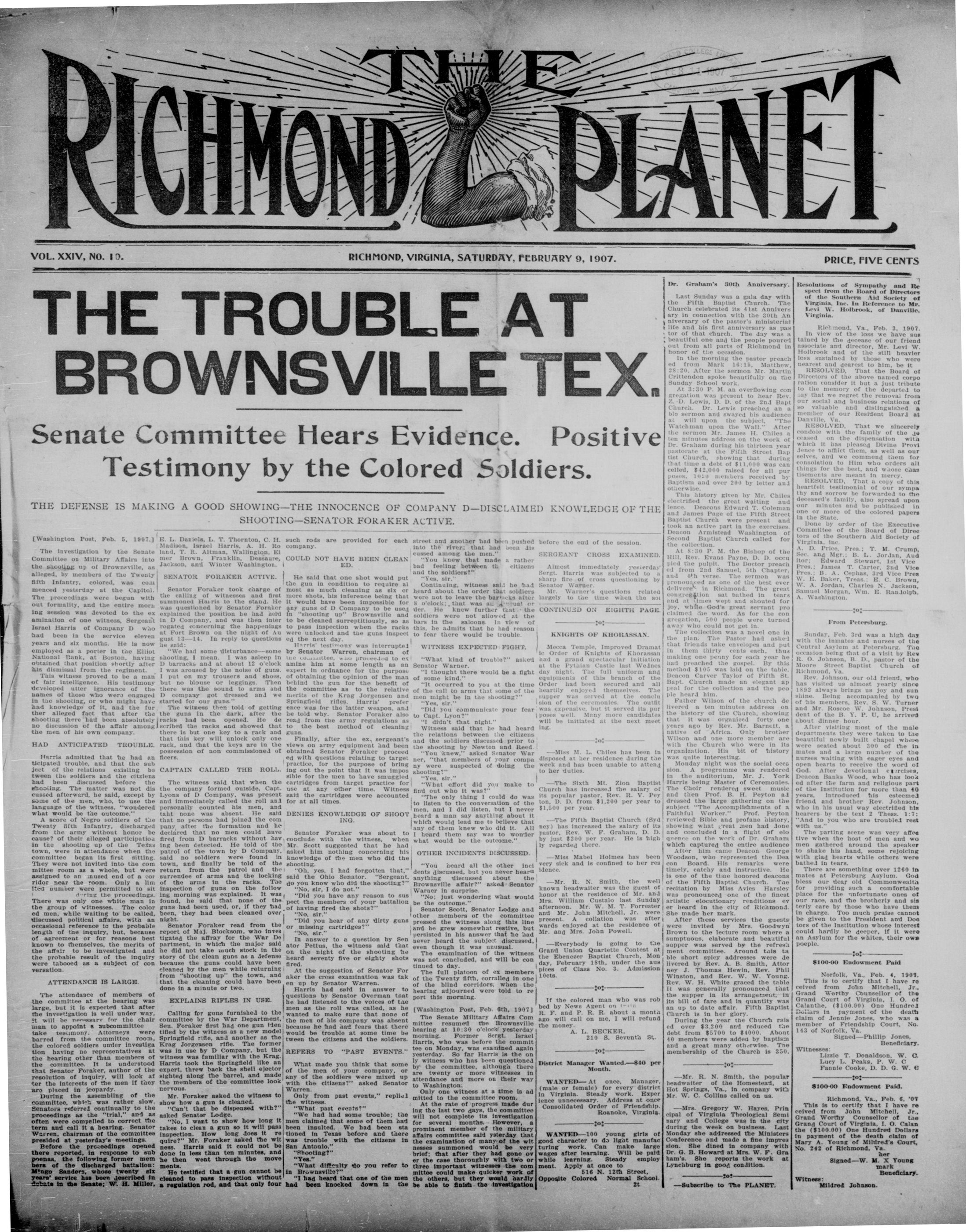
THE TROUBLE AT BROWNSVILLE TEX.
Senate Committee Hears Evidence. Positive Testimony by the Colored Soldiers.
VOL. XXIV. NO. 10.
THE
BRO
Senate C
Test
THE DEFENSE IS MAK
[Washington Post, Feb. 5, 1907.]
The investigation by the Senate Committee on Military Affairs into the shooting up of Brownville, as alleged, by members of the Twenty fifth Infantry, colored, was commenced yesterday at the Capitol. The proceedings were begun with out formality, and the entire morging session was devoted to the examination of one witness, Sergeant Israel Harris of Company D who had been in the service eleven years and six months. He is now employed as a porter in the Elliot National Bank, at Boston, having obtained that position shortly after his dismissal from the regiment. This witness proved to be a man of fair intelligence. His testimony developed utter ignorance of the names of those who were engaged in the shooting, or who might have had knowledge of it, and the further alleged fact that after the shooting there had been absolutely no discussion of the affair among the men of his own company.
HAD ANTICIPATED TROUBLE
Herris admitted that he had an anticipated trouble, and that the subject of the relations existing between the soldiers and the citizens had been discussed before the shooting. The matter was not discussed afterward, he said, except by some of the men, who, to use the language of the witness, "wondered what would be the outcome."
A score of Negro soldiers of the Twenty fifth Infantry, discharged from the army without honor be cause? of their alleged participation in the shooting up of the Texas town, were in attendance when the committee began its first sitting. They were not invited into the com mittee room as a whole, but were assigned to an unused of a con ridor near the room. Only a lim ited number were permitted to sit during the proceedings. There was only one white man in the group of witnesses. The color ed men, while waiting to be called, discussed political affairs, with an occasional reference to the probable length of the inquiry, but, because of agreement or for reasons best known to themselves, the merits of the affair to be investigated and the probable result of the inquiry were tabooed as a subject of con versation.
ATTENDANCE IS LARGE
The attendance of members of the committee at the hearing was large, but it is expected that after the investigation is well under way, it will be necessary for the chairman to appoint a subcommittee take testimony. Attorneys were barred from the committee room, the colored soldiers under investigation having no representatives at the hearing other than members of the committee. It is understood that Senator Foraker, author of the resolution of inquiry, will look after the interests of the men if they are placed in jeopardy.
During the assembling of the committee, which was rather slow, Senators referred continually to the proceedings as the "trial," and as often were compelled to correct the term and call it a hearing. Senator Warren, chairman of the committee presided at yesterday's meetings.
Before the proceedings opened there reported, in response to subpoenas, the following former members of the discharged battalion: Mingo Sanders, whose twenty six years' service has been described in debate in the Senate; W. H. Miller,
E. L. Daniels, L. T. Thornton, C. H. Madison, Israel Harris, A. H. Ro land, T. R. Altman, Wallington, Elmer Brown, Franklin, Dessure, Jackson, and Winter Washington.
SENATOR FORAKER ACTIVE.
Senator Foraker took charge of the calling of witnesses and first summoned Harris to the stand. He was questioned by Senator Foraker explained the position he had asked in D Company, and was then interrogated concerning the happenings at Fort Brown on the night of August 13—14. In reply to questions he said:
"We had some disturbance—some shooting, I mean. I was asleep in D barracks and at about 12 o'clock I was aroused by the noise of guns. I put on my trousers and shoes, but no blouse or leggings. Then there was the sound to arms and D company got dressed and we started for our guns."
The witness then told of getting the guns in the dark, after the racks had been opened. He described the racks and showed that there is but one key to a rack and that this key will unlock only one rack, and that the keys are in the possession of non commissioned of ficers.
CAPTAIN CALLED THE ROLL.
The witness said that when the company formed outside, Capt. Lyons of D Company, was present and immediately called the roll and personally counted his men, and tait none was absent. He said that no persons had joined the company after the formation and he declared that no men could have fired from D barracks without having been detected. He told of the patrol of the town by D Company, said no soldiers were found in town, and finally he told of the return from the patrol and the surrender of arms and the locking of the arms in the racks. The inspection of guns on the following morning was explained. It was found, he said that none of the guns had been used, or, if they had been, they had been cleaned over night.
Senator Foraker read from the report of Maj. Blocksom, who invites tigged the affray for the War De partiment, in which the major said he did not take much stock in the story of the clean guns as a defense because the guns could have been cleaned by the men while returning from "shooting up" the town, and that the cleaning could have been done in a minute or two.
EXPLAINS RIFLES IN USE.
Calling for guns furnished to the committee by the War Department, Sen. Foraker first had one gun then tiffed by the witness as a new model Springfield rifle, and another as the Krag Jorgensen rifle. The former was in use by D Company, but the witness was familiar with the Krag. Harris took the Springfield like an expert, threw back the shell ejector sighted along the barrel, and made the members of the committee look nervous.
Mr. Foraker asked the witness to show how a gun is cleaned.
"Can't that be dispensed with?" asked Senator Lodge.
"No. I want to show how long it takes to clean a gun so it will pass inspection. How long does it require?" Mr. Foraker asked the witiness. Harris said it could not be done in less than ten minutes, and he then went through the moves.
He testified that a gun cannot be cleaned to pass inspection without a regulation rod, and that only four
RICHMOND, VIRGINIA, SATURDAY, FEBRUARY 9, 1907.
such rods are provided for each company.
COULD NOT HAVE BEEN CLEANED.
He said that one shot would put the gun in condition to require all most as much cleaning as six or more shots, his inference being that it would have been impossible for any guns of D Company to be used in "shooting up" Brownsville and to be cleaned surreptitiously, so as to pass inspection when the racks were unlocked and the guns inspected the next day.
Harris' testimony was interrupted by Senator Warren, chairman of the committee, who proceeded to examine him at some length as an expert in ordinance for the purpose of obtaining the opinion of the man behind the gun for the benefit of the committee as to the relative merits of the Krag Jorgensen and Springfield rifles. Harris' preference was for the latter weapon, and he told why. Senator Foraker also read from the army regulations as to the best method of cleaning guns.
Finally, after the ex, sergeant's views on army equipment had been obtained Senator Foraker proceeded with questions relating to target practice, for the purpose of bring ing out the point that it was impossible for the men to have smuggled cartridges from target practice for use at any other time. Witness said the cartridges were accounted for at all times.
DENIES KNOWLEDGE OF SHOOT ING.
Senator Foraker was about to conclude with the witness, when Mr. Scott suggested that he had asked him nothing concerning his knowledge of the men who did the shooting.
"Oh, yes, I had forgotten that," said the Ohio Senator. "Sergeant, do you know who did the shooting?" "No, sir, I do not."
"Did you have any reason to suspect the members of your battalion of having fired the shots?" "No, sir."
"Did you hear of any dirty guns or missing cartridges?" "No, sir."
In answer to a question by Senator Pettus, the witness said that on the night of the shooting he heard seventy five or eighty shots fired.
At the suggestion of Senator Foraker the cross examination was tak en up by Senator Warren.
Harris had said in answer to questions by Senator Overman that he had listened to the voices of tae men as the roll was called, as he wanted to make sure that none of the men of his company was absent because he had said fears that there would be trouble at some time be tween the citizens and the soldiers.
REFERS TO "PAST EVENTS."
What made you think that some of the men of your company, or any of the soldiers were mixed up with the citizens?" asked Senator Warren.
Only from past events," replied the witness.
"What past events?"
"We had had some trouble; the men claimed that some of them had been insulted. We had been stained in Texas before and there was trouble with the citizens in San Antonio."
"Shooting?"
"Yes."
"What difficulty do you refer to in Brownsvills?"
"I had heard that one of the men had been knocked down in the
street and another had been pushed into the river; that had been discussed among the men."
"You knew, that made a rather bad feeling between the citizens and the soldiers?"
"Yes, sir."
Continuing, witness said he had heard about the order that soldiers were not to leave the barracks after 8 o'clock; that was a normal or der. He knew further that the soldiers were not allowed at the bars in the saloons. In view of this, he admits that he had reason to fear there would be trouble.
WITNESS EXPECTED FIGHT.
"What kind of trouble?" asked Senator Warner.
"I thought there would be a fight of some kind."
"It occurred to you at the time of the call to arms that some of the men might be in the shooting?"
"Yes, sir."
"Did you communicate your fear to Capt. Lyon?"
"I didn't that night."
Witness said that he had heard the relations between the citizens and the soldiers discussed prior to the shooting by Newton and Reed.
"You knew," asked Senator Warner, "that members of your company were suspected of doing the shooting?"
"Yes, sir."
"What effort did you make to find out who it was?"
"The only thing I could do was to listen to the conversation of the men, and I did listen, but I never heard a man say anything about it which would lead me to believe that any of them knew who did it. All I heard them say was to worrier what would be the outcome."
OTHER INCIDENTS DISCUSSED
"You heard all the other incidents discussed, but you never heard anything discussed about the Brownville affair?" asked Senator Warner in surprise.
"No; just wondering what would be the outcome."
Senator Scott, Senator Lodge and other members of the committee pressed the witness along this line and he grew somewhat restive, but persisted in his answer that he had never heard the subject discussed, even though it was unusual.
The examination of the witness was not concluded, and will be continued to day.
The full platoon of ex members of the Twenty fifth, corralled in one of the blind corridors, when the hearing adjourned were told to report this morning.
[Washington Post. Feb. 6th. 1907]
The Senate Military Affairs Committee resumed the Brownville hearing at 10:30 o'clock yesterday morning. Former Sergt. Israel Harris, who was before the committee on Monday, was examined again yesterday. So far Harris is the only witness who has been questioned by the committee, although there are twenty or more witnesses in attendance and more on their way to Washington.
Only one witness at a time is admitted to the committee room.
At the rate of progress made during the last two days, the committee will not complete its investigation for several months. However, a prominent member of the military affairs committee said yesterday that the examination of many of the witnesses summoned would be very brief; that after they had gone ove er the case thoroughly with two or three important witnesses the committee could make quicker work of the others, but they would hardly be able to finish the investigation
before the end of the session.
SERGEANT CROSS EXAMINED
Almost immediately yesterday
Sergt. Harris was subjected to a
sharp fire of cross questioning by
Senator Warner.
Mr. Warner's questions related
largely to the time when the son
CONTINUED ON EIGHTH PAGE.
KNIGHTS OF KHORASSAN
Mecca Temple, Improved Dramatic Order of Knights of Khorassan and a grand spectacular initiation at the Pythian Castle last Wednes day night. The full uniform and equipments of this branch of the Order had been secured and all heartily enjoyed themselves. The supper was served at the conclu sion of the ceremonies. The outfit was expensive, but it served its pur poses well. Many more candidates will be initiated at the next meet ing.
—Miss M. L. Chiles has been in disposed at her residence during the week and has been unable to attend to her duties.
—The Sixth Mt. Zion Baptist Church has increased the salary of its popular pastor, Rev. R. V. Peyton, D. D. from $1,200 per year to $1,500 per year.
—The Fifth Baptist Church (Sydney) has increased the salary of its pastor, Rev. W. F. Graham, D. D. by just $200 per year. He is highly regarded there.
—Miss Mabel Holmes has been very sick and is confined to her residence.
—Mr. R. N. Smith, the well known headwaiter was the guest of honor at the residence of Mr. and Mrs. William Custalo last Sunday afternoon. Mr. W. M. T. Forrester and Mr. John Mitchell, Jr. were present. A collation was after wards enjoyed at the residence of Mr. and Mrs. John Powell.
—Everybody is going to the Grand Union Quartette Contest at the Ebenezer Baptist Church, Monday, February 18th, under the auspices of Class No. 3. Admission 10cts.
If the colored man who was rob bed by News Agent on train R. F. and P. R. R. about a monta ago will call on me, I will refund the money.
District Manager Wanted—$40 per Month.
WANTED—At once, Manager,
(male or female) for every district
in Virginia. Steady work. Experi-
ence unnecessary added at the
Consolidated Order of Friendship.
Roanoke, Virginia.
WANTED—100 young girls of good character to do ligat manufac turing work. Can make large wages after learning. Will be paid while learning. Steady employ ment. Apply at once to
516 N. 12th Street.
Opposite Colored Normal School.
2t
Dr. Graham's 30th Anniversary
Last Sunday was a gala day with the Fifth Baptist Church. The Church celebrated its 41st Anniversary in connection with the 30th Anniversary of the pastor's ministerial life and his first anniversary as pastor of that church. The day was a beautiful one and the people poured out from all parts of Richmond in honor of the occasion.
In the morning the pastor preached from Mark 16:15, Matthew, 28:20. After the pastor Mr. Martin Crittendon spoke beautifully on the Sunday School work.
At 3:30 P. M. an overflowing congregation was present to hear Rev. Z. D. Lewis, D. D. of the 2nd Baptist Church. Dr. Lewis preached an able sermon and swayed his audience at will upon the subject, "The Watchman upon the Wall." After the sermon Mr. James H. Chiles a ten minutes address on the work of Dr. Graham during his thirteenth year pastorate at the Fifth Street Baptist Church, showing that during that time a debt of $11,000 was can beled, $42,000 raised for all pur poses, 1020 members received by Baptism and over 200 by letter and otherwise.
This history given by Mr. Chiles electrified the great waiting and lence. Deacons Edward T. Coleman and James Page of the Fifth Street Baptist Church were present and took an active part in the exercises. Deacon Armistead Washington of Second Baptist Church called for the collection.
At 8:30 P. M. the Bishop of the Hill, Rev. Evans Payne, D. D. occupied the pulpit. The Doctor preach ed from 2nd Samuel, 5th Chapter, and 4th verse. The sermon was pronounced as one of the best ever delivered in Richmond. The great congregation sat bathed in tears and at times wept and shouted for joy, while God's great servant proclaimed the word. As for the congregation, 500 people were turned away who could not get in.
The collection was a novel one in the plan. The Pastor had asked that friends take envelopes and put in them thirty cents each, thus making one penny for each year he had preached the gospel. By this method $105 was laid on the table. Deacon Carver Taylor of Fifth St. Bapt. Church made an elegant appeal for the collection and the people heard him.
Father Wilson of the church de livered a ten minutes address on the history of the Church, showing that it was organized forty one years ago by Rev. Mr. Barnett, a native of Africa. Only brother Wilson and one more member are with the Church who were in its organization. His bit of history was quite interesting.
Monday night was the social occasion. A programme was rendered in the auditorium, Mr. J. York Harris being Master of Ceremonies. The Choir rendered sweet music and then Prof. B. H. Peyton adressed the large gathering on the subject "The Accomplishments of a Faithful Worker." Prof. Peyton reviewed Bible and profane history, showing what creat men had Jone and concluded in a flight of eloquence on the work of Dr. Graham which captured the entire audience. After him came Deacon George Woodson, who represented the Deacon Board. His remarks were timely, catchy and instructive. He is one of the time honored deacons of the Fifth Baptist Church. The recitation by Miss Avies Harsley was pronounced one of the finest artistic elocutionary renditions ever heard in the city of Richmond. She made her mark.
After these services the guests were invited by Mrs. Goodwyn Brown to the lecture room where a sumptuous, elaborate and beautiful supper was served by the refreshment committee. Around taile short spicy addresses were de livered by Rev. A. B. Smith, Attorney J. Thomas Hewin, Rev. Phil Winston, and Rev. W. W. Young. Rev. W. H. White graced the table. It was generally pronounced that the supper in its arrangement, in its bill of fare and in quantity was an up to date affair. Fifth Baptist Church is in her glory.
During the year the Church raised over $3,200 and reduced the debt from $5700 to $4000. About 40 members were added by baptism and a great many otherwise. The membership of the Church is 350.
—Mr. R. N. Smith, the popular headwaiter of the Homestead, at Hot Springs, Va., in company with Mr. W. C. Collins called on us.
—Mrs. Gregory W. Hayes, Principal of Virginia Theological Seminary and College was in the city during the week on business. Last Monday she addressed the Ministers Conference and made a fine impresion. She dined in company with Dr. G. B. Howard at Mrs. W. F. Graham's. She reports the work at Lynchburg in good condition.
PRICE. FIVE CENTS
Resolutions of Sympathy and Respect from the Board of Directors of the Southern Aid Society of Virginia, Inc. In Reference to Mr. Levi W. Holbrook, of Danville, Virginia.
Richmond, Va., Feb. 3, 1907.
In view of the loss we have surained by the decease of our friend associate and director, Mr. Levi W. Holbrook and of the still heavier loss sustained by those who were nearest and dearest to him, be it RESOLVED. That the Board of Directors of the above named corporation consider it but a just tribute to the memory of the departed to say that we regret the removal from our social and business relations of so valuable and distinguished a member of our Resident Board at Danville, Va.
RESOLVED. That we sincerely condole with the family of the deceased on the dispensation with which it has pleased Divine Providence to afflict them, as well as our selves, and we commend them for consultation to Him who orders all things for the best, and whose cas tirements are meant in mercy.
RESOLVED. That copy of this heartfelt testimonial of my sympathy and sorrow be forwarded to the deceased's family, also spread upon our minutes and be published in one or more of the colored papers in the State.
Done by order of the Executive Committee of the Board of Directors of the Southern Aid Society of Virginia, inc.
A. D. Price, Pres.; T. M. Crump,
Sec. and Mgr.; B. L. Jordan, Aud
itor; Edward Stewart, 1st Vice
Pres.; James T. Carter, 2nd Vice
Pres.; B. A. Cephas, 3rd Vice Pres.
Pres.; Treas.; E. C. Brown,
W. A. Jordan, Charles N. Jackson,
Samuel Morgan, Wm. E. Randolph,
A. Washington.
From Petersburg.
Sunday, Feb. 3rd was a high day with the inmates and nurses of the Central Asylum at Petersburg. The occasion being that of a visit by Rev R. O. Johnson, B. D., pastor of the Moore Street Baptist Church of Richmond, Va.
Rev. Johnson, our old friend, who has visited us almost yearly since 1892 always brings us joy and sunshine. Being accompanied by two of his members, Rev S. W. Turner and Mr. Roscoe W. Johnson, President of the B. Y. P. U, he arrived about dinner hour.
After visiting most of the male departments they were taken to the beautiful newly built chapel where were seated about 300 of the inmates and a large number of the nurses waiting with eager eyes and open hearts to receive the word of God. After devotional exercises, Deacon Banks Wood, who has booked after the farm and religious part of the Institution for more than 40 years, introduced his esteemed friend and brother Rev. Johnson, who in his usual way electrified his hearers by the text 2 Thess. 1:7: "And to you who are troubled rest with us."
The parting scene was very affeive when the host of men and wo men gathered around the speaker to shake his hand, some rejoicing with glad hearts while others were bathed in tears.
There are something over 1260 imates at Petersburg Asylum. God bless our dear old Commonwealth for providing such a comfortable place for the unfortunate ones of our race, and the brotherly and sisterly care by those who have them in charge. Too much praise cannot be given to the President and Doctors of the Institution whose interest could hardly be deeper, if it were an Asylum for the whites, their own people.
$100.00 Endowment Paid
Norfolk, Va., Feb. 4, 1907.
This is to certify that I have received from John Mitchell, Jr.,
Grand Worthy Counsellor of the Grand Court of Virginia, I. O. of
Calanthe, ($100.00) One Hundred Dollars in payment of the death
claim of Jennie Jones, who was a member of Friendship Court, No.
143 of Norfolk, Va.
Signed—Phillip Jones,
Beneficiary.
Witnesses:
Lizzie T. Donaldson, W. G.
Lucy L. Peaks, P. W. C.
Fannie Cooke, D. D. G. W. G.
$100-00 Endowment Paid.
Richmond, Va., Feb. 6. '07
This is to certify that I have received from John Mitchell, Jr.,
Grand Worthy Counselor of the Grand Court of Virginia, I. O. Calan the ($100.00) One Hundred Dollars in payment of the death claim of Mary A. Young of Milfred's Court, No. 242 of Richmond, Va.
her
Signed—W. M. X Young
mark
Beneficiary
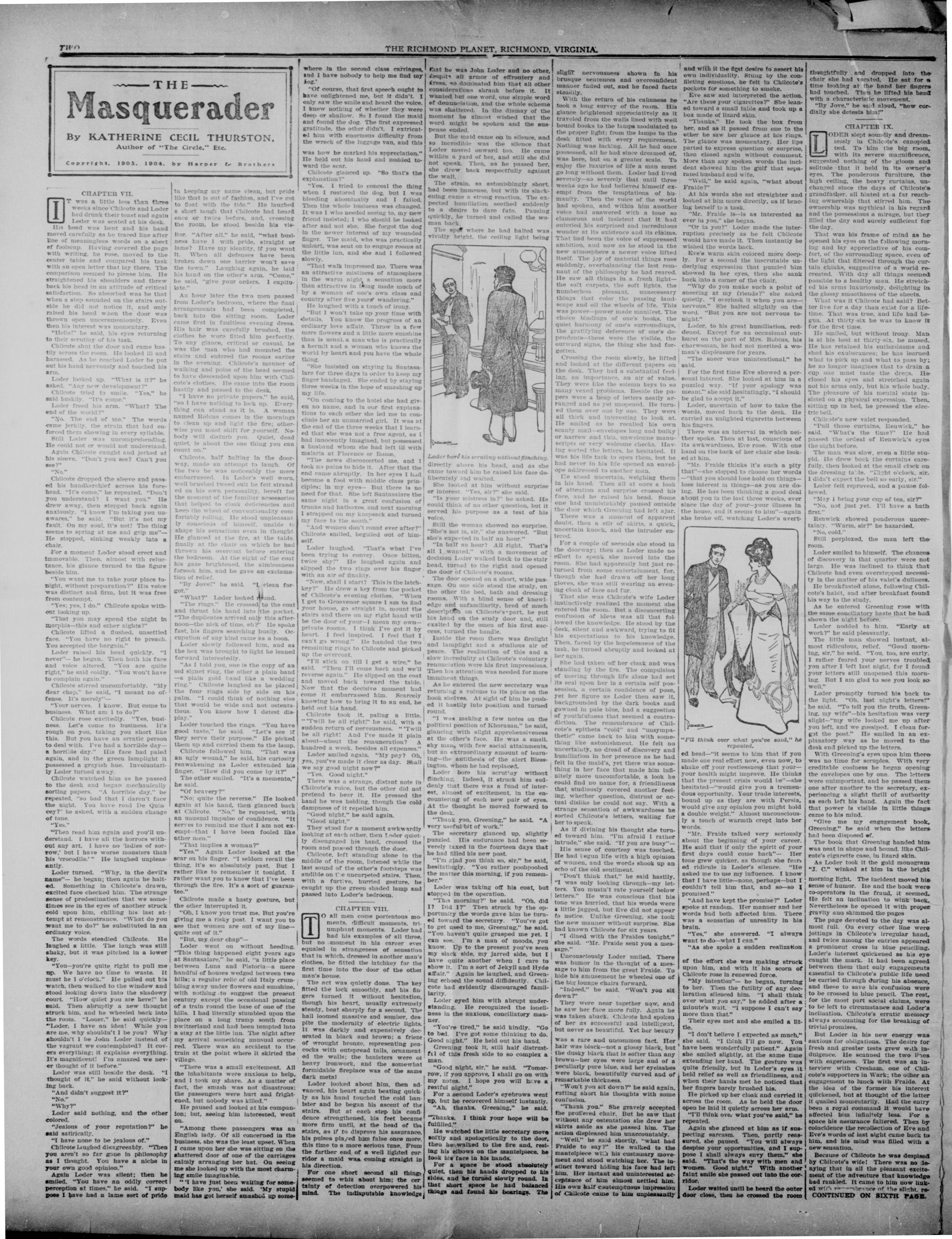
THE Masquerader
By KATHERINE CECIL THURSTON.
Author of "The Circle," Etc.
Copyright, 1905, 1904, by Harper & Brothers
TWO
CHAPTER VII.
I T was a little less than three weeks since Chilcote and Loder had drunk their toast and again Loder was seated at his desk. His head was bent and his hand moved carefully as he traced line after line of meaningless words on a sheet of foolscap. Having covered the page with writing, he rose, moved to the center table and compared his task with an open letter that lay there. The comparison seemed to please him. He straightened his shoulders and threw back his head in an attitude of critical satisfaction. So absorbed was he that when a step sounded on the stairs outside he did not notice it, and only raised his head when the door was thrown open unceremoniously. Even then his interest was momentary. "Hello!" he said, his eyes returning to their scrutiny of his task.
Chilcote shut the door and came hastily across the room. He looked ill and harassed. As he reached Loder he put on his hand nervously and touched his arm.
Loder looked up. "What is it?" he asked. "Any new development?" Chilcote tried to smile. "Yes," he said huskily. "It's come."
Loder freed his arm. "What? The end of the world?" "No. The end of me." The words came jerkily, the strain that had enforced them showing in every syllable. Still Loder was uncomprehending. He could not or would not understand. Again Chilcote caught and jerked at his sleeve. "Don't you see? Can't you see?"
Chilcote dropped the sleeve and passed his handkerchief across his forehead. "It's come," he repeated. "Don't you understand? I want you." He drew away, then stepped back again anxiously. "I know I'm taking you unawares," he said. "But it's not my fault. On my soul, it's not! The thing seems to spring at me and grip me"—He stopped, sinking weakly into a chair.
For a moment Loder stood erect and immovable. Then, almost with reluctance, his glance turned to the figure beside him.
"You want me to take your place tonight, without preparation?" His voice was distinct and firm, but it was free from contempt.
"Yes; yes, I do." Chilcote spoke without looking up.
"That you may spend the night in morphia—this and other nights?"
Chilcote lifted a flushed, unsettled face. "You have no right to preach. You accepted the bargain."
Loder raised his head quickly. "I never"—he began. Then both his face and voice altered. "You are quite right," he said coldly. "You won't have to complain again."
Chilcote stirred uncomfortably. "My dear chap," he said, "I meant no offense. It's merely"—
"Your nerves. I know. But come to business. What am I to do?"
Chilcote rose excitedly. "Yes, business. Let's come to business. It's rough on you, taking you short like this. But you have an erratic person to deal with. I've had a horrible day—a horrible day." His face had paled again, and in the green lamplight it possessed a grayish hue. Involuntarily Loder moved away.
Chilcote watched him as he passed to the desk and began mechanically sorting papers. "A horrible day," he repeated, "so bad that I darn't face the night. You have read De Quincey?" he asked, with a sudden change of tone.
"Yes."
"Then read him again and you'll understand. I have all the horrors without any art. I have no 'hidies of sorrow,' but I have worse monsters than his 'crocodile.'" He laughed unpleasantly.
Loder turned. "Why, in the devil's name"—he began; then again he halted. Something in Chilcote's drawn, excited face checked him. The strange sense of predestination that we sometimes see in the eyes of another struck cold upon him, chilling his last attempt at remonstrance. "What do you want me to do?" he substituted in an ordinary voice.
The words steadied Chillotte. He laughed a little. The laugh was still shaky, but it was pitched in a lower key.
"You—you're quite right to pull me up. We have no time to waste. It must he I o'clock." He pulled out his watch, then walked to the window and stood looking down into the shadowy court. "How quiet you are here!" he said. Then abruptly a new thought struck him, and he wheeled back into the room. "Louer," he said quickly—"Loder, I have an idea! While you are me, why shouldn't I be you? Why shouldn't I be John Loder instead of the vagrant we contemplated? It covers everything; it explains everything. It's magnificent! I am amazed we never thought of it before."
Loder was still beside the desk. "I thought of it," he said without looking back.
"And didn't suggest it?"
"No."
"Why?"
Loder said nothing, and the other colored.
"Jealous of your reputation?" he said satirically.
"I have none to be jealous of."
I have to be serious on.
Chilcote laughed disagreeably. "Then you aren't so far gone in philosophy as I thought. You have a niche in your own good opinion."
Again Loder was silent; then he smiled. "You have an oddly correct perception at times," he said. "I suppose I have had a lame sort of pride
in keeping my name clean, but pride like that is out of fashion, and I've got to float with the tide." He laughed a short laugh that Chilcote had heard once or twice before, and, crossing the room, he stood beside his visitor. "After all," he said, "what business have I with pride, straight or lame? Have my identity, if you want it. When all defenses have been broken down one barrier won't save the town." Laughing again, he laid his hand on the other's arm. "Come," he said, "give your orders. I capitulate."
An hour later the two men passed from Loder's bedroom, where the final arrangements had been completed, back into the sitting room. Loder came first in faultless evening dress. His hair was carefully brushed, the clothes he wore fitted him perfectly. To any glance, critical or casual, he was the man who had mounted the stairs and entered the rooms earlier in the evening. Chilcote's manner of walking and poise of the head seemed to have descended upon him with Chilcote's clothes. He came into the room hastily and passed to the desk.
"I have no private papers," he said, "so I have nothing to lock up. Everything can stand as it is. A woman named Robins comes in the mornings to clean up and light the fire; otherwise you must shift for yourself. Nobody will disturb you. Quiet, dead quiet, is about the one thing you can count on."
Chilcote, half halting in the doorway, made an attempt to laugh. Of the two he was noticeably the more embarrassed. In Loder's well worn, well brushed tweed suit he felt stranded on his own personality, bereft for the moment of the familiar accessories that helped to cloak deficiencies and keep the wheel of conventionality comfortably rolling. He stood unpleasantly conscious of himself, unable to shape his sensations even in thought. He glanced at the fire, at the table, finally at the chair on which he had thrown his overcoat before entering the bedroom. At the sight of the coat his gaze brightened, the aimlessness forsook him, and he gave an exclamation of relief.
"By Jove!" he said. "I clean forgot."
"What?!" Loder looked round.
"The rings." He crossed to the coat and thrust his hand into the pocket.
"The duplicates arrived only this afternoon—the nick of time, eh?" He spoke fast, his fingers searching busily. Occupation of any kind came as a boon.
Loder slowly followed him, and as the box was brought to light he leaned forward interestedly.
"As I told you, one is the copy of an old signet ring, the other a plain band—a plain gold band like a wedding ring." Chilcote laughed as he placed the four rings side by side on his palm. "I could think of nothing else that would be wide and not ostentations. You know how I detest display."
Loder touched the rings. "You have good taste," he said. "Let's see if they serve their purpose." He picked them up and carried them to the lamp.
Chilcote followed him. "That was an ugly wound," he said, his curiosity reawakening as Loder extended his finger. "How did you come by it?" The other smiled. "It's a memento," he said. "Of bravery?"
"No; quite the reverse." He looked again at his hand, then glanced back at Chilcote. "No," he repeated, with an unusual impulse of confidence. "It serves to remind me that I am not exempt—that I have been fooled like other men."
"That implies a woman?"
"Yes." Again Loder looked at the scar on his finger. "I seldom recall the thing, it's so absolutely past. But I rather like to remember it tonight. I rather want you to know that I've been through the fire. It's a sort of guarantee."
Chilcote made a hasty gesture, but the other interrupted it.
"Oh, I know you trust me. But you're giving me a risky post. I want you to see that women are out of my line—quite out of it."
"But my dear chap"—
Loder went on without heeding. "This thing happened eight years ago at Santasalare," he said, "a little place between Luna and Pistoria—a mere handful of houses wedged between two hills; a regular relic of old Italy crumbling away under flowers and sunshine, with nothing to suggest the present century except the occasional passing of a train round the base of one of the hills. I had literally stumbled upon the place on a long tramp south from Switzerland and had been tempted into a stay at the little inn. The night after my arrival something unusual occurred. There was an accident to the train at the point where it skirted the village.
"There was a small excitement. All the inhabitants were anxious to help, and I took my share. As a matter of fact, the smash was not disastrous; the passengers were hurt and frightened, but nobody was killed."
He paused and looked at his companion; but, seeing him interested, went on.
"Among these passengers was an English lady. Of all concerned in the business, she was the least upset. When I came upon her she was sitting on the shattered door of one of the carriages calmly arranging her hat. On seeing me she looked up with the most charming smile imaginable.
"I have just been waiting for somebody like you,' she said. 'My stupid maid has got herself smashed up some-
THE RICHMOND PLANET. RICHMOND. VIRGINIA
where in the second class carriages,
and I have nobody to help me find my
fog."
"Of course, that first speech ought to
have eulighed me, but it didn't. I
only saw the smile and heard the voice.
I knew nothing of whether they were
deep or shallow. So I found the maid
and found the dog. The first expressed
gratitude, the other didn't. I extricated
him with enormous difficulty from
the wreck of the luggage van, and this
was how he marked his appreciation."
He held out his hand and nodded toward
the scar.
Chilcote glanced up. "So that's the
explanation?"
"Yes. I tried to conceal the thing when I restored the dog, but I was bleeding abominably and I failed. Then the whole business was changed. It was I who needed seeing to, my new friend insisted; I who should be looked after and not she. She forgot the dog in the newer interest of my wounded finger. The maid, who was practically unhurt, was sent on to engage rooms at the little inn, and she and I followed slowly.
"That walk impressed me. There was an attractive mistiness of atmosphere in the warm night, a sensation more than attractive in being made much of by a woman of one's own class and country after five years wandering."
He laughed with his eyes.
"But I won't take up your time with details. You know the progress of an ordinary love affair. Throw in a few more flowers and a little more sunshine than is usual, a man who is practically a hermit and a woman who knows the world by heart and you have the whole thing.
"She insisted on staying in Santasalare for three days in order to keep my finger bandaged. She ended by staying three weeks in the hope of smashing up my life.
"On coming to the hotel she had given no name, and in our first explanations to each other she led me to conclude her an unmarried girl. It was at the end of the three weeks that I learned that she was not a free agent, as I had innocently imagined, but possessed a husband whom she had left ill with malaria at Florence or Rome.
"The news disconcerted me, and I took no pains to bide it. After that the end came abruptly. In her eyes I had become a fool with middle class principles; in my eyes—But there is no need for that. She left Santasalare the same night in a great confusion of trunks and hatboxes, and next morning I strapped on my knapsack and turned my face to the south."
"And women don't count ever after?" Chicote smiled, beguiled out of himself.
Loder laughed. "That's what I've been trying to convey. Once bitten, twice shy!" He laughed again and slipped the two rings over his finger with an air of finality.
"Now, shall I start? This is the latchkey?" He drew a key from the pocket of Chilcote's evening clothes. "When I get to Grosvenor square I am to find your house, go straight in, mount the stairs and there on my right hand will be the door of your—I mean my own—private rooms. I think I've got it by heart. I feel inspired. I feel that I can't go wrong." He handed the two remaining rings to Chilcote and picked up the overcoat.
"I'll stick on till I get a wire," he said. "Then I'll come back and we'll reverse again." He slipped on the coat and moved back toward the table. Now that the decisive moment had come it embarrassed him. Scarcely knowing how to bring it to an end, he held out his hand.
Chilcote took it, palling a little. "Twill be all right!" he said, with a sudden return of nervousness. "Twill be all right! And I've made it plain about—about the remuneration? A hundred a week, besides all expenses."
Loder smiled again. "My pay? Oh, yes, you've made it clear as day. Shall we say good night now?* " "Yes. Good night." There was a strange, distant note in Chilcote's voice, but the other did not pretend to hear it. He pressed the hand he was holding, though the cold dampness of it repelled him. "Good night," he said again. "Good night." They stood for a moment awkwardly looking at each other, then Loder quietly disengaged his hand, crossed the room and passed through the door. Chilcote, left standing alone in the middle of the room, listened while the last sound of the other's footsteps was audible on the uncarpeted stairs. Then, with a furtive, hurried gesture, he caught up the green shaded lamp and passed into Loder's bedroom.
CHAPTER VIII
O all men come portentous moments, difficult moments, triumphant moments. Loder had had his examples of all three, but no moment in his career ever equaled in strangeness of sensation that in which, dressed in another man's clothes, he fitted the latchkey for the first time into the door of the other man's house.
The net was quietly done. The key fitted the lock smoothly, and his fingers turned it without hesitation, though his heart, usually extremely steady, beat sharply for a second. The hall loomed massive and somber, despite the modernity of electric lights. It was darkly and expensively decorated in black and brown; a frieze of wrought bronze, representing pencocks with outspread tails, ornamented the walls; the banisters were of heavy ironwork, and the somewhat formidable fireplace was of the same dark metal
Loder looked about him, then advanced, his heart again beating quickly as his hand touched the cold banister and he began his ascent of the stairs. But at each step his confidence strengthened, at the head of the stairs, as if to disprove his assurance, his pulses played him false once more, this time to a more serious tune. From the farther end of a well lighted corridor a maid was coming straight in his direction.
For one short second all things seemed to whiz about him; the certainty of detection overpowered his mind. The indisputable knowledge
that he was John Loder and no other, despite all armor of effrontery and dress, so dominated him that all other considerations shrank before it. It wanted but one word, one simple word of denunciation, and the whole scheme was shattered. In the dismay of the moment he almost wished that the word might be spoken and the suspense ended.
But the maid came on in silence, and so incredible was the silence that Loder moved onward too. He came within a yard of her, and still she did not speak. Then, as he passed her, she drew back respectfully against the wall.
The strain, so astonishingly short, had been immense, but with its slackening came a strong reaction. The expected humiliation seethed suddenly to a desire to seethed suddenly. Pausing quickly, he turned and called the woman back.
The spot where he had halted was vividly bright, the ceiling light being
PADONNE
Loder bore his scrutiny without finching, directly above his head, and as she came toward him he raised his face deliberately and waited.
She looked at him without surprise or interest. "Yes, sir," she said.
"Is your mistress in?" he asked. He could think of no other question, but it served his purpose as a test of his voice.
Still the woman showed no surprise. "She's not in, sir," she answered. "But she's expected in half an hour."
"In half an hour? All right. That's all I wanted." With a movement of Loder walked back to the stair head, turned to the right and opened the door of Chilcote's rooms.
The door opened on a short, wide passage. On one side stood the study, on the other the bed, bath and dressing rooms. With a blind sense of knowledge and unfamiliarity, bred of much description on Chilcote's part, he put his hand on the study door and, still exalted by the omen of his first success, turned the handle.
Inside the room there was firelight and lamplight and a studious air of peace. The realization of this and a slow incredulity at Chilcote's voluntary renunciation were his first impressions. Then his attention was needed for more imminent things.
As he entered the new secretary was returning a volume to its place on the book shelves. At sight of him he pushed it hustily into position and turned round.
"I was making a few notes on the political position of Khorasan," he said, glancing with slight apprehensiveness at the other's face. He was a small, shy man, with few social attainments, but an extraordinary amount of learning—the antithesis of the alert Blessington, whom he had replaced.
Loder bore his scrutiny without finching. Indeed, it struck him suddenly that there was a fund of interest, almost of excitement, in the encountering of each new pair of eyes. At the thought he moved forward to the desk.
"Thank you, Greening," he said. "A very useful bit of work."
The secretary glanced up, slightly puzzled. His endurance had been severely taxed in the fourteen days that he had filled his new post.
"I'm glad you think so, sir," he said, hesitating. "You rather poohpoohed the matter this morning, if you remember."
Loder was taking off his coat, but stopped in the operation.
"This morning?" he said. "Oh, did I? Did I?" Then struck by the opportunity the words gave him he turned toward the secretary. "You've got to get used to me, Greening," he said. "You haven't quite grasped me yet. I can see. I'm a man of moods, you know. Up to the present you've seen my slack side, my jarred side, but I have quite another when I care to show it. I'm a sort of Jekyll and Hyde affair." Again he langged, and Greening echoed the sound diffidently. Chilcote had evidently discouraged familiarity.
Loder eyed him with abrupt understanding. He recognized the loneliness in the anxious, conciliatory manner.
"You're tired," he said kindly. "Go to bed. I've got some thinking to do. Good night." He held out his hand. Greening took it, still half distrustful of this fresh side to so complex a man.
"Good night, sir," he said. "Tomorrow, if you approve, I shall go on with my notes. I hope you will have a restful night."
For a second Loder's eyebrows went up, but he recovered himself instantly. "Ah, thanks. Greening," he said.
"Thanks. I think your hope will be fulfilled."
He watched the little secretary move softly and apologetically to the door, then he walked to the fire and, resting his elbows on the mantelpiece, he took his face in his hands.
For a space he stood absolutely quiet, then his hands dropped to his sides, and he turned slowly round. In that short space he had balanced things and found his bearings. The
slight nervousness shown in his brusque sentences and overconfident manner faded out, and he faced facts steadily.
With the return of his calmness he took a long survey of the room. His glance brightened appreciatively as it traveled from the walls lined with well bound books to the lamps modulated to the proper light; from the lamps to the desk fitted with every requirement. Nothing was lacking. All he had once possessed, all he had since dreamed of, was here, but on a greater scale. To enjoy the luxuries of life a man must go long without them. Loder had lived severely—so severely that until three weeks ago he had believed himself exempt from the temptations of humanity. Then the voice of the world had spoken, and within him another voice had answered with a tone so clamorous and insistent that it had outcried his surprised and incredulous wonder at its existence and its claims. That had been the voice of suppressed ambition, and now as he stood in the new atmosphere a newer voice lifted itself. The joy of material things rose suddenly, overbalancing the last remnant of the philosophy he had reared. He saw all things in a fresh light—the soft carpets, the soft lights, the numberless pleasant, unnecessary things that color the passing landscape and oil the wheels of life. This was power—power made manifest. The choice bindings of one's books, the quiet harmony of one's surroundings, the gratifying deference of one's dependents—these were the visible, the outward signs, the thing she had forbidden.
Crossing the room slowly, he lifted and looked at the different papers on the desk. They had a substantial feeling, an importance, an air of value. They were like the solemn keys to so many vexed problems. Beside the papers were a heap of letters neatly arranged and as yet unopened. He turned them over one by one. They were all thick and interesting to look at. He smiled as he recalled his own scanty mail-envelopes long and bulky or narrow and thin, unwelcome manuscripts or very welcome checks. Having sorted the letters, he hesitated. It was his life task to open them, but he had never in his life opened an envelope addressed to another man. He stood uncertain, weighing them in his hand. Then all at once a look of attention and surprise crossed his face, and he raised his head. Some one had unmistakably passed outside the door which Grazing had left aside.
There was a moment of apparent doubt, then a stir of skirts, a quick, uncertain knock, and the intruder entered.
For a couple of seconds she stood in the doorway; then as Loder made no effort to speak she moved into the room. She had apparently but just returned from some entertainment, for, though she had drawn off her long gloves, she was still wearing an evening cloak of lace and fur.
That she was Chilcote's wife Loder instinctively realized the moment she entered the room. But a disconcerting confusion of ideas was all that followed the knowledge. He stood by the desk, silent and awkward, trying to fit his expectations to his knowledge. Then, faced by the hopelessness of the task, he turned abruptly and looked at her again.
She had taken off her cloak and was standing by the fire. The compulsion of moving through life alone had set its seal upon her in a certain self possession, a certain confidence of pose, yet her figure as Loder then saw it, backgrounded by the dark books and gowned in pale blue, had a suggestion of youthfulness that seemed a contradiction. The remembrance of Chilcote's epithets "cold" and "unsympathetic" came back to him with something like astonishment. He felt no uncertainty, no dread of discovery and humiliation in her presence as he had felt in the maid's, yet there was something in her face that made him infinitely more uncomfortable, a look he could find no name for, a friendliness that studiously covered another feeling, whether question, distrust or actual dislike he could not say. With a strange sensation of awkwardness he sorted Chilcote's letters, waiting for her to speak.
As if divining his thought she turn
toward hini. "I'm afraid I rather
hint."
"Don't think that," he said hastily, "I was only looking through-my letters. You mustn't rate yourself below letters." He was conscious that his tone was hurried, that his words were a little jagged, but Eve did not appear to notice. Unlike Greening, she took the new manner without surprise. She had known Chilcote for six years.
"I dined with the Fraides tonight," she said. "Mr. Fraide sent you a message."
Unconsciously Loder smiled. There was humor in the thought of a message to him from the great Fraide. To hide his amusement he wheeled one of the big lounge chairs forward.
"Indeed," he said. "Won't you sit down?"
They were near together now, and he saw her face more fully. Again he was taken aback. Chilcote had spoken of her as successful and intelligent, but never as beautiful. Yet her beauty
was a rare and uncommon fact. Her hair was black—not a glossy black, but the dusky black that is softer than any brown—her eyes were large and of a peculiarly pure blue, and her eyelashes were black, beautifully curved and of remarkable thickness.
"Won't you sit down?" he said again, cutting short his thoughts with some confusion.
"Thank you." She gravely accepted the proffered chair. But he saw that without any ostentation she drew her skirts aside as she passed him. The action displeased him unaccountably.
"Well," he said shortly, "what had Fraide to say?" He walked to the mantelpiece with his customary movement and stood watching her. The instinct toward hiding his face had left him. Her instant and uninterested acceptance of him almost netted him. His own half contemptuous impression of Chilcote came to him unpleasantly
and with it the first desire to assert his own individuality. Stung by the conflicting emotions, he felt in Chilecote's pockets for something to smoke.
Eve saw and interpreted the action. "Are these your cigarettes?" She leaned toward a small table and took up a box made of lizard skin.
"Thanks," He took the box from her, and as it passed from one to the other he saw her glance at his rings. The glance was momentary. Her lips parted to express question or surprise, then closed again without comment. More than any spoken words the incident showed him the guilt that separated husband and wife.
"Well," he said again, "what about Fraalde?"
At his words she sat straighter and looked at him more directly, as if bracing herself to a task.
"Mr. Fraalde is—is as interested as ever in you" she began.
"Or in you?" Loder made the interruption precisely as he felt Chilcote would have made it. Then instantly he wished the words back.
Eve's warm skin colored more deeply. For a second the inscrutable underlying expression that puzzled him showed in her eyes, then she sank back into a corner of the chair.
"Why do you make such a point of sneering at my friends?" she asked quietly. "I overlook it when you are—nervous." She halted slightly on the word. "But you are not nervous tonight."
Loder, to his great humiliation, redened. Except for an occasional outburst on the part of Mrs. Robins, his charwoman, he had not merited a woman's displeasure for years.
"The sneer was unintentional," he said.
For the first time Eve showed a personal interest. She looked at him in a puzzled way. "If your apology was meant," she said hesitatingly, "I should be glad to accept it."
Loder, uncertain of how to take the words, moved back to the desk. He carried an unlighted cigarette between his fingers.
There was an interval in which neither spoke. Then at last, conscious of its awkwardness, Eve rose. With one hand on the back of her chair she looked at him.
"Mr. Fralde thinks it's such a pity that"—she stopped to choose her words—"that you should lose hold on things—lose interest in things—as you are doing. He has been thinking a good deal about you in the last three weeks, ever since the day of your—your illness in the house, and it seems to him"—again she broke off, watching Loder's avert-
P. RENNIE
"I'll think over what you've said," he repeated.
ed head—"it seems to him that if you made one real effort now, even now, to shake off your restlessness that your—your health might improve. He thinks that the present crisis would be"—she hesitated—"would give you a tremendous opportunity. Your trade interests, bound up as they are with Persia, would give any opinion you might hold a double weight." Almost unconsciously a touch of warmth crept into her words.
"Mr. Fraide talked very seriously about the beginning of your career. He said that if only the spirit of your first days could come back"—Her tone grew quicker, as though she feared ridicule in Loder's silence. "He asked me to use my influence. I know that I have little—none, perhaps—but I couldn't tell him that, and so—so I promised."
"And have kept the promise?" Loder spoke at random. Her manner and her words had both affected him. There was a sensation of unreality in his brain.
"Yes," she answered. "I always want to do—what I can."
"As she spoke a sudden realization of the effort she was making struck upon him, and with it his scorn of Chilicote rose in renewed force.
"My intention"—he began, turning to her. Then the futility of any declaration silenced him. "I shall think over what you say," he added after a minute's wait. "I suppose I can't say more than that."
Their eyes met and she smiled a little.
"I don't believe I expected as much," she said. "I think I'll go now. You have been wonderfully patient." Again she smiled slightly, at the same time extending her hand. The gesture was quite friendly, but in Loder's eyes it held relief as well as friendliness, and when their hands met he noticed that her fingers barely brushed his.
He picked up her cloak and carried it across the room. As he held the door open he laid it quietly across her arm. "I'll think over what you've said," he repeated.
Again she glanced at him as if suspecting sarcasm. Then, partly reassured, she paused. "You will always despise your opportunities, and I suppose I shall envy them," she said. "That's the way with men and women. Good night." With another faint smile she passed out into the corridor.
Loder waited until he heard the outer door close, then he crossed the room
thoughtfully and dropped into the chair she had vacated. He sat for a time looking at the hand her fingers had touched. Then he lifted his head with a characteristic movement. "By Jove," he said aloud, "how cordially she detests him!"
CHAPTER IX
ODER slept soundly and dreamlessly in Chilcote's canopied bed. To him the big room, with its severe magnificence, suggested nothing of the gloom and solitude that it held in its owner's eyes. The ponderous furniture, the high ceiling, the heavy curtains, unchanged since the days of Chilcote's grandfather, all hinted at a far reaching ownership that stirred him. The ownership was mythical in his regard and the possessions a mirage, but they filled the day and surely sufficient for the day.
That was his frame of mind as he opened his eyes on the following morning and lay appreciative of his comfort, of the surrounding space, even of the light that filtered through the curtain chinks, suggestive of a world recreated. With day all things seemed possible to a healthy man. He stretched his arms luxuriously, delighting in the glossy smoothness of the sheets.
What was it Chilcote had said? Better live for a day than exist for a lifetime. That was true, and life had begun. At thirty-six he was to know it for the first time.
He smiled, but without trony. Man is at his best at thirty-six, he mused. He has retained his enthusiasm and shed his exuberances; he has learned what to pick up and what to pass by; he no longer imagines that to drain a cup one must taste the dregs. He closed his eyes and stretched again not his arms only, but his whole body. The pleasure of his mental state insisted on a physical expression. Then, sitting up in bed, he pressed the electric bell.
Chilcote's new valet responded. "Pull those curtains, Renwick," he said. "What's the time?" He had passed the ordeal of Renwick's eyes the night before.
The man was slow, even a little stupid. He drew back the curtains carefully, then looked at the small clock on the dressing table. "Dight o'clock, sir. I didn't expect the bell so early, sir." Loder felt reproved, and a pause followed.
"May I bring your cup of tea, sir?" "No, not just yet. I'll have a bath first."
Renwick showed ponderous uncertainty. "Warm, sir?" he hazarded. "No, cold."
Still perplexed, the man left the room.
Loder smiled to himself. The chances of discovery in that quarter were not large. He was inclined to think that Chilcote had even overstepped necessity in the matter of his valet's dullness. He breakfasted alone, following Chilcote's habit, and after breakfast found his way to the study.
As he entered Greening rose with the same conciliatory haste that he had shown the night before.
Loder nodded to him. "Early at work?" he said pleasantly.
The little man showed instant, almost ridiculous, relief. "Good morning, sir." he said. "You, too, are early. I rather feared your nerves troubled you after I left last night, for I found your letters still unopened this morning. But I am glad to see you look so well."
Loder promptly turned his back to the light. "Oh, last night's letters!" he said. "To tell you the truth, Greening, my wife"—his hesitation was very slight—"my wife looked me up after you left, and we gossiped. I clean forgot the post." He smiled in an explanatory way as he moved to the desk and picked up the letters.
With Greening's eyes upon him there was no time for scruples. With very creditable coolness he began opening the envelopes one by one. The letters were unimportant, and he passed them one after another to the secretary, experiencing a slight thrill of authority as each left his hand. Again the fact that power is visible in little things came to his mind.
"Give me my engagement book, Greening," he said when the letters had been disposed of.
The book that Greening handed him was neat in shape and bound, like Chilcote's cigarette case, in lizard skin.
As Loder took it the gold monogram "J. C." winked at him in the bright morning light. The incident moved his sense of humor. He and the book were co-operators in the fraud, it seemed. He felt an inclination to wink back. Nevertheless he opened it with proper gravity and skimmed the pages
The page devoted to the day was almost full. On every other line were jottings in Chilcote's irregular hand, and twice among the entries appeared a prominent cross in blue penclling. Loder's interest quickened as his eye caught the mark. It had been agreed between them that only engagements essential to Chilcote's public life need be carried through during his absence, and these to save his confusion were to be crossed in blue pencl. The rest, for the most part social claims, were to be left to circumstance and Loder's inclination. Chilcote's erratic memory always accounting for the breaking of trivial promises.
But Loder in his new energy was anxious for obligations. The desire for fresh and greater tests wilt indulgence. He scanned the two lines with eagerness. The first was an interview with Cresham, one of Chilcote's supporters in Wark; the other an engagement to lunch with Fraide. At the idea of the former his interest quickened, but at thought of the latter it qualified momentarily. Had the entry been a royal command it would have affected him infinitely less. For a space his assurance faltered. Then by coincidence the recollection of Eve and Eve's words of last night came back to him, and his mind was filled with a new sensation.
Because of Chilcote he was desplied by Chilcote's wife! There was no denying that in all the pleasant excitement of the adventure that knowledge had rankled. It came to him now linked with resemblance of the slight, reCONTINUED ON SIXTH PAGE.
```markdown
```
---
THE PLANET
SATURDAY....FEB. 9TH, 1907.
GARDEN
FARM
NUBBIN CHOPPER.
One That Can be Made at Home and
Will Do Good Service.
I have a plan for a simple and cheap
nubbin chopper which I think will be
of interest to others, writes a correspondent of the Prairie Farmer. I have used this chopper for two years
How the Nubbin Chopper Works.
and find it satisfactory. I use it to cut up corn for feeding cattle.
The cutting blade is made of a heavy corn knife with a hole drilled in the end and fastened to a crib post with a one-quarter inch lag screw. The bottom of the chopper is made of a 2x6 plank nailed to the crib post under the corn chute with a 1x3 inch strip on the outer edge. The two form a trough along which I push the corn to the knife.
DRAINING LANDS
Much Rich Land Goes to Waste Because This Work Is Not Done.
Many undrained and unprofitable lands can be drained well, or at least considerably improved, should you only spend a day's work in scraping but ditches, with an ordinary two-horse scraper. Some of the ditches need not necessarily be wide nor deep.
It has been estimated that from one to thirty per cent of certain sections of good farming lands in some sections of the Northwest need draining. Some of this undrained land is reasonably productive in growing slough grass, which in many cases serves as feed for cattle in the winter, but a large fraction of these lands lie idle and are hotbeds for the propagation of weeds and undesirable insects.
The soil in sloughs and small swamps is usually fertile and rich in plant food, due largely to the decay of plant life, which has been accumulating there year after year. It is this land that should be brought into condition for the growing of crops. It will support plant growth better than the adjoining higher lands whose fertility has been considerably depleted by constant cropping. When drained well these lands make admirable fields for grasses, such as timothy and millet grasses, also folder corn. There is no work of this kind done if done at proper time and place but what will easily pay for the expense in the raising of the first few crops from lands. J. F. Vojta, professor of agriculture, Gustavous Adolphus College.
BIG OR LITTLE FARMS.
The Size Depends on Location Writes an Iowa Farmer.
Whether a man should have a big or a little farm depends on his location. In this part of Iowa, writes a Clarke county farmer in Farmers' Review, we must depend on the more extensive methods of agriculture to give us a living. A man that has a farm of only 80 acres or 120 acres will have a hard chance to make a living. He needs at least 160 acres, and if he has 320 acres he will be still more fortunate.
It must be remembered that it takes a good deal of land to produce paying crops of corn, wheat and other cereals. If a man raises cattle he must have a large part of his farm in pasture. If he has but 80 acres and there comes a wet year or a very dry year, either of which will cut short his crops, where is he? But even then, if he has 160 acres he will be able to produce enough to meet his obligations.
The 80-acre farm is all right near a good sized city, where truck farming can be followed largely enough to insure the farmer a living. He can then constantly get manure for use on his farm. But in the country away from the large cities it is far otherwise.
When Figuring the Accounts.
When tha year's accounts are all in and ready to figure, don't forget to give credit to the good wife, sons and daughters, for the excellent work they have done toward helping to
WE WILL HELP YOU TO OBTAIN A PREMIUM.
COLORED INFANTRY IN RESCUE OF ROUGH RIDERS AT SAN JUAN HILL, JULY 2, 1898, SIZE 20X28 AND 20X24 INCHES, ADMIRAL DEWEY'S GREAT NAVAL BATTLE OFF CAVITE IN MANILA BAY, MAY 1ST, 1898, NAVAL BATTLE, DESTRUCTION OF ADMIRAL CERVERA'S SPANISH FLEET OFF SANTIAGO DE CUBA, JULY 3RD, 1898, SIZE 22X28 INCHES; LAND BATTLE, CAPTURE OF EL CANEY, EL PASO AND FORTIFICATIONS OF SANTIAGO, JULY FIRST AND SECOND, 1898, SIZE 22X28 AND 22X27 INCHES. WE WILL SEND YOU ONE OF ANY OF THE FOLLOWING BATTLES OF THE CIVIL WAR ON THE SAME TERMS. THE PICTURES LIKE THE OTHER BATTLES ARE FINISHED IN COLORS. THEY ARE 22X28 INCHES AND RETAIL AT ONE DOLLAR EACH. WE WILL FURNISH FRAMES FOR ANY OF THESE FINE CHROMOS FOR 2 DOLLARS & 50CTS. EACH ADDITIONAL. BATTLE OF GETTYSBURG, BA TLE OF SHILOH, BATTLE OF FIVE FORKS, VA.. BATTLE OF ATLANTA, GA., BATTLE OF SPOTTSYLVANIA, VA., BATTLE OF VICKSBURG, MISS., BATTLE OF LOOKOUT MOUNTAIN, TENN., BATTLE BETWEEN THE MONITOR AND THE MERRIMAC, BATTLE OF BULL RUN, VA., BATTLE OF CHANCELLORSVILLE, BATTLE OF THE BIG HORN, (CUSTER'S LAST CHARGE) STORMING OF FORT WAGNER, S. C., (COLORED TROOPS IN THIS FIGHT), BATTLE OF NEW ORLEANS, LA., CAPTURE AND DEATH OF SITTING BULL, THE GREAT INDIAN CHIEFTAIN; FORT PILLOW MASSACRE, FALL OF PETERSBURG, VA., BATTLE OF WINCHESTER, VA., BATTLE OF OLUSTEE, FLA. WE WILL SEND FAMILY RECORD. SIZE 22 BY 28. WHICH CONTAINS SPACE FOR PHOTOGRAPHS OF PARENTS AND TEN CHILDREN. WE WILL SEND SOLDIERS WAR RECORD (CERTIFICATE OF SERVICE IN UNITED STATES ARMY.)
FOR ONE YEAR EACH, OR THEIR EQUIVALENT, WE WILL SEND YOU A COPY OF UNCLE TOM'S CABIN, THE MOST INTENSELY INTERESTING BOOK IN THE COUNTRY. WE WILL SEND YOU A GOLD-PLATED BROOCH WITH YOUR PICTURE THEREIN, YOU TO
keep the balance on the right side of the page.
```markdown
```
Don't keep your ewes too long. Much loss results from keeping them until they are valueless when put on the market.
WORK IN THE TOOL SHED.
Where a Good Many of the Winter Days Can Be Profitably Spent.
One of the many profitable winter jobs can be found in the tool shed in going over, cleaning up and repairing the machinery that will be used next summer. After a season's work there is nearly always something about a mower, binder or cultivator which needs fixing. When one wants to use a tool he seldom has time to fix it, and if it must be repaired the work is usually done as quickly as possible with an eye only to the work immediately at hand.
Plows may now be cleaned off and oiled, hoes and mattocks sharpened, scythes ground, etc. Then there are always bolts to tighten, fractures and breaks to patch up, and adjustments of various kinds to make. If any machine needs repairs that must be ordered from a distance this should be done during the winter and the machine made ready for use. If this is neglected now, remarks Farm and home, you may forget all about it until you want to use it, and then you will be in a hole.
A few hours' work at odd times will have all the tools ready for use when the time comes, if they are stored in a shed or room where you can get at them and the rain and snow cannot. If they are left, as many tools are, out in the weather, they will be in bad shape when you go to use them. So if you have no tool shed it would be a good winter job to build one.
WHAT TO FEED WITH CORN.
Missouri Experiment Station Proves That Linseed Oil Is Best.
That some other feed should be used with corn to secure the best results in pig feeding is known by all practical feeders. The gains are better than on a pure corn ration, and if the other food is well chosen the gains may be made at lower cost. In a test at the Missouri experiment station a comparison of wheat, middlings and other purchased feeds used with corn meal was made.
With corn at $5c a bushel it would be an even thing so far as the cost of gain is concerned, whether corn be fed alone or with oil meal at $30 per ton. In these tests, linseed oil meal proved to be better than wheat middlings as a food to use with corn. The oil meal ration was so much more palatable than the middlings, that much more of it was eaten daily. They made more rapid gains and seemed to thrive better upon this feed. To be equal to oil meal at $30 per ton, middlings would have to be bought at from $14 to $15 per ton. As oil meal is usually cheaper than $30 in Missouri and middlings worth $15 or more, these tests show that linseed oil meal is one of the best feeds to use with corn.
Mysteries of Navigation
Sweet Girl (in a rowboat)—What is this place in the back of the boat for?
Nice Young Man—That is to put an oar in when you want to scull the boat. Rowing requires both oars, one on each side, but in sculling only one is used. That is placed at the back and worked with one hand.
Sweet Girl (after meditation)—I wish you would sculling awhile.—N. Y. Weekly.
The amateur theatrical performance was being discussed.
"You know that part of the new play where the man seizes the woman, forces her into the cupboard, and turns the key on her?"
"Yes."
"Well, last night a fellow in the audience applauded it so much that they had to put him out."
"I don't think there is anything to applaud about it."
"But there was. It turned out that the fellow was the husband of the actress, and it was the first time he had ever seen anybody shut her up," was the cool reply.
MRS. JOSIE A. GRAHAM
Virginia's Most Successful Hair Culturist.
...PARLORS...
108 E. Leigh St. - Richmond, Va.
'phone, 1034
Private Parlors, Confidential Interviews and Correspondence.
The largest and most up-to-date Hair Dressing Parlors in Richmond. The very best preparations that can be made for the hair, scalp, face and skin.
Graham's Superior Scalp Food for growing hair on bald heads and bare temples, 25cts. per jar. By mail, 35cts.
Graham's Superior Orange Flower Skin Fo' for developing and beautifying the skin, 25cts a jar. By mail, 35cts.
Graham's Superior Velvet Liquid Powder for giving the face a beautiful fair color, 25 cents a bottle. By mail 3¢cts.
Graham's Vegetable Hair Dye the best on market giving a rich natural color, $1.00 per bottle. By mail, $1.25.
Mrs. Graham makes a specialty of massaging and beautifying ladies' faces for parties and public gatherings, 35 cents.
Mrs. Graham shampoos the head and puts it in a healthy condition, 25 cents.
All ladies who attend parties and other social gatherings should have their finger nails manicured and made beautiful. 25 cents.
Mrs. Graham's preparations sell at sight. Ladies living in other cities and towns can make good money by seiling these preparations.
Write for terms to Mrs. J. A. Graham, No. 108 E. Leigh St., Ricamond, Va.
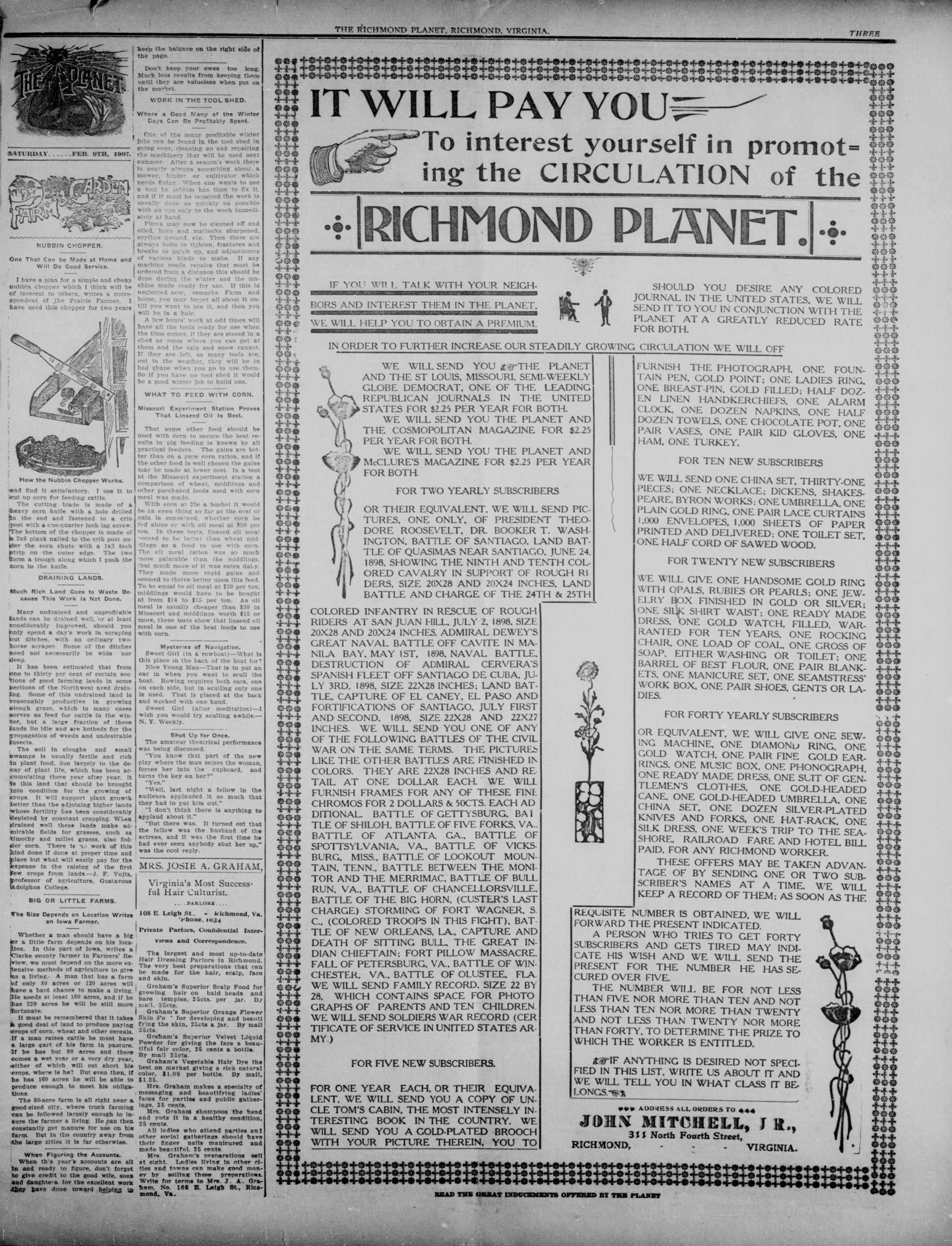
To interest yourself in promoting the CIRCULATION of the
IN ORDER TO FURTHER INCREASE OUR STEADILY GROWING CIRCULATION WE WILL OFF
WE WILL SEND YOU THE PLANET AND THE ST LOUIS, MISSOURI, SEMI-WEEKLY GLOBE DEMOCRAT, ONE OF THE LEADING REPUBLICAN JOURNALS IN THE UNITED STATES FOR $2.25 PER YEAR FOR BOTH.
WE WILL SEND YOU THE PLANET AND THE COSMOPOLITAN MAGAZINE FOR $2.25 PER YEAR FOR BOTH.
WE WILL SEND YOU THE PLANET AND McCLURE'S MAGAZINE FOR $2.25 PER YEAR FOR BOTH.
OR THEIR EQUIVALENT, WE WILL SEND PICTURES, ONE ONLY, OF PRESIDENT THEODORE ROOSEVELT, DR. BOOKER T. WASHINGTON, BATTLE OF SANTIAGO, LAND BATTLE OF QUASIMAS NEAR SANTIAGO, JUNE 24, 1898, SHOWING THE NINTH AND TENTH COLORED CAVALRY IN SUPPORT OF ROUGH RIDERS, SIZE 20X28 AND 20X24 INCHES, LAND BATTLE AND CHARGE OF THE 24TH & 25TH
READ THE GREAT INDUCEMENTS OFFERED BY THE PLANET
THE RICHMOND PLANET, RICHMOND, VIRGINIA
IF YOU WILL TALK WITH YOUR NEIGH-
```markdown
```
FOR TWO YEARLY SUBSCRIBERS
FOR FIVE NEW SUBSCRIBERS
REQUISITE NUMBER IS OBTAINED, WE WILL FORWARD THE PRESENT INDICATED.
A PERSON WHO TRIES TO GET FORTY SUBSCRIBERS AND GETS TIRED MAY INDICATE HIS WISH AND WE WILL SEND THE PRESENT FOR THE NUMBER HE HAS SECURED OVER FIVE.
THE NUMBER WILL BE FOR NOT LESS THAN FIVE NOR MORE THAN TEN AND NOT LESS THAN TEN NOR MORE THAN TWENTY AND NOT LESS THAN TWENTY NOR MORE THAN FORTY, TO DETERMINE THE PRIZE TO WHICH THE WORKER IS ENTITLED.
IF ANYTHING IS DESIRED NOT SPECIFIED IN THIS LIST, WRITE US ABOUT IT AND WE WILL TELL YOU IN WHAT CLASS IT BELONGS.
JOHN MITCHELL, JR.,
311 North Fourth Street,
RICHMOND. VIRGINIA
A man sitting in a chair and a man standing in front of him.
LANET
EEEKLY
LEADING
UNITED
TH.
T AND
ER $2.25
T AND
YEAR
ND PIC
THEO-
WASH-
D BAT-
UNE 24.
H COL-
UGH RI
LAND
& 25TH
Poppy
REQUISE
FORWA
SHOULD YOU DESIRE ANY COLORED JOURNAL IN THE UNITED STATES, WE WILL SEND IT TO YOU IN CONJUNCTION WITH THE PLANET AT A GREATLY REDUCED RATE FOR BOTH.
FURNISH THE PHOTOGRAPH, ONE FOUNTAIN PEN, GOLD POINT; ONE LADIES RING, ONE BREAST-PIN, GOLD FILLED; HALF DOZEN LINEN HANDKERCHIEFS, ONE ALARM CLOCK, ONE DOZEN NAPKINS, ONE HALF DOZEN TOWELS, ONE CHOCOLATE POT, ONE PAIR VASES, ONE PAIR KID GLOVES, ONE HAM, ONE TURKEY.
FOR TEN NEW SUBSCRIBERS
WE WILL SEND ONE CH
PIECES; ONE NECKLACE
PEARE, BYRON WORKS;
PLAIN GOLD RING, ONE
1,000 ENVELOPES, 1,000
PRINTED AND DELIVER
ONE HALF CORD OF SAV
FOR TWENTY NET
WE WILL GIVE ONE HAL
WITH OPALS, RUBIES OF
ELRY BOX FINISHED IN
ONE SILK SHIRT WAIST
DRESS, ONE GOLD WE
RANTED FOR TEN YE
CHAIR, ONE LOAD OF
SOAP, EITHER WASHING
BARREL OF BEST FLOU
ETS, ONE MANICURE SHE
WORK BOX, ONE PAIR S
DIES.
FOR FORTY YEARS
OR EQUIVALENT, WE W
ING MACHINE, ONE D
GOLD WATCH, ONE P
RINGS, ONE MUSIC BOX,
ONE READY MADE DRE
TLEMEN'S CLOTHES,
CANE, ONE GOLD-HEA
CHINA SET, ONE DOL
KNIVES AND FORKS, O
SILK DRESS, ONE WEEK
SHORE, RAILROAD FA
PAID. FOR ANY RICHMO
THESE OFFERS MAST
AGE OF BY SENDING
SCRIBER'S NAMES AT
KEEP A RECORD OF TH
THE NUMBER IS OBTAINED, WE
RD THE PRESENT INDICATED
PERSON WHO TRIES TO GET
BERS AND GETS TIRED M
IS WISH AND WE WILL SEE
T FOR THE NUMBER HE
OVER FIVE.
THE NUMBER WILL BE FOR N
VE NOR MORE THAN TEN A
MAN TEN NOR MORE THAN
IT LESS THAN TWENTY NO
ORTY, TO DETERMINE THE B
THE WORKER IS ENTITLED.
IF ANYTHING IS DESIRED NO
THIS LIST, WRITE US ABOUT
TELL YOU IN WHAT CLAS
ALL SEND ONE CHINA SET, THIRD
ONE NECKLACE; DICKENS, OR
BYRON WORKS; ONE UMBRELLA,
GOLD RING, ONE PAIR LACE CU
ENVELOPES, 1,000 SHEETS OF
AND DELIVERED; ONE TOI
LF CORD OF SAWED WOOD.
FOR TWENTY NEW SUBSCRIBER
ALL GIVE ONE HANDSOME GOL
PALS, RUBIES OR PEARLS; ONE
BOX FINISHED IN GOLD OR
K SHIRT WAIST; ONE READ
ONE GOLD WATCH, FILLED
FOR TEN YEARS, ONE R
ONE LOAD OF COAL, ONE G
EITHER WASHING OR TOIL
OF BEST FLOUR, ONE PAIR
THE MANICURE SET, ONE SEAM
BOX, ONE PAIR SHOES, GENTS
FOR FORTY YEARLY SUBSCRIBER
QUIVALENT, WE WILL GIVE O
MACHINE, ONE DIAMOND RING
WATCH, ONE PAIR FINE GOL
ONE MUSIC BOX, ONE PHONO
READY MADE DRESS, ONE SUIT
N'S CLOTHES, ONE GOLD-
ONE GOLD-HEADED UMBRELL
SET, ONE DOZEN SILVER
AND FORKS, ONE HAT-RAD
PRESS, ONE WEEK'S TRIP TO T
RAILROAD FARE AND HOT
OR ANY RICHMOND WORKER
COME OFFERS MAY BE TAKEN
OF BY SENDING ONE OR TW
YEAR'S NAMES AT A TIME. WE
RECORD OF THEM; AS SOON
IS OBTAINED, WE WILL
SENT INDICATED.
O TRIES TO GET FORTY
GETS TIRED MAY INDIC
WE WILL SEND THE
NUMBER HE HAS SE-
WILL BE FOR NOT LESS
MORE THAN TEN AND NOT
MORE THAN TWENTY
AN TWENTY NOR MORE
INTERMINE THE PRIZE TO
OR IS ENTITLED.
IS DESIRED NOT SPECI-
WRITE US ABOUT IT AND
IN WHAT CLASS IT BE-
WE WILL SEND ONE CHINA SET, THIRTY-ONE PIECES; ONE NECKLACE; DICKENS, SHAKESPEARE, BYRON WORKS; ONE UMBRELLA, ONE PLAIN GOLD RING, ONE PAIR LACE CURTAINS 1,000 ENVELOPES, 1,000 SHEETS OF PAPER PRINTED AND DELIVERED; ONE TOILET SET, ONE HALF CORD OF SAWED WOOD
FOR TWENTY NEW SUBSCRIBERS
WE WILL GIVE ONE HANDSOME GOLD RING WITH OPALS, RUBIES OR PEARLS; ONE JEWELRY BOX FINISHED IN GOLD OR SILVER; ONE SILK SHIRT WAIST; ONE READY MADE DRESS, ONE GOLD WATCH, FILLED, WARRANTED FOR TEN YEARS, ONE ROCKING CHAIR, ONE LOAD OF COAL, ONE GROSS OF SOAP, EITHER WASHING OR TOILET; ONE BARREL OF BEST FLOUR, ONE PAIR BLANKETS, ONE MANICURE SET, ONE SEAMSTRESS' WORK BOX, ONE PAIR SHOES, GENTS OR LADIES.
FOR FORTY YEARLY SUBSCRIBERS
OR EQUIVALENT, WE WILL GIVE ONE SEWING MACHINE, ONE DIAMOND RING, ONE GOLD WATCH, ONE PAIR FINE GOLD EARRINGS, ONE MUSIC BOX, ONE PHONOGRAPH, ONE READY MADE DRESS, ONE SUIT OF GENTLEMEN'S CLOTHES, ONE GOLD-HEADED CANE, ONE GOLD-HEADED UMBRELLA, ONE CHINA SET, ONE DOZEN SILVER-PLATED KNIVES AND FORKS, ONE HAT-RACK, ONE SILK DRESS, ONE WEEK'S TRIP TO THE SEASHORE, RAILROAD FARE AND HOTEL BILL PAID, FOR ANY RICHMOND WORKER. THESE OFFERS MAY BE TAKEN ADVANTAGE OF BY SENDING ONE OR TWO SUBSCRIBER'S NAMES AT A TIME. WE WILL KEEP A RECORD OF THEM; AS SOON AS THE
ADDRESS ALL ORDERS TO
IN MITCHELL,
311 North Fourth Street,
ND,
THE PLANET
CHELL, JR.,
Fourth Street,
VIRGINIA.
THREE
```markdown
```
.
FOUR
THE PLANET
Published every Saturday by JOHN MITCHELL,
JR., at all North 4th Street, Richmond Va.
JOHN MITCHELL, JR., EDITOR.
communications intended for publication
might be sent so as to reach us by Wednesday.
TERMS IN ADVANCE
One Copy. one year.
One Copy. eight months
One Copy. six months
One Copy. four months
One Copy. three months
Single Copy
ADVERTISING BATES
COMMUNICATIONS—When writing to us to review your subscription or to discontinue your order, you should give your name and address on our books. We cannot find your name on our books.
CHANGE OF ADDRESS—In order to change the address of a subscriber, we must be sent our order as well as the present address.
Entered at the Post-Office at Richmond, Va. in good-class matter.
Hon. William T. Vernon, Register of the Treasury is in the limelight these days. We have received a handsome programme of the banquet tendered him. Wednesday, January 30th, 1907 at 8 P. M. at the Odd Fellows Hall, Washington, D.C. This distinguished American has secured a firm hold upon the affections of the colored people of this country and his conduct in office has been such as to win the approval of all classes. May his shadow never grow less.
TROUBLE IN GEORGIA.
It seems to us that President Rosevelt might well learn a lesson from Gov. Terrell of Georgia, the state from which the maternal side of his family hailed. The Atlantic, Georgia Constitution of Jan. 31st, 1907 says:
"Two petitions were presented to Gov. Terrell yesterday urging him to offer rewards for the parties guilty of causing three Negroes, Frank Grant, Henry Scism and Marshall Davenport, to leave their homes in Habersham and Banks counties for fear of bodily harm.
It is charged that parties who were desirous of running these Negroes out of the counties went to their homes and fired into them, so terrifying them that they refused to remain in the community to be shot at, and left it.
The three Negroes in question were, it is stated, honest, indus trious and hard working citizens and had moved there to accept em ployment on farms. There is a scarcity of labor in that section, and there is a big demand for it on the peach farms, as well as in other agril cultural lines.
There are very few Negroes in Habersham and Banks counties, and among some of the native white people, there appears to be a prejudice against them. It is supposed that this led to their being ran out of the communities in which they lived.
Ordinary M. Franklin and other officials of Habersham county, seceded by Mayor George W. Grant and the city council of Alto, filed these petitions urging the governor to offer suitable rewards for the arrest of the guilty parties.
Governor Terrell has written the Ordinary for further particulars, and in the event the law authorizes it, the rewards will be offered.
The matter is an important one to the people of that section, as it affects not only the peace of the community, but the question of securing an adequate amount of suitable labor."
Here is a case "on all fours" so to speak with the trouble at Brownsville, Texas. The houses of colored citizens have been fired into and the colored people are in a panic strick en condition. Despite all of this, instead of indicting and punishing
everybody in the county because they will not tell who the guilty white men are, Gov. Terrell and the local authorities are actually putting in motion the machinery of law for the purpose of finding out who the guilty white men are.
This is contrary to the letter and spirit of the Rooseveltian doctrine All of the citizens of that county should be adjudged guilty until they prove themselves innocent.
If this is not done, then Mr. Roosevelt and his ideas are not being treated with proper respect and the doctrine and principles of Senator Joseph B. Foraker will prevail in even the "rock ribbed" state of Georgia.
JEROME ATTACKS THAW EXPERT
Dr. Wiley Savagely Cross Examined For Declaring Prisoner Insana.
QUESTIONS BAFFLED ALIENISTS
New York, Feb. 5.—The state laid its case against Harry K. Thaw—aplain, unemotional story of the shooting on the Madison Square Garden roof, leaving the malice and the motive to be inferred from the act—and the defence replied with a plea of hereditary insanity. It was asserted that Thaw in slaying Stanford White believed he was acting as an agent of Providence, but that real or fancied wrongs committed by the architect and former friend of his wife, had boiled and bubbled in his brain until at last there came the explosive
MIS. HARRY R. THAW.
impulse to kill. When the deed was done Thaw made no move to escape its consequences, but holding the fatal revolver aloft stood as if mutely proclaiming to the world: "The deed is done; it was right; it was not wrong."
Thus Thaw's counsel outlined his case to the jury, after the prosecution had occupied less than two hours in relating through eye witnesses the narrative of the tragedy.
Story of Killing or White.
Mr. Garvan, in telling the story of the alleged murder occupied less than 10 minutes, and the prosecution's entire case was kept within two hours. With the exception of young White and the coroner's physician who performed the autopsy and described the wounds on White's body, the only persons called to the stand by the state were five eye-witnesses. They were cross-examined briefly by Attorney Delphin Dalmas, of the defense, who thus appeared actively in the proceedings for the first time. The witnesses related the deliberate manner in which Thaw approached White, faced him and fired. They repeated Thaw's assertion "He ruined my wife," and Mrs. Thaw's remark to her husband. "Yes, but look what a fax you are in now." To this last remark Thaw replied: "Dearie, I have probably saved your life."
It was brought out that Thaw looked back at his victim as he walked away "with a starling look in his eyes."
Mr. Garvan's outline of the state's testimony was the briefest possible story of the crime. He told how White went to the roof garden on Madison Square Garden to see the initial production of a summer musical comedy, and then related in simple language the incident of the killing.
"The people claim," he concluded,
"that it was a cruel, deliberate, malicious, premeditated taking of human life. After proving that fact to you, we will ask you to find the defendant guilty of the crime of murder in the first degree."
Jerome Grills Expert.
Thaw's attorneys endeavored in vain to place before the jury evidence tending. it was said, to prove a strain of insanity in the collateral branches of the defendant's family, but they were blocked at every point by District Attorney Jerome, whose objections were upheld by the rulings of Justice Fitzgerald.
The defense did, however, get before the 12 men in the box the testimony of an expert, that in his opinion Harry Thaw was "suffering from insanity" the night of the tragedy. Mr. Jerome undertook to break down the evidence of the alienist—Dr. C. C. Wiley, of Pittsburgh—and for three hours put him through a cross-examination as severe as was ever heard in a New York court. The prosecutor was relentless in his attack, and before he had finished Dr. Wiley protestingly declared:
"I didn't come here as an expert. I came as a witness to a fact, and I have been converted into an expert without being prepared for it."
The district attorney astonished every one by his intimate knowledge of medicine and its technical phraseology, demonstrating the care will which he had prepared himself to meet the very defense which Thaw's course have entered in his behalf. Mr. Jerome searchingly inquired into Dr
THE RICHMOND PLANET. RICHMOND. VIRGINIA
Wiley's record as a physician and as an expert on insanity. He hurled volleys of technical questions at the witness, who at times sat mute, and at other times declared he could not answer, or gave evasive replies. Often he brought upon himself sharp warning from the district attorney to make a reply and not an argument. Dr. Wiley testified that he predicated his opinion as to Thaw's insanity upon his actions the night of the tragedy, as described to him in a hypothetical question propounded by the defense, and upon an incident which he witnessed on a Pittsburg street car during the summer of 1905. Thaw, said the doctor, acted irrationally on the car, coming in suddenly and jerking up one of the window blinds, slamming it down and then lifting it up again, the while engaging in a wordy war with the conductor.
"Have you ever examined this defendant with any of the recognized tests of insanity?" asked Mr. Jerome.
"No," replied the witness.
"Have you ever conversed with him?"
"No," replied the doctor.
The district attorney then drew from the alienist the opinion that Thaw's acts on the Madison Square roof garden, when he killed Stanford White, were not acts of insanity when taken singly, but constituted evidence of insanity when considered collectively. At times Dr. Wiley seemed entirely baffled by the questions. He hesitated at each, and before he could answer Mr. Jerome had framed another query replete with impressive sounding technical terms and apparently offering a problem no less difficult than its predecessor. The witness admitted that many of the tests to which the district attorney referred, such as the Romberg test and the Argyll Robertson pupil test were unknown to him, and when he was asked to quote from any accepted work on insanity, declared he could not give the exact language from any book.
Thaw's counsel sat silent and without protest as Mr. Jerome grilled the first witness for the defense. Thaw himself seemed to take but little interest in the cross-examination at the outset, but later began to take notes and was often in earnest conversation with those of his counsel who sat nearest him. At times Thaw could not altogether suppress the suggestion of a grin at the keenness of some of Mr. Jerome's questions and the subtle humor they so thinly concealed. But before the close of the day Thaw seemed to worry. He bit his finger nails and seemed anxious for the doctor's ordeal to end. His attorneys appeared a bit puzzled at first, but evidently determined to give the district attorney the widest liberty.
Tried to Show Strain of Insanity. It was at the close of Mr. Jerome's cross-examination of Dr. Wiley that the attempt was made to introduce testimony tending to show the strain of insanity said to have existed in certain branches of the Thaw family. Among the witnesses called to the stand was Albert Lee Thaw, of Richmond, Va., who said that his father and Harry Thaw's father were first cousins. The defense stated its purpose to draw from the witness the fact that his father died in an asylum for the insane, when Mr. Jerome objected. He declared that the relationship of both the witness and his father was too far removed from the defendant to be competent.
"And the law," he added, "is not satisfied that a man is insane merely because he died in an asylum or a retreat for persons suffering from mental disorders. The fact that a man dies in an institution such as that conducted by Dr. Wiley, the eminent specialist we had upon the stand today, for instance, is no proof that he was insane. There must be competent testimony to the fact."
Justice Fitzgerald upheld this view of the matter, saying, however, that his ruling was subject to revision if the attorneys for the defense could cite authorities on the subject. Mr. Gleason, who alone conducted the case for Thaw, did cite some cases, but promised to have more authorities in court.
The defense next introduced as a witness Benjamin Bowan, who testified that in January, 1904, he had a conversation with the defendant. He was about to tell what the conversation was, when Mr. Jerome objected, declaring a conversation so far back was not relevant or material. Justice Fitzgerald again called upon Thaw's attorneys for citations of authorities covering the introduction of testimony of the character proposed.
Justice Fitzgerald sustained Mr. Jerome's objection, and the witness stepped aside.
Dr. C. H. Bingaman, of Pittsburg, who has been a family physician of the Thaw's for 30 years, took the stand and testified that he had known Harry Thaw ever since his infancy. He had treated him once for St. Vitus dance. He seemed to be a lad of highly nervous temperament and slept badly at night, said the witness.
Mr. Jerome's cross-examination was brief.
"How old was the defendant when he had St. Vitus dance?" he asked.
"Seven."
"That is all doctor."
Dr. John F. Deemar, of Kittanning, Pa., the family physician of the Couley's, Mrs. William Thaw, the prisoner's mother having been a Miss Couley, was the last witness of the day. He was called to testify as to the mental condition of John Ross, a cousin of Harry Thaw, when Mr. Jerome objected. Justice Fitzgerald held that until the defense's authorities on the introduction of testimony as to collateral insanity were presented, he thought it best to rule out all such testimony for the time being.
Lawyer Dropped Dead In Court
Lawyer Dropped Dead In Court.
Tunkhannock, Pa. Feb. 6. C. Oscar Dissheimer, a prominent member of the Wyoming county bar, died suddenly in court in Montrose. He was attorney for the Lehigh Valley Railroad company and was conducting a case in which the company was interested. He rose to object to some testimony offered, and after sitting down dropped his head in his hand and expired almost instantly of apoplexy. He leaves a widow and two children.
BRIGGS ELECTED JERSEY'S SENATOR
Was Made Republican Caucus Nominee After a Hot Fight.
SUCCEEDS JOHN F. DRYDEN
Trenton, N. J., Feb. 6.—State Treasurer Frank O. Briggs was elected by the New Jersey legislature to succeed John F. Dryden as United States senator for the six years beginning March 4 next.
Mr. Briggs's election came as a result of a series of caucuses or attempted caucuses on the part of the Republican members of the legislature. There was trick of a combination against Mr. Briggs in favor of State Senator Bradley, of Camden. Later in the day Governor Stokes took an active hand in the matter in favor of Mr. Briggs, with the result that Mr. Bradley practically withdrew.
When the Republicans finally decided to take a vote in caucus Mr. Briggs captured the nomination with 22 votes out of the 40 members present. The other 18 votes were divided as follows: Governor Stokes, 7; Senator Bradley, 5; Justice Pitney, 4, and former Governor Griggs, 2.
Immediately at the conclusion of the Republican caucus the legislature went into joint meeting, and Mr. Briggs' election was accomplished. He received 41 votes, a majority of the entire legislature. Senator Colby voted for Justice Pitney, Senator Ackerman voted for former Governor John W. Griggs and Assemblyman Buck was absent. Assemblyman Fake, who refused to go into the Republican caucus, voted in the joint meeting for Mr. Briggs. This he did at the solicitation of Governor Stokes and former Assistant Postmaster General William M. Johnson.
The Democrats held a caucus, buried their differences and agreed to support James E. Martine. This eliminated Dr. Woodrow Wilson, of Princeton University, who was being supported by former United States Senator James Smith, Jr., and Colonel E. A. Stevens, who was backed by the Hudson delegation. Mr. Martine in the joint session received the votes of all of the 23 Democrats who were present.
At the conclusion of the joint session Mr. Briggs held an informal reception in his office in the state house. He has not yet decided when he will resign as state treasurer, but he will probably do so before the present session of the legislature adjourns. The state treasurer is elected by the legislature in joint session, and the Republicans are in a position to choose Mr. Briggs' successor.
DON'T OPPOSE NATIONAL GUARD
Military Organizations In Coal Reserves
gione Protest Against Charges.
Wilkes-Barre, Pa. Feb. 4. — The Catholic Total Abstinence Union Regiment and the Junior O. U. A. M., two strong military organizations in the anarchic region, held meetings in this city to take action relative to the report made by Captain Henry H. Whitney, of the Coast Artillery, to the government.
Captain Whitney is one of the regular army inspectors, who was sent into Pennsylvania to inspect the national guard, in which he is reported to have quoted in his report that independent military companies are secretly armed and drilled and whose purpose it is to oppose the national guard in case of strikes and other labor troubles.
These two organizations possess the strongest military regiments in this state, and they took occasion to show their disapproval of the statement made by the inspector. They passed resolutions showing their friendly position toward the Pennsylvania and all other national guards, for the good work they have accomplished. They dispatched copies of the same to Secretary Taft, of the war department.
RAILROADERS GET INCREASE
Southern Railway Raises Wages From 6 to 25 Per Cent.
Washington, Feb. 6—All the conductors, trainmen and yardmen of the Southern railway are to receive an increase in wages aggregating between $350,000 and $400,000 a year. The increase amounts to from 6 per cent. as the minimum to 25 per cent. as the maximum. Through freight conductors are to be paid on a basis of $3.18 per 100 miles; local freight conductors, $3.80 per 100 miles; local freight conductors, $2.15 per 100 miles, and through freight brakemen, $1.75 p.r 100 miles. Other conductors and trainmen are granted proportionate increases, as are the yardmen.
Two Drowned While Skating
Reading, Pa., Feb. 4.—Three boys broke through the ice while skating on the Schylkill river, and two, Paul Nuss and James T. Jessum, each 9 years old, were drowned. The bodies were recovered.
1907 FEBRUARY 1907
Su. Mo. Tu. We. Th. Fr. Sa.
1 2
3 4 5 6 7 8 9
10 11 12 13 14 15 16
17 18 19 20 21 22 23
24 25 26 27 28
Outbreak of Typhoid at Allentown.
Allentown, Pa., Feb. 1. There are 25 cases of typhoid fever in this city, all but two of which have been traced to the imame source, contaminated milk. The health authorities located the source of the trouble after four cases had developed. The state authorities gave taken the mater in hand. The first death was that of Miss Adele Abele.
A WEEK'S NEWS CONDENSED
By an explosion of powder in a coal mine at Johnson City, Ill., five men were killed and 11 hurt.
Fire destroyed the stables of J. J. Dunbar, at Norfolk, Va., and 48 valuable horses were burned to death.
A bill was introduced in the U. S. senate providing that September 23 shall be set aside as "Paul Jones Day." Nancy White, a negress, 106 years old, the oldest woman in Western Pennsylvania, is dead at her home in New Haven, Pa.
Miss Lillian Barber, of Iron Hill, Md., died in Wilmington, Del., from burns received in falling downstairs while carrying a lighted lamp.
Friday, February 1.
Thieves stole $6000 worth of jewelry from the home of Mrs. Katie McKenna, at Niagara Falls, N. Y.
General William Shakespeare, soldier, editor, lawyer and banker, died at Kalamazoo, Mich., from wounds received in the Civil War.
The third annual convention of the American Society of Religious Education was held at Reading, Pa.
William J. Donohue, a member of the New York legislature, committed suicide in Brooklyn by shooting himself.
President Roosevelt will deliver an oration at the dedication of the McKinley monument at Canton, O., the last week in September.
Saturday, February 2.
Henry B. Constable, aged 80 years, a prominent banker, died suddenly at Norfolk, Va.
In a dispute between John Gebhardt and his son Charles at Steubenville, O., the father was shot and killed.
Harry Smith, teller of the Hocking Valley National Bank at Lancaster, O., is under arrest for embezzling $5455.
The U. S. senate passed a bill increasing the pensions of survivors of the Indian wars from $8 to $10 a month.
Edward Newbury, a section hand on the Pennsylvania railroad, was killed at Bordentown, N. J., by being struck by an engine.
Monday, February 4.
The "Day and Night" Tobacco company's plant at Cincinnati, O., was destroyed by fire, Loss, $65,000.
Gambling at Cananea, Mexico, has landed in jail Edwardo Arnold, the mayor; his brother and 40 Americans.
Mrs. Johanna Wolf and Mrs. Mary Mellvain were burned to death in a fire which destroyed a tenement house at Cincinnati, O.
A ton of powder and 1000 pounds o. dynamite exploded at Lenton, Ind., killing one Monon railway workman and injuring six.
John Carter, of Titusville, Pa., has just concluded the sale of his West Hickory timber farm of 3000 acres to C. W. Stone and James Wetmore, of Warren, and Thomas McCabe, of Kinza, for about $300,000.
Lady Grenfell, eldest daughter of Lord and Lady Grey, died in Ottawa, Can., of typhoid fever.
Mrs. A. Haskell, a wealthy widow, was burned to death in a fire which destroyed her home in Chicago.
President Roosevelt has appointed Ruch J. Bruce to be assistant appraiser of merchandise at Baltimore, Md.
Rev. Seymour A. Baker, one of the founders of the Republican party, died of pneumonia at Kansas City, Mo., aged 91 years.
While pouring molten steel into an ingot mould at the Carnegie plant at Homestead, Pa., an explosion occurred and three workmen were seriously burned.
Wednesday, February 6.
Street thermometers in St. Paul, Minn., on Tuesday registered from 22 to 32 degrees below zero.
The fourth annual convention of the Road Makers' Association will be held at Pittsburg, Pa., March 12, 13 and 14.
Fearing he would be robbed of $3600, an Italian jumped from a Wabash train near Adrian, Mich., and was seriously injured.
One trainman was killed and two injured in a collision near Uniontown, Pa., between a Monongahela railroad passenger train and a freight.
United States District Court Judge Charles Parlange, one of the leaders of the anti-lottery movement in Louisiana, died suddenly of apoplexy at New Orleans.
PRODUCE QUOTATIONS
PHILADELPHIA FLOUR firm;
winter extras, $2.65@12.5; Pennsylvania roller, clear, $2.99@3.10; city mills, clear, $2.99@3.10; IRM firm, per barrel, $3.65; WHEAT firm, 2 Pennsylvania red, $77@77%; CORN firm; No. 2 yellow, local, 51%; OATS firm; No. 2 white, clipped, 44@44%; lower grades, 42%; HAY steady; No umothy, large bales, $21; PORK firm; many, large bales, $21; steady, beef hams, per barrel, 19%; POULTRY: Live steady; hens, 14%; old roosters, 9%; Dressed steady; choice fowls, 14%; old roosters, 9%; BUTTER steady; extra creamy, 35%; nearby, 8%; nearby, 8%; nearby, 28%; southern, 25%; OTATOES steady; per bushel, 55%@58
BALTIMORE - WHEAT steady; No. 2 spot, 79% @80c.; steamer No. 2 spot, 73% @78c.; southern, 73% @78c.; CORN steady; mixed spot, 49% @50c.; mixed, 48% @48c.; southern, 48% @48c.; No. 2, 48% @44c.; No. 3, 42% @43c.; No. 41% @41c.; mixed, No. 2, 42% @42c.; No. 3, 41% @41c.; No. 4, 38% @40c BUTTER firm; creamy separator extras, 31% @32c.; held, 24% @25c.; prints, 33% @33c.; Maryland and Pennsylvania prints; print, 33% @33c; fancy Maryland, Pennsylvania and Virginia, 24c.; West Virginia, 23c.; southern, 21@22c.
Live Stock Markets.
PITTSBURG (Union Stock Yards)—
CATTLE steady; choice, $5.75@6;
prime, $5.40@5.70. SHEEP steady;
prime wethers, $5.50@5.70; culls and
common, $2.24; lambs $7.70; veal
heavies, $2.24; active prime
heavies, $7.25; medium and
Yorkers. $7.30; light Yorkers, $7.25;
pigs, $1.75@7.20; roughs, $5.50@6.00
Mrs. Longworth Improved.
Washington, Feb. 5.—Considerable improvement was shown in the condition of Mrs. Alice Roosevelt Longworth, wife of Representative Longworth, of Ohio, who has been confined to her home for several days with an attack of the lagripe. Mrs. Roosevelt was an early caller at the Longworth residence to inquire of the condition of her daughter.
BIG BLAZE AT HARRISBURG
Theatre Burned and Nine Buildings
Damaged; Loss $230,000.
THRILLING RESCUE OF ACTOR
Harrisburg, Pa., Feb. 2.—Starting in a cellar of the historic Grand Opera house block, the most destructive fire Harrisburg has known since the burning of the capitol building within one day of 10 years ago, completely destroyed the building and damaged nine other buildings on Third and Wulnut streets and either wrecked or injured several other business establishments. The loss on buildings and contents is estimated at $300,000, which is partially covered by insurance.
The losses on buildings are as follows: Grand Opera house, $80,000; Park hotel, $20,000; Hotel Columbus, $20,000; Duncan building, $3300; Security Trust building, $2500; Harrisburg Gas company building, $5000; Harrisburg Cycle and Typewriter company's store, $2000; College block. $1,000; Bijou theatre, $4000; Hoover's jewelry store, $1500. Other losses were tenants of the opera house, the Park hotel and adjoining buildings.
The following firemen were injured: George Ehler, injured about legs; Edward Waldon, hip injured; Raymond Collins, injured about legs; C.W. Gillchrist, contusion of thigh; Frank H. Downey, Jr. fingers injured.
John Smith, a stage hand, who was rescued from the Grand Opera house; may die from exposure. He is in a critical condition at the Harrisburg hospital.
While thick clouds of smoke were coming out the windows of the Opera house the firemen saw a figure at one of the big windows high up in the building. Then came a crash and a jingling of glass, and what looked like a man naked all but his shirt crawled out on the sill. Standing on the window sill, he shrieked for a ladder.
"Send a ladder up here. Hurry up; send a ladder up here."
More smoke piled out of the windows then, and slowly a ladder was raised. Its top came within several feet of the window sill. A small ladder was hoisted by men on the big ladder. The man on the window sill stopped screaming. He swung his arms; the crowd thought he was going to jump. "Don't jump, boy; hold on." cried the firemen. The man got on his knees and crawled out on the window and let his legs hung over. By that time the smaller ladder had reached him, and he grabbed the hooks, and fitting them onto the sill, he began to crawl down.
Edward Holbert, a fireman, went up to met him and got the man in his arms. Then the rescued man fainted and had to be carried the rest of the way. He was hurried to the Harrisburg hospital, where it was found he was not badly hurt. His name is John Smith, his home being in New York. He belongs to the stock company, and had been sleeping in one of the dressing rooms when the firebroke out.
WOULD CHANGE CONSTITUTION
Bill In Pennsylvania Legislature For Convention Next Fall.
Harrisburg, Pa., Feb. 6. — Senator Langfitt, of Allegheny, has introduced a bill calling for a constitutional convention. It provides that the people shall vote on the question at the next November election, and that delegates on the basis of three from each senatorial district, shall be ected.
The candidates for delegates are to be named at the spring primary, and if a majority of the people vote, in favor of the convention in November, it is to be called by the governor. The convention shall be held in the hall of the house on the first Tuesday in December next, and the amendments then agreed upon shall be submitted to the voters. Compensation is fixed at $150.0 with mileage and $150 for postage.
HAD A WAGON LOAD OF LOOT
Shoplifter Captured By Police Carried a Back
Scranton, Pa., Feb. 5.—Mrs. Peter Scalzo, a young Italian woman, of Old Forge, was arrested for shoplifting. When the police returned from her home in Old Forge they brought with them a wagon load of stolen goods. There were 614 different articles in the load, including some valuable silks and the like. A sack that she carried under a long cloak when she was arrested contained 21 articles, representing as many thefts, and the stores had been open only seven hours when she was taken. Four different storekeepers have already identified some of the stolen goods.
MORE PAY FOR LETTER CARRIERS
Senate Passes a Bill That Applies to Free Delivery Offices,
Washington, Feb. 2. — The senate passed a bill increasing the salaries of letter carriers in free delivery offices. It was explained that the same provision was to be made in the post-office appropriation bill, but it was desirable that the senate place itself on record in favor of the measure.
The bill fixes the first year's salary of such carriers at $600, with an annual increase of $100 until the maximum of $1200 has been reached.
CAPTAIN CASTO TO THE RESCUE
Atlantic City, N. J., Feb. 6.—Captain Mark Casto, hero of the Clerokee, risked his life again. A fourmasted vessel, believed to be one of the Reading railroad's steel barges, was sighted by the government life saving crew at the Atlantic City station drifting helplessly before the furious northeast gale, nearly four miles from shore. No signs of life were visible aboard. The government life savers made no attempt to reach her.
Captain Casto, knowing that these boats usually carry a crew of three men, besides a captain and a cook, called his crew about him and asked for volunteers to go to the rescue. The schooner Alberts cast off and made for
Subscribe to the PLANET.
the mouth of the inlet. With the fourth attempt Casto got a line to the unknown ship. Those on shore saw saills raised on the strange craft, and, running before the storm, the vessel, with the Alberta alongside, disappeared down the coast. Whether Casto found the crew aboard or not, he and his crew can claim rich salvage at the first port they reach.
WILL AUDIT CAPITOL ACCOUNTS
New York Company to Assist Pennsylvania Probers.
Harrisburg, Pa., Feb. 5.—Governor Stuart advised the capitol investigating committee of the appointment of the Audit Company of New York to assist in its investigation. The governor suggested that as the auditors and accountants are ready to proceed that they be directed to commence their investigations immediately.
The committee directed the auditors to begin an immediate investigation of the accounts between the capitol contractors and the state. The governor has not yet selected special counsel for the committee. State Treasurer Berry said that he would ask the governor to permit him to be represented at the investigation by private counsel.
The committee organized by the selection of Senator John S. Fisher, of Indiana, as chairman, and Harry S. Calvert, of Pittsburg, and Frank Bell, of Harrisburg, as secretaries. The committee adjourned to meet at the call of the chair.
TRAINMEN TURNED DOWN
Philadelphia, Feb. 5.—The grievance committee of the Brotherhood of Firemen and Trainmen on the lines of the Pennsylvania railroad east of Pittsburgh and Erie, who have been asking for higher wages and what they term an equalization of hours, were refused any concessions on the part of the railroad at a meeting with General Manager Atterbury and superintendents of the various divisions.
The trainmen have been dissatisfied since the railroad some time ago announced the general increase of 10 percent. in wages of all employees receiving less than $200 a month. The trainmen complain that the increase was not in proportion to that received by the conductors, considering the duties performed by each class of employees.
AGED WOMAN BURNED TO DEATH
Her Remains Found In Snow Outside Her Home.
Allentown, Pa., Feb. 4.—Mrs. Sarah Ann Dunkard, an aged woman, who lived a hermit life just outside of Telford, on the county line, was burned to death during Saturday night or early Sunday morning. Her charred remains were found outside of her home by a Philadelphia & Lehigh Valley Traction car crew. They were lying on the snow, the woman having died in a vain attempt to reach help. The woman habitually smoked a clay pipe, and this is supposed to have ignited the woman's clothing.
RUN DOWN BY A TRAIN
Man and Wife Fatally Injured While
Returning From a Funeral
Returning from a Funeral.
Allcntown, Pa., Feb. 4.—Returning from a funeral at Emanus, Mr. and Mrs. Menno Gehman, of Zionville, were fatally injured, and their adopted son, John Fidler, seriously hurt when the carriage in which they were riding was struck by an empty freight engine of the Philadelphia & Reading road, near Emanus. Gehman is about 55 years of age and a farmer. The boy is the son of a deceased Mennonite missionary.
THE EMPIRE LAMP SHADE
How Any Deft Fingered Woman Can
Make One.
An empire lamp shade may be made at home if one cannot be found in the shops, says the New York Herald. The frame consists of an upper and a lower ring of wire connected by four supports. The upper ring is sixteen inches in diameter, the lower ring twenty inches and the supports twelve inches in length, placed equally distant around the rings. Wind the wires of the sides and top ring with narrow strips of china silk of a color harmonizing with the general tone of your room or with the article of furniture nearest which the lamp is to stand.
The materials required are three and one-half yards china silk, two and one-half yards lace as deep as the distance between the top and lower rings, four and one-half yards lace of the pattern four inches deep, enough iron wide gold braid to sew around the rings and to form frames for the five pictures which adorn the sides.
Cut a lengthwise piece of silk three yards long and one-half inch wider than the distance from the top ring to the base of the frame. The extra half inch is to allow for the turning in of the edge at the top and for drawing around the lower wire. Care should be taken so the silk will not bag and that the sewing is done securely. The lace is sewed at the lower edge first without any fullness, then gathered evenly and sewed at the top ring. A strip of the silk one and one-half inches wide is fringed one-half inch and gathered extremely full to fit the top ring. This is sewed with raw edges on the outer side of the shade. A narrow gold braid covers all these edges and finishes the top. A silk ruffle four inches deep is sewed to the lower wire and over this the lace ruffle, a strip of gold braid hiding the joining. Exercise much care in sewing on the braid. By holding the unattached end in the left hand and keeping the braid stretched quite tightly a smooth effect can be obtained. The pictures should be severely empire in style, a visit to a second hand book store being helpful in getting old fashioned prints that can be easily colored with water colors. Around each picture sew the braid, turning the corners neatly as with a frame effect.
Place the pictures evenly on the shade, leaving the same space above as below, and sew firmly through the braid, picture, lace and silk. When this is securely done with sharp pointed scissors cut away not too closely the silk and the lace directly behind the pictures, overcast these edges and you are done.
THE PLANET
SATURDAY.....FEB. 9TH, 1907.
FELL INTO OCEAN; SWIMS ALL NIGHT
SAILOR TELLS STORY OF HIS AC
CIDENT AND REMARK-
ABLE RESCUE.
UNDRESSED IN THE WATER
Topplets from Bridge of Ship While Asleep—Dozes at Times But Manages to Keep Afloat for Eight Hours.
New York—Paul Seldler, the Hungarian sailor who fell from the bridge of the Carpathia, 200 miles off Gibraltar, at 8:30 at night and swam until picked up by another steamer at 4:30 the next morning, told his story for the first time the other night. He arrived here a few days ago.
"I fell asleep leaning on the rail on the starboard side of the ship, at the highest point of the deck. I woke up all of a sudden, with water all around me. I had fallen 45 feet. I am used to the water, but there was something awful in coming to the surface and seeing the cabin light of a ship disappear in the night.
"I heard a rattle, so I knew that they were lowering a lifeboat. The big ship stopped when it seemed almost out of sight. I might have shouted, but I reasoned that they would find me and I would be wasting breath that I might need.
"I had on all my clothes, including an overcoat. They began to bear me down. The current must have carried me, for the ship got further and further away and the boat was out of sight altogether. I knew I must get out of my clothes. First I got off my coats and then I tried to take off my shoes. I had to let myself sink each time I unlaced a bit of the strings, and I would struggle to the surface for alr. Finally I got off my shoes and I was almost exhausted.
"What did I think of? I am an atheist, and I found myself asking if I believed in God. I knew I was near death. My friends used to tell me that when I was near death I would see God as they saw him. I argued with myself, but I could not believe.
"Then I thought of what the people on the ship were thinking of me, and it gave me joy to think they were sorry for me, because I thought all must think me lost.
"I shivered in the cold. I thought of sharks. I talked aloud. I fell asleep. Yes, I fell asleep. That sounds funny, and it scared me as I woke up with a start as the water came into my nose and mouth. I don't know how long I would sleep at a time. It probably was only a minute, but it seemed half an hour. I would wake up talking about the sharks. After awhile I fell to thinking of my wife and child. I didn't know where they were. Then I wondered if I was
J. H.
They Rescued Him in the Nick of Time.
going to die, and I was sorry because I could not go to sea again.
"The time passed quickly. I suppose it was because my senses were so numb from the cold. After a long time I saw a ship. I could almost have cried for joy. I must have been in the water six hours then I was naked and cold and my legs and arms was so tired! I rolled over on my side and watched the ship as I swam in the cold. It was awful! I would measure the distance and the speed of the ship and I would look at the stars
"I think I must have lost my head several times. The ship seemed to be coming and then going. Finally I thought myself right in front of it and I shouted with all the strength left. My shores were heard. I saw men leaning over the side. Then I saw a boat drop into the water, with men at the oars. They came to me and me up me. They dragged me into the boat, and when we got to the side of the ship I climbed up the rope ladder. I surprised myself in doing that.
"Once in the cabin, I got some hot whisky, and after a time I told them my story. They could not believe me at first, but when we met the Carpathia at Gibraltar, they did. I had been in the sea eight hours."
CHURCH AND CLERGY.
The Presbyterian church in the United States of America has now 1,158,662 members, a gain of 43,000 for the year.
The Rev. Gifford Dorey, who has been in the active ministry for nearly 60 years, is the oldest minister of the Wesleyan church of Great Britain.
The George Sealy memorial window is being put in place in Trinity church at Galveston. The window is 20 feet high, 9 feet wide and cost $7,000.
A much loved Sunday school teacher, who had taught her class since 1853, not missing a single Sunday, passed to her reward from Astoria, L. L., a short time ago.
The Rev. F. B. Meyer of London, England, will be 60 next spring, at which time he purposes to sever his connection with Christ church of that city, of which he is now pastor.
The Rev. L. L. Conrady, the Belgian priest in whose arms Father Damien breathed his last at the Hawaiian leper colony on the island of Molokal, is on his way to China, where he will establish similar colonies and spend the rest of his life.
According to the year books of the denominations the per cent. of gain in members for the year 1905 was as follows: Baptists, two and three tenths; Congregational, two and two tenths; Presbyterians, two per cent.; Methodist Episcopal church, one and eight-tenths.
Methodism has at least one living follower who became identified with the church more than a century ago. Mrs. Mary Ramsey Lemons Wood recently celebrated her one hundred and nineteenth birthday at Hillsboro, Ore. She united with the Methodist church in 1799.
DOLLAR Package
MAN MEDICINE FREE
You can now obtain a large dollar size free package or Man Medicine—free on request.
Man Medicine has cured thousands upon thousands of weak men. Man Medicine will cure you; restore you to full strength.
Man Medicine cures vital weakness, nervous debility, early decay, discouraged manhood, blood poison, brain fag, backache, prostatitis, kidney and bladder trouble and nervousness.
You can cure yourself at home by Man Medicine, and the full size dollar package will be delivered to you free, plain wrapper, with full directions how to use it. The full size dollar package free, no payments of any kind; no receipts; no promises; no papers to sign. It is free.
All we want to know is that you are not sending for it out of idle curiosity, but that you want to be well and become your strong, natural self once more. Man Medicine will do what you want it to do—make you a real man. Your name and address will bring it; you want to do is to send and get it. We send it free to discouraged man. Interstate Romedy Company. 263 Luck Bldg., Detroit, Mich.
Mardi Gras, New Orleans, La., Mobile, Ala., and Pensacola Fl. Feb. 7-12, 1907.
Very low rates via Southern Rail way from all points to the above points and return. Selling dates, February 6th to 11th, inclusive, return limit Feb. 16th with privilege of extension return limit to March 2nd, 1907. Buy deposit of ticket at destination and payment fee of fifty cents. These tickets embrace stop over privileges at many points. Two through schedules daily. Drawing room Pullmans, dining cars.
CONDITION OF
The Mechanics Savings Bank, located at Richmond in the State of Virginia at the close of business, 26th day of January, 1907, made to the State Corporation Commission.
RESOURCES
Loans and Discounts..... $4427.94
Overdrafts..... 1871.11
Stocks, Bonds & Mortgages 2762.36
Other real estate..... 84816.46
Furniture & Fixtures..... 2160.62
Exchanges for clearl'g house 3650.87
Due from Nat. Banks..... 20359.94
Specie, nickels & cents..... 628.64
Paper Currency..... 550.00
All other items of resources 1287.67
Total..... $122514.71
LIABILITIES.
Capital stock paid in . . . $23533.82
Surplus fund . . . 6250.00
Dividends unpaid . . . 213.00
Individual deposits subject
to check . . . 31081.13
Time certificates of deposit 61431.76
Certified checks . . . 5.00
Total . . . $122514.71
I. Thomas H. Wyatt, do solemnly
swear that the above is a true state
ment of the financial condition of
the Mechanics' Savings Bank, locat
ed at Richmond, in the State of Vir
ginia at the close of business on the
28th day of January, 1907 to the
best of my knowledge and belief.
Thomas H. Wyatt, Cashler.
Correct—Atest.
John Mitchell, Jr.
D. J. Chavers.
J. J. Carter.
State of Va., City of Richmond.
S sworn to and subscribed before me this 4th dav of Feb. 1907.
J. Thomas Hewin, Notary Public.
My Commission expires Apr. 18th, 1910.
THE RICHMOND PLANET, RICHMOND, VIRGINIA
JOB DEPARTMENT
EXCURSION
We print Handbills, Quarter-Sheet posters, Tags, Tickets, Placard utes, Visiting Cards, Mourning Stations
WE HAVE
Our St
OF THE LATE
WE CAN PRINT A BILL AS SMALL
A Three-Sheet
AS LARGE AS A FRO
Our street-entrance is retired and fastidious lady being able to enter w
EXCURSION WORK OF ALL DESCRIPTIONS
We print Handbills, Quarter-Sheets, Half and Whole Sheet posters, Tags, Tickets, Placards, Society Cards, Minutes, Visiting Cards, Mourning Stationery.
OUR AIM is to please our patrons and to give them the best service at the lowest prices, consistent with satisfactory work.
We furnish "cuts" when desired and we will arrange to complete special work in our line. When in need of any work in our line, call and see us and estimates will be furnished.
WE HAVE AN ELEGANT LINE OF SAMPLES
WHICH WE WILL SHOW ANY ONE DESIRING TO SEE THEM.
Our Stock Room Embraces a Full Line
OF THE LATEST STYLE BOND, FINE WRITING—FLAT AND LINEN PAPER, ENVELOPES, ETC.
WE CAN PRINT A BILL AS SMALL AS A DODGER. A Three-Sheet Poster AS LARGE AS A FRONT DOOR.
Our street-entrance is retired and has no objectionable features, the most fastidious lady being able to enter without embarrassment or annoyance.
LONG DISTANCE TELEPHONE, 2213.
His eyes leaped into a blaze of wrath.
His eyes burned with resentment.
He opened his lips to reply; every word
was a coal.
Her cheeks flamed suddenly.
His face was lurid with anger.
She went out slowly.
"That"
we also
see; you
it not?"
"Yes, s
"Grackle
you are
shall at
---
It is thoroughly equipped to do all kinds of printing on short notice. We make a specialty of Society printing and work for Insurance Companies, such as Financial
TOOK THE SOVEREIGN.
An automobilist who was touring through the country saw, walking ahead of him, a man followed by a dog. As the machine drew near them the dog started suddenly to cross the road; he was hit by the car and killed immediately. The motolist stopped his machine and approached the pedestrian.
"I'm very sorry, my man, that this has happened," he said. "Will a sovereign make it all right?"
"Oh, yes," said the man; "I suppose so."
Pocketing the money as the car disappeared in the distance, he looked down at the dead animal.
"I wonder whose dog it was?" he said.
"Lend us a bob. Sam."
"Ow do I know I shall git it back"
"I promise it yer on the word of a gent."
"Well, bring the gent down 'ere to me, and yer shall 'ave it."—jester
THE HOLOGAUST.
The hot words leaped from his lips. His ears were scorned by her vehemence.
Even as he crumpled into a heap on the table the smoldering remnants of his rage gleamed fitfully through the ashes of repair that veiled his countenance.—Life.
PENNIB'S GREAT RAISE.
"Mr. Richly," began Pennib, the bookkeeper as he entered his employer's office on New Year's morning. "I have called to see why my salary has not been increased this year." "Why—why, hasn't it, my boy?" nervously asked the head of the firm. "No, sir; it has not." firmly replied Pennib. "I have been with you now
Cards, Policies, both straight life and benevolent, Physician's Certificates, Sick Cards, Application blanks, Agents Report Sheets, Rate Cards, etc.
MISSION WORK
Charter-Sheets, Half and Whole
Placards, Society Cards, Min-
ing Stationery.
WE AN EL
WHICH WE WILL
Stock Roof
LATEST STYLE BOND, FIRE
AS SMALL AS A DODGER.
Sheet Poster
A FRONT DOOR.
OUR PRESENT CORP OF EMPLOYE
IS WITHIN EASY REACH OF
tired and has no objectionable f
enter without embarrassment o
2213.
Notice,
The 1907 Official Servi
on Anniversary or Thanks
$2.00 for 100, $1.25 for 50,
should have them. Money y
to S. W. STARKS, Supre
West Virginia if you need
$150 PER
SURE TO GOOD AGENT
greatest seller in America to day. Nothi
does the work. Sells at almost every ho
on the dollar. Write to-day for full parti
Address
N WORK C
is, Half and Whole
Society Cards, Min-
istry.
is to please
give them
the lowest
with satis
AN ELEGANT
WHICH WE WILL SHOW AN
Rock Room D
STYLE BOND, FINE WRITE
AS A DODGER.
Poster
DOOR.
PRESENT CORP OF EMPLOYEES ARE
IN EASY REACH OF THE PUBLISHER
is no objectionable features, the
but embarrassment or annoyance
Notice, K. o
The 1907 Official Service or Prog
anniversary or Thanksgiving Day,
or 100, $1.25 for 50, or 75c. for
have them. Money must be sent
W. STARKS, Supreme Chance,
virginia. If you need Badges ord
150 PER MON
TO GOOD AGENTS, handling
in America to day. Nothing else like it
Sends at almost every home over and over
Write to-day for full particulars, with rea
Address
WORK OF ALL
and Whole
Cards, Min-
OUR AIM
is to please our patrons and to
give them the best service at
the lowest prices, consistent
with satisfactory work.
ELEGANT
WE WILL SHOW ANY ONE DESIRI
Room Embrace
BOND, FINE WRITING—FLAT AND
OODGER.
ster
TOP OF EMPLOYEES ARE COMPETENT AND O
REACH OF THE PUBLIC, BEING WITHIN P
ctionable features, the most
assment or annoyance. FOR FUR
Jol
ce, K. of P's
Official Service or Program to be used
for Thanksgiving Day, can be had for
.25 for 50, or 75c. for 25. All Lodges
. Money must be sent with your order
KS. Supreme Chancellor, Charleston,
if you need Badges order them at once.
PER MONTH
GOD AGENTS, handling the world's greatest of
day Nothing else like it No long talk My plan
most every home over and over again. 87 clear profit
for full particulars, with real chance of a lifetime.
OUR PRESENT CORP OF EMPLOYEES ARE COMPETENT AND QUICK-WORKING. OUR OFFICE IS WITHIN EASY REACH OF THE PUBLIC, BEING WITHIN FIFTY YARDS OF BROAD ST.
The 1907 Official Service or Program to be used on Anniversary or Thanksgiving Day, can be had for $200 for 100, $1.25 for 50, or 75c, for 25. All Lodges should have them. Money must be sent with your order to S. W. STARKS, Supreme Chancellor, Charleston, West Virginia If you need Badges order them at once.
$150 PER MONTH
$150 PER MONTH
SURE TO GOOD AGENTS, handling the world's greatest of the greatest seller in America to day. Nothing else like it. No long talk. My plan does the work. Sells at almost every home over and over again. 87 clear profit on the dollar. Write to-day for full particulars, with real chance of a lifetime. Address J. F. CLARK, CONWAY, ARK.
All members of Companies B, C, and D of the Twenty fifth Infantry are urgently requested to send their names and address to Senator J. B. Foraker, United States Senate, Washington, D. C.
It is hoped that every person in the country will take a personal in teetert in this matter and aid in the great contest now at hand.
Rev. W. H. Scott, Chairman and Wm. L. Reed, Secretary, No. 263 Washington St., Room 30, Boston, Mass. have charge of the Defense Fund and contributions can be sent to them.
for some years, and I think you will admit that it would be a difficult matter to fill my place."
"D don't leave us, my dear boy."
"Well, that, of course, depends entirely upon yourself. I don't want to put the firm out of business when it is doing so well, but I must consider myself, you know."
"That's very true, Mr. Pennib, and we also must consider you. Let me see; your salary is $14 per week, is it not?"
"Yes, sir; only $14 per week."
Yes, sir; only $14 per week."
"Graciolac! what an oversight! Why,
you are worth $50, and your salary
shall at once be, increased to that
amount, and—"
But just here Pennib's alarm clock
went off, and a few hours later, when
he tremblingly entered Mr. Richly's
office to ask for an increase of one
dollar, he choked up so that he could
only mumble "good morning," and
make a hasty exit—Judge.
"William," said the boss, "sort those eggs into two piles. They are to be sold at different prices."
"Yes, sir," said the boy. "The fresh and the near fresh."
"No, you lunkhead; the big and the little."—Chicago Tribune.
big and the
---
---
Notice!
Lord of the earth—such is man's part,
So all the teachers say;
But when the grip germ gets a start
He keeps the right of way.
—Washington, St.
—
"I can't believe, lieutenant, that you would be contented all your life in the country."
"With you, countess, I certainly should! I've taken a great interest in farming of late!"
"Really?"
"On my word! I've even had hay fever!"—Lustige Blatter.
Jenkins—I am told that the happiest marriages are between people who are exactly opposite in every respect to each other, so I am looking for a young lady of that sort, don't you know.
Miss Pert—Then you have come to the right place. Come to the other side of the room and I'll introduce you to a bright, intelligent, well-educated girl.
We print Wedding Invitations, and High Class Stationery for Balls, Parties, Picnics and all entertainments of a social nature.
ALL DESCRIBE
ns and to
service at
consistent
work.
We furnish "cuts" when de-
complete special work in our
in our line, call and see us an
T LINE OF S
DESIRING TO SEE THEM.
oraces a full
AT AND LINEN PAPER, ENVELOP
WE HAVE ONE OF THE
OF WOOD
Of Any Job Printing E
NT AND QUICK-WORKING. OUR OFFICE
WITHIN FIFTY YARDS OF BROAD ST.
FOR FURTHER INFORMATION, AP
John Mitch
311 N. 4th St.
FOR FURTHER INFORMATION, APPLY TO
John Mitchell, Jr.
John Mitchell, Jr.
Not to Be Stopped.
His Opposite
WE HAVE ONE OF THE LARGEST ASSORTMENTS OF WOOD-TYPE Of Any Job Printing Establishment in the city.
311 N. 4th St., Richmond, Va.
JOSHUA BANKS & SONS
CATERERS
EVERY FACILITY CONSISTENT
WITH FINE CATERING.
Special Attention Given to Balls,
Suppers, Installations and Smokers at the Shortest Notice.
Address all communications to
ELAM L. BANKS, 511 N. 3d St.
Residence: 1312 N. 26th St.
WANTED—All able bodied men who go North in need of work to call and consult me. I can at most any time and esp cially in the warm weather secure employment for several hundred. Address.
J. L. WALLACE, Agent.
International Union of Pavers and Rammersmen.
456 W. 57th St.
New York, N. Y.
BLACKWELL & BRO
ONE OF THE LEADING PAINTERS
Practical House and Sign Painters,
Graining and General Contractors.
.... ALL WORK GUARANTEED.....
Cards, Letters or Orders.
...Give us a trial, you will never regret it....
Address, Cor. Price and Jackson Sts.
RICHMOND, VA.
PLANET DEPOTS
NEW YORK CITY
P. Ritzhelmier, 7 N. 134th St.
Greeen and Bailey, 249 E. 127th St.
J. H. Parker, 144 W. 26th St.
Charles Devan, 1.1 W. 30th St.
W. J. Buckner, 150 W. 53rd St.
M. W. Slaughter, 312 W. 40th St.
W. W. Johnson, 247 W. 47th St.
E. H. Mitchell, 152 W. 27th St.
Turner R. Robinson, 12-6th Ave.
E. A. Williams, 200 W. 63rd St.
M. B. Walker, 209 W. 37th St.
J. H. Jarrett, 453-7th Ave.
Smith & Miles, 212 W. 41st St.
M. B. Wineyglass, 322 W. 59th St.
PHILADELPHIA, PA.
M. Clay, 1801 Fitzwater St.
J. H. Gray, 1233 Pine St.
Bishop Robinson, 1234 Melon St.
E. P. Mackens, 1116 Pine St.
James E. Warwick, 254 S. 11th St.
Mrs. B. Homsher, 1040 Pine St.
William Parker, 631 Pine St.
Mrs. Lavinia Adridge, 521 S. 12th.
Chas. A. George, 4063 Market St.
F. A. Stewart, 1730 Federal St.
PITTSBURG, PA
Jon. Evans, care Jones & Laughlin
E. K. Thumm., 1402 Wyle Ave.
bOSTON MASS
Branum, 657 Shawmut Ave.
Whitehite 832 Tresor
T. E. W. Perry, 2 Jones Place.
CHICAGO, ILL.
E. H. Faulkner, 3104 State St.
FIVE
opes, Note and Letter Paper
Bill-heads, Monthly Statements,
Business Cards, Financial and Order Books,
Circulars, Check-books, Pamphlets.
SCRIPTIONS
resired and we will arrange to
line. When in need of any work
estimates will be furnished.
SAMPLES
Line
TYPES, ETC.
LARGEST ASSORTMENTS
OD-TYPE
Establishment in the city.
PLY TO
nell, Jr.,
Richmond, Va.
BROOKLYN, N. Y.,
Lee Ricks, 782 Fulton St.
William A Dabney, 3 Quincy St.
William Pope, 174 Myrtle Ave.
CHARLESTON, W. VA.
L. C. Narrar, 601 Brooks St.
ASTORIA, L. I.
Frank R. Wood, 144 Broadway.
ATLANTIC CITY, N. J.
Hursey Bros., 1217 Commerce Ave.
BRONX BOROUGH, N. Y.
J. H. Barrett, 603-162d St.
Thos. H. Bridges, 614 W. 4th St.
WASHINGTON, D. C.
L. H. Singleton, 20th and E Stn.
Southwestern Drug Co.,
732-2J Street, f W.
LAWRENCE, MASS.
A. E. Evans, 382 Essex St.
SPRINGFIELD, MASS.
W. H. Brown, 13 Stockbridge St.
COVINGTON, VA.
E. J. Jefferson, 1211-30th St.,
George T. Hall, 1332-30th St.
TARPORO, N. C.
V. E. Howard.
WILMINGTON, N. C.
William H. Moore.
STAUNTON, VA.
Wm. C. Johnston, 111 E. Main St.,
LYNCHBURG, VA.
Charles Morgan, 702 Taylor St.
HAMPTON, VA.
John M. Phillips.
DANVILLE, VA.
G. P. Clark, 233 N. Union St.,
PORTSMOUTH, VA.
H. S. Cooper, 1332 County St.,
JACKSONVILLE, FLA.
John H. Johnsea, 210 Bridge St.,
PROVIDENCE, R. I.
Douglass A. A. P. Agency,
DEMOPOLIS, ALA.
John W. Anderson.
MILWAUKEE, WIS.
J. D. Cook, 26 Juneau Ave.,
OKLAHOMA CITY, O. T.
E. P. Feagan.
BALTIMORE, MD.
Henry Albert, 203 Richmond St.
THE PLANET
SATURDAY.....FEB. 9TH. 1907.
THE MASOJERADERS.
CONTINUED FROM SECOND PAGE
Iustant touch of her fingers, the faintly evasive dislike underlying her glance. It was a trivial thing, but it touched his pride as a man. That was how he put it to himself. It wasn't that he valued this woman's opinion—any woman's opinion. It was merely that it touched his pride. He turned again to the window and gazed out, the engagement book still between his hands. What if he compelled her respect? What if by his own personality cloaked under Chilcote's identity he forced her to admit his capability? It was a matter of pride, after all—scarcely even of pride; self respect was a better word.
Satisfied by his own reasoning, he turned back into the room.
"See to those letters, Groening," he said. "And for the rest of the morning's work you might go on with your Khorasan notes. I believe we'll all want every inch of knowledge we can get in that quarter before we're much older. I'll see you again later." With a reassuring nod he crossed the room and passed through the door.
He lunched with Fraide at his club and afterward walked with him to Westminster. The walk and lunch were both memorable. In that hour he learned many things that had been sealed to him before. He tasted his first draft of real elation, his first drop of real discomfiture. He saw for the first time how a great man may condescend—how unostentatiously, how fully, how delightfully. He felt what tact and kindness perfectly combined may accomplish, and he burned inwardly with a sense of duplicity that crushed and elated him alternately. He was John Loder, friendless, penniless, with no present and no future, yet he walked down Whitehall in the full light of day with one of the greatest statesmen England has known. Some strangers were being shown over the terrace when he and Fraide reached the house, and, noticing the open door, the old man paused.
"I never refuse fresh air," he said. "Shall we take another breath of it before settling down?" He took Loder's arm and drew him forward. As they passed through the doorway the pressure of his fingers tightened. "I shall reckon today among my pleasantest memories, Chilote," he said gravely. "I can't explain the feeling, but I seem to have touched Eve's husband, the real you, more closely this morning than I ever did before. It has been a genuine happiness." He looked up with the eyes that through all his years of action and responsibility had remained so bright.
But Loder paled suddenly, and his glance turned to the river—wide, mysterious, secret. Unconsciously Fraile had stripped the illusion. It was not John Loder who walked here; it was Chilote—Chilote with his position, his constituency—his wife. He half extircated his arm, but Fraide held it.
"No," he said. "Don't draw away from me. You have always been too ready to do that. It is not often I have a pleasant truth to tell. I won't be deprived of the enjoyment."
"Can the truth ever be pleasant, sir?" Involuntarily Loder echoed Chilcote. Frailde looked up. He was half a head shorter than his companion, though his dignity concealed the fact. "Chilcote," he said seriously, "give up cynicism! It is the trademark of failure, and I do not like it in my—friends."
Loder said nothing. The quiet insight of the reproof, its mitigating kindness, touched him sharply. In that moment he saw the rails down which he had sent his little car of existence spinning, and the sight daunted him. The truck was steeper, the gauge narrower, than he had guessed; there were curves and slidings upon which he had not reckoned. He turned his head and met Frailde's glance.
"Don't count too much on me, sir," he said slowly. "I might disappoint you again." His voice broke off on the last word, for the sound of other voices and of laughter came to them across the terrace as a group of two women and three men passed through the open door. At a glance he realized that the slighter of the two women was Eve.
Seeing them, she disengaged herself from her party and came quickly forward. He saw her cheeks flush and her eyes brighten pleasantly as they rested on his companion, but he noticed also that after her first cursory glance she avoided his own direction.
As she came toward them Fralde drew away his hand in readiness to greet her.
"Here comes my godchild!" he said. "I often wish, Chilcote, that I could do away with the prefix." He added the last words in an undertone as he reached them, then he responded warmly to her smile.
"What!" he said. "Turning the terrace into the garden of Eden in January! We cannot allow this."
Eve laughed. "Blame Lady Sarah!" she said. "We met at lunch, and she carried me off. Needless to say I hadn't to ask where."
They both laughed, and Loder joined, a little uncertainly. He had yet to learn that the devotion of Fraide and his wife was a long standing jest in their particular set.
At the sound of his tardy laugh Eve turned to him. "I hope I didn't rob you of all sleep last night," she said. "I caught him in his den." she explained.
turning to Fraide, "and invaded it most courageously. I believe we talked till 2."
Again Loder noticed how quickly she looked from him to Fraide. The knowledge roused his self assertion.
"I had an excellent night," he said.
"Do I look as if I hadn't slept?" Somewhat slowly and reluctantly Eve looked back. "No," she said truthfully and with a faint surprise that to Loder seemed the first genuine emotion she had shown regarding him. "No. I do't think I ever saw you look so well." She was quite unconscious and very charming as she made the admission. It struck Loder that her coloring of hair and eyes gained by daylight—were brightened and vivid by their setting of somber river and sonber stone.
Fraide smiled at her affectionately, then looked at Loder. "Chilcote has got a new lease of nerves, Eve," he said quietly. "And I—believe—I have got a new benchman. But I see my wife beckoning to me. I must have a word with her before she flits away. May I be excused?" He made a courteous gesture of apology, then smiled at Eve.
She looked after him as he moved away. "I sometimes wonder what I should do if anything were to happen to the Frahles," she said, a little wistfully. Then almost at once she laughed, as if regretting her impulsiveness. "You beard what he said." she went on in a different voice. "Am I really to congratulate you?"
The change of tone stung Loder unaccountably. "Will you always disbelieve in me?" he asked.
Without answering, she walked slowly across the deserted terrace and, pausing by the parapet, laid her hand on the stonework. Still in silence, she looked out across the river.
Loder had followed closely. Again her aloofness seemed a challenge. "Will you always disbelieve in me?" he repeated.
At last she looked up at him slowly. "Have you ever given me cause to believe?" she asked in a quiet tone.
To this truth he found no answer, though the subdued incredulity nettled him afresh.
Prompted to a further effort, he spoke again. "Patience is necessary with every person and every circumstance," he said. "We've all got to wait and sec."
She did not lower her gaze as he spoke, and there seemed to him something disconcerting in the clear, candid blue of her eyes. With a sudden dread of her next words, he moved forward and laid his hand beside hers on the parapet.
"Patience is needed for every one," he repeated quickly. "Sometimes a man is like a bit of wreckage. He drifts till some force stronger than himself gets in his way and stops him." He looked again at her face. He scarcely knew what he was saying. He only felt that he was a man in an egregiously false position, trying stupidly to justify himself. "Don't you believe that flotsam can sometimes be washed ashore?" he asked.
High above them Big Ben chimed the hour.
Eve raised her head. It almost seemed to him that he could see her answer trembling on her lips. Then the voice of Lady Sarah Fraide came cheerfully from behind them.
"Eve!" she called. "Eve! We must fly. It's absolutely 3 o'clock!"
TO BE CONTINUED.
SAVE THE WOMEN
Revolving Clothes Horse Which the Wife Will Appreciate.
There is no little thing that will save the household so much as a revolving clothes horse, so near the back stoop that the clothes may be hung upon it without stepping out in the snow. A solid post should have a hole bored in the top and the arms may be beveled and spiked to a piece of plank through which a bolt passes into the post, or each arm may be bored to let the bolt pass through it.
Revolving Clothes Rack.
Three, four or five arms may be used as desired and of any length, provided all are of one length. No skill is required in making it, says Farm and Home, as the rope holds the arms up simply by being tight enough. It is well to set the post before measuring the arms, so that they may be sure to reach the veranda. Some laths may be nailed together at first to make a model if you are not sure of your ability as a carpenter.
FARM ITEMS.
Ventilate the cellar. Keep fruit cool, but do not let it freeze. Sort the apples frequently.
Of all the new money-making schemes, none of them beats the old-fashioned way of earning a living.—Farm Journal.
Sandy soil can be greatly improved by plowing in barnyard manure or other things that will add decaying matter.
Spinach is an easily grown garden crop, and there is, perhaps, no other of its kind that will give as good satisfaction. Three or four ounces of seed planted in the autumn after a summer crop has been harvested from the land, will produce an abundance of greens for the average family during the late autumn and early spring.
Cattle Prices High
The reports from the beef cattle market indicate a demand in excess of the visible supply, and that good prices for cattle will be maintained for sometime. This will stimulate the rearing of cattle, remarks Farm
THE RICHMOND PLANET, RICHMOND, VIRGINIA.
Journial and with continess induce more prosperous conditions among eastern and middle west farmers.
Justice and Witnesses Clad in Extreme Negligee Costume at Early Morning Ceremony.
New York.—Jersey City has supplied the latest marital novelty—a pajama wedding at four o'clock in the morning. The bride="Florey"—well, she did her part, for she married her own stepfather, "Nelse," while guests and the justice who pronounced the ceremony wore pajamas.
Frank C. Lahane, the "marrying justice," tied the knot, but only after the law had been looked up and a statute found which permitted a woman to marry her mother's divorced second husband.
Nelson W. Wheeler, a retired farmer of Norwich, Conn., who admits follow-
J.
The Minister and Guests Wore Pajamas.
ing life's furrows 42 years, got into Jersey City the other day.
"Miss Flora B. Young, Norwich, Conn., he wrote upon the hotel register directly under his own scrawl.
The pair were rattled through the streets of the sleeping city to the home of the "marrying justice," ringing his bell as a rooster in a neighboring yard was flapping his wings and emitting his first crow.
Magistrate Lahane put on a frock coat over his pajamas, and at four o'clock opened his door and let blushing "Florey" and her swain into his front parlor.
Noise of the marriage had awakened the entire neighborhood, and, upon invitation of the magistrate, a number of married men living in his own flat house trooped in. They wore pajamas covered with their overcoats.
LEOPARD UNDER THE BED.
Household Much Excited Until a Famous Hunter Kills Animal.
Nairobi, British East Africa.—Mr. Sandiford's daughter missed her pet cat and in hunting the house for it went into the spare bedroom on the ground floor. There she saw lying snugly under the bed a big leopard, its tail wagging viciously. With great presence of mind she tiptoed out of the room without disturbing the ferocious beast, closed the door and told her father.
Manlike, he sooft, saying it probably was a strange cat. He went boldly into the room to prove her fear groundless, and, lifting up the overhanging sheet, peered under and found himself within three feet of the gleaming eyes and bared fangs of an angry leopard. He rushed out of the room and called a neighbor, Captain Young-husband, a famous hunter of big game.
Meantime the boys about the place became excited and crowded about the window to get a glimpse of the beast. Fortunately the window was protected by iron bars, for the leopard, aroused by the noise, sprang at the glass. The bars stopped his rush and made him so furious that he threw himself against them time after time. Captain Younghusband watched his chance and fired into the animal's head a bullet which ranged through the body and plowed a furrow in the floor. The leopard proved to be full grown, but gaunt and starved looking. Evidently it had been prowling around for something to eat. The family cat undoubtedly had scented the danger, for it was discovered hiding in one of the boys' rooms.
Mlsjudged.
The manager of an office had advertised for an office boy. In consequence he was annoyed for an hour by a straggling line of boys of all sizes, claiming various accomplishments.
"Well," he said to a late applicant, "I suppose you can read anything, and写 anything, and figure a little, and use the typewriter a little, and—" "Naw!" interrupted the boy. "If I could do all them things, I'd strike yer fer yer own job. I ain't nothin' but an office boy."
He got the position.
Innocent Youth.
In a village in New Jersey the school mistress saw one of the little boys crying. She called him to her and inquired the reason. "Some of the big boys made me kiss a little girl out in the school yard," was the reply. "Why, that is outrageous. Why did you not come right to me?" "I—[didn't know that you would let me kiss you," he said.
"But I saw you yesterday, fishing in boat."
"No, you didn't. I was sitting in it but I was fishing in the river makers Statesman.
Knights of Pythias,
This organization is one of the most powerful in the country and its progress has been phenomenal. The Grand Lodge of Virginia has jurisdiction over all of the cities and counties in this state. Thirty males are required to organize a new lodge. The benefits paid constitute one of its strongest features, but the principles are greater than anything else. Founded on Friendship, based on Charity and established on Be nevolence, the respectable, upright people of the state will find it an order worthy of their heartiest support.
It pays an endowment and burial benefit of of $200.00 for all ages. It pays $4.00 per week sick dues. The badge costing 75 cents each is the only absolutely necessary regalia. For information concerning the organization of lodges apply at the main office.
The Courts of Calanthe
Is the Female Department of the Order. It requires a membership of thirty persons to organize a court. Its members are pledged to exhibit Fidelity, exercise Harmony and prove Love one for the other. It pays an endowment and burial benefit of $150.00. It pays $300 per week sick dues. The only expense for regalia is the cost of the badge, 50 cents and a rosette, costing 25 cents for funeral occasions.
THE BANDS OF CALANTHE or Children's Department also con-
stitutes a feature and persons cannot do better than to enter the little ones into this mystic circle. The expense is nominal and the benefits all that could be expected. It pays from $1.00 to $1.50 sick dues and death benefits of from $30.09 to $40.00. If you have no Pythian Lodge or Court or Band in your neighborhood, orgnize one.
For all information concerning special rates of membership in the lodges and courts, address
NOT A REAL FAIRY STORY.
"Once upon a time," said little Harry's grandmother, who had been prevailed upon to tell a fairy story, "there was a poor old woman who had to take quite a long journey in a street car. The motorman was careful, when he saw her waiting to stop his car exactly at the crossing, so that she could get aboard without stepping in the mud, which was very deep in the street, and the conductor reached down kindly and carefully helped her up the steps. The platform was crowded with men, who considerately pressed aside so that the poor old woman could get into the car without a great deal of trouble. Many people stood in the aisle of the car, but all of them moved forward voluntarily when the poor old woman tried to get in, thus making it unnecessary for her to stumble over the feet of any of them in order to get past the door. The only man who had a seat was a cripple, who was wedged in between two large, richly dressed ladies, and who could not have surrendered his place to the poor old woman even if he had wanted to do so. But it was not necessary for him to exhibit any gallantry. A very beautiful and stylish looking young lady stood up immediately and offered her seat to the poor old woman, who accepted it thankfully. But the beautiful young lady said: "I do not deserve any thanks. I have done only what it was my duty to do."
"Gee, grandma, that's no fairy story."
"What would you call it, then?"
"The worst file I ever heard."—Chicago Record-Herald.
His Need
"What you need, my man, is change of scene."
"Goe!"
"What is your business?"
"I'm a scene-shifter at de l'eater."—Houston Post.
Not So Very Flattering.
Howell—What do you think of Rowell?
Powell—Well, to be perfectly frank, I don't think he is fit to have desk room in a dog house.—N. Y. Press.
Knight
KNIGHTS OF PYTHIAAS
F.C.B.
only absolutely necessary rega
apply at the main office.
The Court
Is the Female Department of the
thirty persons to organize a co-
Fidelity, exercise Harmony and
an endowment and burial bene-
dues. The only expense for re-
rosette, costing 25 cents for f
THE BANDS OF CALA
stitutes a feature and persons o
circle. The expense is nomi-
$1.00 to $1.50 sick dues and de-
Lodge or Court or Band in you
For all information concerni
For all information concern
membership in the lodges and
The Futility of Wisdom.
To wisdom each of us pretends
And in his heart declares
If wisdom paid big dividends
We'd all be millionaires.
—Washington Star.
Another Possibility.
Jimmy—Adam made the biggest
blunder on record. Why, if he had
eaten a banana instead of de apple
he wouldn't had a downfall.
Micky—No, not unless he stepped
on de peel.—Chicago Daily News.
"Did Howard's rich uncle's death make much difference in his style of living?"
"Decidedly yes. He changed from hardpan to Panhard."—Judge.
Benham—A fellow called me a liar today.
Mrs. Benham—Well, you can make good, all right—N. Y. Press.
I CAN SELL
No Matter Where Located.
Properties and Business of all kinds
old quickly for cash in all parts of
the United States Don't wait.
write to day, describing what you
love to sell and give cash price on
me.
If you want to buy any kind of
business or Real Estate anywhere,
any price, write me your require
ents. I can save you time and
money.
DAVID P. TAPF, The Land Man.
415 Kansas Avenue.
Topeka. Kansas.
United Aid Insurance Company.
HOME OFFICE, 312 East Broad St, Richmond, Va.
Incorporated 1894 under the laws of Virginia. Capital Stock. $25,000
Has written over Three Million ($3,000,000-00) Dollars worth a
business since organization.
THE PEOPLE'S REAL ESTATE AND
Mike—Kin yez tell me phwat's th' difference betwane humor an' wit, Pat?
Pat—Well, it's loike th' difference betwane whin yure wolfe tickles ye undher th' chin wid a shitw from th' broom an' whin she hits ye over th' head wid th' handle av ut.— Judge
BEFORE MAKING
Your purchase you would do wait to call at the most reliable furniture house in the city and see the fine line of
Refrigerators,
Mattings, Oil-Cloths,
And in fact everything that is need-
ed in house furnishings.
RUGS AND CARPETS.
Of every description; also the la-
est designs in ROOKERS and speci-
cal CHAIRS. Our goods are the
best for the price and the price is
very low.
between 4th and 5th Street
A. Hayes
First-class Hacks and Caskets of all de scriptions. I have a spare room for bod les when the family have not suitable place. All country orders are given special attention. Your special attention is called to the new style Oak Caskets Call and see me and you shall be watted or indly.
'Phone, 2778.
Organization is one of the most powerful has been phenomenal. The Grand Court over all of the cities and counties is intended to organize a new lodge. The strongest features, but the principles founded on Friendship, based on Charity, the respectable, upright people of their heartiest support. An endowment and burial benefit of $50 per week sick dues. The badge of galla. For information concerning Courts of Calantia of the Order. It requires a memorial court. Its members are pledged and prove Love one for the other. Benefit of $150.00. It pays $300 per regalia is the cost of the badge, 500 funeral occasions.
ANTHE or Children's Department cannot do better than to enter the final and the benefits all that could death benefits of from $30.09 to $400 your neighborhood, organize one.
Inning the Children's Department at Mrs. ANNA TAY
120 W. H.
Norning special rates of JOHN
and courts, address
United Aid Insurance
HOME OFFICE, 312 East
Incorporated 1804 under the laws
Has written over Three Million business since organization.
Over sixty-five thousand
Over twenty-five Branche
All claims paid to date
Ten Thousand Dollars on Deposit w
OFFICE
J. E. Lyrd, W. J. pratley W. W. L.
Bailey, W. C. Carter, P. S. L.
Stokes, F. L.
Rellable men can find employment at Address,
THE PEOPLE'S REAL ESTATE
INVESTMENT COMMERCE
WHY NOT CALL ON US?
J. J. CARTER, President.
W. F. DENNY, Secretary.
JOHN FOXEL.
Dealer in General Line of FANCY AND STAPLE GROCERIES NOTIONS, FRESH MEATS, CIGARS, TOBACCO, ICE, WOOD, COAL, &c. 11 S. 47H ST. RICHMOND, VA
BOARDING & LODGING
Rates Reasonable. All the Comforts
or Home
Orders received by letter or telegraph
MRS. BOOKER LEFTWICH.
PROPRIETRESS.
816 N. 2nd St., Richmond, Va
RICHMOND MEDICAL COLLEGE
406 E. Baker Street,
RICHMOND, VIRGINIA
Chartered June 14, 1905. Co-educational. The only Colored College in Virginia for a thorough course in Medicine, Denistry and Pharmacy. Session: 1905-1906 begins Oct. 2, 1905.
For further information, write,
J. ALEX. LEWIS. M. D.,
Secretary
9-23-3mos.
H F Jonathan
FISH, OYSTERS AND
PRODUCE.
120 N. 17TH St., RICHMOND, VA
ALL ORDERS WILL RECEIVE
PROMPT ATTENTION.
Long Distance Phone. 758.
ythias,
powerful in the country and its
Lodge of Virginia has jurisdiction in this state. Thirty males the benefits paid constitute one are greater than anything similar and established on Behalf the state will find it an order of of $200.00 for all ages. It the costing 75 cents each is theing the organization of lodges
MINT
not also con-
lure little ones into this mystic
and be expected. It pays from
$40.00. If you have noPythian
address,
MAYLOR, W. M.
Hill t., Richmond, Va.
N MITCHELL, JR.,
GRI N. 4th St., Richmond, Va.
France Company,
St. Broad St, Richmond, Va.
of Virginia. Capital Stock. $25,000
($3,000,000-00) Dollars worth
policy holders.
uses.
with the Treasurer of Virginia.
ICERS.
President.
1st Vice President.
2nd Vice President.
Secret, Sect'y. and Gen'l. Manager.
Asst. Secretary.
Cashier and Treasurer.
General Inspector.
DIRECTORS.
Lee, D. S. Alston, R. L. Clay, V.
Brown, C. H. Jones, R. H.
E. Puryear.
as solicitors and agents.
UNITE, AID INSURANCE CO.,
312 E. Broan St., chmond, V.
TATE AND
PANY.
When renting,
When buying,
When lending money,
When borrowing money,
When you have Real Estate for sale
When you want an estate managed
Just call Phone 4854.
No. 717 N. 2nd St.
THE ECONOMY,
FINE
CLEANING, DYEING AND REPAIRING
CHITMAN M. WHITE,
PROPRIETOR.
S. W. ROBINSON.
NO. 23 NORTH 18TH ST.
FINE WINES, LIQUORS,
CIGARS, &c.
All Stock Sold as Guaranteed.
PROMPT ATTENTION.
Your patronage is respectfully solicited.
'Phone 2048 112 W. Leigh S
John H. Braxton
REAL ESTATE & LOANS
Private Banker and Broker,
Loans negotiated on Real Estate,
Interest allowed on Deposits,
Estates managed,
Rent collected and prompt returns
Special attention to repairs.
Notary With Seal
Established 1892
LYNCHBURG, VA.
COURSES:
Phonographic, Commercial, Penning
English, Electric wiring, Civil
Engineering.
No Vacation.
Instruction Thorough... Positions Secured.
Correspondence Solicited.
Send 2c for particulars. Address:
T. P. SMITH. A. B.
President
STRAUS' SPECIAL
Old Yacht Club.
Will Satisfy the lover of the right kind of stimulant. Special prices. We have all grades of good liquors, Cigars and Tobacco. Call and see us. ISAAC STRAUS & CO., 422 E. Broad St., Richmond, Virginia.
GEORGE O. BROWN.
PHO OGRAPHER
Fine Photographs. True to Life. High-class
service. Latest Improvements in Photograph-
tography. Executed. Reasonable Estimates
and Promotion. From old negatives or Photographs. $499.
FORD'S
HAIR POMADE
Formerly known as
"OZONIZED OX MARROW"
SO
STRAIGHTENS
KINKY or CURLY HAIR that it can be put
up on any style desired consistent with its
touch.
Ford's Hair Pomade was formerly known as "OZONIZED OX MARROW" and it is made of pinky, or curly hair straight, as shown in the�-up-born, harsh, kiln-to-comb-like plastic and easy to comb. These results are usually sufficient treatment; it is a use of Ford's hair Pomade ("OZONIZED OX MARROW") has been�-to-drift, relieves itching, invigorates dandruff, relieves itching, invigorates the hair from falling-out or breaking off, and helps the hair to keep the hair from falling out, or breaking off, gives it new life and vigor. Being elegantly perfumed and hardness, it is a toilets of the time. For the first time, Ford's Hair Pomade ("OZONIZED OX MARROW") has been made and sold continuing to be the first of the OX MARROW. It was registered in the United States at office, in 1874. In all this long period of time, the same period of time has returned from the hundreds of thousands we have to see, and the "FORD'S HAIR POMADE" remains the most effective, the most effective.
It is the hair STRAIGHT. SOFT, and PL�IARLY. Bread and the other soft-cloth that Ford's Hair Pomade ("OZONIZED OX MARROW") put up only in 50 ct. size, and is made only in the same size. The 50 ct. size is made by the signature, Charles Ford Preston, the fictitious all others. Full-distribution with every one of the two products.
Sold by drugists and dealers. If your drug-product is from his jobber, you can or send us 50 ct. for one bottle postpaid, or express paid. We pay postage for six bottles, charges to all points in U.S. A. When order a new one, you may order a mention this paper. Write your name and address plainly to
The Ozonized Ox Marrow Co.
(None genuine without my signature)
Charles Ford Peat
70 Wabash Ave., Chicago, Ill.
Agents wanted
Custalo House,
702 East Broad Street.
Having remodeled my BAR, and having an up to-date place, I am pre-ved to serve my friends and the public at the same old stand.
WM. CUSTALO, - Prop.
Bring or send us your JOB
WORK; we do it nicely. We do it
quickly.
THE PLANET
SATURDAY.... FEB. 9TH. 1907
LIVE STOCK
THE HOGS' BATH TUB.
Handy Device Which Makes the Dipping Process Easy.
Dipping hogs is at best nasty work and by providing a properly constructed bath tub much, if not all, of this work may be avoided.
Construct a tank of any width and length you please, just so it is large enough, but be careful not to get it more than 15 inches deep, directs the Prairie Farmer. A good size to make is five feet wide by ten feet long and 15 inches deep, using lumber two inches thick and 15 inches wide for the sides and ends, and flooring of galvanized iron for the bottom.
Plan for the Bath Tub.
Set this in the ground under a shed near where the hogs are fed and fill to a depth of about ten inches with water and on top of this place half an inch of crude oil.
During summer and fall, and even on real warm rays in winter, hogs will gladly use this to wallow in if shut away from mudholes, and it is sure death to lice and skin diseases.
The advantage of this tub over pouring the crude oil into mudholes as has been suggested, is that it is more economical and is cleaner, besides being more effective.
GIVE THE SHEEP A CHANCE.
Protect the Little Fellows From Parasites and Germ Diseases.
The lambs come into the world perfectly free from parasites and generally from germ diseases. It is probable that most of them are free from internal parasites. The flock owner should realize this and endeavor to protect the little things from all that would make them less thrifty than they are when they are born, says Farmers' Review. Some of the most successful flocks of sheep in the country have been made so because of the care bestowed upon them. In the very first place they have been protected against all kinds of parasites, and have been given quarters in which disease germs could not thrive.
Their owners have realized the fact that about all that sheep need is a chance to be thrifty. It is well known that they have in themselves an unusual power of resisting disease and of rising above averse conditions. The successful raising of sheep does not require extraordinary measures. The steps to be taken need to be those of protecting the sheep against enemies of various kinds rather than to devise new methods generally. It will be found that the successful shoppheres are in all cases men that look carefully after the multitude of little things, which go to make up the grand total of things making for the welfare of the flock. To give the sheep a good fighting chance is all that is necessary to insure success.
SEPARATOR MILK FOR PIGS.
It Should Prove the Best Kind of Feed When Warm.
There is an impression among some farmers that the feeding of skim milk warm from the separator is injurious to pigs. Prof. William Deitrich, of the Illinois experimental station, writing on this matter, says that there is no reason why it should cause trouble since warm milk is the natural food of pigs. It may be that the scouring and running down in flesh that is sometimes observed is caused by sudden changes in feed; such as, for instance, change from cold sour skim milk to warm fresh skim-milk. The skim-milk in either form is good feed, but it will not do to change from one to the other very suddenly. Another cause of the trouble may be that the pigs are being fed too much. Sometimes people think that when the cream is taken out of the milk there is not much left that is of any value and young animals are fed very liberally and often overfed, and this becomes a very serious matter. The skim-milk has relatively more protein than whole milk and a comparatively small excess of protein in the system will very likely bring about digestive troubles.
Give Bear plenty of Room.
Many breeders make the mistake of keeping the herd boar in a small, dirty pen and provide no yard for him to exercise in. He should have a strong pen and a yard of about an acre away from the rest of the herd.
farmers to go into the sheep business as we advised. This country ought to grow all its wool, export a lot, and cotton ought to be within the reach of every man's table.
WINTER FEEDING OF HOGS.
How a Missouri Farmer Manages on His 40-Acre Farm.
My 40-acre farm is shown in the accompanying diagram, writes farmer Meyers, in Farm and Home. The barn lot is largely a steep, oak-covered, south slope. To improve this natural shelter the bank barn and the hog shed were located at the west side. It has been cleared except scattering trees over most of the barn lot, with a thicker fringe, including the underbrush, left along the top of the slope.
The hog shed is 96 feet long, containing a double row of pens 12x8 feet in size and separated by an alsele 4 feet wide. Each pen has a floor, a trough and a hay rack. The shed is tight and warm with windows to admit sunshine and fresh air. Along with such repairs as this building needs in the fall preparatory to winter use the pens are thoroughly whitewashed. A little bedding is used and every forenoon the floors are cleaned. They are also occasionally scrubbed. The hogs themselves are regularly dipped, and they have no access to manure except as they find it spread on the fields.
The two south pens in the hog shed have heretofore been used only for hay. Of the other 14 pens one is reserved for the boar, three are occupied by the brood sows and the remaining space is given over to the younger stock divided into bunches of 10 to 12. Care is taken to put together those of about the same age and size. This winter the larger number of swine made it necessary to press into use the two south pens as soon as the hay was out of them. Every animal in the drove is a pet, and each one knows its place so well that the same individuals are bedfellows night after night.
In the lower southwest corner of the barn is a room called the office. It contains a cook stove and a tank such as is used for heating water in the kitchen at the house. From this tank a pipe extends into the hog shed and down the aisle, with a faucet for
B C
BARN BARN YARD
SWINE
PASTURE
HOUSE
GARDEN ORCHARD
each trough. Every morning soon after daylight the hogs are watered. if the weather is mild they get water at the temperature of the cistern; if it is cold their drink is warmed. They are next given some grain other than corn, ordinarily oats and alfalfa hay, supplying altogether with about half a feed.
Except in the severest weather the hogs have the freedom of the barn lot and a 10-acre field. Every winter finds two of the fields in rye and the third in meadow, usually 5 acres of clover and 5 acres of alfalfa. In case the ground is too soft the hogs are confined to the barn lot, and in that event they receive a more liberal allowance of feed. Before dark the hogs are again admitted to the shed. Although they have free access to water during the day they now get warm water if it is cold. They are then given all the shelled corn they will eat.
On days of chilling rain, deep snow or extreme cold the hogs are kept shut up. At such times, however, they are turned out while the pens are being cleaned and then called back for additional breakfast. At noon they are also provided with more feed of some kind. This is usually in the form of a change, such as small cooked potatoes or other vegetables that are not marketable. The hogs are also let out a few minutes and the pens cleaned again before supper.
Another part of their regular diet includes coal, salt, charcoal and ashes. At a certain spot in the barn lot is kept a supply of salt while at another is a pile of soft coal. These are relished by the hogs. Old stumps are being burned, to supply charcoal. The morning grain feed is ground for the young stock and fed to them in the form of slop. Special attention is given to the younger litters by supplying them with all the spare skim milk and otherwise favoring them so that by spring the whole drove of young stock will be as even as possible.
The aged hogs are never allowed to become poor if it can be prevented, but danger lies in their becoming too fat. Early in the winter as soon as the sows are in good flesh, the corn of their night feed is largely displaced by less fattening grains. The boar is given a bone and muscle making ration all the year round. His special run-way is the lane from the barn to the chicken house. At the south end of the lane is a trough in which he daily finds some kitehen slop, adding greater variety to his food. Swine thus cared for spend the winter in comfort. Their growth is as steady and almost as rapid as in the summer. They go into the field every morning hungry enough to graze industriously a large part of the day.
As Interpreted.
Percy—I am tired of this life of ease. I want a life of toll danger, excitement, and adventure!
Penelope—Oh! this is so sudden! But you may speak to my father.
THE RICHMOND PLANET, RICHMOND, VIRGINIA
Everthing! Everthing!
IN FURNITURE AND
FLOOR COVERINGS
SYDNOR & HUNDLEY, INC.
Leaders.
709 711 713 EAST BROAD STREET.
Ice-Cream, Wholesale and Retail. Special Attention given to Festivals, Suppers etc Fruits and Delicacies. Tobacco and Cigars. OYSTERS IN EVERY STYLE. Prompt and polite service. 'Phone orders duly attended to.
The People's Restaurant,
750 North 3rd St., Richmond, Va
MEALS at All Hours—Hot or Cold. Board by Day, Week
or Month. SOFT DRINKS.
This is 20 Watch for $5.45
These figures tell exactly what we are doing—selling a $20.00 watch for $10.00. We don't claim that this is $40.00 watch or a $50.00 watch, but it is $20.00 watch. A testing watch is 100,000 watches—watchs actually built so retail as $20.00. The new watch is so good that we could wholesale these to dealers for $12.00 or $18.00, but this would involve a great amount of labor. There and expense. In the end our profit would be little more than $10.00 selling the watch direct to the consumer at $2.45. This is a $10.00 sell-out. It is a $10.00 sell-out for $10.00.
The Chauerux Wafed, which we offer at $18.45 is rabled in the early of 2000—and perfectly adjusted movement. It has specially selected jewels, dust hand, patent regulator, unleashed dial, jewelized compensation balances, double hunt-ing canv, g notice gold-field and handsmansely improved. Each watch is thoroughly timed, tested and regulated before leaving the delivery and both the case and movement are guar-
Send in your name, post-office address, and nearest express post office. Tell us whether you are a lawyer or a business owner. Tell us whether you are a lawyer or a business owner. If it anthaneth you, after a careful examination of your records, you might, if it doesn't, please return it to us at the post office.
A 20. Year guarantee will be placed In the front case of the water we send and to you the 10. 100 customers we will send to you. A 20. Year guarantee will be offered 1 the First National Bank of Chicago, Capital $10,000. NATIONAL CONSOLIDATED WATCH CO.
DIPLOMATICALLY DONE.
The agent for Perkins' Perfect Polishing Powder walked briskly up the path to Miss Priscilla Prim's residence. Miss Priscilla and her 16-year-old niece were engaged in practicing a pianoforte duet.
"Madam," said the agent, stopping respectfully at the French window and taking off his hat, "I feel sorry to interrupt you, and should not do so but that I have in my bag an article which will so lessen the work of your house that you will have much more time to spend in the musical exercises in which I see you are now engaged."
Miss Priscilla brought the wisdom of 60 years of focus on him through her spectacles and waved dismissal.
"I shall be sorry if you don't try Perkins' Perfect Polisher," said the agent. "Of course I shall not press it upon you, but as I came up the walk and saw you and your sister sitting there I thought—"
"My niece," said Miss Priscilla, conscientiously, but in a tone of unusual mildness.
"Nicee!" ejaculated the agent, and raised his eyes to heaven in default of words. "Really, madam, of course I must believe what you say, but—" "Let me see what you have, young man," interrupted Miss Prim. "I don't object to labor-saving goods on principle, for I don't believe in growing old before my time," she added, affably.
Ten minutes later the agent turned his back on three tins of the Perfect Polishing Powder, and Miss Priscilla went into the house to hunt up some long-discarded curling-tongs.
Worst of All
Mrs. Oldwed—Your husband seems like an awfully nice man. I hope he hasn't any bad habits.
Mrs. Newed—Only one—but that is the limit. It is the mother habit.
Mrs. Oldwed—the mother habit.
Mrs. Newed—Yes. Mother's coffee, mother's bread, mother's pies, and all that sort of thing, you know.—Chicago Daily News.
Didn't Use Harsh Language.
A woman whose throat had troubled her for a long time grew impatience at the slow progress she was making and consulted her doctor.
"Madam, I can never cure you of this throat trouble unless you stop
talking and give your throat a complete rest," said the medico. "Oh, doctor," objected the patient, "talking can't affect me! I'm very careful. I never use harsh language!"
Sanctum Mysteries
Humorist's Wife—What in the world are you sending all these mother-in-law and plumber jokes to the Daily Blowhard for? They are as old as the hills.
Humorist—Yes, my dear; but the editor who selects the humorous matter for that paper is a young fellow just out of college, and they all be new to him.—N. Y. Weekly.
ONE EFFECT OF GOOD WORKS.
"Great heavens, neighbor, what's happened? Burglars? Fire? Or what?"
"Nope, m' wife's church is holding a rummage sale to get money to clothes the heathen."—Sloux City Journal.
Too Expensive.
Reggy—And you mean to say you are not engaged to Miss DeFlyer? Why, I heard her say for two pins she would accept you. Gussie (gloomily)—Yes; but I found out she meant diamond pins.
NOT AS YOU WOULD HAVE EXPECTED.
The story of Christopher Millsap, a young bookkeeper in the employ of a wholesale house, affords a striking illustration of the way in which the wind is often tempered to the shorn lamb.
Not on account of any fault of his, but because the business would not justify keeping him on the salary list any longer, Christopher had lost his situation.
Day after day he tried to secure another, but without success. One morning, when he found himself reduced to his last cent and was thinking gloomily of suicide as the only way out of his troubles, the postman handed him a letter. It was from Ketcham & Fleece, attorneys at law, Brattleboro Vt, and read as follows:
"Dear Sir: Your uncle, Orville Stinjay Millsap, died last week. As administrators of his estate we have been looking over his papers, and we find that you owe him $50 for money borrowed February 17, 1902, with in interest at six per cent from that date An early settlement will oblige"—Chicago Tribune.
At the Reception:
Maude—Mr. Huggins looks unusually happy this evening.
Elsie—Yes; he proposed to me less than an hour ago.
Maude—Ah, I see—and you refused him.—Chicago News.
Mechanics' Savings Bank OF RICHMOND, VA. 511 NORTH THIRD STREET.
Money received on deposit and amounts above $1.00 which remains
Money Loaned on Satisfactory S
Business Accounts Handled Pro
Amounts of ten cents and upward
This establishment is fitted up in the most white vault, burlar-proof steel chest, electric high science for safety and the accommodation of the pr
For all information concerning Stocks, Depo
Oasisian
Banking Hours have been arranged for the s
ing people as follows: 9 A. M. to 4 P. M. Satu
close Saturday at 3 P. M. and open again at 5 P.
P. M. Call by as you come from work.
OFFICERS
JOHN MITCHELL, JR., President. H. R.
THON. H. WYATT, O.
BOARD OF DIRECT
REV. W. F. GRAHAM, D. D., JNO. R. CUR
E. R. JEFFERSON H. F. JONATHAN, T
J. O. FARLEY, JNO.
S. A. WASHINGTON, R. W. WHITING, WI
JOHN MITCHELL, JR. PRES. TH
The J. V. Hawkin's
on deposit and interest paid on
which remains 60 days and over.
Satisfactory Security.
Is Handled Promptly.
ents and upwards received on deposit
up in the most improved style, having a large
chest, electric lights and every modern conven-
tion of the public.
ning Stocks, Deposits, Loans, etc., apply to the
arranged for the special convenience of the work
to 4 P. M. Saturday, 9 A. M. to 3 P. W.
open again at 5 P. M., remaining open until
a work.
OFFICERS:
President. H. F. JONATHAN, Vice-President
OS. H. WYATT, Cashier.
ARD OF DIRECTORS:
D., JNO. R. CHILES B. P. VANDERVALL,
JONATHAN, THOMAS SMITH D. J. CHAVER
LY, JN. TAYLOR.
Money received on deposit and interest paid on amounts above $1.00 which remains 60 days and over.
Money Loaned on Satisfactory Security.
Business Accounts Handled Promptly.
Amounts of ten cents and upwards received on deposit. This establishment is fitted up in the most improved style, having a large white vault, burlar-proof steel chest, electric lights and every modern convenience for safety and the accommodation of the public.
For all information concerning Stocks, Deposits, Loans, etc., apply to the Cashier.
Banking Hours have been arranged for the special convenience of the working people as follows: 9 A.M. to 4 P.M. Saturdays, 9 A.M. to 8 P. W. close Saturday at 8 P.M. and open again at 5 P.M., remaining open until P.M. Call by as you come from work.
OFFICERS:
JOHN MITCHELL, JR., President. H. F. JONATHAN, Vice-President
THOS. H. WYATT, Cashier.
BOARD OF DIRECTORS:
REV. W. F. GRAHAM, D. D., JNO. R. CHILES B. P. VANDERVALL,
8. R. JEFFERSON H. F. JONATHAN, THOMAS SMITH D. J. CHAVERS
J. O. FARLEY, JA. TAYLOR.
awkin's HAIR GROWER & RESTORER
The J. V. Hawkin's HAIR GROWER & RESTORER
The J. V. Hawkin's HAIR GROWER & RESTORER
[TRADE MARK REGISTERED.]
Has proved to be a fortune to many of the unfortunate, who are to-day delighted with its wonderful results. The merits of this great hair preparation naturally places it in a sphere all of its own, and the glowing terms in which our patrons speak of it reassures us of its satisfactory results. We can well boast of a large patronage throughout this and other States and also enjoys the commendation of the very best white and colored people in this immediate community. In order to convince the most skeptic readers of the merits and results of the J. V. Hawkin's Hair Grower and Restorer, we will from tune to time produce in print the photographs of those giving us permission to do so who have used our preparation.
among the many bearing witness of its genuine
correspondence of those expecting a miracle or a
ration is a natural and pure compound, the ingre-
nate to put in print. We will just here remi-
nate to in print. States Government has placed national patent ri-
which it is protected and we are in turn response
est methods and square dealings.
It will positively remove Dandruff, Cura Scos
of all impurities, Restore Hair on Olean Temp
or Bold heads, where the roots are not dead.
**RICE'S:** -15 cts. per box; eight boxes, $2
express prepaid.
The Face Beautifier makes the use of powder
tirely unnecessary, and is perfectly harmless.
Sprices: 25, 50 cts and $1.00.
Money can be sent by Post Office Money Ord
or Express Money Order. A charge of 10c
extra is imposed on all out of city orders.
less of its genuine qualities. We do not desire the
mirage or anything unreasonable. Our prepa
compound, the ingredients of which we would not
will just here remind the public that Unitec
national patent rights on our hair preparation by
are in turn responsible to the government for hon
ers.
andruff, Cure Scalp
among the many bearing witness of its genuine qualities. We do not desire the correspondence of those expecting a miracle or any unreasonable. Our preparation is a natural and pure compound, the ingredients of which we would hesitate to put in print. We will just here remind the public that the United States Government has placed national patent rights on our hair preparation by which it is protected and we are in turn responsible to the government for honest methods and square dealings.
It will positively remove Dandruff, Cure Scalp of all impurities, Restore Hair on Clean Temples or Bold Heads, where the roots are not dead.
PRICES; -15 cts. per box; eight boxes, $2.80
express prepaid.
The Face Beautifier makes the use of powder enti-
trely unnecessary, and is perfectly harmless. Sale
prices; 25, 50cts and $1.00.
Money can be sent by Post Office Money Order
or Express Money Order. A charge of 10cts.
extra is imposed on all out of city orders.
. PRICE,
Embalmer and Liveryman.
at short notice by telegraph or telephone and nice entertainments. Plenty of roomences. Large pisic or band wagons for nothing but first-class carriages, buggies, and fine funeral supplies.
12 East Leigh Street.
Residence Next Door.
NIGHT.—Man on Duty All Night
North LEAVEN
4:00 A.M.
New York
Waverly
9:00 A.M.
Loran R.
Pulham
Bluefield
ville and
plaza.
1:00 P.M.
Lytechb
3:00 P.M.
New York
Waverly
to Boston
and Wake
of Peter
3:00 P.M.
man Sleep
burg to
Margaret
Tram
p.m. am
A. D. PRICE,
Funeral Director, Embalmer and Liveryman.
All orders promptly filled at short notice by telegraph or telephone. Halls rented for meetings and nice entertainments. Plenty at room with all necessary conveniences. Large pisicn or band wagons for hire at reasonable rates and nothing but first-class carriages, buggies, etc. Keeps constantly on hand fine funeral supplies.
No. 212 East Leigh Street.
Residence Next Door.
OPEN ALL DAY & NIGHT.—Man on Duty All Night
W. I. JOHNSON, FUNERAL DIRECTOR AND EMBALMER.
Office & Warerooms, 207 N. Foushee St. Corner Broad HACKS FOR HIRE:
Oriate by Telephone or Telegraph filled. Wedding, Suppers and Entertainments promptly attended.
Ol' Phone, 686, Residence in Building, New Phone, 18
K
Strange. Wonderful but True are the awe stricken tests given by The Great Austrianian Medium.
PROF. D. D. BRUCE. M. D.
the only Living Apostle of Science of the Mysteries.
$5000 in Gold to any one in the World to compete with him. Possessing more power than any four mediums combined.
No card, trance or hand humbug
Greatest Hindoo Medium in the World.
SO GREAT IS HIS POWER that we can tell you while in a Claivroyant state, all you wish to know with out a word being spoken. Come, all ye unbelievers, scoffers and jeers; bring all your skepticism with you—he will open your eyes to the private chamber mystery. Come all ye broken hearted wives, all with low spirits and let him lift the burden from your aching and jealous heart. He challenges the World to compete with him in causing a speedy marriage with the one you love:
1720
A. B. C.
uniting the separated and bring back the lost one. Traces lost or stolen goods. Unearths hidden treasures. Removes evil influences Crosses. Spells. Ill Luck, cures tricks and Conjurations, gives Luck and Success in all you undertake. Cures the Tobacco and Liquor Habits. Allows the Captive to be set Free.
He is the only one that will give a Written Guarantee to complete your business or refund your money Are you sick? Do you know what the trouble is with you? Come and Consult Nature's Doctor.
Rheumatism, Insomnia, Hysteria and all Diseases cured. Points given on Horse Racing and all Games of Chance.
No matter what alls you, come and see this wonderful man. Reader have you noticed that some people have a hard time to get along, no matter how they toll, while others have success. Many wealthy men and women owe their success to this wonderful man.
He will tell you whom you will marry. Will you be happy? He will tell you who your friends and enemies are. Can you tell? Don't take a leap in 'e dark, but be advised by this wonderful man. Greatest Prophet in existence. He always Succeeds when others fall. That is the chance of a life time. Don't pass you. Office hours: 9 A.M. B.M.
Office hours: 9 A. M. to 9:30 P. M.
Sunday: 2:30 to 7:30 P. M.
Sunday: 2:30 to 7:30 P. M.
N. B.—Our consultation Fee is
50 cents. Sittings, $1.00. All let-
ters containing $1.00 will be answer-
ed in full.
MAIN OFFICE:
510 S. 8th St., Philadelphia, Pa.
—Now is the time. Send your
advertisement to the PLANET and
look pleasant.
Capital, $25,000.
WILM A. CUSTALO. J. J. CARTER
THOMAS M. CRUMP SEC.
10
Richmond, Va
SEVEN
SOUTHERN RAILWAY
TRAIN LEAVE RICHMOND
N. B.-Following schedule figures published
on information, and are not guaranteed.
7:30 a.m.-Daily. Mail 1 a.m. Bedford, New
Atlanta and Birlingham New Orleans
M. Washington and all the south
Through coach for Chase City, Oxford, Durham
and halleigh
6:00 p.m.-m.-x.-x. Sunday, Keysville Local.
5:30 p.m.-m.-x.-x. Fullman read
at 9:30 p.m. for all the South
4:20 p.m. E-book. No. 16. to West
point, connecting for Baltimore Mondays,
woaded and yr Fridays
2:15 p.m. No. 10. Local to West Point Mondays
4:45 a.m. opt Sunday. No. 74. Local to West Point
UNSARVE RICHMOND.
6:30 a.m. 8:35 p.m. to the South
8:35 a.m. From Charlotte, Durham, Chase
Kaldenhill and local stations.
Village and local st-houses.
15 a.m on No 15, From Bantam rd and West
Point.
No. 9.
W. Wheeling days and Fridays.
No. 5 15 p. No. 10 West Point and
local stations. Except Sunday.
W WESTINGHAM 200 E Main St. Richmond, Va.
C H. HACKETT 200 E Main St. Richmond, Va.
V. P. & Gen. Mgr. Pess. Trait. Mgr.
Washington D. C.
R. F & P. Richmond, Fredericksburg, and Pote
6:30 a.m. inerty, Main St. Through, all fullman
Cars
7:00 a.m. Except monday, Byrd st. Through
All Pilman cars
8:00 a.m. weees days, Elba, Ashlina seom-
dation
8. 4) a. m., daily Byrd st. Tarough
Local stops.
10 a.m. week, week days. Byrd st. through
11 a.m. week, week days. Byrd st. Frederick's
borg accommodation
12 p.m. daily, Main st. Through
13 p.m. week, week days. Elba. Asisnand accom
sation
14 m.daily, Byrd st. Through
15 arrive thicmoun. Southward
16 a.m. daily, thicmoun. Asisnand accom
modation
17 daily, Byrd street. Through
18 a.m. week, week days. Byrd st. Frederick's
borg accommodation
19 a.m. week, week days. Byrd st. Through
Local stops
p. m. daily, hyrd St. Through.
p. m. daily, cyrd St. Through. Loac
099
9:30 p. m. daily. Main St. Through. All
uil m. cars
11:40 p. m. cars. Main-street. Through.
11:30 p. m. Woe Days. Ilyrd St. Through
All ruimua c. s.
TEE - Palmieri Sleeping or Parlor Cars on all day trains except train arriving Richmond 11:00 a.m. week days and local accommodations.
Time of arrivals and departures and connections and quarantine. W. GULP, W. P. TAYLOR W. D. DUKE, W. OULP, G. SUPT Tref Mgr.
Asst to irres. Geer SUPT Tref Mgr.
SCENIC ROUTE TO THE WEST
ROUTE
CINCINNATI, INDIANAPOLIS, ST. LOUIS CHICAGO, LOUISVILLE, NASHVILLE, MEMPHIS, 2:15 p. m. and 11:00 p. m. daily.
WESTBOUND LOCAL TRAINS.
7:30 a. m. daily and 5:15 p. m. week days.
NEWPORT NEWS, NORFOLK AND OLD POINT.
9 a. m. and 4 p. m. daily.
Local For Newport News and
5:35 p.m. daily
Arrive&shim
Line 1: **8:30 A.M.**
*8:30 A.M. $3.45 P.M. $4.75 P.M. From
Eastside* 8:30 A.M. *11:45 A.M. *7:0 P.M.
and James Riv r: *8:30 A.M. *6:35
1:1 M. (*Daily.* *Ex. Sunday.)
OLD DOMINION
STEAMSHIP CO.
NIGHT LINE FOR NORFOLK
Leave Richmond every evening (food
Ash Street at 7 P. M. stopping at Newport
Nash Street. Fare $2.00 on way. $4.50
round trip, in hudson at waterborne be the meals
50c. each. Strew Cars for Wharf
FOR NEW YORK
Via Night Line Steamers (except Saturday
snapping connection in Norfolk with Main Line
snapping day in Norfolk) *M* also Norfolk and
Western Railway M and Y and Cheapea and
Chapea & Oli. Ky. at 9 A. M.
making connection (except Sunday) at
Norfolk Main Line steamers calling at 7 P.
M. Tickets. 88 E. Main Street
Steamer Pocosinus leaves Monday We
steamer Friday at 7 a.m. for Norfolk
Portsmouth. We will be at Norfolk
monica and James River inundations, and connec
g an OLD North or WB wington, Baltin or
g OLD West or WB room at South
night $t . oderate prices. All electric cars
to the wile $r only $15 $none . Norro
to the wile $r only $15 $none . Norro
all points in Eastern Virginia, at North
oil at WEISGEN, GEN'l agr
E. A. Barber, Jr.
SEABOARD
Schedule Effective, May 27, 1906.
Short Line to the principal Cities ♦ the South and Southwest, Florida, Cuba and Mexico.
SOUTHEAST BROAD TRAINS LEAVE RICHMOND DAILY
9 30 a.m. to 5 p.m., Durham, Raleigh
Hamlet, limestone to the north, 2 20 p.m. Fast train with three-hour ceer and coaches to Raleigh, Columbia, Jacksonville and
through sleeper to 2 1/2 lace, Birmingham, mines to these pomes and the entire south-west.
10 00 p. m. Through Pullman n. n. coaches
Florida, Savannah Jacksonville and
Florida, Jacksonville, Atlanta, Birmin
ham am Memphis, in connection with the
Friso System, making immediate connec
tion for all south-western poi s.
Northbound Trains Arrive Richmond Daily,
10 00 p. m. 455 P. M. 5-30 P. M.
H S LEARD, D. M.
W M. TAYLOR, C T.A.
880 East Main street, Richmond, V
Nortok and Western R. R.
LEAVE RICHMOND (DAILY), BYRD
STATION.
* 00 A. M. NORFOLK LIMITED Arrives at
Nortok 11:30. M. Mokops only at Petersburg,
Waverley and Suffolk.
9.00 A.M. CHICAGO EXPRESS Buffet Par
Tuesday. Yay! yay! yay! yay! yay! yay! yay!
Fulman Siever Roan, also Roanote to Knoxville
Buffet to Cincinnati, also Roanote to Knoxville and Knoxville to Cincinnato and Memphis.
12:10 P. M Roanoble Express for Farmville Lynchburg and Roan-ike
3:30 P. M. Ocean Shore Limited Arrives
3:30 P. M. Ocean Shore stops only at Petrab rab
Waverly and Washington connects with Stew ar
to Boston, revidence, New York, Battum-
and Washington, New York
6 '20 F. M. for Norfolk and all stations care
of Norfolk.
9 NEW ORLEANS SHORT LINE. PULL-
nature Sleeper Richmond to Lynchburg, Peters
burg to Noseake: Lynchburg to Chattanooga.
Memphis and New Orleans. Cafe Dining ("ar-
t" or "b") 2:05 p. and 50 p. m., from Norfolk.
2:05 p. and 50 p. m., from Norfolk.
ATLANTIC COAST LINE
EFFECTIVE MAY 27TH.
For Florida and couth, 9:55 A. M. 7, 25 and
For Norfolk, 9:00 A. M. 3:00 P. M. and
6:20 P.
For N. & W. By. West, 12:10 and 9:50
P.
For Petersburg 9:00 A. M. 12:10, 6:30,
9:00 and 11:30 P.
For Goldsboro and Fayetteville, 9:58 P.
Trans arrives dichondra dairy, 5:10 **8**
**11:40** 11:40 A. M. 1:00, 6:30, 8:00 and
11:40 A. M. 1:00, 6:30, 8:00 and
* Frept Sunday. * Sunday only.
C. S. CAMPBLE / D. P. A
ABRAHAM LINCOLN'S BIRTHDAY, Tuesday, February 12th, 1907.
THE PLANET
SATURDAY.....FEB. 9TH. 1907
CONTINUED FROM FIRST PAGE
diers were called for the roll call and inspection. The sergeant could not state definitely the time, but said that it was very early in the morning. It might have been 6:36 o'clock, but it was nearly dark.
Senator Warner had the witness detail trouble that had previously occurred between citizens and members of the Twenty fifth Infantry at Fort McIntosh and San Antonio, Texas.
Under redirect examination by Senator Foraker Harris declared that the men were dissatisfied with service in Texas, because of the treatment accorded them by the citizens and several of them whose e-listments had expired, refused to reenlist there. He had himself made up his mind not to reenlist, if his regiment was to remain in Texas.
AROUSED BY THE 1....NG.
In response to questions by Senator Foraker, the witness declared that he had listened to the shooting down town when he was aroused by the firing. The shots sounded to him like those from Winchester and six shooters, and mixed firing rather than reports from Springfield rifles. He would not be positive that none of the snots were from Springfields, but he could distill guish none.
Senator Warner sought to show that it was at least unusual that the witness be aroused at midnight and while responding to call to arms which unusual and indicated trouble, should the confusion give his attention to listening to the character of the guns being fired in the town.
Harris said that when the battlesion was ordered to leave Fort Brown after the raid, they marched down the main street between rows of citizens armed with Winchester and six shooters, and that these citizens followed them to the railroad station. The soldiers had orders not to look about. He had not armed that and overcoat. He had offered a reward for information leading to the apprehension of the men who did the shooting.
DENIES CONSPIRACY OF SI
LENCE.
"It has been charged," said Senator Foraker, "that there was a conspiracy of silence among the men, not to talk about the affairs; do you know anything about that?" "No. sir. I never heard of it." "From what you saw and heard you do not believe any of the men of your company were engaged in the firing?" asked Senator Overman. The witness.—I do not believe they were. Senator Overman.—Or any of the men of the other companies?
The witness.—I do not know a
bout them.
Senator Overman—Personally you had had no trouble in Texas? The witness.—No, sir. Senator Overman—Because you behaved yourself?
The witness—Yes, sir.
Asked if the other men would have avoided trouble if they had go hawed themselves, Harris said that some of the men did not look at the matter in the way he did. They wanted to go to places and be treated the same as other people. They did not like to go to the saloons and be forced to enter the rear door to spend their money. Some of them considered that they had been insulted. As for himself, he did not frequent places where he knew he was not wanted. He thus avoided trouble. The reason he did not want to reenlist was that there were times when he wanted to go to places and he was deterred from going because he knew he was not welcome. He wanted to go in the front door the same as other men, and, if he could not, he would not go at all. He preferred service in the North where he could get better treatment.
Senator Foraker then examine the witness regarding the bullet clips, and shells sent to the Senate by the President with his message, but it appearing that the bullets and shells had been returned to the War Department further questioning on that line was did continued, to be taken up again. The notice, the testimony of the witness, and the committee no joined to meet again at 10:30 o'clock.
TO BE CONTINUED.
The Wedding Prelude.
Little Boy—Say, ma says you are going to take slater off.
Engaged Youth (soon to be married)
—Yes, in a few weeks she's going to my home, and my ma and pa will be her ma and pa. See?
"I see. Then she'll be your sister, same as mine. Say, don't you do anything she doesn't like, for if you do she'll bang you around awful when your ma and pa ain't looking—N. Y. Weekly.
With the Mitta.
"Excuse me, sir," said Mr. Buttinskl.
"but have you a good education?"
"Pretty fair, pal," replied the man
with oxlike biceps and beer-mallet
hands.
"Well, did you acquire it through a
long course of study?"
"No, I acquired mine in scraps."
"In scraps?"
"Yes, I am a pugillist."—Chicago
Daily News.
Two Things of Which Lincoln Was Ashamed
By ROBERTUS LOVE
ABRAHAM LINCOLN, whose life was never a model or dignity and convention, engaged in two affairs during his career which he always wanted to forget. Of his connection with these events he seemed to be heartily ashamed. One was almost a duel, and the other was a revolutionary act as a legislator.
Lincoln as a Whig served in the Illinois legislature of 1840-41. There was a bitter fight against the state banks, led by the Democrats. The state of affairs was such that the Democrats believed that an adjournment of the legislature sine die would kill the banks. The Whigs undertook to prevent this by absenting themselves and thus reducing the attendance below a quorum. Lincoln and Joseph Gillespie, another Whig, were delegated to attend the sessions and call the reas and nays. The sergeant at arms was sent out to gather in enough Whigs to make a quorum. Lincoln and Gillespie, with another Whig, then ran to a window of the church in which the legislature sat and jumped out. Gillespie said after Lincoln's death, "I think Mr. Lincoln always regretted that he entered into that arrangement, as he deprecated everything that savored of the revolutionary."
But it was what Lincoln in a letter to his close friend Joshua F. Speed called his "duel with Shields" that caused him more regret than any other incident connected with his public life. This also was brought about indirectly because of Lincoln's attitude regarding state finances, though there was a more romantic side to it.
In 1842 Lincoln was engaged to Mary Todd, whose particular chum was Julia Jayne, afterward the wife of Lyman Trumball. James Shields, a young Irishman, was the state auditor. He was said to be "inordinately vain" and to have set himself up as a great beau, though unfited by nature for playing that part. Mary Todd and other Springfield belles seemed to take delight in ridiculing Shields for his social pretensions. Miss Todd had some talent as a sarcastic writer. There appeared in the Sangamon Journal, a Springfield newspaper, a series of articles, presumably humorous, in which Shields was made the butt of ridicule. The first article criticised him in a good natured way for his management of state finances. The succeeding articles held him up to public ridicule on account of his social ambitions. Lincoln wrote the first, and the two girls wrote the other articles, but when Shields demanded of the editor the name of the author Lincoln gallantly "stood for" all.
Shields demanded a retraction. Lincoln considered his letter offensive and requested him to withdraw the letter and state his case more mildly. This Shields refused to do. He challenged Lincoln to fight him. Lincoln had been strongly opposed to dueling, but under the circumstances he felt compelled to accept the challenge. As weapons he named cavalry broadswords of the largest size. A point in Missouri opposite the town of Alton was designated as
P. W. H.
LINCOLN RAN TO A WINDOW AND JUMPED OUT.
the place. The two prospective combatants and their friends accordingly met there, broadswords and all, but at the eleventh hour some mutual friends intervened, and the affair was settled with honor and without actual fighting.
It appears that the friends of Shields boasted mighty of his fighting prowess and his ferocity. Lincoln said to William H. Herndon, his law partner, afterward: "I did not intend to hurt Shields unless I did so in self defense. If it had been necessary I could have split him from the crown of his head to the end of his backbone." Considering the length of the Lincoln arm as compared to that of Shields, who was built otherwise, this does not seem to have been a vain boast.
This "duel" kept popping up for many years afterward. In 1858 Lincoln said to Herndon, "If all the good things I have ever done are remembered as long and well as my name with Shields it is plain I shall not soon be forgotten." Mr. Herndon speaks of Shields with considerable disparagement. Never be
less Shields in his later career proved that he was a brave and able man. In many respects his career was most remarkable. He volunteered his services in the Mexican war and was promoted rapidly. Both he at Cerro Gordo and Chapultepec both he was severely wounded. For his bravery at Cerro Gordo he was brevetted major general. President Polk then appointed him the first territorial governor of Oregon, but Illinois elected him to the United States senate in 1849, where he served a full term of six years. Then he removed to Minnesota, and when that territory became a state he was elected to the United States senate for the first short term of two years. Later General Shields settled at Carrollton, Mo., and served two terms in the state legislature. But for
BENTON
THE COMBATANTS MET, BROADSWORDS AND ALL.
the third time he was sent to the United States senate, being appointed to serve the unexpired term of Senator Lewis V. Bogy, who died early in 1870. Shields sat in the senate two months through that appointment. He then went to Ottumwa, Ia., where he died less than three months after leaving the senate.
During the civil war the challenger of Lincoln also proved his military spirit. He went to Washington in 1862 and was appointed by his old enemy a brigadier general. Shields had the distinction of defeating Stonewall Jackson at Winchester, Va., though he had received a wound in one leg the day before. Some months later Jackson defeated Shields at Port Republic.
Though, according to Mr. Herndon, the man whom Lincoln might have split open from top to bottom was "inordinately vain," his record as a United States senator from three states and as a leader of armies in two wars, with several honorable wounds, would seem to vindicate him and cause posterity to rejoice that Mr. Lincoln did not get a chance at him with that cavalry broad sword on the 22d of September, 1842.
When Lincoln Was Stern.
When Lincoln Was Stern.
Charles Wiegand was major of a German regiment from New York and, being of an enterprising turn of mind, secured a personal interview with President Lincoln and importuned him for authority to raise a brigade of German troops. He was extremely optimistic and conceived the affair to be then already accomplished, but, after waiting awhile for the desired presidential spontaneity, he pressed the matter and was discomfited by being turned down in this remorseless mode by the president: "I think this man called on me once or oftener, but I really know nothing as to his capacity or merit. If a brigade was promised him by the war department, I know nothing of it, and not knowing whether he is fit for any place I could not with propriety recommend him for any." He treated with equal superciliousness one F. L. Capen, who engrossed some of his attention in an endeavor to establish a belief that the state of the weather could be predicted. The president was bored and cut Capen's career short by this matter of fact indorsement on his letter: "April 28, 1863. It seems to me Mr. Capen knows nothing about the weather in advance. He told me three days ago that it would not rain again till the 30th of April or 1st of May. It is raining now and has been for ten hours. I cannot spare any more of my time to Mr. Capen."
Raw Potatoes as "Fruit." John Hay, assistant secretary to President Lincoln, is authority for the statement that Mr. Lincoln "ate his meals mechanically," never seeming to take much interest in eating. That the great president was not brought up as an enclosure is indicated by an account of a visit to the home of Thomas Lincoln, his father, by an old lady of Indiana. This woman said that when she, with other visitors, was seated in the Lincoln cabin a plate was passed around containing raw potatoes, neatly peeled. Not having been accustomed to eating this kind of "fruit," she waited for the others to give her a cue. They proceeded to eat the potatoes as one eats apples, biting out mouthfuls.
THE RICHMOND PLANET. RICHMOND. VIRGINIA
Lincoln's Birthplace
As It Is Today
(Hodgenville, Kentucky)
THE ROCK SPRING
THE CREEK
OLD MILL NEAR BY
THE FORD
LOUISVILLE AND NASHVILLE PIKE
By WALTON WILLIAMS
DURING his more than four years as president of the United States Abraham Lincoln took but one vacation. That was just after the beginning of his new term, after four years of constant application to the nation's business in time of terrible civil war. The vacation ended but a few days before the assassination of Mr. Lincoln, but it was a glorious vacation and was greatly enjoyed by the sad and weary president.
Lincoln's vacation was quite different from the presidential outings to which we are accustomed of late. He did not seek a sequestered lake far up in the north, where he could fish, cut bait and swap varns with cronies, nor
Bleasant
AN OLD NEIGHBOR THREW HIMSELF AT THE FEET OF LINCOLN.
did he betake himself to a swamp jungle or a mountain fastness to shoot bears or wildcats. He took a boat ride. He went down to City Point, on the James river, in Virginia, to see how General Grant's army was getting along. Grant had his headquarters there in a group of cottages on a high bluff where the James and the Apomattox rivers join. For ten days the president lived there, greeting his great generals, chatting with the lesser officers and visiting the private soldiers in their tents. Always for commanding general or for the blue bloused man in the ranks he had a word of cheer and frequently a funny little story that illustrated some wise point of argument.
It was an odd sort of vacation. Lincoln called it his holiday, but as a matter of fact he was still at work, doing his duty by the people, making personal inspection of the army and offering in his almost apologetic manner now and then a suggestion to General Grant.
General Sherman, fresh from his famous march to the sea, visited City Point to confer with Lincoln and Grant. All knew that the war was drawing to its close; that the great struggle was nearly over; that ultimate victory lay just beyond. Grant and Sherman each believed that he must fight one more terrible battle.
"Don't do it if you can help it," urged the humane Lincoln. "No more bloodshed, no more bloodshed," he repeatedly said.
All day on the 31st of March, when Grant was beginning his final movement against Lee, Lincoln sat in the telegraph office at headquarters forwarding to Mr. Stanton, secretary of war, the reports that came in from Grant, who was here and there and everywhere up and down his long line of army maneuvers. Joyous news Lincoln sent to Washington. One item was the victory of General Sheridan at Five Points on the 1st of April. Another was the evacuation of Petersburg. The president himself entered Petersburg but a few hours after the Confederates moved out for a final talk with Grant, who was about to move on from there after the retreating army. On the 2d of April the joyful news that Richmond had been evacuated reached City Point, and Lincoln immediately said, "I want to see Richmond."
Two days later he started up the James, and, with four friends and a guard of ten United States marines, the president of the United States, landing from his little steamer, walked into Richmond, the Confederate capital, which for four years his armen had been trying to capture. It is related that an old negro threw himself at the feet of Lincoln, kissing the big boots which he wore, and cried out: "Bress de Lawd! Heah am de great Messiah!"
Such crowds gathered about the president, who was so tall that he could be seen and recognized even from the outer edge of the multitude, that the small guard of marines had a hard struggle to get him through the throng to the White House of the Confederacy, the home of Jefferson Davis during the war. Mr. Davis of course had taken his departure. The Federal troops made his house their headquarters. For two days Lincoln remained in Richmond, amid a hostile population
THE farm where Abraham Lincoln was born comprises 120 acres. It is less than a hundred miles from the center of population in the United States. The little old log cabin of one room, with dirt floor, in which the great man was born has been exhibited to patriotic Americans in a Louisville park, but the Lincoln Farm association will restore it to its original site for permanent preservation. The farm will be improved and beautified by this association, of which Governor Folk of Missouri is president. Every old landmark connecting the place with Lincoln's boyhood will be preserved.
plentifully sprinkled with friends, and no harm came to him, nor was there any threat of harm. He was enjoying his holiday. He talked to many officers regarding the coming peace and what should be done for the restoration of the south. His advice was for liberal terms and kindness to the southern people.
The president returned to City Point, where a squad of Confederate prisoners cheered him. He turned to L-demiral Porter and remarked:
"They will never shoulder a musket again in anger, and if Grant is wise he will leave them their guns to shoot crows with and their horses to plow with."
"Let them down easy," he had said to the military governor of Richmond. Word reached the president at City Point that his secretary of state, Mr. Seward, had been thrown from a carriage and injured. This cut short his vacation, for he returned to Washington at once. It was observed by members of his cabinet upon his return that a great change had come over the president. His thin face had grown thinner during the increasing sorrows of the war, and latterly it had assumed a gray pallor that was almost ghastly. His eyes looked forth an utterable grief. He had borne the burdens of a great nation in its time of keenest agony, and the terrible stress and strain of those four years were reflected in the features of the man. But now—after his first and only vacation—what a change! The man walked with a springy step, the stoop disappeared from his shoulders, the tense lines in his drawn, sad face began to disappear, and there was a hint of ruddiness in his cheeks, and his laugh was hearty.
Yet it was not the vacation that had rejuvenated Lincoln. It was the very recent success of his armies, the evacuation of Richmond and, last and greatest, the surrender of Lee on the 9th of April—these things had transformed him. For five days he was the happiest man in the United States or in the world, the happiest because for four years he had been the saddest, and now that indescribable sadness, in the words of one of his friends, "had been suddenly chanced for an equally indescribable expression of serene joy, as if conscious that the great purpose of his life had been achieved."
During this time he said to his wife: "Mary, we have had a hard time of it since we came to Washington, but now we shall have four more years here of
MARIE
"MARY, WE HAVE HAD A HARD TIME OF IT."
easier times, and then we'll go back to Illinois and live the rest of our lives in peace and quiet. I'll open a law office in Springfield or Chicago and do work enough to make a living for us."
Then on the night of April 14, when the rejuvenated chief was smiling broadly at a comedian's joke in the theater, came the assassin's bullet.
A New Lincoln Story.
In her book "Dixie After the War" Mrs. Myrta Lockett Avary tells the following new Lincoln story in connection with General Pickett, who led the charge at Gettysburg: Mr. Lincoln had taken warm interest in young George Pickett as a cadet at West Point. During his hurried sojourn in Richmond Lincoln's carriage and armed retinue drew up in front of the old Pickett mansion. The general's young wife came out with her baby in her arms and said, "I am General Pickett's wife."
"Madam," Lincoln answered, "I am George's old friend, Abraham Lincoln."
"The president of the United States?" she asked.
"No," said the visitor, with a smile, "only Abraham Lincoln, George's old friend."
The child reached out his hands, and when Lincoln took him in his arms he kissed the president.
"Tell your father," said Lincoln,
"that I will grant him a special amnesty-if he wants it-for the sake of your mother's bright eyes and your good manners."