Richmond Planet
Saturday, February 16, 1907
Richmond, Virginia
Page text (machine-generated)
THE RICHMOND PLANET
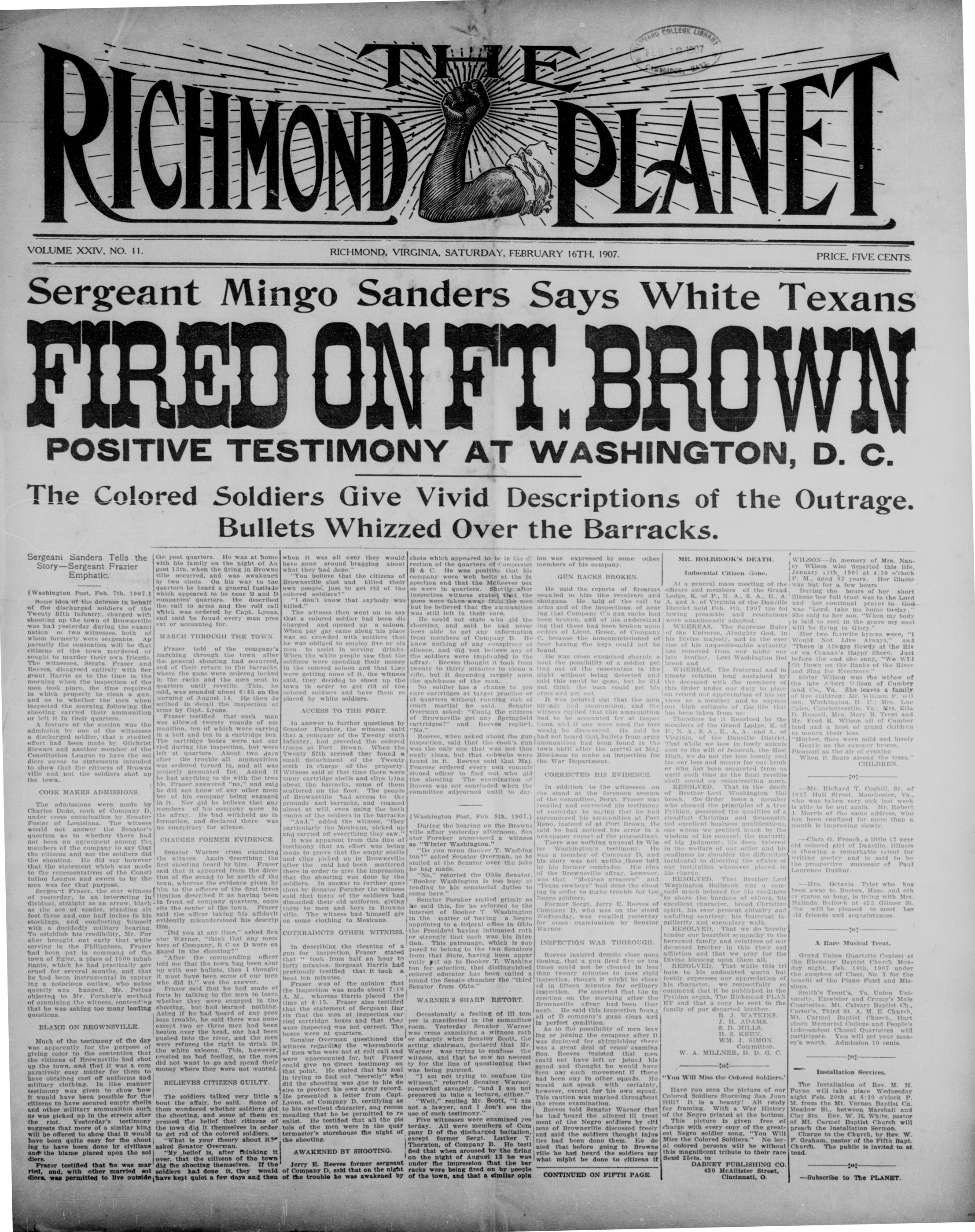
Sergeant Mingo Sanders Says White Texans FIRED ON FT. BROWN POSITIVE TESTIMONY AT WASHINGTON, D. C.
The Colored Soldiers Give Vivid Descriptions of the Outrage. Bullets Whizzed Over the Barracks.
VOLUME XXIV. NO. 11.
Sergea FIF POSIT The Colo
Sergeani Sanders Tells the Story—Sergeant Frazier Emphatic. [Washington Post, Feb. 7th, 1997.]
[Washington Post, Feb. 7th, 1907.]
Some idea of the defense in behalf of the discharged soldiers of the Twenty fifth Infantry, charged with shooting up the town of Brownsville was had yesterday during the examination or two witnesses, both of whom formerly were sergeants. Ap parently the contention will be that citizens of the town murdered or sought to murder their own friends. The witnesses, Sergts. Fraser and Reeves, disagreed entirely with Sergeant Harris as to the time in the morning when the inspection of the men took place, the time required in which properly to clean a gun, and as to whether the men when inspected the morning following the shooting carried their ammunition or left it in their quarters.
A feature of the session was the admission by one of the witnesses a discharged soldier, that a studied effort had been made by Gilchrist Stewart and another member of the Constitution League to have the soldiers swear to statements intended to show that the citizens of Brownsville and not the soldiers shot up the town.
COOK MAKES ADMISSIONS
The admissions were made by Charles Dade, cook of Company D, under cross examination by Senator Foster of Louisiana. The witness would not answer the Senator's question as to whether there had not been an agreement among the members of the company to say that the citizens and not the soldiers did the shooting. He did say however that the statement which was made to the representatives of the Constitution League and sworn to by the men was for that purpose.
Sergeant Fraser, the star witness of yesterday, is an interesting individual, straight as an arrow, black as the ace of spades, standing six feet three and one half inches in his stockings, and conducting himself with a decidedly military bearing. To establish his credibility, Mr. Foraker brought out early that while serving in the Philippines, Fraser had been put in command of the town of Egier, a place of 1500 inhalants, which he had practically governed for several months, and that he had been instrumental in capturing a notorious outlaw, who subsequently was hanged. Mr. Pettus objected to Mr. Foraker's method of examining the witness, contending that he was asking too many leading questions.
BLAME ON BROWNSVILLE
Much of the testimony of the day was apparently for the purpose of giving color to the contention that the citizens of Brownville had shot up the town, and that it was a com paratively easy matter for them to have obtained cast off uniforms and military clothing. In like manner testimony was given to show how it would have been possible for the citizens to have secured empty shells and other military ammunition such as was picked up in the streets after the riot. Yesterday's testimony suggests that more of a similar kind will be offered to show that it would have been quite easy for the shoot ing to have been done by civilians and the blame placed upon the sol diers.
Frazer testified that he was mar ried, and, with other married sol diers, was permitted to live outside
the post quarters. He was at home with his family on the night of August 13th, when the firing in Brownsville occurred, and was awakened by two shots. On his way to the quarters he heard a general fusillade which appeared to be near B and B companies' quarters. He described the call to arms and the roll call which was ordered by Capt. Lyons and said he found every man pres ent or accounted for.
MARCH THROUGH THE TOWN
Fraser told of the company's marching through the town after the general shooting had occurred, and of their return to the barracks, where the guns were ordered locked in the racks and the men sent to quarters until revelle. This, he said, was sounded about 6:45 on the morning of August 14. He then described in detail the inspection or arms by Capt. Lyons.
Fraser testified that each man was allowed twenty rounds of ammunition, ten of which were carried in a belt and ten in a cartridge box. The cartridge boxes were not carried during the inspection, but were left at quarters. About two days after the trouble all ammunition was ordered turned in, and all was properly accounted for. Asked if he had anything to do with the trouble, Fraser answered "no," and said he did not know of any other member of his company being engaged in it. Nor did he believe that any members of his company were in the affray. He had withheld no in formation, and declared there was no conspiracy for silence.
CHAUGES FORMER EVIDENCE.
Senator Warner cross examined the witness. Again describing the first shooting heard by him. Fraser said that it appeared from the direction of the sound to be north of the town, whereas the evidence given by him to the officers of the first invocation described it as having been in front of company quarters, opposite the center of the town. Fraser said the officer taking his affidavit evidently misunderstood his description.
"Did you at any time," asked Senator Warner, "think that any members of Company, B C or D were engaged in the shooting?"
"After the commanding officer told me that the town had been shot up with our bullets, then I thought it must have been some of our men who did it," was the answer.
Fraser said that he had made of forts by talking to the men to learn whether they were engaged in the shooting, but had learned nothing. Asked if he had heard of any previous trouble, he said there was none except two or three men had been beaten over the head, one had been pushed into the river, and the men were refused the right to drink in the white saloons. This, however, created no bad feeling, as the men did not want to go and spend their money where they were not wanted.
BELIEVES CITIZENS GUILTY
The soldiers talked very little a bout the affair, he said. Some of them wondered whether soldiers did the shooting, and some of them ex pressed the belief that citizens of the town did it themselves in order to get rid of the colored soldiers.
"What is your theory about it?" asked Senator Overman.
"My belief is, after thinking it over, that the citizens of the town did the shooting themselves. If the soldiers had done it, they would have kept quiet a few days and then
RICHMOND, VIRGINIA, SATURDAY, FEBRUARY 16TH, 1907.
when it was all over they would have gone around bragging about what they had done."
"You believe that the citizens of Brownsville shot and killed their own people, just to get rid of the colored soldiers?"
"I don't know that anybody was killed."
The witness then went on to say that a colored soldier had been discharged and opened up a saloon. When pay day came along his place was so crowded with soldiers that he was obliged to employ five or six men to assist in serving drinks. When the white people saw that the soldiers were spending their money in the colored saloon and that they were getting none of it, the witness said, they decided to shoot up the town in order to get rid of the colored soldiers and have them replaced by white soldiers.
ACCESS TO THE FORT.
In answer to further questions by Senator Foraker, the witness said that a company of the Twenty sixth Infantry, had preceded the colored troops at Fort Brown. When the Twenty fifth arrived they found a small detachment of the Twenty sixth in charge of the property. Witness said at that time there were many cartridge shells and clips lying about the barracks, some of them scattered on the floor. The people of Brownsville had access to the grounds and barracks, and roamed about at will, even using the bath rooms of the soldiers in the barracks "And." added the witness, "they particularly the Mexicans, picked up and carried off everything they saw." It was apparent from this line of testimony that an effort was being made to prove that the empty shells and clips picked up in Brownsville after the raid had been scattered there in order to give the impression that the shooting was done by the soldiers. In answer to further questions by Senator Foraker the witness said that many of the soldiers had discarded their old uniforms, giving them to men and boys in Brownsville. The witness had himself give en some clothing to Mexicans.
COTNRADICTS OTHER WITNESS
In describing the cleaning of a gun for inspection, Fraser stated that " took from half an hour to forty minutes. Sergeant Harris had previously testified that it took a bout ten minutes.
Fraser was of the opinion that the inspection was made about 7:10 A. M., whereas Harris placed the time at 6:15. Fraser also testified that the statement of Sergeant Harris that the men at inspection carried cartridge boxes and that they were inspected was not correct. The boxes were at quarters.
Senator Overman questioned the witness regarding the whereabouts of men who were not at roll call and were unaccounted for, but Fraser could give no direct testimony on that point. He stated that his zeal in trying to find out "secretly" who did the shooting was due to his deire to protect his own army record. He presented a letter from Capt. Lyons, of Company D, certifying as to his excellent character, and recommending that he be permitted to reenlist. He testified that all the plis of the men were in the quartermaster's storehouse the night of the shooting.
AWAKENED BY SHOOTING
Jerry E. Reeves former sergeant of Company D, said that on the night of the trouble he was awakened by
shots which appeared to be in the direction of the quarters of Companies B & C. He was positive that his company wore web belts at the inspection and that the McKeever box es were in quarters. Shortly after inspection witness stated that the guns were taken away from the men but he believed that the ammunition was still left in their care.
He could not state who did the shooting, and said he had never been able to get any information from members of Company D. He knew nothing of any conspiracy of silence, and did not believe any of the soldiers were implicated in the affray. Reeves thought it took from twenty to thirty minutes to clean a rifle, but it depended largely upon the quickness of the man.
No soldier has a chance to pro cure cartridges at target practice or at quarters without running risk of court martial he said. Senator Overman asked: "Could the citizens of Brownsville get any Springfield cartridges?" and Reeves replied, "No."
Reeves, when asked about the gun inspection, said that the cook's gun was the only one that was not thorngly clean, but that cobwebs were found in it. Reeves said that Maj. Penrose ordered every non commissional officer to find out who did the shooting. The examination of Reeves was not concluded when the committee adjourned until to day.
[Washington Post, Feb. 8th, 1907.]
During the hearing on the Brownville affair yesterday afternoon, Senator Foraker announced a witness as "Winter Washington." "Do you mean Booker T. Washington ton?" asked Senator Overman, as he smiled at the Senator over the joke he had made. "No," retorted the Ohio Senator. "Booker Washington is too busy at tending to his senatorial duties to come here." Senator Foraker smiled grimly as he said this, for he referred to the interest of Booker T. Washington in the matter of having a Negro appointed to a federal office in Ohio the President having intimated rather strongly that such was his intention. This patronage, which is supposed to belong to the two Senators from that State, having been apparently put up to Booker T. Washing ton for selection, that distinguished colored educator has been called a round the Senate chamber the "third Senator from Ohio."
WARNER'S SHARP RETORT
Occasionally a feeling of ill temper is manifested in the committee room. Yesterday Senator Warner was cross examining a witness rath er sharply when Senator Scott, the acting chairman, declared that Mr. Warner was trying to confuse the witness, and that he saw no necessity for the line of questioning that was being pursued.
"I am not trying to confuse the witness," retorted Senator Warner, somewhat savagely, "and I am not prepared to take a lecture, either."
"Well," replied Mr. Scott, "I am not a lawyer, and I don't see the use of such testimony."
Five witnesses were examined yesterday. All were members of Company D of the discharged battalion, except former Sergt. Luther T. Thornton, of Company B. He testified that when aroused by the firing on the night of August 13 he was under the impression that the bar racks were being fired on by people of the town, and that a similar opin
ion was expressed by some other members of his company.
GUN RACKS BROKEN
He said the reports of firearms sounded to him like revolvers and shotguns. He told of the call to arms and of the inspections, of hearing that Company C's gun racks had been broken, and of his understanding that these had been broken upon orders of Lieut. Greer, of Company C, because the noncommissioned of fice having the keys could not be found.
He was cross examined sharply a bout the possibility of a soldier getting out of the reservation in the night without being detected and said this could be gone, but he did not think the man could get his arms and get out.
It was pointed out that the men already had ammunition, and the witness replied that this ammunition had to be accounted for at inspections, and if any were used the loss would be discovered. He said he had not heard that bullets from army ammunition had been found in the town until after the arrival of Maj. Blocksom to make an inspection for the War Department.
CORRECTED HIS EVIDENCE
In addition to the witnesses on the stand at the forenoon session of the committee, Sergt. Fraser was recalled and corrected his testimony of yesterday by saying that he had surrendered his ammunition at Fort Reno, instead of at Fort Brown. He said he had noticed his error in a newspaper report of the proceedings. There was nothing unusual in Winter Washington's testimony. He was a member of Company D, and his story was not unlike those tolk by his former comrades. His idea of the Brownsville affray, however, was that "Mexican greasers" and "Texas cowboys" had done the shoot ing in order to make trouble for the Negro soldiers. Former Sergt. Jerry E. Reeves of Company D, who was on the stand Wednesday, was recalled yesterday for cross examination by Senator Warner.
INSPECTION WAS THOROUGH.
Reeves insisted despite close questioning, that a gun fired five or ten times could not be cleaned in less than twenty minutes to pass rigid inspection, though it might be cleaned in fifteen minutes for ordinary inspection. He asserted that theae inpection on the morning after the Brownsville affray had been therough. He said this inspection found all of D company's guns clean and in perfect condition.
As to the possibility of men leaving or joining the company after it was deployed for skirmishing there was a great deal of cross examination. Reeves insisted that men could not have left or joined his squad and thought he would have seen any such movement if there had been any in other squads. He would not speak with certainty, however, except for his own squad. This caution was marked throughout the cross examination.
Reeves told Senator Warner that he had heard the alleged ill treatment of the Negro soldiers by cifzens of Brownsville discussed freely and said the soldiers thought injuice had been done them. He denied that before going to Brownville he had heard the soldiers say what miphit be done to citizens if
CONTINUED ON FIFTH PAGE.
MR. HOLBROOK'S DEATH
Influential Citizen Gone.
At a general mass meeting of the officers and members of the Grand Lodge, K. of P., N. A., S. A., E., A., A. and A. of Virginia of the Danville District held Feb. 4th, 1907 the fol lowing preamble and resolutions were unanimously adopted:
WHEREAS, The Supreme Ruler of the Universe, Almighty God, in his Divine majesty, and in the exe cise of his unquestionable authority has removed from our midst our late brother, Levi Washington Hol brook and
WHEREAS, The fraternal and in imate relation long sustained by the deceased with the members of this Order under our duty to place on record our appreciation of his ser vices as a member and to express our high estimate of the life that has been taken from us:
Therefore be it Resolved by the members of the Grand Lodge, K. of P., N. A., S. A., E., A., A. and A. of Virginia of the Danville District. That while we bow in lowly submission to the will of Jehovah, the Most High, we do not the less keenly realize our loss and mourn for our broth er who has been separated from us until such time as the final revelle shall sound in resurrection morm.
RESOLVED. That in the death of Brother Levi Washington Holbrook, the Order loses a member who showed the principles of a true Pythian, possessed the qualities of a steadfast Christian and demonstrared excellent business qualifications, one whom we profited much by the wisdom of his counsel, the maturity of his judgment; his deep interest in the welfare of our order and his readiness to shoulder the difficulties incidental to directing the affairs of our institution whenever placed in his charge.
RESOLVED. That Brother Levi Washington Holbrook was a comrade much beloved for his readiness to share the burdens of others, his excellent character, broad Christian spirit, his ever present chivalry and unfailing courtesy; his fraternal familiarity and exemplary walk.
RESOLVED. That we do hereby tender our heartfelt sympathy to the bereaved family and relatives of our deceased brother in this their sad and painful work for the Divine blessing upon them all.
RESOLVED. That while this tribit to his undoubted worth but feebly expresses our appreciation of his character, we respectfully recommend that it be published in the Pythian organ. The Richmond PLAN ET and that a copy be sent to the family of our departed brother.
"You Will Miss the Colored Soldiers."
Have you seen the picture of our Colored Soldiers Storming San Juan Hill? It is a beauty! All ready for framing. With a War History of the Negro printed at the bottom. This picture is given free of charge with every copy of the greatest Negro soldier song, "You Will Miss the Colored Soldiers." No loyal colored persons will be without this magnificent tribute to their race Send 25cts. to DABNEY PUBLISHING CO.
420 McAllister Street,
Cincinnati, O.
PRICE, FIVE CENTS
Texans WN , D. C. Outrage.
WILSON—In memory of Mrs. Nancy Wilson who departed this life, January 11th 1997 at 4:30 o'clock P., M. aged 82 years. Her illness was but for a few hours.
During the hours of her short illness her full trust was in the Lord and her continual prayer to God was "Lord, take me home to-day." She said to her son, "When my body is laid to rest in the grave my soul will be flying in Glory."
Her two favorite hymns were, "I Would Not Live Always," and "There is Always Howdy at the River on Ceanan's Happy Shore. Just before the end she sang, "We Will Sit Down on the Banks of the River and Sing for Evermore."
Sister Wilson was the widow of the late Albert Wilson of Cumberland Co., Va. She leaves a family of five children: Mr. William F. will son, Washington, D. C.; Mrs. Lue Coles, Charlottesville, Va.; Mrs. Ella D. Russell, Mrs. Mary B. Trent and Mr. Fred R. Wilson all of Cumberland land and a host of grand children to mourn their loss.
"Mother, thou were mild and lovely Gentle as the summer breeze, Pleasant as the air of evening.
When it floats among the trees."
CHILDREN.
—Mr. Richard T. Cogbill, Sr. of 1017 Hull Street, Manchester, Va., who was taken very sick last week is able to be out again. Mr. Robert J. Morris of the same address, who has been confined for more than a month is improving slowly.
—Clara G. French, a little 13 year old colored girl of Danville, Illinois is showing a remarkable talent for writing poetry and is said to be the prospective successor of Paul Laurence Dunbar.
—Mrs. Octavia Tyler who has been away to Boston, Mass, and oth cr states so long, is living with Mrs. Malinda Bullock at 423 Gilmer St. She will be pleased to meet her old friends and acquaintances.
A Rare Musical Treat.
Grand Union Quartette Contest at the Ebenezer Baptist Church Monday night, Feb. 18th, 1907 under the auspices of Class. No. 3 for the benefit of the Piano Fund and Missions.
Smith's Trent's, Va. Union University, Excelsior and Crump's Male Quartettes: Mt. Calvary Baptist Ch., Carter's, Third St. A. M. E. Church, Mt. Carmel Baptist Church, Hart shorn Memorial College and People's Independent Choral Quartettes will participate. You will get your money's worth. Admission 10 cents.
Installation Services.
The Installation of Rev. M. H. Payne will take place Wednesday night Feb. 20th at 8:30 o'clock P.M. from the Mt. Vernon Baptist Ct. Meadow Sts., between Marshall and Clay Sts. Rev. W. H. White, pastor of Mt. Carmel Baptist Church will preach the Installation Sermon. Charge to the Church, by Rev. W. F. Graham, pastor of the Fifth Bapt. Church. The public is invited to attend.
—Subscribe to The PLANET.
THE Masquerader
By KATHERINE CECIL THURSTON,
Author of "The Circle," Etc.
Copyright. 1905, 1904, by Harper & Brothers
CHAPTER X
IN the days that followed Fralde's marked adoption of him Loder behaved with a discretion that spoke well for his qualities.
Many a man placed in the same responsible and yet strangely irresponsible position might have been excused if, for the time at least, he gave himself a loose rein. But Loder kept free of the temptation.
Like all other experiments, his show-
unlooked for features when put to a
working test. Its expected difficulties
smoothed themselves away, while others,
scarcely anticipated, came into promi-
nence. Most notable of all, the physical
likeness between himself and Chilcote,
the bedrock of the whole scheme, which
had been counted on to offer most dang-
er, worked without a hitch. He stood
literally amazed before the sweeping
credulity that met him on every hand.
Men who had known Chilcote from his
youth, servants who had been in his
employment for years, joined issue in
the unquestioning acceptance. At times
the ease of deception bewildered him.
There were moments when he realized
that, should circumstances force him to
a declaration of the truth, he would
not be believed. Human nature pre-
fers its own eyesight to the testimony
of any man.
But in face of this astonishing success he steered a steady course. In the first exhilaration of Fraide's favor, in the first egotistical wish to break down Eve's skepticism, he might possibly have plunged into a vortex of action, let it be in what direction it might; but, fortunately for himself, for Chilcote and for their scheme, he was liable to strenuous second thoughts—those wise and necessary curbs that go further to the steadying of the universe than the universe guesses. Sitting in the quiet of the house on the same day that he had spoken with Eve on the terrace he had weighed possibilities slowly and cautiously. Impressed to the full by the atmosphere of the place that in his eyes could never lack character, however dull its momentary business, however proxy the voice that filled it, he had sifted impulse from experience as only a man who has lived within himself can sift and distinguish, and at the close of that first day his programme had been formed. There must be no rush, no headlong plunge, he had decided. Things must work around. It was his first expedition into the new country, and it lay with fate to say whether it would be his last.
He had been leaning back in his sent, his eyes on the ministers opposite, his arms folded in imitation of Chilcote's most natural attitude, when this final speculation had come to him, and as it came his lips had tightened for a moment and his face become hard and cold. It is an unpleasant thing when a man first unconsciously reckons on the weakness of another, and the look that expresses the idea is not good to sec. He had stirred unlessly, then his lips had closed again. He was tenacious by nature, and by nature intolerant of weakness. At the first suggestion of reckoning upon Chilcote's lapses his mind had drawn back in disgust, but as the thought came again the disgust had lessened.
In a week—two weeks, perhaps—Chilcote would reclaim his place. Then would begin the routine of the affair. Chilcote, fresh from intelligence and freedom, would find his obligations a thousand times more irksome than before; he would struggle for a time, then—
A shadowy smile had touched Loder's lips as the idea formed itself.
Then would come the inevitable recall; then in earnest he might venture to put his hand to the plow. He never indulged in day dreams, but something in the nature of a vision had flushed over his mind in that instant. He had seen himself standing in that same building, seen the rows of faces first bored, then hesitatingly transformed under his personal domination, under the one great power he knew himself to possess—the power of eloquence. The strength of the suggestion had been almost painful. Men who have attained self repression are occasionally open to a perilous onrush of feeling. Believing that they know themselves, they walk boldly forward toward the highroad and pitfall alike.
These had been Loder's disconnected ideas and speculations on the first day of his new life. At 4 o'clock on the ninth day he was pacing with quiet confidence up and down Chilcote's study, his mind pleasantly busy and his cigar comfortably alight, when he paused in his walk and frowned, interrupted by the entrance of a servant. The man came softly into the room, drew a small table toward the fire and proceeded to lay an extremely fine and unserviceable looking cloth. Loder watched him in silence. He had grown to find silence a very useful commodity. To wait and let things develop was the attitude he oftenest assumed, but on this occasion he was perplexed. He had not rung for tea, and in any case a cup on a salver satisfied his wants. He looked critically at the fragile cloth.
Presently the servant departed and solemnly re-entered carrying a silver tray, with cups, a teapot and cakes. Having adjusted them to his satisfaction, he turned to Loder.
"Mrs. Chilcote will be with you in five minutes, sir." he said.
He waited for some response, but Loder gave none. Again he had found the advantages of silence, but this time it was silence of a compulsory kind. He had nothing to say. The man, finding him irresponsible,
retired, and, left to himself, Loder stared at the array of feminine trifles; then, turning abruptly, he moved to the center of the room.
Since the day they had talked on the terrace he had seen Eve only thrice and always in the presence of others.
Since the night of his first coming she had not invaded his domain, and he wondered what this new departure might mean.
His thought of her had been less vivid in the last few days, for, though still using steady discretion, he had been drawn gradually nearer the fascinating whirlpool of new interests and new work. Shut his eyes as he might, there was no denying that this moment, so personally vital to him, was politically vital to the whole country and that by a curious coincidence Chilcote's position well nigh forced him to take an active interest in the situation. Again and again the suggestion had arisen that should the smoldering fire in Persia break into a flame Chilcote's commercial interests would facilitate—would practically compel his standing in in the campaign against the government.
The little incident of the tea table, recalling the social side of his obligations, had aroused the realization of greater things. As he stood meditatively in the middle of the room he saw suddenly how absorbed he had become
in these greater things—how, in the swing of congenial interests, he had been borne insensibly forward, his capacities expanding, his intelligence asserting itself. He had so undeniably found his sphere that the idea of usurpation had recoded gently as by natural laws until his own personality had begun to coor the day's work.
As this knowledge came he wondered quickly if it held a solution of the present little comedy: if Eve had seen what others, he knew, had observed—that Chilcote was showing a grasp of things that he had not exhibited for years. Then, as a sound of skirts came softly down the corridor, he squirmed his shoulders with his habitual abrupt gesture and threw his cigar into the fire.
Eve entered the room much as she had done on her former visit, but with one difference—in passing Loder she quietly held out her hand.
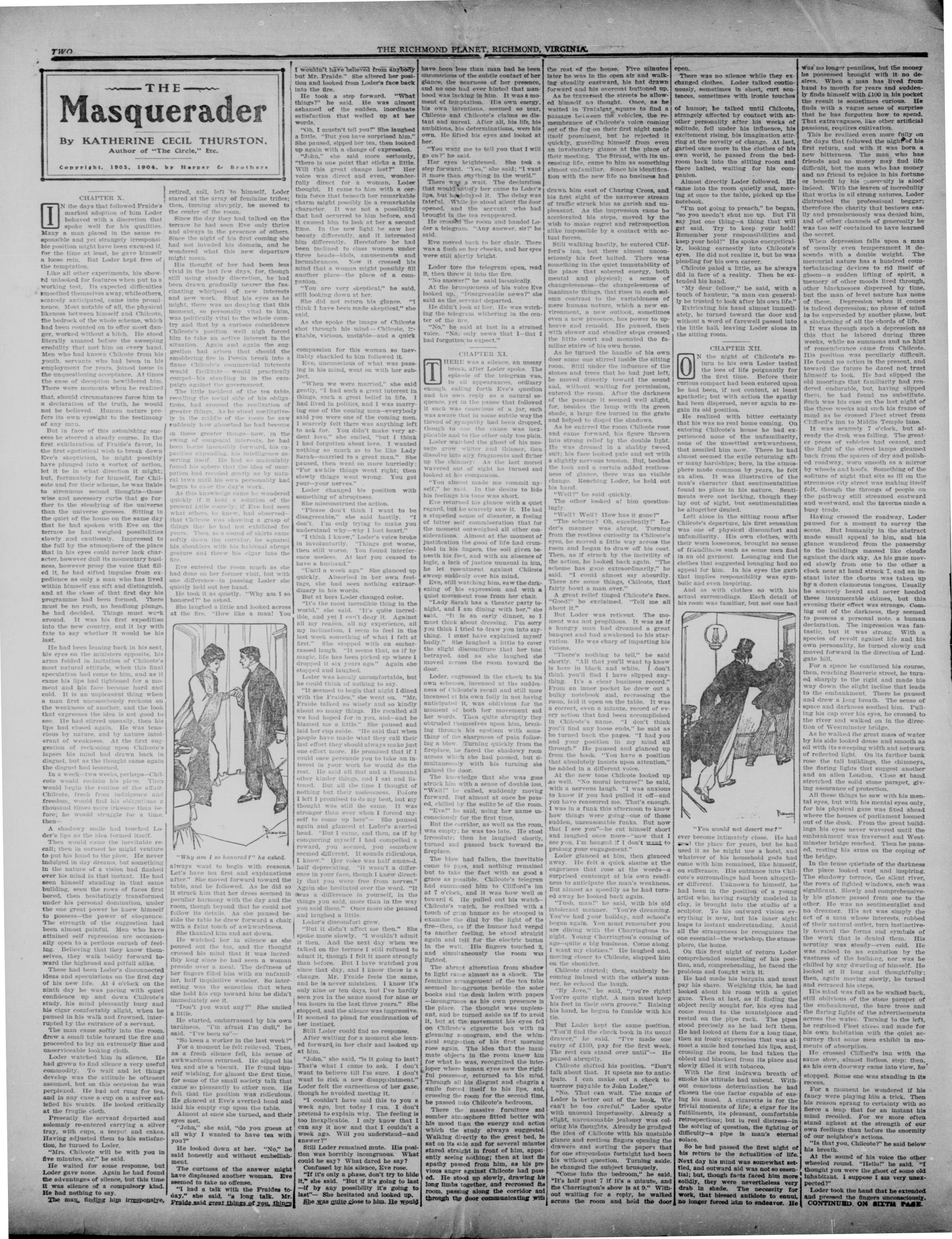
He took it as quietly. "Why am I so honored?" he asked.
She laughed a little and looked across at the fire. "How like a man! You
PARKER.
"Why am I so honored?" he asked. always want to begin with reasons. Let's have tea first and explanations after." She moved forward toward the table, and he followed. As he did so it struck him that her dress seemed in peculiar harmony with the day and the room, though beyond that he could not follow its details. As she paused beside the he drew forward a chair with a faint touch of awkwardness. She thanked him and sat down. He watched her in silence as she poured out the tea, and the thought crossed his mind that it was incredibly long since he had seen a woman preside over a meal. The deftness of her fingers filled him with an unfamiliar, half inquisitive wonder. So interesting was the sensation that when she held his cup toward him he didn't immediately see it. "Don't you want any?" She smiled a little.
He started, embarrassed by his own tardiness. "I'm afraid I'm dull," he said. "I've been so"— "So keen a worker in the last week?" For a moment he felt relieved. Then, as a fresh silence fell, his sense of awkwardness returned. He sipped his tea and ate a biscuit. He found himself wishing, for almost the first time, for some of the small society talk that came so pleasantly to other men. He felt that the position was ridiculous. He glanced at Eve's averted head and laid his empty cup upon the table.
Almost at once she turned, and their eyes met.
"John," she said, "do you guess at all why I wanted to have tea with you?"
He looked down at her. "No," he said honestly and without embellishment.
The curtness of the answer might have displeased another woman. Eve seemed to take no offense.
"I had a talk with the Fraides today," she said, "a long talk. Mr. Fraide said great things of you, things
THE RICHMOND PLANET, RICHMOND, VIRGINIA
I wouldn't have believed from anybody but Mr. Fralde." She altered her position and looked from Loder's face back into the fire.
He took a step forward. "What things?" he said. He was almost ashamed of the sudden, inordinate satisfaction that welled up at her words.
"Oh, I mustn't tell you!" She laughed a little. "But you have surprised him." She paused, sipped her tea, then looked up again with a change of expression. "John," she said more seriously, "there is one point that sticks a little. Will this great change last?" Her voice was direct and even, wonderfully direct for a woman, Loder thought. It came to him with a certain force that beneath her remarkable charm might possibly lie a remarkable character. It was not a possibility that had occurred to him before, and it caused him to look at her a second time. In the new light he saw her beauty differently, and it interested him differently. Heretofore he had been inclined to class women under three heads—idols, amusements and incumbrances. Now it crossed his mind that a woman might possibly fill another place—the place of a companion. "You are very skeptical," he said, still looking down at her.
She did not return his glance. "I think I have been made skeptical," she said.
As she spoke the image of Chilcote shot through his mind—Chilcote, irritable, vicious, unstable—and a quick compassion for this woman so inevitably shackled to him followed it.
Eve, unconscious of what was passing in his mind, went on with her subject.
"When we were married," she said gently, "I had such a great interest in things, such a great belief in life. I had lived in politics, and I was marrying one of the coming men—everybody said you were one of the coming men. I scarcely felt there was anything left to ask for. You didn't make very ardent love," she smiled, "but I think I had forgotten about love. I wanted nothing so much as to be like Lady Sarah—married to a great man." She paused, then went on more hurriedly: "For awhile things went right; then slowly things went wrong. You got your—your nerves." Loder changed his position with something of abruptness.
She misconstrued the action.
"Please don't think I want to be disagreeable," she said hastily.
"I don't. I'm only trying to make you understand why—why I lost heart."
"I think I know," Loder's voice broke in involuntarily. "Things got worse, then still worse. You found interference useless. At last you ceased to have a husband."
"Until a week ago." She glanced up quickly. Absorbed in her own feelings, she had seen nothing extraordinary in his words.
But at hers Loder changed color.
"It's the most incredible thing in the world," she said. "It's quite incredible, and yet I can't dey it. Against all my reason, all my experience, all my inclination, I seem to feel in the last week something of what I felt at first." She stopped with an embarrassed laugh. "It seems that, as if by magic, life has been picked up where I dropped it six years ago." Again she stopped and laughed. Loder was keenly uncomfortable, but he could think of nothing to say.
"It seemed to begin that night I dined with the Fraides," she went on. "Mr. Fraide talked so wisely and so kindly about so many things. He recalled all we had hoped for in you, and—and he blamed me a little." She paused and laid her cup aside. "He said that when people have made what they call their last effort they should always make just one effort more. He promised that if I could once persuade you to take an interest in your work he would do the rest. He said all that and a thousand other kinder things, and I sat and listened. But all the time I thought of nothing but their uselessness. Before I left I promised to do my best, but my thought was still the same. It was stronger than ever when I forced myself to come up here"—She paused again and glanced at Loder's averted head. "But I came, and then, as if by conquering myself I had compelled a reward, you seemed, you somehow seemed different. It sounds ridiculous, I know." Her voice was half amused, half deciphering. "It wasn't a difference in your face, though I knew directly that you were free from nerves." Again she hesitated over the word. "It was a difference in yourself, in the things you said, more than in the way you said them." Once more she paused and laughed a little.
Loder's discomfort grew.
"But it didn't affect me then." She spoke more slowly. "I wouldn't admit it then. And the next day when we talked on the terrace I still refused to admit it, though I felt it more strongly than before. But I have watched you since that day, and I know there is a change. Mr. Fraide feels the same, and he is never mistaken. I know it's only nine or ten days, but I've hardly seen you in the same mood for nine or ten hours in the last three years." She stopped, and the silence was impressive. It seemed to plead for confirmation of her instinct.
Still Loder could find no response. After waiting for a moment she leaned forward in her chair and looked up at him.
"John," she said, "is it going to last? That's what I came to ask. I don't want to believe till I'm sure. I don't want to risk a new disappointment." Loder felt the earnestness of her gaze, though he avoided meeting it.
"I couldn't have said this to you a week ago, but today I can. I don't pretend to explain why. The feeling is too inexplicable. I only know that I can say it now and that I couldn't a week ago. Will you understand—and answer?"
Still Loder remained mute. His position was horribly incongruous. What could he say? What dared he say?
Confused by his silence, Eve rose.
"If it's only a phase, don't try to hide it," she said. "But if it's going to last—if by any possibility it's going to last!" She hesitated and looked up.
She was quite close to him. He would
have been less than man had he been unconscious of the subtle contact of her glance, the nearness of her presence, and no one had ever hinted that manhood was lacking in him. It was a moment of temptation. His own energy, his own intentions, seemed so near, Chilcote and Chilcote's claims so distant and unreal. After all, his life, his ambitions, his determinations, were his own. He lifted his eyes and looked at her.
"You want me to tell you that I will go on?" he said.
Her eyes brightened. She took a step forward. "Yes," she said; "I want it more than anything in the world."
There was a wait. The declaration that would satisfy her came to Loder's lips, but he delayed it. The delay was fateful. While he stood silent the door opened, and the servant who had brought in the tea reappeared.
He crossed the room and handed Loder a telegram. "Any answer, sir?" he said.
Eve moved back to her chair. There was a fush on her cheeks, and her eyes were still alertly bright.
Loder tore the telegram open, read it, then threw it into the fire.
"No answer?" he said laconically.
At the brusqueness of his voice Eve looked up. "Disgreeable news?" she said as the servant departed.
He didn't look at her. He was watching the telegram withering in the center of the fire.
"No," he said at last in a strained voice. "No; only news that I—that I had forgotten to expect."
CHAPTER XL
HERE was a silence, an uneasy break, after Loder spoke. The episode of the telegram was, to all appearances, ordinary enough, calling forth Eve's question and his own reply as a natural sequence, yet in the pause that followed it each was conscious of a jar, each was aware that in some subtle way the thread of sympathy had been dropped, though to one the cause was hexplicable and to the other only too plain. Loder watched the ghost of his message grow whiter and thinner, then dissolve into airy fragments and flutter up the chimney: As the last morsel wavered out of sight he turned and looked at his companion.
"You almost made me commit myself," he said. In the desire to hide his feelings his tone was short.
Eve returned his glance with a quiet regard, but he scarcely saw it. He had a stupefied sense of disaster, a feeling of bitter self commiseration that for the moment outweighed all other considerations. Almost at the moment of justification the good of life had crumbled in his fingers, the soil given beneath his feet, and with an absence of logic, a lack of justice unusual in him, he let resentment against Chilcote sweep suddenly over his mind.
Eve, still watching him, saw the darkening of his expression and with a quiet movement rose from her chair.
quite movement rose from her chin. "Lady Sarah has a theater party tonight, and I am dining with her," she said. "It is an early dinner, so I must think about dressing. I'm sorry you think I tried to draw you into anything. I must have explained myself badly." She laughed a little to cover the slight discomfiture that her tone betrayed, and as she laughed she moved across the room toward the door.
Loder, engrossed in the cheek to his own schemes, incensed at the suddenness of Chilecote's recall and still more incensed at his own folly in not having anticipated it, was oblivious for the moment of both her movement and her words. Then quite abruptly they obtruded themselves upon him, breaking through his egotism with something of the sharpness of pain following a blow. Turning quickly from the fireplace, he faced the shadowy room across which she had passed, but simultaneously with his turning she gained the door.
The knowledge that she was gone struck him with a sense of double loss, "Wait!" he called, suddenly moving forward. But almost at once he paused, chilled by the solitude of the room, "Eve!" he said, using her name unconsciously for the first time. But the corridor, as well as the room, was empty; he was too late. He stood firesolute; then he laughed shortly, turned and passed back toward the fireplace.
The blow had fallen, the inevitable come to pass, and nothing remained but to take the fact with as good a grace as possible. Chilcote's telegram had summoned him to Clifford's inn at 7 o'clock, and it was well on toward 6. He pulled out his watch. Chilcote's watch, he realized with a touch of grim humor as he stooped to examine the dial by the light of the fire—then, as if the humor had verged to another feeling, he stood straight again and felt for the electric button in the wall. His fingers touched it, and simultaneously the room was lighted.
The abrupt alteration from shadow to light came almost as a shock. The feminine arrangement of the tea table seemed incongruous beside the sober books and the desk laden with papers—incongruous as his own presence in the place. The thought was unpleasant, and he turned aside as if to avoid it, but at the movement his eyes fell on Chilcote's cigarette box with its gleaming monogram, and the whimsical suggestion of his first morning rose again. The idea that the inanimate objects in the room knew him for what he was, recognized the interloper where human eyes saw the rightful possessor, returned to his mind. Through all his disgust and chagrin a smile forced itself to his lips, and crossing the room for the second time, he passed into Chilcote's bedroom.
There the massive furniture and somber atmosphere fitted better with his mood than the energy and action which the study always suggested. Walking directly to the great bed, he sat on its side and for several minutes stared straight in front of him, apparently seeing nothing; then at last the apathy passed from him, as his previous anger against Chilcote had passed. He stood up slowly, drawing his long limbs together, and recrossed the room, passing along the corridor and through the door communicating with
the rest of the house. Five minutes later he was in the open air and walking steadily eastward, his hat drawn forward and his overcoat buttoned up. As he traversed the streets he allowed himself no thought. Once, as he waited in Trafalgar square to find a passage between the vehicles, the remembrance of Chilcote's voice coming out of the fog on their first night made itself prominent, but he rejected it quickly, guarding himself from even an involuntary glance at the place of their meeting. The Strand, with its uneasing life, came to him as something almost unfamiliar. Since his identification with the new life no business had drawn him east of Charing Cross, and his first sight of the narrower stream of traffic struck him as garish and unpleasant. As the impression came he accelerated his steps, moved by the wish to make regret and retrospection alike impossible by a contact with actual forces.
Still walking hastily, he entered Clifford's inn, but there almost unconsciously his feet halted. There was something in the quiet immutability of the place that sobered energy, both mental and physical; a sense of changelessness—the changelessness of manlike things that rises in such solemn contrast to the variability of mere human nature, which a new environment, a new outlook, sometimes even a new presence, has power to upheave and reunold. He paused, then with slower and steadier steps crossed the little court and mounted the familiar stairs of his own house.
As he turned the handle of his own door some one stirred inside the sitting room. Still under the influence of the stones and trees that he had just left, he moved directly toward the sound and, without waiting for permission, entered the room. After the darkness of the passage it seemed well alight, for, besides the lamp with its green shade, a large fire burned in the grate and helped to dispel the shadows.
As he entered the room Chilcoote rose and came forward, his figure thrown into strong relief by the double light. He was dressed in a shabby tweed suit; his face looked pale and set with a slightly nervous tension. But, besides the look and a certain added restlessness of glance, there was no visible change. Reaching Loder, he held out his hand.
"Well?" he said quickly.
The other looked at him questioningly.
"Well? Well? How has it gone?"
"The scheme? Oh, excellently." Loder's manner was abrupt. Turning from the restless curiosity in Chilcote's eyes, he moved a little way across the room and began to draw off his coat. Then, as if struck by the incivility of the action, he looked back again. "The scheme has gone extraordinarily," he said. "I could almost say absurdly. There are some things, Chilcote, that fairly bowl a man over."
A great relief tinged Chilcote's face. "Good!" he exclaimed. "Tell me all about it."
But Loder was reticent. The moment was not propitious. It was as if a hungry man had dreamed a great banquet and had awakened to his starvation. He was chary of imparting his visions.
"There's nothing to tell," he said shortly. "All that you'll want to know is here in black and white. I don't think you'll find I have slipped anything. It's a clear business record." From an inner pocket he drew out a bulky notebook and, recrossing the room, laid it open on the table. It was a correct, even a minute, record of every action that had been accomplished in Chilecote's name. "I don't think you'll find any loose ends," he said as he turned back the pages. "I had you and your position in my mind all through." He paused and glanced up from the book. "You have a position that absolutely insists upon attention," he added in a different voice.
At the new tone Chilote looked up as well. "No moral lectures!" he said, with a nervous laugh. "I was anxious to know if you had pulled it off—and you have reassured me. That's enough. I was in a funk this afternoon to know how things were going—one of those sudden, unreasonable funks. But now that I see you"—he cut himself short and laughed once more—now that I see you, I'm hanged. If I don't want to prolong your engagement."
Loder glanced at him, then glanced away. He felt a quick shame at the eagerness that rose at the words—a surprised contempt at his own readiness to anticipate the man's weakness. But almost as speedily as he had turned away he looked back again.
"Tush, man." he said, with his old intolerant manner. "You're dreaming. You've had your holiday, and school's begun again. You must remember you are dining with the Charringtons tonight. Young Charrington's coming of age—quite a big business. Come along. I want my clothes." He laughed and, moving closer to Chilcote, slapped him on the shoulder.
Chilcote started; then, suddenly becoming imbued with the other's manner, he echoed the laugh.
"By Jove," he said, "you're right! You're quite right. A man must keep his feet in their own groove." Raising his hand, he began to fumble with his tle.
But Loder kept the same position. "You'll find the check book in its usual drawer," he said. "I've made one entry of £100, pay for the first week. The rest can stand over until"— He paused abruptly.
Chilico shifted his position. "Don't talk about that. It upsets me to anticipate. I can make out a check to morrow payable to John Loder." "No. That can wait. The name of Loder is better out of the book. We can't be too careful." Loder spoke with unusual impetuosity. Already a slight, unreasonable jealousy was coloring his thoughts. Already he grudged the idea of Chilico with his unstable glance and restless fingers opening the drawers and sorting the papers that for one stupendous fortnight had been his without question. Turning aside he changed the subject brusquely. "Come into the bedroom," he said. "It's half past 7 if it's a minute, and the Charrington's show is at 9." Without waiting for a reply, he walked across the room and heid the door
There was no silence while they exchanged clothes. Loder talked continuously, sometimes in short, curt sentences, sometimes with ironic touches of humor; he talked until Chilcote, strangely affected by contact with another personality after his weeks of solitude, fell under his influence, his excitement rising, his imagination stirring at the novelty of change. At last, garbed once more in the clothes of his own world, he passed from the bedroom back into the sitting room and there halted, waiting for his companion. Almost directly Loder followed. He came into the room quietly and, moving at once to the table, picked up the notebook.
"I'm not going to preach," he began, "so you needn't shut me up. But I'll say just one thing—a thing that will get said. Try to keep your hold! Remember your responsibilities and keep your hold!" He spoke energetically, looking earnestly into Chilcote's eyes. He did not realize it, but he was pleading for his own career.
Chilcote paled a little, as he always did in face of a reality. Then he extended his hand.
"My dear fellow," he said, with a touch of hauteur, "a man can generally be trusted to look after his own life." Extricating his hand almost immediately, he turned toward the door and without a word of farewell passed into the little hall, leaving Loder alone in the sitting room.
CHAPTER XII
ON the night of Chilcote's return to his own Loder tasted the lees of life poignantly for the first time. Before their curious compact had been entered upon he had been, if not content, at least apathetic; but with action the apathy had been dispersed, never again to regain its old position.
He realized with bitter certainty that his was no real home coming. On entering Chilcote's house he had experienced none of the unfamiliarity, none of the unsettled awkwardness, that assailed him now. There he had almost seemed the exile returning after many hardships; here, in the atmosphere made common by years, he felt an alien. It was illustrative of the man's character that sentimentalities found no place in his nature. Sentiments were not lacking, though they lay out of sight, but sentimentalities he altogether denied.
Left alone in the sitting room after Chilcote's departure, his first sensation was one of physical discomfort and unfamiliarity. His own clothes, with their worn looseness, brought no sense of friendliness such as some men find in an old garment. Lounging and the clothes that suggested lounging had no appeal for him. In his eyes the garb that implies responsibility was symbolic and even inspiring.
And as with clothes so with his actual surroundings. Each detail of his room was familiar, but not one had
P. B. B.
"You would not desert me?" ever become intimately close. He had used the place for years, but he had used it as he might use a hotel, and whatever of his household gods had come with him remained, like himself, on sufferance. His entrance into Chilcote's surroundings had been altogether different. Unknown to himself, he had been in the position of a young artist who, having roughly modeled in clay, is brought into the studio of a sculptor. To his outward vision everything is new, but his inner sight leaps to instant understanding. Amid all the strangeness he recognizes the one essential—the workshop, the atmosphere, the home.
On this first night of return Loder comprehended something of his position, and, comprehending, he faced the problem and fought with it.
He had made his bargain and must pay his share. Weighing this, he had looked about his room with a quiet gaze. Then at last, as if finding the object really sought for, his eyes had come round to the mantelpiece and rested on the pipe rack. The pipes stood precisely as he had left them. He had looked at them for a long time, then an ironic expression that was almost a smile had touched his lips, and, crossing the room, he had taken the oldest and blackest from its place and slowly filled it with tobacco. With the first indrawn breath of smoke his attitude had unbent. Without conscious determination he had chosen the one factor capable of easing his mood. A cigarette is for the trivial moments of life; a cigar for its fulfillments, its pleasant, comfortable retrospects; but in real distress—in the solving of question, the fighting of difficulty—a pipe is man's eternal solace.
So he had passed the first night of his return to the actualities of life. Next day his mind was somewhat settled, and outward aid was not so essential; but, though facts faced him more solidly, they were nevertheless very drab in shade. The necessity for work, that blessed antidote to ennui, no longer forced him to endeavor. He
was no longer penniless, but the money he possessed brought with it no desires. When a man has lived from band to mouth for years and suddenly finds himself with £100 in his pocket the result is sometimes curious. He finds with a vague sense of surprise that he has forgotten how to spend. That extravagance, like other artificial passions, requires cultivation.
This he realized even more fully on the days that followed the night of his first return, and with it was born a new bitterness. The man who has friends and no money may find life difficult, but the man who has money and no friend to rejoice in his fortune or benefit by his generosity is aloof indeed. With the leaven of incredulity that works in all strong natures, Loder distrusted the professional beggar; therefore the charity that bestows easily and promiscuously was denied him, and of other channels of generosity he was too self contained to have learned the secret.
When depression falls upon a man of usually even temperament it descends with a double weight. The mercurial nature has a hundred counterbalancing devices to rid itself of gloom—a sudden lifting of spirit, a memory of other moods lived through, other blacknesses dispersed by time, but the man of level nature has none of these. Depression when it comes is indeed depression; no phase of mind to be superseded by another phase, but a slackening of all the chords of life.
It was through such a depression as this that he labored during three weeks, while no summons and no hint of remembrance came from Chilcote. His position was peculiarly difficult. He found no action in the present, and toward the future he dared not trust himself to look. He had slipped the old moorings that familiarity had rendered endurable, but, having slipped them, he had found no substitute. Such was his case on the last night of the three weeks and such his frame of mind as he crossed Fleet street from Clifford's inn to Middle Temple lane.
It was scarcely 7 o'clock, but already the dusk was falling. The greater press of vehicles had ceased, and the light of the street lamps gleamed back from the spaces of dry and polished roadway, worn smooth as a mirror by wheels and hoofs. Something of the soliture of night that sits so lll on the strenuous city street was making itself felt, though the througs of people on the pathway still streamed eastward and westward, and the taverns made a busy trade.
Having crossed the roadway, Loder paused for a moment to survey the scene. But humanity in the abstract made small appeal to him, and his glance wandered from the passersby to the buildings massed like clouds against the dark sky. As his gaze moved slowly from one to the other a clock near at hand struck 7, and an instant later the chorus was taken up by a dozen clamorous tongues. Usually he scarcely heard and never heeded these innumerable chimes, but this evening their effect was strange. Coming out of the darkness, they seemed to possess a personal note, a human declaration. The impression was fantastic, but it was strong. With a species of revolt against life and his own personality, he turned slowly and moved forward in the direction of Ludgate hill.
For a space he continued his course, then, reaching Bouverie street, he turned sharply to the right and made his way down the slight incline that leads to the embankment. There he paused and drew a long breath. The sense of space and darkness soothed him. Pulling his cap over his eyes, he crossed to the river and walked on in the direction of Westminster bridge. As he walked the great mass of water by his side looked dense and smooth as oil with its sweeping width and networks of reflected light. On its farther bank rose the tall buildings, the chimneys, the flaring lights that suggest another and an alien London. Close at hand stretched the solid stone parapet, giving assurance of protection.
All these things he saw with his mental eyes, but with his mental eyes only, for his physical gaze was fixed ahead where the houses of parliament loomed out of the dusk. From the great buildings his eyes never wavered until the embankment was traversed and Westminster bridge reached. Then he paused, resting his arms on the coping of the bridge.
In the tense quietude of the darkness the place looked vast and inspiring. The shadowy terrace, the silent river, the rows of lighted windows, each was significant. Slowly and comprehensively his glance passed from one to the other. He was no sentimentalist and no dreamer. His act was simply the act of a man whose interests, robbed of their natural outlet, turn instinctively toward the forms and symbols of the work that is denied them. His scrutiny was steady—even cold. He was raised to no exaltation by the vastness of the building, nor was he chilled by any dwarfing of himself. He looked at it long and thoughtfully; then, again moving slowly, he turned and retraced his steps.
His mind was full as he walked back, still oblivious of the stone parapet of the embankment, the bare trees and the flaring lights of the advertisements across the water. Turning to the left, he regained Fleet street and made for his own habitation with the quiet accuracy that some men exhibit in moments of absorption. He crossed Clifford's inn with the same slow, almost listless, step; then, as his doorway came into view, he stopped. Some one was standing in its
stopped. Some one was standing in its recess.
For a moment he wondered if his fancy were playing him a trick. Then his reason sprang to certainty with so fierce a leap that for an instant his mind recolled. For we more often stand aghast at the strength of our own feelings than before the enormity of our neighbor's actions.
"Is that you, Chilcote?" he said below his breath.
At the sound of his voice the other wheeled round. "Hello!" he said. "I thought you were the ghost of some old inhabitant. I suppose I am very unexpected."
Loder took the hand that he extended and pressed the fingers unconsciously. CONTINUED ON SIXTH PAGE.
---
IT WILL PAY YOU To interest yourself in promot ing the CIRCULATION of the RICHMOND PLANET.
---
THE PLANET
SATURDAY...FEB. 16TH. 1907
THE DAIRY
HOME-MADE COW STANCHION.
Direction for Their Construction—Are Easily Made.
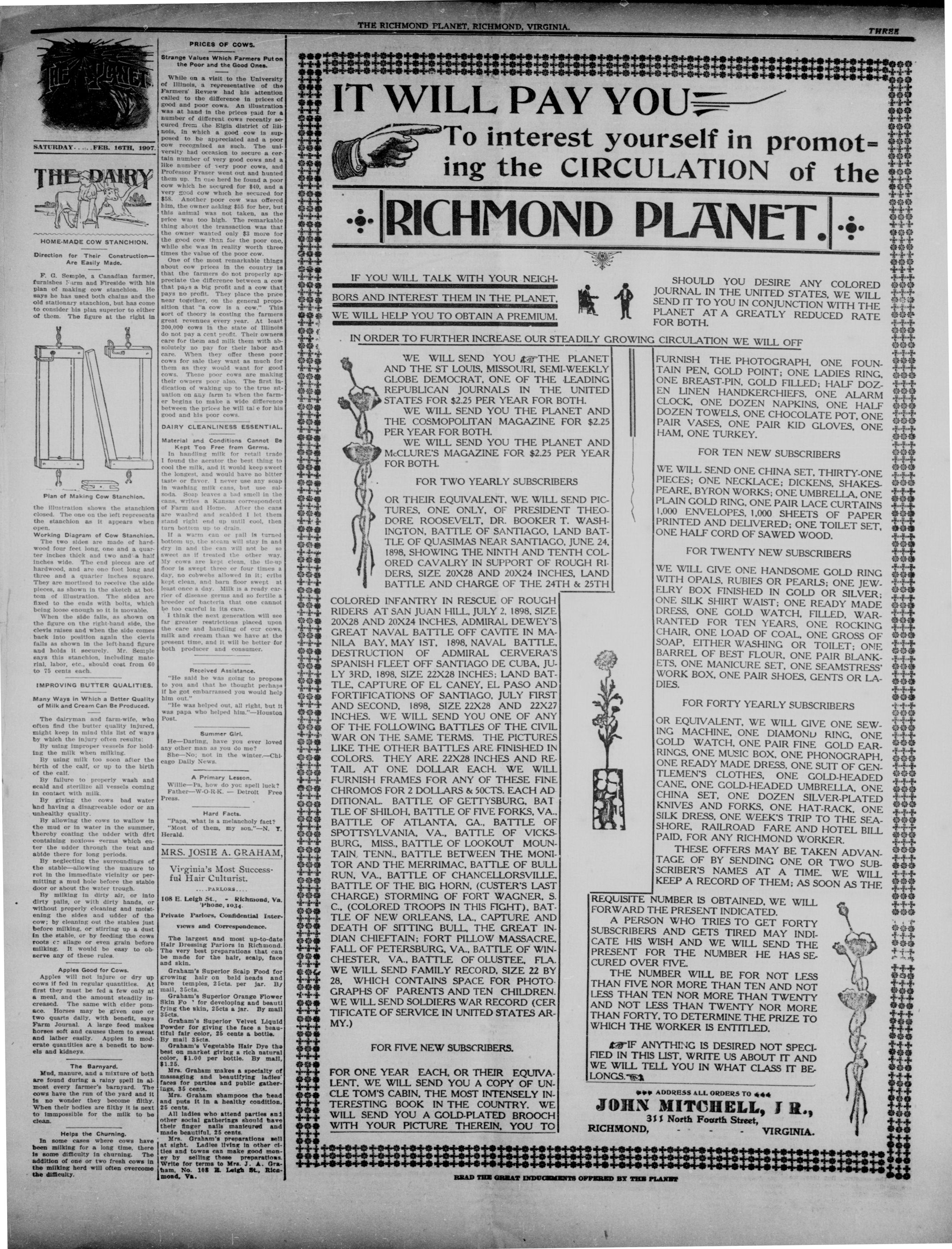
F. G. Semple, a Canadian farmer, furnishes Farm and Fireside with his plan of making cow stanchion. He says he has used both chains and the old stationary stanchion, but has come to consider his plan superior to either of them. The figure at the right in
Plan of Making Cow Stanchion.
the illustration shows the stanchion closed. The one on the left represents the stanchion as it appears when open.
Working Diagram of Cow Stanchion.
The two sides are made of hardwood four feet long, one and a quarter inches thick and two and a half inches wide. The end pieces are of hardwood, and are one foot long and three and a quarter inches square. They are mortised to receive the side pieces, as shown in the sketch at bottom of illustration. The sides are fixed to the ends with bolts, which be loose enough so it is movable.
When the side falls, as shown on the figure on the right-hand side, the clevis raises and when the side comes back into position again the clevis falls as shown in the left-hand figure and holds it securely. Mr. Semple says this stanchion, including material, labor, etc., should cost from 60 to 75 cents each.
IMPROVING BUTTER QUALITIES.
Many Ways in Which a Better Quality of Milk and Cream Can Be Produced.
The dairyman and farm-wife, who often find the butter quality injured, might keep in mind this list of ways by which the injury often results:
By using improper vessels for holding the milk when milking.
By using milk too soon after the birth of the calf, or up to the birth of the calf.
By failure to properly wash and scald and sterilize all vessels coming in contact with milk.
By giving the cows bad water and having a disagreeable odor or an unhealthy quality.
By allowing the cows to wallow in the mud or in water in the summer, thereby coating the udder with dirt containing noxious germs which enter the udder through the teat and abide there for long periods.
by neglecting the surroundings of the stable—allowing the manure to rot in the immediate vicinity or permitting a mud hole before the stable door or about the water trough. By milking in dirty air, or into dirty pails, or with dirty hands, or without properly cleaning and moistening the sides and udder of the cow; by cleaning out the stables just before milking, or stirring up a dust in the stable, or by feeding the cows roots or silage or even grain before milking. It would be easy to observe any of these rules.
Apples Good for Cows.
Apples will not injure or dry up cows if fed in regular quantities. At first they must be fed a few only at a meal, and the amount steadily increased. The same with elder pomace. Horses may be given one or two quarts daily, with benefit, says Farm Journal. A large feed makes horses soft and causes them to sweat and lather easily. Apples in moderate quantities are a benefit to bowels and kidneys.
The Barnyard
Mud, manure, and a mixture of both are found during a rainy spell in almost every farmer's barnyard. The cows have the run of the yard and it is no wonder they become filth. When their bodies are filth it is next to immpossible for the milk to be clean.
Helps the Churning
In some cases where cows have been milking for a long time, there is some difficulty in churning. The addition of one or two fresh cows in the milking herd will often overcome the difficulty.
BORS AND INTEREST THEM IN THE PLANET. WE WILL HELP YOU TO OBTAIN A PREMIUM.
COLORED INFANTRY IN RESCUE OF ROUGH RIDERS AT SAN JUAN HILL, JULY 2, 1898, SIZE 20X28 AND 20X24 INCHES, ADMIRAL DEWEY'S GREAT NAVAL BATTLE OFF CAVITE IN MANILA BAY, MAY 1ST, 1898, NAVAL BATTLE, DESTRUCTION OF ADMIRAL CERVERA'S SPANISH FLEET OFF SANTIAGO DE CUBA, JULY 3RD, 1898, SIZE 22X28 INCHES; LAND BATTLE, CAPTURE OF EL CANEY, EL PASO AND FORTIFICATIONS OF SANTIAGO, JULY FIRST AND SECOND, 1898, SIZE 22X28 AND 22X27 INCHES. WE WILL SEND YOU ONE OF ANY OF THE FOLLOWING BATTLES OF THE CIVIL WAR ON THE SAME TERMS. THE PICTURES LIKE THE OTHER BATTLES ARE FINISHED IN COLORS. THEY ARE 22X28 INCHES AND RETAIL AT ONE DOLLAR EACH. WE WILL FURNISH FRAMES FOR ANY OF THESE FINE CHROMOS FOR 2 DOLLARS & 50CTS. EACH ADDITIONAL. BATTLE OF GETTYSBURG, BATTLE OF SHILOH, BATTLE OF FIVE FORKS, VA., BATTLE OF ATLANTA, GA., BATTLE OF SPOTTSYLVANIA, VA., BATTLE OF VICKSBURG, MISS., BATTLE OF LOOKOUT MOUNTAIN, TENN., BATTLE BETWEEN THE MONITOR AND THE MERRIMAC, BATTLE OF BULL RUN, VA., BATTLE OF CHANCELLORSVILLE, BATTLE OF THE BIG HORN, (CUSTER'S LAST CHARGE) STORMING OF FORT WAGNER, S. C., (COLORED TROOPS IN THIS FIGHT), BATTLE OF NEW ORLEANS, LA., CAPTURE AND DEATH OF SITTING BULL, THE GREAT INDIAN CHIEFTAIN; FORT PILLOW MASSACRE, FALL OF PETERSBURG, VA., BATTLE OF WINCHESTER, VA., BATTLE OF OLUSTEE, FLA. WE WILL SEND FAMILY RECORD, SIZE 22 BY 28, WHICH CONTAINS SPACE FOR PHOTOGRAPHS OF PARENTS AND TEN CHILDREN. WE WILL SEND SOLDIERS WAR RECORD (CERTIFICATE OF SERVICE IN UNITED STATES ARMY.)
FOR ONE YEAR EACH, OR THEIR EQUIVALENT, WE WILL SEND YOU A COPY OF UNCLE TOM'S CABIN, THE MOST INTENSELY INTERESTING BOOK IN THE COUNTRY. WE WILL SEND YOU A GOLD-PLATED BROOCH WITH YOUR PICTURE THEREIN, YOU TO
PRICES OF COWS.
```markdown
```
Strange Values Which Farmers Put on the Poor and the Good Ones.
While on a visit to the University of Illinois, a representative of the Farmers' Review had his attention called to the difference in prices of good and poor cows. An illustration was at hand in the prices paid for a number of different cows recently secured from the Elgin district of lilinis, in which a good cow is supposed to be appreciated and a poor cow recognized as such. The university had occasion to secure a certain number of very good cows and a like number of very poor cows, and Professor Fraser went out and hunted them up. In one herd he found a poor cow which he secured for $40, and a very good cow which he secured for $58. Another poor cow was offered him, the owner asking $55 for her, but this animal was not taken, as the price was too high. The remarkable thing about the transaction was that the owner wanted only $3 more for the good cow than for the poor one, while she was in reality worth three times the value of the poor cow.
One of the most remarkable things about cow prices in the country is that the farmers do not properly appreciate the difference between a cow that pays a big profit and a cow that pays no profit. They place the price near together, on the general proposition that "a cow is a cow." This sort of theory is costing the farmers great revenues every year. At least 300,000 cows in the state of Illinois do not pay a cent profit. Their owners care for them and milk them with absolutely no pay for their labor and care. When they offer these poor cows for sale they want as much for them as they would want for good cows. These poor cows are making their owners poor also. The first indication of waking up to the true situation on any farm is when the farmer begins to make a wide difference between the prices he will tale for his good and his poor cows.
DAIRY CLEANLINESS ESSENTIAL.
Material and Conditions Cannot Be Kept Too Free from Germs.
In handling milk for retail trade I found the acerator the best thing to cool the milk, and it would keep sweet the longest, and would have no bitter taste or flavor. I never use any soap in washing milk cans, but use salsoda. Soap leaves a bad smell in the cans, writes a Kansas correspondent of Farm and Home. After the cans are washed and scalded I let them stand right end up until cool, then turn bottom up to drain.
If a warm can or pail is turned bottom up, the steam will stay in and dry in and the can will not be so sweet as if treated the other way. My cows are kept clean, the tie-up floor is swept three or four times a day, no cobwebs allowed in it; cribs kept clean, and barn floor swept at least once a day. Milk is a ready carrier of disease germs and so fertile a breeder of bacteria that one cannot be too careful in its care.
I think the next generation will see far greater restrictions placed upon the care and handling of our cows, milk and cream than we have at the present time, and it will be better for both producer and consumer.
Received Assistance
"He said he was going to propose to you and that he thought perhaps if he got embarrassed you would help him out."
"He was helped out, all right, but it was papa who helped him."—Houston Post.
He—Darling, have you ever loved any other man as you do me?
She—No; not in the winter.—Chicago Dally News.
Willie—Pa, how do you spell luck?
Father—W-O-R-K. — Detroit Free Press.
Hard Facts.
"Papa, what is a melancholy fact?
"Most of them, my son."—N. Y.
Herald.
MRS. JOSIE A. GRAHAM
Virginia's Most Successful
fur Hair Culturist.
...PARLORS...
108 E. Leigh St., - Richmond, Va.
'Phone, 1034.
Private Parlors, Confidential Inter-
views and Correspondence.
The largest and most up-to-date
Hair Dressing Parlors in Richmond.
The very best preparations that can
be made for the hair, scalp, face
and skin.
Graham's Superior Scalp Food for
growing hair on bald heads and
bare temples, 25cts. per jar. By
mail, 35cts.
Graham's Superior Orange Flower
Skin Fo' for developing and beauti-
fying the skin, 25cts a jar. By mail
35cts.
Graham's Superior Velvet Liquid
Powder for giving the face a bea-
tiful fair color, 25 cents a bottle.
By mail, 35cts.
Graham's Vegetable Hair Dye the best on market giving a rich natural color, $1.00 per bottle. By mail, $1.25.
Mrs. Graham makes a specialty of massaging and beautifying ladies' faces for parties and public gatherings, 35 cents.
Mrs. Graham shampoos the head and puts it in a healthy condition, 25 cents.
All ladies who attend parties and other social gatherings should have their finger nails manicured and made beautiful, 25 cents.
Mrs. Graham's preparations sell at sight. Ladies living in other cities and towns can make good money by selling these preparations.
Write for terms to Mrs. J. A. Graham, No. 108 E. Leigh St., Richmond, Va.
IN ORDER TO FURTHER INCREASE OUR STEADILY GROWING CIRCULATION WE WILL OFF
WE WILL SEND YOU THE PLANET AND THE ST LOUIS, MISSOURI, SEMI-WEEKLY GLOBE DEMOCRAT, ONE OF THE LEADING REPUBLICAN JOURNALS IN THE UNITED STATES FOR $2.25 PER YEAR FOR BOTH. WE WILL SEND YOU THE PLANET AND THE COSMOPOLITAN MAGAZINE FOR $2.25 PER YEAR FOR BOTH. WE WILL SEND YOU THE PLANET AND McCLURE'S MAGAZINE FOR $2.25 PER YEAR FOR BOTH.
OR THEIR EQUIVALENT, WE WILL SEND PICTURES, ONE ONLY, OF PRESIDENT THEODORE ROOSEVELT, DR. BOOKER T. WASHINGTON, BATTLE OF SANTIAGO, LAND BATTLE OF QUASIMAS NEAR SANTIAGO, JUNE 24, 1898, SHOWING THE NINTH AND TENTH COLORED CAVALRY IN SUPPORT OF ROUGH RIDERS, SIZE 20X28 AND 20X24 INCHES, LAND BATTLE AND CHARGE OF THE 24TH & 25TH
READ THE GREAT INDUCEMENTS OFFERED BY THE PLANET
THE RICHMOND PLANET, RICHMOND, VIRGINIA
IF YOU WILL TALK WITH YOUR NEIGH-
```markdown
```
FOR TWO YEARLY SUBSCRIBERS
FOR FIVE NEW SUBSCRIBERS
REQUISITE NUMBER IS OBTAINED, WE WILL FORWARD THE PRESENT INDICATED.
A PERSON WHO TRIES TO GET FORTY SUBSCRIBERS AND GETS TIRED MAY INDICATE HIS WISH AND WE WILL SEND THE PRESENT FOR THE NUMBER HE HAS SECURED OVER FIVE.
THE NUMBER WILL BE FOR NOT LESS THAN FIVE NOR MORE THAN TEN AND NOT LESS THAN TEN NOR MORE THAN TWENTY AND NOT LESS THAN TWENTY NOR MORE THAN FORTY, TO DETERMINE THE PRIZE TO WHICH THE WORKER IS ENTITLED.
IF ANYTHING IS DESIRED NOT SPECIFIED IN THIS LIST, WRITE US ABOUT IT AND WE WILL TELL YOU IN WHAT CLASS IT BE LONGS.
ADDRESS ALL ORDERS TO
JOHN MITCHELL, J R.,
311 North Fourth Street,
RICHMOND, VIRGINIA.
A
DIDILY GROW
LANET
EEKLY
READING
UNITED
H.
T AND
R $2.25
T AND
YEAR
ND PIC-
THEO-
WASH-
D BAT-
JUNE 24.
H COL-
GH RI-
LAND
& 25TH
```markdown
```
REQUISITION FORWARD
SHOULD YOU DESIRE ANY COLORED JOURNAL IN THE UNITED STATES, WE WILL SEND IT TO YOU IN CONJUNCTION WITH THE PLANET AT A GREATLY REDUCED RATE FOR BOTH.
FURNISH THE PHOTOGRAPH, ONE FOUNTAIN PEN, GOLD POINT; ONE LADIES RING, ONE BREAST-PIN, GOLD FILLED; HALF DOZEN LINEN HANDKERCHIEFS, ONE ALARM CLOCK, ONE DOZEN NAPKINS, ONE HALF DOZEN TOWELS, ONE CHOCOLATE POT, ONE PAIR VASES, ONE PAIR KID GLOVES, ONE HAM, ONE TURKEY.
WE WILL SEND ONE CHINA SET, THIRTY-ONE PIECES; ONE NECKLACE; DICKENS, SHAKESPEARE, BYRON WORKS; ONE UMBRELLA, ONE PLAIN GOLD RING, ONE PAIR LACE CURTAINS 1,000 ENVELOPES, 1,000 SHEETS OF PAPER PRINTED AND DELIVERED; ONE TOILET SET, ONE HALF CORD OF SAWED WOOD.
FOR TWENTY NEW SUBSCRIBERS
WE WILL GIVE ONE HANDSOME GOLD RING WITH OPALS, RUBIES OR PEARLS; ONE JEWELRY BOX FINISHED IN GOLD OR SILVER; ONE SILK SHIRT WAIST; ONE READY MADE DRESS, ONE GOLD WATCH, FILLED, WARRANTED FOR TEN YEARS, ONE ROCKING CHAIR, ONE LOAD OF COAL, ONE GROSS OF SOAP, EITHER WASHING OR TOILET; ONE BARREL OF BEST FLOUR, ONE PAIR BLANKETS, ONE MANICURE SET, ONE SEAMSTRESS' WORK BOX, ONE PAIR SHOES, GENTS OR LADIES.
FOR FORTY YEARLY SUBSCRIBERS
OR EQUIVALENT, WE WILL GIVE ONE SEWING MACHINE, ONE DIAMOND RING, ONE GOLD WATCH, ONE PAIR FINE GOLD EARRINGS, ONE MUSIC BOX, ONE PHONOGRAPH, ONE READY MADE DRESS, ONE SUIT OF GENTLEMEN'S CLOTHES, ONE GOLD-HEADED CANE, ONE GOLD-HEADED UMBRELLA, ONE CHINA SET, ONE DOZEN SILVER-PLATED KNIVES AND FORKS, ONE HAT-RACK, ONE SILK DRESS, ONE WEEK'S TRIP TO THE SEASHORE, RAILROAD FARE AND HOTEL BILL PAID, FOR ANY RICHMOND WORKER. THESE OFFERS MAY BE TAKEN ADVANTAGE OF BY SENDING ONE OR TWO SUBSCRIBER'S NAMES AT A TIME. WE WILL KEEP A RECORD OF THEM; AS SOON AS THE
FOR TEN NEW SUBSCRIBERS
THREE
1.
```markdown
```
FOUR
THE PLANET
Published every Sat. play by JOHN MITCHELL
Jn., at 811 North 4th Street, Richmond Va.
Published every Saturday by JOHN MYCHELL
Jn., at 311 North 4th Street, Riondano Va.
communications intended for publication
will be sent so to reach us by Wednesday
TERMS IN ADVANCE
One Copy, one year, $1.00
One Copy, eight months, 1.00
One Copy, eight months, $0.50
One Copy, four months, $0.50
One Copy, three months, $0.50
Single Copy, $0.50
ADVERTISING RATEL
For one inch, one insertion,
For one inch, each subsequent insertion,
For two inches, three months,
For two inches, six months,
For two inches, nine months,
For two inches, twelve months
Marriage and Funeral Notices, one inch,
Standing and Transient Notices per line,
FOR POSTAGE STAMPS OF A HIGHER DE
NOMINATION THAN TWO CENTS NOT
RECEIVED ON SUBSCRIPTIONS.
THE PLANET is issued weekly. The subscription price is $1.50 per year in advance.
There are FOUR ways by which money can be sent by mail at our mail—In a Post Office Money Order, by Bank Check or Draft, or an Exempt Money Order, and when none of these can be procured, you may send a Money Order. You can buy a Money Order at your Post-Office, payable at the Richmond Post-Office, and we will be responsible for the Express Money Order can be obtained at any office of the American Express. Co. the United States Express Co., and the Wells Fargo and Co. Express Company. We will be responsible for the companies. The Express Money Order is a convenient way for forwarding money.
REGISTERED LETTER—If a money Order Post-Office or an Express Office is not within your address, you may send us on payment of ten cents. Then, if the letter is lost or stolen, it can be traced. You can send money in this Letter you wish to send us on payment of ten cents.
We cannot be responsible for money sent in letters in any other way than one of the four ways mentioned above. If you send your money in any other way, you must do it at your
REWARNA, ETC.—If you do not want THE PLANET continued for another year after your subscription has run out, you then notify us by email part to discount it. The cost you decided that subscribers to newspaper, who do not order their paper discontinued at the expiration of time for which it has been paid, should pay for the payment of the subscription up to date when they order the paper discontinued.
COMMUNICATIONS—When writing to us to request your subscription or discontinued your paper, you should give your name and address in full otherwise we cannot find your name on our books.
CAPTION OR ADDRESS—In order to change the address of a subscriber, we must be sent the former as well as the present address.
SATURDAY... FEB. 16TH, 1907
THAT OHIO APPOINTMENT
"He cast off his friends, as a huntsman his jack.
For he knew, when he pleased, he could whistle them back."
—Goldsmith.
The action of President Roosevelt in unofficially announcing that he intended to appoint a colored man Surveyor of Customs at Cinchnati, Ohio was a surprise to us and we confess that we did not believe that such a move was seriously contemplated. Subsequent developments have tended to lend color to the report and to indicate that the distin-guished occupant of the White House really intended to appoint a citizen of color to one of the best paying positions in Senator J. B. Foraker's state.
It is further alleged that the idea of making the appointment at Cincinnati has been abandoned on account of the protest of his son in law, who it is alleged would be in jured by such action. This is rather an embarrassing statement of the case and it leads one to ask if race prejudice is rampant in the family of this great statesman. The assertion is made that President Roosevelt's object in making this appointment was for the purpose of humiliating and punishing, so to speak, the great Ohio Senator for his attitude in the Brownsville case and to win back the support and good feeling of the colored people of the country whom he has undoubtedly estranged.
It will be seen then that President Roosevelt was careless in the treatment of the colored brother, believing that one diplomatic political move in Ohio would result in the return of the colored people of the country to their "first love." Vain hope! We have been puzzled too relative to the "Wizard of Tuskegee." It is alleged and there has been no denial of it that he has been in consultation with President Roosevelt relative to this Ohio appoint ment and that Hon. Ralph W. Tyler has been recommended by him for any honors that may be sent out in that direction.
We have been slow to believe this as it indicates that Dr. Booker T. Washington despite the protest of friends to the contrary is still in politics, to the extent of dictating political appointments. This will not do. Politicians of color will resent it. The men who are in this kind of business oppose this kind of interference and they are backed up to a great extent by the colored peo ple of the country. But then, we are unwilling to believe that Dr. Washington did this. If he has any influence at the White House at all, it seems to us
that he should exercise it to secure the reinstatement of the members of Companies B, C and D of the Twenty fifth Infantry. This would not only popularize Dr. Washington, but President Roosevelt as well. The result of the investigation thus far has demonstrated that there are innocent men in this battalion, who have been "more sinned against, than sinning."
If the desire of the distinguished Chief Executive of the nation is to use a "big stick" on the head of Senator Foraker, we shall be obliged to him if he will find some other method of so doing. We have seen several names of colored men mentioned with reference to the Ohio appointment, but it seems to us that the recommendations should come through the chosen representatives of the Republican Party of that state. If President Roosevelt is determined to name a colored man and we are in favor of such a determination, we see no reason why he should not communicate this fact to the delegation from the "Buckeye" state.
He was generous and good enough to appoint Hon. Charles W. Ander son to a most important position in his own state, and we believe that this popular Republican has justified him in every way as to the wisdom of such an appointment. But there is nothing that President Roosevelt can do at this time to wean the Republican citizen of color from the support of Senator Foraker, who is at this time waging a battle for sim ple justice to citizens of the United States, who not only wear the uni form of soldiers of the country, but who have offered their lives as sacrifices to its service. Appointments of colored people to office go a long way, but the vouchsafing to them inherent political and civil rights go much further.
We are not blind down here and we can see that the two distinguished Democratic Senators from Virginia can get more favors from the occupant of the White House than can some of the Republican representatives in other states. What Senator John W. Daniel, "the noblest Roman of them all," so far as the Democratic contingent is concerned goes after he generally lands to the satisfaction of his constituents in this state
It may be that President Roosevelt has accurately "sized up" the colored people and that the quaint lines of Goldsmith cited at the commencement of this article are true, but we are loth at this time to believe it. Pres. Roosevelt has shocked the moral sensibilities of the civilized world in his treatment of these colored soldiers and the only thing he can do to repair the damage done, he will not do, and that is to retrace his steps. He will persist in his course and maintain his attitude. His shield, bright as a mirror and resplendent as polished brass shows signs of recent injury, a dent that will not be obliterated, a blow that will not be effaced. Brownsville, Texas is written in history and it heads the list of blunders made by the great man now occupying the White House.
Well says Dryden:
"Forgiveness to the injured does be long;
But they ne'er pardon who have done the wrong."
EXPERT DESCRIBES THAW'S INSANITY
Says Prisoner Suffered From "Brain
Storm" When He Shot White.
EVELYN TELLS OF HER WRONGS
Was Lured to Studio By Architect,
Drugged With Wine and Her Ruin
Accomplished—Told All to Thaw
When He Proposed Marriage In
1903—Prisoner Wept As Wife Gave
Testimony.
New York, Feb. 13.—District Attorney Jerome and Delphin M. Delmas came together in the first serious clash between counsel in the Harry K. Thaw trial, and the California attorney, who is directing the defense, took exceptions to certain statements of the prosecuting officer, and had inserted in the record of the case a protest against "the misconduct of the learned district attorney."
Mr. Jerome hotly accused the defendant's counsel of trying to instill into the minds of the jury the implied suggestion that the operation performed upon Evelyn Nesbit in 1903, before Thaw took her to Europe, was "of a criminal nature," when, "as a matter of fact," he said, "it was for appendicitis."
Mr. Delmas called the attention of Justice Fitzgerald to this, saying that the district attorney was stating facts not in evidence and that "a very serious exception must be taken to his remarks."
Dr. Britton D. Evans, of the State Hospital for the Insane, at Morris Plains, N. J., was the witness, and he testified that he was of the opinion that Harry Thaw was insane at the time of the tragedy. He had been called upon to answer a long hypothetical question, in which reference had been made to "a serious if not capital operation" upon Miss Nesbitt when the storm between counse broke.
Dr. Evans was by far the most satisfactory expert witness to the defense thus far produced. He detailed to the jury his observations and examinations of Harry Thaw during
THE RICHMOND PLANET, RICHMOND, VIRGINIA
eight visits to the prisoner in the Tombs, and declared it to be his opinion that Thaw was suffering from "a brain storm or an explosive or fulminating condition of mental unsoundness" at the time he shot and killed Stanford White. Dr. Evans gave many and elaborate reasons for his opinion, and during his examination Mr. Delmas defily brought out the fact, whereas Thaw was suffering from "storm and stress" when the alienist first visited him in August last, his condition had shown steady and gradual improvement until on October 8 Thaw was "more composed and deliberate."
Answering a hypothetical question covering every detail of the testimony up to the present time, Dr. Charles G. Wagner, superintendent of the State Hospital for the Insane at Binghamton, N. Y., declared on the witness stand that in his opinion Harry K. Thaw did not know that the act was wrong when he shot and killed Stanford White.
When young Mrs. Thaw was called to the stand Mr. Delmas turned to the district attorney and renewed his demand that the note which was passed by Mrs. Thaw to her husband at the Cafe Martin the night of the tragedy, should be produced. Mr. Jerome, upon the occasion of the first demand, had remained silent. He was on his feet at once, saying he would send for the slip of paper. It was brought from his office, was identified by Mrs. Thaw and then read by Mr. Delmas as follows: "The b — was here a minute ago but
"The b—was here a minute ago but went out again."
Mrs. Thaw testified that "the b—" meant the "blackguard," as Thaw always referred to Stanford White, whom she had seen on the balcony of the cafe.
EVELYN THAW'S STORY
Reveals Her Life With Stanford White to Save Husband.
New York, Feb. 8.—Evelyn Nesbitt Thaw told her story. To save the life of her husband, charged with murder, she bared to the world the innermost secrets of her soul—a portrayal for which a sanctuary were a more fitting place than the crowded, gaping court room. It was the same story she told Harry Thaw in Paris in 1903, when he had pleaded with her to become his wife—the confession of one who felt there was an insurmountable barrier to her ever becoming the bride of the man she loved.
Then came the revelation of the wreck of that girlhood at the age of 16. She told the story of her meeting with Stanford White, the story of the sumptuous studio apartment, whose dingy exterior gave no hint of the luxurious furnishings within; of a velvet covered swing in which one could swing until slipped toes crashed through the paper of a Japanese parasol swung from the ceiling; the story of a glass of champagne, of black, whirling sensations and of mirrored bedroom walls. In short, she told all the story.
"Don't scream so; it is all over. It is all right."
"And this was Stanford White?"
The question came from Mr. Delmas, now conducting the defense of Harry Thaw.
She told of her arrival in New York, of her life here, and eventually the acceptance by her mother of the thrice refused invitation of a girl of the theatre to meet some of her friends at luncheon. The girl's mother told Evelyn's mother they were people in New York society and perfectly proper, else she would not let her girl go with them.
"When she came for me in the hansom," said the witness, "I remember hoping we were going to the Waldorf. I had heard so much about it and wanted so to go there. But the hansom stopped in front of a dingy looking building in West 24th street, and I was told to get out. Mother had dressed me. My skirts were just to my shoe tops then."
This was in August. 1901.
Her Meeting With White.
"He was a big and fat and ugly man—I remember him meeting us at the head of three flights of stairs," she continued. "He gave me presents and my mother let me go to other parties. Then he said my mother should visit some friends in Pittsburg. She said she could not leave me. He said it would be all right; that he would look after me. Finally she went. Then came an invitation to a party, but no one else was there—just two. 'They all seem to have turned us down,' he said. After we had dined and I wanted to go home, he said I had not seen all of the apartment, and we went to the bedroom with the mirrors all over the walls. On a small table stood a bottle of champagne and one glass. Mr. White poured out just one glass for me, and I paid no attention to it. Mr. White went away, came back and said: 'I decorated this room myself.' Then he asked me why I was not drinking my champagne, and I said I did not like it; it tasted bitter. But he persuaded me to drink it. and I did.
Became Unconscious.
"A few moments after I had drank the champagne there began a pounding and thumping in my ears and the room got all black.
"When I awoke my clothes had all been taken off me. I started to scream. Mr. White got up and threw a klimo on me. As I sat up I saw mirrors all around the bed. I began to scream again, and Mr. White asked me to keep quiet, saying that it was all over.
"When he threw the klimo over me, he left the room. I screamed harder than ever. I don't remember how I got my clothes on. He took me home and I sat up all night crying."
"Where are Mr. White?"
"Where was Mr. White when you recovered consciousness?"
"He was on the bed, beside me, undressed."
"What did he say afterwards?"
"He made me swear that I would never tell my mother about it. He said there was no use in talking, and the greatest thing in this world was not to get found out. He said the girls in the theatres were foolish to talk. He laughed afterwards.
Thaw Excited.
"Yes, he was excited, and walked.
up and down the room. We sat up all night. He said it was not my fault; that no one could blame me, and that I was only an unfortunate girl, and that he did not think any the less of me; he would marry me, anyway."
"Did he offer to marry you again?" "Yes, and I told him that if I did marry him the friends of Stanford White would laugh at him and laugh at me, as they suspected our relations, if they did not know."
The witness told Thaw that it would not be well to marry on account of his family. He persisted that he wished to marry her.
"When I told him the story in Paris," she said, "he came to me and picked up the hem of my skirt and kissed it and said he would always love me. He nearly always called me his angel. We sat together that night until daylight talking the matter over. The effect on Harry was terrible.
"Stanford White sent me to school in New Jersey in October, 1902, and early in 1903 I became ill. The doctors came and said an operation was necessary. They told me I was very sick, but did not say what was the matter. Mr. Thaw came to see me, and was the last person, except the doctors, whom I saw before being placed under the influence of anaesthetics. He had been told it was dangerous for me to talk. So he came in quietly and kneeled down by the bed and kissed my hand and looked at me for a moment and went out.
"When I recovered I found he had made arrangements for my mother to take me abroad to recuperate. It was while we were in Paris on this trip that he proposed to me."
After leading the witness to tell, in chronological order, of the incidents of her wedding with Thaw in Pittsburgh, Mr. Delmas asked her if she had seen Stanford White after her return to New York from the honeymoon trip.
"I passed Stanford White one day on Fifth avenue. I was in a cab, and he saw me, and I heard him say 'Evelyn,' just like that," and Mrs. Thaw raised her voice as if to call some one "I went back to our hotel and told Harry, and he said 'the dirty blackguard—he had no right to speak to you.' The next time I saw him I was driving to Dr. Delevan's office to have my throat treated. Stanford White was also in a cab. He just stared at me this time and stroked his moustache. I turned into 33d street off Fifth avenue, and as I alighted at the doctor's door I saw Stanford White coming. I rang the bell, and the maid came to the door, and then I got so nervous and flustered I told her I would come back again, and I ran down the steps, got into the cab and drove to the hotel, where I told Harry what had happened. He got very excited and bla his nails."
These were the only two instances, Mrs. Thaw said, that she told her husband that Stanford White "had approached it attempted to speak" to her.
NEARLY CHEWED TO DEATH
Philadelphia Woman Horribly Mangled
By. Angry Bull. Dog.
Philadelphia, Feb. 13.—Attacked by avious bull dog belonging to her husband. Mrs. Lena Smith was almost chewed to death in her home here. She is in a critical condition in a hospital. One of her arms was so mangled by the angry dog that it will have to be amputated, and the other arm was so torn it will be almost useless if she recovers. The woman's neck and breast were also terribly mangled. The attack on the part of the dog was provoked by a beating which Mrs. Smith gave the animal. But for the return of her husband, who beat the animal with a club and pried open his jaws, the physicians say nothing could have saved her life.
WHOLE FAMILY ASPHYXIATED
Man, Wife and Child Found Dead In Wilmington, Del.
Wilmington, Del., Feb. 12.—Michael Ryan, aged 35 years; his wife, Mamie, aged 26, and their infant, Mary A., who lived at 223 Connell street, aged 4 months, were asphylated by illuminating gas. Policeman Beck, who forced an entrance into the house, found the victims lying on a bed in the second story front room, all three cold and stiff in death. On the floor was a gas stove. It was still burning, but the tube fitted so loosely upon the burner at the pipe that gas was escaping plentifully. Mr. and Mrs. Ryan were fully dressed, while the baby had been prepared for bed, thus indicating that they had been overcome while preparing to retire.
WILL BAR JAPANESE COOLIES
President Asks Republican Leaders to Insert Clause In Immigration Bill. Washington, Feb. 13.—In an effort to settle the Japanese question, it was stated that President Roosevelt, through Secretary Root, has proposed to Speaker Cannon and to the chairmen of the senate and house committees on immigration and other Republican leaders in congress that a clause be inserted in the immigration bill now pending in congress which will bar Japanese coolie labor from the United States. Mayor Schmitz's delegation favors such a provision.
How to Make Nail Polish.
A powder for polishing the nails may be made by mixing half an ounce each of talcum powder, pulverized boric acid and powdered starch. Then add ten drops of tincture of carmine. A nail rouge is made of half a dram of fine powdered carmine, a dram of fresh lard and twenty drops of oil of lavender.
How to Treat Swallowing of Pins. If a child has swallowed anything sharp, like a pin or needle, do not give a purgative, but get the child to eat freely of suet pudding or anything of that nature, which will imbued the object and so prevent its injuring the child's inside.
How to Clean a Per
When ink has thickened upon a pen to such an extent that it becomes thick and unpleasant to write with try washing it in strong soda. It will cleanse it perfectly and make it as good as new.
STEAMER SINKS; NEARLY 200 PERISH
The Larchmont Goes Down After Collision With Schooner.
MANY BODIES WASHED ASHORE
Block Island, R. I., Feb. 13.—A marine disaster, with an appalling loss of life, and entailing suffering almost beyond the limit of human endurance, came to light when a lifeboat of the Joy line steamer Larchmont, bound from Providence to New York, drifted into Block Island harbor. In the boat were several bodies of men who had died from the effects of long hours of exposure to a death-dealing temperature. In the boat also were 11 men, whose suffering was so intense that they seemed oblivious to the fact that death was in their midst and that they had escaped only by virtue of their ability to withstand the rigor of zero weather in an open boat at sea.
The boat brought a tale of disaster that has rarely been equalled in New England waters, and it is believed that when the final count is made it will be found that not less than 150 lives were lost. Following closely in the wake of the solitary lifeboat came bodies, cast upon the beach by angry waves. Then came lifeboats and rafts. Each of them bore their burden of grim death, as well as a load of suffering humanity, and each brought a tale of horror, of suffering and of despair.
Owing to the condition of the survivors of the tragedy, it was impossible to get from them an estimate of the loss of life. Anywhere from 75 to 150 persons went to their death, and it is believed that the latter figures are nearer correct than the former.
Only Nineteen Survivors.
The steamship officials estimate that about 150 passengers and a crew of 50 were on board the steamer when she left Providence. Forty-eight bodies reached these shores, and 19 were alive when taken from the lifeboats. Taking the estimated figures of the steamship officials as a basis, there are still 138 persons to be accounted for.
The cause of the accident has not been satisfactorily explained. It occurred just off Watch Hill, when the three-masted schooner Harry Knowlton crashed into the steamer's port side amidships. Captain George McVey, of the Larchmont, declares that the Knowlton suddenly swerved from her course, luffed up into the wind and crashed into his vessel.
Captain Haley, of the Knowlton, asserts that the steamer did not give his vessel sufficient sea room, and that the collision occurred before he could take his schooner out of the path of the oncoming steamer.
The steamer, with a huge hole torn in her side, was so seriously damaged that no attempt was made to run for shore, and she sank to the bottom in less than half an hour. The Knowiton, after she had backed away from the wreck, began to fill rapidly, but her crew manned the pumps and kept her afloat until she reached a point off Quonochontaug, where they put out in the lifeboat and rowed ashore. There were no fatalities on the schooner, but the men suffered from the extreme cold.
There was no comparison, however, between their experiences and those of the passengers and crew of the steamer. A majority of those on the Larchmont had retired for the night, and when the collision occurred there were few on board, with the exception of the crew, who were prepared for the weather which prevailed. They hurried from the warm staterooms to the deck of the steamer and into a zero atmosphere.
Passengers Suffered Terribly.
Literally chilled to the bone, many rushed headlong below to secure more clothing, while others, barefooted, bareheaded and clad only in night gowns, stood on the decks, fearing that to go below would mean almost certain death.
While some of the seamen held back the frantic passengers by brute strength, others were preparing to lower the lifeboats and rafts. There was no time to think of the comfort of any one. Even before the boats were cut away, Captain McVey knew that the list of victims would be much greater than those who survived.
It was a physical impossibility for any but the most hardened to withstand the cold, which turned ears and noses white with the frost, and which so benumbed feet that both the passengers and members of the crew stumbled rather than walked to the small craft in which they were to leave the sinking ship.
Shrieks of agonized pain drowned the roar of the inrushing water. Fandemonium reigned supreme, but in spite of it the women on board, suffering more intensely than the men, were placed in lifeboats, the men passengers and members of the crew selecting the unprotected rafts as their vehicles of escape.
Captain McVey remained on the upper deck directing his officers and crew until every one on board appeared to have been cared for. He ordered all lifeboats and rafts cut away, and before he stepped into his own boat he stood on the upper deck a moment to see that his order was executed. Then he ordered that his boat be cleared away.
The pitiable condition of the passengers and crew was increased a hundredfold the moment they had launched their boats. Every wave sent its dash of spray over boats and their
contents. Soon a thin coating of ice enveloped every one. Those who were fully clothed suffered from frozen faces and numbed feet, but there were many who had on only their night clothes.
Killed Himself in Boat.
One man in the captain's boat was suddenly driven insane by his intense suffering. He pulled a big clasp knife from his pocket and gashed his throat. No one stayed his hand, and again he plunged his knife into his throat.
Those who sat near him either were too dazed to interfere or looked upon the act of self-destruction as justified. The unknown man's body fell to the bottom of the boat, where it remained unbeeded.
Fisher's Point, the nearest point of land, was not quite five miles to the westward of the point where the cleaner went down, and every boat immediately headed for that place. But the boats were heavy and the men at the oars were weak. A 50-mile gale blew on their backs as the men strained at the ice-covered oars in a hopeless endeavor to overcome the handicap against which they were struggling. The boats and rafts soon became separated, and the only details of the terrible disaster which could be learned here were given when Captain McVey's boat came ashore. Not a man on board was able to walk. Their feet were frozen so badly that the lifesavers carried the survivors bodily to the life saving station.
Even while the helpless sufferers were receiving the tender care of the natives, bodies began to wash ashore from the direction of the sunken vessel. At first there was only one, then there were two, and three and four, and soon the natives were as busy hauling the bodies out of the surf as they were in succoring those who had stood upon the threshold of death, but had not entered. When darkness set tied down over the desolate beach 48 bodies had been recovered, either from the surf or from the boats which had drifted ashore.
The little fishing schooner Elsie put in here, having on board two survivors and one victim of the wreck The survivors were Samuel Tacunne, residence unknown, and David Fox, of Bridgton, N. J. Both men were picked up from a piece of wreckage off shore. The victim was a woman, who was attired in a black skirt, white shirtwaist, with short sleeves. She wore a gold bracelet around each arm and on her hand were two gold rings.
WANAMAKER'S HOME BURNED
Handsome Country Residence of Mer
chant Destroyed By Fire
chant Destroyed By Fire.
Philadelphia, Feb. 9.—Lyndhurst, the handsome country residence of John Wanamaker, at Chelten Hills, near Jenkintown, was destroyed by fire, entailing a loss unofficially estimated at $1,500,000.
The fire made rapid progress from the start, and almost everything in the place but a few valuable paintings were destroyed. Among those saved were "Christ Before Pilate" and "Christ On Calvary," by Munkacey. These were cut from their frames and saved. The two paintings are valued at $250,000.
The furniture was the most serious loss. There were 50 rooms in the house and each room was furnished in distinctive style of some period in the world's history. Many of the furnishings were collected from the houses of royalty and cannot be replaced at any price.
FIRE IN PENNSYLVANIA CAPITOL
$3500 Damage Done In Office of Secre-
tary of Internal Affairs
Harrisburg, Pa., Feb. 13.—A fire, the origin of which is unknown, occurred in the private office of Secretary of Internal Affairs Brown, on the second floor of the north wing of the new capitol. A velvet curtain and window frame were burned, and several chairs, a desk, carpet and other furniture and the wainscoating and ceiling were damaged. The fire was extinguished by state employees with a chemical extinguisher before the arrival of the fire department. The damage will not exceed $3500, and is covered by insurance. The fire may have been caused by the throwing of a lighted match or cigar on the floor under the curtain by a visitor. The north wing of the building was filled with smoke, but no damage was done outside of Secretary Brown's office.
STARVED IN FREIGHT CAR
Body of Unknown Man Found By Workmen at Paterson, N.J.
Paterson, N. J., Feb. 11.—Workmen who broke the seal of a freight car in Benson's lumber yard found lying on the floor of the car a man who had died from starvation. There was nothing on the body to reveal the man's identity. He was about 40 years old. The car was sent here from North Carolina and had been a week on the way. It was filled with lumber, and it is supposed the man crawled into the car and was sleeping when freight hands placed the seal on the car.
Schwab Buys Ore Mines
Pottstown, Pa., Feb. 11.—Charles M. Schwab, representing the Bethlehem Steel company, has purchased the mines of the Boyertown Ore company for a consideration said to be between $400,000 and $500,000. The rights secured by the Bethlehem company cover mineral privileges on 300 acres of land. The mines, which are near Boyertown, are said to be the largest of their kind in Pennsylvania, the deposits being of bessemer-magnetic ore.
Too Much Candy Killed Boy
Washington, Pa., Feb. 11. — James Allen Stephan, 14 years old, son of C. F. Stephan, of Waynesburg, died suddenly of convulsions. It is said by an attending physician that the boy's death was due to overeating candy.
A WEEK'S NEWS CONDENSED
Thursday, February 7.
President Roosevelt expects to visit Alaska on a hunting trip after his presidential term expires.
Sam Wah, proprietor of a laundry in Philadelphia, was found seated in a chair in his house frozen to death.
James Bryce, British ambassador to the United States, will sail for New York from Liverpool on February 13.
Raymond Meyer, a school boy, of Brooklyn, N. Y., who was bitten January 17 by a mad dog, died of hydrophobia.
Dr. William C. Pickett, professor of nervous diseases at the Medico-Chirurgical College, Philadelphia, one of the best known neurologists in the United States, died of heart disease.
Friday, February 8.
Preston H. Leslie, former governor of Kentucky and Montana, died a
Helena, Mont., aged 88 years.
A bill has been introduced in congress to appropriate $100,000 for the erection of a bronze statue to General Robert E. Lee in Washington.
Number 5 breaker of the Delaware
& Hudson Coal company at Parsons,
near Wilkes-Barre, Pa., was destroyed
by fire, causing a loss of $100,000 and
rendering 1200 men and boys idle.
Saturday, February 9.
Keziah Jackson, a negress, 84 years old, and once nurse for James G. Blaine, died at Uniontown, Pa.
Captain Samuel F. Bossard, aged 86, a prominent citizen of Wilkes-Barre, Pa., died after a week's illness.
Congressman George K. Favrot was indicted at Baton Rouge, La., on a charge of murder for shooting Dr. Harry Aldrich.
Warren P. Halsey, of Brooklyn, ill with consumption and despondent, committed suicide by shooting in a New York hotel.
J. H. Hodge, white, convicted of wife murder, and Freeman Jones, colored, found guilty of burglary, were hanged at Durham, N. C.
Monday, February 11.
Sir William H. Russell, the famous war correspondent, died in London, aged 86 years.
June 5 to 11 has been fixed for the encampment of the West Point cadets at the Jamestown Exposition.
Twelve men are under arrest in New York for obtaining $10,000 from the Degonon Contracting company by false pay checks.
A South Dakota legislative committee charges former Governor Herreid with drawing large sums of money without lawful authority.
A number of coal region constables instructed counsel to sue the Northumberland (Pa.) county commissioners, alleging the latter were unlawfully withholding $3000 fees of the officers.
Tuesday, February 12.
Grover Lockwood shot and killed Joseph Snyder and wife, and then killed himself.
Winfred Goff, a noted baritone singer in grand operas, died suddenly in Washington of pneumonia.
William Alden Smith was sworn in as United States senator to fill the unexpired term of former Senator Alger, of Michigan.
The annual convention of the Pennsylvania branch of the National Association of Hardware Dealers was held at Pittsburg. Hobart Reeder and Henry Harkins, former attendants at the Ohio state hospital, at Athens, are charged with killing W. J. Baines, an inmate.
Wednesday, February 13.
President Alfred Walter, of the Seaboard Air Line railroad, died in New York, after being ill two weeks. Governor Stuart, of Pennsylvania, appointed Samuel B. Rambo, of Harrisburg, superintendent of public grounds and buildings. Two men were killed and three injured in a collision between freight trains on the Southern railway near Johnstown, S. C. John L. Crowley, a student in the Hartford, Conn., high school, died of injuries received in a football game over a year ago. Beulah Francis, 9 months old, was burned to death in her cradle in her home in Philadelphia by a fire started by her 4-year-old brother while playing with matches.
PRODUCE QUOTATIONS
The Latest Closing Prices In the Principal Markets.
PHILADELPHIA — FLOUR firm;
winter extras, $2.65@2.85; Pennsylvania roller, clear, $2.90@3.10; city anarchy, $4.40@4.50; RYE FLOUR wheat steady; $4.40@4.50; WHEAT steady; No. 2 Pennsylvania roller $79.4%; CORN firm; No. 2 yellow, local, 51.4%; OATS steady; No. 2 white, clipped, 47c; lower grades, 46c; HAY steady; No. 1 timothy, large bales, CORN firm; ANLY, amly, per barrel, $19.50; BEEF steer barrel, $19. POULTRY; Live steady; hens, 14c; old roosters, 9c; Dressed firm; choice fowls, 14c; old roosters, 9c%; BUFTER firm; extra creamy, selected, 30%@2c; nearby, 28c; southern TAOES steady; per bushel, 58@60
BALTIMORE - WHEAT firmer; No. 2 spot, 83@%32%; steamer No. 2 spot, 76%32%; southern, 76%12%; CORN active; mixed spot, 50%10%; CORN mixed spot, 45%10%; southern, 48%10%; OATS firmer, 26%16%; 46%16%; No. 3, 45%15%; No. 4, 43%13%; mixed, No. 2, 43%14%; No. 3, 42%14%; No. 4, 41%12%; BUTTER firm; creamy separator extras, 32%13%; held, 24%12%; prints, 32%14%; Maryland and Pennsylvania dairy prints, 32%14%; Maryland steady; fancy Maryland and Pennsylvania, 28%; Virginia, 28%; West Virginia, 27%; southern, 26%27%.
Live Stock Markets.
PITTSBURG (Union Stock Yards)—CATTLE steady; choice, $5.75@6; prime, $5.40@5.70. SHEEP slow; prime worms, $5.50@5.70; culls and worms, $2.03@6. HOGS active; prime heavies, mediums and heavy Yorkers, $7.50; light Yorkers, $7.25@7.30; pigs, $7@1.70; roughs, $6@6.75
How to Care For the Toothbrush.
The care of toothbrushes is not sufficiently observed. In our houses they stand in their cups or hang on their racks above the toilet bowls, absorbing any disease germs that may be floating about. They should be washed frequently—at least twice a week—in some antiseptic solution, strong salt and water or bleaching of sodium and water being two good and readily provided cleaners. Tooth washes and pastes should also be kept carefully covered.
How to Make an Emergency Soup.
A quick soup can be made if you have on hand a couple of cupfuls of cold mashed potatoes. Slice a medium sized onion and fry it in a saucepan with a slice of butter the size of an egg; pour over this a quart of milk; when the milk comes to a boil stir in the mashed potatoes and boil all together, seasoned with pepper and salt.
How to Freshen Tasteless Nuts.
It is a good thing to know that if nuts grow dry and tasteless from being kept for some time they may be wonderfully freshened by soaking them in lukewarm water. This applies to all sorts of nuts, and it is surprising to see how they are improved.
THE PLANET
CONTINUED FROM FIRST PAGE.
they treated the soldiers badly.
MADE NO AGREEMENT.
After the cross examination, Reeves said, in reply to a question by Senator Foraker, that he never had entered into an agreement with any one not to tell all he knew concerning the affray. He said that after the saloons refused to serve the Negro soldiers, he had heard it said that it would be better to "boycott the saloons than to break them up."
Senator Warner examined the witness sharply after this remark, and Reeves said that he had not heard any one suggest the "breaking up" of the saloons.
Former Corp. Albert H. Rolani, of Compamy D, after expressing the opinion that all the discharged men had turned in their full supply of ammunition, previous to their dis charge, told of his employment as an agent by a committee for the defense of the Negroes, but said that his efforts had been directed toward raising of money and not the collection of evidence. Roland spoke of the defense committee as the "committee of 100," but said he did not know that it represented the Constitution League. He formed that after his company was formed, Capt. Lyons counted them and said: "All my men are here."
On cross examination, Senator Warner developed that three, four or five men had guns which would not pass inspection without the use of the rod and rag when inspection was had on the morning of August 14th. The witness was instructed to get the credentials under which he claimed to be working for the benefit of the Negroes.
[Washington Post, Feb. 9th, 1907.]
Walker McCurdy, formerly quartermaster sergeant of Company B. of the battalion of Negro soldiers discharged for the alleged "shooting up" of Brownsville, Tex., who had charge of the issuance of gummi汁, and former Sergt. Jackson, of the same company, who had charge of the gun and the keys to the gun racks on the night of the affray were witnesses yesterday before the Senate Committee on Military Afairs.
Both men gave clear accounts of their duties an that night, and the sharpest kind of cross examination failed to trap them in any way. Bots. Senators Warner and Foster, who conducted the cross examination, remarked that they believed the wits nesses to be honest men and frank on the stand.
After McCurdy told his story Senator Hemenway asked: "Have you told all you know regarding the afray. Are you trying to conceal anything?"
HAD TOLD ALL HE KNEW.
McCurdy insisted that he had told all he knew and that he desired that the whole truth should be known. He said that he had served more than sixteen years in Company B, in Cuba, the Philippines, and the United States, and that he had fre-quently been under fire.
"Then you are not satisfied with the character of discharge you received?" asked Mr. Hemenway.
"No, sir, I am not," replied McCurdy. "I had nothing to be punished for. I have never been punished before."
On further examination it devel- oped that McCurdy in his entire ser vice, never had been in the guard house or disciplined in any way.
During the examination of the witness as to the power of penetra- tion of the service ammunition used in the Springfield rifles, Senator For aker said: "It would shoot clear through a house, would it not?" The witness relied affirmatively.
The question, coming from Sena tor Foraker created some little surprise, as that is what the War De partment officials have claimed was done—that army bullets were snot clear through a house. The witness was not cross examined concerning the remark.
KEPT KEYS TO GUN RACKS
At the opening of the afternoon hearing the examination of George Jackson a sergeant of Company B was concluded. He had been on the stand the entire morning under examination concerning the manner in which he had kept the gun racks for which he had keys, on the night of the shooting. On cross examination he admitted he had heard that government ammunition had been found to have been used in the shootin, but said that the story surprised him very much, and if any was used he could not understand how it could have been secured without detection.
He described the locks and keys, each rack having two locks. The locks were all different, and there was only one key to each. Jackson insisted that he counted the guns before he took charge for the day and night of August 13, and said that all of his company's guns were safely deposited and locked. His story of the incidents of that night was similar to the stories told by previous witnesses.
Jackson was one of the men arrested on August 23, and he told of his confinement in the guardhouse until two days later, when the but talion was sent to Fort Reno. He said he did not know who was responsible for the charges filed n
gainst him and eleven others
[The Post, Feb. 12th, 1907.]
The man whose name was made famous in the Brownsville debate in the Senate—Sergt. Mingo Sanders—was the star witness yesterday before the Senate committee.
Sanders is a very black Negro, one of the kind found on the Southern plantation before the war. He was by no means an unwilling witness and impressed the committee with his earnestness and apparent veracity as he told his story. Sanders was first sergeant of Company B, at the time of his discharge without honor.
According to his statement, the shooting up of the town was in the form of an attack upon the garrison at Fort Brown. Sanders' story creat ed something of a str in the com mittee as he said that while running from his quarters to Company B barracks, after being awakened by the firing on the night of August 13 the shooting was going on and it came from the town and was toward the hospital on the military reservation.
FIRST TO TELL OF ATTACK
He said bullets were whizzing over his head. This is the first direct testimony given by any of the discharged Negro soldiers that the firing came from the town.
Sanders said he had served in the army twenty five years, six months and twenty three days, including the campaign in Cuba, and three years in the Philippines. He said he had never been court martialed and never reprimanded or found fault with to his knowledge. At Brownsville he had a house to the left of company quarters and directly in front of the hospital.
His story of the incidents of the night of August 13, was not interest ing until he told of his experiences in trying to get to the barracks at ter being awakened by the shooting. He said he started on a run to B Company's quarters, and just after he left his house the firing was renewed. It came from the town, he said, and bullets were flying thick and fast over his head. As he reached C Company's quarters, he said he saw the men assembled were excited and shouting to one another.
GUN RACKS LOCKED
"I heard some one yell, 'Fail in!'"
he said. "Then some one shouted to get out the guns, and another per son answered that they could not get the guns, as the racks were locked and the man with the keys could not be found. Then, Lieut. Greer, (I knew his voice) said: 'Break those racks open.'"
Thee has been given a great deal of testimony concerning the broken racks of C Company, but no person had testified positively before as to the manner in which they were broken en. The testimony of Sanders indicated that the racks were in good condition before the shooting and were broken open by command of one of the company officers.
Continuing his testimony, Sanders told of finding his own company in confusion and of his efforts to straighten it out. He said he found some of the men down on their knees and that others were yelling to put out the lanterns so that it would not furnish a target for per sons to shoot.
TOLD MEN TO STAND UP.
"I told the men to stand up and be soldiers, and that it would be better to be shot in the ranks than out," said Sanders. "When the men didn't stand up I told them some other things I don't want to repeat here."
Lleut. Lorison, the company commander, he said, cautioned the wiltness to keep the men in restraint, but to defend the fort in case an assault was made upon it.
Sanders said that at inspection the morning after the shooting all the guns of the company were found in proper condition. He also ac counted for the ammunition. When the Twenty fifth went to Fort Brown he said, they brought along a box of loose cartridge shells, which were in a box on the rear porch of the bar racks.
Mexicans were accustomed to go into the barracks and carry off any thing they could pick up. They took away cans, clothing, and even "artic overshoes," which the men had brought from the North. They also picked up the cartridge shells.
UNDER FIRE MANY TIMES.
On cross examination, Sanders said he could not tell the location of the first firing. He said he had been under fire a number of times and he was familiar with the reports of the various makes of arms.
On that night it was "mixed firing," he said. He thought it came from six shooters, Winchesters and Mausers.
At the afternoon session, Sanders resumed his testimony. He said he had nothing to do with the shooting did not know any one who had; did not suspect any one, and had made diligent inquiry among the men to find out from them what, if any thing, they knew, and has been un able to get any information.
He declared he had not withheld any information, and that there was no conspiracy of silence.
Sanders detailed an interview he had with Gen. Garlington recounting his services in the army, and in which interview he asked that he be reinstated. Recounting Gen. Garlington's comment on his application Sanders said:
HAD NOTHING TO TELL.
"The only reason I did not give Gen. Garlington information was he cause I had none to give, but my application received no consideration until after the Senate resolution passed."
Sanders was cross examined by Senator Warner. He revealed that many of the shots fired on the night of August 13 came from the town and said he had reported this fact to Mal. Penrose, although it did not appear in his evidence taken by Carl Lvons. Indeed, he said, he had not stated this to any one else until this time. He had not been asked about it, and did not volunteer information "I am looking after Sanders first," said he.
He had never examined the hos pital or other buildings to see whether
THE RICHMOND PLANET, RICHMOND, VIRGINIA
JOB DEPARTMENT
EXCURSION WORK OF ALL DESCRIPTIONS
We print Handbills, Quarter-Sheets, Half and Whole Sheet posters, Tags, Tickets, Placards, Society Cards, Minutes, Visiting Cards, Mourning Stationery. OUR AIM is to please our patrons and to give them the best service at the lowest prices, consistent with satisfactory work. We furnish "cuts" when desired and we will arrange to complete special work in our line. When in need of any work in our line, call and see us and estimates will be furnished.
OF THE LATEST STYLE BOND, FINE WRITING—FLAT AND LINEN PAPER, ENVELOPES, ETC.
Our street-entrance is retired and has no objectionable features, the most fastidious lady being able to enter without embarrassment or annoyance.
It is thoroughly equipped to do all kinds of printing on short notice. We make a specialty of Society printing and work for Insurance Companies, such as Financial
EXCURS
We print Handbills, Quail
Sheet posters, Tags, Tickets, B
utes, Visiting Cards, Mourning
WE HAVE
Our
OF THE
WE CAN PRINT A BILL
A Three-S
AS LARGE AS A
Our street-entrance is reti
fastidious lady being able to e
LONG DISTANCE TELEPHONE,
er bullets were fired into them, he cause he had had no opportunity to make such examination. Sanders said that his gun was not in the rack at the time of the shoot ing, but in the sergeant's room, and that he returned to this room for it. He was not required to keep his gun in the rack on account of peculiar duties. He thought there were about nine guns out of the company's racks on the night of the shooting, but they were all accounted for. Sanders evidence was not concluded when the committee adjourned until to day.
[The Post, Feb. 13, 1907.]
Senator Foraker has completed the examination of former members of Company Janet D, of the Twenty fifth Infantry, and expects to day to examine former members of Company C as to their alleged participation in the affray at Brownsville, Texas. The Senate Committee on Military Affairs, which is conducting the inquiry, apparently is tiring of the proceedings, and every session makes a dropping off in the attendance of Senators.
There is such a similarity in the stories told by the former soldiers that there is very little interest. Yet terday there was a slight departure when Thomas J. Green, who was the quartermaster sergeant of Company D, told of seeing flashes from guns followed by reports of the guns. He said that the shooting came from the town. On cross examination he said that he had never told any one of seeing the flashes from the guns, and that he did not consider it the duty of an enlisted man to investi gate the effects of the shooting.
SAYS GARRISON WAS ATTACKED
According to Green's account of of the incidents of the night of August 13, he did not sleep well, and was awake when the first shot was fired. His room was in the building occupied by Company D and located on the side next to the town. He said he rose in bed and saw the firing, and that it was apparent to him that an attack was taking place upon him. After that he dressed and assumed his duty upon the call to arms being sounded.
Mingo Sanders, former first sergeant of Company B, on cross examination yesterday told the Senate Committee on Military Affairs the make of the guns used in the firing he heard. He said he identified the type of guns and their calibre both from the reports and from the whistling of the bullets above his head. He insisted that six shooters, Winchester, and Remington rifles and, perhaps some Mausers and small arms were used. He estimated that he heard between 150 and 200 shots. The cross examination by Senators Warner, Foster, and Overman took the witness over the same ground covered in direct testi mony, Sanders contending that the firing came from the town and that he could not be mistaken on this point.
BROKEN BOX 0F SHELLS.
Sanders said that a number of empty shells were shipped from Niobara to Fort Brown when his bat tailon was ordered to the latter place, and that the box containing as the shells was for several days left out on one of the company porches dr. The box was narly broken open and it was possible for Mexicans and cit
Cards, Policies, both straight life and benevolent, Physician's Certificates, Sick Cards, Application blanks, Agents Report Sheets, Rate Cards, etc.
SION WORK
quarter-Sheets, Half and Whole
Pieces, Placards, Society Cards, Min-
ing Stationery.
WE AN ELE
WHICH WE WILL
Our Stock Ro
THE LATEST STYLE BOND, R
AS SMALL AS A DODGER
Sheet Poster
AS A FRONT DOOR.
OUR PRESENT CORP OF EMP
IS WITHIN EASY REACH OF
retired and has no objectionable
to enter without embarrassment
, 2213.
Notice,
The 1907 Official Servi-
on Anniversary or Thank-
$2.00 for 100, $1.25 for 50
should have them. Money
to S. W. STARKS, Supra-
West Virginia If you need
$150 PER
SURE TO GOOD AGEN-
greatest seller in America to-day. Noth-
does the work. Sells at almost every ho-
on the dollar. Write to-day for full partu-
Address
N WORK OF ALL
, Half and Whole Society Cards, Ministry.
OUR AIM is to please our patrons and give them the best service at the lowest prices, consistent with satisfactory work.
AN ELEGANT WHICH WE WILL SHOW ANY ONE DESIRING
Rock Room Embracer
STYLE BOND, FINE WRITING—FLAT AND
AS A DODGER.
Poster DOOR.
PRESENT CORP OF EMPLOYEES ARE COMPETENT AND WE MAIN EASY REACH OF THE PUBLIC, BEING WITHIN DURING
is no objectionable features, the most out embarrassment or annoyance.
FOR FURTHER NOTICE, K. of P's
The 1907 Official Service or Program to be used on Anniversary or Thanksgiving Day, can be had for $100, $1.25 for 50, or 75c. for 25. All Lodges have them. Money must be sent with your order.
7. STARKS, Supreme Chancellor, Charleston, Virginia. If you need Badges order them at once.
150 PER MONTH
TO GOOD AGENTS, handling the world's greatest of America to-day. Nothing else like it. No long talk. My plan. Sells at almost every home over and over again. 87 clear profit. Write to-day for full particulars, with real chance of a lifetime.
Address
OUR PRESENT CORP OF EMPLOYEES ARE COMPETENT AND QUICK-WORKING. OUR OFFICE IS WITHIN EASY REACH OF THE PUBLIC, BEING WITHIN FIFTY YARDS OF BROAD ST.
The 1907 Official Service or Program to be used on Anniversary or Thanksgiving Day, can be had for $2.00 for 100, $1.25 for 50, or 75c. for 25. All Lodges should have them. Money must be sent with your order to S. W. STARKS, Supreme Chancellor, Charleston, West Virginia If you need Badges order them at once.
$150 PER MONTH
SURE TO GOOD AGENTS, handling the world's greatest of the greatest seller in America to-day Nothing else like it. No long talk My plan does the work. Sells at almost every home over and over again. 87 clear profit on the dollar. Write to-day for full particulars, with real chance of a lifetime. Address J. F. CLARK, CONWAY, ARK.
izens to procure shells, which could be reloaded and again used. He said that his anxiety to find out who did the shooting was not to clear his fellow soldiers of an char ges against them, but to clear him self, in order that he might be rein stated in the service. He reiterated that he could dis tinguish the sounds of mixed arms and the general callibers used. When asked if, in the excitement, he could still distinguish these sounds, he re plied that he could.
HIS DUTY TO KEEP COOL
"It is my duty to keep cool, even if I am excited," he said. Relating to the issuance of extra ammunition to his company on the night of the affray, Sanders said that previously each man had been provided with 20 rounds, and that 15 rounds each additional were sued, making 35 rounds to each man; but that the issuance was made from bandoleers to squads of four, so that one man might have less than 35 rounds, and another more, but the correct total amount issued was returned. He said that shooting had continued after the line was formed and the roll called. He witness said that several saloons, conducted by Mexicans, were opened opposite the barracks just prior to the shooting, but so far as he knew no soldiers patronized these places. Sanders said that "everybody, white and colored men and Mexicans," wore khaki uniforms at Brownsville.
Sanders told the committee that by reason of his service in Cuba and the Phillippines, for which the soldiers were allowed double time in computing service, he had at the time of his discharge without honor only one year, five months and twen ty three days to serve before being eligible to retirement.
WANTED—Graduate in Pharmacy as clerk. Good opportunity for right person. For particulars address
PANNELL BROS.,
Staunton, Va.
---
FOR FURTHER INFORMATION, APPLY TO
FIVE OF FAMILY BURNED TO DEATH
Father and Four Children Dead in Blazing Home.
MOTHER RAN TO SUMMON AID
Allentown, Pa., Feb. 12.—Edwin W. Reidnauer and his four children—Porcy, aged 8; Fannie, aged 6; Pauline, aged 4, and Arthur, aged 2 years—were burned to death in a fire which destroyed their home.
The boiling over of a pan of cat in a bakery which Reidnauer conducted, and which adjoined his dwelling, started the fire. When the fire began the mother ran into the street to summon the firemen, leaving Reidnauer to rescue the children, who were asleep in the upper portion of the house. The flames made rapld progress, and when Mrs. Reidnauer returned the destruction of her home was complete, into which she was prevented from hurling herself only by the greatest effort on the part of the firemen.
When the flames were extinguished Reidnauer and the four children were found dead in a front room on the second floor. The father has been overcome and roasted to death with the youngest child, Arthur, in his arms.
Reidnauer was 29 years old. His widow is prostrated and in a serious condition.
Farmer Killed By Trolley Car
Farmer Killed By Trolley Car.
Wilmington, Del. Feb. 11.—Charles Davidson, aged 40 years, a prominent farmer, was struck by a trolley car and instantly killed. Davidson's horse became frightened at the car and ran away, throwing Davidson in front of the trolley car. The dead man was a brother of Lieutenant Higbee Davidson, who is stationed at Fort Myer, Va.
WE HAVE ONE OF THE LARGEST ASSORTMENTS OF WOOD-TYPE Of Any Job Printing Establishment in the city.
John Mitchell, Jr.,
311 N. 4th St., Richmond, Va.
We print Wedding Invitations, and High Class Stationery for Balls, Parties, Picnics and all entertainments of a social nature. We print Church Fund
ALL DESCRIBE
ns and to
service at
consistent
work.
We furnish "cuts" when de-
complete special work in our
in our line, call and see us an
T LINE OF S
DESIRING TO SEE THEM.
oraces a full
AT AND LINEN PAPER, ENVELOP
WE HAVE ONE OF THE
OF WOOD
Of Any Job Printing E
NT AND QUICK-WORKING. OUR OFFICE
WITHIN FIFTY YARDS OF BROAD ST.
FOR FURTHER INFORMATION, AP
John Mitch
311 N. 4th St.
JOSHUA BANKS & SONS
CATERERS
EVERY FACILITY CONSISTENT
WITH FINE CATERING.
Special Attention Given to Balls,
Suppers, Installations and Smok
ers at the Shortest Notice.
Your Patronage Solicited.
Refreshment Cars and Boat Privileg
es Handled in Season.
Address all communications to
ELAM L. BANKS, 511 N. 3d St.
Residence: 1312 N. 26th St.
District Manager Wanted.—$40 per
Month.
WANTED—At once, Manager, (male or female) for every district in Virginia. Steady work. Experience unnecessary. Address at once Consolidated Order of Friendship. Roanoke, Virginia.
BLACKWELL & BRO.
ONE OF THE LEADING PAINTERS
Practical House and Sign Painters,
Graining and General Contractors.
.....ALL WORK GUARANTEED.....
Cards, Letters or Orders.
...Give us a trial, you will never regret it.
Address, Cor. Price and Jackson Sts.
RICHMOND, VA.
PLANET DEPOTS
NEW FORK CITY.
P. Ritzheimel, 7 N. 134th St.
Green and Bailey, 249 E. 127th St.
J. H. Parker, 144 W. 26th St.
Charles Devan, 1.1 W. 30th St.
W. J. Buckner, 150 W. 53rd St.
M. W. Slaughter, 312 W. 40th St.
W. W. Johnson, 247 W. 47th St.
E. H. Mitchell, 152 W. 27th St.
Turner R. Robinson, 12-6th Ave.
E. A. Williams, 200 W. 63rd St.
M. B. Walker, 209 W. 37th St.
J. H. Jarrett, 453-7th Ave.
Smith & Miles, 211 W. 41st St.
M. B. Wineyglass, 322 W. 59th St.
PHILADELPHIA, PA.
M. Clay, 182 Fitzwater St.
J. H. Gray, 1233 Pine St.
Bishop Robinson, 1234 Melon St.
E. P. Mackens, 1116 Pine St.
James E. Warwick, 254 S. 11th St.
Mrs. B. Homsher, 1040 Pine St.
William Parker, 631 Pine St.
Mrs. Lavinia Adridge, 521 S. 12th.
Chas. A. George, 4062 Market St.
F. A. Stewart, 1730 Federal St.
PITTSTBURG PA.
Jos. Evans, care Jones & Laughlin.
E. K. Thumm., 1402 Wylie Ave.
BOSTON MASS.
Car.
—Charles
prominent
business
John Debona, 610 Church St.
and ran
front of
an was a
see David-
Myer, Va.
T. E. W. Perry, 2 Jones Place.
CHICAGO, ILL.
E. H. Faulkner, 8104 State St.
FIVE
opes, Note and Letter Paper
Bill-heads, Monthly Statements,
Business Cards, Financial and Order Books,
Circulars, Check-books, Pamphlets.
SCRIPTIONS
desired and we will arrange to
or line. When in need of any work
and estimates will be furnished.
SAMPLES
Line
TOPES, ETC.
THE LARGEST ASSORTMENTS
OF D-TYPE
Establishment in the city.
APPLY TO
Shell, Jr.,
Richmond, Va.
BROOKLYN, N. Y.
Lee Ricks, 782 Fulton St.
William A Dabney, 3 Quincy St.
William Pope, 174 Myrtle Ave.
CHARLESTON, W. VA.
L. C. Barrar, 501 Brooks St.
ASTORIA, L. I.
Frank R. Wood, 144 Broadway,
ATLANTIC CITY, N. J.
Hursey Bros., 1217 Commerce Ave.
BRONX BOROUGH, N. Y.
J. H. Barret*, 603-162d St.
PLAINFIELD, N. J.
Thos. H. Bridges, 614 W. 4th St.
WASHINGTON, D. C.
L. H. Singleton, 20th and E Sts.
Southwestern Drug Co.
732-2d Street, f W.
A. E. Evans, 382 Essex St.
SPRINGFIELD, MASS.
W. H. Brown, 13 Stockbridge St.
COVINGTON, VA.
E. J. Jefferson, 1211-30th St.
George T. Hall, 1332-30th St.
TARPORO, N. C.
V. E. Howard.
WILMINGTON, N. C.
William H. Moore.
STAUNTON, VA.
Wm. C. Johnston, 111 b. Main St.
LYNCHBURG, VA.
Charles Morgan, 702 Taylor St.
HAMPTON, VA.
John M. Phillips.
DANVILLE, VA.
O. P. Clark, 233 N. Union St.
PORTSMOUTH, VA.
H. S. Cooper, 1332 County St.
JACKSONVILLE, FLA.
John H. Johnson, 210 Bridge St.
PROVIDENCE, R. I.
Douglass A. A. P. Agency,
DEMOPOLIS, ALA.
John W. Anderson.
MILWAUKEE, WIS.
J. D. Cook, 26 Juneau Ave.
OKLAHOMA CITY, O. T.
E. P. Feegan.
BALTIMORE, MD.
Henry Albert, 203 Richmond St.
THE PLANET
SATURDOY.....FEB. 16TH. 1907
THE MASQUERADERS.
CONTINUED FROM SECOND PAGE
The sight of this man was like the finding of an oasis at the point where the desert is sandiest, deadliest, most unbearable.
"Yes, you are—unexpected," he answered.
Chlitec looked at him, then looked out into the court. "I'm done up," he said. "I'm right at the end of the tether." He laughed as he said it, but in the dim light of the hall Loder thought his face looked ill and harassed despite the flush that the excitement of the meeting had brought to it. Taking his arm, he drew him toward the stairs.
"So the rope has run out, ch? he said, in imitation of the other's tone. But under the quiet of his manner his own nerves were throbbing with the peculiar alertness of anticipation, a sudden sense of mastery over life that lifted him above surroundings and above persons—a sense of stature, mental and physical, from which he surveyed the world. He felt as if fate in the moment of utter darkness had given him a sign.
As they crossed the hall Chilcote had drawn away and was already mounting the stairs. And as Loder followed it came sharply to his mind that here, in the slipshod freedom of a door that was always open and stairs that were innocent of covering, lay his companion's real niche—unrecognized in outward awaful, but acknowledged by the inward, keener sense that manifests the individual.
In silence they mounted the stairs, but on the first landing Chilcote paused and looked back, surveying Loder from the superior height of two steps.
"I did very well at first," he said. "I did very well. I almost followed your example for a week or so. I found myself on a sort of plannacle, and I clung on. But in the last ten days I've—I've rather lapsed."
"Why?" Loder avoided looking at his face. He kept his eyes fixed determinedly on the spot where his own hand gripped the banister.
"Why?" Chilcote repeated. "Oh, the prehistoric tale—weakness stronger than strength. "I'm—I'm sorry to come down on you like this, but it's the social side that bowls me over. It's the social side I can't stick."
"The social side? But I thought"—"Don't think. I never think; it entails such a constant upsetting of principles and theories. We did arrange for business only, but one can't set up barriers. Society pushes itself everywhere nowadays, into business most of all. I don't want you for theater parties or dinners. But a big reception with a political flavor is different. A man has to be seen at these things. He needn't say anything or do anything, but it's bad form if he fails to show up." Loder raised his head. "You must explain," he said abruptly. Chilcote started slightly at the sudden demand.
"I-I suppose I'm rather irrelevant," he said quickly. "Fact is, there's a reception at the Bramfells' tonight. You know Blanche Bramfell-Viscountess Bramfell, sister to Lillian Astrupp." His words conveyed nothing to Loder, but he did not consider that. All explanations were irksome to him and he invariably chafed to be done with them.
"And you've got to put in an appearance—for party reasons?" Loder broke in.
Chilcote showed relief. "Yes. Old Fralde makes rather a point of it—so does Eve." He said the last words carelessly; then, as if their sound recalled something, his expression changed. A touch of satirical amusement touched his lips and he laughed.
"By the way, Loder," he said, "my wife was actually tolerant of me for nine or ten days after my return. I thought your representation was to be quite impersonal? I'm not jealous," he laughed. "I'm not jealous, I assure you, but the burned child shouldn't grow absentminded."
At his tone and his laugh Loder's blood stirred. With a sudden, unexpected impulse his hand tightened on the banister, and, looking up, he caught sight of the face above him—his own face it seemed, alighted with malicious interest. At the sight a strange sensation seized him, his grip on the banister loosened, and, pushing past Chilcote, he hurriedly mounted the stairs.
Outside his own door the other overtook him.
"Loder!" he said. "Loder! I meant no harm. A man must have a laugh sometimes."
But Loder was facing the door and did not turn round.
A sudden fear shook Chilcote. "Loder!" he exclaimed again. "You would not desert me? I can't go back tonight. I can't go back." Still Loder remained immovable. Alarmed by his silence, Chilcote stepped closer to him.
With a quick repulsion Loder shook him off, then almost as quickly he turned round.
"What fools we all are!" he said abruptly. "We only differ in degree. Come in and let us change our clothes."
TO BE CONTINUED.
Subscribe to The PLANET.
WORN BY PARISIANS
MODES THAT HAVE SANCTION OF THE GAY CAPITAL.
Empire Styles Still Have Their Devoted Followers—Daring Schemes of Dressing Hats Are to Be Seen on All Sides.
Who said the Empire styles had gone out? As a matter of fact, they will never go out. Some of us take an interest, in dress chiefly because of the possibilities of returning every now and again to the vague draperies which are irresistible, especially as a change from defined waists and bell-shaped skirts, says a Paris correspondent. There is nothing that cannot be done (as the Greeks well knew) with straight, broad lines as the basis to work upon. Unbroken lines are always decorative, while the richest elaborations only gain by being framed in simplicity.
A proof that the Empire styles still hold sway is that several of the beautiful gowns worn in "La Plus Amoureuse" at the vaudeville are either cut on orthodox, Empire principles or represent a compromise between the Princess and Empire.
A very original dress in the latter fashion was made of cerise mousseline de sole, with shoulder straps and Greek sleeves, the upper portion of the arm being bare, a prim little muslin tucker intervening between the actual dress and the decolletage. Another gown, the lines of which are borrowed from the late eighteenth century' modes, was composed of white-striped gauze, the decolletage being embroidered with roses, as was also the bottom of the skirt, where, however, black ribbon, velvet placed crosswise gave a distinctive note.
Second only to the evening dress, there is no item in a woman's wardrobe which presents difficulties equal to the evening cloak. The latter requires to be rich, warm, not too perishable, and withal light and supply. It must not be overladen with trimmings, and it should not be severe. Though faded and subdued colors are all the vogue, the most unexpected contrasts are aimed at. Especially in hats is every jaxtaposition permissible. I have just seen three feathers placed in a bunch on one hat, which were respectively brown, purple and green in rather a "d dead" note; otherwise, of course, the combination would be intolerable. But I fancy this particular craze will be short-lived; this audacious blend of colorings is a dangerous game for those whose taste is not entirely to be relied on.
Talking of hats, the variety of the season's styles defies description. No conceivable invention is considered too eccentric to don the female head. We still talk gibby of crowns and brims, but where are they? Some other words will have to be coined to illustrate Parisian millinery of to-day. Among the more attractive models which I have met with was a draped toque in gold tissue covered with brown illusion tulle, a white ostrich feather being placed on one side rather towards the back. Silver net is being employed in some instances, and camelias in bright tints are not neglected. Curious, extremely modish in novations are the flat taffetas velvet or felt plateaux entirely covered with large upright bows in ribbon of all shades, but black is special favorite.
FOR MOTHER AND DAUGHTER.
Two Pretty and Appropriate Garments Illustrated.
The long gown is of dark blue and white cashmere. The fan plaiting of blue silk fills the opening in the back
A mother and daughter in dresses of the Edwardian period.
and also the smaller openings at each side of the front. The jacket fronts are edged with silk and tied with satin ribbon, the front being gathered underneath. The ribbon ties are fastened high in the back and tied low in the front.
The little girl wears a pretty shirred pinafore dress of brown cashmere, trimmed with black velvet and ecru lace.
Two Frills of Fashion.
With fistall skirts, pony jackets of an elephant or mouse gray hue, topped by torpedo toques, the up-to-date woman's garb sounds rather peculiar to the uninitiated.
A fur toque should be carefully selected. If it is the least bit too large it has a heavy, unbecoming appearance, and further, furs are not universally becoming.
Greene—Gracious! Does his car break down as often as that?—Yonkers Statesman.
"When I grow up, pa, I am going to be a lawyer."
"Then I hope you won't grow up; my son."—New York Press.
THE RICHMOND PLANET. RICHMOND. VIRGINIA
MAKES PRETTY WORK BASKET.
White Cardboard and Ribbon Staple
Materials Necessary.
A very useful and pretty little work
basket may be made in the way illu-
strated by the accompanying sketches.
It can be constructed out of a sheet
of white cardboard, and should be cut
out in the shape shown in the lower
drawing. The cardboard should be scored with a sharp knife where the dotted lines indicate, and the sides bent up so as to form a box. Ribbons are then pushed through the holes and tied in bows, thus securing the corners of the basket together. Thin slips of paper pasted at the corners, on the inside, will strengthen them, and the edges of the cardboard should
be bound with ribbon. The handle is of twisted ribbon, stiffened with wire, and finished off with two small bows. The sides of the basket will give an opportunity to exhibit artistic skill, and some pretty floral design may be painted in water colors on each side. Though rather more difficult to manage, an octagonal box can be made in the same way, and is very effective.
TACK THIS NEAR THY MIRROR.
Philosophy of Life Set Forth in a Few Sentences.
Keep thy dress and household expenses within thy weekly allowance. Any kind of a woman can manage to run in debt.
Be prompt and cheerful at breakfast if thou wouldst have thy husband the same at tea.
Be not a loquacious "chatterbox," for the shallowest streams always make the loudest noise.
Beware of welcoming thy husband with lugubrious narratives of the day's troubles. A brave and cheerful optimism on thy part will endear thee far more to him than the constant recital of woes.
Cast not thine eyes with vain longings on thy neighbor's newest dress or "the latest thing" in bonnets. Remember that one cotton gown "paid for," is worth a dozen silk ones got "on credit."
Let not the latest scandal or the affairs of thy neighbors be all that thou talkest of to thy husband. They will seem but dull and commonplace after what he has heard at his club.
Follow not all the vagaries of fashion. Study well what suits the best, and wear it! The feathers of the peacock enhance not the dove.
Beware of the "selling off" and "summer sale" scrambles. Many so-called "bargains" are not worth the necessary fighting.
Stuff not the drawing-room and starve the kitchen.
Above all, restrain thy curiosity. Remember that the surreptitious searching of thy husband's pockets is not at all conducive to thy moral welfare.
WOULD YOU WALK GRACEFULLY?
Good Method That Will Add Much to Department.
Said a teacher of physical culture:
"If women could realize the importance to their appearance of a good style of walking, none would neglect to practice the art. There would be no shambling, strutting, or affected walkers among them.
"The feet should be lifted neatly, the shoulders held well back, and the lungs kept fully inflated. The knees should be straight, the toes well out, and the chin up.
"A good method in walking is to try to imagine that a cord is fastened to your dress, and is pulled by some invisible means. The cord is held so tightly that your feet only just touch the ground, and you unconsciously feel a sort of buoyancy. After a little practice, aided by this imaginary device, you will be surprised at the improvement."
Sleeves of Chiffon
A new fancy is making its appearance in fashionable circles. It consists of the short sleeves, being made of chiffon, lace or other delicate fabric, though it may not enter into the composition of the remainder of the bodice. The puff is finished at the elbow with a band of velvet, or one of whatever material the bodice is composed. The effect at first looks odd, for it gives the impression that the dressmaker has run short of bodice material. One model shows a gray blue soft cloth, with puff sleeves of gray silk mousseline, set into bands of gray velvet below the elbow. At the throat is a vest and collar of the gray mousseline. Yet another smart model is in black silk muslin, embroidered with dots of blue silk The sleeves are finished at the elbow with bands of blue panne.
Why always strive for "something new"
With man and might?
Keep evermore this fact in view:
"the truth is trite."
-Judge.
It Would Seem So.
Gyer—Nature may abhor a vacun
t she isn't averse to an occasion
lesque.
yer—How's that?
yer—Well, for example, when
Knights of Pythias,
This organization is one of the most powerful in the country and its progress has been phenominal. The Grand Lodge of Virginia has jurisdiction over all of the cities and counties in this state. Thirty males are required to organize a new lodge. The benefits paid constitute one of its strongest features, but the principles are greater than anything else. Founded on Friendship, based on Charity and established on Be nevolence, the respectable, upright people of the state will find it an order worthy of their heartiest support. It pays an endowment and burial benefit of of $200.00 for all ages. It pays $4.00 per week sick dues. The badge costing 75 cents each is the necessary regalla. For information concerning the organizaition of lodges in office.
The Courts of Calanthe
Is the Female Department of the Order. It requires a membership of thirty persons to organize a court. Its members are pledged to exhibit Fidelity, exercise Harmony and prove Love one for the other. It pays an endowment and burial benefit of $150.00. It pays $3.00 per week sick dues. The only expense for regalia is the cost of the badge, 50 cents and a rosette, costing 25 cents for funeral occasions.
THE BANDS OF CALANTHE or Children's Department also constitutes a feature and persons cannot do better than to enter the little ones into this mystic circle. The expense is nominal and the benefits all that could be expected. It pays from $1.00 to $1.50 sick dues and death benefits of from $30.09 to $40.00. If you have no Pythian Lodge or Court or Band in your neighborhood, orgrnize one.
For all information concerning special rates of membership in the lodges and courts, address
made the monkey she evidently had one eye on a man.—Chicago Dally News.
These Assumed Names
Mrs. Mulhooly—An' phy did ye give the name av Standish at the police station?
Mr. Mulhooly—Sure, Ol was arristed for bein' drunk an' disorderly, an' it isn't me wud be disgracn' the name of Mulhooly—N. Y. Weekly.
A Bargain.
Nell—I can't she a peculiar girl? She wouldn't look at him when he was rich, but now, after he's lost all his money she accepts him.
Belle—Well, you know how crazy every woman is to get anything that's reduced.
AN EVERY-DAY SCENE.
Pedestrian—What's all that fuss about in that house—a wedding?
Resident—No. A new baby arrived last night and all the women in the neighborhood are going into ecstasies over it.
"Who is that tall man all the women are crowding around?"
"He is a minister, come to fix the date for the christening."
"And who is the short man who attracts so much attention?"
"He is the doctor."
"Ah! I see. That no-account fellow, who is being pushed out of the way or run over, is the hired man, I presume?"
"No; he's the father."
Explaining it.
"It was too much education that landed me here, mum," said the burglar to the visitor at the penitentiary. "I had an assistant who was born in Boston. One night we had a good second-story job, but he queered the whole thing at the last minute." "How do you mean?" asked the visitor. "When I told him to climb up the down spout, to get the swag out of the second story, he said: 'I refuse to do anything so paradoxical,' and just then the copper woke up and collared us."—Judge
Knigh
KNIGHTS OF PYTHIAAS
F.C.B.
only absolutely necessary rega
apply at the main office.
The Court
Is the Female Department of the
thirty persons to organize a court
Fidelity, exercise Harmony and
an endowment and burial benefit
dues. The only expense for rea
rosette, costing 25 cents for fu
THE BANDS OF CALA
stitutes a feature and persons ca
circle. The expense is nomina
$1.00 to $1.50 sick dues and de
Lodge or Court or Band in you
For all information concernin
For all information concern
membership in the lodges and
Easing His Mind.
"And now, ladies and gentlemen," said the lecturer, as he closed his discourse on "The Wonders of Arctic Travel," "I am ready to answer any questions you may feel like asking." "Do you think, professor," spoke up one of his auditors, in a voice denoting much irritation, "that a man with a bad cough has any business coming to a place like this disturbing everybody around him?"—Chicago Tribune.
A Loss of Literature
Mrs. Culture—I don't see what is the matter with the magazines. They used to be full of intensely interesting articles, but now they are dreadfully stupid.
Mr. Culture (an omniverous newspaper reader)—I think it is likely, my dear, that all the intensely interesting writers have been engaged by the patent medicine proprietors.—N. Y. Weekly.
I CAN SELL
YOUR REAL ESTATE
OR BUSINESS.....
No Matter Where Located.
sell quickly for cash in all parts of
the United States. Don't wait.
Write to day, describing what you
have to sell and give cash price on
name.
If you want to buy any kind of
business or Real Estate anywhere,
at any price, write me your require
ments. I can save you time and
money.
DAVID P. TAFF, The Land Man.
415 Jackson Avenue,
Tupelo, Kansas.
"Why don't you try to make your
self agreeable?" asked the reproving
friend.
"My dear," answered Miss Cayenne,
"the desire to be agreeable is what
has spoiled my disposition. You can't
make yourself agreeable to some peo-
ple without saving things about oth-
ers."—Washington Star
BEFORE
MAKING
Your purchase you would do wait
to call at the most reliable furniture
house in the city and see the fine
line of
Refrigerators, Mattings, Oil-Cloths And in fact everything that is need ed in house furnishings. RUGS AND CARPETS.
that is need things.
RPETS.
also the lat-
tions and spe-
cifics are the
RICHMOND MEDICAL COLLEGE
406 E. Baker Street,
RICHMOND. VIRGINIA
Of every description; also the la-
test designs in ROOKERS and speci-
tacular. Our goods are the
heat for the price and the price is
very low.
421 EAST BROAD ST. between 4th and 5th Street
A. Hayes
OFFICE AND WARE-ROOMS,
727 North Second Street
RESIDENCE, 725 N. 2nd St.
First-class Hacks and Caskets of all de
scriptions. I have a spare room for bod
ies when the family have not a suitable
place. All country orders are gives
special attention. Your special attention
is called to the new style Oak Caskets
Call and see me and you shall be waited
or kindly.
'Phone, 2778.
Pythias,
A. AND A.
is most powerful in the country and its
The Grand Lodge of Virginia has jurisdiction
counties in this state. Thirty males
judge. The benefits paid constitute one
principles are greater than anything
based on Charity and established on Be-
tiful people of the state will find it an order
special benefit of of $200.00 for all ages. It
The badge costing 75 cents each is the
in concerning the organization of lodges
N. A., S. A., E. A., A. AND A.
organization is one of the most powerful has been nominal. The Grand Court over all of the cities and counties in order to organize a new lodge. The biggest features, but the principles handed on Friendship, based on Charity, the respectable, upright people of their heartiest support. An endowment and burial benefit of two per week sick dues. The badger regalia. For information concerning courts of Calantia.
Of the Order. It requires a memorial court. Its members are pledged and prove Love one for the other. Benefit of $150.00. It pays $3.00 per regalia is the cost of the badge, 500 funeral occasions.
ANTHE or Children's Department cannot do better than to enter the final and the benefits all that could death benefits of from $30.09 to $40 per neighborhood, orgrnize one.
Mrs. ANNA T. 120 W. H.cerning special rates of JOHN and courts, address 3
United Aid Insurance
HOME OFFICE, 312 East
Incorporated 1894 under the laws.
Has written over Three Million business since organization.
Over sixty-five thousand
Over twenty-five Branch
All claims paid to date.
Ten Thousand Dollars on Deposit
Department also con-
to enter the little ones into this mystic
al that could be expected. It pays from
$30.09 to $40.00. If you have noPythian
warrize one.
Department address,
Ms. ANNA TAYLOR, W. M.,
120 W. Hill St., Richmond, Va.
JOHN MITCHELL, JR.,
311 N. 4th St., Richmond, Va.
No Insurance Company,
312 East Broad St., Richmond, Va.
Under the lawsof Virginia. Capital Stock, $25,000.
Three Million ($3,000,000-00) Dollars worth o-
ration.
Five thousand policy holders.
Five-five Branches.
Paid to date.
On Deposit with the Treasurer of Virginia.
OFFICERS
United Aid Insurance Company.
HOME OFFICE, 512 East Broad St, Richmond, Va.
Incorporated 1894 under the lawsof Virginia. Capital Stock. $25,000
Has written over Three Million ($3,000,000·00) Dollars worth a
business since organization.
J. E. Byrd, President.
W. W. Lee, 1st Vice President.
D. S. Alston, 2nd Vice President.
W. J. Spratley, Sect'y, and Gen'l. Manager.
R. L. Clay, Asst. Secretary.
R. H. Stokes, Cashier and Treasurer.
R. C. Malloy, General Inspector.
J. E. Lyrd, W. J. pratley W. W. Bailey, W. C. Carter, P. S. Stokes, F. Reliable men can find employment Address.
THE PEOPLE'S REAL ESTATE INVESTMENT COMM
WHY NOT CALL ON US?
J. E. lyrd, W. J. , pratley W. W. Lee, D. S. Alston, R. L. Clay, V
Bailey, W. C. Carter, P. S. Brown, C. H. Jones, R. H.
REAL ESTATE AND ENT COMPANY.
THE PEOPLE'S REAL ESTATE AND
THE HOME OF THE
MARSHAL
Y, Secretary. No. 717 N. 2nd St.
J. J. CARTER, President.
W. F. DENNY, Secretary.
'Phone, 2778.
JOHN FOXEL.
Dealer in General Line of
FANCY AND STAPLE GROCERIES,
NOTIONS, FRESH MEATS, CIGARS,
TOBACCO, ICE,
WOOD, COAL, &c.
11 S. 4TH ST., RICHMOND, VA
BOARDING & LODGING
Rates Reasonable. All the Comforts
of Home
Orders received by letter or telegraph
MRS. BOOKER LEFTWICH.
PROPRIETRESS,
816 N. 2nd St. Richmond, Va
Chartered June 14, 1905. Co-educational. The only Colored College in Virginia for a thorough course in Medicine, Denistry and Pharmacy. Session: 1905-1906 begins Oct. 2, 1905.
For further information, write,
J. ALEX. LEWIS, M. D.,
Secretary
9-23-3mos.
H F Jonathan
FISH, OYSTERS AND
PRODUCE.
120 N. 17TH St., RICHMOND, VA
ALL ORDERS WILL RECEIVE
PROMPT ATTENTION.
Long Distance Phone, 758.
```markdown
```
UNITE. AID INSURANCE CO.
812 E. Broa St., 'chmong', V.
When renting,
When buying,
When lending money,
When borrowing money,
When you have Real Estate for sale,
When you want an estate manager
Just call Phone 4954.
CLEANING, DVEING AND
REPAIRING
CHITMAN M. WHITE,
PROPRIETOR.
S. W. ROBINSON.
NO. 23 NORTH 18TH ST.
FINE WINES, LIQUORS, CIGARS, &c. All Stock Sold as Guaranteed. PROMPT ATTENTION. Your patronage is respectfully solicited.
John H. Braxton
REAL ESTATE & LOANS
Private Banker and Broker,
Loans negotiated on Real Estate,
Interest allowed on Deposits,
Estates managed,
Rent collected and prompt returns
Special attention to repairs.
Notary With Seal
Established 1892
SMITH'S BUSINESS COLLEGE
LYNCHBURG, VA.
COURSES:
Phonographic, Commercial, Penning
English, Electric wiring, Civil
Engineering.
No Vacation.
Instruction Thorough...Positions Se-
cured. Correspondence Solicited.
Send 2e for particulars. Address:
T. P. SMITH, A. B.
President
STRAUS' SPECIAL
Old Yacht Club.
Will Satisfy the lover of the right kind of stimulant. Special prices. We have all grades of good liquors, Cigars and Tobacco. Call and see us.
Richmond, Virginia.
GEORGE O. BROWN.
PHOTOGRAPHER.
Fine Photographs. True to Life. High-class service. Latest Improvements in Photograph- out Door Work executed. Reasonable Escape. Images Enlarged from Old negative or Photograph.
FORD'S
HAIR POMADE
Formerly known as
"OZONIZED OX MARROW"
so
STRAIGHTENS
KINKY or CURLY HAIR that it can be put
on any style desired consistent with its
length.
(None genuine without my signature)
Charlie Ford Peak
76 Wabash Ave., Chicago, IL.
Agents wanted everywhere.
THE
Custalo House,
702 East Broad Street.
Having remodeled my BAR, and having an up-to-date place, I am prepared to serve my friends and the public at the same old stand.
WM. CUSTALO. - Prop.
Bring or send us your JOB WORK; we do it nicely. We do it quickly.
THE PLANET
SATURDAY...FEB. 16TH. 1907
MUSIC CHARMS SAVAGE BREAST
TREED FIDDLER KEPT WOLVES
DANCING UNTIL THEY DROP.
PED FROM FATIGUE.
STEPS CHANGED WITH TUNES
Minnesota Homesteader Bound For a Dance Interrupted by Wild Brutes—Makes Them Waltz to Death.
Wirt, Minn.—The only man in this part of the country that can play a fiddle worth while is Henry Hinkens, a homesteader, whose services are always in demand whenever the lumberjacks give a dance, which they did the other night at Houpt.
After Hinkens had eaten his supper and done the evening chores about his place he put his kit under his arm and started on the seven-mile tramp through the woods to Houpt. There was considerable snow on the ground, the thermometer was hovering about the zero mark and the sky was clear and brilliant with stars. Hinkens trudged along the lonely trail, whistling the latest dance tune and occasionally slapping his hands together to keep them warm.
He had gone but a couple of miles when he heard the distant bay of a wolf. He paid no attention to it, for wolves are common in this section and rarely attack a man unless pressed by hunger. Nevertheless, when he heard several answering howls Hinkens quickened his pace and occasionally threw an apprehensive glance over his shoulder. It was not long before he discovered that half a dozen big gray fellows were trotting down the trail after him, only a few hundred yards away.
The homesteader was unarmed, and, seeing a giant pine partly broken off by the wind, near the trail, decided to ascend it in the hope that the wolves would pass him by unnoticed. He reached the top of the stump, a trifle over six feet above the level of the snow, none too soon, for the band of wolves instead of passing on down the trail, followed his footsteps to the foot of the pine, and seeing their prey treed, sat down on their haunches and awaited developments.
Nothing happening, one big fellow, apparently the leader of the band, suddenly leaped at Hinken's feet, which were hanging carelessly down the side of the tree trunk. Hinken drew them up just in time to escape having his flesh nipped and then the rest of the band began to follow their leader and see how near they could come to nipping the treed homesteader.
Hinkens began to find their amusement rather tiresome, and, remembering to have heard somewhere that there is a charm in music which soothes the savage breast, decided to try the effects of a tune upon the wolves. He unloosened his kit drew
I
The Wolves Danced in Unison with the Music.
the fiddle to his chin and, after a little preliminary tuning up, started in with his favorite, "Teasing, Teasing, I was Only Teasing You."
The effect upon the brushes was instantaneous. They stood stockstill for an instant with ears pricked up as if curious to know whence came the lively music. Then the full force of the catchy ragtime seemed to strike them, and, swaying their bodies in unison with the notes of the music, they began what Hinkens afterward said was the best initiation of a cake walk he had ever seen. The big gray leader was especially active, and cut more fantastic pigeon wings than the biggest "buck" that ever led a walk
By the time "Teasing" was finished Hinkens had warmed to the work, and struck into the "Blue Danube" waltz, and again the timber wolves performed their gyrations in mallson with the music.
Hinkens likes to fiddle; with him it is a labor of love. So he continued to play, waltz following waltz, with a twostep throw in now and then and an occasional divergence to rastime.
And still the wolves leaped and bounded to the strains of the music. Apparently it had become a contest between man and beast to see which would tire first. Hinkens felt that his reputation was at stake, and sawed tune after tune out of his fiddle wild such vigor and animation that he did not notice the lapse of time. When, however, the lumberjacks were ready to begin their dance, they found their fiddler was absent, and a party of them started down the trail to look for him. They had gone about half the distance when they were puzzled to hear the strains of a waltz wafted on the night air from the woods a little way off the trail. They started to investigate and discovered Hinkens perched on top of the tree stump, fiddling away for dear life.
Five big gray wolves were stretched out on the snow, apparently dead, while one immense fellow was circling round and round with 'faltering step and drooping head, trying in vain to keep time to the exhilarating strains of the waltz which was flowing under Hinkens's skilful manipulation of the bow. They gave a shout, and Hinkens dropped his fiddle to the ground, and himself followed it. His arm was so tired he could scarcely raise it, but he was able to whisper in a husky tone: "I outstayed 'em anyhow." The wolves were speedily despatched and Hinkens was lifted on the shoulders of the sturdy "jacks" and carried to the dance hall, where he played for the balance of the night.
CALIFORNIA GIRL MADE
PRISONER BY A BOSSY
Cow Snaps Lock of Stable While She Was Feeding Pet Horse—Is Found Asleep.
Vallejo, Cal.—The disappearance and strange return of Miss Elizabeth Keith Pond, daughter of Commander Pond, of Mare island, is still the talk of this place and naval headquarters. It appears that Commander and Mrs. Pond went to Oakland to spend the
H.
She Spent the Night in the Barn. day. Their daughter called in the evening upon a friend at Mare island, and on the way back to her home, so the story goes, stepped into the stables to feed her favorite horse. While so engaged an old cow that was loosed pushed the door shut while reaching for a wisp of hay. The door had a spring lock, and Miss Pond found herself a prisoner. She tried to attract the attention of a marine seety by pounding on the door, and finding her summons unanswered she made a bed in the hay with a horse blanket and calmly went to sleep while half the naval force of the United States on the Pacific coast threw out a skirmish line a mile long and practically dragged the island for her. Miss Pond's explanation is as follows:
"I was not frightened at all," she said, "for the simple reason that there was nothing to be afraid of. I was surprised when that cow pushed the door shut, and it was very dark. I hammered on the door and called out, but as no one answered I laughed at my predicament and decided to make the best of things. I talked to Dick a while and called again, and finally crawled into the hay and lay down to sleep until morning. I went to sleep and was sleeping soundly, as I heard nothing of the noise that was made to find me. I didn't know where I was when I woke up this morning, but when I saw Dick looking at me out of the stall I remembered."
Fierce Fight With Hawk
Baltimore. —State's Attorney Bussey, of Baltimore county, learned a hawk had lodged in a tree in his yard at Cockeyville through a commotion among the chickens. Mr. Bussey shot the hawk, which fell to the ground. When he went toward it the hawk showed fight, going at him with out-stretched wings. Running back, Mr. Bussey fired his second barrel, but the shot only made the hawk more infuriated. It made another attack on the attorney who turned and ran. Seizing a club he again returned and the fight between man and hawk began in earnest. Mr. Bussey landed a blow on the hawk's head. This stunned it and enabled the man to kill it.
Lays Empty Egg Shells.
Bedford, Ind.—William Medows, of this city, has a white Wyandotte hen that lays empty egg shells. The shells are large, well shaped and resemble an ordinary egg, but they contain neither yolk nor white matter. One shell is laid each day by the hen.
Greatness and Wisdom.
He is great who can do what he wishes; he is wise who wishes to do what he can—ifland.
A French physician claims to have found a cure for stage fright. Now let him go a step farther and invent a cure for stage frights.
THE RICHMOND PLANET, RICHMOND, VIRGINIA
CONFECTIONER Ice-Cream, Wholesale and Retail. Special Attention given to Festivals, Suppers etc. Fruits and Delicacies. Tobacco and Cigars. OYSTERS IN EVERY STYLE. Prompt and polite service. Phone orders duly attended to.
The People's Restaurant, 750 North 3rd St., Richmond, Va MEALS at All Hours—Hot or Cold. Board by Day, Week or Month. SOFT DRINKS. POLITE ATTENTION GIVE ME A CALL
Mme. SYLVIA L. MITCHELL, Proprietress.
A 96-Year guarantee will be placed in the front case of
the watch and you will and the 10,100 customers we will
send to us. We will send you a $25 gift card
the First National Bank of Chicago, Capital $40,000.
NATIONAL CONSOLIDATED WATCH CO
A Child of Gladness.
A Child of Gladness.
Glad have I ever been to roam
Where honey and the honeycomb
Their richest essences have caught
From blooms the dew and sunglow
wrought
Into perfection; glad to learn
The music that the rippling burn
Lies to the overhearing fern
And woven of net; glad to find
A comrade in the land of cloud.
And go with him a-gypsying
Deep down the gold-green paths of spring
In search for the eternal clew
Of happiness; and glad to view
The buoyant bird flight through the blue,
And hearken every fresh tuned flute
The dearth of lyric song refute;
Glad of the message of the snow
After the autumn's orient glow;
Aye, glad to have a part in all
Of nature's fair processional!
—Clinton Scollard, in N. Y. Sun.
Necturne.
The moonlight is flooding the lake;
The hemlocks are heavy with sleep.
But the stars and the winds are awake—
Winds that are soft as the night;
They brood on the water, and creep
In wandering shammers of light.
Now all the dark forest is still,
Save the dew, chopping softly and slow,
Or the cry of a far whippoorwill.
A bird, winging south, twitches low,
Unseen in the wonderful sky
Where the little winds, hesitant, go.
Then the ripples die out in the sedge;
The moon swings alone in the lake.
And the hemlocks sleep on by its edge.
—Charles Buxton Going, in Everybody's Magazine.
Cupid's Victory
"Ah, Cupid, you are sad!" I said.
"Perchance you've found a love untru.
What circumstance of unkind fate
Can bring this doleful phase to view?"
Then Cupid clinched his little fist
And fiercely struck his chubby knee.
"O, some reformers," he replied,
"Have been investigating me!
"A widow and a widower
My every art and charm discussed,
And subsequently both agreed
That I was just a common trust."
I later met the little elf,
Who cried aloud in roguish fun,
"O, say, I married those fresh folks,
And their investigation's done!"
-Perrine Lambert, in Woman's Home
Companion.
Friendship.
Here's to the heart of friendship, tried
That laughs with us when joys our path-
way strew;
And kneels with us when sorrow, like a
pall.
Enshrouds our stricken souls; then smiles through air
The midnight gloom with more than human faith:
Here's to the love that seeks not self, and hath
No censure for our frailty, but doth woo,
Ey gentle arts, our spirits back into
The joy of truth; then sheds upon our lives
A radiance that all else survives.
And It Won't Tell
Some well-meaning people go on the stage to elevate it and make it good.
Others, with the best of intentions, fail to "make good" on the stage.
While still others, after a little experience, leave the stage for good.
Which one is right "goodness only knows!"—Judge.
Sticky
"Yes," confided the tall bookkeeper,
"that stunning stenographer gave me
a kiss this morning."
"Hully gee!" exclaimed the office
boy. "Den you must have been stuck
on her!
"Very near it, Patsy. She kissed
me after she had moistened 300
stamps."—Chicago Daily News.
A woman is jumping over a baby.
Nurse-Hivins! The baby swallowed a bottle of ink an' not a bit of blotting paper in th' house!—Cincinnati Tribune.
"my, brand one, of course,
and the AI," she click it right on with some glue."
-Judie
A Difference.
De Style—When Grapher went to congress the citizens gave him a good send-off.
Gunbusta—And I suppose the trust magnates gave him a good rake-off—N. Y. Press.
Oo's Tootsy-Wootsy Is Oo?
"Papa, has sister reacher her second childhood?"
"No; why?"
"I overheard her and Mr. Jinx in the parlor talking baby talk to one another last night." Houston Post.
Everthing! TURE AND
uniting the separated and bring back the lost one. Traces lost or stolen goods. Unearths hidden treasures. Removes evil influences Crosses, Spells, Ill Luck, cures tricks and Conjurations, gives Luck and Success in all you undertake. Cures the Tobacco and Liquor Habits. Allows the Captive to be set Free. He is the only one that will give a Written Guarantee to complete your business or refund your money Are you sick? Do you know what the trouble is with you? Come and Consult Nature's Doctor. Rheumatism, Insomnia, Hysteria and Ill Diseases cured. Points given on Horse Racing and all Games of Chance. No matter what asks you, come and see this wonderful man. Reader have you noticed that some people have a hard time to get along, no matter how they toll, while others have success. Many wealthy men and women owe their success to this wonderful man.
He will tell you whom you will marry. Will you be happy? He will tell you who your friends and enemies are. Can you tell? Don't take a leap in the dark, but be advised by this wonderful man. Greatest Prophet in existence.
He always Succeeds when others fail. This is the chance of a life time. Don't let it pass you.
Office hours: 9 A. M. to 9:30 P. M.
Sunday: 2:30 to 7:30 P. M.
N. B. - Our consultation Fee is 50 cents. Sittings, $1.00. All letters containing $1.00 will be answered in full.
MAIN OFFICE:
510 S. 8th St., Philadelphia, Pa.
— Now is the time. Send your advertisement to the PLANET and look pleasant.
Mechanics' Savings Bank OF RICHMOND, VA. 511 NORTH THIRD STREET.
Capital, $25,000. on deposit and interest paid on which remains 60 days and over. Satisfactory Security.
Money received on deposit and inte amounts above $1.00 which remains 60 day Money Loaned on Satisfactory Security
Money received on deposit and interest paid on amounts above $1.00 which remains 60 days and over. Money Loaned on Satisfactory Security. Business Accounts Handled Promptly.
Amounts of ten cents and upwards received
This establishment is fitted up in the most improved
white vault, burl-proof steel chest, electric lights and a
dence for safety and the accommodation of the public.
For all information concerning Stocks, Deposits, Loan
Cashier.
Banking Hours have been arranged for the special con-
ing people as follows: 9 A. M. to 4 P. M. Saturdays. 9 A.
close Saturday at 3 P. M. and open again at 5 P. M., re-
P M. Call by as you come from work.
OFFICERS:
JOHN MITCHELL, JR., President. H. F. JONAT
THOS. H. WYATT, Cashier.
BOARD OF DIRECTORS:
REV. W. F. GRAHAM, D. D., JNO. R. CHILES.
S. R. JEFFERSON H. F. JONATHAN, THOMAS SM.
J. O. FARLEY, JNO. N. TAY.
S. A. WASHINGTON, R. W. WHITING, WILL AM OUS.
JOHN MITCHELL, JR., FRES. THOMAS M.
The J. V. Hawkin's HAIR RES
Hats and upwards received on deposit
up in the most improved style, having a large
hest, electric lights and every modern conven-
tion of the public.
Stocks, Deposits, Loans, etc., apply to the
arranged for the special convenience of the work
to 4 P. M. Saturdays, 9 A. M. to 8 P. W.
open again at 5 P. M., remaining open until
work.
OFFICERS:
Ideal. H. F. JONATHAN, Vice-President
S. H. WYATT, Cashier.
ORD OF DIRECTORS:
D., JNO. R. CHILES, B. P. VANDERVALL,
JONATHAN, THOMAS Smith D. J. CHAVRES
JNO. T. TAYLOR,
WHITING, WILL AM CUSTALO, J. J. OARTER
FRES.
THOMAS M. CRUMP, SEC'.
Hawkin's HAIR GROWER &
RESTORER
STERED.]
Amounts of ten cents and upwards received on deposit This establishment is fitted up in the most improved style, having a large white vault, burlar-proof chest steel, electric lights and every modern convenience for safety and the accommodation of the public. For all information concerning Stocks, Deposits, Loans, etc., apply to the Cashier.
Banking Hours have been arranged for the special convenience of the work ing people as follows: 9 A. M. to 4 P. M. Saturdays, 9 A. M. to 8 P. M. We close Saturday at 3 P. M. and open again at 5 P. M., remaining open until 9 P. M., Call by as you come from work.
OFFICERS:
JOHN MITCHELL, JR., President, H. F. JONATHAN, Vice-President
THOS. H. WYATT, Cashier,
BOARD OF DIRECTORS
The J. V. Hawkin's HAIR GROWER & RESTORER
The J. V. Hawkin's HAIR GROWER & RESTORER
[TRADE MARK REGISTERER.]
Has proved to be a fortune to many of the unfortunate, who are to-day delighted with its wonderful results. The merits of this great hair preparation naturally places it in a sphere all of its own, and the glowing terms in which our patrons speak of it reassures us of its satisfactory results. We can well boast of a large patronage throughout this and other States and also enjoys the commendation of the very best white and colored people in this immediate community. In order to convince the most skeptical readers of the merits and results of the J. V. Hawkin's Hair Grower and Restorer, we will from time to time produce in print the photographs of those giving us permission to do so who have used our preparation, and
among the many bearing witness of its genuine qualities,
correspondence of those expecting a miracle or anything un-
ration is a natural and pure compound, the ingredients of
hesitate to put in print. We will just here remind the pub
States Government has placed national patent rights on
which it is protected and we are in turn responsible to the
est methods and square dealings.
It will positively remove Dandruff, Gure Scalp
of all impurities, Restore Hair on Clean Temples
or Belt Heads, where the roots are not dead.
35 cts. per box eight boxes, $2.80
express prepaid.
The Face Beautifier makes the use of powder
entirely unnecessary and is perfectly harmless. Sale
prices; 25, 50 cts. and $1.00.
ess of its genuine qualities. We do not desire the magi miracle or anything unreasonable. Our prepa-
pound, the ingredients of which we would not
just here remind the public that the Justice
national patent rights on our hair preparation
by in turn responsible to the government for hon-
s.
among the many bearing witness of its genuine qualities. We do not desire the correspondence of those expecting a miracle or anything unreasonable. Our preparation is a natural and pure compound, the ingredients of which we would not hesitate to put in print. We will just here remind the public that the United States Government has placed national patent rights on our hair preparation by which it is protected and we are in turn responsible to the government for honest methods and square dealings.
It will positively remove Dandruff, Oure Scalp of all impurities, Restore Hair on Clean Temples or Bald Heads, where the roots are not dead.
PRICES;—$5 cts. per box; eight boxes, $2.80 express prepaid.
The Face Beautifier makes the use of powder entirely unnecessary, and is perfectly harmless. Sale prices; 25, 50cts and $1.00.
Money can be sent by Post Office Money Order or Express Money Order
A charge of 10cts, exura is imposed on all out of city orders.
Correspondence strictly confidential.
A. D. PRIC
Funeral Director, Embalmer and
All orders promptly filled at shortnotice by telegram. Halls rented for meetings and nice entertainments, with all necessary conveniences. Large picnic or hire at reasonable rates and nothing but first-class etc. Keeps constantly on hand fine funeral supplies.
No. 212 East Leigh Street
Residence Next Door.
OPEN ALL DAY & NIGHT.—Man on
. PRICE,
Embalmer and Liveryman.
It short notice by telegraph or telephone.
and nice entertainments. Plenty of room
nices. Large picnic or band wagons for
nothing but first-class carriages, buggies,
and fine funeral supplies.
2 East Leigh Street.
Residence Next Door.
NIGHT.—Man on Duty All Night
Norfolk LEAVE R
9:00 A. M. N.
Norfolk High
Waverly park
9:00 A. M.,
for Car Peter
Pilman Slate
Brucedd to G
ville and Knox
plaza.
9:10 P. M. M.
Lynchburg
9:30 P. M. M.
Norfolk 5:20
Waverly to Boston,
t and Washing
9:30 P. M. M.
of Peterburg
9:30 P. M. M.
man Sleeper
burg to Hous
Magazine and
Trains arr
p. m and 8.5
A. D. PRICE,
All orders promptly filled at short notice by telegraph or telephone. Halls rented for meetings and nice entertainments. Plenty of room with all necessary conveniences. Large picnic or band wagons for hire at reasonable rates and nothing but first-class carriages, buggies, etc. Keeps constantly on hand fine funeral supplies.
No. 212 East Leigh Street.
Residence Next Door.
OPEN ALL DAY & NIGHT.—Man on Duty All Night
W. I. JOHNSON FUNERAL DIRECTOR AND EMBALMER.
Office & Warrooms, 207 N. Foushee St. Corner Broad HACKS FOR HIRE:
Officers by Telephone or Telegraph filled. Wedding, Suppers and Entertainments promptly attended.
Old Phone, 686. Residence in Building. New Phone, 14.
PROF. D. D. BRUCE, M. D.,
Strange, Wonderful but True are
the awe stricken tests given by The
Great Austriallian Medium.
PROF. D. D. BRUCE, M. D.
the only Living Apostle of Science
of the Mysteries.
$5000 in Gold to any one in the World to compete with him. Possessing more power than any four mediums combined.
No card, trance or hand humbug.
Greatest Hindoo Medium in the World.
SO GREAT IS HIS POWER that he can tell you while in a Clairvoyant state, all you wish to know with out a word being spoken. Come, ye unbelievers, scoffers and jeerers; bring tell your skepticism with you—he will open your eyes to the private chamber mystery. Come all ye broken hearted wives, I with low spirits and let him lift the burden from your aching and jealous heart. He challenges the World to compete with him in causing a speedy marriage with the one you love.
[Image of a statue of a man with a beard, wearing a crown and a sash, surrounded by trees and flowers].
A. B. C.
'Phone, 577.
10
Richmond, Va
SEVEN
SOUTHERN RAIL W Y
N. B.-Following schedule figures published only as information, and are not guaranteed.
m. — Daily local for Charlotte.
m. — Daily local for jameson
11:54 a.m. — Atlanta and Birmingham New
Momento. Chattanooga and ab the south
Thompson. Chattanooga and ab the south
Burham and Kaleigh.
m. —xx. Sunday. Keysville Local.
m. —Daily. timed. fullman read
at 10:00 a.m.
YORK RIVER LINE
4:20 p. Except Sunday. No. 16, to West
Point,含 Baltimore Monday
Wednesday ys and Fridays.
2:15 p. No. 10, to West Point Monday
, and day and Friday.
4:33 a. Except Sunday. No. 74, Local to
West Point.
m - 50 a - Keysville and local stations.
9 15 a. No 15. From Baltimore and West
Point.
45 a. on Wednesdays and Fridays. No. 9.
5 15 a. From West Point and local
local stations.
C. W. WESTBURY. D. P. A.
820 E. Main St. Richmond, Va.
C. H. ACKERT.
V. P. & Gen. Mgr.
P. Pass. T.M. Gry
W. HILTON. P. C.
Washington. D. A
R. F. & P. Richmond, Frederickburg, and Pote
m. except Monday, Byrd st. Through All Pollination 7 30 a.m., weekdays. Ella. Ashland accommodation 8 30 a.m., daily Byrd st. Through Local stops.
12:05 noon, week days. Byrd st. Through 4:00 p.m., week days. Byrd st. Fredericksburg accommodation.
5:30 p.m. daily, Main st. Through.
6:30 p.m., week days. Elba. Ashland accommodation.
8:20 p.m., daily, Byrd st. Through.
Trains Arrive (H்கнноо)—southward.
6:40 a.m., week days. Elba Ashland accommodation.
8 a.m., Daily, Byrd street, Through.
8:25 a.m., week days, Byrd st. Fredericksburg accommodation.
11:50 a.m., week days, Byrd St. Through.
Local stops.
2:12 p.m., daily Main st. Through.
5:40 p.m., week days. Elba Ashland accommodation.
7:15 p.m., daily, Byrd St. Through.
9:00 p.m., daily, Byrd St. Through.
5:40 p. m. daily, Main St. Through. All Pullman cars.
10:40 p. m. Daily, Main street. Through.
11:40 p. m. Weeks, Byrd st. Through. All Pullman cars.
NOTE—Pulman Sleeping or Parlor Cars en
all above trains except train arriving Rich
mond 11:30 a.m. week days and local accom-
modations.
Time of arrivals and departures and connec tions not guaranteed.
W. D. DUKE, C. W. CULP, W. P. TAYLOR
Ass't. to Pres.
Gen'l Sup't Traf. Mgr.
SCENIC ROUTE
TO THE WEST
ROUTE
CINCINNATI, INDIANAPOLIS, ST.
LOUIS CHICAGO, LOUISVILLE,
NASHVILLE, MEMPHIS, 2:15 p.
m. and 11:00 p. m. daily.
WESTBOUND LOCAL TRAINS.
7:30 a. m. daily and 5:15 p. m. week
days.
NEWPORT NEWS, NORFOLK K AND
OLD POINT.
9 a. m. and 4 p. m. daily.
Local For Newport News and
ArriveMain Line from West. *7:30 A. M.
*8:38 A. M. *3:45 P. M. *7:45 P. M. From
East. *0:55 A. M. *11:45 A. M. *7:00 P. M.
*8:55 A. M. James Riv. *8:30 A. M. *6:55
P. M. "Daily." "Ex. Sunday."
LD DOMINION
STEAMSHIP CO.
DOMINION
NIGHT LINE FOR NORFOLK
Leave Richmond every evening (look
Ash Street) at 7 P. M., stopping at Newport
Broadway at 8 P. M., $25 one way, $45
round trip, in lining at Newport, meals
50c. each, Street Cars to Steamer's Wharf
FOR NEW YORK.
Via Night Line Steamers (except Saturday
making connection in Norfolk with Main Line
ship, following the Norfolk and
Western Ny. at 9 A. M. and 9 P. M.,
peace & Ohio) Ry. at 9 A. M., and 4 P. M.
making connection daily (except Sunday) at
Norfolk, following Sailing at 7 P.
M. Tickets, 88 E. Main Street
Lynn, Lily.
Steamer Pocoshtos tacom on Tuesday Wednesday and Friday at 7 a.m. for Norfolk Portsmouth, Old Point, Newport News, *la* Portsmouth, Old Point, dinging, and commuting at Old Point, *for* Washington at the North. State rooms reserved for $3 night. State cars dire to the fair. Fourly only $25. Freight received for above named places and points in Eastern Virginia and North Cali
SEABOARD
Schedule Effective, May 27, 1906.
Short Line to the principal Cities
the South and Southwest,
Florida, Cuba and Mexico.
SOUTHBOUND TRAINS LEAVE RICHMOND DAILY
9 30 a.m. Local for Norfolk, Durham, Kaleigh
10 30 a.m. Local for Atlanta, Charlotte,
2 50 p. m. Fast train with three stops to
kaleigh, Columbia, Jacksonville
and Kaleigh through sleeper to 2 50
lanta, Birmingham, and these to
these points and the entire south-west.
10 through Pallimans and coaches
Columbia, Savannah, Jacksonville and
Florida ports near Rio Apalta, Birmen
ham and Memphis, in connection with
Pacific System, making immediate con-
traction for all ships.
Northbound Trains Arrive Richmond Dafly,
6:10 P.M. - 4:55 P.M. - 5:00 P.M.
H S. LEEAN, W M. TAYLOR, C T.A.
800 East Main street, Richmond, V
Norfolk and Western R. R.
LEAVE RICHMOND (DAILY), BYRD
STREET STATION.
**300 A. m. NOBFOLK LIMITED.** Arrives at
Waverley and Suffolk. Stops only at Petersburg.
Waverley and Suffolk.
9.00 A.M., CHICAGO EXPRESS Buffet Par
Tuesday to Lynchburg and Roanok
Pullman Sleeper. Sleeper. Column.
Unfield to Cincinnati, also Roanok to
Knoxville and Knoxville to Chattanooga and
Memphis.
12:10 P. M. Roanoke Express for Farmville Lynchburg and Roanoke
330 P. M. Ocean Shore Limited Arrives
Nassau and M. M. Ocean Shore stops only at Petersburg
Waverly and M. M. Connects with Steen a
to Boston, Trovidence, New York, Baltimore
and Washington.
6:30 P. M., for Norfolk and all stations of Petersburg.
8:30 P.M. M. NEW ORLEANS SHORT LINE. Pull-
north of New Orleans. New Orleans, Kentucky,
burg to Roanoke; Onechinburg; Café Dining
Memphis and New Orleans. Café Dining M.
3:35 a.m. to 2:05 p.m. and 3:50 p.m. from North
Portland.
Bristol Ngs Ngs East Main Street
W. Bristol Ngs Bristol
B. HOSLEY
Gen. Fess Agr Bristol
R. HOSLEY
ATLANTIC COAST LINE EFFECTIVE MAY 27TH.
For Florida and south, 9:00 A. M., 7:25 and
For Norfolk, 9:00 A. M. 3:00 P. M. and
M. P.
For N. & W. R. West, 12:10 and 9:20
P. M.
Petersburg, 9:00 A. M., 12:16, 3:00, 6:20
9:00 and 11:20 P. M.
For Goldsboro and Fayetteville, *8:38 P. M.
10:30 arrive Richmond daily, 5:10, *8:38
*10:30 and 11:40 A. M., 7:00, 6:00, 8:00
and 6:00 P. M.
Except Sunday. **Sunday only**
C. S. CAMPBEL **D. P. A**
INCIDENTS IN LIFE OF HARRY THAW Now on Trial for Murder in New York.
Four Chapters In the Thaw Tragedy
Four Chapters In the Thaw Tragedy
RIGHT
H
PAPAYA
BORN IN
MEXICO
1870
ARRY K. THAW first came into public notice as a confirmed victim of the cigarette habit. Concerning him is told the most remarkable of all cigarette stories. He is the only man, so far as is known, who ever made a trip to Europe just to lay in a supply of his favorite cigarettes.
HARBY K. THAW
HARRY K. THAW. William Thaw, father of Harry, was a Pittsburg man who had made his own way in the world. He had worked up from poverty to affluence. In railroad and other investments he had become many times a millionaire. He died when Harry was a boy. But he knew Harry. He had observed the boy closely and saw that he was not the sort of lad to intrust with large responsibilities.
William Thaw left a fortune of $40,000,000. The income from the portion which Harry Thaw would inherit would be $80,000 a year, and the father stipulated in his will that Harry should have only $2,400 a year until, in the judgment of the rest of the family, he might be considered capable of handling properly the income of his full share of the estate.
Eighty Thousand a Year!
The wisdom of William Thaw has been proved and clinched most conclusively by the course of events. His theory was that his son Harry would be more useful to himself and to society as the possessor of an income of $2,400 a year than as one who had the spending of $80,000.
The boy's mother, however, and his brothers and sisters put pity on him and permitted him to have his full income. From that moment the swift speed of Harry K. Thaw on the inclined plane began. He went down like a toboggan.
Thaw's relatives sent him as a striping youth to the Wooster university at Wooster, O. This is a denominational college, Presbyterian. It was altogether too staid for Thaw. The traditions of the town grew out of the college and the church. It was a decent, respectable, conventional place.
Thaw was only a boy—it was nearly twenty years ago—but he was a boy with power. Money was the power. He had $80,000 a year. A college boy with that much can do things. Harry Thaw did things. The good folk of Wooster were shocked beyond expression. Thaw had a habit, so it is told in Wooster even unto this day, of pre-
HEN Thaw left college his real career began to takeshape. The cigarette period had merely indicated it trend. He was then a grown young man. Apron strings no longer restrained him. If they ever did. Conventional traditions of domestic or scholastic decency were in force no longer. Harry Thaw
HEN Thaw left college his real career began to take shape. The cigarette period had merely indicated its trend. He was then a grown young man. Apron strings no longer restrained him. If they ever did. Conventional traditions of domestic or scholastic decency were in force no longer. Harry Thaw was free-free with $219 a day, to spend, more than half as much again as the president of the United States receives. And he was just starting in life.
Here was a youth who never since his birth had earned a cent. Every copper he had spent had come to him from the labor of others. It was easy money—easy come, easy gone. Charles Beade once wrote a novel called "Put Yourself In His Place." The theme was the same as the subject.
Harry Thaw seems to have conceived quite early in his life that his mission was to spend the money provided by his father. The world was beautiful. It was full of opportunities for sensual enjoyment. So far as intellectual enjoyment was concerned, Harry Thaw knew nothing. He had been educated only in the senses. He proposed to get what he considered was coming to him and what he had the money to pay for. So he set out to get it.
Thaw on the "Great White Way."
Pittsburg is a live town, but it wasn't swift enough for Thaw. In New York there is a region known as the "Great White Way." It has multitudinous lights, large illuminations, flare and blare. It is not only luminous, but it is loud. Mostly veneered folk walk thereon. The veneer is of vice. It is gilded vice, to be sure, but no less vice.
Some stray into the "Great White Way" through curiosity, just to see it and go home and tell about it with lifted hands of horror; but, for the most part, men and women invade it intendingly. They like it. They love to be swallowed up in its ribaldry and revelry.
Thaw invaded the "Great White Way," which consists of cafes where the wine flows not freely, but at so much per pint, and where the chorus girl flourishes. One night, high with bifurility.
Chapter 1. — Thaw, the Madcap Colleqian.
A Wild Boy and a Wise Father, Whose Wisdom Did Not Prevail After Death—Eighty Thousand Dollars a Year to Spend. Wine Suppers in a College Town—"Penmanship and Lawn Tennis For Mine!"—To Europe After Cigarettes—Another Ohio College Boy. Who became President on Nothing Per Annum.
Chapter II.—Thaw, the Gilded Youth.
Apron Strings Cut and Free at Last—Boy Who Had Never Earned a Cent With Two Hundred and Nineteen Dollars a Day to "Blow"—He Invades the "Great White Way," Thrashes Usher, and Breaks a Window With an Automobile—He Gives a Fifty Thousand Dollar "Beauty Dinner"—He Meets Evelyn Nesbitt.
sentting the "co-eds," the girls of Wooster university, with garters decorated with the college colors; also he gave wine suppers, a terrible shock to Wooster.
A Lesson From Rome.
Anybody who has attended a church college in a town of the middle west needs no argument to convince him how sensational is the very idea of a wine supper. Some of these exploits
were described as "orgues," and it was predicted by the local press that Harry Thaw would come to some bad end. The local press got this rather conventional notion not merely from the Thaw escapes, but from human history running back to the days of the Roman empire. Every college student knows that Rome fell because of de-
were described as "orgles," and it was predicted by the local press that Harry Thaw would come to some bad end. The local press got this rather conventional notion not merely from the Thaw escapades, but from human history running back to the days of the Roman empire. Every college student knows that Rome fell because of baucherles. That was the chief fact which middle western American colleges taught concerning Rome twenty years ago.
But the cigarette story is Thaw's chief bid for remembrance as a collegian. Wooster still recalls it, holding up its hands in horror. This Thaw boy learned very early in life to smoke cigarettes. As a matter of fact, the cigarette was just about that time coming into favor with thoughtless youth. It was something new.
To Europe For Cigarettes.
The good man who was president of Wooster called Harry Thaw before him. He told the boy that his mother, the widow of the Pittsburg millionaire, was of opinion that he should get down to serious study.
"Your pranks," said the president.
"have become the talk of the university. Your mother wants you to make something of yourself. Now, for your mother's sake, won't you turn over a
Thaw walked through a plate glass window in the Imperial hotel cafe. The glass cost money, but Thaw paid no. No arteries being cut, the matter did not become immediately public. Then he ran amuck in a resort known as the Garrick, fell upon a negro porter and beat him 'ill he howled and otherwise disported himself not according to convention. He gave an assumed name when the police arrested him and his money got him out of the scrape.
Mania For Thrashing People.
Thaw seems always to have had a propensity for thrashing people who came in his path. It was a sort of mania with him. At Weber's Music hall he thrashed several ushers, who no doubt were withheld from thrashing him because of the awe of money which paralyzes the ignorant. Then he hired a cab and thrashed the cabman. Having disposed of
came in his path. It was a sort of mania with him. At Weber's Music hall he thrashed several ushers, who no doubt were withheld from thrashing him because of the awe of money which paralyzes the ignorant. Then he bired a cab and thrashed the cabman. Having disposed of cabby, Thaw front steps of an exclusive club and went inside. He was elected.
Thaw next drove his automobile through a plate glass window. This cost him the price of the window; but, according to his code, the fun was worth the price. It is related also that he espoused poker, the presumably favorite game of the Missourian, and lost $40,000 at one sitting.
The Notorious "Beauty Dinner."
Then Thaw went to Europe. America was too tame for him. He was nearly thirty years old and blase. Paris is appeared to hold further exhilaration. He became a boulevardier. A boulevardier is a high roller. He moved rapidly, hitting only the high places in spots.
THE RICHMOND PLANET, RICHMOND, VIRGINIA
new leaf and apply yourself to some course of study?"
Young Thaw blew large clouds of smoke from his cigarette.
"What studies do you choose for your specialty?" asked the president.
"Pennmanship and lawn tennis for mine!" replied the boy.
Next week the president of Wooster received a telegram dated New York.
It read:
I'm going to Europe to buy some cigarettes.
H. K. THAW.
Some weeks later Thaw returned to Wooster with large supplies of his favorite brand of cigarettes. A previous trip to Europe had introduced him to this brand, and America had nothing "just as good," hence his trip to Europe. Any boy with $80,000 a year could have done the same if so minded. With $80 a year or nothing he might have remained at the college, studying hard, doing janitor work for the bulk of his expenses and becoming president of the United States, just as James A. Garfield did under practically the same conditions suggested here at another Ohio college.
Suppers For Chorus Girls.
Every time a cheap theatrical troupe with a chorus contingent came to the "op'ry house" in Wooster Harry Thaw gave a supper to the chorus girls. That shocked Wooster so severely that at last Thaw decided he would go to Princeton, which was far east and consequently not quite so conventional. At Princeton he was not so conspicuous. There were other glided college youth at Princeton, though few
gave a supper to the chorus girls. That shocked Wooster so severely that at last Thaw decided he would go to Princeton, which was farther east and consequently not quite so conventional. At Princeton he was not so conspicuous. There were other glided college youth at Princeton, though few with such an income. Thaw's Princeton escapades were not so flamboyant as those at Wooster because the setting was different.
The first thing Thaw did in Paris to give himself international notoriety was to preside at a "beauty dinner," costing him about $50,000, at which Cleo de Merode, the lady with the peculiar style of hair, was the star guest. All the other guests were women, and the most beautiful women in Paris, according to the estimate of the boulevards. Thaw presented each of his guests at this dinner with costly jewels.
P. C. C.
There was a French countess who expressed love for Thaw. She seemed mad over him. She threatened to
BROVE HIS AUTO IN- over him. She TO A WINDOW. threatened to throw herself into the Seine regardless of the sewage. Thaw pacified her by offering her a submarine boat. The submarine boat, of course, would take her down more quickly than Thaw hipself. So she was satisfied. Penniless noblemen sought Thaw. One of them was the young Earl of Yarmouth. Thaw conceived the notion that it would be a fine thing to have an earl for a brother-in-law. So he brought young Yarmouth back with him and introduced the sprig of nobility to his sister in Pittsburg. Miss Thaw became the Countess of Yarmouth.
He Meets Evelyn Nesbit.
Thaw returned to the "Great White Way" for a time. He gave a beauty dinner a la Paris. This was a sensation for New York. It is said to have cost Thaw nearly a year's income. In New York there was no Cleo de Merode for chief guest, but there was another young woman, an American, and a Pittsburg at that, who was "just as good." Her name was Florence Evelyn Nesbit. At that period she was called Florence Nesbit. This girl was the hostess at the Thaw beauty dinner in New York.
Four Chapters In the Thaw Tragedy
Four Chapters In the Thaw Tragedy
E
VELYN NESBIT was her mother's Christmas gift. She came Christmas day, 1885. Her folks were persons of humble means in a town near Pittsburg. Her father was a highly respected man, just well enough off to maintain his family in respectable circumstances. He died when Evelyn was a little girl and left but little for his widow and two children. Evelyn was such a
EVELYN NESBIT for his widow and two children. Evelyn was such a pretty child that photographers began to request of her mother the privilege of posing her. Then artists of the brush and easel wanted her to pose for paintings. The mother took her to Philadelphia, where the girl posed. Then she took Evelyn to New York, where there was more money in posing. Charles Dana Gibson, who created the "Gibson girl," was enraptured with Evelyn artistically. He painted her in a picture which he called "The Eternal Question." Some of the artistic fellows raved over the little Pittsburg girl, calling her eyes the most beautiful in the world.
Girl Falls on the Stage
One man conceived the idea that Evelyn Nesbit might make a stunning stage favorite because of her beauty. That was George W. Lederer. He took her under his wing and tried to teach her how to appear on the stage, but she proved to have no dramatic talent whatever, and after some brief appearances in the chorus of one or two companies she dropped quietly out of the glare of the footlights. As an actress she was impossible. She had no talent. Even physical beauty will not carry a woman of the stage to favor if she cannot sing or act.
But the unfortunate child was seen on the stage by several men who frequented the "Great White Way." One of them was Harry Thaw. Another was Stanford White. The latter was a man of note in New York. His father, Richard Grant White, had been a celebrated literary man, a critic and essayist of weight. He was himself perhaps the leading architect in America.
About fifty years of age, he was one of the best known and best liked men in the great city. He had created great and beautiful buildings, such as the Madison Square Garden, the Washington Memorial arch and the Venetian palace of Mrs. Stuvyesant Fish on Fifth
S
TANFORD WHITE
architect, artist, man
of the world, devotees
of the "Great White
Way," sat beside a
table in the roof
garden theater
at the top of the Mad-
ison Square Garden
building, which he
had designed, in the
tower of which he
occupied a luxuri-
ous "den." It was
the night of June
25, 1906. The place
was crowded. On
STANFORD WHITE 25, 1906. The place was crowded. On the stage the chorus girls and a soubrette were singing a song from "Mamelle Champagne," the refrain of which was, "I could love a million girls." Harry Thaw and his young wife were also in the roof garden. Thaw was watching White rather than the stage. Suddenly he arose, walked over to where the architect sat, drew a revolver and fired three shots point blank at White, who slipped to the floor dead. Then Thaw made one brief cry.
Then Thaw made one brief exclamation. It was "He ruined my wife." "By the sweat of thy brow shalt thou eat bread." Under existing conditions of society some men eat bread which they have not earned, but it is not always wholesome bread, as its effects frequently show.
Locked In Murderers' Row
Thaw was arrested at once and taken to the Tombs prison, that massive pile of masonry in New York which looks like a mediaeval castle. There he was placed in a cell in "murders' row" to await trial upon an indictment charging him with murder in the first degree. According to stories which were circulated at the time and for months thereafter, Thaw proposed to rely upon the "unwritten law" to save himself from the electric chair. His friends caused the publication of the most startlingly sensational tales concerning the relations of Stanford White with Evelyn Nesbit Thaw prior to her marriage, coupled with insinuations that White was still pursuing the young woman with his attentions after her marriage. Very much of maudlin sympathy for Thaw was expressed. Condemnation of White was general for a time.
His luxurious "den" in the Madison Square Garden tower was denounced as a place of nocturnal orgles, "Exposures" of White's alleged relations with other chorus girls were made. Then for a time the tide turned. Friends of the slain architect came to the rescue of his reputation. Richard
Chapter III.—Thaw and Evelyn Nesbit.
Her Mother's Christmas Gift—Artists Rave Over the Beautiful Girl—Not Talented Enough For the Stage—Thaw Sends Her a Grand Piano and Other Costly Presents—Stanford White Her Admirer—Girl and Youth In Europe Together—Arrested In Switzerland as Man and Wife—Married at Last.
Chapter IV. — The Shooting of White.
"He Ruined My Wife!" — "I'll Stand by You, Harry!" Arrest and Imprisonment In Murderers' Row of Tombs Prison—Meals Served Hot From Fashionable Cafe—Big Tips to Jail Attaches—Refuses to Enter Plea of Insanity—Visits From Wife and Mother In Cell House.
avenue. He had painted in water colors with such success that he received extravagant praise.
Two Rivals For One Girl.
Stanford White frequented the theaters and was known as the friend and patron of ambitious chorus girls. He became the "angel" of Evelyn Nesbitt. After that, according to accounts, the Nesbitt girl and her mother and brother knew poverty no more. They removed from a boarding house to apartments of luxury, and the girl's mother no longer made over Evelyn's hats and gowns.
But Harry Thaw also admired Evelyn. Once he sent to her apartments a grand piano. Other gifts as extravagant he showered upon her. After a time Evelyn went to Europe, and Thaw also turned up again in that continent. They were much together. Stories of their escapades floated back to America to scandalize the Thaws of Pittsburg. Once Thaw was arrested in Switzerland for speeding his automobile, with a woman purporting to be his wife. The woman was little Eve-
lyn Nesbitt. Naturally the rep spread that Thaw had married the girl Then Mrs. William Thaw of Pitt'sburg threatened to cut down the annual allowance of Harry Thaw to $2,400. Under the will of her husband she had that power. She could cut him off from his full income until he reached the age
ARTISTS HAVED
ABOUT HER.
of thirty-five. Two hundred dollars a
month, of course, was not even cigar
ette money for Thaw. He came
back to the United States to smooth
things over with his family.
At the Cumberland hotel in New York Thaw engaged rooms, accompanied by Evelyn Nesbit. The proprietor demanded to know if they were mar
Harding Davis, for one, published a signed article in a weekly magazine in which he argued strenuously that Stanford White was utterly incapable of the things alleged against him.
Thaw In His Tombs Cell.
All this time Harry Thaw set in his Tombs imaginetly awaiting trial
y awaiting him and declaring that he felt no fear as to the outcome. His young wife visited him daily, and his mother also came to his aid. It was she who had permitted him to have his full income — his mother, at the solicitation of one of his sisters, it is said. They were "sorry for Harry" and wanted him to have
THAW FIRED THREE
SHOTS.
plenty of spending money.
So Harry Thaw sat in his cell and waited. When first locked up he had $150 in his pockets. In a few days he had exhausted that in tips to the prison attaches and was flat broke. But there was more cash left where that came from, and the prisoner was soon supplied with spending money. Even in prison he must be a spender. Thaw's meals were sent to him piping hot from a fashionable and costly cafe uptown. He had dined there often with Evelyn. The chef at this cafe set his inventive facilities to work and devised an ingenious contrivance to keep the Thaw soup and other viands hot in transit to the prison. Cigarettes, of course, were easily purchased. A trip to Europe after the favorite brand, however, was not possible.
The prisoner's friends and relatives sought to prevail upon him to let his counsel plead insanity as the defense, but to all such entreaties Thaw was deaf. He insisted that the killing of White was justified upon other grounds and determined to submit his case to a
ried. They declined to admit or deny matrimony. Then the landlord ordered them to quit his hostelry. They moved out, the girl taking lodgings with a friend and Thaw living at another hotel, but still associating with Evelyn. He took her out to gorgeous dinners on the "Great White Way."
Mother Insists on Marriage.
Finally the Pittsburgh family insisted that the newspaper notoriety must
notoriously must
neotriity the best
plan was for
Thaw to marry
the girl. This
he did, the cer-
emony taking
place at Pitts-
burg. The母
of the young
man received
the bride into
her family, and
for a time all
went well. It
appeared that
Thaw was
through with
his youthful
indiscretions
and had settled
down to a life
STAGE DO
ANOTHER FRIEND
WAS WHITE.
of soberness. Tutors were engaged to coach the little bride so that she might appear creditably in "society." She was not a backward student and got along swimmingly, being able to make quite as fine an appearance as though she had been to the manner born. As time wore on the affairs of the Thawts took a back page—in the sensational journals—and the whole unhappy matter seemed to be sealed with silence and forgetfulness.
But Harry Thaw could not forget the past. There were ghosts in it. There was the ghost of Stanford White for one. Whenever he visited New York with his wife, as he did more or less often—for the "Great White Way" still held its irresistible lure—men who had known his wife in other days still looked admiringly at her, for she was good to look upon. One of these was Stanford White, architect of beautiful houses and admirer of beautiful girls. Thaw was jealous, as any man might be under the circumstances.
jury on that line. However, when the trial opened hereditary insanity was advanced as a defense.
The "Unwritten Law" Lawyer
But Thaw had engaged as his leading counsel Delphin M. Delmas of San Francisco, a lawyer who had defended a dozen or more men charged with murder, acquitting all of them, it is said, on the "unwritten law" defense. This means that he had presented to the jury such a case as to convince the twelve men that the killing was justifiable homicide because of the relations of the slain man with the wife of the prisoner. Such acquittals are by no means rare in certain sections of the United States, though in New York notable precedents are lacking. In any event, it was conceded that under this line of defense it would be necessary for Thaw's wife to be subjected to the humiliation of a public proof of the truth of the allegations regarding her relations with Stanford White. It is remembered that Mrs. Thaw exclaimed just after the pistol shots in the roof garden:
In stand by you, Harry:
In opening for the defense, however,
Attorney J. B. Glenson declared that
Thaw did not
rely upon the
"unwritten
law" to acquit
him.
Goya
Mr. Gleason urged that there was a taint of insanity upon both the male and female sides of the house of Thaw and declared that "the defendant killed Stanford White under the delusion that it was an act of Providence — that he
THAW ON TRIAL FOR HIS LIFE. son that it was an act of Providence — that he was the agent of Providence to kill White." One of the first witnesses called by the defense, the Thaw family doctor, stated that he believed Harry Thaw was insane when he shot White.
DOLLAR Package
MAN MEDICINE FREE
You can now obtain a large dollar
size free package or Man Medicine—
free on request.
Man Medicine has cured thou-
sands upon thousands of weak men.
Man Medicine will cure you; restore
you to full strength.
Man Medicine cures vital weak
ness, nervous debility, early decay,
discouraged manhood, blood poison,
brain fag, backache, prostatitis, kid
ney and bladder trouble and nervous
nees.
You can cure yourself at home
by Man Medicine, and the full size
dollar package will be delivered to
you free, plain wrapper, with full
directions how to use it. The full
size dollar package free, no pay-
ments of any kind; no receipts; no
promises; no papers to sign. It is
free.
All we want to know is that you are not sending for it out of idle cu riosity, but that you want to be well and become your strong, natural self once more. Man Medicine will do what you want it to do—make you a real man. Your name and address will bring it; you want to do is to send and get it. We send it free to every discouraged man. Interstate Renu edy Company. 263 Luck Bldg., Detroit, Mich.
—Dr. Booker T. Washington is sending out an appeal for aid to assist in preserving his residence in Anacostia, District of Columbia and for this purpose the Frederick Doug lass Memorial and Historical Association has been formed. Contributions should be sent at once as only $5,400 is needed to lift the mortgage The money can be sent to Dr. Booker T. Washington, Tuskegee Institute, Ala.
Farmers' Conference.
A Farmers' Conference will be held on the evening. A Dix Industrial School will be held.
School, Dinwiddie on the 27th inst.
"Economic Farming" will be dis
cussed by Mr. A. E. Bishon, head of
the Agricultural Department, Hamp
ton Normal and Agricultural Insti
tute and Mr. F. D. Bushee head of
the Agricultural Department will speak
on "Hog Raising."
Invitations will be forwarded to
all farmers who will kindly indicate
their willingness to attend.
Trains for Dinwiddie leave the
Seeboard Air Line Depot at Rich
mond at 9:10 A. M. and Petersburg
at 10:02 A. M.
VIRGINIA: In the Law and Equity Court for the city of Richmond, this 12th day of February, 1907.
Joseph B. Vandervall, Plaintiff vs
Daisy M. Vandervall, Defendant.
IN CHANCERY
The object of this suit is to obtain a divorce, a Vinculo Matrimonium, and an affidavit having been made and filed that the defendant, Daisy M. Vandervall is a non resident of the State of Virginia, it is ordered that she appear here within fifteen days after the due publication of this order and do what is necessary to protect her interest herein.
A Copy—Together
P. P. WINSTON, Clerk.
Daisy M. Vandervall.
You'll take notice that I shall on the 18th day of April, 1907 at the office of Phil B. Shield's room No. 69 Chamber of Commerce Building, situated S. W. corner of Main and 9th Streets in the city of Richmond, Va. between the hours of 9 o'clock A. M. and 6 o'clock P. M. of that day proceed to take the depositions of Wit nesses to be read as evidence in my behalf in a certain suit in chancery depending in the Law and Equity Court for the city of Richmond, Va., wherein you are defendant and I am plaintiff; and if for any cause the taking of the depositions be not commenced on that day, or if commenced be not concluded on that day the taking of the same will be adjourned and continued from day to day or from time to time at the same place and between the same hours until the same shall have been concluded.
Respectfully,
JOSEPH B. VANDERVALL
B. Counsel
J. HENRY CRUTCHFIELD, pq.
Office: 1211 1/2 E. Broad St.
Richmond, Virginia.
Notice!
All members of Companies B, C, and D of the Twenty fifth Infantry are urgently requested to send their names and address to Senator J. B. Foraker, United States Senate, Washington, D. C.
It is hoped that every person in the country will take a personal in teerst in this matter and aid in the great contest now at hand.
Rev. W. H. Scott, Chairman and Wm. L. Reed, Secretary, No. 262 Washington St., Room 30, Boston. Mass. have charge of the Defense Fund and contributions can be sent to them.
Mardi Gras, New Orleans, La., Mobile, Ala., and Pensacola Fl. Feb. 7-12, 1907.
Very low rates via Southern Rail way from all points to the above points and return. Selling dates, February 6th to 11th, inclusive, return limit Feb. 16th with privilege of extension return limit to March 2nd, 1907. Buy deposit of ticket at destination and payment fee of fifty cents. These tickets embrace stop over privileges at many points. Two through schedules daily. Drawing room Pullmans, dining cars.
WANTED—100 young girls of good character to do ligat manufac turing work. Can make large wages after learning. Will be paid while learning. Steady employ ment. Apply at once to
- 516 N. 12th Street.
Opposite Colored Normal School