Richmond Planet
Saturday, March 2, 1907
Richmond, Virginia

Page text (machine-generated)
THE RICHMOND PLANET
THE OUTLOOK BRIGHT FOR THE COLORED SOLDIERS
VOLUME XXIV, NO. 13.
Did Mex
More Sta of a
WHITE AND COLORED WITNESSES—THE REMARKABLE ORDER OF THE PRESIDENT INSPECTOR GARLINGTON'S REPORT ILLTIMED AND UNJUST.
[Washington Post, Feb. 21, 1907.]
Elmer Brown, formerly a member of Company B Twenty-fifth Infantry was the first witness yesterday at the Brownsville investigation before the Senate Committee on Military Affairs. He said he slept in Maj. Penrose's stable, near the quartermaster's corral, and was not awakened on the night of August 13 until after the firing had ceased. On the afternoon of that day, he said, he saw Maj. Penrose, Dr. Combs, the mayor of Brownsville, and a stranger talking near the post exchange. He said the men appeared to be angry, and all of them were gesticulating. Brown said he watched the men because he thought there was going to be a fight. After the group separated, Maj. Penrose went to the quarters of Lieut. Laurison, commanding Company B, and later the order was issued that all of the soldiers should be in their quarters that night at 8 o'clock. On cross examination Brown said he had been attracted to the conference between Maj. Penrose and the men from the town by the fact that it was unusual for Maj. Penrose to receive an award from his office. The witness said the major did not associate with the men of the town, and did not go into their club nor drink with any of them. Brown thought the people did not like the major. The witness said that he heard that B quarters were all shot up on the night of August 13, and that he did not learn differently until he came off guard, about noon the next day.
Boyd Conyers, of Company B, tesified that he was stationed at the guard house on the night of the shooting, and after the guard fell in he was posted in the rear of the guard house, and while there he heard bullets whizzing overhead. He said he got permission to lie down but was told to keep a sharp lookout.
The witness was certain the shoot ing came from the town and that none of the shots were from the direction of the quartermaster's stable, as had been asserted by white soldiers who have been on the stand. He heard no bullets, after being posted in the rear of the guard house, but said he wanted to lie down because he did not want to take any chances.
The hearing was adjourned until to-day.
[Washington Post, Feb. 20, 1907.]
Evidence was brought out yesterday before the Senate Committee investigating the Brownsville affair tending to show that the men of the discharged battalion were not given a full opportunity to tell all they knew of the events of the night when the town was shot up, when they were called before the officers who made the military inquiry into the matter.
Corp. Wheeler, of the guard on duty the night of the raid, said that Gen. Garlington had shut him off when he attempted to tell him of having heard the galloping of horses outside the barracks at the time of the shooting. Gen. Garlington, he said, had told him to answer only such questions as he asked him, and this also had prevented the witness from telling the officer that he had heard the whizzing of bullets over the garrison.
Somewhat similar testimony was given by Corp. Anthony Franklin, who said that Cant. Lvon had shut him off when he started to state in
his affidavit that he had heard the whizzing of bullets.
Franklin told of hearing the call to arms, and said that the twelve men at the guardhouse, "fell in" under orders of Sergt. Reid. All of the guard were accounted for. He said he heard about a dozen bullets passing over the heads of the guard.
Corp. Burdett thought the first two shots awakened him, and he believed they were fired from the town. He said he was sent to the barracks to investigate the shooting and was ordered by Maj. Penrose to get Mrs. Penrose and Mrs. Grier and take them to Capt. Macklin's house for safety during the firing. While near the barracks, he said, he saw flashes of about ten gun or rifle shots, and the shots appeared to be elevated over the barracks. The heaviest firing, he asserted was from back in the town.
Carolina De Saussure, also a memb of the guard, testified to hearing the shots, but said he heard no bullets.
George Johnson, a former private of the company was assigned as a teamster and slept in the quartermaster's stable with three or four other soldiers. He said he was a wakened by Corral Boss Voschelle after the shooting was all over. The soldiers who slept in the stable, he said, kept their guns at the bar racks.
[Washington Post, Feb. 22, 1907.]
Wilbert Voschelle, the white corral boss at Fort Brown was the only witness yesterday morning before the Senate Committee on Military Affairs, which is investigating the Brownsville raid.
Voschelle testified that at 5:30 o'clock on the afternoon preceding the raid he had gone to the post canteen for his mail. As he came out of the building he encountered Maj. Penrose, the commanding officer of the post; Mayor Combes, of Brownsville and the quarantine officer of the port whose name he afferment learned was Evans.
Evans was saying, Major, if the one can rest made between this hour and 11 o'clock every enlisted man we see on the streets will be shot."
Witness said he learned after ward that Mr. Evans was the husband of the woman who had been assaulted that day by a Negro solier. He did not hear Maj. Penrose make any reply.
Voschelle lived a block and a half outside of the barracks. When he heard the firing he arose and started for the corral. On the way he saw two Mexican policemen, who lived near him, come out of their homes and run along the wall of the gerrison toward the town. He did not see them have guns, and they did no shooting. When he reached the corral, all the soldiers detailed there were present, although that was ten minutes or more after the firing ceased. Three civilians, employees of the corral, two of the Mexicans were not there. The policemen of Brownville, witness said, wore khaki unforms much like those worn by the soldiers.
At the afternoon session Voschelle was cross-examined. He contradicted the testimony of Wm. Mapp, a former member of Company C, who claimed to have heard Voschelle declare that he had been in town the night before the shooting, and had heard of a plan to massacre Negro soldiers when they went to the Negro saloon.
Voschelle, after testifying that white soldiers who preceded the Negrroes at Brownville had trouble with the citizens, said that on August 15, two days after the shooting he had met an old carenter, familiarly called "Dad." The old man was carrying a Winchester, and when asked by Voschelle if he had been hunting the old man answered:
RICHMOND, VIRGINIA, SATURDAY, MARCH 2ND, 1907.
"No, but we'll be better fixed to night than we were the night before last."
Charles Hairston, formerly of Co. B. testified that on the night of the shooting he was the sentinel posted at the officers' quarters. He said the first firing came from the vicinity of the commissary quarters. Maj. Penrose was awake, the witness said, and immediately rushed out of his quarters and told him to tell the guard musician to sound the call to arms. Although he testified at length he brought out little that was new.
Samuel Battle, one of the men on guard on the night of the shooting, devoted most of his testimony to a description of his efforts to keep under cover when the shooting was going on. Former Corporal John H. Hill of Company C testified that he made a search for the sergeant's quarters to get him to open Company C's gun racks while the shooting was going on. The hearing was adjourned until to-day.
[Washington Post, Feb. 26, 1907.]
The suspicion appears to be hurting in the minds of some members of the Senate Committee on Military Affairs that, after all, it may have been a gang of Mexicans, and not American soldiers who shot up the town of Brownsville, Texas. The drift of many of the questions of Senator Foraker in his cross examination of former soldiers indicates that he is building up a case along this line.
Many soldiers have testified they thought the shooting was done by citizens of the town or by Mexicans, and there has been much detailed testimony to show how easy it was for these "greasers" to obtain off shells, &c., and even cast-off military uniforms. Senator Foraker has asked many questions concerning the Mexican soldiers stationed across the Rio Grande, at Matamoros, and as to the character of their guns and ammunition.
Whether this affair, before it is done with, will lead to an international complication, remains to be seen. It has not been intimated that the Mexican soldiers had any thing to do with the shooting, but that the Mexicans living in and about Brownsville were able to procure ammunition from the Mexican soldiers, and the tendency throughout the hearing has been to show that Mexicans, instead of soldiers, shot up the town.
WHITE SOLDIER TESTIFIES
The testimony adduced yesterday was still further favorable to the soldiers. Sergt. Francis L. Altman (white) of the hospital Corps, was the first witness. His statement before Inspector General Garlington was put in evidence and he was examined upon it by Senator Foraker. He said shooting at night was common in Brownsville, and that the citizens had had trouble with the white soldiers.
Altman had been in Brownsville for two years. He heard two shots coming from the direction of the quartermaster's corral, which might have come from the country road beyond, where witnesses have testified the first firing was heard. It sounded like automatic pistols. Witness told of two women coming to the hospital during the shooting and asking to be allowed to sleep there, so they would be safe. One of the women said the people of Brownsville were shooting up the town.
Altman's testimony before Gen. Garlington, which went in the record showed that he had said there were two women who sought refuge in the hospital, and that both were colored. One was the wife of a soldier, and Altman said before Gen. Garlington that she was drunk and hysterical. She said the whites were trying to kill all the colored
people. The sergeant of the guard took them away.
WHITE TROOPS HAD TROUBLE.
Altman told of trouble between the citizens and white soldiers at the opening of a park in the town. Colored people were admitted, as were "greasers," but soldiers were excluded. There was a sign posted "Soldiers and dogs not allowed in here." This, he said, might have been posted by the soldiers them selves.
W. H. Sharpe, blackamith, testified to repairing the gun racks of Company C, which were broken open. He was aroused from sleep by the shooting, but, as firing by night was common in the town, he rolled over and went to sleep.
Roland Osburn, post quartermaster, a white soldier with gray beard twenty two years in the service and stationed several years at Brownville, did not arise when awakened by a shooting. He thought it was a night drill by the soldiers. He declared that the conduct of the colored soldiers was generally superior to that of the white soldiers They also maintained better discipline and were seldom in the guard house, which was not the case with the white soldiers especially immedately after pay day.
SAW GUNS FLASH
Charles E. Ruthy, colored artificer, was asleep on the front porch of barracks "C." He heard the shooting and went through the quarters to the rear porch, overlooking the town, when he saw the flash of the guns. He said he also heard voices in the crowd shout, "Come one there, you black," and we'll kill every one of you." He saw the sentry on post No. 2 discharge his gun in the air to give the alarm. Then the call to arms was sounded. Witness was the man who took the ax and broke open the gun rack in Company C quarters, after orders to do so he had been given by Maj. Penrose and Lleut. Greer.
At the afternoon session Senator Foraker called George W. Gray, for a private in Company C. He testified and seeing the sentinel outside the barracks shoot his gun and then call the guard. He had been awakened by the shooting in the town, he said. He went out on the front porch, on the side of the barracks farthest from town and lay down to keep from being hit by bullets. During that time he said he heard men pounding on the gun racks, but he did not join the company until he learned that the men had their guns.
TWENTY MINUTES TO CLEAN A
Temple Thornton, formerly a corporal of Company D, was called to corroborate testimony given by a number of his former comrades. He estimated that twenty minutes was the shortest time in which a gun could be cleaned if shot only once. He was asked by Senator Foraker if he had ever seen a commis sloned officer clean a rifle. The wif ness had not, and Senator Foraker said:
"We are told that one of our generals can clean a gun in two minutes."
"I'll work for him the rest of my life if he can do it in two minutes or five minutes, or ten minutes," replied the witness. "If he cleans a gun in ten minutes, he breaks the record."
Senator Foraker smiled, and said to Senator Scott:
"I'll give $1,000 to charity if the general I mean can clean a gun in ten minutes. I doubt whether he could clean a gun in an hour."
The committee adjourned at 4:15 o'clock until to day.
[Washington Post, Feb. 27, 1907.]
William H. Miller, a corporal of Company C, was the principal witness yesterday before the Senate Committee on Military Affairs, which is investigating the Brownville raid. Miller exhibited to the committee a pass, which gave him permission to be absent from the post at Brownville from noon, August 13th, the day of the shooting, until 5 a.m. August 14th.
Miller said he went across the river to Matamoros and returned in the evening. Then he went to visit "a cousin of mine" who lived in Brownville. At about 11 o'clock he went to a saloon kept by a Mexican. There was no objection to his entrance. He played "monte" for a half hour or more.
The firing then began in the town and the Mexican closed his doors and windows. Some of the men rushed out and others remained in the place. Miller said he stayed in the saloon until the firing was over. Then he exhibited his pass to the proprietor and I asked him to remember that if it was ever charged "that the soldiers were mixed up in the matter" that he was there in the saloon during all the time it was going on. The Mexican said he would remember and so testify. Miller said that he left the saloon after the firing ceased and hurried to the garrison, where he found his company forming, and he immediately fell into line.
At the afternoon session Senator Foraker completed the examination of Miller. Senator Overman cross-examined the witness. He brought out the fact that a number of other soldiers, on out pass, went to Matamoros on the 13th, at the same time that Miller did. The witness did not know whether the other soldiers returned to Brownsville before or after he did.
David Powell, former corporal of Company D, who had the keys to the gun rack of his company, toold of opening the racks after the call to him. He answered that he had counted the guns when he charged and that they had not been disturbed between that time and the time when he opened the racks.
Powell said that when D Company turned out at the call every gun was taken from the racks. On cross examination, it was shown that there were five of D Company's men on pass and their guns were supposed to be in the rack. He
—Mr. Isaac Kenon, Baltimore, Md., was in the city this week and called on us.
—Miss Lucy E. Christian has been detained at home this week on account of the serious illness of her mother, Mrs. Mary J. Cary, 1224 St John St.
WANTED—Educated colored men to travel and distribute samples and circulations of our goods among their own people. Salary $80 per month and expenses.
SAUNDERS COMPANY,
Desk 10, Jackson Boulevard
Chicago, III.
There will be a grand programme
at the River View Bantist Church B.
Y. P. U., Sunday, March 3d, 1907
at 6 o'clock P. M., to which all the
friends of the city are invited.
Special address by Rev. R. H.
Thomas, Trio by Mrs. Sarah Hughes
and others.
S. E. FUNN, Acting, Pres.
MISS WILLIE BROCK, Sec.
WATTS—Standard L. Watts, the son of Mr. and Mrs. Andrew J. Watts, grandson of the late Carter Standard of Richmond departed tails life January 30th, at 4 P. M. after a long illness. Funeral took place from the Natural Bridge Baptist Church.
He died in the full triumph of faith. His last words were, "God be with you till we meet again."
His age was twenty-two years, seven en months. He leaves father, moth er, three sisters and two brothers to mourn their loss.
The pal bill were; Messrs. Wm. J. Lyle, of Lexington; Cammel Hebbard, John Channeller, George Carter, Emmet Steward and Lemuel Garry.
Sleep on beloved, sleep on and take thy rest;
Lean thy head upon thy Savior's breast.
We love thee well, but Jesus loves
thee best;
Good night, good night, good
night."
His mother,
CAROLINE S. WATTS
Severely Injure $ ^{a} $
Port Chester, N. Y.
Samuel Parham, employed by the Reinforce and Constructing and Fire Proof Company of New York, met with a serious accident January 25, 1907, in Greenwich, Conn.
He was working on the Rockefeller Mansion that is being erected in North Greenwich. Samuel was on the second floor. He was struck by a timber and fell to the ground, kicking on several teeth and also fracturing his leg. The physician had to take seven stitches in his bottom lip. His brother Isaac Parham was the first to rescue him.
Do You Know Her?
I would like to know the where abouts of my mother, Lucy Hackett. I have not seen her for twenty eight years. I, her daughter, Hattie Hackett, was placed in the Colored Home in West Philadelphia. The white lady with whom sae lived for years, said that she married from her house and went to Virginia to live. Any information will be gladly received. Address MRS. HATTIE M. BRANUM 3431 Ludlow Street. Philadelphia, Penn.
KNIGHTS OF PYTHIAS:
Anniversary Exercises
The Anniversary Exercises of the Knights of Pythias of this city will be held Sunday, March 24th, 1907 at the Sixth Mount Zion Baptist Church at 2 P. M. sharp. Rev. W. H. Stokes, Ph. D., pastor of the Ebenezer Baptist Church will de liver the sermon. The members of the Order, march to the church, Ian Castle, 727 N. 3rd Street at 1 P. M. and wearing the regalia of the Order and march to the church. The Uniform Rank will also attend. The Courts of Calanthe will ob serve their anniversary, Sunday, March 24th, 1907 at the Ebenezer Baptist Church at 4 P. M. Rev. R. V. Peyton, D. D., pastor of the 6th Mount Zion Baptist Church will de liver the sermon. The members of the courts will assemble at the church at 3:30 P. M. wearing the regalia of the Order. The public is invited.
$100.00 Endowment Paid
Lexington, Va., Feb. 21, '07
This is to certify that I have received from John Mitchell, Jr.
Grand Worthy Counselor of the Grand Court of Virginia, I. O. Caulanthe, ($100.00) One Hundred Dollars in payment of the death claim of Sir George E. Woodford, who was a member of Lexington Court, No. 107 of Lexington, Va.
Signed—Carrie B. Woodford.
Beneficiary.
Witnesses:
Kissie E. Pryor R. of D.
Kate R. Jones, D. D. G. W. C.
—Mr. J. R. Wilson of Danville, Va. was in the city this week and called on us.
—Mrs. Lizzie Halle, formerly of 307 Munford Street, who was here to attend the funeral of her brother Thomas Tavlor will return to her home Tuesday, in Boston, Mass.
—Miss Hermean O. and Miss Emily V. Watts returned to Hampton College Sunday, Feb. 10th and Miss Mamie E. Watts returned to Phila delphia, Feb. 15th. They came to attend the funeral of their brother, T. Standard L. Watts, Mr. Ira T. Watts returned to Hot Springs, Feb. 15th.
PRICE. FIVE CENTS.
Fine Banquet.
Never before in the history of Samson Lodge was a Banquet given. On last Monday night, Feb. 25th, 1907, the lodge room was well filled with a fashionable audience which presented a scene of splendor and beauty, one that those present will never forget.
The exercises began promptly at hour set. The noted Washburne Mandolin and Guitar Orchestra rendered one of the choice selections, after which the opening hymn, "God Saw Our Knightly Band," was sung. Sir Gilles Hayden, Prelate of Samson Lodge, offered prayer. The Orchestra followed with another one of their choice selections. The Welcome Address to the guest was made by the Master of Ceremonice Henry B. Gee, C. C., after which he introduced the orator of the occasion, Dr. D. Webster Davis.
The speaker presented true Pythianism in an excellent manner which was highly enjoyed by all. The II illustrations used by the speaker was grand and very entertaining. He congratulated the ladies on the fine showing they made and emphasized the fact how much their fine appearance added to the occasion. He also complimented the Lodge on such a creditable record and on being in such excellent state and condition. He attributed a great deal of their success to the Canancellor Commander and complimented aim for having served the lodge so faithfully such a long time. Dr. Davis then gave the lodge some advice that was quite profitable as well as gratifying, after which the distin guished speaker concluded. Acting Grand Master at Arms, S. S. Baker was then called and he responded with a short speech in which he gave the lodge great en couragement. The march to the spacious dining room was then begun, headed by the music. The dining room was beautifully decorated by Sir Henry T. Harris and Sir Jasper Jones and the engineer prepared by the Committee of Art arrangements which was composed by Past Chancellor Napoleon Jones, Sir R. D. Brown and Past Chancellor Albert Smith. The guite were more than delighted with the excellent repast prepared by Sir Na poleon Jones and his assistants. Among those present at this noted affair were the following:
Mr. and Mrs. Herbert T. Bridges,
Mr. and Mrs. Henry T. Harris, Mr.
and Mrs. Chas. Howard, Mr. and
Mrs. Samuel White, Mr. and Mrs.
A. W. Pulliam, Mr. and Mrs. Jessie
Cowan, Mr. and Mrs. Archie Turner,
Mr. and Mrs. Napoleon Jones, Mr.
and Mrs. Dennis Williams, Mr. and
Mrs. Henry Wilson, Mr. and Mrs.
Peter Norwood, Mr. and Mrs. Willis
Jackson, Mr. and Mrs. Giles Hayden
Mr. and Mrs. W. W. Patterson, Dr.
D. Webster Davis, S. S. Bazer, Capt
A. Jackson, Henry B. Gee and Misc
Luccile Williams, T. H. Stuetley and
Miss Mamie Petty, Jasper Jones and
Miss Florence Polindexter, George
Willice and Miss Virginia Jones,
Jonathan F. Hammie and Miss Etta Jack
son, J. T. Kemmer and L. Wauer, Isahal
Bell, George West. A. G. Ellis
Ellie Pitt, Hannah John,
Augusta Hobson, Albert Schardas,
Miss Francis Lipsoe, Henry Wilson,
John Vaughan, Pearl Woodson, A.
T. Boyd, Paul Richards, Reuben
Rock, Hayward Clay, Otto Johnson,
Richard Johnson, Robert Randolph,
Miss Lizzie Brown, R. D. B. Gunn.
KNIGHTS OF PYTHIAS.
Another Court at Portsmouth
Grand Worthy Counselor John Mitchell, Jr., and Dr. J. Alexander Lewis arrived here last evening via C. and O. route to organize a Court of Calanthe. They were met at the wharf by Sir W. A. Mvers, District Deputy Grand Chancellor. They went to his residence where surper was served to the satisfaction of the guests.
The initiation took place at the Odd Fellows Hall. There they met Dr. F. G. Elliott and Dr. Samuel Fisher. Mrs. Fannie M. Ash was present to represent Mrs. Susie B. Wright, the District Deputy who was indisposed.
The initiation was a success. The following officers were installed: Worthy Counselor, Sir W. T. Balley; Worthy Inspectrix, Mrs. Ella Holmes; Worthy Inspector, Mrs. Eva Ann Moore; Senior Directress, Mrs. M. A. Martin; Junior Directress, Mrs. George Outlow; Orator, Mrs. Sarah Brown; Register of Deeds, Mrs. Helen Josey; Register of Accounts, Mrs. Mamie E. Cary; Receiver of Deposits, Mrs. Louisa Bolling; Escort, Mrs. Alice Rawlings; Conductress, Mrs. Mollie Deane; Assistant Conductress, Mrs. Liddle Wright; Herald, Sir George W. Holmes; Protector, Mrs Anna Nortington. Trustees, W. T. Bolling, George W. Holmes, Mrs. Eva Ann Moore.
A fine sunper was served.
This court was organized through the efforts of Sir W. T. Bolling. The visitors left here at 6 o'clock for Richmond.
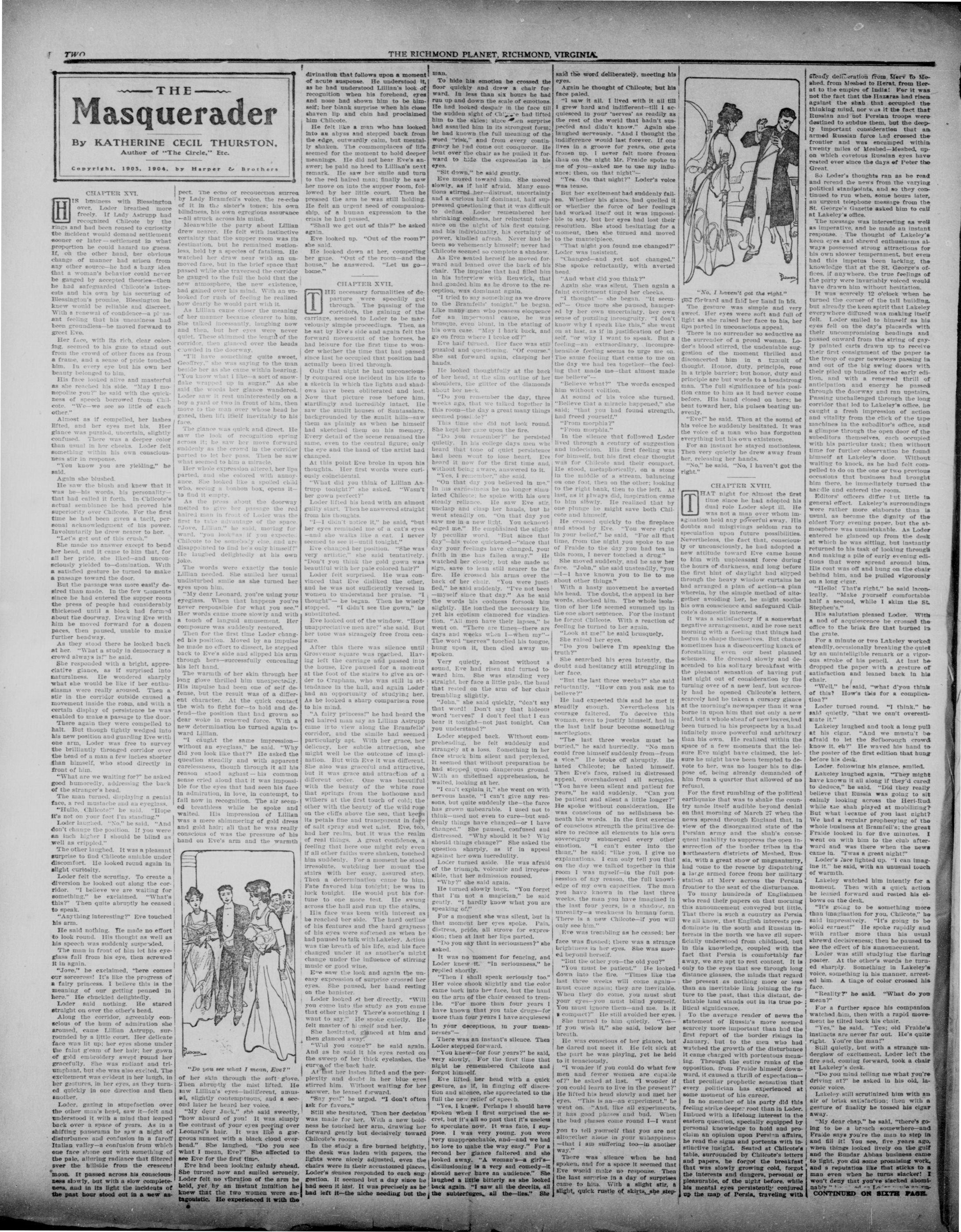
THE Masquerader
By KATHERINE CECIL THURSTON.
Author of "The Circle," Etc.
Copyright. 1905. 1904. by Harper & Brothers
TWO
1
CHAPTER XVII
IS business with Blessington over, Loder breathed more freely. If Lady Astrupp had recognized Chilcote by the rings and had been roused to curiosity the incident would demand settlement sooner or later—settlement in what proportion he could hazard no guess. If, on the other hand, her obvious change of manner had arisen from any other source—he had a hazy idea that a woman's behavior could never be ganged by accepted theories—then he had safeguarded Chilcote's interests and his own by his securing of Blessington's promise. Blessington he knew would be reliable and discreet. With a renewal of confidence—a pliant feeling that his uneasiness had been groundless—he moved forward to greet Eve.
Her face, with its rich, clear coloring, seemed to his gaze to stand out from the crowd of other faces as from a frame, and a sense of pride touched him. In every eye but his own her beauty belonged to him.
His face looked alive and masterful as she reached his side. "May I monopolize you?" he said with the quickness of speech borrowed from Chilcote. "We-we see so little of each other."
Almost as if compelled, her lashes lifted, and her eyes met his. Her glance was puzzled, uncertain, slightly confused. There was a deeper color than usual in her cheeks. Lolder felt something within his own consciousness stir in response.
"You know you are yielding," he said.
Again she blushed.
He saw the blush and knew that it was he—his words, his personality—that had called it forth. In Chilcote's actual semblance he had proved his superiority over Chilcote. For the first time he had been given a tacit, per personal acknowledgment of his power. Involuntarily he drew nearer to her. "Let's get out of this crush."
She made no answer except to bend her head, and it came to him that, for all her pride, she liked—and unconsciously yielded to domination. With a satisfied gesture he turned to make a passage toward the door.
But the passage was more easily desired than made. In the few moments since he had entered the supper room the press of people had considerably thickened until a block had formed about the doorway. Drawing Eve with him he moved forward for a dozen paces, then paused, unable to make further headway.
As they stood there he looked back at her. "What a study in democracy a crowd always is!" he said.
She responded with a bright, appreciative glance, as if surprised into naturalness. He wondered sharply what she would be like if her enthusiasm were really aroused. Then a stir in the corridor outside caused a movement inside the room, and with a certain display of persistence he was enabled to make a passage to the door. There again they were compelled to halt. But though tightly wedged into his new position and guarding Eve with one arm, Loder was free to survey the brilliantly thronged corridor over the head of a man a few inches shorter than himself, who stood directly in front of him.
"What are we waiting for?" he asked good humourlessly, addressing the back of the stranger's head.
The man turned, displaying a genial face, a red mustache and an eyeglass. "Hullo, Chilcote!" he said. "Hope it's not on your feet I'm standing." Loder laughed. "No" he said. "And don't change the position. If you were an inch higher I should be blind as well as crippled." The other laughed. It was a pleasant surprise to find Chilcote amenable under discomfort. He looked round again in slight curiosity. Loder felt the scrutiny. To create a diversion he looked out along the corridor. "I believe we are waiting for something," he exclaimed. "What's this?" Then quite abruptly he ceased to speak. "Anything interesting?" Eve touched his arm. He said nothing. He made no effort to look round. His thought as well as his speech was suddenly suspended. The man in front of him let his eyeglass fall from his eye, then screwed it in again.
"Jove," he exclaimed, "here comes our sorceress! It's like the progress of a fairy princess. I believe this is the meaning of our getting penned in here." He chuckled delightedly.
Loder said nothing. He stared straight on over the other's head.
Along the corridor, agreeably conscious of the hum of admiration she aroused, came Lillian Astrupp, surrounded by a little court. Her delicate face was lit up; her eyes shone under the faint gleam of her hair; her gown of gold embroidery swept round her gracefully. She was radiant and triumphant, but she was also excited. The excitement was evident in her laugh, in her gestures, in her eyes, as they turned quickly in one direction and then another.
Loder, gazing in stupetaction over the other man's head, saw it—felt and understood it with a mind that leaped back over a space of years. As in a shifting panorama he saw a night of disturbance and confusion in a faroff Italian valley—a confusion from which one face shone out with something of the pale, alluring radiance that filtered over the hillside from the crescent moon. It passed across his consciousness slowly, but with a slow completeness, and in its light the incidents of the past hour stood out in a new as-
pect. The echo or recoction surreys by Lady Bramfell's voice, the re-echec of it in the sister's tones; his own blindness, his own erregious assurance -- all struck across his mind.
Meanwhile the party about Lillian drew neerer. He felt with instinctive certainty that the supper room was its destination, but he remained motionless, held by a species of fatalism. He watched her draw near with an unmoved face, but in the brief space that passed while she traversed the corridor he gauged to the full the hold that the new atmosphere, the new existence, had gained over his mind. With an unlooked for rush of feeling he realized how dearly he would part with it.
As Lillian came closer the meaning of her manner became clearer to him. She talked incessantly, laughing now and then, but her eyes were never quiet. These skimmed the length of the corridor, then glanced over the heads crowded in the doorway.
"I'll have something quite sweet, Geoffrey," she was saying to the man beside her as she came within bearing. "You know what I like—a sort of snowflake wrapped up in sugar." As she said the words her glance wandered, Loder saw it rest uninterestedly on a boy a yard or two in front of him, then move to the man over whose head he gazed, then lift itself inevitably to his face.
The glance was quick and direct. He saw the look of recognition spring across it; he saw her move forward suddenly as the crowd in the corridor parted to let her pass. Then he saw what seemed to him a miracle.
Her whole expression altered, her lips parted, and she colored with annoyance. She looked like a spoiled child who, seeing a bonbon box, opens it—to find it empty.
As the press about the doorway melted to give her passage the red haired man in front of Loder was the first to take advantage of the space. "Jove, Lillian," he said, moving forward. "you look*as if you expecte. Chilcote to be somebody else, and are disappointed to find he's only himself!" He laughed delightedly at his own joke.
The words were exactly the tonic Lillian needed. She smiled her usual undisturbed smile as she turned her eyes upon him.
"My dear Leonard, you're using your eyeglass. When that happens you're never responsible for what you see." Her words came more slowly and with a touch of tangulg amusement. Her composure was suddenly restored.
Then for the first time Loder changed his position. Moved by an impulse he made no effort to dissect, he stepped back to Eve's side and slipped his arm through hers—successfully concealing his left hand.
The warmth of her skin through her long glove thrilled him unexpectedly. His impulse had been one of self defense, but the result was of a different character. At the quick contact the wish to fight for—to hold and defend—the position that had grown so dear woke in renewed force. With a new determination he turned again toward Lillian.
"I caught the same impression—without an eyeglass," he said. "Why did you look like that?" He asked the question steadily and with apparent carelessness, though through it all his reason stood agast—his common sense cried aloud that it was impossible for the eyes that had seen his face in admiration, in love, in contempt, to fall now in recognition. The air seemed breathless while he spoke and waited. His impression of Lillian was a mere shimmering of gold dress and gold hair; all that he was really conscious of was the pressure of his hand on Eve's arm and the warmth
PARDONER
of her skin through the soft glove. Then abruptly the mist lifted. He saw Lillian's eyes—indifferent, amused, slightly contemptuous, and a second later he heard her voice.
"My dear Jack," she said sweetly, "how absurd of you! It was simply the contrast of your eyes peering over Leonard's hair. It was like a gorgeous sunset with a black cloud overhead." She laughed. "Do you see what I mean, Eve?" She affected to see Eve for the first time.
Eve had been looking calmly ahead. She turned now and smiled serenely, Loder felt no vibration of the arm he held, yet by an instant intuition he knew that the two women were antagonistic. He experienced it with the
THE RICHMOND PLANET, RICHMOND, VIRGINIA
divination that follows upon a moment of acute suspense. He understood it, as he had understood Lillian's look of recognition when his forehead, eyes and nose had shown him to be himself; her blank surprise when his close shaven lip and chin had proclaimed him Chilcote.
He felt like a man who has looked into an abyss and stepped back from the edge, outwardly calm, but mentally shaken. The commonplaces of life seemed for the moment to hold deeper meanings. He did not hear Eve's answer; he paid no heed to Lillian's next remark. He saw her smile and turn to the red haired man; finally he saw her move on into the supper room, followed by her little court. Then he pressed the arm he was still holding. He felt an urgent need of companionship, of a human expression to the crisis he had passed.
"Shall we get out of this?" he asked again.
Eve looked up. "Out of the room?" she said. He looked down at her, compelling her gaze. "Out of the room—and the house," he answered. "Let us go—home."
CHAPTER XVII
THE necessary formalities of departure were speedily got through. The passing of the corridors, the galling of the carriage, seemed to Loder to be marvelously simple proceedings. Then, as he sat by Eve's side and again felt the forward movement of the horses, he had leisure for the first time to wonder whether the time that had passed since last he occupied that position had actually been lived through.
Only that night he had unconsciously compared one incident in his life to a sketch in which the lights and shadows have been obliterated and lost. Now that picture rose before him, startlingly and incredibly intact. He saw the sunlit houses of Santasalare, backgrounded by the sunlit hills—saw them as plainly as when he himself had sketched them on his memory. Every detail of the scene remained the same, even to the central figure; only the eye and the hand of the artist had changed.
At this point Eve broke in upon his thoughts. Her first words were curiously coincidental.
"What did you think of Lillian Astrupp tonight?" she asked. "Wasn't her gown perfect?"
Loder lifted his head with an almost guilty start. Then he answered straight from his thoughts.
"I-I didn't notice it," he said, "but her eyes reminded me of a cat's eyes—and she walks like a cat. I never seemed to see it—until tonight."
Eve changed her position. "She was very artistic," she said tentatively. "Don't you think the gold gown was beautiful with her pale colored hair?"
Loder felt surprised. He was convinced that Eve disliked the other, and he was not sufficiently versed in women to understand her praise. "I thought"—he began. Then he wisely stopped. "I didn't see the gown," he substituted.
Eve looked out of the window. "How unappreciative men are!" she said. But her tone was strangely free from censure.
After this there was silence until Grosvenor square was reached. Having left the carriage and passed into the house, Eve paused for a moment at the foot of the stairs to give an order to Crapham, who was still in attendance in the hall, and again Loder had an opportunity of studying her. As he looked a sharp comparison rose to his mind.
"A fairy princess!" he had heard the red hairied man say as Lillian Astrupp came into view along the Eramfells corridor, and the simile had seemed particularly apt. With her grace, her delicacy, her subtle attraction, she might well be the outcome of imagination. But with Eve it was different. She also was graceful and attractive, but it was grace and attraction of a different order. One was beautiful with the beauty of the white rose that springs from the hothouse and withers at the first touch of cold; the other with the beauty of the wild rose on the cliffs above the sea, that keeps its petals fine and transparent in face of salt spray and wet mist. Eve, too, had her realm, but it was the realm of real things. A great confidence, a feeling that here one might rely even if all other failures were shaken, touched him suddenly. For a moment he stood irresolute, watching her mount the stairs with her easy, assured step. Then a determination came to him. Fate favored him tonight; he was in luck tonight. He would put his fortune to one more test. He swung across the hall and ran up the stairs.
His face was keen with interest as he reached her side. The hard outline of his features and the hard grayness of his eyes were softened as when he had paused to talk with Lakeley. Action was the breath of his life, and his face changed under it as another's might change under the influence of stirring music or good wine.
Eve saw the look and again the uneasy expression of surprise crossed her eyes. She paused, her hand resting on the bumster.
Loder looked at her directly. "Will you come into the study as you came that other night? There something I want to say." He spoke quietly. He felt master of himself and her.
She hesitated, glanced at him and then glanced away.
"Will you come?" he said again. And as he said it his eyes rested on the sweep of her thick eyelashes, the curve of the back hair.
At last her lashes lifted and the perplexity and doubt in her blue eyes stirred him. Without waiting for her answer, he leaned forward.
"Say yes!" he urged. "I don't often ask for favors."
Still she hesitated. Then her decision was made for her. With a new boldness he touched her arm, drawing her forward gently but decisively toward Chilcote's rooms.
In the study a fire burned brightly, the desk was laden with papers, the lights were nicely adjusted, even the chairs were in their accustomed places. Loder's senses responded to each suggestion. It seemed but a day since he had seen it last. It was precisely as he had left it—the niche needing but the
man.
To hide his emotion he crossed the floor quickly and drew a chair forward. In less than six hours he had run up and down the scale of emotions. He had looked despair in the face till the sudden sight of China had lifted him to the skies; since then surprise had assailed him in its strongest form; he had known the full meaning of the word "risk," and from every contingency he had come out conqueror. He bent over the chair as he pulled it forward to hide the expression in his eyes.
"Sit down," he said gently.
Eve moved toward him. She moved slowly, as if half afraid. Many emotions stirred her—distrust, uncertainty, and a curious half dominant, half suppressed questioning that it was difficult to define. Loder remembered her shrinking coldness, her reluctant tolerance on the night of his first coming, and his individuality, his certainty of power, kindled afresh. Never had he been so vehemently himself; never had Chilcote seemed so complete a shadow. As Eve seated herself he moved forward and leaned over the back of his chair. The impulse that had filled him in his interview with Renwick, that had gouged him as he drove to the reception, was dominant again.
"I tried to say something as we drove to the Bramfells' tonight," he began. Like many men who possess eloquence for an impersonal cause, he was brusque, even blunt, in the stating of his own case. "May I hark back, and go on from where I broke off?"
Eve half turned. Her face was still puzzled and questioning. "Of course." She sat forward again, clasping her hands.
He looked thoughtfully at the back of her head, at the slim outline of her shoulders, the glitter of the diamonds about her neck.
"Do you remember the day, three weeks ago, that we talked together in this room—the day a great many things seemed possible?"
This time she did not look round. She kept her gaze upon the fire.
"Do you remember?" he persisted quietly. In his college days men who heard that tone of quiet persistence had been wont to lose heart. Eve heard it now for the first time and, without being aware, answered to it.
"Yes. I remember." she said.
"On that day you believed in me." In his earnestness he no longer simulated Chillecite; he spoke with his own steady reliance. He saw Eve stir unclasp and clasp her hands, but he went steadily on. "On that day you saw me in a new light. You acknowledged me." He emphasized the slightly peculiar word. "But since that day"—his voice quickened—"since that day your feelings have changed, your faith in me has fallen away." He watched her closely, but she made no sign, save to lean still nearer to the fire. He crossed his arms over the back of her chair. "You were justified," he said suddenly. "I've not been—myself since that day." As he said the words his coolness forsook him slightly. He loathed the necessary he yet his egotism clamored for vindication. "All men have their lapses," he went on. "There are times—there are days and weeks when I—when my—" The word "nerves" touched his tongue, hung upon it, then died away unspoken.
Very quietly, almost without a sound, Eve had risen and turned toward him. She was standing very straight, her face a little pale, the hand that rested on the arm of her chair trembling slightly.
"John," she said quickly, "don't say that word! Don't say that hideous word 'nerves!' I don't feel that I can bear it tonight—not just tonight. Can you understand?"
Loder stepped back. Without comprehending, he felt suddenly and strangely at a loss. Something in her face struck him silent and perplexed. It seemed that without preparation he had stepped upon dangerous ground. With an undefined apprehension, he waited, looking at her.
"I can't explain it," she went on with nervous haste. "I can't give any reasons, but quite suddenly the—the farce has grown unbearable. I used not to think—used not even to care—but suddenly things have changed—or I have changed." She paused, confused and distressed. "Why should it be? Why should things change?" She asked the question sharply, as if in appeal against her own incredulity. Locer turned aside. He was afraid of the triumph, volcanic and irrepressible, that her admission roused. "Why?" she said again. He turned slowly back. "You forget that I'm not a magician," he said gently. "I hardly know what you are speaking of."
"Do you say that in seriousness?" she asked.
It was no moment for fencing, and Loder knew it. "In seriousness," he replied shortly.
"Then I shall speak seriously too."
Her voice shook slightly and the color came back into her face, but the hand on the arm of the chair ceased to tremble. "For more than four years I have known that you take drugs—for more than four years I have acquiesced in your deceptions, in your meannesses"—
There was an instant's silence. Then Loder stepped forward.
"You knew—for four years?" he said, very slowly. For the first time that night he remembered Chilcote and forgot himself.
Eve lifted her head with a quick gesture, as if, in flinging off discretion and silence, she appreciated to the full the new relief of speech.
"Yes, I knew. Perhaps I should have spoken when I first surprised the secret, but it's all so past that it's useless to speculate now. It was fate, I suppose. I was very young, you were very unapproachable, and—and we had no love to make the way easy." For a second her glance faltered and she looked away. "A woman's—a girl's—disillusioning is a very sad comedy—it should never have an audience." She laughed a little bitterly as she looked back again. "I saw all the deciels, all the subterfuges, all the—lies." She
said the word deliberately, meeting his eyes.
Again he thought of Chilcote, but his face paled.
"I saw it all. I lived with it all till I grew hard and indifferent—till I acquiesced in your 'nerves' as readily as the rest of the world that hadn't suspected and didn't know." Again she laughed nervously. "And I thought the indifference would last forever. If one lives in a groove for years, one gets frozen up. I never felt more frozen than on the night Mr. Fraide spoke to me of you—asked me to use my influence; then, on that night"—
"Yes. On that night?" Loder's voice was tense.
But her excitement had suddenly fallen. Whether his glance had quelled it or whether the force of her feelings had worked itself out it was impossible to say, but her eyes had lost their resolution. She stood hesitating for a moment, then she turned and moved to the mantelpiece.
"That night you found me changed?"
Loder was insistent.
"Changed—and yet not changed."
She spoke reluctantly, with averted head.
"And what did you think?"
Again she was silent. Then again a faint excitement tinged her cheeks.
rath excitement tinged her cheeks.
"I thought"—she began. "It seemed"—Once more she paused, hampered by her own uncertainty, her own sense of puzzling incongruity. "I don't know why I speak like this," she went on at last, as if in justification of herself, "or why I want to speak. But a feeling—an extraordinary, incomprehensible feeling seems to urge me on. The same feeling that came to me on the day we had tea together—the feeling that made me—that almost made me believe"—
"Belle what?" The words escaped him without volition.
At sound of his voice she turned. "Belle that a miracle happened," she said; "that you had found strength, had freed yourself."
"From morphea?"
"From morphea."
In the silence that followed Loder lived through a century of suggestion and indecision. His first feeling was for himself, but his first clear thought was for Chilcote and their compact. He stood, metaphorically, on a stone in the middle of a stream, balancing on one foot, then on the other; looking to the right bank, then to the left. At last, as it always did, inspiration came to him slowly. He realized that by one plunge he might save both Chilcote and himself.
He crossed quickly to the fireplace and stood by Eve. "You were right in your belief," he said. "For all that time, from the night you spoke to me of Fraide to the day you had tea in this room, I never touched a drug."
She moved suddenly, and she saw her face. "John," she said unsteadily, "you—I—I have known you to lie to me about other things."
With a hasty movement he averted his head. The doubt, the appeal in her words, shocked him. The whole isolation of her life seemed summed up in the one short sentence. For the instant he forgot Chilcote. With a reaction of feeling he turned to her again.
"Look at me!" he said brusquely.
She raised her eyes.
"Do you believe I'm speaking the truth?"
She searched his eyes Intently, the doubt and hesitancy still struggling in her face.
"But the last three weeks?" she said reluctantly.
"How can you ask me to believe?"
He had expected this and he met it steadily enough. Nevertheless his courage faltered. To deceive this woman, even to justify himself, had in the last half hour become something sacrilegious.
"The last three weeks must be buried," he said hurriedly. "No man could free himself suddenly from—from a vice." He broke off abruptly. He hated Chilicote; he hated himself. Then Eve's face, raised in distressed appeal, overshadowed all scruples. "You have been silent and patient for years," he said suddenly. "Can you be patient and silent a little longer?" He spoke without consideration. He was conscious of no selfishness beneath his words. In the first exercise of conscious strength the primitive desire to reduce all elements to his own sovereignty submerged every other emotion. "I can't enter into the thing," he said; "like you. I give no explanations. I can only tell you that on the day we talked together in this room I was myself—in the full possession of my reason, the full knowledge of my own capacities. The man you have known in the last three weeks, the man you have imagined in the last four years, is a shadow, an unreality—a weakness in human form. There is a new Chilicote—if you will only see him."
Eve was trembling as he ceased; her face was flushed; there was a strange brightness in her eyes. She was moved beyond herself.
"But the other you—the old you?" "You must be patient." He looked down into the fire. "Times like the last three weeks will come again—must come again; they are inevitable. When they do come, you must shut your eyes—you must blind yourself. You must ignore them—and me. Is it compact?" He still avoided her eyes. She turned to him quietly. "Yes—if you wish it," she said, below her breath.
He was conscious of her glance, but he dared not meet it. He felt sick at the part he was playing, yet he held to it tenaciously.
"I wonder if you could do what few men and fewer women are capable of?" he asked at last. "I wonder if you could learn to live in the present?" He lifted his head slowly and met her eyes. "This is an—an experiment." he went on. "And, like all experiments, it has good phases and bad. When the bad phases come round I—I want
you to tell yourself that you are not altogether alone in your unhappiness—that I am suffering too—in another way."
There was silence when he had spoken, and for a space it seemed that Eve would make no response. Then the last surprise in a day of surprises came to him. With a slight stir, a slight, quick rustle of skirts, she step
Bernard
ped forward and held her hand in his. The gesture was simple and very sweet. Her eyes were soft and full of light as she raised her face to his, her lips parted in unconscious appeal. There is no surrender so seductive as the surrender of a proud woman. Loder's blood stirred, the undeniable suggestion of the moment thrilled and disconcerted him in a tumult of thought. Honor, duty, principle, rose in a triple barrier; but honor, duty and principle are but words to a headstrong man. The full significance of his position came to him as it had never come before. His hand closed on hers; he bent toward her, his pulses beating unevenly. "Eve!" he said. Then at the sound of his voice he suddenly hesitated. It was the voice of a man who has forgotten everything but his own existence. For an instant he stayed motionless. Then very quietly he drew away from her, releasing her hands. "No," he said. "No, I haven't got the right."
CHAPTER XVIII.
HAT night for almost the first time since he had adopted his dual role Loder slept ill. He was not a man over whom imagination held any powerful sway. His doubts and misgivings seldom ran to speculation upon future possibilities. Nevertheless, the fact that, consciously or unconsciously, he had adopted a new attitude toward Eve came home to him with unpleasant force during the hours of darkness, and long before the first hint of daylight had slipped through the heavy window curtains he had arranged a plan of action—a plan wherein, by the simple method of altogether avoiding her, he might soothe his own conscience and safeguard Chilcote's domestic interests.
It was a satisfactory if a somewhat negative arrangement, and he rose next morning with a feeling that things had begun to shape themselves. But chance sometimes has a disconcerting knack of forestalling even our best planned schemes. He dressed slowly and descended to his solitary breakfast with the pleasant sensation of having put last night out of consideration by the turning over of a new leaf, but scarcely had he opened Chilcote's letters, scarcely had he taken a cursory glance at the morning's newspaper than it was borne in upon him that not only a new leaf, but a whole sheet of new leaves, had been turned in his prospects by a haad infinitely more powerful and arbitrary than his own. He realized within the space of a few moments that the leisure Eve might have claimed, the leisure he might have been tempted to devote to her, was no longer his to dispose of, being already demanded of him from a quarter that allowed of no refusal.
For the first rumbling of the political earthquake that was to shake the country made itself audible beyond denial on that morning of March 27 when the news spread through England that, in view of the disorganized state of the Persian army and the shah's consequent inability to suppress the open insurrection of the border tribes in the bortheastern districts of Meshed, Russia, with a great show of magnanimity, had come to the rescue by dispatching a large armed force from her military station at Merv across the Persian frontier to the seat of the disturbance.
To many hundreds of Englishmen who read their papers on that morning this announcement conveyed but little. That there is such a country as Persia we all know, that English interests predominate in the south and Russian interests in the north we have all superficially understood from childhood, but in this knowledge, coupled with the fact that Persia is comfortably far away, we are apt to rest content. It is only to the eyes that see through long distance glasses, the minds that regard the present as nothing more or less than an inevitable link joining the future to the past, that this distant, debatable land stands out in its true political significance.
To the average reader of news the statement of Russia's move seemed scarcely more important than had the first report of the border risings in January, but to the men who had watched the growth of the disturbance it came charged with portentous meaning. Through the entire ranks of the opposition, from Fraide himself downward, it caused a thrill of expectation—that peculiar prophetic sensation that every politician has experienced at some moment of his career.
In no member of his party did this feeling strike deeper: root than in Loder. Imbued with a lifelong interest in the eastern question, specially equipped by personal knowledge to hold and proclaim an opinion upon Persian affairs, he read the signs and portents with instinctive insight. Seated at Chilcote's table, surrounded by Chilcote's letters and papers, he forgot the breakfast that was slowly growing cold, forgot the interests and dangers, personal or pleasurable, of the night before, while his mental eyes persistently conjured up the map of Persia, traveling with
steady delicaturation from Merv To Meshed, from Meshed to Herat from Herat to the empire of India! For it was not the fact that the Hazaras had risen against the shah that occupied the thinking mind, nor was it the fact that Russian and not Persian troops were destined to subdue them, but the deeply important consideration that an armed Russian force had crossed the frontier and was encamped within twenty miles of Meshed—Meshed, upon which covetous Russian eyes have rested ever since the days of Peter the Great.
So Loder's thoughts ran as he read and reread the news from the varying political standpoints, and so they continued to run when, some hours later, an urgent telephone message from the St. George's Gazette asked him to call at Lakely's office.
The message was interesting as well as imperative, and he made an instant response. The thought of Lakeley's keen eyes and shrewd enthusiasm always possessed strong attractions for his own slower temperament, but even had this impetus been lacking, the knowledge that at the St. George's offices, if anywhere, the true feelings of the party were invariably voiced would have drawn him without hesitation.
It was scarcely 12 o'clock when he turned the corner of the tall building, but already the keen spirit that Lakley everywhere diffused was making itself felt. Loder smiled to himself as his eyes fell on the day's placards with their uncompromising headings and passed onward from the string of gayly painted carts drawn up to receive their first consignment of the paper to the troop of eager newsboys passing in and out of the big swing doors with their piled up bundles of the early edition, and with a renewed thrill of anticipation and energy he passed through the doorway and ran upstairs. Passing unchallenged through the long corridor that led to Lakley's office, he caught a fresh impression of action and vitality from the click of the tape machines in the subeditor's office, and a glimpse through the open door of the subeditors themselves, each occupied with his particular task; then without time for further observation he found himself at Lakley's door. Without waiting to knock, as he had felt compelled to do on the one or two previous occasions that business had brought him there, he immediately turned the hardie and entered the room.
Editors' officers differ but little in general effect. Lakeley's surroundings were rather more elaborate than is usual, as became the dignity of the oldest Tory evening paper, but the atmosphere was unmistakable. As Loder entered he glanced up from the desk at which he was sitting, and instantly returned to his task of looking through and making a pile of early evening editions that were spread around him. His coat was off and hung on the chair behind him, and he pulled vigorously on a long cigar.
"Hello! That's right," he said laconically. "Make yourself comfortable half a second, while I skim the St. Stephen's."
His salutation pleased Loder. With a nod of acquiescence he crossed the office to the brisk fire that burned in the grate.
For a minute or two Lakeley worked steadily, occasionally breaking the quiet by an unintelligible remark or a vigorous stroke of his pencil. At last he dropped the paper with a gesture of satisfaction and leaned back in his chair.
"Well," he said, "what d'you think of this? How's this for a complication?"
Loder turned round. "I think," he said quietly, "that we can't overestimate it."
Lakeley laughed and took a long pull at his cigar. "And we mustn't be afraid to let the Se佛orough crowd know it. eh?" He waved his hand to the poster of the first edition that hung before his desk.
Loder, following his glance, smiled.
Lakeley laughed again. "They might have known it all along if they'd cared to deduce," he said. "Did they really believe that Russia was going to sit calmly looking across the Herl-Rud while the tah shai played at mobilizing? But what became of you last night? We had a regular prophesying of the whole business at Bramfell's; the great Fraide looked in for five minutes. I went on with him to the club afterward and was there when the news came in. "Was a great night!"
Loder's face lighted up. "I can imagine it." he said, with an unusual touch of warmth.
Lakeley watched him intently for a moment. Then with a quick action he leaned forward and rested his elbows on the desk.
"It's going to be something more than imagination for you, Chilecote," he said impressively. "It's going to be solid earnest!" He spoke rapidly and with rather more than his usual shrewd decisiveness; he paused to see the effect of his announcement. Loder was still studying the flaring poster. At the other's words he turned sharply. Something in Lakeley's voice, something in his manner, arrested him. A tinge of color crossed his face.
"Reality?" he said. "What do you mean?"
For a further space his companion watched him, then with a rapid movement he tilted back his chair.
"Yes," he said. "Yes; old Fralde's instincts are never far out. He's quite right. You're the man!"
Still quietly, but with a strange underglow of excitement. Loder left the fire and, coming forward, took a chair at Lakeley's desk.
"Do you mind telling me what you're driving at?" he asked in his old, laconic voice. Lakehead still scrutinized him with an air of brisk satisfaction; then with a gesture of finality he tossed his cigar away.
"My dear chap," he said, "there's going to be a breach somewhere—and Frailde says you're the man to step in and fill it! You see, five years ago, when things looked lively on the guild and the Bundar Abbas business came to light, you did some promising work, and a reputation like that sticks to a man even when he turns slacker! I won't deny that you've slacked abominably." He looked at Lakehead. "CONTINUED ON SIXTH PAGE."
---
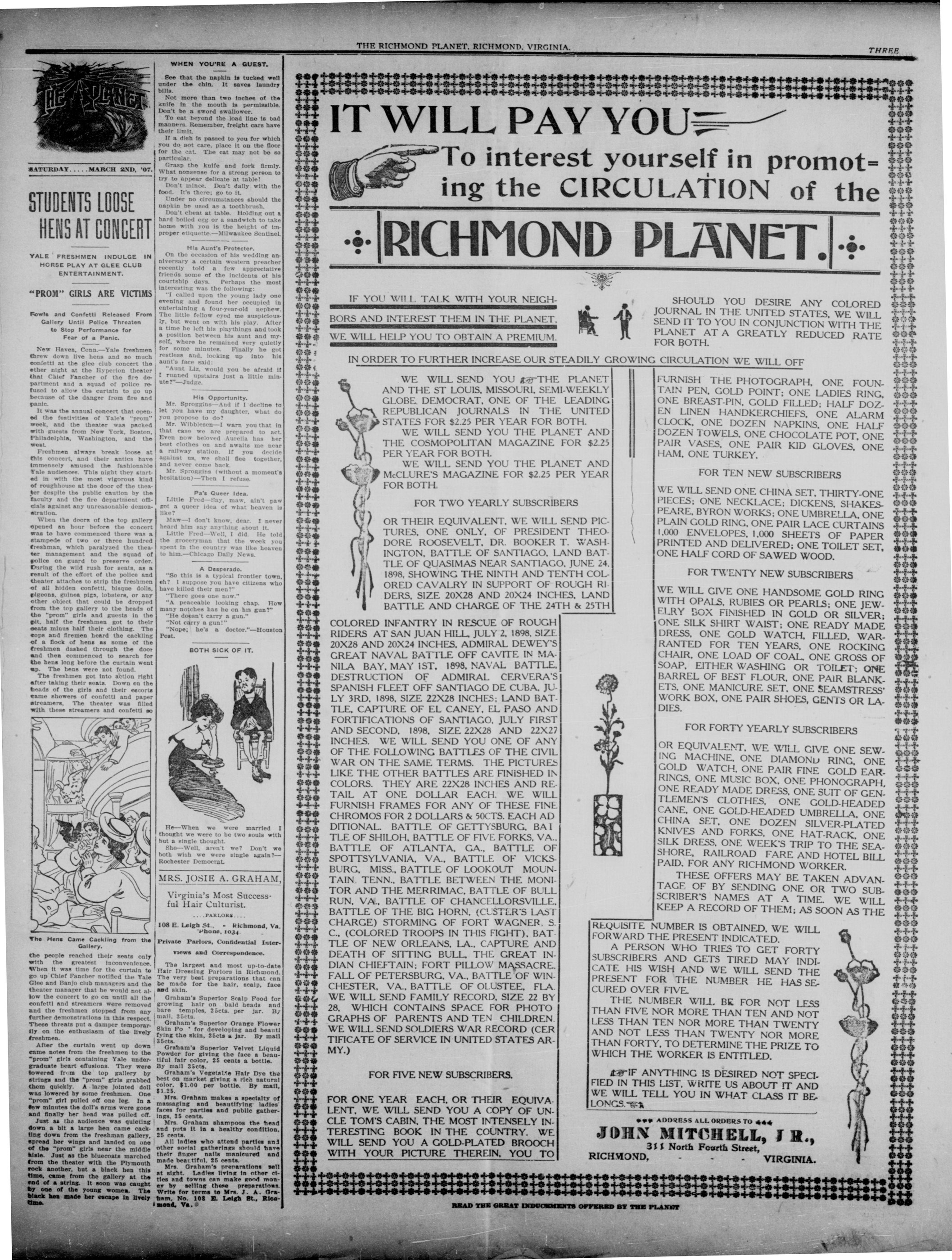
IT WILL PAY YOU To interest yourself in promot ing the CIRCULATION of the RICHMOND PLANET.
---
THE PENET
SATURDAY...MARCH 2ND, '07
STUDENTS LOOSE HENS AT CONCERT
YALE FRESHMEN INDULGE IN
HORSE PLAY AT GLEE CLUB
ENTERTAINMENT.
"PROM" GIRLS ARE VICTIMS
Fowls and Confetti Released From Gallery Until Police Threaten to Stop Performance for Fear of a Panic.
New Haven, Conn.—Yale freshmen threw down live hens and so much confetti at the glee club concert the other night at the Hyperion theater that Chief Fancher of the fire department and a squad of police refused to allow the curtain to go up because of the danger from fire and panic.
It was the annual concert that opened the festivities of Yale's "prom" week, and the theater was packed with guests from New York, Boston, Philadelphia, Washington, and the west.
Freshmen always break loose at this concert, and their anties have immensely amused the fashionable Yale audiences. This night they started in with the most vigorous kind of roughhouse at the door of the theater despite the public caution by the faculty and the fire department officials against any unreasonable demonstration.
When the doors of the top gallery opened an hour before the concert was to have commenced there was a stampede of two or three hundred freshman, which paralyzed the theater management and the squad of police on guard to preserve order. During the wild rush for seats, as a result of the effort of the police and theater attaches to strip the freshmen of all hidden confetti, bisque dolls, pigeons, guinea pigs, lobsters, or any other object that could be dropped from the top gallery to the heads of the "prom" girls and guests in the pit, half the freshmen got to their seats minus half their clothing. The cops and firemen heard the cackling of a flock of hens as some of the freshmen dashed through the door and then commenced to search for the hens long before the curtain went up. The hens were not found.
The freshmen got into action right after taking their seats. Down on the heads of the girls and their escorts came showers of confetti and paper streamers. The theater was filled with these streamers and confetti so
A
The Hens Came Cackling from the Gallery.
the people reached their seats only with the greatest inconvenience. When it was time for the curtain to go up Chief Fancher notified the Yale Glee and Banjo club managers and the theater manager that he would not allow the concert to go on until all the confetti and streamers were removed and the freshmen stopped from any further demonstrations in this respect. These threats put a damper temporarily on the enthusiasm of the lively freshmen.
After the curtain went up down came notes from the freshmen to the "prom" girls containing Yale undergraduate heart effusions. They were lowered from the top gallery by strings and the "prom" girls grabbed them quickly. A large jointed doll was lowered by some freshmen. One "prom" girl pulled off one leg. In a few minutes the doll's arms were gone and finally her head was pulled off. Just as the audience was quieting down a bit a large hen came cackling down from the freshman gallery, spread her wings and landed on one of the "prom" girls near the middle hise. Just as the bluecoats marched from the theater with the Plymouth rock another, but a black hen this time, came from the gallery at the end of a string. It soon was caught by one of the young women. The black hen made her escape in lively time.
BORS AND INTEREST THEM IN THE PLANET.
WE WILL HELP YOU TO OBTAIN A PREMIUM.
COLORED INFANTRY IN RESCUE OF ROUGH RIDERS AT SAN JUAN HILL, JULY 2, 1898, SIZE 20X28 AND 20X24 INCHES, ADMIRAL DEWEY'S GREAT NAVAL BATTLE OFF CAVITE IN MANILA BAY, MAY 1ST, 1898, NAVAL BATTLE, DESTRUCTION OF ADMIRAL CERVERA'S SPANISH FLEET OFF SANTIAGO DE CUBA, JULY 3RD, 1898, SIZE 22X28 INCHES; LAND BATTLE, CAPTURE OF EL CANEY, EL PASO AND FORTIFICATIONS OF SANTIAGO, JULY FIRST AND SECOND, 1898, SIZE 22X28 AND 22X27 INCHES. WE WILL SEND YOU ONE OF ANY OF THE FOLLOWING BATTLES OF THE CIVIL WAR ON THE SAME TERMS. THE PICTURES LIKE THE OTHER BATTLES ARE FINISHED IN COLORS. THEY ARE 22X28 INCHES AND RETAIL AT ONE DOLLAR EACH. WE WILL FURNISH FRAMES FOR ANY OF THESE FINE CHROMOS FOR 2 DOLLARS & 50CTS. EACH ADDITIONAL. BATTLE OF GETTYSBURG, BATTLE OF SHILOH, BATTLE OF FIVE FORKS, VA., BATTLE OF ATLANTA, GA., BATTLE OF SPOTTSYLVANIA, VA., BATTLE OF VICKSBURG, MISS., BATTLE OF LOOKOUT MOUNTAIN. TENN., BATTLE BETWEEN THE MONITOR AND THE MERRIMAC, BATTLE OF BULL RUN, VA., BATTLE OF CHANCELLORSVILLE, BATTLE OF THE BIG HORN, (CUSTER'S LAST CHARGE) STORMING OF FORT WAGNER, S.C., (COLORED TROOPS IN THIS FIGHT), BATTLE OF NEW ORLEANS, LA., CAPTURE AND DEATH OF SITTING BULL, THE GREAT INDIAN CHIEFTAIN; FORT PILLOW MASSACRE, FALL OF PETERSBURG, VA., BATTLE OF WINCHESTER, VA., BATTLE OF OLUSTEE, FLA. WE WILL SEND FAMILY RECORD, SIZE 22 BY 28, WHICH CONTAINS SPACE FOR PHOTOGRAPHS OF PARENTS AND TEN CHILDREN. WE WILL SEND SOLDIERS WAR RECORD (CERTIFICATE OF SERVICE IN UNITED STATES ARMY.)
FOR ONE YEAR EACH, OR THEIR EQUIVALENT, WE WILL SEND YOU A COPY OF UNCLE TOM'S CABIN, THE MOST INTENSELY INTERESTING BOOK IN THE COUNTRY. WE WILL SEND YOU A GOLD-PLATED BROOCH WITH YOUR PICTURE THEREIN, YOU TO
WHEN YOU'RE A GUEST.
See that the napkin is tucked well under the chin. It saves laundry bills.
Not more than two inches of the knife in the mouth is permissible. Don't be a sword swallower.
To eat beyond the load line is bad manners. Remember, freight cars have their limit.
If a dish is passed to you for which you do not care, place it on the floor for the cat. The cat may not be so particular.
Grasp the knife and fork firmly. What nonsense for a strong person to try to appear delicate at table!
Don't mince. Don't dally with the food. It's there; go to it.
Under no circumstances should the napkin be used as a toothbrush.
Don't cheat at table. Holding out a hard boiled egg or a sandwich to take home with you is the height of improper etiquette.—Milwaukee Sentinel.
His Aunt's Protector
On the occasion of his wedding anniversary a certain western preacher recently told a few appreciative friends some of the incidents of his courtship days. Perhaps the most interesting was the following:
"I called upon the young lady one evening and found her occupied in entertaining a four-year-old nephew. The little fellow eyed me suspiciously, but went on with his play. After a time he left his playthings and took a position between his aunt and myself, where he remained very quietly for some minutes. Finally he got restless and, looking up into his aunt's face said:
"Aunt Liz, would you be afraid if I runned upstairs just a little minute?"—Judge.
His Opportunity.
Mr. Sproggins—And if I decline to let you have my daughter, what do you propose to do?
Mr. Wibblesen—I warn you that in that case we are prepared to act. Even now beloved Aurelia has her best clothes on and awaits me near a railway station. If you decide against us, we shall flee together, and never come back.
Mr. Sproggins (without a moment's hesitation)—Then I refuse.
Pa's Queer Idea
Little Fred—Say, maw, ain't paw got a queer idea of what heaven is like?
Maw—I don't know, dear. I never heard him say anything about it.
Little Fred—Well, I did. He told the groceryman that the week you spent in the country was like heaven to him. Chicago Daily News.
A Desperado.
"So this is a typical frontier town, eh? I suppose you have citizens who have killed their men?"
"There goes one now."
"A peaceable looking chap. How many notches he has on his gun?"
"He doesn't carry a gun."
"Not carry a gun!"
"Nope; he's a doctor."—Houston Post.
-
He—When we were married I thought we were to be two souls with but a single thought.
She—Well, aren't we? Don't we both wish we were single again?—Rochester Democrat.
MRS. JOSIE A. GRAHAM.
Virginia's Most Successful
ful Hair Culturist.
...PARLORS...
108 E. Leigh St., - Richmond, Va.
'Phone, 1034.
Private Parlors, Confidential Inter-
views and Correspondence.
The largest and most up-to-date
Hair Dressing Parlors in Richmond.
The very best preparations that can
be made for the hair, scalp, face
and skin.
Graham's Superior Scalp Food for
growing hair on bald heads and
bare temples, 25cts. per jar. By
mail, 35cts.
Graham's Superior Orange Flower
Skin Fo. for developing and beauti-
fying the skin, 25cts a jar. By mail
35cts.
Graham's Superior Velvet Liquid
Powder for giving the face a bea-
tiful fair color, 25 cents a bottle.
By mail 35cts.
Graham's Vegetable Hair Dye the best on market giving a rich natural color. $1.00 per bottle. By mail, $1.25.
Mrs. Graham makes a specialty of massaging and beautifying ladies' faces for parties and public gatherings, 35 cents.
Mrs. Graham shampoos the head and puts it in a healthy condition, 25 cents.
All ladies who attend parties and other social gatherings should have their finger nails manicured and made beautiful, 25 cents.
Mrs. Graham's preparations sell at sight. Ladies living in other cities and towns can make good money by selling these preparations.
Write for terms to Mrs. J. A. Graham, No. 108 E. Leigh St., Richmond, Va.
IN ORDER TO FURTHER INCREASE OUR STEADILY GROWING CIRCULATION WE WILL OFF
WE WILL SEND YOU THE PLANET AND THE ST LOUIS, MISSOURI, SEMI-WEEKLY GLOBE, DEMOCRAT, ONE OF THE LEADING REPUBLICAN JOURNALS IN THE UNITED STATES FOR $2.25 PER YEAR FOR BOTH.
WE WILL SEND YOU THE PLANET AND THE COSMOPOLITAN MAGAZINE FOR $2.25 PER YEAR FOR BOTH.
WE WILL SEND YOU THE PLANET AND McCLURE'S MAGAZINE FOR $2.25 PER YEAR FOR BOTH.
OR THEIR EQUIVALENT, WE WILL SEND PICTURES, ONE ONLY, OF PRESIDENT THEODORE ROOSEVELT, DR. BOOKER T. WASHINGTON, BATTLE OF SANTIAGO, LAND BATTLE OF QUASIMAS NEAR SANTIAGO, JUNE 24, 1898, SHOWING THE NINTH AND TENTH COLORED CAVALRY IN SUPPORT OF ROUGH RIDERS, SIZE 20X28 AND 20X24 INCHES, LAND BATTLE AND CHARGE OF THE 24TH & 25TH
READ THE GREAT INDUCKMENTS OFFERED BY THE PLANET
THE RICHMOND PLANET, RICHMOND, VIRGINIA
IF YOU WILL TALK WITH YOUR NEIGH-
```markdown
```
FOR TWO YEARLY SUBSCRIBERS
FOR FIVE NEW SUBSCRIBERS
REQUISITE NUMBER IS OBTAINED, WE WILL FORWARD THE PRESENT INDICATED.
A PERSON WHO TRIES TO GET FORTY SUBSCRIBERS AND GETS TIRED MAY INDICATE HIS WISH AND WE WILL SEND THE PRESENT FOR THE NUMBER HE HAS SECURED OVER FIVE.
THE NUMBER WILL BE FOR NOT LESS THAN FIVE NOR MORE THAN TEN AND NOT LESS THAN TEN NOR MORE THAN TWENTY AND NOT LESS THAN TWENTY NOR MORE THAN FORTY, TO DETERMINE THE PRIZE TO WHICH THE WORKER IS ENTITLED.
IF ANYTHING IS DESIRED NOT SPECIFIED IN THIS LIST, WRITE US ABOUT IT AND WE WILL TELL YOU IN WHAT CLASS IT BE LONGS.
JOHN MITCHELL, JR.,
311 North Fourth Street,
RICHMOND. VIRGINIA
A man sitting in a chair and a man standing in front of him.
DIDLY GROW
LANET
WEEKLY
LEADING
UNITED
TH.
T AND
R $2.25
T AND
YEAR
ND PIC-
THEO-
WASH-
D BAT-
JUNE 24.
H COL-
HIGH RI-
LAND
& 25TH
```markdown
```
REQUISIT
FORWAR
SHOULD YOU DESIRE ANY COLORED JOURNAL IN THE UNITED STATES, WE WILL SEND IT TO YOU IN CONJUNCTION WITH THE PLANET AT A GREATLY REDUCED RATE FOR BOTH.
FURNISH THE PHOTOGRAPH, ONE FOUNTAIN PEN, GOLD POINT; ONE LADIES RING, ONE BREAST-PIN, GOLD FILLED; HALF DOZEN LINEN HANDKERCHIEFS, ONE ALARM CLOCK, ONE DOZEN NAPKINS, ONE HALF DOZEN TOWELS, ONE CHOCOLATE POT, ONE PAIR VASES, ONE PAIR KID GLOVES, ONE HAM, ONE TURKEY.
FOR TEN NEW SUBSCRIBERS
WE WILL SEND ONE CH
PIECES; ONE NECKLACE
PEARE, BYRON WORKS,
PLAIN GOLD RING, ONE
1,000 ENVELOPES, 1,000
PRINTED AND DELIVER
ONE HALF CORD OF SALE.
FOR TWENTY NET
WE WILL GIVE ONE HAL
WITH OPALS, RUBIES OF
ELRY BOX FINISHED TO
ONE SILK SHIRT WAIST
DRESS, ONE GOLD W
RANTED FOR TEN YE
CHAIR, ONE LOAD OF
SOAP, EITHER WASHING
BARREL OF BEST FLO
ETS, ONE MANICURE S
WORK BOX, ONE PAIR
DIES.
FOR FORTY YEAR
OR EQUIVALENT, WE W
ING MACHINE, ONE IN
GOLD WATCH, ONE P
RINGS, ONE MUSIC BOX
ONE READY MADE DR
TLEMEN'S CLOTHES,
CANE, ONE GOLD-HEA
CHINA SET, ONE DO
KNIVES AND FORKS, O
SILK DRESS, ONE WEEK
SHORE, RAILROAD FI
PAID, FOR ANY RICHM
THESE OFFERS MAST
TAGE OF BY SENDING
SCRIBER'S NAMES AT
KEEP A RECORD OF TH
THE NUMBER IS OBTAINED, YE
RD THE PRESENT INDICATED
PERSON WHO TRIES TO GET
BERS AND GETS TIRED M
IS WISH AND WE WILL S
IT FOR THE NUMBER HE
OVER FIVE.
THE NUMBER WILL BE FOR N
IVE NOR MORE THAN TEN A
MAN TEN NOR MORE THAN
IT LESS THAN TWENTY NO
DRTY, TO DETERMINE THE IN
THE WORKER IS ENTITLED.
IF ANYTHING IS DESIRED NO
THIS LIST, WRITE US ABOUT
TELL YOU IN WHAT CLAS
ALL SEND ONE CHINA SET, THIRD
ONE NECKLACE; DICKENS, OR
BYRON WORKS; ONE UMBRELL
GOLD RING, ONE PAIR LACE CU
ENVELOPES, 1,000 SHEETS OF
AND DELIVERED; ONE TOIL
FALF CORD OF SAWED WOOD.
FOR TWENTY NEW SUBSCRIBERS
ALL GIVE ONE HANDSOME GOL
APALS, RUBIES OR PEARLS; ONE
BOX FINISHED IN GOLD OR
FILK SHIRT WAIST; ONE READ
ONE GOLD WATCH, FILLED
AND FOR TEN YEARS, ONE IN
ONE LOAD OF COAL, ONE G
EITHER WASHING OR TOIL
OF BEST FLOUR, ONE PAIR
ONE MANICURE SET, ONE SEAM
BOX, ONE PAIR SHOES, GENTLE
FOR FORTY YEARLY SUBSCRIBERS
QUIVALENT, WE WILL GIVE O
MACHINE, ONE DIAMOND RING
WATCH, ONE PAIR FINE GOL
ONE MUSIC BOX, ONE PHONO
LEADY MADE DRESS, ONE SUIT
N'S CLOTHES, ONE GOLD-
ONE GOLD-HEADED UMBRELL
SET, ONE DOZEN SILVER
AND FORKS, ONE HAT-RA
PRESS, ONE WEEK'S TRIP TO T
RAILROAD FARE AND HOT
OR ANY RICHMOND WORKER
THESE OFFERS MAY BE TAKEN
OF BY SENDING ONE OR TW
ER'S NAMES AT A TIME. WE
RECORD OF THEM; AS SOON
IS OBTAINED, WE WILL
SENT INDICATED.
O TRIES TO GET FORTY
GETS TIRED MAY INDIC
WE WILL SEND THE
NUMBER HE HAS SE-
WILL BE FOR NOT LESS
MORE THAN TEN AND NOT
MORE THAN TWENTY
AN TWENTY NOR MORE
ENTERMINE THE PRIZE TO
OR IS ENTITLED.
IS DESIRED NOT SPECI-
WRITE US ABOUT IT AND
IN WHAT CLASS IT BE-
WE WILL SEND ONE CHINA SET, THIRTY-ONE PIECES; ONE NECKLACE; DICKENS, SHAKESPEARE, BYRON WORKS; ONE UMBRELLA, ONE PLAIN GOLD RING, ONE PAIR LACE CURTAINS 1,000 ENVELOPES, 1,000 SHEETS OF PAPER PRINTED AND DELIVERED; ONE TOILET SET, ONE HALF CORD OF SAWED WOOD.
FOR TWENTY NEW SUBSCRIBERS
WE WILL GIVE ONE HANDSOME GOLD RING WITH OPALS, RUBIES OR PEARLS; ONE JEWELRY BOX FINISHED IN GOLD OR SILVER; ONE SILK SHIRT WAIST; ONE READY MADE DRESS, ONE GOLD WATCH, FILLED, WARRANTED FOR TEN YEARS, ONE ROCKING CHAIR, ONE LOAD OF COAL, ONE GROSS OF SOAP, EITHER WASHING OR TOILET; ONE BARREL OF BEST FLOUR, ONE PAIR BLANKETS, ONE MANICURE SET, ONE SEAMSTRESS' WORK BOX, ONE PAIR SHOES, GENTS OR LADIES.
FOR FORTY YEARLY SUBSCRIBERS
OR EQUIVALENT, WE WILL GIVE ONE SEWING MACHINE, ONE DIAMOND RING, ONE GOLD WATCH, ONE PAIR FINE GOLD EARRINGS, ONE MUSIC BOX, ONE PHONOGRAPH, ONE READY MADE DRESS, ONE SUIT OF GENTLEMEN'S CLOTHES, ONE GOLD-HEADED CANE, ONE GOLD-HEADED UMBRELLA, ONE CHINA SET, ONE DOZEN SILVER-PLATED KNIVES AND FORKS, ONE HAT-RACK, ONE SILK DRESS, ONE WEEK'S TRIP TO THE SEASHORE, RAILROAD FARE AND HOTEL BILL PAID. FOR ANY RICHMOND WORKER. THESE OFFERS MAY BE TAKEN ADVANTAGE OF BY SENDING ONE OR TWO SUBSCRIBER'S NAMES AT A TIME. WE WILL KEEP A RECORD OF THEM; AS SOON AS THE
ADDRESS ALL ORDERS TO
IN MITCHELL,
311 North Fourth Street,
ND,
THE PLANET
CHELL, J R.,
Fourth Street,
VIRGINIA.
THREE
not= the
COLORED WE WILL WITH THE RED RATE
ONE FOUNDED RING,
ALFALF DOZZLE ALARM
ONE HALF POT, ONE MOVES, ONE
ERS
SHIRTY-ONE,
SHAKESPELLA, ONE CURTAINS OF PAPER DILET SET,
ERS
GOLD RING
ONE JEWER SILVER;
ADY MADELED, WARROCKING GROSS OF FILET; ONE IR BLANKAMSTRESS'TITS OR LA-
ERS
ONE SEWING, ONE GOLD EARNOGRAPH,
TIT OF GEN-D-HEADED SELLA, ONE WAR-PLATED MACK, ONE THE SEA-OTEL BILLER.
IN ADVANT-TWO SUBWE WILL ON AS THE
```markdown
```
---
FOUR
THE PLANET
Published every Saturday by John Mitchell,
JR., at 111 North 4th Street, Richmond Va.
JOHN MITCHELL, JR., - EDITOR.
All communications intended for publication
would be sent so as to reach us by Wednesday.
TERMS IN ADVANCE
ADVERTISING RATES
REGISTERED LETTER.—If a money Order Post-Office or an Express Office is not within your reach, you wish to send your payment to your address, wish to send on payment of ten cents. Then, if the letter is lost or stolen, it can be traced. You can send money in your manner or your address.
We cannot be responsible for money sent in letters in any other way than one of the four ways mentioned above. If you send your money in other way, you must do it at your vn risk.
RENEWALS, EVIC.—If you do not want the PLACE continued for another year after your payment, you must do it at your vn risk.
Pictorial Card to discontinue it. The courts have decided that subscribers to newspaper, who do not order their paper discontinued at the time of payment, should hold liable for the payment of the subscription up to date when they order the paper discontinued.
COMMUNICATIONS.—When writing to us to know your subscription or to discontinue your paper, you should give your name and address in all other wise we cannot find your name on the CHANGE OF ADDRESS.—In order to change the address of a subscriber, we must be sent former as well as the present address.
Entered at the Post-Office at Richmond. Va. second-class matter.
SATURDAY.....MARCH 2ND, '07.
Many of our troubles are caused by our own blunders.
You should not enjoy a guest pleasure from a waiter's inpome.
Most colored folks believe that money was made to spend and they are spending it.
Yes, there is room at the top, but most people prefer staying at the bottom.
The South has been settling the "race problem" for forty years and now it announces that it is not yet settled.
If division of effort would bring success to any people, the colored folks would, in our judgment lead all the world.
Colored folks are erecting fine residences and they are living up to the standard of the modern business man.
President Roosevelt has given his most ardent southern admirers "pain in the stomach" on account of his position on state's rights.
Colored folks, who have worried need no longer be now. It is the white folks time to worry. They have the Thaw and Bywaters murder cases on their hands.
Buy land, colored men, and educate your children. Some of them will "go to the dogs" anyway, but the others will make up for their deficiency.
It will pay us to make friends with the better class of white people We should be polite to the other class, but let them have the other side of the street.
Some people seem to think that all of life is the pleasure to be found in it. This class is often the objects of charity, and other people are required to deny themselves to keep them from filling paupers' graves.
Mr. Thomas Nelson Page is giving one of his choice essays on the Negro. In the meantime the Negro is "hiking" up the road of progress without even looking behind to see who is after him.
Colored folks should get money now. They have had religion for some time, and the way some of these pronachers are begging, this money will help them to get a stronger hold on the religion.
The appeal of Dr. Booker T. Washington for the lifting of the mortgage on the Frederick Douglass homestead at Anacostia, District of Columbia should be answered heartily by the colored people of the country. Send the contributions to Dr. Washington, Tuskegee Institute Alabama.
Senator Bailey has been so busy defending himself in Texas that we doubt if he remembers that a court martial is going on at San Antonio, Texas and an investigation at Wash ington, D. C. The colored folks know it, however.
The Supreme Court of the United States has appointed commissioners to take testimony in the contempt cases at Chattanooga, Tennessee. The nature of this testimony will determine the attitude of the Court in dealing with the sheriff and others, who failed to protect the prisoner from lynching as well as the members of the mob alleged to have brought about his untimely death.
President Roosevelt seems, to have abandoned the idea of appointing a citizen of color Survesor of Customs at Cincinnati, O. It will be well to observe also that he seems never to have had the idea of reinstating Companies B, C and D of the Twenty-fifth Infantry that were not guilty of "shooting up" the town of Brownsville, Texas.
Chief Engineer Stevens of the Panama Canal Commission has resigned. He will accept a lucrative position elsewhere. This seems to lend color to the statement that the French elephant is proving as embarrassing to us as he was to France. The calling upon army engineers to take the place seems to indicate that the administration is desperate and that a temporary collapse of the project is imminent.
If President Roosevelt can't find a way out, the task may prove hope less.
The Grand Lodge of Virginia, Knights of Pythias has suffered severe losses. Grand Master of Work L. W. Holbrook of Danville and District Deputy Grand Chancellor Wm. H. Mills of Norfolk have both died recently. The former was al so Aid-de-camp on the Brigadier General's Staff. The latter was Grand Marshal. There is universal sorrow through out the Grand Jurisdiction over their untimely death.
STEVENS RESIGNS AS CANAL CHIEF
Army Officers to Have Charge of Panama Ditch.
CONTRACT PLAN ABANDO.
Washington, Feb. 27.—By an order addressed to the Isthmian canal commission President Roosevelt, as far as lay in his power, under existing law, transferred to the engineer branch of the army the responsibility for the further construction of the Panama canal. He also, in the same order, which took the form of a letter addressed to the chairman of the commission, Mr. Shonts, himself about to retire from all connection with the enterprise, formally recorded the abandonment, for the present at least, of the project of having the canal work done by contract on the percentage system. Another feature of the order was the announcement of the resignation of John F. Stevens as engineer in charge of the canal construction. Mr. Shonts is in New York, where he will preside at a meeting of the directors of the Panama Railway company, of which he is president, and will. It is expected formally resign that office.
The intention of the president is that there shall be an entire re-organization of the commission, with three army officers of the engineer corps its leading members, who are to have charge of the engineering features of the canal work. The chairman and engineer-in-chief of the commission will be Major G. W. Goethals, and his associates will be Major Du B. Galliard and Major William L. Sibert, to rank in the order named. These three officers are all comparatively young, ambitious and energetic members of the corps. The reoorganization is to become effective immediately upon the confirmation and retirement of the old commission. Senator Joseph C. S. Blackburn, of Kentucky, who retires from the U.S. States senate on the
THE RICHMOND PLANET, RICHMOND, VIRGINIA
4th of March, to be made a member of the reorganized commission.
The president is unaware of the specific reasons which have been influential in prompting Mr. Stevens' resignation. It has been known, however, that Mr. Stevens has been sturdy much by criticisms aimed at him in connection with canal work, and he has been disposed to complain somewhat about them. Some of this criticism came out during hearings before committees of congress. The salary question also is understood to have had an important bearing on his retirement. It is understood that Mr. Stevens is leaving the government service to accept a position in connection with a great engineering enterprise in this country at an annual salary more than double that he now receives from the government.
$173,000 MISSING AT U.S.TREASURY
Strange Disanpearance of Big Sum at Chicago
Chicago, Feb. 26—One of the largest, if not the largest, thefts from the United States treasury has been unearthed in Chicago. Somewhere between $170,000 and $175,000 was stolen from the local sub-treasury last week. The money has disappeared as completely as if it had vanished from the face of the earth.
When interviewed in regard to the robbery, Sub-Treasurer Boldenweck admitted that a theft of $173,000 had been perpetrated, but refused to go into details.
Mr. Boldenweck declared later that it had been definitely determined just where the shortage occurred, but he declined to say where it had been traced. He declared himself positive, however, that the money had never reached the vaults. He said that the only reason for believing that the stolen money had been in bills of large denomination was that it would have been impossible for anybody to take $173,000 from the office in small bills and escaped detection, but that a package of $173,000 in $1000 bills could have been carried about the person easily without exiting suspicion. Every man who could have had anything to do with the case was called into Treasurer Boldenweck's office and put through an exhaustive examination and a still more rigid cross-examination.
FATAL MINE EXPLOSION
One Killed and Seven Badly Burned In Colliery at Nantucket, Pa.
Collinery at Nantucket, Pa.
Wilkes-Barre, Pa., Feb. 27.—One man was killed and seven were badly burned by an explosion of gas in the Anchin, loss colliery of the Delaware, Lackawanna & Western company at Nantucket. The explosion was caused by the ignition of a body of gas by a blast fired by a miner. The accident occurred just as the men were preparing to leave the mine and caused great confusion and alarm. The victim was William Evans, aged 35 years, single, timberman, hurled 60 feet away into an empty car, found with neck broken and dead. The injured are: Moses Griffith, Thomas F. Evans, Anthony Warnowski, laborers; Victor Rolkovitz, Stanley Rolkovitz, brothers; Simon Coshans and Wardic Dolopitz, timbermen.
The most of the men were burned on face and hands, and some are not expected to recover.
RAISE FOR STATION AGENTS
ary of 18,000 Employees.
Philadelphia, Feb. 27.—The board of directors of the Pennsylvania railroad authorized an adjustment in the wages of station agents and station forces on its lines east of Pittsburg and Erie. By the change it is officially announced that increases ordered in the salaries of station forces amounts to $37,228 monthly, or $446,736 annually. This represents an increase of 6.3 per cent. over the total present salaries of all station agents and forces, numbering 10,994, and an increase of 13.5 per cent. over the total salaries of 5471 employees whose wages will be directly affected by the adjustment.
DIED IN CHURCH
James R. McClure Was Stricken While Attending Services.
Philadelphia, Feb. 25.—James R. McClure, constructing railroad engineer and secretary and treasurer of many of the subsidiary companies of the Pennsylvania railroad, was stricken and died while attending services in the Walnut Street Presbyterian church here. Mr. McClure was 80 years old and one of the best known men in railroad circles in this city. He was a son of David McClure, the first professor of mathematics at the Annapolis Naval Academy. He began his business career with an engineering corps on the Pennsylvania railroad, and as an engineer constructed many miles of railroad and numerous shops.
CLAIM $80,000,000 ESTATE
Descendants of Baron Springer Claim
Wilmington, Del.
Lexington, Ky., Feb. 26—Asserting themselves to be descendants of Baron Springer, of Sweden, and heirs to an $80,000,000 estate in Delaware, including the site of the city of Wilmington, Mrs. Belle Jones and Mrs. W. C. Moore announced that they would at once send attorneys to Wilmington, Del., to investigate the case, with a view to obtaining their share of the estate.
Violated Immigration Law
Greensboro, N. C. Feb. 27.—Before Judge Boyd, in the United States civil court here, the case of the government against Charlotte mill men was called for trial, and five witnesses were examined. The government seek, to recover $71,000 in penalties for alleged violations of law by the defendants in bringing into the United States "certain allens under promise, offers and solicitations," to labor in the cotton mills in and around Charlotte. The case now on trial is one in which 20 penalties are asked for and will be a test case. In addition to this a criminal indictment for conspiracy has been found against the defendants.
HAD MIRACULOUS ESCAPE IN WRECK
No One Killed When Pennsy Flyer Plunged Into River.
14 PASSENGERS WERE INJURED
Johnstown, Pa., Feb. 25.—In one of the most remarkable and miraculous wrecks that has ever occurred on the Pennsylvania railroad, 54 passengers were more or less injured when the Pennsylvania special, the palatial 18-hour train between New York and Chicago was wrecked while rounding a sharp curve near South Fork, six miles from this city.
Of the injured passengers seven sustained serious hurts necessitating their removal to hospitals. They are Frederick A. Busse, postmaster of Chicago; John F. Kline, postmaster of Jollt, Ill.; Felix Iman, real estate broker, Philadelphia, and Samuel F. Nixon, Philadelphia, taken to the Altoona hospital. Thomas Bauer, Lafayette, Ind.; J. Wood Wilson, Maricin, Ind. and W. H. Baker, Chicago, are in the Allegheny General hospital at Pittsburg.
All of the injured passengers except those mentioned above were sent to Pittsburgh on the first section of the St. Louis express. The train was running about 50 minutes late and was traveling over 50 miles an hour when it reached the curve. The accident was caused by a brake rigging dropping to the track on the first Pullman coach following the engine and combination smoking car. The great speed and weight of the train tore up the tracks and steel ties for a distance of 300 feet. The engine and smoking car remained on the rails, but the three Pullman coaches plunged from the track down over a 60-foot embankment, where they rolled over and over onto the thick ice covering the Conemaugh river.
The cars did not overturn goins down the steep hill. There were no trees or obstructions in the way to hinder them and they remained upright until they reached the bottom. The first car overturned and slid along on its side for quite a distance. The second car did likewise. The third car turned over completely and had its top crushed in. The fourth car is on its side. Most of the passengers on the train were in their berths when the cars left the tracks.
The cars went through the heavy ice on the river, but there was so little water that there was no danger of drowning. The locomotive and combination car remained on the tracks.
SAY PENNSY MEN LOOTED
Johnstown, Pa., Feb. 26—Passenger Flagman C. E. Hoover, who gave the first news of the wreck of the Pennsylvania special Saturday morning, is under arrest, charged with larceny, Detective Charles A. Robinson alleges that Hoover had in his possession a lady's watch with diamond settings worth $1500 and over a dozen small articles of fair value. He said he intended to turn the articles over to the high officials, and the police here are inclined to believe him. Two other railroaders, Vincent Sherlock, a freight brakeman, and Michael Burke, a railroad hand, were also arrested on a charge of looting the Pullmans. Both men were released on ball. Burke had two diamond plins worth $1500 about him, while Sherlock had a fine over-coat.
PERKINS NOT GUILTY
Court of Appeals Decides He Did No Commit Larceny.
Albany, N. Y., Feb. 27-By a divided court, voting four to three, the court of appeals sustained the judgment of the court below to the effect that George W. Perkins, as a vice president of the New York Life Insurance company, was not guilty of larceny in the use of funds of the company for contributions to the Republican campaign fund in 1904. The decision of the court sustains also the expressed opinion of District Attorney Jerome that whatever the moral and ethical aspects of Mr. Perkins' action, it was not criminal under any existing statutes.
The dissenting opinion holds that larceny consists in taking property belonging to some one else, even for a commendable purpose.
SHAW'S NEW POSITION
Secretary of Treasury Elected President
of a New York Trust Co.
New York, Feb. 27—Leslie M. Shaw, secretary of the treasury, was elected president of the Carnegie Trust company, of this city, the election to take effect March 5.
Decapitated By a Train
Lancaster, Pa., Feb. 27. — Daniel Dougherty, of Scranton, was decaptated at the McCall's Ferry power plant along the Susquehanna river. While shifting cars he was jarred from the train, and falling to the rails, the wheels passed over his neck. He was about 40 years of age.
Accused of Fleeing Tourists
Salt Lake City, Utah, Feb. 27. — George Shets, chief of the Salt Lake police department, and George Raleigh, chief of detectives, were arrested, charged with complicity in a conspiracy to fleece tourists and travelers passing through Salt Lake City.
Former Congressman Sowden III.
Allentown, Pa., Feb. 25. — Former Congressman William H. Sowden is critically ill at his home in this city. He had another sinking spell, and his condition is serious.
Gov. Carter's Daughter to Wed a Jap.
Honolulu. Feb. 27. — Nothing that has happened for a long time in Hawaii has created the same widespread interest as Governor Carter's announcement in an interview that he had been willing that his daughter should marry a Japanese. It is the subject of discussion everywhere. The newspapers are bombarded with communications condemning it.
WEEK'S NEWS CONDENSED
Thursday. February 21.
Colonel Michael Hurley, a prominent business man of Trenton, N. J., died suddenly of heart trouble, aged 55 years.
Francisco Raffo, a convict, was stabbed to death by Michael Yoscow, a fellow-convict, in Dannemora prison, at Plattsburg, N. Y.
In a quarrel over a land deal, Harvey I. Crouch, a young farmer, was shot and killed by his cousin, George P. Brown, at Gay, Ga.
Eli Smith, an Alaskan mail carrier, with his sled on wheels, drawn by seven Eskimo dogs, arrived in Washington and was received by the president
Friday. February 22.
Harry P. Crowell, formerly a prominent politician in Philadelphia, committed suicide by turning on the gas. Charles Haws, aged 63 years, a well-knew manufacturer of Norristown, Pa., dropped dead of fatty degeneration of the heart. William C. McMillan, eldest son of the late United States Senator James McMillan, and a prominent lawyer of Detroit, died suddenly. After providing for his funeral expenses by depositing a sum of money on a table, John Nelmas, a retired merchant of Brooklyn, committed suicide in Los Angeles, Cal., by shooting himself.
Saturday. February 23.
Nine coal miners were injured, two fatally, by an explosion in a mine at Collinsville, Ill. James F. McKay and wife were asphyxiated by illuminating gas in their home at Yonkers, N. Y. Dr. John C. Brady committed suicide in his office in Philadelphia by drinking carbolic acid. George D. Musgrove, writer of war stories, was found dead on the road near his farm at Madison, Wis. The racing mare Colonial Girl was sold at Lexington, Ky., to J. E. Weldner. of Philadelphia, for $10,000. While despondent, Mrs. Bessie Thomas committed suicide at Spartanburg, S. C., by jumping into a well.
Monday, February 25.
Rear Admiral Joseph E. Craig has been placed on the retired list on account of age.
While on his way to pay off his men Amos Clark was fatally shot and robbed of $600 at Agusta, Ga.
John H. Lewis, a prominent lawyer of Lynchburg, Va., died suddenly on a train while enroute home from Roanoke.
Three children of Charles Watkins, colored, were burned to death in their home at Baltimore while their parents were away.
A premature explosion of dynamite in the Lehigh Coal & Navigation company's No. 11 mile, near Tamaqua, Pa., caused the death of William Schaeffer.
Tuesday, February 26.
Following six weeks of illness, Mrs. Wilmer Fell attempted to commit suicide in Wilmington, Del., by shooting, but will recover.
Mayor Charles Davis, of El Paso, Texas, and Colonel John W. Brady are critically ill of pomaine poisoning, caused by eating canned tomatoes.
Mrs. Holbrook, wife of Captain W. A. Holbrook, United States army, detailed at Pennsylvania Military College, died at Chester, Pa., of pneumonia.
Mrs. Benjamin C. Wright and her daughter were found dead and Mr. Wright in a dying condition in their home at Denver, Col., from taking cyanide of potassium.
Wednesday, February 27.
Francis Godino was hanged at Bradford, Pa., for the murder of another Italian.
The New Jersey legislature elected Joshua E. Borton, of Burlington, state director of railroads.
George T. Jones was killed and William H. Brown had his right hand torn off by the fall of a derrick boom at Baltimore.
Miss Ellen Prickett, formerly an employee in the agricultural department at Washington, was sentenced to five years in the contentiary for forgery.
SHOT BY BUM-CRAZED MAN
Young Man Killed While Fleeing From House.
York, Pa., Feb. 25.—Solomon Snyder, aged 30 years, shot and fatally wounded Samuel Weaver, aged 18 years. Weaver died at the York hospital a few hours later, and Snyder is now locked up in the county jail on the charge of murder.
The tragedy occurred at Snyder's home in the country, about two miles from York. Snyder, who had been drinking, arrived home a few minutes after 1 o'clock. According to Mrs. Snyder, she admitted him to the house and then retired, saying she was suffering from a toothache. Snyder followed shortly, and taking a revolver from under the pillow remarked that he would cure the toothache. Mrs. Snyder ran screaming from the room, passing through a room where Weaver and a niece of Snyder's were sitting. The young woman ran out with her aunt, and Snyder followed them out to the road, firing two shots after them. Weaver in the meantime had slipped out of the house and started in another direction, and Snyder followed him, firing a shot that penetrated the lad's brain. Snyder then walked into York and gave himself up at the police station.
His story differs from that of the woman. He says that Weaver ran past him out of the door as he entered, and not recognizing the young man and thinking there was something wrong, he fired the fatal shot.
Mr. Snyder says that her husband has been following the details of the Thaw trial very closely, and she is of the opinion that this had something to do with the shooting.
Brished In Burning Home.
Richmond. Va., Feb. 26.—The home of Edmond Stout, a commissioner of the revenue for Lee county, which was located on a farm near Dryden, was totally destroyed by fire, and his daughter Hazel, 12 years old, perished in the flames. All the other members of the family several in number, barely escaped with their lives, and Mrs. Stont is said to be dying as a result of the shock of the tragedy.
+
By Edward Everett Hale
O
EN the door of your heart, my lad,
To the angels of love and truth;
When the world is full of unnumbered joys,
In the beautiful dawn of youth.
Casting aside all things that mar,
Saying to wrong, "Depart!"
To the voices of hope that are calling you
Open the door of your heart.
of your heart, my lass,
is that shall abide,
oughts that lift your soul
ers at eventide.
less flowers that bloom
is of song and art
you'll only give them room.
or of your heart.
of your heart, my friend,
class or creed,
the cry of a brother's voice,
child in need.
heaven that o'er you bends
map or chart,
are the Master gave.
or of your heart.
Open the door of your heart, my lass,
To the things that shall abide,
To the holy thoughts that lift your soul
Like the stars at eventide.
All of the fadeless flowers that bloom
In the realms of song and art
Are yours, if you'll only give them room.
Open the door of your heart.
Open the door of your heart, my friend,
Heedless of class or creed,
When you hear the cry of a brother's voice
The sob of a child in need.
To the shining heaven that o'er you bends
You need no map or chart,
But only the love the Master gave.
Open the door of your heart.
borne. This application of hot water causes the nail to expand and soften, and the blood pouring out beneath it has more room to flow. Thus the pain is lessened. The finger should then be wrapped in a bread and water poulice. A jammed finger should never be neglected, as it may lead to mortification of the bone if it has been badly crushed.
MENDING GLASSWARE.
How to Easily Glue Together the Broken Pieces.
Because glassware, china and briacabra get broken is no reason for throwing it away, for unless some of the pieces are lost they can be patched and glued together and made to look like new if one is careful to fit the edges closely together, says the Pittsburg Leader.
RENOVATING BATHTUBS.
They should be practical for use, too. If water or liquids are not left standing in them. Clear glass is the most difficult of these to mend because it must be done so expertly to prevent the crack from showing. The best kind of glue for clear glass is made from a solution of two ounces of isin glass and half a pint of gin poured into an open mouthed bottle and set in the sun until it dissolves. It should be shaken well every day and before being used should be strained through a clean lawn cloth. When ready for the gluing the broken glass piece should be well washed in hot suds, especially on the edges, dried, and then with a small camel's hair brush the cement should be put on the edges of both pieces, and when they are nicely fitted together rubber bands or clean strips of cloth should be bandaged tightly around them to hold the edges well together until the glue dries. If the cement has been properly made the break should really not be visible when dry, for the reason many cracks look jagged when mended is because the edges have not been well joined, and bubbles of air getting in reflect the light, making the ragged, broker lines glaringly apparent.
How to Clean and Make Them Look Inviting.
Among the crosses many housewives have to annoy them is a bathtub of uninviting appearance in a room that otherwise looks fresh and clean. The tarnished surface may refuse to become bright, no matter what cleansing materials are employed.
By being your own workman you may at a trifling expense make the tub quite desirable, says the Chicago Tribune. Procure a small can of common paint of any light color desired, a can of enamel paint of the same color and a good sized brush. Cut eight or ten inch pieces of yellow soap into bits and put it over the fire to dissolve in a couple of quarts of water. Fill the bathtub with hot water and throw in a generous handful of powdered borax and the dissolved soap. When the water becomes cool enough to put the hands in, scrub the surface with a brush, letting the water run off as the work is done. Again partly fill the tub with hot water and scrub with the brush and sand soap to make sure that all greasy particles have been removed. Then rinse in clear hot water and thoroughly dry.
Cover it with two coatings of the common paint, letting one thoroughly dry before putting on the second coat. Then give it several coats of the enamel paint. This paint will dry more quickly than the other, and the bathtub will no longer be an unsightly object. Care must be used not to run hot water into the bathtub alone until the paint has hardened.
Bric-a-brac that is part metal and glass should not be so difficult to fix over, particularly where the two materials meet, for often a paste of sifted plaster of paris mixed with the beaten white of an egg will make them as strong and good as new. This work must be done quickly, for within five minutes after putting it on the pieces it hardens and holds the metal and glass or china tightly together. Two metal pieces should be mended with solder. To do this the edges should first be carefully drusted, washed if they are very dirty, and rosin brushed over them. Then when fitted well together and tied in place a stick of solder should be laid above the break and a hot iron brought down lightly on it. When the solder cools the melted rosin may be removed with a cloth dipped in alcohol.
How to Punish a Child
Have you ever given a child the privilege of choosing his own punishment—either a whipping or the deprivation of some beloved treat, solitude in his chamber or some other form, and had him prefer the whipping "to have it over with?" Doesn't this prove it to be the lesser punishment—something to be borne with stolically, as a necessary evil, perhaps, but forgotten the next moment in some pleasure or recreation?
If, however, upon mature deliberation, it seems expedient to apply the rod, let it, by all the regard you have for your child's self respect, be done in the privacy of his own room, and not even hinted at before other children, says the Washington Star. There seems to be a strain of cruelty in the makeup of some children that delights in another's punishment. If a child must be punished in this way, if every other expedient has been tried and found wanting and it seems that he will learn the desired lesson in no other way (for let it be understood that punishment is given for no other reason than reform), then shut him up in one room and yourself in another until your anger has had time to cool and he to reflect. Then, with calm face, a prayerful and sorrowful heart and a dignified demeanor, go to him and do the job thoroughly and well.
How to Keep Burcans Neat
The bureau drawer, the bane of every normal woman's existence, is hard to manage. Inspired by a violent attack of neatness on a certain night, ordinarily after she has come home from the theater or evening party, she undertakes the difficult task and with superhuman efforts and energy neatly folds all her neckties in one pile, belts in another and "turnovers" in another. The next morning she arises a little later than advisable, is not oversweet tempered, makes a dash at her neat bureau drawer and in her frenzied search for her pet belt or ribbon all her work of the night before is in a state of upheaval. The proper piles have all become parts of one big blooming confusion. The first suggestion as a cure for this unsystematic arrangement is to have as few accessories as possible. Get rid of all the old neckties that are seldom worn and are simply kept for old time's sake. Then secure a collection of boxes of various sizes, each with a little lid that lifts on hinges, and in one box may be kept all that is needed of shoesstrings, in another handkerchiefs, in another ties, and so on. When the owner gets used to this very inexpensive and thoroughly satisfactory arrangement, she will look with horror upon the old days when her top bureau drawer was in a state of chaos.
Keep him cloosely until the fierceness of his emotion has worn away. Then take him out, bathe and clothe him afresh and keep him with you. Talk to him, not about his offense—you have punished him for that—let it drop. Cheerfully expect it not to happen again. Be kind and loving to him and prove by your actions that he has grieved you.
How to Brighten Carpets
If carpets are dull after the regular beating, to brighten them go over the entire surface with ox gall or household ammonia and water.
How to Lengthen the Life of Gloves.
Too much cannot be said about the necessity for proper care in removing gloves from the hands, for upon this more than anything else depends the length of time a pair of gloves will wear, says the New York World. After unfastening the glove it should be turned back over the hand as far as the fingers and then should be pushed off without pulling on the fingers of the glove at all, as when this is done the threads of the sewing are broken and in a short time begin to rip. After the glove is off the hand the fingers should be gently straightened out, the gloves smoothed into shape and put into a box to keep them from the air as much as possible, as it is the air and the moisture in it that rot the fine thread with which a cloak is sown.
To remove mud strains from tan boots and shoes, rub with slices of raw potato. When dry apply boot cream and polish as usual.
Schoolboy Driven to Suicide.
Chicago, Feb. 26.—Arafd to tell his parents he had been reprimanded by his teacher and laughed at by his company... because of his inability to master the English language, Paul Berek, 14 years of age, committed suicide by shooting himself in the heart with a revolver. In his pockets were found two notes, one of which told of the cause for the boy's act.
Insane Woman Hangs Herself.
Trenton, N. J. Feb. 27.—Mrs. Ellen Borden, an inmate of the State Hospital for the insane, committed suicide that institution by hanging herself.
How to Treat a Crushed Flower.
A crushed finger should be plucked into water as it can possibly be
te l at
le ers euiyal
Ny
NY
yg
SATURDAY.....MARCH 2ND, ‘07
two ecoere MAIDENS APPALL.
ED BY BASS SOUNDS ISSUING
FROM ROOM.
BOTH RETREAT IN HORROR
Investigation Feteals Young Woman
Contralto Singer With Cold
Humming Hoarsely as She
Takes Her Ablutions.
New York—The Van Dyck Studios
is one of the most discreet and decor-
‘ous hotels in New York city. The
studios are full of artistic talent. Thac
is why they are called studios. The
musical perhaps predominates, but all
branches of art are represented and
all the day long may be heard the click
‘of the typewriter pounding out prose
and poetry, the swish of the paint
brush over the helpless canvas, the
plaint of punished planos and the
smothered shrieks of incipient prima
donnas being drowned in raging high
Cs.
In the Van Dyck collection ts a
Young woman on the second floor who
sings in a rich and meliifluous con-
tralto, but just now she {s not sing-
ing but talking bass, thanks to a cold.
‘On the same floor two maidens of un-
certain age jointly occupy a studio.
They are so nervously refined and
‘sensitive that they hang an apron over
the face of the clock when they seek
their downy couches. The other morn.
ing the contralto went down the hall
to take her tepid tub. The Van Dyck
Daths are large and several persons
may be laundered in them simulta-
neously, so to speak. There are bath
rooms for women. also for gentlemen
—and they are separate.
‘While the contralto was laving lux-
uriantly in the Impid Hquid she was
humming several notes to herself with
closed lips. At this very moment the
two sensitive spinsters appeared trip-
pingly before the bathroom door, bear-
ing soap and towels, to take their
‘modest matitutinal sponse.
In guileless innocence they opened
the door and entered. But they
stopped, tip tilted on thelr pale pink
toes, ere they had taken a second step
‘and gone too far. Horrors, what was
it they heard? The voice of the hoarse
contralto, but it sounded not so to
thelr tender ears. Appalled, they gave
‘one startled glance toward the slatted
door of the bath compartment and
fled. With a common impulse they
ran to the elevator.
“There's a man tn the women's
Dathroom,” they chorused to the ele-
vator man.
“A what?” he exclaimed, in shocked
tones.
“A man in the women’s bathroom,”
they repeated as slowly and distinctly
as the nervous strain would allow.
“Which oue?” he asked, as if that
made any difference.
“The women's bathroom on this
floor—this floor,” they explained.
“How do you know?” he inquired
next.
“We heard him in there.”
“When?”
~ | Pena
SS Bey vere
=| fag
=i y
yy 4
Mil) Der?
YU
Alt
ee te eee
“Just a minute ago.”
“Who is he?”
“How do we know?” they both
screamed. “How do we know?”
Evidently he couldn't answer the
question, so he rubbed his head and
told them to go see the superintend-
ent. The superintendent is a chival-
ous man and he was thoroughly in-
dignant. He has sandy hair, but it
Blowered flery red at their story, he
was that flerce.
“Remain here,” be said firmly, as he
waved his hand toward the side of the
office where the safe and the burglar
‘alarm are, “and I will see who the das-
tard is.”
He strode along the hall to the bath-
room door. He biushed as he laid his
thand upon the knob. The women
might be mistaken. He opened the
door, and as he stepped across the
‘threshold he heard the honk, honk of
a heavy voice emanating from a bath.
compartment more? by @ bow of sky
blue ribbon on the latch.
“What are you doing in there?” he
called out sharply.
‘The honk, honk instantly ceased and
all was still. 5
“What are you doing in there, 1
way,” he repeated.
“Ta like to know what you are do
ing. whoever you are, in the women's
bathroom,” came the voice hoarsely
from the compartment.
“Some women have just reported that
there is a man in the women’s bath.
oom.”
“Well, you're the only man in the
Women's bathroom that I know any.
thing about,” came the voice, now
unmistakably feminine, “and if you
don’t get out I'll report you tu the su
perintendent and he’ll—
But the superintendent didn't walt
to know what the superintendent
would do to him. He blushed and hur
ried back to the office.
“Did you get him?" asked the senst-
tive spinsters in eager excitement.
“There ts no man there,” he said
with frigid formality.
“How do you know?”
“How dol know? How do I know?”
jhe cried, helplessly. “Oh, I don’t
know how I know. Go there your
selves,” and he waved them off fran
tically.
| They went after awhile and the su
perintendent fell into a chair.
| “By heck!" he exclaimed, when he
‘knew they were out of hearing, “why
‘in thunder don’t some women get mar
rled, so's they'll accumulate a littl
everyday working sense?”
PRETTY GIRL CHARGED
WITH BEING A WITCH
Farmer Asks Her Arrest, Declaring
She Cast Spell on His Son and
Whole Family.
Omaha, Neb.—Jacob Jarbens, a
wealthy farmer of Boyd county, be-
Neves that witchcraft of the old Salem
sort is still to be met with in this
country. He appeared at the office of
|
PS of 3 Y
‘the county attorney at Butte with a
complaint to the effect that Miss Jen-
‘nie Swartz, of Spencer, was a witch
and was guilty of practicing witch-
‘craft and with a request that she be
arrested at once and made to answer
for her alleged crimes.
Jarbens, who 1s 70 years old, told
his story with tears in his eyes. His
20-year-old daughter was with him.
Miss Swartz is attractive and is em-
ployed a8 a saleswoman in a big gen-
eral store in Spencer.
Jarbens alleges that his son, 21
years old, went to a dance and while
waltzing with Miss Swartz he found
suddenly that he was unable to put
one of his feet on the floor.
He was led to a seat and became
hysterical, laughing and crying by
tums. He insisted that the girl with
whom he danced had bewitched him.
He went into the open alr and after a
time the spell wore off. Later in the
evening, unable to resist her, he
danced with the young woman again,
with the same result. This time the
spell did not wear off until some one
“went to the Jarbens farm and quoted
from the scripture. It relieved the
|young man for a time, bul the spells
have returned at intervals.
The young man was sent from his
home to another part of the state
finally, in the hope that the alleged
witch's spell might be broken for
good. After be was sent away, how-
ee the father declared, spells were
cast upon other members of his family
and stock belonging to him died.
Jarbens was deeply disappointed to
Jearn that there was no law on the
statute books of Nebraska covering
witchcraft and that consequently no
legal action could be taken by the
county attorney o redress his griev-
ances.
Uncilass!"ed.
Smith—My wife is a ventriloquist.
Jones—Ventriloquist?
Smith—Yes. She throws her voice,
you know.
Jones—Ch, that’s it, eh? Now,
what would you call my wife? She
throws the first (hing she gets her
hands on.—Chicago Daily News.
‘The Hitch.
“Does running an automobile en-
courage the use of profanity?”
“No; it fs the trying to run an au-
tomobile that won't run that encour-
Ages the use of beautiful language."—
Houston Post.
: Coarse.
If you've always got an appetite,
And always got the dough
To buy the things to satisfy
Your appetie, you know,
You've got as good foundation
As man has ever had
To look on Nfe with laughter,
‘And be content and glad,
<Seunen Pos.
THE RICHMOND PLANET, RICHMOND, VIRGINIA.
_ ———— WE INVITE THE ATT’ TION OF THE PUBLIC TO OUR——————________
ee
It is thoroughly equipped Cards, Policies, both straight We print Wedding Invita- opes, Note and Letter Paper,
to do all kinds of printing on life and benevolent, Physi- tions, aa High Class Sta- Bill-heads, Monthly State
short notice. We make a ian’s Certificates, Sick Cards, * tionery for Balls, Parties, Pic ments, Business Cards, Fb
specialty of Society printing Application blanks, Agents nics and all entertainments of nancial and Order Books,
and work for Insurance Com- Report Sheets, Rate Cards, (a social nature. Circulars, Check-books, Pam
panies, such as Financial etc. We print Church Envel- phlets.
Snes
eee
We print Handbills, Quarter-Sheets, Half and Whole|,. ieee oe aa andto} We furnish “cuts” when desired and we will arrange ta
Sheet posters, Tags, Tickets, Placards, Society Cards, Min-|give them the best service at|complete special work in our line. When in need of any work
utes, Visiting Cards, Mourning Stationery. ee coir ee Been in our line, call and see us and estimates will be furnished.
olacaecaliagie sercthiiletaaaialediciieb siti aacpalattes see aa
~ :
WE HAVE AN ELEGANT LINE OF SAMPLES
WHICH WE WILL SHOW ANY ONE DESIRING TO SEE THEM. _
_—_— * k R br iNew
— =z Our Stock Room Embraces a Full Lines
OF THE LATEST STYLE BOND, FINE WRITING—-FLAT AND LINEN PAPER, ENVELOPES, ETC
WE CAN PRINT A BILL AS SMALL AS A DODGER. 2 WE HAVE ONE OF THE LARGEST ASSORTMENTS
| > r , si
7
A Three-Sheet Poster} & ; OF WOOD-TYPE
| AS LARGE AS A FRONT DOOR. | Of Any Job Printing Establishment in the city.
SN $$$ en
: | Our Present Corr or Exrrovexs arK Cc MPETENT AND Quick-worKinG. OuR Orrice
| ane | witHin Easy Reacu oF THE Pustic, BEING WITHIN Fiery Yarps or BRoab St. nee ee
! a es essesensenssssieessnansnsssianastisé ences
Our street-entrance is retired and has no objectionable features, the most
fastidious lady being able to enter without embarrassment or annoyance, FOR FURTHER INFORMATION, APPLY TO
John Mi |
| ohn Mitchell. Jr..
Lone Distaxcre Teternone, 2213.
Ao Animal Story For
Little Foiks
THE PIGS AND
THE SUTTERMILK
There was once an old pig who had
he
ia: SSS
= 4\\)
| Sa
Ay eae
Oy | SB
Boks 2a Sa
=H mall: ay
Seng
T= He
aa <tr
<wee 2S
Wiieieaeas < —
“LET ME IN, CHILDREN.”
and you may know me by that,” she
sald. “Don’t open the door. for life's
sake, till you sce the buttermilk com
Ing under."
One day when the old pig was gone,
as usual, a wolf came to the door.
“Let me in, children." be whined in as
close an imitation of the old pig's voice
as be could manage.
“No. indeed You're not our mother
We have a sign that we know our
mother by," answered the oldest pig.
“Well. tell me what that sign 1s,"
coaxed the wolf
“Indeed, and we'll not tell you,” said
the second pig.
Just then the old pig came up with
ber jug of buttermilk. and the woif.
now thorouch!y enraged, turned on ber
to fight her. “Let we in children,” she
sereamed, but the fourth little plg
squealed, “We want to see the sign
first!”
It would ‘iave gone hard with the old
pig then if tn her strucgles she bad not
kicked over the jue of buttermilk. As
it ran under tue door the fifth little
pig let the bur Cown, his motber rolled
in away from the wolf's cruel Jaws,
and ali five of the little fellows helped
to bar the door.—Worce: tor ost.
An Animal Story For
Little Fotks
“What an ugly creature you are!”
faid the circus tiger one day to the
zebra, who was trotting around out-
side of the leopard’s cage.
“I am sorry to hear you say that,”
declared the zebra,
“And | sy It only as a friend and
for your ows good.” neeerted the leon-
| et |r
fies :
te
vain as to imagine that you are good
looking. That would only cause peo:
ple to make fun of you.”
“Well” said the zebra, “I never
thought I was absolutely pretty, but |
did have an idea that I was not real
bad looking.”
“Oh, you are, though,” continued the
leopard. “Those horrid stripes witt
which you are covered are enough tc
make all the other animals turn from
you with disgust. Stripes are not be-
coming to you. In fact, I might sy
that they are not becoming to any ore
How do you suppose I would look In
stripes? A perfect fright, I am eure.”
“And isn’t that curious?" said the te
bra.
“Isn't what curious?” asked the leop
ard.
“Why, T always thought your stripes
were perfectly lovely,” answered the
zebra.
“My stripes!” exclaimed the leopar¢
in astonishment. “Why, what do you
mean? I bave no stripes.”
“Do my eyes deceive me?" cried the
zebra. “You seem to have stripes.”
“Indeed I have not,” declared the
leopard. “What you see are the bars
of my cage.”
“Mercy me,” said the zebra, “that Is
too bad! After all, I believe It is bet
ter to have these stripes of mine thi
your cage stripes.” And he winked bi
left eye and trotted off to have a tall
with the bearded lady fm the side
show.—Pittsburg Dispatch.
How to Thread Bend Necklaces.
‘Women are rethreading the old besd
necklaces they have found hoarded in
their jewelry cases and are separating
each colored bead by a narrow one of
sparkling crystal. What to thread the
necklace upon ts a mooted point, says
the Roston Traveler. Do not be {x
veigled by those who tel you that
waxed thrend is satisfactory for the
Purpose into giving the story credit.
For beads that are in the least heavy
it is most unsatisfactory and leads to
& breakage after the mecklace hes
been worn once or twice. The best
threading medium te choose is @ violin
string, and if the “E” string be asked
for it will be found fine enough and
strong enough to sult all purposes,
—EASTER_DAY._
Fifth Sunday, March 81, 1907.
Tay Gabe
FOREIGN MISSION BOARD
of the National Baptist Convention
dedtaroine 120.000; Erogramns
For their llth Annual Rally.
Any Oucact, Sanday School - os
Society may haiveall they, wish tre
by writing Rev. L. G. Jordan, 126 W.
alnut Street, Louisville, Ky.
Drs. Bouey and Prowd, Brethren
Cheek, Buchanan, Murtt ‘and other
workels ar looking to the rally for
means to carry on thelr work in
heathen and pagan lands.
“Go ye into all the world and
Preach the gospel” 1s the command
Of the Christ whom we profess to love
Indeed we must “GO, let GO or help
GO" it we would meet God in peace.
: PRODUCE QUOTATIONS
Principal Markets.
PHILADELPHIA — FLOUR firm;
winter extras, §2.70@2.90; Pennsylva-
nia roller, clear. $95 @ 315; city
mills, fancy, $4.60@4.65, RYE FLOUR
steady; per barrel, $3.63. WHEAT
steady; No. 2 Pennsylvania, red, 78%
@79e.,CORN firm: No. 2 yellow. lo-
cal, 52%@53c. OATS steady; No. 2
white, clipped. 48% @ 49c.;'_ lower
grades, 47c.| HAY steady; No. 1 timo-
thy, large bales, $21. PORK sterdy:
family, per barrel, $19.50. BEEF
Steady; beef hams.” per barrel, $19.
POULTRY: Live steady; hens, 18%. ;
old roosters, 9%c. Dressed ‘steay:
choice fowls, 14¢.; old roosters, 10c.
BUTTER firm; extra creamery, 36c
EGGS firm; selected, 30@ 32c.; "near
by, 28¢.; southern, 25@27c."POTA
TORS firm: 58@60¢. per bushel.
BALTIMORE—WHEAT steady; No
2 spot, 80% G8ic:; steamer No. Papot
TAG@TA%ec.; southern, 74@ 79. CORN
firmer; mixed spot, 51% @51%4c.,
Steamer mixed, 49@49%c.; southern
49@Sic. OATS firm; ‘white, No. 2
48c.; No. 3. 47@47%c.; No. 4, 44%
48c1 mixed, No. 2, dua die: No.3
MU@45c.; No. 4, 48@44c. BUTTER
Qrm: creamery separator extras, 32@
$4Me.; held, 25@26c.; prints, 34G35c.;
Maryiand ani Pennsylvania dairy
ints, 20@21c. EGGS firm: fancy
‘Vand and Pennsylvania, 27@ 2%c.;
inia, 28c.;_ West Vircinia, 23
Southers, 260270
Live Etock Marvets.
PITTSBURG (Union Stock >-1")-
CATTLE steady; chelce f.: G.,
Ses er ak Te wendy;
Hees. pb
(ers, $7.50; pigs, $7.15;
roughs. $97. silenh efeaty;, prim
pe aEe eS Me a cam
HA: Waa Bea tiag ven
eee, 95 17;
JOSHUA BANKS & SONS
EVERY FACILITY CONSISTENT
WITH FINE CATERING.
Special Attention Given to Balls,
"Suppers, Installations and Smok
| “ers at the Shortest Notice.
rapYour Patronage Sglfeited. wy
Refreshment Cars and Boat Privileg
es Handled in Season.
Address all communications to
ELAM L. BANKS, S11 N. 3d St.
j Residence: 1312 N. 26th St.
District Manager Wanted.—$10 per
| Month.
WANTED— At once, Manager,
(male or female) for every district
in Virginia. Steady work. Exper
fence unnecessary. Address at once
Consolidated Order of Friendship.
Roanoke, Virginia.
_ BLACKWELL & BRO.
ONE OF THE LEADING PAINTERS
Practical House and Sign Painters,
Graining and General Contrac-
tors.
ssw ALL, WORK GUARANTEED......
Cards, Letters or Orders.
Give us a trial, you will never regret it...
Address, Cor. Price and Jackson Sts.
RICHMOND, VA.
NEW YORK CITY.
P. Ritsheimer, 7 N. 134th St.
Greeo and Bailey, 249 BE. 127th St.
J. H. Parker, 144 W. 26th St.
Charies Devan, 1.1 W. 30th St.
W. J. Buckner, 150 W. 63rd St.
M. W. Slaughter, $12 W. 40th St.
W. W. Johbuson, 247 W. 47th St.
E. H. Mitchell, 152 W. 27th St.
Turner R. Robinson, 12-6th Ave,
E. A. Williams, 200 W. 63rd St.
M. B. Walker, 309 W. 37th St.
J. H. Jarrett, 453-Tth Ave.
Smith & Miles, 252 W. 4ist St.
M. B. Wineyglass, 322 W. §9th St.
PHILADELPHIA, PA
M. Clay, 1801 Pitzwater St.
J. H. Gray, 1233 Pine St.
Bishop Robinson, 1234 Melon St.
BE. P. Mackens, 1116 Pine St.
James B. Warwick, 254 8. 11th St.
Mrs. B. Homsher, 1040 Pine St.
William Parker, 631 Pine St.
Mra. Lavinia Aldridge, 5621 8. 12th.
Chas. A. George, 4063 Market St.
F. A. Stewart. 17%y Federal St.
PITTSBURG, PA.
Jos. Evaus, care Joues & Laughlin.
EB. K. Thumm,, 1402 Wylie Ave.
/ BOSTON MASS.
‘°. Branum, 657 Shawmut Ave.
; . White *%2 Prenont §
| Sanne ee
John Debona, 610 Church St.
T. E. W. Perry, 2 Jones Place.
CHICAGO, TLE.
PO ee eee py ae
Five
BROOKLYN, N. Y..
Lee Ricks, 782 Fulton St. -
William A Dabney, $ Quins @®
William Pope, 174 Myrtle Ave.
CHARLESTON, W. Va.
L. C. Warrar, 601 Brooks st
ASTORIA, L. L -
Frank R. Wood, 144 Broadway,
ATLANTIC CITY, N. J.
Hursey Bros, 1217 Commerce Ave,
BRONX BOROUGH, N. Y.
J. H. Barrett, 602-162 St.
PLAINFIELD, N. J.
Thos. H. Bridges, 614 W. 4th St,
WASHINGTON, D. C. ,
L. H. Singleton, 20th and BE Stm
Southwestern Drug Co.,
732-24 Street, £ W.
LAWRENCE, MASS.
A. EB. Evans, 382 Essex St. ‘%
SPRINGFIELD, MAS. 1
W. H. Brown, 18 Stockbridge #8
COVINGTON, Va. {
Daniel Braxton, Box 91. }
NEWPORT NEWS, VA.
©. J. Jefferson, 1211-30th St.
George T. Hall, 1332-30th St. 7
TARP‘RO, N. C. '
V. EB. Howard.
| WILMINGTON, N.C.
William H. Moere.
| STAUNTON, VA.
Wm. ©. Johnston, 111 8. Main ty
LYNCHBURG, VA.
Charles Morgan, 702 Taylor 8&.
HAMPTON, VA.
Jobn M. Phillips.
0. P. clark Yao N Union St,
H. 8 Cooper 1895 Count Bt,
JACKSONVILLE, FLA.
John H. Johnsen, 210 Bridge @t,
PROVIDENCE, R. L
Douglass A. A. P. Agency, ;
salitiase ALA. $
John W. Anderson. !
MILWAUKEE, wis.
J. D. Cook, 26 Jumau Ave, ’
OKLAHOMA CITY, 0% >
BP. Feagan. oa.
Hoary Albert, 208 Richmond @, +
SIX
—_—_—————
7 ee iN a a
Ses
== ge,
THE MASQUERADERS,
Sisy Mhovewient, “Tut stckTog has Ar.
ferent effects. Some men ran to seed,
others mature. I had almost put you
down on the black list, but I've altered
my mind In the last two mouths.”
Again Loder stirred In his seat. A
host of emotions were stirring in his
mind. Every wonl wrung from Lakeley
was another stimulus to pride, another
subtle tribute to the curious force of
personality.
“Well?” he said. “Well?
Lakeley smiled. “We all know that
Sefborough's ministry is—well, top-
heavy,” he said. “Sefborough is bulld-
ing his card house just a story too high.
It’s a toss up what'll upset the balance.
It might be the army, of course, or it
might be education, but It might quite
as well be a matter of foreign policy!”
They looked at each other In compre.
hensive silence.
“You know as well as I that it's not
the question of whether Russia comes
into Persia, but the question of wheth-
¢r Russia goes out of Persia when these
Hagaras are subdued! I'll tay you what
you like, Chilcote, that within one week
we hear that the risings are suppress-
a, but that Russia, instead of retiring,
has advanced thae tempting twenty
miles and comfortably ensconced her
self at Meched—as she ensconced her
self on the Island of Asburada.” Lake-
ley’s nervous. enerzetie tigure was brac
ed, his light blue eyes brightened by
the Intensity of bis Interest
“LE this news comes before the Eas-
ter recess,” he went on, “the first nail
can be hammered in on the motion for
adjournment. And if the right man
does It in the right way I'll lay my life
“twill be a nail in Sefborough's coffin.”
Loder sat very still. Overwhelming
possibilities had suddenly opeucd be-
fore him. In a moment the unreality
of the past months had become real; a
tangible justification of himself and
bis imposture was suddenly made pos-
sible. In the stress of understanding
he, too, leaned forward, and, resting
his elbows on th® desk, took bis face
between his hands.
For a space Lakeley made no remark.
‘To bim man and man’s moods came
second in interest to his paper and bis
Party politics. That Chilcote should be
‘conscious of the glories he bad opened
up scemed only natural; that he should
show that consciousness In a becoming
gravity seemed only right. For some
‘Seconds be made no attempt to disturb
im, but at Isat his own Irrepressible
activity made silence unendurable. He
aught mp bis pencil and tapped im-
patiently on the desk.
“Chileote.” be said quickly and with
a gleam of sudden anxiety, “you're not
by any chance doubtful of yourself?”
‘At sound of his volce Loder lifted his
face, It was quite pale again, but the
energy and resolution that bad come
Into It when Lakeley first spoke were
stil) to be seen,
“No, Lakeley.” he said very slowly,
“It's not the sort of moment in which
a man doubts himself.”
TO BE CONTINUED. _
anes : “
AWAKES AFTER YEAR'S SLEEP.
James L. Cross at Last “Sits Up and
‘Takes Notice” of Things.
Newport News, Va.—After being In
‘& etute of semiconsciousness for more
than 12 months, James L. Cioss, a
young man who lives with bis parents
in this city, bas regained his memory
and is able to sit up in bed and recog.
nize his parents. A successful opera-
tion was performed upon the patient,
and he ts mow fairly on the road to
recovery.
About a year ago young Cross,
while at work in the shipyard, fell and
fractured bis skull. He lay at the
point of death for some time, and as
Gays, weeks and months passed by he
tmproved very slowly. He never
seemed to be fully conscious, slept
most of the time, and often was
roused to take nourishment only with
great difeuity.
Recently the young man’s case at-
tracted the attention of several phy-
eicians, whe came to the conclusion
that an operation was necessary to re-
store the patient’s memory and health,
tf not to eave his life. The boy's par-
‘ents were unable to bear the expense
of hospital treatment, but he was
placed in @ hospital as a city patient,
‘and there the doctors performed the
operation. A piece of bone about
Chree-quarters of an inch square was
removed from the skull, relieving the
pressure upon the brain which had
caused the patient's stupor.
After the operation Cross sat up in
‘bed and recognized his anxious rela-
tives. His mind seems to be restored
to normal, and he is now able to tell
fust how the accident which robbed
dim of his faculties oceurred.
Plant Produces Oil.
At a recent meeting of the Botanical
Society of America, specimens of a
new ofl-producing plant from Venez-
uela were exhibited. The off resem-
bles that of sandalwood, and is
already known to commerce, but the
plant has hitherto remained unde-
scribed. It proves to be a new genus
of the rue family. to which the com-
mon prickly ash belongs, and it has
been named Schimmelia, after a Ger-
man botanist, who first distilled the
aromatic oB from its wood.
|
Knocks Ashes From Saloonkeeper’s
Cigar and Does Other Stunts
New York.—Recently there came to
this city from a rauch in Arizona
James H. Murphy, a cow pancher. He
|
ii
al | oe
LAg
way
cra ee
fan to shoot. Murphy decided to try
his marksmanship on Schmidt.
Schmidt had a lighted cigar in his
mouth.
“Hold stit! and let me knock your
ashes off for you,” roared Murphy.
Schmidt, afraid of being shot if be
disobeyed, stood as quietly as extreme
Scitation woul@ allow. Crack! went
‘the pistol and eff tumbled the cigar
ashes.
“Now for a lock of your hatr,*
laughed Murphy, and again the pistol
spoke nipping several hairs from the
terrified saloon-keeper's head.
“This ts a corking shooting gallery,”
said the cowboy, turning his weapon
at other objects. He picked off
Bilasses, chopped the heads off bottles,
shot out the sunburst designs In the
cut glass mirrors, broke the lght
globes, and when he had finished his
fusillade there was hardly a whole
piece of glass in the place. Schmidt
said he also shot a cherry out of a
eustomer’s%ocktail glass.
Meantime a customer had tele
phoned to a police station, and two
policemen arrived and arrested Mur-
phy.
Jumps Through Window, Alighting on
‘37-cent Jackpot—Animal is Soon
Put to Death.
Blackville, N. B.—Some lumbermen
Jogging fn a camp a dozen miles west
of here received @ shock a few nights
ago when a bobcat leaped through a
closed window cad alighted in the mid-
die of a group intent upon a game of
draw poker. The light through the
Blass attracted the animal.
‘The men, five in number, were seat-
ed about a round table engrossed in
winning a jackpot containing the un
Precedented wealth of 37 cents. A
chopper known by his companions as
“Seedy Bill” held three tens and had
Just raised Sandy “Small, who held
three nines, two cents, the Hmit.
‘The other three had dropped out
mere a
sal q a
and were watching the game when the
glass crashed and in came the cat
just as Sandy was thoughfully finger
ing a ae pile of seed beans which
represente!l one cent each. There was
nothing in the kitty.
It is needless to explain that the
advent of the bobcat caused intense
excitement. He struck the exact cen
ter of the table, emitted a blood-eurd
ling yell, doubled and tried to jum)
out again. But in his flight of exi
his body came in contact with thr
head of “Seedy Pill,” who had leaped
THE RICHMOND PLANET, RICHMOND, VIRGINIA
® Bis feet, ant ‘Te felIne Dounded
against the smoldering back log in the
fireplace. Singed hair and scorched
paws added to the discomfture, and
around the room he went like a tabby
selzed with a fit.
‘The mea grabbed chairs, axes,
stovewood used In the messhouse
tange and other Implements and got
after the feline, which was far more
terrified than they were surprised, and
after the contents ef the room had
been pretty well wrecked ‘a blow on
the head put him ont of business,
“Seedy BIN” took the Jackpot.
CHINESE CRUSOES IN PORT.
Put to Sea on a Raft, Leaving Com-
rades on Desert sie.
Singapore—The Nam Sang, ar
rived bere trom Fong Kong, picked up
three emaciated Chinese coolies on a
bamboo raft. The men, who are very
thin, say that a month ago they sailed
from Singapore in a junk, the persons
on the craft numbering eight all told.
Everything went well till thelr voy-
age had been a week in progress, and
then one morning a terrible storm
arose and their vessel was whirled be-
fore it like a cork.
After driving before the gale for
some hours the junk suddenly went to
pleces on & small Island and with good
luck they all managed to get ashore,
though they were severely bruised and
battered in the surf,
For two weeks the eight men re
mained on the fsland, eating shellfish
and drinking water caught in the
crevices of rocks. As no sail hove in
sight, three of the most daring de-
cided to build a raft and put to sea
in the hope of drifting into the track
of steamers.
‘With the ald of their comrades the
three adventurers bullt a raft out of
giant bamboos, which grew in pro-
fusion on the Island, and with a stock
of dried fish and a little water put to
see one day amid the farewell shouts
of their less daring comrades.
For six days the buoyant bamboo
raft drifted steadily away from the
island without a single sail appearing
on the horizon, and as thelr stock of
food and water was gone the men pre-
pared to die.
On the evening of the sixth day,
however, smoke was seen on the
horizon and then the hull) of a steam-
er came into view making right for
the castaways.
‘The coolies say that they believe
their five comrades on the lonely
island to be still alive, but they can
not give its position.
Turn Your Face to the Sun.
A man who can laugh outside when
he is crying inside, who can smile
when he fects badly, has a great ac
complishment. We all love the one
who believes the sun shines when he
cannot see It. A potted rose in a win-
dow will turn its face away from the
darkness toward the light. Turn tt
as often as you will, it always turns
away from the darkness and lifts ite
face upward toward the su2—sue
cons.
| The Brute.
Sint Net Look \courae ‘una ite
But now that theyrre wed
Like brute we hax said
Thai he ‘wither to goodness he'd Mr.
TPearson's Weekly
No Wonder.
Foote Lighte—And you say she
ran't believe a thing her husband
says?
Miss Sue Brette—Certainly she
can't! Her husband {s her press
agent!—Yonkers Statesman.
Poverty and Wealth.
‘Miss De Pretty—I was out riding to-
day with Mr. Swellhead, the editor of
the Hightone Magazine.
Poor Author (rival sultor)—Did he
‘pay for the rig in postage stamps?
jn. Y. Weekly.
The Usual Way.
“Does your father keep an auto-
mobile?”
_ “No; he doesn't keep tt, He mere
ly borrows it from the repairshop
when it happens to be in running or
der.”—Judge.
Not So Bad.
“I hope you don't feel nervous,
Jim?
“I am a little uneasy, William, but
fm sot so horribly scared yet that
Eve got to claim I ain't afraid."—Lite. |
NOTES ADOUT BRIDGES. |
‘The famous Niagara suspension
bridge was begun in 1852 and com-
pleted In 1855. It is 245 feet above
the water and §21 feet long.
The Forth bridge over the Firth of
Forth, near Edinburgh, has two can-
tilever spans each 1,710 feet in length,
the longest in the world. The total
length of this stricture is one and
four-sevenths miles, and there was 51,
900 tons of stee! used in its construc:
tion.
One of the most peculiar brigges tn
the world is the tubular suspension
bridge across Menai strait. Thir
bridge consists of two lines of im-
mense tubing. each 1.509 feet long.
supported by three granite towers be
sides the shore abutments. This
strange bride is 100 feet above the
sea, and weighs 11,000 tons.
‘There have been several London
bridges. There was one at the end of
the tenth century, and another In 1014
built of wood In 1176 Colechureh be-
gan a stone bridge across the Thames,
which was not finished until 1209, The
new London bridge was begun in 1824
and completed in seven years at the
cost of one and & half million dollars.
tins: cath: Wines
Mr. De Dude—Cawn't I intwoducs
to you my fwiend Arthur Weming
on? He ts a itewawy man, yo
naw.
Miss De Belle—Indeed!
Mr. De Dude—Aw, yes. He se:
* Society News a list of the gue:
the last pahty, and the editah
‘ted it, bah Jove!—N. Y. Week!
Rnighbts of Pp thi
nigbts of Pythias,
N.A.,S.A,E. A., A. AND A,
le EY
COS This organization is one of the most powerful in tie country and its
Po Or progress has been phenominal. The Grand Lodge of Virginia has juris
\, diction over all of the cities and counties in this state. Thirty male:
C) \ are required to organize a new lodge. The benefits paid constitute one
wee] Sw of its strongest features, but the principles are greater than anything
CGe BJ | cise. Founded on Friendship, based on Charity and established on Be
2% nevolence, the respectable, upright people of the state will fad nan ores,
ONS worthy of their heartiest support.
a! It pays an endowment and burial benefit of of $200.00 for all ages. Tt
‘ Pays $4.00 per week sick dues. The badge costing 75 cents each is the
only absolutely necessary regalla. For information concerning the organzaition of lodges
apply at the main office.
[he ‘Courts of Galanthe sae
Is the Female Department of the Order. It requires a membership of
thirty pers ms to organize a court. Its members are pledged to exhibit
Fidelity, exercise Harmony and prove Love one for the other. It pays
an endowment and burial benefit of $150.00. It pays $3 00 per week eine
dues. The only expense for regalia is the cost of the badge, so cents and
arosette, costing 25 cents for funeral occasions,
THE BANDS OF CALANTHE or Children’s Department also con-
stitutes a featureand persons cannot do better than to enter the little ones into this mystic
circle. “Phe expense is nominal and the benefits all that could be expected. It pays from
$1.00 to $1.50 sick dues and death benefits of from $39.09 to $40.00. If you have noPythian
‘Lodge or Court or Band in your neighborhood, orgrnize one,
For all information concerning the Children’s Department address,
Mrs. Anna Taytor, W. M.,
120 W. Hill <t., Richmond, Va.
For all information concerning special rates of JOHN MITCHELL, JR.,
meribership in the lodges and courts, address 311 N. 4th St., Richmond, Va
:
WHEN WOMEN QUARREL.
naz, know how I despised her.
ve my revenze.”
“Gracious, Katherine! 1 hope you
have done nothing desperate?”
“Yes, I have done my worst."
“Merciful goodness! You haven't
killed her, have you?”
“No, but Nsten. I laughed at her
hat.”
“My!”
“And her waist.”
“Gracious!”
“And ridiculed the bang of her
skirt.”
aaa
“And, to make my revenge complete,
T made faces at her baby. Now, who
can say I did not get even?"—Chicago
Daily News,
es These.
Do you know what I believe about
myself?" asked the man with the
mystical eyes and the straggling whis
rs.
+ “No. What do you believe about
yourself?” mechanically asked the
weary listener.
“I believe that 1 arn the refucarna-
tion of Napoleon.”
“Nonsense! No matter how much
confidence Napoleon had In himself,
‘he wouldn't have wanted to ‘Start in
‘At the bottom all over again."—Judge.
. Sema Se
. Two Failures
/ Homely Man—t1 married for beauty.
Sarsactic Man—You remind me of
& friend of mine who married for
money
Homely Man—How's that?
Sarcastic Man—tle didn't get it—
Chicago Dally News.
‘The Fly and the Flea.
$rete tmpeiocoe Cs whet tontdthey Got
Bald the Aye ae Ue ten
So they few theodsit'a aw’ in the ve,
Spearson's Weekly
Domestic Amenities.
He—tt’s absolutely useless to argue
further—you know that. My will is
of iron.
She—Yes, I know—plgiron—Len-
on Opinion.
HER MAIDENLY MODESTY.
The first time they met, she was
breezily free with him, because, as
she afterwards explained, she never
hs wma to see him again. He kissed
‘ber at parting, and she was not of-
fended.
_ But when they had become friends,
40 you finagine she would suffer him
to kiss her? Not she.
| And now that they have fallen in
love with each other, and are engaged
to be married, she is afraid to meet
‘him, except in the presence of a third
person, lest she be compromised. For
she is @ modest girl.—Puck.
| Stabbed.
“How is it that you and your hus-
and have 90 Sung trounia aor
FWhen be sa/96@ tes be said, tint
ail-I would have to do would be ts
Took benutitul
masa now /is Weg gears boeioe
you can Dot ap HF Howivn Poet
I CAN SELL
YOUR REAL ESTATE
OR BUSINESS esses |
No Matter Where Located.
roperties and Business of all kinds
ld quickly for eash in all parts of
e United States Don't wait
rite to day veseribing what you
ve to sell and give cast: price on
om
If you want to buy any kind of
sinese or Real Estate anywhere.
any price, write me your require
ate I can save you time ané
Pt
‘AVID P. TAPP, Ss, Tand Man.
415 ansas Avenue,
Popeka, Kaneas.
United Aid surance Company,
HOME OFFICE, 312 East Broad St » Richmond, Va.
Incorporated 1894 under the lawsof Virginia. Capital Stock, $25,000
Has written over Three Million (83,000,000-00) Dollars worth »
business since organization.
Over sixty-five thousand policy holders.
Over twenty-five Branches,
All claims paid to date.
Ten Thousand Dollars on Deposit with the ‘Treasurer of Virginia.
OFFICERS.
J. B. Byrd, President.
W. W. Lee, Ist Vice President.
D. 8. Alston, 2nd Vice President.
‘W. J. Spratley, Sect'y. and Gen'l. Manager.
RL. Clay, Asst. Secretary.
R. H. Stokes, Cashier and Treasurer.
R. C. Malloy, General Inspector.
BOARD OF DIRECTORS.
J. B. kyrd, W. J, pratley W. W.Lee, D. 8. Alston, R. L. Clay, ¥
Batley, W. C. Carter, P. 8. Brown, C. H. Jones, R. H.
Stokes, F. E. Puryear.
Reliable men can find employment as solicitors and agents.
Address,
UNITE, AID INSURANCE ©O0.,
$12 B. Broaa St., ~ chmond, Ve
THE PEOPLE’S REAL ESTATE AND
INVESTMENT COMPANY. —_*
WHY =f CALL ON UST When renting,
ogee When buying,
2 — When lending money,
me fi oo
ey x ; A When borrowing money,
me i ee When you have Real Estate for sale
: aT A cad uems
et aes Ee o
J. J. CARTER, Presitent. icin
W. ¥ DENNY, Secrotary. No, 717 N. 2nd Bt,
Didn't Suit Her.
The Judge—Where’s your wife?
‘The Prisoner—At bome, your honor
“Wasn't she subpoenaed also to be
fm court”
“Yes, your honor.’
“Well, why @'da't she come?
“She heart that a person was not
Allowed to tik cnly when spoken to
m cenrt, your honor!"—Yonkers
Statesmen
a a i OCU as “ans
BEFORE.
MAKING >>
ee
j2sSSames
iis the city ana ee the ane
U Refrigerators,
| Blattings, Oil-Gloths,
R And in fact everything that ts need.
ed in house furnishings.
(| BUGS_AND CARPETS,
‘Ot every deseription ; aleo the las-
Bis eer eras ne
News for the ‘pees aad’ tne Prige f»
5,
g) ,6. €. Jurgen’s Son
> 421 £a8! BROAD sT.,
OB between 4th and Sth Street
sereousensveosssounsunesene ensssneant
SE, on > aE ee ee ene
A. Ha yes
OFFICE AND WARE-KOOMS,
727 North Second Street
RESIDENCE, 725 N. 2nd St.
First-class Hacks and Caskets of all de
scriptions, “I ave a spare room for bos
fes when the family have pot + eititabis
Place, All country” orders we ives
special attention. Your special axten tor
iscalled to the uew style Oak Guskete
Call and sce me and you shail be waite:
or :indiy. Sore rere eae
| 'Phone, 2778.
Established 1899, "Phone 4160.
; JOHN FOXEL,
| Dealer in General Line of
FANCY AND STAPLE GROCERIES,
NOTIONS, FRESH MEATS, Ci-
GARS, TOBACCO, ICE,
WOOD, COAL, &.
11S. 42H ST., RICHMOND, VA.
peepee eae on Fee
BOARDING & LODGING
Rates Reasonable, All the Comforts
Se a ee
Orders received by letter or telegraph
MRS. BOOKER LEFT WICH.
PROPRIRTRESS,
816 N. 2nd St, Richmond, Vs
RICHMOND MEDICAL COLLEGR
406 EB. Baker Street,
‘RICHMOND, VIRGINIA
Chartered June 14, 1905. Co-ed.
ucational. The only Colored Col
lege in Virginia for a thorough
course in Medicine, Denistry and
Pharmacy. Session: 1905-1906 be
gins Oct. 2, 1905,
For further information, write,
J. ALEX. LEWIS, M. D.,
Secretary
9-23-3mos.
eee ee
ee
H F Jonathan
FISH, 073223 AND
PRODUCE.
ac
120 N. 17TH 8t.. RICHMOND, va
ALL ORDERS WILL RECEIVES
PROMPT ATTENTION.
Long Distance Phone. 752,
THE ECONOMY,
303—5 North Third St.
SPINEY
TAILORING.
CLEANING, DYEING AND
REPAIRING
CHITMAN M. WHITE,
PROPRIETOR.
S. W. ROBINSON,
NO. 23 NORTH 18TH Sf.
FINE WINES, LIQUORS,
CIGARS, &c.
8G Al! Stock Sold as Guaranteed.-we
FRumr't ATTENTION.
Your patronage is respecttully solicited.
"Phoae 2048 ua W. Leigh S
John A. Braxton
REAL ESTATE & LOANS
Private Banker and Broker,
Loans negotiated on Real Estate,
Lnterest allowed on Depesita,
Estates managed,
Rent coliected and Prompt returne
Special attention to repairs, -
Notary With Seal.
Established 1892.
SMITHS TLS TISS COLECE
LYNCHBURG, VA.
COURSES:
Phonographic, Commercial, Penning
English, Electric wiring, Civil
Engineering.
Ro. Vocation.
Instruction Thorough... Positions Be
cured, Correnpondence “Golicleeds
Send %e for particulars. Address:
T. P. SMITH, ALB
‘Prastéent
STRAUS’ SPECIAL
—————— >
Old Yacht Ciob,
Eind of ecavelent,” peti peti
We have all grades of good liquors,
Cigars and Tobacco. Call and seo
us.
ISAAC STRAUS & CO.,
422 E. Broad St.,
Richmond, Virginia.
rere eee eS
GEORGE O. BROWN,
__PHOTOGRAPHER, __
608 N, fad st, Richmond, Ya.
Fine Photographs. ‘True to Life. Highciage
fe Garaoor Work checeted Rearncethe
Simates and Prompt nervice._ Pictures Bularg:
sd'from Oid negatives or Photograpas. ms?
1990099000000:
FORD'S
Koeoely Capen sd
“OZ0NIZED OX MARROW”
eke 80
, x
> Ga
, 4
: = Bs
STRAIOHTENS
PERE SAE EAs oon tae
seteet IMT RES katate
tuakee kinky "or curly hal strsieheesst
ties Kee if ge wane rete
Bice harsh ky "oe sah eas
pilable and. Sa8% 1% comb, These reeuite
Bit cena Sachem
Sain Svante egace, erent
cee tertn nar Pomeas cdatingts
38 SAR ae homede dating
ER ARROW tag te ctee areraees ane
‘Stops ihe hair from Sslingoncer breaking ek
makee'it Ete tks neericeing the reoen,
Berfamed sot “harwices: Iie seek
Seciatira. toh meses, ote el
Beare Peetu rau stitrey
BRAS dR Fommete,c ctoetine OX
OX MARIO Wo wan Foqistergd tm the Unites
Sea Reon ogee Iota ie ahs ones
porbd moe, Give, alekap one
card teetate tens eon a eas
Krerssie "Wiis Walk Rolsweeeea es
Rose itis sure ign acr Berger (SRE, Zoe
Pee phate erento, Sher as
Sey eqearer Make Pemaee ASRS
oe ARKO \ Dut up only tn O08 gine,
se tcncte brad Gated gage ie
sosesesieae all Shlcogs Sad oe
Scissnt bee thesehetary Shenson reat
Sete patiecreoee teen renee
EY Fees beat Tee
Bios oF dngtirse ned etter, Te fete ane
Bring’ te ti che: 830 ees Sucre teenie gteler
Hot Ra bates Sarat
Piaget fish erate doe Sheet
eee oars eh a toring
Sesten, tee” Wan per Sse Sed
The Ozonized Ox Marrow Co.
(Wone genuine without my sigmacmre)
Chiles Ferd Bak 2
‘76 Wabash Ave. jo, HL,
Agents wanted seme be
—THE——-
Custalo House,
702 East Broad Street.
Having remodeled my BAR, and hav-
sotpwiy tioeet aad tae peode e
the same ola stand.
CHOICE WINES, LIQUORS & CIGARS.
First Ciass RESTAURANT,
2 MEALS AT ALL HOURS. =
New Phone 1261,
WM. CUSTALO, - Prop.
Reeder acne 2 catia
WORK, we do italy. "we do te
THE PLANET
PROTECT THE HANDS
SIMPLE PRECAUTIONS WORTH NOTING.
Use of Rubber and Chamois Gloves
Will Do Much to Retain Beauty
—Importance of Drying
All women engaged in housework or any occupation of a disfiguring character to their hands should employ every available means of protecting them. Yet many women neglect even the very simplest treatment of improving and shielding these faithful plodders, being guilty of the very things that militate against their preservation and beauty.
The very first thing to do is to in-
A woman in a robe is putting on a watch.
Sweet Oil for Tender Hands.
vest in a pair of rubber gloves, variously sold from 50 cents to $1.50, according to the quality of the rubber and length of glove. These should be worn when washing dishes, scrubbing and whenever the hands require such protection. For dusting and dry cleaning a pair of chamois gloves will prevent the grime from getting into the skin and making it rough. Two dollars so spent for gloves will repay a woman 50 times, both in the appearance of her hands and the prevention of needless suffering.
At least one size larger gloves than is usually worn should be selected, so as to give free play to the muscles, and if care is taken to cleanse the rubber gloves after using, with soft, warm water, they will last a long time, while the chamois gloves wash beautifully.
The face should never be washed when going out within an hour unless a good cream is rubbed into the skin and then lightly powdered. Much annoyance and discomfort is caused by not thoroughly drying the face and hands after washing them. Nothing will cause them to chap and smart more quickly than such treatment, especially when exposed to the winter air.
To dry thoroughly means wiping each finger separately, and this is to be done with a towel that is soft
Use Good Cream.
Use Good Cream.
enough to absorb moisture. Many towels are so harsh that while they do not scratch the skin they still are not absorbent. Wiping should be done by beginning at the tip of the finger and rubbing down to the palm. The back of the hand should be patted and gently dried until there is no trace of dampness remaining.
Some skins dry quicker than others, and if simple friction with a towel does not effect it, use a little powder and disseminate by rubbing one over the other. Fine starch will do as well as anything, or fine oatmeal powder. Lemon juice and glycerine is a mixture which used to be used for the face as well as the hands in the sixties, before people had reduced the art of making the best of themselves to a science. Glycerine and rosewater is not to be despised, but there is no doubt that the addition of lemon juice doubles its value.
To Clean Kid Gloves.
Put them on and wash well in spirits of turpentine, exactly as if washing the hands. The fingers and soiled parts must be well rubbed, and when the gloves are taken of they must be
stretched and allowed to dry in a strong air current.
For a Sore Mouth.
Borax and water make a good wash
for a sore mouth.
FOR THE DRESSING TABLE
Three Articles Which May Almost Be Called Necessities.
The fad for fancy collars and turnovers has caused a necessity for two new articles on the dressing table—in fact, three, if studs and collar buttons are worn—a long, flat receptacle for the turnovers, a box to hold collars and a smaller box to hold studs. The dressing table is a most elastic piece of furniture. Like the bookcase, it is always full and yet can be made to hold a little more. Its small drawers are a boon to the woman who lacks bureau accommodations, for, on the whole, a long, narrow compartment or drawer is a much more satisfactory place for gloves than a gluce-box, which takes up too much space on top, just as veils are much more conveniently and safely preserved folded up and laid away when left on the bureau twined about a roll. Too many objects on top of a bureau or dressing table is a mistake, both against good taste and comfort. They are in the way when dressing and only too often are not kept as immaculate as they should be. On this account, celluloid, china or ivory utensils are better than silver ones, although the latter are more effective when they are brightly polished. If silver is used a piece of cannon flannel should be kept at hand so that they may be rubbed off every morning, while once a week they should be cleaned with silver polish.
FOR GIRLS TO MAKE
Simple and Pretty Things That Are Inexpensive,
The list of sachets is a long one and each year seems to find something quite new in design. There are the big, heart-shaped ones, made of fine linen or lawn, with a spray or a monogram embroidered in the center and a bow of pink or blue ribbon at the curve. These may be bound all around with ribbon or soamed on the wrong side, then filled with scented batting and finished by blind hemming the remaining edges together. They are lovely for corsage sachets.
Pincushions fashioned like a baby's basket are new and odd. The cushion proper is set into one of the small, oblong baskets noted, and there is a cover with a little embroidery over it; all around is a frill of silk or ribbon or point d'esprit, that can be removed and washed.
Fancy aprons are simply made of fine, sheer organdie in blue or pink on creamy ground. The bottom is turned up a quarter of a yard and divided into three rows of pockets by herring boning in silk to match. The fullness is shirred into a frill at the waist and the strings are of one and one-half inch satin ribbon.
HAT MUST FIT THE FACE
Some Appropriate Rules it Will Be Well to Observe.
An "art milliner" sets down the following rules for the selection of hats:
lowing rules for the selection of hats:
If a woman has sharp or decidedly prominent features let her avoid hats that are set back or off the face. Such a woman should wear a hat brought well forward, her hair should be as fluffy as possible, and a becoming vell will do wonders. Sharp outlines in hats should be avoided. Lace edges and indented brims are good.
If the features are irregular, a hat with the brim crushed here and there is usually a suitable setting. The woman with a prominent nose should avoid severeness in outline, and her hat should be set well forward so that the prominent feature will appear a little less in size.
On the other hand, the woman with a small or flat nose should not wear a hat that projects sufficiently to make the nose appear even more insignificant, nor a large hat that dwarfs it. A hat under the medium in size and with small flowers or short tips, or bows of moderate size should be worn.
With a small face and features huge picture hats should never be worn, even if the figure be tall and slight enough to carry them.
About the Eyebrows
Many children possess beautiful heads of hair, which is often allowed to hang loosely over their faces without being confined in any way. This may certainly show the hair off to the best advantage, but quite hides the best points of the child's face and often is the cause of scanty eyebrows—a disfigurement which will be more noticeable when the child is grown up. The growth of scanty eyebrows can, however, be encouraged by brushing lightly with a soft brush, and this also tends to make them arched, but on no account should they be clipped to insure their thickness. Clipping the eyelashes to promote their growth is also a practice that should be abolished, as if the child should move while they are being clipped it may result in injury to the eyesight.
About Colors.
Nothing is prettier and more becoming to a fair, slight woman, with a pretty complexion, than white, but white gowns must be carefully avoided by her sister of too ample charms. Black is the color for the stout woman, especially if she be of the black-eyed and black-haired type. A black gown will make her look slighter than anything else, while pale blue, light gray and nearly every shade of red will make her "too, too solid flesh" most undesirably self-assertive. A subdued shade of blue, hellotrope and olive green, with black, may all be advantageously worn by the stout
Pay the Price:
Good birds cost high. Bear this in mind when purchasing new stock. Good ones are the cheapest in the end.
THE RICHMOND PLANET, RICHMOND, VIRGINIA
Everthing! Everthing!
IN FURNITURE AND
FLOOR COVERINGS
SYDNOR & HUNDLEY, INC.
Leaders.
N. WINSTON,
CONFECTIONER
Ice-Cream, Wholesale and Retail. Special Attention
given to Festivals, Suppers etc Fruits and
Delicacies. Tobacco and Cigars.
OYSTERS IN EVERY STYLE. Prompt and polite
service. 'Phone orders duly attended to.
M. Winston,
537 Brook Ave. 'Phone,'2253.
The People's Restaurant,
750 North 3rd St., Richmond, Va
MEALS at All Hours—Hot or Cold. Board by Day, Week
or Month. SOFT DRINKS.
POLITE ATTENTION..... GIVE ME A CALL
Mme. SYLVIA L. MITCHELL, Proprietress.
OATS IN THE ROTATION.
Illinois Farmer Who Thinks Yield Can Be Increased.
The production of oats in this vicinity is very large, being from 30 to 65 bushels per acre. I should say that at least 30 per cent. of all the tilled ground is put in oats every year, writes a Tazewell county (Ill.) farmer to the Farmers' Review. We have heard a great deal about rust of oats, but as yet not much has been seen in this locality. I do not know that the farmers have yet taken the matter seriously, and think that they are doing nothing to check the spread of rust. We generally sow our oats here anywhere from the 1st to the 15th of April. Most of these oats are fed upon the farms and so the fertility goes back to the land. The greatest obstacle to successful growing of oats in this locality is the fact that they are not put in rotation enough, as in the case of corn, pasture and meadows. I think that the yield of oats can be very much increased here if we would frequently change the oat ground to pasturage and put cattle on it, then put in corn for two years and then bring the same back into oats. The ground is generally prepared by cutting stalks, then sowing after discing twice and harrowing twice, and sometimes the ground is rolled.
WATER-BARREL ON WHEELS.
Handy Device For Use in the Garden and Orchard.
Here is the sketch of a handy wheelbarrel, suggested by a Prairie Farmer correspondent. He writes that he finds this arrangement handy about the garden, orchard or farm buildings. It is useful whenever a man desires to fill a barrel and move it without help. For instance in carrying water to the garden, one man is able to do as much with this cart, practically, as might be done with a horse, barrel and stone boat.
A good idea of the method of construction may be secured by referring to the cut. At a point just above the middle of the barrel a hanger projects. This is the small side of an L the lon-
A Water Barrel Cart
ger side being flattened out and bolted to the side of the barrel. This hanger is set in the top one side of a T. The main portion of the T. forms the basis for the attachment of the handle sides while the other prong extends downward and bends outward for the axel. The handles may be made in any method convenient, but those in the cut show a good plan. At the ends a handle is mortised in while the middle is supported by the two curved braces bolted together in the middle of which projects the rear rod of the ground support.
WORK FOR STORMY DAYS.
Farm and Home Suggests Many Things That May Be Done.
Sharpen all edge tools. File saws.
Sit old tools with handles. Put new teeth in rakes. Oil and mend harness. Husk and shell corn. Thresh and clean beans. Make section fences, gates and honeoops. Overhaul engine and boiler. Clean the benhouses, making new nests. Mend pump and windmill. Mix fertilizers and mix cattle feed. Make root grafts. Make labels for trees and plants. Clean stoves and put a damper in stove pipe to save fuel. Clean refuse from cellar and draw off vinegar. Sort apples. Mend broken lock. Sew blankets and bags. Mix putty and mend glass in hotbed sashes. Make shutters for hotbeds. Make out order for seeds and trees. Mark crates and barrels for shipment and mend old shipping boxes. Start cuttings of window plants. Make trellises and stakes for tomatoes. Make one or two bird houses. Rig a couple of extra whiffletrees. Repair inside of tenant house. Grind bones for fowls. Cut up a quarter of beef. Study the grain market and adapt cattle rations to present conditions. Look around and find jobs for bred man. Fix up the farm accounts.
The Round of Nature.
Nature has a system of her own. There is an endless chain of causes, each operating on the other. At the experimental field near Rockford, Ill., recently, a group of farmers were discussing the lack of seed in a field of clover. Mr. W. L. Frisbie said: "The lack of seed in the clover is due largely to the lack of wild animals and predatory birds. We have killed off the minks, weasels, skunks, squirrels, owls and hawks, which preyed on the field mice. That has permitted the field mice to multiply and they have killed off the bumble bees by eating the young bees while in the larval stage, and also perhaps by eating the honey stored for winter. One thing in nature depends on another."
A Good Word for the Hens.
Don't get discouraged if the hens are not making you rich laying winter eggs. They have to rest for a short time each year, and if this rest takes place during a part of the winter, it is likely that the eggs will hatch better, and the chicks be more vigorous, than if forced to the limit.
Took No Bath In Three.
Seattle, Wash.—The fact that her husband, Christian Fredericksen has not taken a bath for three years enabled Mary Fredericksen to get a decree of divorce. Judge Frater declared that any wife was entitled to a divorce from a husband who had such an antipathy for water that he went without a bath for three y-ars. The woman in telling her story dropped the remark that three years had elapsed since her spouse had bathed. Judge Frater at once said: "That is sufficient."
And They Say Figures Can't Lie. Jones—Do you believe there is safety in numbers?
Skorcher—Sure; whenever I'm exceeding the speed limit, I hang some other chap's number on the back of my auto!—Life.
The Rev. Dr. William B. Forbush who has won an international reputation through his success in establishing boys' clubs in this country has left the Madison Avenue Reform ed church, New York city, to accept a call to the Woodward Avenue Presbyterian church, in Detroit.
uniting the separatate and bring back the lost one. Traces lost or stolen goods. Unearths hidden treasures. Removes evil influences Crosses, Spells, Ill Luck, cures tricks and Conjurations, gives Luck and Success in all you undertake. Cures the Tobacco and Liquor Habits. Allows the Captive to be set Free. He is the only one that will give a Written Guarantee to complete your business or refund your mon y Are you slick? Do you know what the trouble is with you? Come and Consult Nature's Doctor. Rheumatism, Insomnia, Hysteria and all Diseases cured. Points given on Horse Racing and all Games of Chance. No matter what alls you, come and see this wonderful man. Reader have you noticed that some people have a hard time to get along, no matter how they toll, while others have success. Many wealthy men and women owe their success to this wonderful man.
He will tell you whom you will marry. Will you be happy? He will tell you who your friends and enemies are. Can you tell? Don't take a leap in 'e dark, but be advised by this wonderful man. Greatest Prophet in existence.
He always Succeeds when others fall. Don't be the chance of a life time. Don't let it pass you.
Office hours: 8 A.M. to 5 P.M.
Office hours: 9 A. M. to 9:30 P. M.
Sunday; 2:30 to 7:30 P. M.
Show: 8:30 to 7:30 P. M.
N. Your consultation Fee is
50 cents. Sittings. $1.00. All let-
ters containing $1.00 will be answer-
ed in full.
MAIN OFFICE:
510 S. 8th St., Philadelphia, Pa.
Now is the time. Send your advertisement to the PLANET and look pleasant.
Mechanics' Savings Bank OF RICHMOND, VA.
Capital, $25,000.
Money received on deposit and interest paid on funds above $1.00 which remains 60 days and over.
Money Loaned on Satisfactory Security.
Business Accounts Handled Promptly.
Amounts of ten cents and upwards received on deposit this establishment is fitted up in the most improved style, having a large vanit, burlar-proof steel chest, electric lights and every modern conveni for safety and the accommodation of the public.
for all information concerning Stocks, Deposits, Loans, etc., apply to ther.
Banking Hours have been arranged for the special convenience of the work people as follows: 9 A.M. to 4 P.M. Saturday, 9 A.M. to 3 P. W. Saturday at 3 P.M. and open again at 5 P.M., remaining open until Call by as you come from work.
Amounts of ten cents and upwards received on deposit. This establishment is fitted up in the most improved style, having a large white vanit, burlar-proof chest steel, electric lights and every modern convenience for safety and the accommodation of the public. For all information concerning Stocks, Deposits, Loans, etc., apply to the Cashier.
Banking Hours have been arranged for the special convenience of the work people as follows; 9 A.M. to 4 P.M., Saturdays, 9 A.M. to 8 P.M. W close Saturday at 3 P.M. and open again at 5 P.M., remaining open until P.M. Call by as you come from work.
OFFICERS
Indent. H. F. JONATHAN, Vice-President
N. H. WYATT, Cashier.
ARD OF DIRECTORS:
D., JNO. R. CHILES B. P. VANDERVALL,
JONATHAN, THOMAS SMITH D. J. CHAVED
JNO. TAYLOR,
WHITING, WILL AM CUSTALO, J. J. OARTES
FRES.
THOMAS M. CRUMP, SEC'c.
JOHN MITCHELL, JR., President. H. F. JONATHAN, Vice-President THON, H. WYATT, Cushier. BOARD OF DIRECTORS
The J. V. Hawkin's HAIR GROWER & RESTORER
The J. V. Hawkin's HAIR GROWER & RESTORER
[TRADE MARK REGISTERED.]
Has proved to be a fortune to many of the unfortunate, who are to-day delighted with its wonderful results. The merits of this great hair preparation naturally places it in a sphere all of its own, and the glowing terms in which our patrons speak of it reassures us of its factory results. We can well beast of a large patronage throughout this and other States and also enjoys the commendation of the very best white and colored people in this immediate community. In order to convince the most skeptical readers of the merits and results of the J. V. Hawkin's Hair Grower and Restorer, we will from time to time produce in print the photographs of those giving us permission to do so who have used our preparation and are to-dayess of its genume qualities. We do not desire the aigura miracle or anything unreasonable. Our prepound, the ingredients of which we would not just here remind the public that the United national patent rights on our hair preparation by in turn responsible to the government for honours, Cure Scalp
among the many bearing witness of its genuine qualities. We do not desire the correspondence of those expecting a miracle or anything unreasonable. Our preparation is a natural and pure compound, the ingredients of which we would not hesitate to put in print. We will just here remind the public that the United States Government has placed national patent rights on our hair preparation by which it is protected and we are in turn responsible to the government for honest methods and square dealings.
It will positively remove Dandruff, Cure Scalp of all impurities, Restore Hair on Clean Temples or Bold Heads, where the roots are not dead.
PRICES:—15 cts. per box; eight boxes, $2.80
PRICES:- 15 cts. per box; eight boxes, $2.80
express prepaid.
The Face Beautifier makes the use of powder entirely unnecessary, and is perfectly harmless. Sale prices; 25, 50cts and $1.00.
Money can be sent by Post Office Money Order or Express Money Order A charge of 10cts, extra is imposed on all out of city orders.
. PRICE,
Embalmer and Liveryman.
at short notice by telegraph or telephone
and nice entertainments. Plenty or room
nces. Large pisnic or band wagons for
nothing but first-class carriages, buggies,
and fine funeral supplies.
2 East Leigh Street.
Residence Next Door.
NIGHT.—Man on Duty All Night
A. D. PRICE.
Funeral Director, Embalmer and Liveryman.
All orders promptly filled at short notice by telegraph or telephone. Halls rented for meetings and nice entertainments. Plenty or room with all necessary conveniences. Large picnic or band wagons for hire at reasonable rates and nothing but first-class carriages, buggies, etc. Keeps constantly on band fine funeral supplies.
No. 212 East Leigh Street.
Residence Next Door.
OPEN ALL DAY & NIGHT.—Man on Duty All Night
W. I. JOHNSON, FUNERAL DIRECTOR AND EMBALMER.
Office & Warerooms, 207 N. Foushee St. Corner Broad HACKS FOR HIRE:
Officers by Telephone or Telegraph filled. Wedding, Suppers and Entertainments promptly attended.
PROF. D. D. BRUCE, M. D..
Strange. Wonderful but True are the awe stricken tests given by The Great Austriailian Medium.
PBOF. D. D. BRUCE. M. D.
the only Living Apostle of Science of the Mysteries.
$5000 in Gold to any one in the To complete with him. Possessing mere power than any four meditums combined.
No card, trance or hand humbug
Greatest Hindoo Medium in the World.
SO GREAT IS HIS POWER that we can tell you while in a Clairvoyant state, all you wish to know with out a word being spoken. Come, all ye unbelievers, scoffers and jeers; bring all your skepticism with you—he will open your eyes to the private chamber mystery. Come all ye broken hearted wives, all with low spirits and let him lift the burden from your aching and jealous heart. He challenges the World to compete with him in causing a speedy marriage with the one you love.
POTTERY
A. B. C.
1900
Richmond, Va
SEVEN
SOUTHERN RAILWAY
TRAINS LEAVE RICHMOND
N.B.-Following schedule figures published
only as information, and are not guaranteed.
2:35 a.m. - Sunday. Located for a horizint.
11:15 a.m. - Sunday. Located for a man
Atlanta and Birmingham. No Origins
M. moths. (Battensham and the)
Trough Beach for Chase City, Oxford, Durham
Kentucky. Located for a woman.
6:30 p.m. - I.x. Sunday. Keyville Local.
11:30 p.m.-Daily. United. Pullman read
at 9:30 p.m. South.
WORK HOURS
4:30 p.m. Except Sunday. No. 16. to West
west, connecting for Baltimore Mondays,
weds and Fridays.
2:35 p.m. to West Point Monday,
Wednesday and Friday.
4:30 p.m. except Sunday. No. 14. Local to
West Point Monday.
TRAINS LEAVE RICHMOND
Key-ville and local stations
9 15 a.m. No 15. From Baltimore and West
Point.
N. N. Wine-days and Fridays No. 9.
N. N. N. West Point and point
5-15 h. N. West Point and
california stations.
W. WESTFIELD D. A.
W. WESTFIELD D. A.
250 E. Main st. Richmond Va.
C. H. ACKERT V. P. & Gon. Mgr.
V. P. & Gon. Mgr.
PASS. Mgr.
Washington D. C.
R. P & P Richmond, Frederickburg, and Poto-
**Northroad.**
Teens Leave Stichmond — Northward.
5 20 a.m. daily, Byrd St. through
6 35 a.m. daily Mal St. through
6 55 a.m. body, Main St. through, all Pullman
Cars.
6 35 a.m. Every Monday, Byrd St. through
All Pullman cars.
7 30 a.m. wee days, Ela. Elsahel secom-
lation.
8 50 a.m. daily Byrd St. through.
Local stops.
12:05 noon, week days. Byrd st. Through
4:00 p.m. week days. Byrd st. Fredericksb
accommodation
5:20 p.m. week days. Byrd st. Through.
5:20 p.m. week days. Elba. Anasland accom
modation.
5:20 p.m. week days. Elba. Anasland accom
modation.
5:20 p.m. daily. Byrd st. Through.
10:00 arrive. Richmond—southward.
6:00 a.m. week days. Elba. Anasland accom
modation.
6:00 a.m. week days. Elba. Anasland accom
m, Daily, Byrd street, Through.
8:35 a.m., daily, ayrd st. steerlocks-
burg accommodation, Through.
12:50 a.m., week days, Byrd St. Through.
Loca
2:15 p.m., daily, Main St. Through.
3:40 p.m, week days, Liba Ashland accom-
modation.
3:50 p.m., daily, Byrd St. Through.
3:50 p.m., daily, ayrd St. Through. Loca
ops
p.m., daily, Main St. Through. All
tull street, Through.
10:40 p.m., Daily, Main street, Through.
11:30 p.m., Week Days, Byrd st. Through.
All ruimaua ca s.
Fallman Sleeping or Parlor Cars on all glove trains except train arriving Richmond 11:50 a.m. week days and local accommodations.
Time of arrivals and departures and conventions not guaranteed.
W. D. DUKE, W. G. CULP, W. P. TAYLOR
Asst't to res. Gen'l Sup't Traf Mgr.
SCENIC ROUTE
TO THE WEST
ROUTE
CINCINNATI, INDIANAPOLIS, ST.
LOUIS CHICAGO, LOUISVILLE,
NASHVILLE, MEMPHIS, 2:15 p.
m. and 11:00 p. m. daily.
WESTBOUND LOCAL TRAINS.
7:30 a. m. daily and 5:15 p. m. week
days.
NEWPORT NEWS, NORFOLK AND
OLD POINT.
10:35:15 p m daily
ArriveMainLn from West. 1:30 A.M.
*8:30 A.M. *3:45 A.M. M. From
East. 9:00 A.M. *11:45 A.M. *7:10 P.M.
JamesRivr r: *3:40 A.M. *6:35
P.M. (*Daily. *Ex. Sunday)
OLD DOMINION
STBAMSHIP CO.
NIGHT LINE FOR NORFOLK
Leave Richmond every evening (food
Ash St (set) at 7 P.M. stopping at Newport
Nash St (set) at $2.50 on-way. $4.50
round trip, in lining stateroom be th. meals
500 each. Street St (set) Wharf
FOR NEW YORK
Via Night Line Stops (except Saturday)
mailing connection in Norfolk with Main Line
shiping day in day A | P M all also Norfolk and
Western Railway in day A | P M and Cheapea-
and Ohi | Ry. at 9 A. M.
making connection daily (except Sunday) at
mainline ships sailing at ? P M.
Tickets, $5 E.
Mississippi River Bay Lina,
Steamer River Tahle leaves Monday
nesday and Friday. Norfolk
Portsmouth, old Point, Newport news,
modes and demes River landings, and connec-
tions point or Wa-hington, Baltin, or
the North or ores reserved for $
night at ores价; prices are carriage
to the wharf. Fare only $1.50 a-
freight received for a above named places
in Mississippi, Virginia and North Ca-
lahoma. IKW WEN Glen & Grar
E. A. Barber, Jr. secretary.
SEABOARD AIR LINE RAILWAY
m. NORFOLK LIMITED. Arrives at
Norton. Stops only at Petersburg
Waverley and Stops.
9,00 A.M., CHICAGO EXPRESS Buffet Par
Saint Louisburg to Lynchburg and Roanok
Pulaski River Roanok to Columbus and
Bluedfield to Cincinnati Roanok to Knoxville
and Knoxville to Cattailville and Item
12:10 P.M. Roanok Express for F-maillie
Lynchburg and Roanok see
330 P. M. Ocean Shore Limited Arrives
Nassau Bay. Stops only at Petersburg
Waverly and Suffolk. Connects with Stetsen
to Boston, providence, New York, Baltimore
and Washington.
026 F. M. FOR Norfolk and all stations east of Petersburg.
1555 SS East Main Street
W. B. HOSLEY
H. B. HOSLEY
Gen. Pass, A47
ATLANTIC COAST LINE
EFFECTIVE MAY 27TH
Trains leave Richmond daily;
For Florida and outh, 9:05 A.M. 7:25 and
For Norfolk, 9:00 A.M. 3:00 P.M. M and
6:30 N.
For N. W. Ry. West, 12:10 and 9:30
P.M.
For Peterburg, 9:00 A.M. 12:10, 6:30, 8:30
9:00 and 11:30 P.M.
For Goldsboro and Fayetteville, 9:38 P.M.
Trains arrive Richmond daily, 5:10, 8:30
*0:45 and 11:40 A.M. *1:00, 6:30, 8:00 and
8:40 N.
Except Sunday, **Sunday only.
C. S. CAMPBEE, D. P. A.**
EIGHT
1
AC YEAR
SATURDAY.....MARCH 2ND. '07
SIGHT OF WHITE MADE THAW WILD
Evelyn Says He Showed Signs of Insanity When He Saw Architect.
HER TESTIMONY IS ALL IN
New York, Feb. 27.—Mrs. Evelyn Neebit Thaw's long ordeal upon the witness stand at the trial of her husband for the killing of Stanford White is ended. Mr. Jerome finished his cross-examination, which had lasted through nearly five court days. The re-direct and re-cross examinations were of the briefest character, and just prior to adjournment it was announced that the defendant's wife had been finally excused. The district attorney will begin his cross-examination of Dr. Britton D. Evans, one of the alienists for the defense. He will follow this up by cross-examining Dr. Charles G. Wagner, and then Drs. Deemar and Bingaman will be called in rapid order. The trial at last seems to be entering upon its final stages.
The completion of Mrs. Thaw's examination followed the unsuccessful effort of the prosecution to draw from Abraham Hummel certain facts relating to the affidavit which Mrs. Thaw is said to have made in Hummel's law office. In this affidavit it is declared there was an allegation that Thaw had beaten the girl while abroad in 1903 when she told him there was no truth in the story about her relations with Stanford White.
Mr. Delmas, for the defense, blocked practically every question put to Hummel. The witness got no farther than to say he knew Mrs. Thaw, that she came to his office October 27, 1903, and that he dictated to a stenographer while she was there. Justice Fitzgerald held that under the rules of evidence covering Mrs. Thaw's testimony the introduction of colateral facts was not permissible. The district attorney is not allowed to controvert her testimony in any way, but may test her credibility. Mr. Jerome said in open court that he realized that even if he could show that Stanford White was in Europe the night Mrs. Thaw declares she was assaulted by him, he would not be allowed to introduce such testimony.
It was reported that Mr. Jerome has much testimony to offer in rebuttal, but as it is nearly all of a collateral character, he will not be allowed to place it before the jury.
Mrs. Thaw was given the opportunity to clear up the odds and ends of her story. Mr. Jerome introduced in evidence her school girl diary and read certain extracts from it. They caused many smiles in the court room, reflecting as they did the young woman's views of life during that period. Mrs. Thaw denied again that she had ever used a penny of the latter of credit Stanford White gave to her under seal before she went to Europe with Thaw and her mother. She denied that she had ever been mentioned in any way in connection with the James A. Garland divorce case. She said Stanford White paid all her brother's school expenses and identified receipts and checks signed by her mother, showing that the latter drew more than $3000 from Stanford White's funds during the year from May, 1902, to May, 1903. Evelyn was at school during most of this time.
Mr. Jerome asked Mrs. Harry Thaw if she had observed instances of unsound mind in her husband's conduct.
The question was a broad one, for he had asked of specific instances time and again in the cross-examination, but Mrs. Thaw was ready and pertly asked:
"To what particular time do you refer?"
"Well, after your marriage and prior to the shooting of Stanford White," specified Mr. Jerome.
"He was most erratic in Pittsburg in 1906," said Mrs. Thaw, "but I remember one night we were going home in a cab, on Broadway, near Herald Square, when he saw Stanford White.
"I don't know what you call it; I call it a fit; he had a fit right there in the cab. He cried and sobbed and bit his hands. His body trembled and he be-haved funny."
Instead of further hurting the cause of her husband, Mrs. Thaw managed to make two decided gains. When court adjourned last Thursday it appeared from her own statements that she had used a letter of credit from Stanford White while touring in Europe, and had turned the letter over to Thaw. She explained that Thaw took the letter of credit from her, saying, the money was "poisonous," and neither she nor her mother would touch it and that he would provide them wits funds. Whatever had been septent of the money, she declared was for her mother.
The second point Mrs. Thaw made was concerning the cablegrams which Thaw is said to have sent to Stanford White from London. It appeared Thursday that these cablegrams were requests to White to use his influence in keeping Mrs. Nesbit from "raising a row" and interfering with Evelyn continuing in company with Thaw. Mr. Jerome took up the subject again, but his questions elicited the information that the letters did not concern Mrs. Thaw at all, but related to a man—a secretary of the American embassy.
suy—in London, whom Mrs. Thaw said had "sneaked up to mamma's bedroom and insulted her." She said the man had also insulted her, and that Thaw had gone in search of him, but failed to find him.
Under a severe fire of pointed questions, Evelyn denied having had in proper relations with men other than Stanford White and Harry Thaw. Mr. Jerome had injected the names of George W. Lederer, the theatrical manager, and Jack Barrymore, the actor. Evelyn admitted having gone out with Lederer frequently, she admitted meeting him after the theatre, while she was playing in his production, "The Wild Rose," and having supper with him, but stoutly maintained that her relations with him were at no time improper. Evelyn admitted that Barrymore was exceptionally attentive to her, but she denied that she ever remained out with him.
SEVENTEEN DEAD IN FIRE Teacher and Sixteen Children Perish In Burning School. Montreal, Feb. 27.—Principal Maxwell and 16 children parished in a fire which broke out in the Hochelaga school of the Protestant school commission. The school was located in a brick two-story building in the east end of the city and was attended by about 200 children.
The fire started from the furnace and was first noticed by workmen employed nearby, the teachers were notified, and the work of getting the children out of the building began. The kindergarten department was located on the second floor, and it was here that the loss of life occurred. The children were started out, but on reaching the landing found the lower hall full of smoke. Iuto this they refused to descend, though the way at this time was quite safe. Huddled together on the stairway at first, they retreated to the rooms from which they had come. When the firemen arrived an extension ladder was placed in position and a large number of children were rescued in this way.
Assisting in the work was Miss Maxwell. The fire by this time was making its way upwards, and the smoke was growing so dense that even the experienced firemen could not stand it. Captain Carson endeavored to get Miss Maxwell to go down the ladder, but she refused, and evading the attempt to detain her, rushed back into the back part of the building in search of others of the little ones. When the firemen were finally able to make their way to the back portion of the building, she was found lying on the floor, with a little one beside her. All those who perished died from asphyxiation.
BIG BLAZE AT MILLVILLE, N. J.
Livery Stable and Nine Business
Haversham Road, £9,000
Millville, N. J. Feb. 25.—A fire that started in the livery stole of Jere Clark burned out nine business places and caused a loss estimated at $60,000. The fire is supposed to have been started by the dropping of a match into a lot of corn husks in the stable. Before the flames were under control the jewelry store of S. P. Murphy, the machine shop and garage of Wilmer Batten, dry goods store of Mrs. S. Van Staden, shoe store of Phil Arnoff, central office of the Bell Telephone company. Colonial Insurance company's office, storage warehouse of Albert Dunham and the court of Justice of the Peace J. P. Miller were destroyed. Nine horses were burned to death in the Clark stables and two in Dunham's warehouse. While fighting the flames half a dozen civilians and fire men were injured, several of them outre severely.
BOARD OF HEALTH DISMISSED
Failed to Take Steps to Check Typhoid Epidemic at Kittanning, Pa.
Pittsburg, Pa. Feb. 27.—At a special meeting of the Kittaning, Pa. borough council the seat of every member of the board of health was declared vacant because of its failure to adopt fectice measures to stop the spread of typhoid fever, which has been epidemic for months. In the last six months 106 cases of typhoid fever have been reported and eight deaths have resulted from the disease. Engineer Witheren of the state department of health, is here in charge of the local water works. The filter, which is blamed for the pollution of the water, is being repaired under his direction.
After discharging the board of health three members were immediately re-elected and others will be chosen later. Plans were discussed for checking the epidemic.
"MONKEY GIRL" IS DEAD
Idiotic Freak Was Burned So Badly She Died.
Columbia, S. C., Feb. 25. — "Wild Rose, the Monkey Girl from Yucatan," a freak which had been on exhibition here by a carnival company, was burned so badly that she died. She was 45 years old, ignorant and idiotic, making her wants known by inarticulate sounds. She was left alone, locked up in a room. A dog's frantic yells attracted attention to the fire.
Eischer Piano Company Fails.
Fisher Piano Company Falls.
Philadelphia, Feb. 26.—The Charles H. Fisher company, piano dealers in this city for 54 years, has failed. According to J. V. Steger, of the Chicago firm of Steger & Sons, the largest creditors, the liabilities of the Fisher company amount to $110,000. An attempt to carry on a large business with a limited capital and the slowness of purchasers of instruments in paying installments are principally responsible for the failure. The company has on hand about 400 planos, valued at about $40,000, which will be immediately disposed of.
Appointed by Governor Stuart.
Harrisburg, Pa. Feb. 26.—Governor Stuart sent to the senate the reapointment of N. B. Critchfield, of Somerset county, as secretary of agriculture for the full term of four years. Mr. Critchfield was originally appointed by Governor Stone eight years
—Subscribe to The PLANET
THE RICHMOND PLANET. RICHMOND. VIRGINIA.
THE OUTLOOK BRIGHT FOR THE COLORED SOLDIERS.
CONTINUED FROM FIRST PAGE.
thought the men might have returned to the company when the call was sounded and taken their places in the ranks. He was not sure of this, however, and later admitted that he knew one man had not returned. The absence of this man's gun, he thought, might be explained by the fact that the musician of the Guard, whose gun was kept in the storehouse, might have taken the extra rifle. He was certain that no gun had been taken from the racks until after he unlocked them, after the call to arms. Wade H. Watlington, former corporal of Company B, said that on the night of the "shooting up" of the town he slept in the barracks on the side toward the town. He testified that he heard the firing in the town and gave the opinion that mixed arms were used.
After testifying concerning other incidents of that night, the witness said, in answer to questions by Senator Foraker, that he regarded his discharge without honor as a punishment, as upon three former discharges he had received records of "character excellent." He said he had not had a trial, but Gen. Garlington, inspector general of the army, had told the Negro soldiers who were at Fort Brown that unless he learned by a certain time who did the shooting they would be discharged from the army by the President of the United States and forever be barred from re-enlistment. Wattington insisted he had told all he knew of the shooting and had done his best to discover the guilty parties.
After the examination of two or three witnesses to-day, adjournment will be taken until March 7.
FUTILE FIGURING.
A man who could measure the distance to the palest of far-away stars,
Who had studied the rings around Saturn
Who could tell to a pound how much Venus—the planet, you understand—weighed,
Havin; boarded up three hundred dollars, decided to dazzle in trade.
He stood by the side of the ticker, the desk, the plaque, the book.
And the scientist, being enlightened, invested his wad—every cent.
He bought on a margin and gladly wen home at the close of the day.
Witty man in a beautiful palace and a beautiful yacht on the bay.
This man who could figure the distance to the palest of far-away stars,
Who could tell you the weight of dim Neptune and had measured—the
breaks upon Mars,
Went to the moon to figure out how
he had lost every cent
in spite of the fact that the broker ex-
plained how the bicker tipped went
-S. E. Rinez, in Cinca.9 Record-Herald
THE FARTHER THE BETTER.
A
Reggy—Now, Miss Quick. I'm going to show you one of my bursts of race speed.
Miss Quick—How nice! And, oh, make it a long-distance race, do!—Cincinnati Enquirer.
Delicate Reasoning:
"You surely would not take an umbrella that does not belong to you," said the horrified friend.
"No," answered the man with the elastic conscience; "but I have lost so many thousands of them in my life time that I'm never positive that any umbrella I see doesn't belong to me."
—Washington Star.
VIRGINIA—In the Law and Equity
Court of Richmond, Va., Feb. 26.
1907.
Parker Elllett Plaintiff
IN CHANCERY
The object of this suit is to obtain a divorce, a vineculo matrimonii by the plaintiff from the defendant. An affidavit having been made and filed that the defendant is a non-resident of the State of Virginia it is ordered that she appear here within fifteen days after due publication of this order and do whatsoever is necessary to protect her interest herein.
A Copy—Teste: P. P. WINSTON,
Clerk.
To Mary E. Ellett,
Take notice:
You are hereby notified that I shall on Thursday, May 30th, 1907 at the law office of Wm. M. Turpin Room No. 11, Shafer's Building Corner of 10th and Main Streets, in the City of Richmond. Va. between the hours of 10 o'clock A. M. and 6 o'clock P. M. on that day proceed to take the depositions of Douglas Elllett and others to be read as evidence in my behalf in a certain suit in Equity, depending in the Law and Equity Court of the City of Richmond, Va., wherein you are the defendant and I am the plaintiff. If from any cause the taking of the said depositions be not commenced on that day, or if commenced be not concluded on that day, the taking of the same will be adjourned and continued from day to day or from time to time at the same place and between the same hours until the same shall be completed.
Very respectfully.
PARKER ELLETT,
C. F. WHITTLE, pg.
You can now obtain a large dollar size free package or Man Medicine—free on request.
Man Medicine has cured thousands upon thousands of weak men. Man Medicine will cure you; restore you to full strength.
Man Medicine cures vital weakness, nervous debility, early decay, discouraged manhood, blood poison, brain fag, backache, prostatitis, kdii ney and bladder trouble and nervousness.
You can cure yourself at home by Man Medicine, and the full size dollar package will be delivered to you free, plain wrapper, with full directions how to use it. The full size dollar package free, no payments of any kind; no receipts; no promises; no papers to sign. It is free.
All we want to know is that you are not sending for it out of idle curiosity, but that you want to be well and become your strong, natural self once more. Man Medicine will do what you want it to do—make you a real man.
Your name and address will bring it; all you have to do is to send and get it. We send it free to every discouraged man. Interstate Remedy Company. 263 Luek Bldg., Detroit, Mich.
LISTEN TO PAPA!
There is a man who fancies he is the head of the house. This particular man has several small children, and it pleases him to discourse a great deal on the training of the young.
A few days ago he had friends visiting him. His two little sons began to play about noisily. It is one of his theories that children should obey implicit, and he wanted his friends to see how he carried it out in the training of his own family.
"Earlie," he said sternly, "stop that noise instantly!"
Earlie looked up in surprise, then grinned a little.
"Oh, Willie," he said to his brother as they went on with the noisy romp, "just listen to papa trying to talk like mother!"—Judge.
"Yes, my husband has made a great name for himself in literature."
"Does he not go on the lecture platform this fall?"
"Yes, I am just dying to have him lecture in the city where I spent my girlhood!"
"So that you can show him off to your friends? An excusable ambition."
"No, indeed! So that I can show him off to my enemies!"—Houston Post.
Long and Short of It
Junior Partner—Did you see that short man who was inquiring for you?
Senior Partner—No. What kind of a looking chap was he?
Junior Partner—Oh, he was rather tall, and—
Senior Partner—But you just said he was short.
Junior Partner—Well, I guess he was. At least, he wanted me to stake him to a dollar until he could see you—Chicago Daily News.
"My daughter tells me that you are anxious to become my son-in-law"
"No, sir."
"Why—then—I understood her to say you wished to marry her."
"I do—that's just what I do wish, the fact that so many will cause me to be your assistant is merely unavoidable"—Houston Post.
Jackson Ward I
Frame Investment
Paying 8, 10, 12 and 15 per cent
Price. Location. Rent. Price.
$ 450—2121 Moore Street... $ 60 $1,25
$ 500—Coutts, near 1st St... 66
$ 550—Charity, near 1st St... 72
$ 600—2-story brick, Hickory 60 $2,00
$ 600—2-story frame, Hill St 84
$ 850—Frame, St. James St... 94 $2,00
$ 900—Brick, Venable St... 120 $2,90
$1,000—2 houses, Cabell St... 144
$1,000—2-story frame dwelling
Leigh, near Glimer... 96 $2,50
$1,250—Detached, 6 rooms, No.
735 N. 9th St... 150 $2,60
$1,350—3 houses, Baldwin St. 180
$1,350—Two-story brick and
frame, 1408 N. 1st St. 132 $3,00
$1,400—2-story frame 6 rooms
Jackson, near Adams. 150 $3,00
$1,500—2-story, 8 rooms, St.
James, near Baker. 180 $3,25
$1,500—2-story brick, 5 rooms
St. James near Clay. 132 $3,50
$1,500—2-story brick, 8 rooms
Baker, near St. Peter. 168 $4,85
EASY TERMS IF
Jackson Ward Brick and Frame Investments.
Price. Location. Rent.
$ 450—2121 Moore Street... $ 60
$ 500—Coutts, near 1st St... 66
$ 550—Charity, near 1st St... 72
$ 600—2-story brick, Hickory 60
$ 600—2-story frame, Hill St 84
$ 850—Frame, St. James St. 94
$ 900—Brick, Venable St. 120
$ 1,000—2 houses, Cabell St. 144
$ 1,000—2-story frame dwelling
Leigh, near Gilmer. 96
$ 1,250—Detached, 6 rooms, No.
735 N. 9th St. 150
$ 1,350—3 houses, Baldwin St. 180
$ 1,350—Two-story brick and
frame, 1408 N. 1st St. 132
$ 1,400—2-story frame 6 rooms
Jackson, near Adams. 150
$ 1,500—2-story, 8 rooms, St.
James, near Baker. 180
$ 1,500—2-story brick, 5 rooms
St. James near Clay. 132
$ 1,500—2-story brick, 8 rooms
Baker, near St. Peter. 168
Price. Location. Rent.
$1,250—1009 N. Fourth St. $120
(Big lot, enough for
another house.)
$2,000—2-story brick, 10 rooms
Jackson, near Adams. 240
$2,000—Leigh Street Store. 216
$2,000—3 houses, good lots, St.
Paul, near Hill. 252
$2,500—3 houses, N. Second. 312
$2,500—Row of 8 houses, central
location. 456
$2,600—Row 6 houses, West
Catherine Street. 300
$3,000—3 2-story Houses, big
lot, Brook Avenue. 300
$3,000—Jackson St. Store, big
lot with stable. 336
$3,250—3 Detached Houses, Duval
near Baker. 336
$3,500—Brick Corner Store and
2 dwellings, Duval St. 408
$4,850—6 brick and frame
dwellings, E. Baker. 600
Occupied by Good, Steady Tenants.
J. THOMPSON BROWN & CO.
AMERICA'S GREATEST NATION of Our 25 Presidents from War
We have the Photogravure Repro oil painting which is valued at $50.00 est quality of heavy plate paper, size ground of the picture is shown views American History. 25 full length Historical pictures all in one ready to
An ornament within the home of a larly appropriated for the Libraries, etc. Agents are making $1000 a dure. On receipt of ONE DOLLAR great picture; also the FAMILY RE beautiful colors, size 16x20 FREE.
AMERICA'S GREATEST NATIONAL PICTURE of Our 25 Presidents from Washington to Roosevelt
We have the Photogravure Reproduction from the original oil painting which is valued at $50,000.00, printed on the finest quality of heavy plate paper, size 22x28. In the background of the picture is shown views of 14 typical scenes in American History. 25 full length portraits and 14 complete Historical pictures all in one ready to frame.
An ornament within the home of the rich or poor. Particularly appropriated for the Libraries, Schools, Clubs. Banks, etc. Agents are making $10.00 a day selling this Photogravure. On receipt of ONE DOLLAR, we will send you this great picture; also the FAMILY RECORD. A picture in ten beautiful colors, size 16x20 FREE. If you are dissatisfied, return the picture, and we will refund your money. Send stamp for our new Catalogue of household specialties and Agent's supplies. JONES' SUPPLY Co., 1302 Webster Ave., Pittsburgh, Pa.
DOLLAR Package
MAN MEDICINE
Not So Excusable
ASSEMBLY HALL.
Assembly Hall, Staunton, Va.; completely fitted up to accommodate the public, viz: Theatrical Troups, Shows, etc. Large stage also good accommodations can be had for persons wishing board and lodging, etc. For terms, write
MRS. R. L. PANNELL.
YOUR REAL ESTATE.
If you need money on your Real Estate or want to sell it, see us. We treat you right and our caarges are low.
J. B. ELAM
1113 E. Main St.
WANTED—Graduate in Pharmacy as clerk. Good opportunity for right person. For particulars ad dress
PANNELL BROS.,
. Staunton, Va.
"You Will Miss the Colored Soldiers."
Have you seen the picture of our Colored Soldiers Storming San Juan Hill? It is a beauty! All ready for framing. With a War History of the Negro printed at the bottom. This picture is given free of charge with every copy of the greatest Negro soldier song, "You Will Miss the Colored Soldiers." No loyal colored persons will be without this magnificent tribute to their race Send 25cts, to DABNEY PUBLISHING CO.
420 McAllister Street,
Cincinnati, O.
VIRGINIA: In the Law and Equity Court for the city of Richmond, this 12th day of February, 1907. Joseph B. Vandervall, Plaintiff
IN CHANCERY.
The object of this suit is to obtain a divorce, a Vinculo Matrimonil, and an afilidavit having been made and filed that the defendant, Daisy M. Vandervall is a non resident of the State of Virginia, it is ordered that she appear here within fifteen days after the due publication of this or der and do what is necessary to protect her interest herein.
A Copy—Teste:
P. P. WINSTON. Clerk.
Daisy M. Vandervall
You'll take notice that I shall on the 18th day of April, 1907 at the office of Phil B. Shield's room No. 60 Chamber of Commerce Building, situated S. W. corner of Main and 9th Streets in the city of Richmond, Va. between the hours of 9 o'clock A. M. and 6 o'clock P. M. of that day proceed to take the depositions of Wif nesses to be read as evidence in my behalf in a certain suit in chancery depending in the Law and Equity Court for the city of Richmond, Va., wherein you are defendant and I am plaintiff; and if for any cause the taking of the said depositions be not commenced on that day, or if commenced be not concluded on that day the taking of the same will be adjourned and continued from day to day or from time to time at the same place and between the same hours until the same shall have been concluded.
Respectfully,
JOSEPH B. VANDERVALL,
B. Counsel.
J. HENRY CRUTCHFIELD, pq.
Office: 1211 $ \frac{1}{2} $ E. Broad St.
Richmond, Virginia.
Margin for Profit
CAMPFIRE STORIES
ANDREWS' RAIDERS.
Famous Episode of the Civil War It Recalled.
The accompanying picture shows the historical engine "General" and five of the six surviving members of that famous band of 22 brave men known in history as the "Andrews Raiders." These men, during the civil war, disguised themselves, went into the heart of the southern confederacy on April 12, 1862, and captured an engine at Big Shanty, Ga., on the Georgia State road, for the purpose of coming north and burning bridges behind them, so as to cut off the retreat of the confederate army, then stationed at Huntsville, Ala., but were
KING KA
KINERAL
"The General," Its Engineer and Its Raiders,
pursued and forced to abandon the stolen engine and take to the woods near Lafayette, Ga. Within a week every member of the band was captured and placed in the dungeon of an old negro prison at Chattanooga, Tenn. Two weeks later 12 of the men were taken to Knoxville, Tenn., to be court-martialed as spies.
In the meantime, J. J. Andrews, the leader, for whom the band was named, was sentenced to be hanged. On the 7th of June the ten men left at Chattanooga were transferred to and placed on the second floor of an old prison at Atlanta, Ga., and Andrews was executed there on the day of their arrival. Four days later the 12 men were taken to Knoxville. Seven had been court-martialled, and four days later they were taken out and executed without an hour's warning.
Okla., and Wilson W. ledo, O.
The historical old ear has been for many years the Louisville & Nash Chattanooga, Tenn., as allowed to be removed for resting place.
The accompanying taken while the survivi tending the reunion this year. The plectur Murphy, who was the lie of the Georgia State was on the pursuing e the "General" with i pears in the group who wiving members of the ing from left to right Dorsey, John R. Porter William J. Knight and phy.
RATTLESNAKE SUPPER:
Some Reminiscences of the March From Mobile to Montgomery, Ala.
Directly after the capture of Mobile, the Sixteenth corps received orders to proceed by land to Montgomery, about 200 miles distant, and on April 13, 1865, we moved out from near Fort Blakely for a long march to the first capital of the confederacy, writes a Belvidere correspondent of the National Tribune in relating his war time experience.
The route taken was over the old post line, and lay, for most part, through a lonesome and almost interminable pine forest, for which this section of Alabama was then noted. The country through which the march was made was rich, indeed, in stately pine trees, but still was the poorest part of the state, from the fact that it was only slightly cultivated in places few and far between, very sparsely inhabited by occasional "poor whites," and seemed but one vast, almost unbroken pinery and solitude for the distance of more than 100 miles after leaving Blakely. The weather was hot, the roads were rough and dusty, and many of the men were afflicted with sore feet before arriving at the journey's end. It was reported, at first, that the troops would pass through Selma, Ala., and as the regiments were tolling along one day some waggish soldier had placed a sign on a tree where all could easily read it the following notice: "To Selma, 150 miles, sore feet or no sore feet."
Still farther on, another pioneer guildboard appeared in conspicuous position having this announcement: "To good living 110 miles," and the scarcity of chickens, pigs and forage of all kinds in that particular vicinity, with the abundance in which they were subsequently found after getting out of the forests of southern Alabama, fully corroborated the truthfulness of the witty information.
After our march had continued for a number of days through this almost unbroken wilderness, the army entered an open, rich-scaled portion of the state, presenting many evidences of cultivation. The inhabitants along the line of march now appeared much more prosperous and intelligent than the few deities of the pine forests, whom we had occasionally met since departing from Blairhead. Having heard of the approach to federal column, they now, or our arrival, professed loyalty to the Union, and in few instances displayed the American flag from their residences. At almost every house a white flag appeared
$150 PER
SURE TO GOOD AGEN
greatest seller in America to-day. Noth
does the work. Sells at almost every ho
on the dollar. Write to-day for full part
Address
$150 PER MONTH
SURE TO GOOD AGENTS, handling the world's greatest of the greatest seller in America to-day Nothing else like it. No long talk. My plan does the work. Sells at almost every home over and over again. 87 clear profit on the dollar. Write to-day for full particulars, with real chance of a lifetime. Address
J. F. CLARK, CONWAY, ARK.
The 14 men left, well realizing their doom if they remained, decided to make their escape or die in the effort. On October 16, following, eight of the 14 escaped and reached the union lines about a month later, travelling at night and hiding in the day time. They rejoined their command at Nashville, Tenn., the latter part of November and went with Sherman to the sea and were discharged at Goldsboro, N. C., March 31, 1865.
The six men who failed to escape from prison were never executed, but were kept in various rebel prisons until the 17th of May, 1864, when they were exchanged at City Point, Va. The reason they were not executed was because President Lincoln, it is said, on learning the true condition of affair, notified "Jeff" Davis that if these men were executed he would hang two confederates for each man executed by the southerners.
There are now only six of the 22 members of the band living. The Indianapolis News gives the names as follows: John R. Porter, at Windfall; William Benslinger and William Knight, Stryker, O.; Jacob Parrott, Kenton, O.; Daniel A. Dorssey, Enid.
THE TRAIN
Okla., and Wilson W. Brown, Toledo, O.
The historical old engine "General" has been for many years stationed in the Louisville & Nashville depot, at Chattanooga, Tenn., and is never allowed to be removed from its present resting place.
The accompanying picture was taken while the survivors were attending the reunion at Chattanooga this year. The picture of Anthony Murphy, who was the master mechanic of the Georgia State railroad, and was on the pursuing engine following the "General" with its captors, appears in the group with the five surviving members of the raiders. Counting from left to right are Daniel A. Dorsey, John R. Porter, Jacob Parrott, William J. Knight and Anthony Murphy.
which denoted submission and friendship on the part of the occupants who asked protection for their premises.
At the residence of an old lady, who appeared very patriotic, was to be seen hung up over the doorway the following sentiment, printed in large though rough and unsymmetrical letters, "The United States of America forever," and as the Ninety-fifth Illinois passed by its regimental band struck up "Yankee Doodle," which pleased the aged matron exceedingly. During the march through the pine forest section of lawer Alabama, some of the comrades of the Ninety-fifth Illinois decided that in the absence of articles of forage usually found along the route of such expeditions, they would partake of a rare bit of food which came into their possession in the following manner: The Forty-fourth Missouri, after getting into camp one evening, had slain a huge rattlesnake, which measured full six feet in length and whose tall contained a dozen rattles. It was a monstrous reptile of the kind, fat, sleek and venomous, its appearance fully demonstrating that if human beings could not find enough in that wilderness to grow fat on, rattlesnakes could.
Later in the evening some of these comrades brought a piece of their cooked rattlesnake up to regimental headquarters and offered it to the colonel and staff, but we thanked the boys for their kindness, assured them we had already eaten, to the full, our evening meal of common "army rations," and that we did not care to indulge in their kindly-proffered dish, not even as a dessert.
Naval Heroes of Peace.
Naval officers in every country know that the crew of an attacking torpedo or submarine boat in time of war are doomed to almost certain death, says the New York World. Of half a dozen brail craft which make a dash against a battleship, one might live long enough to launch her bolt. The rest would be sunk before they could even get within range. Yet the volunteers for torpedo and submarine service are many and eager. Even in peace the work is extremely hazardous. It is not long since a British torpedo boat destroyer was broken amidships in a rough sea from sheer fragility and her crew lost.
Prefer American Rifles.
British soldiers in India who win hunting permits by good conduct buy and use American rifles, when they can get them. With them the aim is truer, and the weapons are not so likely to get out of order.
MONTH
ITS, handling the world's greatest of
HAIR TONICS. Absolutely the
long else like it. No long talk. My plan
time over and over again. 87 clear profit
circulars, with real chance of a lifetime.