Richmond Planet
Saturday, March 9, 1907
Richmond, Virginia
Page text (machine-generated)
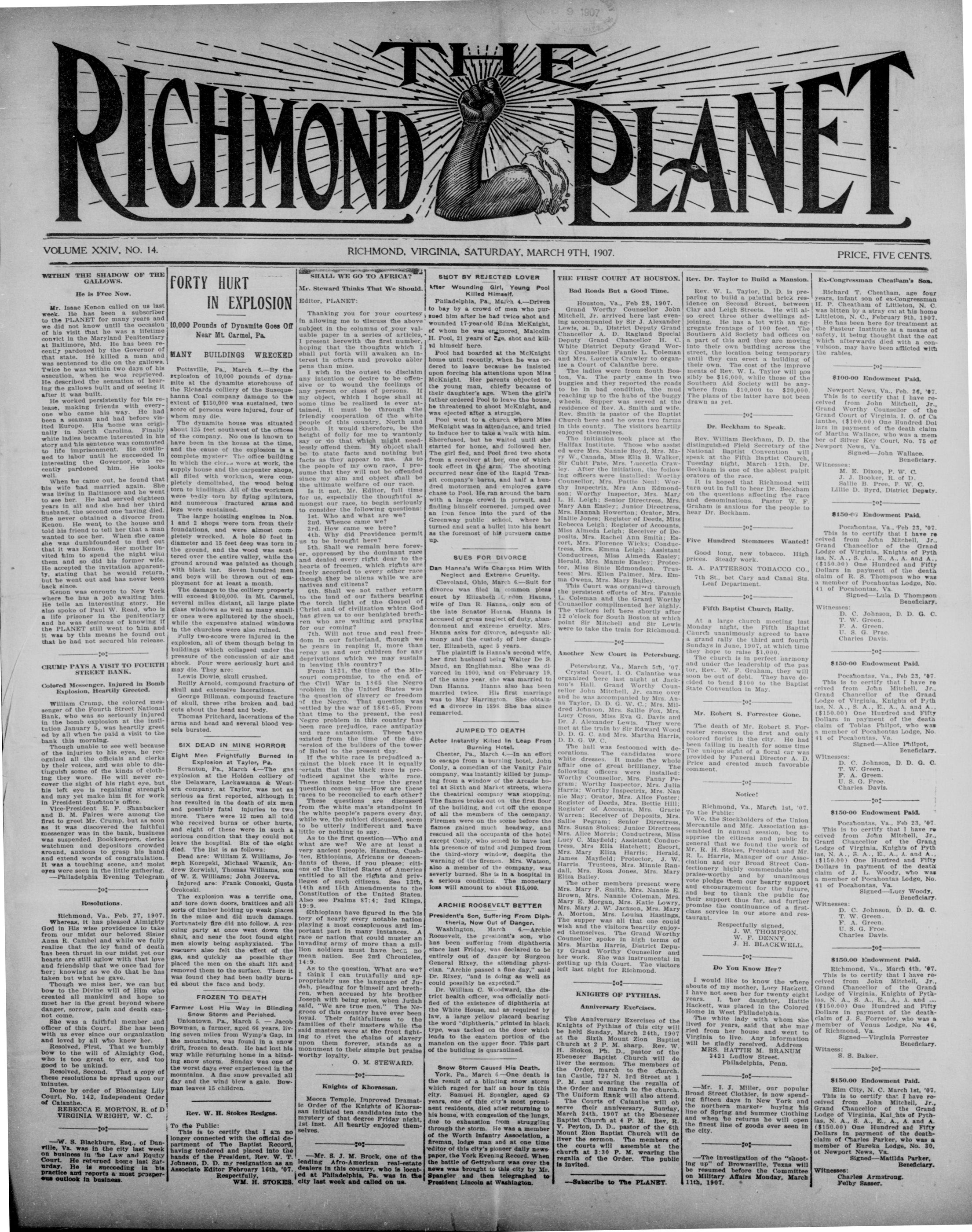
RICHMOND PLANET
VOLUME XXIV. NO. 14.
WITHIN THE SHADOW OF THE GALLOWS.
He is Free Now.
Mr. Isaac Kenon called on us last week. He has been a subscriber to the PLANET for many years and we did not know until the occasion of his visit that he was a lifetime convict in the Maryland Penitentiary at Baltimore, Md. He has been recently pardoned by the Governor of that state. He killed a man and was sentenced to die on the gallows. Twice he was within two days of his execution, when he was reprieved. He described the sensation of hearing the gallows built and of seeing it after it was built. He worked persistently for his release, making friends with everyone who came his way. He had been a seaman and had before visited Europe. His home was originally in North Carolina. Finally white ladies became interested in his story and his sentence was commuted to life imprisonment. He continued to labor until he succeeded in interesting the Governor, who recently pardoned him. He looks well.
When he came out, he found that his wife had married again. She was living in Baltimore and he went to see her. He had served eighteen years in all and she had her third husband, the second one having died. She never obtained a divorce from Kenon. He went to the house and told his friend to tell her that a man wanted to see her. When she came she was dumbfounded to find out that it was Kenon. Her mother invited him to spend the night with them and so did his former wife. He accepted the invitation apparently, stating that he would return, but he went out and has never been back since. Kenon was enroute to New York where he has a job awaiting him. He tells an interesting story. He also spoke of Paul W. Read, who is a life prisoner in the penitentiary and he was desirous of knowing if the PLANET still went to him and it was by this means he found out that he had not secured his release.
CRUMP PAYS A VISIT TO FOURTH STREET BANK.
Colored Messenger, Injured in Bomh Explosion, Heartily Greeted
William Crump, the colored messenger of the Fourth Street National Bank, who was so seriously injured in the bomb explosion at the institution January 5, was heartily greeted by all when he paid a visit to the bank this morning.
Though unable to see well because of the injuries to his eyes, he recognized all the officials and clerks by their voices, and was able to distinguish some of the kinds of clothing they wore. He will never recover the sight of his right eye, but his left eye is regaining strength and may yet make him fit for work in President Rushton's office.
Vice-President E. F. Shanbacker and B. M. Falres were among the first to greet Mr. Crump, but as soon as it was discovered the faithful messenger was in the bank, business was suspended. Bookkeepers, clerks watchmen and depositors crowded around, anxious to grasp his hand and extend words of congratulation.
It was a touching scene, and moist eyes were seen in the little gathering.
-B Philadelphia Evening Telegram
Resolutions
Richmond, Va., Feb. 27, 1907.
Whereas, it has pleased Almighty God in His wise providence to take from our midst our beloved Sister Anna R. Cambel and while we fully realize that the icy hand of death has been thrust in our midst yet our hearts are still aglow with that love and friendship that we once had for her; knowing as we do that he has taken but what he gave.
Though we miss her, we can but bow to the Divine will of Him who created all mankind and hope to meet her in the great beyond where danger, sorrow, pain and death cannot come.
She was a faithful member and officer of this Court. She has been with us ever since our organization and loved by all who knew her.
Resolved, First. That we humbly bow to the will of Almighty God, who is too great to err, and too good to be unkind.
Resolved, Second. That a copy of these resolutions be spread upon our minutes.
Done by order of Blooming Lily Court, No. 142, Independent Order of Calanthe.
REBECCA E. MORTON, R. of D VIRGINIA WRIGHT, W. C.
—W. S. Blackburn, Esq., of Danville, Va. was in the city last week on business in the Law and Equity Court. He returned home last Saturday. He is succeeding in his practice and reports a most prosperous outlook in business.
10,000 Pounds of Dynamite Goes Off Near Mt. Carmel, Pa.
MANY BUILDINGS WRECKED
Pottsville, Pa., March 6.—By the explosion of 10,000 pounds of dynamite at the dynamite storehouse of the Richards colliery of the Susequehanna Coal company damage to the extent of $150,000 was sustained, two score of persons were injured, four of whom may die.
The dynamite house was situated about 125 feet southwest of the offices of the company. No one is known to have been in the house at the time, and the cause of the explosion is a complete mystery. The office building in which the clerks were at work, the supply house and the carpenter shops, all filled with workmen, were completely demolished, the wood being torn to kindlings. All of the workmen were badly torn by flying splinters, and numerous fractured arms and legs were sustained.
The large hoisting engines in Nos. 1 and 2 shops were torn from their foundations, and were almost completely wrecked. A hole 50 feet in diameter and 15 feet deep was torn in the ground, and the wood was scattered over the entire valley, while the ground around was painted as though with black tar. Seven hundred men and boys will be thrown out of employment for at least a month.
The damage to the colliery property will exceed $100,000. In Mt. Carmel, several miles distant, all large plate glass windows as well as many smaller ones were splintered by the shock, while the expensive stained windows in the churches were also ruined. Fully two-score were injured in the explosion, all of them though being in buildings which collapsed under the pressure of the concussion of air and shock. Four were seriously hurt and may die. They are:
Lewis Dowie, skull crushed.
Reilly Arnold, compound fracture of skull and extensive lacerations.
George Billman, compound fracture of skull, three ribs broken and bad cuts about the head and body.
Thomas Pritchard, lacerations of the arms and head and several blood vessels bursted.
SIX DEAD IN MINE HORROR
Eight Men Frightfully Burned in Explosion at Taylor, Pa.
Scranton, Pa., March 4—The gas explosion at the Holden colliery of the Delaware, Lackawanna & Western company, at Taylor, was not as serious as first reported, although it has resulted in the death of six men and possibly fatal injuries to two more. There were 12 men all told who received burns or other hurts, and eight of these were in such a serious condition that they could not leave the hospital. Six of the eight died. The list is as follows:
Dead are: William Z. Williams, Joseph Kozepski, Michael Waznik, Andrew Zerwiski, Thomas Williams, son of W. Z. Williams; John Jozerva.
Injured are: Frank Conoski, Gusta Orokoski.
The explosion was a terrific one, and tore down doors, brattices and all sorts of timber holding up weak places in the mine and did much damage. Fortunately fire did not follow. A rescue party at once went down the shaft, and near the foot found eight men slowly being asphyxiated. The rescuers also felt the effect of the gas, and quickly as possible they placed the men on the shaft lift and removed them to the surface. There it was found they had been badly burned about the face and body.
FROZEN TO DEATH
Farmer Lost His Way in Blinding Snow Storm and Perished.
Uniontown, Pa., March 5. — Jacob Bowman, a farmer, aged 66 years, living seven miles from Wymp's Gap, in the mountains, was found in a snow drift, frozen to death. He had lost his way while returning home in a blinding snow storm. Sunday was one of the worst days ever experienced in the mountains. A fine snow prevailed all day and the wind blew a gale. Bowman leaves 15 children.
Rev. W. H. Stokes Resigns
To the Public:
This is to certify that I am no longer connected with the official department of The Baptist Record, having tendered and placed into the hands of the President, Rev. W. T. Johnson, D. D. my resignation as an Associate Editor February 16th, '07. Respectfully, WM. H. STOKES.
RICHMOND, VIRGINIA, SATURDAY, MARCH 9TH, 1907
Thanking you for your courtesy in allowing me to discuss the above subject in the columns of your valuable paper in a series of articles, I present herewith the first number, hoping that the thoughts which I shall put forth will awaken an interest in others and provoke abler pens than mine.
I wish in the outset to disclaim any intention or desire to be offensive or to wound the feelings of any person or class of persons. If my object, which I hope shall at some time be realized is ever attained, it must be through the friendly cooperation of the white people of this country, North and South. It would therefore, be the height of folly for me to wantonly say or do that which might needlessly offend them. My object shall be to state facts and notbing but facts as they appear to me. As to the people of my own race, I presume that they will not be offended since my aim and object shall be the ultimate welfare of our race.
Is it not, Mr. Editor, full time for us, especially the thoughtful amongst our race, to begin seriously to consider the following questions:
1st. Who and what are we?
2nd. Whence came we?
3rd. How came we here?
4th. Why did Providence permit us to be brought here?
5th. Shall we remain here forever, oppressed by the dominant race and dened over every right dear to the hearts of freemen, which rights are freely accorded to every other race though they be aliens while we are natives and citizens?
6th. Shall we not rather return to the land of our fathers bearing the torch light of the Gospel of Christ and of civilization when God has given us to our benighted brethren who are waiting and praying for our coming?
7th. Will not true and real freedom in our fatherland, though we be years in reaping it, more than repay us and our children for any deprivations which we may sustain in leaving this country?
From 1821, the time of the Missouri compromise, to the end of the Civil War in 1865 the Negro problem in the United States was the question of slavery or freedom of the Negro. That question was settled by the war of 1861-65. From that time to the present, the real Negro problem in this country has been race prejudice, race antipathy and race antagonism. These have existed from the time of the dispersion of the builders of the tower of Babel to the present day.
If the white race is prejudiced against the black race it is equally certain that the black race is prejudiced against the white race. These things being true the great question comes up—How are these races to be reconciled to each other?
These questions are discussed from the white man's standpoint in the white people's papers every day, while we, the subject discussed, seem to be utterly indifferent and have little or nothing to say.
As to the first question—Who and what are we? We are at least a very ancient people, Hamites, Cushites, Ethiopians, Africans or descendants of these, if you please; citizens of the United States of America entitled to all the rights and privileges of such citizens. See 13th, 14th and 15th Amendments to the Constitution of the United States. Also see Psalms 87:4; 2nd Kings, 19:9.
Ethiopians have figured in the history of nearly every notable nation playing a most conspicuous and important part in many instances. A race or nation that could muster an invading army of more than a million soldiers must have been no mean nation. See 2nd Chronicles, 14:9.
As to the question, What are we? I think I can truthfully and appropriately use the language of Judah, pleading for himself and brethren, when accused by his brother Joseph with being spies, when Judah said, "We are true men." The Negroes of this country have ever been loyal. Their faithfulness to the families of their masters while the said masters were at the front fighting to rivet the chains of slavery upon them forever, stands as a monument to their simple but praise worthy loyalty.
Knights of Khorassan.
Mecca Temple, Improved Dramatic Order of the Knights of Khorassan initiated ten candidates into the mystery of that degree Friday night, 1st inst. All heartily enjoyed themselves.
—Mr. S. J. M. Brock, one of the leading Afro-American real-estate dealers in this country, who is located at Philadelphia, Pa. was in the city last week and called on us.
SHOT BY REJECTED LOVER
After Wounding Girl, Young Pool Killed Himself.
Philadelphia, Pa., March 4.—Driven to bay by a crowd of men who pursued him after he had twice shot and wounded 17-year-old Edna McKnight, of whom he was enmorated, Malcolm H. Pool, 21 years of age, shot and killed himself here.
Pool had boarded at the McKnight home until recently, when he was ordered to leave because he insisted upon forcing his attentions upon Miss McKnight. Her parents objected to the young man, chiefly because of their daughter's age. When the girl's father ordered Pool to leave the house, he threatened to shoot McKnight, and was ejected after a struggle.
Pool went to a church where Miss McKnight was in attendance, and tried to induce her to take a walk with him. Sherefused, but he waited until she started for home, and followed her. The girl fled, and Pool fired two shots from a revolver at her, one of which took effect in the arm. The shooting occurred near one of the Rapid Transit company's barns, and half a hundred motormen and employees gave chase to Pool. He ran around the barn with a large crowd in pursuit, and finding himself cornered, jumped over an iron fence into the yard of the Greenway public school, where he turned and sent a bullet into his heart as the foremost of his pursuers came up.
SUES FOR DIVORCE
Dan Hanna's Wife Charges Him With Neglect and Extreme Cruelty.
Cleveland, Ohio, March 6.—Suit for divorce was filed in common pleas court by Elizabeth Gordon Hanna, wife of Dan R. Hanna, only son of the late Senator Hanna. Hanna is accused of gross neglect of duty, abandonment and extreme cruelty. Mrs. Hanna asks for divorce, adequate alimony and the custody of her daughter, Elizabeth, aged 5 years.
The plaintiff is Hanna's second wife, her first husband being Walter De S. Maud, an Englishman. She was divorced in 1900, and on February 19, of the same year, she was married to Dan Hanna. Hanna also has been married twice. His first marriage was to May Harrington. She obtained a divorce in 1898. She has since remarried.
JUMPED TO DEATH
Actor Instantly Killed in Leap From Burning Hotel.
Chester, Pa., March 4.—In an effort to escape from a burning hotel, John Conly, a comedian of the Vanity Fair company, was instantly killed by jumping from a window of the Arcade hotel at Sixth and Market streets, where the theatrical company was stopping. The flames broke out on the first floor of the building, and cut off the escape of all the members of the company. Firemen were on the scene before the flames gained much headway, and rescued all the occupants of the hotel except Conly, who seemed to have lost his presence of mind and jumped from the third-story window, despite the warning of the firemen. Mrs. Watson, also a member of the company, was severely burned. She is in a hospital in a serious condition. The monetary loss will amount to about $15,000.
ARCHIE ROOSEVELT BETTER
President's Son, Suffering From Diph
Washington, March 6.—Archie Roosevelt, the president's son, who has been suffering from diphtheria since last Friday, was declared to be entirely out of danger by Surgeon General Rixey, the attending physician. "Archie passed a fine day," said Dr. Rixey, "and is doing as well as could possibly be expected." Dr. William C. Woodward, the district health officer, was officially notified of the existence of diphtheria at the White House, and as required by law, a large yellow placard bearing the word "diphtheria," printed in black type, was tacked on the door which leads to the eastern portion of the mansion on the upper floor. This part of the building is quarantined.
Snow Storm Caused His Death.
Snow Storm Caused His Death.
York, Pa., March 6. One death is the result of a blinding snow storm which raged for half an hour in this city. Samuel H. Spangler, aged 69 years, one of this city's most prominent residents, died after returning to his home, with congestion of the lungs, due to exhaustion from struggling through the storm. He was a member of the Worth Infantry Association, a fireman, lodge man and at one time editor of this city's pioneer daily newspaper, the York Evening Record. When the battle of Gettysburg was over the news was brought to this city by Mr. Spangler and then telegraphed to President Lincoln at Washington.
THE FIRST COURT AT HOUSTON
Bad Roads But a Good Time.
Houston, Va., Feb 28, 1907. Grand Worthy Counselor Joan Mitchell, Jr. arrived here last evening accompanied by Sir J. Alexander Lewis, M. D., District Deputy Grand Chancellor A. D. Ragland Special Deputy Grand Chancellor H. C. White District Deputy Grand Worthy Counselor Fannie L. Coleman and Mrs. Lucretia Crawley to organize a Court of Calanthe here. The ladies were from South Boston, Va. The party came in two buggies and they reported the roads to be in bad condition, the mud reaching up to the hubs of the buggy wheels. Supper was served at the residence of Rev. A. Smith and wife, Rev. Smith is pastor of the Baptist Church here and he owns two farms in this county. The visitors heartily enjoyed themselves.
The initiation took place at the Halifax Institute. Those who assist ed were Mrs. Nannie Boyd, Mrs. Mary W. Canada, Miss Ella B. Walker, Sir Cubit Pate, Juccetia Crawley. After the initiation, the following officers were installed: Worthy Counsellor, Mrs. Pattie Neal; Worthy Inspectrix, Mrs Ann Edmondson; Worthy Inspector, Mrs. Mary L. H. Leigh; Senior Directress, Mrs. Mary Ann Easley; Junior Directress, Mrs. Hannah Howerton; Orator, Mrs. Hallie Jones; Register of Deeds, Miss Rebecca Leigh; Register of Accounts, Miss Almeda Leigh; Receiver of Deposits, Mrs. Rachel Ann Smith; Escort, Mrs. Florence Wicks; Conductress, Mrs. Emma Leigh; Assistant Conductress, Miss Almeda Easley; Herald, Mrs. Mamie Easley; Protector, Miss Sienie Edmondson. Trustees: Mrs. Ellen Palmer, Mrs. Emma Owens, Mrs. Mary Bailey. This Court was organized through the persistent efforts of Mrs. Fannie L. Coleman and the Grand Worthy Counsellor complimented her aighly. The visitors left here shortly after 12 o'clock for South Boston at which point Sir Mitchell and Sir Lewis were to take the train for Richmond.
Another New Court in Petersburg
Petersburg, Va., March 5th, '07.
Crystal Court, I, O. Calantine was organized here last night at Jackson's Hall. Grand Worthy Counselor John Mitchell, Jr. came and he was accompanied by Mrs. Anna Taylor, D. D. G. W. C.; Mrs. Mildred Johnson, Mrs. Sallie Fox, Mrs. Lucy Cross, Miss Eva G. Davis and Dr. J. Alexander Lewis. They were met at the train by Sir Edward Wood D. D. G. C and Mrs. Martha Harris, D. D. G. W. C.
The hall was festooned with decorations. The candidates wore white dresses. It made the whole affair one of great brilliance. The following officers were installed: Worthy Counselor, Mrs. Fanny Pegram; Worthy Inspector, Mrs. Julia Harris; Worthy Inspectrix, Mrs. Nanie May; Orator, Mrs. Alice Foster; Register of Deeds, Mrs. Bettie Hill; Register of Accounts, Mrs. Gracie Warren; Receiver of Deposits, Mrs. Salle Pegram; Senior Directress, Mrs. Susan Stokes; Junior Directress, Mrs. Alice Morris; Conductress, Miss Lucy C. Mayfield; Assistant Conductress, Mrs Ella Hatchett; Escort, Mrs Mary Eliza Harris; Herald, James Mayfield; Protector, J. W. Harris; Trustees, Mrs. Minnie Randall, Mrs. Rosa Jones, Mrs. Mary Eliza Bailey.
The other members present were Mrs. Mary P. Smith, Mrs. Nannie E. Brown, Mrs. Nannie Coleman, Mrs. Mary E. Morgan, Mrs. Katie Lowry, Mrs. Mary J. W. Jackson, Mrs. Mary A. Morton, Mrs. Loula Hastings, The supper was all that one could wish and the visitors heartily enjoyed themselves. The Grand Worthy Counselor spoke in high terms of Mrs. Martha Harris, District Deputy Grand Worthy Counselor and her work. She was instrumental in getting up this Court. The visitors left last night for Richmond.
KNIGHTS OF PYTHIAS:
Anniversary Exercises.
The Anniversary Exercises of the Knights of Pythias of this city will be held Sunday, March 24th, 1907 at the Sixth Mount Zion Baptist Church at 2 P. M. sharp. Rev. W. H. Stokes, Ph. D., pastor of the Ebenezer Baptist Church will de liver the sermon. The members of the Order, march to the church. Ian Castle, 727 N. 3rd Street at 1 P. M. and wearing the regalia of the Order and march to the church. The Uniform Rank will also attend. The Courts of Calanthe will ob serve their anniversary, Sunday, March 24th, 1907 at the Ebenezer Baptist Church at 4 P. M. Rev, R. V. Peyton, D. D., pastor of the 6th Mount Zion Baptist Church will de liver the sermon. The members of the courts will assemble at the church at 3:30 P. M. wearing the regalia of the Order. The public is invited.
Subscribe to The PLANET.
Rev. Dr. Taylor to Build a Mansion.
Rev. W. L. Taylor, D. D. is preparing to build a palatial brick residence on Second Street, between Clay and Leigh Streets. He will also erect three other dwellings adjoining. He has a lot with an aggregate frontage of 100 feet. The Southern Aid Society had offices on a part of this and they are moving into their own building across the street, the location being temporary until they can erect a building of their own. The cost of the improvements of Rev. W. L. Taylor will possibly be $16,000, while those of the Southern Aid Society will be anywhere from $10,000 to $20,000. The plans of the latter have not been drawn as yet.
Dr. Beckham to Speak
Rev, William Beckham, D. D. the distinguished Field Secretary of the National Baptist Convention will speak at the Fifth Baptist Church, Tuesday night, March 12th. Dr. Beckham is one of the ablest pulpit orators of the race. It is hoped that Richmond will turn out in full to hear Dr. Beckham on the questions affecting the race and denominations. Pastor W. F. Graham is anxious for the people to hear Dr. Beckham.
Five Hundred Stemmers Wanted!
Good long, new tobacco. High prices. Steady work.
R. A. PATTERSON TOBACCO CO.
7th St. bet Cary and Canal Sts.
Leaf Department.
Fifth Baptist Church Rally
At a large church meeting last Monday night, the Fifth Baptist Church unanimously agreed to have a grand rally the third and fourth Sundays in June, 1907, at which time they hope to raise $1,000. The church is in perfect harmony and under the leadership of the pastor, Rev. W. F. Graham, they will soon be out of debt. They have decided to hend $100 to the Baptist State Convention in May.
Mr. Robert S. Forrester Gone
The death of Mr. Robert S. Forester removes the first and only colored florist in the city. He had been falling in health for some time. The unique sight of a floral car was provided by Funeral Director A. D. Price and created much favorable comment.
Notice!
Richmond, Va., March 1st, '07.
To the Public:
We, the Stockholders of the Union Mercantile and Mfg. Association assembled in annual session, beg to apprise the citizens and public in general that we found the work of Mr. R. H. Stokes, President and Mr. R. L. Harris, Manager of our Association and our Broad Street Confectionery highly commendable and praise-worthy and by unanimous vote pledge them our hearty support and encouragement for the future, and beg to thank the public for their support thus far, and further promise the continuance of a first-class service in our store and restaurant.
Respectfully signed,
J. W. THOMPSON.
W. F. DENNY.
J. H. BLACKWELL.
Do You Know Her?
I would like to know the where abouts of my mother, Lucy Hackett. I have not seen her for twenty eight years. I. her daughter, Hattie Hackett, was placed in the Colored Home in West Philadelphia. The white lady with whom she lived for years, said that she married from her house and went to Virginia to live. Any information will be gladly received. Address MRS. HATTIE M. BRANUM 3431 Ludlow Street. Philadelphia, Penn.
Mr. I. J. Miller, our popular Broad Street Clothier, is now spending fifteen days in New York and the northern markets buying his line of Spring and Summer Clothing and when he returns he will open the finest line of goods ever seen in the city.
The investigation of the "shooting up" of Brownsville, Texas will be resumed before the Committee on Military Affairs Monday, March 11th, 1907.
Ex-Congressman Cheatham's Son.
Richard T. Cheatham, age four years, infant son of ex-Congressman H. P. Cheatham of Littleton, N. C. was bitten by a stray cat at his home Littleton, N. C., February 9th, 1907. He has been here for treatment at the Pasteur Institute as a means of safety, thought that the cat which afterwards died with a convulsion, may have afflicted with the rabies.
$100.00 Endowment Paid.
Newport News, Va., Feb. 26, 07.
This is to certify that I have received from John Mitchell, Jr.
Grand Worthy Counselor of the Grand Court of Virginia, I. Q. of Cianth, ($100.00) One Hundred Dollars in payment of the death claim of Martha Wallace, who was a member of Silver Key Court. No. 75 of Newport News, Va.
M. E. Dixon, P. W. C.
J. J. Booker, R. of D.
Sallie B. Free, P. W. C.
Lillie D. Byrd, District Deputy.
$150.00 Endowment Paid.
Pocahontas, Va., Feb 23, '07.
This is to certify that I have re-
ceived from John Mitchell, Jr.,
Grand Chancellor of the Grand
Lodge of Virginia, Knights of Pyth-
ias, N. A., S. A., E., A., A. and A.,
($150.00) One Hundred and Fifty
Dollars in payment of the death
claim of R. S. Thompson who was
a member of Pocahontas Lodge, No.
41 of Pocahontas, Va.
Signed—Lula D. Thompson
Beneficiary.
Witnesses:
D. C. Johnson, D. D. G. C.
T. W. Green.
F. A. Green.
U. S. G. Prae.
Charles Davis.
$150.00 Endowment Paid
Pocahontas, Va., Feb 23, '07.
This is to certify that I have re
ceived from John Mitchell, Jr.,
Grand Chancellor of the Grand
Lodge of Virginia, Knights of Pyth
ins, N. A., S. A., E., A. A. and A.,
($150.00) One Hundred and Fifty
Dollars in payment of the deata
claim of Tobias Philpot, who was
a member of Pocahontas Lodge, No.
41 of Pocahontas, Va.
Signed—Alice Philpot,
Beneficiary.
Witnesses:
D. C. Johnson, D. D. G. C.
T. W. Green.
F. A. Green.
U. S. G. Froe.
Charles Davis.
$150.00 Endowment Paid.
Pocahontas, Va., Feb 23, '07.
This is to certify that I have received from John Mitchell, Jr.,
Grand Chancellor of the Grand Lodge of Virginia, Knights of Pythias, N. A., S. A., E., A. A. and A.,
($150.00) One Hundred and Fifty Dollars in payment of the death claim of J. L. Woody, who was a member of Pocahontas Lodge, No. 41 of Pocahontas, Va.
Signed—Lucy Woody,
Beneficiary.
Witnesses:
D. C. Johnson, D. D. G. C.
T. W. Green.
F. W. Green.
U. S. G. Froe.
Charles Davis.
$150.00 Endowment Paid.
Richmond, Va., March 4th, '07.
This is to certify that I have received from John Mitchell, Jr.,
Grand Chancellor of the Grand Lodge of Virginia, Knights of Pythias,
N. A., S. A., E., A. A. and ...
( $150.00 ) One Hundred and Fifty Dollars in payment of the deathclaim of J. S. Forrester, who was a member of Venus Lodge, No 46,
of Richmond, Va.
Signed—Virginia Forrester
Beneficiary.
Witness:
S. S. Baker.
$150.00 Endowment Paid.
Elm City, N. C. March 1st, '07.
This is to certify that I have received from John Mitchell, Jr.
Grand Chancellor of the Grand Lodge of Virginia, Knights of Pythias, N. A., S. A., E., A., A. and A. ($150.00) One Hundred and Fifty Dollars in payment of the death-caim of Charles Parker, who was a member of Eureka Lodge, No. 30, ot Newport News, Va.
Signed—Matilda Parker,
Beneficiary.
Witnesses:
Charles Armstrong.
Felby Sasser.
---
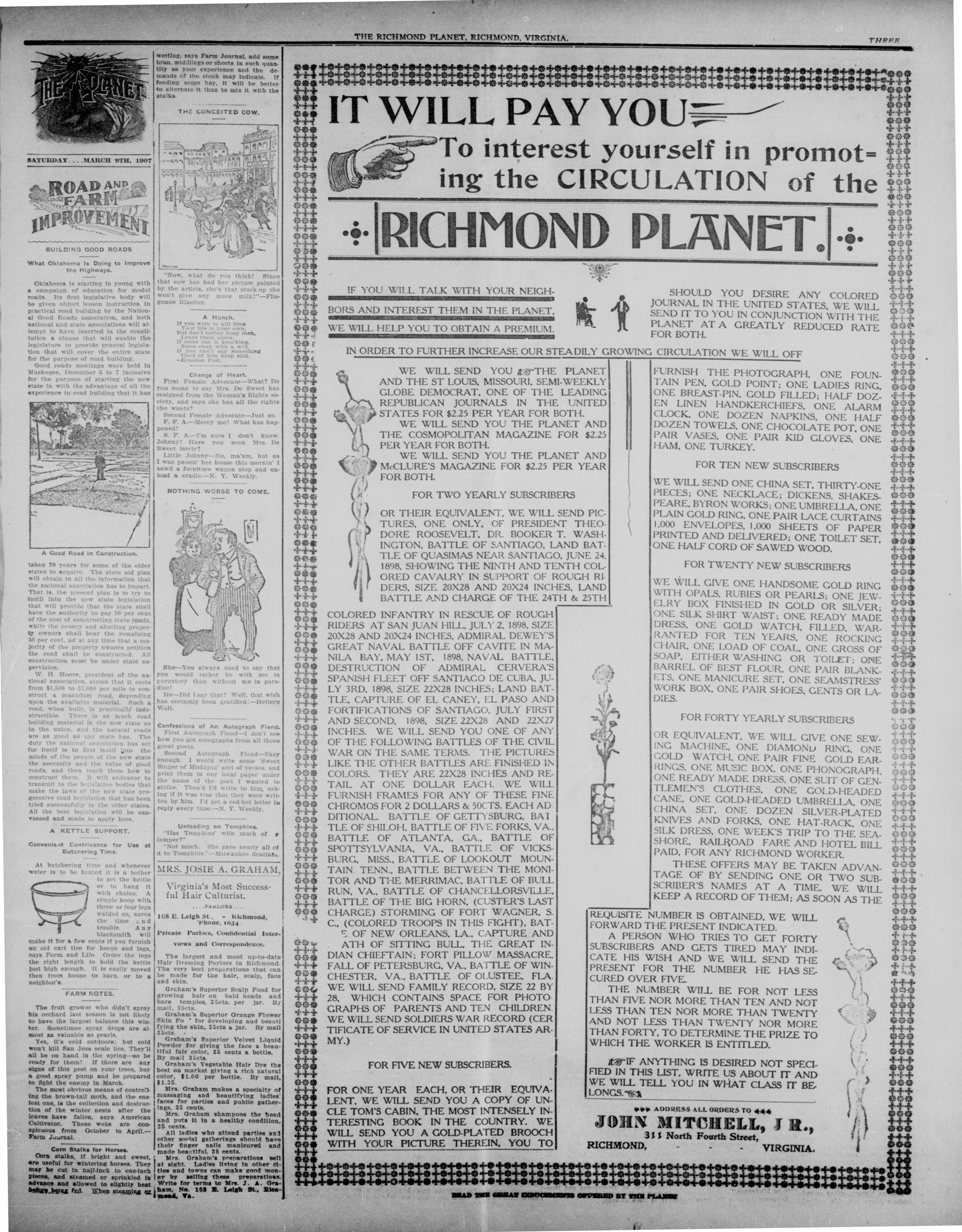
IT WILL PAY YOU To interest yourself in promot ing the CIRCULATION of the RICHMOND PLANET.
---
THE PLANET
SATURDAY...MARCH 9TH, 1907
ROAD AND FARM IMPROVEMENT BUILDING GOOD ROADS
BUILDING GOOD ROADS
What Oklahoma Is Doing to Improve the Highways.
Oklahoma is starting in young with a campaign of education for model roads. Its first legislative body will be given object lesson instruction in practical road building by the National Good Roads association, and both national and state associations will attempt to have inserted in the constitution a clause that will enable the legislature to provide general legislation that will cover the entire state for the purpose of road building. Good roads meetings were held in Muskogee, December 5 to 7 inclusive for the purpose of starting the new state in with the advantage of all the experience in road building that it has
A Good Road in Construction.
taken 30 years for some of the older states to acquire. The state aid plan will obtain in all the information that the national association has to impart. That is, the present plan is to try to instil into the new state legislation that will provide that the state shall have the authority to pay 50 per cent of the cost of constructing state roads, while the county and abutting property owners shall bear the remaining 50 per cent, ad at any time that a majority of the property owners petition the road shall be constructed. All construction must be under state supervision.
W. H. Moore, president of the national association, states that it costs from $1,500 to $3,000 per mile to construct a macadam road, depending upon the available material. Such a road, when built, is practically indestructible. There is as much road building material in the new state as in the union, and the natural roads are as good as any state has. The duty the national association has set for itself is to first instil into the minds of the people of the new state the necessity and the value of good roads, and then teach them how to construct them. It will endeavor to transmit to the legislative bodies that make the laws of the new state progressive road legislation that has been tried successfully in the older states. All the best legislation will be canvassed and made to apply here.
A KETTLE SUPPORT.
Convenient Contrivance for Use at Butchering Time.
At butchering time and whenever water is to be heated it is a bother to set the kettle or to hang it with chains. A simple hoop with three or four legs welded on, saves the time and trouble. Any blacksmith will
or to hang it with chains. A simple hoop with three or four legs welded on, saves the time and trouble. Any blacksmith will make it for a few cents if you furnish an old cart tire for hoops and legs, says Form and Life. Order the legs the right length to hold the kettle just high enough. It is easily moved then from house to barn, or to a neighbor's.
FARM NOTES.
The fruit grower who didn't spray his orchard last season is not likely to have the largest balance this winter. Sometimes spray drops are almost as valuable as pearls.
Yes, it's cold outdoors; but cold won't kill San Jose scale lice. They'll all be on hand in the spring—so be ready for them! If there are any signs of this pest on your trees, buy a good spray pump and be prepared to fight the enemy in March.
The most obvious means of controlling the brown-tail moth, and the easiest one, is the collection and destruction of the winter nests after the leaves have fallen, says American Cultivator. These webs are conspicuous from October to April.—Farm Journal.
Corn Stalks for Horses
Corn stalks, if bright and sweet, are useful for wintering horses. They may be cut in half-inch to one-inch pieces, and steamed or sprinkled in advance and allowed to slightly heat before being fed. When steaming or
BORS AND INTEREST THEM IN THE PLANET. WE WILL HELP YOU TO OBTAIN A PREMIUM.
COLORED INFANTRY IN RESCUE OF ROUGH RIDERS AT SAN JUAN HILL, JULY 2, 1898, SIZE 20X28 AND 20X24 INCHES, ADMIRAL DEWEY'S GREAT NAVAL BATTLE OFF CAVITE IN MANILA BAY, MAY 1ST, 1898, NAVAL BATTLE, DESTRUCTION OF ADMIRAL CERVERA'S SPANISH FLEET OFF SANTIAGO DE CUBA, JULY 3RD, 1898, SIZE 22X28 INCHES; LAND BATTLE, CAPTURE OF EL CANEY, EL PASO AND FORTIFICATIONS OF SANTIAGO, JULY FIRST AND SECOND, 1898, SIZE 22X28 AND 22X27 INCHES. WE WILL SEND YOU ONE OF ANY OF THE FOLLOWING BATTLES OF THE CIVIL WAR ON THE SAME TERMS. THE PICTURES LIKE THE OTHER BATTLES ARE FINISHED IN COLORS. THEY ARE 22X28 INCHES AND RETAIL AT ONE DOLLAR EACH. WE WILL FURNISH FRAMES FOR ANY OF THESE FINE CHROMOS FOR 2 DOLLARS & 50CTS. EACH ADDITIONAL. BATTLE OF GETTYSBURG, BATTLE OF SHILOH, BATTLE OF FIVE FORKS, VA., BATTLE OF ATLANTA, GA., BATTLE OF SPOTTSYLVANIA, VA., BATTLE OF VICKSBURG, MISS., BATTLE OF LOOKOUT MOUNTAIN, TENN., BATTLE BETWEEN THE MONITOR AND THE MERRIMAC, BATTLE OF BULL RUN, VA., BATTLE OF CHANCELLORSVILLE, BATTLE OF THE BIG HORN, (CUSTER'S LAST CHARGE) STORMING OF FORT WAGNER, S. C., (COLORED TROOPS IN THIS FIGHT), BAT-
ATH OF SITTING BULL, THE GREAT INDIAN CHIEFTAIN; FORT PILLOW MASSACRE, FALL OF PETERSBURG, VA., BATTLE OF WINCHESTER, VA., BATTLE OF OLUSTEE, FLA. WE WILL SEND FAMILY RECORD, SIZE 22 BY 28. WHICH CONTAINS SPACE FOR PHOTOGRAPHS OF PARENTS AND TEN CHILDREN. WE WILL SEND SOLDIERS WAR RECORD (CERTIFICATE OF SERVICE IN UNITED STATES ARMY.)
FOR ONE YEAR EACH, OR THEIR EQUIVALENT, WE WILL SEND YOU A COPY OF UNCLE TOM'S CABIN, THE MOST INTENSELY INTERESTING BOOK IN THE COUNTRY. WE WILL SEND YOU A GOLD-PLATED BROOCH WITH YOUR PICTURE THEREIN, YOU TO
wetting, says Farm Journal, add some bran, middlings or shorts in such quantity as your experience and the demands of the stock may indicate. If feeding some hay, it will be better to alternate it than to mix it with the stalks.
THE CONCEITED COW.
MARQUES
"Now, what do you think! Since that cow has had her picture painted by the artists, she's that stuck-up she won't give any more milk!"—Fliegende Blaetter.
A Hunch.
If you wish to kill time
Your life is your own.
But don't bother busy men.
Leave them alone;
If some one is knocking,
chure chup with a will.
If you can't say something
Good of him keep still.
—Kouston Post.
Change of Heart.
First Female Advocate—What? Do you mean to say Mrs. De Sweet has resigned from the Woman's Rights society, and says she has all the rights she wants?
Second Female Advocate—Just so.
F. F. A.—Mercy me! What has happened!
S. F. A.—I'm sure I don't know.
Johnny! Have you seen Mrs. De Sweet lately?
Little Johnny—No, ma'am, but as I was passin' her house this mornin' I sawd a furniture wagon stop and unload a cradle.—N. Y. Weekly.
NOTHING WORSE TO COME.
I
She—You always used to say that you would rather be with me in purgatory than without me in paradise!
He—Did I say that? Well, that wish has certainly been gratified!—Heittere Welt.
Confessions of An Autograph Flend.
First Autograph Flend—I don't see how you got autographs from all those great poets.
Second Autograph Flend—Easy enough. I would write some 'Sweet Singer of Michigan' sort of verses, and print them in our local paper under the name of the poet I wanted to strike. Then'd I'd write to him, asking if it was true that they were written by him. I'd get a red-hot letter in reply every time.—N. Y. Weekly.
Unloading on Tompkins.
"Has Tompkins' wife much of e
(emper?"
"Not much. She gave nearly all of
it to Tompkins." -Milwaukee Sentins.
MRS. JOSIE A. GRAHAM,
Virginia's Most Successful Hair Culturist.
...PARLORS.....
108 E. Leigh St., - Richmond,
'Phone, 1034
Private Parlors, Confidential Inter
```markdown
```
views and Correspondence.
The largest and most up-to-date Hair Dressing Parlors in Richmond. The very best preparations that can be made for the hair, scalp, face and skin.
Graham's Superior Scalp Food for growing hair on bald heads and bare temples, 25cts, per jar. By mail, 35cts.
Graham's Superior Orange Flower Skin Fo' for developing and beautifying the skin, 25cts a jar. By mail 35cts.
Graham's Superior Velvet Liquid Powder for giving the face a beautiful fair color, 25 cents a bottle. By mail 35cts.
Graham's Vegetable Hair Dye the best on market giving a rich natural color, $1.00 per bottle. By mail, $1.25.
Mrs. Graham makes a specialty of massaging and beautifying ladies' faces for parties and public gatherings. 35 cents.
Mrs. Graham shampoos the head and puts it in a healthy condition, 25 cents.
All ladies who attend parties and other social gatherings should have their finger nails manicured and made beautiful, 25 cents.
Mrs. Graham's preparations sell at sight. Ladies living in other cities and towns can make good money by selling these preparations.
Write for terms to Mrs. J. A. Graham, No. 108 E. Leigh St., Biceamad, Va.
IN ORDER TO FURTHER INCREASE OUR STEADILY GROWING CIRCULATION WE WILL OFF
WE WILL SEND YOU THE PLANET AND THE ST LOUIS, MISSOURI, SEMI-WEEKLY GLOBE DEMOCRAT, ONE OF THE LEADING REPUBLICAN JOURNALS IN THE UNITED STATES FOR $2.25 PER YEAR FOR BOTH.
WE WILL SEND YOU THE PLANET AND THE COSMOPOLITAN MAGAZINE FOR $2.25 PER YEAR FOR BOTH.
WE WILL SEND YOU THE PLANET AND McCLURE'S MAGAZINE FOR $2.25 PER YEAR FOR BOTH.
OR THEIR EQUIVALENT, WE WILL SEND PICTURES, ONE ONLY, OF PRESIDENT THEODORE ROOSEVELT, DR. BOOKER T. WASHINGTON, BATTLE OF SANTIAGO, LAND BATTLE OF QUASIMAS NEAR SANTIAGO, JUNE 24, 1898, SHOWING THE NINTH AND TENTH COLORED CAVALRY IN SUPPORT OF ROUGH RIDERS, SIZE 20X28 AND 20X24 INCHES, LAND BATTLE AND CHARGE OF THE 24TH & 25TH
READ THE GREAT INDUCTIONS OFFERED BY THE PLANET
THE RICHMOND PLANET, RICHMOND, VIRGINIA
IF YOU WILL TALK WITH YOUR NEIGH-
```markdown
```
FOR TWO YEARLY SUBSCRIBERS
5. OF NEW ORLEANS, LA., CAPTURE AND
FOR FIVE NEW SUBSCRIBERS.
REQUISITE NUMBER IS OBTAINED, WE WILL FORWARD THE PRESENT INDICATED.
A PERSON WHO TRIES TO GET FORTY SUBSCRIBERS AND GETS TIRED MAY INDICATE HIS WISH AND WE WILL SEND THE PRESENT FOR THE NUMBER HE HAS SECURED OVER FIVE.
THE NUMBER WILL BE FOR NOT LESS THAN FIVE NOR MORE THAN TEN AND NOT LESS THAN TEN NOR MORE THAN TWENTY AND NOT LESS THAN TWENTY NOR MORE THAN FORTY, TO DETERMINE THE PRIZE TO WHICH THE WORKER IS ENTITLED.
IF ANYTHING IS DESIRED NOT SPECIFIED IN THIS LIST, WRITE US ABOUT IT AND WE WILL TELL YOU IN WHAT CLASS IT BE LONGS.
JOHN MITCHELL, JR.,
311 North Fourth Street,
RICHMOND, VIRGINIA.
A
LANET
WEEKLY
LEADING
UNITED
TH.
T AND
ER $2.25
T AND
YEAR
ND PIC-
THEO-
WASH-
D BAT-
JUNE 24,
H COL-
GH RI-
LAND
& 25TH
```markdown
```
REQUIST
FORWAR
SHOULD YOU DESIRE ANY COLORED JOURNAL IN THE UNITED STATES, WE WILL SEND IT TO YOU IN CONJUNCTION WITH THE PLANET AT A GREATLY REDUCED RATE FOR BOTH.
FURNISH THE PHOTOGRAPH, ONE FOUNTAIN PEN, GOLD POINT; ONE LADIES RING, ONE BREAST-PIN, GOLD FILLED; HALF DOZEN LINEN HANDKERCHIEFS, ONE ALARM CLOCK, ONE DOZEN NAPKINS, ONE HALF DOZEN TOWELS, ONE CHOCOLATE POT, ONE PAIR VASES, ONE PAIR KID GLOVES, ONE HAM, ONE TURKEY.
WE WILL SEND ONE CHINA SET, THIRTY-ONE PIECES; ONE NECKLACE; DICKENS, SHAKESPEARE, BYRON WORKS; ONE UMBRELLA, ONE PLAIN GOLD RING, ONE PAIR LACE CURTAINS 1,000 ENVELOPES, 1,000 SHEETS OF PAPER PRINTED AND DELIVERED; ONE TOILET SET, ONE HALF CORD OF SAWED WOOD.
FOR TWENTY NEW SUBSCRIBERS
WE WILL GIVE ONE HANDSOME GOLD RING WITH OPALS, RUBIES OR PEARLS; ONE JEWELRY BOX FINISHED IN GOLD OR SILVER; ONE SILK SHIRT WAIST; ONE READY MADE DRESS, ONE GOLD WATCH, FILLED, WARRANTED FOR TEN YEARS, ONE ROCKING CHAIR, ONE LOAD OF COAL, ONE GROSS OF SOAP, EITHER WASHING OR TOILET; ONE BARREL OF BEST FLOUR, ONE PAIR BLANKETS, ONE MANICURE SET, ONE SEAMSTRESS' WORK BOX, ONE PAIR SHOES, GENTS OR LADIES.
FOR FORTY YEARLY SUBSCRIBERS
OR EQUIVALENT, WE WILL GIVE ONE SEWING MACHINE, ONE DIAMOND RING, ONE GOLD WATCH, ONE PAIR FINE GOLD EARRINGS, ONE MUSIC BOX, ONE PHONOGRAPH, ONE READY MADE DRESS, ONE SUIT OF GENTLEMEN'S CLOTHES, ONE GOLD-HEADED CANE, ONE GOLD-HEADED UMBRELLA, ONE CHINA SET, ONE DOZEN SILVER-PLATED KNIVES AND FORKS, ONE HAT-RACK, ONE SILK DRESS, ONE WEEK'S TRIP TO THE SEASHORE, RAILROAD FARE AND HOTEL BILL PAID, FOR ANY RICHMOND WORKER. THESE OFFERS MAY BE TAKEN ADVANTAGE OF BY SENDING ONE OR TWO SUBSCRIBER'S NAMES AT A TIME. WE WILL KEEP A RECORD OF THEM: AS SOON AS THE
FOR TEN NEW SUBSCRIBERS
THREE
```markdown
```
```markdown
```
FOUR
THE PLANET
Published every Saturday by JOHN NORTHELL
Jr., at 811 North 31st Street, Richmond Va.
b. communications intended for publication
could be sent as to reach us by Wednesday.
TERMS IN ADVANCE
One Copy, one year, $1.20
One Copy, six months, 1.00
One Copy, six months, .40
One Copy, four months, .90
One Copy, three months, .50
Single Copy, .40
ADVERTISING RATES
For one inch, one insertion, $0.50
For one inch, each subsequent insertion, $0.40
For two inches, three months, $0.00
For two inches, six months, $10.00
For two inches, nine months, $14.00
For two inches, twelve months $20.00
Marriage and Funeral Notices, one inch, $0.50
Standing and Transient Notices per line, $10
POSTAGE STAMPS OF A HIGHER DEMONINATION THAN TWO CENTS NOT RECEIVED ON SUBSCRIPTIONS.
THE PLANET is issued weekly. The subscription price is $1.50 per year in advance.
There are FOUR ways by which money can be sent by mail at our rank—In a Post Office Money Order, by Bank Check or Draft, or an Exempt Money Order, and when none of these can be procured, in a Bank or Post Office. MONEY ORDERS. You can buy a Money Order at your Post-Office, payable at the Richmond Post-Office, and we will be responsible for express MONEY ORDERs can be obtained at any office of the American Express Co. the United States Express Co., and the Wells Fargo and Co.'s Express Company. We will be responsible for express MONEY ORDERs in the companies. The Express Money Order is a safe and convenient way for forwarding money.
REGISTERED LETTER. If a money Order Post-Office or Postmaster is not within ten miles of your Postmaster, the Letter you wish to send on payment of ten cents. Then, if the letter is lost or stolen, it cannot be sent on money in this manner at our risk.
We cannot be responsible for money sent in letters in any other way than one of the four ways mentioned above. If you send your money in any other way, you must do it at your
RENEWAL, ENC.—If you do not want THE PLANET continued for another year after your subscription has run out, you then notify us by email to discontinue it. The county has decided that subscribers to newspaper, who do not order their paper discontinued at the ex-tenuation time for which they are bedridden are held liable for the payment of the subscription up to date when they order the paper discontinued.
COMMUNICATION—When writing to us to renew your subscription or to discontinue your paper, you should give your name and address in full otherwise we cannot find your name on our books.
Entered at the Office at Richmond, Va. wecond-class matter.
SATURDAY . . . MARCH 9TH, 1907
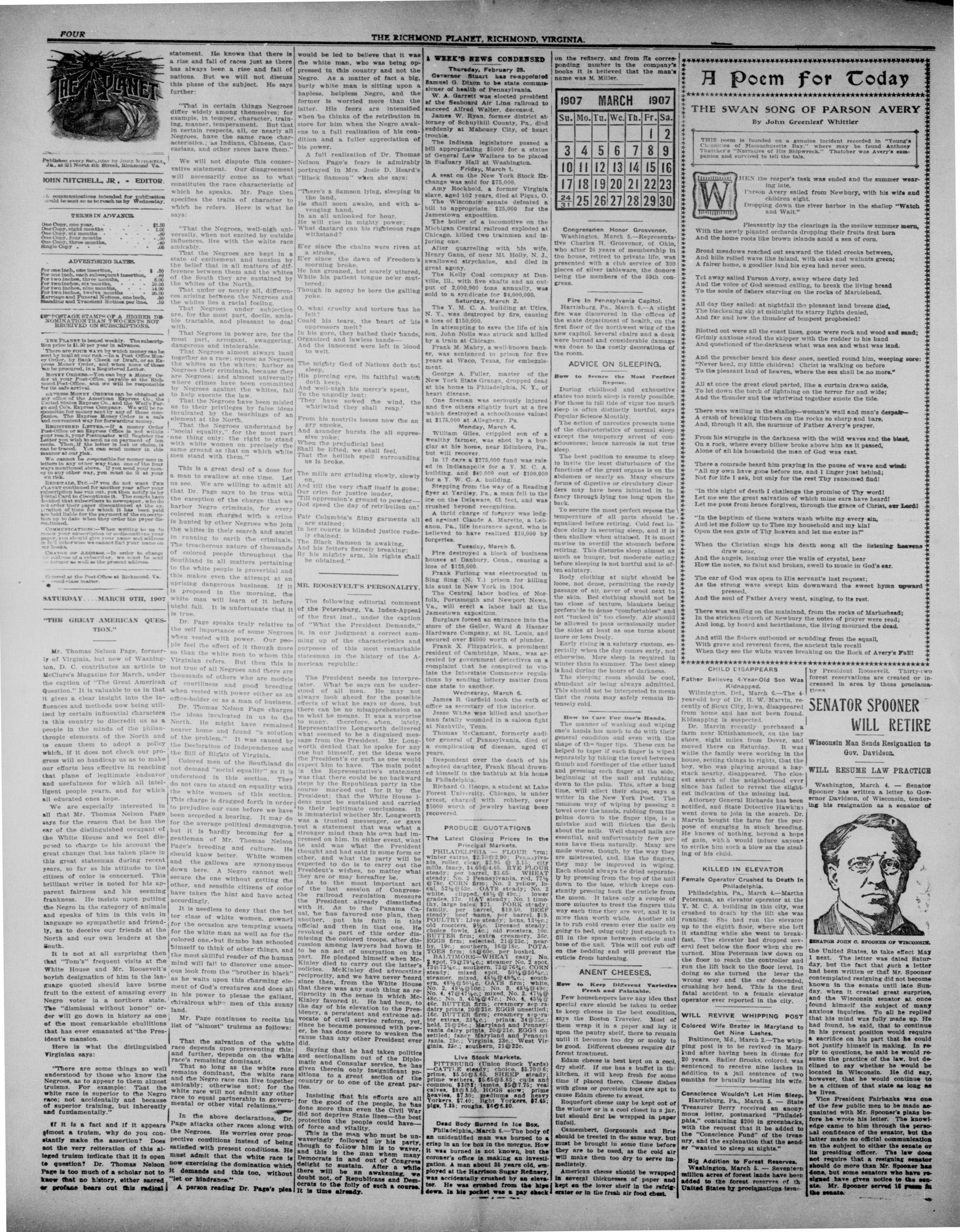
"THE GREAT AMERICAN QUES TION."
Mr. Thomas Nelson Page, formerly of Virginia, but now of Washington, D. C. contributes an article to McClure's Magazine for March, under the caption of "The Great American Question." It is valuable to us in that it gives a clear insight into the influences and methods now being utilized by certain influential characters in this country to discredit us as a people in the minds of the philanthropic elements of the North and to cause them to adopt a policy which, if it does not check our progress will so handicap us as to make our efforts less effective in reaching that plane of legitimate endeavor and usefulness for which all intelligent people yearn, and for which all educated ones hope.
We are especially interested in all that Mr. Thomas Nelson Page says for the reason that he has the ear of the distinguished occupant of the White House and we feel disposed to charge to his account the great change that has taken place in this great statesman during recent years, so far as his attitude to the citizen of color is concerned. This brilliant writer is noted for his apparent fairness and his seeming frankness. He insists upon putting the Negro in the category of animals and speaks of him in this vein in language so sympathetic and friendly, as to deceive our friends at the North and our own leaders at the South.
It is not at all surprising then that "Tom's" frequent visits at the White House and Mr. Roosevelt's boyish designation of him in the language quoted should have borne fruit to the extent of amazing every Negro voter in a northern state. The "dismissal without honor" order will go down in history as one of the most remarkable ebulliations that has ever emanated at the President's mansion.
Here is what the distinguished Virginian says:
"There are some things so well understood by those who know the Negroes, as to appear to them almost truisms. For example: That the white race is superior to the Negro race; not accidentally and because of superior training, but inherently and fundamentally."
If it is a fact and if it appears almost a truism, why do you constantly make the assertion? Does not the very reiteration of this alleged truism indicate that it is open to question? Dr. Thomas Nelson Page is too much of a scholar not to know that no history, either sacred or profane bears out this radical
statement. He knows that there is a rise and fall of races just as there has always been a rise and fall of nations. But we will not discuss this phase of the subject. He says further:
"That in certain things Negroes differ widely among themselves; for example, in temper, character, training, manner, temperament. But that in certain respects, all, or nearly all Negroes, have the same race characteristics; as Indians, Chinese, Caucasians, and other races have them."
We will not dispute this conservative statement. Our disagreement will necessarily come as to what constitutes the race characteristic of which he speaks. Mr. Page then specifies the traits of character to which he refers. Here is what he says:
"That the Negroes, well-nigh universally, when not excited by outside influences, live with the white race amicably.
That the Negroes are kept in a state of excitement and tension by the belief that in all matters of difference between them and the whites of the South they are sustained by the whites of the North.
That under or nearly all, differences arising between the Negroes and the whites lies a racial feeling.
That Negroes under subjection are, for the most part, docile, amiable tractable, and pleasant to deal with.
That Negroes in power are, for the most part, arrogant, swaggering, dangerous and intolerable.
That Negroes almost always band together as a race; oppose as Negroes the whites as the whites; harbor as Negroes their criminals, because they are Negroes; and almost universally where crimes have been committed by Negroes against the whites, fall to help execute the law.
That the Negroes have been misled as to their privileges by false ideas inculcated by the teachings of an element at the North.
That the Negroes understand by "social equality," for the most part one thing only: the right to stand with white women on precisely the same ground as that on which white men stand with them."
This is a great deal of a dose for a man to swallow at one time. Let us see. We are willing to admit all that Dr. Page says to be true with the exception of the charge that we harbor Negro criminals, for every colored man charged with a crime is hunted by other Negroes who join the whites in their search and assist in running to earth the criminals. The treacherous nature of thousands of colored people throughout the Southland in all matters pertaining to the white people is proverbial and this makes even the attempt at an uprising dangerous business. If it is proposed in the morning, the white man will learn of it before night fall. It is unfortunate that it is true.
Dr. Page speaks truly relative to the self importance of some Negroes when vested with power. Our people feel the effect of it though more so than the white men to whom this Virginian refers. But then this is not true of all Negroes and there are thousands of others who are models of courtliness and good breeding when vested with power either as an office-holder or as a man of business.
Dr. Thomas Nelson Page charges the ideas inculcated in us to the North. He might have remained nearer home and found "a solution of the problem." It was caused by the Declaration of Independence and the Bill of Rights of Virginia.
Colored men of the Southland do not demand "social equality" as it is understood in this section. They do not care to stand on equality with the white women of this section. This charge is dragged forth in order to prejudice our case before we have been accorded a hearing. It may do for the average political demagogue, but it is hardly becoming for a gentleman of Mr. Thomas Nelson Page's breeding and culture. He should know better. White women and the gallows are synonymous down here. A Negro cannot well secure the one without getting the other, and sensible citizens of color have taken the hint and have acted accordingly.
It is needless to deny that the better class of white women, gowned for the occasion are tempting assets for the white man as well as for the colored one, but Sambo has schoolled himself to think of other things, and the most skillful reader of the human mind will fail to discover one amorous look from the "brother in black" as he waits upon this charming element of God's creatures and does all in his power to please the gallant, chivalrous white men of this sunny land.
Mr. Page continues to recite his list of "almost" truisms as follows:
That the salvation of the white race depends upon preventing this; and further, depends on the white race's remaining dominant.
That so long as the white race remains dominant, the white race and the Negro race can live together amicably; otherwise not; for the white race will not admit any other race to equal partnership in governmental or other vital relations."
In the above declarations, Dr. Page attacks other races along with the Negroes. He worries over prospective conditions instead of being satisfied with present conditions. He must admit that the white race is now exercising the domination which it demands and this too, without "let or hindrance."
A person reading Dr. Pare's plea
THE RICHMOND PLANET, RICHMOND, VIRGINIA
would be led to believe that it was the white man, who was being oppressed in this country and not the Negro. As a matter of fact a big, burly white man is sitting upon a hapless, helpless Negro, and the former is worried more than the latter. His fears are intensified when he thinks of the retribution in store for him when the Negro awakens to a full realization of his condition and a fuller appreciation of his power.
A full realization of Dr. Thomas Nelson Page's fears is admirably portrayed in Mrs. Josie D. Heard's "Black Samson" when she says:
"There's a Samson lying, sleeping in the land.
He shall soon awake, and with a vengeing hand.
What dastard can his righteous rage withstand?
E'er since the chains were riven at a stroke,
E'er since the dawn of Freedom's morning broke.
He has groaned, but scarely uttered,
While his patient tongue ne'er muttered;
Though in agony he bore the galling yoke.
O, what cruelty and torture has he felt?
Could his tears, the heart of his oppressors melt?
The mighty God of Nations doth not sleep.
His piercing eye, its faithful watch doth keep.
And well-nigh his mercy's spent,
To the ungodly lent:
'They have sowed the wind, the whirlwind they shall reap.'
From his nostrils issues now the angry smoke.
And asunder bursts the all oppressive yoke;
When the prejudicial heel
Shall be lifted, we shall feel.
That the hellish spell surrounding us is broke.
The mills are grinding slowly, slowly on,
Fair Columbia's filmy garments all are stained;
In her courts is blinded justice rudely chained;
By his mighty arm, his rights shall be obtained."
MR. ROOSEVELT'S PERSONALITY.
The following editorial comment of the Petersburg, Va. Index-Appeal of the first inst., under the caption of "What the President Demands," is, in our judgment a correct summing up of the characteristics and purposes of this most remarkable statesman in the history of the American republic:
The President needs no interpretater. What he says can be understood of all men. He may not always look ahead for the possible effects of what he says or does, but there can be no misapprehension as to what he means. It was a surprise to many, therefore, when, lately, Representative Longworth delivered what seemed to be a disguised message from the President. Mr. Longworth denied that he spoke for any one but himself, yet the ideas were the President's or such as one would expect him to have. The main point in the Representative's statement was that there could be no backward steps by the Republican party in the course marked out for it by the President; that the White House ideas must be sustained and carried to their legitimate conclusions. It is immaterial whether Mr. Longworth was a trusted messenger, or gave out a statement that was what a stronger mind than his own had impressed on him. In either event, what he said was what the President thought and had said in some form or other, and what the party will be expected to do is to carry out the President's wishes, no matter what they are or may hereafter be.
As to the most important act of the last session of Congress—the railroad regulation measure the President already dissatisfied with it. As to the Panama Canal, he has favored one plan, then another, put his faith in this official and then in that one. He revoked a part of this order dismissing the colored troops, after discussion among lawyers had hown it to be an act of usurpation on his part. He pledged himself when McKinley died to carry out the latter's policies. McKinley died advocating reciprocity, and we have never heard since then, from the White House that there was any such thing as reciprocity in the sense in which McKinley favored it. He had been, to the day of his elevation to the Presidency, a persistent and extreme advocate of civil service reform, yet, since he became possessed with power, he has done more to weaken the cause than any other President ever did.
Saying that he had taken politics and sectionalism out of the Diplomatic and Consular service, he has given therein only insignificant positions to a great section of the country or to one of the great parties.
Insisting that his efforts are all for the good of the people, he has done more than even the Civil War did not deprive State lines—the best protection the people could have—of force and vitality.
This is the man who must be unwaveringly followed by his party, though to follow him is to waver, and this is the man whom many Democrats in and out of Congress delight to sustain. After a while there will be an awakening, we doubt not, of Republicans and Democrats to the folly of such a course.
It is time already.
WEEK'S NEWS CONDENSED
Thursday, February 28.
Governor Stuart has re-appointed Samuel G. Dixon to be state commissioner of health of Pennsylvania.
W. A. Garrett was elected president of the Seenboard Air Line railroad to succeed Alfred Walter, deceased.
James W. Ryan, former district attorney of Schuylkill County, Pa., died suddenly at Mahoney City, of heart trouble.
The Indiana legislature passed a bill appropriating $5000 for a statue of General Lew Wallace to be placed in Stafuary Hall at Washington.
Friday, March 1.
A seat on the New York Stock Exchange was sold for $75,000.
Amy Rockhold, a former Virginia slave, aged 102 years, died at Piqua, O.
The Wisconsin senate defeated a bill to appropriate $25,000 for the Jamestown exposition.
The boiler of a locomotive on the Michigan Central railroad exploded at Chicago, killed two trainmen and injuring one.
After quarreling with his wife, Henry Gann, of near Mt. Holly, N. J., swallowed strychnine, and died in great agony. The Kelly Coal company at Danville, Ill., with five shafts and an out put of 2,000,000 tons annually, was sold to a syndicate for $4,000,000. Saturday, March 2. The Y. M. C. A. building at Utica, N. Y., was destroyed by fire, causing a loss of $150,000. In attempting to save the life of his son, John Nolls was struck and killed by a train at Chicago. Frank M. Mabry, a well-known banker, was sentenced to prison for five years at Waco, Texas, for embezzlement. George A. Fuller, master of the New York State Grange, dropped dead at his home in Philadelphia, N. Y., of heart disease.
One fireman was seriously injured and five others slightly hurt at a fire which destroyed a schoolhouse valued at $175,000 at Allegheny, Pa.
Monday, March 4.
William Giles, crippled son of a wealthy farmer, was shot by a burglar at his home, near Edinboro, Pa., but will recover.
In 17 days a $275,000 fund was raised in Indianapolis for a Y. M. C. A. building, and $40,000 out of $100,000 for a Y. W. C. A. building.
Stepping from the way of a Reading flyer at Yardley, Pa., a man fell to the ice on the Delaware, 65 feet, and was crushed beyond recognition.
A third charge of forgery was lodged against Claude A. Marette, a Lebanon, Pa., life insurance agent, who is believed to have realized $10,000 by forgeries.
Tuesday, March 5.
Fire destroyed a block of business houses at Danbury, Conn., causing a loss of $125,000.
Frank Furlong was electrocuted in Sing Sing (N. Y.) prison for killing his aunt in New York in 1904.
The Central labor bodies of Norfolk, Portsmouth and Newport News, Va., will erect a labor hall at the Jamestown exposition.
Burglaries forced an entrance into the store of the Geller, Ward & Hasner Hardware Company, at St Louis, and secured over $6000 worth of plunder.
Frank X. Fitzpatrick, a prominent resident of Cambridge, Mass., was arrested by government detectives on a complaint that he conspired to violate the Interstate Commerce regulations by sending lottery matter from one state to another.
Wednesday, March 6.
James R. Garfield took the oath of office as secretary of the interior. Jesse White was killed and another man fatally wounded in a saloon fight at Nashville, Tenn. Thomas McCamant, formerly auditor general of Pennsylvania, died of a complication of disease, aged 67 years. Despondent over the death of his adopted daughter, Frank Shoal drowned himself in the bathtub at his home in Philadelphia. Richard O. Hoops, a student at Lake Forest University, Chicago, is under arrest, charged with robbery, over $5000 worth of jewelry having been recovered.
PRODUCE QUOTATIONS
The Latest Closing Prices In the Principal Markets.
PHILADELPHIA — FLOUR 1rm;
winter extras, $2.70 @ 2.90; Pennylvania,
roller, clear, $2.95 @ 3.15; city
mills, fancy, $4.60 @ 4.65. RYE FLOUR
steady; per barrel, $3.65. WHEAT
steady; per barrel, $2.11. Pennsylvania, red, 77%
corn. CORN steady; cal. $2.52 @ 53%. OATS steady; No. 2
white, clipped, 48½ @ 49¢; lower
grades, 17¢. HAY steady; No. 1 timothy,
large bales, $21. PORK steady;
family, per barrel, $19.50. BEEF
steady; beef hams, per barrel, $19.
POULTRY: Live steady; hens, 13¢½;
old roosters, 9¢½. Dressed steady;
old roosters, 14¢. old roosters, 32¢.
BUTTER mills, 36¢. EGGS firm; selected, 21@23¢; near,
19¢; southern, 16@18¢. POTATOES
firm; 58@69¢. per bushel.
BALTIMORE—WHEAT easy; No. 2 spot, 79@179%c; steamer No. 2 spot, 73@173%c; southern, 73@176%c; CORN steady; mixed spot, 50%@50%c; steamer, mixed spot, 45%@48%c; southwestern, 45%@48%c; OAS spots, No. 2, 49%@50c; No. 3, 48%@49c; No. 4, 47@47%c; mixed, No. 2, 47%@48c; No. 3, 45%@47c; No. 4, 45%@46c; BUTTER firm; creamy seep raidry prints, 20@21c; EGGS unsettled; 16c BUTTER firm; creamy seepator extras, 33%c; prints, 34@35c; heels, 22@26c; Maryland and ennusyl; 20@22c; EGGS unsettled; fancy Maryland and Pennsylania, 23c; Virginia, 23c; West Virginia, 22c; southern, 21@22c
Live Stock Markets.
PITTSBURG (Union Stock Yards)
—CATTLE steady; choice. $5.70@$6.
prime. $5.50@$6.55. SHEEP steady;
prime wethers. $5.65@$5.85. culls and
common $3@$1. lambs $5@$7.75; veal
and beef $3@$1. lambs $5@$7.75; veal
heavies. $7.30; mediums and heavy
Yorkers. $7.40; light Yorkers. $7.45;
plugs. $7.35; roughs. $6.80.
Dead Body Burned In Ice Box.
Dead Body Burned in Ice Box.
Philadelphia, March 6.—The body of an unidentified man was burned to a crisp in an ice box in the morgue. How it was burned is not known, but the coroner's office is making an investigation. A man about 35 years old, employed at the Harrison Sugar Refinery, was accidentally crushed by an elevator. He was crushed from the hips down. In his pocket was a pay check
on the refinery, and from its corre-
ponding number in the company's
books it is believed that the man's
name was M. Miller.
1907 MARCH 1907
Su. Mo. Tu. We. Th. Fr. Sa.
1 2
3 4 5 6 7 8 9
10 11 12 13 14 15 16
17 18 19 20 21 22 23
$\frac{24}{31}$ 25 26 27 28 29 30
Congressman Honor Grosvenor.
Washington, March 5.—Representative Charles H. Grosvenor, of Ohio, who after 20 years of membership in the house, retired to private life, was presented with a club service of 300 pieces of silver tableware, the donors being the members of the 59th congress.
Fire In Pennsylvania Capitol
Harrisburg, Pa., March 6.—A slight fire was discovered in the offices of the state department of health, on the first floor of the northwest wing of the new capitol. Several chairs and a desk were burned and considerable damage was done to the costly decorations of the room.
ADVICE ON SLEEPING
How to Secure the Most Perfect Repose.
During childhood and exhaustive states too much sleep is rarely possible. For those in full tide of vigor too much sleep is often distinctly hurtful, says Popular Science Monthly.
The action of narcotics presents none of the characteristics of normal sleep except the temporary arrest of consciousness; hence narcosis is not true sleep.
The best position to assume in sleep to invite the least disturbance of the functions of the great organs is on the abdomen or nearly so. Many obscure forms of digestive or circulatory disorders may have been initiated in infancy through lying too long upon the back.
To secure the most perfect repose the temperature of all parts should be equalized before retiring. Cold feet induce delay in securing sleep, and it is then shallow when attained. It is most unwise to overfill the stomach before retiring. This disturbs sleep almost as much as hunger, but moderate eating before sleeping is not hurtful and is often salutary. Body clothing at night should be loose, not dense, permitting the ready passage of air, never of wool next to the skin. Bed clothing should not be too close of texture, blankets being preferable to dense "comfortables" and not "tucked in" too closely. Air should be allowed to pass occasionally under the sides at least as one turns about more or less freely. Early rising is a salutary custom, especially when the day comes early, not otherwise. More sleep is required in winter than in summer. The best sleep is had during the hours of darkness.
The sleeping room should be cool, abundant air being always admitted. This should not be interpreted to mean that the room may safely remain intensely cold.
How to Care For One's Hands
How to Care For One's Hands.
The manner of washing and wiping one's hands has much to do with their general condition and even with the shape of the finger tips. These can be helped to taper if each finger is wiped separately by taking the towel between thumb and forefinger of the other hand and pressing each finger at the side, beginning at the nail and rubbing down to the palm. This, after a long time, will affect their shape, says a writer in the New York Post. The common way of wiping by passing a towel over the hands, rubbing from the palms down to the finger tips, is a mistake and will thicken the flesh about the nails. Well shaped nails are essential, and unfortunately few persons have them naturally. Many are made worse, though, by the way they are mistreated, and, like the fingers, they may be improved in wiping. Each should always be dried separately by pressing from the top of the nail down to the base, which keeps constantly pressing back the cuticle from the moon. It takes only a couple of more minutes to treat the fingers this way each time they are wet, and it is more than worth while. Another aid is to rub cold cream over the nails on going to bed, using only just enough to fill in the space between cuticle and base of the nail. This will not rub off on the bedding and will prevent the cuticle from hardening.
ANENT CHEESES
How to Keep Different Varieties Fresh and Palatable.
Few housekeepers have any idea that special care should be taken in order to keep cheese in the best condition, says the Boston Traveler. Most of them wrap it in a paper and lay it upon the pantry shelf, there to remain until it becomes too dry or moldy to be good. Different cheeses require different treatment.
Edam cheese is best kept on a cool, dry shelf. If one has a buffet in the kitchen, it will keep fresh for some time if placed there. Cheese dishes with glass or porcelain tops are apt to cause Edam cheese to sweat.
Roquefort cheese may be kept out of the window or in a cool closet in a jar, but should first be wrapped in paper tinfoil.
Camembert, Gorgonzola and Brie should be treated in the same way, but must be brought in some time before they are to be used, as the cold air will make them too dry to serve immediately. American cheese should be wrapped in several thicknesses of paper and kept on the lower shelf in the refrigerator or in the fresh air food chest.
A Poem for Today
By John Greenleaf Whittier
THIS poem is founded on a gen
Chronicles of Massachusetts Bay.
Thatcher's "Narrative of His Shipw
panion and survived to tell the tale.
THIS poem is founded on a genuine incident recorded in "Young's Chronicles of Massachusetts Bay," where may be found Anthony Thatcher's "Narrative of His Shipwreck." Thatcher was Avery's companion and survived to tell the tale.
HEN the reaper's task was ended and the summer wearing late,
Parson Avery sailed from Newbury, with his wife and children eight.
Dropping down the river harbor in the shallop "Watch and Walt."
Pleasantly lay the cree
With the newly planted orchards dri
And the home roots like brown island
Broad meadows reached out seaward
And hills rolled wave like inland, w
A fairer home, a goodlier land his e
Yet away sailed Parson Avery, awa
And the voice of God seemed calli
To the souls of fishers starving on me
All day they sailed: at nightfall the
The blackening sky at midnight its
And far and low the thunder of te
Blotted out were all the coast lines,
Grimly anxious stood the skipper w
And questioned of the darkness wh
And the preacher heard his dear o
"Never heed, my little children! C
To the pleasant land of heaven, wh
All at once the great cloud parted,
To let down the torch of lightning o
And the thunder and the whirlwind
There was wailing in the shallop—w
A crash of breaking timbers on the
And, through it all, the murmur of f
From his struggle in the darkness w
On a rock, where every billow broke
Alone of all his household the man
There a comrade heard him praying
"All my own have gone before me,
Not for life I ask, but only for the
"In this night of death I challenge
Let me see the great salvation of w
Let me pass from hence forgiven, th
"In the baptism of these waters w
And let me follow up to Thee my he
Open the sea gate of Thy heaven and
When the Christian sings his de
draw near,
And the angels, leaning over the w
How the notes, so faint and broken,
The car of God was open to His se
As the strong wave swept him e
pressed,
And the soul of Father Avery went
There was wailing on the mainland
In the stricken church of Newbury w
And long, by board and hearthstone
And still the fishers outbound or so
With grave and reverent faces, the
When they see the white waves brea
Pleasantly lay the clearings in the mellow summer morn,
With the newly planted orchards dropping their fruits first born
And the home roots like brown islands amid a sea of corn.
Broad meadows reached out seaward the tided creeks between,
And hills rolled wave like inland, with oaks and walnuts green;
A fairer home, a goodlier land his eyes had never seen.
Yet away sailed Parson Avery, away where duty led
And the voice of God seemed calling, to break the living bread
To the souls of fishers starving on the rocks of Marblehead.
All day they sailed: at nightfall the pleasant land breeze died,
The blackening sky at midnight its starry lights denied,
And far and low the thunder of tempest prophesied!
Blotted out were all the coast lines, gone were rock and wood and sand;
Grimly anxious stood the skipper with the rudder in his hand
And questioned of the darkness what was sea and what was land.
And the preacher heard his dear ones, nestled round him, weeping sore:
"Never heed, my little children! Christ is walking on before
To the pleasant land of heaven, where the sea shall be no more."
All at once the great cloud parted, like a curtain drawn aside,
To let down the torch of lightning on the terror far and wide;
And the thunder and the whirlwind together smote the tide.
There was walling in the shallop—woman's wall and man's despair—
A crash of breaking timbers on the rocks so sharp and bare,
And, through it all, the murmur of Father Avery's prayer.
From his struggle in the darkness with the wild waves and the blast,
On a rock, where every billow broke above him as it passed,
Alone of all his household the man of God was cast.
There a comrade heard him praying in the pause of wave and wind:
"All my own have gone before me, and I linger just behind;
Not for life I ask, but only for the rest Thy ransomed end!
"In this night of death I challenge the promise of Thy word!
Let me see the great salvation of which mine ears have heard!
Let me pass from hence forgiven, through the grace of Christ, ear Lord!
"In the baptism of these waters wash white my every sin,
And let me follow up to Thee my household and my kin!
Open the sea gate of Thy heaven and let me enter in!"
When the Christian sings his death song all the listening heavens draw near.
And the angels, leaning over the walls of crystal, hear
How the notes, so faint and broken, swell to music in God's ear.
The ear of God was open to His servant's last request;
As the strong wave swept him downward the sweet hymn upward
pressed.
And the soul of Father Avery went, singing, to its rest.
There was wailing on the mainland, from the rocks of Marblehead;
In the stricken church of Newbury the notes of prayer were read;
And long, by board and heartstone, the living mourned the dead.
And still the fishers outbound or scudding from the squall,
With grave and reverent faces, the ancient tale recall
When they see the white waves breaking on the Rock of Avery's Fall!
Father Believes 4-Year-Old Son Was Kidnapped.
Wilmington, Del, March 6.—The 4-year-old boy of Dr. H. W. Marvin, recently of Sloux City, Iowa, disappeared from home and has not been found. Kidnapping is suspected.
Dr. Marvin recently purchased a farm near Kittishammock, on the bay shore, eight miles from Dover, and moved there on Saturday. It was while the family were working in the house, setting things to rights, that the boy, who was playing around a haystack nearby, disappeared. The closest search of the neighborhood ever since has failed to reveal the slightest indication of the missing lad.
Attorney General Richards has been notified, and State Detective Hawkins went down to join in the search. Dr. Marvin bought the farm for the purpose of engaging in stock breeding. He knows of nothing, beyond a hope of gain, which would induce anyone to strike him such a blow as the stealing of his child.
KILLED IN ELEVATOR
Female Operator Crushed to Death In Philadelphia.
Philadelphia, Pa., March 4—Martha Peterman, an elevator operator at the Y. M. C. A. building in this city, was crushed to death by the lift she was running. She had run the elevator up to the eighth floor, where she left it standing while she went to breakfast. The elevator had dropped several feet below the floor when she returned. Miss Peterman law down on the floor to reach the controller and run the lift back to the floor level. In doing so she turned the lever the wrong way and the car descended, crushing her head. This is the first fatal accident to a female elevator operator ever reported in the city.
WILL REVIVE WHIPPING POST
Colored Wife Beater in Maryland to Get Nine Lashes.
Baltimore, Md., March 2.—The whipping post is to be revived in Maryland after having been in disuse for 20 years. Sadler Brooks, colored, was sentenced to receive nine lashes in addition to a jail sentence of two ommits for brutally beating his wife.
Conscience Wouldn't Let Him Sleep.
Harrisburg, Pa., March 5. — State Treasurer Berry received an anonymous letter, postmarked "Philadelphia," containing $200 in greenbacks, with the request that it be added to the "Conscience Fund" of the treasury, and the explanation that the sender "wanted to sleep at nights."
Big Addition to Forest Reserves.
Washington, March 5. — Seventeen million acres of forest lands have been added to the forest reserves of the United States by proclamations issue
W
rack was ended and the summer wear-
d from Newbury, with his wife and
t. river harbor in the shallop "Watch
earings in the mellow summer morn,
topping their fruits first born
ands amid a sea of corn.
and the tided creeks between,
with oaks and walnuts green;
eyes had never seen.
by where duty led
ing, to break the living bread
the rocks of Marblehead.
a pleasant land breeze died,
starry lights denied,
impest prophesied!
gone were rock and wood and sand;
with the rudder in his hand
that was sea and what was land.
yes, nestled round him, weeping sore:
christ is walking on before
there the sea shall be no more."
like a curtain drawn aside,
on the terror far and wide;
together smote the tide.
woman's wall and man's despair—
rockso sharp and bare,
"Father Avery's prayer.
with the wild waves and the blast,
above him as it passed,
of God was cast.
in the pause of wave and wind:
and I linger just behind;
rest Thy ransomed find!
the promise of Thy word!
which mine ears have heard!
through the grace of Christ, our Lord!
ash white my every sin,
household and my kin!
and let me enter in!
song all the listening heavens
falls of crystal, hear
swell to music in God's ear.
vant's last request;
downward the sweet hymn upward
singing, to its rest.
from the rocks of Marblehead;
the notes of prayer were read;
the living mourned the dead.
bdding from the squall,
ancient tale recall
taking on the Rock of Avery's Fall!
by President Roosevelt. Thirty-two forest reservations are created or increased in area by these proclamations.
SENATOR SPOONER WILL RETIRE
Wisconsin Man Sends Resignation to Gov. Davidson.
WILL RESUME LAW PRACTICE
Washington, March 4. — Senator Spooner has written a letter to Governor Davidson, of Wisconsin, tendering his resignation as a senator of
SENATOR JOHN C. SPOONER OF WISCONSIN
the United States, to take effect May 1 next. The letter was dated Saturday, but the fact that such a letter had been written or that Mr. Spooner contemplated resigning did not become known in the senate until late Sunday, when it created great surprise, and the Wisconsin senator at once found himself the subject of many anxious inquiries. To all he replied that his mind was fully made up. He found, he said, that to continue in his present position would require a sacrifice on his part that he could not justify himself in making. In reply to questions, he said he would resume the practice of the law, but declined to say whether he would be located in Wisconsin. He did say, however, that he would continue to be a citizen of that state as long as he lives.
Vice President Fairbanks was one of the few public men to be made acquainted with Mr. Spooner's plans before he wrote his letter. The knowledge came to him through the personal confidence of the senator, but the latter made no official communication on the subject to either the senate or its presiding officer. The law does not require that a resigning senator should do more than Mr. Spooner has done, but some senators who have resigned have given notice to the senate. Mr. Spooner served 16 years in the senate.
THE PLANET
SATURDAY...MARCH 9TH. 1907
WOMAN THINKS DEAR
IS WAITING HUSBAND
WOMAN THINKS DEAR
IS WAITING HUSBAND
MOTHER, IN DARK, HANDS CHILD
TO ANIMAL, MISTAKING IT
FOR HER SPOUSE.
Afton, Va.—James Ingram, a young farmer of Nelson county, had occasion to go to a neighboring plantation on business the other afternoon. Knowing he would not be able to return until late and that his wife desired him to accompany her to the home of a neighbor, where there was to be
A
The Bear Made Away with the Baby,
a dance, it was agreed that the woman
should start alone, taking their
child with her, and meet her husband
at a fence near a small body of woods.
The young woman started later
than she intended. It was dark and
cold when she reached the fence where
her husband was to have met her.
She saw a figure in the dusk on the
other side of the fence and took the
object to be her husband. Calling
him by name she handed the child
over without hesitation.
When she had climbed the fence
and looked up she was astonished to
see the figure disappearing, taking
the baby with it. She then noted
that the figure traveled low on the
ground and not upright like a man.
Frantic with fear she ran screaming and calling to her husband, whom she met coming toward her along the road. He also had been delayed. Lights were immediately procured, the alarm given and a thorough search made, but nothing could be seen or heard.
Next morning the tracks of an immense bear were found leading from the point at the fence where the child disappeared upward through the woods toward the mountain. No trace has yet been found of the missing infant.
During the intense cold of the last few days wild animals from the mountains have been forced down to the settlement for food. There is scarcely any doubt that the infant was dewoured by the hungry bear.
SEPARATED FOR 16 YEARS.
Father and Son Meet By Accident at Toledo, Ohio.
Toledo, O.—To find his 19-year-old son clerking in a Toledo candy store, after he had not seen the boy since he was a babe of three years, was the experience of J. C. Heimerdinger, a traveling salesman. The other day the father stepped into a candy kitchen to invest in some confectionery. Business was dull and he got into conversation with the clerk who was waiting on him. The customer said he was from New York, and the boy clerk replied that he was born in that city himself. Then each told in what section of the great metropolls he had lived and the two learned they were from the same neighborhood.
"Did you ever ever a man there by the name of Heimerdinger?" asked the younger, "for he was my father."
"That is my name, so I guess I am
"That is my name, so I guess I am your father," came the reply.
Then there was handshaking and mutual inquiry about relatives. It developed that Mr. Helmerdinger had separated from his wife and babes in New York 16 years ago. He disappeared one day and left no trace of his whereabouts. Shortly afterward Mrs. Helmerdinger and her children came to Toledo, where she has lived ever since. The mother supported her family by conducting a rooming house at 914 Jefferson avenue, and the youngest son some time ago secured employment in a candy kitchen a short distance down the avenue. The mother and children got along very well without the aid of a husband and father. The boy, when he met his father last evening, hoped that the long absent one would return to his family. But it was not to be. The father did not even call on his wife, although she lived but two squares from the candy store.
Contractors In Novel Race
Pedestrians along lower Broadway, New York, each day are interestedly watching the progress of a novel race by building constructors. Each contractor is rushing work on a 24-story building and each contractor now has
his men at work on the twenty-third story. One of the buildings is to be occupied by the United States Express company and is in Rector street, just off Broadway. The other is known as the West-street building. Each structure is to cost over $3,000,000.
NOT ASKING FOR MUCH.
I do not want to be so rich that other men will sadly sich
I do not long to have my sway extend so far or be so great
That I may ne'er be free from care-let me be spared from such a fate!
But, candidly, I'd like to be just rich enough to feel at ease.
To play when I might wish to play, and toll sometimes—when I should please.
I do not wish to be so rich that slumps and panics must ensue
When I've a coated tongue or lie propped
up in bed a day or two;
up in bed a day or two;
I do not long to be the one who gives
Or foolishly be booish o'er the monthly bills that I receive.
I do not long to be so rich that senators will lick my boots.
Or that I'll have to dodge about escaping from annoying suits;
I do not want to be so high that every time I blink or yawn
Without a care and with the right to
- S. E. Kiser, in Chicago Record-Keeper
Alas! Wild Rose.
Things are always happening which illustrate that the 'best-lald plans of mice and men gang aft agley.' A romantic couple by the name of Rose named their daughter Wild. And truly Wild Rose seemed to justify her name. She was shy and graceful and beautiful. For years the parents enjoyed all the romance and poetry of the name. Then they awoke to the fact that young women often change their last names, and that any other combination than the present one would be likely to leave very little of the beautiful. At last the very worst came. She married Charlie Bull—Judge.
Internal Application
He found his hair was leaving the top of his head, and took his barber to task about it.
"You sold me two bottles of stuff to make this hair grow."
"It is very strange it won't grow again," interrupted the barber. "I can't understand it."
"Well, look here," said the man. "I don't mind drinking another bottle, but this must be the last."
Up-to-Date Petro
"Every day da policeman taka my orange," sighed Petro, as he polished his fruit with a damp cloth. "To-day I maka da change."
"Made a change, eh?" replied the fat man who was buying a quart of peanuts. "What kind of a change did you make?
"Why, before he could taka da orange I hand him da lemon."—Chicago Daily News.
A
Young Wife—Why were you se awkward and embarrassed when you proposed to me?
Young Husband—Oh, I was only trying not to look so cocksure of being accepted as I felt.
Freddy (romantically)—The moon!
The moon! The beautiful mellow moon!
Edna—And you remind me of the moon, Freddy.
Freddy—1? In what way?
Edna—You are also mellow.
Bill—He offered her his hand and his heart.
Jill—I suppose she didn't think it a fair exchange for her money?
"But you know her face went with the money!"—Yonkers Statesman.
They Did.
Hogan—Did th' b'y's injee Moriarity's spache?
Grogan—Did they? Well, ye should how bin there. They cheered so loud ye couldn't hear a wur'd he said.—Judge.
Probably.
"I saw a picture of a group of children who will be rulers of men some day."
"Must be girl children, aren't they?" --Houston Post.
Luxury, Indeed.
Sam Sunflower—Dat Misteb Bur banks out in California am a great man, pard. He kin graft a sweet tateh on a white tateh. Pete Persimmon—Golly! What a great thing et would be ef he could graft a sweet tateh on a possum!"—Chicago Daily News.
THE RICHMOND PLANET, RICHMOND, VIRGINIA.
JOB DEPARTMENT
VISION WORK
Charter-Sheets, Half and Whole
Placards, Society Cards, Min-
ing Stationery.
WE AN EL
WHICH WE WILL
Stock Roof
LATEST STYLE BOND, FI
AS SMALL AS A DODGER
Sheet Poster
A FRONT DOOR.
OUR PRESENT CORP OF EMPLOYE
IS WITHIN EASY REACH OF
tired and has no objectionable f
enter without embarrassment o
, 2213.
EXCURSION
We print Handbills, Quarter-Sheet posters, Tags, Tickets, Placard utes, Visiting Cards, Mourning Stations
WE HAVE
Our St
OF THE LATE
WE CAN PRINT A BILL AS SMALL
A Three-Sheet
AS LARGE AS A FRO
OUR IS W
Our street-entrance is retired and fastidious lady being able to enter w
EXCURSION WORK OF ALL DESCRIPTIONS
We print Handbills, Quarter-Sheets, Half and Whole Sheet posters, Tags, Tickets, Placards, Society Cards, Minutes, Visiting Cards, Mourning Stationery.
OUR AIM is to please our patrons and to give them the best service at the lowest prices, consistent with satisfactory work.
We furnish "cuts" when desired and we will arrange to complete special work in our line. When in need of any work in our line, call and see us and estimates will be furnished.
WE HAVE AN ELEGANT LINE OF SAMPLES
WHICH WE WILL SHOW ANY ONE DESIRING TO SEE THEM.
OF THE LATEST STYLE BOND, FINE WRITING—FLAT AND LINEN PAPER, ENVELOPES, ETC.
Our street-entrance is retired and has no objectionable features, the most fastidious lady being able to enter without embarrassment or annoyance.
LONG DISTANCE TELEPHONE, 2213.
And he thought it was so wonderful that he immediately put the hen in a cage and took her to the circus, so that everybody could see the hen that laid eggs as big as she did. He made a nice nest for her in a box, and she was given a good position on the side-show platform between the fat lady and the tattooed man.
"Oh, save me! Save me, Brother Bunny Rabbit!" he cried, for Mr. Coon, who could not swim, was helpless with fear.—Atlanta Constitution.
How to Make a Skating Pond.
Stake out the pond and cut down the sides a foot, so that a uniform depth is obtained. The soil can be thrown back upon the embankments at each side. All weeds and bushes must be cut down below the level of the intended surface of water, for these form disagreeable obstructions when left to freeze in the ice, says American Homes and Gardens. Thick mud soil should now be carted from some nearby swamp and spread evenly over the surface of the pond. Ordinary marl, which is so abundant in many localities, makes an ideal material for this purpose. When first dug from the swamp it is lumpy and hard, and it
---
It is thoroughly equipped to do all kinds of printing on short notice. We make a specialty of Society printing and work for Insurance Companies, such as Financial
An Animal Story For Little Folks
The Deceptive Hen's Fate
A hen wanted to have some fun at her master's expense, so she procured an ostrich's egg and placed it in her nest.
"Oh, my," cried her master when he saw it, "what a remarkable hen I have! See, she has laid an enormous egg."
Everybody went to see the wonderful hen, and her master was very much
SHE GOT AN OSTRICH'S EGG.
pleased. But the next day the ben laid an ordinary egg, and day after day it was the same size. At the end of the week the circus man went to the hen's master and said: "Why have you deceived me? This hen only lays ordinary eggs." And the master did not know what to say. He gathered up his cage with the hen in it and went back home. When he got there he picked up an ax and chopped the ben's head off. And that reminds me that we should always be careful not to make things appear in a wrong light.—Detroit Journal
An Animal Story For Little Folks
RARE JUSTICE
Bunny Rabbit went one day last week to rob Mr. Coon's cornerib, and Mr. Coon caught him in the very act "I'll coin you off to jail, sir, and that's what I'll do with you!" "Oh, don't march me off to jail! Anything but that!" I know I ought to be
Cards, Policies, both straight life and benevolent, Physician's Certificates, Sick Cards, Application blanks, Agents Report Sheets, Rate Cards, etc.
OUR PRESENT CORP OF EMPLOYEES ARE COMPETENT AND QUICK-WORKING. OUR OFFICE IS WITHIN EASY REACH OF THE PUBLIC, BEING WITHIN FIFTY YARDS OF BROAD ST.
killed. Throw me in the river, drown me, but don't march me off to jail!" pleaded Bunny Rabbit. "All right," said old man Coon. "But if I throw you in the river you'll swim out. I know you. That's what you'll do." "I was just coming to that," said Bunny Rabbit. "I was just going to ask you to tie my hands behind my back, so I couldn't swim a stroke. I'm afraid when I get in that cold water I might try to swim, and so I want you to tie me." Old man Coon thought he never had seen such a repentant rabbit in all his days. There was something suspicious about it, but he tied Master Bunny Rabbit's paws hard and fast. Then Bunny Rabbit stood on the bank of
W
RAN AS FAST AS HE COULD,
the river and wept, and the tears hoped
down his furry little cheeks, and his paws were tied so he couldn't wipe
them away. Oh, he was a piteous
spectacle!
"Go to up the top of that high hill."
said he, "and run down just as fast as
you can and give me a good shove
away out into the middle of the water,
so I will drown quick."
Mr Coon went up and ran, but Bunny
Rabbit's hind feet were not tied,
and when Mr. Coon got to him Bunny
stepped to one side. Splash went old
man Coon into the water.
WORK OF ALL
OUR AIM
is to please our patrons and to
give them the best service at
the lowest prices, consistent
with satisfactory work.
LEGANT DAY
SHOW ANY ONE DESIRING
from Embrace
NINE WRITING—FLAT AND
ELEVENES ARE COMPETENT AND QUIET
THE PUBLIC, BEING WITHIN F
features, the most
or annoyance.
FOR FUR
EASTER DAY.
Fifth Sunday, March 31, 1907.
REMEMBER MB ON EASTER SUNDAY.
The
FOREIGN MISSION BOARD
of the National Baptist Convention
Is Issuing 150,000 Programs
For their 11th Annual Rally.
Any Church, Sunday School or Society may have all they wish free by writing Rev. L. G. Jordan, 726 W. Walnut Street, Louisville, Ky.
Drs. Bouey and Prowd, Brethren Cheek, Buchanan, Murff and other workers are looking to the rally for means to carry on their work in heathen and pagan lands.
"Go ye into all the world and preach the gospel" is the command of the Christ whom we profess to love. Indeed we must "GO, let GO or help GO" if we would meet God in peace.
will be necessary to pulverize it with a harrow after it is spread on the bottom of the pond. If carefully distributed around to a depth of two or three inches the first rainstorm will dissolve it into the right consistency for use. Then with a hoe and rake go over the pond and compact the marl surface so that when it dries it will form a tough, almost water tight skin over the top soil. Even when rain falls on this surface it will not leak through it and disappear. Water can be held in the hollow nearly all winter, and a genuine skating pond is thus obtained at little cost.
How to Care For Pet Dogs
Pet dogs require a certain amount of care, but the favorite house pet, the small dog, needs a bath twice a week in warm water with a good dog soap, says the Boston Traveler. Cover the skin well with lather and then let the dog wash himself off in a foot tub set inside the larger bathtub, so that he can splash to his heart's content. If dogs are washed in this way regularly the constant scratching which makes them such a nuisance will be obviated. Diet is important with a house dog, and only cooked food should be allowed. Once a day is quite sufficient to feed a dog that is small. A basin of fresh water should be kept where he can always find it, and for this purpose come attractive bowls marked in bold letters, "Dog." A good romp in the fresh air at least every eight hours is positively essential to a dog's health.
---
We print Wedding Invitations, and High Class Stationery for Balls, Parties, Picnics and all entertainments of a social nature.
ALL DESCRI
ions and to
service at
consistent
work.
We furnish "cuts" when de-
complete special work in our l
in our line, call and see us and
T LINE OF S
DESIRING TO SEE THEM.
braces a full
CAT AND LINEN PAPER, ENVELOP
WE HAVE ONE OF THE
OF WOOD
Of Any Job Printing E
NT AND QUICK-WORKING. OUR OFFICE
WITHIN FIFTY YARDS OF BROAD ST.
FOR FURTHER INFORMATION, AP
John Mitch
311 N. 4th St.
FOR FURTHER INFORMATION, APPLY TO
John Mitchell, Jr.
John Mitchell, Jr.
31,1907. CATERERS EVERY FACILITY CONSISTENT WITH FINE CATERING.
world and
less to love.
GO or help
in peace.
ALL WORK GUARANTEED.....
Cards, Letters or Orders.
Give us a trial, you will never regret it.
Address, Cor. Price and Jackson Sts.
RICHMOND, VA.
regularly which makes
he obviated.
house dog.
will be allow-
sufficient to
a basin of
where he
his purpose
kicked in bold
imp in the
short hours is
Jon. Evans, care Jones & Laughlin.
E. K. Thumm., 1402 Wylie Ave.
BOSTON MASS.
C. Branum, 657 Shawmut Ave.
J. W. White, 832 Tremont St.
NORFOLK VA
John Debona, 610 Church St.
T. E. W. Perry, 2 Jones Place.
CHICAGO, ILL.
S.
Of Any Job Printing Establishment in the city.
311 N. 4th St., Richmond, Va
We print Church Envel-
JOSHUA BANKS & SONS
Special Attention Given to Balls, Suppers, Installations and Smokers at the Shortest Notice.
Address all communications to
ELAM L. BANKS,
511 N. 3d St.
Residence: 1312 N. 26th St.
District Manager Wanted.—$40 per Month.
WANTED—At once, Manager (male or female) for every district in Virginia. Steady work. Experience unnecessary. Address at once Consolidated Order of Friendship Roanoke, Virginia.
BLACKWELL & BRO
ONE OF THE LEADING PAINTERS Practical House and Sign Painters, Graining and General Contractors.
PLANET DEPOTS
NEW FORK CITY.
P. Ritzheimer, 7 N. 134th St.
Green and Bailey, 249 E. 127th St.
J. H. Parker, 144 W. 26th St.
Charles Devan, 1.1 W. 30th St.
W. J. Buckner, 150 W. 53rd St.
M. W. Slaughter, 312 W. 40th St.
W. W. Johnson, 247 W. 47th St.
E. H. Mitchell, 152 W. 27th St.
Turner R. Robinson, 12-6th Ave.
E. A. Williams, 200 W. 63rd St.
M. B. Walker, 309 W. 37th St.
J. H. Jarrett, 453-7th Ave.
Smith & Miles, 231 W. 41st St.
M. B. Wineyglass, 322 W. 59th St.
PHILADELPHIA, PA.
M. Clay, 1801 Fitzwater St.
J. H. Gray, 1233 Pine St.
Bishop Robinson, 1234 Melon St.
E. P. Mackens, 1116 Pine St.
James E. Warwick, 254 S. 11th St.
Mrs. B. Homsaher, 1040 Pine St.
William Parker, 631 Pine St.
Mrs. Levinia Aidridge, 521 S. 12th.
Chas. A. George, 4062 Market St.
F. A. Stewart, 1730 Federal St.
PITTSBURG, PA.
B. M. Faulkner, 8104 State St.
FIVE
opes, Note and Letter Paper
Bill-heads, Monthly Statements,
Business Cards, Financial and Order Books,
Circulars, Check-books, Pamphlets.
SCRIPTIONS
sired and we will arrange to
line. When in need of any work
estimates will be furnished.
SAMPLES
Line
PES, ETC.
LARGEST ASSORTMENTS
OD-TYPE
establishment in the city.
PLY TO
nell, Jr.,
Richmond, Va.
BROOKLYN, N. Y.
Lee Ricks, 782 Fulton St.
William A Dabney, 3 Quincy St.
William Pope, 174 Myrtle Ave.
CHARLESTON, W. VA.
L. C. Farrar, 601 Brooks St.
ASTORIA, L. I.
Frank R. Wood, 144 Broadway.
ATLANTIC CITY, N. J.
J. H. Barrett, 603-162d St.
PLAINFIELD, N. J.
Thos. H. Bridges, 614 W. 4th St.
WASHINGTON, D. C.
L. H. Singleton, 20th and E Sta.
Southwestern Drug Co.,
732-23 Street, I W.
A. E. Evans, $82 Essex St.
SPRINGFIELD, MASS.
W. H. Brown, 13 Stockbridge St.
COVINGTON, VA.
E. J. Jefferson, 1211-30th St.,
George T. Hall, 1332-30th St.
TARPORO, N. C.
V. E. Howard.
WILMINGTON, N. C.
William H. Moore.
STAUNTON, VA.
Wm. C. Johnston, 111 E. Main St.
LYNCHBURG, VA.
Charles Morgan, 702 Taylor St.
HAMPTON, VA.
John M. Phillips.
DANVILLE, VA.
O. P. Clark, 233 N. Union St.
PORTSMOUTH, VA.
H. S. Cooper, 1332 County St.
JACKSONVILLE, FLA.
John H. Johnson, 210 Bridge St.
PROVIDENCE, R. L.
Douglass A. A. P. Agency,
DEMOPOLIS, ALA.
John W. Anderson.
MILWAUKEE, WIS.
J. D. Cook, 26 Janzau Ave.,
OKLAHOMA CITY, O. T.
E. P. Peagan.
BALTIMORE, MD.
Henry Albert, 308 Richmond St.
THE PLANET
CAMP FREED
STORIES
AN ARMY REMINISCENCE.
How Santa Claus Came to Company X.
"The regiment I served in put in a good part of its time in states on the southern Atlantic seaboard, in South Carolina, Georgia and Florida, where, with water transportation to us, we could be got at rather more easily than troops not so far away, but at interior points, says a veteran of the civil war in the New York Sun; and so while you couldn't have things shipped to you there as you could in this town or the other in times of peace, still you could get things there pretty well, and the patron of whom our company was named when it was first recruited, back in the town in which it was raised, used to see to it that at Christmas time there was delivered to us a big box filled with things from friends at home.
"We no longer bore his name in the army, for from the minute we were mustered into the United States serv-
Some Went to Their Tents.
ice we had become simply company so-and-so, of such and such a numbered regiment, of such and such state volunteers, but we never forgot our friend at home, and surely he never forgot us, and at Christmas time he used to see that our company got that box.
"Well, in advance he would announce in the home papers that on such and such a date a box would be sent to the company, and if friends or relatives of members of the company would bring in the gifts they wished to send they would be carefully packed and duly shipped. And then the people used to bring in the things; and though, somehow, I never thought of it then, I have thought often since, with what loving care and tenderness must those Christmas gifts have been prepared, those things sent from home to their soldiers in the field!
"When everything was all in our friend would have the things securely and safely packed, and then he'd hike the box down to New York and there the quartermaster's department would put it aboard an army transport and bring it down to us. So Santa Claus wasn't coming to us, with his pack on his back, down the chimney, but in a box in the hold of a steamer.
"When we got our first Christmas box we were on an island down the coast there, drilling some and doing guard and picket duty, but largely engaged in building corduroy roads through swamps by day, and by night hauling by hand, with a whole regiments on the ropes, heavy mortars and guns over these roads, and also, under the same friendly cover of darkness, in building mashed batteries in which the said guns and mortars were mounted, all this in the course of besieging a fort occupied by confederate soldiers on another island.
"It was plenty of hard work and not much play, and most of the freight that came to us, besides the usual commissary supplies, was guns and mortars and powder and shot and shell and the various material of war; but one day there came ashore a lighter from a transport anchored off, along with barrels of pork and kegs of powder, that Christmas box from home for us soldiers.
"We hauled it up from the beach and set it down carefully, right side up, at the end of the company's street and I doubt if any fireplace on a Christmas morning was ever a greater magnet of attraction to children than that box was to the men of Company X. To a man they gathered around it to see what Santa had brought them from home.
"It was a big box, a big dry goods packing box; big enough to hold something for everybody; and carefully we opened it; and, with the lid off, it seemed full of innumerable treasures, so full to the last inch of space was in packed.
"The orderly servant of the company made the distribution. He raised his hand and reached over and picked up a package that lay at the center of the box, lifted it and read the name on it, and passed it into the outstretched hand of the man to whom it belonged.
"Then he went on more rapidly picking up the things and reading off the names and passing them over—packages of all sorts and shapes and sizes, all eagerly received. Some men stayed to see everything given out, and some of them went to their tents to see what the folks had sent them, or to read the letters that had come with the gifts. And so the things in the box got lower and lower, while still there were some men who had as yet got nothing and who now were more and more anxious—and how joyfully relieved when at last something came up for them!
"But there were a few, a very few, who lingered in vain; who among all these gifts got nothing; and plainly disappointed were some of these, while others took it jaintly—perhaps they had no one to send them, these—but still all bore it bravely; and be sure that those who gave shared what they could share with those who had nothing in the box.
"What came in the Christmas box? Well, not much briac-braac, not many fancy candlesticks, nor card cases, nor fancy purses, nor that sort of thing, but mostly useful articles; though among these were watches and pocketknives, and so on; but there were home knit stockings, and sewing kits, and suspenders, and shoes, and books, not forgetting Bibles and Testaments; and tobacco and pipes and cigars; all sorts of useful things, and many letters and pictures.
"And from whom did all these things come? From wives, and from children; and from sisters, and sweethearts, and mothers; and it was that that made them all so dear. And, bless their dear hearts, they did not forget, they did not at all forget, the things to eat.
"The box seemed full of roasted chicken and cookies and jellies and sausages, and sealed up cans of butter and grand cakes, and all manners of good things to eat. True, we had pork enough, and we had plenty of hardtack; but here was something that savored of Christmas!"
TWENTY-ONE YEARS LATE
Former Guardman Ordered to Report For Militia Practice in 1886.
Frank A. Bovey, secretary of the Bovey-DeLaittre Lumber company, has been summoned to appear at the armory in fatigue uniform to drill with company C. First infantry, N. G. S. M., says the Minneapolis Journal. His presence is required at 7:45 p. m. sharp, Monday, January 20, 1886, and again on the evening of Wednesday, the twenty-ninth of the same month.
For nearly 21 years the post card bearing this order has been on its way to Mr. Bovey. There have been some delays along the way, but the card is at length in the hands of the superintendent of mail delivery, Marc D. Wanter, and will reach Mr. Bovey in time for him to report at the armory just 21 years later for drill.
Blame for this, the record slow delivery of Minneapolis, does not rest with the local post office, but with the old mail chute in the old chamber of commerce building, where the card has spent the greater part of the time intervening between its dispatch and its delivery. For the last two years the chute has been out of order, and now workmen are busy replacing it. On taking the old chate apart, the workmen to-day discovered the card addressed to Mr. Bovey, and several letters. The latter are of recent date and have already been returned to their senders by the post office.
Twenty-one years of loitering on the road have aged the millifia summons until it is as unrecognizable as Rip Van Winkle after his 20 years' nap in the Catskills. Between the ink fading and the paper turning dark, the writing is hardly legible and the buffeting of other mail matter shot past it through the chute has worn several holes in the card.
The card is addressed to "F. A. Bowey, care Eastman, Povey & Co., Minneapolis, Mian." The summons, partly printed and partly written, reads as follows: "Headquarters Company C, First infantry, N. G. S. M.-You are hereby ordered to report at the armory in fatigue uniform at 7:45 p. m. sharp, Monday and Wednesday, 29th inst., for drill. By order of John D. Osgood, captain commanding. John E. Ihmes, sergeant."
A WARRIOR, TOO
Memorial Day Mistake That Brought Delight to a Poor Swede's Heart.
The wooden boards that had marked the graves in a certain rural cemetery rotted off, and were raked up in the spring cleaning; consequently, on Memorial day, when the delegation from the G. A. R. arrived with flags and appropriate floral decorations for their departed comrades, the decorating committee found itself somewhat in doubt as to which grave belonged to Captain Bloedgett and which to Hannah Ericson.
The mistaken delegates, says Youth's Companion, heaped their offerings upon Hannah's last resting place and departed. That afternoon Ericson, the dwiver, drifted, with the rest of his world, to the cemetery. When he saw the flag and the flowers above Hannah, the astonished Swede fell to chuckling leoviously.
"Vell," he exclaimed, delightedly,
"dose faller bane pooty smart, too!
Ay tank dat vor all right and som
gude yoke on Hannah—he vor pooty
gude fighter herself."
A Peculiarity.
"Do you still believe in the faith cure?"
"Yes," answered the tolerant man;
"but there's this peculiarity about it. It always appears to be good for something that somebody else has and you haven't."
Proof Positive.
Maude—Fred proposed last night, and he was availly rattled.
and he was a little rattled.
Clara—Well, I'm not surprised. I always thought he had a screw loose somewhat—Chicago Daily News.
THE RICHMOND PLANET, RICHMOND, VIRGINIA
709 711 713 EAST BROAD STREET.
CONFECTIONER Ice-Cream, Wholesale and Retail. Special Attention given to Festivals, Suppers etc Fruits and Delicacies. Tobacco and Cigars. OYSTERS IN EVERY STYLE. Prompt and polite service. 'Phone orders duly attended to.
MEALS at All Hours--Hot or Cold. Board by Day, Week or Month. SOFT DRINKS.
TOTS' TOYS SAVE SNOWBOUND FOLK
FOOD GONE AND NONE IN SIGHT,
CHILDREN'S BEAN BAGS
FURNISH MEALS.
All Members of Party Heartily,
Then, Storm Akaling, They Snow-
Shoe Back to Civilization With
Youngsters on Backs.
Limestone, Me.-Had it not been
for the wit of a woman, and incidentally,
one unused to the woods, a party
of city folk would have gone hungry
for a day or more recently while rusticating in the forests to the west of
here. The woman is Mrs. J. G. Northrup of Boston, and the other members of the party were her husband, Carson Blake, his half-brother, and three young Northrup children.
Mrs. Northrup is devoted to painting and when her husband built a bungalow in the Maine woods last summer she was delighted. With her children, she arrived here before the cabin was completed and spent three days painting forests and skies. When she left she said she would return shortly after Christmas and make some studies of winter skies and effects, and to this end the party came back on December 27.
Arrangements were made to send enough ham, beef, flour, eggs, butter and other edibles to last a week. This was the length of time the party intended to stay. The provisions were forwarded according to agreement, and at the end of the week hardly enough were left to make a respectable meat.
All would have gone well had not the unexpected happened. The morning the party was to break camp after a light breakfast a fine snow began to fall and this continued until a rising wind made the trip hazardous. Instead of abating the storm increased to a blizzard. 'Mrs. Northrup snoured the bungalow from top to bottom to find forgotten food, but nothing more substantial than three apples could be discovered. These were served as their sauce for dinner, and for supper Mr. Blake found half a dozen acorns some squirrels had housed under the gable. Then every one drank all the water he could.
The children, the oldest of whom was nine, became treful as their hunger increased, and at their usual bed time they refused to go to sleep. Mrs. Northrup bore with them patiently for an hour, and then suggested that they dress, open a trunk of playthings brought in during the summer, and amuse themselves until the "sandman" came around.
The little folk had no sooner spread out their toys than Mrs. Northrup uttered a suppressed exclamation of delight and fairly gurgled with glee. Then she whispered to her husband. His mouth watered. Mr. Blake wanted to know what all the excitement was about, but the only information he got was that a hearty meal would be served for breakfast.
The moment the children returned
NOANS ARK
They Cooked the Contents of the Bean Bag.
Mrs. Northrup seized six beanbags with which the little folk had been playing and ripped them open. Out of the six she managed to get two quarts of beans. These were put to soak in water, and then she went to bed. Early next morning before the others were astir the mother found her beans swollen to four times their natural size and proceeded to make a stew or a thick soup. Other beans were put in the oven to bake and the meal was ready.
How welcome those unseasoned beans were or how good they tasted can only be imagined by those who have felt the pangs of real hunger. Every one ate all he could, for there was enough of the food for four full meals, and capped the meal with long draughts of water.
Snow continued to fall until the following morning, when the skies cleared and the party got to civilization on snow-shoes, each carrying one of the children pick-a-back.
BOUND FOR THE BENCH SHOW.
```markdown
```
He—I understand the man that Carry rye is encamped is to going to the dozza.
She—That doesn't make much difference. I reckon. Carry rye is awfully fond of animals.—Rochester Democrat.
Everthing!
NATURE AND
COVERINGS
UNDLEY, INC.
ders.
BROAD STREET.
INSTON,
TIONER
Retail. Special Attention
oppers etc Fruits and
macco and Cigars.
STYLE. Prompt and polite
fully attended to.
inston,
'Phone,12253.
Restaurant,
t., Richmond, Va
For Cold. Board by Day, Week
FT DRINKS.
GIVE ME A CALL.
TCHELL, Proprietress.
uniting the separated and bring back the lost one. Teaches lost or stolen goods. Unearths hidden treasures. Removes evil influences Crosses, Spells, Ill Luck, cures tricks and Combinations, gives Luck and Success in all you undertake. Cures the Tobacco and Liquor Habits. Allows the Captive to be set Free. He is the only one that will give a Written Guarantee to complete your business or refund your money Are you sick? Do you know what the trouble is with you? Come and Consult Nature's Doctor. Rheumatism, Insomnia, Hysteria and all Diseases cured. Points given on Horse Racing and all Games of Chance. No matter what ails you, come and see this wonderful man. Reader have you noticed that some people have a hard time to get along, no matter how they toll, while others have success. Many wealthy men and women owe their success to this wonderful man.
He will tell you whom you will marry. Will you be happy? He will tell you who your friends and enemies are. Can you tell? Don't take a leap in the dark, but be advised by this wonderful man. Greatest Prophet in existence.
He always Succeeds when others fail. This is the chance of a life time. Don't pass you.
Office hours: 8 A.M. B.M.
Office hours: 9 A. M. to 9:30 P. M.
Sunday: 2:30 to 7:30 P. M.
Sunday: 2:30 to 7:30 P. M.
N. B.—Our consultation Fee is
50 cents. Sittings, $1.00. All let-
ters containing $1.00 will be answer-
ed in full.
MAIN OFFICE:
510 S. 8th St., Philadelphia, Pa.
—Now is the time. Send your
advertisement to the PLANET and
look pleasant.
Mechanics'
Savings Bank
OF RICHMOND, VA.
511 NORTH THIRD STREET.
Capital, $25,000. on deposit and interest paid on which remains 60 days and over. Satisfactory Security.
Money received on deposit and intae amounts above $1.00 which remains 60 day Money Loaned on Satisfactory Security
Money received on deposit and interest paid on amounts above $1.00 which remains 60 days and over.
Money Loaned on Satisfactory Security.
Business Accounts Handled Promptly.
Amounts of ten cents and upwards rec
This establishment is fitted up in the most improved
white vanit. burlar-purif proof steel chest, electric lights and
distance for safety and the accommodation of the public.
For all information concerning Stocks, Deposits, Lou
Cashier.
Banking Hours have been arranged for the special con-
ing people as follows: 9 A. M. to 4 P. M. Saturdays, 9 A.
close Saturday at 3 P. M. and open again at 5 P. M. re-
p M. Call by as you come from work.
OFFICERS:
JOHN MITCHELL, JR., President. H. F. JONAT
THON, H. WYATT, Cashier.
BOARD OF DIRECTORS:
REV. W. F. GRAHAM, D. D., JNO. R CHILES.
E. R. JEFFERSON H. F. JONATHAN, THOMAS SM
J. G. FARLEY, 4 N. TA.
E. A. WASHINGTON, R. W. WHITING, WIL. AM CUR
JOHN MITCHELL, JR., Pres. THOMAS M.
The J. V. Hawkin's HAIR RES
rants and upwards received on deposit
up in the most improved style, having a large
chest, electric lights and modern conven-
tion of the public.
Mining Stocks, Deposits, Loans, etc., apply to the
arranged for the special convenience of the work
to 4 P. M. Saturdays, 9 A. M. to 8 P. W.
open again at 5 P. M., remaining open until
a work.
OFFICERS:
President. H. P. JONATHAN, Vice-President
ON, H. WYATT, 'cashier.
WARD OF DIRECTORS:
D., JNO. R. CHILES. B. P. VANDERVALL,
JONATHAN, THOMAS SMITH D. J. CHAVERD
LY, JNO. TAYLOR,
WHITING, WELL AM CUSTALO, J. J. CARTER
FRES.
THOMAS M. CRUMP, SEC'r.
AWKIN'S HAIR GROWER & RESTORER
ISTERED.
Amounts of ten cents and upwards received on deposit.
This establishment is fitted up in the most improved style, having a large white vanit, burlar-proof steel chest, electric lights and every modern convenience for safety and the accommodation of the public.
For all information concerning Stocks, Deposits, Loans, etc., apply to the Cashier.
Banking Hours have been arranged for the special convenience of the work people as follows: 9 A. M. to 4 P. M. Saturdays, 9 A. M. to 8 P. M. We close Saturday at 3 P. M. and open again at 5 P. M., remaining open until 3 P. M. Call by as you come from work.
OFFICERS:
JOHN MITCHELL, JR., President. H. F. JONATHAN, Vice-President.
THOS. H. WYATT, Cashier.
BOARD OF DIRECTORS:
REV. W. F. GRAHAM, D. D., JNO. R CHILES, B. P. VANDERVALL,
E. R. JEFFERSON, H. F. JONATHAN, THOMAS SMITH, D. J. CHAVERS,
J. O. FARLEY, JN. J. TAYLOR,
E. A. WASHINGTON,
—[TRADE MARK REGISTERED.]—
Has proved to be a fortune to many of the unfortunate, who are to-day delighted with its wonderful results. The merits of this great hair preparation naturally places it in a sphere all of its own, and the glowing terms in which our patrons speak of it reassures us of its satisfiactory results. We can well boast of a large patronage throughout this and other States and also enjoys the commendation of the very best white and colored people in this immediate community. In order to convince the most skeptical readers of the merits and results of the J. V Hawkin's Hair Grower and Restorer, we will from time to time produce in print the photographs of those giving us permission to do so who have used our preparation and are to-day among the many bearing witness of its genuine qualities. We do not desire the correspondence of those expecting a miracle or anything unreasonable. Our preparation is a natural and pure compound, the ingredients of which we would not hesitate to put in print. We will just here remind the public that the United States Government has placed national patent rights on our hair preparation by which it is protected and we are in turn responsible to the government for honest methods and square dealings.
ess of its genuine qualities. We do not desire the
mirage or anything unreasonable. Our prepa-
compound, the ingredients of which we would not
will just here remind the public that the Unitec
national patent rights on our hair preparation by
are in turn responsible to the government for hon-
gles.
among the many bearing witness of its genuine qualities. We do not desire the correspondence of those expecting a miracle or anything unreasonable. Our preparation is a natural and pure compound, the ingredients of which we would not hesitate to put in print. We will just here remind the public that the United States Government has placed national patent rights on our hair preparation by which it is protected and we are in turn responsible to the government for honest methods and square dealings.
It will positively remove Dandruff, Cure Scalp of all impurities, Restore Hair on Clean Temples or Bold heads, where the roots are not dead.
PRICES:—$5 cts. per box; eight boxes, $2.80 express prepaid.
The Face Beautifier makes the use of powder entirely unnecessary, and is perfectly harmless. Sale prices; 25, 50cts and $1.00. Money can be sent by Post Office Money Order or Express Money Order A charge of 10cts, extra is imposed on all out of city orders. Address all communications to
MME. J. V. HAWKINS,
612 N. First Street, Richmond, Va
PHONE, 4601.
Correspondence strictly confidential.
A. D. PRICE
Funeral Director, Embalmer and
All orders promptly filled at short notice by telegraph. Halls rented for meetings and nice entertainments. with all necessary conveniences. Large plastic hire at reasonable rates and nothing but first-class etc. Keeps constantly on hand fine funeral supplies.
No. 212 East Leigh Street
Residence Next Door.
OPEN ALL DAY & NIGHT.—Man on
O. PRICE,
Embalmer and Liveryman.
at short notice by telegraph or telephones.
and nice entertainments. Plenty of room
ences. Large plastic or band wagons for
nothing but first-class carriages, buggies,
and fine funeral supplies.
12 East Leigh Street.
Residence Next Door.
NIGHT.—Man on Duty All Night
A. D. PRICE,
Funeral Director, Embalmer and Liveryman.
All orders promptly filled at shortnotice by telegraph or telephone. Halls rented for meetings and nice entertainments. Plenty of room with all necessary conveniences. Large plasic or band wagons for hire at reasonable rates and nothing but first-class carriages, buggies, etc. Keeps constantly on hand fine funeral supplies.
No. 212 East Leigh Street.
Residence next door.
OPEN ALL DAY & NIGHT.—Man on Duty All Night
W. I. JOHNSON, FUNERAL DIRECTOR AND EMBALMER.
Office & Warerooms, 207 N. Foushee St. Corner Broad HACKS FOR HIRE:
Odysse by Telephone or Telegraph filled. Wedding, Suppers and Entertainments promptly attended.
Phone, 686, Residence in Building, New Phone, 48
PROF. D. D. BRUCE, M. D.,
Strange, Wonderful but True are
the awe stricken tests given by The
Great Austrianian Medium.
PROF. D. D. BRUCE. M. D.
the only Living Apostle of Science of the Mysteries.
$5000 in Gold to any one in the World to compete with him. Possessing more power than any four mediums combined.
No card, trance or hand humbug
Greatest Hindoo Medtum in the World.
SO GREAT IS HIS POWER that we can tell you while in a Clairvoyant state, all you wish to know with out a word being spoken. Come, all ye unbelievers, scoffers and jeers; bring all your skepticism with you—he will open your eyes to the private chamber mystery. Come all ye broken hearted wives, all with low spirits and let him lift the burden from your aching and jeous heart. He challenges the World to compete with him in causing a speedy marriage with the one you love:
[Portrait of a man in a crown]
1870
'Phone. 577.
1860
Richmond, Va
SEVEN
SOUTHERN RAILWAY
TRAINS LEAVE RICHMOND
N. B.-Following schedule figures published
only as information, and are not guaranteed.
7:00 a.m. - Daily Local for Charlotte.
11:15 a.m. Daily Local for Brent in man
Atlanta Blvd. Brighton New Orleans
Momba. Chattanooga. The south
Through coach for Chase City, Oxford, Dur-
ham and Kaleigh.
Sunday, Kuyville Local.
11:30 p. m.-Daily, Pullman read
at 9:30 p. m., for all the
ONK RIVER LINE
4:20 p. m. Except Sunday. No. 16, to West
Point, connect with Saltimore Mondays,
Woodshed yard Fridays.
15:35 p. m.-10:00, Local to West Point Monday
day, connect with Saltimore
4:45 a. m. Except Sunday. No. 24, Local to
West Point.
**NAMES ARRIVE RICHMOND.**
6:30 a. m and 8:35 p. m.-From the South.
3:35 p. m. From Charlotte. Durham, Chase
Council, high local stations.
8:40 a. m. From Durham and local stations.
9:15 a. m. No. 15, from
Keyville and local stations.
9 i 5 a.m. No 15. From Baltimore and West
Point.
9 a.m. Washings day and Fridays No. 9.
5 i 3 p.m. No 18. From West Point and local
local stations.
W. WESTBURY D. A.
W. WESTBURY D. A.
850 E. Main st. Richmond, Va.
C H. ACKERT.
V. P. & Gen. Mgr.
Pass. Truck Mgr.
W. WASHINGTON D. A.
Washington D. A.
R. P & P Richmond, Frederickburg, and Poto
7 30 a.m. week days, Elba, Ashland secom
modation.
8:40 a. m., daily Byrd st. Through Local stops.
12:55 noon, week days, Byrd st. Through
4:00 p.m. week days, Byrd st. Frederick's
burg accommodation
5:20 p.m. week days, Elba. Aslain accom-
milation
8:30 a.m. daily, Byrd st. Through.
10:30 a.m. Arrive itemment—Southward.
6:40 a.m. week days, Elba Aslain accom-
milation
8:35 a.m. daily, Byrd street. Through.
8:55 a.m. week days, byrd st. Frederick's
burg accommodation
11:50 a.m. week days, Byrd st. Through
Loews
2:14 p.m. daily, Main st. Through.
3:40 p.m. week days, Elba Aslain accom-
milation
7:00 p.m. daily, Byrd st. Through.
7:30 p.m. daily, byrd st. Through. Loca
ope
9:30 p. m. daily, Main St. Through. All
pull an cars
M. Main Street. Through.
11:30 p.m. West Days, Rydd s. Through
All Rumma ca s.
Time of arrivals and departures and con
nections not guaranteed.
W. D. DUKE, C. W. CUP, W. P. TAYLOR
Asst t. to Pres.
Geen's Sup' Traf Mgr.
SCENIC ROUTE
TO THE WEST
ROUTE
CINCINNATI, INDIANAPOLIS, ST.
LOUIS CHICAGO, LOUISVILLE,
NASHVILLE, MEMPHIS, 2:15 p.
m. and 11:00 p. m. daily.
WESTBOUND LOCAL TRAINS.
7:30 a. m. daily and 5:15 p. m. week
days.
NEWPORT NEWS, NORFOLK AND
OLD POINT.
9 a. m. and 4 p. m. daily.
Local For Newport Nawa. and
ArriveMain Line from West; 7:30 A.M.
ArriveMain Line from West; 7:30 A.M.
ArriveMain Line from West; 7:30 A.M.
East; 5:05 A.M. $1.14; 7:30 A.M. $1.14;
$0.00 f. M. James Riv r; 4:00 A.M. $6.50
f. M. ("Daily") "Ex. Sunday."
OLD DOMINION
STEAMSHIP CO.
NIGHT LINE FOR NORFOLK
Letter Richmond every evening (foot
Ash Street) to store at newport
News en route. Fare: $2.00 on way
round trip, in inding stateroom be the meals
mech. to store in Steamer's Wharf
FOR NEW
Via Night Line Steamers (except Saturday night) connection in Norfolk with Main Lane - ship's day at 7 P. M., also Norfolk and Western Railway, Norfolk and Boston and Boase and Peace & Ohio - Ri at 9 A. M., making connection daily (except Sunday) at 7 P. M. Tickets, 80 E. Main Street
Steamer Pocahostas leaves Monday Wednesday and Friday at 7 a. m. for Norfolk Portsmouth, Old Point, Newport News, long st Old Point or Washington, and the North State room reserved for night st - oderate prices. Electric cars dir to the wharf. Fare only $1.50 and.
Freight received for above named places an all points in Eastern Virginia and North Ca
SEABOARD
AIR LINE RAILWAY
Schedule Effective, May 27, 1906.
Short Line to the principal Cities o
the South and Southwest,
Florida, Cuba and Mexico.
Florida, Cuba and Mexico.
SOUTHERN TRAINS LEAVE RICHMOND DAILY
9 30 a.m. M. L. Train leaves Richmond, Kalicho
Hamlet, wilmington and Chattanooga.
2 20 p. M. Fast train with three 6hr sleeper and
Columbia, Wilmington, Columbia, Jacksonville
and Florida, making immediate connection to
lanta, Birmingham making connection to
these points and the entire south-west.
10 00 a.m. Pullman trains on coaches
Columbia, Sacramento, Atlanta, Birmingham
and Florida points, also to Atlanta, Birmingham
and Memphis, in connection with the
trains, making immediate connection
for all stops.
Northbound Trains Arrive Richmond Daily.
6 10 a. M. M. 4 35 P. M. 5 30 P. M.
H S. LEWIS
W M. TAYLOR, C T. A.
800 East Main street, Richmond, V. A.
Nortolk and Western R. R.
LEAVE RICHMOND (DAILY), BYRD
STREET STATION.
9:00 a.m. NORFOLK LIMITED. Arrives at
Nortolk Hall and stops only at Petersburg,
Waverly and Suffolk.
9:00 A.M. CHICAGO EXPRESS Buffet Par
Lake Bremen. Sleepup to Lynchburg and Roanok
Pulman Hall. Sleepup to Columbus and
Buffield to Cincinnati, also Roanok to
ville and Knoxville to Cattanooga and Mea
min.
12:30 P.M. Roanok Express for Fa-mville
Lynchburg and Roanok
Norfolk 5:20 P.M. Steps only at Petersburg Waverly and Suffolk. Connects with Stea ser to Boston, rovidence, New York, Baltimore and Washington.
6:20 P. M., for Norfolk and all stations east of Petersburg.
9:00 P.M. M. NEW ORLEANS SHORT LINE. Pullman
Borough. Lunch at Lunchtime. Henry, Peters
burg to Enoakee; Lunchtime in Lunchroom.
Memphis and New Orleans. Cafe Dining at
Trains arrives from the North. Norfolk
Oa. m. 3:35 a.m. to 3:05
Oa. m. Office Ng888 East Main Street
Office Ng888 East Main Street
W. B. LEE, BOSLEY
Jen. Pen. Art
Apt. 17
For Florida and south. 9, 40 A. M. 7, 25 and
For Norfolk, 9, 00 A. M. 3, 00 P. M. and
M. 8, 25
For N. W. By. West. 12, 16 and 9, 30
P. M.
For Petersburg. 9, 00 A. M. 12, 10, 00 6, 20
9, 00 and 11, 28 P. M.
For Goldsboro and Fayetteville. *8, 38 P. M.
Trans arrive Richmond daily. 8, 10. *8, 38
11, 40 A. M. *7, 20, 00 8, 50 and
8, 50 P. M.
* Recept Sunday, ** Sunday only.
C. S. CAMPBER . D. P. A
中
EIGHT
THE PLANET
JEROME CLASHES WITH JUSTICE
Lively Tilt Enlivens Dull Session of Thaw Trial.
EXPERT STILL ON THE STAND
New York, March 6.—Interest aroused in the session of the trial of Harry K. Thaw by the announcement that Mrs. William Thaw, the mother of the defendant, would take the witness stand, was quickly dulled by the continued cross-examination of Dr. Charles G. Wagner, one of the allenists for the defense, by District Attorney Jerome.
While decidedly dull in the matter of the testimony elicited from the witness, the session was made notable by a clash between District Attorney Jerome and Justice Fitzgerald, at the climax of which the prosecuting officer refused point blank to cite to the court the authorities upon which he was predicating an argument. Mr. Jerome was requested by the presiding judge to submit to him whatever authorities he had upon the subject.
"I have such a high respect for the courts of this jurisdiction," retorted Mr. Jerome, "that I will not submit authorities on a question of law which is so elemental in character and upon which the authorities are so abundant that I must presume the learned court knows of them."
With flushed face and a sharp rap of his gavel, Justice Fitzgerald said if the district attorney did not submit the authorities the court would assume that he did not know of any. Mr. Jerome did not submit the authorities, and Justice Fitzgerald ruled in favor of the defense on the point at issue, which, briefly stated, was the question as to whether the state on cross-examination should be allowed to go further with an expert witness than counsel for the defense was allowed to go upon direct examination.
District Attorney Jerome was as defiant in his tone as he was in the words he uttered. Justice Fitzgerald rapped several times with his gavel, twisted about impatiently in his chair, and it was plainly with much effort that he retained his judicial composure. The storm broke in the midst of an extremely dull session, when some of the spectators in the courtroom actually were nodding in their chairs. During the unusual scene between the judge and Mr. Jerome, however, there was a hush in the room, which gave emphasis to each word uttered, either from the bench or by the prosecuting attorney.
The incident began with an objection interposed by Mr. Delmas for the defense to a question asked Dr. Wagner by Mr. Jerome. The district attorney wanted the witness to repeat certain conversations he had had with Thaw in the Tombs. Mr. Delmas protested that he had not been allowed to go into these conversations on direct examination. He was proceeding at some length to state the position of the defense, when Mr. Jerome interrupted with the remark that argument did not call "for a stump speech." Mr. Delmas protested against this "offensive language" by the district attorney. Justice Fitzgerald interposed in the discussion, and Mr. Delmas was soon lost to view because of the turn affairs took.
During the course of his argument, the district attorney placed himself on record by saying that the legal assumption before the court is that Harry K. Thaw is insane. He declared the alienists for the defense have shown Thaw to have been insane as late as September 22 last, and in the absence of proof to the contrary, the assumption is that he remains insane. Justice Fitzgerald declared that the present jury only has to do with the question of Thaw's sanity or insanity on the night that he killed Stanford White.
Dr. Wagner was allowed to give his conversations with Thaw during the period that he believed the defendant to be of unsound mind. He said Thaw remembered having approached and having shot White. He protested, however, that he had not intended at any time to kill the man, but wanted to have him legally punished.
Dr. Wagner also declared that Thaw had irrational knowledge of what was transpiring on the roof garden. He believed the man's insinity dated from the time Evelyn Nesbit told her story in Paris in 1903. Dr. Wagner created quite a stir in court by using the present tense in responding to a question by District Attorney Jerome as to what form of insanity Thaw "has or had." Dr. Wagner declared Thaw "is suffering" from symptoms which lead toward a melancholic state and a state of demenda praecox. When asked to describe the latter phrase, Dr. Wagner said it covered such a wide field of dementia as to be difficult of strict definition. Dr. Wagner declared Thaw's condition of mind at the time of the shooting was the result of one of the insanities of adolescence. He would not go further than this in an attempt to classify the exact form.
Nordica Seas Bull Eight
El Paso, Texas, March 4.—Lillian Nordica, grand opera singer, and 10,000 other persons gathered at the Juarez, Mexico, Plaza del Toros, to see a bull fight in which professional
female Spanish matadors and bandierillos killed three out of four bulls. Two of the bulls killed would have done credit to any male matador who ever appeared in the Juarez plaza. Mime, Nordica, in whose behalf one of the bulls was killed, rewarded the successful matador with a roll of bila.
CONGRESS ADJOURNS
Some of the Important Measures Passed At This Session.
Washington, March 4. - The 59th congress adjourned sine die at noon today (Monday). The filibuster against the ship subsidy bill was continued to the end and the measure was defeated.
More money has been appropriated during the short session of the 59th congress than during any previous session. The amount, as near as can be estimated, approximates a billion dollars.
Two big battleships were authorized for the navy, and the artillery corps of the army was reorganized and enlarged. A general service pension was granted to veterans of the Mexican and Civil wars, and like provisions were made for army nurses. For river and harbor improvements the appropriation aggregated $33,000,000.
Increased salaries were given to cabinet ministers, the vice president and senators, the speaker of the house of representatives and its members; to ambassadors, ministers and consults; to post-office clerks and letter carriers.
A bill was passed for the establishment of an agricultural bank in the Philippine Islands. The free alcohol law of last session was modified that farmers may distill the waste products of the farm to be denatured and used in the arts and sciences.
The right of appeal in criminal cases was granted the government, a measure intended to strengthen the antitrust legislation by affording a means whereby the supreme court may pass on the constitutionality and construction of such laws.
RAILROAD OFFICIALS HELD
Coroner's Jury Charges New York Central With Negligence
New York, March 5.—The coroner's jury, which has been investigating the wreck of February 15 In the Bronx on the New York Central Railroad, as a result of which 23 persons met death, returned a verdict, finding "that the New York Central and Hudson River Railroad company did not take all the necessary precautions to guard its passengers at this point, and consequently were culpably negligent, and that the responsibility for the existing conditions seems to be divided between the construction and operating departments."
Assistant District Attorney Smythe, as he was leaving court, remarked that now he could present the case to the grand jury.
The directors of the New York Central are: Chauncey M. Depew, William K. Vanderbilt, Frederick K. Vanderbilt, Sampel F. Barger, J. Pierpont Morgan, H. M. McK. Twomby, William H. Newman, Charles C. Clarke, George S. Bowdolin, William Rockefeller, D. O. Mills, James Stillman and George F. Baker. W. H. Newman is president.
Making Mattresses For Strike-Breakers and Watchmen.
Altoona, Pa., March 6. With a view to being prepared for a long siege in the event of a strike of trainmen, the employees of the upholstering department of the Pennsylvania railroad shops in this city are working day and night making mattresses for use of strike-breakers and watchmen of the company's property who may be obliged to camp out. This precaution was taken on a former occasion when a strike was threatened, but when the emergency passed the mattresses were burned. The report from Pittsburgh that the railroad company is hiring strike-breakers in Baltimore and Cleveland could not be verified here, General Superintendent Creighon saying that he had no knowledge to that effect.
WOULD RUIN THEM
Short Line Railroads Asked to Be Exempt From 2-Cent Fare.
Harrisburg, Pa., March 6.—The senate railroads committee gave a hearing to representatives of the short line railroads of Pennsylvania in opposition to the Dunsmore 2-cent fare bill. The short line railroads claim a 2-cent fare fould ruin them, and asked that they be exempted from the provisions of the bill.
Instead, however, a separate bill will be drafted to apply to roads of 50 miles or less so as to permit them to charge a maximum fare of five cents a mile. The committee will give a hearing to representatives of the larger roads next week, after which it is expected the Dunsmore bill will be reported in the form in which it passed the senate.
Fireman Drowned
Newark, N. J., March 4.--Leutenant Benjamin B. Oirch lost his life in a fire which burned out Murray Brothers' cafe on Market street. Fireman Joseph Carland barely escaped death while trying to rescue his superior Fireman William Beebe and Chief of the Fire Department Robert Kierstead, while going to the rescue of Leutenant Birch were both seriously hurt. The firemen were dragging a hose through the basement, when they were caught in a back draught and nearly suffocated. Groping for an exit, Birch fell and apparently was first stunned and then drowned in the water that covered the basement floor.
He Captured First Rebel Flag
Orange, N. J., March 5.—Leutenant Colonel John N. Coyne, who was the first Union soldier to capture a confederate flag in the civil war, died of a complication of diseases at his home here. He was with Sickles' brigade, and for his services received a modal of honor.
Subscribe to The PLANET
THE RICHMOND PLANET. RICHMOND. VIRGINIA
AUTO RIDE ENDS IN A RESTAURANT
SERVANT TAKES MASTER'S CAR
OUT FOR JAUNT AND HAS EX-
CITING ADVENTURE.
MACHINE BECOMES UNRULY
Throws Driver Through Negro Cafe Window Into Ham and Eggs—Would-Be Chaufeur's Curiosity Causes Trouble.
New York—Dr. Edgar Calrin Selbert of Orange, N. J., has a lively sense of humor. When he viewed the wreck of his fine new touring car the other day he fairly doubled up with mirth. Of course it wasn't a hopeless wreck. There was a good deal of the body and framework of the machine left. There was a worse wreck stewing in ointments, bandages and lint in a wing of the physician's house.
Competent chauffeurs are scarce in the Oranges. Dr. Selbert found this out when he sought to hire one. He employed several alleged drivers who seemed very eager in the interests of local funeral directors. Discouraged he decided to drive his own car, and carry along a sort of footman to crank up, clean the car, and do the messy work. In time he imagined that he might train the man to run the machine. So he engaged Wilkes, a serious young Englishman.
The other night the physician went out to deliver a lecture. He went inside, leaving Wilkes in charge of the car. Wilkes had a long wait ahead of him, and in his somber British way began to take an interest in things. He crawled under the car and studied the machinery intently. He had heard the doctor speak of his fine engine, and wanted to look it over. He saw a maze of little wheels and pipes that puzzled him. He got a mouthful of dripping gasoline and crawled out suddenly to the street.
He studied the house fronts and snow-sugared trees. This palled him. Suddenly he realized that he had some small spark of genius in him. He could crank the car and knew how to put in the spark plug. He cranked viciously, and the engine burped with vigorous, hoarse music. He had seen the doctor throw over the throttle and set the speeds. He didn't know the first from the third speed, but he knew there was a speed lever.
"Blarst it, I'll take a blooming hazard!" he soliloquized aloud. He sprang aboard, and simultaneously jammed over the speed lever and throttle. Then he grasped the wheel
BILL
OF FAR
RESTAURANT
He Went Headlong Through the Window.
and let her go. The spark was working fine and the engine was fairly bursting with energy. The machine sprang forward in a half circle and shot toward an elm tree.
Wilkes managed to yaw to leeward, scrape the bark of the tree, taking the sidewalk in a splendid leap. He had his foot on the clutch and was working it as if it were the pedal of a bicycle, with picturesque results. The mystery of the brakes was utterly beyond him, so he let them close.
He had gone about two blocks on the sidewalk when he suddenly weered and mowed down a fence. He dashed safely through an arbor and demolished a dog-house in which there was a sleeping pet. The glass screen of the machine was shattered and there was much glass and splinters in Wilkes features and hair when he aimed for the porch of the Dodson homestead. He toiled furiously at the steering wheel, and only tore down one angle of the veranda.
This caused him to carom out onto the roadway again and he was soon flying diagonally toward a busy restaurant. In his emotion he had one foot on the syren and it was wailing horribly when he collided with the upstanding bill of fare and rolled to the window. The car hit the structure fair and stopped. Wilkes went out through the window and dived over three tables, landing headlong on the fourth at which five negroes were sitting about a platter of ham and eggs. There was consternation amidst them and the ham and eggs, but at this juncture Wilkes lost consciousness. When they took him and the shattered car home his mind was on his childhood days.
"They ought to name the next battleship Rumor."
"Why such a name as that?"
"Because then it would be easy to keep her affloat."—Baltimore American.
"Why do you have everything in your wife's name?"
DOLLAR Package MAN MEDICINE FREE
You can now obtain a large dollar size free package or Man Medicine—free on request.
Man Medicine has cured thousands and upon thousands of weak men. Man Medicine will cure you; restore you to full strength.
Man Medicine cures vital weakness, nervous debility, early decay, discouraged manhood, blood poison, brain fag, backache, prostatitis, kidney and bladder trouble and nervous necrosis.
You can cure yourself at home by Man Medicine, and the full size dollar package will be delivered to you free, plain wrapper, with full directions how to use it. The full size dollar package free, no payments of any kind; no receipts; no promises; no papers to sign. It is free.
All we want to know is that you are not sending for it out of idle curiosity, but that you want to be well and become your strong, natural self once more. Man Medicine will do what you want it to do—make you a real man.
Your name and address will bring it; all you have to do is to send and get it. We send it free to every discouraged man. Interstate Romedy Company, 263 Luck Bldg., Detroit, Mich.
BAKER SCHOOL—HONOR ROLL.
7B GRADE—Irma Davis, John Mercer Burrell.
7A GRADE—George Brown, Ruby Coots, Frank Cephas, James Edwards, Hortense Grey, Irma Holmes, Robert Harris, Lorenzo Jones, Daisy Moore, Charlie Stors, Jack Wyche, Eddie Yancey.
6B GRADE—Ruby Greene, Lottie Lewis, Marian Miles, Mamie Robinson.
6A GRADE—Samuel Woolfolk, Rexford Ovelton, Fannie Henderson, Mattie Ross, Percy Vaughan, Benjamin Wilkerson.
5B GRADE—Sadie Augustus, Joseph Brown, Hannah Giles, Ethel Rowe, Helen West.
5A GRADE—William Jackson, Daniel Leonard, Ceson Cephas, Black well Johnson, Hugh Fountain Blanche Day, Pauline West, Marl Jones, Julia Bolling, Sadie Nelson Marie Williams, Mary Beverly, Bertha Crawford, Susie Robinson, Satie Wilson.
4B GRADE—Charles Brown, Royal Hamittin, Benjamin Holmes, Rich ard Johnson, Willie Watts, Gertrude Chambers, Georgie Gaskins, Daisy Wright, Clara Yancey.
4A GRADE—Henry Smith, Horace Scott, Ethel Ellis, Annie Haskins Rosa James, Alice Jenkins, Ethel Lemas, Rosa Meade, Helena Tomilin.
3B GRADE—Henrietta Mason, Daisy Greene, Beatrice Harris, Ruth Catlett, Robert J. Jones.
3A GRADE—Nolia Davis, Margaret Gilliam, Wilmer Jones, Mamie Hall, Pearl Vest, Bertha Wells.
2B GRADE—Ruth Deane, Arthur Ferguson, Jessica Harris, Katie Stephens, Floyd Trent.
2A GRADE—Oliver Galnes, Andrew Jackson, George Lacy, James Wells, Benjamin Woolfolk, Marian Anderson, Iosia Cosby, Bessie Lemas.
Do You Want An Education? Then Read This.
The Christiansburg Industrial Institute is planning to enlarge its plant and provide for more students than it has heretofore been able to accommodate. The following additions have been provided for:
Two young men to learn printing.
The requisites necessary to take up this trade, are a fair knowledge of english, especially spelling and punctuation. Your letter must be in your own hand writing.
Four young men to learn carpentry. Must be pretty well advanced in arithmetic. Excellent chance to right persons. State how far you have gone in arithmetic.
Six young men who have had some experience in farm work. Those who have had experience in milking cows preferable. Must know how to plow both single and double teams.
Four young women willing to do house work and laundering for an education. Special inducement to those having had experience in cooking.
Two young women who understand canning and preserving fruit. A special offer will be made for these. No money will be necessary in any of these cases, all that is required is that persons applying must have good moral character and are willing to work. Address E. A. LONG, Acting Principal Cambria, Va.
Have you seen the picture of our Colored Soldiers Storming San Juan Hill? It is a beauty! All ready for framing. With a War History of the Negro printed at the bottom. This picture is given free of charge with every copy of the greatest Negro soldier song, "You Will Miss the Colored Soldiers." No loyal colored persons will be without this magnificent tribute to their race Send 25cts. to DABNEY PUBLISHING CO.
420 McAllister Street,
Cincinnati, O.
Assembly Hall, Staunton, Va. completely fitted up to accommodate the public, viz. Theatrical Troups, Shows, etc. Large stage also good accommodations can be had for persons wishing board and lodging, etc. For terms, write MRS. R. L. PANNELL.
MONEY TO LEND ON YOUR REAL ESTATE.
If you need money on your Real Estate or want to sell it, see us. We treat you right and our caarges are low.
J. B. ELAM
1113 B. Main St.
VIRGINIA—In the Law and Equity Court for the City of Richmond, this 5th day of March, 1907.
Isabella Hill Plaintiff.
vs.
Andrew Hill. Defendant.
The object of this suit is to obtain a Divorce, a Vincelo Matrimonii from the defendant. And an afidavit having been made and filed that due diligence has been used by and on behalf of the plaintiff to ascertain in what county or corporation the defendant, Andrew Hill is, without effect and that she does not know his whereabouts, it is ordered that said defendant, Andrew Hill, appear here within fifteen days after the due publication of this order and do what is necessary to protect his interest herein.
A copy—teste:
P. P. WINSTON, Clerk.
To Andrew Hill:
You'll take notice that I shall on the 2nd day of May, 1907 at the office of Phil B. Shields, room numbered 60. Chamber of Commerce Building, situated at S. W. corner of Main and 9th St., city of Richmond, Virginia between the hours of nine o'clock A. M. and six o'clock P. M. of that day and proceed to take the depositions of witnesses to be read as evidence in my behalf in a certain suit in Chancery depending in the Law and Equity Court for the city of Richmond, Virginia, wherein you are defendant and I am plaintiff and, if for any cause the taking of the said depositions be not commenced on that day or if commenced be not concluded on that day, the taking of the same will be adjourned and continued from day to day or from time to time at the same place and between the same hours until the same shall have been completed.
Respectfully,
ISABELLA HILL,
By Counsel.
J. HENRY CRUTCHFIELD, pq.. Office: 1211 $ \frac{1}{2} $ E. Broad St. Richmond, Va.
VIRGINIA: In the Law and Equity Court for the city of Richmond this 12th day of February, 1907.
Daisy M. Vandervall. Defendant
The object of this suit is to obtain a divorce, a Vinculo Matrimonil, and an affidavit having been made and filed that the defendant, Daisy M. Vandervall is a non resident of the State of Virginia, it is ordered that she appear here within fifteen days after the due publication of this or der and do what is necessary to protect her interest herein.
A Copy—Teste:
P. P. WINSTON, Clerk.
Daisy M. Vandervall.
You'll take notice that I shall on the 18th day of April, 1907 at the office of Phil B. Shield's room No. 60 Chamber of Commerce Building, situated S. W. corner of Main and 9th Streets in the city of Richmond, Va between the hours of 9 o'clock A. M and 6 o'clock P. M. of that day proceed to take the depositions of Wit nesses to be read as evidence in my behalf in a certain suit in chancery depending in the Law and Equity Court for the city of Richmond, Va., wherein you are defendant and I am plaintiff; and if for any cause the taking of the said depositions be not commenced on that day, or if commenced be not concluded on that day the taking of the same will be adjourned and continued from day to day or from time to time at the same place and between the same hours until the same shall have been concluded.
JOSEPH B. VANDERVALL,
By Counsel.
J. HENRY CRITCHFIELD, pq.
Office: 1211 I. E Broad St.
Richmond, Virginia
VIRGINIA—In the Law and Equity Court of Richmond, Va., Feb. 26, 1907.
IN CHANCERY
The object of this suit is to obtain a divorce, a vinculo matrimonii by the plaintiff from the defendant. An afidavit having been made and filed that the defendant is a non-resident of the State of Virginia it is ordered that she appear here within fifteen days after due publication of this order and do whatsoever is necessary to protect her interest herein.
A Copy—Teste: P. P. WINSTON,
Clerk.
To Mary E. Elllett,
Take notice:
You are hereby notified that I shall on Thursday, May 30th, 1907, at the law office of Wm. M. Turph, Room No. 11, Shafer's Building, Corner of 10th and Main Streets, in the City of Richmond, Va. between the hours of 10 o'clock A. M. and 6 o'clock P. M. on that day proceed to take the depositions of Douglas Elllett and others to be read as evidence in my behalf in a certain suit in Equity, depending in the Law and Equity Court of the City of Richmond, Va., wherein you are the defendant and I am the plaintiff. If from any cause the taking of the said depositions be not commenced on that day, or if commenced be not concluded on that day, the taking of the same will be adjourned and continued from day to day or from time to time at the same place and between the same hours until the same shall be completed.
Very respectfully,
PARKER ELLETT.
C. F. WHITTLE. no.
WANTED—Graduate in Pharmacy as clerk. Good opportunity for right person. For particulars ad dress
Smart Models of Paris Hats
6
Economy in Possession of Fine Velvet Gown.
A handsome velvet gown is sure to be one of the most serviceable costumes in the entire outfit. Velvet is suitable for so many different occasions, and if not worn in the rain will stand an immense amount of constant usage.
Velvet, too, is an excellent investment, many women contending that it wears too long, and while they hate to discard a gown that is still in good condition, they dislike still n.ore to wear the one gown into a third season; in fact, a good silk velvet will last a decade were it not for the constant changes of fashion, which render it impossible to alter a gown beyond a certain point.
This year velvet gowns are made up in much the same models as the cloth costumes. They are the long directoire coats, short jackets, and the empire gowns with little embroidered bolero. This last makes an effective costume for which the front of the dress is fitted to the figure, in back the velvet falls in a full plait from underneath the bolero.
If not embroidered all over there may be unusually wide and deep collar and revers on the jacket that are embroidered or braided—or perhaps both—and of course the cuffs on the sleeves are of the same design. All velvet needs to be relieved by considerable white lace or net, so that there should be a good-sized opening at the throat in order to show the lace on the waist.
Gray Is the Season's Most Popular Color.
That gray is beloved by all the great men dressmakers this season is evident from the constant recurrences of this color among the best models. It is repeated more frequently in trimming than in the frock materials and successfully used in combinations that are distinctly unusual but are thoroughly justified by their effects.
A charming frock is a chiffon broadcloth in a green that may perhaps be best described as a reseda, though it has a hint more of blue or gray in it than one finds in reseda. A simple skirt of cloth trimmed in bands of velvet of the same shade is surmounted by a bodice of cloth with velvet sleeves and what might be called a tucker of the velvet below a shallow guipme of cream net and lace. The short velvet sleeve falls over a close-fitting inner cuff of lace held by the narrow folds of velvet. But the characteristic feature of the gown is the heavy hand embroidery in soft gray which beautifies the cloth of the bodice and whose color is echoed in the narrowest imaginable gray ribbon quilled along the edges of all the velvet bands and in the dull silver and enamel buttons.
Browns and grays are mingled frequently throughout all the province of imported chiffons, and charming effects are obtained in these combinations because of the exquisite and varied shadings now produced in the two colors. Browns with a dash of gray in them and grays with a touch of brown in them are many, and the two colors really meet in such shades as taupe (mole), smoke gray, antelope gray, etc.
The combining of the two colors means skillful handling and a color sense amounting to genius, but when successful is a very satisfactory thing. One marvelously beautiful gown was of taupe and embroidered lavishly in grays and browns, dull silver and dull gold, and trimmed in taupe or mole fur.
Gray is as much worn for evening as for day time, more worn, indeed, for dinner and evening gowns in gray are the thing pre-eminently chic. Gray paillettes of the soft silvery tones are lavishly used upon gray tulle, and often beautiful colorings are obtained by using such gray tulle, heavily embroidered in paillettes, over some faint color such as pink or yellow, or lavender, or over several veilings of chiffon, each in a different shade of some one color.
$150 PER MONTH
SURE TO GOOD AGENTS, handling the world's greatest of the greatest seller in America to-day. Nothing else like it. No long talk. My plan does the work. Sells at almost every home over and over again. 87 clear profit on the dollar. Write to-day for full particulars, with real chance of a lifetime. Address
J. F. CLARK, CONWAY, ARK.
One of the very latest fads among women who take pride in the daintiness of their homes, especially their sleeping rooms, is the flower garden room. It is now a flower garden; it may not have a single real bloom in it, but it is none the less attractive for that.
Suppose it is to be a violet bed, the walls are tinted in pale lavender and the curtains are either white or lavender, preferably the former, with violet ribbons to hold them back. The bed is covered with a spread made from figured lawn or other dainty material, the figures to be nothing more than clusters of violets. The bolster roll is of the same material, and at each end are tied clusters of artificial violets, with ribbons to tone with them.
The soft silk, or silkline coverlet, which is rolled up at the foot of the bed, must be made by the girl herself, for they cannot be purchased. It is made from cotton sachet and the silk, and it need not be very large. In between the layers of cotton spread a generous quantity of violet sachet, being careful to see that it is placed so that it won't sift through. Then catch the cotton here and there before the covering is put on. Tuft the comforter with a deeper shade of violet and bind it in violet satin ribbon.
On the dressing table there is a violet colored cover and a hatpin holder made from a test tube, and violet ribbon, with a tassel or two to match. A hairpin holder is made to correspond; it consists of nothing but a small glass jar purchased at any department store, and covered with violet ribbon. The handle is a loop of ribbon. The plin cushion and odds and ends, even to the chamois skin for powder, are all in the same color scheme. The latter is a heart-shaped piece of chamois dug in beading and a tiny bit of lace. A baby ribbon is drawn through the beading.
The floor may be covered in a matting to match the other tints, and a rug in a harmonizing tone placed here and there.
When the girl enters the room she is not only greeted by the sight of the violets—the whole pretty color scheme—but a delicate aroma of violets pleases her sense of smell.
This same idea may be carried out with carnations or roses in a red or pink room, or with any other flower for which there is a sachet powder made
Pretty Things Are Not for Street Wear Alone.
So many girls spend all their available money for street and party clothes, quite content to look shabby and ungroomed while about their own home. Any cast-off piece of finery or an antiquilluvian walking skirt is sufficiently good for "around the house." Now this idea is indicative of a frivolous nature and sloveniness, and should be avoided by all self-respecting young women. An attractive appearance when about the house is greatly to be desired, and it is a real saving of money, too, to have a decided change of clothes for indoor wear.
The real economy is to provide oneself with a house dress of some sort. It is worth the effort and the few minutes to change one's dress as soon as one comes into the house. Street boots are exchangeable for light slippers—a great saving on feet, stockings, shoes, carpet and nerves—and the boots are put away with trees. Boot trees are a necessary indulgence in the economical girls' scheme. Boots will last twice as long with their help.
Any girl who can hold a needle can make herself a "negligee," more or less elaborate, but always dainty. She should also be able to make herself a shirt waist suit of some lightweight, durable stuff—pongee, foulard, cashmere—that with the aid of fresh collars and cuffs will always look attractive in the house.