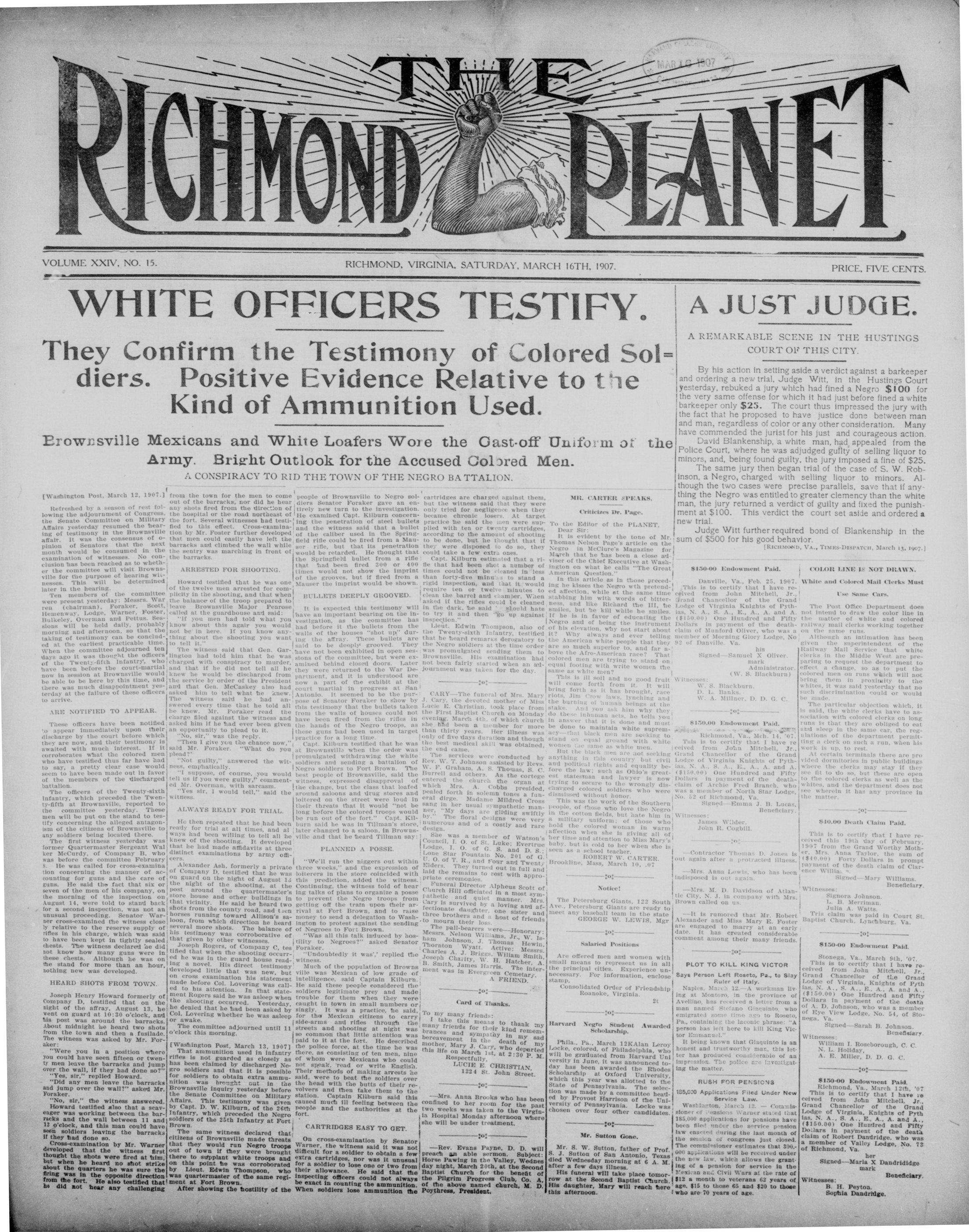
Richmond Planet
Saturday, March 16, 1907
Richmond, Virginia
Page text (machine-generated)
THE RICHMOND PLANET
WHITE OFFICERS TESTIFY.
They Confirm the Testimony of Colored Sol diers. Positive Evidence Relative to the Kind of Ammunition Used.
Brownsville Mexicans and White Loafers Wore the Cast-off Uniform of the Army. Bright Outlook for the Accused Colored Men.
VOLUME XXIV, NO. 15.
WHIT
They Con
diers.
Brownsville M
Ar
[Washington Post, March 12, 1907.]
Refreshed by a season of rest following the adjournment of Congress, the Senate Committee on Military Affairs yesterday resumed the hearing of testimony in the Brownsville affair. It was the consensus of opinion of Senators that the next month would be consumed in the examination of witnesses. No conclusion has been reached as to whether the committee will visit Brownsville for the purpose of hearing witnesses. This will be determined later in the hearing.
Ten members of the committee were present yesterday: Messrs. Waren (chairman), Foraker, Scott, Hemenway, Lodge, Warner, Foster, Bukleye, Overman and Pettus. Sessions will be held daily, probably morning and afternoon, so that the taking of testimony can be concluded at the earliest practicable time. When the committee adjourned ten days ago it was thought the officers of the Twenty-fifth Infantry, who have been before the court-martial now in session at Brownsville would be able to be here by this time, and there was much disappointment yesterday at the failure of these officers to arrive.
ARE NOTIFIED TO APPEAR.
These officers have been notified to appear immediately upon their discharge by the court before which they are now, and their testimony is awaited with much interest. If it corroborates what the colored men who have testified thus far have had to say, a pretty clear case would seem to have been made out in favor of the members of the discharged battalion.
The officers of the Twenty-sixth infantry, which preceded the Twenty-fifth at Brownsville, reported to the committee yesterday. These men will be put on the stand to testify concerning the alleged antagonism of the citizens of Brownsville to any soldiers being located there.
The first witness yesterday was former Quartermaster Sergeant Walker McCurdy, of Company B, who was before the committee February 8. He was called for cross-examination concerning the manner of accounting for guns and the care of guns. He said the fact that six or seven of the men of his company, on the morning of the inspection on August 14, were told to stand back for a second inspection, was not an unusual proceeding. Senator Warner cross-examined the witness close relative to the reserve supply of rifles in his charge, which was said to have been kept in tightly sealed chests. The witness declared he did not know how many guns were in these chests. Although he was on the stand for more than an hour, nothing new was developed.
HEARD SHOTS FROM TOWN
Joseph Henry Howard formerly of Company D, testified that on the night of the affray, August 13, he went on guard at 10:30 o'clock, and his post was around the barracks. About midnight he heard two shots from the town and then a fusilade. The witness was asked by Mr. Foraker:
"Were you in a position where you could have seen fifteen or twenty men leave the barracks and jump over the wall, if they had done so?" "Yes, sir," replied Howard.
"Did any men leave the barracks and jump over the wall?" asked Mr. Foraker.
"No, sir," the witness answered. Howard testified also that a scavenger was working between the barracks and the wall between 11 and 12 o'clock, and this man could have seen soldiers leaving the barracks if they had done so.
Cross-examination by Mr. Warner developed that the witness first thought the shots were fired at him, but when he heard no shot strike about the quarters he was sure the firing was in the opposite direction from the fort. He also testified that he did not hear any challenging
A CONSPIRACY TO RID THE TOWN OF THE NEGRO BATTALION.
from the town for the men to come out of the barracks, nor did he hear any shots fired from the direction of the hospital or the road northeast of the fort. Several witnesses had testified to this effect. Cross-examination by Mr. Foster further developed that men could easily have left the barracks and climbed the wall while the sentry was marching in front of the barracks.
The people of Brownsville to Negro soldiers Senator Foraker gave an entirely new turn to the investigation. He examined Capt. Kilburn's具ing the penetration of steel bullets and the witness said that the bullet of the caliber used in the Spring, could rifle could be fired from a Mauser rifle, but that its penetration would be retarded. He thought that he would be retarded. He thought that could take a few extra one
ARRESTED FOR SHOOTING
Howard testified that he was one of the twelve men arrested for complicity in the shooting, and that when the balance of the troop prepared to leave Brownsville Major Penrose called at the guardhouse and said: "If you men had told what you know about this again you would not be in here. If you know anything about the shooting you want to tell it." The witness said that Gen. Garlinton had told him that he was charged with conspiracy to murder, and that if he did not tell all he knew he would be discharged from the service by order of the President and that Gen. McCaskey also had asked him to tell what he knew. The witness said he had answered every time that he told all he knew. Mr. Foraker read the charge filed against the witness and asked him if he had ever been given an opportunity to plead to it.
"No, sir," was the reply.
"Then I give you the chance now," said Mr. Foraker. "What do you plead?" "Not guilty," answered the witness, emphatically. "I suppose, of course, you would tell us if you were guilty," commented Mr. Overman, with sarcasm.
"Yes sir, I would tell," said the witness.
ALWAYS READY FOR TRIAL
He then repeated that he had been ready for trial at all times, and always had been willing to tell all he knew of the shooting. It developed that he had made affidavits at three distinct examinations by army officers.
Alexander Ash, formerly a private of Company D, testified that he was on guard on the night of August 15 the night of the shooting, at the post around the quartermaster's store house and other buildings in that vicinity. He said he heard two shots from the county road, and two horses running toward Allison's saloon, from which direction he heard several more shots. The balance of his testimony was corroborative of that given by other witnesses.
Joseph Rogers, of Company C, testified that when the shooting occurred he was in the guard house reading a novel. His direct testimony developed little that was new, but on cross examination his statement made before Col. Lovering was called to his attention. In that statement Rogers said he was asleep when the shooting occurred. Yesterday, he denied that he had been asked by Col. Lovering whether he was asleep or awake.
The committee adjourned until 11 o'clock this morning.
[Washington Post, March 13, 1907] That ammunition used in infantry rifles is not guarded as closely as has been claimed by discharged Negro soldiers and that it is possible for soldiers to obtain extra ammunition was brought out in the Brownsville inquiry yesterday before the Senate Committee on Military Affairs. This testimony was given by Capt. D. W. Kilburn, of the 26th Infantry, which preceded the Negro soldiers of the 25th Infantry at Fort Brown. The same witness declared that citizens of Brownsville made threats that they would run Negro troops out of town if they were brought there to supplant white troops and on this point he was corroborated by Lieut. Edwin Thompson, who was quartermaster of the same regiment at Fort Brown. After showing the hostility of the
RICHMOND, VIRGINIA, SATURDAY, MARCH 16TH, 1907
people of Brownsville to Negro soldiers Senator Foraker gave an entirely new turn to the investigation. He examined Capt. Kilburn concerning the penetration of steel bullets and the witness said that a bullet of the caliber used in the Springfield rifle could be fired from a Mauser rifle, but that its penetration would be retarded. He thought that the Springfield bullet from a rifle that had been fired 300 or 400 times would not show the imprint of the grooves, but if fired from a Mauser the imprint would be shown.
BULLETS DEEPLY GROOVED.
It is expected this testimony will have an important bearing on the investigation, as the committee has had before it the bullets from the walls of the houses "shot up" during the affray. These bullets are said to be deeply grooved. They have not been exhibited in open sessions of the committee, but were examined behind closed doors. Later they were returned to the War Department, and it is understood are now a part of the exhibit at the court martial in progress at San Antonio. It seemed to be the purpose of Senator Foraker to show by this testimony that the bullets taken from the walls of houses could not have been fired from the rifles in the hands of the Negro troops, as these guns had been used in target practice for a long time.
Capt. Kilburn testified that he was at Brownsville when the order was promulgated withdrawing the white soldiers and sending a battalion of Negro soldiers to Fort Brown. The best people of Brownsville, said the witness, expressed disapproval of the change, but the class that loafed around saloons and drug stores and loitered on the street were loud in their threats that it would "not be long before the colored troops would be run out of the fort." Capt. Kilburn said he was in Tillman's store, later changed to a saloon, in Brownsville and that he heard Tillman say:
PLANNED A POSSE.
"We'll run the niggers out within three weeks," and the expression of lotterers in the store coincided with this prediction, added the witness. Continuing, the witness told of hearing talks of plans to organize a posse to prevent the Negro troops from getting off the train upon their arrival at Fort Brown, and to raise money to send a delegation to Washington to protest against the sending of Negroes to Fort Brown.
"Was all this talk induced by hostility to Negroes?" asked Senator Foraker.
"Undoubtedly it was," replied the witness.
Much of the population of Browns ville was Mexican of low grade of intelligence, said Captain Kilburn. He said these people considered the soldiers legitimate prey and made trouble for them when they were caught in town in small numbers or singly. It was a practice, he said, for the Mexican citizens to carry side-arms and rifles through the streets and shooting at night was so common that little attention was paid to it at the fort. He described the police force, at the time he was there, as consisting of ten men, nine of whom were Mexicans who could not speak, read or write English. Their methods of making arrests he said, were to beat the soldiers over the head with the butts of their revolvers and then take them to the station. Captain Kilburn said this caused much ill feeling between the people and the authorities at the fort.
CARTRIDGES EASY TO GET
On cross-examination by Senator Warner, the witness said it was not difficult for a soldier to obtain a few extra cartridges, nor was it unusual for a soldier to lose one or two from their allowance. He said that the inspecting officers could not always be exact in counting the ammunition. When soldiers lose ammunition the
cartridges are charged against them, but the witness said that they were only tried for negligence when they became chronic losers. At target practice he said the men were supplied with ten or twenty cartridges, according to the amount of shooting to be done, but he thought that if they were disposed to do so, they could take a few extra ones.
Capt. Kilburn estimated that a rifle that had been shot a number of times could not be cleaned in less than forty-five minutes to stand a rigid inspection, and that it would require ten or twelve minutes to clean the barrel and chamber. When asked if the rifles could be cleaned in the dark, he said they should hate fire and then go up against inspection.
Lieut. Edwin Thompson, also of the Twenty-sixth Infantry, testified that he heard remarks derogatory to the Negro soldiers at the time order was promulgated sending them Brownvis. His examination had not been fairly started when an adjournment was taken for the day.
CARY—The funeral of Mrs. Mary J. Cary, the devoted mother of Miss Lucie E. Christian, took place from the First Baptist Church on Monday evening. March 4th, of which church she had been a member for more than thirty years. Her illness was only of five days duration and though the best medical skill was obtained, the end came.
The services were conducted by Rev. W. T. Johnson assisted by Revs. W. F. Graham, A. S. Thomas, S. C. Burrell and others. As the cortege entered the church the organ at which Mrs. A. Cobbs presided, pealed forth in solemn tones a funeral dirge. Madame Mildred Cross sang in her usual sympathetic manner, "My days are gliding swiftly by." The floral designs were very numerous and of a costly and rare design.
She was a member of Watson's Council, I. O. of St. Luke; Evertrue Lodge, I. O. of G. S. and D. S. Lone Star Fountain No. 201 of G. U. O. of T. R., and Four and Twenty Elders. They turned out in full and laid the remains to rest with appropriate ceremonies.
Funeral Director Alpheus Scott of Church Hill officiated in a most sympathetic and quiet manner. Mrs. Cary is survived by a loving and affectionate daughter, one sister and three brothers and a host of friends to mourn their loss.
The pall-bearers were—Honorary: Messrs. Nelson Williams, Jr., W. Isiah Johnson, J. Thomas Hewin, Thornton Wyatt. Active: Messrs. Charles A. J. Briggs, William Smith, Joseph Charity, W. H. Hatcher, A. B. Smith, James Harris. The interment was in Evergreen Cemetery. A FRIEND.
Card of Thanks
To my many friends:
I take this means to thank my many friends for their kind remembrances and sympathy in my sad bereavement in the death of my mother, Mary J. Cary, who departed this life on March 1st, 2016.
—Mrs. Anna Brooks who has been confined to her room for the past two weeks was taken to the Virginia Hospital Monday afternoon where she will be under treatment.
—Rev. Evans Payne, D. D. will preach an able sermon. Subject: Horse Pawing in the Valley, Wednes day night, March 20th, at the Second Baptist Church for the benefit of the Pilgrim Progress Club, Co. A. of the above named church, M. D. Poythress, President.
MR. CARTER SPEAKS.
Criticizes Dr. Page.
To the Editor of the PLANET,
Dear Sir:
It is evident by the tone of Mr.
Thomas Nelson Page's article on the Negro in McClure's Magazine for March that he has been a close adviser of the Chief Executive at Washington on what he calls "The Great American Question."
In this article as in those preceding he kisses the Negro with pretended affection, while at the same time stabbing him with words of bitterness, and like Richard the III, he smiles, but he kill while he smiles. If he is in favor of educating the Negro and of being the instrument of his elevation, why not start about it? Why always and ever telling the American white people that they are so much superior to, and far above the Afro-American race? That colored men are trying to stand on equal footing with write women the same as white men?
This is ill soil and no good fruit will come forth from it. It will bring forth as it has brought, race riots, Jim Crow laws, lynching and the burning of human beings at the stake. And you ask him why they do these inhuman acts, he tells you in answer that it is done and must be done to maintain white supremacy—that black men are seeking to stand on equal ground with white women the same as white men.
But the black men are not seeking anything in this country but civil and political rights and equality before the law; such as Ohio's greatest statesman and lawyer is now trying to secure to the wrongly discharged colored soldiers who were dismissed without honor.
This was the work of the Southern people, of those who love the Negro in the cotton fields, but hate him in a military uniform; of those who hold the colored woman in warm affection when she is giving all of her time and attention to Miss Mary's baby, but is cold to her when she is seen as a school teacher.
ROBERT W. CARTER.
Brookline, Mass. March 10. .07
The Petersburg Giants, 122 South Ave, Petersburg Giants are ready to meet any baseball team in the state GEORGE W. LEWIS. Mgr
Salaried Positions
Are offered men and women with small means to represent us in all the principal cities. Experience unnecessary. For information, enclose stamp. Consolidated Order of Friendship Roanoke, Virginia.
Harvard Negro Student Awarded Scholarship.
Phila., Pa., March 12KAlan Leroy Locke, colored, of Philadelphia, who will be graduated from Harvard University in June, it was announced today has been awarded the Rhodes Scholarship at Oxford University, which this year was allotted to the State of Pennsylvania. The selection was made by a committee headed by Provost Harrison of the University of Pennsylvania. Locke was chosen over four other candidates.
Mr. Sutton Gone
Mr. S. W. Sutton, father of Prof. S. J. Sutton of San Antonio, Texas died Wednesday morning at 6 A. M. after a few days illness.
His funeral will take place tomorrow at the Second Baptist Church. His daughter, Mary will reach here this afternoon.
A JUST JUDGE.
A REMARKABLE SCENE IN THE HUSTINGS COURT OF THIS CITY.
By his action in setting aside a verdict against a barkeeper and ordering a new trial, Judge Witt, in the Hustings Court yesterday, rebuked a jury which had fined a Negro $100 for the very same offense for which it had just before fined a white barkeeper only $25. The court thus impressed the jury with the fact that he proposed to have justice done between man and man, regardless of color or any other consideration. Many have commended the jurist for his just and courageous action.
David Blankenship, a white man, had appealed from the Police Court, where he was adjudged guilty of selling liquor to minors, and, being found guilty, the jury imposed a fine of $25.
The same jury then began trial of the case of S. W. Robinson, a Negro, charged with selling liquor to minors. Although the two cases were precise parallels, save that if anything the Negro was entitled to greater clemency than the white man, the jury returned a verdict of guilty and fixed the punishment at $100. This verdict the court set aside and ordered a new trial.
Judge Witt further required bond of Blankenship in the sum of $500 for his good behavior.
$150.00 Endowment Paid.
Danville, Va., Feb. 25, 1907.
This is to certify that I have received from John Mitchell, Jr.,
Grand Chancellor of the Grand
Lodge of Virginia Knights of Pythias, N. A., S. A., E., A., A. and A.
($150.00) One Hundred and Fifty
Dollars in payment of the death-
claim of Munford Oliver, who was a
member of Morning Glory Lodge, No
92 of Danville. Va.
his
Signed—Samuel X Oliver.
mark
Administrator.
(W. S. Blackburn)
Witnesses:
W. S. Blackburn.
D. L. Banks.
W. A. Millner, D. D. G. C.
$150.00 Endowment Paid
Richmond, Va., Meh. 14, '07.
Tals is to certify that I have received from John Mitchell, Jr.
Grand Chancellor of the Grand Lodge of Virginia Knights of Pythias, N. A., S. A., E., A., A. and A. ($150.00) One Hundred and Fifty Dollars in payment of the death-claim of Archie Fred Branch, who was a member of North Star Lodge, No. 52 of Richmond, Va.
Signed—Emma J. B. Lucas,
Beneficiary.
Witnesses:
James Wilder.
John R. Cogbill.
—Contractor Thomas D. Jones is out again after a protracted illness.
—Mrs. Anna Lewis, who has been indisposed is out again.
—Mrs. M. D. Davidson of Atlantic City, N. J. in company with Mrs. Brown called on us.
—It is rumored that Mr. Robert Alexander and Miss Mary E. Foster are engaged to marry at an early date. It has created considerable comment among their many friends.
PLOT TO KILL KING VICTOR
Says Person Left Roseto, Pa., to Slay Ruler of Italy.
Naples, March 12.—A workman living at Montoro, in the province of Avellino, has received a letter from a man named Stefano Giaquinto, who emigrated some time ago to Roseto, Pa., containing the laconic phrase: "A person has left here to kill King Victor Emmanuel." It being known that Giaquinto is an honest and trustworthy man, this letter has produced considerable of an impression. The police are investigating the matter.
RUSH FOR PENSIONS
125,000 Applications Filed Under New Service Law.
Washington, March 12. — Commissioner of Pensions Warner stated that 185,000 applications for pensions have been filed under the service pension law enacted during the last month of the session of congress just closed. The commissioner estimates that 300,000 applications will be received under the new law, which allows the granting of a pension for service in the Mexican and Civil Wars at the rate of $12 a month to veterans 62 years of age. $15 to those 65 and $20 to those who are 70 years of age.
PRICE, FIVE CENTS
JUDGE.
NINE IN THE HUSTINGS
OF THIS CITY.
inside a verdict against a barkeeper
e Witt, in the Hustings Court
which had fined a Negro $100 for
which it had just before fined a white
bourt thus impressed the jury with
save justice done between man
or any other consideration. Many
with his just and courageous action,
ate man, had appealed from the
judged guilty of selling liquor to
y, the jury imposed a fine of $25.
in trial of the case of S. W. Rob-
selling liquor to minors. Al-
cise parallels, save that if any
greater clemency than the white
act of guilty and fixed the punish-
e court set aside and ordered a
ed bond of Blankenship in the
vior.
D., VA., TIMES-DISPATCH, March 13, 1907.
COLOR LINE IS NOT DRAWN
White and Colored Mail Clerks Must
Use Same Cars
The Post Office Department does not intend to draw the color line in the matter of white and colored railway mail clerks working together on the same runs.
Although an intimation has been given the superintendent of the Railway Mail Service that white clerks in the Middle West are preparing to request the department to effect a change, so as to put the colored men on runs which will not bring them in proximity to the whites, it was said yesterday that no such discrimination could or would be made.
The particular objection which, it is said, the white clerks have to association with colored clerks on long runs is that they are obliged to eat and sleep in the same car, the regulations of the department permitting a clerk on such a run, when his work is up, to rest.
At certain terminals there are provided dormitories in public buildings where the clerks may stay if they see fit to do so, but these are open to the colored clerks as well as the whites, and the department does not see wherein it has any province in the matter.
$40.00 Death Claim Paid
This is to certify that I have received this 19th day of February, 1907 from the Grand Worthy Mother, Mrs. Anna Taylor, the sum of ($40.00) Forty Dollars in prompt payment of the death claim of Clarence Willia.
Signed—Mary Williams.
Beneficiary.
Witnesses:
Signora Johnson.
L. B. Merriman.
Julia A. Watts.
This claim was paid in Court St.
Baptist Church, Lynchburg, Va.
$150.00 Endowment Paid
Stonega, Va., March 9th, '07.
This is to certify that I have received from John Mitchell, Jr.,
Grand Chancellor of the Grand
Lodge of Virginia, Knights of Pyth
ias, N. A., S. A., E., A. A. and A.,
($150.00) One Hundred and Fifty
Dollars in payment of the dextra
of A. D. Johnson, who was a member of
Eye View Lodge, No. 54, of Stonega, Va.
Signed—Sarah B. Johnson.
Beneficiary.
Witnesses:
William I. Roseborough, C. C.
N. L. Holiday,
A. E. Miller, D. D. G. C.
$150.00 Endowment Paid
Richmond, Va., March 12th, '07
This is to certify that I have
received from John Mitchell, Jr.,
Grand Chancellor of the Grand
Lodge of Virginia, Knights of Pyth
ias, N. A., S. A., E., A. A. and A.,
($150.00) One Hundred and Fifty
Dollars in payment of the death
claim of Robert Dandridge, who was
a member of Valley Lodge, No. 73
of Richmond, Va.
her
Signed—Maria X Dandrididge
mark
Beneficiary.
Witnesses:
B. H. Peyton.
Sophia Dandridge.
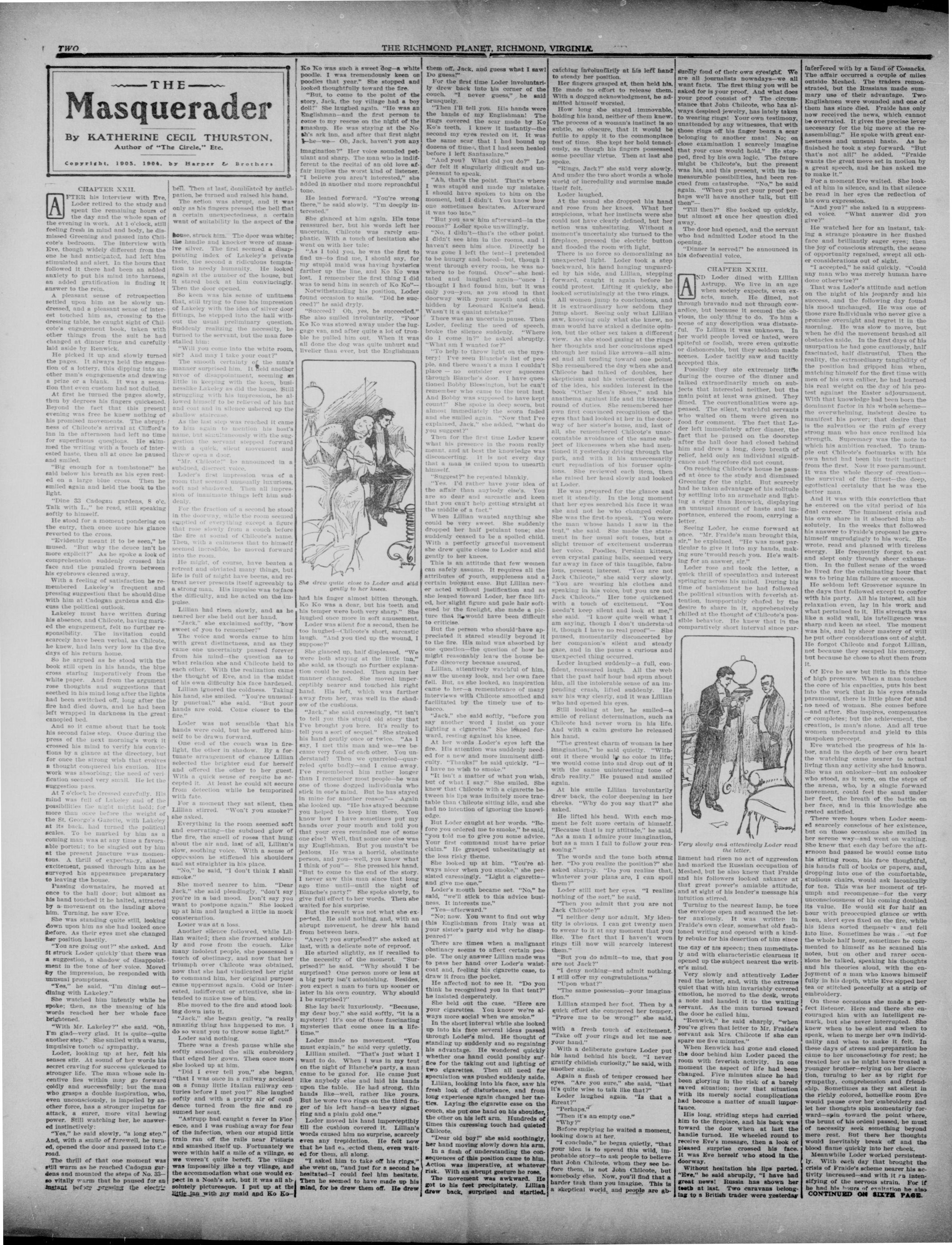
THE Masquerader
By KATHERINE CECIL THURSTON,
Author of "The Circle," Etc.
Copyright, 1905, 1906, by Harper & Brothers
TWO
CHAPTER XXII
FTER his interview with Eve, Loder retired to the study and spent the remaining hours of the day and the whole span of the evening in work. At 1 o'clock, still feeling fresh in mind and body, he dismissed Greening and passed into Chilcote's bedroom. The interview with Eve, though widely different from the one he had anticipated, had left him stimulated and alert. In the hours that followed it there had been an added anxiety to put his mind into harness, an added gratification in finding it answer to the rein.
A pleasant sense of retrospection settled upon him as he slowly undressed, and a pleasant sense of interest touched him as, crossing to the dressing table, he caught sight of Chilcote's engagement book, taken with other things from the suit he had changed at dinner time and carefully laid aside by Renwick.
He picked it up and slowly turned the pages. It always held the suggestion of a lottery, this dipping into another man's engagements and drawing a prize or a blank. It was a sensation that even custom had not dulled. At first he turned the pages slowly, then by degrees his fingers quickened. Beyond the fact that this present evening was free he knew nothing of his promised movements. The abruptness of Chilcote's arrival at Clifford's inn in the afternoon had left no time for superfluous questions. He skimmed the writing with a touch of interested haste, then all at once he paused and smiled.
"Big enough for a tombstone!" he said below his breath as his eyes rested on a large blue cross. Then he smiled again and held the book to the light.
"Dine 33 Cadogan gardens, 8 o'c. Talk with L." he read, still speaking softly to himself.
He stood for a moment pondering on the entry, then once more his glance reverted to the cross.
"Evidently meant it to be seen," he mused. "But why the deuce isn't he more explicit?" As he spoke a look of comprehension suddenly crossed his face and the puzzled frown between his eyebrows cleared away.
With a feeling of satisfaction he remembered Lakeley's frequent and pressing suggestion that he should dine with him at Cadogan gardens and discuss the political outlook.
Lakeley must have written during his absence, and Chilcote, having marked the engagement, felt no further responsibility. The invitation could scarcely have been verbal, as Chilcote, he knew, had lain very low in the five days of his return home.
So he argued as he stood with the book still open in his hands, the blue cross starring imperatively from the white paper. And from the argument rose thoughts and suggestions that seethed in his mind long after the lights had been switched off, long after the fire had died down, and he had been left wrapped in darkness in the great canopied bed.
And so it came about that he took his second false step. Once during the press of the next morning's work it crossed his mind to verify his convictions by a glance at the directory, but for once the strong wish that evolves a thought conquered his caution. His work was absorbing; the need of verification seemed very small. He let the suggestion pass.
At 7 o'clock he dressed carefully. His mind was full of Lakeley and of the possibilities the night might hold for more than once before the weight of the St. George's Gazette, with Lakeley at its back, had turned the political scales. To be marked by him as a coming man was at any time a favorable portent; to be singled out by him at the present juncture was momentous. A thrill of expectancy, almost excitement, passed through him as he surveyed his appearance preparatory to leaving the house.
Passing down staircases, he moved at once to the hall door; but almost as his hand touched it he halted, attracted by a movement on the landing above him. Turning, he saw Eve.
She was standing quite still, looking down upon him as she had looked once before. As their eyes met she changed her position hastily.
"You are going out?" she asked. And it struck Loder quickly that there was a suggestion, a shadow of disappointment in the tone of her voice. Moved by the impression, he responded with unusual promptness.
"Yes," he said. "I'm dining out—dining with Lakeley."
She watched him intently while he spoke; then, as the meaning of his words reached her her whole face brightened.
"With Mr. Lakeley?" she said. "Oh, I'm glad—very glad. It is quite—quite another step." She smiled with a warm, impulsive touch of sympathy.
Loder, looking up at her, felt his senses stir. At sound of her words his secret craving for success quickened to stronger life. The man whose sole incentive lies within may go forward coldly and successfully; but the man who grasps a double inspiration, who, even unconscious, is impelled by another force, has a stronger impetus for attack, a surer, more vital hewing power. Still watching her, he answered instinctively:
"Yes," he said slowly, "a long step."
And, with a smile of farewell, he turned, opened the door and passed into the road.
The thrill of that one moment was still warm as he reached Cadogan gardens and mounted the steps of No. 33—so vitally warm that he paused for an instant before pressing the electric
bell. Then at last, dominated by antipation, he turned and raised his hand.
house, struck him. The door was white the handle and knocker were of massive silver. The first seemed a disappointing index of Lakeley's private taste, the second a ridiculous temptation to needy humanity. He looked again at the number of the house, but it stared back at him convincingly. Then the door opened.
So keen was his sense of unfitness that, still trying to fuse his impression of Lakeley with the idea of silver door fittings, he stepped into the hall without the usual preliminary question. Suddenly realizing the necessity, he turned to the servant, but the man forestalled him:
"Will you come into the white room, sir? And may I take your coat?"
The smooth certainty of the man's manner surprised him. It held another savor of disappointment, seeming little in keeping with the keen, businesslike Lakeley as did the house. Still struggling with his impression, he allowed himself to be relieved of his hat and coat and in silence ushered up the shallow staircase.
As the last step was reached it came to him again to mention his host's name, but simultaneously with the suggestion the servant stepped forward with a quick, silent movement and threw open a door.
"Mr. Chilcote!" he announced in a subdued, discreet voice.
Loder's first impression was of a room that seemed unusually luxurious, soft and shadowed. Then all impression of inanimate things left him suddenly.
For the fraction of a second he stood in the doorway, while the room seemed emptied of everything except a figure that rose slowly from a couch before the fire at sound of Chilcote's name. Then, with a calmness that to himself seemed incredible, he moved forward into the room.
He might, of course, have beaten a retreat and obviated many things, but life is full of might have beens, and retreat never presents itself agreeably to a strong man. His impulse was to face the difficulty, and he acted on the impulse.
Lillian had risen slowly, and as he neared her she held out her hand.
"Jack," she exclaimed softly, "how sweet of you to remember."
The voice and words came to him with great distinctness, and as they came one uncertainty passed forever from his mind—the question as to what relation she and Chilcote held to each other. With the realization came the thought of Eve, and in the midst of his own difficulty his face hardened. Lillian ignored the coldness. Taking his hand, she smiled. "You're unusually punctual," she said. "But your hands are cold. Come closer to the fire."
Loder was not sensible that his hands were cold, but he suffered himself to be drawn forward.
One end of the couch was in firelight, the other in shadow. By a fortunate arrangement of chance Lillian selected the brighter end for herself and offered the other to her guest. With a quick sense of respite he accepted it. At least he could sit secure from detection while he temporized with fate.
For a moment they sat silent, then Lillian stirred. "Won't you smoke?" she asked.
Everything in the room seemed soft and enervating—the subdued glow of the fire, the smell of roses that hung about the air and, last of all, Lillian's slow, soothing voice. With a sense of oppression he stiffened his shoulders and sat straighter in his place.
"No," he said, "I don't think I shall smoke."
She moved nearer to him. "Dear Jack," she said pleadingly, "don't say you're in a bad mood. Don't say you want to postpone again." She looked up at him and laughed a little in mock consternation.
Loder was at a loss.
Another silence followed, while Lillian waited; then she frowned suddenly and rose from the couch. Like many indolent people, she possessed a touch of obstinacy, and now that her triumph over Chilcote was obtained, now that she had vindicated her right to command him, her original purpose came uppermost again. Cold or interested, indifferent or attentive, she intended to make use of him.
She moved to the fire and stood looking down into it.
"Jack," she began gently, "a really amazing thing has happened to me. I do so want you to throw some light."
Loder said nothing.
There was a fresh pause while she softly smoothed the silk embroidery that edged her gown. Then once more she looked up at him.
"Did I ever tell you," she began, "that I was once in a railway accident on a funny little Italian railway centuries before I met you?" She laughed softly and with a pretty air of confidence turned from the fire and resumed her seat.
"Astrup had caught a fever in Florence, and I was rushing away for fear of the infection, when our stupid little train ran off the rails near Pistoria and smashed itself up. Fortunately we were within half a mile of a village, so we weren't quite bereft. The village was impossibly like a toy village, and the accommodation what one would expect in a Noah's ark, but it was all absolutely picturesque. I put up at the little inn with my maid and Ko Ko-
THE RICHMOND PLANET, RICHMOND, VIRGINIA
Ko Ko was such a sweet dog—a white poodle. I was tremendously keen on poodles that year." She stopped and looked thoughtfully toward the fire.
"But, to come to the point of the story, Jack, the toy village had a boy doll!" She laughed again. "He was an Englishman—and the first person to come to my rescue on the night of the smashup. He was staying at the Noah's ark inn, and after that first night—he—we— Oh, Jack, haven't you any imagination?" Her voice sounded petulant and sharp. The man who is indifferent to the recital of an old love affair implies the worst kind of listener. "I believe you aren't interested," she added in another and more reproachful tone.
He leaned forward. "You're wrong there," he said slowly. "I'm deeply interested."
She glanced at him again. His tone reassured her, but his words left her uncertain. Chilcote was rarely emphatic. With a touch of hesitation she went on with her tale:
"As I told you, he was the first to find us—to find me, I should say, for my stupid maid was having hysterics farther up the line, and Ko Ko was lost. I remember the first thing I did was to send him in search of Ko Ko"—Notwithstanding his position, Loder found occasion to smile. "Did he succeed?" he said dryly.
"Succeed? Oh, yes, he succeeded." She also smiled involuntarily. "Poor Ko Ko was stowed away under the luggage van, and after quite a lot of trouble he pulled him out. When it was all done the dog was quite unhurt and livelier than ever, but the Englishman
Victoria
She drew quite close to Loder and slid gently to her knees.
had his finger almost bitten through. Ko Ko was a dear, but his teeth, and his temper were both very sharp." She laughed once more in soft amusement. Loder was silent for a second, then he too laughed—Chilcito's short, sarcastic laugh. "And you tied up the wound, I suppose?"
She glanced up, half displeased. "We were both staying at the little inn," she said, as though no further explanation could be needed. Then again her manner changed. She moved imperceptibly nearer and touched his right hand. His left, which was farther away from her, was well in the shadow of the cushions.
"Jack," she said caressingly, "it isn't to tell you this stupid old story that I've brought you here. It's really to tell you a sort of sequel." She stroked his hand gently once or twice. "As I say, I met this man and we—we became very fond of each other. You understand? Then we quarreled—quarreled quite badly—and I came away. I've remembered him rather longer than I remember most people—he was one of those dogged individuals who stick in one's mind. But he has stayed in mine for another reason"—Again she looked up. "He has stayed because you helped to keep him there. You know how I have sometimes put my hands over your mouth and told you that your eyes reminded me of some one else? Well, that some one else was my Englishman. But you mustn't be jealous. He was a horrid, obstinate person, and you—well, you know what I think of you"—She pressed his hand. "But to come to the end of the story. I never saw this man since that long ago time until—until the night of Blanche's party!" She spoke slowly, to give full effect to her words. Then she waited for his surprise.
But the result was not what she expected. He said nothing, and, with an abrupt movement, he drew his hand from between hers.
"Aren't you surprised?" she asked at last, with a delicate note of reproof.
He started slightly, as if recalled to the necessity of the moment. "Surprised?" he said. "Why should I be surprised? One person more or less at a big party isn't astonishing. Besides, you expect a man to turn up sooner or later in his own country. Why should I be surprised?
She lay back luxuriously. "Because, my dear boy," she said softly, "it is a mystery! It's one of those fascinating mysteries that come once in a lifetime."
Loder made no movement. "You must explain," he said very quietly.
Lillian smiled. "That's just what I want to do. When I was in my tent on the night of Blanche's party, a man came to be gazed for. He came just like anybody else and laid his hands upon the table. He had strong, thin hands like—well, rather like yours. But he wore two rings on the third finger of his left hand—a heavy signet ring and a plain gold one."
Loder moved his hand imperceptibly till the cushion covered it. Lillian's words caused him no surprise, scarcely even any trepidation. He felt now that he had ejected them, even waited for them, all along.
"I asked him to take off his rings," she went on, "and just for a second he hesitated—I could feel him hesitate. Then he seemed to have made up his mind, for he drew them off. He drew
them off, Jack, and guess what I saw! Do guess?
For the first time time Loder involuntarily drew back into his corner of the couch. "I never guess," he said brusquely.
"Then I'll tell you. His hands were the hands of my Englishman! The rings covered the scar made by Ko Ko's teeth. I knew it instantly—the second my eyes rested on it. It was the same scar that I had bound up dozens of times, that I had seen healed before I left Santasalare."
"And you? What did you do?" Loder felt it singularly difficult and unpleasant to speak.
"Ah, that's the point. That's where I was stupid and made my mistake. I should have spoken to him on the moment, but I didn't. You know how one sometimes hesitates. Afterward it was too late."
"But you saw him afterward—in the rooms?" Loder spoke unwillingly.
"No, I didn't—that's the other point. I didn't see him in the rooms, and I haven't seen him since. Directly he was gone I left the tent I pretended to be hungry and bored—but, though I went through every room, he was nowhere to be found. Once"—she hesitated and laughed again"—once I thought I had found him, but it was only you—you, as you stood in that doorway with your mouth and chin hidden by Leonard Kaine's head. Wasn't it a quaint mistake?"
There was an uncertain pause. Then Loder, feeling the need of speech, broke the silence suddenly. "Where do I come in? he asked abruptly. What am I wanted for?"
"To help to throw light on the mystery! I've seen Blanche's list of people, and there wasn't a man I couldn't place — no outsider ever squeezes through Blanche's door. I have questioned Bobby Blessington, but he can't remember who came to the tent last. And Bobby was supposed to have kept count!" She spoke in deep scorn, but almost immediately the scorn faded and she smiled again. "Now that I've explained, Jack," she added, "what do you suggest?" Then for the first time Loder knew what his presence in the room really meant, and at best the knowledge was disconcerting. It is not every day that a man is called upon to unearth himself.
"Suggest?" he repeated blankly.
"Yes. I'd rather have your idea of the affair than anybody else's. You are so dear and sarcastic and keen that you can't help getting straight at the middle of a fact."
When Lillian wanted anything she could be very sweet. She suddenly dropped her half petulant tone; she suddenly ceased to be a spoiled child. With a perfectly graceful movement she drew quite close to Loder and slid gently to her knees.
This is an attitude that few women can safely assume. It requires all the attributes of youth, suppleness and a certain buoyant case. But Lillian never acted without justification and as she leaned toward Loder, her face lifted, her slight figure and pale hair softened by the firelight, she made a picture that it would have been difficult to criticise.
But the person who should have appreciated it stared steadily beyond it to the fire. His mind was absorbed by one question—the question of how he might reasonably leave the house before discovery became assured.
Lillian, attentively watchful of him, saw the uneasy look, and her own face fell. But, as she looked, an inspiration came to her—a remembrance of many interviews with Chilcote smoothed and facilitated by the timely use of tobacco.
"Jack," she said softly, "before you say another word I insist on your lighting a cigarette." She leaned forward, resting against his knee.
At her words Loder's eyes left the fire. His attention was suddenly needed for a new and more imminent difficulty. "Thanks!" he said quickly. "I—have no wish to smoke."
"It isn't a matter of what you wish, but of what I say." She smiled. She knew that Chilcote with a cigarette between his lips was infinitely more tractable than Chilcote sitting idle, and she had no intention of ignoring the knowledge.
But Loder caught at her words. "Before you ordered me to smoke," he said, "you told me to give you some advice. Your first command must have prior claim." He grasped unhesitatingly at the less risky theme.
She looked up at him. "You're always nicer when you smoke," she persisted caressingly. "Light a cigarette—and give me one."
Loder's mouth became set. "No," he said, "we'll stick to this advice business. It interests me."
"Yes—afterward."
"No; now. You want to find out why this Englishman from Italy was at your sister's party and why he disappeared."
There are times when a malignant obstinacy seems to affect certain people. The only answer Lillian made was to pass her hand over Loder's waistcoat and, feeling his cigarette case, to draw it from the pocket.
He affected not to see it. "Do you think he recognized you in that tent?" he insisted desperately. She held out the case. "Here are your cigarettes. You know we're always more social when we smoke." In the short interval while she looked up into his face several ideas passed through Loder's mind. He thought of standing up suddenly and so regaining his advantage. He wondered quickly whether one hand could possibly surface for the taking out and lighting of two cigarettes. Then all need for speculation was pushed suddenly aside. Lillian, looking into his face, saw his fresh look of disturbance, and from long experience again changed her tactics. Laying the cigarette case on the couch, she put one hand on his shoulder, the other on his left arm. Hundreds of times this caressing touch had quieted Chilcote.
The movement was awkward. He got to his feet precipitately. Lillian drew back, surprised and startled.
catching involuntarily at his left hand to steady her position.
Her fingers grasped at, then held his. He made no effort to release them. With a dogged acknowledgment, he admitted himself worsted.
How long she stayed immovable, holding his hand, neither of them knew. The process of a woman's instinct is so subtle, so obscure, that it would be futile to apply it to the commonplace test of time. She kept her hold tenaciously, as though his fingers possessed some peculiar virtue. Then at last she spoke.
“Rings, Jack?” she said very slowly. And under the two short words a whole world of incredulity and surmise made itself felt.
Loder laughed.
At the sound she dropped his hand and rose from her knees. What her suspicions, what her instincts were she could not have clearly defined, but her action was unhesitating. Without a moment's uncertainty she turned to the fireplace, pressed the electric button and flooded the room with light. There is no force so demoralizing as unexpected light. Loder took a step backward, his hand hanging unguarded by his side, and Lillian, stepping forward, caught it again before he could protest. Lifting it quickly, she looked scrutinizing at the two rings.
All women jump to conclusions, and it is extraordinary how seldom they jump short. Seeing only what Lillian saw, knowing only what she knew, no man would have staked a definite opinion, but the other sex takes a different view. As she stood gazing at the rings her thoughts and her conclusions sped through her mind like arrows—all aimed and all tending toward one point. She remembered the day when she and Chilcote had talked of doubles, her skepticism and his vehement defense of the idea, his sudden interest in the book "Other Men's Shoes," and his anathema against life and its irksome round of duties. She remembered her own first convinced recognition of the eyes that had looked at her in the doorway of her sister's house, and, last of all, she remembered Chilcote's unaccountable avoidance of the same subject of likenesses when she had mentioned it yesterday driving through the park, and with it his unnecessarily curt repudiation of his former opinions. She reviewed each item, then she raised her head slowly and looked at Loder.
He was prepared for the glance and met it steadily. In the long moment that her eyes searched his face it was she and not he who changed color. She was the first-to speak. "You were the man whose hands I saw in the tent," she said. She made the statement in her usual soft tones, but a slight tremor of excitement underran her voice. Poodles, Persian kittens, even crystal gazing balls, seemed very far away in face of this tangible, fabulous, present interest. "You are not Jack Chilcote," she said very slowly. "You are wearing his clothes and speaking in his voice, but you are not Jack Chilcote." Her tone quickened with a touch of excitement. "You needn't keep silent and look at me," she said. "I know quite well what I am saying, though I don't understand it, though I have no real proof." She paused, momentarily disconcerted by her companion's silent and steady gaze, and in the pause a curious and unexpected thing occurred.
Loder laughed suddenly—a full, confident, reassured laugh. All the web that the past half hour had spun about him, all the intolerable sense of an impending crash, lifted suddenly. He saw his way clearly, and it was Lillian who had opened his eyes.
Still looking at her, he smiled—a smile of reliant determination, such as Chilcote had never worn in his life. And with a calm gesture he released his hand.
"The greatest charm of woman is her imagination," he said quietly. "Without it there would be no color in life; we would come into and drop out of it with the same uninteresting tone of drab reality." He paused and smiled again.
At his smile Lillian involuntarily drew back, the color deepening in her cheeks. "Why do you say that?" she asked.
He lifted his head. With each moment he felt more certain of himself. "Because that is my attitude," he said. "As a man I admire your imagination, but as a man I fail to follow your reasoning."
The words and the tone both stung her. "Do you realize the position?" she asked sharpy. "Do you realize that, whatever your plans are, I can spoil them?"
Loder still met her eyes. "I realize nothing of the sort," he said.
"Then you admit that you are not Jack Chilcote?"
"I neither deny nor admit. My identity is obvious. I can get twenty men to swear to it at any moment that you like. The fact that I haven't worn rings till now will scarcely interest them."
"But you do admit—to me, that you are not Jack?"
"I deny nothing—and admit nothing. I still offer my congratulations."
"The same possession--your imagination."
Lillian stamped her foot. Then by a quick effort she conquered her temper. "Prove me to be wrong!" she said, with a fresh touch of excitement. "Take off your rings and let me see your hand."
With a deliberate gesture Loder put his hand behind his back. "I never gratify childish curiosity," he said, with another smile.
Again a flash of temper crossed her eyes. "Are you sure," she said, "that it's quite wise to talk like that?"
Loder laughed again. "Is that a threat?"
"Perhaps,"
"Then it's an empty one."
"Why?"
Before replying he waited a moment, looking down at her.
"I conclude," he began quietly, "that your idea is to spread this wild, improbable story—to ask people to believe that John Chilcote, whom they see before them, is not John Chilcote, but somebody else. Now, you'll find that a harder task than you imagine. This is a skeptical world, and people are ab-
surly fond of their own eyesight. We are all journalists nowadays—we all want facts. The first thing you will be asked for is your proof. And what does your proof consist of? The circumstance that John Chilcote, who has always despised jewelry, has lately taken to wearing rings! Your own testimony, unattended by any witnesses, that with those rings off his finger bears a scar belonging to another man! No; on close examination I scarcely imagine that your case would hold." He stopped, fired by his own logic. The future might be Chilcote's, but the present was his, and this present, with its immeasurable possibilities, had been rescued from catastrophe. "No," he said again. "When you get your proof perhaps we'll have another talk, but till then"—
"Till then?" She looked up quickly, but almost at once her question died away. The door had opened, and the servant who had admitted Loder stood in the opening. "Dinner is served!" he announced in his deferential voice.
CHAPTER XXIII.
AND Loder dined with Lillian Astrupp. We live in an age when society expects, even exacts, much. He dined, not through bravado and not through cowardice, but because it seemed the obvious, the only thing to do. To him a scene of any description was distasteful. To Lillian it was unknown. In her world people loved or hated, were spiteful or foolish, were even quixotic or dishonorable, but they seldom made scenes. Loder tacitly saw and tacitly accepted this.
Possibly they ate extremely little during the course of the dinner and talked extraordinarily much on subjects that interested neither, but the main point at least was gained. They dined. The conventionalities were appeased. The silent, watchful servants who waited on them were given no food for comment. The fact that Loder left immediately after dinner, the fact that he paused on the doorstep after the hall door had closed behind him and drew a long, deep breath of relief, held only an individual significance and therefore did not count.
On reaching Chilcote's house he passed at once to the study and dismissed Greening for the night. But scarcely had he taken advantage of his solitude by settling into an armchair and lighting a cigar than Renwick, displaying an unusual amount of haste and importance, entered the room, carrying a letter.
Seeing Loder, he came forward at once. "Mr. Fraidle's man brought this, sir," he explained. "He was most particular to give it into my hands, making sure 'twould reach you. He's waiting for an answer, sir." Loder rose and took the letter, a quick thrill of speculation and interest springing across his mind. During his time of banishment he had followed the political situation with feverish attention, insupportably chafed by the desire to share in it, appropriately chilled at the thought of Chilcote's possible behavior. He knew that in the comparatively short interval since par-
J. B.
Very slowly and attentively Loder read the letter.
lament had risen no act of aggression had marked the Russian occupation of Meshed, but he also knew that Fraide and his followers looked askance at that great power's amiable attitude, and at sight of his leader's message his intuition stirred.
Turning to the nearest light, he tore the envelope open and scanned the letter anxiously. It was written in Fraide's own clear, somewhat old fashioned writing and opened with a kindly rebuke for his desertion of him since the day of his speech; then immediately and with characteristic clearness it opened up the subject nearest the writer's mind.
Very slowly and attentively Loder read the letter, and, with the extreme quiet that with him invariably covered emotion, he moved to the desk, wrote a note and handed it to the waiting servant. As the man turned toward the door he called him.
"Renwick," he said sharply, "when you've given that letter to Mr. Fraide's servant ask Mrs. Chilcoe if she can spare me five minutes."
When Renwick had gone and closed the door behind him Loder paced the room with feverish activity. In one moment the aspect of life had been changed. Five minutes since he had been glorying in the risk of a barely saved situation; now that situation with its merely social complications had become a matter of small importance.
His long, striding steps had carried him to the fireplace, and his back was toward the door when at last the handle turned. He wheeled round to receive Eve's message, then a look of pleased surprise crossed his face. It was Eve herself who stood in the doorway.
Without hesitation his lips parted. "Eve," he said abruptly, "I have had great news! Russia has shown her teeth at last. Two caravans belonging to a British trader were yesterday
Interfered with by a band of Cossacks.
The affair occurred a couple of miles outside Meshed. The traders remonstrated, but the Russians made summary use of their advantage. Two Englishmen were wounded and one of them has since died. Fraide has only now received the news, which cannot be overrated. It gives the precise lever necessary for the big move at the reassembling." He spoke with great earnestness and unusual haste. As he finished he took a step forward. "But that's not all!" he added. "Fraide wants the great move set in motion by a great speech, and he has asked me to make it."
For a moment Eve waited. She looked at him in silence, and in that silence he read in her eyes the reflection of his own expression.
"And you?" she asked in a suppressed voice. "What answer did you give?"
He watched her for an instant, taking a strange pleasure in her flushed face and brilliantly eager eyes; then the joy of conscious strength, the sense of opportunity regained, swept all other considerations out of sight.
"I accepted," he said quickly. "Could any man who was merely human have done otherwise?"
That was Loder's attitude and action on the night of his jeopardy and his success, and the following day found his mood unchanged. He was one of those rare individuals who never give a promise overnight and regret it in the morning. He was slow to move, but when he did the movement brushed all obstacles aside. In the first days of his usurpation he had gone cautiously, half fascinated, half distrustful. Then the reality, the extraordinary tangibility of the position had gripped him when, matching himself for the first time with men of his own caliber, he had learned his real weight on the day of his protest against the Easter adjournment. With that knowledge had been born the dominant factor in his whole scheme—the overwhelming, insistent desire to manifest his power; that desire that is the salvation or the ruin of every strong man who has once realized his strength. Supronomacy was the note to which his ambition reached. To trample out Chilcote's footmarks with his own hand had been his tacit instinct from the first. Now it rose paramount. It was the whole theory of creation—the survival of the fittest—the deep, egotistical certainty that he was the better man.
And it was with this conviction that he entered on the vital period of his dulal career. The imminent crisis and his own share in it absorbed him absolutely. In the weeks that followed his answer to Fraide's proposal he gave himself ungrudgingly to his work. He wrote, read and planned with tireless energy. He frequently forgot to eat and slept only through sheer exhaustion. In the fullest sense of the word he lived for the culminating hour that was to bring him failure or success. He seldom left Grosvenor square in the days that followed except to confer with his party. All his interest, all his relaxation even, lay in his work and what pertained to it. His strength was like a solid wall, his intelligence was sharp and keen as steel. The moment was his, and by sheer mastery of will he put other considerations out of sight. He forgot Chilcote and forgot Lillian, not because he escaped his memory, but because he chose to shut them from it.
Of Eve he saw but little in this time of high pressure. When a man touches the core of his capacities, puts his best into the work that in his eyes stands paramount, there is little place for and no need of woman. She comes before—and after. She inspires, compensates or completes; but the achievement, the creation, is man's alone. And all true women understand and yield to this unspoken precept.
Eve watched the progress of his labor, and in the depth of her own heart the watching came nearer to actual living than any activity she had known. She was an onlooker—but an onlooker who stood, as it were, on the steps of the arena, who, by a single forward movement, could feel the sand under her feet, the breath of the battle on her face, and in this knowledge she rested satisfied.
There were hours when Loder seemed scarcely conscious of her existence, but on those occasions she smiled in her serene way—and went on waiting. She knew that each day before the afternoon had passed he would come into his sitting room, his face thoughtful, his hands full of books or papers, and, dropping into one of the comfortable, studious chairs, would ask laconically for tea. This was her moment of triumph and recompense—for the very unconsciousness of his coming doubled its value. He would sit for half an hour with preoccupied glance or with keen, alert eyes fixed on the fire, while his ideas sorted themselves and fell into line. Sometimes he was out for the whole half hour, sometimes he commented to himself as he scanned his notes, but on other and rarer occasions he talked, speaking his thoughts and his theories aloud, with the enjoyment of a man who knows himself fully in his depth, while Eve sipped her tea or stitched peacefully at a strip of embroidery.
On these occasions she made a perfect listener. Here and she she encouraged him with an intelligent remark, but she never interrupted. She knew when to be silent and when to speak, when to merge her own individuality and when to make it felt. In these days of stress and preparation he came to her unconsciousay for rest; he treated her as he might have treated a younger brother -relying on his discretion, turning to her as by right for sympathy, comprehension and friendship. Sometimes as they sat silent in the richly colored, homelike room Eve would pause over her embroidery and let her thoughts spin momentarily forward -spin toward the point where, the brunt of his ordeal passed, he must of necessity seek something beyond mere rest. But there her thoughts would inevitably break off and the blood flame quickly into her cheek.
Meanwhile Loder worked persistently. With each day that brought the crisis of Fraide's scheme nearer his activity increased—and with it it intensifying of the nervous strain. For if he had his hours of evaluation he also CONTINUED ON SIXTH PAGE.
---
To interest yourself in promoting the CIRCULATION of the RICHMOND PLANET.
---
THE PLANET
SATURDAY...MARCH 16TH, '07
LIVE STOCK
WINTER QUARTERS FOR SHEEP.
A Suggestion for Buildings Which Can Be Used Next Year.
Sheep should have the opportunity to run out in a lot or small pasture on very bright days if the snow is not too deep. Even though there are cold winds, if the sheep are kept dry and allowed to go and come from a wind break at will, they will not get too
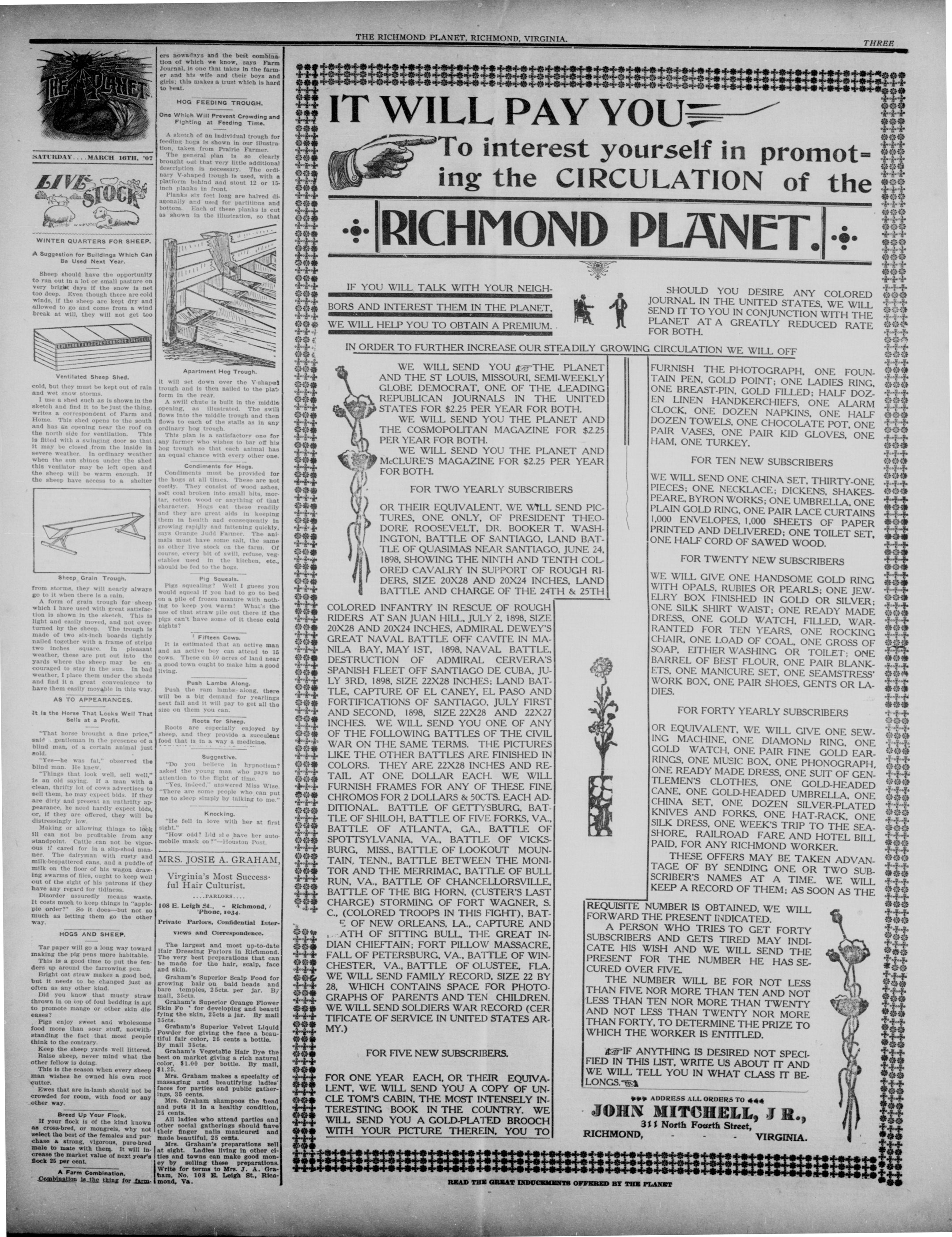
Ventilated Sheep Shed.
cold, but they must be kept out of rain and wet snow storms.
I use a shed such as is shown in the sketch and find it to be just the thing, writes a correspondent of Farm and Home. This shed opens to the south and has an opening near the roof on the north side for ventilation. This is fitted with a swinging door so that it may be closed from the inside in severe weather. In ordinary weather when the sun shines under the shed this ventilator may be left open and the sheep will be warm enough. If the sheep have access to a shelter
Sheep Grain Trough. from storms, they will nearly always go to it when there is a rain.
A form of grain trough for sheep which I have used with great satisfaction is shown in the sketch. This is light and easily moved, and not overturned by the sheep. The trough is made of two six-inch boards tightly nailed together with a frame of strips two inches square. In pleasant weather, these are put out into the yards where the sheep may be encouraged to stay in the sun. In bad weather, I place them under the sheds and find it a great convenience to have them easily movable in this way.
AS TO APPEARANCES
It is the Horse That Locks Well That Sells at a Profit.
"That horse brought a fine price," said gentleman in the presence of a blind man, of a certain animal just sold.
"Yes—he was fat," observed the blind man. He knew.
"Things that look well, sell well," is an old saying. If a man with a clean, thrifty lot of cows advertises to sell them, he may expect bids. If they are dirty and present an unthrift appearance, he need hardly expect bids, or if they are offered, they will be distressingly low.
Making or allowing things to look ill can not be profitable from any standpoint. Cattle can not be vigorous if cared for in a slip-shod manner. The dairyman with rusty and milk-bespattered cans, or a puddle of milk on the floor of his wagon drawing swarms of flies, ought to keep well out of the sight of his patrons if they have any regard for tidiness.
Disorder assuredly means waste. It costs much to keep things in "apple pie order?" So it does—but not so much as letting them go the other way.
HOGS AND SHEEP
Tar paper will go a long way toward making the pig pens more habitable. This is a good time to put the fenders up around the farrowing pen.
Bright oat straw makes a good bed, but it needs to be changed just as often as any other kind.
Did you know that musty straw thrown in on top of foul bedding is apt to promote mange or other skin diseases?
Pigs enjoy sweet and wholesome food more than sour stuff, notwithstanding the fact that most people think to the contrary.
Keep the sheep yards well littered.
Raise sheep, never mind what the other fellow is doing.
This is the season when every sheep man wishes he owned his own root cutter.
Ewes that are in-lamb should not be crowded for room, with food or any other way.
Bread Up Your Flock
If your flock is of the kind known as cross-bred, or mongrels, why not select the best of the females and purchase a strong, vigorous, pure-bred male to mate with them. It will increase the market value of next year's flock 25 per cent.
A Farm Combination.
Combination is the thing for farm-
WE WILL HELP YOU TO OBTAIN A PREMIUM.
COLORED INFANTRY IN RESCUE OF ROUGH RIDERS AT SAN JUAN HILL, JULY 2, 1898, SIZE 20X28 AND 20X24 INCHES, ADMIRAL DEWEY'S GREAT NAVAL BATTLE OFF CAVITE IN MANILA BAY, MAY 1ST, 1898, NAVAL BATTLE, DESTRUCTION OF ADMIRAL CERVERA'S SPANISH FLEET OFF SANTIAGO DE CUBA, JULY 3RD, 1898, SIZE 22X28 INCHES; LAND BATTLE, CAPTURE OF EL CANEY, EL PASO AND FORTIFICATIONS OF SANTIAGO, JULY FIRST AND SECOND, 1898, SIZE 22X28 AND 22X27 INCHES. WE WILL SEND YOU ONE OF ANY OF THE FOLLOWING BATTLES OF THE CIVIL WAR ON THE SAME TERMS. THE PICTURES LIKE THE OTHER BATTLES ARE FINISHED IN COLORS. THEY ARE 22X28 INCHES AND RETAIL AT ONE DOLLAR EACH. WE WILL FURNISH FRAMES FOR ANY OF THESE FINE CHROMOS FOR 2 DOLLARS & 50CTS. EACH ADDITIONAL. BATTLE OF GETTYSBURG, BATTLE OF SHILOH, BATTLE OF FIVE FORKS, VA., BATTLE OF ATLANTA, GA., BATTLE OF SPOTTSYLVANIA, VA., BATTLE OF VICKSBURG, MISS., BATTLE OF LOOKOUT MOUNTAIN, TENN., BATTLE BETWEEN THE MONITOR AND THE MERRIMAC, BATTLE OF BULL RUN, VA., BATTLE OF CHANCELLORSVILLE, BATTLE OF THE BIG HORN, (CUSTER'S LAST CHARGE) STORMING OF FORT WAGNER, S. C., (COLORED TROOPS IN THIS FIGHT), BAT-
E OF NEW ORLEANS, LA., CAPTURE AND
ATH OF SITTING BULL, THE GREAT INDIAN CHIEFTAIN; FORT PILLOW MASSACRE,
FALL OF PETERSBURG, VA., BATTLE OF WINCHESTER, VA., BATTLE OF OLUSTEE, FLA.
WE WILL SEND FAMILY RECORD, SIZE 22 BY
28, WHICH CONTAINS SPACE FOR PHOTOGRAPHS OF PARENTS AND TEN CHILDREN.
WE WILL SEND SOLDIERS WAR RECORD (CERTIFICATE OF SERVICE IN UNITED STATES ARMY.)
FOR ONE YEAR EACH, OR THEIR EQUIVALENT, WE WILL SEND YOU A COPY OF UNCLE TOM'S CABIN, THE MOST INTENSELY INTERESTING BOOK IN THE COUNTRY. WE WILL SEND YOU A GOLD-PLATED BROOCH WITH YOUR PICTURE THEREIN, YOU TO
ers nowadays and the best combination of which we know, says Farm Journal, is one that takes in the farmer and his wife and their boys and girls; this makes a trust which is hard to beat.
HOG FEEDING TROUGH:
One Which Will Prevent Crowding and Fighting at Feeding Time.
A sketch of an individual trough for feeding hogs is shown in our illustration, taken from Prairie Farmer. The general plan is so clearly brought out that very little additional description is necessary. The ordinary V-shaped trough is used, with a platform behind and stout 12 or 15-inch planks in front. Planks six feet long are halved diagonally and used for partitions and bottom. Each of these planks is cut as shown in the illustration, so that
Apartment Hog Trough.
it will set down over the V-shaped trough and is then nailed to the plaxform in the rear.
A swill chute is built in the middle opening, as illustrated. The swill flows into the middle trough and then flows to each of the stalls as in any ordinary hog trough.
This plan is a satisfactory one for any farmer who wishes to bar off his hog trough so that each animal has an equal chance with every other one.
Condiments for Hogs.
Condiments must be provided for the hogs at all times. These are not costly. They consist of wood ashes, soft coal broken into small bits, mortar, rotten wood or anything of that character. Hogs eat these readily and they are great aids in keeping them in health and consequently in growing rapidly and fattening quickly, says Orange Judf Farmer. The animals must have some salt, the same as other live stock on the farm. Of course, every bit of swill, refuse, vegetables used in the kitchen, etc., should be fed to the hogs.
Pig Squeals.
Pigs squewaling? Well I guess you would squewal if you had to go to bed on a pile of frozen manure with nothing to keep you warm! What's the use of that straw pile out there if the pligs can't have some of it these cold nights?
1 Fifteen Cows.
It is estimated that an active man and an active boy can attend to 15 cows. These on 50 acres of land near a good town ought to make him a good living.
Push Lambs Along
Push the ram lambs-along, there will be a big demand for yearlings next fall and it will pay to get all the size on them you can.
Roots for Sheep.
Roots are especially enjoyed by sheep, and they provide a succulent food that is in a way a medicine.
Suggestive.
"Do you believe in hypnotism? asked the young man who pays no attention to the flight of time. "Yes, indeed," answered Miss Wise. "There are some people who can put me to sleep simply by talking to me."
Knocking.
"He fell in love with her at first sight."
"How odd? Lid sle have her auto-mobile mask on?"—Houston Post.
MRS. JOSIE A. GRAHAM
Virginia's Most Successful Hair Culturist. ..PARLORS....
PARLORS.....
108 E. Leigh St., - Richmond, / 'Phone, 1034.
Private Parlors, Confidential Interviews and Correspondence.
The largest and most up-to-date Hair Dressing Parlors in Richmond. The very best preparations that can be made for the hair, scalp, face and skin.
Graham's Superior Scalp Food for growing hair on bald heads and bare temples, 25cts. per jar. By mail, 35cts.
Graham's Superior Orange Flower Skin Fo ' for developing and beauti fying the skin, 25cts a jar. By mail 35cts.
Graham's Superior Velvet Liquid Powder for giving the face a beautiful fair color, 25 cents a bottle. By mail 35cts.
Graham's Vegetable Hair Dye the best on market giving a rich natural color, $1.00 per bottle. By mail, $1.25.
Mrs. Graham makes a specialty of massaging and beautifying ladies' faces for parties and public gatherings, 35 cents.
Mrs. Graham shampoos the head and puts it in a healthy condition, 25 cents.
All ladies who attend parties and other social gatherings should have their finger nails manicured and made beautiful, 25 cents.
Mrs. Graham's preparations sell at sight. Ladies living in other cities and towns can make good money by selling these preparations.
Write for terms to Mrs. J. A. Graham, No. 108 E. Leigh St., Richmond, Va.
---
IN ORDER TO FURTHER INCREASE OUR STEADILY GROWING CIRCULATION WE WILL OFF
WE WILL SEND YOU THE PLANET AND THE ST LOUIS, MISSOURI, SEMI-WEEKLY GLOBE DEMOCRAT, ONE OF THE LEADING REPUBLICAN JOURNALS IN THE UNITED STATES FOR $2.25 PER YEAR FOR BOTH. WE WILL SEND YOU THE PLANET AND THE COSMOPOLITAN MAGAZINE FOR $2.25 PER YEAR FOR BOTH. WE WILL SEND YOU THE PLANET AND McCLURE'S MAGAZINE FOR $2.25 PER YEAR FOR BOTH.
OR THEIR EQUIVALENT, WE WILL SEND PICTURES, ONE ONLY, OF PRESIDENT THEODORE ROOSEVELT, DR. BOOKER T. WASHINGTON, BATTLE OF SANTIAGO, LAND BATTLE OF QUASIMAS NEAR SANTIAGO, JUNE 24, 1898, SHOWING THE NINTH AND TENTH COLORED CAVALRY IN SUPPORT OF ROUGH RIDERS, SIZE 20X28 AND 20X24 INCHES, LAND BATTLE AND CHARGE OF THE 24TH & 25TH
READ THE GREAT INDUCEMENTS OFFERED BY THE PLANET
THE RICHMOND PLANET, RICHMOND, VIRGINIA
IF YOU WILL TALK WITH YOUR NEIGH-
```markdown
```
FOR TWO YEARLY SUBSCRIBERS
FOR FIVE NEW SUBSCRIBERS
REQUISITE NUMBER IS OBTAINED, WE WILL FORWARD THE PRESENT INDICATED. A PERSON WHO TRIES TO GET FORTY SUBSCRIBERS AND GETS TIRED MAY INDICATE HIS WISH AND WE WILL SEND THE PRESENT FOR THE NUMBER HE HAS SECURED OVER FIVE. THE NUMBER WILL BE FOR NOT LESS THAN FIVE NOR MORE THAN TEN AND NOT LESS THAN TEN NOR MORE THAN TWENTY AND NOT LESS THAN TWENTY NOR MORE THAN FORTY, TO DETERMINE THE PRIZE TO WHICH THE WORKER IS ENTITLED.
IF ANYTHING IS DESIRED NOT SPECIFIED IN THIS LIST, WRITE US ABOUT IT AND WE WILL TELL YOU IN WHAT CLASS IT BE LONGS.
JOHN MITCHELL, J R.,
311 North Fourth Street,
RICHMOND, VIRGINIA
A
LANET WEEKLY READING UNITED H.
T AND R $2.25
T AND YEAR
ND PIC
THEO-
WASH-
D BAT-
JUNE 24,
H COL-
GH RI-
LAND
& 25TH
```markdown
```
REQUIST FOR WAR
SHOULD YOU DESIRE ANY COLORED JOURNAL IN THE UNITED STATES, WE WILL SEND IT TO YOU IN CONJUNCTION WITH THE PLANET AT A GREATLY REDUCED RATE FOR BOTH.
FURNISH THE PHOTOGRAPH, ONE FOUNTAIN PEN, GOLD POINT; ONE LADIES RING, ONE BREAST-PIN, GOLD FILLED; HALF DOZEN LINEN HANDKERCHIEFS, ONE ALARM CLOCK, ONE DOZEN NAPKINS, ONE HALF DOZEN TOWELS, ONE CHOCOLATE POT, ONE PAIR VASES, ONE PAIR KID GLOVES, ONE HAM, ONE TURKEY.
FOR TEN NEW SUBSCRIBERS
WE WILL SEND ONE CHIC
PIECES; ONE NECKLACE
PEARE, BYRON WORKS,
PLAIN GOLD RING, ONE
1,000 ENVELOPES, 1,000
PRINTED AND DELIVER
ONE HALF CORD OF SALE.
FOR TWENTY NET
WE WILL GIVE ONE HAL
WITH OPALS, RUBIES OF
ELRY BOX FINISHED IN
ONE SILK SHIRT WAIST
DRESS, ONE GOLD WE
RANTED FOR TEN YEAR
CHAIR, ONE LOAD OF
SOAP, EITHER WASHING
BARREL OF BEST FLOU
ETS, ONE MANICURE S
WORK BOX, ONE PAIR
DIES.
FOR FORTY YEAR
OR EQUIVALENT, WE W
ING MACHINE, ONE IN
GOLD WATCH, ONE P
RINGS, ONE MUSIC BOX
ONE READY MADE DRI
TLEMEN'S CLOTHES,
CANE, ONE GOLD-HEA
CHINA SET, ONE DO
KNIVES AND FORKS, O
SILK DRESS, ONE WEEK
SHORE, RAILROAD FA
PAID, FOR ANY RICHM
THESE OFFERS MAST
AGE OF BY SENDING
SCRIBER'S NAMES AT
KEEP A RECORD OF THE
THE NUMBER IS OBTAINED, WE
RD THE PRESENT INDICATED
PERSON WHO TRIES TO GET
BERS AND GETS TIRED M
IS WISH AND WE WILL SE
T FOR THE NUMBER HE
OVER FIVE.
THE NUMBER WILL BE FOR N
VE NOR MORE THAN TEN A
MAN TEN NOR MORE THAN
IT LESS THAN TWENTY NO
DRTY, TO DETERMINE THE IN
THE WORKER IS ENTITLED.
IF ANYTHING IS DESIRED NO
THIS LIST, WRITE US ABOUT
TELL YOU IN WHAT CLAS
ALL SEND ONE CHINA SET, THIRD
ONE NECKLACE; DICKENS, OR
BABYRON WORKS; ONE UMBRELLA,
GOLD RING, ONE PAIR LACE CU
ENVELOPES, 1,000 SHEETS OF
AND DELIVERED; ONE TOIRE
FALF CORD OF SAWED WOOD.
FOR TWENTY NEW SUBSCRIBER
ALL GIVE ONE HANDSOME GOLD
CAPSALS, RUBIES OR PEARLS; ONE
BOX FINISHED IN GOLD OR
FILK SHIRT WAIST; ONE READ
ONE GOLD WATCH, FILLED
AND FOR TEN YEARS, ONE R
ONE LOAD OF COAL, ONE G
EITHER WASHING OR TOIL
L OF BEST FLOUR, ONE PAIR,
ONE MANICURE SET, ONE SEAM
BOX, ONE PAIR SHOES, GENTS
FOR FORTY YEARLY SUBSCRIBER
EQUIVALENT, WE WILL GIVE ONE
MACHINE, ONE DIAMOND RING
WATCH, ONE PAIR FINE GOLD
ONE MUSIC BOX, ONE PHONO
READY MADE DRESS, ONE SUIT,
N'S CLOTHES, ONE GOLD-
ONE GOLD-HEADED UMBRELLA
SET, ONE DOZEN SILVER
AND FORKS, ONE HAT-RAC
RESS, ONE WEEK'S TRIP TO T
RAILROAD FARE AND HOT
FOR ANY RICHMOND WORKER
THE OFFERS MAY BE TAKEN
BY SENDING ONE OR TW
ER'S NAMES AT A TIME. WE
RECORD OF THEM; AS SOON
IS OBTAINED, WE WILL
SENT INDICATED.
AND TRIES TO GET FORTY
GETS TIRED MAY INDIC
WE WILL SEND THE
NUMBER HE HAS SE-
WILL BE FOR NOT LESS
MORE THAN TEN AND NOT
MORE THAN TWENTY
AN TWENTY NOR MORE
INTERMINE THE PRIZE TO
ER IS ENTITLED.
IS DESIRED NOT SPECI-
WRITE US ABOUT IT AND
IN WHAT CLASS IT BE-
WE WILL SEND ONE CHINA SET, THIRTY-ONE PIECES; ONE NECKLACE; DICKENS, SHAKESPEARE, BYRON WORKS; ONE UMBRELLA, ONE PLAIN GOLD RING, ONE PAIR LACE CURTAINS 1,000 ENVELOPES, 1,000 SHEETS OF PAPER PRINTED AND DELIVERED; ONE TOILET SET, ONE HALF CORD OF SAWED WOOD
FOR TWENTY NEW SUBSCRIBERS
WE WILL GIVE ONE HANDSOME GOLD RING WITH OPALS, RUBIES OR PEARLS; ONE JEWELRY BOX FINISHED IN GOLD OR SILVER; ONE SILK SHIRT WAIST; ONE READY MADE DRESS, ONE GOLD WATCH, FILLED, WARRANTED FOR TEN YEARS, ONE ROCKING CHAIR, ONE LOAD OF COAL, ONE GROSS OF SOAP, EITHER WASHING OR TOILET; ONE BARREL OF BEST FLOUR, ONE PAIR BLANKETS, ONE MANICURE SET, ONE SEAMSTRESS' WORK BOX, ONE PAIR SHOES, GENTS OR LADIES.
FOR FORTY YEARLY SUBSCRIBERS
OR EQUIVALENT, WE WILL GIVE ONE SEWING MACHINE, ONE DIAMOND RING, ONE GOLD WATCH, ONE PAIR FINE GOLD EARRINGS, ONE MUSIC BOX, ONE PHONOGRAPH, ONE READY MADE DRESS, ONE SUIT OF GENTLEMEN'S CLOTHES, ONE GOLD-HEADED CANE, ONE GOLD-HEADED UMBRELLA, ONE CHINA SET, ONE DOZEN SILVER-PLATED KNIVES AND FORKS, ONE HAT-RACK, ONE SILK DRESS, ONE WEEK'S TRIP TO THE SEASHORE, RAILROAD FARE AND HOTEL BILL PAID, FOR ANY RICHMOND WORKER. THESE OFFERS MAY BE TAKEN ADVANTAGE OF BY SENDING ONE OR TWO SUBSCRIBER'S NAMES AT A TIME. WE WILL KEEP A RECORD OF THEM; AS SOON AS THE
ADDRESS ALL ORDERS TO
IN MITCHELL,
311 North Fourth Street,
ND,
THE PLANET
CHELL, J R.,
Fourth Street,
VIRGINIA.
THREE
not= the
COLORED WE WILL WITH THE RATE
ONE FOUNDEDIES RING, HALF DOZZLE ALARM ONE HALF POT, ONE MOVES, ONE
ERS
SHIRTY-ONE SHAKESPELLA, ONE CURTAINS OF PAPER TOILET SET, O.
ERS
GOLD RING ONE JEWELER SILVER; ADY MADE, WARM ROCKING GROSS OF TOILET; ONE BLANKAMSTRESS' ANTS OR LA.
ERS
ONE SEWING, ONE GOLD EARNOGRAPH, IT OF GEN-HEADED SPELLA, ONE PLATED RACK, ONE TO THE SEA-NOTEL BILL TER.
EN ADVANTWO SUBWE WILL ON AS THE
```markdown
```
```markdown
```
FOUR
THE PLANET
Published every Saturday by John W. MILL
JR., at 311 North 4th Street, Richmond Va.
JOHN MITCHELL, JR., • EDITOR
1. communications intended for publication
should be sent so as to reach us by Wednesday.
TERMS IN ADVANCE
One Copy, one year,
six months
One Copy, six months
One Copy, four months
six months
Single Copy
ADVERTISING RATE
For one inch, one insertion,
For one inch, each subsequent insertion,
For two inches, three months,
For two inches, six months,
For two inches, nine months,
For two inches, twelve months,
Marriage and Funeral Notices, one inch,
Standing and Transient Notices per line,
$10.00
$0.50
$0.40
$0.00
$0.00
$0.00
$0.00
POSTAGE STAMPS OF A HIGHER DE-
NOMINATION THAN TWO CENTS NOT
RECEIVED ON SUBSCRIPTIONS.
THE PLANET is issued weekly. The subscription price is $1.50 per year in advance.
THEOREM FOUR WAYS by which money can be sent by mail at our risk—In a Post Office Money Order, by Bank Check or Draft, or an Exposé Money Order, these two forms of money can be procured, in a Registered Letter. MONEY ORDERS—You can buy a Money Order at your Post-Office, payable at the Richmond Post Office, and we will be responsible for sales at the office. EXPRESS MONEY ORDERS can be obtained at any office of the American Express Co., the United States Express Co., and the Wells Fargo Company. Express Company money will be required. The Express Money Order is a safe and convenient way for forwarding money. REGISTERED LETTER—If a money Order Post Office or an Express Office is not written, the money will be sent to the Letter you wish to send us on payment of ten cents. Then, if the letter is lost or stolen, it cannot be sent money in this manner at our risk. We cannot be responsible for money sent in letters in any other way than one of the four ways mentioned above. If you send your money in any other way, you must do it at your
RENEWALS, ETC.—If you do not want THE PLANET continued for another year after your subscription has run out, you then notify us by a written Card to discontinue it. The course has decided that subscribers to newspaper, who do not order their paper discontinued at the ex-tenuation of time for which they have paid, have liable for the payment of the subscription up to date when they order the paper discontinued.
CORRECTIONS—When writing to us to renew your subscription or to discontinue your subscription you should give your name and address otherwise we cannot find your name on our book.
CHANGE OF ADDRESS—In order to change the address of a subscriber, we must be sent a former as well as the present address.
Entered at the Post Office at Richmond, Va.
second-class matter.
SATURDAY . . . MARCH 16TH, '07.
"THE GREAT AMERICAN QUESTION."
"A Man and a Lion once argued together as to which belonged to the nobler race. The former called the attention of the Lion to a monument on which was sculptured a Man striding over a vanquished Lion. "That proves nothing at all," said the Lion. "if a Lion had been the carver, he would have made the Lion striding over the Man."
Dr. Thomas Nelson Page in McClure's Mageazine for March loses no opportunity to discredit "the brother in black" whom he denominates inherently inferior, and to create the impression that the Negro, like the Chinaman cannot be assimilated in our civilization. He does not profess to even suggest a plan but places himself in the category of those pessimists, who always find fault, but never suggest a remedy. The first is easy, the second difficult. The country is already well acquainted with the difficulties, what it now desires is an introduction to a solution. The citizen who cannot do this in our judgment should keep quiet. Dr. Page in a further summing up
Dr. Page in a further summing up of his "almost truisms" says:
"That there is a wide difference at present between the point of view of the great body of the Northerners and the entire body of the Southerners as to the Negro: in this, that Northerners espouse the cause of the Negroes as a race, but dislike Negroes individually, while Southerners do not dislike Negroes individually, but oppose them as a race. And that this difference is due to conditions and not to basic principles."
Dr. Page seems to be ignorant of the fact that the demand for Negroes in the North is greater than the supply. Employment agencies are being flooded with orders for them and the revulsion of feeling at the South is intensified. As a result, stringent laws have been enacted here and elsewhere in this sunny land. In some sections of it a labor agent takes his own life in his hands when he steps from the train with the pronounced intention of carrying away colored people to a Northern clime. We have known instances where white men who opposed Negroes when in a meeting with other white men, would be in favor of them when they separated and dealt with them as individuals. If these exhibitions are due to conditions and not to basic principles then they can be remedied.
He says further:
"That the solution of the race question should be sought through economical and not sentimental laws. And that the race question
should be left alone to be settled by these laws."
No thoughtful person will question this conclusion and yet the very essence of race prejudice is sentiment, and it has its finding in sentimental laws. To the historical mind, it is known as the laws of caste. It can only be held in subjection by force and it can only be eradicated by time.
He states a fact, no doubt when he says:
"There is another vital fact not generally known to Southerners; that one of the chief causes, if not the chief cause at present, of the feeling at the North in favor of the Negro is the violence so often directed against Negroes at the South. There is quite as much violence against them in some other parts of the country, in proportion to the colored population, as at the South, but for reasons not necessary to discuss here, this is not taken into account. The brunt of the censure falls on the South and the South on every account, but especially for its own sake, ought to put a stop to it with relentless hand, or else make it clear to the rest of the world why it is not done."
The result of the crusade against lynching even in foreign countries is attested here when he says:
"An intelligent and able German professor, who is at present in this country studying its political and social conditions, stated to the writer not long since that to the Germans the race question appears absolutely to overshadow every other political question in this country."
He continues:
"One curious fact connected with the matter is that, contrary to the usual rules of evidence, a man's views on this subject are considered rather an inverse ratio to his opportunities for acquaintance with it. Hitherto we have had the singular spectacle of Southern men, who testified from their intimate acquaintance with it at first hand, being discredited almost universally, while the views of those from the outside, who may have had only the most imperfect* opportunities for observation and have not had the least opportunity of seeing it in its most vital forms, are immediately accepted."
This can readily be accounted for, in that those Southerners as a rule who essayed to speak were radical and in their blind exhibition of race prejudice attempted to undermine the fundamental truths of history. As a result, they were discredited at the start and not believed at the finish. Men on the order of Senator B. R. Tillman, Gov. James K. Vardaman, Gov. Jeff Davis have done more to make friends for us than men of our own persuasion.
They disgusted the conservative elements of the North, and to this element is due our advancement along educational lines. Even the bourbon element of the South desired in a measure to win their good graces and the conservative elements emphasized the fact that by educating the Negro, they were ready and willing to evangelize them in order that they might take their places among the wealth producing citizens of this "happy" land.
Men of Mr. Thomas Nelson Page's stripe by their conservative attitude and apparently fair-minded assertions are more dangerous to our vital interests than are those of the radical type.
Northerners will listen to them and after listening are disposed to believe. The cause of this is that the Negro cannot state his side of the question through the same channel that this distinguished gentleman uses. Occasionally Dr. Booker T. Washington is heard in the land and his utterances carry much weight. Still there are other brilliant Negroes who were they able to "play upon the keys," could give forth euphonious notes that would not only revolutionize some notions, but make a favorably impression upon the nations of the world. Dr. Washington has been diplomatic, however and his utterances as a rule have "rung true."
"One fortunate manifestation at present—and it is almost the only new phase of the matter—is that there appears to be a greater desire on the part of the North to be accurately informed upon the subject. This is undoubtedly very encouraging—for one of the chief difficulties, if not the chief difficulty, that has heretofore existed in the way of settling this question, has been the different manner in which the two sections have regarded it."
It is this very fact that makes it highly essential that the Negro's side of the controversy should be presented to the conservative elements of the North. As the matter now stands the case is being judged by ex-parte statements, with now and then a scintillation of the truth being observable in a few of the justice-loving magazines and daily newspapers of the North.
The brilliant Virginian speaks truly when he remarks:
"In any discussion, therefore, which relates to this question, by a Southerner, it must always be borne in mind that when he refers to the Negro" in terms of criticism amounting even to reprobation, he is mentally excepting large classes of Negroes who as individuals have his friendship, esteem and encouragement. They include members of every class, who are differentiated from the bulk of those classes mainly by their character. Unhappily.
THE RICHMOND PLANET, RICHMOND, VIRGINIA
they are not in sufficient numbers to do away with the most dangerous aspects of that question but undoubtedly they also temper every aspect of a question which, but for them, would long since have become intolerable."
But the class of which he complains, the shiftless, loafing, ignorant disreputable class to which he refers exists in all races. The proportion amongst us is greater for the reason that Dr. Page's ancestors made it possible. They brutalized us in a greater ratio than they civilized us, if correct living and godly conduct is to be the gauge by which this condition is to be measured. The house servant Negro fared well, but the corn-field Negro was left to his appetites and his labor.
The herding of sheep, the rounding up of cattle are the only things comparable with his condition. With two hundred and fifty years of demoralizing slavery come forty-two years of enlightened freedom and pessimists of Dr. Page's stripe expect a complete reformation and an absolute change almost "in one night's time."
It is impossible, sir, and yet the day is breaking. The schools and colleges of the country are turning out a steady stream of colored men and women who are "rising on their dead selves, to higher things."
If our depraved criminals are a menace to the Southland our intellectual laboring elements are a blessing to its prosperity. The statistics show that the Negroes of the Southland produce six hundred million dollars in cotton, wheat, oats, corn, tobacco, sugar-cane, potatoes and other commodities per annum, all of which is added to the wealth of this section.
The report of Hon. Morton Marye, Auditor of Public Accounts for 1906 shows that the Negroes of Virginia, who were penniless at the close of the late Civil War now own (1,365,426) one million, three hundred and sixty-five thousand, four hundred and twenty-six acres of land valued at ($2,844,953) five million, eight hundred, and forty-four thousand nine hundred and fifty-three dollars. They own town lots to the value of ($2,819,533) two million, eigat hundred and nineteen thousand, five hundred and thirty-three dollars. They own buildings on them which, with the lots show a combined value of ($4,910,662) four million, nine hundred and ten thousand, six hundred and sixty-two dollars.
They own land, lots and buildings to the value of ($17,278,343) seventeen million, two hundred and seventy-eight thousand, three hundred and forty three dollars. The Negroes of Virginia own personal property to the value of ($5,989,048) five million, nine hundred and eighty nine thousand and forty-eight dollars. The combined value of the property, real and personal owned by the Negroes of this state is ($23,267,391) twenty-three million, two hundred and sixty-seven thousand, three hundred and ninety-one dollars.
When you realize that in assessing values, the full amount is not placed, Dr. Page, you are at liberty to draw your own conclusions. When it is known and admitted that thin producing Negro and not the lazy one is really the "bone of contention" on the part of the Negro-haters it will be realized fully why existing conditions have become "almost intolerable."
In business transactions with business white men, the business Negro notes little but any discrimination, and with the white men of Dr. Page's stripe there is hardly any friction. But with the lower strata of prejudiced white men the case is different and both the shiftless Negro and the industrious, wealth-producing one are the victims of his unreasoning prejudice.
Dr. Page remarks;
"Indeed, except when, as often happens, Negroes are under the domination of some passion, they are amiable and docile enough. It is their liability to be inflamed by passions which, in a more self-contained race, are kept in check, which renders them so dangerous."
He says further:
"The criticisms of the race, expressed by the writer in this and other papers on the subject, are mingled with sympathy for Negroes, of which no Southern man can divest himself. Often, when downcast by consideration of the grave aspects of the race problem, the writer has deliberately gone among Negroes—especially the old Negroes—to set flow ing freely once more the old stream of kindness which had its rise in his youth and still flows when he is brought into personal contact with them. And this, he believes, may be said of all Southernners, who in their childhood, were rocked in a Negro mammy's arms. This feeling he believes to be reciprocated by all the survivors of that memorable class, and their influence for the amelioration of conditions has been incalculable. When it shall have passed away, no one knows what the result will be."
In this the writer admits that he too, is swayed at times by race prejudice, which is the worst no doubt of all passions, comparable to the "brain-storms" of the alienists creation when they wish to secure the acquittal of a prisoner. He emphasized his love and esteem for the docile, kindly, patient, humble old time Negro when he comments further:
"The writer desires here and now
to record his affection and his respect for the hundreds and thousands of old family servants and their successors, who, by their kindness, zeal and character, have done more to preserve kindly relations between the races than all the politicians combined."
Oh, yes, he has golden words for that class of Negroes and they deserve it. He is permeated by the same spirit that had possession of Mr. Howell C. Featherston of Virginia, when he wrote:
"I have met a heap of people, and I've had a heap o' chums—Good fellows, just as good as ever known;
But I've never seen a better, nor a truer, kinder friend
Than that little nigger boy I used to own.
---
There are lots of pickaninnie rounds my old plantation home. But Alec, he belonged to me alone. He could out-run all the others, and he'd fight and lie for me. And I loved that nigger boy I used to own.
```markdown
```
But my schoolin' wasn't finished, for before I was sixteen The trumpet call to war was loudly blown;
down;
And I volunteered my service and I hastened to the front.
And was followed by that boy I used to own.
He would get scared in battle, and, damn' im, how he'd run!
But he'd always find the company' when the soldier's work was done.
And he'd steal good rations for me, tho' from whence I've never known.
And I've oft been saved my supper by that boy I used to own.
The war was long and bitter, but his ardor never flagged;
He kept his oath to follow me he'd sworn;
An' when it was all over, I brought him home again.
That shiny, grinln' boy I used to own.
He would lie 'bout the battles, an' he swo' he'd fought 'em all;
He said he'd killed some sixteen men, he knew he'd seen 'em fall.
But he took a fatal fever which no skill could check or tone,
And I nursed him like a brother, then that boy I used to own.
But soon it was all over, and we laid him in his grave;
No truer friend I've ever had to mourn.
And I raised a granite monument to mark the place we laid
That loving, faithful boy I used to own."
This then is the kind of Negro to which Dr. Page refers. This kind of humanity makes a race war well-nigh an impossibility during our day and time. The white man of this stripe loves the Negro and the Negro of this kind loves the white man. Both control the passions of their respective off-spring to a great degree and tone down the feeling of aversion that may exist one towards the other.
But what about the Negroes of the other class, Dr. Page,—the business wealth-producing Negro? The one who is his own boss and the one for which the well-spring of animal love and adoration afford no copious draughts to the thirsty traveller? What about the Negro banker, real estate agent, cashier, insurance president, manager, theologian, statesman, lawyer, physician, economist, broker, dentist, college professor, musical instructor, linguist, electrician, scientist, inventor and those in a host of other professions that we might name? What about them, Dr. Page? Tell us why this antipathy exists towards the Negro who has a chance to reach a plane of civil and political equality, possessing all of the requirements of polite society reinforced by money and influence?
Why should he be crushed and why should you not converse with him during the moments of your approaching "brain storm" of race prejudice? The "little nigger boy I used to own" will reach the heart, Dr. Page. Why not permit the intellectual Negro of to-day to reach the mind for in the discussion you may find, sir food even for the soul.
"We are coming, rising, rising, And our progress is surprising, With our brawny muscles earning daily bread: Though our wages be a pittance, Still, each week a small remittance, Builds a shelter for the weary, tolling head."
Congress has adjourned and President Roosevelt will secure a much needed.
When writers can find nothing else to discuss, they start out on the so-called Negro question.
Colored men should continue to make friends with the people of this country regardless of race, color, previous condition, politics or religion.
Negro loafers and criminals are an incubus upon our racial progress. We are not responsible for their coming or their going, for the white folks have all of the falls
penitentiaries and they even have a monopoly of the gallows. They will not permit the colored people to mete punishment to their own people.
They say that the white folks are the best people on earth, but from the records of the criminal courts as published in the newspapers, they are also the worst.
Police Justice Crutchfield recently permitted an offender to swear off from whiskey for sixty days and then permitted the City Sergeant to hold him in jail for that length of time to see that he kept the pledge. This is grim humor, but the victim no doubt deserved the treatment.
Mr. Thomas Nelson Page should know that colored folks stopped looking to Washington for relief sometime ago. Some of them look to Washington, but they refer to Booker T. and not to the city of that name where the Anti-Negro Supreme Court of the United States holds sway.
JEROME FOILED IN THAW CASE
Attack on Evelyn's Story Overruled by the Court.
ATTACKS INSANITY PLEA
New York, March 12—On the first day of the state's case in rebuttal at the trial of Harry K. Thaw, District Attorney Jerome came to a temporary standstill against the practically solid wall the rules of evidence have built around the story of Evelyn Nesbit Thaw. Mr. Jerome began to attack this story as soon as court opened. There ensued a well nigh ceaseless battle between the prosecutor and Delphin M. Delmas, the leading counsel for the defense, at the end of which Justice Fitzgerald upheld the rule laid down at the beginning of the trial—that young Mrs. Thaw's story was admissable only as tending to show the effect it might have had in unbalancing the defendant's mind and that its truth or falsity is not material.
Lining up all his forces in rebuffal Mr. Jerome decided to open his fight upon the defense by attacking the story told the jury by Evelyn Nesbitt Thaw. He called to the stand Frederick W. Longfellow, formerly an attorney for Thaw, and asked him first concerning the case in which Ethel Thomas is alleged to have sued Thaw for damages because of cruel treatment. Mr. Delmas objected to questions along the line under the professional privilege of lawyer and client, but before Justice Fitzgerald sustained the objection and ruled out the evidence Mr. Jerome declared:
"The story of the girl tied to the bed post and whipped by Thaw is the story of Ethel Thomas. This poor girl is now dead." Here Mr. Delmas interposed an objection to the district attorney's remarks and the latter began an attack along a different line.
He showed Mr. Longfellow the photographic copy of the affidavit Evelyn Nesbit is said to have signed in the office of Abraham Hummel—alleging that Thaw treated her cruelly while abroad in 1903 because she "would not tell lies about Stanford White." Mr. Jerome followed this up by asking the witness if Mrs. Thaw had not turned over to him certain papers to which she had subscribed. Mr. Longfellow said she had not. There was a long argument between Mr. Jerome and Mr. Delmas at the conclusion of which Mr. Longfellow turned his entire examination to naught by declaring that Mrs. Thaw had never shown him a paper similar to the Hummel affidavit in any way.
Mr. Jerome played probably the strongest card he holds—evidence which came to his knowledge but a few days ago, and which undoubtedly caused him to abandon the idea of sending White's slayer to a med house and to try for a straight-out conviction under the criminal statutes. The evidence came from Mrs. Stanford White's brother, James Clinch Emith, who told a remarkably clear, succinct story of the events on Madison Square Garden the night White was killed, and of a long conversation he had with Thaw just prior to the shooting.
It seems that Thaw sat for some time with Smith during the fateful first performance of "Mam'zelle Champagne" and discussed with him a variety of topics in a manner, Mr. Smith declared, such as any sane man would talk. Mr. Smith gave the conversation in detail, omitting nothing, he asserted.
With the brother-in-law of the man who was so soon to be a victim of his pistol Thaw discussed the play, Wall street, common acquaintances, plans for the summer and many other things, including a "buxom brunette," whom Thaw declared he was anxious to have Smith meet. Thaw said he and his wife were going abroad later in the summer. There was no hint anywhere in the repeated conversation of Thaw's intent to inflict bodily harm upon any one. Mr. Smith did say, however, that Thaw, not having a reserved seat, roamed about the Garden and continually looked in the direction of the spot where he subsequently killed Stanford Wife.
Attorney Delmas, for the defense, bitterly fought the introduction of this testimony for nearly two hours. He declared that Mr. Smith was properly a witness in chief and should not be allowed to test $f$ in rebuttal. Mr. Jerome replied that he had known only for a few days the real value of Mr. Smith's testimony—the conversations with Thaw—and he reappeared to the discretion of the court to allow the
A Poem for Today
By H. W. Longfellow
STAR of strength, I see thee stand
And smile upon my pain;
Thou beckonest with thy mailed hand,
And I am strong again.
Within my breast there is no light
But the cold light of stars;
I give the first watch of the night
To the red planet Mars.
The star of the unconquered will,
He rises in my breast,
Serene and resolute, and still
And calm and self possessed.
And thou, too, whosoe'er thou art
That readest this brief psalm,
As one by one thy hopes depart,
Be resolute and calm.
Oh, fear not, in a world like this,
And thou shall know ere long,
Know how sublime a thing it is
To suffer and be strong.
Justice Fitzgerald held that in the interest of justice the jury was entitled to all the facts. It was one of the most serious blows the judge has dealt the defense since his trial began.
As the last witness of the day the district attorney called Rudolph Eckmyer, the photographer who took the pictures of Evelyn Nesbitt Thaw which have been introduced in evidence. The photographer was employed by Stanford White. He had no sooner been sworn than it developed that Eckmyer had also been employed by White to make the photographic copy of the affidavit Evelyn Nesbitt is said to have made in Abraham Hummel's office. Mr. Eckmyer identified the negatives made from the affidavit, but they were not offered in evidence. Mr. Jerome next tried to get the photographer to fix the dates of certain pictures for which Evelyn Nesbitt posed, hoping thus to establish the day the Nesbitt girl says she had the experience with Stanford White in the 24th street house. Mr. Delmas objected on the ground that the evidence tended to contradict
Mrs. Thaw's story and was not permissible. Mr. Jerome said he desired to take advantage of the waiver Mr. Delmas had made at the beginning of the trial in regard to rebutting Mrs. Thaw's story.
"If you will let me fix the date of these pictures," he said heatedly, "I will show that on the night following the day they were taken, when Mrs. Thaw says she was ruined, Stanford White was not in the 24th street house at all."
Mr. Jerome fairly shouted the last words and ponuded the table before him. Mr. Delmas said he must stand upon his objection, and it was sustained. He then moved that the district attorney's "improper remarks, to which he has given much emphasis of voice and gesture," be stricken from the records.
Mr. Jerome retornal by asking the court to instruct the jury that the alleged ravishment or non-ravishment of Evelyn Nesbit had nothing whaever to do with the case.
Justice Fitzgerald merely admonished the jurors to pay no heed to the remarks of counsel addressed to the court and to confine themselves strictly to the evidence.
RAILROAD MAGNATES SCARED
Morgan Arranges Conference With President to Attain Anxiety.
Washington, March 12. - J. Pierpont Morgan, the New York financier, came to Washington in his private car and went immediately to the White House, where he was in conference with President Roosevelt for more than two house. The object of Mr. Morgan's visit was to urge the president to take some action to "allay" the public anxiety now threatening to obstruct railroad investments and construction."
Mr. Morgan pointed out to the president that the financial interests of the country are greatly alarmed at the attitude of the administration toward corporations.
At Mr. Morgan's earnest request, President Roosevelt has agreed to have a conference with four leading railroad presidents, Messrs. McCrea, of the Pennsylvania; Newman, of the New York Central; Mellen, of the New York, New Haven & Hartford, and Hughitt, of the Chicago & Northwestern, to determine if some agreement can be reached as to the relations between the railroads and the administration. It is probable that E. H. Hariman, head of the Harriman lines, may also participate in the conference, which, it is understood, will take place at the White House some time the latter part of this week.
One Dead and Five Injured When It
Crushed. Through Troller One
Crushed Through Trolley Car.
Niagara Falls, N. Y., March 13—A huge icicle dropped from the cliffs of the Niagara gorge onto a trolley car of the Gorge road as it was passing the whirlpool rapids. Motorman Everet Ramsdell was killed. Dr. and Mrs. M. B. Nervy, of Sloux City, Ia., and Miss Nervy were struck on the back and badly bruised and S. C. Lindsay and wife, of Pittsburg, were injured, the former having his hand smashed. The injured were taken to the Prospect hospital.
Two Vessels Go Down In North Sea During Heavy Gale.
Berlin, March 11—A dispatch from Cuxhaven reports the loss of 34 lives by the foundering of two vessels—a German cargo steamer, the George Wottern, and a trailler—during a heavy gale in the North sea. The dispatch says no further details have been received, but that it is believed those drowned companies and on board both vessels.
C
```markdown
```
KILLED BY HUGE ICICLE
THIRTY-FOUR EROWNED
```markdown
```
Thursday, March 7.
The Ionia county, Mich., poorhouse was destroyed by fire, the 60 inmates escaping uninjured.
While at work in a sand tunnel in Philadelphia John Anthony was caught in a cave-in and smothered to death.
The traimen's strike on the Leighh & New England railroad is off, the company acceding to the strikers' demands.
As a result of a dust explosion in the Ethel coal mine on Dungers Run, near Logan, W. Va., Ed Grover, a miner, was killed and several others were injured.
Friday, March 8.
The Minnesota legislature passed a bill appropriating $10,000 to purchase a silver service for the battleship Minnesota.
"Bud" McCourt, who was injured in a hockey game at Cornwall, Ont., died of his injuries and his assailant has been arrested.
Handling a revolver which she didn't know was loaded, Mamie Cooper, of Chester, Pa., shot her brother in the lip, knocking out several teeth.
The Delaware & Hudson Railroad company paid a fine of $3314 to the United Staats court at Utica, N. Y., for violating the law requiring the use of airbrakes on trains.
Saturday, March 9.
Arthur Davis, a negro, was hanged at Richmond, Va., for the murder of a Syrian peddler.
Within 48 hours Bertram T. Dix and Ernest J. Dix, brothers, died of heart disease in Philadelphia.
Professor Henry D. Todd, lieutenant commander U. S. N., retired, the last of the class of 1857, died at Annapolis, Md.
J. R. Ferguson, of Wheeling, W. Va., was arrested at Washington, Pa., charged with writing insurance without a license.
Miss Sarah Merritt, of Pleasantville, N. J., died in a New York hospital from injuries received in the train wreck on February 16.
Monday. March 11.
The Independent Order of Foresters has chosen E. G. Stevenson, of Detroit, as supreme chief ranger, and he will move to Toronto.
Charged with getting $21,000 under false pretenses, F. Karanoga, one of the richest Japanese in California, was arrested at San Francisco.
John Carr, a pensioner, aged 67 years, of Paterson, N. J., was struck by a train on the Cumberland Valley Railroad, near Carlisle, Pa., and died shortly afterward.
Convicted of the illegal use of labels of the International Cigar Makers' Union, Charles F. Krichten was sentenced in the Adams county, Pa., court to a six months' term in prison.
Tuesday, March 12.
R. W. Fuller, the inventor of the machine to make horse shoes, died in Hanoor, Conn., aged 85 years.
The J. D. King Company, the largest shoe house in Canada, made an assignment at Toronto. Liabilities are $225,000.
R. R. Newhall, a baggage master of the Pennsylvania railroad in Philadelphia, was arrested charged with stealing baggage.
Patricke Loftus was killed and Joseph Varco was fatally injured by a premature explosion in a mine at Minooka, near Scranton, Pa.
John C. Strickler and William R. Keith were sentenced to 10 years' imprisonment in Philadelphia for holding up and robbing Harbor Master Pollock, Wednesday, March 13.
M. Casimir Perier, ex-president of France, died suddenly in Paris.
The New Jersey senate passed a bill making the theatrical ticket scalping a misdemeanor.
The fourth annual convention of the American Roadmakers' Association was held at Pittsburg, with over 2500 delegates in attendance.
Dr. Oliver C. Hough, convicted of murdering his father, mother and brother at Dayton, O., will be electrocuted at Columbus on April 6.
The biennial convention of the Woodmen of the World in Pennsylvania and New Jersey was held at Franklin, Pa., with 200 delegates in attendance.
Killed On Grade Crossing.
Wilkes-Barre, Pa., March 13.—A distressing accident occurred near Nantucket, when Benjamin Boizgit was instantly killed and Felix Bulawa seriously injured. They were in a wagon, crossing the traction company's tracks on a turn near the town. The rig was struck by a car and smashed into splinters. Boizgit was taken from under the car horribly mutilated. Bulawa was cut about the body. No blame is attached to the motorman, who continued ringing his bell long before he reached the turn.
THE PLANET
MEXICAN WAR INCIDENT.
How an Entire Battalion Was Shot or Hanged for Desertion.
Among the many strange episodes of the Mexican war—itself a wild adventure and full of tragedy in its rudest forms—were a few for which it would be difficult to find parallels, ancient or modern. Such was the service in the bloody campaign around the City of Mexico, on the Mexican side, of a battalion composed entirely of deserters from the American armies, and, on the American side, of a battalion composed of Mexican citizens whom Gen. Scott liberated from prison and enrolled as volunteers. The first named organization was captured and destroyed at Cherubusco, but the latter was carried to New Orleans and mustered out at the close of the war. There is a tradition, apparently orig-
Gen. Valencia Made a Brave Stand.
inating with Gen. Marcus J. Wright's life of Gen. Scott, that, at the crisis of the fight at Cherubusco, these two battalons met "and fought each other with great desperation." This is highly dramatic, but not true. They were both actively engaged in the operations from Puebia to Cherubusco, but not directly pitted against each other, but surely the situation was sufficiently dramatic without that crowning touch.
The first collision between the two armies, after Scott's arrival in the valley of Mexico and the beginning of his advance upon the city, was at the battle of Contreras, or Padirena. Here Gen. Valencia made a brave stand, and in the first day's fighting hold his ground. It was in this fight that the San Patricio battallon, made up of the American soldiers who had deserted, first showed its mettle. Having charge of the Mexican batteries, the Americans hit and dismounted Gen. Magruder's guns one after the other, as fast as they could be brought up, till all but one were out of action. The riflemen were in the van of the attack but were driven back with heavy loss, chiefly by the fire of the Mexican batteries in charge of their deserting comrades. It was truly a bloody score which was charged up to these men that day, and one for which they soon after paid dearly. Gen. Valencia was surprised, outhanked, and routed the next morning, and the tide of battle then rolled up the highway toward the City of Mexico and paused at the convent of Cherubusco.
The little town of Cherubusco lies on the west side of the highway leading south from the City of Mexico, on an elevated spot near a stream of the same name. Here was situated the stone convent of San Pablo, especially adapted to defensive fortifications, and which had been prepared for resistance to the Americans. It was held by the Mexican Gen. Rincon with about 1,400 men and seven guns. Under him was Gen. Anaya, who had been acting president of Mexico. A short distance northeast of the convent, on the south bank of the river, was the tete-de-pont, with a battery of five guns. Santa Ana took up his position across the highway, on the north bank of the river, behind the tete-de-pont and under the shelter of its guns and those of the convent. By this time either necessity or experience led him to repose full confidence in the American deserters, and in selecting men for the post of honor his choice fell upon them. Together with the Tlapa battalion and the First Light infantry they were stationed in the tete-de-pont, the most exposed position on the field.
These arrangements were scarcely completed before the Americans came up and began the attack. It was Gen. Scott's policy to assault and take every stronghold in his path—something a modern general would scarcely do. He could easily have avoided the engagement at Cherubusco, but he would not have been the obstinate old fighter he was had he done so. Twiggs' division having been ordered to carry the works at the convent, he sent Riley's brigade to attack it on the left, and Smith's straight up on the road toward the tete-de-pont. Arriving nearly opposite the convent, they found the brigade of Gen. Franklin Pierce awaiting them, and were consolidated with that organization under the command of Smith, and Pierce was sent elsewhere.
A heavy fire was immediately opened on Smith's division from the fort and convent, and the riflemen suffered severely. The ammunition soon began to fall in the convent, and Gen. Ribcon asked Santa Anna for a supply, and for reinforcements, but was told that "all had been taken that could
FREE!! Hair Remedy.
Quickly Removes Dandruffs,
Stops Falling Hair and Itching Scalp, Changes Gray or Faded Hair to Its Natural Color. Grows New Hair.
TRY A FREE PACKAGE AT ONCE.
```markdown
```
Remember, Foso actually grows hair, stops hair falling out, removes dandruff, insures a new growth, of eyebrows and eyelashes, and changes gray or faded hair to its natural color. I don't ask you to take my word for it. Fill out free coupon below and mail to day.
be, and he must defend himself to the last extremity." Santa Ana did, however, send the San Patricio men and a few others to the convent, as well as a wagon load of ammunition, of which the deserters made good use, but the others could not use it on "account of their muskets being of small caliber.
After nearly two hours of hard fighting, a part of Worth's brigade worked its way to the rear of the tete-de-pont, and carried it at the point of the bayonet, Santa Ana thereupon fled, and the guns in the battery were turned against the convent. Up to this time the deserters had been making terrible havoc in the American ranks, but now, with their retreat cut off, and their own guns turned against them, the outlook began to grow dark. In vain Rincon and Anaya railed the men for defense. The riflemen leaped the stone wall, and hurled themselves fiercely upon the deserters. They were driven into a stone corral which adjoined the convent building, and was without doors or windows, save one opening. Here they throw down their arms and held up their hands in token of surrender. But the riflemen were not taking prisoners that day. Smith, who had led the final charge, seeing his men shooting down helpless prisoners boldly jumped down off the wall in front of them, and threw up his arms.
"Men," he shouted, "for God's sake stop. Are you going to lose all the glory you have won?" You are disgracing yourselves forever. Save these men for the gallows."
"Well," says Israel, "we stopped then, but if Smith had not interfered we would have killed every one of them. Every man in the regiment thought the world of Smith. He didn't know what fear was. I saw him afterward, at the storming of the Belen gate, standing up there, with grape and gunshot dying all around him, thick as hall, and he was not more scared than if it had been hall."
This is the true story of the capture of the San Patricio battalion at the battle of Cherubuso. It might give the story a more romantic coloring to follow the lead of other writers, and represent the final act as bringing the San Patricios and the Contra guerillas into deadly combat. But surely the tale is romantic enough.
More than a hundred of the San Patricio men were made prisoners, including Capt. Reilly. They were tried by court-martial and all who deserted on or after the 8th day of May, 1846 (the date of the battle of Palo Alto) were condemned to death. Those who deserted before that time, it was found, could not be executed, because a state of war was not then in existence; nevertheless, ample punishment was meted out to them. A few were pardoned because of their youth and one because his son had remained true to the flag, but 50 were hanged. Those condemned to death were assigned to the regiments from which they had deserted and hanged by their former comrades. The first lot of 16 was hanged at the town of San Angel, on Sept. 9, 1847, by the riflemen. On the following day four more were hanged at Mixcose, and the 13th, 30 more, at the same place. Those not hanged or pardoned were "whipped with 50 lashes each, the letter 'D,' for deserter, being branded with a red hot iron upon the cheek, and then condemned to wear an iron yoke weighing
THE RICHMOND PLANET, RICHMOND, VIRGINIA
JOB DEPARTMENT
EXCURSION
We print Handbills, Quarter-Sheet posters, Tags, Tickets, Placard utes, Visiting Cards, Mourning Stats
WE HAVE
Our St
OF THE LATE
WE CAN PRINT A BILL AS SMALL
A Three-Sheet
AS LARGE AS A FRO
OUR IS W
Our street-entrance is retired and fastidious lady being able to enter w
EXCURSION WORK OF ALL DESCRIPTIONS
We print Handbills, Quarter-Sheets, Half and Whole Sheet posters, Tags, Tickets, Placards, Society Cards, Minutes, Visiting Cards, Mourning Stationery. OUR AIM is to please our patrons and to give them the best service at the lowest prices, consistent with satisfactory work. We furnish "cuts" when desired and we will arrange to complete special work in our line. When in need of any work in our line, call and see us and estimates will be furnished.
WE CAN PRINT A BILL AS SMALL AS A DODGER. A Three-Sheet Poster AS LARGE AS A FRONT DOOR. WE HAVE ONE OF THE LARGEST OF WOOD-
Our street-entrance is retired and has no objectionable features, the most fastidious lady being able to enter without embarrassment or annoyance.
LONG DISTANCE TELEPHONE, 2213.
---
It is thoroughly equipped to do all kinds of printing on short notice. We make a specialty of Society printing and work for Insurance Companies, such as Financial
eight pounds, with three prongs, each about a foot in length, around the neck; to be confined at hard labor in charge of the guard during the time the army should remain in Mexico, and then to have their heads shaved and to be drummed out of the service." Those who were spared were also compelled to dig their comrades' graves. Surely, war is ——, what Gen. Sherman called it.
PROPHET DOWIE PASSES AWAY
Founder of Zlon City Dies Penniless and Almost Forsaken
Chicago, March 11. Without kith or kin at his bedside, with but a paltry handful of followers out of the hosts who used to acclaim him glorious, with hardly a dollar left of all the millions that once he had, John Alexander Dowle, self-styled Healer of God, Reincarnated Elijah, First Apostle of the Christian Catholic Church, and, according to his own declaration, the last of the prophets, died a miserable and raving victim of paralysis. There were present with him when he died only Judge D. N. Barnes, his attorney, and two personal attendants, and these looked upon him as he lay dying, not as an apostle in a state of transition, but as a lunatic finding relief from agony of mind and body.
The announcement of Dowie's death came as a surprise to his former followers. It was known that he was failing, but not that he was seriously ill. Since he was deposed from the leadership in Zion City it had been Dowie's custom to hold religious services every Sunday afternoon in the parlor of Shiloh House. About 200 of his original followers remained faithful and attended these services. Dowie always wore his apostolic robes and made a characteristic address. Five weeks ago these meetings ceased and Dowie appeared no longer in public. Judge Barnes, who was at the bedside of Dowie, is a member of Overser Voliva's council, but remained friendly to Dowie, believing him to be insane. Dowie's wife, father and son held the same view, and it is, therefore, believed, though they were estranged, that they will attend the funeral.
TRIED TO KILL WIFE
Shot at Her For Refusing to Live With Him. Then Killed Himself
Philadelphia, March 13. After making a futile attempt to murder his wife Maud, from whom he had been separated, William Hean, formerly of this city but recently living at Reading, Pa., committed suicide in front of his wife's home here by shooting himself. Hean ended his life apparently in the belief that he had killed Mrs. Hean.
He sought his wife at her home and went with her around the city, begging her to return to him. Though the woman refused to listen to his appeals and tried to drive him away he followed her for several miles on trolley cars and finally to the home of her parents, with whom she has been living. Near the house he drew a revolver and threatened to shoot her unless she promised to again live with him. Mrs. Hean pleaded for her life and got down on her knees in the muddy street. She begged to be allowed to see her mother again and Hean permitted her to walk to the house.
Cards, Policies, both straight life and benevolent, Physician's Certificates, Sick Cards, Application blanks, Agents Report Sheets, Rate Cards, etc.
VISION WORK
Charter-Sheets, Half and Whole
Placards, Society Cards, Min-
ing Stationery.
WE AN ELSE
WHICH WE WILL
Stock Roof
LATEST STYLE BOND, F
AS SMALL AS A DODGER
Sheet Poster
A FRONT DOOR.
OUR PRESENT CORP OF EMPLOYE
IS WITHIN EASY REACH OF
required and has no objectionable
center without embarrassment of
2213.
WHICH WE WILL SHOW ANY ONE DESIRING TO SEE THEM.
OUR PRESENT CORP OF EMPLOYEES ARE COMPETENT AND QUICK-WORKING. OUR OFFICE IS WITHIN EASY REACH OF THE PUBLIC, BEING WITHIN FIFTY YARDS OF BROAD ST.
FORD'S
HAIR POMADE
Formerly known as
"OZONIZED OX MARROW"
The Ozonized Ox Marrow Co.
(None genuine without my signature)
Charles Forrest
153 E. KINZIE ST., CHICAGO, IL.
Agents wanted everywhere.
He tried to enter the dwelling with her, but Mrs. Hean pushed him from the steps and shut the door in his face. Hean fired, but the bullet was imbedded in the door. Mrs. Hean's mother cried out that the daughter had been murdered and Hean turned the revolver on himself and sent a bullet into his brain. Mrs. Hean left her husband because of his brutal treatment.
How to Make Tea in the Best Way.
The best way to make tea is to take a clean earthenware pot, make it thoroughly hot, then place the tea in it, a teaspoonful for each person. The water to be used should boil, then be immediately poured on the tea. If allowed to boil over the peculiar property of boiling water which acts upon tea evaporates and eventually disappears. The tea should be allowed to draw six minutes and then be poured out, as in this way you gain the full flavor, quality and strength without extracting the tannin, which is so injurious to the digestive organs.
How to Treat a Sprained Ankle.
For a sprained ankle the following lotion is a good one: Put the white of an egg into a saucer, keep stirring it, with a piece of alum about the size of a walnut, until it becomes a thick jelly. Apply a portion of it on a piece of lint to the ankle, changing it for a fresh piece as often as it feels warm or dry. The limb should be kept in a horizontal position by placing it on a chair.
WORK OF ALL
OUR AIM
is to please our patrons and to
give them the best service at
the lowest prices, consistent
with satisfactory work.
LEGANT I
SHOW ANY ONE DESIRING
om Embrace
NE WRITING—FLAT AND
EOYEES ARE COMPETENT AND QUIET
THE PUBLIC, BEING WITHIN F
features, the most
r annoyance. FOR FUR
Jol
EASTER DAY.
Fifth Sunday, March 31, 1907.
REMEMBER ME ON EASTER SUNDAY.
The
FOREIGN MISSION BOARD
of the National Baptist Convention
Is Issuing 150,000 Programs
For their 11th Annual Rally.
Any Church, Sunday School or Society may have all they wish free by writing Rev. L. G. Jordan, 726 W. Walnut Street, Louisville, Ky. Drs. Bouey and Prowd, Brethren Cheek, Buchanan, Murff and other workers are looking to the rally for means to carry on their work in heathen and pagan lands. "Go ye into all the world and preach the gospel!" is the command of the Christ whom we profess to love. Indeed we must "GO, let GO or help GO" if we would meet God in peace.
PRODUCE QUOTATIONS
The Latest Closing Prices in the Principal Markets.
PHILADELPHIA — FLOUR firm;
winter extras, $7.20@19.99; Pennsylvania, roller, clear, $2.95 @ 3.15; city mills, fancy, $4.60@4.65. RYE FLOUR steady, per barrel, $3.65. WHEAT steady, No. 2 Pennsylvania, red, 78@78¢. CORN firm, No. 2 yellow, local, 53¢. CATS firm, No. 2 cattail, 49¢@49.50; low grades, 48¢. HAY steady, No. 1 tmohty, large bales, $31. PORK steady, family, per barrel, $19.50. BEEF steady; beef hams, per barrel, $19. POULTRY: Live firm; hens, 14@15¢; old roosters, 3¢; Dressed steady; choice fowls, 14¢; old roosters, 10¢; farm timers, 10¢; EGGS firm, selected, 20@22¢; nearby, 18¢; southern, 16@17¢. POTATOES firr; per bushel, 58@60¢.
BAIL.TIMORE—WHEAT firmer; No.2 spot, 79%@79%c; steamer No.2 spot, 74%c; southern, 74%@78%c. CORN firm; mixed spot, 50%@50%c; steamer mixed, 48@49%c; southern, 48%@50%c; OATS steady; white, No.2, 50%@51%c; No.3, 49%@50%c; No.4, 48%@51%c; mixed, No.2, 48%@49%c; No.3, 47%@48%c; No.4, 46%@47%c. BUTTER firm; creamy separator extras, 32@33%c; held, 20@29c; prints, 34@35c; Maryland and Pennsylvania dairy prints, 20@21c; HGGS firm; fancy Maryland and Pennsylvania, 18c; Virginia, 18c; West Virginia, 18c; southern, 16@17c.
, live Stock Markets.
PITTSBURG (Union Stock Tards)
—CATTLE steady; choice, $5.90/6.15, prime, $5.60/5.65. SHOP steady; prime wethers, $4.80/6.00; culs and common, $2.50/4.50; lambs, $5/8; veal calves, $8@9. H0GS slow and lower; prime bevels, $7.50; mediums and heavy Yorkers, $7.45; Hertold Yorkers, $7.35/7.40; plas, $7.20/7.50; roughs, $6.60.
---
We print Wedding Invitations, and High Class Stationery for Balls, Parties, Picnics and all entertainments of a social nature.
ALL DESCRIBE
ons and to service at consistent work.
We furnish "cuts" when desired complete special work in our line in our line, call and see us and
T LINE OF S
DESIRING TO SEE THEM.
braces a full
AT AND LINEN PAPER, ENVELOP
WE HAVE ONE OF THE
OF WOOD
Of Any Job Printing E
NT AND QUICK-WORKING. OUR OFFICE WITHIN FIFTY YARDS OF BROAD ST.
FOR FURTHER INFORMATION, AP
John Mitch
311 N. 4th St.
FOR FURTHER INFORMATION,APPLY TO
John Mitchell, Jr.
SUNDAY.
BOARD
vention
Programs
Rally.
School or
wish free
Special Attention Given to Balls,
Suppers, Installations and Smok
ers at the Shortest Notice.
Your Patronage Solicited.
Refreshment Cars and Boat Privileg
es Handled in Season.
Address all communications to
ELAM L. BANKS,
511 N. 3d St.
Residence: 1312 N. 26th St.
18c. Mary.
Points: 9
Bryan and
Larry and
18c. West
@17c.
ta.
Peck Yards)
$5.90 @6.15.
steady;
BURG, PA.
Jos. Evan, care Jones and Laughlin.
E. K. Thumm, 1402 Wyle Ave.
BOSTON MASS.
C. Branum, 657 Shawmut Ave.
L. W. White, 832 Trenton St.
NORFOLK, VA
John Debona, 610 Church St.
---
A man is sitting in a chair. A man is standing next to him.
Live Stock Markets
WE HAVE ONE OF THE LARGEST ASSORTMENTS OF WOOD-TYPE Of Any Job Printing Establishment in the city.
311 N. 4th St., Richmond Va.
Accounted For.
"Your wife doesn't worry about you when you are sick nearly so much now as she did when you were first married."
"Nope."
"Hard to account for woman's vagaries, isn't it?"
"Not in this case; I have my life insured now and I did not then."—Houston Post.
JOSHUA BANKS & SONS CATERERS
EVERY FACILITY CONSISTENT WITH FINE CATERING.
BLACKWELL & BRO.
BLACKWELL & BRO.
ONE OF THE LEADING PAINTERS
Practical House and Sign Painters
Graining and General Contractors.
.....ALL WORK GUARANTEED.....
Cards, Letters or Orders.
.Give us a trial, you will never regret it.
Address, Cor. Price and Jackson Sts.
RICHMOND, VA.
PLANET DEPOTS
NEW YORK CITY
P. Ritzheimer, 7 N. 134th St.
Green and Bailey, 249 E. 127th St.
J. H. Parker, 144 W. 26th St.
Charles Devan, 111 W. 30th St.
W. J. Buckner, 124 W. 53rd St.
M. W. Slaughter, 312 W. 40th St.
W. W. Johnson, 247 W. 47th St.
E. H. Mitchell, 152 W. 27th St.
Turner R. Robinson, 12-6th Ave.
E. A. Williams, 200 W. 63rd St.
M. B. Walker, 309 W. 37th St.
J. H. Jarrett, 453-7th Ave.
Smith & Miles, 232 W. 41st St.
M. B. Wineyglass, 322 W. 59th St.
PHILADELPHIA, PA.
M. Clay, 1801 Fitzwater St.
J. H. Gray, 1233 Pine St.
Bishop Robinson, 1234 Melon St.
E. P. Mackenzie, 1116 Pine St.
James E. Warwick, 254 S. 11th St.
Mrs. B. Homsher, 1040 Pine St.
William Parker, 631 Pine St.
Mrs. Lavinia Aldridge, 521 S. 12th.
Chas. A. George, 4083 Market St.
F. A. Stewart, 1730 Federal St.
T. E. W. Perry, 2 Jones Place.
E. H. Faulkner, 3104 State St.
opes, Note and Letter Paper, Bill-heads, Monthly Statements, Business Cards, Financial and Order Books, Circulars, Check-books, Pamphlets.
SCRIPTIONS
Resired and we will arrange to
line. When in need of any work
estimates will be furnished.
SAMPLES
Line
PES, ETC.
LARGEST ASSORTMENTS
OD-TYPE
Establishment in the city.
PLY TO
nell, Jr.
Richmond Va.
BROOKLYN, N. Y.,
Lee Ricks, 782 Fulton St.
William A. Dabney, 3 Quiney St.
William Pope, 174 Myrtle Ave.
CHARLESTON, W. VA.
L. C. Farrar, 501 Brooks St.
ASTORIA, L. I.
Frank R. Wood, 144 Broadway,
ATLANTIC CITY, N. J.
Hursey Bros., 1217 Commerce Ave.
BRONX BOROUGH, N. Y.
J. H. Barrett, 603-162d St.
PLAINFIELD, N. J.
Thos. H. Bridges, 614 W. 4th St.
WASHINGTON, D. C.
L. H. Singleton, 20th and E Stn.
Southwestern Drug Co.
732-23 Street, $ W.
A. E. Evans, 382 Essex St.
SPRINGFIELD, MASS.
W. H. Brown, 13 Stockbridge St.
COVINGTON, VA.
Daniel Braxton, Box 91.
NEWPORT NEWS, VA.
E. J. Jefferson, 1211-30th St.
George T. Hall, 1332-30th St.
TARPORO, N. C.
V. E. Howard.
WILMINGTON, N. C.
William H. Moore.
STAUNTON, VA.
Wm. C. Johnston, 111 E. Main St.
LYNCHBURG, VA.
Charles Morgan, 702 Taylor St.
HAMPTON, VA.
John M. Phillips.
DANVILLE, VA.
O. P. Clark, 233 N. Union St.
PORTSMOUTH, VA.
H. S. Cooper, 1332 County St.
JACKSONVILLE, FLA.
John H. Johnson, 210 Bridge St.
PROVIDENCE, R. I.
Douglass A. A. P. Agency,
DEMOPOLIS, ALA.
John W. Anderson.
MILWAUKEE, WIS.
J. D. Cook, 26 Juneau Ave..
OKLAHOMA CITY, O. T.
E. P. Feagan.
BALTIMORE, MD.
Henry Albert, 202 Richmond St.
THE PLANET
SATURDAY...MARCH 16TH. '07
THE MASOVERADERS.
THE MASOVERADERS.
CONTINUED FROM SECOND PAGE
Bad his hours of black apprehension. It is all very well to exorcise a ghost by sheer strength of will, but one has also to eliminate the idea that gave it existence. Lillian Astrupp, with her unattested evidence and her ephemeral interest, gave him no real uneasiness, but Chillcote and Chillcote's possible summons were matters of graver consideration, and there were times when they loomed very dark and sinister. What if at the very moment of fulfillment—But invariably he snapped the thread of the supposition and turned with fiercer ardor to his work of preparation.
And so the last morning of his probation dawned, and for the first time he breathed freely.
He rose early on the day that was to witness his great effort and dressed slowly. It was a splendid morning. The spirit of the spring seemed embodied in the air, in the pale blue sky, in the shafts of cool sunshine that danced from the mirror to the dressing table, from the dressing table to the pictures on the walls of Chilcote's vast room. Inconsequently with its dancing rose a memory of the distant past—a memory of long forgotten days when, as a child, he had been bidden to watch the same sun perform the same fantastic evolutions. The sight and the thought stirred him curiously with an unlooked for sense of youth. He drew himself together with an added touch of decision as he passed out into the corridor, and as he walked downstairs he whistled a bar or two of an inspiriting tune.
In the morning room Eve was already waiting. She looked up, colored and smiled as he entered. Her face looked very fresh and young, and she wore a gown of the same pale blue that she had worn on his first coming.
She looked up from an open letter as he came into the room, and the sun that fell through the window caught her in a shaft of light, intensifying her blue eyes, her blue gown and the bunch of violets fastened in her belt. To Loder, still under the influence of early memories, she seemed the embodiment of some youthful ideal—something lost, sought for and found again. Realization of his feeling for her almost came to him as he stood there looking at her. It hovered about him, it tipped him, as it were, with its wings; then it rose again and soared away. Men like him—men keen to grasp an opening where their careers are concerned and tenacious to hold it when once grasped—are frequently the last to look into their own hearts. He glanced at Eve, he acknowledged the stir of his feeling, but he made no attempt to define its cause. He could no more have given reason for his sensations than he could have told the precise date upon which, coming downstairs at S o'clock, he had first found her waiting breakfast for him. The time when all such incidents were to stand out, each to a nicety in its appointed place, had not yet arrived. For the moment his youth had returned to him; he possessed the knowledge of work done, the sense of present companionship in a world of agreeable things; above all, the steady, quiet conviction of his own capacity. All these things came to him in the moment of his entering the room, greeting Eve and passing to the breakfast table; then, while his eyes still rested contentedly on the pleasant array of china and silver, while his senses were still alive to the fresh, earthly scent of Eve's violets, the blow so long dreaded—so slow in coming—fell with accumulated force.
TO BE CONTINUED
CLIPPING THE HORSE.
Why It Is Done and How the Horse Should Be Protected Afterwards.
Again the matter of clipping horses is brought up for discussion by an Iowa reader who wants to know if there is any benefit to be derived from clipping horses, and if so at what season they should be clipped, says the Breeders' Gazette. He also desires to learn whether horse buyers object to draft horses from which the foretops have been cut. As has been repeatedly affirmed in these columns, whether a horse should or should not be clipped, and when, depends entirely on the use to which he is to be put. Nature supplies the long equine winter coat as a protection against cold. That is the sole reason for it. It follows than that if the horse is used under conditions which do not correspond with the object of nature the coat should be removed. For instance, if a horse has work to do that compels his sweating freely, it is a hard matter to get his long winter covering dried out within any reasonable length of time and the poor beast has to stand for hours much in the position of the man who gets drenched to the skin in a rainstorm and has no fire at which to dry himself. On the other hand, if such a horse is clipped and sweats freely he can be dried in a few moments and under a warm blanket is just like the man who gets wet through, goes quickly to a warm room, removes his clothing and dons fresh raiment. If a horse has to work only a little or at such labor that he does not sweat greatly clipping is generally unnecessary. Again the long hair har
bors the exfoliations of the skin and gathers dirt of other sorts. A clipped horse may be cleaned in jig time and a warm blanket does quite as well as the hair in keeping up the bodily heat. Of course it is nothing short of barbarous to clip a horse and then let him remain habitually exposed to the cold. Blankets are cheap. It is believed that horses clipped in spring do better than those that are allowed to shed their hair long. Buyers of draft horses prefer that the mane, tail and foretop be left intact.
Reflection
Leading Lady—Did you notice the Johnny in the third box? For one solid hour he gazed intently at my diamonds.
Comedian—Yes, I heard several people commenting on his glassy stare.
Chicago News.
By Rights.
Correspondent—How much do you want about the erection of a pillar in the new square?
Editor—It ought to make a good column story.—Baltimore American.
Self-Evident
"Of all animals a horse should never be hungry."
"Why not a horse?"
"Because he always has a bit in his mouth."—Baltimore American.
No Restaurant for His
Restaurant for His.
A cannibal chieftan was starving.
So his poor little sweetheart, he ate her.
He knew he had only one quarter,
And he'd have to give that to the
waiter!
-Judge.
THE TEST OF LOVE.
The Queen of H arts she made some
tarts
She gave me one to eat.
But I was game. I took the same—
It was a lover's feast.
The fact did prove I was in love,
For none will surely question
No other man but lover can
Risk acute indication.
But, oh, we godst what are the odds
When heart-burn, anyway.
I use so many paths of marry paths
His loved one's dear conjunction
This Queen of Hearts who made those
men,
And who my heart doth rule,
Hath caught the fad-sah, it is sad—
And goes to cooking school.
But, oh, this maid in charms arrayed,
So lovable, so sweet is.
I eat her pie, though I should die
No more, I must gastris,
-Baltimore Americas.
Gladys—I should love to be a great man's wife.
He (who fancied himself rather as a dramatic writer)—My darling, you've promised to be my wife, and I'm not a little man.
Gladys—I mean I should like to be a clever man's wife.
We Will Always Have Them.
When the war drums throb no longer
And the battle flags are furled
In the parliament of men
The federation of the world.
There will probably be colonies
Still to make a gorgeous show.
For the governors will hardly
Come to our nearest staffs, you know.
-Chicago Record-Herald.
Force of Habit
"Dear me!" exclaimed Mrs. Stubb, as she dropped the paper. "An earthquake must be a terrible catastrophe. I wonder what would be my first exclamation if I should be walking along and the street began to sway and the buildings to topple?"
"I can tell," laughed Mr. Stubb, from behind his sporting paper.
"What, dear?"
"Is my hat on straight?" —Chicago Daily News.
HAD CROWN.
"Ten years ago I was a poor boy!"
"Any change since?"
"Yes, I'm now a poor man!"—Jester.
Bravery Unappreciated
Young Yeomany Officer (airing his exploits in the late war)—And among other things, don't you know, I had a horse shot under me.
Fair Ignoramus—Poor thing! What was the matter with it?
A Friendly Offer
"I always take a sleeper when I travel."
"Is that so? Well, you can have that one in my front office. He's no wood here."—Baltimore American.
THE RICHMOND PLANET, RICHMOND, VIRGINIA
ACTED TO THE LIFE
"Now Henry," said the bride, "I want you to understand distinctly that I do not wish to be taken for a bride. I am going to act exactly as if I were an old married woman. So, dearest, do not think me cold and unloving if I treat you very practically when there is anybody around." "I don't believe I can pass for an old married man," said Harry. "I am so fond of you that I am bound to show it. I am sure to betray myself." "No, you mustn't. It's easy enough. And I insist that you behave just like all old married men do. Do you hear?" "Well darling, I'll try, but I know I shall not succeed."
On the first evening of their arrival at their hotel the bride retired and the groom fell in with a whist party, with whom he sat playing cards until four o'clock in the morning. His wife spent the weary hours in weeping. At last he turned up, and met his grief-streaked bride with the hilarious question: "Well ain't I doing the old married man like a daisy?"
She never referred to the subject again, and everybody in future knew that they had just been married.
Poor Richard
Ben Franklin was experimenting with his kite and key.
"Wonderful!" exclaimed the curious throng, when they saw the electric spark on the key. "But could you perform the same experiment at night?" "Oh, yes," replied Franklin, "but I suppose I would have to use a night key."
For even in those days poor Richard was known as the man who wrote jokes for his almanac—Chicago Daily News.
There to Stay.
"Well, said the tattoo artist, as he dropped his needle, "I have put an elephant on your arm and a ship on your chest and now I want my money."
"I ain't going to pay you a cent, lad," chuckled the old salt, "and what is more, I have the advantage of you."
"In what way?"
"Why, you can't take it out of my hide."—Chicago Daily News.
His Preference
"Always do right, young man," said the parson, "and your friends will stand by you."
"Yes, that's always the way," rejoined the young man, "but what I want is friends who will stand by me when I go wrong."—Chicago Daily News.
"Some of the women of New York take stuffed bears with them whenever they go out anywhere now."
"I suppose they are in most cases the wives of men who make a specialty of lambs."—Chicago Record-Herald.
Lucky Canine
Gyer—Since Jobson's marriage he has been leading a regular dog's life.
Myer—You don't say!
Gyer—Fact! His wife pets him from morning till night.—Chicago Daily News.
No Way to Balk Them.
We may patch, we may broaden
Our laws as we will.
But the lawyers will find
Technicalities still.
—Chicago Record-Herald.
THE WET SEASON.
Mother and Son
"Mamma, is it true that rain is the tears of angels?" "So they say, Bobble. Why?"
So they say, double. Why? "0,1 was just thinking how sad they must be to make it rain for a week." —Philadelphia Press.
Literary Strength
"Scribblerly's stories seem somehow to lack force."
"I'm surprised to hear you say that. His characters use almost as many cuss words as Elpling's."—Chicago Record-Herald
Mrs. Homer—What did he say to her?
Homer—Nothing. He was doing all the listening—Chicago Daily News.
Singular Indeed
"Your Uncle Thomas is a singular man, isn't he?" "Yes. He never patented anything that he expected to make a fortune out of."—Chicago Record-Herald.
Laws of Health
Tramp—Thankee kindly, mum; I'd no hope of gettin' sich a fine supper today, mum. May heaven bless yet! Housekeeper—As you've had a good supper, I think you might chop some wood.
"Yes, mum; but you know the old adage: 'After dinner rest awhile; after supper walk a mile.' I'll walk the mile first, mum."—N. Y. Weekly.
3 BOTTLES Whiskey FREE
Carolina Whiskey will give excellent satisfaction. It is a well aged article and in our enthancement, far superior to the decoctions and mixes we offer. We make a special price on CAROLINA WHISKEY to show our per gallon. We make a special price on CAROLINA WHISKEY to show our per gallon. Our plants cover fourteen acres, making us the largest retailer of whiskey in the country.
3 SAMPLE BOTTLES FREE.
Send us $2.50 and we will ship you by express 6 full quarts of Carolina Whiskey and we will include in same box, complimentary, a sample bottle of each, "Zuluka," "Gold Band" and Casper's 12 Year Old White Corn.
will ship you by express 6 full
will include in same box, compli-
"Zuticka," "Gold Band" and Ca-
SPECIAL NOTICE! We deliver the
in North Carolina, Virginia and We
in other states reached by Alabama
must remit 50, extra. Buyers ce-
some other express lines must send
bottles and we will prepay express. I
THE CASPER CO., (Also Winston-Salem, N.C.) Owners of U.S. B.
allows males under supervision of N. National Fire Food
er Mind.
SPECIAL NOTICE! We deliver the above express prepaid anywhere in North Carolina, Virginia and West Virginia, but customers living in other states reached by Adams or Southern Express Companies must remit 50c, extra. Buyers eat of Mississippi River residing on some other express lines must send $3.95 for the 6 quarts and 3 sample bottles and we will prepay express. Remit cash with order and address: THE CASPER CO., Inc., Roanoke, Va. (Also Winston-Salem, N. C.) Owners of U. S. Registered Distillery No. 205, 6th Dist., Va. All whiskies made under supervision of U. S. Officers and guaranteed pure under the
Changed Her Mind
She—And will you quit teasing me
for a kiss if I give you one?
He—Yes.
She—Then I won't.
He—But after I get the first one
I'll be too busy to tense you.
She—Then I will—Chicago Dafly
News.
strange Birds.
"The kiwl, an Australian bird, has
no wings at all."
"We've got lots of 'em at our board-
ing house."
"Lots of kiwis?"
"Yes, but we call 'em bedbugs."—
Home Magazine.
Captain of Liber (good naturedly)—Waiting for the moon to come up, eh? Sufferer—Oh, dear me! Has that got to come up, too?—Home Magazine.
nights
Knights of Pythias,
This organization has progress been placed induction over all of the are required to organ of its strongest feature else. Founded on F nevolence, the respect worthy of their heart. It pays an endow pays $4.00 per week necessary regalla. For in office.
The Courts department of the Order organize a court. Its the Harmony and prove land burial benefit of $15 expense for regalia is 25 cents for funeral occasion of CALANTHE and persons cannot do deense is nominal and the back dues and death benefit for Band in your neighbouration concerning the C
formation concerning spee the lodges and courts, ad
Capacity, ask any language or tongue? over expect to be another can.—Chi-
UN HOME Incorporate Has business
This organization is one of the most powerful in the country and its progress has been phenominal. The Grand Lodge of Virginia has jurisdiction over all of the cities and counties in this state. Thirty males are required to organize a new lodge. The benefits paid constitute one of its strongest features, but the principles are greater than anything else. Founded on Friendship, based on Charity and established on Benevolence, the respectable, upright people of the state will find it an order worthy of their heartiest support.
It pays an endowment and burial benefit of of $200.00 for all ages. It pays $4.00 per week sick dues. The badge costing 75 cents each is the only absolutely necessary regalia. For information concerning the organization of lodges apply at the main office.
only absolutely necessary rega
apply at the main office.
The Court
Is the Female Department of the
thirty persons to organize a co-
Fidelity, exercise Harmony and
an endowment and burial bene-
dues. The only expense for re-
rosette, costing 25 cents for f
THE BANDS OF CALA
stitutes a feature and persons of
circle. The expense is nomi-
$1.00 to $1.50 sick dues and de-
Lodge or Court or Band in you
For all information concerni
For all information concer-
membership in the lodges and
The Courts of Calanthe
Is the Female Department of the Order. It requires a membership of thirty persons to organize a court. Its members are pledged to exhibit Fidelity, exercise Harmony and prove Love one for the other. It pays an endowment and burial benefit of $150.00. It pays $3.00 per week sick dues. The only expense for regalia is the cost of the badge, 50 cents and a rosette, costing 25 cents for funeral occasions.
THE BANDS OF CALANTHE or Children's Department also constitutes a feature and persons cannot do better than to enter the little ones into this mystic circle. The expense is nominal and the benefits all that could be expected. It pays from $1.00 to $1.50 sick dues and death benefits of from $30.09 to $40.00. If you have no Pythian Lodge or Court or Band in your neighborhood, orgnize one.
For all information concerning special rates of membership in the lodges and courts, address
Beyond His Capacity
Her—Do you speak any language other than the mother tongue?
Him—No. And I never expect to be able to talk like mother can.—Chicago Daily News.
Brute.
Mrs. Fusser—Oh, John, last night I dreamed I was in heaven.
Fusser—Well, why didn't you stay there.—Chicago Daily News.
"Yes, Arthur is so thoughtless in some ways. I frequently have to ask him to spare my blushes!"
"Surely he doesn't attempt to wipe them off, does he?"—Cincinnati Enquirer.
FINE OLD
HAND MADE
N.CAROLINA
WHISKEY
Strange Birds.
Too Much.
KNICHTS OF PYTHIAST
FCB
Brute.
Mrs. Yeast—Have you adopted the curfew bell?
Mrs. Crimsonbeak—I don't know as you would call it a curfew bell exactly; but when my husband stays out after ten o'clock, he has to ring the bell to get in!—Yonkers Statesman.
"An angel, my dear, is one that flies."
"I heard pa tell our hired girl that she was an angel."
"Well, she's going to fly, my son."—Milwaukee Sentinel.
He had started the phonograph going, but it was impossible to hear it for his wife's clatter. At last he said: "Now, dear; won't you please stop so we can hear the other talking machine?"—Yonkers Statesman.
hts of Pyth
N. A., S. A., E. A., A. AND A.
organization is one of the most powerful in the
has been phenomenal. The Grand Lodge
over all of the cities and counties in this
need to organize a new lodge. The benefit
largest features, but the principles are g
based on Friendship, based on Charity and
the respectable, upright people of the st
their heartiest support.
an endowment and burial benefit of of $2
to per week sick dues. The badge costing
regalia. For information concerning the o
Hurts of Calanthe
of the Order. It requires a membership
court. Its members are pledged to exile
and prove Love one for the other. It p
benefit of $150.00. It pays $3.00 per week
of regalia is the cost of the badge, 50 cents
funeral occasions.
The or Children's Department also
cannot do better than to enter the little
and the benefits all that could be exe
death benefits of from $30.09 to $40.00.
our neighborhood, orgrize one.
Mrs. ANNA TAYLOR,
120 W. Hill St.,
perning special rates of
JOHN MITC
and courts, address
311 N. 4
United Aid Insurance
HOME OFFICE, 312 East Broad
Incorporated 1894 under the lawsof Virginia
Has written over Three Million ($8,000,
business since organization.
Over sixty-five thousand policy h
Over twenty-five Branches.
All claims paid to date.
Ten Thousand Dollars on Deposit with the
OFFICERS
United Aid Insurance Company
HOME OFFICE, 312 East Broad St, Richmond, Va.
Incorporated 1894 under the lawsof Virginia. Capital Stock, $25,000
Has written over Three Million ($3,000,000-00) Dollars worth of
business since organization.
BOARD OF DIRECTOR
J. E. Eyrd, W. J. pratley W. W. Lee, D.
Bailey, W. C. Carter, P. S. Brown,
Stokes, F. E. Purye
Reliable men can find employment as solicite
Address.
UNITE.
312
THE PEOPLE'S REAL ESTATE
THE PEOPLE'S REAL ESTATE AND
J. J. CARTER, President.
W. F. DENNY, Secretary.
RICHMOND MEDICAL COLLEGE,
406 E. Baker Street,
RICHMOND, VIRGINIA.
Pythias,
A. AND A.
the most powerful in the country and its
The Grand Lodge of Virginia has juris-
counties in this state. Thirty males
ledge. The benefits paid constitute one
the principles are greater than anything
based on Charity and established on Be-
right people of the state will find it an order
trial benefit of of $200.00 for all ages. It
The badge costing 75 cents each is the
in concerning the organization of lodges
Department also con-
to enter the little ones into this mystic
all that could be expected. It pays from
$30.09 to $40.00. If you have noPythian
ornize one.
Department address,
rs. ANNA TAYLOR, W. M.,
120 W. Hill St., Richmond, Va.
JOHN MITCHELL, JR.,
311 N. 4th St., Richmond, Va.
Insurance Company,
312 East Broad St, Richmond, Va.
Under the lawsof Virginia. Capital Stock, $25,000
Three Million ($3,000,000.00) Dollars worth of
vote.
five thousand policy holders.
five Branches.
paid to date.
ers on Deposit with the Treasurer of Virginia.
OFFICERS.
J. E. Byrd, President.
W. W. Lee, 1st Vice President.
D. S. Alston, 2nd Vice President.
W. J. Spratley, Sect'y. and Gen'l. Manager.
R. L. Clay, Asst. Secretary.
R. H. Stokes, Cashier and Treasurer.
R. C. Malloy, General Inspector.
BOARD OF DIRECTORS.
attley W. W.Lee, D. S. Alston, R. L. Clay, V
Carter, P. S.Brown, C. H. Jones, R. H.
Stokes, F. E. Puryear.
employment as solicitors and agents.
Address,
INVESTMENT COMPANY.
ON US? When renting,
When buying,
When lending money,
When borrowing money,
When you have Real Estate for sale
When you want an estate managed.
Just call Phone 4854.
Secretary. No. 717 N. 2nd St.
A New Curfew.
Explained.
Did She Stop?
JOHN FOXEL
Dealer in General Line of
FANCY AND STAPLE GROCERIES
NOTIONS, FRESH MEATS, CIGARS, TOBACCO, ICE,
WOOD, COAL, &c.
11 S. 4TH ST. RICHMOND, VA
BOARDING & LODGING
Rates Reasonable. All the Contents
Orders received by letter or telegraph
MRS. BOOKER LEFTWICH.
PROPRIETRESS,
816 N. 2nd St.
Richmond, Va.
VIRGINIA
Chartered June 14, 1905. Co-educational. The only Colored College in Virginia for a thorough course in Medicine, Denistry and Pharmacy. Session: 1905-1906 begins Oct. 2, 1905.
For further information, write,
J. ALEX. LEWIS, M. D.,
Secretary,
9-23-3mos.
H F Jonathan
FISH, OYSTERS AND
PRODUCE.
120 N. 17TH St., RICHMOND, VA
ALL ORDERS WILL REMOVE
PROMPT ATTENTION.
Long Distance Phone. 789
P
UNITE. AID INSURANCE CO.
312 E. Broa St., 'camghol'.
When borrowing money.
THE ECONOMY,
303-5 North Third St.
FINE
CLEANING, DYEING AND REPAIRING
CHITMAN M. WHITE,
PROPRIETOR.
S. W. ROBINSON.
NO. 23 NORTH 18TH ST.
DEALER IN
DEALER IN
FINE WINES, LIQUORS CIGARS, &c. All Stock Sold as Guaranteed. PROMPT ATTENTION. Your patronage is respectfully solicited.
John H. Braxton
REAL ESTATE & LOANS
Private Banker and Broker,
Loans negotiated on Real Estate,
Interest allowed on Deposits,
Estates managed,
Rent collected and prompt returns
Special attention to repairs.
Notary With Seal.
Established 1892
SMITH'S BUSINESS COLLEG
LYNCHBURG, VA.
COURSES:
Phonographic, Commercial, Penning
English, Electric wiring, Civil
Engineering.
No Vacation.
Instruction Thorough...Positions Secured.
Correspondence Solicited-
Send 2c for particulars. Address:
T. P. SMITH, A. B.
President
STRAUS' SPECIAL
Old Yacht Club.
PURE WHISKEY
Will Satisfy the lover of the right kind of stimulant. Special prices. We have all grades of good liquors, Cigars and Tobacco. Call and see us.
ISAAC STRAUS & CO.,
422 E. Broad St.,
Richmond, Virginia.
GEORGE O. BROWN,
PHOTOGRAPHER,
603 N. 2nd St., Richmond, Va.
Fine Photographs. True to Life. High-class service. Latest Improvements in Photographs. Cut edge. Very scented. Reasonable Estimates and Prompt Service. Pictures Enlarged from Old negatives or Photographs.
BEFORE MAKING
Your purchase you would do well to call at the most reliable furniture house in the city and see the fine line of
Refrigerators,
Mattings, Oil-Cloths,
And in fact everything that is needed in house furnishings.
RUGS AND CARPETS.
Of every description; also the latest designs in BOOKERS and special CHAIRS. Our goods are the best for the price and the price is very low.
C. G. Jurgen's Son
421 EAST BROAD ST.,
between 4th and 5th Street
A. Hayes
OFFICE AND WAKE-ROOMS
727 North Second Street
RESIDENCE, 725 N. 2nd St.
First-class Hacks and Caskets of all descriptions. I have a spare room for bodies when the family have not a suitable place. All country orders are given special attention. Your special attention is called to the new style Oak Caskets. Call and see me and you shall be waited on kindly.
'Phone, 2778.
THE
Custalo House,
702 East Broad Street.
Having remodeled my BAR, and having an up-to-date place, I am prepared to serve my friends and the public at the same old stand.
CHOICE WINES, LIQUORS & CIGARS.
FIRST CLASS RESTAURANT,
MEALS AT ALL HOURS.
New Phone 1261,
WM. CUSTALO, - Prop.
Bring or send as your JOB
WORK; we do it nicely. We do it
quickly.
THE PLANET
SATURDAY...MARCH 16TH. '07
FARM GARDEN
UTILIZING CORN FODDER.
The Best Way Is to Cut It Up Into
Short Lengths.
It is desirable to utilize all the food value there is in the corn fodder, though the usual way of feeding it to the stock is a very wasteful method. Where the daily supply of fodder is thrown in the barn yard at feeding time, what the cattle do not eat is trampled down and destroyed so far as the feeding value is concerned. The leaves and the stock are all stock will eat. From one-third to one-half the length of the fodder is readily eaten in racks without cutting. When the stalks are heavy, coarse and hard, the upper half may be cut for feed with a sharp broad axe and heavy block if but a few cattle are fed. For a larger herd, says a correspondent of Farm and Home, we have adopted a large shearing knife, home made.
Home Made Corn Stock Cutter.
which soon shears enough for a day's feeding.
The cutting knife or shears is best made from an old blade of a cross-cut saw. After the handles have been removed, get a stout piece of iron, a about eight inches long and one and one-fourth inches thick. Have about five inches of this silt up to receive the back of the saw.
Punch holes through both and rivet together. Near the end of this iron have a hole drilled or run an eye on it to receive a string boit. Rivet a strong handle on the other end, as shown at c, long enough to give a good leverage, say two and one-half to three feet. Grind the blade down to a good, sharp cutting edge, attach the cutter at d to a strong post or upright so it will have plenty of swing. Put a heavy block underneath and it is ready to cut or shear the bundles as they are fed by a boy or man.
TOMATOES AS A FIELD CROP.
The Kind of Soil That Is Best and Its Preparation.
This crop is more profitably grown on good clay subsill or low lands bordering on our bays and rivers. The seed should be selected by every grower. Sow the first seed about the middle of April, in well prepared soil, where the tomato plant has not been grown for five years at least. Spray plants in the bed three times with Bordeaux mixture. This will help the first blossoms to resist the blight; if they do not drop, you are pretty sure of a crop.
A sod field of scarlet or crimson clover covered in the winter with 10 loads of manure per acre, plowed under in April and kept well harrowed, should be used. Mark out rows four feet with plow, sow down these rows 600 pounds per acre of phosphate composed of four per cent ammonia, nine per cent phosphoric acid, ten per cent potash. Then cover and mark rows crosswise with light marker four feet; give shallow cultivation and plenty of it when the vines are not wet with dew or rain, up to the time they begin to ripen.
Early tomatoes require hotbeds and cold frames to grow the plants to a strong, stocky condition, with blossoms set before transplanting to field. Light, high, warm soil, with not so much vegetable matter, is the best. Mark rows three feet each way and drop half a small shovelful of well composted manure in hill. Set your plants with as much dirt as will hold to them in this manure and cultivate well. A little nitrate of soda around the plants after they start to grow is helpful. Pull off the poor, knotty or speckled tomatoes as they ripen.
Never wait for a season of rain, says Farm and Home, but set your plants when ground it day, sun is hot and nights warm. By pouring a little water around each plant, small, fibrous roots will start from the plant the first night they are set, when ground is warm.
GARDEN NOTES
Look over the garden tools and get them in condition for the spring work. Gulnea hens are notorious bugcatchers, and the orchards is a good place for them to roam.
Examine the cherry and plum trees now, and if you find that you overlooked any of those black knots remove them.
A great deal of crowding and waste of growth can be prevented by rubbing off all imperfect shoots while they are yet in the bud.
If you haven't a shed in which to store manure, the best way to dispose of it is to haul it out to the garden and scatter it where most needed.
Many farmers make a lot of plans in the winter time, but when spring comes they forget all about them. Plans are no good unless they are
After cutting off a limb of any considerable size the wound should be immediately painted to prevent decay and the growth of fungus. White lead makes as good a protection as any.
SOW TREATED SEED.
Dr. Alexander Says That Better Resuits Will Be Obtained.
Despite the fact that investigators have definitely decided upon treatment which proves effective for the prevention of smut in grain, such as oats, barley and other cereals, many farmers do not seem disposed to go to the trouble of thus improving their seed. It is stated by Prof. Moore of the Wisconsin Experiment Station that last year but one-third of the farmers of the state treated their seed, although in one year (1901) one-fourth of the entire oat crop of Wisconsin was destroyed by smut, causing a money loss of over $5,000,000. There is no need of having any loss. Treating the seed one season protects the crops for several seasons, as once the spores of smut are eradicated it takes several seasons for the smut to again affect the grain.
This being the case, farmers are apt to become careless, and it is our opinion that, as the treatment is simple, inexpensive and easy to give, it would be a wise policy to use it every season "to make assurance doubly sure." The treatment consists in soaking seed oats in a solution of one pint of 40 per cent. formaldehyde to 36 gallons of water. The grain is placed in small gunny sacks, holding, say, one bushel each, and each sack of grain in turn is soaked in the solution for ten minutes, and then allowed to drain for a time, so that the surplus fluid returns to the solution tank or barrel. Afterward the soaked grain is spread on on the granary floor to dry, but when ready for use is somewhat swollen and damp, so that the seeder has to be set to sow a bushel extra to the acre to care for it properly.
Another plan is to soak seed oats in hot water, temperature 137 Fahrenheit, and this is said to have the same beneficial effect as formaldehyde solution, and of course costs practically nothing. This seed treating business is just like weed destruction operations. A man gets rid of his weeds, and his thriftless, careless neighbor grows a big enough crop of weed pests to keep each farm surrounding him fully seeded annually. If each farmer were to destroy weeds so they would not go to seed and smut the neighborhood, farms soon would be clear of weeds. So if seed were treated each year against smut by each farmer in a community the crops would always be safe against this pest, the spores of which are blown from one field to another.
THE COLD CHISEL
How It Can Be Used to Give New Life to Old Hoe.
There isn't a more useful tool in the hands of a man than the cold chisel, but very few farm-
ers know anything about it. Some have a dull one that is of no use. To be greatly serviceable in very many ways a cold chisel must be drawn occasionally and tempered by a blacksmith, then kept sharp on the grindstone at home. As a cutter of all sorts of soft iron, including rivets when making repairs, it is invaluable. It should be driven by quick, sharp blows, through the article under treatment, which is placed on an anvil or other solid iron. I have a piece of steel rail about two feet long that I use as an anvil. It sets on a block. To cut out old mower knives and rivets on new ones, tighten the loose ones and straighten them is quick, easy work. The other day, says a writer in Farm and Home, I cut down an old hoe, as shown in illustration, and made a narrow, neat, light garden hoe that is worth a quarter.
NEW PLAN FOR WHEELBARROW.
More Room and Easier Wheeling Are Said to Be Its Advantages.
Here is a new idea of a wheelbarrow published by Prairie Farmer.
New Idea For Wheelbarrow.
The plan is brought out in the accompanying illustration. Instead of using an extension of the frame or the front to keep wheel entirely clear of the box, our correspondent places the wheel at the further end and builds a protective cover on the inside of the box in which the wheel turns. The advantages are that the load is closer to the wheel and there is less labor in moving a load.
Trimming Grape Vines
There is no quicker way to trim grapevines than as follows: Procure a sharp knife 12 to 14 inches in length, and, poaching it defyly in the hand, "slash" it quickly through the cane to be removed. The action each time must be so sudden as to make a quick, clean cut. The vine will barely move. It far exceeds, for speed, the use of the pruning shears.
Cat with Worms
When a cat looks poor and thin,
with ill-kitted fur, no appetite, or a
ravenous one, for no good cause, it has
worms. Then get half a grain of
santinella in one powder and mix in
half a teaspoonful of lard or molasses.
Stir with a clean splinter, and snear
on the foreleg where she can lick it off.
In a Hurry.
I do not know that money talks
If it does 'twould appear it
Goes through my hands so very quick
I now have hope to hear it.
-Houston
THE RICHMOND PLANET, RICHMOND, VIRGINIA
Everthing! Everthing!
IN FURNITURE AND
FLOOR COVERINGS
SYDNOR & HUNDLEY, INC.
Leaders.
709 711 713 EAST BROAD STREET.
---
CONFECTIONER Ice-Cream, Wholesale and Retail. Special Attention given to Festivals, Suppers etc. Fruits and Delicacies. Tobacco and Cigars. OYSTERS IN EVERY STYLE. Prompt and polite service. 'Phone orders duly attended to.
The People's Restaurant. 750 North 3rd St., Richmond, Va MEALS at All Hours—Hot or Cold. Board by Day, Week or Month. SOFT DRINKS.
MAN AND CAT ADRIFT
ALONE ON A BARGE
MAN AND CAT ADRIFT
ALONE ON A BARGE
TOSSED ABOUT ON THE SEA FOR THREE DAYS BEFORE ODD CREW IS RESCUED.
New York.—After being tossed three days at sea the barge Manhattan, with its crew, consisting of Carl Narsen and a big tomtcat, Henrik Ibsen, was picked up off Old Orchard shoal by the tug Edmund Moran, of the Moran Towing and Transportation company and towed up the harbor.
The tug Colonel J. F. Gaynor, with two empty barges in tow on its way from Norfolk to New York, ran into a fierce snowstorm. Before extra hawwers could be passed to the barges the Manhattan, with Narsen on board, broke adrift. The Gaynor was having all it could do to make headway without losing the remaining barge and the captain continued on his way, trusting to luck that the Manhattan
A man blowing a trumpet.
The Cat Yowled in Accompaniment to the Fog Horn.
would be picked up by some passing tug.
Without the towline to steady it the lost barge pitched and rolled, in constant danger of turning turtle. Huge seas broke over it, demolishing the window lights of the tiny cabin and threatening to sweep it entirely off the deck. Henrik Ibsen, the cat, which had seen five years before the mast, spread his sea legs far apart to maintain his balance and yowled dismally.
Narsen retired to the cabin. Until the storm cleared he went out only to blow the foghorn. When night came on he hung out his lights.
The tug Acony put into South Amboy with the report that she had spoken the Colonel Gaynor and that the Manhattan was adrift somewhere off the Jersey coast. Two tugs were sent out to look for the missing barge. The Moran, nosling about the lower bay, ran across the Manhattan. Narsen was in the cabin and Henrik Ibsen on the roof. Narsen was blowing the big horn as hard as his weakened condition would permit. He had been without food the greater part of three days.
Rattlesnake Is Mayor's Pet.
Atlantic City, N. J.—A five foot rat-tlesnake has become the special pet
Everthing!
IN FURN
FLOOR C
SYDNOR & H
Lea
709 711 713 EAST
N. WIN
CONFEC
Ice-Cream, Wholesale and
given to Festivals, Su
Delicacies. To
OYSTERS IN EVERY S
service. 'Phone orders o
M. W
537 Brook Ave.
The People's
750 North 3rd St
MEALS at All Hours—Hot or Month. SC
POLITE ATTENTION......
Mme. SYLVIA L. M
of Mayor Stoy and occupies luxurious quarters in his private office. The snake has five rattles, which it rattles joyously on the approach of Mr. Stoy. Since its arrival here several days ago the snake has had the run of the mayor's private room, with the result that every one, excepting the mayor, has given the place a wide berth. The janitor has refused to clean the room and the mayor's pretty writers have been thrown into a state bordering on hysteria. The snake, which Mayor Stoy secured on a hunting trip in the south, has learned to come to Mr. Stoy at his call. Its favorite haunt is on the top of the mayor's desk, where it will remain for hours at a time. Mr. Stoy says the snake has come to stay.
Took Issue With Jack London
H. G. Wells has written such pungent and advanced criticisms of present day conditions that at times he has been set down as an extreme socialist. Judging from an incident of recent occurrence, this would seem to be a mistake. White on his visit to this country not long ago he was a guest of a Boston club one evening and found that he was to sign the register immediately beneath the signature of Jack London, who had signed with a flourish. "Yours for the revolution." Whereupon Mr. Wells wrote in his fine, small handwriting, "There ain't a going to be no revolution," and carefully signed his name to the sentiment.
The Thorn.
"No, count," hesitated the beautiful heiress, "I cannot be your wife."
The count was furious.
"You dare to talk that way to nobility," he hissed, "when I have proof that your ancestors were buccaneers on the Spanish main. Yet, have I not offered to marry you, after all?"
Those Fickle Autos
Stubb—1 understand that Cogger called his new automobile "The Lobster" because it was so red. Penn—And is it still "The Lobster?" Stubb—No, it ran away the other lay and turned turtle—Chicago Daily News.
Just a Way She Has.
"Ever notice it?" queried the man who asks questions on the installment plan.
"Did I ever notice what?" queried the wife of his bosom.
"That a woman never considers an article of dress stylish unless she feels uncomfortable in it?" continued the mere man.—Chicago Daily News.
A Gentle Hint.
"Yes," smiled the sweet young thing, "when I marry I will lead my husband a dog's life."
"Whereupon she took her poodle in her arms and squeezed him almost to death.
How could the young man help taking the hint and proposing right on the spot?—Judge.
Comfortable
"What is your idea of a comfortable fortune?" asked the ambitious youth.
"One," answered the man of experience, "that is big enough to buy you everything you want and not big enough to attract the attention of the grand jury."—Washington Star.
Mechanics' Savings Bank OF RICHMOND, VA. 511 NORTH THIRD STREET.
on deposit and interest paid on a which remains 60 days and over. Satisfactory Security. Handled Promptly. Huts and upwards received on deposit up in the most improved style, having a large, electric, electric and every modern modulation of the public. Stocks, Deposits, Loans, etc., apply to the arranged for the special convenience of the work to 4 P. M. Satdays, 9 A. M. to 8 P. . We open again at 5 P. M., remaining open until 9 work.
OFFICERS:
Ident. H. P. JONATHAN, Vice-President.
S. H. WYATT, Cashier.
ORD OF DIRECTORS:
D., JNO. R. CHILES, B. P. VANDERVALL,
JONATHAN, THOMAS SMITH D. J. CHAVERS
JNO. C. TAYLOR,
WHITING, WILL AM CUSTALO, J. J. CARTER
FRES. THOMAS M. CRUMP, SEC'x.
Hawkin's HAIR GROWER & RESTORER
STERED.]
Money received on deposit and amounts above $1.00 which remains. Money Loaned on Satisfactory S. Business Accounts Handled Pro. Amounts of ten cents and upward. This establishment is fitted up in the most in white vault, burler-proof steel chest, electric light for safety and the accommodation of the pu. For all information concerning Stocks, Deposit Cashier. Banking Hours have been arranged for the sting people as follows: 9 A. M. to 4 P. M. Saturday close Saturday at 3 P. M. and open again at 5 P. M. Call by as you come from work.
OFFICERS:
JOHN MITCHELL, JR., President. H. P.
THOS. H. WYATT, O.
BOARD OF DIRECTOR
REV. W. F. GRAHAM, D. D., JNO. R. CH
E. R. JEFFERSON H. F. JONATHAN, TH
J. O. FARELEY, JNO.
E. A. WASHINGTON, R. W. WHITING, WI
JOHN MITCHELL, JR., Pres. THE
The J. V. Hawkin's
Money received on deposit and interest paid on a amounts above $1.00 which remains 60 days and over.
Money Loaned on Satisfactory Security.
Business Accounts Handled Promptly.
Amounts of ten cents and upwards received on deposit. This establishment is fitted up in the most improved style, having a large white vault, burlar-proof steel chest, electric lights and every modern convenience for safety and the accommodation of the public.
For all information concerning Stocks, Deposits, Loans, etc., apply to the Cashier.
Banking Hours have been arranged for the special convenience of the work ing people as follows: 9 A. M. to 4 P. M. Saturdays, 9 A. M. to 3 P. . We close Saturday at 3 P. M. and open again at 5 P. M., remaining open until 9 P. M.Call by as you come from work.
OFFICERS:
JOHN MITCHELL, JR., President. H. F. JONATHAN, Vice-President.
THOS. H. WYATT, Cashier.
BOARD OF DIRECTORS.
The J. V. Hawkin's HAIR GROWER & RESTORER
The J. V. Hawkin's HAIR GROWER & RESTORER
[TRADE MARK REGISTERED.]
Has proved to be a fortune to many of the unfortunate, who are to-day delighted with its wonderful results. The merits of this great hair preparation naturally places it in a sphere all of its own, and the glowing terms in which our patrons speak of it reassures us of its satisfactory results. We can well boast of a large patronage throughout this and other States and also enjoys the commendation of the very best white and colored people in this immediate community. In order to convince the most sieptical readers of the merits and results of the J. V. Hawkin's Hair Grower and Restorer, we will from time to time produce in print the photographs of those giving us permission to do so, who have used our preparation and grooming.
among the many bearing witness of its genuine
correspondence of those expecting a miracle or any
ration is a natural and pure compound, the ingre-
hesite to put in print. We will just here remi-
nents Government it has placed national patent rite
which it is protected and we are in turn respon-
sest methods and square dealings.
It will positively remove Dandruff. Cure Soil
of all impurities, Restore Hair on Clean Temp-
or or Bald Heads, where the roots are not dead.
Prices:-25 cts. per box; eight boxes, $25
express prepaid.
The Face Beautifier makes the use of powder
trivially unnecessary, and is perfectly harmless.
S prices: 25, 50cts and $1.00.
Money can be sent by Post Office Money Or-
or Express Money Order. A charge of 100
extra is imposed on all out of city orders.
Address all communications to
MME. J. V. HAWKINS,
612 N. First Street,
PHONE, 4601.
Correspondence strictly confidential.
less of its genuine qualities. We do not desire the
a miracle or anything unreasonable. Our prepa-
apound, the ingredients of which we would not
just here remind the public that the United
international patent rights on our hair preparation by
in turn responsible to the government for hon-
s.
ndruff. Cure Scalp
among the many bearing witness of its genuine qualities. We do not desire the correspondence of those expecting a miracle or anything unreasonable. Our preparation is a natural and pure compound, the ingredients of which we would not hesitate to put in print. We will just here remind the public that the United States Government has placed national patent rights on our hair preparation by which it is protected and we are in turn responsible to the government for honest methods and square dealings.
It will positively remove Dandruff, Cure Scalp of all impurities, Restore Hair on Clean Temples or Bald Heads, where the roots are not dead.
PRICES:----85 cts. per box; eight boxes; $2.80
express prepaid.
The Face Beautifier makes the use of powder entirely unnecessary, and is perfectly harmless. Sale prices; 25, 50cts and $1.00.
Money can be sent by Post Office Money Order or Express Money Order A charge of 10cts, extra is imposed on all out of city orders.
A. D. PR
Funeral Director, Embalmer
All orders promptly filled at shortnotices by
Halls rented for meetings and nice entertain-
with all necessary conveniences. Large
hire at reasonable rates and nothing but fir-
etc. Keeps constantly on hand fine funeral
No. 212 East Leigh
Residence Next Be
OPEN ALL DAY & NIGHT.—
. PRICE,
Embalmer and Liveryman.
at shortnotice by telegraph or telephone,
and nice entertainments. Plenty of room
ences. Large plasic or band wagons for
nothing but first-class carriages, buggies,
and fine funeral supplies.
2 East Leigh Street.
residence Next Door.
NIGHT.—Man on Duty All Night
Norfolk
LEAVE R
S
9:00 A. m. N.
Norfolk 11:30
Waverly
9:00 A. M.
lor Car Peter
Bilham New
Bilhamfield and Knox
phas.
9:30 P. M.
Lynchburg
8:00 P. M.
Norfolk 5:20
Waverly
to Boston,
and Washin
9:00 P. M.
o Pembrokhe
9:00 P. M.
man Sleeper
burg to Road
Memphis and
Trains arr.
p. m and 8:30
A. D. PRICE,
Funeral Director, Embalmer and Liveryman. All orders promptly filled at short notice by telegraph or telephone. Halls rented for meetings and nice entertainments. Plenty of rooms with all necessary conveniences. Large pisnic or band wagons for hire at reasonable rates and nothing but first-class carriages, buggies, etc. Keeps constantly on hand fine funeral supplies.
OPEN ALL DAY & NIGHT.—Man on Duty All Night
W. I. JOHNSON, FUNERAL DIRECTOR AND EMBALMER.
Office & Warerooms, 207 N. Foushee St. Corner Broad HACKS FOR HIRE: Orders by Telephone or Telegraph filled. Wedding, Suppers and Entertainments promptly attended. 686 Residence to Building New Phone 48
M Phone, 686. Residence in Building, New Phone, 18
K
Strange, Wonderful but True are the awe stricken tests given by The Great Austrialian Medium.
PROF. D. D. BRUCE. M. D.
the only Living Apostle of Science of the Mysteries.
$5000 in Gold to any one in the World to compete with him. Possessing more power than any four mediums combined.
No card, trance or hand humbug.
Greatest Hindoo Medium in the World.
SO GREAT IS HIS POWER that we can tell you while in a Clairvoyant state, all you wish to know with out a word being spoken. Come, all ye unbelievers, scoffers and jeers; bring all your skepticism with you—he will open your eyes to the private chamber mystery. Come all ye broken hearted wives, all with low spirits and let him lift the burden from your aching and jealous heart. He challenges the World to compete with him in causing a speedy marriage with the one you love:
1820
A. B. C. D. E. F. G. H. I. J. K. L. M. N. O. P. Q. R. S. T. U. V. W. X. Y. Z.
'Phone, 577.
uniting the separated and bring back the lost one. Traces lost or stolen goods. Unearths hidden treasures. Removes evil influences Crosses, Spells, Ill Luck, cures tricks and Conjurations, gives Luck and Success in all you undertake. Cures the Tobacco and Liquor Habits. Allows the Captive to be set Free.
He is the only one that will give a Written Guarantee to complete your business or refund your money Are you sick? Do you know what the trouble is with you? Come and Consult Nature's Doctor.
Rheumatism, Insomnia, Hysteria and all Discases cured. Points given on Horse Racing and all Games of Chance.
No matter what all you, come and see this wonderful man. Reader have you noticed that some people have a hard time to get along, no matter how they toil, while others have success. Many wealthy men and women owe their success to this wonderful man.
He will tell you whom you will marry. Will you be happy? He will tell you who your friends and enemies are. Can you tell? Don't take a leap in the dark, but be advised by this wonderful man. Greatest Prophet in existence.
He always Succeeds when others fail. This is the chance of a life time. Don't let it pass you.
Office hours: 9 A. M. to 9:30 P. M.
Sunday: 2:30 to 7:30 P. M.
N.B. Our consultation Fee is 50 cents. Sittings, $1.00. All letters containing $1.00 will be answer ed in full.
MAIN OFFICE:
510 S. 8th St., Philadelphia, Pa.
—Now is the time. Send your advertisement to the PLANET and look pleasant.
Capital, $25,000.
1920
Richmond, Va
SEVEN
SOUTHERN RAILWAY
TRAINS LEAVE RICHMOND
N. B.-Following schedule figures published
only as information, and are not guaranteed.
7.00 a. m.-Daily. Local for Charlotte.
11:15 a. m.—Daily. Limited. Budget Pulman
Lanta and Birmingham. New Orleans
Miami and Monroe and all the South
Through coach Chase City, Oxford,
Durham and Raleigh.
6:30 p. m.—Ex. Sunday. Kewsville Local.
8:30 p. m.—Ex. Sunday. Pulman read
at 9:30 p. m. for all the South.
YORK RIVER LINE
4:30 p. m. Keep Sunday. No. 16. to West
Point, connection to Baltimore Mondays.
Woodshed ys and Fridays.
2:15 p. m. No. 10. to West Point Monday
Wednesday and Friday.
4:45 a. Except Sunday. No. 74. Local to
West Point.
Pon Jon Keysville and local stations.
9 15 a.m. m. 10 15. From Baltimore and West
Point.
9 15 a.m. m. Wednesdays and Fridays. No. 9.
5 15 a.m. m. West Point and local stations.
Excuse. Summar.
C. W. WESTBURY. D. P. A.
930 E. Main St. Richmond, Va.
C. H. ACKERT.
V. P. & Gun. MGT.
P. Sass. Truck MGR.
V. H. HOLLER. G. P. A.
Washington D.
R. F. & P. Richmond, Frederickburg, and Potsi-
a. m. in Dairy, Main St. Through, all Pullman
Cars.
7:35 a. m. Except Monday, Byrd st. Through
All Pullman cars
a. m. a. week days, Elba, Ashland accom-
modation
8:40 a. m., dall' Byrd st. Through
Local stops.
4:00 a.m. week days. Byrd St. Through.
4:00 a.m. week days. Byrd St. fredericksburg accommodation
bark accommodation
6:30 p. m. daily, Main St. Through.
6:30 p. m. weekdays. Elba. Ashland accommodation
6:30 p. m. daily, Byrd St. Through.
Draught Artive Richmond.-Southward.
6:40 a. m. daily, Byrd St. accommodation
modification
8:25 a. m. daily, Byrd street. Through.
8:25 a. m. week days, Byrd St. fredericksburg accommodation
accommodation
8:25 a. m. week days, Byrd St. Through.
Local store.
3:40 p. m. daily, Main St. Through. All
Pallium cars.
11:30 p. m. Daily, Main street. Through.
11:30 p. m. Week Days, Byrd St. through
All Pallium cars.
time of arrivals and departures and con-
nections not guaranteed.
W. D. DICKS, C. W. GULP, W. P. TAYLOR
Ass't to Pres. Gen'l Sup't Traf. Mgr.
SCENIC ROUTE
TO THE WEST
CINCINNATI, INDIANAPOLIS, ST.
LOUIS CHICAGO, LOUISVILLE,
NASHVILLE, MEMPHIS, 2:15 p.
m. and 11:00 p. m. daily.
WESTBOUND LOCAL TRAINS.
7:30 a. m. daily and 5:15 p. m. week
days.
NEWPORT NEWS, NORFOLK AND
OLD POINT.
9 a. m. and 4 p. m. daily.
Local For Newport News and
RivcoMain Line from West; 7:30 A.M. M. From
RivcoMain Line from West; 7:30 A.M. M. From
East; 10:00 A.M. 11:45 A.M. 7:30 A.M. 8:00 P. M. James River; 7:30 A.M. 8:00 P. M. Daily; 12:00 Ex. Sunday.
OLD DOMINION
STEAMSHIP CO.
NIGHT LINE FOR NORFOLK
Leave Richmond every evening (foot
Ash Street) at F. M. Street; 7:30 A.M.
En route on train. Fare, $2.50 one way, $4.50
round trip, including stateroom berth, meals
$0.00 each, Wharf
FOR NEW YORK
Via Night Line Steamers (except Saturday making connection in Norfolk with Main Line Steamers) also Norfolk and Western Ry, at 9 A.M. and S.M. and Peake and Ohio Ry, at 9 A.M. and 4 P.M. M making connection daily (except Sunday) at 7 P.M. Making connection at 7 P.M. Tickets: SOS E. Main Street
VIRGINIA NAVIGATION COMPANY.
Line 1: Steamer Pocoutasouth leaves Monday. We preside and Friday at 7 a.m. for Norfolk mornings and dames River landings. News, the mornings and dames River landings. ng at Old Point for Washington, Baltimore, at modern rooms reserved for 3 night at moderate price. For to wharf. Fare only $150 and Norfolk above named Naces an all points in Eastern WISENIG, Gen'lMgr E. A. Baird, Naces.
SEABOARD
Schedule Effective, May 27, 1906.
Short Line to the principal Cities
the South and Southwest,
Florida, Cuba and Mexico.
SOUTH BUND TRAINS LEAVE RICHMOND DAILY
9 30 a.m. to Richmond, Raleigh,
Hamlet, Wilmington, Wilmington
2 20 p.m. Fast train with through sleepers and
Raleigh, Columbia, Jacksonville
and Florida. Through sleeper to 2 15
lanta, Birmingham, making it to
three points and the entire south-west.
Through Fullmans and coaches
Columbia, Seattle, Florida
points, also to Atlanta, Birm
ham and Memphis, in connection with the
Florida points, also to Memphis connection
for all south-western routes.
M. TAYLOR, C. T. A.
800 East Main street, Richmond, V
Norfolk and Western R. R.
LEAVE RICHMOND (DAILY), BYED
STREET STATION.
8:00 A. M. NORFOLK LIMITED. Arrives at
Norfolk 11:20. M. Hops only at Petersburg,
Waverley and Suffolk.
9.00 A.M. CHICAGO EXPRESS Buffet Par
Missouri-Missouri to Lynchburg and Roanok
Pullman State University to Columbus and
Bluedief to Cincinnati, also Roanok
village and Knoxville to Chattanooga and Mea
pa. 12:10 P. M Roanoke Express for Fa-mville
Lynchburg and Roanok
330 P. M. O. Ocean Shore Limited Arrives
Waverly and Stops only at Petersburg
Wavley and Suffolk, connects with Steamer
to Boston, providence, New York, Baltimore
and Washington
6:20 P. M., for Norfolk and all stations east of Petersburg.
0:30 P. M. NEW ORLEANS SEORT LINE. Pullman
Borough. Lyncott, Louisiana. Petersburg
burg to Beanoke: Lynchburg. Lynchburg
Memphis and New Orleans. Cafe Dining On
Maryland. Cafe Dining On New York. m.2.05
p. m and 8:30 p. m, from Norfolk m.2.05
p. m.
S 888 East Main Street
W. B. REVILY
Gen. Pass. Arg.
Div. Pass. Arg.
ATLANTIC COAST LINE
EFFECTIVE MAY 5TH.
For Florida and south, 9:20 A.M. 7:25 and
For Norfolk, 9:00 A.M. 8:00 P.M. M and
8:00 P.M.
For N. & W. Ry. West, 12:10 and 9:30
P.M.
For N. & W. Ry. West, 12:10, 3:00, 6:30,
9:00 and 11:30 P.M.
For Goldboro and Fayetteville, *8:38 P.M.
Trains arrive Richmond daily, 3:10, *8:38
and 10:30 A.M. *1:00, 6:30, 8:30 and
8:50 P.M.
except Sunday. Sunday only.
C. S. CAMPBE C. D. P. A
EIGHT
THE PLANET
PENNSYLVANIA CAPITOL PROBE
Engineer Green Says State Got Its Money's Worth.
HE KNEW OF NO COLLUSION
Harrisburg, Pa., March 12.—The inquiry into the cost of the new $13,000,000 state capitol was begun by the legislative committee with the testimony of Bernard R. Green, of Washington, supervising engineer for the capitol building commission.
The official reports of Mr. Green to the capitol commission showed that he was not satisfied with the business methods of Architect Huston and that the architect was withholding information from the engineer. Mr. Green said, however, that he knew of no evidence of collusion between the architect and the contractor and that the state got the worth of its money in the construction of the building.
He was unable to give the probes any information on the "per foot" and "per pound" rule by which the building was equipped and furnished by the board of grounds and buildings. He never heard of this rule until it was employed by the board and did not regard it as a proper method for ascertaining the cost of such furnishings. He thought there were too many electric fixtures in the building, and that many of the fixtures were too heavy and clumsy and out of proportion with the surroundings.
Mr. Green said the architect was not judicious and broad-minded in his dealings with the engineer and acted as if he was afraid some one was trying to deprive him of the glory of designing the building. The engineer's reports showed that several modifications were made in the original specifications for the building without the knowledge of the commission and the engineer.
James Cameron, of the New York Audit company, which is auditing the accounts and making an inventory of the capitol, submitted a report showing that of the $4,000,000 appropriated for the building to the capitol building commission there was an unexpended balance of $45,880.93.
Mr. Cameron testified that he had collected from the Harrisburg Trust company, in which this fund was kept $27,353.51 in interest at the rate of 2 per cent. on the daily balances. No formal demand was ever made by the building commission on the trust company, of which Edward Bailey, treasurer of the commission, is president, for interest on this fund. Mr. Cameron on said the minute records of the commission were indefinite and that reports which should have been recorded were not included in the minutes.
He also said that the system of single entry was used in the bookkeeping of the state government and that the general accounting was not as complete as it might be. There was no asset record of what furniture was in the building and no way of acertaining whether any furniture had been carried away. The final reports of the auditors will be submitted in three or four weeks and will contain an itemized cost of each room in the building.
The report presented by Mr. Cameron on shows that Joseph M. Huston, the architect of the commission, has been overpaid $663. It was also developed from the records at the capitol commission that most of the advances that had been made to George Gray Barnard, the sculptor, and Edwin Abbey, the architect, had been made upon Huston's certification, and that the changes that have been made from time to time in the specifications governing the contracts were at Huston's suggestion and were approved by him. It was also shown that upon more than one occasion the architect had assured the commission that the capitol could be erected well within the original appropriation of $4,000,000.
The report also shows that the total aggregate contracts gawarded by the commission amount to $3,954,109.07 and that the contracts with George Gray Barnard, the sculptor, and Edwin A. Abbey, the artist, are unfinished, while the sum of $87,000 has been advanced to the former and $47,000 to the latter.
TELEPHONE POLES TAXABLE
Amount Collectable By Cities.
Easton, Pa., March 12.—Judge Stewart handed down a decision of interest to all municipalities and corporations occupying streets with poles. The Pennsylvania Telephone company, under the act of 1905, filed a petition against the tax levied upon its poles by the borough of South Bethlehem. The borough, in its answer, contended that the law was unconstitutional. The court rules against this view of the law and fixes 10 cents as the amount the borough may charge the company for each pole it has erected on the streets and highways.
Six Died Standing Upright.
Charlotte, N. C., March 9.—By the caving in of a sewer ditch at Statesville, N. C., six colored men were buried alive under tons of earth. The rescue party found the six standing bolt upright when the earth was removed, and life was extinct. All the men leave families.
Was Frozen to Death.
Corry, Pa., March 13. — Ex-Street
Commissioner Daniel Conners, who mysteriously disappeared from Union City 10 days ago while attending a funeral, was found frozen in the ice in French creek at Union City. His valuables were found on the body, and it is supposed that he met an accidental death.
Magazines Blow Up, Killing Many and Injuring Hundreds.
MEN HURLED THROUGH AIR
Toulon, March 13.—A terrible disaster occurred here. The powder magazines on board the French battleship Iena blew up, and as a result Captain Adigard, the commander of the battle ship; Captain Vertier, chief of staff of the Mediterranean squadron, and from 70 to 80 bluejackets are dead, many being blown to pieces, while Rear Admiral Manceren and hundreds of other men are suffering from injuries, some of them horrible in their extent. Naval circles are aghast, and the public is stunned by the appalling catastrophe.
The entire after part of the Iena was blown to pieces. The bodies of the victims were hurled through the air by a succession of explosions, and the panic-stricken workmen at the arsenal fled from the vicinity of the dry dock for their lives. Scores of men who were on board the Iena jumped either overboard or onto the stone quays and sustained serious injuries.
The primary cause of the accident was the explosion of a torpedo. What caused the explosion is not known. The crew was in its full strength, being composed of the rear admiral, 24 other officers and 630 men. The magazines had been replenished recently, and contained many tons of both smokeless and black powder, as well as a number of charges for torpedoes. The explosion came without warning. The first shock was extremely violent and shook the vessel fore and aft. It was followed instantly by other shocks. The crew were thrown into a condition of panic. They rushed wildly hither and thither at the deck. The men forward who had been attending a lecture clambered over the bulwarks and jumped down, some of them into the dock and others to the stone quay. Many of the men who jumped sustained fatal injuries.
The hundreds of men below deck were in a fearful position. They were enshrouded in blinding smoke, and while they groped their way toward the exits they became the prey of suffocating fumes which caused many of them to fall unconscious.
In the meantime the deionations had become more frequent, and the entire after part of the fena, which was virtually blown to pieces, caught fire. Shells and charges of explosives in the magazines continued to explode and masses of metal were hurled into the air to fall everywhere about the docks and the arsenal. Those flying missiles demolished the torpedo shed, the engine works and the pump house near by and constituted a most serious menace to the lives of those who made their way toward the battleship to begin the work of rescue.
The lower decks of the Jena were littered with the fragments of shattered and torn bodies, while the surrounding water was dotted with human fragments.
Captain Vertler occupied a cabin near the after turret over the magazine. Immediately after the explosion he tried to get out, but the door of his cabin was blocked with debris and the only means of exit was impassable. The flames then broke out and Captain Verier died a horrible death. After the fire had been extinguished the rescuers found his incinerated body, as well as the terribly burned bodies of several other officers who had been caught in the after cabin.
LOST $50,000 IN COPPER
Over 200 Persons Victimized by New York Stock Specialist.
Scranton, Pa., March 12.—James T. Haviland, of New York, a stock specialist, charged with embezzling upwards of $50,000 entrusted to him by Scranton investors, was held in ball to answer at court. Haviland was told to keep out of copper by his clients, but it developed on Saturday that the money was sunk by him in such shares. Haviland was induced to come here after he had telegraphed on Saturday for more money to protect his holdings in a slumping market, and was arrested on reaching the city. An effort will be made to secure his release on habes corpus proceedings.
The investors here in Haviland's scheme number more than 200, some placing $500 with him and none less than $100, on which the returns were guaranteed to be not less than $6 to $7 weekly per $100. More than 100 persons who had money in Haviland's scheme threatened his life while the hearing was in progress. When he was paroled in the constable's keeping the alderman told the officers to shoot any one who attempted an attack on him. Persons living in Schuylkill and Bradford counties, who invested in Haviland's operations are on the way here to prefer charges against him.
Baby Burned to Death
Lancaster, Pa., March 13.—The 9 months-old child of Charles Frankford, residing on Campbell alley, was burned to death. Mrs. Frankford locked the baby and two older children in the house when she went out. In her absence the older children played with matches and set fire to a couch on which the baby lay. When Mrs. Frankford returned she found the couch ablaze and the baby so badly burned that he died soon afterward.
Burned to Death In Her Home.
Trenton, N. J., March 13.—Mrs. Florence S. Snyder was burned to death in a fire at her home on Beatty street. Her body was found by the firemen.
THE RICHMOND PLANET. RICHMOND. VIRGINIA
DOLLAR Package
MAN MEDICINE FREE
You can now obtain a large dollar
size free package or Man Medicine—
free on request.
Man Medicine has cured thou
sands upon thousands of weak men.
Man Medicine will cure you; restore
you to full strength.
Man Medicine cures vital weak
ness, nervous debility, early decay,
discouraged manhood, blood poison,
brain fag, backache, prostatitis, kidi
ney and bladder trouble and nervous
ness.
You can cure yourself at home
by Man Medicine, and the full size
dollar package will be delivered to
you free, plain wrapper, with full
directions how to use it. The full
size dollar package free, no pay
ments of any kind; no receipts; no
promises; no papers to sign. It is free.
All we want to know is that you are not sending for it out of idle curiosity, but that you want to be well and become your strong, natural self once more. Man Medicine will do what you want it to do—make you a real man. Your name and address will bring it; as you do it is to send and get it. We send it free to every discouraged man. Interstate Remedy Company, 263 Luck Bldg., Detroit, Mich.
District Manager Wanted.—$10 per
Month.
WANTED—At once, Manager
(male or female) for every district
in Virginia. Steady work. Expense
unnecessary. Address at once
Consolidated Order of
Reanoke, Virginia.
Do You Know Her?
I would like to know the whereabouts of my mother, Lucy Hackett. I have not seen her for twenty eight years. I. her daughter, Hattie Hackett, was placed in the Colored Home in West Philadelphia. The white lady with whom she lived for years, said that she married from her house and went to Virginia to live. Any information will be gladly received. Address MRS. HATTIE M. BRANUM
Do You Want An Education? Then
Read This.
The Christiansburg Industrial Institute is planning to enlarge its plant and provide for more students than it has heretofore been able to accommodate. The following additions have been provided for:
Two young men to learn printing
The requisites necessary to take up this trade, are a fair knowledge of english, especially spelling and punctuation. Your letter must be in your own hand writing.
Four young men to learn carpentry. Must be pretty well advanced in arithmetic. Excellent chance to right persons. State how far you have gone in arithmetic.
Six young men who have had some experience in farm work. Those who have had experience in milking cows preferable. Must know how to plow both single and double teams.
Four young women willing to do house work and laundering for an education. Special inducement to those having had experience in cooking.
Two young women who understand canning and preserving fruit. A special offer will be made for these. No money will be necessary in any of these cases, all that is required is that persons applying must have good moral character and are willing to work. Address
E. A. LONG, Acting Principal Cambria, Va.
"You Will Miss the Colored Soldiers.
Have you seen the picture of our Colored Soldiers Storming San Juan Hill? It is a beauty! All ready for framing. With a War History of the Negro printed at the bottom. This picture is given free of charge with every copy of the greatest Negro soldier song, "You Will Miss the Colored Soldiers." No loyal colored persons will be without this magnificent tribute to their race Send 25cts. to DABNEY PUBLISHING CO.
420 McAllister Street,
Cincinnati, O.
ASSEMBLY HALL.
Assembly Hall, Staunton, Va.; completely fitted up to accommodate the public, viz: Theatrical Troups, Shows, etc. Large stage also good accommodations can be had for persons wishing board and lodging, etc. For terms, write MRS. R. L. PANNELL.
MRS. SAGE GIVES $10,000,000
Endows Foundation to Improve Social and Living Conditions.
Albany, N. Y., March 13.—Mrs. Russell Sage, through her counsel, Henry W. Deforest, authorized the following statement in relation to the Sage Foundation, a bill incorporating which has been introduced in the legislature: "I have set aside $10,000,000 for the endowment of this foundation. Its object is the improvement of social and living conditions in the United States. It will be within the scope of such a foundation to investigate and study the causes of adverse social conditions, including ignorance, poverty and vice, to suggest how these conditions can be remedied or ameliorated, and to put in operation any appropriate means to that end. "While its headquarters are in New York city, where Mr. Sage and I have lived, and where social problems are most pressing and complicated, the foundation will be national in its scope and in its activities."
—Subscribe to The PLANET.
VIRGINIA—In the Law and Equity Court for the City of Richmond, this 5th day of March, 1907.
Isabella Hill Plaintiff.
vs.
Andrew Hill. Defendant.
IN CHANCERY
The object of this suit is to obtain a Divorce, a Vinculo Matrimonif from the defendant. And an affidavit having been made and filed that due diligence has been used by and on behalf of the plaintiff to ascertain in what county or corporation the defendant, Andrew Hill is, without effect and that she does not know his whereabouts, it is ordered that said defendant, Andrew Hill, appear here within fifteen days after the due publication of this order and do what is necessary to protect his interest herein.
To Andrew Hill:
You'll take notice that I shall on the 2nd day of May, 1907 at the office of Phil B. Shields, room numbered 60, Chamber of Commerce Building, situated at S. W. corner of Main and 9th Sts., city of Richmond, Virginia between the hours of nine o'clock A. M. and six o'clock P. M. of that day and proceed to take the depositions of witnesses to be read as evidence in my behalf in a certain suit in Chancery depending in the Law and Equity Court for the city of Richmond, Virginia, wherein you are defendant and I am plaintiff and, for any cause the taking of the said depositions be not commenced on that day or if commenced be not concluded on that day, the taking of the same will be adjourned and continued from day to day or from time to time at the same place and between the same hours until the same shall have been completed.
Respectfully,
ISABELLA HILL,
By Counsel.
J. HENRY CRUTCHFIELD, pq.,
Office: 1211 $ \frac{1}{2} $ E. Broad St.,
Richmond, Va.
VIRGINIA: In the Law and Equity Court for the city of Richmond this 12th day of February, 1907.
Joseph B. Vandervall, Plaintiff vs
Daisy M. Vandervall, Defendant
IN CHANCERY
The object of this suit is to obtain a divorce, a Vinculo Mamitroni, and an affidavit having been made and filed that the defendant, Daisy M. Vandervall is a non resident of the State of Virginia, it is ordered that she appear here within fifteen days after the due publication of this or der and do what is necessary to protect her interest herein.
A Copy—Teste:
P. P. WINSTON, Clerk.
Daisy M. Vandervall.
You'll take notice that I shall on the 18th day of April, 1907 at the office of Phil B. Shield's room No. 60 Chamber of Commerce Building, situated S. W. corner of Main and 9th Streets in the city of Richmond, Va between the hours of 9 o'clock A. M. and 6 o'clock P. M. of that day proceed to take the depositions of Witness to be read as evidence in my behalf in a certain suit in chancery depending in the Law and Equity Court for the city of Richmond, Va., wherein you are defendant and I am plaintiff; and if/for any cause the taking of the said depositions be not commenced on that day, or if commenced be not concluded on that day the taking of the same will be adjourned and continued from day to day or from time to time at the same place and between the same hours until the same shall have been concluded.
JOSEPH B. VANDERVALL,
By Counsel.
J. HENRY CRUTCHFIELD, pq.
Office: 1211 N Broad St.
Richmond, Virginia.
VIRGINIA—In the Law and Equity
Court of Richmond, Va., Feb. 26,
1907.
Parker Ellett Plaintiff
vs.
Mary E. Ellett Defendant.
IN CHANCERY
The object of this suit is to obtain a divorce, a vinculo matrimonii by the plaintiff from the defendant.
An afidavit having been made and filed that the defendant is a non-resident of the State of Virginia it is ordered that she appear here within fifteen days after due publication of this order and do whatsoever is necessary to protect her interest herein.
A Copy—Teste: P. P. WINSTON,
Clerk.
To Mary E. Elllett,
Take police:
You are hereby notified that I shall on Thursday, May 30th, 1907, at the law office of Wm. M. Turpin, Room No. 11, Shafer's Building, Corner of 10th and Main Streets, in the City of Richmond, Va. between the hours of 10 o'clock A. M. and 6 o'clock P. M. on that day proceed to take the depositions of Douglas Elllett and others to be read as evidence in my behalf in a certain suit in Equity, depending in the Law and Equity Court of the City of Richmond, Va., wherein you are the defendant and I am the plaintiff. If from any cause the taking of the said depositions be not commenced on that day, or if commenced be not concluded on that day, the taking of the same will be adjourned and continued from day to day or from time to time at the same place and between the same hours until the same shall be completed.
Very respectfully,
PARKER ELLETT,
C. F. WHITTLE, pg.
WANTED—Graduate in Pharmacas as clerk. Good opportunity for right person. For particulars ad fences.
14TH ANNUAL STATEMENT OF The Southern Aid Society of Virginia Inc.,
HOME OFFICE: 504 N. 2nd ST., RICHMOND, VA.
Eastern District Office: 555-25th Street, Newport News, Va.
B. A. CEPHAS, Superintendent.
In rendering our 14th Annual Statement to the public, we take great pleasure in thanking our policy-holders and friends for their loyal support and patronage, for it is their patronage that makes it possible for us to publish this flattering statement, and having paid every claim promptly during the past year, we trust a merit and will receive a continuance of same.
During the past year the growth of our business exceeded all previous years, the largest business done in any one year in the history of the Corporation. More new fields opened, more money collected, more sick and accident claims paid, more death claims paid than in any previous year.
business done in year 1906 compare
Gro. Receipts Sick and acci
. $63,011.57 . $25,00
. $97,357.44 . $37,89
Business done in year 1906 compared with business done in year 1905.
Gro. Receipts Sick and accident clms. pd. Death clms. pd.
1905 . $63,011.57 . $25,000.00 . $11,000.00
1906 . $97,357.44 . $37,897.93 . $14,860.02
THE BANK OF THE UNITED STATES OF AMERICA
These are the bases that s AID SOCIETY OF VA. INC. in the payment of all claims; an economical management of the Join To=0 AGENTS WA Writ
are the bases that support every SOCIETY OF VA. INC., in addition to payment of all claims; aside from whical management of the affairs of the in To=day. AGENTS WANTED ALL Write for Terms
These are the bases that support every policy held against the SOUTHERN AID SOCIETY OF VA. INC., in addition to our system of prompt and fair dealing in the payment of all claims; aside from which you have the assurance of the most economical management of the affairs of the Corporation.
Join To=day.
AGENTS WANTED ALL OVER THE STATE. Write for Terms and Territory.
Officers and Board of Directors:
A. D. PRICE, President.
EDWARD STEWART, 1st Vice Pres.
JAS. T. CARTER, 2nd Vice Pres.
B. A. CEPHAS, 3rd Vice Pres.
THOMAS M. CRUMP, Secretary.
B. L. JORDAN, Auditor.
W. E. BAKER, Treasurer.
A. WASHINGTON, W. A. JORDAN,
CHAS. N. JACKSON, E. C. BROWN,
Join Now
Resident Board, Danv
S. D. MILLS, Chairman.
PROF. THOS. A. LONG.
LEVI W. HOLBROOK.
DR. A. L. WINSLOW.
REV. ROBERT G. ADAM
DANEL P. LUCK.
CHARLES W. WEST.
C. E. X. BOUSSEAU, Spo
The Prisoner
Prisoner of Ze
```markdown
```
The Prisoner of Zenda
BY ANTHONY HOPE
ILLUSTRATED BY HEYER
Here is the original romance, the one
been the talk of two continents and w
birth to the whole race of Zenda no
have been so popular, many of them
so. We have at last secured the right
Prisoner of Zenda" which will be prin
the original romance, the one we talk of two continents and wha the whole race of Zenda noven so popular, many of them de have at last secured the rights of Zenda" which will be printed
Here is the original romance, the one which has been the talk of two continents and which gave birth to the whole race of Zenda novels which have been so popular, many of them deservedly so. We have at last secured the rights for "The Prisoner of Zenda" which will be printed
Serially in This Paper
A glorious story which cannot be to
to all who love a tale that stirs the
men and true and of a fair woman.
A more gallant, entrancing story h
Look for It! Don't Mi
ious story which cannot be too warmly recommend
who love a tale that stirs the blood—a tale o
and true and of a fair woman.—Critic.
the gallant, entrancing story has seldom been w
—Review of Rev
or It! Don't Miss the Bee
A glorious story which cannot be too warmly recommended to all who love a tale that stirs the blood—a tale of brave men and true and of a fair woman.—Critic.
A more gallant, entrancing story has seldom been written. —Review of Reviews.
Look for It! Don't Miss the Beginning!
MONEY TO LEND ON
YOUR REAL ESTATE.
If you need money on your Real
Estate or want to sell it, see us.
We treat you right and our charges
are low.
J. B. ELAM
1113 E. Main St.
---
906 compared with b
quick and accident clini
. . $25,000.00 .
. . $37,897.93 .
Total claims paid
Paid during year
Claims paid to D
The Corp
carefully selec
securities. It
any other com
business in this
Cash . . .
Real Estate .
Bonds (deposi
Fixtures . . .
Other good se
To
support every policy
in addition to our sys
side from which you
affairs of the Corpor
day.
NTED ALL OVER
e for Terms and T
Total claims paid to last statement, $204,000.00
Paid during year, 1906 . . . . . $52,757.95
Claims paid to Dec. 31, 1906 . . $256,757.95
The Corporation invests its surplus funds in
carefully selected Real Estate and other good
securities. It owns more Real Estate than
any other corporation engaged in the same
business in this state.
Join Now
of Zend
of the one which he
rents and which gave
Zenda novels which
of them deserved
the rights for "TH
will be printed
be too warmly recommended
s the blood—a tale of brave
man—Critic.
ory has seldom been written.
—Review of Reviews.
Miss the Beginning!
$150 PER MONTH
SURE TO GOOD AGENTS, HAIR TONICS. Absolutely the
greatest seller in America to-day. Nothing else like it. No long talk. My plan
does the work. Sells at almost every home over and over again. 87 clear profit
on the dollar. Write to-day for full particulars, with real chance of a lifetime.
$15,000.00
22,000.00
10,000.00
5,000.00
25,000.00
Cash ..... $15,000.00
Real Estate ..... 22,000.00
Bonds (deposited with State) ..... 10,000.00
Fixtures ..... 5,000.00
Other good securities ..... 25,000.00
Total ..... $77,000.00
Every policy held against the SOUTHERN edition to our system of prompt and fair dealing cm which you have the assurance of the most of the Corporation.
Sick and Accident Benefits, $1.25 to $15.00 per week. Death claims, $15.00 to $1,000
PER MONTH
FOOD AGENTS, HAIR TONICS. Absolutely the
no-day. Nothing else like it. No long talk. My pl
most every home over and over again. 87 clear pro
y for full particulars, with real chance of a lifetime.
RESOURCES.
Total . . . . . . . . $77,000.00
Resident Board, Danville, Va.
S. D. MILLS, Chairman.
PROF. THOAS. A. LONG, Secretary
LEVI W. HOLBROOK.
DR. A. L. WINLS
REV. ROBERT G. ADAMS.
DANIEL P. LUCK.
CHARLES W. WEST.
C. E. X. BOISSEAU, Superintendent
Serge
J. F. CLARK, CONWAY, ARK.