Richmond Planet
Saturday, March 23, 1907
Richmond, Virginia

Page text (machine-generated)
RICHMOND PLANET
VOLUME XXIV. NO. 16.
THE FIFTH STREET CHURCH
TROUBLE.
Stopped the Church-meeting—Preaching as Usual.
Gilbert K. Pollock, Esq., and John A. Lamb, Esq., attorneys or the dissatisfied elements of the Fifth Street Baptist Church, applied to Judge Grinnan of the Chancery Court of this city and were granted an injunction restraining the Rev. Dr. A. E. Edwards, the pastor from holding a church-meeting last Monday night at which the recent endorsation of the pastor was to be ratified. Rev. Edwards apparent majority at that meeting was $3.
Those making the application for the injunction were W. W. Fields, J. W. Anderson, C. L. Taylor, Edinboro Archer, S. P. Brown, William Chiles, and Alexander Jonathan. This will not interfere with the regular church services to-morrow and Rev. Dr. Edwards will preach as usual. The various entertainments scheduled to take place at the church will be given.
The court has only interfered with the business meeting. A day will be set to hear argument on the dissolution of the injunction or the granting of the prayer of the complainants.
PYTHIANS ENTER DORCHESTER
Fine Lodge There—Interesting Ceremonies
Dorchester, Va., March 18, '07
Grand Chancellor John Mitchell, Jr. accompanied by Dr. J. Alexander Lewis, acting Grand Medical Register Sirs H. S. Staples, D. D. G. C., A. E. Miller, D. D. G. C. instituted a new logo of Knights of Pythias here last Saturday night, forty-three strong. The initiation was enjoyable. The Grand Chancellor and his friends took supper at the residence of Mr. and Mrs. Samuel Booker where they met Miss Lula Evans, Miss Lizzie Booker, Miss Gertrude Hairston and Mrs. Alice Harris.
After the ceremonies at the hall, refreshments were served at the Church and all heartily enjoyed them selves. The officers of the new body which will be known as Enterprise Lodge are: Chancellor Commander, T. S. Daniels; Master of Work, P. J. Robinson; Vice Chancellor, J. H. Young; Prelate, Samuel Blair; Keeper of Records and Seal, E. N. Daniel; Master of Finance, A. H. Hamilton; Master of Exchequer, Edward McAllley; Master-at-Arms, Roy Bryant; Inner Guard, R. H. Chapman; Outer Guard, J. A. Williams, Trustees: R. S. Tucker, Robert Pendleton, H. R. Etter; Attendants: W. M. Evans, Joseph Carter, B. C. Curtis, Adolphus Tatum.
The Knights who assisted were A. Walls, John Agnew, J. H. Davis, P. J. Robinson, B. Watterson, P. J. Cosby, H. S. Staples, Chary Lane, E. W. Ward, N. L. Holladay, Andrew Coleman, J. W. H. Evans, Lum Ray, J. D. Williams, James Medlock, Lewis Terry, J. M. Cooper.
This lodge was organized through the efforts of District Deputy Grand Chancellor H. S. Staples of Norton, Va. The Grand Chancellor left yesterday morning for Stonega, Va. where he is to institute another lodge He was greatly pleased with the work here.
A NEW LODGE AT INMAN, VA.
The Grand Chancellor Initiates at Stonega, Va.
Stonega, Va., March 18th, 1907. Inman Star Lodge, Knights of Pythias was instituted here to-day before day by Grand Chancellor John Mitchell, Jr. Dr. J. Alexander Lewis and a team from this place and Norton. The work was done through the efforts of District Deputy A. E. Miller of this place. The lodge will be located at Inman, Va., but all of the candidates, thirty in all, came here to be initiated because they had no suitable hall for the purpose.
The following are the officers: Chancellor Commander, J. N. Gaston, Master of Work, William Bradley, Vice Chancellor, Joseph Jenkins, Prelate, Rev. P. H. Robinson; Keeper of Records and Seal, Herod Carmichkle; Master of Finance, P. W. Samuel; Master of Exchequer, William Patterson; Master-at-Arms, John Carmichkle; Inner Guard, King Johnson; Outer Guard, William Dinkins. Trustees: Jordan Bradley, Samuel Ellis, Clint, Bradley, Attendants: John Lewis, Will Hunt, Preston Vaughan, Henry McGee.
The Knights who assisted in the work were A. Durham Charley Lane W. I. Roseborough, W. M. Ransom, J. H. Thomas, Henry Snowden, E. W. Ward, R. J. M. Coleman, R. K. Anderson, Squire Higgins, J. W. Williams, Sam Davidson, Bruce Reader, Ed. Smith, Ulysses McMiller, Reese Lewis, William Fenderson, A. E. Miller, N. L. Holliday, A. Walls, D. Dogans, H. S. Staples
A fine repast was enjoyed at the Methodist Church. The Grand Chancellor and Dr. Lewis left this morning for Clifton Forge. They spoke highly of the work.
A MEXICAN TESTIFIES THAT SHOTS CAME FROM TOWN.
Would Drive Negro Soldiers Away. Threats Made at Brownsville. Positive Testimony by White Officers.
MUCH FAVORABLE EVIDENCE—THE WAR DEPARTMENT STILL HOUNDING THE TWENTY-FIFTH INFANTRY—EXPERT TESTIMONY AND THE SPRINGFIELD ARSENAL—SECRETARY TAFT ARGUES THE CASE AT A DISTANCE.
[Washington Post, March 15, '07.]
Expert testimony concerning ammunition and guns will be given before the Senate Committee on Military Affairs within a few days, perhaps to-day. This will include a report of the results of the microscopic examination of the bullets extracted from the walls of houses in Brownsville and the cartridges picked up in the streets there.
From these reports it is expected the committee will be able to form an opinion as to whether the bullets found were fired from guns in the hands of Negro soldiers or whether citizens had obtained army ammunition and fired it from rifles of a bullet make. This is regarded as by ear the most important evidence the committee now has in view.
Several days ago the Senate Committee returned to the War Department the exhibits of bullets and cartridges sent to the Senate by the President in connection with the investigation made for the President by Assistant Attorney General Purdy of the Department of Justice.
of the charge of murder. The Texas Senator said he would reply further to that part of the testimony which cast asperSION upon the respectability and refinement of the people of Brownsville.
NEGRO TROOPS NOT WANTED.
The first witness in the investigation yesterday was Nelson Huron, a sergeant of Company M, Twenty-sixth Infantry, who said he had conversed with the police and citizens of Brownsville after the publication of the order to send Negro soldiers to Port Brown, and these persons said they did not want Negro troops and if they were sent there, ways would be found to get them out in short time. The witness, repeated a conversation he said he had had with Policeman Fernandez.
According to Huron's story, he met Fernandez in front of a saloon, and the policeman said: "I see they are going to send nigger soldiers here." Huron replied that it was true, and the policeman said the people would
"I am going to take them downtown and sell them to shoot niggers with."
The witness said there were other boys in the party.
West gave a bad name to the section of Texas in which Brownsville is situated. He said a strip about fifty miles long seemed to be a "dumping ground" for the lawless element. Senator Culberson was present listening to the proceedings, and immediately took a position back of Senator Foster and directed a rigid cross-examination. The witness finally admitted that he knew very little of the character of the towns in the section named.
Rinnel testified concerning conversations he had with citizens, in which they expressed the opinion that Negro soldiers would not be permitted to remain in Brownsville.
[Washington Post, March 16, '07.]
An eyewitness to many of the incidents connected with the affray of Brownsville said there were other boys in the party.
that it came from an alley, about half a block from the reservation between Elizabeth and Washington streets. Another shot was fired almost immediately, and Tomayo quickly extinguished his lantern, for fear of being made a target. He says there followed a fuselade of shots, and the bullets whistled over the barracks as if fired toward the administration building. He thought there was about twenty shots in the fuselade. After the volley he said he got on his cart and drove out between B and C barracks, toward the administration building.
The remainder of his story was in relation to the call to arms and the formation of the companies, which he saw incident to the completion of his scavenger work.
REMAINED IN BARRACKS.
During the time of the firing, Tomayo says he is certain that soldiers did not leave the barracks to enter the town, nor enter the barracks
black, and this form of questioning was taken up when Corp. John Rimmel, a cook, of Company M. 25 Infantry, was recalled for cross-amination.
During the inquiry Senator Forker sat silent until the question was raised some doubt as to whether the witness was telling the truth concerning his acquaintance with Ferguson, and then the Senator interrupted, saying:
"Ferguson went down to Fort Saxon at my expense. I receive an anonymous letter giving me the names of several persons said I have information that might be a value in this inquiry. These persons were said to be at Fort Saxon, and I sent Ferguson down there to talk with them and find out what they knew. If any one suspects that the manner of conduct this examination and the handling of witnesses is not as it should be, I would like to take the stand and make an explanation."
CALLED FOR EXHIBITS
Wednesday the committee again called for these exhibits, which consist of thirty-three shells and six ball cartridges, and yesterday two letters were received from Secretary Taft. The first said that he had sent the exhibits to the arsenal at Springfield for microscopic examination. In that letter the Secretary estimated that it would require about a week to get the exhibits back with a report.
A little later a second letter was received from Secretary Taft as follows:
"Further replying to your letter in respect to the cartridge shells, and the results of the microscopic examination in the matter of the Brown's vampire, I beg to say that I am in receipt of a telegram from Springfield saying the examination in regard to the shells at Springfield will be completed to-day, and that I have directed the officer who conducted the examination to bring the shells and ball cartridges with him, together with a final report of his whole investigation.
"The report first submitted stated what I believed, and what the officers believed to be correct conclusions, but the investigations had not been as broad in cope as the opportunity offered, and I, therefore, directed a supplemental or final report on the subject, which, together with the report already here, will, I hope, be submitted to you at the hands of the officer making the investigation at your meeting to-morrow, if you desire to hear him and to take the matter up at that time. It is possible that the officer will be delayed in coming from Springfield until Saturday, but I am hopeful that he may reach here to-morrow morning."
HOSTILITY TO SOLDIERS
The witnesses testifying yesterday were Nelson Huron, a sergeant; Otis C. West, a private and John E. Rinnel, a cook, all of the Twenty-sixth Infantry, which preceded the Negro troops at Fort Brown. Their statements dealt largely with the character of the people of Brownsville and their hostility to soldiers and threats made against Negro soldiers when they should arrive at Fort Brown. Huron testified that government ammunition was bought at a saloon in Brownsville and West testified that Mexican boys picked up ammunition which they said they were going to sell "to shoot niggers with."
Senator Warren chairman of the Committee, yesterday received a letter from Senator Culberson contradicting testimony given by Capt. D. W. Kilburn, of the Twenty-sixth Infantry, indicating that life is held cheaply at Brownsville. Capt. Kilburn had testified that Tom Hill killed a Mexican there and was never brought to trial. The denial by Senator Culberson declares that Hill was arrested, indicted and acquitted
RICHMOND, VIRGINIA, SATURDAY, MARCH 23RD, 1907
of the charge of murder. The Texas Senator said he would reply further to that part of the testimony which cast asperSION upon the respectability and refinement of the people of Brownsville.
NEGRO TROOPS NOT WANTED.
The first witness in the investigation yesterday was Nelson Huron, a sergeant of Company M, Twenty-sixth Infantry, who said he had conversed with the police and citizens of Brownsville after the publication of the order to send Negro soldiers to Fort Brown, and these persons said they did not want Negro troops and if they were sent there, ways would be found to get them out in short time. The witness repeated a conversation he said he had had with Policeman Fernandez.
According to Huron's story, he met Fernandez in front of a saloon, and the policeman said: "I see they are going to send nigger soldiers here." Huron replied that it was true, and the policeman said the people would not stand for the "niggers," as they had no use for them, and, tapping his revolver, the policeman added: "I want to kill a couple of them when they get here."
Huron said he replied that he had served with Negro soldiers and had found them well behaved. He expressed the opinion that if there was trouble the Negroes would not start it, and the policeman repeated: "Well, we don't want them, and if they come, I want to kill a couple of them."
POLICEMAN USED REVOLVER
Huron instanced a number of cases of trouble between men of his company and the policeman. One assault upon a soldier named Parker was witnessed by Huron. He described it as having occurred in Crixell's saloon. The soldier was drinking and made some remark to a companion, not addressed in any way to the policeman, but the policeman seemed to take offense and struck the soldier over the had with his revolver and then arrested him. Huron said he protested to the policeman, who was under the influence of liquer, and finally the soldier was turned over to Huron, who took him to the pst.
The witness explained in detail the process of cleaning the Springfield rifles, and said that after a rifle had been fired it would take fully one-half hour to clean it for inspection. He did not think it possible to clean the rifles in the barracks. Huron thought there were not many withholders who would run the risk of withholding unused cartridges on rifle practice, as to do so would be to violate regulations, and, if discovered, subject them to punishment.
That soldiers could sell cartridges at a certain saloon was believed by Huron.
At the afternoon session the committee heard Otis C. West, a private of Company I, Twenty-sixth Infantry and John E. Rinnel, a cook, of the Twenty-sixth. West was doing extra duty as a teamster, and when the Twenty-sixth left Brownville, he remained behind as one of the men assigned to clean up the barracks.
BANDOLIERS ON PORCHES
He testified that he saw uniforms and bandoliers on the back porches of the barracks, and that Mexicans, without hindrance, rummaged through these piles. As he was driving in the gate of the reservation one day he met a Mexican boy about twelve years old, with a hat partially filled with cartridges. West said the boy spoke to him, calling him "dad," and that he then asked the boy what he had in his hat. The boy showed him the cartridges, and when asked where he got them, he pointed toward the barracks.
"What are you going to do with them?" West said he asked the boy, and the boy answered:
"I am going to take them downtown and sell them to shoot niggers with."
The witness said there were other boys in the party.
West gave a bad name to the section of Texas in which Brownsville is situated. He said a strip about fifty miles wide and 100 miles long seemed to be a "dumping ground" for the lawless element. Senator Culberson was present listening to the proceedings, and immediately took a position back of Senator Poster and directed a rigid cross-examination. The witness finally admitted that he knew very little of the character of the towns in the section named.
Rinnel testified concerning conversions he had with citizens, in which they expressed the opinion that Negro soldiers would not be permitted to remain long in Brownsville.
[Washington Post, March 16, 07.]
An eyewitness to many of the incidents connected with the affray at Brownsville, Tex., was put on the stand yesterday by Senator Foraker and before he concluded he had been cross-examined by nearly every member of the Senate Committee on Military Affairs, which is conducting an investigation of the alleged "shooting up" of Brownsville by members of the Twenty-fifth Infantry.
He was Macias G. Tomayo, a Mexican carpenter of Brownsville, who also had the contract for the scavenger work at Fort Brown. He was working between the barracks and the wall separating the town from the reservation when the shooting began, and was in a position to have seen soldiers leave the barracks and enter the town and return to the barracks if they had done so. Claiming to be entirely disinterested and having no acquaintance with the Negro soldiers his evidence was the best defense of the Negroes yet given in the pending investigation.
FORAKER PAID THE EXPENSES
Another interesting development of the day's proceedings was a statement by Senator Foraker that he paid out of his own pocket the expenses attached to sending a man South to interview prospective witnesses. This disclosure came early in the day as the result of a protest by him against certain cross-examination of witnesses.
Three former members of the 26th Infantry testified to hearing threats against Negro soldiers when they should be brought there to take the place of white soldiers.
The report from the Springfield arsenal where the War Department had made microscopic tests of shells picked up in Brownsville streets and bullets found in the walls of houses there, now awaits the disposition of the committee. The officer who made the examinations of the exhibits arrived in Washington yesterday and conferred with Secretary Taft and Gen. Crozier, chief of ordnance. Later, accompanied by these high officials of the War Department, he laid his report before President Roosevelt. He may be called to-day by the committee.
POLICE WEAR KHAKI
Maclas Tomayo is an intelligent-appearing Mexican. He is not much more than five feet tall and very dark. He testified that he is under the average height, and that most of the citizens of Brownsville are larger and the police will average about six feet. He said that it would be difficult at night to tell them from Negroes. All of the policemen wore khaki clothing, and many of the citizens also wore khaki said the witness, it being a practice for some citizens to buy and wear cast-off army uniforms. When the shooting began on the night of August 13 Tomayo was working in the rear of B barracks be said, and the first shot caused him to straighten up and listen. He said
that it came from an alley, about half a block from the reservation between Elizabeth and Washington streets. Another shot was fired almost immediately, and Tomayo quickly extinguished his lantern, for fear of being made a target. He says there followed a fusilade of shots, and the bullets whistled over the barracks as if fired toward the administration building. He thought there was about twenty shots in the fusilade. After the volley he said he got on his cart and drove out between B and C barracks, toward the administration building. The result of his story was in relation to the two arms and the formation of the companies, which he saw incident to the completion of his scavenger work.
REMAINED IN BARRACKS
During the time of the firing, Tomayo says he is certain that soldiers did not leave the barracks to enter the town, nor enter the barracks from the town; but, on cross-examination, he would not say that if would have been impossible for soldiers to have hidden along the wall in the rear of the out-houses and wood sheds. He was absolutely certain though, that soldiers could not have fired from the barracks into the town without his seeing the flashes of the guns and hearing the reports of them.
On these points he was closely cross-questioned by Senators Warner Frazier, Foster and Overman, but he could not be shaken. He volunteered the statement that when he was examined by Assistant Attorney General Purdy and Maj. Blocksom, that Mr. Purdy tried to get him to say that the first shot was fired from within the barracks, and that he became scared and jumped on his cart and drove away.
He said that Mr. Purdy got him confused and he answered "yes" once when he meant "no," and that Mr. Purdy then told him to wait until he got his stenographer. When the question was again put, said Tomayo, he understood it and answered that the first shot came from the alley, as he had before stared.
When Senator Foraker insisted upon bringing out this testimony, Senator Warner protested, but the Ohio Senator declared that he purposed to have made a part of the record the character of the examinations of witnesses at former investigations, where no chance for cross-examination was given.
FIRING MADE GREAT NOISE
Tomayo, replying to questions by Senator Warner, sald that he did not hear the sentry fire his rifle in calling the guard nor did he hear any persons from outside the wall challenging the soldiers to come out, as then testified by a number of former Nero soldiers. He sald, however, that the ring in the town made a great deal noise, as also did his cart when he drove.
That Senator Foraker is gathering evidence at his own expense in defense of the former Negro soldiers was disclosed in a sharp clash between members of the committee. Senators Overman, Foster and Warner had plied a number of witnesses with questions as to whom they had talked with before coming to Washington to testify.
These witnesses said they had been interviewed by a man named Ferguson as to what they knew concerning the Brownsville affair, and the Senators named then displayed an active interest in Ferguson's mission and as to whether he was a white man or a Negro. The witnesses seemed to be in doubt, and none was willing to swear to his race, and all of the witnesses disclaimed knowledge as to Ferguson's connection with the investigation.
WHITE OR BLACK
Again and again witnesses were asked if Ferguson was white or
black, and this form of questioning was taken up when Corp. John I Rimmel, a cook, of Company M. 25th Infantry, was recalled for cross-examination.
During the inquiry Senator Foraker sat silent until the question seemed to raise some doubt as to whether the witness was telling the truth concerning his acquaintance with Ferguson, and then the Senator interrupted, saying:
"Ferguson went down to Fort Sam Houston at my expense. I received an anonymous letter giving the names of several persons said to have information that might be of value in this inquiry. These persons were said to be at Fort Sam Houston, and I sent Ferguson down there to talk with them and find out what they knew. If any one suspects that the manner of conducting this examination and the handling of witnesses is not as it should be, I would like to take the stand and make an explanation."
NO CRITICISM TO OFFER
Senators Warner, Overman, and Foster hastened to assure Senator Foraker that they had no criticism to offer of the course he had pursued, and explanation was made that since it had been indicated that the Constitution League had secured affidavits from men, which the same men denied upon being put on the stand, the examination here was to determine whether Ferguson was a representative of that league.
Assurance was given by Senator Foraker that Ferguson had no connection with the Constitution League and Senator Overman asked, laughingly:
"Well, is he a nigger or a white man?"
"I don't know. I think he is a mulatto," replied Senator Foraker. He then withdrew the remark for the reason, he said, that he was in doubt and did not want to give offense. The Senator then explained that he had been assigned by the committee to conduct the direct examination of the witnesses, and that he had not sought the appointment.
"I insisted that former Gov. Black of New York, who was engaged by the Constitution League to defend these Negro soldiers should conduct the examination." added Mr. Foraker.
"You did not want him and that is the way I came to be designated. As to Ferguson, I want understood now for all time that I employed him myself and I did it at my own expense."
SENATORS EXCHANGE COMPLI
MENTS.
The incident was passed over after an exchange of compliments between Senator Foraker and the several Senators taking the opposite side of the case.
Rimmell's testimony and that of Frank Fisher, also a cook of Company M, was to the effect that they had frequently heard citizens of Brownville make remarks derogatory to the Negro soldiers after the order was issued to send them to Fort Brown.
Former Private William J. Rappe of Company M, Twenty-sixth Infantry, gave amusing testimony concerning his experiences in Brownville. He said he had gambled with the police and had been arrested by them after having beaten them at roulette. A companion of his, the witness said, beat a policeman at roulette and the policeman then beat him over the head with a six-shooter and took him to jail. Rappe testified at length concerning the hearing of threats made by citizens that the Negro soldiers would be run out of town and as to the alleged bad character of the city of Brownville.
[Washington Post, March 19, '07.] Four rifles from Company B, Twenty-fifth Infantry, were used in the Brownville affray, if the ordnance department of the army can substan tate reports sent to the Senate Com-
PRICE, FIVE CENTS
mittee on Military Affairs yesterday concerning the microscopic examinations of the thirty-three shells picked up in the streets of the town on the morning following the shooting.
All of the rifles in the possession of the battalion at Fort Brown on the night of August 13th were sent to the Springfield Arsenal and two shots were fired from each. The shells used were then compared with those picked up at Brownsville and the officers making the tests reported that it was demonstrated beyond dispute that four guns of Co. CONTINUED ON EIGHTH PAGE.
KNIGHTS OF PYTHIAS.
A New Lodge at Clifton Forge.
Clifton Forge, Va., March 20, '07. The Knights here were active last night when Grand Chancellor John Mitchell, Jr., organized High Rock Lodge Knights of Pythias, Dr. J. Alexander Lewis, acting Grand Medical Register examined the candidates.
Grand Chancellor Mitchell installed the following officers:
Chancellor Commander, H. L. Payne; Master of Work, Marshall Taylor; Vice Chancellor, Wellington Ligin; Prelate, Rev. E. B. Payne; Keeper of Records and Seal, John Tyler; Mister of Finance, Elbridge Hatcher; Master of Exchequer, J. H. Cook; Master-at-Arms, Joseph Jones Inner Guard, James Moore; Outer Guard, Alphonso Cooper.
Trustees: J. W. Washington, L. W. Hill, J. S. Cash, Attendants; Thos. Poindexter, J. A. Smith, David Bates James Lipscomb.
The following Knights assisted:
Sirs W. S. Thomas, W. T. Branch, E. F. Scott, S. M. Turner, S. N. Moore H. M. Duval, W. D. Haskins, Thomas Cosby, Claytor Brown and John Gillam. This lodge was to the credit of District Deputy Grand Chancellor E. F. Scott.
Grand Chancellor Mitchell and Dr. Lewis were the guests of Mr. and Mrs. E. F. Scott and their attractive daughter. Supper was served and they heartily enjoyed the courtesies. They left this morning for Richmond after having been with us just five hours.
ROBINSON—Mr. Jeter Robinson died at his residence 17 E. Canal St. Feb. 28th, 1907 in his 83d year. He was a man of strict integrity and was employed by the Packet Co. on the James River Canal as captain on the supply boat. For 23 years he was watchman for the C. and O. R. R. Co. He was a consistent member of Ebenezer Baptist Church. He leaves one brother, five children, to mourn their loss. A faithful father has passed to his reward in the great Beyond.
Salaried Positions
Are offered men and women with small means to represent us in all the principal cities. Experience unnecessary. For information, enclose stamp. Consolidated Order of Friendship Ronnoke, Virginia.
Prof. R. Lee Hemmings Gone
Prof. R. Lee Hemmings, the founder and head of the Hemmings' Training School died last Monday in Lynchburg, Va. Funeral took place Wednesday.
He was a great support in his work to the Virginia Seminary, a staunch friend to Prof. G. W. Hayes. A good man is gone.
Mr. and Mrs. A. E. Goodwyn of Bluefield, W. Va. called on us.
Mrs. Mary M. Davenport, Charlottesville, Va. is the guest of Mrs. Anna Lewis.
Miss Willie Bailey of Doudron, Va. is visiting Mr. and Mrs. J. H. Jones of Manchester, Va.
Nelson's Hair Dressing can be bought at Jennings and Brown Drug Store, Pittsburg, Pa.
Mr. Joseph L. Booker of Philadelphia, Pa. arrived in the city last Thursday morning. He is looking the picture of health.
Miss Izetta Bass has returned home much improved after having undergone medical treatment in Washington, D. C.
Watch for this date, Tuesday, April 2nd, 1907. The Grand Union Quartette Contest will be repeated at the Second Baptist Church. Admission 10 cents.
The Fifth Baptist Church had a great time last Sunday at communion service. They raised $53.00. Revival started under favorable auspices.
---
Masquerader
By KATHERINE CECIL THURSTON.
Author of "The Circle," Etc.
Copyright, 1905, 1904, by Harper & Brothers
two
CHAPTER XXIV
HD letter through which the blow fell was not voluminous. It was written on cheap paper in a disguised hand, and the contents covered only half a page. Loder read it slowly, mentally articulating every word; then he laid it down, and as he did he caught Eve's eyes raised in concern. Again he saw something of his own feelings reflected in her face, and the shock braced him. He picked up the letter, tearing it into strips.
"I must go out," he said slowly. "I must go now—at once." His voice was hard.
Eve's surprised, concerned eyes still searched his "Now—at once?" she repeated. "Now—without breakfast?" "I'm not hungry." He rose from his seat and, carrying the slips of paper across the room, dropped them into the fire. He did it not so much from caution as from an imperative wish to do something, to move, if only across the room.
Eve's glance followed him. "Is it bad news?" she asked anxiously. It was unlike her to be insistent, but she was moved to the impulse by the peculiarity of the moment.
"No," he said shortly. "It's—business. This was written yesterday; I should have got it last night."
Her eyes widened. "But nobody does business at 8 in the morning"—she began in astonishment, then she suddenly broke off.
Without apology or farewell Loder had left the fireplace and walked out of the room.
He passed through the hall hurriedly, picking up a hat as he went, and.
K. W.
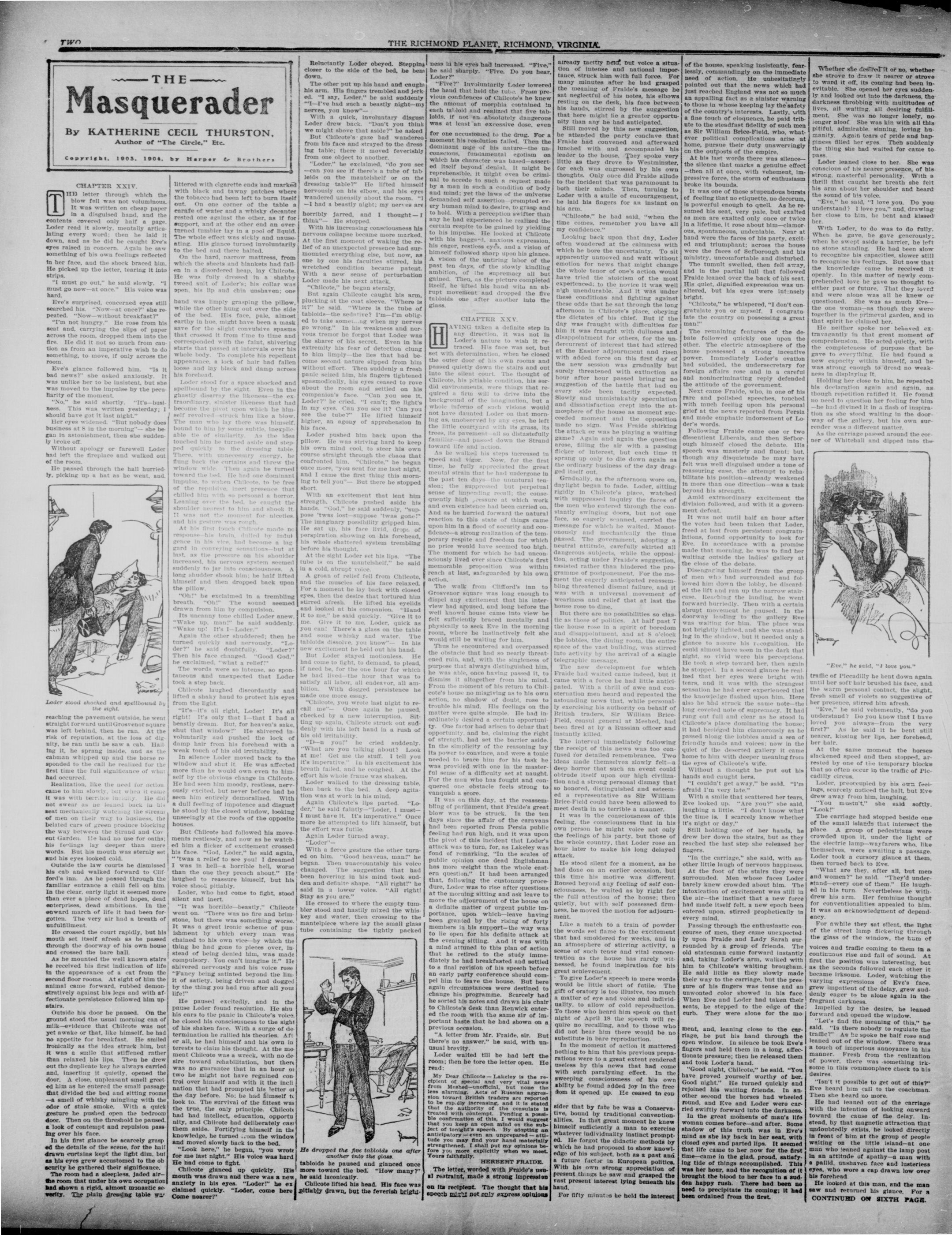
Loder stood shocked and spellbound by the sight.
reaching the pavement outside, he went straight forward until Grosvenor square was left behind, then he ran. At the risk of reputation, at the loss of dignity, he ran until he saw a cab. Hailing it, he sprang inside, and as the cabman whipped up and the horse responded to the call he realized for the first time the full significance of what had occurred.
Realization, like the need for action, came to him slowly, but when it came it was with terrible urgency. He did not swear as he leaned back in his seat mechanically watching the stream of men on their way to business, the belated cars of green produce blocking the way between the Strand and Covent Garden. He had no use for oaths, his feelings lay deeper than mere words. But his mouth was sternly set and his eyes looked cold.
Outside the law courts he dismissed his cab and walked forward to Clifford's inn. As he passed through the familiar entrance a chill fell on him. In the clear, early light it seemed more than ever a place of dead hopes, dead enterprises, dead ambitions. In the onward march of life it had been forgotten. The very air had a breath of unfulfillment. He crossed the court rapidly, but his mouth set itself afresh as he passed through the doorway of his own house and crossed the bare hall. As he mounted the well known stairs he received his first indication of life in the appearance of a cat from the second floor rooms. At sight of him the animal came forward, rubbed demonstratively against his legs and with affectionate persistence followed him upstairs.
Outside his door he paused. On the ground stood the usual morning can of milk—evidence that Chilcote was not yet awake or that, like himself, he had no appetite for breakfast. He smiled ironically as the idea struck him, but it was a smile that stiffened rather than relaxed his lips. Then he drew out the duplicate key he always carried and, inserting it quietly, opened the door. A close, unpleasant smell greeted him as he entered the small passage that divided the bed and sitting rooms—a smell of whlsky mingling with the odor of stale smoke. With a quick gesture he pushed open the bedroom door. Then on the threshold he paused, a look of contempt and repulsion passing over his face.
In his first glance he scarcely grasped the details of the scene, for the half drawn curtains kept the light dim, but as his eyes grew accustomed to the ob security he gathered their significance.
The room had a sleepless, jaded air
the room that under his own occupation
had shown a rigid, almost monastic severity.
The plain dressing table was
littered with cigarette ends and marked with black and tawny patches where the tobacco had been left to burn itself out. On one corner of the table a carafe of water and a whisky decanter rested one against the other, as if for support, and at the other end an overturned tumbler lay in a pool of liquid. The whole effect was sickly and nauseating. His glance turned involuntarily to the bed and there halted. On the hard, narrow mattress, from which the sheets and blankets had fallen in a disordered heap, lay Chilcote. He was fully dressed in a shabby tweed suit of Loders; his collar was open, his lip and chin unshaven; one
band was limply grasping the pillow, while the other hung out over the side of the bed. His face, pale, almost earthy in hue, might have been a mask save for the slight convulsive spasms that crossed it from time to time and corresponded with the faint, shivering starts that passed at intervals over his whole body. To complete his repellent appearance, a lock of hair had fallen loose and lay black and damp across his forehead.
Loder stood for a space shocked and spellbound by the sight. Even in the ghastly disarray the likeness—the extraordinary, sinister likeness that had become the pivot upon which he himself revolved—struck him like a blow. The man who lay there was himself, bound to him by some subtle, inexplicable tie of similarity. As the idea touched him he turned aside and stepped quickly to the dressing table. There, with unnecessary energy, he flung back the curtains and threw the window wide. Then again he turned toward the bed. He had one dominant impulse, to waken Childe, to be free of the repulsive, inert presence that chilled him with so personal a horror. Leaning over the bed, he caught the shoulder nearest to him and shook it. It was not the moment for niceties, and his gesture was rough.
At his first touch Cilicote made no response—his brain, dulled by indulgence in his vice, had become a laggard in conveying sensations—but at last, as the pressure on his shoulder increased, his nervous system seemed suddenly to jar into consciousness. A long shudder shook him; he half lifted himself and then dropped back upon the pillow.
"Oh!" he exclaimed in a trembling breath. "Oh!" The sound seemed drawn from him by compulsion. Its uncanny tone chilled Loder anew. "Wake up, man!" he said suddenly. "Wake up! It's I—Loder."
Again the other shuddered; then he turned quickly and nervously. "Loder?" he said doubtfully. "Loder?" Then his face changed. "Good God," he exclaimed. "what a relief."
The words were so intense, so spontaneous and unexpected that Loder took a step back.
Chilcote laughed discordantly and lifted a shinky hand to protect his eyes from the light.
"It's- it's all right. Loder! It's all right! It's only that I—that I had a beastly dream. But, for heaven's sake, shut that window!" He shivered involuntarily and pushed the lock of damp hair from his forehead with a weak touch of his old irritability.
In silence Loder moved back to the window and shut it. He was affected more than he would own even to himself by the obvious change in Chilcote. He had seen him moody, restless, nervously excited, but never before had he seen him entirely demoralized. With a dull feeling of impotence and disgust he stood by the closed window, looking unseeingly at the roofs of the opposite houses.
But Chilcote had followed his movements restlessly, and now as he watched him a flicker of excitement crossed his face. "God, Loder," he said again, "twas a relief to see you! I dreamed I was in hell—a horrible hell, worse than the one they preach about." He laughed to reassure himself, but his voice shook pititably.
Loder, who had come to fight, stood silent and inert.
"It was horrible—beastly," Chilcote went on. "There was no fire and brimstone, but there was something worse. It was a great ironic scheme of punishment by which every man was chained to his own vice—by which the thing he had gone to pieces over, instead of being denied him, was made compulsory. You can't imagine it." He shivered nervously and his voice rose. "Fancy being satiated beyond the limit of satiety, being driven and dogged by the thing you had run after all your life!"
He paused excitedly, and in the pause Loder found resolution. He shu his ears to the panic in Chilcote's voice, he closed his consciousness to the sight of his shaken face. With a surge of determination he rallied his theories. After all, he had himself and his own interests to claim his thought. At the moment Chilcote was a wreck, with no desire toward rehabilitation, but there was no guarantee that in an hour of two he might not have regained control over himself and with it the inclination that had prompted his letter of the day before. No; he had himself to look to. The survival of the fittest was the true, the only principle. Chilcote had had intellect, education, opportunity, and Chilcote had deliberately cast them aside. Fortifying himself in the knowledge, he turned from the window and moved slowly back to the bed.
"Look here," he began, "you wrote for me last night." His voice was hard. He had come to fight.
Chilcote glanced up quickly. His mouth was drawn and there was a new anxiety in his eyes. "Loder!" he exclaimed quickly. "Loder, come here Come nearer!"
THE RICHMOND PLANET, RICHMOND, VIRGINIA
Reluctantly Loder obeyed. Stepping closer to the side of the bed, he bent down.
The other put up his hand and caught his arm. His fingers trembled and jerked. "I say, Loder," he said suddenly "I—I've had such a beastly night—my nerves, you know"—With a quick, involuntary disgust Loder drew back. "Don't you think we might shove that aside?" he asked. But Chilcote's gaze had wandered from his face and strained to the dressing table; there it moved feverishly from one object to another.
"Loder," he exclaimed, "do you see—can you see if there's a tube of tables on the mantelshelf or on the dressing table?" He lifted himself nervously on his elbow, and his eyes wandered unsteady about the room. "I—I had a beastly night; my nerves are horribly jarred, and I thought—I think"—He stopped.
With his increasing consciousness his nervous collapse became more marked. At the first moment of waking the relief of an unexpected presence had surmounted everything else, but now, as one by one his faculties stirred, his wretched condition became patent. With a new sense of perturbation Loder made his next attack.
But again Chilcote caught his arm, plucking at the coat sleeve. "Where is it?" he said. "Where is the tube of tabloids—the sedentive? I'm—I'm obliged to take something when my nerves go wrong." In his weakness and nervous tremor he forget that Loder was the sharer of his secret. Even in his extremity his fear of detection clung to him limply—the lies that had become second nature slipped from him without effort. Then suddenly a fresh panic seized him, his fingers tightened spasmodically, his eyes ceased to rove about the room and settled on his companion's face. "Can you see it, Loder?" he cried. "I can't; the light's in my eyes. Can you see it? Can you see the tube?" He lifted himself higher, an agony of apprehension in his face.
Loder pushed him back upon the pillow. He was striving hard to keep his own mind cool, to steer his own course straight through the chaos that confronted him. "Chilcote," he began once more, "you sent for me last night, and I came the first thing this morning to tell you"—But there he stopped short.
With an excitement that lent him strength. Chilcote pushed aside his hands. "God," he said suddenly, "suppose 'twas lost—suppose 'twas gone." The imaginary possibility gripped him. He sat up, his face livid, drops of perspiration showing on his forehead, his whole shattered system trembling before his thought.
At the sight Loder set his lips. "The tube is on the mantelshelf," he said in a cold, abrupt voice.
A groan of relief fell from Chilcote, and the muscles of his face relaxed. For a moment he lay back with closed eyes, then the desire that tortured him stirred afresh. He lifted his eyelids and looked at his companion. "Hand it to me," he said quickly. "Give it to me. Give it to me, Loder, quick as you can! There's a glass on the table and some whisky and water. The tabloids dissolve, you know"— In his new excitement he held out his hand. But Loder stayed motionless. He had come to toight, to demand, to plead, if need be, for the one hour for which he had lived—the hour that was to satisfy all labor, all endeavor, all ambition. With dogged persistence he made one more essay. "Chilcote, you wrote last night to recall me"— Once again he paused, checked by a new interruption. Sitting up again, Chilcote struck out suddenly with his left hand in a rush of his old irritability.
"D—n you!" he cried suddenly.
"What are you talking about? Look at me! Get me the stuff. I tell you it's imperative." In his excitement his breath failed, and he coughed. At the effort his whole frame was shaken.
Loder walked to the dressing table, then back to the bed. A deep agitation was at work in his mind.
Again Chalcite's lips parted. "Loder," he said faintly—"Loder, I must—I must have it. It's imperative." Once more he attempted to lift himself, but the effort was futile.
Again Loder turned away.
"Loder"—
With a fierce gesture the other turned on him. "Good heavens, man!" he began. Then unaccountably his voice changed. The suggestion that had been hovering in his mind took sudden and definite shape. "All right!" he said in a lower voice. "All right! Stay as you are."
He crossed to where the empty tumbler stood and hastily mixed the whiskey and water, then crossing to the mantelpiece where lay the small glass tube containing the tightly packed
P.
He dropped the five tabloids one after another into the glass. tabloids he paused and glanced once more toward the bed. "How many?" he said laconically. Chilcote lifted his head. His face was pitifully drawn, but the feverish bright-
ness in his eyes had increased. "Five," he said sharply. "Five. Do you hear, Loder?"
"Five?" Involuntarily Loder lowered the hand that held the tube. From previous confidence of Chilcote's he knew the amount of morphia contained in each tabloid and realized that five tabloids, if not an absolutely dangerous was at least 'an excessive dose, even
for one accustomed to the drug. For a moment his resolution failed. Then the dominant urge of his nature—the unconscious, fundamental egotism on which his character was based—asserted itself beyond denial. It might be repreensible, it might even be criminal to accede to such a request made by a man in such a condition of body and mind; yet the laws of the universe demanded self assertion—prompted every human mind to desire, to grasp and to hold. With a perception swifter than any he had experienced he realized the certain respite to be gained by yielding to his impulse. He looked at Chicote with his haggard, anxious expression, his eager, restless eyes, and a vision of himself followed sharp upon his glance. A vision of the untiring labor of the past ten days, of the slowly kindling ambition, of the supremacy all but gained. Then, as the picture completed itself, he lifted his hand with an abrupt movement and dropped the five tabuloids one after another into the glass.
CHAPTER XXV
AVING taken a definite step in any direction, it was not in Loder's nature to wish it retraced. His face was set, but set with determination, when he closed the outer door of his own rooms and passed quietly down the stairs and out into the silent court. The thought of Chilote, his pittable condition, his sordid environments, were things that required a firm will to drive into the background of the imagination, but a whole inferno of such visions would not have daunted Loder on that morning as, unobserved by any eyes, he left the little courtyard with its grass, its trees, its pavement—all so distastefully familiar—and passed down the Strand toward life and action.
As he walked his steps increased in speed and vigor. Now, for the first time, he fully appreciated the great mental strain that he had undergone in the past ten days—the unnatural tension; the suppressed but perpetual sense of impending recall; the consequently high pressure at which work and even existence had been carried on. And as he hurried forward the natural reaction to this state of things came upon him in a flood of security and confidence—a strong realization of the temporary respite and freedom for which no price would have seemed too high. The moment for which he had unconsciously lived ever since Chilcote's first memorable proposition was within reach at last, safeguarded by his own action.
The walk from Clifford's inn to Grosvenor square was long enough to dispel any excitement that his interview had aroused, and long before the well known house came into view he felt sufficiently braced mentally and physically to seek Eve in the morning room, where he instinctively felt she would still be waiting for him.
Thus he encountered and overpassed the obstacle that had so nearly threatened ruin, and, with the singleness of purpose that always distinguished him, he was able, once having passed it, to dismiss it altogether from his mind. From the moment of his return to Chilcote's house no misgiving as to his own action, no shadow of doubt, rose to trouble his mind. His feelings on the matter were quite simple. He had inordinately desired a certain opportunity. One factor had arisen to debar that opportunity, and he, claiming the right of strength, had set the barrier aside. In the simplicity of the reasoning lay its power to convince, and were a tonic needed to brace him for his task he was provided with one in the masterful sense of a difficulty set at naught. For the man who has fought and conquered one obstacle feels strong to vanquish a score.
It was on this day, at the reassembling of parliament, that Fraide's great blow was to be struck. In the ten days since the affair of the caravans had been reported from Persia public feeling had run high, and it was upon the pivot of this incident that Loder's attack was to turn, for, as Lakeley was fond of remarking. "In the scales of public opinion one dead Englishman has more weight than the whole eastern question." It had been arranged that, following the customary procedure, Loder was to rise after questions at the morning sitting and ask leave to move the adjournment of the house on a definite matter of urgent public importance, upon which—leave having been granted by the rising of forty members in his support—the way was to lie open for his definite attack at the evening sitting. And it was with a mind attuned to this plan of action that he retired to the study immediately he had breakfasted and settled to a final revision of his speech before an early party conference should compel him to leave the house. But here again circumstances were destined to change his programme. Scarcely had he sorted his notes and drawn his chair to Chilcote's desk than Renwick entered the room with the same air of important haste that he had shown on a previous occasion.
"A letter from Mr. Fraile, sir. But there's no answer," he said, with unusual brevity. Loder waited till he had left the room; then he tore the letter open. He read:
My Dear Chilicote—Lakeley is the recipient of special and very special receipt from Meshed—unofficial, but none the less alarming. Acts of Russian aggression toward British traders are reported to be rapidly increasing, and it is stated that the authority of the consulate is threatened. A possible confirmation of this, I would suggest that you keep an open mind on the subject of tonight's speech. By adopting an antipellicative—even an unprepared—attitude you may find your hand materially strengthened. I shall put my opinions before you more explicitly when we meet. Yours faithfully.
HERBERT FRAIDE.
The letter, worded with Fraile's usual restraint, made a strong impression on its recipient. The thought that his speech might not only express opinions
already tactic need, but voice a situation of intense and national importance, struck him with full force. For many minutes after he had grasped the meaning of Fraide's message he sat neglectful of his notes, his elbows resting on the desk, his face between his hands, stirred by the suggestion that here might lie a greater opportunity than any he had anticipated.
Still moved by this new suggestion, he attended the party conclave that Fraide had convened and afterward lunched with and accompanied his leader to the house. They spoke very little as they drove to Westminster, for each was engrossed by his own thoughts. Only once did Fraide allude to the incident that was paramount in both their minds. Then, turning to Loder with a smile of encouragement, he laid his fingers for an instant on his arm.
"Chilcote," he had said, "when the time comes, remember you have all my confidence."
Looking back upon that day, Loder often wondered at the calmness with which he bore the uncertainty. To sit apparently unmoved and wait without emotion for news that might change the whole tenor of one's action would have tried the stolicism of the most experienced; to the novice it was well nigh unendurable. And it was under these conditions and fighting against these odds that he sat through the long afternoon in Chileote's place, obeying the dictates of his chief. But if the day was fraught with difficulties for him it was fraught with duliness and disappointment for others, for the undercurrent of interest that had stirred at the Easter adjournment and risen with added force on this first day of the new session was gradually but surely threatened with extinction as hour after hour passed bringing no suggestion of the battle that had on every side been tacitly expected. Slowly and unmistakably speculation and dissatisfaction crept into the atmosphere of the house as moment succeeded moment and the opposition made no sign. Was Fraide shirking the attack or was he playing a waiting game? Again and again the question arose, filling the air with a passing flicker of interest, but each time it sprang up only to die down again as the ordinary business of the day dragged itself out.
Gradually, as the afternoon wore on, daylight began to fade. Loder, sitting rigidly in Chilecote's place, watched with suppressed inquiry the faces of the men who entered through the constantly swinging doors, but not one face, so eagerly scanned, carried the message for which he waited. Monotonously and mechanically the time passed. The government, adopting a neutral attitude, carefully skirted all dangerous subjects, while the opposition, acting under Fraide's suggestion, assisted rather than hindered the programme of postponement. For the moment the eagerly anticipated reassembling threatened dismal failure, and it was with a universal movement of weariness and relief that at last the house rose to dine.
But there are no possibilities so elastic as those of politics. At half past 7 the house rose in a spirit of boredom and disappointment, and at 8 o'clock the lobbles, the dining room, the entire space of the vast building, was stirred into activity by the arrival of a single telegraphic message. The new development for which Fradeid was waited came indeed, but it came with a force he had little anticipated. With a thrill of awe and consternation he heard and repeated the astounding news that, while personally exercising his authority on behalf of British traders, Sir William Brice-Field, consul general at Meshed, had been fired at by a Russian officer and instantly killed.
The interval immediately following the receipt of this news was too confused for detailed remembrance. Two ideas made themselves slowly felt—a deep horror that such an event could obtrude itself upon our high civilization and a strong personal dismay that so honored, distinguished and esteemed a representative as Slr William Brice-Field could have been allowed to meet death in so terrible a manner. It was in the consciousness of this feeling, the consciousness that in his own person he might voice not only the feelings of his party, but those of the whole country, that Loder rose an hour later to make his long delayed attack.
He stood silent for a moment, as he had done on an earlier occasion, but this time his motive was different. Roused beyond any feeling of self consciousness, he waited as by right for the full attention of the house; then quietly, but with self possessed firmness, he moved the motion for adjournment.
Like a match to a train of powder the words set flame to the excitement that had smoldered for weeks, and in an atmosphere of stirring activity, a scene of such tense and vital concentration as the house has rarely witnessed, he found inspiration for his great achievement.
To give Loder's speech in mere words would be little short of futile. The gift of oratory is too illusive, too much a matter of eye and voice and individuality, to allow of cold reproduction. To those who heard him speak on that night of April 18 the speech will require no recalling, and to those who did not hear him there would be no substitute in bare reproduction.
In the moment of action it mattered nothing to him that his previous preparations were to a great extent rendered useless by this news that had come with such paralyzing effect. In the sweeping consciousness of his own ability he found added joy in the freedom it opened up. He ceased to con-
sider that by fate he was a Conservative, bound by traditional conventions. In that great moment he knew himself sufficiently a man to exercise whatever individuality instinct prompted. He forgot the didactic methods by which he had proposed to show knowledge of his subject, both as a past and a future factor in European politics. With his own strong appreciation of present things he saw and grasped the vast present interest lying beneath his hand. For fifty minutes he held the interest
of the house, speaking insistently, fearlessly, commandingly on the immediate need of action. He unhesitatingly pointed out that the news which had just reached England was not so much an appalling fact as a sinister warning to those in whose keeping lay the safety of the country's interests. Lastly, with a fine touch of eloquence, he paid tribute to the steadfast fidelity of such men as Sir William Brice-Field, who, whatever political complications arise at home, pursue their duty unswervingly on the outposts of the empire. At his last words there was silence—the silence that marks a genuine effect—then all at once, with vehement, impressive force, the storm of enthusiasm broke its bounds.
It was one of those stupendous bursts of feeling that no etiquette, no decorum, is powerful enough to quell. As he resumed his seat, very pale, but exalted as men are exalted only once or twice in a lifetime, it rose about him—clamorous, spontaneous, undeniable. Near at hand were the faces of his party, excited and triumphant; across the house were the faces of Seffborough and his ministry, uncomfortable and disturbed. The tumult swelled, then fell away, and in the partial lull that followed Fraide leaned over the back of his seat. His quiet, dignified expression was unaltered, but his eyes were intensely bright.
"Chillcote," he whispered, "I don't congratulate you or myself. I congratulate the country on possessing a great man!"
The remaining features of the debate followed quickly one upon the other. The electric atmosphere of the house possessed a strong incentive power. Immediately Loder's ovation had subsided, the undersecretary for foreign affairs rose and in a careful and nonincriminating reply defended the attitude of the government.
Next came Fraide, who, in one of his rare and polished speeches, touched with much feeling upon his personal grief at the news reported from Persia and made emphatic indorsement of Loder's words.
Following Fraide came one or two dissentent Liberals, and then Sefborough himself closed the debate. His speech was masterly and fluent; but, though any disquietude he may have felt was well disguised under a tone of reassuring ease, the attempt to rehabilitate his position—already weakened in more than one direction—was a task beyond his strength.
Amid extraordinary excitement the division followed, and with it a government defeat.
It was not until half an hour after the votes had been taken that Loder, freed at last from persistent congratulations, found opportunity to look for Eve. In accordance with a promise made that morning, he was to find her waiting outside the ladies' gallery at the close of the debate.
Disengaging himself from the group of men who had surrounded and followed him down the lobby, he discarded the lift and ran up the narrow staircase. Reaching the landing, he went forward hurriedly. Then with a certain abrupt movement he paused. In the doorway leading to the gallery Eve was waiting for him. The place was not brightly lighted, and she was standing in the shadow, but it needed only a glance to assure his recognition. He could almost have seen in the dark that night, so vivid were his perceptions. He took a step toward her, then again he stopped. In a second glance he realized that her eyes were bright with tears, and it was with the strangest sensation he had ever experienced that the knowledge flashed upon him. Here also he had struck the same note—the long coveted note of supremacy. It had rung out full and clear as he stood in Chilcote's place dominating the house; it had besieged him clamorous as he passed along the lobbies amid a sea of friendly hands and voices; now in the quiet of the deserted gallery it came home to him with deeper meaning from the eyes of Chilcote's wife.
Without a thought he put out his hands and caught hers.
"I couldn't get away," he said. "I'm afraid I'm very late."
With a smile that scattered her tears, Eve looked up. "Are you?" she said, laughing a little. "I don't know what the time is, I scarcely know whether it's night or day."
Still holding one of her hands, he drew her down the stairs, but as they reached the last step she released her fingers.
"In the carriage," she said, with another little laugh of nervous happiness. At the foot of the stairs they were surrounded. Men whose faces Loder barely knew crowded about him. The intoxication of excitement was still in the air—the instinct that a new force had made itself felt, a new epoch been entered upon, stirred prophetically in every mind.
Passing through the enthusiastic concourse of men, they came unexpectedly upon Fraide and Lady Sarah surrounded by a group of friends. The old statesman came forward instantly and, taking Loder's arm, walked with him to Chillcote's waiting brougham. He said little as they slowly made their way to the carriage, but the pressure of his fingers was tense and an unwonted color showed in his face. When Eve and Loder had taken their seats, he stepped to the edge of the curb. They were alone for the moment, and, leaning close to the carriage, he put his hand through the open window. In silence he took Eve's fingers and held them in a long, affectionate pressure; then he released them and took Loder's hand.
"Good night, Chilcote," he said. "You have proved yourself worthy of her. Good night." He turned quickly and rejoined his waiting friends. In another second the horses had wheeled round, and Eve and Loder were carried swiftly forward into the darkness. In the great moments of man's life woman comes before—and after. Some shadow of this truth was in Eve's mind as she lay back in her seat, with closed eyes and parted lips. It seemed that life came to her snow for the first time—came in the glad, proud, satisfying tide of things accomplished. This was her hour, and the recognition of it brought the blood to her face in a sudden happy rush. There had been no need to precipitate its coming; it had been ordained from the first.
Whether she desired it or no, whether she strove to draw it nearer or strove to ward it off, its coming had been inevitable. She opened her eyes suddenly and looked out into the darkness, the darkness throbbing with multitudes of lives, all waiting, all desiring fulfillment. She was no longer lonely, no longer aloof. She was kin with all this pitiful, admirable, sinning, loving humanity. Again tears of pride and happiness filled her eyes. Then suddenly the thing she had waited for came to pass.
Loder leaned close to her. She was conscious of his nearer presence, of his strong, masterful personality. With a thrill that caught her breath she felt his arm about her shoulder and heard the sound of his voice.
"Eve," he said, "I love you. Do you understand? I love you," and, drawing her close to him, he bent and kissed her.
With Loder, to do was to do fully. When he gave, he gave generously; when he swept aside a barrier, he left no stone standing. He had been slow to recognize his capacities, slower still to recognize his feelings. But now that the knowledge came he received it openly. In this matter of newly comprehended love he gave no thought to either past or future. That they loved and were alone was all he knew or questioned. She was as much Eve—the one woman—as though they were together in the prime garden, and in that spirit he claimed her. He neither spoke nor behaved extravagantly in that great moment of comprehension. He acted quietly, with the completeness of purpose that he gave to everything. He had found a new capacity within himself, and he was strong enough to dread no weakness in displaying it.
Holding her close to him, he repeated his declaration again and again, as though repetition ratified it. He found no need to question her feeling for him—he had divined it in a flash of inspiration as she stood waiting in the doorway of the gallery, but his own surrender was a different matter.
As the carriage passed around the corner of Whitehall and dined into the
Pierre-Auguste
"Eve," he said, "I love you."
traffic of Piccadilly he bent down again until her soft hair brushed his face, and the warm personal contact, the slight, fresh smell of violets so suggestive of her presence, stirred him afresh.
"Eve," he said vehemently, "do you understand? Do you know that I have loved you always—from the very first?" As he said it he bent still nearer, kissing her lips, her forehead, her hair.
At the same moment the horses slackened speed and then stopped, arrested by one of the temporary blocks that so often occur in the traffic of Piccadilly circus.
Loder, occupied by his own feelings, scarcely noticed the halt, but Eve drew away from him, laughing.
"You mustn't," she said softly.
"Look!"
The carriage had stopped beside one of the small islands that intersect the place. A group of pedestrians were crowded upon it, under the light of the electric lamp—wayfarers who, like themselves, were awaiting a passage. Loder took a cursory glance at them, then turned back to Eve.
"What are they, after all, but men and women?" he said. "They'd understand—every one of them." He laughed in his turn. Nevertheless he withdrew his arm. Her feminine thought for conventionalities appealed to him. It was an acknowledgment of dependency.
For awhile they sat silent, the light of the street lamp flickering through the glass of the window, the hum of
voices and traffic coming to them in a continuous rise and fall of sound. At first the position was interesting, but as the seconds followed each other it became irksome. Loder, watching the varying expressions of Eve's face, grew impatient of the delay, grew suddenly eager to be alone again in the fragrant darkness. Impelled by the desire, he leaned forward and opened the window. "Let's find the meaning of this," he said. "Is there nobody to regulate the traffic?" As he spoke he half rose and leaned out of the window. There was a touch of imperious annoyance in his manner. Fresh from the realization of power, there was something irksome in this commonplace cheek to his desires. "Isn't it possible to get out of this?" Eve heard him call to the coachman. Then she heard no more.
He had leaned out of the carriage with the intention of looking onward toward the cause of the delay. Instead, by that magnetic attraction that undoubtedly exists, he looked directly in front of him at the group of people waiting on the little island—at one man who leaned against the lamp post in an attitude of apathy—a man with a pallid, unshaven face and lusterless eyes, who wore a cap drawn low over his forehead.
He looked at this man, and the man saw and returned his glance. For a CONTINUED ON SIXTH PAGE
---
---
THE PLANET
SATURDAY...MARCH 23RD, '07
OLD FASHION BACK
OLD FASHION BACK
MANNISH TURN-DOWN COLLAR
RESTORED TO FAVOR.
Once More a Conspicuous Feature of
Feminine Neckwear—In Many
Ways an Improvement on
Predecessor.
With the rehabilitation of the Tailor:
Made Girl the mannish turn-over collar of linen has become a conspicuous feature of fashionable neckwear.
You remember that we sported these
Eyelet Pattern for Heavy or Sheer Linen.
Eyelet Pattern for Heavy or Sheer Linen.
collars some three of four years ago, but they were banished when the little Dutch necked frocks came in. Women at that time who possessed scrawny necks encircled by yellow collar lines said some very unpleasant things about the tall, stiff collars which had done the mischief.
Time, however, is a great pacifier, and most women to-day have so far forgotten their past grievance that they have appropriated the mannish collar as of old. The present turn-down collar is a great improvement upon its predecessor. It is not made as heavily as before, being only three ply, and the linen is of a fine, lightweight quality.
The new turn-over collar is just like a man's collar, save that it is less heavy and embroidered in the corners, and for a distance along the sides, or is hemstitched. There are two buttonholes in front and one in back. Many of the better grade ones are hand embroidered. These collars range in price from 25 cents to two dollars, according to the quality of the linen and handwork employed. Their decoration consists of a variety of finger work, real and imitation, such as Medeira or French convent work, or of the St. Gall order:
Grapes of Padded Embroidery with Eyelet Border.
others have Teneriffe stitching in round or square design, and in drawn thread patterns.
We show an example of the stiff turn-over collar, a combination of blind or padded embroidery and eyelet work. With this is worn a four-in-hand.
Another collar is designed with grapes; these are heavily padded and thrown into relief by the open-work edge.
Some of the newest Parisian fancies in these stiff turn-over collars show floral patterns in one or more colors. Wee violets, forget-me-nots, lilies of the valley, besides other small neat posies are so treated.
Bronze Green Popular
The shades of bronze green bid fair to hold their prestige better than the reds, and are considered particularly chic. Several extremely smart street costumes in this color are made of a fine novelty, cloth, showing inch-wide stripes in one-tone effect. Almond green, too, is well liked, and the soft reseda shades are still modish. A reseda marquisette illustrates the liking for sheer stuffs of dark or neutral tone made up over white, and is a most practical and delightful little frock, with its clever embroidery of soft narrow reseda silk ribbon and its ribbon girdle and crossing ribbons over the white net and lace front.
Waving the Hair.
Use this curling fluid when doing up your hair for the night: Dry salts of tartar (carbonate of potash), one dram; cochineal (powdered) half dram; liquor of ammonia, essence of rose, one dram each; glycerin, one quarter ounce; rectified spirits, one and one-half ounces; distilled water, 18 ounces. Let the mixture digest with frequent stirring for a week and then filter. Moisten the hair with the lotion when dressing. The effect will occur as the hair dries.
Fancy Coats Will Be Popular
Fancy coats of all descriptions are going to be tremendously popular not only in the summer, but in the early spring, and if the few models shown thus early are any criterion, they deserve all the praise given to them. One of these is of a soft, glossy English cloth, resembling broadcloth, except for its extremely light weight.
IT WILL PAY YOU
BORS AND INTEREST THEM IN THE PLANET. WE WILL HELP YOU TO OBTAIN A PREMIUM.
COLORED INFANTRY IN RESCUE OF ROUGH RIDERS AT SAN JUAN HILL, JULY 2, 1898, SIZE 20X28 AND 20X24 INCHES, ADMIRAL DEWEY'S GREAT NAVAL BATTLE OFF CAVITE IN MANILA BAY, MAY 1ST, 1898, NAVAL BATTLE, DESTRUCTION OF ADMIRAL CERVERA'S SPANISH FLEET OFF SANTIAGO DE CUBA, JULY 3RD, 1898, SIZE 22X28 INCHES; LAND BATTLE, CAPTURE OF EL CANEY, EL PASO AND FORTIFICATIONS OF SANTIAGO, JULY FIRST AND SECOND, 1898, SIZE 22X28 AND 22X27 INCHES. WE WILL SEND YOU ONE OF ANY OF THE FOLLOWING BATTLES OF THE CIVIL WAR ON THE SAME TERMS. THE PICTURES LIKE THE OTHER BATTLES ARE FINISHED IN COLORS. THEY ARE 22X28 INCHES AND RETAIL AT ONE DOLLAR EACH. WE WILL FURNISH FRAMES FOR ANY OF THESE FINE CHROMOS FOR 2 DOLLARS & 50CTS. EACH ADDITIONAL. BATTLE OF GETTYSBURG, BATTLE OF SHILOH, BATTLE OF FIVE FORKS, VA., BATTLE OF ATLANTA, GA., BATTLE OF SPOTTSYLVANIA, VA., BATTLE OF VICKSBURG, MISS., BATTLE OF LOOKOUT MOUNTAIN, TENN., BATTLE BETWEEN THE MONITOR AND THE MERRIMAC, BATTLE OF BULL RUN, VA., BATTLE OF CHANCELLORSVILLE, BATTLE OF THE BIG HORN, (CUSTER'S LAST CHARGE) STORMING OF FORT WAGNER, S. C., (COLORED TROOPS IN THIS FIGHT), BAT-
ATH OF SITTING BULL, THE GREAT INDIAN CHIEFTAIN; FORT PILLOW MASSACRE, FALL OF PETERSBURG, VA., BATTLE OF WINCHESTER, VA., BATTLE OF OLUSTEE, FLA. WE WILL SEND FAMILY RECORD, SIZE 22 BY 28, WHICH CONTAINS SPACE FOR PHOTOGRAPHS OF PARENTS AND TEN CHILDREN. WE WILL SEND SOLDIERS WAR RECORD (CERTIFICATE OF SERVICE IN UNITED STATES ARMY.)
FOR ONE YEAR EACH, OR THEIR EQUIVALENT, WE WILL SEND YOU A COPY OF UNCLE TOM'S CABIN, THE MOST INTENSELY INTERESTING BOOK IN THE COUNTRY. WE WILL SEND YOU A GOLD-PLATED BROOCH WITH YOUR PICTURE THEREIN, YOU TO
and there is a loose jacket cut on Empire lines in back, that is with the half-length coat and high waist-line, cut bolero effect in front, two-pointed tabs with the coat sloping from the arm-sides diagonally away from the hips.
FOR TWO PLEASANT PARTIES.
Mother Goose Is One and "Poverty Breakfasts" Another.
Send out invitations decorated with Mother Goose characters. When the guests arrive give them a bit of paper on which is written the name of a jingle from this ever popular book. When the hostess calls these titles one by one, the holder must repeat the rhyme at once, or in the space of two minutes. Failing to do so entails the paying of a forfeit.
To the one who responds the first award a goose quill pen, and to the one who falls entirely give a child's copy of Mother Goose.
The following menu may be served for refreshment. Ornament the table with a huge pie, on which 24 toy birds are seated around the edge; have a ribbon leading to each plate, with a snapping cracker attached to the end inside the pie. The guests are to guess what is to be served them from this Mother Goose bill of fare: Shared by the walrus and carpenter (Oysters). A king's dish (Bird pie, individual chicken pies). A queen's lunch (Bread and honey). Taffy's spoils (Beef sandwiches). The golden eggs (Eggs hard boiled). What the baker made (Rolls). Sample of the pieman's ware (Tiny pies). Jack-a-Dandy's delight (Plum cake). What the ships brought (Apples and comfits).
I wonder how many readers of the department are aware of the fact that Mary Goose, the original "Mother Goose," is buried in a Boston cemetery? She was not a myth, but a reality once upon a time.
For Lent.
A coterie of ten ladies, who are accustomed to entertaining on quite an elaborate scale, are giving a series of Lenten affairs which they call "poverty breakfasts."
Each hostess keeps an itemized account of what the meal costs, and then subtracts it from the sum she would ordinarily have paid. The difference she puts into a box marked "Charity."
Shirt-waist suits are worn, and the "breakfast" is served at 12 o'clock, thus giving a long afternoon for sewing, which in this instance is making outfielder nightgowns for a child's hospital. The garments are exceedingly dainty, as one lady insists upon finishing the neck and sleeves with feather-stitching or lace.
This little circle is having what they call a "scrap party" once a week, held in the evening. The men are asked to come and bring all their cast-off neckties; the ladies bring bits of silk—even samples are available. The pieces are sorted into plies, neatly tied with skeins of embroidery silk, and are sent to old ladies in homes and institutions—to "shut-ins" and invalids, who gladly receive these contributions to their silk quilts.
Some of these bundles are sent to remote regions in the south, where industrial schools have been established. A cup of something hot is served and the party breaks up at ten o'clock, for early hours are a part of the Lenten regime.
Wouldn't suit the Furniture.
Do—No wonder you are sick.
Open your blinds and let the sunshine into your room.
Fair Patient—Mercy! It wouldn't harmonize with this expensive furniture.
Sunshine is disgustingly cheap.
-N. Y. Weekly.
In the Car.
I saw her in the car to-day.
And she was sweet and passing fair;
She denged just once to look my way
When we were in the car to-day-
I recognized her. That. I say,
Is why I, too, was passing fare.
And she was sweet to-day.
And she was sweet and passing fair.
-Milwaukee, Sentimental.
MRS. JOSIE A. GRAHAM
Virginia's Most Successful Hair Culturist.
...PARLORS.....
108 E. Leigh St., - Richmond, /
'Phone, 1034.
Private Parlors, Confidential Inter-
```markdown
```
views and Correspondence.
The largest and most up-to-date Hair Dressing Parlors in Richmond. The very best preparations that can be made for the hair, scalp, face and skin.
Graham's Superior Scalp Food for growing hair on bald heads and bare temples, 25cts. per jar. By mail, 35cts.
Graham's Superior Orange Flower Skin Fo ' for developing and beautifying the skin, 25cts a jar. By mail 35cts.
Graham's Superior Velvet Liquid Powder for giving the face a beautiful fair color, 25 cents a bottle. By mail 35cts.
Graham's Vegetable Hair Dye the best on market giving a rich natural color, $1.00 per bottle. By mail, $1.25.
Mrs. Graham makes a specialty of massaging and beautifying ladies' faces for parties and public gatherings, 35 cents.
Mrs. Graham shampoos the head and puts it in a healthy condition, 25 cents. All ladies who attend parties and other social gatherings should have their finger nails manicured and made beautiful, 25 cents. Mrs. Graham's preparations sell at sight. Ladies living in other cities and towns can make good money by selling their preparations. Write for terms to Mrs. J. A. Graham, No. 108 E. Leigh St., Richmond, Va.
To interest yourself in promoting the CIRCULATION of the
RICHMOND PLANET.
WE WILL SEND YOU THE PLANET AND THE ST LOUIS, MISSOURI, SEMI-WEEKLY GLOBE DEMOCRAT, ONE OF THE LEADING REPUBLICAN JOURNALS IN THE UNITED STATES FOR $2.25 PER YEAR FOR BOTH.
WE WILL SEND YOU THE PLANET AND THE COSMOPOLITAN MAGAZINE FOR $2.25 PER YEAR FOR BOTH.
WE WILL SEND YOU THE PLANET AND McCLURE'S MAGAZINE FOR $2.25 PER YEAR FOR BOTH.
FURNISH THE PHOTOGRAPH TAIN PEN, GOLD POINT; ONE BREAST-PIN, GOLD FILL; EN LINEN HANDKERCHIEFS CLOCK, ONE DOZEN NAPKIN DOZEN TOWELS, ONE CHOCO PAIR VASES, ONE PAIR KID HAM, ONE TURKEY.
FOR TEN NEW SUBSO
OR THEIR EQUIVALENT, WE WILL SEND PICTURES, ONE ONLY, OF PRESIDENT THEODORE ROOSEVELT, DR. BOOKER T. WASHINGTON, BATTLE OF SANTIAGO, LAND BATTLE OF QUASIMAS NEAR SANTIAGO, JUNE 24, 1898, SHOWING THE NINTH AND TENTH COLORED CAVALRY IN SUPPORT OF ROUGH RIDERS, SIZE 20X28 AND 20X24 INCHES, LAND BATTLE AND CHARGE OF THE 24TH & 25TH
READ THE GREAT INDUCEMENTS OFFERED BY THE PLANET
THE RICHMOND PLANET, RICHMOND, VIRGINIA
IF YOU WILL TALK WITH YOUR NEIGH-
```markdown
```
FOR TWO YEARLY SUBSCRIBERS
FOR FIVE NEW SUBSCRIBERS
REQUISITE NUMBER IS OBTAINED, WE WILL FORWARD THE PRESENT INDICATED. A PERSON WHO TRIES TO GET FORTY SUBSCRIBERS AND GETS TIRED MAY INDICATE HIS WISH AND WE WILL SEND THE PRESENT FOR THE NUMBER HE HAS SECURED OVER FIVE. THE NUMBER WILL BE FOR NOT LESS THAN FIVE NOR MORE THAN TEN AND NOT LESS THAN TEN NOR MORE THAN TWENTY AND NOT LESS THAN TWENTY NOR MORE THAN FORTY, TO DETERMINE THE PRIZE TO WHICH THE WORKER IS ENTITLED.
IF ANYTHING IS DESIRED NOT SPECIFIED IN THIS LIST, WRITE US ABOUT IT AND WE WILL TELL YOU IN WHAT CLASS IT BE LONGS.
ADDRESS ALL ORDERS TO
JOHN MITCHELL, J R.,
311 North Fourth Street,
RICHMOND, VIRGINIA.
A man sitting in a chair and a man standing in front of him.
DILY GROW
LANET
WEEKLY
LEADING
UNITED
TH.
T AND
ER $2.25
T AND
YEAR
S
ND PIC-
THEO-
WASH-
D BAT-
JUNE 24,
H COL-
UGH RI-
LAND
& 25TH
```markdown
```
REQUISITE FORWARD
SHOULD YOU DESIRE ANY COLORED JOURNAL IN THE UNITED STATES, WE WILL SEND IT TO YOU IN CONJUNCTION WITH THE PLANET AT A GREATLY REDUCED RATE FOR BOTH.
FURNISH THE PHOTOGRAPH, ONE FOUNTAIN PEN, GOLD POINT; ONE LADIES RING, ONE BREAST-PIN, GOLD FILLED; HALF DOZEN LINEN HANDKERCHIEFS, ONE ALARM CLOCK, ONE DOZEN NAPKINS, ONE HALF DOZEN TOWELS, ONE CHOCOLATE POT, ONE PAIR VASES, ONE PAIR KID GLOVES, ONE HAM, ONE TURKEY.
WE WILL SEND ONE CHINA SET, THIRTY-ONE PIECES; ONE NECKLACE; DICKENS, SHAKESPEARE, BYRON WORKS; ONE UMBRELLA, ONE PLAIN GOLD RING, ONE PAIR LACE CURTAINS 1,000 ENVELOPES, 1,000 SHEETS OF PAPER PRINTED AND DELIVERED; ONE TOILET SET, ONE HALF CORD OF SAWED WOOD
FOR TWENTY NEW SUBSCRIBERS
WE WILL GIVE ONE HANDSOME GOLD RING WITH OPALS, RUBIES OR PEARLS; ONE JEWELRY BOX FINISHED IN GOLD OR SILVER; ONE SILK SHIRT WAIST; ONE READY MADE DRESS, ONE GOLD WATCH, FILLED, WARRANTED FOR TEN YEARS, ONE ROCKING CHAIR, ONE LOAD OF COAL, ONE GROSS OF SOAP, EITHER WASHING OR TOILET; ONE BARREL OF BEST FLOUR, ONE PAIR BLANKETS, ONE MANICURE SET, ONE SEAMSTRESS' WORK BOX, ONE PAIR SHOES, GENTS OR LADIES.
FOR FORTY YEARLY SUBSCRIBERS
OR EQUIVALENT, WE WILL GIVE ONE SEWING MACHINE, ONE DIAMOND RING, ONE GOLD WATCH, ONE PAIR FINE GOLD EARRINGS, ONE MUSIC BOX, ONE PHONOGRAPH, ONE READY MADE DRESS, ONE SUIT OF GENTLEMEN'S CLOTHES, ONE GOLD-HEADED CANE, ONE GOLD-HEADED UMBRELLA, ONE CHINA SET, ONE DOZEN SILVER-PLATED KNIVES AND FORKS, ONE HAT-RACK, ONE SILK DRESS, ONE WEEK'S TRIP TO THE SEASHORE, RAILROAD FARE AND HOTEL BILL PAID, FOR ANY RICHMOND WORKER. THESE OFFERS MAY BE TAKEN ADVANTAGE OF BY SENDING ONE OR TWO SUBSCRIBER'S NAMES AT A TIME. WE WILL KEEP A RECORD OF THEM; AS SOON AS THE
FOR TEN NEW SUBSCRIBERS
THREE
```markdown
```
```markdown
```
FOUR
THE PANET
Published every Saturday by John Mitchell
JR., at 311 North 4th Street, Richmond Va.
it communications intended for publication
would be sent so as to reach us by Wednesday.
TERMS IN ADVANCE
One Copy, one year, $1.50
One Copy, six months, 1.00
One Copy, four months, 5.00
One Copy, three months, 40.00
Single Copy, $0.50
ADVERTISING RATE
For one inch, one insertion . . . $ .50
For one inch, each subsequent insertion . . . $ .40
For two inches, three months . . . $ .60
For two inches, six months . . . $ 10.00
For two inches, nine months . . . $ 14.00
For two inches, twelve months . . . $ 20.00
Marriage and Funeral Notices, one inch . . . $ 50
Standing and Transient Notices per line . . . $ 10
# POSTAGE STAMPS OF A HIGHER DENOMINATION THAN TWO CENTS NOT RECEIVED ON SUBSCRIPTIONS.
THE PLANET is issued weekly. The subscription price is $1.50 per year in advance.
There are four ways by which money can be sent by mail at our risk.—In a Post Office Monument or an Express Money Order, and when none of these can be procured, in a Registered Letter.
MONEY ORDERS.—You can buy a Money Order or payable to the Richmond Post Office, and we will be responsible for its safe arrival.
EXPRESS MONEY ORDERS can be obtained at the office of the American Express Co., the United States Post Office, and Go & Co. Express Company. We will be responsible for money sent to any of these companies. The Post Office can send money safe and convenient for way forwarding money.
REGISTERED LETTER.—If a money Post Office or an Express Office is not within your town, you may wish to send a Letter you wish to send on payment of money. Then, if the letter is lost or stolen, it can send money in this manner at our risk.
We cannot be responsible for money sent in letters in any other way than one of the four ways mentioned above. If you send your money to another way, you must do it at your risk.
RENEWAL, ETC.—If you do not want the money continued for another year after your money is sent to another way, the Post Card to discontinue it. The courts have decided that subscribers to newspaper, who do not send money to another way, must be discontinued at time for which it has been paid are holdable for the payment of the subscription up to date when they order the paper discount.
COMMUNICATIONS.—When writing to us to renew your subscription or to discontinue your name, you should give your name and address to the Post Office, we cannot find your name on our books.
CHANGE OF ADDRESS.—In order to change your address as well as the present address.
Entered at the Post Office at Richmond. Va., second-class matter.
SATURDAY, MARCH 23RD, '07
VIRGINIA JUSTICE.
"Poetic Justice, with her lifted scale
That a Negro charged with criminal assault upon a white female, should be tried in the city of Danville, State of Virginia and escape not only the gallows, but be permitted not guilty and be permitted to leave that community alive is one of the wonders of the twentieth century and has called forth the poetic quotation which graces the commencement of this article.
The case is a remarkable one and to the spirit of fair-play, inherent in the better class of white Virginians is due the fact that two colored men are alive and well to-day. The facts are as follows:
Miss Gladys Shelton, aged eighteen years and daughter of Mr. B. R. Shelton of Amherst county, Virginia alleged that she had been criminally assaulted by a colored man or rather as they state it by a Negro during the absence of her parents.
The assault was alleged to have taken place during the day at about 3 o'clock.
The white girl has broken the record by identifying two colored men as being her assailant. She said that she believed the Negro who assaulted her was Peter Hutson. He was arrested and with Herbert Stepteo who was suspected by the authorities and was also held by the authorities. This white girl did not at first identify Hutson, but later that he was the man. The authorities had, however, such a clear case of an alibi for Hutson; that is, proof that when the crime was alleged to have been committed that he was somewhere else, that they did not press the case against him.
The grand jury did not find a true bill against him, but a true bill was found against the other colored man, Herbert Stepteo. The preliminary examination at Amherst Court House necessitated the use of state troops, so wrought up were the citizens of the county over the outrage. The law requires that where troops are necessary at a trial a change of venue must be granted; that is the prisoner must be tried at some other place in the state.
Judge A. M. Alken was the presiding Judge at Amherst C. H., acting in the place of the jurist who was sick. He transferred the case to his own district at Danville. While he is one of the ablest and most fair minded jurists in the state, this transfer was regarded as ominous. Danville's reputation in all matters affecting the Negro is known through
out the country and that Steptoe had a chance for his life was not for a moment believed by any. one at a distance, at all conversant with the surrounding circumstances. The prisoner was represented by Attorney William Beasley of Lynchburg. Although this country white girl had alleged that but one colored man had criminally assaulted her and although she had identified Peter Hutson as the man who committed the crime, and although he had been released and Herbert Steptoe arrested, she glibly swore that Herbert Steptoe was the man who criminally assaulted her. By this time the white folks had become disgusted. Even the jurors seemed to tire of the job, for if Peter Hutson had established the fact by reputable witnesses that he was some where else at the time the crime was committed, Herbert Steptoe had proven that he was not there by evidence too conclusive and convincing to admit of a moment's doubt. As a result the jury brought in a verdict of "not guilty" and the distinguished presiding judge not only declared that the verdict of the jury was in accordance with the evidence, but he commended them for their action.
He declared that it should prove satisfactory to the people of Virginia. Steptoe accounted for every moment of his time that day, and so conclusive was his recital and so well corroborated was it in every particular, that white men assisted in smuggling him out of Danville in order that he might not be the victim of the prejudiced Negro-haters who would deem it necessary to rid the state of a Negro charged with a heinous offense, be he guilty or innocent.
The motive of this white girl is past finding out unless it was to shield some person in whom she had confided her confidence. She goes back to her Amherst home discredited, and thoughtful white men have a practical demonstration of the embarrassing position in which the average colored man may be placed.
One thing we know is that the verdict of that jury will go far towards restoring the confidence of the colored people in the white men of Virginia. Despite the vaporings of men of the Mr. Thomas Dixon, Senator B. R. Tillman and Gov. Jas. K. Vardaman stripe, the day is breaking and the bond of union is being strengthened in all places where the blatant demagogues of either race are trying to weaken its strength and sever its strands.
Lynch-law must go!
"Right is right, as God is God, And Right the day will win. To doubt would be disloyalty; To falter would be sin."
THAW LASHED
EVELYN NESBIT
Beat Her With Whip Because She Defended White.
THE TRIAL NEARING AN END
New York, March 20.—By prolonging his cross-examination of one of the seven alienists introduced by the defense to testify that Harry K. Thaw was insane when he shot and killed Stanford White, District Attorney Jerome made it impossible for the defense to finally close its case Tuesday. When adjournment was taken there was pending only the matter of the admission of a letter written by Thaw to J. Dennison Lyon, a Pittsburg banker, which Mr. Delmas said would help to fix the young man's state of mind before the roof garden tragedy, and the likelihood that Evelyn Nesbit Thaw would be called briefly to combat the testimony of Abraham Hummel.
District Attorney Jerome hinted that an important witness for the prosecution might reach the city. The chances are, however, that a half day's session will be sufficient to conclude all the testimony that is to be offered by either side. An adjournment then will be taken until Thursday morning, when Mr. Delmas will begin his summing up speech. He will have all of Thursday to himself, and Mr. Jerome will reply on Friday. Justice Fitzgerald may charge the jury that evening or he may for the first time hold court on Saturday in order to conclude the case before the week ends.
With the exception of the last few minutes of the session, the entire day was given over to expert testimony. Mr. Jerome occupied all of the morning session with his cross-examination of Dr. Smith Ely Jelliffe, who said he believed that Thaw had been insane for more than two years and a half preceding the homicide. Drs. Charles W. Pilgrim, Minas Gregory, Charles G. Wagner and Britton D. Evans answered the prosecution's hypothetical question for Mr. Delmas and gave it as their opinion that Thaw's reason was so defective when he killed Stanford White that he did not know that the act was wrong.
The case for the people was finally closed by the introduction of the much discussed Hummel affidavit, which, with the consent of the defense, was read in full to the jury. The affidavit proved a surprise only in the alleged severity of the assaults Harry K. Thaw is said to have made upon Evelyn Nesbitt during their trip through Europe in 1903, when, according to the testimony of Abraham Hummel, Miss Nesbitt would not sign statements which Thaw had prepared accusing Stanford White of having drugged and ruined her.
THE RICHMOND PLANET, RICHMOND, VIRGINIA
In this affidavit Miss Nesbit charged Thaw with having attacked her with a cowhide whip while they were stopping at an old castle in the Austrian Tyrol and lashing her bare skin until she became faint from the pain and swooned. He repeated the attack he next day, according to the affidavit, and afterward in Paris he beat her at half hour intervals throughout one entire day, leaving off only when she would faint away and could no longer understand what was happening. Miss Nesbit is alleged to have sworn in the affidavit that she was in daily fear for her life and that Thaw acted as a demented person during some of the assaults.
The affidavit was in some ways a direct contradiction of Hummel's recent testimony upon the stand. In order that the defense might not prevent him from telling the story of the making of the affidavit he stated positively that he was not acting as Miss Nesbit's attorney when he drew up the document; that he was acting solely in the interest of Stanford White and that no legal action was contemplated in behalf of the young woman who is now Harry Thaw's wife.
There was considerable surprise consequently when Mr. Jerome read the opening words of the affidavit, which were:
"Supreme Court, County of New York:
"Evelyn Nesbit, plaintiff, against Harry Kendall Thaw, defendant."
When Mr. Delmas began the introduction of testimony in sur-rebuttal he introduced first of all the record in the trial and conviction of Hummel on the charge of conspiracy. He started to read the entire record, but had not reached the remarks of Mr. Jerome made at the sentencing of Hummel and which Mr. Delmas wanted to present to the jury, when Mr. Jerome said he would admit the entire record without objection. Mr. Delmas then said he would save the district attorney's reference to Hummel for the defense's summing up.
Next Mr. Delmas put upon the stand three policemen who saw Thaw the night of the tragedy or early in the morning after and they all declared that he either looked or acted irrationally. To two of them he complained of hearing young girls' voices. The witnesses admitted on cross examination that there were seven women of the street in the station house the right Thaw, was there and that they were making considerable noise, but could not be heard from Thaw's cell.
Missouri to Knock Out Bucket Shops.
Jefferson City, Mo., March 16.—The house passed a bill making the operation of a bucket shop a felony. The maximum punishment for violation is from two to five years in the penitentiary. The bill now goes to Governor Folk.
NOT THE MARVIN BOY
Lad Found In Erie Is Son of Fredonia, N. Y., Woman.
Erie, Pa., March 20.—The Associated Press was informed that the kidnapped son of Dr. Horace N. Marvin, of Kitts Hammock, Del, was not in this city or vicinity. It was stated that all the clues had been thoroughly investigated without success. The most promising clue proved to be the presence in this city of a woman from Fredonia, N. Y., accompanied by a young son who closely resembles the description of young Marvin. This clue was discovered by Attorney A. P. Howard, who was positive during the last two days that he could produce the missing boy, but not before Dr. Marvin came to Erie from Delaware. It developed that the woman had separated recently from her husband and came here pending proceedings for a divorce.
District Attorney W. Pitt Gifford, of Erie county, called upon Attorney Howard and demanded that Howard produce the boy. A conference was arranged and Mayor Liebel, District Attorney Gifford, Assistant District Attorney Carroll, Chief of Police Wagner and several detectives, representing private agencies, accompanied by Attorney Howard, went to the home of Mrs. Bell, 2124 Myrtle street, at which place Attorney Howard insisted the Marvin lad was located. The lad was readily produced and the resemblance to the description of young Marvin was instantly apparent. Chief of Police Wagner at once placed every one in the house under arrest and it was not until after Dr. Bell, an Erie physician, stated positively that he had treated the boy in Erie before Horace Marvin was kidnapped, that the officials realized a mistake had been made. It then developed that the boy was the one from Fredonia, N. Y. The officials immediately dispersed and the search for Horace Marvin in Erie ceased.
ROCKEFELLER MAKES HIS WILL
New York, March 18.—The Herald says that, according to a member of John D. Rockefeller, Jr.'s Bible class, and who is also a personal friend of John D. Rockefeller and in a position to know of his affairs, the latter proposes soon to make a princely gift to the city of New York. It will amount to at least $50,000,000. It will be partly charitable and partly educational. The Herald adds: "This man informed a reporter that when Mr. Rockefeller was conferring with his son at Lakewood, N. J., a fortnight ago, the meeting was not for the purpose of discussing any immediate gift, but was on the subject of Mr. Rockefeller's will, which document the oil king was then completing with the aid of his son and his lawyers. It was said that this document will astonish the world when it is made public. It will donate no less than $250,000,000 for charitable and educational purposes, and it will be so bestowed that the benefit therefrom will almost be perpetual.
"In his will, the Herald's informant states, Mr. Rockefeller has provided these three things—bequests for religious purposes, though not of large sums; liberal bequests for educational, and what are described as princely bequests for charitable purposes. It is said that there is scarcely a man, woman or child that will not benefit in some way by these prospective donations."
CONTRACTOR MADE HUGE PROFITS
Got $90,748 For. $2060 Rostrums in Pennsylvania Capitol.
PUTTY COMPOSITION WOODWORK
Harrisburg, Pa., March 20. — The capitol investigating committee resumed its inquiry into the cost of the new state capitol. The testimony showed that John H. Sanderson & Company, of Philadelphia, contractors for furnishing the capitol, was paid by the state $0,748.40 for the rostrums in the senate and house caucus rooms. The sub-contractors for this work testified that he was paid $2060 by Sanderson for these rostrums. The testimony of the same sub-contractor showed that Sanderson's profit on the finished woodwork in 14 other rooms in the building amounted to $126,645.60.
Murray Gibson, who was an unsuccessful bidder against Sanderson for the contract for decorating and painting the building, testified that there was a difference of $1.991½ a foot in favor of the state in his bid and that of Sanderson, and that if the state had accepted his bid the state would have saved more than $600,000 on this item alone, and he (Gibson) would have made a nice profit.
None of the witnesses who were asked about the "per foot" and the "per pound" rule under which Sanderson was paid for the capitol furnishings ever heard of this rule until it was employed in the furnishing of the new capitol. The testimony showed that there were also large profits in the contracts for the parquetry flooring and the thermostats in the building.
John F. Wilt. of Philadelphia, subcontractor for finished woodwork in the building, was the first witness. He furnished for Payne & Company the doors, picture rail, chair rail and the wainscoting and woodwork in various rooms to the amount of $154,200 and some extras. He also did some work for Sanderson, including the rostrums for the senate and house caucus rooms, amounting to $2060, and the supreme court room rostrum for $2596.
Mr. Wilt said he had an understanding with Architect Huston that a great deal of the finished woodwork which he furnished should be "putty composition." It was an imitation of mahogany and cost 50 per cent, less than mahogany.
"How would you estimate this work by the 'per foot' rule?" asked Senator Fisher, chairman of the commission.
"Oh, I don't know anything about that. I never heard of it before."
James Cameron, auditor for the capitol investigating commission, was called to show the cost to the state of the rostrums in the senate and house caucus rooms. He produced the itemized accounts of Sanderson, which showed that he was paid $90,748.40 for these two rostrums, a profit to the contractor of $88,688.80. Mr. Cameron was then asked by Mr. Scarlet to say what the designed woodwork in 14 other rooms of the capitol cast the state. These rooms, Mr. Wilt testified, were finished by his firm for Sanderson for $28,724. Mr. Cameron testified that the cost to the state for this work was $155,69.60, a profit to Sanderson of $126,645.80. Robert Scott, of Philadelphia, who furnished the thermostats to Sanderson for the capitol, testified that he was paid $18,685 for the specially designed thermostatic installation in the building.
"How many thermostats were installed in the building?" asked Mr. Scarlet.
"Two hundred and seventy-three."
The state paid Sanderson $59,408 for the thermostats.
Kennedy Duff, of the Johnson Service company, of Narberth, sub-contractor under Scott & company for thermostats, testified that his company was paid $6000 for their work, making a total cost of the installation $24,386.80.
"Are 363 thermostats necessary in this building?" asked Senator Fisher. "Yes, sir; in some rooms it was necessary to put in four." Mr. Cameron was called, and said that Sanderson charged for 673 thermostats, showing the disposition of 417 thermostats in the building.
BLAMES THE PRESIDENT
Railroad President Says He Is Responsible For Wall Street Panic. Los Angeles, March 19.—In an interview in an afternoon paper President E. P. Ripley, of the Santa Fe, who is now at Santa Barbara, is quoted as saying that President Roosevelt is responsible for the present uncertain conditions in Wall street and attributes the recent semi-panic to "brush fire which the president started."
Mr. Ripley said that because of the anti-railroad sentiment in the country the Santa Fe system was prepared to begin a policy of strict conservatism in expenditures and that many contemplated improvements in the company's property would have to await more favorable conditions.
Six Dead In Virginia Mine
Bristol, Va., March 18. — Advices from Tacoma, Va., are that six persons are positively known to have lost their lives in the explosion which wrecked the coal mine of Bruce & Bond, near that place, Saturday. Owing to the mass of slate blocking the entrance to one portion of the mine that portion has not yet been reached by the rescuers, and it is the impression at Tacoma that as many as six other miners may be entombed.
In the Old Parlor
He was desperate.
"Give me a kiss," he hissed, "or, by
the rings of Saturn, I shall turn on the
gas."
The beautiful girl was appalled.
"Oh, don't do that, George!" she
faltered. "Please don't!"
"Then what should I do? Remember,
I am a desperate man."
"Why—why, turn down the gas."—
Chicago Dally News
An Animal Story For
Little Folks
The Wolves and the Cougar
Once there were two wolves who had a chicken tree, in which fowls were very fond of roosting.
One day when they went down to the chicken tree to get each of them a bird they heard a snarly-snarly sound and found feathers all around the tree, while every bird for a mile around was either eaten or scared away.
"Who has been robbing our chicken tree?" cried the wolf brothers together.
"Your chicken tree? Your chicken tree? Your chicken tree?" snarled the cougar, who lay, gorged full, at the bottom of the tree. "Who gave you this chicken tree? Who gave you anything? Who are you, anyhow?"
The wolf brothers made haste to say that nobody had given them the chicken tree, that nobody had given them
anything and that they weren't any body and didn't count anyhow, but their hearts were hot and sore while they said it.
As they were scuttling away they met Bruin, the bear. And when he heard their story he told them of a trap which the hunters had set for the cougars down by the brookside.
"Lead him there," said Bruin, "and you may have your revenge, also you may have as many chicken trees as you can find."
So the wolves went trembling back and told the cougar that they had found a much finer chicken tree for him. When they came to the spot where Bruin had told them the trap was they stepped aside and said they could not walk ahead of so great a person, that he must lead the way and let them follow.
Snap weat the trap on the old cougar's foot.
"There," said the eldest wolf brother, "that will teach you not to insult people after you have robbed them."—Worcester Post.
The Bengal tiger and the clown in the show had a lively dispute one day as to which of the two was superior. "Pooch!" said the tiger. "There is not the slightest doubt about it. Look at my great strength. Why, with one blow from my paw I could crush out your puny life. You poor little weakling, I pity you. Your voice is weak, your arms are weak. What chance would you have in a contest with me? You wouldn't hold out for a moment."
"Very well said," replied the clown "but I carry something in my little think box that can match all your brute strength."
"What do you mean?" growled the tiger.
"I mean," said the clown dryly, "that if you had what I've got and you lack
Vav
you wouldn't have walked into that trap in the jungle."
At this the tiger began to roar with rage until the cage shook. But the clown seized his little whip and dealt him blow after blow through the bars. The tiger tore madly from end to end of his cage in a frenzy of angue. He threw himself with all his strength against the iron bars, but the clown smiled and whipped him still.
"You villain!" roared the tiger. "If I could only get at you"—
"Ah, that's exactly it!" smiled the clown. "You can't, my friend, and so I win."
"What do you mean?" said the tiger.
"That brains, which put up those bars to keep you in, are worth all your brute strength. That's all."—Detroit Journal.
How to Prepare a Food
How to Prepare a Fomentation.
How many people wring out a fomentation quite wrongly. The right way is as follows: Place a towel across a hand basin, with the ends hanging over. Put on this a double piece of flannel and fold the towel over from the sides. Then pour on boiling water and wring by the ends. Take the flannel out, give it a shake and apply lightly at once.
A Poem for Today
By Robert Southey
THACKERAY, the novelist, says of Robert Southey, *post aurate of England* (born 1774; died 1845): "An English worthy, doing his duty for fifty noble years of labor, day by day storing up learning, day by day working for scant wages, most charitable out of his small means, bravely faithful to the calling which he had chosen, refusing to turn from his path for popular praise or prince's favor—I mean Robert Southey."
- Twas evening, and the frozen streets
Were cheerless to behold.
- And we were wrapped and coated well,
And yet we were a-cold.
- We met an old bareheaded man;
His locks were thin and white.
- I asked him what he did abroad
In that cold winter's night.
- The cold was keen indeed, he said,
But at home no fire had he.
- And therefore he had come abroad
To ask for charity.
- We met a young barefooted child,
And she begged loud and bold.
- I asked her what she did abroad
When the wind it blew so cold.
- She said her father was at home,
And he lay sick abed.
- And therefore was it she was sent
Abroad to beg for bread.
CURE FOR TIGHT DOORS.
How to Teach Them and Dresser Drawers That Stick Fast.
"Patrons come to me every day and say that the drawers of dressers and other furniture stick fast and cannot be opened or shut without great difficulty," said the "complaint man" in a downtown furniture store to a reporter of the New York Mall. "This is a trouble with much furniture, especially that which is new, and is especially common in the spring.
"What do we do in such cases? We simply tell the customers to wet the surface or a bar of common laundry soap and rub it firmly over the parts of the wood that stick. This makes the surface smooth and slippery, and in nearly all cases the drawer will slide easily, especially after it has been opened and shut a few times.
"This also is valuable with doors, which in new flats are likely to settle or are apt to scrape at the top as the building settles. Just use soap on them and save the trouble of calling in a carpenter, who will plane the varnish off.
"China cabinet doors, with curved glass, cause us a lot of trouble, but most of the tightness can be remedied by the use of soap and a few applications of sandpaper."
The furniture man gave another "helpful hint."
"If mission furniture, with the dull finish, loses its smooth surface and characteristic waxy appearance," he said, "do not despair and send it to the renovator. Take a pound cake of common floor wax and rub it over the surface until the finish is restored. If you have no floor wax use beeswax, and if you prefer something made especially for the purpose you can buy liquid preparations, one of which will remove the old finish, leaving the table top or other object ready for the application of the other substance, which will duplicate the original finish."
How to Have a Clean Kitchen
How to Have a Clean Kitchen.
If tiles are out of the question for a kitchen, it remains to get the next best thing. Oil paint is the only available wall covering for a kitchen and should be finished with a coat of enamel says the Boston Traveler. The kitchen walls will require washing quite as much and almost as frequently as the floor. White tiles make the finest possible covering, not only be cause they show dirt, but because they can be easily cleaned. This requirement must be met with any other substitute, and this, to a considerable extent, is given in a very good way by oil paint finished with enamel. Some kitchen designers have recommended several successive coats of oil mixed with varnish, a method that is said to give excellent results and doubtless does so. It gives the walls a somewhat dark tone, while with paint a lighter shade may be used. Whatever color is selected it should not be chosen because it conceals dirt. No room accumulates dust and dirt as rapidly as the kitchen, partly because in the summer the windows are generally open all day, admitting clouds of outside dust; partly because of the unavoidable dust from the range and partly because more or less dirt is produced in cooking operations. The housekeeper who imagines her kitchen clean because she sees no dirt on her walls is a most sadly deluded person. If the walls are so dark as to show no dirt, one may be assured the dirt is there, and it is likely to remain there until it becomes so offensive that a complete renovation of the room is necessary.
In the treatment of contusions where there is extensive discoloration of the skin if olive oil be freely applied without rubbing the discoloration will quickly disappear. Absorbent cotton may be soaked in the oil and applied. If the skin is broken a little boric acid should be applied over the abrasion. A black eye thus treated can be reused normal in a few hours, especially if the oil be applied warm.
How to Polish Patent Leather.
The best thing for polishing patent leather shoes is the French harness polish sold by saddlers. Rub it thinly on the leather and then polish it shoes with a soft, woolly cloth. The treatment not only produces a go polish, but it prevents the leather from cracking.
"AND where pa The "Come
How to Treat Bruises
the novelist, says of Robert Southey,
England (born 1774; died 1845): "An
doing his duty for fifty noble years
day storing up learning, day by day
it wages, most charitable out of his
vely faithful to the calling which he
ing to turn from his path for popular
favor—I mean Robert Southey."
We saw a woman sitting down
Upon a stone to rest;
She had a baby at her back
And another at her breast.
I asked her why she loitered there
When the night wind was so chill.
She turned her head and bade the
child
That screamed behind be still,
Then told her that her husband served,
A soldier far away,
And therefore to her parish she
Was begging back her way.
We met a girl. Her dress was loose,
And sunken was her eye.
Who with a wanton hollow voice
Addressed the passerbys.
I asked her what there was in guilt
That could her heart sillure
To shame, disease and late remorse;
She answered she was poor.
I turned to the rich man then,
For silently stood he.
"You asked me why the poor com-
plain
And these have answered thee."
18 DEAD IN FLAMES AND FLOOD
Terrified By Factory Fire, Scores Leap Into the Water.
Wheeling, W. Va., March 18. — Eighteen persons are known to have lost their lives in the early morning fire that occurred at the plant of the Warwick Pottery company, which is located in the flooded district.
Because of the water surrounding the burning district it was impossible for the fire apparatus to reach the scene. The firemen pressed into service all the boats that could be secured and carried the lines of hose to the burning building by this means. They did heroic work and not only fought the fire but assisted in rescuing many persons.
Had the drowned persons remained in their homes none of them would have met death. The buildings occupied by the unfortunate victims were not touched by the flames. The explosion that started the fire. The explosion that started the people living in the vicinity.
No sooner had the report of the explosion occurred than people commenced leaping from the windows into the water. Not all of those who met death were drowned by jumping into the water. Five of them were drowned by the upsetting of a boat that was carrying them to a place of safety.
HURLED 30 FEET BY TRAIN
Freight Struck Carriage and Two Persons Were Probably Fatally Hurt. Pottsville, Pa., March 20.—A south bound P. & R. freight train ran down a carriage containing three officials of the Schuylkill Haven Gas company at Conners Crossing, three miles south of here and probably fatally injured two of them.
The injured are: James Bowen, Schuylkill Haven, believed to be suffering with a broken back; Charles Kline, of Cressona, badly cut about the entire body, head and legs, and William Krommes, of Cressona, both legs broken and believed to be internally injured.
The trains were passing near the crossing at the same time and the carriage drove on t. the tracks just as the one train passed and the other one reached the crossing. The carriage was broken to splinters and the horse killed. They were hurled a distance of 30 feet.
MINERS MAY STRIKE
Discharge of Three Men Will Throw Nearly 3000 Idle.
Wilkes-Barre, Pa., March 20. — On Friday last three men employed at No. 2 colliery, operated by the Kingston Coal company, were discharged. On Saturday the United Mine Workers of that company sent a committee to headquarters asking that the men be taken back. No answer was given to them and a mass meeting was held which represented 1500 of their employees. They decided to call a general strike at all the collieries operated by this particular company unless the men were reinstated.
If the order is given to lay down their tools it will affect nearly 3000 miners, laborers and slate pickers. The only men who will be allowed to remain at their posts will be the engineers, firemen, pump runners and fan runners.
A BRUTAL MURDER
Husband Tore Body of Wife's Paramour to Pieces, With a Pick.
hour to Pieces with a Pick.
Wilkes-Barre, Pa., March 18.—John Boshus, aged 30, a Russian, was brutally murdered at Brockside, a suburb of this city, by Petro Komleck, aged 33, a Pole. Komleck came home about midnight and found Boshus with Mrs. Komleck. The enraged husband secured his mining pick and literally tore Boshus to pieces with the pick. When life was extinct he dragged the body to Mill Creek nearby, and threw it into the stream. The murder was not discovered until the body of Boshus was found by the crew of a trolley car. In the meantime the murderer had escaped.
KILLED BY CANNED PEACHES
Two Boys Dead and Mother Dying
From Ptomalea Polening
Richmond, Va., March 18.—As a result of ptomaine poisoning, caused by eating canned peaches, Melvin Ives, 13 years old, and Leonard Ives, 7 years old, sons of Mr. and Mrs. W. Ives, of Hampton, Va., are dead, and their mother is believed to be dying. The mother and boys were stricken last Wednesday.
THE PLANET
SATURDAY...MARCH 23RD, '07
QUALITY OF TACT
QUALITY OF TACT
REALLY LITTLE MORE THAN COMMON POLITENESS.
Simply Means Avoiding Saying Things That Will Hurt a Friend—Pitfalls for the Oversympathetic Person to Avoid.
Tact is a quality that is a good bit of a misnomer! There's a species of lying that is often called tact. "Do you really like this hat? Mme, Cerise sent it home nearly a week ago, and I have been trying it on in every possible angle, and have almost made up my mind that it is not my style. Do you like me in it? Tell me frankly." "My dear, it is perfectly ducky on you! The prettiest hat I have ever seen you wear."
And then, as we three part at the corner Lady Tactful says: "My dear, she looks a perfect pig in that hat! But, after all the nice things she said about my new furs, I couldn't tell her so, could I?" And I said "No." What else could I say?
There's a long distance from her method and that of the horrid creature who prides herself on her "frankness" and who in the expressing of it rides rough-shod over the most sensitive souls, and who would have said: "You're a sight in that hat. I thought so that day you wore it at Maude's luncheon."
She doesn't mean to be horrid, and the effect upon that unfortunate hat would have been excellent, for it would have been sent back to Mme. Cerise instanter and done over, though its poor owner would never have forgotten how awfully she, doubtless, looked at Maude's luncheon.
Some other person who had achieved the happy mean—I suppose I mean myself; we're all inclined to think we have a corner on tact—would have found a tiny fault, and after that had been recognized found a dozen others that in total had the effect of happily packing up the hat in its tissue coverings en route to its maker. But the result would have been no inward tears nor unhappy feelings of dis trustfulness toward the fibbing friend or toward the frank one, writes Margaret Chilton.
Politeness goes a long way toward smoothing the path of long friendships, and women have a tendency to too great intimacies, during the course of which small politenesses are laid aside as "unnecessary." They never are. The frank person so rarely is hurt herself by equal sledge-hammer blows that she thinks the sensitive person is merely lacking in courage in facing truths. And the sensitive one thinks her blunt friend lacking in delicacy of character, which probably isn't so at all.
Tact is only common politeness! Avoid saying the one thing that's going to hurt that particular friend; presumably you know her well enough to know what does hurt. It means avoiding discussing scandals or even small shortcomings of the other's loved friends or relatives. One mostly doesn't adore one's relatives for some unexplained reason that we nevertheless recognize; but, in spite of that, we usually like to do all the "slanging" of them ourselves. And the role of confidante on this particular subject has its own especial pitfalls for the over-sympathetic one who hasn't learned the first principles of tact.
The truly tactful person is mostly polite to elderly people, but doesn't do it as though the poor dears were actually antique, but as though she naturally had a courtesy toward a woman older than herself. She doesn't bubble over with sweetness to the one shabbily dressed woman at a bridge afternoon, but quietly includes her as part of them all. She talks to the shy man as though she found him especially interesting, and does most of the talking herself till she is ready to conquer his difidence, and, above all, she doesn't comment to others of her minibrations. Politeness, golden rule and a few other long-taught maxims nicely cover the question of tact. A woman of tact is one whose love for humanity is second only in her life's devotion, and whose watchword is unselfishness in thought and action with regard to others.
1820
The little girl standing on the right has a frock of tan cashmere, trimmed with black velvet ribbons, with square lace medallions cut in half and used as revers on the waist and trimming on the skirt.
The boy on the floor wears a suit of blue and white at end channel with
the stripes on the yoke, cuffs and belt running in a crossway direction. The girl has a pretty dress of gray light weight cheviot, trimmed with bands of bright plaid with a frill of ecru lace falling across the front.
SMART AND ARTISTIC COATS.
Suggestions of Spring Models Are Most Pleasing.
The Directoire coats, as designed for this next season, are wonderfully artistic in conception, but depend largely upon the figure and pose of their wearer to make them as smart as they are intended to be. One just arrived from the other side shows a dull blue silk with bolero blouse front. This bolero is gathered closely at the waltestline, so that the front is drawn around to the sides, and from there falls in two deep plaits to the knees. The back is plaited in similar manner, caught in at the high waistline with a green gold buckle, the plats escaping in folds, which terminate in a single point some two or three inches lower than the sides. The sleeves are short, reaching only to the elbow, and formed of box plaits, caught two inches from the bottom, and left to flare. There is a rever collar, pointed in the back; the coat is edged with chenille ball fringe, and is altogether wonderfully smart, and typical of modes to come. Made of contrasting materials, these bolero jackets, and particularly those with the skirts, are be popular, fashioned of all-over embroidered linen, worn with one of the pretty simple skirts. Another suggestion for spring models is the Restoration, or one-piece effect, which partakes of some of the characteristics of both Directoire and Empire. In it the waistline is just below the bust, and is always defined either by a belt or some arrangement which clearly stimulates one, as tucks, straight rows of braid, or a bias fold. From underneath this hangs a long, straight skirt, gathered to give it fulness, and quite plain, as is the whole costume, except for a broad band of flat embroidery down either side of the skirt. The model shows the new shoulder treatment, the sleeve cap being a continuation of the upper part of the waist, and cut without a seam. The long shoulder is well defined in one way or another in all the advance designs that have been shown, and most of the models are given the short, or three-quarter sleeve, even in tailored effects. To accompany the sloping shoulders and blousing fronts, we are to have the postilion back. That does not mean that it is to be used only with the blouse coat, for, on the contrary, quite a feature will be made of cut-a-way coats and boleros, which swing loose in front, in connection with this postilion back.
SLEEVES IN MANY STYLES
Are Being Shown of Every Sort and Description.
Sleeves of every sort and description are the ultra fad of the season. There are short sleeves, of heavy thick materials, short fur sleeves, short sleeves so sheer they may be seen through, and demi ones of middle weight fabrics. The long sleeve is equally modish.
Shoulder pieces, such as shown in the illustration of No. 1, are decidedly popular. This model is for an evening gown. The sleeve proper is a mass of tiny full frills, and is surmounted with the fabric which forms the gown. The frills are of some delicate material, such as chiffon, mousseline de
sole or lace. The cap is strapped with velvet and lace finishes the corsage about the low-cut neck. This lace is laid over the shoulder cap.
Bands of embroidery are effective on long sleeves of dressy coats, as shown by the model No. 2. These bands may be carried on into the cuff, which is also a feature of the season's trimming.
Modes in Coats.
The feature of the season's little coat is that it is short and the favorite pattern is that of the pony coat. This is hip-length and is rather loose. It buttons down the front with big cut steel buttons or with buttons of smoked pearl, and the back is semi-fitting. The seal coats of this description are exquisite and those who like a little brown fur coat, easy to slip off and on, cannot do better than invest in one of these little garments, the price of which ranges around $100.
French women delight in wearing the lighter shades of mink with a black dress. One very handsome French woman, visiting in Washington, wore a light brown mink coat with a gown of black satin and a picture hat of black with spreading plumes. There was a tiny bit of pink embroidery upon the collar and cuffs of the coat, and her muff was lined with pink.
Old mink collarettes can be brought out and worn as new, now, and if badly out of repair, they can be taken to a furrier who will manage to make out of the little new short fur Eton coats. A tiny fur Eton can be worn all winter with a heavy cloth suit and it is a good idea to have something of this kind to wear when one makes fashionable calls.
A Reduced Price.
Prospective Bridegroom—How much will you charge to marry us?
Minister—Twenty-five dollars.
"All right. By the way, sir. En of a."
THE RICHMOND PLANET, RICHMOND, VIRGINIA
JOB DEPARTMENT
EXCURSION
We print Handbills, Quarter-Sheet posters, Tags, Tickets, Placards, Notes, Visiting Cards, Mourning Stations
WE HAVE
Our St.
OF THE LATE
WE CAN PRINT A BILL AS SMALL
A Three-Sheet Poster AS LARGE AS A FROST
Our street-entrance is retired and fastidious lady being able to enter w
EXCURSION WORK OF ALL DESCRIPTIONS
Our Stock Room Embraces a Full Line
OF THE LATEST STYLE BOND, FINE WRITING—FLAT AND LINEN PAPER, ENVELOPES, ETC.
WE CAN PRINT A BILL AS SMALL AS A DODGER.
A Three-Sheet Poster
AS LARGE AS A FRONT DOOR.
WE HAVE ONE OF THE LARGEST ASSORTM
OF WOOD-TYPE
Of Any Job Printing Establishment in the city
Our street-entrance is retired and has no objectionable features, the most fastidious lady being able to enter without embarrassment or annoyance.
LONG DISTANCE TELEPHONE, 2213.
It is thoroughly equipped to do all kinds of printing on short notice. We make a specialty of Society printing and work for Insurance Companies, such as Financial
jealous nature." Would you mind not kissing the bride?"
"Very well, sir. The charge in that case will only be five dollars."—Life.
A Polite Term for It.
"Papa, what does hades mean?"
"It's the polite word for hell, my son"
"And, papa, is there any polite word for heaven?"—Judge.
NEGRO'S BRUTAL CRIME
Assaults Woman and Murders Her Baby When Refused Money.
Cartersville, Ga., March 20. — Mrs. James Tolbert, wife of former Mayor Tolbert, of Fairmont, was brutally assaulted and her 2-month-old child was murdered by a negro at their home. The negro, who approached the house when Mrs. Tolbert was alone with her child, demanded $50. Being refused, he said he must have the money or her life. Then began a struggle, during which he followed her from room to room, until she escaped and ran to her husband's store, some distance away. When she returned with a party the baby was found with its head nearly severed from its body and the negro was missing. A posse immediately started in pursuit. A negro suspect was located near Cartersville, and his capture is believed certain within a short time.
Philadelphia, March 19.—Rear Admiral Benjamin F. Tilley, commandant at League island navy yard, died after a brief illness of double pneumonia. Admiral Tilley was made commandant at the navy yard on February 23, having been assigned to succeed Rear Admiral Craig, who was retired. Admiral Tilley then ranked as captain, having been commander of the Iowa. Two days after he was assigned to the station at the navy yard he was elevated to the admiralty. He was at one time governor of Tetuana, in the Samoan Islands, and was also in charge of the coaling station at Pago-Pago. He is survived by a widow, daughter and son.
Indicted For Conspiracy.
Indicted For Conspiracy.
Baltimore, March 20.—Olin Bryan, former city solicitor, and Walter A. Mason, a national bank examiner, were indicted by the grand jury on a charge of conspiracy to defraud the Munich Reinsurance company of $49,950. At the time of the alleged conspiracy, March 30, 1906, Mr. Bryan was president and Mr. Mason was treasurer of the United Surety company, of this city. It is alleged that by misrepresentations, Mr. Bryan and Mr. Mason induced the Munich company to invest the amount named in the capital stock of the surety company.
How to Drive a Well.
In many sections of the country where there is a gravelly substratum the obtaining of water is a comparatively simple matter by means of $n$ driven well, says Farming. The method of driving a well is as follows: A section of pipe (a convenient size being inch and a quarter) is fitted with a point of
Cards, Policies, both straight life and benevolent, Physician's Certificates, Sick Cards, Application blanks, Agents Report Sheets, Rate Cards, etc.
ION WORK
arter-Sheets, Half and Whole
Placards, Society Cards, Min-
ing Stationery.
WE AN ELSE
WHICH WE WILL
Stock Roo
LATEST STYLE BOND, FI
AS SMALL AS A DODGER.
Sheet Poster
A FRONT DOOR.
OUR PRESENT CORP OF EMPLOYE
IS WITHIN EASY REACH OF
ired and has no objectionable f
enter without embarrassment o
2213.
WHICH WE WILL SHOW ANY ONE DESIRING TO SEE THEM.
OUR PRESENT CORP OF EMPLOYEES ARE COMPETENT AND QUICK-WORKING. OUR OFFICE IS WITHIN EASY REACH OF THE PUBLIC, BEING WITHIN FIFTY YARDS OF BROAD ST.
FORD'S
HAIR POMADE
Formerly known as
"OZONIZED OX MARROW"
**SO STRAIGHTENKS KINKY or CURLY**
that it can be put up in any style
Ford's Hair Pomade was formerly
Ford's Hair Pomade was formerly
the only safe preparation known to us that
makes kinky or curly hair straight, as
born, hair, kinky or curly hair soft,
plimble and easy to comb. These results
bottles are usually sufficient for a year. The
prevents dandruff, relieves itchiness,
prevents dandruff, relieves itchiness,
involves the scap, stops the hair from falling
since about 188, and label "OZONIZED OX
States Patent Office, in 184. Be sure to get
Ford's as makes the hair more shiny.
Remember that Ford's Hair Pomade is
in Chicago and by us. The genuine has the
signature, Charles Ford. Peak on each pack,
every bottle. Price only 40 cts. Sold by
dealer can not supply you, he can get it
for you from a jobber or wholesale dealer
$1.40 for three bottles or $2.50 for six
charges to all points in U.S.A. When order
send postal or express money order, and
write your name and address plainly to
The Ozonized Ox Marrow Co.
(None genuine without my signature)
Charles Ford Press
153 E. KINZIE ST., CHICAGO, ILL.
Agents wanted everywhere.
iron. This pipe is bored full of holes which are covered with a brass gauze. The point is driven into the ground by a sledge hammer, and five foot sections of galvanized iron pipe are joined to it as it is driven into the ground. Frequent tests are made with a pitcher pump to discover when water has been reached. This method of obtaining water is not altogether satisfactory, because from the very nature of things the work has to be done blindly, and very often one is obliged to give up entirely after having driven twenty or thirty feet of pipe through quicksand from which no water can be obtained.
WORKING FOR TAFT
Friends Say He Will Get Ohio Nom
nation. For Presidency.
Washington, March 19.—That William Howard Taft, of Ohio, will go before the next Republican national convention as a candidate for the presidential nomination, with many, if not all, of the 46 delegates from his own state of Ohio behind him, is regarded here as a pretty safe political wager. Senator Foraker, it is declared, will not be a candidate for first honors next year, and it is said that his support will be thrown to Mr. Taft. With Ohio solidly behind him, the administration favorable to his candidacy and approved by conservatives who look askance upon some of the Roosevelt policies, the friends of Mr. Taft believe that he looms up head and shoulders above all others whose names have been mentioned as likely candidates.
WORK OF AL
OUR AIM
is to please our patrons and to
give them the best service at
the lowest prices, consistent
with satisfactory work.
LEGANT I
SHOW ANY ONE DESIRING
Embrace
ONE WRITING—FLAT AND
EMPLOYEES ARE COMPETENT AND QUALIFIED
IN THE PUBLIC, BEING WITHIN FLEET
features, the most
or annoyance. FOR FURT
JOL
EASTER DAY.
Fifth Sunday, March 31, 1907.
REMEMBER ME ON EASTER SUNDAY.
The
FOREIGN MISSION BOARD
of the National Baptist Convention
Is Issuing 150,000 Programs
For their 11th Annual Rally.
Any Church, Sunday School or Society may have all they wish free by writing Rev. L. G. Jordan, 726 W. Walnut Street, Louisville, Ky.
Drs. Bouye and Prowd, Brethren Cheek, Buchanan, Murff and other workers are looking to the rally for means to carry on their work in heathen and pagan lands.
"Go ye into all the world and preach the gospel" is the command of the Christ whom we profess to love. Indeed we must "GO, let GO or help GO" if we would meet God in peace.
The Latest Closing Prices In the Principal Markets.
PHILADELPHIA — FLOUR firm;
winter extras, $2.70@2.90; Pennsylvania roller, clear, $2.95@3.15; city mills, fancy, $4.60@4.65; RYE FLOUR firm;
per barrel, $3.65; WHEAT firm; No. 2 pennsylvania roller, yellow, local, 54c; OATS steady; No. 2 white, clipped, 49c; lower grades, 47c, HAY steady; No. 1 moothy, large bales, $21; PORK steady; family, per barrel, $19.50, BEEF firm; No. 2 pennsylvania roller, yellow, local, 54c; Live steady; heats, 15@16c; old roosters, 10c. Dressed steady; choice fowls, 14%c; old roosters, 10c. BUTTER steady; extra creamy, 32c. EGGS steady; selected, 20@22c; nearby, 18c; potATOES steady; 55@8c, per bushel
BALTIMORE—WHEAT quiet; No. 2 spot, 77% @77%; steamer No. 2 spot, 72% @72%; southern, 72% @75%; CORN firm; spot, 49% @49%; steamer mixed, 47% @47%; southern, 48@ 49%; OATS easy; white, No. 2, 49%. No. 3, 47% @48%; No. 4, 46% @47%; No. 4, 45% @47%; No. 4, 45% @48%; No. 4, 45% @48%; BUTTER firm; creamy separator extras, 31c; prints, 31@32c. EGGS easy; fancy Maryland, Pennsylvania, Virginia and West Virginia, 17c; southern, 14@15c.
PITTSBURG (Union Stock Yards)—
CAT 1.000000; 45.70@6:
prime, $5.50, $0.55, $1.50, $2.50, $3.50, $4.50, $5.50, $6.50, $7.50, $8.50, $9.50, $10.50, $11.50, $12.50, $13.50, $14.50, $15.50, $16.50, $17.50, $18.50, $19.50, $20.50, $21.50, $22.50, $23.50, $24.50, $25.50, $26.50, $27.50, $28.50, $29.50, $30.50, $31.50, $32.50, $33.50, $34.50, $35.50, $36.50, $37.50, $38.50, $39.50, $40.50, $41.50, $42.50, $43.50, $44.50, $45.50, $46.50, $47.50, $48.50, $49.50, $50.50, $51.50, $52.50, $53.50, $54.50, $55.50, $56.50, $57.50, $58.50, $59.50, $60.50, $61.50, $62.50, $63.50, $64.50, $65.50, $66.50, $67.50, $68.50, $69.50, $70.50, $71.50, $72.50, $73.50, $74.50, $75.50, $76.50, $77.50, $78.50, $79.50, $80.50, $81.50, $82.50, $83.50, $84.50, $85.50, $86.50, $87.50, $88.50, $89.50, $90.50, $91.50, $92.50, $93.50, $94.50, $95.50, $96.50, $97.50, $98.50, $99.50, $100.50, $101.50, $102.50, $103.50, $104.50, $105.50, $106.50, $107.50, $108.50, $109.50, $110.50, $111.50, $112.50, $113.50, $114.50, $115.50, $116.50, $117.50, $118.50, $119.50, $120.50, $121.50, $122.50, $123.50, $124.50, $125.50, $126.50, $127.50, $128.50, $129.50, $130.50, $131.50, $132.50, $133.50, $134.50, $135.50, $136
We print Wedding Invitations, and High Class Stationery for Balls, Parties, Picnics and all entertainments of a social nature. We print Church Envel-
ALL DESCRIBE
ons and to service at consistent work.
We furnish "cuts" when desi complete special work in our line in our line, call and see us and
T LINE OF S
DESIRING TO SEE THEM.
braces a full
AT AND LINEN PAPER, ENVELOP
WE HAVE ONE OF THE D
OF WOOD
Of Any Job Printing Es
NT AND QUICK-WORKING. OUR OFFICE
WITHIN FIFTY YARDS OF BROAD ST.
OR FURTHER INFORMATION, AP
John Mitch
311 N. 4th St.
FOR FURTHER INFORMATION, APPLY TO
John Mitchell, Jr.
John Mitchell, Jr.
Ky.
Breden, Bretren
and other
the rally for
their work in
world and
the command
of love.
GO or help
in peace.
ONE OF THE LEADING PAINTERS
Practical House and Sign Painters,
Graining and General Contractors.
...ALL WORK GUARANTEED.....
Cards, Letters or Orders.
...Give us a trial, you will never regret it....
Address, Cor. Price and Jackson Sts.
RICHMOND, VA.
31c.; prints;
by Maryland;
and West Vir-
55c.
Jos. Evans, care Jones & Laughlin.
E. K. Thumm., 1402 Wylie Ave.
BOSTON, MASS.
C. Branum, 657 Shawmut Ave.
J. W. White, 832 Tremont St.
NORFOLK VA.
John Debona, 610 Church St.
T. E. W. Perry, 2 Jones Place.
CHICAGO, ILL.
A
PRODUCE QUOTATIONS
Live Stock Markets
WE HAVE ONE OF THE LARGEST ASSORTMENTS OF WOOD-TYPE Of Any Job Printing Establishment in the city.
311 N. 4th St., Richmond Va.
Diplomatic.
"I never permit my clients to go away thinking they have been robbed," remarked the hold-up gentleman.
"How do you manage it?" queried the ordinary pickpocket.
"Before dismissing them," explained the compulsory relief agent, "I call their attention to the fact that they have merely made concessions in the interests of peace."—Chicago News.
JOSHUA BANKS & SONS
EVERY FACILITY CONSISTENT WITH FINE CATERING.
Special Attention Given to Balls,
Suppers, Installations and Smokers at the Shortest Notice.
Your Patronage Solicited.
Refreshment Cars and Boat Privileges Handled in Season.
Address all communications to
ELAM L. BANKS,
511 N. 3d St.
Residence: 1312 N. 26th St.
BLACKWELL & BRO.
PLANET DEPOTS
NEW YORK CITY.
P. Ritzheimer, 7 N. 134th St.
Green and Bailey, 249 E. 127th St.
J. H. Parker, 144 W. 26th St.
Charles Devan, 1.1 W. 30th St.
J. B. Jackaer, 150 W. 33rd St.
M. W. Slaughter, 312 W. 40th St.
W. W. Johnson, 247 W. 47th St.
H. Mitchell, 152 W. 27th St.
Turner R. Robinson, 12-6th Ave.
E. A. Williams, 200 W. 63rd St.
M. B. Walker, 309 W. 37th St.
J. H. Jarrett, 453-7th Ave.
Smith & Miles, 232 W. 41st St.
M. B. Wineyglass, 322 W. 59th St.
PHILADELPHIA, PA.
M. Clay, 1801 Fitzwater St.
J. H. Gray, 1233 Pine St.
Bishop Robinson, 1233 Melon St.
E. P. Mackenson, 119 Pine St.
James E. Wewick, 254 S. 11th Mrs.
Mrs. B. Homer, 1040 Pine St.
William Parker, 631 Pine St.
Mrs. Lawinia Aldridge, 521 S. 12th
Chan. A. George, 4063 Market St.
F. A. Stewart, 1730 Federal St.
PITTSBURG, PA.
H. Faulkner, 3104 State St.
FIVE
opes, Note and Letter Paper
Bill-heads, Monthly Statements,
Business Cards, Financial and Order Books,
Circulars, Check-books, Pamphlets.
SCRIPTIONS
sired and we will arrange to
line. When in need of any work
estimates will be furnished.
SAMPLES
Line
PES, ETC.
LARGEST ASSORTMENTS
OD-TYPE
establishment in the city.
PLY TO
nell, Jr.,
Richmond Va.
BROOKLYN, N. Y.
Lee Ricks, 782 Fulton St.
William A Dabney, 3 Quincy St.
William Pope, 174 Myrtle Ave.
CHARLESTON, W. VA.
L. C. Farrar, 601 Brooks St.
ASTORIA, L. I.
Frank R. Wood, 144 Broadway,
ATLANTIC CITY, N. J.
Hursey Bros., 1217 Commerce Ave.
BRONX BOROUGH, N. Y.
J. H. Barrett, 603-162d St.
PLAINFIELD, N. J.
Thos. H. Bridges, 614 W. 4th St.
WASHINGTON, D. C.
L. H. Singleton, 20th and E St.
Southwestern Drug Co.,
732-2d Street, 1 W.
LAWRENCE, MASS.
A. E. Evans, 382 Essex St.
SPRINGFIELD, MASS.
W. H. Brown, 13 Stockbridge St.
COVINGTON, VA.
Daniel Braxton, Box 91.
NEWPORT NEWS, VA.
E. J. Jefferson, 1211-30th St.
George T. Hall, 1332-30th St.
TARPORO, N. C.
V. E. Howard.
WILMINGTON, N. C.
William H. Moere.
STAUNTON, VA.
Wm. C. Johnston, 111 E. Main St.
LYNCHBURG, VA.
Charles Morgan, 702 Taylor St.
HAMPTON, VA.
John M. Phillips.
DANVILLE, VA.
O. P. Clark, 233 N. Union St.
PORTSMOUTH, VA.
H. S. Cooper, 1332 County St.
JACKSONVILLE, FLA.
John H. Johnson, 210 Bridge St.
PROVIDENCE, R. L.
Douglass A. A. P. Agency.
DEMOPOLIS, ALA.
John W. Anderson.
MILWAUKEE, WIS.
J. D. Cook, 26 Juneau Ave.
OKLAHOMA CITY, O. T.
E. P. Feagan.
BALTIMORE, MD.
Henry Albert, 203 Richmond St.
THE PLANET
SATURDAY...MARCH 23RD, '07
THE MASOUERADERS.
THE MASOUERADERS.
CONTINUED FROM SECOND PAGE
space that seemed intermfnable they held each other's eyes; then very slowly Loder drew back into the carriage.
As he dropped into his seat Eve glanced at him anxiously.
"John," she said, "has anything happened? You look ill."
He turned to her and tried to smile.
"It's nothing," he said. "Nothing to worry about." He spoke quickly, but his voice had suddenly become flat. All the command, all the domination, had dropped away from it.
Eve bent close to him, her face lighting up with anxious tenderness. "It was the excitement," she said, "the strain of tonight."
He looked at her, but he made no attempt to press the fingers that clasped his own.
"Yes," he said slowly. "Yes. It was the excitement of tonight—and the reaction."
TO BE CONTINUED:
An Animal Story For
Little Folks
THE MOOSE WHO TRIED
TO PLEASE EVERYBODY
There was once a young moose who
was brought up far away from his
kind. When his horns began to sprout
he went about among all his playmates
asking them what they thought of the
new venture. The bear told him that
it was perfectly ridiculous to have hard
things growing out of your forehead
HIR FOUND OUT WHAT HIS HORNS WERE
MADE SO STRONG FOR.
that way. "I've never had anything of the sort," said Bruin, "and look at me —4 am the king of the forest, and when I roar everybody obeys."
The moose calf shambled home to his mother and told her he thought he would go out of the antler business at once. "Gump!" grunted Old Lady Moose. "You let those horns alone. You'll be glad enough when they grow out."
By and by the horns began to show big scoopy surfaces, different from anything the moose had ever seen, for he was brought up away from other moose. He asked the deer what they thought about such horns as his, and they told him it was a great mistake, his horns should come in prongs like theirs; they advised him to get some one to break them apart or file them down.
"Gump!" said Old Lady Moose. "Your horns are made thus so as to scoop off the snow, that you may graze in the winter." When he came a little later and wanted his horns taken off entirely because some of the creatures thought them too big, she told him she was going to take him to the moose grazing ground in the spring and then he would find what his horns were for. When they went to the moose grazing ground they met any number of young moose, who concluded that they would try a fight with the new moose that had come. Then, oh, then, he found out just what his horns were made so big and strong for. And when he had whipped all the other moose he and his mother lived there in peace and comfort.—Worcester Post.
How to Make Cloth Waterproof.
Take of powdered alum and sugar of lead each half an ounce and stir them into a gallon of rain water, and when the mixture is clear pour off the upper liquid. Immerse the cloth for twenty-four hours, then dry and press it. The cloth will be uninjured in color and texture and will stand any amount of rain to which you are likely to be exposed.
How to Believe Neuralgia
Here is a simple method of curing facial neuralgia, says the Kansas City Star. If the neuralgia is in the right side of the face, the left hand should be placed in a basin of water as hot as can be borne. Or, if the neuralgia is in the left side of the face, then the right hand should be placed in the hot water. It is asserted that in this way relief may be obtained in less than five minutes. The explanation is that the two nerves which have the greatest number of tactile nerve endings are the fifth and the median nerve. As the fibers of these two nerves cross any impulse conveyed to the left hand will affect the right side of the face, or, if applied to the right hand, will affect the left side of the face. This is on account of the crossing of the cords.
TRIES TO ELOPE WITH TWIN GIRLS
NEW YORK YOUTH BECOMES IN VOLVED IN UNFORTUNATE ROMANCE.
But Other Loved Him Too. So Both Met Him and Insisted on Marriage—Ends Trouble By Decamping.
Albany, N. Y.-To few men has come this romantic experience—closing with twin sisters. And that is just what Merle Alken, of Binghamton, did. Very fortunately for him, he discovered his mistake in time. Very wisely, too, he fled to New York to escape the wrath of the two indignant beauties to whom he had been paying court, utterly careless of which one finally accepted his hand.
To this day young Mr. Alken couldn't tell whether it was Mima or Minna Naylor with whom he was so madly in love. The girls were 18 and twins, alike as two peas in a pod, equally pretty and chic and altogether attractive.
Of course, the sisters were immensely fond of each other, as twins usually are. But that was before young Alken
A man carrying a briefcase runs through a train station.
He Made His Escape.
came to Binghamton. He was from Massachusetts and he seemed to have a bit more polish than the Binghamton boys.
And when he met the pretty Naylor twins he was snitten immediately. Their invitation to call was accepted promptly. And then the trouble began.
The twins for the first time in all their 18 years quarreled while they were prinking up to receive young Mr. Alken on his first call.
"He asked me if he could call," insisted Mima.
"That's not so," retorted Minna. "He asked me, and, anyway, if he didn't, he meant to."
"He didn't!" snapped Mima.
At first the attentions of the young man were made the family joke. He was so impartial with his bunches of violets and his boxes of bonbons that nobody guessed he was really in love. For how could any well-balanced young man be in love with two pretty girls at one and the same time? But it was no longer a joke when Minna spoke out very plainly about Mima right at the table.
"You went down town and waited for him to-day," she burst out to the astonishment of the whole family. "He meant to meet me. You know you did. And you made Merle think that you were I when he met you."
Mima was furious. For weeks she and her sister hardly spoke. But young Mr. Alken kept on calling and it was a case surely of—
How happy could I be with either
Were Father dear charmer away.
But open rupture came when Minna resolved to outwit her sister and enjoy the society of their common wooer by herself alone. She telephoned to young Mr. Alken and asked him to take her to the matinee next day. He was only too glad and he was then told to write a formal note of invitation that she might show it to her mother. But wise little Minna told Alken that it was Mima on the phone and Mima got the invitation, overjoyed at having won out over her sister, whose little plot she never suspected.
Then clever Minna telephoned to young Mr. Alken that she couldn't go and asked him to call instead. The young man said he would.
"I'm going to the matinee announced Mima, with just a little note of triumph in her voice, "I am to meet Merle down town."
"I hope you have a nice time," said her sister.
But no Mr. Aliken appeared at the meeting place. Instead he was calling at the house on the clever Minna. When Mima got home, indignant at having waited so long in vain, she discovered her sister's little game and there was war at once. Then Mr. and Mrs. Naylor interfered and told young Aliken that he would have to stop seeing their daughters. "All right," said he.
But the sisters wouldn't stand for that. Each one thought that the other was meeting him on the sly. And each was determined not to be beaten. The result was that both met him at least once a week away from their home.
Now comes the strangest part of all. Young Aliken was really in love and proposed to Minna to elope. She agreed. The he met Mima and, speaking about their plans without thinking it was the other sister, gave the whole thing away.
THE RICHMOND PLANET. RICHMOND. VIRGINIA
And Milna, determined to win the good looking fellow anyway, made up her mind to do the eloping, instead of revenging herself upon Minna by telling their parents.
Minna, and her bridegroom had planned to go to Albany, get married there and hurry on to New York for their honeymoon there. Mima changed this and sent word to their common fliance to meet her on a train between Troy and Albany.
Each of the twins thought she had captured the quarry. Both boarded the same train for Albany. Neither saw the other. At Troy young Mr. Alken came on board to seek out his bride-to-be. Each sister saw him and waited with thrills of expectancy and hope—to say nothing of a tiny little bit of triumph.
The would-be bridegroom found Minna first. There they sat in the car holding hands and fretting that the train wasn't fast enough to take them to a clergyman and make them one.
And then came Mima.
But young Alken took matters in his own hands while the two sisters were upbraiding each other. He excused himself for a moment when the train slowed down, snatched his suitcase, leaped from the platform and disappeared.
GIRL IN MALE ATTIRE WORKS AS A BELLBOY
GIRL IN MALE ATTIRE WORKS AS A BELLBOY
SEX IS FINALLY DISCOVERED,
BUT SHE LEAVES WITHOUT
Beaumont, Tex.-Masquerading as a man and working as a bellboy in the Oakes hotel since December 17, the sex of an unknown young woman was discovered the other day. She left the city without revealing her identity or giving any one her history. The young woman appeared at the Y. M. C. A. and asked to be assisted in her search for employment. To the secretary she appeared to be a young man 25 years old. Her story of misfortune and charming manner elicited the sympathy of the secretary. He obtained a position for her in the hotel as bellboy. She told him she was originally from New York, gave her name as Perry Martin, said she had been ill in New Orleans, and was only recently discharged from the hospital.
Her sex was never suspected. She went to the theater with young men and became popular with many people. She often spoke of her affection for a young woman in New York, and said she was engaged to marry her. The other day the manager found his bellboy without a coat and noted that the contour was not masculine. Charged with masquerading in false attire, the young woman burst into tears and confessed her sex. She said
OFFICE
He Ordered Her from the Hotel. she had been compelled by force of circumstances to don man's apparel, and pleaded to be retained. She volunteered no statement as to her past life and career. The manager of the hotel not allowing her to remain in his employ, she left for Houston.
The Well-Knit College Chap
Ethel's big sister has an ardent admirer who is a college athlete, a big, broad-shouldered chap. Ethel overheard her sister say that he was well knit. The next evening, when the young man called, Ethel went into the parlor to entertain him.
"Do you know what sister says about you?" demanded Ethel.
"No. Something nice, I hope," said the young man.
"Oh, yes; it's very nice," replied Ethel. "She says you are beautifully crocheted."—Judge.
The czarina of Russia, who is renowned for her beautiful jewels and extensive wardrobe, has one of the handsomest sable coats in the world. In United States coin it is valued at from $250,000 to $400,000. The queen of Norway also has a magnificent sable coat which, although not as valuable as that of the czarina, is worth a small fortune, being valued at between $150,000 and $200,000.
A Mere Supposition.
"Are we getting crazy?" asks the London Mall. We don't know, but you probably are taking everything your friends recommend for grip—Chicago Record-Herald.
His Fame.
"Does Bilkins make any special claim to distinction?"
"I should say so. Why, that man is one of the 1,876 chief engineers that had charge of the Panama canal."
—Milwaukee Sentinel.
Leadership.
"A man who is able to see which way the crowd is going and follows with loud whoops in that direction."—Chicago Record-Herald.
3 BOTTLES Whiskey FREE
Knights of Pythias,
This organization is one of the most powerful in the country and its progress has been phenominal. The Grand Lodge of Virginia has jurisdiction over all of the cities and counties in this state. Thirty males are required to organize a new lodge. The benefits paid constitute one of its strongest features, but the principles are greater than anything else. Founded on Friendship, based on Charity and established on Benevolence, the respectable, upright people of the state will find it an order worthy of their heartiest support.
It pays an endowment and burial benefit of of $200.00 for all ages. It pays $4.00 per week sick dues. The badge costing 75 cents each is the only absolutely necessary regalia. For information concerning the organization of lodges apply at the main office.
The Courts of Calanthe
Is the Female Department of the Order. It requires a membership of thirty persons to organize a court. Its members are pledged to exhibit Fidelity, exercise Harmony and prove Love one for the other. It pays an endowment and burial benefit of $150.00. It pays $300 per week sick dues. The only expense for regalia is the cost of the badge, 50 cents and a rosette, costing 25 cents for funeral occasions. THE BANDS OF CALANTHE or Children's Department also con-
stitutes a feature and persons cannot do better than to enter the little ones into this mystic circle. The expense is nominal and the benefits all that could be expected. It pays from $1.00 to $1.50 sick dues and death benefits of from $30.09 to $40.00. If you have noPythian Lodge or Court or Band in your neighborhood, orgrnize one.
For all information concerning the Children's Department address.
For all information concerning special rates of membership in the lodges and courts, address
"There is one odd thing about wildcat speculations."
"What is that?"
"That men pursue them with such dogged determination." — Baltimore American
Strictly Business.
"Do you guarantee that there are no broken hearts in this matrimonial bureau?"
"Oh, no; but then, we always allow for breakages." - Baltimore American.
"I want to open an account with your house."
"Yes, sir, but won't you first shut the door?"—Baltimore American.
"Yes; wouldn't even look at a house that hadn't a swell front."—Baltimore American.
KNIGHTS OF PYTHIAAS
F.C.B.
pays $4.00 only absolutely necessary regard apply at the main office.
The Court
Is the Female Department of the thirty persons to organize a court Fidelity, exercise Harmony and an endowment and burial benefits. The only expense for rea rosette, costing 25 cents for five THE BANDS OF CALADE institutes a feature and persons of circle. The expense is nomine $1.00 to $1.50 sick dues and de Lodge or Court or Band in your For all information concerni
For all information concern membership in the lodges and
All Quit Use of Tobacco.
Atlantic City, N. J.—Following a spirited revival in Port Republic, a thriving hamlet on the mainland, every man and boy in the place has sworn off the use of tobacco.
Miss Amanda Blake, proprietress of the general store in the village, made a bonfire of her entire stock of pipes, tobacco, cigars and cigarettes, and John H. Johnson, a 70-year-old war veteran, is lying sick at his home after eschewing his lifelong pipe habit, declaring he will die rather than again award victory to his narcotic enemy.
Port Republic citizens have always borne a name for general rectitude and morality, but like other country residents have looked on their tobacco as a harmless evil. They were awakened to the error of their ways by a visiting evangelist who declared that "Hades is full of smokers and chewers."
A Contented Child
Fond Mother—How do you like your new governess, Johnny? Johnny—Oh. I like her ever so much. "I'm so glad my little boy has a nice teacher at last." "Oh, he's awful nice. She says she don't care whether I learn anything or not, so long as pop pays her salary." —N. Y. Weekly.
The Impossible.
Luther Burbank looked worried.
"What's the trouble?" they asked.
The wizard knitted his brow.
"I've been trying to produce a graft-
less politician, but it's no use."
Saying which, he grafted a water-
melon onto a pumpkin—Milwaukee
Sentinel.
GARS, TOBACCO, ICE,
WOOD, COAL, &c.
11 S. 41TH ST., RICHMOND, VA.
hts of Pyth
ythias,
A.
powerful in the country and its
Lodge of Virginia has jurisdiction
in this state. Thirty males
the benefits paid constitute one
s are greater than anything
charity and established on Be-
of the state will find it an order
t of of $200.00 for all ages. It
age costing 75 cents each is the
ing the organization of lodges
ment also con-
he little ones into this mystic
uld be expected. It pays from
$40.00. If you have noPythian
address,
TAYLOR, W. M.,
Hill St., Richmond, Va.
N MITCHELL, JR.,
311 N. 4th St., Richmond, Va.
Insurance Company,
Last Broad St., Richmond, Va.
Law of Virginia. Capital Stock, $25,000
ton ($3,000,000-00) Dollars worth of
and policy holders.
Rates.
Visit with the Treasurer of Virginia.
OFFICERS.
Ad. President.
Ope, 1st Vice President.
Ope, 2nd Vice President.
Statley, Sect'y, and Gen'l Manager.
Y. Asst. Secretary.
Kakes, Cashier and Treasurer.
Ooy, General Inspector.
OF DIRECTORS.
V. Lee, D. S. Alston, R. L. Clay, V.
S. Brown, C. H. Jones, R. H.
T. E. Puryear.
Ants solicitors and agents.
United Aid Insurance Company.
HOME OFFICE, 312 East Broad St, Richmond, Va.
Incorporated 1894 under the lawsof Virginia. Capital Stock, $25,000
Has written over Three Million ($3,000,000-00) Dollars worth of
business since organization.
STATE AND
COMPANY.
When renting,
When buying,
When lending money,
When borrowing money,
When you have Real Estate for sale,
When you want an estate managed.
Just call Phone 4854.
THE PEOPLE'S REAL ESTATE AND
INVESTMENT COMPANY.
J. J. CARTER, President.
W. F. DENNY, Secretary.
in Eagle Eyes.
"Where's the bahbah?" asked the soft young chap from the east.
"I'm the barber, sonny," drawled the big man in the wide hat and red shirt.
"And do you know how to clip hath?"
"I should say so. Just stand about ten paces, and if I can't clip off every lock in 12 shots, I'll set up the licker."—Chicago Daily News.
Why He Suspected It
"So," the editor remarked, looking up over his spectacles at the young man who had applied for the job of writing the paper's funny paragraphs, "you think you are a humorist, do you?"
"Yes, sir."
"Why?"
"Well, I always refer to him as 'Bill' Shakespeare."—Chicago Record-Herald
N. A., S. A., E. A., A. AND A.
Mansion
Established 1899. Phone 4160.
JOHN FOXEL
Dealer in General Line of FANCY AND STAPLE GROCERIES NOTIONS, FRESH MEATS, CI GARS, TOBACCO, JON
BOARDING & LODGING
Rates Reasonable. All the Comforts
of Home
Orders received by letter or telegraph
MRS. BOOKER LEFTWICH.
PROPRIETRESS,
816 N. 2nd St., Richmond, Va
RICHMOND MEDICAL COLLEGE
406 E. Baker Street
Chartered June 14, 1905. Co-educational. The only Colored College in Virginia for a thorough course in Medicine, Denistry and Pharmacy. Session: 1905-1906 begins Oct. 2, 1905.
For further information, write,
J. ALEX. LEWIS, M. D.,
Secretary
9-23-3mos.
H F Jonathan
FISH, OYSTERS AND
PRODUCE.
120 N. 17TH St., RICHMOND, VA
ALL ORDERS WILL RECIVE
PROMPT ATTENTION.
Long Distance Phone. 789.
MINT
UNITE: AID INSURANCE CO.
812 E. Broa St., chmoni.
No. 717 N. 2nd St.
THE ECONOMY,
303-5 North Third St.
FINE
CLEANING, DYEING AND REPAIRING
CHITMAN M. WHITE,
PROPRIETOR.
S. W. ROBINSON.
NO. 2 NORTH 18TH ST.
DEALER IN
FINE WINES, LIQUORS,
CIGARS, &c.
All Stock Sold as Guaranteed.
'PROMPT ATTENTION.
Your patronage is respectfully solicited.
'Phone 2048 112 W. Leigh S
REAL ESTATE & LOANS
REAL ESTATE & LOANS
Private Banker and Broker,
Loans negotiated on Real Estate,
Interest allowed on Deposits,
Estates managed,
Rent collected and prompt returns
Special attention to repairs.
Notary With Seal
Established 1892
SMITH'S BUSINESS COLLEG
LYNCHBURG, VA.
COURSES:
Phonographic, Commercial, Penning
English, Electric wiring, Civil
Engineering.
No Vacation.
Instruction Thorough...Positions Secured.
Correspondence Solicited.
Send 2c for particulars. Address:
T. P. SMITH, A. B.
President
STRAUS' SPECIAL
Old Yacht Club.
PURE WHISKEY
Will Satisfy the lover of the right kind of stimulant. Special prices. We have all grades of good liquors, Cigars and Tobacco. Call and see us. ISAAC STRAUS & CO., 422 E. Broad St., Richmond, Virginia.
GEORGE O. BROWN.
PHOTOGRAPHER,
603 N. 2nd St., Richmond, Va.
Fine Photographs. True to Life. High-class
service. Improvements in Photograph-
tic cut-out designs. Personal
Estimates and Prompt Service. Pictures Enlarged
from Old negatives or Photographs. 3-ms
BEFORE MAKING
Your purchase you would do well to call at the most reliable furniture house in the city and see the fine line of
Refrigerators,
Mattings, Oil-Cloths,
And in fact everything that is needed in house furnishings.
RUGS AND CARPETS.
Of every description; also the laest designs in ROOKERS and special CHAIRS. Our goods are the best for the price and the price is very low.
C. G. Jurgen's Son
421 EAST BROAD ST.,
between 4th and 5th Street
A. Hayes
OFFICER AND WARE-ROOMS,
727 North Second Street
RESIDENCE, 725 N. 2nd St.
First-class Hacks and Caskets of all descriptions. I have a spare room for bodies when the family have not a suitable place. All country or other give special attention. Your special attention is called to the new style Oak Caskets Call and see me and you shall be wated or indly.
'Phone, 2778.
Custalo House.
702 East Broad Street.
Having remodeled my BAR, and having an up-to-date place, I am prepared to serve my friends and the public at the same old stand.
CHOICE WINES, LIQUORS & CIGARS.
FIRST CLASS RESTAURANT,
MRALS AT ALL, HOURS.
New 'Phone 1261,
WM. CUSTALO, - Prop.
—Bring or send us your JOB WORK; we do it nicely. We do it quickly.
THE PLANET
SATURDAY...MARCH 23RD. '07
WHEN ULYSSES LED THE VAN.
And yonder thru the stately pines I see a line of gray:
Alight upon the eager blade and on the polished gun;
What memories steal back from where rolls on the Rapidan.
Where are the gallant thousands who
wont surging thru the pieces?
That grass that soars.
Some sleep to-day beneath the grass that hide our battle lines;
And our cannon seem to echo in the deadly thickets where
We met the gray-clad tiger in his dark and gloomy lair;
But we never stop a moment where the foe was to be met
With a rain of leaden missiles and the eager bayonet;
We plunged into the Wilderness and met them man to man.
And our battle cry was "Forward!" for Ulysses led the van.
With him to lead us onward not a bugle blew retreat;
We left our gallant comrades where the pines and cedars meet.
On to terrible Cold Harbor, on to Petersburg so grim.
Prest the phalanxes of Freedom thru the shadows cold and dim.
We knew we had a leader who a soldier was and man.
And victory journeyed with us for Ulyssse
led the van.
To-day I see the old blue blouse, the
old slouched hat he wore;
I see that grim yet kindly face we'll see
on earth no more;
And when he rode adown the lines, so silent, cool and grim,
The boys who bore the muskets would have freely died for him;
We knew that where he led us he was not afraid to go.
Our other friend was ever turned toward the sullen foe.
We never tried to question him nor
It was down at Appomattox where our flags at last were furled.
And the old Potomac army stood the pride of all the world.
And our grim and silent captain said unto the boys in gray:
Deep in the haunted Wilderness with blade and buyonet:
And again we turned our faces toward the rushing Rapidan.
Where with a mighty army brave Ulysses led the van.
Our ranks are growing thinner and the roses soon will blow.
Above the last brave boy in blue who met the eager foe;
One by one the old commanders whom he name
Have camped beyond the river on the camping grounds of fame.
May we meet in that bright country where earth's sorrows find surcause.
In the rest eternal and upon the plains of peace.
And as comrades, the transfigured, may we march there man to man. As we marched beneath our banner when [Judgment] came, "We shall not be ashamed." — T. C. Harbaugh, in National Tribute.
AN OLD BREASTWORKS.
Remains of Defenses of Massachusetts
Coast Town Still to Be Seen.
During the war of 1812, when the British warships were bombarding the towns on the Massachusetts coast, the residents along the Vineyard sound shore hastily threw up breastworks.
At different points where it was believed that the enemy would attempt to land these fortifications were constructed and behind them the natives remained in hiding, ready to give up their lives in defense of their homes.
Only one is left and that is on Naunshon island, near Tampauln cove. This old breastwork is in a remarkable state of preservation.
It is said that one of the British ships had intended to land a crew on Naushon for the purpose of obtaining a supply of fresh meat, the island at that time being stocked with sheep and cattle. In order to divert the attention of the residents of the nearby towns who had rushed to the forfications on Naushon when the British warship was sighted sailing into Vineyard sound the ship bore in close to shore off Falmouth and began to bombard that place. This it was believed would cause the Falmouthites to return to their homes. But none of the small company left the breastworks. The attempt to land was abandoned.
That many saliformes, when in port at Tarpaulin cove, have visited the old breastwork is evidenced by the names that have been carved on the trees that are now growing in the vicinity.
Residents of Naushon say that a few years ago there were traces of other breastworks north of Tarpaulin cove and also at the French watering place, so-called, south of Tarpaulin cove. Time has obliterated them, however, and the one shown in the illustration is the only one on the island that shows the nature of the fortifications behind which the men of nearly 100 years ago took their stand, determined to defend with their lives any attack made by the hostile British. Nearly all the volunteers who threw ap the fortifications on Naushon island were residents of Falmouth, and in that town there are a number of old guns, several of which it is stated were mounted on Naushon.
He Didn't Suffer.
"Say," said the dentist, "have you got that sign for me painted yet?"
"No," replied the sign painter.
"Lemme see, it was to be "Teeth Extracted Without Pain," wasn't it?"
"Well—er—suppose you make it: I Extract Teeth Without Pain."
THE PAYMASTER'S TRAIN.
Mosby's Guerilla Were Driven Off After a Hard Fight.
There are almost as many versions of a battle as there are soldiers engaged in the conflict. Each sees from a different angle; each encounters different dangers and experiences; each is able to add some detail which goes to make up the complete story of the conflict. How true this was of the civil war, and how through the years since then stories have been told and the discussion of the details of different battles has continued. Recently J. W. Munson, one of Mosby's raiders, told in Munsey's Magazine of the capture early in October, 1864, by Col. Mosby and his men, of $170,000 from paymasters of the federal army between Harper's ferry and Martinburg. Robert Welch, a veteran of the One Hundred and
Sending Shot Into Mosby's Cavalry.
Sixty-fifth. New York regiment, who was in that engagement, quotes another version of the incident from his diary written at the time. He says:
"Oct. 25, started from Martinsburg with large train with many paymasters and money in ambulances to pay off troops. While resting near Bunker hill for dinner, Mosby attacked us with a large force of cavalry, some 400. The men were soon in line, the One Hundred and Thirty-third to the right of the road, the One Hundred and Sixty-fifth to the left, and then ordered to deploy as skirmishers on double quick. The movement was quickly made. In the meantime Col. Currie had massed the train in close order and as soon as deployed the order 'Forward, March!' was given. The men sprung to the work, lively firing commenced; soon two pieces of artillery passed quickly to the front and unlimbered, sending shot into Mosby's cavalry. This the enemy did not expect, and cleared out to the left in a piece of timber. It seems from what we learned afterwards that they knew a large amount of money. In charge of six paymasters, was going to the front in this train to pay off the army. Mosby expected to capture it, but did not count on our having a reconstructed battery along. We did not know it ourselves, and its appearance was a surprise to us as well. Mosby's men did make a dash down the road and captured some men in the advance. Col. Currie handled everything well. Arrived at Winchester late at night."
In answer to a letter written by Mr. Welch to Mr. Munson calling his attention to this fact, the latter replied: "I remember the affair of October 25, '64, very well, for we captured Gen. Duffle that day in sight of your men. When we attacked your cavalry guard they fell back on your infantry, and I suppose Currie had orders to protect that money or die in the attempt, for he stuck to the wagons and drove us off. You were too much for us. If we had known there were greenbacks in the train I don't know but what the boys might have put up a better fight, for they used to take all sorts of risks for sutlers' trains or greenbacks. I remember as well as if it were yesterday my feelings when your first shell came bursting near us. I knew then we were up against a hard proposition, and I was afraid you would recapture General Duffle. When we first saw his wagon we thought it was a sutler and chased him almost into your lines. There are full reports of it all in the war records—J. W. Munson."
So we see how the accounts of the civil war are still being amended and corrected, and that as long as there remains an old veteran to talk there will be new light thrown upon the incidents of the great struggle.
Logical English.
I paused to talk to a fishmonger. "Fishmonger," said I, pleasantly, "why do you fishmong?"
"And have you been fishmonging long?" I asked further.
"Yes," was the reply. "I have fishmong for seven years come Michaelmas."
"You are a worthy fishmonger," I responded. "and I'm sure you always mong the best of fish."—Life.
Cornwallis hesitated to surrender until he had made the proper terms. Calling the Father of this country aside, he put the case plainly.
"If," he said, "no arrangement is made so that in the future English lords can have any American girls they want for the mere asking, the country will go to the dogs."
Washington, patriotic to the core, could scarcely express his gratitude.
And when the papers had been signed, he said:
"Old man. I can't thank you enough! Newport and London are now one!"—Life.
THE RICHMOND PLANET, RICHMOND, VIRGINIA
Everthing! Everthing!
IN FURNITURE AND
FLOOR COVERINGS
SYDNOR & HUNDLEY, INC.
Leaders.
709 711 713 EAST BROAD STREET.
N. WINSTON,
CONFECTIONER
Ice-Cream, Wholesale and Retail. Special Attention
given to Festivals, Suppers etc. Fruits and
Delicacies. Tobacco and Cigars.
OYSTERS IN EVERY STYLE. Prompt and polite
service. 'Phone orders duly attended to.
M. Winston,
537 Brook Ave. 'Phone,J2253.
MEALS at All Hours—Hot or Cold. Board by Day, Week or Month. SOFT DRINKS.
GHOST GIVES CLEW TO HIDDEN PAPER
TENANT EXPLORES PLACE TO WHICH SPECTRAL HAND HAD POINTED NIGHTLY.
DISCOVERY REVIVES STORY
Figure of Woman, Clad in Red Chintz, Appeared Promptly at Midnight —Old Document Found Under Eaves.
London.—An ancient farmhouse in Golden Drove, standing alone on the levels of Thorney Fen, ten miles outside Peterborough, has been believed for generations by the superstitious fen folk to be haunted.
The memories of the ghost have been revived by the discovery by Mr. Bettinson, the present tenant, of a parchment relating to the disposal of the estate, valued at "ten thousands of pounds," of one John Cave, who died there over a century ago.
The story runs that a spectral woman, clad in red chintz, was accustomed to appear punctually at midnight in the "ghost chamber" of the farmhouse, and then to point to the ceiling, above which the document was found.
Mr. and Mrs. Bettinson have only lived in the house three years, but before that it was occupied by a family named Fullard, who were related by marriage to the Caves.
Mr. Bettinson heard "strange noises," and, anxious to ascertain their cause, climbed up through a trap door under the slanting roof, and while rummaging about among the beams found the parchment under a piece of loose wood.
At first Mr. Bettinson thought it was a will, owing to its phraseology and the references to "last will and testament," with the mention of valuable "goods and chattails." But experts who have seen it declare it to be the ancient grant of probate by the Archbishop of Canterbury, once attached to the will of John Cave.
When the tidings of this discovery spread, two women—Miss Morris and Mrs. Russell—living in the village of Thorney, were much interested, for they had often told of their supernatural experiences in the very house.
"I know I could not be mistaken," Miss Morris said, "and now that I have heard of the discovery of this document I am sure what I saw was really a ghost.
"When the Fullards—Mrs. Fullard was a granddaughter of John Cave—were living I often stayed at the house, but I slept in the 'ghost chamber' only once.
"I went to bed early, but I could not go to sleep, and I remember well it was a moonlight night, with everything as cicar as day. Then, as midnight chinmed, I turned in the great bed in fear, for I felt there was some terrible thing in the room. I had locked the bedroom door, and I told myself nobody could possibly be there, and then I boldly turned to look.
"It is a wonder I did not die of fright, for there, by my bedside, stood the form of an old woman, nearly 80, very thin and gray. And, what seemed to me most terrible, she had only one
tooth, which projected. She had on her head a lace-filled cap, such as old women wear, and she wore a garment of red chintz—old fashioned, large-patterned cretonne.
"When I first saw her she held her thin hands clasped low down, as though in grief, but as I watched she raised her right hand and pointed at the ceiling. Then I put my head under the clothes, and when I dared to look again she was gone.
"I could not sleep, and next morning I told my hostess I was ill, and could not stop, and I was driven straight home. Others, I have heard, can tell of uncanny noises at night—the sound of corn being shaken in a sleeve by old John Cave himself."
A similar story was told by Mrs. Russell:
"I went to the house," she said, "as a dressmaker to make costumes for the Misses Fullard. As there were many guests, I was asked if I had any objection to sleeping in what I now know to have been the 'ghost chamber.' I lay awake until, at the first stroke of 12, I heard heavy footsteps on the stairs.
"Then I felt it near, I heard it rattle at the door, and I felt it near me. There was a sound of something being shaken, and I shrieked. I am sure my visitor was neither animal nor human. It was a being from another world. I never tried to sleep there again. I had never believed in ghosts, but I cannot explain my experience by any other theory."
Mr. Bettinson, however, is no believer in ghosts.
"I certainly heard noises and wallings," he said, "but I think they were only rats and mice, and bad-tempered, disturbed owls.
"When I went up to look I did not expect to find a parchment, for no ghosts have ever come to tell me their troubles."
The document, which is dated "thirteenth of May, in the year of our Lord one thousand seven hundred and ninety-seven," has lost the heavy seals which should be attached.
As a family document and a record of the time when the probate was in the hands of the primate, it is of great interest. But the mystery of its hiding and the spectral woman in chinxt will probably never be solved.
FURNITURE.
Let simplicity be the keynote, by all means, provided you bear in mind that we moderns don't pay any more attention to the keynote in our furniture than in our music.
On the other hand, avoid furniture which is going to be too hard to dust. No man of true feeling will run the risk of getting himself disliked by his servants, just to please mere connolseurs.
If the colors swear at each other, all the better. Drunkenness and gambling are already a part of our fashionable home life, and swearing is bound to come in.
Don't exclude light and air entirely. It is no longer true that everybody can have them, especially in New York.
You make a great mistake if you imagine furniture doesn't matter. Other things being equal, that family is likelier to rise to social eminence whose furniture is the most hideous and useless and costly.
Glitter, gauderie and glut, these three; but the greatest of these—Well, there's no telling. They are all very great, as we said them—Puck.
uniting the separated and bring back the lost one. Traces lost or stolen goods. Unearths hidden treasures. Removes evil influences Crosses, Spells, Ill Luck, cures tricks and Conjurations, gives Luck and Success in all you undertake. Cures the Tobacco and Liquor Habits. Allows the Captive to be set Free.
He is the only one that will give a Written Guarantee to complete your business or refund your money Are you sick? Do you know what the trouble is with you? Come and Consult Nature's Doctor.
Rheumatism, Insomnia, Hysteria and all Diseases cured. For given on Horse Racing and all Games of Chance.
No matter what ails you, come and see this wonderful man. Reader have you noticed that some people have a hard time to get along, no matter how they toll, while others have success. Many wealthy men and women owe their success to this wonderful man.
He will tell you whom you will marry. Will you be happy? He will tell you who your friends and enemies are. Can you tell? Don't take a leap in the dark, but be advised by this wonderful man. Greatest Prophet in existence.
He always Succeeds when others fall. This is the chance of a life time. Don't let it pass you.
Office hours: 9 A. M. to 9:30 P. M.
Sunday: 2:30 to 7:30 P. M.
Sunday: 2:30 to 7:30 P. M.
N. B.—Our consultation Fee is
50 cents. Sittings, $1.00. All let-
ters containing $1.00 will be answer-
ed in full.
MAIN OFFICE:
510 S. 8th St., Philadelphia, Pa.
—Now is the time. Send your
advertisement to the PLANET and
look pleasant.
Mechanics' Savings Bank OF RICHMOND, VA. 511 NORTH THIRD STREET.
Capital, $25,000.
Money received on deposit and interest paid on amounts above $1.00 which remains 60 days and over.
Money Loaned on Satisfactory Security.
Business Accounts Handled Promptly.
Amounts of ten cents and upwards received on deposit this establishment is fitted up in the most improved style, having a large vault, burlar-proof steel chest, electric lights and every modern conveniency for safety and the accommodation of the public.
or all information concerning Stocks, Deposits, Loans, etc., apply to sheer banking Hours have been arranged for the special convenience of the work people as follows: 9 A. M. to 4 P. M. Saturday, 9 A. M. to 3 P. M. Saturday at 3 P. M. and open again at 5 P. M., remaining open until 5. Call by as you come from work.
Amounts of ten cents and upwards received on deposit This establishment is fitted up in the most improved style, having a large white vault, burlar-proof chest steel, electric lights and every modern convenience for safety and the accommodation of the public.
For all information concerning Stocks, Deposits, Loans, etc., apply to the Cashier.
Banking Hours have been arranged for the special convenience of the working people as follows: 9 A. M. to 4 P. M. Saturdays, 9 A. M. to 3 P. W. close Saturday at 3 P. M. and open again at 5 P. M., remaining open until 9 P. M. Call by as you come from work.
OFFICERS
Indent. H. F. JONATHAN, Vice-President
S. H. WYATT, Cashier.
WORD OF DIRECTORS:
D. J. JNO. R CHILES, B. P. VANDERVALLE,
JONATHAN, THOMAS SMITH D. J. CHAVERS
E. JNO. C. TAYLOR.
JOHN MITCHELL, JR., President. H. F. JONATHAN, Vice-President
THOS. H. WYATT, Cashier.
WHITING. WILL AM CUSTALO. J. J. CARTER FRES. THOMAS M. ORUMP, SEC'6. Hawkin's HAIR GROWER & RESTORER
The J. V. Hawkin's HAIR GROWER & RESTORED
The J. V. Hawkin's HAIR GROWER & RESTORED
[TRADE MARK REGISTERED.]
Has proved to be a fortune to many of the unfortunate, who are to-day delighted with its wonderful results. The merits of this great hair preparation naturally places it in a sphere all of its own, and the glowing terms in which our patrons speak of it reassures us of its satisfactory results. We can well boast of a large patronage throughout this and other States and also enjoys the commendation of the very best white and colored people in this immediate community. In order to convince the most skeptical readers of the merits and results of the J. V. Hawkin's Hair Grower and Restorer, we will from time to time produce in print the photographs of those giving us permission to do so, who have used our preparation and are to-day ass of its genuine qualities. We do not desire the agua miracle or anything unreasonable. Our prepound, the ingredients of which we would not ill just here remind the public that the United national patent rights on our hair preparation by us turn responsible to the government for honours.
among the many bearing witness of its genuine qualities. We do not desire the correspondence of those expecting a miracle or anything unreasonable. Our preparation is a natural and pure compound, the ingredients of which we would not hesitate to put in print. We will just here remind the public that the United States Government has placed national patent rights on our hair preparation by which it is protected and we are in turn responsible to the government for honest methods and square dealings.
It will positively remove Dandruff, Cure Scalp of all impurities, Restore Hair on Olean Temples or Bald Heads, where the roots are not dead.
Prices: $25 cts. per box; eight boxes, $2.80 express prepaid.
The Face Beautifier makes the use of powder entirely unnecessary, and is perfectly harmless. Sale prices: 25, 50cts and $1.00.
Money can be sent by Post Office Money Order or Express Money Order. A charge of 10cts. extra is imposed on all out of city orders.
PRICE,
Embalmer and Liveryman.
at short notice by telegraph or telephone.
and nice entertainments. Plenty of rooms
faces. Large plasic or band wagons for
nothing but first-class carriages, buggies,
and fine funeral supplies.
2 East Leigh Street.
Residence Next Door.
NIGHT.—Man on Duty All Night
A. D. PRICE,
Funeral Director, Embalmer and Liveryman. All orders promptly filled at short notice by telegraph or telephone. Halls rented for meetings and nice entertainments. Plenty of rooms with all necessary conveniences. Large plasic or band wagons for hire at reasonable rates and nothing but first-class carriages, buggies, etc. Keeps constantly on hand fine funeral supplies.
Office & Warerooms, 207 N. Foushee St. Corner Broad HACKS FOR HIRE:
PROF. D. D. BRUCE, M. D.
Strange, Wonderful but True are the awe stricken tests given by The Great Austrianian Medium.
PROF. D. D. BRUCE. M. D.
the only Living Apostle of Science of the Mysteries.
$5000 in Gold to any one in the World to compete with him. Possessing more power than any four mediums combined.
No card, trance or hand humbug
Greatest Hindoo Medium in the World.
SO GREAT IS HIS POWER that we can tell you while in a Clairvoyant state, all you wish to know with out a word being spoken. Come, all ye unbelievers, scoffers and jeers; bring all your skepticism with you—he will open your eyes to the private chamber mystery. Come all ye broken hearted wives, all with low spirits and let him lift the burden from your aching and jealous heart. He challenges the World to compete with him in causing a speedy marriage with the one you love:
1820
E. A. WASHINGTON, R. W. WHITING,
JOHN MITCHELL, JR., PRES.
A. B. C.
1830
Richmond, Va
SEVEN
SOUTHERN RAILWAY
TRAIN LEAVE RICHMOND
N. B.-Following schedule figures published
only as information, and are not guaranteed.
11:35 a.m.-Daily. Loc for Charlotte.
11:15 a.m.-Daily. Loc for Charlotte.
atlanta and Birmingham. New York
M-mahis. Chattanooga and all the
through coach for Chase City, Oxford.
Durham.
6:00 p.m.-i.m.-sunday. Keyville Local.
11:30 p.m.-Daily. Latest. fullman read
at 9:30 p.m. for all to South.
LINE
4:20 p.m. Except Sunday. 16. to West
Point, connect for Baltimore Mondays.
Wednesday yas and Fridays.
4:20 p.m. Except Sunday to West Point Monday.
Wednesday and Friday.
4:45 a.m. Except Sunday. No. 74. Local to
West Point.
JOURNAL ARRIVES
and local stations.
9.15 a.m. No 15. From Baltimore and West
Point.
10. a.m. Wednesdays and Fridays No. 9.
5.15 p.m. No 18. From Point and local
local stations. Except Sunday.
C. W. WESTBURY, D. 'A. A.
800 E. Main St., Bedford, Va.
C. H. ACKERT, 800 E. Main St., Bedford, Va.
V. P. & Gen. Mgr., Pass. Traf. Mgr'
Washington, D. C.
R. F. & P. Richmond, Frederickburg, and Poto-
Cars. 7 a.m. on Daily, Main St. Through, all Pullman
Cars. 7 a.m. on, Except Monday, Broad.
8:40 a. m., daily Byrd st. Through Local stops.
4:00 noon, week days. Byrd st. Through
5:00 noon, week days. Byrd st. Fredericks
burg accommodation
6:30 p. m. daily, Main st. Through
6:30 p. m. weekdays. Elba. Ashland accommodation
11:50 a.m. week days, Byrd St. Through. Local stops.
9:40 p. m. daily, Main St. Through. All
Pulliano cars.
10:40 p. m. Daily, Main street. Through. 10:40 p. m. Byrd st. Through. All Pullman cars.
NO FEE-Pulman Sleeping or Parlor Cars on
morning and evening. 11:50 a.m. m. weekdays and local acco
morning and evening.
SCENIC ROUTE
TO THE WEST
CINCINNATI, INDIANAPOLIS, ST.
LOUIS CHICAGO, LOUISVILLE,
NASHVILLE, MEMPHIS, 2:15 p.
m. and 11:00 p. m. daily.
WESTBOUND LOCAL TRAINS.
7:30 a. m. daily and 5:15 p. m. week
days.
NEWPORT NEWS, NORFOLK AND
OLD POINT.
9 a. m. and 4 p. m. daily.
Local For Newport, Newport
10:30 a.m. daily; 5:15 p.m. daily.
Arrive Main Line from West: +7.80 A.M.
**8:30 A.M. *3:45 P.M. **7:45 P.M. From East: +40:05 A.M. *11:45 A.M. *7:00 P.M.
**8:00 P.M. James Riv.r: **8:40 A.M. *6:50 P.M. (*Daily: **Ex. Sunday.)
NIGHT LINE DOWNS NORFOLK
LEAVE Richmond, even if you're too
Ash Street) at 7 P. M., stopping Newport
on route. Fare, $2. 00 one way. Bare
round trip. Stateroom beeth, meals
$30. each. Street Catering Wharf?
FOR NEW YORK
Via Night Line Steamers (except Saturday making connection in Norfolk with Main Linn ship during day 3 M. P., also Norfolk and Western Railway M. P. and the shapeme and Osher & Ohio R. et 9 A. M., as well as M. P. making connection daily (except Sunday) at Nine Mine ships sailing at 7 P. M. Tickets, 88 S. E.
VIRGINIA NAVIGATION COMPANY
Steamer Poachoston, near Bay Lime.
Steamer Poachoston at 7 a.m. on Monday We preset and Friday at 7 a.m. for Norfolk preset and Friday at 7 a.m. for Newport News, in monte James River in Newport and coming at Old Point for Wash-Ingham room reserved for 1 night at moderate price. Excursion to wharf. Fare only $1.50 and Noro for above prices at all points in Eastern and Gaolon. **IRVIN VISELIGEN, Gen'Mil**
SEABOARD AIR LINE RAILWAY
Schedule Effective, May 27, 1906.
Short Line to the principal Cities o
the South and Southwest,
Florida, Cuba and Mexico.
SOUTTHOUND TRAINS LEAVE RICHMOND DAILY
9 30 a.m. m. Local for Norima, Durham, Raleigh
Hamlet, Wilmington and Charlotte.
2 30 o.m. Fast with through sleeper and
coaches to Waltham with through Jacksonville
and Florida points, through Jacksonville
and Florida points, through Jacksonville
and the entire south-west.
10 00 p.m. The thirsty and coaches
Columbia, Savannah, Jackson and
Florida points, also to Atlanta, Birmen
and Memphis, in connection with the
Frisen System, making immediate connec
tion for all south-western cities.
Northbound Trains Arrive Richmond Daily,
310 A. M. 4-55 P. M. 5-30 P. M.
H S. LEAVER, W. M. TAYLOR, C. T. A.
800 East Main street, Richmond, V.
Norfolk and Western R. R.
LEAVE RICHMOND (DAILY), BYRD
STREET STATION.
LIMITED. Arrives at Norfolk 11:30 A. M. Stops only at Petersburg, Waverley and Suffolk. CHICAGO EXPRESS Buffet Par car Peterborough, Yorkshire and Roanok Pullman Sleeper Peterborough, Yorkshire and Bindley to Cincinnati, also Roanok Sleeper and Knoville to Chattanooga and Memphis. 12:10 P. M Roanoke Express for Fa-mville Lynchburg and Roanoke
Larry and Roanoke
Larry and Roanoke Limited Arrives
3:00 P.M. 5:20 P.M. Stops only at Roanoke
Norfolk 5:20 P.M. Stops only at Roanoke
Veryly and Suffolk. Connects with Steen
to Boat Incidence, New York, Baltimore
and Washington
6:20 P.M. for Norfolk and all stations east
9:20 P.M. M. NEW ORLEANS SHORT LINE Pul-
lman Sleeper Richmond to Lynchburg, Po-
burg to Roanoke: Lynchburg to Chattanooga.
Sea. Cate Dining Car
Trains arrives from from Norfolk 11:40 a.
p.m and 2:50 p.m. from Norfolk 11:40 a.
W. B. REVILI
W. B. REVILI
Gen. Pass. Art
Div. PAY. Acq.
Richmond daily;
For Florida 9.00 M. 7.25 and
For Norfolk, 9.00 M. 3.00 P. M. and
9.00 M.
For N. W. By. West, 12:10 and 9.20
P. M.
Petersboro 8.00 A. M. 12:10, 6.25,
9.00 and 11.20 P. M.
For Goldbabor and Fayetteville, *8.38 P. M.
For Savannah Richmond daily, 5.10, *8.38
*10.45 and 11.40 P. M. *7.00, 8.30, 8.00
and 8.60 P. M.
Except Sunday, ***Sunday only.**
C. S. CAMPBEL. D. P. A.
THE PLANET
SATURDAY...MARCH 23RD, '07
NEGRO MADE
FAKE CONFESSION
Told How Colored Soldiers "Shot Up" Brownsville.
WAS NEVER IN THE ARMY
San Antonio, Texas, March 19.—In the Penrose court martial the cross examination of Lieutenant Harboldt was completed. The trial is drawing to a close and the examination of witnesses is being shortened.
The story of Gray's alleged confession is considered here as a fake. A telegram to the department headquarters here from Lieutenant Fred. Van S. Chamberlain, recruiting officer at Houston and Galveston, says:
"Gray story a fake. Gray has worked in Galveston seven years and has never been in the army."
NEGRO'S STORY OF OUTRAGE
Galveston, Tex. March 18. — The Galveston News printed the alleged confession of a discharged negro soldier in explanation of the midnight riot of negro soldiers of the 25th infantry, who "shot up" Brownville, Texas, on August 13, 1906. The News' story says a statement was made by one of the discharged negro soldiers to two reporters, and that after seven months of investigation by the authorities of the United States, what appears to be the true version of the riot has come to light. The discharged soldier admits that he participated in the riot. This man has been living in Galveston since he and many others of the 25th infantry were discharged without honor by order of President Roosevelt from the military service.
According to the alleged statement made to the reporters, the outrage was not premeditated, but was the result of an alleged injury done to one of the soldiers by a white man in Brownsville about a half hour before the riot started. The negro, the story says, was struck by the white man at a resort in Brownsville. The negro, returning to the barracks, seized his rifle and announced that he was going to kill the white man. Several other negroes promptly volunteered to go along to wipe out old scores against white citizens on account of injuries they had suffered. The negroes returned to the barracks after committing the assault on the town, and many soldiers assisted in the hurried cleaning of the guns for the inspection which followed soon after the shooting ceased. According to the alleged confession, the soldiers from only one company of the 25th infantry participated in the riot, although nearly an entire battalion, later discharged, knew soldiers had done the shooting.
STEEL TRUST'S GREAT EARNINGS
Gross Receipts Last Year Increased
Over $111,000,000
New York, March 16—The United States Steel Corporation, according to its annual report, has passed through the most prosperous year in its history. The gross receipts were $696,756,926, an increase of $111,425,190. After paying out nearly $150,024,000 in wages to 202,457 employees and deducting the cost of manufacture, there was a total profit of $188,832,835 for the year. After interest charges and other deductions the net earnings are reported to be $156,824,272, the largest amount ever reported by the corporation. In all about $80,000,000 was appropriated for improvements, extensions, etc., an increase of more than $20,000,000, as compared with 1905. The balance sheet discloses a total surplus of undivided profits of $97,620,717.
President's Summer Plans
Washington, March 19.—Tentative plans for the president's summer at Oyster Bay have been discussed at the White House. As now contemplated he will leave Washington for that place somewhere between the 20th and 25th of June. If he can conveniently get away earlier he will do so. A trip to Indianapolis and Lansing, Mich., and two trips to the Jamestown exposition are on the program before the president's vacation begins.
Shot Four Times By Son
St. Louis, March 20. — Dr. Julius Weinsberg, a well-known physician, is lying in a serious condition at a hospital as the result of being shot four times by his son Oscar, aged 18 years. The boy, who is under arrest, said he had only recently learned that his own mother died at his birth and that the present wife of Dr. Weinsberg is his stepmother. This caused estrangement and culminated in the shooting.
102 In the Shade
Guthrie, Okla., March 20—Thermometers Tuesday afternoon registered 102 in the shade here. The unusual heat was accompanied by a stiff breeze. At Oklahoma City the mercury reached 97 and at Thomas 99.
From Father in England.
Atlantic City, N. J., March 18. —
Charles Clegg, an Atlantic City hostler,
was informed that he had fallen heir
to a fortune of $100,000 or more by the
death of his father in England. A law firm of England asked the police department to find Clegg. Clegg promptly quit work and prepared to go to England.
A WEEK'S NEWS CONDENSED
Thursday, March 14.
One man was killed and eight injured by a cave-in in the Pennsylvania tunnel in New York.
Eleven hundred boilermakers struck at the plant of the Chicago Ship Building company for an increase in wages.
Horace G. McDowell, president of the Farmers' Bank at Canton, O., shot and killed himself while despondent from illness.
A cloudburst near Zanesville, O., flooded hundreds of houses and damaged property to the extent of thousands of dollars.
Fritz Scheel, leader of the Philadelphia orchestra, and one of the best known conductors in this country, died in Philadelphia of pneumonia.
Friday. March 15.
Maurice Grad, the famous grand opera manager, died suddenly in Paris. James March, the oldest citizen of Lebanon, Pa., died suddenly, aged 100 years.
Two trainmen were killed and one fatally injured by the ditching of a passenger train near Jamestown, O.
While jealous Samuel Kovates killed his bride of six months and then fired a bullet into his own head at Loralin, O. Over 47,000 trainmen west of Denver Col., are voting whether to go on strike to enforce demands for an increase of wages.
Saturday. March 16.
Two young negroes were lynched at Monroe, La., for having shot and robbed two Italians.
Former Assistant Attorney General of the United States J. Hubley Ashton died in Washington, aged 71 years.
John Baldwin, a miner, was fatally injured and two others badly hurt by a fall of rock in a coal mine at Carbondale, Pa.
An Erie railroad freight train went over an embankment at Meadville, Pa., and two trainmen were killed and several fatally injured.
Mother Anselm, the mother superior of the Convent of the Immaculate Heart of Mary, at Norristown, Pa., died of cancer of the stomach.
Monday. March 18.
The Nantional Grand Army Encampment has been set for the week of September 9, at Saratoga, N. Y.
As a result of his conversion, J. D. Teany, a saloonkeeper, at Litchfield, Ill., destroyed $1000 worth of liquor, Emanuel Baer, of Hancock, Pa., killed a chicken hawk which measured 47 inches from tip to tip of its wings.
The case of Steubenville, O., against Frederick Fairbanks, son of the vice president, was closed, when the indictment was nolled.
Maurice Savage, a flagman on the New York, New Haven & Hattrord railroad, was sent to flag a train, fell asleep on the track and was killed at Winsted, Conn.
Tuesday, March 19.
Former President Grover Cleveland was 70 years old on Monday.
The Reading Railway company rails ed the age limit for employees from 35 to 45 years.
President Roosevelt has declined an invitation to attend the National Packers Exposition in Chicago in May.
The Evergreen hospital at Leavenworth, Kas, was destroyed by fire and 15 patients narrowly escaped death Loss, $50,000.
President Roosevelt has appointed John E. Fater, of Columbus, O., United States district judge for the southern district of Ohio.
Wednesday. March 20.
Mrs. Mary A. Cooper died at her home in Philadelphia, aged 104 years. Jacok Balynn and Louis Elenofi were killed and Louis Balynn injured by the collapse of a wall of a house in Baltimore. The gas franchise of the Helena, Mont., Light and Railway company was revoked because of the poor quality of the gas served. As the result of a collision between a passenger train and a freight train near Harbin, Manchuria, 17 persons were killed and 35 injured. Mrs. Annie Hoyt was burned to death and her son Thomas severely burned by the explosion of a lamp in their home at Jersey City, N. J.
Archie Roosevelt Rapidly Recoverings,
Washington, March 20. — Archia
Roosevelt is rapidly recovering from
his attack of diphtheria, and Surgeon
General Rixey, the president's family
physician, stated that the quarantine
at the White House will be raised the
latter part of this week. He said the
only reason why the quarantine has
not been already raised is the purpose
to take all necessary precautions for
the protection of the other members
of the family.
$100.00 Endowment Paid.
Danville, Va., March 11th, 1907.
This is to certify that I have received from John Mitchell, Jr.,
Grand Worthy Counsellor of the
Grand Court of Virginia, Order of
Calanthe, ($100.00) One Hundred
Dollars in payment of the deatl
claim of Jennie Crawley, who was a
member of Queen Esther Court, No.
50 of Danville, Va.
Signed—Eva B. Mayo.
Beneficiary.
Witnesses:
Hattie G. West.
M. L. Hairston.
S. J. Holbrook, Deputy.
Do You Know Her?
I would like to know the whereabouts of my mother, Lucy Hackett. I have not seen her for twenty eight years. I, her daughter, Hattie Hackett, was placed in the Colored Home in West Philadelphia. The white lady with whom she lived for years, said that she married from her house and went to Virginia to live. Any information will be gladly received. Address MRS. HATTIE M. BRANUM 2431 Lowd Street Philadelphia, Penn.
THE RICHMOND PLANET, RICHMOND, VIRGINIA
A MEXICAN TESTIFIES THAT SHOTS CAME FROM TOWN
CONTINUED FROM FIRST PAGE.
B were used in discharging all of the thirty-three shells. The reports were made a part of the committee records, and Lleut. Hawkins, of the ordinance department, and G. A. Spooner, expert inspector of gauges used in the manufacture of riles at the Springfield Arsenal, are ready to go on the stand to explain their reports and be cross-examined concerning them.
WITNESSES SUMMONED.
Two of Company B's rifles, said to have been used in the affray, were kept in the storehouse under lock, the key of which was in the possession of former Quartermaster Sergeant Walker McCurdy, and the other two rifles were said to have been issued to Privates Joseph L. Wilson and Thomas Taylor. Senator Foraker immediately had subpoenas issued for Taplor and Wilson and for the recall of McCurdy. He asked also that the War Department be instructed to send for Lieut. Laurison, who commanded Company B at the time of the affray. Secretary Taft, in a letter to the committee, pointed out that the men who did the shooting may have used any guns they could secure, and that Taylor and Wilson cannot be held to be guilty because of the showing made by the tests at the arsenal.
The alleged confession of "D. W. Gray," supposed to be a member of Company B, which was printed at Galveston, Tex., was formally denied in a telegram from Maj. Blocksom, at San Antonio, to the War Department. Maj. Blocksom said in his dispatch that he had received a telegram from the chief of police at Galveston, saying that the publication was a fake.
ALLEGED CONFESSION PART OF RECORD.
Senator Foraker had the alleged confession put in the record, with the denial which had been furnished to Chairman Warren by the War Department. The Ohio Senator also had recorded the fact that there was not a man named "D. W. Gray" in the discharged battalion, but that there were two men named Gray, one G. W. and the other J. H. Gray, in Company C. Both of these men were heard from yesterday, denying that they had made confessions. One is in West Virginia and the other in Pennsylvania.
It was reported yesterday that a very important witness on behalf of the discharged soldiers was on his way to Washington from Brownsville. The witness is a white man, and it is understood that in his evidence he will make specific statements as to who it was that did the shooting, and will give names and other incidental information relative to this affair. If the witness knows half what is attributed to him his testimony will be the sensation of the hearing.
Henry Watson, a private in the Twenty-sixth Infantry, white, was the new witness examined yesterday, but nothing important developed from his testimony except that he had been asked a boy when cleaning up the barracks after the Twenty-sixth Infantry left Fort Brown, to give him some cartridges. The lad said he could sell them in town.
AMMUNITION FOR HUNTING
Wilson testified that sometimes soldiers got surplus ammunition by asking for cartridges with which to go hunting. The witness had much to say about the men hunting jack rabbits, which led Senator Warner to remark to Senator Foraker as the witness left the stand, that he had accomplished nothing by Wilson's testimony except to establish the fact that Texas was a good place to hunt jack rabbits.
The results of the examination of the guns and shells sent to the Spring field arsenal were given in Secretary Taft's letter, in part, as follows:
"That the marks on eleven of the shells picked up at Brownsville corresponded exactly with the marks on the cartridges discharged by them from one of the guns of B Company.
"That the marks on eleven of the shells correspond exactly with the marks on the cartridges discharged by them from another of B Company's guns.
"That the marks on eight more of the shells correspond exactly with the marks on the cartridges discharged by them from a third gun of B Company.
"That the marks upon the remaining three of the shells correspond with the marks on the cartridges discharged by them from a fourth gun of B Company, but that in this fourth case, due probably to the fact that the cartridge had failed of discharge in another rifle, they bore double marks, and so made the identification with the fourth rifle shell less certain and complete than in the first three cases.
SHELLS FROM THREE GUNS
"Lieut. Hawkins and Inspector Svooner state that their examinations prove beyond reasonable doubt that the three groups of shells—eleven, eleven and eight—were discharged from three specifically numbered guns of B Company, and that in all probability the fourth group of three shells was discharged from another gun of the same company." Secretary Taft's letter stated further that from an official list of Companies B, C, and D, and the number of guns assigned to them on August 13. It appears that two of the guns, one from which eight of these shells were discharged, and one from which eleven of the shells were discharged, were guns in the storehouse of Company B, which had not been issued to enlisted men, but were in charge of the quartermaster sergt. and that the third gun from which eleven of the shells were discharged was assigned to Thomas Taylor, a private of Company B, and that the fourth gun from which three shells
These figures tell exactly what we are doing—selling a $0.00 watch for $0.00. We don't claim that this is a $40.00 watch for $0.00 watch but a $40.00 watch. A leading watch manufacturer, being hard pressed for ready cash, recently sold 100,000 watches—watches actually built to retail at $20.00. $12.00 or $13.00, but this would however be great enough if labor time and expense. In the end our profits would be little more than it is selling the watch direct to the consumer at $6.40. The渠道 will watch, which we offer at $6.40, is enabled by the $40.00 watch and perfectlyaligned movement. It has specially selected jewels, dust band, patent regulator, ensealed dial, jeweled compensation balance, double hunt, top match, demand for gold-held and randomly engraved. Each watch is thoroughly mixed, bested and repainted before leaving the factory and both the case and movement are guarded for 90 years.
The total income of this paper, with no interest, was $0.00, or $0.00 for 90 years, which is the average of the two.
The total income of this paper, and we will send you a copy of this copy at once. If it satisfies you, after a careful examination, pay the express agent $6.40 and express charges and the watch is yours, but if you don't please you return it to us at our expense.
A 40-year guarantee will be placed in the front case of the vehicle. The guarantee will be issued by the First National Bank of Chicago Capital $100,000. The First National Bank of Chicago Capital $100,000.
Department 772. Chicago.
were discharged was a gun assigned to Joseph L. Wilson, a private of Company B. Concerning this evidence, the Secretary says:
SOME SOLDIER FIRED GUN
"Of course the very reasonable hypothesis that the men who did the shooting used such guns as they could get on the night of August 13, and would not necessarily have used the guns officially assigned to them makes this evidence weighty in showing rather that some members of the battalion did it, than that the individuals above named were guilty."
The final report of Lent. Hawkins shows that the cartridge shells discharged in the guns of the Twenty-sixth Infantry, which preceded the Negro soldiers at Brownsville, had no marks which identified them with the shells under examination. The lieutenant also examined the question as to the marks of the grooves and lands which would be made in the bullets discharged from the guns of the Twenty-fifth Infantry, and he has samples of two bullets discharged into sawdust or water from each gun of the three companies of the Twenty-fifth Infantry.
The bullets discharged by Leut. Hawkins from all of the rifles of the Twenty-fifth Infantry, according to the report had the impression of the lands of the rifling, quite as plainly marked as the bullets taken from the Brownsville house. Regarding this Secretary Taft's letter says: "Lleut. Hawkins has advised me that in his judgment a reasonable time for cleaning a gun is from three to five minutes as shown by the experience at the Springfield Arsenal and I have directed the fireman of the gun-cleaning squad at the arsenal to be present at the disposition of the committee."
The committee yesterday took up the question of going to Brownsville in connection with the investigation. It was decided that it probably will be necessary to visit Brownsville, but no action was taken toward fixing a time for the trip.
$100.00 Endowment Paid
Danville, Va., March 15th, 1907.
This is to certify that I have received from John Mitchell, Jr.,
Grand Worthy Counsellor of the
Grand Court of Virginia, I. O. of Ca
lanthe, ($100.00) One Hundred Dol
lars in payment of the death claim
of Kittle Roberts, who was a member
of Queen Esther Court, No. 50 of
Danville, Va.
his
Signed—Sim X Roberts.
mark
Beneficiary.
Witnesses:
W. S. Backburn.
R. A. Reynolds M. D.
S. J. Holbrook, Deputy.
$100.00 Endowment Paid
Portsmouth, Va., Mch. 15th, '07.
This is to certify that I have received from John Mitchell, Jr.
Grand Worthy Counsellor of the Grand Court of Virginia, Order of Calanthe, ($100.00) One Hundred Dollars in payment of the death claim of Fanne R. White, who was a member of Ruth Court, No. 191 of Portsmouth, Va.
Signed—Dempsey White.
Beneficiary.
Ella Dulass.
Cornellia N. Drew.
Susie B. Wright.
$100.00 Endowment Paid
Norofflk, Va., March 18th, '07
This is to certify that I have received from John Mitchell, Jr.
Grand Worthy Counsellor of the Grand Court of Virginia, Order of Calanthe, ($100.00) One Hundred Dollars in payment of the deata claim of Louisa Broomfield, who was a member of Plymouth Rock Court, No. 92 of Norfolk, Va.
his
Signed—Moses X Broomfield.
mark
Beneficiary.
Irene Barnes.
Thomas Hawkins, R. of D.
Fannie Cooke, D. D. G. W. C.
$150.00 Endowment Paid
Newport News, Va., Mch. 7, '07
This is to certify that I have received from John Mitchell, Jr.
Grand Chancellor of the Grand Lodge of Virginia Knights of Pythias, N. A., S. A., E., A., A. and A. ($150.00) One Hundred and Fifty Dollars in payment of the death-claim of Walter Wynn, who was a member of Damon Lodge, No. 12 of Newport News, Va.
Signed—Maria Creath
Witnesses:
Rev Jones, Prelate.
J. J. Booker, M. of E.
J. C. Allen, D. D. G. C.
Subscribe to the Richmond, Va.
PLANET. $1.50 per year.
```markdown
```
The Prisoner of Zenda
BY ANTHONY HOPE
ILLUSTRATED BY HEYER
Here is the original rom been the talk of two co birth to the whole race have been so popular, so. We have at last se Prisoner of Zenda" whi
Here is the original romance, the one which has been the talk of two continents and which gave birth to the whole race of Zenda novels which have been so popular, many of them deservedly so. We have at last secured the rights for "The Prisoner of Zenda" which will be printed
Serially in This Paper
A glorious story which cannot
to all who love a tale that st
men and true and of a fair wo
A more gallant, entrancing st
Look for It! Don't
A glorious story which cannot be too warmly recommended to all who love a tale that stirs the blood—a tale of brave men and true and of a fair woman.—Critic.
A more gallant, entrancing story has seldom been written.
—Review of Reviews.
Look for It! Don't Miss the Beginning!
VIRGINIA: In the Law and Equity Court for the city of Richmond, this 20th day of March, 1907.
The object of this suit is to obtain a divorce, a Vinculo. Matrimonil, from the defendant and an affidavit having been made and filed that the defendant, Josephine Doyle is a non-resident of the State of Virginia, it is ordered that she appear here within fifteen days after the due publication of this order, and is necessary to protect her interest therein.
A Copy—Teste
P. P. WINSTON, Clerk.
You'll take notice that I shall on the 16th day of May, 1907 at the office of Phil B. Shield's room No. 60 Chamber of Commerce Building, situated S. W. corner of Main and 9th Streets in the city of Richmond, Va between the hours of 9 o'clock A. M and 6 o'clock P. M. of that day proceed to take the depositions of Wit nesses to be read as evidence in my behalf in a certain suit in chancery depending in the Law and Equity Court for the city of Richmond, Va., wherein you are defendant and I am plaintiff; and if from any cause the taking of the said depositions be not commenced on that day, or if commenced be not concluded on that day the taking of the same will be adjourned and continued from day to day or from time to time until the same shall have been completed.
FRANK DOYLE.
By Counsel.
J. HENRY CRUTCHFIELD, pq.
Office: 1211 1/2 E. Broad St.,
Richmond, Virginia.
$150.00 Endowment Paid.
Danville, Va., March 15th, 1907.
This is to certify that I have received from John Mitchell, Jr.,
Grand Chancellor of the Grand
Lodge of Virginia Knights of Pythias, N. A., S. A., E., A., A. and A. ($150.00) One Hundred and Fifty Dollars in payment of the deathclaim of Charlie Edmonds, who was a member of Nightingale Lodge, No. 45 of Danville, Va.
Signed:
her
Adaline X Edmonds.
mark
Mary Hill.
Beneficiaries.
Thomas White
his
Samuel X Majors.
mark
W. A. Millner, D. D. G. C.
$150.00 Endowment Paid.
Danville, Va., March 16th, 1907.
This is to certify that I have received from John Mitchell, Jr.
Grand Chancellor of the Grand
Lodge of Virginia, Knights of Pyth
ias, N. A., S. A., E., A., A. and A.,
($150.00). One Hundred and Fifty
Dollars in payment of the death
claim of Edward Coles who was a
member of Morning Glory Lodge,
No. 97 of Danville Va.
Signed—Samuel Bailey
Administrator.
Witnesses:
John W. Howard.
G. W. Killgore.
W. A. Milliner, D. D. G. C.
The Manhattan Social Club will
organize its Base Ball Team next
Thursday night at Johnson's Hall.
Foushee Street.
```markdown
```
IN CHANCERY.
To Josephine Doyle:
$150 PER MONTH
SURE TO GOOD AGENTS, handling the world's greatest of the greatest seller in America to-day. Nothing else like it. No long talk. My plan does the work. Sells at almost every home over and over again. 87 clear profit on the dollar. Write to-day for full particulars, with real chance of a lifetime. Address
VIRGINIA-In the Law and Equity Court of Richmond, Va., Feb. 26, 1907.
The object of this suit is to obtain a divorce, a vinculo matrimonii by the plaintiff from the defendant. An anddavit having been made and filed that the defendant is a non-resident of the State of Virginia it is ordered that she appear here within fifteen days after due publication of this order and do whatsoever is necessary to protect her interest herein.
You are hereby notified that I shall on Thursday, May 30th, 1907, at the law office of Wm. M. Turpin, Room No. 11, Shafer's Building, Corner of 10th and Main Streets, in the City of Richmond, Va. between the hours of 10 o'clock A. M. and 6 o'clock P. M. on that day proceed to take the depositions of Douglas Elllett and others to be read as evidence in my behalf in a certain suit in Equity, depending in the Law and Equity Court of the City of Richmond, Va., wherein you are the defendant and I am the plaintiff. If from any cause the taking of the said depositions be not commenced on that day, or if commenced be not concluded on that day, the taking of the same will be adjourned and continued from day to day or from time to time at the same place and between the same hours until the same shall be completed.
Do You Want An Education? Then Read This.
The Christiansburg Industrial Institute is planning to enlarge its plant and provide for more students than it has heretofore been able to accommodate. The following additions have been provided for:
Two young men to learn printing.
The requisites necessary to take up this trade, are a fair knowledge of english, especially spelling and punctuation. Your letter must be in your own hand writing.
Four young men to learn carpentry. Must e pretty well advanced in arithmetic. Excellent chance to right persons. State how far you have gone in arithmetic.
Six young men who have had some experience in farm work. Thos who have had experience in milking cows preferable. Must know how to plow both single and double teams.
Four young women willing to do house work and laudering for an education. Special inducement to those having had experience in cooking.
Two young women who understand canning and preserving fruit. A special offer will be made for these. No money will be necessary in any of these cases, all that is required is that persons applying must have good moral character and are willing to work. Address E. A. LONG, Acting Principal Cambralia, Va.
IN CHANCERY.
A Copy—Teste: P. P. WINSTON,
Clerk.
To Mary E. Ellett.
PARKER ELLETT,
C. F. WHITTLE, nn.
Binges
PER MONTH
OD AGENTS, handling the world's greatest o
o-day. Nothing else like it. No long talk. My plan
most every home over and over again. 87 clear profit
for full particulars, with real chance of a lifetime.
J. F. CLARK, CONWAY, ARK.
Court for the City of Richmond,
this 5th day of March, 1907.
Isabella Hill Plaintiff.
vs.
Andrew Hill. Defendant.
IN CHANCERY
The object of this suit is to obtain a Divorce, a Vinculo Matrimonil from the defendant. And an adduvit having been made and filed that due diligence has been used by and on behalf of the plaintiff to ascertain in what county or corporation the defendant, Andrew Hill is, without effect and that she does not know his whereabouts, it is ordered that said defendant, Andrew Hill, appear here within fifteen days after the due publication of this order and do what is necessary to protect his interest herein.
A copy—teste:
P. P. WINSTON, Clerk.
To Andrew Hill;
You'll take notice that I shall on the 2nd day of May, 1907 at the office of Phil B. Shields, room numbered 60, Chamber of Commerce Building, situated at S. W. corner of Main and 9th Sts., city of Richmond, Virginia between the hours of nine o'clock A. M. and six o'clock P. M. of that day and proceed to take the depositions of witnesses to be read as evidence in my behalf in a certain suit in Chancery depending in the Law and Equity Court for the city of Richmond, Virginia, wherein you are defendant and I am plaintiff and if, for any cause the taking of the said depositions be not commenced on that day or if commenced be not concluded on that day, the taking of the same will be adjourned and continued from day to day or from time to time at the same place and between the same hours until the same shall have been completed.
Respectfully,
ISABELLA HILL,
By Counsel.
J. HENRY CRUTCHFIELD, pq.
Office: 1211 $ \frac{1}{2} $ E. Broad St., Richmond, Va.
"You Will Miss the Colored Soldiers."
Have you seen the picture of our Colored Soldiers Storming San Juan Hill? It is a beauty! All ready for framing. With a War History of the Negro printed at the bottom. This picture is given free of charge with every copy of the greatest Negro soldier song, "You Will Miss the Colored Soldiers." No loyal colored persons will be without this magnificent tribute to their race Send 25cts. to DABNEY PUBLISHING CO.
420 McAllister Street,
Cincinnati, O.
WANTED—Graduate in Pharmacy as clerk. Good opportunity for right person. For particulars ad dress
- Subscribe to The PLANET.
Only $1.50 per year in advance.