Richmond Planet
Saturday, April 13, 1907
Richmond, Virginia
Page text (machine-generated)
THE RICHMOND PLANET
VOLUME XXIV. NO. 19.
Shall We Go To Africa?
(No. 2.)
Whence and how came we here? is the question for discussion in this paper. So far as the generation watch saw the conclusion of hostilities between the two great sections of this country in 1865 are concerned, it were needless to discuss this phase of the subject. But for the benefit of those born since that time and many whom possibly never heard of the "middle passage," we shall have some what to say. That the present race of Negroes now living in the United States are descendants of natives of Africa who were kldnapped and otherwise gotten possession of, brought to this country and sold into slavery is a fact that must be discussed. Most all Negroes abbot fifty years ago now living here have some personal knowledge and some of them personal experience of the dreaded middle passage.
As late as 1859, three years before the breaking out of the war between the states, two slave ships laden with native Africans were captured by United States revenue cutters off the coast of South Carolina and brought into Charleston harbor, where for a day or two they were inspected by all who cared to pay the price of an excursion on a steamer or sail boat. The writer saw them often while passing on the steamboat plying between Charleston and Mt. Pleasant. They were finally sent back to the shores of Africa and turned loose possibly to be recaptured and reshipped to the slave markets in the Southern States of this country or South America. The manner of disposing of these poor creatures on board the slave ship for passageAmerica was too horrible for description. But history is history and there is no use in mincing matters
Prone on the bare floors of the lower and upper decks of the ships, without regard to sex and in a nude state, these people were rowed along with barely room enough between for the passage of one to give them a slip of water or a crust of bread. In this cramped and uncomfortable position without regard to the calls of nature, they were compelled to remain from the embarkation to the disembarkation. The resultant stench and disease were something fearful and hundreds died and were buried at sea. When it is remembered that in those days it took months for the crossing of the ocean, it may be imagined what must have been the suffering of these poor unfortunate beings. This is what was known as the middle passage. After the arrival in this country came the separation of near and dear relations—the bartering of human flesh and blood for the fithy gain of gold. And let me not fall to note here, that not only was the southern white man engaged in this nefarious traffic but northern white men particularly were engaged in it, together with white men of almost every nationality upon the earth. It was a ruthless, brutal business and hardened and brutalized to the last extreme all who engaged in it. It is said that the great majority of Africans brought to this country came from the Guinea coast and territory adjacent thereto.
Be that as it may, it is reasonable to suppose that as the bulk of the people brought here were those captured in the various and constant tribal wars and sold by their captors to the white slave ships which were always hovering about the coasts, that the supply was drawn from every part of the continent, and that the present race in America represent not only the warlike Abbasinians and Zulus but even Arabians, Egyptians, Tripolitans, Algerians and Moroccoans. Of course these latter are greatly less degree, but they are there all the same.
Prof. J. C. Haze, a native African Negro who travelled in the United States in 1878-79 in the interest of the American Colonization Society told the writer that it was a matter of amusement and pleasure for him while walking through the streets of Richmond to pick out persons descended from the different tribes of the African races.
O. M. STEWARD
—Picnics and suppers! That's the talk. Mr. N. Winston takes 'phone orders just as promptly as he does written ones. Call and see him.
WANTED--Young colored woman in automobile works in surburb of Chicago to act as assistant to ladies who operate their own cars; to learn to operate cars, to take charge of cars on shopping tours, etc. Experience unnecessary but must be intelligent, neat, of good address, etc. Transportation furnished. Address, WILLIAM HOLLIDAY, 128 William St., Oak Park Chicago, Ill.
You may fall down, but you'll get up again to get a saucer of that pure cream sold by Mr. N. Winston.
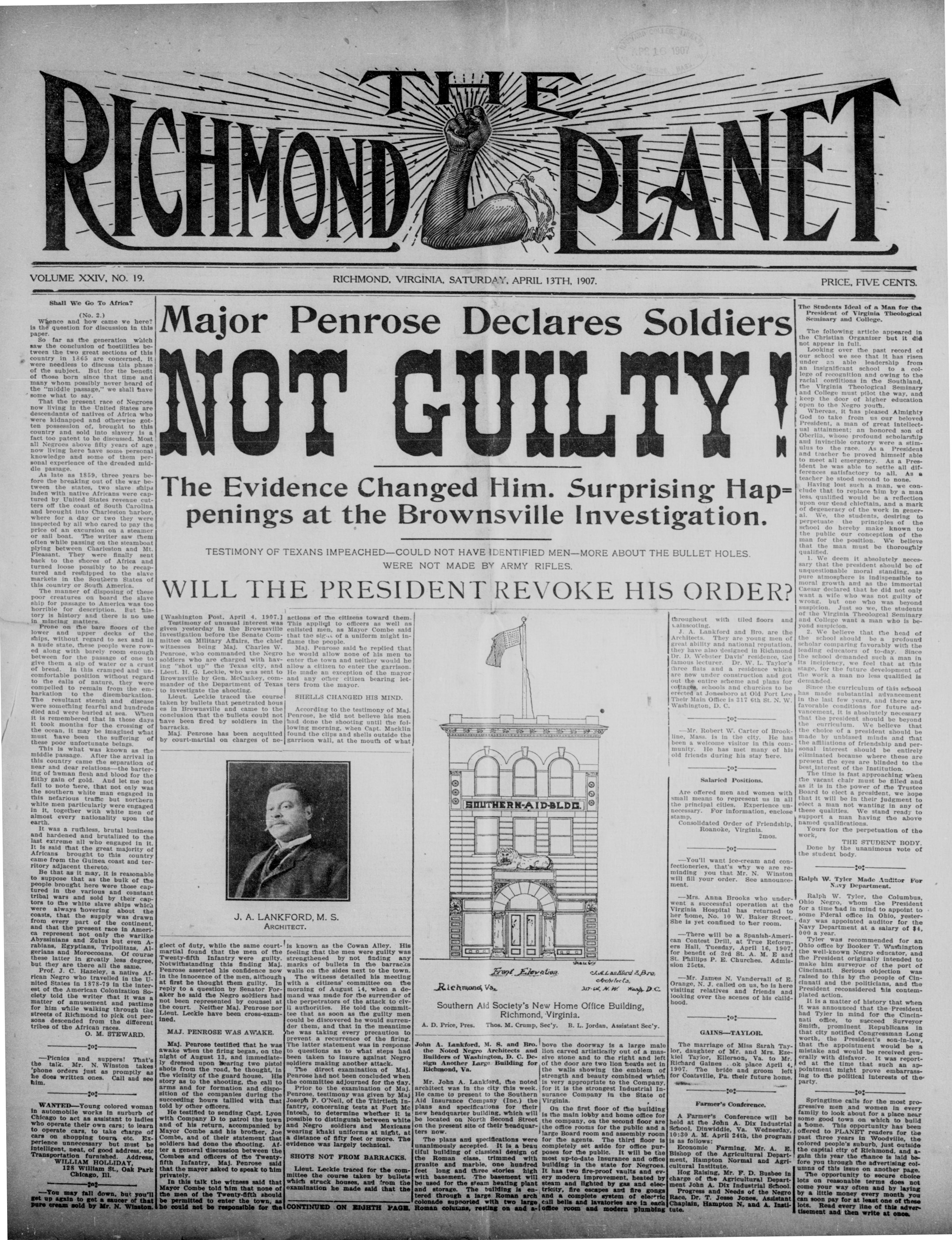
Major Penrose Declares Soldiers NOT GUILTY!
The Evidence Changed Him. Surprising Hap=penings at the Brownsville Investigation.
TESTIMONY OF TEXANS IMPEACHED—COULD NOT HAVE IDENTIFIED MEN—MORE ABOUT THE BULLET HOLES.
WERE NOT MADE BY ARMY RIFLES.
WILL THE PRESIDENT REVOKE HIS ORDER?
[Washington Post, April 4, 1907.]
Testimony of unusual interest was given yesterday in the Brownsville investigation before the Senate Committee on Military Affairs, the chief witnesses being Maj. Charles W. Penrose, who commanded the Negro soldiers who are charged with having "shot up" the Texas city, and Lieut. H. G. Leckie, who was sent to Brownsville by Gen. McCaskey, commander of the Department of Texas to investigate the shooting.
Lieut. Leckie traced the course taken by bullets that penetrated houses in Brownsville and came to the conclusion that the bullets could not have been fired by soldiers in the barracks.
Maj. Penrose has been acquitted by court-martial on charges of ne-
actions of the citizens toward them. This applauded to officers as well as enlisted men, as Mayor Combe said that the sign of a uniform might in-fame the people.
Maj. Penrose said he replied that he would allow none of his men to enter the town and neither would he allow a citizen to enter the garrison. He made an exception of the mayor and any other citizen bearing letters from the mayor.
SHELLS CHANGED HIS MIND.
According to the testimony of Maj. Penrose, he did not believe his men had done the shooting until the following morning, when Capt. Macklin found the clips and shells outside the garrison wall, at the mouth of what throughout with tiled floors and vainscoting.
J. A. Lankford and Bro. are the Architects. They are young men of great ability and national reputation, they have also designed in Richmond Dr. D. Webster Davis' residence, the famous lecturer. Dr. W. L. Taylor's three flats and a residence which are now under construction and got out the entire scheme and plans for cottages, schools and churches to be erected at Jonesboro at Old Fort Lee Their Main Office is 317 6th St. N. W. Washington, D. C.
Mr. Robert W. Carter of Brookline, Mass. is in the city. He has
M. B.
glect of duty, while the same court-martial found that the men of the Twenty-fifth Infantry were guilty. Notwithstanding this finding Maj. Penrose asserted his confidence now in the innocence of the men, although at first he thought them guilty. In reply to a question by Senator Foraker he said the Negro soldiers had not been represented by counsel at the court. Neither Maj. Penrose nor Lleut. Leckle have been cross-examined.
MAJ. PENROSE WAS AWAKE.
Maj. Penrose testified that he was awake when the fire began, on the night of August 13, and immediately dressed upon hearing two pistol shots from the road, he thought, in the vicinity of the guard house. His story as to the shooting, the call to arms and for formation and disposition of the companies during the succeeding hours tallied with that told by other officers.
He testified to sending Capt. Lyon with Company D to patrol the town and of his return, accompanied by Mayor Combe and his brother, Joe Combe, and of their statement that soldiers had done the shooting. After a general discussion between the Combes and officers of the Twenty-fifth Infantry, Maj. Penrose said that the mayor asked to speak to him privately.
In this talk the witness said that Mayor Combe told him that none of the men of the Twenty-fifth should be permitted to enter the town, as he could not be responsible for the
actions of the citizens toward them. This applaud to officers as well as enlisted men, as Mayor Combe said that the sign of a uniform might infame the people. Maj. Penrose said he replied that he would allow none of his men to enter the town and neither would he allow a citizen to enter the garrison. He made an exception of the mayor and any other citizen bearing letters from the mayor.
SHELLS CHANGED HIS MIND
According to the testimony of Maj. Penrose, he did not believe his men had done the shooting until the following morning, when Capt. Macklin found the clips and shells outside the garrison wall, at the mouth of what
is known as the Cowan Alley. His feeling that the men were guilty was strengthened by not finding any marks of bullets in the barracks walls on the sides next to the town. The witness detailed his meeting with a citizens' committee on the morning of August 14, when a demand was made for the surrender of the perpetrators of the attack to civil authorities. He told the committee that as soon as the guilty men could be discovered he would surrender them, and that in the meantime he was taking every precaution to prevent a recurrence of the firing. The latter statement was in response to questions as to what steps had been taken to insure against Negro soldiers making another attack. The direct examination of Maj. Penrose had not been concluded when the committee adjourned for the day. Prior to the examination of Maj. Penrose, testimony was given by Maj. Joseph P. O'Neil, of the Thirtieth Infantry, concerning tests at Fort McIntosh, to determine whether it is possible to distinguish between white and Negro soldiers and Mexicans wearing khaki uniforms at night, at a distance of fifty feet or more. The evidence was largely technical.
SHOTS NOT FROM BARRACKS.
Lieut. Leckle traced for the committee the course taken by bullets which struck houses, and from the examination he made said that the CONTINUED ON EIGHTH PAGE.
RICHMOND, VIRGINIA, SATURDAY, APRIL 13TH, 1907.
SOUTHERN-AID-BLDG.
Southern Aid Society's New Home Office Building, Richmond, Virginia.
John A. Lankford, M. S. and Bro. the Noted Negro Architects and Builders of Washington, D. C. Design Another Large Building for Richmond, Va.
Mr. John A. Lankford, the noted architect was in the city this week. He came to present to the Southern Aid Insurance Company (Inc.) the plans and specifications for their new headquarters building, which will be located on North Second Street on the present site of their headquarters now.
The plans and specifications were unanimously accepted. It is a beautiful building of classical design of the Roman class, trimmed with granite and marble, one hundred feet long and three stories high with basement. The basement will be used for the steam heating plant and storage. The building is entered through a large Roman arch colonade supported with two large Roman columns, resting on and a-
bove the doorway is a large male lion carved artistically out of a massive stone and to the right and left of the door are two lion heads set in the walls showing the emblem of strength and beauty combined which is very appropriate to the Company, for it is the strongest Industrial Insurance Company in the State of Virginia.
On the first floor of the building is the main lobby and home office for the company, on the second floor are the office rooms for the public and a large Board room and assembly room for the agents. The third floor is completely set aside for office purposes for the public. It will be the most up-to-date Insurance and office building in the state for Negroes. It has two fire-proof vaults and every modern improvement, heated by steam and lighted by gas and electricity, fire escapes and fire gongs and a complete system of electric call bells and lavatories are in each office room and modern plumbing
throughout with tiled floors and
walkscoring
vanshooting.
J. A. Lankford and Bro. are the Architects. They are young men of great ability and national reputation, they have also designed in Richmond Dr. D. Webster Davis' residence, the famous lecturer, Dr. W. L. Taylor's three flats and a residence which are now under construction and got out the entire scheme and plans for cottages, schools and churches to be erected at Jonesboro at Old Fort Lee Their Main Office is 317 6th St. N. W. Washington, D. C.
—Mr. Robert W. Carter of Brookline, Mass. is in the city. He has been a welcome visitor in this community. He has met many of his old friends during his stay here.
Salaried Positions.
Are offered men and women with small means to represent us in all the principal cities. Experience unnecessary. For information, enclose stamp.
Consolidated Order of Friendship,
Roanoke, Virginia.
2mos.
—You'll want ice-cream and confectioneries, that's why we are reminding you that Mr. N. Winston will fill your order. See announcement.
—Mrs. Anna Brooks who underwent a successful operation at the Virginia Hospital has returned to her home, No. 10 W. Baker Street. She is yet confined to her room.
—There will be a Spanish-American Contest Drill, at True Reformers Hall, Tuesday, April 16, 1907, for benefit of 3rd St. A. M. E and St. Phillips P. E. Churches. Admission 25cts.
—Mr. James N. Vandervall of E. Orange, N. J. called on us, is to be visiting relatives and friends and looking over the scenes of his childhood.
GAINS—TAYLOR.
The marriage of Miss Sarah Taylor, daughter of Mr. and Mrs. Ezekiel Taylor, Ellerson, Va. to Mr. Richard Galnes .ok place April 4, 1907. The bride and groom left for Coatsville, Pa. their future home.
Farmer's Conference.
A Farmer's Conference will be held at the John A. Dix Industrial School, Dinwiddie, Va. Wednesday, 10:30 A. M. April 24th, the program is as follows: Economic Farming, Mr. A. E. Bishop of the Agricultural Department, Hampton Normal and Agricultural Institute. Hog Raising, Mr. F. D. Busbee in charge of the Agricultural Department John A. Dix Industrial School. Progress and Needs of the Negro Race, Dr. T. Jesse Jones, Assistant Chaplain, Hampton N. and A. Institute.
PRICE. FIVE CENTS
The Students Ideal of a Man for the President of Virginia Theological Seminary and College.
The following article appeared in the Christian Organizer but it did not appear in full.
Looking over the past record of our school we see that it has risen under an able leadership from an insignificant school to a college of recognition and owing to the racial conditions in the Southland, the Virginia Theological Seminary and College must pilot the way, and keep the door of higher education open to the Negro youth.
Whereas, it has pleased Almighty God to take from us our beloved President, a man of great intellectual attainment; an honored son of Oberlin, whose profound scholarship and invincible oratory were a stimulus to the race. As a President and teacher he proved himself able to meet all emergency. As a President he was able to settle all differences satisfactory to all. As a teacher he stood second to none.
Having lost such a man, we conclude that to replace him by a man less qualified would be a reflection upon our dead chieftain, and a mark of degeneracy of the work in general. We, the students, desiring perpetuate the principles of the school do hereby make known to the public our conception of the man for the position. We believe that the man must be thoroughly qualified.
1. We deem it absolutely necessary that the president should be of unquestionable moral standing, as pure atmosphere is indispensible to moral growth and as the immortal Caesar declared that he did not only want a wife who was not guilty of wrong, but one who was beyond suspicion. Just so we, the students of the Virginia Theological Seminary and College want a man who is beyond suspicion.
2. We believe that the head of the school should be a profound scholar comparing favorably with the leading educators of to-day. Since the school demanded such a man in its incipiency, we feel that at this stage, for the future development of work a man no less qualified is demanded.
Since the curriculum of this school has made substantial advancement in the last few years, and there are favorable conditions for future advancement, it is absolutely necessary that the president should be beyond the curriculum. We believe that the choice of a president should be made by unblased minds and that the affiliations of friendship and personal interest should be entirely eliminated because where these are present the eyes are blinded to the best interest of the Institution.
The time is fast approaching when the vacant chair must be filled and as it is in the power of the Trustee Board to elect a president, we hope that it will be in their judgment to elect a man not wanting in any of these qualities. We stand ready to support a man having the above named qualifications.
Yours for the perpetuation of the work,
THE STUDENT BODY.
Done by the unanimous vote of the student body.
Ralph W. Tyler Made Auditor For Navy Department.
Ralph W. Tyler, the Columbus, Ohio Negro, whom the President for a time had in mind to appoint to some Feral office in Ohio, yesterday was appointed auditor for the Navy Department at a salary of $4, 000 a year. Tyler was recommended for an Ohio office by Booker T. Washington the well-known Negro educator, and the President originally intended to make him surveyor of the port of Cincinnati. Serious objection was raised to this by the people of Cincinnati and the politicians, and the President reconsidered his contemplated action. It is a matter of history that when it was announced that the President had Tyler in mind for the Cincinnati office, to succeed Surveyor Smith, prominent Republicans in that city notified Congressman Longworth, the President's son-in-law, that the appointment would be a mistake and would be received generally with disfavor. It was reported at the time that such an appointment might prove embarrassing to the political interests of the party.
Springtime calls for the most progressive men and women in every family to look about for a place near some good town on which to build a home. This opportunity has been offered to PLANET readers for the past three years in Woodville, the colored city's suburb, just outside the capital city of Richmond, and again this year the chance is laid before you through the advertising columns of this issue on another page. The opportunity to secure choice lots on reasonable terms does not come your way often and by laying by a little money every month you can soon pay for at least one of these lots. Read every line of this advertisement and then write at once.
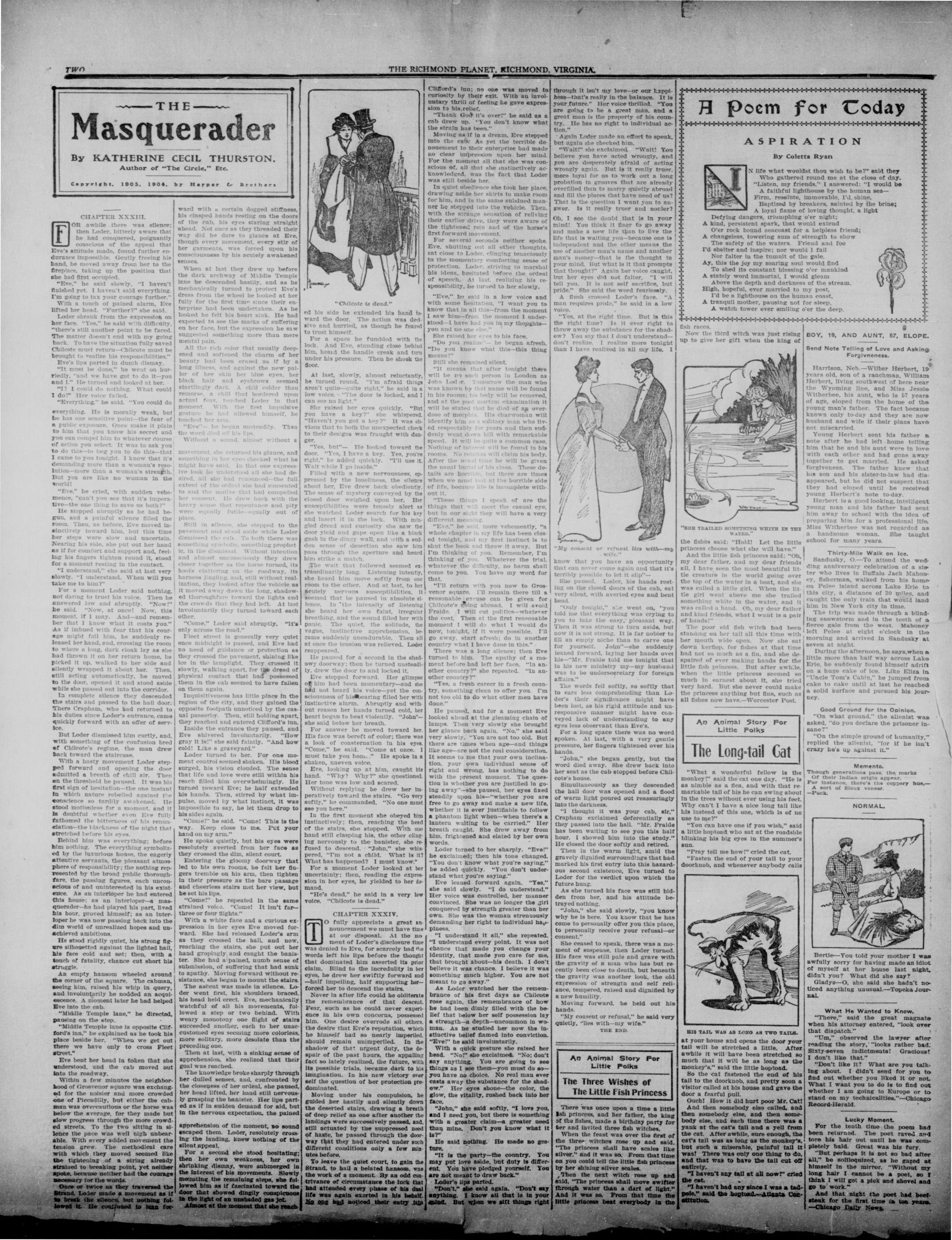
Masquerader
By KATHERINE CECIL THURSTON.
Author of "The Circle," Etc.
Copyright, 1905, 1904, by Harper & Brothers
TWO
CHAPTER XXXXIII
OR awhile there was silence; then Loder, bitterly aware that he had conquered, poignantly conscious of the appeal that Eve's attitude made, found further endurance impossible. Gently freeing his hand, he moved away from her to the fireplace, taking up the position that she had first occupied.
"Eve," he said slowly, "I haven't finished yet. I haven't said everything. I'm going to tax your courage further." With a touch of pained alarm, Eve lifted her head. "Further?" she said. Loder shrank from the expression on her face. "Yes," he said with difficulty, "there's still another point to be faced. The matter doesn't end with my going back. To have the situation fully saved Chilcote must return—Chilcote must be brought to realize his responsibilities." Eve's lips parted in dumb dismay. "It must be done," he went on hurriedly, "and we have got to do it—you and I." He turned and looked at her.
I do?" Her voice failed.
"Everything" he said. "You could do everything. He is morally weak, but he has one sensitive point—the fear of a public exposure. Once make it plain to him that you know his secret and you can compel him to whatever course of action you select. It was to ask you to do this—beg you to do this—that I came to you tonight. I know that it's demanding more than a woman's resolution—more than a woman's strength. But you are like no woman in the world!
"Eve," he cried, with sudden vehemence, "can't you see that it's imperative—the one thing to save us both?"
He stopped abruptly as he had begun, and a painful silence filled the room. Then, as before, Eve moved instinctively toward him, but this time her steps were slow and uncertain. Nearing his side, she put out her hand as if for comfort and support, and feeling his fingers tighten round it, stood for a moment resting in the contact.
"I understand," she said at last very slowly. "I understand. When will you take me to him?"
For a moment Loder said nothag, not daring to trust his voice. Then he answered low and abruptly. "Now!" he said. "Now, at once! Now, this moment, if I may. And—and remember that I know what it costs you." As if imbued with fear that his courage might fall him, he suddenly released her hand, and, crossing the room to where a long, dark cloak lay as she had thrown it on her return home, he picked it up, walked to her side and silently wrapped it about her. Then, still acting automatically, he moved to the door, opened it and stood aside while she passed out into the corridor. In complete silence they descended the stairs and passed to the hall door. There Grapham, who had returned to his duties since Loder's entrance, came quickly forward with an offer of service.
But Loder dismissed him curtly, and, with something of the confusion breed of Chilcote's regime, the man drew back toward the staircase. With a hasty movement Loder stepped forward and opening the door admitted a breath of chill air. Then on the threshold he paused. It was his first sign of hesitation—the one instant in which nature rebelled against the conscience so tardily awakened. He stood motionless for a moment, and it is doubtful whether even Eve fully fathomed the bitterness of his renunciation—the blackness of the night that stretched before his eyes.
Behind him was everything; before him nothing. The everything symbolized by the luxurious house, the eagerly attentive servants, the pleasant atmosphere of responsibility; the nothing represented by the broad public thoroughfare, the passing figures, each unconscious of and uninterested in his existence. As an interloper he had entered this house; as an interloper—a masquerader—he had played his part, lived his hour, proved himself; as an interloper he was now passing back into the dim world of unrealized hopes and unachieved ambitions.
He stood rigidly quiet, his strong figure silhouetted against the lighted hall, his face cold and set; then, with a touch of fatality, chance cut short his struggle.
An empty hansom wheeled around the corner of the square. The cabman, seeing him, raised his whip in query, and involuntarily he nodded an acquiescence. A moment later he had helped Eye into the cab.
"Middle Temple lane," he directed, pausing on the step.
"Middle Temple lane is opposite Clifford's inn," he explained as he took his place beside her. "When we get out there we have only to cross Fleet street."
Eve bent her head in token that she understood, and the cab moved out into the roadway.
Within a few minutes the neighborhood of Grosvenor square was exchanged for the nollsier and more crowded one of Plecadilly, but either the cabman was overcautions or the horse was below the average, for they made but slow progress through the more crowded streets. To the two sitting in silence the pace was well nigh unbearable. With every added movement the tension grew. The methodical care with which they moved seemed like the tightening of a string already strained to breaking point, yet neither spoke, because neither had the courage necessary for the words.
Once or twice as they traversed the Strand, Loder made a movement as if to break the silence, but nothing followed it. He confined to lean for
ward with a certain dogged stiffness, his clasped hands resting on the doors of the cab, his eyes staring straight ahead. Not once as they threaded their way did he dare to glance at Eve, though every movement, every stir of her garments, was forced upon his consciousness by his acutely awakened senses.
When at last they drew up before the dark archway of Middle Temple lane he descended hastily, and as he mechanically turned to protect Eve's dress from the wheel he looked at her fully for the first time since their enterprise had been undertaken. As he looked he felt his heart sink. He had expected to see the marks of suffering on her face, but the expression he saw suggested something more than mere mental pain.
All the rich color that usually deepened and softened the charm of her beauty had been erased as if by a long illness, and against the new pallor of her skin her blue eyes, her black hair and eyebrows seemed startlingly dark. A chill colder than remorse, a chill that bordered upon actual fear, touched Loder in that moment. With the first impulsive gesture he had allowed himself, he touched her arm. "Eve"-he began unsteadily. Then the word died off his lips.
Without a sound, almost: without a movement, she returned his glance, and something in her eyes checked what he might have said. In that one expressive look he understood all she had desired, all she had renounced—the full extent of the ordeal she had consented to and the motive that had compelled her consent. He drew back with the heavy sense that repentance and pity were equally futile—equally out of place.
Still in silence, she stepped to the pavement and stood aside while Loder dismissed the cab. To both there was something symbolic, something prophetic, in the dismissal. Without intention and almost unconsciously they drew closer together as the horse turned, its hoofs clattering on the roadway, its harness jingling, and, still without realization, they looked after the vehicle as it moved away down the long, shadowed thoroughfare toward the lights and the crowds that they had left. At last involuntarily they turned toward each other.
"Come," Loder said abruptly. "It's only across the road."
Fleet street is generally very quiet once midnight is passed, and Eve had no need of guidance or protection as they crossed the pavement, shining like ice in the lamplight. They crossed it slowly, walking apart, for the dread of physical contact that had possessed them in the cab seemed to have fallen on them again.
Inquisitiveness has little place in the region of the city, and they gained the opposite footpath unnoticed by the casual passerby. Then, still holding apart, they reached and entered Clifford's inn. Inside the entrance they paused, and Eve shivered involuntarily. "How gray it is!" she said faulty. "And how cold! Like a graveyard."
Loder turned to her. For one moment control seemed shaken. His blood surged, his vision clouded. The sense that life and love were still within his reach filled him overwhelmingly. He turned toward Eve; he half extended his hands. Then, stirred by what impulse, moved by what instinct, it was impossible to say, he let them drop to his sides again.
"Come!" he said. "Come! This is the way. Keep close to me. Put your hand on my arm."
He spoke quietly, but his eyes were resolutely averted from her face as they crossed the dim, silent court.
Entering the gloomy doorway that led to his own rooms, he felt her fingers tremble on his arm, then tighten in their pressure as the bare passage and cheerless stairs met her view, but he set his lips.
"Come!" he repeated in the same strained voice. "Come! It isn't far three or four flights."
With a white face and a curious expression in her eyes Eve moved forward. She had released Loder's arm as they crossed the hall, and now, reaching the stairs, she put out her hand gropingly and caught the banister. She had a pained, numb sense of submission, of suffering that had sunk to apathy. Moving forward without resistance, she began to mount the stairs.
The ascent was made in silence. Loder went first, his shoulders braced, his head held erect. Eve, mechanically watchful of all his movements, followed a step or two behind. With weary monotony one flight of stairs succeeded another, each to her unacustomed eyes seeming more colorless, more solitary, more desolate than the preceding one.
Then at last, with a sinking sense of apprehension, she realized that their goal was reached.
The knowledge broke sharply through her dulled senses, and, confronted by the closeness of her oralde, she paused, her head lifted, her hand still nervously grasping the banister. Her lips parted as if in sudden demand for aid, but in the nervous expectation, the pained apprehension of the moment, no sound escaped them. Loder, resolutely crossing the landing, knew nothing of the silent appeal.
For a second she stood hesitating; then her own weakness, her own shrinking dismay, were submerged in the interest of his movements. Slowly mounting the remaining steps, she followed him as if fascinated toward the door that showed dingly conspicuous in the light of an unshaded gas jet. Almost at the moment
THE RICHMOND PLANET, RICHMOND, VIRGINIA
P. L. LAMBERT
"Chilcote is dead."
ed his side he extended his hand toward the door. The action was desive and hurried, as though he feared to trust himself.
For a space he fumbled with the lock. And Eve, standing close behind him, heard the handle creak and turn under his pressure. Then he shook the door.
At last, slowly, almost reluctantly, he turned round. "I'm afraid things aren't quite—quite right," he said in a low voice. "The door is locked, and I can see no light."
She raised her eyes quickly. "But you have a key?" she whispered. "Haven't you got a key?" It was obvious that to both the unexpected check to their designs was fraught with danger.
"Yes, but"— He looked toward the door. "Yes, I have a key. Yes, you're right." he added quickly. "Till use it. Wait while I go inside."
Filled with a new nervousness, oppressed by the loneliness, the silence about her, Eve drew back obediently. The sense of mystery conveyed by the closed door welighed upon her. Her susceptibilities were tensely alert as she watched Loder search for his key and insert it in the lock. With mingled dread and curiosity she saw the door yield and gape open like a black gash in the dingy wall, and with a sudden sense of desertion she saw him pass through the aperture and heard him strike a match.
The wait that followed seemed extraordinarily long. Listening intently, she heard him move softly from one room to the other. And at last, to her acutely nervous susceptibilities, it seemed that he paused in absolute silence. In 'the intensity of listening she heard her own faint, irregular breathing, and the sound filled her with panic. The quiet, the solitude, the vague, instinctive apprehension, became suddenly unendurable. Then all at once the tension was relieved. Loder reappeared.
He paused for a second in the shadowy doorway; then he turned unsteadily, drew the door to and locked it.
Eve stepped forward. Her glimpse of him had been momentary—and she had not heard his voice—yet the consciousness of his hearing filled her with instinctive alarm. Abruptly and without reason her hands turned cold, her heart began to beat violently. "John"—she said below her breath.
For answer he moved toward her. His face was bereft of color; there was a look of consternation in his eyes. "Come," he said. "Come at once. I must take you home." He spoke in a shaken, uneven voice. Eve, looking up at him, caught his hand. "Why? Why?" she questioned. Her tone was low and scared. Without replying he drew her imperatively toward the stairs. "Go very softly," he commanded. "No one must see you here."
In the first moment she obeyed him instinctively; then, reaching the head of the stairs, she stopped. With one hand still clasping his, the other clinging nervously to the banister, she refused to descend. "John," she whispered. "I'm not a child. What is it? What has happened? I must know."
For a moment Loder looked at her uncertainly; then, reading the expression in her eyes, he yielded to her demand.
"He's dead," he said in a very low voice. "Chilcite is dead."
CHAPTER XXXIV
O fully appreciate a great announcement we must have time at our disposal. At the moment of Loder's disclosure time was denied to Eve, for scarcely had the words left his lips before the thought that dominated him asserted the prior claim. Blind to the incredulity in her eyes, he drew her swiftly forward and—half impelling, half supporting her—forced her to descend the stairs. Never in after life could he obliterate the remembrance of that descent. Fear, such as he could never experience in his own concerns, possessed him. One desire overrode all others, the desire that Eve's reputation, which he himself had so nearly imperiled, should remain unimperilled. In the shadow of that urgent duty, the despair of the past hours, the appalling fact so lately realized, the future, with its possible trials, became dark to his imagination. In his new victory over self the question of her protection predominated.
Moving under his compulsion, he guided her hastily and silently down the deserted stairs, drawing a breath of deep relief as one after another the landings were successively passed, and, still actuated by the suppressed need of haste, he passed through the doorway that they had entered under such different conditions only a few minutes before.
To leave the quiet court, to gain the Strand, to hail a belated hansom, was the work of a moment. By an odd contrivance of circumstance the luck that had attended every phase of his dual life was again exerted in his behalf. No one had noticed their entry into
Clifford's inn; no one was moved to curiosity by their exit. With an involuntary thrill of feeling he gave expression to his relief.
"Thank God it's ever!" he said as a cab drew up. "You don't know what the strain has been."
Moving as if in a dream, Eve stepped into the cab; As yet the terrible denouncement to their enterprise had made no clear impression upon her mind. For the moment all that she was conscious of, all that she instinctively acknowledged, was the fact that Loder was still beside her.
In quiet obedience she took her place, drawing aside her skirts to make room for him, and in the same subdued manner he stepped into the vehicle. Then, with the strange sensation of reliving their earlier drive, they were aware of the tightened rein and of the horse's first forward movement.
For several seconds neither spoke. Eve, shutting out all other thoughts, sat close to Loder, clinging tenaciously to the momentary comforting sense of protection. Loder, striving to marshal his ideas, hesitated before the ordeal of speech. At last, realizing his responsibility, he turned to her slowly.
"Eve," he said in a low voice and with some hesitation, "I want you to know that in all this—from the moment I saw him—from the moment I understood—I have had you in my thoughts—you and no one else."
She raised her eyes to his face.
"Do you realize?" he began afresh.
"Do you know what this—this thing means?"
Still she remained silent.
"It means that after tonight there will be no such person in Loudon as John Lodr. Tomorrow the man who was known by that name will be found in his rooms; his body will be removed, and at the post mortem examination it will be stated that he died of an overdose of morphin. His charwoman will identify him as a solitary man who lived respectably for years and then suddenly went down bill with remarkable speed. It will be quite a common case. Nothing of interest will be found in his rooms. No relation will claim his body. After the usual time he will be given the usual burial of his class. These details are horrible, but there are times when we must look at the horrible side of life, because life is incomplete without it.
"These things I speak of are the things that will meet the casual eye, but in our sight they will have a very different meaning.
"Eve," he said, more vehemently, "a whole chapter in my life has been closed tonight, and my first instinct is to shut the book and throw it away. But I'm thinking of you. Remember, I'm thinking of you. Whatever the trial, whatever the difficulty, no harm shall come to you. You have my word for that.
"I'll return with you now to Grosvenor square. I'll remain there till a reasonable excuse can be given for Chilcote's going abroad. I will avoid Fraide. I will cut politics—whatever the cost. Then at the first reasonable moment I will do what I would do now, tonight, if it were possible. I'll go away, start afresh; do in another country what I have done in this."
There was a long silence; then Eve turned to him. The apathy of a moment before had left her face. "In another country?" she repeated. "In another country?"
"Yes, a fresh career in a fresh country, something clean to offer you. I'm not too old to do what other men have done."
He paused, and for a moment Eve looked ahead at the gleaming chain of lamps. Then very slowly she brought her glance back again. "No," she said very slowly. "You are not too old. But there are times when age—and things like age—are not the real consideration. It seems to me that your own inclination, your own individual sense of right and wrong, has nothing to do with the present moment. The question is whether you are justified in going away"—she paused, her eyes fixed steadily upon his—"whether you are free to go away and make a new life, whether it is ever justifiable to follow a phantom light when—when there's a lantern waiting to be carried." Her breath caught. She drew away from him, frightened and elated by her own words.
Loder turned to her sharply. "Eve!" he exclaimed; then his tone changed. "You don't know what you're saying." he added quickly. "You don't understand what you're saying." Eve leaned forward again. "Yes," she said slowly. "I do understand." Her voice was controlled, her manner convinced. She was no longer the girl conquered by strength greater than her own. She was the woman strenuously demanding her right to individual happiness. "I understand it all," she repeated. "I understand every point. It was not chance that made you change your identity, that made you care for me, that brought about—his death. I don't believe it was chance. I believe it was something much higher. You are not meant to go away."
As Loder watched her the remembrance of his first days as Chilcote rose again, the remembrance of how he had been dimly filled with the belief that below her self possession lay a strength—a depth—uncommon in woman. As he studied her now the instinctive belief flamed into conviction. "Eve!" he said involuntarily.
With a quick gesture she raised her head. "No!" she exclaimed. "No; don't say anything. You are going to see things as I see them—you must do so—you have no choice. No real man ever casts away the substance for the shadow." Her eyes shone—the color, the glow, the vitality, rushed back into her face.
"John," she said softly, "I love you, and I need you, but there is something with a greater claim—a greater need than mine. Don't you know what it is?"
He said nothing. He made no gesture.
"It is the party—the country. You may put love aside, but duty is different. You have pledged yourself. You are not meant to draw back." Loder's lips parted. "Don't," she said again. "Don't say anything. I know all that is in your mind. But when we sift things right
through it isn't my love—or our happily—that's really in the balance. It is your future." Her voice thrilled. "You are going to be a great man, and a great man is the property of his country. He has no right to individual action."
Again Loder made an effort to speak, but again she checked him.
"Wait!" she exclaimed. "Wait! You believe you have acted wrongly, and you are desperately afraid of acting wrongly again. But is it really truer, more loyal for us to work out a long probation in grooves that are already overfilled to marry quietly abroad and fill the places that have need of us? That is the question I want you to answer. Is it really truer and notler?
Oh, I see the doubt that is in your mind! You think it finer to go away and make a new life than to live the life that is waiting you—because one is independent and the other means the use of another man's name and another man's money—that is the thought in your mind. But what is it that prompts that thought? Again her voice caught, but her eyes did not falter, "I will tell you. It is not self sacrifice, but pride." She said the word fearlessly. A flush crossed Loder's face. "A man requires pride," he said in a low voice. "Yes, at the right time. But is this the right time? It is ever right to throw away the substance for the shadow? You say that I don't understand—don't realize. I realize more tonight than I have realized in all my life. I
A. H. H. B.
"My consent or refusal lies with—my wife."
know that you have an opportunity that can never come again and that it's terribly possible to let it slip"—She paused. Loder, his hands resting on the closed doors of the cab, sat very silent, with averted eyes and bent head.
"Only tonight," she went on, "you told me that everything was crying to you to take the easy, pleasant way. Then it was strong to turn aside, but now it is not strong. It is far nobler to fill an empty niche than to carve one for yourself. John"—she suddenly leaned forward, laying her hands over his—Mr. Fraide told me tonight that in his new ministry my—my husband was to be unders secretary for foreign affairs."
The words fell softly, so softly that to ears less comprehending than Loder's their significance might have been lost, as his rigid attitude and unresponsive manner might have conveyed lack of understanding to any eyes less observant than Eve's.
For a long space there was no word spoken. At last, with a very gentle pressure, her fingers tightened over his hands.
"John," she began gently, but the word died away. She drew back into her seat as the cab stopped before Chilcote's house.
Simultaneously as they descended the hall door was opened and a flood of warm light poured out reassuringly into the darkness.
"I thought it was your cab, sir." Grapha exclaimed deferentially as they passed into the hall. "Mr. Fralde has been waiting to see you this half hour. I showed him into the study." He closed the door softly and retired.
Then in the warm light, amid the gravelly dignified surroundings that had marked his first entry into this hazardous second existence, Eve turned to Loder for the verdict upon which the future hung.
As she turned his face was still hidden from her, and his attitude betrayed nothing.
"John," she said slowly, "you know why he is here. You know that he has come to personally offer you this place, to personally receive your refusal—or consent."
She ceased to speak, there was a moment of suspense, then Loder turned. His face was still pale and grave with the gravity of a man who has but recently been close to death, but beneath the gravity was another look, the old expression of strength and self reliance, tempered, raised and dignified by a new humility.
Moving forward, he held out his hands.
"My consent or refusal," he said very quietly, "lies with—my wife."
THE END.
An Animal Story For
Little Polks
The Three Wishes of
The Little Fish Princess
There was once upon a time a little
fish princess, and her father, the king
of the fishes, made a birthday party for
her and invited three fish witches.
When the feast was over the first of
the three witches rose up and said,
"The princess shall have scales like
silver," and it was so. From that time
on you could tell the little fish princess
by her shining silver scales.
Then the next witch rose up and
said, "The princess shall move swifter
through water than a dart of light."
And it was so. From that time the
little princess beat everybody in the
A Poem for Today
ASPIRATION
By Coletta Ryan
N life what wouldst thou wish to be?" said they
Who gathered round me at the close of day.
"Listen, my friends," I answered: "I would be
a faithful lighthouse by the human sea—
Firm, resolute, immovable, I'd, shine,
Baptized by breakers, sainted by the brine;
A loyal flame of loving thought, a light
Defying dangers, triumphing
A kind, persistent spark, that w
O'er rock bound seacoast for
A changeless, towering sum of f
The safety of the waters. F
I'd shelter and inspire; nor wou
Nor falter in the tumult of th
Ay, this the joy my soaring soul
To shed its constant blessing
A stately word immortal, I wou
Above the depth and darkness
High, hopeful, ever married to
I'd be a lighthouse on the hun
A tranquil mother, pausing not
A watch tower ever smiling
fish races.
Defying dangers, triumphing o'er night;
A kind, persistent spark, that would extend
O'er rock bound seacast for a helpless friend;
A changeless, towering sum of strength to show
The safety of the waters. Friend and foe
I'd shelter and inspire; nor would I fail
Nor falter in the tumult of the gale.
Ay, this the joy my soaring soul would find
To shed its constant blessing o'er mankind
A stately word immortal, I would gleam
Above the depth and darkness of the stream.
High, hopeful, ever married to my post,
I'd be a lighthouse on the human coast,
A tranquil mother, pausing not for sleep,
A watch tower ever smiling o'er the deep.
Now the third witch was just rising up to give her gift when the king of
Wy Tread
"SHE TRAILED SOMETHING WHITE IN THE WATER."
the fishes said: "Hold! Let the little princess choose what she will have."
And the little fish princess said: "Oh, my dear father, and my dear friends all, I have seen the most beautiful little creature in the world going over the top of the water in a boat, and she was called a little girl. When the little girl went above me she trailed something white in the water, and it was called a hand. Oh, my dear father and kind friends, what I want is a pair of hands."
The poor old fish witch had been standing on her tail all this time with her mouth wide open. Now she sat down kerflop, for fishes at that time had not so much as a fin, and she despaired of ever making hands for the little fish princess. But after awhile, when the little princess seemed so much in earnest about it, she tried very hard. But she never could make the princess anything but fins, such as all fishes now have—Worcester Post.
An Animal Story For Little Folks
The Long-tail Cat
"What a wonderful fellow is the monkey!" said the cat one day. "He is as nimble as a flea, and with that remarkable tail of his he can swing about in the trees without ever using his feet. Why can't I have a nice long tail like his instead of this one, which is of no use to me?" "You can have one if you wish," said a little hoptoad who sat at the roadside blinking his big eyes in the summer's sun.
"Pray tell me how!" cried the cat.
"Fasten the end of your tail to your doorknob, and whenever anybody calls
W
HIS TAIL WAS AS LONG AS TWO TAILS.
at your house and opens the door your
tail will be stretched a little. After
awhile it will have been stretched so
much that it will be as long as the
monkey's," said the little hoptoad.
So the cat fastened the end of his
tail to the doorknob, and pretty soon a
visitor called at his house and gave the
door a fearful pull.
Ouch! How it did hurt poor Mr. Cat!
And then somebody else called, and
then somebody else, and then some-
body else, and each time there was a
yank at the cat's tail and a yell from
the cat. After awhile, sure enough, the
cat's tail was as long as the monkey's,
but such a miserable, painful tail it
was! There was only one thing to do,
and that was to have the tail cut off
entirely.
"I haven't any tail at all now!" cried
the cat.
"I haven't had any since I was a tad-
pole," said the hoptoad.—Atlanta Consti-
tution.
I
```markdown
```
BOY, 19, AND AUNT, 57, ELOPE.
Send Note Telling of Love and Asking Forgiveness.
Harrison, Neh.—Wilber Herbert, 19 years old, son of a ranchman, William Herbert, living southwest of here near the Wyoming line, and Miss Jessie Witherbee, his aunt, who is 57 years of age, eloped from the home of the young man's father. The fact became known only to-day and they are now husband and wife if their plans have not miscarried.
Young Herbert sent his father a note after he had left home telling him that he and his aunt were in love with each other and had gone away together to get married. He asked forgiveness. The father knew that his son and his sister-in-law had disappeared, but he did not suspect that they had eloped until he received young Herbert's note to-day.
Herbert is a good looking, intelligent young man and his father had sent him away to school with the idea of preparing him for a professional life. Miss Witherbee was not regarded as a handsome woman. She taught school for many years.
Thirty-Mile Walk on Ice
Sandusky, O—To attend the wedding anniversary celebration of a sister who lives in Buffalo Jack Mahoney, fisherman, walked from his home on Peele island across Lake Erie to this city, a distance of 30 miles, and caught the only train that would land him in New York city in time.
The trip was made through a blinding snowstorm and in the teeth of a fierce gale from the west. Mahoney left Peele at eight o'clock in the morning and arrived in Sandusky at seven at night.
During the afternoon, he says, when a little more than half way across Lake Erie, he suddenly found himself adrift on a huge cake of ice. Like Eliza in "Uncle Tom's Cabin," he jumped from cake to cake until at last he reached a solid surface and pursued his journey.
Good Ground for the Opinion.
"On what ground," the alienist was asked, "do you declare the prisoner insane?"
"On the simple ground of humanity," replied the alienist. "for if he isn't crazy he's up against it."
Memento.
Though generations pass, the marks
Of their Indian origin appear.
For instance, there's the coppery hue,—
A report of Sioux veneer.
—Ruck.
Bertie—You told your mother I was awfully sorry for having made an idiot of myself at her house last night, didn't you? What did she say?
Gladys—O, she said she hadn't noticed anything unusual.—Topeka Journal.
What He Wanted to Know.
"There," said the great magatee when his attorney entered, "look over that dispatch."
"Um," observed the lawyer after reading the story, "looks rather bad. Sixty-seven indictments! Gracious! I don't like that."
"Don't like it? What are you talking about. I didn't send for you to find out whether you liked it or not. What I want you to do is to find out whether I am going to Europe or to stand on my technicalities."—Chicago Record-Herald.
Lucky Moment.
For the tenth time the poem had been returned. The poet raved and tore his hair out until he was completely bald. Great was his fury.
"But perhaps it is not so bad after all," he so floquized, as he gazed at himself in the mirror. "Without my long hair I cannot be a poet, so I think I will get a pick and shovel and go to work."
And that night the poet had beef-steak for the first time in ten years.
-Chicago Daily News
---
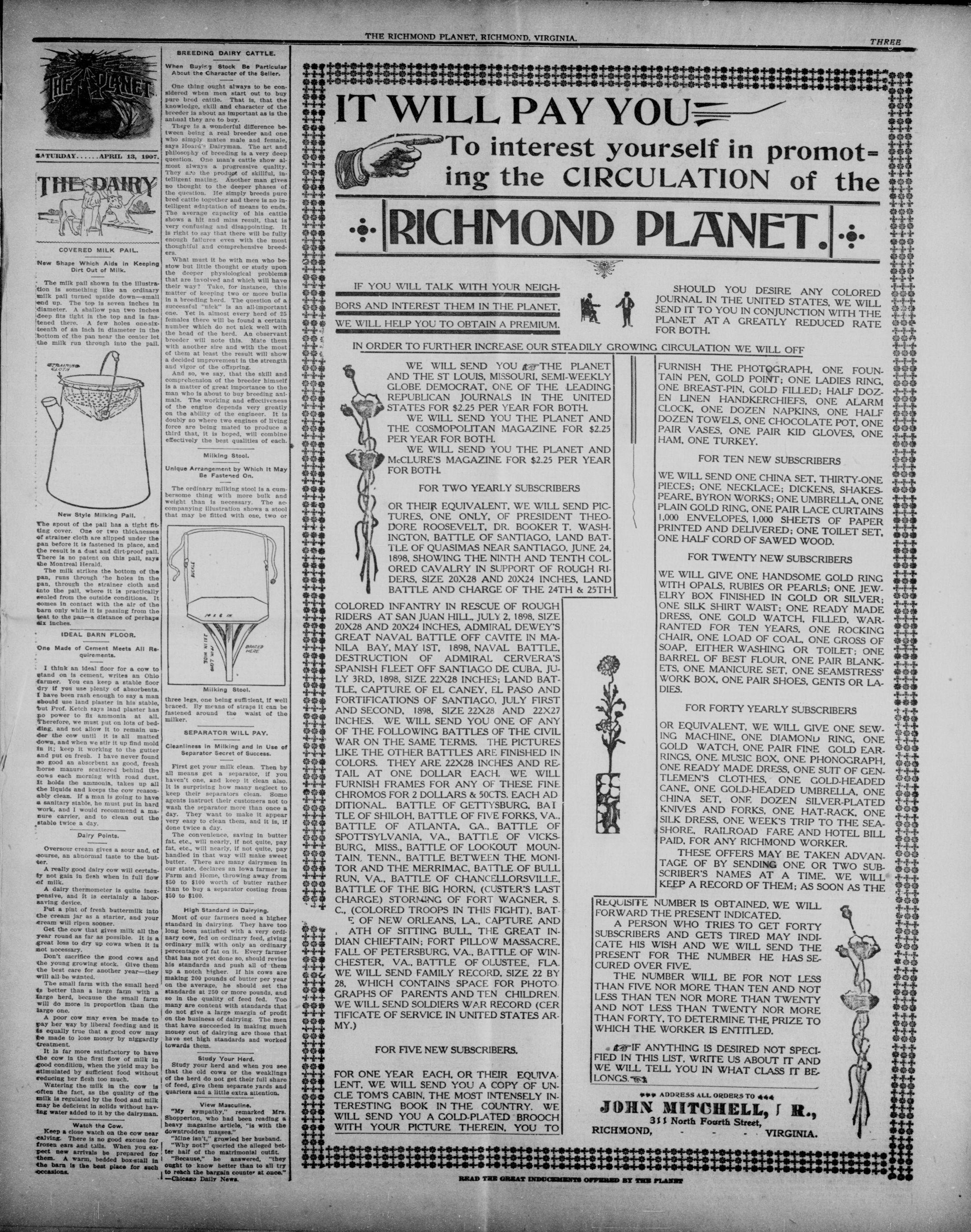
IT WILL PAY YOU To interest yourself in promot ing the CIRCULATION of the RICHMOND PLANET.
---
THE PLANET
SATURDAY...APRIL 13, 1907
THE DAIRY
COVERED MILK PAIL.
New Shape Which Aids in Keeping Dirt Out of Milk.
The milk pail shown in the illustration is something like an ordinary milk pail turned upside down—small end up. The top is seven inches in diameter. A shallow pan two inches deep fits tight in the top and is fastened there. A few holes one-sixteenth of an inch in diameter in the bottom of the pan near the center let the milk run through into the nail.
TRAINING CLOTH
New Style Milking Pail.
The spout of the pail has a tight fitting cover. One or two thicknesses of strainer cloth are slipped under the pan before it is fastened in place, and the result is a dust and dirt-proof pail. There is no patent on this pail, says the Montreal Herald.
The milk strikes the bottom of the pan, runs through 'he holes in the pan, through the strainer cloth and into the pail, where it is practically sealed from the outside conditions. It comes in contact with the air of the barn only while it is passing from the teat to the pan—a distance of perhaps six inches.
IDEAL BARN FLOOR.
One Made of Cement Meets All Requirements.
I think an ideal floor for a cow to stand on is cement, writes an Ohio farmer. You can keep a stable floor dry if you use plenty of absorbents. I have been rash enough to say a man should use land plaster in his stable, but Prof. Ketch says land plaster has power to fix ammonia at all. Therefore, we must put on lots of bedding, and not allow it to remain under the cow until it is all matted down, and when we stir it up find mold in it; keep it working to the gutter and put on fresh. I have never found so good an absorbent as good, fresh horse manure scattered behind the cows each morning with road dust. It holds the ammonia, takes up all the liquids and keeps the cow reasonably clean. If a man is going to have a sanitary stable, he must put in hard work, and I would recommend a manure carrier, and to clean out the stable twice a day.
Dairy Points.
Oversour cream gives a sour and, of course, an abnormal taste to the butter.
A really good dairy cow will certainly not gain in flesh when in full flow of milk.
A dairy thermometer is quite inexpensive, and it is certainly a labor-saving device.
Put a pint of fresh buttermilk into the cream jar as a starter, and your cream will ripen sooner.
Get the cow that gives milk all the year round as far as possible. It is a great loss to dry up cows when it is not necessary.
Don't sacrifice the good cows and the young growing stock. Give them the best care for another year—they will all be wanted.
The small farm with the small herd is better than a large farm with a large herd, because the small farm will do more in proportion than the large one.
A poor cow may even be made to pay her way by liberal feeding and it is equally true that a good cow may be made to lose money by niggardly treatment.
It is far more satisfactory to have the cow in the first flow of milk in good condition, when the yield may be stimulated by sufficient food without reducing her flesh too much.
Watering the milk in the cow is often the fact, as the quality of the milk is regulated by the food and milk may be deficient in solids without having water added to it by the dairyman
Watch the Cow.
Keep a close watch on the cow near calving. There is no good excuse for frozen ears and tails. When you expect new arrivals be prepared for them. A warm, bedded box-stall in the barn is the best place for such occasions.
WE WILL HELP YOU TO OBTAIN A PREMIUM.
COLORED INFANTRY IN RESCUE OF ROUGH RIDERS AT SAN JUAN HILL, JULY 2, 1898, SIZE 20X28 AND 20X24 INCHES, ADMIRAL DEWEY'S GREAT NAVAL BATTLE OFF CAVITE IN MANILA BAY, MAY 1ST, 1898, NAVAL BATTLE, DESTRUCTION OF ADMIRAL CERVERA'S SPANISH FLEET OFF SANTIAGO DE CUBA, JULY 3RD, 1898, SIZE 22X28 INCHES; LAND BATTLE, CAPTURE OF EL CANEY, EL PASO AND FORTIFICATIONS OF SANTIAGO, JULY FIRST AND SECOND, 1898, SIZE 22X28 AND 22X27 INCHES. WE WILL SEND YOU ONE OF ANY OF THE FOLLOWING BATTLES OF THE CIVIL WAR ON THE SAME TERMS. THE PICTURES LIKE THE OTHER BATTLES ARE FINISHED IN COLORS. THEY ARE 22X28 INCHES AND RETAIL AT ONE DOLLAR EACH. WE WILL FURNISH FRAMES FOR ANY OF THESE FINE CHROMOS FOR 2 DOLLARS & 50CTS. EACH ADDITIONAL. BATTLE OF GETTYSBURG, BATTLE OF SHILOH, BATTLE OF FIVE FORKS, VA., BATTLE OF ATLANTA, GA., BATTLE OF SPOTTSYLVANIA, VA., BATTLE OF VICKSBURG, MISS., BATTLE OF LOOKOUT MOUNTAIN, TENN., BATTLE BETWEEN THE MONITOR AND THE MERRIMAC, BATTLE OF BULL RUN, VA., BATTLE OF CHANCELLORSVILLE, BATTLE OF THE BIG HORN, (CUSTER'S LAST CHARGE) STORMING OF FORT WAGNER, S. C., (COLORED TROOPS IN THIS FIGHT), BAT
E OF NEW ORLEANS, LA., CAPTURE AND ATH OF SITTING BULL, THE GREAT INDIAN CHIEFTAIN; FORT PILLOW MASSACRE, FALL OF PETERSBURG, VA., BATTLE OF WINCHESTER, VA., BATTLE OF OLUSTEE, FLA. WE WILL SEND FAMILY RECORD, SIZE 22 BY 28, WHICH CONTAINS SPACE FOR PHOTOGRAPHS OF PARENTS AND TEN CHILDREN. WE WILL SEND SOLDIERS WAR RECORD (CERTIFICATE OF SERVICE IN UNITED STATES ARMY.)
FOR ONE YEAR EACH, OR THEIR EQUIVALENT, WE WILL SEND YOU A COPY OF UNCLE TOM'S CABIN, THE MOST INTENSELY INTERESTING BOOK IN THE COUNTRY. WE WILL SEND YOU A GOLD-PLATED BROOCH WITH YOUR PICTURE THEREIN, YOU TO
BREEDING DAIRY CATTLE.
When Buying Stock Be Particular
About the Character of the Seller.
One thing ought always to be considered when men start out to buy pure bred cattle. That is, that the knowledge, skill and character of the breeder is about as important as is the animal they are to buy.
There is a wonderful difference between being a real breeder and one who simply mates male and female, says Hoard's Dairyman. The art and philosophy of breeding is a very deep question. One man's cattle show almost always a progressive quality. They are the product of skillful, intelligent mating. Another man gives no thought to the deeper phases of the question. He simply breeds pure bred cattle together and there is no intelligent adaptation of means to ends. The average capacity of his cattle shows a hit and miss result, that is very confusing and disappointing. It is right to say that there will be fully enough failures even with the most thoughtful and comprehensive breeders.
What must it be with men who besetow but little thought or study upon the deeper physiological problems that are involved and which will have their way? Take, for instance, this matter of keeping two or more bulls in a breeding herd. The question of a successful "nick" is an all-important one. Yet in almost every herd of 25 females there will be found a certain number which do not nick well with the head of the herd. An observant breeder will note this. Mate them with another sire and with the most of them at least the result will show a decided improvement in the strength and vigor of the offspring.
```markdown
```
And so, we say, that the skill and comprehension of the breeder himself is a matter of great importance to the man who is about to buy breeding animals. The working and effectiveness of the engine depends very greatly on the ability of the engineer. It is doubly so where two engines of living force are being mated to produce a third that, it is hoped, will combine effectively the best qualities of each.
Milking Stool.
Unique Arrangement by Which It May Be Fastened On.
The ordinary milking stool is a cumbersome thing with more bulk and weight than is necessary. The accompanying illustration shows a stool that may be fitted with one, two or
14 X 6 IN
4 IN LONG
2 X 1 IN WIDE
BRACED HERE
Milking Stool.
three legs, one being sufficient, if well braced. By means of straps it can be fastened around the waist of the milker.
SEPARATOR WILL PAY
Cleanliness in Milking and in Use of Separator Secret of Success.
First get your milk clean. Then by all means get a separator, if you haven't one, and keep it clean also. It is surprising how many neglect to keep their separators clean. Some agents instruct their customers not to wash the separator more than once a day. They want to make it appear very easy to clean them, and it is, if done twice a day.
The convenience, saving in butter fat, etc., will nearly, if not quite, pay fat, etc., will nearly, if not quite, pay handled in that way will make sweet butter. There are many dairymen in our state, declares an Iowa farmer in Farm and Home, throwing away from $50 to $100 worth of butter rather than to buy a separator costing from $50 to $100.
High Standard in Dairying
Most of our farmers need a higher standard in dairying. They have too long been satisfied with a very ordinary cow, fed on ordinary feed, giving ordinary milk with only an ordinary percentage of fat on it. Every farmer that has not yet done so, should revise his standards and push all of them up a notch higher. If his cows are making 200 pounds of butter per year on the average, he should set the standards at 250 or more pounds, and so in the quality of feed fed. Too many are content with standards that do not give a large margin of profit on the business of dairying. The men that have succeeded in making much money out of dairying are those that have set high standards and worked towards them.
```markdown
```
Study Your Herd.
Study your herd and when you see that the old cows or the weaklings of the herd do not get their full share of feed, give them separate yards and quarters and a little extra attention.
View Masculine.
"My sympathy," remarked Mrs. Shopperton, who had been reading a heavy magazine article, "is with the downrodden mages."
"Mine isn't," growled her husband.
"Why not?" queried the alleged better half of the matrimonial outfit.
"Because," he answered, "they ought to know better than to all try to reach the bargain counter at once."
-Chicago Daily News.
IN ORDER TO FURTHER INCREASE OUR STEADILY GROWING CIRCULATION WE WILL OFF
WE WILL SEND YOU THE PLANET AND THE ST LOUIS, MISSOURI, SEMI-WEEKLY GLOBE DEMOCRAT, ONE OF THE LEADING REPUBLICAN JOURNALS IN THE UNITED STATES FOR $2.25 PER YEAR FOR BOTH. WE WILL SEND YOU THE PLANET AND THE COSMOPOLITAN MAGAZINE FOR $2.25 PER YEAR FOR BOTH. WE WILL SEND YOU THE PLANET AND McCLURE'S MAGAZINE FOR $2.25 PER YEAR FOR BOTH.
OR THEIR EQUIVALENT, WE WILL SEND PICTURES, ONE ONLY, OF PRESIDENT THEODORE ROOSEVELT, DR. BOOKER T. WASHINGTON, BATTLE OF SANTIAGO, LAND BATTLE OF QUASIMAS NEAR SANTIAGO, JUNE 24, 1898, SHOWING THE NINTH AND TENTH COLORED CAVALRY IN SUPPORT OF ROUGH RIDERS, SIZE 20X28 AND 20X24 INCHES, LAND BATTLE AND CHARGE OF THE 24TH & 25TH
READ THE GREAT INDUCEMENTS OFFERED BY THE PLANET
THE RICHMOND PLANET, RICHMOND, VIRGINIA
IF YOU WILL TALK WITH YOUR NEIGH-
FOR TWO YEARLY SUBSCRIBERS
FOR FIVE NEW SUBSCRIBERS
REQUISITE NUMBER IS OBTAINED, WE WILL FORWARD THE PRESENT INDICATED.
A PERSON WHO TRIES TO GET FORTY SUBSCRIBERS AND GETS TIRED MAY INDICATE HIS WISH AND WE WILL SEND THE PRESENT FOR THE NUMBER HE HAS SECURED OVER FIVE.
THE NUMBER WILL BE FOR NOT LESS THAN FIVE NOR MORE THAN TEN AND NOT LESS THAN TEN NOR MORE THAN TWENTY AND NOT LESS THAN TWENTY NOR MORE THAN FORTY, TO DETERMINE THE PRIZE TO WHICH THE WORKER IS ENTITLED.
IF ANYTHING IS DESIRED NOT SPECIFIED IN THIS LIST, WRITE US ABOUT IT AND WE WILL TELL YOU IN WHAT CLASS IT BELONGS.
JOHN MITCHELL, J R.,
311 North Fourth Street,
RICHMOND. VIRGINIA
A man in a suit is sitting in a chair. A man in a suit is standing next to him.
LANET
WEEKLY
READING
UNITED
H.
T AND
R $2.25
T AND
YEAR
ND PIC-
THEO-
WASH-
D BAT-
JUNE 24.
H COL-
HIGH RI-
LAND
& 25TH
```markdown
```
REQUISE
FORWA
SHOULD YOU DESIRE ANY COLORED JOURNAL IN THE UNITED STATES, WE WILL SEND IT TO YOU IN CONJUNCTION WITH THE PLANET AT A GREATLY REDUCED RATE FOR BOTH.
FURNISH THE PHOTOGRAPH, ONE FOUNTAIN PEN, GOLD POINT; ONE LADIES RING, ONE BREAST-PIN, GOLD FILLED; HALF DOZEN LINEN HANDKERCHIEFS, ONE ALARM CLOCK, ONE DOZEN NAPKINS, ONE HALF DOZEN TOWELS, ONE CHOCOLATE POT, ONE PAIR VASES, ONE PAIR KID GLOVES, ONE HAM, ONE TURKEY.
FOR TEN NEW SUBSCRIBERS
WE WILL SEND ONE CHIC
PIECES; ONE NECKLACE
PEARE, BYRON WORKS;
PLAIN GOLD RING, ONE
1,000 ENVELOPES, 1,000
PRINTED AND DELIVERY
ONE HALF CORD OF SAVE
FOR TWENTY NET
WE WILL GIVE ONE HAL
WITH OPALS, RUBIES OF
ELRY BOX FINISHED IN
ONE SILK SHIRT WAIST
DRESS, ONE GOLD WA
RANTED FOR TEN YE
CHAIR, ONE LOAD OF O
SOAP, EITHER WASHING
BARREL OF BEST FLOU
ETS, ONE MANICURE SHE
WORK BOX, ONE PAIR S
DIES.
FOR FORTY YEAR
OR EQUIVALENT, WE W
ING MACHINE, ONE D
GOLD WATCH, ONE P
RINGS, ONE MUSIC BOX,
ONE READY MADE DRRE
TLEMEN'S CLOTHES,
CANE, ONE GOLD-HEA
CHINA SET, ONE DOL
KNIVES AND FORKS, O
SILK DRESS, ONE WEEK
SHORE, RAILROAD FA
PAID, FOR ANY RICHMO
THESE OFFERS MAY
TAGE OF BY SENDING
SCRIBER'S NAMES AT
KEEP A RECORD OF TH
THE NUMBER IS OBTAINED, WE
RD THE PRESENT INDICATED
PERSON WHO TRIES TO GET
BERS AND GETS TIRED M
IS WISH AND WE WILL SEE
T FOR THE NUMBER HE
OVER FIVE.
THE NUMBER WILL BE FOR N
VE NOR MORE THAN TEN A
MAN TEN NOR MORE THAN
IT LESS THAN TWENTY NO
DRTY, TO DETERMINE THE B
THE WORKER IS ENTITLED.
IF ANYTHING IS DESIRED NO
THIS LIST, WRITE US ABOUT
TELL YOU IN WHAT CLAS
ALL SEND ONE CHINA SET, THIRD
ONE NECKLACE; DICKENS, AND
BABYRON WORKS; ONE UMBRELLA,
GOLD RING, ONE PAIR LACE CU
ENVELOPES, 1,000 SHEETS OF
AND DELIVERED; ONE TOI
FALF CORD OF SAWED WOOD.
FOR TWENTY NEW SUBSCRIBER
ALL GIVE ONE HANDSOME GOLD
APPALS, RUBIES OR PEARLS; ONE
BOX FINISHED IN GOLD OR
FILK SHIRT WAIST; ONE READ
ONE GOLD WATCH, FILLED
FOR TEN YEARS, ONE IN
ONE LOAD OF COAL, ONE GO
EITHER WASHING OR TOILET
OF BEST FLOUR, ONE PAIR
ONE MANICURE SET, ONE SEAM
BOX, ONE PAIR SHOES, GENTS.
FOR FORTY YEARLY SUBSCRIBER
EQUIVALENT, WE WILL GIVE ONE
MACHINE, ONE DIAMOND RING
WATCH, ONE PAIR FINE GOL
ONE MUSIC BOX, ONE PHONO
READY MADE DRESS, ONE SUIT
N'S CLOTHES, ONE GOLD-
ONE GOLD-HEADED UMBRELLA
SET, ONE DOZEN SILVER
AND FORKS, ONE HAT-RA
PRESS, ONE WEEK'S TRIP TO T
RAILROAD FARE AND HOT
FOR ANY RICHMOND WORKER
THE OFFERS MAY BE TAKEN
OF BY SENDING ONE OR T
PER'S NAMES AT A TIME.
WE RECORD OF THEM; AS SOON
IS OBTAINED, WE WILL
SENT INDICATED.
AND TRIES TO GET FORTY
GETS TIRED MAY INDIC
WE WILL SEND THE
NUMBER HE HAS SE-
WILL BE FOR NOT LESS
MORE THAN TEN AND NOT
MORE THAN TWENTY
THAN TWENTY NOR MORE
ETERMINE THE PRIZE TO
PER IS ENTITLED.
IS DESIRED NOT SPECI-
WRITE US ABOUT IT AND
IN WHAT CLASS IT BE-
WE WILL SEND ONE CHINA SET, THIRTY-ONE PIECES; ONE NECKLACE; DICKENS, SHAKESPEARE, BYRON WORKS; ONE UMBRELLA, ONE PLAIN GOLD RING, ONE PAIR LACE CURTAINS 1,000 ENVELOPES, 1,000 SHEETS OF PAPER PRINTED AND DELIVERED; ONE TOILET SET, ONE HALF CORD OF SAWED WOOD
FOR TWENTY NEW SUBSCRIBERS
WE WILL GIVE ONE HANDSOME GOLD RING WITH OPALS, RUBIES OR PEARLS; ONE JEWELRY BOX FINISHED IN GOLD OR SILVER; ONE SILK SHIRT WAIST; ONE READY MADE DRESS, ONE GOLD WATCH, FILLED, WARRANTED FOR TEN YEARS, ONE ROCKING CHAIR, ONE LOAD OF COAL, ONE GROSS OF SOAP, EITHER WASHING OR TOILET; ONE BARREL OF BEST FLOUR, ONE PAIR BLANKETS, ONE MANICURE SET, ONE SEAMSTRESS' WORK BOX, ONE PAIR SHOES, GENTS OR LADIES.
FOR FORTY YEARLY SUBSCRIBERS
OR EQUIVALENT, WE WILL GIVE ONE SEWING MACHINE, ONE DIAMOND RING, ONE GOLD WATCH, ONE PAIR FINE GOLD EARRINGS, ONE MUSIC BOX, ONE PHONOGRAPH, ONE READY MADE DRESS, ONE SUIT OF GENTLEMEN'S CLOTHES, ONE GOLD-HEADED CANE, ONE GOLD-HEADED UMBRELLA, ONE CHINA SET, ONE DOZEN SILVER-PLATED KNIVES AND FORKS, ONE HAT-RACK, ONE SILK DRESS, ONE WEEK'S TRIP TO THE SEASHORE, RAILROAD FARE AND HOTEL BILL PAID, FOR ANY RICHMOND WORKER. THESE OFFERS MAY BE TAKEN ADVANTAGE OF BY SENDING ONE OR TWO SUBSCRIBER'S NAMES AT A TIME. WE WILL KEEP A RECORD OF THEM; AS SOON AS THE
ADDRESS ALL ORDERS TO
IN MITCHELL,
311 North Fourth Street,
ND,
THE PLANET
CHELL, J R.,
Fourth Street,
VIRGINIA.
THREE
NOT= THE
COLORED WE WILL WITH THE RATE
ONE FOUNDIES RING, HALF DOZZLE ALARM ONE HALF POT, ONE LIVES, ONE
ERS
HIIRTY-ONE SHAKESPELLA, ONE CURTAINS OF PAPER DILET SET,
ERS
GOLD RING ONE JEWER SILVER; LADY MADE, WARN ROCKING GROSS OF FILET; ONE IR BLANKAMSTRESS' BITS OR LA-
ERS
ONE SEWING, ONE GOLD EARNOGRAPH, SET OF GEN-HEADED SELLA, ONE EAR-PLATED BACK, ONE IN THE SEA-OTEL BILLER.
IN ADVANT-TWO SUBWE WILL ON AS THE
```markdown
```
---
FOUR
THE PLANET
JOHN FITCHELL, JR. - EDITOR
All communications intended for publication
should be sent so as to reach us by Wednesday.
TERMS IN ADVANCE.
One Copy, one year,
One Copy, eight months
One Copy, six months
One Copy, four months
One Copy, three months
Single Copy
ADVERTISING RATE
For one inch, one insertion.
For one inch, each subsequent insertion.
For two inches, three months.
For two inches, six months.
For two inches, nine months.
For two inches, twelve months.
Marriage and Funeral Notices, one inch.
Standing and Transient Notices per line.
POSTAGE STAMPS OF A HIGHER DEMONINATION THAN TWO CENTURY NOT RECEIVED ON SUBSCRIPTIONS.
THE PLANET is issued weekly. The subscription price is $1.50 per year in advance.
There are FOUR ways by which money can be sent by mail at your risk—In a Post Office Monetary Order, in a Print, or an Express Money Order, and when these of these can be procured, in a Registered Letter.
MONEY ORDERS—You can buy a Money Order at your Post Office, payable at the Richmond Post Office, and we will be responsible for safe arrival.
EXPRESS MONEY ORDERS can be obtained at any office of the American Express Co. the United States Express Co. and the Wells Fargo Company, and will be responsible for money sent by any of the companies. The Express Money Order is a safe and convenient way for forwading money.
REGISTERED LETTER—If a money Order is registered, within your real h, your Postmaster will be obligated to Lettuce you wish to send on an payment of ten cents. Then, if the letters in lost or stolen, you can send money in this manner at our risk.
We cannot be responsible for money sent in letters in any other way than one of the four ways mentioned above. If you send your money in another way, you must do it at your own risk.
RENWALK, ETC.—If you do not want THE PLANET continued for another year after your description has run out, you then notify us by an Email Card to discontinue it. The course you decided that subscribers to newspaper, who do not order their paper discontinued at the ex-tenuation time for which it has been subscription held liable for the payment of the discontinuation up to date when they order the paper discontinued.
INFORMATIONS—When writing to us to renew your subscription or to discontinue paper, you should give your name and address in full otherwise we cannot find your name on books.
OCTAVAR OF ADDRESS—In order to change the address of a subscriber, we must be sent the former as well as the present address.
Entered at the Post-Office at Richmond, Va. second-class matter.
SATURDAY.....APRIL 13, 1907
We have received the announcement of the sixteenth summer session of Cornell University.
We have received an invitation to the wedding anniversary of Rev. Dr. and Mrs. J. M. Waldron, April 15, 1907, 8 P. M. at the Philathea Room of the Bethel Baptist Institute Church, Jacksonville, Florida.
Rev. Thomas D. Atkins, B. D., Th. D., has taken charge of the Ebenezer Baptist Church at Charlottesville. He has awakened religious enthusiasm there and seems to be supported by all parties. We wish him great success.
We have received a copy of the correspondence between Dr. N. F. Mossell, President of the Frederick Douglass Memorial Hospital of Philadelphia, Pa. and Dr. A. M. Curtis relative to the establishment of an emergency hospital at the Negro Exhibit of the Jamestown Exposition and Dr. Mossell's refusal to be connected therewith. His institution will not participate in the affair. He denounces the statement of the promoters of the exposition that he will in any way be connected therewith.
"THE BROWNSVILLE MYSTERY."
That the result of the Brownsville investigation at Washington, D. C. by the United States Senate Committee on Military Affairs has been highly favorable to the colored soldiers hardly admits of a question. That it has produced a most marked impression upon the thoughtful, conservative citizens everywhere is equally evident. The Washington, D. C. Post in its issue of the 6th inst under the caption of "The Brownsville Mystery" says:
After two months of investigation the Brownsville affray is more of a mystery than ever. The Committee on Military Affairs of the Senate has taken a recess until May 14, when it will begin the examination of the people of Brownsville who are supposed to have personal knowledge of the affray.
Not the slightest admission was secured from the Negro soldiers by the skilled interrogators of the Senate committee tending to prove that the soldiers had done the shooting or had any knowledge of the persons who did. The army officers who were in charge of the Negro troops at Brownville at the time of the affray testified that they were now convinced that the soldiers were innocent of the assault upon the town. Maj. Penrose, upon whose
report the President placed much reliance as to the guilt of the soldiers, told the committee that while at first he was forced to believe the soldiers had shot up the town, he had gradually reached the conclusion that they were innocent. The fact that men of good reputation and long service had suffered disgrace without opening their mouths, when they might have saved themselves if they had had knowledge of the identitif of the guilty parties and had revealed it, did much to convince Maj. Penrose that the soldiers were innocent. There was much testimony, also to the effect that the night was so dark that it was impossible to distinguish white men from Negroes or whether they were uniformed or not. The circumstances surrounding the discarded cartridge clips also served to raise strong doubts of the soldiers guilt.
It continues:
The Brownsville inquiry by developing the fact that the army officers concerned have changed their minds tends to make the position of the reviewing authorities somewhat embarrassing. The President based his punishment of the Negro soldiers upon the information furnished by the officers and their recommendations based upon this information. It now appears that the information was fragmentary and much of it erroneous, and the recommendations are not such as would be made if the officers were to report on the facts as developed. The reports of Maj. Blockisom and Gen. Garlington were based partly on the information furnished by the officers at Brownsville, who then believed their men guilty, and who now believe them innocent.
Is anything more evident than that President Roosevelt will be called upon to reverse himself and to rescind that order which will stand as one of the most remarkable ebuilitions ever sent from the White House? We believe that a fair test will be made and that it will be evident to all the world that no colored man has ever been simpleton enough to attempt to shoot up a town, located in Texas. If these colored soldiers had been guilty and the Texans knew it, no power on earth could have prevented their annihilation. They would have been dynamited out of existence and it would have taken many shovels-full of earth to fill up the hole made in the ground where the fort stood.
Colored folks will kill each other but when it comes to slaughtering white folks in the Southland, they pause long and think loud before they undertake the job and then they haven't the nerve or the inclination to do it. The Post concludes as follows:
The testimony of the Brownsville people remains to be heard and tested. It will be borne in mind, however that the cross-examination of these witnesses will be conducted by Senator Foraker, who will mercilessly cut out the hearsay testimony and the unsworn statements which had such weight with the army officers who declared the Negro soldiers guilty. The eyewitnesses of the affray were very few, and their testimony is conflicting. The outcome of the inquiry, therefore, is very much in doubt; and it is possible that the Brownsville affray may become an insoluble mystery. Enough has been established, at any rate, to raise a reasonable doubt as to the Negro soldiers.
This then should be conclusive testimony that the President and his advisers have made a grievous blunder, and the persons responsible for it are guilty of little less than a crime. The French and Russian methods have been resorted to in this Republic and colored men have been the sufferers. Race prejudice is the curse of the nation. Still, "God reigns and the government at Washington still lives."
PRESIDENT ROOSEVELT'S AP
POINTMENT.
President Roosevelt has seen fit to appoint Hon. Ralph W. Tyler of Columbus, Ohio, Auditor of the Treasury for the Navy Department. This action will be generally appreciated by the colored people of the country, and if supplemented by the revocation of the now celebrated order dismissing the members of Companies B, C and D of the Twenty-fifth Infantry will go a long ways to restoring the confidence of the colored people in him. Without this supplementary action, the appointment might as well not have been made so far as the effect on the Afro-American vote in Ohio and elsewhere is concerned.
We have known Mr. Tyler personally for years and he ranks high among newspaper men and we hope that he will lose no opportunity while he is in the favor of the impetuous gentleman at the White House to secure a betterment of our condition and a re-hearing for the much persecuted men of this famous battalion.
We had hoped that the "wizard of Tuskegee" would have made one more effort to have these men reinstated. Dr. Booker T. Washington is the one colored man in whom the white people of both political parties have confidence and he will place the people of the country under lasting obligations to him, if he will do all in his power to change the leading statesman of this country, the most remarkable character in the world and have him do justice to over 160 men whom he has denominated assassins and murderers, but who are now known to be
THE RICHMOND PLANET, RICHMOND, VIRGINIA
innocent of the crime alleged against them.
Appointments to office will not accomplish the result sought after.
The colored people of the country beg, plead, ask for and demand fair play, a revocation of the most infamous order ever issued in this or any other Republic. Will the President hear? If not, we must make "an appeal to Caesar" and to Caesar we shall go.
DELMAS' PLEA TO SAVE THAW
Appalcs to "Unwritten Law" and Lauds Prisoner as Hero.
FAMOUS CASE NEAR AN END
New York, April 10.—One more day and the concluding chapters of the trial of Harry K. Thaw for the murder of Stanford White will have been written into history. With an oratorical appeal to both the written and the "unwritten law" for the justification of his client, Delphin M. Delmas, the California lawyer, concluded his exhaustive summing up address to the jury. District Attorney Jerome will close in a three or four hour address and is expected to make a plea which will be accounted one of the best efforts of his life. Justice Fitzgerald would not say whether or not he would charge the jury directly following the district attorney's closing remarks, but the general impression is that he will do so. In this event there seems little doubt that the case will be turned over to the jury by this (Tuesday) evening.
With the exceptions of moments when he was reading from testimony Mr. Delmas speech was one of sustained oratorical effort. He threw about the form of Harry Thaw the cloak of chivalrous knighthood. "Why," he shouted, "should we who admire the chivalry of the knights of the middle ages who went about redressing wrongs and rescuing maledicts in distress, withhold our sympathy from this brave man?"
Bitterly the attorney again assailed Stanford White. He declared White sought to play with the girl so long as her beauty remained and then would have thrown her away "like a dirty rag to float down life's sewers to a grave in the Potter's Field." Again he said: "Harry Thaw had snatched the girl from the old lecher who saw in her but a toy to gratify a moment's lust and then be cast aside to go her way down the paths of fallen women."
With dramatic emphasis Mr. Delmas cried out that when Harry Thaw beheld Stanford White on the Madison Square roof garden the story of his wife's wrongs overcame him. He pictured in an instant—as a dying man may picture his past life—all that Stanford White had done—"the ruin he had wrought, and he struck; struck as the tigress strikes in defense of her young; struck for the home, struck for American womanhood, struck for humanity and Stanford White fell." "Ah, gentlemen," the advocate went on. "If Harry Thaw believed he was the instrument of Providence, who will say he was mistaken?"
Mr. Delmas discussed but briefly the testimony of the expert witnesses, declaring that whatever weight might attach to their utterances was on the side of the defendant. He declared the burden of proof as to Thaw's sanity at the time of the homicide rested with the prosecution, which had failed to make out its case.
It was in discussing Thaw's mental state that Mr. Delmas came at last to the "unwritten law." He declared the experts had been at a loss to classify the form of insanity from which Thaw suffered.
"Dementia Americana."
"I will suggest its name," he declared. "I would call it 'Dementia Americana.' It is a species of insanity which has been recognized in every state of this union. It is that species of insanity which makes the American man believe his home, his wife, his daughters, are sacred, and that whoever stalms the virtue of his threshold violates the highest of human law." Bringing into play all the eloquence at his command, Delmas pictured the martyrdom of Evelyn Nesbitt when she refused the hand of Thaw and the broken heart of Harry when his offer of marriage was spurned.
He drew in almost glaring colurs the storm that was gathering in "the four corners of the clouded horizon," when Evelyn told Harry that "because she loved him, because she did not want to see the finger of scorn pointed at him, because she would not tear him from his noble mother and dear sisters, because she did not want to tie her unfortunate existence to his, because she wanted to go back and make her own living and go down in the world where so many, many others had gone before her, and disappear from his life forever, she, Evelyn Nesbit, could not become the wife of Harry Kendall Thaw."
This sacrifice he characterized as "sublime renunciation," and to it he attributed the restlessness which soon thereafter became manifest in the conduct of Thaw.
Mr. Delmas had no hesitation in calling Evelyn "an angel child," and Harry Thaw "a noble, honorable lover, with only one purpose, to make Evelyn Nesbit, the little girl he loved, his honorable wife."
Calls Humme! a Perlurer.
That Evelyn Nesbit's story was true and was told to Harry Thaw formed the subject of the argument for more than an hour. Mr. Delmas declared the only evidence the district attorney had to bring against the girl was the "miscalled affidavit" procured by Abraham Hummel. Speaking of Hummel Mr. Delmas again drew heavily upon his bitterest invective and declared that it would require more than the word of a perjured man to send Harry Thaw to an ignominious death. Hummel was accused by Mr. Delmas of
Having committed deniable perjury upon the stand in the present trial when he swore he was not acting as Evelyn Nesbitt's counsel and that no action was contemplated in her behalf. He said the so-called affidavit itself convicted the man of these falsehoods. He denounced Hummel as a man ready to commit crime for money.
All of Thaw's family were in the court room. They sat unmoved as usual throughout the course of Mr. Delmas' argument, their features betraying no emotion. Thaw turned to them from time to time as his attorney seemed to strike some telling blow. Thaw also turned frequently to his wife, who seemed to be standing the brunt of the storm. She had a responsive smile ready for his every look.
District Attorney Jerome was not in court to hear Mr. Delmas speech. Mr. Jerome, it was said, was busy with the preparation of his own address.
NO SETTLEMENT ON EVELYN
Rumor That Mrs. Thaw Had Given
Son's Wife $250,000 is Denied.
Pittsburg, April 9.—"The statement that Mrs. William Thaw has or had settled $250,000 on Mrs. Harry K. Thaw is untrue and might be characterized by even stronger language," said Frank Sample, financial agent of Mrs. William Thaw.
"Mrs. Thaw has not settled $250,000 or any other sum on Mrs. Harry K. Thaw, and so far as I know she has no intention of so doing. These rumors, which seem to arise when other affairs in connection with the case are dull, are very annoying to Mrs. Thaw and the rest of the family, and I hope this denial will settle the matter."
ENDORSES ROOSEVELT
Minneapolis House Passes Resolution
For Third Term
St. Paul, Minn., April 10—The Minnesota house of representatives by a rising vote, which the speaker announced was "nearly unanimous," passed concurrent resolutions endorsing President Roosevelt for a third term. The resolutions follow:
"Whereas, By his wise, initiative and courageous leadership, the present president of the United States has become prominently identified with the cause of political, social and business reforms; and,
"Whereas, The great work of which he has been and now is the most distinguished exponent is yet unfinished; and,
"Whereas, With singular unanimity the great body of the people of the United States, without regard to political affiliation, with implicit confidence in great ability, unselfish patriotism and unswerving fidelity to his exalted trust, therefore, be it
"Resolved, By the house of representatives, the senate concurred, that the best interests of the central government demand the renomination and reelection of Theodore Roosevelt to the presidency of the United States." The only Republican opposition came from Representative Lennon, of Minneapolis, who said he was not for forcing a third term on any man. He believed there was other good material in the party. During the taking of the vote the Democratic members remained seated.
FIRE AT NORRISTOWN ASYLUM
Section of Insane Hospital Destroyed
All Inmates Escaped
An inmates Escaped.
Norristown, Pa., April 9—The 11th section of the State Hospital for the Insane was completely destroyed by fire, entailing a loss estimated at $50,000. The building, which was 75 feet in width anw 225 feet in length, was occupied by 230 feeble-minded persons. As soon as the alarm was sounded the attendants rushed through the building and succeeded in getting all of the occupants out safely. The flames spread with such rapidity that nothing in the structure could be saved. The insane persons became almost unmanageable, but upon being assured by the attendants that there was no danger they were finally persuaded to enter other wards of the institution. The origin of the fire is unknown.
BELONGS TO CUBA
U. S. Supreme Court Decides Isle of Pines Is Not Ours.
Washington, April 9.—That the Isle of Pines is not American territory was officially and judicially declared by the supreme court of the United States. The decision was rendered in the famous case of Edward J. Pearcy vs. Nevada N. Stranahan, collector of the port at New York, and the opinion of the court was announced by Chief Justice Fuller, who said that up to the Paris treaty the Isle of Pines had been considered an integral part of Cuba and that it could not be held to be covered by article 2 of that treaty, which included only islands in the vicinity of Porto Rico.
MULE DRAGS BOY TO DEATH
Chambersburg, Pa., April 8.—Shull Ekelly, a 9-year-old boy, was dragged to his death by a runaway mule at New Franklin. The boy was riding the mule home from a blacksmith shop when the animal evidently became frightened and ran away. The boy's feet were caught in a strap, and he was dragged over a rough road. The first knowledge the parents had of the accident was when the mule returned home without the boy.
Whipping Post at Baltimore
Baltimore, April 6.—The whipping post was called into use at the city jail here for the first time in 20 years. Saylor Brooks, colored, was given nine lashes on his bare back with a cationine tails in connection with a two-months' jail sentence for wife beating. The negro treated the flogging lightly and smiled after it was finished.
Meeting of U. of P. Trustees
Meeting of O. of P. Trustees.
Philadelphia, April 8. — The next stated meeting of the board of trustees of the University of Pennsylvania will be held on Thursday afternoon, April 11, at 2 o'clock at Harrisburg, in the office of the governor of the commonwealth, the governor as president ex-officio, presiding.
PITTSBURG FAGES AWFUL DISASTER
Army Engineer Says City is in Danger of Flood.
COMPARES IT TO JOHNSTOWN
Pittsburg, April 8.—J. W. Arras, of the United States Engineer Corps, who has charge of building the dams in the Ohio and Allegheny rivers in this vicinity, has submitted a report to the government and made public in connection with the recent flood here, in which he says Pittsburg, like Johnstown, is in danger of devastation some day by a flood causing the loss of thousands of lives and millions of dollars worth of property. Mr. Arras reports that when the catastrophe occurs it will come with just as little warning as did the one in the Connecaugh Valley. A part of Mr. Arras' report to the government follows:
"In the March freshet the Monongabela river predominated, and consequently the Allegheny was less turbulent and its velocity comparatively light. Furthermore, the natural rise in the latter being small, there was little drift. Accordingly the action of the ice against the submerged portions of bridge was much subdued, and in the absence of drift and wreckage—the greatest of gorge producers—it passed under without doing much harm.
"But these conditions can be reversed, and in the event of the Allegheny predominating doubtless would be, whence the probability that enormous gorges of drift, or drift and ice combined, would form above the low wooden bridges. In such case they would move off their foundations and the entire mass rush everything in its way until it reached the first stable structure, namely, the Pennsylvania railroad bridge at 11th street.
"Would it withstand the attack? No man can tell. It is a penderous structure, splendidly proportioned and substantially built. However, what it will do seems immaterial, for whether it stands and holds the gorge or falls before it, it will in either case divert the irresistible oncoming tide toward the mainland, where the damage to physical property will be enormous and lives by the thousands will be sacrificed, since there would be insufficient warning to enable the unsuspecting to withdraw to places of safety.
"That there is only one precaution open to avert such a calamity as would almost certainly attend a maximum freshet at Pittsburg is clearly obvious. And that such a freshet may occur any season, now that we can see it is clearly within the range of possibilities, is quite as evident.
"The last call was a close one. The addition to the situation as it was of the amount of ice out of the Allegheny usually following a hard winter would alone have precipitated the trouble."
MURDERED HIS WIFE
Wealthy Dentist Shot Her Down In Their Home.
New York, April 9.—Dr. Samuel S. Guy, a prominent dentist of Far Rocks away, and for a number of years, until recently, coroner of Queens Borough is under arrest, charged with the murder of his wife in their home. The woman's body was found lying on the dining room floor, with two bulb lockets in the breast. Dr. Guy was arrested as he was leaving the house and just as a servant came screaming from one of the doors and hysterically told a policeman that her mistress was dead. The doctor came from a saloon near his residence and entered his home. It is alleged that he went to the kitchen and annoyed a servant for some minutes, finally being induced to leave the girl by his wife. The servant says that a husband and wife entered the dining room Mrs. Guy slapped his face. Immediately afterward the door closed, and in a few moments two shots startled the girl.
Mrs. Guy was 42 years of age and her husband 56. She was a descendant of the Mott family, which owned practically all of the Rockaways, and the members of which are accounted very wealthy.
To Cross Country On Horseback.
Junction City, Kan., April 10.—Second Lieutenant E. R. W. McCabe, of the Sixth Cavalry, at Fort Riley, has received notice from Washington that he has been selected to make a ride from Portland, Ore., to New York on an Arabian stallion. The purpose is to test the endurance of the Arab breed and determine its value as a cavalry horse. Lieutenant McCabe will be accompanied by an orderly. They will travel full equipment.
Crushed to Death In Fly Wheel
Hagerstown, Md., April 9.—Selecting a broad belt in the street railway power house here for a bed, and falling asleep, Oliver Sinnisen, a fireman, was crushed to pulp between the belt and a ponderous flywheel when the engine was started.
Roosevelt Must Lecture In Christiania, Christiania, April 10.—A local newspaper announces that President Roosevelt, who was awarded the Nobel peace prize last year, will have to deliver a lecture here in March, 1909. In order to comply with the rules affecting the holders of the Nobel prizes.
Ex-President of Guatemala Murdered. Mexico City, April 8.—Former President Jose Licandro Barrillas, of Guatemala, was assassinated in this city at the house of commons by a young Guatemalan named Cabrera, 18 years of age.
Outdoor Job For John D. Jr.
New York, April 8. John D. Rockefeller, Jr., it is reported, is to take charge of his father's great estate at Tarrytown. It is reported that the superintendent of the estate is to resign April 15, and that young Rockefeller will succeed him. The young man's health has been poor for some time, and the doctors have told him he must secure outdoor employment. The estate consists of 5000 acres.
CAPITOL PAPERS HAVE VANISHED
Official Schedule of Pennsylvania
Building is Missing.
CAN FIND NO TRACE OF IT
Harrisburg, Pa., April 10.—The official copy of the schedule of 1902, upon which the $2,000,000 contract for the metallic furniture of the new capitol was awarded to the Pennsylvania Construction company, is missing and cannot be found. This schedule is necessary to show the terms of the contract between the board of public grounds and buildings, composed of the governor, auditor general and state treasurer, and the construction company. Without the schedule the state would be unable to recover anything from this company if it should be found that there has been overcharges for the furniture.
The testimony before the capitol investigating commission showed that the official copy of the annual schedule for the state supplies is kept by the superintendent of public grounds and buildings. A copy is also kept by the auditor general as a guide in settling the accounts between the state and the contractors for the state supplies.
Former state officials testified that they had made a diligent search for the missing schedule and that they were unable to find any trace of it. This was the most important evidence adduced at the session of the investigating commission, which will go to New York to take testimony.
Auditor General Snyder said certified copies of the awards upon the schedules made in 1901, 1902 and 1903 could not be found, although he had made diligent search for them. He repeated this search with assistance two months ago, and now thinks they were not in his office during his term of office. He first made a search in 1904, as he wanted the schedules in order to audit the bill's. The warrant clerk said he had seen them in the desk of former Auditor General Hardenbergh.
"What other important papers are missing from the auditor general's office?" asked Senator Dewalt, a member of the commission.
"No other papers, except the schedules for 1901, 1902 and 1903," was the reply.
Mr. Snyder then explained that he had at one time seen the schedule of 1902 after he took office in June, 1904.
Former Auditor General Hardenberg testified that the schedules were in his office when his term ended, and his successor, Mr. Snyder, assumed office. The schedules were kept in his desk during his term of office and no one had access to it but himself. Mr. Hardenberg said he tried to find the missing schedules when Mr. Snyder asked him about them, and that he made a diligent search for them. He was unable to recollect how long before he left office the missing papers were in his desk. He did not miss the papers until a few years after he retired from office. He knew of no other important papers during his administration which are missing.
"Have you any explanation to make for the absence of these missing papers?" asked Mr. Dewalt.
"I have not; they just dropped out of sight, and I have no idea where they went." Mr. Hardenberg replied.
S. Wilson Heaton, of Philadelphia, member of the firm of Heaton & Wood, sub-contractors under Sanderson for flooring in the capitol, was the next witness. He produced a letter written to Sanderson in July, 1904, offering to lay the floor at 53 cents a square foot complete. He afterward offered to furnish the flooring at 45 cents, without a concrete base. His second offer was accepted, and he laid 1538 square feet and was paid $6088.50. Sanderson was paid $1.27½ a square foot for the work.
Charles W. M. Juhle, a former employee of Architect Huston, testified that his work was to copy the original drawings of Henry Ives Cobb. The doors of the room in which Juhle worked were locked by orders of Huston, and drawings were kept in a secret drawer when not in use. The witness explained that Cobb was the architect who originally designed the capitol, and that Huston got all his ideas from the Cobb drawings.
DROPPED DEAD ON STREET
Detroit Millionaire Fatally Stricken In New York.
New York, April 8. — Theodore D. Buhl, president of the Buhl Malleable Iron Works, of Detroit; president of the Detroit National Bank, and also of the firm of Parke, Davis & Co., chemical and drug manufacturers, dropped dead on the street near the Waldorf-Astoria hotel, where he had been a guest. Death was due to apoplexy.
Mr. Buhl was one of a group of steel magnates, a multi-millionaire, and prominent in banking circles in the middle west and the east. The body will be sent to Detroit for interment.
Poisoned By Wall Paper
Evansville, Ind., April 9—Mrs. Zachariah Watson, the third wife of a farmer in Posey county, Ind., died a few days ago, and it was discovered that her death was due to the wall paper of the parlor, which she had cleaned two days before she was taken ill. Physicians believed she had been poisoned, but were unable to ascertain the cause until the wall paper was examined and found to be impregnated with virulent poison. Watson's first two wives died in the same way, their deaths occurring one and two years ago.
A WEEK'S NEWS CONDENSED
Charlemagne Tower, American ambassador to Germany, arrived in New York on a month's vacation. Charles E. Rauch, one of the leading merchants of Lebanon, Pa., died suddenly at his home in that city. Noah Ernst, manager of a creamer at Keedyville, Md., committed suicide by shooting in a hotel at Chambley.
Burg, Pa.
Reuben Simmons, a 19-year-old convict, hanged himself in his cell in the prison at Boston by making a noose from a sheet.
The electric light and power house of the San Francisco Gas & Electric company was destroyed by fire, entailing a loss of $2,500,000.
Friday, April 5.
Meyer L. Wilson committed suicide by shooting himself in the head on the street in Kansas City, Mo., in full view of pedestrians.
Thirty firemen were injured and $50,000 damage done by a fire that destroyed a large paint and varnish warehouse in New York.
Benjamin Thaw, a half brother of Harry K. Thaw, donated $50,000 to the fund for the new building for the Western University of Pennsylvania at Pittsburg.
B. G. Cavagua, former teller of the First National Bank of Cincinnati, was convicted of embezzlement and sentenced to six years in the Ohio penniary.
Saturday, April 6.
While suffering from insomnia and ill health, Mrs. Clara Bothfield, wife of a new York broker, committed suicide by drowning.
The Gananoque (Ont.) Inn. one of the best known summer hotels in Canada, was completely destroyed by fire, entailing a loss of $100,000.
Mrs. Margaret Welkel, president of the Women's Auxiliary of Sons of Veterans of Pennsylvania, died at Shamokin from blood poisoning.
The federal grand jury in Chicago found a second indictment against John R. Walsh, former president of the Chicago National Bank, charging mismanagement of that institution.
Monday, April 8.
President Roosevelt is to be the feature of the Jamestown Exposition's opening day, April 26.
In a blaze which destroyed the H. B. Newhall tide mill at Saugus, Mass., two men were burned to death, the property loss being $25,000.
After being on strike for a year, the union painters and paper hangers of Shamokin, Pa., have made terms with their employers and returned to work. Northampton county (Pa.) commissioners have awarded to McCormick & Co., Philadelphia, the contract to build 17,152 feet of state road from Nazareth, Pa., to Bath for $28,600.
Tuesday, April 9.
Thomas H. Clay, a grandson on Henry Clay, died at his home at Lexington, Ky., aged 65 years.
John and Bert Vaupel, Alfred Simon and Irving Kaus were drowned at Otawa, Ill., by the capsizing of a boat.
President Roosevelt received at the White House the delegates to the Maryland conference of the Methodist Protestant church.
Colonel Thomas Sikes, city treasurer of Huntington, W. Va., died on the street of that city from a stroke of paralysis.
Thomas J. Connors, of New Brunswick, N. J., was killed and two others injured by being struck by a Pennsylvania railroad locomotive at Jersey City.
Wednesday, April 10.
Lester H. Jones, past exalted rules of the Elks, died suddenly at Ottawa, Ill.
President Roosevelt has appointed Oscar R. Handley as United States district judge for Alabama.
The secretary of the navy granted Commander Robert E. Peary a leave of absence for three years, the time to be devoted to Arctic explorations.
Thrown into a state of nervous prostration by reading an account in a newspaper of her supposed death, Mrs. Louisa Duley, of Evansville, Ind., died in hysterics.
The joiner shop at the League Island navy yard, Philadelphia, containing valuable patterns and furniture for the battleship Kansas, was destroyed by fire. Loss, $200,000.
PRODUCE QUOTATIONS
The Latest Closing Prices In the Principal Markets.
PHILADELPHIA — FLOUR firm;
winter extras, $2.72 @19; Pennsylvania roller, clear, $2.95 @3.15; city mills, clear, $2.95 @3.15; FLOUR firm; per barrel, $3.65. WHEAT firm; 2 Pennsylvania, red, 78 @78%c;
CORN firm; No. 2 yellow, local, 53c; OATS steady; No. 2 white, clipped, 48%c; lower grades, 46%c. HAY firm; No. 1 lofty, large bales, $21.50. PORK steet, large bales, $19.50. BEEF firm; beef hams, per barrel.
POULTRY: Live steet; hens, 16c; old roosters, 11c. Dressed steet; choice fowls, 15c; old roosters, 10%c; steet; steady; extra creamery, 33c. EGGS firm; beef hams, nearby, 17%c; southern, 15%c @16%c. POTA-OES firm; per bushel, 55 @58c
BALTIMORE — WHEAT firm; No. 2 spot, 80% @81c.; steamer No. 2 spot, 80% @81c.; steamer No. 2 spot, 74% @78%c. CORN firm; mixed, 60% @81c. steamer mixed, 49% @49%c.; southern, 60% @52%c. OATS quiet and easy; No. 2 white, 45% @49c.; No. 3 white, 47% @49c.; 4 white, 45% @46c.; No. 2 mixed, 45% @4c.; No. 3 mixed, 45% @4c.; No. 4 mixed, 45% @4c. BUTTER quiet; creamy separator extras. 30 @31c.; held, 24 @25c.; prints, 31 @23c.; Maryland and Pennsylvania dairy Maryland and Pennsylvania easy; fancy Maryland and Pennsylvania easy; Virginia, 16c.; West Virginia, 16c.; southern, 15 @15%c.
HER SILK GOWN SAVED HER
Sulicide Attempted to Shoot Wife, But Bullets Lacked Force.
Brownsville, Pa., April 8.—Thomas J. Jeffries, 39 years old, a prominent member of the Fayette county bar, killed himself after having first fired two shots at his wife, neither of them taking effect.
Mrs. Jeffries owes her life to the fact that the bullets, which were fired from a 22-calibre revolver, had not sufficient force to penetrate the folds of a silg gown. When shooting himself, however, Jeffries pressed the muzzle against his temple. It is said that Jeffries had been drinking.
HONORS FOR DR. DIXON
Penna. Health Commissioner Awarded
Medal By Italian Society.
Harrisburg, Pa., April 10.—Health Commissioner Dixon received a let er from Europe notifying him that he had been elected an honorary member of the Academy of Physics and Chemistry of Palermo, Italy, and that the same society had awarded him the "medal of the first class for scientific and humanitarian merit."
THE PLANET
SATURDAY.....APRIL 13, 1907.
DIRECTOIRE COATS ARE HERE.
Depend Largely for Effect on Figure of Wearer.
The directoire coats, as designed for the next season, are wonderfully artistic in conception, but depend largely upon the figure and pose of their wearer to make them as smart as they are intended to be.
One just arrived from the other side shows a dull blue silk with bolero blouse front. This bolero is gathered closely at the waistline, so that the front is drawn around to the sides, and from there falls in two deep plaits to the knees. The back is plaited in similar manner, caught in at the high waistline with a green-gold buckle, the plaits escaping in folds, which terminate in a single point some two or three inches lower than the sides.
The sleeves are short, reaching only to the elbow, and formed of box plaits, caught two inches from the bottom and left to flare. There is a rever collar, pointed in the back; the coat is edged with chenille ball fringe, and is altogether wonderfully smart and typical of modes to come.
Made of contrasting materials, these bolero jackets, and particularly those with the skirts, are especially effective and are bound to be popular, fashioned of allover embroidery to top a dainty, filmy lingerie frock, or of embroidered linen, worn with one of the pretty, simple skirts.
Lingerie Is Much Eyeleted
Inspire is much eyecered. The spring and summer lingerie will be more embroidered than ever. These dainty garments may be fashioned at home with really little expense compared to their cost at the shops. For the woman who has leisure time their making is a pleasure, and much lace, fine tucking, and ribbon may be added to make them attractive. The lingerie fits closer to the figure this season, for it is the desire of every woman to be slim and graceful in appearance.
Man Likes the Tidy Girl.
The girl whose buttons are forever coming off, whose hair is always ill-dressed, and who habitually wears a half-finished air never finds favor in a man's sight. A dainty freshness possesses a potent charm for the masculine beholder. He cares little that the gown may be of the year-before-last's fashion, so that it fits perfectly, and all the little details of the toilet, especially boots and gloves, be above reproach.
WHEN HER SHOE CAME UNTIED.
When her shoe came untied, what could I do but stoop
And fumble the strings till I'd fashioned a loop
That would serve for a bow—and then knotted it tight—
The shoe was blushing, confused at her plight?
Yet Cupid, the scamp, might his darts have shot wide
Had I not stooped when her shoe came untied.
For after the knot I'd adjusted, it seemed Her eyes with a spirit of roguishness beamed;
And, of course, being down on my knees, it occurred
I well might ask something I long had deferred.
So I might a few words, and she something replied
That sounded like "Yes"—when her shoe came untied!
—Roy Farrell Greene, in Judge.
Hiram Hardapple—The "oldest inhabitant" says he remembers when snow was four feet deep around here.
Sillas Crawfoot—That's nothing. I've seen snow around here over my head.
Hiram Hardapple—Come off! When was that?
Sillas Crawfoot—When it was on the roof. Ha, ha ha!—Chicago Daily News.
Was so good he has gone to Sing Sing.
Judge.
Do You Know Him?
Information wanted of the whereabouts of one York Johnson, who at one time lived at Cape Charles, Va. He is reputed to be a Baptist Minister. Information from the Postmaster at Cape Charles City states that he thinks York Johnson is located somewhere along the Norfolk and Western Railroad. The man has an interest in a small lot of land situated in Anne Arundel County, Maryland, once owned by his brother Moses Johnson who is now dead also his wife, Cora and there is now one claimant Jefferson Johnson, a nephew of the mentioned York and Moses Johnson. Any information whatever will be gratefully received at the office of the Richmond PLANET or send mail to
WM. H. HOWARD. Attorney.
59 North West Street,
Annapolis, Maryland.
Do You Know Him?
I would like to know the whereabouts of my brother, William Henry Jones, of 37th St., New York City. He was last seen there in June, 1906. Since that time no one has been able to locate him. His mother is named Louisa Jones, his father, Roland Jones, sister, Bettie Tucker, all of
Church Road, Va. Any one who knows his whereabouts or can furnish any information of him please write.
Illinois Likely to Proceed Against the Alton Manipulators.
Springfield, Ill., April 8.—Attorney General Stead handed Governor Deneen an opinion on the manipulations of the Chicago & Alton railway properties within the last few years by E. H. Harriman and some of his financial associates, including G. J. Gould, James Stillman and Mortimer L. Schiff. The opinion is given in response to a request communicated from Governor Deneen on March 22 (soon after the return of Governor Deneen and Attorney General Stead from a conference with President Roosevelt at Washington), in which the attorney general was asked to advise what action, if any, is contemplated by the legal department of the state.
Mr. Stead inclines to the belief that the remedy lies with the company itself, or, in the event of its refusal to act, with some one or more of its stockholders. This conclusion, however, is not final, for the attorney general specifically states that if he should become satisfied upon further investigation that an effective remedy can be enforced by the state, he shall not hesitate to institute proceedings. No opinion is expressed as to whether the members of the Harriman syndicate are criminally liable under the statutes of Illinois. According to the figure set out in Mr. Stead's opinion, Harriman and his associates made $24,648,600 out of their operations involving the Alton properties. As a result of this enormous profit to themselves the railway companies of the Alton system are thrown into hopeless bankruptcy.
TO LEAVE CUBA JULY 4. 1908
Control of Affairs To Be Given Back to People On That Date
Havana, April 10.—It appears that July 4, 1908, will be the day when the control of Cuban affairs is to be given back to the Cuban people.
The Liberals are anxious that the final elections be held in December, 1907, and the government turned over May 20, 1908, the anniversary of the inauguration of the first Cuban republic; they also want the municipal and provincial elections held simultaneously. The Conservatives, on the other hand, desire that the final elections be held later than next December, and that the municipal and provincial elections be held six months apart. In view of this divergence of desire a compromise which will result in the turning over of the control of Cuban affairs on the American holiday is probable.
It is known that Secretary Taft insists upon a thorough census, considering such a step absolutely necessary before successful elections can be held. This undoubtedly will requre more than four months.
INSANE MAN MURDERED
Kleked and Beaten to Death By Fellow Patient.
Philadelphia, April 10. — Thaddeus Johnson, a negro maniac in the insane department of the Philadelphia hospital, was kicked and trampled to death by Patrick Murray, another insane inmate. Johnson suffered from religious mania and was imbued with the idea that the other patients were wicked and should be disciplined. Selzing a chair, Johnson proceeded to correct the other inmates of the insane ward in his own forceful manner. Murray objected to having religion beaten into him with a chair, and a furious fight ensued. Murray knocked the colored man down, kicked him in the head until his skull was fractured and then jumped upon his prostate form, breaking every rib in his body. Johnson's body was crushed almost to a pulp before the attendants could subdue Murray.
Live Stock Markets
PITTSBURG (Union Stock Yards)—
CATTLE steady; choice, $5.80@6;
prime, $5.60@5.75. SHEEP steady;
prime wethers, $5.60@5.80; culls and
common, $2.50@4; lambs, $5@7.35;
veal calves, $7@7.50. HOGS slow;
prime heavies, mediums and Yorkers,
$6.90; pigs, $6.80@6.85.
The Eyes of the World are Upon Me
The colored race in the United States at the present time is having some very trying experiences and only the best sort of advice and the wisest counsel should be given and heeded if your people are to continue in this land of prosperity and enjoy life, liberty, security and the pursuit of happiness. In this book we have attempted to present to the colored people of this great country a solution of our problems.
We have called attention to the commendable steps made by our people along commercial, intellectual and moral lines, and we believe that if this book is read carefully, that it will prove a source of great inspiration and encouragement to not only the colored people themselves but the white people who are interested in our progress. All of the readers of this journal, who will send to us at once $1.00 by P. O. money order or registered letter will receive a copy of the book in cloth blinding just as soon as it comes from the press.
We offer this special inducement in order to ascertain to what extent our people are willing to support such an enterprise. We will have to charge $1.50 for the book after it comes from the press. We find it utterly impossible to produce a book of such proportions at less cost. We hope that you, dear readers, if you cannot send the one dollar at once, will write to us and state whether or not you would like to have a copy of the book reserved for you and that you will state at what time you will be able to send us the $1.00. Hoping that we shall hear from
Hoping that we shall hear from you by return mall, we are Yours truly.
RICHARD H. BALL.
28 Franklin St., Lawrence, Mass.
THE RICHMOND PLANET, RICHMOND, VIRGINIA
JOB DEPARTMENT
VISION WORK C
arter-Sheets, Half and Whole
Placards, Society Cards, Min-
ing Stationery.
is to please
give them
the lowest
with satis
WE AN ELEGANT
WHICH WE WILL SHOW A
Stock Room
LATEST STYLE BOND, FINE WRIT
AS SMALL AS A DODGER.
Sheet Poster
A FRONT DOOR.
OUR PRESENT CORP OF EMPLOYEES ARE
IS WITHIN EASY REACH OF THE PUBL
ired and has no objectionable features, the
center without embarrassment or annoyance
2213.
EXCURSION WORK OF ALL DESCRIPTIONS
We print Handbills, Quarter-Sheets, Half and Whole Sheet posters, Tags, Tickets, Placards, Society Cards, Minutes, Visiting Cards, Mourning Stationery.
OUR AIM is to please our patrons and to give them the best service at the lowest prices, consistent with satisfactory work.
We furnish "cuts" when desired and we will arrange to complete special work in our line. When in need of any work in our line, call and see us and estimates will be furnished.
WE HAVE AN ELEGANT LINE OF SAMPLES
WHICH WE WILL SHOW ANY ONE DESIRING TO SEE THEM.
OF THE LATEST STYLE BOND, FINE WRITING—FLAT AND LINEN PAPER, ENVELOPES, ETC.
WE CAN PRINT A BILL AS SMALL AS A DODGER.
A Three-Sheet Poster
AS LARGE AS A FRONT DOOR.
WE HAVE ONE OF THE LARGEST
OF WOOD-T
Our street-entrance is retired and has no objectionable features, the most fastidious lady being able to enter without embarrassment or annoyance.
NORTHBOUND TRAINS SCHED-
LED TO AIRBORN RICHMOND
PAIX
It is thoroughly equipped to do all kinds of printing on short notice. We make a specialty of Society printing and work for Insurance Companies, such as Financial
EXCURSION
We print Handbills, Quarter-Sheet Sheet posters, Tags, Tickets, Placards, Visiting Cards, Mourning Stations
WE HAVE
Our St
OF THE LATES
WE CAN PRINT A BILL AS SMALL
A Three-Sheet
AS LARGE AS A FRO
Our street-entrance is retired and fastidious lady being able to enter w
LONG DISTANCE TELEPHONE, 2213.
$110 Paid Her.
Richmond, Va., Apr. 4, '07
I wish to announce to the public
that I have received from the American Beneficial Insurance Company the sum of ($110.00) One Hundred and Ten Dollars death claim of my husband, Samuel W. Sutton, who was insured in the Straight Life Department.
Many thanks to the Company for their promptness and wish for them much success.
her
Signed—Martha A. X Sutton.
mark
Witnesses:
Alice Shepperson.
B. H. Peyton, Sec. & Gen. Mg.
Court
this 20
Frank D.
vs
Josephine
The ob
a divorce
from the
fidavit
filed that
Doyle is
State of
she appea
after the
der and
tect her
A Cop
Daily to Baltimore.
On and after April 1st, 1907, sched
ule via the popular York River Line
will leave Richmond at 4:30 P. M.
m daily except Sunday, returning leave
Baltimore at 5 P. M. daily except
Sunday. Very low rates one way
and round trip to Baltimore, Phila-
adelphia and New York. It's the best way to reach Northern and Eas-
tern points.
VIRGINIA—In the Law and Equity
Court for the City of Richmond, this 5th day of March, 1907. Isabella Hill Plaintiff. vs. Andrew Hill, Defendant. IN CHANCERY.
The object of this suit is to obtain a Divorce, a Vincula Matrimonii from the defendant. And an affidavit having been made and filed that due diligence has been used by and on behalf of the plaintiff to ascertain in what county or corporation the defendant, Andrew Hill is, without effect and that she does not know his whereabouts, it is ordered that said defendant, Andrew Hill, appear here within fifteen days after the due publication of this order and do what is necessary to protect his interest herein.
A copy—teste:
P. P. WINSTON, Clerk
To Andrew Hill:
You'll take notice that I shall on the 2nd day of May, 1907 at the office of Phil B. Shields, room numbered 60, Chamber of Commerce Building, situated at S. W. corner of Maln and 9th Sts., city of Richmond, Virginia between the hours of nine o'clock A. M. and six o'clock P. M. of that day and proceed to take the depositions of witnesses to be read as evidence in my behalf in a certain suit in Chancery depending in the Law and Equity Court for the city of Richmond, Virginia, wherein you are defendant and I am plaintiff and, if, for any cause the taking of the sald depositions be not commenced on that day or if commenced be not concluded on that day, the taking of the same will be adjourned and continued from day to day or from time to time at the same place and between the same hours until the same shall have been completed.
ISABELLA HILL,
By Counsel.
J. HENRY CRUTCHFIELD. pq.
Office: 1211 1/2 E. Broad St.
Richmond, Va.
Cards, Policies, both straight life and benevolent, Physician's Certificates, Sick Cards, Application blanks, Agents Report Sheets, Rate Cards, etc.
RK OF ALL
OUR AIM
is to please our patrons and to
give them the best service at
the lowest prices, consistent
with satisfactory work.
LEGANT I
SHOW ANY ONE DESIRING
om Embrace
NE WRITING—FLAT AND
ELOYEES ARE COMPETENT AND QUALIFIED IN THE PUBLIC, BEING WITHIN F
features, the most
r annoyance. FOR FUR
Jol
OUR PRESENT CORP OF EMPLOYEES ARE COMPETENT AND QUICK-WORKING. OUR OFFICE IS WITHIN EASY REACH OF THE PUBLIC, BEING WITHIN FIFTY YARDS OF BROAD ST.
FORD'S
HAIR POMADE
Formerly known as
"OZONIZED OX MARROW"
(None genuine without my signature)
Charlie Ford Past
153 E. KINZIE ST., CHICAGO, IL.
Agents wanted everywhere.
Do You Want An Education? Then Read This.
The Christiansburg Industrial Institute is planning to enlarge its plant and provide for more students than it has heretofore been able to accommodate. The following additions have been provided for:
Two young men to learn printing. The requisites necessary to take up this trade, are a fair knowledge of english, especially spelling and punctuation. Your letter must be in your own hand writing.
Four young men to learn carpentry. Must e pretty well advanced in arithmetic. Excellent chance to right persons. State how far you have gone in arithmetic.
Six young men who have had some experience in farm work. Thos who have had experience in milking cows preferable. Must know how to plow both single and double teams. Four young women willing to do house work and laundering for an education. Special inducement to those having had experience in cooking. Two young women who understand canning and preserving fruit. A special offer will be made for these. No money will be necessary in any of these cases, all that is required is that persons applying must have good moral character and are willing to work. Addess
WANTED—Graduate in Pharmacy as clerk. Good opportunity for right person. For particulars ad dress
VIRGINIA: In the Law and Equity Court for the city of Richmond this 20th day of March, 1907.
IN CHANCERY.
The object of this suit is to obtain a divorce, a Vinculo. Matrimonium, from the defendant and an affidavit having been made and filed that the defendant, Josephine Doyle is a non-resident of the State of Virginia, it is ordered that she appear here within fifteen days after the due publication of this or der and do what is necessary to protect her interest herein.
You'll take notice that I shall on the 16th day of May, 1907 at the office of Phil B. Shield's room No. 60 Chamber of Commerce Building, situated S. W. corner of Main and 9th Streets in the city of Richmond, Va between the hours of 9 o'clock A. M and 6 o'clock P. M of that day proceed to take the depositions of Witnesses to be read as evidence in my behalf in a certain suit in chancery depending in the Law and Equity Court for the city of Richmond, Va., wherein you are defendant and I am plaintiff; and if from any cause the taking of the said depositions be not commenced on that day, or if commenced be not concluded on that day the taking of the same will be adjourned and continued from day to day or from time to time until the same shall have been completed.
FRANK DOYLE.
By Counsel.
J. HENRY CRUTCHFIELD, pq.
Office: 1211 1/2 E. Broad St.,
Richmond, virginia.
"You Miss the Colored Soldiers"
"You Will Miss the Colored Soldiers."
Have you seen the picture of our Colored Soldiers Storming San Juan Hill? It is a beauty! All ready for framing. With a War History of the Negro printed at the bottom. This picture is given free of charge with every copy of the greatest Negro soldier song. "You Will Miss the Colored Soldiers." No loyal colored persons will be without this magnificent tribute to their race Send 25cts. to
DABNEY PUBLISHING CO.
420 McAllister Street,
Cincinnati, O.
SEABOARD
SOUTHBOUND TRAINS SCHEDULED TO LEAVE RICHMOND DAILY.
9:10 A. M.—Local to Norlina, Raleigh, Charlotte, Wilmington. 2:20 P. M.—Sleepers and conches, Savannah, Jacksonville and Florida points. 9:43 P. M.—Solid Pullman train to St. Augustine. 10:50 P. M.—Sleepers and conches, Atlanta, Birmingham, Memphis, Savannah, Jacksonville and Southwest.
6:30 A. M., 6:52 A. M., 6:10 P. M.,
6:55 P. M.
We print Wedding Invitations, and High Class Stationery for Balls, Parties, Picnics and all entertainments of a social nature. We print Church Envel-
ALL DESCRIBE
We furnish "cuts" when de-
complete special work in our L
in our line, call and see us and
T LINE OF S
DESIRING TO SEE THEM.
braces a full
LAT AND LINEN PAPER, ENVELOP
WE HAVE ONE OF THE
OF WOOD
Of Any Job Printing E
ENT AND QUICK-WORKING. OUR OFFICE
WITHIN FIFTY YARDS OF BROAD ST.
FOR FURTHER INFORMATION, AP
John Mitch
311 N. 4th St.
FOR FURTHER INFORMATION, APPLY TO
John Mitchell, Jr.,
John Mitchell, Jr.,
Your Patronage Solicited.
Refreshment Cars and Boat Privileges Handled in Season.
Address all communications to ELAM L. BANKS, 511 N. 3d St. Residence: 1312 N. 26th St.
BLACKWELL & BRO.
ONE OF THE LEADING PAINTERS
Practical House and Sign Painters, Graining and General Contractors.
ALL WORK GUARANTEED.... Cards, Letters or Orders.
Give us a trial, you will never regret it.
Address, Cor. Price and Jackson Sts.
RICHMOND, VA.
tion? Then
Branum, 657 Shawmut Ave.
W. White, 832 Tremont St.
NORFOLK, VA.
John Debona, 610 Church St.
T. E. W. Perry, 2 Jones Place.
CHICAGO, ILL.
E. H. Faulkner, 8104 State St.
E. A. LONG, Acting Principal Cambria Va.
A
WE HAVE ONE OF THE LARGEST ASSORTMENTS OF WOOD-TYPE Of Any Job Printing Establishment in the city.
311 N, 4th St., Richmond, Va.
None of That for Him.
"Right here," said the architect, who was showing him the plans for an ornamental fountain, "would be a good place to put a gargoyle as a finish.
"That would do for the inside woodwork of a house, all right," said Mr. Gaswell, with decision, "but for an out of door finish I prefer paint."—Chicago Tribune.
JOSHUA BANKS & SONS
EVERY FACILITY CONSISTENT WITH FINE CATERING.
Special Attention Given to Balls,
Suppers, Installations and Smokers at the Shortest Notice.
BLACKWELL & BRO.
PLANET DEPOTS
NEW YORK CITY.
P. Ritzheimer, 7 N. 134th St.
Green and Bailey, 249 E. 127th St.
J. H. Parker, 144 W. 26th St.
Charles Devan, 1.1 W. 30th St.
W. J. Buckzer, 1.5 W. 53rd St.
M. W. Slaughter, 312 W. 40th St.
W. W. Johnson, 247 W. 47th St.
E. H. Mitchell, 152 W. 27th St.
Turner R. Robinson, 12-6th Ave.
E. A. Williams, 200 W. 63rd St.
M. B. Walker, 309 W. 37th St.
J. H. Jarrett, 453-7th Ave.
Smith & Miles, 233 W. 41st St.
M. B. Wineyglass, 322 W. 59th St.
PHILADELPHIA, PA.
M. Clay, 1801 Fitzwater St.
J. H. Gray, 1233 Pine St.
Bishop Robinson, 1234 Melon St.
E. P. Mackens, 1116 Pine St
James E. Warwick, 254 S. 11th St.
Mrs. R. Homsher, 1040 Pine St.
William Parker, 631 Pine St.
Mrs. Lavinia A. Ardridge, 521 S. 12th.
Chas. A. George, 4026 Market St.
F. A. Stewart, 1730 Federal St.
Jos. Evans, care Jones & Laughlin.
E. K. Thumm., 1402 Wylie Ave.
bOSTON MASS.
FIVE
opes, Note and Letter Paper
Bill-heads, Monthly Statements,
Business Cards, Financial and Order Books,
Circulars, Check-books, Pamphlets.
SCRIPTIONS
insired and we will arrange to
line. When in need of any work
estimates will be furnished.
SAMPLES
Line
PES, ETC.
LARGEST ASSORTMENTS
OD-TYPE
establishment in the city.
PLY TO
nell, Jr.,
Richmond, Va.
BROOKLYN, N. Y.
Lee Ricks, 782 Fulton St.
William A Dabney, 3 Quinn St.
William Pope, 174 Myrtle Ave.
CHARLESTON, W. VA.
L. C. Parrar, 501 Brooks St.
ASTORIA, L. I.
Frank R. Wood, 144 Broadway.
ATLANTIC CITY, N. J.
Hursey Bros., 1217 Commerce Ave.
BRONX BOROUGH, N. Y.
J. H. Barrott, 603-162d St.
PLAINFIELD, N. J.
Thos. H. Bridges, 614 W. 4th St.
WASHINGTON, D. C.
L. H. Singleton, 20th and E Sta.
Southwestern Drug Co.,
732-2J Street, W.
A. E. Evans, 382 Essex St.
SPRINGFIELD, MASS.
W. H. Brown, 13 Stockbridge St.
COVINGTON, VA.
E. J. Jefferson, 1211-30th St.
George T. Hall, 1332-30th St.
TARPORO, N. C.
V. E. Howard.
WILMINGTON, N. C.
William H. Moore.
STAUNTON, VA.
Wm. C. Johnston, 111 E. Main St.
LYNCHBURG, VA.
Charles Morgan, 702 Taylor St.
HAMPTON, VA:
John M. Phillips.
DANVILLE, VA.
O. P. Clark, 233 N. Union St.
THE PLANET
SATURDAY...APRIL 13, 1907
TIES IN PLAIDS AND STRIPES
To Be Worn With the High Turn-Over Collar.
Cravats and ties are now exceedingly chic and becoming. The most fashionable collar of the moment is the high turnover. But the newest feature is not so much the collar as the tie. Ties in every shade and design of plaids and stripes are seen at all the fashionable shops. The ties are made to fit the collars and to accord with their style to a large extent.
With an embroidered collar, a high turnover, were shown bows of accordion plaited mull and fine linen. These were plain white or polka dotted in black and colors. These bows were also made of three pieces of lawn accordion plaited and trimmed with lace, bound together by a knot in the center.
The white embroidered collars in linen are also worn with very large made-up bows of Roman striped silk with four-in-hands of the Roman silk and Scotch plaids and with quaint small bows of narrow striped ribbon made with four loops, no ends and two knots.
There are also plaited satin stocks of white with the lower part of plaid of striped silk, ending in a four-in-hand or Windsor tie. Other plaited white satin stocks have the lower part of plaid silk ending in a flat pair of crossed ends in front. Again the plaid silk is used for the upper part of the stock, and the lower part is made up of plain silk, with the crossed tabs or a four-in-hand in front.
MODISH TOQUES ARE SMALL.
Tiny Headgear Calls for the Most Elaborate Trimming.
The toque of today is a tiny thing—narrow, pointed and piquante beyond expression. Some of these are set straight on the head, while others are tilted sideways in the jauntiest fashion. These toques are trimmed in various ways—with fruit, flowers and feathers. A charming creation worn by one of the smartest actresses is in black velvet, in a shape that reminds one of a saucer turned upside down and put flat on the head. This tiny, toque was almost covered by small bunches of black and white grapes, with their half-faded leaves and tendrils.
Another toque had the same small, flat shape, but was covered by a big lophophore bird—hope that word is spelled properly—in rich shades of blues and dark greens. In front, over the forehead, was a ground knot, or, rather, rosette of ribbon in paler green. Both these hats were built to set straight on the head. The former would look well with a black gown and the latter with a dark green or blue costume.
Then a smart toque in the new bright blue, called Rouen blue, had for its sole trimpling one small white wing, set slantwise across the front. This hat was made to be poised at an absurd angle on one side of the head. Brown is again much worn, and a charming toque appeared made entirely of pheasant's feathers.
French Corsets
The French corset, besides being well cut, is generally a work of art as to material and trimmings. Among the newest fabrics used are plain batiste in plain colors that have the effect of taffeta, and tiny checks also expressing the taffeta idea. Trimmings vary from an elaborate embroidery of rococo ribbon work and bands of "broderie Anglaise" arranged in a bolero shape to a simple heading of fine valenciennes lace relieved by baby ribbon.
FOR MOTHER AND DAUGHTER
Two Dainty Carrents in the Season's Latest Styles.
The seated figure wears a suit of black and white striped cloth, with coat of black cloth trimmed with the stripe. The jacket is loose fitting in the front and a smart touch is added in the shape of hand-made lace collar and cuffs. The buttons are enameled
HARRIS
in black and white. The hat worn with this is of rich bronze straw with white feathers and a row of large dull silver colored beads. The brim is filled underneath with pink and bronze roses.
The little girl wears a skirt of plaid taffeta with ribbon shoulder straps over a white blouse. Her coat is of a navy blouse with trimmingss of silk like the skirt and is cut very faring and shows several inches of the skirt.
WANTED GAME WORTH CANDLE.
Uncle Joe's Practical Prayer on Subject of Bribery.
I have an old uncle down on a farm on Long Island, and up to last fall he had never taken enough interest in politics to go to the polls, says a writer in the Cincinnati Enquirer. He finally became aroused over the trust question, and talked so much that he
I Heard Him Praying.
became a candidate for the legislature and was triumphantly elected. A few days before he went up to Albany I dropped down to see him, and after we had talked for awhile I said: "Well, Uncle Joe, you will find yourself in a rather tough crowd up there. The papers are already predicting that certain measures will be carried by bribery." "You don't believe that I could be brilbed, do you?" he asked, as he turned on me. "Of course not, but you will certainly be approached and tempted." "D've think so?" "I haven't the slightest doubt of it. You will be offered anywhere from $200 to $1,000 for your vote." He shook his head and then changed the subject, and we did not get back to it again. Nevertheless, after I got to bed that night I heard him praying, and caught the words:
"My nephew, who knows the wiles of men, says that I shall be tempted up at Albany, and I want to say, O Lord, that if I am let it be something worth while instead of a measly little hundred or two hundred dollars." I thoroughly believe in Uncle Joe's honesty, but I am going to keep an eye on him, just the same, until the session is over.
MACHINE FOR SWIMMERS' USE.
Closely Resembles a Bicycle in the Water.
Swimming machines, which in one form or another have appeared at intervals during the past few years, seem likely to become quite popular next season. The most interesting invention of this type recently patented is shown here. In this swimming machine the frame is constructed of tubing, bent in the form of a narrow ellipse. Within the frame is a cigar-shaped float, which buoyantly supports the swimmer in an outstretched position. Extending from the rear of the frame is a rod carrying a small propeller, which is operated by foot pedals journaled near the
Foot-Propelled.
rear end of the frame. The position taken by the swimmer is clearly shown in the illustration, the steering being by means of a rudder on the front end of the frame and operated by the hands. This machine should certainly appeal to all lovers of aquatic sports.
A Figure in Black.
A strange story is being told in connection with the death of Samuel Hughes, a salt merchant of Blackwood, England, whose body was found beneath the railway bridge at Crumlin. His wife, who was sitting up alone, states that at the time of the accident, early in the morning, she heard a loud voice calling "Bess! Bess!" She opened the door and saw a tall figure in black clothes and wearing a silk hat. In a minute it disappeared and she went outside, but could not see anyone.
Agassiz Didn't Know.
Sitting at our family table, Agassiz asked my father: "Doctor! what kind of a fish do you call de chowdar?"
A smile passed over our faces, and Agassiz joined in our hearty laugh when he understood.
Traveling together in the White mountains, they sat on the top of the stage and discussed the geological formation of the region.
The driver was asked: "Who have you up there?" "Oh," he said, "a party of 'naturals.'"—Boston Herald.
What He Wished.
"I wish," said DeBroque, as he ex
THE RICHMOND PLANET, RICHMOND, VIRGINIA
HIGHER WAGES TO NEGRO WORKMEN
HIGHER WAGES TO NEGRO WORKMEN
Secured by This New Union Order—Grows By Leaps and Bounds—Started Five Years Ago with Nothing But a "Principle"—Now Has Over 400 Subordinate Lodges and 36,000 Members.
Over 30,000 homes of our people have been filled with joy, because of the Protection of a great and powerful Union Order, which is using its strength and influence to secure better conditions for our people. This is the first and only great Union Order in this country, holding an International Union Charter from the Courts, which gives a full Protection and Benefits to our race.
There is no color, race or sex discrimination in this Order. The negro has an equal standing with the white members, and can be elected to hold any office. Every effort is made to advance the condition of the members, by securing equal opportunities to work with other workmen, to learn the trades and to have steady work at high wages and Union hours.
The Grand Lodge donates $100.00 for the burial of each deceased member. A fine monthly Journal is published. A Membership Book of the Order is recognized, by all Lodges everywhere. Distressed members are assisted. Each member and Subordinate Lodge has the privilege of buying stock in the Order, on low monthly payments, said stock paying 8 per cent interest, guaranteed. A Leading Negro Deputy is wanted in each locality, AT ONCE, to form Lodges, sell Buttons, take Journal Subscriptions, sell Stock and act as DISTRICT DEPUTY ORGANIZER. This work can be done in spare hours, but many are devoting their whole time and attention to it. Big money is made by good hustlers.
Write at once. State name of this paper, and enclose 10 cents for full information and postage. Address
THE I. L. U. GRAND LODGE,
34 to 40 Canby Building, Dayton, Ohio.
tracted a folded paper from an envelope, "that this bill from my tailor was like a glass of muddy water." "What's the explanation?" queried his friend Wiggins. "A glass of muddy water," explained DeBroque, "settles itself if allowed to stand."—Chicago Daily News.
Considerable.
"Wriggles, I saw you shaking hands with the bride, but you didn't congratulate the bridegroom. Why was that?"
"I was afraid he would think I was insincere. I had a narrow escape from marrying her once myself, you remember."—Chicago Tribune.
IN THE CARE OF CIRCUMSTANCES.
He looked as if he might have been a baseball umpire. He was battered and bruised to such an extent that his best girl would have passed him by on the other side. The mud clung to the legs of his trousers, and his hat was escaped in a cute little out-of-the-way corner in the neighboring subway.
"You ought to be more careful," said a bystander as he tried to conceal a smile at the man's appearance.
"Careful!" shouted the unfortunate man. "Say, listen to me a minute. I was crossing the street. An automobile was coming in one direction, a moving van in another, a trolley car from the east, a cab from the west, and there on the sidewalk was my tailor, who had recognized me and was waiting to throw it all over me for $50 that I owed him. The auto threw me against the van, the van tossed me against the car, the car landed me against the cab, and the cab fairly deposited me in the arms of my tailor. Careful, indeed!"
And the crowd dispersed—Judge.
Does More Effective Work Than Two-
Pole Drag.
I find that a two-pole drag float does
not run well for me, and does not
seem to do effective work, writes a
correspondent of Prairie Farmer. I
Three Pole Land Drag.
found that by taking three poles at least six inches in diameter, seven feet long, and put together after manner shown in the accompanying illustration, that I could get more satisfactory results. Slots should be cut in the ends of the poles about eight inches from the extremity, then two by fours placed in these and bolted to the poles. Care should be taken to see that the poles are level on the bottom, and see to it, also, that the cloods do not sun bake too hard before using. I find this more effective than the land roller.
FARM FACTS
Give the brood-sows plenty of exercise. They won't hurt the pastures now.
There isn't much doing on the farm these days, when the old cow and the hen are taking a vacation.
We had some late corn fodder, which we fed unshucked to the cows, that was hard to beat as a milk-producing food.
Now we build air castles and farm on paper in the most scientific way; after while we get to the real thing and just do the best we can.
Better commence sloping the spring pigs pretty soon. One month before and two after farrowing are the most
3 BOTTLES FREE Whiskey AND 6 Full Quarts For Only $2.95 Carolina Whiskey
Carolina Whiskey will give excellent satisfaction. It is a well aged article and in our estimation, far superior to the decoctions and mixes we offer. We can deliver the product per gallon. We make a special price on CAROLINA WHISKEY to show our commitment to quality. Your fourteenth acre, making us the largest mail order whiskey maker in the world.
SPECIAL NOTICE! We deliver the above express prepaid anywhere in North Carolina, Virginia and West Virginia, but customers living in other states may receive Adams or Southern Express Companies, must remit $60, extra. Businesses must send some other express lines must send $1.95 for the 6 quarta and 3 sample bottles and we will prepay express. Remit cash with order and address:
THE CASPER CO., Inc., Roanoke, Va.
(Also Winston-Salem, N.C.) Owners of U.S. B. Registered Company No. 366, 6th District, Va. All whitetails made under supervision of U.S. O. Offices and guaranteed pure under the
Knights of Pythias,
This organization is one of the most powerful in the country and its progress has been phenomenal. The Grand Lodge of Virginia has jurisdiction over all of the cities and counties in this state. Thirty males are required to organize a new lodge. The benefits paid constitute one of its strongest features, but the principles are greater than anything else. Founded on Friendship, based on Charity and established on Benevolence, the respectable, upright people of the state will find it an order worthy of their heartiest support.
It pays an endowment and burial benefit of of $200.00 for all ages. It pays $4.00 per week sick dues. The badge costing 75 cents each is the only absolutely necessary regalla. For information concerning the organization of lodges apply at the main office.
The Courts of Calanthe
Is the Female Department of the Order. It requires a membership of thirty persons to organize a court. Its members are pledged to exhibit Fidelity, exercise Harmony and prove Love one for the other. It pays an endowment and burial benefit of $150.00. It pays $3.00 per week sick dues. The only expense for regalia is the cost of the badge, 50 cents and a rosette, costing 25 cents for funeral occasions.
THE BANDS OF CALANTHE or Children's Department also constitutes a feature and persons cannot do better than to enter the little ones into this mystic circle. The expense is nominal and the benefits all that could be expected. It pays from $1.00 to $1.50 sick dues and death benefits of from $30.09 to $40.00. If you have no Pythian Lodge or Court or Band in your neighborhood, orgrnize one.
For all information concerning special rates of membership in the lodges and courts, address
important in the pig's career.
Marketable horses are selling at long prices, which is all right for the farmer so long as the good mares are not sacrificed.
A feeder asks if one shoat for each steer is enough. I should prefer two or three when steers are on full feed.
When you have plenty of hogs there is nothing wasted, and you can clean out the bunks once a day.
At the Musicale.
Enthusiasm—Don't you think the chiaro oscuro was fine?
Nonmusical Guest—Well, now to be plain with you, I liked the chicken salad better—Baltimore American.
Don't neglect giving sufficient water. We are likely to shut off the water supply in cold weather, believing stock do not care for it. This is a mistake.
KNIGHTS OF PYTHIAAS
F.C.B.
1837
only absolutely necessary rega
apply at the main office.
The Court
Is the Female Department of the
thirty persons to organize a co-
Fidelity, exercise Harmony and
an endowment and burial bene-
dues. The only expense for re-
a rosette, costing 25 cents for f
THE BANDS OF CALA-
stitutes a feature and persons of
circle. The expense is nomin-
$1.00 to $1.50 sick dues and de-
Lodge or Court or Band in you
For all information concerni
For all information concer-
membership in the lodges and
ITS BENEFIT MADE APPARENT.
"No, sir," the boy's father said, with a good deal of severity, "you can't be excused from school simply because you have a sore thumb. I've made up my mind that you've got to be educated. You can't see the good of it, but I can. If I only had my life to live over, I tell you I wouldn't miss a single chance to get the benefit of schooling. It's the greatest thing in the world. I can see that now, though I couldn't once."
"Ain't you educated, na?"
"All the education I have I picked up myself. I realize, though, what education is worth to a man."
"And didn't you go to school at all?" "Nope, I never had—"
"Then I'll go."—Chicago Record-Herald.
Recent Marriages.
Mr. Black to Miss White.
Mr. Little to Mr. Bigger.
Mr. Hare to Miss Shaver.
Mr. Root to Miss Tree.
Mr. Crystal to Miss Snow.
Mr. Hammer to Miss Handle—Life
Young Father—How many teeth does a baby cut?
Older Man—Oh, it doesn't make any difference; they can bite just as hard with one as they can with a dozen!—Detroit Free Press.
Accounted For.
Orchestra Leader—1 never heard the prima donna do that high note as well as she did last night.
Stage Manager—Nor I. You see, just as she reached it she saw a mouse in the wings—Yonkers Statesman.
303-5 North Third St.
FINE
TAILORING.
hts of Pyth
ythias,
A.
powerful in the country and its
and Lodge of Virginia has juris-
in this state. Thirty males
the benefits paid constitute one
es are greater than anything
charity and established on Be-
of the state will find it an order
t of of $200.00 for all ages. It
age costing 75 cents each is the
ing the organization of lodges
Organization is one of the most powerful in the world has been phenomenal. The Grand Lodge, over all of the cities and counties in this state, needs to organize a new lodge. The benefits, longest features, but the principles are great, based on Friendship, based on Charity and the respectable, upright people of the state, their heartiest support. An endowment and burial benefit of of $20.00 per week sick dues. The badge costing $15.00. For information concerning the one.
Courts of Calanthe
of the Order. It requires a membership in court. Its members are pledged to exhibit and prove Love one for the other. It pays a benefit of $150.00. It pays $3.00 per week sick regalia is the cost of the badge, 50 cents a funeral occasions.
ANTHE or Children's Department also does not can do better than to enter the little one and the benefits all that could be expire death benefits of from $30.09 to $40.00. Our neighborhood, orgrize one.
Mrs. ANNA TAYLOR,
120 W. Hill St.,
Norning special rates of JOHN MITCHELL courts, address
311 N. 4.
United Aid Insurance
HOME OFFICE, 312 East Broadway
Incorporated 1894 under the law of Virginia. Has written over Three Million ($8,000,000) business since organization.
Over sixty-five thousand policy held. Over twenty-five Branches.
All claims paid to date.
Ten Thousand Dollars on Deposit with the OFFICERS.
J. E. Byrd, President.
W. W. Lee, 1st Vice.
D. S. Alston, 2nd Vice.
W. J. Spratley, Secty.
R. L. Clay, Asst. Sec.
R. H. Stokes, Cashier.
R. C. Mailoy, General.
BOARD OF DIRECTOR
J. E. Lyrd, W. J. pratley. W. W. Lee, D. Bailley, W. C. Carter, P. S. Brown, C. Stokes, F. E. Pury.
Reliable men can find employment as solicitor.
UNITE,
812
ment also con-
the little ones into this mystic
uld be expected. It pays from
$40.00. If you have noPythian
address,
TAYLOR, W. M.,
Hill St., Richmond, Va.
IN MITCHELL, JR.,
311 N. 4th St., Richmond, Va.
Insurance Company,
East Broad St., Richmond, Va.
Lawsof Virginia. Capital Stock, $25,000
on ($3,000,000-00) Dollars worth o
and policy holders.
Riches.
Rate.
visit with the Treasurer of Virginia.
OFFICERS.
d. President.
lee, 1st Vice President.
on, 2nd Vice President.
attley, Sect'y. and Gen'l. Manager.
y. Asst. Secretary.
kakes, Cashier and Treasurer.
oy. General Inspector.
OF DIRECTORS.
V. Lee, D. S. Alston, R. L. Clay, V
S. Brown, C. H. Jones, R. H.
F. E. Puryear.
int as solicitors and agents.
United Aid Insurance Company.
Incorporated 1894 under the lawsof Virginia. Capital Stock, $25,000 Has written over Three Million ($3,000,000-00) Dollars worth business since organization.
STATE AND
COMPANY.
THE PEOPLE'S REAL ESTATE AND
INVESTMENT COMPANY.
J. J. CARTER, President.
W. F. DENNY, Secretary.
GEORGE O. BROWN.
PHOTOGRAPHER,
603 N. 2nd St., Richmond, Va.
Fine Photographs. True to Life. High-class
service. Latest improvements in Photograph
fc Out-door Work executed. Reasonable
estimates and Prompt Service. Pictures Enlarged
from Old negatives or Photographs. 3-ms
THE ECONOMY,
CLEANING, DYEING AND REPAIRING
CHITMAN M. WHITE,
PROPRIETOR.
N. A., S. A., E. A., A. AND A.
HOMES
JOHN FOXEL.
Dealer in General Line of
FANCY AND STAPLE GROCERIES,
NOTIONS, FRESH MEATS, CIGARS, TOBACCO, ICE,
WOOD, COAL, &c.
[1 S. 4TH ST. RICHMOND, VA]
BOARDING & LODGING
Rates Reasonable. All the Comforts
of Home
Orders received by letter or telegraph
MRS. BOOKER LEFTWICH.
PROPRIETEERSS,
$16 N. 2nd St.,
Richmond, Va
RICHMOND MEDICAL COLLEGE
RICHMOND. VIRGINIA
Chartered June 14, 1905. Co-educational. The only Colored College in Virginia for a thorough course in Medicine, Denistry and Pharmacy. Session: 1905-1906 begins Oct. 2, 1905.
For further information, write,
J. ALEX. LEWIS, M. D.
Secretary
9-23-3mos.
H F Jonathan
FISH, OYSTERS AND
PRODUCE.
120 N. 17TH St., RICHMOND, VA
ALL ORDERS WILL RECEIVE
PROMPT ATTENTION.
Long Distance Phone. 752.
```markdown
```
UNITE, AID INSURANCE CO.
812 E. Broona St., chmoul.
When renting.
When buying.
When lending money.
When borrowing money.
When you have Real Estate for sale.
When you want an estate managed
Just call Phone 4954.
MRS. JOSIE A. GRAHAM
Virginia's Most Successful Hair Culturist.
...PARLORS.....
108 E. Leigh St. - Richmond, / Phone, 1034.
Private Parlors, Confidential Interviews and Correspondence.
The largest and most up-to-date Hair Dressing Parlors in Richmond. The very best preparations that can be made for the hair, scalp, face and skin.
Graham's Superior Scalp Food for growing hair on bald heads and bare temples, 25cts. per jar. By mail, 35cts.
Graham's Superior Orange Flower Skin Fo. for developing and beautifying the skin, 25cts a jar. By mail 35cts.
Graham's Superior Velvet Liquid Powder for giving the face a beautiful fair color, 25 cents a bottle. By mail 35cts.
Graham's Vegetable Hair Dye the best on market giving a rich natural color, $1.00 per bottle. By mail, $1.25.
Mrs. Graham makes a specialty of massaging and beautifying ladies' faces for parties and public gatherings, 35 cents.
Mrs. Graham shampoos the head and puts it in a healthy condition, 25 cents.
All ladies who attend parties and other social gatherings should have their finger nails manicured and made beautiful, 25 cents.
Mrs. Graham's preparations sell at sight. Ladies living in other cities and towns can make good money by selling these preparations.
Write for terms to Mrs. J. A. Graham, No. 108 E. Leigh St., Ricamond, Va.
Phone 2048 112 W. Leigh S.
REAL ESTATE & LOANS
Private Banker and Broker,
Loans negotiated on Real Estate,
Interest allowed on Deposits,
Estates managed,
Rent collected and prompt returns
Special attention to repairs.
Notary With Seal.
LYNCHBURG, VA.
COURSES:
Phonographic, Commercial, Penning
English, Electric wiring, Civil
Engineering.
No Vacation.
Instruction Thorough...Positions Se
cured. Correspondence Sollicited.
Send 2c for particulars. Address:
T. P. SMITH, A. B.
President
STRAUS' SPECIAL
Old Yacht Club.
Will Satisfy the lover of the right kind of stimulant. Special prices. We have all grades of good liquors, Cigars and Tobacco. Call and see us. ISAAC STRAUS & CO., 422 E. Broad St., Richmond, Virginia.
S. W. ROBINSON
NO. 23 NORTH 18TH ST.
FINE WINES, LIQUORS,
CIGARS, &c.
All Stock Sold as Guaranteed.
PROMPT ATTENTION.
Your patronage is respectfully solicited.
—Subscribe to the Richmond, Va.
PLANET. $1.50 per year.
BEFORE
MAKING
Your purchase you would do well
to call at the most reliable furniture
house in the city and see the fine
line of
Refrigerators.
RUGS AND CARPETS.
Of every description; also the lasteest designs in ROCKERS and especial CHAIRS. Our goods are the best for the price and the price is very low.
C. G. Jurgen's Son
421 EAST BROAD ST..
between 4th and 5th Street
A. Hayes
OFFICE AND WARE-ROOMS,
727 North Second Street
RESIDENCE, 725 N. 2nd St.
First-class Hacks and Caskets of all descriptions. I have a spare room for bodies when the family have not a suitable place. All country orders are given special attention. Your special attention is called to the new style Oak Caskets. Call and see me and you shall be waited on indly.
'Phone, 2778.
THE PLANET
IN FINE LINGERIE
DAINTY GARMENTS CALL FOR
LABOR AND EXPENSE.
A very clever way of utilizing half-worn shirt waistis is to cut them low, take in side seams under the arms, enlarge the armholes, outlining the garment with lace and insertion. No labor or expense is spared in the making of underwear, and entire garments of finely hand-embroidered linen are much prized. Alternate rows of embroidery, lace or closely-tucked material are also frequently employed. Inserts of lace or embroidery are new and effective, and lace insertion may be appliqued in a dainty manner. Narrow lace should finish the edges of the garment, and beading also may be used, baby or a trifle wider satin ribbon being run through it. Sometimes a sleeve not quite full length is desirable, then the sleeve provided may be used, shortening to the desired depth. Lace edging should finish the lower edge.
Finely tucked and band-embroidered materials are used for the yokes, and the sheerest of dainty laces for trimming. Motifs of lace are often set in on the gown and on the sleeves, and intricate designs may be appliqued with lace insertions. Hemstitching is another popular mode of finishing underwear.
Of course, the French embroidery will always be a favorite with many people. The fine but somewhat heavier linen that is necessary to give body to the embroidery is an objection to some on account of its close weave and greater warmth. This need not count
1
with the person who prefers the fine hand embroidery, though, and many of the finest specimens used for trousseaus are still, and always will be, French embroidered.
As the season of spring and summer travel will shortly be here, a wrapper of China silk will be found the most desirable, as this fabric does not wrinkle easily, and if a good quality is purchased it will not wear out very soon. One woman who has traveled all over the world says that the most convenient article of apparel she discovered on her journey was a wrapper of black China silk simply decorated with narrow lace insertion and edging.
It was so soft as to texture that it could be placed in a very small vallse, and at night, when retiring to her berth on board ship or on a sleeping car, she invariably donned the wrapper over her night dress so, as she laughingly explained, to be at least presentable in appearance should an accident occur. Certainly if one has observed a half dozen women scurrying up and down the aisle of a sleeping car in various stages of undress in the morning it is wise to suppose that a neat wrapper would be of great service.
With proper facilities one should be able to make several of these pretty garments at home at comparatively small expense.
The model illustrated is fashioned of fine French nainsook.
The stole collar of embroidered nautsook is outlined by linen Torchon, a lace very much in vogue at the present time. Linen cluny is another heavy and enduring mesh much favored for insertions and medallions, besides edgings.
The sleeves also have inserts of embroidery, bordered with lace. All-over embroidery may be used for the tab collar and sleeve decorations.
The same model was made up of pale blue batiste, with a stole collar of all-over Velenciennes lace, edged with a small frill of the same pattern as a finish. Clusters of tucks give fullness over the bust.
New Passementeries
The new passemesteries are much lighter in effect and are quite new in design as compared with those shown at the beginning of the winter. All the designs and mode of make-up were too much like those of bygone days and too old-fashioned in effect, without being new-fashioned in reality. These new designs will attain great popularity, for they are very effective in every way. New passe-
menteries show large figures, wide,
than they are long, and varying from
six to eight inches in length, but so
sairy in construction that they do not
give the effect of, nor have they in
reality, too much weight.
MONEY FOR THE HEATHEN.
How One Clever Woman Secured Her
Offering.
In a rash moment little Mrs. Blank had promised to make some money during Lent for the Ladies' Aid society. Easter was only two weeks of and the brown jug was still pitifully empty. Suddenly an inspiration struck her—there was that bolt of dish towel still unhemmed, the roller towels and a couple of dozen wash cloths which were to be put in readiness for the summer cottage; she would willingly give five cents apiece for hemming the towels and three cents apiece for the wash cloths.
The telephone was kept busy the next half hour and six "best" friends appeared the next day with thimbles
The consequence was that $2 rolled into the jug and the "heathen" were that much better off. The queer part of it is that Mr. Blank cannot be convinced that "she" made the money. Another case of man's stupidity, when it comes to talking finance with a woman. But I think it was a very clever trick to get the towels hemmed. However, that is neither here nor there as long as the missionaries got the money.
To Meet Kate
The following contest was used recently at an evening party and seemed to fill in the time in a most enjoyable manner. For the benefit of those to whom it may be new it is printed in full.
The hostess said she had a guest bearing a familiar name, whom she would like to introduce, although she felt sure "she" was known to everyone in one or more of the forms that she was accustomed to assuming. Programs were passed bearing these sentences:
"Cate."
1. Cate never tells the exact truth. Prevaricate.
2. Cate is frail and gentle. Delicate.
3. Cate kindly points the way. Indicate.
4. Cate has a twin. Duplicate.
5. Cate seizes the property of others. Confiscate.
6. Cate leads a country life. Rusticate.
7. Cate brings others into trouble. Implicate.
8. Cate adds to the difficulty of a case. Complicate.
9. Cate takes leave. Vacate.
10. Cate makes things run smoothly. Lubricate.
11. Cate on occasion denies church privileges. Excommunicate.
12. Cate settles on a particular spot. Locate.
13. Cate is an eloquent pleader. Advocate.
14. Cate imparts much information. Communicate.
15. Cate offers a perplexing problem. Intricate.
16. Cate develops mental and physical powers. Educate.
17. Cate has an influence for evil. Intoxicate.
18. Cate believes in home life.. Domesticate.
19. Cate will die if deprived of air. Suffocate.
MADAME MERRL
Use of Coarse Scrim
Coarse scrim may be used in many ways, its possibilities being practically without limit. This scrim takes dye beautifully and curtains made of it and embroidered in old-fashioned cross stitch leave little to be desired in the way of beauty. The work is done right on the material, as the weave is like canvas, the threads are easily counted and there is no tax on the eyes. There is no end to the designs suited to cross-stitch embroidery, and almost any flower, slightly conventionalized, may be used. A beautiful set of curtains seen recently were of scrim draped a deep coffee color, with dragons worked in dull blue scattered about here and there.
FOR WALK OR CARRIAGE.
Appropriate Out-of-Door Garments of Approved Models.
The lady's full figure shows a smart costume of dark bronze green cloth, trimmed with darker velvet and braided with soutache. The velvet is applied in an ornamental fashion by being cut in strips and sewed by hand
#
on skirt and jacket. The larger buttons are formed by strips of the velvet woven over button moulds. The carriage or auto coat on the second figure is of golden brown carcul, and collar and cuffs are of brown leather, edged with darker brown velvet and silk braid. The ties are of grosgrain silk with fancy metal buttons.
"Jennings just worships his auto."
"I know it. In it he lives and moves
and has his being."—Judew.
THE RICHMOND PLANET, RICHMOND, VIRGINIA
Everthing! Everthing!
IN FURNITURE AND
FLOOR COVERINGS
SYDNOR & HUNDLEY, INC.
Leaders.
709 711 713 EAST BROAD STREET.
The People's Restaurant,
750 North 3rd St., Richmond, Va
MEALS at All Hours—Hot or Cold. Board by Day, Week
or Month. SOFT DRINKS.
POLITE ATTENTION..... GIVE ME A CALL.
Mme. SYLVIA L. MITCHELL, Proprietress.
HOW SHE MET HIM
HOW SHE MET HIM
INFORMAL INTRODUCTION OF MINISTER AND ORGANIST.
Couple Had Been Fellow Workers In More Ways Than One—Dignity for the Moment Sent An
A few years ago a New England minister of much repute accepted a call to preach in a sedate little New England village. An official of the local factory entertained him, and in showing him about the town on Sunday morning dropped into church, just as the organist was getting ready for the morning service. The factory official stopped at the door for a moment's conversation, and his guest wandered up toward the organ. The organist was in desperation. The church hour was rapidly approaching, and the instrument refused to work. She labored in excited haste to fix the obstruct notes, but to no purpose. Then the stranger offered his aid.
The organist had seen him some in with the factory official, and, supposing him to be a workman, quickly directed him what to do. For a quarter of an hour the stranger and the organist worked in the dust under the organ, until at length the notes sounded clear and strong. The organist's thanks were few, for she noticed the rapidly-gathering congregation, and exclaimed as she noted
"I Am the Minister."
her dirty hands and disarranged condition:
"I'll be in pretty shape to meet the minister!"
"Won't be very difficult!" the stranger remarked, as he slowly crawled from under the organ. "I am the minister!"
Why Rockwell Helped:
Ex-Congressman Francis W. Rockwell, of Pittsfield, Mass., is, perhaps, one of the most congenial men practicing before the Berkshire bar, and his friends tell many stories to illustrate his magnanimous spirit. A few years ago a little newsboy in Pittsfield found it impossible to collect 18 cents due from a customer, and as a hoax he was sent to Lawyer Rockwell by some friends of the congressman.
"Mr. Rockwell," he said in a straightforward way, "Mr. Soanso owes me 18 cents for papers and he won't pay me. I guess I'll have to get a lawyer and I want to retain you. Will you try to get my money?"
Smillingly Mr. Rockwell said he would, and a day or two later the boy received his 18 cents. In telling of the incident a little later, Mr. Rockwell said:
"I wrote a letter to that man and just shamed him into paying the lad. You know, I couldn't let that boy grow up believing that lawyers were just for rich men and corporations, as he surely would have if I hadn't agreed to be his 'attorney.' So that's why I helped him."
Valuable Fishing Lines.
"A fishing line worth $2,000?"
"Yes, sir."
"I don't believe it."
'It's the truth. It's a codfish line. It's one of those lines to which you
owe your Sunday morning fishballs and your less appetizing but equally helpful codliver oil.
"These codfish lines, you see, are frequently eight miles long. They have 4,680 hooks. They'll often land 2,500 cod. No wonder they cost $2,000, eh?"
IN MIDDLE AGES.
Head dress of a lady during the middle ages. It was extremely high and was covered by a thin vell.
Head dress of a lady during the middle ages. It was extremely high and was covered by a thin vell.
An Old-Fashioned Party.
At this most unique affair, the hostess requested her guests to come in as old-fashioned garments as they possessed or could borrow, and such an array of polishens, basques, full skirts and bonnets as assembled in the drawing room, which was full of old-fashioned furniture, samplers, candle sticks, bedspread draperies, etc. The men were in coats and ruffled shirts of ancient vintage, and funny old stovepipe hats.
Dominces, chess, whist and checkers were the games, and the ladies had a knitting contest. Cup custards, unfrosted sponge cake, strawberry preserves, with tea, were served.
Prizes were awarded for the qualitest gowns and the histories of many of the old garments and pieces of furniture were related.
A candle was lit and handed each guest when they went up to don their outer garments, preparatory to going home, and the host lit an old "Paul Revere" lantern standing on the porch to light the way to the gate.
Snuff boxes were passed and neighborhood gossip exchanged. Altogether, it was a most novel affair
MADAME MERRL
FASHION TIPS THAT ARE NEW.
Some of the little new Frenchy hats have curls sewed under the brim.
The "lingerie" waist is out in the softest of white albatross, with lacey insertions.
The separate waist in black is rather novel. It takes elegant silk and lace forms.
Some new and very fetching necklaces are composed entirely of small gold beads hung with chains and balls of gold.
The loveliest belts are boxed in satin-lined receptacles and make charming gifts, even for the girl who has plenty, for one can not have too many such accessories in this year of grace and variety.
Of course, the empire mode is out in raincoats, and very attractive it is, too.
The fashion makers are working hard with green, and some stunning effects are achieved, especially in the rich dark shades; but so few of us can wear green acceptably in any form, and it's a comfort to know that blue or red will do just as well.
Love Laughs at Zero
They sat out on the frosty porch, unmindful of the chilly blasts.
Dreamily she gazed at the stars.
"Up there," she said, romantically, "is the great dipper."
"And down here," he laughed, snatching another kiss, "is the 'great spoon.'"
And Cupid came out in a fur-trimmed overcoat and shot another dart.—Chicago Daily News.
uniting the separatel and bring back the lost one. Traces lost or stolen goods. Unearths hidden treasures. Removes evil influences Crosses, Spells, Ill Luck, cures tricks and Conjurations, gives Luck and Success in all you understand. Cures the Tobacco and Liquor Habits. Allows the Captive to be set Free. He is the only one that will give a Written Guarantee to complete your business or refund your money Are you sick? Do you know what the trouble is with you? Come and Consult Nature's Doctor. Rheumatism, Insomnia, Hysteria and all Diseases cured. Points given on Horse Racing and all Games of Chance. No matter what alls you, come and see this wonderful man. Reader have you noticed that some people have a hard time to get along, no matter how they toll, while others have success. Many wealthy men and women owe their success to this wonderful man.
He will tell you whom you will marry. Will you be happy? He will tell you who your friends and enemies are. Can you tell? Don't take a leap in the dark, but be advised by this wonderful man. Greatest Prophet in existence.
He always Succeeds when others fail. This is the chance of a life time. Don't let it pass you.
Office hours: 9 A. M. to 9:30 P. M.
Sunday: 2:30 to 7:30 P. M.
N.B. Our consultation Fee is 50 cents. Sittings, $1.00. All letters containing $1.00 will be answer ed in full.
MAIN OFFICE:
510 S. 8th St., Philadelphia, Pa.
—Now is the time. Send your advertisement to the PLANET and look pleasant.
Mechanics' Savings Bank OF RICHMOND, VA. 511 NORTH THIRD STREET.
on deposit and interest paid on a
which remains 60 days and over.
Satisfactory Security.
Handled Promptly.
Hits and upwards received on deposit
up in the most improved style, having a large
largest, electric lights and every modern conven-
tion of the public.
ing Stocks, Deposits, Loans, etc., apply to the
arranged for the special convenience of the work
to 4 P. M. Saturdays, 9 A. M. to 8 P. W.
open again at 5 P. M., remaining open until
work.
OFFICERS:
President. H. F. JONATHAN, Vice-President.
S. H. WYATT, Cashier.
ORD OF DIRECTORS:
D. J. NQ. R CHILES, B. P. VANDERVALL,
MONATHAN, THOMAS SMITH D. J. CHAVERS
J. JA. TAYLOR.
Money received on deposit and amounts above $1.00 which remains 60%
Money Loaned on Satisfactory Sec
Business Accounts Handled Prom
Amounts of ten cents and upwards.
This establishment is fitted up in the most imp white vault, burlar-proof steel chest, electric lights, lence for safety and the accommodation of the public.
For all information concerning Stocks, Deposits, Cashier.
Banking Hours have been arranged for the specifying people as follows: 9 A. M. to 4 P. M. Saturday close Saturday at 8 P. M. and open again at 5 P. P. M. Call by as you come from work.
OFFICERS:
JOHN MITCHELL, JR., President. H. F. J.
THOS. H. WYATT, Cashier.
BOARD OF DIRECTOR
REV. W. F. GRAHAM, D. D., JNQ. R. CHILE
E. R. JEFFERSON H. F. JONATHAN, THOM
J. O. FARLEY, JNQ.
E. A. WASHINGTON, R. W. WHITING, WILL &
JOHN MITCHELL, JR., Pres. THOM
The J. V. Hawkin's
[TRADE MARK REGISTERED.]
Money received on deposit and interest paid on a amounts above $1.00 which remains 60 days and over.
Money Loaned on Satisfactory Security.
Business Accounts Handled Promptly.
Amounts of ten cents and upwards received on deposit
This establishment is fitted up in the most improved style, having a large white vault, burlar-proof steel chest, electric lights and every modern convenience for safety and the accommodation of the public.
For all information concerning Stocks, Deposits, Loans, etc., apply to the Cashier.
Banking Hours have been arranged for the special convenience of the working people as follows: 9 A. M. to 4 P. M. Saturdays, 9 A. M. to 3 P. We close Saturday at 3 P. M. and open again at 5 P. M., remaining open until P M. Call by as you come from work.
OFFICERS:
JOHN MITCHELL, JR., President. H. F. JONATHAN, Vice-President
THOS. H. WYATT, Cashier.
BOARD OF DIRECTORS.
awkin's HAIR GROWER & RESTORER
The J. V. Hawkin's HAIR GROWER & RESTORER
The J. V. Hawkin's HAIR GROWER & RESTORER
Has proved to be a fortune to many of the unfortunate, who are to-day delighted with its wonderful results. The merits of this great hair preparation naturally places it in a sphere all of its own, and the glowing terms in which our patrons speak of it reassures us of its satisfactory results. We can wail boast of a large patronage throughout this and other States and also enjoys the commendation of the very best white and colored people in this immediate community. In order to convince the most skeptical readers of the merits and results of the J. V. Hawkin's Hair Grower and Restorer, we will from time to time produce in print the photographs of those giving us permission to do so, who have used our preparation, and
among the many bearing witness of its genuine qua
correspondence of those expecting a miracle or anythi
ration is a natural and pure compound, the ingredi
hesitate to pnt in print. We will just here remind
States Government has placed national patent right
which it is protected and we are in turn responsible
est methods and square dealings.
It will positively remove Dandruff, Cure Scalp
of all impurities, Restore Hair on Clean Temples
or Rald Heads, where the roots are not dead.
less of its genuine qualities. We do not desire the ariaca miracle or anything unreasonable. Our prepapound, the ingredients of which we would not ill just here remind the public that the United national patent rights on cur hair preparation by an turn responsible to the government for honors.
endruff, Cure Scalp
among the many bearing witness of its genuine qualities. We do not desire the correspondence of those expecting a miracle or anything unreasonable. Our preparation is a natural and pure compound, the ingredients of which we would not hesitate to put in print. We will just here remind the public that the United States Government has placed national patent rights on cur hair preparation by which it is protected and we are in turn responsible to the government for honest methods and square dealings.
It will positively remove Dandruff, Cure Scalp of all impurities, Restore Hair on Clean Temples or Bald Heads, where the roots are not dead.
PRICES:—55 cts. per box; eight boxes, $2.80
PRICES:—25 cts. per box; eight boxes, $2.80
express prepaid.
The Face Beautifier makes the use of powder en-
tirelv unnecessary, and is perfectly harmless. Sale
prices; 25, 50cts and $1.00.
Money can be sent by Post Office Money Order
or Express Money Order. A charge of 10cts,
extra is imposed on all out of city orders.
Address all communications to
MME. J. V. HAWKINS,
612 N. First Street, Richmond, Va
'PHONE, 4601.
Correspondence strictly confidential.
'Phone, 577.
A. D. PR
Funeral Director, Embalmer
Money can be sent by Post Office Money Order or Express Money Order A charge of 10cts, extra is imposed on all out of city orders.
. PRICE,
Embalmer and Liveryman.
at shortnotice by telegraph or telephone.
and nice entertainments. Plenty of room
enches. Large plank or band wagons for
nothing but first-class carriages, buggies,
and fine funeral supplies.
2 East Leigh Street.
Residence Next Door.
NIGHT.—Man on Duty All Night
A. D. PRICE,
All orders promptly filled at shortnotice by telegraph or telephone. Halls rented for meetings and nice entertainments. Plenty of room wired for meetings and convictions. Large plisic or band wagons for hire at reasonable rates by building baggage carriages, buggies, etc. Keeps constantly on hand fine funeral supplies.
OPEN ALL DAY & NIGHT.—Man on Duty All Night
Office & Warerooms, 207 N. Foushee St. Corner Broad HACKS FOR HIRE:
TOMMY H.
Strange, Wonderful but True are the awe stricken tests given by The Great Austrianian Medium.
PROF. D. D. BRUCE. M. D.
the only Living Apostle of Science of the Mysteries.
$5000 in Gold to any one in the World to compete with him. Possessing more power than any four mediums combined.
No card, trance or hand humbug
Greatest Hindoo Medium in the World.
SO GREAT IS HIS POWER that we can tell you while in a Claivroyant state, all you wish to know with out a word being spoken. Come, all ye unbelievers, scoffers and jeerers; bring all your skepticism with you—he will open your eyes to the private chamber mystery. Come all ye broken hearted wives, all with low spirits and let him lift the burden from your aching and jealous heart. He challenges the World to compete with him in causing a speedy marriage with the one you love:
[Portrait of a man in a crown, surrounded by foliage].
A. B.
Capital, $25,000.
WILL AM CUSTALO, J. J. CARTER
THOMAS M. ORUMP, SECX.
1830
Richmond, Va
SEVEN
SOUTHERN RAILWAY
TRAINS LEAVE RICHMOND
N. B.-Following schedule figures published
only as information, and are not guaranteed.
a.m. d. m. daily. Local for Chajotts
11, 12
only limited. Buffet Pullman to Atlanta, Birmingham, New Orleans, Memphis, Chattanooga and all the Fourth Through coach for Chase City, Oxford, Darman and Kale ghe.
Up in No. 10. Local to West Point Mon-
day, Wednesday and Friday.
4 45 B
Wednesday and Friday.
4 4 a.m. Except Sunday, No. 74, Local to West Point.
9 15 a.m. N. 11. From Baltimore and West
Point.
10 14 a.m. Wetbednes and Fridays No. 9.
5 15 p.m. No. 9. West Point and local
local stations. Excursions.
C. W. WESTBURY D. P. A.
220 E. Main St. Richmond, Va.
C. H. ACKERT
V. P. & Gon. Mgr.
Pass. S. HARDWICK
MGR
Washington G. P. A.
R. F. & P. Richmond, Frederick sburg, and Pote-
mac Railroad.
Trains Leave Bichondri
Northward.
5 20 a.m. daily. Byrd St. through.
6 50 a.m. daily. Main St. through.
6 50 a.m. Main St. Through, all Pullman
Cars.
6 50 a.m. except Monday, Byrd St. through.
All Pullman cars.
7 30 a.m. weekdays. Ella. Ashland accom-
mation.
a m., daily Byrd St. Through.
Local stops.
12:30 noon, week days. Byrd st. Through.
p.m. daily, week days. Byrd st. Fredericksk-
burg accommodation.
p.m. daily, Main st. Through.
6:30 p.m. weekly days. Elba. Ashland ac-
mulation.
p.m. daily, Byrd st. Through.
8:20 p.m. daily, Byrd st. Through.
Trans Arrichrome—Southward.
6:40 p.m. daily, days. Elba Ashland acmulation.
p.m. daily, Byrd street. Through.
8:25 a.m. daily, Byrd st. Frederickk-
burg accommodation.
p.m. daily, week days. Byrd St. Through.
Local store.
p. m., daily, Byrd St. Through,
2500 p. m., daily, Byrd St. Through, Loc
ope
9:10 p. m. daily, Main St. Through. All
Pull-up cars
11:30 p.m. Main Street. Through.
11:30 p.m. West Days, Byrd st. Through
All Palmia caves.
NOTE - Pulman Sleeping or Parlor Cars on all above trains except train arriving Richmond 11:30 a.m. week days and local accommodations.
Time of arrivals and departures and con-
nections not guaranteed.
W. C. MURK, W. C. UWLK, W. P. TAYLOR
Asst. to tres. Don't Sup't Mgr.
SCENIC ROUTE
ROUTE TO THE WEST
CINCINNATI, INDIANAPOLIS, ST.
LOUIS CHICAGO, LOUISVILLE,
NASHVILLE, MEMPHIS, 2:15 p.
m. and 11:00 p. m. daily.
WESTBOUND LOCAL TRAINS.
7:30 a. m. daily and 5:15 p. m. week
days.
NEWPORT NEWS, NORFOLK AND
OLD POINT.
9 a. m. and 4 p. m. daily.
Local For Newport News and
daily.
Arrive Main Line from West 125. 8:45 P. M. 7:45 P. M. 7:45 P. M. From East. 7:45 P. M. 7:10 P. M. 8:59 P. M. James Riv. P. M. 8:55 P. M. (*Daily.* Ex. Sunday.)
NIGHT LINE FOR NORFOLK
LEAVE Richmond ever after (foot
Ash Street) at 7 P. M. stopping New
on route. Fare, $2.50 one way, 14:50
round trip to stateroom beech, meals
50c. each. Street Carriage to Wharf
FOR NEW YORK
Via Night Line Steamers (except Saturday making connection in Norfolk with Main Line ship, following day at 7 P.M., also Norfolk and Western Ry. at 9 A.M. and 8 P.M., and Cheam-peak & Ohio Ry. at 9 A.M., and 4 P.M. making connection daily (except Sunday) at Norfolk with Main Line ships sailing at 7 P.M. Tickets, 808 E. Main Street.
Steamer Pocosoutah leaves Monday. We
nestay and Friday at 7 a.m. for Norfolk
nestay and Friday at 7 a.m. for Newport News, la-
mont and James River, Newport News, la-
mont and James River, Newport News, la-
mont at Old Point for Washington, Baltimore
at the North State rooms reserved for
night at the North State rooms reserved for
night at the North State rooms reserved for
to the wharf. Fare only $1.50 per car.
Freight reserved for a over named car
almost in Eastern Virginia and North Cali-
don. WEISGEN, Gen'l Mgr
E. A. Barber, J., Secretary.
Norfolk and Western R. R.
LEAVE RICHMOND (DAILY), BYRD
STREET STATION.
4:00 A.M. NORFOLK LIMITED. Arrives at
Norfolk Hills. Shops only at Petersburg.
Waverly and Suffolk.
9:00 A.M. CHICAGO EXPRESS Buffet Par
for Norfolk Hills. Shops only at Petersburg.
Waverly and Suffolk.
9:00 A.M. CHICAGO EXPRESS Buffet Par
for Norfolk Hills. Shops only at Petersburg.
Waverly and Suffolk.
12:10 P.M. Roanoke Express for Fayville
Lynchburg and Roanoke.
3:00 P.M. Ocean Shore Limited Arrives
Norfolk Hills. Shops only at Petersburg.
Waverly and Suffolk. Connects with Steamer
to Boston, providence, New York, Baltimore
and Washington.
620 P. M., for Norfolk and all stations east of Petersburg.
NEW ORLEANS SHORT LINE. Pulliam
Nepal Sleep. Pulliam, Burg. Peters
burg to Koenigsbeach; Lonehong toburg
Monson to New Orleans. Cafe Dining at
Monroe and New Orleans. Cafe Dining at
2.05 p. m and 5 p. m. from Norfolk 14:00.
p. m and 5 p. m. from Norfolk 14:00.
1888 East Main Street.
W. B. REVILY. CHEYEN
Gen. Pass. Arg. Div. Pass. Arg.
For Florida and -outh, 9:00 A. M., 7:25 and
Norfolk, 9:00 A. M. 9:00 P. M. and
6:20 P. M.
For N. & W. Ry. West, 12:10 and 9:00
P. M.
For Peterburg, 9:00 A. M., 12:10, 9:00, 6:20
9:00 and 11:30 P. M.
For Goldsboro and Fayetteville, *2:58 P. M.
Trains arrive Richmond daily, 5:10. *8:38
**10:10** 11:40 A. M. *1:00, 2:05, 6:00 and
8:50 P. M.
Except Sunday. **Sunday only**
C. S. CAMPB E. D. P. A
Custalo House,
Having remodeled my BAR, and having an up-to-date place, I am prepared to serve my friends and the public at the same old stand.
WM. CUSTALO, - Prop.
RIGHT
THE PLANET
MAJOR PENROSE DECLARES SOLDIERS NOT GUILTY.
CONTINUED FROM FIRST PAGE.
shots could not have been fired from the barracks.
While in Brownsville last October Lieut. Leckie visited Crixwell's saloon, on Elizabeth street, and the proprietor pointed out to him a bullet hole in the wooden awning, which he said had been made by a bullet fired on the night of August 13 by soldiers. Leckie said he told Crixwell that he was mistaken, as the hole had been made by a .44 or .45 caliber bullet. The argument which followed resulted in digging out the bullet which proved to be a large caliber lead bullet, which was not of the type used in the Spring-field gun.
During his visit to Brownsville Lleut. Leckle was instructed to investigate the arrest and imprisonment of Allison, a former Negro soldier, who started the saloon for Negroes after the arrival in Fort Brown of the black battalion. He saw Allison, who had been in jail since last September charged with assault with intent to commit murder upon a Negro brakeman. He then saw the Negro brakeman, who denied that he had been assaulted and said there was no foundation for the charges made against Allison.
IN JAIL TO KEEP SILENCE
Lieut. Leekie said Allison told him that he believed he was in jail so that he could not testify in the investigation now being conducted. Allison is still in jail, and will not be tried until next September.
Taking up the evidence concerning the finding of bullet holes in several houses in Brownsville, the witness declared that all of the twenty shots which struck the Cowan house were fired into the house from the rear, but he was certain none of them could have been fired from the barracks. He said the same was true concerning the two bullet holes in the Garza house. He also gave his judgment concerning the positions occupied by men doing the firing of shots which struck the Martinez house, the Western Union Telegraph office and the Miller Hotel. Most of the bullet holes examined by Lieut. Leckle were made by 30-caller ammunition, he said. At the conclusion of his direct examination, Senator Warner asked that the testimony be printed before he cross-examined the witness.
Oscar J. Matlock, a clerk in the quartermast's department, corroborated the testimony of Leckle concerning the finding of the bullet at Crixwell's saloon.
Sergt. Norman McLiver, of Company K, Twenty-sixth Infantry, which was at Brownsville previous to the Negro soldiers, testified that he had heard that two private named Case and Wall, of Company K, had sold 150 rounds of ammunition to a man in Brownsville three days prior to the departure of the Twenty-sixth Infantry, but the witness could not identify the purchaser, nor could he say where either Case or Wall could now be found, both having left the service.
[Washington Post, April 5, 1907.]
After MaJ. Charles W. Penrose, who was commander of the Negro troops at Brownsville, completed his testimony yesterday, the Senate Committee on Military Affairs examined two of the officers who made tests at Fort McIntosh to determine whether it was possible to distinguish between white, Negro and Mexican soldiers wearing uniforms moonlight or starlight nigats. The conclusion of these officers was that such a thing is impossible. They asserted in making their tests they made the conditions as near as possible like the conditions were said to be at Brownsville on the night of the shooting.
MaJ. Penrose having testified Wednesday that on the morning following the shooting he believed his men were guilty but that he was now convinced they were innocent, was asked:
BELIEVES SOLDIERS INNOCENT
"When did you change your opinion on the question of whether your men had been implicated in the shooting?" "At about the conclusion of my court-martial two weeks ago," replied Maj. Penrose. Responding to a request that he state what fact caused him to reach the belief that his men were innocent, the major said that few witnesses had been able to state to his satisfaction that they had seen soldiers in town during the shooting. He said that witnesses attempted to tell distances at which they recognized soldiers and distinguished uniformed men, which he declared to be absolutely impossible on that night, as it was very dark. The major added to this explanation that his mind had been undergoing a change for some time before
In reply to a question by Senator Scott, the major said that he could conceive of no motive for Negro soldiers to "shoot up" the town, and then replying to a question by Senator Warner, he said neither could he conceive of a motive for citizens of Brownsville to "shoot up" their own town.
NEGRO RACE SECRETIVE
From his experience as commander of Negro troops, Maj. Penrose gave it as his opinion that the race was secretive, and if there had been culprits in his command it would have been impossible to have discovered them while the Negroes were under pressure. He gave this as his reason for having recommended
to the War Department the removal of restriction and the enlistment of Negro detectives to ferret out the guilty men if there were guilty ones in the command.
Concerning the Springfield shells found in the alley outside the garrison wall by Capt. Macklin on the morning following the shooting, Maj Penrose said he took two of them in his hand, and they looked as if they had been exploded recently, although he had not made an examination with a view to determining when the shells had been exploded. A great deal of testimony has been offered to show that it was possible these shells might have been taken to Brownsville from target practice at Fort Niobrara.
IMPOSSIBLE TO DISTINGUISH MEN.
Lieut. Robert P. Harbold, of the Twenty-fifth Infantry, testified concerning tests at Fort Mcntosh, to determine whether it was possible to distinguishe between white, Negro or Mexican men in khaki uniforms on clear nights by having them pass between houses and street lamps thirty-five feet away. From careful examinations made by a number of officers and a squad of men under all sorts of conditions. Lieut. Harbold gave it as his opinion that it was impossible to so distinguishe between races, even on nights so clear that typewritten characters could be distinguished in a letter held in one's hand. He also testified at some length concerning the difficulty in tracing the course of bullets by sighting through one or more bullet holes, and that it was equally difficult to determine the location from which the bullet was fired.
INVESTIGATED .BROWNSVILLE CONDITIONS.
Lieut. James Blyth, of the Twenty-fifth Infantry, testified concerning the tests at Fort McIntosh, corroborating the testimony of MaJ. O'Neill and Lieut. Harbold. He told of a visit to Brownsville in March last, in the interest of MaJ. Penrose's defense. He said that the conditions under which the examination was conducted at Fort McIntosh were similar to conditions at Brownsville on the night of August 13 last, so far as the ability of persons to distinguish the face of men seen in the streets wearing khaki uniforms. On cross examination he was asked by Senator Overman if ten respectable citizens of Brownsville were to come here and say they saw Negro soldiers running through the streets on the night of the shooting affray, firing as they ran whether he would think they were telling the truth. The witness replied that he would know now that they couldn't be.
It developed that Blyth went to Brownsville and registered there under an assumed name, and conducted his examination without taking the citizens of Brownsville into his confidence. Lleut. Blyth examined bullet holes in several houses, and said that one of those pointed out in the Garza house he thought to be a nail hole. At the conclusion of his testimony an adjournment was taken for the day.
[Washington Post, April 6, 1907.]
The anxiety of Senator Foraker to get into Ohio brought the Brownsville hearings, that have been conducted by the Senate Committee on Military Affairs almost continuously since the adjournment of Congress, to a temporary close yesterday. A recess was ended upon May 14, when witnesses held the
Several witnesses are in the city ready to go on the stand, and when the committee met yesterday morning it was the understanding that these would be heard after which a long recess would be taken. Senator Foraker recently made an engagement to speak at Canton, Ohio before the board of trade, and having expressed his desire to leave the city Sunday next the committee agreed to the recess. The Senator yesterday cut his examination of witnesses as short as was consistent with the evidence they were giving, but it was apparent he was endeavoring to get as much accomplished during the day as possible.
FORAKER CUT EXAMINATION
Two witnesses were heard at yesterday's session. Maj. J. O'Nell formerly of the Twenty-fifth Infantry, who ordered the tests for recognizing soldiers in the dark and for the deflection of bullets, and Lieut. Harry G. Leckie, who made an investigation of the lodged bullets in the Brownsville houses. Their examination developed nothing unusual.
Before the committee adjourned, Senator Foraker announced that any of the witnesses still in Washington who had not been called could return to their homes, and that upon the reassembling of the committee in May, their evidence was needed in rebuttal, they would then be called. When the committee meets in May the first witnesses will be some 20 of the residents of Brownsville, who have given testimony that they recognized the party which shot up the town as Negro soldiers. Whether the committee will visit Brownsville will be determined after these witnesses have been heard.
TESTIMONY FAVORS SOLDIERS
Senator Foraker contends that the investigation thus far in no sense tends to establish the guilt of the colored infantrymen. On the contrary, he maintains, every bit of testimony already given is favorable to the discharged battalion. He places much reliance upon the evidence of the white officers who have been on the stand the last week or ten days, and conviction that the shooting was not done by any of their men.
The testimony offered by the officers is of great importance and significance as it required moral courage of a high order for these officers to give testimony of that character, when they may have felt that their statements might unfavorably affect their future career.
CRITICISES COURT-MARTIAL
In this connection it may be announced that it is the present purpose of Senator Foraker to inquire officially why and by what rigat the court-martial that recently tried Maj Penrose incorporated in its verdict the declaration that the Negro battalion had shot up the town. The court was convened for the purpose of ascertaining whether Penrose, the com manding officer of the battalion was
THE RICHMOND PLANET. RICHMOND. VIRGINIA
derelict in his duty on the night of and have expressed the firm belief August 13, and it acquitted him. It supplemented its verdict, however, by the statement that the battalion had committed the outrage upon the town of Brownsville. Mr. Foraker asserts that it was unprecedented in military annals for a court-martial to report a verdict of guilty against an organization under such circumstances. He says the court had absolutely no right to declare the battalion guilty without going through even the formality of a hearing and according the members of the three companies a chance to be heard. Before the Brownsville inquiry is ended it is quite likely that the officers composing the court martial will be called upon for an explanation of their action.
Donaldson's Preparations.
Donaldson's Wonder Ill, the great est pain medicine on earth for Rheumatism, Neuralgia, Headache, Earache Dizziness, Sprains, Toothache, Bruises, Chilblains, Frosted Feet, Sore Throat, Pleurisy, Colic, Pains, Catarrh, Deafness, Cholera Morbus, Diarrhoea, Cramps, Dysentery, Etc.
Donaldson's Wonderful Lio Cigam for Chronic Long Standing, Nervous and Inflammatory Diseases, Neuralgia, Stiff Joints and Rheumatism, Price, 25cts.
Donaldson's Wonderful New Life, 20 percent alcohol. Only used as a preservative for all Blood Diseases Stomach and Liver Difficulties such as Dyspepsia, Billouaness, Syphilis, Scrofula, Erysipelas, Catarrh, Liver Complaints, Rheumatism, Enlargement of the Liver and all Diseases of the Kidneys, Price, $1.00.
Donaldson's White Wonder Soap contains three principle ingredients; for the complexion skin and hair quallalbark, thus making this soap excellent for shampooing and shaving and for use in baldness, falling hair, milk crust. A positive cure for dry ttert ring worms, dandruff and all scalp diseases. Cocoa Oil, one of the purest oils of commerce contains no substance deleterious to the skin. Amoll Mexican Soap Plant which gives the soap its wonderful firm consistent, copious lather.
orders
DONALDSON MEDICINE COMPANY
1221 Pine St.
Philadelphia, Pa.
—It wont do to complain. All cares will disappear when you get your refreshments at Mr. N. Winston's place. See announcement.
—:0:0:
—Subscribe to The PLANET.
MAKES
KINKY
HAIR
SOFT
REMOVES
DANDRUFF
AND
MAKES
IT
GROW
LONG
AND
LUXURIOUS
A Woman's Hair Make
If your hair is short. If you
your scalp is diseased, LINCOLN
make it grow, remove the dand
LINCOLN HAIR POMADEN
the finest toilet preparation on
for you to give it a trial and w
be so satisfactory that you will
Be sure and get the genuine
substitutes. For sale at all D
PRICE, 1
MANUFACTURE
The Lincoln Po
LINCOLN
HAIR POMADE
LINCOLN
HAIR POMADE
How to easily clean, adhere the bar and make
the hair dandruff and it
POMADE is high
paration on the mark
trial and we feel con-
t that you will recommend
genuine and refus-
tale at all Drug Stores
PRICE, 15 CENTS
MAKES
KINKY
HAIR
SOFT
REMOVES
DANDRUFF
AND
MAKES
IT
GROW
LONG
AND
LUXURIOUS
LINCOLN
HAIR POMADE
The Lincoln Pomade Co.
BROOKLYN, VA. U.S.A.
SOFTENS
THE
HAIR
AND
KEEPS IT
FROM
BREAKING
KEEPS
SCALP
FRESH
CLEAN
AND
WHOLESOME
If your hair is short. If your head is full of dandruff. If your scalp is diseased, LINCOLN HAIR POMADE will make it grow, remove the dandruff and cure scalp diseases. LINCOLN HAIR POMADE is highly perfumed and is the finest toilet preparation on the market. All we ask is for you to give it a trial and we feel confident the result will be so satisfactory that you will recommend it to your friends. Be sure and get the genuine and refuse weak and inferior substitutes. For sale at all Drug Stores.
PRICE, 15 CENTS.
MANUFACTURED BY
The Lincoln Pomade Company,
NORFOLK, VA., U. S. A.
If your dealer does not keep it, send will send you a bottle by return mail. for particulars.
WINS
Headquar
ICE-C
not keep it, send his name and
return mail. Agents w
NSTO
quarters
If your dealer does not keep it, send his name and 20 cents in silver and we will send you a bottle by return mail. Agents wanted everywhere. Write for particulars.
WINSTON'S Headquarters For ICE-CREAM AND REFRESHMENTS.
ICE-CREAM FURNISHED IN EVERY STYLE AND IN ANY QUANTITY. SPECIAL PRICES TO DEALERS AND THE RETAIL TRADE.
All Goods Strictly in Compliance with the Pure Food Laws.
537 Brook Ave. 'Phone, 2258 Nelson's Hair Dressing can be bound at treatment and Brown Drug Store, Pitbush, Pa.
---
---
```markdown
```
WOODVILLE! Annual Spring Sale of Lots.
WOODVILLE HAS A FINE NEW CHURCH AND ALL CITY ADVANTAGES, IS JUST OUTSIDE THE CITY LIMITS OF RICHMOND, AND IS THE.....
On account of the low prices on these lots, not over TWO will be sold to any one party.
Bergen
This is one of the thrilling situations in which the hero finds himself in that marvelous romance
The Prisoner of Zenda
How would you conduct yourself if you were suddenly called upon to act the part of a king, if the most beautiful princess in the realm fell in love with you, and if you had a rival in a powerful and cunning enemy? How the hero deported himself is illustrated by the dangerous situations which abound in the story.
The plot is too original and audacious to be spoiled for the reader by outlining it. The author is a born story teller.—The Outlook.
A grand story. It is dignified, quick in action, thrilling, terrible.
—Chicago Herald.
TO BEGIN IN OUR NEXT ISSUE
EVERY SPRING for the past Three years I have been offering to PLANET readers lots in the beautiful suburb of WOODVILLE, and most of those who bought are now living in homes of their own. I am the owner and not the agent of these lots, have only a few left and this Spring will close the sale. TITLE IS GUARANTEED PERFECT.
Excursions to Jamestown Exposition Norfolk, Va. via Southern Railway.
Commencing April 19th and continuing daily to November 30, 1907 Southern Railway will sell season sixty day, fifteen day and ten day excursion tickets to Norfolk, Va. and return at reduced rates account the above; and on Tuesday of each week coach excursion tickets, not good in parlor or pullman cars, will be sold at greatly reduced rates, limited seven days. Inquire of Southern Railway Agents.
WANTED AT ONCE—Experienced laundry help of all kinds, account of Jamestown Exposition. Positions permanent if so desired. State qualifications and wages expected in first letter.
STERLING LAUNDRY CO.
Newport News, Va.
```markdown
```
Now this is your chance to secure a place to put a home at a low price and easy terms. This chance will hardly come your way again. Fill in the blank lines, tear off and mail to-day and a contract will be furnished you at once.
$150 PER MONTH
SURE TO GOOD AGENTS, handling the world's greatest of the greatest seller in America to-day. Nothing else like it. No long talk. My plan does the work. Sells at almost every home over and over again. 87 clear profit on the dollar. Write to-day for full particulars, with real chance of a lifetime. Address
J. F. CLARK, CONWAY, ARK.
FARMING PAYS When the Farmer combines Scientific Methods with his Labor. The Sun and the Soil have no Race Prejudice.
HAMPTON INSTITUTE
Offers a new Undergraduate Course of three years for training practical farmers in modern methods. Young men without money can earn their way. All who have completed the Graduate Course have good positions. Write for circular to PRINCIPAL, HAMPTON INSTITUTE, Hampton, Virginia.
The Serial Story—"The Prisoner of Zenda" will commence next week on the Second Page.