Richmond Planet
Saturday, April 20, 1907
Richmond, Virginia
Page text (machine-generated)
THE RICHMOND PLANET
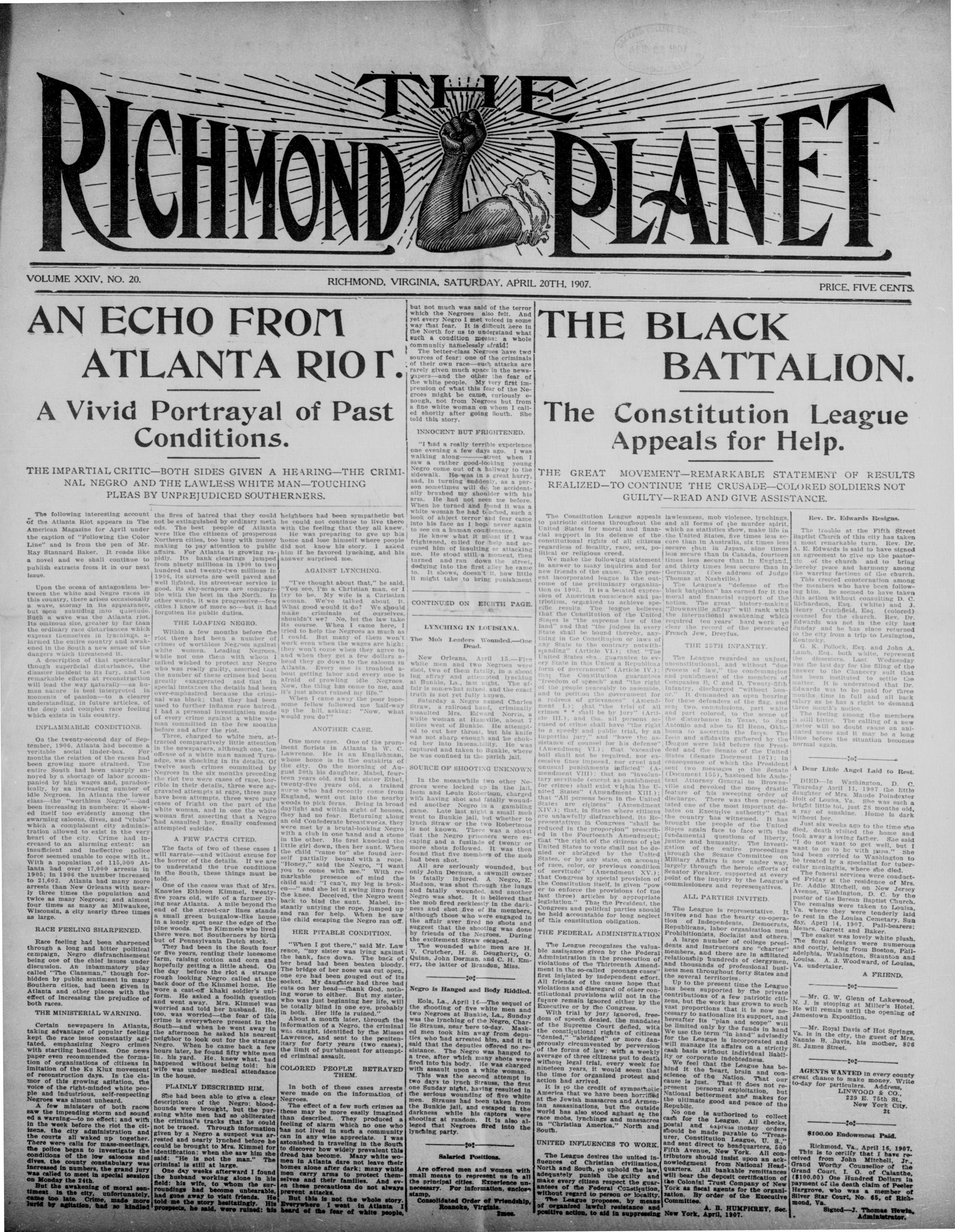
AN ECHO FROM ATLANTA RIOT. A Vivid Portrayal of Past Conditions.
THE IMPARTIAL CRITIC-BOTH SIDES GIVEN A HEARING-THE CRIMINAL NEGRO AND THE LAWLESS WHITE MAN-TOUCHING PLEAS BY UNPREJUDICED SOUTHERNERS.
VOLUME XXIV, NO. 20.
AN EC
ATI
A Vivid
THE IMPARTIAL CRITIC
NAL NEGRO AN
PLEAS B
The following interesting account of the Atlanta Riot appears in The American Magazine for April under the caption of "Following the Color Line" and is from the pen of Mr. Ray Stannard Baker. It reads like a novel and we shall continue to publish extracts from it in our next issue.
Upon the ocean of antagonism between the white and Negro races in this country, there arises occasionally a wave, stormy in its appearance, but soon subsiding into quietude. Such a wave was the Atlanta riot. Its ominous size, greater by far than the ordinary race disturbances which express themselves in lynchings, alarmed the entire country and awakened in the South a new sense of the dangers which threatened it.
A description of that spectacular though superficial disturbance, the disaster incident to its fury, and the remarkable efforts at reconstruction will lead the way naturally—as human nature is best interpreted in moments of passion—to a clearer understanding, in future articles, of the deep and complex race feelings which exists in this country.
INFLAMMABLE CONDITIONS
On the twenty-second day of September, 1906, Atlanta had become a veritable social tinder-box. For months the relation of the races had been growing more strained. The entire South had been sharply annoyed by a shortage of labor accompanied by high wages and, paradoxically, by an increasing number of idle Negroes. In Atlanta the lower class—the "worthless Negro"—had been increasing in numbers: it showed itself too evidently among the swarming saloons, dives, and "clubs" which a complaisant city administration allowed to exist in the very heart of the city. Crime had increased to an alarming extent: an insufficient and ineffective police force seemed unable to cope with it. With a population of 115,000 Atlanta had over 17,000 arrests in 1905; in 1906 the number increased to 21,602. Atlanta had many more arrests than New Orleans with nearly three times the population and twice as many Negroes; and almost four times as many as Milwaukee, Wisconsin, a city nearly three times as large.
RACE FEELING SHARPENED
Race feeling had been sharpened through a long and bitter political campaign, Negro disfranchisement being one of the chief issues under discussion. An inbammatory play called "The Clansman," though forbidden by public sentiment in many Southern cities, had been given in Atlanta and other places with the effect of increasing the prejudice of both races.
THE MINISTERIAL WARNING
Certain newspapers in Atlanta, taking advantage of popular feelings kept the race issue constantly agitated, emphasizing Negro crimes with startling headlines. One news paper even recommended the formation of organizations of citizens in imitation of the Ku Klux movement of reconstruction days. In the chamor of this growing agitation, the voice of the right-minded white people and industrious, self-respecting Negroes was almost unheard.
A few ministers of both races saw the impending storm and sounded a warning—to no effect; and with in the week before the riot the citizens, the city administration and the courts all waked up together. There were calls for mass-meetings, the police began to investigate the conditions of the low saloons and dives, the county constabulary was increased in numbers, the grand jury was called to meet in special session on Monday the 24th.
But the awakening of moral sentiment in the city, unfortunately, came too late. Crime, made more lurid by agitation, had so kindled
the fires of hatred that they could not be extinguished by ordinary methods. The best people of Atlanta were like the citizens of prosperous Northern cities, too busy with money making to pay attention to public affairs. For Atlanta is growing rapidly. Its bank clearings jumped from ninety millions in 1900 to two hundred and twenty-two millions in 1906, its streets are well paved and well lighted, its street-car service is good, its sky-scrapers are comparable with the best in the North. In other words, it was progressive—few cities I know of more so—but it had forgotten its public duties.
THE LOAFING NEGRO:
Within a few months before the riot there had been a number of crimes of worthless Negroes against white women. Leading Negroes, while not one them with whom I talked wished to protect any Negro who was really guilty, asserted that the number of these crimes had been greatly exaggerated and that in special instances the details had been over-emphasized because the criminal was black; that they had been used to further inflame race hatred. I had a personal investigation made of every crime against a white woman committed in the few months before and after the riot. Three, charged to white men, attracted comparatively little attention in the newspapers, although one, the offense of a white man named Turner, was shocking in its details. Of two crimes committed by Negroes in the six months preceding the riot two were rape, horrible in their details, three were aggrivated attempts at rape, three may have been attempts, three may cases of fright on the part of the white woman, and in one the white woman first asserting that a Negro had assaulted her, finally confessed attempted suicide.
A FEW FACTS CITED.
The facts of two of these cases I will narrate—and without excuse for the horror of the details. If we are to understand the true conditions in the South, these things must be told.
One of the cases was that of Mrs. Knowles Ethiehn Kimmel, twenty-five years old, wife of a farmer living near Atlanta. A mile beyond the end of the street-car lines stands a small green bungalow-like house in a lonely spot near the edge of the pine woods. The Kimmels who lived there were not Southerners by birth but of Pennsylvania Dutch stock. They had been in the South four or five years, renting their lonesome farm, raising cotton and corn and hopefully getting a little ahead. On the day before the riot a strange rough looking Negro called at the back door of the Kimmel home. He wore a cast-off khaki soldier's uniform. He asked a foolish question and went away. Mrs. Kimmel was worried and told her husband. He, too, was worried—the fear of this crime is everywhere present in the South—and when he went away in the afternoon he asked his nearest neighbor to look out for the strange Negro. When he came back a few hours later, he found fifty white men in his yard. He. knew what, had happened without being told: his wife was under medical attendance in the house.
PLAINLY DESCRIBED HIM
She had been able to give a clear description of the Negro: bloodhounds were brought, but the pursuing white men had so obliterated the criminal's tracks that he could not be traced. Through information given by a Negro a suspect was arrested and nearly lynched before he could be brought to Mrs. Kimmel for identification; when she saw him she said: "He is not the man." The criminal is still at large.
One day weeks afterward I found the husband working alone in his field: his wife, to whom the surroundings had become unbearable, had gone away to visit friends. He told me the story hesitatingly. His prospects, he said, were ripe:
RICHMOND, VIRGINIA, SATURDAY, APRIL 20TH, 1907
neighbors had been sympathetic but he could not continue to live there with the feeling that they all knew. He was preparing to give up his home and lose himself where people did not know his story. I asked him if he favored lynching, and his answer surprised me.
AGAINST LYNCHING
"I've thought about that," he said, "You see, I'm a Christian man, or I try to be. My wife is a Christian woman. We've talked about it. What good would it do? We should make criminals of ourselves, shouldn't we? No, let the law take its course. When I came here, I tried to help the Negroes as much as I could. But many of them won't work even when the wages are high; they won't come when they agree to and when they get a few dollars ahead they go down to the saloons in Anchita. Every one is troubled about getting money and every one is afraid of prowling Negroes. Now, the thing has come to me, and it's just about ruined my life."
When I came away the poor lonesome fellow followed me half-way up the hill, asking: "Now, what would you do?"
ANOTHER CASE
One more case. One of the prominent florists in Atlanta is W. C. Lawrence. He is an Englishman, whose home is in the outskirts of the city. On the morning of August 20th his daughter, Mabel, fourteen years old, and his sister Ethel, twenty-five years old, a trained nurse who had recently come from England, went out into the nearby woods to pick ferns. Being in broad daylight and within sight of houses, they had no fear. Returning along an old Confederate breastworks, they were met by a brutal-looking Negro with a club in one hand and a stone in the other. He first knocked the little girl down, then her aunt. When the child "came to" she found herself partially bound with a rope, "Honey," said the Negro, "I want you to come with me." With remarkable presence of mind the child said: "I can't, my leg is broken—" and she let it swing limp from the knee. Deceived, the negro went back to bind the aunt. Mabel, instantly untying the rope, jumped up and ran for help. When he saw the child escaping the Negro ran off.
HER PITABLE CONDITION
"When I got there," said Mr. Law rence, "my sister was lying against the bank, face down. The back of her head had been beaten bloody. The bridge of her nose was cut open, one eye had been gouged out of its socket. My daughter had three bad cuts on her head—thank God, nothing worse to either. But my sister, who was just beginning her life, will be totally blind in one eye, probably in both. Her life is ruined."
About a month later, through the information of a Negro, the criminal was caught, identified by the Misses Lawrence, and sent to the penitentiary for forty years (two cases), the limit of punishment for attempted criminal assault.
COLORED PEOPLE BETRAYED THEM.
In both of these cases arrests were made on the information of Negroes.
The effect of a few such crimes as these may be more easily imagined than described. They produced a feeling of alarm which no one who has not lived in such a community can in any wise appreciate. I was astonished in traveling in the South to discover how widely prevalent this dread has become. Many white women in Atlanta dare not leave their homes alone after dark; many white men carry arms to protect themselves and their families. And even these precautions do not always prevent attacks.
But this is not the whole story. But this went in Atlanta. I heard of the feet of the feet of
but not much was said of the terror which the Negroes also felt. And yet every Negro I met voiced in some way that fear. It is difficult here in the North for us to understand what such a condition means: a whole community namelessly afraid!
The better-class Negroes have two sources of fear: one of the criminals of their own race—such attacks are rarely given much space in the newspapers—and the other the fear of the white people. My very first impression of what this fear of the Negroes might be came, curiously enough, not from Negroes but from a fine white woman on whom I called shortly after going South. She told this story.
INNOCENT BUT FRIGHTENED
"I had a really terrible experience one evening a few days ago. I was walking along——street when I saw a rather good-looking young Negro come out of a hallway to the sidewalk. He was in a great hurry, and, in turning suddenly, as a person sometimes will do, he accidentally brushed my shoulder with his arm. He had not seen me before. When he turned and found it was a white woman he had touched, such a look of abject terror and fear came into his face as I hope never again to see on a human countenance.
He knew what it meant if I was frightened, called for help and accused him of insulting or attacking me. He stood still—a moment, then turned and ran down the street, dodging into the first alley he came to. It shows, doesn't it, how little it might take to bring punishment
LYNCHING IN LOUISIANA
The Mob Leaders Wounded.—One Dead.
New Orleans, April 15.—Five white men and two Negroes were shot, two of them fatally, in a shoot ing attack and attempted lynching at Bunkie, La., last night. The afair is somewhat mixed, and the exact truth is not yet fully known.
Saturday a Negro named Charles Straw, a railroad hand, criminally assaulted Mrs. Edward Norris, a white woman at Hansville, about 7 miles west of Bunkie. He attempted to cut her throat, but his knife was not sharp enough and he choked her into insensibility. He was captured and taken to Bunkie, where he was confined in the parish jail.
SOURCE OF SHOOTING UNKNOWN
In the meanwhile two other Negroes were locked up in the jail, Isom and Louis Robertson, charged with having shot and fatally wounded another Negro in a gambling game. Late last night a small mob went to Bunkie jail, but whether to lynch Straw or the two Robertsons is not known. There was a shout that the Negro prisoners were escaping and a fusilade of twenty or more shots followed. It was then found that five members of the mob had been shot.
All are seriously wounded, but only John Derman, a sawmill owner is fatally injured. A Negro, E. Madson, was shot through the lungs and fatally wounded, and another Negro was shot. It is believed that the mob fired recklessly in the darkness and shot five of its members, although those who were engaged in the affair aver fired no shots and suggest that the shooting was done by friends of the Negroes. During the excitement Straw escaped.
The wounded white men are H. V. Crutcher, H. S. Dougherty, O. Quinn, John Dorman, and C. H. Emery, the latter of Brandon, Miss.
Negro is Hanged and Body Riddled
Eola, La., April 16—The sequel of the shooting of five white men and two Negroes at Bunkie, La., Sunday was the lynching of the Negro, Charlie Strauss, near here to-day. Masked men took him away from deputies who had arrested him, and it is said that the deputies offered no resistance. The Negro was hanged to a tree, after which many shots were fired into his body. He was charged with assault upon a white woman
This was the second attempt in two days to lynch Strauss, the first one Sunday night, having resulted in the serious wounding of five white men. Strauss had been taken from the Bunkie jail, and escaped in the darkness while his captors were shooting at random. It is also alleged that Negroes fired into the lynching party.
Salaried Positions.
Are offered men and women with small means to represent us in all the principal cities. Experience unnecessary. For information, enclose stamp. Consolidated Order of Friendship, Roanoke, Virginia.
THE BLACK BATTALION. The Constitution League Appeals for Help.
THE GREAT MOVEMENT—REMARKABLE STATEMENT OF RESULTS REALIZED—TO CONTINUE THE CRUSADE—COLORED SOLDIERS NOT GUILTY—READ AND GIVE ASSISTANCE.
The Constitution League appeals lawlessness, mob violence, lynchings, to patriotic citizens throughout the United States for moral and financial support in its defense of the constitutional rights of all citizens regardless of locality, race, sex, political or religious creed.
Rev. Dr. Edwards Resigns.
The trouble at the Fifth Street Baptist Church of this city has taken a most remarkable turn. Rev. Dr. Edward is said to have signed a letter.
We make the following statement in answer to many inquiries and for new friends of the cause. The present incorporated league is the outcome of the preliminary organization of 1903. It is a beaten expression of American conscience and patriotism, organized to achieve specific results. The league believes that the Constitution of the United States is "the supreme law of the land" and that "the judges in every State shall be bound thereby, anything in the Constitution or laws of any State to the contrary notwithstanding" (Article VI); that "The United States shall, guarantee to every State in this Union a Republican form of government" (Article IV); that the Constitution "freedom of speech" and "the right of the people peaceably to assemble, and to petition the government for a redress of grievances" (Amendment I); that "the trial of all crimes" and "shall be by jury" (Article III.), and that, all persons accused of crime shall have "the right to a speedy and public trial, by an impunity jury" and "have the assistance of counsel for his defense" (Amendment VI); that "excessive ball shall not be required, nor excessive balls imposed, nor cruel and unusual punishments inflicted" (Amendment VIII); that no "involuntary servitude (except as punishment for crime) shall exist vijghin the United States" (Amendment XIII); that "all persons born in the United States are citizens" (Amendment XIV); that, in States where citizens are unlawfully disfranchised, its Representatives in Congress "shall be reduced in the proportion" prescribed in the Fourteenth Amendment; that "the right of the citizens of the United States to vote shall not be denied or abridged by the United States, or by any state, on account of race, color, or previous condition of servitude" (Amendment XV); that Congress by special provision of the Constitution itself, is given "power to enforce the provisions (of the last three) articles by appropriate legislation." That the President, the Congress and political parties should be held accountable for long neglect of this constitution obligation.
THE FEDERAL ADMINISTRATION
The League recognizes the valuable assistance given by the Federal Administration in the prosecution of violations of the Thirteenth Amendment in the so-called peonage cases' first iniated by independent effort. All friends of the cause hope that violations and disregard of other constitutional provisions will not in the future remain ignored either by the Executive or by the Congress.
With trial by jury ignored, freedom of speech denied, the mandates of the Supreme Court defied, with the constitutional rights of citizens "denied," "abridged" or more dangerously circumvented by perversion of the forms of law; with a weekly average of three citizens put to death without legal trial, every week for nineteen years, it would seem that the time for organized protest and action had arrived.
It is to the credit of sympathetic America that we have been horrified at the Jewish massacres and Armenian assassinations, but the outside world has also stood agast at the race mobs, lynchings and massacres in "Christian America." North and South.
UNITED INFLUENCES TO WORK
The League desires the united influences of Christian civilization, North and South, to uphold the law, adequately punish the guilty and make every citizen respect the guarantees of the Federal Constitution, without regard to person or locality. The League proposes, by means of organized lawful resistance and positive action, to aid in suppressing
THE 25TH INFANTRY
The League regarded as unjust, unconstitutional, and without "due process of law," the condemnation and punishment of the members of Companies B, C and D, Twenty-fifth Infantry, discharged "without honor." It demanded an open hearing for these defenders of the flag, and sent two, commissions, part white and part colored, to the scene of the disturbance in Texas to San Antonio and also to El Reno, Oklahoma to ascertain the face. The facts and affidavits gathered by the League were laid before the President and the Senate of the United States (Senate Document 107), in consequence of which the President sent two messages to the Senate (Document 155), hastened his Assistant Attorney General to Brownville and revoked the most drastic feature of his sweeping order of discharge. There was then precipitated one of the most important debates on Executive authority" that the country has witnessed. It has brought the people of the United States again face to face with the fundamental questions of Liberty, justice and humanity. The investigation of the entire proceedings through the Senate Committee on Military Affairs is now under way, largely through the heroic efforts of Senator Foraker, supported at every point of the inquiry by the League's commissioners and representatives.
ALL PARTIES INVITED
The League is representative. It invites and has the hearty co-operation of Independents, Democrats, Republicans, labor organization men Prohibitionists, Socialist and others.
A large number of college presidents and instructors are "charter" members, and there are in affiliated relationship hundreds of clergymen, and thousands of professional business men throughout forty States and the several territories.
Up to the present time the League has been supported by the private contributions of a few patriotic citizens, but the work has grown to such vast proportions that it is now necessary to nationalize its support, and hereafter its "plan and scope" will be limited only by the funds in hand. We use the term "in hand" advisedly for the League is incorporated and will manage its affairs on a strictly cash basis without individual liability or corporate indebtedness.
We feel that the League has behind it the heart, brain and conscience of the Nation. That our cause is just. That it does not represent personal exploitation, but National betterment and makes for the ultimate good and peace of the Republic.
No one is authorized to collect cash for the League. All checks, postal and express money orders should be made payable to "Treasurer, Constitution League, U. S." and sent direct to headquarters, 500 Fifth Avenue, New York. All contributors should insist upon an acknowledgment from National Headquarters. All bankable remittances will bear the deposit certification of the Colonial Trust Company of New York as fiscal agents for the organization. By order of the Executive Committee.
A. B. HUMPHREY, Sec.
New York, April, 1907.
PRICE, FIVE CENTS.
ALION.
League
Help.
STATEMENT OF RESULTS
COLORED SOLDIERS NOT
ATTANCE.
Rev. Dr. Edwards Resigns.
The trouble at the Fifth Street Baptist Church of this city has taken a most remarkable turn. Rev. Dr. A. E. Edwards is said to have signed an agreement to give up the pastorate of the church and to bring thereby peace and harmony among the warring factions of the church. This created consternation among the members who have been following him. He seemed to have taken this action without consulting D. C. Richardson, Esq. (white) and J. Henry Crutchfield, Esq. (colored) counsel for the church. Rev. Dr. Edwards was not in the city last Sunday and he has since returned to the city from a trip to Lexington, Kentucky.
G. K. Pollock, Esq. and John A. Lamb, Esq. both white, represent the dissenters. Last Wednesday was the last day for the filling of the answer to the Chancery suit that has been instituted to settle the matter. It is understood that Dr. Edwards was to be paid for three months time in full and all back salary as he has a right to demand three month's notice.
The feeling among the members is still bitter. The calling of a new pastor will no doubt cause an animated scene and it may be a long time before the situation becomes normal again.
A Dear Little Angel Laid to Rest
DIED—In Washington, D. C.
Thursday April 11, 1907 the little daughter of Mrs. Maude Polindexter, Holt of Louisa, Va. She was such a bright little toi, just 28 months old, a ray of sunshine. Home is dark without her.
Just six weeks ago to the time she died, death visited the home and took away a loving father. She said "I do not want to get well, but I want to go to be with papa." She had been carried to Washington to be treated by a specialist for tubercular meningitis, where she died.
The funeral services were conducted Friday at the residence of Mrs. Dr. Addle Mitchell, on New Jersey Avenue, Washington, D. C. by the pastor of the Berean Baptist Church. The remains were taken to Louisa, Va. where they were tenderly laid to rest in the Louisa Cemetery, Sunday, April 11, 1907. Pall-bearers: Messrs. Garrett and Baker.
The casket was lovely white plush. The floral designs were numerous and costly, being from Boston, Philadelphia, Washington, Staunton and Louisa. A. B. Woodward, of Louisa, a undertaker.
—Mr. G. W. Glenn of Lakewood, N. J. is stopping at Miller's Hotel. He will remain until the opening of Jamestown Exposition.
—Mr. Royal Davis of Hot Springs, Va. is in the city, the guest of Mrs. Nannie B. Davis, his mother, 806 St. James Street.
AGENTS WANTED in every county
great chance to make money. Write
to-day for particulars. Address.
LINWOOD & CO.
229 E. 75th St.
New York City.
2t
Richmond, Va., April 15, 1907.
This is to certify that I have received from John Mitchell, Jr.
Grand Worthy Counsellor of the Grand Court, I. O. of Calanthe,
($100.00) One Hundred Dollars in payment of the death claim of Peeler Hargrove, who was a member of Silver Star Court, No. 65, of Richmond, Va.
Signed—J. Thomas Hewin,
Administrator.
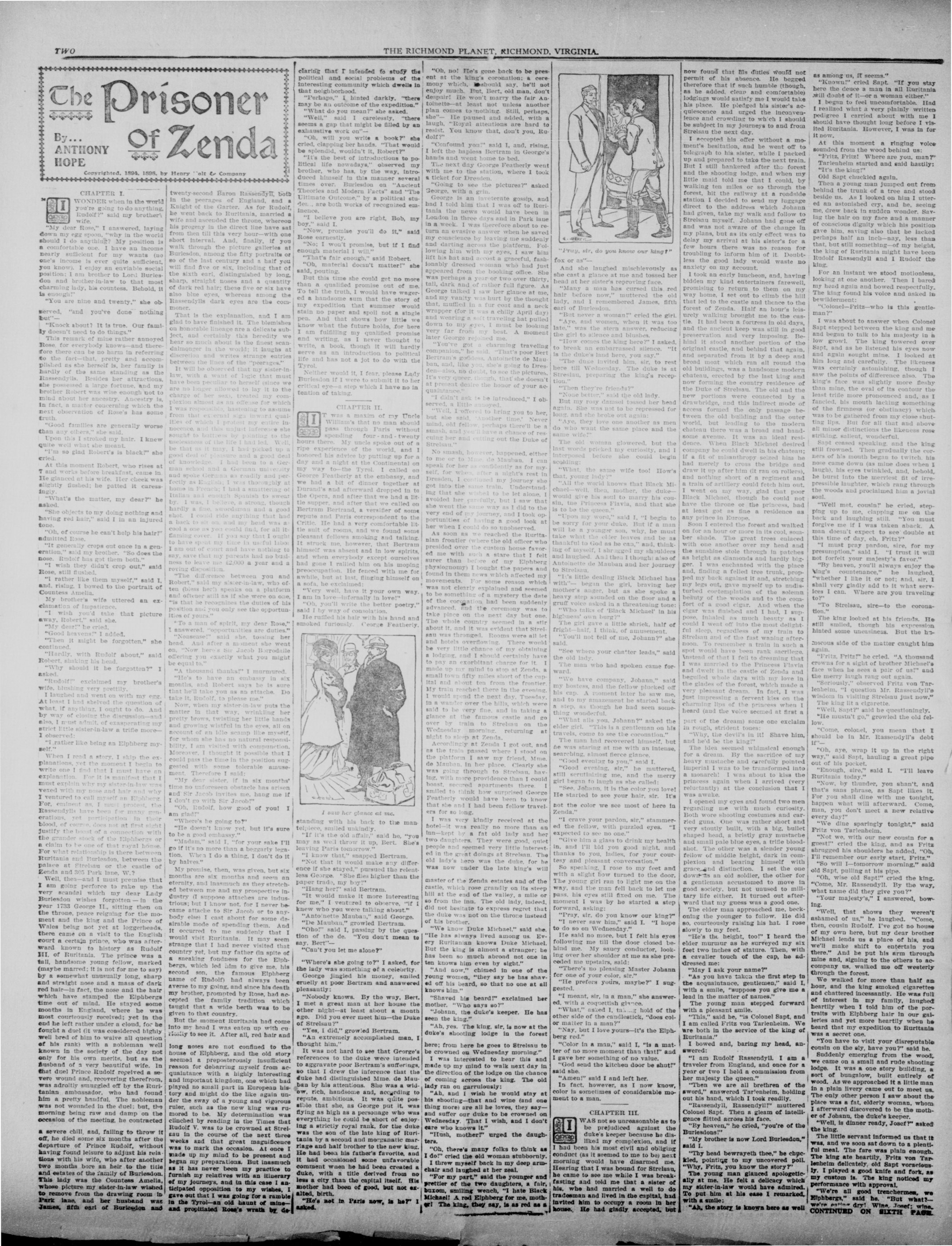
The Prisoner By... ANTHONY HOPE Of Zenda
TWO
CHAPTER 1.
WONDER when in the world
you're going to do anything,
louis? "said my brother"
wife.
WONDER when in the world you're going to do anything, Rudolf?" said my brother's wife.
"My dear Rose," I answered, laying down my egg spoon, "why in the world should I do anything? My position is a comfortable one. I have an income nearly sufficient for my wants (no one's income is ever quite sufficient, you know). I enjoy an enviable social position: I am brother to Lord Burleson and brother-in-law to that most charming lady, his countess. Behold, it is enough."
"You are nine and twenty," she observed, "and you've done nothing but"—
"Knock about? It is true. Our family doesn't need to do things."
This remark of mine rather annoyed Rose, for everybody knows—and therefore there can be no harm in referring to the fact—that, pretty and accomplished as she herself is, her family is hardly of the same standing as the Rassendyils. Besides her attractions, she possessed a large fortune, and my brother Robert was wise enough not to mind about her ancestry. Ancestry is, in fact, a matter concerning which the next observation of Rose's has some truth.
"Good families are generally worse than any others," she said.
Upon this I stroked my hair. I knew quite well what she meant.
"I'm so glad Robert's is black!" she cried.
At this moment Robert, who rises at 7 and works before breakfast, came in. He glanced at his wife. Her cheek was slightly fushed; he patted it caresingly.
"What's the matter, my dear?" he asked.
"She objects to my doing nothing and having red hair," said I in an injured tone.
"Oh, of course he can't help his hair!" admitted Rose.
"It generally crops out once in a generation," said my brother. "So does the nose. Rudolf has got them both."
"I wish they didn't crop out," said Rose, still fushed.
"I rather like them myself," said I, and, rising, I bowed to the portrait of Countess Amelia.
My brother's wife uttered an exclamation of impatience.
"I wish you'd take that picture away, Robert," said she.
"My dear!" be cried.
"Good heavens!" I added.
"Then it might be forgotten," she continued.
"Hardly, with Rudolf about," said Robert, shaking his head.
"Why should it be forgotten?" I asked.
"Rudolf!" exclaimed my brother's wife, blushing very prettily.
I laughed and went on with my egg. At least I had shelved the question of what, if anything, I ought to do. And by way of closing the discussion—and also, I must admit, of exasperating my strict little sister-in-law a trifle more—I observed:
"I rather like being an Elphberg myself."
When I read a story, I skip the explanations, yet the moment I begin to write one I find that I must have an explanation. For it is manifest that I must explain why my sister-in-law was vexed with my nose and hair and why I ventured to call myself an Elipheng. For, eminent as, I must protest, the Rassendylls have been for many generations, yet participation in their blood, of course, does not at first sight justify the boost of a connection with the grander stock of the Eliphberg or a claim to be one of that royal house. For what relationship is there between Rurtania and Burleson, between the palace at Strelsau or the castle of Zenda and 365 Park Lane, W.?
Well, then—and I must premise that I am going perforce to rake up the very scandal which my dear Lady Burlesdon wishes forgotten—in the year 1733 George II., sitting then on the throne, peace reigning for the moment and the king and the Prince of Wales being not yet at loggerheads, there came on a visit to the English court a certain prince, who was afterward known to history as Rudolf III. of Ruritania. The prince was a fall, handsome young fellow, marked (maybe marred; it is not for me to say) by a somewhat unusually long, sharp and straight nose and a mass of dark red hair—in fact, the nose and the hair which have stamped the Elphberries time out of mind. He stayed some months in England, where he was most courteously received; yet in the end he left rather under a cloud, for he fought a duel (it was considered highly well bred of him to waive all question of his rank) with a nobleman well known in the society of the day not only for his own merits, but as the husband of a very beautiful wife. In that duel Prince Rudolf received a severe wound and, recovering therefrom, was adroitly smuggled off by the Buritanian ambassador, who had found him a pretty handful. The nobleman was not wounded in the duel; but, the morning being raw and damp on the occasion of the meeting, he contracted
a severe chill, and, falling to throw it off, he died some six months after the departure of Prince Rudolf, without having found leisure to adjust his relations with his wife, who after another two months bore an heir to the title and estates of the family of Burlesdon. This lady was the Countess Amelia, whose picture my sister-in-law wished to remove from the drawing room in Park lane, and her husband was James, fifth ear of Burlesdon and
twenty-second Baron Rassendyll, both in the peerages of England, and a Knight of the Garter. As for Rudolf, he went back to Ruritania, married a wife and ascended the throne, whereon his progeny in the direct line have sat from then till this very hour—with one short interval. And, finally, if you walk through the picture galleries at Burlesdon, among the fifty portraits or so of the last century and a half you will find five or six, including that of the sixth earl, distinguished by long, sharp, straight noses and a quantity of dark red hair; these five or six have also blue eyes, whereas among the Rassendylls dark eyes are the commoner.
That is the explanation, and I am glad to have finished it. The blemishes on honorable lineage are a delicate subject, and certainly this heredity we hear so much about is the finest scandalmonger in the world; it laughs at discretion and writes strange entries between the lines of the "peerages."
It will be observed that my sister-in-law, with a want of logic that must have been peculiar to herself (since we are no longer allowed to lay it to the charge of her sex), treated my complexion almost as an offense for which I was responsible, hastening to assume from that external sign inward qualities of which I protest my entire innocence, and this unjust inference she sought to buttress by pointing to the uselessness of the life I had led. Well, be that as it may, I had picked up a good deal of pleasure and a good deal of knowledge. I had been to a German school and a German university and spoke German as readily and perfectly as English; I was thoroughly at home in French; I had a smattering of Italian and enough Spanish to sweat by. I was, I believe, a strong, though hardly a fine, swordman and a good shot. I could ride anything that had a back to sit on, and my head was a cool a one as you could find, for all it flaming cover. If you say that I ought to have spent my time in useful labor I am out of court and have nothing to save, say that my parents had no business to leave me £2,000 a year and a roving disposition.
"The difference between you and Robert," said my sister in-law, who often (bless her!) speaks on a platform and oftener still as if she were on one, "is that he recognizes the duties of his position and you only see the opportunities of yours."
"To a man of spirit, my dear Rose," I answered. "opportunities are duties." "Nonsense!" said she, tossing her head. And after a moment she went on. "Now here's Sir Jacob Borrodaile offering you exactly what you might be equal to."
"A thousand thanks!" I murmured. "He's to have an embassy in six months, and Robert says he is sure that he'll take you as an attache. Do take it, Rudolf, to please me."
Now, when my sister-in-law puts the matter in that way, wrinkling her pretty brows, twisting her little hands and growing wistful in the eyes, all on account of an idle scamp like myself, for whom she has no natural responsibility. I am visited with compunction. Moreover, I thought it possible that I could pass the time in the position suggested with some tolerable amusement. Therefore I said:
"My dear sister, if in six months' time no unforeseen obstacle has arisen and Sir Jacob invites me, hang me if I don't go with Sir Jacob!"
"Oh, Rudolf, how good of you! I am glad!"
"Where's he going to?"
"He doesn't know yet, but it's sure to be a good embassy."
"Madam," said I, "for your sake I'll go if it's no more than a beggarly legation. When I do a thing, I don't do it by halves."
My promise, then, was given, but six months are six months and seem an eternity, and inasmuch as they stretched between me and my prospective industry (I suppose attaches are industrious; but I know not, for I never became attache to Sir Jacob or to anybody else) I cast about for some desirable mode of spending them. And it occurred to me suddenly that I would visit Ruritania. It may seem strange that I had never visited that country yet, but my father (in spite of a sneaking fondness for the Elphbergs, which led him to give me, his second son, the famous Elphberg name of Rudolf) had always been averse to my going, and since his death my brother, promoted by Rose, had accepted the family tradition which taught that a wide berth was to be given to that country.
But the moment Ruritania had come into my head I was eaten up with curiosity to see it. After all, red hair and
long noses are not confined to the house of Elphberg, and the old story seemed a preposterously insufficient reason for debarring myself from acquaintance with a highly interesting and important kingdom, one which had played no small part in European history and might do the like again under the sway of a young and vigorous ruler, such as the new king was rumored to be. My determination was clinched by reading in the Times that Rudolf V. was to be crowned at Strelau in the course of the next three weeks and that great magnificence was to mark the occasion. At once I made up my mind to be present and began my preparations. But inasmuch as it has never been my practice to furnish my relatives with an itinerary of my journeys, and in this case I anticipated opposition to my wishes, I gave out that I was going for a rame in the Tyrol—an old haunt of mine and propitied Rose's wrath by de-
THE RICHMOND PLANET, RICHMOND, VIRGINIA
claring that I infended to study the political and social problems of the interesting community which dwells in that neighborhood.
"Perhaps," I hinted darkly, "there may be an outcome of the expedition."
"What do you mean?" she asked.
"Well," said I carelessly, "there seems a gap that might be filled by an exhaustive work on"—
"Oh, will you write a book?" she crled, clapping her hands. "That would be splendid, wouldn't it, Robert?"
"It's the best of introductions to political life nowadays," observed my brother, who has, by the way, introduced himself in this manner several times over. Burleson on "Ancient Theories and Modern Facts" and "The Ultimate Outcome," by a political stud... are both works of recognized eminence.
"I believe you are right, Bob, my boy," said I.
"Now, promise you'll do it," said Rose earnestly.
"No; I won't promise, but if I find enough material I will."
"That's fair enough," said Robert.
"Oh, material doesn't matter!" she said, pouting.
But this time she could get no more than a qualified promise out of me.
To tell the truth, I would have wagered a handsome sum that the story of my expedition that summer would stain no paper and spoil not a single pen. And that shows how little we know what the future holds, for here I am fulfilling my qualified promise and writing, as I never thought to write, a book, though it will hardly serve as an introduction to political life and has not a jot to do with the Tyrol.
Neither would it, I fear, please Lady Burlesdon if I were to submit it to her critical eye—a stop which I have no intention of taking.
CHAPTER II
I was a maxim of my Uncle William's that no man should pass through Paris without spending four- and twenty hours there. My uncle spoke out of a ripe experience of the world, and I honored his advice by putting up for a day and a night at the Continental on my way to—the Tyrol. I called on George Featherly at the embassy, and we had a bit of dinner together at Durand's and afterward dropped in to the Opera, and after that we had a little supper, and after that we called on Bertram Bertrand, a versifier of some repute and Paris correspondent to the Critic. He had a very comfortable little suit of rooms, and we found some pleasant fellows smoking and talking. It struck me, however, that Bertram himself was absent and in low spirits, and when everybody except ourselves had gone I rallied him on his moping preoccupation. He fenced with me for awhile, but at last, flinging himself on a sofa, he exclaimed:
"Very well, have it your own way. I am in love—infernally in love!" "Oh, you'll write the better poetry," said I by way of consolation. He ruffled his hair with his hand and smoked furiously. George, Featricity,
V. CEREA
I saw her glance at me.
standing with his back to the man-
tellepiece, smiled unkindly.
"If it's the old affair," said he, "you
may as well throw it up, Bert. She's
leaving Paris tomorrow."
"I know that," snapped Bertram.
"Not that it would make any dif-
ference if she stayed," pursued the reent-
less George. "She flies higher than the
paper trade, my boy!"
"Hang her," said Bertram.
Bertram.
"It would make it more interesting for me," I ventured to observe, "if knew who you were talking about."
"Antoinette Mauban," said George.
"De Mauban," growled Bertram.
"Oho!" said I, passing by the question of the de. "You don't mean to say, Bert"— "Can't you let me alone?"
"Where's she going to?" I asked, for the lady was something of a celebrity. George jingled his money, smiled eruelly at poor Bertram and answered pleasantly:
"Nobody knows. By the way, Bert. I met a great man at her house the other night—at least about a month ago. Did you ever meet him—the Duke of Strelsaun?"
"Yes, I did," growled Bertram.
"An extremely accomplished man, I thought him."
It was not hard to see that George's references to the duke were intended to aggravate poor Bertram's sufferings, so that I drew the inference that the duke had distinguished Mine. de Mauban by his attention. She was a widow, rich, handsome and, according to repute, ambitions. It was quite possible that she, as George put it, was flying as high as a personage who was everything he could be short of enjoying a strictly royal rank, for the duke was the son of the late king of Kuritania by a second and morganatic marriage and half brother to the new king. He had been his father's favorite, and it had occasioned some unfavorable comment when he had been created a duke, with a title derived from no less a city than the capital itself. His mother had been of good, but not exalted, birth.
"He's not in Paris now, is he?" I asked.
"Oh, no! He's gone back to be present at the king's coronation: a ceremony which, should say, he'll not enjoy much. But, Bert, old man, don't despair! He won't marry the fair Antoinette—at least not unless another plan comes to nothing. Still, perhaps, she" He paused and added, with a laugh, "Royal attentions are hard to resist. You know that, don't you, Rudolf?"
"Confound you!" said I, and, rising, I left the hapless Bertram in George's hands and went home to bed.
The next day George Featherly went with me to the station, where I took a ticket for Dresden.
"Going to see the pictures?" asked George, with a grin.
George is an invertebrate gossip, and had I told him that I was off to Turitania the news would have been in London in three days and in Park lane in a week. I was therefore about to return an evasive answer when he saved my conscience by leaving me suddenly and darting across the platform. Following him with my eyes, I saw him lift his hat and accost a graceful, fashionably dressed woman who had just appeared from the booking office. She was perhaps a year or two over thirty, tall, dark and of rather full figure. As George talked I saw her glance at me, and my vanity was hurt by the thought that, muffled in a chill coat and a neck wrapper (for it was a chilly April day) and wearing a soft travelling hat pulled down to my eyes. I must be looking very far from my best. A moment later George rejoined me.
"You've got a charming traveling companion," he said. "That's poor Bert Bertram's goodness, Antoinette de Mauban, and, like you, she's going to Dresden—also, no doubt, to see the pictures. It's very queer, though, that she doesn't at present desire the honor of your acquaintance."
"I didn't ask to be introduced," I observed, a little annoyed.
"Well, I offered to bring you to her, but she said, 'Another time.' Never mind, old fellow, perhaps there'll be a smash, and you'll have a chance of rescuing her and cutting out the Duke of Strelsau."
No smash, however, happened, either to me or to Mine de Mauban. I can speak for her as confidently as for myself, for when, after a night's rest in Drussen, I continued my journey she got into the same train. Understanding that she wished to be let alone, I avoided her carefully, but I saw that she went the same way as I did to the very end of my journey, and I took opportunities of having a good look at her when I could do so unobserved.
As soon as we reached the Ruritanian frontier (where the old officer who presided over the custom house favored me with such a stare that I felt surer than before of my Elphibber physiognomy) I bought the papers and found in them news which affected my movements. For some reason which was not clearly explained and seemed to be something of a mystery the date of the corigation had been suddenly advanced, and the ceremony was to take place on the next day but one. The whole country seemed in a stir about it, and it was evident that Strelsau was throughed. Rooms were all let and hotels overflowing. There would be very little chance of my obtaining a lodging, and I should certainly have to pay an exorbitant charge for it. I made up my mind to stop at Zenda, a small town fifty miles short of the capital and about ten from the frontier. My train reached there in the evening. I would spend the next day, Tuesday, in a wander over the hills, which were said to be very fine, and in taking a glance at the famous castle and go over by train to Strelsau on the Wednesday morning, returning at night to sleep at Zenda.
Accordingly at Zenda I got out, and as the train passed where I stood on the platform I saw my friend, Mme. de Mauban. In her place. Clearly she was going through to Strelsan, having, with more providence than I could boost, secured apartments there. I smiled to think how surprised George Featherly would have been to know that she and I had been fellow travelers for so long.
I was very kindly received at the hotel—it was really no more than an inn—kept by a fat old lady and her two daughters. They were good, quiet people and seemed very little interested in the great doings at Strelsan. The old lady's hero was the duke, for he was now under the late king's will
master of the Zenda estates and of the castle, which rose grandly on its steep hill at the end of the valley, a mile or so from the inn. The old lady, indeed, did not hesitate to express regret that the duke was not on the throne instead of his brother.
"We know Duke Michael," said she. "He has always lived among us. Every Rurtitanian knows Duke Michael. But the king is almost a stranger; he has been so much abroad not one in ten knows him even by sight."
"And now," chimed in one of the young women, "they say he has shaved off his beard, so that no one at all knows him."
"Shaved his beard!" exclaimed her mother. "Who says so?"
"Johann, the duke's keeper. He has seen the king."
"Ah, yes. king, sir, is now at the duke's shooting lodge in the forest here; from here he goes to Strelsau to be crowned on Wednesday morning."
I was interested to hear this and made up my mind to walk next day in the direction of the lodge on the chance of coming across the king. The old lady ran on garrulously:
"Ah, and I wish he would stay at his shooting—that and wine (and one thing more) are all he loves, they say—and suffer our duke to be crowned on Wednesday. That I wish, and I don't care who knows it."
"Hush, mother!" urged the daughters.
"Oh, there's many folks to think as I do!" cried the old woman stubbornly.
I throw myself back in my deep armchair and laughed at her zeal.
"For my part," said the younger and prettier of the two daughters, a fair, buxom, smiling wench, "I hate Black Michael! A red Elphberg for me, mother! The king, they say, is as red as a
4. 48711
"Pray, sir, do you know our king?"
fox or as"—
And she laughed mischievously as she cast a glance at me and tossed her head at her sister's reproving face.
"Many a man has cursed this red hair before now," muttered the old lady, and I remembered James, fifth earl of Burlesdon.
"But never a woman!" cried the girl.
"Aye, and women, when it was too late," was the stern answer, reducing the girl to silence and blushes.
"How comes the king here?" I asked, to break an embarrassed silence. "It is the duke's land here, you say."
"The duke invited him, sir, to rest here till Wednesday. The duke is at Streslau, preparing the king's reception."
"Then they're friends?"
"None better," said the old lady.
But my rosy damsel tossed her head again. She was not to be repressed for long, and she broke out again:
"Aye, they love one another as men do who want the same place and the same wife."
The old woman glowered, but the last words pricked my curiosity, and I interposed before she could begin scolding:
"What, the same wife too! How's that, young lady?"
"All the world knows that Black Michael—well, then, mother, the duke—would give his soul to marry his cousin, the Princess Flavia, and that she is to be the queen."
"Upon my word," said I, "I begin to be sorry for your duke. But if a man will be a younger son, why, he must take what the elder leaves and be as thankful to God as he can," and, thinking of myself, I shrugged my shoulders and laughed. And then I thought also of Antoinette de Mauban and her journey to Strelsaun.
"It's little dealing Black Michael has with"—began the girl, braving her mother's anger, but as she spoke a heavy step sounded on the floor and a gruff voice asked in a threatening tone: "Who talks of 'Black Michael' in his highness' own burg?" The girl gave a little shriek, half of fright—half, I think, of amusement. "You'll not tell of me, Johann?" she said.
"See where your chatter leads," said the old lady.
The man who had spoken came forward.
"We have company, Johann," said my hostess, and the fellow plucked off his cap. A moment later he saw me, and to my amazement he started back a step, as though he had seen something wonderful.
"What all you, Johann?" asked the elder girl. "This is a gentleman on his travels, come to see the coronation."
The man had recovered himself, but
he was staring at me with an intense,
searching, almost fierce glance.
"Good evening to you," said I.
"Good evening, sir," he muttered, still scrumming me, and the merry girl began to laugh as she called:
"See Johann. It is the color you love! He started to see your hair, sir. It's not the color we see most of here in Zenda."
"I crave your pardon, sir," stammered the fellow, with puzzled eyes. "I expected to see no one."
"Give him a glass to drink my health in, and I'll bid you good night, and thanks to you, ladies, for your courtesy and pleasant conversation."
So speaking, I rose to my feet and with a slight brow turned to the door. The young girl ran to light me on the way, and the man fell back to let me pass, his eyes still fixed on me. The moment I was by he started a step forward, asking:
"Pray, sir, do you know our king?"
"I never saw him," said I. "I hope to do so on Wednesday."
He said no more, but I felt his eyes following me till the door closed behind me. My saucy conductor, looking over her shoulder at me as she preceded me upstairs, said:
"There's no pleasing Master Johann for one of your color, sir."
"He prefers yours, maybe?" I suggested.
"I meant, sir, in a man," she answered, with a coquettish glance.
"What," asked I, taking hold of the other side of the candlestick, "does color matter in a man?"
"Nay, but I love yours—it's the Elphberg red."
"Color in a man," said I, "is a matter of no more moment than that!" and I gave her something of no value.
"God send the kitchen door be shut!" said she.
"Amen!" said I and left her.
In fact, however, as I now know, color is sometimes of considerable moment to a man.
CHAPTER III
I
WAS not so unreasonable as to be prejudiced against the duke's keeper because he disliked my complexion, and if
now found that his duties would not permit of his absence. He begged therefore that if such humble (though, as he added, clean and comfortable) lodgings would satisfy me I would take his place. He pledged his sister's acquiescence and urged the inconvenience and crowding to which I should be subject in my journeys to and from Strelsau the next day.
I accepted his offer without a moment's hesitation, and he went off to telegraph to his sister, while I packed up and prepared to take the next train. But I still bankered after the forest and the shooting lodge, and when my little maid told me that I could, by walking ten miles or so through the forest, hit the railway at a roadside station I decided to send my luggage direct to the address which Johann had given, take my walk and follow to Strelsau myself. Johann had gone off and was not aware of the change in my plans, but as its only effect was to delay my arrival at his sister's for a few hours there was no reason for troubling to inform him of it. Doubtless the good lady would waste no anxiety on my account.
I took an early luncheon, and, having bidden my kind entertainers farewell, promising to return to them on my way home. I set out to climb the hill that led to the castle and thence to the forest of Zenda. Half an hour's leisurely walking brought me to the castle. It had been a fortress in old days, and the ancient keep was still in good preservation and very imposing. Behind it stood another portion of the original castle, and behind that again, and separated from it by a deep and broad moat which ran all round the old buildings, and a handsome modern chateau, erected by the last king and now forming the country residence of the Duke of Strelsau. The old and the new portions were connected by a drawbridge, and this indirect mode of access formed the only passage between the old building and the outer world, but leading to the modern chateau there was a broad and handsome avenue. It was an ideal residence. When Black Michael desired company he could dwell in his chateau; if a fit of misanthropy seized him he had merely to cross the bridge and draw it up after him (it ran on rollers), and nothing short of a regiment and a train of artillery could fetch him out. I went on my way, glad that poor Black Michael, though he could not have the throne or the princess, had at least got as fine a residence as any prince in Europe.
Soon I entered the forest and walked on for an hour or more in its coop, sonder shade. The great trees enlaced with one another over my head and the sunshine stole through in patches as bright as diamonds and hardly bigger. I was enchanted with the place and, finding a felled tree trunk, proped my back against it and, stretching my legs out, gave myself up to and disturbed contemplation of the solemn beauty of the woods and to the comfort of a good cigar. And when the cigar was finished and I had, I suppose, inhaled as much beauty as I could I went off into the most delightful sleep, regardless of my train to Strelsan and of the fast waning afternoon. To remember a train in such a spot would have been rank sacrifice. Instead of that I felt to dreaming that I was married to the Princess Flavia and dwelt in the castle of Zenda and beguiled whole days with my love in the glades of the forest, which made a very pleasant dream. In fact, I was just impressing a fervent kiss on the charming lips of the princess when I heard (and the voice seemed at first a part of the dream) come one another.
part of the dream) some one exclaim in rough, strident tones;
"Why, the devil's in it! Shave him, and he'd be the king!"
The idea seemed whimsical enough for a dream. By the sacrifice of my heavy mustache and carefully pointed imperial I was to be transformed into a monarch! I was about to kiss the princess again when I arrived (very reluctantly) at the conclusion that I was awake.
I opened my eyes and found two men regarding me with much curiosity, Both wore shooting costumes and carried guns. One was rather short and very stoutly built, with a big, bullet shaped head, a bristly gray mustache and small pale blue eyes, a trifle bloodshot. The other was a slender young fellow of middle height, dark in complexion and bearing himself with grace and distinction. I set the one down as an old soldier, the other for a gentleman accustomed to move in good society, but not unused to military life either. It turned out afterward that my guess was a good one.
The elder man approached me, beckoning the younger to follow. He did so, courteously raising his hat. I rose slowly to my feet.
"He's the height, too!" I heard the elder murmur as he surveyed my six feet two inches of stature. Then, with a cavalier touch of the cap, he addressed me:
"May I ask your name?"
"As you have taken the first step in the acquaintance, gentlemen," said I, with a smile, "suppose you give me a lead in the matter of names."
The young man stepped forward with a pleasant smile.
"This," said he, "is Colonel Sapt, and I am called Fritz von Tarlenheim. We are both in the service of the king of Buriliana."
I bowed and, baring my head, answered:
"I am Rudolf Rassendyll. I am a traveler from England, and once for a year or two I held a commission from her majesty the queen."
"Then we are all brethren of the sword," answered Tarlenheim, holding out his hand, which I took readily.
"Rassendyll, Rassendyll!" muttered Colonel Sapt. Then a gleam of intelligence flitted across his face.
"By heaven," he cried, "you're of the Burlesdons!"
"My brother is now Lord Burlesdon," said I.
"Thy head bewrayeth thee," he chuckled, pointing to my uncovered poll. "Why, Fritz, you know the story?" The young man gianced apologetically at me. He felt a delicacy which my sister-in-law would have admired. To put him at his ease I remarked, with a smile:
"Ah, the story is known here as well
as among us, if seems."
"Known!" cried Sapt. "If you stay here the deuce a man in all Ruritania will doubt of it—or a woman either."
I began to feel uncomfortable. Had I realized what a very plainly written pedigree I carried about with me I should have thought long before I visited Ruritania. However, I was in for it now.
At this moment a ringing voice sounded from the wood behind us:
"Fritz, Fritz! Where are you, man?" Tarluenheim started and said hastily: "It's the king!"
Old Sapt chuckled again.
Then a young man jumped out from behind the trunk of a tree and stood beside us. As I looked on him I uttered an astonished cry, and he, seeing me, drew back in sudden wonder. Saving the hair on my face and a manner of conscious dignity which his position gave him, saving also that he lacked perhaps half an inch—nay, less than that, but still something—of my height, the king of Ruritania might have been Rudolf Rassendyll and I Rudolf the king.
For an instant we stood motionless, looking at one another. Then I bared my head again and bowed respectfully. The king found his voice and asked in bewilderment:
"Colonel—Fritz—who is this gentleman?"
I was about to answer when Colonel Sapt stepped between the king and me and began to talk to his majesty in a low growl. The king towered over Sapt, and as he listened his eyes now and again sought mine. I looked at him long and carefully. The likeness was certainly astonishing, though I saw the points of difference also. The king's face was slightly more fleshy than mine, the oval of its contour the least trifle more pronounced and, as I fancied, his mouth lacking something of the firmness (or obstinacy) which was to be gathered from my close shuttling lips. But for all that and above all minor distinctions the likeness rose striking, salient, wonderful.
Sapt ceased speaking, and the king still frowned. Then gradually the corners of his mouth began to twitch, his nose came down (as mine does when I laugh), his eyes twinkled, and, behold, he burst into the merrier fit of irrespressible laughter, which rang through the woods and proclaimed him a jovial soul.
"Well met, cousin!" he cried, stepping up to me, clapping me on the back and laughing still. "You must forgive me if I was taken aback. A man doesn't expect to see double at this time of day, eh, Fritz?" "I must pray pardon, sire, for my presumption," said I. "I trust it will not forfelt your majesty's favor." "By heaven, you'll always enjoy the king's countenance," he laughed, "whether I like it or not; and, sir, I shall very gladly add to what services I can. Where are you traveling to?" "To Strelsau, sire—to the coronation."
The king looked at his friends. He still smiled, though his expression hinted some unaciness. But the honorous side of the matter caught him again.
"Fritz, Fritz!" he cried. "A thousand crowns for a sight of brother Michael's face when he sees a pair of ust" and the merry laugh rang out again.
"Seriously," observed Fritz von Tarlenheim, "I question Mr. Rassendyll's wisdom in visiting Strelsau just now."
The king lit a cigarette.
"Well, Sapt!" said he questioningly.
"He mustn't go," growled the old fellow.
"Come, colonel, you mean that I should be in Mr. Rassendyll's debt if"—
"Oh, aye, wrap it up in the right way," said Sapt, hauling a great pipe out of his pocket.
"Enough, sire," said I. "Till leave Ruritania today."
"Now, by thunder, you shan't, and that's sans phrase, as Sapt likes it. For you shall dine with me tonight, happen what will afterward. Come, man, you don't meet a new relative every day!" "We dine sparingly tonight," said Fritz von Tarluenheim. "Not we, with our new cousin for a guest!" cried the king, and as Fritz shrugged his shoulders he added, "Oh, I'll remember our early start, Fritz." "So will I—tomorrow morning," said old Sapt, pulling at his pipe. "Oh, wise old Sapt!" cried the king. "Come, Mr. Rassendyll. By the way, what name did they give you?" "Your majesty's," I answered, bowing.
"Well, that shows they weren't ashamed of us," he laughed. "Come, then, cousin Rudolf. I've got no house of my own here, but my dear brother Michael lends us a place of his, and we'll make shift to entertain you there." And he put his arm through mine and, signing to the others to accompany us, walked me off westerly through the forest.
We walked for more than half an hour, and the king smoked cigarettes and chattered incessantly. He was full of interest in my family, laughed heartily when I told him of the portraits with Elphberg hair in our galleries and yet more heartily when he heard that my expedition to Ruritania was a secret one.
"You have to visit your disreputable cousin on the sly, have you?" said he. Suddenly emerging from the wood, we came on a small and rude shooting lodge. It was a one story building, a sort of bungalow, built entirely of wood. As we approached it a little man in a plain livery came out to meet us. The only other person I saw about the place was a fat, elderly woman, whom I afterward discovered to be the mother of Johann, the duke's keeper. "Well, is dinner ready, Josef?" asked the king. The little servant informed us that it was, and we soon sat down to a plentiful meal. The fare was plain enough. The king ate heartily, Fritz von Tarlhelm delicately, old Sapt voraciously. I played a good knife and fork, as my custom is. The king noticed my performance with approval. "We're all good trenchermen, we Elphbergs," said he. "But what?—were eating dry! Wine, Josef; wine, CONTINUE ON SIXTH PAGE."
THE VANET
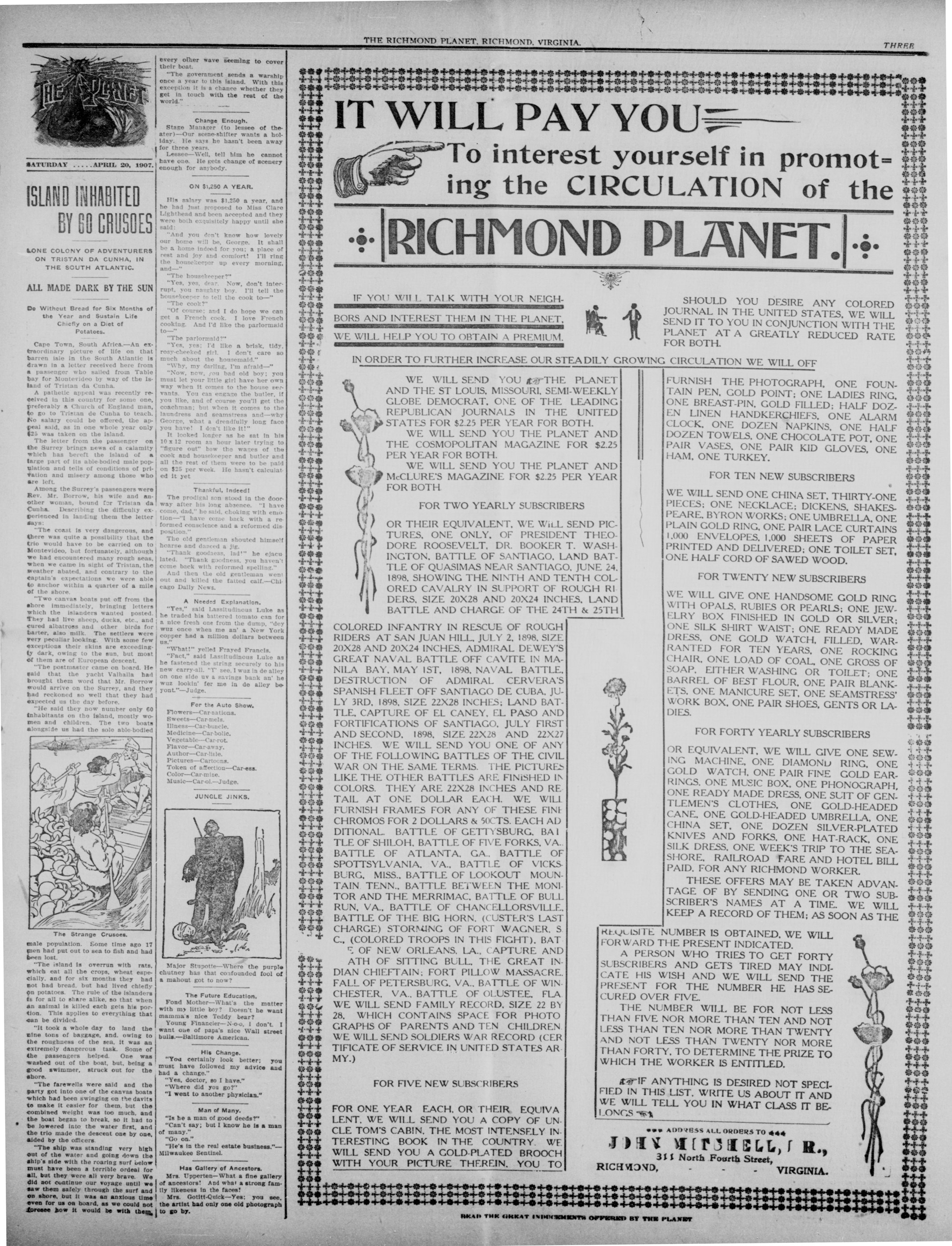
ISLAND INHABITED BY 60 CRUSOES
LONE COLONY OF ADVENTURERS
ON TRISTAN DA CUNHA, IN
THE SOUTH ATLANTIC.
ALL MADE DARK BY THE SUN
Do Without Bread for Six Months of the Year and Sustain Life Chiefly on a Diet of Potatoes.
Cape Town, South Africa.—An extraordinary picture of life on that barren isle in the South Atlantic is drawn in a letter received here from a passenger who sailed from Table bay for Montevideo by way of the Island of Tristan da Cunha.
A pathetic appeal was recently received in this country for some one, preferably a Church of England man, to go to Tristan de Cunha to teach. No salary could be offered, the appeal said, as in one whole year only £25 was taken on the island.
The letter from the passenger on the Surrey brings news of a calamity which has bereft the island of a large part of its able-bodied male population and tells of conditions of privation and misery among those who are left. Among the Surrey's passengers were Rev. Mr. Borrow, his wife and another woman, bound for Tristan da Cunha. Describing the difficulty experienced in landing them the letter says:
"The coast is very dangerous, and there was quite a possibility that the trio would have to be carried on to Montevideo, but fortunately, although we had encountered many rough seas, when we came in sight of Tristan, the weather abated, and contrary to the captain's expectations we were able to anchor within a quarter of a mile of the shore.
"Two canvas boats put off from the shore immediately, bringing letters which the islanders wanted posted. They had live sheep, ducks, etc., and cured albatross and other birds for barter, also milk. The settlers were very peculiar looking. With some few exceptions their skins are exceedingly dark, owing to the sun, but most of them are of European descent.
"The postmaster came on board. He said that the yacht Valiballa had brought them word that Mr. Borrow would arrive on the Surrey, and they had reckoned so well that they had expected us the day before.
"He said they now number only 60 inhabitants on the island, mostly women and children. The two boats alongside us had the sole able-bodied
THE BOAT
The Strange Crusoes.
male population. Some time ago 17 men had put out to sea to fish and had been lost.
"The island is overrun with rats, which eat all the crops, wheat especially, and for six months they had not had bread, but had lived chiefly on potatoes. The rule of the islanders is for all to share alike, so that when an animal is killed each gets his portion. This applies to everything that can be divided.
"It took a whole day to land the nine tons of baggage, and, owing to the roughness of the sea, it was an extremely dangerous task. Some of the passengers helped. One was washed out of the boat, but, being a good swimmer, struck out for the shore.
"The farewells were said and the party got into one of the canvas boats which had been swinging on the davits to make it easier for them, but the combined weight was too much, and the boat began to break, so it had to be lowered into the water first, and the trio made the descent one by one, aided by the officers.
"The ship was standing very high out of the water and going down the ship's side with the roaring surf below must have been a terrible ordeal for all, but they were all very brave. We did not continue our voyage until we saw them safely through the surf and on shore, but it was an anxious time even for us on board, as we could not foresee how it would be with them.
every other wave seeming to cover their boat.
"The government sends a warship once a year to this island. With this exception it is a chance whether they get in touch with the rest of the world."
Change Enough.
Stage Manager (to lessee of theater)—Our scene-shifter wants a holiday. He says he hasn't been away for three years. Lessee—Well, tell him he cannot have one. He gets change of scenery enough for anybody.
ON $1,250 A YEAR
His salary was $1,250 a year, and he had just proposed to Miss Clare Lighthead and been accepted and they were both exquisitely happy until she said:
"And you don't know how lovely our home will be, George. It shall be a home indeed for you; a place of rest and joy and comfort! I'll ring the housekeeper up every morning, and—"
"The housekeeper?"
"Yes, yes, dear. Now, don't interrupt, you naughty boy. I'll tell the housekeeper to tell the cook to—"
"The cook?"
"Of course; and I do hope we can get a French cook. I love French cooking. And I'd like the parlormaid to—"
"The parlormaid?"
"Yes, yes; I'd like a brisk, tidy, rosy-cheeked girl. I don't care so much about the housemaid."
"Why, my darling, I'm afraid—"
"Now, now, you bad old boy; you
must let your little girl have her own
way when it comes to the house serv-
vants. You can engage the butler,
if you like, and of course you'll get the
coachman; but when it comes to the
laundress and seamstress and—why
George, what a dreadfully long face
you have! I don't like it!"
It looked longer as he sat in his
10 x 12 room an hour later trying to
"figure out" how the wages of the
cook and housekeeper and butler and
all the rest of them were to be paid
on $25 per week. He hasn't calculated
it yet
Thankful. Indeed!
The prodigal son stood in the doorway after his long absence. "I have come, dad," he said, choking with emotion. "I have come back with a reformed conscience and a reformed disposition."
The old gentleman shouted himself hoarse and danced a jig.
"Thank goodness, lad!" he ejaculated. "Thank goodness, you haven't come back with reformed spelling."
And then the old gentleman went out and killed the fatted calf.—Chicago Dally News.
A Needed Explanation:
"Yes," said Lassitudinous Luke as he traded his battered tomato can for a nice fresh one from the dump, "dey wuz once when me an' a New York copper had a million dollars between us."
"What!" yelled Frayed Francis.
"Fact," said Lassitudinous Luke as he fastened the string securely to his new carry-all. "Y' see. I wuz in de alley on one side uv a savings bank an' he wuz lookin' fer me in de alley beyont."—Judge.
For the Auto Show:
FOR THE AUTO SHOW.
Flowers—Car-nations.
Sweets—Car-mels.
Illness—Car-buncle.
Medicine—Car-bolic.
Vegetable—Car-rot.
Flavor—Car-away.
Author—Car-lisle.
Pictures—Car-toons.
Token of affection—Car-ess.
Color—Car-mine.
Music—Car-ol.-Judge.
JUNGLE JINKS.
Major Stupotte—Where the purple chutney has that confounded fool of a mahout got to now?
The Future Education.
Fond Mother—What's the matter with my little boy? Doesn't he want mamma's nice Teddy bear?
Young Financier—N-o-o, I don't. I want one of papa's nice Wall street bulls.—Baltimore American.
His Change.
"You certainly look better; you must have followed my advice and had a change."
"Yes, doctor, so I have."
"Where did you go?"
"I went to another physician."
"Is he a man of good deeds?"
"Can't say; but I know he is a man of many."
"Go on."
"He's in the real estate business."—Milwaukee Sentinel.
Has Gallery of Ancestors
Mrs. Upperten—What a fine gallery of ancestors! And what a strong family likeness in the faces!
Mrs. Gottt-Quick—Yes; you see, the artist had only one old photograph to go by.
THE RICHMOND PLANET, RICHMOND, VIRGINIA
---
```markdown
```
IF YOU WILL
BORS AND INTERE
WE WILL HELP YOU
IN ORDER TO
YOU WILL TALK WITH YOU
AND INTEREST THEM IN THE
WILL HELP YOU TO OBTAIN A P
ORDER TO FURTHER INCREASE
WE WILL SEND YOU
AND THE ST LOUIS, MISSO
GLOBE DEMOCRAT, ONE
REPUBLICAN JOURNALS
STATES FOR $2.25 PER YEAR.
WE WILL SEND YOU
THE COSMOPOLITAN MA
PER YEAR FOR BOTH.
WE WILL SEND YOU
McCLURE'S MAGAZINE FOR
FOR BOTH.
FOR TWO YEARLY
OR THEIR EQUIVALENT, T
TURES, ONE ONLY, OF
DORE ROOSEVELT, DR.
INGTON, BATTLE OF SAN
TLE OF QUASIMAS NEAR S
1898, SHOWING THE NINTH
ORED CAVALRY IN SUPP
DERS, SIZE 20X28 AND 20
BATTLE AND CHARGE OF
RED INFANTRY IN RESCUE OF
AT SAN JUAN HILL, JULY 2,
AND 20X24 INCHES, ADMIRAL
NAVAL BATTLE OFF CAVIT
AY, MAY 1ST, 1898, NAVAL
BUILTION OF ADMIRAL CEN
H FLEET OFF SANTIAGO DE O
, 1898, SIZE 22X28 INCHES; LA
CAPTURE OF EL CANEY, EL P
ICATIONS OF SANTIAGO, JU
SECOND, 1898, SIZE 22X28 AN
. WE WILL SEND YOU ONE
THE FOLLOWING BATTLES OF T
IN THE SAME TERMS. THE P
THE OTHER BATTLES ARE FIN
S. THEY ARE 22X28 INCHES
AT ONE DOLLAR EACH. WE
WH FRAMES FOR ANY OF THE
MIS FOR 2 DOLLARS & 50CTS. E
AL. BATTLE OF GETTYSBUR
SHILOH, BATTLE OF FIVE FOR
E OF ATLANTA, GA., BAT
SYLVANIA, VA., BATTLE OF
MISS., BATTLE OF LOOKOUT
TENN., BATTLE BETWEEN THE
AND THE MERRIMAC, BATTLE
VA., BATTLE OF CHANCELLO
E OF THE BIG HORN. (CUSTE
E) STORMING OF FORT WAR
COLORED TROOPS IN THIS FIGHT
NEW ORLEANS, LA., CAPTU
OF SITTING BULL, THE GRE
CHIEFTAIN; FORT PILLOW MA
OF PETERSBURG, VA., BATTLE
ER, VA., BATTLE OF OLUST
LL SEND FAMILY RECORD, SIN
WHICH CONTAINS SPACE FOR
S OF PARENTS AND TEN CH
AL SEND SOLDIERS WAR RECOR
E OF SERVICE IN UNITED STA
IF YOU WILL TALK WITH YOUR NEIGH BORS AND INTEREST THEM IN THE PLANET. WE WILL HELP YOU TO OBTAIN A PREMIUM.
IN ORDER TO FURTHER INCREASE OUR STEADILY GROWING CIRCULATION WE WILL OFF
WE WILL SEND YOU THE PLANET AND THE ST LOUIS, MISSOURI, SEMI-WEEKLY GLOBE DEMOCRAT, ONE OF THE LEADING REPUBLICAN JOURNALS IN THE UNITED STATES FOR $2.25 PER YEAR FOR BOTH. WE WILL SEND YOU THE PLANET AND THE COSMOPOLITAN MAGAZINE FOR $2.25 PER YEAR FOR BOTH. WE WILL SEND YOU THE PLANET AND McCLURE'S MAGAZINE FOR $2.25 PER YEAR FOR BOTH.
OR THEIR EQUIVALENT, WE WILL SEND PICTURES, ONE ONLY, OF PRESIDENT THEODORE ROOSEVELT, DR. BOOKER T. WASHINGTON, BATTLE OF SANTIAGO, LAND BATTLE OF QUASIMAS NEAR SANTIAGO, JUNE 24, 1898, SHOWING THE NINTH AND TENTH COLORED CAVALRY IN SUPPORT OF ROUGH RIDERS, SIZE 20X28 AND 20X24 INCHES, LAND BATTLE AND CHARGE OF THE 24TH & 25TH
COLORED INFANT RIDERS AT SAN JUY 20X28 AND 20X24 IN GREAT NAVAL BAY, MAY 15 DESTRUCTION OF SPANISH FLEET OF LY 3RD, 1898, SIZED TLE, CAPTURE OF FORTIFICATIONS O AND SECOND, 1898 INCHES. WE WILL OF THE FOLLOWING WAR ON THE SAM LIKE THE OTHER COLORS. THEY A TAIL AT ONE D FURNISH FRAMES. CHROMOS FOR 2 D DITIONAL. BATTLE TLE OF SHILOH, BA BATTLE OF ATL SPOTTSYLVANIA, BURG, MISS., BATT TAIN TENN., BATT TOR AND THE MED RUN, VA., BATTLE BATTLE OF THE B CHARGE) STORN C., (COLORED TRO 5 OF NEW ORL ATH OF SITTIN DIAN CHIEFTAIN; FALL OF PETERSBU CHESTER, VA., BA WE WILL SEND FA 28, WHICH CONT GRAPHS OF PARE WE WILL SEND SOL TIFICATE OF SERV MY.)
COLORED INFANTRY IN RESCUE OF ROUGH RIDERS AT SAN JUAN HILL, JULY 2, 1898, SIZE 20X28 AND 20X24 INCHES, ADMIRAL DEWEY'S GREAT NAVAL BATTLE OFF CAVITE IN MANILA BAY, MAY 1ST, 1898, NAVAL BATTLE, DESTRUCTION OF ADMIRAL CERVERA'S SPANISH FLEET OFF SANTIAGO DE CUBA, JULY 3RD, 1898, SIZE 22X28 INCHES; LAND BATTLE, CAPTURE OF EL CANEY, EL PASO AND FORTIFICATIONS OF SANTIAGO, JULY FIRST AND SECOND, 1898, SIZE 22X28 AND 22X27 INCHES. WE WILL SEND YOU ONE OF ANY OF THE FOLLOWING BATTLES OF THE CIVIL WAR ON THE SAME TERMS. THE PICTURES LIKE THE OTHER BATTLES ARE FINISHED IN COLORS. THEY ARE 22X28 INCHES AND RETAIL AT ONE DOLLAR EACH. WE WILL FURNISH FRAMES FOR ANY OF THESE FINH CHROMOS FOR 2 DOLLARS & 50CTS. EACH ADDITIONAL. BATTLE OF GETTYSBURG, BAITLE OF SHILOH, BATTLE OF FIVE FORKS, VA.. BATTLE OF ATLANTA, GA.. BATTLE OF SPOTTSYLVANIA, VA., BATTLE OF VICKSBURG, MISS., BATTLE OF LOOKOUT MOUNTAIN TENN., BATTLE BETWEEN THE MONITOR AND THE MERRIMAC, BATTLE OF BULL RUN, VA., BATTLE OF CHANCELLORSVILLE, BATTLE OF THE BIG HORN. (CUSTER'S LAST CHARGE) STORMING OF FORT WAGNER, S.C., (COLORED TROOPS IN THIS FIGHT), BAT
OF NEW ORLEANS, LA., CAPTURE AND ATH OF SITTING BULL, THE GREAT INDIAN CHIEFTAIN; FORT PILLOW MASSACRE, FALL OF PETERSBURG, VA., BATTLE OF WINCHESTER, VA., BATTLE OF OLUSTEE, FLA. WE WILL SEND FAMILY RECORD, SIZE 22 BY 28, WHICH CONTAINS SPACE FOR PHOTO GRAPHS OF PARENTS AND TEN CHILDREN. WE WILL SEND SOLDIERS WAR RECORD (CERTIFICATE OF SERVICE IN UNITED STATES ARMY.)
FOR FIVE NEW SUBSCRIBERS
FOR ONE YEAR E
LENT, WE WILL S
CLE TOM'S CABIN,
TERESTING BOOK
WILL SEND YOU
WITH YOUR PICT
BE YEAR EACH, OR THEIR
WE WILL SEND YOU A COPY
MIS CABIN, THE MOST INTEN-
TING BOOK IN THE COUNT
END YOU A GOLD-PLATED
YOUR PICTURE THEREIN.
FOR ONE YEAR EACH, OR THEIR EQUIVALENT, WE WILL SEND YOU A COPY OF UNCLE TOM'S CABIN, THE MOST INTENSELY INTERESTING BOOK IN THE COUNTRY. WE WILL SEND YOU A GOLD-PLATED BROOCH WITH YOUR PICTURE THEREIN. YOU TO
---
```markdown
```
```markdown
```
```markdown
```
To interest yourself in promoting the CIRCULATION of the
READ THE GREAT INDUCEMENTS OFFERED BY THE PLANET
FOR TWO YEARLY SUBSCRIBERS
REQUISITE NUMBER IS OBTAINED, WE WILL FORWARD THE PRESENT INDICATED. A PERSON WHO TRIES TO GET FORTY SUBSCRIBERS AND GETS TIRED MAY INDICATE HIS WISH AND WE WILL SEND THE PRESENT FOR THE NUMBER HE HAS SECURED OVER FIVE. THE NUMBER WILL BE FOR NOT LESS THAN FIVE NOR MORE THAN TEN AND NOT LESS THAN TEN NOR MORE THAN TWENTY AND NOT LESS THAN TWENTY NOR MORE THAN FORTY, TO DETERMINE THE PRIZE TO WHICH THE WORKER IS ENTITLED.
IF ANYTHING IS DESIRED NOT SPECIFIED IN THIS LIST, WRITE US ABOUT IT AND WE WILL TELL YOU IN WHAT CLASS IT BELONGS
A man sitting in a chair and a man standing in front of him.
LANET
EKLY
LEADING
UNITED
H.
T AND
R $2.25
T AND
YEAR
ND PIC
THEO-
WASH-
D BAT-
JUNE 24.
H COL-
GH RI-
LAND
& 25TH
```markdown
```
REQUIRED FOR WAR
SHOULD YOU DESIRE ANY COLORED JOURNAL IN THE UNITED STATES, WE WILL SEND IT TO YOU IN CONJUNCTION WITH THE PLANET AT A GREATLY REDUCED RATE FOR BOTH.
FURNISH THE PHOTOGRAPH, ONE FOUNTAIN PEN, GOLD POINT; ONE LADIES RING, ONE BREAST-PIN, GOLD FILLED; HALF DOZEN LINEN HANDKERCHIEFS, ONE ALARM CLOCK, ONE DOZEN NAPKINS, ONE HALF DOZEN TOWELS, ONE CHOCOLATE POT, ONE PAIR VASES, ONE PAIR KID GLOVES, ONE HAM, ONE TURKEY.
FOR TEN NEW SUBSCRIBERS
WE WILL SEND ONE CH
PIECES; ONE NECKLACE
PEARE, BYRON WORKS;
PLAIN GOLD RING, ONE
1,000 ENVELOPES, 1,0000
PRINTED AND DELIVER
ONE HALF CORD OF SAV
FOR TWENTY NET
WE WILL GIVE ONE HAL
WITH OPALS, RUBIES OF
ELRY BOX FINISHED IN
ONE SILK SHIRT WAIST
DRESS, ONE GOLD WI
RANTED FOR TEN YE
CHAIR, ONE LOAD OF
SOAP, EITHER WASHING
BARREL OF BEST FLOU
ETS, ONE MANICURE SHE
WORK BOX, ONE PAIR OF
DIES.
FOR FORTY YEAR
OR EQUIVALENT, WE WILL
ING MACHINE, ONE D
GOLD WATCH, ONE P
RINGS, ONE MUSIC BOX
ONE READY MADE DRE
TLEMEN'S CLOTHES,
CANE, ONE GOLD-HEA
CHINA SET, ONE DO
KNIVES AND FORKS, O
SILK DRESS, ONE WEEK
SHORE, RAILROAD FA
PAID, FOR ANY RICHMO
THESE OFFERS MAY
TAGE OF BY SENDING
SCRIBER'S NAMES AT
KEEP A RECORD OF THE
THE NUMBER IS OBTAINED, W
ORD THE PRESENT INDICATED
PERSON WHO TRIES TO GET
BERS AND GETS TIRED M
IS WISH AND WE WILL SEE
T FOR THE NUMBER HER
OVER FIVE.
I NUMBER WILL BE FOR N
IVE NOR MORE THAN TEN A
THAN TEN NOR MORE THAN
IT LESS THAN TWENTY NO
ORTY, TO DETERMINE THE I
THE WORKER IS ENTITLED.
IF ANYTHING IS DESIRED NO
THIS LIST, WRITE US ABOUT
TELL YOU IN WHAT CLAS
ALL SEND ONE CHINA SET, THIRD
ONE NECKLACE; DICKENS, S.
BIBYRON WORKS; ONE UMBRELLA,
GOLD RING, ONE PAIR LACE CU
ENVELOPES, 1,000 SHEETS OF
AND DELIVERED; ONE TOIL
FELF CORD OF SAWED WOOD.
FOR TWENTY NEW SUBSCRIBER
ALL GIVE ONE HANDSOME GOLD
PALS, RUBIES OR PEARLS; ONE
BOX FINISHED IN GOLD OR
LK SHIRT WAIST; ONE READY
ONE GOLD WATCH, FILLED
AND FOR TEN YEARS, ONE R
ONE LOAD OF COAL, ONE G
EITHER WASHING OR TOIL
OF BEST FLOUR, ONE PAIR
ONE MANICURE SET, ONE SEAM
BOX, ONE PAIR SHOES, GENTS
FOR FORTY YEARLY SUBSCRIBER
QUIVALENT, WE WILL GIVE ONE
MACHINE, ONE DIAMOND RING
WATCH, ONE PAIR FINE GOLD
ONE MUSIC BOX, ONE PHONO
READY MADE DRESS, ONE SUIT,
N'S CLOTHES, ONE GOLD-
ONE GOLD-HEADED UMBRELLA
SET, ONE DOZEN SILVER-
AND FORKS, ONE HAT-RAC
PRESS, ONE WEEK'S TRIP TO
RAILROAD FARE AND HOT
FOR ANY RICHMOND WORKER
THESE OFFERS MAY BE TAKEN
OF BY SENDING ONE OR TW
N'S NAMES AT A TIME. WE
RECORD OF THEM; AS SOON
IS OBTAINED, WE WILL
RENT INDICATED.
O TRIES TO GET FORTY
GETS TIRED MAY INDIC
WE WILL SEND THE
NUMBER HE HAS SE-
WILL BE FOR NOT LESS
MORE THAN TEN AND NOT
MORE THAN TWENTY
THAN TWENTY NOR MORE
TERMINE THE PRIZE TO
R IS ENTITLED.
IS DESIRED NOT SPECI-
WRITE US ABOUT IT AND
IN WHAT CLASS IT BE-
WE WILL SEND ONE CHINA SET, THIRTY-ONE PIECES; ONE NECKLACE; DICKENS, SHAKESPEARE, BYRON WORKS; ONE UMBRELLA, ONE PLAIN GOLD RING, ONE PAIR LACE CURTAINS 1,000 ENVELOPES, 1,000 SHEETS OF PAPER PRINTED AND DELIVERED; ONE TOILET SET, ONE HALF CORD OF SAWED WOOD
FOR TWENTY NEW SUBSCRIBERS
WE WILL GIVE ONE HANDSOME GOLD RING WITH OPALS, RUBIES OR PEARLS; ONE JEWELRY BOX FINISHED IN GOLD OR SILVER; ONE SILK SHIRT WAIST; ONE READY MADE DRESS, ONE GOLD WATCH, FILLED, WARRANTED FOR TEN YEARS, ONE ROCKING CHAIR, ONE LOAD OF COAL, ONE GROSS OF SOAP, EITHER WASHING OR TOILET; ONE BARREL OF BEST FLOUR, ONE PAIR BLANKETS, ONE MANICURE SET, ONE SEAMSTRESS' WORK BOX, ONE PAIR SHOES, GENTS OR LADIES.
FOR FORTY YEARLY SUBSCRIBERS
OR EQUIVALENT, WE WILL GIVE ONE SEWING MACHINE, ONE DIAMOND RING, ONE GOLD WATCH, ONE PAIR FINE GOLD EARRINGS, ONE MUSIC BOX, ONE PHONOGRAPH, ONE READY MADE DRESS, ONE SUIT OF GENTLEMEN'S CLOTHES, ONE GOLD-HEADED CANE, ONE GOLD-HEADED UMBRELLA, ONE CHINA SET, ONE DOZEN SILVER-PLATED KNIVES AND FORKS, ONE HAT-RACK, ONE SILK DRESS, ONE WEEK'S TRIP TO THE SEASHORE, RAILROAD FARE AND HOTEL BILL PAID. FOR ANY RICHMOND WORKER. THESE OFFERS MAY BE TAKEN ADVANTAGE OF BY SENDING ONE OR TWO SUBSCRIBER'S NAMES AT A TIME. WE WILL KEEP A RECORD OF THEM; AS SOON AS THE
ADDRESS ALL ORDERS TO
IN MITSHELL,
311 North Fourth Street,
ND, V
THE PLANET
SHELL, J R.,
Fourth Street,
VIRGINIA.
THREE
```markdown
```
.
FOUR
THE PANET
Published every Saturday by JOHN MITCHELL,
Jr., at 311 North 4th Street, Richmond Va.
JOHN MITCHELL, JR., - EDITOR
bll communications intended for publication
could besent so as to reach us by Wednesday
TERMS IN ADVANCES
One Copy, one year, $1.50
One Copy, two months, 1.00
One Copy, six months, 0.50
One Copy, four months, 0.30
One Copy, three months, 0.40
Six Months, $0.50
ADVERTISING RATES
For one inch, one insertion,
For one inch, each subsequent insertion,
For two inches, six months,
For two inches, nine months,
For two inches, twelve months,
More than one inch,
Standing and Transient Notices per line
REGISTERED LETTER.—If a money Other police or an EXECUTIVE Office is not within your hair you may post a Letter you wish to send on payment of ten cents. Then, if the letter is lost or stolen you can send money in this manner at our risk.
We cannot be responsible for money sent in letters in any other way than one of the four ways mentioned above. If you send your money to other way, you must do it at your work.
BENEFITS, ENG. If you do not want THE PLANET continued for another year after your death you can send it to the Card to discontinue it. The course have decided that subscribers to newspaper, who do not subscribe to time for which it has been paid, are held liable for the payment of the subscription up to date when they order the paper on account.
COMMENCATIONS.—When writing to us to know your subscription or do discontinue your payment you should give your name and idle information we cannot find your name on our cards.
NATION OF ADDRESS.—In order to change the name of a subscriber, we must be sent forward as well as the present address.
Attended at the Post Office at Richmond Va. as grand-less matter.
SATURDAY . . . APRIL 20, 1907
Money is power and it behooves the colored folks to get money.
The isolated Negro in the Southland is just as unsafe as was the early settler of the Far West. The Negro haters are the dangerous elements now even as the Indians were the threatening ones then.
The American Magazine for April publishes a most graphic and entertaining account of the Atlanta, Ga. Riot. It gives the inside history of this most outrageous happening and is fair to both sides of the controversy.
The caption of the recital is "Following the Color Line." It will richly repay a careful perusal as it states acts that will be readily recognized by every truthful resident of the Southland. That President J. W. E. Bowen of Gammon Theological Seminary was struck over the head by one of the readymade police officers will be interesting information.
The portrayal of the slum conditions is realistic and the condemnation of the loafing Negro all that could be desired. This Magazine is published by the Phillips Publishing Co., 141 Fifth Avenue, New York. The price is ten cents and it can be obtained from the news-stands. White and colored people should read it.
The outlook in this country for the colored citizen is bright, despite the warning notes of those who see trouble ahead for us and our offspring. The millions of dollars expended for our betterment and elevation by the philanthropists of the North have done much to simplify great questions and to enable us to do for ourselves, what others could not do for us. To this may be added the expenditures of the southern states in the cause of education. In our midst have grown up intelligent units, who are separated from the degrading conditions of other days and who bitterly abhor the criminal elements of the race who handicap us in our struggle onward and upward.
It may be that this feeling is so rampant among the better class of colored people that they really do not go amongst these criminal, lounging, loafing class enough to bring them to a realizing sense of their undone condition. We rescue the young, where we may and do all in our power in the Sunday Schools and the Churches to bring them to a
realizing sense of their deplorable situation.
The fact is plain in the case of the intelligent, upright, colored people, as much so as in the case of the upright, intelligent white people that we must lift these bhodium elements up or they will pull us down. Our aim and purpose must be to reduce the list of criminals identified with our side of the contention. When this is done, we shall find that the barometer of public opinion will rise in our favor.
MR. ROOSEVELT'S DEMOCRACY
That a mighty political change is going on in this country is plainly evident. It is a blind man indeed, who cannot see that President Roosevelt has shifted his position so to speak, has left the platform and principles of the Republican Party and that he has proceeded to build a structure made up of his own unique personality braced and bound by the Bryan principles of the Democratic Party.
The first significant movement is the action of the citizens of Brownsville, Texas as shown by the following report:
Brownsville, Texas, April 13.—In appreciation for the stand he has taken in discharging the Negro soldiers President Roosevelt is to be present ed with a jeweled "big stick" by the citizens of Brownsville. The large walking cane is made of Mexican coffee wood, exquisitely carved and mounted with Texas silver.
An engraver has been working on the emblematic figures for over six months, and the cane is pronounced the finest piece of workmanship ever designed for a stick. It weigas four and three-quarter pounds. It will be forwarded to the President in a few days, with a petition that we use it on the Senate Committee in the name of justice and the honor of Brownsville citizenship.
Here is the case where the punishing of an entire battalion for the alleged action of from seven to twelve of them is taken as the excuse for praising this distinguished citizen of New York. It has since been demonstrated by evidence that is practically conclusive that colored soldiers did not shoot up Brownsville. This then leaves the President in a most embarrassing position. Will he accept this "big stick" and if accepted, will he continue to wield it on the heads of the devoted black men in the army? In all that calls forth vulgar southern applause President Roosevelt has excelled and it may be that John Temple Graves' startling appeal to the Democracy of the country may receive more than a passing notice. At the banquet tendered to Hon. William J. Bryan, Wednesday night, April 10th, he is quoted as follows:
"Mr. Graves then touched upon the aims, purposes, and work of President Roosevelt, terming him an "unexpected and potential convert to the creeds and theories of Democracy," saying Mr. Roosevelt "has learned his Democratic lesson well."
"Speaking here deliberately for myself, and in my fair judgment of the great majority of the plain and honest Democrats of the Empire Southern State, from which I came, I believe that we should put the party then below the people, the principle above the man. We should rebuke the spirit of spoils and the hunger of faction. He should affirm our principles, confess our faith, recite the necessity of the reform of corporate capital as the supreme and transcendant issue of the times, pay tribute to the great and typical American who has proved himself the dauntless and conquering captain of the people's cause, and then and there in that great convention of our own, William J. Bryan, the one unmatched and incomparable evangel of our faith, speaking for a pure democracy and speaking for the whole plain people of this republic, should put in nomination Theodore Roosevelt for one more undisputed power of power to finish the work that he has so gloriously begun."
Mr. Bryan was unwilling to pledge himself to comply with Mr. Graves wishes, but he was careful not to offend him or those who entertained a similar idea. He diplomatically showed that such a thing was impossible "as at present advised." Still at the rate of progress he is now making towards Bryan Democracy, it is evident that it will not be long before Mr. Roosevelt will be "boots and baggage" over in Mr. Bryan's political barn-yard. The Republican Party will put up a platform at its next meeting that will not hold even one foot of Mr. Roosevelt and if he shall not have completed the organization of the Roosevelt organization, he will be a "man without a party."
For our part, we cannot see any hope for the citizen of color in the Roosevelt organization. It is a thing purely political and hopes to ride into power by the support of the masses, in an attempt to establish a utopian condition of affairs that is impossible.
We should not object to seeing Mr. Roosevelt, the candidate of the Democratic Party with Mr. Bryan supporting him. The reversal of the majority that was for him would form one of the most remarkable events in the history of this or any other republic.
99 Years For Assault.
St. Louis, April 17.—Robert Smith, 45 years old, was convicted in the criminal court of having attacked Bueah Libbard, a 14-year-old girl. He was sentenced to 99 years in the penitentiary.
THE RICHMOND PLANET RICHMOND VIRGINIA
THE THAW JURY FAILED TO AGREE
Discharged by the Court After De-
liberating Forty-seven Hours.
WERE 7 TO 5 FOR CONVICTION
New York, April 13. - Hopelessly divided—seven for a verdict of guilty of murder in the first degree and five for acquittal on the ground of insanity—the jury which since the 23d of last January had been trying Harry K. Thaw, reported after 47 hours and 8 minutes of deliberation that it could not possibly agree upon a verdict. The 12 men were promptly discharged by Justice Fitzgerald, who declared that
Photo by Campos 1917
he, too, believed their task was hopeless. Thaw was remanded to the Tombs without bail to await a second trial on the charge of having murdered Stanford White, the noted architect.
When this new trial would take place no one connected with the case could express an opinion. District Attorney Jerome declared that there were many other persons accused of homicide awaiting trial, and that Thaw would have to take his turn with the rest. As to a possible change of venue, both the district attorney and counsel for Thaw declared they would make no such move. Thaw's attorneys will have a conference with the prisoner to decide upon their next step. They may make an early application for ball. Mr. Jerome said he would strenuously appose it. He added that the belief as seven of the jurors had voted for "gutty" his opposition probably would be successful. In that event Thaw has another long summer before him in the city prison, for his case on the already crowded criminal calendar cannot possibly be reached until some time next fall.
The scenes attending the announcement by the jury of its inability to agree upon any sort of verdict were robbed of any theatricalism by the general belief that after their long deliberation and the reports of a wide division of sentiment, the jurors could have no other report than one of disagreement.
Thaw, surrounded by the members of his family — the devoted aged mother, the pale young wife, the titled sister, Countess of Yarmouth; Mrs. George Carnegie and Edward and Josiah Thaw, the brothers—received the news in absolute silence.
When it became known that the jury was about to make its report and that the case would be disposed of, Thaw called his wife to a seat by his side and sat with his right arm thrown about her until he was commanded to stand up and face the jurors. Smiling and confident as he entered the court room, he sank limply into his chair when Foreman Deming B. Smith, in response to a question by Clerk Penny as to whether a verdict had been agreed upon, said: "We have not."
The mother, her features hidden behind a dense vell of black, stat scold and motionless. In ill health of late, she had felt severely the strain and stress of the long hours of anxious waiting. The wife, by her husband's side, gripped his hand tightly as the jury foreman spoke, and then, when he sunk down by her side, she tried to cheer him as best she could by saying that she believed he would now be admitted to bail and that a second jury would surely set him free. The mother, the sisters and the brothers, pale and well nigh exhausted by their tedious, nerve racking wait for a verdict, smiled wanly at Thaw as he was led away again to the Tombs. They were permitted to speak with him for a few moments to bid him be of good cheer, before he crossed the "Bridge of Sighs" to the cell in the prison, which until a few minutes before, he had hoped that he was about to quit for ever.
Thaw, when he had returned to the Tombs prepared and gave out the following statement:
"I believe that every man in the jury possessing average intelligence, excepting possibly Mr. Bolton, comprehend the weight of evidence and balanced it for acquittal. All my family bid me good-bye with courage. I trust (D. V.) we may all keep well."
To his attorneys Thaw said he was deeply disappointed.
"But I could hardly expect anything else in view of the events of the past few days," he added.
The story of the proceedings in the jury room as they were learned far outranged in interest the brief court proceeding which brought the famous trial to a close. It developed that the jury had considered everything connected with the case except "the unwritten law." Basing their judgment entirely upon the evidence they voted
either for or against murder in the first degree when they cast their first ballots. The first vote was 8 to 4 in favor of conviction. Then the jury tried to reach a common ground upon a verdict of manslaughter in the first degree, the punishment for which ranges to a maximum of 20 years' imprisonment. The men in favor of acquittal—largely on the ground of ingenuity, it is said—would not change
their ballots, and in the end won over to their side one of the eight who favored conviction. During the nearly 48 hours of deliberation only eight ballots were cast. The jury spent the two night sessions dozing in their chairs. The entire story of what transpired in the jury room from the time the 12 men retired at 5.17 o'clock on Wednesday afternoon until they finally decided that the prospects of a verdict were too remote to warrant longer discussion of the facts, was told by one of the jurors, Henry C. Harrey, No. 5, a manufacturer of planes. The final ballot—taken just before the jury reported its disagreement in court, was as follows:
For conviction of murder, first degree—Messrs. Deming B. Smith, foreman; George Pfaff, No. 2; Charles H. Hecke, No. 3; Harry C. Brearley, No. 6; Charles D. Newton, No. 8; Joseph B. Bolton, No. 11, and Bernard Gerstman, No. 12.
For acquittal, on the ground of insanity—Messrs. Oscar A. Pink, No. 4; Henry C. Harney, No. 5; Malcolm S. Fraser, No. 7; Wilbur F. Steele, No. 9; and John S. Denee, No. 10.
Mr. Bolton is the juror whose wife died during the trial while the jury was being kept under lock and key.
MRS. HOLMAN DIDN'T KNOW
Would Have Killed White Had Evelyn
Told Her of His Maltreatment.
Pittsburgh, April 17.—The Pittsburg Leader prints a six-column statement from Mrs. Charles J. Holman, mother of Evelyn Nesbit Thaw, in which she defends herself against the accusations expressed and implied against her during the Thaw trial.
The statement opens by saying that two nights after the night upon which Harry Thaw shot Stanford White she received this telegram from her daughter:
"It is most important for you to say absolutely nothing."
Until now she has remained silent and has been forced to take the defensive because of the attack made upon her by Mr. Dehmas in his closing address to the Thaw Jury.
She denies that she aided the district attorney in any way and that she had been seen by Mr. Jerome, Mr. Garvan or Mr. Hartridge.
Mrs. Holman then details her struggles following the death of her first husband in her efforts to properly raise her two children and says her daughter first posed for an artist named Storm, of Philadelphia, who met Evelyn at Cressen, Pa., a summer resort, when a little girl.
"Florence," she said, "was in love with the stage." She did everything to discourage her, but it was useless. The story of Florence's first meeting with Stanford White, she says, is substantially as told by her on the witness stand.
When Florence returned she told her mother she had met the grandest man, and later when Mr. White sent for her she went to his office.
Mr. White, she says, warned her specifically against several young men with whom Florence had become acquainted, but did not refer to Thaw.
His manner, words and actions were the personification of whole hearted disinterested generosity, Mrs. Holman says, and if ever a woman reposed implicit confidence in a man she says she did.
Mrs. Holman then asserts that if Florence underwent the experience that she is said to have befallen her, she did not take her into her confidence.
Continuing she says: "Had she told me what she told the Thaw jury it would not have been necessary for Harry Thaw to kill Stanford White, I would have done it myself."
Speaking of the European trip, Mrs. Holman says:
"Every detail of the trip was and is a nightmare to me. Mr. Thaw joined us in Paris. Florence and I shared the same apartments. Mr. Thaw had apartments by himself. There was no pleasure in the tour for me. The things which appealed to Florence and Mr. Thaw in Paris did not appeal to me. Florence testified that we quarreled frequently while in Paris, in fact, continually. The disagreements were caused by my protests at visits to various restaurants."
In closing, Mrs. Holman says: "I solemnly affirm that my love for my daughter is as deep and intense as it was when I first held her in my arms a helpless baby. Regardless of all that has transpired, my affection is unaltered. The door of my home is open to her and will swing wide at her lightest tap today, tomorrow and always while I live."
Will Erect Monument to Ensign Bagley
Raleigh, N. C., April 15.—A monument to Ensign Worth Bagley, who lost his life on the torpedo boat Winslow in the Spanish-American war, will be unveiled in the capitol square on May 20. Congressman Richmond Pearson Hobson, of Alabama, has accepted an invitation to deliver the dedicatory address.
Died of His Injuries
Norfolk, Va., April 16.—J. C. Apperson, aged 70 years, prominent in his home county of Mathews, Vt., where he had served as a magistrate for 32 years, died in Portsmouth, Va., where he was recently assaulted and robbed by an unknown highwayman near the home of his son whom he was visiting.
ONE KILLED, TEN INJURED
Trains On Philadelphia & Western Railroad Collide
Philadelphia, April 16. — Guisseppe Gaspiro was killed and 10 other Italian laborers were injured in a collision between construction trains on the new Philadelphia & Western railroad just outside of the city limits. A locomotive, tender and flat car, going west from the terminus of the road at 69th and Market streets, in the city, ran into a similar train coming east. The flat cars on both trains were filled with workmen. After the collision the east-bound train ran backward down a long grade and jumped the track. It ran into a freight car on a Pennsylvania railroad sliding, side-swiped a way station at City Line and turned turtle. Guisseppe Gaspiro was buried under the debris.
QUAKE DESTROYS MEXICAN CITIES
Chilpancingo and Chilapa Are Reported in Ruins.
MANY ARE DEAD AND INJURED
City of Mexico, April 17. — Heavy earthquake shocks continue on the west coast. Late news from the area of greatest destruction in the recent earthquake shows that the devastation was greater than at first supposed.
Besides the destruction of Chilpancingo and Chilpaca, it is now reported that Tixitla, between these two cities, containing about the same population as Chilpancingo, was also leveled. Messengers from the coast who reached Chilpancingo also say that the towns of Ayutla and Ometopoc have been destroyed. The former place is about 50 miles southeast of Chilpancingo, in the state of Guerrero, and some 20 miles west of Acapulco. It is one of the most historic towns in the republic, for it was here that the "plan of Ayutla" was conceived which caused the revolution, made a real republic and developed the the talents of a young officer named Porfirio Diaz
Owing to the remoteness of this point and to the fact that wire and rail communication is very poor, news from the stricken district comes very slowly. Only one wire is working to Chili pancingo and that rather spasmodically. The telegraph office is accepting messages only on condition that they will be sent subject to delay. Thousands of messages are now on hand at the main office of the federal telegraph, and it is said that commercial business is 48 hours behind. A dispatch to El Pals, a daily paper, which is the organ of the Catholic church in this city, from the bishop of Chilapa, confirms the report of the widespread destruction in that vicinity. Fourteen are reported to have been killed in one house and the number of wounded is given as 39.
In Tixla it is reported that 12 bodies have been taken from the ruins and that twice that number of wounded are being cared for in temporary structures erected in the open country. An operator at Chilpancingo says that the four men in the office have been working without relief for 48 hours and exposed to inclement weather. He reports that the state government has provided tents for the homeless and has taken other means to provide for the comfort of the inhabitants.
Up to Tuesday the shocks continued with more or less severity near Chill pancingo, completing the work of destruction and destroying many of the most important public buildings of the city. The new municipal palace was badly shattered. Its predecessor was levelled by an earthquake four years ago. The hospitals, schools and the jail are in ruins. Prisoners from the jail were placed under guard by the rurales and are now incarcerated in a barracks. The hospital patients are being cared for in a temporary structure erected in the open country.
Up to this time the number of deaths reported is 88 and the wounded 93. But in view of later reports it is thought that these figures will fall far short of the real number of fatalities. These, it is feared, will never be accurately known, as many of the dead are of the poorer classes living in small settlements. It is reported that Acapulco was partly submerged from the great waves, which dashed over the breakwater. Although no breath of wind was stirring on the night of the first shock when the earth began to tremble, the sea was lashed into a fury and as the shocks continued the harbor took on the appearance of a typhoon-swept ocean. Just how much of the port has been submerged it not known.
PRESIDENT'S COUSIN DEAD
George W. Roosevelt, American Consul at Brussels, Dies.
Brussels, April 16. — George W. Roosevelt, the American consul general here, is dead. Mr. Roosevelt was a cousin of President Roosevelt. His end came unexpectedly. He was under treatment early in February for intestinal trouble and his condition was then serious. He recovered and on February 14 his condition had so improved that hopes for his complete restoration to health were entertained.
Suit to Test Two-Cent Fare Law.
Indianapolis, Ind., April 17. — A suit in equity, apparently to test the legality of the two-cent fare law in Indiana, which went into effect April 1, was filed by Anna H. Boyle in the United States court. Anna M. Boyle is a stockholder in the Louisville & Corridon railway of Harrison county, which is 12 miles long. The complaint asserts that if the law is enforced, the railway, which now has a face cash value of $157,153, would not be worth $50,000.
Freezing Weather In South.
Raleigh, N. C., April 16—Ice formed everywhere in North Carolina, with serious damage resulting to crops. In the Wilmington section strawberries have been hurt and the shipping season delayed. Vegetable truck crops have been almost ruined in the central and western districts. Wheat was badly damaged by the freeze, in some localities as much as 50 per cent. There will be no fruit this year, except possibly some late apples.
Stage Held Up; $28,000 Stolen.
Malta, Mont., April 15.—Word has just been received of the hold-up of a stage, presumably by the "Kid" Curry gang, $28,000 being stolen.
$10,000 Mall Package Miracles
Mary Package Missing.
Raleigh, N. C., April 17. It was learned here that a registered package containing $10,000, sent by the Atlantic National Bank, of Wilmington, to the Chemical National Bank, of New York, in the last few weeks, was not in the registered pouch when opened in the New York postoffice. No arrests have been made.
A WEEK'S NEWS CONDENSED
Thursday. April 11.
John Davis, better known as Owen Hall, author of "Florodora," died in London of acute gastritis.
John Henry Clews, a member of the banking firm of Henry Clews, of New York, died after a long illness.
The Connecticut house of representatives adopted a resolution endorsing President Roosevelt's administration.
The fifth annual meeting of the Newspapers and Publishers Association will be held at Richmond, Va., May 21 and 22.
Mrs. Sarnh Hanna, 82 years old, the only woman upon whom the degree of chivalry was ever conferred by the I. O. O. F., died at Kansas City, Mo.
Friday, April 12.
Mrs. Grace Redpath, who died recently in London, left $150,000 to McGill University, Montreal.
M. D. Clay was killed and R. A. Matthews seriously injured by a gas explosion in their home at Atlanta, Ga.
Mrs. Ignatz Lowengart, wife of a wealthy merchant of Portland, Ore., committed suicide by jumping from a bridge 60 feet high.
Frank McCloskey, a stone cutter, dropped dead in his boarding house at Wilmington, Del., while he was eating his dinner.
Secretary Straus, of the department of commerce and labor, has ordered a rigid inquiry into the operation of all the immigration stations in the country.
Saturday, April 13.
Judge Beverly T. Crump has resigned as chairman of the Virginia corporation commission.
Frederick Pabst, the millionaire brewer was seriously injured in an automobile accident at Milwaukee, Wis.
John Herschberger, a prosperous Lebanon county, Pa., farmer, committed suicide by hanging himself in his barn.
A Brazilian squadron of warships left Rio de Janeiro for Hampton Roads, Va., to take part in the Jamestown Exposition.
John A. Kebler, manager of the Colorado Fuel company, died at Denver, Colo., of ptomaine poisoning after eating canned salmon.
Monday, April 15.
Vice President Fairbanks will be one of the speakers at the International Christian Endeavor convention at Seattle, Wash., in July.
George Duttright, of Bolling Springs, Pa., was struck by a Reading passenger train and cut to pieces while working on the bridge at Mountz's.
James A. Quarles, D. D., LL. D., for 21 years professor of moral philosophy at Washington and Lee University died at Lexington, Ky., aged 70 years. While insane, Ed Stockton, 17 years old, fatally shot his uncle, J. F. Stockton, and beat his aunt insensible, after which he set her on fire, at Bardwell Ky.
Tuesday, April 16.
Chief of Police John Adams, of Newark, N. J., shot and killed himself while despondent.
As the result of a quarrel with Italianans on an elevated train in New York, Ernest Hartman was stabbed to death. Tom Walker, a negro, was hanged at Fayetteville, N. C., for the murder of Chief of Police Chason and Officer Locamny.
Fire at Hackensack, N. J., destroyed the Second Returned church, a carpenter shop and five barns, entailing a loss of $30,000.
Frank M. Thorn, one of the best-known lawyers and newspaper writers of Western New York, died in Buffalo after a lingering illness.
Wednesday, April 17.
Edward Sexton was electrocuted at Auburn, N. Y., for the murder of Thomas Mahaney.
Dr. Austin S. Tinsley, the noted southern specialist, died at Augusta Ga., after a short illness.
The medical building of McGill University at Montreal was destroyed by fire, entailing a loss of $500,000.
John D. Rockefeller has notified the American Baptist Missionary Union at Boston that he will contribute $200,000 this year.
Mrs. Sarah A. Albaugh, a widow, was found dead in her home in Chicago, having cut her throat by falling through a window.
Five Killed In Wreck
St. Paul, Minn., April 16. --Running at a speed of 70 miles an hour on a straight track, the Great Northern west-bound Oriental Limited was de-ralled at Bartlett, N. D. Five persons were killed and a score or more injured, some of them seriously. After the wreck a gas tank exploded and the train took fire, seven passenger coaches being destroyed, the sleeper and observation cars escaping the flames. There is said to be some evidence that the railis had been tampered with.
Corey and Miss Gilman to Wed.
New York, April 17—The Herald says: "William Ellis Corey, president of the United States Steel Corporation, and Mabelle Gilman will be married in this city May 7. If their present plans are not changed. They will leave for Europe soon after the ceremony and will pass the honeymoon trip abroad, returning to New York about August 1. The announcement was made by Major James O. Harley, a cousin of Miss Gilman."
Murder, Jury, Unable to Agree
Murder Jury Unable to Agree.
Upper Mariboro, Md., April 13.
Unable to agree upon a verdict, the jury in the case of Corporal William F. Wineberger, charged with the killing of Private Frederick Gosney an January 26 inst., was discharged. Both men belonged to an artillery company stationed at Fort Washington, and the killing occurred during a row several miles from the fort. Wineberger was remanded to jail.
Mark Hanna's Sister Dead.
New York, April 16—Mrs. J. Wey man Jones, a sister of the late Senator Marcus A. Hanna, of Ohio, and wilow of a well-known mine owner, died Roosevelt hospital of peritonitis, flowing a surgical operation. Mrs. Jun was born in Cleveland 63 years ago.
JAMES H. ECKELS
FOUND DEAD
Former Comptroller of Currency a Victim of Heart Disease
HE WAS STRICKEN IN BED
Chicago, April 15.—James H. Eckels, president of the Commercial National Bank, and formerly comptroller of the currency, died at his home of organic heart disease. The death of Mr. Eckels occurred apparently while he was asleep. The fact that he was dead was discovered by Frank Evans, a butler, who entered Mr. Eckels' room to answer a telephone ring that had continued for some time. Evans found Mr. Eckels apparently asleep. The butler called to him, and, getting no response, sought to arouse the banker, only to find that the former comptroller was dead. The members of the household were summoned, and Dr. Frank Churchill was called. The doctor said that Mr. Eckels had been dead for some hours.
Mrs. Eckels and her daughter, Phoebe, 18 years old, are in Paris, where the latter is attending school. They have been abroad since last fall, and planned to return to Chicago in a few weeks. They were at once communicated with by cable.
James A. Eckels, of Princeton, Ill., father of James H. Eckels, died recently. On the day of the death of the elder Eckels the son was a host of former President Grover Cleveland. The former president and Mr. Eckels were at breakfast when the news of the father's death was received at the Eckels' residence. Mr. Eckels was kept in ignorance of the fact for several hours, until Mr. Cleveland had left the city.
It developed that the person who was trying to communicate with Mr. Eckels over the telephone, the ringing of which led to the discovery of the death, was George M. Eckels, a brother. Half an hour later the brother was called to his own telephone and informed of the death.
James Herron Eckels was born at Princeton, Ill., on November 22, 1858, and most of his life was spent in Illinois. He got his early education in the schools of Princeton. He was graduated from the Albany (N. Y.) Law School in 1880. He practiced law at Ottawa, Ill., until appointed by President Cleveland to the post of comptroller of the currency in 1893. Mr. Eckels during the agitation of the currency question became prominent as an advocate of the gold standard. Always a Democrat, he became affiliated in 1896 with the Gold Standard Democrats. He retained the office of comptroller of the currency until the end of President Cleveland's term in 1897, when he became president of the Commercial National Bank.
BOY KIDNAPRED
6-YearOld Tamaqua, Pa., Lad Carried Off By Strange Man.
Tamaqua, Pa., April 17.—John Sabol, aged 6 years, was kidnapped on Sunday afternoon from near his home at Hauro, near here. The boy is the son of a Slavonian miner.
On Sunday afternoon John and his 3-year-old brother Joseph went for a walk. A short time later Joseph returned home and said that a strange man had given John one dollar and some candy to go along with him. No trace of the boy has been learned since his disappearance. There is no known motive for the kidnapping, as the father of the kid is in only ordinary circumstances.
WON RHODES SCHOLARSHIP
Donald G. Herring, of Bloomeburg, Pa.
Capture Price.
Princeton, N. J., April 15. — The Rhodes scholarship committee of the state of New Jersey, consisting of President Woodrow Wilson and Dean Henry B. Fine, of Princeton University, and President Demarest, of Rutgers College, announced as the Rhodes scholar for New Jersey, Donald Grant Herring, of Bloomsbury, Pa. He will receive his A. B. degree from Princeton in June. Herring prepared for Princeton at Lawrenceville Academy, where he was prominent in literary work and athletics. In Princeton he played substitute tackle on the varsity football team for two years, and in the last two years played regularly at tackle and centre.
Disappeared From Steamer at Sea.
New York, April 16. — A wireless message has just been received by way of Hallifax stating that Percy Janis, a brother of Elsie Janis, the young star of the "Vanderbilt Cup," disappeared from the steamer Minneapolis at sea. It is believed that he either fell or jumped overboard. He was 22 years old and was on his way to London, where he was to take part in the production of "Mrs. Wiggs of the Cabbage Patch."
Killed Wife With a Chair
Greensboro, N. C., April 17.—While his wife held in her hands a pistol pointed in his face, Dr. R. B. Patterson struck her over the head with a chair in their home at Liberty, Randolph county, and a few minutes later Mrs. Patterson died from the effects of the blow. Dr. Patterson to call upon a woman patient and Mrs. Patterson objected. On his return the quarrel, with fatal results, followed. He will plead self-defense.
NEW REVENUE COMMISSIONER
President Offers Appointment to Colonel Went, of New Orleans.
Washington, April 17. — Colonel Pearl Wight, of New Orleans, the Republican national committeeman from Louisiana, was a guest of President Roosevelt at luncheon and it is understood that the president tendered to him the position of commissioner of internal revenue to succeed John W. Yerkes, resigned. Colonel Wight, it is believed, will accept the appointment.
THE PLANET
SATURDAY ..... APRIL 20, 1907.
FIREMAN FLEES FROM
GRAVEYARD GHOSTS
FIREMAN FLEES FROM
GRAVEYARD GHOSTS
ALONE IN A CEMETERY AT MIDNIGHT HE SEES WEIRD SPECTERS AND RUNS AWAY.
St. Louis—Lost for an hour among the tombstones of Calvary cemetery at midnight, fleeing till out of breath from mysterious white figures that seemed to rise up from among the graves, William Carpenter, a fireman, had an experience which he hopes will never be repeated.
Members of his fire company, still talking about Carpenter's experience, took on the whole affair as a joke. He is not quite convinced that the white-garbled figures were not ghosts.
Late at night, about half-past ten o'clock, the Baden firemen were aroused by an alarm turned in from a box
DIED
The Ghosts Appeared on Every Side. at Calvary and Florissant avenues. Their shortest route to the fire was through Calvary cemetery. At the big iron gates on the Broadway side of the cemetery Capt. Ammon and Fireman Carpenter left the hose reel. Ammon opened the gates and then sprang to his post on the wagon. Carpenter was left behind to close the gates after the engine. When he had closed the gates the hose reel and engine were a hundred feet ahead of him, dashing rapidly up the hill. Carpenter ran after the wagon, sounding loudly. He saw the lights of the engine disappear in the distance and started to find his way out of the cemetery. "I kept on running," he said to a reporter, in telling of his experience, "wishing every minute I could escape.
"All around me were white tombatones. I heard a noise in another direction and then I saw a white thing. It seemed to rise out of the ground. My hair went up, too. I think.
"Then I did run. I'll admit I was dead afraid. I just wanted to get out of that place of horrors. I think I prayed. I was damp all over with a cold, clammy sort of sweat."
Carpenter wiped his forehead with his handkerchief in memory of the event before he went on.
"I thought all the time that I was heading for Calvary avenue. After a time I saw the light of a street car in the distance and it sort of kept me company. I followed the light, and the next thing I knew I had stumbled and fallen, and there looking at me was another white thing. It wasn't as bad as the first, though. I was getting used to the spooks a little.
"I got up again and ran until I came to a barb wire fence. I got over the fence without a scratch, and found I was in Walnut Park, north of the cemetery. All the time I had thought I was going south.
"A policeman told me where I was, and how to get back to the enginehouse. He said we had made a run on a false alarm. I had been in the cemetery an hour."
Hens Laid for 35 Years
Pennsburg, Pa.—Twelve dollars was the price realized for a pair of hens at the public sale of William Stengal's property at Bally. Mr. Stengal said that he had owned the fowls for 35 years, and that during all that time they had attended stricly to business. Mr. Stengel's farm is located near a camp-meeting ground of colored folks, and he did not lose sight of the fact, for whenever gatherings were on he would double-lock and bar his chicken-coop. The visit of the local preacher to the Stengel farm always resulted in a hurry call for secretion of the favorite hens. Young chickens were hastily slaughtered and conspicuously displayed.
Hit by Train: Runs Away.
Bloomsburg, Pa.—Knocked from the track by a locomotive and escaping uninjured was the experience of William Neal of this place. Neal stepped from the main track to a sliding, and was watching a passenger train go past when he was struck and hurled several feet from the tracks. The crew hurried to his assistance, but before reaching him Neal jumped to his feet and ran from the place. Upon reaching his home a physician was called, and it was discovered that he had not suffered even a scratch. He said that after being struck his one idea was to get away from the railroad as fast as he could.
Church Road, Va. Any one who knows his whereabouts or can furnish any information of him please write,
MRS. BETTIE TUCKER,
Church Road,
Dinwiddie Co., Va.
3t
MEN BATTLE FIERGELY WITH THOUSAND RATS
CORNERED IN GRANARY ROOM,
BIG GRAY RODENTS ATTACK
WOULD-BE EXECUTIONERS.
Waterbury, Conn.—With their backs
against the wall and their clubs flying
like falls, Charles Wheeler and William Wesa fought for their lives with
a thousand big gray granary rats.
The men had planned a slaughter of
the rats, but when the animals were
cornered they came precious near
devouring the men. Wheeler and Wesa
killed 200 rats in the brief but deadly
combat, which ended only when other
men went to the rescue.
A horde of greedy rats infested H.
R. Stone & Co.'s grain warehouse at
Woodbury and devoured much grain.
Wheeler and Wesa, clerks there, de-
termined to exterminate the pests. For
days they plugged various rat holes,
then by sprinkling grain temptingly
they finally lured the rats into a small
M.
The Maddened Rats Swarmed About Them.
room where bran is stored. While the big drove ran here and there the men plugged the rat holes in the little room and attacked the rats with clubs.
But the rats, cornered, did not wait to be clubbed. No sooner had Wheeler and Wesa slammed the door behind them than a great lean rat, squealing, jumped at Wheeler's face. Behind it came the rest of the drove. They writhed about the men's feet, swarmed up their legs, bit savagely at their shoes and sprang high in the air in an effort to get at their unprotected hands and faces.
The men wielded their clubs like mad and yelled for help, but the squealing animals only attacked them the more furiously. One worked his way inside Wesa's trouser leg and tore savagely at his ankle. Another sank his teeth into Wheeler's hand. The two might have been eaten alive had not other employees heard their shouts and thrown open the door. The rats scurried out of the building and the two executioners dropped exhausted.
STICKERS FOR PUPILS' LIPS.
Teachers of Lynn, Mass., Accused of Using Court Plaster.
Lynn, Mass.—Dissatisfaction on the part of parents in the eastern section of this city with the methods of teachers in the Eastern Avenue training school manifested itself at a hearing before the school committee the other evening, when W. R. Felter stated that there was "a strong objection to permitting teachers to lick sticking plaster and place it on the lips of whispering pupils."
The meeting was attended by 100 parents, and nearly a score of mothers intimated that they would make charges of a serious character to the members of the school committee in private.
Among the forms of punishment which various persons allege to have been used were forcing a quantity of green soap into the mouth of a boy and tying of stockings about the faces of pupils for whispering.
These reports will be investigated thoroughly by the school committee, and James M. Blaisdell, a member, said he would recommend the dismissal of any teacher convicted of such practices.
Women Plow Like Horses
Kansas City, Mo.-Julian Fustrade, a Belgian, who conducts a truck farm within the city limits, has been utilizing his wife and 15-year-old daughter as plow horses. Both women made this acknowledgment to a Humane society officer to-day.
"It is no more than we were accustomed to in the old country," they declared.
Fustrade has been warned that women are not permitted to do such work in Kansas City, and that he would be locked up if it is attempted again.
INFORMATION WANTED.
Stranger—Beg pardon, sir, but you have it in your power to do me a great favor, and one that I will gladly repay.
Bankrupt (sadly)—I? I am afraid you have made a mistake. I am of no use to anybody. I have just failed for half a million, with no assets.
"So I heard."
"You knew it, and yet you say I can be of service to you?"
"Yes, sir, I beg you will not refuse."
"But what can a miserable bankrupt like me do for any one?"
"I want you to tell me, sir, how you got so much credit. I am from Chicago."
THE RICHMOND PLANET, RICHMOND, VIRGINIA.
JOB DEPARTMENT
ION WORK
arter-Sheets, Half and Whole
Placards, Society Cards, Min-
ing Stationery.
WE AN EL
WHICH WE WILL
Stock Roo
LATEST STYLE BOND, FI
AS SMALL, AS A DODGER.
sheet Poster
A FRONT DOOR.
OUR PRESENT CORP OF EMPLOYE
IS WITHIN EASY REACH OF
ired and has no objectionable f
enter without embarrassment o
, 2213.
EXCURSION
We print Handbills, Quarter-Sheet posters, Tags, Tickets, Placards, Notes, Visiting Cards, Mourning Stations
WE HAVE
Our St
OF THE LATES
WE CAN PRINT A BILL AS SMALL AS LARGE AS A FRO
Our street-entrance is retired and fastidious lady being able to enter w
EXCURSION WORK OF ALL DESCRIPTIONS
EXCURSION WORK OF ALL DESCRIPTIONS
We print Handbills, Quarter-Sheets, Half and Whole Sheet posters, Tags, Tickets, Placards, Society Cards, Minutes, Visiting Cards, Mourning Stationery.
OUR AIM is to please our patrons and to give them the best service at the lowest prices, consistent with satisfactory work.
We furnish "cuts" when desired and we will arrange to complete special work in our line. When in need of any work in our line, call and see us and estimates will be furnished.
WE HAVE AN ELEGANT LINE OF SAMPLES
WHICH WE WILL SHOW ANY ONE DESIRING TO SEE THEM.
WE CAN PRINT A BILL AS SMALL AS A DODGER. A Three-Sheet Poster AS LARGE AS A FRONT DOOR. WE HAVE ONE OF THE LARGEST OF WOOD-T Of Any Job Printing Establishment
Our street-entrance is retired and has no objectionable features, the most fastidious lady being able to enter without embarrassment or annoyance.
LONG DISTANCE TELEPHONE, 2213:
You'll take notice that I shall on the 16th day of May, 1907 at the office of Phil B. Shield's room No. 60 Chamber of Commerce Building, situated S. W. corner of Main and 9th Streets in the city of Richmond, Va between the hours of 9 o'clock A. M and 6 o'clock P. M of that day proce to take the depositions of Wit nesses to be read as evidence in my behalf in a certain suit in chancery depending in the Law and Equity Court for the city of Richmond, Va., wherein you are defendant and I am plaintiff, and if from any cause the taking of the said depositions be not commenced on that day, or if commenced be not concluded on that day the taking of the same will be adjourned and continued from day to day or from time to time until the same shall have been completed.
9:10 A. M.—Local to Nortlina, Raleigh, Charlotte, Wilmington, 2:20 P. M.—Sleepers and coaches. Savannah, Jacksonville and Florida points. 9:50 P. M.—Sleepers and coaches Atlanta, Birmingham, Memphis, Savannah, Jacksonville and Southwest, NORTHBOUND TRAINS SCHEDULED TO ARRIVE RICHMOND.
It is thoroughly equipped to do all kinds of printing on short notice. We make a specialty of Society printing and work for Insurance Companies, such as Financial
The Eyes of the World are Upon Me.
The colored race in the United States at the present time is having some very trying experiences and only the best sort of advice and the wisest counsel should be given and heeded if your people are to continue in this land of prosperity and enjoy life, liberty, security and the pursuit of happiness. In this book we have attempted to present to the colored people of this great country a solution of our problems.
We have called attention to the commendable steps made by our people along commercial, intellectual and moral lines, and we believe that if this book is read carefully, that it will prove a source of great inspiration and encouragement to not only the colored people themselves but the white people who are interested in our progress. All of the readers of this journal, who will send to us at once $1.00 by P. O. money order or registered letter will receive a copy of the book in cloth blinding just as soon as it comes from the press.
We offer this special inducement in order to ascertain to what extent our people are willing to support such an enterprise. We will have to charge $1.50 for the book after it comes from the press. We find it utterly impossible to produce a book of such proportions at less cost. We hope that you, dear readers, if you cannot send the one dollar at once, will write to us and state whether or not you would like to have a copy of the book reserved for you and that you will state at what time you will be able to send us the $1.00.
Hoping that we shall hear from you by return mail, we are
Yours truly.
RICHARTH. H. BALL.
28 Franklin St. Lawrence. Mass.
VIRGINIA—In the Law and Equity
Court for the City of Richmond this 5th day of March, 1907. Isabela Hill Plaintiff
The object of this suit is to obtain a Divorce, a Vinculo Matrimonii from the defendant. And an affidavit having been made and filed that due diligence has been used by and on behalf of the plaintiff to ascertain in what county or corporation the defendant, Andrew Hill is, without effect and that she does not know his whereabouts, it is ordered that said defendant, Andrew Hill, appear here within fifteen days after the due publication of this order and do what is necessary to protect his interest herein.
A copy—teste:
To Andrew Hill:
You'll take notice that I shall on the 2nd day of May, 1907 at the office of Phil B. Shields, room numbered 60, Chamber of Commerce Building, situated at S. W. corner of Main and 9th Sts., city of Richmond, Virginia between the hours of nine o'clock A. M. and six o'clock P. M. of that day and proceed to take the depositions of witnesses to be read as evidence in my behalf in a certain unit in Chancery depending in the
Cards, Policies, both straight life and benevolent, Physician's Certificates, Sick Cards, Application blanks, Agents Report Sheets, Rate Cards, etc.
IS WORK O
s, Half and Whole
Society Cards, Min-
istry.
is to please
give them
the lowest
with satis
AN ELEGANT
WHICH WE WILL SHOW A
Rock Room
STYLE BOND, FINE WRITT
AL AS A DODGER.
Poster
DOOR.
PRESENT CORP OF EMPLOYEES ARE
IN EASY REACH OF THE PUBLIC.
has no objectionable features, the
out embarrassment or annoyance
OUR PRESENT CORP OF EMPLOYEES ARE COMPETENT AND QUICK-WORKING. OUR OFFICE IS WITHIN EASY REACH OF THE PUBLIC, BEING WITHIN FIFTY YARDS OF BROAD ST.
Law and Equity Court for the city of Richmond, Virginia, wherein you are defendant and I am plaintiff and if, for any cause the taking of the said depositions be not commenced on that day or if commenced be not concluded on that day, the taking of the same will be adjourned and continued from day to day or from time to time at the same place and between the same hours until the same shall have been completed.
J. HENRY CRUTCHFIELD, pq.,
Office: 1211½ E. Broad St.,
Richmond, Va.
VIRGINIA: In the Law and Equity Court for the city of Richmond, this 20th day of March, 1907.
IN CHANCERY.
The object of this suit is to obtain a divorce, a Vinculo, Matrimonil, from the defendant and an affidavit having been made and filed that the defendant, Josephine Doyle is a non-resident of the State of Virginia, it is ordered that she appear here within fifteen days after the due publication of this or der and do what is necessary to protect her interest herein.
A Copy—Teste:
P. P. WINSTON, Clerk.
J. HENRY CRUTCHFIELD, pq.
Office: 1211 $ \frac{1}{2} $ E. Broad St.,
Richmond, Virginia.
SEABOARD
SOUTHOUND BOUND TRAIN. SCHED
ULED TO DRAW RICHMOND
DAILY
6:45 A. M., 5:10 P. M., 5:45 P. M.
H. S. LEARD, D. P. A.
WORK OF ALL
OUR AIM
is to please our patrons and to
give them the best service at
the lowest prices, consistent
with satisfactory work.
LEGANT I
SHOW ANY ONE DESIRI
om Embrace
INE WRITING—FLAT AND
ELOYEES ARE COMPETENT AND QUALIFIED FOR THE PUBLIC, BEING WITHIN F
features, the most or annoyance. FOR FUR
JO
FORD'S
HAIR POMADE
Formerly known as
"OZONIZED OX MARROW"
**So STRAIGHTENKS KINKY or CURLY**
that it can be put up in any style
Ford's Hair Pomade was formerly
made by Ford's Hair Pomade, but
the only sale preparation known to us
makes kinky or curly hair straight, at
born, harsh, kinky or curly hair, but
plubable and easy to come. These results
bottles are usually sufficient for a year. The
prevents dandruff, relieves itching, invigorates the scalp, stops the hair from failing
nourishing the roots, gives it new life and
harmless, it is a toilet accessory for
gentlemen and children. Ford's Hair Pom-
since about 1885, and label, "OZONIZED OX
States Patent Office, in 1874. Heure to get
Ford's hair uses the make his hair for
histations. Remember that Ford's Hair Pomade is
in Chicago and by us. The genuine has the
signatures Charles Bent, Pease on each pact,
every bottle. Price only 30 cts. Sold by
dealer can not supply you, he can get it
for you from his Jobber or wholesale dealer
$1.40 for three bottles or $25 for six
charges to all points in U.S. A. When order
send postal or express money order, and
write your name and address plainly to
The Ozonized Ox Marrow Co.
(None genuine without my signature)
Charles Ford Press
153 E. KINZIE ST., CHICAGO, ILL.
Agents wanted everywhere.
Information wanted of the whereabouts of one York Johnson, who at one time lived at Cape Charles, Va. He is reputed to be a Baptist Minister. Information from the Postmaster at Cape Charles City states that he thinks York Johnson is located somewhere along the Norfolk and Western Railroad. The man has an interest in a small lot of land situated in Anne Arundel County, Maryland, once owned by his brother Moses Johnson who is now dead also his wife, Cora and there is now one claimant Jefferson Johnson, a nephew of the mentioned York and Moses Johnson. Any information whatever will be gratefully received at the office of the Richmond PLANET or send mail to
On and after April 1st, 1907, sched
ule via the popular York River Line
will leave Richmond at 4:30 P. M.
dally except Sunday, returning leave
Baltimore at 5 P. M. dally except
Sunday. Very low rates one way
and round trip to Baltimore, Phila-
ladelphia and New York. It's the
best way to reach Northern and East-
ern points.
We print Wedding Invitations, and High Class Stationery for Balls, Parties, Picnics and all entertainments of a social nature. We print Church Envel-
ALL DESCR
ons and to service at consistent work.
We furnish "cuts" when de-
complete special work in our M
in our line, call and see us and
T LINE OF S
DESIRING TO SEE THEM.
braces a full
LAT AND LINEN PAPER, ENVELOP
WE HAVE ONE OF THE
OF WOOD
Of Any Job Printing E
ENT AND QUICK-WORKING. OUR OFFICE
WITHIN FIFTY YARDS OF BROAD ST.
OR FURTHER INFORMATION, AP
John Mitch
311 N. 4th St.
FOR FURTHER INFORMATION, APPLY TO
John Mitchell, Jr.
John Mitchell, Jr.
CATERERS
in any style
was formerly
Reserved for use
own to us that
straight, as
straight, as
hair soft,
hair soft,
hair soft,
Special Attention Given to Balls,
Suppliers, Installations and Smok
ers at the Shortest Notice.
Your Patronage Solicited.
Refreshment Cars and Boat Privile
es Handled in Season.
Address rll communications to
LLAM L. BANKS,
511 N. 3d St.
Residence: 1312 N. 26th St.
Is made only
uine has the
n each piece
reactions with
its boat by
Jos. Evans, care Jones & Laughlin.
E. K. Thumm., 1402 Lyle Ave.
BOSTON MASS.
1907, sched
River Line
1:30 P. M.
Writing leave
ally except
is one way
more, Phil-
it's the
norn and Eas-
re.
J. Branum, 657 Shawmut Ave.
J. W. White, 832 Tramont St.
NORFOLK Va.
John Debona, 610 Church St.
T. E. W. Perry, 2 Jones Place.
CHICAGO, ILL.
---
```markdown
```
Do You Know Him?
Annapolis, Maryland.
Daily to Baltimore.
WE HAVE ONE OF THE LARGEST ASSORTMENTS OF WOOD-TYPE Of Any Job Printing Establishment in the city.
311 N. 4th St., Richmond Va.
Do You Know Him?
I would like to know the whereabouts of my brother, William Henry Jones, of 37th St., New York City. He was last seen there in June, 1906 Since that time no one has been able to locate him. His mother is named Louisa Jones, his father, Roland Jones, sister, Bettie Tucker, all of
JOSHUA BANKS & SONS
BLACKWELL & BRO.
ONE OF THE LEADING PAINTERS
Practical House and Sign Painters,
Graining and General Contractors.
.....ALL WORK GUARANTEED.....
Cards, Letters or Orders.
...Give us a trial, you will never regret it.
Address, Cor. Price and Jackson Sts.
RICHMOND, VA.
PLANET DEPOTS
NEW YORK CITY
P. Ritzhemer, 7 N. 134th St.
Green and Bailey, 249 E. 127th St.
J. H. Parker, 144 W. 26th St.
Charles Devan, 1.1 W. 30th St.
W. J. Buckner, 150 W. 53rd St.
M. W. Slaughter, 312 W. 40th St.
W. W. Johnson, 247 W. 47th St.
E. H. Mitchell, 152 W. 27th St.
Turner R. Robinson, 12-6th Ave.
E. A. Williams, 200 W. 63rd St.
M. B. Walker, 209 W. 37th St.
J. H. Jarrett, 453-7th Ave.
Smith & Miles, 231 W. 41st St.
M. B. Wineglass, 322 W. 59th ST.
PHILADELPHIA, PA.
M. Clay, 1801 Fitzwater St.
J. H. Gray, 1233 Pine St.
Bishop Robinson, 1234 Melon St.
J. P. Mackens, 1116 Pine St.
James E. Warwick, 254 S. 11th St.
Mrs. R. Homsher, 1040 Pine St.
William Parker, 631 Pine St.
Mrs. Lavinia Aidridge, 521 S. 12th Chas. A. George, 4063 Market St.
F. A. Stewart, 1730 Federal St.
PITTUROBRA, PA.
E. H. Faulkner, 8104 State St.
FIVE
opes, Note and Letter Paper
Bill-heads, Monthly Statements,
Business Cards, Financial and Order Books,
Circulars, Check-books, Pamphlets.
SCRIPTIONS
sired and we will arrange to
line. When in need of any work
estimates will be furnished.
SAMPLES
Line
PES, ETC.
LARGEST ASSORTMENTS
OD-TYPE
establishment in the city.
PLY TO
nell, Jr.,
Richmond Va.
BROOKLYN, N. Y.,
Lee Ricks, 782 Fulton St.
William A Dabney, 3 Quinney St.
William Pope, 174 Myrtle Ave.
CHARLESTON, W. VA.
L. C. Farrar, 501 Brooks St.
ASTORIA, L. I.
Frank R. Wood, 144 Broadway,
ATLANTIC CITY, N. J.
Hursey Bros., 1217 Commerce Ave.
BRONX BOROUGH, N. Y.
J. H. Barrett*, 603-162d St.
PLAINFIELD, N. J.
Thos. H. Bridges, 614 W. 4th St.
WASHINGTON, D. C.
L. H. Singleton, 20th and E Stn.
Southwestern Drug Co.,
732-2J Street; I W.
A. E. Evans, 382 Essex St.
SPRINGFIELD, MASS.
W. H. Brown, 13 Stockbridge St.
COVINGTON, VA.
Daniel Braxton, Box 91.
NEWPORT NEWS, VA.
E. J. Jefferson, 1211-30th St.
George T. Hall, 1332-30th St.
TARPORO, N. C.
V. E. Howard.
WILMINGTON, N. C.
William H. Moore.
STAUNTON, VA.
Wm. C. Johnston, 111 E. Main St.
LYNCHBURG, VA.
Charles Morgan, 702 Taylor St.
HAMPTON, VA.
John M. Phillips.
DANVILLE, VA.
O. P. Clark, 233 N. Union St.
PORTSMOUTH, VA.
H. S. Cooper, 1332 County St.
JACKSONVILLE, FLA.
John H. Johnson, 210 Bridge St.
PROVIDENCE, R. L
Douglass A. A. P. Agency,
DEMOPOLIS, ALA.
John W. Anderson.
MILWAUKEE, WIS.
J. D. Cook, 26 Juneau Ave.,
OKLAHOMA CITY, O. P.
E. P. Feagan.
BALTIMORN, MD.
Henry Albert, 208 Richmond St.
THE PLANET
The Prisoner Of Zenda.
CONTINUED FROM SECOND PAGE
man! Are we beasts to eat without drinking? Are we cattle, Josef?"
At this reproof Josef hastened to load the table with bottles.
"Remember tomorrow!" said Fritz.
"Aye, tomorrow!" said old Sapt.
The king drained a bumper to his
"Cousin Rudolf," as he was gracious—
or merry—enough to call me, and
I drank its fellow to the "Elphberg red,"
whereat he laughed loudly.
Now, be the meat what it might, the
wine we drank was beyond all price
or praise, and we did it justice. Fritz
ventured once to stay the king's hand.
"What?" cried the king. "Remember
you start before I do, Master Fritz—
you must be more sparing by two
hours than 1."
Fritz saw that I did not understand.
"The colonel and 1," he explained,
"leave here at 6. We ride down to
Zenda and return with the guard of
honor to fetch the king at 8, and then
we all ride together to the station."
"Hang that same guard!" growled
Sapt.
"Oh, it's very civil of my brother to ask the honor for his regiment," said the king. "Come, cousin, you need not start early. Another bottle, man!" I had another bottle, or, rather, a part of one, for the larger half traveled quickly down his majesty's throat. Fritz gave up his attempts at persuasion. From persuading he fell to being persuaded, and soon we were all of us as full of wine as we had any right to be. The king began talking of what he would do in the future, old Sapt of what he had done in the past, Fritz of some beautiful girl or other, and I of the wonderful merits of the Elphberg dynasty. We all talked at once and followed to the letter Sapt's exhortation to let the morrow take care of itself.
At last the king set down his glass and leaned back in his chair.
"I have drunk enough," said he.
"Far be it from me to contradict the king," said I.
Indeed his remark was most absolutely true—so far as it went.
While I yet spoke Josef came and set before the king a marvelous old wicker covered dagon. It had lain so long in some darkened cellar that it seemed to blink in the candlelight.
"His highness the Duke of Strelsau bade me set this wine before the king when the king was weary of all other wines and pray the king to drink for the love that he bears his brother."
"Well done, Black Michael!" said the king. "Out with the cork, Josef! Hang him! Did he think I'd filnch from his bottle?"
The bottle was opened, and Josef filled the king's glass. The king tasted it. Then, with a solemnity born of the hour and his own condition, he looked round on us.
"Gentlemen, my friends—Rudolf, my cousin (it's a scandalous story, Rudolf, on my honor)—everything is yours to the half of Ruritania. But ask me not for a single drop of this divine bottle, which I will drink to the health of that—that skin knave, my brother, Black Michael." And the skin seized the bottle and turned it over his mouth and drained it and flung it from him and lald his head on his arms on the table. And we drank pleasant dreams to his majesty—and that is all I remember of the evening. Perhaps it is enough.
TO BE CONTINUED.
GNATURALLY.
Susy—I say, Jennie, what's a naturalist?
Jennie—I'm not sure. A man who catches gnats, isn't it.—Judy.
What His Bumps Told.
"That man is a phrenologist, Pat."
"A what?" asked Pat, puzzled.
"A phrenologist."
"An', sure, what's that, sorr?"
"Why, a man that can tell, by feeling the bumps on your head, what kind of man you are?"
"Bumps on my head, is it?" exclaimed Pat. "Begorra, then, I think it would give him more of an idea what kind of a woman my wife is!"
YOUNG BRIDERISKS LIFE FOR HUSBAND
MRS. PETRA LIEN RIDES THREE
MILES,IN NIGHT ROBE TO
SUMMON AID.
BITTER COLD HAS NO TERROR
Woman First Carries Injured Man from Burning Home—Is Now Near Death Because of Her Awful Experience.
Harrold, S. D.—South Dakota's new heroine is Mrs. Petra Lien, the bravest girl in the west, who is hovering between life and death at the home of her sister, Mrs. John Elseman of this place, and the title of heroine will remain with her whether she lives or dies.
Petra Peterson, aged 23, married Andrew H. Lien three months ago, and their honeymoon was scarcely over when the tragedy occurred. They lived on a farm ten miles south of this town and their home was a favorite place for the young people of the community to gather. When the young couple retired a few nights ago, the fire in the sitting room above was quite low. About midnight the husband arose to look after it. Fearing it would go out he threw in some kerosene, or possibly, as some of the neighbors think, gasoline. An explosion followed, enveloping the man in flames. He was terribly burned, his thin attire being consumed instantly. His screams brought his young wife from her bed.
With a skirt which she had grabbed as she ran, she fought the flames and managed to drag her husband from their midst. The whole room was ablaze and she realized the uselessness of trying to extinguish the fast growing fire.
Although much smaller than her sturdy husband, she practically carried him, herself barefoot, through the snow to the barn. She laid his quivering form in a pile of hay and returned to the house for clothing. The whole building was in flames. She could neither enter to get wearing apparel nor to telephone to neighbors. She knew she must herself, so for aid.
Returning to the barn the brave young bride took the scorched skirt with which she had fought the flames, and wrapping it about her now semil-conscious husband, prepared for the terrible ordeal of riding through snow and bitter cold wind, almost nude. A bridle was hastily put on their fleetest horse, but no saddle, the wife realizing that the warm body of the animal must be relied upon to supply needed heat to keep her own tender flesh
A
She Rode at Furious Pace for a Doctor.
from freezing. And so she began the notable ride which will be related for years to come to the children of this community and state.
Through the dark, moonless night she urged her horse, her stiffening fingers and limbs from the biting cold being forgotten in the mental anxiety for her suffering husband. The thin night gown offered but meager protection from the near-zero weather and the snow flung from the hoofs of the running horse struck her continually.
But she conquered, where failure would have been more logical. Three miles were traversed and a wall from the freezing wife brought quick response from neighbors. When helped from her horse she seemed on the verge of collapse, but rallied quickly and insisted upon going back to her husband at once. She would wait for nothing but to be hurriedly dressed in clothing of her neighbor, and then astride her panting horse she again covered the three miles at top speed. Friends came and medical aid. All effort to save the life of Mr. Lien was futile, however, and he died at daybreak, in the barn where his young wife had placed him. Knowledge of his death was the signal for Mrs. Lien to collapse and she was taken to the home of a friend.
Burned and frozen and suffering from nervous shock the bereaved bride is still in a precarious state at her sister's home here. Her hands and face were scorched terribly by the fire. Their home and all its contents were destroyed. The funeral of Mr. Lien was one of the largest ever held in this (Hughes) county.
Strange, but True.
"Who is happier?" asked a young man of a father, "a millionaire, or a man who has seven daughters?"
"The man who has seven daughters."
"Why so?"
"He who has a million pounds wishes for more; the man who has seven daughters does not."—Royal Magazine.
THE RICHMOND PLANET, RICHMOND, VIRGINIA
HIGHER WAGES TO NEGRO WORKMEN
HIGHER WAGES TO NEGRO WORKMEN
Secured by This New Union Order—Grows By Leaps and Bounds—Started Five Years Ago with Nothing But a "Principle"—Now Has Over 400 Subordinate Lodges and 36,000 Members.
Over 30,000 homes of our people have been illied with joy, because of the Protection of a great and powerful Union Order, which is using its strength and influence to secure better conditions for our people. This is the first and only great Union Order in this country, holding an International Union Charter from the Courts, which give a full Protection and Benefits to our race.
There is no color, race or sex discrimination in this Order. The negro has an equal standing with the white members, and can be elected to hold any office. Every effort is made to advance the condition of the members, by securing equal opportunities to work with other workmen, to learn the trades and to have steady work at high wages and Union hours.
The Grand Lodge donates $100.00 for the burial of each deceased member. A fine monthly Journal is published. A Membership Book of the Order is recognized by all Lodges everywhere. Distressed members are assisted. Each member and Subordinate Lodge has the privilege of buying stock in the Order, on low monthly payments, said stock paying 8 per cent interest, guaranteed. A Leading Negro Deputy is wanted in each locality, AT ONCE, to form Lodges, sell Buttons, take Journal Subscriptions, sell Stock and act as DISSTRCT DEPUTY ORGANIZER. This work can be done in spare hours, but many are devoting their whole time and attention to it. Big money is made by good hustlers.
Write at once. State name of this paper, and enclose 10 cents for full information and postage. Address
THE I. L. U. GRAND LODGE,
34 to 40 Canby Building, Dayton, Ohio.
HUNG FROM TRESTLE
WITH BOY HE SAVED
HUNG FROM TRESTLE
WITH BOY HE SAVED
TWELVE-YEAR-OLD NEW JERSEY BOY IS TWICE RESCUED FROM DEATH.
Paterson, N. J.—While walking on the trestle of the Erie railroad at Riverside, 40 feet above the Passaic river, 12-year-old Edward Berger misses his footing and fell between the dies, striking the steel framework in his descent to the water.
As the boy fell Chris Naumann, with a friend, Peter Brueck, started across the trestle on their way from Hawthorne to this city. They saw the boy struggling in the river and Naumann ran to the nearest pier and clambered down the steel work. At the base of the pier, which is barely wide enough for a foothold, Naumann took off his overcoat and threw one end to the boy, who was clinging to a cake of ice.
The boy caught the coat and Naumann hauled him to the pler. He was exhausted and unable to help himself
A man carrying a child on his back is hanging from a steel beam. The background features a cityscape with buildings and trees.
They Hung Suspended Under the Train.
and Naumann, who is big and muscular, put the boy on his back and started up to the top of the trestle. He had first instructed Brueck to see if a train was coming. Naumann reached the top of the trestle with the boy on his back when Brueck began waving his arms wildly. An express, which Brueck saw he would not be able to stop, was almost on the trestle when Naumann had lowered the helpless boy between the ties with one hand and was hanging himself to a tie with the other.
The express roared above them, and following it as swiftly as his legs could carry him came Brueck, who marveled at his friend's escape. Brueck helped Naumann and the boy back on to the trestle.
The two men carried Berger to his home in River street and left him with his mother, not stopping long enough to tell the story of the boy's double peril and Naumann's gallantry. The boy recovered enough to tell it himself soon afterward.
Moderply Diagnosed
"Do you think Hamlet was afflicted with a brain storm?" "No," answered the eminent actor; "my observation is that Hamlet suffers less from brain-storm than from barn-storm."—Washington Star.
Likely.
Ostend—Pop, why is it the weather men have their offices so high up in the air?
Pop—Because, my son, they expect people to call them down.—Chicago Daily News.
Sting—I thought so when he fell off a ladder onto my head.—Judge.
3 BOTTLES FREE
Whiskey
AND
6 Full Quarts
Carolina Whiskey
For Only $2.95
Carolina Whiskey will give excellent satisfaction. It is a well aged article and in our estimation, far superior to the decoctions and mixtures sold by irresponsible mail order whiskey houses at $3.00 to $3.00 per quart. We make a special price on CAROLINA WHISKEY to show that we are not afraid of any kind of competition. Our stains cover fourteen acres, making us the largest mail order whiskey house in the world.
3 SAMPLE BOTTLES FREE.
Send us $2.95 and we will ship you by express 6 full quarts of Carolina Whiskey and we will include in same box, complimentary, a sample bottle of each, "Zulekka," "Gold Band" and Casper's 12 Year Old White Corn.
SPECIAL NOTICE! We deliver the show express prepaid anywhere in North Carolina, Virginia and West Virginia, but customers living in other states reached by Adams or Southern Express Co. must remit 50c, extra. Buyers sent of Mississippi River residing on some other express lines must send of the 6 quarts and 3 sample bottles and we will prepay express. Remit cash with order and address:
THE CASPER CO., Inc., Roanoke, Va.
(the Winston-Salem, N. C.) Owners of U. S. Registered Bottle No. 30a, 61a Data, v. A. All whiskies made under supervision of U. S. Officers and guaranteed pure under the National Pure Food and Drug Law.
Knights of Pythias,
This organization is one of the most powerful in the country and its progress has been phenomenal. The Grand Lodge of Virginia has jurisdiction over all of the cities and counties in this state. Thirty males are required to organize a new lodge. The benefits paid constitute one of its strongest features, but the principles are greater than anything else. Founded on Friendship, based on Charity and established on Benevolence, the respectable, upright people of the state will find it an order worthy of their heartiest support.
It pays an endowment and burial benefit of of $200.00 for all ages. It pays $4.00 per week sick dues. The badge costing 75 cents each is the only absolutely necessary regalia. For information concerning the organization of lodges apply at the main office.
The Courts of Calanthe
Is the Female Department of the Order. It requires a membership of thirty persons to organize a court. Its members are pledged to exhibit Fidelity, exercise Harmony and prove Love one for the other. It pays an endowment and burial benefit of $150.00. It pays $3 00 per week sick dues. The only expense for regalia is the cost of the badge, 50 cents and a rosette, costing 25 cents for funeral occasions.
THE BANDS OF CALANTHE or Children's Department also conti
constitutes a feature and persons cannot do better than to enter the little ones into this mystic circle. The expense is nominal and the benefits all that could be expected. It pays from $1.00 to $1.50 sick dues and death benefits of from $30.09 to $40.00. If you have noPythian Lodge or Court or Band in your neighborhood, orgrnize one.
For all information concerning special rates of membership in the lodges and courts, address
KIBOSH ON POLAR EXPLORER.
"Ah!" said the emaciated man, "it was arctic exploration that put the kibosh forever upon my salubriu."
"Yes," said the sympathetic individual; "the long, dreary marches, the wretched food, the awful cold, the loneliness—"
"No, no—"
"Do not deny me, modesty personified—do not deny me! I know the dreadfulness of the exposure you underwent—days after countless days with no food but refuse, scraps of leather, tallow candies—"
"No, no, I say—"
"The horrible suspense lest the rescuing party might not be led to follow the same direction and thus miss you, the—"
"And then, when at last the relief expedition hove in sight and you were compelled to eat sparingly of the things that so tempted you that your days and nights were agony again
KNIGHTS OF PYTHIAST
F.C.B.
only absolutely necessary rega
apply at the main office.
The Court
Is the Female Department of the
thirty persons to organize a court
Fidelity, exercise Harmony and
an endowment and burial bene
dues. The only expense for re
arosette, costing 25 cents for f
THE BANDS OF CALA
stitutes a feature and persons c
circle. The expense is nomine
$1.00 to $1.50 sick dues and de
Lodge or Court or Band in you
For all information concerni
For all information concern
membership in the lodges and
CONCERNING PRISCILLA.
Prisella knows a clever scheme
To bring the men folk to her side.
She drives them single or in team;
For reins, her apron-strings, well tied.
The other girls might sit an hour
In pensive attitude and pose;
But what's the use? They lack the power
Prisella knows.
Prisella knows when she should talk,
And then, again, when smiles go best.
She never wants to take a walk
When you are tired and would rest;
But, best of all (this is the most
Delightful thing to all her beaux);
Just how to listen, while they boast
Prisella knows.
Prisella knows this thoroughly,
And practices it both night and day;
Yet when she tries that trick on me
The tables turn the other way.
You see, I know Prisella's plan.
And so I make her talk—which shows
I'm really quite the nicest man
Prisella knows.
-Jack Appleton, in Judge.
What She Wants to Know.
"You are going to marry a rich widower who has three children."
"Oh, I know that," replied the beautiful girl. "But I'd like to find out: what we are going to do with the children, for, as he says, they certainly need a mother's care."—Chicago Record-Herald.
Dick—I don't believe I'll be a sailor when I'm grown up, after all.
Tom—Why not?
Dick—I talked to an old man today who had been a sailor for 50 years, and he had never been shipwrecked on a desert island once.—Royal Magazine.
United Aid Insurance Company.
HOME OF PAGE, 312 East Broad St, Richmond, Va.
Incorporated 1894 under the laws of Virginia. Capital Stock. $25,000
Has written over Three Million ($3,000,000-00) Dollars worth a
business since organization.
THE PEOPLE'S REAL ESTATE AND
until your system reached once more its normal condition."
"I tell you, your sympathy is entirely misdirected. All those things you mention were sure pretty tough, and seemed at times unbearable. But they were peaches and cream, porterhouse and mushrooms, parlor A, with both and other luxuries, compared with the small village hotels I had to hang up at when I began my lecture tour just after the rescue."—Strickland W. Gillian, in Judge
With an Eye to the Future
Sheridan was about to start on his
20-mile ride to Winchester.
"I could do it quicker in an auto
mobile, of course," he said, "but that
would knock the poem into the mid-
dle of the next war."
Pausing just long enough to per-
mit the young man with the camera
to take a snap shot of Liam he dashed
the rowels into his steed, and was of
like an arrow—Chicago T. Duncan
N. A., S. A., E. A., A. AND A.
Organization is one of the most powerful has been phenomenal. The Grand Court over all of the cities and counties is needed to organize a new lodge. The longest features, but the principles is based on Friendship, based on Charity, the respectable, upright people of their heartiest support. An endowment and burial benefit of up to week sick dues. The badge of regalia. For information concerning Courts of Calantia of the Order. It requires a member court. Its members are pledged and prove Love one for the other. Benefit of $150.00. It pays $3.00 per regalia is the cost of the badge, 50 funeral occasions.
ANTHE or Children's Department cannot do better than to enter the final and the benefits all that could be death benefits of from $30.09 to $40.00 your neighborhood, organize one. Using the Children's Department ad Mrs. ANNA TA 120 W. H. Evening special rates of JOHN and courts, address 312
United Aid Insurance HOME OFFICE, 312 East Incorporated 1894 under the laws Has written over Three Million business since organization. Over sixty-five thousand over twenty-five Branches All claims paid to date Ten Thousand Dollars on Deposit OFFICE J. E. Byrd, L. W. W. Lee, D. S. Alston, W. J. Spratt, R. L. Clay, R. H. Stokes, R. C. Malloy BOARD OF J. E. Lyrd, W. J. pratley W. W. Bailley, W. C. Carter, P. S. Stokes, F. L Reliable men can find employment at Address.
THE PEOPLE'S REAL ESTATE INVESTMENT COMPANY WHY NOT CALL ON US?
J. J. CARTER, President.
W. F. DENNY, Secretary.
JOHN FOXEL.
Dealer in General Line of FANCY AND STAPLE GROCERIES NOTIONS, FRESH MEATS, CIGARS, TOBACCO, ICE, WOOD, COAL, &c. 11 S. 4TH ST., RICHMOND, VA
BOARDING & LODGING
Rates Reasonable. All the Comforts
of Home
Orders received by letter or telegraph
MRS. BOOKER LEFTWICH,
PROPRIETRESS
S16 N. 2nd St., Richmond, Va
RICHMOND MEDICAL COLLEGE
406 E. Baker Street,
RICHMOND, VIRGINIA
Chartered June 14, 1905. Co-ed
educational. The only Colored
College in Virginia for a thorough
course in Medicine, Denistry and
Pharmacy. Session: 1905-1906 begins Oct. 2, 1905.
For further information, write,
J. ALEX. LEWIS, M. D.,
Secretary
9-23-3mos.
H F Jonathan
FISH, OYSTERS AND
PRODUCE.
120 N. 17TH St., RICHMOND, VA
ALL ORDERS WILL RECEIVE
PROMPT ATTENTION.
Long Distance Phone, 758
ythias,
perful in the country and its
Lodge of Virginia has juris
in this state. Thirty male
the benefits paid constitute one
are greater than anything
clarity and established on Be-
f the state will find it an order
of of $200.00 for all ages. It
the costing 75 cents each is the
ing the organization of lodges
```markdown
```
nt also con-
e little ones into this mystic
d be expected. It pays from
40.00. If you have noPythian
address,
MAYLOR, W. M..
Hill St., Richmond, Va.
MITCHELL, JR.,
111 N. 4th St., Richmond, Va.
France Company,
First Broad St., Richmond, Va.
of Virginia. Capital Stock. $25,000
( $3,000,000-00) Dollars worth a
nd policy holders.
ones.
with the Treasurer of Virginia.
ICERS.
President.
1st Vice President.
2nd Vice President.
ley, Secty. and Gen'l. Manager.
Asst. Secretary.
ess. Cashier and Treasurer.
v. General Inspector.
DIRECTORS.
Lee, D. S. Alston, K. L. Clay, V
Brown, C. H. Jones, R. H.
E. Puryear.
as solicitors and agents.
UNITE, AID INSURANCE CO.,
312 E. Broad St., chmond, V.
STATE AND
PANY.
When renting,
When buying,
When lending money,
When borrowing money,
When you have Real Estate for sale
When you want an estate managed
Just call Phone 4854.
---
Virginia's Most Successful Hair Culturist.
...PARLORS.....
108 E. Leigh St., Richmond, / 'Phone, 1034.
The largest and most up-to-date Hair Dressing Parlors in Richmond. The very best preparations that can be made for the hair, scalp, face and skin.
Graham's Superior Scalp Food for growing hair on bald beads and bare temples, 25cts. per jar. By mail, 35cts.
Graham's Superior Orange Flower Skin Fo ' for developing and beautifying the skin, 25cts a jar. By mail 35cts.
Graham's Superior Velvet Liquid Powder for giving the face a beautiful fair color, 25 cents a bottle. By mail 35cts.
Graham's Vegetable Hair Dye the best on market giving a rich natural color, $1.00 per bottle. By mail, $1.25.
Mrs. Graham makes a specialty of massaging and beautifying ladies' faces for parties and public gatherings, 35 cents.
Mrs. Graham shampoos the head and puts it in a healthy condition, 25 cents.
All ladies who attend parties and other social gatherings should have their finger nails manicured and made beautiful, 25 cents.
Mrs. Graham's preparations sell at sight. Ladies living in other cities and towns can make good money by selling these preparations.
Write for terms to Mrs. J. A. Graham. No. 108 E. Leigh St., Richmond, Va.
'Phone 2048 112 W Leigh S
John H. Braxton
REAL ESTATE & LOANS
Private Banker and Broker,
Loans negotiated on Real Estate,
Interest allowed on Deposits,
Estates managed,
Rent collected and prompt returns
Special attention to repairs.
Notary With Seal.
SMITH'S BUSINESS CCLLEG
LYNCHBURG, VA.
COURSES:
Phonographic, Commercial, Penning
English, Electric wiring, Civil
Engineering.
No Vacation.
Instruction Thorough... Positions 8c
cured. Correspondence Solicited.
Send 2c for particulars. Address:
T. P. SMITH, A. B.
President
STRAUS' SPECIAL
Old Yacht Club.
Will Satisfy the lover of the right kind of stimulant. Special prices. We have all grades of good liquors, Cigars and Tobacco. Call and see us. ISAAC STRAUS & CO.,
422 E. Broad St.,
Richmond, Virginia
S. W. ROBINSON.
NO. 23 NCRTH 18TH ST.
DEALER IN
FINE WINES, LIQUORS,
CIGARS, &c.
All Stock Sold as Guaranteed.
PROMPT ATTENTION.
Your patronage is respectfully solicited.
—Subscribe to the Richmond, Va.
PLANET. $1.50 per year.
GEORGE O. BROWN,
PHOTOGRAPHER.
605 N. 2nd St. Richmond, Va.
Fine Photographs. True to Life. High-class
sales. Latest Improvements in Photograph-
ing. Outdoor Work presented. Reasonable
estimates and Prompt Service. Pictures Enlarged
from Old negatives or Photographs. 8-ms
THE ECONOMY,
303-5 North Third St.
FINE
TAILORING.
CLEANING, DYEING AND
REPAIRING
CHITMAN M. WHITE,
PROPRIETOR.
A. Hayes
First-class Hacks and Caskets of all descriptions. I have a spare room for bodies when the family have not suitable place. All country orders are given special attention. Your special attention is called to the new style Oak Caskets. Call and see me and you shall be visited or indly.
'Phone, 2778.
THE PLANET
DETAIL IN DRESS
VAST IMPORTANCE OF THE SMALL THINGS.
Business Women in Particular Should Be Careful That Accessories of the Toilet Are in Prop-
Once upon a time this scribe was traveling in Scotland, and stopped for service at a little church in the Highlands on a summer Sunday evening. The sermon was preached by an old clergyman, who spoke in a broad Scotch dialect, and took for his text, "Beware of the foxes, the little foxes!" A quaint subject for a sermon. And the good old divine laid stress upon "the little foxes" that attack one in daily life. He spoke of the little things, the multitudinous little things, and their relative significance; and then went on to point out their tremendous importance when considered in relation to the whole, to the sum total of life.
"Tis the little things that count!" and it is the little things of dress that really make up the whole, the sum total of one's appearance.
The head of a large corporation had occasion to advertise for a stenographer. Applicant after applicant for the position was examined in the private office. Some were dismissed with a few words, and out of over 40 candidates but three were retained to undergo further test as to their fitness for the work.
The president said: "You noticed that there were some girls whom I asked if they could take dictation in some one or another foreign language. Well, it was not that I require such work, but merely that their appearance was against them, and I wanted to let them down easy. One girl had a skirt with a long train to it, quite unsuitable for a business office, although it might be all right for a theater party. Another had a lace waist, with a lot of fancy ribbon fixings, that looked like an afternoon tea table. Another showed gloves with her fingers sticking through for lack of mending; while another had her hair so be frizzed and becurled that she looked more like a toy terrier than a stenographer. You noticed, doubtless, that the three I retained for examination had plain clothes, neat and tidy—although, perhaps, they might not be considered in the first flight of fashion uptown, and the impression they gave me was that of successful business women. Their hair was well brushed, their collars fitted, their shirtwaits set well and their belts looked trim and trig; and I just guessed that their work would be like their appearance—up-to-date, trim, trig and businesslike throughout."
There is no one who should be more careful or pay more attention to her appearance than the business woman of to-day. Good taste in dress cannot assert itself just as conspicuously in business garb as in dinner gown or dressing frock. A well-fitted tailored shirtwaist of some durable material, either a linen or madras, if wash materials are liked; or one of mobhair, coleen poplin or a plain dark taffeta, if laundry bills are somewhat a consideration—preferably with a detachable collar, since the collar soils so much sooner than the waist. Some arrangement or device to hold the shirtwaist and skirt together is necessary to the trim and trig set around the waist that the present fashion demands; and a skirt well cut and short enough to clear the floor all around completes the costume. Where a touch of color is liked, a little butterfly bow and a ribbon belt to match will serve to relieve the severity of the garb, without in the least detracting from the suitably plain appearance of the design. For example, a very pretty dark blue mohair shirtwaist suit is furnished with sets of cravat and belt. Some are in plaid ribbons, some in pale-blue velvet ribbon, while a little made bow tie is matched in a belt of blas armure of a brilliant tone of scarlet, which well sets off the somber tints of the dark blue and does not look in the least out of place, since the little touch of color is but a mere hint.
MILLINERY OF THE MOMENT.
Flowers Lavishly Used, Though Some Aligrettes Are Seen.
In the lavish use of flowers there is less call for plumage, but a number of models sent over here for opening-day inspection showed Paradise plumes, long ostrich plumes, and cock's plumes, set in with clusters of flowers, holding them in place, while in the smaller creations the algrette was often in evidence, says the New York Post. Grass algrettes are certainly very attractive for midsummer wear. In form they have the appearance of a paradise tail, and are to be had in different colors and combinations, the shaded ones being particularly effective. Many novelties in the feather and algrette are noticed. Argus quills, coque feathers, marabout combinations, fancy quills, all have been refashioned in lightened and more airy manner, for use in the millinery, and are more beautiful and alluring than when adorning our headgear this winter.
The plain blouses with their studs and separate collar and cuffs are unquestionably more complicated to
carry out, but they are apt to look trim and fashionable much longer than the thin lingerie bodices and, too, they give far more satisfactory wear, so that they bring their own compensations.
MAKES PRETTY PHOTO FRAME
Ornamental and Useful, and Easily Made at Home.
Photo frames covered with embroidered silk or linen are very dainty, and they may be easily made at home, or re-covered where necessary. The frame we show is covered with pale grey satin worked with pink and green silk. The size of the frame must be regulated by the size of the photo it is intended for. Stout cardboard is used for the foundation. In it an opening must be cut with a knife. Cut the silk a little larger than the foundation, then work with the design shown. One or two strands of filoselle or filo-floss may be used for the work, and two or three shades of each of
1
soft tones of pink and green. Four tiny gold sequins are sewn in each square or knot-stitches in gold silk may be worked, if preferred.
When the embroidery is finished the silk should be stretched over the card. The edges must be snipped and fixed at the back with seccotine. A piece of glass must also be fixed by seccotine behind the opening.
For the back, cut another piece of card like the front, except the opening is not required, cover with sateen; then fix to the edges of the front with seccotine, or seam together neatly, leaving the bottom unjoined to slip the photo through. If the frame is to stand, a support of double card an inch wide must be covered with sateen, and one end sewn to the center of the back. A pretty silk furniture gimp, composed of the same colors as are used in the embroidery, should be fixed round the edge by a little seccotine.
EMBROIDERY IS MUCH USED.
Linen Coats All Ornamented With
This Device.
Priceless hand embroidery lavished on linen coats as it appears to-day cannot help but call forth admiration. A pattern of pronounced character and beauty represents huge daisies whose petals stand out in relief against the pale green background, the centers are of wide mesh not darned with yellow. Curious little scrolls and conventional figures that coil among the flowers and leaves are wrought with linen soutache braid. The collar and cuffs are incrusted with smaller designs, as is also the bolero yoke at the back. The full box plaited skirt accompanying this marvelous coat is without furbishings. There is no diminution in the craze for frish lace and linen combinations. Now and then one sees a sumptuous crochet coat combined with white or unbleached linen. Sometimes the value of the lace will exceed the cost of an elegant evening gown. A gorgeous lace coat that played a prominent part in a fashionable dressrobe during the winter has given up its satin and chiffon plisse linings for plain bands of coarse linen. The cuffs and collar carry out the effect of stitched plaitings on the skirt and the fronts are finished with loops and crocheted balls.
Light Eurs in Favor
The Parisienne who values her figure will not wear bulky furs and clings to Persian lamb in black or the new gray. She has it made cut away at the throat, where she shows her pretty lace collar or chemisette, or she wears her large boas or small fur cravats with it. Woven cloths in imitation of furs cut after these lines, exquisitely tailor made, without cheapening by trimmings, are well worn as small coats by the girl who has nice furs to go with them.
Styles in Sleeves
Long sleeves are alone appropriate for the tailor-made blouses. The cuffs may be eibow length or shorter, but with the long cuffs on dark linen bodices separate white lingerie cuffs should be added. Narrow cuffs of the regulation three or four-inch width, finished with a soft frill or plain with jewel cuff links, are really most appropriate with the severe walsts. For tennis and general morning wear this style of sleeve will be found infinitely more comfortable and sensible than the dainty lingerie affair that has been popular now for some time.
New Hate
New Hats.
Leghorns are very plentiful.
Velvet ribbon rosettes are noted.
Plaited velvet ribbon appears on many a chapeau.
Val. lace is discovered upon period millinery.
One smoke lace scarf is finely embroidered in straw.
Soft, rich pink roses appear on very many of the hats.
All told, hats are rather flat in effect, lace draperies falling over the shoulders in some instances.
Enough.
"I cannot sing the old songs,
I cannot play the new!"
He looked at her in ecstasy.
"Oh, darling, I love you!"
-Judge.
THE RICHMOND PLANET, RICHMOND, VIRGINIA
Everthing! Everthing!
IN FURNITURE AND
FLOOR COVERINGS
SYDNOR & HUNDLEY, INC.
Leaders.
RIBBONS MUCH USED
RIBBONS MUCH USED
MOST POPULAR TRIMMING OF THE SEASON.
Larger Variety Than Usual Is at Hand to Choose From—Negligee Garments a Necessity for Home Wear.
Home dressmakers who understand exactly how to use dres trimmings to the enhancement of the gown's beauty work wonders over night. Ribbons this season are playing a great part in trimmings, and there is a larger variety from which to choose than ordinarily.
Narfow velvet ribbon in colors, but particularly in black, while used con-
Four-In-Hand Ties.
siderably in the winter styles, is in much more evidence in rowns and furbelows for spring. Other ribbons are the Persian, coming in various different widths and prices, ranging from 24 cents up, louisine, Japanese ribbons, and numerous others.
Many entire small garments are fashioned of ribbon and lace exclusively. Princess gowns and girlish skirts and separate blouses are made in this manner, and the ribbon selected is usually some pastel shade of rather narrow satin ribbon. The lace is Valenciennes.
To the/thesthetic maid or matron few garments appeal more strongly than a beautiful matinee jacket of short negligee. These little boudier fittings are not only an economy in that they save the lingerie blouse from looking houseworn, but are a strength-saving device to woman. A loose, comfortable matinee jacket worn in hours of relaxation proves a necessity to women on account of their restfulness.
The design shows one fashioned of wide Persian ribbon with Valenciennes lace forming the ribbon. Naturally there is no obligation to use the size of ribbon here shown, and the model may be made available in silks, organdles, challies or other materials. Challie, at 50 cents a yard, would make a most acceptable jacket, using narrow baby ribbon to match the figure or dot in the material. Broad pieces of ribbon may be used as four-in-hand ties, and the ends may be finished with lace and narrower ribbon. Inch-wide satin ribbon and Valen-
With Persian Ribbon.
clennes lace make pretty berthas for either a silk or lingerie blouse.
Ribbons are advantageously made into stocks by using the very narrow ribbon, either in satin or velvet, and
all of the different shades known to the manufacturer may be employed in their creation.
If organdite is used to construct the jacket, on account of its width, it will take very little over a yard. This would insure the wearer a garment at very little cost, and one as fresh and airy as may well be imagined.
Ribbons are very much utilized in forming half-princess gowns. The high girdle belts are fashioned of velvet ribbons and the skirt material and the straps going over the shoulder are of the ribbon.
Easy Way to Sharpen Scissors.
Have you ever been annoyed to find that just as you had made up your mind to do some special piece of work your scissors seemed suddenly to have grown dull? This is often the case, and is something that no one can satisfactorily explain. Anyway, the immediate remedy is very simple and is always at hand. Open the scissors around the neck of a small bottle and work them vigorously for a few seconds, say a half-dozen times. The scissors will then be found to cut very well. The glass acts as a sharpening stone, and while the edge given is what is known as a "wire edge" and will not hold for any large amount of work, it certainly is a great convenience and will last for two or three days sometimes.
A
Hubby (shivering)—It's bitter cold.
Why don't you button up your jacket?
Wifey—The idea! Why, if I did
that no one would know it is lined with fur.—Brooklyn Eagle.
Serious.
"These bridge disasters are terrible," remarked the man who was reading of bridges being swept away by the river floods.
"I should say so," replied his friend. "My wife lost all her year's pin money in a game of 'bridge' last night."—Chicago Daily News.
Calning Self-Control
"Your husband looks like a man of great self-control," remarked Mrs. Gadd to Mrs. Gabb.
"Well, he didn't much when I married him," replied Mrs. Gabb, "but" she added, with a cold steel look in her gray eyes, "he's getting it."—N. Y. Weekly.
Made Her Tired.
Mrs. Snooper—Mon make me tired.
Mrs. Swayback—What's the matter now?
Mrs. Snooper—My husband saw Mrs. Keedick yesterday, and I asked him what she had on, and he replied: "Oh. clothes."
Natural.
Johnny—What gave you such a broad smile in this picture? Has the manager just promised you a raise in salary?
Chorus Girl—No. He had just promised to pay up my back salary, that's all—Detroit Free Press.
The Speeders.
Gunner—Helene's father said you were going to the dogs since you bought that automobile. Any truth in the report?
Cogger—Hardly! The dogs are coming to me. Ran down a dozen yesterday. Chicago Daily News.
uniting the separated and bring back the lost one. Traces lost or stolen goods. Unearths hidden treasures. Removes evil influences Crosses, Spells, Ill Luck, cures tricks and Conjurations. gives Luck and Success in all you undertake. Cures the Tobacco and Lidqu Habits. Allows the Captive to be set Free.
He is the only one that will give a Written Guarantee to complete your business or refund your money Are you sick? Do you know what the trouble is with you? Come and Consult Nature's Doctor.
Rheumatism, Insomnia. Hysteria and all Diseases cured. Points given on Horse Racing and all Games of Chance.
No matter what ails you, come and see this wonderful man. Reader have you noticed that some people have a hard time to get along, no matter how they toll, while others have success. Many wealthy men and women owe their success to this wonderful man.
He will tell you whom you will marry. Will you be happy? He will tell you who your friends and enemies are. Can you tell? Don't take a leap in "e dark, but be advised by this wonderful man. Greatest Prophet in existence.
He always Succeeds when others fall. This is the chance of a life time. Don't let it pass you.
Office hours: 9 A. M. to 9:30 P. M.
Sunday: 2:30 to 7:30 P. M.
Sunday, 2:30 to 7:30 P. M.
N. B.—Our consultation Fee is
50 cents. Sittings, $1.00. All lett-
ters containing $1.00 will be answer-
ed in full.
MAIN OFFICE:
510 S. 8th St., Philadelphia, Pa.
—Now is the time. Send your
advertisement to the PLANET and
look pleasant.
Mechanics' Savings Bank
Capital, $25,000. on deposit and interest paid on which remains 60 days and over. Satisfactory Security.
Money received on deposit and interest paid on amounts above $1.00 which remains 60 days and over.
Money Loaned on Satisfactory Security.
Business Accounts Handled Promptly.
Amounts of ten cents and upwards received on deposit
This establishment is fitted up in the most improved style, having a large white vault, burlar-proof steel chest, electric lights and every modern convenience for safety and the accommodation of the public.
For all information concerning Stocks, Deposits, Loans, etc., apply to the Oashier.
Banking Hours have been arranged for the special convenience of the work people as follows: 9 A.M. to 4 P.M. Saturdays, 9 A.M. to 3 P. We close Saturday at 3 P.M. and open again at 5 P.M., remaining open until 3 P.M. Call by as you come from work.
Amounts of ten cents and upwards received on deposit
This establishment is fitted up in the most improved style, having a large white vault, burlar-proof steel chest, electric lights and every modern convenience for safety and the accommodation of the public.
For all information concerning Stocks, Deposits, Loans, etc., apply to the Cashier.
Banking Hours have been arranged for the special convenience of the work people as follows: 9 A.M. to 4 P.M. Saturdays, 9 A.M. to 3 P.M. We close Saturday at 3 P.M. and open again at 5 P.M., remaining open until 3 P.M. Call by as you come from work.
OFFICERS
Indent.
H. F. JONATHAN, Vice-President
S. H. WYATT, Cashier
ORD OF DIRECTORS:
J. JNO. R CHILES. B. P. VANDERVALL.
JONATHAN. THOMAS SMITH. D. J. CHAVERE.
J. JNO. TAYLOR.
JOHN MITCHELL, JR., President. H. F. JONATHAN, Vice-President
THOS. H. WYATT, Cashier.
THOS. H. WYATT, Cashier.
WHITING, WILL AM CUSTALO, J. J. CARTER
TRES. THOMAS M. CRUMP, SEC'C.
hawkin's HAIR GROWER &
RESTORER
The J. V. Hawkin's HAIR GROWER & RESTORER
[TRADE MARK REGISTERED.]
Has proved to be a fortune to many of the unfortunate, who are to-day delighted with its wonderful results. The merits of this great hair preparation naturally place it in a sphere all of its own, and the glowing terms in which our patrons speak of it reassures us of its satis factory results. We can welt boast of a large patronage throughout this and other States and also enjoys the commendation of the very best white and colored people in this immediate community. In order to convince the most skeptical readers of the merits and results of the J. V. Hawkins's Hair Grooming and Restorer, we will from time to time produce in print the photographs of those giving us permission to do so, who have used our preparation and are to-day ss of its genuine qualities. We do not desire the aga miracle or anything unreasonable. Our prepound, the ingredients of which we would not just here remind the public that the United national patent rights on cur hair preparation by us in turn responsible to the government for hom.
among the many bearing witness of its genuine qualities. We do not desire the correspondence of those expecting a miracle or anything unreasonable. Our preparation is a natural and pure compound, the ingredients of which we would not hesitate to put in print. We will just here remind the public that the United States Government has placed national patent rights on our hair preparation by which it is protected and we are in turn responsible to the government for honest methods and square dealings.
It will positively remove Dandruff, Oure Scalp of all impurities, Restore Hair on Clean Temples or Bold Heads, where the roots are not dead.
PRICES:—15 cts. per box; eight boxes, $2.80 express prepaid.
The Face Beautifier makes the use of powder entirely unnecessary, and is perfectly harmless. Sale prices; 25, 50cts and $1.00.
Money can be sent by Post Office Money Order or Express Money Order. A charge of 10cts, extra is imposed on all out of city orders.
. PRICE,
Embalmer and Liveryman.
at shortnotice by telegraph or telephone.
and nice entertainments. Plenty of room
ences. Large picnic or band wagons for
nothing but first-class carriages, buggies,
and fine funeral supplies.
2 East Leigh Street.
residence Next Door.
NIGHT.—Man on Duty All Night
A. D. PRICE,
Funeral Director, Embalmer and Liveryman.
All orders promptly filled at short notice by telegraph or telephone. Halls rented for meetings and nice entertainments. Plenty of room with all necessary conveniences. Large plasic or band wagons for hire at reasonable rates and nothing but first-class carriages, buggies, etc. Keeps constantly on hand fine funeral supplies.
OPEN ALL DAY & NIGHT.—Man on Duty All Night
W. I. JOHNSON, FUNERAL DIRECTOR AND EMBALMER.
Office & Warrooms, 207 N. Foushee St. Corner Broad HACKS FOR HIRE:
Officer by Telephone or Telegraph filled. Wedding, Supports and Entertainments promptly attended.
74 Phone, 686, Residence in Building, New Phone, 18
PROF. D. D. BRUCE, M. D.,
Strange, Wonderful but True are
the awe stricken tests given by The
Great Austrianian Medium.
PBOF. D. D. BRUCE. M. D.
the only Living Apostle of Science
of the Mysteries.
$5000 in Gold to any one in the
world to complete with him. Possessing mere power than any four meiliums combined.
No card, trance or hand humbug
Greatest Hindoo Medium in the
World.
SO GREAT IS HIS POWER that
we can tell you while in a Clairvoyant state, all you wish to know with out a word being spoken. Come, all ye unbelievers, scoffers and jeerers; bring all your skenticism with you—he will open your eyes to the private chamber mystery. Come all ye broken hearted wives, all with low spirits and let him lift the burden from your aching and jeubous heart. He challenges the World to compete with him in causing a speedy marriage with the one you love.
1720
1820
'Phone, 577.
1860
Richmond, Va
SEVEN
SOUTHERN RAILWAY
TRAIN LEAVE RICHMOND
N. B.-Following schedule figures published
only as information, and are not guaranteed.
7:30 a.m. daily. Local for Cha lotte
11:30 a.m. daily. Buffet Pullman to
Atlanta and Birmingham, Orleans,
Memphis, Chattanooga and all the south.
Troung: converse for those City, Oxford,
Durham and Raleigh p h.
11:30 p. m. daily Laired! Pullman reedy at
9:30 p. m. for all the South.
**OVER RIVE LINE**
4:30 p. m. Keystone Sunday. No. 16 to West
point, connecting for Baltimore Mondays,
Wedneses ynd Fridays.
4:55 p. m. No. 10, Local to West Point Mondays,
Wedneses ynd Friday.
4:54 a. m. Except Sunday, No. 74, Local to
West Point.
TRAINS ARRIVE RICHMOND.
6.55 s. m. and 8.25 s.
15 p.m. to 1 p.m. RICHMOND
6:55 a.m and 8:15 a.m. From all the South.
3:50 p.m from Charlotte, Durham, Chase
City, Kaleigh and local stations.
8:40 a.m and 2:00 p.m. Kerrisdale.
Keyville and local stations.
9 15 a.m. in 10.5. From Baltimore and West
Point.
10 a.m. West re days and Fridays No. 9.
5 15 p. in No. 78 West Point and local
local stations. Except Sunday.
W WESTERBY A. A.
W WESTERBY B. A.
W HARDWICK
C. H. ACKERT. 830 E Main st. Richmond, Va.
V. P. & Gon. Mgr. PASS. Trak. Mgr.
W HARDWICK
Washington
Richmond, Fredericksburg, and Poto-
8:40 a. m., daily Byrd st. Thorough.
Local stops.
12:05 noon, week days. Byrd st. Through.
4:00 p.m. week days. Byrd st. Frederick-
kingsburg. 5:21 p.m. daily, Main st. Through.
5:30 p.m. week days. Kiba. Ashland accom-
mation. 8:20 p.m. daily, Byrd st. Through.
7:25 p.m. daily, Byrd st. Through.
causes Arrive Rismond—Southward.
8:a.m. week days. Hiba Ashland accom-
mation.
8:a.m. Daily, Byrd street. Through.
8:a.m. week days, Byrd st. Frederick-
burg. 11:20 a.m. week days, Byrd st. Through.
Local stops.
4:12 p.m. daily Main st. Through.
5:24 p.m. daily week days. Eiba Ashland accom-
mation.
7:25 p.m. daily, Byrd st. Through.
5:30 p.m. daily, Byrd st. Through. Loc-
sops.
9:20 p.m. daily, Main st. Through.
9:30 p.m. daily sleeping or Parlor Cars on
all above streets. arriving at Kiba. Ashland
11:20 a.m. week days and local accom-
mation of arrivals and departures and con-
nections not guaranteed.
C&O
ROUTE
SCENIC ROUTE
TO THE WEST
CINCINNATI, INDIANAPOLIS, ST.
LOUIS CHICAGO, LOUISVILLE,
NASHVILLE, MEMPHIS, 2:15 p.
m. and 11:00 p. m. daily.
WESTBOUND LOCAL TRAINS:
7:30 a. m. daily and 5:15 p. m. week
days.
NEWPORT NEWS, NORFOLK AND
OLD POINT.
9 a. m. and 4 p. m. daily.
Local For Newport, New
daily; $35.15 p.m. daily.
Arrive Main Line from West; **.30 A. M.**
**.80 A. M.** , M, **.80 A. M.** , M, **.80 A. M.**
East; **.80 A. M.** , M, **.114 A. M.** , M, **.70 P. M.**
**.80 A. M.** , M, **James Riv** ; **.40 A. M.** , M, **.605 P. M.** , M, (*Daily*; **Ex. sunday.**)
OLD DOMINION
STEAMSHIP CO.
NIGHT LINE FOR NORFOLK
Leave Richmond every evening (look
Ash street) at 7 P. M., stopping at Newport
Nash route. Fare $2.50 one way, $4.50
round trip. In stateroom be th. meals,
50c. each. Street Car's Wharf
FOR NEW YORK
Via Night Line Steamers (except Saturday morning connect on in Norfolk with Main Line following day at 17 P. M., also Norfolk and Westchester, on Friday at 17 P. M., and Chestersea & Onl. Ry. at 9 A. M. in making connection daily (except Sunday) at 7 P. M. Tickets, SoE. M. Main Street
VIRGINIA NAVIGATION COMPANY.
Steamer Pooshoes leave house Monday We presley and Friday at 7 a.m. for Norfolk presley and Point at airport News, in moore and Jennifer Point at news, in moore at Jennifer Point at news, in moore at Point at Washington, Baltimore, at old-Old Point at room reserved for t night at colorize place. Entrance to the wharf. Fare only $1.50. Norfolk for for a vowed place areas all points in Essex to Mgr okla. HYIN WEIIGEN, Gon' Mgr
Norfolk and Western R. R.
LEAVE RICHMOND (DAILY), BYRD
STREET STATION.
4:00 A. m. NORFOLK LIMITED. Arrives at
Norfolk 11:30 A. M. Shops only at Petersburg
Waverly and Suffolk.
9.00 A.M. CHICAGO EXPRESS Buffet Par
Lynchburg to Lynchburg and Roanok
Pullman Sleeper Shuttle to Columbus and
Bluefield to Cincinnati to Chattanooga and
Knoxville and Knoxville to Chattanooga and Mem
12.10 P.M. Roanok Express for Fa-mville
Lynchburg and Roanok
3300 P. M. Ocean Shore Limited Arrives
Nawley and Suffolk. Stops only at Petersburg
Waffles and Suffolk. Connects with Steamer
to Boston, providence, New York, Saltwater
and Washington.
6.20 C. M., for Norfolk and all stations east of Petersburg.
2:00 P.M. M. NEW ORLEANS SHORT LINE. Pull
a jeeper Richmond to Lynchburg, Peter
Joeerer to Lynchburg, Tampa, Anastoga
Memphis and New Orleans. Cafe.
Trains arrives from the west 7:35 a.m. to
2:05 p.m.
Office Ng88 East Main Street
O. H. BOSLLEY
C. H. BOSLLEY
Gen. Pea Press
ATLANTIC COAST LINE
EFFECTIVE MAY 5TH.
For Florida and outh, 9:25 A. M., 7:25 and
For Norfolk, 9:00 A. M., 3:00 P. M. and
6:20 P.
For N. & W. Ry. West, 12:10 and 9:50
P.
For Petersburg, 9:00 A. M., 12:10, 8:00, 6:20
9:00 and 11:20 P. M.
For Goldsboro and Fayetteville, *3:58 P. M.
Trans arrive Richmond daily, 5:10 *8:20
**11:00 11:40 A. M., *1:00, 8:30, 8:00 and
8:50 P. M.
* Except Sunday, **Sunday only. C. S. CAMPBE D. P. A
THE
Custalo House,
702 East Broad Street.
Having remodeled my BAR, and having an up-to-date place, I am prepared to serve my friends and the public at the same old stand.
WM. CUSTALO, - Prop.
—Bring or send us your JOB
WORK; we do it nicely. We do it
quickly.
THE PLANET
"Be a man! Be a man!" cried the papa elephant to his eldest son. And the son decided that he would take this advice.
"How can I be a man?" he asked the baboon.
"Well, in the first place, you must wear a man's clothes," replied the baboon.
So Mr. Elephant bought himself a suit of clothes and a hat.
"Oh, my, they are uncomfortable!" he declared. "But I shall wear them."
MR. ELEPHANT SAT DOWN.
"If you are going to be a man," the baboon interrupted, "you must walk on your hind legs."
And so Mr. Elephant wabbled around on his hind legs until he was about played out.
"Goodness me," he exclaimed. "This is tiresome. What does a man do when he is tired?"
"Why, he sits down," said the baboon.
So Mr. Elephant sat down to rest, but he was not satisfied.
"It is almost as tiresome sitting down as standing up," said Mr. Elephant. "What does a man do when he gets tired sitting down doing nothing?"
"He takes a smoke," said the baboon. Then the elephant got a pipe and tobacco and tried to smoke, but he made a wonderful fizzle of it.
He got smoke in his eyes, in his nose and his throat, and he was in a pretty predicament.
"I don't want to be a man!" he cried, while tears streamed down his cheeks. "I am going to try to be a good elephant instead."
"That's what I meant in the first place," said his father.—Pittsburg Dispatch.
An Animal Story For Little Folks
The Deceived Dogs
"I believe that our mistress thinks more of me than of any of you," said the spaniel to the other dogs who occupied places on their mistress' lap.
"No, she cares most for me," said the pug.
"You are both wrong, for I am her favorite," chimed in another dog.
"Why should you dispute this matter among yourselves when it is easy to be seen that I am uppermost in her affections?" added a shaggy coated little poodle.
And so it was that the discussion waxed warm between them, and they actually grew angry and snarled and snapped and made ugly faces, all because each of them was sure that he was the best beloved and because they could not convince each other of their respective claims to the affections of their mistress.
Now, while all this was going on the mistress' little boy Willie was lying on
W.
the floor reading a book and paying no attention to the churlish squabble that was going on among the canines in his mother's lap.
"What are you reading?" asked his mother.
"A nice little story I learned at school." replied Willie.
"I guess she don't care as much for us as we thought," they each said as they sneaked away.
And I guess they were right at last—St Louis Post-Dispatch.
$100.00 Endowment Paid.
Richmond, Va., April 16, 1967.
This is to certify that I have received from John Mitchell, Jr.
Grand Worthy Counsellor of the Grand Court, I. O. of Calanthe,
($100.00) One Hundred Dollars in payment of the death claim of Frances Scott, who was a member of Pure Gold Court, No. 59 of Richmond, Va.
Signed—M. C. Trice
Administratrix.
The colored people of Alexandria La., appeal to the public to aid them in caring for the Cyclone Sufferers. There are over 200 homeless colored people in want and distress. Any thing in the line of contributions and subscriptions will be thankfully received and distributed among the needy. Send all money to PRINCE ASKAZUMA, Treasurer of Cyclone Fund for the colored people. Alexandria. La.
AN ECHO FROM
ATLANTA ROIT
CONTINUED FROM FIRST PAGE
upon an innocent man!"
BISHOP GAINES' EXPERIENCE.
The next view I got was through the eyes of one of the able Negroes of the South, Bishop Gaines, of the African Methodist Episcopal Church. He is now an old man, but of imposing presence. Of wide attainments, he has traveled in Europe, he owns much property, and rents houses to white tenants. He told me of services he had held some time before in south Georgia. Approaching the church one day through the trees, he suddenly encountered a white woman carrying water from a spring. She dropped her pail instantly, screamed and ran up the path toward her house.
"If I had been some Negroes," said Bishain Gaines, "I should have turned and fled in terror; the alarm would have been given, and it is not unlikely that I should have had a posse of white men with bloodhounds on my trail. If I had been caught what would my life have been worth? The woman would have identified me—and what could I have said? But I did not run. I stepped out in the path, held up one hand and sald:
NO CHANCE TO EXPLAIN
"Don't worry, madam, I am Bishop Gaines, and I am holding services here in this church." So she stopped running and I apologized for having startled her."
The Negro knows he has little chance to explain, if by accident or ignorance he insults a white woman or offends a white man. An educated Negro, one of the ablest of his race, telling me of how a friend of his who by merest chance had provoked a number of half-drunken white men, had been set upon and frightfully beaten, remarked:
"It might have been me!"
Now, I am telling these things just as they look to the Negro: it is quite as important, as a problem in human nature, to know how the Negro feels and what he says, as it is to know how the white man feels.
On the afternoon of the riot the newspapers in flaming headlines chronicle four assaults by Negroes on white women. I had a personal investigation made of each of those cases. Two of them may have been attempts at assaults, but two palpably were nothing more than fright on the part of both the white woman and the Negro.
ANOTHER INSTANCE
As an instance, in one case an elderly woman, Mrs. Martha Holcombe going to close her blinds in the evening, saw a Negro on the sidewalk. In a terrible fright she screamed. The news was telephoned to the police station, but before the officials could respond, Mrs. Holcombe telephoned them not to come out. And yet this was one of the "assaults" chroniced in letters five inches high in a newspaper extra. In short, Atlanta before the riot was in a condition of extraordinary nervous tension. A thorough study of the psychology of this riot, as of many others, would undoubtedly show that the chief cause was fear—fear on both sides—the sort of panic fear that strikes out blindly, not knowing or caring what it hits.
TO BE CONTINUED.
REV. DR. TAYLOR'S INVESTMENT
Will Cost $40,000.
Rev. W. L. Taylor, D. D. is erecting three modern brick houses, 12 rooms each for tenants and one three story modern residence for himself on his 100 foot lot on Second Street between Clay and Leigh Streets. The cost of the first three houses is said to be $14,000 and his own residence will cost, it is said $16,000. It will have .4 rooms, and will be the most modern and expensive private residence owned by any colored man in the state and one of the most costly dwellings owned by any colored man in the country. The value of the ground, houses and furnishings will approximate forty thousand dollars. Rev. Dr. Taylor is Grand Worthy Master of the True Reformers and now takes rank among the wealthy men of our race.
In Bacon Ridge.
Sillas—What in the world is Hiram Hardapple doing running around with that old musket?
Cyrus—By heck! He says he is going to shoot the village editor on account of an article he printed about his son.
Sillas—Why, didn't the editor say the son was "a chip of the old block?"
Cyrus—No, by gum! He said the son was "s. chip of the old blockhead."
—Chicago Daily News.
THE RICHMOND PLANET, RICHMOND, VIRGINIA
Take notice that I shall on the 25 day of May, 1997 at the office of E. M. Roscher, Attorney-at-Law, 1112 E. Main Street, in the city of Richmond, Va., between the hours of 9 A. M. and 6 P. M. on that day take the depositions of David W. Dawson, and others to be read in evidence in my behalf in a certain suit in Equity depending in the Law and Equity Court of the city of Richmond, Va., wherein you are the defendant and I am the plaintiff, and if from any cause, the taking or said depositions be not commenced on that day, or if commenced, be not concluded on that day, the taking of the same will be adjourned and continued from day to day, or from time to time at the same place, and between the same hours until the same shall have been completed.
ASPER,
ansel
4t
em?
Respectfully,
MINNIE JASPER,
By Counsel
E. M. ROSCHER, pq.
Carbondale, Ill., Feb. 12, '07.
Being unacquainted with any one in your city, I am writing you, through your Postmaster, this letter of inquiry in regard to some of my relatives who may live in that country. I refer to the Samson Wilkerson family (colored).
I am the son of Sofa Wilkerson who was taken away from Richmond, Virginia, about fifty-six (56) years ago by Roberson and Garrett, Slave traders, and taken to Mississippi and sold into slavery. Her (Sofa Wilkerson's) first husband's name was Callis Sheppard. She was also the mother of Georgiana, Juda and Vanuel, the last name being a boy born blind.
She also had other children whom I cannot name. Her supposed husband, when she left there, was Henry White and her mother's name was Lucy Wilkerson. When she left Virginia, I think she was living with Dick Chickester.
If any such person or persons can be found there or any where else that you know of, please write to the undersigned and you will greatly oblige a friend and brother.
Yours very truly.
HENRY WHITE.
703 N. East Street,
Carbondale, Jackson Co.,
Illinois.
— Subscribe to the PLANET. $1.50 per year.
MAKES
KINKY
HAIR
SOFT
REMOVES
DANDRUFF
AND
MAKES
IT
GROW
LONG
AND
LUXURIOUS
A Woman's Hair Make
If your hair is short. If you
your sca'p is diseased, LINCOLN
make it grow, remove the dam
LINCOLN HAIR POMADI
the finest toilet preparation o
for you to give it a trial and w
be so satisfactory that you will
Be sure and get the genuine
substitutes. For sale at all D
PRICE, 1
MANUFACTURE
The Lincoln Po
LINCOLN
Hair POMADE
LINCOLN
HAIR POMADE
Hair Makes or Makes
If your head is
used, LINCOLN HAIR
ave the dandruff and
POMADE is high
paration on the mark
trial and we feel con-
tat you will recommen-
genuine and refus-
le at all Drug Store.
PRICE, 15 CENTS
LINCOLN
HAIR POMADE
MAKES
KINKY
HAIR
SOFT
REMOVES
DANDRUFF
AND
MAKES
IT
GROW
LONG
AND
LUXURIOUS
SOFTENS
THE
HAIR
AND
KEEPS IT
FROM
BREAKING
KEEPS
SCALP
FRESH
CLEAN
AND
WHOLESOME
If your hair is short. If your head is full of dandruff. If your scalp is diseased, LINCOLN HAIR POMADE will make it grow, remove the dandruff and cure scalp diseases. LINCOLN HAIR POMADE is highly perfumed and is the finest toilet preparation on the market. All we ask is for you to give it a trial and we feel confident the result will be so satisfactory that you will recommend it to your friends. Be sure and get the genuine and refuse weak and inferior substitutes. For sale at all Drug Stores.
MANUFACTURED BY
NORFOLK, VA., U. S. A.
If your dealer does not keep it, see will send you a bottle by return mail. for particulars.
WINS
Headqua
ICE-C
not keep it, send his name and
return mail. Agents
NSTO
dquarters
If your dealer does not keep it, send his name and 20 cents in silver and we will send you a bottle by return mail. Agents wanted everywhere. Write for particulars.
WINSTON'S Headquarters For ICE-CREAM AND REFRESHMENTS.
ICE-CREAM FURNISHED IN EVERY STYLE AND IN ANY QUANTITY. SPECIAL PRICES TO DEALERS AND THE RETAIL TRADE.
Furnished at Short Notice All Goods Strictly in Compliance with the Pure Food Laws.
To Lacy P. Jasper.
Do You Know Them?
My Dear Brother:
```markdown
```
WOODVILLE! Annual Spring Sale of Lots.
Size: {25 FEET FRONT. 120 FEET DEEP. 16 FOOT ALLEYS. WIDE STREETS. Terms: { $100 00 EACH. $3.00 down, $3.00 a month $90 00 " $5.00 " $5.00 " $80 00 " CASH.
WOODVILLE HAS A FINE NEW CHURCH AND ALL CITY ADVANTAGES, IS JUST OUTSIDE THE CITY LIMITS OF RICHMOND, AND IS THE.....
On account of the low prices on these lots, not over TWO will be sold to any one party.
Berger
This is one of the thrilling situations in which the hero finds himself in that marvelous romance
This is one of the thrilling situations in which the hero finds himself in that marvelous romance
The Prisoner of Zenda
How would you conduct yourself if you were suddenly called upon to act the part of a king, if the most beautiful princess in the realm fell in love with you, and if you had a rival in a powerful and cunning enemy? How the hero deported himself is illustrated by the dangerous situations which abound in the story.
The plot is too original and audacious to be spoiled for the reader by outlining it. The author is a born story teller.—The Outlook.
A grand story. It is dignified, quick in action, thrilling, terrible.
—Chicago Herald.
IT BEGINS IN THIS ISSUF.
EVERY SPRING for the past Three years I have been offering to PLANET readers lots in the beautiful suburb of WOODVILLE, and most of those who bought are now living in homes of their own. I am the owner and not the agent of these lots, have only a few left and this Spring will close the sale.
TITLE IS GUARANTEED PERFECT.
F. J. WHYBREW, BOX 104 RICHMOND VA.
Excursions to Jamestown Exposition Norfolk, Va. via Southern Railway.
Commencing April 19th and continuing daily to November 30, 1907 Southern Railway will sell season sixty day, fifteen day and ten day excursion tickets to Norfolk, Va. and return at reduced rates account the above; and on Tuesday of each week coach excursion tickets, not good in parlor or pullman cars, will be sold at greatly reduced rates, limited seven days. Inquire of Southern Railway Agents.
WANTED AT ONCE—Experienced laundry help of all kinds, account of Jamestown Exposition. Positions permanent if so desired. State qualifications and wages expected in first letter.
STERLING LAUNDRY CO.
Newport News, Va.
—Nelson's Hair Dressing can be bought at Jennings and Brown Drug Store, Pittsburgh, Pa.
```markdown
```
Now this is your chance to secure a place to put a home at a low price and easy terms. This chance will hardly come your way again. Fill in the blank lines, tear off and mail to-day and a contract will be furnished you at once.
No. of Lots ..... Terms: Cash .....
Each Month .....
Will send first payment .....
Name .....
Street No. .....
City .....
$150 PER MONTH
SURE TO GOOD AGENTS, handling the world's greatest of the greatest seller in America to-day. Nothing else like it. No long talk. My plan does the work. Sells at almost every home over and over again. 87 clear profit on the dollar. Write to-day for full particulars, with real chance of a lifetime. Address
J. F. CLARK, CONWAY, ARK.
FARMING PAYS When the Farmer combines Scientific Methods with his Labor. The Sun and the Soil have no Race Prejudice.
HAMPTON INSTITUTE
Offers a new Undergraduate Course of three years for training practical farmers in modern methods. Young men without money can earn their way. All who have completed the Graduate Course have good positions. Write for circular to PRINCIPAL, HAMPTON INSTITUTE. Hampton, Virginia.
The Serial Story—"The Prisoner of Zenda" will commence next week on the Second Page.