Richmond Planet
Saturday, April 27, 1907
Richmond, Virginia
Page text (machine-generated)
THE RICHMOND PLANET
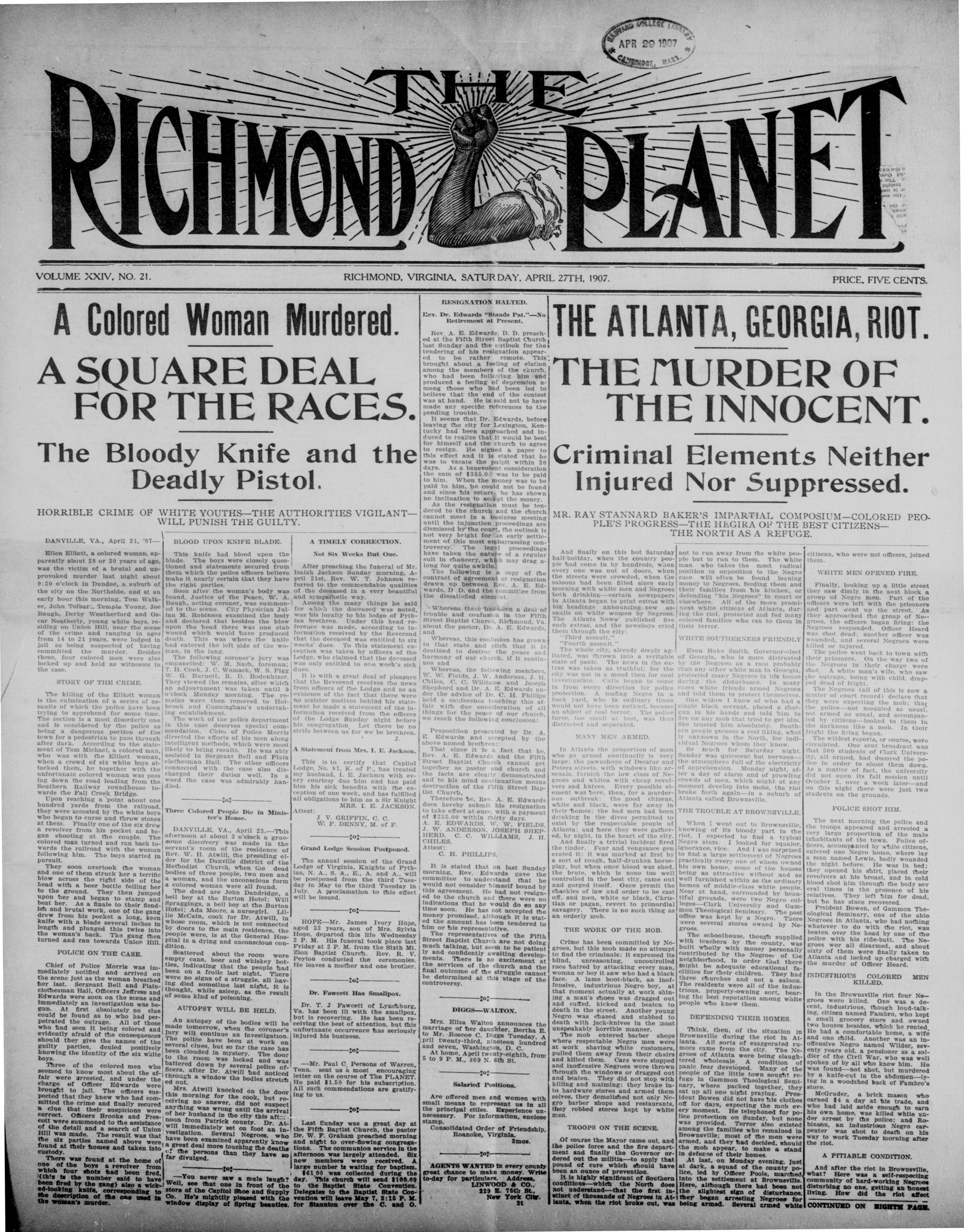
A Colored Woman Murdered. A SQUARE DEAL FOR THE RACES. The Bloody Knife and the Deadly Pistol.
HORRIBLE CRIME OF WHITE YOUTHS—THE AUTHORITIES VIGILANT WILL PUNISH THE GUILTY.
VOLUME XXIV. NO. 21.
A Colored
A SQU
FOR
The Blood
De
HORRIBLE CRIME OF
DANVILLE, VA., April 21, '07-
Ellen Elliott, a colored woman, apparently about 28 or 30 years of age, was the victim of a brutal and unprovoked murder last night about 9:30 o'clock in Dundee, a suburb of the city on the Northside, and at an early hour this morning, Tom Walker, John Tolbarly, Temple Young, Joe Baugh, Derby Weatherford and Oscar Neatherly, young white boys, residing on Union Hill, near the scene of the crime and ranging in ages from 14 to 21 years, were lodged in jail as being suspected of having committed the murder. Besides these, four colored men were also locked up and held as witnesses in the case.
STORY OF THE CRIME
The killing of the Elliott woman is the culmination of a series of assaults of which the police have been trying to apprehend for some time. The section is a most disorderly one and is considered by the police as being a dangerous portion of the town for a pedestrian to pass through after dark. According to the statement of Tom Michael, a colored man, who was with the Elliott woman, when a crowd of six white boys attacked them, he together with the unfortunate colored woman was passing down the road leading from the Southern Railway roundhouse towards the Fall Creek Bridge.
Upon reaching a point about one hundred yards from the railroad, they were accosted by the white boys who began to curse and throw stones at them. Finally one of the six drew a revolver from his pocket and began shooting at the couple. The colored man turned and ran back towards the railroad with the woman following him. The boys started in pursuit.
They soon overtook the woman and one of them struck her a terrific blow across the right side of the head with a beer bottle felling her to the ground. They then jumped upon her and began to stamp and beat her. As a finale to their fiendish and brutal work, one of the gang drew from his pocket a long, keen knife with a blade several inches in length and plunged this twice into the woman's back. The gang then turned and ran towards Union Hill.
POLICE ON THE CASE
Chief of Police Morris was immediately notified and arrived on the scene just as the woman breathed her last. Sergeant Bell and Plainclothesman Hall, Officers Jeffress and Edwards were soon on the scene and immediately an investigation was begun. At first absolutely no clue could be found as to who had perpetrated the outrage. All of those who had seen it being colored and evidently afraid of the consequences should they give the names of the guilty parties, denied positively knowing the identity of the six white boys.
Three of the colored men who seemed to know most about the affair were arrested, and under the charge of Officer Edwards were brought to fall. The officers suspected that they knew who had committed the crime and finally secured a clue that their suspicions were correct. Officers Brooks and Prescott were summoned to the assistance of the detail and a search of Union Hill was made. The result was that the six parties named above were found at their homes and taken into custody.
There was found at the home of one of the boys a revolver from which four shots had been fired, (this is the number said to have been fired by the gang) also a wicked-looking knife, corresponding to the description of the one used in the woman's murder.
BLOOD UPON KNIFE BLADE.
This knife had blood upon the blade. The boys were closely questioned and statements secured from them which the police officers believe make it nearly certain that they have the right parties.
Soon after the woman's body was found, Justice of the Peace, W. A. Baugh, acting coroner, was summoned to the scene. City Physician Julian M. Robinson examined the body and declared that besides the blow upon the head there was one stab wound which would have produced death. This was where the knife had entered the left side of the woman, in the lung.
The following coroner's jury was empanelled: W. M. Nash, foreman; T. H. Cook, J. C. Womack, W. S. Pigg W. G. Burnett, R. D. Rodenhizer. They viewed the remains, after which an adjournment was taken until 9 o'clock Monday morning. The reins were then removed to Holbrook, and Canningham's undertakingment.
The work of the police department in this case deserves special commendation. Chiee of Police Morris directed the efforts of his men along intelligent methods, which were most likely to bring results. He was ably assisted in Sergeant Bell and Plain clothesman Hall. The other officers connected with the case also discharged their duties well. In a word the case was admirably handled.
Three Colored People Die in Minister's House.
DANVILLE, VA., April 23.—This afternoon at about 3 o'clock a gruesome discovery was made in the servant's room of the residence of Rev. W. H. Atwill, the presiding elder for the Danville district of the Methodist Church, when the dead bodies of three people, two men and a woman, and the unconscious form a colored woman were all found. The dead are John Dandridge, a bell boy at the Burton Hotel; Will Spragings, a bell boy at the Burton Hotel; Ada Moore, a nursegirl. Lillie McCain, cook for Dr. Atwill, in whose room, which is not connected by doors to the main residence, the people were, is at the General Hospital in a dying and unconscious condition. Scattered about the room were empty cans, beer and whiskey bottles, indicating that the people had been on a frolic last night. There were no signs of a struggle, having died sometime last night, it is thought, while asleep, as the result of some kind of poisoning.
AUTOPSY WILL BE HELD
An autopsy of the bodies will be made tomorrow, when the coroner's jury will continue an investigation. The police have been at work on several clues, but so far the case has been clouded in mystery. The door to the room was locked and was battered down by several police officers, after Dr. Atwill had noticed through a window the bodies stretch ed out.
Mrs. Atwill knocked on the door this morning for the cook, but receiving no answer, did not suspect anything was wrong until the arrival of her husband in the city this afternoon from Patrick county. Dr. Atwill immediately set on foot an investigation. Several Negroes, who have been examined apparently know a great deal more touching the deaths of the persons than they have so far divulged.
You never saw a mule laugh? Well, see that one in front of the store of the Capitol Shoe and Supply Co. He's mightily pleased with the window display of Spring beauties
RICHMOND, VIRGINIA, SATURDAY, APRIL 27TH, 1907.
A TIMELY CORRECTION.
Not Six Weeks But One.
After preaching the funeral of Mr. Isaiah Jackson Sunday morning, April 21st, Rev. W. T. Johnson referred to the commendable qualities of the deceased in a very beautiful and sympathetic way.
Among the many things he said for which the deceased was noted, was his loyalty to his lodge of Pythian brethren. Under this head reference was made, according to information received by the Reverend that the deceased was entitled to six weeks' dues. To this statement exception was taken by officers of the Lodge, who claimed that the deceased was only entitled to one week's sick dues.
It is with a great deal of pleasure that the Reverend receives the news from officers of the Lodge and as an evidence of the fact that there were no sinister motives behind his statement he made a statement of the information received from the officers of the Lodge Sunday night before his congregation. Let there be no strife between us for we be brettren.
A Statement from Mrs. I. E. Jackson
This is to certify that Capitol
Lodge, No. 81, K. of P., has treated
my husband, I. E. Jackson with every courtesy due him and has paid him his sick benefits with the exception of one week, and has fulfilled all obligations to him as a Sir Knight
MRS. I. E. JACKSON.
Attest:
J. V. GRIFFIN, C. C.
W. F. DENNY, M. of F.
Grand Lodge Session Postponed.
The annual session of the Grand
Lodge of Virginia, Knights of Pythias,
N. A., S. A., E., A. and A., will
be postponed from the third Tuesday
in May to the third Tuesday in
July. A proclamation to this effect
will be issued.
HOPE—Mr. James Ivory Hope, aged 33 years, son of Mrs. Sylvia Hope, departed this life Wednesday 2 P. M. His funeral took place last Friday at 2 P. M. from the Sixth Mt. Zion Baptist Church. Rev. R. V. Peyton conducted the ceremonies. He leaves a mother and one brother.
Dr. Fawcett Has Smallpox
Dr. T. J. Fawcett of Lynchburg, Va. has been ill with the smallpox, but is recovering. He has been receiving the best of attention, but this unfortunate occurrence has seriously injured his business.
—Mr. Paul C, Persons of Warren, Tenn. sent us a most encouraging letter on the course of The PLANET. He paid $1.50 for his subscription. All such commendations are gratifying to us.
Last Sunday was a great day at the Fifth Baptist Church, the pastor Dr. W. F. Graham preached morning and night to over-flowing congregations. The communion service in the afternoon was largely attended. Six new members were received. A large number is waiting for baptism. $61.00 was collected during the day. This church will send $100.00 to the Baptist State Convention. Delegates to the Baptist State Convention will leave May 7, 2:15 P. M. for Staunton over the C. and O.
RESIGNATION HALTED.
Rev. Dr. Edwards "Stands Pat."—No Retirement at Present.
Rev. A. E. Edwards, D. D. preached at the Fifth Street Baptist Church last Sunday and the outlook for the tendering of his resignation appeared to be rather remote. This brought about a feeling of elation among the members of the church, who had been following him and produced a feeling of depression among those who had been led to believe that the end of the contest was at hand. He is said not to have made any specific references to the pending trouble. It seems that Dr. Edwards, before leaving the city for Lexington, Kentucky had been approached and induced to realize that it would be best for himself and the church to agree to resign. He signed a paper to this effect and it is stated that he was to vacate the pulpit within 30 days. As a benevolent consideration the sum of $355.00 was to be paid to him. When the money was to be paid to him, he could not be found and since his return, he has shown no inclination to accept the money. As the resignation must be tendered to the church and the church cannot meet in a business meeting until the injunction proceedings are dismissed by the court, the outlook is not very bright for an early settlement of this most embarrassing controversy. The legal proceedings have taken the nature of a regular suit in chancery, which may drag along for quite awhile.
The following is a copy of the contract of agreement or resignation drawn up between Rev. A. E. Edwards, D. D. and the committee from the dissatisfied element.
Whereas there has been a deal of trouble and confusion in the Fifth Street Baptist Church, Richmond, Va. about the pastor, Dr. A. E. Edwards, and
Whereas, this confusion has grown to that state and pitch that it is destined to destroy the peace and harmony of our church, if it continues and
Whereas, the following members, W. W. Fields, J. W. Anderson, J. H. Chiles, C. C. Williams and Joseph Shepherd and Dr. A. E. Edwards under the advice of Dr. C. H. Phillips held a conference touching this affair with due consideration of all things for the peace of our church, we reach the following conclusion:
Proposition presented by Dr. A. E. Edwards and accepted by the above named brethren:
That since it is a fact that he, Rev. A. E. Edwards and the Fifth Street Baptist Church cannot get together as pastor and church and the facts are clearly demonstrated and to his mind continuation means destruction of the Fifth Street Baptist Church.
Therefore he, Rev. A. E. Edwards does hereby submit his resignation to take effect at once, with a payment of $255.00 within thirty days.
A. E. EDWARDS, W. W. FIELDS
J. W. ANDERSON, JOSEPH SHEP
HERD, C. C. WILLIAMS, J. H
CHILES.
C. H. PHILLIPS
It is stated that on last Sunday morning, Rev. Edwards gave the committee to understand that he would not consider himself bound by this agreement. He had not resigned to the church and there were no indications that he would do so any time soon. He has not accepted the money promised, although it is stated the amount has been tendered to him or his representative.
The representatives of the Fifth Street Baptist Church are not doing much talking, but seem to be patiently and confidently awaiting developments. There is no excitement at the services of the church and the final outcome of the struggle cannot be determined at this stage of the controversy.
DIGGS—WALTON.
Mrs. Eliza Walton announces the marriage of her daughter, Bertha E. to Mr. Roscoe C. Diggs Tuesday. A april twenty-third, nineteen hundred and seven, Washington, D. C. At home, April twenty-eighth, from 5 to 9 P. M. 809 N. 6th St.
Salaried Positions.
Are offered men and women with small means to represent us in all the principal cities. Experience university. For information, enclose stamp.
AGENTS WANTED in every county
great chance to make money. Write
to-day for particulars. Address,
LINWOOD & CO.
229 E. 756th St.
New York City.
2t
THE ATLANTA, GEORGIA, RIOT. THE MURDER OF THE INNOCENT. Criminal Elements Neither Injured Nor Suppressed.
MR. RAY STANNARD BAKER'S IMPARTIAL COMPOSIUM—COLORED PEOPLE'S PROGRESS—THE HEGIRA OF THE BEST CITIZENS—THE NORTH AS A REFUGE.
And finally on this hot Saturday half-holiday, when the country people had come in by hundreds, when every one was out of doors, when the streets were crowded, when the saloons had been filled since early morning with white men and Negroes both drinking—certain newspapers in Atlanta began to print extras with big headings announcing new assaults on white women by Negroes. The Atlanta News published five such extras, and the newsboys cried them through the city:
"Third assault."
"Fourth assault."
The whole city, already deeply agitated, was thrown into a veritable state of panic. The news in the extras was taken as truthful; for the city was not in a mood then for cool investigation. Calls began to come in from every direction for police protection. A loading Negro in a back yard, who in ordinary times would not have been noticed, became an object of real terror. The police force, too small at best, was thus distracted and separated.
not to run away from the white people but to run to them. The white man who takes the most radical position in opposition to the Negro race will often be found loaning money to Negroes, feeding them and their families from his kitchen, or defending "his Negroes" in court or elsewhere. All of the more prominent white citizens of Atlanta, during the riot, protected and fed many colored families who ran to them in their terror.
WHITE SOUTHERNERS FRIENDLY
Even Hoke Smith, Governor-elect of Georgia, who is more distrusted by the Negroes as a race probably than any other white man in Georgia, protected many Negroes in his house during the disturbance. In many cases white friends armed Negroes and told them to protect themselves.
One widow I know of who had a single black servant, placed a shotgun in his hands and told him to fire on any mob that tried to get him. She trusted him absolutely. South citizens, who were not officers, joined them.
WHITE MEN OPENED FIRE.
Finally, looking up a little street they saw dimly in the next block a group of Negro men. Part of the officers were left with the prisoners and part went up the street. As they approached the group of Negroes, the officers began firing; the Negroes responded. Officer Heard was shot dead; another officer was wounded, and several Negroes were killed or injured.
The police went back to town with their prisoners. On the way two of the Negroes in their charge were shot. A white man's wife, who saw the outrage, being with child, dropped dead of fright.
The Negroes (all of this is now a matter of court record) declare that they were expecting the mob; that the police—not mounted as usual, not armed as usual, and accompanied by citizens—looked to them in the darkness.
MANY MEN ARMED
In Atlanta the proportion of men who go armed continually is very large; the pawnshops of Decatur and Peters streets, with windows like arsenals, furnish the low class of Negroes and whites with cheap revolvers and knives. Every possible element was here, then, for a murderous outbreak: the good citizens, white and black, were far away in their homes; the bad men had been drinking in the dives permitted to exist by the respectable people of Atlanta; and here they were gathered, by night, in the heart of the city. And finally a trivial incident fired the tinder. Fear and vengeance gen erated it: it was marked at first by a sort of rough, half-drunken horseplay, but when once blood was shed, the brute, which is none too well controlled in the best city, came out and gorged itself. Once permit the shackles of law and order to be cast off, and men, white or black, Christian or pagan, revert to primordial savagery. There is no such thing as an orderly mob.
THE WORK OF THE MOB
Crime has been committed by Negroes, but this mob made no attempt to find the criminals: it expressed its blind, unreasoning, uncontrolled race hatred by attacking every man, woman or boy it saw who had a black face. A lame boot-black, an inoffensive, industrious Negro boy, at that moment actually at work shining a man's shoes was dragged out and cuffed, kicked and beaten to death in the street. Another young Negro was chased and stabbed to death with jack-knives in the most unspeakably horrible manner.
The mob entered barber shops where respectable Negro men were at work shaving white customers, pulled them away from their chairs and killed them. Cars were stopped and inoffensive Negroes were thrown through the windows or dragged out and beaten. They did not stop with killing and malming; they broke into hardware stores and armed them selves, they demolished not only Negro barber shops and restaurants, they robbed stores kept by white men.
TROOPS ON THE SCENE
Of course the Mayor came out, and the police force and the fire department and finally the Governor ordered out the militia—to apply that pound of cure which should have been an ounce of prevention. It is highly significant of Southern conditions—which the North does not understand—that the first instinct of thousands of Negroes in Atlantas, when the riot broke out, was
not to run away from the white people but to run to them. The white man who takes the most radical position in opposition to the Negro race will often be found loaning money to Negroes, feeding them and their families from his kitchen, or defending "his Negroes" in court or elsewhere. All of the more prominent white citizens of Atlantas, during the riot, protected and fed many colored families who ran to them in their terror.
WHITE SOUTHERNERS FRIENDLY
Even Hoke Smith, Governor-elect of Georgia, who is more distrusted by the Negroes as a race probably than any other white man in Georgia, protected many Negroes in his house during the disturbance. In many cases white friends armed Negroes and told them to protect themselves. One widow I know of who had a single black servant, placed a shotgun in his hands and told him to fire on any mob that tried to get him. She trusted him absolutely. Southern people possess a real liking, wholy unknown in the North, for individual Negroes whom they know. So much for Saturday night. Sunday was quiescent but nerves—the atmosphere full of the electricity of apprehension. Monday night, after a day of alarm and of prowling crowds of men, which might at any moment develop into mobs, the riot broke forth again—in a suburb of Atlanta called Brownsville.
THE TROUBLE AT BROWNSVILLE
When I went out to Brownville, knowing of its bloody part in the riot, I expected to find a typical Negro slum. I looked for squail, ignorance, vice. And I was surprised to find a large settlement of Negroes practically every one of whom owned his own home, some of the houses being as attractive without and as well furnished within as the ordinary homes of middle-class white people. Near at hand, surrounded by beautiful grounds, were two Negro colleges—Clark University and Gammon Theological Seminary. The post office was kept by a Negro. There were several stores owned by Negroes.
The schoolhouse, though supplied with teachers by the county, was built wholly with money personally contributed by the Negroes of the neighborhood, in order that there might be adequate educational facilities for their children. They had three churches and not a saloon. The residents were all of the industrious, property-owning sort, bearing the best reputation among white people who knew them.
DEFENDING THEIR HOMES
Think, then, of the situation in Brownsville during the riot in Atlanta. All sorts of exaggerated rumors came from the city. The Negroes of Atlanta were being slaughtered wholesale. A condition of panic fear developed. Many of the people of the little town sought refuge in Gammon Theological Seminary, where packed together, they sat up all one night praying. President Bowen did not have his clothes off for days, expecting the mob every moment. He telephoned for police protection on Sunday, but none was provided. Terror also existed among the families who remained in Brownsville; most of the men were armed, and they had decided, should the mob appear, to make a stand in defense of their homes. At last, on Monday evening, just at dark, a squad of the county police, led by Officer Poole, marched into the settlement at Brownsville. Here, although there had been not the slightest sign of disturbance, they began arresting Negroes for being armed. Several armed white
PRICE, FIVE CENTS.
RGIA, RIOT.
R OF
CENT.
is Neither
pressed.
POSIUM—COLORED PEO-
BEST CITIZENS—
E.
citizens, who were not officers, joined them.
WHITE MEN OPENED FIRE.
Finally, looking up a little street they saw dimly in the next block a group of Negro men. Part of the officers were left with the prisoners and part went up the street. As they approached the group of Negroes, the officers began firing: the Negroes responded. Officer Heard was shot dead; another officer was wounded, and several Negroes were killed or injured.
The police went back to town with their prisoners. On the way two of the Negroes in their charge were shot. A white man's wife, who saw the outrage, being with child, dropped dead of fright.
The Negroes (all of this is now a matter of court record) declare that they were expecting the mob; that the police—not mounted as usual, not armed as usual, and accompanied by citizens—looked to them in the darkness like a mob. In their fright the firing began.
The wildest reports, or course, were circulated. One sent broadcast was that 500 students of Clark University, all armed, had decoyed the police in order to shoot them down. As a matter of fact, the university did not open its fall session until October 3, over a week later—and on this night there were just two students on the grounds.
POLICE SHOT HIM
The next morning the police and the troops appeared and arrested a very large proportion of the male inhabitants of the town. Police officers, accompanied by white citizens, entered one Negro home, where lay a man named Lewis, badly wounded the night before. He was in bed; they opened his shirt, placed their revolvers at his breast, and in cold blood shot him through the body several times in the presence of his relatives. They left him for dead, but he has since recovered.
Präsident Bowen, of Gammon Theological Seminary, one of the able Negroes in Atlanta, who had nothing whatever to do with the riot, was beaten over the head by one of the police with his rifle-butt. The Negroes wer all disarmed, and about sixty of them were finally taken to Atlanta and locked up charged with the murder of Officer Heard.
INDUSTRIOUS COLORED MEN
KILLED.
In the Brownsville riot four Negroes were killed. One was a decent, industrious, though loud-talking, citizen named Fambro, who kept a small grocery store and owned two houses besides, which he rented. He had a comfortable home, a wife and one child. Another was an in offensive Negro named Wilder, seventy years old, a pensioner as a soldier of the Civil War, who was well spoken of by all who knew him. He was found—not shot, but murdered by a knife-cut in the abdomen—lying in a woodshed back of Fambro's store.
McGruder, a brick mason who earned $4 a day at his trade, and who had laid aside enough to earn his own home, was killed while under arrest by the police; and Robinson, an industrious Negro carpenter was shot to death on his way to work Tuesday morning after the riot.
A PITIABLE CONDITION.
And after the riot in Brownsville, what? Here was a self-respecting community of hard-working Negroes disturbing no one, getting an honest living. How did the riot affect
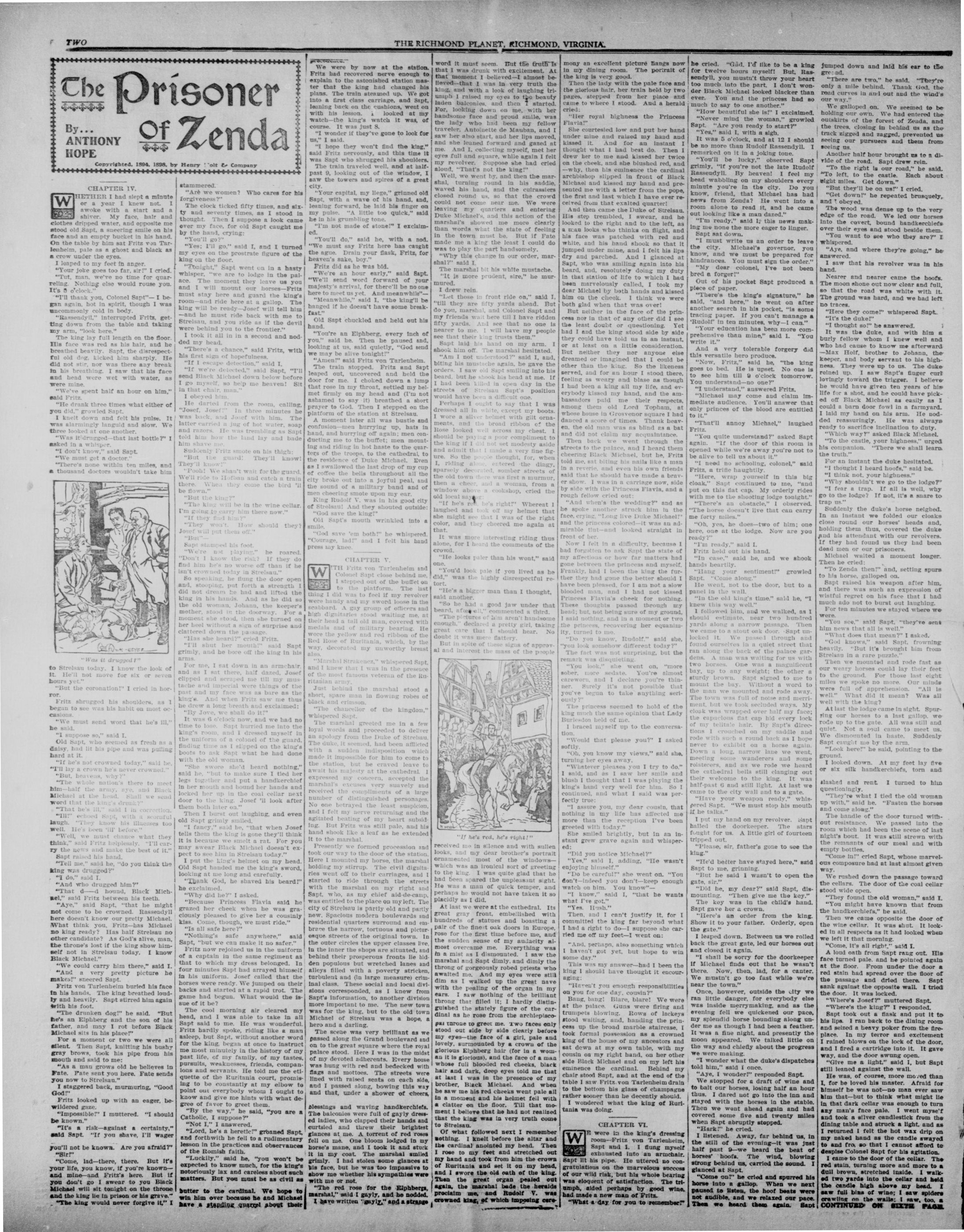
The Prisoner By... ANTHONY HOPE Of Zenda
TWO
4
CHAPTER IV.
W
I leaped to my feet in anger.
"Your joke goes too far, sir!" I cried.
"Tut, man, we've no time for quarreling. Nothing else would rouse you. It's 5 o'clock."
"I'll thank you, Colonel Sapt"—I began again, hot in spirit, though I was uncommonly cold in body.
"Rassendyll," interrupted Fritz, getting down from the table and taking my arm, "look here."
The king lay full length on the floor. His face was red as his hair, and he breathed heavily. Sapt, the disrespectful old dog, kicked him sharply. He did not stir, nor was there any break in his breathing. I saw that his face and head were wet with water, as were mine.
"We've spent half an hour on him," said Fritz.
"He drank three times what either of you did," growled Sapt.
I knelt down and felt his pulse. It was alarmingly languid and slow. We three looked at one another.
"Was it drugged—that last bottle?" I
asked in a whisper.
"I don't know," said Sapt.
"We must get a doctor."
"There's none within ten miles, and
thousand doctors wouldn't take him
H. HEYER
"Was it drugged?"
to Strelsau today, I know the look of it. He'll not move for six or seven hours yet."
"But the coronation!" I cried in horror.
Fritz shrugged his shoulders, as I began to see was his habit on most occasions.
"We must send word that he's ill," he said.
"I suppose so," said I.
Old Sapt, who seemed as fresh as a daisy, had lit his pipe and was pulling hard at it.
"If he's not crowned today," said he.
"I'll lay a crown he's never crowned."
"But, heavens, why?"
"The whole nation's there to meet him—half the army, age, and Black Michael at the head. Shall we send word that the king's drunk?"
"That he's ill," said I in correction.
"Ill" echoed Sapt, with a scornful laugh. "They know his illnesses too well. He's been 'ill before."
"Well, we must chance what they think," said Fritz helplessly. "I'll carry the news and make the best of it." Sapt raised his hand. "Tell me," said he, "do you think the king was drugged?"
"I do," said I.
"And I drugged him?"
"That d—d hound, Black Michael," said Fritz between his teeth.
"Aye," said Sapt. "that he might not come to be crowned. Rassendyll here doesn't know our pretty Michael. What think you, Fritz—has Michael no king ready? Has half Strelsau no other candidate? As God's alive, man, the throne's lost if the king show himself not in Strelsau today. I know Black Michael."
"We could carry him there," said I.
"And a very pretty picture he makes?" sneered Sapt.
Fritz von Tarlenheim buried his face in his hands. The king breathed loudly and heavily. Sapt stirred him again with his foot.
"The drunken dog!" he said. "But he's an Elphberg and the son of his father, and may I not before Black Michael sits in his place!"
For a moment or two we were all silent. Then Sapt, knitting his bushy gray brows, took his pipe from his mouth and said to me:
"As a man grows old he believes in Fate. Fate sent you here. Fate sends you now to Strelsaun."
I staggered back, murmuring, "Good God!"
Fritz looked up with an eager, bewildered gaze.
"I impossible!" I muttered. "I should be known."
"It's a risk—against a certainty," said Sapt. "If you shave, I'll wager you'll not be known. Are you afraid?" "Sir!"
"Come, lad—there, there. But it's your life, you know, if you're known—and mine—and Fritz's here. But if you don't go I swear to you Black Michael will sit tonight on the throne and the king lie in prison or his grave."
"The king would never forgive it."
stammered.
"Aré we women? Who cares for his forgiveness?"
The clock ticked fifty times, and sixty and seventy times, as I stood in thought. Then I suppose a look came over my face, for old Sapt caught me by the hand, crying.
"You'll go?"
"Yes; I'll go," said I, and I turned my eyes on the prostrate figure of the king on the floor.
"Tonight," Sapt went on in a hasty whisper, "we are to lodge in the palace. The moment they leave us you and I will mount our horses—Fritz must stay here and guard the king's room—and ride here at a gallop. The king will be ready—Josef will tell him—and he must ride back with me to Strelsan, and you ride as if the devil were behind you to the frontier."
I took it all in in a second and nodded me.
"There's a chance," said Fritz, with his first sign of hopefulness.
"If I escape detection," said I.
"If we're detected," said Sapt, "I'll send Black Michael down below before I go myself, so help me heaven! Sit in that chair, man."
I obeyed him.
He darted from the room, calling,
"Josef, Josef!" In three minutes he
was back, and Josef with him. The
latter carried a jug of hot water, soap
and razors. He was trembling as Sapt
told him how the land lay and bade
him shave me.
Suddenly Fritz smote on his thigh:
"But the guard! They'll know!
They'll know!"
"Pooch! We shan't wait for the guard,
We'll ride to Hofban and catch a train
there. When they come the bird 'lil
be flown."
"But the king?"
"The king will be in the wine cellar.
I'm going to carry him there now."
"If they find him?"
"They won't. How should they?
Josef will put them off."
"But—
Sant stumped his foot."
"We're not playing." he roared.
"Don't I know the risk? If they do find him he's no worse off than if he isn't crowned today in Strelsan."
So speaking, he flung the door open and, stooping, put forth a strength I did not dream he had and lifted the king in his hands. And as he did so the old woman, Johann, the keeper's mother, stood in the doorway. For a moment she stood, then she turned on her heel without a sign of surprise and clattered down the passage.
"Has she heard?" cried Fritz.
"I'll shut her mouth!" said Sapt grimly, and he bore off the king in his arms.
For me, I sat down in an armchair, and as I sat there, half dazed, Josef clipped and scraped me till my musache and imperial were things of the past and my face was as bare as the king's. And when Fritz saw me thus he drew a long breath and exclaimed:
"Be Jove we shall do it."
It was 6 o'clock now, and we had no time to lose. Sapt hurried me into the king's room, and I dressed myself in the uniform of a colonel of the guard, finding time as I slipped on the king's boots to ask Sapt what he had done with the old woman.
"She swore she'd heard nothing," said he, "but to make sure I tied her legs together and put a handkerchief in her mouth and bound her hands and locked her up in the coal cellar next door to the king. Josef 'll look after them both later on."
Then I burst out laughing, and even old Sapt grimly smiled.
"I fancy," said he, "that when Josef tells them the king is gone they'll think it is because we smelt a rat. For you may swear Black Michael doesn't expect to see him in Strelsau today."
I put the king's helmet on my head. Old Sapt handed me the king's sword, looking at me long and carefully.
"Thank God, he shaved his beard" he exclaimed.
"Why did he?" I asked.
"Because Princess Flavia said he grazed her cheek when he was graciously pleased to give her a cousinly kiss. Come, though, we must ride."
"Is all safe here?"
"Nothing's safe anywhere," said Sept, "but we can make it no safer."
Sapt, "but we can make it no safer."
Fritz now rejoiled us in the uniform of a captain in the same regiment as that to which my dress belonged. In four minutes Sapt had arrayed himself in his uniform. Josef called that the horses were ready. We jumped on their backs and started at a rapid trot. The game had begun. What would the issue of it be?
The cool morning air cleared my head, and I was able to take in all Sapt said to me. He was wonderful. Fritz hardly spoke, riding like a man asleep, but Sapt, without another word for the king, began at once to instruct me most minutely in the history of my past life, of my family, of my tastes, pursuits, weaknesses, friends, companions and servants. He told me the etiquette of the Ruritania court, promising to be constantly at my elbow to point out everybody whom I ought to know and give me hints with what degree of favor to greet them.
"By the way," he said, "you are a Catholic, I suppose?"
"Not I," I answered.
"Lord, he's a heretic!" groaned Sapt, and forthwith he fell to a rudimentary lesson in the practices and observances of the Romish faith.
"Luckily," said he, "you won't be expected to know much, for the king's notoriously lax and careless about such matters. But you must be as civil as butter to the cardinal. We hope to win him over because he and Michael have a standing quarrel about their
THE RICHMOND PLANET. RICHMOND. VIRGINIA.
We were by now at the station. Fritz had recovered nerve enough to explain to the astonished station master that the king had changed his plans. The train steamed up. We got into a first class carriage, and Sapt, leaning back on the cushions, went on with his lesson. I looked at my watch—the king's watch it was, of course. It was just 8.
"I wonder if they've gone to look for us," I said.
"I hope they won't find the king," said Fritz nervously, and this time it was Sapt who shrugged his shoulders. The train traveled well, and at half-past 9, looking out of the window, I saw the towers and spires of a great city.
"Your capital, my liege," grinned old Sapt, with a wave of his hand, and, leaning forward, he laid his finger on my pulse. "A little too quick," said he in his grumbling tone.
"I'm not made of stone!" I exclaimed.
"You'll do," said he, with a nod.
"We must say Fritz here has caught the ague. Drain your flask, Fritz, for heaven's sake, boy."
Fritz did as he was bld.
"We're an hour early," said Sapt. "We'll send word forward of your majesty's arrival, for there'll be no one here to meet us yet. And meanwhile"—"Meanwhile," said I. "the king'll be hanged if he doesn't have some breakfast." Old Sapt chuckled and held out his hand. "You're an Elphberg, every inch of you," said he. Then he paused and, looking at us, sald quietly, "God send we may be alive tonight!" "Amen!" said Fritz von Tarlenheim. The train stopped. Fritz and Sapt leaped out, uncovered and held the door for me. I choked down a lump that rose in my throat, settled my helmet firmly on my head and (I'm not ashamed to say) breathed a short prayer to God. Then I stepped on the platform of the station at Streisau.
A moment later all was bustle and confusion—men hurrying up, hats in hand, and hurrying off again; men conducting me to the buffet; men mounting and riding in hot haste to the quarters of the troops, to the cathedral, to the residence of Duke Michael. Even as I swallowed the last drop of my cup of coffee the bells throughout all the city broke out into a joyful peal, and the sound of a military band and of men cheering smate upon my ear.
King Rudolf V. was in his good city of Strelsau! And they shouted outside: "God save the king!"
Old Sapf's mouth wrinkled into a smile.
"God save 'em both!" he whispered.
"Courage, lad!" and I felt his hand press my knee.
CHAPTER V.
TH Fritz von Tarlenheim and
Colonel Sap close behind me,
I stepped out of the buffet on
to the platform. The last
thing I did was to feel if my revolver
were handy and my sword loose in the
seaboard. A gay group of officers and
high dignitaries stood waiting me at
their head a tall old man, covered with
medals and of military bearing. He
wore the yellow and red ribbon of the
Red Rose of Ruritania, which, by the
way, decorated my unworthy breast
also.
"Marshal Strakencz," whispered Sapt,
and I knew that I was in the presence
of the most famous veteran of the Kuritanian army.
Just behind the marshal stood a
short, spare man in flowing robes of
black and crimson.
"The chancellor of the kingdom,"
whispered Sapt.
The marshal greeted me in a few loyal words and proceeded to deliver an apology from the Duke of Strelsau. The duke, it seemed, had been afflicted with a sudden indisposition which made it impossible for him to come to the station, but he craved leave to await his majesty at the cathedral. I expressed my concern, accepted the marshal's excuses very suavely and received the compliments of a large number of distinguished personages. No one betrayed the least suspicion, and I felt my nerve returning and the agitated beating of my heart subsiding. But Fritz was still pale, and his hand shook like a leaf as he extended it to the marshal.
Presently we formed procession and took our way to the door of the station. Here I mounted my horse, the marshal holding my stirrup. The civil dignitaries went off to their carriages, and I started to ride through the streets with the marshal on my right and Sept, who, as my chief aid-de-camp, was entitled to the place on my left. The city of Strelsaun is partly old and partly new. Spacious modern boulevards and residential quarters surround and embrace the narrow, tortuous and pictureque streets of the original town. In the outer circles the upper classes live, in the inner the shops are situated, and behind their prosperous fronts lie hidden populous but wretched lanes and alleys filled with a poverty stricken, turbulent and (in large measure) criminal class. These social and local divisions corresponded, as I know from Sept's information, to another division more important to me. The new town was for the king, but to the old town Michael of Strelsaun was a hope, a hero and a darling.
The scene was very brilliant as we passed along the Grand boulevard and on to the great square where the royal palace stood. Here I was in the midst of my devoted adherents. Every house was hung with red and bedecked with flags and mottoes. The streets were lined with raised seats on each side, and I passed along, bowing this way and that, under a shower of cheers, blessings and waving handkerchiefs. The balconies were full of gayly dressed ladies, who clapped their hands and curtsied and threw their brightest glances at me. A torrent of red roses fell on me. One bloom lodged in my horse's mane, and I took it and stuck it in my coat. The marshal smiled grimly. I had stolen some glances at his face, but he was too impassive to show me whether his sympathies were with me or not.
"The red rose for the Elphbergs, marshal," said I gayly, and he nodded. I have written "gayly," and a strange
word it must seem. But the truth is that I was drunk with excitement. At that moment I believed—I almost believed—that I was in very truth the king, and with a look of laughing triumph I raised my eyes to the beauty laden balconies, and then I started. For, looking down on me, with her handsome face and proud smile, was the lady who had been my fellow traveler, Antoloute de Mauban, and I saw her also start, and her lips moved, and she leaned forward and gazed at me. And I, collecting myself, met her eyes full and square, while again I felt my revolver. Suppose she had cried aloud, "That's not the kling!"
Well, we went by, and then the marshal, turning round in his saddle, waved his hand, and the culrassiers closed round us, so that the crowd could not come near me. We were leaving my quarters and entering Duke Michael's, and this action of the marshal's showed me more clearly than words what the state of feeling in the town must be. But if Fate made me a king the least I could do was to play the part handsomely.
"Why this change in our order, marshal?" said I.
The marshal bit his white mustache.
"It is more prudent, sire," he murmured.
I drew rein.
"Let those in front ride on," said I.
"till they are fifty yards ahead. But do you, marshal, and Colonel Sapt and my friends wait here till I have ridden fifty yards. And see that no one is nearer to me. I will have my people see that their king trusts them."
Sapt laid his hand on my arm. I shook him off. The marshal hesitated.
"Am I not understood?" said I, and, biting his mustache again, he gave the orders. I saw old Sapt smiling into his beard, but he shook his head at me. If I had been killed in open day in the streets of Strelsan Sapt's position would have been a difficult one.
Perhaps I ought to say that I was dressed all in white, except my boots. I wore a silver helmet with gilt ornaments, and the broad ribbon of the Rose looked well across my chest. I should be paying a poor compliment to the king if I did not set modesty aside and admit that I made a very fine figure. So the people thought, for, when I, riding alone, entered the dingy, sparsely decorated, somber streets of the old town there was first a murmur, then a cheer, and a woman, from a window above a cookshop, crieed the old local saying:
"If he's red, he's right!" Whereat I laughed and took off my helmet that she might see that I was of the right color, and they cheered me again at that.
It was more interesting riding thus alone, for I heard the comments of the crowd.
"He looks paler than his wont," said one.
"You'd look pale if you lived as ha dld." was the highly disrespectful retort.
"He's a bigger man than I thought, said another.
"So he had a good jaw under that beard, after all," commented a third.
beard, atroci al," commented a third. "The pictures of him aren't handsome enough." declared a pretty girl, taking great care that I should hear. No doubt it was mere flattery. But in spite of these signs of approval and interest the mass of the people
B. H. WILSON
"If he's red, he's right!" received me in silence and with sullen looks, and my dear brother's portrait ornamented most of the windows—which was an ironical sort of greeting to the king. I was quite glad that he had been spared the unpleasant sight. He was a man of quick temper, and perhaps he would not have taken it so placidly as I did.
pai thorne to greet me. Two faces only stood out side by side clearly before my eyes—the face of a girl, pale and lovely, surmounted by a crown of the glorious Elphberg hair (for in a woman it is glorious), and the face of a man whose full blooded red cheeks, black hair and dark, deep eyes told me that at last I was in the presence of my brother, Black Michael. And when he saw me his red cheeks went pale all in a moment and his helmet fell with a clatter on the floor. Till that moment I believe that he had not realized that the king was in very truth come to Strelsaun.
Of what followed next I remember nothing. I knelt before the altar and the cardinal anointed my head. Then I rose to my feet and stretched out my hand and took from him the crown of Ruritania and set it on my head, and I swore the old cath of the king. Then the great organ pealed out again, the marshal bade the heralds proclaim me, and Rudolf V. was crowned king, of which imposing cere-
mony an excellent picture hangs now in my dining room. The portrait of the king is very good.
Then the lady with the pale face and the glorious hair, her train held by two pages, stepped from her place and came to where I stood. And a herald cried:
"Her royal highness the Princess Flavia"
She courtesied low and put her hand under mine and raised my hand and kissed it. And for an instant I thought what I had best do. Then I drew her to me and kissed her twice on the cheek, and she blushed red, and —why, then his eminence the cardinal archbishop slipped in front of Black Michael and kissed my hand and presented me with a letter from the pope, the first and last which I have ever received from that exalted quarter!
And then came the Duke of Strelsan. His step trembled, I swear, and he looked to the right and to the left, as a mau looks who thinks on flight, and his face was patched with red and white, and his hand shook so that it jumped under mine, and I felt his lips dry and parched. And I glanced at Sapt, who was smiling again into his beard, and, resolutely doing my duty in that station of life to which I had been marvelously called, I took my dear Michael by both hands and kissed him on the cheek. I think we were both glad when that was over!
But neither in the face of the princess nor in that of any other did I see the least doubt or questioning. Yet had I and the king stood side by side they could have told us in an instant, or at least on a little consideration. But neither they nor anyone else dreamed or imagined that I could be other than the king. So the likeness served, and for an hour I stood there, feeling as weary and blase as though I had been a king all my life, and everybody kissed my hand, and the ambassadors paid me their respects, among them old Lord Topham, at whose house in Groovenor square I had danced a score of times. Thank heaven, the old man was as blind as a bat and did not claim my acquaintance.
Then back we went through the streets to the palace, and I heard them cheering Black Michael, but he, Fritz told me, sat biting his nails like a man in a reverie, and even his own friends said that he should have made a braver show. I was in a carriage now, side by side with the Princess Flavia, and a rough fellow cried out: "And when's the wedding?" and as he spoke another struck him in the face, crying "Long live Duke Michael" and the princess colored—it was an admirable tint—and looked straight in front of her.
Now I felt in a difficulty, because I had forgotten to ask Sapt the state of my affections or how far matters had gone between the princess and myself. Frankly, had I been the king the further they had gone the better should I have been pleased, for I am not a slow blooded man, and I had not kissed Princess Flavia's cheek for nothing. These thoughts passed through my head; but, not being sure of my ground, I said nothing, and in a moment or two the princess, recovering her equanimity, turned to me.
"Do you know, Rudolf," said she, "you look somehow different today?" The fact was not surprising, but the remark was disquieting.
"You look," she went on, "more sober, more sedate. You're almost careworn, and I declare you're thinner. Surely it's not possible that you've begun to take anything seriously?"
The princess seemed to hold of the king much the same opinion that Lady Burlesdon held of me.
I braced myself up to the conversation.
"Would that please you?" I asked softly.
"Oh, you know my views," said she, turning her eyes away.
"Whatever pleases you I try to do." I said, and as I saw her smile and blush I thought that I was playing the king's hand very well for him. So I continued, and what I said was perfectly true:
"I assure you, my dear cousin, that nothing in my life has affected me more than the reception I've been greeted with today."
She smiled brightly, but in an instant grew grave again and whispered:
"Did you notice Michael?"
"Yes," said I, adding, "He wasn't enjoying himself."
"Do be careful!" she went on. "You don't—indeed you don't—keep enough watch on him. You know"— "I know." said I, "that he wants what I've got."
"Yes, Hush."
Then, and I can't justify it, for I committed the king far beyond what I had a right to do—I suppose she carried me off my feet—I went on:
"And, perhaps, also something which I haven't got yet, but hope to win some day."
This was my answer—had I been the king I should have thought it encouraging:
"Haven't you enough responsibilities on you for one day, cousin?"
Bang, bang! Blare, blare! We were at the palace. Guns were firing and trumpets blowing. Rows of lackeys stood waiting, and, handing the princess up the broad marble staircase. I took formal possession as a crowned king of the house of my ancestors and sat down at my own table, with my cousin on my right hand, on her other side Black Michael and on my left his eminence the cardinal. Behind my chair stood Sapt, and at the end of the table I saw Fritz.von Tarlenheim drain to the bottom his glass of champagne rather sooner than he deciently should. I wondered what the king of Rurkania was doing.
CHAPTER VI
W were in the king's dressing room—Fritz von Tarlenheim, Sapt and I. I fung myself exhausted into an armchair, Sapt lit his pipe. He uttered no congratulations on the marvelous success of our wild risk, but his whole bearing was eloquent of satisfaction. The trumph, aled perhaps by good wine, had made a new man of Fritz.
"What a day for you to remember!"
he cried. "Gad, I'd like to be a king for twelve hours myself! But, Rassendyll, you mustn't throw your heart too much into the part. I don't wonder Black Michael looked blacker than ever. You and the princess had so much to say to one another."
"How beautiful she is!" I exclaimed.
"Never mind the woman," growled Sapt. "Are you ready to start?"
"Yes," said I, with a sigh.
It was 5 o'clock, and at 12 I should be no more than Rudolf Rassendyll. I remarked on it in a joking tone.
"You'll be lucky," observed Sapt grimly, "if you're not the late Rudolf Rassendyll. By heaven! I feel my head wabbling on my shoulders every minute you're in the city. Do you know, friend, that Michael has had news from Zenda? He went into a room alone to read it, and he came out looking like a man dazed."
"I'm ready," said I; this news making me none the more eager to linger.
Sapt sat down.
"I must write us an order to leave the city. Michael's governor, you know, and we must be prepared for hindrances. You must sign the order."
"My dear colonel, I've not been bred a forger!"
Out of his pocket Sapt produced a piece of paper.
"There's the king's signature," he said, "and here," he went on after another search in his pocket, "is some tracing paper. If you can't manage a 'Rudolf' in ten minutes, why-I can."
"Your education has been more comprehensive than mine," said I. "You write it."
And a very tolerable forgery did this versatile hero produce.
"Now, Fritz," said he, "the king goes to bed. He is upset. No one is to see him till 9 o'clock tomorrow. You understand—no one!"
"Michael may come and claim immediate audience. You'll answer that only princes of the blood are entitled to it."
"That'll annoy Michael," laughed Fritz.
"You quite understand?" asked Sapt again.
"If the door of this room is opened while we're away you're not to be alive to tell us about it."
"I need no schooling, colonel," said Fritz, a tride haughtily.
"Here, wrap yourself in this big cloak," Sapt continued to me, "and put on this flat cap. My orderly rides with me to the shooting lodge tonight."
"There's an obstacle," I observed.
"The horse doesn't live that can carry me forty miles."
"Oh, yes, he does—two of him; one here, one at the lodge. Now are you ready?"
"I'm ready," said L.
"in case," said he, and we shook hands heartily.
"Hang your sentiment!" growled Sapt. "Come along."
He went, not to the door, but to a panel in the wall.
"In the old king's time," said he, "I knew this way well."
I followed him, and we walked, as I should estimate, near two hundred yards along a narrow passage. Then we came to a stout oak door. Sapt unlocked it. We passed through and found ourselves in a quiet street that ran along the back of the palace gardens. A man was waiting for us with two horses. One was a magnificent bay, up to any weight; the other a sturdy brown. Sapt signed to me to mount the bay. Without a word to the man we mounted and rode away. The town was full of noise and merriment, but we took secluded ways. My cloak was wrapped over half my face; the capacious flat cap hid every lock of my telltale hair. By Sapt's directions I crouched on my saddle and rode with such a round back as I hope never to exhibit on a horse again. Down a long, narrow lane we went, meeting some wanderers and some roisterers, and as we rode we heard the cathedral bells still clanging out their welcome to the king. It was half-past 6 and still light. At last we came to the city wall and to a gate.
"Have your weapon ready," whispered Sapt. "We must stop his mouth if he talks."
I put my hand on my revolver. Sapt halled the doorkeeper. The stars fought for us. A little girl of fourteen tripped out.
"Please, sir, father's gone to see the king."
"He'd better have stayed here," said Sapt to me, grinning.
"But he said I wasn't to open the gate, sir."
"Did he, my dear?" said Sapt, dismounting. "Then give me the key."
The key was in the child's hand. Sapt gave her a crown.
"Here's an order from the king. Show it to your father. Orderly, open the gate."
I leaped down. Between us we rolled back the great gate, led our horses out and closed it again.
"I shall be sorry for the doorkeeper if Michael finds out that we wasn't there. Now, then, lad, for a canter. We mustn't go too fast while we're near the town."
Once, however, outside the city we ran little danger, for everybody else was inside merrymaking, and as the evening fell we quickened our pace, my splendid horse bounding along under me as though I had been a feather. It was a fine night, and presently the moon appeared. We talked little on the way and chiefly about the progress we were making.
"I wonder what the duke's dispatches told him," said I once.
"Aye, I wonder!" responded Sapt.
We stopped for a draft of wine and to bait our horses, losing half an hour thus. I dared not go into the inn and stayed with the horses in the stable. Then we went ahead again and had covered some five and twenty miles when Sapt abruptly stopped.
I listened. Away, far behind us, in the still of the evening—it was just half past 9—we heard the beat of horses' hoofs. The wind, blowing strong behind us, carried the sound. I glanced at Sapt.
"Come on!" he cried and spurred his horse into a gallop. When we next paused to listen, the hoof beats were not audible, and we relaxed our pace. Then we heard them again. Giant
jumped down and laid his ear to the ground.
"There are two," he said. "They're only a mile behind. Thank God, the road curves in and out and the wind's our way."
We galloped on. We seemed to be holding our own. We had entered the outskirts of the forest of Zenda, and the trees, closing in behind us as the track zigged and zagged, prevented us seeing our pursuers and them from seeing us.
Another half hour brought us to a divide of the road. Sapt drew rein.
"To the right is our road," he said.
"To left, to the castle. Each about eight miles. Get down."
"But they'll be on us!" I cried.
"Get down!" he repeated brusquely, and I obeyed.
The wood was dense up to the very edge of the road. We led our horses into the covert, bound handkerchiefs over their eyes and stood beside them. "You want to see who they are?" I whispered. "Aye, and where they're going," he answered. I saw that his revolver was in his hand. Nearer and nearer came the hoofs. The moon shone on now clear and full, so that the road was white with it. The ground was hard, and we had left no traces. "Here they come!" whispered Sapt. "It's the duke!"
"I thought so," he answered.
It was the duke, and with him a burly fellow whom I knew well and who had cause to know me afterward—Max Holf, brother to Johann, the keeper, and body servant to his highness. They were up to us. The duke relined up. I saw Sapt's finger curl lovingly toward the trigger. I believe he would have given ten years of his life for a shot, and he could have picked off Black Michael as easily as I could a barn door fowl in a farmyard. I laid my hand on his arm. He nodded reassuringly. He was always ready to sacrifice inclination to duty.
"Which way?" asked Black Michael. "To the castle, your highness," urged his companion. "There we shall learn the truth."
For an instant the duke hesitated.
"I thought I heard hoofs," said he.
"I think not, your highness."
"Why shouldn't we go to the lodge?"
"I fear a trap. If all is well, why go to the lodge? If not, it's a snare to trap us."
Suddenly the duke's horse neighed. In an instant we folded our cloaks close round our horses' heads and, holding them thus, covered the duke and his attendant with our revolvers. If they had found us they had been dead men or our prisoners.
Michael waited a moment longer. Then he cried:
"To Zenda then!" and, setting spurs to his horse, galloped on.
Sapt raised his weapon after him, and there was such an expression of wistful regret on his face that I had much ado not to burst out laughing.
For ten minutes we stayed where we
For ten minutes we stayed where we were.
"You see," said Sapt, "they've sent him news that all is well."
"What does that mean?" I asked.
"God knows," said Sapt, frowning heavily.
"But it's brought him from Streisau in a rare puzzle."
Then we mounted and rode fast as our weary horses could lay their feet to the ground. For those last eight miles we spoke no more. Our minds were full of apprehension. "All is well." What did it mean? Was all well with the king?
At last the lodge came in sight. Spurring our horses to a last gallop, we rode up to the gate. All was still and quiet. Not a soul came to meet us. We dismounted in haste. Suddenly Sapt caught me by the arm.
"Look here!" he said, pointing to the ground.
I looked down. At my feet lay five or six silk handkerchiefs, torn and slashed and rent. I turned to him questioningly.
"They're what I tied the old woman up with," said he. "Fasten the horses and come along."
The handle of the door turned without resistance. We passed into the room which had been the scene of last night's bout. It was still strewn with the remnants of our meal and with empty bottles.
"Come in!" cried Sapt, whose marvelous composure had at last almost given way.
We rushed down the passage toward the cellars. The door of the coal cellar stood wide open.
"They found the old woman," said I.
"You might have known that from the handkerchiefs," he said.
Then we came opposite the door of the wine cellar. It was shut. It looked in all respects as it had looked when we left it that morning.
"Come, it's all right." said I.
A loud oath from Sapt rang out. His face turned pale, and he pointed again at the floor. From under the door a red stain had spread over the floor of the passage and drilled there. Sapt sank against the opposite wall. I tried the door. It was locked.
"Where's Josef?" muttered Sapt. "Where's the king?" I responded. Sapt took out a flask and put it to his lips. I ran back to the dining room and selzed a heavy poker from the fireplace. In my terror and excitement I rained blows on the lock of the door, and I fired a cartridge into it. It gave way, and the door swung open.
"Give me a light," said I, but Sapt still leaned against the wall.
He was, of course, more moved than I, for he loved his master. Afraid for himself he was not—no man ever saw him that—but to think what might lie in that dark cellar was enough to turn any man's face pale. I went myself and took a silver candlestick from the dining table and struck a light, and as I returned I felt the hot wax drip on my naked hand as the candle swayed and to fro, so that I cannot afford to desplse Colonel Sapt for his agitation. I came to the door of the cellar. The red stain, turning more and more to a dull brown, stretched inside. I walked two yards into the cellar and held the candle high above my head. I saw full bins of wine; I saw spliders crawling on the walls; I saw, too, a CONTINUED ON SIXTEEN PAGE
---
IT WILL PAY YOU To interest yourself in promot ing the CIRCULATION of the RICHMOND PLANET.
---
THE PLANET
SATURDAY.....APRIL 27, 1907
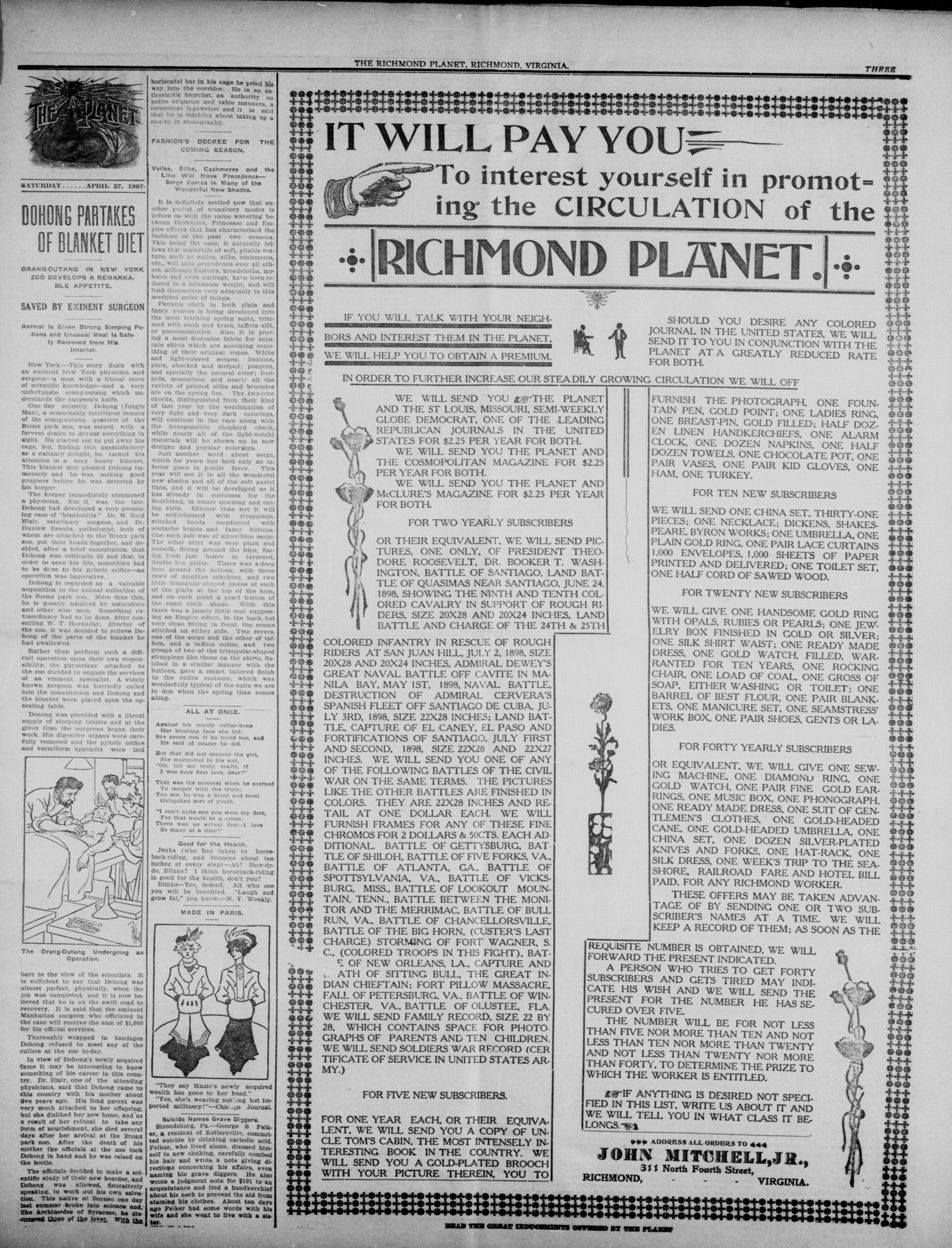
DOHONG PARTAKES OF BLANKET DIET
ORANG-OUTANG IN NEW YORK
ZOO DEVELOPS A REMARKA-
BLE APPETITE.
SAVED BY EMINENT SURGEON
Animal Is Given Strong Sleeping Positions and Unusual Meal Is Safey Removed from His
New York.—This story deals with an eminent New York physician and surgeon—a man with a liberal store of scientific knowledge—and a very unfortunate orang-outang which understands the surgeon's knife.
One day recently Dohong (Jungle Man), a remarkably intelligent inmate of the orang-outang quarters of the Bronx park zoo, was seized with a fervent desire to devour everything in sight. He started out to put away his cage, but, finding this unsatisfactory as a culinary delight, he turned his attention to a very heavy blanket. This blanket diet pleased Dohong intensely and he was making good progress before he was detected by his keeper.
The keeper immediately summoned a physician. But it was too late. Dohong had developed a very promising case of "blanketttis." Dr. W. Reid Blair, veterinary surgeon, and Dr. Hanlow Brooks, pathologist, both of whom are attached to the Bronx park zoo, put their heads together, and decided, after a brief consultation, that Dohong was critically ill and that, in order to save his life, something had to be done to his pyloric orifice—an operation was imperative. Dohong is regarded as a valuable acquisition to the animal collection of the Bronx park zoo. More than this, he is greatly admired by naturalists and other wise men. Something extraordinary had to be done. After consulting W. T. Hornaday, director of the zoo, it was decided to relieve Dohong of the parts of the blanket he had swallowed.
Rather than perform such a difficult operation upon their own responsibility, the physicians attached to the zoo decided to engage the services of an eminent specialist. A widely known surgeon was hurriedly called into the consultation and Dohong and the blanket were placed upon the operating table.
Donong was provided with a liberal supply of sleeping tablets and at the given time the surgeons began their work. His digestive organs were carefully removed and the pyloric orifice and vermiform appendix were laid
2
The Orang-Outang Undergoing an Operation.
bare to the view of the scientists. It is sufficient to say that Dohong was almost perfect, physically, when the job was completed, and it is now believed that he is on the swift road to recovery. It is said that the eminent Manhattan surgeon who officiated in the case will receive the sum of $1,000 for his official services.
Thoroughly wrapped in bandages Dohong refused to meet any of the callers at the zoo to-day.
In view of Dohong's newly acquired fame it may be interesting to know something of his career in this country. Dr. Blair, one of the attending physicians, said that Dohong came to this country with his mother about five years ago. His fond parent was very much attached to her offspring, but she disliked her new home, and as a result of her refusal to take any form of nourishment, she died several days after her arrival at the Bronx park zoo. After the death of his mother the officials at the zoo took Dohong in hand and he was raised on the bottle.
The officials decided to make a scientific study of their new boarder, and Dohong was allowed, figuratively speaking, to work out his own salvation. This native of Borneo one day last summer broke into science and, like Archimedes of Syracuse, he discovered those of the lever. With the
IF YOU WILL TALK WITH YOUR NEIGH BORS AND INTEREST THEM IN THE PLANET WE WILL HELP YOU TO OBTAIN A PREMIUM.
COLORED INFANTRY IN RESCUE OF ROUGH RIDERS AT SAN JUAN HILL, JULY 2, 1898, SIZE 20X28 AND 20X24 INCHES, ADMIRAL DEWEY'S GREAT NAVAL BATTLE OFF CAVITE IN MANILA BAY, MAY 1ST, 1898, NAVAL BATTLE, DESTRUCTION OF ADMIRAL CERVERA'S SPANISH FLEET OFF SANTIAGO DE CUBA, JULY 3RD, 1898, SIZE 22X28 INCHES; LAND BATTLE, CAPTURE OF EL CANEY, EL PASO AND FORTIFICATIONS OF SANTIAGO, JULY FIRST AND SECOND, 1898, SIZE 22X28 AND 22X27 INCHES. WE WILL SEND YOU ONE OF ANY OF THE FOLLOWING BATTLES OF THE CIVIL WAR ON THE SAME TERMS. THE PICTURES LIKE THE OTHER BATTLES ARE FINISHED IN COLORS. THEY ARE 22X28 INCHES AND RETAIL AT ONE DOLLAR EACH. WE WILL FURNISH FRAMES FOR ANY OF THESE FINE CHROMOS FOR 2 DOLLARS & 50CTS. EACH ADDITIONAL. BATTLE OF GETTYSBURG, BATTLE OF SHILOH, BATTLE OF FIVE FORKS, VA., BATTLE OF ATLANTA, GA., BATTLE OF SPOTTSYLVANIA, VA., BATTLE OF VICKSBURG, MISS., BATTLE OF LOOKOUT MOUNTAIN, TENN., BATTLE BETWEEN THE MONITOR AND THE MERRIMAC, BATTLE OF BULL RUN, VA., BATTLE OF CHANCELLORSVILLE, BATTLE OF THE BIG HORN, (CUSTER'S LAST CHARGE) STORMING OF FORT WAGNER, S. C., (COLORED TROOPS IN THIS FIGHT), BAT
E OF NEW ORLEANS, LA., CAPTURE AND
ATH OF SITTING BULL, THE GREAT INDIAN CHIEFTAIN; FORT PILLOW MASSACRE,
FALL OF PETERSBURG, VA., BATTLE OF WINCHESTER, VA., BATTLE OF OLUSTEE, FLA.
WE WILL SEND FAMILY RECORD, SIZE 22 BY
28, WHICH CONTAINS SPACE FOR PHOTOGRAPHS OF PARENTS AND TEN CHILDREN.
WE WILL SEND SOLDIERS WAR RECORD (CERTIFICATE OF SERVICE IN UNITED STATES ARMY.)
FOR ONE YEAR EACH, OR THEIR EQUIVALENT, WE WILL SEND YOU A COPY OF UNCLE TOM'S CABIN, THE MOST INTENSELY INTERESTING BOOK IN THE COUNTRY. WE WILL SEND YOU A GOLD-PLATED BROOCH WITH YOUR PICTURE THEREIN, YOU TO
horizontal bar in his cage he pried his way into the corridor. He is an enthusiastic bicyclist, an authority on polite etiquette and table manners, a competent typewriter and it is said that he is thinking about taking up a course in stenography.
o.
FASHION'S DECREE FOR THE COMING SEASON.
Volles, Silks, Cashmeres and the Like Will Have Precedence—Serge Comes in Many of the Wonderful New Shades.
It is definitely settled now that another period of transitory modes is before us with the same wavering between Directoire, Princesse and Empire effects that has characterized the fashions of the past two seasons. This being the case, it naturally follows that materials of soft, pliable texture, such as volles, silks, cashmeres, etc., will take precedence over all others, although flannels, broadeloths, mohairs and even sultings, have been reduced to a minimum weight, and will lend themselves very adaptably to this accepted order of things.
Panama cloth in both plain and fancy weaves is being developed into the most fetching spring suits, trimmed with cloth and braid, taffeta silk, or passementeries. Also, it is proving a most desirable fabric for separate skirts which are assuming something of their original vogue. White and light-colored serges; louisine, plain, checked and striped; ponges, and specially the natural color; foulards, messalines, and nearly all the variety of printed silks and brocades are on the spring list. The two-tone checks, distinguished from their kind of last year by the combination of very light and very dark colorings, will continue in the race along with the irresponsible shoerder check, while nearly all of the light-weight materials will be shown up in new designs and popular colorings.
Just another word about serge, which for years has held only an inferior place in public favor. This year will see it in all the wonderful new shades and all of the soft pastel tints, and it will be developed as it has already in costumes for the Southland, in smart morning and outing suits. Oftener than not it will be self-trimmed with strappings, stitched bands reconstructed with soutache braids and fancy buttons. One such suit was of silver-blue serge. The other skirt was very plain and smooth, fitting around the hips, flaring from just below in inturned, double box plaits. There was a deep hem around the bottom, with three rows of machine stitching, and two little triangular-shaped pieces at each of the plaits at the top of the hem, and on each point a pearl button of the exact cloth shade. With this there was a jaunty little coat suggesting an Empire effect, in the back, but very close fitting in front, the seams stitched on either side. Two revers, one of the serge and the other of taffeta, and a taffeta collar, and two groups of two of the triangular-shaped strappings like those on the skirts, finished in a similar manner with the buttons, gave a smart tailored finish to the entire costume, which was wonderfully typical of the suits we are to do when the spring time comes along.
ALL AT ONCE.
Against his manly collar-bone
Her blushing face she hid;
She asked nm if he loved her, and
He said of course he did.
But that did not content the girl,
She murmured in his ear,
"Oh, tell me truly, really, if
I was your first love, dear?"
That was the moment when he scorned
To tamper with the truth;
You see, he was a blunt and most
Outspoken sort of youth.
"I can't quite say you were my first,
For that would be a crime;
There was no actual first—I love
So many at a time!"
Good for the Health.
Jenks (who has taken to horseback-riding, and bounces about ten inches at every step)—Ah! How-dy-do, Blinks? I think horseback-riding is good for the health, don't you? Blinks—Yes, indeed. All who see you will be benefited. "Laugh and grow fat," you know.—N. Y. Weekly.
```markdown
```
```markdown
```
"They say Mazie's newly acquired wealth has gone to her head."
"Yes, she's wearing nothing but imported millinery!"—Chicago Journal.
Suicide Names Grave Diggers.
Stroudsburg, Pa.—George S Felker, a resident of Kellersville, committed suicide by drinking carbolic acid. Felker, who lived alone, dressed himself in new clothing, carefully combed his hair and wrote a note giving directions concerning his affairs, even naming his grave diggers. He also wrote a judgment note for $101 to an acquaintance and tied a handkerchief about his neck to prevent the aid from staining his clothes. About ten days ago Felker had some words with his wife and she went to live with a sister.
IN ORDER TO FURTHER INCREASE OUR STEADILY GROWING CIRCULATION WE WILL OFF
WE WILL SEND YOU THE PLANET AND THE ST LOUIS, MISSOURI, SEMI-WEEKLY GLOBE DEMOCRAT, ONE OF THE LEADING REPUBLICAN JOURNALS IN THE UNITED STATES FOR $2.25 PER YEAR FOR BOTH. WE WILL SEND YOU THE PLANET AND THE COSMOPOLITAN MAGAZINE FOR $2.25 PER YEAR FOR BOTH. WE WILL SEND YOU THE PLANET AND McCLURE'S MAGAZINE FOR $2.25 PER YEAR FOR BOTH.
OR THEIR EQUIVALENT, WE WILL SEND PICTURES, ONE ONLY, OF PRESIDENT THEODORE ROOSEVELT, DR. BOOKER T. WASHINGTON, BATTLE OF SANTIAGO, LAND BATTLE OF QUASIMAS NEAR SANTIAGO, JUNE 24, 1898, SHOWING THE NINTH AND TENTH COLORED CAVALRY IN SUPPORT OF ROUGH RIDERS, SIZE 20X28 AND 20X24 INCHES, LAND BATTLE AND CHARGE OF THE 24TH & 25TH
READ THE GREAT INDUCIMENTS OFFERED BY THE PLANET
THE RICHMOND PLANET, RICHMOND, VIRGINIA
```markdown
```
FOR TWO YEARLY SUBSCRIBERS
FOR FIVE NEW SUBSCRIBERS
REQUISITE NUMBER IS OBTAINED, WE WILL FORWARD THE PRESENT INDICATED.
A PERSON WHO TRIES TO GET FORTY SUBSCRIBERS AND GETS TIRED MAY INDICATE HIS WISH AND WE WILL SEND THE PRESENT FOR THE NUMBER HE HAS SECURED OVER FIVE.
THE NUMBER WILL BE FOR NOT LESS THAN FIVE NOR MORE THAN TEN AND NOT LESS THAN TEN NOR MORE THAN TWENTY AND NOT LESS THAN TWENTY NOR MORE THAN FORTY, TO DETERMINE THE PRIZE TO WHICH THE WORKER IS ENTITLED.
IF ANYTHING IS DESIRED NOT SPECIFIED IN THIS LIST, WRITE US ABOUT IT AND WE WILL TELL YOU IN WHAT CLASS IT BE LONGS.
ADDRESS ALL ORDERS TO
JOHN MITCHELL,JR.,
311 North Fourth Street,
RICHMOND, VIRGINIA.
A man in a suit is sitting in a chair. A man in a suit is standing next to him.
LANET
EEKLY
READING
UNITED
H.
T AND
R $2.25
T AND
YEAR
ND PIC-
THEO-
WASH-
D BAT-
JUNE 24,
H COL-
GH RI-
LAND
& 25TH
```markdown
```
REQUIRED FOR WAI
SHOULD YOU DESIRE ANY COLORED JOURNAL IN THE UNITED STATES, WE WILL SEND IT TO YOU IN CONJUNCTION WITH THE PLANET AT A GREATLY REDUCED RATE FOR BOTH.
FURNISH THE PHOTOGRAPH, ONE FOUNTAIN PEN, GOLD POINT; ONE LADIES RING, ONE BREAST-PIN, GOLD FILLED; HALF DOZEN LINEN HANDKERCHIEFS, ONE ALARM CLOCK, ONE DOZEN NAPKINS, ONE HALF DOZEN TOWELS, ONE CHOCOLATE POT, ONE PAIR VASES, ONE PAIR KID GLOVES, ONE HAM, ONE TURKEY.
FOR TEN NEW SUBSCRIBERS
WE WILL SEND ONE CHINA SET, THIRTY-ONE PIECES; ONE NECKLACE; DICKENS, SHAKESPEARE, BYRON WORKS; ONE UMBRELLA, ONE PLAIN GOLD RING, ONE PAIR LACE CURTAINS 1,000 ENVELOPES, 1,000 SHEETS OF PAPER PRINTED AND DELIVERED; ONE TOILET SET, ONE HALF CORD OF SAWED WOOD
FOR TWENTY NEW SUBSCRIBERS
WE WILL GIVE ONE HANDSOME GOLD RING WITH OPALS, RUBIES OR PEARLS; ONE JEWELRY BOX FINISHED IN GOLD OR SILVER; ONE SILK SHIRT WAIST; ONE READY MADE DRESS, ONE GOLD WATCH, FILLED, WARRANTED FOR TEN YEARS, ONE ROCKING CHAIR, ONE LOAD OF COAL, ONE GROSS OF SOAP, EITHER WASHING OR TOILET; ONE BARREL OF BEST FLOUR, ONE PAIR BLANKETS, ONE MANICURE SET, ONE SEAMSTRESS' WORK BOX, ONE PAIR SHOES, GENTS OR LADIES.
FOR FORTY YEARLY SUBSCRIBERS
OR EQUIVALENT, WE WILL GIVE ONE SEWING MACHINE, ONE DIAMOND RING, ONE GOLD WATCH, ONE PAIR FINE GOLD EARRINGS, ONE MUSIC BOX, ONE PHONOGRAPH, ONE READY MADE DRESS, ONE SUIT OF GENTLEMEN'S CLOTHES, ONE GOLD-HEADED CANE, ONE GOLD-HEADED UMBRELLA, ONE CHINA SET, ONE DOZEN SILVER-PLATED KNIVES AND FORKS, ONE HAT-RACK, ONE SILK DRESS, ONE WEEK'S TRIP TO THE SEASHORE, RAILROAD FARE AND HOTEL BILL PAID, FOR ANY RICHMOND WORKER. THESE OFFERS MAY BE TAKEN ADVANTAGE OF BY SENDING ONE OR TWO SUBSCRIBER'S NAMES AT A TIME. WE WILL KEEP A RECORD OF THEM; AS SOON AS THE
```markdown
```
FOUR
THE PLANET
Published every Saturday by JOHN MITCHELL,
JR., at 811 North 4th Street, Richmond Va.
JOHN MITCHELL, JR., - EDITOR.
All communications intended for publication
should be sent so as to reach us by Wednesday.
TERMS IN ADVANCE.
One Copy, one year.
One Copy, eight months.
One Copy, four months.
One Copy, four month.
Single Copy.
ADVERTISING RATES
For one inch, one insertion. $50
For one inch, each subsequent insertor. $40
For two inches, three months. $6.00
For two inches, one month. $14.00
For two inches, nine months. $14.00
For two inches, twelve months. $10.00
Marriage and Funeral Notices, one inch. $50
Standing and Transient Notices per line. $10
**POSTAGE STAMPS OF A HIGHER DEMONINATION THAN TWO CENTS NOT RECEIVED ON SUBSCRIPTIONS.
THE PLANET is issued weekly. The subscription price is $1.50 per year in advance. There are four years to which money can be spent. For each year, $1.50 for the Office Money Order, by Bank Check or Draft, or an Express Money Order, and when none of those can be procured, in a Registered Letter.
MONKY ORDERS—You can buy a Money Order at your Post-Office, payable at the Rechargement Date of the Post—and we will be responsible for its safe arrival.
EXPRESS MONEY ORDERS can be obtained at any office of the American Express Co., the United States Express Co., and the Well's Fargo and Co's Express Company. We will be responsible for money sent by any of these companies. The Express Money Order is a safe and convenient way for forwarding money.
REGISTERED LETTER—If a money Order Post-Office or an Express Office is not within the address of the Post-Office, the letter you wish to send us on payment of ten cents. Then, if the letter is lost or stolen, it can be traced. You can send money in this manner at the Post-Office. We cannot be responsible for money sent in letters in any other way than one of the four ways mentioned above. If you send your money in another way, you must do it at your risk.
RENEWALS, INC. If you do not want the PLANET continued for another year after your payment, you must do it at the Postal Card to discontinue it. The courts have decided that subscribers to newspaper, who do not order their paper discontinued at the time of payment, are held liable for the payment of the subscription up to date when they order the paper discontinued.
COMMUNICATIONS—When written to us, renew your subscription or discontinue your payment, you should give your name and address to anotherwise we cannot find your name on our books.
CHANGE OF ADDRESS—In order to change the address of a subscriber, we must be sent the former as well as the present address.
Deterred at the Post-Office at Richmond, VA., we second-class mail.
We received a copy of the very able address, "Looking ahead" of J. H. Eason, D. D., delivered at Aniston, Ala., January 1, 1967.
MR. ROOSEVELT AND THE MIN-
President Roosevelt has won the bitter disapproval of organized labor by his stern denunciation of men of the Moyer, Haywood and Debs type. He was called upon to modify or withdraw his statements with reference to them as two of them are now under indictment and are about to be tried in Idaho for the assassination of Ex-Gov Steunenberg.
President Roosevelt has responded in "trip-hammer" style and he reiterates his assertions and thereby brings down the lasting condemnation of the Western Federation of Miners. The motives of the President may have been all right, but it must be conceded that he displayed poor judgment in expressing so drastic an opinion on the eve of a trial where the life and liberty of the men in question are at stake.
The crime with which they stand charged is one of the most brutal and cowardly in the annals of criminal history and if guilty, he has not said half enough in condemnation of Messrs. Haywood and Moyer. But is not it better to suspend judgment until the evidence has been heard and not prejudice these men until they have had their day in court? This course of the President has been criticised because it possesses all of the characteristics of the present day lynching.
The distinguished occupant of the White House is courageous and the public, believing him sincere and honest will pardon many a blunder that in other men in public life would work their undoing. Still, the President by his strenuousness and "rough rider" policy is "riding for a fall" and when the tide changes, he will find that all of the errors of the past will rise up and face him and his magnificent record and splendid achievements will be clouded by instances of this kind, which might have been easily avoided.
We express the wish and voice the hope that the murderers of Ex-Gov. Steunenberg may be punished. If they have the guilty men, the penitentiary is too good a place for them, and the gallows should be made to do needed service. But on the other hand, care should be taken that not one drop of innocent blood shall be shed and that innocent men should go free.
"FOLLOWING THE COLOR LINE."
We are glad Mr. Ray Stanford Baker has seen fit to write the article in the American Magazine, portraying southern conditions in their true colors. He is rapping both the Negro and the white man, and he is commending both the Negro and the white man. This seems to be an inconsistent statement, but it is not for there are two elements in the Southland among the white people and there are two elements among the colored people. Both are being handicapped and hindered by this lower strata of humanity, termed the "hoodlum element" and both are endeavoring to free themselves from "the burden of this death." He said:
On the twenty-second day of September, 1906, Atlanta had become a veritable social tinder-box. For months the relation of the races had been growing more strained. The entire South had been sharply annoyed by a shortage of labor accompanied by high wages and, paradoxically, by an increasing number of idle Negroes. In Atlanta the lower class—the "worthless Negro"—had been increasing in numbers: it showed itself too evidently among the swarming saloons, dives, and "clubs" which a complaisant city administration allowed to exist in the very heart of the city. Crime had increased to an alarming extent: an insufficient and ineffective police force seemed unable to cope with it. With a population of 115,000 Atlanta had over 17,000 arrests in 1905; in 1906 the number increased to 21,600. Atlanta had many more arrests than New Orleans with nearly three times the population and twice as many Negroes; and almost four times as many as Milwaukee Wisconsin, a city nearly three times as large.
This is the logical result of segregating the Negro. The better class of colored people is held responsible for him, although all of the laws are executed by white men. The Negro criminal is the bane of the Negro merchant, as well as the pariah of the Negro property-owner. He wishes to have nothing to do with him. Mr. Baker continued:
Race feeling had been sharpened through a long and bitter political campaign, Negro disfranchisement being one of the chief issues under discussion. An inflammatory play called "The Clansman," though forbidden by public sentiment in many Southern cities, had been given in Atlanta and other places with the effect of increasing the prejudice of both races.
He speaks truly. The demagogue, the politician of both races are the bane of the Southland. The white man endeavors to ride into office by pleading a greater antipathy to the Negro than his white competitor and this too, in the face of the fact that the Negroes in the thirteen states of the Southland are as completely and as absolutely disfranchised as though they lived in another country. A white man of southern extraction who appeals to reason must run the gauntlet of a contest with a man who appeals to race prejudice. The result is soon told. The Negro office seeker knows the effect of it in his campaign among the Negroes and the white man is equally sure of his ground in his campaign among white men.
But there is another point that we wish to emphasize in this matter and we hope that President Roosevelt has taken note of it and that is that colored men in every instance assisted in apprehending the alleged Negro criminals. Speaking along this line, Mr. Baker said:
Within a few months before the riot there had been a number of crimes of worthless Negroes against white women, Leading Negroes, while not one them with whom I talked wished to protect any Negro who was really guilty, asserted that the number of these crimes had been greatly exaggerated and that in special instances the details had been over-emphasized because the criminal was black; that they had been used to further inflame race hatred. I had a personal investigation made of every crime against a white woman committed in the few months before and after the riot.
Three, charged to white men, attracted comparatively little attention in the newspapers, although one, the offense of a white man named Turnadge, was shocking in its details. Of twelve such crimes committed by Negroes in the six months preceding the riot two were cases of rape, horrible in their details, three were aggrivated attempts at rape, three may have been attempts, three were pure cases of fright on the part of the white woman, and in one the white woman first asserting that a Negro had assaulted her, finally confessed attempted suicide.
Mr. Baker tells this story that has every element of truth and it will tend to make every man feel sorry for this suffering white man and wish for an opportunity to bring legal vengeance to the Negro responsible for his undoing:
One of the cases was that of Mrs. Knowles Ethelne Kimmel, twenty-five years old, wife of a farmer living near Atlanta. A mile beyond the end of the street-car lines stands a small green bungalow-like house in a lonely spot near the edge of the pine woods. The Kimmels who lived there were not Southerners by birth but of Pennsylvania Dutch stock. They had been in the South four or five years, renting their lonesome farm, raising cotton and corn and hopefully getting a little ahead. On the day before the riot a strange rough looking Negro called at the back door of the Kimmel home. He wore a cast-off khaki soldier's uniform. He asked a foolish question and went away. Mrs. Kimmel was
THE RICHMOND PLANET, RICHMOND, VIRGINIA
worried and told her husband. He, too, was worried—the fear of this crime is everywhere present in the South—and when he went away in the afternoon he asked his nearest neighbor to look out for the strange Negro. When he came back a few hours later, he found fifty white men in his yard. He knew what had happened without being told: his wife was under medical attendance in the house.
She had been able to give a clear description of the Negro: blood-hounds were brought, but the pursuing white men had so obliterated the criminal's tracks that he could not be traced. Through information given by a Negro a suspect was arrested and nearly lynched before he could be brought to Mrs. Kimmel for identification; when she saw him she said: "He is not the man." The criminal is still at large.
One day weeks afterward I found the husband working alone in his field: his wife, to whom the surroundings had become unbearable, had gone away to visit friends. He told me the story hesitatingly. His prospects, he said, were ruined: his neighbors had been sympathetic but he could not continue to live there with the feeling that they all knew. He was preparing to give up his home and lose himself where people did not know his story. I asked him if he favored lynching, and his
"I've thought about that," he said. "You see, I'm a Christian man, or I try to be. My wife is a Christian woman. We've talked about it. What good would it do? We should make criminals of ourselves, shouldn't we? No, let the law take its course. When I came here, I tried to help the Negroes as much as I could. But many of them won't work even when the wages are high: they won't come when they agree to and when they get a few dollars ahead they go down to the saloons in Atlanta. Every one is troubled about getting labor and every one is afraid of prowling idle Negroes. Now, the thing has come to me, and it's just about ruined my life."
When I came away the poor lonelyone fellow followed me half-way up the hill, asking: "Now, what would you do?"
That white man is a hero. There are loafing Negroes in this land of ours able and willing to commit any crime. They have been trained in the school of criminology and are the logical product of the methods pursued in this section of the country. They have been treated as wild beasts and left to their own evil tendencies and inclinations. The new Negro pleads for their incarceration in the jails and the penitentiaries and when the opportunities present themselves, they send them there.
But it is erroneous to presume that they suffer from loneliness and lack companionship among the white people of the Southland. They are the products of this section of the country and when you find a low, depraved Negro here, you will soon be able to find his double among the lower strata of whites in this section of our sunny land.
As a result, colored people are the victims of the same grade and class of crimes at the hands of the hoodlum white elements as are the white people at the hands of the hoodlum Negroes. In citing other cases, Mr. Baker says:
In both of these cases arrests were made on the information of Negroes.
WILL President Roosevelt hear? Will he think of his message in which he intimated and said that Negroes conceal the guilty members of their race, in crimes committed against white people and called upon them to hunt down the criminals? The better class of Negroes have been doing this for, lo, these many years and the treachery of the Negro towards the Negro has become to be something of a proverb in this portion of the country. But Mr. Ray Stannard Baker has done much for the whole South and he is being listened to and heeded by every fair-minded person in this country. Here is what he says:
The better-class Negroes have two sources of fear: one of the criminals of their own race—such attacks are rarely given much space in the newspapers—and the other the fear of the white people. My very first impression of what this fear of the Negroes might be came, curiously enough, not from Negroes but from a fine white woman on whom I called shortly after going South. Sae told this story:
"I had a really terrible experience one evening a few days ago. I was walking along——street when I saw a rather good-looking young Negro come out of a hallway to the sidewalk. He was in a great hurry, and, in turning suddenly, as a person sometimes will do, he accidentally brushed my shoulder with his arm. He had not seen me before. When he turned and found it was a white woman he had touched, such a look of abject terror and fear came into his face as I hope never again to see on a human countenance.
He knew what it meant if I was frightened, called for help and accused him of insulting or attacking me. He stood still a moment, then turned and ran down the street, dodging into the first alley he came to. It shows, doesn't it, how little it might take to bring punishment
This is indeed as it is, for the innocent Negro is too often made the scape-goat of the guilty one. There is another point here too that may be overlooked; namely, there are many white people, who believe in retaliation, the execution of any Negro for the alleged crime of any one of them. This is the barbarous way of punishment. This takes a form in a general way of holding all Negroes responsible for the crimes committed by any of them.
It is but fair to state that there are some Negroes, too who subscribe
to this doctrine in dealing with white people. It is hardly necessary to remark that both are wrong. But enough for this week. We shall continue to pay our respects to "Following the Color Line."
BIG GIFT TO SOUTHERN NEGROES
Philadelphia Quakeross to Establish Rudimentary Schools.
SIVES $1,000,000 AS ENDOWMENT
Philadelphia, April 24.—A gift of $1,000,000 for the establishment of a fund for rudimentary schools for southern negroes was announced here. The donor is Miss Anna T. Jeanes, a Quakeress of this city. Booker T. Washington, head of the Tuskegee Institute, and Hollis Burke Frissell, president of the Hampton Normal and Industrial Institute, are named as trustees of the fund, but neither of the institutions they represent will share in the gift. The income of the $1,000,000 is to be used for the sole purpose of assisting in the "Southern United States community, country and rural schools for the great class of negroes to whom the small rural and community schools are alone available." The deed of gift was executed, and in it Mr. Washington and Mr. Frissell are empowered to appoint a board of trustees in connection with the fund. The Pennsylvania Company for Insurance on Lives and Granting Annuities, of this city, will act as fiscal agent for the trustees.
Miss Jeanes, the donor, is about 80 years of age, and comes from an old and wealthy family that has been prominent for more than a century in the Society of Friends. She has long been interested in the welfare of the negro and has been a contributor to institutions for their education. She has known Mr. Washington for a decade.
In transferring the $1,000,000 to the trustees, Miss Jeanes states that "trusting and believing in the practicable and far-reaching good that may result from the moral and elevating influence of rural schools for negroes in the southern states, taught by reputable teachers, do hereby appoint Booker T. Washington, of Tuskegee, Alabama, and Hollis Burke Frissell, of Hampton, Virginia, and their successors in the trust appointed and created as heresafter directed, the trustees of an endowment fund in perpetuity of $1,000,000, which is hereby created, to be known as "The Fund For Ridgmentary Schools For Southern Negroes," the income thereof shall be devoted to the sole purpose of assisting, in the Southern United States, community, country and rural schools for the great class of negroes to whom the small rural and community schools are alone available.
"Should the said Booker T. Washington or the said Hollis Burke Prissell die or decline to serve before they shall have established the board of trustees of said endowment fund, or if for any reason the same shall not be constituted by them within a period of six months from this date, then I request and empower the trustees of the Hampton Normal and Agricultural Institute and the trustees of the Tuskegee Normal and Industrial Institute to select and create from members of their own boards a special board of trustees to act as trustees of the said endowment fund in perpetuity hereby created; and I direct that such board shall apply the income upon the said fund in like manner solely toward the maintenance and assistance of rural, community and country schools for the southern negroes and to encourage moral influence and sociay refinement which shall promote peace in the land and good will among men."
KILLED BY FLOBERT RIFLE
Boy Accidentally Shot By Lad While Shooting at a Mark.
Shooting at a Mark.
Scranton, Pa., April 22.—Eugene McGowan, aged 12 years, died at the home of his widowed mother in Honesdale from a bullet wound inflicted by a flobert rifle in the hands of Edward Dolmetsch, aged 13 years, of this city, who was on a visit to his grandmother in Honesdale. The boys were shooting at a mark on a barn door in the Dolmetsch yard. McGowan happened to be in the rear of the barn while young Dolmetsch was shooting. A bullet went through a crack in the barn door, deflected slightly, passed through a seven-eighths inch board and entered McGowan's side, penetrating the liver. He died in five hours.
County Physican a Suicide
Newark, N. J., April 22—County Physician Andrew M. Mills committed suicide in his office. He cut his throat with a scalpel a few moments after leaving the dining room, where he had just had luncheon with his mother and sisters. He was dead when members of the family later entered the office. The body was stretched across the floor and the knife gripped in the right hand. The family believes that Mills took his life while mentally irresponsible. He had been in poor health and his recent actions and conversations suggested melancholia.
His Heart Torn Out On Track.
Altoona, Pa., April 22—Torn from his body by the wheels of an engine, the heart of Francisco Imbrenda was thrown 10 feet and lay quivering on the tracks for several minutes in sight of his fellow employees. Imbrenda was run down by a fast engine.
Died of Her Injuries.
Cape May, N. J., April 24—Mrs. J. Spicer Leaming, wife of City Solicitor Leaming, and sister of Vice Chancellor Leaming, died as the result of burns received while trying to rescue her father, former Senator Jonathan F. Leaming, from his sick room, where a fire had started. Her father was seriously burned.
"GANG" WANTED THEIR RAKE OFF
"GANG" WANTED THEIR RAKE OFF
Quarryman Tells Penna. Capitol Prob ers Why He Didn't Get Contract.
HE REFUSED TO BOOST PRICES
Harrisburg, Pa., April 24.—The feature of the hearing before the capitol investigating commission was the testimony of sub-contractors under George F. Payne & Company, general contractors for the new capitol, that Payne had rendered a number of bills on their office stationery for extra work on the building which they did not recognize as having been made out by members of their firms. Former Judge Abraham Belter, of Philadelphia, counsel for Payne, relieved a number of false impressions that some of the bills had been padded by Payne by having the witnesses explain that part of their work was done on a superintendent's basis, for which they were paid commissions, and that the materials in question had been supplied, but not itemized as they appeared on the Payne bills. There was a difference of more than $3000 in Payne's favor in one of these bills presented on the stationery of the sub-contractor, who furnished the work which was not explained.
The testimony of Jacob M. Shenk, of Lebanon, showed that the figures which he quoted on serpentine marble for the senate and house chambers were too low to please Joseph M. Huston, architect of the capitol, and Philip H. Johnston, a Philadelphia architect, and a brother-in-law of Israel W. Durham, a former state insurance commissioner. Mr. Shenk said that he negotiated with Joseph P. Reed for the serpentine marble specified for the walnscoting in the senate and house chambers. He told Reed that he would furnish the smaller pieces for $15 a cubic foot and $8 for pieces 8 by 4 feet in length. Reed told Shenk that he would have to make the price $15.
"Why did he say that?' asked Jas. Scarlet, attorney for the commission.
"He said that 'the gang had to be fixed.' I told him that I didn't do business in that way."
"Whom did he mention as being the gang?"
"He mentioned Philip H. Johnston, a Philadelphia architect, is now others."
Mr. Shenk said Reed is now dead.
He said that Johnston and Joseph M. Huston, architect for the capitol, visited the Berdolite marble district, but did not open a quarry. Later specifications for the serpentine marble were changed and a cheaper quality was supplied.
A. Wilt, of Philadelphia, testified that he made birch doors for the capitol, which were substituted for manhogany doors provided for in the specifications. He said that a bill for 8734 purported to have been made out by him to Payne for work in the attic had not been rendered by him at all, although it was rendered on his bill head.
Senator Dewalt, a member of the commission, sprung a surprise by recalling the sub-contractor under Payne for the plaster work of the capitol and asking him if he had ever done any private plastering work for members of the board of public grounds and buildings by which the capitol was furnished. The senator mentioned several names, but the witness declared he had done no private work for them. Then the name of T. Larry Eyre, of West Chester, superintendent of the capitol building commission and also a former superintendent of public grounds and buildings, was suggested by Mr. Dewalt in the same regard.
"I did do some plaster work for Mr. Eyre at his home in West Chester," the witness testified.
"Who paid you for it?" was asked.
"Payne & Co." was the reply.
At the end of the session Charles G. Wetter, Payne's chief partner, explained that 24 hours after the plastering had been done for Mr. Eyre the latter had made personal settlement for it, as a bill in the Payne office would prove.
A 60-Mile Balloon Trim
Matawan, N. J., April 23.—A balloon which left Philadelphia landed here, having covered the 60 miles in an hour and a half. In the balloon were A. R. Hawley, a New York broker, and Arthur T. Atherholt, of Philadelphia. The balloon reached an altitude of 12,000 feet. The sight of open water and a fear that the strong wind might carry the balloon out to sea caused the determination to land. The balloon landed in a creek and both occupants were rather severely shaken up when the basket struck, but were not seriously injured.
Three Negroes Died From Poison.
Danville, Va. April 24. The dead bodies of John Dandridge, Ada Moore and William Spraggins and the unconscious form of Lillie McCain, all negroes between 20 and 21 years of age, were found stretched out on the floor and on the bed in the servants' room of Rev. W. H. Atwell, presiding elder for the Danville district of the Methodist church. The circumstances indicated that the party were drinking and died while asleep from poisoning. The police are investigating. The McCain woman is in a critical condition.
Gems Worth $15,000 Stolen
Salt Lake City, April 22. — Diamonds valued at from $12,000 to $15,000 were stolen by burglars, who blew the safe of John D. Aynes & Sons, jewellers, at 26 Main street.
Gamblers Working Pennsy Trains.
Pittsburg, Pa., April 24. — Instructions were issued by the Pennsylvania railroad to conductors and detectives to watch for a band of alleged professional gamblers who are said to be working on the fast trains between New York and Chicago. Many complains have been made by passengers who claim to have been fleeced by the men in a friendly game.
WINSTON'S Headquarters For ICE-CREAM and REFRESHMENTS.
ICE-CREAM FURNISHED IN EVERY STYLE AND IN ANY QUANTITY. SPECIAL PRICES TO DEALERS AND THE RETAIL TRADE. Picnics and Sunday Schools Furnished at short notice.
537 Brook Ave. 'Phone, 2253.
A
Philadelphia Merchant Dies of Self Inflicted Wounds.
HIS FAMILY WAS AT DEATHBED
New York, April 23.—The body of Benedict Gimbel, the Philadelphia merchant, who cut his throat and wrists soon after he had been arrested on serious charges, and who died in St. Mary's hospital, Hoboken, was taken to Philadelphia. The coroner was called to the hospital, but as the case was plain a certificate of death giving suicide as the cause was given and the body turned over to the family.
He died in the arms of his devoted wife, who had been at his bedside ever since the day he was found in the little room in the Palace Hotel with his windpipe partially severed by a jagged piece of broken water pitcher, and the blood flowing from a cut artery in the wrist.
Charles and Isaac Gimbel, brothers, were also in attendance at the last, and there was an effecting scene when Benedict Gimbel at last succumbed to the exhaustion caused by the great loss of blood. When the dying man finally fell back on his pillow and breathed his last, Mrs. Gimbel swooned and was carried from the death chamber by her brothers-in-law. So prostrated was she by the sudden collapse of her husband after a day of varying hopes and fears that her relatives took her to Philadelphia, where she was placed in charge of physicians.
That the mental strain under which Mr. Gimbel labored because of his arrest was one of the important contributing causes of his failure to recover from his wound is the opinion of Dr. Jurist the family physician, who came from Philadelphia to attend him. It was only by the constant use of stimulants that the patient was kept alive Sunday, the doctor said. Mr. Gimbel's evident desire to die even after the arrival of the members of his family, who vainly did their best to encourage him to live and fight for his liberty also greatly operated to the disadvantage of the doctors who were striving to save his life. Mrs. Gimbel had rooms at the hospital, where she could be called at a moment's notice, and was almost constantly at his bedside endeavoring to overcome his desire to be relieved of his troubles by death.
Members of the family had strong hopes that, if Mr. Gimbel recovered, the charges against him could be overcome by the plea of insanity, and they had engaged Mr. Shields, of Philadelphia, to assist Daniel O'Reilly, of this city, as counsel to fight the case. They had planned to send Mr. Gimbel to an asylum if they were successful in court.
[Benedict Gimbel was a member of the firm of Gimbel Brothers, of Philadelphia, which is a corporation managed by seven brothers, deceased being the youngest of the number and owning a small minority block of the stock. They operate one of the largest department stores in the United States.]
SCHOONER WRECKED
Crew of the Charles Parker Took to
Boots and Wear. Reward
Boats and Were Saved.
Atlantic City, N. J., April 24.—The fishing schooner Charles W. Parker, having on board Captain Walter Lawson and a crew of 11 men, went ashore on the Inlet Bar and is a total wreck. Heavy seas sent the vessel over on her beam ends and she started to break up before the life savers could reach her. Captain Lawson and his men took to their dories and fought their way through the high running surf to the shore. All were saved, and the only life lost was that of the mascot, a black dog, which was washed overboard and drowned while the men in the dories were trying to rescue it. The vessel was just starting on a cruise.
ACCUSED OF POISONING
Chicago, April 24. — A warrant charging Mrs. Sladek with the murder of her father and mother, Mr. and Mrs. Frank Mette, was taken out. Mrs. Mette died several weeks ago and Frank Mette died on April 6. A chemical analysis has shown that Mrs. Mette was poisoned by arsenic, and it is believed that her husband's death was caused in the same manner. There is no direct evidence against Mrs. Sladek, but she has been under suspicion
JURGEN'S SON
Before making your purchase you would do well to call at the most reliable furniture house in the city and see the fine line of REFRIGERATONS.
And in fact everything that is needed in house furnishings.
RUGS AND
CARPETS
Of every description; also the latest designs in ROCKERS and special CHAIRS.
Our goods are the best for the price and
Our goods are the best for the price and the price is very low.
C. G. JURGEN'S SON, ADAMS AND BROAD STREETS.
since the death of her mother.
Three brothers of Mrs. Sladek are now critically ill, and it is believed by the police that she endeavored to poison them.
Kansas Fruit Crop Destroyed.
Kansas City, April 22.—That 95 per cent. of the peach and apple crop was destroyed by recent cold weather is the opinion of the members of the Missouri Valley Horticultural Society, which met here. The fruit growers who attended the meeting submitted branches from fruit trees. Cherries, plums and pears are almost a total loss. There will be an 80 per cent. crop of berries. Only 15 per cent. of the grapes were destroyed.
Four Children Burned to Death
Charlotte, N. C., April 20. — Four children of Mrs. McDade, at Henrietta, Rutherford county, were burned to death in their dwelling. Mother and father were fatally burned in efforts to rescue the little ones.
TAFT PARTY HOME
Returns to Washington After Trip to Panama and Cuba.
Washington, April 23.—Secretary of War Taft and party arrived at the Washington navy yard on board the Mayflower, after an absence of exactly a month on a trip that included Panama, Cuba and Porto Rico. The secretary and Mrs. Taft were immediately driven to their residence. Former Governor of Porto Rico Beekman Winthrop and Mrs. Winthrop were guests of the secretary on the return trip. The others in the party included Representatives Burton, of Ohio, and De Armond, of Missouri; Senator Kittredge, of South Dakota, and Miss Margarle Ide.
NOTED INVENTOR INSANE
James Hammond, of Typewriter Fame,
Committed to Asylum.
New York, April 24.—James Bartlett Hammond, inventor of the typewriter bearing his name and president of the Hammond Typewriter company, was committed to the psychopathic ward at Bellevue for observation, on complaint of his brother, Thomas F. Hammond. The hearing preliminary to the issuance of the commitment papers was held in the street in front of the West Side court building in the presence of a wondering crowd of onlookers.
Took Ovardose of Chloral
Oswego, N. Y., April 23.—Dr. Charles D. Mattison was found dead in bed at his home at Minetto, Oswego county. Death had resulted from an overdose of chloral, taken to induce sleep. Doctor Mattison was a graduate of Johns HoHpkins University. He was 35 years of age.
Roosevelt Resolution Voted Down.
Harrisburg, Pa., April 23.—Mr. Bluestone, of Allegheny, offered a resolution in the house, asking President Roosevelt to be a candidate for a second elective term as president. The resolution was voted down, viva voca, without debate.
-It's no use grinning. We all know you bought that fine pair shoes at the store of the Capitol Shoe and Supply Co.
-Price low and goods first-class at the store of the Capitol Shoe and Supply Co., 210 E. Broad St.
-Men's freak in low and spring heels is all the rage and you want to buy a pair at the store of the Capitol Shoe and Supply Co.
THE PLANET
SATURDAY.....APRIL 27, 1907.
Queen of May times are here. Slippers in all colors may be obtained at the store of the Capitol Shoe and Supply Co.
—Mr. J. E. Shell, the C. C. of Old Dominion Lodge, the 0.8 is slowly improving after about three weeks illness at his residence, $415 \frac{1}{2}$ W. Duval Street. We miss him.
—At the First (colored) Presbyterian Church, corner Catharine and Monroe Sts., preaching by Rev. Tnos. H. Lee, Ph. D. at 11:15 A. M. and 8 P. M. All are welcome.
—The cupola of the Third Street A. M. E. Church was blown down last Tuesday night and was piled up in the front yard on Wednesday morning.
—Oh, the bride looked sweet and dainty in the slippers purchased at the store of the Capitol Shoe and Supply Co.
Entered Into Rest
MORRIS—Suddenly Monday Apr.
15th at 327 W. 40th St. New York
City, little Ethel May Morris, age
four years and five months. Funeral
services were held at C. H.
Graves undertaking parliars, 319 W.
41st St. Thursday, April 18, at 2
P. M. Rev. Thomas Sales officiated.
Interment in Mount Olivet Cemetary.
"A precious one from us has gone,
A voice we love is stilled,
A place is vacant in our home
Which never can be filled.
Her Aunt,
ESTELLE SCOTT.
New York Age please copy.
In Memorium.
In sad but loving remembrance of my dear mother and sisters.
SCOTT—Mrs. Charlotte Scott who died April 26, 1906. "Gone, but not forgotten."
HILL—Mrs. Emeline Hill, who died June 2, 1905. "Asleep in Jesus blessed sleep."
Her sister,
ESTELLE SCOTT.
HOLMES—Mrs. Elizabeth Holmes, who died September 24, 1906, in New York City. "At rest."
Her sister,
ESTELLE SCOTT.
New York Age please copy.
A New Church Organized.
Friendship Baptist Church, organized April, 1907 will hold services Sundays at League Hall, 412 N. 3d Street.
Sunday School, 9 A. M.
Morning Services, 11 A. M.
Evening Services, 3:30 P. M.
Night Services, 8 P. M.
Officers—Deacons: J. P. Johnson,
J. T. Ford, Christopher Smith, John W. Fisher, Thomas Dally, Fielding Herndon, Thomas Skipwith.
REV. A. D. DAILY,
Officiating.
CHRISTOPHER SMITH,
Church Clerk.
Friends are invited.
Y. M. C. A. Notes.
Still the Y. M. C. A. Conference increase. The number was large last Friday evening. Mr. J. A. Brown lectured upon the Railroad. Every man in Richmond should have heard the speaker.
The class for the explanation of the Sunday School lesson last Saturday was helped by the lesson upon Joseph.
The almshouse work was good last Sunday.
Eleven prisoners were led to accept Jesus last Sunday in the City Jail.
Committeeman John Ballard conducted the boys' meeting last Sunday. The hour was a blessing.
Dr. G. B. Howard delivered an ad dress to the men from the shoulder. This is no new thing with the Doctor. Subject: Fighting Above the Cloud. The Doctor made a strong appeal for men to come from under the cloud. Two men remained to the after meeting. The Starlight Quartette added much to the occasion. Come and bring a friend to the explanation of the Sunday School lesson today 5 P. M. at the Y. M. C. A. Rooms. Hard work and the other man Sunday. Men be on time. Meeting for boys Sunday 4 P. M. at the Y. M. C. A. Rooms.
The Greater Meeting for men Sunday 3:30 P. M. at the Pythian New Castle, 727 N. 3rd St. Dr. G. D. Pinkney will deliver a special address Subject: The Horse of the Future and the Future of the Horse. Mr. Joseph Woolfolk will sing. Do not fail to hear the Doctor. Bring the other man. Free. Be on time. The Great Rally Sunday under the auspices of the Woman's Auxiliary of the Y. M. C. A. Only women will be admitted. Miss Dixie E. Williams of the Hartshaw Memorial College will deliver a special address. Subject: Woman's Influence. A select quartette will sing under the direction of Madame Mary E. Washington. Tell every woman whom you see to come to this meeting and hear the speaker. Free for all women. Bring a free will offering. Every home is requested to have special prayer for the Y. M. C. A.
```markdown
```
BAKER SCHOOL—HONOR ROLL
7B GRADE—J. Mercer Burrell.
7A GRADE—George Brown, Jack Wyche, Ellis Mayo, Charlie Storrs, Robert Harris, Ruby Coots, Hortense Grey, Irma Holmes, Daisy Moore.
6B GRADE—Ruby Greene, Marian Miles, Mamie Robinson, Lottie Lewis Alberta Smith.
6A GRADE—Samuel Woolfolk, Rexford Ovelton, Percy Vaughn.
5B GRADE—Hazel Carter, Hannah Giles, Ethel Rowe, Helen West.
5A GRADE—Leonard Cephas, Blackwell Johnson, Daniel Davis, Sadie Wilson, Maria Jones, Hattie Lewis, Sadie Nelson, Susie Robinson, Pauline West, Hugh Fountain, William Anderson, Amelle Mayo, Robert Lewis, Nannie Goodman, Lula Clemons, Norval Jones.
4B GRADE—Charles Brown, Royal Hamilton, Gertrude Chambers, Georgia Gaskins, Vivian Lemus, Clara Yaucey.
4B GRADE—Henry Smith, Horace Scott, Ethel Lemas, Rosa James, Alice Jenkins, Annie Haskins, Helena Tomlin, Celestine Nottingham, Bessie Anderson, Luther Powell.
2B GRADE—Beatrice Harris, Henrietta Mason, James Pierson, Daisy Greene.
3A GRADE—Nolla Davis, Daisy Crutchfield, Wilmer Jones, Bertha Wells.
2B GRADE—Ruth Deane, Ida Hayden, Lillian Peters, Clara Pollard
2A GRADE—Oliver Galnes, Andrew Jackson, Walter Wells, Benjamin Woolfolk, Alice Meade, Beulah Johnson, Bessie Lemas.
Fine Hotel.
Mr. William Miller has nearly completed his fine hotel building at Second and Leigh Streets. It has been remodelled in the most improved order and is a great improvement to that section of the city. It is so well designed persons coming to the city can always find an up-to-date service there.
Major D. B. Cornish of Petersburg accompanied by Sergt. —— of McKinley Co. were in the city Wednesday night. They were entertained by the Fythian Cadet Drum Corps music. After a few remarks by the Petersburgers the boys were served with refreshments by the Major.
The following interesting account of the facts concerning the Atlanta Riot will prove to be of absorbing interest. This account appeared in the April number of the American Magazine and under the caption of "Following the Color Line." Mr. Ray Stannard Baker is the writer and every one acquainted with south ern conditions will admit that he has faithfully portrayed the facts in this most surprising dissertation.
$150.00 Endowment Paid.
Pittsburgh, Pa., Apr. 11, '07.
This is to certify that I have received from John Mitchell, Jr.,
Grand Chancellor of the Grand Lodge of Va. K of P, N. A., S. A.,
E. A., and A. ($150.00) One Hundred and Fifty Dollars in payment of the death-claim of George J. Holmes, who was a member of Old Dominion Lodge, No. 8 of Richmond, Va.
Signed—Julia A. Holmes.
Beneficiary.
Witnesses:
Edward S. Nortz.
H. C. Vasser.
$100.00 Endowment Paid.
Richmond, Va., Apr. 20, '07
This is to certify that I have received from John Mitchell, Jr.,
Grand Worthy Counsellor of the Grand Court, I. O. of Calanthe,
($100.00) One Hundred Dollars in payment of the death claim of Ada G. Foster, who was a member of Violet Court, No. 152 of Richmond, Va.
Signed—Virginia Foster.
Beneficiary.
Witnesses:
S. C. White.
Cora L. Bright.
Do You Know Them?
Carbondale, Ill., Feb. 12, '07.
My Dear Brother:
Being unacquainted with any one in your city, I am writing you, through your Postmaster, this letter of inquiry in regard to some of my relatives who may live in that country. I refer to the Samson Wilkerson family (colored).
I am the son of Soia Wilkerson who was taken away from Richmond, Virginia, about fifty-six (56) years ago by Roberson and Garrett, Slave traders, and taken to Mississippi and sold into slavery. Her (Soia Wilkerson's) first husband's name was Callis Sheppard. She was also the mother of Georgiana, Juda and Vanuel, the last name being a boy born blind.
She also had other children whom I cannot name. Her supposed husband, when she left there, was Henry White and her mother's name was Lucy Wilkerson. When she left Virginia, I think she was living with Dick Chidester.
If any such person or persons can be found there or any where else that has known of, please write to the undersigned, greatly oblige a friend and brother.
Yours very truly,
HENRY WHITE,
703 N. East Street,
Carbondale, Jackson Co.
Illinois.
Excursions to Jamestown Exposition Norfolk, via Southern Railway
Commencing April 19th and continuing daily to November 30, 1907 Southern Railway will sell season sixty day, fifteen day and ten day excursion tickets to Norfolk, Va. and return at reduced rates account the above; and on Tuesday of each week coach excursion tickets, not good in parlor or pullman cars, will be sold at greatly reduced rates, limited seven days. Inquire of Southern Railway Agents.
THE RICHMOND PLANET, RICHMOND, VIRGINIA
JOB DEPARTMENT
It is thoroughly equipped to do all kinds of printing on short notice. We make a specialty of Society printing and work for Insurance Companies, such as Financial
EXCURSION
We print Handbills, Quarter-Sheet posters, Tags, Tickets, Placard outes, Visiting Cards, Mourning Stations
WE HAVE
Our St
OF THE LATE
WE CAN PRINT A BILL AS SMALL
A Three-Sheet
AS LARGE AS A FRO
Our street-entrance is retired and fastidious lady being able to enter w
PURSION
bills, Quarter-Sheet
Tickets, Placards,
Mourning Statione
HAVE A
Our Story
OF THE LATEST
A BILL AS SMALL
Free-Sheet
GREGE AS A FRONT
OUR PRE
IS WITH
rance is retired and h
ing able to enter with
EXCURSION WORK OF ALL DESCRIPTIONS
We print Handbills, Quarter-Sheets, Half and Whole Sheet posters, Tags, Tickets, Placards, Society Cards, Minutes, Visiting Cards, Mourning Stationery. OUR AIM is to please our patrons and to give them the best service at the lowest prices, consistent with satisfactory work. We furnish "cuts" when desired and we will arrange to complete special work in our line. When in need of any work in our line, call and see us and estimates will be furnished.
WE HAVE AN ELEGANT LINE OF SAMPLES
WE CAN PRINT A BILL AS SMALL AS A DODGER. A Three-Sheet Poster AS LARGE AS A FRONT DOOR. WE HAVE ONE OF THE LARGEST OF WOOD-
Our street-entrance is retired and has no objectionable features, the most fastidious lady being able to enter without embarrassment or annoyance.
LONG DISTANCE TELEPHONE, 2213.
LINCOLN
HAIR POMA
MAKES
KINKY
HAIR
SOFT
REMOVES
DANDRUFF
AND
MAKES
IT
GROW
LONG
AND
LUXURIOUS
LINCOLN
HAIR POMADE
A Woman's Hair Makes or Makes
If your hair is short. If your head is your scalp is diseased, LINCOLN HAIR make it grow, remove the dandruff and LINCOLN HAIR POMADE is the finest toilet preparation on the ma for you to give it a trial and we feel be so satisfactory that you will recommend Be sure and get the genuine and ref substitutes. For sale at all Drug Sto
PRICE, 15 CENT
LINCOLN
Hair POMADE
LINCOLN
HAIR POMADE
Hair Makes or Mars
It. If your head is
used, LINCOLN HAIR
we the dandruff and o
POMADE is high
separation on the mark
trial and we feel con-
t that you will recommen-
gue genuine and refuse
ale at all Drug Stores
PRICE, 15 CENTS
MAKES
KINKY
HAIR
SOFT
REMOVES
DANDRUFF
AND
MAKES
IT
GROW
LONG
AND
LUXURIOUS
LINCOLN
HAIR POMADE
How to easily clean, collect the hair and
clean it from the inside and out.
Drying the hair to give it good shine.
THE LINCOLN POMADE CO.
BESFOLK, VA. U.S.A.
SOFTENS
THE
HAIR
AND
KEEPS IT
FROM
BREAKING
KEEPS
SCALP
FRESH
CLEAN
AND
WHOLESOME
If your hair is short. If your head is full of dandruff. If your scalp is diseased, LINCOLN HAIR POMADE will make it grow, remove the dandruff and cure scalp diseases. LINCOLN HAIR POMADE is highly perfumed and is the finest toilet preparation on the market. All we ask is for you to give it a trial and we feel confident the result will be so satisfactory that you will recommend it to your friends. Be sure and get the genuine and refuse weak and inferior substitutes. For sale at all Drug Stores.
MANUFACTURED BY
The Lincoln Pomade Company,
If your dealer does not keep it, send his name and 20 cents in silver and we will send you a bottle by return mail. Agents wanted everywhere. Write for particulars.
The Eyes of the World are Upon Me.
The colored race in the United States at the present time is having some very trying experiences and only the best sort of advice and the wisest counsel should be given and heeded if your people are to continue in this land of prosperity and enjoy life, liberty, security and the pursuit of happiness. In this book we have attempted to present to the colored people of this great country a solution of our problems.
It utterly impossible to produce a book of such proportions at less cost. We hope that you, dear readers, if you cannot send the one dollar at once, will write to us and state whether or not you would like to have a copy of the book reserved for you and that you will state at what time you will be able to send us the $1.00. Hoping that we shall hear from you by return mail, we are
Yours truly.
RICHARD H. BALL.
We have called attention to the commendable steps made by our people along commercial, intellectual and moral lines, and we believe that if this book is read carefully, that it will prove a source of great inspiration and encouragement to not only the colored people themselves but the white people who are interested in our progress. All of the readers of this journal, who will send to us at once $1.00 by P. O. money order or registered letter will receive a copy of the book in cloth binding just as soon as it comes from the press.
We offer this special inducement in order to ascertain to what extent our people are willing to support such an enterprise. We will have to charge $1.50 for the book after it comes from the press. We find
VISION WORK
arter-Sheets, Half and Whole
Placards, Society Cards, Min-
ing Stationery.
WE AN EL
WHICH WE WILL
Stock Ro
LATEST STYLE BOND, F
AS SMALL AS A DODGER
Sheet Poster
A FRONT DOOR.
OUR PRESENT CORP OF EMPLOYE
IS WITHIN EASY REACH OF
retired and has no objectionable
enter without embarrassment e
2213.
COLN
POMADE
SOFTENS
THE
HAIR
AND
KEEPS IT
FROM
BREAKING
KEEPS
SCALP
FRESH
CLEAN
AND
WHOLESOME
es or Mars Her Beauty.
Our head is full of dandruff. If
COLN HAIR POMADE will
dandruff and cure scalp diseases.
E is highly perfumed and is
in the market. All we ask is
we feel confident the result will
recommend it to your friends.
and refuse weak and inferior
Drug Stores.
5 CENTS.
FACTURED BY
made Company,
OUR PRESENT CORP OF EMPLOYEES ARE COMPETENT AND QUICK-WORKING. OUR OFFICE IS WITHIN EASY REACH OF THE PUBLIC, BEING WITHIN FIFTY YARDS OF BROAD ST.
it utterly impossible to produce a
book of such proportions at less cost
We hope that you, dear readers, if
you cannot send the one dollar at
once, will write to us and state whether
or not you would like to have a
copy of the book reserved for you
and that you will state at what time
you will be able to send us the $1.00.
Hoping that we shall hear from
you by return mail, we are
Yours truly.
RICHARD H. BALL.
28 Franklin St. Lawrence, Mass.
SEABOARD
SEABOARD
AIR LINE RAILWAY
SOUTHBOUND TRAIN: SCHED-
ULED TO LEAVE RICHMOND
DAILY.
9:10 A. M. - Lovely to Norlina, Ral-
leigh, Charlotte, Wilmington, 2:20
P. M. - Sleepers and cones, Savannah,
Jacksonville and Florida points.
9:50 P. M. - Sleepers and cones,
Atlanta, Birmingham, Memphis, Savannah, Jacksonville and Southwest.
NORTHBOUND TRAINS SCHED-
ULED TO ARRIVE RICHMOND
DAILY.
6:45 A. M., 5:10 P. M., 5:45 P. M.
H. S. LEARD, D. P. A.
Cards, Policies, both straight life and benevolent, Physician's Certificates, Sick Cards, Application blanks, Agents Report Sheets, Rate Cards, etc.
WORK C
is, Half and Whole Society Cards, Ministry.
is to please give them the lowest with satisfactory.
AN ELEGANT WHICH WE WILL SHOW A Rock Room STYLE BOND, FINE WRITING AS A DODGER.
Poster DOOR.
PRESENT CORP OF EMPLOYEES ARE MIN EASY REACH OF THE PUBLISHERS.
as no objectionable features, the but embarrassment or annoyance.
HAIR
For "OZONIZATION"
SOFTENS THE HAIR AND
WHICH WE WILL SHOW ANY ONE DESIRING TO SEE THEM.
d it to your friends.
weak and inferior
Company,
The Ozonite
(None genuine)
Cha
153 E. KIN
Agents
Do Y
Yours truly.
WORK OF ALL
OUR AIM
is to please our patrons and to
give them the best service at
the lowest prices, consistent
with satisfactory work.
LEGANT I
SHOW ANY ONE DESIRING
om Embrace
INE WRITING—FLAT AND
ELOYEES ARE COMPETENT AND QUIET
THE PUBLIC, BEING WITHIN F
features, the most
or annoyance. FOR FUR
Jol
FORD'S
HAIR POMADE
Formerly known as
"OZONIZED OX MARROW"
So STRAIGHTENS KINKY OR CHRYL HALK that is can be put up in any style degree. For a hair made with a formulary known as "OZONIZED OX MARROW" and is known as "OZONIZED OX MARROW" that makes kinky or curly hair straight, shown above. It is use makes the most stub-plable and easy to combine. These soft, may be obtained from one treatment 2 to 4 use of Ford's Hair. Fomade removes and prevents dandruff, relieves itching, invig-out or breaking off, makes it grow and, by nourishing the roots, gives it new life and by the same way it is a good health and harmless, it is a toilet excessity for ladies, gentlemen and children. Ford's Hair Po-ance, about 1860, is the most effective and the most effective, and is registered in the United S.O.R.R.O. and the U.S.A. for the use of it. Ford's Salts are the main "OZONIZED OX MARROW" and is made for the hair.
Ford's as a BABK's new of imitations. References that "Ford's" are, but only on the go, are, the genuine has the signature, Charlie Ford, Paul P. and the age. Refuse all others. Full directions with druggists and dealers. If you direct your order can not supply you, be can get it or send us 60 cts for one bottle postage or send us 60 cts for three bottles of $2.50 for six bottles $1.40 for three bottles of $2.50 for four or three to all points in U.S.A. When expressed the send postal or express money order, and name and address plainly to.
So, the quick brown fox jumps over the lazy dog.
The Ozonized Ox Marrow Co.
(None genuine without my signature)
Charlie Ford Crest
153 E. KINZIE ST., CHICAGO, IL.
Agents wanted everywhere.
Information wanted of the whereabouts of one York Johnson, who at one time lived at Cape Charles, Va. He is reputed to be a Baptist Minister. Information from the Postmaster at Cape Charles City states that he thinks York Johnson is located somewhere along the Norfolk and Western Railroad. The man has an interest in a small lot of land situated in Anne Arundel County, Maryland, once owned by his brother Moses Johnson who is now dead also his wife, and there is now one claimant Jefferson Johnson of the mentioned York and Moses Johnson. Any information whatever will be gratefully received at the office of the Richmond PLANET or send mail to
WM. H. HOWARD, Attorney.
59 North West Street,
Annapolis, Maryland.
On and after April 1st, 1907, sched
nie via the populiar York River Line
will leave Richmond at 4:30 P. M.
daily except Sunday, returning leave
Baltimore at 5 P. M. daily except
Sunday. Very low rates one way
and round trip to Baltimore, Philadelphia and New York. It's the best way to reach Northern and Eastern points.
---
We print Wedding Invitations, and High Class Stationery for Balls, Parties, Picnics and all entertainments of a social nature. We print Church Formal
ALL DESCR
ons and to
service at
consistent
work.
We furnish "cuts" when de-
complete special work in our L
in our line, call and see us and
T LINE OF S
DESIRING TO SEE THEM.
braces a full
CAT AND LINEN PAPER, ENVELOP
WE HAVE ONE OF THE
OF WOOD
Of Any Job Printing E
NT AND QUICK-WORKING. OUR OFFICE
WITHIN FIFTY YARDS OF BROAD ST.
FOR FURTHER INFORMATION, AP
John Mitch
311 N. 4th St.
FOR FURTHER INFORMATION, APPLY TO
John Mitchell, Jr.
John Mitchell, Jr.
MRS. BETTIE TUCKER,
Church Road,
Dlnwiddle Co., Va.
3t
as formerly
ROW" and is
in no way that
straight, as
most stub-
hots ad-
compute is
the time has the
each pack
order is. Sold by
draggle or
can get it
sale dealer
postpaid, or
and express
When order
order
Write your
Your Patronage Solicited.
Refreshment Cars and Boat Privilege
es Handled in Season.
Address all communications to
ELAM L. BANKS, 511 N. 3d St
Residence: 1312 N. 26th St.
n?
the where-
.....ALL, WORK GUARANTEED.....
Cards, Letters or Orders.
...Give us a trial, you will never regret it....
Address, Cor. Price and Jackson Sts.
RICHMOND, VA.
907, sched
River Line
:30 P. M.
ning leave
fully except
one way
more, Phil-
It's the
n and Eas-
John Debona, 610 Church St.
T. E. W. Perry, 2 Jones Place.
CHICAGO, IL.
H. H. Faulkner, 8104 State St.
A man sitting in a chair. A man standing in front of him.
```markdown
```
Do You Know Him?
Daily to Baltimore.
Of Any Job Printing Establishment in the city.
311 N. 4th St., Richmond Va.
Do You Know Him?
I would like to know the whereabouts of my brother, William Henry Jones, of 37th St., New York City. He was last seen there in June, 1906. Since that time no one has been able to locate him. His mother is named Louisa Jones, his father, Roland Jones, sister, Bettie Tucker, all of Church Road, Va. Any one who knows his whereabouts or can furnish any information of him please write.
JOSHUA BANKS & SONS
EVERY FACILITY CONSISTENT WITH FINE CATERING.
Special Attention Given to Balls,
Suppers, Installations and Smokers at the Shortest Notice.
BLACKWELL & BRO.
Practical House and Sign Painters. Graining and General Contractors.
PLANET DEPOTS
NEW YORK CITY.
P. Ritzhelmier, 7 N. 134th St.
Green and Bailey, 249 E. 127th St.
J. H. Parker, 144 W. 26th St.
Charles Devan, 1.1 W. 30th St.
J. B. Buckner, 150 W. 33rd St.
M. W. Slaughter, 312 W. 40th St.
W. W. Johnson, 247 W. 47th St.
E. H. Mitchell, 152 W. 27th St.
Turner R. Robinson, 12-6th Ave.
E. A. Williams, 200 W. 63rd St.
M. B. Walker, 309 W. 37th St.
J. H. Jarrett, 453-7th Ave.
Smith & Miles, 252 W. 41st St.
M. B. Wineglass, 322 W. 59th St.
HILDALEPHIA, PA.
M. Clay, 180 Fitzwater St.
J. H. Gray, 1233 Pine St.
Bishop Robins, 148 Melon St.
E. P. Mackens, 1116 Pine St.
James E. Warwick, 254 S. 11th St.
Mrs. B. Homsaher, 1040 Pine St.
William Parker, 631 Pine St.
Mrs. Lavinia Aldridge, 521 S. 12th.
Chas. A. George, 4063 Market St.
F. A. Stewart, 1730 Federal St.
PITTSTURG RA.
FIVE
opes, Note and Letter Paper, Bill-heads, Monthly Statements, Business Cards, Financial and Order Books, Circulars, Check-books, Pamphlets.
SCRIPTIONS
sired and we will arrange to
line. When in need of any work
estimates will be furnished.
SAMPLES
Line
PES, ETC.
LARGEST ASSORTMENTS
OD-TYPE
establishment in the city.
PLY TO
nell, Jr.,
Richmond Va.
BROOKLYN, N. Y.,
Lee Ricks, 782 Fulton St.
William A Dabney, S Quinney St.
William Pope, 174 Myrtle Ave.
CHARLESTON, W. VA.
L. C. Farrar, 501 Brooks St.
ASTORIA, L. I.
Frank R. Wood, 144 Broadway,
ATLANTIC CITY, N. J.
Hursey Bros., 1217 Commerce Ave.
BRONX BOROUGH, N. Y.
J. H. Barrett, 603-162d St.
PLAINFIELD, N. J.
Thes. H. Bridges, 614 W. 4th St.
WASHINGTON, D. C.
L. H. Singleton, 20th and E Sta.
Southwestern Drug Co.
732-23 Street, W.
A. E. Evans, 382 Essex St.
SPRINGFIELD, MASS.
W. H. Brown, 13 Stockbridge St.
COVINGTON, VA.
E. J. Jefferson, 1211-30th St.,
George T. Hall, 1332-30th St.
TARPORO, N. C.
V. E. Howard.
WILMINGTON, N. C.
William H. Moore.
STAUNTON, VA.
Wm. C. Johnston, 111 E. Main ST.
LYNCHBURG, VA.
Charles Morgan, 702 Taylor St.
HAMPTON, VA.
John M. Philling
DANVILLE, VA.
O. P. Clark, 233 N. Union St.
PORTSMOUTH, VA.
H. S. Cooper, 1332 County St.
JACKSONVILLE, FLA.
John H. Johnsen, 210 Bridge St.
PROVIDENCE, R. L.
Douglass A. A. P. Agency,
DEMOPOLIS, ALA.
John W. Anderson.
MILWAUKEE, WIS.
J. D. Cook, 26 Juneau Ave.,
OKLAHOMA CITY, O. T.
H. P. Feagan.
BALTIMORE, MD.
Henry Albert, 208 Richmond St.
THE YULET
SATURDAY...APRIL 27, 1907
The Prisoner Of Zenda.
CONTINUED FROM SECOND PAGE
couple of empty bottles lying on the floor, and then, away in the corner. I saw the body of a man lying flat on his back with his arms stretched wide and a crimson gash across his throat. I walked to him and knelt down beside him and commended to God the soul of a faithful man, for it was the body of Josef, the little servant, slain in guarding the king.
I felt a hand on my shoulder and, turning, saw Sapt's eyes, glaring and terror struck, beside me.
"The king! My God, the king!" he whispered hoarsely.
I threw the candle's gleam over every inch of the cellar.
"The king is not here." said I.
CHAPTER VII.
PUT my arm round Sapt's waist and supported him out of the cellar, drawing the battered door close after me. For ten minutes or more, we sat silent in the dining room. Then old Sapt rubbed his knuckles into his eyes, gave one great gasp and was himself again. As the clock on the mantelpiece struck I he stamped his foot on the door, saying: "They've got the king!"
"Yes," said I. "a's well!" as Black Michael's dispatch said. What a moment it must have been for him when the royal salutes were fired at Strelau this morning! I wonder when he got the message?
"It must have been sent in the morning," said Sapt. "They must have sent it before news of your arrival at Strelau reached Zenda—I suppose it came from Zenda."
"And he's carried it about all day!" I exclaimed. "Upon my honor, I am not the only man who's had a trying day! What did he think, Sapt?"
"What does that matter? What does he think, look, now?"
I rose to my feet.
"We must get back," I said, "and
rouse every soldier in Strelsau. We
ought to be in pursuit of Michael before
midday."
Old Sapt pulled his pipe and care-
fully lit it from the candle which guttered
on the table.
"The king may be murdered while
we sit here." I urged.
Sapt smoked for a moment in silence.
"That cursed old woman!" he broke
out. "She must have attracted their
attention somehow. I see the game.
They came up to kidnap the king and
-as I say—somehow they found him.
If you hadn't gone to Strelsau, you
and I and Fritz had been in heaven by
now."
"And the king?"
"Who knows where the king is
now?" he asked.
"Come; let's be off," said I. But he
sat still, and suddenly he burst into
one of his grating chuckles.
"By Jove, we've shaken up Black Michael!"
"Come, come!" I repented impatiently.
"And we'll shake him up a bit more," he added, a cunning smile broadening on his wrinkled, weather beaten face and his teeth working on an end of his grizzled mustache. "Aye, lad, we'll go back to Strelsan. The king shall be in his capital again tomorrow."
"The king?"
"The crowned king!"
"You're mad!" I cried.
"If we go back and tell the trick we played, what would you give for our lives?"
"Just what they're worth," said I.
"And for the king's throne? Do you think that the nobles and the people
will enjoy being fooled as you're fooled them? Do you think they'll love a king who was too drunk to be crowned and sent a servant to personate him?" "He was drugged—and I'm no servant." "Mine will be Black Michael's version."
He rose, came to me and laid his hand on my shoulder. "Lad," he said, "if you play the man you may save the king yet. Go back and keep his throne warm for him." "But the duke knows—the villains he has employed know"— "Aye, but they can't speak!" roared Sapt in grim triumph. "We've got em! How can they denounce you without denouncing themselves? This is not the king, because we kidnapped the king and murdered his servant! Can they say that?"
The position fashed on me. Whether Michael knew me or not he could not speak. Unless he produced the king, what could he do? And if he produced the king, where was he? For a moment I was carried away headlong, but in an instant the difficulties came strong upon me.
"I must be found out," I urged.
"Perhaps, but every hour's something. Above all, we must have a king in Strelsau or the city will be Michael's in four and twenty hours, and what would the king's life be worth then—or his throne? Lad, you must do it."
"Suppose they kill the king?"
"They'll kill him if you don't."
"Sept, suppose they have killed the king."
"Then, by heaven, you're as good an Eliphberg as Black Michael, and you shall reign in Ruritania. But I don't believe they have, nor will they kill
him if you're on the throne. Will they kill him to put you in?"
It was a wild plan—wilder even and hopeless than the trick we had already carried through, but as I listened to Sapt I saw the strong points in our game. And then I was a young man, and I loved action, and I was offered such a band in such a game as perhaps never man played yet.
"I shall be found out," I said.
"Perhaps," said Sapt. "Come! To Strelsau. We shall be caught like rats in a trap if we stay here."
"Sapt," I cried. "I'll try it."
"Well played!" said he. "I hope they left us the horses. I'll go and see."
"We must bury that poor fellow," said I.
"No time," said Sapt.
"I'll do it."
"Hang you!" he grinned. "I make you a king, and—well, do it. Go and
G. BENELE
"Thank God, sir! You're safe!" fetch him while I look to the horses. He can't lie very deep, but I doubt if he'll care about that. Poor little Josef! He was an honest bit of a man." He went out, and I went to the cellar. I raised poor Josef in my arms and bore him into the passage and thence toward the door of the house. Just inside I laid him down, remembering that I must find spades for our task. At this instant Sapt came up. "The horses are all right. There's the own brother to the one that brought you here. But you may save yourself that job." "I'll not go before he's buried." "Yes, you will." "Not I, Colonel Sapt, not for all Rurtitan."
"You fool!" said he. "Come here."
He drew me to the door. The moon was sinking, but about 300 yards away, coming along the road from Zenda, I made out a party of men. There were seven or eight of them. Four were on horseback, and the rest were walking, and I saw that they carried long implements, which I guessed to be spades and mattocks, on their shoulders.
"They'll save you the trouble," said Sapt. "Come along."
He was right. The approaching party must beyond doubt be Duke Michael's men, come to remove the traces of their evil work. I hesitated no longer, but an irresistible desire seized me. Pointing to the corpse of poor little Josef, I said to Sapt: "Colonel, we ought to strike a blow for him!"
"You'd like to give him some company, eh? But it's too risky work, your majesty."
"I must have a slap at 'em," said I. Sapt wavered.
"Well," said he, "it's not business, you know; but you've been a good boy—and if we come to grief, why, hang he, it'll save us a lot of thinking! I'll show you how to touch them."
He cautiously closed the open chink of the door. Then we retreated through the house and made our way to the back entrance. Here our horses were standing. A carriage drive swept all around the lodge.
"Revolver ready?" asked Sapt.
"No; steel for me," said 1.
"Gad, you're thirsty tonight," chuckled Sapt. "So be it."
We mounted, drawing our swords, and waited silently for a minute or two. Then we heard the trump of men on the drive the other side of the house. They came to a stand and one cried:
"Now, then, fetch him out!"
"Now!" whispered Sapt.
Driving the spurs into our horses, we rushed at a gallop round the house, and in a moment we were among the ruffians. Sapt told me afterward that he killed a man, and I believe him, but I saw no more of him. With a cut I split the head of a fellow on a brown horse, and he fell to the ground. Then I found myself opposite a big man, and I was half conscious of another to my right. It was too warm to stay, and with a simultaneous action I drove my spurs into my horse again and my sword full into the big man's breast. His bullet whizzed past my ear—I could almost swear it touched it. I wrenched at the sword, but it would not come, and I dropped it and galloped after Sapt, whom I now saw about twenty yards ahead. I waved my hand in farewell and dropped it a second later with a yell, for a bullet had grazed my finger and I felt the blood. Old Sapt turned round in the saddle. Some one fired again, but they had no rifles, and we were out of range. Sapt fell to laughing.
"That's one to me and two to you, with decent luck," said he. "Little Josef will have company."
"Aye, they'll be a parti carree," said I. My blood was up, and I rejoiced to have killed them.
"Well, a pleasant night's work to the rest!" said he. "I wonder if they noticed you."
"The big fellow did. As I struck him I heard him cry, the king." "Good, good! Oh, we'll give Black Michael some work before we've done!" Pausing an instant, we made a bandage for my wounded finger, which was bleeding freely and ached severely, the bone belong much bruised. Then we rode on, asking of our good horses all that was in them. The excitement of the fight and of our great resolve died away, and we rode in gloomy silence
THE RICHMOND PLANET, RICHMOND, VIRGINIA
HIGHER WAGES TO NEGRO WORKMEN
HIGHER WAGES TO NEGRO WORKMEN
Secured by This New, Union Order—Grows By Leaps and Bounds—Started Five Years Ago with Nothing But a "Principle"—Now Has Over 400 Subordinate Lodges and 36,000 Members.
Over 30,000 homes of our people have been filled with joy, because of the Protection of a great and powerful Union Order, which is using its strength and influence to secure better conditions for our people. This is the first and only great Union Order in this country, holding an International Union Charter from the Courts, which gives a full Protection and Benefits to our race.
There is no color, race or sex discrimination in this Order. The negro has an equal standing with the white members, and can be elected to hold any office. Every effort is made to advance the condition of the members, by securing equal opportunities to work with other workmen, to learn the trades and to have steady work at high wages and Union hours.
The Grand Lodge donates $100.00 for the burial of each deceased member. A fine monthly Journal is published. A Membership Book of the Order is recognized by all Lodges everywhere. Distressed members are assisted. Each member and Subordinate Lodge has the order of buying stock in the Order, on low monthly payments, said stock paying 8 per month interest, guaranteed. A Leading New Member is wanted in each locality. AT ONCE Lodges, sell Buttons, take Journal Subscriptions, sell Stock and act as DISTRICT DEPUTY ORGANIZER. This work can be done in spare hours, but many are devoting their whole time and attention to it. Big money is made by good hustlers.
Write at once. State name of this paper, and enclose 10 cents for full information and postage. Address
THE I. L. U. GRAND LODGE,
34 to 40 Canby Building, Dayton, Ohio.
Day broke clear and cold. We found a farmer just up and made him give us sustenance for ourselves and our horses. I, feigning a toothache, muffled my face closely. Then ahead again till Strelsau lay before us. It was S o'clock or nearing 9, and the gates were all open, as they always were save when the duke's capce or intrigues shut them. We rode in by the same way as we had come out the evening before, all four of us—the men and the horses—wearied and jaded. The streets were even quieter than when we had gone—every one was sleeping off last night's revelry and we met hardly a soul till we reached the little gate of the palace. There Sapt's old groom was waiting for us. "Is all well, sir?" he asked. "All's well," said Sapt, and the man, coming to see, took my hand to kiss. "The king's hurt!" he cried. "It's nothing" said I as I dismounted. "I caught my finger in the door."
"Remember, silence!" said Sapt. "Ab, but, my good Freyler, I do not need to tell you that."
The old fellow shrugged his shoulders.
"All young men like to ride abroad now and then—why not the king?" said Sapt, and he Sapt's laugh left his opinion of my motives undisturbed.
"You should always trust a man," observed Sapt, fitting the key in the lock, "just as far as you must."
We went in and reached the dressing room. Flinging open the door, we saw Fritz von Tarlenheim stretched, fully dressed, on the sofa. He seemed to have been sleeping, but our entry woke him. He leaped to his feet, gave one glance at me and with a joyful cry threw himself on his knees before me.
"Thank God, sire! Thank God, you're safe!" he cried, stretching his hand up to catch hold of mine.
I confess that I was moved. This king, whatever his faults, made people love him. For a moment I could not bear to speak or break the poor fellow's illusion. But tough old Sapt had no such feeling. He slapped his hand on his thigh delightedly.
"Bravo, lad!" cried he. "We shall do!"
Fritz looked up in bewilderdment. I held out my hand.
"You're wounded, sire!" he exclaimed.
"It's only a scratch," said I, "but"—I paused.
He rose to his feet with a bewildred air. Holding my hand, he looked me up and down and down and up. Then suddenly he dropped my hand and reeled back.
"Where's the king? Where's the king?" he cried.
"Hush, you fool!" hissed Sapt. "Not so loud! Here's the king."
A knock sounded at the door. Sapt selzed me by the hand.
"Here, quick! To the bedroom! Off with your cap and your boots. Get into bed. Cover everything up."
I did as I was bled. A moment later Sapt looked in, nodded, grinned and introduced an extremely smart and deferential young gentleman, who came up to my bedside, bowing again and again, and informed me that he was of the household of the Princess Flavin and that her royal highness had sent him especially to inquire how the king's health was after the fatigues which his majesty had undergone yesterday.
"My best thanks, sir, to my cousin," said I, "and tell her royal highness that I was never better in my life."
"The king," added old Sapt, who, I began to find, loved a good lie for its own sake, "has slept without a break all night."
The young gentleman (he reminded me of Osric in "Hamlet") bowed himself out again. The farce was over,
and Fritz von Tarlenheim's pale face recalled us to reality, though, in faith, the farce had to be reality for us now. "Is the king dead?" he whispered. "Please God, no," said I. "But he's in the hands of Black Michael."
TO BE CONTINUED.
3 BOTTLES Whiskey FREE
Carolina Whiskey will give excellent satisfaction. It is a well aged article and in our estimation, far superior to the decoctions and mixes of any other brand. We make a special price on CAROLINA WHISKEY to show that we are not afraid of any kind of competition. Our plants cover fourteen acres, making us the largest mail order whiskey house in the world.
3 SAMPLE BOTTLES FREE
Send us $2.05 and we will ship you by express 6 full quarts of Carolina Whiskey and we will include in same box, complimentary, a sample bottle of each, Zutilea, "Gold Band" and Casper's 12 Year Old White Corn.
SPECIAL NOTICE! We deliver the above express prepaid anywhere in North Carolina, Virginia and West Virginia, but customers living outside states to Adams or Southern Express Companies, must submit extra. By request, we will send some other express lines must send $1.95 for the 6 quarts and 8 sample bottles and we will prepay express. Remit cash with order and address:
THE CASPER CO., Inc., Roanoke, Va.
(Al Winston Sailor, S. C.) Owner of U. S. Registered Brillery No. 26, 8th Dia., Va.
All whiskeys made under supervision of U. S. Officers and guaranteed pinner under the
Knights of Pythias,
This organization is one of the most powerful in the country and its progress has been phenomenal. The Grand Lodge of Virginia has jurisdiction over all of the cities and counties in this state. Thirty males are required to organize a new lodge. The benefits paid constitute one of its strongest features, but the principles are greater than anything else. Founded on Friendship, based on Charity and established on Benevolence, the respectable, upright people of the state will find it an order worthy of their heartiest support.
It pays an endowment and burial benefit of of $200.00 for all ages. It pays $4.00 per week sick dues. The badge costing 75 cents each is the only absolutely necessary regalia. For information concerning the organization of lodges apply at the main office.
The Courts of Calanthe
Is the Female Department of the Order. It requires a membership of thirty persons to organize a court. Its members are pledged to exhibit Fidelity, exercise Harmony and prove Love one for the other. It pays an endowment and burial benefit of $150.00. It pays $3 00 per week sick dues. The only expense for regalia is the cost of the badge, 50 cents and a rosette, costing 25 cents for funeral occasions.
THE BANDS OF CALANTHE or Children's Department also constitutes a feature and persons cannot do better than to enter the little ones into this mystic circle. The expense is nominal and the benefits all that could be expected. It pays from $1.00 to $1.50 sick dues and death benefits of from $30.09 to $40.00. If you have no Pythian Lodge or Court or Band in your neighborhood, orgrnize one.
For all information concerning special rates of membership in the lodges and courts, address
A CONFESSION.
I've nothing to tell, so I put it in rhyme.
I've easy to do and it fills up the time.
To scribble a sonnet confessing my
I've nothing to tell, so I string into verse
A jingle of words, and I might do much
worse.
For in filling my paper I'm filling my
purse—
"Tho' I've nothing to tell.
I've nothing to tell, so I fashion a lilt
Announcing the fact—call it bold an' thou
wilt.
I boldly proclaim and acknowledge my
guilt—
I've nothing to tell.
—Herbert Fordwych, in Royal Magazine.
A Humbugging Advertisement.
"I see Lucy advertises something
cheap in dress-goods, prepa."
"It's a humbucing ad, daughter.
I've known many women in my time
and there's nothing cheap in dress
goods."—Judge.
Knigh
KNIGHTS OF PYTHIAAS
F.C.B.
only absolutely necessary rega
apply at the main office.
The Court
Is the Female Department of the
thirty persons to organize a co-
Fidelity, exercise Harmony and
an endowment and burial bene-
dues. The only expense for re-
rosette, costing 25 cents for f.
THE BANDS OF CALA
stitutes a feature and persons o
circle. The expense is nomin-
$1.00 to $1.50 sick dues and de-
Lodge or Court or Band in you
For all information concerni
For all information concer-
membership in the lodges and
The Essential Consideration.
"Do you think there is any use in trying to convince people of the correctness of your arguments?" "It isn't necessary," replied theborn orator. "They do not care for the correctness of my arguments as much as for the eloquence with which I present them."—Washington Star.
An Enthusiast
"You are an art enthusiast, are you not?"
"I should say so," answered Mr. Cumrox. "I can pay for more things in an hour and a half than I can learn to pronounce the names of in two years—Washington Star.
Strength Exceeding.
"My new cook says she lived once with you, and that she was sure you could give her a strong recommendation."
"Strong! I should say so! She broke the peace, my husband's spirit and the kitchen range."—Baltimore American.
A Reason for Keeping It
He leamed over her tenderly.
"I would give anything to possess your hand," he sighed.
"Thank you, but I will keep it for myself," she answered.
For she was winning everything in sight at bridge—Baltimore American.
Not So Easy.
"Some of our popular metaphors are extremely inaccurate as far as fact is concerned. I took candy from a baby once."
"What happened?"
"The baby took the place."—Baltimore American.
QUARTS and 2 sample ORDER and address: ANOKE, Va. No. 200, 4th Dist. Va. guaranteed pure under the NOURNS, FRESH MEATS, CAGARS, TOBACCO, ICE, WOOD, COAL, &c. 11 S. 4TH ST., RICHMOND, VA.
Stubb—Did you notice the pitch of her voice?
Penn—Has she pitch in her voice?
I should think she would need axle grease.
Stubb—Axle grease?
Penn—Yes; then perhaps she would stop screeching—Chicago Daily News.
Joshing Her.
Mr. A—Going down town to select your spring hat, eh? Well, you better wait until night.
Mrs. A. (in surprise)—Night, George? Why?
Mr. A.—Didn't you say it was going to be a dream?—Chicago Daily News.
First Passenger—I wonder why we are making such a long stop at this station?
Second (a traveler of experience)—I presume it is because to use hap pens to be trying to catch the train.
Pythias,
N. A., S. A., E. A., A. AND A.
organization is one of the most powerful has been phenominal. The Grand over all of the cities and counties is needed to organize a new lodge. The largest features, but the principles included on Friendship, based on Charity, the respectable, upright people of their heartiest support. An endowment and burial benefit of $50 per week sick dues. The badge, regalia. For information concerning courts of Calanty of the Order. It requires a memorial court. Its members are pledged and prove Love one for the other. Benefit of $150.00. It pays $3.00 per regalia is the cost of the badge, 50 funeral occasions.
ANTHE or Children's Department cannot do better than to enter the final and the benefits all that could death benefits of from $30.09 to $4 your neighborhood, orgrnize one, ning the Children's Department a
in the most powerful in the country and its al. The Grand Lodge of Virginia has juris- and counties in this state. Thirty malen w lodge. The benefits paid constitute one the principles are greater than anything based on Charity and established on Be- right people of the state will find it an order port. burial benefit of of $200.00 for all ages. It s. The badge costing 75 cents each is the tion concerning the organization of lodges
men's Department also conan to enter the little ones into this mystic is all that could be expected. It pays from on $30.09 to $40.00. If you have noPythian orgrnize one.
Department address,
Mrs. ANNA TAYLOR, W. M.
United Aid Insurance
HOME OFFICE, 312 East
Incorporated 1894 under the laws
Has written over Three Million
business since organization.
Over sixty-five thousand
Over twenty-five Branch
All claims paid to date.
Ten Thousand Dollars on Deposit
OFFI
120 W. Hill St., Richmond, Va.
of JOHN MITCHELL, JR.,
311 N. 4th St., Richmond, Va.
Aid Insurance Company,
CE, 312 East Broad St, Richmond, Va.
under the laws of Virginia. Capital Stock, $25,000
over Three Million ($3,000,000-00) Dollars worth of
organization.
eighty-five thousand policy holders.
twenty-five Branches.
time paid to date.
Dollars on Deposit with the Treasurer of Virginia.
OFFICERS
United Aid Insurance Company.
Incorporated 1894 under the lawsof Virginia. Capital Stock, $25,000 Has written over Three Million ($3,000,000.00) Dollars worth of business since organization.
J. E. Byrd, President.
W. W. Lee, 1st Vice President.
D. S. Alston, 2nd Vice President.
W. J. Spratley, Sect'y. and Gen'l. Manager.
R. L. Clay, Asst. Secretary.
R. H. Stokes, Cashier and Treasurer.
R. C. Malloy, General Inspector.
BOARD OF INVESTIGATORS
J. E. Byrd, W. J. pratley W. W. Lee, D. S. Alston, R. L. Clay, Balley, W. C. Carter, P. S. Brown, C. H. Jones, R. H. Stokes, F. E. Bursa
J. E. Lyrd, W. J. pratley W. W.
Bailey, W. C. Carter, P. S.
Stokes, F.
Reliable men can find employment
Address,
THE PEOPLE'S REAL ESTATE
INVESTMENT COMM
WHY NOT CALL ON US?
S REAL ESTATE AND
MENT COMPANY.
ALL ON US? When renting,
When buying,
When lending money.
When borrowing money,
When you have Real Estate for sale.
When you want an estate managed.
Just call Phone 4854.
THE PEOPLE'S REAL ESTATE AND
J. J. CARTER, President. W. P. DENNY, Secretary.
As to the Prima Donna
Stubb—Axle grease?
Probably.
Value of Experience.
Fond Mother—Why, my dear, what is the matter?
Daughter (recently married)—Boo, hoo! My husband doesn't—lo-love me any more. He didn't kiss me when he came home, and he—he kept edging away from me whenever I went near him; and—and now he's in the library, and don't want—don't want to be disturbed—boo, hoo! Hoo!
Fond Mother—Calm yourself, my dear. He loves you as much as ever, but I suppose he has taken a drink, and doesn't want you to know it.—N. Y. Weekly.
Established 1899. Phone 4160.
JOHN FOXEL.
Dealer in General Line of FANCY AND STAPLE GROCERIES NOTIONS FRESH MEATS CL
BOARDING & LODGING
Rates Reasonable. All the Comforts
of Home
Orders received by letter or telegraph
MRS. BOOKER LEFTWICH.
PROPRIETRESS,
816 N. 2nd St., Richmond, Va
H F Jonathan
FISH, OYSTERS AND
PRODUCE.
120 N. 17TH St., RICHMOND, VA
ALL ORDERS WILL RECRIVE
PROMPT ATTENTION.
Long Distance Phone. 758.
MINT
UNITER. AID INSURANCE CO.
312 B. Bronsa B. chmongl.
Virginia's Most Successful Hair Culturist.
...PARLORS.....
108 E. Leigh St., Richmond, / Phone, 1034.
views and Correspondence.
The largest and most up-to-date Hair Dressing Parlors in Richmond. The very best preparations that can be made for the hair, scalp, face and skin.
Graham's Superior Scalp Food for growing hair on bald heads and bare temples, 25cts. per jar. By mail, 35cts.
Graham's Superior Orange Flower Skin Fo' for developing and beautifying the skin, 25cts a jar. By mail 35cts.
Graham's Superior Velvet Liquid Powder for giving the face a beautiful fair color, 25 cents a bottle. By mail 35cts.
Graham's Vegetable Hair Dye the best on market giving a rich natural color, $1.00 per bottle. By mail, $1.25.
Mrs. Graham makes a specialty of massaging and beautifying ladies' faces for parties and public gatherings, 35 cents.
Mrs. Graham shampoos the head and puts it in a healthy condition, 25 cents.
All ladies who attend parties and other social gatherings should have their finger nails manicured and made beautiful, 25 cents.
Mrs. Graham's preparations sell at sight. Ladies living in other cities and towns can make good money by selling these preparations.
Write for terms to Mrs. J. A. Graham, No. 108 E. Leigh St., Richmond, Va.
*Phone 2048 112 W. Leigh S
John H. Braxton
REAL ESTATE & LOANS
REAL ESTATE & LOANS
Private Banker and Broker,
Loans negotiated on Real Estate,
Interest allowed on Deposits,
Estates managed,
Rent collected and prompt returns
Special attention to repairs.
Notary With Seal.
Established 1892.
SMITH'S BUSINESS COLLEG
LYNCHBURG, VA.
COURSES:
Phonographic, Commercial, Penning
English, Electric wiring, Civil
Engineering.
No Vacation.
Instruction Thorough...Positions Se
cured. Correspondence Solicited.
Send 2c for particulars. Address:
T. P. SMITH, A. B.
President
STRAUS' SPECIAL
Old Yacht Club.
PURE WHISKEY
Will Satisfy the lover of the right kind of stimulant. Special prices. We have all grades of good liquors, Cigars and Tobacco. Call and see us.
Richmond, Virginia.
S. W. ROBINSON.
NO. 23 NORTH 18TH ST.
FINE WINES, LIQUORS,
CIGARS, &c.
All Stock Sold as Guaranteed.
PROMPT ATTENTION.
Your patronage is respectfully solicited.
—Subscribe to the Richmond, Va.
PLANET. $1.50 per year.
GEORGE O. BROWN.
PHOTOGRAPHER,
603 N. 2nd St., Richmond, Va.
Fine Photographs. True to Life. High-class
service. Best improvements in Photograph-
to Okt-door. Reasonable Estimates
and Prompt Service. Pictured. Enlarged
from Old negatives or Photographs. $-m*
303-5 North Third St.
FINE
TAILORING.
CLEANING, DYEING AND
REPAIRING
CHITMAN M. WHITE,
PROPRIETOR.
A. Hayes
OFFICE AND WARE-ROOMS,
727 North Second Street.
RESIDENCE, 725 N. 2nd St.
First-class Hacks and Caskets of all descriptions. I have a spare room for bodies when the family have not a suitable place. All country orders are given special attention. Your special attention is called to the new style Oak Caskets. Call and see me and you shall be waited on kindly.
'Phone, 2778.
THE PLANET
IN BEADED DESIGNS
FASHION RETURNING TO VOGUE OF LONG AGO.
Some of the Most Popular Decorations of To-day Are Copies of Those in Favor in the Days of Our Grandmothers.
The continued vogue of beadwork is a substantial proof that this decorative handicraft of our grandmothers' day is not a passing fad, to have its little flicker, then die, as a fallen leaf, forgotten.
To-day its quaint, old-time beauty is apparent on all sorts and conditions of feminine belongings, and the woman who possesses a reticule or sewing
bag, pincushion top, card case or slip
per may count herself in the front of
the procession
It is very doubtful whether the present generation of needlewomen will leave any characteristic trace of their needlecraft to the one following. The modern whirlwind of events and happenings leaves but little time and patience to be devoted to such work. The varied assortment of beaded designs is divided into two definite classes. For example, the bags designed in quaint rustic landscapes are copied from genuine antique examples. The large, dashing florals, conventional patterns and the art nouveau designs are totally different from the French flower baskets with posies, the rustic landscapes, the medallion heads after Romney and Gainsborough. While manufacturers have resurrected antique designs, they have not been idle creating styles following the present mode of decoration.
All manner of purses, card cases and wrist bags with their long, slender chains are found in bead patterns, florals or conventional treatment. The florals are exquisitely done in natural colors, besides the fashionable hues of the season, so that the color of one's gown or hat may be easily matched. There is much favor being shown to Pompadour roses, besides the little, dainty Watteau patterns. Sprays and clusters of roses, besides elaborate French patterns with garlands of gold beads and ribbon effects, run in contrasting color; in gold they are quite new. The backgrounds for all beaded purses and bags are mostly light in comparison to the pattern itself. Elaborate effects are shown in the fringes. Conventional designs of graceful outline are quite as much favored as the floral patterns.
The mountings are widely varied; some perfectly plain in dull or bright finish, others with heavy mountings, and still a more elaborate class are incrusted with semi-precious stones, the newest being uncut.
SNUGNESS IN NEW GOWNS
Trigness the Hall Mark of Many Smartest Tub Gowns.
A noticeable snugness and trigness is the hall mark of many of the smartest tub gowns. The skirts are simply treated and their length width are unbroken, except for a band of needlework above the hem or a few tucks in a group. The top of the skirt is mounted with a slight gathering frontward—something more across the back. The bodice, while gathered, admits of no outward fullness, because the material is drawn into the figure lines so snugly and belted. A bolero of the same fabric, short and very close-fitting, embraces the bust and gives an excellent effect upon the figure, simple as it is.
There is a tailor suggestion about all this, but the handwork in finish takes away the severity somewhat, as the edge of the entire bolero is embroidered by hand. So is the high chemisette and stock and the turned-over flat cuffs of the elbow sleeve. It requires little imagination to fancy how becoming such a gown may be with the bodice belted in with rosepink ribbon and a single pink rose of great beauty fastened to the corsage just where the bolero meets.
A straw hat, a cluster of roses and some talle, fresh white gloves and shoes and a white embroidered parasol, coupled with youth and beauty, make as captivating a picture as may be found on the Florida riviera.
Coiffure Important
A faultless collure, without any doubt whatever, is a sine qua non of the modern elegant's equipment. And the lack of it can apoll the daintest toilette. The textures of the hair, its
sheen and its smoothness of arrangement are the essentials. Careful treatment, the delicate use of brilliantine, and the wearing of an invisible net over careful waves can achieve all these essentials.
FOR THE WARM WEATHER
Appropriate Linen Costumes Must Be Provided in Time.
For warmer weather one will need a linen costume or two, one with a swagger little coat hang loose from the shoulders and with a triple circular skirt swinging prettily from the hips. This of blue, violet, dull pink or the new paper color. All of these, with the exception, perhaps, of pale blue, wash nicely.
A severe linen is always nice, and one can wear with it cuffs of black velvet or of embroidered linen.
For still warmer weather, one needs some simple wash frocks of muslin, and it all depends upon where one means to spend the summer, and what sort of a laundress one looks forward to, whether these may be trimmed elaborately or not. Anyway, they must be made a la princess, with narrow laces or embroideries forming the waistline.
Little pin-striped ginghams or percales really simply make are correct and smart for mornings, and lingerie blouses with white wash skirts are as pretty as possible. If they are quite fresh—and they lose all their undoubted charm if they are not—nothing is nicer than this combination.
The white skirts ought to be made at home, for not only will they cost less, so that one may have more of them, but they will be sure to hang well, and there's an awful uncertainty about those one buys, even the expensive ones, for the linen often has not been shrunken. This is a very easy affair to manage, it merely means immersing it, before it is cut, in water and pressing it out still damp, and, as it affects all the future "hang" of the garment, it is a rather crucial matter.
Lace as Popular as Ever.
The new swiss and batiste embroideries, combination embroideries and laces, are marvels of design and workmanship. Irish and fillet lace combinations are prominent and heavy Irish motifs enter into the finer laces and embroideries.
Cluny, too, is to be a strong favorite, and the narrow real cluny beadings and insertions are in great demand, as are the narrow crochet beadings which, though rather heavy, are used upon even the sheerest batistes, as well as upon linens.
These little crocheted insertions give the effect of open stitchery done upon the material itself and are extremely effective, whether used merely to outline seams and panels or elaborately embroidered and lace trimmed models, or as the sole relief upon simple muslin frocks or blouses, otherwise trimmed merely in tucks and frills.
Striped Serges.
Most attractive among the new suit materials are the striped serges in both fine and heavy weaves. The white serge suit, which enjoyed such a vogue last summer, will be more than ever popular, and in addition many interesting stripes are shown. One of these, which is particularly cool-looking, is of a very heavy white serge and has a quarter of an inch broken stripes in a warm gray at intervals of half on inch apart. Another very fine white serge has alternate half-inch stripes of navy blue and gray between white spaces of equal width. Pin lines in red on a white ground are in favor once more, sometimes so close as to look almost like the old-fashioned mint stick, again a half inch and more apart. Often two or three different colors are harmoniously combined, while black and white in every conceivable width of stripe and spacing are much used.
In the New Belts
The new belts are wide and of ruffle kid. They are expensively mounted with a tall, narrow slide at the middle of the back and a very large buckle in front, both of gold, either "chased" after the revived fashion or, in most modern manner, set with dull, quantitely cut cabochon stones a l'art nouveau. They are mostly, too, of a delicately tinted kid, to match the elaborate blouse.
Butterfly Pincushion Formed of Odds and Ends.
Novel and pretty ideas for pincushions are always welcome, and our sketch illustrates a useful form of pincushion for hanging on the wall, or from the corner of a dressing-table mirror. It can easily be made with the aid of any odd piece of cream-col-
ored satin or silk that we may happen to have by us.
The shape of the butterfly should be cut out in cardboard and padded on both sides. It should then be covered with the material chosen, and sewn together at the edges. The butterfly design may be either painted on the cream silk or satin, or worked in colored silks, and the cushion should be suspended from the wall by means of a loop of ribbon with a bow at the top.
A Give-Away
"Mr. Tafleigh is a smooth-faced young man, isn't be, Matilda?" "Why, I thought it felt—I mean—" "Matilda!" —Judge.
THE RICHMOND PLANET, RICHMOND, VIRGINIA
Everthing! Everthing!
IN FURNITURE AND
FLOOR COVERINGS
SYDNOR & HUNDLEY, INC.
Leaders.
709 711 713 EAST BROAD STREET.
The People's Restaurant,
750 North 3rd St., Richmond, Va
MEALS at All Hours—Hot or Cold. Board by Day, Week
or Month. SOFT DRINKS.
POLITE ATTENTION.....GIVE ME A CALL.
Mme. SYLVIA L. MITCHELL, Proprietress.
Dead Easy.
Woman juries had come to stay and the cold, bad prisoner stood before one. But he did not look them in the eyes. Oh, no. He cast admiring glances at their attire.
"Gracious!" thought one. "I just know he is admiring my new hat."
"And I bet he is admiring my peek-
aboo waist," solloquized another.
"And my long white gloves."
And then in unison:
"Aquitted."
And the bold, bad man hurried away and sald he wished all jurors were of the gentler sex.—Chicago Daily News.
Perfect System.
"If you go by our route," said the persuasive railway agent, "you will find your journey absolutely free from annoyances or unpleasantness."
"I duno," objected the contemplative tourist. "There's a whole lot of bad wrecks nowadays."
"Ah!" exclaimed the agent, unfolding a bright new time-card, "you will see that in our new schedule, which goes into effect to-day, we have arranged time and place for each wreck, with daggers to indicate delays on account of hot-boxes, and stars to show the points where the train will merely be ditched."—judge
His Calculation:
"I see the California prune crop in 1906 was 185,000,000 pounds, against 62,500,000 in 1905," remarked the fat border.
"Well," replied the thin one across the table, "those figures would seem to indicate that we will be served with prunes three times as often this year as last." -Yonkers Statesman.
HE WAS WISE.
I
Her Father—If you get a new hat you'll have to stick him for it.
The Paradoxical Public
Once more the news our ire does move
We blame the reportorial screed.
Yet things which we most disapprove,
which most which most we need!
-Washington Star,
Confusing.
"The propteritor of the circus discharged the snake-charmer."
"What prompted him?"
"Why, he's a hard drinker, and as long as the snakes were around the grounds he couldn't tell which were hers and which were his."—Judge
An Indication
"What makes you so sure that there is no future for the American Indian?" "The simple fact," answered the western man, "that so many of them have quit smoking the pipe of peace and taken to cigarettes."—Washington Star.
A Similarity.
"Did you ever try the stock market?" asked the eastern man. "No," answered Broncho Bob. "But it's my guess that a deal in stocks is pretty much like a deal in faro. You want to fight shy unless you know the dealer." -Washington Star
A Gentle Hint
He—Tell me, confidentially, how much did the bonnet cost you?
She—George, there is but one way in which you can obtain the right to inspect my millinery bills.
Everthing! IN FURN FLOOR C
FAITHFUL DOGS SAVE HUNTERS
Animals Bring Workmen Who Effect Their Rescue from Morass.
Newark, N. J.-To the intelligence of two coon dogs, Albert Chichester and Edward Maynard, tanners from Harrisburg, Pa., owe their escape from death in the slime of the Newark meadows a few days ago.
The men were hunting muskrats, Maynard, walking ahead, jumped on what he thought was a bank of snow and ice. It suddenly gave way under his feet, and the mud of the salt marsh oozed about his waist. In his efforts to extricate Maynard, Chichester splashed into the quamire.
The dogs raced about their masters, barking furiously. Suddenly the animals made straight for the spur of the Central railroad, half a mile away, where a gang of laborers was employed. Dashing among the workmen, the dogs began barking furiously. Two trackmen picked up planks, and, led by the dogs, went to where Maynard and Chichester were slowly sinking in the mud. They arrived just in time to effect a rescue.
Bloomer Bath Robes Latest
Boomer Hall Roses Latest.
Atlantic City, N. J.—Prudish visitors who have gasped at some of the rather scanty bath costumes on the Atlantic City beach are due for another jar at the opening of the coming season when they are promised a peep at real bloomer bath robes.
The innovation is promised as a result of the visit of a bathing suit salesman, who booked orders for several thousand of the suits after he had submitted models on the form of a pretty assistant.
Owing to the chill still in the water, no attempt was made to give the new suits a tryout in the water, and some startling effects are expected in some of the suits that are made of clinging materials.
Father of 33 Children
Unlontown, Pa.—Peter Burkett, a civil war veteran, 76 years old, of Clearfield county, has placed five children in the Soldiers' Orphans' school at Jumonville. He survives three wives and is father of 33 children, 21 of whom are living. During the civil war he served in company E, One Hundred and Forty-eighth Pennsylvania volunteers. He is believed to hold the record in Pennsylvania for number of children.
THE DIAGNOSIS AND THE BILL
Daughter—Odd! Why do you ask your patients what they eat? Does it assist your diagnosis?
Doctor—Yes, my child. When I know what they have for dinner, I can form some estimate what to charge.
Poor Tommy.
When Tommy tattooed baby's skin
To christen him a sailor.
His pa began to rant and rave
About the briny ocean wave,
And getting out a barrel stave
He quickly turned a whaler.
-Chicago Daily News.
Hardly.
Mrs. Subbubs—There's the cart with the piano we bought to-day. You can just send it back.
Mr. Subbubs—Why?
Mrs. Subbubs—Do you suppose that we are going to pay 50 guineas for a piano and have it brought home at night, when the neighbors can't see it. Eh?—Royal Magazine.
PROF. D. D. BRUCE, M. D.
Strange, Wonderful but True are the awe stricken tests given by The Great Austriallian Medium.
the only Living Apostle of Science of the Mysteries.
$5000 in Gold to any one in the World to compete with him. Possessing more power than any four meditums combined.
No card, trance or hand humbug
Greatest Hindoo Medium in the World.
SO GREAT IS HIS POWER that we can tell you while in a Clairvoyant state, all you wish to know with out a word being spoken. Come, all ye unbelievers, scoffers and jeerers; bring all your skepticism with you—he will open, our eyes to the private chamber mystery. Come all ye broken hearted wives, all with low spirits and let him lift the burden from your aching and jealous heart. He challenges the World to compete with him in causing a speedy marriage with the one you love:
Mechanics' Savings Bank
511 NORTH THIRD STREET
Money received on deposit at amounts above $1.00 which remain Money Loaned on Satisfactory Business Accounts Handled Pro Amounts of ten cents and upw This establishment is fitted up in the most white vanit, burlar-proof steel chest, electric insurance for safety and the accommodation of the l For all information concerning Stocks, Dep Cashier. Banking Hours have been arranged for the people as follows: 9 A. M. to 4 P. M. Sat close Saturday at 3 P. M. and open again, at 5 P. M. Call by as you come from work.
in deposit and interest paid on a
which remains 60 days and over.
Satisfactory Security.
Handled Promptly.
Hats and upwards received on deposit
up in the most improved style, having a large,
hest, electric lights and every modern conven-
tion of the public.
ing Stocks, Deposits, Loans, etc., apply to the
arranged for the special convenience of the work
to 4 P. M. Saturday, 9 A. M. to 3 P. A.
When again at 5 P. M., remaining open until
work.
Money received on deposit and interest paid on a amounts above $1.00 which remains 60 days and over.
Money Loaned on Satisfactory Security.
Business Accounts Handled Promptly.
Amounts of ten cents and upwards received on deposit
This establishment is fitted up in the most improved style, having a large white vault, burlar-proof steel chest, electric lights and every modern convenience for safety and the accommodation of the public.
For all information concerning Stocks, Deposits, Loans, etc., apply to the Cashier.
Banking Hours have been arranged for the special convenience of the work people as follows: 9 A. M. to 4 P. M. Saturdays, 9 A. M. to 3 P. . W. close Saturday at 3 P. M. and open again at 5 P. M., remaining open until P M. Call by as you come from work.
OFFICERS
JOHN MITCHELL, JR., President. H.
THOS. H. WYATT.
BOARD OF DIREK
REV. W. F. GRAHAM, D. D., JKO. R. C
E. R. JEFFERSON H. F. JONATHAN,
J. C. FARLEY,
Ident. H. F. JONATHAN, Vice-President
N. H. WYATT, Cashier
RD OF DIRECTORS:
J. JO. R CHILES B. P. VANDERVALL,
JONATHAN, THOMAS SMITH D. J. CHAYNE
J. JO. TAYLOR
JOHN MITCHELL, JR., President. H. F. JONATHAN, Vice-President
THOS. H. WYATT, 'nashier.
BOARD OF DIRECTORS:
REV. W. F. GRAHAM, D. D., JNO. R. CHILES, B. P. VANDERVALL,
E. R. JEFFERSON H. F. JONATHAN, THOMAS SMITH D. J. OHAVERS
J. C. FARLEY, J. TAYLOR.
E. A. WASHINGTON, R. W. WHITING, W.
JOHN MITCHELL, JR., PRES.
The J. V. Hawkin'
[TRADE MARK REGISTERED.]
Has proved to be a fortune to many of the unfortunate, who are to-day delighted with its wonderful results. The merits of this great hair preparation naturally places it in a sphere all of its own, and the glowing terms in which our patrons speak of it reassures us of its satisfactory results. We can well boast of a large patronage throughout this and other States and also enjoys the commendation of the very white and colored people in this immediate community. In order to convince the most skeptical readers of the merits and results of the J. V. Hawkin's Hair Grower and Restorer, we will from time to time produce in print the photographs of those giving us permission to do so who have used our preparation, and are
among the many bearing witness of its genuine correspondence of those expecting a miracle or an ration is a natural and pure compound, the ingest hesitate to put in print. We will just here run States Government has placed national patent to which it is protected and we are in turn respondest methods and square dealings.
It will positively remove Dandruff, Cura S of all impurities, Restore Hair on Olean Ten or Bald Heads, where the roots are not dead.
PRICES:—25 cts. per box; eight boxes, 6 express prepaid.
The Face Beautifier makes the use of powder tirely unnecessary, and is perfectly harmless. prices: 25, 50 cts. and $1.00.
Money can be sent by Post Office Money Or Express Money Order. A charge of 10 extra is imposed on all out of city orders.
Address all communications to
MME. J. V. HAWKINS,
612 N. First Street,
'PHONE, 4601.
Correspondence strictly confidential.
mess of its genuine qualities. We do not desire the miracula or anything unreasonable. Our preparation, the ingredients of which we would not just here remind the public that the United national patent rights on our cur hair preparation by us in turn responsible to the government for honors.
undruff, Care Scalp
among the many bearing witness of its genuine qualities. We do not desire the correspondence of those expecting a miracle or anything unreasonable. Our preparation is a natural and pure compound, the ingredients of which we would not hesitate to put in print. We will just here remind the public that the United States Government has placed national patent rights on our hair preparation by which it is protected and we are in turn responsible to the government for honest methods and square dealings. It will positively remove Dandruff, Oure Scalp of all impurities, Restore Hair on Olean Templos or Bald Heads, where the roots are not dead.
Prices: -15 cts. per box; eight boxes, $2.80
express prepaid.
The Face Beautifier makes the use of powder entirely unnecessary, and is perfectly harmless. Sale prices; 25, 50cts and $1.00.
Money can be sent by Post Office Money Order or Express Money Order A charge of 10cts, extra is imposed on all out of city orders.
A. D. PR
Funeral Director, Embalme
All orders promptly filled at short notice.
Halls rented for meetings and nice entertia
with all necessary conveniences. Large
hire at reasonable rates and nothing but f
ete. Keeps constantly on hand fine funerals
No. 212 East Leigh
Residence Next B
OPEN ALL DAY & NIGHT.
. PRICE,
Embalmer and Liveryman.
at short notice by telegraph or telephone.
and nice entertainments. Plenty of room
ences. Large plasic or band wagons for
nothing but first-class carriages, buggies,
and fine funeral supplies.
2 East Leigh Street.
Residence Next Door.
NIGHT.—Man on Duty All Night
A. D. PRICE,
Funeral Director, Embalmer and Liveryman.
All orders promptly filled at short notice by telegraph or telephone. Halls rented for meetings and nice entertainments. Plenty of room with all necessary conveniences. Large picnic or band wagons for hire at reasonable rates and nothing but first-class carriages, buggies, etc. Keeps constantly on hand fine funeral supplies.
No. 212 East Leigh Street.
Residence Next Door.
OPEN ALL DAY & NIGHT.—Man on Duty All Night
W. I. JOHNSON, FUNERAL DIRECTOR AND EMBALMER.
Office & Warerooms, 207 N. Foushee St. Corner Broad HACKS FOR HIRE: Orders by Telephone or Telegraph filled. Wedding, Suppers and Entertainments promptly attended.
PBOF. D. D. BRUCE. M. D.
M.
[Image of a man with a headband and a necklace. He is wearing a dark shirt and a hat. The background is a plain, light color. The portrait is oval-shaped with a white border.]]
'Phone. 577.
uniting the separated and bring back the lost one. Traces lost or stolen goods. Unearths hidden treasures. Removes evil influences Crosses, Spella, Ill Luck, cures tricks and Conjurations, gives Luck and Success in all you undertake. Cures the Tobacco and Liquor Habits. Allows the Captive to be set Free.
He is the only one that will give a Written Guarantee to complete your business or refund your money Are you sick? Do you know what the trouble is with you? Come and Consult Nature's Doctor.
Rheumatism, Insomnia, Hysteria and all Diseases cured. Points given on Horse Racing and all Games of Chance.
No matter what alls you, come and see this wonderful man. Reader have you noticed that some people have a hard time to get along, no matter how they toll, while others have success. Many wealthy men and women owe their success to this wonderful man.
He will tell you whom you will marry. Will you be happy? He will tell you who your friends and enemies are. Can you tell? Don't take a leap in the dark, but be advised by this wonderful man. Greatest Prophet in existence.
He always Succeeds when others fail. This is the chance of a life time. Don't let it pass you.
Office hours: 9 A.M. to 9:30 P.M.
M. Sunday: 2:30 to 7:30 P.M.
N. B.—Our consultation Fee is 50 cents. Sittings, $1.00. All letters containing $1.00 will be answer ed in full.
MAIN OFFICE:
510 S. 8th St., Philadelphia, Pa.
Now is the time. Send your advertisement to the PLANET and look pleasant.
Capital, $25,000.
WILL AM CUSTALO, J. J. CARTER
THOMAS M. CRUMP, SSC.*
HAIR GROWER & RESTORER
1
Richmond, Va
SEVEN
SOUTHERN RAILWAY
TR-INS LEAVE EICHMOND
N. B.-Following schedule figures published
only as information, and are not guaranteed.
9:00 a.m. daily. Local for Charlotte
11:30 a.m. daily. Limited. Buffalo Pallman to
Atlanta and Birmingham. New Orleans,
Memphis, Chattanooga and all the South
Through coach for Chase City, Oxford, Durham and Raleigh g.
6:30 p. m. Ex. Sunday, Keysville Local.
11:30 p. m. daily, Limited, Bull
m. daily Limited: Pullman ready at
9:30 p. from P.O. Box 1010
*OAK RIVER LINE*
3 p. m. Except Sunday. No. 15. to West
Point, Baltimore Monday.
Wednesday and Fridays.
2:15 p. m. No. 10. Local to West Point Mon-
day.
Friday.
4 45 a. m. Except Sunday. No. 74. Local to
West Point.
*MAINS ARBRE RICHOMD.*
6.55 a. m and 8:15 p. m. on the South.
3:30 p. m. From Charlotte, Durham Chase
Bridghead and local stations.
8:40 a. m
Keysville and local stations.
9 15 a.m. No 15. From Baltimore and West
Point.
45 a.m. Wednesdays and Fridays No. 9.
5-15 b.m. West Point and Point
locations. Except Sunday.
C. W. WESTBURY, D. P. A.
600 E. Main St. Richmond, Va.
C. H. ACKERT.
V. P. & Gcn. Mgr.
V. H. WILLOW, P. Asst. Mgr.
Washington, D. C.
R. F. & P. Richmond, Frederickburg, and Poto-
Trains Leave Richmond — Northward
Bryd St. Byrd St. Throughs.
6:55 am Daily
12:30 noon, week days, Byrd st. Through.
4:00 a.m., week days, Byrd st. Frederick's
accommodation.
5:20 p.m., m.daily, Main st. Through.
5:20 p.m., m.daily, Elba. Ashland accom-
modation.
8:20 p.m., m.daily, Byrd st. Through.
Trans Arrive Riemon—Southward.
6:00 a.m., week days, Elba Ashland accom-
modation.
8:20 a.m., Byrd street, Through.
8:25 a.m., week days, Byrd st. frederick's
bureau accommodation.
11:20 a.m., week days, Byrd st. Through.
Local stops.
2:12 p.m., m.daily Main st. Through.
2:12 p.m., m.daily Elba Ashland accom-
modation.
7:15 p.m., m.daily, Byrd st. Through.
9:00 p.m., m.daily, Byrd st. Through. Loc-
cal stops.
9:40 p.m., m.daily, Main st. Through.
NOTE—Pulman Sleeping or Parior Cars on
all transs except train arriving Richmond
11:30 a.m., week days and local accom-
modations.
Time of arrivals and departures and con
nections not guaranteed.
C. C. CULP, W. P. TAYLOR
G. Genl'supt. Traf Mar.
SCENIC ROUTE
TO THE WEST
CINCINNATI, INDIANAPOLIS, ST.
LOUIS CHICAGO, LOUISVILLE,
NASHVILLE, MEMPHIS, 2:15 p.
m. and 11:00 p. m. daily.
WESTBOUND LOCAL TRAINS.
7:30 a. m. daily and 5:15 p. m. week
days.
NEWPORT NEWS, NORFOLK AND
OLD POINT.
9 a. m. and 4 p. m. daily.
Local For Newport, Norman
daily: 5:15 p.m. m daily:
Arrive Main
*8:30 A. M, *8:35 P. M, *8:45 P. M From
*8:40 P. M, *8:45 P. A. M, *7:00 P. M,
*8:00 P. M, James Rivier, *8:30 A. M, *8:35
P. M. (*Daily; **Ex. Sunday)
LD DOMINION
STEAMSHIP CO.
NIGHT LINE FOR NORFOLK
London
OLD DOMINION
STEAMSHIP CO.
NIGHT LINE FOR NORFOLK
Leave Richmond every evening (food
Astro street) at 7 P. M., stopping at Newport
News station. Are $c. 250 ons way, $4.50
round trip, in lading stateroom beeh, meals
500. each. Street Cars the stateroom's Wharf
FOR NEW YORK
Via Night Line Steamers (except Saturday night connection in Norfolk with Main Line shipment day at P. M., also Norfolk and Western River, also Western River, and Cheapeake and Ohio River) at 9 A. M. at Norfolk connection daily (except Sunday) at Norfolk connection daily (except sailing at 7 P. M. Tickets: 80 S. E. Main Line
Steamer Pocshontas leaves Monday Wednesday and Friday at 7 a.m. for Norfolk Portsmouth, Old Point, Newport News, Long Island and James River landings, and come along at Old Point for Washington, Baltimore, and the North State rooms reserved for the night at moderate prices. Electric cars, to the wharf, are free to buy at 15.00 and 100.00. Freight received for above named places are all points in Eastern Virginia and North Carolina. IRVIN WEISIGEN, Gen'l Mr.
Norfolk and Western R. R.
LEAVE RICHMOND (DAILY), BYED
STREET STATION.
0:00 a. m. NORFOLK LIMITED. Arrives at
Norfolk 11:30 a. M. Shops only at Petersburg,
Waverly and Suffolk.
CHICAGO EXPRESS Buffet Par
car for Peterson Richmond and Roanok
Pullman Sleeper Roanok and Roanok
Bunfield to Cincinnati, also Roanok and
Knoxville to Chattanooga and Mem
plax.
12:10 P. M. Roanok Express for Fam-
ville Lynchburg and Roanok
330 K M Ocean Shore Limited Arrives
Nassau Bay 5 M stops only at Petersburg
Waters and suffolls. Connects with Steamer
to Boston, providence, New York, Baltimore
and Washington.
6.20 P. M., for Norfolk and all stations east of Petersburg.
6250 P. M. NEW ORLEANS SHORT LINE. Polkman Sleeper Richmond to Lynchburg, Petersburg to Roanoke: Lynchburg to Chattanooga, Memphis and New Orleans. Cafe Dining Car Park and Office. the west 7:35 a.m. m. 3:00 p. m. and 8:00 p. m. (4a. m. Office Ng 838 East Main Street
W. B. BEVILL. C. H. BOSLEY
Gen. Pass. Art D. Pass. Agent
For Florida and -outh, 9:25 A.M. M, 7:25
and Norfolk, 9:00 A. M, 3:00 P. M, and
6:20 P.
For N. & W. Ry. West, 12:16 and 9:20
P.
For Petersburg, 9:00 A. M, 12:16, 9:00, 6:20,
9:00 and 11:30 P. M.
For Goldsboro and Fayetteville, *8:38 P. M,
Trans arrive Richmond daily, 5:10, *8:38
*10:10 and 11:40 A. M, *1:20, 6:00, 8:00 and
9:00
Except Sunday, **Sunday only**
C. S. CAMPE' $E$
D. P. A
Custalo House, 702 East Broad Street.
Having remodeled my BAR, and having an up-to-date place, I am prepared to serve my friends and the public at the same old stand.
WIT. CUSTALO, - Prop.
—Bring or send us your JOB
WORK; we do it nicely. We do it
quickly.
EIGHT
EIGHT
THE YLANET
THE ATLANTA,
GEORGIA RIOT.
CONTINUED FROM FIRST PAGE.
them? Well, it has demoralized them, set them back for years. Not only were four men killed and several wounded, but sixty of their citizens were in jail. Nearly every family had to go to the lawyers, who would not take their cases without money in hand. Hence the little homes had to be sold or mortgaged, or money borrowed in some other way to defend those arrested, doctors' bills were to be paid, the undertaker must be settled with. Oh! a riot is not over when the shooting stops!
ALL COLORED PEOPLE ACQUIT TED.
And when the cases finally came up in court and all the evidence was brought out every Negro went free; but two of the county policemen who had taken part in the shooting, were punished. George Muse, one of the foremost merchants of Atlanta, who was foreman of the jury which tried the arownsville Negroes, said: "We think the Negroes were gathered together just as white people were in other parts of the town, for the purpose of defending their homes. We were shocked by the conduct which the evidence showed some of the county police had been guilty of."
After the riot was over, many Negro families, terrified and feeling themselves unprotected, sold out for what they could get—I heard a good many pitiful stories of such sudden and costly sacrifices—and left the country, some going to California, some to Northern cities. The best and most enterprises are those who go: the worst remain. Not only have have Negroes left Brownsville but they have left the city itself in considerable numbers. Labor will thus be still scarcer and wages may be higher in Atlanta because of the riot.
NO CRIMINAL NEGROES KILLED
It is significant that not one of the Negroes killed and wounded in the riot was of the criminal class. Every one was industrious, respectable and law-abiding. A white committee composed of W. G. Cooper, Secretary of the Chamber of Commerce, and George Muse, a prominent merchant, and backed by the sober citizenship of the town, made an honest investigation and has issued a brave and truthful report. It is a report which deserves to be read by every American. Here are a few of its conclusion:
1. Among the victims of the mob there was not a single vagrant.
2. They were earning wages in useful work up to the time of the riot.
3. They were supporting themselves and their families or dependent relatives.
4. Most of the dead left small children and widows, mothers or sisters with practically no means and very small earning capacity.
MONEY LOSS ESTIMATED
5. The wounded lost from one to eight weeks' time, at 50 cents to $4 a day, each.
6. About 70 persons were wounded, and among these there was an immense amount or suffering. In some cases it was prolonged and excruciating pain.
7. Many of the wounded are disfigured, and several are permanently disabled.
8. Most of them were in humble circumstances, but they were honest, industrious and law-abiding citizens and useful members of society.
9. These statements are true of both white and colored.
10. Of the wounded ten are white and sixty are colored. Of the dead, two are white and ten are colored; two female, and ten male. This includes three killed at war.
11. Wild rumors of a larger number killed have no foundation that we can discover. As the city was paying the funeral expenses of victims and relief was given their families, they had every motive to make known their loss. In one case relatives of a man killed in a broil made fruitless efforts to secure relief.
12. Two persons reported as victims of the riot had no connection with it. One, a Negro man, was killed in a broil over a crap game; and another, a Negro woman, was killed by her paramour. Both homicides occurred at some distance from the scene of the riot.
AN IMPARTIAL COMMITTEE
The men who made this brave report did not mince matters. They called murder, murder, and robbery, robbery. Read this:
13. As twelve persons were killed and seventy were murderously assaulted, and as, by all accounts, a number took part in each assault, it is clear that several hundred murderers or would-be murderers are at large in this community.
At first, after the riot, there was an inclination in some quarters to say:
"Well, at any rate, the riot cleared the atmosphere. The Negroes have had their lesson. There won't be any more trouble soon."
But read the sober conclusions in the Committee's report. The riot did not prevent further crime.
14. Although less than three months have passed since the riot, events have already demonstrated that the slaughter of the innocent does not deter the criminal class from committing more crimes. Rapes and robbery have been committed
in the city during that time.
A WISE CONCLUSION.
15. The slaughter of the innocent does drive away good citizens. From one small neighborhood twenty-five families have gone. A great many of them were buying homes on the installment plan.
16. The crimes of the mob include robbery as well as murder. In a number of cases the property of innocent and unoffending people was taken. Furniture was destroyed, small shops were looted, windows were smashed, trunks were burst open, money was taken from the small hoard, and articles of value were appropriated. In the commission of these crimes the victims, both men and women, were treated with unspeakable brutality.
A PITIABLE CONDITION.
17. As a result of four days of lawlessness, there are in this glad Christmastime widows of both races mourning their husbands, and husbands of both races mourning for their wives; there are orphan children of both races who cry out in vain for faces they will see no more; there are grown men of both races disabled for life, and all this sorrow has come to people who are absolutely innocent of any wrong-doing. In trying to find out exactly the point of view and the feeling of the Negroes—which is most important in any honest consideration of conditions—I was handed the following letter, written by a young colored man, a former resident of Atlanta now a student in the North. He is writing frankly to a friend. It is valuable as showing a real point on view—the bitterness, the hopelessness, the distrust:
* * * * It is possible that you have formed at least a good idea of how we feel as the result of the horrible eruption in Georgia. I have not spoken to a Caucasian on the subject since then. But listen: How would you feel, if with our history, there came a time when, after speech es and papers and teachings you acquired property and were educated and were a fairly good man, it were impossible for you to walk the street (for whose maintenance you were taxed) with your sister without being in mortal fear of death if you resented any insult offered to her?
A POINTED QUESTION.
"How would you feel if you saw a governor, a mayor, a sheriff, whom you could not oppose at the polls, encourage by deed or word or both, a mob of 'best' and worst citizens to slaughter your people in the streets and in their own homes and in their places of business? Do you think that you could resist the same wrath that caused God to slay the Philistines and the Russians to throw bombs? I can resist it, but with each new outrage I am less able to resist it. And yet if I gave way to my feelings I should become just like other men * * * * of the mob! But I do not * * * * not quite, and I must hurry through the only life I shall live on earth, tortured by these experiences and these horrible impulses, with no hope of ever getting away from them; they are ever present, like the just God, the devil and my conscience.
"If there were no such thing as Christianity we should be hopeless."
OTHER DISASTROUS RESULTS.
Besides this effect on the Negroes the riot for a week or more practically paralyzed the city of Atlanta. Factories were closed, railroad cars were left unloaded in the yards, the street car system was crippled, and there was no cab-service (cab-drivers being Negroes), hundreds of servants deserted their places, the bank clearsums slumped by hundreds of thousands of dollars, the state fair, then opening, was a failure. It was indeed weeks before confidence was fully restored and the city returned to its normal condition.
One month ago I wish to make before taking up the extraordinary reconstructive work which followed the riot. I have not spoken of the men who made up the mob, I know the dangerous Negro class—after all a very small proportion of the entire Negro population. There is a corresponding low class of whites, quite as illiterate as the Negroes.
A FACT CITED.
The poor white hates the Negro, and the Negro dislikes the poor white. It is in these lower strata of society, where the races rub together in unclean streets, that the fire is generated. Decatur and Peters streets, with their swarming saloons and dives, furnish the point of contact. I talk ed with many people who saw the mobs at different times, and the universal testimony was that it was made up largely of boys and young men, and of the low criminal and semi-criminal class. The ignorant Negro and the uneducated white; there lies the trouble!
This idea that 115,000 people of Atlanta—respectable, law-abiding good citizens, white and black—should be disgraced before the world by a few hundred criminals was what aroused the strong, honest citizenship of Atlanta to vigorous action
THE REACTION AND ITS RESULTS
The riot brought out all that was worst in human nature; the reconstruction has brought a... that is best and finest. I think there has been no more hopeful or courageous movement in the South since the war than this effort of the good men of Atlanta to get hold of the monumentally complex Negro problem in a new way.
Almost the first act of the authorities was to close every saloon in the city, afterward revoking all the licenses—and for two weeks no liquor was sold in the city. The police at first accused of not having done their best in dealing with the mob, arrested a good many white rioters, and Judge Broyles to show that the authorities had no sympathy with such disturbers of the peace, sent every man brought before him, 24 in all to the changing for the largest possible sentence, without the alternative of a fine. The grand jury met and boldly denounced the mob; its report said in part:
"That the sensationalism of the afternoon papers in the presentation of the criminal news to the public prior to the riots of Saturday night, especially in the case of the Atlanta
THE RICHMOND PLANET. RICHMOND. VIEGINIA
News, deserves our severest condemnation."
But the most important and far-reaching effect of the riot was in arousing the strong men of the city. It struck at the pride of those men of the South, it struck at their sense of law and order, it struck at their business interests. On Sunday following the first riot a number of prominent men gathered at the Piedmont Hotel and had a brief discussion; but it was not until Tuesday afternoon, when the worst of the news from Brownsville had come in, that they gathered in the courthouse with the serious intent of stopping the riot at all costs. Most of the prominent men of Atlanta were present. Sam D. Jones, president of the Chamber of Commerce, presided. One of the first speeches was made by Charles T. Hopkins, who had been the leading spirit in the meetings on Sunday and Monday. He expressed with eloquence the humiliation which Atlanta felt.
"Saturday evening at eight o'clock," he said, "the credit of Atlanta was good for any number of millions of dollars in New York or Boston or any financial center; today we couldn't borrow fifty cents. The reputation we have been building up so ardouously for years has been swept away in two short hours. Not by men who have made and make Atlanta, not by men who represent the character and strength of our city, but by hoodlums, understrappers and white criminals. Innocent Negro men have been struck down for no crime whatever, while peacefully enjoying the life and liberty guaranteed to every American citizen. The Negro race is a child race. We are a strong race, their guardians.
We have boasted of our superiority and we have now sunk to this level—we have shed the blood of our helpless wards. Christianity and humanity demand that we treat the Negro fairly. He is here, and here to stay. He only knows how to do those things we teach him to do: it is our Christian duty to protect him. I for one, and I believe I voice the best sentiment of this city am willing to lay down my life rather than to have the scenes of the last few days repeated."
0 Shall We Go To Africa?
Why did Providence permit us to be brought here?
"God moves in a mysterious way
His wonders to perform.
He plants his footsteps in the sea,
And rides upon the storm.
Deep in unfathomable mines
Of never failing skill.
He treasures up his bright designs,
And works his sovereign will."
The above lines from Cowper's beautiful hymn answers the question in a nutshell. But to answer a riddle by a riddle gives little satisfaction to one seeking for information. However, study the 8th and 9th verses of the 55th chapter of Isaiah as follows: "For my thoughts are not your thoughts, neither are your ways my ways, saith the Lord. For as the Heavens are higher than the earth, so are my ways higher than your ways, and my thoughts higher than your thoughts."
That the Negro race in primitive ages had enjoyed a high degree of civilization and culture, I shall prove further on. The question, then arises, what was the cause of his fall from his high estate and his subsequent degradation? It was sin; idolatry—forgetfulness of God. Of all sin, idolatry seems to be the most abominable in the sight of God. And indeed, it is the most inexeusable—being foolish, unreasonable and without any sensible inducement. Think of people in their senses, knowing the true and living God, the creator of all things (for creation is an open book, telling of the God of Heaven, and of his loving care for man and all his other creatures), leaving the worship and service of this gracious and intelligent being for the service and worship of stocks and stones—creatures of their own hands, which can neither see, hear nor deliver them in time of war.
These people, these idolaters, eat the bread and drink the water provided for them by the living God of Heaven and then go off and serve and worship animals and inanimate substances. It is horrible to think of. Yet this is the crime, the sin of which the Negro race in its degradation stands convicted before God and all the world. Nevertheless God in his graciousness has promised to remember them in mercy in his own appointed time. See Psalms 68:31; also First Edible of John 2:1 and 3.
For ages efforts have been made by Christian missionaries to Christianize the Negro race in Africa but with meager results. These efforts, of course, were made only among those tribes accessible to the missionaries and they were those adjacent to the coasts; the interior tribes having never been reached. God, therefore, in His allwise and inscrutable providence, has provided for the evangelization of this race in Africa a beacon light which will when He gets ready, go forth and reach the uttermost parts of the dark continent of Africa. Both its progress and its influence for good will be irresistible. God suffered our fathers to be brought to this country for a three-fold purpose. First that they might be civilized and Christianized themselves and then return and bear this great and inestimable blessing to their beighted brethren who have been waiting lo, these three hundred years for their coming.
And finally to rear an empire upon the continent of Africa which shall insure for all time the recognition and worship of the Lord Jehovah, Creator of Heaven and earth and father of our Lord Jesus Christ. The following lines from a poem read at an Emancipation Celebration in 1899 seem most appropriate here:
Almighty God! who in thy wisdom brought
Our fathers from their free and sunny clime,
And here intrenched them that they might be taught
Of Thee and man's redemption so sublime—
Hear us, their children, when with Thee we plead,
And pray that what Thou hast for us begun,
Thou wouldst complete and make us free indeed,
In honor of our Lord, the Holy One.
The school has been a hard and
```markdown
```
Size: 25 FEET FRONT. 120 FEET DEEP. 16 FOOT ALLEYS. Terms: $100.00 EACH. $3.00 down, $3.00 a month $90.00 " $5.00 " $5.00 " $80.00 " CASH. WIDE STREETS.
WOODVILLE HAS A FINE NEW CHURCH AND ALL CITY ADVANTAGES, IS JUST OUTSIDE THE CITY LIMITS OF RICHMOND, AND IS THE.....
On account of the low prices on these lots, not over TWO will be sold to any one party.
EVERY SPRING for the past Three years I have been offering to PLANET readers lots in the beautiful suburb of WOODVILLE, and most of those who bought are now living in homes of their own. I am the owner and not the agent of these lots, have only a few left and this Spring will close the sale.
TITLE IS GUARANTEED PERFECT.
Now this is your chance to secure a place home at a low price and easy terms. This can hardly come your way again. Fill in the blanks tear off and mail to-day and a contract will be ed you at once.
No. of Lots . . . . . Terms: Cash . . .
F. J. WHYBREW,
BOX 104 -- RICHMOND VA.
Will send first payment.
Name.
Street No.
City.
FARMING PAYS When the Farmer combines Scientific Methods with his Labor. The Sun and the Soil have no Race Prejudice.
HAMPTON INSTITUTE
Offers a new Undergraduate Course of three years for training practical farmers in modern methods. Young men without money can earn their way. All who have completed the Graduate Course have good positions. Write for circular to PRINCIPAL, HAMPTON INSTITUTE, Hampton, Virginia.
$150 PER MONTH
SURE TO GOOD AGENTS, handling the world's greatest of HAIR TONICS. Absolutely the greatest seller in America to-day. Nothing else like it. No long talk. My plan does the work. Sells at almost every home over and over again. $7 clear profit on the dollar. Write to-day for full particulars, with real chance of a lifetime.
Address
L.F. CLARK CONWAY ART
rugged one,
So hard, sometimes they failed thy
hand to see.
Refusing e'en to accept thy gracious
Son.
Because they were not reconciled to
Thee.
That eyes were dull by reason of
their sin.
And too, because they long had gone
astray,
Till thou at last in mercy took them
in.
Disciplined them and brought them
to Thy way.
They saw naught but the naked, cruel
rod,
The emblem of a yet more cruel
power,
They could not see in them the hand
of God,
And were still more unwilling to allow—
That good could come of evil so
abhorred
As servitude, degraded and debased;
In their unwisdom they were not assured
That in all these God's mercy might
be traced.
O. M. STEWARD.
Take notice that I shall on the 25 day of May, 1907 at the office of E. M. Rosso, Attorney-at-Law, 1112 E. M. Munster Street in the city of Richmond, Va. between the hours of 9 A. M. and 6 P. M. on that day take the deposition of David W. Dawson, and others to be read in evidence in my behalf in a certain suit in Equity depending in the Law and Equity Court of the city of Richmond, Va., wherein you are the defendant and I am the plaintiff, and if from any cause, the taking or said depositions be not commenced on that day, or if commenced, be not concluded on that day, the taking of the same will be adjourned and continued from day to day, or from time to time at the same place, and between the same hours until the same shall have been completed.
Respectfully,
MINNIE JASPER,
By Counsel
E. M. ROSCHER, pq.
4t
WANTED AT ONCE—Experienced
laundry help of all kinds, account of
Jamestown Exposition. Positions
permanent if so desired. State qual
fications and wages expected in first
letter.
STERLING LAUNDRY CO.
Newport News, Va.
—Nelson's Hair Dressing can be
bought at Jennings and Brown Drug
Store, Pittsburg, Pa.
An Appeal From Alexandria, La
The colored people of Alexandria, La., appeal to the public to aid them in caring for the Cyclone Sufferers. There are over 200 homeless colored people in want and distress. Any thing in the line of contributions and subscriptions will be thankfully received and distributed among the needy. Send all moneys to
PRINCE ASKAZUMA,
Treasurer of Cyclone Fund
for the colored people.
Alexandria, La.
14TH ANNUAL STATEMENT OF The Southern Aid Society of Virginia Inc.,
HOME OFFICE: 504 N. 2nd ST., RICHMOND, VA.
Eastern District Office: 555-25th Street, Newport News, Va.
B. A. CEPHAS, Superintendent.
In rendering our 14th Annual Statement to the public, we take great pleasure in thanking our policy-holders and friends for their loyal support and patronage, for it is their patronage that makes it possible for us to publish this flattering statement, and having paid every claim promptly during the past year, we trust we merit and will receive a continuance of same.
During the past year the growth of our business exceeded all previous years, the largest business done in any one year in the history of the Corporation. More new fields opened, more money collected, more sick and accident claims paid, more death claims paid than in any previous year.
Business done in year 1906 compared with business done in year 1905.
Gro. Receipts Sick and accident clms. pd. Death clms. pd.
1905 . $63,011.57 . $25,000.00 . $11,000.00
1906 . $97,357.44 . $37,897.93 . $14,860.02
These are the bases that support every policy held against the SOUTHERN AID SOCIETY OF VA. INC., in addition to our system of prompt and fair dealing in the payment of all claims; aside from which you have the assurance of the most economical management of the affairs of the Corporation.
Join To=day.
AGENTS WANTED ALL OVER THE STATE. Write for Terms and Territory.
E. BARRALLEY & CO. MOTION SHOP
These are the bases that se
AID SOCIETY OF VA. INC.,
in the payment of all claims; as
economical management of the
Join To=d
AGENTS WA
Write
Officers and Board of Directors:
A. D. PRICE, President.
EDWARD STEWART, 1st Vice Pres.
JAS. T. CARTER, 2nd Vice Pres.
B. A. CEPHAS, 3rd Vice Pres.
THOMAS M. CRUMP, Secretary.
B. L. JORDAN, Auditor.
W. E. BAKER, Treasurer.
A. WASHINGTON, W. A. JORDAN,
CHAS. N. JACKSON, E. C. BROWN.
```markdown
```
Total claims paid to last statement, $204,000.00
Paid during year, 1906 . . . . . $52,757.95
Claims paid to Dec. 31, 1906 . . $256,757.95
The Corporation Invests its surplus funds in carefully selected Real Estate and other good securities. It owns more Real Estate than any other corporation engaged in the same business in this state.
Now this is your chance to secure a place to put a home at a low price and easy terms. This chance will hardly come your way again. Fill in the blank lines, tear off and mail to-day and a contract will be furnished you at once.
$150 PER MONTH
SURE TO GOOD AGENTS, handling the world's greatest of
HAIR TONICS. Absolutely the
greatest seller in America to-day. Nothing else like it. No long talk. My plan
does the work. Sells at almost every home over and over again. $2 clear profit
on the dollar. Write to-day for full particulars, with real chance of a lifetime.
Address
J. F. CLARK, CONWAY, ARK.
Join Now
RESOURCES.
$15,000.00
22,000.00
10,000.00
5,000.00
25,000.00
Total $77,000.00
acy held against the SOUTHERN
system of prompt and fair dealing
you have the assurance of the most
corporation.
Sick and Accident Benefits,
$1.25 to $15.00 per week.
Death claims, $15.00 to $1,000
Resident Board, Danville, Va.
S. D. MILLS, Chairman.
PROF. THOS. A. LONG, Secretary.
LEVI W. HOLBROOK.
DR. A. L. WINSLOW.
REV. ROBERT G. ADAMS.
DANIEL P. LUCK.
CHARLES W. WEST.
C. E. X. BOISSEAU, Superintendent.