Richmond Planet
Saturday, May 4, 1907
Richmond, Virginia
Page text (machine-generated)
THE RICHMOND PLANET
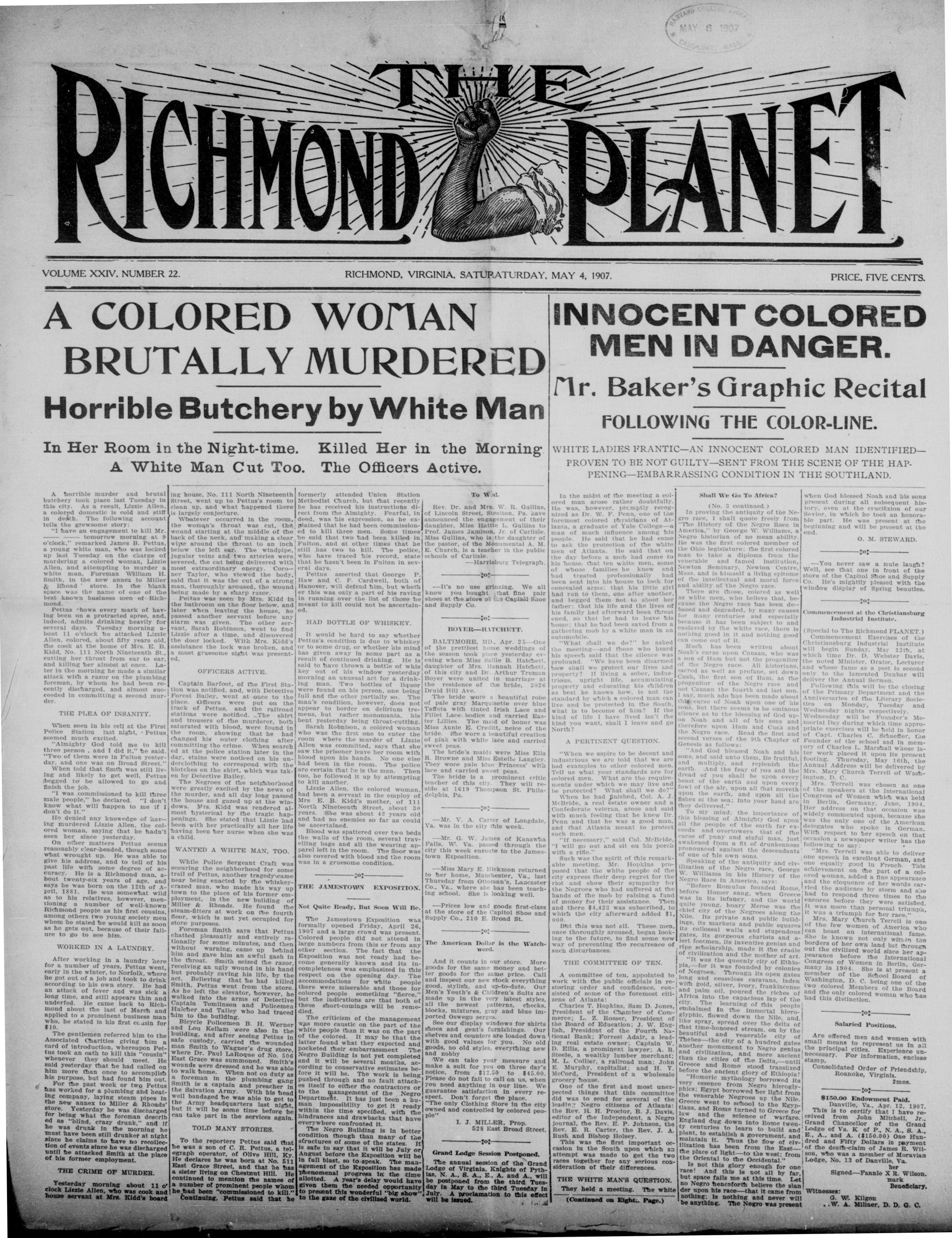
A COLORED WOMAN BRUTALLY MURDERED Horrible Butchery by White Man
In Her Room in the Night-time. Killed Her in the Morning A White Man Cut Too. The Officers Active.
VOLUME XXIV. NUMBER 22.
A COLO
BRUT
Horrible
In Her Room in t
A White
A horrible murder and brutal butchery took place last Tuesday in this city. As a result, Lizzie Allen, a colored domestic is cold and stiff in death. The following account tells the grewsome story:
"I have an engagement to kill Mr. tomorrow morning at 9 o'clock," remarked James B. Pettus, a young white man, who was locked up last Tuesday on the charge of murdering a colored woman, Lizzie Allen, and attempting to murder a white man, Foreman William H. Smith, in the new annex to Miller & Rhoad' store. In the blank space was the name of one of the best known business men of Richmond.
Pettus shows every mark of having been on a protracted spree, and, indeed, admits drinking heavily for several days. Tuesday morning after 11 o'clock he attacked Lizzie Allen, colored, about fifty years old, the cook at the home of Mrs. E. B. Kidd, No. 111 North Nineteenth St., cutting her throat from ear to ear and killing her almost at once. Later in the morning he made a similar attack with a razor on the plumbing foreman, by whom he had been recently discharged, and almost succeeded in committing a second murder.
THE PLEA OF INSANITY.
When seen in his cell at the First Police Station last night, Pettus seemed much excited.
"Almighty God told me to kill three person, and I did it," he said.
"Two of them were in Fulton yesterday, and one was on Broad Street."
When told that Smith was still living and likely to get well, Pettus begged to be allowed to go and finish the job.
"I was commissioned to kill three male people," he declared. "I don't know what will happen to me if I don't do it."
He denied any knowledge of having murdered Lizzie Allen, the colored woman, saying that he hadn't seen her since yesterday.
On other matters Pettus seems reasonably clear-headed, though some what wrought up. He was able to give his address, and to tell of his life with some degree of accuracy. He is a Richmond man, about twenty years of age, and says he was born on the 12th of April, 1881. He was somewhat wild as to his relatives, however, mentioning a number, he well-known Richmond people as his first cousins, among others two young society men whom he stated he would kill as soon as he gets out, because of their failure to go to see him.
WORKED IN A LAUNDRY
After working in a laundry here for a number of years, Pettus went, early in the winter, to Norfolk, where he got out of a job and took to drink according to his own story. He had an attack of fever and was sick a long time, and still appears thin and underfed. He came back to Richmond about the last of March and applied to a prominent business man who, he stated is his first cousin for $10.
The gentlemen referred him to the Associated Charities giving him a card of introduction, whereupon Pettus took an oath to kill this "cousin" whenever they should meet. He said yesterday that he had called on him more than once to accomplish his purpose, but had found him out.
For the past week or two Pettus has worked for a plumbing and heating company, laying steam pipes in the new annex to Miller & Rhoads' store. Yesterday he was discharged for being what the foreman described as "blind, crazy drunk," and if he was drunk in the morning he must have been still drunker at night since he claims to have no recollection of events since he was discharged until he attacked Smith at the place of his former employment.
THE CRIME OF MURDER
Yesterday morning about 11 o'clock Lizzie Allen, who was cook and house servant at Mrs. Kidd's board
ing house, No. 111 Up north Nineteenth Street, went up to Pettus's room to clean up, and what happened there is largely conjecture. Whatever occurred in the room, the woman's throat was cut, the wound starting at the middle of the back of the neck, and making a clear wipe around the throat to an inch below the left ear. The windpipe, jugular veins and two arteries were severed, the cut being delivered with most extraordinary energy. Coro-ner Taylor, who viewed the body, said that it was the cut of a strong man, thoroughly aroused the wound being made by a sharp razor. Pettus was seen by Mrs. Kidd in the bathroom on the floor below, and later when leaving the house, he passed another servant before any alarm was given. The other servant, Sarah Robinson, went to find Lizzie after a time, and discovered the door locked. With Mrs. Kidd's assistance the lock was broken, and a most gruesome sight was presented.
OFFICERS ACTIVE.
Captain Barfoot, of the First Station was notified, and, with Detective Forest Bailey, went at once to the place. Officers were put on the track of Pettus, and the railroad stations were notified. The shirt and trousers of the murderer, both saturated with blood, were found in the room, showing that he had changed his outer clothing after committing the crime. When searched at the police station later in the day, stains were noticed on his underclothing to correspond with the blotches on the shirt, which was taken by Detective Bailey.
The Negroes of the neighborhood were greatly excited by the news of the murder, and all day long passed the house and gazed up at the windows. Mrs. Kidd was rendered almost hysterical by the tragic happenings. She stated that Lizzie had been with her practically all her life having been her nurse when she was a child.
WANTED A WHITE MAN. TOO
While Police Sergeant Craft was scouring the neighborhood for some trail of Pettus, another tragedy came near being enacted by the whiskey-crazed man, who made his way up town to the place of his former enployment, in the new building of Miller & Rhoads. He found the steam-fitters at work on the fourth floor, which is not yet occupied for store purposes.
Foreman Smith says that Pettus chatted pleasantly and entirely rationally for some minutes, and then without warning, came up behind him and gave him an awful gash in the throat. Smith seized the razor, receiving an ugly wound in his hand but probably saving his life, by the act. Believing that he had killed Smith, Pettus went from the store. As he left the elevator, however, he walked into the arms of Detective Captain Tomlinson and Policeman Hulcher and Talley who had traced him to the building.
Bicycle Policemen B. H. Werner and Lou Kellam were also in the building, and after seeing Pettus in safe custody, carried the wounded man Smith to Wagner's drug store, where Dr. Paul LaRoque of No. 506 East Grace was summoned. Smith's wounds were dressed and he was able to walk home. When not on duty as a foreman in the plumbing gang Smith is a captain and preacher in the Salvation Army. With his head well bandaged he was able to get to the Army headquarters last night, but it will be some time before he can take part in the services again.
TOLD MANY STORIES
To the reporters Pettus said that he was a son of C. R. Pettus, a telegraph operator, of Olive Hill Ky. He declares he was born at No. 511 East Grace Street, and that he has a sister living on Chestnut Hill. He continued to mention the names of a number of prominent people whom he had been "commissioned to kill." Continuing, Pettus said, that he
RICHMOND, VIRGINIA, SATURATURDAY, MAY 4, 1907.
formerly attended Union Station Methodist Church, but that recently he has received his instructions direct from the Almighty. Fearful, in deed, was his expression, as he explained that he had been commissioned to kill three men. Some times he said that two had been killed in Fulton, and at other times that he still has two to kill. The police, who have traced his record, state that he hasn't been in Fulton in several days. Pettus asserted that George P. Haw and C. P. Cardwell, both of Hanover, will defend him, but whether this was only a part of his raving in running over the list of those he meant to kill could not be ascertained.
HAD BOTTLE OF WHISKEY
It would be hard to say whether Pettus's condition is due to whiskey or to some drug, or whether his mind has given away in some part as a result of continued drinking. He is said to have thrown a bottle of whiskey out of his window yesterday morning an unusual act for a drinking man. Two bottles of liquor were found on his person, one being full and the other partially so. The man's condition, however, does not appear to border on delirium tremens, but rather monomania, his bent yesterday being throat-cutting. Sarah Robinson, a colored woman who was the first one to enter the room where the murder of Lizzie Allen was committed, says that she saw the prisoner leave her room with blood upon his hands. No one else had been in the room. The police are certain that he is the man. Then too, he followed it up by attempting to kill another. Lizzie Allen, the colored woman, had been a servant in the employ of Mrs E. B. Kidd's mother, of 111 North Nineteenth Street, about 39 years. She was about 42 years old and had no enemies so far as could be ascertained. Blood was spattered over two beds the walls of the room, several travelling bags and all the wearing apparel left in the room. The floor was also covered with blood and the room was in a gruesome condition.
Not Quite Ready, But Soon Will Be
The Jamestown Exposition was formally opened Friday, April 26, 1907 and a large crowd was present. Colored people did not attend in large numbers from this or from any other section. The fact that the Exposition was not ready had become generally known and its incompleteness was emphasized in this respect on the opening day. The accommodations for white people there were miserable and those for colored people something "fierce," but the indications are that both of these short-comings will be remedied. The criticism of the management was more caustic on the part of the white people than it was on the part of the colored. It may be that the latter found what they expected and pocketed their embarrassment. The Negro Building is not yet completed and it will be several months, according to conservative estimates before it will be. The work is being pushed through and no fault attaches itself to either the contractors or to the management of the Negro Department. It has just been a human impossibility to get it ready within the time specified, with the hindrances and drawbacks that have everywhere confronted it.
The Negro Building is in better condition though than many of the structures of some of the states. It is safe to say that it will be July or August before the Exposition will be in full blast, so to speak. The management of the Exposition has made phenomenal progress in the time allotted. A year's delay would have given them the needed opportunity to present this wonderful "big show" to the gaze of the civilized world.
To W. d.
Rev. Dr. and Mrs. W. R. Gullins, of Lincoln Street, Steelton, Pa. have announced the engagement of their daughter, Miss Hattie L. Gullins to Prof. James Jamison, Jr. of Carlisle, Miss Gullins, who is the daughter of the pastor, of the Monumental A. M. E. Church, is a teacher in the public schools of Carlisle.
—Harrisburg Telegraph.
—It's no use grimming. We all know you bought that fine pain shoes at the store of the Capitol Shoe and Supply Co.
BOYER—HATCHETT
BALTIMORE, MD., Apr. 25—One of the prettiest home weddings of the season took place yesterday evening when Miss Sallie B. Hatchett, daughter of Mrs. Hannah Hatchett, of this city and Dr. Arthur Truman Boyer were united in marriage at the residence of the bride, 2026 Drudid Hill Ave.
The bride wore a beautiful robe of pale gray Marquisette over blue Taffeta with tinted Irish Lace and Fillet Lace; bodice and carried Easter Lillies. The mid of honor was Miss Annie E. Creditt, neice of the bride. She wore a beautiful creation of pink with white lace and carried sweet peas.
The bride's maids were Miss Ella R. Browne and Miss Estelle Langley. They wore pale blue Princess' with lace and carried sweet peas.
The bride is a prominent critic teacher of this city. They will reside at 1619 Thompson St. Philadelphia, Pa.
—Mr. V. A. Carter of Longdale, Va. was in the city this week.
—Mr. G. W. James of Kanawha Falls, W. Va. passed through the city this week enroute to the James-town Exposition.
—Miss Mary E. Hickmon returned to her home, Manchester, Va., last Thursday from Ottoman's, Lancaster Co., Va. where she has been teaching school. She is looking well.
—Prices low and goods first-class at the store of the Capitol Shoe and Supply Co., 210 E. Broad St.
The American Dollar is the Watch- word.
And it counts in our store. More goods for the same money and better goods for the same price. Call and inspect our new stock everything good, stylish, and up-to-date. Our Men's Youth's & Children's Suits are made up in the very latest styles, all the newest patterns, checks, blocks, mixtures, gray and blue imported Oswego serges.
See our display windows for shirts shoes and gent's furnishings. Our shelves and counters are loaded down with good values for you. No old goods, no old styles, everything new and nobby
We can take your measure and make a suit for you on three day's notice, from $12.50 to $45.00. Please do not fall to call on us, when you need anything in our line. We guarantee satisfaction in every respect. Don't forget the place.
"The Only Clothing Store in our city
The only Clothing Store in the city owned and controlled by colored people.
Grand Lodge Session Postponed
The annual session of the Grand
Lodge of Virginia, Knights of Pythias,
N. A., S. A., E., A. and A., will
be postponed from the third Tuesday
in May to the third Tuesday in
July. A proclamation to this effect
will be issued.
INNOCENT COLORED MEN IN DANGER. Mr. Baker's Graphic Recital FOLLOWING THE COLOR-LINE.
WHITE LADIES FRANTIC—AN INNOCENT COLORED MAN IDENTIFIED—PROVEN TO BE NOT GUILTY—SENT FROM THE SCENE OF THE HAP-PENING—EMBARRASSING CONDITION IN THE SOUTHLAND.
In the midst of the meeting a colored man arose rather doubtfully. He was, however, promptly recognized as Dr. W. F. Penn, one of the foremost colored physicians of Atlanta, a graduate of Yale College—a man of much influence among his people. He said that he had come to ask the protection of the white men of Atlanta. He said that on the day before a mob had come to his home, that ten white men, some of whose families he knew and had treated professionally had been sent into his house to look for concealed arms; that his little girl had run to them, one after another, and begged them not to shoot her father; that his life and the lives of his family had afterward been threat ened, so that he had to leave his home; that he had been saved from a gathering mob by a white man in an automobile.
Shall We Go To Africa?
(No. 3 continued.)
In proving the antiquity of the Negro race, I shall quote freely from "The History of the Negro Race in America," by George W. Williams, a Negro historian of no mean ability. He was the first colored member of the Ohio legislature; the first colored man to take a diploma from the venerable and famed institution, Newton Seminary, Newton Centre, Mass, and is himself a living epitome of the intellectual and moral force and ability of the Negro race.
There are those, colored as well as white men, who believe that, because the Negro race has been de- based and degraded, by many causes for many centuries and especially because it has been subject to and enslaved by the white race, there is nothing good in it and nothing good
when God blessed Noah and his sons present during all subsequent history, even at the crucifixion of our Savior, in which he took an honorable part. He was present at the beginning and will be present at the end.
O. M. STEWARD.
—You never saw a mule laugh? Well, see that one in front of the store of the Capitol Shoe and Supply Co. He's mightily pleased with the window display of Spring beauties.
Commencement at the Christiansburg Industrial Institute.
(Special to The Richmond PLANET.) Commencement Exercises of the
"What shall we do?" he asked the meeting—and those who heard his speech said that the silence was profound. "We have been disarmed how shall we protect our lives and property? If living a sober, industrious, upright life, accumulating property and educating his children as best he knows how, is not the standard by which a colored man can live and be protected in the South, what is to become of him? If the kind of life I have lived isn't the kind you want, shall I leave and go North?"
A PERTINENT QUESTION
"When we aspire to be decent and industrious we are told that we are bad examples to other colored men. Tell us what your standards are for colored men. What are the requirements under which we may live and be protected? What shall we do?" When he had finished, Col. A. J. McBride, a real estate owner and a Confederate veteran, arose and said with much feeling that he knew Dr. Penn and that he was a good man, and that Atlanta meant to protect such men.
"If necessary," said Col. McBride, "I will go out and sit on his porch with a rifle."
Such was the spirit of this remarkable meeting. Mr. Hopkins proposed that the white people of the city express their deep regret for the riot and show their sympathy for the Negroes who had suffered at the hands of the mob by raising a fund of money for their assistance. Then and there $4,423 was subscribed, to which the city afterward added $1,000.
But this was not all. These men, once thoroughly aroused, began looking to the future, to find some new way of preventing the recurrence of such disturbances.
THE COMMITTEE OF TEN
A committee of ten, appointed to work with the public officials in restoring order and confidence, consisted of some of the foremost citizens of Atlanta:
Charles T. Hopkins, Sam D. Jones, President of the Chamber of Commerce; L. Z. Rosser, President of the Board of Education; J. W. English, President of the Fourth National Bank; Forrest Adair, a leading real estate owner; Captain W. D. Ellis, a prominent lawyer; A. B. Steele, a wealthy lumber merchant; M. L. Collier, a railroad man; John E. Murphy, capitalist; and H. Y. McCord, President of a wholesale grocery house.
One of the first and most unexpected things that this committee did was to send for several of the leading Negro citizens of Atlanta: the Rev. H. H. Proctor, B. J. Davis, editor of the Independent, a Negro journal, the Rev. E. P. Johnson, the Rev. E. R. Carter, the Rev. J. A. Rush and Bishop Holsey.
This was the first important occasion in the South upon which an attempt was made to get the two races together for any serious consideration of their differences.
THE WHITE MAN'S QUESTION.
They held a meeting. The white
(Continued on Eight Page.)
Shall We Go To Africa?
In proving the antiquity of the Negro race, I shall quote freely from "The History of the Negro Race in America," by George W. Williams, a Negro historian of no mean ability. He was the first colored member of the Ohio legislature; the first colored man to take a diploma from the venerable and famed institution, Newton Seminary, Newton Centre, Mass, and is himself a living epitome of the intellectual and moral force and ability of the Negro race.
There are those, colored as well as white men, who believe that, because the Negro race has been debased and degraded, by many causes for many centuries and especially because it has been subject to and enslaved by the white race, there is nothing good in it and nothing good can come out of it.
Much has been written about Noah's curse upon Canaan, who was a son of Ham but not the progenitor of the Negro race. All historians, such as well as profane, set down Cush, first son of Ham, as the progenitor of the Negro race and not Canaan the earth and last son. I say, much ado has been made about this curse of Noah upon one of his sons, but there seems to be continuous silence as to the blessing of God upon Noah and all of his sons and therefore upon Ham and Cush and the Negro race. Read the first and second verses of the 9th Chapter of Genesis as follows:
"And God blessed Noah and his sons, and said unto them, Be fruitful, and multiply, and replenish the earth. And the fear of you and the dread of you shall be upon every beast of the earth and upon every fowl of the air, upon all that moveth upon the earth, and upon all the fishes of the sea; into your hand are they delivered."
To my mind: the importance of this blessing of Almighty God upon all the people of the earth far exceeds and overtowers that of the curse of puny and sinful man, just awakened from a fit of drunkenness pronounced against the descendants of one of his own sons.
Speaking of the antiquity and civilization of the Negro race, George W. Williams in his History of the Negro Race in America, says:
"Before Romulus founded Rome, before Homer sang, when Greece was in its infancy, and the world quite young, hoary Mero was the chief city of the Negroes along the Nile. Its private and public buildings, its markets and public squares its collossal walls and stupendous gates, its gorgeous charlots and alert footmen, its inventive genius and ripe scholarship, made it the cradle of civilization and the mother of art. It was the queenly city of Ethiopia,—for it was founded by colonies of Negroes. Through its open gates long and ceaseless caravans, laden with gold, silver, ivory, frankincense and palm oil, poured the riches of Africa into the capacious lap of the city. The learning of this people embalmed in the immortal hieroglyphic down the Nile, and, like spray, spread over the delta of that time-honored stream, on by the beautiful and venerable city of Thebes—the city of a hundred gates another monument to Negro genius and civilization, and more ancient than the cities of the Delta,—until Greece and Rome stood transfixed before the ancient city.
"Homeric mythology borrowed its very essence from Negro hieroglyphics; Egypt borrowed her light from the venerable Negroes up the Nile. Greece went to school to the Egyptians, and Rome turned to Greece for law and the science of warfare. England dug down into Rome twenty centuries to learn to build and plant, to establish a government, and maintain it. Thus the flow of civilization has been from the East—the place of light—to the west; from the Oriental to the Occidental."
Is not this glory enough for one race! And this is not all by far, but space falls me at this time. Let no Negro henceforth believe the slan der upon his race—that it came from nothing: is nothing and never will be anything. The Negro was present
PRICE, FIVE CENTS.
COLORED
NIGER.
Epic Recital
OR-LINE.
RED MAN IDENTIFIED—
THE SCENE OF THE HAP-
THE SOUTHLAND.
when God blessed Noah and his sons
present during all subsequent history,
even at the crucifixion of our
Savior, in which he took an honorable
part. He was present at the
beginning and will be present at the end.
O. M. STEWARD
—You never saw a mule laugh? Well, see that one in front of the store of the Capitol Shoe and Supply Co. He's mightly pleased with the window display of Spring beauties.
Commencement at the Christiansburg Industrial Institute.
(Special to The Richmond PLANET.)
Commencement Exercises of the Christiansburg Industrial Institute will begin Sunday, May 12th, at which time Dr. D. Webster Davis, the noted Minister, Orator, Lecturer and whose fame as a poet is second only to the lamented Dunbar will deliver the Annual Sermon.
Following this will be the closing of the Primary Department and the Anniversaries of the Literary Societies on Monday, Tuesday and Wednesday nights respectively.
Wednesday will be Founder's Memorial Day during which time appropriate exercises will be held in honor of Capt. Charles C. Schaeffer, the Founder of the school and in memory of Charles L. Marshall whose later work placed it upon its present footing. Thursday, May 16th, the Annual Address will be delivered by Mrs. Mary Church Terrell of Washington, D. C.
Mrs. Terrell was chosen as one of the speakers at the International Congress of Women which was held in Berlin, Germany, June, 1904. Her address on that occasion was widely commented upon, because she was the only one of the American delegates who spoke in German. With respect to her speech on that occasion a newspaper writer has the following to say:
"Mrs. Terrell was able to deliver one speech in excellent German, and one equally good in French Tals achievement on the part of a colored woman, added a fine appearance and the eloquence of her words carried the audience by storm and she had to respond three times to the encores before they were satisfied. It was more than personal triumph, it was a triumph for her race."
Mrs. Mary Church Terrell is one of the few women of America who can boast an international fame. She is not only within the borders of her own land but through out the civilized world since her appearance before the International Congress of Women in Berlin, Germany in 1904. She is at present a member of the School Board of Washington, D. C. being one of the two colored Members of the Board and the only colored woman who has had this distinction.
Salaried Positions
Are offered men and women with small means to represent us in all the principal cities. Experience unnecessary. For information, enclose stamp. Consolidated Order of Friendship, Roanoke, Virginia.
Danville, Va., Apr. 12, 1907.
This is to certify that I have received from John Mitchell, Jr.,
Grand Chancellor of the Grand Lodge of Va. K of P., N. A., S. A.,
E., A., and A. ($150.00) One Hundred and Fifty Dollars in payment of the death-claim of James R. Wilson, who was a member of Moravian Lodge, No. 13 of Danville, Va.
her
Signed—Fannie X R. Wilson.
mark
Beneficiary.
Witnesses:
G. W. Kilgon
.W. A. Milner, D. D. G. C.
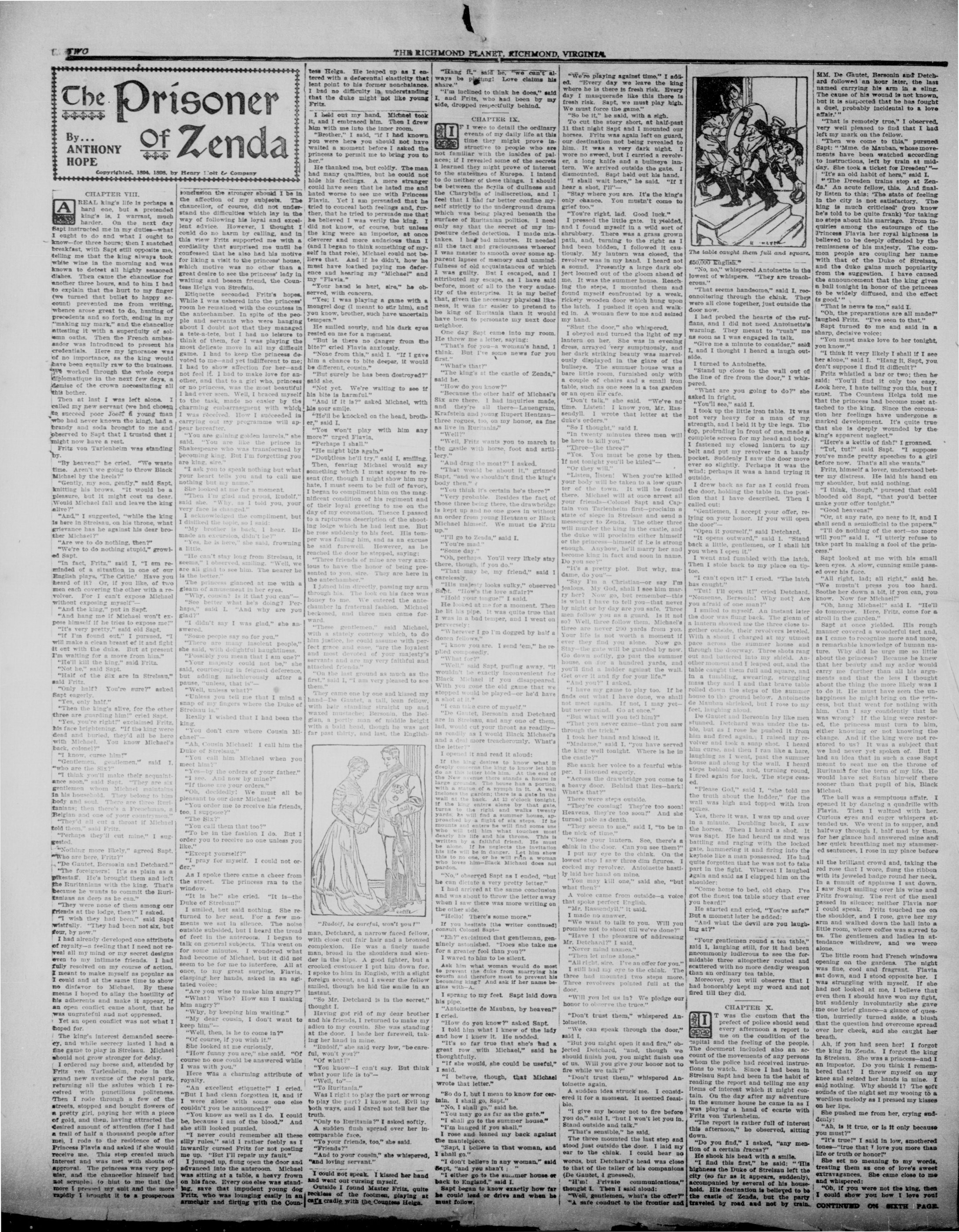
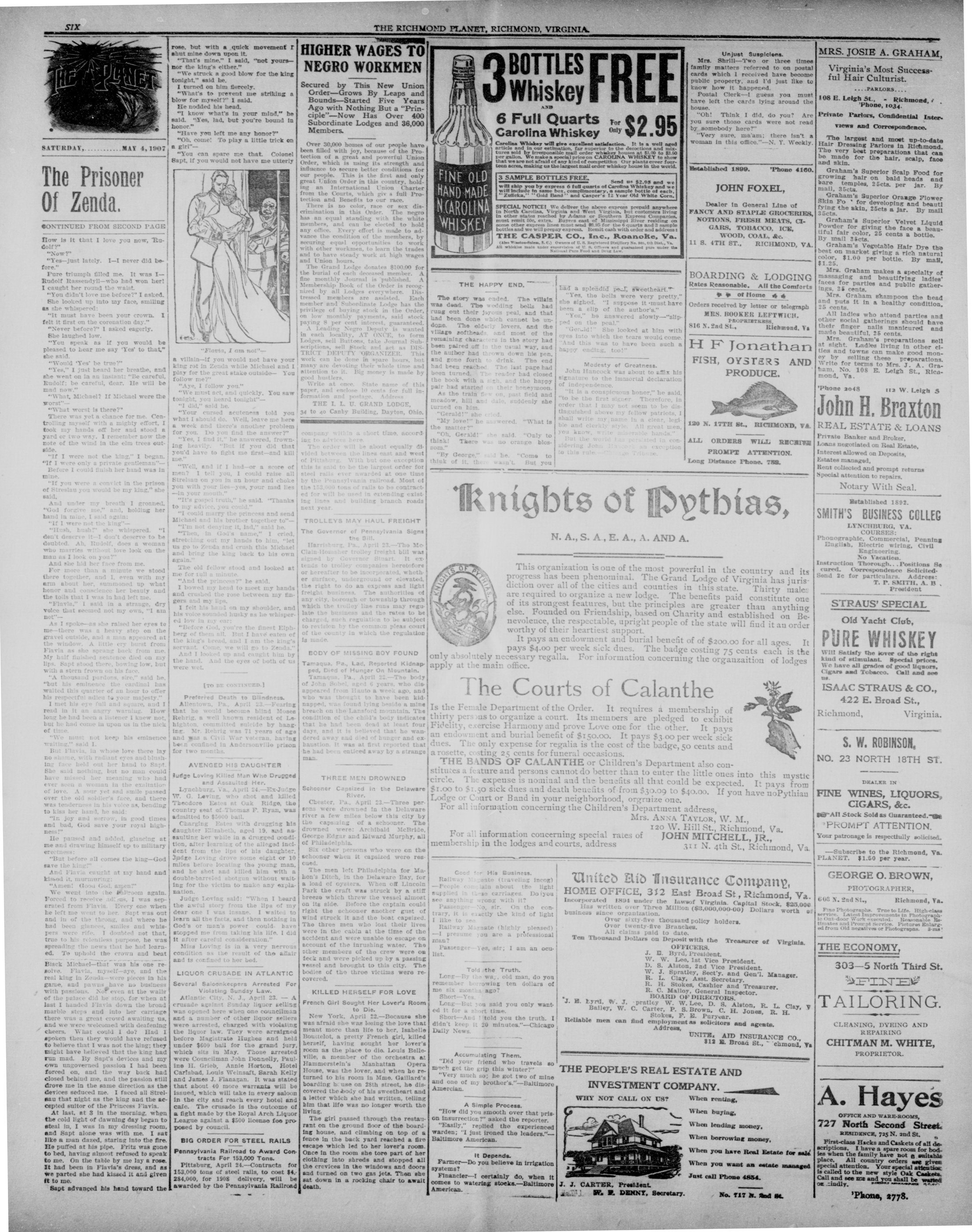
The Prisoner By... ANTHONY HOPE Of Zenda
CHAPTER VIII.
REAL king's life is perhaps a hard one, but a pretended king's is. I warrant, much harder. On the next day
conclusion the stronger should I be in the affection of my subjects. The chancellor, of course, did not understand the difficulties which lay in the way of following his loyal and excel-
A
Sapt instructed me in my duties—what I ought to do and what I ought to know—for three hours; then I snatched breakfast, with Sapt still opposite me, telling me that the king always took white wine in the morning and was known to detest all highly seasoned dishes. Then came the chancellor for another three hours, and to him I had to explain that the hurt to my finger (we turned that bullet to happy account) prevented me from writing, whence arose great to do, hunting of precedents and so forth, ending in my "making my mark," and the chancellor attesting it with a superfluity of solenn oaths. Then the French ambassador was introduced to present his credentials. Here my ignorance was of no importance, as the king would have been equally raw to the business. We worked through the whole corps diplomatique in the next few days, a demise of the crown necessitating all this bother.
Then at last I was left alone. I called my new servant (we had chosen to succeed poor Josef) if young man who had never known the king), had a brandy and soda brought to me and observed to Sapt that I trusted that I might now have a rest. Fritz von Tarlenhelm was standing by.
"By heaven!" he cried. "We waste time. Aren't we going to throw Black Michael by the heels?"
"Gently, my son, gently," said Sapt, knitting his brows. "It would be a pleasure, but it might cost us dear. Would Michael fall and leave the king alive?"
"And," I suggested, "while the king is here in Strelsaun, on his throne, what grievance has he against his dear brother Michael?"
"Are we to do nothing, then?" "We're to do nothing stupid," growled Sapt.
"In fact, Fritz," said I. "I am reminded of a situation in one of our English plays, 'The Gritic.' Have you heard of it? Or, if you like, of two men each covering the other with a revolver. For I can't expose Michael without exposing myself"— "And the king," put in Sapt. "And hang me if Michael won't expose himself if he tries to expose me!" "It's very pretty," said old Sapt. "If I'm found out." I pursued. "I will make a clean breast of it and fight it out with the duke. But at present I'm waiting for a move from him." "He'll kill the king," said Fritz. "Not he," said Sapt. "Half of the Six are in Strelsau," said Fritz. "Only half? You're sure?" asked Sapt eagerly.
"Then the king's alive, for the other three are guarding him!" cried Sapt.
"Yes, you're right," exclaimed Fritz, his face brightening. "If the king were dead and buried, they'd all be here with Michael. You know Michael's back, colonel?"
"I know, curse him!"
"Gentlemen, gentlemen," said I, "who are the Six?"
"I think you'll make their acquaintance soon," said Sapt. "They are six gentlemen whom Michael maintains in his household. They belong to him body and soul. There are three Kurtians; then there's a Frenchman, a Belgian and one of your countrymen."
"They'd all cut a throat if Michael told them," said Fritz.
"Nothing more likely," agreed Sapt. Who are here, Fritz?"
"De Gautet, Borsoin and Detchard."
"The foreigners! It's as plain as a pikestaff. He's brought them and left the Ruritanians with the king. That's because he wants to commit the Ruritanians as deep as he can."
"They were none of them among our friends at the lodge, then?" I asked.
"I wish they had been," said Sapt wisitfully. "They had been not six, but four, by now."
I had already developed one attribute of royalty—a feeling that I need not reveal all my mind or my secret designs even to my intimate friends. I had fully resolved on my course of action. I meant to make myself as popular as I could and at the same time to show no disfavor to Michael. By these means I hoped to allay the hostility of his adherents and make it appear, if an open conflict came about, that he was ungrateful and not oppressed.
Yet an open conflict was not what I hoped for.
The king's interest demanded secrecy, and while secrecy lested I had a fine game to play in Strelsau. Michael should not grow stronger for delay.
I ordered my horse and, attended by Fritz von Tarluenheim, rode in the grand new avenue of the royal park, returning all the salutes which I received with punctilious politeness. Then I rode through a few of the streets, stopped and bought flowers of a pretty girl, paying her with a piece of gold, and then, having attracted the desired amount of attention (for I had a trail of half a thousand people after me), I rode to the residence of the Princess Flavia and asked if she would receive me. This stop created much interest and was met with shouts of approval. The princess was very popular, and the chancellor himself had not scrupled to hint to me that the more I pressed my suit and the more rapidly I brought it to a prosperous
conclusion the stronger should I be in the affection of my subjects. The chancellor, of course, did not understand the difficulties which lay in the way of following his loyal and excellent advice. However, I thought I could do no harm by calling, and in this view Fritz supported me with a cordiality that surprised me until he confessed that he also had his motive for liking a visit to the princess' house, which motive was no other than a great desire to see the princess' lady in waiting and bosom friend, the Countess Helga von Strofain.
Etiquette seconded Fritz's hopes. While I was ushered into the princess' room he remained with the countess in the antechamber. In spite of the people and servants who were hanging about I doubt not that they managed a tete-a-tete, but I had no leisure to think of them, for I was playing the most delicate move in all my difficult game. I had to keep the princess devoted to me—and yet indifferent to me; I had to show affection for her—and not feel if. I had to make love for another, and that to a girl who, princess or no princess, was the most beautiful I had ever seen. Well, I braced myself to the task, made no easier by the charming embarrassment with which I was received. How I succeeded in carrying out my programme will appear hereafter.
"You are gaining golden laurels," she said. "You are like the prince in Shakespeare who was transformed by becoming king. But I'm forgetting you are king, king."
"I ask you to speak nothing but what your heart tells you and to call me nothing but my name."
She looked at me for a moment.
"Then I'm glad and proud, Rudolf," said she. "Why, as I told you, your very face is changed."
I acknowledged the compliment, but I disliked the topic, so I said:
"Mr. brother, is he good. He
"My brother is back, I hear. He made an excursion, didn't he?"
"Yes, he is here," she said, frowning a little.
The princess glanced at me with a gleam of amusement in her eyes.
"Why, cousin? Is it that you can"—
"See better what he's doing? Perhaps," said L. "And why are you glad?
"I didn't say I was glad," she answered.
"Some people say so for you."
Some people say so for you."
"There are many insolent people," she said, with delightful haughtiness.
"Possibly you mean that I am one?"
"Your majesty could not be," she said, courtesying in feligned deference, but adding mischievously after a pause, "unless, that is"—
"Well, unless what?"
"Unless you tell me that I mind a snap of my fingers where the Duke of Strelsau is."
Really I wished that I had been the king.
"You don't care where Cousin Michael"—
"Ah, Cousin Michael! I call him the Duke of Strelsau."
"You call him Michael when you meet him?"
"Yes—by the orders of your father."
"I see. And now by mine?"
"If those are your orders."
"Oh, decidedly! We must all be pleasant to our dear Michael."
"You order me to receive his friends,
too. I suppose?"
"The Six?"
"You call them that too?"
"To be in the fashion I do. But I order you to receive no one unless you like."
"Except yourself?"
"I pray for myself. I could not order."
As I spoke there came a cheer from the street. The princess ran to the window.
"It is he!" she cried. "It is—the Duke of Strelsaun!"
I smiled, but said nothing. She returned to her seat. For a few moments we sat in silence. The noise outside subsided, but I heard the tread of feet in the anteroom. I began to talk on general subjects. This went on for some minutes. I wondered what had become of Michael, but it did not seem to be for me to interfere. All at once, to my great surprise, Flavia, clasping her hands, asked in an agitated voice:
"Are you wise to make him angry?"
"What? Who? How am I making him angry?"
"Why, by keeping him waiting."
"My dear cousin, I don't want to keep him"—
"Well, then, is he to come in?"
"Of course, if you wish it."
She looked at me curiously.
"How funny you are," she said. "Of course no one could be answered while I was with you."
Here was a charming attribute of royalty.
"An excellent etiquette!" I cried. "But I had clean forgot it, and if I were alone with some one else couldn't you be announced?"
"You know as well as I do. I could be, because I am of the blood." And she still looked puzzled.
"I never could remember all these silly rules," said I rather feebly as I inwardly cursed Fritz for not posting me up. "But I'll repair my fault."
I jumped up, flung open the door and advanced into the anteroom. Michael was sitting at a table, a heavy frown on his face. Every one else was standing, save that impudent young dog Fritz, who was lounging easily in an armchair and slirting with the Coun-
THE RICHMOND PLANET, RICHMOND, VIRGINIA
tess Helga. He leaped up as I entered with a deferential elasticity that lent point to his former nonchalance. I had no difficulty in understanding that the duke might not like young Fritz.
I held out my hand. Michael took it, and I embraced him. Then I drew him with me into the inner room.
"Brother," I said, "if I had known you were here you should not have waited a moment before I asked the princess to permit me to bring you to her."
He thanked me, but coldly. The man had many qualities, but he could not hide his feelings. A mere stranger could have seen that he hated me and hated worse to see me with Princess Flavia. Yet I am persuaded that he tried to conceal both feelings and, further, that he tried to persuade me that he believed I was verily the king. I did not know, of course, but unless the king were an impostor, at once cleverer and more audacious than I (and I began to think something of myself in that role), Michael could not believe that. And if he didn't, how he must have loathed paying me deference and hearing my "Michael" and my "Flavia."
"Your hand is hurt, sire," he observed, with concern.
"Yes; I was playing a game with a mongrel dog (I meant to stir him), and you know, brother, such have uncertain tempers."
He smiled sourly, and his dark eyes rested on me for a moment.
"None from this," said I. "If I gave him a chance to bite deeper, it would be different, cousin."
"But surely he has been destroyed?" said she.
"Not yet. We're waiting to see if his bite is harmful."
"And if it is?" asked Michael, with his sour smile.
"Tos won't play with him any more?" urged Flavia.
"Doubtless he'll try," said I, smiling. Then, fearing Michael would say something which I must appear to resent (for, though I might show him my hate, I must seem to be full of favor), I began to compliment him on the magnificent condition of his regiment and of their loyal greeting to me on the day of my coronation. Thence I passed to a rapturous description of the shooting lodge which he had lent me. But he rose suddenly to his feet. His temper was falling him, and as an excuse he said farewell. However, as he reached the door he stopped, saying: "Three friends of mine are very anxious to have the honor of being presented to you, sire. They are here in the antechamber."
I joined him directly, passing my arm through his. The look on his face was honey to me. We entered the antechamber in fraternal fashion. Michael beckoned, and three men came forward.
"These gentlemen," said Michael, with a stately courtey which, to do him justice, he could assume with perfect grace and ease, "are the loyalest and most devoted of your majesty's servants and are my very faithful and attached friends."
"On the last ground as much as the first," said I, "I am very pleased to see them."
They came one by one and kissed my hand—De Gautet, a tall, lean fellow, with hair standing straight up and waxed mustache; Bersonin, the Belgian, a portly man of middle height with a bald head, though he was not far past thirty, and last, the English-
MRS. H. H. H.
"Rudolf, be careful, won't you?" man, Detchard, a narrow faced fellow, with close cut fair hair and a bronzed complexion. He was a finely made man, broad in the shoulders and slender in the hips. A good fighter, but a crooked customer I put him down for. I spoke to him in English, with a slight foreign accent, and I swear the fellow smiled, though he hid the smile in an instant. "So Mr. Detchard is in the secret," thought I. Having got rid of my dear brother and his friends, I returned to make my adieu to my cousin. She was standing at the door. I bade her farewell, taking her hand in mine. "Rudolf," she said very low, "be careful, won't you?" "Of what?" "You know—I can't say. But think what your life is to"— "Well, to"— "To Ruritania."
Was I right to play the part or wrong to play the part? I know not. Evil lay both ways, and I dared not tell her the truth.
"Only to Ruritania?" I asked softly. A sudden flush spread over her incomparable face.
"To your friends, too," she said.
"Friends?"
"And to your cousin," she whispered, "and loving servant."
I could not speak. I kissed her hand and went out cursing myself.
Outside I found Master Fritz, quite reckless of the footmen, playing at cary cradle with the Countess Helga.
"Hang it," said he, "we can't al-
ways be plaiting! Love claims his share."
"I inclined to think he does," said
I, and Fritz, who had been by my
side, dropped respectfully behind.
CHAPTER IX.
I were to detail the ordinary events of my daily life at this time they might prove instructive to people who are not familiar with the insides of palaces; if I revealed some of the secrets I learned they might prove of interest to the statesmen of Europe. I intend to do neither of these things. I should be between the Scylla of dullness and the Charybdis of indiscretion, and I feel that I had far better confine myself strictly to the underground drama which was being played beneath the surface of Ruritanian politics. I need only say that the secret of my imposture defended detection. I made mistakes. I had bad minutes. It needed all the tact and graciousness whereof I was master to smooth over some apparent lapses of memory and unmindfulness of old acquaintances of which I was guilty. But I escaped, and I attributed my escape, as I have said before, most of all to the very audacity of the enterprise. It is my belief that, given the necessary physical likeness, it was far easier to pretend to be king of Ruritanian than it would have been to personate my next door neighbor.
One day Sapt came into my room.
He threw me a letter, saying:
"That's for you—a woman's hand, I think. But I've some news for you first."
"What's that?"
"The king's at the castle of Zenda," said he.
"How do you know?"
"Because the other half of Michael's Six are there. I had inquiries made, and they're all there—Lauengram, Krafstein and young Rupert Hentzau—three rogues, too, on my honor, as fine as live in Ruritania."
"Well?"
"Well, Fritz wants you to march to the castle with horse, foot and artillery."
"And drag the moat?" I asked.
"That would be about it," grinned Sapt, "and we shouldn't find the king's body then."
"You think it's certain he's there?" "Very probable. Besides the fact of those three being there, the drawbridge is kept up and no one goes in without an order from young Hentzau or Black Michael himself. We must tie Fritz up."
"I'll go to Zenda," said I. "You're mad." "Some day." "Oh, perhaps. You'll very likely stay there, though, if you do."
"That may be, my friend," said I carelessly.
"His majesty looks sulky," observed Sait. "How's the love affair?" "Hold me."
"Wherever I go I'm dogged by half a dozen fellows."
"I know you are. I send 'em," he replied composedly.
"What for?"
"Well," said Sapt, puffing away, "it wouldn't be exactly inconvenient for Black Michael if you disappeared. With you gone the old game that we stopped would be played—or he'd have a shot at it."
"I can take care of myself."
"De Gautet, Bersonlin and Detchard are in Strelsau, and any one of them, lad, would cut your throat as readily—as readily as I would Black Michael's and a deal more treacherously. What's the letter?"
I opened it and read it aloud:
If the king desires to know what it deeply concerns the king to know let him do as this letter bids him. At the end of the New avenue there stands a house in large grounds. The house has a porch, a courtyard of a pyramid and includes the garden; there is a gate in the wall at the back. At 15 o'clock tonight, if the king enters alone by that gate, turns to the right and walks twenty yards. he will find a summer house, appears to be a large house with mountains and enters he will find some one who will tell him what touches most dearly his life and his throne. This is written by a faithful friend. He must be alone. If he neglects the invitation he will be told he will show this to no one, or he will run a woman who loves him-Black Michael does not pardon.
"No," observed Saspt as I ended, "but he can dictate a very pretty letter."
I had arrived at the same conclusion and was about to throw the letter away when I saw there was more writing on the other side.
"Hello! There's some more."
If you hesitate [the writer continued] consult Colonel Sapt—
"Eh? exclaimed that gentleman, geniinely astonished. "Does she take me for a greater fool than you?"
I waved to him to be silent.
Ask him what woman would do most to prevent the duke from marrying his cousin and therefore most to prevent his becoming king? And ask if her name begins with-A.
I sprang to my feet. Sapt laid down his pipe.
"Antolnette de Mauban, by heaven!" I cried.
"It's so far true that she's had a great row with Michael," said he thoughtfully.
"If she would, she could be useful," I said.
"I believe, though, that Michael wrote that letter."
"So do I, but I mean to know for certain. I shall go, Sapt."
"No, I shall go," said he.
"You may go as far as the rate."
I rose and leaned my back against the mantelpiece.
"Sapt, I believe in that woman, and I shall go."
"I don't believe in any woman," said
Sapt, "and you shan't ; "
"I either go to the summer house or back to England," said I. Sapt began to know exactly how far he could lead or drive and when he must follow.
"We're playing against time," I added. "Every day we leave the king where he is there is fresh risk. Every day I masquerade like this there is fresh risk. Sapt, we must play high. We must force the game."
"So be it," he said, with a sigh.
To cut the story short, at half-past 11 that night Sapt and I mounted our horses. Fritz was again left on guard, our destination not being revealed to him. It was a very dark night. I wore no sword, but I carried a revolver, a long knife and a bullsye lantern. We arrived outside the gate. I dismounted. Sapt held out his hand. "I shall wait here," he said. "If I hear a shot, I'll—"
"Stay where you are. It is the king's only chance. You mustn't come to grief too."
"You're right, lad. Good luck."
I pressed the little gate. It yielded,
and I found myself in a wild sort of shrubbery. There was a grass grown path, and, turning to the right as I had bidden, I followed it cautiously. My lantern was closed, the revolver was in my hand. I heard not a sound. Presently a large dark object loomed out of the gloom ahead of me. It was the summer house. Reaching the steps, I mounted them and found myself confronted by a weak, rickety wooden door which hung upon the latch. I pushed it open and walked in. A woman flew to me and seized my hand.
"Shut the door." she whispered.
I obeyed and turned the light of my lantern on her. She was in evening dress, arrayed very sumptuously, and her dark striking beauty was marvelously displayed in the glare of the bullysee. The summer house was a bare little room, furnished only with a couple of chairs and a small iron table, such as one sees in a tea garden or an open air café.
"Don't talk," she said. "We've no time. Listen! I know you, Mr. Hassendyll. I wrote that letter at the duke's orders."
"So I thought," said I.
"In twenty minutes three men will be here to kill you."
"Three—the three?"
"Yes. You must be gone by then. If not tonight you'll be killed"—"Or they will."
"Listen, listen! When you're killed your body will be taken to a low quarter of the town. It will be found there. Michael will at once arrest all your friends—Colonel Sapt and Captain von Tarlenheim first—proclaim a state of siege in Strelsau and send a messenger to Zenda. The other three will murder the king in the castle, and the duke will proclaim either himself or the princess—himself if he is strong enough. Anyhow, he'll marry her and become king in fact and soon in name. Do you see?"
"It's a pretty plot. But why, madame, do you—"
"Say I'm a Christian—or say I'm jealous. My God, shall I see him marry her? Now go, but remember—this is what I have to tell you—that never by night or by day are you safe. Three men follow you as a guard. Is it not so? Well, three follow them. Michael's three are never 200 yards from you. Your life is not worth a moment if ever they find you alone. Now go. Stay—the gate will be guarded by now. Go down softly, go past the summer house, on for a hundred yards, and you'll find a ladder against the wall. Get over it and fly for your life." "And you? I asked.
"I have my game to play too. If he finds out what I have done, we shall not meet again. If not, I may yet—but never mind. Go at once."
"But what will you tell him?"
"That you never came—that you saw through the trick."
I took her hand and kissed it.
"Mindame," said I, "you have served
the king well tonight. Where is he in
the castle?"
She sank her voice to a fearful whisper.
I listened eagerly.
"Across the drawbridge you come to
a heavy door. Behind that lies—hark!
What's that?"
There were steps outside.
"They're coming! They're too soon!
Heavens, they're too soon!" And she
turned pale as death.
"They seem to me," said I, "to be in
the nick of time."
"Close your lantern. See, there's a
chink in the door. Can you see them?"
I put my eye to the chink. On the
lowest step I saw three dim figures. I
cocked my revolver. Antoinette hastily
laid her hand on mine.
"You may kill one," said she, "but
what then?"
A voice came from outside—a voice
that spoke perfect English.
I made no answer.
"We want to talk to you. Will you promise not to shoot till we've done?"
"Have I the pleasure of addressing Mr. Detchard?" I said.
"Never mind names."
"Then let mine alone."
"All right, sir. I've an offer for you."
I still had my eye to the chink. The three had mounted two steps more. Three revolvers pointed full at the door.
"Will you let us in? We pledge our honor to observe the truce."
"Don't trust them," whispered Antoinette.
"We can speak through the door," said I.
"But you might open it and fire," objected Detchard, "and, though we should finish you, you might finish one of us. Will you give your honor not to fire while we talk?"
"Don't trust them," whispered Antoinette again.
A sudden idea struck me. I considered it for a moment. It seemed feasible.
"I give my honor not to fire before you do," said I. "but I won't let you in. Stand outside and talk."
"That's sensible," he said.
The three mounted the last step and stood just outside the door. I laid my ear to the chink. I could hear no words, but Detchard's head was close to that of the taller of his companions (Do Gautet, I guessed).
"H'm! Private communications," thought I. Then I said aloud:
"Well, gentlemen, what's the offer?"
"A safe conduct to the frontier and
刘家宝和。
150,000 English."
"No, no," whispered Antoinette in the lowest of whispers. "They are treacherous."
"That seems handsome," said I, reconnoitering through the chink. They were all close together, just outside the door now.
I had probed the hearts of the ruffians, and I did not need Antoinette's warning. They meant to "rush" me as soon as I was engaged in talk.
"Give me a minute to consider," said I, and I thought I heard a laugh outside.
I turned to Antoinette.
"Stand up close to the wall out of the line of fire from the door," I whispered.
"What are you going to do?" she asked in fright.
I took up the little iron table. It was not very heavy for a man of my strength, and I held it by the legs. The top, protruding in front of me, made a complete screen for my head and body. I fastened my closed lantern to my belt and put my revolver in a handy pocket. Suddenly I saw the door move ever so slightly. Perhaps it was the wind; perhaps it was a hand trying it outside.
I drew back as far as I could from the door, holding the table in the position that I have described. Then I called out:
"Gentlemen, I accept your offer, relying on your honor. If you will open the door"
"Open it yourself," said Detchard.
"It opens outward," said I. "Stand back a little, gentlemen, or I shall hit you when I open it."
I went and fumbled with the latch. Then I stole back to my place on tip-toe.
"I can't open it!" I cried. "The latch has caught."
"Tut! I'll open it!" cried Detchard. "Nonsense, Bersonin! Why not? Are you afraid of one man?"
I smiled to myself. An instant later the door was flung back. The gleam of a lantern showed me the three close together outside, their revolvers leveled. With a shout I charged at my utmost pace across the summer house and through the doorway. Three shots rang out and battered into my shield. Another moment and I leaped out, and the table caught them full and square, and in a tumbling, swearing, struggling mass they and I and that brave table rolled down the steps of the summer house to the ground below. Antoinette de Manbon shrieked, but I rose to my feet, laughing aloud.
De Gautet and Bersonin lay like men stunned. Detchard was under the table, but as I rose he pushed it from him and fired again. I raised my revolver and took a sup shot. I heard him curse, and then I ran like a hare, laughing as I went, past the summer house and along by the wall. I heard steps behind me, and, turning round, I fired again for luck. The steps ceased.
"Please God," said I, "she told me the truth about the ladder," for the wall was high and topped with iron spikes.
Yes, there it was. I was up and over in a minute. Doubling back, I saw the horses. Then I heard a shot. It was Sapt. He had heard us and was battling and raging with the locked gate, hammering it and firing into the keyhole like a man possessed. He had quite forgotten that he was not to take part in the fight. Whereat I laughed again and said as I clapped him on the shoulder:
"Come home to bed, old chap. I've got the finest tea table story that ever you heard!"
He started and cried, "You're safe."
But a moment later he added:
"And what the devil are you laughing at?"
"Four gentlemen round a tea table," said I, laughing still, for it had been uncommonly ludicrous to see the formidable three altogether routed and scattered with no more deadly weapon than an ordinary tea table.
Moreover, you will observe that I had honorably kept my word and not fired till they did.
CHAPTER X.
T was the custom that the prefect of police should send every afternoon a report to me on the condition of the capital and the feeling of the people. The document included also an account of the movements of any persons whom the police had received instructions to watch. Since I had been in Strelsau Sept had been in the habit of reading the report and telling me any items of interest which it might contain. On the day after my adventure in the summer house he came in as I was playing a hand of ecarte with Fritz von Tarlenheim.
"The report is rather full of interest this afternoon," he observed, sitting down.
"Do you find," I asked, "any mention of a certain fraces?"
He snook his head with a smile. "I find this first," he said: "His highness the Duke of Strelsau left the city (so far as it appears, suddenly), accompanied by several of his household. His destination is believed to be the castle of Zenda, but the party traveled by road and not by train.
MM. De Gautet, Bersonin and Detchard followed an hour later, the last named carrying his arm in a sling. The cause of his wound is not known, but it is suspected that he has fought a duel, probably incidental to a love affair."
"That is remotely true," I observed, very well pleased to find that I had left my mark on the fellow.
"Then we come to this," pursued Sapt: "Mme. de Mauban, whose movements have been watched according to instructions, left by train at midday. She took a ticket for Dresden"—"It's an old habit of hers." said I.
"The Dresden trains stop at Zenda." An acute fellow, this. And finally listen to this: "The state of feeling in the city is not satisfactory. The king is much criticised" (you know he's told to be quite frank) for taking no steps about his marriage. From inquiries among the entourage of the Princess Flavia her royal highness is believed to be deeply offended by the remissness of his majesty. The common people are coupling her name with that of the Duke of Strelsan, and the duke gains much popularity from the suggestion. I have caused the announcement that the king gives a ball tonight in honor of the princess to be widely diffused, and the effect is good."
"That is news to me," said I.
"Oh, the preparations are all made!" laughed Fritz. "I've seen to that."
Sapt turned to me and said in a sharp, decisive voice:
"You must make love to her tonight, you know."
"I think it very likely I shall if I see her alone," said I. "Hang it, Sapt, you don't suppose I find it difficult?"
Fritz whistled a bar or two; then he said: "You'll find it only too easy. Look here. I hate telling you this, but I must. The Countess Helga told me that the princess had become most attached to the king. Since the coronation her feelings have undergone a marked development. It's quite true that she is deeply wounded by the king's apparent neglect."
"Here's a kettle of fish!" I groaned. "Tut, tut!" said Sapt. "I suppose you've made pretty speeches to a girl before now. That's all she wants."
Fritz, himself a lover, understood better my distress. He laid his hand on my shoulder, but said nothing.
"I think, though," pursued that cold blooded old Sapt, "that you'd better make your offer tonight."
"Good heavens!"
"Or, at any rate, go near to it, and I shall send a semificial to the papers."
"I'll do nothing of the sort—no more will you!" said I. "I utterly refuse to take part in making a fool of the princess."
Sapt looked at me with his small keen eyes. A slow, cunning smile passed over his face.
"All right, lad; all right," said he. "We mustn't press you too hard. Soothe her down a bit, if you can, you know. Now for Michael."
"Oh, hang Michael!" said I. "He'll do tomorrow. Here, Fritz, come for a stroll in the garden."
Sapt at once yielded. His rough manner covered a wonderful tact and, as I came to recognize more and more, a remarkable knowledge of human nature. Why did he urge me so little about the princess? Because he knew that her beauty and my ardor would carry me further than all his arguments and that the less I thought about the thing the more likely was I to do it. He must have seen the unhappiness he might bring on the princess, but that went for nothing with him. Can I say confidently that he was wrong? If the king were restored, the princess must turn to him, either knowing or not knowing the change. And if the king were not restored to us? It was a subject that we had never yet spoken of. But I had an idea that in such a case Sapt meant to seat me on the throne of Ruritania for the term of my life. He would have set Satan himself there sooner than that pupil of his, Black Michael.
The ball was a sumptuous affair. I opened it by dancing a quadrille with Flavia. Then I waltzed with her. Curious eyes and eager whispers attended us. We went in to supper, and halfway through I, half mad by then, for her glance had answered mine and her quick breathing met my stammered sentences. I rose in my place before all the brilliant crowd and, taking the red rose that I wore, flung the ribbon with its jeweled badge round her neck. In a tumult of applause I sat down. I saw Sapt smiling over his wine and Fritz frowning. The rest of the meal passed in silence; neither Flavia nor I could speak. Fritz touched me on the shoulder, and I rose, gave her my arm and walked down the hall into a little room, where coffee was served to us. The gentlemen and ladies in attendance withdrew, and we were alone.
The little room had French windows opening on the gardens. The night was fine, cool and fragrant. Flavia sat down, and I stood opposite her. I was struggling with myself. If she had not looked at me, I believe that even then I should have won my fight, but suddenly involuntarily she gave me one brief glance—a glance of question, hurriedly turned aside, a blush that the question had overcome spread over her cheek, and she caught her breath.
Ah, if you had seen her! I forgot the king in Zenda. I forgot the king in Strelsau. She was a princess—and I an impostor. Do you think I remembered that? I threw myself on my knee and seized her hands in mine. I said nothing. Why should I? The soft sounds of the night set my wooing to a wordless melody as I pressed my kisses on her lips.
She pushed me from her, crying suddenly:
"Ah, is it true, or is it only because you must?"
"It's true!" I said in low, smothered tones—"true that I love you more than life or truth or honor!"
She set no meaning to my words, treating them as one of love's sweet extravagances. She came close to me and whispered:
"Oh, if you were not the king, then I could show you how I love you!"
if iG
i “Ce
as A
\
Ve
a a
SATURDAY, MAY 4, 1907
3 eee
oe ms "
Gh
AE by
ae
—- ry S
ie 1
First of All.
‘The excliable individual came in
flato and when the man in the coat-
‘room took longer then usual to check
his coat his temper kuew no bounds.
“Hurry up,” be exploded, “and
‘heck my coat! Can't you seo I have
been standing here an hour?”
“My man,” replied the other, calm:
ty, “it {s not your coat you want
ehecked.”
“Then what {5 it, blockhead?”
“Why your temper, sir."—Chleago
Daily News.
Wetieun?
‘The fashionable girl wept.
“Confide!™ said mamma.
“Boo-hoo!” sobbed the girl. “Tam
always receiving disappointments. You
‘know I had mado arrangements to
startle spclety Uy eloping with ou
chauffeur.”
“Yes, my dear.”
“Well, I have jast found out that
Bthel Gilder is passing the tip that she
4s going to clope with the pilot of an
‘airehip."—Chicago Dally News.
So Nice of Them.
Ganner—I tried to tease my wife
about women always getting of the
‘fwtreet car backward. She said it was
‘etiquette.
Guyer—Etiquotte?
| Gunner—Yes, she said they consid-
fered it impolite to turn their backs
‘on the conductur—Chicago Dally
News.
His Idea of It.
“Of course you are in favor of tm.
proving the consular service?"
“I am,” answered Senator Sor.
ghum. “What we want tn all branches
of government service is a corps of
subordinate employes xo proficient
that the person appointed as the head
ean't possibly go wrong.”"—Washing.
ton Star.
HIS CHANCE.
oN
ce Ba gt.
p ey SAM,
Gao AY
pee) cats Ae
\\ a]
, va nd JUN
bh See? =p eas i
1 RE ae P esas ames ee Fy
| fea WA moa
OT ER “4
Li i 4
Ae \\
am
He—You don't realize how I love
you. I could die kissing you!
She—Well, perhaps if you come
Tound tomorrow when father’s here
you can gratify your ambition.
Inside Information.
Bt every mortal would coufeas
AN fiealy what be must entire
Mow often would we ecora success!
mse often enry ves sbecure!
erpiiiecttcn toc,
A Hoarse Honk.
awyer—And you cay the noise
made by this defendant with his mo-
tor caused your horse to take fright
and run away. What made tho
hoise?,
Farmer—I dunno, but it sounded
Uke # sawmill with the grip—Balti-
more American.
Always. Talking.
“What kind of a looking man is
that chap Gabbieton? I don’t believe
TL have met him.”
“Well, if you see two men in @
comer, and one of them looks bored
to death, the other one is Gabble-
font”
THE RICHMOND PLANET, RICHMOND. VIRGINIA.
THRER
4 WEEK’S NEWS CONDENSED
‘Thureday, April 18.
en Oe eS oe, eee ae
$2000 in cash and $15,000 in jewels.
General Booth, of the Salvation
Army, was accorded an enthusiastic
recepticn on his arrival at Toklo, Ja-
pan.
John P. Dunning, well known tm
‘newspaper circles throughout the
country, died in Philadelphia, aged
44 years.
| The supreme court of the United
Btatos dismissed the appeal of John
Johnson, who is now awaiting electro
tution in Sing Sing prison for killing
bis wife in Yonkers, N. ¥.
Friday, April 19.
| ‘The United States Steel Corporation
‘bas fixed the selling price of rails for
1908 at $23 per ton.
‘The handsome now 13-story building
of the Buffalo Chamber of Commerce
has been formally dedicated.
| Becauso he lost his job Abraham
Bowers, 27 years old, committed sul-
“elde by shooting at Doylestown, Pa,
Catherine Jordan, of Pittston, Pa,
/ was found dead in a room in New York
lodging house with the gas turned on,
Humphrey Jainingan, a wealthy bus-
fness man of Morristown, Tenn., com-
miited suicide by shooting while de
spondent from illness.
Saturday, April 20.
Safe blowers wrecked the bank of
‘Weston, at Weston, Ill, and escaped
with over $2000.
| _The Hotel Campbell at Athens, Pa.
was destroyed by fire and Elam Ken:
all, a cripple, was burned to death.
Mra. Donald McLean, of New York,
has been elected president of the
Daughters of the American Revolu:
thon.
‘The Wisconsin legislature has
passed a bill prohibiting the sele of
tobacco in any form to minors under
16 yeara of axe.
While at work in the Philadelphia
subway, Frank Connors, 25 yeare old,
@ meamfttar, was struck by @ traip
and instantly killed.
Monday, Aprit’ 22.
‘The Sykesville, Md., postoMce was
robbed by burglars, who secured §700
fa cash and stamps,
‘William Sandlar, a student, was
Growned in the swimming pool of Co
lumbla University, New York.
Fifteen governors will send dele
gates to the National Civic Federation
Conference on Trusts and Comblna
tons
The viewers in the condemnation
proceedings of the Carlisle end Han
aves, Pa, pike, a distance of 10 miles
to the Adams county Ine, awarded
$6150 damages.
Just as he completed a two-year sen:
tence in the penitentiary at Baltimore,
Willlam Barrett was arrested for a
$20,000 theft from the First National
Bank at San Francisco.
Tuesday, April 23.
President Roosevelt will leave
Washington for bls sumer home at
Oyeter Bay on June 12.
Charles J. Mann, former judge of
Blair county, Pa. and former mayor
of Altooua, dicd in that city, aged $4
years
‘Tom Osadania, an Italian, was stab
bed and killed in Cleveland, O., while
attending a christening and bis aseas:
fain escaped.
‘A legislative investigating commit.
tee has estimated the value of rab
road property in St. Paul, Minn, at
$215,000,000.
William 'T. Davitge, an actor, who
tried to kill Miss Rosalle Wilbert be
cause she refused to marry him, was
sentenced in New York to servo one
year in jail.
Wednesday, April 24.
‘William Burgo, a negro, was hanged
fn Washington for the murder of bis
wito in 1905.
Dr. John Carver, who {s sald to have
37 wives, whom he defrauded out of
$150,000, ‘was arrested at Fort Smith,
Ark.
Winthrop Bishop, former governor
of Porto Rico, has taken tho oath of
office as assistant secretary of the
treasury.
‘The big repair «hops of the New
York Central rallroad, in New York,
were destroyed by fire, entailing a loss
of $100,000.
Four mon were burned to death, 250
horses Killed and 12 firemen injured
fn a fire which destroyed a big livery
ills ta Haw Sak,
:
SHOULD YOU DESIRE ANY COLORED ae
JOURNAL IN THE UNITED STATES, WE WILL SS
SEND IT TO YOU IN CONJUNCTION WITH THE tt
PLANET ATA GREATLY REDUCED RATE ##:
FOR BOTH. =
NG CIRCULATION WE WILL OFF
NG CIRCULATION WE WILL OFF
FURNISH THE PHOTOGRAPH, ONE FOUN- ae
TAIN PEN, GOLD POINT; ONE LADIES RING, #4
ONE BREAST-PIN, GOLD FILLED; HALF Doz. £$
EN “LINEN HANDKERCHIEFS, ONE ALARM it
CLOCK, ONE DOZEN NAPKINS, ONE HALF #4
DOZEN TOWELS, ONE CHOCOLATE POT, ONE
PAIR VASES, ONE PAIR KID GLOVES, ONE 4%
HAM, ONE TURKEY. os
FOR TEN NEW SUBSCRIBERS Es
*
WE WILL SEND ONE CHINA SET, THIRTY-ONE ti
PIECES; ONE NECKLACE; DICKENS, SHAKES. @#
PEARE, BYRON WORKS; ONE UMBRELLA, ONE $&
PLAIN GOLD RING, ONE PAIR LACE CURTAINS
1,000 ENVELOPES, 1,000 SHEETS OF PAPER
PRINTED AND DELIVERED; ONE TOILET SET, #4
ONE HALF CORD OF SAWED WOOD. pe
| FOR TWENTY NEW SUBSCRIBERS $3
WE WILL GIVE ONE HANDSOME GOLD RING es
WITH OPALS, RUBIES OR PEARLS; ONE JEW- ©
ELRY BOX FINISHED IN GOLD OR SILVER; a
ONE SILK SHIRT WAIST; ONE READY MADE. &
DRESS, ONE GOLD WATCH, FILLED, WAR. £5
RANTED FOR TEN YEARS, ONE ROCKING 4%
CHAIR, ONE LOAD OF COAL, ONE GROSS OF $2
SOAP, EITHER WASHING OR TOILET; ONE $e
BARREL OF BEST FLOUR, ONE PAIR BLANK.
ETS, ONE MANICURE SET, ONE SEAMSTRESS' ##
WORK BOX, ONE PAIR SHOES, GENTS OR LA- #&
DIES. ee
FOR FORTY YEARLY SUBSCRIBERS oe
OR EQUIVALENT, WE WILL GIVE ONE SEW- &&
ING MACHINE, ONE DIAMOND RING, ONE 3%
30LD WATCH, ONE PAIR FINE GOLD EAR. *%
RINGS, ONE MUSIC BOX, ONE PHONOGRAPH, #3
ONE READY MADE DRESS, ONE SUIT OF GEN. 3%
TLEMEN'S CLOTHES, ONE GOLD-HEADED it
CANE, ONE. GOLD-HEADED UMBRELLA, ONE $9
CHINA SET, ONE DOZEN SILVER-PLATED %%
KNIVES AND FORKS, ONE HAT-RACK, ONE 4k
SILK DRESS, ONE WEEK'S TRIP TO THE SEA. $e
SHORE, RAILROAD FARE AND HOTEL BILL 22
PAID, FOR ANY RICHMOND WORKER. it
THESE OFFERS MAY BE TAKEN ADVAN. it
TAGE OF BY SENDING ONE OR TWO SUB. #%
SCRIBER'S NAMES AT A TIME. WE WILL 2%
KEEP A RECORD OF THEM; AS SOON AS THE i
: NUMBER IS OBTAINED, WE. WILL a
) THE PRESENT INDICATED. ee
SON WHO TRIES TO GET FORTY ee:
‘RS AND GETS TIRED MAY INDI A ae
WISH AND WE WILL SEND THE od te
FOR THE NUMBER HE HAS SE.
/ER FIVE. i
YUMBER WILL BE FOR NOT LESS
E NOR MORE THAN TEN AND NOT aa
N TEN NOR MORE THAN TWENTY. Ss
LESS THAN TWENTY NOR MORE =
‘TY, TO DETERMINE THE PRIZE TO Be
1E. WORKER IS ENTITLED. .
ANYTHING IS DESIRED NOT SPECI- * i :
4S LIST, WRITE US ABOUT IT AND | ios
TELL YOU IN WHAT CLASS IT BE- '
' E 4
Be ease ear 2S
*® ADDRESS ALL ORDERS TO 444 I i
i MITCHELL,JR., |
341 North Fourth Street, |
Pe coe. | BB
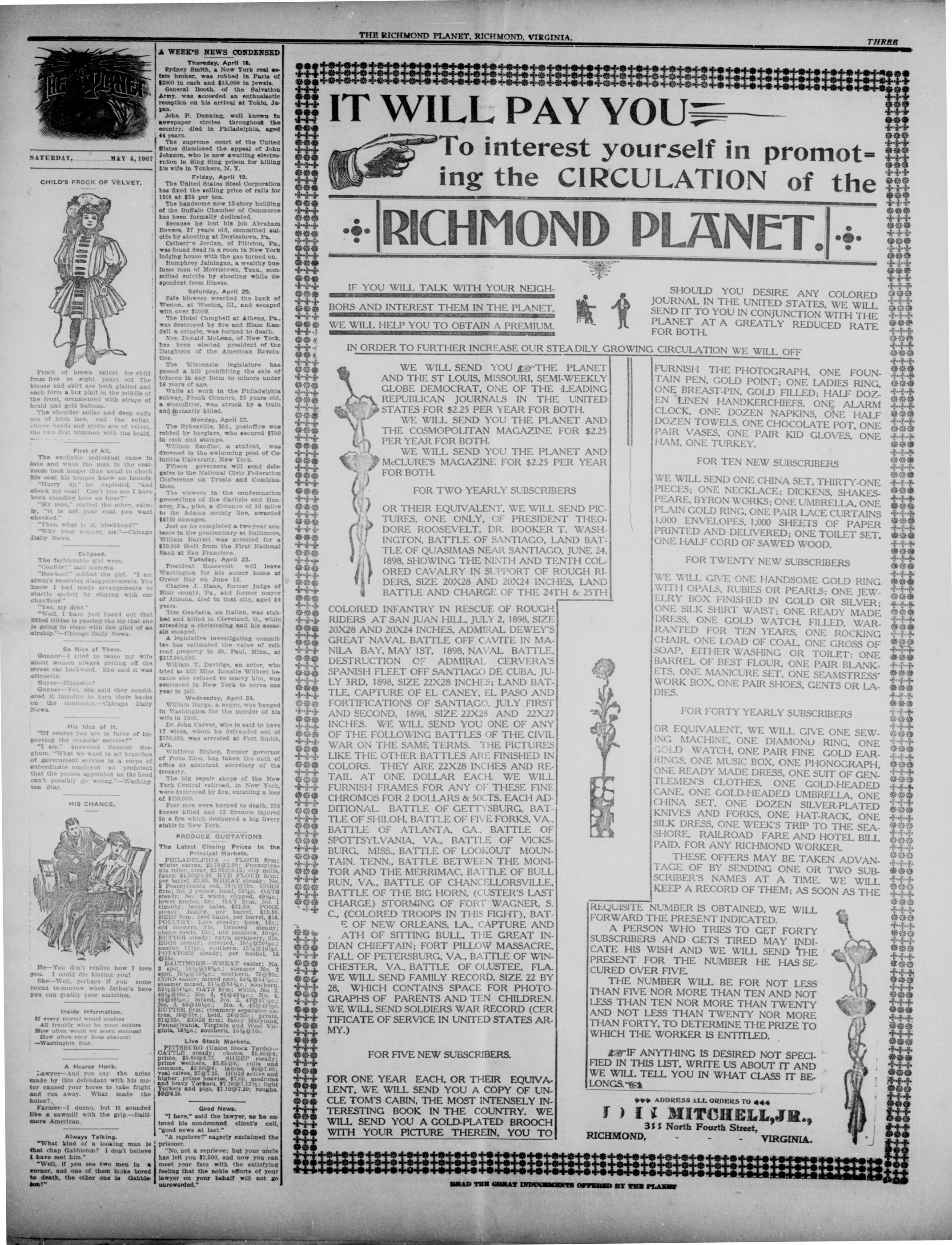
IF YOU WILL TALK WITH YOUR NEIGH-
ES LR EE ES
IRS AND INTEREST THEM IN THE PLANET,
LT TS
'E WILL HELP YOU TO OBTAIN A PREMIUM.
Hy IN ORDER TO FURTHER INCREASE OUR STEADIL
ee WE WILL SEND YOU @@-THE PLA!
AND THE ST LOUIS, MISSOURI, SEMI-WEE}
eae GLOBE DEMOCRAT, ONE OF THE LEAD
® a 4 REPUBLICAN JOURNALS IN THE UNF
* b~ STATES FOR $2.25 PER YEAR FOR BOTH.
S WE WILL SEND YOU THE PLANET /
i | THE COSMOPOLITAN MAGAZINE FOR $§
i’ PER YEAR FOR BOTH.
mo WE WILL SEND YOU THE PLANET /
€ D McCLURE'S MAGAZINE FOR $2.25 PER YI
) FOR BOTH.
eee # FOR TWO YEARLY SUBSCRIBERS
gee 5) oR THEIR EQUIVALENT, WE WILL SEND
zs. \. TURES, ONE ONLY, OF PRESIDENT TE
tr uP DORE ROOSEVELT, DR. BOOKER T. WA
eee \/ INGTON, BATTLE OF SANTIAGO, LAND B
one ‘\ ‘TLE OF QUASIMAS NEAR SANTIAGO, JUNE
tis j)\ 1898, SHOWING THE NINTH AND TENTH ¢
+r. { |} ORED CAVALRY IN SUPPORT OF ROUGH
ene | DERS, SIZE. 20X28 AND 20X24 INCHES, L/
7 BATTLE AND CHARGE OF THE. 24TH & 2
oe COLORED INFANTRY IN RESCUE OF ROUGH
RIDERS AT SAN JUAN HILL, JULY 2, 1898, SIZE
it 20X28 AND 20X24 INCHES, ADMIRAL DEWEY’S
GREAT NAVAL BATTLE OFF CAVITE IN MA-
"kk NILA BAY, MAY IST, 1898, NAVAL BATTLE.
$8 DESTRUCTION OF ADMIRAL CERVERA'S
@@@ SPANISH FLEET OFF SANTIAGO DE CUBA, JU-
at LY 3RD, 1898, SIZE. 22X28 INCHES; LAND BAT-
$22 TLE, CAPTURE OF EL CANEY, EL PASO AND
#4 FORTIFICATIONS OF SANTIAGO, JULY FIRST
SE2 AND SECOND, 1898, SIZE 22X28 AND 22X27
3% INCHES. WE WILL SEND YOU ONE OF ANY
@G% OF THE FOLLOWING BATTLES OF THE CIVIL
#2 WAR ON THE SAME TERMS. THE PICTURES
$$ Uke THE OTHER BATTLES ARE FINISHED IN
$8 COLORS. THEY ARE 22X28 INCHES AND RE-
e% TAIL AT ONE DOLLAR EACH. WE WILL
FEL FURNISH FRAMES FOR ANY OF THESE FINE
$8 CHROMOS FOR 2 DOLLARS & 50CTS. EACH AD-
eae DITIONAL. BATTLE OF GETTYSBURG, BAT
TLE OF SHILOH, BATTLE OF FIVE FORKS, VA..
#® BATTLE OF ATLANTA, GA. BATTLE OF
#sm@ SPOTTSYLVANIA, VA., BATTLE OF VICKS-
ZE* BURG, MISS. BATTLE OF LOOKOUT MOUN-
TAIN, TENN., BATTLE BETWEEN THE MONI-
ae TOR AND THE MERRIMAC, BATTLE OF BULL
RUN, VA., BATTLE OF CHANCELLORSVILLE,
BATTLE OF THE BIG HORN, (CUSTER'S LAST
#&% CHARGE) STORMING OF FORT WAGNER, S.
C., (COLORED TROOPS IN THIS FIGHT), BAT-
~ © OF NEW ORLEANS, LA., CAPTURE. AND
$#% . ATH OF SITTING BULL, THE GREAT IN-
$66 DIAN CHIEFTAIN; FORT PILLOW MASSACRE.
FALL OF PETERSBURG, VA., BATTLE OF WIN-
$$2 CHESTER, VA, BATTLE OF OLUSTEE, FLA.
WE WILL SEND FAMILY RECORD, SIZE 22 BY
28, WHICH CONTAINS SPACE FOR PHOTO-
GRAPHS OF PARENTS AND TEN CHILDREN.
$$$ WE WILL SEND SOLDIERS WAR RECORD (CER
TIFICATE OF SERVICE IN UNITED STATES AR-
MY.)
Ht FOR FIVE NEW SUBSCRIBERS.
FOR ONE YEAR EACH, OR THEIR EQUIVA-
LENT, WE WILL SEND YOU A COPY OF UN- :
CLE TOM'S CABIN, THE MOST INTENSELY IN-
TERESTING BOOK IN THE COUNTRY. WE
WILL SEND YOU A GOLD-PLATED BROOCH
WITH YOUR PICTURE THEREIN, YOU TO 1]
PRODUCE QUOTATIONS
‘The Latest Closing Prices In the
aided Whincaa
PHILADELPHIA — FLOUR firm;
winter ‘extras, $2.7092.00; “Pennaylva-
Ria roller, clear, $2.9603.16; city mills,
fancy, $4.50@4.00, RYE FLOUR drm:
barrel, $1.60. WHEAT steady: No
B*Pennasivania red, 782780. CONS
firm; No. 2 yellow, local, Saige, OATS
steady; No. 2 white, clipped, 493ge.;
lower grades, Sc. HAY tirm; Now 4
tmothy, large bales, §21.60. PORK
Steady: family, per barrel, $19.60.
BEE? om: beri naine, per barrel, $19
POULTRY: Live steady; hens, ‘Ibe;
Old roosters, Tic, Dressed. steady:
Sholce fowls, 15e.; old. roosters, 10sg¢
BUTTER steady; extra creamery, ito.
EGGS steady; felected, 1816G20%o.;
Bearby. I7ise.; southera, Ioi@léige
POTATOES” ieady; per ‘bushel, “8
OORLTIMORE—WHEAT easter; No
2 upot, 184 G18%e.; steamer No.3
spot toieG To%e.; Soulkern, 75a toe,
IN easicr: mixed spot, G4NLG GE gc.
Steamer mixed, 51% @51%c.; southern,
B2ie@itec, GATS frm; wiilte, No, 2.
48ig@ise.; No. 3, 48@48%c.;" No. ¢
6@i\ec; mixed, No. 2, digi ae:
Bo. t dbeiciee: No. 4, 48a istse
BUTIER firm; creamery Separator ex-
‘Pras, 20 tte: held, “H4@ 20. prints,
$1@%2. EGGS firm; fancy Maryland,
Pennsylvania, Virginia and West Vir
ini, 16%0.; "southern, 1544.@ 18.
| Live Stock Markets.
PITTSBURG (Union Stock Yards)—
oF TpPtRa en Sit Yow
Prime, $5.60@5.78.. | SHEEP tH
Eommon’ S50 ga latin “Tse
calves, $17.25. HOGS active and
eavy Yorkers, #7107 12's light
ers and pigs, $1007.20; Toughs
Geet Heme,
“I have,” said the lawyer, as he en:
tered bis condemned client's cell,
“good news at last.”
“A reprieve?” eagerly exclaimed the
prisoner.
“No, not a reprieve; but your uncle
has left you. $2,500, and now you can
meet your fate with the satistying
feeling that the noble efforts of your
lawyer on your behalf will not go
ciieeaieetelt ©
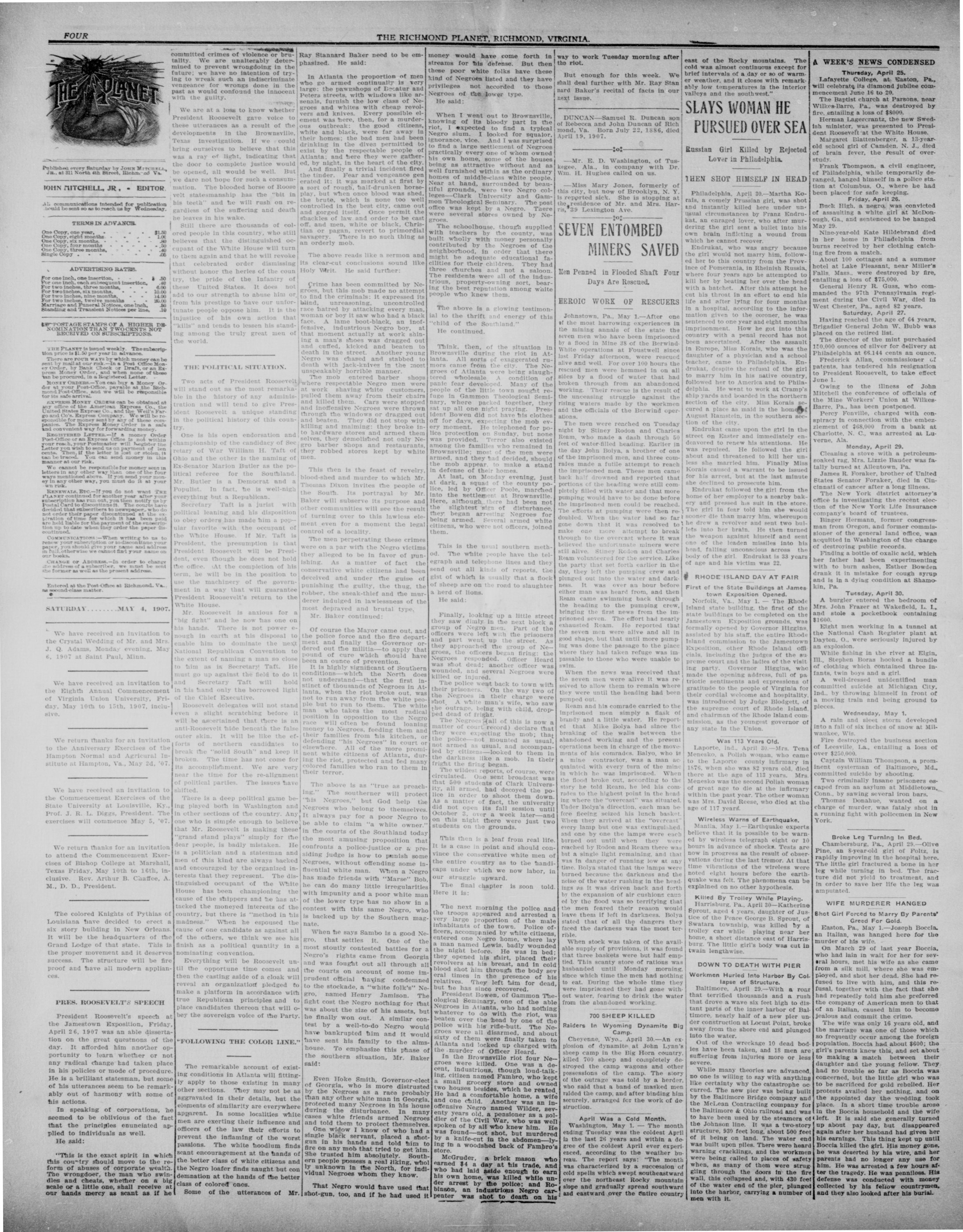
FOUR
THE PLANET
Published every Saturday by JOHN MITCHELL,
Jr., at all North 4th Street, Richmond, Va.
Ai. communications intended for publication
should be sent so as to reach us on Wednesday
TERMS IN ADVANCE
One Copy, one year. * $1.50
One Copy, eight months. * 1.00
One Copy, six months. * .80
One Copy, four months. * .50
One Copy, three months. * .40
Single Copy. * .05
ADVERTISING RATES
For one inch, one insertion, $50
For one inch, each subsequent insertion, $40
For two inches, three months, $6.00
For two inches, two months, $14.00
For two inches, nine months, $14.00
For two inches, twelve months $30.00
Marriage and Funeral Notices, one inch, $50
Standing and Transient Notices per line, $10
**POSTAGE STAMPS OF A HIGHER DEMONINATION THAN TWO CENTS NOT RECEIVED ON SUBSCRIPTIONS.
THE PLANET is issued weekly. The subscription price is $1.50 per year in advance. There are four ways which the money can be sent to this company. In Post Office Money Order, by Bank Check or Draft, or an Express Money Order, and when none of those can be procured, in a Registered Letter.
MONEY ORDERS—You can buy a Money Order at your Post Office, payable at the Rich-
Pays-On-
and we will be responsible for its safe arrival.
X-Witness Money Order can be obtained at any office of the American Express Co., the United States Express Co., and the Well's Fargo and Co's Express Company. We will be responsible for money sent by any of these companies. The Express Money Order is a safe and convenient way for forwarding money.
REGISTERED LETTER.—If a money Order Post-Office or an Expense Code is not within your address, you must send a Letter you wish to send on payment of ten cents. Then, if the letter is lost or stolen, you can send money in this manner at our risk.
We cannot be responsible for money sent in letters in any other way than one of the four ways mentioned above. If you send your money in another way, you must do it at your risk.
RENWAKS, ETC. If you do not want the Planet continued or another year after your subscription, you must not modify your Postal Card to discontinue it. The counts have decided that subscribers to newspaper, who do not subscribe to another year after your subscription of time for which it has been paid, are held liable for the payment of the subscription up to date when they order the paper discussed.
COMMUNICATIONS.—When writing to us to renew your subscription or to discontinue your paper, you should give your name and address to the person we cannot find your name on our books.
CHANGE OF ADDRESS.—In order to change the address of a subscriber, we must be sent the former as well as the present address.
Entered at the Post-Office at Richmond, Va.
as second-class matter.
We have received an invitation to the Crystal Wedding of Mr. and Mrs J. Q. Adams, Monday evening, May 6. 1907 at Saint Paul, Minn.
We have received an invitation to the Eighth Annual Commencement of Virginia Union University, Friday, May 10th to 15th, 1907, inclusive.
We return thanks for an invitation to the Anniversary Exercises of the Hampton Normal and Agricultural Institute at Hampton, Va. May 24, '07
We have received an invitation to the Commencement Exercises of the State University at Louisville, Ky. Prof. J. R. L. Diggs, President. The exercises will commence May 5. '07
We return thanks for an invitation to attend the Commencement Exercises of Bishop College at Marshall, Texas Friday, May 10th to 16th, inclusive. Rev. Arthur B. Chaffee, A.M., D. D., President.
The colored Knights of Pythias of Louisiana have decided to erect a six story building in New Orleans. It will be the headquarters of the Grand Lodge of that state. This is the proper movement and it deserves success. The structure will be fire proof and have all modern appliances.
PRES. ROOSEVELT'S SPEECH
President Roosevelt's speech at the Jamestown Exposition, Friday, April 26, 1907 was an able dissertation on the great questnons of the day. It afforded him another opportunity to learn whether or not any radical change had taken place in his policies or mode of procedure. He is a brilliant statesman, but some of his utterances seem to be remarkably out of harmony with some of his actions.
In speaking of corporations, he seemed to be oblivious of the fact that the principles enunciated applied to individuals as well.
He said:
"This is the exact spirit in which this country should move to the reform of abuses of corporate wealth. The wrongdoer, the man who swindles and cheats, whether on a big scale or a little one, shall receive at our hands mercy as scant if he
committed crimes of violence or brutality. We are unalterably determined to prevent wrongdoing in the future; we have no intention of trying to wreak such an indiscriminate vengeance for wrongs done in the past as would confound the innocent with the guilty.
We are at a loss to know whether President Roosevelt gave voice to these utterances as a result of the developments in the Brownsville, Texas investigation. If we could bring ourselves to believe that this was a ray of light, indicating that the door to complete justice would be opened, all would be well. But we dare not hope for such a consummation. The blooded horse of Roosevelt statesmanship has the "bit in his teeth" and he will rush on regardless of the suffering and death he leaves in his wake.
Still there are thousands of colored people in this country, who still believes that the distinguished occupant of the White House will turn to them again and that he will revoke that celebrated order dismissing without honor the heres of the country, the pride of the Infantry of these United States. It does not add to our strength to abuse him or from his prestige to have our unfortunate people oppose him. It is the injustice of his own action that "kills" and tends to lessen his standing among the truly great men of the world.
THE POLITICAL SITUATION
Two acts of President Roosevelt will stand out as the most remarkable in the history of any administration and will tend to give President Roosevelt a unique standing in the political history of this country.
One is his open endorsation and championship of the candidacy of Secretary of War William H. Taft of Ohio and the other is the naming of Ex-Senator Marion Butler as the political referee for the Southland. Mr. Butler is a Democrat and a Populist. In fact, he is well-nigh everything but a Republican.
Secretary Taft is a jurist with political leaning and his disposition to obey orders has made him a popular favorite with the occupant of the White House. If Mr. Taft is President, the presumption is that President Roosevelt will be President, even though he does not hold the office. At the completion of his term, he will be in the position to use the machinery of the government in a way that will guarantee President Roosevelt's return to the White House.
Mr. Roosevelt is anxious for a "big fight" and he now has one on his hands. There is not power enough in earth at his disposal to enable him to dominate the next National Republican Convention to the extent of naming a man so close to him as is Secretary Taft. He must go up against the field to do it and Secretary Taft will hold in his hand only the borrowed light of the Chief Executive.
Roosevelt delegates will not stand even a slight scratching before it will be ascertained that there is an anti-Roosevelt hide beneath the false outer skin. It will be like the efforts of northern candidates to break the "solid South" and keep it broken. The time has not come for its accomplishment. We are very near the time for the re-alignment of political parties. The issues have shifted.
There is a deep political game being played both in Washington and in other sections of the country. Any one who is simple enough to believe that Mr. Roosevelt is making these "grand stand plays" simply for the dear people, is badly mistaken. He is a politician and a statesman and men of this kind are always backed and encouraged by the organized interests that they represent. The distinguished occupant of the White House has been championing the cause of the shippers and he has attacked the moneyed interests of the country, but there is "method in this madness." When he espoused the cause of one candidate as against all of the others, we think we see his finish as a political quantity in a nominating convention.
Everything will be Roosevelt until the opportune time comes and then the casting aside of a cloak will reveal an organization pledged to make a platform in accordance with true Republican principles and to place candidates thereon that will obey the sovereign voice of the Party.
"FOLLOWING THE COLOR LINE."
The remarkable account of existing conditions in Atlanta will fittingly apply to those existing in many other sections. They may not be as aggravated in their details, but the elements of similarity are everywhere apparent. In some localities white men are exerting their influence and officers of the law their efforts to prevent the inflaming of the worst passions. The white hoodium finds scant encouragement at the hands of the better class of white citizens and the Negro loafer finds naught but condenation at the hands of the better class of colored ones.
Some of the utterances of Mr.
THE RICHMOND PLANET, RICHMOND, VIRGINIA
Ray Stannard Baker need to be emphasized. He said:
In Atlanta the proportion of men who go armed continually is very large: the pawnshops of Decatur and Peters streets, with windows like arsenals, furnish the low class of Negroes and whites with cheap revolvers and knives. Every possible element was here, then, for a murderous outbreak: the good citizens, white and black, were far away in their homes; the bad men had been drinking in the dives permitted to exist by the respectable people of Atlanta; and here they were gathered, by night, in the heart of the city. And finally a trivial incident fired the tinder. Fear and vengeance gen erated it: it was marked at first by a sort of rough, half-drunken horseplay, but when once blood was shed, the brute, which is none too well controlled in the best city, came out and gorged itself. Once permit the shackles of law and order to be cast off, and men, white or black, Christian or pagan, revert to primordial savagery. There is no such thing as an orderly mob.
The above reads like a sermon and its clear-cut conclusions sound like Holy Writ. He said further:
Crime has been committed by Negroes, but this mob made no attempt to find the criminals: it expressed its blind, unreasoning, uncontrolled race hatred by attacking every man, woman or boy it saw who had a black face. A lame boot-black, an inoffensive, industrious Negro boy, at that moment actually at work shining a man's shoes was dragged out and cuffed, kicked and beaten to death in the street. Another young Negro was chased and stabbed to death with jack-knives in the most unappeasably horrible manner.
The mob entered barber shops where respectable Negro men were at work shaving white customers, pulled them away from their chairs and killed them. Cars were stopped and inoffensive Negroes were thrown through the windows or dragged out and beaten. They did not stop with killing and malming; they broke into hardware stores and armed them selves, they demolished not only Negro barber shops and restaurants, they robbed stores kept by white men.
This then is the feast of revelry, blood-shed and murder to which Mr. Thomas Dixon invites the people of the South. Its portrayal by Mr. Baker will subserve its purpose and other communities will see the result of turning over to this lawless element even for a moment the legal control of a locality.
The men perpetrating these crimes were on a par with the Negro victims they alleged to be in favor of punishing. As a matter of fact the conservative white citizens had been deceived and under the guise of punishing the guilty, the thug, the robber, the sneak-thief and the murderer indulged in lawlessness of the most depraved and brutal type. Mr. Baker continued:
Of course the Mayor came out, and the police force and the fire department and finally the Governor ordered out the militia—to apply that pound of cure which should have been an ounce of prevention.
It is highly significant of Southern conditions—which the North does not understand—that the first instinct of thousands of Negroes in Atlanta, when the riot broke out, was not to run away from the white people but to run to them. The white man who takes the most radical position in opposition to the Negro race will often be found loaning money to Negroes, feeding them and their families from his kitchen, or defending "his Negroes" in court or elsewhere. All of the more prominent white citizens of Atlanta, during the riot, protected and fed many colored families who ran to them in their terror.
The above is as "true as preaching." The southerner will protect "his Negroes," but God help the Negroes who belong to themselves. It always pay for a poor Negro to be able to claim "a white owner." in the courts of the Southland today the most amusing proposition that confronts a police-justice or a presiding judge is how to punish some Negroes, without offending some influential white man. When a Negro has made friends with "Marse" Bob, he can do many little irregularities with impunity and a poor white man of the lower type has no show in a contest with this same Negro, who is backed up by the Southern magnate.
When he says Sambo is a good Negro, that settles it. One of the most stoutly contested battles for a Negro's rights came from Georgia and was fought out all through all the courts on account of some imprudent official having condemned to the stockade, a "white folk's" Negro, named Henry Jamison. The fight cost the Negro nothing for that was about the size of his assets, but he finally won out. A similar contest by a well-to-do Negro would have bankrupted him and it would have sent his family to the almshouse. To emphasize this phase of the southern situation, Mr. Baker said:
Even Hoke Smith, Governor-elect of Georgia, who is more distrusted by the Negroes as a race probably than any other white man in Georgia, protected many Negroes in his house during the disturbance. In many cases white friends armed Negroes and told them to protect themselves.
One widow I know of who had a single black servant, placed a shot-gun in his hands and told him to fire on any mob that tried to get alm. She trusted him absolutely. Southern people possess a real liking, why unknown in the North, for individual Negroes whom they know.
That Negro would have used that shot-gun, too, and if he had used it
money would have come forth in streams for his defense. But then these poor white folks have these kind of Negroes listed and they have privileges not accorded to those Negroes of the lower type.
He said:
When I went out to Brownsville, knowing of its bloody part in the riot, I expected to find a typical Negro slum. I looked for squalor, ignorance, vice. And I was surprised to find a large settlement of Negroes practically every one of whom owned his own home, some of the houses being as attractive without and as well furnished within as the ordinary homes of middle-class white people. Near at hand, surrounded by beautiful grounds, were two Negro colleges—Clark University and Gammon Theological Seminary. The post office was kept by a Negro. There were several stores owned by Negroes.
The schoolhouse, though supplied with teachers by the county, was built wholly with money personally contributed by the Negroes of the neighborhood, in order that there might be adequate educational facilities for their children. They had three churches and not a saloon. The residents were all of the industrious, property-owning sort, bearing the best reputation among white people who knew them.
The above is a glowing testimonial to the thrift and energy of this "child of the Southland."
He continued
Think, then, of the situation in Brownsville during the riot in Atlanta. All sorts of exaggerated rumors came from the city. The Negroes of Atlanta were being slaughtered wholesale A condition of panic fear developed. Many of the people of the little town sought refuge in Gammon Theological Seminary, where packed together, they sat up all one night praying. President Bowen did not have his clothes off for days, expecting the mob every moment. He telephoned for police protection on Sunday, but none was provided. Terror also existed among the families who remained in Brownsville; most of the men were armed, and they had decided, should the mob appear, to make a stand in defense of their homes.
At last, on Monday evening, just at dark, a squad of the county police, led by Officer Poole, marched into the settlement at Brownsville. Here, although there had been not the slightest sign of disturbance, they began arresting Negroes for being armed. Several armed white citizens, who were not officers, joined them.
This is the usual southern method. The white people have the telegraph and telephone lines and they send out all kinds of reports, the gist of which is usually that a flock of sheep are on the road to slaughter a herd of lions.
Finally, looking up a little street they saw dimly in the next block a group of Negro men. Part of the officers were left with the prisoners and part went up the street. As they approached the group of Negroes, the officers began firing: the Negroes responded. Officer Heard was shot dead; another officer was wounded, and several Negroes were killed or injured.
The police went back to town with their prisoners. On the way two of the Negroes in their charge were shot. A white man's wife, who saw the outrage, being with child, dropped dead of fright.
The Negroes (all of this is now a matter of court record) declare that they were expecting the mob; that the police—not mounted as usual, not armed as usual, and accompanied by citizens—looked to them in the darkness like a mob. In their fright the firing began.
The wildest reports, of course, were circulated. One sent broadcast was that 500 students of Clark University, all armed, had decoyed the police in order to shoot them down. As a matter of fact, the university did not open its fall session until October 3, over a week later—and on this night there were just two students on the grounds.
This then is a leaf from real life. It is a case in point and should convince the conservative white men of the entire country as to the handicaps under which we now labor, in our struggle upward.
The final chapter is soon told. Here it is:
The next morning the police and the troops appeared and arrested a very large proportion of the male inhabitants of the town. Police officers, accompanied by white citizens, entered one Negro home, where lay a man named Lewis, badly wounded the night before. He was in bed; they opened his shirt, placed their revolvers at his breast, and in cold blood shot him through the body several times in the presence of his relatives. They left him for dead, but he has since recovered.
President Bowen, of Gammon Theological Seminary, one of the able Negroes in Atlanta, who had nothing whatever to do with the riot, was beaten over the head by one of the police with his rifle-butt. The Negroes were all disarmed, and about sixty of them were finally taken to Atlanta and locked up charged with the murder of Officer Heard.
In the Brownsville riot four Negroes were killed. One was a decent, industrious, though loud-talking, citizen named Fambro, who kept a small grocery store and owned two houses besides, which he rented. He had a comfortable home, a wife and one child. Another was an in-offensive Negro named Winder, seventy years old, a pensioner as a soldier of the Civil War, who was well spoken of by all who knew him. He was found—not shot, but murdered by a knife-cut in the abdomen—lying in a woodshed back of Fambro's store.
McGruder, a brick mason who earned $4 a day at his trade, and who had laid aside enough to earn his own home, was killed while under arrest by the police; and Robinson, an industrious Negro carpenter was shot to death on his
way to work Tuesday morning after the riot.
But enough for this week. We shall deal further with Mr. Ray Stanard Baker's recital of facts in our next issue.
DUNCAN—Samuel R. Duncan son of Rebecca and John Duncan of Richmond, Va. Born July 22, 1886, died April 19, 1907.
—Mr. E. D. Washington, of Tuskegee, Ala., in company with Dr. Wm. H. Hughes called on us.
—Miss Mary Jones, formerly of this city, but now of Brooklyn, N. Y. is repped sick. She is stopping at the residence of Mr. and Mrs. Harris, 39 Lexington Ave.
SEVEN ENTOMBED MINERS SAVED
Men Penned in Flooded Shaft Four Days Are Rescued.
HEROIC WORK OF RESCUERS
Johnstown, Pa., May 1.—After one of the most harrowing experiences in the mining annals of the state the seven men who have been imprisoned by a flood in Mine 38 of the Berwind White operations at Foustwell since last Friday afternoon, were rescued alive and well. For over 100 hours the rescued men were hemmed in on all sides by a flood of water that had broken through from an abandoned working. Their rescue is the result of the unceasing struggle against the rising waters made by the workmen and the officials of the Berwind operations.
The men were reached on Tuesday night by Stiney Rodon and Charles Ream, who made a dash through 50 feet of water-filled heading. Earlier in the day John Bolya, a brother of one of the imprisoned men, and three comrades made a futile attempt to reach the imprisoned men. These men came back half drowned and reported that portions of the heading were still completely filled with water and that more pumping would have to be done before the imprisoned men could be reached. The efforts at pumping were then re-doubled. When the water had so far gone down that it was resolved to make one more attempt to break through to the overcast where it was believed the unfortunate miners were still alive. Stiney Rodon and Charles Ream volunteered for the service. Like the party that set forth earlier in the day, they left the pumping crew and plunged out into the water and darkness. It was over an hour before either man was heard from, and then Ream came swimming back through the heading to the pumping crew, bringing the first news from the imprisoned seven. The effort had nearly exhausted Ream. He reported that the seven men were alive and all in good shape, but that until more pumping was done the passage to the place where they had taken refuge was impassable to those who were unable to swim.
When the news was received that the seven men were alive it was resolved to allow them to remain where they were until the heading had been pumped out.
Ream and his comrade carried to the imprisoned men simply a flask of brandy and a little water. He reported that Mike Bolya had since the breaking of the walls between the abandoned working and the present operations been in charge of the movements of his comrades. Balyo, who is a mine contractor, was a man acquainted with every turn of the mine in which he was imprisoned. When the flood broke out, according to the story he told Ream, he led his comrades to the highest point in the heading where the "overcast" was situated. Under Bolya's direction, each man before fleeing soaked his lunch basket. When they arrived at the "overcast" every lamp but one was extinguished, and one by one the lamps were each burned out until when they were reached by Rodon and Ream there was but a single light remaining, and that was in danger of running low at any time. Bolya stated that the lamps were burned because the darkness and the noise of the water rushing in the headings as it was driven back and forth by the expansion of air cushions caused by the flood was so terrifying that the men feared their reason would leave them if left in darkness. Bolya stated that of all the dangers they faced the darkness was the most terrible.
When stock was taken of the available supply of provisions, it was found that three baskets were but half emptied. This scanty store of rations was husbanded until Monday mornings, since which time the men had nothing to eat. During the whole time they were imprisoned they had gone with out water, fearing to drink the water from the abandoned working.
700 SHEEP KILLED
Raiders In Wyoming Dynamite Big Camp.
Cheyenne, Wyo., April 30.—An explosion of dynamite at John Lynn's sheep camp in the Big Horn country, killed 700 sheep and completely destroyed the camp wagons and other possessions of the camp. The story of the outrage was told by a herder, who said that a band of masked men raided the camp, and after binding him securely, arranged for the work of destruction.
April Was a Cold Month.
Washington, May 1. — The month ending Tuesday was the coldest April in the last 26 years and within a degree of the coldest April ever experienced, according to the weather bureau. The report says: "The month was characterized by a succession of cold spells which swept southeastward over the northeast Rocky mountain slope and gradually spread southward and eastward over the entire country
east of the Rocky mountains. The cold was almost continuous except for brief intervals of a day or so of warmer weather, and it closes with remarkably low temperatures in the interior valleys and the southwest."
SLAYS WOMAN HE PURSUED OVER SEA
Russian Girl Killed by Rejected Lover in Philadelphia.
THEN SHOT HIMSELF IN HEAD
Philadelphia, April 30.—Martha Korals, a comely Prussian girl, was shot and instantly killed here under unusual circumstances by Franz Endrukat, an enraged lover, who after murdering the girl sent a bullet into his own brain inflicting a wound from which he cannot recover.
Endrukat, who was angry because the girl would not marry him, followed her to this country from the Province of Pomerania, in Rhineland Russia, where four years ago he attempted to kill her by beating her over the head with a hatchet. After this attempt he cut his throat in an effort to end his life and after lying for four months in a hospital, according to the information given to the coroner, he was sentenced to one year and eight months imprisonment. How he got into this country with a penal record has not been ascertained. After the assault in Europe, Miss Korais, who was the daughter of a physician and a school teacher, came to Philadelphia. Endrukat, despite the refusal of the girl to marry him in his native country, followed her to America and to Philadelphia. He went to work at Cramp's ship yards and boarded in the northern section of the city. Miss Korais secured a place as maid in the home of August Ramstein, in the southern section of the city.
Endrukat came upon the girl in the street on Easter and immediately endowed to renew his attentions. He was repulsed. He followed the girl about and threatened to kill her unless she married him. Finally Miss Korais caused a warrant to be issued for his arrest, but at the last minute she declined to prosecute him.
Endrukat followed the girl from the home of her employer to a nearby bakery and pressed his suit in the store. The girl in fear told him she would sooner die than marry him, whereupon he drew a revolver and sent two bullets into her brain. He then turned the weapon against himself and sent one of the leaden missiles into his head, falling unconscious across the body of the girl. Endrukat is 33 years of age and his victim was 22.
RHODE ISLAND DAY AT FAIR
First of the State Buildings at James
Avenue, Exposition Open
TOWN Exposition Opened.
Norfolk, Va. May 1. — The Rhode Island state building, the first of the state buildings to be completed on the Jamestown Exposition grounds, was formally formed by Governor Higgins, assisted by his staff, the entire Rhode Island commission to the Jamestown Exposition, other Rhode Island officials, including the judges of the supreme court and the ladies of the visiting party. Governor Higgins, who made the opening address, full of patriotic sentiments and expressions of gratitude to the people of Virginia for their cordial welcome and hospitality was introduced by Judge Bloedgett, of the supreme court of Rhode Island, and chairman of the Rhode Island commission, as the youngest governor of any state in the Union.
Was 113 Years Old.
Laporte, Ind., April 30—Mrs. Tena Menesko, a Polish woman, who came to the Laporte county infirmary in 1876, when she was 82 years old, died there at the age of 113 years. Mrs. Menesko was the second Polish woman of great age to die at the infirmary within the past year. The other woman was Mrs. David Reese, who died at the age of 117 years.
Wireless Warns of Earthquake.
Manila, May 1.—Earthquake experts believe that it is possible to be warned by wireless telegraph eight or 10 hours in advance of shocks. Tests are now in progress as the result of observations during the last tremor. At that time vibrations of the wireless were noted eight hours before the earthquake was felt. The phenomena can be explained on no other hypothesis.
Killed By Trolley While Playing.
Harrisburg, Pa. April $30—Katherine
Sprout, aged 4 years, daughter of Justice
of the Peace George B. Sprout, of
Swatara township, was killed by a
trolley car while playing near her
home, a short distance east of Harrisburg. The little girl's body was cut in twain lengthwise.
DOWN TO DEATH WITH PIER
Workmen Hurled Into Harbor By Collapse of Structure.
Baltimore, April 29.—With a roar that terrified thousands and a rush that drove a wave six feet high to distant parts of the inner harbor of Baltimore, nearly half of a new pier under construction at Locust Point, broke away from the shore end and plunged into the water.
Out of the wreckage 10 dead bodies have been taken, and 18 men are suffering from injuries more or less severe.
While many theories are advanced, no one is willing to say with anything like certainty why the catastrophe occurred. The new pier was being built by the Baltimore Bridge company and the McLean Contracting company for the Baltimore & Ohio railroad and was to have been used by the steamers of the Johnson line. It was a two-story structure, 930 feet long, about 500 feet of it being on land. The water end was built upon piles. There were heard warning cracklings, and the workmen were being called to places of safety when, as many of them were struggling through the doors in the fire wall, this collapsed and, with 430 feet of the water end of the pier, plunged into the harbor, carrying a number of men with it.
A WEEK'S NEWS CONDENSED
Thursday, April 25.
Lafayette College, at Easton, Pa., will celebrate its diamond jubilee commencement June 16 to 20.
The Baptist church at Parsons, near Wilkes-Barre, Pa., was destroyed by fire, entailing a loss of $8000.
Herman Lagercrantz, the new Swedish minister, was presented to President Roosevelt at the White House.
Margaret Blattenberger, a 13-year-old school girl of Camden, N. J., died of brain fever, the result of overstudy.
Frank Thompson, a civil engineer, of Philadelphia, while temporarily ranged, hanged himself in a police station at Columbus, O., where he had been placed for safe keeping.
Friday, April 26.
Buck High, a negro, was convicted of assaulting a white girl at McDonough, Ga., and sentenced to be hanged May 29.
Nine-year-old Kate Hildebrand died in her home in Philadelphia from burns received by her clothing catching fire from a match.
About 100 cottages and a summer hotel at Lake Pleasant, near Miller's Falls, Mass., were destroyed by fire, entailing a loss of $75,000.
General Henry R. Guss, who commanded the 97th Pennsylvania regiment during the Civil War, died in West Chester, Pa., aged 82 years.
Saturday, April 27.
Having reached the age of 64 years, Brigadier General John W. Bubb was placed on the retired list.
The director of the mint purchased 150,000 ounces of silver for delivery at Philadelphia at 66.144 cents an ounce.
Frederick Allan, commissioner 61 patents, has tendered his resignation to President Roosevelt, to take effect June 1.
Owing to the illness of John Mitchell the conference of officials of the Mine Workers' Union at Wilkes-Barre, Pa., has been postponed. Percy Fonville, charged with conspiracy in connection with the embezzlement of $68,000 from a bank at Charlotte, N. C., was arrested at Luverne, Ala.
Monday. April 29.
Cleaning a stove with a petroleum-soaked rag, Mrs. Lizzie Bauer was fatally burned at Allentown, Pa.
James R. Foraker, brother of United States Senator Foraker, died in Cincinnati of cancer after a long illness.
The New York district attorney's office is investigating the recent election of the New York Life Insurance company's board of trustees.
Binger Hermann, former congressman from Oregon, and former commissioner of the general land office, was acquitted in Washington of the charge of destroying public records.
Finding a bottle of oxalic acid, which her father had been experimenting with to burn ashes, Esther Bowden drank it in mistake for cough syrup and is in a dying condition at Shamokin, Pa.
Tuesday, April 30.
A burgler entered the bedroom of Mrs. John Frazer at Wakefield, L. I., and stole a pocketbook containing $1600. Eight men working in a tunnel at the National Cash Register plant at Dayton, O., were seriously injured by an explosion. While fishing in the river at Elgin, Ill., Stephen Boras hooked a bundle of clothing which contained three infants, twin boys and a girl. A well-dressed unidentified man committed suicide at Michigan City, Ind., by throwing himself in front of a moving train and being ground to pieces.
Wednesday, May 1.
A rain and sleet storm developed into a fall of six inches of snow at Milwaukee, Wis.
Fire destroyed the business section of Leesville, La., entailing a loss of over $250,000.
Captain William Thompson, a prominent oysterman of Baltimore, Md., committed suicide by shooting.
Two criminally insane prisoners escaped from an asylum at Middletown, Conn., by sawing several iron bars.
Thomas Donahue, wanted on a charge of murder, was fataly shot in a running fight with policemen in New York.
Broke Leg Turning In Bed
Chambersburg, Pa., April 29—Olive Pine, an 8-year-old girl of Foltz, is rapidly improving in the hospital here. The little girl fractured a bone in her leg while turning in bed. The fracture did not yield to treatment, and in order to save her life the leg was amputated.
WIFE MURDERER HANGED
Shot Girl Forced to Marry By Parents' Greed For Gold.
Easton, Pa., May 1.—Joseph Boccia, an Italian, was hanged here for the murder of his wife.
On March 29 of last year Boccia, who had lain in wait for her for several hours, met his wife as she came from a silk mill, where she was employed, and shot her dead. She had refused to live with him, and this refusal, together with the fact that she had repeatedly told him she preferred the company of American men to that of an Italian, caused him to become jealous and commit the crime.
The wife was only 16 years old, and the marriage was one of those which so frequently occur among the foreign population. Boccia had about $600; the girl's parents knew this, and set about to making a match between their daughter and the young fellow. They had no trouble so far as Boccia was concerned, but the little girl who was to be sacrificed for gold rebelled. Her protests availed her nothing, and on the appointed day the wedding took place. In a short time trouble arose in the Boccia household and the wife left. It is said she generally turned up about pay day, but disappeared again after her husband had given her his earnings. This thing kept up until Boccia killed the girl. His money gone, he was deserted by his wire, and her parents had no longer any use for him. He was arrested a few hours after the tragedy. He was pennilless. His defense was conducted with money collected by his fellow countrymen, and they also looked after his burial.
THE PLANET
DOLLY HAS HAS GAY TIME;
LANDS IN DARK CELL
KICKS OFF DEACON'S HAT AND SCARES JERSEY TOWN HALF TO DEATH.
Bloomfield Center, N. N.—A venerable deacon of a church here got off a trolley car late the other night. Miss Dolly Gray, who seemed to be in joyous spirits, danced up to the deacon, took a fancy step or two, and kicked off his high hat.
Percy Mott, as he called himself, Miss Dolly's escort, applauded her noisily. Mr. Mott, well dressed and
A
self-confident, looks like many young men one sees in Broadway.
Miss Dolly's Moulin Rouge trick at the deacon's expense was but the climax of her gay performances at Bloomfield Center. A dazzling blonde, she had kicked off the hats of several "dear old men," as she called them. She tried to give an imitation of Diana at the bath in the big drinking fountain, but Mr. Mott restrained her. At the deacon's demand, made as much in sorrow as in anger, Policeman O'Nell arrested Miss Dolly and Mr. Mott and locked them in the police station. Dolly's hair turned color in a single night—but not gray. Short black hair bristled on her head. O'Nell found a luxurant blonde wig in her cell next morning.
"I haven't the least idea how I got here, your honor, and even less idea why I came." Miss Dolly told Recorder Cadmus in the police court. "Mr. Mott took me to dinner in New York, of course—and we had a very good dinner. Then, that dreadful cell." "In the cold, gray dawn" young Mr. Mott seemed much dejected. He remained silent. The recorder fined each five dollars. Mr. Mott searched all his pockets and, finding only small silver, took a handsome diamond ring from his finger and left it with the court as security for payment of the fines. Mott whispered to O'Nell: "Can you hold the young lady until I get out of town? If my people get to know—" "You brought her here, you take her away," said O'Nell. "Good-by, Judge," exclaimed Miss Dolly airily, blowing a kiss to the recorder as she left the courtroom. "Little old New York for mine." They took a train for New York together.
HEN STARTS AN EGG ROUTE.
Doesn't Believe in Nests and Lays in Neighbor's Parlor.
Washington, N. J.—This town boasts of a hen who believes in distributing her favors. In the first place this hen, whose fruit is of right the property of Mrs. Mary Hough, is so far domesticated that she scorns a nest, believing a house is the proper place for her Easter offerings.
Mrs. John B. Wright heard a cackling in her parlor the other day, and hurrying in she saw Mrs. Hough's hen proudly strutting about a sofa pillow on which she had deposited an egg. The next day the hen visited the house of Mrs. Delbert Major and laid an egg in the kitchen sink.
Other neighbors have had similar experiences, but one of Jasper Cork takes the cake. in Mr. Cork's house the delivery service hen selected an egg cup on the fourth shelf of the pantry.
Mrs. Hough believes in time she can train a squad of hens to deliver breakfast food throughout the neighborhood.
Died Like Absalom.
Scranton, Pa.—Entwining around his neck while he was on the seat of his wagon driving toward his home near Blakely, the branches of a swamp birch bush choked Alexander Morrison a farmer, to death.
The team wandered into the gutter at the roadside, while Morrison dozed, and the birch branches caught the man as he rode. The long slender wands were found entwined about the neck as Morrison's body hung over the wagon seat.
Dog Has Mania for Onions.
Wooster, O.—The grocers of this city have united in offering a reward of $10 for the capture of a thief.
The thief is a dog that has an appetite for Bermuda onions and steals them whenever he gets a chance. The dog seems to know, too, that he is
stealing, for he appears suddenly, digs out the largest onion that he sees in the basket and then dashes off with it. Those who have watched the dog say that the canine eats the onions greedily as the ordinary dog would eat a hunk of meat.
GIRL AGED 18 TURNS BANDIT.
Robs Wyoming Ranchmen and Roadhouse at Point of Revolver.
Dubols, Wyo.—Ethhel Burrows, 18 years old, has turned bandit and has been terrorizing Wyoming citizens.
Word has been received here that several nights ago she suddenly appearel in the doorway of a roadhouse west of here and at the point of a six-shooter compelled three or four men who were gathered there to give her all the money and valuables in their possession. She also forced the landlord to empty the contents of his cash drawer into her lap.
After committing the robbery she mounted a horse and rode away.
The next night she appeared at a ranch house and, drawing a revolver, relieved the ranchman of $50 and a gold watch and chain. In several cases she has robbed travelers in broad daylight.
While she has not worn a mask or made any attempt to conceal her identity, when she perpetrated these crimes, she has not been arrested and the authorities do not know where she is.
Miss Burrows used to be a domestic in a number of Wyoming towns. Her parents are dead.
Uses Maple Sirup for Varnish.
South Norwalk, Conn.—Postmaster George W. Bryan, of Rowayton, decided the other day that his post office needed a coat of vanish. He didn't think a regular painter was needed and engaged E. H. Hall, a village handy man, to do the job. Mr. Bryan had a two-quart can of varnish at home, and, desirous of saving the government as much expense as he could, he brought the varnish over and set Hall to work. At breakfast Mrs. Postmaster Bryan hunted in vain for her can of maple sirup, while her husband waited for his pancakes. Finally she asked the postmaster if he had seen it. He didn't answer, but jumped from the table and ran like a rabbit to the post office.
When he got there he put a finger on the shining wall and then put it in his mouth. It had a maple sugar taste. The postmaster has given an order for some real varnish and also for a new supply of maple sipup, and is living in hopes that there won't be a public scandal.
—Men's freak in low and spring heels is all the rage and you want to buy a pair at the store of the Capitol Shoe and Supply Co.
Do You Know Them?
Carbondale, Ill., Feb. 12, '07.
My Dear Brother:
Being unacquainted with any one in your city, I am writing you, through your Postmaster, this letter of inquiry in regard to some of my relatives who may live in that country. I refer to the Samson Wilkerson family (colored).
I am the son of Sora Wilkerson who was taken away from Richmond, Virginia, about fifty-six (56) years ago by Roberson and Garrett, Slave traders, and taken to Mississippi and sold into slavery. Her (Sofa Wilkerson's) first husband's name was Callis Sheppard. She was also the mother of Georgiana, Juda and Vanuel, the last name being a boy born blind.
She also had other children whom I cannot name. Her supposed husband, when she left there, was Henry White and her mother's name was Lucy Wilkerson. When she left Virginia, I think she was living with Dick Chidester.
If any such person or persons can be found there or any where else that you know of, please write to the undersigned and you will greatly oblige a friend and brother.
Yours very truly,
HENRY WHITE,
703 N. East Street,
Carbondale, Jackson Co.,
Illinois.
Excursions to Jamestown Exposition Norfolk, Va. via Southern Railway.
Commencing April 19th and continuing daily to November 30, 1997 Southern Railway will sell season sixty day, fifteen day and ten day excursion tickets to Norfolk, Va. and return at reduced rates account the above; and on Tuesday of each week coach excursion tickets, not good in parlor or pullman cars, will be sold at greatly reduced rates, limited seven days. Inquire of Southern Railway Agents.
JURGEN'S SON
JURGEN'S SON
Before making your purchase you would do well to call at the most reliable furniture house in the city and see the fine line of REFRIGERATONS, MATTINGS, OIL-CLOTHS And in fact everything that is needed in house furnishings.
Of every description; also the latest designs in ROCKERS and special CHAIRS. Our goods are the best for the price and the price is very low. C. G. JURGEN'S SON, ADAMS AND BROAD STREETS
THE RICHMOND PLANET, RICHMOND, VIRGINIA
JOB DEPARTMENT
It is thoroughly equipped to do all kinds of printing on short notice. We make a specialty of Society printing and work for Insurance Companies, such as Financial
EXCURSION
We print Handbills, Quarter-Sheet
Sheet posters, Tags, Tickets, Placards
utes, Visiting Cards, Mourning Stations
WE HAVE
Our St
OF THE LATES
WE CAN PRINT A BILL AS SMALL
A Three-Sheet
AS LARGE AS A FRO
Our street-entrance is retired and
fastidious lady being able to enter wi
URSION
Bills, Quarter-Sheet,
Tickets, Placards,
Mourning Stations
HAVE
Our Ste
OF THE LATEST
A BILL AS SMALL
Free-Sheet
GREE AS A FRONT
OUR PR
IS WITH
France is retired and I
being able to enter with
MISSION WORK
arter-Sheets, Half and Whole
Placards, Society Cards, Min-
ing Stationery.
WE AN EL
WHICH WE WILL
Stock Ro
LATEST STYLE BOND, F
AS SMALL AS A DODGER
Sheet Poster
A FRONT DOOR.
OUR PRESENT CORP OF EMPLOYE
IS WITHIN EASY REACH OF
ired and has no objectionable
enter without embarrassment
2213.
COLN
POMADE
SOFTENS
THE
HAIR
AND
KEEPS IT
FROM
BREAKING
KEEPS
SCALP
FRESH
CLEAN
AND
WHOLESOME
es or Mars Her Beauty.
Our head is full of dandruff. If
COLN HAIR POMADE will
dandruff and cure scalp diseases.
It is highly perfumed and is
in the market. All we ask is
we feel confident the result will
recommend it to your friends.
and refuse weak and inferior
drug Stores.
5 CENTS.
FURNITURE BY
made Company,
EXCURSION WORK OF ALL DESCRIPTIONS
We print Handbills, Quarter-Sheets, Half and Whole Sheet posters, Tags, Tickets, Placards, Society Cards, Minutes, Visiting Cards, Mourning Stationery.
OUR AIM is to please our patrons and to give them the best service at the lowest prices, consistent with satisfactory work.
We furnish "cuts" when desired and we will arrange to complete special work in our line. When in need of any work in our line, call and see us and estimates will be furnished.
WE HAVE AN ELEGANT LINE OF SAMPLES
WHICH WE WILL SHOW ANY ONE DESIRING TO SEE THEM.
WE CAN PRINT A BILL AS SMALL AS A DODGER. A Three-Sheet Poster AS LARGE AS A FRONT DOOR. WE HAVE ONE OF THE LARGEST OF WOOD-T Of Any Job Printing Establishment
Our street-entrance is retired and has no objectionable features, the most fastidious lady being able to enter without embarrassment or annoyance.
LONG DISTANCE TELEPHONE, 2213.
LINCOLN
HAIR POMA
MAKES
KINKY
HAIR
SOFT
REMOVES
DANDRUFF
AND
MAKES
IT
CROW
LONG
AND
LUXURIOUS
LINCOLN
HAIR POMA
A Woman's Hair Makes or Makes
If your hair is short. If your head is your scalp is diseased, LINCOLN Hair make it grow, remove the dandruff and LINCOLN HAIR POMADE is high the finest toilet preparation on the ma for you to give it a trial and we feel be so satisfactory that you will recomm Be sure and get the genuine and ref substitutes. For sale at all Drug Store
PRICE, 15 CENTS
MANUFACTURED BY
The Lincoln Pomade
LINCOLN
HAIR POMADE
LINCOLN
HAIR POMADE
Hair Makes or Makes
It. If your head is
scaled, LINCOLN HAIR
ave the dandruff and
POMADE is high
separation on the mark
trial and we feel com
at you will recommen
genuine and refus
e at all Drug Store
PRICE, 15 CENTS
MANUFACTURED BY
Lin Pomade
MAKES
KINKY
HAIR
SOFT
REMOVES
DANDRUFF
AND
MAKES
IT
GROW
LONG
AND
LUXURIOUS
LINCOLN
HAIR POMADE
The only way to clean the hair and scalp is with the LINCOLN POMADE. This product is designed to help remove hair and scalp, leaving the hair clean and beautiful. The LINCOLN POMADE is made in the USA.
SOFTENS
THE
HAIR
AND
KEEPS IT
FROM
BREAKING
KEEPS
SCALP
FRESH
CLEAN
AND
WHOLESOME
If your hair is short. If your head is full of dandruff. If your scalp is diseased, LINCOLN HAIR POMADE will make it grow, remove the dandruff and cure scalp diseases. LINCOLN HAIR POMADE is highly perfumed and is the finest toilet preparation on the market. All we ask is for you to give it a trial and we feel confident the result will be so satisfactory that you will recommend it to your friends. Be sure and get the genuine and refuse weak and inferior substitutes. For sale at all Drug Stores.
NORFOLK, VA., U. S. A.
If your dealer does not keep it, send his name and 20 cents in silver and we will send you a bottle by return mail. Agents wanted everywhere. Write for particulars.
The Eyes of the World are Upon Me. it utterly impossible to produce a
it utterly impossible to produce a book of such proportions at less cost. We hope that you, dear readers, if you cannot send the one dollar at once, will write to us and state whether or not you would like to have a copy of the book reserved for you and that you will state at what time you will be able to send us the $1.00. Hoping that we shall hear from you by return mail we are.
The colored race in the United States at the present time is having some very trying experiences and only the best sort of advice and the wisest counsel should be given and heeded if your people are to continue in this land of prosperity and enjoy life, liberty, security and the pursuit of happiness. In this book we have attempted to present to the colored people of this great country a solution of our problems.
We have called attention to the commendable steps made by our people along commercial, intellectual and moral lines, and we believe that if this book is read carefully, that it will prove a source of great inspiration and encouragement to not only the colored people themselves but the white people who are interested in our progress. All of the readers of this journal, who will send to us at once $1.00 by P. O. money order or registered letter will receive a copy of the book in cloth binding just as soon as it comes from the press.
SOUTHOBUND TRAIN. SCHED-
ULED TO LEAVE RICHMOND
DAILY.
3:10 A. M. - Local to Norilna, Raleigh, Charlotte, Wilmington, 2:20
P. M. - Sleepers and coaches, Savannah, Jacksonville and Florida points.
9:50 P. M. - Sleepers and coaches Atlanta, Birmingham, Memphis, Savannah, Jacksonville and Southwest.
NORTHBOUND TRAINS SCHED-
ULED TO ARIVE RICHMOND
DAILY.
We offer this special inducement in order to ascertain to what extent our people are willing to support such an enterprise. We will have to charge $1.50 for the book after it comes from the press. We find
OUR PRESENT CORP OF EMPLOYEES ARE COMPETENT AND QUICK-WORKING. OUR OFFICE IS WITHIN EASY REACH OF THE PUBLIC, BEING WITHIN FIFTY YARDS OF BROAD ST.
28 Franklin St. Lawrence, Mass.
SEABOARD
6:45 A. M., 5:10 P. M., 5:45 P. M.
H. S. LEARD, D. P. A.
Cards, Policies, both straight life and benevolent, Physician's Certificates, Sick Cards, Application blanks, Agents Report Sheets, Rate Cards, etc.
IS, Half and Whole Society Cards, Ministry.
is to please give them the lowest with satis
AN ELEGANT WHICH WE WILL SHOW A Rock Room Style Bond, Fine Writing
AL AS A DODGER.
Poster DOOR.
PRESENT CORP OF EMPLOYEES ARE IN EASY REACH OF THE PUBLISHER
has no objectionable features, the out embarrassment or annoyance
WORK OF ALL
OUR AIM
is to please our patrons and to
give them the best service at
the lowest prices, consistent
with satisfactory work.
LEGANT D
SHOW ANY ONE DESIRING
from Embrace
INE WRITING—FLAT AND
LOYEES ARE COMPETENT AND QUI
THE PUBLIC, BEING WITHIN F
features, the most
or annoyance.
FOR FUR
Jol
FORD'S
HAR FOMDE
Formerly known as "OZONIZED OX MARROW"
So STRAIGHTENS KINKY or CURLY HAIR that it can be put up in any style condition. It is a small size, which is known as OZONIZED OX MARROW and is the only one of the most known known to be made in the case of the enCase of the soft-born, harsh, kinky or curly hair soft-plitable and easy to comb. These results are not a result of any treatment. The bottles are usually summifers for a year. The use of Ford's self-brandded beverages and prevents the scalp, stops the hair from falling out or breaking the roots, gives it new life and nourishing the roots, gives it a sum of and gives the new life of harmlessness, it is a lotless process that is a general and children's good one. Ford's Hair Poisoning is the most effective and the most effective.
Since about 1888, and label, "OZONIZED OX MARROW" was registered in the United States. Patent Office, in 1874, became the first "Ford's" as its new makes of hair. In 1881,�itations, SOFT and PLIABLE, presented in the International Journal of the Year 1900, are the best-paid and most-well-known of the first, and the most-well-known of the name and address plainly to:
The Ozonized Ox Marrow Co.
(None genuine without my signature)
Charles Ford
153 E. KINZIE ST., CHICAGO, IL.
Agents wanted everywhere.
Information wanted of the whereabouts of one York Johnson, who at one time lived at Cape Charles, Va. He is reputed to be a Baptist Minister. Information from the Postmaster at Cape Charles City states that he thinks York Johnson is located somewhere along the Norfolk and Western Railroad. The man has an interest in a small lot of land situated in Anne Arundel County, Maryland, once owned by his brother Moses Johnson who is now dead also his wife, Cora and there is now one claimant Jefferson Johnson, a nephew of the mentioned York and Moses Johnson. Any information whatever will be gratefully received at the office of the Richmond PLANET or send mail to
WM. H. HOWARD, Attorney.
59 North West Street,
Annapolis, Maryland.
On and after April 1st, 1907, sched ule via the popular York River Line will leave Richmond at 4:30 P. M. daily except Sunday, returning leave Baltimore at 5 P. M. daily except Sunday. Very low rates one way and round trip to Baltimore, Philadelphia and New York. It's the best way to reach Northern and Eastern points.
We print Wedding Invitations, and High Class Stationery for Balls, Parties, Picnics and all entertainments of a social nature.
ALL DESCRIBE
ons and to service at consistent work.
We furnish "cuts" when desired special work in our line in our line, call and see us and
T LINE OF S
DESIRING TO SEE THEM.
braces a full 2
LAT AND LINEN PAPER, ENVELOP
WE HAVE ONE OF THE OF WOOD
Of Any Job Printing E
NT AND QUICK-WORKING. OUR OFFICE WITHIN FIFTY YARDS OF BROAD ST.
FOR FURTHER INFORMATION, AP
John Mitch
311 N. 4th St.
FOR FURTHER INFORMATION, APPLY TO
John Mitchell, Jr.,
John Mitchell, Jr.,
MRS. BETTIE TUCKER,
Church Road,
Dinwiddle Co., Va.
3t
or CURLY
in any style
h.
was formerly
ROW" and is
en to us that
at nightlight,
as most stub-
s.
ALL, WORK GUARANTEED.....
Cards, Letters or Orders.
...Give us a trial, you will never regret it...
Address, Cor. Price and Jackson Sts.
RICHMOND, VA.
1907, sched River Line
1:30 P. M.
nring leave
rally except
one way
more, Phil-
It's the
Chn and Eas-
PITTSBURG, PA.
Jos. Evans, care Jones and Laughlin.
E. K. Thumm., 1402 Wylie Ave.
BOSTON, MASS.
C. Branum, 657 Shawmut Ave.
J. W. White, 832 Tremont St.
NORFOLK, VA.
John Dehona, 610 Church St.
T. E. W. Perry, 2 Jones Place.
CHICAGO, ILL.
E. H. Faulkner, 3104 State St.
Do You Know Him?
Daily to Faltimore.
WE HAVE ONE OF THE LARGEST ASSORTMENTS OF WOOD-TYPE Of Any Job Printing Establishment in the city.
311 N. 4th St., Richmond, Va.
Do You Know Him?
I would like to know the whereabouts of my brother, William Henry Jones, of 37th St., New York City. He was last seen there in June, 1906. Since that time no one has been able to locate him. His mother is named Louisa Jones, his father, Roland Jones, sister, Bettie Tucker, all of Church Road, Va. Any one who knows his whereabouts or can furnish any information of him please write.
JOSHUA BANKS & SONS
EVERY FACILITY CONSISTENT WITH FINE CATERING.
Special Attention Given to Balls,
Suppers, Installations and Smokers at the Shortest Notice.
Your Patronage Solicited.
Refreshment Cars and Boat Privileges Handled in Season.
BLACKWELL & BRO.
ONE OF THE LEADING PAINTERS
Practical House and Sign Painters,
Graining and General Contractors.
PLANET DEPOTS
NEW YORK CITY.
P. Ritzhelman, 7 N. 134th St.
Green and Bailey, 249 E. 127th St.
J. H. Parker, 144 W. 26th St.
Charles Devan, 1.1 W. 30th St.
W. J. Buckner, 150 W. 39rd St.
M. W. Slaughter, 312 W. 40th St.
W. W. Johnson, 247 W. 47th St.
E. H. Mitchell, 152 W. 27th St.
Turner R. Robinson, 12-6th Ave.
E. A. Williams, 200 W. 63rd St.
M. B. Walker, 309 W. 37th St.
J. H. Jarrett, 453-7th Ave.
Smith & Miles, 232 W. 41st St.
M. B. Wineyglass, 322 W. 59th St.
PHILADELPHIA, PA.
M. Clay, 1801 Fitzwater St.
J. H. Gray, 1233 Pine St.
Bishop Robinson, 1234 Melon St.
E. P. Mackens, 1116 Pine St.
James E. Warwick, 254 S. 11th St.
Mrs. B. Homsher, 1040 Pine St.
William Parker, 631 Pine St.
Mrs. Lavinia Aldridge, 521 S. 12th.
Chas. A. George, 4063 Market St.
F. A. Stewart, 1730 Federal St.
FIVE
opes, Note and Letter Paper, Bill-heads, Monthly Statements, Business Cards, Financial and Order Books, Circulars, Check-books, Pamphlets.
SCRIPTIONS
sired and we will arrange to
line. When in need of any work
estimates will be furnished.
SAMPLES
Line
PES, ETC.
LARGEST ASSORTMENTS
OD-TYPE
establishment in the city.
PLY TO
nell, Jr.,
Richmond, Va.
BROOKLYN, N. Y.,
Lee Ricks, 782 Fulton St.
William A. Dabney, 3 Quinney St.
William Pope, 174 Myrtle Ave.
CHARLESTON, W. VA.
L. C. Farrar, 501 Brooks St.
ASTORIA, L. I.
Frank R. Wood, 144 Broadway,
ATLANTIC CITY, N. J.
Hursey Bros., 1217 Commerce Ave.
BRONX BOROUGH, N. Y.
J. H. Barrett, 603-162d St.
PLAINFIELD, N. J.
Thes. H. Bridges, 614 W. 4th St.
WASHINGTON, D. C.
L. H. Singleton, 20th and E Stn.
Southwestern Drug Co.
732-23 Street, f W.
LAWRENCE, MASS.
A. E. Evans, 382 Essex St.
SPRINGFIELD, MASS.
W. H. Brown, 13 Stockbridge St.
COVINGTON, VA.
E. J. Jefferson, 1211-30th St.,
George T. Hall, 1332-30th St.
TARPORO, N. C.
V. E. Heward.
WILMINGTON, N. C.
William H. Moore.
STAUNTON, VA.
Wm. C. Johnston, 111 E. Main St.
LYNCHBURG, VA.
Charles Morgan, 702 Taylor St.
HAMPTON, VA.
John M. Phillips.
DANVILLE, VA.
O. P. Clark, 233 N. Union St.
PORTSMOUTH, VA.
H. S. Cooper, 1332 County St.
JACKSONVILLE, FLA.
John H. Johnson, 210 Bridge St.
PROVIDENCE, R. L
Douglass A. A. P. Agency,
DEMOPOLIS, ALA.
John W. Anderson.
MILWAUKEE, WIS.
J. D. Cook, 26 Junean Ave.,
OKLAHOMA CITY, O. T.
E. P. Feagan.
BALTIMORE, MD.
Henry Albert, 208 Richmond St.
THE PLANET
SATURDAY. MAY 4,1907
The Prisoner Of Zenda.
CONTINUED FROM SECOND PAGE
How is it that I love you new, Rudolf?
"Now?"
"Yes—just lately. I—I never did before."
Pure triumph filled me. It was I—Rudolf Rassendyll—who had won her!
I caught her round the waist.
"You didn't love me before?" I asked.
She looked up into my face, smiling as she whispered:
"It must have been your crown. I felt it first on the coronation day."
"Never before?" I asked eagerly.
She looked up.
She laughed low.
"You speak as if you would be pleased to hear me say 'Yes' to that," she said.
"Would 'Yes' be true?"
"Yes," I just heard her breathe, and she went on in an instant: "Be careful, Rudolf; be careful, dear. He will be mad now."
"What, Michael? If Michael were the worst"—
"What worst is there?"
There was yet a chance for me. Controlling myself with a mighty effort, I took my hands off her and stood a yard or two way. I remember now the note of the wind in the elm trees outside.
"If I were not the king," I began.
"If I were only a private gentleman"—
Before I could finish her hand in mine.
"If you were a convict in the prison of Streslau you would be my king," she said.
And under my breath I groaned,
"God forze me," and, holding her
hand in mine, I said again:
"If I were not the king"—
"Hush, hush!" she whispered. "I
don't deserve it—I don't deserve to be
doubted. Ah, Rudolf, does a woman
who marries without love look on the
man as I look on you?"
And she hid her face from me.
For more than a minute we stood
there together, and I, even with my
arm about her, summoned up what
honor and conscience her beauty and
the toils that I was in had left me.
"Flavia," I said in a strange, dry
voice that seemed not my own, "I am
not"—
As I spoke—as she raised her eyes to
me—there was a heavy step on the
gravel outside, and a man appeared at
the window. A little cry burst from
Flavia as she sprang back from me.
My half finished sentence died on my
lips. Sapt stood there, bowing low, but
with a stern frown on his face.
"A thousand pardons, sire," said he, "but his eminence the cardinal has waited this quarter of an hour to offer his respectful adieu to your majesty."
I met his eye full and square, and I read in it an angry warning. How long he had been a listener I knew not, but he had come in upon us in the nick of time.
"We must not keep his eminence waiting," said I.
But Flavia, in whose love there lay no shame, with radiant eyes and blushing face held out her hand to Sapt. She said nothing, but no man could have missed her meaning who had ever seen a woman in the exaltation of love. A sour yet sad smile passed over the old soldier's face, and there was tenderness in his voice as, bending to kiss her hand, he said:
"In joy and sorrow, in good times and bad, God save your royal highness!"
He paused and added, glancing at me and drawing himself up to military erectness:
"But before all comes the king—God save the king?"
And Flavia caught at my hand and kissed it, murmuring:
"Amen! Good God, amen!"
We went into the balcony again. Forced to receive adams, I was separated from Flavia. Every one when he left me went to her. Sept was out and in of the throng, and where he had been glances, smiles and whispers were rife. I doubted not that, true to his relentless purpose, he was spreading the news that he had learned. To uphold the crown and beat
Black Michael—that was his one resolve. Flavia, myself—aye, and the real king in Zenda—were pieces in his game, and pawns no business with passions. No even at the walls of the palace did he stop, for when at last I handed Flavia down the broad marble steps and into her carriage there was a great crowd awaiting us, and we were welcomed with deafening cheers. What could I do? Had I spoken then they would have refused to believe that I was not the king; they might have believed that the king had run mad. By Sapt's devices and my own ungoverned passion I had been forced on, and the way back had closed behind me, and the passion still drove me in the same direction as the devices seduced me. I faced all Strelau that night as the king and the accepted suitor of the Princess Flavia.
At last, at 3 in the morning, when the cold light of dawning day began to steal in, I was in my dressing room, and Sapt alone was with me. I sat like a man dazed, staring into the fire. He puffed at his pipe. Fritz was gone to bed, having almost refused to speak to me. On the table by me lay a rose. It had been in Flavia's dress, and as we parted she had kissed it and given it to me. Sapt advanced his hand toward the
rose, but with a quick movement I shut mine down upon it.
"That's mine." I said, "not yours—nor the king's either."
"We struck a good blow for the king tonight," said he. I turned on him fiercely.
"I know what's in your mind," he said. "Yes, lad, but you're bound in honor."
"Have you left me any question?"
"Oh, come! To play a little trick on a girl!"
"You can spare me that. Colonel Sapt, if you would not have me utterly
F. W. H.
"Flavia, I am not"—
a villain—If you would not have your king rot in Zenda while Michael and I play for the great stake outside—You follow me?
"Aye, I follow you."
"We must act, and quickly. You saw tonight, you heard tonight"—
"I did," said he.
"Your cursed acuteness told you what I should do. Well, leave me here a week and there's another problem for you. Do you find the answer?"
"Yes, I find it," he answered, frowning heavily. "But if you did that you'd have to fight me first—and kill me."
"Well, and if I had—or a score of men? I tell you, I could raise all Strelsaun on you in an hour and choke you with your lies—yes, your mad lies—in your mouth."
"It's gospel truth," he said. "Thanks to my advice, you could."
"I could marry the princess and send Michael and his brother together to"—"I'm not denying it, lad," said he.
"Then, in God's name," I cried, stretching out my hands to him, "let us go to Zenda and crush this Michael and bring the king back to his own again."
The old fellow stood and looked at me for a rallt a minute.
"And the princess?" he said.
I bowed my head to meet my hands and crushed the rose between my fingers and my lips.
I felt his hand on my shoulder, and his voice sounded husky as he whispered low in my car:
"Before God, you're the finest Elphberg of them all. But I have eaten of the king's bread, and I am the king's servant. Come, we will go to Zenda."
And I looked up and caught him by the hand. And the eyes of both of us were wet.
[TO BE CONTINUED.]
Preferred Death to Blindness.
Allentown, Pa., April 23.—Fearing that he would become blind Moses Rehrig, a well known resident of Lehighton, committed suicide by hanging. Mr. Rehrig was 71 years of age and was a Civil War veteran, having been confined in Andersonville prison for two months.
AVENGED HIS DAUGHTER
Judge Loving Killed Man Who Drugged and Assaulted Her.
Lynchburg, Va., April 24.—Ex-Judge W. G. Leving, who shot and killed Theodore Estes at Oak Ridge, the country seat of Thomas F. Ryan, was admitted to $5000 ball.
Charging Estes with drugging his daughter Elizabeth, aged 19, and assaulting her while in a drugged condition, after learning of the alleged incident from the lips of his daughter, Judge Loving drove some eight or 10 miles before locating the young man, and he shot and killed him with a double-barreled shotgun without waiting for the victim to make any explanation.
Judge Loving said: "When I heard the awful story from the lips of my dear one I was insane. I waited to learn all the facts, and then nothing in God's or man's power could have stopped me from taking his life. I did it after careful consideration."
Miss Loving is in a very nervous condition as the result of the affair and is confined to her bed.
Atlantic City, N. J., April 23. — A crusade against Sunday liquor selling was opened here when one councilman and a number of other liquor sellers were arrested, charged with violating the liquor law. They were arraigned before Magistrate Hughes and held under $600 bail for the grand jury, which sits in May. Those arrared were Councilman John Donnellly, Pauline H. Grieb, Annie Horton, Hotel Carlsbad, Louis Weinsaft, Sarah Kelly and James J. Flanagan. It was stated that about 40 more warrants will be issued, which will take in every saloon in the city and reach every hotel and cafe. The crusade is the outcome of a fight made by the Royal Arch Liquor League against a $500 license fee proposed by council.
BIG ORDER FOR STEEL RAILS
Pennsylvania Railroad to Award Con-
tracts For 150,000 Tons
Pittsburg, April 24—Contracts for 153,000 tons of steel rails, to cost $424,000, for 1908 delivery, will be awarded by the Pennsylvania Railroad
THE RICHMOND PLANET. RICHMOND. VIRGINIA.
HIGHER WAGES TO NEGRO WORKMEN
HIGHER WAGES TO NEGRO WORKMEN
Secured by This New Union Order—Grows By Leaps and Bounds—Started Five Years Ago with Nothing But a "Principle"—Now Has Over 400 Subordinate Lodges and 36,000 Members.
Over 30,000 homes of our people have been filled with joy, because of the Protection of a great and powerful Union Order, which is using its strength and influence to secure better conditions for our people. This is the first and only great Union Order in this country, holding an International Union Charter from the Courts, which give a full Protection and Benefits to our race.
There is no color, race or sex discrimination in this Order. The negro has an equal standing with the white members, and can be elected to hold any office. Every effort is made to advance the condition of the members, by securing equal opportunities to work with other workmen, to learn the trades and to have steady work at high wages and Union hours.
The Grand Lodge donates $100.00 for the burial of each deceased member. A fine monthly Journal is published. A Membership Book of the Order is recognized by all Lodges everywhere. Distressed members are assisted. Each member and Subordinate Lodge has the privilege of buying stock in the Order, on low monthly payments, said stock paying 8 per cent interest, guaranteed. A Leading Negro Deputy is wanted in each locality, AT ONCE, to form Lodges, sell Buttons, take Journal Subscriptions, sell Stock and act as DISTRICT DEPUTY ORGANIZER. This work can be done in spare hours, but many are devoting their whole time and attention to it. Big money is made by good hustlers. Write at once. State name of this paper, and enclose 10 cents for full information and postage. Address
THE I. L. U. GRAND LODGE
34 to 40 Canby Building, Dayton, Ohio.
company within a short time, according to advice here.
The order will be about equally divided between the lines east and west of Pittsburgh. With but one exception this is said to be the largest order for steel rails ever awarded at one time by the Pennsylvania railroad. Most of the 153,000 tons of rails to be contracted for will be used in extending existing lines and building branch roads next year.
TROLLEYS MAY HAUL FREIGHT
Harrisburg, Pa., April 23.—The McClain-Homershier trolley freight bill was signed by Governor Stuart. It extends to trolley companies heretofore or hereafter to be incorporated, whether surface, underground or elevated, the right to do an express and light freight business. The authorities of any city, borough or township through which the trolley line runs may regulate the business and the rates to be charged, such regulation to be subject to revision by the common pleas court of the county in which the regulation is made.
BODY OF MISSING BOY FOUND
Tamaqua, Pa., Lad, Reported Kidnap,
and Died of Hunger on Mountain
ped, Died of Hunger On Mountain.
Tamaqun, Pa., April 22.—The body of John Sobel, aged 6 years, who disappeared from Hauto a week ago, and who was thought to have been kidnapped, was found lying beside a mine breach on the Lansford mountain. The condition of the child's body indicates that he had been dead at least four days, and it is believed that he wandered away and died of hunger and exhaustion. It was at first reported that he had been enticed away by a strange man.
THREE MEN DROWNED
Schooner Capized in the Delaware River.
Chester, Pa., April 23.—Three persons were drowned in the Delaware river a few miles below this city by the capsizing of a schooner. The drowned were: Archibald McBride, George Edgar and Edward Murphy, all of Philadelphia.
Six other persons who were on the schooner when it capsized were rescued.
The men left Philadelphia for Mahon's Ditch, in the Delaware Bay, for a load of oysters. When off Lincoln Park the craft was struck by a stiff breeze which threw the vessel almost on its side. Before the captain could right the schooner another gust of wind struck it and the boat capsized. The three men who lost their lives were in the cabin at the time of the accident and were unable to escape on account of the inrushing water. The other members of the crew were on deck and were picked up by a passing vessel and brought to this city. The bodies of the three victims were recovered.
KILLED HERSELE FOR LOVE
French Girl Sought Her Lover's Room to Die.
New York, April 22.—Because she was afraid she was losing the love that meant more than life to her, Isabelle Boutelot, a pretty French girl, killed herself, having sought her lover's room as the place to die. Louis Belleville, a member of the orchestra at Hammersstein's Manhattan Opera House, was the lover, and when he returned to his room in Mme. Gallard's boarding house on 28th street, he discovered the body of his sweetheart and a letter which she had written, telling him that life was no longer worth the living.
The girl passed through the restaurant on the ground floor of the boarding house, and climbing on top of a fence in the back yard reached a fire escape which led to her lover's room. Once in the room she tore part of her clothing into shreds and stopped all the crevices in the windows and doors and turned on two gas jets. Then she sat down in a rocking chair to await death.
Carolina Whiskey will give excellent satisfaction. It is a well aged article and in our estimation, far superior to the decoctions and mixes of other wines. We make a special price on CAROLINA WHISKEY to show that we are not afraid of any kind of competition. Our plants cover fourteen acres, making us the largest mail order whiskey house in the world.
3 SAMPLE BOTTLES FREE
Send us $2.95 and we will ship you by express 6 full quarts of Carolina Whiskey and we will include in same box, complimentary, a sample bottle of each, "Zutileka," "Good Bana" and Casper's 12 Year Old White Corn.
SPECIAL NOTICE! We deliver the above express prepaid anywhere in North Carolina, Virginia and West Virginia, but customers living other states reached by express Express Companies must submit 50,000 bucks. Bupers cost of Missions River residing, some other express lines must send $8.95 for the 6 quarts and 3 sample bottles and we will prepay express. Remit cash with order and address:
THE CASPER CO., Inc., Roanoke, Va.
(Also Winston-Salem, B. C.) Owners of U. S. Registered Distillery No. 265, Dith. St., Va.
All whiskey male under supervision of U. S. Offshore and guaranteed price under the
Knights of Pythias,
This organization is one of the most powerful in the country and its progress has been phenominal. The Grand Lodge of Virginia has jurisdiction over all of the cities and counties in this state. Thirty males are required to organize a new lodge. The benefits paid constitute one of its strongest features, but the principles are greater than anything else. Founded on Friendship, based on Charity and established on Benevolence, the respectable, upright people of the state will find it an order worthy of their heartiest support.
It pays an endowment and burial benefit of of $200.00 for all ages. It pays $4.00 per week sick dues. The badge costing 75 cents each is the only absolutely necessary regalia. For information concerning the organization of lodges apply at the main office.
The Courts of Calanthe
Is the Female Department of the Order. It requires a membership of thirty persons to organize a court. Its members are pledged to exhibit Fidelity, exercise Harmony and prove Love one for the other. It pays an endowment and burial benefit of $150.00. It pays $3.00 per week sick dues. The only expense for regalia is the cost of the badge, 50 cents and a rosette, costing 25 cents for funeral occasions.
THE BANDS OF CALANTHE or Children's Department also constitutes a feature and persons cannot do better than to enter the little ones into this mystic circle. The expense is nominal and the benefits all that could be expected. It pays from $1.00 to $1.50 sick dues and death benefits of from $30.09 to $40.00. If you have no Pythian Lodge or Court or Band in your neighborhood, orgrize one.
For all information concerning special rates of membership in the lodges and courts, address
The story was ended. The villain was dead. The wedding peals had rung out their joyous beals, and that had been done which cannot be undone. The elderly lovers, and the village softheads, and most of the remaining characters in the story had been paled off in the usual way, and the author had thrown down his pen, and gone forth to drink. The end had been reached. The last page had been turned. The reader had closed the book with a sigh, and the happy pair had started on their honeymoon. As the train flew on, past field and meadow, hill and dale, suddenly she turned on him.
"Gerald!" she cried.
"My love!" he answered. "What is the matter?"
"Oh, Gerald!" she said. "Only to think! There was no orange blossom."
"By George," said he. "Come to think of it, there wasn't. But you
Knigh
KNIGHTS OF PYTHIAAS
CIVIL FCB
only absolutely necessary rega
apply at the main office.
The Court
Is the Female Department of the
thirty persons to organize a cow
Fidelity, exercise Harmony and
an endowment and burial bene
dues. The only expense for re
a rosette, costing 25 cents for f
THE BANDS OF CALA
stitutes a feature and persons c
circle. The expense is nonin
$1.00 to $1.50 sick dues and de
Lodge or Court or Band in you
For all information concerni
For all information concern
membership in the lodges and
Good for His Business.
Railway Magnate (traveling incog)
—People complain about the light supplied in these carriages. Do you see anything wrong with it?
Passenger—No, sir. On the contrary, it is exactly the kind of light I like to see.
Railway Magnate (highly pleased)
—I presume you are a professional man?
Passenger—Yes, sir; I am an oculist.
Told the Truth
Long—By the way, old man, do you remember borrowing ten dollars of me six months ago?
Short—Yes.
Long—But you said you only wanted it for a short time.
Short—And I told you the truth. I didn't keep it 20 minutes."—Chicago Daily News.
Accumulating Them
"Did your friend who travels so much get the grip this winter?"
"Very much so; he got two of mine and one of my brother's."—Baltimore American.
A Simple Process.
"How did you smooth over that prison on insurrection?" asked the reporter.
"Easily," replied the experienced warden; "I just ironed the leaders."—Baltimore American.
It Depends.
Farmer—Do you believe in irrigation systems?
Financier—I certainly do, when it comes to watering stocks.—Baltimore American.
Established 1899. Phone 4160.
had a splendid peal, sweetheart.
"Yes, the bells were very pretty," she sighed. "I suppose it must have been a slip of the author's."
"Yes," he answered slowly—"slipped on the peal."
"Gerald!" She looked at him with eyes into which the tears would come. "And this was to have been such a happy ending, too!"
John Hancock was about to affix his signature to the immortal declaration of independence.
"It is a conspicuous honor," he said, "to be the first signer. Therefore, in order that I may not seem to be distinguished above my fellow patriots, I shall write my name in a clear, legible and clerkly style. All great men, you know, write miserable hands."
But the world has perished in considering John Hancock an exception to this rule.—Chicago Tribune.
Pythias,
A. AND A.
most powerful in the country and its
The Grand Lodge of Virginia has juris-
counties in this state. Thirty males
ledge. The benefits paid constitute one
principles are greater than anything
used on Charity and established on Be-
tit people of the state will find it an order
special benefit of of $200.00 for all ages. It
The badge costing 75 cents each is the
a concerning the organization of lodges
N. A., S. A., E. A., A. AND A.
organization is one of the most powerful has been phenomenal. The Grand Court over all of the cities and counties is intended to organize a new lodge. The longest features, but the principles based on Friendship, based on Charity, the respectable, upright people of their heartiest support. An endowment and burial benefit of $20 per week sick dues. The badge of regalia. For information concerning Courts of Calantia of the Order. It requires a memorial court. Its members are pledged and prove Love one for the other. Benefit of $150.00. It pays $3.00 per regalia is the cost of the badge, 50 funeral occasions. ANTHE or Children's Department cannot do better than to enter the final and the benefits all that could death benefits of from $30.09 to $44our neighborhood, organize one. Admining the Children's Department at Mrs. ANNA T. 120 W. H. Cornering special rates of JOHN and courts, address 312
United Aid Insurance HOME OFFICE, 312 East Incorporated 1894 under the laws Has written over Three Million business since organization. Over sixty-five thousand Over twenty-five Branch All claims paid to date. Ten Thousand Dollars on Deposit OFFI
Department also con-
to enter the little ones into this mystic
that could be expected. It pays from
$30.09 to $40.00. If you have no Pythian
ruize one.
Department address,
S. ANNA TAYLOR, W. M.,
120 W. Hill St., Richmond, Va.
JOHN MITCHELL, JR.,
311 N. 4th St., Richmond, Va.
No Insurance Company.
312 East Broad St., Richmond, Va.
Under the Lawsof Virginia. Capital Stock, $25,000
Three Million ($3,000,000-00) Dollars worth of
ation.
Five thousand policy holders.
Five-five Branches.
Paid to date.
On Deposit with the Treasurer of Virginia.
OFFICERS.
United Aid Insurance Company.
HOME OFFICE, 312 East Broad St, Richmond, Va.
Incorporated 1894 under the Lawsof Virginia. Capital Stock, $25,000.
Has written over Three Million ($3,000,000-00) Dollars worth
of business since organization.
All bills paid to date.
Ten Thousand Dollars on Deposit with the Treasurer of Virginia.
OFFICERS.
J. E. Byrd, President.
W. W. Lee, 1st Vice President.
D. S. Alston, 2nd Vice President.
W. J. Spratley, Sect'y, and Gen'l. Manager.
R. L. Clay, Asst. Secretary.
R. H. Stokes, Cashier and Treasurer.
R. C. Malloy, General Inspector.
BOARD OF DIVISION
J. H. Lyrd, W. J. pratley W. W. Lee, D. S. Alston, R. L. Clay, Bailley, W. C. Carter, P. S. Brown, C. H. Jones, R. H. Stokes, R. E. Du
J. E. Lyrd, W. J. prattley W. W.
Bailey, W. C. Carter, P. S.
Stokes, F.
Reliable men can find employment
Address,
THE PEOPLE'S REAL ESTATE
INVESTMENT COMM
WHY NOT CALL ON US?
REAL ESTATE AND
ENT COMPANY.
ON US? When renting,
When buying,
When lending money.
THE PEOPLE'S REAL ESTATE AND
J. J. CARTER, President.
W. E. DENNY, Secretary.
Modesty of Greatness
Unjust Suspicions
Mrs. Shrill—Two or three times family matters referred to on postal cards which I received have become public property, and I'd just like to know how it happened.
Postal Clerk—I guess you must have left the cards lying around the house.
"Oh! Think I did, do you? Are you sure those cards were not read by somebody here?"
"Very sure, ma'am; there isn't a woman in this office."—N. Y. Weekly.
JOHN FOXEL
Dealer in General Line of
FANCY AND STAPLE GROCERIES
NOTIONS, FRESH MEATS, CI-
GARS, TOBACCO, ICE,
WOOD, COAL, &c.
11 S. 4TH ST. RICHMOND, VA
BOARDING & LODGING
Rates Reasonable. All the Comforts
of Home
Orders received by letter or telegraph
MRS. BOOKER LEFTWICH.
PROPRIETRESS,
816 N. 2nd St., Richmond, Va
H F Jonathan
FISH, OYSTERS AND
PRODUCE.
120 N. 17TH St., RICHMOND, VA.
ALL ORDERS WILL RECEIVE
PROMPT ATTENTION.
Long Distance Phone, 753.
UNITE. AID INSURANCE CO.
312 B. Broad St., camdon.
When borrowing money,
When you have Real Estate for sale
When you want an estate managed
Just call Phone 4854.
No. 717 N. 2nd St.
Virginia's Most Successful Hair Culturist.
...PARLORS....
108 E. Leigh St., - Richmond, 'Phone: 1034.
views and Correspondence.
The largest and most up-to-date Hair Dressing Parlors in Richmond. The best preparations that can be made for the hair, scalp, face and skin.
Graham's Superior Scalp Food for growing hair on bald heads and bare temples, 25cts. per jar. By mail, 35cts.
Graham's Superior Orange Flower Skin Fo ' for developing and beautifying the skin, 25cts a jar. By mail 35cts.
Graham's Superior Velvet Liquid Powder for giving the face a beautiful fair color, 25 cents a bottle. By mail 35cts.
Graham's Vegetable Hair Dye the best on market giving a rich natural color, $1.00 per bottle. By mail, $1.25.
Mrs. Graham makes a speciality of massaging and beautifying ladies' faces for parties and public gatherings, 35 cents.
Mrs. Graham shampoos the head and puts it in a healthy condition, 25 cents.
All ladies who attend parties and other social gatherings should have their finger nails manicured and made beautiful, 25 cents.
Mrs. Graham's preparations sell at sight. Ladies living in other cities and towns can make good money by selling these preparations.
Write for terms to Mrs. J. A. Graham, No. 108 E. Leigh St., Ricmond, Va.
John H. Braxton
REAL ESTATE & LOANS
REAL ESTATE & LOANS
Private Banker and Broker,
Loans negotiated on Real Estate,
Interest allowed on Deposits,
Estates managed,
Rent collected and prompt returns
Special attention to repairs.
Notary With Seal
Established 1892.
LYNCHBURG, VA.
COURSES:
Phonographic, Commercial, Penning
English, Electric wiring, Civil
Engineering.
No Vacation.
Instruction Thorough...Positions Se
cured. Correspondence Solicited-
Send 2c for particulars. Address:
T. P. SMITH, A. N.
President
STRAUS' SPECIAL
Old Yacht Club.
PURE WHISKEY
WILL Satisfy the lover of the right kind of stimulant. Special prices. We have all grades of good liquors, Cigars and Tobacco. Call and see us. ISAAC STRAUS & CO., 422 E. Broad St., Richmond, Virginia
S. W. ROBINSON.
NO. 23 NORTH 18TH ST.
DEALER IN
FINE WINES, LIQUORS,
CIGARS, &c.
All Stock Sold as Guaranteed.
PROMPT ATTENTION.
Your patronage is respectfully solicited.
—Subscribe to the Richmond, Va.
PLANET. $1.50 per year.
PHOTOGRAPHER,
603 N. 2nd St., Richmond, Va.
Fine Photographs. True to Life. Rich-class
service. Latest Improvements in Photograph-
ic Out-door Work executed. Reasonable
Batiments and Prompt Service. Pictures Enlarged
from Old negatives or Photographs. 3-ms.
THE ECONOMY,
303—5 North Third St.
CLEANING, DYEING AND REPAIRING CHITMAN M. WHITE, PROPRIETOR.
A. Hayes
RESIDENCE, 725 N. 2nd St.
First-class Hacks and Caskets of all descriptions. I have a spare room for bodies when the family have not a suitable place. All country orders are given special attention. Your special attention is called to the new style Oak Caskets. Call and see me and you shall be warted on indyly.
'Phone, 2778.
THE PLANET
SATURDAY.... MAY 4, 1907
APRONS IN FASHION
WOMEN RETURN TO WEAR OF
PRETTY GARMENT.
With the Many Embroidery Stitches
In Vogue It Is Easy to Have a
Number in the Different
Have you got the "apron" habit?
Women are now wondering why such dainty and useful adjuncts as aprons were ever discarded. To-day the wearing of these attractive little protectors has developed into a sort of fad, but one we hope that is destined to remain, if for no other reason than to impart a becoming air of domesticity to the wearer.
If you happen to call very informally upon a friend, taking her unawares, ten chances to one that she will have on a most enviable little bit of muslin and lace, just a mere handful of beauty.
With the hundred and one embroidery stitches in vogue it is possible to have a number made over entirely different designs.
On account of its extreme simplicity shadow embroidery has become a great favorite as a decoration for aprons.
A very attractive little apron, the only one of its kind I have seen, was fashioned of pale pink batiste embroidered in an encircling wreath of dalsies done in white. The edge was scalloped and edged with Valen-fennes lace.
Colored mercerized cottons are also used on white grounds. A pretty one was embroidered in golden-hued chrysanthemums with green leaves. The all-white apron, however, is sometimes preferred.
French or padded embroidery makes a very charming decoration, especially when combined with eyelet work.
Venetian cut-out lattice work on heavy linen makes a substantial looking apron, especially when the lattice effects are taken up well into the body of the work, or used as borders.
Something unique is an apron of white cotton volle embroidery in an antique cross pattern. Russian drawn work on linen and Russian cross stitch, too, offer pleasing possibilities for the needlewoman. Peasant aprons are extremely fashionable. When a woman has neither the time nor inclination to hand-embroider an
apron she may fashion the most enviable little affairs from remnants of dress goods, flowered dimities, organ-dies, polka dotted or embroidered swisses, batistes, linens, china silks, pongee or even taffeta.
The sketch may be fashioned of sheer or heavy material, decorated with Mechlin, Valenciennes or linen Torchon, a lace, by the way, that proves its durability for all tubable things.
NEW IDEA FROM PARIS
Striped Jackets Are to Be Worn with Plain Skirts.
A striking yet really practical adaptation of striped materials has just been introduced by Paquin as his latest Parisian novelty in suits. Last season, indeed, more or less for many seasons, we have been accustomed to the plaid skirt and plain jacket, but this spring the noted Frenchman has reversed the order of things and has introduced a striped jacket to be worn with plain skirts.
Not often has such a decided novelty as this the merit of being practical for the woman who cannot afford to change her suits often, but this new style is specially useful to just such persons. There are comparatively few girls or women who have not in their wardrobe a white serge, flannel or etamine skirt. If one selects to wear with this a material not too much of a contrast, which has a tiny stripe, and has it made up either as a long coat or as a short, dressy jacket, she has a whole suit that is not only very good style, but is most useful for cool or damp days through the entire summer.
Dainty Evening Toilettes.
Transparent fabrics are having a greater vogue than ever for dinner and reception toilettes, as well as for dance dresses, and when mounted over foundations of shimmering silk or satin they acquire a peculiar charm which is not to be found in more substantial fabrics. As a rule, these are sold in the form of robes with the skirts ready shaped for mounting, and with sufficient material for trimming a bodice in suite, the spangles or appliques are arranged to form a handsome bounded the skirt where the seam to the best advantage, that remains to be done is to a suit.
able manner with plenty of foot frills to hold it out at the hem, and to design an appropriate bodice, which will be becoming to the figure.—Ladies Pictorial.
FOR EVENINGS AT HOME.
Simple Entertainment Easily An ranged by Any Hostess.
As golf is now practically the universal game, the contest given here will be appreciated by all devotees of the sport, and even non-players will be able to enjoy it, as nearly everyone is familiar with the terms used. The two persons who answer the most questions should be rewarded with a little souvenir, a score book, golf pin, one of the popular "golf" girl pictures, or a book on this fascinating amusement.
1. A coachman? (Driver.)
2. An oriental herb? (Tea, tee.)
3. A receptacle for this herb? (Caddie.)
4. When an important fellow may be called? (Brassie.)
5. An expression for aimless working? (Putter.)
A bazar and a color? (Fair-green)
7. The point of view is open and lap of a
bazar. (Niblu)
8. To crush and two letters? (Mashle.)
9. A chance? (Hazard.)
10. A large social function? (Ball.)
11. A definite and indefinite number? (Foursome.)
12. Piece of a chain? (Links.)
13. A bed pillow mistake? (Bunker.)
14. Number 20? (Score.)
15. Little pits? (Holes.)
A Rainy Day Luncheon
This is certainly a seasonable function for this month, and it was literally what the title says, for the hostess said she wanted eight of her most intimate friends to luncheon the first rainy day and when that day arrived she telephoned to these eight expectant guests and they all reported with alacrity. The centerpiece was a white parasol, the daffodil and violets, ice was concealed in perforated tin box covers under the vines up under the umbrella and dripped in tiny rain drops on the flowers below, much to the delight of the guests, who said they had ancipated something original, but not real "showers" producing "flowers" on the spot.
The place cards were tied to the handles of diminutive doll parasols in pink, white and blue, and under each umbrella was a wee doll clad in a mackintosh, and there were also little baskets of wood violets at each plate.
Birth Month Flowers
Here is the list of birth month flowers and their significance that is requested by a correspondent: January—Snowdrop, meaning consolation
February-Primrose, the freshness of early youth.
August—Poppy, the consolation of sleep,
September—Golden Rod, stateliness; or,
morning glory, contentment,
October—Hop vine, signifying joy.
November — Chrysanthemum, cheerfulness.
December--Holly, foresight and protection.
A. Bean Social
To the young people who have fairly beseigeed Madame Merri for new ideas for socials this should be of interest and not expensive, for that is what all the letters say these affairs must not be.
On brown paper, written in white ink, say: "Have you ever 'bean' to a 'Bean Social'? If not, come to the one at the Pine street parish house on April 10, Wednesday night. If you have not 'bean' and if you have 'bean' you will enjoy the
Serve baked beans, bean soup, brown bread, pickles, molasses candy, tea and gingerbread. A bean-bag contest should go with this affair. Make a board with three different sized holes, invert and throw the bags into the holes. The largest hole counts 20, the next 15, next 10. Have 10 bags, keep score and award a bag of beans.
LONG LINES ARE SWAGGER.
Most Dressy of the Models Put Forth for Approval.
Plain cloth two-piece frocks are smart for street wear now, and will be much used in stripes, checks and plain materials. The models on which these garments are patterned are stunning yet simple enough for a young girl's use, or equally appropriate for a matron. The skirt, made on long, graceful lines, is gored and absolutely without trimming, except at the bottom, where there are several rows of stitching, or a narrow flounce. The waist may be either plain, the cloth laid in graduated folds over the shoulder, coming to a point at the waist line in back and front, or braid or lace may be used on the edges to give variety and add decoration to the costume. Worn with a fuchu of lace such a suit is quite dressy enough for afternoons. The sleeves are puffs that end in cuffs, which fit close around the elbow.
Here is another letter of the cross-stitch alphabet, suitable for marking household linen, blankets, etc., with ingrain cotton, Perl Lusta, etc.
A Taking Girl.
She took my hand in sheltered nooks,
She took my flowers, money, books,
Gloves—anything I cared to send—
--Royal Margarita in the end.
THE RICHMOND PLANET, RICHMOND, VIRGINIA
Everthing! Everthing!
IN FURNITURE AND
FLOOR COVERINGS
SYDNOR & HUNDLEY, INC.
Leaders.
709 711 713 EAST BROAD STREET.
The People's Restaurant,
750 North 3rd St., Richmond, Va
MEALS at All Hours—Hot or Cold. Board by Day, Week
or Month. SOFT DRINKS.
POLITE ATTENTION..... GIVE ME A CALL.
Mme. SYLVIA L. MITCHELL, Proprietress.
PROPER WAY TO STORE FURS.
Simple Precautions Will Preserve Them from the Moth.
Sun and comb them at least a wook,
then go over them three times with a
stiff, thick brush, parting the hair at
all creases or folds, and brushing the
pelt underneath.
Small things, as muffs, tippets, and
collars, as well as small capes, can be
wrapped in clean newspaper—the ink
is a moth-preventive—then wrapping
again in old linen, sewed snug, and
popped inside a paper bag; then the
bag-mouth pasted, and after drying,
the whole laid in its proper box.
Fur garments ought to be hung
upon coat hangers, first sunning and
brushing them well. Fasten the
fronts, then cover them with several
thicknesses of newspaper. Let the
paper go lower than the bottom, and
double and pin up the surplus length.
Next slip a mothalline bag of
generous size over the garment, pass the
hanger-hook up through the hole in
the top of the bag, and tie the bag
tight around the hook-shank.
Pin up the extra bag-length all along the bottom, folding it over at least three times. Hang the bagged garment where nothing else will touch
PERFUMED PILLOWS A FAD.
Now Used Everywhere, Both for Bed and Couch.
Since those extra little pillows have become so frequently met with as a part of bed furnishings, pine and lavender pillows have both become more popular.
Both of them, when made for a bed, are incased in strong muslin covers, over which the pretty little white slip is drawn.
For couches, of course, darker and more serviceable materials are used, often for pine pillows a deep yellow, embroidered, in a simple outline stitch, in brown or deep bronze greens. For lavender a light lavender, embroidered in a darker shade, or one of the pretty white cretones, covered with blossoms and stripes of lavender, makes an attractive covering.
If you are going away and can squeeze just one more thing into your trunk, tuck one of the regular baby pillows in. The pillows where you are staying may be stuffy and hard, and that little pillow is just the thing for a hammock or for the nap that you take in the old orchard, stretched out upon rug or steamer blanket, or it may add much to the peace of your nightly slumbers.
TOUCHES OF ART ON GOWN
Rich Tints the Most Approved Decorative Scheme.
There is a new little bolero being sold at present made of lace, with a bob-fringe edging, which has been especially devised to the end that an evening dress may be converted into a demitollet. The high collars of paillettes and beads that are now sold to convert a low-necked evening dress into one of the high-throated variety are fashionable and most useful. Paillettes are mingled with the beads, and exquisitely artistic colored schemes are provided.
In one instance the vivid hues of the peacock have evidently served as a model for the scheme, and in another the tints of an autumn sky have been before the designer when the beads were chosen. Such a collar is carried out in strands of gray pearls with a large ornament in front of rose and diamond bugles, with a very large cut diamante bead in the center. Beneath the throat cascades of beads hang upon a background of the finest net pailletted to give it substance and to add to the brilliance of the whole.
New Shoulder is Capricious.
The new long shoulder is got in every way possible, by means of an extension that spreads out in epaulette fashion over the sleeve, by yokes or pleats that run over the sleeves—any way except by setting the sleeve at the edge of it, as in the days when the sleeve seemed to start half way down the arm, so long was the shoulder line.
LINES TO LITERARY MAN IN LOVE
Lover, if you would Landor now,
And my advice will Borrow,
Raleigh your courage, storm her Harte-
In other words, be Thoreau.
You'll have to Stowe away some Sand,
For doubtless you'll find later
That to secure a Maiden's hand
Hug and tackle Pater.
Then Hunt a Church to Marryatt,
An Abbott for the splice;
And as you Rideout afterWard,
You both must Dodge the Rice.
Next on Heaven-Gissing Hill
A Grant of Land go buy.
Whence will be seen far Fields of Green,
All Hay and Romany Rye.
Here a two-Story House-man builds;
The best of Holmes is it.
You make sure on its Sill
The dove of peace Hazlitt.
Hough does one Wright this Motley
Verse,
This ally persiflage?
Marvel no Morris to Howitt's Dunne,
Just Reade Watson this Page.
A
Gent in Light Overcoat—By the way, please apoigize to your wife for me. Passed her last night without speaking.
Gent in Frock Coat—Oh! that's all right, old chap. I often do so myself!
Confusion.
In topsy-turveydown we bow
Our heads, quite at a loss!
To be a real reformer now,
You've got to be a boss!
-Washington Star.
"What Shall We Say?"
"What is the delay?" asked the pro-
secuting attorney of the foreman of the
grand jury. "Haven't you indicted
the corporation men?"
"Yes; we indicted them an hour
and a half ago," responded the foreman.
"But the jurymen are in a deadlock over the wording of the apology that must go along with the indictment."—Judge
Not Justified
Mrs. Uppson-Your former nurse girl applied to me for a position to day. Why did she leave your employ?
Mrs. DeStyle-She whipped darling Fido unmercifully for almost nothing.
Mrs. Uppson-Indeed!
Mrs. DeStyle-Yes; he hadn't done a thing but bite the baby.-Chicago Daily News.
Appreciation.
"Do you think members of congress fully appreciate the value of time?"
"I should say we do," answered Senator Sorghum. "Don't you remember how convenient the hour of adjournment proved as a subject for filibustering?"—Washington Star.
"The telephone is a wonderfully useful instrument."
"Yes," answered the investment promoter, "I use it a great deal in my business. The reminder of what a little money invested in the telephone years ago would have done is my best argument in disposing of doubtful stock."—Washington Star.
Everthing! TURE AND OVERINGS
uniting the separated and bring back the lost one. Traces lost or stolen goods. Unearths hidden treasures. Removes evil influences Crosses, Spells, Ill Luck, cures tricks and Conjurations, gives Luck and Success in all you undertake. Cures the Tobacco and Liquor Habits. Allows the Captive to be set Free.
He is the only one that will give a Written Guarantee to complete your business or refund your money Are you sick? Do you know what the trouble is with you? Come and Consult Nature's Doctor.
Rheumatism, Insomnia, Hysteria and all Diseases cured. Points given on Horse Racing and all Games of Chance.
No matter what ails you, come and see this wonderful man. Reader have you noticed that some people have a hard time to get along, no matter how they toll, while others have success. Many wealthy men and women owe their success to this wonderful man.
He will tell you whom you will marry. Will you be happy? He will tell you who your friends and enemies are. Can you tell? Don't take a leap in the dark, but be advised by this wonderful man. Greatest Prophet in existence.
He always Succeeds when others fail. This is the chance of a life time. Don't let it pass you.
Office hours:
Office hours: 9 A. M. to 9:30 P.
Sunday: 2:30 to 7:30 P. M.
SUNDAY: 2:30 to 7:30 P. M.
N. B.-Our consultation Fee is
50 cents. Sittings, $1.00. All let-
ters containing $1.00 will be answer-
ed in full.
MAIN OFFICE:
510 S. 8th St., Philadelphia, Pa.
—Now is the time. Send your
advertisement to the PLANET and
look pleasant.
Mechanics'
Savings Bank
OF RICHMOND, VA.
511 NORTH THIRD STREET.
Capital, $25,000.
on deposit and interest paid on a which remains 60 days and over.
Satisfactory Security.
Handled Promptly.
Rats and upwards received on deposit.rup in the most improved style, having a large chest, electric lights and modern conveniolation of the public.
ing Stocks, Deposits, Loans, eto., apply to the arranged for the special convenience of the work to 4 P. M. Saturdays, 9 A. M. to 3 P. W. Open again at 5 P. M., remaining open until work.
OFFICERS:
President. H. F. JONATHAN, Vice-President.
S. H. WYATT, Cashier.
ORD OF DIRECTORS:
J. JNO. R. CHILES, B. P. VANDERVALL,
ONATHAN, THOMAS SMITH, D. J. CHAVERS,
JNO. J. TAYLOR,
Business Accounts Handled Promptly.
Amounts of ten cents and upwards received on deposits.
This establishment is fitted up in the most improved style, having a large white vault, burlar-proof steel chest, electric lights and every modern convenience for safety and the accommodation of the public.
For all information concerning Stocks, Deposits, Loans, etc., apply to the Cashier.
Banking Hours have been arranged for the special convenience of the work people as follows: 9 A.M. to 4 P.M. Saturdays, 9 A.M. to 3 P. We close Saturday at 3 P.M. and open again at 5 P.M., remaining open until 9 P.M. Call by as you come from work.
OFFICERS:
JOHN MITCHELL, JR., President, H. F. JONATHAN, Vice-President,
THON, H. WYATT, Cashier,
BOARD OF DIRECTORS:
WHITING, WILL AM CUSTALO, J. J. CARTER
NERS. THOMAS M. CRUMP, SEC'Y.
Hawkin's HAIR GROWER &
RESTORER.
The J. V. Hawkin's HAIR GROWER & RESTORED
Has proved to be a fortune to many of the fortunate, who are to-day delighted with its wonderful results. The merits of this great hair preparation naturally places it in a sphere all of its own, and the glowing terms in which our patrons speak of it reassures us of its satisfactory results. We can well boast of a large patronage throughout this and other States and also enjoys the commendation of the very best white and colored people in this immediate community. In order to convince the most skeptical readers of the merits and results of the J. V. Hawkinson's Hair Grower and Restorer, we will from time to time produce in print the photographs of those giving us permission to do so, who have used our preparation and are to-day asses of its genuine qualities. We do not desire the ariaca miracle or anything unreasonable. Our prepound, the ingredients of which we would not just here remind the public that the United national patent rights on our hair preparation by in turn responsible to the government for honours. Oure Scalp
among the many bearing witness of its genuine qualities. We do not desire the correspondence of those expecting a miracle or anything unreasonable. Our preparation is a natural and pure compound, the ingredients of which we would not hesitate to put in print. We will just here remind the public that the United States Government has placed national patent rights on our hair preparation by which it is protected and we are in turn responsible to the government for honest methods and square dealings.
It will positively remove Dandruff, Cure Scalp of all impurities, Restore Hair on Clean Templos or Bold Heads, where the roots are not dead.
PRICES: -25 ots. per box; eight boxes, $2.60
express prepaid.
The Face Beautifier makes the use of powder entirely unnecessary, and is perfectly harmless. Sale prices; 25, 50cts and $1.00.
Money can be sent by Post Office Money Order or Express Money Order A charge of 10cts extra is imposed on all out of city orders.
. PRICE,
Embalmer and Liveryman.
at shortnotice by telegraph or telephone.
and nice entertainments. Plenty of room
enches. Large plastic or band wagons for
nothing but first-class carriages, buggies,
and fine funeral supplies.
2 East Leigh Street.
Residence Next Door.
NIGHT.—Man on Duty All Night
A. D. PRICE,
Funeral Director, Embalmer and Liveryman.
All orders promptly filled at short notice by telegraph or telephone. Halls rented for meetings and nice entertainments. Plenty of room with all necessary conveniences. Large picnic or band wagons for hire at reasonable rates and nothing but first-class carriages, buggies, etc. Keeps constantly on hand fine funeral supplies.
No. 212 East Leigh Street.
Residence Next Door.
OPEN ALL DAY & NIGHT.—Man on Duty All Night
W. I. JOHNSON, FUNERAL DIRECTOR AND EMBALMER.
Office & Warerooms, 207 N. Foushee St. Corner Broad HACKS FOR HIRE: Office by Telephone or Telegraph filled. Wedding, Suppers and Entertainments promptly attended.
M.
PROF. D. D. BRUCE. M. D.
Strange, Wonderful but True are the awe stricken tests given by The Great Austrianian Medium.
PROF. D. D. BRUCE. M. D.
the only Living Apostle of Science of the Mysteries.
$5000 in Gold to any one in the World to compete with him. Possessing more power than any four mediums combined.
No card, trance or hand humbug
Greatest Hindoo Medtum in the World.
SO GREAT IS HIS POWER that we can tell you while in a Clairvoyant state, all you wish to know with out a word being spoken. Come, all ye unbelievers, scoffers and jeerers; bring all your skepticism with you—he will open your eyes to the private chamber mystery. Come all ye broken hearted wives, all with low spirits and let him lift the burden from your aching and jealous heart. He challenges the World to compete with him in causing a speedy marriage with the one you love:
VII.
Money received on deposit amounts above $1.00 which re-
Money Loaned on Satisfaction
Business Accounts Handl
Amounts of ten cents and
This establishment is fitted rp in the white vault, burlin-proof steel chest, ele-
ence for safety and the accommodation
For all information concerning Stock
Cashier.
Banking Hoars have been arranged
people as follows: 9 A. M. to 4 P. M.
close Saturday at 3 P. M. and open again
P. M. Call by as you come from work.
OFFIC
JOHN MITCHELL, JR., President.
THOUS, H. W.
BOARD OF
REV. W. F. GRAHAM, D. D., JN
E. R. JEFFERSON H. F. JONATHAN
J. O. FARLEY,
E. A. WASHINGTON, R. W. WHITING,
JOHN MITCHELL, JR. PRES.
The J. V. Hawk
[TRADE MARK REGISTERED]
1820
who have among the many bearing witness of its correspondence of those expecting a miracle is a natural and pure compound, the hesitate to put in print. We will just hast States Government has placed national which it is protected and we are in turn est methods and square dealings. It will positively remove Dandruff of all impurities. Restore Hair on Cler or Bold trends, where the roots are not of Prices—25 ots, per box; eight express prepaid. The Face Beautifier makes the use of a truly unnecessary, and perfectly harm prices; 25, 50sets and $1.00. Money can be sent by Post Office Mail or Express Money Order.
[Picture of a woman with a crown]
Richmond, Va
SEVEN
SOUTHERN RAILWAY
TRAIN LEAVE RICHMOND.
N. B.—Following schedule figures published on N.B. following schedule figures published on N.B. are not guaranteed. 7:30 a.m. on Monday, and 11:15 a.m. on daily limited. Buffet Palmulen to 11:15 a.m. daily limited. Birmingham, New Orleans, Memphis, Chattanooga, and the South. Through coach for Chicago City, Oxford, Durham, and Baleigh. 6:30 a.m. daily limited. Keysville Oxford, 11:30 a.m. daily limited. Pullman ready at 9:30 a.m. for all the south. N.B. 4:30 p.m. Except Sunday, No. 16, to West Point connecting for Baltimore Mondays. Wednesday, No. 21, to West Point Monday, Wednesday and Friday. Wednesday, No. 10, to West Point Monday, Wednesday and Friday. Except Sunday, No. 74, to West Point.
Keysville and local stations
9:35 a.m. No. 15. From Baltimore and West
Point.
S. A. m. Wednesdays and Fridays No. 9.
S. A. m. West Point and Point
5:15 a.m. local locations. Excels Sunday.
C. W. WESTBURY, D. P. A.
120 E. Main St. Richmond, Va.
C. H. CACKERT, 120 E. Main St. HARDWICK
V. P. & Gen. Mgr. Pass. Mgr.
V. P. & Gen. Mgr. G. F. A.
Washington
R. F. & P. Richmond, Frederickburg, and Poto-
ains Leave Richmond—Northward.
6:55 a.m. Byrd Street, through.
6:55 a.m. Daily, Market.
a. m., week days, Elba. Aisland accommodation.
8:40 a. m., daily byrd st. Through.
Local stops.
8:40 noon, week days. Byrd st. Through.
4:50 noon, week days. Byrd st. Frederickksburg accommodation.
5:30 p. m., daily, Main st. Through.
5:30 p. m., week days. Elba. Aisland accommodation.
8:30 p. m., daily, Byrd st. Through.
Trans Arrive Richmond—Southward.
5:30 p. m., week days. Elba Aisland accommodation.
8 a. m., Daily, Byrd street. Through.
8 a. m., week days, Byrd st. Frederickksburg accommodation.
11:50 a. m., week days, Byrd st. Through.
Local stops.
p. m., daily Main St. Through.
p. m., week days. Ela Ashland accom-
modation.
p. m., daily, Byrd St. Through.
p. m., daily, Byrd St. Through. Loca
stops.
p. m., daily Main St. Through.
NOTE. Pallian Sleeping or Prior 'days on
all above trains.
p. m., daily Main St. Through.
30 a. m. week days and local accom-
modation.
Time of arrivals and departures and con-
nections not guaranteed.
C. C. LILP, P. W. TAFLOR
G. Neu'1抄, Trap. Maf
SCENIC ROUTE
TO THE WEST
CINCINNATI, INDIANAPOLIS, ST.
LOUIS CHICAGO, LOUISVILLE,
NASHVILLE, MEMPHIS, 2:15 p.
m. and 11:00 p. m. daily.
WESTBOUND LOCAL TRAINS.
7:30 a. m. daily and 5:15 p. m. week
days.
NEWPORT NEWS, NORFOLK AND
OLD POINT.
9 a. m. and 4 p. m. daily.
Local Newport, Newport
p.m daily.
Arrive Main Line from Week * 12:30 A.M.
* 8:30 A.M. * 8:35 P.M. * 7:45 P.M. M. From
East; * 8:55 A.M. * 11:15 A.M. * 7:00 P.M.
* 8:00 P.M. James River; * 8:40 A.M. * 6:35
P.M. (* Daily; * 8:00 Sunday.).
OLD DOMINION
STEAMSHIP CO.
NIGHT LINE FOR NORFOLK
Leave Richmond every evening (foot
Ash Street) at 7 P. M., stopping at Newport
News on route Fare, $2.05 one way. $4.50
round trip in calling stateroom beeth, means
50c. each. Street Company Steamer Wharf
FOR NEW YORK.
Via Night Line Steamers (except Saturday night connection in Norfolk with Main Line Ship. In visiting day at P. M., also Norfolk and Western River. In visiting day at A. M., and Cheese peake & Ohio Rye. In visiting day at A. M., making connection day (except Sunday) at making connection day (except Sunday) at 7 P. M. Tickets, SOS E. Main Street
Steamer Pooshtonas leaves Monday for midday and Friday at 7 a.m. for Norfolk Port and Portsmouth Airport News, via mon6 and James River News, at Old Point for Washington, Baltimore at Old Point for Washington, Baltimore at moderate state rooms reserved for t night at moderate state rooms reserved for t to the wharf. Fare only $1.50 and Norso for above-manned places an all points in Eastern California. **IRVIN WESIGEN, Glen'Mgr**
Norfolk and Western R. R.
LEAVE RICOHOND (DAILY), BYRD
STREET STATION.
$ 000 A. m. NORFOLK LIMITED. Arrives at
Norfolk 11:30 A. M. Stops only at Petersburg,
Waverley and Suffolk.
$ 000 A. m. CHICAGO EXPRESS Buffet Par
Lounge Car Petrol Lycambre and Roanok
Pullman Sleeper Lycambre and Ambus and
Bluedief to Cincinnati, also Roanok to
ville and Kincinnati to Chattanooga and Mem
12:10 P. M. Roanoke Express for Fannville
Lycambre and Roanoke
3:30 P M M Ocean Shore Limited Arrives
3:30 P M M stops only at Petersburg
Waverley and Suffolk. Connects with Steenman
to Boston, Providence, New York, Haiti-
ness and Washington.
for Norfolk and all stations east of Petersburg.
9:20 P. M. NEW ORLEANS SHORT LINE. PULLIN
Sleeper Richmond to Lynchburg, Petersburg to Koenigsee; Lynchburg to Chattanooga.
Trans arrives from from Coonsaukee. Car Dining Car
Trans arrives from from from Coonsaukee. Car Dining Car
p. m and 8:50 p. m, from Norfolk 11:40 a. m.
8:50 p. m, from Norfolk 11:40 a. m.
East Math Street.
W. B. BRVILLE
Gen. Pass. Agt
DIV. LOYAL
Gen. Pass. Agt
For Florida and -outh, 9:05 A. M., 7:25 and
For Norfolk, 9:00 A. M., 3:00 P. M. and
6:20 P. M.
For N. & W. Rv. West, 12:10 and 9:00
For Goldsboro and Fayetteville, **$*8.38 P. M.**
Trains arrive Richmond daily, 5.10, **$*8.38**
***10.45 and 11.40 A. M.,** **$*1.00, 2.05, 6.30, 8.00**
**8.50 P. M.**
* Except Sunday, **Sunday only.**
C. S. CAMPBEI D. P. A
THE
Custalo House,
702 East Broad Street.
Having remodeled 'my BAR, and having an up-to-date place, I am prepared to serve my friends and the public at the same old stand.
CHOICE WINES, LIQUORS & CIGARS.
FIRST CLASS RESTAURANT,
MEALS AT ALL HOURS.
New 'Phone 1261,
WM. CUSTALO, - Prop.
—Bring or send us your JOB WORK; we do it nicely. We do it quickly.
RIGHT
RIGHT
THE YLANET
WAS PAID $10,000 TO KEEP QUIET
Pennsylvania Capitol Probers Hear
More Sensational Testimony.
PENROSE IGNORED BY HUSTON
Harrisburg, Pa., May 1.—Testimony
of a sensational character, involving
the names of prominent Pennsylvania
politicians, was produced during the
examination by the capitol investigating
commission of ex-Representative S.
Marshall Williams, of Pittsburg, who
is alleged to have accepted $10,000 to
keep quiet after he had been refused
by John H. Sanderson, of Philadelphia,
general contractor for the capitol furnishings, a share of the $2,000,000
award for electrical fixtures for the
building.
The first part of the testimony of Williams was of a mild character and referred to the various interviews he had with Sanderson and Joseph M. Huston, architect of the capitol, and designer for the board of public grounds and buildings, by which it was furnished. These interviews related to the personal influence Williams brought to bear in his effort to secure some portion of the transaction and included the name of Senator Penrose. Williams was pertinently asked by Senator Dewalt, of the commission, to reveal the name of the party or parties who had given the $10,000 in question. Williams steadfastly refused to admit that the money was presented to him. He declared that he had secured it from a person in New York on a note which he had given last August, and which he declared is due in August next.
Senator Dewalt thought it was strange that the money transaction occurred at the same time Williams met with his disappointment at not securing part of the contract. During the examination Dewalt asked Williams if he had not instructed the Pennsylvania State Board of Trade, of which he is secretary, to pay Congressman Cassel $425, the amount of money that had been previously referred to as secured by witness from the unknown party.
Williams admitted that it was true as to the $425 reference.
"Is Congressman Cassel the man who advanced you the $10,000?" asked the senator.
"I refuse to answer," replied the witness.
"But it was a national official who did so, was it not?"
"Yes."
"Will you deny that it was Congressman Cassel who did so?"
In no way could the commission got Williams to admit that Cassel was the party in question.
H. Burd Cassel is a member of congress from the Lancaster district and is president of the Pennsylvania Construction company, of Marietta, Pa., which furnished the $2,000,000 worth of metallic furniture for the capitol.
A letter under date of July 2, 1906, the contents of which were not divulged, was shown to Williams and he was asked if he had not written it to Charles J. Grady, of Marietta, general sales agent of the Cassel concern. Williams said that the letter had been stolen from him, and while he recognized his own handwriting he refused to go on record as admitting all that it contained, as he feared it might have been tampered with.
Williams said he asked Senator Penrose to assist in getting the sub-contract under Sanderson. The senator promised and saw Huston, who told Williams that he should have one-third of the contract. But Huston did not keep his word, and Williams, after waiting some time, again took it up with Penrose, but the senator did nothing for him. Williams explained that he felt Penrose could do something for him, and he began to gather data to be used as campaign material. He wrote a letter to Grady, who advised him not to drag the matter into the campaign. At the suggestion of Grady he went to Philadelphia, and while there received word that Huston wanted to see him. He refused to see Huston until after he had received a letter from the architect inviting him to his office. Huston told him than that Penrose did all he could for Williams, but he (Sanderson) would not give him any part of the contract. Huston told Williams that Sanderson "hogged the whole business," and refused to divide his contract with anybody. Williams said he felt "sore at Sanderson," and that Penrose had done all he could for him.
Under further examination about the $10,000 transaction, Williams declared the money was secured for use in the campaign by the board of trade and the "Homeless 26," of which he is also secretary, organizations that were arrayed in the fight for the two-cent fare and trolley freight legislation.
That Sanderson bid 23 per cent, off the maximum price for the electrical fixtures of the capitol, but was finally paid by the state at the rate of only 3 per cent, off, was one of the important features brought out during the examination of Williams. The witness claimed that he had bid 20 per cent, off and had promised a third party with whom he bid 5 per cent, off as a bonus.
Once during the cross fire of questions Williams declared he wished to
make an explanation to the commission. He said the information that the commission had received about the money transaction was the result of a scheme concocted against him during November, 1905, when it was known that he was actively engaged in the two-cent fare fight, and that he would like to produce witnesses in rebuttal. Attorney Scarlet replied that wittnesses would be called later to contract Williams, and that he would then have an opportunity to cross-examine them. So determined was Williams that he would not divulge to the commission the name of the man who had supplied him the $10,000 that Senator Dewalt called his attention to the act of assembly governing the rights of the commission, and reminded him that uder the act of assembly he was liable for contempt for refusing to divulge the name.
DAVID WILLCOX A SUICIDE
Former Railroad President Killed Him self On Steamer.
New York, April 27.—David Willcox, former president of the Delaware & Hudson Railroad company, committed suicide by shooting at sea last Wednesday, while a passenger on the North German Lloyd steamer Barbarossa, according to a report made to Health Officer Doty by Captain Langenter.
The Barbarossa is at quarantine, where the steamer arrived from Genoa and Naples. Upon the arrival of the liner it was reported that Mr. Willcox had died of heart failure. As he had been known to be in ill health and had gone abroad recently in the hope of recuperating it was no great surprise to his friends to learn that he had succumbed.
Subsequent investigation, however, according to the captain, developed evidence that Mr. Willcox had shot himself. In reporting the facts to Dr. Doty, the captain said that he had only a few moments before been made aware of the real cause of death. Dr. Doty said that he would make an investigation.
Mr. Willcox, broken in health, sailed some time ago and recently, because he had not secured the benefit physically that he sought, he cabled his resignation of the presidency of the railroad, which was accepted by the directors, who chose his successor in Leonor F. Loree, former president of the Baltimore & Ohio and the Rock Island railroad. At the time it was given out that Mr. Willcox's retirement from the presidency of the Delaware & Hudson was prompted solely by ill health.
FARMER MURDERED
Attacked in Darkness by Men Who Sought to Break Up Party.
Mt. Holly, N. J., April 30.—Apparently without other reason than the wish to break up a party of merry-makers five men attacked and killed David Beeche, a farmer of Red Lion, near here.
Howard Reeves, Theodore Wells, Caleb Kogers, Harvey Reeves and Henry Hammell have been arrested and charged with the crime.
Beebe and his fellow merry-makers were at the house of Irwin Mathias.
The lights attracted the five men as they came upon them out of the darkness and heard the sound of feet upon the boards. They had no particular grudge against Beeche; they attacked him because he happened to be nearest, meaning to enter the house later and indulge in a free-for-all fight.
MITCHELL UNDER THE KNIFE
Miners' President Undergoes Successful Operation.
Spring Valley, Ill., April 30.—John Mitchell, president of the United Mine Workers of America, was operated on for strangulated hernia. He passed an easy night. Temperature is normal and nothing of a serious nature has developed. Mrs. Mitchell was at the bedside all day at St. Margaret's hospital.
Insane Woman Kills Family.
Providence, R. I., April 30. — Her mind unbalanced, it is believed because of long continued nervous trouble. Mrs. Louis Holden, 40 years of age, shot and almost instantly killed her husband, Lee S. Holden; then she turned the revolver on her son, Louis A. Williams, 15 years old, shooting him in the head, inflicting a fatal wound. She then shot herself in the head, dying at the Rhode Island hospital. The boy's death is expected at any time. During the evening the family spent several hours together playing cards all apparently in the best of spirits.
10,000 Teddy Camels.
Washington, May 1.—W. W. Newell and E. S. Truesdale, of Broome county, N. Y., who have been recently travelling in Europe and Africa and elsewhere, were among the president's visitors. They told the president that he was the best known man in the world, and that in Egypt they found at least 10,000 camels named after him.
Offers $10,000 For Confession.
Brownsville, Tex., May 1.—A movement has been started here to raise by popular subscription $10,000 to be paid to any soldier or officer of the 25th infantry who will confess to having participated in the raid on Brownsville or who will give the names or produce the necessary evidence to convict the guilty.
Appointed to Judgeship.
Harrisburg, Pa., April 30.—Governor Stuart sent to the senate the nomination of John L. Kinsey, of Philadelphia, to be a judge of the court of common pleas, No. 1, of Philadelphia to serve until the first Monday of January, 1908, vice Craig Biddle, resigned, to become prothonotary.
Daring Burglaries at Mahanoy City, Mahanoy City, Pa., April 30. — A series of daring burglaries were committed here. The occupants of several homes were chloroformed by the burglar lars and the houses robbed. Three members of a circus are under arrest.
Killed Watching a Ball Game
Killed Watching a Ball Game.
Jersey City, N. J., April 29—By the collapse of a stand filled with people watching a ball game, Russell Nollens, 19 years old was killed and a number of men and boys were slightly hurt.
THE RICHMOND PLANET. RICHMOND. VIRGINIA
INNOCENT COLORED MEN IN DANGER.
men asked the Negroes, "What shall we do to relieve the irritation?" The Negroes said that they thought that colored men were treated with unnecessary roughness on the street-cars and by the police. The white members of the committee admitted that this was so and promised to take the matter up immediately with the street-car company and the police department, which was done. The discussion was harmonious. After the meeting Mr. Hopkins said: "I believe those Negroes understood the situation better than we did. I was astonished at their intelligence, and diplomacy. They never referred to the riot; they were looking to the future. I didn't know that there were such Negroes in Atlanta."
Out of this beginning grew the Atlanta Civic League. Knowing that race prejudice was strong, Mr. Hopkins sent out 2000 cards, inviting the most prominent men in the city to become members. To his surprise, 1,500 immediately accepted, only two refused, and those anonymously; 500 men not formally invited were also taken as members. The League thus has the great body of the best citizens of Atlanta behind it. At the same time Mr. Proctor and his committee of Negroes had organized a Colored Co-operative Civic League, which at this writing has a membership of fifteen hundred of the best colored men in the city, and a small committee which meets the committee of the white league.
THE PEOPLE WARNED
Fear was expressed that there would be another riotous outbreak during the Christmas holidays, and the League proceeded with vigor to help prevent it. New policemen were put on, and the committee worked with Judge Broyles and Judge Roan in issuing statements warning the people against lawlessness. They got an agreement with the newspapers not to publish sensational news; the sheriff agreed, if necessary, to swear in some of the best men in town as extra deputies; they asked that saloons be closed at four o'clock on Christmas Eve; and through the Negro committee, they brought influence to bear to keep all colored people off the streets.
When two county police got drunk at Brownsville and threatened Mrs. Fambro, the wife of one of the Negroes killed in the riot, a member of the committee, Mr. Seeley, publisher of The Georgian, informed the sheriff and sent his automobile to Brownsville, where the policemen were arrested and afterward discharged from the force. As a result it was the quietest Christmas Atlanta had had in years.
A DRAMATIC STORY
But the most important of all the work done, because of the spectacular interest it aroused, was the defense of a Negro charged with an assault upon a white woman. It is an extraordinary and dramatic story. Although many people said that the riot would prevent any more Negro crime, several attacks on white women occurred within a few weeks afterward. On November 13, Mrs. J. D. Camp, living in the suburbs of Atlanta, was attacked in broad daylight in her home and brutally assaulted by a Negro, who afterward robbed the house and escaped. Though the crime was treated with great moderation by the newspapers, public feeling was intense.
A Negro was arrested, charged with the crime. Mr. Hopkins and his associates believed that the best way to secure justice and prevent lynchings was to have a prompt trial. Accordingly, they held a conference with Judge Roan, as a result of which three lawyers in the city, Mr. Hopkins, L. Z. Rosser and J. E. McClelland, were appointed to defend the accused Negro, serving without pay. A trial-jury composed of twelve citizens, among the most prominent in Atlanta, was called—one of the ablest juries ever drawn in Georgia. There was a determination to have immediate and complete justice.
MISTAKEN IDENTITY
The Negro arrested, one Joe Glenn had been completely identified by Mrs. Camp as her assailant. Although having no doubt of his guilt, the attorneys went at the case thoroughly. The first thing they did was to call in two members of the Negro committee, Mr. Davis and Mr. Carter. These men went to the jail and talked with Glenn, and afterward they all visited the scene of the crime. They found that Glenn who was a man fifty years old, with grandchildren, bore an excellent reputation. He rented a small farm about two miles from Mrs. Camp's home and had some property; he was sober and industrious. After making a thorough examination and getting all the evidence they could, they came back to Atlanta, persuaded, in spite of the fact that the Negro had been positively identified by Mrs. Camp—which in these cases is usually considered conclusive—that Glenn was not guilty. It was a most dramatic trial; at first, when Mrs. Camp was placed on the stand she failed to identify Glenn; afterward, reversing herself she broke forth into a passionate denunciation of him. But after the evidence was all in, the jury retried, and reported two minutes later with a verdict "Not guilty." Remarkably enough, just before the trial was over the police informed the court that another Negro, named Will Johnson, answering Mrs. Camp's description, had just been arrested, charged with the crime. He was subsequently identified by Mrs. Camp
A PATHETIC STATEMENT.
Without this energetic defense, and innocent, industrious Negro would certainly have been hanged—or if the mob had been ahead of the police
---
WOODVILLE! Annual Spring Sale of Lots.
WOODVILLE HAS A FINE NEW CHURCH AND ALL CITY ADVANTAGES, IS JUST OUTSIDE THE CITY LIMITS OF RICHMOND, AND IS THE.....
On account of the low prices on these lots, not over TWO will be sold to any one party.
EVERY SPRING for the past Three years I have been offering to PLANET readers lots in the beautiful suburb of WOODVILLE, and most of those who bought are now living in homes of their own. I am the owner and not the agent of these lots, have only a few left and this Spring will close the sale.
Now this is your chance to secure a place home at a low price and easy terms. This class hardly come your way again. Fill in the blast tear off and mail to-day and a contract will be ed you at once.
No. of Lots . . . . . Terms: Cash . . .
as it usually is, he would have been lynched.
But what of Glenn afterward?
When the jury left the box Mr. Hopkins turned to Glenn and said: "Well, Joe, what do you think of the case?"
He replied: "Boss, I 'spec' they will hang me, for that lady said I was the man, but they won't hang me, will they, 'fore I see my wife and chillins again?"
Negro question.
These movements do not cover specifically, it will have been observed, the enormously difficult problems of politics, and the political relationships of the races, nor the subject of Negro education, nor the most exasperating of all the provocatives—these problems which arise from human contact in street cars, railroad trains, and in life generally.
$150 PER MONTH
SURE TO GOOD AGENTS, handling the world's greatest of greatest seller in America to-day. Nothing else like it. No long talk. My plan does the work. Sells at almost every home over and over again. $7 clear profit on the dollar. Write to-day for full particulars, with real chance of a lifetime.
Address
J. F. CLARK, CONWAY, ARK.
He was kept in the tower that night and the following day for protection against a possible lynching. Plans were made by his attorneys to send him secretly out of the city to the home of a farmer in Alabama, whom they could trust with the city. When he was brought to visit the jail and Glenn, the plans for his safety, and instructed to change his name and keep quiet until the feeling of the community could be ascertained.
LEFT THE NEIGHBORHOOD.
A ticket was purchased by his attorneys, with a new suit of clothes, hat and shoes. He was taken out of jail about midnight under a strong guard and safely placed on the train. From that day to this he has never been heard of. He did not go to Alabama. The poor creature, with the instinct of a hunted animal, did not dare after all to trust the white men who had befriended him. He is a fugitive away from his family, not daring though innocent, to return to his home.
Another strong movement also Another strong movement also sprung into existence. Its inspiration was religious. Ministers wrote a series of letters to the Constitution. Clark Howell, its editor, responded with an editorial entitled "Shall We Blaze the Trail?" W. J. Northen, ex-Governor of Georgia, and one of the most respected men in the state, took up the work, asking himself, as he says:
"What am I to do, who have to pray every night?"
A PRAYER MEETING HELD
He answered that question by calling a meeting at the Colored Y. M. C. A. building, where some twenty white men met an equal number of Negroes, mostly preachers, and held a prayer meeting.
The South still looks to its ministers for leadership—and they really lead. The sermons of men like the Rev. John E. White, the Rev C. B. Wilmer, the Rev W. W. Landrum who have spoken with power and ability against lawlessness and injustice to the Negro, have had a large influence in the reconstruction movement.
Recently ex-Governor Northern has been traveling through the State of Georgia, making a notable series of speeches, urging the establishment of law and order organizations and meeting support wherever he goes. He has talked against moblaw and lynching in plain language. Here are some of the things he says:
THE ONLY SOLUTION
"We shall never settle this until we give absoulte justice to the Negro. We are not now doing justice to the Negro i. Georgia.
"Get into contact with the best Negroes; there are plenty of good Negroes in Georgia. What we must do is to get the good white folks to leaven the bad white folks and the good Negroes to leaven the bad Negroes."
There must be no aristocracy of crime: a white flend is as much to be dreaded as a black brute.
Another great movement, headed by the Rev. John E. White, plans the appointment of committees by the governors of the various Southern States to consider broadly the whole
These movements do not cover specifically, it will have been observed, the enormously difficult problems of politics, and the political relationships of the races, nor the subject of Negro education, nor the most exasperating of all the provocatives—those problems which arise from human contact in street cars, railroad trains, and in life generally.
AN INFLAMNATORY EDITORIAL
That they will meet the greatest difficulties in their work is shown by such an editorial as the following, published December 12, by the Atlanta Evening News.* "No law of God or man can hold back the vengeance of our white men upon such a criminal (the Negro who attacks a white woman). If necessary, we will double and treble and quadruple the law of Moses, and hang off-hand the criminal, or failing to find that a remedy, we will hang two, three or four of the Negroes nearest the crime, until the crime is no longer done or feared in all this Southern land that we inhabit and love."
But these reconstructive movements are, in their beginnings, full of significance and hope: they mean that the strong people in the South, stirred by a moral impulse, are trying to grapple with these problems in a new way—a constructive way.
*On January 31, 1907, the Atlanta Evening News went into the hands of a receiver—its failure being due largely to the strong public sentiment against its course before and during the riot.
The Executive Committee in charge of the Negro Exhibit at the James town Exposition, desires to announce that Doctors A. M. Curtis, W. A. Warfield, G. C. Hall, R. F. Boyd and J. J. France, who are serving as a special committee to supervise the medical exhibit at the Jamestown Exposition are serving without compensation in any form, and that no promises of compensation or enrolments of any nature have been made to any member of the committee.
The statements published in your paper recently, implicating that the services of these physicians had been attained for money consideration, is entirely without foundation, and is calculated, if not corrected, to do these gentlemen serious injustice. We would thank you to give publicity to this statement. Respectfully, THOS. J. CALLOWAY, Chair, Executive Com.
To Lacy P. Jasper.
Take notice that I shall on the 25 day of May, 1907 at the office of E. M. Roscher, Attorney-at-Law, 1112 E. Main Street, in the city of Richmond, Va., between the hours of 9 A. M. and 6 P. M. on that day. Take the depositions of David W. Daywson, and others to be read in evidence, in my behalf in a certain suit in Equity depending in the Law and Equity Court of the city of Richmond, Va., wherein you are the defendant and I am the plaintiff, and if from any cause, the taking or said depositions be not commenced on that day, or if commenced, be not concluded on that day, the taking of the same will be adjourned and continued from day to day, or from time to time at the same place, and between the same hours until the same shall have been completed.
Respectfully,
MINNIE JASPER,
By Counsel
E. M. ROSCHER, no.
Now this is your chance to secure a place to put a home at a low price and easy terms. This chance will hardly come your way again. Fill in the blank lines, tear off and mail to-day and a contract will be furnished you at once.
SURE TO GOOD AGENTS, mudding the world's greatest of HAIR TONICS. Absolutely the greatest seller in America to-day. Nothing else like it. No long talk. My plan does the work. Sells at almost every home over and over again. 87 clear profit on the dollar. Write to-day for full particulars, with real chance of a lifetime. Address J. F. CLARK, CONWAY, ARK.
FARMING PARK
Labor. The Sun and the Sun
HAMPTON
Offers a new Undergraduate Course of the
modern methods. Young men without na
completed the Graduate Course have good
PRINCIPAL, HAMPTON
WINS
Headquar
ICE-CREA
and RE
ICE-CREAM FURNISH
AND IN ANY QUANTITY
DEALERS AND THE RET
Picnics and
Furnished at
All goods strictly in com
N. WIN
537 Brook Ave
ING PAYS When the Farmers Scientific Method Sun and the Soil have no Race Prejudice. BTON INSTITUTE
The Course of three years for training practice men without money can earn their way. Course have good positions. Write for circulal, HAMPTON INSTITUTE, Hampton, W.
WINSTON
Headquarters For CREAM and REFRESHMENT
FURNISHED IN EVERY QUANTITY. SPECIAL PRICE THE RETAIL TRADE.
and Sunday School at short notice
Strictly in compliance with the pure food law.
WINSTON
Ave. 'Phone, 2
FARMING PAYS When the Farmer combines Scientific Methods with his Labor. The Sun and the Soil have no Race Prejudice. HAMPTON INSTITUTE Offers a new Undergraduate Course of three years for training practical farmers in modern methods. Young men without money can earn their way. All who have completed the Graduate Course have good positions. Write for circular to PRINCIPAL, HAMPTON INSTITUTE, Hampton, Virginia.
WINSTON'S Headquarters For ICE-CREAM and REFRESHMENTS.
ICE-CREAM FURNISHED IN EVERY STYLE AND IN ANY QUANTITY. SPECIAL PRICES TO DEALERS AND THE RETAIL TRADE. Picnics and Sunday Schools Furnished at short notice.
537 Brook Ave. 'Phone. 2253.
Nelson's Hair Dressing can be bought at Jennings and Brown Drug Store, Pittsburgh, Pa.
England Will Demand That Turkey Repay Money Given Bandits
Repay Money Given Bandit.
Constantinople, April 30. — Seventy-five thousand dollars was the ransom paid for the release of Robert Abbot, son of a British subject residing at Salonild, who has kidnapped from his father's garden March 24. The brigands originally demanded $100,000. The British government will insist that the ransom be repaid by the Turkish government.
Head of Kidnapping Gang Arrested.
New York, April 29. — Pietro Pintinello, a fruit dealer, was arrested by Leutenant Petrosino, head of the Italian bureau of police headquarters, charged with being the head of a gang of kidnappers. He is charged with the kidnapping of Salvatori Saitti, a young boy who disappeared from his home January 9. The police have been on the trail for months, and during the search arrested four others and recovered the Saitti boy. Lieutenant Petrosino states that he has ample evidence to convict all those arrested.
PAID $75.000 RANSOM
AYS When the Farmer combines Scientific Methods with his soil have no Race Prejudice.
INSTITUTE
Three years for training practical farmers in money can earn their way. All who have positions. Write for circular to INSTITUTE, Hampton, Virginia.
TON'S
Parters For
REAM
FRESHMENTS.
SHED IN EVERY STYLE.
SPECIAL PRICES TO FAIL TRADE.
Sunday Schools
short notice.
pliance with the pure food laws.
INSTON,
'Phone, 2253.
An Appeal From Alexandria, La-
The colored people of Alexandria, La., appeal to the public to aid them in caring for the Cyclone Sufferers. There are over 200 homeless colored people in want and distress. Any thing in the line of contributions and subscriptions will be thankfully received and distributed among the needy. Send all monies to PRINCE ASKAZUMA, Treasurer of Cyclone Fund for the colored people. Alexandria, La.
A New Church Organized.
Friendship Baptist Church, organized April, 1907 will hold services Sundays at League Hall, 412 N. 3d Street.
Sunday School, 9, A. M.
Morning Services, 11 A. M.
Evening Services, 3:30 P. M.
Night Services, 8 P. M.
Officers—Deacons: J. P. Jönsson,
J. T. Ford, Christopher Smith, John
Fielding Herndon, Thomas Skipwith.
REV. A. D. DAILY,
Officiating.
CHRISTOPHER SMITH,
Church Clerk.
Friends are invited.
```markdown
```