Richmond Planet
Saturday, May 11, 1907
Richmond, Virginia
Page text (machine-generated)
THE RICHMOND PLANET
Spring.
The bursting forth of flowers
With beauty and perfume,
Spreads gladness and good cheer a-
round.
Where dwelt before deep gloom.
The woods alive with seekers
Of pleasure and fresh air,
Resound with merry voices
Of men and maidens fair.
And in the shady meadows,
The cows and fleecy sheep
Seem to be giving praises
For there are none that weep;
But all seem well contented,
All well pleased with their lot,
Not asking that it might be changed
Nor wanting what is not.
Let us give thanks and praises
To God who sends the Spring;
Let's worship Him and honor Him,
To Him our offerings bring.
That when our winter time is past,
We all with Him may find
A Spring that shall forever last,
To gladden heart and mind.
O. M. STEWARD.
Shall We Go To Africa?
I have not said anything like as much as I wished relative to the antiquity and primitive civilization of the Negro race. Those who do me the honor to read these papers must take into consideration that I am not writing a book, but newspaper articles, and, therefore my space must necessarily be circumscribed. Most of the modern historians have failed to do justice to the Negro race, but they were of the Caucasian race, who have always been niggard in their treatment of the Negroes' history. All of them, however, have not acted thus, and through the crevices of prejudice gleams of true light have come down to us. The time is not far distant when the Negro will write his own history and then justice will be done. We come now to the fifth topic. Shall we remain here forever, oppressed by the dominant race, denied every right dear to the hearts of freemen, which rights are freely accorded to every other race although they be aliens, while we are natives and citizens? In a friendly conversation we might be content to answer this question by simply saying, no. But this is an argument and we must give a reason for our, no.
In the first place, I do not believe God ever intended that we should remain here under the circumstances. It would negate all the argument gone before, by myself on any other advocate of equal rights and manhood. It is abhorrent to the very nature of true manhood to tamely submit to be wronged and oppressed. I think I can see the withering glance upon the face of the immortal Robert Burns when he said:
"If I'm designed yon lordiling's slave By natures laws designed, Why was an independent wish E'er planted in my mind? If not, why am I subject to His cruelty and scorn? And why has man the will and power To make his fellow mourn?"
The Bible tells us that God made man in his own image, that is, with the characteristics of God and not of the brute over which he had been given dominion by the Creator. No true man or men, therefore, who retains one spark of that noble genius with which God originally endowed him are willing to live in a state of fear and subordination ever in one country when he may enjoy a natural state of freedom in another.
See the influx into this country of immigrants from all parts of the old world. Hon. Frank P. Sargent Commissioner General of Immigration estimates the total number of immigrants coming into this country for the fiscal year ending June 30th, '05 at 1,0.7,421. In order to form a tangible idea of this vast number of people, think of the great state of Virginia and remember that it is largely more than half the population of our grand old mother of States and statesmen. And they are coming, not for one year nor two, but every year. Why do these people leave their native land and suffer great privations, travelling thunds of miles across the briny Atlantic ocean to a strange country? Ask them.
They will tell you it is because they are not free in their native country—that they are wronged, oppressed and denied the rights of manhood there. If the immigrant to whom the question is propounded be intelligent and frank, he will tell you he comes because he expects, in a few years, to enjoy all the rights and privileges of citizenship and that you, the Negro, thought already a
citizen and a native will never enjoy them if you remain here a thousand years.
If in the dark days of slavery we panted and longed for freedom, how much more ought we to crave for it, now that we have had a taste of liberty? I assert, without fear of successful contradiction, that though since 1865, we have had citizenship and the right of franchise conferred upon us, we are not as free to-day—thirty-eight years since—as we were in 1869—four years after the advent of freedom. Then we could vote and hold office, now we can do neither. Then we could walk fearlessly through the streets, now we move with caution and a nameless and indefinable fear. Then we could ride in steam cars and street cars like any other citizen, now we are Jim-crowded in these and everything else.
O. M. STEWARD.
Americans, Owing to Race Prejudice Have Forced an Educated Negro to
The fact has been telegraphed to England and to practically every newspaper in the United States and is likely to cause a sensation.
Friday last a Negro of the better class, Major Taylor, speaking French and owning at least four houses in America descended with his family to the Hotel Sydney, a small hostelry in the Me des Mathinus. When he appeared with his wife and child in the dining room that night his presence caused a big stir among Americans. The propriator declares he was charming in his manner, but because his skin was black the Americans made complaint. It was arranged hastily that he should go, Major Taylor to-day (Sunday) installed himself in a small flat at $9 Avenue de Neulilly. There at least race prejudice is inoperative. Major Taylor who was seen yesterday (Sunday) was much upset by his treatment. In an interview he said:
"It has been like a knife in the breast," said he, "and one cannot forget it easily. In America one may expect such things for at one time no hotel in a certain Southern city would take me on account of my color and I was forced to sleep in a stable. But in France I thought it would be different. It seems strange that French hotel keepers would allow Americans to dictate to them in this way.
"I cannot see why Americans are allowed to come to France and dictate who shall live in the same hotel with them. If I were a white American with such a prejudice I should be ashamed to bring it 3,000 miles to put it on exhibition. It is true my father and mother were slaves and worked a lifetime for nothing, but it is for this very reason, perhaps that some Americans have money to come to France with their prejudices and act as they do. "But it is very discouraging to be treated as I have been. There are ten million Negroes in the United States but surely some of these must be decent. Because the Americans treat us all alike, murderers and the good as Negroes, it takes away all incentive to advance. What use is there to try?
Another Court at Newport News.
Shining Star Court, No. 121 was added to the galaxy of Courts of Calanthe Friday, May 3, 1907 at Newport News, Va. The Pythian Castle was lively with the invited guests representing the various Courts and the initiates anxious to learn the mysteries of F. H. and L. and march under the tri-colored banner of Calantheism.
This Court was organized through the efforts of D. D. G. W. C., Mrs. Lillie D. Byrd.
Miss Marietta L. Chiles, G. W. R. of Deeds acted as Grand Worthy Counselor and the following filled the stations of the other Grand Officers: G. W. Inx., Mrs. M. E. Washington; G. W. Inr., Mrs. M. E. Joanakin; G. W. S. D., Miss L. C. Jackson; G. W. J. D., Mrs. Lula Clarkson; G. W. O. Wor剂, Mrs. L. B. Greene G. W. Escort, Mrs. S. P. Pree; G. W. Con., Mrs. M. E. Cooper; G. W. Asst. Con., Mrs. M. J. Jackson; G. W. r of D., Mrs. M. L. Winfree; G. W. r of A., Mrs. W. H. Slaughter; G. W. r of Dep., Mr. L. J. Walker; G. W. Herald, Mrs. Victoria Hobson; G. W. Protector, Mr. C. H. Robinson.
The officers of the newly made Court are: W. C., Mrs. Alice Franklin; W. In., Mrs. Kate Pettus; W. Inx., Miss Maggie Wallace; W. S. D., Mrs. Estiele Owens; W. J. D., Mrs. Nannie Pryor; W. O., Mrs. Elia Birkett; W. E., Mrs. Ada Pettus; W. Con., Miss Maggie Adkins; W. Asst. Con., Miss Emily Green; W. R. of Deeds, Miss Dora Robinson; W. R. of A., Miss Bella Stevenson; W. R. of Dep., Mrs. Bettie Hillary; W. H., Mrs. Ida Holland; W. Protector, E. W. Lee.
This Court will meet at Pythalan Castle every second and fourth Monday at 2 P. M.
All present enjoyed the ceremony after which refreshments were served.
RICHMOND, VIRGINIA, SATURDAY, MAY 11, 1907.
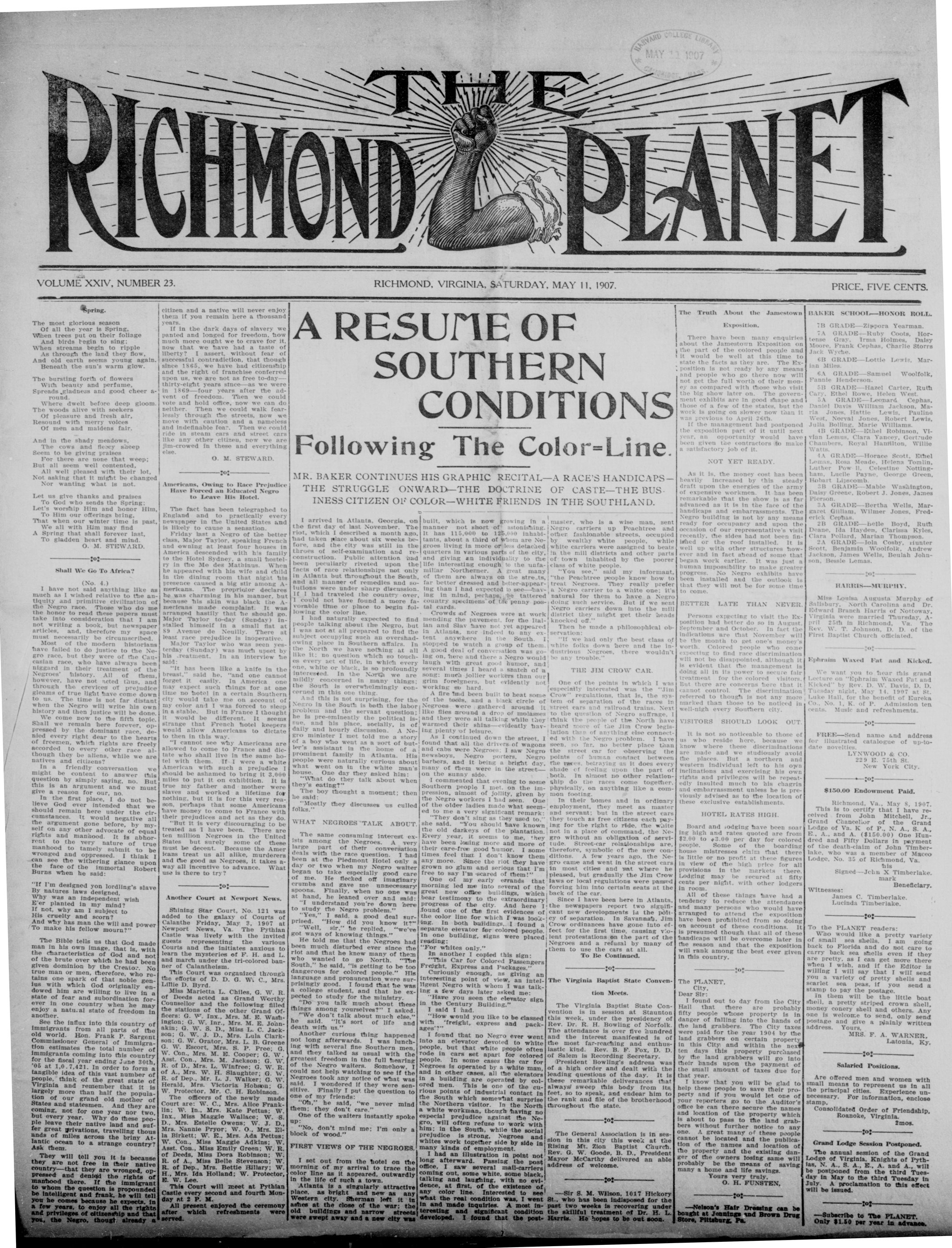
A RESUME OF SOUTHERN CONDITIONS Following The Color=Line.
MR. BAKER CONTINUES HIS GRAPHIC RECITAL—A RACE'S HANDICAPS—THE STRUGGLE ONWARD—THE DOCTRINE OF CASTE—THE BUSINESS CITIZEN OF COLOR—WHITE FRIENDS IN THE SOUTHLAND.
I arrived in Atlanta, Georgia, on the first day of last November. The riot, which I described a month ago, had taken place about six weeks before, and the city was still in the throes of self-examination and reconstruction. Public attention had been peculiarly riveted upon the facts of race relationships, not only in Atlanta but throughout the South, and all manner of remedies and solutions were under sharp discussion. If I had traveled the country over, I could not have found a more favorable time or place to begin following the color line.
I had naturally expected to find people talking about the Negro, but I was not at all prepared to find the subject occupying such an overshadowing place in Southern affairs. In the North we have nothing at all like it; no question which so touches every act of life, in which every one, white or black, is so profoundly interested. In the North we are mildly concerned in many things; the South is overwhelmingly concerned in this one thing.
built, which is now growing in a manner not short of astonishing. It has 115,000 to 125,000 inhabitants, about a third of whom are Negroes living in more or less detached quarters in various parts of the city, and giving an individuality to the life interesting enough to the unfamiliar. Northerner. A great many of them are always on the street. ts, far better dressed and better-appearing than I had expected to see—having in mind, perhaps, the tattered country specimens of the penny postal cards.
Crowds of Negroes were at work mending the pavement, for the Italian and Slav have not yet appeared in Atlanta, nor indeed to any extent anywhere in the South. I stopped to watch a group of them: A good deal of conversation was going on, here and there a Negro would laugh with great good humor, and several times I heard a smash of a song; much jollier workers than our giml foreigners, but evidently not working so hard.
master, who is a wise man, sent Negro carriers up Peachtree and other fashionable streets, occupies by wealthy white people, while white carriers were assigned to beat in the mill districts and other part of town inhabited by the poore class of white people.
"You see," said my informant, "the Peachtree people know how to treat Negroes. They really prefer a Negro carrier to a white one; it natural for them to have a Negro doing such service. But if we see Negro carriers down into the mill district they might get their head knocked off."
Then he made a philosophical observation: If we had only the best class of white folks down here and in the disturious Negroes, there wouldn't be any trouble."
THE JIM CROW CAR.
One of the points in which I was especially interested was the "Jim Crow."
And this is not surprising, for the Negro in the South is both the labor problem and the servant question; he is pre-eminently the political issue, and his place, socially, is of daily and hourly discussion. A Negro minister I met told me a story of a boy who went as a sort of butler's assistant in the home of a prominent family in Atlanta. His people were naturally curious about what went on in the white man's house. One day they asked him: "What do they talk about when they're eating?" The boy thought a moment; then he said: "Mostly they discussus us culled folks."
WHAT NEGROES TALK ABOUT
The same consuming interest exists among the Negroes. A very large part of their conversation deals with the race question. I had been at the Pledmont Hotel only a day or two when my Negro waiter began to take especially good care of me. He flecked off imaginary crumbs and gave me unnecessary spoons. Finally, when no one was at the table, leaned over and said: "I understand you're down here to study the Negro problem." "Yes," I said, a good del surpised. "How did you know it?" "Well, sir," he replied, "we've got ways of knowing things."
He told me that the Negroes had been much disturbed ever since the riot and that he knew many of them who wanted to go North. "The South," he said, "is getting to be too dangerous for colored people." His language and pronunciation were surprisingly good. I found that he was a college student, and that he expected to study for the ministry. "Do you talk much about these things among yourselves?" I asked. "We don't talk about much else," he said. "It's sort of life and death with us." Another curious thing happened not long afterwards. I was lunching with several fine Southern men, and they talked as usual with the greatest freedom in the full hearing of the Negro waiters. Somehow, I could not help watching to see if the Negroes took any notice of what was said. I wondered if they were sensitive. Finally I put the question to one of my friends:
"Oh," he said, "we never mind them; they don't care."
One of the waiters instantly spoke up:
"No, don't mind me; I'm only a block of wood."
FIRST VIEWS OF THE NEGROES
I set out from the hotel on the morning of my arrival to trace the color line as it appeared, outwardly in the life of such a town. Atlanta is a singularly attractive place, as bright and new as any Western city. Sherman left it in ashes at the close of the war; the old buildings and narrow streets were swept away and a new city was
built, which is now growing in a manner not short of astonishing. It has 115,000 to 125,000 inhabitants, about a third of whom are Negroes living in more or less detached quarters in various parts of the city, and giving an individuality to the life interesting enough to the unfamiliar Northerner. A great many of them are always on the streets, far better dressed and better-appearing than I had expected to see—having in mind, perhaps, the tattered country specimens of the penny postal cards. Crowds of Negroes were at work mending the pavement for the Italian and Slav have not yet appeared in Atlanta, nor indeed to any extent anywhere in the South. I stopped to watch a group of them. A good deal of conversation was going on, here and there a Negro would laugh with great good humor, and several times I heard a snatch of a song: much jollier workers than our grim foreglenners, but evidently not working so hard. A fire had been built to heat some of the tools, and a black circle of Negroes were gathered around it like files around a drop of molasses and they were all talking while they warmed their shins—evidently having plenty of leisure. As I continued down the street, I found that all the drivers of wagons and cabs were Negroes: I saw Negro newsbys, Negro porters, Negro barbers, and it being a bright day, many of them were in the street—on the sunny side.
I commented that evening to some Southern people I met, on the impression, almost of jollity, given by the Negro workers I had seen. One of the older ladies made what seemed to me a very similary impression.
One of my early errands that morning led me into several of the great new office buildings, which bear testimony to the extraordinary progress of the city. And here I found one of the first evidences of the color line for which I was looking. In both buildings, I found a separate elevator for colored people. In one building, signs were placed reading:
"For whites only."
In another I copied this sign:
"This Car for Colored Passengers Freight, Express and Packages."
Curiously enough, as giving an interesting point of view, an intelligent Negro with whom I was talking a few days later asked me:
"Have you seen the elevator sign in the Century Building."
I said I had.
"How would you like to be classed with 'freight, express and packages'?"
I found that no Negro ever went into an elevator devoted to white people, but that white people often rode in cars set apart for colored people. In some cases the car for Negroes is operated by a white man, and in other cases, all the elevators in a building are operated by colored men. This is one of the curious points of industrial contact in the South which somewhat surprise the Northern visitor. In the North a white workman, though having no especial prejudice against the Negro, will often refuse to work with him; in the South, while the social prejudice is strong, Negroes and whites work together side by side in many kinds of employment.
I had an illustration in point not long afterward. Passing the post office, I saw several mall-carriers coming out, some white, some black, talking and laughing, with no evidence, at first, of the existence of any color line. Interested to see what the real condition was, I went in and made inquiries. A most interesting and significant condition developed. I found that the post-
master, who is a wise man, sent Negro carriers up Peachtree and other fashionable streets, occupied by wealthy white people, while white carriers were assigned to beats in the mill districts and other parts of town inhabited by the poorer class of white people.
"You see," said my informant, "the Peachtree people know how to treat Negroes. They really prefer a Negro carrier to a white one; it's natural for them to have a Negro doing such service. But if we sent Negro carriers down into the mill district they might get their heads knocked off." Then made a philosophical observation:
"If we had only the best class of white folks down here and the industrious Negroes, there wouldn't be any trouble."
THE JIM CROW CAR
One of the points in which I was especially interested was the "Jim Crow" regulations, that is, the system of separation of the races in street cars and railroad trains. Next to the question of Negro suffrage, I think the people of the North have heard more of the Jim Crow legislation than of anything else connected with the Negro problem. I have seen, so far, no better place than the street car for observing the points of human contact between the races, betraying as it does every shade of feeling upon the part of both. In almost no other relationship do the races come together, physically, on anything like a common footing. In their homes and in ordinary employment, they meet as master and servant; but in the street cars they touch as free citizens each paying for the right to ride, the white not in a place of command, the Negro without an obligation of service. A street car relationships are, therefore, symbolic of the conditions. A few years ago, the Negro came and went in the street cars in most cities and sat where he pleased, but gradually the Jim Crow laws or legal regulations were passed forcing him into certain seats at the back of the car.
Since I have been here in Atlanta, the newspapers report two significant new developments in the policy of separation. In Savannah, Jim Crow ordinances have gone into effect for the first time, causing violent protestations on the part of the Negroes and a refusal by many of them to use the cars at all.
The Virginia Baptist State Conven-
The Virginia Baptist State Convention is in session at Staunton this week, under the presidency of Rev. Dr. R. H. Bowling of Norfolk. The attendance is over five hundred and the interest manifested is of the most far-reaching and enthusiastic kind. Rev. B. F. Fox, D. D. of Salem is Recording Secretary. President Bowling's address was of a high order and dealt with the leading questions of the day. It is these remarkable deliverances that always sweep this body from its feet, so to speak, and endear him to the rank and file of the brotherhood throughout the state.
The General Association is in session in this city this week at the Rising Mt. Zion Baptist Church. Rev. G. W. Goode, B. D., President Mayor McCarthy delivered an able address of welcome.
—Sr S. M. Wilson, 1017 Hickory St., who has been indisposed for the past two weeks is recovering under the skillful treatment of Dr. H. L. Harris. He hopes to be out soon.
There have been many enquiries about the Jamestown Exposition on the part of the colored people and it would be well at this time to state the facts as they are. The Exposition is not ready by any means and people who go there now will not get the full worth of their money as compared with those who visit the big show later on. The government exhibits are in good shape and those of a few of the states, but the work is going on slower now than it was previous to April 26th. If the management had postponed the exposition part of it until next year, an opportunity would have been given the contractors to make a satisfactory job of it.
NOT YET READY.
As it is, the money cost has been heavily increased by this steady draft upon the energies of the army of expensive workmen. It has been remarkable that the show is as far advanced as it is in the face of the handicaps and embarrassments. The Negro building is not by any means ready for occupancy and upon the occasion of our representative's visit recently, the sides had not been finished or the roof installed. It is well up with other structures however and in fact ahead of some that began work earlier. It was just a human impossibility to make greater progress. No Negro exhibits have been installed and the outlook is that they will not be for some time to come.
BETTER LATE THAN NEVER
Persons expecting to visit the Exposition had better do so in August, September and October. In fact the indications are that November will be the month to get one's money's worth. Colored people who come expecting to find race discrimination will not be disappointed, although it is evident that the management is doing all in its power to secure fair treatment for the colored visitors. But there are concerns here that it cannot control. The discrimination referred to though is not any more marked than those to be noticed in well-night every Southern city.
VISITORS SHOULD LOOK OUT
It is not so noticeable to those of us who reside here, because we know where these discriminations are made and we studiously avoid the places. But a northern and western individual left to his own inclinations and exercising his own rights and privileges will be repeatedly insulted much to his chagrin and embarrassment unless he is previously advised as to the location of these exclusive establishments.
HOTEL RATES HIGH.
Board and lodging have been soaring high and rates quoted are from $2.00 to $3.00 per day for colored people. Some of the boarding house mistresses claim that there is little or no profit at these figures in view of the high price for all provisions in the markets there. Lodging may be secured at fifty cents per night, with other lodgers in room.
All of these things have had a tendency to reduce the attendance and many persons who would have arranged to attend the exposition have been prohibited from so doing on account of these conditions. It is presumed though that all of these handicaps will be overcome later in the season and that the exposition will rank among the best ever given in this country.
The PLANET.
Dear Sir:
I found out to day from the City Hall that there are probably fifty people whose property is in danger of falling into the hands of the land grabbers. The City taxes were paid for the year 1904 by the land grabbers on certain property in this City and within the next ten days this property purchased by the land grabbers will go into their hands upon the payment of the small amount of taxes due for that year.
I know that you will be glad to help these people to save their property and if you would let one of your reporters go to the Auditor's office he can there secure the names and location of the property which is about to pass to the land grabbers without further notice to any one. A great many of these people cannot be located and the publication of the names and location of the property and the existing danger of the owners losing same will probably be the means of saving many a home and life savings.
PRICE, FIVE CENTS.
BAKER SCHOOL—HONOR ROLL
7B GRADE—Ziipora Yearman:
7A GRADE—Ruby Coots, Hortense Gray, Irma Holmes, Daisy Moore, Frank Cephas, Charlie Storrs Jack Wyche.
6B GRADE—Lottie Lewis, Marlan Miles.
6A GRADE—Samuel Woolfolk, Fannie Henderson.
5B GRADE—Hazel Carter, Ruth Cary, Ethel Bowe, Helen West.
Cary, Ethel Rowe, Helen West.
5A GRADE—Leonard Cephas,
Daniel Davis William Jackson,
Maria Jones, Hattie Lewis, Pauline
West, Norval Jones, Robert Lewis,
Julia Bolling, Marie Williams.
4B GRADE—Ethel Robinson, Vivian Lemus, Clara Yancey, Gertude Chambers, Royal Hamilton, Willie Watts.
4A GRADE—Horace Scott, Ethel Lemus, Rosa Meade, Helena Tomlin, Luther Pill II, Celestine Nottingham, Lucile Payne, George Green, Hobart Lipscomb.
3B GRADE—Mable Washington, Daisy Greene, Robert J. Jones, James Plierson.
3A GRADE—Bertha Wells, Margaret Gilliam, Wilmer Jones, Frederick Cephas.
2B GRADE—Belle Boyd, Ruth Deane, Ida Hayden, Clarissa Kyles, Clara Pollard, Marian Thompson.
2A GRADE—Iola Cosby, runter Scott, Benjamin Woolfolk, Andrew Jackson, James Wells, Beulah Johnson, Bessie Lemas.
HARRIS—MURPHY.
Miss Louisa Augusta Murphy of Salisbury, North Carolina and Dr. Edward Branch Harris of Nottoway, Virginia were married Thursday, A-12 in Richmond, Va. The Rev. W. W. W. of the First Baptist Church officiated
Ephraim Waxed Fat and Kicked.
We want you to hear this grand Lecture on "Ephraim Waxed Fat and Kicked" by Rev. D. W. Davis, D. D. Tuesday night, May 14, 1907 at St. Luke Hall, for the benefit of Eureka Co., No. 1, K of P. Admission ten cents. Music and refreshments.
FREE—Send name and address
for illustrated catalogue of up-to-
date novelties.
LYNWOOD & CO.
229 E. 75th St.
New York City.
$150.00 Endowment Paid.
Richmond, Va., May 5, 1907.
This is to certify that I have received from John Mitchell, Jr.,
Grand Chancellor of the Grand
Lodge of Va. K of P., N. A., S. A.,
E. A., and A. ($150.00) One Hundred and Fifty Dollars in payment of the death-claim of John Timberlake, who was a member of Maceo
Lodge, No. 35 of Richmond, Va.
his
Signed—John X Timberlake.
mark
Beneficiary.
James C. Timberlake.
Lucinda Timberlake.
To the PLANET readers:
Who would like a pretty variety of small sea shells. I am going back to Florida and do not care to carry back sea shells even if they are pretty, as I can get more there when I wish, and if the Editor is willing I will say that I will send you a variety of pretty shells and scarlet sea peas, if you send a stamp to pay the postage.
In them will be the little boat shell, a pretty crowned shell, money conery shell and others. Any one is welcome to send, only send postage and give a plainly written address. Yours,
MRS. F. A. WARNER,
Latona, Ky.
Salaried Positions
Are offered men and women with small means to represent us in all the principal cities. Experience unnecessary. For information, enclose stamp.
Grand Lodge Session Postponed.
The annual session of the Grand
Lodge of Virginia, Knights of Pythias,
N. A., S. A., E., A. and A., will
be postponed from the third Tuesday
in May to the third Tuesday in
July. A proclamation to this effect
will be issued.
Subscribe to The PLANET.
Only $1.50 per year in advance.
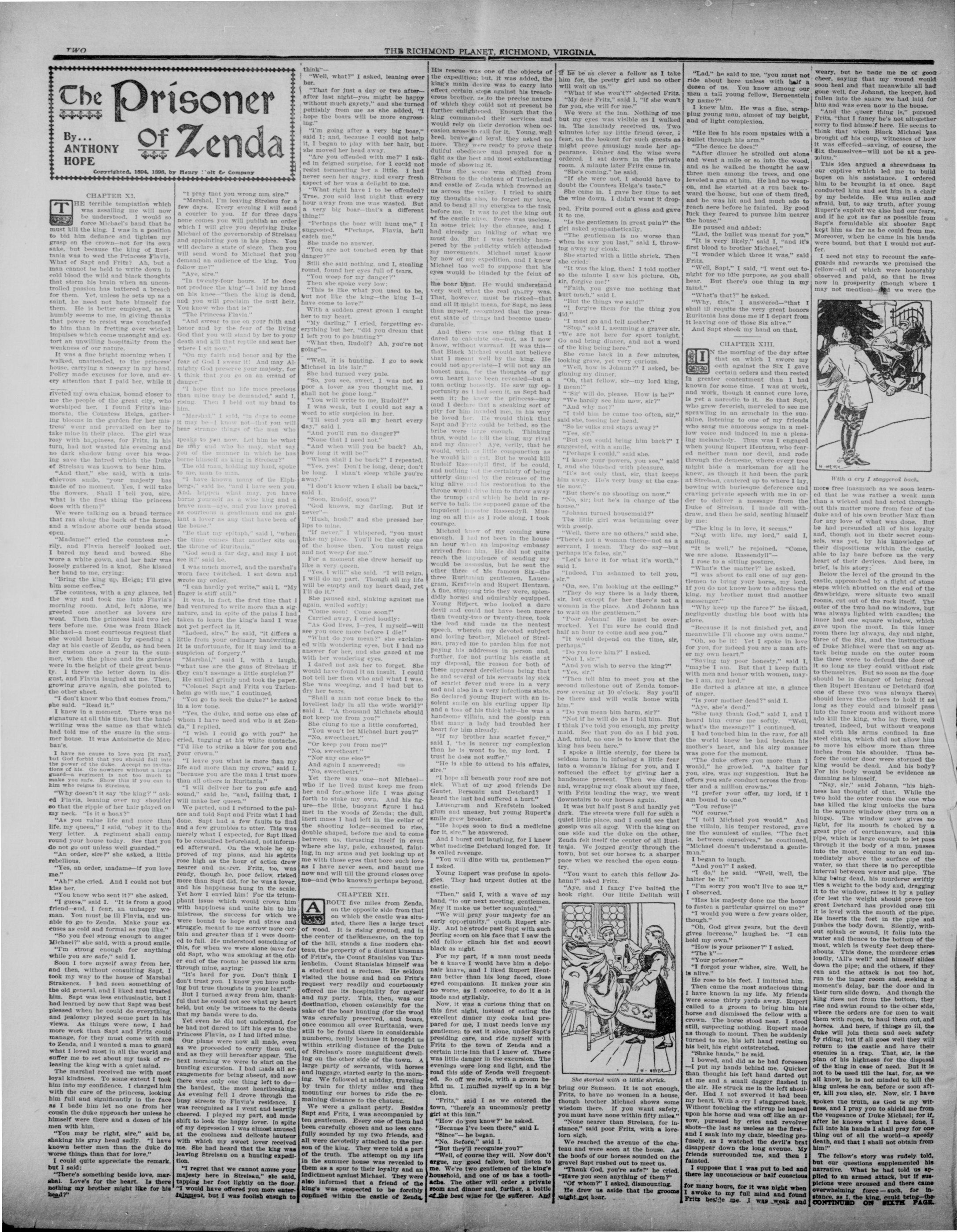
The Prisoner By... OF Zenda ANTHONY HOPE
Copyrighted, 1894, 1898, by Henry 'olt & Company
TWO
CHAPTER XI.
HE terrible temptation which was assailing me will now be understood. I would so force Michael's hand that he must kill the king. I was in a position to bld him defiance and tighten my grasp on the crown—not for its own sake, but because the king of Ruritania was to wed the Princess Flavia. What of Sapt and Fritz? Ah, but a man cannot be held to write down in cold blood the wild and black thoughts that storm his brain when an uncontrolled passion has battered a breach for them. Yet, unless he sets up as a saint, he need not hate blimself for them. He is better employed, as it humbly seems to me, in giving thanks that power to resist was vouchsafed so him than in fretting over wicked impulses which come unsought and extort an unwilling hospitality from the weakness of our nature.
It was a fine bright morning when I walked, unattended, to the princess' house, carrying a nosegay in my hand. Policy made excuses for love, and every attention that I paid her, while it riveted my own chains, bound closer to me the people of the great city, who worshiped her. I found Fritz's inamorata, the Countess Helga, gathering blooms in the garden for her mistress' wear and prevailed on her to take mine in their place. The girl was rosy with happiness, for Fritz, in his turn, had not wasted his evening and no dark shadow hung over his wooing save the hatred which the Duke of Strelsau was known to bear him.
"And that," she said, with a mischievous smile, "your majesty has made of no moment. Yes, I will take the flowers. Shall I tell you, sire, what is the first thing the princess does with them?"
We were talking on a broad terrace that ran along the back of the house, and a window above our heads stood open.
"Madame!" cried the countess merrily, and Flavia herself looked out. I bared my head and bowed. She wore a white gown, and her hair was loosely gathered in a knot. She kissed her hand to me, crying:
"Bring the king up, Helga; I'll give him some coffee."
The countess, with a gay glance, led the way and took me into Flavia's morning room. And, left alone, we greeted one another as lovers are wont. Then the princess laid two letters before me. One was from Black Michael—a most courteous request that she would honor him by spending a day at his castle of Zenda, as had been her custom once a year in the summer, when the place and its gardens were in the height of their great beauty. I threw the letter down in disgust, and Flavia laughed at me. Then, growing grave again, she pointed to the other sheet.
"I don't know who that comes from," she said. "Read it."
I knew in a moment. There was no signature at all this time, but the hand-writing was the same as that which had told me of the snare in the summer house. It was Antoinette de Mauban's.
I have no cause to love you [it lran]
but God forbid that you should fall into
the power of the duke. Accept no invi-
tations of his. Go nowhere without a large
kingdom, its not too much to
make you safe. Show this if you can to
him who reigns in Strelsaun.
"Why doesn't it say the king?" ask
Flavia, leaning over my shoulder
so that the ripple of her hair played on
my neck. "Is it a haox?"
"As you value life and more than
life, my queen," I said. "obey it to the
very letter. A regiment shall camp
round your house today. See that you
do not go out unless well guarded."
"An order, sire?" she asked, a little
rebellious.
"Yes, an order, madame—if you love me."
"Ah!" she cried. And I could not but kiss her.
"You know who sent it?" she asked.
"I guess," said I. "It is from a good friend—and, I fear, an unhappy woman. You must be ill Flavia, and unable to go to Zenda. Make your excuses as cold and formal as you like."
"So you feel strong enough to anger Michael?" she said, with a proud smile.
"I'm strong enough for anything while you are safe," said I.
Soon I tore myself away from her, and then, without consulting Sapt, I took my way to the house of Marshal Strakencz. I had seen something of the old general, and I liked and trusted him. Sapt was less enthusiastic, but I had learned by now that Sapt was best pleased when he could do everything, and jealousy played some part in his views. As things were now, I had more work than Sapt and Fritz could manage, for they must come with me to Zenda, and I wanted a man to guard what I loved most in all the world and suffer me to set about my task of releasing the king with a quiet mind. The marshal received me with most loyal kindness. To some extent I took him into my confidence. I charged him with the care of the princess, looking him full and significantly in the face as I bade him let no one from her cousin the duke approach her unless he himself were there and a dozen of his men with him.
"You may be right, sire," said he, shaking his gray head sadly. "I have known better men than the duke do worse things than that for love." I could quite appreciate the remark, but I said: "There's something beside love, marshal. Love's for the heart. Is there nothing my brother might like for his head?"
"I pray that you wrong num, sire."
"Marshal, I'm leaving Strelsau for a few days. Every evening I will send a courier to you. If for three days none comes you will publish an order which I will give you depriving Duke Michael of the governorship of Strelsau and appointing you in his place. You will declare a state of siege. Then you will send word to Michael that you demand an audience of the king. You follow me?"
"Aye, sire."
"In twenty-four hours. If he does not produce the king"—I laid my hand on his knee—"then the king is dead, and you will proclaim the next heir. You know who that is?"
"The Princess Flavia."
"And swear to me on your faith and honor and by the fear of the living God that you will stand by her to your death and kill that reptile and seat her where I sit now."
"On my faith and honor and by the fear of God I swear it! And may Almighty God preserve your majesty, for I think that you go on an errand of danger."
"I hope that no life more precious than mine may be demanded," said I, rising. Then I held out my hand to him.
"Marshal," I said, "in days to come it may be—I know not—that you will hear strange things of the man who
speaks to you now. Let him be what
ne may end who he may, what say
you of the manner in which he has
borne himself as king in Strelsur?"
The old man, holding my hand, spoke
The old man, holding my hand, spoke to me, man to man.
"I have known many of the Elphbergs," said he, "and I have seen you. And, happen what may, you have borne yourself as a wise king and a brave man—aye, and you have proved as courteous a gentleman and as galant a lover as any that have been of the house."
"Be that my epitaph," said I, "when the time comes that another sits on the throne of Ruritania."
"God send a far day, and may I not see it," said he.
I was much moved, and the marshal's worn face twitched. I sat down and wrote my order.
"I can hardly yet write," said I. "My finger is stiff still."
It was, in fact, the first time that I had ventured to write more than a signature, and in spite of the pains I had taken to learn the king's hand I was not yet perfect in it.
"Idead, sire," he said, "it differs a little from your ordinary handwriting. It is unfortunate, for it may lead to a suspicion of forgery."
"Marshal," said I, with a laugh, "what use are the guns of Strelsau if they can't assuage a little suspicion?" He smiled grimly and took the paper. "Colonel Sapt and Fritz von Tarlenheim go with me," I continued. "You go to seek the duke?" he asked in a low tone.
"Yes, the duke, and some one else of whom I have need and who is at Zenda," I replied.
"I wish I could go with you!" he cried, tugging at his white mustache. "I'd like to strike a blow for you and your crown."
"I leave you what is more than my life and more than my crown," said I, "because you are the man I trust more than all others in Ruritania."
"I will deliver her to you safe and sound," said he, "and, failing that, I will make her queen."
We parted, and I returned to the palace and told Sapt and Fritz what I had done. Sapt had a few faults to find and a few grumbles to utter. This was merely what I expected, for Sapt liked to be consulted beforehand, not informed afterward. On the whole he approved of my plans, and his spirits rose high as the hour of action drew nearer and nearer. Fritz, too, was ready, though he, poor fellow, risked more than Sapt did, for he was a lover, and his happiness hung in the scale. Yet how I envied him! For the triumphant issue which would crown him with happiness and unite him to his mistress, the success for which we were bound to hope and strive and struggle, meant to my sorrow more certain and greater than if I were doomed to fall. He understood something of this, for when we were alone (save for old Sapt, who was smoking at the other end of the room) he passed his arm through mine, saying:
"It's hard for you. Don't think I don't trust you. I know you have nothing but true thoughts in your heart." But I turned away from him, thankful that he could not see what my heart held, but only be witness to the deeds that my hands were to do.
Yet even he did not understand, for he had not dared to lift his eyes to the Princess Flavia, as I had lifted mine. Our plans were now all made, even as we proceeded to carry them out, and as they will hereafter appear. The next morning we were to start on the hunting excursion. I had made all arrangements for being absent, and now there was only one thing left to do—the hardest, the most heartbreaking. As evening fell I drove through the busy streets to Flavia's residence. I was recognized as I went and heartily cheered. I played my part, and made shift to look the happy lover. In spite of my depression I was almost amused at the coolness and delicate hauteur with which my sweet lover received me. She had heard that the king was leaving Strelsau on a hunting expedition.
"I regret that we cannot amuse your majesty here in Strelsau," she said, tapping her foot lightly on the floor. "I would have offered you more entertainment, but I was foolish enough to
THE RICHMOND PLANET, RICHMOND, VIRGINIA.
think"—
"Well, what?" I asked, leaning over her.
"That for just a day or two after—after last night—you might be happy without much gayety," and she turned pettishly from me as she added, "I hope the boars will be more engrossing."
"I'm going after a very big boar," said I; and, because I could not help it, I began to play with her hair, but she moved her head away.
"Are you offended with me?" I asked in feigned surprise, for I could not resist tormenting her a little. I had never seen her angry, and every fresh aspect of her was a delight to me.
"What right have I to be offended? True, you said last night that every hour away from me was wasted. But a very big boar—that's a different thing."
"Perhaps the boar will hunt me," I suggested. *Perhaps, Flavia, he'll catch me."
She made no answer.
"You are not touched even by that danger?"
Still she said nothing, and I, stealing round, found her eyes full of tears.
"You weep for my danger?"
Then she spoke very low:
With a sudden great groan I caught her to my heart.
"My darling," I cried, forgetting everything but her, "did you dream that I left you to go hunting?"
"What then, Rudolf? Ah, you're not going"—
"Well, it is hunting. I go to seek Michael in his hair."
She had turned very pale.
"So, you see, sweet, I was not so poor a lover as you thought me. I shall not be gone long."
"You will write to me, Rudolf?"
I was weak, but I could not say a word to stir suspicion in her.
"I'll send you all my heart every day," said I.
"And you'll run no danger?"
"None that I need not."
"And when will you be back? Ah, how long it will be!"
"When shall I be back?!" I repeated.
"Yes, yes! Don't be long, dear; don't be long. I shan't sleep while you're away."
"I don't know when I shall be back," said I.
"Soon, Rudolf, soon?"
"God knows, my darling. But if never"—
"Hush, bush!" and she pressed her lips to mine.
"If never," I whispered, "you must take my place. You'll be the only one of the house then. You must reign and not weep for me."
For a moment she drew herself up like a very queen.
"Yes, I will!" she said. "I will reign. I will do my part. Though my life will be empty and my heart dead, yet I'll do it."
She paused and, sinking against me again, wailed softly:
"Come soon! Come soon!"
Carried away, I cried loudly:
"As God lives, I—yes, I myself—will see you once more before I die!"
"What do you mean?" she exclaimed with wondering eyes, but I had no answer for her, and she gazed at me with her wondering eyes.
I dared not ask her to forget. She would have found it an insult. I could not tell her then who and what I was. She was weeping, and I had but to dry her tears.
"Shall a man not come back to the loveliest lady in all the wide world?" said I. "A thousand Michaels should not keep me from you."
She clung to me a little comforted.
"You won't let Michael hurt you?"
"No, sweetheart."
"Or keep you from me?"
"No, sweetheart."
"Nor any one else?"
And again I answered:
"No, sweetheart."
Yet there was one—not Michael—who if he lived must keep me from her and for whose life I was going forth to strike my own. And his figure—the lithe, buoyant figure I had met in the woods of Zenda; the dull, inert mass I had left in the cellar of the shooting lodge—seemed to rise, double shaped, before me and to come between us, thrusting itself in even where she lay, pale, exhausted, fainting, in my arms and yet looking up at me with those eyes that bore such love as I have never seen, and haunt me now and will till the ground closes over me—and (who knows?) perhaps beyond.
CHAPTER XII
A
BOUT five miles from Zenda,
on the opposite side from that
on which the castle was situ-
ated, there lies a large tract
of wood. It is rising ground, and in the center of the demesne, on the top of the hill, stands a fine modern chateau, the property of a distant kinsman of Fritz's, the Count Stanislas von Tarlenhelm. Count Stanislas himself was a student and a recluse. He seldom visited the house and had on Fritz's request very readily and courteously offered me its hospitality for myself and my party. This, then, was our destination, chosen ostensibly for the sake of the boar hunting (for the wood was carefully preserved, and boars, once common all over Buritania, were still to be found there in considerable numbers), really because it brought us within striking distance of the Duke of Streisau's more magnificent dwelling on the other side of the town. A large party of servants, with horses and luggage, started early in the morning. We followed at midday, traveling by train for thirty miles and then mounting our horses to ride the remaining distance to the chateau.
We were a gallant party. Besides Sapt and Fritz, I was accompanied by ten gentlemen. Every one of them had been carefully chosen and no less carefully sounded by my two friends, and all were devotedly attached to the person of the king. They were told a part of the truth. The attempt on my life in the summer house was revealed to them as a spur to their loyalty and an indictment against Michael. They were also informed that a friend of the king's was suspected to be forcibly confined within the castle of Zenda.
His rescuce was one of the objects of the expedition; but, it was added, the king's main desire was to carry into effect certain steps against his treachery brother, as to the precise nature of which they could not at present be further enlightened. Enough that the king commanded their services and would rely on their devotion when occasion arose to call for it. Young, well bred, brave and loyal, they asked no more. They were ready to prove their dulful obedience and prayed for a fight as the best and most exhilarating mode of showing it.
Thus the scene was shifted from Strelsau to the chateau of Tarlechein and castle of Zenda which frowned at us across the valley. I tried to shift my thoughts also, to forget my love, and to bend all my energies to the task before me. It was to get the king out of the castle alive. Force was useless. In some trick lay the chance, and I had already an inkling of what we must do. But I was terribly hampered by the publicity which attended my movements. Michael must know by now of my expedition, and I knew Michael too well to suppose that his eyes would be blinded by the faint of the boar hunt. He would understand very well what the real quarry was. That, however, must be risked—that and all it might mean, for Sapt, no less than myself, recognized that the present state of things had become unenendurable.
And there was one thing that I dared to calculate not—as I now know, without warrant. It was this—that Black Michael would not believe that I meant well by the king. He could not appreciate—I will not say an honest man, for the thoughts of my own heart have been revealed—but a man acting honestly. He saw my opportunity as I had seen it, as Sept had seen it; he knew the princess—nay (and I declare that a sneaking sort of pity for him invaded me), in his way he loved her. He would think that Sapt and Fritz could be bribed, so the bribe were large enough. Thinking thus, would he kill the king, my rival and my dancer? Aye, verily, that he would, with as little compunction as he would kill a rat. But he would kill Rudolf Rassendyll first, if he could, and nothing but the certainty of being utterly damned by the release of the king alive and his restoration to the throne would drive him to throw away the trump card which he held in reserve to balk the supposed game of the impudent impostor Rassendyll. Musing on all this as I rode along, I took courage.
Michael knew of my coming sure enough. I had not been in the house an hour when an imposing embassy arrived from him. He did not quite reach the impudence of sending my would be assassins, but he sent the other three of his famous Six—the three Ruritanian gentlemen, Lauengram, Kraffstein and Rupert Hentzan. A fine, strapping trio they were, splendidly horsed and admirably equipped. Young Rupert, who looked a dare devil and could not have been more than twenty-two or twenty-three, took the lead and made us the nearest speech, wherein my devoted subject and loving brother, Michael of Strelsan, prayed me to pardon him for not paying his addresses in person and, further, for not putting his castle at my disposal, the reason for both of these apparent derelictions being that he and several of his servants lay sick of scarlet fever and were in a very sad and also in a very infectious state. So declared young Rupert with an insolent smile on his curling upper lip and a toss of his thick hair—he was a handsome villain, and the gossip ran that many a lady had troubled her heart for him already.
"If my brother has scarlet fever," said I. "he is nearer my complexion than he is wont to be, my lord. I trust he does not suffer."
"He is able to attend to his affairs, sire."
"I hope all beneath your roof are not sick. What of my good friends De Gautet, Bersonin and Detchard? I heard the last had suffered a hurt."
Lauengram and Krafstein looked glum and uneasy, but young Rupert's smile grew broader.
"He hopes soon to find a medicine for it sire," he answered.
And I burst out laughing, for I knew what medicine Detchard longed for. It is called revenge.
"You will dine with us, gentlemen?" I asked.
Young Rupert was profuse in apologies. They had urgent duties at the castle.
"Then," said I, with a wave of my hand, "to our next meeting, gentlemen. May it make us better acquainted."
"We will pray your majesty for an early opportunity," quoth Rupert airly. And he strobe past Sapt with such jeering scorn on his face that I saw the old fellow clinch his fist and scowl black as night.
For my part, if a man must needs be a knave I would have him a debonair knave, and I liked Rupert Hentzau better than his long faced, close eyed companions. It makes your sin no worse, as I conceive, to do it a la mode and stylishly.
Now, it was a curious thing that on this first night, instead of eating the excellent dinner my cooks had prepared for me, I must needs leave my gentlemen to eat it alone, under Sapt's presiding care, and ride myself with Fritz to the town of Zenda and a certain little inn that I knew of. There was little danger in the excursion. The evenings were long and light, and the road this side of Zenda well frequented. So off we rode, with a groom behind us. I muffled myself up in a big cloak.
"Fritz," said I as we entered the town, "there's an uncommonly pretty girl at this inn."
"Since he begs, I
"But Beta 1.
"But he'll recognize you."
"Well, of course they will. Now don't argue, my good fellow, but listen to me. We're two gentlemen of the king's household, and one of us has a toothache. The other will order a private room and dinner and, further, a bottle of the best wine for the sufferer. And
if he be as clever a fellow as I take him for, the pretty girl and no other will wait on us."
"What if she won't?" objected Fritz.
"My dear Fritz," said I. "if she won't for you, she will for me."
We were at the inn. Nothing of me but my eyes was visible as I walked in. The landlady received us. Two minutes later my little friend (ever, I fear, on the lookout for such guests as might prove amusing) made her appearance. Dinner and the wine were ordered. I sat down in the private room. A minute later Fritz came in.
"She's coming," he said.
"If she were not, I should have to doubt the Countess Helga's taste."
She came in. I gave her time to set the wine down. I didn't want it drop-
ped. Fritz poured out a glass and gave it to me.
"Is the gentleman in great pain?" the girl asked sympathetically.
"The gentleman is no worse than when he saw you last," said I, throwing away my cloak.
She started with a little shriek. Then she cried:
"It was the king, then! I told mother so the minute I saw his picture. Oh, sir, forgive me."
"Faith, you gave me nothing that hurt much," said I.
"But the things we said."
"I forgive them for the thing you did."
"I must go and tell mother."
"Stop," said I, assuming a graver air.
"We are not here for sport tonight.
Go and bring dinner, and not a word of the king being here."
She came back in a few minutes, looking grave, yet very curious.
"Well, how is Johann?" I asked, beginning my dinner
"Oh that fellow, sir—my lord king,
I mean?"
"Sir will do, please. How is he?"
"We hardly see him now, sir?"
"And why not?"
"I told him he came too often, sir,"
said she, tossing her head.
"So he suks and stays away?"
"Yes, sir."
"But you could bring him back?" I
suggested, with a smile.
"Perhaps I could," said she.
"I know your powers, you see," said
I, and she blushed with pleasure.
"It's not only that, sir, that keeps
him away. He's very busy at the castle
now."
"But there's no shooting on now."
"No, sir; but he's in charge of the
house."
"Johann turned housemaid?"
The little girl was brimming over
with gossip.
"Well, there are no others," said she. "There's not a woman there—not as a servant, I mean. They do say—but perhaps it's false, sir."
"Let's have it for what it's worth," said I. "Indeed, I'm ashamed to tell you, sir."
"On, see, I'm looking at the ceiling." "They do say there is a lady there, sir, but except for her there's not a woman in the place. And Johann has to wait on the gentlemen."
"Poor Johann! He must be overworked. Yet I'm sure he could find half an hour to come and see you."
"It would depend on the time, sir, perhaps."
"Do you love him?" I asked. "Not I, sir."
"And you wish to serve the king?" "Yes, sir."
"Then tell him to meet you at the second milestone out of Zenda tomorrow evening at 10 o'clock. Say you'll be there and will walk home with him."
"Do you mean him harm, sir?" "Not if he will do as I bid him. But I think I've told you enough, my pretty maid. See that you do as I bid you. And, mind, no one is to know that the king has been here."
I spoke a little sternly, for there is seldom harm in infusing a little fear into a woman's liking for you, and I softened the effect by giving her a handsome present. Then we dined, and, wrapping my cloak about my face, with Fritz leading the way, we went downstairs to our horses again.
It was but half past 8 and hardly yet dark. The streets were full for such a quiet little place, and I could see that gossip was all agog. With the king on one side and the duke on the other, Zenda felt itself the center of all Ruritania. We jogged gently through the town, but set our horses to a sharper pace when we reached the open country.
"You want to catch this fellow Johann?" asked Fritz.
"Aye, and I fancy I've baited the hook right. Our little Delliah will
44 · 8272A
She started with a little shriek
bring our Samson. It is not enough, Fritz, to have no women in a house, though brother Michael shows some wisdom there. If you want safety, you must have none within fifty miles." "None nearer than Strelsau, for instance," said poor Fritz, with a love-lorn sigh. We reached the avenue of the chateau and were soon at the house. As the hoofs of our horses sounded on the gravel Sapt rushed out to meet us. "Thank God, you're safe!" he cried. "Have you seen anything of them?" "Of whom?" I asked, dismounting. He drew us aside that the grooms might not bear.
"Lad," he said to me, "you must not ride about here unless with half a dozen of us. You know among our men a tail young fellow, Bernenstein by name?"
I knew him. He was a fine, strapping young man, almost of my height, and of light complexion.
"He lies in his room upstairs with a bullet through his arm."
"The deuce he does."
"After dinner he strolled out alone and went a mile or so into the wood, and as he walked he thought he saw three men among the trees, and one leveled a gun at him. He had no weapon, and he started at a run back toward the house, but one of them fired, and he was hit and had much ado to reach nere before he fainted. By good luck they feared to pursue him nearer the house."
He paused and added:
"Lad, the bullet was meant for you."
"It is very likely," said I, "and it's first blood to brother Michael."
"I wonder which three it was," said Fritz.
"Well, Sapt," I said, "I went out tonight for no idle purpose, as you shall hear. But there's one thing in my mind."
"What's that?" he asked.
"Why, this," I answered—"that I shall ill requite the very great honors Ruritania has done me if I depart from it leaving one of those Six alive."
And Sapt shook my hand on that.
CHAPTER XIII
IN the morning of the day after that on which I swore my oath against the Six I gave certain orders and then rested in greater contentment than I had known for some time. I was at work, and work, though it cannot cure love, is yet a narcotic to it. So that Sapt, who grew feverish, marveled to see me sprawling in an armchair in the sunshine, listening to one of my friends who sang me amorous songs in a mellow voice and induced in me a pleasing melancholy. Thus was I engaged when young Rupert Hentzau, who feared neither man nor devil, and rode through the demesne, where every tree might hide a marksman for all he knew, as though it had been the park at Strelsan, cantered up to where I lay, bowing with burlesque deference and cravying private speech with me in order to deliver a message from the Duke of Strelsan. I made all withdraw, and then he said, seating himself by me:
"Nqt with life, my lord," said I, smiling.
"It is well," he rejoined. "Come, we are alone. Rassendyll"— I rose to a sitting posture.
"What's the matter?" he asked.
"What's the matter?" he asked.
"I was about to call one of my gentlemen to bring your horse, my lord. If you do not know how to address the king, my brother must find another messenger."
"Why keep up the farce?" he asked, negligently dusting his boot with his glove.
"Because it is not finished yet, and meanwhile I'll choose my own name." "Oh, so be it! Yet I spoke in love for you, for indeed you are a man after my own heart."
"Saving my poor honesty," said I, "maybe I am. But that I keep faith with men and honor with women, may be I am, my lord."
He darted a glance at me, a glance of anger.
"Is your mother dead?" said I.
"Aye, she's dead."
"She may thank God," said I, and I heard him curse me softly. "Well, what's the message?" I continued.
I had touched him in the raw, for all the world knew he had broken his mother's heart, and his airy manner was gone for the moment.
"The duke offers you more than I would," he growled. "A halter for you, sire, was my suggestion. But he offers you safe conduct across the frontier and a million crowns."
"I prefer your offer, my lord, if I am bound to one."
"You refuse?"
"Of course."
"I tol! Michael you would." And the villain, his temper restored, gave me the sunniest of smiles. "The fact is, between ourselves," he continued, "Michael doesn't understand a gentleman."
I began to laugh.
"And you?" I asked.
"I do," he said. "Well, well, the halter be it." "I'm sorry you won't live to see it," I observed. "Has his majesty done me the honor to fasten a particular quarrel on me?" "I would you were a few years older, though." "Oh, God gives years, but the devil gives increase," laughed he. "I can hold my own." "How is your prisoner?" I asked. "The k"— "Your prisoner." "I forgot your wishes, sire. Well, he is alive."
He rose to his feet. I imitated him. Then came the most audacious thing I have known in my life. My friends were some thirty yards away. Rupert called to a groom to bring him his horse and dismissed the fellow with a crown. The horse stood near. I stood still, suspecting nothing. Rupert made as though to mount. Then he suddenly turned to me, his left hand resting on his belt, his right outstretched.
I bowed, and did as he had foreseen
—I put my hands behind me. Quicker
than thought his left hand darted out
at me and a small dagger flashed in
the air. He struck me in the left shoulder.
Had I not swerved it had been my heart. With a cry I staggered back. Without touching the stirrup he leaped upon his horse and was off like an arrow, pursued by cries and revolver shots—the last as useless as the first—and I sank into my chair, bleeding profusely, as I watched the devil's brat disappear down the long avenue. My friends surrounded me, and then I fainted.
I suppose that I was put to bed and there lay unconscious or half conscious for many hours, for it was night when I awoke to my full mind and found Fritz best'd me. I was weak and
weary, but he beamed me be or good cheer, saying that my wound would soon heal and that meanwhile all had gone well, for Johann, the keeper, had fallen into the snare we had laid for him and was even now in the house. "And the queer thing is," pursued Fritz, "that I fancy he not altogether sorry to find himself here. He seems to think that when Black Michael has brought off his coup, witnesses of how it was effected—saving, of course, the six themselves—will not be at a premium."
This idea argued a shrewdness in our captive which led me to build hopes on his assistance. I ordered him to be brought in at once. Sapt conducted him and set him in a chair by my bedside. He was sullen and afraid, but, to say truth, after young Rupert's exploit we also had our fears, and if he got as far as possible from Sapt's formidable six shooter Sapt kept him as far as he could from me. Moreover, when he came in his hands were bound, but that I would not suffer.
I need not stay to recount the safeguards and rewards we promised the fellow—all of which were honorably observed and paid, so that he lives now in prosperity (though where I may not mention)—and we were the
H. MEYER
With a cry I staggered back,
more free inasmuch as we soon learned
that he was rather a weak man
than a wicked and had acted throughout
this matter more from fear of the
duke and of his own brother Max than
for any love of what was done. But
he had persuaded all of his loyalty
and, though not in their secret counsels, was yet, by his knowledge of their dispositions within the castle, able to lay bare before us the very heart of their devices. And here, in brief, is his story:
Below the level of the ground in the castle, approached by a flight of stone steps which abutted on the end of the drawbridge, were situate two small rooms, cut out of the rock itself. The outer of the two had no windows, but was always lighted with candles; the inner had one square window, which gave upon the moat. In this inner room there lay always, day and night, three of the Six, and the instructions of Duke Michael were that on any attack being made on the outer room the three were to defend the door of it so long as they could without risk to themselves. But so soon as the door should be in danger of being forced then Rupert Hentzau or Detchard (for one of these two was always there) should leave the others to hold it as long as they could and himself pass into the inner room and without more ado kill the king, who lay there, well treated, indeed, but without weapons and with his arms confined in fine steel chains, which did not allow him to move his elbow more than three inches from his shoulder. Thus before the outer door were stormed the king would be dead. And his body? For his body would be evidence as damning as himself.
"Nay, sir," said Johann, "his highness has thought of that. While the two hold the outer room the one who has killed the king unlocks the bars in the square window (they turn on a hinge). The window now gives no light, for its mouth is choked by a great pipe of earthenware, and this pipe, which is large enough to let pass through it the body of a man, passes into the moat, coming to an end immediately above the surface of the water, so that there is no perceptible interval between water and pipe. The king being dead, his murderer swiftly ties a weight to the body and dragging it to the window, raises it by a pulley (for lest the weight should prove too great Detchard has provided one) till it is level with the mouth of the pipe. He inserts the feet in the pipe and pushes the body down. Silently, without splash or sound, it falls into the water and thence to the bottom of the moat, which is twenty feet deep thereabouts. This done, the murderer cries loudly, 'All's well' and himself slides down the pipe, and the others, if they can and the attack is not too hot, run to the inner room and, seeking a moment's delay, bar the door and in their turn slide down. And though the king rises not from the bottom, they rise and swim round to the other side, where the orders are for men to wait them with ropes, to haul them out, and horses. And here, if things go ill, the duke will join them and seek safety by riding; but if all goes well they will return to the castle and have their enemies in a trap. That, sir, is the plan of his highness for the disposal of the king in case of need. But it is not to be used till the last, for, as we all know, he is not minded to kill the king unless he can, before or soon after, kill you also, sir. Now, sir, I have spoken the truth, as God is my witness, and I pray you to shield me from the vengeance of Duke Michael; for if, after he knows what I have done, I fall into his hands I shall pray for one thing out of all the world—a speedy death, and that I shall not obtain from him!"
The fellow's story was rudely told, but our questions supplemented his narrative. What he had told us applied to an armed attack, but if suspicions were aroused and there came overwhelming force—such, for instance, as I, the king, could bring—the CONTINUED ON SIXTH PAGE.
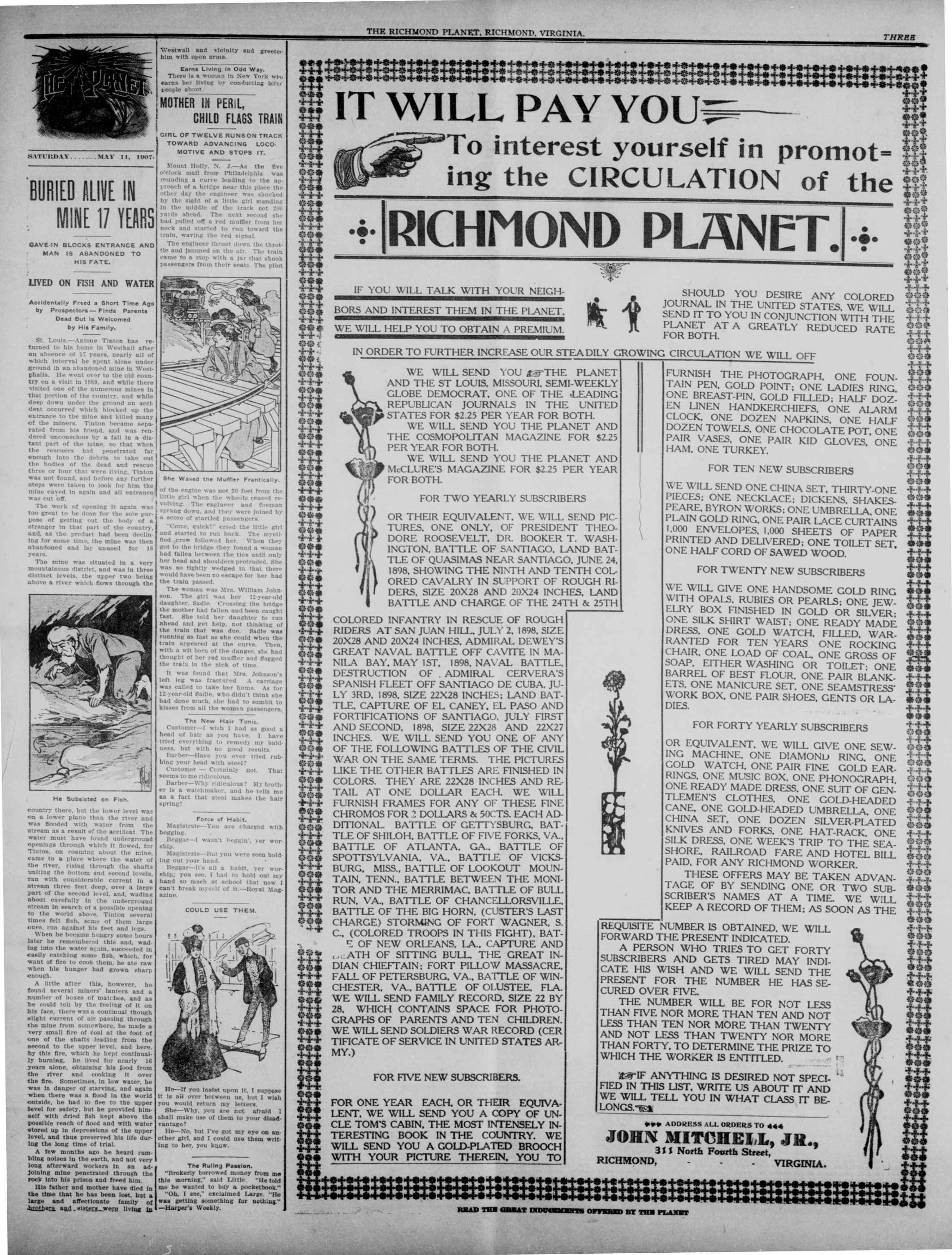
IT WILL PAY YOU To interest yourself in promot ing the CIRCULATION of the RICHMOND PLANET.
THE PLANET
BURIED ALIVE IN MINE 17 YEARS
GAVE-IN BLOCKS ENTRANCE AND MAN IS ABANDONED TO HIS FATE.
LIVED ON FISH AND WATER
Accidentally Freed a Short Time Ago by Prospectors—Finds Parents Dead But Is Welcomed by His Friends
St. Louis.—Antone Tinton has returned to his home in Westwall after an absence of 17 years, nearly all of which interval he spent alone under ground in an abandoned mine in Westphalia. He went over to the old country on a visit in 1889, and while there visited one of the numerous mines in that portion of the country, and while deep down under the ground an accident occurred which blocked up the entrance to the mine and killed many of the miners. Tinton became separated from his friend, and was rendered unconscious by a fall in a distant part of the mine, so that when the rescuers had penetrated far enough into the debris to take out the bodies of the dead and rescue three or four that were living. Tinton was not found, and before any further steps were taken to look for him the mine caved in again and all entrance was cut off.
The work of opening it again was too great to be done for the sole purpose of getting out the body of a stranger in that part of the country, and, as the product had been declining for some time, the mine was then abandoned and lay unused for 16 years.
The mine was situated in a very mountainous district, and was in three distinct levels, the upper two being above a river which flows through the
M.
He Subsisted on Fish. country there, but the lower level was on a lower plane than the river and was flooded with water from the stream as a result of the accident. The water must have found underground openings through which it flowed, for Tinton, on roaming about the mine, came to a place where the water of the river, rising through the shafts uniting the bottom and second levels, ran with considerable current in a stream three feet deep, over a large part of the second level, and, wading about carefully in the underground stream in search of a possible opening to the world above, Tinton several times felt fish, some of them large ones, run against his feet and legs.
When he became hungry some hours later he remembered this and, wading into the water again, succeeded in easily catching some fish, which, for want of fire to cook them, he ate raw when his hunger had grown sharp enough.
A little after this, however, he found several miners' lanters and a number of boxes of matches, and as he could tell by the feeling of it on his face, there was a continual though slight current of air passing through the mine from somewhere, he made a very small fire of coal at the foot of one of the shafts leading from the second to the upper level, and here, by this fire, which he kept continually burning, he lived for nearly 16 years alone, obtaining his food from the river and cooking it over the fire. Sometimes, in low water, he was in danger of starving, and again when there was a flood in the world outside, he had to flee to the upper level for safety, but he provided himself with dried fish kept above the possible reach of flood and with water stored up in depressions of the upper level, and thus preserved his life during the long time of trial.
A few months ago he heard rumbling noises in the earth, and not very long afterward workers in an adjoining mine penetrated through the rock into his prison and freed him. His father and mother have died in the time that he has been lost, but a large and affectionate family of brothers and sisters were living in
WE WILL HELP YOU TO OBTAIN A PREMIUM.
COLORED INFANTRY IN RESCUE OF ROUGH RIDERS AT SAN JUAN HILL, JULY 2, 1898, SIZE 20X28 AND 20X24 INCHES, ADMIRAL DEWEY'S GREAT NAVAL BATTLE OFF CAVITE IN MANILA BAY, MAY 1ST, 1898, NAVAL BATTLE, DESTRUCTION OF ADMIRAL CERVERA'S SPANISH FLEET OFF SANTIAGO DE CUBA, JULY 3RD, 1898, SIZE 22X28 INCHES; LAND BATTLE, CAPTURE OF EL CANEY, EL PASO AND FORTIFICATIONS OF SANTIAGO, JULY FIRST AND SECOND, 1898, SIZE 22X28 AND 22X27 INCHES. WE WILL SEND YOU ONE OF ANY OF THE FOLLOWING BATTLES OF THE CIVIL WAR ON THE SAME TERMS. THE PICTURES LIKE THE OTHER BATTLES ARE FINISHED IN COLORS. THEY ARE 22X28 INCHES AND RETAIL AT ONE DOLLAR EACH. WE WILL FURNISH FRAMES FOR ANY OF THESE FINE CHROMOS FOR 2 DOLLARS & 50CTS. EACH ADDITIONAL. BATTLE OF GETTYSBURG, BATTLE OF SHILOH, BATTLE OF FIVE FORKS, VA., BATTLE OF ATLANTA, GA., BATTLE OF SPOTTSYLVANIA, VA., BATTLE OF VICKSBURG, MISS., BATTLE OF LOOKOUT MOUNTAIN, TENN., BATTLE BETWEEN THE MONITOR AND THE MERRIMAC, BATTLE OF BULL RUN, VA., BATTLE OF CHANCELLORSVILLE, BATTLE OF THE BIG HORN, (CUSTER'S LAST CHARGE) STORMING OF FORT WAGNER, S. C., (COLORED TROOPS IN THIS FIGHT), BAT-
E OF NEW ORLEANS, LA., CAPTURE AND DEATH OF SITTING BULL, THE GREAT INDIAN CHIEFTAIN; FORT PILLOW MASSACRE, FALL OF PETERSBURG, VA., BATTLE OF WINCHESTER, VA., BATTLE OF OLUSTEE, FLA. WE WILL SEND FAMILY RECORD, SIZE 22 BY 28, WHICH CONTAINS SPACE FOR PHOTOGRAPHS OF PARENTS AND TEN CHILDREN. WE WILL SEND SOLDIERS WAR RECORD (CERTIFICATE OF SERVICE IN UNITED STATES ARMY.)
FOR ONE YEAR EACH, OR THEIR EQUIVALENT, WE WILL SEND YOU A COPY OF UNCLE TOM'S CABIN, THE MOST INTENSELY INTERESTING BOOK IN THE COUNTRY. WE WILL SEND YOU A GOLD-PLATED BROOCH WITH YOUR PICTURE THEREIN, YOU TO
Westwall and vicinity and greeted him with open arms. Earns Living in Odd Way
Earns Living in Odd Way. There is a woman in New York who earns her living by conducting blind people about.
MOTHER IN PERIL,
CHILD FLAGS TRAIN
GIRL OF TWELVE RUNSON TRACK
TOWARD ADVANCING LOCO-
MOTIVE AND STOPS IT.
Mount Holly, N. N. J.-As the five
o'clock mail from Philadelphia was
rounding a curve leading to the
approach of a bridge near this place the
other day the engineer was shocked
by the sight of a little girl standing
in the middle of the track not 200
yards ahead. The next second she
had pulled off a red muffler from her
neck and started to run toward the
train, waving the red signal.
The engineer thrust down the throttle and jammed on the air. The train came to a stop with a jar that shook passengers from their seats. The pilot
THE TRAIN IS ON THE RAIL.
She Waved the Muffler Frantically, of the engine was not 20 feet from the little girl when the wheels ceased revolving. The engineer and fireman sprang down, and they were joined by a score of startled passengers. "Come, quick!" cried the little girl and started to run back. The mystified crew followed her. When they got to the bridge they found a woman had fallen between the ties until only her head and shoulders protruded. She was so tightly wedged in that there would have been no escape for her had the train passed.
The woman was Mrs. William Johnson. The girl was her 12-year-old daughter, Sadie. Crossing the bridge the mother had fallen and been caught fast. She told her daughter to run ahead and get help, not thinking of the train that was due. Sadie was running as fast as she could when the train appeared at the curve. Then, with a wit born of the danger, she had thought of her red muffler and flagged the train in the nick of time.
It was found that Mrs. Johnson's left leg was fractured. A carriage was called to take her home. As for 12-year-old Sadie, who didn't think she had done much, she had to sumbit to kisses from all the women passengers.
The New Hair Tonic
Customer—I wish I had as good a head of hair as you have. I have tried everything to remedy my baldness, but with no good results.
Barber—Have you ever tried rubbing your head with steel?
Customer—Certainly not. That seems to me ridiculous.
Barber—Why ridiculous? My brother is a watchmaker, and he tells me as a fact that steel makes the hair spring!
Force of Habit
Magistrate—You are charged with begging.
Beggar—I wasn't beggin', yer worship.
Magistrate—But you were seen holding out your hand.
Beggar—it's all a habit, yer worship; you see, I had to hold out my hand so much at school that now I can't break myself of it.—Royal Magazine.
A
```markdown
```
He—If you insist upon it, I suppose it is all over between us, but I wish you would return my letters.
She—Why, you are not afraid I shall make use of them to your disadvantage?
He—No, but I've got my eye on another girl, and I could use them writing to her, you know.
The Rulina Passion
"Brokerly borrowed money from me this morning," said Little. "He told me he wanted to buy a pocketbook." "Oh, I see," exclaimed Large. "He was getting something for nothing." -Harper's Weekly.
IN ORDER TO FURTHER INCREASE OUR STEADILY GROWING CIRCULATION WE WILL OFF
WE WILL SEND YOU THE PLANET AND THE ST LOUIS, MISSOURI, SEMI-WEEKLY GLOBE DEMOCRAT, ONE OF THE LEADING REPUBLICAN JOURNALS IN THE UNITED STATES FOR $2.25 PER YEAR FOR BOTH. WE WILL SEND YOU THE PLANET AND THE COSMOPOLITAN MAGAZINE FOR $2.25 PER YEAR FOR BOTH. WE WILL SEND YOU THE PLANET AND McCLURE'S MAGAZINE FOR $2.25 PER YEAR FOR BOTH.
OR THEIR EQUIVALENT, WE WILL SEND PICTURES, ONE ONLY, OF PRESIDENT THEODORE ROOSEVELT, DR. BOOKER T. WASHINGTON, BATTLE OF SANTIAGO, LAND BATTLE OF QUASIMAS NEAR SANTIAGO, JUNE 24, 1898, SHOWING THE NINTH AND TENTH COLORED CAVALRY IN SUPPORT OF ROUGH RIDERS, SIZE 20X28 AND 20X24 INCHES, LAND BATTLE AND CHARGE OF THE 24TH & 25TH
READ THE GREAT INDUCEMENTS OFFERED BY THE PLANET
THE RICHMOND PLANET, RICHMOND, VIRGINIA
IF YOU WILL TALK WITH YOUR NEIGH-
```markdown
```
FOR TWO YEARLY SUBSCRIBERS
FOR FIVE NEW SUBSCRIBERS
REQUISITE NUMBER IS OBTAINED, WE WILL FORWARD THE PRESENT INDICATED. A PERSON WHO TRIES TO GET FORTY SUBSCRIBERS AND GETS TIRED MAY INDICATE HIS WISH AND WE WILL SEND THE PRESENT FOR THE NUMBER HE HAS SECURED OVER FIVE. THE NUMBER WILL BE FOR NOT LESS THAN FIVE NOR MORE THAN TEN AND NOT LESS THAN TEN NOR MORE THAN TWENTY AND NOT LESS THAN TWENTY NOR MORE THAN FORTY, TO DETERMINE THE PRIZE TO WHICH THE WORKER IS ENTITLED.
IF ANYTHING IS DESIRED NOT SPECIFIED IN THIS LIST, WRITE US ABOUT IT AND WE WILL TELL YOU IN WHAT CLASS IT BELONGS.
A man sitting in a chair and a man standing in front of him.
LANET
WEEKLY
READING
UNITED
H.
T AND
ER $2.25
T AND
YEAR
ND PIC-
THEO-
WASH-
D BAT-
JUNE 24,
H COL-
BIGH RI-
LAND
& 25TH
```markdown
```
REQUISIT
FORWAR
SHOULD YOU DESIRE ANY COLORED JOURNAL IN THE UNITED STATES, WE WILL SEND IT TO YOU IN CONJUNCTION WITH THE PLANET AT A GREATLY REDUCED RATE FOR BOTH.
FURNISH THE PHOTOGRAPH, ONE FOUNTAIN PEN, GOLD POINT; ONE LADIES RING, ONE BREAST-PIN, GOLD FILLED; HALF DOZEN LINEN HANDKERCHIEFS, ONE ALARM CLOCK, ONE DOZEN NAPKINS, ONE HALF DOZEN TOWELS, ONE CHOCOLATE POT, ONE PAIR VASES, ONE PAIR KID GLOVES, ONE HAM, ONE TURKEY.
FOR TEN NEW SUBSCRIBERS
WE WILL SEND ONE CHINA SET, THIRTY-ONE PIECES; ONE NECKLACE; DICKENS, SHAKESPEARE, BYRON WORKS; ONE UMBRELLA, ONE PLAIN GOLD RING, ONE PAIR LACE CURTAINS 1,000 ENVELOPES, 1,000 SHEETS OF PAPER PRINTED AND DELIVERED; ONE TOILET SET, ONE HALF CORD OF SAWED WOOD
FOR TWENTY NEW SUBSCRIBERS
WE WILL GIVE ONE HANDSOME GOLD RING WITH OPALS, RUBIES OR PEARLS; ONE JEWELRY BOX FINISHED IN GOLD OR SILVER; ONE SILK SHIRT WAIST; ONE READY MADE DRESS, ONE GOLD WATCH, FILLED, WARRANTED FOR TEN YEARS ONE ROCKING CHAIR, ONE LOAD OF COAL, ONE GROSS OF SOAP, EITHER WASHING OR TOILET; ONE BARREL OF BEST FLOUR, ONE PAIR BLANKETS, ONE MANICURE SET, ONE SEAMSTRESS' WORK BOX, ONE PAIR SHOES, GENTS OR LADIES.
FOR FORTY YEARLY SUBSCRIBERS
OR EQUIVALENT, WE WILL GIVE ONE SEWING MACHINE, ONE DIAMOND RING, ONE GOLD WATCH, ONE PAIR FINE GOLD EARRINGS, ONE MUSIC BOX, ONE PHONOGRAPH, ONE READY MADE DRESS, ONE SUIT OF GENTLEMEN'S CLOTHES, ONE GOLD-HEADED CANE, ONE GOLD-HEADED UMBRELLA, ONE CHINA SET, ONE DOZEN SILVER-PLATED KNIVES AND FORKS, ONE HAT-RACK, ONE SILK DRESS, ONE WEEK'S TRIP TO THE SEASHORE, RAILROAD FARE AND HOTEL BILL PAID, FOR ANY RICHMOND WORKER. THESE OFFERS MAY BE TAKEN ADVANTAGE OF BY SENDING ONE OR TWO SUBSCRIBER'S NAMES AT A TIME. WE WILL KEEP A RECORD OF THEM; AS SOON AS THE
THREE
not= the
COLORED
BAGS, WE WILL
WITH THE
PRICES RATE
ONE FOUN-
ADIES RING,
HALF DOZ-
ONE ALARM
ONE HALF
THE POT, ONE
LOVES, ONE
RIBERS
THIRTY-ONE
BAGS, SHAKES-
ARELLA, ONE
THE CURTAINS
OF PAPER
TOILET SET,
AND.
RIBERS
GOLD RING
; ONE JEW-
DR SILVER;
READY MADE
FILED, WAR-
DE ROCKING
THE GROSS OF
DIDLET; ONE
AIR BLANK-
TEAMSTRESS'
POINTS OR LA-
RIBERS
ONE SEW-
RING, ONE
GOLD EAR-
DNOGRAPH,
SUIT OF GEN-
OLD-HEADED
ARELLA, ONE
PER-PLATED
RACK, ONE
TO THE SEA-
HOTEL BILL
BAKER.
EN ADVAN-
TWO SUB-
WE WILL
CON AS THE
[Illustration of a plant with two large flowers and a vine-like stem.]
---
FOUR
THE PLANET
Published every Saturday by JOHN MITCHELL,
JR., at 811 North 4th Street, Richmond Va.
JOHN MITCHELL, JR., - EDITOR.
All communications intended for publication
must be sent as to reach us by Wednesday.
TERMS IN ADVANCE
One Copy, one year, $1.50
One Copy, eight months 1.00
One Copy, six months .80
One Copy, four months .50
One Copy, three months .40
Single Copy .05
ADVERTISING BATTER
For one inch, one insertion.
For one inch, each subsequent insertion.
For two inches, three months.
For two inches, six months.
For two inches, nine months.
For two inches, twelve months.
Marriage and Funeral Notice, one inch.
Standing and Transient Notice per line.
$0.50
40
6.00
10.00
14.00
30.00
50
10
POSTAGE STAMPS OF A HIGHER DE-
NOMINATION THAN TWO CENTS NOT
RECEIVED ON SUBSCRIPTIONS.
THE PLANET is issued weekly. The subscription price is $1.50 per year in advance.
There are FOUR ways by which money can be sent by mail at our risk. In a Post Office Money Order, by Bank Check or Draft, or an Exkuse, by Mail or by a Post Office that will be can be procured, in a Registered Letter.
MONEY ORDERS. You can buy a Money Order at your Post-Office, payable at the Richmond, and we will be responsible for its safe arrival.
EXPRESS MONEY ORDERS can be obtained at any office of the American Express Co., the United States Express Co., and the Well Fare Company, and we will be responsible for money sent by any of the companies. The Express Money Order is a safe and convenient way for forwarding money.
REGISTERED LETTER. If a money Order is registered, it will be within your reach, your Postmaster will be grateful. Letter you wish to send on payment of ten cents. Then, if the letter is lost or stolen, you can send money in this manner at our risk.
We cannot be responsible for money sent in letters in any other way than one of the four ways mentioned above. If you send your money in another way, you must do it at your risk.
REVENUES, ETC.—If you do not want THE PLANET continued for another year after your description has run out, you then notify us by Post Office Card to discontinue it. The courier has decided that subscribers to newspaper, who do not order their paper discontinued at the expiration of time for which it has been paid, hold liable for the payment of the subscription up to date when they order the paper discontinued.
COMMUNICATIONS—When writing to us to renew your subscription or to discontinue your address, we should give your name and address in full otherwise we cannot find your name on our books.
CHANGE OF ADDRESS—In order to change the address of a subscriber, we must be sent the former as well as the present address.
Entered at the Post-Office at Richmond, Va., as second-class matter.
SATURDAY, MAY 11, 1907.
We return thanks for an invitation to the commencement exercises of the Christiansburg Industrial Institute, May 12 to 16, inclusive.
We return thanks for an invitation to the annual public meeting of the Social Study Club of Virginia Union University, J. B. Simpson, President; R. P. Watts, Secretary. The exercises took place May 10. '07
We have received "The Cheroot Girl," a musical selection by R. A. Cassie, 14117 Brown St., Richmond Virginia. It is a popular selection and may be obtained from the author.
We return thanks for an invitation to attend the 26th Anniversary Exercises of the Tuskegee Normal and Industrial Institute at Tuskegee Institute, Alabama, May 30, 1907.
We have received a copy of the very able address of President W. W. Finley of the Southern Railway Company. It is able, scholarly and impressive. It is filled with words of wisdom and noted for its good advice. Its plan for conservatism and good business principles in dealing with the financial concerns of the country is its leading feature. The recently chosen head of this great corporation is evidently the right man in the right place.
"A SENSELESS RESURRECTION."
The legislature of Florida has decided to test the Fifteenth Amendment to the Constitution of the United States and to that end has passed an amendment to the State Constitution disfranchising colored citizens. The Richmond, Va. Times Dispatch in its issue of the 4th inst. says:
Whether judicious or not, Florida proposes to bring the fifteenth amendment to trial and test its validity. To that end, the Legislature has adopted a joint resolution proposing the following amendment to the State Constitution:
"Every white male person of the age of twen-y-one years and upwards that shall, at the time of registration, be a citizen of the United States, and that shall have resided and had his habitation, domicile, home and place of permanent abode in Florida for one year, and in the county for six months, shall in such county be deemed a qualified elector at all elections under this Constitution. Naturalized citizens of the U-
United States at the time of and before registration shall produce to the registration officers their certificate of naturalization or a duly certified copy thereof.
The amendment thus proposed will be submitted to popular vote in November, 1908, and there is little doubt but that it will carry. If adopted, of course, a test case will be made up by some Negro citizen or citizens of Florida and taken to the United States Supreme Court. Counsel for the State of Florida will admit that its provision is in direct conflict with the fifteenth amendment to the Constitution of the United States, but will argue that that amendment was unconstitutionally adopted, and is therefore without force and effect.
It will not be difficult to establish the truthfulness of that contention, but that the court will set the fifteenth amendment aside, after it has stood for a generation or more with the acquiescence of the several States, is a contingency so improbable that we are at a loss to know how some men could have treated it seriously.
Everybody in the United States will entertain the opinion expressed by our esteemed contemporary, if a moment's consideration is taken and the truths of history are considered in the light of past experiences. We do not include in this statement however the opinion that the Amendments were unconstitutionally ad-doted:
This journal continues:
The Times-Dispatch held from the first that the entire movement was ill-advised, and we fear that it will involve other States than Florida in serious difficulties. The only thing to be gained is that the facts of history will be threshed out and the outrages of reconstruction exposed. But we can see no good to come out of such a resurrection. The past has been buried and the grave which holds it is full of bitterness. In God's name, let it forever remain a closed sepulchre.
The above expressions should be volced by every patriotic citizen. But these rampant demagogues, Pharaoh-like will not be satisfied. They are rushing on to certain disaster, and so far as the citizen of color is concerned, it will prove a blessing in disguise.
It will force a crisis in the political affairs of this country and we see in it much harm for the Southland. It will open the eyes of the North to a realization of the true feeling, and present attitude of a large proportion of educated southners, and will dispel the dream of a Roosevelt that the days of harmony are here and the complete unification of all sections of the country under his administration has been accomplished.
Let them test the Amendment. The Supreme Court of the United States has done much dodging, but this is one time that it will be forced to meet the issue squarely.
FLORIDA BACK-PEDALS.
The amendment to the Constitution of Florida providing that only white men shall be permitted to vote has been defeated in the lower branch of the legislature of that State by a vote of 47 to 14. It was intended to test the validity of the Thirteenth, Fourteenth and Fifteenth Amendments to the Constitution of the United States. This was regarded as a dangerous experiment and it is evident that the leaders of the National Democratic Party made strenuous efforts to bring about this result.
It would have handicapped and embarrassed the Democratic leaders in the North. As the matter now stands, it will be a valuable campaign issue for the Republicans. That it passed one branch of the legislature is a significant fact. For our part, we regret that Senator Board's resolution was defeated. He meant it in one way, but it would have operated another. It would have brought forth a decision that we have vainly endeavored to obtain along other lines.
The far-seeing members of the Democratic Party were not slow to see this and as a result, the day we have prayed for is far off in the future. But it will all come around bye and bye and men will yet realize that great principles will assert themselves in this or in some other era of the nation's existence.
"FOLLOWING THE COLOR LINE."
The facts concerning the Atlanta Riot will continue to furnish valuable information to the impartial observer for years to come. Mr Ray Stannard Baker's narrative deserves the careful consideration of every citizen in this republic. In speaking of the arrest and trial of the colored people of Brownsville, Georgia, he said:
And after the riot in Brownville, what? Here was a self-respecting community of hard-working Negroes disturbing no one, getting an honest living. How did the riot affect them? Well, it has demoralized them, set them back for years. Not only were four men killed and several wounded, but sixty of their citizens were in jail. Nearly every family had to go to the lawyers, who would not take their cases without money in hand. Hence the little homes had to be sold or mortgaged, or money borrowed in some other way to defend those arrested, doctors' bills were to be paid, the undertaker must be settled with.
THE RICHMOND PLANET, RICHMOND, VIRGINIA
Oh! a riot is not over when the shooting stops!
This then tells the whole story. It is the same all over this section, wherever race troubles are precipitated. The innocent must suffer. The accumulations of a lifetime are swept unceremoniously away. Well did he exclaim, "Oh, a riot is not over when the shooting stops!" He continued:
And when the cases finally came up in court and all the evidence was brought out every Negro went free; but two of the county policemen who had taken part in the shooting, were punished. George Muse, one of the foremost merchants of Atlanta, who was foreman of the jury which tried the Brownsville Negroes, said: "We think the Negroes were gathered together just as white people were in other parts of the town, for the purpose of defending their homes.
This was a plain, frank way to state the case and it should not be forgotten that white men are so stating it. But the aftermath of all of this bloody upheaval is awful to contemplate. Mr. Baker said:
We were shocked by the conduct which the evidence showed some of the county police had been guilty of." After the riot was over, many Negro families, terrified and feeling themselves unprotected, sold out for what they could get—I heard a good many pitiful stories of such sudden and costly sacrifices—and left the country, some going to California, some to Northern cities. The best and most enterprising are those who go: the worst remain. Not only have Negroes left Brownsville, but they have left the city itself in considerable numbers. Labor will thus be still scarcer and wages may be higher in Atlanta because of the riot.
The above is the logical outcome. He continued:
It is significant that not one of the Negroes killed and wounded in the riot was of the criminal class. Every one was industrious, respectable and law-abiding. A white committee composed of W. G. Cooper, Secretary of the Chamber of Commerce, and George Muse, a prominent merchant, and backed by the sober citizenship of the town, made an honest investigation and has issued a brave and truthful report. It is a report which deserves to be read by every American. Here are a few of its conclusions:
1. Among the victims of the mob there was not a single vagrant.
2. They were earning wages in useful work up to the time of the riot.
3. They were supporting themselves and their families or dependent relatives
4. Most of the dead left small children and widows, mothers or sisters with practically no means and very small earning capacity.
5. The wounded lost from one to eight weeks' time, at 50 cents to $4 a day, each.
6. About 70 persons were wounded, and among these there was an immense amount of suffering. In some cases it was prolonged and exerciating pain.
7. Many of the wounded are disfigured, and several are permanently disabled.
8. Most of them were in humble circumstances, but they were honest, industrious and law-abiding citizens and useful members of society.
9. These statements are true of both white and colored.
10. Of the wounded, ten are white and sixty are colored. Of the dead, two are white and ten are colored; two female, and ten male. This includes three killed at Brownsville. 11. Wild rumors of a larger number killed have no foundation that we can discover. As the city was paying the funeral expenses of victims and relief was given their families, they had every motive to make known their loss. In one case relatives of a man killed in a broil made fruitless efforts to secure relief.
12. Two persons reported as victims of the riot had no connection with it. One, a Negro man, was killed ed in a broil over a crap game; and another, a Negro woman, was killed by her paramour. Both homicides occurred at some distance from the scene of the riot.
This is indeed a terrible indictment of southern methods and of the mob. The following conclusion is obviously true:
13. As twelve persons were killed and seventy were murderously assaulted, and as, by all accounts, a number took part in each assault, it is clear that several hundred murderers or would-be murderers are at large in this community.
That the upheaval failed to accom plish the purpose intended is em- emphasized by Mr. Baker, when he said:
At first, after the riot, there was an inclination in some quarters to say:
"Well, at any rate, the riot cleared the atmosphere. The Negroes have had their lesson. There won't be any more trouble soon."
But read the sober conclusions in the Committee's report. The riot did not prevent further crime.
14. Although less than three months have passed since the riot, events have already demonstrated that the slaughter of the innocent does not deter the criminal class from committing more crimes. Rapes and robbery have been committed in the city during that time.
15. The slaughter of the innocent does drive away good citizens. From one small neighborhood twenty-five families have gone. A great many of them were buying homes on the installment plan.
16. The crimes of the mob include robbery as well as murder. In a number of cases the property of innocent and unoffending people was taken. Furniture was destroyed, small shops were looted, windows were smashed, trunks were burst open, money was taken from the small hoard, and articles of value were appropriated. In the commission of these crimes the victims both
men and women, were treated with unspeakable brutality.
A further portrayal of existing conditions is here set forth:
17. As a result of four days of lawlessness there are in this glad Christmastime widows of both races mourning their husbands, and husbands of both races mourning for their wives; there are orphan children of both races who cry out in vain for faces they will see no more; there are grown men of both races disabled for life, and all this sorrow has come to people who are absolutely innocent of any wrong-doing.
These extracts may well be pondered over by every thoughtful, patriotic citizen. They will serve to bring the American people to a full realization of the great questions now confronting the nation. Lawlessness is stalking in the land unrebuked and there are evidences that an industrial crisis will precipitate a condition of affairs, both arpelling in its consequences and disastrous in its results.
DIFFERENT.
"Minks plays golf so well he ought to be a professional."
"Yes, I suggested it to him, but he says nothing would induce him to work so hard in hot weather."—Brooklyn Eagle.
The Endless Chain.
The doctor-man has got me cinched,
For when I'm feeling ill
I go to him. He cures me up
And then sends in his bill.
But when I see what it has cost
I get so
I have to have his services -
Bobold, the endless chalal!
-Judge.
His Exceptions.
"Do you expect to make the people believe all you say?"
"No," answered Senator Sorghum; "it will be a pretty good job if I convince them that I believe all of it myself." - Washington Star.
It All Depends.
rule are fickle-minded?
He—Not necessarily. I have noticed that when a woman reaches a certain age she sticks to it."—Chicago Daily News.
In Dreamland
"How does it feel to be counted out," they asked him.
"I don't know," answered the defeated pallist. "I was a billion miles away while that was going on."—Chicago Tribune.
As Others See Us.
Sketcher—DeAuber tells me that he is wedded to his art.
Shrewd Guess
"Miss Darling must be very popular, judging from the size of her mail." "Yes; I think most of it consists of sealed proposals."—Baltimore American.
Coming.
Hole in the high board fence.
And like the yells that we shall hear—
They never shall be forgotten—
When from the crowd comes to our ear
"I'm not in it!" "Frotten"—
—Milwaukee, Sentiment.
"Get the Hook
Gunner—Did you hear the celebrated basso sing "Rocked In the Cradle of the Deep"? Guyer—Yes, and I thought it was pretty fishy.
Gunner—Fishy? How so?
Guyer—Why, wasn't it a deep-sea
bass?"
A Mistaken Notion
"That woman who presented her surgeon's receipt as an evidence of her social standing made a big mistake."
"What was it?"
"To take it for granted that it was a sign of being in aristocratic society to pay one's bills."—Baltimore American.
'Twas False.
Patience—You are very successful in the selection of hats.
Patrice—Yes, they tell me everything I put on my head becomes me."
"Oh, well, I wouldn't say that. I don't like that hair you're wearing now nearly as well as that you wore last week!"—Yonkers Statesman.
The English Way
Beacon—Railway servants in England are supposed to receive $1,500,000 a year in tips.
Egbert—Some of the money goes to attendants for allowing you to look after your own trunk—Yonkers Statesman.
---
Cirl Committed Suicide With Gas After Writing Pathetic Note.
York, Pa., May 8—Miss Kelsei Igen-fritz, aged 24 years, committed suicide by inhaling gas. She was forlady in a Philadelphia department store, and was suffering from nervousness, caused by overwork. Her home was in Camden, but she was in this city on a vacation, in hopes of regaling her health.
In her room was found a letter written in her own blood with the point of a pH. The field with which she wrote had been drawn from beneath her finger nails, but the writing was quite plain. The letter read:
"My Denestress Mother: Do not grieve, for I cannot stand it any longer. You have been a good mother. Trust in God and pray for your daughter. I can so sorry I must do this, but no one knows what I have suffered.
"Mother, dear, and papa, do not worry; I trust we will meet in a better world, where there will be no sorrow. Love to you and my friends, who have been so good to me."
The letter was unsigned, and toward the end the writing was only faintly discernible.
Coroner A. M. Grove was called in, but after viewing the body and the letter, decided that an inquest was unnecessary, and gave a certificate of death from asphyxiation, with suicidal intent.
IRISH BILL DISAPPOINTING
Measure Confers Little Self-Government Upon Ireland.
London, May 8.—The government presented its long-awaited Irish bill to the house of commons and the country. This bill is designed to meet the demands for Irish home rule. It was presented by the chief secretary for Ireland, Mr. Birrell, to a crowded house.
Compared with the home rule bills of 1886 and 1905, the measure confers little self-government upon Ireland, merely giving to the council control of the eight departments now managed by government boards. The council is to be appointed by the crown, and while the lord lieutenant of Ireland is given power to nullify its measures, the crown retains control of five of the eight departments, including the constabulary. The control of this branch always has been a thorn in the flesh of the Irish people.
To prevent the first reading of the bill being deferred, and while Walter Hune Long was still speaking, Mr. Birkell moved the closure. Then amid a great upset and protests and shouts of "gag" the closure was carried by 417 votes to 121, and the bill passed its first reading by 418 votes to 121.
KILLED DEFENDING NURSE
Inmate of Soldiers' Home Finitely Shot
By Drunken Man.
Washington. May 7. — William Parks, 47 years old, of Zanesville, Ohio, an inmate of the National Soldiers' Home here, shot and fatally wounded James Leslie, of Chicago, 30 years old, also an inmate, and afterwards committed suicide. Parks had been drinking, and entering one of the wards of the hospital, was directed to leave by one of the nurses, Sister Paula. Sparks immediately drew a revolver and was about to shoot when Leslie stepped in between them, receiving the bullet intended for the nurse. While Leslie was struggling with Parks a blind inmate grappled with the would-be murderer, but was unable to hold him. Leslie died a few hours later at the Soldiers' Home hospital, without having regained consciousness.
WEALTHY MAN DROWNED
Alexander McCoy, of Philadelphia, Lec
Life, Bowling to his Yacht.
Philadelphia, May 6. — Alexander McCoy, a wealthy manufacturer of this city, was drowned in the Delaware rived a few miles below this city, and his body has not yet been recovered. McCoy and his brother-in-law, William Wharton, had gone to Essington to prepare Mr. McCoy's yacht, the Nokomis, for a trip to the Jamestown Exposition. The yacht was lying a few hundred yards from shore, and the two men started to row to the craft. When near the Nokomis the rowboat overturned and the men were thrown into the water. Neither could swim and before assistance reached them Mr. McCoy sank.
His Home Dynamited
Richmond, Va., May 7—The house of Robert Woodson, a negro, of Henrico county, was completely wrecked by an explosion of dynamite. At the time of the explosion Woodson, his mother, father and three children were sleeping in the house, and, while the furniture was destroyed, all the inmates escaped without serious injury. There is no clue to the perpetrator. It is thought that some person who bore a grudge against Woodson is responsible for the crime, though he declared that he did not know he had an enemy.
Governor Stuart Signs Tax Eill.
Harrisburg, Pa. May 8.—The governor signed the bill to tax for state purposes all stock, bill, note, exchange, merchandise, real estate or pawn brokers, factors or commission merchants, whether firms, limited partners ships or corporations, upon the annual gross receipts as follows: Gross receipts less than $5000, $10; $5000 to $10,000, $25; $10,000 to $20,000, $50; $20,000 and upward, $100. The act takes effect immediately.
Both Legs Cut Off By Trolley.
Harrisburg, Pa. May 7.—Mrs. Julia Simmons, of Elkwood, Cumberland county, was run over by a tractor on the Valley Traction line in front of her home. Both legs were crushed off.
Mother and Two Children Perished.
Hanley, Pa, May 8. — A mother and her two children were burned to death in a fire which destroyed a block of houses occupied by three families at Beaver Brook, a mining village near here. The dead child is Mrs. Joseph Dittavey, the wife of a miner. The children were infants. It is believed the fire was due to an overheated stove in the Dittavey home.
A Poem for Today
THE KINGS
By Louise Imcogen Guiney
MAN said unto his angel:
My spirits are fallen through,
And I cannot carry this battle.
O brother, what shall I do?
The terrible kings are on me.
With spears that are deadly bright.
Against me so from the cradle
Do fate and my fathers fight.
Then said to the man his angel:
Thou wavering, foolish soul.
Back to the ranks! What matter
To win or to lose the whole?
As judged by the little judges,
Who hawken not well nor see-
Not thus by the outer issue
The wise shall interpret thee.
Thy will is the
The solemn of
The weakest of
Is stronger t
Though out of
Mind's Doub-
And pallid Thi-
That is kin d
And Grief, in
And ringleter
And Vice, with
Of thee and d
While kings of
Yet darken t
Thy part is, w
To rise on the
To fear not see
Not covet t
But, fighting.
Die, driven a
MISSING MARVIN
BOY FOUND DEAD
Body Discovered Near His Home and Buried on Farm.
CAUSE OF DEATH A MYSTERY
Dover, Del., May 6.—The body of Horace Marvin, Jr., which was found on Saturday floating in a pool of water less than half a mile from where he was last seen playing on March 4 was interred in "Bay Meadow Lawn," on the Marvin farm.
All the little fellow's playmates and fully 1000 neighbors joined the Marvin family in mourning his death and attended the funeral services, which were conducted by Revs. Hugh B. Jelso and E. H. Nelson.
Prior to the funeral 24 men, composing Coroner Coronel Callaway's jury, officially identified the body and authorized the performing of the autopsy. The jury was then discharged to reconvene at the call of the coroner
There is much to make it appear that the little boy for whom detectives searched so long, wandered away and fell exhausted into the pool on the marshes where his body was found. Dr. James H. Wilson, Wilbur D. Burton, William F. Hoey and Alfred Robyn, the latter a bacteriologist, are trying to determine the cause of death for the coroner, and have decided that he did not drown, although the body was found in a pool of water. No marks of violence were found on the body, and the physicians say that a ridge across the back about four inches wide, that might have been made by the wheel of a wagon passing over it was caused by the body swelling on either side of the waist band of his kilt suit. The doctors will not say whether or not the child froze to death. The stomach, which was removed by Dr. Robyn, was empty, and the child may either have been frozen or starved to death. The condition of the stomach indicates, according to the physicians, that the boy suffered privation for at least 40 hours prior to death.
Many of the jurymen and detectives are of the opinion that the boy wandered around his father's farm, and in his efforts to get back home over the frozen marshes became exhausted and fell into the pool, where he died from exhaustion and privation. A few still believe that the little fellow was murdered.
Though the detectives are of the opinion that the boy fell into the pool and died, they are perplexed at the finding of the body so near to the Marvin house, and at a point which they seem to have gone over again and again. To have reached the spot where the body was found the boy must have walked across frozen and snow-covered fields in the face of a driving wind, and then climbed two high embankments, besides crawling through a barbed-wire fence.
The boy's body, wearing the same clothes which the little fellow had on the day he disappeared, was found deposited on the bay meadows marsh, about a half mile from the straw stack on which he was last seen on March 4. Dr. Marvin, the little fellow's father, who has searched over the same marsh day and night since the disappearance, and who, with Superintendent Bearse, of the Philadelphia Pinkerton's, burned the grass off level with this identical spot and saw no 'boy four weeks ago, is satisfied that the little fellow did not die there. Overburdened with his grief and weeping like a child, Dr. Marvin received the news of the finding of the body from Ollie Pleasanton, a neighbor, who was gunning for ducks on the marsh when he chanced to discover the boy.
The child's clothing was intact, and just as it was on the day of his disappearance. Even the mittens were still on his hands. His knitted woolen cap was pulled down over his face, the tassel, however, being almost torn off. The child's face is much discolored.
"Delaware has left its mark of sorrow on my brow, and before the call of autumn has come I hope to be back again with my relatives and old friends in Sioux City, In.," declared Dr. Marvin, as he stood at the foot of the mound that marks the spot where the body of his 4-year-old son, Horace, was buried.
"I intend to sell my place at Bay Meadows and to take the remains of little Horace back home with me. I cannot rest in peace on the place that has brought to me so much sorrow, and I will be glad when I quit it. Why should I stay here? Everything on the place will only serve to bring to my memory the awful fate that my 'Chubby' met, and I cannot get away from it quickly enough."
STUNNED BY HAIL
16-Year-Old Girl Rendered Unconscious and May Die.
Casville, Va; May 7; allie Beacon,
aged 16 years; was rendered BRONC:
A
Thy will is the very, the only,
The solemn event of things;
The weakest of hearts defying
Is stronger than all these kings.
Though out of the past they gather
Mind's Doubt and Bodily Pain,
And pallid Thirst of the Spirit,
That is kin to the other twain.
And Grief, in a cloud of banners,
And ringed Vain Desires,
And Vice, with the spoils upon him
Of thee, and thy beaten sres,
While kings of eternal evil
Yet darken the hills about—
Thy part is, with broken saber,
To rise on the last redoubt;
To fear not sensible failure
Nor covet the game at all,
But, fighting, fighting, fighting,
Die, driven against the wall!
scious by railing hall at I may die. She
is still unconscious.
The hail storm was the worst ever known here. Balls as large as hen's eggs fell to a depth of two inches. In Cassville windows are all broken, the trees are stripped of foliage and crops are greatly damaged.
MANIAC KILLS SIX PERSONS
Shot Them Down One After Another
In a Boarding House.
San Francisco, May 8. — Walter
Charley Davis, a carpenter, in a fit of
insanity, shot and killed a family of
six persons with whom he resided, at
414 Pierres street, in this city.
One lodger in the house escaped.
She was a girl of 17. Davis pointed
his gun at her and was preparing to
shoot, when he said she resembled
his daughter, so he spared her life.
The shooting was done with a double-
barreled shotgun. Davis, who slept
in the same room with young Bush
and Beard, armed himself with the
gun and shot his two roommates. Then
he visited each room in turn, killing
the occupants.
Davis fancied that the people in
the house had formed a plot to kill
him and take his money.
When the policemen came to arrest
Davis he fought like a demon, and a
riot call was turned in. Seven officers
were required to overpower him.
GETS 12 YEARS FOR ASSAULT
Wenonah, N. J. Negro Given Heavy Sentence For Attacking Girl.
Woodbury, N. J. May 4.—Swift justice was meted out to Edward Gibson, a negro, on Monday night last attacked Miss Dorothy Paris, 19 years old, of Wenonah. Gibson made no defense when arraigned, and he was sentenced to 12 years' imprisonment and to pay a fine of $3000. This is the extreme penalty for the offense. Miss Paris is a student at the Friends' school in Philadelphia. She was cross-ing a vacant lot near her home in Wenonah when the negro attacked her. Her cries for help were heard and the negro was captured. He was badly beaten by his captors before the police took him to a police office.
The sentence is practically a life one, as Gibson cannot be released until the $3000 fine is paid.
KUROKO STARTS EAST
Japanese Party On Their Way to Jamestown Exposition.
Seattle, May 6.—General Baron Kuroki and party, with General MacArthur and staff as an escort, left Seattle for the east. At the station a hundred prominent Japanese gathered. Mrs. S. Kismidau, wife of the Japanese consul at Seattle, gave the general a large bouquet of roses on behalf of the ladies' patriotic society. General Kuroki and party will represent Japan at the Janesmott Exposition.
BRIDE WAS MELANCHOLY
Married On Saturday, She Ends Life
By Inhaling Gas,
Reading, Pa. May 8-8. Mrs. Joseph
McKenty, of Spring Valley, a suburb,
took her life by inhaling illuminating
gas. Her maiden name was Sasha
H. Baum, and she was married to Mr.
McKenty last Saturday afternoon.
Her friends say that she was melancholy ever since the wedding. She was 48 years old.
Raided "Black Hand."
Johnstown, Pa., May 6—County Detective Berkebile and 25 members of Troop D, of the state constabulary, arrested 14 Italians at Parnesboro on charges of conspiracy. Preceding the raid, an Italian was shot and badly wounded by a member of the Black Hand because he refused to advance the society a sum of money. The arrests were made without difficulty. Trouble had been anticipated, as the Italians threatened all sorts of trouble if any attempt was ever made to molest them. Not one of them, however, had a word to say.
"BLACK HAND" GANG GUILTY
Eleven Convicted By Wilkes-Barre
Jury of Conspiracy.
Wilkes-Barre, Pa., May 7.—Eleven of
the 13 italians who had been on
trial here, charged with "Black-Hand"
crimes, were declared guilty in the
Luzerne county court when the sealed
verdict of the jury was opened. The
other two defendants were acquitted.
Those found guilty are Charles Buffulina, Antonio Tagloriana, Charles Gonzaza, Josep Cornella, Steven Latore, Salvatore Luchinna, Pletro Luchinna, Charles Domenican, Guachina Cimmone, Vincent Loubouna and Chrales Cornella. Those acquitted are Salvatore Volpand and Andron Paternostra.
The principal charge against the man
at the trial was the blowing up of the
home of an Italian named Rizzo because
he refused to pay money to a band of men calling themselves the "Black-Hand" Society.
Counsel for the 11 convicted men made motions for a new trial. Judge Halsey said he would hear argument on the motion next Saturday. The penalty for the crime for which the Italians were convicted is two years.
THE PLANET
SATURDAY.....MAY 11, 1907
HORTICULTURE
THE INJURED TREE.
Methods of Treatment to Insure Their Protection and Preservation.
It is the part of wisdom to be able to administer first aid to the injured tree, as well as the more permanent aids. One of the most common of these is the splitting down of a limb, as suggested in accompanying illustration. Fig. 1.
If the limb is not broken wholly off—if there is still left a connecting link of sound wood, and of sound bark, the limb can, with care, be saved. This will often save the beauty of the tree. With as little delay as possible shorten all the small branches of the limb, to make their weight as little as possible, then carefully lift the broken limb back into position, and lash it firmly with ropes or straps.
Now with a bit, or auger, bore a hole through the limb and tree trunk as suggested by the dotted line. In
FIG I
FIG II
FIG III
FIG IV
A
FIG V
B
Fig. 2. Through this insert a bolt of iron having a head on one end and a "nut" on the other. Turn the nut on the end (with a big "washer" beneath it) until the crack in the break has been made as small as possible, then cover the crack neatly over with grafting wax. In Fig. 3 is shown how to protect small trees from mice and rabbits which gnaw the tender bark near the ground in winter. Wrap the base of the tree as suggested, with wire mosquito netting, or tarred building paper, and tie it firmly with strings.
When a tree is near a hitching post, or fence, where horses may be tied, there is great danger that the latter may graw the bark. Fig 4 shows how to protect a tree from such danger. Measure the circumference of the tree, then select a width of wire poultry nesting just a bit wider, and cut off six and one-half or seven feet in length. Stand this up against the trunk of the tree and wrap it about the trunk till the edges meet. Fasten these edges together with a bit of wire every six inches, and the protector is complete.
Many a tree has such a gaping wound as that shown in A, Fig 5. It is caused by sawing of a big limb, and neglecting to protect the wound until nature could extend a new growth of bark over it. The new bark has begun to grow about the edges, but the wood has decayed within, and nature can carry growth of bark no further.
Cut out all the decayed wood, directs Orange Judd Farmer, and fill the cavity completely with portland cement mixed with water. Do not add sand. Fill the cavity and press the cement close to the new bark (B, Fig 5) that may be left no little opening for air and water to enter. The life of a tree can be prolonged for many years by such aid as this.
Feed the Trees.
When trees commence to show signs of unthriftiness a liberal application of barnyard manure will usually give them new vigor. It is the strong, vigorous tree that gives the most perfect fruit, and such trees are less liable to damage from insect or fungous pests. In the old orchard, a half of a wagon load of manure
around each tree is none too much. Scatter the manure out as far as the branches reach. If the litter is coarse, so much the better, as this will serve also as a mulch] If well rotted manure is used, work it into the sod with an orchard disk.
Things Which Should Be Remembered in Fighting Pests.
Having had a great deal of experience in spraying fruit trees I find that there are three essential things that should be borne in mind. First, knowing what to spray for; second, using the proper solution, and third, to spray at the right time. I am aware of the fact that a great many owners of fruit trees have some very indefinite ideas as to what to spray with, when to spray, or whether it makes any difference how it is done, just as they spray. It is certain that spraying might as well be given up entirely unless it is done thoroughly and regularly at the proper time each season. While it is by no means a cure for all the ills of tree fruit culture, still it is a powerful adjunct to successful orchard management. As I have practiced spraying regularly each season for several years I have found that one of the first requisites toward success is a good outfit complete. After experiencing the use of three different outfits the best one I have yet found consists of a 100-gallon cask which rests on its side in a rack to hold it in place. A strong force pump with an automatic stirrer which is put in the bulge of the cask, two half-inch hose 16 feet long, two ten feet extension rods and two double vermorel nozzles. With this outfit, three men, a team and a wagon, we usually spray 300 12-year-old trees in one day. But little time is lost in having to repair, unclog nozzles, etc., and the spray produced is most satisfactory. To obtain good results from spraying the materials to be used should be first-class and carefully compounded. As I have experimented with the different ingredients recommended, continues this writer in Farmers' Review. I find that the most effectual formula is a half pound of paris green, eight pounds of blue vitriol and eight pounds of lime to 100 gallons of water. In preparing the mixture I put 32 pounds of blue vitriol in a burlap sack and suspend it in a barrel containing 32 gallons of water the day before it is to be used, so as to give it ample time to thoroughly dissolve. I then stack eight pounds of fresh lime, and when ready to use it I strain it into another vessel and siack eight pounds more to be ready when wanted. I next put a half-pound of paris green in four-thirds of a gallon of water, leaving room, however, for the ingredients. I then strain the lime solution into the cask, next eight gallons of the blue vitriol solution and lastly the pars green mixture. I then put the ends of the pump hose so as to pump the mixture back into the cask, and run the pump for several minutes in order to thoroughly mix the entire solution. In spraying I apply the mixture with sufficient force to reach every part of the tree and foliage, giving a fine moist spray until the entire tree is well covered, which is indicated by slight dropping of mixture from the trees. I spray three times each season. The first spraying is commenced just before the blossom buds open in the spring. At this time the canker worm, bud moth, leaf crumpler, leaf folder and cigar case bearer are making preparations to begin their destructive work in the orchard. As these insects are in their infancy at this period, it is the proper time to gain possession ahead of them. In spraying the second time I begin just as soon as the petals of the blossoms have dropped and make the third spraying ten days later.
MOORE'S EARLY GRAPE.
It Needs High Feeding and Good Culture to Secure Best Results.
Moore's Early in one respect is like the Delaware; it needs high feeding and good culture to bring about best results. It is not a heavy bearer at its best, and if we do not give it wood it cannot produce fruit. In order to produce the necessary good strong wood we must feed the vine liberally. I use, writes a correspondent of Rural New Yorker, old decayed horse manure (not firefunged) with wood ashes forked in the ground, and then top-dress heavily with hen manure. When I can get old mortar from buildings torn down I work that in the soil, too. Of course, I realize that perhaps this treatment would not pay in a large vineyard, and it might not be practical there; still it is the method I use on all my vines, and I
How to Train and Prune.
am growing about 50 varieties. In regard to pruning I use a sort of renewal system on all of my Labrusca class. In the cut the two lower branches b b are to take the place of those marked a a, which will be cut off at the crosslines at next season's pruning. Other classes require different systems, and even all varieties of the same class should not be trimmed alike. The rose beetle is more troublesome on my Duchess than any of my other kinds; Niagara next. The only remedy I found was hand-picking, and then feed them to my Minorca hens. They would convert the bugs into the very choicest kind of eggs.
Bill—Does your brother carry a rabbit's foot?
Jill—No, but he goes around with a hare-lip.—Yonkers Statesman.
THE RICHMOND PLANET, RICHMOND, VIRGINIA
JOB DEPARTMENT
It is thoroughly equipped to do all kinds of printing on short notice. We make a specialty of Society printing and work for Insurance Companies, such as Financial
EXCURSION
We print Handbills, Quarter-Sheet posters, Tags, Tickets, Placards, Visiting Cards, Mourning Stations
WE HAVE
Our St.
OF THE LATE
WE CAN PRINT A BILL AS SMALL
A Three-Sheet
AS LARGE AS A FRO
Our street-entrance is retired and fastidious lady being able to enter w
CURSIO
bills, Quarter-Sheet,
Tickets, Placards,
Mourning Statione
HAVE A
Our Story
OF THE LATEST
A BILL AS SMALL
Free-Sheet
URGE AS A FRONT
OUR PR
IS WITH
France is retired and l
being able to enter with
EXCURSION WORK OF ALL DESCRIPTIONS
EXCURSION WORK OF ALL DESCRIPTIONS
We print Handbills, Quarter-Sheets, Half and Whole Sheet posters, Tags, Tickets, Placards, Society Cards, Minutes, Visiting Cards, Mourning Stationery. OUR AIM is to please our patrons and to give them the best service at the lowest prices, consistent with satisfactory work. We furnish "cuts" when desired and we will arrange to complete special work in our line. When in need of any work in our line, call and see us and estimates will be furnished.
WE CAN PRINT A BILL AS SMALL AS A DODGER. A Three-Sheet Poster AS LARGE AS A FRONT DOOR. WE HAVE ONE OF THE LARGEST OF WOOD- Of Any Job Printing Establishment
Our street-entrance is retired and has no objectionable features, the most fastidious lady being able to enter without embarrassment or annoyance.
LONG DISTANCE TELEPHONE, 2213.
LINCOLN
HAIR POMADE
MAKES
KINKY
HAIR
SOFT
REMOVES
DANDRUFF
AND
MAKES
IT
CROW
LONG
AND
LUXURIOUS
LINCOLN
HAIR POMADE
A Woman's Hair Makes or Makes
If your hair is short. If your head is your scalp is diseased, LINCOLN HAIR make it grow, remove the dandruff and LINCOLN HAIR POMADE is the finest toilet preparation on the market for you to give it a trial and we feel it be so satisfactory that you will recommend. Be sure and get the genuine and refractive substitutes. For sale at all Drug Stores.
PRICE, 15 CENTS
MANUFACTURED IN
The Lincoln Pomade
LINCOLN
HAIR POMADE
Hair Makes or Makes
It. If your head is
used, LINCOLN HAIR
we the dandruff and
POMADE is high
paration on the mark
trial and we feel com
at you will recommen
genuine and refus
able at all Drug Store.
PRICE, 15 CENTS
MANUFACTURED BY
In Pomade
MAKES
KINKY
HAIR
SOFT
REMOVES
DANDRUFF
AND
MAKES
IT
GROW
LONG
AND
LUXURIOUS
LINCOLN
HAIR POMADE
THE LINCOLN POMADE CO.
BREPOLE, VA. U.S.A.
SOFTENS
THE
HAIR
AND
KEEPS IT
FROM
BREAKING
KEEPS
SCALP
FRESH
CLEAN
AND
WHOLESOME
If your hair is short. If your head is full of dandruff. If your scalp is diseased, LINCOLN HAIR POMADE will make it grow, remove the dandruff and cure scalp diseases. LINCOLN HAIR POMADE is highly perfumed and is the finest toilet preparation on the market. All we ask is for you to give it a trial and we feel confident the result will be so satisfactory that you will recommend it to your friends. Be sure and get the genuine and refuse weak and inferior substitutes. For sale at all Drug Stores.
NORFOLK, VA., U. S. A.
If your dealer does not keep it, send his name and 20 cents in silver and we will send you a bottle by return mail. Agents wanted everywhere. Write for particulars.
The Eyes of the World are Upon Me.
The colored race in the United States at the present time is having some very trying experiences and only the best sort of advice and the wisest counsel should be given and heeded if your people are to continue in this land of prosperity and enjoy life, liberty, security and the pursuit of happiness. In this book we have attempted to present to the colored people of this great country a solution of our problems.
We have called attention to the commendable steps made by our people along commercial, intellectual and moral lines, and we believe that if this book is read carefully, that it will prove a source of great inspiration and encouragement to not only the colored people themselves but the white people who are interested in our progress. All of the readers of this journal, who will send to us at once $1.00 by P. O. money order or registered letter will receive a copy of the book in cloth binding just as soon as it comes from the press.
We offer this special inducement above; an in order to ascertain to what extent our people are willing to support parlor or such an enterprise. We will have at great to charge $1.50 for the book after it comes from the press. We find seven of Railway
```markdown
```
ION WORK
arter-Sheets, Half and Whole
Placards, Society Cards, Min-
ing Stationery.
WE AN EL
WHICH WE WILL
Stock Ro
LATEST STYLE BOND, F
AS SMALL AS A DODGER.
Sheet Poster
A FRONT DOOR.
OUR PRESENT CORP OF EMPLE
IS WITHIN EASY REACH OF
ired and has no objectionable f
enter without embarrassment o
2213.
COLN
POMADE
SOFTENS
THE
HAIR
AND
KEEPS IT
FROM
BREAKING
KEEPS
SCALP
FRESH
CLEAN
AND
WHOLESOME
es or Mars Her Beauty.
Our head is full of dandruff. If
COLN HAIR POMADE will
dandruff and cure scalp diseases.
It is highly perfumed and is
in the market. All we ask is
we feel confident the result will
recommend it to your friends.
and refuse weak and inferior
drug Stores.
5 CENTS.
FURNITURE BY
made Company.
OUR PRESENT CORP OF EMPLOYEES ARE COMPETENT AND QUICK-WORKING. OUR OFFICE IS WITHIN EASY REACH OF THE PUBLIC, BEING WITHIN FIFTY YARDS OF BROAD ST.
it utterly impossible to produce a
book of such proportions at less cost
We hope that you, dear readers, if
you cannot send the one dollar at
once, will write to us and state which
er or not you would like to have a
copy of the book reserved for you
and that you will state at what time
you will be able to send us the $1.00.
Hoping that we shall hear from
you by return mail, we are
Yours truly.
RICHARD H. BALL.
28 Franklin St. Lawrence, Mass.
Excursions to Jamestown Exposition
Norfolk, Va. via Southern
Railway.
Commencing April 19th and continuing daily to November 30, 1907 Southern Railway will sell season sixty day, fifteen day and ten day excursion tickets to Norfolk, Va. and return at reduced rates account the above; and on Tuesday of each week coach excursion tickets, not good in parlor or pullman cars, will be sold at greatly reduced rates, limited seven days. Inquire of Southern Railway Agents.
Cards, Policies, both straight life and benevolent, Physician's Certificates, Sick Cards, Application blanks, Agents Report Sheets, Rate Cards, etc.
IS, Half and Whole Society Cards, Ministry.
is to please give them the lowest with satisfaction.
AN ELEGANT WHICH WE WILL SHOW AND ROCK ROOM IN STYLE BOND, FINE WRITING.
ALL AS A DODGER.
Poster DOOR.
PRESENT CORP OF EMPLOYEES ARE IN EASY REACH OF THE PUBLIC.
has no objectionable features, the out embarrassment or annoyance.
WHICH WE WILL SHOW ANY ONE DESIRING TO SEE THEM.
Railway.
---
WORK OF ALL
OUR AIM
is to please our patrons and to
give them the best service at
the lowest prices, consistent
with satisfactory work.
ELEGANT I
SHOW ANY ONE DESIRING
from Embrace
ONE WRITING—FLAT AND
OYEES ARE COMPETENT AND QUI
THE PUBLIC, BEING WITHIN F
features, the most
r annoyance.
FOR FUR
FORD'S
HAIR POMADE
Formerly known as
"OZONIZED OX MARROW"
So STRAIGHTEN'S KINKY or CURLY HAIR that it can be put up in any style daunting consistent with its length.
Ford's formerly known as "OZONIZED OX MARROW" and is the one life preparation known to us that has shown above. It uses make the most stubborn, hard, and hardy hair, the soft, pliable and easy to comb. These may be obtained from one treatment; it is a use of Ford's Hair Pomade removes and hardens hair, and it orates the scalp, stops the hair from falling out or breaking off, makes it grow and, by vigor, being elegantly perfumed and gentlemen and children. Ford's Hair Pomade has been made and sold continuously since Ford's MARROW" was registered in the United States. Ford's as its name makes the hair STRAIGHT. Remember that Ford's Hair Pomade is put up only in 50 ct. size and is made only by signature, Charles Ford. Press on each package. Refuse all others. Full directions with instructions for druggist or druggists and dealers. If your druggist or druggists express, pay we. We pay postage and express mailing postal or express money order and mention name of this paper. Write your payment.
The Ozonized Ox Marrow Co.
(None genuine without my signature)
Charles Ford Press
153 E. KINZIE ST., CHICAGO, IL.
Agents wanted everywhere.
JURGEN'S SON
Before making your purchase you would do well to call at the most reliable furniture house in the city and see the fine line of REFRIGERATONS, MATTINGS, OIL-CLOTHS And in fact everything that is needed in house furnishings.
Of every description; also the latest designs in ROCKERS and special CHAIRS.
Our goods are the best for the price and the price is very low.
C. G. JURGEN'S SON,
ADAMS AND BROAD STREETS.
Daily to Baltimore.
On and after April 1st, 1907, schedule via the popular York River Line will leave Richmond at 4:30 P. M. daily except Sunday, returning leave Baltimore at 5 P. M. daily except Sunday. Very low rates one way and round trip to Baltimore, Philadelphia and New York. It's the best way to reach Northern and Eastern points.
We print Wedding Invitations, and High Class Stationery for Balls, Parties, Picnics and all entertainments of a social nature. We print Church Envel
ALL DESCRIBE
ons and to
service at
consistent
work.
We furnish "cuts" when des-
complete special work in our l
in our line, call and see us and
ST LINE OF S
DESIRING TO SEE THEM.
braces a full
CAT AND LINEN PAPER, ENVELOP
WE HAVE ONE OF THE
OF WOOD
Of Any Job Printing E
NT AND QUICK-WORKING. OUR OFFICE
WITHIN FIFTY YARDS OF BROAD ST.
FOR FURTHER INFORMATION, AP
John Mitch
311 N. 4th St.
FOR FURTHER INFORMATION, APPLY TO
John Mitchell, Jr.
John Mitchell, Jr.
Your Patronage Solicited.
Refreshment Cars and Boat Privileg es Handled in Season.
Address all communications to LLAM L. BANKS, 511 N. 3d St Residence: 1312 N. 26th St.
Wow on express Wow on order, and Write your
row Co.
SON
purchase
.....ALL WORK GUARANTEED.....
Cards, Letters or Orders.
...Give us a trial, you will never regret it....
Address, Cor. Price and Jackson Sts.
RICHMOND, VA.
River Line
4:30 P. M.
Wrning leave
rarely except
is one way
more. Phill.
It's the
town and Bas-
John Debona, 610 Church St.
T. E. W. Perry, 2 Jenos Place.
Daily to Baltimore.
WE HAVE ONE OF THE LARGEST ASSORTMENTS OF WOOD-TYPE Of Any Job Printing Establishment in the city.
311 N. 4th St., Richmond Va
SEABOARD
SOUTHOBOUND TRAIN: SCHED-
ULED TO LEAVE RICHMOND
DAILY.
9:10 A. M.—Local to Norlina, Raleigh,
Charlotte, Wilmington, 2:20
P. M.—Sleepers and coaches, Savannah,
Jacksonville and Florida points.
9:50 P. M.—Sleepers and coaches
Atlanta, Birmingham, Memphis, Savannah,
Jacksonville and Southwest.
NORTHBOUND TRAINS SCHED-
ULED TO ARRIVE RICHMOND
DAILY.
6:45 A. M., 5:10 P. M., 5:45 P. M.
H. S. LEARD, D. P. A.
JOSHUA BANKS & SONS
CATERERS
EVERY FACILITY CONSISTENT WITH FINE CATERING.
Special Attention Given to Balls,
Suppers, Installations and Smokers at the Shortest Notice.
BLACKWELL & BRO.
ONE OF THE LEADING PAINTERS
Practical House and Sign Painters,
Graining and General Contractors
PLANET DEPOTS
NEW YORK CITY.
P. Ritzheimer, 7 N. 134th St.
Green and Bailey, 249 E. 127th St.
J. H. Parker, 144 W. 26th St.
Charles Devan, 1.1 W. 30th St.
W. J. Bucker, 150 W. 33rd St.
M. W. Slaughter, 312 W. 40th St.
W. W. Johnson, 247 W. 47th St.
E. H. Mitchell, 152 W. 27th St.
Turner R. Robinson, 12-6th Ave.
E. A. Williams, 200 W. 63rd St.
M. B. Walker, 309 W. 37th St.
J. H. Jarrett, 453-7th Ave.
Smith & Miles, 232 W. 41st St.
M. B. Wineglass, 322 W. 59th St.
PHILADELPHIA, PA.
M. Clay, 182nd Fitzwater St.
J. H. Gray, 1233 Pine St.
Bishop Robinson, 1234 Melon St.
E. P. Mackens, 1116 Pine St.
James E. Warwick, 254 S. 11th St.
Mrs. B. Homsher, 1040 Pine St.
William Parker, 631 Pine St.
Mrs. Lavinia Aldridge, 521 S. 12th.
Chas. A. George, 4083 Market St.
P. A. Stewart, 1730 Federal St.
opes, Note and Letter Paper,
Bill-heads, Monthly Statements,
Business Cards, Financial and Order Books,
Circulars, Check-books, Pamphlets.
SCRIPTIONS
sired and we will arrange to
line. When in need of any work
estimates will be furnished.
SAMPLES
Line
PES, ETC.
LARGEST ASSORTMENTS
OD-TYPE
establishment in the city.
PLY TO
hell, Jr.,
Richmond Va.
CHICAGO, ILL.
E. H. Faulkner, 3104 State St.
BROOKLYN, N. Y.
Lee Ricks, 782 Fulton St.
William A. Dabney, 3 Quinn St.
William Pope, 174 Myrtle Ave.
CHARLESTON, W. VA.
L. C. Farrar, 501 Brooks St.
Frank R. Wood, 144 Broadway
ATLANTIC CITY, N. J
Hursey Bros., 1217 Commerce Ave.
BRONX BOROUGH, N. Y.
J. H. Barrett, 603-162d St.
PLAINFIELD, N. J.
Thomas H. Bridges, 614 W. 4th St.
WASHINGTON, D. C.
L. H. Singleton, 20th and St.
Southwestern Drug Co.,
733-2d Street, I. W.
A. E. Evans, 382 Essex St.
SPRINGFIELD, MASS.
W. H. Brown, 13 Stockbridge St.
COVINGTON, VA.
Daniel Braxton, Box 91.
NEWPORT NEWS, VA.
E. J. Jefferson, 1211-30th St.,
George T. Hall, 1332-30th St.
TARPORO, N. C.
V. E. Heward.
WILMINGTON, N. C.
William H. Moere.
STAUNTON, VA.
SIX
THE PLANET
SATURDAY.....MAY 11, 1907
The Prisoner Of Zenda.
CONTINUED FROM SECOND PAGE
Idea of resistance would be abandoned. The king would be quietly murdered and slid down the pipe. And—here comes an anguished touch—one of the Six would take his place in the cell and on the entrance of the searchers loudly demand release and redress, and Michael, being summoned, would confess to hasty action, but he would say the man had angered him by seeking the favor of a lady in the castle (this was Antoinette de Mauban), and he had confined him there, as he conceived he as Lord of Zenda had right to do. But he was now on receiving his apology content to let him go and so end the gossip which, to his highness' annoyance, had arisen concerning a prisoner in Zenda and had given his visitors the trouble of this inquiry. The visitors, baffled, would retire, and Michael could at his leisure dispose of the body of the king.
Sapt, Fritz and I in my bed looked round on one another in horror and bewilderment at the cruelty and cunning of the plan. Whether I went in peace or in war, openly at the head of a corps or secretly by a stealthy assault, the king would be dead before I could come near him. If Michael were stronger and overcame my party there would be an end, but if I were stronger I should have no way to punish him, no means of proving any guilt in him without proving my own guilt also. On the other hand, I should be left as king (ah, for a moment my pulse quickened), and it would be for the future to witness the final struggle between him and me. He seemed to have made triumph possible and ruin impossible. At the worst he would stand where he had stood before I crossed his path—with but one man between him and the throne, and that man an impostor. At best there would be none left to stand against him. I had begun to think that Black Michael was overflood of leaving the fighting to his friends, but now I acknowledged that the brains, if not the arms, of the conspiracy were his.
"Does the king know this?" I asked. "I and my brother," answered Johann, "put up the pipe under the orders of my Lord of Hentzan. He was on guard that day, and the king asked my lord what it meant. 'Faith,' he answered, with his siry laugh, it's a new improvement on the ladder of Jacob, whereby, as you have read, sire, unen pass from earth to heaven. We thought it not meet that your majesty should go. In case, sire, you must by, the common route. So we have made you a pretty private passage, where the vulgar cannot stare at you or incommode your passage. That, sire, is the meaning of that pipe.' And he laughed and bowed and prayed the king's leave to repleinish the king's glass, for the king was at supper. And the king, though he is a brave man, as are all of his house, grew red and then white as he looked on the pipe and at the merry devil who mocked him. Ah, sir,"—and the fellow shuddered—"it is not easy to sleep quiet in the castle of Zenda, for all of them would as soon cut a man's throat as play a game at cards, and my Lord Rupert would choose it sooner for a pastime than any other."
The man ceased, and I bade Fritz take him away and have him carefully guarded, and, turning to him, I added: "If any one asks you if there is a prisoner in Zenda you may answer Yes." But if any asks who the prisoner is, do not answer. For all my promises will not save you if any man here learns from you the truth as to the prisoner in Zenda. I'll kill you like a dog if the thing be so much as breathed within the house."
Then when he was gone I looked at Sapt.
"It is a hard nut," said I.
"So hard," said he, shaking his grizzled head, "that, as I think, this time next year is like to find you still king of Ruritania" and he broke out into curses on Michael's cunning.
I lay back on my pillows.
"There seem to me." I observed, "to be two ways by which the king can come out of Zenda alive. One is by treachery in the duke's followers."
"You can leave that out," said Sapt,
"I hope not," I rejoined, "because
the other I was about to mention is—
by a miracle from heaven!"
[TO BE CONTINUED.]
SPINSTER'S VIEW.
Love letters are the most worthless of all promissory notes.
Some fellows are not satisfied to kill time unless it belongs to some one else.
When a girl tells a man he is "different," it is a sign that man is being fooled.
Theater audiences are sometimes electrified, but more often they are shocked.
It is astonishing the kind of hat a man likes on any other woman than his wife.
If you tell a man you love him, often he believes you, even when he knows you don't.
Strange that one of the nicest things about lovemaking is the memory of it afterward.
Nearly every man who is poor lays the blame of it on his honesty—never on the matter of his being dumb.
It is sad, but true, that the kind of a trip a man enjoys most thoroughly is the kind of his family goes along.
The reason why a girl loves a man is generally something nobody, not even she herself, can explain, unless he has money.
Nearly every girl thinks a man is no gentleman if he undertakes to kiss her in any other way than the way she will not let him.
When you see some woman awfully fond of an ugly lap dog you can understand a little about that kind of Providence who sees to it that even the homeliest man can get married.—N. Y. American.
SENTENCE SERMONS
Trials are to build us, not to break us.
Honest methods wait for honest men.
The truly strong never ignore the weak.
The man who dares not fall is sure to do it.
Heaven sees our gifts in the light of our gains.
The full hand often goes with the empty heart.
The flame of lust quenches the pure light of love.
It is not far from winking at sin to working for it.
Faith for the future is the undying hope of man.
If this world is not God's world no other world will be.
The best way to talk of love to God is by labor for man.
He has no power with men who has no patience with children.
He possesses nothing to whom his possessions are everything.
The best aspiration for heaven is perspiration in making earth heavenly.
Take care of your secret life and the surface life will take care of itself—Chicago Tribune.
MEN SAY THAT—
A man probably feels like kicking himself when he marries for money and doesn't get any.
Feminine independence is a farce. Any woman will marry and serve if the man she loves asks her.
Possibly there is a woman on earth who can pass an old admirer without looking back—but it is doubtful.
If a woman declines a man's offer of marriage he should give her another chance. Women seldom think twice alike.
Folks often complain of their individuality being crushed out, when it would really be the best thing that could happen to them.
SNAP SHOTS.
This world is a detention camp.
A great deal is being said about "unwritten laws." There are now almost enough of them to fill a code.—Dallas Morning News.
If competition is a good thing between colleges and universities, then it is not a good thing to give one of them enough money to run all the rest out of business.
STRANGE. ISN'T IT?
That a susceptible fellow is hardest hit by the softest glances?
That so many students cannot state bald facts without splitting hairs?
STIFF EXAMINATION PAPER.
How many teeth have you?
How many buttons have you on your waistcoat?
What are the words on a police-man's shield?
How many toes has a cat on each forefoot and each hindfoot?
Which way does the crescent moon turn? To the right or left?
What are the words written or printed on the face of your watch?
What is the name signed in facsimile on any $1, $2, $5 or $10 bill you ever saw?
In what direction is the face on a cent, on a quarter and on a dime turned?
What color are your employer's eyes, and the eyes of the man at the next desk?
What are the exact words on a two-cent stamp? In which direction is the face on it turned?
AS SEEN BY UNCLE GROUCH.
The emptier the head the less it
THE RICHMOND PLANET. RICHMOND. VIRGINIA.
HIGHER WAGES TO NEGRO WORKMEN
HIGHER WAGES TO NEGRO WORKMEN
Secured by This New Union Order—Grows By Leaps and Bounds—Started Five Years Ago with Nothing But a "Principle"—Now Has Over 400 Subordinate Lodges and 36,000 Members.
Over 30,000 homes of our people have been filled with joy, because of the Protection of a great and powerful Union Order, which is using its strength and influence to secure better conditions for our people. This is the first and only great Union Order in this country, holding an International Union Charter from the Courts, which gives a full Protection and Benefits to our race.
There is no color, race or sex discrimination in this Order. The negro has an equal standing with the white members, and can be elected to hold any office. Every effort is made to advance the condition of the members, by securing equal opportunities to work with other workmen, to learn the trades and to have steady work at high wages and Union hours.
The Grand Lodge donates $100.00 for the burial of each deceased member. A monthly Journal is published. A membership Book of the Order is recognized by an Lodges everywhere. Distressed members are assisted. Each member and Subordinate Lodge has the privilege of buying stock in the Order, on low monthly payments, said stock paying 8 per cent interest, guaranteed.
A Leading Negro Deputy is wanted in each locality, AT ONCE, to form Lodges, sell Buttons, take Journal Subscriptions, sell Stock and act as DISSTRICT DEPTY ORGANIZER. This work can be done in spare hours, but many are devoting their whole time and attention to it. Big money is made by good hustlers.
Write at once. State name of this paper, and enclose 10 cents for full information and postage. Address
THE I. L. U. GRAND LODGE,
34 to 40 Canby Building, Dayton, Ohio.
takes to inflate ft.
The young fellow who watches the clock as a rule soon gets his time.
Too much credit brings discredit more quickly than anything else.
Some of us, in trying too hard to make sure we are right, are left.
High finance seems to have discarded the golden rule and substituted a rule of steal.
Don't always wait to be "showed." A blind man can tell a good thing when he sees it.
It's not always a sign that an enterprise is mostly air just because it is able to float a loan.
A young man has got to have a certain amount of principle before he can command his employer's interest.
Use a little judgment. Many a young man has begun work fired with a noble ambition, and ended it the same way—fired, with a noble ambition.
THE MAN WHO WAITS
Daniel said: "Blessed is he that waiteth."
Sherman said: "Hold the fort, for I am coming."
Cervantes said: "Patience, and shuffle the cards."
James R. Keene said: "Sit tight and you'll win out."
Disraeli said: "Everything comes if a man will only wait."
Longfellow said: "All things come round to him who will but wait."
Earl Harcourt said: "Le bon temps viendra" (The good time will come).
Micah said: "I will wait for the God of my salvation; my God will hear me."
St. Paul said: "But if we hope for that we see not, then do we with patience wait for it."
Job said: "They waited for me as for the rain, and they opened their mouth wide as for the latter rain."
MAXIMS.
As men, we are all equal in the presence of death.
When we pause to think, we often miss our opportunity.
The fear of death is more to be feared than death itself.
There are times when we may do well to forget what we know.
The two greatest blessings of human life are good health and good sense.
Observe the golden mean between saying too much and too little.—Publius Syrus (45 B. C.).
An Advantage of Elaborate Diction.
"You say he accused you of being untruthful?"
"That's what happened," answered Plute Pete, with much embarrassment. "And lives to tell the tale?" "Well, you see he used long words in such a roundabout way that he was out o' town before I had figured out exactly what he meant."—Washington Star.
Deep Disappointment
"Yes," said one Cincinnati heiress to the other, "her parents are fearfully disappointed in the match she made."
"For what reason?"
"She married a man who plays pinchoble instead of baccarat."—Washington Star.
3 BOTTLES Whiskey FREE
Carolina Whiskey will give excellent satisfaction. It is a well aged article and in our estimation, far superior to the decoctions and mix-up of our own mini malt whiskey to $1.50 per gallon. We make a mini malt whiskey to $1.50 per gallon that we are not afraid of any kind of competition. Our plants cover fourteen acres, making us the largest mail order whiskey house in the world.
3 SAMPLE BOTTLES FREE.
Send us $2.95 and we will ship you by express 6 full quarts of Carolina Whiskey and we will include in same box, complimentary, a sample bottle of each, "Zulieka," "Gold Band" and Casper's 12 Year Old White Corn.
SPECIAL NOTICE! We deliver the above prepaid anywhere in North Carolina, Virginia and West Virginia, but customers living in other states reached by Adams or Southern Express Company must remit 50c, extra. Buyers east of Mississippi River residing on lines must send $8.95 for the 6 quarts and 3 sample bottles and we will provide a remit cash with order and address:
THE CASPER CO, Inc., Roanoke, Va.
(Alex Winston-Salem, N. C.) Owner of U. & B. Distributors No. 900, 6th St., Va.
All whiskeys made under supervision of U. & B. Distributors No. 900, 6th St., Va.
Knights of Pythias,
This organization is one of the most powerful in the country and its progress has been phenomenal. The Grand Lodge of Virginia has jurisdiction over all of the cities and counties in this state. Thirty males are required to organize a new lodge. The benefits paid constitute one of its strongest features, but the principles are greater than anything else. Founded on Friendship, based on Charity and established on Benevolence, the respectable, upright people of the state will find it an order worthy of their heartiest support.
It pays an endowment and burial benefit of of $200.00 for all ages. It pays $4.00 per week sick dues. The badge costing no more than $10.00
the badge costing 75 cents each is the only absolutely necessary regalla. For information concerning the organization of lodges apply at the main office.
The Courts of Calanthe
Is the Female Department of the Order. It requires a membership of thirty persons to organize a court. Its members are pledged to exhibit Fidelity, exercise Harmony and prove Love one for the other. It pays an endowment and burial benefit of $150.00. It pays $3.00 per week sick dues. The only expense for regalia is the cost of the badge, 50 cents and a rosette, costing 25 cents for funeral occasions.
THE BANDS OF CALANTHE or Children's Department also constitutes a feature and persons cannot do better than to enter the little ones into this mystic circle. The expense is nominal and the benefits all that could be expected. It pays from $1.00 to $1.50 sick dues and death benefits of from $30.09 to $40.00. If you have no Pythian Lodge or Court or Band in your neighborhood, orgrnize one.
For all information concerning the Children's Department address
For all information concerning special rates of membership in the lodges and courts, address 120 W. Hill St., Richmond, Va. JOHN MITCHELL, JR.,
Omissions of History
majestic river that bears his name.
"I think we've gone far enough," he said, scanning the landscape. "I don't want folks to suspect that I'm trying to find the New York legislature."
Hastily giving the order to put the ship about, he warned the newspaper correspondents on board to write nothing about the incident, and sought the seclusion that his cabin granted.—Chicago Tribune.
Chess Note:
Redd—I see Edwin Anthony, in an article published in the Chess-Players' Chronicle, computed approximately that the number of ways of playing only the first ten moves on each side is 169,518,829,100,544,000,000,000,000,000.
Greene—That's a surprise to me. I've never tried more than 123,517,289,444,961,000 of them—Yonkers Statesman.
KNIGHTS OF PYTHIAST
F.C.B.
only absolutely necessary rega
apply at the main office.
The Court
Is the Female Department of the
thirty persons to organize a court
Fidelity, exercise Harmony and
an endowment and burial bene
dues. The only expense for re
a rosette, costing 25 cents for f
THE BANDS OF CALA
stitutes a feature and persons c
circle. The expense is nomine
$1.00 to $1.50 sick dues and de
Lodge or Court or Band in you
For all information concerni
For all information concern
membership in the lodges and
ANSWERS TO THE CURIOUS.
No, Amateur Thespian, the heavy man it not a stage wait.
An Old Subscriber is informed that wives are not like beefsteak—you cannot make them tender by beating them.
A Lover—The way to open the door to a successful courtship is very simple. All you have to do is ring the beille.
If Epicure wants the best way of avoiding indigestion through mince pie, the remedy is easily learned. Don't eat it.
A correspondent who signs herself "Fastidious" wants to know how to convey a delicate hint to a lady guest who persists in using cigarettes. If she smokes, put her out. This applies equally whether she smokes cigarettes or sets herself on fire.
Easy Mark asks the surest way of detecting counterfeit notes. Try to get to serve a term on the grand jury, and then you will know how to find true bills.
It is hard to answer your question without further data. Lily Bell. The fact that your heart flutters strangely and that you are always blushing, may be either signs that you are romantically in love or that you have indigestion. Worried Wifie—If buying a new bonnet is a crime in you husband's eyes, just charge it to him.—Baltimore American.
The Viewpoint.
"What do you think of Secretary Taft's decision that a mother-in-law is not part of a man's family?"
"He's right. If the majority of them are like mine, she's the whole show."—Baltimore American.
Theoretical Treasure
"Some rich men are unable to count all their money."
"Yes," said young Mrs. Torkins,
"when Charley sits down and figures how much he is going to win at the track next day I am almost certain he isn't going to be able to count it."
—Washington Star.
H F Jonathan FISH, OYSTERS AND PRODUCE.
"Skibbler is going to write a poem on the railway eating house sandwich."
"Has he ever eaten one?"
"No, but he intends to."
"Then he'll never write the poem."
—Milwaukee Sentinel.
Heard in the Green Room.
First Actor—Congratulations me, old man, I have been married just ten years to-day to one woman.
Second Actor—That's nothing. I've been married twice to my present wife in five years."—Chicago News.
Pythi
ythias,
A.
powerful in the country and its
and Lodge of Virginia has juris-
in this state. Thirty males
the benefits paid constitute one
es are greater than anything
charity and established on Be-
of the state will find it an order
t of of $200.00 for all ages. It
age costing 75 cents each is the
ing the organization of lodges
N. A., S. A., E. A., A. AND A.
organization is one of the most powerful in the
has been phenomenal. The Grand Lodge
over all of the cities and counties in this
sited to organize a new lodge. The benefits
longest features, but the principles are gr
ended on Friendship, based on Charity and
the respectable, upright people of the sta
their heartiest support.
An endowment and burial benefit of of $2
per week sick dues. The badge costing
galla. For information concerning the o
HURTS of Calanthe
of the Order. It requires a membership
court. Its members are pledged to exh
and prove Love one for the other. It p
benefit of $150.00. It pays $3.00 per week s
regalia is the cost of the badge, 50 cents
of funeral occasions.
ANTHE or Children's Department also o
cannot do better than to enter the little o
nal and the benefits all that could be exp
death benefits of from $30.09 to $40.00. I
pour neighborhood, orgrize one.
using the Children's Department address.
the most powerful in the col-
cal. The Grand Lodge of Vir-
and counties in this state.
new lodge. The benefits paid
the principles are greater
based on Charity and esta-
right people of the state will
port.
burial benefit of of $200.00 for
s. The badge costing 75 cen-
tion concerning the organiza-
tion.
Calanthe
requires a membership of
are pledged to exhibit
for the other. It pays
pays $3.00 per week sick
of the badge, 50 cents and
man's Department also con-
an to enter the little ones into
all that could be expected.
from $30.09 to $40.00. If you
orgnize one.
Department address.
n's Department also conan to enter the little ones into this mystic all that could be expected. It pays from $30.09 to $40.00. If you have noPythian orgnize one. Department address,
Mrs. ANNA TAYLOR, W. M.
United Aid Insurance
HOME OFFICE, 312 East Broadway
Incorporated 1894 under the lawsof Virginia.
Has written over Three Million ($3,000,000)
business since organization.
Over sixty-five thousand policy he
Over twenty-five Branches.
All claims paid to date.
Ten Thousand Dollars on Deposit with the
OFFICERS.
J. E. Byrd, President.
W. W. Lee, 1st Vice-
D. S. Alston, 2nd Vice-
W. J. Spratley, Secty.
R. L. Clay, Asst. Sec.
R. H. Stokes, Cashler.
R. C. Malloy, General.
BOARD OF DIRECTOR
J. E. Lyrd, W. J. pratley W. W. Lee, D.
Bailey, W. C. Carter, P. S. Brown, C.
Stokes, F. E. Puryear.
Reliable men can find employment as solicitor.
Address,
UNITE.
312 1
THE PEOPLE'S REAL ESTATE
311 N. 4th St., Richmond, Va
Mid Insurance Co.
E. 312 East Broad St., R.
under the laws of Virginia. Capita
river Three Million ($3,000,000-00)
organization.
eighty-five thousand policy holders.
twenty-five Branches.
mms paid to date.
Dollars on Deposit with the Treasu
OFFICERS.
J. E. Byrd, President.
W. W. Lee, 1st Vice President.
D. S. Alston, 2nd Vice President.
W. J. Spratley, Secy. and G.
R. L. Clay, Asst. Secretary.
R. H. Stokes, Cashier and T.
R. C. Malloy, General Inspect
BOARD OF DIRECTORS.
pratley W. W. Lee, D. S. Alston
C. Carter, P. S. Brown, C. H. Jo
Stokes, F. E. Puryear.
find employment as solicitors and
Address.
Insurance Company,
First Broad St., Richmond, Va.
Law of Virginia, Capital Stock, $25,000
on ($3,000,000-00) Dollars worth of
and policy holders.
Chees.
Rate.
It with the Treasurer of Virginia.
OFFICERS.
D. President.
Jose, 1st Vice President.
Lyon, 2nd Vice President.
Battley, Sec'y. and Gen'l. Manager.
Y. Asst. Secretary.
Kes, Cashier and Treasurer.
Joy, General Inspector.
OF DIRECTORS.
V. Lee, D. S. Alston, R. L. Clay, V.
S. Brown, C. H. Jones, R. H.
D. E. Puryear.
at as solicitors and agents.
United Aid Insurance Company.
United Aid Insurance Company.
Incorporated 1894 under the lawsof Virginia. Capital Stock, $25,000 Has written over Three Million ($3,000,000-00) Dollars worth of business since organization.
J. E. Lyrd, W. J. - pratley W. W. Lee, D. S. Aliston, R. L. Clay, V Bailey, W. C. Carter, W. S. Brown, C. H. Jones, R. H.
STATE AND
PANY.
THE PEOPLE'S REAL ESTATE AND
INVESTMENT COMPANY.
WHY NOT CALL ON US?
When renting,
When buying,
When lending money,
When borrowing money,
When you have Real Estate for sale,
When you want an estate managed,
Just call Phone 4854.
J. J. CARTER, President. W. P. DENNY, Secretary.
No. 717 N. 2nd St.
Never Recover.
Fellow Travelers.
A Greenwich man tells of a Connecticut farmer who, after having driven a lot of hogs to Greenwich, sold them for precisely what had been offered him before he left home.
"You don't seem to have made much by bringing your hogs down here," remarked the man who tells the story.
"Well, no," replied the agriculturist, dejectedly. "I ain't made no money, but then, you know," he added, his face brightening. "I had the company of the hogs on the way down."—Harpers Weekly.
Established 1899. Phone 4160.
JOHN FOXEL.
Dealer in General Line of FANCY AND STAPLE GROCERIES NOTIONS, FRESH MEATS, CIGARS, TOBACCO, ICE, WOOD, COAL, &c. 11 S. 4TH ST. RICHMOND, VA
BOARDING & LODGING
Rates Reasonable. All the Comforts
of Home
Orders received by letter or telegraph
MRS. BOOKER LEFTWICH.
PROPRIETRESS,
816 N. 2nd St., Richmond, Va.
120 N. 17TH St., RICHMOND, VA
ALL ORDERS WILL RECEIVE
PROMPT ATTENTION.
Long Distance Phone, 752
UNITE. AID INSURANCE CO.
312 E. Broad St., chmond.
```markdown
```
Virginia's Most Successful Hair Culturist.
... PARLORS.....
108 E. Leigh St., - Richmond, /
'Phone, 1034.
The largest and most up-to-date Hair Dressing Parlors in Richmond. The very best preparations that can be made for the hair, scalp, face and skin.
Graham's Superior Scalp Food for growing hair on bald heads and bare temples, 25cts. per jar. By mail, 35cts.
Graham's Superior Orange Flower Skin Fo ' for developing and beautifying the skin, 25cts a jar. By mail 35cts.
Graham's Superior Velvet Liquid Powder for giving the face a beautiful fair color, 25 cents a bottle. By mail 35cts.
Graham's Vegetable Hair Dye the best on market giving a rich natural color, $1.00 per bottle. By mail, $1.25.
Mrs. Graham makes a specialty of massaging and beautifying ladies' faces for parties and public gatherings, 35 cents.
Mrs. Graham shampoos the head and puts it in a healthy condition, 25 cents.
All ladies who attend parties and other social gatherings should have their finger nails manicured and made beautiful, 25 cents.
Mrs. Graham's preparations sell at sight. Ladies living in other cities and towns can make good money by selling these preparations.
Write for terms to Mrs. J. A. Graham, No. 108 E. Leigh St., Rica-mond, Va.
'Phone 2048 112 W. Leigh S
John H. Braxton
REAL ESTATE & LOANS
REAL ESTATE & LOANS
Private Banker and Broker,
Loans negotiated on Real Estate,
Interest allowed on Deposits,
Estates managed,
Rent collected and prompt returns
Special attention to repairs.
Notary With Seal.
Established 1892.
LYNCHBURG, VA.
COURSES:
Phonographic, Commercial, Penning
English, Electric wiring, Civil
Engineering.
No Vacation.
Instruction Thorough...Positions Secured.
Correspondence Sollicited.
Send 2c for particulars. Address:
T. P. SMITH, A. B.
President
STRAUS' SPECIAL
Old Yacht Club.
PURE WHISKEY
Will Satisfy the lover of the right kind of stimulant. Special prices. We have all grades of good liquors, Cigars and Tobacco. Call and see us.
ISAAC STRAUS & CO.,
422 E. Broad St.,
Richmond, Virginia.
S. W. ROBINSON.
NO. 23 NORTH 18TH ST.
DEALER IN
DEALER IN
FINE WINES, LIQUORS
CIGARS, &c.
All Stock Sold as Guaranteed.
PROMPT ATTENTION.
Your patronage is respectfully solicited.
—Subscribe to the Richmond, Va.
PLANET. $1.50 per year.
GEORGE O. BROWN.
PHOTOGRAPHER,
603 N. 2nd St., Richmond, Va.
Fine Photographs. True to Life. High-class
service. Latest Improvements in Photograph-
ic Outdoor Photography. Seasonal Estimates
and Prompt Service. Photographs Enlarged
from Old negatives or Photographs. 3-ms
THE ECONOMY
303-5 North Third St.
FINE
CLEANING, DYEING AND REPAIRING
CHITMAN M. WHITE,
PROPRIETOR.
A. Hayes
OFFICE AND WARE-ROOMS,
727 North Second Street.
RESIDENCE, 725 N. 2nd St.
First-class Hacks and Caskets of all descriptions. I have a spare room for bodies when the family have not a suitable place. All country orders are given special attention. Your special attention is called to the new style Oak Caskets. Call and see me and you shall be waited on zindly.
'Phone, 2778.
THE PLANET
SATURDAY.....MAY 11, 1907
THE DAIRY
THE ROUND BARN.
It Will Prove More Economical of Space Than Rectangular Barn.
The circular wall is the shortest form that can be used to enclose a given floor space, the square and oblong forms requiring respectively 11.5 per cent. and 40 per cent. more linear feet of wall space than the circular form, to enclose the same number of square feet. In a three-story barn, similar to the accompanying cut, the difference in lumber palut, time, etc.
Three Floor Plans of Round Barn.
between the circular and oblong forms would amount to a goodly sum.
The efficiency and economy of labor in the circular barn is easily seen. Everything is under one roof, one feed room serves for all, there is no wading through drifts from barn to barn in winter, and by use of feed carriers and a wagon to gather manure, labor and time are reduced to a minimum.
The cut is reproduced from a design by the author and requires little explanation. The first floor is the basement floor, and contains stanchions for 39 cows, pens for sheep and swine, four calving pens, milk room provided with separator, testing appliance, churn, etc., feed room, root bin and an 18-foot silo. There is a driveway behind each row of stalls to allow of a cart being driven in to remove manure, and the feed is handled in a hand cart, similar to those used by all up-to-date dairymen. The second floor is reached by two slightly elevated driveways. It contains stall room for 15 horses, the main granary, carriage and machinery rooms. The floor under the horses is rendered water tight by two layers of matched flooring sealed and coated with a tar compound. The liquid manure from both floors is conveyed by drains to a cement clister.
The third floor is reached by a short viaduct, and here the silo is filled and all thrashing done. Hay and bundles are unloaded by means of two circular hay carriers. Water from the well is pumped by a windmill into a storage tank just above the silo on the third floor, thence being piped all through the barn and house.
The floor of the second story is supported by the partition studs of the first floor, while the third floor and roof are upheld by the silo and four-inch posts. Six ventilating shafts run from the first floor up the side walls to the apex of the roof.
While the round barn may have its faults, in the opinion of Prairie Farmer, it is becoming to be considered much superior to other forms in many ways, and its adherents are increasing rapidly, especially in the dairy sections.
STRIPPINGS.
Any fool can spend money, but it takes brains to earn it.
Do not let the cows get hungry and uneasy. Give them their esilage and grain and plenty of hay.
Upon every farm where animals are kept for profit there should be a place provided for sick animals.
A man may be wise and not know it, and again he may think he is wise and still be awfully mistaken.
Butter partakes quickly of the impurities in the air that surrounds it. For this reason butter should not be kept in any place where undesirable odors exist.
Place salt where the cows can help themselves daily. They are the best judges of the amount they should have. A lump of rock salt placed in a box in the yard is the best way to do this.
Producing Food Quality
Much poor milk, cream and butter is produced because of dirty utensils. Careful methods in drawing the milk and in properly cooling it are set at naught if the milk is strained into an unclean can and allowed to remain there. It is not necessary that the dirt be present in sufficient quantities to be seen by the naked eye in order to render the can unfit for use. After it has been cleaned and dried the tin should have a clean, dry appearance and should not be greasy to the
touch. A greasy coating on the interior of a milk can will spoil milk or cream in a very few hours. It doesn't cost any more to keep the utensils clean and the results obtained are more satisfactory.
PARASITES IN DAIRY HERD.
They Look Like Real Cows, But They Are Not.
The average dairy herd has several of these enemies of profit in it. They fasten themselves to the farmers' pocketbooks and suck incessantly. The patience that the average farmer has with free feeders is indeed very pathetic; such self-sacrifice is seldom equaled. The farmer who has purchased gold bricks is a thing of the past; however, you probably have several gold bricks around your place now, if you would just take the trouble to find them. You are the dupe of some old dumb brute, who boards on your place. You would also find what cows deserve credit for that neat little cream check that comes in so handy every week.
I once heard one of these old free feeders remark: "Actually, I am ashamed to look Farmer Jones in the face when he comes down to feed alley and give me my supper. He is so easy."
No, you don't have to speculate on the board of trade nor with cheap mining stock to get swindled. Are you going to stand for this forever and ever? The scales and Baboo test are your only salvation. "But it takes so much time and is so much trouble," you say.
Well, "there are no gains without pains," and is it more difficult than to keep cows that are eating up your profits every day? Do you expect the cow to come and tell you that she is not earning her board? A sensible, sober cow that is in her right mind won't do it. Do not leave your purse wide open for those parasites, for they will certainly make your will lean and sad looking.
No matter how hard you work with your cows; how careful you are with their feed and management, declares the Homestead, if some of them are eating up the profits of the others, what has your care and labor netted you? You simply cannot tell the good cows from the poor ones unless you weigh and test. What you think is your best cow may have her account in red ink and still steadily be over-drawing. Get your neighbor interested in this sort of work. Talk to the creamy man about it. He will be glad to help you in any way that he can. Some arrangement may be made by which he would do your testing for you. He would at least allow you the use of his tester.
There is nothing complex or difficult about this work; just simple, everyday business. If you were in a boat and it should spring a leak, you would certainly find it and plug it up. Now, find the hole through which your profits are leaking little by little, and plug it up with a good cow that has been tested and not "found wanting." "The smallest leak may sink a great ship." Don't be humbugged any longer; get busy; weigh and test.
IMPROVING THE DAIRY HERD.
Brief Principles Laid Down by Prof. Oscar Erf.
The solution of the whole problem of breeding dairy animals from a practical standpoint can be summarized in a few brief principles. First, get a bull of some recognized breed, with a long line of high milk producing ancestry, and see as many of them as possible that are within your reach. Find out if the dam and the grand-dam had good dairy qualities. Although it appears entirely a female
Effective Method of Throwing Bull.
function, it is transmitted largely through the sire. Be sure and get a sire that is from a better milk producing strain than your own cows, and notice that he has the power of transmitting his own characteristics to the offspring. The best calf to raise, then, is the one that shows most largely the qualities of the sire. Observe closely in connection with this and it will be found that it is generally the calves of cows that show the greatest improvement from feed and better care that are best to keep.
With these conditions it is always advisable to raise as many calves as possible, with the expectation of discarding many of them when two or three years old, or even before that time, if we expect any tendency to revert to some original ancestry poor in milk production. In-and-in breed as much as possible in order to reduce to a minimum the tendency to revert, by breeding the sires to the heifers or to other which closely resemble them, and you will have a basis for a good strain of cows. However, during this time we must not lose sight of the fact that better feed and care has a great deal to do with the improvement of the herd. This is particularly the case in the development of a heifer. Feed them good, rich, nitrogenous feed during their growing period. Give them plenty of exercise and fresh air and a good, clean, sanitary place to sleep. After the heifers have produced their second calf, if they have not come up to the standard of a good cow, discard them and continue to breed from those that produce milk and butter fat at a profit. To carry out these principles requires considerable time and money, but it will bring results.
That a chap who can't abide pets about the house will sit up half the night to fatten up a kitty?—The Reader.
THE RICHMOND PLANET, RICHMOND, VIRGINIA
Everthing! Everthing!
IN FURNITURE AND
FLOOR COVERINGS
SYDNOR & HUNDLEY, INC.
Leaders.
709 711 713 EAST BROAD STREET.
The People's Restaurant,
750 North 3rd St., Richmond, Va
MEALS at All Hours—Hot or Cold. Board by Day, Week
or Month. SOFT DRINKS.
POLITE ATTENTION..... GIVE ME A CALL.
Mme. SYLVIA L. MITCHELL, Proprietress.
VERSE WORTH READING.
Busy.
Whilst O' Gabriel tots his trumpet
He will have to hump and blow
Like the dickens, or I'll never-
ever be able to hump.
That he's bawin' it to call me.
That my time on earth is done;
Per I can't hear no one callin'
When I'm havin' lots o' fun.
I will keep right on a romping.
Laugh an' jump an' sing an' race.
Whilst O' Gabriel tots his trumpet
The old world's so lastin' pretty
When the sap begins to climb,
And the children are a-callin'
And the time
That I know that heaven can't be
Half so full o' joy and go!
So he'll have to blow his loudest
Or I shall never know.
-Houston Post
Home.
There is a word in your loved native
tongue.
Home
Closer and dearer and than all more sweet.
Which wandersers in their wistful dreams
repeat—
Name of the happy dwelling love has
hung
That fredle sprite, frank hospitality;
Place where our best-loved songs are
Where world-bewildered children find
the warm
Enfolding refuge of their mother's breast,
And take the blessings of the hallowed
Walled-garden, harbor sheltered from all
storm.
Safe sanctuary, by the world's unrest
Involutes, the love-locked haven-
ness
A silvery stream, with waters dark,
Beneath the woodland shade;
A birch canoe, a lover tail
And a little blue-eyed maid.
Dreamily drifted the birch canoe,
With the maid the man so tall,
Just a little canoe, with room for two.
But no room for Love at all.
The lover gazed in those eyes of blue
While his heart was beating fast;
The maiden lily trailed her hand
In the little canoe.
And a little Love god how'ring o'er
Came down like a bounding ball
Into the canoe, with room for two,
And no room for Love at all.
The Love godly slyly pushed the man
To his knees before the maid,
Then merrily laughed in wicked glee
At the havoc he had made.
A scream! A splash! In charity
Please let the curtain fall;
In the little canoe there was room for
two.
Evening Song
Look off, dear Love, across the sallow sands,
And mark you meeting of the sun and sea;
How long they kiss in sight of all the lands—
Ah! longer, longer we.
And Cleopatra night drinks all. "Tia
Love, love, lyth hand in mine.
Come forth, sweet stars, and comfort
Heaven's heart;
Glimmer, ye waves, round else unlighted sands;
O night! divorce our sun and sky apart—
Nosewash our hands, our hands.
-Sidney Landis.
A. Resemblance:
You ask me why I smile and sigh
To watch you come and go;
I love you, child, and this is why;
You seem what I was long ago.
Your shadowed eyes are quick with
gleams
Of changing hope, and joy, and woe.
And deep with light of inward gleams;
You seem what I was long ago.
Your head is Grecian marble pure,
In Attic summers made to glow.
Where snows in azure skies endure;
You seem what I was long ago.
Each day I stretch my hands and cry;
"give you all the love I know!"
Each day I laugh and pass me by;
You seem what I was long ago.
—Sully Prudhomme, in Transatlantic Tales.
The Last Word.
Creep into thy narrow bed,
Creep, and let no more be said!
Vain thy onset! all stands fast
Thou thyself must break at last.
Let the long contention cease!
Geese are swans, and swans are geese.
Let them have it how they will!
Thou art tired; best be still.
They out-talked thee, hiss'd thee, tore thee?
Better men fared thus before them;
Everthing! IN FURN FLOOR
Fired their ringing shot and pass a;
Hotly charged—and sank at last.
Charge once more, then, and be dumb!
Let the victors, when they come,
When the forts of folly fall!
Find thy body by the wall!
Doll the chin!
Mackillray was a dour man, Workin' night and day, Thryin' to build a grand house, And frettin' life away.
When he built his fone house, High beyond the furze, Not a girl in Kildare Sought to make it hers!
II.
Larry was a young de'll Idilin' life away, A-plpin' and philanderin' And laughin' all the day.
Never was a colleen Trod the Kildare sod But homeless would have fared forth At homeless Larry's nod! Arthur Stringer, in Smart Set.
If Virtue Were Tempting.
Few men would choose the wicked ways Or listen to Temptation's call If Virtue, knowing how to praise, Could learn to let her lashes fall On blushing cheeks, or sweetly sighed And as they claim Who, filled with vanity and pride, Stray down the easy ways to shame, Few men would care to linger where The sirens sing on shameful isles. If Virtue always could be fair And know the worth of cheering smiles. -S. E. Kiser.
Evidence.
"The evidence shows, Mrs. Mulcohey, that you threw a stone at Police Constable Casey."
"It shows more than that, yer honor—it shows that' Oi hit him."—Royal Magazine.
FOR FATHER-IN-LAW.
Billson—Whose pocketbook is that you are advertising for?
Jimson—Mine, of course.
"Get out. 'Contained a roll of bank-notes and large number of cheques. Finder can keep money if he will return papers.' Get out! You don't see a roll of bank-notes or a cheque once a year."
"No; but Bertha Bullion's father takes the paper I advertised the loss in, and he'll see that advertisement."
"Humph! Where did you get the money to pay for the big ad?"
"Bertha lent it to me; bless the darling."
Miss Fitz's Fits.
For dresses of fashionable twist
The Fitz fits are not to be missed.
Miss Fitz fits you till
Fitz misfits are nil.
For Miss Fitz fits a miss with her fist.
-Judge.
"I once won a prize for guessing the number of seeds in a prize pumpkin." "Huh! That's nothing. I once guessed a woman's age."—Philadelphia Press.
It Stood to Reason:
"Yes," said the girl who collects, "it is one of the best autographs I have in my collection."
"But are you sure it is genuine?" asked her friend.
"Positive. I cut it with my own hands from a telegram that his wife received from him."—Royal Magazine.
Everthing!
TURE AND
COVERINGS
uniting the separated and bring back the lost one. Traces lost or stolen goods. Unearths hidden treasures. Removes evil influences Crosses, Spells, Ill Luck, cures tricks and Conjurations, gives Luck and Success in all you undertake. Cures the Tobacco and Liquor Habits. Allows the Captive to be set Free. He is the only one that will give a Written Guarantee to complete your business or refund your money Are you sick? Do you know what he is with you? Come and Consult Nature's doctor. Rheumatism, Indemnia, Hysteria and all Diseases cured. Points given on Horse Racing and all Games of Chance.
Strange, Wonderful but True are the
nations in the tests given by The
Great Australian Basketball League.
No matter what all you, come and see this wonderful man. Reader have you noticed that some people have a hard time to get along, no matter how they toil, while others have success. Many wealthy men and women owe their success to this wonderful man.
the only Living Apostle of Science of
the Mysteries.
$5000 in Gold to any one in the
World to compete with him. Possessing
more power than any four
mediums combined.
He will tell you whom you will marry. Will you be happy? He will tell you who your friends and members of Can you tell? Don't take a leap in life, but be advised by this wonderful man. Greatest Prophet in existence.
No card, trance or hand humbug
Greatest Hindoo Medium in the World.
He always Succeeds when others fail. This is the chance of a life time. Don't let it pass you. Office hours: 8 A.M. to 3 O.M. B.M.
SO GREAT IS HIS POWER that we can tell you while in a Clairvoyant state, all you wish to know with out a word being spoken. Come, all ye unbelievers, scoffers and jeers; bring all your skepticism with you—he will open your eyes to the private chamber mystery. Come all ye broken hearted wives, all with low spirits and let him lift the burden from your aching and jeubous heart. He challenges the World to compete with him in causing a speedy marriage with the one you love:
N. B.—Our consultation Fee is
50 cents. Sittings, $1.00. All
letters containing $1.00 will be answer
ed in full.
Mechanics' Savings Bank
OF R
511 NORT
OF RICHMOND, VA.
511 NORTH THIRD STREET.
Capital, $25,000.
on deposit and interest paid on a
which remains 60 days and over.
Satisfactory Security.
Handled Promptly.
cuts and upwards received on deposit
up in the most improved style, having a large
chest, electric lights and every modern conven-
tion of the public.
ing Stocks, Deposits, Loans, etc., apply to the
arranged for the special convenience of the work
to 4 P. M. Saturdays, 9 A. M. to 8 P. W.
open again at 5 P. M., remaining open until
work.
in deposit and interest paid on a
which remains 60 days and over.
Satisfactory Security.
Handled Promptly.
cuts and upwards received on deposit
up in the most improved style, having a large,
hest, electric lights and every modern conven-
tion of the public.
ing Stocks, Deposits, Loans, etc., apply to the
arranged for the special convenience of the work
to 4 P. M. Saturdays, 9 A. M. to 8 P. W.
open again at 6 P. M., remaining open until
work.
OFFICERS:
Advent. H. F. JONATHAN, Vice-President
S. H. WYATT, Cashier.
ORD OF DIRECTORS:
J. JNO. R CHILES, B. P. VANDERVALL,
JONATHAN, THOMAS Smith D. J. CHAVERS
JNO. C. TAYLOR,
Money received on deposit and amounts above $1.00 which remains 60
Money Loaned on Satisfactory Sec
Business Accounts Handled Prom
Amounts of ten cents and upward
This establishment is fitted up in the most imp
white vault, burlar-proof steel chest, electric light
lence for safety and the accommodation of the pub
For all information concerning Stocks, Deposit
Cashier.
Banking Hours have been arranged for the spe
people as follows: 9 A. M. to 4 P. M. Saturday
close Saturday at 3 P. M. and open again at 5 P.
P. M. Call by as you come from work.
Money received on deposit and interest paid on amounts above $1.00 which remains 60 days and over.
Business Accounts Handled Promptly.
Amounts of ten cents and upwards received on deposit
This establishment is fitted up in the most improved style, having a large white vault, burlar-proof chest steel, electric lights and every modern convenience for safety and the accommodation of the public.
For all information concerning Stocks, Deposits, Loans, etc., apply to the Cashier.
Banking Hours have been arranged for the special convenience of the working people as follows: 9 A. M. to 4 P. M. Saturdays, 9 A. M. to 8 P. W. close Saturday at 3 P. M. and open again at 5 P. M., remaining open until 9 P. M. Call by as you come from work.
OFFICERS
JOHN MITCHELL, JR., President. H. F.
THOS. H. WYATT, Cas
BOARD OF DIRECTOR
REV. W. F. GRAHAM, D. D., JNO. R CHILD
E. R. JEFFERSON H. F. JONATHAN, THOM
J. O. FARLEY JNO.
E. A. WASHINGTON, R. W. WHITING, WILL
JOHN MITCHELL, JR. PRES. THOM
The J. V. Hawkin's
Ident. H. F.
S. H. WYATT, C
RD OF DIRECT
JNO. R CH
CONATHAN, THE
JNO.
WRITING, WIL
PRES. THE
hawkin's
JOHN MITCHELL, JR., President. H. F. JONATHAN, Vice-President
THOS, H. WYATT, Cashier.
hawkin's HAIR GROWER & RESTORER STERED.]
The J. V. Hawkin's HAIR GROWER & RESTORER
-[TRADE MARK REGISTERED.]——
Has proved to be a fortune to many of the unfortunate, who are to-day delighted with its wonderful results. The merits of this great hair preparation naturally places it in a sphere all of its own, and the glowing terms in which our patrons speak of it reassures us of its satisfactory results. We can well boast of a large patronage throughout this and other States and also enjoys the commendation of the very best white and colored people in this immediate community. In order to convince the most skeptical readers of the merits and results of the J. V. Hawkin's Hair Grower and Restorer. we will from time to time produce in print the photographs of those giving us permission to do so, who have used our preparation, and are
among the many bearing witness of its genuine qu
correspondence of those expecting a miracle or anyth
ration is a natural and pure compound, the ingredi
haste to put in print. We will just here remind
States Government has placed national patent right
which it is protected and we are in turn responsible
est methods and square dealings.
It will positively remove Dandruff, Cure Scalp
of all impurities, Restore Hair on Clean Temples
or Bald Heads, where the roots are not dead.
PRICES:—$3 cts. per box; eight boxes, $2.80
express prepaid.
The Price Beautifier makes the use of powder en-
tirely unnecessary, and is perfectly harmless. Sale
prices; 25, 50 cts. and $1.00.
Money can be sent by Post Office Money Order
or Express Money Order
A charge of 10cts.
extra is imposed on all out of city orders.
Address all communications to
ass of its genuine o
gave a miracle or any
pound, the ingre
ill just here re mcin
national patent rig
in turn responsi
bundruff, Oure Soe
on Clean Templ
are not dead.
xx; eight boxes, $2.
use of powder
effectively harmless. Ss
office Money Ord
A charge of 10c
cations to
loss of its genuine qualities. We do not desire the
agra miracle or anything unreasonable. Our prepa-
pound, the ingredients of which we would not
will just here remind the public that the United
national patent rights on our hair preparation by
in turn responsible to the government for hon
ndruff, Oure Scalp
among the many bearing witness of its genuine qualities. We do not desire the correspondence of those expecting a miracle or anything unreasonable. Our preparation is a natural and pure compound, the ingredients of which we would not hesitate to put in print. We will just here remind the public that the United States Government has placed national patent rights on our hair preparation by which it is protected and we are in turn responsible to the government for honest methods and square dealings.
It will positively remove Dandruff, Oure Scalp of all impurities, Restore Hair on Clean Temples or Bald Heads, where the roots are not dead.
PRICES:—25 cts. per box; eight boxes, $2.80 express prepaid.
The Face Beautifier makes the use of powder entirely unnecessary, and is perfectly harmless. Sale prices; 25, 50cts and $1.00.
Money can be sent by Post Office Money Order or Express Money Order. A charge of 10cts. extra is imposed on all out of city orders.
Address all communications to
MME. J. V. HAWKINS,
612 N. First Street,
PHONE, 4601.
Correspondence strictly confidential.
'Phone, 577.
A. D. PR
Funeral Director, Embalmer
All orders promptly filled at short notice by Halls rented for meetings and nice entertainments with all necessary conveniences. Large p hire at reasonable rates and nothing but first etc. Keeps constantly on hand fine funeral su
No. 212 East Leigh
Residence Next Door
OPEN ALL DAY & NIGHT.—M
. PR
Embalmer
at short notice by
and nice entertain-
ences. Large
nothing but fir
and fine funeral
2 East Leigh
Residence Next Do-
NIGHT.—I
Richmond, Va
. PRICE,
Embalmer and Liveryman.
At short notice by telegraph or telephone.
and nice entertainments. Plenty of room
ences. Large picnic or band wagons for
nothing but first-class carriages, buggies,
and fine funeral supplies.
2 East Leigh Street.
Residence Nest Door.
NIGHT.—Man on Duty All Night
A. D. PRICE,
Funeral Director, Embalmer and Liveryman. All orders promptly filled at short notice by telegraph or telephone. Halls rented for meetings and nice entertainments. Plenty of rooms with all necessary conveniences. Large piscinic or band wagons for hire at reasonable rates and nothing but first-class carriages, buggies, etc. Keeps constantly on hand fine funeral supplies.
OPEN ALL DAY & NIGHT.—Man on Duty All Night
Office & Warerooms, 207 N. Foushee St. Corner Broad HACKS FOR HIRE:
S
PROF. D. D. BRUCE. M. D.
1820
A. B. C. D. E. F. G. H. I. J. K. L. M. N. O. P. Q. R. S. T. U. V. W. X. Y. Z.
Now is the time. Send your advertisement to the PLANET and look pleasant.
Capital, $25,000
WILL AM CUSTALO, J. J. CARTER
THOMAS M. CRUMP, SECY.
[Picture of a man's face]
SEVEN
SOUTHERN RAILWAY
TRAINS LEAVE RICHMOND.
N. B.—Following schedule figures published on information, and are not guaranteed. 7:56 a.m. on Monday. 7:56 a.m. daily limited. Buffet Pullman to 11:15 a.m. daily limited. Birmingham, New Orleans, Memphis, Chattanooga and the South. Through coach for York, Oxford, Durham and Isle gh. 6:30 a.m. daily limited. Keysville Local 11:30 p.m. daily limited; Pullman ready at 3:30 p.m. for all the South LINE 4:30 p.m. Except Sunday, No. 15, to West Point, connecting for Baltimore Mondays. West Point, Sunday days. 2:15 p.m. No. 10, to West Point Monday. Wednesday and Friday. N. B.—Except Sunday, No. 74, to West Point
N.Y. New Yorkville and local stations.
9.15 a.m. No 15. From Baltimore and West
Point.
10 45 a. M. Wednesdays and Fridays No. 9.
5 15 a. M. West Point and Point and
5 15 a. M. local stations. Excuse Sunday.
C. W. WESTERBY. D. P. A.
C. H. WESTERBY. D. P. A.
E. O. Main St. Richmond, Va.
C. H. ACKERT. E. O. Main St. HARDWICK
V. P. & Gcn. Mgr. Pass. Mgr. Mgr.
V. P. & Gcn. Mgr. F. A.
Washington, O. C.
R. F. & P. Richmond, Frederickburg, and Poto-
m. week days. Elba. Ashland accommodation
8:40 a. m. daily. Byrd st. Through.
14:00 a. m. week days. Byrd st. Through.
4:00 p. m. week days. Byrd st. Fredericksburg accommodation
8:45 p. m. daily. Main st. Through.
9:20 p. m. daily. Byrd st. Through.
Trains arrive w. Week days. Southward.
6:40 a. m. week days. Elba. Ashland accommodation
8:25 a. m. week days. Byrd st. Fredericksburg accommodation
11:50 a. m. week days. Byrd st. Through.
Local stops
12:00 p. m. daily. Main st. Through.
2:35 p. m. Daily. Byrd street Through.
9:00 p. m. week days. Elba. Ashland accommodation
7:15 p. m. daily. Byrd st. Through.
9:00 p. m. daily. Byrd st. Through. Locca stops
9:40 p. m. daily. Main st. Through.
NOVEL-Pullman Sleeping or Parlor Cars on all above trains except train arriving Richmond 11:50 p. m. and local accommodations.
Time of arrivals and departures and connections not guaranteed.
C. W. CULP, W. P. TAYLOR
Gen'l Supt. Traf. Mgr.
SCENIC ROUTE
TO THE WEST
ROUTE
CINCINNATI, INDIANAPOLIS, ST. LOUIS CHICAGO, LOUISVILLE, NASHVILLE, MEMPHIS, 2:15 p. m. and 11:00 p. m. daily.
WESTBOUND LOCAL TRAINS.
7:30 a. m. daily and 5:15 p. m. week days.
NEWPORT NEWS, NORFOLK AND OLD POINT.
9 a. m, and 4 p. m. daily.
Local For. Newport Newport
10:30 a. m. daily; 5:15 p. m. daily.
Arrive Main Line from West; 7:30 A. M.
*8:30 A. M., *11:45 A. M., *10:00 P. M.
East; *8:30 A. M., *11:45 A. M., *10:00 P. M.
*8:00 P. M. James River; *8:30 A. M., *6:55
P. M. (*Daily; **Ex. Sunday.)
OLD DOMINION
STEAMSHIP CO.
NIGHT LINE
OLD DOMINION
STEAMSHIP CO.
NIGHT LINE FOR NORFOLK
Lake Richmond every evening (foot
Ash Street) or Mistopping one way
News en route. Fare. One way
round trip, in biding stateroom berth, meals
oach, each. Preserve Summer's Wharf
FOR NEW YORK
Via Night Line Steamers (except Saturday making connection in Norfolk with Main Line Steamers) R. at 9 A. M., also Norfolk and Western Ry. at 9 A. M., and Cheapeake & Ohio Ry. at 9 A. M., and Steamers making connection daily (except Sunday) at Norfolk Steamers sailing at 7 P. M. Tickets: $0.8 E. Main Line
Steamer Pocahontas leaves Monday. We preset and Friday at 7 a.m. for Norfolk Post and Airport News, Clamond and James River landings, and贮存 at Old Point for Washington, Baltimore and North State rooms reserved for night at modern West Point. Storm cars dir to the wharf. Fare only $1.50 and/or Peignet received for above named places on all points in West Point and North Carolina. IRVIN WEBB, Gen'l Mgr E. A. Barber, JR., Secretary.
Norfolk and Western R. R. LEAVE RICHMOND (DAILY), BYRD STREET STATION.
9:00 a.m. M. NORFOLK LIMITED. Arrives at Norfolk and Roanok hops only at Petersburg, Waverley and Suffolk.
9:00 a.M., CHICAGO EXPRESS Buffet Parlor to Chicago to Lynchburg and Roanok Pullman hops, also Roanok ambuns and Bluefield to Cincinnati, also Roanok Knoxville and Knoxville to Chattanooga and Memphis.
12:10 P. M. Roanok Express for Favville Lynchburg and Roanok
3:00 P. M. Ocean Shore Limited Arrives
8:00 P. M. Stops only at Petersburg
Waverly and Suffolk. Beamer
to Boston, Providence, New York, Bath
and Washington
6:30 P. M., for Norfolk and all stations east of Petersburg.
9:20 P.M. M. NEW ORLEANS SHORT LINE. Pulkman Sleeper Richmond to Lynchburg, Peters to Smokey Lake, Lynchburg to Chattanooga, Memphis and New Orleans. Cake Dining Car Trains arrive from the west: 11:40 a.m. 4:00 p.m. and 11:50 p.m., from Norfolk 11:40 a.m. Office No. 8858 East Malvern Street. W. B. BEVILI. W. B. REVILI. Gen. Pass. Agent Div. Pass Agent
ATLANTIC COAST LINE
EFFECTIVE MAY 27TH.
Trains leave Richmond daily; For Florida and South, 9:05 a.m. 7:25 and For Norfolk, 9:05 a.m. 8:00 p.M. and 6:20 p.M. N. & W. Ry. West, 12:10 and 9:30 p.M. For Petersburg, 9:05 a.m. 12:10, 3:00, 6:00, 9:00 and 11:40 a.M. For Goldshore and Fayetteville, *$28 P.M. Trains arrive Richmond daily, 5:10, *$28 *10:45 and 11:40 a.M., *1:00, 2:05, 6:30, 8:00 and 8:50 P.M.
Except Sunday. *Sunday only.
C. S. CAMPBEE. D. P. A
THE
Custalo House,
702 East Broad Street.
Having remodeled my BAR, and having an up-to-date place, I am prepared to serve my friends and the public at the same old stand.
CHOICE WINES, LIQUORS & CIGARS.
FIRST CLASS RESTAURANT,
MEALS AT ALL HOURS.
New Phone 1261,
WM. CUSTALO. - Prop.
—Bring or send us your JOB WORK; we do it nicely. We do is quickly.
EIGHT
THE PLANET
IAN MACLAREN PASSES AWAY
Famous Scotch Author Succumbs to Blood Poisoning.
WAS ON A LECTURE TOUR
Burilton, Ia., May 17.—The Rev. Dr. John Watson (in Maclaren), the distinguished author of Scotch stories, died at Mount Pleasant, Ia., of blood poisoning, following tonsillitis. He was taken ill at Mount Pleasant April 25. Dr. Watson came to Mount Pleasant on April 23 from Minnesota to des
IAN MACLAREH
Iiver a lecture to the students of the Iowa Wesleyan University. En route Dr. Watson became ill, and was compelled to cancel the date for the lecture. The illness, which was declared to be tonsillitis, progressed favorably. Last Monday and Tuesday the patient was able to be up and around, and transacted some business. Wednesday an abscess formed on the right ear. The system absorbed pus, and in 24 hours developed serious symptoms. The physicians regarded the case as critical, but hoped to stem the tide of the disease. Blood poisoning set in and on Saturday other abscesses started to form on the left ear and throat. The patient's condition was aggravated by a bad attack of rheumatism. Dr. Watson's end was sudden and unexpected, and was hastened by a weak heart. His wife, who was his constant companion in his last illness, left the room. She was gone about 15 minutes, and returning, found her husband lifeless.
Rev. Dr. John Watson (Ian MacLaren) was born at Morningtree, Sussex, England, November 3, 1850. He was the eldest son of the late John Watson, an employee of the British civil service. Dr. Watson received his education at Edinburgh University and in Germany, and was ordained a minister in 1875. He was appointed Lyman Beecher lecturer at Yale University in 1896, and was made minister of Sefton Park Presbyterian church, Liverpool, in 1880, retaining that position until 1905. Among the publications of "Ian MacLaren" "Beside the Bonnie Brier Bush," "The Days of Auld Lang Syne," "A Doctor of the Old School," etc., and among the works signed John Watson were "The Mind of the Master," "The Cure of Souls," "The Potter's Wheel," "Companions of the Sorrowful Way," "The Life of the Master," "Doctrines of Grace," "The Homely Virtues" and "The Inspiration of Faith."
SHOT WIFE, BABY AND SELF
Bloody Crime at Washington During Quarrel Over Wedding Ring.
Washington, May 8.—As the result, it is alleged, of a quarrel over a wedding ring. William O. Rice, aged 25 years, of 131 Heckman street, southeast, this city, a telegraph operator on the B. & O. Railroad, shot and instantly killed his wife, Lillian, fired a shot at his 1-year-old baby, Earl, which took effect in the leg, and then committed suicide by shooting himself.
Rice, who worked nights, returned to his home, and finding his wife and baby asleep, awoke them. A discussion ensued regarding Mrs. Rice's wedding ring, it being allied that Rice had possession of the ring—and would not return it to his wife. A quarrel ensued, when Rice, securing a pistol lying on the table, fired four shots. The baby was removed to Providence hospital, where it is said its injuries are not serious.
11.000 Died of Starvation.
Capetown, May 8—Finding it useless to further resist the Germans, the 15,000 Herero tribesmen, according to in formation received here from German Southwest Africa, decided some time ago to move northeastward, with the object of establishing a settlement in the Lake Ngami region, but only 4000 of the natives reached their destination after terrible sufferings, the remaining 11,000 having perished from starvation.
Arrested For Murder 30 Years Ago. Gainesville, Ga., May 4—Thirty years after being indicted for the murder of William King, in Madison county, Ga., William Graham was arrested in Hall county, where he has lived since 1877. Graham is said to have beaten King so badly with a stick that the latter died from his injuries.
Murdered and Laid Out For Burial. Durham, N. C., May 7—Laid out for
burial, with a photograph of her husband on her breast, the dead body of Lizzie Guthrie, a negress, was found in her bed. Finger prints on her throat showed that she had been strangled. Her husband, "Major" Guthrie, has been arrested and held without bail.
'A WEEK'S NEWS CONDENSEL
Thursday, May 2
The treasury department purchased 50,000 ounces of silver for delivery at San Francisco, at 66.25 cents per ounce.
While adjusting a belt in his tailoring shop in Philadelphia, Samuel Barbalow had his arm torn off at the ribow.
The Missouri legislature passed a bill fixing telegraph rays within the state at 25 cents for 10 words and one cent additional for each additional word.
The New Jersey board of pardons paroled William McQueen, who had served three years of a five-year sentence in state prison on a charge of inciting the Paterson labor riot in 1902.
Friday, May 3.
The pope received in private audience in the Vatican a party of 60 Knights of Columbus from Buffalo, N. Y.
President Roosevelt gave a special reception at the White House to Governor Edwin C. Stokes, of New Jersey.
After climbing a two-story porch at St. Louis, Albert Koenig entered the room of Nettie Woods and killed her and himself.
Frank and Rene Irwin and George and Joseph Jacobs, who confessed to setting fire to a school building in Norristown, Pa., were sent to the House of Refuge.
Saturday, May 4.
Charles J. Steedman, a New York millionaire, committed suicide in Paris by shooting.
George Brillinger, a wealthy citizen of York, Pa., died suddenly from a stroke of apoplexy.
Mrs. Annie Wheeler, one of the most notable philanthropists in Canada, died at Montreal, aged 76 years.
Arthur Stone, one of the three men who held up and robbed James Pollock in Philadelphia, was sentenced to 10 years in the penitentiary.
With only two cents in his pockets,
John J. Gorman, of Manistee, Mich.
was found dead in a New York lodging
house, with the gas turned on.
Monday, May 6.
Alabama has withdrawn its proposed
exhibit at the Jamestown Exposition.
For assaulting an 8-year-old white
girl, Silas Ealy, colored, was lynched
at Bossier Point, La.
The salary of every school teacher in
Harrisburg, Pa., will be increased for
the next term, and yet the school tax
will be reduced to 6½ mills from 7
mills.
Sure of the end of the world within
10 days, A. W. Stanton, at Great Falls,
Mont., has disposed of all his property
except $150, and calmly awaits the
cataclysm.
While a heard of cows grazed near
Boydtown, Pa., one fell into a mine
breach, and the men who searched for
the animal in the underground work-
ings were unable to find her.
David D. Courtney, traveling passenger agent of the B. & O. railroad, died in Reading, Pa.
John R. Sherwood, of Baltimore, was elected president of the Baltimore Steam Packet company.
Miss Emily O. Glbs, the wealthy recluse who died at Newport, R. I. left $750,000 to Barnard College, N. Y.
The treasury department purchased 100,000 ounces of silver for delivery at the Philadelphia mint, at 65,781 cents an ounce.
Henry Trapper was dashed to death against a trolley pole in Buffalo, N. Y., when his automobile collided with the pole.
Wednesday, May 8.
Six men, who lynched a negro at Sterrett, I. T., were arrested on a charge of murder.
M. J. Wencek, of Erie, Pa., committed suicide in a New York hotel by drinking carbolic acid.
A B. & O. express collided with a freight train at Wheeling, W. Va., killing four trainmen and seriously injuring three others. While crossing the Pennsylvania railroad tracks in Philadelphia, Henry Schneider, aged 75 years, was struck by a train and killed. Alexander R. Chisholm, formerly paying teller of the First National bank of Birmingham, Ala., was convicted of embezzlement and sent to prison for six years.
PRODUCE QUOTATIONS
The Latest Closing Prices In the Principal Markets.
PHILADELPHIA — FLOUR firm;
winter extras, $2.80@; Pennsylvania
roller, clear, $3.10@; 3.30; city mills,
fancy, $4.50@; 4.60 RYE FLOUR firm;
er carry bales, $6.00; steady, $6.00
steady, red, $83@; 58C
steady; No. 2 yellow, local, 58C.
OATS firm; No. 2 white, clipped, 49c; lower
grades, 42% HAY firm; No. 1 timothy,
large bales, $21.50 PORK steady;
steady, $21.50 PORK steady;
beam bals, per barrel, $19 POULTRY-
Live steady; hens 14c; old roosters
10c. Dressed firm; choice fowls, 14%c.
old roosters, 10c. BUTTER steady;
extra creamy, 29c. EGGS steady;
steady, 29c. POTENA steady; 18c.
southern, 16@17c. POTATOES firm;
per bushel, 55@88c.
BALTIMORE - WHEAT easier; No. 2 spot, 87½%@87½%; steamer No. 2 spot, 80½%@80½%; southern, 87½%@88½%; CORN easier; mixed spot, 56½%@88½%; steamer no. 2 spot, 87½%@82½%; southern, 77½%@77½%; OATS easier; white, No. 2, 49½%@50%; No. 3, 48½%@49%; No. 4, 46½%@47%; mixed, No. 2, 47½%@47½%; No. 3, 46½%@46½%; No. 4, 45½%@45½%; BUTTER firm; creamy separator extr., 28½%; held, 23½%; prINT, 28½%; held, 23½%; dairy dairy prints, 20½%; EGGS firm; fancy Maryland and Pennsylvania, 16½%; Virginia, 16½%; West Virginia, 16½%; southern, 15½%@16½%;
Live Stock Markets
PITTSBURG (Union Stock Yards)—
CATTLE steady; prime. $5.79@5.70;
choice. $7.79@5.90. SHEEP slow;
prime wethers. $6@6.15; culls and
common. $2@4; 4.75; lams @$7.65; veal
beavers. $6.55; lams @$7.65; heavies
beavers. $6.55; 6.75; mediums
and heavies Yorkers. $6.75@6.80; light Yorkers
and Digs. $6.85@6.80.
—Don't forget to patronize those who advertise in The PLANET.
THE RICHMOND PLANET, RICHMOND, VIRGINIA
CAPITOL PROBERS GET MORE TIME
Ordered by Penna. Legislature to Report to Gov. Stuart.
ARRESTS ARE SURE TO FOLLOW
Harrisburg, Pa., May S.—A sub-committee of the capitol investigating commission will go to Norfolk, Va. next week to take the testimony of Percy H. Wilson, a member of the firm which had the original contract for the parquetry flooring of the capitol. This firm is alleged to have made an agreement with Architect Huston for this contract long before the furnishing contract was awarded to John H. Sanderson & Co., of Philadelphia. Wilson abandoned the contract after doing some of the work and is said to have settled with Sanderson for $15,000. The commission will hold no more public sessions until after the adjournment of the legislature on May 16.
The investigating commission filed a preliminary report with the legislature. The commission is unable to complete its inquiry before the final adjournment of the legislature on May 16. At its request the commission was continued and directed to report to Governor Stuart when ready. Following is a copy of the report:
"The capitol investigation commission, appointed under a joint resolution approved January 30, 1907, 'to make a full investigation of all the circumstances and transactions in connection with the erection, constructing and furnishing of the state capitol, reports that it began its work on the 4th day of February, 1907, and has made every effort, through private investigation, executive sessions and public hearings, to complete the work assigned to it. in order that a report might be made before adjournment of this legislature.
"That it has made exhaustive inquiry as to the cost of the erection, construction and furnishing of said capital building. That it has reached a point where the testimony of experts, now employed in running out other necessary lines of inquiry, is required before the commission can proceed to the completion of its labors.
"That these several experts, to wif. Auditors, architects, engineers, builders and metal and bronze experts, report to the commission that their several examinations cannot be completed before the 16th of May, 1907, and that therefore, no report, such as contemplated by the said resolution, can be made to this legislature before the time fixed for its final adjournment Your commission, therefore, respect fully asks that the time for making its report be extended and that it be directed as to whom such report shall be made."
Criminal prosecutions will be a certain result of the capitol investigation. Following the report of the probes, a recommendation will be made by Governor Stuart that at least three persons prominently identified with the construction and furnishing of the state building be placed under arrest. This statement was made on good anthority. The suits will be based on the testimony showing that the contractor collected from the state for 752 their mostate and installed only 363, and on the substitution of domestic for Baccarat glass, and an inferior glass for Tiffany favrile. John H. Sander son & Co., general contractors for the furnishings; Joseph M. Huston, architect for the building commission, and also the board of grounds and buildings, and James H. Shumaker, former superintendent of grounds and buildings, are among those involved in the scandal.
```markdown
```
Charged With Murder of Ten
Charged with Murder of Ten
Pensacola, Pla., May 7.—Joe Stanley and M. C. Smith, white men, were arrested, charged with the murder of the Ackerman family in Santa Rosa county, near here, about a year ago. The family consisted of father, mother and seven children, whose charred bodies were found in their burned home. Several of the older member of the family had been struck over the head and their skulls crushed.
Will Build Lighthouse Tenders.
Camden, N. J., May. 6.—The New York Shipbuilding Company has received the contract to build for the government eight light use tenders at a cost of $155,000 each.
Worth Considering
"Mrs. Weatherby permits her cook to use the parlor when she has callers."
"Mercy! I should never consent to anything of that kind."
"Well, I don't know. It may not be such a bad idea. I had a friend once whose cook entertained a police-man in the kitchen while a burglar was carrying away nearly everything in the front part of the house."—Chicago Record-Herald
It's All in the Wash
"Do you think you are going to like your new neighbors?"
"It's a little too early to tell. They haven't hung out their washing yet."
—Milwaukee Sentinel.
He Fell.
Polly—Cholly is in love with Molly.
Dolly—Why, what on earth attracted him to her?
Polly—She was the first one to notice his new mustache, I believe—Cleveland Leader.
"Say, old man, do you think your illness is serious?" "Serious? Well, there's nothing very funny about it."-Harper's Weekly.
Sure Thing.
"Do you know any way to avoid sea sickness?"
"Yes; keep canceling your sailing date."-Judge.
MEN FOR FACTORY WORK. BEST WAGES, STEADY EMPLOYMENT Apply at 1100 E. Cary St.
SIX COLLIE PUPS KIDNAPED BY HEN
SCANDAL HAS WROUGHT UP SO
CIETY CIRCLES IN A HOOSIER
BARNYARD.
FOWL ADDS INSULT TO INJURY
Fights Own Mother of Canines and Only Allows Her to Nurse Young
Indianapolis Ind.—The village of Ben Davis, six miles west of the city is not to be outdone by Indianapolis as a kidnapping center. The latter may have a "kidnapped millionaire" as its sensational headliner if it likes. What Ben Davis has to offer in the shape of a kidnapping case makes Indianapolis look like a nickel's worth of noodles at a Hunyak boarding-house—doesn't last a minute.
Ben Davis' scandal is in the barnyard of J. G. Drummond, of the Technical Institute, who has a small farm at Ben Davis. It appears that Miss Blackie Hen, a brunette, has kidnapped the six children of Mrs. Pudge, a blonde, and the way Miss Hen holds her captives against release would pyr Raisuli, the famous Moorish bandit, to shame, Miss Hen not only pocks Mrs. Pudge every time she comes near the children, but adds insult to injury by sitting on the youngsters while she fights their mother. Once in a while, out of sheer charity, Miss Hen permits the mother to visit her children, but the moment the children lose interest in their mother she is immediately driven away by Miss Hen.
Mrs. Pudge is a young Scotch collie, one that would be a good mother if Miss Hen would only let her. Miss Blackie Hen, the kidnapper, is a nice fat, good-natured black hen that
A
Biddy Is Foster Mother to Six Pup
pies.
shows ill-temper only when Mrs. Pudge gets too familiar with the puppies. Mr. Drummond noticed the strange attachment of the black hen for the colle's pups the day they were born. The next day he heard a great commotion and went to the kennel where Pudge, the colle, and her six pups were. There he saw a fight that made him marvel. Blackle, the hen, was pecking Pudge fiercely and both dog and hen were making a noise that could be heard a city block. He quietly observed the "scrap" and finally saw Pudge, the mother, sneak away while the black hen settled down to rest on the pups. There she has remained until the pups demand the return of their mother for a brief visit. Blackle consented to the visit and when all hands were satisfied Pudge was sent sorrowing away. The black hen guards her litter jealously and scorns any attempt to remove her four-legged charges. The pups seem to like Blackle and roll around over and end her.
Society circles in the Drummond barnyard are greatly wrought up over Blackie's strange fascination for the pups. The other old hens seem to scorn her. Mrs. Pudge does not seem to mind the remarkable conditions that exist in her family and explains it by saying she has Blackie employed as a nurse.
Another unusual thing about this hen-pup combination is that before the birth of the pups Blackie and Pudge were almost inseparable. Wherever the dog went the hen went also. At night Pudge always remained near the henhouse. The friendship seems to be slightly strained now, however, owing to the kidnaping of the pups by the determined Miss Blackie Hen. Another strange phase of the hen and dog combination is that Blackie will not set. Mr. Drummond has tried to set her several times but she refuses to pay any attention to the eggs.
Rocks Observe Sunday.
All the animal world appears to know a Sunday from a week day.
KINK·NE
Great Hair Straightener and Grower
Most Wonderful Discovery ever made for curly, kinky and knotty hair. Makes hair grow long, straight, soft and silky; cures dandruff and stops falling hair. Kink-ine acts like magic on the hair.
Kink-line Is No Experiment. It was discovered by R. Roberts, a famous English chemist, who has made a study of the scalp of colored people for the past 30 years, and who, after much time and experience, has prepared this great tonic for the colored people.
This chemist says that his experience and study have taught him that the scalp of the colored people requires a special treatment and after laboring and testing these many years he has discovered the greatest REMBDY the WORLD has ever known for the HAIR of colored people.
KINK-INE will make the hair GROW from one to three inches per month, if the directions and instructions are carefully followed out. We have many cases on record where the above results have been obtained, and we do not hesitate when we make these claims.
KINK-INE is the only safe preparation in the world that is guaranteed to make the hair straight and make dry hair smooth and stop it from breaking off and falling out; takes out all the kinks and knots, cures dandruff, makes the hair soft and silky, and by nourishing the roots gives it new life and vigor, restoring it to natural color.
Read what Miss Elizabeth Jones of Chicago says of KINK-INE: "My hair was not more than three inches long when I commenced to use Kink-line, six months ago. I have used it steadily since that date and it has grown on an average of two inches each month and it is now more than fifteen inches long. Besides, my hair has become almost straight and I fully believe by the end of the year I will have the most beautiful head of hair of any colored lady in the world."
SPECIAL OFFER—To prove the quality and superiority of our goods over all others, we will sell one full-size bottle of Kink-line, price 25 cents, one cake of Kink-line Soap, the best Shampoo and Toilet Soap in the world, price 25 cents, both for only 50 cents, or six bottles and six cakes of soap for $3.00. Special offer good only at the following stores:
There is a tradition in Lancashire, England, and perhaps elsewhere, that the rooks always commence building on the first Sunday in March. This has been frequently verified by observation, and the punctuality of the rooks might almost claim to exceed the limits of coincidence.
A Discreet Preference
"Which profession do you prefer, medicine or the law?" "The law," answered the observing youth. "An attorney never has to get up in court and be examined as an expert witness."—Washington Star.
On a Higher Plane
"Yes, I want to lead an honest life," said the new convert, "but what can a man do who has always been a thief and an all-around crook?" "Well," rejoined the parson, "you—er—might get into politics."—Chicago Daily News.
VIRGINIA—In the Law and Equity Court for the City of Richmond, May 8, 1907.
Dr. R. E. Jones, who sues on behalf of himself, and such other creditors of Arthur Pollard, deceased, who may come in and contribute to the costs of this suit. Plaintiff. vs.
Alpheus Scott, Administrator of Arthur Pollard, deceased, and the unknown heirs at law and distributions of said Arthur Pollard, deceased, whose names and whereabouts are unknown, and who are made parties defendant, by the general description of parties unknown.
Defendants.
IN CHANCERY.
The object of this suit is to take an account of the outstanding debts and demands against the Estate of Arthur Pollard, deceased; also to take an account of the real and personal estate of which said Arthur: Pollard, deceased, seized and possessed, and to have so much of the real estate of said decedent sold as may be necessary to pay off and discharge certain debts and demands chargeable against said decedents esate, the personality being insufficient for that purpose; and to have a reasonable and proper fee ascertained and paid to the counsel for the plaintiff out of the proceeds of said estate, for instituting and prosecuting this suit.
And affidavit having been made and filed, that the heirs at law and distributions of said Arthur Pollard, deceased are unknown, and that their names and whereabouts are unknown, and they are made parties defendant in this cause by the general description of parties unknown, who are personally interested in the subject matter to be disposed of in this cause. It is ordered, that they appear here within three days after due publication of this order and do whatsoever necessary to protect their interest in this suit.
A Copy—Teste:
P. P.WINSTON, Clerk.
C. F. WHITTLE, no.
Do You Know Them?
Carbondale, Ill., Feb. 12, '07.
My Dear Brother:
Being unaquainted with any one in your city, I am writing you, through your Postmaster, this letter of inquiry in regard to some of my relatives who may live in that country. I refer to the Samson Wilkerson family (colored).
I am the son of Sora Wilkerson who was taken away from Richmond, Virginia, about fifty-six (56) years ago by Roberson and Garrett, Slave traders, and taken to Mississippi and sold into slavery. Her (Sofa Wilkerson's) first husband's name was Callis Sheppard. She was also the mother of Georgiana, Juda and Vanuel, the last name being a boy born blind.
She also had other children whom I cannot name. Her supposed husband, when she left there, was Henry White and her mother's name was Lucy Wilkerson. When she left Virginia, I think she was living with Dick Chidester.
If any such person or persons can be found there or any where else that you know of, please write to the undersigned and you will greatly oblige a friend and brother.
Yours very truly,
HENRY WHITE,
703 N. East Street,
Carbondale, Jackson Co.,
Illinois.
SURE TO GOOD AGENTS, habiting the world's greatest of HAIR TONICS. Absolutely the greatest seller in America to-day Nothing else like it. No long talk. My plan does the work. Sells at almost every home over and over again 87 clear profit on the dollar. Write to-day for full particulars, with real chance of a lifetime. Address J. F. CLARK, CONWAY, ARK.
FARMING P
Labor. The Sun and the S
HAMPTON
Offers a new Undergraduate Course of the
modern methods. Young men without n
completed the Graduate Course have good
PRINCIPAL, HAMPTO
WINS
Headquar
ICE-C
and RE
ICE-CREAM FURNIS
AND IN ANY QUANTITY
DEALERS AND THE RET
Picnics and
Furnished at
All goods strictly in com
N. WIN
587 Brook Ave
ING PAYS When the Farmer combines Scientific Methods with his Sun and the Soil have no Race Prejudice
TON INSTITUTE
Course of three years for training practical farmers in men without money can earn their way. All who have course have good positions. Write for circular to AL, HAMPTON INSTITUTE, Hampton, Virginia.
WINSTON'S
Halfquarters For
CREAM
REFRESHMENTS.
FURNISHED IN EVERY STYLE
QUANTITY. SPECIAL PRICES TO THE RETAIL TRADE.
and Sunday Schools
ed at short notice.
trictly in compliance with the pure food laws.
WINSTON,
Ave. 'Phone, 2253.
FARMING PAYS When the Farmer combines Scientific Methods with his Labor. The Sun and the Soil have no Race Prejudice HAMPTON INSTITUTE Offers a new Undergraduate Course of three years for training practical farmers in modern methods. Young men without money can earn their way. All who have completed the Graduate Course have good positions. Write for circular to PRINCIPAL, HAMPTON INSTITUTE Hampton, Virginia
WINSTON'S Headquarters For ICE-CREAM and REFRESHMENTS.
ICE-CREAM FURNISHED IN EVERY STYLE AND IN ANY QUANTITY. SPECIAL PRICES TO DEALERS AND THE RETAIL TRADE. Picnics and Sunday Schools Furnished at short notice.
Disposes of Estate Valued at More Than $25,000,000.
New York, May 8.—The will of the late James Henry Smith was made public in this city. The value of the estate is estimated at not more than $25,000,000.
Mr. Smith died at Kloto, Japan, on March 26, while he and Mrs. Smith were on their bridal tour. The body was brought to this country, reaching this city Sunday night. The funeral was held at St. Bartholomew's church, and interment was made at Woodlawn cemetery.
The will dated September 13, 1905, and executed in Scotland, shortly after his marriage, contains the following provisions:
To his wife, Annie Armstrong Smith, in lieu of dower, the sum of $3,000,000, to be taken by her either in cash or in securities.
To her daughter, Anita Stewart, a life interest in 500 Chicago, Milwaukee & St. Paul Railway company 4 per cent, bonds of $1000 each.
To his sister May, Lady Cooper, the wife of Sir George Cooper, a life interest in 1000 Chicago, Milwaukee & St. Paul Railway company 4 per cent, bonds of $1000 each, the same to go to her children at her death.
To his sister, Mrs. Victor Rossbach, $250,000.
To his sister, Mrs. Mills, $250,000.
In trust for the son of his brother, George Alexander Smith, of Evanston, Ill., $500,000.
To Mrs. William Pickrell, a cousin, of Phoenix, Ariz., $50,000.
To George Simpson Eddy and Thomas Eddy, sons of Mrs. Margaret Eddy, a cousin, of Chicago, Ill., $100,000 each.
To his niece, Mrs. Lucy Mason Vose, $250,000.
To Mrs. William Farr, of Kenosha, a cousin, $50,000.
To his cousin, James C. Keith, of Vancouver, $100,000.
To St. Luke's hospital, of which he was a trustee, $100,000.
To the Orthopaedic hospital, of New York, of which he was likewise a trustee, $100,000
JAMES SMITH'S WILL
-Subscribe to The PLANET
To Lacy P. Jasper,
Take notice that I shall on the 25 day of May, 1907 at the office of E. M. Roscher, Attorney-at-Law, 1112 E. Main Street, in the city of Richmond, Va., between the hours of 4 A. M. and 6 P. M. on that day take the depositions of David W. Dawson, and others to be read in evidence in my behalf in a certain suit in Equity depending in the Law and Equity Court of the city of Richmond, Va., wherein you are the defendant and I am the plaintiff, and if from any cause, the taking or said depositions be not commenced on that day, or if commenced, be not concluded on that day, the taking of the same will be adjourned and continued from day to day, or from time to time at the same place, and between the same hours until the same shall have been completed.
Respectfully,
MINNIE JASPER,
By Counsel
E. M. ROSCHER, 99.
An Appeal From Alexandria, La:
The colored people of Alexandria, La., appeal to the public to aid them in caring for the Cyclone Sufferers. There are over 200 homeless colored people in want and distress. Any thing in the line of contributions and subscriptions will be thankfully received and distributed among the needy. Send all money to
PRINCE ASKAZUMA
TREASURER ASKAZUMA.
Treasurer of Cyclone Fund
for the colored people.
Alexandria, La.
A New Church Organized.
Friendship Baptist Church, organized April, 1907 will hold services Sundays at League Hall, 412 N. 3d Street.
Sunday School, 9. A. M.
Morning Services, 11 A. M.
Evening Services, 3:30 P. M.
Night Services, 8 P. M.
Officers—Deacons: J. P. Joinson,
J. T. Ford, Christopher Smith, John
Fielding Herndon, Thomas Skipwith.
REV. A. D. DAILY,
Officiating.
CHRISTOPHER SMITH,
Church Clerk.
Friends are invited.