Richmond Planet
Saturday, May 18, 1907
Richmond, Virginia
Page text (machine-generated)
THE RICHMOND PLANET
THE VIRGINIA BAPTIST STATE CONVENTION A GRAND SUCCESS.
Large Delegation—Fine Specches, A Splendid Collection.
The 40th Annual Session of the Virginia Baptist State Convention, held in Staunton last week was one of the grandest of its history. The delegation was very large and represented all parts of Virginia, District of Columbia, Pennsylvania, New Jersey and New York. Peace and harmony reigned throughout the entire session. President R. H. Bowling delivered an admirable annual address. The Convention was welcomed by the Mayor of the city, Rev. Dr. Gregory of the white Baptist Church and Prof. Kenney, of the Public School. These all made timely addresses.
The cap-stone was put on when the great pulpit orator Dr. G. B. Howard of Petersburg made the response. It was said that the speech of Dr. Howard was a masterpiece of oratory. The annual sermon was preached by Rev. Bernard Tyrrell, D. D. of Lynchburg. The sermon was eloquent, scholarly and far-reaching by a unanimous vote Dr. Tyrrell was requested to put the sermon in pamphlet form. Two other grand sermons were preached by Rews. S. A. Jordan of Danville and H. H. Harris, D. D. of Newport News. These sermons were up to the one hundred percent mark.
Some distinguished visitors were present in the persons of Drs. W. A. Beckham and E. W. D. Isaac. These brethren gave new life and inspiration to the great convention. Drs. W. H. Moses and R. C. Pannell, the able pastors of Staunton with the aid of their good people, took the best of care of the delegation. All the old officers of the Convention were elected by acclamation. Dr. J. C. Jackson of Lynchburg was made statistician in place of Dr. J. C. Garland who had moved to Pennsylvania.
"The Board of Trustees of Virginia Seminary held its meeting every day during the Convention. Dr. W. F. Graham was reelected as Chairman by acclamation as were Secty. R. H. Bowling, D. D. and Treasurer A. A. Galvin, D. D. Dr. Holland Powell of Springfield, Ohio, having been proposed by Dr. Graham was elected Financial Secretry of the School and will begin his work the 1st of July. The Trustee Board will meet August 21st in Petersburg to consider the question of the election of a President for Virginia Seminary.
The School conferred the degree of D. D. on Revs. T. H. White of Clifton Forge; L. C. Metz of Norfolk and Rev. C. E. of Bedford City. The degree of Master of Arts was conferred upon M. B. H. Peyon of the American Boarded Medical Insurance Company. The Convention raised at this session $3700.00 in cash. All of the teachers were paid up in full and the back debt due Prof Gregory W. Hayes was reduced from $1700.00 to something less than $600.00.
The Convention is in an excellent condition and never before have the members shown a stronger determination to carry out the purposes, object and aim, which begun in the hearts of the Negro Baptists of this State twenty-four years ago. Drs. W. Bishop Johnson, George W. Lee, A. C. Tyler, J. Anderson Taylor, W. Wilbanks of Washington, D. C. and Drs. W. W. Brown, R. C. Fox, Toulton of Pennsylvania and many others were on hand to see us.
Rev. George Washington of Norfolk was honored with D. D. by Guadalupe College of Texas—one of the greatest Negro Institutions in the world.
The Convention will meet next year with the First Baptist Church, Newport News. During the year $7000.00 were raised. This added to the cash raised at the Convention runs the total amount up to 10.700.
Will Go in Camp.
The Grand Lodge of Virginia, Knights of Pythias will hold its annual session Tuesday, Wednesday and Thursday, July 16, 17 and 18, 1907 at Norfolk, Va. The Uniform Rank will go in camp and all arrangements are being perfected for this purpose. Tents have been ordered and it is estimated that at least 400 Knights can be accommodated in this manner.
Friendship Baptist Church.
Friendship Baptist Church, 412
North Third Street. Services:
Sunday School, 9 o'clock A. M.
Services, 11 o'clock A. M.
Night Services, 8:30 o'clock P. M.
Friends are invited.
Dr. R. C. Brown, formerly of Washington, D. C. has opened Dental Parlors in Nickel Savings Bank Building, 29th and Leigh Sts. Take Clay Street Cars to 29th and Leigh Streets.
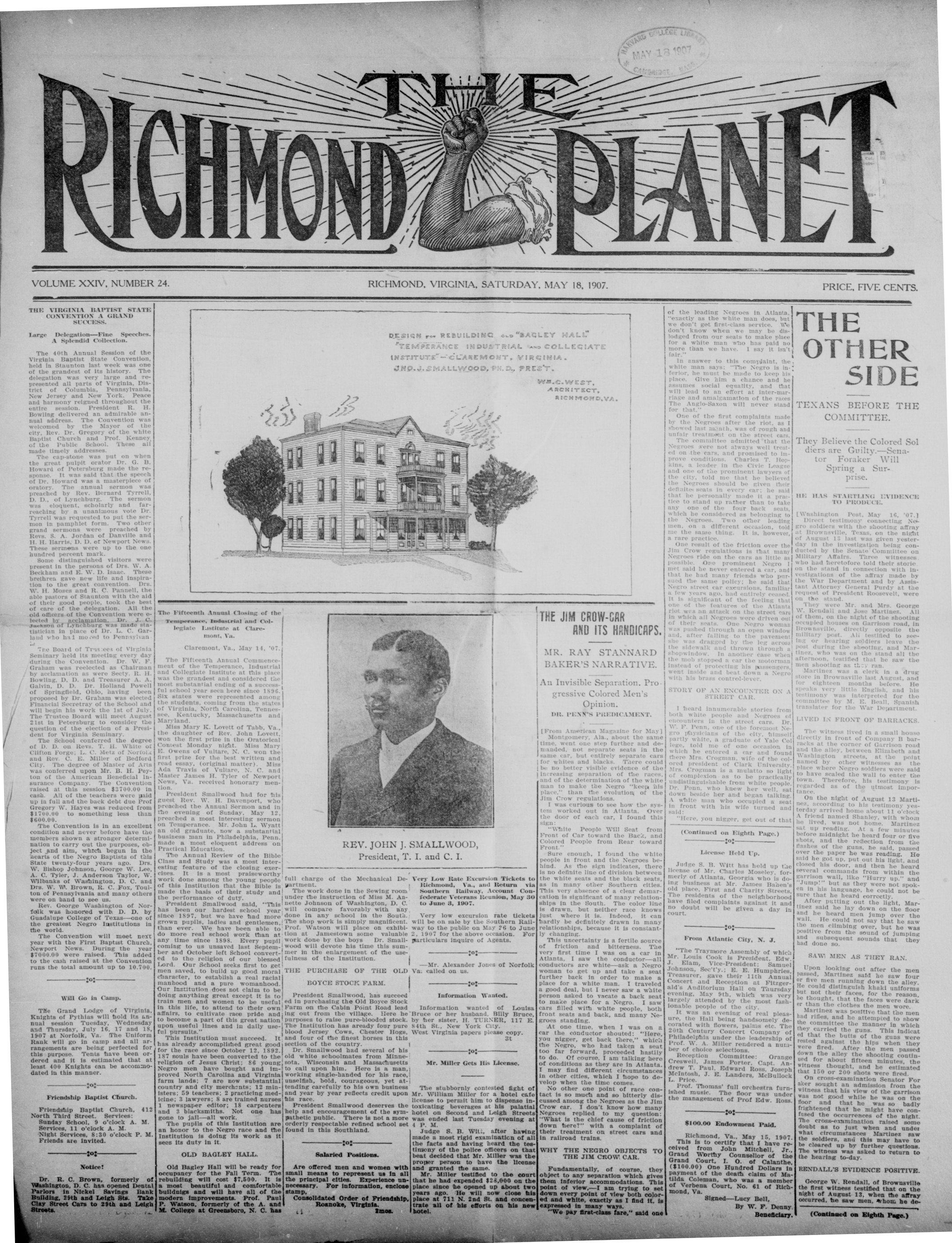
DESIGN FOR REBUILDING OLD "BAGLEY HALL"
"TEMPERANCE INDUSTRIAL AND COLLEGIATE
INSTITUTE"—CLAREMONT, VIRGINIA.
JND.J. SMALLWOOD, PH.D., PREST.
W.H.G.WEST,
ARCHITECT,
RICHMOND, VA.
The Fifteenth Annual Closing of the Temperance, Industrial and College Institute at Claremont, Va.
Claremont, Va., May 14, '07.
The Fifteenth Annual Commencement of the Temperance, Industrial and Collegiate Institute at this place was the grandest and considered the most substantial ending of a successful school year seen here since 1896. Six states were represented among the students, coming from the states of Virginia, North Carolina, Tennessee, Kentucky, Massachusetts and Maryland.
Miss Mary K. Lovett of Tabb, Va., the daughter of Rev. John Lovett, won the first prize in the Oratorical Conest Monday night. Miss Mary E. Owens of Vulture, N. C. won the first prize for the best written and read essay, (original matter). Miss Ada Travis of Vulture, N. C. and Master James H. Tyler of Newport News, Va. received honorary mention.
President Smallwood had for his guest Rev. W. H. Davenport, who preached the Annual Sermon and in the evening of Sunday, May 12, preached a most interesting sermon on Temperance. Mr. John L. Wyatt an old graduate, now a substantial business man in Philadelphia, Penn. made a most eloquent address on Practical Education.
The Annual Review of the Bible Class and Study was a most interesting feature of the closing exercises. It is a most praiseworthy work done among the young people of this Institution that the Bible is made the basis of their study and the performance of duty.
President Smallwood said, "This has been our hardest school year since 1897, but we have had more grown pupils, ladies and gentlemen, than ever. We have been able to do more real school work than at any time since 1898. Every pupil coming to us unsaved last September and October left School converted to the religion of our blessed Lord. Our School seeks first to get men saved, to build up good moral character, to establish a real racial manhood and a pure womanhood. Our institution does not claim to be doing anything great except it is to train men and women to be useful in this life, to attend to their own affairs, to cultivate race pride and to become a part of this great nation upon useful lines and in daily useful pursuits."
This Institution must succeed. It has already accomplished great good for the race since October 12, 1892. 187 souls have been converted to the religion of Jesus Christ; 86 young Negro men have bought and improved North Carolina and Virginia farm lands; 7 are now substantial country and city merchants; 12 ministers; 59 teachers; 2 practicing medicine; 3 lawyers; 8 are trained nurses 1 newspaper editor; 18 carpenters and 3 blacksmiths. Not one has gone to jail—all work.
The pupils of this Institution are an honor to the Negro race and the Institution is doing its work as it sees its duty in it.
OLD BAGLEY HALL
Old Bagley Hall will be ready for occupancy for the Fall Term. The rebuilding will cost $7,500. It is a most beautiful and comfortable buildnigs and will have all of the modern improvements. Prof. Paul P. Watson, formerly of the A. and M. College at Greensboro, N. C. has
RICHMOND, VIRGINIA, SATURDAY, MAY 18, 1907.
REV. JOHN J. SMALLWOOD,
President, T. I. and C. I.
full charge of the Mechanical Department.
The work done in the Sewing room under the instruction of Miss M. Annette Johnson of Washington, D. C. will compare favorably with any done in any school in the South. The shop work is simply magnificent. Prof. Watson will place on exhibition at Jamestown some valuable work done by the boys. Dr. Smallwood will devote his time this summer in the enlargement of the usefulness of the Institution.
THE PURCHASE OF THE OLD BOYCE STOCK FARM.
President Smallwood, has succeeded in purchasing the Old Boyce Stock Farm on the Cabin Point Road leading out from the village. Here he purposes to raise pure-blooded stock. The Institution has already four pure blood Jersey Cows, Chester Hogs, and four of the finest horses in this section of the country.
Dr. Smallwood had several of his old white schoolmates from Minnesota. Wisconsin and Massachusetts to call upon him. Here is a man, working single-handed for his race, unselfish, bold, courageous, yet attending carefully to his own business and year by year reflects credit upon his race.
President Smallwood deserves the help and encouragement of the sympathetic public. There is not a more orderly respectable refined school set found in this Southland.
Very Low Rate Excursion Tickets to Richmond, Va., and Return via Southern Railway, Account Confederate Veterans Reunion, May 30 to June 3, 1907.
Very low excursion rate tickets will be on sale by the Southern Railway way to the public on May 26 to June 2, 1907 for the above occasion. For particulars inquire of Agents.
Mr. Alexander Jones of Norfolk Va. called on us.
Information Wanted.
Information wanted of Louisa Bruce or her husband, Billy Bruce, by her sister, H. TURNER, 117 E. 84th St., New York City. West Virginia papers please copy.
3t
Mr. Miller Gets His License.
The stubbornly contested fight of Mr. William Miller for a hotel cafe license to permit him to dispense in toxicating beverages at his palatial hotel on Second and Leigh Streets was ended last Tuesday evening at 4 P. M.
Judge S. B. Witt after having
Salaried Positions.
Are offered men and women with small means to represent us in all the principal cities. Experience unnecessary. For information, enclose stamp. Consolidated Order of Friendship, Roanoke, Virginia. 2mos.
Very Low Rate Excursion Tickets to Richmond, Va., and Return via Southern Railway, Account Confederate Veterans Reunion, May 30 to June 3, 1907.
Very low excursion rate tickets will be on sale by the Southern Railway to the public on May 26 to June 2, 1907 for the above occasion. For particulars inquire of Agents.
Mr. Alexander Jones of Norfolk Va. called on us.
Information Wanted.
Information wanted of Louisa Bruce or her husband, Billy Bruce, by her sister, H. TURNER, 117 E. 84th St., New York City.
West Virginia papers please copy.
Mr. Miller Gets His License.
The stubbornly contested fight of Mr. William Miller for a hotel cafe license to permit him to dispense intoxicating beverages at his palatial hotel on Second and Leigh Streets was ended last Tuesday evening at 4 P. M.
Judge S. B. WILK, after having made a most rigid examination of all the facts and having heard the testimony of the police officers on that beat decided that Mr. Miller was the proper person to have the license and granted the same.
Mr. Miller testified to the court that he had expended $28,000 on the place since he opened up about two years ago. He will now close his place at 711 N. 2nd St. and concentrate all of his efforts on his new hotel.
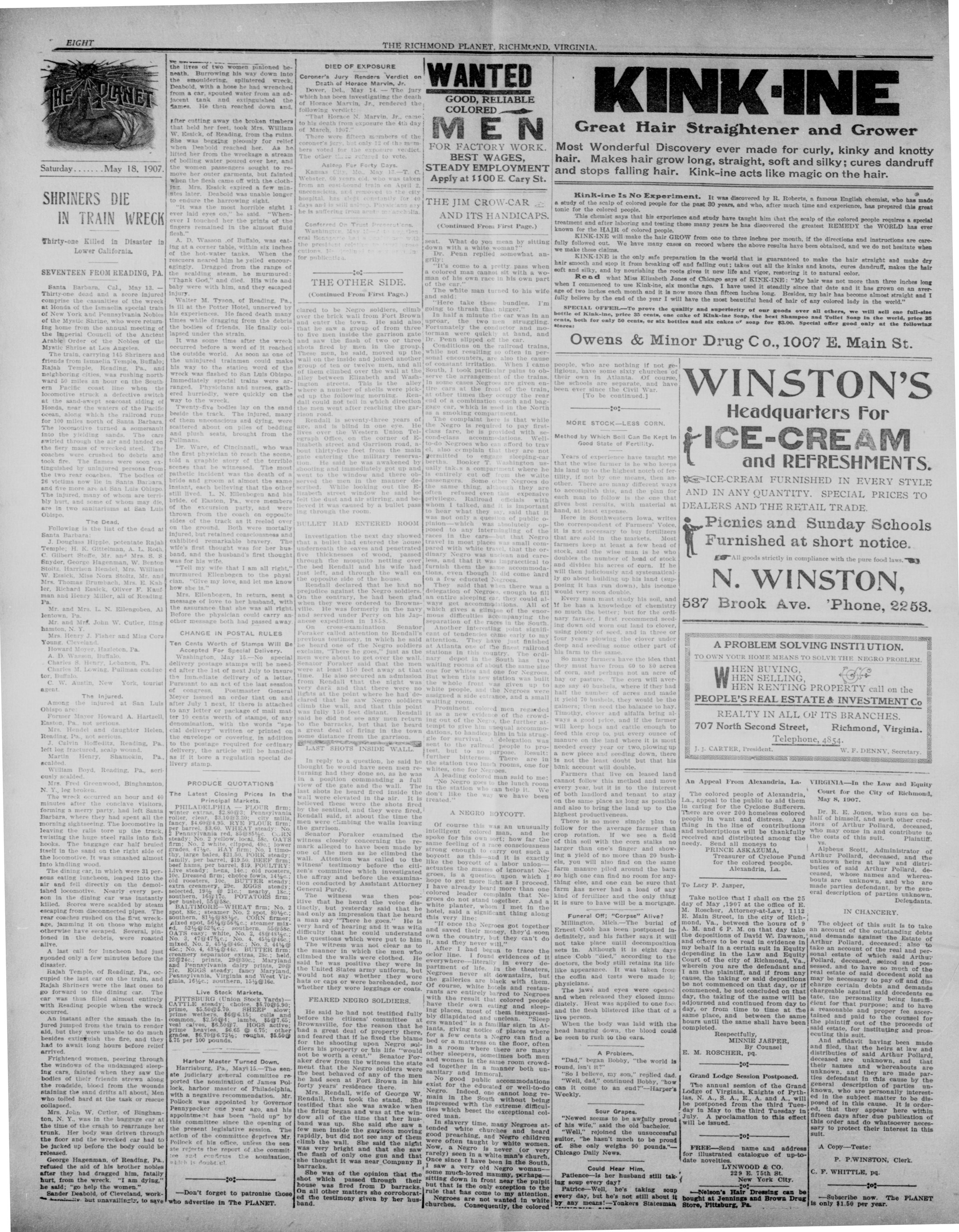
THE JIM CROW-GAR AND ITS HANDICAPS.
MR. RAY STANNARD
BAKER'S NARRATIVE.
An Invisible Separation. Progressive Colored Men's Opinion.
DR. PENN'S PREDICAMENT.
[From American Magazine for May] Montgomery, Ala., about the same time, went one step further and demanded, not separate seats in the same car, but entirely separate cars for whites and blacks. There could be no better visible evidence of the increasing separation of the races, and of the determination of the white man to make the Negro "keep his place," than the evolution of the Jim Crow regulations.
I was curious to see how the system worked out in Atlanta. Over the door of each car, I found this sign:
"White People Will Seat from Front of Car toward the Back, and Colored People from Rear toward Front."
Sure enough, I found the white people in front and the Negroes behind. As the sign indicates, there is no definite line of division between the white seats and the black seats, as in many other Southern cities. This very absence of a clear demarcation is significant of many relationships in the South. The color line is drawn, but neither race knows just where it is. Indeed, it can hardly be definitely drawn in many relationships, because it is constantly changing.
This uncertainty is a fertile source of friction and bitterness. The very first time I was on a car in Atlanta, I saw the conductor—all conductors are white—ask a Negro woman to get up and take a seat further back in order to make a place for a white man. I traveled a good deal, but I never saw a white person asked to vacate a back seat to make place for a Negro. I saw cars filled with white people, both front seats and back, and many Negroes standing.
At one time, when I was on a car the conductor shouted: "Here, you nigger, get back there," which the Negro, who had taken a seat too far forward, proceeded hastily to do. Of course, I am talking here of conditions as they are in Atlanta. I may find different circumstances in other cities, which I hope to develop when the time comes.
No other one point of race contact is so much and so bitterly discussed among the Negroes as the Jim Crow car. I don't know how many Negroes replied to my question: "What caused a cause of friction down here?" with a complaint of their treatment on street cars and in railroad trains.
WHY THE NEGRO OBJECTS TO THE JIM CROW CAR.
Fundamentally, of course, they object to any separation which gives them inferior accommodations. This point of view,—I am trying to set down every point of view both colored and white, exactly as I find it, is expressed in many ways. "We pay first-class fare," said one
of the leading Negroes in Atlanta, "exactly as the white man does, but we don't get first-class service. We don't know when we may be dislodged from our seats to make place for a white man who has paid no more than we have. I say it isn't fair."
In answer to this complaint, the white man says: "The Negro is inferior, he must be made to keep his place. Give him a chance and he assumes social equality, and that will lead to an effort at inter-marriage and amalgamation of the races The Anglo-Saxon will never stand for that."
One of the first complaints made by the Negroes after the riot, as I showed last month, was of rough and unfair treatment on the street cars. The committee admitted that the Negroes were not always well treated on the cars, and promised to improve conditions. Charles T. Hopkins, a leader in the Civic League and one of the prominent lawyers of the city, told me that he believed the Negroes should be given their definite seats in every car; he said that he personally made it a practice to stand up rather than to take any one of the four back seats, which he considered as belonging to the Negroes. Two other leading men, on a different occasion, told me the same thing. It is, however, a rare practice.
One result of the friction over the Jim Crow regulations is that many Negroes ride on the cars as little as possible. One prominent Negro I met said he never entered a car, and that he had many friends who pursued the same policy; he said that Negro street car excursions, familiar a few years ago, had entirely ceased. It is significant of the feeling that one of the features of the Atlanta riot was an attack on the street cars in which all Negroes were driven out of the streets. One Negro woman was pushed through an open window and, after falling into the pavement she was dragged by the car across the sidewalk and thrown through shopwindow. In another case when the mob stopped a car the motorman instead of protecting his passengers went inside and beat down a Negro with his brass control-lever.
STORY OF AN ENCOUNTER ON A
STREET CAR.
I heard innumerable stories from both white people and Negroes of encounters in the street cars. Dr. W. F. Penn, one of the foremost Negro physicians of the city, himself partly white, a graduate of Yale College, told me of one occasion in which he entered a car and found there Mrs. Crogman, wife of the colored president of Clark University. Mrs. Crogman is a mulatto so light of complexion as to be practically undistinguishable from white people. Dr. Penn, who knew her well, sat down beside her and began talking. A white man who occupied a seat in front with his wife turned and said: "Here, you nigger, get out of that
(Continued on Eighth Page.)
License Held Up.
Judge S. B. Witt has held up the license of Mr. Charles Moseley, formerly of Atlanta, Georgia who is doing business at Mr. James Bänen's old place, First and Charity Streets, the residents of the neighborhood have told complaints against it and no doubt will be given a day in court.
From Atlantic City, N. J.
"The Trarymore Assembly of which Mr. Louis Cook is President, Edw. J. Elam, Vice-President; Samuel Johnson, Sec'ty' of; E. E. Humphries, Treasurer, gave their 11th Annual Concert and Reception at Fitzgerald's Auditorium Hall on Thursday evening, May 9th, which was very largely attended by the most fashionable of the city.
It was an evening of real pleasure, the Hall being handsomely decorated with flowers, palms etc. The 20th Century Concert Company of Philadelphia under the leadership of Prof. W.A. Miller rendered a number of choice selections.
Reception Committee: Orange Creswell, James Porter, Capt. Andrew T. Paul, Edward Ross, Joseph McIntosh, J. E. Landers, McBullock L. Price.
Prof. Thomas' full orchestra furnished music. The floor was under the management of Prof Edw Ross
$100.00 Endowment Paid
Richmond, Va., May 15, 1907.
This is to certify that I have received from John Mitchell, Jr.
Grand Worthy Counsellor of the Grand Court, I. O. of Calanthe,
($100.00) One Hundred Dollars in payment of the death claim of Matilda Coleman, who was a member of Verbena Court, No. 61 of Richmond, Va.
Signed—Lucy Bell,
By W. F. Denny.
Beneficary.
PRICE, FIVE CENTS
THE OTHER SIDE
TEXANS BEFORE THE COMMITTEE.
They Believe the Colored Soldiers are Guilty.—Senator Foraker Will Spring a Surprise.
HE HAS STARTLING EVIDENCE TO PRODUCE.
[Washington Post, May 16, '07.]
Direct testimony connecting Negro soldiers with the shooting affray at Brownsville, Texas, on the night of August 13 last was given yesterday in the investigation being conducted by the Senate Committee on Military Affairs. Three witnesses, who had heretofore told their story on the stand in connection with investigations of the affray made by the War Department, and by Assistant Attorney General Purdy at the request of President Roosevelt, were on the stand.
They were Mr. and Mrs. George W. Rendall and Jose Martinez. All of them, on the night of the shooting occupied houses on Garrison road, in Brownsville, directly opposite the military post. Ali testified to seeing or hearing soldiers leave the post during the shooting, and Martinez, who was on the stand all the afternoon, testified that he saw the men shooting as they run. Martinez was a clerk in a drug store in Brownsville last August, and for eighteen months before. He speaks very little English, and his testimony was interpreted for the committee by M. E. Beall, Spanish translator for the War Department.
LIVED IN FRONT OF BARRACKS
The witness lived in a small house directly in front of Company R barracks at the corner of Garrison road and the alley, between Elizabeth and Washington streets, at the point named by other witnesses as the place where Negro solders were said to have scaled the wall to enter the town. Therefore, his testimony is regarded as of the utmost importance.
On the night of August 13 Martínez, according to his testimony yesterday arrived home about 11 o'clock A friend named Shanley, with whom he lived, was not home. Martínez sat up reading. At a few minutes before midnight he heard four or five shots, and the reflection from the flashes of the guns, he said, passed over the paper he was reading. He said he got up, put out his light, and closed his door, and then he heard several commands from within the garrison wall, like "Hurry up." and "Jump!" but as they were not spoken in his language, he could not be sure that he heard correctly.
After putting out the light, Martínez said he lay down on the floor and he heard men jump over the wall. He could not say that he saw the men climbing over, but he was positive from the sound of jumping and subsequent sounds that they had done so.
SAW MEN AS THEY BAN
Upon looking out after the men passed, Martinez said he saw four or five men running down the alley, and distinguisht khaki uniforms, but not the face of the reason, he thought, that the faces darker than the clothes the men wore.
Martinez was positive that the men had rifles, and he attempted to show the committee the manner in which they carried the guns. This indicated that the butts of the guns were rested against the hips when they were fired. After the men passed down the alley the shooting continued for about fifteen minutes, the witness thought, and he estimated that 150 or 200 shots were fired. The cross-examination Senator For skier brought an admission from the witness that his view of the garrison was not good while he was on the floor and that he was so badly frightened that he may have confused the occurrences of the night. The cross-examination raised some doubt as to just when and under what circumstances Martinez saw the soldiers, and this may have to be cleared up by further questions. The witness was asked to return to the hearing to-day.
RENDALL'S EVIDENCE POSITIVE.
George W. Rendall, of Brownville
the first witness testified that on the
night of August 13, when the affray
occurred, he saw men, *hom* he de
(Continued on Eighth Page.)
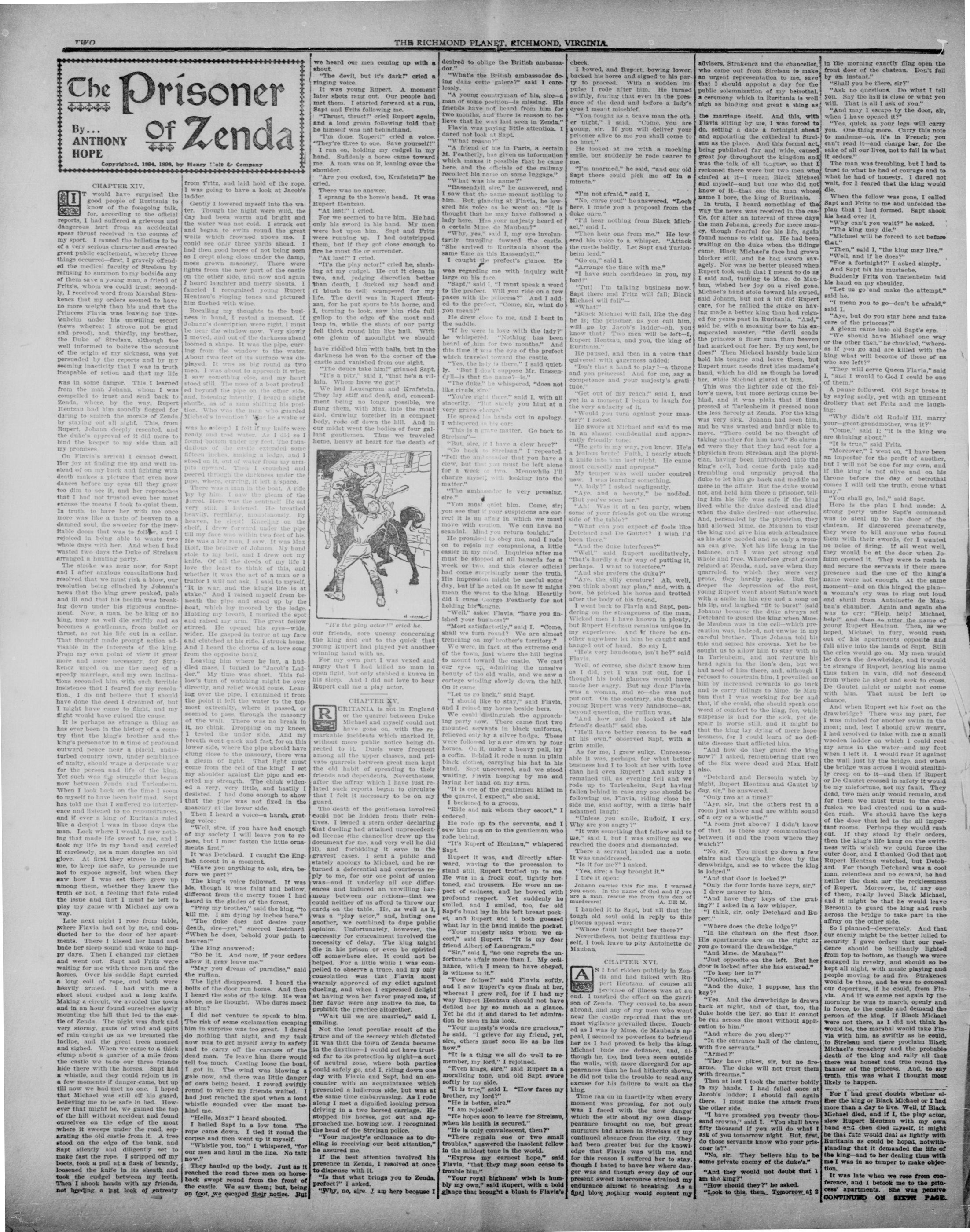
The Prisoner Of Zenda By... ANTHONY HOPE
TWO
CHAPTER XIV
good people of Kuritania to know of the foregoing talk, for, according to the official reports, I had suffered a grievous and dangerous hurt from an accidental spear thrust received in the course of my sport. I caused the bulletins to be of a very serious character and created great public excitement, whereby three things occurred—first, I gravely offended the medical faculty of Strelsau by refusing to summon to my bedside any of them save a young man, a friend of Fritz's, whom we could trust; secondly, I received word from Marshal Strakenzek that my orders seemed to have no more weight than his and that the Princess Flavia was leaving for Tarkenheim under his unwilling escort (news whereat I strove not be glad and proud), and, thirdly, my brother, the Duke of Strelsau, although too well informed to believe the account of the origin of my sickness, was yet persuaded by the reports and by my seeming inactivity that I was in truth incapable of action and that my life
was in some danger. This I learned from the man Johann, whom I was compelled to trust and send back to Zenda, where, by the way, Rupert Hentzau had him soundly flogged for daring to smash the morals of Zenda by staying out all night. This, from Rupert, Johann deeply resented, and the duke's approval of it did more to bind the keeper to my side than all my promises.
On Flavin's arrival I cannot dwell. Her joy at finding me up and well instead of on my back and fighting with death makes a picture that even now dances before my eyes till they grow too dim to see it, and her reproaches that I had not trusted even her must excuse the means I took to quiet them. In truth, to have her with me once more was like a taste of heaven to a damned soul, the sweeter for the inevitable doom that was to follow, and I rejoiced in being able to waste two whole days with her. And when I had wasted two days the Duke of Strelsau arranged a hunting party.
The stroke was near now, for Sapt and I after anxious consultations had resolved that we must risk a blow, our resolution being clinched by Johann's news that the king grew peaked, pale and ill and that his health was breaking down under his rigorous confinement. Now, a man, be he king or no king, may as well die swiftly and as becomes a gentleman, from bullet or thrust, as rot his life out in a cellar. That thought made prompt action advisable in the interests of the king. From my own point of view it grew more and more necessary, for Strakencz urged on me the need of a speedy marriage, and my own inclinations seconded him with such terrible insistence that I feared for my resolution. I do not believe that I should have done the deed I dreamed of, but I might have come to flight, and my flight would have ruined the cause.
It is perhaps as strange a thing as has ever been in the history of a country that the king's brother and the king's personator in a time of profound outward peace near a placid, undisturbed country town, under semblance of anity, should wage a desperate war for the person and life of the king. Yet such was the struggle that began now between Zenda and Tartenheim. When I look back on the time I seem to myself to have been half mad. Sapti has told me that I suffered no interference and listened to no remonstrances, and if ever a king of Kuritania ruled like a despot I was in those days the man. Look where I would, I saw nothing that made life sweet to me, and I took my life in my hand and carried it carelessly, as a man dangles an old glove. At first they strove to guard me, to keep me safe, to persuade me not to expose myself, but when they saw how I was set there grew up among them, whether they knew the truth or not, a feeling that fate ruled the issue and that I must be left to play my game with Michael my own way.
Late next night I rose from table, where Flavia had sat by me, and conducted her to the door of her apartments. There I kissed her hand and bade her sleep sound and wake to happy days. Then I changed my clothes and went out. Sapt and Fritz were waiting for me with three men and the horses. Over his saddle Sapt carried a long coll of rope, and both were heavily armed. I had with me a short stout cudgel and a long knife. Making a circuit, we avoided the town and in an hour found ourselves slowly mounting the hill that led to the castle of Zenda. The night was dark and very stormy, gusts of wind and spits of rain caught us as we breasted the incline, and the great trees moaned and sighed. When we came to a thick clump about a quarter of a mile from the castle we bade our three friends hide there with the horses. Sapt had a whistle, and they could rejoin us in a few moments if danger came, but up till now we had met no one. I hoped that Michael was still off his guard, believing me to be safe in bed. However that might be, we gained the top of the hill without accident and found ourselves on the edge of the moat where it sweeps under the road, separating the old castle from it. A tree stood on the edge of the bank, and Sapt silently and diligently set to make fast the rope. I stripped off my boots, took a pull at a flask of brandy, loosened the knife in its sheath and took the cudgel between my teeth. Then I shook hands with my friends, not heeding a last look of entreaty
from Fritz, and laid hold of the rope. I was going to have a look at Jacob's ladder.
Gently I lowered myself into the water. Though the night were wild, the day had been warm and bright and the water was not cold. I struck out and began to swim round the great walls which frowned above me. I could see only three yards ahead. I had then good hopes of not being seen as I crept along close under the damp, moss grown masonry. There were lights from the new part of the castle on the other side, and now and again I heard laughter and merry shouts. I fancied I recognized young Rupert Hentzau's ringing tones and pictured him fushed with wine.
Recalling my thoughts to the business in hand, I rested a moment. If Johann's description were right, I must be near the window now. Very slowly I moved, and out of the darkness ahead loomed a shape. It was the pipe, curving from the window to the water. About two feet of its surface was displayed. It was as big round as two men. I was about to approach it when I saw something else, and my heart stood still. The nose of a boat protruded beyond the pipe on the other side, and, listening intently, I heard a slight shuffle, as of a man shifting his position. Who was the man who guarded Michael's invention? Was he awake or
was he sleep? I felt if my knife were ready and trod water. As I did so I found bottom under my feet. The foundations of the castle extended some fifteen inches, making a ledge, and I stood on it, out of water from my armpits upward. Then I crouched and peered through the darkness under the pipe, where, curving, it left a space.
There was a man in the boat. A rife by him. I saw the gleam of the barrel. Here was the sentinel! He sat very still. I listened. He breathed heavily, regularly, montonously. By heaven, he slept! Kncelling on the shelf, I drew forward under the pipe till my face was within two feet of his. He was a big man, I saw. It was Max Holf, the brother of Johann. My hand stole to my belt, and I drew out my knife. Of all the deeds of my life I love the least to think of this, and whether it was the act of a man or a traitor I will not ask. I said to myself, "It is war, and the king's life is at stake." And I raised myself from beneath the pipe and stood up by the boat, which lay moored by the ledge. Holding my breath, I marked the spot and raised my arm. The great fellow stirred. He opened his eyes-wide, wilder. He gasped in terror at my face and clutched at his rifle. I struck home. And I heard the chorus of a love song from the opposite bank.
Leaving him where he lay, a huddled mass, I turned to "Jacob's Ladder." My time was short. This fellow's turn of watching might be over directly, and relief would come. Leaning over the pipe, I examined it from the point it left the water to the topmost extremity, where it passed, or seemed to pass, through the masonry of the wall. There was no break in it, no chink. Dropping on my knees, I tested the under side. And my breath went quick and fast, for on this lower side, where the pipe should have clung close to the masonry, there was a gleam of light. That light must come from the cell of the king! I set my shoulder against the pipe and exerted my strength. The chink widened a very, very little, and hastily I desisted. I had done enough to show that the pipe was not fixed in the masonry at the lower side. Then I heard a voice—a harsh, grating voice:
"Well, sir, if you have had enough of my society I will leave you to repose, but I must fasten the little ornaments first."
It was Detchard. I caught the English accent in a moment.
"Have you anything to ask, sir, before we part?"
The king's voice followed. It was his, though it was faint and hollow, different from the merry tones I had heard in the glades of the forest.
"Pray my brother," said the king, "to kill me. I am dying by inches here."
"The duke does not desire your death, sire—yet," sneered Detchard.
"When he does, behold your path to heaven."
The king answered:
"So be it. And now, if your orders allow it, pray leave me."
"May you dream of paradise," said the ruffian.
The light disappeared. I heard the bolts of the door run home. And then I heard the sobs of the king. He was alone, as he thought. Who dares mock at him?
I did not venture to speak to him. The risk of some exclamation escaping him in surprise was too great. I dared do nothing that night, and my task now was to get myself away in safety and to carry off the carcass of the dead man. To leave him there would tell too much. Casting loose the boat, I got in. The wind was blowing a gale now, and there was little danger of oars being heard. I rowed swiftly round to where my friends waited. I had just reached the spot when a loud whistle sounded over the moat behind me.
"Hello, Max!" I heard shouted. I hailed Sapt in a low tone. The rope came down. I tied it round the corpse and then went up it myself.
"Whistle you, too," I whispered, "for our men and haul in the line. No talk now." They hauled up the body. Just as it reached the road three men on horseback swept round from the front of the castle. We saw them; but, being on foot, we escaped their notice. But
THE RICHMOND PLANET. RICHMOND. VIRGINIA
we heard our men coming up with a shout.
"The devil, but it's dark!" cried a ringing voice.
It was young Rupert. A moment later shots rang out. Our people had met them. I started forward at a run, Sapt and Fritz following me.
"Thrust, thrust!" cried Rupert again, and a loud groan following told that he himself was not behind him.
"I'm done, Rupert!" cried a voice.
"They're three to one. Save yourself!"
I ran on, holding my cudgel in my hand. Suddenly a horse came toward me. A man was on it, leaning over the shoulder.
"Are you cooked, too, Krafstein?" he cried.
There was no answer.
I sprang to the horse's head. It was Rupert Hentzau.
"At last!" I cried.
For we seemed to have him. He had only his sword in his hand. My men were hot upon him. Sapt and Fritz were running up. I had outstripped them, but if they got close enough to fire he must die or surrender.
"At last!" I cried.
"It's the play actor" cried he, slashing at my cudgel. He cut it clean in two, and, judging discretion better than death, I ducked my head and (I blush to tell) scampered for my life. The devil was in Rupert Hentzau, for he put spurs to his horse, and I, turning to look, saw him ride full gallop to the edge of the moat and leap in, while the shots of our party fell thick round him like hall. With one gleam of moonlight we should have riddled him with balls, but in the darkness he won to the corner of the castle and vanished from our sight.
"The deuce take him!" grinned Sapt.
"It's a pity," said I, "that he's a villain. Whom have we got?"
We had Laumgram and Krafstein. They lay stiff and dead, and, concealment being no longer possible, we fung them, with Max, into the moat and, drawing together in a compact body, rode off down the hill. And in our midst went the bodies of four gallant gentlemen. Thus we traveled home, heavy at heart for the death of
11. 1872
"It's the play actor!" cried he. our friends, sore uneasy concerning the king and cut to the quick that young Rupert had played yet another winning hand with us. For my own part I was vexed and angry that I had killed no man in open fight, but only stabbed a knave in his sleep. And I did not love to hear Rupert call me a play actor.
CHAPTER XV.
URITANIA is not in England or the quarrel between Duke Michael and myself could not have gone on, with the remarkable incidents which marked it, without more public notice being directed to it. Duels were frequent among all the upper classes, and private quarrels between great men kept the old habit of spreading to their friends and dependents. Nevertheless, after the affray which I have just related such reports began to circulate that I felt it necessary to be on my guard.
The death of the gentlemen involved could not be hidden from their relatives. I issued a stern order declaring that duelling had attained unprecedented license (the chancellor drew up the document for me, and very well he did it), and forbidding it save in the gravest cases. I sent a public and stately apology to Michael, and he returned a deferential and courteous reply to me, for our one point of union was—and it underlay all our differences and induced an unwilling harmony between our actions—that we could neither of us afford to throw our cards on the table. He, as well as I, was a "play actor," and, hating one another, we combined to dupe public opinion. Unfortunately, however, the necessity for concealment involved the necessity of delay. The king might die in his prison or even be spirited off somewhere else. It could not be helped. For a little while I was compelled to observe a truce, and my only consolation was that Flavia most warmly approved of my edict against duelling, and when I expressed delight at having won her favor prayed me, if her favor were any motive to me, to prohibit the practice altogether.
"Wait till we are married," said I, smiling.
Not the least peculiar result of the truce and of the secrecy which dictated it was that the town of Zenda became in the daytime—I would not have trusted far to its protection by night—a sort of neutral zone, where both parties could safely go, and I, riding down one day with Flavia and Sapt, had an encounter with an acquaintance which presented a ludicrous but, was at the same time embarrassing. As I rode along I met a dignified looking person driving in a two horsed carriage. He stopped his horses, got out and approached me, bowing low. I recognized the head of the Strelsaan police.
"Your majesty's ordinance as to dueling is receiving our best attention," he assured me.
If the best attention involved his presence in Zenda, I resolved at once to dispense with it.
"Is that what brings you to Zenda, prefect?" I asked.
"Why, no, sire. I am here because I
desired to oblige the British ambassador."
"What's the British ambassador doing dans cette galerie?" said I carelessly.
"A young countryman of his, sire—a man of some position—is missing. His friends have not heard from him for two months, and there is reason to believe that he was last seen in Zenda." Flavia was paying little attention. I dared not look at Sapt.
"What reason?"
"A friend of his in Paris, a certain M. Featherly, has given us information which makes it possible that he came here, and the officials of the railway recollect his name on some luggage."
"What was his name?"
"Rassendyll, sire," he answered, and I saw that the name meant nothing to him. But, glancing at Flavia, he lowered his voice as he went on: "It is thought that he may have followed a lady here. Has your majesty heard of a certain Mme de Mauban?"
"Why, yes," said I, my eye involuntarily traveling toward the castle. "She arrived in Ruritania about the same time as this Rassendyll."
I caught the prefect's glance. He was regarding me with inquiry writ large on his face.
"Sapt," said I, "I must speak a word to the prefect. Will you ride on a few paces with the princess?" And I added to the prefect, "Come, sir, what do you mean?"
He drew close to me, and I bent in the saddle.
"If we were in love with the lady?" he whispered. "Nothing has been heard of him for two months." And this time it was the eye of the prefect which traveled toward the castle.
"Yes, the lady is there." I said quietly. "But I don't suppose Mr. Rassendyll-is that the name—is."
"The duke," he whispered, "does not like rivals, sire."
"You're right there," said I, with all sincerity. "But surely you hint at a very grave charge."
He spread his hands out in apology. I whispered in his ear:
"This is a grave matter. Go back to Strelsan."
"But, sire, if I have a clew here?"
"Go back to Strelsan." I repeated.
"Tell the ambassador that you have a clew, but that you must be left alone for a week or two. Meanwhile I'll charge myself, with looking into the matter."
"The ambassador is very pressing, sire."
"You must quiet him. Come, sir; you see that if your suspicions are correct it is an affair in which we must move with caution. We can have no scandal. Mind you return tonight."
"Well," asked Flavia. "have you finished your business?"
"Most satisfactorily," said I. "Come, shall we turn round? We are almost trenching on my brother's territory."
We were, in fact, at the extreme end of the town, just where the hill begins to mount toward the castle. We cast our eyes up, admiring the massive beauty of the old walls, and we saw a cortege winding slowly down the hill. On it came.
We could distingush the approaching party now. There came first two mounted servants in black uniforms, relieved only by a silver badge. These were followed by a car drawn by four horses. On it, under a heavy pall, lay a coffin. Behind it rode a man in plain black clothes, carrying his hat in his hand. Sapt uncovered, and we stood waiting. Flavia keeping by me and laying her hand on my arm.
"It is one of the gentlemen killed in the quarrel, I expect," she said.
I beckoned to a groom.
"Ride and ask whom they escort," I ordered.
He rode up to the servants, and I saw him pass on to the gentleman who rode behind.
"It's Rupert of Hentzau," whispered Sapt.
Rupert it was, and directly afterward, waving to the procession to stand still, Rupert trotted up to me. He was in a frock coat, tightly buttoned, and trousers. He wore an aspect of sadness, and he bowed with profound respect. Yet suddenly he smiled, and I smiled, too, for old Sapt's hand lay in his left breast pocket, and Rupert and I both guessed what lay in the hand inside the pocket.
"Your majesty asks whom we escort," said Rupert. "It is my dear friend Alder of Lauengram."
"Sir," said I, "no one regrets the unfortunate affair more than I. My ordinance, which I mean to have obeyed, is witness to it."
"Poor fellow!" said Flavia softly, and I saw Rupert's eyes flash at her, whereat I grew red, for if I had my way Rupert Hentzau should not have defiled her by so much as a glance. Yet he did it and dared to let admiration be seen in his look.
"Your majesty's words are gracious," he said. "I grieve for my friend, yet, sire, others must soon lie as he lies now."
"It is a thing we all do well to remember, my lord." I rejoined.
"Even kings, sire," said Rupert in a moralizing tone, and old Sapt swore softly by my side.
"It is true," said I. "How fares my brother, my lord?"
"He is better, sire."
"I am rejoiced."
"He hopes soon to leave for Strelsau, when his health is secured."
"There remain one or two small troubles," answered the insolent fellow in the mildest tone in the world.
"Express my earnest hope," said Flavla, "that they may soon cease to trouble him."
"Your royal highness" wish is humbly my own," said Rupert, with a bold glance that brought a blush to Flavla's
I bowed, and Rupert, bowing lower, backed his horse and signed to his party to proceed. With a sudden impulse I rode after him. He turned swiftly, tearing that even in the presence of the dead and before a lady's eyes I mealt mischief.
"You fought as a brave man the other night," I said. "Come, you are young, sir. If you will deliver your prisoner alive to me you shall come to no hurt."
He looked at me with a mocking smile, but suddenly he rode nearer to me.
"I'm unarmed," he said, "and our old Sapt there could pick me off in a minute."
"I'm not afraid," said I.
"No, curse you!" he answered. "Look here. I made you a proposal from the duke once."
"I'll hear nothing from Black Michael," said I.
"Then hear one from me." He lowered his voice to a whisper. "Attack the castle boldly. Let Sapt and Tarlenheim lead."
"Go on," said I.
"Arrange the time with me."
"I have such confidence in you, my lord!"
"Tut! I'm talking business now. Sapt there and Fritz will fall; Black Michael will fall"—
"What!"
"Black Michael will fall, like the dog he is; the prisoner, as you call him, will go by Jacob's ladder—sh, you know that? Two men will be left—I, Rupert Hentzau, and you, the king of Ruritania."
He paused, and then in a voice that quivered with qarness added:
"Isn't that a hand to play?—a throne and son princess! And for me, say a competence and your majesty's gratitude."
"Get out of my reach!" said I, and yet in a moment I began to laugh for the very audacity of it.
"Would you turn against your master?" I asked.
He swore at Michael and said to me in an almost confidential and apparently friendly tone:
"He gets in my way, you know. He's a jealous brute! Faith, I nearly stuck a knife into bin last night. He came most curiously mal apropos."
My temper was well under control now. I was learning something.
"A lady?" I asked negligently.
"Aye, and a beauty!" he nodded.
"But you've seen her."
"Ah! Was it at a tea party, when some of your friends got on the wrong side of the table?"
"What can you expect of fools like Detchard and De Gautet?" I wish I'd been there.
"And the duke interferes."
"Well," said Rupert meditatively, "that's hardly a fair way of putting it, perhaps. I want to interfere."
"And she prefers the duke?" "Aye, the silly creature! Ah, well, you think about my plan," and, with a bow, he pricked his horse and trotted after the body of his friend.
I went back to Flavia and Sapt, pondering on the strangeness of the man. Wicked men I have known in plenty, but Rupert Hentzau remains unique in my experience. And if there be another anywhere let him be caught and hanged out of hand. So say I.
"He's very handsome, isn't he?" said Flavia.
Well, of course, she didn't know him as I did, yet I was put out, for I thought his bold glances would have made her angry. But my dear Flavia was a woman, and so—she was not put out. On the contrary, she thought young Rupert was very handsome—as, beyond question, the ruffian was.
"And how sad he looked at his friend's death!" said she.
"He'll have better reason to be sad at his own," observed Sapt, with a grim smile.
As for me, I grew sulky. Unreasonable it was, perhaps, for what better business had I to look at her with love than had even Rupert? And sulky I remained till, as evening fell and we rode up to Tarlenheim, Sapt having fallen behind in case any one should be following us, Flavia, riding close beside me, said softly, with a little half ashamed laugh:
"Unless you smile, Rudolf, I cry. Why are you angry?"
"It was something that fellow said to me," said I, but I was smiling as we reached the doors and dismounted.
"Is it for me?" I asked.
"Yes, sire; a boy brought it."
I tore it open:
Johann carries this for me. I warned you once. In the name of God and if you are a man, rescue me from this den of murderers!
A. DE M.
I handed it to Sapt, but all that the tough old soul said in reply to this piteous appeal was:
"Whose fault brought her there?"
Nevertheless, not being faultless myself, I took leave to pity Antoinette de Mauban.
CHAPTER XVI
A
S I had ridden publicly in Zenda and had talked with Rupert Hentzan, of course all pretense of illness was at an end. I marked the effect on the garrison of Zenda. They ceased to be seen abroad, and any of my men who went near the castle reported that the utmost vigilance prevailed there. Touched as I was by Mine, de Mauban's appeal, I seemed as powerless to befriend her as I had proved to help the king. Michael bade me defiance, and, although he, too, had been seen outside the walls, with more disregard for appearances than he had hitherto shown, he did not take the trouble to send any excuse for his failure to wait on the king.
Time ran on in inactivity when every moment was pressing, for not only was I faced with the new danger which the stir about my own disappearance brought on me, but great murmurs had arisen in Strelsaun at my continued absence from the city. They had been greater but for the knowledge that Flavia was with me, and for this reason I suffered her to stay, though I hated to have her where danger was and though every day of our present sweet intercourse strained my endurance almost to breaking. As a final blow nothing would content my
advisers, Strakenz and the chancellor, who came out from Strelsaun to make, an urgent representation to me, save that I should appoint a day for the public solemnization of my betrothal, a ceremony which in Ruritania is well nigh as binding and great a thing as the marriage itself. And this, with Flavia sitting by me, I was forced to do, setting a date a fortnight ahead and appointing the cathedral in Strelsaun as the place. And this formal act, being published far and wide, caused great joy throughout the kingdom and, was the talk of all tongues, so that I reckoned there were but two men who chafed at it—I mean Black Michael and myself—and but one who did not know of it—that one the man whose name I bore, the king of Ruritania.
In truth, I heard something of the way the news was received in the castle, for after an interval of three days the man Johann, greedy for more money, though fearful for his life, again found means to visit us. He had been waiting on the duke when the tidings came. Black Michael's face had grown blacker still, and he had sworn savagely. Nor was he better pleased when Rupert took oath that I meant to do as I said and, turning to Mme. de Mauban, wished her joy on a rival gone. Michael's hand stole toward his sword, said Johann, but not a bit did Rupert care, for he rallied the duke on having made a better king than had reigned for years past in Ruritania. "And," said he, with a meaning bow to his exasperated master, "the devil sends the princess a finer man than heaven had marked out for her. By my soul, he does!" Then Michael harshly bade him hold his tongue and leave them, but Rupert must needs first kiss madame's hand, which he did as though he loved her, while Michael glared at him.
This was the lighter side of the fellow's news, but more serious came behind, and it was plain that if time pressed at Tarlenheim it pressed none the less fiercely at Zenda. For the king was very sick. Johann had seen him, and he was wasted and hardly able to move. "There could be no thought of taking another for him now." So alarmed were they that they had sent for a physician from Strelsau, and the physician, having been introduced into the king's cell, had come forth pale and trembling and urgently prayed the duke to let him go back and needle no more in the affair. But the duke would not, and held him there a prisoner, telling him his life was safe if the king lived while the duke desired and died when the duke desired—not otherwise. And, persuaded by the physician, they had allowed Mime, de Maunau to visit the king and give him such attendance as his state needed and as only a woman can give. Yet his life hung in the balance, and I was yet strong and whole and free. Wherefore great gloom reigned at Zenda, and, save when they quarreled, to which they were very prone, they hardly spoke. But the deeper the depression of the rest, young Rupert went about Satan's work with a smile in his eye and a song on his lip, and laughed "fit to burst" (said Johann) because the duke always set Detchard to guard the king when Mime, de Maunau was in the cell—which precaution was, indeed, not unwise in my careful brother. Thus Johann told his tale and seized his crowns. Yet he be sought us to allow him to stay with us in Tarlenheim, and not venture his head again in the lion's den, but we had need of him there, and, although I refused to constrain him, I prevailed on him by increased rewards to go back and to carry tidings to Mime, de Maunau that I was working for her and that, if she could, she should speak one word of comfort to the king, for, while suspense is bad for the sick, yet despair is worse still, and it might be that the king lay dying of mere hopelessness, for I could learn of no definite disease that afflicted him.
"And how do they guard the king now?" I asked, remembering that two of the Six were dead and Max Holf also.
"Detchard and Bersonin watch by night, Rupert Hentzau and Gautet by day, sir," he answered.
"Only two at a time?"
"Aye, sir, but the others rest in a room just above and are within sound of a cry or a whistle."
"A room just above? I didn't know of that. Is there any communication between it and the room where they watch?"
"No, sir. You must go down a few stairs and through the door by the drawbridge, and so to where the king is lodged."
"And that door is locked?"
"Only the four lords have keys, sir."
"I drew nearer to him."
"And have they keys of the grating? I asked in a low whisper."
"I think, sir, only Detchard and Rupert."
"Where does the duke lodge?"
"In the chateau on the first floor. His apartments are on the right as you go toward the drawbridge."
"And Mme. de Mauban?"
"Just opposite on the left. But her door is locked after she has entered." "To keep her in?"
"Doubtless, sir."
"And the duke, I suppose, has the key?"
"Yes. And the drawbridge is drawn back at night, and of that, too, the duke holds the key, so that it cannot be run across the moat without application to him."
"And where do you sleep?"
"In the entrance hall of the chateau, with five servants."
"Armed?"
"They have pikes, sir, but no firearms. The duke will not trust them with firearms."
Then at last I took the matter boldly in my hands. I had failed once at Jacob's ladder; I should fall again there. I must make the attack from the other side.
"I have promised you twenty thousand crowns," said I. "You shall have fifty thousand if you will do what I ask of you tomorrow night. But first, do those servants know who your prisoner is?"
"No, sir. They believe him to be some private enemy of the duke's."
"And they would not doubt that I am the king?"
"How should they?" he asked.
"How should they? be asked."
"Look to this, then. Tgorrow at 2
in the morning exactly fling open the front door of the chateau. Don't fall by an instant."
"Shall you be there, sir?"
"Ask no questions. Do what I tell you. Say the ball is close or what you will. That is all I ask of you."
"And may I escape by the door, sir, when I have opened it?"
"Yes, quick as your legs will carry you. One thing more. Carry this note to madame-oh, it's in French; you can't read it—and charge bar, for the sake of all our lives, not to fall in what it orders."
The man was trembling, but I had to trust to what he had of courage and to what he had of honesty. I dared not wait, for I feared that the king would die.
When the fellow was gone, I called Sapt and Fritz to me and unfolded the plan that I had formed. Sapt shook his head over it.
"Why can't you wait?" he asked.
"The king may die."
"Michael will be forced to act before that."
"Then," said I, "the king may live."
"Well, and if he does?"
"For a fortnight?" I asked simply.
And Sapt bit his mustache.
Suddenly Fritz von Tarlenheim laid
his hand on my shoulder.
"Let us go and make the attempt,"
sald he.
"I mean you to go—don't be afraid," said I.
"Aye, but do you stay here and take care of the princess?"
A gleam came into old Sapt's eye.
"We should have Michael one way or the other then," he chuckled, "whereas if you go and are killed with the king what will become of those of us who are left?"
"They will serve Queen Flavia," said I, "and I would to God I could be one of them."
A pause followed. Old Sapt broke it by saying sadly, yet with an unmeant drollery that set Fritz and me laughing:
"Why didn't old Rudolf III, marry your—great-grandmother, was it?"
"Come," said I; "it is the king we are thinking about."
"It is true," said Fritz.
"Moreover," I went on, "I have been an imposter for the profit of another, but I will not be one for my own, and if the king is not alive and on his throne before the day of betrothal comes I will tell the truth, come what may."
"You shall go, lad," said Sant.
Here is the plan I had made: A strong party under Sapt's command was to steal up to the door of the chateau. If discovered prematurely, they were to kill anyone who found them with their swords, for I wanted no noise of firing. If all went well, they would be at the door when Johann opened it. They were to rush in and secure the servants if their mere presence and the use of the king's name were not enough. At the same moment—and on this hinged the plan—a woman's cry was to ring out loud and shrill from Antoinette de Mauban's chamber. Again and again she was to cry: "Help, help! Michael, help!" and then to utter the name of young Rupert Heanzt. Then, as we hoped, Michael, in fury, would rush out of his apartments opposite and fall alive into the hands of Sapt. Still the cries would go on. My men would let down the drawbridge, and it would be strange if Rupert, hearing his name thus taken in vain, did not descend from where he slept and seek to cross. De Gautet might or might not come with him. That must be left to chance.
And when Rupert set his foot on the drawbridge? There was my part, for I was minded for another swim in the moat; and, lest I should grow weary, I had resolved to take with me a small wooden ladder on which I could rest my arms in the water—and my feet when I left it. I would rear it against the wall just by the bridge, and when the bridge was across I would stealthily creep on to it—and then if Rupert or De Gautet crossed in safety it would be my misfortune, not my fault. They dead, two men only would remain, and for them we must trust to the confusion we had created and to a sudden rush. We should have the keys of the door that led to the all important rooms. Perhaps they would rush out. If they stood by their orders, then the king's life hung on the swiftness with which we could force the outer door, and I thanked God that not Rupert Hentzau watched, but Detchard. For though Detchard was a cool man, relentless and no coward, he had neither the dash nor the recklessness of Rupert. Moreover, he, if any one of them, really loved Black Michael, and it might be that he would leave Bersoniu to guard the king and rush across the bridge to take part in the affray on the other side.
So I planned—desperately. And that our enemy might be the better lured to security I gave orders that our residence should be brilliantly lighted from top to bottom, as though we were engaged in revelry, and should so be kept all night, with music playing and people moving to and fro. Strakenzone would be there, and he was to conceal our departure, if he could, from Flavia. And if we came not again by the morning he was to march, openly and in force, to the castle and demand the person of the king. If Black Michael were not there, as I did not think he would be, the marshal would take Flavia with him, as swiftly as he could, to Strelsau and there proclaim Black Michael's treachery and the probable death of the king and rally all that there was honest and true round the banner of the princess. And, to say truth, this was what I thought most likely to happen.
For I had great doubts whether either the king or Black Michael or I had more than a day to live. Well, if Black Michael died, and if I, the play actor, slew Rupert Hentzau with my own hand and then died myself, it might be that fate would deal as lightly with Ruritania as could be hoped, notwithstanding that it demanded the life of the king—and to her dealing thus with me I was in no temper to make objection.
It was late when we rose from conference, and I betook me to the princess' apartments. She was pensive CONTINUED ON SIXTH PAGE
THE PUNKET
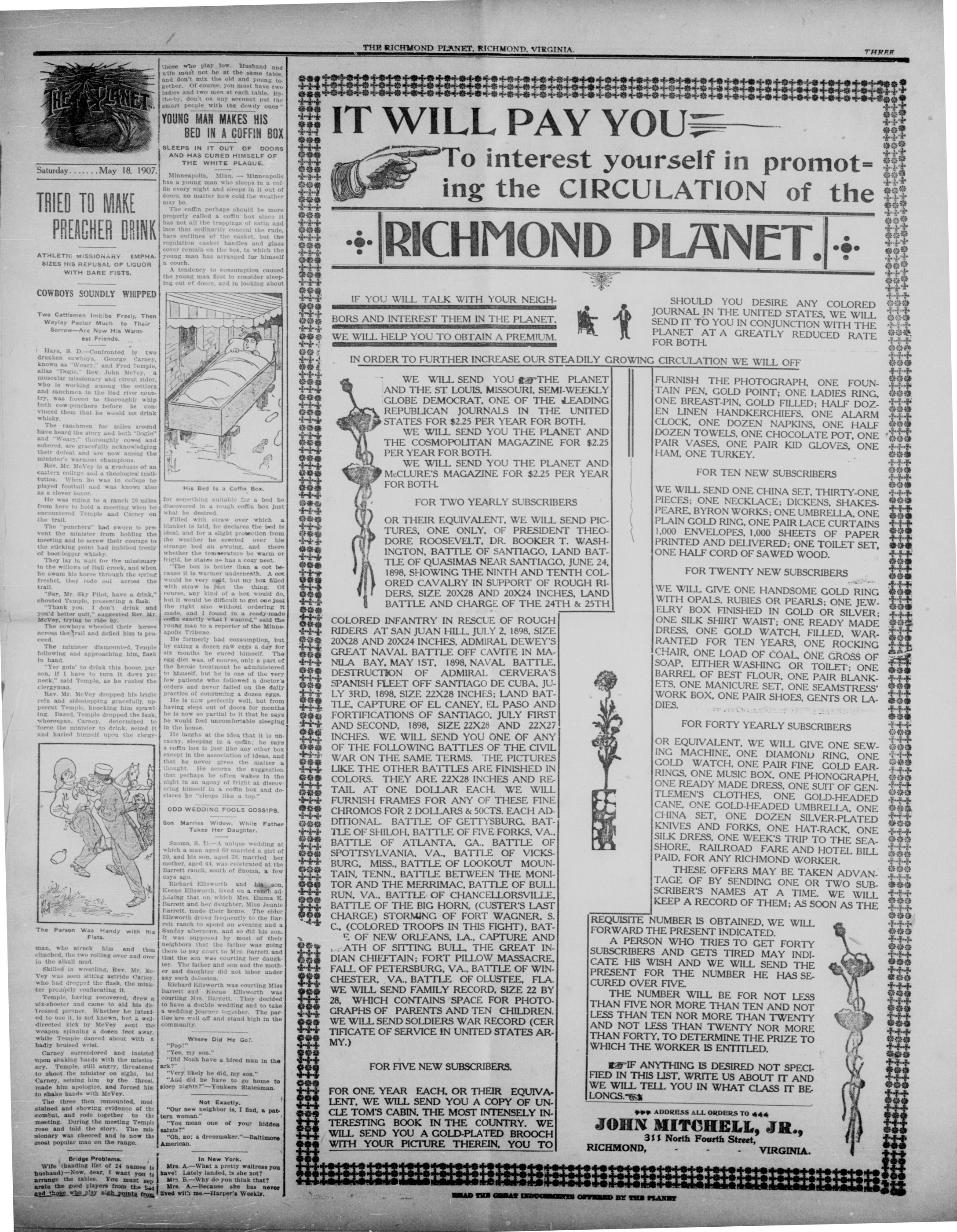
TRIED TO MAKE PREAGHER DRINK
ATHLETIC MISSIONARY EMPHA
SIZES HIS REFUSAL OF LIQUOR
WITH DARE FISTS.
COWBOYS SOUNDLY WHIPPED
Two Cattlemen Imbibe Freely, Then Waylay Pastor Much to Their Sorrow—Are Now His Warmest Friends.
Hays, S. D.—Confronted by two drunken cowboys, George Carney, known as "Weary," and Fred Temple, alias "Dogle," Rev. John McVey, a muscular missionary and circuit rider, who is working among the settlers and ranchmen in the Bad river country, was forced to thoroughly whip both cow-punchers before he convinced them that he would not drink whisky.
The ranchmen for miles around have heard the story and both "Dogie" and "Weary," thoroughly cowed and sobered, are gracefully acknowledging their defeat and are now among the minister's warmest champions.
Rev. Mr. McVey is a graduate of an eastern college and a theological institution. When he was in college he played football and was known also as a clever boxer.
He was riding to a ranch 20 miles from here to hold a meeting when he encountered Temple and Carney on the trail.
The "punchers" had sworn to prevent the minister from holding the meeting and to screw their courage to the sticking point had imbibed freely of boot-legged whisky.
They lay in wait for the missionary in the willows of Bull creek, and when he swam his horse through the spring freshet, they rode out across the trail.
"Say, Mr. Sky Pilot, have a drink," shouted Temple, presenting a flask.
"Thank you. I don't drink and you'd better quit," suggested Rev. Mr. McVey, trying to ride by.
The cowboys wheeled their horses across the trail and defied him to proceed.
The minister dismounted, Temple following and approaching him, flask in hand.
"Yer goin' to drink this booze, parson, if I have to turn it down yer neck," said Temple, as he rushed the clergyman.
Rev. Mr. McVey dropped his bridle rein and sidestepping gracefully, uppercut Temple, knocking him sprawling. Dazed, Temple dropped the flask, whereupon, Carney, determined to force the minister to drink, seized it and hurled himself upon the clergy.
M.
The Parson Was Handy with His Fists.
man, who struck him and then clinched, the two rolling over and over in the alkali mud.
Skilled in wrestling, Rev. Mr. McVey was soon sitting astride Carney, who had dropped the flask, the minister promptly confiscating it.
Temple, having recovered, drew a six-shooter and came to aid his distressed partner. Whether he intended to use it, is not known, but a well-directed kick by McVey sent the weapon spinning a dozen feet away, while Temple danced about with a badly bruised wrist.
Carney surrendered and insisted upon shaking hands with the missionary. Temple, still angry, threatened to shoot the minister on sight, but Carney, seizing him by the throat, made him apologize, and forced him to shake hands with McVey.
The three then remounted, mud-stained and showing evidence of the combat, and rode together to the meeting. During the meeting Temple rose and told the story. The missionary was cheered and is now the most popular man on the range.
Bridge Problems.
Wife (handing list of 24 names to husband)—Now, dear, I want you to arrange the tables. You must separate the good players from the bad and those who play high points from
those who play low. Husband and wife must not be at the same table, and don't mix the old and young together. Of course, you must have two ladies and two men at each table. By-the-by, don't on any account put the smart people with the dowdy ones."
BED IN A COFFIN BOX
SLEEPS IN IT OUT OF DOORS AND HAS CURED HIMSELF OF THE WHITE PLAGUE.
Minneapolis, Minn. — Minneapolis has a young man who sleeps in a coffin every night and sleeps in it out of doors, no matter how cold the weather may be.
The coffin perhaps should be more properly called a coffin box since it has not all the trappings of satin and lace that ordinarily conceal the rude, bare outlines of the casket, but the regulation casket handles and glass cover remain on the box, in which the young man has arranged for himself a couch.
A tendency to consumption caused the young man first to consider sleeping out of doors, and in looking about
A man is lying in a bed. He is covered with a blanket. The bed is elevated on stilts. There are snowflakes falling from the sky.
His Bed Is a Coffin Box.
for something suitable for a bed he
discovered in a rough coffin box just
what he desired.
Filled with straw over which
a blanket is laid, he declares the bed is
ideal, and for a slight protection from
the weather he erected over his
strange bed an avning, and there
whether the temperature be warm or
frigid, he states ne has a cozy nest.
"The box is better than a cot because it is warmer underneath. A cot
would be very cold, but my box filled
with straw is just the thing. Of
course, any kind of a box would do,
but it would be difficult to get one just
the right size without ordering it
made, and I found in a ready-made
coffin exactly what I wanted," said the
young man to a reporter of the Minneapolis Tribune.
He formerly had consumption, but by eating a dozen raw eggs a day for six months he cured himself. The egg diet was, of course, only a part of the heroic treatment he administered to himself, but he is one of the very few patients who followed a doctor's orders and never failed on the daily practice of consuming a dozen eggs. He is now perfectly well, but from having slept out of doors for months he is now so partial to it that he says he would feel uncomfortable sleeping in the house.
He laughs at the idea that it is uncanny, sleeping in a coffin; he says a coffin box is just like any other box except in the association of ideas, and that he never gives the matter a thought. He scorns the suggestion that perhaps he often wakes in the night in an agony of fright at discovering himself in a coffin box and declares he "sleeps like a top."
ODD WEDDING FOOLS GOSSIP9.
Son Marries Widow. While Father Takes Her Daughter.
Snoma, S. D.—A unique wedding at which a man aged 60 married a girl of 20, and his son, aged 38, married her mother, aged 44, was celebrated at the Barrett ranch, south of Snoma, a few days ago.
Richard Ellsworth and his son, Keene Ellsworth, lived on a ranch adjoining that on which Mrs. Emma E. Barrett and her daughter, Miss Jennie Barrett, made their home. The elder Ellsworth drove frequently to the Barrett ranch to spend an evening and a Sunday afternoon, and so did his son. It was supposed by most of their neighbors that the father was going there to pay court to Mrs. Barrett and that the son was courting her daughter. The father and son and the mother and daughter did not labor under any such delusion.
Richard Ellsworth was courting Miss Barrett and Keene Ellsworth was courting Mrs. Barrett. They decided to have a double wedding and to take a wedding journey together. The parties are well off and stand high in the community.
Where Did He Go?.
"Pop!"
"Yes, my son."
"Did Noah have a hired man in the ark?"
"Very likely he did, my son."
"And did he have to go home to sleep nights?" — Yonkers Statesman.
Not Exactly.
"Our new neighbor is, I find, a pattern woman."
"You mean one of your hidden saints?"
"Oh, no; a dressmaker."—Baltimore American.
In New York
Mrs. A.—What a pretty waitress you have! Lately landed, is she not?
Mrs. B.—Why do you think that?
Mrs. A.—Because she has never lived with me.—Harper's Weekly.
THE RICHMOND PLANET, RICHMOND, VIRGINIA
---
IT WILL PAY YOU
```markdown
```
IF YOU WILL
BORS AND INTER
WE WILL HELP YOU
IN ORDER TO
WE WILL SEND YOU AND THE ST. LOUIS, MISSOURI GLOBE DEMOCRAT, ONE REPUBLICAN JOURNALS STATES FOR $2.25 PER YEAR. WE WILL SEND YOU THE COSMOPOLITAN MAGAZINE PER YEAR FOR BOTH. WE WILL SEND YOU McCLURE'S MAGAZINE FOR BOTH.
FOR TWO YEARLY OR THEIR EQUIVALENT, TITURES, ONE ONLY, OF DORE ROOSEVELT, DR. INGTON, BATTLE OF SANTLE OF QUASIMAS NEAR 1898, SHOWING THE NINTH ORED CAVALRY IN SUPPORTS, SIZE 20X28 AND 20 BATTLE AND CHARGE ONLY.
ED INFANTRY IN RESCUE OF AT SAN JUAN HILL, JULY 2, AND 20X24 INCHES, ADMIRAL NAVAL BATTLE OFF CAVITTE BAY, MAY 1ST, 1898, NAVAL INDUCTION OF ADMIRAL CENTRAL FLEET OFF SANTIAGO DE ORO, 1898, SIZE 22X28 INCHES; LA CAPTURE OF EL CANEY, EL PUBLICATIONS OF SANTIAGO, JUNE SECOND, 1898, SIZE 22X28 INCHES; WITH FRAMES FOR ANY OF THE MISS FOR 2 DOLLARS & 50CTS. BATTLE OF GETTYSBURG, SHILOH, BATTLE OF FIVE FORCE OF ATLANTA, GA., BATTLE OF SYLVANIA, VA., BATTLE OF MISS., BATTLE OF LOOKOUT, PENN., BATTLE BETWEEN THE AND THE MERRIMAC, BATTLE OF VA., BATTLE OF CHANCELLOVE OF THE BIG HORN, (CUSTER) STORMING OF FORT WAR, COLORED TROOPS IN THIS FIGHT BY NEW ORLEANS, LA., CAPTURE OF SITTING BULL, THE GRANTHIEFTAIN; FORT PILLOW MARK OF PETERSBURG, VA., BATTLE, ER, VA., BATTLE OF OLUSTHELL SEND FAMILY RECORD, SIZETHICH CONTAINS SPACE FOR PARENTS AND TEN CHILDREN SEND SOLDIERS WAR RECORD OF SERVICE IN UNITED STATES.
IF YOU WILL TALK WITH YOUR NEIGH-
WE WILL HELP YOU TO OBTAIN A PREMIUM.
IN ORDER TO FURTHER INCREASE OUR STEADILY GROWING CIRCULATION WE WILL OFF
WE WILL SEND YOU THE PLANET AND THE ST LOUIS, MISSOURI, SEMI-WEEKLY GLOBE DEMOCRAT, ONE OF THE LEADING REPUBLICAN JOURNALS IN THE UNITED STATES FOR $2.25 PER YEAR FOR BOTH. WE WILL SEND YOU THE PLANET AND THE COSMOPOLITAN MAGAZINE FOR $2.25 PER YEAR FOR BOTH. WE WILL SEND YOU THE PLANET AND McCLURE'S MAGAZINE FOR $2.25 PER YEAR FOR BOTH.
OR THEIR EQUIVALENT, WE WILL SEND PICTURES, ONE ONLY, OF PRESIDENT THEODORE ROOSEVELT, DR. BOOKER T. WASHINGTON, BATTLE OF SANTIAGO, LAND BATTLE OF QUASIMAS NEAR SANTIAGO, JUNE 24, 1898, SHOWING THE NINTH AND TENTH COLORED CAVALRY IN SUPPORT OF ROUGH RIDERS, SIZE 20X28 AND 20X24 INCHES, LAND BATTLE AND CHARGE OF THE 24TH & 25TH
COLORED INFANT RIDERS AT SAN JUAN 20X28 AND 20X24 IN GREAT NAVAL BANILA BAY, MAY 1 DESTRUCTION OF SPANISH FLEET OLY 3RD, 1898, SIZE TLE, CAPTURE OF FORTIFICATIONS O AND SECOND, 1898 INCHES. WE WILL OF THE FOLLOWING WAR ON THE SAM LIKE THE OTHER COLORS. THEY A TAIL AT ONE D FURNISH FRAMES CHROMOS FOR 2 D DITIONAL. BATTLE TLE OF SHILOH, B BATTLE OF ATI SPOTTSYLVANIA, BURG, MISS., BATTAIN, TENN., BATTOR AND THE MEB RUN, VA., BATTLE BATTLE OF THE B CHARGE) STORM C., (COLORED TRO E OF NEW ORI LEATH OF SITTING DIAN CHIEFTAIN; FALL OF PETERSB CHESTER, VA., BA WE WILL SEND FA 28, WHICH CONT GRAPHS OF PARB WE WILL SEND SON TIFICATE OF SERV MY.)
COLORED INFANTRY IN RESCUE OF ROUGH RIDERS AT SAN JUAN HILL, JULY 2, 1898, SIZE 20X28 AND 20X24 INCHES, ADMIRAL DEWEY'S GREAT NAVAL BATTLE OFF CAVITE IN MANILA BAY, MAY 1ST, 1898, NAVAL BATTLE, DESTRUCTION OF ADMIRAL CERVERA'S SPANISH FLEET OFF SANTIAGO DE CUBA, JULY 3RD, 1898, SIZE 22X28 INCHES; LAND BATTLE, CAPTURE OF EL CANEY, EL PASO AND FORTIFICATIONS OF SANTIAGO, JULY FIRST AND SECOND, 1898, SIZE 22X28 AND 22X27 INCHES. WE WILL SEND YOU ONE OF ANY OF THE FOLLOWING BATTLES OF THE CIVIL WAR ON THE SAME TERMS. THE PICTURES LIKE THE OTHER BATTLES ARE FINISHED IN COLORS. THEY ARE 22X28 INCHES AND RETAIL AT ONE DOLLAR EACH. WE WILL FURNISH FRAMES FOR ANY OF THESE FINE CHROMOS FOR 2 DOLLARS & 50CTS. EACH ADDITIONAL. BATTLE OF GETTYSBURG, BATTLE OF SHILOH, BATTLE OF FIVE FORKS, VA., BATTLE OF ATLANTA, GA., BATTLE OF SPOTTSYLVANIA, VA., BATTLE OF VICKSBURG, MISS., BATTLE OF LOOKOUT MOUNTAIN, TENN., BATTLE BETWEEN THE MONITOR AND THE MERRIMAC, BATTLE OF BULL RUN, VA., BATTLE OF CHANCELLORSVILLE, BATTLE OF THE BIG HORN, (CUSTER'S LAST CHARGE) STORMING OF FORT WAGNER, S. C., (COLORED TROOPS IN THIS FIGHT), BAT-
E OF NEW ORLEANS, LA., CAPTURE AND
ATH OF SITTING BULL, THE GREAT INDIAN CHIEFTAIN; FORT PILLOW MASSACRE,
FALL OF PETERSBURG, VA., BATTLE OF WINCHESTER, VA., BATTLE OF OLUSTEE, FLA.
WE WILL SEND FAMILY RECORD, SIZE 22 BY
28, WHICH CONTAINS SPACE FOR PHOTOGRAPHS OF PARENTS AND TEN CHILDREN.
WE WILL SEND SOLDIERS WAR RECORD (CERTIFICATE OF SERVICE IN UNITED STATES ARMY.)
FOR FIVE NEW SUBSCRIBERS
FOR ONE YEAR B
LENT, WE WILL S
CLE TOM'S CABIN,
INTERESTING BOOK
WILL SEND YOU
WITH YOUR PICT
THE YEAR EACH, OR THEIR
WE WILL SEND YOU A COPY
HAM'S CABIN, THE MOST INTEN-
TING BOOK IN THE COUNTRY
END YOU A GOLD-PLATED I
YOUR PICTURE THEREIN, YE
FOR ONE YEAR EACH, OR THEIR EQUIVALENT, WE WILL SEND YOU A COPY OF UNCLE TOM'S CABIN, THE MOST INTENSELY INTERESTING BOOK IN THE COUNTRY. WE WILL SEND YOU A GOLD-PLATED BROOCH WITH YOUR PICTURE THEREIN, YOU TO
```markdown
```
To interest yourself in promoting the CIRCULATION of the
READ THE GREAT INDUCTIONS OFFERED BY THE PLANET
FOR TWO YEARLY SUBSCRIBERS
REQUISITE NUMBER IS OBTAINED, WE WILL FORWARD THE PRESENT INDICATED. A PERSON WHO TRIES TO GET FORTY SUBSCRIBERS AND GETS TIRED MAY INDICATE HIS WISH AND WE WILL SEND THE PRESENT FOR THE NUMBER HE HAS SECURED OVER FIVE. THE NUMBER WILL BE FOR NOT LESS THAN FIVE NOR MORE THAN TEN AND NOT LESS THAN TEN NOR MORE THAN TWENTY AND NOT LESS THAN TWENTY NOR MORE THAN FORTY, TO DETERMINE THE PRIZE TO WHICH THE WORKER IS ENTITLED.
IF ANYTHING IS DESIRED NOT SPECIFIED IN THIS LIST, WRITE US ABOUT IT AND WE WILL TELL YOU IN WHAT CLASS IT BE LONGS.
A
LANET
WEEKLY
READING
UNITED
H.
T AND
ER $2.25
T AND
YEAR
ND PIC
THEO-
WASH-
D BAT-
JUNE 24,
H COL-
UGH RI-
LAND
& 25TH
```markdown
```
REQUIST FORWAR
SHOULD YOU DESIRE ANY COLORED JOURNAL IN THE UNITED STATES, WE WILL SEND IT TO YOU IN CONJUNCTION WITH THE PLANET AT A GREATLY REDUCED RATE FOR BOTH.
FURNISH THE PHOTOGRAPH, ONE FOUNTAIN PEN, GOLD POINT; ONE LADIES RING, ONE BREAST-PIN, GOLD FILLED; HALF DOZEN LINEN HANDKERCHIEFS, ONE ALARM CLOCK, ONE DOZEN NAPKINS, ONE HALF DOZEN TOWELS, ONE CHOCOLATE POT, ONE PAIR VASES, ONE PAIR KID GLOVES, ONE HAM, ONE TURKEY.
WE WILL SEND ONE CHINA SET, THIRTY-ONE PIECES; ONE NECKLACE; DICKENS, SHAKESPEARE, BYRON WORKS; ONE UMBRELLA, ONE PLAIN GOLD RING, ONE PAIR LACE CURTAINS 1,000 ENVELOPES, 1,000 SHEETS OF PAPER PRINTED AND DELIVERED; ONE TOILET SET, ONE HALF CORD OF SAWED WOOD.
FOR TWENTY NEW SUBSCRIBERS
WE WILL GIVE ONE HANDSOME GOLD RING WITH OPALS, RUBIES OR PEARLS; ONE JEWELRY BOX FINISHED IN GOLD OR SILVER; ONE SILK SHIRT WAIST; ONE READY MADE DRESS, ONE GOLD WATCH, FILLED, WARRANTED FOR TEN YEARS, ONE ROCKING CHAIR, ONE LOAD OF COAL, ONE GROSS OF SOAP, EITHER WASHING OR TOILET; ONE BARREL OF BEST FLOUR, ONE PAIR BLANKETS, ONE MANICURE SET, ONE SEAMSTRESS' WORK BOX, ONE PAIR SHOES, GENTS OR LADIES.
FOR FORTY YEARLY SUBSCRIBERS
OR EQUIVALENT, WE WILL GIVE ONE SEWING MACHINE, ONE DIAMOND RING, ONE GOLD WATCH, ONE PAIR FINE GOLD EARRINGS, ONE MUSIC BOX, ONE PHONOGRAPH, ONE READY MADE DRESS, ONE SUIT OF GENTLEMEN'S CLOTHES, ONE GOLD-HEADED CANE, ONE GOLD-HEADED UMBRELLA, ONE CHINA SET, ONE DOZEN SILVER-PLATED KNIVES AND FORKS, ONE HAT-RACK, ONE SILK DRESS, ONE WEEK'S TRIP TO THE SEASHORE, RAILROAD FARE AND HOTEL BILL PAID, FOR ANY RICHMOND WORKER. THESE OFFERS MAY BE TAKEN ADVANTAGE OF BY SENDING ONE OR TWO SUBSCRIBER'S NAMES AT A TIME. WE WILL KEEP A RECORD OF THEM; AS SOON AS THE
FOR TEN NEW SUBSCRIBERS
THREE
not= the
COLORED WE WILL WITH THE RED RATE
ONE FOUNDEDIES RING, HALF DOZZEN ALARM ONE HALF POT, ONE MOVES, ONE
BERS
SHIRTY-ONE ISS, SHAKESPELLA, ONE CURTAINS OF PAPER BOILET SET, D.
BERS
GOLD RING; ONE JEWELDR SILVER; ADY MADELED, WARD, ROCKING GROSS OF DILET; ONE AIR BLANKAMSTRESS'DENTS OR LA-
BERS
ONE SEW-RING, ONE GOLD EAR-NOGRAPH, MIT OF GEN-ED-HEADED SELLA, ONE MER-PLATED RACK, ONE AND THE SEA-MOTEL BILL BER.
EN ADVAN-TWO SUB- WE WILL ON AS THE
```markdown
```
```markdown
```
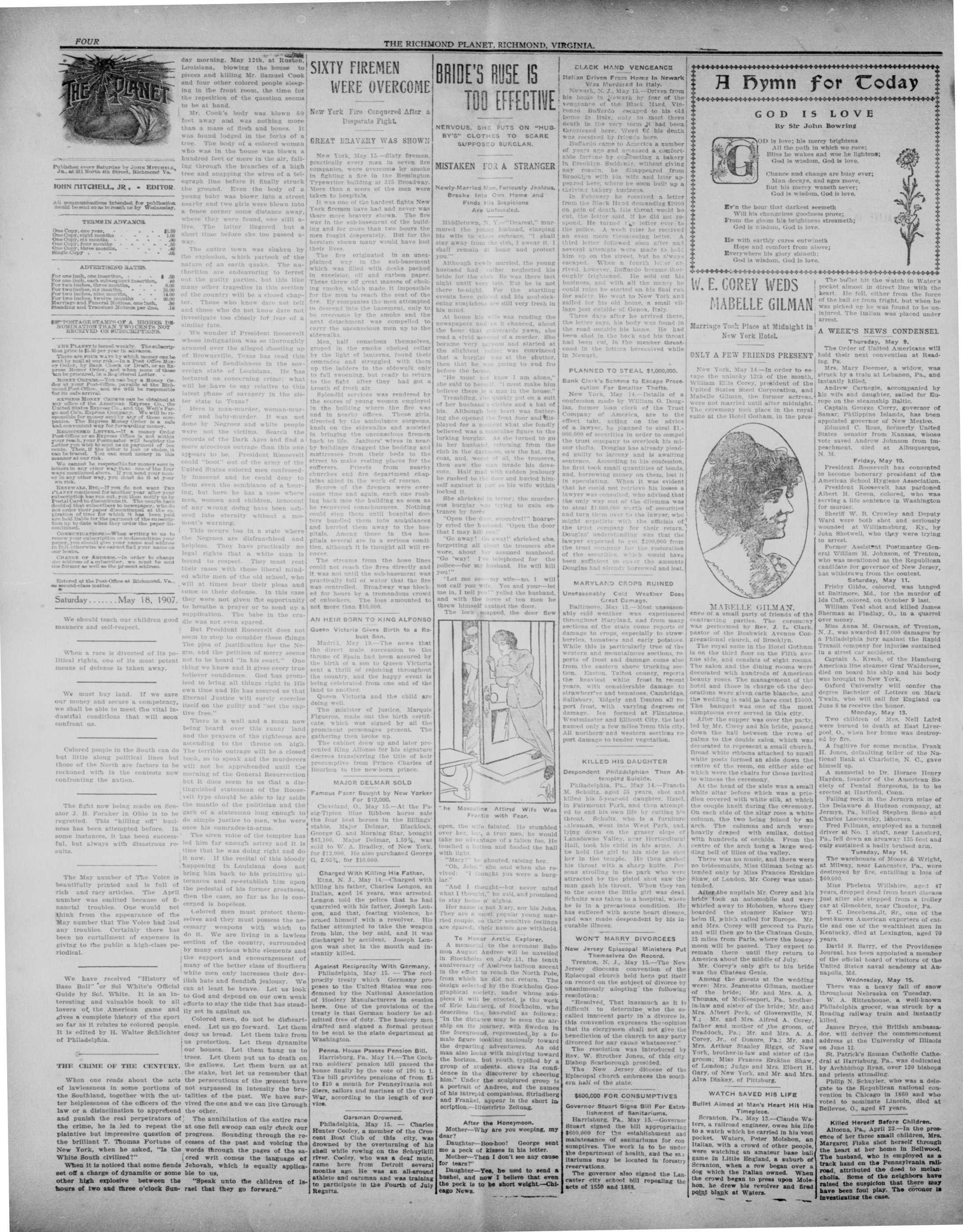
THE PLANET
Published every Saturday by JOHN MITCHELL,
JR., at 311 Nortn 4th Street, Richmond Va.
JOHN MITCHELL, JR. - EDITOR.
All communications intended for publication
should be sent so as to reach us by Wednesday.
TERMS IN ADVANCE
One Copy, one year, $1.50
One Copy, six months, 1.00
One Copy, six months, 1.00
One Copy, four months, 50
One Copy, three months, 50
Single Copy, 0.05
ADVERTISING RATER
For one inch, one insertion, $50
For one inch, each subsequent insertion, $40
For two inches, three months, $6.00
For two inches, six months, $10.00
For two inches, nine months, $14.00
For two inches, twelve months $80.00
Marriage and Funeral Notice, one inch, $50
Standing and Transient Notice per line, $10
POSTAGE STAMPS OF A HIGHER DE-
NOMINATION THAN TWO CENTS NOT
RECEIVED ON SUBSCRIPTIONS.
THE PLANET is issued weekly. The subscription price is $1.50 per year in advance.
There are FOUR ways by which money can be sent by mail at our market.—In a Post Office Money Order, by Bank Check or Draft, or an Excharge.—In a Post Office Money Order, and we will be responsible for can be procured, in a Registered Letter. MONEY ORDERS.—You can buy a Money Order at your Post-Office, payable at the Richmond Post-Office, and we will be responsible for EXPRESS MONEY ORDERS can be obtained at any office of the American Express Co., the United States Express Co., and the Well Fargo and Coke Express Company. We will be responsible for the delivery of these companies. The Express Money Order is a convenient way for forwarding money. REGISTERED LETTER.—If a money Order Post-Office or an Express Company is not within the United States Express Company, the Express Money Order is a convenient way for sending on payment of ten cents. Then, if the letter is lost or stolen, it can be traced. You can send money in this way. You letter wish us on payment of ten cents. We cannot be responsible for money sent in letters in any other way than one of the four ways mentioned above. If you send your money in any other way, you must do it at your
RENWALK, ETC.—If you do not want THE PLANET continued for another year after your subscription has run out, you then notify in by Formal Q&A to discontinue it. The company has decided that subscribers to newspaper, who do not order their paper discontinued at the expiration of time for which it has been paid, be eligible for the payment of the subscription up to date when they order the paper discontinued.
COMMUNICATIONS—When writing to us to renew our subscription or to discontinue your payment, you should give your name and address in full otherwise we cannot find your name on our books.
ADDRESS—In order to change the address of a subscriber, we must be sent the former as well as the present address.
Entered at the Post-Office at Richmond, Va., as second-class matter.
Saturday.....May 18, 1907.
We should teach our children good manners and self-respect.
When a race is divested of its political rights, one of its most potent means of defense is taken away.
We must buy land. If we save our money and secure a competency, we shall be able to meet the vital Industrial conditions that will soon confront us.
Colored people in the South can do but little along political lines but those of the North are factors to be reckoned with in the contests now confronting the nation.
The flight now being made on Senator J. B. Foraker in Ohio is to be regretted. This "killing off" business has been attempted before. In some instances, it has been successful, but always with disastrous results.
The May number of The Voice is beautifully printed and is full of rich and racy articles. The April number was omitted because of financial troubles. One would not think from the appearance of the May number that The Voice had had any troubles. Certainly there has been no curtailment of expenses in giving to the public a high-class periodical.
We have received "History of Base Ball" or Sol White's Official Guide by Sol White. It is an interesting and valuable book to all lovers of the American game and gives a complete history of the sport so far as it relates to colored people. It is edited by H. Walter Schlchter of Philadelphia.
THE CRIME OF THE CENTURY.
When one reads about the acts of lawlessness in some portions of the Southland, together with the utter helplessness of the officers of the law or a disinclination to apprehend and punish the real perpetrators of the crime, he is led to repeat the plaintive but impressive question of the brilliant T. Thomas Fortune of New York, when he asked, "Is the White South civilized?" When it is noticed that some fiends set off a charge of dynamite or some other high explosive between the hours of two and three o'clock Sun-
day morning, May 12th, at Ruston, Louisiana, blowing the house to pieces and killing Mr. Samuel Cook and four other colored people sleeping in the front room, the time for the repetition of the question seems to be at hand.
Mr. Cook's body was blown 80 feet away and was nothing more than a mass of flesh and bones. It was found lodged in the forks of a tree. The body of a colored woman who was in the house was blown a hundred feet or more in the air, falling through the branches of a high tree and snapping the wires of a telegraph line before it finally struck the ground. Even the body of a young baby was blown into a street nearby and two girls were blown into a fence corner some distance away, where they were found, one still alive. The latter lingered but a short time before she too passed away.
The entire town was shaken by the explosion, which partook of the nature of an earth quake. The authorities are endeavoring to ferret out the guilty parties, but this like many other tragedies in this section of the country will be a closed chapter. Those who know dare not tell and those who do not know dare not investigate too closely for fear of a similar fate. We wonder if President Roosevelt whose indignation was so thoroughly aroused over the alleged shooting up of Brownsville, Texas has read this account of flendishness in the sovereign state of Louisiana. He has lectured us concerning crime; what will he have to say relative to this latest phase of savagery in the sister state to Texas?
Here is man-murder, woman-murder and baby-murder. It was not done by Negroes and white people were not the victims. Search the records of the Dark Ages and find a more atrocious outrage than this one appears to be. President Roosevelt could "boot" out of the army of the United States colored men confessedly innocent and he could deny to them even the semblance of a hearing, but here he has a case where men, women and children, innocent of any wrong doing have been ushered into eternity without a moment's warning.
This occurs too in a state where the Negroes are disfranchised and helpless. They have practically no legal rights that a white man is bound to respect. They must rest their cases with those liberal minded white men of the old school, who will at times hear their pleas and come to their defense. In this case they were not given the opportunity to breathe a prayer or to send up a supplication. The babe in the cradle was not even spared.
But President Roosevelt does not seem to stop to consider these things The plea of justification for the Negro, and the petition of mercy seems not to be heard "in his court." One thing we know and it gives every true believer confidence. God has promised to bring all things right in His own time and He has assured us that Eternal Justice will surely exercise itself on the guilty and "set the captive free."
There is a wall and a moan now being heard over this sunny land and the prayers of the righteous are ascending to the throne on alm. The terrible outrage will be a closed book, so to speak and the murderers will not be apprehended until the morning of the General Resurrection but it does seem to us that a distinguished statesman of the Roosevelt type should be able to lay aside the mantle of the politician and the garb of a statesman long enough to do simple justice to men, who were once his comrades-in-arms.
The siren voice of the temper has led him far enough astray and it is time that he was doing right and do it now. If the recital of this bloody happening in Louisiana does not bring him back to his primitive utterances and re-establish him upon the pedestal of his former greatness, then the case, so far as he is concerned is hopeless.
Colored men must protect themselves and they must possess the necessary weapons with which to do it. We are living in a lawless section of the country, surrounded by many envious white elements and the support and encouragement of many of the better class of Southern white men only increases their devilish hate and flendish jealousy. We can at least be brave. Let us look to God and depend on our own weak efforts to stay the tide that has steadily set in against us.
Colored men, do not be disheartened. Let us go forward. Let them deny us bread. Let them take from us protection. Let them dynamite our houses. Let them hang us to trees. Let them put us to death on the gallows. Let them burn us at the stake, but let us remember that the persecutions of the present have not surpassed in intensity the brutalities of the past. We have survived the one and we can live through the other.
The annihilation of the entire race at one fell swoop can only check our progress. Sounding through the recesses of the past and voicing the words through the pages of the sacred writ comes the language of
and write the language of Jehovah, which is equally applicable to us,
"Speak unto the children of Israel that they go forward."
THE RICHMOND PLANET. RICHMOND. VIRGINIA
SIXTY FIREMEN WERE OVERCOME
New York Fire Conquered After a Desperate Fight.
GREAT BRAVERY WAS SHOWN
New York, May 15.—Sixty firemen, practically every man in seven fire companies, were overcome by smoke in fighting a fire in the Remington Typewriter building at 225 Broadway. More than a score of the men were taken to hospitals.
It was one of the hardest fights New York firemen have had and never was there more bravery shown. The fire was in the sub-basement of the building and for more than two hours the men fought desperately. But for the heroism shown many would have lost their lives.
The fire originated in an unexplained way in the sub-basement which was filled with desks packed in excelsior, oil and carbon paper. These throw off great masses of choking smoke, which made it impossible for the men to reach the seat of the fire. By companies the men attempted to descend into the basement, only to be overcome by the smoke and the next detachment was compelled to carry the unconscious men up to the sidewalks.
Men, half conscious themselves, groped in the smoke choked cellar by the light of lanterns, found their comrades and struggled with them up the ladders to the sidewalk only to fall swooning, but ready to return to the fight after they had got a breath of fresh air.
Splendid services was rendered by the scores of young women employed in the building where the fire was and in nearby offices. These girls, directed by the ambulance surgeons, knelt on the sidewalks and assisted in bringing the unconscious firemen back to life. Janitors' wives in nearby buildings dragged the bedding and mattresses from their beds to the street to make resting places for the sufferers. Priests from nearby churches and fire department chapels added in the work of rescue. Scores of the firemen were overcome time and again, each one rushing back into the building as soon as he recovered consciousness. Nothing could stop them until hospital doctors bundled them into ambulances and hurried them away to the hospitals. Among those in the hospitals several are in a serious condition, although it is thought all will recover.
The streams from the hose lines could not reach the fires directly and it was not until the sub-basement was practically full of water that the fire was controlled. Broadway was blocked for hours by a tremendous crowd of onlookers. The loss amounted to not more than $10,000.
AN HEIR BORN TO KING ALFONSO
Queen Victoria Gives Birth to a Robust Son.
Madrid, May 10.—The news that the direct male succession to the throne of Spain had been assured by the birth of a son to Queen Victoria sent a thrill of rejoicing throughout the country, and the happy event is being celebrated from one end of the land to another.
Queen Victoria and the child are doing well.
The minister of justice, Marquis Figueroa, made out the birth certificate, which was signed by all the prominent personages present. The gathering then broke up. The cabinet drew up and later presented King Alfonso for his signature decrees transferring the title of heir presumptive from Prince Charles of Bourbon to the new-born prince.
MAJOR DELMAR SOLD
Famous Pacer Bought by New Yorker
For $12,000.
Cleveland, O., May 15.—At the Fasig-Tipton Blue Ribbon horse sale the four best horses in the Billings' stable, Major Delmar, Blacklock, George G. and Morning Star, brought $43,100. Major Delmar, 1.59%, was sold to W. A. Bradley, of New York, for $12,000. He also purchased George G, 2.05%, for $10,000.
Charged With Killing His Father.
Etna, N. J., May 14.—Charged with killing his father, Charles Longon, an Italian, aged 16 years, was arrested. Longon told the police that he had quarreled with his father, Joseph Longon, and that, fearing violence, he armed himself with a revolver. His father attempted to take the weapon from him, the boy said, and it was discharged by accident. Joseph Longon was shot in the mouth and instantly killed.
Against Reciprocity With Germany.
Philadelphia, May 15. — The reciprocity treaty which Germany proposes to the United States was condemned by the National Association of Hosiery Manufacturers in session here. One of the provisions of the treaty is that German hosiery be admitted free of duty. The hosiery men drafted and signed a formal protest to be sent to the state department at Washington.
Penna. House Passes Pension Bill.
Harrisburg, Pa., May 14. — The Cochran soldiers' pension bill passed the house finally by the vote of 196 to 1. The bill provides pensions of from $5 to $10 a month for Pennsylvania soldiers, sailors and marines of the Civil War, according to the length of service.
Oarsman Drowned
Philadelphia. May 15. — Charles Hunter Cooley, a member of the Crescent Boat Club of this city, was drowned by the overturning of his shell while rowing on the Schuylkill river. Cooley, who was a deaf mute, came here from Detroit several months ago. He was an all-around athlete and oarsman and was training to participate in the Fourth of July Regatta.
BRIDE'S RUSE IS TOO EFFECTIVE
NERVOUS, SHE PUTS ON "HUB BY'S" CLOTHES TO SCARE SUPPOSED BURGLAR.
MISTAKEN FOR A STRANGER
Newly-Married Man, Furiously Jealous,
Breaks Into Own Home and
Finds His Suspicions
Are Unfounded.
Middletown, N. Y.—"Dearest," murmured the young husband, clasping his wife in close embrace, "I shall stay away from the club, I swear it. I shall remain at home and protect you."
Although newly married, the young husband had rather neglected his bride for the club. He was there last night until very late. But he is not there to-night. For the startling events here related and his soul-sickening suspicions are still very fresh in his mind.
At home his wife was reading the newspapers and as it chanced, about the hour that graveyards yawn, she read a vivid account of a murder. She became very nervous and started at the slightest noise; was convinced that a burglar was at the shutter, then that he was pacing to end fro before the house.
"He must not know I am alone," she said to herself. "I must make him believe there is a man in the house." Trembling, she quickly put on a suit of her husband's clothes and a hat of his. Although her heart was fluttering she opened the front door and displayed for a moment what she fondly believed was a masculine figure to the lurking burglar. As she turned to go in her husband, returning from the club in the darkness, saw the hat, the coat, and, worst of all, the trousers, then saw the man invade his dovocote. Half mad with sudden jealousy he rushed to the door and hurled himself against it just as his wife within locked it.
She shrieked in terror; the murderous burglar was trying to gain entrance by force
"Open the door, scoundrel!" hoarsely cried the husband. "Open the door that I may kill you!"
"Go away! Go away! shrieked she, forgetting all about the trousers she wore, about her assumed manhood. "Go 'way! I've telephoned for the police—for my husband. He will kill you!" "Let me see—my wife—no, I will not call you wife. You and your—let me in, I tell you!" yelled the husband, and with the force of ten men he threw himself against the door.
The lock snapped, the door flew
J
The Masculine Attired Wife Was Frantic with Fear.
open, the wife fainted. He stumbled over her, but, a true man, he would take no advantage of a fallen foe. He touched a button and flooded the hall with light.
"Mary!" he shouted, raising her.
"Oh, John," she said when she revived: "I thought you were a burglar."
"And I thought—but never mind what I thought," he said, and promised to stay home o' nights.
Her name is not Mary, nor his John. They are a most popular young married couple, so their sensitive feelings are spared; their names are withheld.
To Honor Arctic Explorers
10 Honor Arctic Explorer.
A memorial to the aeronaut Salomon August Andree will be unveiled in Stockholm on July 11, the tenth anniversary of Andrees balloon ascent in the effort to reach the North Pole, from which he did not return. The design selected by the Stockholm Geographical society, under whose auspices it will be erected, is the work of Eric Lindberg, of Stockholm, who describes the bas-relief as follows: "In the distance may be seen the airship on its journey, with Sweden in the foreground, represented, by a female figure looking anxiously toward the departing adventurers. An old man also looks with misgiving toward the horizon, but youth, typified by a group of students, shows its confidence in the discoverer by cheering him." Under the sculptured group is a portrait of Andree, and the names of his intrepid companions, Strindberg and Frankel, appear in the short inscription.—Illustrate Zeitung.
After the Honeymoon
Mother—Why are you weeping, my dear?
Daughter—Boo-hoo! George sent me a peck of kisses in his letter.
Mother—Then I don't see any cause for tears?"
Daughter—Yes, he used to send a bushel, and now I believe that even the peck is to be short weight.—Chicago News.
BLACK HAND VENGEANCE
Italian Driven From Homes in Newark
Was Murdered in Italy
Newark, N. J., May 15.—Driven from his home in Newark by fear of the vengeance of the Black Hard, Vincenzo Buffardo escaped to his old home in Italy, only to meet there death in the very form it had been threatened here. Word of his death was received by friends here. Buffardo came to America a number of years ago and amassed a comfortable fortune by conducting a bakery in Brooklyn. Suddenly, without giving any reason, he disappeared from Brooklyn with his wife and later appeared here, where he soon built up a thriving bakery business.
In February he received a letter from the Black Haze demanding $2000 on pain of death. His throat would be cut, the letter said, if he did not respond. He turned the letter over to the police. A week later he received an even more threatening letter. A third letter followed soon after and several attempts were made to hold him up on the street, but he always escaped. When a fourth letter arrived, however, Buffalo became thoroughly frightened. He sold out his business, and with all the money he could raise he started on his final run for safety. He went to New York and sailed for his old home, a small village just outside of Genoa, Italy. Three days after he arrived there, the letter says, his body was found in the road outside his house. He had been shot in the back and his throat had been cut, in the manner threatened in the letters hereceived while in Newark.
PLANNED TO STEAL $1,000,000
Bank Clerk's Scheme to Escape Proce
cution. For Smaller Thieves.
New York, May 14—Details of a confession made by William O. Douglas, former loan clerk of the Trust Company of America, are to the effect taht, acting on the advice of a lawyer, he planned to steal $1,000,000 of securities in order to compel the trust company to overlook his minor thefts. Douglas has already pleaded guilty to larceny and is awaiting sentence. According to his confession, he first took small quantities of bonds, and, borrowing money on them, lost it in speculating. When it was evident that he could not retrieve his losses a lawyer was consulted, who advised that the only way out of the dilemma was to steal $1,000,000 worth of securities and turn them over to the lawyer, who might negotiate with the officials of the trust company for their return. Douglas's understanding was that the lawyer expected to get $200,000 from the trust company for the restoration of the securities, which would have been sufficient to cover the amounts Douglas had already borrowed and lost.
MARYLAND CROPS BUINED
Unseasonably Cold Weather Does Great Damage.
Baltimore, May 13.—Most unseasonably cold weather was experienced throughout Maryland, and from many sections of the state come reports of damage to crops, especially to strawberries, tomatoes and early potatoes. While this is particularly true of the western and mountainous sections, reports of frost and damage come also from the eastern shore trucking section. Easton, Talbot county, reports the heaviest while frost in recent years, with considerable damage to strawberries and tomatoes. Cambridge, Salisbury, Ridgely and Denton all report frost, with varying degrees of damage. Ice formed at Flintstone, Westminster and Elliott City, the last named only a few miles from this city. All northern and western sections report damage to tender vegetation.
KILLED HIS DAUGHTER
Despondent Philadelphia Then Attempted Suicide.
Philadelphia, Pa., May 14—Francis M. Schultz, aged 55 years, shot and killed his 5-year-old daughter, Hazel, in Fairmount Park, and then attempted to end his own life by cutting his throat. Schultz, who is a furniture salesman, went into West Park, and, lying down on the grassy slope of Lansdowne Valley, near Horticultural Hall, took his child in his arms. As he held the girl to his side he shot her in the temple. He then gashed his throat with a sharp knife. Persons strolling in the park who were attracted by the pistol shot saw the man gash his throat. When they ran to the scene the little girl was dead. Schultz was taken to a hospital, where he is in a precarious condition. He has suffered with acute heart disease and was made despondent by his incurable illness.
WON'T MARRY DIVORCEES
New Jersey Episcopal Ministers Put
Themselves On Record
Trenton, N. J., May 15.—The New Jersey diocesan convention of the Episcopal church held here put itself on record on the subject of divorce by unanimously adopting the following resolution:
"Resolved, That inasmuch as it is difficult to determine who the so-called innocent party in a divorce is, this convention expresses the opinion that its clergymen shall not give the benediction of the church to any party divorced for any cause whatsoever."
The resolution was introduced by Rev. W. Strother Jones, of this city. Bishop Scarborough presided.
The New Jersey diocese of the Episcopal church embraces the southern half of the state.
$600,000 FOR CONSUMPTIVES
Governor Stuart Signs Bill For Estab
lishment of Sanitariums
Harrisburg, Pa. May 15.—Governor Stuart signed the bill appropriating $600,000 for the establishment and maintenance of sanitariums for consumptives. The work is to be under the department of health, and the sanitariums may be located in forestry reservations. The governor also signed the Lancaster city school bill repealing the acts of 1850 and 1868.
A Hymn for Today
GOD IS LOVE
By Shr John Bowring
GOD is love; his mercy brightens
All the path in which we rove;
Bliss he wakes and woe he lightens;
God is wisdom, God is love.
Chance and change are busy ever;
Man decays, and ages move.
But his mercy waneth never;
God is wisdom, God is love.
Ev'n the hour that darkest seemeth
Will his changeless goodness prove;
From the gloom his brightness streameth;
God is wisdom, God is love.
W. E. COREY WEDS MABELLE GILMAN The ballet hit the watch in Water's pocket almost in direct line with the heart. He fell, either from the force of the ball or from fright, but when he was picked up he was found to be uninjured. The Italian was placed under arrest.
A WEEK'S NEWS CONDENSEL
The Order of United Americans will hold their next convention at Reading, Pa.
Mrs. Mary Deemer, a widow, was struck by a train at Lebanon, Pa., and instantly killed.
Andrew Carnegie, accompanied by his wife and daughter, sailed for Europe on the steamship Baltic.
Captain George Curry, governor of Samar, Phillipine Islands, has been appointed governor of New Mexico.
Edmund C. Ross, formerly United States senator from Kansas, whose vote saved Andrew Johnson from impeachment, died at Albuquerque, N. M.
Friday, May 10.
President Roosevelt has consented to become honorary president of the American School Hygiene Association.
President Roosevelt has pardoned Albert M. Green, colored, who was serving a life sentence in Washington for murder.
Sheriff W. B. Crowley and Deputy Ward were both shot and seriously wounded at Williamsburg, Ky., by John Shotwell, who they were trying to arrest.
Former Assistant Postmaster General William M. Johnson, of Trenton, who was mentioned as the Republican candidate for governor of New Jersey, has withdrawn from the contest.
Saturday, May 11.
Frisby Gibbs, colored, was hanged at Baltimore, Md., for the murder of Ida Cuff, colored, on October 9 last.
William Teal shot and killed James Sherman at Findlay, O., in a quarrel over money.
Miss Anna M. Garman, of Trenton, N. J., was awarded $17,000 damages by a Philadelphia jury against the Rapid Transit company for injuries sustained in a street car accident.
Captain A. Krech, of the Hamburg American line steamer Graf Waldersee, died on board his ship and his body was brought to New York.
Oxford University will confer the degree Bachelor of Letters on Mark Twain, who will sail for England on June 8 to receive the honor.
Monday, May 13.
Two children of Mrs. Nell Laird were burned to death at East Liverpool, O., when her home was destroyed by fire.
A fugitive for some months, Frank H. Jones, defaulting teller of the National Bank at Charlotte, N. C., gave himself up.
A memorial to Dr. Horace Henry Hayden, founder of the American Society of Dental Surgeons, is to be erected at Hartford, Conn.
Falling rock in the Jermyn mine of the Delaware & Hudson company, at Jermyn, Pa., killed Stephen Seno and Charles Lascowsky, laborers.
Fred Follman, employed as a tunnel driver at No. 1 shaft, near Lansford, Pa., fell down an areaway 135 feet and only sustained a badly brushed arm.
The warehouses of Moore & Wright,
at Milway, near Lancaster, Pa., were
destroyed by fire, entailing a loss of
$60,000.
Miss Phelena Willshire, aged 47
years, dropped dead from heart disease
just after she stepped from a trolley
car at Glenolden, near Chester, Pa.
T. C. Deceenhaelt, Sr., one of the
best-known American exporters of cattle
and one of the wealthiest men in
Kentucky, died at Lexington, aged 70
years.
David S. Barry, of the Providence
Journal, has been appointed a member
of the official board of visitors of
the United States naval academy at
Annapolis, Md.
Wednesday, May 15.
There was a heavy fall of snow
through Nebraska on Tuesday.
W. A. Rittenhouse, a well-known Philadelphia grocer, was struck by a Reading railway train and instantly killed.
James Bryce, the British ambassador, will deliver the commencement address at the University of Illinois on June 12.
St. Patrick's Roman Catholic Cathedral at Harrisburg, Pa., was dedicated by Archbishop Ryan, over 130 bishops and priests attending.
Phillip N. Schuyler, who was a delegate to the Republican national convention in Chicago in 1860 and who voted to nominate Lincoln, died at Bellevue, O., aged 87 years.
Killed Herself Before Children.
Altoona, Pa., April 23—In the presence of her three small children, Mrs. Margaret Fiske shot herself through the heart at her home in Bellwood. The husband, who is employed as a track hand on the Pennsylvania railroad, attributed the deed to melancholia. Some of the neighbors have raised the suspicion that there may have been foul play. The coroner is investigating the case.
G
He with earthy caves entwineh
Hope and comfort from above;
Everywhere his glory shineth:
God is wisdom. God is love.
W. E. COREY WEDS
MABELLE GILMAN
Marriage Took Place at Midnight in New York Hotel
ONLY A FEW FRIENDS PRESENT
New York, May 14—In order to escape the unlucky 13th of the month, William Ellis Corey, president of the United States Steel Corporation, and Mabelle Gliman, the former actress, were not married until after midnight. The ceremony took place in the royal suite at the Hotel Gotham, in the press
A.
ence of a small party of friends of the contracting parties. The ceremony was performed by Rev. J. L. Clark, pastor of the Bushwick Avenue Congregational church, of Brooklyn. The royal suite in the Hotel Gotham is on the third floor on the Fifth avenue side, and consists of eight rooms. The salon and the dining rooms were decorated with hundreds of American beauty roses. The management of the hotel and those in charge of the decorations were given carte blanche, and the wedding is said to have cost $5000. The banquet was one of the most sumptuous ever served in this city. After the supper was over the party, led by Mr. Corey and his bride, passed down the hall between the rows of palms to the double salon, which was decorated to represent a small church. Broad white ribbons attached to small white posts formed an aisle down the centre of the room, on either side of which were the chairs for those invited to witness the ceremony.
At the head of the aisle was a small white altar before which was a priedieu covered with white silk, at which the couple knelt during the ceremony. On each side of the altar rose a white column, the two being joined by an arch. The columns and arch were heavily draped with similac, dotted with hundreds of orchids. From the centre of the arch hung a large wedding bell of lilies of the valley. There was no music, and there were no bridesmaids. Miss Gilman being attended only by Miss Frances Erskine Shaw, of London. Mr. Corey was unattended.
After the nuptials Mr. Corey and his bride took an automobile and were whirled away to Hoboken, where they boarded the steamer Kaiser Wilhelm II, which sailed for Europe. Mr. and Mrs. Corey will proceed to Paris and will then go to the Chateau Genis, 25 miles from Paris, where the honeymoon will be passed. They expect to remain there until they return to America about the middle of July. Mr. Corey's only gift to his bride was the Chateau Genis.
Among the guests at the wedding were: Mrs. Jeannette Gliman, mother of the bride; Mr. and Mrs. A. A. Thomas, of McKeesport, Pa., brother-in-law and sister of the bride; Mr. and Mrs. Albert Peck, of Gloversville, N. Y.; Mr. and Mrs. Alfred A. Corey, father and mother of the groom, of Braddock, Pa.; Mr. and Mrs. A. A. Corey, Jr., of Donore, Pa.; Mr. and Mrs. Arthur Stanley Riggs, of New York, brother-in-law and sister of the groom; Mrs Frances Erskine Shaw, of London; Judge and Mrs. Elbert H. Gary, of New York, and Mr. and Mrs. Alva Dinkey, of Pittsburg.
WATCH SAVED HIS LIFE
Bullet Alimed at Man's Heart Hit His Timepiece.
Scranton, Pa., May 13.—Claude Waters, a railroad engineer, owes his life to a watch which he carried in his vest pocket. Waters, Peter Molehon, an Italian, with a crowd of other people, were watching an amateur base ball game in Little England, a suburb of Scranton, when a row began over a dog which the Italian owned. When the crowd began to press upon Molehon, he drew his revolver and fired point blank at Waters.
Thursday, May 9.
Friday, May 10.
Tuesday, May 14.
Wednesday. May 15.
THE PLANET
RAGPICKER BURIES HIS
WIFE ALIVE IN WOODS
WOMAN IS ACCIDENTALLY DISCOVERED AFTER SUFFERING TERRIBLE EXPERIENCE.
Parls.—An old woman was found practically buried alive in a wood on the outskirts of Versailles the other day. She is the wife of a rapgier who lived in a hut on the border of the woods. Nobody had seen his wife for the last two years, but a couple of forest guards, while walking through the woods, were startled by hearing a moaning sound, apparently from some dry brushwood almost under their feet.
Pushing aside the brushwood they saw looking out of a hole in the ground the face of an old woman.
A
Nothing But Her Head Was Visible.
They found that she was buried in the hole, the entrance to which was less than two feet square. With some difficulty they dug her out.
She was in a terribly emaciated condition, and had been lying on a mass of filth in her prison, which was four feet wide, six feet long and two feet deep.
The woman, who is 60 years old, had lived buried in this hole for the last 18 months. Her husband brought her food occasionally, and when he left for his day's work covered over the entrance to the hole.
The woman was sent in an ambulance to the Versailles hospital, where she lies in a serious condition. The raggplicker has been arrested. Hundreds of people have gone to the woods to see the place in which the woman had been entombed for so long.
MRS. EDISON CAPTURES SHARK.
Lives of Inventor and His Wife Endangered by Six-Foot Fish.
New York.—Friends of Thomas A. Edison in West Orange, N. J., learned of a desperate struggle which the inventor and his wife had recently in Florida with a shark, which the latter had hooked while fishing in a river near Mr. Edison's southern laboratory. Equipped with powerful lines, Mr. and Mrs. Edison been fishing for tarp, and the inventor was dozing when his wife roused him by a shriek. Some fish had been caught on the hook attached to her line and had almost torn it out of her hands. Mr. Edison sprang to her aid and together they played the fish, but the line was soon exhausted and the two were forced to use their utmost strength. Presently the boat began to move under the impulse of the tugging on the cord and shortly thereafter the two were being towed rapidly down the river.
Spectators said the two struggled desperately to stop the fish. At times the boat was in great danger of being overturned.
At length the fish surrendered, and Mr. Edison rowed to shore, while his wife, almost exhausted, clung to her still struggling but conquered prize. Mrs. Edison's brother, who had been watching the fight from shore, killed the fish, a shark almost six feet long.
Mr. Edison will have the shark mounted and it will be shipped to his home in West Orange as ocular proof of Mrs. Edison's ability as a fisherwoman.
Information While They Waited
The president of the faculty of a medical college once addressed a graduating class with reference to the necessity of cultivating the quality of patience in their professional, as well as in their domestic relations.
The professor said: "Gentlemen, you are about to plunge into 'the sphere of action.' No doubt you will, in some degree, follow the example of those who have preceded you. Among other things, you will doubtless marry. Let me intreat you to be kind to your wives. Be patient with them. Endeavor not to ref yourselves under petty domestic trials. If you are going to the theater, do not permit yourself to become excited if your wife is not downstairs in time. Have a treatise on your specialty always with you. Read it while you are waiting.
"And, I assure you, gentlemen," the professor concluded, with delicate irony, "you'll be astonished at the vast pool of information you'll accu-
mulate in this way."—Success Magazine.
The Point of Harmony.
"Do you experts in trials ever agree
on anything?"
"Certainly; on the size of their
bills."—Baltimore American.
FISHY-WISHY FANCIES
Sometimes, when I am weary,
I have a curious wish
That I were but a tadpole,
Or just a jelly-fish.
For if I were a tadpole
I'd have no social fads;
I'd spend my time "in swimmin'" With other little tads.
And if I were a jell-fish,
Then all day long I'd eat
My mother's apple jellies,
Or other jellas as sweet.
But, ah! I can't play tadpole,
For I am twenty-nine—
And hopping like a builfrog
To keep myself in line.
And how can I indulge me
This jelly-fish whim?
I'm flopping like a flounder
To keep me "in the swim."
—Robertus Love, in Judge.
She—I think he's such a breezy chap. He—He certainly does blow a great deal about himself.—Brooklyn Eagle.
Everybody Busy.
Father has gone back to riding a wheel;
The family is madly gyrating;
Mother has bought a new automobile.
And the children are all roller-skating.
-Washington Star.
A. Mismener.
"Twas 12 of the night, and the tired man, unable to sleep, was listening to the dog barking after rats on one side, another howling at the moon, on the other side cats fighting and yowling on a shed near by, and rats squeaking as they scurried to their holes.
"And these fool nature writers call them our dumb animals!" he muttered—Baltimore American.
Our Own Imitations.
Following is a correct imitation of a syndicate jokesmith:
"Say, old man, what do you do for jokes when you can't think of any to write?"
"O, then I just write some jokes that ain't jokes," replied the jokesmith.
P. S.—Imitations like this, six for a quarter.—Milwaukee Seintel.
The Interest in Risks.
"People are always willing to listen to a man who wants to make a speech."
"Yes," answered Senator Sorghum; "it's the sporting instinct of the American people. They know he's taking a chance on saying something he will be sorry for."—Washington Star.
In His Opinion
"Senator," asked the sweet girl, "do you believe all these stories of graft are true?"
"No. My knowledge of politicians causes me to believe that a very small percentage of them are fools enough to let as much of their grafting become known as the newspapers are showing up."—Chicago Record-Herald.
More Appropriate.
Scribbler—Did you read my hog story in the current issue of Blank's Magazine?" Dribbles—I read a hog story, but your name wasn't signed to it. Scribbles—Of course not. I considered a pen name more appropriate. Chicago Daily News.
As Phrases Change
"You know people are critiquing your parsimony," said a candid friend. "Never mind," was the answer; "wait till I get as rich as some of these railway magnates; then the magazine writers will compliment me on my heroic frugality."—Washington Star.
HIGHER AMBITION.
Ella-Marry you? Why, you couldn't dress me.
Edgar-I wasn't asking for a position as lady's maid.
Transition.
The sun shines out in gorgeous style,
'Tis followed by a cold wave later.
The world's a hot house for awhile,
And next day a great refrigerato
THE RICHMOND PLANET, RICHMOND, VIRGINIA
JOB DEPARTMENT
It is thoroughly equipped to do all kinds of printing on short notice. We make a specialty of Society printing and work for Insurance Companies, such as Financial
MISSION WORK
arter-Sheets, Half and Whole
Placards, Society Cards, Min-
ing Stationery.
WE AN EL
WHICH WE WILL
Stock Ro
LATEST STYLE BOND, F
AS SMALL AS A DODGER
Sheet Poster
A FRONT DOOR.
OUR PRESENT CORP OF EMP
IS WITHIN EASY REACH OF
tired and has no objectionable
enter without embarrassment o
, 2213.
COLN
OMADE
SOFTENS
THE
HAIR
AND
KEEPS IT
FROM
BREAKING
KEEPS
SCALP
FRESH
CLEAN
AND
WHOLESOME.
es or Mars Her Beauty.
Our head is full of dandruff. If
COLN HAIR POMADE will
dandruff and cure scalp diseases.
E is highly perfumed and is
in the market. All we ask is
we feel confident the result will
I recommend it to your friends.
and refuse weak and inferior
Drug Stores.
5 CENTS.
EXCURSION
We print Handbills, Quarter-Sheet
Sheet posters, Tags, Tickets, Placards
utes, Visiting Cards, Mourning Stations
WE HAVE
Our St
OF THE LATES
WE CAN PRINT A BILL AS SMALL
A Three-Sheet
AS LARGE AS A FRO
Our street-entrance is retired and
fastidious lady being able to enter w
CURSION
Bills, Quarter-Sheet,
Tickets, Placards,
Mourning Stations
HAVE
Our Ste
OF THE LATEST
A BILL AS SMALL
Free-Sheet
GREE AS A FRONT
OUR PR
IS WITH
France is retired and I
being able to enter with
EXCURSION WORK OF ALL DESCRIPTIONS
We print Handbills, Quarter-Sheets, Half and Whole Sheet posters, Tags, Tickets, Placards, Society Cards, Minutes, Visiting Cards, Mourning Stationery. OUR AIM is to please our patrons and to give them the best service at the lowest prices, consistent with satisfactory work. We furnish "cuts" when desired and we will arrange to complete special work in our line. When in need of any work in our line, call and see us and estimates will be furnished.
WE CAN PRINT A BILL AS SMALL AS A DODGER. A Three-Sheet Poster AS LARGE AS A FRONT DOOR. WE HAVE ONE OF THE LARGEST OF WOOD-T Of Any Job Printing Establishment
Our street-entrance is retired and has no objectionable features, the most fastidious lady being able to enter without embarrassment or annoyance.
LONG DISTANCE TELEPHONE, 2213.
LINCOLN
HAIR POMA
MAKES
KINKY
HAIR
SOFT
REMOVES
DANDRUFF
AND
MAKES
IT
GROW
LONG
AND
LUXURIOUS
LINCOLN
HAIR POMADE
A Woman's Hair Makes or M
If your hair is short. If your head is your scalp is diseased, LINCOLN HAIR make it grow, remove the dandruff and LINCOLN HAIR POMADE is high the finest toilet preparation on the ma for you to give it a trial and we feel be so satisfactory that you will recommend Be sure and get the genuine and ref substitutes. For sale at all Drug Sto
PRICE, 15 CENT
LINCOLN
HAIR POMADE
LINCOLN
HAIR POMADE
If your head is
scaled, LINCOLN HAIR
ave the dandruff and
POMADE is high
paration on the mark
trial and we feel con-
tat you will recommen-
gue genuine and refus-
ale at all Drug Store.
PRICE, 15 CENTS
MAKES
KINKY
HAIR
SOFT
REMOVES
DANDRUFF
AND
MAKES
IT
GROW
LONG
AND
LUXURIOUS
LINCOLN'
HAIR POMADE
This product is designed to help remove hair that is matted, tangled, or damaged. It is a gentle and non-irritating formula that helps to soften and smooth hair. Use it daily for a smooth, shiny look.
SOFTENS
THE
HAIR
AND
KEEPS IT
FROM
BREAKING
KEEPS
SCALP
FRESH
CLEAN
AND
WHOLESOME
THE LINCOLN POMADE CO.
BROOKLYN, PA 18418
A Woman's Hair Makes or Mars Her Beauty.
If your hair is short. If your head is full of dandruff. If your scalp is diseased, LINCOLN HAIR POMADE will make it grow, remove the dandruff and cure scalp diseases. LINCOLN HAIR POMADE is highly perfumed and is the finest toilet preparation on the market. All we ask is for you to give it a trial and we feel confident the result will be so satisfactory that you will recommend it to your friends. Be sure and get the genuine and refuse weak and inferior substitutes. For sale at all Drug Stores.
MANUFACTURED BY
The Lincoln Pomade Company,
NORFOLK, VA., U. S. A.
If your dealer does not keep it, send his name and 20 cents in silver and we will send you a bottle by return mail. Agents wanted everywhere. Write for particulars.
The Eyes of the World are Upon Me. it utterly impossible to produce a
it utterly impossible to produce a book of such proportions at less cost. We hope that you, dear readers, if you cannot send the one dollar at once, will write to us and state wheth er or not you would like to have a copy of the book reserved for you and that you will state at what time you will be able to send us the $1.00.
The colored race in the United States at the present time is having some very trying experiences and only the best sort of advice and the wisest counsel should be given and heeded if your people are to continue in this land of prosperity and enjoy life, liberty, security and the pursuit of happiness. In this book we have attempted to present to the colored people of this great country a solution of our problems.
Yours truly.
RICHARD H. BALL.
28 Franklin St. Lawrence, Mass.
Excursions to Jamestown Exposition
Norfolk, Va. via Southern
Railway.
We have called attention to the commendable steps made by our people along commercial, intellectual and moral lines, and we believe that if this book is read carefully, that it will prove a source of great inspiration and encouragement to not only the colored people themselves but the white people who are interested in our progress. All of the readers of this journal, who will send to us at once $1.00 by P. O. money order or registered letter will receive a copy of the book in cloth binding just as soon as it comes from the press.
Commencing April 19th and continuing daily to November 30, 1907 Southern Railway will sell season sixty day, fifteen day and ten day excursion tickets to Norfolk, Va. and return at reduced rates account the above; and on Tuesday of each week coach excursion tickets, not good in parlor or pullman cars, will be sold at greatly reduced rates, limited seven days. Inquire of Southern Railway Agents.
We offer this special inducement in order to ascertain to what extent our people are willing to support such an enterprise. We will have to charge $1.50 for the book after it comes from the press. We find
OUR PRESENT CORP OF EMPLOYEES ARE COMPETENT AND QUICK-WORKING. OUR OFFICE IS WITHIN EASY REACH OF THE PUBLIC, BEING WITHIN FIFTY YARDS OF BROAD ST.
Hoping that we shall hear from you by return mail, we are
Cards, Policies, both straight life and benevolent, Physician's Certificates, Sick Cards, Application blanks, Agents Report Sheets, Rate Cards, etc.
HALF and Whole Society Cards, Ministry.
is to please give them the lowest with satisfaction.
AN ELEGANT WHICH WE WILL SHOW A Rock Room Style Bond, Fine Writing.
AS A DODGER.
Poster DOOR.
PRESENT CORP OF EMPLOYEES ARE MIN EASY REACH OF THE PUBLIC.
has no objectionable features, the but embarrassment or annoyance.
HAIR
"OZONIX"
WHICH WE WILL SHOW ANY ONE DESIRING TO SEE THEM.
d it to your friends.
weak and inferior
The Ozon
(None genuine)
Cha
153 E. KIN
Agents
Railway.
WORK OF ALL
OUR AIM
is to please our patrons and to
give them the best service at
the lowest prices, consistent
with satisfactory work.
LEGANT
SHOW ANY ONE DESIRING
from Embraced
LINE WRITING—FLAT AND
LOYEES ARE COMPETENT AND QUIET
THE PUBLIC, BEING WITHIN F
features, the most
or annoyance. FOR FUR
Jol
FORD'S
HAIR POMADE
Formerly known as
"OZONIZED OX MARROW"
So STRAIGHTENS KINKY OR CURELY
can be put up in any style
desired constipate with the form of a
Ford's Hair Pomade was formerly
known as the KARROW, and is
made by the only safe preparation kind
made with the form of a
makes of the form of a
kinky or curly hair straight,
as born, harsh, kinky or curly
plinkle and easy to comb. These results
are usually sufficient for treatment; i
of use of Ford's Hair Pomade removes
and is used for the making of
various the scalp, stops the hair for
falsification, makes it grow and
by the following form:
vigor. Being elegantly perfumed and
hardness, it is a toilets excessively for ladies
made by the form of a
air for some
about 180s, and a
label, "OZONIZED OX
S. REBECCA, and a
State, Patent Office, in 1974.
Be sure to get
Ford's as its use makes the hair STRAIGHTEN.
Remember that Ford's Hair Pomade is
put up only in 50 ct. size, and is
not only for the use of the form of
signature, Charles Ford, Prent, on each pack
after use all others.
Ford's directions with
very few only 50 ct. size are
drugglats and dealers. If your drugglats or
no one can supply you, he can get
to you for the help of the person who
or send us 50 ct. size to the
Ford's hair pomade or $2.50 for six bo
bottles, express paid. When the cost is
low, you will pay $100.00 for the
charges to all points in U.S. A. When order-
mention name of this paper.
Write your name and address plainly to
The Ozonized Ox Marrow Co.
(None genuine without my signature)
Charlie Ford Post
153 E. KINZIE ST., CHICAGO, ILL.
Agents wanted everywhere.
JURGEN'S SON
Before making your purchase you would do well to call at the most reliable furniture house in the city and see the fine line of REFRIGERATONS.
And in fact everything that is needed in house furnishings.
Of every description; also the latest designs in ROCKERS and special CHAIRS.
Our goods are the best for the price and the price is very low.
C. G. JURGEN'S SON,
ADAMS AND BROAD STREETS.
Daily to Baltimore.
On and after April 1st, 1907, sched ule via the popular York River Line will leave Richmond at 4:30 P. M. daily except Sunday, returning leave Baltimore at 5 P. M. daily except Sunday. Very low rates one, way and round trip to Baltimore, Philadelphia and New York. It's the best way to reach Northern and Eastern points.
We print Wedding Invitations, and High Class Stationery for Balls, Parties, Picnics and all entertainments of a social nature.
ALL DESCRIBE
and to service at consistent work.
We furnish "cuts" when desired special work in our line, call and see us and
T LINE OF S
DESIRING TO SEE THEM.
oraces a full
AT AND LINEN PAPER, ENVELOP
WE HAVE ONE OF THE M
OF WOOD
Of Any Job Printing E
NT AND QUICK-WORKING. OUR OFFICE
WITHIN FIFTY YARDS OF BROAD ST.
FOR FURTHER INFORMATION, AP
John Mitch
311 N. 4th St.
FOR FURTHER INFORMATION, APPLY TO
John Mitchell, Jr.
John Mitchell, Jr.
ALL WORK GUARANTEED.....
Cards, Letters or Orders.
...Give us a trial, you will never regret it....
Address, Cor. Price and Jackson Sts.
RICHMOND, VA.
Daily to Baltimore.
WE HAVE ONE OF THE LARGEST ASSORTMENTS OF WOOD-TYPE Of Any Job Printing Establishment in the city.
311 N, 4th St., Richmond, Va.
SEABOARD
AIR LINE RAILWAY
SOUTHOBOUND TRAIN: SCHED-
ULED TO LEAVE RICHMOND
DAILY.
9:10 A. M.—Local to Norlina, Raleigh,
Charlotte, Wilmington, 2:20
P. M.—Sleepers and coaches, Savannah,
Jacksonville and Florida points.
9:50 P. M.—Sleepers and coaches
Atlanta, Birmingham, Memphis, Savannah, Jacksonville and Southwest.
NORTHBOUND TRAINS SCHED-
ULED TO ARRIVE RICHMOND
DAILY.
6:45 A. M., 5:10 P. M., 5:45 P. M.
H. S. LEARD, D. P. A.
JOSHUA BANKS & SONS
EVERY FACILITY CONSISTENT WITH FINE CATERING.
Special Attention Given to Balls,
Suppers, Installations and Smokers at the Shortest Notice.
Your Patronage Solicited.
Refreshment Cars and Boat Privileges
Handled in Season.
BLACKWELL & BRO.
ONE OF THE LEADING PAINTERS
Practical House and Sign Painters,
Graining and General Contractors
PLANET DEPOTS
NEW YORK CITY
P. Ritzhelman, 7 N. 134th St.
Green and Bailey, 249 E. 127th St.
J. H. Parker, 144 W. 26th St.
Charles Devan, 11 W. 30th St.
W. J. Buckner, 150 W. 53rd St.
M. W. Slaughter, 312 W. 40th St.
W. W. Johnson, 247 W. 47th St.
E. H. Mitchell, 152 W. 27th St.
Turner R. Robinson, 12-6th Ave.
E. A. Williams, 200 W. 63rd St.
M. B. Walker, 309 W. 37th St.
J. H. Jarrett, 453-7th Ave.
Smith & Miles, 232 W. 41st St.
M. B. Wineyglass, 322 W. 59th ST.
PHILADELPHIA, PA.
M. Clay, 1801 Fitzwater St.
J. H. Gray, 1233 Pine St.
Bishop Robinson, 1234 Melon St.
E. P. Mackens, 1116 Pine St.
James E. Warwick, 254 S. 11th St.
Mrs. B. Homeshe, 1040 Pine St.
William Parker, 631 Pine St.
Mrs. Lavinia Aidridge, 521 S. 12th.
Chas. A. George, 4062 Market St.
P. A. Stewart, 1730 Federal St.
PITTSBURG, PA.
Jos. Evans, care Jones & Laughlin.
E. K. Thumm., 1402 Wylie Ave.
BOSTON, MASS.
OR581,K VAA
John Debon
T. E. W. Kerry, JP
Places
FIVE
opes, Note and Letter Paper, Bill-heads, Monthly Statements, Business Cards, Financial and Order Books, Circulars, Check-books, Pamphlets.
SIRPTIONS
issued and we will arrange to
line. When in need of any work
estimates will be furnished.
SAMPLES
Line
PES, ETC.
LARGEST ASSORTMENTS
OD-TYPE
establishment in the city.
PLY TO
nell, Jr.,
Richmond, Va.
CHICAGO, ILL.
E. H. Faulkner, 3104 State St.
BROOKLYN, N. Y.
Lee Ricks, 782 Fulton St.
William A. Dahney, 3 Quincy St.
William Pope, 174 Myrtle Ave.
CHARLESTON, W. VA.
L. C. Farrar, 501 Brooks St.
ASTORIA, L. I.
Frank R. Wood, 144 Broadway,
ATLANTIC CITY, N. J.
Hursey Bros., 1217 Commerce Ave.
BRONX BOROUGH, N. Y.
J. H. Barrett, 603-162d St.
PLAINFIELD, N. J.
Thos. H. Bridges, 614 W. 4th St.
WASHINGTON, D. C.
L. H. Singleton, 20th and E Stn.
Southwestern Drug Co.,
732-2d Street, f. W.
LAWRENCE, MASS.
A. E. Evans, 382 Essex St.
SPRINGFIELD, MASS.
W. H. Brown, 13 Stockbridge St.
COVINGTON, VA.
E. J. Jefferson, 1211-30th St.,
George T. Hall, 1332-30th St.
TARPORO, N. C.
V. E. Howard.
WILMINGTON, N. C.
William H. Moore.
STAUNTON, VA.
Wm. C. Johnston, 111 E. Main St..
LYNCHBURG, VA.
DANVILLE, VA.
O. P. Clark, 233 N. Union St.
PORTSMOUTH, VA.
H. S. Cooper, 1332 County St.
JACKSONVILLE, FLA.
John H. Johnsen, 210 Bridge St.,
PROVIDENCE, R. L.
Douglass A. A. P. Agency,
DEMOPOLIS, ALA.
John W. Anderson.
MILWAUKEE, WIS.
J. D. Cook, 26 Juneau Ave.,
OKLAHOMA CITY, O. T.
H. P. Feagan.
BALTIMORE, MD.
Henry Albert, 202 Richmond St.
THE PULLET
The Prisoner Of Zenda.
CONTINUED FROM SECOND PAGE
that evening, yet when I left her she flung her arms about me and grew for an instant bashfully radiant as she slipped a ring on my finger. I was wearing the king's ring, but I had also on my little finger a plain band of gold engraved with the motto of our family, "Nil Quae Feel." This I took off
M. H. H.
"Wear that ring even though you wear another when you are queen." and put on her finger and signed to her to let me go. And she, understanding, stood away and watched me with dimmed eyes.
"Wear that ring even though you wear another when you are queen," I said.
"Whatever else I wear, this I will wear till I die and after," said she as she kissed the ring.
TO BE CONTINUED.
TO RETAIN FRIENDSHIP.
No friendship will last that has not candor for its corner stone.
Friendship, like love, is one of the few things in life that money can't buy.
No one ever gained a friend by telling of the affairs of those who have been their friends.
First of all, it is necessary that you learn your friends' peculiarities and that you respect them.
Small decelts, petty lies, will make enemies of friends and will cause more than just the two concerned to be unhappy.
Sometimes for reasons they best understand two friends separate to see nothing more of each other. Then comes the trial.
If ever you were a friend you will be able to keep quiet as to the weaknesses of your old friends, to remember that confidencees given you when you were close together are to be respected more than ever now.
Next never permit yourself to speak or listen to any disagreeable words about them. If you are in doubt as to some speeches they have made, or some action of theirs go to them and ask them what they mean.
POINTED PARAGRAPHS.
There's always room for several more—at the bottom.
Stinginess and thrift are as differ ent as they are similar.
He who kisses painted cheeks takes the bitter with the sweet.
Unless a man is willing to do something he will amount to nothing.
The minute you are nice to some people they want to borrow money from you.
One mother-in-law is enough to convince the average man that polygamy is all wrong.
A man never tries to belittle other men unless he feels that they are superior to himself.
Our pity invariably slops over when we meet an easy-going man who is married to an intellectual woman.
A woman always has an interest in her husband's business—even if it is nothing more than a slight curiosity.
You can't make a boy believe that one good turn deserves another after he has blistered his hands turning a grindstone.-Chicago Daily News.
REMEMBER THESE.
It is a grander thing to be nobly remembered than to be nobly born.
Scarcely anything seems impossible to the man who can will strongly enough and long enough.
The door between us and heaven
cannot be open while that between us and our fellowmen is shut.
The greatest blessing that ever comes to a human being is the determination to realize that for which the heart longs.
The chances are that what you call "hard luck," or "fate," that is against you, is some weakness, some vicious habit, which is counteracting all your efforts and keeping you down.
Every man stamps his own value upon the coin of his character in his own mint, and he cannot expect to pass it for mode, and should not be disappointed if people do not take it for more than its face value.—Success.
REFLECTIONS OF A BACHELOR.
You can forgive a man nearly every-
thing except being right in an argument
with you.
A man feels sort of mad with his
wife if she is frivolous and scared of
her if she is not.
Fasting doesn't seem to be so religious when you have to do it because there is nothing to eat in the house.
One of the privileges of being rich
is not being afraid to carry an old cotton umbrella that bulges in the middle like a sack of flour.
Somehow there is more fun in an old pipe and a pair of slippers your wife won't let you wear except when she is away and don't know it than in dreaming you are floating around in heaven—New York Press.
THE GENTLE CYNIC.
The chronic kicker at least varies
the monotony of life.
He who would enjoy fame must not
forget to pay the press agent.
It can't be much fun for a girl to
marry a man who is already bald.
Every woman has a subconscious
wonder if a halo will be becoming to
her.
Diplomacy is the graceful art of
making others think they know more
than we do.
WITH THE SAGES.
Efforts are always successes.—Bishop Walsham How.
To love is to obey; to know how to love is to rule.—Levi.
What would you have? Take it—and pay the price.—Goethe.
The measure of a man's life is the well-spending of it—not the length.—Plutarch.
I will listen to anyone's convictions, but pray keep your doubts to yourself.—Goethe.
If a thing is possible and proper to man, deem it attainable by hee.—Marcus Aurelius.
Our greatest glory consists not in never falling, but in rising every time we fall.—Goldsmith.
Assume in adversity a countenance of prosperity, and in prosperity moderate thy temper.—Livy.
Every man is worth just so much as the things are worth about which he bushes himself.—Marcus Aurelius.
An able man shows his spirit by gentle words and resolute actions. He is neither hot nor timid.—Chesterfield.
It would be better for most of us if we complained less of being misunderstood and took more care that we do not misunderstand other people.—Dr. John Watson.
Acquiesce in the present without repining, remember the past with thankfulness, and meet the future hopefully and cheerfully, without fear or suspicion.—Diogenes.
No one has as much money as people imagine.
Discount your expectations at least 80 per cent.
The man who really enjoys fighting is not much good for anything else.
When a man is loser you can't console him by telling him how much you won.
The more people talk about the proper thing to do the less apt they are to do it.
The average woman will use almost any kind of soap if it is recommended to improve the complexion.
Probably more men would join the church if some initiatory work were put on when a new member is added.
It is said if you do not blow your own horn no one will blow it for you. Well, they certainly will not blow it if you are blowing it.
Let three women talk together, and within five minutes one of them will say that she doesn't 'intend to work herself to death for any man."—Atchison (Kan.) Globe.
WHAT THEY DO IN THE NAVY.
The ship's bell is struck every half-hour to announce the time.
The quarter-deck must always be saluted on being approached.
Postal orders are sold at face value without poundage being charged.
The master-at-arms or chief of police
THE RICHMOND PLANET. RICHMOND. VIRGINIA
HIGHER WAGES TO NEGRO WORKMEN
HIGHER WAGES TO NEGRO WORKMEN
Secured by This New Union Order—Grows By Leaps and Bounds—Started Five Years Ago with Nothing But a "Principle"—Now Has Over 400 Subordinate Lodges and 36,000 Members.
Over 30,000 homes of our people have been filled with joy, because of the Protection of a great and powerful Union Order, which is using its strength and influence to secure better conditions for our people. This is the first and only great Union Order in this country, holding an International Union Charter from the Courts, which gives its full Protection and Benefits to our race.
There is no color, race or sex discrimination in this Order. The negro has an equal standing with the white members, and can be elected to hold any office. Every effort is made to advance the condition of the members, by securing equal opportunities to work with other workmen, to learn the trades and to have steady work at high wages and Union hours.
The Grand Lodge donates $100.00 for the burial of each deceased member. A fine monthly Journal is published. A Membership Book of the Order is recognized by all Lodges everywhere. Distressed members are assisted. Each member and Subordinate Lodge has the privilege of buying stock in the Order, on low monthly payments, said stock payment $8.00 interest, guaranteed. A Leading Agent AT ONCE is wanted in each locality. AT ONCE form Lodges, sell Buttons, take Journal Subscriptions, sell Stock and act as DISTRICT DEPTY ORGANIZER. This work can be done in spare hours, but many are devoting their whole time and attention to it. Big money is made by good hustlers.
Write at once. State name of this paper, and enclose 10 cents for full information and postage. Address
THE I. L. U. GRAND LODGE,
34 to 40 Canby Dayton, Dayton, Ohio.
is the only man in the ship, not being an officer, allowed to wear a sword.
From the minute a ship commissions to the day of paying off, there is always an officer on watch day and night without intermission.
Grog is always mixed with three parts water before being served out to the men; warrant officers and petty officers alone receive it undiluted
MERE OPINION
In addition to being hard, the way of the transgressor is well greased.
Most men are able to appreciate the blessings of toil only after they lose their jobs.
When a man has nothing to do he finds it very wearisome unless he can persuade somebody to help.
There are many people in this world whose actions indicate that they think with their stomachs.
The world may owe every man a living, but it is not under any obligation to pay interest on the debt.
It is hard for some people to understand that there may be pleasure in anything which doesn't cost more than they can afford to pay.
ABOUT YOU.
Your bones number 208.
Your stomach has four coats.
Your brain is seven-eighths water.
There are but four bones to your ear.
Your lungs contain five quarts of air.
Your sense of touch is dullest on your back.
She—Grace could get along with her husband if she wanted to. Where there's a will there's a way.
He—He husband says where there's a will there's a won't.—Chicago Journal
What was the charge against him? "Using profane language in a public place." "Was he acquitted?" "Sure. At the time he used it he had just paid his gas bill."—Milwaukee Sentinel.
In Dirty London
"It is estimated that London's laundries use more than 150 tons of soap a week," said the Londoner, proudly. "Is that all?" replied the New Yorker. "They can't have many laundries, then?" Yonkers Statesman
Reach the Limit
"My mother says, Mrs. Easy, she's sorry to ask the trouble—"
"Oh, she needn't be. She's borrowed about everything else I've got and she's welcome to that."—Baltimore American.
3 BOTTLES Whiskey FREE
Carolina Whiskey will give excellent satisfaction. It is a well aged article and in our estimation, far superior to the decoupons and mix in our irresponsible mail order order CAROLINA WHISKEY to $1.00 per gallon. We will ship it to CAROLINA WHISKEY that we are not afraid of any kind of competition. Our plants cover fourteen acres, making us the largest mail order whiskey house in the world.
3 SAMPLE BOTTLES FREE.
Send us $2.05 and we will ship you by express 6 full quarts of Carolina Whiskey and will include in same box, complimentary, a sample bottle of each, "Zulleka," "Gold Band" and Casper's 12 Year Old White Corn.
SPECIAL NOTICE! We deliver the above express prepaid anywhere in North Carolina Virginia and West Virginia, but customers living in other states reached by Admiral Southern Express must remit 60¢, extrn. Buyers east of Mississippi River residing on some other express lines must send $3.55 for the 6 quarts and 8 sample bottles and we will prepay express. Remit cash with order and address:
Knights of Pythias,
This organization is one of the most powerful in the country and its progress has been phenominal. The Grand Lodge of Virginia has jurisdiction over all of the cities and counties in this state. Thirty males are required to organize a new lodge. The benefits paid constitute one of its strongest features, but the principles are greater than anything else. Founded on Friendship, based on Charity and established on Benevolence, the respectable, upright people of the state will find it an order worthy of their heartiest support.
It pays an endowment and burial benefit of of $200.00 for all ages. It pays $4.00 per week sick dues. The badge costing 75 cents each is the only absolutely necessary regalia. For information concerning the organization of lodges apply at the main office.
The Courts of Calanthe
Is the Female Department of the Order. It requires a membership of thirty persons to organize a court. Its members are pledged to exhibit Fidelity, exercise Harmony and prove Love one for the other. It pays an endowment and burial benefit of $150.00. It pays $3.00 per week sick dues. The only expense for regalia is the cost of the badge, 50 cents and a rosette, costing 25 cents for funeral occasions.
THE BANDS OF CALANTHE or Children's Department also constitutes a feature and persons cannot do better than to enter the little ones into this mystic circle. The expense is nominal and the benefits all that could be expected. It pays from $1.00 to $1.50 sick dues and death benefits of from $30.09 to $40.00. If you have no Pythian Lodge or Court or Band in your neighborhood, orgrnize one.
For all information concerning special rates of membership in the lodges and courts address.
LAW AS SHE IS.
Lawyer—You say you saw the prisoner, my client, commit the murder? Remember, you are on your oath. How do you know you saw him?
Witness—I saw him with my own eyes.
"Did you have on your spectacles?"
"I never wear spectacles."
"You don't. How do you know you don't need them? How do you know you don't see incorrectly? Answer that. Did you ever have your eyes examined?"
"Only once. I applied for a position on a railroad and was refused because I could not tell an olive-green zephyr from a sea-green one."
"Ah, ha! Gentlemen of the jury, the witness admits that he is color-blind, and yet he has stood up here and perjured his soul to injure my client, when his own testimony shows he can't tell a white man from a negro."—N. Y. Weekly.
knigh
KNIGHTS OF PYTHAS
F.C.B.
only absolutely necessary rega
apply at the main office.
The Court
Is the Female Department of the
thirty persons to organize a co-
Fidelity, exercise Harmony and
an endowment and burial bene-
dues. The only expense for re-
a rosette, costing 25 cents for f
THE BANDS OF CALA
istributes a feature and persons o
circle. The expense is nomine-
$1.00 to $1.50 sick dues and de-
Lodge or Court or Band in you
For all information concerni
For all information concer-
membership in the lodges and
THE LIGHTS OF PROGRESS.
Rip Van Winkle, having closed his long-term lease on the Knaaterkill location, clambered rustily down toward the highway that he expected to lead him home. He weeded bits of moss and rubbish from his beard as he tottered along and kept an ancient eye querulously alert for some place where he might obtain an antidote for the dry rot, of which he feared himself to have contracted a severe case. The twilight was deeping when he was gladdened by the distant gleam of lights, that meant to him the village with his cheery tavern. The archaic gentleman, straining his weather-worn system to keep a two-mile schedule, soon encountered a youth, the descendant, not impossibly, of Nicholas Vedder himself. "I pray you, young sir," said the ancient with quavering eagerness, "how far may it be to yonder village?"
The youth stared scornfully.
"Wha'cha gin' us?" he asked with ready courtesy.
Rip pointed his rusty firelock toward the illumination.
"I ask if it may still be far to yonder large village, that calls us with its clustering lights."
Young Up-To-Date snorted with disdain.
"Village? G'wan, you're bug-house!" he cried. "Those lights is nothing but Connie Dugan's new six-cylinder whizzer. Look out there! Gee whiz!" A few moments later, when the situation, the dust, the gravel and a few other trifles had cleared up enough for Mr. Van Winkle to use his aged breath again, his nostrils were filled by an evil stench that, in time, he would learn to recognize as gasoline.
—S. R. O'Born in Punk.
Poets are born, not made, and so far there doesn't seem to be any remedy for it.
carried round the point; alcohol foliag.
H F Jonathan
FISH, OYSTERS AND PRODUCE.
Christianity was carried round the world on a bayonet point; alcohol followed it under the flag.
True, a cat may look at a king and get stuck up about it; it takes four aces to give a man the same feeling of elation.
NATIONAL DAILYGRAPHS.
Talking about taxing bachelors, just watch the cowards take to the woods when it comes to a question of the altar or the halter.
Family Friend—Did you find your girl trying to close?
Old Man (grimly)—Yes and the fellow to be best.
Pythias,
N. A., S. A., E. A., A. AND A.
organization is one of the most power-
has been phenomenal. The Grand
over all of the cities and counties in
to organize a new lodge. The
longest features, but the principles
sended on Friendship, based on Chas-
the respectable, upright people of
their heartiest support.
An endowment and burial benefit o-
per week sick dues. The badge
galla. For information concerning
hurts of Calant
of the Order. It requires a mem-
court. Its members are pledged
and prove Love one for the other.
benefit of $150.00. It pays $3.00 per
regalia is the cost of the badge, 50
funeral occasions.
ANTHE or Children's Department
cannot do better than to enter the
final and the benefits all that could
death benefits of from $30.09 to $4
neighborhood, or organize one.
using the Children's Department ad
is the most powerful in the country and its
real. The Grand Lodge of Virginia has juris-
and counties in this state. Thirty males
new lodge. The benefits paid constitute one
of the principles are greater than anything
, based on Charity and established on Be-
right people of the state will find it an order
port.
burial benefit of of $200.00 for all ages. It
es. The badge costing 75 cents each is the
ation concerning the organization of lodges
men's Department also con-
tains to enter the little ones into this mystic
is all that could be expected. It pays from
from $30.09 to $40.00. If you have no Pythian
organize one.
Department address,
Mrs. ANNA TAYLOR, W. M.
120 W. H.
merning special rates of
courts, address
United Aid Insur-
HOME OFFICE, 312 East
Incorporated 1834 under the laws
Has written over Three Million
business since organization.
Over sixty-five thousand
Over twenty-five Branch
All claims paid to date.
Ten Thousand Dollars on Deposit
OFFICE
Aid Insurance Company,
CE, 312 East Broad St., Richmond, Va.
under the lawsof Virginia. Capital Stock, $25,000.
Over Three Million ($3,000,000-00) Dollars worth of
organization.
sixty-five thousand policy holders.
twenty-five Branches.
imps paid to date.
Dollars on Deposit with the Treasurer of Virginia.
OFFICERS.
United Aid Insurance Company.
HOME OFFICE, 312 East Broad St, Richmond, Va.
Incorporated 1834 under the lawsof Virginia. Capital Stock, $25,000.
Has written over Three Million ($3,000,000.00) Dollars worth of
business since organization.
J. E. Byrd, President.
W. W. Lee, 1st Vice President.
D. S. Alston, 2nd Vice President.
W. J. Spratley, Secty, and Gen'l. Manager.
R. L. Clay, Asst. Secretary.
R. H. Stokes, Cashier and Treasurer.
R. C. Malloy, General Inspector.
J. E. Lyrd, W. J. pratley W. W. Bailey, W. C. Carter, P. S. Stokes, F. Reliable men can find employment Address.
$150 PER
SURE TO GOOD AGENT
greatest seller in America to-day. Nothing does the work. Sells at almost every home on the dollar. Write to-day for full parties Address
BOARD OF DIRECTORS.
pratley W. W. Lee, D. S. Alston, R. L. Clay, V.
C. Carter, P. S. Brown, C. H. Jones, R. H.
Stokes, F. E. Puryear.
find employment as solicitors and agents.
Address.
J. E. Lyrd, W. J. j. pratley W. W. Lee, D. S. Alston, R. L. Clay, V
Balley, W. C. Carter, P. S. Brown, C. H. Jones, R. H.
O PER MONTH
GOOD AGENTS. handling the world's greatest of
HAIR TONICS. Absolutely the
America to-day. Nothing else like it. No long talk. My plan
at almost every home over and over again. 87 clear profit
to-day for full particulars, with real chance of a lifetime.
address
$150 PER MONTH
greatest seller in America to-day. Nothing else like it. No long talk. My plan does the work. Sells at almost every home over and over again. 87 clear profit on the dollar. Write to-day for full particulars, with real chance of a lifetime. Address
J. F. CLARK, CONWAY, ARK.
FARMING PAYS When the Farmer combines Scientific Methods with his Labor. The Sun and the Soil have no Race Prejudice.
HAMPTON INSTITUTE
Offers a new Undergraduate Course of three years for training practical farmers in modern methods. Young men without money can earn their way. All who have completed the Graduate Course have good positions. Write for circular to PRINCIPAL, HAMPTON INSTITUTE, Hampton, Virginia.
ING PAYS When the Farmer combines Scientific Methods with his The Sun and the Soil have no Race Prejudice. BTON INSTITUTE Graduate Course of three years for training practical farmers in young men without money can earn their way. All who have the Course have good positions. Write for circular to NCIPAL, HAMPTON INSTITUTE, Hampton, Virginia.
Offers a new Undergraduate Course of three years for training practical farmers in modern methods. Young men without money can earn their way. All who have completed the Graduate Course have good positions. Write for circular to PRINCIPAL, HAMPTON INSTITUTE, Hampton, Virginia.
SOME CYNICISMS.
A. Parental Kick
"Do you think education assists in the accumulation of wealth?"
"I am afraid not. I have seen book-makers winning large sums on horses whose names they mispronounced atrociously."—Washington Star.
Couldn't Miss That Chance.
"If I were in your shoes," said the stout lady, I'd—"
"You'd be a living proof that the age of miracles was not yet past," saucily interrupted the pert one."—Chicago Record-Herald.
JOHN FOXEL
Dealer in General Line of FANCY AND STAPLE GROCERIES NOTIONS, FRESH MEATS, CIGARS, TOBACCO, ICE, WOOD, COAL, &c.
11 S. 4TH ST., RICHMOND, VA
BOARDING & LODGING
Rates Reasonable. All the Comforts
of Home
Orders received by letter or telegraph
MRS. BOOKER LEFTWICH.
PROSEYTRESS
120 N. 17TH St., RICHMOND, VA
ALL ORDERS WILL RECEIVE
PROMPT ATTENTION.
Long Distance Phone. 752.
P
311 N. 4th St., Richmond, Va
UNITE, AID INSURANCE CO., 312 E. Broad St., chmond, Va
MRS. JOSIE A. GRAHAM
Virginia's Most Successful Hair Culturist.
...PARLORS.....
108 E. Leigh St., - Richmond, / '
'Phone, 1034.
views and Correspondence.
The largest and most up-to-date Hair Dressing Parlors in Richmond. The very best preparations that can be made for the hair, scalp, face and skin.
Graham's Superior Scalp Food for growing hair on bald heads and bare temples, 25cts. per jar. By mail, 35cts.
Graham's Superior Orange Flower Skin Fo' for developing and beautifying the skin, 25cts a jar. By mail 35cts.
Graham's Superior Velvet Liquid Powder for giving the face a beautiful fair color, 25 cents a bottle. By mail 35cts.
Graham's Vegetable Hair Dye the best on market giving a rich natural color, $1.00 per bottle. By mail, $1.25.
Mrs. Graham makes a specialty of massaging and beautifying ladies' faces for parties and public gatherings, 35 cents.
Mrs. Graham shampoos the head and puts it in a healthy condition, 25 cents.
All ladies who attend parties and other social gatherings should have their finger nails manicured and made beautiful, 25 cents.
Mrs. Graham's preparations sell at sight. Ladies living in other cities and towns can make good money by selling these preparations.
Write for terms to Mrs. J. A. Graham. No. 108 E. Leigh St., Richmond, Va.
John H. Braxton
REAL ESTATE & LOANS
Private Banker and Broker,
Loans negotiated on Real Estate,
Interest allowed on Deposits,
Estates managed,
Rent collected and prompt returns
Special attention to repairs.
Notary With Seal.
SMITH'S BUSINESS COLLEGE
LYNCHBURG, VA.
COURSES:
Phonographic, Commercial, Penning
English, Electric wiring, Civil
Engineering.
No Vacation.
Instruction Thorough...Positions Secured.
Correspondence Solicited.
Send 2c for particulars. Address:
T. P. SMITH, A. B.
President
STRAUS' SPECIAL
Old Yacht Club.
PURE WHISKEY
Will Satisfy the lover of the right kind of stimulant. Special prices. We have all grades of good Hydrors, Cigars and Tobacco. Call and see us. ISAAC STRAUS & CO., 422 E. Broad St.,
S. W. ROBINSON.
NO. 23 NORTH 18TH ST.
FINE WINES, LIQUORS
CIGARS, &c.
All Stock Sold as Guaranteed.
*PROMPT ATTENTION.
Your patronage is respectfully solicited.
—Subseribe to the Richmond, Va.
PLANET. $1.60 per year.
GEORGE O. BROWN.
PHOTOGRAPHER,
603 N. 2nd St., Richmond, Va.
Fine Photographs. True to Life. High-class
service. Latest Improvements in Photograph-
to Out-door Work-executed. Reasonable
Estimates and Prompt Services. Pictures Enlarged
from Old negatives or Photographs. 3-ms
THE ECONOMY,
FINE
CLEANING, DYEING AND REPAIRING
CHITMAN M. WHITE,
PROPRIETOR.
A. Hayes
A. Hayes
First-class Hacks and Caskets of all descriptions. I have a spare room for bodies when the family have not a suitable place. All country orders are gives special attention. Your attention is called to the new style Oak Caskets. Call and see me and you shall be pleased or kindly.
'Phone: 2778.
THE PLANET
Saturday.....May 18, 1907.
ROAD AND FARM IMPROVEMENT THE DRAGGING OF ROADS.
With Very Little Work a Good Roadbed May Be Maintained.
Once more we take up our parable and insist on farmers making preparations to make the best possible roads they can out of the material at hand, which is just plain dirt, and the more clay in it the better.
Farmers are fooling away the great bulk of their road taxes every year by not using a drag. The road drag may be made out of any light wood—pine, cedar, cottonwood, soft maple, box elder. If a post or log is used it should be seven feet long, about six or eight inches thick, sawed in two lengthwise, the two pieces put split side foremost about three and a half feet apart, held together by pieces of hard wood or steel rods. A log chain should be attached to the front and the team hitched to it in such a way that the drag is drawn at an angle of 45 degrees. The drag should be drawn up one side of the road and down the other when the roads are soft. The
```markdown
```
Before Dragging
team used should be the heaviest, slowest-moving team on the farm. The use of this will in the first place smooth the roads down, filling up the holes, taking off the bumps, and dragging a little dirt to the middle of the road. In the second place it will allow the winds to blow over it and the sun to shine on it; and the dragged road will be dry a day or two, and, if it has many ruts in it, sometimes a week, before the undragged will be dry. Do not, however, expect the drag to do any good in sand or in muck, or where there are stones in the road or stumps or much grass, or where the water stands in the ditches on either side. The road drag declares Wallace's Farmer, is the best road maintainer that has ever been discovered, and not only the best, but the cheap-
After Dragging and Top-dressing.
est. It will not take the place of the grader in making the road in the first place, nor will it take the place of the side ditch which carries off the water, nor will it do in any undrained land. It is not everything in road-making, but for the maintenance of the road after it has once been put in shape it excels every other implement ever yet invented.
If farmers don't take hold of this road drag it will not be many years before an attempt will be made to levy on them the expense of making macadamized roads, about three to five thousand dollars per mille, and these macadamized roads will cost more to maintain them than it will to make and maintain a good dirt road with the materials and tools they have on hand.
LOW DOWN WAGONS.
It Will Prove a Most Handy Wagon on the Farm.
I own a low down wagon and will say that it is rightly named by being called a handy wagon, writes a correspondent of Orange Judd Farmer. I would not do without one for twice the price of it If I could not get another one. Of course there is a great difference in different makes, as well as in any other thing.
As I own a manure spreader I never use my wagon for that purpose, but I always keep the rock on it. For having, threshing or shredding they cannot be beaten as the pitchers would tell you, for when my wagon comes to the field they all want to pitch for me.
As to draft, well, they do draw a little harder in some places. Take a gravel road, the wide tires strike more stones than a narrow tire, and a low wheel is harder to roll over a stone than a high, which any sensible man can see, but in the field I can pull my load easier.
The tires on my wagon are four inches wide and I can get over the soft ground better than I ever did before I had it.
In short, the handy wagon is all right if you have the right kind, but some of my neighbors have low wheeled wagons which a team of horses can hardly move when not loaded.
FEEDING THE SOIL.
The Necessity of Putting in That Which the Crops Take Out.
In many of the older agricultural regions, the main question to the farmer is that of supplying plant food for the soil. Year after year a field has been called upon to produce the same kind of grain, consequently the soil has lost its productive capacity. This land must now have food or its value will be naught. This food must be stored up in the soil. The farmer thinks he cannot spare the land for clover, but must put it in wheat or corn year after year in order to get a good living from it. So crop rotation does not appeal to him. Other measures must be adopted. Fertilizer of some nature must be used, and he resorts to it to build up his land.
A good commercial fertilizer is beneficial to the soil, but nothing is better than farm manure. The fertility of the well-manured land does not pass away with the first crop, but abides for several years. The lasting effects of farm manure on soil was proven at an experiment station in England. Manure was applied to a piece of land once each year for 20 years, then it was discontinued. Over 20 years after the last application, larger crops of barley were secured from this land than from land that had never been manured.
The reason many farmers do not get the full benefit of manure is that they allow it to remain in piles about the barn until it deteriorates, or they fail to apply it evenly to the soil. Manure should always be put on the soil before it decomposes, for as it decays it acts upon the mineral particles of the soil and changes them into valuable plant food. Analysis of soil by experts shows that it often contains large quantities of phosphorus, potassium and other elements in inactive forms. When fresh manure is thoroughly mixed with this soil it produces such a change in the mineral elements that they at once become available for plant life.
It is said that farm manure does not contain a large amount of total plant food, only about 30 pounds of nitrogen, phosphorus and potassium to the ton. Its value then is not so much in what it contains as in its power to operate on the mineral elements in the soil, changing them into available plant material. Experiments have proven that when manure is applied to soil it produces 20 or 30 percent of available plant food. The products thus formed are called humus.
When we come to calculate the actual value of manure in dollars and cents, says Farmer's Voice, the result is surprising. Suppose an acre of impoverished land that could produce no more than 20 bushels of corn in a favorable season is treated to five tons of rich manure. If the season is auspicious this acre will now produce 40 bushels of good corn the first year. This increase of 20 bushels, sold at 50 cents, would bring ten dollars per ton. Besides the land has a permanent benefit, and will manifest it from year to year.
The manure should always be distributed evenly. Too much in one spot and not enough in another results disastrously. A manure spreader is almost indispensable to the up-to-date farmer. Some farmers get along without them, but it takes a lot of time and patience to properly spread the manure.
LIGHT HAY BARN FRAME.
Shelter Which Is Strong and Easily Constructed.
An Illinois farmer suggests an economical plan for framing a hay barn. If the frame is not too large, 2x4 stuff will answer, but in case of a large barn 2x6 is recommended. If bent is made after manner shown in the illus-
Sectional View of Barn.
tration, the plan is given by braces placed at either side of the bent. Each bent should be placed in a moderate sized barn about six feet apart. When set up they should be carefully spiked to post and then sided with whatever material is to be used. In a barn of this kind, says Prairie Farmer, it is presumed that the contents rest direct upon ground. If floor is used, it is necessary to make the frame much stronger.
A Dry Barnyard.
The farm barnyard that has good drainage and keeps dry a good share of the time should certainly be the choring place of a happy farmer. If there is anything that is disagreeable in wet weather it is to have to keep one eye on the path ahead of you when foundering around in the barnyard in order to keep from getting mired.
A stone house is not so durable as one of brick. A brick house, well constructed will outlast one built of granite.
A foolish man indeed is he who will fire his house to secure light by which to write a sonnet to his mistress' eyebrow. --National Daily.
THE RICHMOND PLANET, RICHMOND, VIRGINIA
Everthing! Everthing!
IN FURNITURE AND
FLOOR COVERINGS
SYDNOR & HUNDLEY, INC.
Leaders.
709 711 713 EAST BROAD STREET.
The People's Restaurant,
750 North 3rd St., Richmond, Va
MEALS at All Hours—Hot or Cold. Board by Day, Week
or Month. SOFT DRINKS.
POLITE ATTENTION..... GIVE ME A CALL.
Mme. SYLVIA L. MITCHELL, Proprietress.
GHOST STIRS AN OHIO COMMUNITY
UNCANNY VISITOR PUMPS WATER
AND WORKS AROUND IN
THE KITCHEN.
TELLS OF BURIED MONEY
Spirit Gives Name as Martha Donald
and Thus Adds to Mystery—Whole
Countryside Flocks to Farm
in Preble County.
Piqua, O.—Hundreds of people have visited the Heater home in the vicinity three miles east of Sonora in Prebble county within the last few days. During the last few weeks all sorts of ghostly manifestations have taken place here. Since the fact was first made known several weeks ago the whole countryside has been wrought up over the mysterious happenings and various mediums who have been called to investigate have failed to explain the phenomena. Not only by rappings in the house does a spirit give evidence of its presence, but out in the yard the pump handle moves up and down, impelled by some invisible force, while the water flows freely.
A sound of thumping is heard as if on a metal washtub; kettles rise from the stove, float about in the air and then return to their places. A number of people have attempted to investigate and the following is the story told by one of these venturesome individuals:
"I first asked the invisible visitor how long it had been in the house and to give a rap for each month. It gave eight raps.
"How long will you stay here?" I asked. It rapped six times.
"Will you tell me your name? If so rap three times." It answered 'Yes.
"Now,' I said, 'I will begin at the top of the alphabet and name the letters as I go down and when I come
J. H. H.
The Cooking Utensils Do Queer Stunts.
to the letters of your name, in regular order, rap once.
When he came to M the ghost rapped. The investigator then went back to the beginning and when he spoke A it rapped again and so it continued until it spelled the name Martha Donald. This man never knew of a Martha Donald or that anyone of that name had ever lived in that house. He then said to the spirit: "I will ask you some questions. If you answer 'yes' rap three times; if 'no' rap twice.
"Are you in trouble?" "No."
"Do you wish to tell anything?" "Yes."
It then went on and told (by rapping) about some money that had been buried and said that it wanted so much of the money to be Mrs. Heeter's, so much to be given to her boy and the rest to pay for a monument, and if Mrs. Heeter would go
out near the barn when she was near the place it would give three raps in the house. It was midnight and the old lady was not asked to go to the barn.
It is also claimed that the window panes respond to the summons of the unseen influences and reply with promptness and precision to the questions that are propounded by visitors who are anxious to ascertain whether the wonderful tales that are told are true.
It is stated that so pronounced are the manifestations that even the most skeptical go away completely mystified by the inexplicable happenings about the Heeter farm. Magicians, astrologers and others who adhere to the belief that spirits periodically manifest themselves on earth declare that this is the most conclusive evidence of their doctrine that they have ever observed and their fidelity to occultism has grown commensurately stronger.
The story has spread broadcast and hundreds of people, have visited the scene until the Heeter family is annoyed to the point of exasperation by the notoriety they have unwittingly attained and the unwelcome attentions that have been thrust upon them.
Employed in German Mines.
There are 360,000 people employed in the German mines.
Molly—How are you going to reform him?
Molly—Goodness! Does he need such heroic treatment as that?
Of mystic "new-thought" cults I've tried
In vain to be a scholar,
Only to learn that, "after all."
It takes hard work to earn the dollar.
—Judge.
Yenst—Dinizulu, the Zuly chief, has a graphophone with which he entertains his guests, and also an organ of English build on which he himself performs.
Crimsonbeak—No wonder missionaries are getting more scarce. Yonkers Statesman.
THE SIMPLIFEID EXISTENCE.
Everything is ready-made in this progressive day.
The hats and shoes, all that we use, are sold in such a way
That all you need to do is walk along and take your click.
When some fond youth would send a lass,
a captivating line
He doesn't waste his mental force; he
nails a valentine;
And when he fain would leave some
small impressions as a wit.
He buys a comic post-card and a stamp, and makes a hit.
The dealer small need not compute the profits he shall take;
The trust will tell him just how much he is allowed to make.
The statesman for opinions need no longer rack his brain.
He can go straight to headquarters and secure them, brief and plain.
So what's the use of sighting in a prosperous time like this.
When all is neatly prearranged and cannot go amiss?
It's a very simple program, and we point to it with pride.
There is not any doubting life is vastly simplified.
uniting the separated and bring back the lost one. Traces lost or stolen goods. Unearths hidden treasures. Removes evil influences Crosses, Spells, ill Luck, curses tricks and Conjurations, gives Luck and Success in all you undertake. Cures the Tobacco and Liquor Habits. Allows the Captive to be set Free. He is the only one that will give a Written Guarantee to complete your business or refund your money Are you sick? Do you know what the trouble is with you? Come and Consult Nature's Doctor. Rheumatism, Insomnia, Hysteria and all Diseases cured. Points given on Horse Racing and all Games of Chance.
Strange, Wonderful but True are the awe stricken tests given by The Great Austrianian Medium.
No matter what alls you, come and see this wonderful man. Rea-ler have you noticed that some people have a hard time to get along, no matter how they toil, while others have success. Many wealthy men and women owe their success to this wonderful man.
PROF. D. D. BRUCE, M. D.
the only Living Apostle of Science
of the Mysteries.
$5000 in Gold to any one in the
World to compete with him. Possessing more power than any four mediums combined.
He will tell you whom you will marry. Will you be happy? He will tell you who your friends and friends. Can you tell you? Don't take a leap in life, but be advised by this wonderful man. Greatest Prophet in existence.
No card, trance or hand humbug
Greatest Hindoo Medium in the
World.
He always Successes when others fail. This is the chance of a life time. Don't let it pass you.
SO GREAT IS HIS POWER that we can tell you while in a Clairvoyant state, all you wish to know with out a word being spoken. Come, all ye unbelievers, scoffers and jeers; bring all your skepticism with you—he will open your eyes to the private chamber mystery. Come all ye broken hearted wives, all with low spirits and let him lift the burden from your aching and jealous heart. He challenges the World to compete with him is causing a speedy marriage with the one you love:
Sunday: 2:30 to 7:30 P. M.
N. B. Our consultation Fee is 15
cents. Sittings. $1.00. All letters
containing $1.00 will be answer
ed in full.
Mechanics' Savings Bank OF RICHMOND, VA.
on deposit and interest paid on a
which remains 60 days and over.
Satisfactory Security.
Handled Promptly.
tats and upwards received on deposit
up in the most improved style, having a large
hest, electric lights and every modern conven-
tion of the public.
ing Stocks, Deposits, Loans, etc., apply to the
arranged for the special convenience of the work
to 4 P. M. Satdays, 9 A. M. to 3 P. . We
open again at 5 P. M., remaining open until
work.
Money received on deposit and amounts above $1.00 remains 60%
Money Loaned on Satisfactory Seed
Business Accounts Handled Promo
Amounts of ten cents and upward
This establishment is fitted up in the most imp white vault, burlar-proof steel chest, electric lightsience for safety and the accommodation of the public
For all information concerning Stocks, Deposit Cashier.
Banking Hours have been arranged for the speeding people as follows: 9 A. M. to 4 P. M. Saturday close Saturday at 3 P. M. and open again at 5 P.
P. M. Call by as you come from work.
Money received on deposit and interest paid on amounts above $1.00 which remains 60 days and over.
Business Accounts Handled Promptly.
Amounts of ten cents and upwards received on deposit
This establishment is fitted up in the most improved style, having a large white vault, burlar-proof steel chest, electric lights and every modern convenience for safety and the accommodation of the public.
For all information concerning Stocks, Deposits, Loans, etc., apply to the Cashier.
Banking Hours have been arranged for the special convenience of the working people as follows: 9 A.M. to 4 P.M. Saturdays, 9 A.M. to 3 P. We close Saturday at 3 P.M. and open again at 5 P.M., remaining open until 9 P.M.Call by as you come from work.
OFFICERS
JOHN MITCHELL, JR., President. H. F. J.
THOS. H. WYATT, Cass.
BOARD OF DIRECTOR
BEV. W. F. GRAHAM, D. D., NO. R CHILD
E. R. JEFFERSON H. F. JONATHAN, THOM
J. O. FANLEY JNO.
E. A. WASHINGTON, R. W. WHITING, WILL A.
JOHN MITCHELL, JR. PRES. THOM
The J. V. Hawkin's
Ident.
H. F. JONATHAN, Vice-President
S. H. WYATT, cashier.
ORD OF DIRECTORS:
J., JNO. R CHILES, B. P. VANDERVALL,
JONATHAN, THOMAS SMITH, D. J. CHAVER
J., JNO. TATLOR.
JOHN MITCHELL, JR., President. H. F. JONATHAN, Vice-President
THON, H. WYATT, Cashier.
BOARD OF DIRECTORS:
REV. W. F. GRAHAM, D. D., JNO. R. CHILES, B. P. VANDERVALL,
E. R. JEFFERSON H. F. JONATHAN, THOMAS SMITH D. J. CHAVERA
J. O. FARLRY, JNO. TAYLOR
The J. V. Hawkin's HAIR GROWER & RESTORER
The J. V. Hawkin's HAIR GROWER & RESTORER
[TRADE MARK REGISTERED.]
Has proved to be a fortune to many of the unfortunate, who are to-day delighted with its wonderful results. The merits of this great hair preparation naturally places it in a sphere all of its own, and the glowing terms in which our patrons speak of it reassures us of its satisfactory results. We can welt boast of a large patronage throughout this and other States and also enjoys the commendation of the very best white and colored people in this immediate community. In order to convince the most skeptical readers of the merits and results of the J. V. Hawkins's Hair Grower and Restorer, we will from time to time produce in print the photographs of those giving us permission to do so, who have used our preparation and said.
among the many bearing witness of its genuine quar-
correspondence of those expecting a miracle or anyth-
ration is a natural and pure compound, the ingredie-
haste to put in print. We will just here remind
States Government has placed national patent right
which it is protected and we are in turn responsible
est methods and square dealings.
less of its genuine qualities. We do not desire the
ing a miracle or anything unreasonable. Our prepound,
the ingredients of which we would not
will just here remind the public that the United
national patent rights on our hair preparation by
us in turn responsible to the government for honors.
among the many bearing witness of its genuine qualities. We do not desire the correspondence of those expecting a miracle or anything unreasonable. Our preparation is a natural and pure compound, the ingredients of which we would not hesitate to put in print. We will just here remind the public that the United States Government has placed national patent rights on our hair preparation by which it is protected and we are in turn responsible to the government for honest methods and square dealings.
It will positively remove Dandruff, Oure Scalp of all impurities, Restore Hair on Olean Temples or Bald Heads, where the roots are not dead.
Prices: -25 cts. per box; eight boxes, $2.80
express repaid.
The Face Beautifier makes the use of powder entirely unnecessary, and is perfectly harmless. Sale prices; 25, 50cts and $1.00.
Money can be sent by Post Office Money Order or Express Money Order A charge of 10cts.
extra is imposed on all out of city orders.
Address all communications to
MME. J. V. HAWKINS,
612 N. First Street, Richmond, Va
'PHONE, 4601.
Correspondence strictly confidential.
'Phone, 577.
A. D. PR
Funeral Director, Embalmer
All orders promptly filled at shortnotice by Halls rented for meetings and nice entertainment with all necessary conveniences. Large p hire at reasonable rates and nothing but first- etc. Keeps constantly on hand fine funeral su
No. 212 East Leigh S
Residence Nest Door
OPEN ALL DAY & NIGHT.—M
Richmond, Va.
. PRICE,
Embalmer and Liveryman.
at short notice by telegraph or telephone.
and nice entertainments. Plenty of room
ences. Large planic or band wagons for
nothing but first-class carriages, buggies,
and fine funeral supplies.
2 East Leigh Street.
Residence Next Door.
NIGHT.—Man on Duty All Night
A. D. PRICE,
Funeral Director, Embalmer and Liveryman.
All orders promptly filled at short notice by telegraph or telephone. Halls rented for meetings and nice entertainments. Plenty of room with all necessary conveniences. Large picnic or band wagons for hire at reasonable rates and nothing but first-class carriages, buggies, etc. Keeps constantly on hand fine funeral supplies.
No. 212 East Leigh Street.
Residence Next Door.
OPEN ALL DAY & NIGHT.—Man on Duty All Night
W. I. JOHNSON, FUNERAL DIRECTOR AND EMBALMER.
Office & Warerooms, 207 N. Foushee St: Corner Broad HACKS FOR HIRE:
Office by Telephone or Telegraph filled. Wedding, Suppers and Entertainments promptly attended.
686, Residence in Building, New Phone, 14
M.
[Portrait of a man in a military uniform, surrounded by a decorative border with a central emblem featuring a shield and a crown.]
A. B. C.
Office hours: 9 A. M. to 9:30 P. M.
Sunday: 2:20 to 7:30 P. M.
MAIN OFFICE:
510 S. 8th St., Philadelphia, Pa.
Now is the time. Send your advertisement to the PLANET and look pleasant.
Capital, $25,000
WILL AM CUSTALO, J. J. CARTER
THOMAS M. ORUMP, SRC.
100
SEVEN
SOUTHERN RAILWAY
TRAINS LEAVE RICHMOND.
N. B.-Following schedule figures published only as information, and are not guaranteed.
7:30 a.m. daily. Locale for Chase leaves
m. d. daily limited. Buffet Pullman to
Atlanta. Chattanooga. New Orleans,
Memphis, Chattanooga, all the South.
Through coach for Chase City, Oxford, Durham and Kale gh.
6:00 p. in. Ex. Sunday, Keysville Local.
11:30 p. m. daily, Limited, Ball
11:30 p. m. daily Limited: Pullman ready at
10:30 p. m. for the all south.
10:30 p. m. for the all north.
4:30 p. m. Except Sunday, No. 16, to West
Point, connecting for Baltimore Mondays,
Wednesday and Fridays.
4:30 p. m. to 10, Local to West Point Mon-
day, Wednesday and Friday.
4:45 a. m. Except Sunday, No. 74, Local to
West Point.
m. — From Keysville and local stations.
9 15 a. m. No 15. From Baltimore and West
Point.
45 a. m. Wednesdays and Fridays. No 9.
5 15 a. m. West Point and local stations.
Located. Req Sunday.
C. W. WESTBURY. D. P. A.
120 E. Main St. Richmond, Va.
C. H. ACKERT.
V. P. & Gen. Mr.
W. H. TAYLOR. G. P. A.
R. F. & P. Richmond, Frederick'sburg, and Poto-
Mains Leave Richmond - Northward
7:00 on Daily. Mains Leave Tampa.
7:00 on Daily. Mains Leave Tampa.
m., week days, Ela. Ashland accom
modation
8:40 a.m. daily, dale at St. Francis
8:40 a. m., daily Byrd st. Through.
Locations:
12:00 noon, week days, Byrd st. Through.
4:00 p.m., week days, Byrd st. Fredericks
burg accommodation.
6:30 p.m., daily, Main st. Through.
6:30 p.m., week days, Elba. Ashland accom-
modation.
8:30 p.m., daily, Byrd st. Through.
U.S. Army Arrive Richmond — southward.
6:40 a.m., week days, Elba Ashland accom-
modation.
8 a.m., Daily, Byrd street. Through.
8 a.m., Daily, week days, Byrd st. Fredericks
burg accommodation.
11:30 a.m., week days, Byrd st. Through.
Locations:
12:30 p.m., daily Main st. Through.
2:35 p.m., Daily, Byrd street. Through.
5:40 p.m., week days, Elba Ashland accom-
modation.
7:55 p.m., daily, Byrd st. Through.
9:00 p.m., daily, Byrd st. Through. Loca
stops.
9:30 p. m. m. daily, Main St. Through. 10:30 p. m. Cloister Sleeping or Pairing Cars on all above trains except train arriving Richmond 11:50 p. m. week days and local accommodations.
Time of arrivals and departures and connec tions not guaranteed.
W. W. CULP, W. P. TAYLOR
Gen'l Sup't Traf. Mgr.
C & O
ROUTE
SCENIC ROUTE TO THE WEST
CINCINNATI, INDIANAPOLIS, ST.
LOUIS CHICAGO, LOUISVILLE,
NASHVILLE, MEMPHIS, 2:15 p.
m. and 11:00 p. m. daily.
WESTBOUND LOCAL TRAINS.
7:30 a. m. daily and 5:15 p. m. week
days.
NEWPORT NEWS, NORFOLK AND
OLD POINT.
m. daily; 5:15 p.m daily.
Arrive Main M. ; 3:45 p.M. West M. ; 3:20 A.M.
*8:30 A.M. ; 3:45 P.M. West M. From
Sasak M. ; 3:50 A.M. ; 11:45 A.M. ; 7:00 P.M.
*8:00 P.M. ; 3:50 A.M. West River. ; 8:40 A.M. ; 6:55
P.M. ("Mind." Ex. Sunday).
LD DOMINION
STEAMSHIP CO.
NIGHT LINE FOR NORFOLK
Leave Richmond every evening (look
Ash Street) at 7 M., stopping at Newport
writes "white line" one way. $4.50
round trip, including stateroom $6.
each. Street Cars to Steamer's Wharf.
YORK.
Via Night Line Steamer's Saturday
making connection in Norfolk with Man
writes "day at 7 M., also Norfolk and
Western River at 9 M., Man, and Cheapea
& Ohio Ry. at 9 A.M., Man, and P.
making connection daily (except Sunday)
making connection with Main Line ships at 7 P.
Ticket.
Lay Litt.
Steamer Pocahontas boatloads Monday. Wednesday and Friday at 7 a.m. for Norfolk Porsmouth, Old Point, Newport News, Clam Bay, and a沿线 Winnings, and coming at Old Point for Washings, Baltimore and the North. State rooms reserved for t. all rooms in western Newport cars dir to the wharf. Fare only $1.50 per car. Weight received for above named places all t. all rooms in western North Carolina. IRVIN WEISGEN, Gen'l Mgr E. A. Barber, Jr., Secretary.
$400 A. m. NOBOLK LIMITED. Arrives at
Petersburg. Hops only at Petersburg.
Waverly and Suffolk.
9.0 A.M., CHICAGO EXPRESS Buffet Par
Lommelburg to Lynchburg and Roanok
Pullman State Roanok to Columbus and
Bluefield to Cincinnati to Roanok to Knox
ville and Knoxville to Chattanooga and Mem
park. 12:10 P. M. Roanok Express for Fam-
ville Lynchburg and Roanok.
3300 P M Ocean Shore Limited Arrives
Milwaukee. Stops only at Petersburg
Waverly and Suffolk. Connects with Steamer
to Boston, "providence, New York, Baltimore
and Washington.
620 P. M., for Norfolk and all stations east of Petersburg.
9:20 P.M. M. NEW ORLEANS SHORT LINE. Pullen-
burg to Roanoke; Lynchburg, Potter's
burg to Roanoke; Lynchburg, Potter's
Memphis and New Orleans. Cafe Dining Car
Memphis and New Orleans. Cafe Dining Car
m.2.05 and m.3.50 p. m., from Norfolk 1188
m.3.50 p. m., from Norfolk 1188 East Main Street.
W. B. BEVILY BY
Jen. Pass, Arg. Div. Pass Arg.
For Florida and south, 9:06 A. M, 7:25 and
Forks, 9:00 A. M, 3:00 P. M, and
6:20 P. M
For N. & W. Ry. West, 12:10 and 9.30 P. M.
For Petersburg 9:00 A. M., 12:10, 3:00, 6:20,
9:00 and 11:30 P. M.
5.00 P. M.
For Goldsboro and Fayetteville, *3:58 P. M.
Trains arrive Richmond daily, 5.10, 8.00
*10.45 and 11.40 A. M., *1.00, 2.00, 6.50, 8.00
8.50 P. M.
Except Sunday, *Sunday only.*
C. S. CAMPBE$^2$, D. P. A
Custalo House,
Having remodeled my BAR, and having an up-to-date place, I am prepared to serve my friends and the public at the same old stand.
WM. CUSTALO, - Prop.
—Bring or send us your JOB
WORK; we do it nicely. We do it
quickly.
EIGHT
THE PLANET
SHRINERS DIE IN TRAIN WRECK
Thirty-one Killed in Disaster in Lower California.
SEVENTEEN FROM READING, PA
Santa Barbara, Cal., May 13. — Thirty-one dead and a score injured comprise the casualties of the wreck at Honda of the Ismaella special train of New York and Pennsylvania Nobles of the Mystic Shrine, who were returning home from the annual meeting of the Imperial Council of the Ancient Arabic Order of the Nobles of the Mystic Shrine at Los Angeles.
The train, carrying 145 Shriners and friends from Ismaelia Temple, Buffalo; Rajah Temple, Reading, Pa., and neighboring cities, was rushing north ward 50 miles an hour on the Southern Pacific coast line when the locomotive struck a defective switch at the sand-swept coastside sliding of Honda, near the waters of the Pacific ocean, along which the railroad runs for 100 miles north of Santa Barbara. The locomotive turned a somersault into the yielding sands. The cars swirled through the air and landed on the fiery mass of wrecked steel. The coaches were crushed to debris and took fire. The flames were soon extinguished by uninjured persons from the two rear coaches. The bodies of 26 victims now lie in Santa Barbara, and five more are at San Luis Obispo. The injured, many of whom are terribly hurt, and some of whom may die, are in two sanitariums at San Luis Obispo.
The Dead.
Following is the list of the dead at Santa Barbara:
J. Douglass Hipple, potentate Rajah Temple; H. K. Gittelman, A. L. Roth C. Gilbert Steffe, Mr. and Mrs. S. S. Snyder, George Hagenman, W. Benton Stoltz, Harrison Hendel, Mrs. William W. Essick, Miss Nora Stoltz, Mr. and Mrs. Thomas Brumbach, Mrs. E. Kahler, Richard Essick, Oliver F. Kaufman and Henry Miller, all of Reading Pa.
Mr. and Mrs. L. N. Ellengoben, Alentown, Pa.
Mr. and Mr. Fr. John W. Cutler, Binghamton, N. Y.
Mrs. Henry J. Fisher and Miss Cora Young, Cleveland.
Howard Moyer, Hazleton, Pa.
A. D. Wasson, Buffalo.
Charles S. Henry Lebanon, Pa.
Bentley, Boston, Pa.
Charles M. Lowing, Pullman conduce
tor, Buffalo.
C. W. Austin, New York, tourist
agent.
The Injured.
Among the injured at San Lulis
Obispo are:
Former Mayor Howard A. Hartzell
Easton, Pa., not serious.
Mrs. Hendel and daughter Helen
Reading, Pa., not serious.
J. Calvin Hoffeditz, Reading, Pa.
left leg tractured, scalp wound.
Martin Henry, Shamokin, Pa.
scalded.
William Boyd, Reading, Pa., seriously scalded.
Mrs. Fred Greenwood, Binghamton, N. Y., leg broken.
The wreck occurred an hour and 40 minutes after the conclave visitors, forming a merry party, had left Santa Barbara, where they had spent all the morning sightseeing. The locomotive in leaving the rails tore up the track, twisting the huge steel rails into fish hooks. The baggage car half brued itself in the sand on the right side of the locomotive. It was smashed almost into kindling wood.
The dining car, in which were 31 persons eating luncheon, leaped into the air and fell directly on the demolished locomotive. Nearly every person in the dining car was instantly killed. Scores were scalded by steam escaping from disconnected pipes. The rear coaches rushed on the first wreckage, jamming it on those who might otherwise have escaped. Several, pinioned in the debris, were roasted alive.
A last call for luncheon had just sponded only a few minutes before the disaster.
Rajah Temple, of Reading, Pa., occupied the last car on the train, and Rajah Shriners were the last ones to go forward to the dining car. The car was thus filled almost entirely with Reading people when the wreck occurred.
An instant after the smash the injured jumped from the train to render aid, but they were unable to do much besides extinguish the fire, and they had to await long hours before relief arrived.
Frightened women, peering through the windows of the undamaged sleeping cars, fainted when they saw the bodies of their friends strewn along the roadside, blood from the wounds staining the sand drifts all about. Men who toiled hard at the task or rescue collapsed.
Mrs. John W. Cutler, of Binghamton, N. Y., was in the baggage car at the time of the crash to rearrange her trunk. Her body was driven through the floor and the wrecked car had to be jacked up before the body could be released.
George Hagenman, of Reading, Pa., refused the aid of his brother nobles after they had dragged him, fatally hurt, from the wreck. "I am dying," he said, "go help the women."
Sander Deabold, of Cleveland, work hard and, but unavailably, to save
the lives of two women pinioned beneath. Burrowing his way down into the smouldering, splintered wreck, Deabold, with a hose he had wrenched from a car, spouted water from an adjacent tank and extinguished the flames. He then reached down and,
after cutting away the broken timbers that held her feet, took Mrs. William W. Essick, of Reading, from the ruins. She was begging pleasly for relief when Deabold reached her. As he lifted her from the wreckage a stream of boiling water poured over her, and the women passengers sought to remove her outer garments, but fainted when the flesh came off with the clothing. Mrs. Essick expired a few minutes later. Deabold was unable longer to endure the harrowing sight.
"It was the most horrible sight I ever laid eyes on," he said. "When ever I touched her the prints of the fingers remained in the almost fluid flesh."
A. D. Wasson, of Buffalo, was eating at a corner table, within six inches of the hot-water tanks. When the rescusers neared him he yelled encouragingly. Dragged from the range of the scalding steam, he murmured: "Thank God," and died. His wife and baby were with him, and they escaped injury.
Walter M. Tyson, of Reading, Pa., is ill at the Potter Hotel, unnerved by his experiences. He faced death many times while dragging from the debris the bodies of friends. He finally collapsed under the strain.
It was some time after the wreck occurred before a word of it reached the outside world. As soon as one of the uninjured trainmen could make his way to the station word of the wreck was flashed to San Luis Obispo. Immediately special trains were arranged. Physicians and nurses, gathered hurriedly, were quickly on the way to the wreck.
Twenty-five bodies lay on the sand beside the track. The injured, many of them unconscious and dying, were scattered about on piles of bedding and plush seats, brought from the Pullmans. Dr. Ware, of Cincinnati, who was the first physician to reach the scene, told a graphic story of the terrible scenes that he witnessed. The most pathetic incident was the death of a bride and groom at almost the same instant, each believing that the other still lived. L. N. Ellenbogen and his bride, of Easton, Pa., were members of the excursion party, and were thrown from the coach on opposite sides of the track as it reeled over on the ground. Both were mortally injured, but retained consciousness and exhibited remarkable bravery. The wife's first thought was for her husband, and the husband's first thought was for his wife.
"Tell my wife that I am all right," murmured Ellenbogen to the physician. "Give my love, and let me know how she is." Mrs. Ellenbogen, in return, sent a message of love to her husband, with the assurance that she was all right. Before the physician could carry another message both had passed away
CHANGE IN POSTAL RULES
Ten Cents Worth of Stamps Will Be Accepted For Special Delivery.
Washington, May 15—No special delivery postage stamps will be needed after the 1st of next July to insure the immediate delivery of a letter. Pursuant to an act of the last session of congress, Postmaster General Meyer issued an order that on and after July 1 next, if there is attached to any letter or package of mail matter 10 cents worth of stamps, of any denomination, with the words "special delivery" written or printed on the envelope or covering, in addition to the postage required for ordinary delivery, the article will be handled as if it bore a regulation special delivery stamp.
PRODUCE QUOTATIONS
The Latest Closing Prices In the Principal Markets.
PHILADELPHIA — FLOUR firm; winter extras, $2.80@3; Pennsylvania roller, clear, $3.10@2.30; city mills, fancy, $4.60@4.95. RYE FLOUR firm; per barrel, $3.60. WHEAT steady: No. 2 Pennsylvania red, $5.85@5.40. CORN steady: No. 2 yellow, local, 58c. OATS firm; No. 2 white, clipped, 49c; lower grades, 471c. HAY firm; No. 1 timothy, large bales, $21.50. PORK steady; family, per barrel, $19.50. BEEF firm; beef hams, per barrel, $19.00. POULTRY: Live steady; hons, 14c.; old roosters, 10c. Dressed firm; choice fowls, 14½c.; old roosters, 10c. BUTTER steady; extra creamy, 29c. EGGS steady; selected, 19½ @ 21c; nearby, 18c; southern, 16@17c. POTATOES firm; per bushel, $5.50.
BALTIMORE-WHEAT firm; No. 2
spot, 88c; steamer No. 2 spot, 80%c;
southern, 81%@81%c; CORN firmery;
mixed spot, 56%@56%c; steamer mixed,
52%@52%c; southern, 55%@58%
OATS easy; white, No. 2, 48%@48%c;
No. 3, 47%@47%c; No. 4, 45%@45%c;
mixed No. 2, 45%@45%c; No. 3, 44%@44%c;
BUTTER firm; creamy separator extras, 28;
held 22%@24%; prints, 29%@30%; Mary-
land and Pennsylvania dairy prints, 20%
21c. EGGS steady; fancy Maryland,
Pennsylvania, Virginia and West
Virginia, 16%c; southern, 15%@16%c;
Live Stock Markets.
PITTSBURG (Union Stock Yards)—
CATTLE steady; choice, $5.70@ 5.90;
prime, $5.50@ 5.70. SHEEP slow;
prime wethers, $6.18@ culls and
common wethers, $5.08@ lams, $5.76@
lams, $5.50@ lamps. PRIME heavy,
prime heavies, $6.65@ 6.75; other
grades, $6.70@ 6.72%; roughs, $5.50@
5.75 per 100 pounds.
Harbor Master Turned Down
Harbor Master Turned Down. Harrisburg, Pa., May 15.—The senate judiciary general committee reported the nomination of James Pollock, harbor master of Philadelphia with a negative recommendation. Mr Pollock was appointed by Governor Pennypacker one year ago, and his appointment has been "held up" by this committee since the opening of the present legislative session. The action of the committee deprives Mr Pollock of his office, unless the senate rejects the report of the committee and confirms the nomination, which is doubtful.
—Don't forget to patronize those who advertise in The PLANET.
THE RICHMOND PLANET. RICHMOND. VIRGINIA
DIED OF EXPOSURE
Coroner's Jury Renders Verdict on Death of Horace Marvin, Jr. Dover, Del., May 14. — The jury which has been investigating the death of Horace Marvin, Jr., rendered the following verdict: "That Horace N. Marvin, Jr., came to his death from exposure the 4th day of March, 1907." There were fifteen members of the coroner's jury, but only 12 of the members voted for the exposure verdict. The other three refused to vote.
Asleep For Forty Days
Asleep For Forty Days.
Kansas City, Mo. May 12—T. C.
Webster, 60 years old, who was taken
from an east-bound train on April 2,
unconscious, and removed to the city
hospital, has slept constantly for 40
days and is still asleep. Physicians say
he is suffering from acute mencholia.
Conferred On Trust Prescriptions.
Washington, May 15—It is general
eral Bonaparte had a relationship with
the president relating to trust pres-
cutions. He declined to say anything
for publicity.
THE OTHER SIDE.
(Continued From First Page.)
clared to be Negro soldiers, climb over the brick wall from Fort Brown and enter the town. He said also that he saw a group of from three telltale men inside the garrison gate and saw the flash of two or three shots fired by men in the group. These men, he said, moved up the wall on the inside and joined another group of ten or twelve men, and all of them climbed over the wall at the alley between Elizabeth and Washington streets. This is the alley where a number of shells were picked up the following morning. Rendall could not tell in which direction the men went after reaching the garrison road.
Rendall is seventy-three years of age, and is blind in one eye. He lives over the Western Union Telegraph Office, on the corner of Elizabeth street and Garrison road, about thirty-five feet from the main gate entering the military reservation. He said he was awakened by shooting and immediately got up and went to the window and there observed the men in the manner described. While looking out the E-lizabeth street window he said he felt the dust and air stirring, and believed it was caused by a bullet passing through the room.
BULLET HAD ENTERED ROOM
Investigation the next day showed that a bullet had entered the house underneath the eaves and penetrated five thicknesses of wood, passed through the mosquito netting over the bed Rendall and his wife had just left, and through the wall on the opposite side of the house.
Rendall declared that he had no prejudice against the Negro soldiers. On the contrary, he had been glad with the attack on the village. He was formerly in the navy and served under Perry on his Japanese expedition in 1858.
On cross-examination Senator Foraker called attention to Rendall's previous testimony, in which he said he heard one of the Negro soldiers exclaim, "There he goes." just as the men were about to get over the wall. Senator Foraker said that the men were at least 150 feet away at that time. He also secured an admission from Rendall that the night was very dark and that there were no lights at the point where he had declared that he saw Negro soldiers climb the wall, and that this point was fully 150 feet distant. Rendall said he did not see any men return to the barracks, but that he heard a great deal of firing in the town some distance from the garrison.
LAST SHOTS INSIDE WALL.
In reply to a question, he said he thought he would have seen men returning had they done so, as he was in a position commanding a full view of the gate and the wall. The last shots he heard inside the wall were elevated in the air. It is believed these were the shots fired by the sentinel, and they were fired, Rendall said, at about the time the men were climbing the walls leaving the garrison.
Senator Foraker examined the witness closely concerning the remark alleged to have been made by one of the men as he climbed the wall. Attention was called to the witness's testimony before the citizen's committee which investigated the affray and before the examination conducted by Assistant Attorney General Purdy.
The witness was then positive that he heard the voice distinctly, but yesterday said that he had only an impression that he heard a man say "There he goes." He is very hard of hearing and it was with difficulty that he could understand the questions which were put to him. The witness was not clear as to the manner in which the men who climbed the walls were clothed. He said he was positive they were in the United States army uniform, but would not say whether they wore hats or caps or were bareheaded, nor whether they wore leggings or coats.
FEARED NEGRO SOLDIERS
He said he had not testified fully before the citizens' committee at Brownville, for the reason that he had a great deal of property there, and feared that if he fixed the blame for the shooting upon Negro soldiers his property or his life "would not be worth a cent." Senator Foraker drew from the witness the statement that the Negro soldiers were the best behaved of any of the men he had seen at Fort Brown in his forty years' residence there. Mrs. Rendall, wife of George W. Rendall, then took the stand. She testified that she was awake when the firing began and was at the window all of the time that her husband was up. She said she saw a few men inside the gargison moving rapidly, but did not see any of them climb the wall. She said the night was very bright and that she saw the flash of only one gun and that she thought it was near Company B barracks.
She was of the opinion that the shot which passed through their house was fired from D barracks. On all other matters she corroborated the testimony given by her husband.
GOOD, RELIABLE COLORED MEN
AND ITS HANDICAPS.
(Continued From First Page.)
seat. What do you mean by sitting down with a white woman?"
Dr. Penn replied somewhat angrily:
"It's come to a pretty pass when a colored man cannot sit with a woman of his own race in his own part of the car."
The white man turned to his wife and said:
"Here take these bundles, I'm going to thrash that nigger."
In half a minute the car was in an uproar, the two men struggling. Fortunately the conductor and motorman were quickly at hand, and Dr. Penn slipped off the car.
Conditions on the railroad trains, while not resulting so often in personal encounters, are also the cause of constant irritation. When I came South, I took particular palus to observe the arrangement of the trains. In some cases Negroes are given entire cars at the front of the train, at other times they occupy the rear end of a combination coach and baggage car, which is used in the North as a smoking compartment.
The complaint here is that while the Negro is required to pay first-class fare, he is provided with second-class accommodations. Well-to-do Negroes who can afford to travel, also complain that they are not permitted to engage sleeping-car berths. Booker T. Washington usually takes a compartment where he is entirely cut off from the white passengers. Some other Negroes do the same thing, although they are often refused even this expensive privilege. Railroad officials with whom I talked, and it is important to hear what they say, said that it was not only a question of public opinion—which was absolutely opposed to any intermingling of the races in the cars—but that Negro travel in most places was small compared with white travel, that the ordinary Negro was unclean and careless, and that it was impractical to furnish them the same accommodations, even though it did come hard on a few educated Negroes.
They said that when there was a delegation of Negroes, enough to fill an entire sleeping car, they could always get accommodations. All of which gives a glimpse of the enormous difficulties accompanying the separation of the races in the South. Another interesting point significant of tendencies came early to my attention. They have just finished at Atlanta one of the finest railroad stations in this country. The ordinary depot in the South has two waiting rooms of about the same size one for whites and one for Negroes. But when this new station was built the whole front was given up to white people, and the Negroes were assigned a side entrance, and a small waiting room.
Prominent colored men regarded it as a new evidence of the crowding out of the Negro, the further attempt to give him unequal accommodations, to handicap him in his struggle for survival. A delegation was sent to the railroad people to protest, but to no purpose. Result: further bitterness. There are in the station two lunch rooms, one for whites, one for Negroes. A leading colored man said to me: "No Negro goes to the lunch room in the station who can help it. We don't like the way we have been treated."
A NEGRO BOYCOTT
Of course this was an unusually intelligent colored man, and he spoke for his own sort; how far the same feeling of a race consciousness strong enough to carry out such a boycott as this—and it is exactly like the boycott of a labor union—actuates the masses of ignorant Negroes, is a question upon which I hope to get more light as I proceed. I have already heard more than one colored leader complain that Negroes do not stand together. And a white planter, whom I met in the hotel, said a significant thing along this very line:
"If once the Negroes got together and saved their money, they'd soon own the country, but they can't do it, and they never will."
After I had begun to trace the octor line. I found evidences of it everywhere—literally in every department of life. In the theaters, Negroes never sit downstairs, but the galleries are black with them. Of course, white hotels and restaurants are entirely barred to Negroes with the result that colored people have their own eating and sleeping places, most of them inexpressibly dilapidated and unclean. "Sleepers wanted" is a familiar sign in Atlanta, giving notice of places where for a few cents a Negro can find a bed or a mattress on the floor, often in a room where there are many other sleepers, sometimes both men and women in the same room crowded together in a manner both unsanitary and immoral.
No good public accommodations exist for the educated or well-to-do Negro. Indeed, one cannot long remain in the South without being impressed with the extreme difficulties which beset the exceptional colored man.
In slavery time, many Negroes attended white churches and heard good preaching, and Negro children were often taught by white women. Now, a Negro is never (or very rarely) seen in a white man's church. Once since I have been in the South, I saw a very old Negro woman—some much-loved mammy, perhaps sitting down in front near the pulpit but that is the only exception to the rule that has come to my attention. Negroes are not wanted in white churches. Consequently, the colored
KINK·NE
Most Wonderful Discovery ever made for curly, kinky and knotty hair. Makes hair grow long, straight, soft and silky; cures dandruff and stops falling hair. Kink-ine acts like magic on the hair.
Hink-ine Is No Experiment. It was discovered by R. Roberts, a famous English chemist, who has made a study of the scalp of colored people for the past 30 years, and who, after much time and experience, has prepared this great tonic for the colored people.
This chemist says that his experience and study have taught him that the scalp of the colored people requires a special treatment and after laboring and testing these many years he has discovered the greatest REMEDY the WORLD has ever known for the HAIR of colored people.
KINK-INE will make the hair GROW from one to three inches per month, if the directions and instructions are carefully followed out. We have many cases on record where the above results have been obtained, and we do not hesitate when we make these claims.
KINK-INE is the only safe preparation in the world that is guaranteed to make the hair straight and make dry hair smooth and stop it from breaking off and falling out; takes out all the kinks and knots, cures dandruff, makes the hair soft and silky, and by nourishing the roots gives it new life and vigor, restoring it to natural color.
Read what Miss Elizabeth Jones of Chicago says of KINK-INE: "My hair was not more than three inches long when I commenced to use Kink-ine six months ago. I have used it steadily since that date and it has grown on an average of two inches each month and it is now more than fifteen inches long. Besides, my hair has become almost straight and I fully believe by the end of the year I will have the most beautiful head of hair of any colored lady in the world."
SPECIAL OFFER—To prove the quality and superiority of our goods over all others, we will sell one full-size bottle of Kink-ine, price 35 cents, one cake of Kink-ine Soap, the best Shampoo and Toilet Soap in the world, price 25 cents, both for only 50 cents, or six bottles and six cakes of soap for $3.00. Special offer good only at the following stores:
Owens & Minor Drug Co.,1007 E. Main St.
people, who are nothing if not religious, have some sixty churches of their own in Atlanta. Of course, the schools are separate, and have been ever since the Civil War. [To be continued.]
Method by Which Soil Can Be Kept In Good State of Fertility.
Years of experience have taught me that the wise farmer is he who keeps his land up to the highest notch of fertility, if not by one means, then another. There are many different ways to accomplish this, and the plan for each man to follow is the one that gives best results, with material at hand, at least expense.
Here in Southwestern Iowa, writes the correspondent of Farmers' Voice, it is not necessary to buy fertilizers that are sold in the markets. Most farmers keep at least a few head of stock, and the wise man is he who doubles the number of head of stock and divides his acres of corn. If he will then judiciously and systematically go about building up his land (supposing it has run down), his income would very soon double.
Every man must study his soil, and
if he has a knowledge of chemistry
so much the better; but for the ordi-
nary farmer, I first recommend seeding
down old worn out land to clover,
using plenty of seed, and in three or
四 years plowing the clover under
deep and seeding some other part of
his farm to the same.
So many farmers have the idea that
they must have from 60 to 80 acres
of corn, and perhaps not an acre of
hay or pasture. The corn will average
say 40 bushels, where if they had
half the number of acres and made
it yield 70 bushels, they would be the
gainers; then seed the balance to hay.
Timothy, clover and alfalfa bring
always a good price, and if the farmer
will keep hogs and cattle enough to
feed this crop to, put every ounce of
manure on the land where it is most
needed every year or two, plowing up
a new piece and seeding down, there
is not the least doubt but that his
bank account will double.
Farmers that live on leased land cannot follow this method and move every year, but it is to the interest of both landlord and tenant to stay on the same place as long as possible and also to bring the land up to the highest productiveness. There is no more simple plan to follow for the average farmer than crop rotation. If we see a field of thin soil with the corn stalks no larger than one's finger and showing a yield of no more than 20 bushels, you will also find on the same farm manure piled around the barn so high one can find no room for anything else, and one can be sure that farm has never had a load of any kind of fertilizer and the only thing it is sure to have will be a mortgage.
Funeral Off: "Corpse" Alive?
Millington, Mich.-The burial of Ernest Cobb has been postponed indefinitely, and his father says it will not take place until decomposition sets in. Although it is eight days since Cobb "died," according to the doctors, the body still retains its life like appearance. It was taken from the coffin and tests were made by physicians.
The jaws and eyes were opened and when released they closed immediately. Heat was applied to one foot and the flesh blistered like that of a live person.
When the body was laid with the head hanging down, the blood could be seen to rush to the ears.
A Problem.
"Dad," began Bobby, "the world is round, isn't it?" "So I believe, my son," replied dad. "Well, dad," continued Bobby, "how can it come to an end?"—Harper's Weekly.
Sour Grapes.
"Newed seems to be awfully proud of his wife," said the old bachelor. "Well," rejoined the unsuccessful sutor, "he hasn't much to be proud of. She only weighs 90 pounds."—Chicago Daily News.
Could Hear Him
Patience—Is her husband still taking soup every day?
Patrice—Well, he's taking soup every day, but he's not still about it by any means!—Yonkers Statesman
WINSTON'S Headquarters For ICE-CREAM and REFRESHMENTS.
ICE-CREAM FURNISHED IN EVERY STYLE AND IN ANY QUANTITY. SPECIAL PRICES TO DEALERS AND THE RETAIL TRADE.
A PROBLEM SOLVING INSTITUTION.
TO OWN YOUR HOME MEANS TO SOLVE THE NEGRO PROBLEM.
WHEN BUYING,
WHEN SELLING,
HEN RENTING PROPERTY call on the
PEOPLE'S REAL ESTATE & INVESTMENT Co
REALTY IN ALL OF ITS BRANCHES.
707 North Second Street, Richmond, Virginia.
Telephone, 4854.
J. J. CARTER, President. W. F. DENNY, Secretary.
An Appeal From Alexandria, La.
The colored people of Alexandria, La., appeal to the public to aid them in caring for the Cyclone Sufferers. There are over 200 homeless colored people in want and distress. Any thing in the line of contributions and subscriptions will be thankfully received and distributed among the needy. Send all moneys to PRINCE ASKAZUMA, Treasurer of Cyclone Fund for the colored people. Alexandria, La.
To Lacy P. Jasper.
Take notice that I shall on the 25 day of May, 1907 at the office of E. M. Roscher, Attorney-at-Law, 1112 E. Main Street, in the city of Richmond, Va., between the hours of 9 A. M. and 6 P. M. on that day take the depositions of David W. Dawson, and others to be read in evidence in my behalf in a certain suit in Equity depending in the Law and Equity Court of the city of Richmond, Va., wherein you are the defendant and I am the plaintiff, and if from any cause, the taking or said depositions be not commenced on that day, or if commenced, be not concluded on that day, the taking of the same will be adjourned and continued from day to day, or from time to time at the same place, and between the same hours until the same shall have been completed.
Respectfully,
MINNIE JASPER,
By Counsel
E. M. ROSCHER, pq.
Grand Lodge Session Postponed.
The annual session of the Grand Lodge of Virginia, Knights of Pythias, N. A., S. A., E., A. and A., will be postponed from the third Tuesday in May to the third Tuesday in July. A proclamation to this effect will be issued.
FREE-Send name and address
for illustrated catalogue of up-to-
date titles
Nelson's Hair Dressing can be bought at Jennings and Brown Drug Store. Pittsburgh, Pa.
VIRGINIA—In the Law and Equity Court for the City of Richmond, May 8, 1907.
Dr. R. E. Jones, who sues on behalf of himself, and such other creditors of Arthur Pollard, deceased, who may come in and contribute to the costs of this suit. Plaintiff. vs.
Alpheus Scott, Administrator of Arthur Pollard, deceased, and the unknown heirs at law and distributions of said Arthur Pollard, deceased, whose names and whereabouts are unknown, and who are made parties defendant, by the general description of parties unknown.
Defendants.
IN CHANCERY
The object of this suit is to take an account of the outstanding debts and demands against the Estate of Arthur Pollard, deceased; also to take an account of the real and personal estate of which said Arthur Pollard, deceased, seized and possessed, and to have so much of the real estate of said decedent sold as may be necessary to pay off and discharge certain debts and demands chargeable against said decedents esate, the personality being insufficient for that purpose; and to have a reasonable and proper fee ascertained and paid to the counsel for the plaintiff out of the proceeds of said estate, for instituting and prosecuting this suit.
And affidavit having been made and filed, that the heirs at law and distributions of sald Arthur Pollard, deceased are unknown, and that their names and whereabouts are unknown, and they are made parties defendant in this cause by the general description of parties unknown, who are personally interested in the subject matter to be disposed of in this cause. It is ordered, that they appear here within fifteen days after due publication of this order and do whatsoever necessary to protect their interest in this suit.
A Copy—Teste:
P. P.WINSTON, Clerk.
C. F. WHITTLE, pq.
Subscribe now. The PLANET is only $1.50 per year.