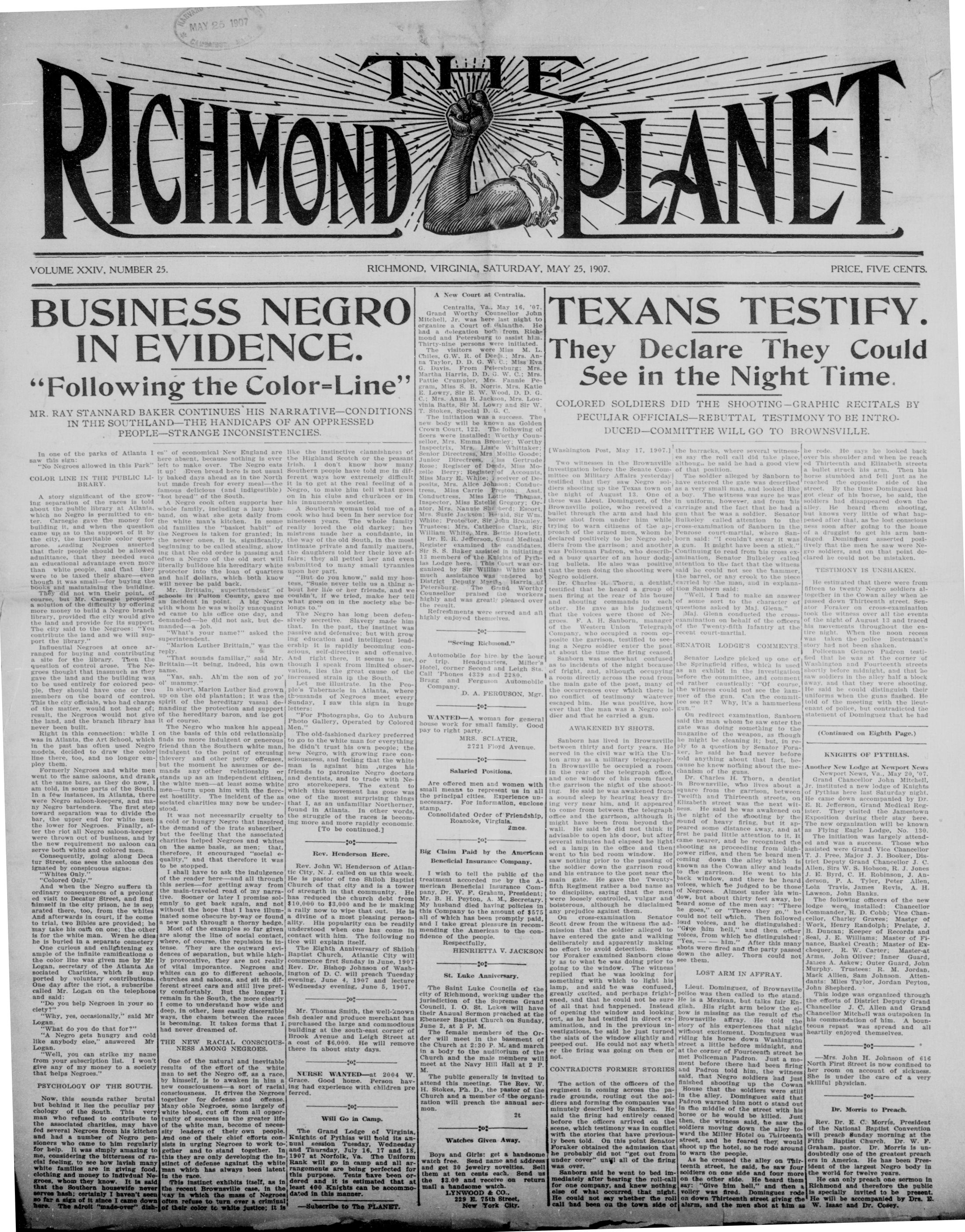
Richmond Planet
Saturday, May 25, 1907
Richmond, Virginia
Page text (machine-generated)
THE RICHMOND PLANET
BUSINESS NEGRO IN EVIDENCE. "Following the Color=Line"
MR. RAY STANNARD BAKER CONTINUES HIS NARRATIVE—CONDITIONS IN THE SOUTHLAND—THE HANDICAPS OF AN OPPRESSED PEOPLE—STRANGE INCONSISTENCIES.
VOLUME XXIV, NUMBER 25.
BUSINESS IN EV
"Following
MR. RAY STANNARD BAKE
IN THE SOUTHLAND
PEOPLE—
In one of the parks of Atlanta I es"
saw this sign:
her
allowed in this Park" left
COLOR LINE IN THE PUBLIC LI BRARY.
A story significant of the growing separation of the races is told about the public library at Atlanta, which no Negro is permitted to enter. Carnegie gave the money for building it, and when the question came up as to the support of it by the city, the inevitable color quarose. Leading Negroes asserted that their people should be allowed admittance, that they needed suca an educational advantage even more than white people, and that they were to be taxed their share—even though it was small—for buying the books and maintaining the buildings. They did not win their point, of course, but Mr. Carnegie proposed a solution of the difficulty by offering more money to build a Negro branch library, provided the city would give the land and provide for its support. The city said to the Negroes: "You come to the land and we will support the library."
Influential Negroes at once arranged for buying and contributing a site for the library. Then the question of control arose. The Negroes thought that inasmuch as they gave the land and the building was to be used entirely for colored people, they should have one or two members on the board of control. This the city officials, who had charge of the matter, would not hear of, result, the Negroes would not give the land, and the branch library has never built.
Right in this connection: while I was in Atlanta, the Art School, which in the past has often used Negro models, decided to draw the color line there, too, and no longer employ them.
Formerly Negroes and white men went to the same saloons, and drank at the same bars, as they do now, I am told, in some parts of the South. In a few instances, in Atlanta, there were Negro saloon-keepers, and many Negro bartenders. The first step toward separation was to divide the bar, the upper end for white men, the lower for Negroes. Finally, after the riot all Negro saloon-keeper were thrown out of business, and by the new requirement no saloon can serve both white and colored men.
Consequently, going along Decatur Street, one sees the saloons designated by conspicuous signs:
"Waltzes only."
"Colored only."
And when the Negro suffers the ordinary consequences of a prolonged visit to Decatur Street, and find himself in the city prison, he is separated there, too, from the whites. And afterwards in court, if he come to trial, two Bibles are provided; he may take his oath on one; the other is for the white man. Wren he dies he is buried in a separate cemetery
One curious and enlightening ex
ample of the infinite ramifications of
the color line was given me by Mr
Logan, secretary of the Atlanta As
associated Charities, which is sup
ported by voluntary contributions.
One day after the riot, a subscribe
called Mr. Logan on the telephone
and said:
"Do you help Negroes in your so
ciety?"
"Why, yes, occasionally," said Mr
Logan.
"What do you do that for?"
"What do you do that for?"
"A Negro gets hungry and cold like anybody else," answered Mr Logan.
"Well, you can strike my name from your subscription list. I won't give any of my money to a society that helps Negroes."
PSYCHOLOGY OF THE SOUTH.
Now, this sounds rather brutal but behind it lies the peculiar psychology of the South. This very man who refused to contribute to the associated charities, may have fed several Negroes from his kitchen and had a number of Negro pensioners who came to him regularly for help. It was simply amazing to me, considering the bitterness of racial feeling, to see how lavish many white families are in giving food, clothing and money to individual Negroes, whom they know. It is said that the Southern housewife never serves hash; certainly I haven't seen so far a sign of it since I came down here. The adroit "made-over" dish
es" of economical New England are here absent, because nothing is ever left to make over. The Negro eats it up! Even bread here is not usually baked days ahead as in the North but made fresh for every meal—the famous delicious (and indigestible) "hot bread" of the South.
A Negro cook often supports her whole family, including a lazy husband, on what she gets daily from the white man's kitchen. In some old families the "basket habit" of the Negroes is taken for granted; in the newer ones, it is, significantly, beginning to be called stealing, showing that the old order is passing and often a Negro of the old sort will literally buildoze his hereditary white protector into the loan of quarters and half dollars, which both know will never be paid back.
Mr. Brittain, superintendent of schools in Fulton County, gave me an incident in point. A big Negro with whom he was wholly unaquaint ed came to his office one day, and demanded—he did not ask, but demanded—a job.
"What's your name?" asked the superintendent.
"Marion Luther Brittain," was the reply.
"That sounds familiar," said Mr. Brittain—it being, indeed, his own name.
"Yas, sah. Ah'm the son of yo' ol' mammy."
In short, Marlon Luther had grown up on the old plantation; it was the spirit of the hereditary vassal demanding the protection and support of the hereditary baron, and he got it of course.
The Negro who makes his appeal on the basis of this old relationship finds no more indulgent or generous friend than the Southern white man, indulgent to the point of exusing the cleverness and other petty offenses, but the moment he assumes or demands any other relationship or stands up as an independent citizen, the white men—at least some white men—turn upon him with the fiercer hostility. The incident of the as sociated charities may now be understood.
It was not necessarily cruelty to a cold or hungry Negro that inspired the demand of the irate subscriber, but the feeling that the associated charities helped Negroes and whites on the same basis, as men; that, therefore, it encouraged "social equality," and that therefore it was to be stopped.
I shall have to ask the indulgence of the reader here—and all through this series—for getting away from the main-traveled road of my narrative. Sooner or later I promise solemnly to get back again, and not without the hope that I have illuminated some obscure by-way, and not found new path through a thunder
Most of the examples so far given are along the line of social contact, where, of course, the repulsion is intense. They are the outward evidences of separation, but while highly provocative, they are not really of vital importance. Negroes and whites can go to different schools, churches and saloons, and sit in different street cars and still live pretty comfortably. But the longer I remain in the South, the more clearly I come to understand how wide and deep, in other, less easily discernible ways, the chasm between the races is becoming. It takes forms that I had never dreamed of.
THE NEW RACIAL CONSCIOUSNESS AMONG NEGROES.
One of the natural and inevitable results of the effort of the white man to set the Negro off, as a race, by himself, is to awaken in him a new consciousness—a sort of racial consciousness. It drives the Negroes together for defense and offense. Many oble Negroes, some largely of white blood, cut off from all opportunity of success in the greater life of the white man, become of necessity leaders of their own people. And one of their chief efforts consists in urging Negroes to work together and to stand together. In this they are only developing the instinct of defense against the white man which has always been latent in the race.
This instinct exhibits itself, as in the recent Brownsville case, in the way in which the mass of Negroes often refuse to turn over a criminal of their color to white justice; it is
RICHMOND, VIRGINIA, SATURDAY, MAY 25, 1907.
like the instinctive clannishness of the Highland Scotch or the peasant Irish. I don't know how many Southern people have told me in different ways how extremely difficult it is to get at the real feeling of a Negro, to make him tell what goes on in his clubs and churches or in his innumerable societies.
A Southern woman told me of a cook who had been in her service for nineteen years. The whole family really loved the old darkkey; her mistress made her a confidante, in the way of the old South, in the most intimate private and family matters, the daughters told her their love affairs; they all petted her and even submitted to many small tyrannies upon her part.
"But do you know," said my hostess, "Susle never tells us a thing about her life or her friends, and we couldn't, if we tried, make her tell what goes on in the society she belongs to."
The Negro has long been defensively secretive. Slavery made him that. In the past, the instinct was passive and defensive; but with growing education and intelligent leadership it is rapidly becoming conscious, self-directive and offensive. And right there, it seems to me, though I speak from limited observation, lies the great cause of the increased strain in the South.
Let me illustrate. In the People's Tabernacle in Atlanta, where thousands of Negroes meet every Sunday, I saw this sign in huge letters:
"For Photographs, Go to Auburn Photo Gallery, Operated by Colored Men."
The old-fashioned darkey preferred to go to the white man for everything he didn't trust his own people; the new Negro, with growing race consciousness, and feeling that the white man is against him, urges his friends to patronize Negro doctors and dentists, and to trade with Negro storekeepers. The extent to which this movement has gone was one of the most surprising things that I, as an unfamiliar Northerner, found in Atlanta. In other words, the struggle of the races is becoming more and more rapidly economic.
Rev. Henderson Here:
Rev. John W. Henderson of Atlantic City, N. J. called on us this week. He is pastor of the Shiloh Baptist Church of that city and is a tower of strength in that community. He has reduced the church debt from $10,000 to $3,000 and he is making a rally now to wipe that out. He is a divine of a most pleasing personality. His popularity can be readily understood when one has come in contact with him. The following no tice will explain itself.
The Eighth Anniversary of Shiloh Baptist Church. Atlantic City will commence first Sunday in June, 1907 Rev. d. Bishop Johnson of Washington of D. C. will preach Tuesday evening, June 4, 1907 and lecture Wednesday evening, June 5, 1907.
Mr. Thomas Smith, the well-known fish dealer and produce merchant has purchased the large and commodious building at the south-east corner of Brook Avenue and Leigh Street at a cost of $6,000. He will remove there in about sixty days.
NURSE WANTED—at 2004 W
Grace. Good home. Person having had experience with children pre-
ferred.
Will Go in Camp.
The Grand Lodge of Virginia,
Knights of Pythias will hold its annual session Tuesday, Wednesday and Thursday, July 16, 17 and 18,
1907 at Norfolk, Va. The Uniform Rank will go in camp and all arrangements are being perfected for this purpose. Tents have been ordered and it is estimated that at least 400 Knights can be accommodated in this manner.
Subscribe to The PLANET.
A New Court at Centralia.
Centralilla, Va., May 16, '07.
Grand Worthy Counselor John
Mitchell, Jr. was here last night to
organize a Court of Galanthe.
He had a delegation both from Rich-
mond and Petersburg to assist him.
Thirty-nine persons were initiated.
The visitors were Miss M. L.
Chiles, G.W. R. of Deeds; Mrs. Anna
Taylor, D. D. G. W. C.; Miss Eva
G. Davis. From Petersburg; Mrs.
Martha Harris, D. D. G. W. C.; Mrs.
Pattie Crumpler, Mrs. Fannie Pe-
gram, Miss S. B. Norris, Mrs. Katie
E. Lowry, Sir E. W. Wood, D. D. G.
C.; Mrs. Anna B. Jackson, Mrs. Lou-
vinia Batts, Sir M. Lowry and Sir W.
T. Stokes, Speeal D. G. C.
The initiation was a success. The new body will be known as Golden Crown Court, 122. The following of ficers were installed: Worthy Counsellor, Mrs. Emma Bromley; Worthy Inspectrix, Mrs. Lizzie Whittaker; Senior Directress, Mrs Mollie Goode; Junior Directress, Iza Gertrude Rose; Register of Deeds, Miss Mozelle Berry; Register of Accounts, Miss Mary E. White; I seeer of Deposits, Mrs. Alice Johnson; Conductress, Miss Carrie Preston; Asst. Conductress, Miss Lottie Thomas, Inspector, Miss Estelle Gregory; Orator, Mrs. Nannie She bred; Escort, Mrs. Susie Jackson; Heald, Sir Wm. White; Protector, Sir John Bromley. Trustees; Mrs. Catherine Clark, Sir William White, Mrs. Bettie Howlett. Dr. E. R. Jefferson, Grand Medical Register examined the candidates, Sir S. S. Baker assisted in initiating 13 members of the Knights of Pythias Lodge here. This Court was organized by Sir William White and much assistance was endered by District Deputy Marsh, Harris of Petersburg. The Grand Worthy Counsellor praised the workers highly and was greatly pleased over the result. Refreshments were served and all highly enjoyed themselves.
"Seeing Richmond."
Automobile for hire by the hour or trip. Headquarters, Miller's Hotel, corner Second and Leigh Sts. Call 'Phones 4339 and 2280. Bragg and Ferguson Automobile
W. GREGG and Ferguson Automobile
Company.
D. A. FERGUSON, MET
WANTED—A woman for general house work for small family. Good pay to right party.
MRS. SCLATER
Salaried Positions
Are offered men and women with small means to represent us in all the principal cities. Experience unnecessary. For information, enclose stamp. Consolidated Order of Friendship, Roanoke, Virginia.
Big Claim Paid by the American Beneficial Insurance Company.
I wish to tell the public of the treatment accorded me by the American Beneficial Insurance Company, Dr. W. F. Graham, President; Mr. B. H. Peyton, A. M., Secretary. My husband died having policies in this Company to the amount of $575 all of which has been promptly paid, and I take great pleasure in recommending the American to the confidence of the people.
Respectfully,
HENRIETTA V. JACKSON
St. Luke Anniversary.
The Saint Luke Councils of the city of Richmond, working under the jurisdiction of the Supreme Grand Council, I. O. St. Lukes will have their Annual Sermon preached at the Ebenezer Baptist Church on Sunday, June 2, at 3 P. M.
The female members of the Order will meet in the basement of the Church at 2:30 P. M. and march in a body to the auditorium of the Church and the male members will meet at the Navy Hill Hall at 2 P. M.
The public generally is invited to attend this meeting. The Rev. W. H. Stokes, Ph. D., the pastor of the Church and a member of the organization will preach the annual sermon.
Watches Given Away.
Boys and Girls: get a handsome watch free. Send name and address and get 30 jewelry novelties. Sell them at ten cents each. Send us the $3.00 and receive on return mail a handsome watch.
LYNWOOD & CO.
229 E. 75th Street,
New York City.
TEXANS TESTIFY. They Declare They Could See in the Night Time.
COLORED SOLDIERS DID THE SHOOTING—GRAPHIC RECITALS BY PECULIAR OFFICIALS—REBUTTAL TESTIMONY TO BE INTRODUCED—COMMITTEE WILL GO TO BROWNSVILLE.
[Washington Post, May 17, 1907.]
Two witnesses in the Brownsville investigation before the Senate Committee on Military Affairs yesterday testified that they saw Negro soldiers shooting up the Texas town on the night of August 13. One of these was Lleut. Dominguez, of the Brownsville police, who received a bullet through the arm and had his horse shot from under him while trying to warn citizens of the approach of the armed men, whom he declared positively to be Negro soldiers from the garrison; and another was Policeman Padron, who described a busy quarter of an hour dodging bullets. He also was positive that the men doing the shooting were Negro soldiers.
the barracks, where several witnesses say the roll call did take place, although, he said he had a good view of that position.
The soldier alleged by Sanborn to have entered the gate was described as a very small man, and looked like a boy. The witness was sure he was in uniform, however, and from his carriage and the fact that he had a gun that he was a soldier. Senator Bulkeley called attention to the cross-examination of Sanborn in the Penrose court-martial, where Sanborn said: "I couldn't swear it was a gun. It might have been a stick." Continuing to read from his cross examination, Senator Bulkeley called attention to the fact that the witness said he could not see the hammer, the barrel, or any crook to the piece he rode. He says he looked back over his shoulder and when he reached Thirteenth and Elizabeth street, a bullet struck his arm. Then he horse stumbled and fell just as he reached the opposite side of the street. By the time Dominguez had got clear of his horse, he said, the soldiers had disappeared down the alley. He heard them shooting but knows very little of what happened after that, as he lost consciousness soon after going to the house of a druggist to get his arm badly daged. Dominguez asserted positively that the men saw were Negro soldiers, and on that point he clared he could not be mistaken.
TESTIMONY IS UNSHAKEN.
Dr. Charles H. Thorn, a dentist, testified that he heard a group of men firing at the rear of his house and shouting commands to each other. He gave as his judgment that the voices were those of Negroes. F. A. H. Sanborn, manager of the Western Union Telegraph Company, who occupied a room opposite the garrison, testified to seeing a Negro soldier enter the post at about the time the firing ceased. Sanborn was somewhat confused as to incidents of the night because of fright, and, although occupying a room directly across the road from the main gate of the post, many of the occurrences over which there is no conflict of testimony whatever escaped him. He was positive, how ever that the man was a Negro soldier and that he carried a gun.
AWAKENED BY SHOTS
Sanborn has lived in Brownsville between thirty and forty years. He served in the civil war with the Union army as a military telegrapher. In Brownsville he occupied a room in the rear of the telegraph office, and one window of his room faced the garrison the night of the shooting. He said he was awakened from a sound sleep by hearing heavy fire very near him, and it appeared to come from between the telegraph office and the garrison, although it might have been from beyond the wall. He said he did not think it advisable to open his door, but after several minutes had elapsed he lighted a lamp in the office and then went to his bed room window. He saw nothing prior to the passing of the soldier down the garrison road and his entrance to the post near the main gate. He gave the Twenty-fifth Regiment rather a bad name as to discipline, saying that the men were loosely controlled, vulgar and boisterous, although he disclaimed any prejudice against them.
On cross-examination Senator Scott drew from the witness the admission that the soldier alleged to have entered the gate and walking deliberately and apparently making no effort to avoid detection. Senator Foraker examined Sanborn closely as to what he was doing prior to going to the window. The witness replied that he was looking for something with which to light his lamp, and said he was confused, greatly excited, and perhaps frightened, and that he could not be sure of all that had happened. Instead of opening the window and looking out, as he had testified in direct examination, and in the previous investigations, he said he just turned the slats of the window slightly and peeped out. He could not say whether the firing was going on then or not.
CONTRADICTS FORMER STORIES
The action of the officers of the regiment in coming across the parade grounds, routing out the soldiers and forming the companies was minutely described by Sanborn. He said the firing had entirely ceased before the officers arrived on the scene, which testimony was in conflict with the stories that have previously been told. On this point Senator Foraker obtained the admission that he probably did not "get out from under cover" until all of the firing was over. Sanborn said he went to bed immediately after hearing the roll-call for one company, and knew nothing else of what occurred, that night. He could not say whether the roll call had been on the town side of
the barracks, where several witnesses say the roll call did take place, although, he said he had a good view of that position.
The soldier alleged by Sanborn to have entered the gate was described as a very small man, and looked like a boy. The witness was sure he was in uniform, however, and from his carriage and the fact that he had a gun that he was a soldier. Senator Bulkeley called attention to the cross-examination of Sanborn in the Penrose court-martial, where Sanborn said: "I couldn't swear it was a gun. It might have been a stick." Continuing to read from his cross-examination, Senator Bulkeley called attention to the fact that the witness said he could not see the hammer, the barrel, or any crook to the piece carried by the man, and in explanation Sanborn said:
"Well, I had to make an answer of some sort to the character of questions asked by Maj. Glenn."
Maj. Glenn conducted the cross-examination on behalf of the officers of the Twenty-fifth Infantry at the recent court-martial.
SENATOR LODGE'S COMMENTS
Senator Lodge picked up one of the Springfield rifles, which is used as an exhibit in the investigation before the committee, and commented rather caustically: "Of course, the witness could not see the hammer of the gun. Can the committee see it? Why, it's a hammerless gun."
On redirect examination, Sanborn said the man whom he saw enter the gate was doing something to the magazine of the weapon, as though he might be cleaning it; but, in reply to a question by Senator Foraker, he said he had never before told anything about that fact, because he knew nothing about the mechanism of the guns.
Dr. Charles H. Thorn, a dentist in Brownsville, who lives about a square from the garrison, between Twelfth and Thirteenth streets, on Elizabeth street was the next witness. He said he was awakened on the night of the shooting by the sound of heavy firing, but it appeared some distance away, and at first he paid little attention to it. It came nearer, and he recognized the shooting as proceeding from high-power rifles, and then he heard men coming down the alley which is known as the Cowan alley and leads to the garrison. He went to his back window, and there he heard voices, which he judged to be those of Negroes. Almost under his window, but about thirty feet away, he heard some of the men say: "There he goes," or "There they go," he could not tell which. Then followed loud voices, and he distinguished: "Give him hell," and then other voices, from which he distinguished: "Yes, — — him." After this many shots were fired and the party passed down the alley. Thorn could not see them.
LOST ARM IN AFFRAY
Lleut. Dominguez, of Brownsville police was then called to the stand. He is a Mexican, but talks fair English. His right arm below the elbow is missing as the result of the Brownsville affray. He told the story of his experiences that night without excitement. Dominguez was riding his horse, down Washington street a little before midnight, and at the corner of Fourteenth street he met Policeman Padron. Just a moment before there had been firing and Padron told him, the witness said, that Negro soldiers had just finished shooting up the Cowan House that the soldiers were still in the alley. Dominguez said that Padron warned him nott o stand out in the middle of the street with his horse or he would be killed. Just then, the witness said, he saw the soldiers moving down the alley toward the Miller Hotel on Thirteenth street, and he feared they, would shoot up the hotel, so he rode around to warn the people. As he crossed the alley on Thirteenth street, he said, he saw four soldiers on one side and four more on the other side. He heard them say: "Give him hell," and then a volley was fired. Dominguez rode on down Thirteenth street giving the alarm, and the men shot at him as
PRICE, FIVE CENTS.
STIFY.
ey Could
t Time.
GRAPHIC RECITALS BY
ONY TO BE INTRO-
ROWNSVILLE.
he rode. He says he looked back over his shoulder and when he reached Thirteenth and Elizabeth streets a bullet struck his arm. Then his horse stumbled and fell just as he reached the opposite side of the street. By the time Dominguez had got clear of his horse, he said, the soldiers had disappeared down the alley. He heard them shooting, but knows very little of what happened after that, as he lost conscious soon after going to the home of a druggist to get his arm bandaged Dominguez asserted positively that the men he saw were Negro soldiers, and on that point declared he could not be mistaken.
TESTIMONY IS UNSHAKEN.
He estimated that there were from fifteen to twenty Negro soldiers altogether in the Cowan alley when he passed down Thirteenth street. Senator Foraker on cross-examination took the witness over all the events of the night of August 13 and traced his movements throughout the entire night. When the noon recess was taken the police lieutenant's story had not been shaken. Policeman Genaro Padron testified that he was at the corner of Washington and Fourteenth streets shortly before midnight, and that he saw soldiers in the alley half a block away, and that they were shooting. He said he could distinguish their uniforms when the guns flashed. He told of the meeting with the lieutenant of police, but contradicted the statement of Dominguez that he had
(Continued on Eighth Page.)
KNIGHTS OF PYTHIAS
Another New Lodge at Newport News
Newport News, Va., May 20, '07.
Grand Chancellor John Mitchell,
Jr. instituted a new lodge of Knights of
Pythias here last Saturday night.
He came down accompanied by Dr. E. R. Jefferson, Grand Medical Register.
They visited the Jamestown Exposition during their stay here.
The new organization will be known as Flying Eagle Lodge, No. 130.
The initiation was largely attended and was a success. Those who assisted were Grand Vice Chancellor T. J. Pree, Major J. J. Booker, District Deputy Grand Chancellor J. C. Allen, Sirs W. S. Hobson, R. J. Jones, J. E. Byrd, C. H. Robinson, J. Anderson, P. A. Tyler, Allen, Lola Travis, James Revis, A. H. Lawson, John Banks.
The following officers of the new lodge were installed: Chancellor Commander, R. D. Cobb; Vice Chancellor, Charley Graves; Master of Work, Henry Ralpholp; Prelate, J. B. Duncan; Keeper of Records and Seal, J. E. Williams; Master of Finance, Baskel Creath; Master of Exchequer, R. W. Carter; Master-at Arms, John Oliver; Inner Guard, James A. Askew; Outer Guard, John Murphy. Trustees: R. M. Jordan, Mack Allen, Sam Johnson. Attendants: Miles Taylor, Jordan Peyton, John Shepherd.
This lodge was organized through the efforts of District Deputy Grand Chancellor J. C. Allen and Grand Chancellor Mitchell was outspoken in his commendation of him. A bounteous repast was spread and all heartily enjoyed themselves.
—Mrs. John H. Johnson of 616 North First Street is now confined to her room on account of sickness. She is under the care of a very skillful physician.
Dr. Morris to Preach.
Rev. Dr. E. C. Morris, President of the National Baptist Convention will preach Sunday morning at the Fifth Baptist Church, Dr. W. F. Graham, pastor, Dr. Morris is undoubtedly one of the greatest preachers in America. He has been President of the largest Negro body in the world for twelve years. He can only preach one sermon in Richmond and therefore the public is specially invited to be present. He will be accompanied by Drs. E. W. Isaac and Dr. Cosey.
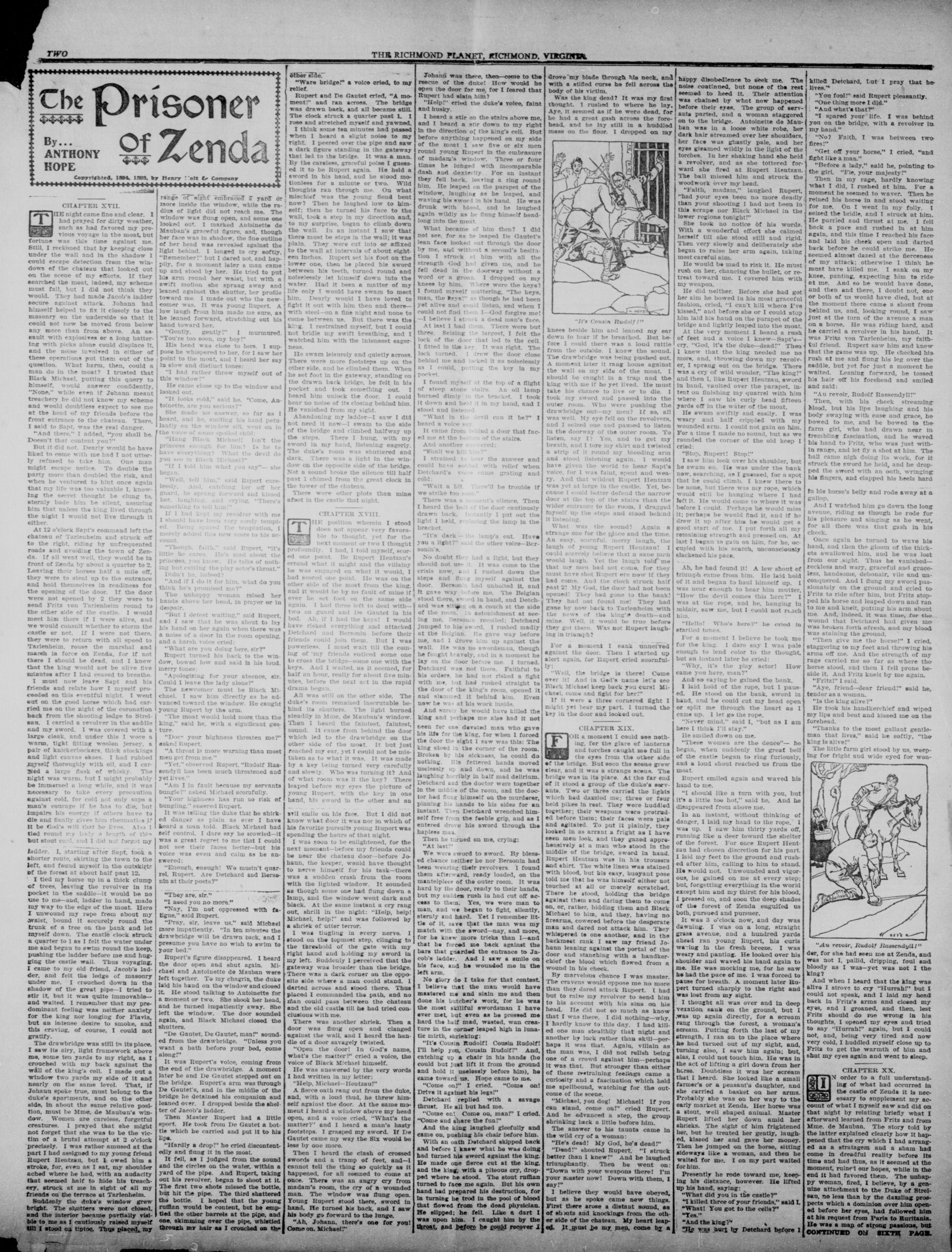
The Prisoner By... OF Zenda ANTHONY HOPE
TWO
CHAPTER XVIL
HE night came fine and clear. I had prayed for dirty weather, such as had favored my previous voyage in the moat, but fortune was this time against me. Still, I reckoned that by keeping close under the wall and in the shadow I could escape detection from the windows of the chateau that looked out on the scene of my efforts. If they searched the moat, indeed, my scheme must fail, but I did not think they would. They had made Jacob's ladder secure against attack. Johann had himself helped to fix it closely to the masonry on the underside so that it could not now be moved from below any more than from above. An assault with explosives or a long battering with picks alone could displace it, and the noise involved in either of these operations put them out of the question. What harm, then, could a man do in the moat? I trusted that Black Michael, putting this query to himself, would answer confidently, "None," while even if Johann meant treachery he did not know my scheme and would doubtless expect to see me at the head of my friends before the front entrance to the chateau. There, I said to Sapt, was the real danger.
"And there," I added, "you shall be. Doesn't that content you?" But it did not. Dearly would he have liked to come with me had I not utterly refused to take him. One man might escape notice. To double the party more than doubled the risk, and when he ventured to hint once again that my life was too valuable I, knowing the secret thought he clung to, sternly bade him be silent, assuring him that unless the king lived through the night I would not live through it either.
At 12 o'clock Sapt's command left the chateau of Tarlenheim and struck off to the right, riding by unfrequented roads and avoiding the town of Zenda. If all went well, they would be in front of Zenda by about a quarter to 2. Leaving their horses half a mile off, they were to steal up to the entrance and hold themselves in readiness for the opening of the door. If the door were not opened by 2 they were to send Fritz von Tarlenheim round to the other side of the castle. I would meet him there if I were alive, and we would consult whether to storm the castle or not. If I were not there, they were to return with all speed to Tarlenheim, rouse the marshal and marshal in force on Zenda, for if not there I should be dead, and I knew that the king would be alive five minutes after I had ceased to breathe
I must now leave Sapt and his friends and relate how I myself proceeded on this eventful night. I went out on the good horse which had carried me on the night of the coronation back from the shooting lodge to Strelsaun. I carried a revolver in the saddle and my sword. I was covered with a large cleak, and under this I wore a warm, tight fitting woolen jersey, a pair of knickerbockers, thick stockings and light canvas shoes. I had rubbed myself thoroughly with oil, and I carried a large flask of whiskey. The night was warm, but I might probably be immersed a long while, and it was necessary to take every precaution against cold, for cold not only saps a man's courage if he has to die, but impairs his energy if others have to die and finally gives him rheumatics if it be God's will that he lives. Also I tled round my body a length of this but stout cord, and I did not forget my ladder. I, starting after Sapt, took a shorter route, skirting the town to the left, and found myself in the outskirts of the forest at about half past 12.
I tled my horse up in a thick clump of trees, leaving the revolver in its pocket in the saddle—it would be no use to me—and, ladder in hand, made my way to the edge of the moat. Here I unwound my rope from about my swain, bound it securely round the trunk of a tree on the bank and let myself down. The castle clock struck a quarter to 1 as I felt the water under me and began to swim round the keep, pushing the ladder before me and hugging the castle wall. Thus voyaging, I came to my old friend, Jacob's ladder, and felt the lodge of masonry under me. I crouched down in the shadow of the great pipe—I tried to stir it, but it was quite immovable—and waited. I remember that my predominant feeling was neither anxiety for the king nor longing for Flavia, but an intense desire to smoke, and this craving, of course, I could not gratify.
The drawbridge was still in its place. I saw its airy, light framework above me, some ten yards to my right, as I crouched with my back against the wall of the king's cell. I made out a window two yards my side of it and nearly on the same level. That, if Johann spoke true, must belong to the duke's apartments, and on the other side, in about the same relative position, must be Mine, de Mauban's window. Women are careless, forgetful creatures. I prayed that she might not forget that she was to be the victim of a brutal attempt at 2 o'clock precisely. I was rather amused at the part I had assigned to my young friend Rupert Hentzan, but I owed him a stroke, for, even as I sat, my shoulder ached where he had, with an audacity that seemed half to hide his treachery, struck at me in sight of all my friends on the terrace at Tarlenheim.
Suddenly the duke's window grew bright. The shutters were not closed, and the interior became partially visible to me as I cautiously raised myself till I stood on tiptoe. Thus placed, my
other side
"Ware bridge!" a voice cried, to my relief.
Rupert and De Gautet cried, "A moment!" and ran across. The bridge was drawn back, and all became still. The clock struck a quarter past 1. I rose and stretched myself and yawned. I think some ten minutes had passed when I heard a slight noise to my right. I peered over the pipe and saw a dark figure standing in the gateway that led to the bridge. It was a man. By the careless, graceful pulse I guessed it to be Rupert again. He held a sword in his hand, and he stood motionless for a minute or two. Wild thoughts ran through me. On what mischief was the young fiend bent now? Then he laughed low to himself; then he turned his face to the wall, took a step in my direction, and to my surprise, bogan to climb down the wall. In an instant I saw that there must be steps in the wall; it was plain. They were cut into or affixed to the wall at intervals of about eighteen inches. Rupert set his foot on the lower one, then he placed his sword between his teeth, turned round and noiselessly let himself down into the water. Had it been a matter of my life only I would have swam to meet him. Dearly would I have loved to fight it out with him then and there—with steel—on a fine night and none to come between us. But there was the king. I restrained myself, but I could not bridle my swift breathing, and I watched him with the intensest eagerness.
He swam leisurely and quietly across. There were more footsteps up on the other side, and he climbed them. When he set foot in the gateway, standing on the drawn back bridge, he felt in his pocket and took something out. I heard him unlock the door. I could hear no noise of its closing behind him. He vanished from my sight.
Abandoning my ladder—I saw I did not need it now—I swam to the side of the bridge and climbed halfway up the steps. There I hung, with my sword in my hand, listening eagerly. The duke's room was shattered and dark. There was a light in the window on the opposite side of the bridge. Not a sound broke the silence till half past 1 chimed from the great clock in the tower of the chateau.
There were other plots than mine afoot in the castle that night.
THE position wherein I stood does not appear very favorable to thought, yet for the next moment or two I thought profoundly. I had, I told myself, scored one point. Be Rupert Hentzaan's errand what it might and the villainy he was engaged on what it would, I had scored one point. He was on the other side of the moat from the king, and it would be by no fault of mine if ever he set foot on the same side again. I had three left to deal with—two on guard and De Gautet in his bed. Ah, if I had the keys! I would have risked everything and attacked Detchard and Bersonin before their friends could join them. But I was powerless. I must wait till the coming of 'my friends enticed some one to cross the bridge—some one with the keys. And I waited, as it seemed, for half an hour, really for about five minutes, before the next act in the rapid drama began.
All was still on the other side. The duke's room remained inscrutable behind its shutters. The light burned steadily in Mine, de Mauban's window. Then I heard the faintest, faintest, sound. It came from behind the door which led to the drawbridge on the other side of the moat. It but just reached my ear, yet I could not be mistaken as to what it was. It was made by a key being turned very carefully and slowly. Who was turning it? And of what room was it the key? There leaped before my eyes the picture of young Rupert, with the key in one hand, his sword in the other and an evil smile on his face. But I did not know what door it was nor in which of his favorite pursuits young Rupert was spending the hours of that night.
I was soon to be enlightened, for the next moment—before my friends could be near the chateau door—before Johann, the keeper, would have thought to nerve himself for his task—there was a sudden crash from the room with the lighted window. It sounded as though some one had flung down a lamp, and the window went dark and black. At the same instant a cry rang out, shrill in the night: "Help, help Michael, help!" and was followed by a shriek of utter terror.
I was tingling in every nerve. I stood on the topmost step, clinging to the threshold of the gate with my right hand and holding my sword in my left. Suddenly I perceived that the gateway was broader than the bridge. There was a dark corner on the opposite side where a man could stand. I darted across and stood there. Thus placed I commanded the path, and no man could pass between the chateau and the old castle till he had tried conclusions with me.
There was another shriek. Then a door was flung open and clanged against the wall, and I heard the handle of a door savagely twisted.
"Open the door! In God's name, what's the matter?" cried a voice, the voice of Black Michael himself.
He was answered by the very words
He was answered by the very words I had written in my letter:
"Help, Michael - Hentzau!"
A fierce oath rang out from the duke, and, with a loud thud, he threw himself against the door. At the same moment I heard a window above my head open, and a voice cried, "What's the matter?" and I heard a man's hasty footsteps. I grasped my sword. If De Gautet came my way the Six would be less by one more.
Then I heard the clash of crossed swords and a trump of feet, and-I cannot tell the thing so quickly as it happened, for all seemed to come at once. There was an angry cry from madam's room, the cry of a wounded man. The window was flung open. Young Rupert stood there, sword in hand. He turned his back, and I saw his body go forward to the lunge.
"Ah, Johann, there's one for you! Come on, Michael!"
range of sight embraced a yard or more inside the window, while the radius of light did not reach me. The window was flung open, and one one looked out. I marked Antoinette de Mauban's graceful figure, and, though her face was in shadow, the fine outline of her head was revealed against the light behind. I longed to cry softly, "Remember!" but I dared not, and happily, for a moment later a man came up and stood by her. He tried to put his arm round her waist, but with a swift motion she sprang away and leaned against the shutter, her profile toward me. I made out who the newcomer was. It was young Rupert. A low laugh from him made me sure, as he leaned forward, stretching out his hand toward her.
"Gently, gently!" I murmured. "You're too soon, my boy!" His head was close to hers. I suppose he whispered to her, for I saw her point to the moat, and I heard her say in slow and distinct tones:
"I had rather throw myself out of this window!"
He came close up to the window and looked out.
"It looks cold," said he, "Come, Antoinette, are you serious?"
She made no answer, so far as I heard, and he, snitting his hand petulantly on the window sill, went on in the voice of some spilled child:
"Hang Black Michael! Isn't the princess enough for him? Is he to have everything? What the devil do you see in Black Michael?"
"If I told him what you say"—she began.
"Well, tell him," said Rupert carelessly. And, catching her off her guard, he sprang forward and kissed her, laughing, and crying, "There's something to tell him!"
If I had kept my revolver with me I should have been very sorry tempted. Being spared the temptation, I merely added this new score to his account.
"Though, faith," said Rupert, "it's little he cares. He's mad about the princess, you know. He talks of nothing but cutting the play actor's throat." Didn't he, indeed? "And if I do it for him, what do you think he's promised me?" The unhappy woman raised her hands above her head, in prayer or in despair. "But I detest waiting," said Rupert, and I saw that he was about to lay his hand on her again when there was a noise of a door in the room opening, and a harsh voice cried: "What are you doing here, sir?"
What are you doing here, sir? Rupert turned his back to the window, bowed low and said in his loud, merry tones: "Apologizing for your absence, sir. Could I leave the lady alone?" The newcomer must be Black Michael. I saw him directly as he advanced toward the window. He caught young Rupert by the arm. "The most would hold more than the king," said he, with a significant gesture. "Doe' your highness threaten me?" asked Rupert. "A threat is more warning than most men get from me." "Yet," observed Rupert, "Rudolf Rassendyll has been much threatened and yet lives." "Am I in fault because my servants bungle?" asked Michael scornfully. "Your highness has run no risk of bungling." sneered Rupert.
It was telling the duke that he shirked danger as plain as ever I have heard a man told. Black Michael had self control. I dare say he scowled—it was a great regret to me that I could not see their faces better—but his voice was even and calm as he answered:
"Enough, enough! We mustn't quarrel, Rupert. Are Detchard and Bersonn at their posts?"
"They are, sir."
"I need you no more."
"Nay, I'm not oppressed with fatigue," said Rupert.
"Pray, sir, use us," said Michael more impatiently. "In ten minutes the drawbridge will be drawn back, and I presume you have no wish to swim to your bed."
Rupert's figure disappeared. I heard the door open and shut again. Michael and Antoinette de Mauban were left together. To my chagrin, the duke laid his hand on the window and closed it. He stood talking to Antoinette for a moment or two. She shook her head, and he turned impatiently away. She left the window. The door sounded again, and Black Michael closed the shutters.
"De Gautet, De Gautet, man!" sounded from the drawbridge. "Unless you want a bath before your bed, come along!"
It was Rupert's voice, coming from the end of the drawbridge. A moment later he and De Gautet stepped out on the bridge. Rupert's arm was through De Gautet's, and in the middle of the bridge he detained his companion and leaned over. I dropped beside the shelter of Jacob's ladder.
Then Master Rupert had a little sport. He took from De Gautet a bottle which he carried and put it to his lips.
"Hardly a drop!" he cried discontentedly and flung it in the moat.
It fell, as I judged from the sound and the circles on the water, within a yard of the pipe. And Rupert, taking out his revolver, began to shoot at it. The first two shots missed the bottle, but hit the pipe. The third shattered the bottle. I hoped that the young ruffian would be content, but he emptied the other barrels at the pipe, and one, skimming over the pipe, whistled through my hair as I crouched on the
THE RICHMOND PLANET, RICHMOND, VIRGINIA
CHAPTER XVIII
Johann was there, then—come to the rescue of the duke! How would he open the door for me, for I feared that Rupert had slain him?
"Help!" cried the duke's voice, faint and husky.
I heard a stir on the stairs above me, and I heard a stir down to my right in the direction of the king's cell. But before anything happened on my side of the moat I saw five or six men round young Rupert in the embrasure of madam's window. Three or four times he lunged with incomparable dash and dexterity. For an instant they fell back, leaving a ring round him. He leaped on the parapet of the window, laughing as he leaped, and waving his sword in his hand. He was drunk with blood, and he laughed again wildly as he flung himself head-long into the moat.
What became of him then? I did not see, for as he leaped D Gautet's lean face looked out through the door by me, and without a second's hesitation I struck at him with all the strength God had given me, and he fell dead in the doorway without a word or a groan. I dropped on my knees by him. Where were the keys? I found myself muttering, "The keys, man, the keys!" as though he had been yet alive and could listen, and when I could not find them I—G forgive me!—I believe I struck a dead man's face. At last I had them. There were but three. Seizing the largest, I felt the lock of the door that led to the cell. I fitted in the key. It was right. The lock turned. I drew the door close behind me and locked it as noiselessly as I could, putting the key in my pocket.
I found myself at the top of a flight of steep stone stairs. An oil lamp burned dimly in the bracket. I took it down and held it in my hand, and I stood and listened.
"What in the devil can it be?" I heard a voice say.
It came from behind a door that faced me at the bottom of the stairs.
And another answered:
"Shall we kill him?"
I strained to sob the answer and could have sobbed with relief when Detchard's voice came grating and cold:
"Wait a bit. There'll be trouble if we strike too soon."
There was a moment's silence. Then I heard the boil of the door cautiously drawn back. Instantly I put out the light I held, replacing the lamp in the bracket.
"It's dark—the lamp's out. Have you a light?" said the other voice—Bersonin's.
No doubt they had a light, but they should not use it. It was come to the crisis now, and I rushed down the steps and flung myself against the door. Bersonin had unbotted it, and it gave way before me. The Belgian stood there, sword in hand, and Detchard was sitting on a couch at the side of the room. In astonishment at seeing me, Bersonin recoiled; Detchard jumped to his sword. I rushed madly at the Belgian. He gave way before me, and I drove him up against the wall. He was no swordsman, though he fought bravely, and in a moment he lay on the floor before me. I turned. Detchard was not there. Faithful to his orders, he had not risked a fight with me, but had rushed straight to the door of the king's room, opened it and slammed it behind him. Even now he was at his work inside.
And surely he would have killed the king and perhaps me also had it not been for one devoted man who gave his life for the king, for when I forced the door the sight I saw was this: The king stood in the corner of the room. Broken by his sickness, he could do nothing. His fettered hands moved uselessly up and down, and he was laughing horribly in half mad delirium. Detchard and the doctor were together in the middle of the room, and the doctor had flung himself on the murderer, pinching his hands to his sides for an instant. Then Detchard wrenched himself free from the feeble grip, and as I entered drove his sword through the hapless man.
Then he turned on me, crying:
"At last!"
We were sword to sword. By blessed chance neither he nor Bersonlin had been wearing their revolvers. I found them afterward, ready loaded, on the mantellepiece of the outer room. It was hard by the door, ready to their hands, but my sudden rush in had cut off access to them. Yes, we were man to man, and we began to fight, silently, sternly and hard. Yet I remember little of it, save that the man was my match with the sword—nay, and more, for he knew more tricks than I—and that he forced me back against the bars that guarded the entrance to Jacob's ladder. And I saw a smile on his face, and he wounded me in the left arm.
No glory do I take for that contest.
I believe that the man would have mastered me and slain me and then done his butcher's work, for he was the most skillful swordman I have ever met but even as he pressed me hard the half mad, wasted, wan creature in the corner leaped high in lunatic mirth, shrieking:
"It's Cousin Rudolf! Cousin Rudolf! I'll help you, Cousin Rudolf!" And, catching up a chair in his hands (he could but just lift it from the ground and hold it uselessly before him), he came toward us. Hope came to me.
"Come on!" I cried. "Come on! Drive it against his legs!"
Detchard replied with a savage thrust. He all but buted me.
"Come on! Come on, man!" I cried.
"Come and share the fun!"
And the king laughed gleefully and came on, pushing his chair before him.
With an oath Dotch skipped back and before I knew what he was doing had turned his sword against the king.
He made one fierce cut at the king, and the king, with a piteous cry, dropped where he stood. The stout ruffian turned to face me again. But his own hand had prepared his destruction, for in turning he trod in the pool of blood that flowed from the dead physician.
He slipped; he fell. Like a dart I was upon him. I caught him by the throat, and before he could recover I
drove my blade through his neck, and with a stifed curse he fell across the body of his victim.
Was the king dead? It was my first thought. I rushed to where he lay. Aye, it seemed as if he were dead, for he had a great gash across the forehead, and he lay still in a huddled mass on the floor. I dropped on my
H. PEYER
"It's Cousin Rudolf!"
knees beside him and leaned my ear down to hear if he breathed. But before I could there was a loud rattle from the outside. I knew the sound. The drawbridge was being pushed out. A moment later it rang home against the wall on my side of the moat. I should be caught in a trap and the king with me if he yet lived. He must take his chance to live or to die. I took my sword and passed into the outer room. Who were pushing the drawbridge out—my men? If so, all was well. My eye fell on the revolvers, and I seized one and paused to listen in the doorway of the outer room. To listen, say I? Yes, and to get my breath, and I tore my shirt and twisted a strip of it round my bleeding arm and stood listening again. I would have given the world to hear Sapt's voice for I was faint, spent and weary. And that wildcat Rupert Hentzau was yet at large in the castle. Yet, because I could better defend the narrow door at the top of the stairs than the wider entrance to the room, I dragged myself up the steps and stood behind it listening.
What was the sound? Again a strange one for the place and the time. An easy, scornful, merry laugh, the laugh of young Rupert Hentzau! I could scarcely believe that a sane man would laugh. Yet the laugh told me that my men had not come, for they must have shot Rupert ere now if they had come. And the clock struck half past 2! My God, the door had not been opened! They had gone to the bank! They had not found me! They had gone by now back to Tarluenheim with the news of the king's death—and mine. Well, it would be true before they got there. Was not Rupert laughing in triumph?
For a moment I sank unnerved against the door. Then I started up alert again, for Rupert cried soornfully:
"Well, the bridge is there! Come over it! And in God's name let's see Black Michael keep back you curs! Michael, come and fight for her!"
If it were a three cornered fight I might yet bear my part. I turned the key in the door and looked out.
CHAPTER XIX.
OR a moment I could see noth-
ing, for the glare of lanterns
and torches caught me full in
the eyes from the other side
of the bridge. But soon the scene grew
clear, and it was a strange scene. The
bridge was in its place. At the far end
of it stood a group of the duke's servants. Two or three carried the lights
which had dazzled me; three or four
held pikes in rest. They were huddled
together; their weapons were protruded
before them; their faces were pale
and agitated. To put it plainly, they
looked in as arrant a fright as I have
seen men look, and they gazed appre-
hensively at a man who stood in the
middle of the bridge, sword in hand,
Rupert Hentzau was in his trousers
and shirt. The white linen was stained
with blood, but his easy, buoyant pose
told me that he was himself either not
touched at all or merely scratched.
There he stood, holding the bridge
against them and daring them to come
on, or, rather, bidding them and Black
Michael to him, and they, having no
firearms, cowered before the desperate
man and dared not attack him. They
whispered to one another, and in the
baskestm rank I saw my friend Johann leaning against the portal of the
door and stanching with a handkerchief the blood which flowed from a wound in his cheek.
By marvelous chance I was master. The cravens would oppose me no more than they dared attack Rupert. I had but to raise my revolver to send him to his account with his sins on his head. He did not so much as know that I was there. I did nothing—why, I hardly know to this day. I had killed one man stealthily that night and another by luck rather than skill—perhaps it was that. Again, villain as the man was, I did not relish being one of a crowd against him—perhaps it was that. But stronger than either of these retraining feelings came a curiosity and a fascination which held me spellbound, watching for the outcome of the scene.
"Michael, you dog! Michael! If you can stand, come on!" cried Rupert. And he advanced a step, the group shrinking back a little before him.
The answer to his taunts came in the wild cry of a woman:
"He's dead: My God, he's dead!" "Dead!" shouted Rupert. "I struck better than I knew!" And he laughed triumphantly. Then he went on: "Down with your weapons there! I'm your master now! Down with them, I say!" I believe they would have obeyed, but as he spoke came new things. First there arose a distant sound, as of shouts and knockings from the other side of the chateau. My heart leaped. It must be my men, come by a
happy disobedience to seek me. The noise continued, but none of the rest seemed to heed it. Their attention was chained by what now happened before their eyes. The group of servants parted, and a woman staggered on to the bridge. Autoinette de Mauhan was in a loose white robe, her dark hair streamed over her shoulders, her face was ghostly pale, and her eyes gleamed wildly in the light of the torches. In her shaking hand she held a revolver, and as she toterted forward she fired at Rupert Hentzau. The ball missed him and struck the woodwork over my head.
"Falth, madain," laughed Rupert, "had your eyes been no more deadly than your shooting I had not been in this scrape nor Black Michael in the lower regions tonight."
She took no notice of his words. With a wonderful effort she calmed herself till she stood still and rigid. Then very slowly and deliberately she began to raise her arm again, taking most careful aim. He would be mad to risk it. He must rush on her, chancing the bullet, or retreat toward me. I covered him with my weapon.
He did neither. Before she had got her alm he bowed in his most graceful fashion, cried, "I can't kill where I've kissed," and before she or I could stop him laid his hand on the parapet of the bridge and lightly leaped into the moat. At the very moment I heard a rush of feet and a voice I knew -Sapt's- cry, "God, it's the duke-dead!" Then I knew that the king needed me no more, and throwing down my revolver, I sprang out on the bridge. There was a cry of wild wonder, "The king!" and then I like Rupert Hentzau, sword in hand, vaulted over the parapet, intent on finishing my quarrel with him where I saw his curly head fifteen yards off in the water of the moat.
"Stop, Rupert! Stop!"
I saw him look over his shoulder, but he swam on. He was under the bank now, searching, as I guessed, for a spot that he could climb. I knew there to be none, but there was my rope, which would still be hanging where I had left it. He would come to where it was before I could. Perhaps he would miss it; perhaps he would find it, and if he drew it up after him he would get a good start of me. I put forth all my remaining strength and pressed on. At last I began to gain on him, for he, occupied with his search, unconsciously slackened his pace.
Ah, he had found it! A low shout of triumph came from him. He laid hold of it and began to haul himself up. I was near enough to hear him mutter, "How the devil comes this here?" I was at the rope, and he, hanging in midair, saw me, but I could not reach him.
"Hello! Who's here?" he cried in started tones.
For a moment I believe he took me for the king. I dare say I was pale enough to lend color to the thought, but an instant later he cried: "Why, it's the play actor! How came you here, man?" And so saying he gained the bank. I laid hold of the rope, but I paused. He stood on the bank, sword in hand, and he could cut my head open or split me through the heart as I came up. I let go the rope. "Never mind," said I, "but as I am here I think I'll stay." He smiled down on me. "These women are the deuce"—he began, when suddenly the great bell of the castle began to ring furiously, and a loud shout reached us from the moat. Rupert smiled again and waved his hand to me. "I should like a turn with you, but it's a little too hot," said he. And he disappeared from above me.
In an instant, without thinking of danger, I laid my hand to the rope. I was up. I saw him thirty yards off, running like a deer toward the shelter of the forest. For once Rupert Hentzau had chosen discretion for his part. I laid my feet to the ground and rushed after him, calling to him to stand. He would not. Unwounded and vigorous, he gained on me at every step; but, forgetting everything in the world except him and my thirst for his blood, I pressed on, and soon the deep shades of the forest of Zenda engulfed us both, pursued and pursuer.
It was 3 o'clock now, and day was dawning. I was on a long, straight grass avenue, and a hundred yards ahead ran young Rupert, his curis waving in the fresh breeze. I was weary and panting. He looked over his shoulder and waved his hand again to me. He was mocking me, for he saw he had the pace of me. I was forced to pause for breath. A moment later Rupert turned sharply to the right and was lost from my sight.
I thought all was over and in deep vexation sank on the ground, but I was up again directly, for a scream rang through the forest, a woman's scream. Putting forth the last of my strength, I ran on to the place where he had turned out of my sight, and, turning also, I saw him again; but, alas, I could not touch him. He was in the act of lifting a girl down from her horse. Doubtless it was her scream that I heard. She looked like a small farmer's or a peasant's daughter, and she carried a basket on her arms. Probably she was on her way to the early market at Zenda. Her horse was a stout, well shaped animal. Master Rupert lifted her down amid her shrieks. The sight of him frightened her, but he treated her gently, laughed, kissed her and gave her money. Then he jumped on the horse, sitting sideways like a woman, and then he waited for me. I on my part waited for him.
Presently he rode toward me, keeping his distance, however. He lifted up his hand, saying:
"What did you in the castle?"
"I killed three of your friends," said I.
"What! You got to the cells?"
"Yes."
"And the king?"
"He was hurt by Detchard before I
killed Detchard, but I pray that he lives."
"You fool!" said Rupert pleasantly.
"One thing more I did."
"And what's that?"
"I spared your life. I was behind you on the bridge, with a revolver in my hand."
"No? Faith, I was between two fires!"
"Get off your horse," I cried, "and fight like a man."
"Before a lady," said he, pointing to the girl. "Fle. your mausery."
Then in my rage, hardly knowing what I did, I rushed at him. For a moment he seemed to waver. Then he refined his horse in and stood waiting for me. On I went in my folly. I seized the bridle, and I struck at him. He parried and thrust at me. I fell back a pace and rushed in at him again, and this time I reached his face and laid his cheek open and darted back before he could strike me. He seemed almost dazed at the fierceness of my attack; otherwise I think he must have killed me. I sank on my knee, panting, expecting him to ride at me. And so he would have done, and then and there, I doubt not, one or both of us would have died, but at the moment there came a shout from behind us, and, looking round, I saw just at the turn of the avenue a man on a horse. He was riding hard, and he carried a revolver in his hand. It was Fritz von Tarlenheim, my faithful friend. Rupert saw him and knew that the game was up. He checked his rush at me and flung his leg over the saddle, but yet for just a moment he waited. Leaning forward, he tossed his hair off his forehead and smiled and sald:
"Au revoir, Rudolf Rassendyll!"
Then, with his cheek streaming blood, but his lips laughing and his body swaying with ease and grace, he bowed to me, and he bowed to the farm girl, who had drawn near in trembling fascination, and he waved his hand to Fritz, who was just within in range, and let fly a shot at him. The ball came nigh doing his work, for it struck the sword he held, and he dropped the sword with an oath, wringing his fingers, and clapped his heels hard
in his horse's belly and rode away at a gallon.
And I watched him go down the long avenue, riding as though he rode for his pleasure and singing as he went, for all there was that gash in his cheek.
Once again he turned to wave his hand, and then the gloom of the thickets swallowed him, and he was lost from our sight. Thus he vanished—reckless and wary, graceful and graceless, handsome, debonair, vile and unconquered. And I flung my sword passionately on the ground and cried to Fritz to ride after him, but Fritz stopped his horse and leaped down and ran to me and knelt, putting his arm about me. And, indeed, it was time, for the wound that Detchard had given me was broken forth afresh, and my blood was staining the ground.
"Then give me the horse!" I cried, staggering to my feet and throwing his arms off me. And the strength of my rage carried me so far as where the horse stood, and then I fell prone beside it. And Fritz knelt by me again.
"Fritz!" I said.
"Aye, friend—dear friend!" said he, tender as a woman.
"Is the king alive?"
He took his handkerchief and wiped my lips and beet and kissed me on the forehead.
"Thanks to the most gallant gentleman that lives," said he softly, "the king is alive!"
The little farm girl stood by us, weeping for fright and wide eyes for won-
HENRY
"Au revoir, Rudolf Rassendyll!" der, for she had seen me at Zenda, and was not I, pallid, dripping, foul and bloody as I was—yet was not I the king?
And when I heard that the king was alive I strove to cry "Hurrah!" but I could not speak, and I ladd my head back in Fritz's arms and closed my eyes, and I groomed, and then, lest Fritz should do me wrong in his thoughts, I opened my eyes and tried to say "Hurrah!" again, but I could not, and, being very tired and now very cold, I huddled myself close up to Fritz to get the warmth of him and shut my eyes again and went to sleep.
CHAPTER XX.
IN order to a full understanding of what had occurred in the castle of Zenda it is necessary to supplement my account of what I myself saw and did on that night by relating briefly what I afterward learned from Fritz and from Mme. de Mauban. The story told by the latter explained clearly how it happened that the cry which I had arranged as a stratagem and a sham had come in dreadful reality before its time and had thus, as it seemed at the moment, ruined our hopes, while in the end it had favored them. The unhappy woman, fired, I believe, by a genuine attachment to the Duke of Strelsa, no less than by the dazzling prospects which a domination over him opened before her eyes, had followed him at his request from Paris to Ruritania. He was a man of strong passions, but CONTINUED ON SIXTH PAGE.
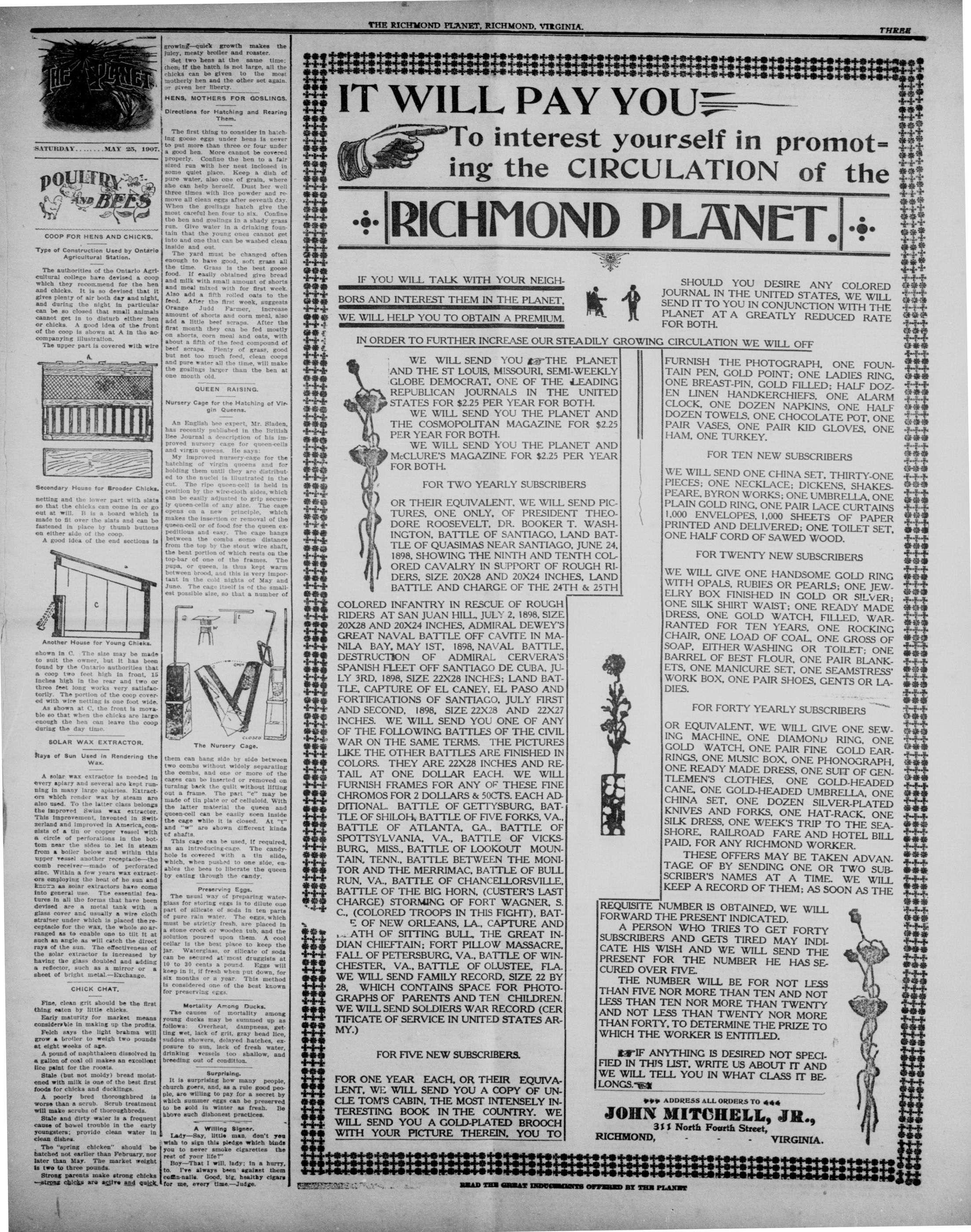
IT WILL PAY YOU To interest yourself in promot ing the CIRCULATION of the RICHMOND PLANET.
THE PLANET
SATURDAY.....MAY 25, 1907
POULTRY AND BEES
COOP FOR HENS AND CHICKS.
Type of Construction Used by Ontario Agricultural Station.
The authorities of the Ontario Agricultural college have devised a coop which they recommend for the hen and chicks. It is so devised that it gives plenty of air both day and night, and during the night in particular can be so closed that small animals cannot get in to disturb either hen or chicks. A good idea of the front of the coop is shown at A in the accompanying illustration.
The upper part is covered with wire
A.
Secondary House for Brooder Chicks.
netting and the lower part with slats so that the chicks can come in or go out at will. B is a board which is made to fit over the slats and can be fastened in place by thumb buttons on either side of the coop.
A good idea of the end sections is
Another House for Young Chicks.
shown in C. The size may be made to suit the owner, but it has been found by the Ontario authorities that a coop two feet high in front, 15 inches high in the rear and two or three feet long works very satisfactorily. The portion of the coop covered with wire netting is one foot wide. As shown at C, the front is movable so that when the chicks are large enough the hen can leave the coop during the day time.
SOLAR WAX EXTRACTOR.
Rays of Sun Used in Rendering the Wax.
A solar wax extractor is needed in every aplary and several are kept running in many large aplaries. Extractors which render wax by steam are also used. To the latter class belongs the improved Swiss wax extractor. This improvement, invented in Switzerland and improved in America, consists of a tin or copper vessel with a circle of perforations in the bottom near the sides to let in steam from a boiler below and within this upper vessel another receptacle—the comb receiver—made of perforated zinc. Within a few years wax extractors employing the heat of he sun and known as solar extractors have come into general use. The essential features in all the forms that have been devised are a metal tank with a glass cover and usually a wire cloth strainer under which is placed the receptacle for the wax, the whole so arranged as to enable one to tilt it at such an angle as will catch the direct rays of the sun. The effectiveness of the solar extractor is increased by having the glass doubled and adding a reflector, such as a mirror or a sheet of bright metal.—Exchange
CHICK CHAT.
Fine, clean grit should be the first thing eaten by little chicks.
Early maturity for market means considerable in making up the profits.
Felch says the light brahma will grow a broiler to weigh two pounds at eight weeks of age.
A pound of naphthaleen dissolved in a gallon of coal oil makes an excellent lice paint for the roosts.
Stale (but not moldy) bread moistened with milk is one of the best first foods for chicks and ducklings.
A poorly bred thoroughbred is worse than a scrub. Scrub treatment will make scrubs of thoroughbreds.
Stale and dirty water is a frequent cause of bowel trouble in the early youngsters; provide clean water in clean dishes.
The "spring chicken" should be hatched not earlier than February, nor later than May. The market weight is two to three pounds.
Strong parents make strong chicks
--strong chicks are active and quick
BORS AND INTEREST THEM IN THE PLANET. WE WILL HELP YOU TO OBTAIN A PREMIUM.
COLORED INFANTRY IN RESCUE OF ROUGH RIDERS AT SAN JUAN HILL, JULY 2, 1898, SIZE 20X28 AND 20X24 INCHES, ADMIRAL DEWEY'S GREAT NAVAL BATTLE OFF CAVITE IN MANILA BAY, MAY 1ST, 1898, NAVAL BATTLE, DESTRUCTION OF ADMIRAL CERVERA'S SPANISH FLEET OFF SANTIAGO DE CUBA, JULY 3RD, 1898, SIZE 22X28 INCHES; LAND BATTLE, CAPTURE OF EL CANEY, EL PASO AND FORTIFICATIONS OF SANTIAGO, JULY FIRST AND SECOND, 1898, SIZE 22X28 AND 22X27 INCHES. WE WILL SEND YOU ONE OF ANY OF THE FOLLOWING BATTLES OF THE CIVIL WAR ON THE SAME TERMS. THE PICTURES LIKE THE OTHER BATTLES ARE FINISHED IN COLORS. THEY ARE 22X28 INCHES AND RETAIL AT ONE DOLLAR EACH. WE WILL FURNISH FRAMES FOR ANY OF THESE FINE CHROMOS FOR 2 DOLLARS & 50CTS. EACH ADDITIONAL. BATTLE OF GETTYSBURG, BATTLE OF SHILOH, BATTLE OF FIVE FORKS, VA., BATTLE OF ATLANTA, GA., BATTLE OF SPOTTSYLVANIA, VA., BATTLE OF VICKSBURG, MISS., BATTLE OF LOOKOUT MOUNTAIN, TENN., BATTLE BETWEEN THE MONITOR AND THE MERRIMAC, BATTLE OF BULL RUN, VA., BATTLE OF CHANCELLORSVILLE, BATTLE OF THE BIG HORN, (CUSTER'S LAST CHARGE) STORMING OF FORT WAGNER, S. C., (COLORED TROOPS IN THIS FIGHT), BAT
E OF NEW ORLEANS, LA., CAPTURE AND PATH OF SITTING BULL, THE GREAT INDIAN CHIEFTAIN; FORT PILLOW MASSACRE, FALL OF PETERSBURG, VA., BATTLE OF WINCHESTER, VA., BATTLE OF OLUSTEE, FLA. WE WILL SEND FAMILY RECORD, SIZE 22 BY 28, WHICH CONTAINS SPACE FOR PHOTOGRAPHS OF PARENTS AND TEN CHILDREN. WE WILL SEND SOLDIERS WAR RECORD (CERTIFICATE OF SERVICE IN UNITED STATES ARMY.)
FOR ONE YEAR EACH, OR THEIR EQUIVALENT, WE WILL SEND YOU A COPY OF UNCLE TOM'S CABIN, THE MOST INTENSELY INTERESTING BOOK IN THE COUNTRY. WE WILL SEND YOU A GOLD-PLATED BROOCH WITH YOUR PICTURE THEREIN, YOU TO
growing—quick growth makes the juicy, meaty broiler and roaster.
Set two hens at the same time; then, if the hatch is not large, all the chicks can be given to the most motherly hen and the other set again, or given her liberty.
HENS, MOTHERS FOR GOSLINGS.
Directions for Hatching and Rearing Them.
The first thing to consider in hatching goose eggs under hens is never to put more than three or four under a good hen. More cannot be covered properly. Confine the hen to a fair sized run with her nest inclosed in some quiet place. Keep a dish of pure water, also one of grain, where she can help herself. Dust her well three times with ice powder and remove all clean eggs after seventh day. When the goslings hatch give the most careful hen four to six. Confine the hen and goslings in a shady grass run. Give water in a drinking fountain that the young ones cannot get into and one that can be washed clean inside and out.
The yard must be changed often enough to have good, soft grass all the time. Grass is the best goose food. If easily obtained give bread and milk with small amount of shorts and meal mixed with for first week. Also add a fifth rolled oats to the feed. After the first week, suggests Orange Judd Farmer, increase amount of shorts and corn meal, also add a little beef scraps. After the first month they can be fed mostly on shorts, corn meal and oats, with about a fifth of the feed compound of beef scraps. Plenty of grass, good but not too much feed, clean coops and pure water all the time, will make the goslings larger than the hen at one month old.
QUEEN RAISING.
Nursery Cage for the Hatching of Virgin Queens.
An English bee expert, Mr. Sladen, has recently published in the British Bee Journal a description of his improved nursery cage for queen-cells and virgin queens. He says:
My improved nursery-cage for the hatching of virgin queens and for holding them until they are distributed to the nuclei is illustrated in the cut. The ripe queen-cell is held in position by the wire-cloth sides, which can be easily adjusted to grip securely queen-cells of any size. The cage opens on a new principle, which makes the insertion or removal of the queen-cell or of food for the queen expeditious and easy. The cage hangs between the combs some distance from the top by the stout wire shaft, the bent portion of which rests on the top-bar of one of the frames. The pupa, or queen, is thus kept warm between brood, and this is very important in the cold nights of May and June. The cage itself is of the smallest possible size, so that a number of
The Nursery Cage.
them can hang side by side between two combs without widely separating the combs, and one or more of the cages can be inserted or removed on turning back the quilt without lifting out a frame. The part "c" may be made of tin plate or of celluloid. With the latter material the queen and queen-cell can be easily seen inside the cage while it is closed. At "t" and "w" are shown different kinds of shafts.
This cage can be used, if required, as an introducing-cage. The candy-hole is covered with a tin slide, which, when pushed to one side, enables the bees to liberate the queen by eating through the candy.
Preserving Eggs.
The usual way of preparing waterglass for storing eggs is to dilute one part of silicate of soda in ten parts of pure rain water. The eggs, which must be strictly fresh, are placed in a stone crock or wooden tub, and the solution poured upon them. A cool cellar is the best place to keep the jar. Waterglass, or silicate of soda can be secured at most druggists at 10 to 30 cents a pound. Eggs will keep in it, if fresh when put down, for six months or a year. This method is considered one of the best known for preserving eggs.
Mortality Among Ducks
The causes of mortality among young ducks may be summed up as follows: Overheat, dampness, getting wet, lack of grit, gray head lice, sudden showers, delayed hatches, exposure to sun, lack of fresh water, drinking vessels too shallow, and breeding out of condition.
Surprising.
It is surprising how many people, church goers, and, as a rule good people, are willing to pay for a secret by which summer eggs can be preserved to be gold in winter as fresh. Be above such dishonest practices.
A. Willing Blaner.
Lady—Say, little man, don't you wish to sign this pledge which binds you to never smoke cigarettes the rest of your life?" Boy—That I will, lady; in a hurry, to. I've always been against them coffin-nails. Good, big, healthy cigars for me, every time—Judge.
IN ORDER TO FURTHER INCREASE OUR STEADILY GROWING CIRCULATION WE WILL OFF
WE WILL SEND YOU THE PLANET AND THE ST LOUIS, MISSOURI, SEMI-WEEKLY GLOBE DEMOCRAT, ONE OF THE LEADING REPUBLICAN JOURNALS IN THE UNITED STATES FOR $2.25 PER YEAR FOR BOTH.
WE WILL SEND YOU THE PLANET AND THE COSMOPOLITAN MAGAZINE FOR $2.25 PER YEAR FOR BOTH.
WE WILL SEND YOU THE PLANET AND McCLURE'S MAGAZINE FOR $2.25 PER YEAR FOR BOTH.
OR THEIR EQUIVALENT, WE WILL SEND PICTURES, ONE ONLY, OF PRESIDENT THEODORE ROOSEVELT, DR. BOOKER T. WASHINGTON, BATTLE OF SANTIAGO, LAND BATTLE OF QUASIMAS NEAR SANTIAGO, JUNE 24, 1898, SHOWING THE NINTH AND TENTH COLORED CAVALRY IN SUPPORT OF ROUGH RIDERS, SIZE 20X28 AND 20X24 INCHES, LAND BATTLE AND CHARGE OF THE 24TH & 25TH
READ THE GREAT INDUCTIONS OFFERED BY THE PLANET
THE RICHMOND PLANET, RICHMOND, VIRGINIA
IF YOU WILL TALK WITH YOUR NEIGH-
```markdown
```
FOR TWO YEARLY SUBSCRIBERS
FOR FIVE NEW SUBSCRIBERS
REQUISITE NUMBER IS OBTAINED, WE WILL FORWARD THE PRESENT INDICATED. A PERSON WHO TRIES TO GET FORTY SUBSCRIBERS AND GETS TIRED MAY INDICATE HIS WISH AND WE WILL SEND THE PRESENT FOR THE NUMBER HE HAS SECURED OVER FIVE. THE NUMBER WILL BE FOR NOT LESS THAN FIVE NOR MORE THAN TEN AND NOT LESS THAN TEN NOR MORE THAN TWENTY AND NOT LESS THAN TWENTY NOR MORE THAN FORTY, TO DETERMINE THE PRIZE TO WHICH THE WORKER IS ENTITLED.
IF ANYTHING IS DESIRED NOT SPECIFIED IN THIS LIST, WRITE US ABOUT IT AND WE WILL TELL YOU IN WHAT CLASS IT BE LONGS.
ADDRESS ALL ORDERS TO
JOHN MITCHELL, JR.,
311 North Fourth Street,
RICHMOND, VIRGINIA.
A man sitting in a chair and a man standing in front of him.
LANET
WEEKLY
READING
UNITED
H.
T AND
R $2.25
T AND
YEAR
ND PIC-
THEO-
WASH-
D BAT-
JUNE 24,
H COL-
GH RI-
LAND
& 25TH
```markdown
```
REQUISITION FOR WAR
SHOULD YOU DESIRE ANY COLORED JOURNAL IN THE UNITED STATES, WE WILL SEND IT TO YOU IN CONJUNCTION WITH THE PLANET AT A GREATLY REDUCED RATE FOR BOTH.
FURNISH THE PHOTOGRAPH, ONE FOUNTAIN PEN, GOLD POINT; ONE LADIES RING, ONE BREAST-PIN, GOLD FILLED; HALF DOZEN LINEN HANDKERCHIEFS, ONE ALARM CLOCK, ONE DOZEN NAPKINS, ONE HALF DOZEN TOWELS, ONE CHOCOLATE POT, ONE PAIR VASES, ONE PAIR KID GLOVES, ONE HAM, ONE TURKEY.
FOR TEN NEW SUBSCRIBERS
WE WILL SEND ONE CHINA SET, THIRTY-ONE PIECES; ONE NECKLACE; DICKENS, SHAKESPEARE, BYRON WORKS; ONE UMBRELLA, ONE PLAIN GOLD RING, ONE PAIR LACE CURTAINS 1,000 ENVELOPES, 1,000 SHEETS OF PAPER PRINTED AND DELIVERED; ONE TOILET SET, ONE HALF CORD OF SAWED WOOD.
FOR TWENTY NEW SUBSCRIBERS
WE WILL GIVE ONE HANDSOME GOLD RING WITH OPALS, RUBIES OR PEARLS; ONE JEWELRY BOX FINISHED IN GOLD OR SILVER; ONE SILK SHIRT WAIST; ONE READY MADE DRESS, ONE GOLD WATCH, FILLED, WARRANTED FOR TEN YEARS, ONE ROCKING CHAIR, ONE LOAD OF COAL, ONE GROSS OF SOAP, EITHER WASHING OR TOILET; ONE BARREL OF BEST FLOUR, ONE PAIR BLANKETS, ONE MANICURE SET, ONE SEAMSTRESS' WORK BOX, ONE PAIR SHOES, GENTS OR LADIES.
FOR FORTY YEARLY SUBSCRIBERS
OR EQUIVALENT, WE WILL GIVE ONE SEWING MACHINE, ONE DIAMOND RING, ONE GOLD WATCH, ONE PAIR FINE GOLD EARRINGS, ONE MUSIC BOX, ONE PHONOGRAPH, ONE READY MADE DRESS, ONE SUIT OF GENTLEMEN'S CLOTHES, ONE GOLD-HEADED CANE, ONE GOLD-HEADED UMBRELLA, ONE CHINA SET, ONE DOZEN SILVER-PLATED KNIVES AND FORKS, ONE HAT-RACK, ONE SILK DRESS, ONE WEEK'S TRIP TO THE SEASHORE, RAILROAD FARE AND HOTEL BILL PAID, FOR ANY RICHMOND WORKER. THESE OFFERS MAY BE TAKEN ADVANTAGE OF BY SENDING ONE OR TWO SUBSCRIBER'S NAMES AT A TIME. WE WILL KEEP A RECORD OF THEM; AS SOON AS THE
THREE
not= the
COLORED
INS, WE WILL
WITH THE
PRICES RATE
ONE FOUN-
DADIES RING,
HALF DOZ-
ONE ALARM
ONE HALF
POT, ONE
LOVES, ONE
RIBERS
THIRTY-ONE
INS, SHAKES-
RELLA, ONE
THE CURTAINS
OF PAPER
TOILET SET,
AND.
RIBERS
GOLD RING;
ONE JEW-
DR SILVER;
ADY MADE
FILED, WAR-
E ROCKING
THE GROSS OF
DILET; ONE
HAIR BLANK-
KAMSTRESS'
ENTS OR LA-
RIBERS
ONE SEW-
RING, ONE
GOLD EAR-
DNOGRAPH,
QUIT OF GEN-
LD-HEADED
RELLA, ONE
PER-PLATED
RACK, ONE
AND THE SEA-
HOTEL BILL
BAKER.
EN ADVAN-
T TWO SUB-
WE WILL
ON AS THE
```markdown
```
```markdown
```
THE PLANET
Published every Saturday by JOHN MITCHELL,
JR., at 311 North 4th Street, Richmond Va.
JOHN MITCHELL, JR., - EDITOR
All communications intended for publication
should be sent so as to reach us by Wednesday.
TERMS IN ADVANCE.
One Copy, one year. $1.50
One Copy, eight months. 1.00
One Copy, six months. .80
One Copy, four months. .50
One Copy, three months. .40
Single Copy. .05
ADVERTISING RATES.
For one inch, one insertion, $ .50
For one inch, each subsequent insertion, .40
For two inches, three months, 6.00
For two inches, twelve months, 10.00
For two inches, nine months, 14.00
For two inches, twelve months, 20.00
Marriage and Funeral Notices, one inch, .50
Standing and Transient Notices per line, .10
$ POSTAGE STAMPS OF A HIGHER DE-NOMINATION THAN TWO CENTS NOT RECEIVED ON SUBSCRIPTIONS
THE PLANET is issued weekly. The subscription price is $1.50 per year in advance.
There are FOUR ways by which money can be sent by mail at our risk—In a Post Office Money Order, by Bank Check or Draft, or an Exkription, and when none of these can be procured, in the Bank or at our risk. MONEY ORDERS—You can buy a Money Order at your Post-Office, payable at the Richmond Post-Office, and we will be responsible for EXPRESS MONEY ORDERS can be obtained at any office of the American Express Co., the United States Express Co., and the Wells Fargo and Co. Express Company. We will be responsible for the Express Money Order of any companies. The Express Money Order is a safe and convenient way for forwarding money. REGISTERED LETTER—If a Money Order Post-Office or an Express Company is not within your jurisdiction, you must send us on payment of ten cents. Then, if the letter is lost or stolen, it can be traced. You can send money in this manner. You must send us on payment of ten cents. We cannot be responsible for money sent in letters in any other way than one of the four ways mentioned above. If you send your money in any other way, you must do it at your
BENEWALS, ETC.—If you do not want THE PLANET continued for another year after your subscription has run out, you then notify by a card to discontinue it. The course has decided that subscribers to newspaper, who do not order their paper discontinued at the ex-court date for which it has been held liable for the payment of the subscription up to date when they order the paper discontinued.
CERTIFICATIONS—When writing to us to renew your subscription or to discontinue your paper, you should give your name and address in full otherwise we cannot find your name on CHANGE OF ADDRESS. In order to change the address of a subscriber, we must be sent the former as well as the present address.
Entered at the Office at Richmond, Va., the second-class matter.
SATURDAY, MAY 25, 1907
We return thanks for an invitation to attend the 25th anniversary of Livingstone College, Salisbury, N.C., May 19 to 24, 1907. Prof. William Harvey Goler, D. D., LL. D., is now President.
We return thanks to the John A. Dix Industrial School for an invitation to attend the anniversary exercises of that institution, May 26, 28, and 29, 1907 at Dinwiddie, Va. Prof. J. M. Colson, Superintendent.
We return thanks to the faculty and class of the Normal Department of the Agricultural and Mechanical College at Normal, Ala., for an invitation to the Commencement Exercises Ma 27th, 1907.
We return thanks for an invitation to be present at the annual commencement of the St. Paul N. and I Institute at Lawrenceville, Va., Rey James S. Russell, principal, May 23d 1907. This institution takes high rank with the leading industrial establishments of the country.
The Virginia Union University Prof. G. R. Hovey, President has just concluded one of its most successful scholastic terms and it must be a source of satisfaction to the official head of this great university and to the faculty. We regretted our inability to be present at the Commencement Exercises and to the Alumnae Dinner, to both of which we were cordially invited.
Hartshorn Memorial College continues in the front rank for the education of the females of the country and it has been demonstrated time and again that Dr. L. B. Tefft is peculiarly adapted and admirably fitted for this kind of work. His recent illness seems to have strengthened him in many respects. His corp of assistants have been admirably selected. We thank him for his cordial invitations to join In the general jubilation over the completion of the year's work.
THE BROWNSVILLE INVESTIGATION.
We are publishing both sides of the testimony in the Brownsville investigation in order that conservative citizens may be able to draw their own conclusion from the evt-
dence adduced. The Texans are now having their innings and it will be noted that they are making statements of the most positive character to show that the colored soldiers or at least ten or twelve of them "shot up" the town and attempted to murder many of the residents thereof. This testimony would be startling but for the fact that the evidence now being adduced has already been discounted by previous testimony. It has been proven that the men who did shoot up the town could not have been recognized either as to their color or as to their facial identity. The question of shells has also been thoroughly sifted and proven that the finding of army shells was not at all conclusive as to the identity of the men doing the shooting.
The case now stands upon the credibility of the witnesses. The white officers of the Twenty-fifth Infantry, including Major Penrose have heard at San Antonio, Texas all of the evidence now being adduced at Washington and they have reached the conclusion that the colored soldiers did not shoot up the town of Brownsville, Texas. When the committee or a subcommittee goes to the Texas town, it will be able to draw conclusions which will go far to upset the damaging nature of the testimony now being adduced.
It has been asserted that Senator Foraker has information which has not been made public, but which he will produce at the proper time to show the nature of the plot for ridding the Lone Star State of colored troops.
Regardless of which way the investigation ends, it has been demonstrated that out of 167 colored men dismissed from the United States Army without honor, there were over 150 who were admittedly innocent of any wrongdoing. It is this proposition that the War Department will find confronting it, and to all fair-minded people there can be but one answer.
Senator Foraker is also secure in his position. He insisted that the colored men should have "their day in court" and that they were entitled to a trial before they could be lawfully punished. He has certainly made good his case and the country is awakening to the enormity of the outrage perpetrated upon one of the most celebrated battalions then in the service.
A COLORED MAN'S PREDICAMENT
A strange report comes from Wirt chester, Va., stating that Mr. Samuel Mason, the only colored resident at Temberville, Va. had been served with notice by the prominent residents of that place to leave the neighborhood. No intimation is given that he was not an industrious and law-abiding citizen. When he got the notice, he gave out another notice to the effect that any one interfering with him would need the services of the local undertaker. This was taken to be plain unadulterated insolence on the part of a Negro. He was not attacked, but he was arrested at a time he least expected and a revolver was found on his person.
This was considered a violation of the law against concealed weapons and he has been heavily fined by a magistrate and is now in jail at Woodstock, Va. We are at a loss to understand what these people expected this citizen to do after his life had been threatened. He could have applied for permission to carry a revolver or he could have carried the revolver unconcealed and he would have been within the latter and spirit of the law.
It seems that just in proportion as we gain white friends, we increase the bitterness of our white enemies. Our sympathies are naturally with Mason and we would be in favor of a white man who pursued a similar course. For our own part, we would carry a brace of revolvers and be a walking arsenal so to speak had we been threatened in the same way that he has been. We would then have the pleasure of at least "dying with our boots on" with the satisfaction of filling a brave man's grave rather than that of a coward.
Mason deserves help and we hope that he will get it, provided the facts are as before stated. Race prejudice is on the increase and so is race progress. We are losing in some places but we are gaining in many others. Oh, that the colored man in this country would first be a friend to himself before he expects others to be a friend to him.
CIVIL WAR FIGURES
Statistics of the Army That Put Down the Rebellion.
The enlistments in the union army during the civil war reached the enormous total of 2,898,304. It is not possible to know exactly how many enlistments there were in the confederate army, because the confederate states failed to keep a reliable record of the number of men furnished to the service, and such statistics as are to be had are incomplete. It is estimated, however, that there were between 600,000 and 700,000 men in the confederate armies, and that fully 200,000 of this number died in battle or from wounds and disease.
THE RICHMOND PLANET. RICHMOND. VIRGINIA
FIVE PERISH ON BURNING STEAMER
FIVE PERISH ON BURNING STEAMER
Met Awful Fate on Fire Swpt Vessel on Lake Michigan.
PASSENGERS WERE RESCUED
Grand Haven, Mich., May 22.—Five Hives were lost and about 75 people had a perilously close escape from death when the passenger and freight steamer Naomi, of the Crosby Transportation company, was burned in the middle of Lake Michigan while on her regular trip from this port to Millwaukee. Four of the victims were coal passengers penned down in the forecastle by the flames, where many of the rescued passengers from the decks of the freighter Kerr and the steamer Kansas saw them at the port holes vainly imploring for help. J. M. Rhoades, of Detroit, a passenger, was the fifth victim. He was terribly burned in his birth and died soon after reaching a hospital at Grand Ranches, Mich. The steamer was burned to the water's edge and has been towed into this harbor, where she lies at her dock, a smoldering hulk.
The fire broke out between decks in the forward end of the steamer. In spread with tremendous rapidity, and it was apparent almost from the first that it was vain for the crew to fight the flames. They immediately turned their attention to arousing the passengers and getting them on deck. Headed by Steward Philip Rossbach and Purser William Hanrahan, the members of the crew worked like heroes to save the sleeping men, women and children. Captain Traill sent up signals for help as soon as he discovered that his ship was afire, and in a few moments three steamers whose lights could be seen a few miles away came to the rescue. They were the steel freighter Kerr, the Kansas, a sister ship of the Naomi, and the Saxonia. Several of the life rafts and boats on the Naomi were destroyed before the crew could get them lowered. By the time the three steamers had reached the scene the Naomi's boats were in the water, filled with people, and a number of passengers were still huddled on the stern of the burning ship. The captain of the Kerr ran his big steel ship up under the Naomi's stern so close that the imperilled people leaped to her deck. Then the screams of the imprisoned coal passers were heard from the bow port holes. Vainly they begged for help. The port holes were too small for them to pass through, and they were compelled to fall back into the smoke and fire, where they burned to death.
The Kansas took on board the half-clad and terribly shocked and frightened passengers and brought them to this port. All of them were loud in their praise of the Naomi's crew and their bravery and coolness. Steward Rossbach and Purser Hanrahan, who rescued Rhondes from his berth when the cabin was filled with flames, were especially commended.
STATUE TO ENSIGN BAGLEY
Unveiled at Raleigh, N. C., in Memory of Young Naval Officer.
of Young Naval Officer.
Raleigh, N. C., May 21. — Twenty thousand people witnessed the unveiling of the monument and statue erected in Capitol Square by the people of the United States in memory of Ensign Worth Bagley, of the United States navy, killed by a Spanish shell off Cardenas, on May 11, 1898. Confederate, Federal and Spanish War Veterans, national guard and school children formed the parade. The addresses were by Congressman Richard P. Hobson, the hero of the Merrimac and Captain Victor Blue, of the United States navy. The statue was unveiled by Worth Bagley Daniels, nephew of Worth Bagley, the unveiling being in charge of F. D. Owen, of the war department. Governor Glenn accepted it for the state.
CEMENT MILLS TO CLOSE
Owing to Over-Production Atlas Company Will Shut Down Two
pany Will shut Down Two.
Allentown, Pa., May 22.—Announcement was made here that the Atlas Cement company, the largest concern of its kind in the world, would shut down two of its mills on May 28. The mills to be closed are Lehigh Valley No. 1, at Coplay, and No. 2, at Northampton. The shut-down will throw 2500 men out of employment and lighten the monthly pay roll $130,000. it is also stated that other mills of the company will be run on half time only for a time. The chief cause of the shutdown is given as over-production. The Atlas mills have a capacity of 30,000 barrels of cement daily, and it is stated that the company has millions of barrels of the material in store houses in various parts of the country.
Woodmen Bar Saloonkeepers
Norfolk, Va., May 22—The sovereign camp, Woodmen of the World, in biennial convention here, decided that barkeepers and bartenders, stone crushers and miners of all kinds are not eligible to membership in the order, and the camp is considering the eligibility of other craftsmen whose line of work is hazardous, the order being largely a death beneficial one.
Liberty Bell For Jamestown Fair
Liberty Hall For Jamesstown Fair.
Norfolk, Va., May. 18. The Jamesstown Exposition company was notified that all objection to the bringing of the Liberty Bell from Philadelphia to the exposition has been overcome and that the bell will arrive here after July 18. it will be installed in the Pennsylvania building, which is a reproduction of Independence Hall.
Shot and Killed By Playmate
New Castle, Pa., May 21.—Benjamin Jones, 13 years old, was accidentally shot and almost instantly killed by Edward Lewis, a playmate. The boys were shooting at a target with a 22-calibre rifle when the accident occurred. The dead boy's mother was in Pittsburg and did not hear of her son's death until she arrived home. She is prostrated.
THE OIL TRUST VIOLATES LAW
The Standard Deliberately Destroyed Competition.
6OT POWER THROUGH REBATES
Washington, May 20.—That the history and present operation of the Standard Oil interests "shows throughout the past 35 years substantial monopolization of the petroleum industry of the country, a deliberate destruction of competition and a consequent control of that industry by less than a dozen men, who have reaped enormous profits therefrom, largely through a system of transportation facilities," is charged in a report just submitted to President Roosevelt by Commissioner of Corporations Herbert Knox Smith. Certain information acquired is withheld for the present, in accordance with instructions of the president, who feels that their publication might interfere with the prosecution of the government's suit pending against the Standard Oil company and its subsidiary companies.
The report contains the net results of a study of the petroleum business during the year 1904. It is the first official statement of the operations and methods of the Standard Oil company, by which, the report states, through "scandalous railway discriminations" and other unlawful devices they have secured and maintained an "exclusive domination of the petroleum industry."
It is stated that in 1904 the Standard and affiliated concerns refined over 84 per cent. of the crude oil run through refineries; produced more than 86 per cent. of the country's total output of illuminating oil; maintained a similar proportion of the export trade in illuminating oil and transported through pipe lines nearly nine-tenths of the crude oil of the older fields and 98 per cent. of the crude oil of the mid-continent field."
The report points out that the monopoly enjoyed by the company does not rest on the ownership of the source of the oil supply which amounts to about one-sixth of the total, but "that its growth and present power rest primarily on the control of the transportation facilities."
After the railroad rebate was abandoned, the company, the report continues, was able to secure secret or even open discriminations of rates in its favor, throughout practically the entire country. Having established its monopoly of the pipe line business, the company substantially refuses to act as a common carrier.
It is shown that the Standard controls not only the wholesale, but also the retail trade.
In conclusion, the report says it is apparent "that the dominating position of the Standard Oil company in the oil industry has largely been secured by the abuse of transportation facilities, first, by flagrant discriminations obtained from railroads; second, by a refusal to operate its pine line system so as to extend to independent interests the benefits to which they were both morally and legally entitled, while at the same time the Standard has prevented such independent interests from constructing lines of their own."
SMOKEHOUSE HER PRISON
Girl Confined For Weeks Rescued By Infuriated Neighbors.
Johnstown, Pa., May 22—One hundred infuriated neighbors rescued Ethel Hefley, a half-witted girl about 17 years of age, from a smokehouse in which she had been confused for several weeks by her parents, who reside on a farm near Berlin, Somerset county. The smokhouse prison in which the girl was kept was six by eight feet in size, with but one window, which had been painted over to prevent the girl from being observed by strangers who might be about the premises. What food was given the prisoner was thrown in upon the floor. The rescuing party was composed of the most prominent citizens of Berlin.
WON BROOKLYN HANDICAP
Superman Wins Classic Racing Event at Gravesend.
New York, May 21.—Through serried lines of cheerlings thousands Superman, the sturdy 3-year-old son of the great Commando, carrying the colors of James R. Keene, and ridden by Jockey Miller, flashed under the wire the winner of the Brooklyn handicap over a course fetlock deep in mud at the Gravesend track. Twenty-five thousand people saw the mud splashed Keene horse held back until the stretch and then sent out in front to win in decisive fashion from a field of 11 starters. Beacon Light was second, a length behind Superman, and Nealon was third. Superman covered the course of a mile and a quarter in 2.09. The purse was $20,000.
HEGEMAN INDICTED
President of Metropolitan Life Charged
With Forgey and Perlery.
With Forgery and Perjury.
New York, May 23. — The special grand jury which has concerned itself with the conduct of the insurance business in New York county has concluded its investigation of the Metropolitan Life Insurance company, and returned 10 indictments against the company's president, John R. Hegeman. Seven of the indictments charge forgery in the third degree, while the other three charge perjury. All are based on what have come to be known as "year end transactions." These consist of certain charges in the company's books effected just prior to the submission of the annual report to the state insurance department, which it is alleged, were designed to place the company in a more favorable light than the facts warranted.
In its investigations of the Metropolitan the grand jury went into the insurance company's dealings with the Mercantile Trust company, the Central Trust company and Brown Brothers and the transfer of loans by the insurance people to Vermilye & Co. Out of these transactions grew the seven indictments for forgery, in which it is
alleged the Metropolitan altered its books to cover up certain loans which it had made. The perjury charges were founded upon statements made to the insurance department concerning loans by the company, which statements it is charged were false.
LYNCH TWO; KILL FOUR OTHERS
Reidsville, Ga., May 22—Two negroes lynched and four other persons dead and six others injured, is the net result of an attempted criminal assault made on Mrs. Laura Moore, white, a widow, abent six miles from here, by Clem Padgett, a negro. Two of the Padgett family are the ones lynched, and the death or injury of the others followed the efforts of a pose to capture Padgett.
News of the attempted assault aroused the citizens, who immediately went to the home of the negro's family. His father assured the crowd that his son was not within the house, and invited the pose to search for themselves. As they approached the house Clem Padgett fired on the crowd, killing a white man named Hare and wounding four others. The crowd fired a volley into the house, killing the old negro Padgett and two of his daughters and wounding two of his sons, one of whom was Clem Padgett, the man wanted.
After the cooler heads had left the scene of the killing, the hot-headed element employed a young man to take Padgett's wife and one of the Padgett boys, who was shot through the lungs, to the Reidsville jail, but later the party followed, took the prisoners from the young man in charge and riddled them both with buckshot. Clem Padgett, who was slightly injured, escaped, but was recaptured and placed in fall.
ENSIGN SHOOTS HIMSELE
Naval Officer Who Had Trouble In Cuba Commits Suicide.
Washington, May 22.—The navy department received a dispatch from Commander Tapan, of the cruiser Tacoma, saying that Ensign A. T. Brisbin, who shot himself Sunday, died on Monday.
Ensign Brisbin, who was in differs from the Tacoma, shot himself through the lung and was in a serious condition. Ensign Brisbin is in Santiago. The official investigation of the trouble with the Santiago police appears to have developed the fact that Brisbin was drinking with the sailors, which would doubtless have resulted in his having been court martialed. Brisbin entered the Annapolle Academy from Pennsylvania in 1899 and graduated in 1893. He was born in Idaho.
POISONED SON FOR INSURANCE
The Charge on Which a Southern Doctor is Under Arrest.
Raleigh, N. C., May 21—Dr. S. Rowland, a prominent physician here, was arrested on a warrant from Henderson, Vance county, charging him with the murder of his 11-year-old son near Kittrell, in Vance county, to obtain insurance money and property left to the boy, the insurance being $900. The boy died two weeks ago after taking a walk in the woods with his father, and it is alleged that the lad said his father had given him an orange which tasted bitter. The warrant charged murder by poison. Rowland's wife, to whom he was married last week, was arrested as an accessory.
Slipped Under Engine's Wheels.
Reading, Pa., May 21.—Joseph McGuire, a passenger brakeman on the New York division of the Reading railway, met with a tragic death at West Falls. He was in the act of stepping on the engine attached to his train when he slipped and fell, the wheels passing over his body. He died before reaching the hospital. McGuire was over six feet tall and 28 years of age.
Man and Woman Fatally Shot
New Castle, Pa., May 20—Lenora Giazianna, 32 years old, and Louis Messena, 19 years old, were probably fairly shot at Bessemer, five miles west of here. The woman's husband is alleged to have done the shooting as the result of jealousy. The authorities are searching for him.
Steepielack Killed By Fall
Reading Pa., May 18. — Harry F. Schoeller, aged 29, a "steeplejack," while painting the stack of the Reystone furnace here, lost his balance and fell to the bottom, a distance of 100 feet, and was picked up dead. Many bones were broken.
Dead Man Identified
Mount Holly, N. J., May 22. — The man who jumped from a trolley car at Hainesport, dying three hours later of his injuries, has been identified as Martin Jones, of Reading, Pa. Jones was captain of a freight boat which plied between Philadelphia and Hainesport.
PRODUCE QUOTATIONS
The Latest Clearing Prices In the Principal Markets.
PHILADELPHIA • FLOUR firm;
winter extras, $2.25@3.45; Pennsylvania roller, clear, $3.50 @ 3.75; city mills, fancy, $5.40@5.60; RYE FLOUR steady; per barrel, $3.65; WHEAT steady; No. 2 Pennsylvania red, 56%@96c;
CORN firm; No. 2 yellow, local; OAK firm; local, white clipped, 49%c; lower grades, HAY steady; No. 1 timothy, 21.50 for large balee. PORK firm; family, par barrel, $19.50. BEEF steady; beef hams, per barrel, $19. Poultry: Live steady; hens, 16@17c; old roosteres, 12c. Dressed firm; choice fowls, 15c. old roosters, 11c. BUTTER firm; chicken, 12c. Dressed firm; farmed, 18@20c; nearby, 15%c; southern, 14%c@15%c. POTATOES steady; 55%@58c. per bushel.
BALTIMORE—WHEAT weaker; No. 2 spot, 92% @ 94c; steamer No. 2 spot, 88% @ 88c; southern, 88% @ 93c; CORN easier; mixed spot, 58% @ 58c; steamer mixed, 54% @ 55c; southern, 54% @ 55c; southern, 24% @ 49c; corm, 3, 47% @ 6c; No. 2, 49% @ 49c; corm, 3, 47% @ 6c; No. 2, 49% @ 49c; mixed, No. 2, 48% @ 48c; No. 3, 45% @ 45c; corm, No. 4, 43% @ 48c; BUTTER steady; creamy separator e-tras, 27% @ 2c; held, 22% @ 2c; prints, 29% @ 20c; Maryland and Pennsylvania, 29% @ 20c; steady, fancy Maryland, Pennsylvania, Virginia and West Virginia, 16c; southern, 15% @ 15c; per dozen.
A FLAG
OF TRUCE
BY DANIEL CLEVERTON
S BOY and man, Col. Bryant had been a soldier. As a boy his ambition had been a cadet ship at West Point, and the army as a life career. Blessed with wealthy parents, there seemed nothing in the way to the accomplishment of his ideal when the opportunity time arrived. At 15 he began a course of study that would fit him to pass the required examination and admit him to the United States military academy. At 18 the opportunity came. There was a vacancy at the academy to be filled by appointment from his congressional district, and he entered eagerly into the competition for the coveted place, feeling confident of winning the prize.
His most formidable opponent was Billy Edwards, the son of a struggling clergyman, into whose path fate had thrown no special opportunities, but who had improved every chance for study that had been given him, and who wished the appointment merely as a means of securing a desired education. The two had never been friendly, and on one of two occasions had had some boyish quarrels over the attentions each had attempted to bestow upon Blossom Nathan. When Billy Edwards won the coveted appointment every semblance of friendship between the two boys ceased, and Bob Bryant refused even to associate with anyone who called young Edwards their friend.
Grievously disappointed in not winning the cadetship, young Bryant entered a military academy with a determination to prepare himself for a military career, trusting to his father's wealth and influence to secure for him an appointment to the army. During their school days both boys kept up a correspondence with Blossom Nathan, until at the end of three years Bryant insisted that she could not retain the friendship of both he and Edwards, and that all correspondence between her and his rival must cease, or her would have nothing more to do with her. The young lady very promptly informed her angry suitor that she would choose her own friends, and he accepted her decision.
Six months after Lieut. Edwards had graduated from West Point and entered the army he made Blossom Nathan his wife, and took her to the western post, where his command was stationed.
Bryant in the mountains had finished his college course, and not finding it so easy to secure a civil appointment to the army, had settled down to the study of law in his home town, and confined his military ambitions to a place in a local company of state guards.
Then came the call to arms to save the union. The southern states had succeeded; the flag had been fired upon. Every available company of the regular service had been rushed eastward for the defense of Washington. Volunteers in companies, battalions and regiments were flocking into the mustering camps. With the volunteers went Bob Bryant as captain of his company. With the regulars sent to Washington went First Lieut. Edwards, while Mrs. Edwards went back to her old home to await the return of her husband from the
front.
The four years of war dragged wearily along. Lleut. Edwards stuck to the regular service and rose to the rank of major, and brevet Heutenant colonel, as which he commanded his regiment. Capt. Bryant of the volunteer service rose to the rank of colonel.
At the battle of Gettysburg Col. Bryant was temporarily in command of a brigade stationed at Cemetery Hill. During the first day's fighting his command in company with all others at that point in the line of battle had suffered severely. With the reenforcements of the second day came the regiment commanded by Lleut. Col. Edwards, and during the fighting of that day Edwards fell and was buried on the field.
The war over. Col. Bryant found the wished for opportunity to enter the regular service, and was sent to the far west as a lieutenant of cav
P. R. R.
Beside the White Stone.
alry. For 12 years he followed the trail of the red man, and then "the good of the service" took him to Washington to serve for a time on the staff of the general commanding the army. It was this that accounted for his presence on the Gettysburg battlefield on Decoration day, 1878.
He walked over the ground so fiercely contested in '63 and glanced at the white headstones looking for the name of his comrades. At each grave there was planted a small flag, similar to one he carried idly in his hand. At one grave he noticed the frail staff had been broken, and the flag blown away. He stopped to read the name on the stone. It was: BVT. LIEUT. COL. WILLIAM ED.
Instantly all the old animosity of the years gone by returned. The man buried here had stolen from him his opportunity, had stolen the girl he loved and then there came to him the thought that this man had sacrificed his life for the flag; that this man had lost his life in bringing success to himself and his comrades, and had helped in saving them from probable annihilation at the hands of the enemy.
Reverently he stooped over the grave and planted the flag he carried beside the white stone. As he did so a woman's voice close behind
(Continued on Eighth Page.)
INMEMORIAM
For four long years the din of battle resounded through the land. For four long years there was an incessant boom of cannon, a rattle of musketry, the clash of steel upon steel. For four long years the army in gray proved a valiant foeman for the army in blute. Sons of the north and of the south fell upon hundreds of stubbornly contested battlegrounds, and found a last long resting place side by side in nameless graves. The prayers that ascended unto heaven from those battlefields were for both blue and gray; one bugle's strains sounded the final "taps" for the valiant sons of both the north and south.
Near half a century has passed away since the disbanding of those two mighty armies; since the victorious blue and the defeated gray parted with a handshake at Appomattox. The heartaches and pain of four years of stifle swallowed up in the glories of peace and a reunited nation. Back to the plow and the factory, back to the store and office, back to the pulpit and school room, back to the duties of peace, to the work of repairing the devastations of war, went Columbia's sons, north and south.
In the immortal words of him who called that army in blue into being; who directed it during its hard fought campaigns; who bid the men that comprised it a God speed back to their homes when its work was done: "But in a larger sense we cannot dedicate, we cannot consecrate, we cannot hallow this ground. The brave men, living or dead, who struggled here, have consecrated it far above our power to add or detract. The world will little note, nor long remember, what we say here, but it can never forget what they did here."
```markdown
```
TICK-Tick-Tickety-Tick-Tick"
The telegraph instruments spelled out the nation's cry for help. Unto every city, village and hamlet went the rallying call to Columbia's sons.
A nation's emblem-Old Glory--had been fired upon. Flying from the mast head it had been met in a southern port by the ominous boom of defiant cannon.
War, grim visaged war, had come.
A conflict that was to leave its record of heroic deeds, of unexamplied valor, upon all history.
A conflict that was to pit brother against brother, friend against friend, each battling for the right as he saw the right.
From the farm and factory, the store and office, the pulpit and schoolroom came the answer. It echoed from ocean to ocean, from east to west and north:
Five hundred thousand strong!"
The roll of the drum, the shrill notes of the bugle, marked the mustering camps, and into them gathered the flower of the nation's manhood.
From out these mustering camps there marched an army clad in blue, each hero eager to perform that duty, no matter what it be, assigned to him.
"Southward, ever southward," was the battle cry. "Southward to meet the foeman, an army clad in gray."
For four long years the din of battle re-
years there was an incessant boom of can-
upon steel. For four long years the army
army in blue. Sons of the north and of the
contested battlegrounds, and found a last
graves. The prayers that ascended unto
both blue and gray; one bugle's strains so
of both the north and south.
Near half a century has passed away s
armies; since the victorious blue and the
Appomattox. The heartaches and pain
glories of peace and a reunited nation.
to the store and office, back to the pulpi
peace, to the work of repairing the dew
north and south.
J. H.
In the immortal words of him who can
directed it during its hard fought campaign
God speed back to their homes when its
we cannot dedicate, we cannot consecrate
brave men, living or dead, who struggle
our power to add or detract. The w
what we say here, but it can never forget
Personal Conviction.
"The mental condition of the defendant was a matter of much curiosity."
"Yes," answered the juror; "but what I'd like to have the alienists do is to investigate the mental condition of the men who refused to agree with me about a verdict."—Washington Star.
O.
sounded through the land. For four long
mon, a rattle of musketry, the clash of steel
by in gray proved a valiant foeman for the
the south fell upon hundreds of stubbornly
long resting place side by side in nameless
to heaven from those battlefields were for
bounded the final "taps" for the valiant sons
since the disbanding of those two mighty
defeated gray parted with a handshake at
of four years of strife swallowed up in the
Back to the plow and the factory, back
at school room, back to the duties of
vastations of war, went Columbia's sons,
As we gather today with spring flowers to do reverence to the heroes who have gone we must look back that half a century to review those scenes of conflict.
The cannon that then dealt death and destruction are today moss covered and buried beneath the debris of the battlefields of old.
Time has healed the ravages of war, and covered with a softening hand the evidences of that four years of warfare.
But we have the remaining gray-haired veterans, and the graves of those passed away, to remind us of the valor of Columbia's sons.
The generation of today has not forgotten, and the generations yet unborn will not forget, the care due these final resting places of a nation's dead.
We scatter flowers upon them in token of our appreciation of their services to their country of yesterday, our country of today.
Whatever their place in life, whatever their station, whatever their fortune, they are deserving of equal honor at our hands.
And unto them a grateful nation has dedicated this day; a day on which we, with freshest flowers, pay tribute to the memory of the nation's heroes.
Called that army in blue into being; who ms; who bid the men that comprised it a work was done: "But in a larger sense it, we cannot hallow this ground. The led here, have consecrated it far above world will little note, nor long remember, what they did here."
Wright A. Patterson.
Going One Better.
Enthusiastic Artist—Do you know I painted a picture of a lion so naturally that it had to be placed behind bars.
Enthusiastic Author—That's nothing. I wrote a novel so full of burning emotion, that it had to be printed on asbestos pages for fear of a conflagration.—Royal Magazine.
THE RICHMOND PLANET, RICHMOND, VIRGINIA.
JOB DEPARTMENT
It is thoroughly equipped to do all kinds of printing on short notice. We make a specialty of Society printing and work for Insurance Companies, such as Financial
EXCURSION
We print Handbills, Quarter-Sheet posters, Tags, Tickets, Placards, Visiting Cards, Mourning Stations
WE HAVE
Our St.
OF THE LATE
WE CAN PRINT A BILL AS SMALL
A Three-Sheet
AS LARGE AS A FRO
Our street-entrance is retired and fastidious lady being able to enter w
CURSION
Bills, Quarter-Sheet,
Tickets, Placards,
Mourning Stationery
HAVE A
Our Story
OF THE LATEST
A BILL AS SMALL
Free-Sheet
GREGE AS A FRONT
OUR PRE
IS WITH
France is retired and h
ing able to enter with
WE AN ELSE
WHICH WE WILL
STOCK ROOM
LATEST STYLE BOND, F
AS SMALL AS A DODGER
Sheet Poster
A FRONT DOOR.
OUR PRESENT CORP OF EMPLOYEES IS WITHIN EASY REACH OF
COLN POMADE
SOFTENS THE HAIR AND KEEPS IT FROM BREAKING KEEPS SCALP FRESH CLEAN AND WHOLESOME.
or Mars Her Beauty.
Our head is full of dandruff. If COLN HAIR POMADE will dandruff and cure scalp diseases, it is highly perfumed and is in the market. All we ask is we feel confident the result will recommend it to your friends and refuse weak and inferior Drug Stores.
5 CENTS.
FIGURED BY
made Company,
EXCURSION WORK OF ALL DESCRIPTIONS
We print Handbills, Quarter-Sheets, Half and Whole Sheet posters, Tags, Tickets, Placards, Society Cards, Minutes, Visiting Cards, Mourning Stationery. OUR AIM is to please our patrons and to give them the best service at the lowest prices, consistent with satisfactory work. We furnish "cuts" when desired and we will arrange to complete special work in our line. When in need of any work in our line, call and see us and estimates will be furnished.
WE CAN PRINT A BILL, AS SMALL AS A DODGER. A Three-Sheet Poster AS LARGE AS A FRONT DOOR. WE HAVE ONE OF THE LARGEST OF WOOD-T Of Any Job Printing Establishmen
Our street-entrance is retired and has no objectionable features, the most fastidious lady being able to enter without embarrassment or annoyance.
LONG DISTANCE TELEPHONE, 2213.
LINCOLN
HAIR POMA
MAKES
KINKY
HAIR
SOFT
REMOVES
DANDRUFF
AND
MAKES
IT
GROW
LONG
AND
LUXURIOUS
LINCOLN
HAIR POMA
A Woman's Hair Makes or M
If your hair is short. If your head is your scalp is diseased, LINCOLN Hair make it grow, remove the dandruff and LINCOLN HAIR POMADE is hit the finest toilet preparation on the market for you to give it a trial and we feel can be so satisfactory that you will recommend. Be sure and get the genuine and refractive substitutes. For sale at all Drug Stores.
PRICE, 15 CENTS
MANUFACTURED BY
The Lincoln Pomade
LINCOLN
HAIR POMADE
Hair Makes or Makes
If your head is
used, LINCOLN HAIR
are the dandruff and o
POMADE is high
separation on the mark
trial and we feel con
at you will recommen
genuine and refuse
able at all Drug Stores
PRICE, 15 CENTS
MANUFACTURED BY
Lin Pomade
MAKES
KINKY
HAIR
SOFT
REMOVES
DANDRUFF
AND
MAKES
IT
GROW
LONG
AND
LUXURIOUS
LINCOLN
HAIR POMADE
Softens
THE
HAIR
AND
KEEPS IT
FROM
BREAKING
KEEPS
SCALP
FRESH
CLEAN
AND
WHOLESOME.
A Woman's Hair Makes or Mars Her Beauty.
If your hair is short. If your head is full of dandruff. If your scalp is diseased, LINCOLN HAIR POMADE will make it grow, remove the dandruff and cure scalp diseases. LINCOLN HAIR POMADE is highly perfumed and is the finest toilet preparation on the market. All we ask is for you to give it a trial and we feel confident the result will be so satisfactory that you will recommend it to your friends. Be sure and get the genuine and refuse weak and inferior substitutes. For sale at all Drug Stores.
The Lincoln Pomade Company,
NORFOLK, VA., U. S. A.
If your dealer does not keep it, send his name and 20 cents in silver and we will send you a bottle by return mail. Agents wanted everywhere. Write for particulars.
The Eyes of the World are Upon Me. it utterly impossible to produce a
it utterly impossible to produce a book of such proportions at less cost. We hope that you, dear readers, if you cannot send the one dollar at once, will write to us and state whether or not you would like to have a copy of the book reserved for you and that you will state at what time you will be able to send us the $1.00. Hoping that we shall hear from
The colored race in the United States at the present time is having some very trying experiences and only the best sort of advice and the wisest counsel should be given and heeded if your people are to continue in this land of prosperity and enjoy life, liberty, security and the pursuit of happiness. In this book we have attempted to present to the colored people of this great country a solution of our problems.
Hoping that we shall hear from you by return mail, we are
Yours truly.
RICHARD H. BALL.
28 Franklin St. Lawrence, Mass.
Excursions to Jamestown Exposition
Norfolk, Va. via Southern
Railway.
We have called attention to the commendable steps made by our people along commercial, intellectual and moral lines, and we believe that if this book is read carefully, that it will prove a source of great inspiration and encouragement to not only the colored people themselves but the white people who are interested in our progress. All of the readers of this journal, who will send to us at once $1.00 by P. O. money order or registered letter will receive a copy of the book in cloth binding just as soon as it comes from the press.
Commencing April 19th and continuing daily to November 30, 1907 Southern Railway will sell season sixty day, fifteen day and ten day excursion tickets to Norfolk, Va. and return at reduced rates account the above; and on Tuesday of each week coach excursion tickets, not good in parlor or pullman cars, will be sold at greatly reduced rates, limited seven days. Inquire of Southern Railway Agents.
We offer this special inducement in order to ascertain to what extent our people are willing to support such an enterprise. We will have to charge $1.50 for the book after it comes from the press. We find above; and coach exe parlor or at great seven d Railway
---
---
OUR PRESENT CORP OF EMPLOYEES ARE COMPETENT AND QUICK-WORKING. OUR OFFICE IS WITHIN EASY REACH OF THE PUBLIC, BEING WITHIN FIFTY YARDS OF BROAD ST.
Cards, Policies, both straight life and benevolent, Physician's Certificates, Sick Cards, Application blanks, Agents Report Sheets, Rate Cards, etc.
N WORK C
is to please
give them
the lowest
with satis
AN ELEGANT
WHICH WE WILL SHOW A
Rock Room
STYLE BOND, FINE WRITTEN
L AS A DODGER.
Poster
DOOR.
PRESENT CORP OF EMPLOYEES ARRIVING
IN EASY REACH OF THE PUBLIC
as no objectionable features, the
but embarrassment or annoyance
HAIR
FOR
"OZONIZ
WHICH WE WILL SHOW ANY ONE DESIRING TO SEE THEM.
(None genuine)
Cha
153 E. KIN
Agents
Railway.
---
WORK OF ALL
OUR AIM
is to please our patrons and to
give them the best service at
the lowest prices, consistent
with satisfactory work.
LEGANT
SHOW ANY ONE DESIRING
from Embrace
LINE WRITING—FLAT AND
LOYEES ARE COMPETENT AND Q
OF THE PUBLIC, BEING WITHIN E
features, the most
or annoyance.
FOR FUR
FORD'S
HAIR POMADE
Formerly known as
"OZONIZED OX MARROW"
SO STRAIGHTENKS KINKY or CUBLY
that it can be put up in any style
Ford's Hair Pomade was formerly
Ford's Hair Pomade was formerly
the only safe preparation known to us that
makes kinky or curly hair straight, as
born, hair, hinky or curly hair soft,
pliable and easy to come out, these result
bottles are usually sufficient for a year. The
prevents dandruff, relieves itching, invi-
orates the scalp, stops the hair from falling
nourishing the roots, gives it new life and
harmless, it is a toilet necessary for ladies,
gentlemen and children. Ford's Hair
simply about 15S, and label, "OZONIZED OX
States Patent Office, in 1871. Be sure to get
SOFT and PLIABLE. Beware of imitations.
Pomade is popular only in GO, size, and
in Chicago and by us. The genuine has the
signature, and all other. Full price on each pact.
bottle, and all other. Sold by
druggle and dealer. If your druggle
dealer cannot supply you, he can get it
or send us 50 cts. for one bottle postpaid,
or send us 100 cts. for one bottle postpaid,
express paid. We pay postage and express
charges to all points in U.S. A. When order
is mentioned name of this paper. Write your
name and address plainly to
The Ozonized Ox Marrow Co.
(None genuine without my signature)
Charlie Fortress
153 E. KINZIE ST., CHICAGO, ILL.
Agents wanted everywhere.
JURGEN'S SON
Before making your purchase you would do well to call at the most reliable furniture house in the city and see the fine line of
REFRIGERATONS,
MATTINGS,
OIL-CLOTHS
And in fact everything that is needed in house furnishings.
RUGS AND
CARPETS
Of every description; also the latest designs in ROCKERS and special CHAIRS.
Our goods are the best for the price and
Our goods are the best for the price and the price is very low.
C. G. JURGEN'S SON,
ADAMS AND BROAD STREETS.
Daily to Baltimore.
On and after April 1st, 1907, sched ule via the popular York River Line will leave Richmond at 4:30 P. M. daily except Sunday, returning leave Baltimore at 5 P. M. daily except Sunday. Very low rates one way and round trip to Baltimore, Philadelphia and New York. It's the best way to reach Northern and Eastern points.
We print Wedding Invitations, and High Class Stationery for Balls, Parties, Picnics and all entertainments of a social nature. We print Church Envol
ALL DESCRIBE
ons and to
service at
consistent
work.
We furnish "cuts" when de-
complete special work in our l
in our line, call and see us and
T LINE OF S
DESIRING TO SEE THEM.
braces a full
LAT AND LINEN PAPER, ENVELOP
WE HAVE ONE OF THE
OF WOOD
Of Any Job Printing E
ENT AND QUICK-WORKING. OUR OFFICE
WITHIN FIFTY YARDS OF BROAD ST.
FOR FURTHER INFORMATION, AP
John Mitch
311 N. 4th St.
FOR FURTHER INFORMATION, APPLY TO
John Mitchell, Jr.,
John Mitchell, Jr.,
River Line
:130 P. M.
nning leave
nally except
one way
more, Phil-
It's the
n and Eas-
PITTSBURG, PA.
Jos. Evans, care Jones & Laughlin.
E. K. Thumm., 1402 Wylie Ave.
BOSTON, MASS.
C. Branun, 657 Shawmut Ave.
J. W. White, 832 Tremont St.
NORFOLK VA
John Debona, 610 Church St.
T. H. W. Perry, 2 Jouce Place.
```markdown
```
WE HAVE ONE OF THE LARGEST ASSORTMENTS OF WOOD-TYPE Of Any Job Printing Establishment in the city.
311 N. 4th St., Richmond, Va.
SEABOARD
SOUTTHBOUND TRAIN: SCHED-
ULED TO LEAVE RICHMOND
DAILY.
9:10 A. M.—Local to Norlina, Raleigh, Charlotte, Wilmington, 2:20
P. M.—Sleepers and coaches, Savannah, Jacksonville and Florida points.
9:50 P. M.—Sleepers and coaches Atlanta, Birmingham, Memphis, Savannah, Jacksonville and Southwest.
NORTHBOUND TRAINS SCHED-
ULED TO ARRIVE RICHMOND
DAILY.
6:45 A. M., 5:10 P. M., 5:45 P. M.
H. S. LEARD, D. P. A.
JOSHUA BANKS & SONS
CATERERS
EVERY FACILITY CONSISTENT
WITH FINE CATERING.
Special Attention Given to Balls,
Suppers, Installations and Smokers at the Shortest Notice.
Your Patronage Solicited.
Refreshment Cars and Boat Privileges handled in Season.
Address all communications to
ELAM L. BANKS,
511 N. 3d St
Residence: 1312 N. 26th St.
BLACKWELL & BRO.
Practical House and Sign Painters,
Graining and General Contractors.
.....ALL WORK GUARANTEED.....
Cards, Letters or Orders.
...Give us a trial, you will never regret it...
Address, Cor. Price and Jackson Sts.
PLANET DEPOTS
NEW YORK CITY
P. Ritzhelmer, 7 N. 134th St.
Green and Bailey, 249 E. 127th St.
J. H. Parker, 144 W. 26th St.
Charles Devan, 1.1 W. 30th St.
W. J. Buckner, 150 W. 33rd St.
W. W. Shaughter, 812 W. 40th St.
W. W. Johnson, 247 W. 47th St.
E. H. Mitchell, 152 W. 27th St.
Turner R. Robinson, 12-6th Ave.
E. A. Williams, 200 W. 63rd St.
M. B. Walker, 309 W. 37th St.
J. H. Jarrett, 453-7th Ave.
Smith & Miles, 233 W. 41st St.
M. B. Wineyglass, 322 W. 59th St.
PHILADELPHIA, PA.
M. Clay, 1801 Fitzwater St.
J. H. Gray, 1233 Pine St.
Bishop Robinson, 1234 Melon St.
E. P. Mackens, 1116 Pine St.
James E. Warwick, 254 S. 11th St.
Mrs. B. Homsher, 1040 Pine St.
William Parker, 631 Pine St.
Mrs. Lavinia Aldridge, 521 S. 12th.
Chas. A. George, 4063 Market St.
F. A. Stewart, 1730 Federal St.
FIVE
opes, Note and Letter Paper
Bill-heads, Monthly Statements,
Business Cards, Financial and Order Books,
Circulars, Check-books, Pamphlets.
SCRIPTIONS
sired and we will arrange to
line. When in need of any work
estimates will be furnished.
SAMPLES
Line
PES, ETC.
LARGEST ASSORTMENTS
OD-TYPE
establishment in the city.
PLY TO
nell, Jr.,
Richmond, Va.
CHICAGO, ILL.
E. H. Faulkner, 8104 State St.
BROOKLYN, N. Y.
Lee Ricks, 782 Fulton St.
William A. Dabney, 3 Quincy St.
William Pope, 174 Myrtle Ave.
CHARLESTON, W. VA.
L. C. Farrar, 601 Brooks St.
ASTORIA, L. I.
Frank R. Wood, 144 Broadway,
ATLANTIC CITY, N. J.
Hursey Bros., 1217 Commerce Ave.
BRONX BOROUGH, N. Y.
J. H. Barrett, 603-162d St.
PLAINFIELD, N. J.
Thes. H. Bridges, 614 W. 4th St.
WASHINGTON, D. C.
L. H. Singleton, 20th and E Stu.
Southwestern Drug Co.,
732-23 Street, I. W.
A. E. Evans, 382 Essex St.
SPRINGFIELD, MASS.
W. H. Brown, 13 Stockbridge 86.
COVINGTON, VA.
E. J. Jefferson, 1211-30th St.,
George T. Hall, 1332-30th St.
TARPORO, N. C.
V. E. Heward.
WILMINGTON, N. C.
William H. Moere.
STAUNTON, VA.
Wm. C. Johnston, 111 E. Main St.
LYNCHBURG, VA.
Charles Morgan, 702 Taylor St.
HAMPTON, VA.
THE PLANET
SATURDAY.....MAY 25, 1997
The Prisoner Of Zenda.
CONTINUED FROM SECOND PAGE
of stronger will, and his cool head ruled both. He was content to take all and give nothing. When she arrived she was not long in finding that she had a rival in the Princess Flavin. Rendered desperate, she stood at nothing which might give or keep for her her power over the duke. As I say, he took and gave not. Simultaneously Antolnite found herself entangled in his audacious schemes. Unwilling to abandon him, bound to him by the chains of shame and hope, she yet would not be a decoy nor at his bidding lure me to death; hence the letters of warning she had written. Whether the lines she sent to Flavia were inspired by good or bad feeling, by jealousy or by plight, I do not know, but here also she served us well. When the duke went to Zenda she accompanied him, and here for the first time she learned the full measure of his cruelty and was touched with compassion for the unfortunate king. From this time she was with us, yet from what she told me I know that she still (as women will) loved Michael and trusted to gain his life, if not his pardon, from the king as the reward for her assistance. His triumph she did not desire, for she loathed his crime and loathed yet more fiercely what would be the prize of it—his marriage with his cousin, Princess Flavin.
At Zenda a new force came into play, the daring of young Rupert. He was caught by her beauty, perhaps. Perhaps it was enough for him that she belonged to another man and that she hated him. For many days there had been quarrels and ill will between him and the duke, and the scene which I had witnessed in the duke's room was but one of many. Rupert's proposals to me, of which she had of course been ignorant, in no way surprised her when I related them. She had herself warm-
d Michael against Rupert even when she was calling on me to deliver her from both of them. On this night, then, Rupert when she had gone to her room, having furnished himself with a key to it, made his entrance. Her cries had brought the duke, and there in the dark room while she screamed the men had fought, and Rupert, having wounded his master with a mortal blow, had on the servants rushing in escaped through the window, as I have described. The duke's blood, spurting out, had stained his opponent's shirt; but Rupert, not knowing that he had dealt Michael his death, was eager to finish the encounter. How he meant to deal with the other three of the band I know not. I dare say he did not think, for the killing of Michael was not pre-meditated. Antolnette, left alone with the duke, had tried to stanch his wound, and thus was she busled till he died, and then, hearing Rupert's taunts, she had come forth to avenge him. Me she had not seen, nor did she till I darted out of my ambush and leaped after Rupert into the meat.
The same moment found my friends on the scene. They had reached the chateau in due time and waited ready by the door. But Johann, swept with the rest to the rescue of the duke, did not open it—hay, he took a part against Rupert, putting himself forward more bravely than any in his anxiety to avert suspicion, and he had received a wound, in the embrasure of the window. Till nearly half past 2 Sapt waited; then, following my orders, he had sent Fritz to search the banks of the moat. I was not there. Hastening back, Fritz told Sapt, and Sapt was for following orders still and riding at full speed back to Tarlenheim, while Fritz would not hear of abandoning me, let me have ordered what I would. On this they disputed some few minutes; then Sapt, persuaded by Fritz, detached a party under Bernstein to gallop back to Tarlenheim and bring up the marshal, while the rest fell to on the great door of the chateau. For near fifteen minutes it resisted them; then, just as Antoinette de Mauban fired at Rupert Hentzau on the bridge, they broke in, eight of them in all, and the first door they came to was the door of Michael's room, and Michael lay dead across the threshold, with a sword thrust through his breast. Sapt cried out at his death, as I had heard, and they rushed on the servants, but these in fear dropped their weapons, and Antoinette dung herself weeping at Sapt's feet. And all she cried was that I had been at the end of the bridge and had leaped off. "What of the prisoner?" asked Sapt, but she shook her head. Then Sapt and Fritz, with the gentlemen behind them, crossed the bridge, slowly, warily and without noise, and Fritz stumbled over the body of De Gautet in the way of the door. They felt him and found him dead.
Then they consulted, listening eagerly for any sound from the cells below, but there came none, and they were greatly afraid that the king's guards had killed him and, having pushed his body through the great pipe, had escaped the same way themselves. Yet because I had been seen here they had still some hope (thus, indeed, Fritz in his friendship told me), and, going back to Michael's body, pushing aside Antonette, who prayed by it, they found a key to the door which I had locked and opened the door. The staliccase was dark, and they would not use a torch at first lest they should be the more exposed to fire, but soon Fritz
cried: "The door down there is open! See, there is light." So they went on boldly and found none to oppose them. And when they came to the outer room and saw the Belgian, Bersounl, lying dead they thanked God, Sapt saying, "Aye, he has been here." Then, rushing into the king's cell, they found Detchard lying dead across the dead physician and the king on his back, with his chair by him. And Fritz cried, "He's dead!" and Sapt drove all out of the room except Fritz and knelt down by the king, and, having learned more of wounds and the signs of death than he, soon knew that the king was not dead nor if properly attended would die. And they covered his face and carried him to Duke Michael's room and laid him there, and Antoinette rose from praying by the body of the duke and went to bathe the king's head and dress his wounds till a doctor came. And Sapt, seeing I had been there and having heard Antoinette's story, sent Fritz to search the mount and then the forest. He dared send no one else. And Fritz found my horse and feared the worst. Then, as I have told, he found me, guided by the shout with which I had called on Rupert to stop and face me. And I think a man has never been more glad to find his own brother alive than was Fritz to come on me, so that in love and anxiety for me he thought nothing of a thing so great as would have been the death of Rupert Hentzau. Yet had Fritz killed him I should have grudged it.
The enterprise of the king's rescue being thus prosperously concluded, it lay on Colonel Sapt to secure secrecy as to the king ever having been in need of rescue. Antollette de Mauban and Johann, the keeper (who, indeed, was too much hurt to be wagging his tongue just now), were sworn to reveal nothing, and Fritz went forth to find not the king, but the unnamed friend of the king, who had lain in Zenda and flashed for a moment before the dazed eyes of Duke Michael's servants on the drawbridge. The metamorphosis had happened, and the king, wounded almost to death by the attacks of the jailers who guarded his friend, had at last overcome them and rested now, wounded, but aliva, in Black Michael's own room in the castle. There he had been carried, his face covered with a cloak, from the cell, and thence orders issued that if his friend were found he
should be brought directly and privately to the king and that meanwhile messengers should ride at full speed to Tarlenheim to tell Marshal Strakenzia to assure the princess of the king's safety and to come himself with all speed to greet the king. The princess was enjoined to remain at Tarlenheim and there await her cousin's coming or his further injunctions. Thus the king would come to his own again, having wrought brave deeds and escaped almost by a miracle the treacherous assault of his unnatural brother.
This ingenuous arrangement of my long headed old friend prospered in every way save where it encountered a force that often defeats the most cunning schemes. I mean nothing else than the pleasure of a woman, for, let her cousin and sovereign send what command he chose (or Colonel Sapt chose for him), and let Marshal Strakenza insist as he would, the Princess Flavia was in no way minded to rest at Tarlenholm while her lover lay wounded at Zenda, and when the marshal, with a small suit, rode forth from Tarlenholm on the way to Zenda the princess' carriage followed immediately behind, and in this order they passed through the town, where the report was already rife that the king, going the night before to remonstrate with his brother in all friendliness for that he held one of the king's friends in confinement in the castle, had been most traitbrougly set upon, that there had been a desperate conflict, that the duke was slain, with several of his gentlemen, and that the king, wounded as he was, had seized and held the castle of Zenda. All of which talk made, as may be supposed, a mighty excitement, and the wires were set in motion, and the tidings came to Strelsau only just after orders had been sent thither to parade the troops and overweed the dissatisfied quarters of the town with a display of force.
Thus the Princess Flavia came to Zenda. And as she drove up the hill, with the marshal riding by the wheel and still imploring her to return in obedience to the king's orders, Fritz von Tarlenheim, with the prisoner of Zenda, came to the edge of the forest. I had revived from my swoon and walked, resting on Fritz's arm, and, looking out from the cover of the trees, I saw the princess. Suddenly understanding from a glance at my companion's face that we must not meet her, I sank on my knees behind a clump of bushes. But there was one whom we had forgotten, but who followed us and was not disposed to let slip the chance of earning a smile and maybe a crown or two, and while we lay hidden the little farm girl came by us and ran to the princess, courtesying and crying:
"Madame, the king is here—in the bushes. May I guide you to him, madame?"
"Nonsense, child!" said old Strakencz. "The king lies wounded in the castle."
"Yes, sir, we wounded, I know, but he's there, with Count Fritz, and not at the castle," she persisted.
"Is he in two places, or are there two kings?" asked Flavia, bewildered.
"And how should he be here?"
"He pursued a gentleman, madame, and they fought till Count Fritz came, and the other gentleman took my father's horse from me and rode away. But the king is here with Count Fritz. Why, madame, is there another man in Kuratania like the king?"
"No, my child," said Flavia softly (I was told it afterward), and she smiled and gave the girl money. "I will go and see this gentleman," and she rose to alight from the carriage.
But at this moment Sapt came riding from the castle and, seeing the princess, made the best of a bad job and cried to her that the king was well tended and in no danger
"Where else, madame?" said he, bowing.
"But this girl says he is yonder—
THE RICHMOND PLANET, RICHMOND, VIRGINIA.
HIGHER WAGES TO NEGRO WORKMEN
HIGHER WAGES TO NEGRO WORKMEN
Secured by This New Union Order—Grows By Leaps and Bounds—Started Five Years Ago with Nothing But a "Principle"—Now Has Over 400 Subordinate Lodges and 36,000 Members.
Over 30,000 homes of our people have been filled with joy, because of the Protection of a great and powerful Union Order, which is using its strength and influence to secure better conditions for our people. This is the first and only great Union Order in this country, holding an International Union Charter from the Courts, which gives a full Protection and Benefits to our race.
There is no color, race or sex discrimination in this Order. The negro has an equal standing with the white members, and can be elected to hold any office. Every effort is made to advance the condition of the members, by securing equal opportunities to work with other workmen, to learn the trades and to have steady work at high wages and Union hours.
The Grand Lodge donates $100.00 for the burial of each deceased member. A fine monthly Journal is published. A Membership Book of the Order is recognized by all Lodges everywhere. Dissressed members are assisted. Each Lodge and Subordinate Lodge has the privileges and buying stock in the Order, on low monthly payments, said stock paying 8 per month, interest, guaranteed.
A Leading Negro is wanted in each locality, AT OXCE, to form Lodges, sell Buttons, take Journal subscriptions, sell Stock and act as DISSTRICT DEPUTY ORGANIZER. This work can be done in spare hours, but many are devoting their whole time and attention to it. Big money is made by good hustlers.
Write at once. State name of this paper, and enclose 10 cents for full information and postage. Address
THE I. L. U. GRAND LODGE,
34 to 40 Canby Building, Dayton, Ohio.
with Count Fritz."
Sapt turned his eyes on the child
with an incredulous smile.
"Every fine gentleman is a king to
such," said he.
"Why, he's as like the king as one
pea to another, madame!" cried the
girl, a little shaken, but still obstinate.
A. NEVILLE
"It is not the king. Don't kiss him."
Sapt face started round. The old marshal's face asked unspoken questions. Flavia's glance was no less eloquent. Suspicion spreads quick.
"I'll ride myself and see this man," said Sapt hastily.
"Nay, I'll come myself," said the princess.
"Then come alone," he whispered. And she, obedient to the strange hinting in his face, prayed the marshal and the rest to wait, and she and Sapt came on foot toward where we lay. Sapt waving to the farm girl to keep at a distance. And when I saw
him coming I sat in a sad heap on the ground and buried my face in my hair. I could not look at her. Fritz knelt by me, laying his hand on my sirtion.
"I look low, whatever you say," I hope I sew whatsoever as they came up, and the next thing I heard was a low cry—half of joy, half of fear—from the princess:
"It is he! Are you hurt?"
And she fell on the ground by me and gently pulled my hands away, but I kept my eyes to the ground.
"It is the king!" she said. "Pray, Colonel Sapt, tell me where lay the wilt of the joke you played on me?"
We answered none of us. We three were silent before her. Regardless of them, she throw her arms round my neck and kissed me. Then Sapt spoke in a low, hoarse whisper:
"It is not the king. Don't kiss him. He's not the king."
She drew back for a moment; then, with an arm still round my neck, she asked in superb indignation:
"Do I not know my love? Rudolf, my love!"
"It is not the king," said old Sapt again, and a sudden sob broke from tender hearted Fritz.
It was the sob that told her no comedy was afoot.
"He is the king!" she cried. "It is the king's face—the king's ring—my ring! It is my love."
"Your love, madame," said old Sapt, "but not the king. The king is there in the castle. This gentleman"—
"Look at me, Rudolf, look at me!" she cried, taking my face between her hands. "Why do you let them torment me? Tell me what it means."
Then I spoke, gazing into her eyes.
"God forgive me, madame," I said. "I am not the king!"
I felt her hands clutch my cheeks. She gazed at me as never man's face was scanned yet. And I, silent again, saw wonder born, and doubt grow, and terror spring to life as she looked. And very gradually the grasp of her hands slackened; she turned to Sapt, to Fritz and back to me, then suddenly she reeled forward and fell in my arms, and with a great cry of pain I gathered her to me and kissed her lips. Sapt laid his hand on my arm. I looked up in his face. And I laid her softly on the ground and stood up, looking
3 BOTTLES Whiskey FREE
Knights of Pythias,
This organization is one of the most powerful in the country and its progress has been phenomenal. The Grand Lodge of Virginia has jurisdiction over all of the cities and counties in this state. Thirty males are required to organize a new lodge. The benefits paid constitute one of its strongest features, but the principles are greater than anything else. Founded on Friendship, based on Charity and established on Benevolence, the respectable, upright people of the state will find it an order worthy of their heartiest support.
It pays an endowment and burial benefit of of $200.00 for all ages. It pays $4.00 per week sick dues. The badge costing it
pays $4.00 per week sick dues. The badge costing 75 cents each is the only absolutely necessary regalla. For information concerning the organization of lodges apply at the main office.
The Courts of Calanthe
The Courts of Calanthe
Is the Female Department of the Order. It requires a membership of thirty persons to organize a court. Its members are pledged to exhibit Fidelity, exercise Harmony and prove Love one for the other. It pays an endowment and burial benefit of $150.00. It pays $3.00 per week sick dues. The only expense for regalia is the cost of the badge, 50 cents and a rosette, costing 25 cents for funeral occasions. THE BANDS OF CALANTHE or Children's Department also con-
stitutes a feature and persons cannot do better than to enter the little ones into this mystic circle. The expense is nominal and the benefits all that could be expected. It pays from $1.00 to $1.50 sick dues and death benefits of from $30.09 to $40.00. If you have no Pythian Lodge or Court or Band in your neighborhood, orgnize one.
For all information concerning the Children's Department address
For all information concerning special rates of JOHN MITCHELL, JR. membership in the lodges and courts, address 311 N. 4th St., Richmond, Va.
on her, curing heaven that you, per's sword had spared me for this sharper pang.
TO BE CONTINUED.
THE ESTIMABLE FAMILY.
"Reynolds," said Millionaire Banks to his valet, "go round to the house of that little girl whom I ran down with the auto this morning and extend to the family my sincere regrets and sympathy. Also give them this $60 bill. I understand that they are very poor and in want."
Accordingly the valet obeyed. When he returned his master met him at the door.
"Well, Reynolds?"
"The father wished me to say, sir, that he hoped you wouldn't take the affair too much to heart. As for the family, they all feel very grateful to you sir, and couldn't bring themselves to accept your very kind offer."
A most estimable family! Yet I wonder why they didn't accept the Knigh
RNIGHTS OF PYTHAS
FCB
only absolutely necessary rega
apply at the main office.
The Court
Is the Female Department of the
thirty persons to organize a court
Fidelity, exercise Harmony and
an endowment and burial bene
dues. The only expense for rea
rosette, costing 25 cents for fiv
THE BANDS OF CALA
istitutes a feature and persons o
circle. The expense is nomina
$1.00 to $1.50 sick dues and de
Lodge or Court or Band in you
For all information concerni
For all information concer
membership in the lodges and
money?" "The father said such matters should be arranged through his lawyer, sir."—Judge.
PESSIMISTIC.
Jollychappe—Fine day, isn't it?
Sadmann—Yees, locally; but it's probably snowing somewhere!—Commercial Tribune.
Mr. McDooley—Falth, an' it do be a question Oi have for yez, me darlin'.
Miss Clancy—Pfwat is it, Pat.
Mr. McDooley—Whin it comes tome
fer me funeral, how would yez loike t'
be th' Widder McDooley?—Chicago
Daily News.
Quick Corrections.
He—Let me propose to you—
She—Oh, indeed, I'll accept—
He—That we get out of the rain—
She—Your suggestion. — Baltimore
American.
"Remember," said the man who loves tite sayings, "the early bird catches the worm."
"My dear sir," answered the professor, "this proverb, like many others, is micheling. It is often undesirable to be early. For instance, the mound builders were the earliest people of whom we have any knowledge on this continent. Yet from the modern point of view their situation is entirely disadvantageous."—Washington Star.
"Why does marriage seem to dispel so much of the glamour of affection?" asked the sentimental young woman. "Well," answered Miss Cuyenne, "perhaps a woman doesn't make sufficient allowance. It must be very hard for a man to seem as graceful and heroic when advocating household economics as when he is offering to lay the world at your feet."—Washington Stern.
Pythias,
N. A., S. A., E. A., A. AND A.
organization is one of the most powerful has been phenomenal. The Grand over all of the cities and counties is in need to organize a new lodge. The longest features, but the principles handed on Friendship, based on Charity, the respectable, upright people of their heartiest support. An endowment and burial benefit of $9 per week sick dues. The badge of regalia. For information concerning courts of Calantio of the Order. It requires a memorial court. Its members are pledged and prove Love one for the other. Benefit of $150.00. It pays $3.00 per regalia is the cost of the badge, 500 funeral occasions. ANTHE or Children's Department cannot do better than to enter the final and the benefits all that could death benefits of from $30.09 to $44our neighborhood, orgnize one. Using the Children's Department ad
in the most powerful in the country and its al. The Grand Lodge of Virginia has juris- and counties in this state. Thirty males new lodge. The benefits paid constitute one the principles are greater than anything based on Charity and established on Be- right people of the state will find it an order port. burial benefit of of $200.00 for all ages. It is. The badge costing 75 cents each is the nation concerning the organization of lodges
Ben's Department also con-
tan to enter the little ones into this mystic
is all that could be expected. It pays from
from $30.09 to $40.00. If you have noPythian
orgrnize one.
Department address,
Mrs. ANNA TAYLOR, W. M.
120 W. H.
merning special rates of
JOHN
d courts, address
United Aid Insur-
HOME OFFICE, 312 East
Incorporated 1894 under the law
Has written over Three Million
business since organization.
Over sixty-five thousand
Over twenty-five Branche
All claims paid to date.
Ten Thousand Dollars on Deposit
OFFICE
120 W. Hill St., Richmond, Va.
of
JOHN MITCHELL, JR.,
311 N. 4th St., Richmond, Va.
Mid Insurance Company,
CE, 312 East Broad St., Richmond, Va.
at under the lawsof Virginia. Capital Stock, $25,000.
over Three Million ($8,000,000-00) Dollars worth of
organization.
sexty-five thousand policy holders.
twenty-five Branches.
imps paid to date.
dollars on Deposit with the Treasurer of Virginia.
OFFICERS.
United Aid Insurance Company.
Incorporated 1894 under the lawsof Virginia. Capital Stock, $25,000.
Has written over Three Million ($8,000,000.00) Dollars worth of business since organization.
J. H. Byrd, President.
W. W. Lee, 1st Vice President.
D. S. Alston, 2nd Vice President.
W. J. Spatley, Secty. and Gen'l. Manager.
R. L. Clay, Asst. Secretary.
R. H. Stakes, Cashier and Treasurer.
R. C. Mallay, General Inspector.
BOARD OF DEPUTY
J. E. Lyrd, W. J. pratley W. W. L.
Bailey, W. C. Carter, P. S. L.
Stokes, F. L.
Reliable men can find employment at
Address.
$150 PER
SURE TO GOOD AGENT
greatest seller in America to-day. Nothing
does the work. Sells at almost every home
on the dollar. Write to-day for full price.
J. E. Lyrd, W. J. - pratley W. W. Lee, D. S. Alston, R. L. Clay, W
Balley, W. C. Carter, W. S. Brown, H. C. Jones, R. H.
O PER MONTH
GOOD AGENTS, HAIR TONICS. Absolutely the
rica to-day. Nothing else like it. No long talk. My plan
at almost every home over and over again. 7 clear profit
o-day for full particulars, with real chance of a lifetime.
Address
J. F. CLARK, CONWAY, ARK.
ING PAYS When the Farmer combines
Scientific Methods with his
The Sun and the Soil have no Race Prejudice.
TON INSTITUTE
Graduate Course of three years for training practical farmers in
ing men without money can earn their way. All who have
The Course have good positions. Write for circular to
$150 PER MONTH
greatest seller in America to-day. Nothing else like it. No long talk. My plan does the work. Sells at almost every home over and over again. 87 clean profit on the dollar. Write to-day for full particulars, with real chance of a lifetime.
Offer a new Undergraduate Course of three years for training practical farmers in modern methods. Young men without money can earn their way. All who have completed the Graduate Course have good positions. Write for circular PRINCIPAL, HAMPTON INSTITUT, Hampton, Virginia.
Profoundly Considered.
Allowances Necessary
An Unfortunate Deficiency.
"I suppose the Boston Shakespeare mystery will never be explained," remarked the student.
"No," answered the cold-blooded man. "But we'd have found out all about it long ago if there had only been some royalties for the two families to go to law about."—Washington Star.
Add a hive or two of bees to the farm's equipment this year, and save some of the sweets that now go to taste in the field and garden.
JOHN FOXEL.
Dealer in General Line of FANCY AND STAPLE GROCERIES NOTIONS, FRESH MEATS, CIGARS, TOBACCO, ICE, WOOD, COAL, &c.
11 S. 4TH ST., RICHMOND, VA
BOARDING & LODGING
Rates Reasonable. All the Comforts
of Home
Orders received by letter or telegraph
MRS. BOOKER LEFTWICH.
PROFRIETRESS,
816 N. 2nd St., Richmond. Va
H F Jonathan
FISH, OYSTERS AND
PRODUCE.
120 N. 17TH St., RICHMOND, VA.
ALL ORDERS WILL RECEIVE
PROMPT ATTENTION.
Long Distance Phone, 788.
```markdown
```
UNITE, AID INSURANCE CO.
$1212 B. Broad St., chmghol, WI
Virginia's Most Successful Hair Culturist.
... PARLORS.....
108 E. Leigh St., - Richmond, / Phone, 1034.
Private Parlors, Confidential Interviews and Correspondence.
The largest and most up-to-date Hair Dressing Parlors in Richmond. The very best preparations that can be made for the hair, scalp, face and skin.
Graham's Superior Scalp Food for growing hair on bald heads and bare temples, 25cts. per jar. By mail, 35cts.
Graham's Superior Orange Flower Skin Fo. for developing and beautifying the skin, 25cts a jar. By mail 35cts.
Graham's Superior Velvet Liquid Powder for giving the face a beautiful fair color, 25 cents a bottle. By mail 35cts.
Graham's Vegetable Hair Dye the best on market giving a rich natural color, $1.00 per bottle. By mail, $1.25.
Mrs. Graham makes a speciality of massaging and beautifying ladies' faces for parties and public gatherings, 35 cents.
Mrs. Graham shampoos the head and puts it in a healthy condition, 25 cents.
All ladies who attend parties and other social gatherings should have their finger nails manicured and made beautiful, 25 cents.
Mrs. Graham's preparations sell at sight. Ladies living in other cities and towns can make good money by selling these preparations.
Write for terms to Mrs. J. A. Graham, No. 108 E. Leigh St., Richmond, Va.
'Phone 2048 112 W. Leigh S.
REAL ESTATE & LOANS
REAL ESTATE & LOANS
Private Banker and Broker,
Loans negotiated on Real Estate,
Interest allowed on Deposits,
Estates managed,
Rent collected and prompt returns
Special attention to repairs.
Notary With Seal.
LYNCHBURG, VA.
COURSES:
Phonographic, Commercial, Penning
English, Electric wiring, Civil
Engineering.
No Vacation.
Instruction Therough...Positions Secured.
Correspondence Solicited.
Send 2c for particulars. Address:
T. P. SMITH, A. B.
President
STRAUS' SPECIAL
Old Yacht Club.
PURE WHISKEY
Will Satisfy the lover of the right kind of stimulant. Special prices. We have all grades of good liquors, Cigars and Tobacco. Call and see us. ISAAC STRAUS & CO., 422 E. Broad St., Richmond, Virginia.
S. W. ROBINSON.
NO. 23 NORTH 18TH ST.
FINE WINES, LIQUORS,
CIGARS, &c.
All Stock Sold as Guaranteed.
*PROMPT ATTENTION.
Your patronage is respectfully solicited.
—Subseribe to the Richmond, Va.
PLANET. $1.50 per year.
GEORGE O. BROWN.
PHOTOGRAPHER,
608 N. 2nd St., Richmond, Va.
Fine Photographs. True to Life. High-class
service. Latest improvements in Photograph-
ic Out-door Work executed. Reasonable
Estimates and Prompt Service. Pictures Enlarged
from Old negatives or Photographs. 8-ms
THE ECONOMY,
303—5 North Third St.
FINE
CLEANING, DYEING AND REPAIRING
CHITMAN M. VI. I.
PROPRIETOR.
A. Hayes
OFFICE AND WARE-ROOMS,
727 North Second Street
RESIDENCE, 725 N. and St.
First-class Hacks and Caskets of all descriptions. I have a spare room for bodies when the family have not a suitable place. All country orders are given special attention. Your special attention is called to the new style Oak Caskets. Call and see me and you shall be waited on cindly.
'Phone, 2778.
EIGHT
THE PLANET
SATURDAY.....MAY 25, 1907
READING SHRINERS LAID TO REST
Funerals of California Wreck Victims Largely Attended.
THE CITY IS IN MOURNING
Reading, Pa., May 21. — Another chapter in the sad home-coming of the Shriners from the scene of the California wreck was enacted here when a large number of sorrowing friends followed the remains of Mrs. W. W. Essick and her son Richard to their last resting place in the Charles Evans cemetery. They were placed in one grave. Mr. Essick did not accompany the tourists, but his brother, Walter S. Essick, was chairman of the committee of arrangements and was with the party. The city fire alarm bells were tolled 17 times.
Stockton Snyder and his wife, Ida E. Snyder, were laid to rest in Charles Evans cemetery. Services were held at their late home, 1013 Penn street. The funeral of Harrison P. Hendel was largely attended. Services were held at his late home, 1262 Perkhlomen avenue. Mr. Hendel was buried with Masonic and Elk rites, and big delegations from both these fraternities accompanied the body to the grave. His death was perhaps the most heart-rending of all that occurred. He was seated in the dining car with his wife and daughter Helen when the crash occurred, and while he was killed almost instantly the two women escaped with only slight injuries. They were on the train which carried the bodies across the continent, and presented a pitable spectacle as they stepped from the car at the station. Mother and daughter are still in a hysterical condition.
Mrs. Mary E. Kahler, wife of Ellas Kahler, was buried in Hains churchyard, after services in that edifice. Services over the remains of W. Benton Stdits and his sister, Miss Nora Stoltz, were held at the house, 529 Elm street, and interment was made at Charles Evans cemetery.
Another double funeral was that of Mr. and Mrs. Thomas J. Brumbach. Services were held at their late home in St. Lawrence, a suburb of this city, and interment was made in Schwarzwald churchyard.
All of the funerals were largely attended, delegations from the Masons, Elks and other societies attending.
Ever since the full story of the wreck was told and Reading found herself a city of the dead, preparations have been made to receive the victims of the accident with proper ceremonies.
The joint committee of Masonic bodies issued an informal order to members of DeMolay Commandery, No. 9 and Reading Commandery, No. 42 Knights Templar, requesting each member to constitute himself a committee of one to assemble at Masonic Hall and join in the solemn reception. Rajah Temple was rept open all day with a committee in charge to give information and issue instructions, and when the funeral train arrived 200 Knights in full uniform were on hand to act as a guard of honor when the dead were taken from the cars. An entire troop of the state constabulary, together with the city's full police force, were on hand to preserve order. They were called upon to do little more than prevent people from blocking the approaches to the station.
No such sad event has ever marked the history of this city, and when the train with its burden of dead completed its 300-mile journey across the country it was received with a solemn demonstration such as is seldom witnessed anywhere. The fairest flowers, bought by members of the Masonic order along the train route, were piled in the cars. The section of the train bearing the wreck victims was run into the station on one side, while that carrying the survivors and friends of the dead was brought in on another. Those in the second section who went through the wreck and lived to tell the story were: Mr. and Mrs. A. J. Levengood, Mr. and Mrs. Walter M. Tyson, Mr. and Mrs. Fred Mertz, Walter Essick, Mrs. H. P. Hendel and her daughter, Helen, and Clarence Sembower. They were quickly escorted to carriages that were in waiting and driven directly to their homes.
The funeral car, almost buried in flowers, contained the bodies of Mr. and Mrs. Thomas J. Brumbach, Mrs. W. W. Essick, H. K. Gittleman, George P. Hagenman, H. P. Hendel, J. Dougless Hipple, O. F. Kauffman, H. G. Miller, A. L. Poth, C. G. Steffe, W. B. Stoltz, Richard Essick, Mrs. E. E. Kahler, Mr. and Mrs. S. S. Snyder and Miss Nora Stoltz. The other dead of the Rajah Temple party who were brought in on the train were Charles F. Henry, of Lebanon; Mr. and Mrs. L. N. Ellenbogen, of Allentown, and Howard Moyer, of Hazleton. Their bodies were taken from the train before it reached this city.
Governor Stokes Cuts Appropriations.
Trenton, N. J., May 22. — Governor Stokes signed the supplemental appropriation bill, but not until he had vetoed items aggregating $106,000.
One of these was an additional appropriation of $60,000 for stone roads. Another item was that of $4750 for the purchase of an automobile for the de-
partment of motor vehicles for use in apprehending offenders against the automobile speed laws. Other items cut were the appropriation of $8000 for the removal to this state of the remains of General Phil Kearney and several appropriations for monuments
FIVE MILL MEN KILLED
Were Cremated in Furnace Explosion at Pittsburgh.
Pittsburg, May 22.—Two Americans, well known mill men, and three foreigners were cremated and four foreigners were seriously burned when an explosion occurred at the Eliza Furnace No. 1 of the Jones & Laughlin Steel company, in the Hazlewood district of this city. Of a crew of 10 men at the furnace when the accident happened only one, a foreign, escaped uninjured.
The dead are: E. B. Willard, assistant furnace superintendent; John A. West, head blower, and three unknown foreigners.
The accident occurred without a moment's warning. The 10 men were about ready to draw off the molten metal when the ore slipped, falling to the bottom of the furnace. The heavy weight of the ore forced the gas with terrific pressure through the first dust catcher which was unable to stand the strain and therefore burst. A tremendous roar accompanied the breaking of the dust catcher and before the men could escape they were caught by the flames. Willard, West and the three foreigners were directly in front of the furnace. The five other men were back several yards. For fully 10 minutes the flames shot out before the furnace for a great distance and when finally the gas was turned off only a few bones of the five men were found. The four injured men were caught by the first flash and severely burned, but were able to escape before they fell to the ground writhing in agony.
GIRLS NAILED IN BOXES
Sulphur Fumes Expose Ingenious
Sculpting Scheme
Port Townsend, Wash. May 20.—Six Japanese girls, each nailed in a pine box, were nearly killed by sulphur fumigation on board the steamer Canfa at Victorin. The girls, said to be imported for immoral purposes, were consigned to K. Sesookien, a steerage passenger, alleged to be Taki Kajoro, a procurer, who was deported from San Francisco two years ago. Through exchange of courtesies between British and American authorities the six women and Sesookien were brought here and will be sent back to Japan. Smallpox broke out on the Canfa during the ship's last previous trip from the Orient, and on reaching Victoria on the present trip the entire steerage was fumigated. The hatches were batttened down and a large quantity of sulphur was ignited below.
In a short time violent and protracted sneezing was heard in the freight department. The compartment was hurriedly opened, officers of the ship fearing that a pet cat had been imprisoned in the sulphur fumes.
Surprise was great when a chorus of sneezes issued from the six heavy pine boxes, while frantic scratching in the cases betokened great anxiety to escape.
On opening the cases an almond-eyed girl appeared in each. Food and water supply was ingeniously placed in each box, which was fitted like a toy room.
WILL FIGHT UNIONS
Manufacturers to Raise $1,500,000 to Oppose "Industrial Oppression."
New York, May 22.—A fund of $1,500,000 to be expended in fighting "industrial oppression" in the next three years was called for by President James W. Van Cleave, of the National Association of Manufacturers, at their annual convention in this city. President Van Cleave appointed a committee of 35 manufacturers to find a way to raise the money.
Mr. Van Cleave announced his plan at the conclusion of his annual address, in the course of which he declared the principles of the association to maintain the open shop; to oppose the boycott; limitation of apprentices and limitation of output, and to oppose dictation by labor unions. He also declared that the manufacturers must combat the newer issues caused by the determination of labor union leaders to terrorize the president, congress, judges and juries.
MRS. GOULD WANTS DIVORCE
Charges Husband With Cruel and Inhuman Treatment.
New York, May 21. — Clarence Shearn, counsel for Mrs. Howard Gould, said that Mrs. Gould's suit for permanent separation from her husband has been filed in the supreme court, but the papers in the case have not been served on Mr. Gould. Mr. Shearn said that Mrs. Gould brought suit on the ground of cruel and inhuman treatment covering a period of more than three years. The lawyer also declared that the suit will be tried in open court, adding:
"Mrs. Gould desires that full publicity be given to it and she refuses to spare any one engaged in the plot against her."
Mrs. Budgain Returns
Wilkes-Barre, Pa., May 21. — Mrs. Simon Budgin, who was reported to have been murdered and whose husband was detained by the police in connection with her disappearance, has returned to her home near here. She says she had been employed as a domestic in New Haven, Conn., but gave no reason for her mysterious disappearance from home. Budgin has sworn out warrants for the arrest of those who accused him of killing his wife.
Colored People Condemn Roosevelt. Boston, May 22. — A resolution condemning President Roosevelt and Secretary Taft as candidates for the presidency, and supporting Senator Foraker, were passed at a mass meeting of colored people in Faneuil Hall. The meeting was called by the Massachusetts Soldiers' Defense Fund Committee.
—Don't forget to patronize those who advertise in THE PLANET.
THE RICHMOND PLANET. RICHMOND. VIRGINIA
MEMORIAL DAY
Something of Its Origin and a Prophecy as to Its Future.
BY MAJ. GEN. FRED. D. GRANT
THE idea of this beautiful custom was first suggested and made a great national holiday by Gen. John A. Logan. He was a thoughtful man, swayed by sentiment of the highest order, and a close student of the classics. He read much and frequently referred to historic episodes in his speeches.
By nature Gen. Logan was inclined to be heroic, and so after the war, after reading much about the beautiful customs of the ancient Greeks in honoring their dead heroes with ceremonies and flowers at annual festivals, it came to him in a moment of inspiration that it would be a patriotic and popular thing to likewise honor the dead soldiers of our own country in a similar way. He held that to decorate the soldiers' graves once a year in the month of May with its flowers and blooming splendor would awaken new sentiments of loyalty and regard for the government among the people.
It was a fact, as he well knew, that nearly every household had lost one or more members or relatives or dear friends. Gen. Logan's inspiration awoke a response in every heart and his movement was soon organized and made of national importance. Grand Army posts were established
John M. Seymour
in every section of the country. All agreed that decorating the graves of soldiers with flowers on the day appointed would give the nation new life and be welcomed by all the people.
But this is not all. The religious sentiment at the bottom of the idea—of honoring the dead soldiers and perpetuating the memory of their heroic deeds made the day something higher and nobler than anything known in the days of the Greeks. Thus it came about that Memorial Day became the greatest of all our American holidays. It was a day for the bereaved to commune at the tombs of their honored dead.
For many years, as we all know, the custom was an event—the most beautiful, pathetic and sacred of our holidays—but later on, as the ranks of the survivors grew thinner and the families who had contributed so many lives to the war passed away, the day became more like other holidays—a day more noted for military parade, a day for games and plenics and having a good time generally, until now the general public are coming to look on Memorial day as an ordinary national holiday, like Washington's Birthday or the Fourth of July.
Had it not been for the deep religious sentiment, with prayers and church services held in honor of the soldiers, Memorial day would from the beginning in all probability have been attended with the noise and display of the Fourth of July. Fortunately this religious sentiment has made the people more thoughtful, and instead of noise and gun firing we have gone in for more quiet recreation—country picnics—making the day more like a festival than a day of mere noise and parade.
I think it is a beautiful idea, this decorating the graves of those who sacrificed their lives in the tremendous days of the war and purely out of patriotic devotion, and it is a pity indeed that public sentiment is gradually changing and we are forgetting the solemn lessons taught by the war and of the sacred meaning of honoring the dead—drifting away and making the sacred festival more and more a common holiday of races, noisy picnics and having a good time generally, with no particular sentiment animating the thousands who should take a higher view of Memorial day.
HE MADE A MISTAKE.
New Jersey Private Mistook Violin Resin for Shaving Soap.
"A soldier named Ed Morton," said a veteran from New Jersey, "was one of the quickest men with the fiddle I ever listened to, and he carried it with him to beguile camp life. A fellow named Charles Foster was his tent mate, who, having discovered a slight down on his chin, endeavored to coax it forward by frequent application of his razor.
"One day Charlie was boasting of a cake of shaving soap he had found, and said that he had used it twice, and had found it just fine. He offered to lend it to Morton. When the 'soap' was produced Morton exclaimed: 'Why, if there ain't my resin that I have been looking for more than a week.'
"There was soap enough in the brush to make lather and Charlie thought he was using soap when he had the fiddle medicine."
Need of the Average Man
"Gaesar's wife," remarked the dispenser of shopworn quotations, "was above suspicion."
"But the average man is not a Caesar," rejoined the casual observer, "and what he needs is a wife who is above being suspicious." — Chicago Daily News.
Texans Testify.
(Continued From First Page.)
said the men had just finished "shoot ing up" the Cowan House.
According to Padron's story, he accompanied Dominguez back to Thirteenth street and part way to the alley near the Miller Hotel. He said he went no farther because Dominguez would not heed his warning not to cross the alley. He told of seeing Negro soldiers rush out and fire at Dominguez and follow him some distance down Fourteenth street. He did not see Dominguez when his horse was shot from under him, as the men saw him and started firing at him. Padron told of the running from place to place to escape danger, and finally of taking refuge in an obscure doorway.
The witness was cross-examined by Senator Foraker at some length without affecting his story, but he will again take the stand to-day Dominguez also was cross-examined by Senator Foraker at the afternoon session, but his story was not changed in uneast.
[Washington Post, May 22, 1907.]
The direct testimony of an alleged eyewitness, who said he saw Negro soldiers kill one man in the Brownsville, Texas affray, was given before the Senate Committee yesterday. The story was the most dramatic of any that has yet been told, and is the best evidence so far produced on behalf of the prosecution.
Paulino Preciado, for seventeen years the publisher of El Provenir, Mexican paper at Brownsville, was the witness in question. He told his story in Spanish, having it interpreted for the benefit of the committee. His was easily the most important testimony of the entire hearing.
Preciado positively identified as Negro soldiers five or six of the men who shot up the town. He pictured the scene of the killing of Frank Natousa a bartender, the only man killed in the affray, who was shot down in his presence. The witness himself, according to his testimony, narrowly occupied the same fate.
IN SALOON COURTYARD.
Preciado said he was seated in the courtyard of Tillman's Ruby Saloon when the firing began in the direction of the fort. Tillman, he said, left after the first volley, but the proprietor of a saloon across the street had yelled, "Close up! Here comes the niggers!" And the barkeeper, Frank Natous, fastened up the front of the house.
The shooting was coming nearer, apparently down the alley back of the courtyard, when Natous started across it to close the gate opening on the alley. He had been warned that it was dangerous. As he reached the middle of the court five or six Negro soldiers, in uniform, rushed in from the alley and fired a volley at Natous, who fell.
Preclado, who was back of Natous but inside the doorway between the saloon and the court, was struck on the hand and another bullet passed through his coat and vest and some papers in his pocket and broke a pair of spectacles without touching his body. He then fled to cover and did not come out until after the shooting had ceased entirely, when he found Natous dead with a bullet through his breast.
CERTAIN ABOUT MURDERERS.
Preciado was certain the shooters were colored soldiers. He could not be mistaken, he declared, for they were plainly visible in the light from three lamps with which the yard was illuminated, and he was standing not more than ten or twelve paces from them, inside the doorway, when they shot at him. The court was about forty feet square.
Charles S. Kennedy, a graduate of the University of North Carolina and a newspaper man, who occupied a room on the third floor of the Miller Hotel on the night of the shooting, told of going to the gallery on the second floor and seeing the shooting of Lieutenant of Police Dominguez and the lieutenant's horse. As they fell, Kennedy said he heard one of the shooters yell, "We got him," and heard other conversation which he could not distinguish.
The voices, however, he said were unquestionably those of Negroes. While he could not positively identify the clothing of the shooters, he did know they were all dressed alike, and that fact and the recognition of their voices convinced him they were colored soldiers.
Richmond, Va., and Return via
to June 3, 1907.
Very low excursion rate tickets will be on sale by the Southern Railway to the public on May 26 to June 2, 1977 and to the public on June 26 for particular inquiries, of AERBIS.
Friendship Baptist Church.
Friendship Baptist Church, 412
North Third Street. Services:
Sunday School, 9 o'clock A. M.
Services, 11 o'clock A. M.
Night Services, 8:30 o'clock P. M.
Friends are invited.
Dr. R. C. Brown, formerly of Washington, D. C. has opened Dental Parlors in Nickel Savings Bank Building, 29th and Leigh Sts. Take Clay Street Cars to 29th and Leigh Streets.
KINK·NE
Most Wonderful Discovery ever made for curly, kinky and knotty hair. Makes hair grow long, straight, soft and silky; cures dandruff and stops falling hair. Kink-ine acts like magic on the hair.
Kink-ine Is No Experiment. It was discovered by R. Roberts, a famous English chemist, who has made a study of the scalp of colored people for the past 30 years, and who, after much time and experience, has prepared this great tonic for the colored people.
This chemist says that his experience and study have taught him that the scalp of the colored people requires a special treatment and after laboring and testing these many years he has discovered the greatest REMEDY the WORLD has ever known for the HAIR of colored people.
KINK-INE will make the hair GROW from one to three inches per month, if the directions and instructions are carefully followed out. We have many cases on record where the above results have been obtained, and we do not hesitate when we make these claims.
KINK-INE is the only safe preparation in the world that is guaranteed to make the hair straight and make dry hair smooth and stop it from breaking off and falling out; takes out all the kinks and knots, cures dandruff, makes the hair soft and silky, and by nourishing the roots gives it new life and vigor, restoring it to natural color.
Read what Miss Elizabeth Jones of Chicago says of KINK-INE: "My hair was not more than three inches long when I commenced to use Kink-ine, six months ago. I have used it steadily since that date and it has grown on an average of two inches each month and it is now more than fifteen inches long. Besides, my hair has become almost straight and I fully believe by the end of the year I will have the most beautiful head of hair of any colored lady in the world."
SPECIAL OFFER—To prove the quality and superiority of our goods over all others, we will sell one full-size bottle of Kink-ine, price 35 cents, one cake of Kink-ine Soap, the best Shampoo and Toilet Soap in the world, price 25 cents, both for only 50 cents, or six bottles and six cakes of soap for $3.00. Special offer good only at the following stores:
Owens & Minor Drug Co., 1007 E. Main St.
A FLAG OF TRUCE.
A FLAG OF TRUCE.
(Continued From Fourth Page.)
"I thank you."
He turned. It was Blossom Nathan. The same Blossom, though a sad, sweet-faced woman now, instead of the chit of a girl he had known so many years ago. The years of exposure and hardship had changed him so she did not know him.
"It is my husband's grave," she explained. "The wind has evidently blown the flag away, and I have been looking for it, but without success. It seemed so lonely without a flag like the others."
"Blossom!" he cried. "Don't you know me?"
The voice brought back to her the days of her girlhood; the impetuous boyish lover.
She gave him her hand, and together they left that battlefield, where hope had died and hope was born again.
A few months later she again journeyed to the west to spend her life at an army post—a soldier's wife.
SWORDS
WHEN COLUMBIA CROWNS HER DEAD
By T. C. HARBAUGH.
What has set the drums a-beating 'neath
the tender skies of May?'
Why troop the children from the fields
they rain fresh and gay?'
I see the wet rain gathers in their buttoned
coats of blue.
With here and there an empty sleeve to
prove the wearer true;
I hear them talk of battles in their youthtime long ago.
Where side by side they stood and met the
onslaughts of the foe;
And now the voice is silent, and each soldier hops his head.
For well they know this sacred day Columbia crowns her dead.
The flag half-mast is flying and the air is filled with praise
Of those who by the Nation stood throughout her trying days,
When strode the God of Battles in his fury o'er the land,
And crimson grew Potomac's tide and red the Rio Grande;
When the cannon tore the cedars in the green wales of the South.
And Columbia, like a mother, comes to crown her gallant dead.
No more I hear the rumble of the battle's brazen car.
I have to part the flowers fair to find the
wounds of war;
I hear a robin singing where the colonel
bravely died.
And a butterfly is how'ring where the
legions multiplied;
The bugle is no longer heard on fields we love to name.
And the roses bloom in beauty in the sacred
camps of Fame.
And down the street a-marching, with
Old Glory at their head.
Come the 'bet' rans, for Columbia bids them
all salute her dead.
Sleep on, O wearers of the blue! the need
of praise you we won.
Sleep on the long, long summer thro' in
shadow and in sun;
and notes shall break your peaceful rest!
The battle echoes manish like a distant cannon's boom.
Behold! Columbia gently lays a wreath upon a tomb,
"My children! Peace be with you!" speaks she low with drooping head,
Then she kisses all the roses she has laid upon her dead.
WINSTON'S Headquarters For ICE-CREAM and REFRESHMENTS.
ICE-CREAM FURNISHED IN EVERY STYLE AND IN ANY QUANTITY. SPECIAL PRICES TO DEALERS AND THE RETAIL TRADE. Picnics and Sunday Schools Furnished at short notice. All goods strictly in compliance with the pure food laws.
537 Brook Ave. 'Phone, 2253.
A PROBLEM SOLVING INSTITUTION.
TO OWN YOUR HOME MEANS TO SOLVE THE NEGRO PROBLEM.
WHEN BUYING,
WHEN SELLING,
HEN RENTING PROPERTY call on the
PEOPLE'S REAL ESTATE & INVESTMENT Co
REALTY IN ALL OF ITS BRANCHES.
707 North Second Street, Richmond, Virginia.
Telephone, 4854.
J. J. CARTER, President. W. F. DENNY, Secretary.
A
An Appeal From Alexandria, La-
The colored people of Alexandria, La., appeal to the public to aid them in caring for the Cyclone Sufferers. There are over 200 homeless colored people in want and distress. Any thing in the line of contributions and subscriptions will be thankfully received and distributed among the needy. Send all money to
PRINCE ASKAZUMA,
Treasurer of Cyclone Fund
for the colored people.
Alexandria, La.
To Lacy P. Jasper.
Take notice that I shall on the 25 day of May, 1907 at the office of E. M. Roscher, Attorney-at-Law, 1112 E. Main Street, in the city of Richmond, Va., between the hours of 9 A. M. and 6 P. M. on that day take the depositions of David W. Dawson, and others to be read in evidence in my behalf in a certain suit in Equity depending in the Law and Equity Court of the city of Richmond, Va., wherein you are the defendant and I am the plaintiff, and if from any cause, the taking or said depositions be not commenced on that day, or if commenced, be not concluded on that day, the taking of the same will be adjourned and continued from day to day, or from time to time at the same place, and between the same hours until the same shall have been completed.
Respectfully,
MINNIE JASPER,
By Counsel
E. M. ROSCHER, pq.
Grand Lodge Session Postponed.
The annual session of the Grand
Lodge of Virginia, Knights of Pythias,
N. A., S. A., E., A. and A., will
be postponed from the third Tuesday
in May to the third Tuesday in
July. A proclamation to this effect
will be issued.
FREE-Send name and address
to illustrated catalogue of up-to-
date libraries
Nelson's Hair Dressing can be bought at Jennings and Brown Drug Store, Pittsburgh, Pa.
VIRGINIA—In the Law and Equity Court for the City of Richmond, May 8, 1907.
Dr. R. E. Jones, who sues on behalf of himself, and such other creditors of Arthur Pollard, deceased, who may come in and contribute to the costs of this suit. Plaintiff. vs.
Alpheus Scott, Administrator of Arthur Pollard, deceased, and the unknown heirs at law and distributions of said Arthur Pollard, deceased, whose names and whereabouts are unknown, and who are made parties defendant, by the general description of parties unknown. Defendants.
IN CHANCERY
The object of this suit is to take an account of the outstanding debts and demands against the Estate of Arthur Pollard, deceased; also to take an account of the real and personal estate of which said Arthur Pollard, deceased, seized and possessed, and to have so much of the real estate of said decedent sold as may be necessary to pay off and discharge certain debts and demands chargeable against said decedents esate, the personality being insufficient for that purpose; and to have a reasonable and proper fee ascertained and paid to the counsel for the plaintiff out of the proceeds of said estate, for instituting and prosecuting this suit.
And affidavit having been made and filed, that the heirs at law and distributions of said Arthur Pollard, deceased are unknown, and that their names and whereabouts are unknown, and they are made parties defendant in this cause by the general description of parties unknown, who are personally interested in the subject matter to be disposed of in this cause. It is ordered, that they appear here within fifteen days after due publication of this order and do whatsoever necessary to protect their interest in this suit.
A Copy—Teste:
C. F. WHITTLE, pq
- Subscribe now. The PLANET is only $1.50 per year.