Richmond Planet
Saturday, August 3, 1907
Richmond, Virginia
Page text (machine-generated)
THE RICHMOND PLANET
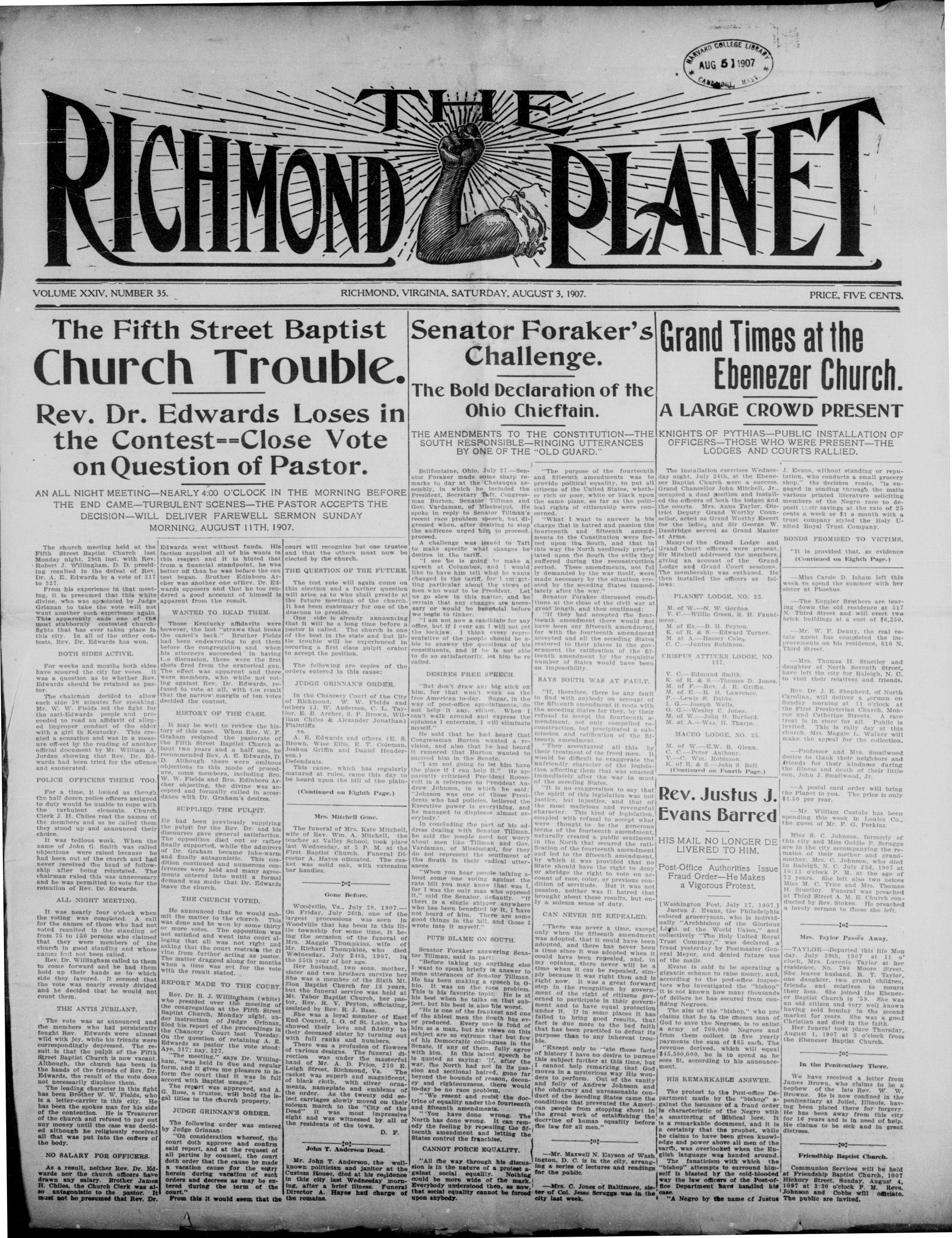
The Fifth Street Baptist Church Trouble.
Rev. Dr. Edwards Loses in the Contest==Close Vote on Question of Pastor.
AN ALL NIGHT MEETING—NEARLY 4:00 O'CLOCK IN THE MORNING BEFORE THE END CAME—TURBULENT SCENES—THE PASTOR ACCEPTS THE DECISION—WILL DELIVER FAREWELL SERMON SUNDAY
VOLUME XXIV, NUMBER 35.
The Fifth
Church
Rev. Dr. E
the Cont
on Ques
AN ALL NIGHT MEETING—NE
THE END CAME—TURBU
DECISION—WILL DE
MORN
The church meeting held at the Fifth Street Baptist Church last Monday night, 29th inst. with Rev. Robert J. Willingham, D. D. presiding resulted in the defeat of Rev. Dr. A. E. Edwards by a vote of 317 to 327.
From his experience in that meeting, it is presumed that this white divine, who was appointed by Judge Grinnan to take the vote will not want another such experience again. This apparently ends one of the most important contests church fights that has ever taken place in this city. In all of the other contests, Rev. Dr. Edwards has won.
BOTH SIDES ACTIVE.
For weeks and months both sides have scoured the city for votes. It was a question as to whether Rev. Edwards should be retained as pastor.
The chairman decided to allow each side 20 minutes for speaking, Mr. W. W. Fields led the fight for the anti-Edwards people and proceeded to read an affidavit of alleged improper conduct of the elder with a girl in Kentucky. This created a sensation and was in a measure off-set by the reading of another official document by Mr. William A. Jordan showing that Rev. Dr. Edwards had been tried for the offence and exonerated.
POLICE OFFICERS THERE TOO
For a time, it looked as though the half dozen police officers assigned to duty would be unable to cope with the turbulent elements. Church Clerk J. H. Chiles read the names of the members and as he called them they stood up and announced their choice. It was tedious work. When the name of John G. Smith was called objections were raised because he had been out of the church and had never received the hand of fellow officer he was with. The chairman ruled this was unnecessary and he was permitted to vote for the retention of Rey. Dr. Edwards.
ALL NIGHT MEETING
It was nearly four o'clock when the voting was completed. A call for the names of those who had not voted resulted in the standing of from 75 to 150 persons who claimed that they were members of the church in good standing and whose names had not been called. Rev. Dr. Willingham called to them to come forward and he had them hold up and as to which side they favored. It seemed that the vote was nearly evenly divided and he decided that he would not count them.
THE ANTIS JUBILANT
The vote was as announced and the members who had persistently fought Rev. Edwards were almost wild with joy, while his friends were correspondingly depressed. The result is that the pulpit of the Fifth Street Baptist Church is now vacant. Although, the church has been in the hands of the friends of Rev. Dr. Edwards, the result of the vote does not necessarily displace them.
The leading character in this fight has been Brother W. W. Fields, who is better-carrier in this city. He has been the spokes man for his side of the contempt He is Treasurer of the church and refused to pay out any money until the case was decided although he religiously received all that was put into the coffers of the body.
NO SALARY FOR OFFICERS.
As a result, neither Rev. Dr. Edwards nor the church officers have drawn any salary. Brother James H. Chiles, the Church Clerk was also antagonistic to the pastor. It must not be presumed that Rev. Dr.
court will recognize but one trustee and that the others must now be elected by the church.
THE QUESTION OF THE FUTURE
The test vote will again come on this election and a further question will arise as to who shall preside at the future meetings of the church. It has been customary for one of the deacons to preside.
One side is already announcing that one side will a long time before a pastor is called, a church organ of the best in the state and but little trouble will be experienced in securing a first class pulpit orator to accept the position.
The following are copies of the orders entered in this cause:
In the Chancery Court of the City of Richmond, W. W. Fields and others (J. W. Anderson, C. L. Taylor, E. B. Archer, S. P. Brown, William Chiles & Alexander Jonathan) Plaintiffs vs. A. E. Edwards and others (E. S. Brown, Wise Ellis, E. T. Coleman, Joshua Griffin and Daniel Henderson.)
Defendants.
This cause, which has regularly
matured at rules, came this day to
be heard upon the bill of the usurp
The funeral of Mrs. Kate Mitchell, wife of Rev. Wm. A. Mitchell, the teacher at Valley School, took place last Wednesday, at 3 P. M. at the First Baptist Church, Funeral Director A. Hayes officiated. The casket was solid oak, with extension bar handles.
Woodville, Va., July 28, 1907.—On Friday, July 26th, one of the largest processions was seen in Woodville that has been in this little township for some time, it being the occasion of the funeral of Mrs. Maggie Thompkins, wife of Mr. Richard Thompkins, who died Wednesday, July 24th, 1907, in the 35th year of her age.
Her husband, two sons, mother, sister and two brothers survive her. She was a member of the Sixth Mt. Zion Baptist Church for 18 years, but the funeral service was held at Mt. Tabor Baptist Church, her pastor, Rev. R. V. Porter, officiating, assisted by Rev. R. J. Bass.
She was a loyal member of East End Council, I. O. of St. Luke, who showed their love and fidelity to their deceased sister by turning out with full ranks and numbers.
There was a profusion of flowers of various designs. The funeral direction was under the masterful hand of Mr. A. D. Price, 210 E. Leigh Street, Richmond, Va. The casket was superb and magnificent, of black cloth, with silver ornaments, nameplate and emblems of the order. As the twenty odd solect carriages slowly moved on their solemn march to the "City of the Dead" it was most impressive sight and was witnessed by all of the residents of the town.
Mr. John T. Anderson, the well-known politician and janitor at the Custom House, died at his residence in this city last Wednesday morning, after a brief illness. Funeral Director A. Hayes had charge of
MORNING, AUGUST 11TH, 1907.
the last ev.
idle ev.
117
Edwards went without funds. His faction supplied all of his wants in this respect and it is hinted that from a financial standpoint, he was better off than he was before the contest began. Brother Edinboro Archer on another one of Law. Dr. Edwards opposers and that he too rendered a good account of himself is apparent from the result.
con an ele
TH
the wi
the
WANTED TO READ THEM
Those Kentucky affidavits were however, the last "straws that broke the camel's back." Brother Fields had been endeavoring to get them before the congregation and when his attorneys succeeded in having t.e. discussion, these were the first shots fired from the oratorical gun. The effect was apparent and there were members, who while not voting against Rev. Dr. Edwards, refused to vote at all, with the result that the narrow margin of ten votes decided the contest.
HISTORY OF THE CASE
It may be well to review the history of this case. When Rev. W. F. Graham resigned the pastorate of the Fifth Street Baptist Church about two years and a half ago, he recommended Rev. A. E. Edwards, Dr. D. Although there were ominous objections to this mode of procedure, some members, including Bro. W. F. and Bro. Edinboro Archer objecting, was accepted and formally called in accordance with Dr. Graham's design.
SUPPLIED THE PULPIT
He had been previously supplying the pulpit for the Rev. Dr. and his discourses gave general satisfaction. The opposition died out or rather finally supported, while the admirers of Dr. Graham became luke-warm and finally antagonistic. This condition continued and numerous conferences were held and many agreements entered into until a formal demand was made that Dr. Edwards leave the church.
THE CHURCH VOTED
He announced that he would submit the matter to the church. This was done and he won by some thirty or more votes. The opposition was notified and went into court alleging that the court restrain the divine from further dragging for months when a time was set for the vote with the result stated.
REPORT MADE TO THE COURT
Rev. Dr. R. J. Willingham (white) who presided over the meeting of the congregation at the Fifth Street Baptist Church, Monday night, under instruction of Judge Grinnan filed his report of the proceedings in the Chancery Court last Tuesday. On the question of retaining A. E. Edwards as pastor the vote stood: Aye, 317; nay, 327.
"The meeting," says Dr. Willingham, "was held in due and regular form, and it gives me pleasure to inform the court that it was in full accord with Baptist usage."
The report was approved, and A. G. Rose, a trustee, will hold the legal titles to the church property.
JUDGE GRINNAN'S ORDER
The following order was entered by Judge Grinnan:
"On consideration whereof, the court doth approve and confirm said report, and at the request of all parties by counsel, the court doth order that the cause be made a violation cause for the entry herein during location of such orders and decrees as may be entered during the term of the court."
From this it would seem that the
RICHMOND, VIRGINIA, SATURDAY, AUGUST 3, 1907.
JUDGE GRINNAN'S ORDER
(Continued on Eighth Page.)
Mrs. Mitchell Gone
Gone Before.
D. F.
John T. Anderson Dead.
Senator Foraker's Challenge. The Bold Declaration of the Ohio Chieftain.
THE AMENDMENTS TO THE CONSTITUTION—THE SOUTH RESPONSIBLE—RINGING UTTERANCES BY ONE OF THE "OLD GUARD."
Bellfontaine, Ohio, July 27.—Senator Foraker made some sharp remarks to day at the Chataquia assembly, in which he included the President, Secretary Taft, Congressman Burton, Senator Tillman and Gov. Vardaman, of Mississippi. He spoke in reply to Senator Tillman's recent race problem speech, but digressed when, after desiring to stop the audience urged him to proceed, proceed.
A challenge was issued to Taft to make specific what changes he desires in the tariff.
"I see he is going to make a speech at Columbus, and I would like to have him tell what he wants changed in the tariff, for I am getting particular about the views of men who want to be President. Let us go slow in this matter, and be certain that any changes are necessary or would be beneficial before we begin to think."
"I am not now a candidate for any office, but if I ever am I will not get the lockjaw. I think every representative of the people should be able to answer the questions of his constituents, and if he is not able to do so satisfactorily, let him be recalled.
"The purpose of the fourteenth and fifteenth amendments was to provide political equality, to put all citizens of the United States, whether rich or poor, white or black upon the same plane, so far as the political rights of citizenship were concerned.
"What I want to answer is his charge that in hatred and passion the fourteenth and fifteenth amendments to the Constitution were forced upon the South, and that in this way the North needlessly precipitated upon the South the evils they suffered during the reconstruction period. These amendments, not fully demanded by the war itself, were made necessary by the situation created by the seceding States immediately after the war."
Senator Foraker discussed conditions at the close of the civil war a great length, and then continued: "if they had accepted the fourteenth amendment there would not have been any fifteenth amendment for with the fourteenth amendment accepted and all the seceding States restored to their places in the government the ratification of the fifteenth amendment by the requisite number of States would have been
DESIRES FREE SPEECH
"But don't draw any big stick on him, for that won't work on the free American to-day. Sugar, in the way of post-office appointments, do not help it any, either. When I can't walk around and express the opinions I entertain, I will eliminate myself."
He said that he had heard that Congressman Burton wanted a revision, and also that he had heard it rumored that Burton wanted to succeed him in the Senate.
"I am not going to let him have the place if I can help it." He apparently criticised President Roosevelt in a reference to President Andrew Johnson, in which he said: "Johnson was one of those Presidents who had policies, believed the Executive power is everything, and he managed to displease almost everybody."
In concluding the part of his address dealing with Senator Tillman, he said the people need not worry about men like Tillman and Gov. Vardaman, of Mississippi, for they do not represent the sentiment of the South in their radical utterances.
"When you hear people talking about some one voting against the rate bill you may know that was I, for I was the only man who opposed it," said the Senator, defiantly.
"If there is a single shipper anywhere who has been benefited by it, I have not heard of him. There are some good things in the bill, and those I wrote into it myself."
PUTS BLAME ON SOUTH
Senator Foraker answering Senator Tillman, said in part:
"Before taking up anything else I want to speak briefly in answer to some utterances of Senator Tillman. He has been making a speech in Ohio. It was on the race problem. This is his favorite topic. He is at his best when he talks on that subject, but his best is also his worst.
"He is one of the frankest and one of the ablest men the South has ever produced. Every one is fond of him as a man, but his views on this subject are so extreme that but few of his Democratic colleagues. In the Senate, if any of them, fairly agree with him. In this latest speech he is quoted as saying: 'If, after the war, the North had not in its passion and sectional hatred, gone far beyond the bounds of reason, decency and righteousness, there would-to-day be no race problem.
"We resent and resist the doctrine of equality under the fourteenth and fifteenth amendments.
"You have done wrong. The North has done wrong. It can remedy the feeling by repealing the fifteenth amendment and letting the States control the franchise."
CANNOT FORCE EQUALITY.
"All the way through his discussion is in the nature of a protest against social equality. Nothing could be more wide of the mark. Everybody understood then, as now, that social equality cannot be forced upon anybody.
"The purpose of the fourteenth and fifteenth amendments was to provide political equality, to put all citizens of the United States, whether rich or poor, white or black upon the same plane, so far as the political rights of citizenship were concerned.
"What I want to answer is his charge that in hatred and passion the fourteenth and fifteenth amendments to the Constitution were forced upon the South, and that in hatred and passion the fourteenth and fifteenth amendments upon the South the evils they suffered during the reconstruction period. These amendments, not fully demanded by the war itself, were made necessary by the situation created by the seceding States immediately after the war."
Senator Foraker discussed conditions at the close of the civil war at great length, and then continued:
"If they had accepted the fourteenth amendment there would not have been any fifteenth amendment, with the fourteenth amendment accepted with all the seceding States restored to their place in the government the ratification of the fourteenth amendment by the requisite number of States would have been an impossibility.
SAYS SOUTH, WAS AT FAULT.
"If, therefore, there be any fault to find with anybody on account of the fifteenth amendment it rests with the seceding States for they, by their refusal to accept the fourteenth amendment, not only compelled reconstruction, but precipitated a submission and ratification of the fifteenth amendment.
"They accentuated all this by their treatment of the freed men. It would be difficult to exaggerate the unfriendly character of the legislation affecting them that was enacted immediately after the war in most of the seceding States.
"It is no exaggeration to say that the spirit of this legislation was not justice, but injustice, and that of the most malicious and revengeful character. This kind of legislation, coupled with refusal to accept what were thought to be the generous terms of the fourteenth amendment, naturally created a public sentiment in the North that secured the ratification of the fourteenth amendment and led to the fifteenth amendment, by which it was provided that no State should have the right to deny or abridge the right to vote on account of race, color, or previous condition of servitude. But it was not passion, neither was it hatred that brought about these results, but only a solemn sense of duty.
CAN NEVER BE REPEALED
"There was never a time, except only when the fifteenth amendment was adopted, that it could have been adopted, and there has never been a time since it was adopted when it could have been repealed, and, in my opinion, there never will be a time when it can be repealed, simply because it was right then and is right now. It was a great forward step in the recognition by government of the right of citizens governed to participate in their government and to have equal protection under it. If in some places it has failed to bring good results, that fact is due more to the bad faith that has been practiced to defeat its purpose than to any inherent trouble.
"Except only to "rate these facts of history I have no desire to pursue this subject further at this time, but I cannot help remarking that God moves in a mysterious way His wonders to perform. Out of the vanity and folly of Andrew Johnson and the obduracy and unreasonable conduct of the seceding States came the conditions that prevented the American people from stopping short in the great work of establishing the doctrine of human equality before the law for all men."
Mr. Maxwell N. Eayson of Wash
ington, D. C. is in the city, arranging
a series of lectures and readings
for the public.
Mrs. C. Jones of Baltimore, sister
of Col. Jesse Scruggs was in the
city last week.
Grand Times at the Ebenezer Church. A LARGE CROWD PRESENT
KNIGHTS OF PYTHIAS—PUBLIC INSTALLATION OF OFFICERS—THOSE WHO WERE PRESENT—THE LODGES AND COURTS RALLIED.
The installation exercises Wednesday day night, July 24th, at the Ebenezer Baptist Church was a success. Grand Chancellor John Mitchell, Jr., occupied a dual position and installed the officers of both the lodges and the courts. Mrs. Anna Taylor, District Deputy Grand Worthy Counsellor, acted as Grand Worthy Escort for the ladies and Sir George W. Dandridge served as Grand Master at Arms.
Many of the Grand Lodge and Grand Court officers were present. Sir Mitchell addressed the members, giving an account of the Grand Lodge and Grand Court sessions. The membership was enthused. He then installed the officers as follows:
J. Evans, without standing or repudiation, who conducts a small grocery shop," the decision reads, "is engaged in sending through the mails various printed literature soliciting members of the Negro race to deposit their savings at the rate of 25 cents a week or $1 a month with a trust company styled the Holy United Royal Trust Company.
BONDS PROMISED TO VICTIMS.
"It is provided that, as evidence (Continued on Eighth Page.)
—Miss Carsie D. Isham left this week to spend the summer with her
PLANET LODGE. NO. 23.
M. of W.—N. W. Gordon.
V. C.—Willie Green, R. H. Faunt-
leroy.
M. of Ex.—B. H. Peyton.
M. of H. & S. Edward Turner.
M. of A. Basssey Codes.
C. C.—Juntis Robinson.
CRISPUS ATTUCKS LODGE, NO.
117.
V. C. - Edmund Smith.
K. of R. & S. - Thomas D. Jones
M. of F. - Rev. J. R. Griffin.
M. of E. - R. H. Lawrence.
P. Lewis D. Dabs.
H. Joseph Wells.
O. G. Wiley C. Jones.
M. of W. - John B. Burford.
M. at A. Win. H. Tharp.
MACEO LODGE. NO. 35
M. of W.—E.W. R. Glenn.
C. C.—Peter Anthony.
V.—C. Wm. Robinson.
K. of R. & S.—John S. Bell.
(Continued on Fourth Page.)
Rev. Justus J. Evans Barred
Rev. Justus J. Evans Barred
HIS MAIL NO LONGER DE LIVERED TO HIM.
Post-Office Authorities Issue Fraud Order—He Makes a Vigorous Protest.
[Washington Post, July 17, 1907.]
Justus J. Evans, the Philadelphia colored groceryman, who is individually "Archbishop of the Glorious Light of the World Union," and collectively "The Holy United Royal Trust Company," was declared a fraud yesterday by Postmaster General Meyer, and denied future use of the mails.
Evans is said to be operating a gigantic scheme to raise money, and, according to the post-office inspectors who investigated the "bishop" it is not known how many thousands of dollars he has secured from confiding Negroes.
The aim of the "bishop," who proclaims that he is the chosen man of God to save the Negroes, is to enlist a army of 700,000 Negroes and from them collect in five yearly payments the sum of $65 each. The revenue derived, which will equal $45,500,000, he is to spend as he sees fit, according to his announcement.
HIS REMARKABLE ANSWER
The protest to the Post-office Department made by the "bishop" against the issuance of a fraud order is characteristic of the Negro with a smattering of Biblical lore. It is a remarkable document, and it is a certainty that the prophet, while he claims to have been given knowledge and power above all men of the earth, was overlooked when the English language was handed around. The fanaticism with which the "bishop" attempts to surround himself is blasted by the cold-blooded way the law officers of the Post-office Department have handled his case. "A Negro by the name of Justus
es at the
zer Church.
DWD PRESENT
PUBLIC INSTALLATION OF
O WERE PRESENT—THE
OURTS RALLIED.
J. Evans, without standing or reputation, who conducts a small grocery shop," the decision reads, "is engaged in sending through the mails various printed literature soliciting members of the Negro race to deposit their savings at the rate of 25 cents a week or $1 a month with a trust company styled the Holy United Royal Trust Company.
BONDS PROMISED TO VICTIMS.
"It is provided that, as evidence (Continued on Eighth Page.)"
—Miss Carsle D. Isham left this week to spend the summer with her sister at Phoebus.
—The Keppler Brothers are tearing down the old residence at 517 N. Third Street and will erect two brick buildings at a cost of $6,250.
—Mr. W. F. Denny, the real estate agent has completed the improvements on his residence, 610 N. Third Street.
—Mrs. Thomas H. Stuetley and daughter of North Seventh Street, have left the city for Raleigh, N. C. to visit their relatives and friends.
Rev. Dr. J. E. Shepherd, of North Carolina, will deliver a german on Sunday morning at 11 o'clock at the First Presbyterian Church, Monroe and Catherine Streets. A rare treat is in store for all. Public is invited. This is rally day at this church. Mrs. Maggie L. Walker will make the appeal for the collection.
—Professor and Mrs. Smallwood desire to thank their neighbors and friends for their kindness during the illness and death of their little son, John J. Smallwood, Jr.
—A postal card order will bring the Planet to you. The price is only $1.50 per year.
Mr. William Custalo has been spending this week in Louisa Co., the guest of Mr. F. G. Perkins.
Miss S. C. Johnson, formerly of this city and Miss Goldie P. Seruggs are in the city accompanying the re-emergence of their mother and grandmother Mrs. C. Johnson, who died in Kaleigh N. P. July 23d, 1907 at 10:11 o'clock P. M. at the age of 72 years. She left also two nieces Miss M. C. Trice and Ms. Thomas H. Stuetley. Funeral was preached at Third Street A. M. E. Church conducted by Rev. Stokes. He preached a lovely sermon to those she left.
Mrs. Taylor Passes Away.
TAYLOR—Departed this life Monday, July 29th, 1907 at 11 o'clock, Mrs. Luvenia Taylor at her residence, No. 790 Moore Street, She leaves husband, R. T. Taylor, one daughter, two grand children, friends and relatives to mourn their loss. She joined the Ebenezeb Baptist Church in '59. She was an old citizen and very well known having sold hominy in the second market for years. She was a good Christian and died in the faith. Her funeral took place Thursday, August 1, 1907 at 3 o'clock from the Ebenezeb Baptist Church.
In the Penitentiary There
We have received a letter from James Brown, who claims to be a nephew of the late Rev. W. W. Browne. He is now confined in the penitentiary at Joliet, Illinois, having been placed there for forgery. He has been away from this city for 16 years and is in need of help. He claims to be sick and in great distress.
Friendship Baptist Church.
Communion Services will be held at Friendship Baptist Church, 1007 Hickory Street, Sunday, August 4, 1097 at 3:30 o'clock P. M. Revs. Johnson and Cobbs will officiate. The public are invited.
THE HOUSE
OF ATHOUSAND
CANDLES
BY MEREDITH NICHOLSON
AUTHOR OF THE MAIN CHURCH TELOR DEMEDON
CHAPTER III.
The House of a Thousand Candles.
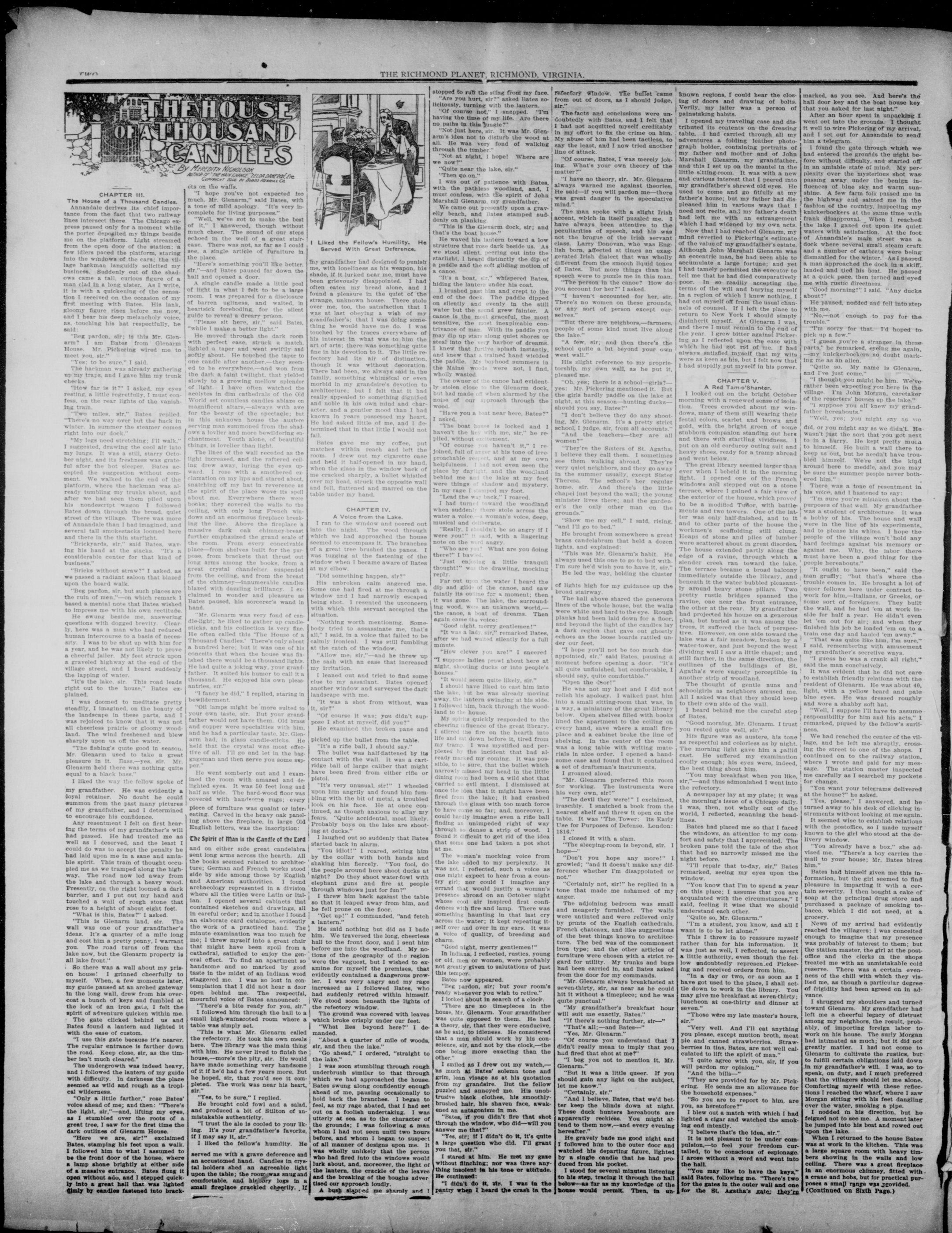
Annandale derives its chief importance from the fact that two railway lines intersect there. The Chicago express paused only for a moment while the porter deposited my things beside me on the platform. Light streamed from the open door of the station; a few idlers paced the platform, staring into the windows of the cars; the village hackman languidly solicited my business. Suddenly out of the shadows came a tall, curious figure of a man clad in a long ulster. As I write, it is with a quickening of the sensation I received on the occasion of my first meeting with Bates. His lank, gloomy figure rises before me now, and I hear his deep melancholy voice, as, touching his hat respectfully, he said:
"Beg pardon, sir; is this Mr. Glenarm? I am Bates from Glenarm House. Mr. Pickering wired me to meet you, sir."
"Yes; to be sure." I said.
The hackman was already gathering up my traps, and I gave him my trunk checks.
"How far is it?" I asked, my eyes resting, a little regretfully, I must confess, on the rear lights of the vanishing train.
"Two miles, sir." Bates replied, "There's no way over but the hack in winter. In summer the steamer comes right into our dock."
"My legs need stretching; I'll walk." I suggested, drawing the cool air into my lungs. It was a still, starry October night, and its freshness was grateful after the hot sleeper. Bates accepted the suggestion without comment. We walked to the end of the platform, where the hackman was already tumbling my trunks about, and after we had seen them piled upon his nondescript wagon I followed Bates down through the broad, quiet street of the village. There was more of Annandale than I had imagined, and several tall smokestacks loomed here and there in the thin starlight.
"Brickyards, sir," said Bates, waving his hand at the stacks. "It's a considerable center for that kind of business."
"Bricks without straw?" I asked, as we passed a radiant saloon that blazed upon the board walk.
"Beg pardon, sir, but such places are the ruin of men,"—on which remark I based a mental note that Bates wished to impress me with his own rectitude. He swung beside me, answering questions with dogged brevity. Clearly, here was a man who had reduced human intercourse to a basis of necessity. I was to be shut up with him for a year, and he was not likely to prove a cheerful jaller. My feet struck upon a graveled highway at the end of the village street, and I heard suddenly the lapping of water.
"It's the lake, sir. This road leads right out to the house," Bates explained.
I was doomed to meditate pretty steadily, I imagined, on the beauty of the landscape in these parts, and I was rejoiced to know that it was not all cheerless prairie or gloomy woodland. The wind freshened and blew sharply upon us off the water.
"The fishing's quite good in season. Mr. Glenarm used to take a great pleasure in it. Bass,—yes, sir. Mr. Glenarm held there was nothing quite equal to a black bass."
I liked the way the fellow spoke of my grandfather. He was evidently a loyal retainer. No doubt he could summon from the past many pictures of my grandfather, and I determined to encourage his confidence.
Any resentment I felt on first hearing the terms of my grandfather's will had passed. He had treated me as well as I deserved, and the least I could do was to accept the penalty he had laid upon me in a sane and amiable spirit. This train of thought occupied me as we tramped along the highway. The road now led away from the lake and through a heavy wood. Presently, on the right loomed a dark barrier, and I put out my hand and touched a wall of rough stone that rose to a height of about eight feet.
"What is this, Bates?" I asked.
"This is Glenarm land, sr. The wall was one of your grandfather's ideas. It's a quarter of a mile long and cost him a pretty penny, I warrant you. The road turns off from the lake now, but the Glenarm property is all lake front."
So there was a wall about my prison house! I grinned cheerfully to myself. When, a few moments later, my guide paused at an arched gateway in the long wall, drew from his overcoat a bunch of keys and fumbled at the lock of an iron gate. I felt the spirit of adventure quicken within me. The gate clicked behind us and Bates found a lantern and lighted it with the ease of custom.
"I use this gate because it's nearer. The regular entrance is farther down the road. Keep close, sir, as the timber isn't much cleared."
The undergrowth was indeed heavy, and I followed the lantern of my guide with difficulty. In darkness the place seemed as wild and rough as a tropical wilderness.
"Only a little farther," rose Bates"voice ahead of me; and then,"There's the light, sir,"—and, lifting my eyes, as I stumbled over the roots of a great tree, I saw for the first time the dark outlines of Glenarm house.
"Here we are, sir!" exclaimed Bates, stamping his feet upon a walk. I followed him to what I assumed to be the front door of the house, where a lamp shone brightly at either side of a massive entrance. Bates flung it open without aid, and I stepped quickly into a great hall that was lighted dimly by candles fastened into bracket-
ets on the walls.
"I hope you've not expected too much, Mr. Glenarm," said Bates, with a tone of mild apology. "It's very in-complete for living purposes."
"Well, we've got to make the best of it." I answered, though without much cheer. The sound of our steps echoed in the well of a great staircase. There was not, as far as I could see, a single article of furniture in the place.
"Here's something you'll like better. sir."—and Bates paused far down the hall and opened a door.
A single candle made a little pool of light in what I felt to be a large room. I was prepared for a disclosure of barren ugliness, and waited, in heartskiss foreboding, for the silent guide to reveal a dreary prison.
"Please sit here, sir," said Bates, "while I make a better light."
He moved through the dark room with perfect ease, struck a match, lighted a taper and went swiftly and softly about. He touched the taper to one candle after another—they seemed to be everywhere—and won from the dark a faint twilight, that yielded slowly to a growing mellow splendor of light. I have often watched the acyolites in dim cathedrals of the Old World set countless candles ablaze on magnificent altars—always with awe for the beauty of the spectacle; but in this unknown house the austere serving man summoned from the shadows a loveliar and more bewildering entachment. Youth alone, of beautiful things, is lovelier than light.
The lines of the wall receded as the light increased, and the raftered celling drew away, luring the eyes upward. I rose with a smothered exclamation on my lips and stared about, snatching off my hat in reverence as the spirit of the place wove its spell about me. Everywhere there were books; they covered the walls to the ceiling, with only long French windows and an enormous fireplace breaking the line. Above the fireplace a massive dark oak chimney-breast further emphasized the grand scale of the room. From every conceivable place—from shelves built for the purpose, from brackets that thrust out long arms among the books, from a great crystal chandelier suspended from the ceiling, and from the breast of the chimney—innumerable candles blazed with dazzling brilliancy. I exclaimed in wonder and pleasure as Bates paused, his sorcerer's wand in hand.
"Mr. Glenarm was very fond of candlelight; he liked to gather up candle-sticks, and his collection is very fine. He often called this 'The House of a Thousand Candles.' There's only about a hundred here; but it was one of his conceits that when the house was finished there would be a thousand lights. He had quite a joking way, your grandfather. It suited his humor to call it a thousand. He enjoyed his own pleas-antries, sir."
"I fancy he did," I replied, staring in bewilderment.
"Ol' lamps might be more suited to your own taste, sir. But your grandfather would not have them. Old brass and copper were specialties with him, and he had a particular taste, Mr. Glenarm had, in glass candle-sticks. He held that the crystal was most effective of all. I'll go and let in the bag gagman and then serve you some sweper."
He went somberly out and I examined the room with amazed and delighted eyes. It was 50 feet long and half as wide. The hard-wood floor was covered with handsome rugs; every piece of furniture was quaint or interesting. Carved in the heavy oak paneling above the fireplace, in large Old English letters, was the inscription:
The Spirit of Man is the Candle of the Lord
and on either side great candelabra sent long arms across the hearth. All the books seemed related to architecture; German and French works stood side by side among those by English and American authorities. I found archaeology represented in a division where all the titles were Latin or Italian. I opened several cabinets that contained sketches and drawings, all in careful order; and in another I found an elaborate柜 catalogue, evidently the work of a practiced hand. The minute examination was too much for me; I threw myself into a great chair that might have been spoil from a cathedral, satisfied to enjoy the general effect. To find an apartment so handsome and so marked by good taste in the midst of an Indiana wood staggered me. I was so lost in contemplation that I did not hear a door open behind me. The respectful, mourful voice of Bates announced:
I followed him through the hall to a small high-waisted scotched room where a table was simply set.
"This is what Mr. Glenarm called the refectory. He took his own meals here. The library was the main thing with him. He never lived to finish the house, more's the pity, sir. He would have made something very handsome of it if he'd had a few years more. But he hoped, sir, that you'd see it completed. The work was near his heart, sir."
"Yes, to be sure," I replied. He brought cold fowl and a salad, and produced a bit of Silton of unmistakable authenticity.
"I trust the ale is cooled to your liking. It's your grandfather's favorite, if I may say it, sir."
I liked the fellow's humility. He
served me with a grave deference and an accustomed hand. Candles in crystal holders shed an agreeable light upon the table; the room was snug and comfortable, and his story logs in a small fireplace crackled cheerly.
THE RICHMOND PLANET, RICHMOND, VIRGINIA
I Liked the Fellow's Humility. He
Served With Great Deference.
My grandfather had designed to punish me, with loneliness as his weapon, his shade, if it lurked near me, must have been grievously disappointed. I had often eaten my bread alone, and I found a pleasure in the quiet of the strange, unknown house. There stole over me, too, the satisfaction that I was at last obeying a wish of my grandfather's; that I was doing something he would have me do. I was touched by the traces everywhere of his interest in what was to him the art of arts; there was something quite fine in his devotion to it. The little reefyectory had its air of distinction, though it was without decoration. There had been, we always said in the family, something whimsical or even morbid in my grandsire's devotion to architecture; but I felt that it had really appealed to something dignified and noble in his own mind and character, and a gentler mood than I had known in years possessed my heart. He had asked little of me, and I determined that in that little I would not fail.
Hates gave me my coffee, put matches within reach and left the room. I drew out my cigarette case and held it half-opened in my hand, when the glass in the window back of me cracked sharply, a bullet whistled over my head, struck the opposite wall and fell, flattened and marred on the table under my hand.
CHAPTER IV
A Voice from the Lake
I ran to the window and neered out into the night. The wood through which we had approached the house seemed to encompass it. The branches of a great tree brushed the panes. I was tugging at the fastening of the window when I became aware of Bates at my elbow.
"Did something happen, sir?"
His unbroken calm angered me. Some one had fired at me through a window and I had narrowly escaped being shot. I resented the unconcern with which this servant accepted the situation.
"Nothing worth mentioning. Somebody tried to assassinate me, that's all," I said, in a voice that failed to be calmly ironical. I was still fumbling at the catch of the window.
"Allow me, sir,"—and he threw up the sash with an ease that increased my irritation.
I leaned out and tried to find some clue to my assailant. Bates opened another window and surveyed the dark landscape with me.
"It was a shot from without, was it, sir?" "Of course it was; you didn't suppose I shot at myself, did you?" He examined the broken pane and picked up the bullet from the table. "It's a rifle ball, I should say." The bullet was half-fattened by its contact with the wall. It was a cartridge ball of large caliber that might have been fired from either rifle or pistol. "It's very unusual, sir!" I wheeled upon him angrily and found him fumbling with the bit of metal, a troubled look on his face. He at once continued, as though anxious to allay my fears. "Quite accidental, most likely. Probably boys on the lake are shooting at ducks." I laughed out so suddenly that Bates started back in alarm.
"You idiot!" I roared, seizing him by the collar with both hands and shaking him fiercely. "You fool, do the people around here shoot ducks at night? Do they shoot water-fowl with elephant guns and fire at people through windows just for fun?" I threw him back against the table so that it leaped away from him, and he fell prone on the floor.
"Get up!" I commanded, "and fetch a lantern."
He said nothing but did as I bade him. We traversed the long, cheerless hall to the front door, and I sent him before me into the woodland. My notions of the geography of the region were the vaguest, but I wished to examine for myself the premises, that evidently contained a dangerous prowler. I was very angry and my rage increased as I followed Bates, who had suddenly retired within himself. We stood soon beneath the lights of the refectory window.
The ground was covered with leaves which broke crisply under our feet.
"What lies beyond here?" I demanded.
"About a quarter of mile of woods, sir, and then the lake."
"Go ahead," I ordered, "straight to the lake."
I was soon stumbling through rough underbrush similar to that through which we had approached the house. Bates swung along confidently enough ahead of me, pausing occasionally to hold back the branches. I began to feel, as my rage abated, that I had set out on a foolish undertaking. I was utterly at sea as to the character of the grounds; I was following a man whom I had not seen until two hours before, and whom I began to suspect of all manner of designs upon me. It was wholly unlikely that the person who had fired into the windows would lurk about, and, moreover, the light of the lantern, the crackle of the leaves and the breaking of the boughs advertised our approach loudly.
A bush slipped me sharply and I
stopped to rub the sting from my face.
"Are you hurt, sir,?" asked Bates so
solliciously, turning with the lantern.
"Of course not." I snapped. "I'm
having the time of my life. Are there
no paths in this jungle?"
"Not just here, sir. It was Mr. Glen-
arm's idea not to disturb the wood at
all. He was very fond of walking
through the timber."
"Not at night, I hope! Where are
we now?"
"Quite near the lake, sir."
"Then go on."
I was out of patience with Bates, with the pathless woodland, and, I must confess, with the spirit of John Marshall Glenarm, my grandfather.
We came out presently upon a gravelly beach, and Bates stamped suddenly on planking.
"This is the Glenarm dock, sir; and that's the boat house."
He waved his lantern toward a low structure that rose dark beside us. As we stood silent, peering out into the starlight, I heard distinctly the dip of a paddle and the soft gliding motion of a canoe.
"It's a boat, sir," whispered Bates, hiding the lantern under his coat.
I brushed past him and crept to the end of the dock. The paddle dipped on silently and evenly in the still water but the sound grew fainter. A canoe is the most graceful, the most sensitive, the most inexplicable contrivance of man. With its paddle you may dip up stars along quiet shores or steal into the very harbor of dreams. I knew that furtive splash instantly, and knew that a trainee' hand wielded the paddle. My boyhood summers in the Maine woods were not, I find, wholly wasted.
The owner of the canoe had evidently stolen close to the Glenarm dock, but had made of when alarmed by the noise of our approach through the wood.
"Have you a boat near here, Bates?" I asked.
"The boat house is locked and I haven't the key with me, sir," he replied, without excitement.
"Of course you haven't it." I re-joined, full of anger at his tone of irrepachable respect, and at my own helpfulness. I had not even seen the place by daylight, and the woodland behind me and the lake at my feet were things of shadow and mystery. In my rage I stamped my foot.
"Lead the way back." I roared.
I had turned toward the woodland when suddenly there stole across the water a voice—a woman's voice, deep, musical and deliberate.
"Really, I shouldn't be so angry if I were you!" it said, with a lingering note on the word angry.
"Who are you? What are you doing there?" I bawled.
"Just enjoying a little tranquil thought!" was the drawling, mocking reply.
Far out upon the water I heard the dip and glide of the canoe, and saw faintly its outline for a moment; then it was gone. The lake, the surrounding wood, were an unknown world,—the canoe, a boat of dreams. Then again came the voice:
"Good night, merry gentlemen!"
"It was a lady, sir," remarked Bates, after we had waited silently for a full minute.
"How clever you are!" I sneered.
"I suppose脏们 prowl about here at night, shooting ducks or into people's houses."
"It would seem quite likely, sir."
I would seem quite likely, sir."
I should have liked to cast him into the lake, but he was already moving away, the lantern swinging at his side. I followed him, back through the woodland to the house.
My spirits quickly responded to the cheering influence of the great library, I stirred the fire on the hearth into life and sat down before it, tired from my tramp. I was mystified and perplexed by the incident that had already marked my coming. It was possible, to be sure, that the bullet which narrowly missed my head in the little dining room had been a wild shot that carried no evil intent. I dismissed at once the idea that it might have been fired from the lake; it had crashed through the glass with too much force to have come so far; and, moreover, I could hardly imagine even a rifle ball finding an unimpeded right of way through so dense a strip of wood. I found it difficult to get rid of the idea that some one had taken a pot shot at me.
The woman's mocking voice from the lake added to my perplexity. It was not, I reflected, such a voice as one might expect to hear from a country girl; nor could I imagine any errand that would justify a woman's presence abroad on an October night whose cool air inspired first confidences with fire and lamp. There was something haunting in that last cry across the water; it kept repeating itself over and over in my ears. It was a voice of quality, of breeding and charm.
"Good night, merry gentlemen!"
In Indiana, I reflected, rustics, young or old, men or women, were probably not greatly given to salutations of just this temper.
Bates now appeared.
"Beg pardon, sir; but your room's ready whenever you wish to retire."
I talked about in search of a clock.
"There are no timepieces in the house, Mr. Glennarm. Your grandfather was quite opposed to them. He had a theory, sir, that they were conducive, as he said, to idleness. He considered that a man should work by his conscience, sir, and not by the clock—the one being more exacting than the other."
I smiled as I drew out my watch,—as much at Bates' solemn tone and grim, lean visage as at his quotation from my grandisire. But the fellow puzzled and annoyed me. His unobtrusive black clothes, his smoothly-brushed hair, his shaven face, awakened an antagonism in me.
"Bates, if you didn't fire that shot through the window, who did—will you answer me that?"
"Yes, sir; if I didn't do it, it's quite a large question who did. I'll grant you that, sir."
I stared at him. He met my gaze without finching; nor was there anything insolent in his tone or attitude. He continued:
"I didn't do it, zir. I was in the pantry when I heard the crash in the
refectory window. The bullet came from out of doors, as I should judge, sir."
The facts and conclusions were undoubtedly with Bates, and I felt that I had not acquired myself creditably in my effort to fix the crime on him. My abuse of him had been tactless, to say the least, and I now tried another line of attack.
"Of course, Bates, I was merely joking. What's your own theory of the matter?"
"I have no theory, sir. Mr. Glenarm always warned me against theories. He said—if you will pardon me—there was great danger in the speculative mind."
The man spoke with a slight Irish accent, which in itself puzzled me. I have always been attentive to the peculiarities of speech, and his was not the brouge of the Irish servant class. Larry Donovan, who was English born, affected at times an exaggerated Irish dialect that was wholly different from the smooth liquid tones of Bates. But more things than his speech were to puzzle me in this man. "The person in the cane?" How do
"The person in the canoe?" How do you account for her?" I asked.
"I haven't accounted for her, sir. There's no women on these grounds, or any sort of person except ourselves."
"But there are neighbors,—farmers, people of some kind must live along the lake."
"A few, sir; and then there's the school quite a bit beyond your own west wall."
His slight reference to my proprietorship, my own wall, as he put it, pleased me.
"Oh, yes; there is a school—girls?—yes: Mr. Pickering mentioned it. But the girls hardly paddle on the lake at night, at this season—hunting ducks—should you say, Bates?"
"I don't believe they do any shooting, Mr. Glennarm. It's a pretty strict school, I judge, sir, from all accounts."
"And the teachers—they are all women?"
"They're the Sisters of St. Agatha,
I believe they call them. I sometimes
see them walking abroad. They're
very quiet neighbors, and they go away
in the summer usually, except Sister
Theresa. The school's her regular
home, sir. And there's the little
chapel just beyond the wall; the young
minister lives there; and the gardener's
the only other man on the
grounds."
"Show me my cell," I said, rising,
"and I'll go to bed."
He brought from somewhere a great
brass candelabrum that held a dozen
lights, and explained:
"This was Mr. Glenarm's habit.
He always used this one to go to bed with.
I'm sure he'd wish you to have it, sir."
He led the way, holding the cluster
of lights high for my guidance up the
broad stairway.
The hall above shared the generous lines of the whole house, but the walls were white and hard to the eye. Rough planks had been laid down for a floor, and beyond the light of the candles lay a dark region that gave out ghostly echoes as the loose boards rattled under our feet.
"I hope you'll not be too much disappointed, str," said Bates, pausing a moment before opening a door. "It's all quite unfinished, but comfortable, I should say, quite comfortable."
He was not my host and I did not relish his apology. I walked past him into a small sitting-room that was, in a way, a miniature of the great library below. Open shelves filled with books lined the apartment to the ceiling on every hand, save where a small fireplace and a cabinet broke the line of shelving. In the center of the room was a long table with writing materials in nice order. I opened a handsome case and found that it contained a set of draftsman's instruments.
I groomed aloud.
"Mr. Glenarm preferred this room for working. The instruments were his very own, sir!"
"The devil they were!" I exclaimed, irascibly. I snatched a book from the nearest shelf and threw it open on the table. It was "The.Tower: Its Early Use for Purposes of Defense. London: 1816."
I closed it with a slam.
"The sleeping-room is beyond, sir. I hope—"
"Don't you hope any more!" I growled; "and it doesn't make any difference whether I'm disappointed or not."
"Certainly not, sir!" he replied in a tone that made me ashamed of my anger.
The adjoining bedroom was small and meagerly furnished. The walls were unintended and were relieved only by prints of the English cathedrals, French chateaux, and like suggestions of the best things known to architecture. The bed was of the commonest iron type; and the other articles of furniture were chosen with a strict regard for utility. My trunks and bags had been carried in, and Bates asked from the door for my commands.
"Mr. Glenarm always breakfasted at seven-thirty, sir, as near as he could hit it without a timepiece; and he was quite punctual."
"My grandfather's breakfast hour will suit me exactly. Bates."
"If there's nothing further, sir—"
"Yes, Mr. Glenarm."
"Of course you understand that I didn't really mean to imply that you had fired that shot at me?"
"I beg you not to mention it, Mr. Glenarm."
"But it was a little queer. If you should gain any light on the subject, let me know."
"Certainly, sir."
"And I believe, Bates, that we'd better keep the blinds down at night. These duck hunters hereabouts are apparently reckless. You might attend to them now,—and every evening hereafter."
He gravely bade me good night and I followed him to the outer door and watched his departing figure, lighted by a single candle that he had produced from his pocket.
I stood for several minutes listening to his step, tracing it through the hall below—as far as my knowledge of the house would permit. Then, in un-
known regions, I could hear the closing of doors and drawing of bolts. Verily, my jalfer was a person of palustaking habits.
I opened my travelling case and distributed its contents on the dressing table. I had carried through all my adventures a folding leather photograph holder, containing portraits of my father and mother and of John Marshall Glenarm, my grandfather, and this I set up on the mantel in the little sitting-room. It was with a new and curious interest that I peered into my grandfather's shrewd old eyes. He used to come and go fitfully at my father's house; but my father had displeased him in various ways that I need not recite, and my father's death had left me with an estrangement which I had widened by my own acts.
Now that I had reached Glenarm, my mind reverted to Pickering's estimate of the value of my grandfather's estate. Although John Marshall Glenarm was an eccentric man, he had been able to accumulate a large fortune; and yet I had tamely permitted the executor to tell me that he had died comparatively poor. In so readily accepting the terms of the will and burying myself in a region of which I knew nothing, I had cut myself off from the usual channels of counsel. If I left the place to return to New York I should simply disinherit myself. At Glenarm I was, and there I must remain to the end of the year. I grew bitter against Pickering as I reflected upon the ease with which he had got rid of me. I had always satisfied myself that my wits were as keen as his, but I felt now that I had stupidly put myself in his power.
CHAPTER V
A Red Tam-o'Shapter.
I looked out on the bright October morning with a renewed sense of isolation. Trees crowded about my windows, many of them still wearing their festal colors, scarlet and brown and gold, with the bright green of some stubborn companion standing out here and there with startling vividness. I put on an old corduroy outing suit and heavy shoes, ready for a tramp abroad and went below.
The great library seemed larger than ever when I beheld it in the morning light. I opened one of the French windows and stepped out on a stone terrace, where I gained a fair view of the exterior of the house, which proved to be a modified Tuor, with battlements and two towers. One of the latter was only half-finished, and to it and to other parts of the house the workmen's scaffolding still clung. Heaps of stone and plies of lumber were scattered about in great disorder. The house extended partly along the edge of a ravine, through which a slender creek ran toward the lake. The terrace became a broad balcony immediately outside the library, and beneath it the water bubbled pleasantly around heavy stone pillars. Two pretty rustic bridges spanned the ravine, one near the front entrance, the other at the rear. My grandfather had projected his house on a generous plan, but burled as it was among the trees, it suffered the lack of perspective. However, on one side toward the lake was a fair meadow, broken by a water-tower, and just beyond the west dividing wall I saw a little chapel; and still farther, in the same direction, the outlines of the buildings of St. Agatha's were vaguely perceptible in another strip of woodland.
The thought of gentle nuns and schoolgirls as neighbors amused me. All I asked was that they should keep to their own side of the wall. I heard behind me the careful step of Bates.
"Good morning, Mr. Glenarm, I trust you rested quite well, sir."
His figure was as austere, his tone as respectful and colorless as by night. The morning light gave him a pallid cast. He suffered my examination coolly enough; his eyes were, indeed, the best thing about him.
"You may breakfast when you like, sir," and thus admonished I went into the refectory.
A newspaper lay at my plate; it was the morning's issue of a Chicago daily. I was, then, not wholly out of the world, I reflected, scanning the headlines.
Bates had placed me so that I faced the windows, an attention to my comfort and safety that I appreciated. The broken pane told the tale of the shot that had so narrowly missed me the night before.
"I'll repair that to-day, sir," Bates remarked, seeing my eyes upon the window.
"You know that I'm to spend a year on this place; I assume that you are acquainted with the circumstances." I said, feeling it wise that we should understand each other.
"Quite so, Mr. Glenarm."
"I'm a student, you know, and all I want is to be let alone."
This I threw in to reassure myself rather than for his information. It was just as well, I reflected, to assert a little authority, even though the fellow undoubtedly represented Pickering and received orders from him.
"In a day or two, or as soon as I have got used to the place, I shall set down to work in the library. You may give me breakfast at seven-thirty; luncheon at one-thirty and dinner at seven."
"Those were my late master's hours, sir."
"Very well. And I'll eat anything you please, except mutton broth, meat pie and canned strawberries. Strawberries in tins, Bates, are not well calculated to lift the spirit of man."
"I quite agree with you, sir, if you will pardon my opinion."
"And the bills—"
"They are provided for by Mr. Pickering. He sends me an allowance for the household expenses."
"So you are to report to him, are you, as heretofore?"
"I blew out a match with which I had lighted a cigar and watched the smoking end intently."
"I believe that's the idea, sir."
I believe that's the idea, sir."
It is not pleasant to be under compulsion—to feel your freedom curtalled, to be conscious of espionage. I arose without a word and went into the hall.
"You may like to have the keys," said Bates, following me. "There's two for the gates in the outer wall and one for the St. Agatha's gate; they're
marked, as you see. And here's the hall door key and the boat house key that you asked for last night." After an hour spent in unpacking I went out into the grounds. I thought it well to wire Pickerling of my arrival, and I set out for Annandale to send him a telegram.
I found the gate through which we had entered the grounds the night before without difficulty, and started off in an amiable state of mind. My perplexity over the mysterious shot was passing away under the benign influences of blue sky and warm sunshine. A few farm folk passed me in the highway and saluted me in the fashion of the country, inspecting my knickerbockers at the same time with frank disapproval. When I reached the lake I gazed out upon its quiet waters with satisfaction. At the foot of Annandale's main street was a dock where several small steam craft and a number of catboats were being dismantled for the winter. As I passed a man approached the dock in a skiff, landed and tied his boat. He passed at a quick pace, then turned and eyed me with rustic directness.
"Good morning!" I said. "Any ducks about?"
He paused, nodded and fell into step with me.
"No,—not enough to pay for the trouble."
"I'm sorry for that. I'd hoped to pick up a few."
"I guess you're a stranger in these parts," he remarked, eyeing me again—my knickerbockers no doubt marking me as an alien.
"Quite so. My name is Glenarm, and I've just come."
"I thought you might be him. We've rather been expecting you here in the village. I'm John Morgan, caretaker of the resorters' houses up the lake."
"I suppose you all knew my grandfather hereabouts."
"Well, yes; you might say as we did, or you might say as we didn't. He wasn't just the sort that you got next to in a hurry. He kept pretty muca to himself. He built a wall there to keep us out, but he needn't have troubled himself. We're not the kind around here to meddle, and you may be sure the summer people never bothered him."
There was a tone of resentment in his voice, and I hastened to say: "I'm sure you're mistaken about the purposes of that wall. My grandfather was a student of architecture. It was a hobby of his. The house and wall were in the line of his experiments, and to please his whims. I hope the people of the village won't hold any hard feelings against his memory or against me. Why, the labor there must have been a good thing for the people hereabouts." "It ought to have been," said the man gruffly; "but that's where the trouble comes in. He brought a lot of queer fellows here under contract to work for him.-Italians, or Greeks, or some sort of foreigners. They built the wall, and he had 'em at work inside for half a year. He didn't even let 'em out for air; and when they finished his job he loaded 'em on to a train one day and hauled 'em away."
"I guess he was a crank all right," said the man conclusively.
It was evident that he did not care to establish friendly relations with the resident of Glenarm. He was about 40, light, with a yellow beard and pale blue eyes. He was dressed roughly and wore a shabby soft hat.
"Well, I suppose I'll have to assume responsibility for him and his acts," I remarked, piqued by the fellow's surliness.
We had reached the center of the village, and he left me abruptly, crossing the street to one of the shops. I continued on to the railway station, where I wrote and paid for my message. The station master inspected me carefully as I searched my pockets for change.
"You want your telegrams delivered at the house?" he asked
"Yes, please," I answered, and he turned away to his desk of clicking instruments without looking at me again. It seemed wise to establish relations with the postoffice, so I made myself known to the girl who stood at the delivery window.
"You already have a box," she advised me. "There's a boy carries the mail to your house; Mr. Bates hires him."
Bates had himself given me this information, but the girl seemed to find pleasure in imparting it with a certain severity. I then bought a cake of soap at the principal drug store and purchased a package of smoking tobacco, which I did not need, at a grocery.
News of my arrival had evidently reached the villagers; I was conceited enough to imagine that my presence was probably of interest to them; but the station master, the girl at the post-office and the clerks in the shops treated me with an unmistakable cold reserve. There was a certain evenness of the chill with which they visited me, as though a particular degree of frigidity had been agreed on in advance.
I shrugged my shoulders and turned toward Glenarm. My grandfather had left me a cheerful legacy of distrust among my neighbors, the result, probably, of importing foreign labor to work on his house. The surly Morgan had intimated as much; but it did not greatly matter. I had not come to Glenarm to cultivate the rustles, but to fulfill certain obligations laid down in my grandfather's will. I was, so to speak, on duty, and I much preferred that the villagers should let me alone. Comforting myself with these reflections I reached the wharf, where I saw Morgan sitting with his feet dangling over the water, smoking a pipe.
I nodded in his direction, but he feigned not to see me. A moment later he jumped into his boat and rowed out upon the lake.
When I returned to the house Bates was at work in the kitchen. This was a large square room with heavy timbers showing in the walls and low ceiling. There was a great fireplace in an enormous chimney, fitted with a crane and hobs, but for practical purposes a small range was provided. (Continued on Sixth Page.)
THE PLANET
SATURDAY...AUGUST 3. 1907
OHIO CHOOSES TAFT
Secretary of War's Opponents Practically Eliminated.
FORAKER AND DICK DOWN AND OUT
Importance of Resolution Lies In Its Removing All Doubt In Other States as to How Ohio Stands For Presidency of 1908.
COLUMBUS, O., July 31.—Secretary of War Taft was indorsed for the presidential nomination in 1908 by the Ohio Republican state central committee here. The vote was 15 to 6. Incidentally it means a notable Taft victory over Senator J. B. Foraker. The resolution follows:
"We believe that the great majority of the people of Ohio, convinced of the high character, great ability and distinguished services of Secretary Taft, indorse his candidacy for the presidency, and, further,
"We declare that the Republicans of Ohio overwhelmingly desire that the name of the Hon. William Taft be presented to the nation as Ohio's candidate for president and that the Republicans of other states are invited to co-operate with the Republicans of Ohio to secure his nomination in 1908."
An amendment to the resolution was offered at once to the effect that it is not the intention to eliminate either Senator Foraker or Senator Dick from politics in Ohio. This was offered by the Taft partisans and was bitterly opposed by the Foraker element. The amendment was adopted by a vote of 11 to 10, and the resolution was then adopted with the amendment by a vote of 15 to 6.
It is generally conceded here that Senator Foraker's suggestion in his letter of a primary to settle the matter of Ohio's choice for the presidency and the acceptance of the challenge by Arthur Vorys, manager for Taft, means a state primary probably early in the fall to settle the fight.
(When United States Senator Foraker learned of the action of the Republican state committee he gave out the following statement:
"I cannot add anything to what I said in my open letter. I wrote that letter foreseeing the result and feeling that it was my duty to give notice beforehand that I would not be bound by any such unauthorized action.
The great importance of the committee's resolution lies in its removing all doubts in the minds of the people in other states about Ohio's being for Taft and in its demonstration that Taft will have the Ohio delegation in 1908.
FRONTENAC FIRE WRECKED
Nine Women and Children Perish on Blazing Cayuga Lake Steamer
AUBURN, N. Y., July 31—Nine persons lost their lives and many were injured when the steamboat Frontenac, carrying fifty passengers and a crew of twelve, was burned to the water's edge on Lake Cayuga Saturday afternoon. All the victims were children or women, and nearly all were drowned after jumping in the lake in a frenzied attempt to escape. The Frontenac, a three deck paddle wheel steamboat, accommodating 400 passengers, ran regularly between Cayuga and Ithaca, on the lake, but recently she had been plying between Cayuga and Sheldrake.
FINANCIAL AND COMMERCIAL
# Hosing Stock Quotations.
Money. $14,000 per cent; prime merchant纸, $15,000 per cent; exchanges, $24,300,800; balances, $11,140,780. Closing prices.
Amal Copper. 68 N. Y. Central 111%
Aluminum. 92% Norf. R. W. 122%
B. & O. 97% Penn. R. W. 122%
Brooklyn R. T. 57% Reading 104%
C.C.C. & St. L. 67% Rock Island. 21%
Chl. & Northw. 149 Southern Pac. 90%
D. & H. 171 Southern R. Y. 19%
Erie. 23% South. R. pf. 62%
Ill. Electric. 18% Sugar. PAC. 121%
Ill. Central. 18% Sugar. PAC. 121%
Lackawanna. 48% Union Pacific 144%
Louis. & Nash. 138 U. S. Steel. 36%
Manhattan. 132 U. S. Steel. 160%
West. Union. 78%
Missouri Pac. 76%
New York Markets
FLOUR - Steady and unchanged; Minnesota
sota patents, $6.45; winter patents, $4.49; $4.90; winter straights, $4.25; $4.45; winter
extras, $3.10; $3.70.
RYE FLOUR-Quiet; fair to good, $4.75
£5; choice to fancy, $1.067.30.
WHEAT-Although wheat opened higher on firm continental cables, the pressure from bears, influenced by fine weather in the spring, later a sharp decline inember, 90%@19%, December, 1.05%@19%, May, 1.05%@19%, ALLOW-Quilt; city, 6%@19%, country, 5%@19%
HAY-Steady; shipping, 70%@75%; good to choice, 1.15%@20, 1.00%
HAY-Quilt; city, 6%@19%, country, 5%@19%
BEANS-Steady; marrow, 32%@20, medium, 1.16%; peas, 1.71%@25, red kidney, 32%@20
HITTER-Creamery; extras, 92 to 95 score, per pound, 34%@20, (Mercantile exchange official quotation, extras, 24%); rests, 22%@20; seconds, 21%@20; thirds, 22%@20; fourths, 22%@20; prime, 20%@20; common to fair, 19%@20
CHEESE-State, full cream, colored and small best, 15%@20; large, colored best, 15%@20; inferior, 86%@10; light skims, 9%; half skims, 74%@20; part skims, prime, 6%@20; inferior, 86%@10; light skims, 9%; full skims, 16%@20
EGGS-Pennsylvania and nearby select-white, fancy, 55%@20; good to choice, 22%@20; brown and mixed, fancy, 22%@20; fair to print, 6%@20; dirties, 8%@10; checks, 60%@10
TOE-Steady; southern, No. 1.15%@20; barn; do, medium, 1.10%; culds, 61%@20
LIVE POULTRY-Firm; fowls, 10%4c
old rosters, 10%12c; spring chickens,
20%2c; duckens, 10%14c; do; spring,
10%14c; 10%14c POULTRY-Firm fresh
killed fowls, choice, 10c; do; farmland,
10%14c; old rosters, 10c; nearby broilers,
20%2c; western, do, 10%12c.
Live Stock Markets
CATTLE
nchoice, $100.00; prime, $200.00; valves, $80.50
HOGS—Recolps' light; market activity
and higher; prime heavies. $4.55/60; mo
$7.00/75; heavy Yorkers. $6.75
180 lb Yorkers and pigs. $8.50/60
roughs. $4.50/65.
SHEEP AND LAMBS—Supply liz-
mary stande; steady winters. $5.50/60.
CONDENSED DISPATCHES.
Notable Events of the Week Brief; Chronicle.
Formal application was made in the district court at Boise, Ida., to have George A. Pettibone admitted to bail. The motion was submitted without argument and was promptly denied by Judge Wood.
Superintendent F. G. Stevens of the New York state department of public works announces the appointment of Oln E. Enuens of Seneca Falls as superintendent of repairs of the Cayuga and Seneca canal in place of George Clark, who resignation was requested.
Tuesday, July 20.
In a tenement house fire at 222 Chrystie street, New York, nineteen at least of the tenants lost their lives. They were nearly all Italians.
W. J. Bryan is quoted on the verdict at Boise, Ida., as follows: "I am glad to learn of the verdict and that it was not guilty. I watched the trial and did not see how any one could be found guilty on Orchard's testimony."
Curtis Guild, governor of Massachusetts, has conferred with the president relative to the programme for the unveiling at Provincetown on Aug. 20 of the monument to commemorate the landing of the Pilgrim Fathers. The president and governor will make addresses.
General Josiah Pickett, an eighty-five-year-old civil war hero, is said to be dying at Worcester, Mass., a military prisoner. He has been under arrest ever since the battle of Cold Harbor in the civil war and says he will die under arrest. In a fit of anger during the battle he replied roughly to General Stannard of Vermont. The latter promptly placed him under arrest. Pickett was promoted to general, but the record of arrest was never changed, and General Pickett has been officially under arrest over forty years.
Monday, July 29.
The state department officials were not surprised to be informed of the second refusal of President Castro to submit to arbitration the claims of certain American corporations and individuals against the government of Venezuela.
Lieutenant Colonel Charles G. Ayres, retired, will appeal his case to the American people through their representatives in congress. He is already taking steps to have a bill introduced at the next session providing that his case either be reopened or that he be retired with the rank of a brigadier general.
Saturday, July 27.
A series of cold blooded crimes, singularly resembling the "Jack the Ripper" murders but for the fact that instead of women the vultims were little girls, followed one another with remarkable celerity almost in the center of Berlin and aroused the most intense excitement and indignation. Three little girls were stabbed and left to die. Governor Hughes will leave for his vacation today and he has selected the most inaccessible spot that he could find in New York state in order to be entirely free from business. A few miles from Saranac Lake is one of the state fish hatcheries, on the grounds of which is a rough camp, built for the temporary use in days past of members of the fish commission. Here the governor will live the simple life in the woods with his son for his only companion.
Friday, July 20.
Marquis Ito as governor is to rule Korea, Japan in effect thus making the Hermit Kingdom their province, the new convention between Japan and Korea having been signed after no small opposition by the Korean court.
Chester B. Runyan, the paying teller of the Windsor Trust company of New York who absconded with over $06,000 of that institution's funds, pleaded guilty to grand larceny in the first degree. The extreme penalty is ten years in state prison.
Thursday, July 25.
Hyland C. Murphey, a broker, was drowned in the swimming pool of the University of Pennsylvania at Philadelphia. He was stricken while in the water and was past resuscitation when taken from the pool.
Fifty-five mud \nattered and dust covered automobile\n in which were seated three sunburned women and 200 men, arrived at New York in the finish of the Gilden tour, which started from Cleveland, O., on July 12, after a run of 10,000 miles.
Eight Soldiers Shot For Trenson.
GUAYAQUIL, Ecuador, July 31.—A court martial sentenced fifteen soldiers implicated in the recent political plot against the president of the republic, General Alfaro, to death by shooting and eight of the men were executed. The remainder probably will be shot today. Nine other soldiers have been sentenced to penal servitude for life on the same charges.
Explosion on Gunboat
SHANGHAI, July 31.—Commander Boush of the United States gunboat Wilmington reports the explosion of a boiler tube on board while the vessel was at Nanking. Three men were scaled, one of whom, Fireman Philip Hind, subsequence died. The others will recover.
The Gentleman Article.
Askitt—Why do you consider Smiley a philosopher?
Noitt—Because of his ability to bear other people's troubles with fortitude.—Chicago Daily News.
Sensitive.
"That makes me sore!" exclaimed Brooks.
"What does?" asked Rivers.
"The blamed barber shaved me too close."—Chicago Tribune.
Belgium Bars France's Favorite.
BRUSSELS, July 29. After today absinth may not be sold in Belgium, as the law prohibiting its manufacture and sale is now in effect.
THE RICHMOND PLANET, RICHMOND, VIRGINIA
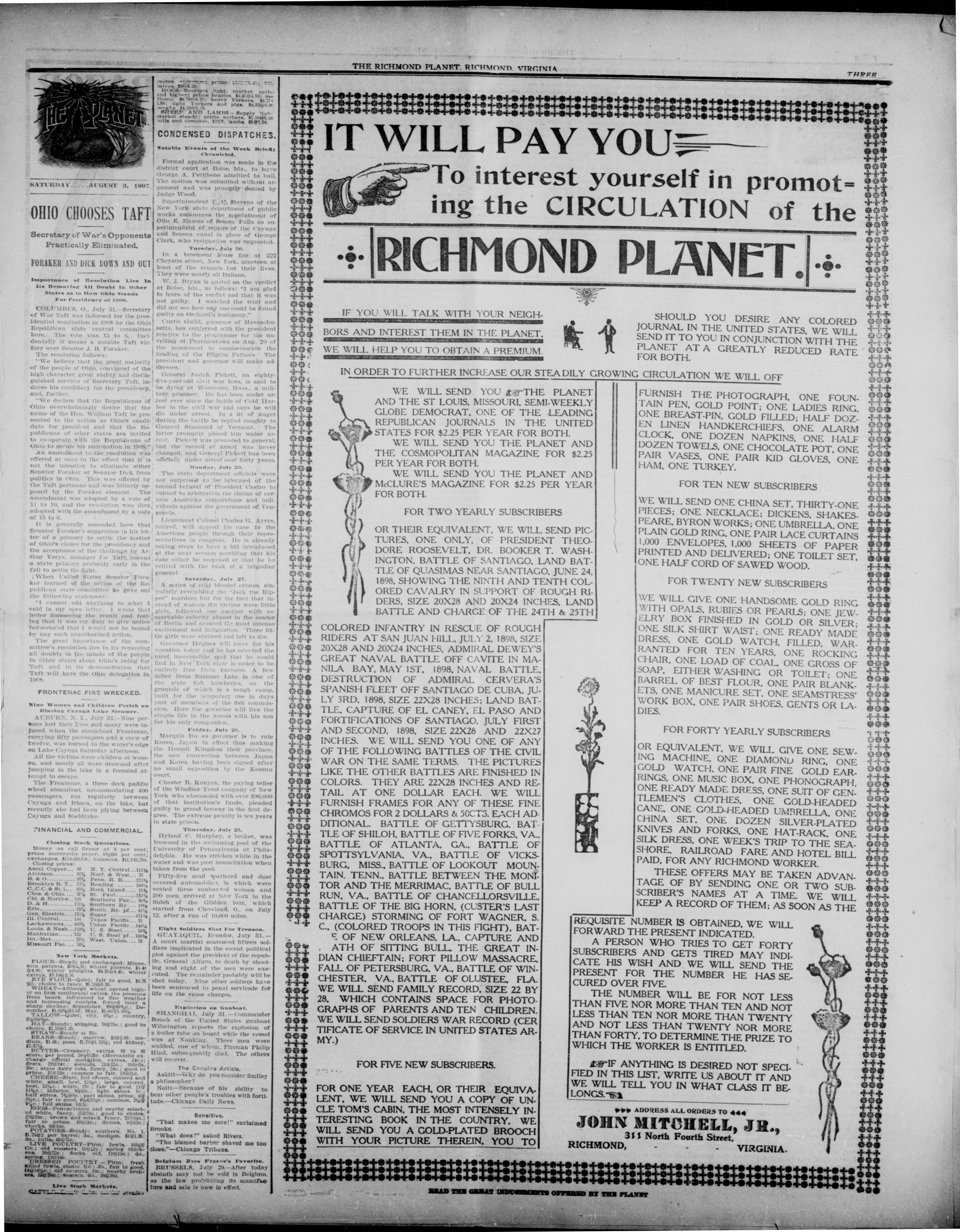
IT WILL PAY YOU To interest yourself in promot ing the CIRCULATION of the RICHMOND PLANET.
IF YOU WILL TALK WITH YOUR NEIGH-
WE WILL HELP YOU TO OBTAIN A PREMIUM.
IN ORDER TO FURTHER INCREASE OUR STEADILY GROWING CIRCULATION WE WILL OFF
COLORED INFANTRY IN RESCUE OF ROUGH RIDERS AT SAN JUAN HILL, JULY 2, 1898, SIZE 20X28 AND 20X24 INCHES, ADMIRAL DEWEY'S GREAT NAVAL BATTLE OFF CAVITE IN MANILA BAY, MAY 1ST, 1898, NAVAL BATTLE, DESTRUCTION OF ADMIRAL CERVERA'S SPANISH FLEET OFF SANTIAGO DE CUBA, JULY 3RD, 1898, SIZE 22X28 INCHES; LAND BATTLE, CAPTURE OF EL CANEY, EL PASO AND FORTIFICATIONS OF SANTIAGO, JULY FIRST AND SECOND, 1898, SIZE 22X28 AND 22X27 INCHES. WE WILL SEND YOU ONE OF ANY OF THE FOLLOWING BATTLES OF THE CIVIL WAR ON THE SAME TERMS. THE PICTURES LIKE THE OTHER BATTLES ARE FINISHED IN COLORS. THEY ARE 22X28 INCHES AND RETAIL AT ONE DOLLAR EACH. WE WILL FURNISH FRAMES FOR ANY OF THESE FINE CHROMOS FOR 2 DOLLARS & 50CTS. EACH ADDITIONAL. BATTLE OF GETTYSBURG, BATTLE OF SHILOH, BATTLE OF FIVE FORKS, VA., BATTLE OF ATLANTA, GA., BATTLE OF SPOTTSYLVANIA, VA., BATTLE OF VICKSBURG, MISS., BATTLE OF LOOKOUT MOUNTAIN. TENN., BATTLE BETWEEN THE MONITOR AND THE MERRIMAC, BATTLE OF BULL RUN, VA., BATTLE OF CHANCELLORSVILLE, BATTLE OF THE BIG HORN, (CUSTER'S LAST CHARGE) STORMING OF FORT WAGNER, S. C., (COLORED TROOPS IN THIS FIGHT). BAT-
E OF NEW ORLEANS, LA., CAPTURE AND ATH OF SITTING BULL, THE GREAT INDIAN CHIEFTAIN; FORT PILLOW MASSACRE, FALL OF PETERSBURG, VA., BATTLE OF WINCHESTER, VA., BATTLE OF OLUSTEE, FLA. WE WILL SEND FAMILY RECORD, SIZE 22 BY 28. WHICH CONTAINS SPACE FOR PHOTOGRAPHS OF PARENTS AND TEN CHILDREN. WE WILL SEND SOLDIERS WAR RECORD (CERTIFICATE OF SERVICE IN UNITED STATES ARMY.)
FOR FIVE NEW SUBSCRIBERS
FOR ONE YEAR EACH, OR THEIR EQUIVALENT, WE WILL SEND YOU A COPY OF UNCLE TOM'S CABIN, THE MOST INTENSELY INTERESTING BOOK IN THE COUNTRY. WE WILL SEND YOU A GOLD-PLATED BROOCH WITH YOUR PICTURE THEREIN, YOU TO
ADDRESS ALL ORDERS TO
JOHN MITCHELL, JR.,
311 North Fourth Street,
RICHMOND, VIRGINIA.
```markdown
```
COLORED RIDERS AT 20X28 AND GREAT NAILA BAY DESTRUCT SPANISH FLY 3RD, 18 TLE, CAPT FORTIFICA AND SECOND INCHES. V OF THE FO WAR ON T LIKE THE COLORS. TAIL AT FURNISH CHROMOS DITIONALL TLE OF SH BATTLE O SPOTTSYL BURG, MII TAIN, TEN TOR AND RUN, VA., BATTLE O CHARGE) C., (COLOR E OF NE ATH OF DIAN CHIEF FALL OF P CHESTER, WE WILL S 28, WHICH GRAPHS O WE WILL S TIFICATE O MY.)
FOR ONE Y
LENT, WE
CLE TOM'S
TERESTING
WILL SEND
WITH YOU
WE WILL SEND YOU THE PLANET AND THE ST LOUIS, MISSOURI, SEMI-WEEKLY GLOBE DEMOCRAT, ONE OF THE LEADING REPUBLICAN JOURNALS IN THE UNITED STATES FOR $2.25 PER YEAR FOR BOTH. WE WILL SEND YOU THE PLANET AND THE COSMOPOLITAN MAGAZINE FOR $2.25 PER YEAR FOR BOTH. WE WILL SEND YOU THE PLANET AND McCLURE'S MAGAZINE FOR $2.25 PER YEAR FOR BOTH.
OR THEIR EQUIVALENT, WE WILL SEND PICTURES, ONE ONLY, OF PRESIDENT THEODORE ROOSEVELT, DR. BOOKER T. WASHINGTON, BATTLE OF SANTIAGO, LAND BATTLE OF QUASIMAS NEAR SANTIAGO, JUNE 24, 1898, SHOWING THE NINTH AND TENTH COLORED CAVALRY IN SUPPORT OF ROUGH RIDERS, SIZE 20X28 AND 20X24 INCHES, LAND BATTLE AND CHARGE OF THE 24TH & 25TH
READ THE GREAT INDUCEMENTS OFFERED BY THE PLANET
FOR TWO YEARLY SUBSCRIBERS
REQUISITE NUMBER IS OBTAINED, WE WILL FORWARD THE PRESENT INDICATED. A PERSON WHO TRIES TO GET FORTY SUBSCRIBERS AND GETS TIRED MAY INDICATE HIS WISH AND WE WILL SEND THE PRESENT FOR THE NUMBER HE HAS SECURED OVER FIVE. THE NUMBER WILL BE FOR NOT LESS THAN FIVE NOR MORE THAN TEN AND NOT LESS THAN TEN NOR MORE THAN TWENTY AND NOT LESS THAN TWENTY NOR MORE THAN FORTY, TO DETERMINE THE PRIZE TO WHICH THE WORKER IS ENTITLED.
IF ANYTHING IS DESIRED NOT SPECIFIED IN THIS LIST, WRITE US ABOUT IT AND WE WILL TELL YOU IN WHAT CLASS IT BE LONGS.
RICHMOND, VIRGINIA
A man is sitting in a chair. A man is standing next to him.
LANET
EEKLY
READING
UNITED
H.
T AND
R $2.25
T AND
YEAR
ND PIC-
THEO-
WASH-
D BAT-
JUNE 24,
H COL-
GH RI-
LAND
& 25TH
```markdown
```
REQUISIT FOR WAR
SHOULD YOU DESIRE ANY COLORED JOURNAL IN THE UNITED STATES, WE WILL SEND IT TO YOU IN CONJUNCTION WITH THE PLANET AT A GREATLY REDUCED RATE FOR BOTH.
FURNISH THE PHOTOGRAPH, ONE FOUNTAIN PEN, GOLD POINT; ONE LADIES RING, ONE BREAST-PIN, GOLD FILLED; HALF DOZEN LINEN HANDKERCHIEFS, ONE ALARM CLOCK, ONE DOZEN NAPKINS, ONE HALF DOZEN TOWELS, ONE CHOCOLATE POT, ONE PAIR VASES, ONE PAIR KID GLOVES, ONE HAM, ONE TURKEY.
FOR TEN NEW SUBSCRIBERS
WE WILL SEND ONE CHINA SET, THIRTY-ONE PIECES; ONE NECKLACE; DICKENS, SHAKESPEARE, BYRON WORKS; ONE UMBRELLA, ONE PLAIN GOLD RING, ONE PAIR LACE CURTAINS 1,000 ENVELOPES, 1,000 SHEETS OF PAPER PRINTED AND DELIVERED; ONE TOILET SET, ONE HALF CORD OF SAWED WOOD
FOR TWENTY NEW SUBSCRIBERS
WE WILL GIVE ONE HANDSOME GOLD RING WITH OPALS, RUBIES OR PEARLS; ONE JEWELRY BOX FINISHED IN GOLD OR SILVER; ONE SILK SHIRT WAIST; ONE READY MADE DRESS, ONE GOLD WATCH, FILLED, WARRANTED FOR TEN YEARS, ONE ROCKING CHAIR, ONE LOAD OF COAL, ONE GROSS OF SOAP, EITHER WASHING OR TOILET; ONE BARREL OF BEST FLOUR, ONE PAIR BLANKETS, ONE MANICURE SET, ONE SEAMSTRESS' WORK BOX, ONE PAIR SHOES, GENTS OR LADIES.
FOR FORTY YEARLY SUBSCRIBERS
OR EQUIVALENT, WE WILL GIVE ONE SEWING MACHINE, ONE DIAMOND RING, ONE GOLD WATCH, ONE PAIR FINE GOLD EARRINGS, ONE MUSIC BOX, ONE PHONOGRAPH, ONE READY MADE DRESS, ONE SUIT OF GENTLEMEN'S CLOTHES, ONE GOLD-HEADED CANE, ONE GOLD-HEADED UMBRELLA, ONE CHINA SET, ONE DOZEN SILVER-PLATED KNIVES AND FORKS, ONE HAT-RACK, ONE SILK DRESS, ONE WEEK'S TRIP TO THE SEASHORE, RAILROAD FARE AND HOTEL BILL PAID, FOR ANY RICHMOND WORKER. THESE OFFERS MAY BE TAKEN ADVANTAGE OF BY SENDING ONE OR TWO SUBSCRIBER'S NAMES AT A TIME. WE WILL KEEP A RECORD OF THEM; AS SOON AS THE
THRER
```markdown
```
```markdown
```
FOUR
THE PLANET
Published every Saturday by JOHN MITCHELL,
Jr., at 811 North 4th Street, Richmond Va.
JOHN MITCHELL, JR., - EDITOR.
All communications intended for publication should be sent so as to reach us by Wednesday.
TERMS IN ADVANCE
One Copy, one year, $1.50
One Copy, eight months, 1.00
One Copy, six months, .80
One Copy, four months, .50
One Copy, three months, .40
Single Copy, .05
ADVERTISING RATES
For one inch, one insertion,
For one inch, each subsequent insertion,
For two inches, three months,
For two inches, six months,
For two inches, nine months,
For two inches, twelve months
Marriage and Funeral Notices, one inch,
Standing and Transient Notices per line,
POSTAGE STAMPS OF A HIGHER DEMONINATION THAN TWO CENTS NOT RECEIVED ON SUBSCRIPTIONS.
THE PLANET is issued weekly. The subscription price is $1.50 per year in advance.
MONEY ORDERS.—You can buy a Money Order at your Post-Office, payable at the Richmond Post Office, and we will be responsible for its safe arrival.
EXPRESS MONEY ORDERS can be obtained at any office of the American Express Co. the following ways:
1. Go to and go and Co.'s Express Company. We will be responsible for money sent by any of these companies and convenient way for forwarding money.
We cannot be responsible for money sent in letters in any other way than one of the four ways mentioned above. If you send your money in any other way, you must do it at your own risk.
RENEWALS, BTC.—If you do not want THE PLANET continued for another year after your subscription has run out, you then notify us by Postal Card to discontinue it. The courts have decided that subscribers to newspaper, who do not order their paper discontinued at the expiration of time for which it has been paid are held liable for the payment of the subscription up to date when they order the paper discontinued.
COMMUNICATIONS: When writing to us to renew your subscription or to discontinue your paper, you should give your name and address in full, otherwise we cannot find your name on our books.
CHANGE OF ADDRESS.—In order to change
the address of a subscriber, we must be sent
the former as well as the present address.
Entered at the Post-Office at Richmond, Va.,
as second-class matter.
SATURDAY.....AUGUST 3, 1907.
THE RAILROADS AND THE LAW.
The action of the North Carolina authorities in holding up the Southern Railway and arresting its officials for alleged violations of the laws of that state emphasizes the position of the colored people, who claimed that states had no right to regulate interstate passengers in the matter of "Jim Crow" accommodations. The Supreme Court of the United States finally closed one eye and winked the other and ruled that interstate passengers could be subjected to local regulations provided the accommodations furnished were equal.
This then was the laying of the foundation for the present interferences with the Interstate travel of the great railroad systems. North Car olina and other southern states reasoned that if they could regulate passengers then they could regulate the fares of passengers and they proceeded to put into effect the 2ct and $2\frac{1}{4}$ ct. rate. Now comes the railroad companies in solid array either openly or under cover, making a fight for the very principle involved in our contention for human rights.
They allege that the rates set are confiscatory, the taking of property without due process of law. In the state of Virginia, where the rate was made 2c per mile, they make the same claim with the elimination of the plea that it was without due process of law, but the plea is made under the protecting shelter of the Fourteenth Amendment to the Constitution of the United States, which it was alleged was enacted for the benefit and protection of the Negroes of the United States.
This is the amendment that the Times-Dispatch has been energetic in protesting against, claiming that the 13th, 14th and 15th Amendments were unconstitutionally adopted. Well may it be said, "Lo, the stone that the builders rejected has become the head of the corner."
It is gratifying to those of us who have watched the trend of events and who have noticed the outcome. Certainly if North Carolina has the right to regulate interstate passenger's accommodations then it has the right to regulate interstate passenger's rates. It has always been understood to be the ruling of the Supreme Court that roads wholly within the confines of the state were wholly amenable to the laws of the state. But this contention was further enlarged by the plea that persons on interstate trains and travelling from one point to another, wholly within the boundary of that state were subject to state regulations and then came along the Interstate Commerce Commission and ruled that railroads could
---
conform to state regulations even though the passengers interfered with were travelling from one state across another. This was the "last straw that broke the camel's back" and every thoughtful colored man threw up his hauds in disgust. But the railroads now see the folly of all of this legal dissertation and they are now being jabbed with the same pitchfork that has served such a good purpose in its work upon the anatomy of the Negro. If the railroads were right in the past, then they are wrong now, and if they were wrong in the past, they are right in their contest now. We shall watch with interest this fight for the railroads have plenty of money and if they win, we must profit as a result of the contentions.
FIENDISH BRUTALITY.
A mob of white men, on last Monday morning dug from its rude grave near Crisfield, Maryland, the body of a colored man named Reed and after firing bullets into it again started a bonfire and reduced the remains to ashes. This man had shot and killed Policeman Daugherty without provocation and only because he had William Hildred, his associate under arrest.
Reed escaped at the time of the shooting but was subsequently captured by the officers and virtually turned over to the mob for he was beaten to a jelly and was dead, before the actual lynching took place. The newspapers of the country have condemned the brutal acts of these fiends and steps have been taken to check the assaults upon innocent colored people of the neighborhood, who knew absolutely nothing about the crime.
Colored people of Reed's calibre and habits are a disgrace to the race and their lawless efforts are oftimes directed to the injury of colored people more than they are utilized in the damaging of white ones. Still, it was the law that was outraged and the forms of civilized society that were disgraced. Lawlessness begets lawlessness and this exhibition of passion, if unpunished will result in even more serious breaches of the rules of society.
It seems utterly impossible to punish white people guilty of this species of flendishness. We have suggested more than once that they be punished while engaged in their nefarious practices. The best way to handle a mob is to shoot the life out of it. Those who reach an untimely grave will be an everlasting example to the lawless elements who are left behind.
It may be that conditions will ultimately change and a jury, sufficiently conscientious to do its duty obtained to the end that the guilty may be punished, but that time in that portion of Maryland is not now or yet nigh. Lynch-law must go!
TROUBLE IN OHIO.
The fight now on in Ohio between the friends of Secretary William H. Taft and Senator Joseph B. Foraker is to say the least interesting. The latter has openly declared his opposition to the candidacy of the distinguished member of President Roosevelt's cabinet. In doing this he has given notice that the Senatorship is a secondary consideration. The attempt to call him off by the threat to retire him has failed.
This means a long, bitter fight in Ohio. It may be well to note that the declarations of Senator Foraker have a peculiar significance. He declares that the presidential aspirant is in favor of tariff revision, standing virtually upon the platform occupied by Grover Cleveland. It will be seen then that while President Roosevelt has taken plank after plank out of the Democratic platform, and divested Hon. William J. Bryan of all of his political issues, not excepting the government ownership of railroads. Mr. Taft takes up the question of tariff and in so doing has aroused every manufacturer in the United States.
That Senator Foraker will have the support of these interests is a foregone conclusion and that there will be a revolution in the ranks of labor is equally evident. The laboring elements are already chafing under the declaration of President Roosevelt that Moyer, Haywood and Debs of the Western Federation of Miners are undesirable citizens and this attempt to lower the tariff or tinker with it will be regarded as an assault upon the wage system of the workingmen of this country. They are enjoying a period of unparalleled prosperity under present conditions and the laboring elements of every nation of the world are looking to us with envious eyes. The question then is, shall we nominate a man on the Republican ticket, who is pledged to a change of these conditions?
Senator Foraker is ready to meet the issue and if any one doubts that he will lack for backing in his uphill fight, he has but to think over the matter and draw his own conclusions. That the Taft managers are desperate is evident from their action in having the Republican State Central Committee in Ohio go out of
THE RICHMOND PLANET, RICHMOND, VIRGINIA
its way and give a perfunctory endorsement of the candidacy of Secretary Taft, which endorsation was not binding on any Republican in Ohio and as Senator Foraker says not even binding upon themselves.
The vote stood 15 to 6, which showed an opposition of about thirty per cent. even in the committee. A corresponding falling off of the vote of the party in the state, coupled with the dissatisfied colored vote, would land the aspirant for the seat in the White House, somewhere on the shady side of the river of defeat, when the votes are counted on a certain November evening.
So far as we are able to observe, the Brownsville affair will be the mill-stone around the neck not only of President Roosevelt, but any one whom he may name for office. It was an outrage that cannot be justified either in morals or in law. The differences between the Republican and Democratic Parties are not so marked as they once were and there are thousands of colored voters who will support the "Devil" in preference to the hypocrite.
An active opposition in Ohio is bound to win in the end, whether it is in the minority or not, for no party can go into a presidential contest with the active antagonism of such men as Chairman Dick and Senator Foraker. They may be bound by party action and vote for the nominees, but there are others who will take the hint and be found wanting at the polls.
THE CASE OF MR. GORDON.
The appeal case of Mr. James R. Gordon, President of the Richmond Chamber of Commerce, was called in the Hustings Court Friday, the 26th inst. The evidence was listened to with interest, and the affair soon simmered down to a question of veracity between Mr. Gordon and that street-car conductor.
The point raised is an interesting one, and that it has puzzled the learned jurist who presides over the destinies of the just and the unjust hardly admits of a question. He postponed further consideration of it until last Wednesday, 31st ult., and then adjourned the matter until the next term. In the meantime the jury is practically paroled until the court is ready to give instructions.
The point raised by Attorney Cannon and Attorney W. R. Meredith is that the amended law as enacted by the Legislature requires that the seats for the races shall be designated. A passenger, whether white or colored, must know the seat he is to occupy. Should he take a seat without knowing this he cannot be moved by a conductor, as long as there are other seats to be occupied by the races. They contended that the decision as to the moving of the passengers for their comfort and convenience was not now arbitrarily fixed, but was subject to review by the court. The law reads that all companies
"Are hereby authorized and empowered in all such cars and coaches to separate the white and colored passengers, and to set apart and designate in each car or coach a portion thereof, or certain seats therein, to be occupied by white passengers, and a portion thereof, or certain seats therein, to be occupied by colored passengers."
The "sop to the whale" is set forth in the following:
"The said companies, corporations or persons operating trains or cars, or coaches upon such lines of railroad or railway, shall make no difference or discrimination in the quality and convenience of the accommodations provided for the two races under the provisions of section forty."
And again:
"The conductor, manager or other person in charge of any car or coach so operated upon any such line of railroad or railway shall have the right at any time, when, in his judgment, it may be necessary or proper for the comfort and convenience of the passengers so to do to change the designation so as to increase or decrease the amount of space or seats set apart for either race, or he may require any passenger to change his or her seat when and as often as he may deem necessary or proper."
These are verbatim extracts from the "Jim Crow" Car Law, Section 1294d. Now then, Messrs. Meredith and Cannon contended that the seats must first be designated before the provisions of this law become operative. That if there were other seats on that car, where white and colored passengers could sit without intermingling, the conductor had no right to make him move for the purpose of giving a colored person a seat on the third bench from the rear. That he would have moved for colored persons to take possession of that seat if he had been permitted to take another seat in the rear, where he could proceed with his smoking.
That there was some force in this contention hardly admits of a question for Judge Witt, one of the best posted jurists on criminal law in this State is still reading up authorities on the meaning of the word designation. He said that he would rule that if Mr. Gordon knew that the third seat was for colored passengers, or if he had
been previously told by the conductor that this seat was for colored passengers, and he then declined to move, he was guilty of a misdeameanor and the fine should stand as administered by Justice Crutchfield's Court.
On the other hand, if he would swear that he did not know that this seat was so reserved and he could establish the fact that the conductor did not so inform him that he had violated no law and was not guilty.
But Mr. Gordon's attorneys were not satisfied with this. They claimed that there could not be a verbal designation 'or a designation by word of mouth. The seats must be marked in a legible manner, just as is done on a railroad train, and that these designations must be shifted by the conductor when he so elects and upon his failure to do so he cannot move one passenger to another seat, when it is not for the comfort and convenience of a passenger.
If a white man or a colored one gets on an almost empty car and the seats are not designated by signs or placards, the conductor has no right to make him move, so long as the car is not occupied by incoming passengers. Judge Witt's announced determination to rule would have been slightly different. A man must swear that he did not know the seaf assigned or designated to his race and he must prove that the conductor did not so inform him upon his boarding the car.
It was thought that Mr. Gordon was not in earnest, but it is now evident that he will not give up until the matter has been tested in all of its phases. He is in a most embarrassing predicament. He is at the head of the commercial interests of Richmond, and is in the humiliating position of being charged with violating a law presumed to have been enacted for the purpose of catching Negroes.
The discussion of the merits of the controversy by Commonwealth Attorney Fowkes was on the highest order, and the opposing counsel kept it on the same elevated plane. When a two-dollar white man can order around a hundred thousand dollar white one, trouble is ahead, and Negro or no Negro, "Jim Crow" Car or no "Jim Crow" Car, there's going to be a fight in this Commonwealth, and the Negro is going to be sitting astride of a fence rail laughing.
GRAND TIMES AT THE EBENEZER CHURCH. (Continued From First Page.)
M. of Ex—James Woodson.
M. of F—Wm. H. Stokes.
M. at A—Isaac Bray.
I. G—H. J. Faulks.
C. C.—Joseph B. Griffin.
V. C.—L. J. Morris.
K. of R. & S.—C. H. Wells.
M. of E.—John C. Baker.
VIRGINIA LODGE, NO. 6.
C. C.—Wm. H. Jones.
V. C.—Hassie Reed.
P.—Robert Evans.
M. of Ex.—Wm. Ellis, Jr.
K. of R. & S.—John M. Foster.
M. at F.—S. C. Williams.
M. at A.—John Fisher.
M. of W.—J. H. Anderson.
BLOOMING LILY LODGE, NO. 15.
M. of W.—Thomas Patterson.
C. C.—V. M. Gweththy.
V. C.—Wm. E. Taylor.
P.—Thomas Jones.
K. of R. & S.—Charles E. Steward.
M. of F.—Shadrack Fleming.
M. at A.—Nelson Poiard.
NORTH STAR LODGE, NO. 52.
C. C—John A. Allen.
V. C—David Braxton.
M. of E.—I. A. Jordan.
M. of F.—O. W. Dandridge.
K. of R. & S.—Wm. H. Coy.
O. G.—Archer Green.
I. G.—George Rawls.
K. of R. & S.—R. W. Whiting.
C. C.—Nathaniel Goode.
M. at A.—Anthony Dandridge.
NAVY HILL LODGE, NO. 131.
C. C.—J. Marx Funn.
V. C.—Wm. H. Hill.
P.—Wm. Johnson.
M. of W.—R. W. Moss.
K. of R. & S.—W. C. Williams.
M. of F.—Richard Jackson.
M. of E.—Wm. J. Winne.
M. at A.—W. Percy Baylor.
I. G.—Clarence Moss.
O. G.—Charles Green.
SAMSON LODGE, NO. 16.
M. of W.—H. B. Gee.
C. C.—H. Clay.
V. C.—R. T. Thompson.
P. P.—G. Hayden.
K. of R. & S.—R. Hamilton.
M. of F.—Wm. W. Patterson.
M. of E.—M. Jongs.
I. G.—G. Wallace.
O. G.—A. W. Pulllam.
M. at A.—D. R. Lewis.
BEN HUR LODGE, NO. 96.
M. of W.—Frank Miller.
C. C.—Willie Woolfork.
V. C.—Willie Lucas.
M. of F.—J. R. Green.
K. of R. & S.—Walter T. Chilles.
M. of E.—Floyd Spencer.
M. at A.—Walter W. Randolph.
P.—George B. Pinkney.
O. G.—Ed. Moore.
I. G.—Isaac Ballard.
INVINCIBLE LODGE, NO. 65.
M. of W.—Cornelius Bland.
C. C.—I. H. Scott.
V. C.—Anderson Knox.
K. of R. & S.—W. P. Epps.
M. at A.—Joseph Knox.
I. G.—Lewis Brooks.
NARCISSUS COURT, NO. 229.
W. I.—Matilda Thompson.
W. Ir.—Wills Wyatt.
J. D.—Nancy Johnson.
R. of A.—Katie S. Thomas.
R. of Deeds.—Susie B. Williams.
H.—Matilda Mason.
P.—Louisa Ballard.
MECHANICS' COURT.
W. C.-Lillie Hardy.
W. Ins.-Addie Lemas.
R. of Deeds.-Gertrude Lawrence.
MECHANICS' CIURT, NO. 45.
W. C.-Mrs. Susie Thomas.
W. Ir.-Mrs. Ella O. Waller.
W. O.-Mrs. Bettie Anderson.
R. of Deeds.-Miss Lucinda Tim-
erlake.
Register of A.-Mrs. Nannie
Jobbs.
R. of Dep.-Mrs. Louisa R. Alen.
C.-Mrs. Fannie Smith.
H.-Miss Mary Cooper.
VENUS COURT, NO. 47.
W. C.-Miss Josephine Williams.
S. D.-Mrs. Annie Morris.
J. D.-Mrs. Hattie Shackelford.
E.-Mrs. Nannie B. Davis.
H.-Mrs. Margaret Scott.
R. of Dep.-Mrs. Nancy Custalo.
R. of Deeds.-Mrs. Alice G. Polin-
dexter.
MT. OLIVET COURT, NO. 109.
W. Ix—Mrs. Zilphia Smith.
R. of A.—Octavia Robinson.
C.—Queen Parker.
H.—Rosa J. Nelson.
W. O.—Caroline Watson.
J. D.—Eddie Pollard.
R. of Deeds.—Julia B. Perry.
A. C.—Maggie Hughes.
UNITY CIURT, NO. 132.
W. C.—J. W. Robinson.
W. Ix—Mattie Campbell.
W. Ir.—E. M. Robinson.
S. D.—Precious Scott.
J. D.—Roberta Bryant.
O.—Ida Kyles Mills.
R. of D.—M. E. Brown.
R. of A.—Carrie Jennings.
R. of Dep.—Matilda Hall.
E.—Mary L. Freeman.
C.—Maria Evans.
A. C.—Ella Frayser.
P.—Charlotte Allen.
W. Inx.-Ellen Williams.
S. D.-Mary Hix.
R. of D.-Mary J. Augustus.
R. of Dep.-Mary Nash
W. Ix.—Ida Farrar.
W. Ir.—Eliza Lee.
J. D.—Bettle Dugger.
O.—Maria Warren.
R. of D.—O. M. Steward.
R. of A.—E. A. Storrs.
E.—Jane Steward.
A. C.—Hester Ross.
P.—Mary Cheatham.
W. C.—Adeldae G. Thompson.
W. Ix.—Harriet Blunt.
R. of D.—Mary Mayo.
W. W. —Mary Jackson.
W. I. —Sarah C. Smith.
W. Ir. —Virginia Wright.
S. D. —Rosa Lipscomb.
J. D. —Bettie Fowlkes.
O. —Florence Page.
R. of Deeds. —Rebecca E. Morton.
R. of A. —Cordella Flemming.
R. of Dep. —Charlotte Gwathmey.
E. —Sarah Frayser.
A. C. —Margaret Patterson.
H. —Mahala Jordan.
W. C.—Mrs. Rosa Lovings.
W. Ix.—Mrs. Bell Jackson.
W. Ir.—Mrs. Lottie Wines.
O.—Mrs. Nannie Hucless.
R. of Dep.—Mrs. Mildred Johnson
S. D.—Ellen Galligo.
A. C.—Virginta Gordon.
E.—Mary Hayes.
MACEO COURT, NO. 222.
W. C.—Clara Blunt.
W. Ix.—Eveline Scott.
W. Ir.—Bertie Clayton.
S. D.—Sarah Briggs.
J. D.—Mary Lacy.
R. of D.—A. E. Jackson.
R. of Dep.—Mollie Johnson.
E.—Sarah Washington.
C.—Lucy Ellis.
A. C.—Sylvia Goode.
H.—H. L. Jones.
P.—S. A. Brown.
SARAH'S COURT. NO. 246.
W. Ir.—M. Alice Johnson.
W. C.—Racilia W. Steward.
S. D.—Albuna M. Steward.
R. of D.—Marion W. Steward.
R. of A.—Lucy S. Stokes.
H.—Luversa Jones.
VIRGINIA COURT, NO. 166.
W. C.—Hattie V. Smith.
W. I.—Nettie Hilton.
S. D.—Alice Jones.
R. of A.—Laura Williams.
C.—Laura Taylor.
W. I.—Lucy Jones.
O.—Priscilla Dandridge.
R. of D.—Ida B. Staves.
P.—Rosetta Williams.
SILVER STAR COURT, NO. 65.
W. C.—Rosa Gibson.
W. I.—Frances Jackson.
O.—Clarkie Neal.
W. I.—Dora Dixon.
S. D.—Louisa Robinson.
R. of D.—Maria A. Deane.
R. of Dep.—Adline Jones.
H.—Laura Terrell.
P.—Sarah Brown.
FULTON COURT, NO. 244.
W. C.—Annie Slaughter.
W. Ir.—Julia Tharpa.
R. of D.—Annie Whitling.
R. of A.—Virginia Bossieux.
E.—Lucy Henderson.
C.—Julia Dandridge.
A. C.—Ella Yancey.
H.—Mary L. Porter.
SYLVESTER COURT, NO. 54.
W. C.—Frances Liggons.
THIS RAZOR Practically FREE
With a year's subscription to the (Name of Your Paper) and
The Philadelphia Press
The razor is made from the best Sheffield Steel, hardened and tempered thermometrically and guaranteed.
It's Particular Merit is its
It's Particular Merit is its Shaving Quality $3.50
BUYS
The Philadelp
ONE YEAR daily, regular
Fremont Razor
Your Favorite Home N
Value
ALL FOR
$3.50 C
Mailed immediately upon
subscription
Order To-day
The Philadelphia Press
ONE YEAR daily, regular price $3.00
Fremont Razor $2.00
Your Favorite Home Newspaper $1.50
Value $6.50
Mailed immediately upon receipt of your subscription.
Order To-day—NOW!
R. of A.—Rebecca M. Griffin.
MIGNONETTE COURT, NO. 102.
W. C.—R. D. Grandison.
Ix.—Belle Harris.
O.—Mary A. Harris.
R. of D.—Blanche L. Grandison.
R. of A.—Sallie Foxel.
H.—Hester Friend.
E.—Lena Carter.
Ir.—Josephine Gardner.
OLD DOMINION COURT, NO. 114
W. C.—John Mitchell, Jr.
W. Ix.—Mrs. Louisa Payne.
W. Ir.—Mrs. George Bolling.
J. D.—Miss Nellie Bolling.
O.—Miss Carsie D. Isham.
R. of D.—Miss Moselle C. Robinson
R. of Dep.—Mrs. Nannie C. Johnson
E.—Miss Susie Bolling.
A. C.—Mrs. Hannah Robinson.
H. Dr. J. Alexander Lewis.
PLANET COURT, NO. 137.
W. C.-J. W. Thompson.
W. Ir.-Courtney Booker.
S. D.-Lucy Cross.
H.-Fanny Jones.
O.-Cherry North.
J. D.-Lucy Reed.
R. of A.-Cora B. Epps.
R. of Dep.-Bettie Flemming.
EXCELSIOR COURT. NO. 117.
W. C.—Lucinda Smith.
R. of A.—Lillian Moore.
R. of Dep.—Marietta L. Chiles.
C.—Sallie Thompson.
A. C.—Mary L. Jones.
MILDRED'S COURT, NO. 242.
The exercises were interspersed with selections sung by the congregation. Rev. L. J. Morris delivered benediction. Thanks were tendered the church and the committee of arrangements consisting of Miss M. L. Chiles, Mrs. Lucy Cross, Mrs. Sallie Foxel, Mrs. Mildred Johnson, Mrs. Anna Taylor, Mr. E. W. R. Glenn, Mr. Willis Wyatt, Mr. O. M. Steward, Mrs. R. E. Wesley, Mr. George W. Dandridge.
The lodges that paid the fifty cents fee are as follows: Navy Hill Lodge, No. 131; Invincible Lodge, No. 65; North Star Lodge, No. 52; Christian Hope Lodge, No. 43; Samson Lodge, No. 16; Planet Lodge, No. 23; Capital Lodge, No. 81; Venus Lodge, No. 46; Richmond Lodge, No. 1; Virginia Lodge, No. 6; Old Dominion Lodge, No. 8; Blooming Lily Lodge, No. 15; Myrtle Lodge, No. 17; Unity Lodge, No. 24; Royal Lodge, No. 35; Maceo Lodge, No. 35; Fulton Lodge, No. 42; Valley Lodge, No. 73; White
AGE
sell Rent per market erybody
Address
KIRKIT
31
W. C.—Emma J. Brown.
W. Ir.—Peyton Johnson.
W. Ix.—Florence Stokes.
O.—Ella Wilson.
E.—Carrie Wilson.
A. C.—Nannie D. Gibbs.
BUYS
elphia Press
regular price $3.00
$2.00
time Newspaper $1.50
value $6.50
FOR
Cash
upon receipt of your
description.
day—NOW!
Rose Lodge, No. 87; Ben Hur Lodge,
No. 96; American Lodge, No. 98;
Crispus Attucks Lodge, No. 117;
Banner Lodge, No. 118.
are as follows:
Venus Court, No. 47; Mildred's Court, No. 242; Mt. Olivet Court, No. 109; Richmond Court, No. 169; Verbena Court, No. 61; Elizabeth Court, No. 210; Valley Court, No. 84; Macoe Court, No. 222; Martha's Court, No. 138; Sylvester Court, No. 54; Violet Court, No. 152; Rosetta's Court, No. 173; Virginia Court, No. 166; Planet Court, No. 137; Mignonette Court, No. 102; Pure Gold Court, No. 59; Cordelia's Court, No. 194; Old Dominion Court, No. 114; Blooming Lily Court, No. 142; Excelsior Court, No. 117; Unity Court, No. 132; Josephine Court, No. 228; Narcissus Court, No. 229; Julia's Court, No. 235; Sarah's Court, No. 246; America Court, No. 44; Mechanic's Court, No. 45; Silver Star Court, No. 65; North Star Court, No. 73; Ivy Leaf Court, No. 95; Olivet Court, No. 88; Heliotrope Court, No. 91; Fairmount Court, No. 125; Fulton Court, No. 44.
$150.00 Endowment. Paid.
Richmond, Va., July 27, '07.
This is to certify that I have received from John Mitchell, Jr.,
Grand Chancellor of the Grand Lodge of Virginia, Knights of Pythias, N. A., S. A., E., A., A. and A. ($150.00) One Hundred and Fifty Dollars in payment of the deathclaim of Isaac Warden, who was a member of Maceo Lodge, No. 35 of Richmond, Va.
Signed—J. Thomas Hewin,
Administrator of Estate of Isaac Warden.
$100.00 Endowment Paid.
Richmond, Va. July 26, '07.
This is to certify that I have received from John Mitchell, Jr.,
Grand Worthy Counselor of the Grand Court of Virginia, I. O. of Calanthe, ($100.00) One Hundred Dollars in payment of the deathmember of Mildrd's Court, No. 242 of Richmond, Va.
Signed—J. F. Lewis,
Benevolent.
Agents Wanted.
AGENTS WANTED everywhere to sell Ruby Dressine, the greatest ten cent preparation for the hair on the market. Sells like hot-cakes. Everybody buys. Big money made. Address.
KIRKLEY SPECIALTY MFG. CO.
313 W. Madison Street,
Baltimore, Maryland.
REC PLANET
SATURDAY...AUGUST 3, 1907.
STRANGLER AT LARGE.
New York Police Hunt Slayer of
Two Women.
NEW YORK, July 31. Within a few
hours after the discovery of the mur-
der by strangulation of a woman now
identified as Mrs. Sophie Kehrer, at
457 West Twenty-second street, an
other young woman was found strang-
led to death in the areaway of 204
East Ninetelth street.
Both crimes were marked by almost
incredible cruelty, and it may turn out
that both are the work of one and the
same degenerate.
After the women had been murdered
their bodies were mutilated in various
ways.
With an excess of violence Mrs.
Kehrer was first strangled to death
with a silken cravat drawn so tight
that it cut into her flesh. Then her
neck was gripped and crushed in the
man's strong fingers. Finally the mur-
derer made crescent-shaped cuts on his
victim's arm, cheek and neck.
In the East Ninetieth street case the victim was torn almost limb from limb, and there is evidence which leads the coroner's physician to declare that several men must have taken part in the crime.
Passing through East Ninetieth street at dawn, Policeman John Healey saw the woman's body lying in a heap in the areaway of 204.
Investigating, he found the body still warm, but the wrists were cold and pulseless. Healey sent in a call for an ambulance from the Presbyterian hospital, which was answered by Dr. Croscagen.
The theory that the woman was a victim of a "ripper" after having been strangled gained ground when blood was discovered on her stockings and shoes.
MAJOR HUNTINGTON DEAD.
Veteran Officer Passes Away Unconscious of Family Tragedy.
VERSAILLES, France, July 81.—Major Henry A. Huntington, whose son, Henry Huntington, shot his two brothers and two sisters at his dying father's bedside, passed away last night.
Major Huntington had a family residence in Chicago at Sixteenth street and Indiana avenue. This locality is one of the fashionable sections of that city, and the family was prominent in society and entertained largely.
The death of the aged American soldier himself and an attempt at self destruction on the part of his son, Henry, who shot his sisters and brothers in the last hours of his dying father, imparted additional sadness to the shocking tragedy in the home of the veteran officer, which has caused a sensation in the American colony and diplomatic circles of France.
Major Huntington died shortly after the news was given out of the unsuccessful attempt at suicide by the demented son, but the father was spared the anguish of knowledge both of this incident and the terrible crime which shattered his household, as he was unconscious to the end.
The condition of Alonzo, who was shot in the head, is critical, and of Elizabeth, who was shot in the region of the heart, very serious.
Henry, the youngest son of Major Huntington, has been considered unbalanced mentally for years.
A STATE VICTORY.
Governor Glenn Wins All Along Railroad Line.
RALEIGH, N. C., July 31.—A sweeping victory has been won by the state of North Carolina in its fight to compel the railroads to obey the recently enacted law making it a crime to charge a passenger rate of more than $2\frac{1}{4}$ cents a mile.
As a result of a three hour conference with Governor Glenn, counsel for both the Southern railway and the Atlantic Coast Line signed an agreement that the two and a quarter cent rate shall be made effective not later than Aug. 8.
This agreement disposes of all the cases now pending in the police courts of Asheville and other places where agents of the Southern road were arrested and jailed.
Rakulil Threatens MacLean's Life.
TANGIER, July 31. - Gerard A. Lowther, the British minister here, has received a letter from Caid Sir Harry MacLean stating that Rakulil, who holds him prisoner, threatens to put him to death unless Mohammed El Torres, the sultan's representative for foreign affairs at Tangier, withdraws the troops from the Elkmes territory.
Meyer Still In Prison
BOISE, Ida., July 31.—A bond had not yet been given for Charles H. Moyer, president of the Western Federation of Miners, and he may have to spend another night in jail. The delay is said to be due to a decision to put up a straight cash bond rather than a personal bond guaranteed by cash as proposed.
Sea Gulls Can Talk!
CHICAGO, July 30.—Sea gulls can talk. They have a language all their own. Dr. John B. Watson is authority for this assertion. The doctor, who is professor of psychology in the University of Chicago, has just returned from a trip to Florida, where he has been studying gulls.
On Summit of Pike's Peak.
COLORADO SPRINGS, Colo., July 31.—The annual convention of the American Philatelic association was held on the summit of Pike's peak.
John N. Luff of New York was elected president, and it was decided to hold the next convention at Cleveland, O.
Prohibition For Georgia.
ATLANTA, Ga., July 31.—The house has passed the prohibition bill.
REPLIES TO ANXIOUS ONES.
Madame Merri Answers Some of Her Correspondents.
Is it the proper thing to keep on one's hat at an afternoon card party or a one o'clock luncheon? I live in a small town and head coverings are always removed. On a visit to the city I found that the guests remove their hats at the above-named functions.
"COUNTRY."
It seems rather an absurd custom to sit for hours with oftentimes heavy hats on, but, on the contrary, think of consigning these costly creations of feathers and lace to the oblivion of the dressing-room for all these hours. A properly adjusted hat is the "climax" of a perfectly constructed toilet, and I suppose this custom will remain in favor for some time to come. However, one may, with perfect propriety, remove the hat. It is not by any means a breach of etiquette and if yours causes a headache take it off.
Name for a Girl' Club
There are six young women in this town who would like to form a club, but they do not know what to call it. They are all girls who have gone to school together but they do not want a literary club, just to meet for a good time. There are six other girls here who call themselves "The Jolly Six." Please Madame Merri suggest a good name for us. "DIXIE."
If you do not care whether the name "Six" is used, why not call your little coterie the "Bon Ami" club, meaning "good friend," or the "Happy Six," but that is more common place. The "Entre Nous" club would be rather good, which means "between ourselves." If the meetings are on the secret order, the "Suba Rosa" club would be appropriate.
Duty of the Best Man
Kindly state in your helpful column what are the duties of a best man, and greatly oblige a chap who expects to act in this capacity. JACK.
The best man is expected to relieve the groom of all unnecessary details as to engaging the carriages, seeing to purchase of railroad tickets, and keeps the all-important gentleman as cool and level-headed as possible. In fact, the bridegroom furnishes the money and the best man does all the work—he all but marries the bride.
Bash or Girdle
Will you kindly tell me what kind of a belt a girl of 17 should wear with a white pearline lawn gown trimmed in lace and insertion? MADGE.
If you wear a belt it should be a girdle of ribbon, shirred on to a bit of feather-bone in back and front. Sashes with loops and long ends are again in favor. I think nothing prettier and they certainly give a finish to a gown that nothing else does. The figured ribbons are very popular; also the wide, soft ones of taffeta.
MADAME MERRL
USE FOR OLD HANDKERCHIEFS.
Correspondent Says They Make Effective Trimmings.
I find using handkerchiefs for trimmings costs no more than lace or embroidery, says a correspondent. Two turndown collars can be made from a handkerchief; also two baby bonets, trimmed with one handkerchief. Homemade bonets launder much better than the readymade ones. Any leftover piece of fine white goods will make the body. I make one bonnet with a straight rever, cut straight through the center of a handkerchief, the opposite side being left for a second bonnet. Collar, cuff bands, and bertha made from handkerchiefs will look dainty on a little dress made from white lawn, linen, or batiste.
I made several bibs as gifts. First I made a plain bib of huckaback. Over this was a handkerchief, placed so one point came in front, one in back, and one over each shoulder. I cut a hole in the center to fit the neck. Then I cut a slit from the neck down the center of the back point, binding the two bibs together around the neck with a tape. Pretty sofa pillows and dresser covers can be made and they will look nice after being washed. All old linen handkerchiefs I wash, iron, and put away, as they come in handy for many things, especially for bandaging a burnt or cut finger.
The Watches of the Night. Babies are the mainsprings in the watches of the night.—Chicago Daily News.
A Flag Pole.
Iceland wants to have a flag of its own. It won't have to go far for the pole.
Sad Worldliness
"Honesty is the best policy," remarked Meandering Mike.
"It sure is for folks like us," answered Plodding Pete. "Our transactions ain't big enough to enable us to hire de best legal talent."—Washington Star.
Good Advice.
Horace: Have a care of whom you talk, to whom and of what and where.
The Village Gossips.
Silas Hardacre—Yes, every Tuesday and Thursday night is "ripping-up night" with the ladies' sewing social in this town.
City Drummer—Indeed! And what do they rip up?
Silas Hardacre—Carpet rags, pedigrees and the absent members—Chicago Daily News.
THE RICHMOND PLANET, RICHMOND, VIRGINIA.
JOB DEPARTMENT
EXCURSION
We print Handbills, Quarter-Sheet posters, Tags, Tickets, Placards, Visiting Cards, Mourning Stations
WE HAVE
Our St.
OF THE LATEST
WE CAN PRINT A BILL AS SMALL
A Three-Sheet
AS LARGE AS A FRO
Our street-entrance is retired and fastidious lady being able to enter w
EXCURSION WORK OF ALL DESCRIPTIONS
We print Handbills, Quarter-Sheets, Half and Whole Sheet posters, Tags, Tickets, Placards, Society Cards, Minutes, Visiting Cards, Mourning Stationery.
OUR AIM is to please our patrons and to give them the best service at the lowest prices, consistent with satisfactory work.
We furnish "cuts" when desired and we will arrange to complete special work in our line. When in need of any work in our line, call and see us and estimates will be furnished.
WE HAVE AN ELEGANT LINE OF SAMPLES
WHICH WE WILL SHOW ANY ONE DESIRING TO SEE THEM.
OF THE LATEST STYLE BOND, FINE WRITING—FLAT AND LINEN PAPER, ENVELOPES, ETC.
Our street-entrance is retired and has no objectionable features, the most fastidious lady being able to enter without embarrassment or annoyance.
LONG DISTANCE TELEPHONE, 2213.
FORD'S
HAIR POMADE
Formerly known as
"OZONIZED OX MARROW"
The Ozonized Ox Marrow Co.
(None genuine without my signature)
Charlie Ford Print
153 E. KINZIE ST., CHICAGO, IL.
Agents wanted everywhere.
---
It is thoroughly equipped to do all kinds of printing on short notice. We make a specialty of Society printing and work for Insurance Companies, such as Financial
So STRAIGHTENKS KINKEY or CURLY
deadly consistent with all up in any style
Ford's Hair Formula was formerly
the only safe preparation known to us that
the only safe preparation known to us that
born above, kinky, curly or straight, as
born, harsh, kinky or curly hair soft,
may be obtained from a treatment of a
may be obtained from a treatment of a
use of Ford's Hair Formula for a year. The
prevents dandruff, relieves itch, invigorates a steal,舒服, the hair from falling
nourishes the scalp, gives it new life and
nourishes the scalp, gives it new life and
harmless, it is a tolles necessity for ladies,
glenomelan been made and sold continuously
around 1850 and since 1850, and is registered in the United States Patent Office, in 1854. Be sure to get
SOFT and ELASTIC. Beware of limitations.
Remember or Hair Formula is in SOFT and is in Chicago, and by no. The gunning has the
signature of all others. Full size. Sold by
bottle, price only 50.00. The dealer can not supply you, he can get it
or send 50.00 to one bottle postpaid, or 40.00 to one bottle postpaid, or 40.00 to three bottles or $5.00 for six bottles
charges to all points in U.S. A. When ordering
send postal or express money order, and
write your name and address plainly to
JURGEN'S SON
Before making your purchase you would do well to call at the most reliable furniture house in the city and see the fine line of REFRIGERATONS, MATTINGS, OIL-CLOTHS And in fact everything that is needed in house furnishings.
Of every description; also the latest designs in ROCKERS and special CHAIRS.
Our goods are the best for the price and the price is very low.
C. G. JURGEN'S SON,
ADAMS AND BROAD STREETS.
Daily to Baltimore.
On and after April 1st, 1907, sched
ule via the popular York River Line
will leave Richmond at 4:30 P. M.
daily except Sunday, returning leave
Baltimore at 5 P. M. daily except
Sunday. Very low rates one way
and round trip to Baltimore, Phila-
ladelphia and New York. It's the best way to reach Northern and Eastern points.
Cards, Policies, both straight life and benevolent, Physician's Certificates, Sick Cards, Application blanks, Agents Report Sheets, Rate Cards, etc.
ION WORK
arter-Sheets, Half and Whole
Placards, Society Cards, Min-
ing Stationery.
WE AN EL
WHICH WE WILL
Stock Ro
LATEST STYLE BOND, FI
AS SMALL AS A DODGER.
Sheet Poster
A FRONT DOOR.
OUR PRESENT CORP OF EMPLOYE
IS WITHIN EASY REACH OF
ired and has no objectionable f
enter without embarrassment o
2213.
LINC
HAIR P
MAKES
KINKY
HAIR
SOFT
REMOVES
DANDRUFF
AND
MAKES
IT
GROW
LONG
AND
LUXURIOUS
A Woman's Hair Make
If your hair is short. If you
your scalp is diseased, LINC
make it grow, remove the dand
LINCOLN HAIR POMADE
the finest toilet preparation o
for you to give it a trial and w
be so satisfactory that you will
Be sure and get the genuine
substitutes. For sale at all D
PRICE, 1
MANUFACT
The Lincoln Po
N WORK C
Half and Whole Society Cards, Ministry.
is to please give them the lowest with satisfaction.
AN ELEGANT WHICH WE WILL SHOW AN
Rock Room MASTYLE BOND, FINE WRITING
AS A DODGER.
Poster DOOR.
PRESENT CORP OF EMPLOYEERS ARE IN EASY REACH OF THE PUBLISHER
has no objectionable features, the out embarrassment or annoyance
LINCOLN HAIR POMADE
MAKES PINKY HAIR SOFT MOVES AND DRUFF AND MAKES IT ROW ONG AND RIOUS
Woman's Hair Makes or Marshes hair is short. If your head is frayed is diseased, LINCOLN HAIR row, remove the dandruff and CIN HAIR POMADE is highly toilet preparation on the market. Give it a trial and we feel confident that you will recommend and get the genuine and refreshed. For sale at all Drug Stores.
PRICE, 15 CENTS
OUR PRESENT CORP OF EMPLOYEES ARE COMPETENT AND QUICK-WORKING. OUR OFFICE IS WITHIN EASY REACH OF THE PUBLIC, BEING WITHIN FIFTY YARDS OF BROAD ST.
LINCOLN
HAIR POMADE
MAKES
KINKY
HAIR
SOFT
REMOVES
DANDRUFF
AND
MAKES
IT
GROW
LONG
AND
LUXURIOUS
LINCOLN
HAIR POMADE
SOFTENS
THE
HAIR
AND
KEEPS IT
FROM
BREAKING
KEEPS
SCALP
FRESH
CLEAN
AND
WHOLESOME.
If your hair is short. If your head is full of dandruff. If your scalp is diseased, LINCOLN HAIR POMADE will make it grow, remove the dandruff and cure scalp diseases. LINCOLN HAIR POMADE is highly perfumed and is the finest toilet preparation on the market. All we ask is for you to give it a trial and we feel confident the result will be so satisfactory that you will recommend it to your friends. Be sure and get the genuine and refuse weak and inferior substitutes. For sale at all Drug Stores.
MANUFACTURED BY
The Lincoln Pomade Company,
NORFOLK, VA., U. S. A.
If your dealer does not keep it, send his name and 20 cents in silver and we will send you a bottle by return mail. Agents wanted everywhere. Write for particulars.
The Eyes of the World are Upon Me.
The colored race in the United States at the present time is having some very trying experiences and only the best sort of advice and the wisest counsel should be given and heeded if your people are to continue in this land of prosperity and enjoy life, liberty, security and the pursuit of happiness. In this book we have attempted to present to the colored people of this great country a solution of our problems.
It utterly impossible to produce a book of such proportions at less cost. We hope that you, dear readers, if you cannot send the one dollar at once, will write to us and state whethr or not you would like to have a copy of the book reserved for you and that you will state at what time you will be able to send us the $1.00. Hopping that we shall hear from you by return mail, we are
Yours truly.
RICHARD H. BALL
We have called attention to the commendable steps made by our people along commercial, intellectual and moral lines, and we believe that if this book is read carefully, that it will prove a source of great inspiration and encouragement to not only the colored people themselves but the white people who are interested in our progress. All of the readers of this journal, who will send to us at once $1.00 by P. O. money order or registered letter will receive a copy of the book in cloth binding just as soon as it comes from the press.
We offer this special inducement in order to ascertain to what extent our people are willing to support such an enterprise. We will have to charge $1.50 for the book after it comes from the press. We find
---
---
WORK OF AL
OUR AIM
is to please our patrons and to
give them the best service at
the lowest prices, consistent
with satisfactory work.
ELEGANT I
SHOW ANY ONE DESIRING
om Embrace
ONE WRITING—FLAT AND
features, the most
or annoyance. FOR FURT
COLN
POMADE
SOFTENS
THE
HAIR
AND
KEEPS IT
FROM
BREAKING
KEEPS
SCALP
FRESH
CLEAN
AND
WHOLESOME
es or Mars Her Beauty.
Our head is full of dandruff. If
COLN HAIR POMADE will
dandruff and cure scalp diseases.
It is highly perfumed and is
in the market. All we ask is
we feel confident the result will
recommend it to your friends.
and refuse weak and inferior
drug Stores.
5 CENTS.
it utterly impossible to produce a book of such proportions at less cost. We hope that you, dear readers, if you cannot send the one dollar at once, will write to us and state whether er or not you would like to have a copy of the book reserved for you and that you will state at what time you will be able to send us the $1.00. Hoping that we shall hear from you by return mail, we are
Yours truly.
RICHARD H. BALL.
28 Franklin St. Lawrence, Mass.
Excursions to Jamestown Exposition
Norfolk, Va. via Southern
Railway.
Commencing April 19th and continuing daily to November 30, 1907 Southern Railway will sell season sixty day, fifteen day and ten day excursion tickets to Norfolk, Va. and return at reduced rates account the above; and on Tuesday of each week coach excursion tickets, not good in parlor or pullman cars, will be sold at greatly reduced rates, limited seven days. Inquire of Southern Railway Agents.
We print Wedding Invitations, and High Class Stationery for Balls, Parties, Picnics and all entertainments of a social nature. We print Church Envel-
ALL DESCRIBE
ons and to service at consistent work.
We furnish "cuts" when desired complete special work in our line in our line, call and see us and
T LINE OF S
DESIRING TO SEE THEM.
braces a full 2
CAT AND LINEN PAPER, ENVELOP
WE HAVE ONE OF THE MOST OF WOOD
Of Any Job Printing E
MENT AND QUICK-WORKING. OUR OFFICE WITHIN FIFTY YARDS OF BROAD ST.
FOR FURTHER INFORMATION, APPLY
John Mitch
311 N. 4th St.
FOR FURTHER INFORMATION, APPLY TO
John Mitchell, Jr.,
9:10 A. M.-Local to Norlina, Raileigh, Charlotte, Wilmington, 2:20 P. M.-Sleepers and coaches, Savannah, Jacksonville and Florida points. 9:50 P. M.-Sleepers and coaches Atlanta, Birmingham, Memphis, Savannah, Jacksonville and Southwest. NORTHBOUND TRAINS SCHEDULED TO ARRIVE RICHMOND DAILY
Special Attention Given to Balls,
Suppers, Installations and Smok
ers at the Shortest Notice.
Your Patronage Sollicited.
Refreshment Cars and Boat Privileg
es Handled in Season.
Address all communications to
ELAM L. BANKS, 511 N. 3d St
Residence: 1312 N. 26th St.
ALL WORK GUARANTEED.....
Cards, Letters or Orders.
Give us a trial, you will never regret it....
Address, Cor. Price and Jackson Sts.
RICHMOND, VA.
---
WE HAVE ONE OF THE LARGEST ASSORTMENTS OF WOOD-TYPE Of Any Job Printing Establishment in the city.
311 N. 4th St., Richmond Va
SEABOARD
SOUTHOUNDBOUND TRAIN: SCHED
ULED TO LEAVE RICHMOND
6:45 A. M., 5:10 P. M., 5:45 P. M.
H. S. LEARD, D. P. A.
JOSHUA BANKS & SONS
EVERY FACILITY CONSISTENT WITH FINE CATERING.
BLACKWELL & BRO.
ONE OF THE LEADING PAINTERS Practical House and Sign Painters, Graining and General Contractors.
..PLANET DEPOTS
W. H. Warrington, 71 W. 99th St.
W. H. White, Columbus St.
R. Plummer, 300 W. 134th Ave.
Standard News Co. 131 W. 53d St.
J. Wells, 334 W. 52d St.
Rev. A. L. McKee, 52 E. 132d St.
F. Green, 302 W. 40th St.
W. H. Jones, 249 W. 35th St.
W. B. Bee, 1 W. 134th St.
Clarence Bush, 351 Morris Ave.,
Bronx-Borough.
J. H. Parker, 144 W. 26th St.
Charles Devan, 1.1 W. 30th St.
W. J. Buckner, 150 W. 38rd St.
W. W. Johnson, 247 W. 47th St.
E. H. Mitchell, 152 W. 27th St.
Turner R. Robinson, 12-6th Ave.
E. A. Williams, 200 W. 63rd St.
Smith & Miles, 233 W. 41st St.
M. B. Winezlass, 232 W. 99th St.
PHILADELPHIA, PA.
J. H. Gray, 1239 Pine St.
Bishop Robinson, 1234 Melon St.
E. P. Mackens, 1116 Pine St.
James E. Warwick, 254 S. 11th St.
Mrs. B. Homsher, 1040 Pine St.
William Parker, 631 Pine St.
Mrs. Lavinia Aldridge, 521 S. 12th.
Chas. A. George, 4063 Market St.
F. A. Stewart, 173u Federal St.
PITTSBURG, PA.
F. H. Harrison, 1310 Wylie Ave.
Joe. Evans, care Jones & Laughlin.
E. K. Thumm., 1402 Wylie Ave.
FIVE
opes, Note and Letter Paper, Bill-heads, Monthly Statements, Business Cards, Financial and Order Books, Circulars, Check-books, Pamphlets.
SCRIPTIONS
sired and we will arrange to
line. When in need of any work
estimates will be furnished.
SAMPLES
Line
PES, ETC.
LARGEST ASSORTMENTS
OD-TYPE
establishment in the city.
PLY TO
nell, Jr.,
Richmond Va.
BOSTON MASS
I. D. Robbins, 155 Cambridge St.
C. Branum, 651 Shawmut Ave.
I. W. White, 832 Tremont St.
NORPOLK, VA
John Debona, 610 Church St.
T. E. W. Perry, 2 Jenece Place.
CHICAGO, ILL.
E. H. Faulkner, 5104 State St.
BROOKLYN, N. Y.
Lee Rickx, 782 Fulton St.
William A Dabney, 3 Quinsey St.
CHARLESTON, W. VA.
L. C. Farrar, 601 Brooks St.
ASTORIA, L. I.
Frank R. Wood, 144 Broadway,
ATLANTIC CITY, N. J.
Hursey Bros., 1217 Commerce Ave.
WASHINGTON, D. C.
L. H. Singleton, 20th and E Stn.
Southwestern Drug Co.,
732-2d Street, 1 W.
COVINGTON, VA.
Daniel Braxton, Box 91.
NEWPORT NEWS, VA.
Freddie Smith, 1358-29th St.
M. J. Jefferson, 1211-30th St.
TARPORO, N. C.
V. E. Heward.
WILMINGTON, N. C.
William H. Moere.
STAUNTON, VA.
LYNCHBURG, VA.
James Wingfield, 422-12th St.
Charles Morgan, 702 Taylor St.
HAMPTON, VA.
John M. Phillips.
DANVILLE, VA.
O. P. Clark, 233 N. Union St.
PORTSMOUTH, VA.
H. S. Cooper, 1332 County St.
JACKSONVILLE, FLA.
John H. Johnsen, 210 Bridge St.
PROVIDENCE, R. L.
Douglass A. A. P. Agency.
DEMOPOLIS, ALA.
John W. Anderson.
BALTIMORE, MD.
Henry Albert, 203 Richmond St.
PASSAIC, N. J.
Robt Lee Greenwood, 142 Myrtle Ave
ASBURY PARK, N. J.
Geo W. Moody, 1139 Springwood Ave
A. Haynes, 1103 Springwood Ave.
ST. AUGUSTINE, FLA.
W. A. Fleming.
BURLINGTON, N. J.
Joseph Anderson, 120 E Delaware ave
WICHITA FALLS, TEX.
F. L. Lindsey, Box 72.
MEMPHIS, TENN.
Standard? News Company.
THE YLUET
SATURDAY...AUGUST 3, 1907
THE HOUSE OF A
THOUSAND CANDLES
Continued from Second Page.
"Yes; it's an unusual room, sir. Mr. Glenarm copied it from an old kitchen in England. He took quite a pride in it. It's a pleasant place to sit in the evening, sir."
He showed me the way below, where I found that the collar extended under every part of the house, and was divided into large chambers. The door of one of them was of heavy oak, bound in iron, with a barred opening at the top. A great hasp with a heavy padlock and grilled area windows gave further the impression of a cell, and I fear that at this, as at many other things in the curious house, I swore—if I did not laugh—thinking of the money my grandfather had expended in realizing his whims. The room was used. I noted with pleasure, as a depositor for porchies
In another of these rooms I found a curious collection of lanterns of every conceivable description, grouped on shelves; and next door to this apartment was another store-room filled with brass candle-sticks of many odd designs.
I returned to the main floor and sought the comforts of the library, where I smoked a pipe over a very tedious chapter in an exceedingly dull book on "Norman Revivals and Influence." Then I went out, assuring myself that I should get steadily to work in a day or two.
Bates was soberly chopping wood at a rough pile of timber at the rear of the house. His industry had already impressed me. He had the quiet ways of an ideal serving man.
"Well, Bates, you don't intend to let me freeze to death, do you? There must be enough wood in the pile there to last all winter."
"Yes, sir; I am just cutting a little more of the hickory, sir. Mr. Glenarm always preferred it to beech or maple." I turned toward the unfinished tower in the meadow, from which a windmill pumped water to the house. The iron frame was not wholly covered with stone, but material for the remainder of the work lay scattered at the base. I went on through the wood to the lakes and inspected the boat house; then I followed the pebbly shore to the stone wall where it marked the line of the school grounds. The wall, I observed, was of the same solid character here as along the road. I tramped beale it, reflecting that my grandfather's estate, in the heart of the Republic, would some day give the lie to foreign complaints that we have no ruins in America.
The buildings of St. Agatha's were well hidden by the intervening wood, and I climbed upon the wall at the iron gate for an amplier view. The pillars at either side of the gate were of huge dimensions and were higher than I could reach. The little Gothic church near at hand was built of stone similar to that used in Glenarm house. As I surveyed the scene a number of young women appeared, and, forming in twos and fours, walked back and forth before the chapel. A sister clad in a brown habit lingered near or walked first with one and then another group of students. It was all very pretty and interesting and not at all the ugly school for paupers I had expected to find. The students were not the charity children I had carelessly pictured; they were not so young, for one thing, and they seemed to be appalled decently enough. I smiled to find myself adjusting my scarf and straightening my collar as I beheld my neighbors for the first time.
As I sat thus on the wall I heard the sound of angry voices back of me on the Glenarm side, and a crash of underbrush marked a flight and pursuit. I crouched down on the wall and waited. In a moment a man plunged through the wood and stumbled over a low hanging vine and fell, not 20 feet away from me. To my great surprise it was Morgan, my acquaintance of the morning. He rose, cursed his ill luck and, hugging the wall close, ran toward the lake. Instantly the pursuer broke into view. It was Bates, evidently much excited and with an ugly cut across his forhead. He carried a heavy club, and after listening for a moment for sounds of the enemy, he hurried after the caretaker.
It was not my row, though I must say it wakened my curiosity. I straightened myself out, threw my legs over the school side of the wall and lighted a cigar, feeling cheered by the opportunity the stone barricade offered for observing the world.
As I looked off toward the little church I found two other actors appearing on the scene. A girl stood in a little opening of the wood, talking to a man. Her hands were thrust into the pockets of her covert coat; she wore a red tam-o-shanter, that made a bright bit of color in the wood. They were not more than a dozen yards away, but a wild growth of young maples lay between us. Their profiles were toward me, and the tones of the girl's voice reached me clearly as she addressed her companion. He wore a clergyman's high waistcoat, and I assumed that he was the chaplain whom Batesa had mentioned. I am not by nature an eavesdropper, but the girl was clearly making a plea of some kind, and the chaplain's stalwart figure awake in me an antagonism that held me to the wall.
"If he comes here I shall go away, so you may as well understand it and tell him. I shan't see him under any circumstances, and I'm not going to
Florida or California or any where else on a private car, no matter who chaperones it." "Certainly not, unless you want to—certainly not," said the chaplain. "You understand that I'm only giving you his message. He thought it best—" "Not to write to me or to Sister Theresa?" broke in the girl contemptuously. "What a clever person he is!" "And how unclever I am!" said the clergyman, laughing. "Well, at any rate, I thank you for giving me the opportunity to present his message."
today. What a clever person he is: "And how unclever I am!" said the clergyman, laughing. "Well, at any rate, I thank you for giving me the opportunity to present his message." She smiled, nodded and turned swiftly toward the school. The chaplain looked after her for a few moments, then walked soberly toward the lake. He was a young fellow, clean-shaven and dark, and with a pair of shoulders that gave me a twinge of envy. I could not guess how great a factor that vigorous figure was to be in my own affairs. As I swung down from the wall and walked toward Glenarm House, my thoughts were not with the athletic chaplain, but with the girl, whose youth was, I reflected, marked by her short skirt, the unconcern with which her hands were thrust into the pockets of her coat, and the irresponsible tilt of the tam-o'-shanter. There is something jaunty, a suggestion of spirit and independence, in a tam-o'-shanter, particularly a red one. If the red tam-o'-shanter expressed, so to speak, the key-note of St. Agatha's, the proximity of the school was not so bad a thing after all.
In a high goodhumor and with a sharp appetite I went in to luncheon. TO BE CONTINUED.
HAYWOOD FREE.
Boise Jury Wrestled All Night With Verdict.
JOY COMES AT EARLY DAWN
Foreshadows Acquittal of Moyer and Petitbone.
"IDAHO MAY INDLED BE PROUD."
After a Harrowing Ordeal of Over Eighty Days Acused Secretary-Treasurer of Western Federation of Miners Is Exonerated From Charge of Consulry in Assassination of Ex-Governor Steenberg of Gem of the Mountains State at Hands of Harry Oreckard by Bomb Exploded at Gate of His Home in Caldwell, Ida., on Dec. 30, 1905.
BOISE, Ida., July 31.—In the small, brilliantly lighted jury room on the second floor of the square red brick courthouse of Ada county the twelve men who for many weeks have listened to the mass of testimony offered against and for William D. Haywood, secretary and treasurer of the Western Federation of Miners, on the charge that he considered to murder former
A.
WILLIAM D. HAYWOOD.
Governor Frank Steunenberg, who was assassinated with a bomb at Caldwell on Dec. 30, 1905, wrestled with the problem of a verdict all night and at early morning decided that Haywood was not guilty of the crime charged against him by the state of Idaho.
Thus into the bright sunlight of a beautiful Sabbath morning Haywood, smiling and happy, walked a free man, acquitted of the murder of Steunenberg.
The court proceedings were very brief. After he had taken his seat on the bench Judge Wood said:
"Gentlemen of the jury, have you agreed upon a verdict?"
"We have," said Thomas B. Gess, juror No. 1, who had been selected as foreman.
He handed an envelope to the judge, who transferred it to the clerk, who read:
"State of Idaho against William Haywood, we, the jury in the above entitled case, find the defendant, William D. Haywood, not guilty."
The prisoner's attorneys jumped to their feet and slapped Haywood on the back, and all tried to grasp his hands at once.
Tears welled to the eyes of the man who, during the eight days of his trial, had sat with stolid indifference written on his every feature.
Judge Wood ordered Haywood's discharge and said that he would fix the time for the trials of Moyer and Pettibone.
Haywood thanked each of the jurors in turn and told them if they ever came to Denver there would be a warm reception for them at the Haywood bone.
E. F. Richardson of counsel for the defense said: "We have had a fair trial. Idaho may indeed be proud of
THE RICHMOND PLANET, RICHMOND, VIRGINIA
herself."
Probability of acquittal was freely predicted after Judge Fremont Wood read his charge, which was regarded as strongly favoring the defense in its interpretation of the laws of conspiracy, circumstantial evidence and the corroboration of a confessed accomplice. It was also freely predicted that in the event of Haywood's acquittal, the state would abandon the prosecution of his associates, Charles H. Moyer, president of the federation and George A. Pettitbone of Denver.
Wilhelmina Honors Carnegie.
THE HAGUE, July 31—Queen Wilhelmina has conferred upon Andrew Carnegie the Order of Orange Nassau.
The foundation stone of the Andrew Carnegie Palace of Peace was laid at Zorgvyllet, in the midst of the wooded park stretching from The Hague to Scheveningen, by M. Nelidoff, president of the second peace conference.
Two Hundredth Anniversary
BRIDGETON, N. J., July 29—The two hundredth anniversary of the founding of the Presbyterian church at Greenwich, N. J., will be celebrated on Wednesday next.
DEMANDS VAST SUMS.
Armenian Priest In Tombs Held For $25,000 Bail.
NEW YORK, July 31. -- Developments in connection with the Tavshan-Jian assassination case come rapidly, the climax being the indictment of Kev. Levont Martoogessian on a charge of attempted robbery in the second degree.
The Armenian priest, who had been acting as treasurer of the notorious Hunchakist society, is alleged to have tried to blackmail rich Armenian merchants in this city out of $500 to $25,000 each.
At the request of District Attorney Jerome, Judge O'Sullivan of general sessions held the priest in $25,000 bail.
The district attorney told Judge O'Sullivan that probably additional indictments would be found against the priest and that in view of the circumstances surrounding his arrest he deceived it admissible to ask heavy bail. The court acquiesced, and Father Martoogessian was sent to the Tombs.
The priest said that he would make no effort to obtain his release on bail because of what he knew of conditions at this time, intimating that he considered his life much safer within the prison than without. In one case Assistant District Attorney Manley told Magistrate Cornell he had good reason to believe that an attempt was made by the priest to extort $100,000. On this account he asked that the prisoner he remanded for forty-eight hours in the sum of $25,000.
U. S. GRANT 3D TO WED.
Miss Edith Root to Be Bride of Soldier President's Son.
President's Son.
WASHINGTON, July Society is deeply interested in government
only she society is the announcement of the engagement of Miss Edith Root, only daughter of the secretary of state, to Lieutenant Ulysses S. Grant, 3d, son of Major General Frederick D. Grant. The wedding date is not fixed, but will probably be the coming fall.
of the engagement of Miss Edith Root, only daughter of the secretary of state, to Lieutenant Ulysses S. Grant 3d, son of Major General Frederick D. Grant. The wedding date is not fixed, but will probably be the coming fall.
Lieutenant Grant became acquainted with Miss Root while he was serving as military alder at the White House. Miss Root, though she has shown no deep interest in society, is widely known here and in New York. She has traveled extensively, is an accomplished linguist and a splendid horsewoman. Lieutenant Grant's mother was Miss Honore of Louisville, a sister of Mrs. Potter Palmer.
SEASHORE HOTEL BURNS
Long Beach Hostelcity, Near Far Rockaway, a Ruin.
NEW YORK, July 31.-The Long Beach hotel, on the seashore beyond Far Rockaway, occupied by 1,100 guests, burned to the ground at an early hour, carrying with it two cottages, the adjoining Congregational church and a separate building containing the servants' quarters, in which were lodged 300 servants, and causing a money loss estimated at fully $1,000,000, besides injuring ten persons and perhaps causing the death of two others who are thought to be missing.
The fire was discovered bursting from the storeroom on the top floor of the hotel at the west end of the long building.
No attempt was made to check the blaze. Such apparatus as the hotel was supplied with could not cope with a fire of this size. All the efforts of the management were to make sure that every guest got out in safety. It is not believed that any were unable to leave their rooms. Not long after the people had poured out on to the beach the roof of the structure fell in, flaming for its whole length of 1,200 feet, forcing a draft of flame that drove the crowd back in terror.
Independents Win In Philippines.
MANILA, July 31. — The independent factions that united in the campaign under the name of the Nationalists appear to have won the general elections held throughout the islands. The complete returns from fifty out of eighty districts show that thirty-one Nationalists were elected, ten Progressives, eight Independent candidates and one Catholic. In Manila the Nationalists won by a large majority in both districts.
Jacob A. BHs Married
IPSWICH, Mass., July 31.—The marriage of Jacob Riis, the well known New York author and settlement worker, to Miss Mary A. Phillips, who for some time has served as Mr. Riis' secretary, took place here at the Ascension Memorial church, the rector, Rev. Reginald Pearce, officiating. Only the immediate relatives of the bride and the young son of Mr. Riis were present.
Knights of Pythias,
This organization is one of the most powerful in the country and its progress has been phenomenal. The Grand Lodge of Virginia has jurisdiction over all of the cities and counties in this state. Thirty males are required to organize a new lodge. The benefits paid constitute one of its strongest features, but the principles are greater than anything else. Founded on Friendship, based on Charity and established on benevolence, the respectable, upright people of the state will find it an order worthy of their heartiest support.
It pays an endowment and burial benefit of of $200.00 for all ages. It pays $4.00 per week sick dues. The badge costing 75 cents each is the only absolutely necessary regalia. For information concerning the organization of lodges apply at the main office.
The Courts of Calanthe
The Courts of Calanthe
Is the Female Department of the Order. It requires a membership of thirty persons to organize a court. Its members are pledged to exhibit Fidelity, exercise Harmony and prove Love one for the other. It pays an endowment and burial benefit of $150.00. It pays $300 per week sick dues. The only expense for regalia is the cost of the badge, 50 cents and a rosette, costing 25 cents for funeral occasions.
THE BANDS OF CALANTHE or Children's Department also constitutes a feature and persons cannot do better than to enter the little ones into this mystic circle. The expense is nominal and the benefits all that could be expected. It pays from $1.00 to $1.50 sick dues and death benefits of from $30.09 to $40.00. If you have no Pythian Lodge or Court or Band in your neighborhood, orgruze one.
For all information concerning the Children's Department address.
For all information concerning special rates of JOHN MITCHELL, JR. membership in the lodges and courts, address 311 N.4th St. Richmond, Va.
KNIGHTS OF PYTHAS
ECB
only absolutely necessary rega
apply at the main office.
The Court
Is the Female Department of the
thirty persons to organize a co-
Fidelity, exercise Harmony and
an endowment and burial bene-
dues. The only expense for re-
a rosette, costing 25 cents for f
THE BANDS OF CALA-
stitutes a feature and persons o
circle. The expense is nonin-
$1.00 to $1.50 sick dues and de-
Lodge or Court or Band in you.
For all information concerni
For all information concer-
membership in the lodges and
CONEY ISLE ABLAZE
New York's Playground Has Million Dollar Fire.
STEEPLECHASE PARK WIPED OUT.
Seven Blocks in Amusement Zone Completely Destroyed—Flames Chase Natives Out In Costume.
NEW YORK, July 31.—Coney Island, the playground of New York's millions, was visited by a disastrous fire at an early hour, and seven blocks in the amusement zone were completely destroyed. Tilyou's Steeplechase park and nearly a score of small hotels were wiped out, and for a time the flames threatened destruction to Luna park and Dreamland, those homes of summer amusement, and the scores of smaller places which fringe the water's edge for a mile.
A lucky shift of the wind to seaward aided the firemen and probably saved the whole picturesque area, but not until a million dollars' damage had been done. Three persons were injured, one of them, Gottfried Messler, a fireman, probably fatally.
Only the advance guard of the 300,000 people who flocked to Coney Island saw the fire, but the thrilling tales of the fearless rescue of San Dorn, the armless and legless man, and the flight of Francesco, the fire cater, when the alarm was sounded were told and retold along noisy Surf avenue and in the less particular Bowery. Coney Island has had four big fires in the last ten years, the last previous one in 1903, the Steeplechase on that occasion being completely swept out.
"The Island," as New Yorkers familiarly call it, was just turning in for its early morning nap—the only sleep it ever gets—and the last thin line of early morning merrymakers were swinging gagly if somewhat certainly up Sarf avenue when George Frost, a watchman at Steepelechase park, spied a wavering trail of smoke coming from the "Cave of the Winds," one of the many shows in the park. Scarcely had Frost bestirred himself to action when a flash of flame shot out of the maw of the cave and lighted up the place in a welrd glare. A patrolman heard the urgent cry of fire—for the shout of fire in Coney is an ominous one—alarm after alarm was rung until the fourth had been sounded, bringing scores of engines and hose carts to fight the flames now being swept along under the smart west wind.
the destruction of Steeplechase park was a spectacular sight. Tongues of flame leaped hither and thither, licking up the scenic railway, the rattle dazzle, the dancing pavilion and the horse racing railway. The little wooden horses, standing on steel tracks high in the air, looked like the flaming steeds of the Valkyrs as they broke into blaze. The great bell tower flamed brilliantly up, a bright beacon seen by incoming ships as they crept up the harbor in the early dawn. The Steeplechase hotel and nearly a score of smaller wooden hotels which fringed along the western side of the park soon were blazing.
Coney Island Blaze Incentiary.
NEW YORK, July 31.-Investigation convinced George C. Tilyou, owner of Steeplechase park, which was destroyed on Sunday, that the fire which swept clean thirty-five acres of Coney Island was the work of an incendiary.
Mr. Tilyou has received five threatening letters. Last Friday he received the final letter, which threatened Mr. Tilyou's property and informed him that he would be murdered unless money demanded was paid at once. The total loss will reach $1,500,000.
FULL OF YEARS AND HONOR.
Veteran Senator Pettus of Alabamn Lies Dend at Hot Springs, N. C.
HOT SPRINGS, N. C., July 31.—Senator Edmund Winston Pettus of Alabama died in a hotel here. He was stricken with apoplexy while at the breakfast table and had been uncon-
N. A., S. A, E. A., A. AND A.
organization is one of the most powerful has been phenomenal. The Grand Jury all of the cities and counties in need to organize a new lodge. The longest features, but the principles based on Friendship, based on Charity, the respectable, upright people of their heartiest support. An endowment and burial benefit of $10 per week sick dues. The badge of galla. For information concerning courts of Calantia.
of the Order. It requires a member court. Its members are pledged and prove Love one for the other. Benefit of $150.00. It pays $300 per regalia is the cost of the badge, 500 funeral occasions.
ANTHE or Children's Department cannot do better than to enter the final and the benefits all that could death benefits of from $30.09 to $40our neighborhood, orgruize one.
using the Children's Department ad
Mrs. ANNA TA
120 W. H.
perning special rates of JOHN and courts, address
$150 PER
SURE TO GOOD AGENT
greatest seller in America to day. Nothing does the work. Sells at almost every home on the dollar. Write to-day for full particu
$150 PER MONTH
greatest seller in America to-day. Nothing else like it. No long talk. My plan does the work. Sells at almost every home over and over again. 87 clear profit on the dollar. Write to-day for full particulars, with real chance of a lifetime.
Address
J. F. CLARK, CONWAY, ARK.
FARMING PAYS When the Farmer combines Scientific Methods with his Labor. The Sun and the Soil have no Race Prejudice.
HAMPTON INSTITUTE
Offers a new Undergraduate Course of three years for training practical farmers in modern methods. Young men without money can earn their way. All who have completed the Graduate Course have good positions. Write for circular to PRINCIPAL, HAMPTON INSTITUTE, Hampton, Virginia.
FARMING PAYS When the Farmer combines Scientific Methods with his Labor. The Sun and the Soil have no Race Prejudice. HAMPTON INSTITUTE Offers a new Undergraduate Course of three years for training practical farmers in modern methods. Young men without money can earn their way. All who have completed the Graduate Course have good positions. Write for circular to PRINCIPAL, HAMPTON INSTITUTE, Hampton, Virginia.
HIGHER WAGES TO NEGRO WORKMEN
Secured by This New Union Order—Grows By Leaps and Bounds—Started Five Years Ago with Nothing But a "Principle"—Now Has Over 400 Subordinate Lodges and 36,000 Members.
Over 30,000 homes of our people have been filled with joy, because of the Protection of a great and powerful Union Order, which is using its strength and influence to secure better conditions for our people. This is the first and only great Union Order in this country, holding an International Union Charter from the Courts, which gives a full Protection and Benefits to our race.
There is no color, race or sex discrimination in this Order. The negro has an equal standing with the white members, and can be elected to hold any office. Every effort is made to advance' the condition of the members, by securing equal opportunities to work with other workmen, to learn the trades and to have steady work at high wages and Union hours.
The Grand Dog donates $100.00 for the burial of each deceased member. A monthly Journal is published. A Membership Book of the Order is recognized by lodges everywhere. Distressed members are assisted. Each member and Subordinate Lodge has the privilege of buying stock in the Order, on low monthly payments, in stock paying 8 per cent interest, guaranteed. A Leading Negro Deputy is wanted in each locality, AT ONCE, to form Lodges, sell Buttons, take Journal Subscriptions, sell Stock and act as DISTRICT DEPUTY ORGANIZER. This work can be done in spare hours, but many are devoting their whole time and attention to it. Big money i. made by good hustlers.
Write at once. State name of this paper, and enclose 10 cents for full information and postage. Address THE I. L. U. GRAND LODGE, 34 to 40 Canby Building, Dayton, Ohio.
scols to the end. This stroke followed a general decline of several months. At his bedside was his granddaughter, Miss Bessie Roberts. Senator Pettus was born at Selma, Limestone county, Ala., July 6, 1821, the youngest child of John Pettus and Alice T. Pettus. The funeral will take place at Selma, Ala., this afternoon.
Chicago 69 24 P.C.
Pittsburgh 59 38 733
New York 52 34 606
Philadelphia 46 38 548
Brooklyn 41 50 451
Boston 31 49 481
Cincinnati 37 52 416
St. Louis 21 73 223
AMERICAN LEAGUE
W. L. P.C.
Chicago 69 24 733
Pittsburgh 59 38 733
New York 52 34 606
Philadelphia 46 38 548
Brooklyn 41 50 451
Boston 31 49 481
Cincinnati 37 52 416
St. Louis 21 73 223
AMERICAN LEAGUE
W. L. P.C.
Chicago 65 38 604
Detroit 51 34 604
Cleveland 51 34 604
Philadelphia 50 36 590
New York 41 46 471
Louis 36 52 409
Boston 36 52 409
Washington 28 52 333
Used John D.'s Clubs.
NEW YORK, July 31.—A warrant has
been sworn out by Mrs. Stephen Mc
Gregor, wife of John D. Rockefeller's
caddy of former years, for the arrest
#
but also con-
tain the little ones into this mystic
and be expected. It pays from
40.00. If you have no Pythian
address,
TAYLOR, W. M..
Hill St., Richmond, Va.
N MITCHELL, JR.,
311 N. 4th St., Richmond, Va.
MONTH
ITS, handling the world's greatest of
HIAIR TONICS. Absolutely the
long else like it. No long talk. My plan
one over and over again. 87 clear profit
circulars, with real chance of a lifetime.
AYS When the Farmer combines
Scientific Methods with his
bil have no Race Prejudice.
INSTITUTE
five years for training practical farmers in
money can earn their way. All who have
positions. Write for circular to
INSTITUTE, Hampton, Virginia.
Established 1899. Phone 4160.
JOHN FOXEL.
Dealer In General Line of FANCY AND STAPLE GROCERIES NOTIONS, FRESH MEATS, CIGARS, TOBACCO, ICE, WOOD, COAL, &c. 11 S. 4TH ST., RICHMOND, VA
BOARDING & LODGING
Rates Reasonable. All the Comforts
of home
Orders received by letter or telegraph
MRS. BOOKER LEFTWICH.
PROFRIETRESS
816 N. 2nd St., Richmond, Va
H F Jonathan
FISH, OYSTERS AND
PRODUCE.
120 N. 17TH St., RICHMOND, VA
ALL ORDERS WILL RECEIVE
PROMPT ATTENTION.
Long Distance Phone. 759.
of her husband. Mrs. McGregor asserts that her husband had used her head for a golf ball, and that he hit her with brassy, unblick, putter and driver that had once belonged to the oil king.
Generosity With Profit.
PITTSBURG. July 20.-Pittsburg millionaires are indulging in philanthropy with profit by loaning their collections of paintings to the Carnegie galleries for the summer and thus saving high storage rates and insurance.
Schmitz in Jail Makes Appointments.
SAN FRANCISCO, July 31.—Eugene E. Schmitz, the convicted mayor in prison, made appointments to fill the vacancies created by the forced resignations of fourteen members of the board of supervisors. Schmitz claiming the right of appointment on the ground that he is the rightful mayor of San Francisco.
Still Outlaws In Cube
HAVANA, July 29—General Rodriguez, the commander of the rural guards, has reported to Governor Magood that a detachment of the rural guards encountered an armed band near San Luis, in Saultiago province, and exchanged shots. The outlaws are supposed to be horse thieves.
Body of Russian Aeronaut Found.
ST. PETERSBURG, July 29.—The body of one of the four officers who made an ascension in a military balloon from Aeronaut park at Tsarskoreo-Selo was found off Hogland, a small island in the gulf of Finland, about 110 miles west of St. Petersburg.
Virginia's Most Successful Hair Culturist.
... PARLORS ...
108 E. Leigh St., Richmond, / Phone, 1034.
Private Parlors, Confidential Interviews and Correspondence.
The largest and most up-to-date Hair Dressing Parlors in Richmond. The very best preparations that can be made for the hair, scalp, face and skin.
Graham's Superior Scalp Food for growing hair on bald heads and bare temples, 25cts. per jar. By mail, 35cts.
Graham's Superior Orange Flower Skin Fo. for developing and beautifying the skin, 25cts a jar. By mail 35cts.
Graham's Superior Velvet Liquid Powder for giving the face a beautiful fair color, 25 cents a bottle. By mail 35cts.
Graham's Vegetable Hair Dye the best on market giving a rich natural color, $1.00 per bottle. By mail, $1.25.
Mrs. Graham makes a speciality of massaging and beautifying ladies' faces for parties and public gatherings, 35 cents.
Mrs. Graham shampoos the head and puts it in a healthy condition, 25 cents.
All ladies who attend parties and other social gatherings should have their finger nails manicured and made beautiful, 25 cents.
Mrs. Graham's preparations sell at sight. Ladies living in other cities and towns can make good money by selling these preparations.
Write for terms to Mrs. J. A. Graham, No. 108 E. Leigh St., Ricamond, Va.
'Phone 2048 112 W. Leigh S
John H. Braxton
REAL ESTATE & LOANS
Private Banker and Broker,
Loans negotiated on Real Estate,
Interest allowed on Deposits,
Estates managed,
Rent collected and prompt returns
Special attention to repairs.
Notary With Seal
Established 1892.
SMITH'S BUSINESS COLLEG
LYNCHBURG, VA.
COURSES:
Phonographic, Commercial, Penning
English, Electric wiring, Civil
Engineering.
No Vacation.
Instruction Thorough...Positions Se
cured. Correspondence Solicited.
Send 2e for particulars. Address:
T. P. SMITH, A. B.
President
STRAUS' SPECIAL
Old Yacht Club.
PURE WHISKEY
Will Satisfy the lover of the right kind of stimulant. Special petes. We have all grades of good liquors, Cigars and Tobacco. Call and see us. ISAAC STRAUS & CO., 422 E. Broad St., Richmond, Virginia.
S. W. ROBINSON.
NO. 23 NORTH 18TH ST.
DEALER IN
FINE WINES, LIQUORS
CIGARS, &c.
All Stock Sold as Guaranteed.
*PROMPT ATTENTION.
Your patronage is respectfully solicited.
—Subscribe to the Richmond, Va.
PLANET. $1.50 per year.
GEORGE O. BROWN.
PHOTOGRAPHER.
Fine Photographs. True to Life. High-class service. Latest Improvements in Photograph- it Outdoor Koor. executed. Respectable. Estimates and Prompt Service. Pictures Enlarged from Old negatives or Photographs. $-ms
THE ECONOMY,
303—5 North Third St.
FINE
CLEANING, DVEING AND REPAIRING
CHITMAN M. WHITE,
PROPRIETOR.
A. Hayes
OFFICE AND WARE-ROOMS,
727 North Second Street
RESIDENCE, 725 N. 2nd St.
First-class Hacks and Caskets of all descriptions, I have a spare room for bodies when the family have not a suitable place. All country orders are given special attention. Your special attention is called to the new style Oak Caskets. Call and see me and you shall be waited on kindly.
'Phone, 2778.
THE PLANET
SATURDAY...AUGUST 3, 1907
ROAD AND FARM IMPROVEMENT
CARE OF THE GRINDSTONE.
A Good Way to True It Before Sharpening the Tools.
Every farmer knows that a grindstone will wear unevenly. In sharpening mower knives, the edges are liable to be worn down and unless the stone is of first class quality, it will also wear like the eccentric on an engine. Comparatively few grindstones are in good working order. A new stone, while it may be of good quality, is frequently hung so it will not run "true" so that the longer it is used the worse it gets. When a stone gets this way it can be made perfectly circular by trimming it down with a burr
Rig For Making a Grindstone True
pick or even a good cold-chisel will do. It is very difficult to do by hand, but a device, such as is shown in the accompanying illustration, will be found very convenient for this use. A little post can be fixed to the end of the grindstone with a slit in the upper part, into which a piece of hardwood is fastened, long enough to reach to the other end of the frame. This should be made of two-inch stuff, a little wider than the stone. An opening is made in this piece, the width of the stone, to insert the cold chisel or mill pick which is wedged in the same way that a plane chisel is set. At the opposite end of the frame, explains The Farmer, another post is bolted on that has a series of holes so that it can be raised or lowered according to the unevenness of the stone. It would be well to put a rivet at each side of the chisel to prevent it from splitting out. A weight of some kind, fastened to the piece back of the chisel so as to make it bear on the stone, will be all that is needed. The stone can then be turned slowly until the uneven parts are cut away. Water should be used on the stone while it is being turned.
POINTS FOR THE FARMER
Turn a few shots into that old orchard and let them cultivate it. Spray the melon, cucumber and tomato vines thoroughly every ten days with bordeaux mixture to prevent blight and rot. Oat hay cannot be made hap-hazard. There is a time when oats may be cut so that the straw and grain together make a valuable feed. In fertilizing the orchard aim to use a manure not too rich in nitrogen. When an excess of nitrogen is used you obtain a vigorous succulent growth that is easily injured. If your barn cellar has been smelling bad this winter, now is the time to clean it. Let it dry out thoroughly this summer and provide drains so that it will be kept from becoming wet again.
When meadows yield only a small amount of hay it frequently pays to turn them up and cultivate them for two or three years. Manuring sometimes does not help matters. The soil needs turning up, so that the sunlight can sweeten it.
On land too wet for cultivation alsike clover will often make fine crops. Plow it when in good condition, sow about four pounds of seed per acre and harrow lightly both ways to cover the seed and smooth the ground. Alsike clover will stand a good deal of moisture.
Function of Phosphorus
Phosphorus, in the form of phosphates, is found in all parts of the plant, but tends to accumulate in the upper parts of the stem and leaves, and particularly in the seed. Its function is apparently to aid in the production and transportation of the protein. It also seems to aid the assimilation of the other plant food elements. An insufficient supply of phosphoric acid always results in a poorly developed plant and particularly in a poor yield of shrunken grain. Nitrogen forces leaf and stem growth and phosphoric acid hastens maturity.-Prof. R. Harcourt.
Timothy Soil
Timothy does best on rich loams, with a moderate supply of moisture. It is a mistake to sow timothy on low, wet lands, where red-top or meadow foxtail would do better. Meadow lands need cultivating. Use a sharp tooth harrow or disc gently in the
spring and go at it as if you intended to seed the field fresh. Then seed lightly and harrow well. That is all the cultivation necessary, but it will do wonders in increasing the hay crop.
CROPS AND MOISTURE.
Whence Do Crops Draw Their Supply of Water?
We have from time to time called the attention of our readers to the fact that ordinarily we do not have sufficient rainfall even in the humid sections, during the crop growing season, to produce a full crop. Some experiments conducted by the Ontario Agricultural college throw considerable light on the question as to what proportion of moisture crops draw from the rain that falls throughout the crop growing season or what from the store of water below. In fact, it is a vital point on which hangs the whole question of cultivation.
The station last year took a number of four-gallon crocks and set them outside, where they would receive all the rain that fell during the growing season. They then sowed them to wheat, peas, barley, and oats, and watered them whenever it seemed to be necessary. The one that contained wheat used 22.60 inches of water, of which but 10.51 inches fell during the growing season. The peas used 27.38 inches, of which 12.50 inches fell during the season of their growth. The barley used 18.52 inches and the oats 21.15 inches, while during the season of their growth but 7.91 inches of rain fell. In other words, wheat required 2.15 times as much rain as fell during its growing season, peas 2.19 times, barley 2.25 times and oats 2.57 times.
These crocks were at first set on the roof; then one-fourth of them were set on the ground, and another one-fourth in the ground. The result was that there was no difference between the amount used by those set on the ground and those set in it; but these required less water than those that were set on the exposed roof. During this season there was at no time a rainfall of as much as two inches.
It was discovered that the plants began to wilt while the soil contained by actual test 7.3 per cent. of water; that a rain of 1.25 inches would saturate the roll 4.5 inches, but as part of this was carried down, it would molisten it to a depth of 8 or 10 inches. It was found still further, that a saturated loam contained from 30 to 35 per cent. of water. This was in 1905. The year 1906 was wet, and it was discovered that in a wet season the crops used about 50 per cent, more rain than actually fell, and hence drew one-third of their water from below.
All this shows the importance, especially in a dry season, of thorough and early cultivation of the soil, says Wallace's Farmer, thus forming a mulch of loose dirt and saving the water below for an emergency, which is quite certain to occur at some period of even a wet season.
We call the attention of our readers to this matter because we have become more convinced with increased years and experience that the physical condition of the soil and the methods of putting it in this condition are of a great deal more importance to the average farmer than the question of the fertility itself. Maintenance of fertility is of very great importance; but no matter how fertile the soil, unless it can be put in such physical condition as will permit full development of the roots of the plant and conserve moisture for use in a dry time, a good crop cannot in the nature of things be expected.
ROAD PLANER.
It is Better Than the King Drag on Some Kinds of Roads.
On heavy roads that are likely to become very hard after being wet and traveled the tool known as the road planer is especially useful. It also serves the purpose of the road drag and works on the same principle as
The Road Planer.
the King road drag. The sketch shows one which is very well designed, says Farm and Home. It should be about 14 feet long and 5 feet wide, the outside runners, scraper, blades and inside running boards all of 2x10 or 2x12-inch planks. The runners keep the planer from going too deep and will bridge over low places in the road, filling them to uniform surface while cutting off the high lumps. The planer boards are edged with a strip of steel so they will keep a sharp edge with considerable usage. If an ordinary dirt road is properly constructed and once put in good condition, it can be maintained in shape by the use of this planer and the King drag at a cost of five or ten dollars per mile per year.
Barley as Stock Feed
Farmers everywhere are just beginning to recognize the great value of barley for feeding cattle and hogs. Crushed barley with clover hay has shown remarkable gains in fattening cattle, and no hog raiser can afford to do without barley.
Good Clover Silage
Good silage can be made out of clover and alfalfa if pains is taken to pack it as corn when cut info the silo is packed down to exclude the air as much as possible.
Happiness
How happiness goes flaunting by;
As gally as a butterfly;
And when we catch the lovely thing,
Alas! it has a broken wing!
—Life.
THE RICHMOND PLANET, RICHMOND, VIRGINIA
KILLING MELON APHIS
It Can Be Done by Fumigating with Tobacco Smoke.
The melon aphis has done great injury to melon plants in various sections of the country, particularly Texas. In a bulletin of the Texas experiment station it is recommended to plant a few rows of rape at both ends or at the side of the melon field before planting the melons. Rape is natural food plant for an aphis which has universal distribution. This in-
Smoking Out the Bugs.
sect is the host for the majority of insects which destroy other aphides. In his way, ladybugs and other insects will become so numerous that they will ordinarily take care of the melon aphis. The rape should be left to grow until the cantaloups are harvested.
The aphis can be killed on the vines by fumigating with tobacco smoke. For vines two or three feet long, make a light frame four feet wide and six feet long, to which attach eight-inch legs. Cover this with a good grade of muslin, cut two feet longer and two feet wider than the frame, so that it will cover the sides and lap on the ground. Earth may be placed on the lap to keep the smoke and gas from escaping.
After the cloth has been sewed and cut to the size desired, it should be saturated with linseed oil, then wrung out, slightly dried and nailed to the frame. For field work, make up at least ten frames, which one man can attend to.
Place the frame over the infested plant. Take some fumigating tobacco paper made for the purpose and put a piece in a tin can, which has perforations at the bottom edge, made by driving a large nail through the side, and place each can in opposite corners of the frame, but not on the vine; light according to directions. By this time many of the beneficial insects have escaped from under the cover. With a trowel or other convenient small tool place a little dirt on the border of the cloth which lies on the ground to prevent the escape of gas. The frame should remain in position long enough to suffocate all aphids under it, which is usually from three to 20 minutes. One man should have enough frame to handle so that each one in succession may remain on a vine during the above time.
RENTED GARDEN A WINNER.
How the Town Resident May Be Able to Engage in Profitable Gardening.
For those who have not a suitable back yard it is frequently possible to rent a vacant lot close by, which can be very profitably tended and made to give an excellent supply of vegetables through the entire summer. A lot 50x 60 feet was rented by one of our contributors for three dollars for the summer, says Orange Judd Farmer. Buildings shaded a portion of the ground, where cucumbers, squash and pumpkins were planted. The season was wet and late, but on March 17 first planting was made of one-half peck of early potatoes, beds of radishes, lettuce and onions. The remainder was planted about May 1 and as the ground was in a very dry location it was necessary to irrigate it twice with a garden hose at an expense of $1.50 for water and rent of a hose.
The cultivation was shallow and flat; frequent hoeing stirs the ground. As soon as vines began to grow, beans and cucumbers were mulched with lawn mowings, which insured clean products. On May 25 lettuce, radishes and green onions were on the table from this garden, on June 15 potatoes and green peas.
The products of this little area were as follows: Six bushies potatoes, three bushies sweet potatoes, two bushies tomatoes, 34 cabbages, 20 dozen green corn, seven pounds lettuce, nine dozen radishes, three bushies turnips, five bushies beans, two gallons onions, seven pumpkins, three squashes, six muskmelons, two peckes peas. At market values these would have cost $25. But grown in the garden the actual cost was five dollars plus the labor expended.
Sunshine and Growth of Plants
Sunshine and Growth of Plants. Many people have the idea that plants grow most in moist weather. This is contrary to the fact. The more sunshine there is, the more is the plant supplied with plant food in solution in the water drawn in at the roots. The faster the evaporation, the faster the plant is built up. The sunshine does a great work in hastening the work of plant-building. A high temperature has the same effect as sunshine, for it pulls the moisture out of the leaves of the plants and creates circulation.
Corn and Cob Meal.
Corn and cob meal will be found satisfactory for dairy feeding, and is recommended whenever it is possible to secure it at not too great expense for grinding.
THINNING FRUITS
Value of the Practice Fully Appreciated by European Fruit Growers.
E. P. Sandsten, while associate horticulturist at the Maryland station, in a communication to fruit growers, said: The practice of thinning fruit has long been known to the fruit growers of Europe, and off-years in fruit with them are almost unknown. In America, where the desire is to produce quantity rather than quality, the practice is generally looked upon with disfavor. Of late years, however, the practice has been taken up by most of our successful fruit growers, and the consensus of opinions is that thinning pays well.
The most successful grower nowadays is not the one that raises the
Everthing! Everthing!
IN FURNITURE AND
FLOOR COVERINGS
SYDNOR & HUNDLEY, INC.
Leaders.
709 711 713 EAST BROAD STREET.
The People's Restaurant,
750 North 3rd St., Richmond, Va
MEALS at All Hours—Hot or Cold. Board by Day, Week
or Month. SOFT DRINKS.
POLITE ATTENTION..... GIVE ME A CALL.
Mme. SYLVIA L. MITCHELL, Proprietress.
cursest quantity of peaches or apples, but the one that produces the finest and highest quality of fruit. Superior fruit cannot be obtained from a tree that is over-loaded with fruit. The capacity of a tree is limited, and that capacity cannot be exceeded, no matter how many fruits may be set. If many fruits are set and are allowed to remain, the energies of the tree are spread out over the large number, and few, if any, will reach the limit of their possible growth. If, on the other hand, one-half or two-thirds of the fruits are removed, the remaining ones will have an opportunity to develop to a normal size.
Moreover, the vitality of the tree is greatly preserved by such a reduction, since it is not the size of the fruit that impairs the vitality of the tree, but the number of seeds that are allowed to mature. By removing one half or more of the young fruits, we do not only make it possible for the tree to produce a larger and finer fruit, but we also preserve the vigor and longevity of the tree.
Judicious thinning makes it possible in many cases to produce a crop of fruit every year and still keep the tree in a good state of health. Thinning also tends to produce better colored fruit; as it permits the sun to reach many places that otherwise would not be reached. It also permits a freer circulation of the air. Thinning will in a large measure lessen the heavy losses occasioned by rotting of the fruit. The fruit will be further apart, and there will be little or no chance for the fruits to touch each other. Thinning prevents the breaking down of the trees and tends to keep the shape of the trees in orchards more uniform.
SAVE THE OLD TREES.
Efforts Which Are Being Put Forth in Pennsylvania to Preserve Handsome
One of the unique fads that has engaged the attention of Pennsylvania horticulturists and landscape gardeners is found in the modern doctoring of beautiful old trees, which decorate well-known country seats along the main line. Handsome patriarchs of the original forest now stand stately and secure upon many lawns (preserved by wise though curious treatment) that would have been sacrificed had not stringent measures been resorted to. The amputation of dead or diseased limbs is no longer left for the wound to invite further, decay from the action of the elements. Decaying cavities in handsome old tree trunks are as systematically cleaned and filled as are the cavities that receive attention under the care of a modern dentist. Where the upper surfaces of wide-spreading branches have the bark worn and decaying all along the limb with little hollow here and there that hold the dampness of dew and rain, actual tin roofs are now applied along the entire upper surface of the big limbs.
A Pictorial Deluge:
"Moving?" inquired a neighbor as a furniture van stopped in front of Kerlect's house. "No, indeed," replied Kerlect. "A friend wants to borrow our collection of souvenir postcards."—Judge
Defining Terms.
"Pop, what are convulsive laughs?" "I suppose they are the kind produced by what the press agents call systems of nirth."—Baltimore Americana
Auto Trials.
"Tompkins is having an awful time with his new auto."
"In what way?"
"Every time he repairs it he has a lot of parts left over that he can't find a place for."—Milwaukee Seateln.
Color Schemes
bella Oh, yes; they'll go so beautiful with a pink tea. Baltimore American.
Unappreciative.
"Art," cried the young aspirant, "f could die for it." "Don't do it," replied the Sage. "Art wouldn't appreciate your sacrifice, so what's the use?"—Milwaukee Sentinel
SOUTHERN RAILWAY
TRAINS LEAVE
B. R. Following schedule figures published
only as information, and are not guaranteed.
7:49 a.m. Local for Charlotte.
11:38 a.m. daily.
Atlanta and Birmingham to New
Hampton to Atlanta and Birmingham to
Cambridge, Chattanooga and all the South.
For Chase City, Oxford, Durham
and Raleigh. p. m. kx. Sunday, Kerrville Local.
p. m. ky. Monday, Fullman ready at
6:30 p. m. for all the South.
4:30 p. m. Except Sunday to West
point, connecting for Baltimore Mondays.
West point and Fridays.
3:15 p. m. No. 16. to West Point Mon-
day. Wednesday and Friday.
West point. Except No. 74. Local to
West Point.
TRAINS ARBIVE RICHMOND
6:45 a.m and 8:15 p.m - From all the South
6:45 a.m From Charlotte, Durham, Chase
City, Kansas to 8:40 a.m - To Kevilley and local stations
8:40 a.m - To 15. From Baltimore and West
Point
10:45 a.m. Wednesdays and Fridays. No 9
5:15 p.m. No 78. From West Point and local
stations. Except Sunday.
G. W. Westminster S. E. Richmond Wood.
C H. ACKERT 920 E. Main St. Richmond Wood.
V. P. & G. MAP. Pass Traf. M'-T.
W. H. TAYLOR. Washington, D. C.
# AIRDROID
*33 a. m. daily, Byrd St. Through.
*35 a. m. Daily, Main St. Through.
*38 a. m. week days, Ela. Ashland.
7:30 a.m. WORKS, Elba, Ashland 6:00
modification
m. daily Byrd st. Tarong
local stops.
Week days. Elba, Ashland 6:00
communication.
4.30 p. m., week days. Byrd st. Washington
5:43 p.m. Sunday only. Elba. Washington
recapture.
6:30 p. m., week days. Elba. Ashland acco.
mation.
6:45 p. m., daily. Main st. Through.
nation. nyrd st. Through.
Trovas Arrive, Richmond — southward.
6:34 a. m., week days. Elba Ashland acco.
mation.
. a. a. m., Daily, Byrd street. Through
. a. a. m., days, byrd st. Washington
accommodation day only. Elaa. Washington
accommodation
. a. m., week days, Elaa Ashland accom-
modation
9 p. p. m., daily, byrd St. Through.
9 p. p. m., daily, byrd St. Through. Loc-
stops.
9 15 p. m., daily, Main St. Through.
NOFE - Pulman Sleeping or Piar Car o
except local neon modalities.
Time of arrival, departures and
connections not guaranteed.
C. W. CULP, W. P. TAYLOR
Gent'sup. Traf Mgr
THE
Custalo House,
702 East Broad Street.
Having remodeled my BAR, and having an up-to-date place, I am prepared to serve my friends and the public at the same old stand.
CHOICE WINES, LIQUORS & CIGARS
FIRST CLASS RESTAURANT,
MEALS AT ALL HOURS.
New Phone 1261.
WM. CUSTALO, - Prop.
Dear Little Fellow:
"Tommy," said Mrs. Glim, "you should not let off your fireworks in the house."
"But I want you to enjoy them, too, mamma," replied the thoughtful boy.—Royal Magazine.
Microscopic Monopoly.
Visiting Microbes—How do you manage to live? You don't eat the paper itself, do you?
Resident Microbe (on the old dollar bill)—No; I live on the unearned increment.—Chicago Tribune.
All in Vain
"Curses!" muttered the audience. As the villain couldn't get his salary and the situation wasn't get its money back, the situation was bettered a bit.—Milwaukee, Seenell
Fully Explained
Puny Explained.
"They tell me that eggs externally applied will cure cancer."
"Now I understand why so few stage people die of that malady."—Judge.
Unadulterated Brand
Little Willie—What is joy, pa?
Pa—Joy, my son, is the peculiar feeling experienced by the man who counts his money and finds more than he expected.—Chicago Daily News.
Everthing!
NATURE AND
COVERINGS
PROF. D. D. BRUCE, M. D.
Strange, Wonderful True are the awe stricken lies The Great Austrianian Medium.
the only Living Apostle of Science of the Mysteries.
$5000 in Gold to any one in the World to complete with him. Possessing mere power than any four mediums combined.
No card, trance or hand humbug
Greatest Hindoo Medtum in the World.
SO GREAT IS HIS POWER that we can tell you while in a Clairvoyant state, all you wish to know with out a word being spoken. Come, all ye unbellevurs, scoffers and jeerers; bring all your skeptism with you—he will open your eyes to the private chamber mystery. Come all ye broken hearted wives, all with low spirits and let him lift the burden from your aching and jealous heart. He challenges the World to compete with him in causing a speedy marriage with the one you love:
Mechanics' Savings Bank
on deposit and
which remains
Satisfactory S
Handled Pro
puts and upward
up in the most in-
gest, electric light
oilstent of the pu-
pulation Stocks, Depos-
arranged for the sg
to 4 P. M. Saturn
open again at 5 P.
work.
on deposit and interest paid on a
which remains 60 days and over.
Satisfactory Security.
Handled Promptly.
nts and upwards received on deposit.
up in the most improved style, having a large
chest, electric lights and every modern conven-
modation of the public.
ing Stocks, Deposits, Loans, etc., apply to the
arranged for the special convenience of the work-
to 4 P. M. Saturday, 9 A. M. to 8 P. We
open again at 5 P. M., remaining open until ?
work.
Money received on deposit and amounts above $1.00 which remains 60
Money Loaned on Satisfactory S
Business Accounts Handled Prom
Amounts of ten cents and upward
This establishment is fitted up in the most in white vault, burlar-proof steel chest, electric lightience for safety and the accommodation of the pub.
For all information concerning Stocks, Deposit, Ossher.
Banking Hours have been arranged for the sping people as follows: 9 A.M. to 4 P.M. Saturday close Saturday at 3 P.M. and open again at 5 P.
P.M. Call by as you come from work.
Money received on deposit and interest paid on amounts above $1.00 which remains 60 days and over.
Money Loaned on Satisfactory Security.
Business Accounts Handled Promptly.
Amounts of ten cents and upwards received on deposit.
This establishment is fitted up in the most improved style, having a large white vault, burlar-proof steel chest, electric lights and every modern convenience for safety and the accommodation of the public.
For all information concerning Stocks, Deposits, Loans, etc., apply to the Oeshier.
Banking Hours have been arranged for the special convenience of the working people as follows: 9 A. M. to 4 P. M. Saturdays, 9 A. M. to 3 P. M. We close Saturday at 3 P. M. and open again at 5 P. M., remaining open until 7 P. M. Call by as you come from work.
OFFICERS
JOHN MITCHELL, JR., President. H. F.
THOS. H. WYATT, Cn
BOARD OF DIRECTOR
REV. W. F. GRAHAM, D. D., JNO. R. CHI
E. R. JEFFERSON H. F. JOSATHAN,
J. O. FARLEY.
Idleat. H. F.
S. H, H. WYATT, C.
ORD OF DIRECT
D. JNO. R. CH
JONATHAN, THE
Insident. H. F. JONATHAN, Vice-President.
JS. H. WYATT, cashier.
WORD OF DIRECTORS:
D., JNO. R. CHILES. B. P. VANDERVALL,
JONATHAN, THOMAS SMITH D. J. CHAVERS.
JS. JNO. R. TAYLOR.
JOHN MITCHELL, JR., President. H. F. JONATHAN, Vice-President.
THOS. H. WYATT, Cashier.
BOARD OF DIRECTORS:
REV. W. F. GRAHAM, D. D., JNO. B. CHILES. B. P. VANDERYALL,
E. R. JEFFERSON H. F. JONATHAN, THOMAS SMITH D. J. CHAVERS,
J. O. FARLEY, JNO. C. TAYLOR.
S. A. WASHINGTON, R. W. WHITING, WILLI
JOHN MITCHELL, JR., FRES.
THE J. V. Hawkin's
[TRADE MARK REGISTERED.]
hawkin's
STERED.]
awkin's HAIR GROWER & RESTORER
The J. V. Hawkin's HAIR GROWER & RESTORER
Has proved to be a fortune to many of the unfortunate, who are to-day delighted with its wonderful results. The merits of this great hair preparation naturally places it in a sphere of its own, and the glowing terms in which our patrons use it reassure us of its satisfactory results. We will coast of a large patronage throughout this and other States and also enjoy the commendation of the very best white and colored people in this immediate community. In order to convince the most skeptical readers of the merits and results of the J. V. Hawkin's Hair Grower and Restorer, we will time to time produce in print the photographs of those using our permission to do so, who have used our
among the many bearing witness of its genuine qu
correspondence of those expecting a miracle or anyi
ration is a natural and pure compound, the ingredi
hostate to put in print. We will just here remind
States Government has placed national patent right
which it is protected and we are in turn responsi
est methods and square dealings.
It will positively remove Dandruff, Cure Scald
of all impurities, Restore Hair on Clean Temple
or Bald Heads, where the roots are not dead.
PRICES: 15 cts. per box; eight boxes, $2.80
express pack.
The Face Beautifier makes the use of powder en
tirely unnecessary, and is perfectly harmless.
Sales: 25, 50 cts and $1.00.
Money can be sent by Post Office Money Order
or Express Money Order
A charge of 10cts
extra is imposed en all out of city orders.
Address all communications to
as of its genuine price
grips miracle or any
pound, the ingred
il just here remine
national patent right
in turn responsible
adruff, Cure Scab
on Clean Temples
are not dead.
s; eight boxes, $2.8
use of powder en-
tirely harmless. Sale
Office Money Order
A charge of 10cts
curity orders.
tions to
preparation and are to-day ass of its genuine qualities. We do not desire the a miracle or anything unreasonable. Our prepound, the ingredients of which we would not ill just here remind the public that the need national patent rights on our cur hair preparation by in turn responsible to the government for honu.
among the many bearing witness of its genuine qualities. We do not desire the correspondence of those expecting a miracle or anything unreasonable. Our preparation is a natural and pure compound, the ingredients of which we would not hostile to put in print. We will just here remind the public that the United States Government has placed national patent rights on our hair preparation by which it is protected and we are in turn responsible to the government for honest methods and square dealings.
It will positively remove Dandruff, Cure Scalp
of all impurities, Restore Hair on Clean Temples
or Bald Heads, where the roots are not dead.
PRICES: 15.00 cts. per hour, eight hours. $2.00
PRICES: $5 cts. per box; eight boxes, $2.80
express prepaid.
The Face Beautifier makes the use of powder en-
trely unnecessary, and is perfectly harmless. Sale
prices; 25, 50cts and $1.00.
Money can be sent by Post Office Money Order
or Express Money Order. A charge of 10cts.
extra is imposed on all out of city orders.
Address all communications to
MME. J. V. HAWKINS,
612 N. First Street. Richmond, Va
'PHONE, 4601.
Correspondence strictly confidential.
P.R.
Embalmer
It short notice by
and nice entertain-
ances. Large
nothing but first
and fine funeral s
2 East Leigh
residence Next Door
NIGHT.—M
Richmond, Va
. PRICE,
Embalmer and Liveryman.
Not short notice by telegraph or telephone.
and nice entertainments. Plenty of room
nices. Large plasic or band wagons for
nothing but first-class carriages, buggles,
and fine funeral supplies.
2 East Leigh Street.
Residence Next Door.
NIGHT.—Man on Duty All Night
A. D. PR
Funeral Director, Embalmer
All orders promptly filled at short notice by
Halls rented for meetings and nice entertain-
ment with all necessary conveniences. Large p
hire at reasonable rates and nothing but first
etc. Keeps constantly on hand fine funeral su
No. 212 East Leigh
Residence Next Door
OPEN ALL DAY & NIGHT.—M
A. D. PRICE,
All orders promptly filled at short notice by telegraph or telephone. Halls rented for meetings and nice entertainments. Plenty of room with all necessary conveniences. Large plastic or band wagons for hire at reasonable rates and nothing but first-class carriages, buggies, etc. Keeps constantly on hand fine funeral supplies.
No. 212 East Leigh Street.
Residence Next Door.
Office & Warrooms, 207 N. Foushee St. Corner Broad HACKS FOR HIRE:
Officers by Telephone or Telegraph filled. Wedding, Suppers and Entertainments promptly attended.
me, 686, Residence in Building, New Phone, 18
A. B. B.
PROF. D. D. BRUCE. M. D.
SIR JOHN HENRY HENRY
WILLIAM H. HARRIS
'Phone, 577.
uniting the separated and bring back the lost one. Traces lost or stolen goods. Unearths hilden treasures. Removes evil influences Crosses, Spells, Ill Luck, cures tricks and Conjurations, gives Luck and Success in all you undertake. Cures the Tobacco and Liquor Habits. Allows the Captive to be set Free. He is the only one that will give a Written Guarantee to complete your business or refund your money Are you sick? Do you know what the trouble is with you? Come and Consult Nature's Doctor. Rheumatism, Insomnia, Hysteria and all Diseases cured. Points given on horse Racing and all Games of Chance. No matter what alls you, come and see this wonderful man. Reader have you noticed that some people have a hard time to get along, no matter how they toll, while others have success. Many wealthy men and women owe their success to this wonderful man.
He will tell you whom you will marry. Will you be happy? He will tell you who your friends and enemies are. Can you tell? Don't take a leap in "e dark, but be advised by this wonderful man. Greatest Prophet in existence.
He always Succeeds when others fail. This is the chance of a life time. Don't. It will pass you.
Office hours: 9:30 a.m. B.M.
Office hours: 9 A. M. to 9:30 P. M.
Sunday: 2:30 to 7:30 P. M.
N. B.—Our consultation Fee is
50 cents. Sittings. $1.00. All let-
ters containing $1.00 will be answer
ed in full.
MAIN OFFICE:
510 S. 8th St., Philadelphia, Pa.
—Now is the time. Send your
advertisement to the PLANET and
look pleasant.
Capital, $25,000
WILL AM CUSTALO, J. J. CARTER,
THOMAS M. ORUMP, SECK.
SEVEN
1820
THE PLANET
SATURDAY.....AUGUST 3, 1907
THE FIFTH ST. BAPTIST
CHURCH TROUBLE.
(Continued From First Page.)
tiffs, and the exhibits therewith filed upon the separate answer of A. E. Edwards, and the joint and separate answer of E. S. Brown, Wise Ellis, E. T. Coleman, Joshua Grifrin and Daniel Henderson, trustees of the Fifth-Street Baptist Church; and on the exhibits filed with safe answers; and on motionify the injunction order entered in this cause on the 18th day of March, 1907, and was argued by counsel.
MUST PAY OFFICERS
On consideration whereof, and by consent of all parties by counsel, the Court doth adjudge, order and decree that the treasurer of the Fifth-Street Baptist Church do pay to all the officers and employees of said Fifth-Street Baptist Church, not however, A. E. Edwards, its pastor, all arrears of salaries or wages which may be due to them under any contract heretofore existing between them and the authori-
ness of the treasurer, if the funds in the hands of the treasurer shall be sufficient to pay all such arrears in full; and, if not, the sum of money in the hands of said treasurer shall be paid to said officers and employees pro rato.
THE INJUNCTION DISSOLVED
And it appearing to the court that an agreement has been entered into whereby a meeting of the members of the said Fifth-Street Baptist Church may be held, at which all differences between the members of said church may be settled by a vote of such members, the court, by like consent, doth adjudge, order and decree that the injunction hereofore awarded and restraining defendants and all other members of the Baptist Church from holding any business of said church, be, and the same hereby, dissolved, except that no business meeting of said church shall be held until the 29th day of July, 1907, as hereinafter provided.
THE TIME FOR CHURCH MEETING
And by like consent, the court doth designate Monday evening, July 29, 1967, at 8:30 P. M., as the time, and the Fifth-Street Baptist Church as the place for holding said meeting of the members of said church, and doth designate and appoint Rev. R. J. Willingham as Moderator, or presiding officer of said meeting.
MUST BE ADVERTISED
The said meeting shall be duly advertised by J. H. Chiles, the clerk of said church, daily, up to and including the day of meeting, in the "News-Leader" and "The Richmond Evening Journal," and weekly in the "Richmond Planet" and "St. Luke Herald" newspapers, published in the city of Richmond. And the pastor of the said church shall give notice thereof at each church service. At said meeting the following question shall be put by the presiding officer and decided by a majority of all the members entitled to vote and voting thereon, toowit: "All who are in favor of the retention of Rev. A. E. Edwards as pastor of the Fifth Street Baptist Church will vote aye"; "All who are opposed to the retention of the Rev. A. E. Edwards as pastor of the Fifth-Street Baptist Church will vote no."
PREPARING THE CHURCH ROLL
And the court, by like consent, doth appoint Charles O. Saville, a special commissioner, to compile from the records of sald church an alphabetical list of the members of sald church, which he shall return to this court along with the report of his actions hereunder.
Should the right of any person on sald list or not on sald list to vote be challenged or contested, the presiding officer shall decide the question as to his or her right to vote.
HOW THE VOTE MUST BE
TAKEN.
The vote shall be taken by calling the roll, when the parson, whose name is called, if present, shall arise and viva voice announce his or her vote. One teller shall be appointed by the chairman to represent each side, to record and count the votes. The chairman shall prescribe the length of time during which debate shall continue and shall divide time equally among the opposing parties. He shall announce the result of the vote and make a report thereof to this court.
On the back of this decree were entered: "We consent to this decree: John A. Lamb, for plaintiffs; D. J. Richardson, J. Henry Crutchfield, for defendants. Entered July 18, 1907. O. B. 73 p. 509.
COMMISSIONER SAVILLE'S REPORT.
Virginia:
In the Chancery Court of the City of Richmond.
W. W. Fields and others
To the Hon. Daniel Grinnan.
Judge:
The undersigned, Special
Commissioner of your Honor's Court,
acting under a decree in the above
entitled cause on the 18th day of
July, 1906, respectfully reports un-
to the court that, as directed by said
decree, I have made an alphabetical
list of the members of the Fifth Street Baptist Church and return the sald list herewith. This list was made from such books of the church as were filed with the papers in the suit, and contains approximately two thousand names.
NOT A PERFECT LIST.
I added thereto the list of nine names that were presented in court as new members and directed by your Honor to be added to the roll. From the irregular manner in which the books, from which I com- ments, I have been kept, it has been well-made, impossible for me to make a perfect list. I am afraid that there are a good many duplicate names listed.
I purchased a book in which to make the list, at a cost of $1.75. Respectfully submitted, CHAS. O. SAVILLE. Special Commissioner. July 25, 1907.
THE DECREE AND THE CHURCH ROLL.
In the Chancery Court of the City of Richmond:
W. W. Fields, et als.....Plaintiff vs.
A. E. Edwards, et al...Defendants.
This cause came on this day to be further heard upon the papers formerly read, and on the report of Charles O. Saville, who was appointed Special Commissioner, by a decree entered on the 18th day of July, 1907, to make a list of the members of the Fifth-Street Baptist Church on the list of such members filed with said report which is dated this day, and is this day filed and argued by counsel.
PLAIN INSTRUCTIONS
On consideration, whereof the court doth approve and confirm said report and doth adopt said list as a prima facie correct list of the present members of the said Fifth-St. Baptist Church, with the exception of such persons opposite whose names on said list appear the words "dead," "removed" "dismissed" or "expelled" or such other words as will indicate that they are not members of said church, which said list shall be used for the purpose of taking the vote at the meeting of the members of said church, ordered to be held on July 29, 1907, but the Moderator of said meeting shall have the power to decide whether any person whose name appears on said list will or will not be entitled to vote or whether any member of said church whose name is not on said list will or will not be entitled to vote at said meeting.
Entered July 25, 1907, by consent of counsel on both sides.
Hon. Daniel Grinnan, Judge Chan
cery Court, Richmond, Va;
Cery court, Richmond, Va.:
In accordance with the instructions given by you in your decree of July 18, 1907, I presided at a meeting of the Fifth-Street Baptist Church (colored) on last evening.
The meeting was held in due and regular form, and it gives me pleasure to inform the court that it was in full accord with Baptist usage, as well as with the instructions given me by your Honor.
Time was given to discuss the question under consideration, and then a viva voce vote was taken which resulted in 317 voting "aye," viz., in favor of retaining the pastor, and 327 voting "no," viz., that the pastor should not be retained.
Trusting this report is satisfactory.
I return the list of members of the church and a record of the vote taken.
R. J. W.
On the back was marked "July 30, 1907, filed in court under decree of this date, Wm. S. Woodson, D. C.
THE REPORT CONFIRMED
In the Chancery Court of the City of Richmond:
W. W. Fields, et al.....Plaintiff vs.
A. E. Edwards, et al..Defendant.
This cause came on this day to be further heard upon the papers formerly read and on report of Dr. R. J. Willingham, who was appointed by a decree entered herein on the 18th day of July, 1907, as Moderator or presiding officer of the meeting of the members of the Fifth Street Baptist Church, which was held on July 29, 1907, which report is dated July 30, 1907, and is this day filed and was argued by counsel.
On consideration whereof the court doth approve and confirm said report and at the request of all parties by counsel the court doth order that this cause be made a vacation cause for the entry herein during vacation of such orders and degrees as may be entered during the term of court.
Entered July 30, 1907, D. B. 74 p. 35.
WILL REMAIN IN RICHMOND
We met Rev. A. E. Edward<sub>S</sub>, D. A. D., last Wednesday morning just as we were about to go to the Chancery Court. He looked well and wore a cap. In response to a query, he said: "I expect to stay in Richmond and preach the gospel. No. I do not expect to pastor a split church. I have never split a church and, God helping, I never will. I shall obey the will of the church just as I believe those who opposed me should have obeyed it when the majority was against them.
DR. ERWARDS' CRITICISM
"Yes, I had a majority last Monday night. There were 120 names of members whose names were not on the church roll. Some of them had been baptized by me since I have been pastor of the church."
the church."
Dr. Edwards stated that he did not think that Dr. Willingham had treated his side with absolute fairness when he failed to count the persons whose names were not on the roll. They were members of the church and should have been permitted to vote. He did not think that it was fair to allow the reading
MILLER'S HOTEL
W.M.MILLER.
PROPRIETOR
WITHIN
ONE BLOCK OF
STREET CAR LINES
THAT TAKE YOU
TO ALL
PARTS OF THE
CITY
TERMS
REASONABLE
SECOND AND LEIGH STS.
RICHMOND, VA.
HOWARD UNIVERSITY
REV. WILBUR P. THIRKIELD, D. D. ROBERT REYBURN, M. D.
President. Dean.
The Fortieth Annual Session will begin October 1, 1907
and continue eight months.
FOUR YEAR'S GRADED COURSE IN MEDICINE.
THREE YEAR'S GRADED COURSE IN DENTAL SURGERY.
THREE YEAR'S GRADED COURSE IN PHARMACY.
AN OPTIONAL FIVE-YEAR COURSE IN NETWORKED
AN OPTIONAL FIVE-YEAR COURSE IN MEDICINE IS OFFERED.
Full corps of forty-five instructors. Well equipped laboratories. The New Freedmen's Hospital just completed at a cost of $500,000 offers unexcelled clinical facilities.
The Second Session of the Post-Graduate School and Polyclinic will begin May 18, 1908 and continue six weeks for Medical Course and four weeks for Dental Course.
This School is connected with a Great University of seven Departments; one thousand students, and over one hundred professors.
For further information or catalogue, write
F. J. SHADD, M. D., Secty., 901 R. St., Washin
DINWIDDIE AGRICULTURAL & INDUC
SCHOOL INCORPORATED, Dinwid
ADVANCED AND ELEMENTARY C
in the Enlish Branches. Special coun-
riculture and Domestic Science. 12
Next Session begins October 1st. For cil
information, address,
J. M. COLSON
Dinwid
DINWIDDIE AGRICULTURAL & INDUSTRIAL
SCHOOL INCORPORATED, Dinwiddie, Va.
ADVANCED AND ELEMENTARY COURSES In the Enlish Branches. Special courses in Agriculture and Domestic Science. 12 Instructors. Next Session begins October 1st. For circulars and information address
of affidavits in the church meeting that were not allowed to be read in court. Still he did not believe the reading of them changed any votes. He had offset it with the affidavits of his exoneration, and his followers were posted beforehand. He alleged, too, that some members you spoke to. He would leave the matter to God, however. He may be induced to accept some of the smaller churches in this city.
THE FAREWELL SERMON
We went to the Chancery Court, and while there met Attorney J. Henry Crutchfield, Dr. Edwards' counsel. In response to queries he stated that none of the trustees of the church had been removed. On the whole, he considered that Dr. Willingham had ruled well. The case was still in court and had not been dismissed by his Honor. The effect of the vote was not to remove New Dr. Edwards from the pastoral position, would now tender his resignation to Sunday morning, the 4th instant, and on Sunday morning, the 11th instant, he would preach his farewell sermon and take formal leave of the church. Lawyer Crutchfield stated that Dr. Edwards had not as yet been informed of this arrangement.
THE FINAL CONCLUSION
Other members who had fought for the pastor took a philosophical view of the matter, regretting that it had gone to court, and declaring that the matter could have been adjusted without such extreme measures. There seems to be a sober second thought settling down over all parties concerned, and the feeling of jubilation has given way to mature consideration. There will be many candidates for the pastorate.
REV. JUSTUS J. EVANS BARRED.
of their savings deposited, they will be furnished with certain so-called bonds in the amount of the deposit and it also is pretended that interest at the rate of 7 per cent per annum will be paid on such deposits. "Evans represents that the funds will be devoted to the uplifting of the Negro race," continues the decision. "There is no such institution or trust company. His pretense as to religious work seems to be but a guise for obtaining money in a fraudulent scheme. "Evans, when asked to what use he was putting the money he collected and what security he gave for its proper handling, answered that he was responsible to no one but God. This answer would be strongly indicative of the unbalanced mind if its assumption of fervor were not a cloak for a cunning scheme to defraud the Negro race," concludes the department's order.
SAYS HE IS HIS OWN JUDGE
In answering the charge, the "blush op" did not appear in person before the department. His rejoinder begins with the announcement, which he claims is indispatable, that every man is his own judge, no matter what he does, no one has a right to say it is not an honest action. He declares that God appeared to him out of a burning bush in the same way as he appeared to Moses, took him South and showed him the Negro and said to him: "I have delivered these people from bondage at a cost of $6,000."
NATURAL & INDUSTRIAL
RATED, Dinwiddie, Va.
ELEMENTARY COURSES
es. Special courses in Ag-
ic Science. 12 Instructors.
uber 1st. For circulars and
J.M. COLSON, Supt.
Dinwiddie, Va.
000,000 and the lives of 2,000,
000 men, and now you see they are
cowed down by other nationalities
of this country." Evans says he
was commanded to raise them up.
He says that he complained of his
weakness, but that he was found to
be fit and had been promised that
"he would be saved if he did his
work, even if the whole world gets
lost."
SOME REFUSED TO BE SAVED.
The "bishop" told of gathering his army. Of the Negroes he says that some wisely accepted his offer to get into the band wagon of salvation, while there were others of the Negro leaders who refused to do this, and who are now running to the white people and proclaiming that he is an impostor. "No honest man believes me a fraud," he declared. Evidently of the opinion that, through such a declaration, he would have weight with the post-office authorities, he told of having written to President Roosevelt just previous to the last Presidential campaign, telling how he would make the Negroes vote for him, and saying that he would expect a contribution to his cause when the election was over He failed, however, to say whether or not the President sent the contribution.
He concludes with this: "You permit me to ask you gentlemen what am I?"
The order prohibiting the use of the mails to the "bishop" was issued immediately after the reading of his answer had been accomplished.
The Grand Court Session.
The Grand Court session was a great success. The officers were all present and the committees discharged their duties promptly. The roll of Courts and the responses of the Grand Representatives showed unprecedented progress.
The Endowment Report for the fiscal year ending March 31, 1907 showed that the total receipts were $5,264.80. The total expenditures were $408.2.57, showing a balance of $1182.22. The session was harmonious throughout. There has never been aggression to equal this one in the personel of its representatives.
The address of the Grand Worthy Counsellor, John Mitchell, Jr. was a feature and dealt with his rulings and recommendations. He was rapturously applauded at the conclusion. The rules were suspended and he was unanimously re-elected.
The report of the Grand Worthy Register of Deeds, Miss M. L. Chiles was a gem abounding in poetic language and timely quotations.
KINK·NE
Great Hair Straightener and Grower
Most Wonderful Discovery ever made for curly, kinky and knotty hair. Makes hair grow long, straight, soft and silky; cures dandruff and stops falling hair. Kink-ine acts like magic on the hair.
Kink-ine Is No Experiment. It was discovered by R. Roberts, a famous English chemist, who has made a study of the scalp of colored people for the past 30 years, and who, after much time and experience, has prepared this great tonic for the colored people.
This chemist says that his experience and study have taught him that the scalp of the colored people requires a special treatment and after laboring and testing these many years he has discovered the greatest REMEDY the WORLD has ever known for the HAIR of colored people.
KINK-INE will make the hair GROW from one to three inches per month, if the directions and instructions are carefully followed out. We have many cases on record where the above results have been obtained, and we do not hesitate when we make these claims.
KINK-INE is the only safe preparation in the world that is guaranteed to make the hair straight and make dry hair smooth and stop it from breaking off and falling out; takes out all the kinks and knots, cures dandruff, makes the hair soft and silky, and by nourishing the roots gives it new life and vigor, restoring it to natural color.
Read what Miss Elizabeth Jones of Chicago says of KINK-INE: "My hair was not more than three inches long when I commenced to use Kink-ine, six months ago. I have used it steadily since that date and it has grown on an average of two inches each month and it is now more than fifteen inches long. Besides, my hair has become almost straight and I fully believe by the end of the year I will have the most beautiful head of hair of any colored lady in the world."
SPECIAL OFFER—To prove the quality and superiority of our goods over all others, we will sell one full-size bottle of Kink-ine, price 35 cents, one cake of Kink-ine Soap, the best Shampoo and Toilet Soap in the world, price 35 cents, both for only 50 cents, or six bottles and six cakes of soap for $3.00. Special offer good only at the following stores:
OWENS & MINOR DRUG CO., Ldt.—Distributors, 1007 E. Main St.
Furnished Rooms, 50c. up.
Meals, 50c. up.
THE MT. CLEMENS HOTEL
AND MINERAL BATH HOUSE
AMERICAN AND EUROPEAN PLAN Phone, 245. Has opened its doors for the accommodation of
that may come to Mt. Clem ens in the future for their
It is the only Hotel and Mineral Bath House owned and conducted by a colored man at any of the health resorts in the United States.
Write for Special Rates.
GEO. I. HUTCHINSON, FROP.
48 Wetts St., - Mt. Clemens, Mich.
Nelson's Hair Dressing can be bough Jennings and Brown Drug Store, Pittsburgh.
WANTED—Young man about 18 years old to take charge of a boot-black parlor. Must be a hustler with experience. Good money to the right party. Write JOHN A. CUPPLE
—Mr. D. J. Bradford, Manager of Y. M. B. A. Wood and Coal Com-
merce is indisposed at $13\frac{1}{2}$ W. Leigh
Street. This is the second week of
his illness.
Omissions.
In our report last week of the grand parade at Norfolk, we inadvertently omitted the name of Hanibal Company, No. 3 of Portsmouth, Lee N. Colthrop commanding; Levi Brown, 1st Lleut.; Anderson Ellott, 2nd Lieut. Sir Knight C. W. Jordan of Suffolk and Capt. B. B. Ellott of the same city were present in uniform. Pythias Co., No. 7 of Danville, Va. came in with flying banner and marched oht to camp. It was commanded by Capt. W. A. Millner, J. H. Stokes, First Lleutenant; S. L. Sutherland, Second Lleutenant.
$150.00 Endowment, Paid.
Blackstone, Va., July 26, '07.
This is to certify that I have received from John Mitchell, Jr.,
Grand Chancellor of the Grand Lodge of Virginia, Knights of Pythias,
A., A., S. A. E., A., A. and A.
(1500.00) On hundred and Fifty Dollars in payment of death-
claim of Simon Blackwell, who was a member of Blackstone Lodge, No
70 of Blackstone, Va.
H. L. Jackson, D. D. G. C.
J. W. Brown, C. C., No. 79.
R. L. Pollard, V. C., No. 79.
W. H. Fitzgerald, K. of R. & S.
Send fifty cents for the Northwest
Negro Progress Number of The
Seattle Republican and learn of the
opportunities of the Negro in the far
Northwest.
THE SEATTLE REPUBLICAN.
Seattle, Washington
WINSTONS HEADQUARTERS
WINSTONS HEADQUARTERS
For Ice-Cream & Refreshments
ICE-CREAM FURNISHED IN EVERY STYLE AND IN ANY QUANTITY. SPECIAL PRICES TO DEALERS AND THE RETAIL TRADE.
A PROBLEM SOLVING INSTITUTION. TO OWN YOUR HOME MEANS TO SOLVE THE NEGRO PROBLEM
REALTY IN ALL OF ITS BRANCHES. 707 North Second Street, Richmond, Virginia. Telephone, 4854.
Coal! Coal! Coal!
Coal! Coal! Coal!
All kinds of the very best Anthracite Coal in Stove, Egg and Nut Sizes. Splint Coal Lump and Hail Sizes. All of our product whether purchased by the Bushel or by the Ton carefully screened before leaving our yards.
SOLD AT THE LOWEST PREVAILING PRICES
SATISFACTION GUARANTEED.
'Phone us your orders, if you haven't the time to
send them. A call on Long Distance 'Phone 83
will receive prompt attention.
NOW IS THE TIME TO PLACE
Your Winter Orders
Crump & West Coal Co..
YARDS: 18th and Cary Streets
and 16th and Clay Sts., Richmond, Va.
Your Winter Orders Crump & West Coal Co. YARDS: 18th and Cary Streets and 16th and Clay Sts., Richmond, Va.
A REVELATION.
The Book of Seven Seals by Luchinda Young, who in the year of 1890 laid on her bed twenty-four days and saw dreams and visions, was commanded by God to write the wonders she saw into a book. This book tells also about a seven years
Men and Girls Wanted.
The Blackwell and Brothers are engaged in practical house painting. We employ five men and one girl in our office, why not help us to employ more? When we help ourselves we help others. Our motto is "To please the people." What others have done we can do. Let us do your painting; your job work. Rates are cheap. Terms easy. We want ten men and two girls help us to get them by giving us your large and small jobs.
BLACKWELL & BROS.
Cor. Price & Jackson Sts.
ter Orders
West Coal Co.,
Streets
May Sts., Richmond, Va.
famine that is to come. It is sold at $1.00.
Address all communications to
MRS. LUCINDA YOUNG,
Lambertville, N. J.
Agents Wanted.
NEGRO ENTERPRISES AND RESI-
DENCES.
Send 27 cents in stamps to D. A. IFerguson and Company, 609 N. 2d.* St.
Richmond, Va., and receive a copy of
"Souvenir Views" of Negro Enterprises
and Residences in Richmond.
Friendship Baptist Church, 412 North
Third Street. Services:
Sunday School, 9 o'clock a. m.
Services; 11 o'clock, a2 m.
Night Services; 8:30 o'clock p. m.
Friends invited.