Richmond Planet
Saturday, August 17, 1907
Richmond, Virginia
Page text (machine-generated)
THE RICHMOND PLANET
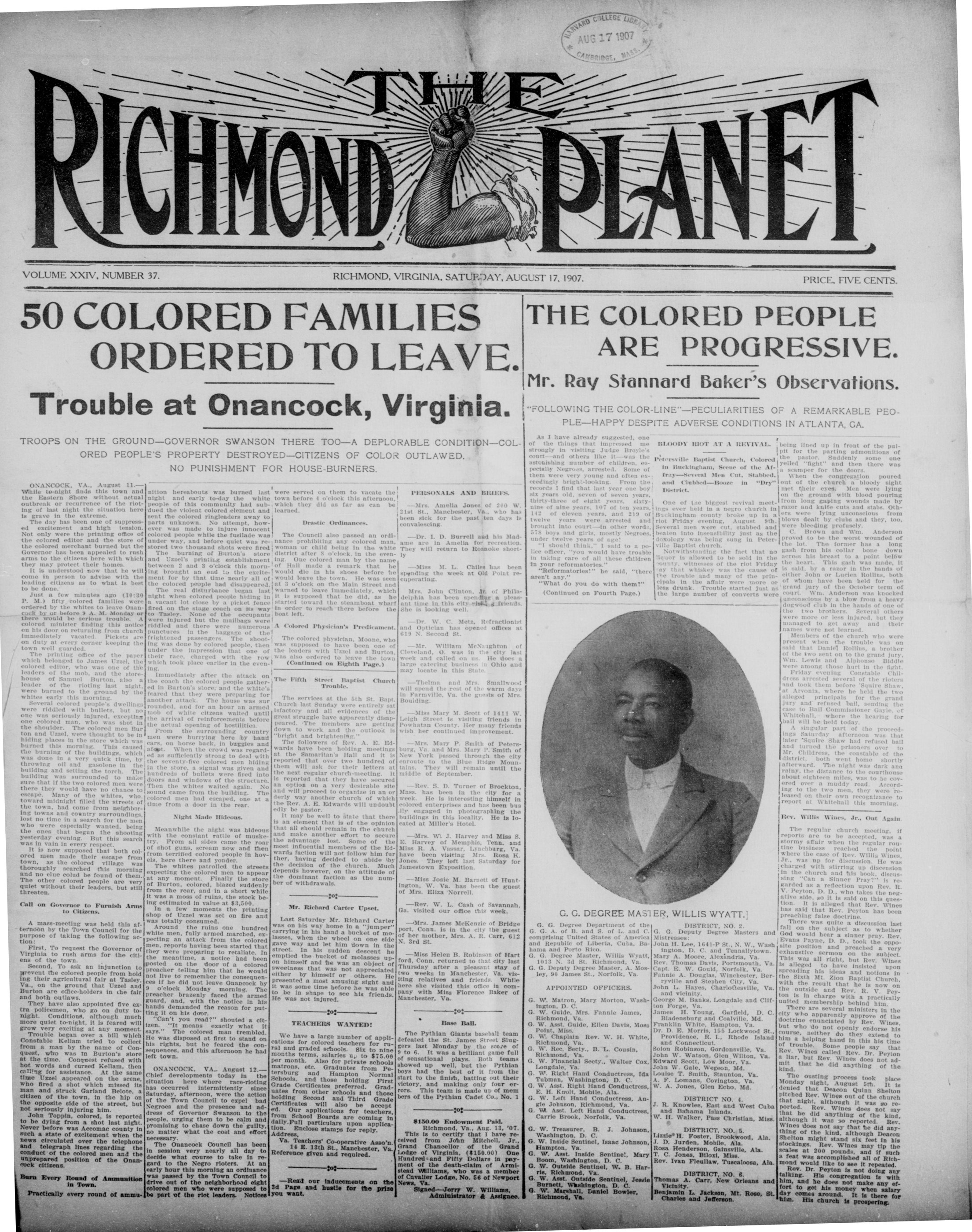
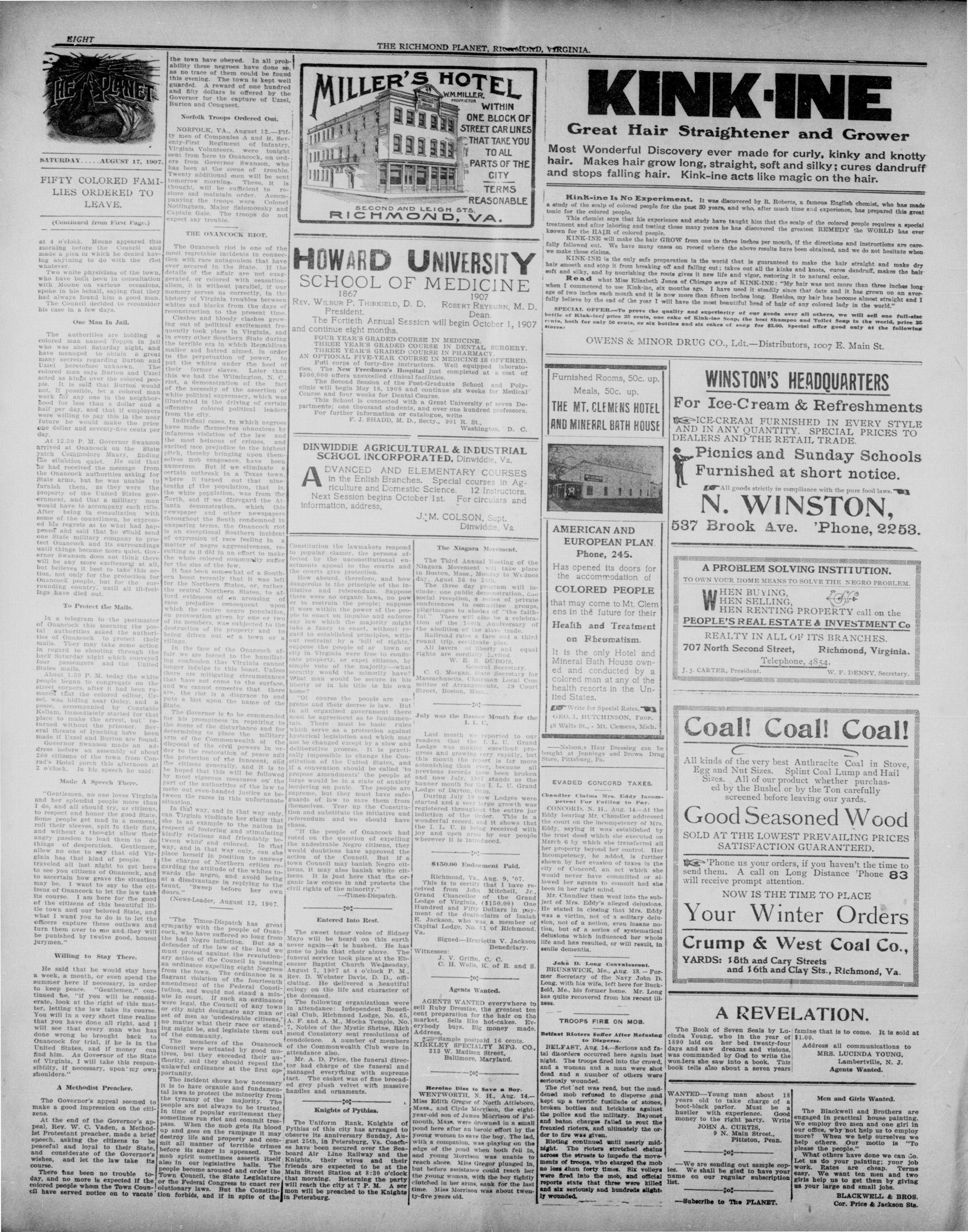
50 COLORED FAMILIES ORDERED TO LEAVE. Trouble at Onancock, Virginia.
TROOPS ON THE GROUND—GOVERNOR SWANSON THERE TOO—A DEPLORABLE CONDITION—COL- ORED PEOPLE'S PROPERTY DESTROYED—CITIZENS OF COLOR OUTLAWED.
VOLUME XXIV, NUMBER 37.
50 COL
ORI
Trouble
TROOPS ON THE GROUND-
ORED PEOPLE'S
ONANCOCK, VA., August 11.
While to-night finds this town and
the Eastern Shore without actual
outbreak or recurrence of the riot-
ing of last night the situation here
is grave in the extreme.
The day has been one of suppressed excitement and high tension. Not only were the printing office of the colored editor and the store of the colored merchant burned but the Governor has been appealed to rush arms to the citizens here with which they may protect their homes.
It is understood now that he will come in person to advise with the leading citizens as to what is best to be done.
Just a few minutes ago (10:30 P. M.) fifty colored families were ordered by the whites to leave Onancock by or before 2 A. M. Monday or there would be serious trouble. A colored minister finding this notice on his door on returning from church immediately vacated. Pickets are on duty at every corner keeping the town well guarded.
The printing office of the paper which belonged to James Uzzel, the colored editor, who was one of the leaders of the mob, and the store-house of Samuel Burton, also a leader of the rioting last night, were burned to the ground by the whites early this morning.
Several colored people's dwellings were riddled with bullets, but no one was seriously injured, excepting one colored man, who was shot in the shoulder. The colored men Burton and Uzzel, were thought to be in hiding places in the store which was burned this morning. This caused the burning of the buildings, which was done in a very quick time, by throwing oil and gasoline in the building and setting the torch. The building was surrounded to make sure that if the two colored men were there they would have no chance to escape. Many of the whites, who toward midnight filled the streets of the town, had come from neighboring towns and country surroundings, lost no time in a search for the men who were especially wanted, being the ones that begun the shooting yesterday evening. But this search was in vain in every respect.
It is now supposed that both colored men made their escape from town, as the colored village was thoroughly searched this morning and no clue clued be found of them. The other colored people are very quiet without their leaders, but still threaten.
Call on Governor to Furnish Arms to Citizens.
A mass-meeting was held this afternoon by the Town Council for the purpose of taking the following action:
First, To request the Governor of Virginia to rush arms for the citizens of the town.
Second, To ask an injunction to prevent the colored people from holding their agricultural fair at Tasley, Va., on the ground that Uzzel and Burton are office-holders in the fair and both outlaws.
They have also appointed five extra policemen, who go on duty tonight. Conditions, although much more quiet to-night, it is feared will grow very exciting at any moment.
Trouble began over a bill which Constable Kellam tried to collect from a man by the name of Conquest, who was in Burton's store at the time. Conquest refused with hot words and cursed Kellam, then calling for assistance. At the same time Uzzel appeared on the scene, who fired a shot which missed its man and struck Garland Belote, a citizen of the town, in the hip on the opposite side of the street, but not seriously injuring him.
John Toppin, colored, is reported to be dying from a shot last night. Never before was Accomac county in such a state of excitement when the news circulated over the telephone and telegraph lines regarding the conduct of the colored men and the unprepared position of the Onan-cock citizens.
Burn Every Round of Ammunition in Town. Practically every round of ammu-
NO PUNISHMENT FOR HOUSE-BURNERS
nition hereabouts was burned last night and early to-day the white people of this community had subdued the violent colored element and sent the colored ringleaders away to parts unknown. No attempt, however was made to injure innocent colored people while the fusilade was under way, and before quiet was restored two thousand shots were fired. The burning of Burton's store and Uzzel's printing establishment between 2 and 3 o'clock this morning brought an end to the excitement for by that time nearly all of the colored people had disappeared. The real disturbance began last night when colored people hiding in a vacant lot close by a picket fence fired on the stage coach on its way to Tasley. None of the occupants were injured but the mailbags were riddled and there were numerous punctures in the baggage of the frightened passengers. The shooting was done by colored people, then under the impression that one of their race, charged with the row which took place earlier in the evening.
Immediately after the attack on the coach the colored people gathered in Burton's store, and the white's feared that they were preparing for another attack. The house was surrounded, and for an hour an armed mob of white citizens waited until the arrival of reinforcements before the actual opening of hostilities. From the surrounding country men were hurrying here by hand cars, on horse back, in buggies and afloat. When the crowd was regarded as sufficiently strong to deal with the seventy-five colored men hiding in the store, a signal was given and hundreds of bullets were fired into doors and windows of the structure. Then the whites waited again. No sound came from the building. The colored men had escaped, one at a time from a door in the rear.
Night Made Hideons.
Meanwhile the night was hideous with the constant rattle of musketry. From all sides came the roar of shot guns, scream now and then from terrified colored people in hovels, here there and yonder.
The whites patrolled the streets expecting the colored men to appear at any moment. Finally the store of Burton, colored, blazed suddenly from the rear, and in a short while it was a moss of ruins, the stock being estimated in value at $3,500.
In a few moments the printing shop of Uzzel was set on fire and was totally consumed.
Around the ruins one hundred white men, fully armed marched, expecting an attack from the colored men, reports having been started that they were preparing to retaliate. In the meantime, a notice had been posted on the door of a colored preacher telling him that he would not live to remember the consequences if he did not leave Onancock by 9 o'clock Monday morning. The preacher brazenly faced the armed guard, and, with the notice in his hands demanded the reason for putting it on his door.
"Can't you read?" shouted a citizen. "It means exactly what it says." The colored man trembled. He was disposed at first to stand on his rights, but he feared the consequences, and this afternoon he had left town.
ONANCOCK, VA., August 12.—Chief developments today in the situation here where race-rioting has occurred intermittently since Saturday, afternoon, were the action of the Town Council to expel bad Negroes and the presence and address of Governor Swanson to the people, urging them to be calm and promising to chase down the guilty, no matter what the cost and effort necessary.
The Onancock Council has been in session very nearly all day to decide what course to take in regard to the Negro rioters. At an early hour this morning an ordinance was passed by the Town Council to drive out of the neighborhood eight colored men who were supposed to be part of the riot leaders. Notices
RICHMOND, VIRGINIA, SATURDAY, AUGUST 17, 1907.
were served on them to vacate the town before 4 o'clock this afternoon, which they did as far as can be learned.
Drastic Ordinances.
The Council also passed an ordinance prohibiting any colored man, woman or child being in the white district after 8 o'clock, in the evening. One colored man by the name of Hall made a remark that he would die in his shoes before he would leave the town. He was seen at 3 o'clock on the Main Street and warned to leave immediately, which it is supposed that he did, as he started toward the steamboat wharf in order to reach there before the boat left.
A Colored Physician's Predicament.
The colored physician, Moone, who was supposed to have been one of the leaders with Uzzel and Burton, was also ordered to leave the town (Continued on Eighth Page.)
The Fifth Street Baptist Church Trouble
The services at the 5th St. Bapt. Church last Sunday were entirely sat isfactory and all evidences of the great struggle have apparently disappeared. The members are getting down to work and the outlook is "bright and brightening." The followers of Rev. A. E. Edwards have been holding meetings at the Samaritan's Hall and it is reported that over two hundred of them will ask for their letters at the next regular church-meeting. It is reported that they have secured an option on a very desirable site and will proceed to organize in an or early way another church of which the Rev. A. E. Edwards will undoubt edly be pastor. It may be well to state that there is an element that is of the opinion that all should remain in the church and make another effort to secure the advantage lost. Some of the most influential members of the Edwards faction will not follow him further, having decided to abide by the decision of the church. Much depends however, on the attitude of the dominant faction as the number of withdrawals.
Mr. Richard Carter Upset.
Last Saturday Mr. Richard Carter was on his way home in a "jumper" carrying in his hand a bucket of molasses, when the wheel on one side gave way and let him down in the street. In his sudden descent he emptied the bucket of molasses upon himself and he was an object of sweetness that was not appreciated either by himself or others. He presented a most amusing sight and it was some time before he was able to be in shape to see his friends. He was not injured.
TEACHERS WANTED!
We have a large number of applications for colored teachers for rural and graded schools. Six to nine months terms, salaries up to $75.00 per month. Also for private schools matrons, etc. Graduates from Petersburg and Hampton Normal Schools, and those holding First Grade Certificates preferred. Graduates from other schools and those holding Second and Third Grade Certificates will also be accepted. Our applications for teachers, from School Boards are coming in daily.Full particulars upon application. Enclose stamps for reply. Address. Va. Teachers' Co-operative Asso'n. 14 E. 13th St., Manchester, Va. Reference given and required.
—Read our inducements on the 3d Page and hustle for the prize you want.
PERSONALS AND BRIEFS.
—Mrs. Amelia Jones of 200 W. 21st St., Manchester, Va., who has been sick for the past ten days is convalescent.
—Dr. I. D. Burrell and his Madame are in Amelia for recreation. They will return to Roanoke shortly.
—Miss M. L. Chiles has been spending the week at Old Point recuperating.
Mrs. John Clinton, Jr. of Philadelphia has been spending a pleasant time in this city visit, g friends. She is looking well.
—Dr. W. C. Metz, Refractionist and Optician has opened offices at 619 N. Second St.
—Mr. William McNaughton of Cleveland, O. was in the city last week and called on us. He does a large catering business in Ohio and may locate in this State.
—Thelma and Mrs. Smallwood will spend the rest of the warm days in Farmville, Va. the guests of Mrs. Boulding.
—Miss Mary M. Scott of 1411 W. Leigh Street is visiting friends in Powhatan County. Her many friends wish her continued improvement.
—Mrs. Mary P. Smith of Petersburg, Va. and Mrs. Mary P. Smith of New York passed through the city enroute to the Blue Ridge Mountains. They will remain until the middle of September.
—Rev. S. D. Turner of Brockton, Mass. has been in the city for a week. He is interesting himself in colored enterprises and has been busily engaged in photographing the buildings in this locality. He is located at Miller's Hotel.
—Mrs. W. J. Harvey and Miss S. E. Harvey of Memphis, Tenn. and Miss R. A. Vassar, Lynchburg, Va. have been visiting Mrs. Rosa K. Jones. They left last Saturday for Jamestown Exposition.
—Miss Josie M. Barnett of Huntington, W. Va. has been the guest of Mrs. Eliza Norrell.
—Rev. W. L. Cash of Savannah, Ga. visited our office this week.
—Mrs. James McKenzie of Bridge port, Conn. is in the city the guest of her mother, Mrs. A. R. Carr, 612 N. 3rd St.
—Miss Helen B. Robinson of Hartford, Conn. returned to that city last Thursday after a pleasant stay of two weeks in Manchester, Va. visiting relatives and friends. While here she visited this office in company with Miss Florence Baker of Manchester, Va.
The Pythian Giants baseball team defeated the St. James Street Sluggers last Monday by the score of 9 to 6. It was a brilliant game full of sensational plays. Both teams showed up well, but the Pythian boys had the best of it from the start to the finish, batting out their victory, and making only four errors. This team is made up of members of the Pythian Cadet Co., No. 1
$150.00 Endowment Paid.
Richmond, Va., Aug. 13, '07.
This is to certify that I have received from John Mitchell, Jr.,
Grand Chancellor of the Grand
Lodge of Virginia, ($150.00) One
Hundred and Fifty Dollars in payment of the death-claim of Arml-
stead Williams, who was a member of Cavailor Lodge, No. 56 of Newport
News, Va.
Signed—Jerry W. Williams,
Administrator & Assignee
THE COLORED PEOPLE ARE PROGRESSIVE.
"FOLLOWING THE COLOR-LINE"—PECULIARITIES OF A REMARKABLE PEOPLE—HAPPY DESPITE ADVERSE CONDITIONS IN ATLANTA, GA.
[Name not visible]
G. G. DEGREE MASTER, WILLIS WYATT
As I have already suggested, one of the things that impressed me strongly in visiting Judge Broyle's court—and others like it—was the astonishing number of children, especially Negroes, arrested. Some of them were very young and often exceedingly bright-looking. From the records I find that last year one boy six years old, seven of seven years, thirty-three of eight years, sixty-nine of nine years, 107 of ten years, 142 of eleven years, and 219 of twelve years were arrested and brought into court—in other words, 578 boys and girls, mostly Negroes, under twelve years of age!
"I should think," I said to a police officer, "you would have trouble in taking care of all these children in your reformatories."
"Reformatories!" he said, "there aren't any."
"What do you do with them?"
(Continued on Fourth Page.)
C. G. DEGREE MAST
G. G. Degree Department of the G. G. A. of B. and S. of L. and C. comprising United States of America and Republic of Liberia, Cuba, Bahama and Porto Rico.
G. G. Degree Master, Willis Wyatt,
1013 N. 3d St. Richmond, Va.
G. G. Deputy Degree Master, A. Moss
lev, 90 James St. Norfolk, Va.
APPOINTED OFFICERS.
G. W. Matron, Mary Morton, Washington, D. C.
G. W. Guide, Mrs. Fannie James, Richmond, Va.
G. W. Asst. Guide, Ellen Davis, Moss Point, Miss.
G. W. Chaplain Rev. W. H. White, Richmond, Va.
G. W. Rec. Secty., B. L. Cousin, Richmond, Va.
G. W. Financial Secty., Walter Cox, Longdale, Va.
G. W. Right Hand Conductors, Inc.
BLOODY RIOT AT A REVIVAL.
Petersville Baptist Church, Colored in Buckingham, Scene of the Affray—Several Men Cut, Stabbed, and Clubbed—Booze in "Dry" District.
One of the biggest revival meetings ever held in a negro church in Buckingham county broke up in a riot Friday evening, August 9th. Several men were cut, stabbed and beaten in insensibility just as the doxology was being sung in Petersville Baptist church.
Notwithstanding the fact that no liquor is allowed to be sold in the county, witnesses of the riot Friday say that whiskey was the cause of the trouble and many of the principals in the affair were more or less drunk. Trouble started just as the large number of converts were
ER, WILLIS WYATT.]
DISTRICT, NO. 2.
G. G. Deputy Degree Masters and Mistresses:
John H. Lee, 1641-P St., N. W., Wash
ington, D. C. and Tennallytown.
Mary A. Moore, Alexandria, Va.
Rev. Thomas Davis, Portsmouth, Va.
Capt. E. W. Gould, Norfolk, Va.
Fannie A. Douglas, Winchester, Berr
ville and Stephen City, Va.
John L. Hayes, Charloftesville, Va.
and vicinity.
George M. Banks, Longdale and Clifton
Forge, Va.
Solon Robinson, Gordonsville, Va.
John W. Watson, Glen Wilton, Va.
Edward Scott, Low Moor, Va.
John W. Gale, Wegeon, Md.
Louise T. Smith, Staunton, Va.
A. F. Lomans, Covington, Va.
W. A. Jones, Glen Echo, Md.
DISTRICT NO. 4.
J. R. Knowles, East and West Cuba and Bahama Islands.
W. H. Walker, Pass Christian, Miss.
DISTRICT NO. 5.
Lizzle H. Foster, Brookwood, Ala.
J. D. Jurden, Mobile, Ala.
Rosa Henderson, Gainsville, Ala.
T. C. Jones, Bliolox, Miss.
Rev. Ivan Fleuillaw, Tuscaloosa, Ala.
DISTRICT NO. 6.
Thomas A. Carr, New Orleans and Victinity.
Benjamin L. Jackson, Mt. Rose, St. Charles and Jefferson.
PEOPLE
RESSIVE.
Observations.
OF A REMARKABLE PEO-
S IN ATLANTA, GA.
being lined up in front of the pul-
pit for the parting admonitions of
the pastor. Suddenly some one
yelled "fight" and then there was
a scamper for the doors.
When the congregation poured
out of the church a bloody sight
met their eyes. Men were lying
on the ground with blood pouring
from long gaping wounds made by
razor and knife cuts and stabs. Others were lying unconscious from blows dealt by clubs and they, too,
were bleeding profusely.
C. Brown and Wm. Anderson proved to be the worst wounded of the lot. The former has a long gash from his collar bone down across his breast to a point below the heart. This gash was made, it is said, by a razor in the hands of either John or Lucien Rollins, both of whom have been held for the grand jury of the October term of court. Wm. Anderson was knocked unconscious by a blow from a heavy dogwood club in the hands of one of the two brothers. Several others were more or less injured, but they managed to get away and their names were not learned. Members of the church who were present when the trouble was on said that Dante Rollins, a brother of the two sent on to the grand jury, Wm. Lewis and Alphonzo Biddle were among those hurt in the fight. Friday evening Constable Childress arrested several of the rioters and took them before "Squire Shaw, at Arvonia, where he held the two alleged principals for the grand jury and refused ball, sending the case to Ball Commissioner Gayle, of Whitehall, where the hearing for ball will be held today.
A singular part of the proceedings Saturday afternoon was that later Squire Shaw had refused ball and turned the prisoners over to Mr. Childress, the constable of the district, both went home shortly afterward. The night was dark and rainy, the distance to the courthouse about eighteen miles, was to be covered over a muddy road. According to the two men, they were released on their own recognition to report at Whitehall this morning.
Rev. Willis Wines, Jr., Out Again
The regular church meeting, if reports are to be accepted, was a stormy affair when the regular routine business reached the point where the case of Rev. Willis Wines, Jr., was up for discussion. He was charged with stirring up discussion in the church and his book, discussing "Can a Sinner Pray?" is regarded as a reflection upon Rev. R. V. Peyton, D. D., who takes the negative side, so it is said on this question. It is alleged that Rev. Wines has said that Rev. Peyton has been preaching false doctrine.
There was quite a discussion last fall on the subject as to whether God would hear a sinner pray. Rev. Evans Payne, D. D., took the opposite position and preached a very exhaustive sermon on the subject. This was all right, but Rev. Wines is alleged to have insisted upon spreading his ideas and notions in the Sixth Mt. Zion Baptist Church, with the result that he is now on the outside and Rev. R. V. Peyton is in charge with a practically united membership behind him.
There are several ministers in the city who apparently approve of the doctrine enunciated by Rev. Wines, but who do not openly endorse his course, neither do they extend to him a helping hand in this his time of trouble. Some people say that Rev. Wines called Rev. Dr. Peyton a liar, but Rev. Wines does not admit that he did anything of the kind.
The ousting process took place Monday night, August 5th. It is denied that Deacon Quinn Shelton pitched Rev. Wines out of the church that night, although it was so reported. Rev. Wines does not say that he did anything of the kind, although it was so reported. Rev. Wines does not say that he did anything of the kind, although Deacon Shelton might stand six feet in his stockings. Rev. Wines may tip the scales at 200 pounds, and if such a feat was accomplished all of Richmond would like to see it repeated. Rev. Dr. Peyton is not doing any talking. His congregation is with him, and he does not make any effort to get his money when salary day comes around. It is there for him. His church is prospering.
THE HOUSE
OF A THOUSAND
CANDLES
BY MEREDITH NICHOLSON
AUTHOR OF THE MAIN SURFACE
two
CHAPTER IX.
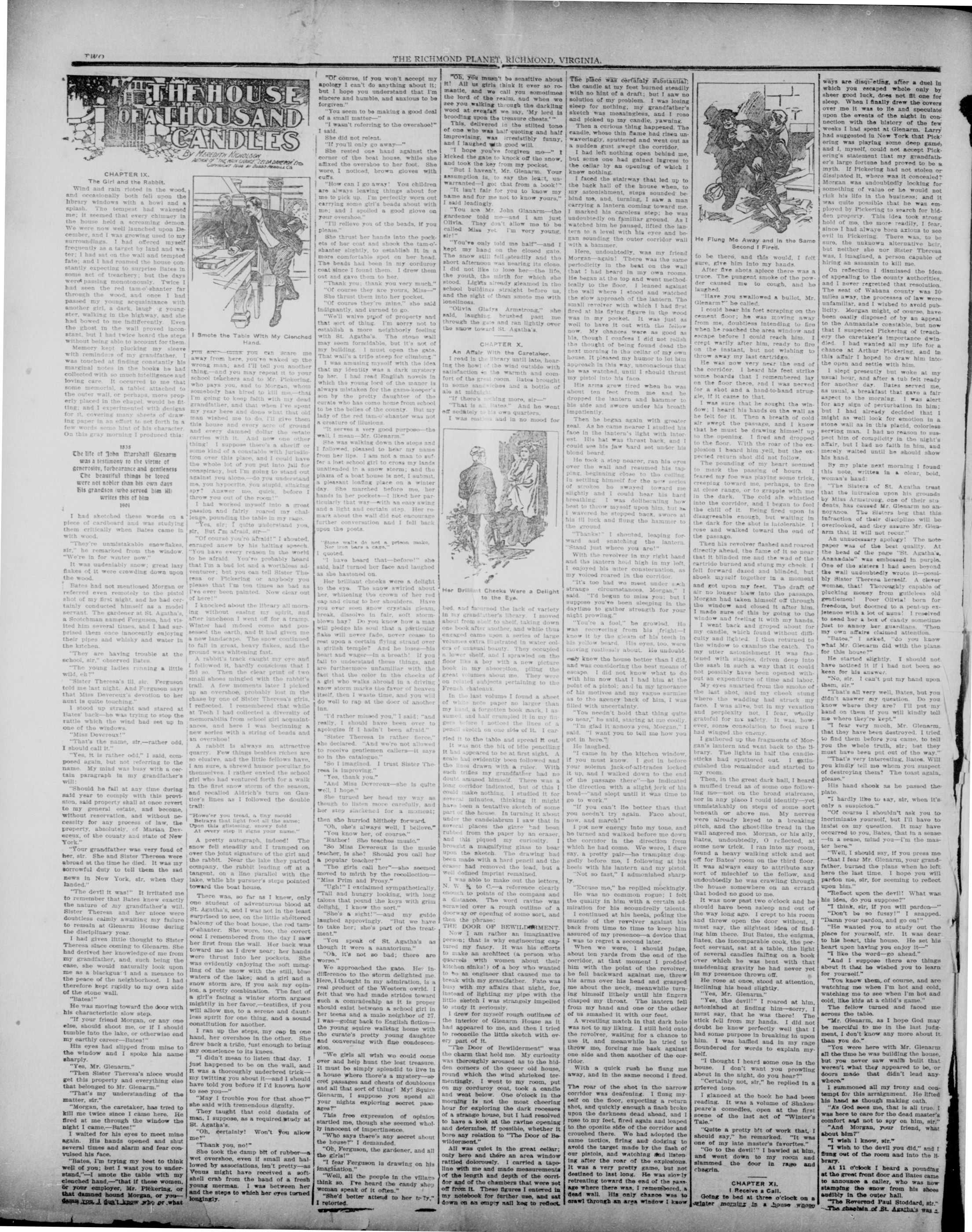
Wind and rain rioted in the wood, and occasionally both fell upon the library windows with a howl and a splash. The tempest had waked me; it seemed that every chimney in the house held a screaming demon. We were now well launched upon December, and I was growing used to my surroundings. I had offered myself frequently as a target by land and water; I had sat on the wall and tempted fate; and I had roamed the house constantly expecting to surprise Bates in some act of treachery; but the days were passing monotonously. Twice I had seen the red tam-o-shanter far through the wood, and once I had passed my young acquaintance with another girl, a dark, laugh-*g* youngster, walking in the highway, and she had bowed to me indifferently. Even the ghost in the wall proved inconstant, but I had twice heard the steps without being able to account for them.
Memory kept plucking my sleeve with reminders of my grandfather. I was touched at finding constantly his marginal notes in the books he had collected with so much intelligence and loving care. It occurred to me that some memorial, a tablet attached to the outer wall, or perhaps, more properly placed in the chapel, would be fitting; and I experimented with designs for it, covering many sheets of drawing paper in an effort to set forth in a few words some hint of his character. On this gray morning I produced this:
1835
The life of John Marshall Glenarm was a testimony to the virtue of generosity, forbearance and gentleness
The beautiful things he loved were not nobler than his own days
His grandson (who served him all) writes this of him
I had sketched these words on a piece of cardboard and was studying them critically when Bates came in with wood.
"They're unmistakable snowflakes, sir," he remarked from the window. "We're in for winter now."
It was undeniably snow; great lazy flakes of it were crowding down upon the wood.
Bates had not mentioned Morgan or referred even remotely to the pistol shot of my first night, and he had certainly conducted himself as a model servant. The gardener at St. Agatha's, a Scotchman named Ferguson, had visited him several times, and I had surprised them once innocently enjoying their pipes and whisky and water in the kitchen.
"They are having trouble at the school, sir," observed Bates.
"The young ladies running a little wild, eh?"
"Sister Theresa's ill, sir. Ferguson told me last night. And Ferguson says that Miss Devereux's devotion to her aunt is quite touching."
I stood up straight and stared at Bates' back—he was trying to stop the rattle which the wind had set up in one of the windows.
"Miss Devereux!"
"That's the name, str.—rather odd, I should call it."
"Yes, it is rather odd." I said, composed again, but not referring to the name. My mind was busy with a certain paragraph in my grandfather's will:
"Should he fall at any time during said year to comply with this provision, said property shall at once revert to my general estate, and become, without reservation, and without necessity for any process of law, the property, absolutely, of Marian Devereux, of the county and state of New York."
"Your grandfather was very fond of her, sir. She and Sister Theresa were abroad at the time he died. It was my sorrowful duty to tell them the sad news in New York, sir, when they landed." "The devil it was!" It irritated me to remember that Bates knew exactly the nature of my grandfather's will. Sister Theresa and her niece were doubtless calmly awaiting my failure to remain at Glenarm House during the disciplinary year. I had given little thought to Sister Theresa since coming to Glenarm. She had derived her knowledge of me from my grandfather, and, such being the case, she would naturally look upon me as a blackgua-1 and a menace to the peace of the neighborhood. I had therefore kept rigidly to my own side of the stone wall. "Bates!"
He was moving toward the door with his characteristic slow step.
"If your friend Morgan, or any one else, should shoot me, or if I should tumble into the lake, or otherwise end my earthly career—Bates!"
His eyes had slipped from mine to the window and I spoke his name sharply.
"Yes, Mr. Glenarm."
"Then Sister Theresa's niece would get this property and everything else that belonged to Mr. Glenarm."
"That's my understanding of the matter, sir."
"Morgan, the caretaker, has tried to kill me twice since I came here. He fired at me through the window the night I came—Bates!"
I waited for his eyes to meet mine again. His hands opened and shut several times and alarm and fear convulsed his face.
"Bates, I'm trying my best to think well of you; but I want you to understand,"—I smote the table with my clenched hand,—"that if these women, or your employer, Mr. Pickerling, or that damned hound Morgan, or you—damn you, I don't know who or what
AUTHOR OF THE MAIN COURSE 'LEE DA DOWNEY'
COPYRIGHT 1905 BY DUBB'S MARSHALL CO.
I Smote the Table With My Clenched Hand.
you are—think you can scare me away from here, you've waked up the wrong man; and I'll tell you another thing—and you may repeat it to your school teachers and to Mr. Pickering, who pays you, and to Morgan, whom somebody has hired to kill me,—that I'm going to keep faith with my dead grandfather, and that when I've spent my year here and done what that old man wished me to do, I'll give them this house and every acre of ground and every damned dollar the estate carries with it. And now one other thing! I suppose there's a sheriff or some kind of a constable with jurisdiction over this place, and I could have the whole lot of you put into jail for conspiracy, but I'm going to stand out against you alone—do you understand me, you hypocrite, you stupid, silkling spy? Answer me, quick, before I throw you out of the room!
I had worked myself into a great passion and fairly roared my challenge, pounding the table in my rage.
"Yes, sir; I quite understand you, sir. But I'm afraid, sir—"
"Of course you're afraid!" I shouted, enraged anew by his halting speech. "You have every reason in the world to be afraid. You've probably heard that I'm a bad lot and a worthless adventurer; but you can tell Sister Thethera or Pickering or anybody you please that I'm ten times as bad as I've ever been painted. Now clear out of here!"
I knocked about the library all morning without easing my spirit, and after luncheon I went off for a tramp. Winter had indeed come and possessed the earth, and it had given me a new landscape. The snow continued to fall in great, heavy flakes, and the ground was whitening fast.
A rabbit's track caught my eye and
I followed it, hardly conscious that I
did so. Then the clear picture of two
small shoes mingled with the rabbit's
trail. A few moments later I picked
up an overshoe, probably lost in the
chase by one of Sister Theresa's girls,
I reflected. I remembered that while
at Tech I had collected a diversity of
memorabilia from school girl acquaintances,
and here I was beginning a new series with a string of beads and
an overshoe!
A rabbit is always an attractive
quarry. Fow things besides riches are
so elusive, and the little fellows have,
I am sure, a shrewd humor peculiar_to
themselfs. I rather envel the school
girl who had ventured forth for a walk
in the first snow storm of the season,
and recalled Aldrich's turn on Gautier's lines as I followed the double
trail:
"Howeer you tread, a tiny mould
Retrave that light foot all the same:
Open this blazing, snowy roof.
At every step it signs your name."
A pretty autograph, indeed! The snow fell steadily and I tramped on over the joint signature of the girl and the rabbit. Near the lake they parted company, the rabbit leading off at a tangent, on a line parallel with the lake, while hls pursuer's steps pointed toward the boat house.
There was, so far as I knew, only one student of adventurous blood at St. Agatha's, and I was not in the least surprised to see, on the little shelteted balcony of the boat house, the red tamo'o-shanter. She wore, too, the covert coat I remembered from the day I saw her first from the wall. Her back was toward me as I drew near; her hands were thrust into her pockets. She was evidently enjoying the soft mingling of the snow with the still, blue waters of the lake; and a girl and a snow storm are, if you ask my opinion, a pretty combination. The fact of a girl's facing a winter storm argues mightily in her favor,—testifies, if you will allow me, to a serene and dauntless spirit for one thing, and a sound constitution for another.
I ran up the steps, my cap in one hand, her overshoe in the other. She drew back a trifle, 'just enough to bring my conscience to its knees.
"I didn't mean to listen that day. I just happened to be on the wall, and it was a thoroughly underbred trick—my twitting you about it—and I should have told you before if I'd known how to see you—"
"May I trouble you for that shoe?" she said with tremendous dignity.
They taught that cold disdain of man, I suppose, as a required study at St. Agatha's.
"Oh, certainly! Won't you allow me?"
"Thank you, no!" She took the damp bitt of rubber—a wet overshoe, even if small and hallowed by associations, isn't pretty—as Venus might have received a softshell crab from the hand of a fresh young merman. I was between her and the steps to which her eyes turned longingly.
THE RICHMOND PLANET, RICHMOND. VIRGINIA
"Of course, if you won't accept my apology I can't do anything about it; but I hope you understand that I'm sincere and humble, and anxious to be forgiven."
"You seem to be making a good deal of a small matter—"
"I wasn't referring to the overshoe!" I said.
She did not relent.
"If you'll only go away—"
She rested one hand against the corner of the boat house, while she affixed the overshoe to her foot. She wore, I noticed, brown gloves with cuffs.
"How can I go away! You children are always leaving things about for me to pick up. I'm perfectly worn out carrying some girl's beads about with me; and I spoiled a good glove on your overshoe."
"I'll relieve you of the beads, if you please."
She thrust her hands into the pockets of her coat and shook the tam- shanter slightly, to establish it in a more comfortable spot on her head. The beads had been in my corduroy coat since I found them. I drew them out and gave them to her.
"Thank you; thank you very much."
"Of course they are yours, Miss—"
She thrust them into her pocket.
"Of course they're mine," she said indignantly and turned to go.
"We'll waive proof of property and that sort of thing. I'm sorry not to establish a more neighborly feeling with St. Agatha's. The stone wall may seem formidable, but it's not of my building. I must open the gate. That wall's a trifle steep for climbing." I was amusing myself with the idea that my identity was a dark mystery to her. I had read English novels in which the young lord of the manor is always mistaken for the game-keeper's son by the pretty daughter of the curate who has come home from school to be the belles of the county. But my lady of the red tam-o-shanter was not a creature of illusions.
"It serves a very good purpose—the wall. I mean—Mr. Glenarm."
She was walking down the steps and I followed, pleased to hear my name from her lips. I am not a man to suffer a lost school girl to cross my lands unattended in a snow storm; and the plaza of a boat house is not, I submit, a pleasant loafing place on a winter day. She marched before me, her hands in her pockets—I liked her particularly that way—with an easy swing and a light and certain step. Her remark about the wall did not encourage further conversation and I fell back upon the poets.
"Stone walls do not a prison make, Nor iron bars a cage."
I quoted.
"I have heard that—before!" she said, half turned her face and laughed as she hastened on.
Her brilliant cheeks were a delight to the eye. The snow swirled about her, whitening the crown of her red cap and clung to her shoulders. Have you ever seen snow crystals gleam, break, dissolve in fair, soft storm-blown hay? Do you know how a man will pledge his soul that a particular flake will never fade, never coase to rest upon a certain flying strand over a grilish temple? And he loses—his heart and wager—in a breath! If you fail to understand these things, and are furthermore unfamiliar with the fact that the color in the cheeks of a girl who walks abroad in a driving snow storm marks the favor of heaven itself, then I waste time, and you will do well to rap at the door of another inn.
"I'd rather missed you," I said; "and really, I should have been over to apologize if I hadn't been afraid."
"Sister Theresa is rather fierce," she declared. "And we're not allowed to receive gentlemen callers—it says so in the catalogue."
"So I imagined. I trust Sister Theresa is improving."
"Yes, thank you."
"And Miss Devoreux—she is quite well, I hope."
She turned her head my way as though to listen more carefully, and her step slackened for a moment;
then she hurried blithely forward.
"Oh, she's always well, I believe."
"You know her, of course."
"Rather! She teaches music."
"So Miss Devereux is the music teacher, is she? Should you call her a popular teacher?"
"The girls call her"—she seemed moved to mirth by the recollection—"Miss Prim and Prosy."
"Ugh!" I exclaimed sympathetically.
"Tall and hungry looking, with long talons that pound the keys with grim delight. I know the sort."
"She's a sight!"—and my guide laughed approvingly. "But we have to take her; she's part of the treatment."
"You speak of St. Agatha's as though it were a sanatorium."
"Oh, it's not so bad; there are worse."
We approached the gate. Her indifference to the storm delighted me. Here, I thought in my admiration, is a real product of the Western owlid. I felt that we had made strides toward such a comradeship as it is proper should exist between a school girl in her teens and a male neighbor of 27. I was—going back to English fiction—the young squire walking home with the curate's pretty young daughter and conversing with fine condescension.
"We girls all wish we could come over and help hunt the lost treasure. It must be simply splendid to live in a house where there's a mystery—secret passages and chests of doubloons and all that sort of thing! My! Squire Glenarm, I suppose you spend all your nights exploring secret passages?
This free expression of opinion startled me, though she seemed wholly innocent of impertinence.
"Who says there's any secret about the house?" I demanded.
"Oh, Ferguson, the gardener, and all the girls!"
"I fear Ferguson is drawing on his imagination."
"Well, all the people in the village think so. I've heard the candy shop woman speak of it often."
"She'd better attend to her trily." I retorted.
"Oh, you mustn't be sensitive about it! All us girls think it ever so romantic, and we call you sometimes the lord of the realm, and when we see you walking through the darkling wood at everfall we say, 'My lord is brooding upon the treasure chests.'"
This, delivered in the stilted tone of one who was half quoting and half improvising, was irresistibly funny, and I laughed with good will.
"I hope you've forgiven me—" I kicked the gate to knock off the snow, and took the key from my pocket.
"But I haven't, Mr. Glennarm. Your assumption is, to say the least, unwarranted—I got that from a book!"
"It isn't fair for you to know my name and for me not to know yours."
I said leadingly.
"You are Mr. John Glanarm—the gardener told me—and I am just Olivia. They don't allow me to be called Miss yet. I'm very young, sirl!"
"You've only told me half"—and I kept my hand on the closed gate. The snow still fell steadily and the short afternoon was nearing its close. I did not like to lose her—the life, the youth, the morn for which she stood. Lights already gleamed in the school buildings straight before us, and the sight of them smote me with loneliness.
"Olivia Gladys Armstrong," she said, laughing, brushed past me through the gate and ran lightly over the snow toward St. Agatha's.
CHAPTER X
An Affair With the Caretaber.
I read in the library until late, hearing the howl of the wind outside with satisfaction in the warmth and comfort of the great room. Bates brought in some sandwiches and a bottle of ale at midnight.
"If there's nothing more, sir—"
"That is all. Bates." And he went off sedately to his own quarters.
I was restless and in no mood for
Her Brilliant Cheeks Were a Delight to the Eye.
Her Brilliant Cheeks Were a Delight to the Eye.
bed, and mourned the lack of variety in my grandfather's library. I moved about from shelf to shelf, taking down one book after another, and while thus engaged came upon a series of large volumes extra illustrated in water colors of unusual beauty. They occupied a lower shelf, and I sprawled on the floor like a boy with a new picture book in my absorption, piling the great volumes about me. They were on related subjects pertaining to the French chateaux.
In the last volume I found a sheet of white note paper no larger than my hand, a forgotten book mark. I assumed, and half crumpled it in my fingers before I noticed the lines of a pencil sketch on one side of it. I car
Ried it to the table and spread it out. It was not the bit of idle penciling it had appeared to be at first sight. A scale had evidently been followed and the lines drawn with a ruler. With such trifles my grandfather had no doubt amused himself. There was a long corridor indicated, but of this I could make nothing. I studied it for several minutes, thinking it might have been a tentative sketch of some part of the house. In turning it about under the candelabrum I saw that in several places the glaze had been rubbed from the paper by an eraser, and this plumed my curiosity. I brought a magnifying glass to bear upon the sketch. The drawing had been made with a hard pencil and the eraser had removed the lead, but a well defined imprint remained.
I was able to make out the letters, N. W. % to C.—a reference clearly enough to points of the compass and a distance. The word ravine was scrawled over a rough outline of a doorway or opening of some sort, and then the phrase: THE DOOR OF BEWILDMENT. Now I am rather an imaginative person; that is why engineering captured my fancy. It was his efforts to make an architect (a person who quarrels with women about their kitchen sinks!) of a boy who wanted to be an engineer that caused me to break with my grandfather. Fate was busy with my affairs that night, for, instead of lighting my pipe with the little sketch I was strangely impelled to study it seriously. I drew for myself rough outlines of the interior of Glenarm House as it had appeared to me, and then I tried to reconcile the little sketch with every part of it.
"The Door of Bewilderment" was the charm that held me. My curiosity was thoroughly aroused as to the hidden corners of the queer old house, round which the wind shrieked tormentingly. I went to my room, put on my corduroy coat, took a candle and went below. One o'clock in the morning is not the most cheering hour for exploring the dark recesses of a strange house, but I had resolved to have a look at the ravine opening and determine, if possible, whether it bore any relation to "The Door of Bewilderment."
All was quiet in the great cellar; only here and there an area window rattled dorously. I carried a tapeline with me and made measurements of the length and depth of the corridor and of the chambers that were set off from it. These figures I entered in my notebook for further use, and sat down on an empty nail to reflect
The place was certainly substantial; the candle at my feet burned steadily with no hint of a draft; but I saw no solution of my problem. I was losing sleep for nothing; my grandfather's sketch was meaningless, and I rose and picked up my candle, yawning. Then a curious thing happened. The candle, whose thin flame had risen unaversely, sputtered and went out as a sudden gust swept the corridor. I had left nothing open behind me, but some one had gained ingress to the collar by an opening of which I knew nothing. I faced the stairway that led up to the back hall of the house when, to my astonishment, steps sounded behind me, and, turning, I saw a man carrying a lantern coming toward me. I marked his careless step; he was undoubtedly on familiar ground. As I watched him he paused, lifted the lantern to a level with his eyes and began sounding the outer corridor wall with a hammer.
Here, undoubtedly, was my friend Morgan—again! There was the same periodicity in the beat on the wall that I had heard in my own rooms. He began at the top and went methodically to the floor. I leaned against the wall where I stood and watched the slow approach of the lantern. The small revolver with which I had first fired at his flying figure in the wood was in my pocket. It was just as well to have it out with the fellow now. My chances were as good as his, though I confess I did not rollish the thought of being found dead the next morning in the cellar of my own house. It pleased my humor to let him approach in this way, unconscious that he was watched, until I should thrust my pistol into his face.
His arms grew tired when he was about ten feet from me and he dropped the lantern and hammer to his side and swore under his breath impatiently.
Then he began again with greater zeal. As he came nearer I studied his face in the lantern's light with interest. His hat was thrust back, and I could see his jaw hard set under his blond beard.
He took a step nearer, ran his eyes over the wall and resumed his tapping, beginning close to the ceiling. In settling himself for the new series of strokes he swayed toward me slightly and I could hear his hard breathing. I was deliberating how best to throw myself upon him, but as I wavered he stopped back, swore at his ill luck and flung the hammer to the ground.
"Thanks!" I shouted, leaping forward and snatching the lantern.
"Stand just where you are."
With the revolver in my right hand and the lantern high in my left, I enjoyed his utter consternation, as my voiced roared in the corridor.
"It's too bad we meet under such strange circumstances, Morgan." I said. "I'd begun to miss you; but I suppose you've been sleeping in the daytime to gather strength for your night prowling."
"You're a fool," he growled. He was recovering from his fright—I know it by the gleam of his teeth in his yellow beard. His eyes, too, were moving restlessly about. He undoubtedly knew the house better than I did, and was considering the best means of escape. I did not know what to do with him now that I had him at the point of a pistol; and in my ignorance of his motives and my vague surmise as to the agency back of him, I was filled with uncertainty.
"You needn't hold that thing quite so near," he said, staring at me coolly. "I'm glad it annoys you, Morgan." I said. "I want you to tell me how you got in here."
"I came in by the kitchen window, if you must know. I got in before your solemn jack-of-all-trades locked it up, and I walked down to the end of the passage there"—he indicated the direction with a slight jerk of his head"—and slept until it was time to go to work."
"If you can't lie better than that you needn't try again. Face about, now, and march!"
I put new energy into my tone, and he turned and walked before me down the corridor in the direction from which he had come. We wore, I dare say, a pretty pair—he trampling doggedly before me, I following at his heels with his lantern and my pistol.
"Not so fast," I admonished sharply.
"Excuse me," he replied mockingly. He was no common rogue; I felt the quality in him with a certain admiration for his scoundrelly talents. I continued at his heels, poking the muzzle of the revolver against his back from time to time to keep him assured of my presence—a device that I was to regret a second later. When we were, I should judge, about ten yards from the end of the corridor, at that moment I prodded him with the point of the revolver, he fell backward against me, threw his arms over his head and grasped me about the neck, meanwhile turning himself lively until his fingers clasped my throat. The lantern fell from my hand and one or the other of us smashed it with our feet.
A wrestling match in that dark hole was not to my liking. I still held onto the revolver, waiting for a chance to use it, and meanwhile he tried to throw me, forcing me bask against one side and then another of the corridor.
With a quick rush he flung me away, and in the same second I fired.
The roar of the shot in the narrow corridor was deafening. I flung myself on the floor, expecting a return shot, and quickly enough a flash broke upon the darkness dead ahead, and I rose to my feet, fired again and leaped to the oposite side of the corridor and crouched there. We had adopted the same tactics, firing and dodging to avoid the target made by the flash of our pistols, and watching and listening after the roar of the explosions. It was a very pretty game, but not destined to last long. He was slowly retreating toward the end of the passage where there was, I remembered, a dead wall. His only chance was to crawl through an area window I know
I
He Flung Me Away and In the Same Second I Fired.
to be there, and this would. I felt sure, give him into my hands.
After five shots aplice there was a truce. The pungent smoke of the powder caused me to cough, and he laughed.
"Have you swallowed a bullet, Mr. Glenarm?" he called.
I could hear his feet scraping on the cement floor; he was moving away from me, doubtless intending to fire when he reached the area window and escape before I could reach him. I crept warily after him, ready to fire on the instant, but not wishing to throw away my last cartridge.
He was now very near the end of the corridor. I heard his feet strike some boards that I remembered lay on the floor there, and I was nerved for a shot and a hand-to-hand struggle, if it came to that.
I was sure that he sought the window; I heard his hands on the wall as he felt for it. Then a breath of cold air swept the passage, and I knew that he must be drawing himself up to the opening. I fired and dropped to the floor. With the roar of the explosion I heard him yell, but the expected return shot did not follow.
The pounding of my heart seemed to mark the passing of hours. I feared my foe was playing some trick, creeping toward me, perhaps, to fire at close range, or to grapple with me in the dark. The cold air whistled into the corridor, and I began to feel the chill of it. Being fired upon is disagreeable enough, but waiting in the dark for the shot is intolerable. I rose and walked toward the end of the passage.
Then his revolver fashed and roared directly ahead, the fame of it so near that it blinded me and the wad of the cartridge burned and stung my cheek. I fell forward dazed and blinded, but skeek myself together in a moment and got upon my feet. The draft of air no longer blew into the passage. Morgan had taken himself off through the window and closed it after him. I made sure of this by going to the window and feeling it with my hands. I went back and groped about for my candle, which found without difficulty and lighted. I then returned to the window to examine the catch. To my utter astonishment it was fastened with staples, driven deep into the sash in such a way that it could not possibly have been opened without an expenditure of time and labor. My eyes smarted from the smoke of the last shot, and my cheek stung where the wadding had struck my face. I was alive, but in my vexation and perplexity not, I fear, wholly grateful for my safety. It was, however, some consolation to feel sure I had winged the enemy.
I gathered up the fragments of Morgan's lantern and went back to the library. The lights in half the candlesticks had sputtered out. I extinguished the remainder and started to my room.
Then, in the great dark hall, I heard a muffled tread as of some one following me—not on the broad staircase, nor in any place I could identify—yet unmistakably on steps of some sort beneath or above me. My nerves were already keyed to a breaking pitch, and the ghost-like tread in the wall angered me. Morgan, or his ally, Bates, undoubtedly, O reflected, at some new trick. I ran into my room, found a heavy walking stick and set off for Bates' room on the third floor. It was always easy to attribute any sort of mischief to the fellow, and undoubtedly he was crawling through the house somewhere on an errand that boded no good to me.
It was now past two o'clock and he should have been asleep and out of the way long ago. I crept to his room and threw open the door without, I must say, the slightest idea of finding him there. But Bates, the enigma, Bates, the incomparable cook, the perfect servant, sat at a table, the light of several candles falling on a book over which he was bent with that maddening gravity he had never yet in my presence thrown off.
He rose at once, stood at attention, inclining his head slightly.
"Yes, Mr. Glenarm."
"Yes, the devil!" I roared at him, astonished at finding him—sorry, I must say, that he was there! The stick fell from my hands. I did not doubt he knew perfectly well that I had some purpose in breaking in upon him. I was baffled and in my rage fouledered for words to explain myself.
"I thought I heard some one in the house. I don't want you prowling about in the night, do you hear?" "Certainly not, sir," he replied in a grieved tone. I glanced at the book he had been reading. It was a volume of Shakespeare's comedies, open at the first scene of the last act of "Winter's Tale." "Quite a pretty bit of work that, I should say," he remarked. "It was one of my late master's favorites." "Go to the devil!" I bawled at him, and went down to my room and slammed the door in rage and chasin.
Going to bed at three o'clock on a winter morning in a house whose
ways are disquieting, after a duel in which you escaped whole only by sheer good luck, does not fit one for sleep. When I finally drew the covers over me it was to lie and speculate upon the orvents of the night in connection with the history of the few weeks I had spent at Glenarm. Larry had suggested in New York that Pickering was playing some deep games, and I, myself, could not accept Pickering's statement that my grandfather's large fortune had proved to be a myth. If Pickering had not stolen or dissipated it, where was it concealed? Morgan was undoubtedly looking for something of value or he would not risk his life in the business; and it was quite possible that he was employed by Pickering to search for hidden property. This idea took strong hold of me, the more readily, I fear, since I had always been axious to see evil in Pickering. There was, to be sure, the unknown alternative heir, but neither she nor Sister Theresa was, I imagined, a person capable of hiring an assassin to kill me.
On reflection I dismissed the idea of appealing to the county authorities, and I never regretted that resolution. The seat of Wabana county was 20 miles away, the processes of law were unfamiliar, and I wished to avoid publicity. Morgan might, of course, have been easily disposed of by an appeal to the Anmandale constable, but now that I suspected Pickering of treachery the caretaker's importance dwindled. I had wanted all my life for a chance at Arthur Pickering, and in this affair I hoped to draw him into the open and settle with him.
I slept presently but woke at my usual hour, and after a tub felt ready for another day. Bates served me, as usual, a breakfast that gave a fair aspect to the morning. I was alert for any sign of perturbation in him; but I had already decided that I might as well look for emotion in a stone wall as in this placid, colorless serving man. I had no reason to suspect him of complicity in the night's affair, but I had no faith in him, and merely waited until he should show his hand. By my plate next morning I found this note, written in a clear, bold, woman's hand:
"The Sisters of St. Agatha trust that the intrusion upon his grounds by Miss Armstrong, one of their students, has caused Mr. Glenarm no annoyance. The Sisters beg that this infraction of their discipline will be overlooked, and they assure Mr. Glenarm that it will not recur."
An unnecessary apology! The note paper was of the best quality. At the head of the paper "St. Agatha's, Annadale" was embossed in purple. One of the sisters I had seen beyond the wall undoubtedly wrote it—possibly Sister Theresa herself. A clever woman, that! Thoroughly capable of plucking money from guilleless old gentlemen! Poor Olivia! born for freedom, but doomed to a pent-up existence with a lot of nuns! I resolved to send her a box of candy sometime just to annoy her guardians. Then my own affairs claimed attention. "Bates," I asked, "do you know what Mr. Glenarm did with the plans for this house?" He started slightly. I should not have noticed it if I had not been so keen for his answer. "No, sir. I can't put my hand upon them, sir."
"That's all very well, Bates, but you didn't answer my question. Do you know where they are? I'll put my hand on them if you will kindly tell me where they're kept."
"I fear very much, Mr. Glenarm, that they have been destroyed. I tried to find them before you came, to tell you the whole truth, sir; but they must have been put out of the way."
"That's very interesting, Bates. Will you kindly tell me whom you suspect of destroying them? The toast again, please."
His hand shook as he passed the plate.
"I hardly like to say, sir, when it's only a suspicion."
"Of course I shouldn't ask you to iniminate yourself, but I'll have to instil on my question. It may have occurred to you, Bates, that in a sense—in a sense, mind you—I'm the master here."
"Well, I should say, if you press me—that I fear Mr. Glenairm, your grand-father, burned the plans when he left here the last time. I hope you will pardon me, sir, for seeming to reflect upon him."
"Reflect upon the devil! What was his idea, do you suppose?"
"I think, sir, if you will pardon—"
"Don't be so fussy!" I snapped. "Damn your pardon, and go on."
"He wanted you to study out the place for yourself, sir. It was dear to his heart, this house. He set his heart upon having you enjoy it—"
"I like the word—go ahead."
"And I suppose there are things about it that he wished you to learn for yourself."
"You know them, of course, and are watching me when I'm hot and cold, watching me to see when I'm hot and cold, like kids at a child's game."
The fellow turned and faced me across the table.
"Mr. Glenarm, as I hope God may be merciful to me in the last judgment, I don't know any more about it than you do."
"You were here with Mr. Glenarm all the time he was building the house, but you never saw walls built that weren't what they appeared to be, or doors made that didn't lead anywhere."
I summoned all my trony and contempt for this arralignment. He lifted his hand as though making oath.
"As God sees me, that is all true. I was here to care for the dead master's comfort and not to spy on him, sir."
"And Morgan, your friend, what about him?"
"I wish I knew, sir."
"I wish to the devil you did," and I flung out of the room and into the library.
At 11 o'clock I heard a pounding at the great front door and Bates came to announce a caller, who was now stamping the snow from his shoes audibly in the outer hall.
"The Reverend Paul Stoddard, sir."
"The chaplain of St. Agatha's was a
THE PLANET
SATURDAY...AUGUST 17, 1907
big fellow, as I had remarked on the occasion of his interview with Olivia Gladys Armstrong by the wall. His light brown hair was close cut; his smooth shaven face was bright with the freshness of youth. Hore was a sturdy young apostle without frills, but with a vigorous grip that left my hand tingling. His voice was deep and musical—a voice that suggested glacierity and inspired confidence.
"I'm afraid I haven't been neighborly, Mr. Glenarm. I was called away from home a few days ago after I heard of your arrival, and I have just got back. I blew in yesterday with the snow storm."
He folded his arms easily and looked at me with cheerful directness, as though politely speculating as to what manner of man I might be.
"It was a fine storm; I got a great day, out of it," I said. "An Indiana snow storm is something I have never experienced before."
"This is my second winter. I came out here because I wished to do some reading and thought I'd rather do it alone in a university."
"Studious habits are rather forced on one out here, I should say. In my own case my course of reading is all cut out for me."
"The Glenarm collection is famous—the best in the country, easily. Mr. Glenarm, your grandfather was certainly an enthusiast. I met him several times, though he was a trifle hard to meet!"—and the clergyman smiled.
"My grandfather had his whitens; but he was a fine, generous-hearted old gentleman," I said.
"You haven't been on our side of the wall yet? Well, I promise not to molest your hidden treasure if you'll be neighborly," and he laughed merely.
"I fear there's a big joke involved in the hidden treasure," I replied. "I'm so busy staying at home to guard it that I have no time for social recreation."
He looked at me quickly to see whether I was joking. His eyes were steady and earnest. The Reverend Paul Stoddard impressed me more and more agreeably. There was a suggestion of quiet strength about him that drew me to him.
"I suppose every one about here thinks of nothing but that I'm at Glenarm to arm my inheritance. My residence here must look pretty sordid from the outside."
"Mr. Glenarm's will is a matter of record in the county, of course. But you are too hard on yourself. It's nobody's business if your grandfather wished to visit his whims on you. I should say, in my own case, that I don't consider it any of my business what you are here for. I didn't come over to annoy you or to pry into your affairs. I get lonely now and then and thought I'd like to establish neighborly relations."
"Thank you; I appreciate your coming very much," and my heart warmed under the manifest kindness of the man.
"And I hope"—he spoke for the first time with restraint—"I hope nothing will prevent your knowing Sister Theresa and Miss Devereux. They are interesting and charming—the only women about hero of your own social status."
My liking for him abated slightly. He might be a detective, representing the alternative heir, for all I knew and possibly Sister Theresa was a party to the conspiracy to drive me away.
"In time, no doubt, in time, I shall know them," I answered erasely.
"Oh, quite as you like!"—and he changed the subject. We talked of many things—of outdoor sports, with which he showed great familiarity, of universities, of travel and adventure. Columbia was his alma mater, but he had spent two years at Oxford.
"Well," he exclaimed, "this has been very pleasant, but I must run. I have just been over to see Morgan, the caretaker, at the resort village. The poor fellow accidentally shot himself yesterday cleaning his gun or something of that sort, and he has an ugly hole in his arm that will shut him up for a month or worse. He gave me an errand to do for him. He's a conscientious yellow and wished me to wire for him to Mr. Pickering that he'd been hurt, but was attending to his duties. Pickering owns a house at the farther end of the colony and Morgan has charge of it. You know Pickering, of course?"
I looked my clerical neighbor straight in the eye, a trifle coldly, perhaps. I was wondering why Morgan, with whom I had enjoyed a duel in my own cellar only a few hours before, should be reporting his injury to Arthur Pickering.
"I think I have seen Morgan about here," I said.
"Oh, yes! He's a woodsman and a hunter—our Nimrod of the lake."
"A good sort, very likely!"
"I dare say. He has sometimes brought me ducks during the season."
"To be sure! They shoot ducks at night—those Hoosier hunters—so I hear!"
He laughed as he shook himself into his greatcoat.
"That's possible, though unsportsmanlike. But we don't have to look a gift mallard in the eye."
We laughed together. It was easy to laugh with him.
"By the way, I forgot to get Pickering's address from Morgan. If you happen to have it—"
"With pleasure," I said. "Alexis Building, Broadway, New York."
"Good! That's easy to remember."
he said, smiling and turning up his coat collar. "Don't forget me; I'm quartered in a hermit's cell back of the chapel, and I believe we can find many matters of interest to talk about."
"I'm confident of it," I said, glad of the sympathy and cheer that seemed to emanate from his stalwart figure. I threw on my overcoat and walked to the gate with him and saw him hurry toward the village with long strides.
TO BE CONTINUED.
CREPT LIGHT DAYS ON DARREN LANDS
PROSPECTOR BUNN HAD TERRIBLE EXPERIENCE IN THE FAR FROZEN NORTH.
LIVED ON MOSS AND BERRIES
Finally Reached Deserted Indian Camp Where He Existed on Fish Until Natives Returned and Took Care of Him.
Edmonton, Alta.—The arrest of Charlie Bunn on a charge which the police say may be changed to murder, again brings into the limelight a man who for nine days was lost in the Land of the Midnight Sun. Several weeks ago at Athabasca landing he got in a mix-up with one Prudden, who is now in such a precarious condition it is feared he will die.
Charlie Bunn has lived the life of a nomad from his earliest days, spending several years as a jockey in the United States. On reaching manhood he came to Montana, where he spent some years as a cowboy, then as deputy sheriff and sub-Indian agent for the state. During the Klondike gold rush Bunn came to Edmonton on his way north, arriving here in the summer of 1898. Pushing on toward the Klondike he reached the Great Slave lake and was so impressed with the country he decided to remain. He stayed at the Great Slave about a year, but the spirit of adventure was strong within him and when the opportunity to join the Bell exploration party presented he gladly accepted and the sequel was one of the most interesting tales ever brought from the great north.
The Bell exploration party was sent out by the geological department of the Ottawa government to discover the source of the Copper Mine river away up near the mouth of the Mackenzie. Indian legends and traders' tales told of a mountain of almost pure copper from which the river had its source. The party, consisting of Bell, Bunn and two half-breed guldes, went down the Mackenzie, up the Bear river, across Great Bear lake, up the Copper Mine river as far as possible, and then started to portage across the country. But the supplies ran low, and it was evident the entire party would not be able to reach the point for which they had set out. They decided to divide the party.
Bell took one guide and all the supplies and pushed on in a last attempt to fulfill the mission, while Bunn and the other guide, named Trombley, intended to return to the last cache and there wait for Bell. On the way back in clambering over the rocks, Bunn slipped, dislocating his ankle. He called to the guide to wait, but Trombley made no response and went to the cache alone. Bunn hobbled after, but soon realized he was deserted and
J.
The Guide Deserted Him.
lost on the Barren lands of the north. He wandered in the direction of an Indian camp he had seen on the way, but soon lost all idea of direction, and for eight days and nights crawled over the frozen plains without fire, his only food being the moss and berries he could gather from the snow.
The agony of that time can never be painted in words, but toward the end he became delirious and in this condition reached a deserted Indian camp on the Great Bear. He put out some nets found in the deserted tents and secured some fish. The food gave him life until the Indians returned from a hunting trip. The Indians cared for him through the long, weary winter and in the spring, took him to Patton's trading post at the mouth of the Mackenzie, where he took passage with a party of traders and came to Edmonton.
Small Flow of Tide.
The tide of the Mediterranean on the Algerian coast never exceeds three and a half inches.
Twice Have Sacked Moscow.
The Chinese have twice sacked Moscow—once in 1237 and again in 1293.
Speech and Silence.
I have often regretted my speech, never my silence—Publius Syrus.
THE RICHMOND PLANET, RICHMOND VIRGINIA
```markdown
```
IF YOU WILL
BORS AND INTER
WE WILL HELP YOU
IN ORDER TO
YOU WILL TALK WITH YOU
AND INTEREST THEM IN THE
WILL HELP YOU TO OBTAIN A B
ORDER TO FURTHER INCREASE
WE WILL SEND YOU
AND THE ST LOUIS, MISSO
GLOBE, DEMOCRAT, ONE
REPUBLICAN JOURNALS
STATES FOR $2.25 PER YEAR
WE WILL SEND YOU
THE COSMOPOLITAN MA
PER YEAR FOR BOTH.
WE WILL SEND YOU
McCLURE'S MAGAZINE FOR
FOR BOTH.
FOR TWO YEARLY
OR THEIR EQUIVALENT,
TURES, ONE ONLY, OF
DORE ROOSEVELT, DR.
INGTON, BATTLE OF SAN
TLE OF QUASIMAS NEAR
1898, SHOWING THE NINT
ORED CAVALRY IN SUPP
DERS, SIZE 20X28 AND 20
BATTLE AND CHARGE O
ED INFANTRY IN RESCUE OF
BYS AT SAN JUAN HILL, JULY 2,
AND 20X24 INCHES, ADMIRAL
BY NAVAL BATTLE OFF CAVIT
BAY, MAY 1ST, 1898, NAVAL
BUDCTION OF ADMIRAL CE
HIGH FLEET OFF SANTIAGO DE
O, 1898, SIZE 22X28 INCHES; LA
CAPTURE OF EL CANEY, EL PA
ICATIONS OF SANTIAGO, JU
SECOND, 1898, SIZE 22X28 AN
WE WILL SEND YOU ONE
THE FOLLOWING BATTLES OF
THE SAME TERMS. THE F
THE OTHER BATTLES ARE FIN
S. THEY ARE 22X28 INCHES
AT ONE DOLLAR EACH. W
WH FRAMES FOR ANY OF THE
MOS FOR 2 DOLLARS & 50CTS. B
AL. BATTLE OF GETTYSBURG
SHILOH, BATTLE OF FIVE FOR
E OF ATLANTA, GA., BATT
BYLVANIA, VA., BATTLE OF
MISS., BATTLE OF LOOKOUT
TENN., BATTLE BETWEEN THE
AND THE MERRIMAC, BATTLE
VA., BATTLE OF CHANCELLO
E OF THE BIG HORN, (CUSTE
LE) STORMING OF FORT WA
LORED TROOPS IN THIS FIGHT
Y NEW ORLEANS, LA., CAPTU
E OF SITTING BULL, THE GR
SHIEFTAIN; FORT PILLOW MA
OF PETERSBURG, VA., BATTLE
ER, VA., BATTLE OF OLUST
ELL SEND FAMILY RECORD, SIZ
WHICH CONTAINS SPACE FOR
S OF PARENTS AND TEN CH
LL SEND SOLDIERS WAR RECORD
E OF SERVICE IN UNITED STA
IF YOU WILL TALK WITH YOUR NEIGH BORS AND INTEREST THEM IN THE PLANET. WE WILL HELP YOU TO OBTAIN A PREMIUM.
IN ORDER TO FURTHER INCREASE OUR STEADILY GROWING CIRCULATION WE WILL OFF
WE WILL SEND YOU THE PLANET AND THE ST LOUIS, MISSOURI, SEMI-WEEKLY GLOBE DEMOCRAT, ONE OF THE LEADING REPUBLICAN JOURNALS IN THE UNITED STATES FOR $2.25 PER YEAR FOR BOTH. WE WILL SEND YOU THE PLANET AND THE COSMOPOLITAN MAGAZINE FOR $2.25 PER YEAR FOR BOTH. WE WILL SEND YOU THE PLANET AND McCLURE'S MAGAZINE FOR $2.25 PER YEAR FOR BOTH.
OR THEIR EQUIVALENT, WE WILL SEND PICTURES, ONE ONLY, OF PRESIDENT THEODORE ROOSEVELT, DR. BOOKER T. WASHINGTON, BATTLE OF SANTIAGO, LAND BATTLE OF QUASIMAS NEAR SANTIAGO, JUNE 24, 1898, SHOWING THE NINTH AND TENTH COLORED CAVALRY IN SUPPORT OF ROUGH RIDERS, SIZE 20X28 AND 20X24 INCHES, LAND BATTLE AND CHARGE OF THE 24TH & 25TH
COLORED INFANTS, RIDERS AT SAN JUAN 20X28 AND 20X24 IN GREAT NAVAL BAY NILA BAY, MAY 11 DESTRUCTION OF SPANISH FLEET ONLY 3RD, 1898, SIZED TLE, CAPTURE OF FORTIFICATIONS O AND SECOND, 1898 INCHES. WE WILL OF THE FOLLOWING WAR ON THE SAM LIKE THE OTHER COLORS. THEY ATAIL AT ONE D FURNISH FRAMES CHROMOS FOR 2 D TRADITIONAL. BATTLE TLE OF SHILOH, BA BATTLE OF ATL SPOTTSYLVANIA, BURG, MISS., BATT TAIN, TENN., BATT TOR AND THE MEN RUN, VA., BATTLE BATTLE OF THE B CHARGE) STORMIN C., (COLORED TRO E OF NEW ORL DATH OF SITTING DIAN CHIEFTAIN; FALL OF PETERSBU CHESTER, VA., BA WE WILL SEND FAR 28, WHICH CONTA GRAPHS OF PARENS WE WILL SEND SOL TIFICATE OF SERVI MY.)
COLORED INFANTRY IN RESCUE OF ROUGH RIDERS AT SAN JUAN HILL, JULY 2, 1898, SIZE 20X28 AND 20X24 INCHES, ADMIRAL DEWEY'S GREAT NAVAL BATTLE OFF CAVITE IN MANILA BAY, MAY 1ST, 1898, NAVAL BATTLE, DESTRUCTION OF ADMIRAL CERVERA'S SPANISH FLEET OFF SANTIAGO DE CUBA, JULY 3RD, 1898, SIZE 22X28 INCHES; LAND BATTLE, CAPTURE OF EL CANEY, EL PASO AND FORTIFICATIONS OF SANTIAGO, JULY FIRST AND SECOND, 1898, SIZE 22X28 AND 22X27 INCHES. WE WILL SEND YOU ONE OF ANY OF THE FOLLOWING BATTLES OF THE CIVIL WAR ON THE SAME TERMS. THE PICTURES LIKE THE OTHER BATTLES ARE FINISHED IN COLORS. THEY ARE 22X28 INCHES AND RETAIL AT ONE DOLLAR EACH. WE WILL FURNISH FRAMES FOR ANY OF THESE FINE CHROMOS FOR 2 DOLLARS & 50CTS. EACH ADDITIONAL. BATTLE OF GETTYSBURG, BATTLE OF SHILOH, BATTLE OF FIVE FORKS, VA., BATTLE OF ATLANTA, GA., BATTLE OF SPOTTSYLVANIA, VA., BATTLE OF VICKSBURG, MISS., BATTLE OF LOOKOUT MOUNTAIN, TENN., BATTLE BETWEEN THE MONITOR AND THE MERRIMAC, BATTLE OF BULL RUN, VA., BATTLE OF CHANCELLORSVILLE, BATTLE OF THE BIG HORN, (CUSTER'S LAST CHARGE) STORMING OF FORT WAGNER, S. C., (COLORED TROOPS IN THIS FIGHT), BAT-
OF NEW ORLEANS, LA., CAPTURE AND ATH OF SITTING BULL, THE GREAT INDIAN CHIEFTAIN; FORT PILLOW MASSACRE, FALL OF PETERSBURG, VA., BATTLE OF WINCHESTER, VA., BATTLE OF OLUSTEE, FLA. WE WILL SEND FAMILY RECORD, SIZE 22 BY 28, WHICH CONTAINS SPACE FOR PHOTOGRAPHS OF PARENTS AND TEN CHILDREN. WE WILL SEND SOLDIERS WAR RECORD (CERTIFICATE OF SERVICE IN UNITED STATES ARMY.)
FOR FIVE NEW SUBSCRIBERS
FOR ONE YEAR EVER
ENT, WE WILL SE
CLE TOM'S CABIN, WE
INTERESTING BOOK
WILL SEND YOU A
WITH YOUR PICTURE
THE YEAR EACH, OR THEIR
WE WILL SEND YOU A COPY
HIM'S CABIN, THE MOST INTEN-
TING BOOK IN THE COUNTRY
SEND YOU A GOLD-PLATED
YOUR PICTURE THEREIN. Y
READ THE GREAT
FOR ONE YEAR EACH, OR THEIR EQUIVALENT, WE WILL SEND YOU A COPY OF UNCLE TOM'S CABIN, THE MOST INTENSELY INTERESTING BOOK IN THE COUNTRY. WE WILL SEND YOU A GOLD-PLATED BROOCH WITH YOUR PICTURE THEREIN. YOU TO
ADDRESS ALL ORDERS TO
JOHN MITCHELL, JR.,
311 North Fourth Street,
RICHMOND, VIRGINIA.
。
```markdown
```
```markdown
```
To interest yourself in promoting the CIRCULATION of the
READ THE GREAT INDUCEMENTS OFFERED BY THE PLANET
FOR TWO YEARLY SUBSCRIBERS
REQUISITE NUMBER IS OBTAINED, WE WILL FORWARD THE PRESENT INDICATED. A PERSON WHO TRIES TO GET FORTY SUBSCRIBERS AND GETS TIRED MAY INDICATE HIS WISH AND WE WILL SEND THE PRESENT FOR THE NUMBER HE HAS SECURED OVER FIVE. THE NUMBER WILL BE FOR NOT LESS THAN FIVE NOR MORE THAN TEN AND NOT LESS THAN TEN NOR MORE THAN TWENTY AND NOT LESS THAN TWENTY NOR MORE THAN FORTY, TO DETERMINE THE PRIZE TO WHICH THE WORKER IS ENTITLED.
IF ANYTHING IS DESIRED NOT SPECIFIED IN THIS LIST, WRITE US ABOUT IT AND WE WILL TELL YOU IN WHAT CLASS IT BE LONGS.
ADDRESS ALL ORDERS TO
JOHN MITCHELL, JR.,
311 North Fourth Street,
RICHMOND, VIRGINIA.
A man in a suit is sitting in a chair. A man in a suit is standing next to him.
PLANET WEEKLY READING UNITED H.
T AND
R $2.25
T AND
YEAR
ND PIC-
THEO-
WASH-
D BAT-
JUNE 24.
H COL-
GH RI-
LAND
& 25TH
花
REQUISITION FOR WAR
SHOULD YOU DESIRE ANY COLORED JOURNAL IN THE UNITED STATES, WE WILL SEND IT TO YOU IN CONJUNCTION WITH THE PLANET AT A GREATLY REDUCED RATE FOR BOTH.
FURNISH THE PHOTOGRAPH, ONE FOUNTAIN PEN, GOLD POINT; ONE LADIES RING, ONE BREAST-PIN, GOLD FILLED; HALF DOZEN LINEN HANDKERCHIEFS, ONE ALARM CLOCK, ONE DOZEN NAPKINS, ONE HALF DOZEN TOWELS, ONE CHOCOLATE POT, ONE PAIR VASES, ONE PAIR KID GLOVES, ONE HAM, ONE TURKEY.
WE WILL SEND ONE CHINA SET, THIRTY-ONE PIECES; ONE NECKLACE; DICKENS, SHAKESPEARE, BYRON WORKS; ONE UMBRELLA, ONE PLAIN GOLD RING, ONE PAIR LACE CURTAINS 1,000 ENVELOPES, 1,000 SHEETS OF PAPER PRINTED AND DELIVERED; ONE TOILET SET, ONE HALF CORD OF SAWED WOOD
FOR TWENTY NEW SUBSCRIBERS
WE WILL GIVE ONE HANDSOME GOLD RING WITH OPALS, RUBIES OR PEARLS; ONE JEWELRY BOX FINISHED IN GOLD OR SILVER; ONE SILK SHIRT WAIST; ONE READY MADE DRESS, ONE GOLD WATCH, FILLED, WARRANTED FOR TEN YEARS, ONE ROCKING CHAIR, ONE LOAD OF COAL, ONE GROSS OF SOAP, EITHER WASHING OR TOILET; ONE BARREL OF BEST FLOUR, ONE PAIR BLANKETS, ONE MANICURE SET, ONE SEAMSTRESS' WORK BOX, ONE PAIR SHOES, GENTS OR LADIES.
FOR FORTY YEARLY SUBSCRIBERS
OR EQUIVALENT, WE WILL GIVE ONE SEWING MACHINE, ONE DIAMOND RING, ONE GOLD WATCH, ONE PAIR FINE GOLD EARRINGS, ONE MUSIC BOX, ONE PHONOGRAPH, ONE READY MADE DRESS, ONE SUIT OF GENTLEMEN'S CLOTHES, ONE GOLD-HEADED CANE, ONE GOLD-HEADED UMBRELLA, ONE CHINA SET, ONE DOZEN SILVER-PLATED KNIVES AND FORKS, ONE HAT-RACK, ONE SILK DRESS, ONE WEEK'S TRIP TO THE SEASHORE, RAILROAD FARE AND HOTEL BILL PAID, FOR ANY RICHMOND WORKER. THESE OFFERS MAY BE TAKEN ADVANTAGE OF BY SENDING ONE OR TWO SUBSCRIBER'S NAMES AT A TIME. WE WILL KEEP A RECORD OF THEM; AS SOON AS THE
FOR TEN NEW SUBSCRIBERS
THREE
---
```markdown
```
FOUR
THE PLANET
Published every Saturday by JOHN MITCHELL
JR., at all North 4th Street, Richmond Va.
JOHN MITCHELL, JR., - EDITOR.
All communications intended for publication
should be sent so as to reach us by Wednesday.
TERMS IN ADVANCES
ADVERTISING RATES
For one inch, one insertion.
For one inch, each subsequent insertion.
For two inches, three months.
For two inches, six months.
For two inches, nine months.
For two inches, twelve months.
For two inches, one inch.
Marriage and Funeral Notices per line.
Standing and Transient Notices per line.
POSTAGE STAMPS OF A HIGHER DE-
NOMINATION THAN TWO CENTS NOT
RECEIVED ON SUBSCRIPTIONS.
THE PLANET is issued weekly. The subscription price is $1.50 per year in advance.
There are FOUR ways by which money can be sent at mail at our risk — in a Post Office Money Order, by Bank Check or Drawn, or an Exempt Order. Of those can be procured, in a Registered Letter.
Money ONDERS.—You can buy a Money Order at your Post-Office, payable at the Richmond Post-Office, and we will be responsible for its safe arrival.
EXPRESS MONEY ONDERS can be obtained at the city of Washington, Washington, and the United States Express Co., the Washington Post Co., and the Wall Street Registrable Fund. We will be responsible for money sent by any of these companies. The Express Money Order is a safe and convenient way for forwarding money.
REGISTERED LETTER—It is money Order to the Post-Office. The Post-Office will within your reach, your Postmaster will register letter you wish to send us on payment of ten cents. Then, if the letter is lost or stolen, it can be traced. You can send money in this manner at our risk.
MONEY ONDERS may be responsible for money sent in letters if any other way has one of the four ways mentioned above. If you send your money in any other way, you must do it at your own risk.
RENEWALS, ETC.—If you do not want THE RLANET continued for another year after your date has been sent to you, you will notify us by Postal Card to discontinue it. The course has decided that subscribers to newspaper, who do not order their paper discontinued at the expiration of time for which it has been paid, will not be available for the payment of the subscription up to date when they order the paper discontinued.
COMMUNICATIONS—When writing to us to renew your subscription or to discontinue your paper, you should give your name and address to all others we cannot find your name on our books.
CHANGE OF ADDRESS—In order to change the address of a subscriber, we must be sent the former as well as the present address.
Entered at the Post-Office at Richmond. Va. as second-class matter.
SATURDAY . . . AUGUST 17, 1907
THE TROUBLE AT ONANCOCK.
We have read carefully all of the reports sent out from Onnancock. Va. relative to the alleged rioting of colored people there and we have come to the conclusion that it is a case of "Much Ado about Nothing." If the conservative white people of this state intend to permit themselves to be worked up into a frenzy because of misleading reports relative to uprishings on the part of the property-owning colored people of this commonwealth, they might as well bid farewell to prosperity and prepare for an era of disaster.
The idea of chartering trains and sending armed white men to assist the white people of the Eastern shore in a battle with Negroes is an absurdity and all parties to the affair should he heartily ashamed of themselves. The temperate tone of the editorial utterances, which we reproduce in this issue is a significant sign as to the feeling of the best class of white people of this community. The trouble is that the elimination of the Negro as a political factor has elevated to office incompetent white men, who have neither the ability nor the capacity to deal with momentous questions.
As a result, a dispute over a paltry bill has led to the burning of about five thousand dollars worth of property belonging to colored people and cost the state sums running into thousands for the purchasing of supplies and the pay of the state militia in patrolling the town. The "game is not worth the candle" and the white people of that section should be ashamed of themselves.
Governor Swanson should be commended for his promptness in placing troops in that vicinity and his interest in going to the disturbed district. We do not understand though the tenor of his speech, if he is correctly quoted, neither do we appreciate the force of his offering a reward of $150.00 for the apprehension of the colored men whose property was destroyed and not a penny for the apprehension of the white men who were guilty of burning this same property. The white men were guilty of arson for which the Virginia statutes provide a death penalty and the offense charged against the colored men was that of rioting for which the law provides as a maximum punishment confinement in the penitentiary.
The conservative, well-meaning colored people will not understand this kind of discrimination on the part of a Virginian of Governor Swanson's type. If we understand correctly, both he and his family, pardon personal references, came
from the F. F. V. stock of this commonwealth. They are imbued with courage and are strangers to fear. A man or woman, be he or she ever so humble as a rule has nothing to fear from white people of this character and as we read his address, we were led to believe that he had been incorrectly quoted.
He guaranteed order in Onancock. He must have known then that such a guarantee carried with it the protecting of every citizen in his rights be he white or colored, rich or poor. The Town Council could not legally expel eight men from that locality as it is alleged it has done. Dr. Moone, a colored physician is alleged to have been required to humble himself and beg for the privilege of practicing his profession in this state. The colored people of the Eastern shore are thrifty and law-abiding. They have not been guilty of any crimes against the white people. It is not charged that an outrage has been committed and yet it is brazenly reported that fifty colored families were notified to leave that neighborhood.
Among the number was a minister of the gospel who had spent the best days of his life pointing his people to "The Lamb of God, who taketh away the sins of the world." He too must leave and because he at first refused a taunting mob dared him to remain, intimating that his life and his property would be the forfeit as a result of his refusal. These are getting to be troubled times and much of it is caused by this senseless agitation against us on the part of prejudiced white men who envy our prosperity.
The aspect is especially gloomy in this case for the reason that it is not the hoodlum, lazy, thieving, good-for nothing Negro that is affected. The men who are thus unceremoniously notified to leave their homes and to confiscate their property are law-abiding, industrious citizens of color of the latest type.
This action of the town council and the white people of Onancock is the depriving of a citizen of his property without due process of law and Gov. Swanson is sworn to "take care that the laws are faithfully executed." He was there to carry out his part of the contract, but if his speech is to be accepted at its face value, was he ready to do it and did he see these two classes of people in the light that the law requires him to regard them?
These men are citizens and they are voters under our present constitution and as such are entitled to the protection accorded every other citizen. House-burning has been resorted to in Onancock. This was done with a brazen effrontery. Why not bring the white men guilty of destroying the property of these colored men to justice? Why not institute an investigation and give a jury of white men in that county an opportunity to declare that guilty men are not guilty? Certainly it would place our Chief Executive in a far more favorably light and he would win and merit the approbation of his God.
We confess that we have done all in our power in recent years to bring forth the latent feeling of friendship existing in the better class of white and colored people. We be lieve that we have in a large measure succeeded and that with the waiting away of the night of oppression will come the dawn of liberty for our people. Race or caste prejudice has been unreasoning in all ages. It must be skillfully and relentlessly combated.
We are ready to undertake the job. Still it is discouraging to colored men of means to realize that the accumulations of a life-time may be swept away in a few moments, simply by the impotency of our laws and the recklessness of men who neither serve God, nor fear Mammon. We have always advised and always expect to caution our people about leaving localities where their lives are threatened and where they have all the accumulations of a lifetime. In our judgment, death is preferable to ignominious flight. A firm stand will in the long run bring the better class of white people to our support and a determined stand with the proper nerve and ammunition to back it up will win the respect of even those who have threatened to make our stay short on this part of the Master's vineyard.
The country is being swept by a wave of lawlessness that threatens to engulf our institutions and devastate our Republic. Even the fearless Roosevelt has surrendered much of his old-time determination and yielded up much of his war-time fervor so far as human rights are concerned. The colored people on the Eastern shore should take care to avoid boasting or the using of language tending to inflame the masses but they should stand their ground. Action speaks louder than words and our people should realize in all of its imports this truism.
We must be polite, obliging but no less insistent in the exercise of those God-given rights that have advanced men and made nations.
All things will come right. We are in the midst of our greatest financial prosperity and the future for us is brightening. The evening sunset gives a promise of a brighter
THE RICHMOND PLANET, RICHMOND, VIRGINIA
day and the sun's rays as they kiss the hill-tops and clasp the mountains tell us that "thee race is not given to the swift or the battle to the strong, but to him who holds out and proves faithful to the end."
"THE SOUTH AND THE ROADS."
The Washington Post, in its issue of the 10th inst. under the caption of "The South and the Routes," says:
"It might be well enough for Alabama to drive the Southern Railway out of the transportation business within the limits of that State, so that the people may realize what a grand and glorious thing it is to have no railroads to grind them to the earth. It seems to be the determination of Alabama to test the thing and make a serpentent Eden by turning the State into a railroadless Alabama. There are in this country 250,000 miles of railroad, operated by corporations that any one of 50,000 politicians will tell you hold all the 80,000,000 and odd of us in a condition of peonage. Alabama, and Arkansas, too, likewise polling, are very of the thing and have taken steps to make it unprofitable to operate railroads within their limits. Thus the day of jubilee is but a little way ahead and the yoke of the railroads will be lifted."
It continues:
"The Post is not lawyer enough to say whether a State has the right to nullify any clause of section 2. Article III, of the Constitution of the United States by indirection. The law of Alabama requires a foreign corporation to abdicate its rights under the constitution before it can be licensed to operate a railroad in that State. This s. meat for the Supreme Court, and the sooner that tribunal sits down to it the better for Alabama and the railroads.
We hope that every colored person in the United States, who can read and digest these propositions will take note of this one. Here is the vital issue that has been embraced in every effort of our people to secure their political rights under the provisions of the Fifteenth Amendment to the Constitution of the United States. The laws of every Southern State that has enacted suffrage legislation so as to affect the citizen of color require the citizen to give up his right to vote, in order for him to reside within its confines and this is done by indirection and violation of that constitutional provision which declares that no person shall be denied the right to vote on account of race, color or previous condition of servitude. The Post declares that "this is meat for the Supreme Court, and the sooner that tribunal sits down to it the better for Alabama and the railroads." This has been our contention all of these years.
The issue places the United States Supreme Court in a most embarrassing predicament for this is the very issue that it has avoided passing upon whenever the attorneys for the citizens of color have presented it for its consideration. It is now face to face with a condition of affairs that it ignored. The success attending the efforts of the Southern States in their combat with Negroes has led them to seek higher game and employ similar tactics in bringing it to earth.
The confiscation of the Negroes' rights has led to the confiscation of the white man's property. The pock et nerve is extremely sensitive and now the ablest attorneys in the United States will rally in clusters to force from the sphinxes at Washing ton a decision upon this all-important question. They will accomplish in a few months what the Negroes of the country have not been able to bring about in forty years. The principle, however, is the same and our people must necessarily profit as a result of this most remarkable legal movement. The Post, speaking for the northern capitalist and financier and voicing the hope of the Southern business man and developer of the South's resources, says:
"If the railroad mileage of Alabama were double what it is, the transportation facilities of that State would not be equal to those enjoyed by the people of Indiana. No State is more abundantly endowed by nature than Alabama. Soil and climate are all that could be desired. Her mountains and hills are full of iron, coal, and stone. Birmingham is one of the marvels of American energy and the product of railroads. The north part of the State should abound in manufacturing cities, aggregating millions of inhabitants, busy in the hives of industry. All that is lacking is for the corporations and the people to practice justice in their mutual intercourse and be friends.
"And friends they would be if it were as odious for politicians to practice demagogy in Alabama as it now is for corporations to operate railroads in that State. No other section is so sorely in need of more and better roads as the South. It is a blind, fatuous folly for the South to discourage the railroad business, but that is what the South is doing, and at a time when that region was never so prosperous and its destiny never so promising."
This is a plaintiff plea made to men, who are permeated with prejudice, not against the Negro in this case, but against the railroads and it is of the same brutal, unreasoning character as that which has been exercising itself against us for more than a decade.
The Post speaks of politicians practicing demagogy. They have been drilled in the business. We are
now eliminated from the equation and some other scape-goat must be hurried into the arena, upon which they may exercise the full effect of this species of insanity.
It used to be that the Southern Negro's liberty was at stake, but now it is a case of the Northern white man's money being in jeopardy. The diplomatic Southerners at Washington induced the capitalists of the North to invest untold sums in developing the resources of the South, placing influential southern white men in charge as presidents and so forth, giving them the directorates while they held the stock in the North, but believing that the legislative bodies would be so controlled and the state officials so elected as to guarantee special favors and protection to the corporations so established.
This hope has been realized for years, until Hon. William J. Bryan of Nebraska came along with his confiscatory ideas and then followed Hon. Theodore Roosevelt with his rough-rider policies, doing more damage to moneyed interests in six years of practice than Mr. Bryan would have been able to do in fifty years of theory.
The result is that while the government is creating a feeling of unrest and inviting a condition of panic, the several states are joining in the hue and cry and the industrial wheels of the country are slowing down in a way that will bring hard times to the laboring elements and disaster to the small investors in the securities of the country. Warnings like those voiced by the Post are falling on deaf ears. The Negro will be the last one to feel the effect of all of these financial blunders. His political rights are wrapped up in the issues involved and we think we see in it all the dawn of a brighter day for him.
THE COLORED PEOPLE ARE PROGRESSIVE.
(Continued from First Pane.)
(Continued from First Page.)
"Well, if they're bad we put 'em in the stockade or the chain-gang, otherwise they're turned loose." I found, however, that a new state juvenile reformatory was just being opened at Milledgeville—which may accommodate a few Negro boys. An attempt is also being made in Atlanta to get hold of some of the children through a new probation system. I talked with the excellent officer, Mr. Gloer who works in conjunction with Judge Broyles. He reaches a good many white boys, but very few Negroes. Of 1,011 boys and girls under sixteen, arrested in 1905, $19 were black, but of those given the advantage of the probation system 50 were white and only 7 colored. In other words, out of $19 arrests of negro children only 7 enjoyed the benefit of the probation system.
Mr. Gloer has endowed to secure a colored assistant who would help look after the swarming Negro children who are becoming criminals. The city refused to appropriate money for that purpose, but some of the leading colored citizens agreed last year to contribute one dollar a month each, and a Negro woman was employed to help with the colored children brought into court. Excellent work was done, but owing to the feeling since the riot the Negro assistant has discontinued her work.
Care of Orphans
With many hundreds of Negro orphans, waifs and foundlings, the State or city does very little to help them. If it were not for the fact that the Negroes, something like the Jews, are wonderfully helpful to one another, the greatest willingness, there would be much suffering. Several orphanages in the State are conducted by the colored people themselves, elder through their churches or by private subscription. In Atlanta the Carrie Steele orphanage, which is managed by Negroes, has received an appropriation yearly from the city, and has taken children sent by the city charities department. Since the riot the appropriation was suddenly cut off without explanation, but through the activities of the new Civic League it has, I understand, been restored.
Without proper reformatories on asylums, with small advantage of the probation system, hundreds of Negro children are on the streets of Atlanta every day—shooting craps, stealing, learning to drink. A few, shut up in the stockade, or in chain-gangs, without any attempt to reform them or teach them, take lessons in crime from older offenders, and come out worse than they went in. They spread abroad the lawlessness they learn and finally commit some frightful crime and get back into the chain-gang for life—where they make a profit for the State!
Every child, white or colored, is getting an education somewhere. If that education is not in schools, or at home, or in cases of incorrigibility, in proper reformatories, then it is on the streets or in chain-gangs.
Why Negro Children Are Not in School.
My curiosity, aroused by the very large number of young prisoners, led me next to inquire why these children were not in school. I visited a number of schools and I talked with L. M. Landrum, the able assistant superintendent. Compulsory education is not practiced anywhere in the South, so that children may run the streets unless their parents insist upon sending them to school. I found more than this, however, that Atlanta did not begin to have enough school facilities for the chil-
dren who wanted to go. Like many rapidly growing cities, both South and North, it has been difficult to keep up with the demand. Just as in the North the tenement classes are often neglected, so in the South the lowest class—which is the Negro—is neglected. Several new schools have been built for white children, but there has been no new school for colored children in fifteen or twenty years (though one Negro private school has been taken within the last few years by the city). So crowded are the colored schools that they have two sessions a day, one squad of children coming in the forenoon, another in the afternoon. The colored teachers, therefore, do double work, for which they receive about two-thirds as much as the white teachers.
Though many Southern cities have instituted industrial training in the public schools, Atlanta so far has done nothing. The president of the Board of Education in his report (1903) calls attention to this fact, and says also:
"While on the subject of Negro schools, permit me to call your attention to their overcrowded condition. In every Negro school many teachers teach two sets of pupils, each set for one-half of a school pay. "The last bond election was carried by a majority of only thirty-three votes. To my personal knowledge more than thirty-three Negroes voted for the bonds on the solemn assurance that by the passage of the bonds the Negro children would receive more school accommodations."
The eagerness of the colored people for a chance to send their children to school is something astonishing and pathetic. They will submit to all sorts of inconveniences in order that their children may get an education. One day I visited the mill neighborhood of Atlanta to see how the poorer classes of white people lived. I found one very comfortable home occupied by a family of mill employees. They hired a negro woman to cook for them, and while they sent their children to the mill to work, the cook sent her children to school!
The Negroes Educate Themselves.
Here is a curious and significant thing I found in Atlanta. Because there is not enough room for Negro children in public schools, the colored people maintain many private schools. The largest of these, called Morris Brown College, has nearly 1,000 pupils. Some of them are boarders from the country, but the greater proportion are day pupils from seven years old up who come in from the neighborhood. This "college," in reality a grammar school, is managed and largely supported by tuition and contributions from Negroes, though some subscriptions are obtained in the North. Besides this "college" there are many small private schools conducted by Negro women and supported wholly by the tuition paid—the Negroes thus voluntarily taxing themselves heavily for their educational opportunities. One afternoon in Atlanta I passed a small, rather dilapidated home. Just as I reached the gate I heard a great cackling of voices and much laughter. Colored children began to pour out of the house. "What's this?" I said, and I turned in to see. I found a Negro woman, the teacher, standing in the doorway. She had just dismissed her pupils for recess. She was holding school in two little rooms where some fifty children must have been crowded to suffocation. Everything was very primitive and inconvenient—but it was a school! She collected, she told me, a dollar a month tuition for each child. Mollie McCue's school, perhaps the best known private school for Negroes in the c.y., has 250 pupils.
Many children also find educational opportunities in the Negro colleges of the city—Clark University, Atlanta University and Spellman Seminary, which are supported partly by the Negroes themselves and partly by Northern philanthropy.
Mr. Landrum gave me a copy of the last statistical report of the school board (1903), from which these facts appear:
White—School population, 14, 465; Number of schools, 20; Teachers, 200; Seats, 10,052; Without seats, 4,413
Colored—School population, 8, 118; Number of schools, 5; Teachers, 49; Seats, 2,445; Without seats, 5,673.
Even with a double daily session for colored pupils nearly half of the Negro children in Atlanta, even in 1903, were barred from the public schools from lack of facilities, and the number has increased largely in the last four years. Some of these are accommodated in the private schools and colleges which I have mentioned, but there still remain hundreds, even thousands, who are getting no schooling of any kind, but who are nevertheless being educated—on the streets, and for criminal lives.
Hundreds of Roofs Ablaze.
YOUNGSTOWN, O., Aug. 14.—Fire that originated in the plant of the Fredonia Carriage company threatened the entire city for a time and caused a loss of more than $100,000. Burning embers were carried by the wind to all parts of the city, and hundreds of roofs were ablaze at the same time.
Are There Men In Mars?
BOSTON, Aug. 12—In the great desert of Atacama, in Chile, Professor David Todd of Amherst college and his wife, Mabel Loomis Todd, are now studying the canals on the planet Mars with a powerful eighteen inch telescope endeavoring to find out if the planet is inhabited.
Center Moriches Hotel Burned.
CENTER MORICHES, N. Y., Aug. 14—The Hotel Brooklyn here was destroyed by fire last night. There were 300 guests in the hotel, but no one was injured.
THIS RAZOR Practically FREE
With a year's subscription to the (Name of Your Paper) and
The Philadelphia Press
The razor is made from the best Sheffield Steel, hardened and tempered thermometrically and guaranteed.
It's Particular Merit is its
It's Particular Merit is its Shaving Quality
$3.50
BUYS
The Philadelphia
ONE YEAR daily, regular
Fremont Razor
Your Favorite Home N
Value
ALL FOR
$3.50 C
Mailed immediately upon
subscription
Order To-day
BUYS
The Philadelphia Press
ONE YEAR daily, regular price $3.00
Fremont Razor $2.00
Your Favorite Home Newspaper $1.50
Value $6.50
Mailed immediately upon receipt of your subscription.
Order To-day----NOW!
CAID MACLEAN FREE.
Bandit Raisull Gives Up Prisoner.
Casablanca Besieged.
TANGIER, Aug. 14. - Cald Sir Harry MacLean was handed over by his captor, the bandit Raisul, to the Elkmes tribe, who in their turn have now set him at liberty.
Cald Sir Harry MacLean is an Englishman. For many years past he has been an adviser of the sultan of Morocco, holding the post of commander of the sultan's bodyguard. He was captured by the bandit Raisul early in July of this year for the purpose, as Raisul subsequently explained, of forcing the sultan's government to treat him with justice.
Fur thousand Moors attacked Casablanca in the early morning, but were repulsed.
The tribesmen displayed dauntless courage, charging repeatedly almost to the French guns, but a hall of shrapnel shells finally drove them back with heavy losses in killed and wounded.
The fire of the warships in the roadstead was terribly effective on the masses of native horsemen. Casablanca is virtually destroyed, and naturalized American citizens there have lost everything. General Drude, in command at Casablanca, has asked for re-enforcements to the number of 13,000, his present force being inadequate for offensive work.
TENNESSEE RAMS MYRONUS.
Schooner Sunk by Neptune Line Steamer Off Bridgeport.
BRIDGEPORT, Conn., Aug. 14.—Four men were drowned as the result of a collision off here between the three masted schooner Myronus, bound from Portland, Me., and the Neptune line steamboat Tennessee, from Fall River to New York. The schooner went down with four of the crew. The captain of the sailing craft and one of the crew were rescued by the Tennessee.
The Tennessee was crowded with passengers and was making very nearly her schedule time when her bow struck the schooner amidships, tearing a great hole in the wooden planking. The Myronus sank immediately.
Captain Belatty, her commander, and one of her crew, who were on deck, jumped overboard. The sailor swam to the Tennessee and was hauled on board, but Captain Belatty was a poor swimmer and shouted for help. Joseph Kennedy, a clerk of 320 Broadway, New York, and Michael J. Coffin, an officer of the United States battleship New Jersey, both passengers on the Tennessee, jumped into the water and brought him alongside the steamer and supported him until a boat was launched. He was taken on board the Tennessee.
A
is its Shaving Quality
BUYS
Delphia Press
regular price $3.00
$2.00
Home Newspaper $1.50
Value $6.50
FOR
Cash
upon receipt of your
description.
day—NOW!
ON DANGEROUS GROUND
Real Teddy Bear Visits President at Early Dawn.
OYSTER BAY, N. Y., Aug. 14.—A bear to which no one claims ownership has taken up his home in the woods on Sagamore Hill, and in the early foggy hours of the morning he paid a visit to the residence of President Roosevelt.
The trampling of the underbrush at the edge of the cleared knoll on which the president's summer home is situated roused the secret service guard to activity. While the sleuth went into the woods the bear came boldly into the clearing. When the guard returned to his post after a vain search for the cause of the noise, he was given another start by bearing scratching on the roof of a lean-to at the rear of the president's house. Up to the roof went the guardsman, but what he saw caused him to stop and pinch himself and rub his eyes. As he was doing this the bear made over the other side, jumped to the ground and ambled off toward the woods again. The secret service men hastily organized the household dogs and stableman into a hunting party. For three hours the hunt lasted, from 3 until 6 o'clock, but the bear had got away. His tracks have been carefully guarded and present the only real evidence to substantiate the story.
There are several pet bear near Oyster Bay, and it is believed one of them escaped and went to visit the president.
To Build a Greater Dreadnought.
WASHINGTON, Aug. 14—Navy circles are agitated over a report that the British admiralty is about to build a ship of 40,000 tons, much greater than the Dreadnought. It is difficult to secure information respecting the plans, and it is said that the British government is again proceeding, as in the case of the Dreadnought, to build the vessel behind closed gates. Thus the British navy is kept at least two years ahead of any other country.
Hughes to Visit Chantanoua
ALBANY, N. Y., Aug. 13.—Governor Hughes has consented to speak at Chauantau the latter part of the month. He will go to Gettysburg battlefield with the New York state monument committee on Sept. 26 to be present at the dedication of the statue to Major General George Sears Greene.
"Lord" Barrington Not to Die.
ST. LOUIS, Aug. 14.—When "Lord" Barrington, who is in jail at Clayton, was notified that the governor had commuted his sentence to life imprisonment he received the information in sullen silence. Barrington declined to make any statement. He will be taken to the Jefferson City penitentiary.
THE PLANET
POINTED OUT VICTIM
Hunchakist Had Marked Tavshan-jian For Death.
NEW YORK, Aug. 14.—With the confession of Kissak Jellallian that he was an agent of Alexam Azroool, head of the Hunchakist society, and the further admission that he was an accomplice in the murder of Tavshan-jiap, the Armenian rug merchant, District Attorney Jerome believed the complete solution of the Hunchakist conspiracy was now only a matter of a short time.
Acting on information furnished by Jellallian, the police raided a cellar at 317 East Forty-fifth street, where they
T.
KISSAK JELLALIAN.
selzed a number of daggers, revolvers
and other articles useful in the busi-
ness of murder. These, Jellalian told
them, were the property and stock in
trade of the Hunchakists.
Jellalian, who was arrested Sunday
night, was examined by District
Attorney Jerome after he had been
charged with complicity in the Hun-
chakist conspiracy and held in $5,000
ball. He weakened immediately and
told the district attorney of having
gone to Union square with Bedros
Hampartzoonian and pointing out
Tavshanjanian as the man who was
marked for death by the Hunchakist
society and Arzoolian, its head. He
said Arzoolian had given explicit
instructions as to how the murder was
to be done.
GOOLD KILLED HER.
Marseilles Trunk Mystery Unveiled by Police.
MARSEILLES, Aug. 14. — Vere St. Leger Goold has confessed that he was the murderer of Emma Levin, a wealthy Swedish woman, whose dismembered body was found in the trunks of Mr. Goold and his wife upon their arrival here Aug. 6 from Monte Carlo.
This "trunk mystery" created much excitement, especially as it was soon learned that the Goodls, who are English, were of good family. Their explanations of how the corpse came to be in their baggage were in no sense convincing, and the confession of Goold does not come as a surprise.
He made his confession to the examining magistrate and related coolly all the details of the horrible crime. He alone had shin the woman, he declared, and it was he who cut up her body, although his wife had helped him pack it away in their baggage.
A late dispatch says that Vere St.
Leger Good has hanged himself in
prison.
Standing of the Baseball Clubs.
NATIONAL LEAGUE.
W. L. P.C.
Chicago 56 28
New York 69 40
Pittsburg 58 41
Philadelphia 53 44
Brooklyn 48 55
Cincinnati 48 58
Boston 38 63
St. Louis 29 78
AMERICAN LEAGUE.
W. L. P.C.
Philadelphia 58 38
Detroit 58 39
Chicago 61 54
Cleveland 59 43
New York 45 54
Beoston 44 56
St. Louis 42 57
Washington 39 62
Traitors In Russian Guard Camp.
ST. PETERSBURG, Aug. 14.-The annual army maneuvers opened at Krasnoe-Selo with a grand parade, which was witnessed by Emperor Nicholas and the foreign military attaches. A man attached to the engineer corps and two women were caught in the camp of the crusaders in the act of distributing proclamations calling upon the army to dethrone the reigning dynasty. The police believe these persons were emissaries of the Military league and trying to bring about a demonstration similar to that which occurred July 26, when the Seminovsky regiment refused to go on parade.
Body Found With Four Wounds.
PORT WASHINGTON, N. Y., Aug.
14.—The body of an unknown man
about fifty years old, whom the
authorities believe to have been murdered,
was found in the bay off this place.
There were bullet wounds in the chin,
head, neck and wrist. The body had
been in the water two weeks. On it
was a watch inscribed with the name
of M. Singers of New York, a card
with the name of Peter J. Doyle, a
hotel proprietor of Stamford, Conn.
and a notebook with the name of
Joseph Winters of Stamford.
Richard Hardlag Davis In Scrap.
ASBURY LINE, N. Y., Aug. 14.—
Richard Harding Davis, the writer, who came here to witness a presentation of his comedy, "The Yankee Tourist," at the Casino, had a short bout with Mr. Walter Rosenbery after a quarrel at the Casino.
HIS FATHER IS ALIVE
Frank Rockefeller Now Preparing a "Real History."
REPORTED TO HAVE HORRIBLE TALE
Brother Declares the United States Will Be Too Warm For Its Richest Citizen When All Facts Are Known.
NEW YORK, Aug.14.—The World asserts that John D. Rockefeller's father is alive. It states that for eighteen months it has hunted the country for him in vain and concludes he is hiding. When the article by Miss Ida Tarbell on John D.'s father appeared in McClure's Magazine a year and a half ago, Frank Rockefeller, according to the World, told a World reporter that the story was an outrageous libel and that he wanted the papers "to leave his father alone."
Mr. Rockefeller was assured that if he would consent to reveal the whereabouts of his father the story should be published in his own words.
"If I consent to give the facts to the World for publication when the right time comes, will the World agree to publish nothing until that time?" he asked.
The promise was given with an added provision that when the time should come to publish the facts the proof sheets of the article should be submitted to Mr. Rockefeller for final approval. These terms and conditions were reported to the World office that night and were at once ratified in a letter to Mr. Rockefeller. Now, the World alleges, Frank Rockefeller has broken the contract by denying the existence of it and by threatening if his interview was published to "brand it as a lie." Accordingly the World considers itself absolved from its promise to Mr. Rockefeller and publishes an interview obtained from him in Cleveland, it claims, eighteen months ago. The interview follows:
"My father is alive and well," said Mr. Rockefeller. "He is dependent upon no man. He would scorn the proffer of financial aid from John D. and would not take it from me. He has means of his own, ample for all his needs. But there is a reason why I cannot at this time tell you where he is. In a few weeks or months I will be ready to tell a story that will amaze and horrify the whole world. "No one yet knows that I am writing the story, the real history of John D.'s life. I finished it secretly here in my office several months ago, but there were imperfections in the work and I am doing it all over again. Best assured that it will be right this time. When I make John D.'s true life history public and explain the facts about father, this country will be too warm for its richest citizen.
"Go ask John D. where our father is; tell him that I sent you and that I dare him to answer. But the time will soon come when I can safely speak. Then it will not be safe for John D. to appear upon the streets of any American city. He would be stoned by the people. Nothing but flight from the country to some foreign land will save his life when the whole monstrous truth is known. Strange talk for a brother, isn't it?" asked Frank Rockefeller jawsing. "Terrible talk from one brother about another, but what I say is literally true. John D. is not a human being. He is a monster; merciless in his greed, pitiless in his cold, inhuman passions. "Behind his mask of plety and kindness he laughs at all humanity. He is literally a madman who believes that he is a god who cannot sin."
Mrs. Harold F. McCormick, daughter of John D. Rockefeller, in an interview here defended her father against the criticism of Frank Rockefeller, who charged that the president of the Standard Oil company had maliciously wrecked his business career.
"Jeanousy," said Mrs. McCormick, "brought about by my uncle's signal lack of business ability, is the cause of the vituperation he has heaped upon my father.
"My father holds no malice against him. It may not be consistent with the usual picture drawn of my father, but he holds malice against no man.
"My uncle's failure to profit by the fortune of my father and his repeated failures in business have been wormwood and gall to him. The bitterness has grown from year to year. It has taken for its objective point the brother who has prospered."
Mrs. McCormick declares it is true that her grandfather is alive.
BELFAST, Aug. 14.—The strike situation is held to have improved insomuch as steps are under way to arbitrate the differences between the laborers and their employers. Sir Antony Patrick MacDonnell, undersecretary to the lord lieutenant of Ireland, has been in conference with the local officials and the labor leaders with the view of arranging a settlement of the disputed points.
Edward and Kaiser Meet.
BERLIN, Aug. 14.—Today at Wilhelmshoe King Edward was welcomed to Germany by the kaiser. Members of the government look upon King Edward's second visit to the German emperor in the course of a year as a happy augury for the future relations of the two nations.
MANILA, Aug. 14.—Fire in Manila destroyed 120 native houses and made 600 people homeless. The damage is estimated at 65,000 pesos. The fire originated from an electric wire and swept over a space 1,000 yards square.
HOLDS CANADA CUP.
Senecn Defeats Challenger Yacht
Adele Three Straight.
ROCHESTER, N. Y., Aug. 14--Three
THE RICHMOND PLANET, RICHMOND, VIRGINIA
JOB DEPARTMENT
EXCURSION
We print Handbills, Quarter-Sheet posters, Tags, Tickets, Placards, Notes, Visiting Cards, Mourning Stations
WE HAVE
Our St
OF THE LATES
WE CAN PRINT A BILL AS SMALL
A Three-Sheet Poster AS LARGE AS A FROST
Our street-entrance is retired and fastidious lady being able to enter wi
EXCURSION WORK OF ALL DESCRIPTIONS
We print Handbills, Quarter-Sheets, Half and Whole Sheet posters, Tags, Tickets, Placards, Society Cards, Minutes, Visiting Cards, Mourning Stationery. OUR AIM is to please our patrons and to give them the best service at the lowest prices, consistent with satisfactory work. We furnish "cuts" when desired and we will arrange to complete special work in our line. When in need of any work in our line, call and see us and estimates will be furnished.
Our Stock Room Embraces a Full Line OF THE LATEST STYLE BOND, FINE WRITING—FLAT AND LINEN PAPER, ENVELOPES, ETC.
Our street-entrance is retired and has no objectionable features, the most fastidious lady being able to enter without embarrassment or annoyance.
LONG DISTANCE TELEPHONE, 2213.
FORD'S
HAIR POMADE
Formerly known as
"OZONIZED OX MARROW"
The Ozonized Ox Marrow Co.
(None genuine without my signature)
Charles Ford Paid
153 E. KINZIE ST., CHICAGO, IL.
Agents wanted everywhere.
It is thoroughly equipped to do all kinds of printing on short notice. We make a specialty of Society printing and work for Insurance Companies, such as Financial
straight for the Seneca. The Herroshoff boat, built for the Rochester Yacht club to defend Canada's cup against the Adele of the Royal Canadian Yacht club, won the third and decisive race of the series, crossing the finish line at 2:31:50, official time, and more than a mile ahead of the challenger.
The result was not a surprise to yachtsmen who watched the two previous races, for the Seneca had proved herself faster in practically all kinds of weather. On Saturday over a triangular course, with a breeze never stronger than eight or nine miles and at times in a dead calm, the Yankee defender won the first race, standing up stronger and footing faster.
PHILADELPHIA, Aug. 14. - With such force did Representative Irving P. Wanger of Norrlistown drive a golf ball that William H. Dixon of 2025 Ontario street, his partner in the game, is in the hospital suffering from a fractured leg. The accident occurred on the grounds of the Bala Golf club.
Canadians Want Two Cent Rate.
TORONTO, Aug. 14. - Notice of appeal having been given by the Grand Trunk railway against the order of the railway commission for a two cent passenger rate between Montreal and Toronto, the new schedule cannot go into force until the appeal is decided by the supreme court of Canada. The decision affects all Canadian roads.
```markdown
```
So STRAIGHTENKS KINKY or CURLY
that can be put up in any style
Ford's Hair Pomade was formerly
Ford's Hair Pomade was formerly
the only sale preparation known to us that
makes kinky or curly hair straight, as
born, hirn, hinky or curly hair soft,
born, hirn, hinky or curly hair soft,
may be obtained from one treatment; it
bottles are usually sufficient for a year. The
prevents dandruff, relieves itching, invigorates the scalp, stops the hair from falling
nourishing the roots, gives it new life and
harmless, it is to toilet excessively.
gentlemen and children. Ford's Hair Pomade
since about 1888, and label. "OZONIZED OX
United States Patent Office, in 1888. United
States Patent Office, in 1888. United
Remember that Ford's Hair STRAIGHT.
Remember that Ford's Hair Pomade is
put up only in d. stipe, and is made only
signature, Charles Ford, Press, on each pack.
every bottle. Price only 50 cent. sold by
drugstore and dealers. If your druggist or
for you from his jobber or wholesaler dealer
for $1.40 for three bottles or $2.60
ties, express paid. We pay postage and express
send postal or express money to the
mention name of this paper. Write your
Cards, Policies, both straight life and benevolent, Physician's Certificates, Sick Cards, Application blanks, Agents Report Sheets, Rate Cards, etc.
ION WORK
arter-Sheets, Half and Whole
Placards, Society Cards, Min-
ing Stationery.
E AN EL
WHICH WE WILL
Stock Roo
LATEST STYLE BOND, FI
AS SMALL AS A DODGER.
Sheet Poster
A FRONT DOOR.
OUR PRESENT CORP OF EMPLOYE
IS WITHIN EASY REACH OF
red and has no objectionable for
enter without embarrassment or
2213.
LINC
HAIR P
MAKES
KINKY
HAIR
SOFT
REMOVES
DANDRUFF
AND
MAKES
IT
GROW
LONG
AND
LUXURIOUS
A Woman's Hair Make
If your hair is short. If you
your scalp is diseased, LINC
make it grow, remove the dam
LINCOLN HAIR POMADI
the finest toilet preparation on
for you to give it a trial and w
be so satisfactory that you will
Be sure and get the genuine
substitutes. For sale at all D
PRICE, 1
MANUFACT
The Lincoln Po
N WORK O
is, Half and Whole Society Cards, Ministry.
is to please give them the lowest with satisfactory.
AN ELEGANT WHICH WE WILL SHOW A Rock Room STYLE BOND, FINE WRITING.
ALL AS A DODGER.
Poster DOOR.
SENT CORP OF EMPLOYEES ARRIVING EASY REACH OF THE PUBLIC
as no objectionable features, the out embarrassment or annoyance.
LINCOLN HAIR POMADE
MAKES WINKY HAIR, SOFT MOVES AND DRUFF AND MAKES IT ROW, LONG AND VIRIOUS
Woman's Hair Makes or Marshes hair is short. If your head is diseased, LINCOLN HAIRROW, remove the dandruff and ON HAIR POMADE is highly toilet preparation on the market. Give it a trial and we feel confident that you will recommend and get the genuine and refuse. For sale at all Drug Stores.
PRICE, 15 CENTS
MANUFACTURED BY
Lincoln Pomade
WHICH WE WILL SHOW ANY ONE DESIRING TO SEE THEM.
OUR PRESENT CORP OF EMPLOYEES ARE COMPETENT AND QUICK-WORKING. OUR OFFICE IS WITHIN EASY REACH OF THE PUBLIC, BEING WITHIN FIFTY YARDS OF BROAD ST.
MAKES
KINKY
HAIR
SOFT
REMOVES
DANDRUFF
AND
MAKES
IT
GROW
LONG
AND
LUXURIOUS
LINCOLN
HAIR POMADE
The only cheek-colored hair and skin
the best for all hair types and skin tones
a using the new hair care line by Lincoln
THE LINCOLN POMADE CO.
BROOKFIELD, N.Y. 10, B.A.
SOFTENS
THE
HAIR
AND
KEEPS IT
FROM
BREAKING
KEEPS
SCALP
FRESH
CLEAN
AND
WHOLESOME
If your hair is short. If your head is full of dandruff. If your scalp is diseased, LINCOLN HAIR POMADE will make it grow, remove the dandruff and cure scalp diseases. LINCOLN HAIR POMADE is highly perfumed and is the finest toilet preparation on the market. All we ask is for you to give it a trial and we feel confident the result will be so satisfactory that you will recommend it to your friends. Be sure and get the genuine and refuse weak and inferior substitutes. For sale at all Drug Stores.
The Lincoln Pomade Company,
NORFOLK, VA., U. S. A.
If your dealer does not keep it, sen will send you a bottle by return mail. for particulars.
dealer does not keep it, send his name and
a bottle by return mail. Agents wi
s.
If your dealer does not keep it, send his name and 20 cents in silver and we will send you a bottle by return mail. Agents wanted everywhere. Write for particulars.
JURGEN'S SON
Before making your purchase you would do well to call at the most reliable furniture house in the city and see the fine line of
REFRIGERATONS,
MATTINGS,
OIL-CLOTHS
And in fact everything that is needed in house furnishings.
RUGS AND
CARPETS
Of every description; also the latest designs in ROCKERS and special CHAIRS.
Our goods are the best for the price and the price is very low.
C. G. JURGEN'S SON, ADAMS AND BROAD STREETS.
WORK OF ALL
OUR AIM
is to please our patrons and to
give them the best service at
the lowest prices, consistent
with satisfactory work.
LEGANT I
SHOW ANY ONE DESIRING
om Embrace
NE WRITING—FLAT AND
JOYEES ARE COMPETENT AND QUALIFIED THE PUBLIC, BEING WITHIN FREEDOM.
features, the most annoyance. FOR FURT
Jol
COLN POMADE
SOFTENS THE HAIR AND KEEPS IT FROM BREAKING KEEPS SCALP FRESH CLEAN AND WHOLESOME
les or Mars Her Beauty.
Our head is full of dandruff. If COLN HAIR POMADE will dandruff and cure scalp diseases, it is highly perfumed and is at the market. All we ask is the feel confident the result will recommend it to your friends. And refuse weak and inferior drug Stores.
5 CENTS.
FEATURED BY
pomade Company,
On and after April 1st, 1907, sched ule via the popular York River Line will leave Richmond at 4:30 P. M. daily except Sunday, returning leave Baltimore at 5 P. M. daily except Sunday. Very low rates one way and round trip to Baltimore, Philadelphia and New York. It's the best way to reach Northern and Eastern points.
Excursions to Jamestown Exposition
Commencing April 19th and continuing daily to November 30, 1907 Southern Railway will sell season sixty day, fifteen day and ten day excursion tickets to Norfolk, Va. and return at reduced rates account the above; and on Tuesday of each week coach excursion tickets, not good in parlor or pullman cars, will be sold at greatly reduced rates, limited seven days. Inquire of Southern Railway Agents.
We print Wedding Invitations, and High Class Stationery for Balls, Parties, Picnics and all entertainments of a social nature.
ALL DESCRIBE
ons and to service at consistent work.
We furnish "cuts" when desi complete special work in our line, call and see us and
T LINE OF S
DESIRING TO SEE THEM.
braces a full
CAT AND LINEN PAPER, ENVELOP
WE HAVE ONE OF THE
OF WOOD
Of Any Job Printing E
NT AND QUICK-WORKING. OUR OFFICE
WITHIN FIFTY YARDS OF BROAD ST.
FOR FURTHER INFORMATION, AP
John Mitch
311 N. 4th St.
FOR FURTHER INFORMATION, APPLY TO
John Mitchell, Jr.
John Mitchell, Jr.
A man sitting in a chair and a man standing next to him.
Daily to Baltimore.
WE HAVE ONE OF THE LARGEST ASSORTMENTS OF WOOD-TYPE Of Any Job Printing Establishment in the city.
311 N. 4th St., Richmond Va.
SEABOARD
SOUTHOUND TRAIN. SCHED
ULED TO DAVE RICHMOND
9:10 A. M. —Local to Norlina, Raleigh, Charlotte, Wilmington, 2:20 P. M. —Sleepers and coaches, Savannah, Jacksonville and Florida pots.
9:50 P. M. —Sleepers and coaches Atlanta, Birmingham, Memphis, Savannah, Jacksonville and Southwest, NORTHBOUND TRAINS SCHEDULED TO ARRIVE RICHMOND DAILY.
6:45 A. M. : 5:10 P. M. : 5:45 P. M. H. S. LEARD, D. P. A.
JOSHUA BANKS & SONS
EVERY FACILITY CONSISTENT
WITH FINE CATERING.
Your Patronage Solicited.
Refreshment Cars and Boat Privileges
Handled in Season.
Address ril communications to
LLAM L BANKS, 511 N. 3d St
Residence: 1312 N. 26th St.
BLACKWELL & BRO.
ONE OF THE LEADING PAINTERS
Practical House and Sign Painters,
Graining and General Contractors.
.....ALL WORK GUARANTEED .....
Cards, Letters or Orders.
.Give us a trial, you will never regret it.
Address, Cor. Price and Jackson Sts.
PLANET DEPOTS
NEW YORK CITY
W. H. Warrington, 71 W. 99th St.
W. H. White, 328 Columbus Ave.
R. Plummer, 100 W. 134th St.
Standard News Co. 131 W. 53d St
J. Wells, 334 W. 52d St
Rev. A. L. McKee, 52 E. 132d St.
F. Green, 302 W. 40th St.
W. H. Jones, 249 W. 35th St.
W. B. Bee, 1 W. 134th St
Clarence Bush, 851 Morris Ave.,
Bronx-Borough.
J. H. Parker, 144 W. 26th St
Charles Devan, 1.1 W. 30th St
W. J. Buckner, 150 W. 53rd St
W. W. Johnson, 247 W. 47th St
J. H. Mitchell, 152 W. 27th St
Turner R. Robinson, 12-6th Ave.
E. A. Williams, 200 W. 63rd St
Smith & Miles, 232 W. 41st St
M. B. Wineglass, 322 W. 59th St
PHILADELPHIA, PA.
J. H. Gray, 1233 Pine St.
Bishop Robinson, 1234 Melon St.
E. P. Mackens, 1116 Pine St.
James E. Warwick, 254 S. 11th St.
Mrs. B. Homsher, 1040 Pine St.
William Parker, 631 Pine St.
Mrs. Lavinia Aidridge, 521 S. 12th.
Chas. A. George, 083 Market St.
F. A. Stevens, 1034 Federal St.
BETTINGER
PITTSBURG, PA.
F. H. Harrison, 1310 Wylle Ave.
Jos. Evans, care Jones & Laughlin.
E. K. Thumm., 1402 Wylle Ave.
FIVE
opes, Note and Letter Paper,
Bill-heads, Monthly Statements,
Business Cards, Financial and Order Books,
Circulars, Check-books, Pamphlets.
IIPTIONS
sired and we will arrange to
line. When in need of any work
estimates will be furnished.
SAMPLES
Line
TES, ETC.
LARGEST ASSORTMENTS
OD-TYPE
establishment in the city.
PLY TO
nell, Jr.,
Richmond, Va.
BOSTON MASS
I. D. Robbins, 155 Cambridge St.
800, 501 Shawmut Ave.
W. White, 842 Pembroke St.
DORRIE, VA.
John Debona, 610 Church St.
T. E. W. Perry, 2 Jenes Place.
CHICAGO, IL.
E. H. Faulkner, 3104 State St.
BROOKLYN, N. Y.
Lee Ricks, 782 Fulton St.
William A Dabney, 3 Quinley E4.
CHARLESTON, W. VA.
L. C. Parrar, 501 Brooks St.
ASTORIA, L. I.
Frank R. Wood, 144 Broadway,
ATLANTIC CITY, N. J.
Hursey Bros., 1217 Commerce Ave.
WASHINGTON, D. C.
L. H. Singleton, 20th and E 6th.
Southwestern Drug Co.,
732-2d Street, ! W.
COVINGTON, VA.
Daniel Braxton, Box 91.
NEWPORT NEWS, VA.
Freddie Smith, 1358-29th St.
M. J. Jefferson, 1211-30th St.
TARPORO, N. C.
V. E. Howard.
WILMINGTON, N. C.
William H. Moore.
STAUNTON, VA.
LYNCHBURG, VA.
James Wingfield, 422-12th St.
Charles Morgan, 702 Taylor St.
HAMPTON, VA.
John M. Phillips.
DANVILLE, VA.
O. P. Clark, 73 N. Union St.,
John H. Johnsea, 210 Bridge No.,
PROVIPENCE, R. L.
DEMOPOLIS, ALA.
John W. Anderson.
BALTIMORE, MD.
Henry Albert, 203 Richmond St.
PASSAIC, N. J.
Robt Lee Greenwood, 142 Myrtle Ave
ASBURY PARK, N. J.
Geo W. Moody, 1139 Springwood Ave
A. Hayman, 1103 Springwood Ave.
ST. AUGUSTINE, FLA.
W. A. Fleming.
BURLINGTON, N. J.
Joseph Anderson, 120 E Delaware ave
WICHITA FALLS, TEX.
F. L. Lindsey, Box 72.
MEMPHIS, TENN.
Standard? News Company.
HEAR O ES
AE AG ASt eet
It Is not always the great things
men do that kesp thelr memory alive.
Frequently it is some small act of
Kindliness, some plensant speech or
inanly courtesy, which remains in the
minds of those who knew them. So
in Riinols there ts a young man who
thinks of Gen. Sherman not as “Old
Tecumseh,” the soldier, victor ts
strenuous campatsns, says the Youth's
Companion, bnt as a kindly, rough-
bearded old gentleman who | carried
him over miles of road on his lap in
order that at the end ke might really
see hia boyish hero, the soldier.
Ik was tn the early "S08. The county
in which the boy lived was to dedicate
@ soldiers’ monument on Memorial
tLLAe AS
eee 4,
Sie A
Nin eae
Wee FOR POY,
Ree cre SP
FY) S Se,
Ze a
Oe tee
eT ee ae
re op See e414
ee VA FS
iP aN ee eS
Ree
Sept te oe
Se
So on Memorial Day He Had to Pull
From where the boy lved it was
to 9 But worst o
all n ed all the da:
working ess guaran te
moral da; boy had ito get down
Only sn hour and six miles to go!
Ho knew it was useless. It. would
take him two hours, and when be got
no use fn mayihing anyway. Toars
rolled down his cheeks now and thea,
and he felt like a much abused boy
Every little while a buggy or oar
Hage passed him going tn hts atrec-
But at last, when he was certatn that
he could never xet there, a buggy
which came up froin behind did not
pasa, but stopped beside him.
Helio, bub!" said a kindly voice.
“Going far
The boy looked up through misty
eyes. Two gray and quiztical old
faces peered at him out of a muddy
buggy. Two pleasant old gentlemen
were on the seat
“Y-y-yes, sir—I'm trying to,” sald
the boy.
“Climb in then,” sald the man near
est him, and as the boy, not believing
his ears, put a foot on the step the
man reached out and lifted bim in and
seated him on his lap.
“Where are you going?” he asked.
“I was a-going to the monument,”
said the boy, “but I didn’t think I
would get there. Do you suppose I
will? In time to see Gen. Sherman?”
The old man who was driving
clucked to the horse, and the other,
stroking his beard, said:
“Why—yes, | guess you will. Yes,
I reckon he'll get there. Eh, Dick?”
“Why—why, yes, I reckon so,” sald
the other, ‘Then they both chuckied.
“Want to see the general, eh?” said
the old man who held him. “Don't
care about the governor, eh?”
“No, sir, not so much,” said the
boy, truthfully. “You see, he lives
right here in this state, and he didn't
march through Georgia, or have songs
about bim, or anything.”
“Why, no; so he didn’t! Did he,
Dick?” asked the boy's old gentleman
again. This seemed to amuse them
very much. They chuckled about It
awhile, and then the old gentleman
who held the boy began to tell bim
stories about the campaigns Gen. Sher-
man had fought in and about soldier
fe, stories some of which were in bis-
tory books, but most of them were
new to the boy. Then the other man
told some stories—about Mr. Lincoln.
“Did you know him?” demanded the
boy, and to his delight they both did
ix miles was a long way to walk,
dat tt was a pratt Be ride, and tt
seemed as if they hardly started
when the boy heard a tremes ;
ae cad. aioe ont ieee oe
eee tet ara rer ct eel
‘heering whom? He felt a motion
back of him and turned and saw his
old gentleman take off his hat and
smile and bow, and the other old
gentleman did the same.
They drove up to the square and
set him down and everyone stared
at him, and then he saw them mount
the platform with the committee.
He had, Indeed, arrived tn time to
“see the general,” for it was Gen.
Sherman and Gov. Oglesby who bad
Sroushe tafe.
| The Swiss army will be greatly
amtrengthened by the new military or
ganization. Infantry reeruits in fu-
ture will serve 65 instead of 45 days
yearly with the colors. There will be
no change in the Swiss navy.
THEY MUST BE LOOKED AFTER
CAREFULLY,
One of the Most Important Parts of
the Day's Routine Is the Toilet
of the Mouth and Its Pearly
Contents.
___A woman's smile has been counted
of great tmportance in the ways of
the world this many a long century.
Since there is not much sign to-day of
its power waning, a brief study of the
things that make this gentle charm
should ftuterest many women. It is
true a well-formed mouth with nor-
mally tinted lps and pearlitke, even
teeth Is sometimes the free gift of na-
ture. But she goes only so far; the
‘crowning glory of a woman's smile
can be achieved only through her own
effort. If nature's work is not then
taken up where she left it, it will de
terioriate. To reach perfection, a
‘Woman must mold her thought, ber
ally habits, into channels of perfect
strength and wnfailing care.
The actual form of the lips depends
almost entirely upon character. If na-
ture produces anything that {s at
least normal, the latter character
Dullding carves the shape and mars
or makes the charm. But aside from
‘all this is the dally care that exerts
such an Influence toward a beautiful
mouth. Sweetness, freshness, rows
of pearls. are not only attractive, but
are marks of a gentiewoman. Tho
tollet of the mouth and teeth should
be one of the most important features
of the day's routine. To speak of tho
matter in detail, the mouth should be
Drushed thoroughly with a pleasant
‘wash immediately upon rising. It ie
well then to drink a glass of cool
water, After breakfast the teeth
should be serahbed with a cleansing
powder: aain after Iuncheon: again
after dinner; ant arcain with the
Mouth wash sust before going to bed.
‘There ts scarcely a greater indignity
to the teeth than poking {adiserimk
pately ainons them with metal inatru-
tents, such as plas Objectionable
material should always be removed
with @ soft Muat plece of wood, or a
thread of dental fos, Should more
sitontivh tadane ever be: noceuary. (a
viet shoeld be pald to the dentist.
The expense of the monthly or bh |
monthly clean'ng with the dentint’s
emery wheel and various polishers,
can be saved by a woakly treatment
at home. ‘This. anyway, Is more prac:
teal In the end. Wet the end of an
orange stick in a strong solution of
dioxide. Put the former in a box of
powdered pnmice stone: and with this
paste carefully scrub the entire sur-
face of the tooth, being most particu.
Relc of Battles at Washington
es
A ;
Nay ee —— a ae 3)
Lt) al ie =
(a 2411 ([/ Aaa ity
mel tI US GG
oc a | | As
ee ts, =
A Howitzer from Texas.
In wha he called the front
yard of tho war depactient building,
the sunken srrdon facing Pennsyl
vanla ave 8 an interesting col
lection of red trophies, ‘They
are guns which have come from va-
rious places, aud which have been
mounted as a means of preserving and
exhibiting the different classes of oré.
bance used in former years
One of these is a revolutionary gun
of about six-inch caller, a bronze how:
ftzer. It bears the monogram of
George Il, and was evidently built by
one Gilpin In 1760, ft is a fine spect.
men of bronze casting, and was sur
rend" by the Saratoga couvention
in October, 1777.
Near at hand fs a casttron how-
ftzer, which wzs presented to the re-
public of Texas by Gen, T. I. Cham-
bers. It bears the single star em-
biematic of the Lone Star republic.
Interesting objects in the colleo
tion are two bronze guns bearing the
title St. Matthew and St. Mark. They
were captured In Mexico, and be
Jonged to a battery of four guns, one
of which is pow jn Fremont, O., and
another at Governor's island, in New
York harbor.
Another variety of gun is a bronze
seacoast rifle of 6% inches caliber,
which was captured by the United
States at Santiago in 1898. It was
‘Gtelet) Mimehs.
lar to reach the Tamost crevice’. This
operation wil! keep away deposits of
tartar and preserve the whiteness of
the enamel. Dioxide, by the way, te
an excellent antiseptic. In concluding,
‘the intelligent reader necd hardly be
reminded of the wisdom of giving the
care of the teeth into the bands of a
dentist Immediately upon discovering
need of his professional services.
ie
| MAKES A NICE PRESENT.
Table-Center That Has Groundwork
of White Satin.
New {deas for dainty table-centers
are always welcome, since there are
few presents which can be made eas
Hy and quickly at home that are more
acceptable than one of these useful
accessories for the dinner table.
In the accompanying illustration
miny be seen something quite new in
the way of a table-center, carried out
in soft, white oriental satin or corded
silk, with a border cut out in scal-
lops all the way round, and sewn over
with buttonhole etitches in gold<cok
a SS
iF 8D 2 Yo Ya
SPAS FASS, &
YH
ZIV
Nt QS
$y 2 Ke
yd SG
* b
WON ZK Ag 5
~~ RY Ll Beet
t Race F
| Ne IO
| rte Sd
ored thread. Forming a trellis.work
across the middie, there are straps of
gold ribbon, each strap finished at the
ond with @ little bow, while the de-
sign fs outilued by a similar arrange.
ment carried out also in gold ribbon.
Single sprays of roses embroidered Im
palo shades of yellow complete. the
decoration, which might be carried
cut, of course, in other calors, and
with other flowers if preferred.” Pale
pink ribbons, for instance, with an
embroidery of forget mencts, would
be very pretty, while pale green sib
bons might be used if prinroses or
daffodils were chosen for the em-
enemies
Often one bas a large fishbow! not
tn use, yet It can be transformed Into
& beautiful ornament. Fill the bot-
tom with pebbles, cover with leaf
maold and plant tm it Japancso ferns,
which grow only a few inches tall.
Pack moss around the plant and water
thoroughly. The bowl creates a
molsture {f covered, nourishing the
plants, and it will not be necessary to
water the planta more than once ey-
ery threo weeks Never place tn
strong sunlight and do uot always
keep Ushtly covered.
Foresight.
“I have a great {dea for a successful
problem play,” said the literary young
man,
“In that case,” answered Miss Cay-
enne, “propriety demands that we
abruptly change the conversation.”—
Washington Star.
Its Kind.
“It certainly is the fact that artist
you speak of has @ touch which never
fails to score.”
“That's true. I'm not easy, but he
got a tenner out of me."—Baltimore
dinerions.
evidently made in Seville, back tn
1779. It ts w fine example of bronze
casting, as tudeed are all of these old
Two relics of the revolution are
represented by sBip's guns of cast-
iron. They were made by Boven in
1760. They are without embellish-
went or record, but are notable for
thelr workmanshtp.
A gun which bears many emblems,
ae and insignia is a bronze
eannon which was taken at Santiago
in 1898. The records show that it was
made in France in 1748, and St is high.
ly prized as an example of design and
production in bronze. The outside of
the gun bears its name “Le Farouche”
(the Fierce), a Latin motto, the em-
blem of the house of Bourbon, the
French crown and coat of arms, the
motto of Louls XIV. and a biazing
sun. Altogether, it is an ornate struc
ture for a weapon bearing so formida-
die a title,
‘The collection is most eppropriately
lodged within the war department res-
ervation adjoiniag the White House.
It presents fino examples of types of
ordnance which have outlived their
days of efficiency. The trophies repre-
sent, of course, the American achteve-
ments in battle and are at once tn
structive as an exhibit and tnapiring
mseancaml. .
THE RICHMOND PLANET. RICHMOND. VIRGINIA.
An Odd Decoration.
Foresight.
its Kind.
Rnig p
nights of Pythias,
N. A.,S.A,E. A., A. AND A,
——————————
EID This organization is one of the most powerful in the country and its
MA Progress has been phenominal. The Grand Lodge of Virginia has juris
[xf = %\ diction over all of the cities and counties in this state. Thirty male:
I ACY _¥} 2 required to organize a new lodge. The benefits paid constitate om:
Ny Geo of its strongest features, but the principles are greater than anything
Noe By else. Founded on Friendship, based on Charity and established on Be
Se) nevolence, the respectable, upright people of the state will find it an order
~ Ss ¥ worthy of their heartiest support
Shey It pays an endowment and burial benefit of of $200.00 for all ages. I
—_ pays $4.00 per week sick dues. The badge costing 75 cents each is the
only absolutely essary regalla. For information e oacerning the orgauzaition of lodges
apply at the main office. ©
The Courts of Calanthe
Is the Female Department of the Order. It requires a membership of
thirty persoms to organize a court. Its members are pledged to exhibit
Fidelity, exercise Harmony and prove Love one for the other. It pays
an endowment and burial benefit of $150.00. It pays $3 00 per week sick
dues. The only expense for regalia is the cost of the badge, so cents and
arosette, costing 25 cents for funeral occasions.
THE BANDS OF CALANTHE or Children’s Department also con-
stitutes a feature and persons cannot do better than to enter the little ones into this mystte
circle. The expense is nominal and the benefits all that could be expected. It pays tor
$1.00 to $1.50 sick dues and death beaeGts of from $30.09 to $40.09. If you have'usPythian
Lodge or Court or Band in your neighborhood, orgrnize one.
| For all information concerning the Children's Department address,
Mrs. Anna Taytor, W. M.,
120 W. Hill St, Richmond, Va.
For all information concerning special raies of ~ JOHN MITCHELL, JR.,
membership iu the ledges and courts, address 311 N. ath St, Richmond, Va
aaaamannanaiiinimmammnas vaessiss-ceteeemeemeereeee
eokaeT winesin: | @®ARKY DOD ANAManarom 1
When the new boarder came fnte
dinner at the hirhiy select boarding
‘house in Bayswate: |: was rather late
‘Only one oF two were at the table be
‘sides the landlady le spoke to nc
one until the waitrr laid a plate of
meat before him, and then be burst
out:
“Great Scot! Do you call this a din.
ner fit for a eivilics! man? Why on
earth don't you r: some victuals fit
to eat? What do you call this carrion
here—*
He did not fnich his question, for
as his eye swept up to the head of
the table he causht the landlady’s
stern glanee, and she interrupted him
‘with anger in ber tones.
“What do you mean, sir, by such
questions? Td have you know that
Tm not accustomed! to hear such un
talled-for eriticiss: of my table, and I
won't have it. if you don't Uke the
food, and 1f you can't behave yourself
you can look for another boarding
place, and do It at ence.”
The cowplainer quailed under the
rebuke, and replied, submisetvely:
“I beg your pardon, ma'am, Indeed
Ido. Y forgot for the moment that I
was away from home, ant thought I
was talking to my wife. It sha‘n't o¢-
cur again.”
eam ees
The true wowan is never unfemt.
nine. It is the female who despises
sex and its !raftations, who hates
home and children, who ‘6 ever at
war with men, who envies them, un-
dersells ther, rates them, who has
neither beauty, charm, nor warm, nat
ural affections—she is the unsexed
woman, though she may never have
donned pantaloons or carried a gun,
or even murdered a harmless Little
Bird—London Graphic,
Locket Again in Favor.
The sentimestal girl, she who ts ad-
dicted to tying her letters with blue
ribbons and secreting locks of hair in
her top bureau drawer, will be glad to
hear of the renaissance of the old-fash-
foned locket. This pendant, in submis.
sion to the style of 20 years ago, is
either heart-:!)ped or oval and gener.
ally has a sms\! drop of gold attached,
which makes : look Uke our grand.
mothers’ earrings.
All the Comforts of Home.
A Rerlin landlord thus advertises an
eligible flat: “Nine large rooms, bath
and necessary offices, hot and cold
water, gas and electric light, electric
lifts, vacuum cleaning, fur coat de
posltory, safe deposit vaults, and in
every flat is installed @ carpet-clean.
ing machine, « large clock regulated
by electricity trom the Berlin Obser-
vatory and a mangling machine.”
Inventors, Attend!
Suppose that one could find an alloy
that would bear the same relation to
aluminuzn that steef does to carbon or
bronze to t says the Engineering
Record. The result would be a new
structural material of tmmense im-
portance in mechanical work. The
builders of light machinery are look-
ing for just this thing.
—
' Not Hie Dog. .
“T think a dog has @ good deal of tn-
telligence,” said the man with the
‘spaniel, “but 1 am not as bad as
‘Browne. He actually had the cheek
to tell me that he was thinking of
studying German,s¢o that he could talk
to his wife without the dog under-
standing every word he said.”
Effective.
“Come on, old man. It’s nothing but
® lot of coeds trying to play base-
ball.” .
“Don’t be in a burry. I'm admiring
that pretty pitcher's wonderful
‘curves.”"—Chicago Tribune.
Playing Safe.
“What s your idea in taking out an
accident policy?” queried the young
man. “Are you to travel?” *
I wee maria Jast week, you
was
know.”"—Chicago News.
a: s
| $150 PER MONTH
SURE TO GOOD AGENTS, ining, Ge. word's greatest of
Hreatest seller in America to-day. Nothing elselike it. No loug talk. My plan
does the work. Sells at almost every home over and over again. $7 clear profit
on the dollar. |W rite to-day for full particulars, with real chauice of a lifetime.
J. F. CLARK, Conway, ARK. |
—_ee__—_—_—_—_—_—_—_—_—_——————
FA R M i N G PAYS When the Farmer =
Scientific Methods with his
Labor. The Sun and the Soil have no Race Prejudice.
: - oy
HAMFTON INSTITUTE
Offers a new Undergraduate Course of three years for training practical farmers in
modern methods. | Young mea without mouey can earn their way. All who have}
completed the Graduate Course have good positions. Write for eireular to
PRINCIPAL, HAMPTON INSTITUTE, Hampton, Virginia,
—_—_————____-
Established 1590, “Phone 4160.
HIGHER WAGES TO!"
NEGRO WORKMEN é |
a Dealer in General Line of
Secured by This New Union! FANCY AND STAPLE GROCERIES,
Order—Grows By Leaps and| NOTIONS, FRESH MEATS, Cl. _
Bounds—Started Five Years} GARS, TOBACCO, ICE, .
Ago with Nothing But a “Prin-| WOOD, COAL, &.
ciple"—Now Has Over 400 11 8. «1H ST., RICHMOND, VA.
Subordinate Lodges and 36,000 .
Members. Saeay een ee |
Over 310,000 homies of our people have
been ‘filed with joy, because Of the Pro-
tection of a great and powerful Union
Order, which is using its strength und
iniluence to secure better conditions tor
our people. This is the first and only
great Union Order in this country, hold-
ing an International Union Charter
from the Courts, which giv s full Pro-
tection and Henefits to our race.
There is no color, race or sex dis-
crimination in this Order, The negro
has an equal standing with the white
members, and can be elected to hold
any office. Every effort is made to ady
vance the condition of the members, by
securing equal opportunities to work
with other workmen, to learn the trades
and to have steady work at high wages
and Union hours.
|The Grand Lodge donates $100.00 for
‘the burial of each deceased member. A
fine monthly Journal is published. A
Membership Book of the Order is recog-
nized by all Lodges everywhere. Dis-
tressed “members are assisted. Each
ember and Subordinate Lodge has the
privilege of buying stock in the Order,
on low monthiy payments, said stock
paying 8 per cent interest, guaranteed.
| A Leading Negro Deputy is wanted
in each locality, AT ONCE, to form
Lodges, sell Buttons, take Journal Sub-
scriptions, sell Stock and act as DIS-
Trier DEPUTY ORGANIZER. This
work can i eee es but
many are devotir weir whole time and
attention to it. Big money is made by
good hustlers.
Write at ones. State name of this
wr, and enclose 10 cents for full in-
Sepetion and postage. Address
THE L. L. U. GRAND Lopce,
34 to 40 Canby Building, Dayton, Ohio.
Need Awakening.
Though men are accused of not
knowing their weakness, yet perhaps
& few know their own strength. It is
in men as fn soils, where sometimes
there is a vein of gold, which the
owner knows not of —Swift.
To Foretell Wet Months.
‘Place 12 onions in a row on Christmas
day, name each atter a month and put
salt on thelr tops. Those on which
the salt is melted inside of 12 days
will be wet months, according to Long
Island weather science.
liaetiaatint e te
Litde more than onehaif of the per.
sons arrested for crimes in New York
city were born outside of this coun:
try. According to numbers they stand:
Italy, Russia, Germany, Ireland, Aus
tria, England.
Sad Plight.
Bating fn restaurants has driven
many @ man into matrimony, declares
the Delineator, and living in boarding
houses and hotels ister has ¢rivea
many a man out of matrimony.
Established 1809. "Phone 4100.
JOHN FOXEL,
Dealer in General Line of
PANCY AND STAPLE GROCERIES,
NOTIONS, FRESH MEATS, Cl-
GARS, TOBACCO, ICE,
WOOD, COAL, &c.
11 8. 4TH sT., RICHMOND, VA.
setrese ol Seems
BOARDING & LODGING
Rates Reasonable. All the Comorts
7% ottiome @ @
Orders recetved by letter or telegraph
MKS. BOOKER LEPTWICH,
Peoraierazse
816 N. 2nd St, Richmond, Vs
H F Jonathan
FISH, OYSTZR3 AND
PRODUCE.
120 N. 17TH Bt. RICHMOND, va
‘ALL ORDERS WILL RRECNIVE
: PROMPT ATTENTION.
Long Distance Phone. 753,
pera
/ Faithtutners,
| ‘There te nothing posable toa
human greater thas steeple, fatthful
lvea—afalthle 1, Raboost
OK alt the clang’ exireanons. wits
Hwhich we are afflicted today, observes
the Rallroad Man'e Magazing, the we
that mean the most are, "Its up te
You" and “On the job.”
ae gree Sie)
Boston has a man who cannot yawn
without dislocating his jaw. He
should be thankful he doesn't ilve in
Philatelphia.—Cleveland Plain Dealer.
In Deadly Panama,
It ts said that there are more men
buried to the square foot along the
Une of the Panama canal than in any
other part of the world.
Strength from Resistance.
Every evil to which we do not snc
cumb fs a benefactor. We gain the
‘strength of the temptation we resist—
Emerson,
Proper Incubator Heat.
In hatching chickens artificially the
extreme heat used in the Incubator
should not exceed 104 degrees Fahren-
eit.
‘No Monopoly in Vanity. ~
‘There is just as much man vanity
'in the world as there is woman vanity,
only it hasn't been so well advertised.
MRS. JOSIE A. GRAHAM,
oes Most Success-
ful Hair Culturist.
108 E. Leigh St., = Richmond, ¢
"Phone, 1034.
Private Parlors, Confidential Inter-
views and Correspondence.
The largest and most up-to-date
Hair Dressing Parlors in Richmond.
‘The very best preparations that can
be made for the hair, scalp, face
and skin.
Graham's Superior Scalp Food for
growing hair on bald heads and
bare temples, 25ets, per jar. “By
mail, 35cte,
Graham's Superior Orange Flower
Skin Fo * for developing and beauti
fying the skin, 25cts a jar. By mail
Sbets,
Graham's Superior Velvet Liquid
Powder for giving the face a beau-
uful fair color, 25 cents a bottle.
By mail gets.
Graham's Vegetable Hair Dye the
dest on market giving a rich natural
color, $1.00 per bottle. By mail,
$1.25,
Mrs. Graham makes a specialty of
massaging and beautifying ladies’
faces for parties and public gather-
Ings, 36 cents.
Mrs. Graham siampoos the head
and puts it in a healthy condition,
25 cents,
All ladies who attend parties and
other social gatherings should have
their finger nafls manicure! and
made beautiful, 26 cents.
Mrs. Graham's preparations sell
at sieht. Ladies Hving in other cf-
tem and towns can make good mon-
ey by selling these preparations.
Write for terms to Mrs. J. A- Gra.
ham, No. 108 E. Leigh St., Rica-
mond, Va.
oe 2048 112 W. Leigh S
John H. Braxton
REAL ESTATE & LOANS
‘Private Banker and Broker,
‘Loans negotiated on Real Estate,
Literest allowed on Deposits,
Estaces managed,
Rent cvilected and Prompt returns
‘Special attention to repairs,
Notary With Seal.
Established 1892.
,
SMITH'S BUSINESS COLLEG
LYNCHBURG, VA.
COURSES:
Phonographic, Commercial, Penning
English, Electric wiring, Civil
Engineering.
Ko Vacation.
Instruction Thorough... Positions Se
cured. Correspondence Solicited:
Send 2c for particulars. Address:
; T. P. SMITA, ALB.
. President
STRAUS’ SPECIAL
Old Yacht Club,
WU Rauisty the sover of the right
Kind of stimalant. Bpectal prices,
We have all grades of good Uquors,
Cigars and Tobacco. Call and see
us.
ISAAC STRAUS & CO.,
422 E. Broad St.,
Richmond, Virginia.
————$—$—$—————
5. W. ROBINSON,
NO. 23 NORTH 18TH ST.
DRALER IN
FINE WINES, LIQUORS,
CIGARS, &c.
B@-All Stock Sold as Guaranteed.-we
*PROMPT ATTENTION.
‘Your patronage is respecttully solicited,
paneer eee
—Subseribe to the Richmond, Va.
PLANET. $1.50 per year.
GEORGE O. BROWN, |
PHOTOGRAPHER,
G08 N, 2nd Sty Richmond, Va.
Fine Ploingapha, ‘Troets Lite, Wieeias
eoueaote rearebrorenm in hnoteerapee
ta trom Old noxatives or Photegeepee eee
ee ee ee
THE ECONOMY,
303—5 North Third St.
SELIIN EY
TAILORING.
CLEANING, DYEING AND
REPAIRING
CHITMAN M. WHITE,
PROPRIETOR.
A. Ha yes
OFFICE AND WARE-RoOMS,
727 North Second Street.
RENDENCE, 725 N. 2nd St,
First-class Hacks and Caskets of all de
scriptions, “I have a spare room for bos
igs when the family have mot g sults
Place, ‘count ers
Special atention, Vout special steven
culled w the new style Oak Canis
see shall be wetted
Sriind s° me and yor shall be wen
"Phone, 2778.
THE STORY OF BUCK AND BRIDE
A
"I Grabbed the Reins and Jumped Back."
"Oh, say, grandpa," said Dickle, and his head was buried so deeply in a big old trunk in the barn that only a pair of sprawly legs and two long feet hanging on to a nail in the floor by the toes, and a dusty trouser seat could be seen.
"Oh, say, grandpa, here's two of the dandiest pairs of cows' horns with little brass balls on them. Only three of them look as if they had been broken off. Can I have 'em, grandpa? I asked first."
"Can't I have one pair, grandpa?" begged a voice from another corner, then a red-faced boy appeared.
"Let me see them," said grandpa. "Why, they are old Buck's and Bride's horns. No, I guess I'll keep them a little while longer. Upon my word, I'd forgotten about them.
"But, boys, I can tell you a real good story about them," he added.
faster we flew. The r and vory steep. I was oxen were beyond the now. We were near road. They switched dently and struck a s snapped off and on we curve and so sharply a the sled partly slipped but only for a second the oxen taking great help themselves a bit.
"I had all I could do hold father. We we the road and on the a rail. fence. On we touching the ground, side to side, till at last road and jumped acr fence. There was a on again, but slower, to the oxen and they up and stopped. Both
"When? when grandpa? Now; will you?" And Dickie swept off a clean place on a bench with the sleeve of his coat.
"Well, suppose we wait until after supper. That'll be a good time and I can think about it a little."
So in the early evening—the time for story-telling—grandpa sat down before the fireplace, with a boy on each side of him. Each had had a stick and a jackknife, whitening.
"Well, to begin at the beginning," said grandpa, "when I was a little boy we didn't have as many horses in our part of the country as there are now. But we used oxen, which are just as strong and sometimes as swift as horses. Though usually they are slow. I guess you have not seen them very often. They are fastened together by a wooden yoke and driven by rein sometimes, but oftener controlled by a person merely speaking and cracking a whip.
"Father gave me a pair of young ones, black and white, and said I was to train them. I was much pleased and made up my mind that they would be the best team in the country. I named them Buck and Bride. I was always gentle and never abused them, and soon they grew to love me and would do anything I told them to.
"One day I took them to be shod, An ox, you know, has a split hoof, like a cow, and so each foot must have two shoes. That makes eight shoes to an ox, doesn't it? I must tell you how they shoe oxen, as it is very different from shoeing a horse. The ox is first led into a frame about three feet wide, which is built of strong timber, with a floor in it. Two heavy poles push up on each side of the ox's shoulders, holding him firm; then two more just back of his horns, to which ropes are attached, and these hold his head and shoulders perfectly still. Two broad leather bands, fastened loosely to poles as high as the ox's back, are next passed under his body, and hook on the other side to another pole. These poles are turned around, shortening the bands until the ox is raised off his feet. The feet are then roped back, hoof upwards to other poles, and tied tightly so they cannot move. The blacksmith is then able to nail the shoes on quickly, without being bothered by the animal's struggles.
"Buck and Bride could go so much better after they had been shod, as they did not slip in going over the rough roads. Ice and melting snow made it very slippery, and one had to drive with great care.
"One day, along in April, father was chopping with a very sharp ax, and it slipped and cut a gash in his leg. The blood spurred high and we both knew that he had cut an artery. Together we managed to bind it up above the wound and stop the blood flowing, but father was dreadfully weak.
"You must get me down to Dr. Mead's right away," he said. So I managed to partly carry him to the sleigh and wrap a blanket around him. He held the stick with which we had twisted the bandages around his leg, and I drove. We started pretty fast, but I had good control of the oxen, so I didn't care. But just at a turning point in the road I heard a noise and looked back. Father was lying with his eyes shut and the blood was bouring from his leg. I ropped the reins. I was so frightened I did not know what I was doing and sprang to his side. In a minute I had the bandage tightend, but I had to hold it. The oxen were running very fast now, and the reins were dragging. I dared not leave father a second and could not have got them, anyway. I called to Buck and Bride; they tried to slacken, but could not. Faster and
faster we flew. The road was narrow and very steep. I was terrified. The oxen were beyond their own control now. We were near a turn in the road. They switched to one side suddenly and struck a small tree. It snapped off and on we went. Another curve and so sharply did we turn that the sled partly slipped over the side, but only for a second. On it went, the oxen taking great leaps, unable to help themselves a bit.
"I had all I could do to hang on and hold father. We were approaching the road and on the further side was a rail, fence. On we flew, scarcely touching the ground, swerving from side to side, till at last we reached the road and jumped across it into the fence. There was a quick stop, then on again, but slower. I called loudly to the oxen and they then slackened up and stopped. Both were tired out and could scarcely stand or breathe. But I grabbed the reins and jumped back into the sleigh. I then managed to turn around and drive back to the road by sometimes kneeling on the reins and turning with one hand and by calling to them. Father was still in a faint. I drove right to the doctor's and knocked on the door. The doctor and I carried father in.
"Just in time," said the doctor. "He's pretty far gone."
"Well, we took him home and put him to bed. I unharnessed the oxen and it wasn't till then that I saw both of Buck's horns and one of Bride's had been broken off. I went back to the fence and found them. Good, faithful animals! They had done their best in coming down the hill without any guiding and had lost their pretty horns. I felt awfully bad because they did not look near so fine. I gave them a good sapper and let them rest for two or three days. The other one of Bride's horns we saw off.
"Father got well again in a few weeks and we were soon hauling wood again. But we could never get Buck and Bride to climb that mountain as long as they lived. They would go any place on level ground, but stopped and would not go a step up a hill. Father did not try to make them do it, as he said they had earned the right to do as they wished about it. We had them for many years and finally they died of old age.
"Those horns are the ones which were broken off in our wild ride down the mountain. You may have them, boys, but take good care of them for the sake of my two good old oxen."
—Marion A. Long, in Detroit Free Press.
Queer Positions of Hearts.
There is one curious fact that not everybody notices about the common, finger-long, green caterpillars of our larger moths. Their hearts, instead of being in front, are at the back of the body and extend along the entire length of the animal. One can see the heart distinctly through the thin skin, says St. Nicholas, and can watch its slow beat, which starts at the tail and moves forward to the head.
Hearts of this sort, reaching from head to tail, are not at all uncommon in the simpler creatures. The earthworm has one, and so have most worms, caterpillars and other crawling things. Hearts in the middle of the back are also quite as frequent as those in what seems to us to be the natural place. Many animals, the lobster, for example, and the crawfish and the crab, which have short hearts like those of the beasts and birds, nevertheless have them placed just under the shell, in what, in ourselves, would be the small of the back.
Differcat New
The Parson—It must be some consolation to know that you made your late husband happy.
Young Widow—Oh, yes. Poor George was in heaven till he died.—Chicago Daily News.
All Defects Covered
"That speechmaker is not a very careful grammarian."
"No," answered the disinterested observer, "but people don't mind that so long as he is an epigrammarian."—Washington Star.
As the Years Roll By
"I love art for art's sake," said young DeAther.
"I was afflicted the same way at your age," rejoined old Brushly, "but now I love it for the money's sake."—Chicago Daily News.
THE RICHMOND PLANET, RICHMOND, VIRGINIA
A HUMBLE HERO.
Story of the Man Who Did a Brave
Deed and Then Forgot it.
"He is the bravest man I ever knew," said Mr. F. Hopkinson Smith of Capt. Thomas A. Scott, whose death occurred a few weeks ago, and whom the author has made famous in some of his stories and novels. But no act attributed by the pen of fiction to this submarine engineer and diver can equal the real facts of his courage and self-sacrifice. The New York Tribune quotes from Mr. Smith the tale of one of Capt. Scott's deeds which lifts the man into the ranks of true heroes. The captain was in the employ of the Off-Shore Wrecking company, when one morning in January an accident happened to a Hoboken ferry boat.
The ice in the river was unusually heavy, and the boat slowly crunched her way through the floating floes until the pack choked her paddles in mid-river. The weather was bitterly cold and a keen wind was blowing. It was an early morning trip, and the decks were crowded with laboring men, the driveways were full of teams, and women and children stood inside the cabins, a solid mass up to the swinging doors.
While the boat struggled to gain headway, an ocean tug crashed into her side, cutting a great V-shaped gash below her waterline. Shrieks went up from a hundred throats. Men, women and children were crazed with fear. The disabled boat careened and fell over on its beam. The water poured in like a torrent. Sinking seemed only a question of seconds.
Capt. Scott, on the wrecking tug Reliance, saw the situation. Bringing his boat alongside, he sprang to the deck of the ferry. Quickly he forced the crowd to the starboard side, and thus righted the boat, which regained a nearly even keel. With a threat to throw any man overboard who stirred, he dragged mattresses, blankets, clothes, anything, and crammed them into the hole. It was useless; even the oil rags had been used, and still the water poured in.
Capt. Scott stood for a moment as if undecided, then deliberately forced his own body into the gap with his arm outside, level with the floating ice.
An hour later the disabled ferryboat, with every soul safe, was towed into the Hoboken slip. When they lifted the captain, he was unconscious and barely alive. The water had frozen his blood, and the ice had torn much of the flesh from his arm from shoulder to wrist. When he opened his eyes, he said feebly to the doctor: "Was any of them babies hurt?" Weeks passed before he regained his strength. Then he went back to his work on the Reliance. In the meantime the wrecking company had presented a bill to the ferry company for salvages, which had been refused. "Captain, said the president of the wrecking company to Scott the first time the latter appeared at the office, "we're going to have some trouble getting our pay for that ferry job. Here's an affidavit for you to swear to."
The captain took the paper, read it, laid it down, and walked toward the door.
"Did you sign it?"
"No, and I ain't going to."
"Why?"
"Cause I ain't so mean as you be. Look at this arm! Do you think I'd have got into that hole if it hadn't been for them women and babies? And you want 'em to pay for it!" Then he walked straight to the cashier, demanded his pay, resigned his position and walked out. Some time after some one asked the captain to tell the story of how he stopped the leak.
"Oh, there ain't nothing to tell," replied the captain. "She got foul of a tug and listed some, and I sorter plugged her up. Been so long I most forged about it."
New Zealand's White Population. The white population of New Zealand is now $80,000, having increased 117,000 in the last five years.
MYSTERY OF THE BEANS
Trick Box Which You Can Make and Have Lots of Fun With.
Every boy likes to do tricks, but when he can easily make his own trick his joy is doubled. Here is a neat one and is made thus:
Get some thin pine strips and whittle out two sides the shape of those shown in an illustration, cutting grooves for the covers at the top and bottom, as the box has a cover above and below. Next whittle out the end pieces, which are square, just like the ends of any box. Nail the sides and ends together, and fit in the covers.
The Box and the Two Covers.
which slide in the grooves. One of the covers has the center slightly hollowed out, so that a small bean may be glued in the hollow and slip over the end, when the cover is drawn off, without catching.
Now, explains the Philadelphia Ledger, put three beans loosely in the box and shut the lids before displaying the box to your friends.
Hold the box loosely in your hand, so that either side may be turned up, and ask one of your friends to guess "Odd" or "Even." If he says "even," turn the box so that the cover with the bean glued to the under side is uppermost, and slide it off, when three beans will be seen in the box. If the
Everthing! Everthing!
IN FURNITURE AND
FLOOR COVERINGS
SYDNOR & HUNDLEY, INC.
Leaders.
709 711 713 EAST BROAD STREET.
The People's Restaurant,
750 North 3rd St., Richmond, Va
MEALS at All Hours—Hot or Cold. Board by Day, Week
or Month. SOFT DRINKS.
POLITE ATTENTION.....GIVE ME A CALL.
Mme. SYLVIA L. MITCHELL, Proprietress.
Box is turned the other side up, and the cover slid off, four beans will be seen in the bottom, and thus you can mystify your friends by making the beans odd or even at will.
THE MAGIC WAND
It Can Be Made to Do a Puzzling Trick.
A stick about a yard long, two pins, two pipes and another stick are laid out on the table by the performer. Then he requests two of the spectators to stick the pins in either end of one stick. This done, he requests two of the others to take up the pipes, these being of clay, and naturally very fragile. Then the stick with the pins in the ends is to be laid across the pipes, the pins alone touching the bowls. In this position, while the spectators are holding the pipes supporting the stick, the performer steps
Dreaking the Stick.
back and, with an extra stick, or wand, strikes the first stick a hard blow exactly in the center, breaking it neatly in half without shattering the pipes, a surprising feat, as every one well knows how easily clay pipes break even in the gentle process of bubble blowing. The explanation of this seeming bit of magic, says Good Literature, lies in the fact that the blow is given so suddenly that the force has not time to travel beyond the point where it fell.
Instinct. Perhaps.
Small and hungry Julia climbed to her seat at the tea table the other evening and exclaimed in eager, delighted, caressing tones:
"Oh, jelly! We are going to have jelly—I just love jelly—but, mamma, what makes it so nervous?"—Royal Magazine.
A. Great Favorite
The German ambassador, Speck von
Sternberg, has won the hearts of the
Roosevelt boys by teaching them
horseback riding and jumping. The
baron was a private in the Franco-
German war.
"Their tale of love was brief but comprehensive."
"What was it?"
"First he went to court and sued for her love."
"What then?"
"She went to court and sued for damages."—Baltimore American.
NOT THE LOVABLE KIND.
1
Mamuna—Don't you know the Bible says we should love our neighbors? Lillie—I know, ma, but this is an awful neighborhood—Chicago is like
In After Years.
Anxious Mother.—Little Bobby cries for the moon every night. I don't know what to do about it.
Old Doctor.—Oh, he'll outgrow that in time. When he grows up he will forget the moon and want the earth.
-Chicago Daily News.
TRAINS LEAVE RICMOND, MAIN STREET
STATION, EASTBOUND.
6:00 A. M. Fast daily trains to Newport
9:00 A. M. News, Old Point, Norfolk and
4:00 P. M. Exposition. All trains carry Pull-
4:25 P. M. Mass or Parlor cars.
7:00 A. M. Daily Locals to Newport
5:00 P. M. News.
WESTBOUND—MAIN LINE.
10:00 A. M—Daily-Charleston, Columbus and
Toledo. Pullman Sleeper to Toledo
via Gauley and Ohio Central
Line.
2:00 P. M. Daily, Louisville, Cincinnati,
Chicago and St. Louis. Through
11:00 P. M. Pullman Sleepers.
7:25 A. M—Week Days-Clifton Forge.
5:15 P. M—Week Days-Local to Orange.
JAMES RIVER LINE.
10:20 A. M—Daily-Lunchburg, Lexington, Va.
and Clifton Forge.
5:15 P. M—Week Days-To Lynchburg. Sleep-
e at Natural Bridge and Clifton Forge.
TRAINS ARRIVE RICHMOND
From the East: -9:10 A. M., 9:20 A. M., 11:43
B. M., 10:30 P. M., 5:00 P. M., 10:30 P. M.
Main Line: West, West, West, 7:50 A. M.
Main Line: West, West, West, 7:50 A. M.
*8:30 A. M., 4:15 P. M., 7:45 P. M.
*8:30 A. M., 4:15 P. M., 7:45 P. M.
*Daily exact Sendal
R. F & P Richmond, Freder
Icksburg, and Potr
TRAINS LEAVE RICHMOND-NORTHWARD.
6:35 A. M. Daily—Bryd Street. Through.
7:00 A. M. Daily—Main Street. Through.
7:30 A. M. Week Days—Elba. Ashland Ac-
commodation.
8:40 A. M. Daily—Bryd St. Through. Local
stop.
12:01 Noon. Week Days—Bryd St. Through.
12:30—Week Days. Elba, Ashland Ac-
commodation.
4:00 P. M. Week Days—Bryd Street. Wash-
ington Accommodation.
5:45 P. M. Sunday only—Elba. Washington
Accommodation.
6:20 P. M. Week Days—Elba. Ashland Accom-
partment.
6:45 P. M. Daily—Main Street. Through.
8:20 P. M. Daily—Bryd Street. Through.
TRAINS ARRIVE RICHMOND-SOUTHWARD.
6:20 A. M.-Week Days-Ellba. Ashland Accommodation
7:20 A. M.-Daily-Byrd Street. Through.
8:25 A. M.-Week Days-Byrd Street. Washington Accommodation.
10:25 A. M.-Sunday-Byrd Street. Washington Accommodation.
10:40 A. M.-Week Days-Ellba. Ashland Accommodation.
12:20 P. M.-Daily-Byrd Street. Through.
1:45 P. M.-Daily-Byrd Street. Through.
3:45 P. M.-Week Days. Main Street through. Exposition Special.
7:15 P. M.-Daily-Byrd Street. Through.
9:00 P. M.-Daily-Byrd St. Through. Local stops.
9:15 P. M.-Daily-Main Street. Through. NOTE-Pollution poisoning or Parker Cars on all above trains, except from local accommodations.
All trains to and from Byrd Street Station stop at Ellba.
Time of arrivals and departures and connections not guaranteed. CW
N & W. NORFOLK & WESTERN
ONLY ALL RAIL LINE TO NORFOLK
Leave Byrd Street Station, Richmond.
In effect July 14, 1907.
FOR NORFOLK-7-125 P. M. daily; 6:00 A. M.
9:00 A. M and 3:00 P. M. Except Sunday;
8:10 A. M and 7:00 P. M. Sunday only.
LYNCHBURG THE WEST AND SOUTH
WEST EXCEPT Sunday; 8:10 A. M.
Sunday only; 12:10 P. M. and 9:00 P. M. daily
ARRIVE RICHMOND-11:30 A. M.
6:50 P. M. and 10:40 P. M. Except
Sunday; 11:15 A. M. and 9:45 P. M. Sunday
Barnard Parlor and Sleeping Cars. Cafe Dining
Cars. W. B. BEVILL. C. H. BEVILL.
ATLANTIC COAST LINE
Effective July 14, 1907
TRANSIT LEAVE RICHMOND DAILY.
For Florida to 3125 A.M. 7:35 P.M.
For Norfolk: *6:00 A.M.* 7:00 A.M. *5:00*
P.M. and 6:00 P.M.
For N. and W. Ry. West: **8*12 and 9*00**
for 8*12 and 9*00 P. M.
For Peterson and 9*00 and 2*00 A. M. 12,10
**8*20, 8*25 P. M. 6,00, 6*00 P. M. 7,25 and**
**11*30 P. M.
For Goldabore and Favetteville: **8*28 P. M.
For Goldabore and Favetteville: 6*28, 7*40 A.
**8*30, 10*15 and 14*50 P. M. 11*27, 20*5
**8*50, 8:50, 8:50 and 10*40 P. M.
**Except Sunday, *Sunday only.
Tour of arrival and departures and con-
nections not guaranteed.
C. S. CAMPBELL, D. P. A.
Custalo House.
702 East Broad Street. Having remodeled my BAR, and having an up-to-date place, I am prepared to serve my friends and the public at the same old stand.
CHOICE WINES, LIQUORS & CIGARS
FIRST CLASS RESTAURANT
FIRST CLASS RESTAURANT,
MEALS AT ALL HOURS.
New 'Phone 1261,
WM. CUSTALO, - Prop.
Everthing!
NATURE AND
COVERINGS
uniting the separated and bring back the lost one. Traces lost or stolen goods. Unearths hidden treasures. Removes evil influences Crosses, Spells, Ill Luck, cures tricks and Conjurations, gives Luck and Success in all you undertake. Cures the Tobacco and Liquor Habits. Allows the Captive to be set Free. He is the only one that will give a Written Guarantee to complete your business or refund your money Are you sick? Do you know what the trouble is with you? Come and Consult Nature's Doctor. Rheumatism, Insomnia, Hysteria and all Diseases cured. Points given on Horse Racing and all Games of Chance. No matter what ails you, come and see this wonderful man. Reader have you noticed that some people have a hard time to get along, no matter how they toll, while others have success. Many wealthy men and women owe their success to this wonderful man.
He will tell you whom you will marry. Will you be happy? He will tell you who your friends and enemies are. Can you tell? Don't take a leap in the dark, but be advised by this wonderful man. Greatest Prophet in existence.
He always Succeeds when others fall. This is the chance of a life time. Don't let it pass you.
Office hours: 9 A. M. to 8:30 P. M.
Sunday: 2:30 to 7:30 P. M.
Sunday, 2:20 to 7:30 P. M.
N. Johnson's consultation Fee is
50 cents. Sittings, $1.00. All letters containing $1.00 will be answer ed in full.
MAIN OFFICE:
510 S. 8th St., Philadelphia, Pa.
Now is the time. Send your advertisement to the PLANET and look pleasant.
Mechanics' Savings Bank OF RICHMOND, VA.
511 NORTH THIRD STREET
Capital, $25,000.
on deposit and interest paid on a
which remains 60 days and over.
Satisfactory Security.
Handled Promptly.
nts and upwards received on deposits.
up in the most improved style, having a large
ghest, electric lights and every modern conven-
modation of the public.
ing Stocks, Deposits, Loans, etc., apply to the
arranged for the special convenience of the work
to 4 P. M. Saturdays, 9 A. M. to 3 P. We
open again at 5 P. M., remaining open until 7
work.
on deposit and interest paid on a
which remains 60 days and over.
Satisfactory Security.
Handled Promptly.
bits and upwards received on deposit.
up in the most improved style, having a large
host, electric lights and every modern conven-
tion of the public.
ing Stocks, Deposits, Loans, etc., apply to the
arranged for the special convenience of the work
to 4 P. M. Saturdays, 9 A. M. to 8 P. M.
We open again at 5 P. M., remaining open until ?
work.
Money received on deposit and amounts above $1.00 which remains 60
Money Loaned on Satisfactory Se
Business Accounts Handled Prom
Amounts of ten cents and upward
This establishment is fitted up in the most imp
white vault, burlar-proof steel chest, electric light
ence for safety and the accommodation of the public
For all information concerning Stocks, Deposit
Gaehier.
Panking Hours have been arranged for the speci
people as follows: 9 A. M. to 4 P. M. Saturday
close Saturday at 3 P. M. and open again at 5 P.
P. M. Call by as you come from work.
Money received on deposit and interest paid on a amounts above $1.00 which remains 60 days and over.
Money Loaned on Satisfactory Security.
Business Accounts Handled Promptly.
Amounts of ten cents and upwards received on deposit.
This establishment is fitted up in the most improved style, having a large white vault, burlar-proof steel chest, electric lights and every modern convenience for safety and the accommodation of the public.
For all information concerning Stocks, Deposits, Loans, etc., apply to the Cashier.
Banking Hours have been arranged for the special convenience of the working people as follows: 9 A. M. to 4 P. M. Saturday, 9 A. M. to 3 P. M. We close Saturday at 3 P. M. and open again at 5 P. M., remaining open until 7 P. M. Call by as you come from work.
OFFICERS
JOHN MITCHELL, JR., President. H. F. THOS. J. WYATT, Cas BOARD OF DIRECTOR REV. W. F. GRAHAM, D. D., JNO. R. CHILD E. R. JEFFERSON H. F. JONATHAN, THOM J. O. FARLEY, JNO. E. A. WASHINGTON, R. W. WHITING, WILL JOHN MITCHELL, JR. FREE. THOM
The J. V. Hawkin's
Oldent. H. F.
S. U. W. WAIT, C.
WORD OF DIRECTOR
D., JNO. R. CHIE
SONATHAN, THE
JNO.
WHITING, WILLA
REE. THO
hawkin's
Indent. H. F. JONATHAN, Vice-President.
S. H. WYATT, Cashier.
WORD OF DIRECTORS:
D., JNO. R. CHILES, B. P. VANDERVALL,
JONATHAN, THOMAS SMITH D. J. CHAVERS,
JNO. C. TAYLOR,
WHITING, WILL AM CUSFALE, J. J. CARTER,
THOMAS M. ORUMP, SEC'Y.
TREES.
JOHN MITCHELL, JR., President. H. F. JONATHAN, Vice-President
THON, M. WYATT, Cashier.
The J. V. Hawkin's HAIR GROWER & RESTORER
[TRADE MARK REGISTERED.]
Has proved to be a fortune to many of the unfortunates, who are to-day delighted with its wonderful results. The merits of this great hair preparation naturally places it in a sphere all of its own, and the glowing verms in which our patrons speak of it reassures us of its satisfactory results. We can well bear of a large patronage throughout this and other States and also enjoys the commendation of the very best white and colored people in this immediate community. In order to convince the most skeptical readers of the merits and results of the J. V. Hawkin's Hair Grower and Restorer, the J. W. from time to time produce in print the photographs of those giving us permission to do so, who have used our preparations.
among the many bearing witness of its genuine qu
correspondence of those expecting a miracle or anyl
ration is a natural and pure compound, the ingre
hostile to put in print. We will just here remind
States Government has placed national patent right
which it is protected and we are in turn responsible
est methods and square dealings.
It will positively remove Dandruff, Gure Scalp
of all impurities, Restore Hair on Olean Temples
or Bald Heads, where the roots are not dead.
PRICES;— 55 cts. per box; eight boxes, $2.80
express prepaid.
The Face Beautifier makes the use of powder
entirely unnecessary, and is perfectly harmless. Sale
prices; 25, 50cts and $1.00.
Money can be sent by Post Office Money Order
or Express Money Order
A charge of 10cts.
extra is imposed on all out of city orders.
Address all communications to
less of its genuine
mirage or any
impound, the ingress
will just here remain
in national patent rig
in turn responsibl-
s.
druffruit, Oure Sea-
tion on Clean Temp-
ture are not dead.
box; eight boxes, $2.
use of powder ef-
fectly harmless. Sa-
Office Money Orde-
A charge of 100c
city orders.
cations to
less of its genuine qualities. We do not desire the ariqumira or anything unreasonable. Our prepapound, the ingredients of which we would not just here remind the public that the United national patent rights on our hair preparation by us in turn responsible to the government for honeys.
undruff Oure Scalp
Club
among the many bearing witness of its genuine qualities. We do not desire the correspondence of those expecting a miracle or anything unreasonable. Our preparation is a natural and pure compound, the ingredients of which we would not hesitate to put in print. We will just here remind the public that the United States Government has placed national patent rights on our hair preparation by which it is protected and we are in turn responsible to the government for honest methods and square dealings.
It will positively remove Dandruff, Cure Scalp of all impurities, Restore Hair on Clean Temples or Bald Heads, where the roots are not dead.
PRICES: -$5 cts. per box; eight boxes, $2.80
express prepaid.
The Face Beautifier makes the use of powder entirely unnecessary, and is perfectly harmless. Sale prices; 25, 60cts and $1.00.
Money can be sent by Post Office Money Order or Express Money Order
A charge of 10cts, extra is imposed on all out of city orders.
Address all communications to
MME. J. V. HAWKINS,
612 N. First Street, Richmond, Va
'PRONE, 4601.
Correspondence strictly confidential.
. PR
Embalmer
at shortnotice by
and nice entertain-
ences. Large
nothing but first
and fine funeral
2 East Leigh
Residence Next Do
NIGHT.—M
A. D. PR
Funeral Director, Embalmer
All orders promptly filled at short notice by
Halls rented for meetings and nice entertain-
ment with all necessary conveniences. Large p-
hire at reasonable rates and nothing but first-
etc. Keeps constantly on hand fine funeral su-
No. 212 East Leigh
Residence Next Door
OPEN ALL DAY & NIGHT.—M
. PRICE,
Embalmer and Liveryman.
at short notice by telegraph or telephone.
and nice entertainments. Plenty or room
enches. Large plastic or band wagons for
nothing but first-class carriages, buggies,
and fine funeral supplies.
2 East Leigh Street.
residence Next Door.
NIGHT.—Man on Duty All Night
A. D. PRICE.
Funeral Director, Embalmer and Liveryman.
All orders promptly filled at shortnotice by telegraph or telephone. Halls rented for meetings and nice entertainments. Plenty or room with all necessary conveniences. Large plastic or band wagons for hire at reasonable rates and nothing but first-class carriages, buggies, etc. Keeps constantly on hand fine funeral supplies.
OPEN ALL DAY & NIGHT.—Man on Duty All Night
W. I. JOHNSON, FUNERAL DIRECTOR AND EMBALMER.
Office & Warerooms, 207 N. Foushee St. Corner Broad HACKS FOR HIRE:
Officers by Telephone or Telegraph filled. Wedding, Suppers and Entertainmentts promptly attended.
PROF. D. D. BRUCE, M. D.,
Strange, Wonderful True are
the awe stricken to the The
Great Austriallan Medium.
PBOF. D. D. BRUCE, M. D.
the only Living Apostle of Science
of the Mysteries.
$5000 in Gold to any one in the World to compete with him. Possessing more power than any four mediums combined.
No card, trance or hand humbug
Greatest Hindoo Medium in the World.
SO GREAT IS HIS POWER that we can tell you while in a Clairvoyant state, all you wish to know with out a word being spoken. Come, all ye unbelievers, soffers and jeerers; bring all your skepticism with you—he will open your eyes to the private chamber mystery. Come all ye broken hearted wives, all with low spirits and let him lift the burden from your aching and jealous heart. He challenges the World to compete with him in causing a speedy marriage with the one you love:
1820
1860
'Phone, 577.
SEVEN
1914
Richmond, Va
EIGHT
HE PLANET
FIFTY COLORED FAMILIES ORDERED TO LEAVE.
(Continued from First Page.)
at 4 o'clock. Moone appeared this morning before the Council and made a plea in which he denied having anything to do with the riot whatever.
Two white physicians of the town, who have both been in consultation with Moone on various occasions, spoke in his behalf, saying that they had ways found him a good man. The Council decided to reconsider his case in a few days.
One Man In Jail.
The authorities are holding a colored man named Toppin in jail who was shot Saturday night, and have managed to obtain a great many secrets regarding Burton and Uzzel heretofore unknown. The colored man says Burton and Uzzel acted as kings over the colored people. It is said that Burton would not, if possible, let a colored man work for any one in the neighborhood for less than a dollar and a half per day, and that if employers were willing to pay this in the near future he would make the price one dollar and seventy-five cents per day.
At 12:30 P. M. Governor Swanson arrived on Onancock on the State yatch Commodore Maury, finding the situation quiet. He said that he had received the message from the Onancock authorities asking for State arms, but he was unable to furnish them, as they were the property of the United States government, and that a military man would have to accompany each rifle. After being in consultation with some of the councilmen, he expressed his regrets as to what had happened and said that he would send one State military company to protect Onancock and its surroundings until things became more quiet. Governor Swanson does not think there will be any more excitement at all, but believes it best to take this action, not only for the protection for Onancock people, but for the surrounding country, until all ill-feelings have died out.
To Protect the Mails
In a telegram to the postmaster of Ounancock this morning the postal authorities asked the authorities of Ounancock to protect their mails. They may take some action in regard to shooting through the hack Saturday night which conveyed four passengers and the United States mails.
About 1.30 P. M. today the white people began to congregate on the street corners, after it had been rumored that the colored editor, Uzzel, was hiding near Onley, and a posse, accompanied by Constable Kellam, immediately started for that place to make the arrest, but returned without the prisoner. Several threats of lynching have been made if Uzzel and Burton are found.
Governor Swanson made an address before an assembly of about 200 citizens of the town from Conrad's Hotel porch this afternoon at 3 o'clock. In his speech he said:
Made A Speech There.
"Gentlemen, no one loves Virginia and her splendid people more than I do, and all should try, as citizens, to respect and honor the good State. Some people get mad in a moment, roll their sleeves, spit in their fists, and without a thought allow their angry passion to lead them to do things of desperation. Gentlemen, allow no one to say that old Virginia has that kind of people. I traveled all last night to get here to see you citizens of Onancock, and to ascertain how grave the situation may be. I want to say to the citizens of Onancock to let the law take its course. I am here for the good of the citizens of this beautiful little town and our beloved State, and what I want you to do is to let the officers capture these outlaws and turn them over to me and they will be punished by twelve good, honest jurymen."
Willing to Stay There.
He said that he would stay here a week, a month, or even spend the summer here if necessary, in order to keep peace. "Gentlemen," continued he, "if you will be considerate, look at the right of this matter, letting the law take its course. You will in a very short time realize that you have done all right, and I will see that every man who has done wrong be brought back to anOancock for trial, if he is in the United States, and if money can find him. As Governor of the State of Virginia, I will take this responsibility, if necessary, upon my own shoulders."
A Methodist Preacher
The Governor's appeal seemed to make a good impression on the citizens.
At the end of the Governor's appeal, Rev. W. C. Vaden, a Methodist Protestant preacher, made a brief speech, asking the citizens to be peaceful and loyal to their State, and considerate of the Governor's wishes, and let the law take its course.
There has been no trouble today, and no more is expected if the colored people whom the Town Council have served notice on to vacate
the town have obeyed. In all probability these negroes have done so, as no trace of them could be found this evening. The town is kept well guarded. A reward of one hundred and fifty dollars is offered by the Governor for the capture of Uzzel, Burton and Conquest.
Norfolk Troops Ordered Out
NORFOLK, VA., August 12.—Fifty men of Companies A and B, Seventy-First Regiment of Infantry, Virginia Volunteers, were tonight sent from here to Onancock, on orders from Governor Swanson, who has been at the scene of trouble. Twenty additional men will be sent tomorrow morning. These, it is thought, will be sufficient to restore and maintain order. Accompanying the troops were Colonel Nottingham, Major Salomonsky and Captain Gale. The troops do not expect any trouble.
THE ONANCOCK BIOT
The Onancock riot is one of the most regrettable incidents in connection with race antagonism that have ever occurred in the State. If the details of the affair are not exaggerated, or colored with sensationalism, it is without parallel, if our memory serves us correctly, in the history of Virginia troubles between whites and blacks from the days of reconstruction to the present time. Clashes and bloody clashes growing out of political excitement frequently took place in Virginia, and in every other Southern State during the terrible era in which Republican malice and hatred aimed, in order to the perpetuation of power, to put the whites under the heel of their former slaves. Later than this we had the Wilmington, N. C., riot, a demonstration of the fact of the necessity of the assertion of white political supremacy, which was illustrated in the driving of certain offensive colored political leaders from the city.
Individual cases. in which negroes have made themselves obnoxious by infamous violation of the law and the most heinous of crimes, and excited race prejudice to the highest pitch, thereby bringing upon themselves mob vengeance, have been numerous. But if we eliminate a certain outbreak in a Texas town, where it turned out that nineteenth of the population, that is, the white population, was from the North, and if we disregard the Atlanta demonstration, which this newspaper and other newspapers throughout the South condemned in unsparing terms, the Onancock riot is an exceptional Southern incident of expression of race feeling in a matter of negro aggressiveness, resulting as it did in an effort to make the whole colored community suffer for the sins of the few.
It has been somewhat of a Southern boast recently that it was left for the Northern States, or, rather, the central Northern States, to afford evidences of an arousing of race prejudice consequent upon which the entire negro population, on provocation given by one or two of its members, was subjected to the destruction of its property and to being driven out of a town or a village.
In the face of the Onancock affair we are forced to the humiliating confession that Virginia cannot longer indulge in this boast. Unless there are mitigating circumstances that have not come to the surface, and we cannot conceive that there are, the riot is a disgrace to and puts a blot upon the name of the State.
The Governor is to be commended for his promptness in repairing to the scene of the disturbance and for determining to place the military arm of the Commonwealth at the disposal of the civil powers in order to the restoration of peace and the protection of the innocent, and the citizens generally, and it is to be hoped that this will be followed by most vigorous measures on the part of the authorities of the law to mete out even-handed justice as between the races in this unfortunate situation.
In that way, and in that way only,
can Virginia vindicate her claim that
she is an example to the nation in
respect of fostering and stimulating
kindly relations and friendship
between white and colored. In that
way, and in that way only, can she
place herself in position to answer
the charges of Northern crities
regarding the attitude of the whites
towards the negro, and avoid being
at a disadvantage in replying to the
taunt, "Sweep before her own
doors." (News-Leader, August 12, 1907.
"The Times-Dispatch has great sympathy with the people of Onancock, who have suffered so long from the bad Negro infliction. But as a defender of the law of the land we must protest against the revolutionary action of the Council in passing an ordinance expelling eight Negroes from the town. The ordinance is a flagrant violation of the fourteenth amendment of the Federal Constitution, and would not stand a minute in court. If such an ordinance were legal, the Council of any town or city might designate any man or set of men as 'undesirable citizens', no matter what their race or standing might be, and legislate them out of the community.
The members of the Onancock Council were actuated by good motives, but they exceeded their authority, and they should repeal the unlawful ordinance at the first opportunity.
The incident shows how necessary it is to have organic and fundamental laws to protect the minority from the tyranny of the majority. The people are not always to be trusted. In time of popular excitement they sometimes run riot and commit trespass. When the mob gets its blood up and goes on the rampage it may destroy life and property and commit all manner of terrible crimes before its anger is appeased. The mob spirit sometimes asserts itself also in our legislative halls. The people become aroused and order the Town Council, the State Legislature or the Federal Congress to enact revolutionary laws. But the Constitution forbids, and if in spite of the
THE RICHMOND PLANET. RICHMOND. VIRGINIA
MILLER'S HOTEL
W.M.MILLER.
PROPRIETOR
WITHIN
ONE BLOCK OF
STREET CAR LINES
THAT TAKE YOU
TO ALL
PARTS OF THE
CITY
TERMS
REASONABLE
SECOND AND LEIGH STS.
RICHMOND, VA.
HOWARD UNIVERSITY SCHOOL OF MEDICINE
REV. WILBUR P. THIRKIELD, D. D. ROBERT REYBURN, M. D. President. Dean. The Fortieth Annual Session will begin October 1, 1907 and continue eight months. FOUR YEAR'S GRADED COURSE IN MEDICINE
THREE YEAR'S GRADED COURSE IN DENTAL SURGERY.
THREE YEAR'S GRADED COURSE IN PHARMACY.
AN OPTIONAL FIVE-YEAR COURSE IN MEDICINE IS OFFERED.
Full corps of forty-five instructors. Well equipped laboratories. The New Freedmen's Hospital just completed at a cost of $500,000 offers unexcelled clinical facilities.
The Second Session of the Post-Graduate School and Polyclinic will begin May 18, 1908 and continue six weeks for Medical Course and four weeks for Dental Course.
This School is connected with a Great University of seven Departments; one thousand students, and over one hundred professors. For further information or catalogue, write
DINWIDDIE AGRICULTURAL & INDUSTRIAL SCHOOL INCORPORATED. Dinwiddie, Va
ADVANCED AND ELEMENTARY COURSES in the Enlish Branches. Special courses in Agriculture and Domestic Science. 12 Instructors. Next Session begins October 1st. For circulars and information, address.
Constitution the lawmakers respond to popular clamor, the persons affected by the unconstitutional enactments appeal to the courts and the courts give protection.
How absurd, therefore, and how dangerous is the principle of the initiative and referendum. Suppose there were no organic laws, no power to restrain the people; suppose it were within the power of the people to enact on impulse and enforce any law which the majority might take a fancy to enact, without regard to established principles, without restraint by a 'bill of rights', suppose the people of ar. town or city in Virginia were free to confiscate property, or expel citizens, by simple vote of the majority—what security would the minority have? What man would be secure in his liberty or in his title to his own home?
"Of course the people are supreme and their decree is law. But in all organized government there must be agreement as to fundamentals. There must be basic rules which serve as a protection against hysterical legislation and which may not be changed except by a slow and deliberative process. It is practically impossible to change the Constitution of the United States, and if a convention should be called 'to propose amendments' the people at large would be in a state of anxiety bordering on panic. The people are supreme, but they must have safeguards of law to save them from themselves. Tear up the Constitution and substitute the initiative and referendum and we should have chaos.
"If the people of Onancock had voted on the question of expelling the undesirable Negro citizens, they would doubtless have approved the action of the Council. But if a town Council may banish Negro citizens, it may also banish white citizens. It is just here that the organic law comes in and protects the civil rights of the minority."
—Times-Dispatch.
Entered Into Rest
The sweet tenor voice of Sidney Mayo will be heard on this earth never again—it is hushed. He has gone to join that choir above. The funeral service took place at the Ebenezer Baptist Church Wednesday, August 7, 1907 at 4 o'clock P. M., Rev. D. Webster Davis, D. D., officiating. He delivered a beautiful eulogy on the life and character of the deceased.
The following organizations were in attendance: Independent Beneficial Club, Richmond Lodge, No. 65, A. F. and A. M., Mocha Temple, No. 7, Nobles of the Mystic Shrine, Richmond Consistory sent resolutions of condolence. A number of members of the Commonwealth Club were in attendance also.
Mr. A. D. Price, the funeral director had charge of the funeral and managed everything with supreme tact. The casket was of fine brocaded grey plush velvet with massive handles and ornaments.
Knights of Pythias
The Uniform Rank, Knights of Pythias of this city has arranged to observe its anniversary Sunday, August 25th, in Petersburg, Va. Coaches have been secured over the Seaboard Air Line Railway and the Knights, their wives and their friends are expected to be at the Main Street Station at 8:30 o'clock that morning. Returning the party will reach the city at 7 P. M. A ser mon will be preached to the Knights in Petersburg.
NATURAL & INDUSTRIAL
ORATED, Dinwiddle, Va.
ELEMENTARY COURSES
mes. Special courses in Ag-
tic Science. 12 Instructors.
October 1st. For circulars and
J. M. COLSON, Supt.
Dinwiddle, Va.
The Niagara Movement
The Third Annual Meeting of the Niagara Movement will take place in Boston, Mass., Monday to Wednesday, August 26 to 25th.
The three day program will include: one public demonstration, one social reception, a series of private conferences in committee groups, pilgrimages to abodes of "the faithful." There will also be a celebration of the 100th Anniversary of the abolition of the slave trade.
Railroad rates a fare and a third round trip, certificate plan.
All lovers of liberty and equal rights are cordially invited.
W. E. B. DUBOIS.
General Secretary.
C. G. Morgan, State Secretary for Massachusetts, Chairman Local Committee of Arrangements, 39 Court Street, Boston, Mass.
July was the Banner Month for the I. L. U.
Last month we reported to our readers that the I. L. U. Grand Lodge was making excellent progress and growing very rapidly, but this month the report is far more astonishing than ever, because all previous records have been broken and now July, 1987 stands as the banner month for the I. L. U. Grand Lodge of Dayton, Ohio.
During July 19 new Lodges were started and a very large growth was registered throughout the entire jurisdiction of the Order. This is a wonderful record, and it shows that the I. L. U. is being received with joy and open arms by our people wherever it is introduced.
$150.00 Endowment Paid.
Richmond, Va. Aug. 9, '07.
This is to certify that I have received from John Mitchell, Jr.
Grand Chancellor of the Grand Lodge of Virginia, ($150.00) One Hundred and Fifty Dollars in payment of the death-claim of Isaiah E. Jackson, who was a member of Capital Lodge, No. 81 of Richmond, Va.
Signed—Henrietta V. Jackson
Beneficiary.
Agents Wanted.
AGENTS WANTED everywhere to sell Ruby Dressine, the greatest ten cent preparation for the hair on the market. Sells like hot-cakes. Everybody buys. Big money made. Address.
Sample postpaid 16 cents.
KIRKLEY SPECIALTY MFG. CO.,
213 W. Madison Street,
Baltimore, Maryland.
Heroine Dies to Save a Boy.
WENTWORTH, N. H., Aug. 14.—Miss Edith Gregor of North Attleboro, Mass., and Clyde Morrison, the eight-year-old son of James Morrison of Falmouth, Mass. were drowned in a small pond here after an heroic effort by the young woman to save the boy. The lad, with a companion, was playing on the edge of the pond when both fell in, and young Morrison was unable to reach shore. Miss Gregor plunged in, but before assistance could reach her the young woman, with the boy tightly clutched in her arms, sank for the last time. Miss Morrison was about twenty-five years old.
KINK·NE
Most Wonderful Discovery ever made for curly, kinky and knotty hair. Makes hair grow long, straight, soft and silky; cures dandruff and stops falling hair. Kink-ine acts like magic on the hair.
Hink-line Is No Experiment. It was discovered by R. Roberts, a famous English chemist, who has made a study of the scalp of colored people for the past 30 years, and who, after much time and experience, has prepared this great tonic for the colored people.
This chemist says that his experience and study have taught him that the scalp of the colored people requires a special treatment and after laboring and testing these many years he has discovered the greatest REMEDY the WORLD has ever known for the HAIR of colored people.
KINK-INE will make the hair GROW from one to three inches per month, if the directions and instructions are carefully followed out. We have many cases on record where the above results have been obtained, and we do not hesitate when we make these claims.
KINK-INE is the only safe preparation in the world that is guaranteed to make the hair straight and make dry hair smooth and stop it from breaking off and falling out; takes out all the kinks and knots, cures dandruff, makes the hair soft and silky, and by nourishing the roots gives it new life and vigor, restoring it to natural color.
Read what Miss Elizabeth Jones of Chicago says of KINK-INE: "My hair was not more than three inches long when I commenced to use Kink-ine, six months ago. I have used it steadily since that date and it has grown on an average of two inches each month and it is now more than fifteen inches long. Besides, my hair has become almost straight and I fully believe by the end of the year I will have the most beautiful head of hair of any colored lady in the world."
SPECIAL OFFER—To prove the quality and superiority of our goods over all others, we will sell one full-size bottle of Kink-ine价 35 cents, one cake of Kink-ine Soap, the best Shampoo and Toilet Soap in the world, price 25 cents, both for only 50 cents, or six bottles and six cakes of soap for $3.00. Special offer good only at the following stores:
OWENS & MINOR DRUG CO., Ldt.—Distributors, 1007 E. Main St.
AMERICAN AND EUROPEAN PLAN. Phone, 245.
Furnished Rooms, 50c. up.
Meals, 50c. up.
THE M.T. CLEMENS HOTEL
AND MINERAL BATH HOUSE
Has opened its doors for the accommodation of
that may come to Mt. Clem ens in the future for their
It is the only Hotel and Mineral Bath House owned and conducted by a colored man at any of the health resorts in the United States.
Write for Special Rates.
GEO. I, HUTCHINSON, FROP.
48 Welts St., - Mt. Clemens, Mich.
Nelson's Hair Dressing can be bought at Jennings and Brown Drug Store, Pittsburg, Pa.
EVADED CONCORD TAXES
Chandler Claims Mrs. Eddy Incompetent For Failing to Pay
petent For Failing to Pay.
CONCORD, N. H., Aug. 14.-At the Eddy hearing Mr. Chandler addressed the court on the incompetency of Mrs. Eddy, saying it was established by the trust deed which she executed on March 6 by which she transferred all her property beyond her control. Her incompetency, he added, is further shown by her evasion of taxes in the city of Concord, an act which she would never have committed or allowed her agents to commit had she been in her right mind.
Mr. Chandler then went into the subject of Mrs. Eddy's alleged delusions. He stated in closing that Mrs. Eddy was a victim, not of a solitary delusion, not of a notion, even insane notion, but of a series of systematical delusions which influenced her whole life and has resulted, or will result, in senile dementia.
John D. Long Convalescent.
BRUNSWICK, Me., Aug. 13. — Former Secretary of the Navy John D. Long, with his wife, left here for Buckfield, Me, his former home. Mr. Long has quite recovered from his recent illness.
TROOPS FIRE ON MOB
Belfast Rioters Suffer After Refusing to Disperse.
BELFAST, Aug. 14. -Serious and fatal disorders occurred here again last night. The troops fired into the crowd, and a woman and a man were shot dead and a number of others were seriously wounded. The riot act was read, but the maddened mob refused to disperse and kept up a terrific fusillide of stones, broken bottles and brickbats against the police and the military. Bayonet and baton charges failed to rout the frenzied rioters, and ultimately the order to fire was given. Rioting continued until nearly midnight. The rioters stretched chains across the streets to impede the movements of troops, who charged the mob no less than forty times. Six volleys were fired into the mob, and official reports state that three were killed and six seriously and hundreds slightly wounded.
WINSTON'S HEADQUARTERS
For Ice-Cream & Refreshments
ICE.CREAM FURNISHED IN EVERY STYLE AND IN ANY QUANTITY. SPECIAL PRICES TO DEALERS AND THE RETAIL TRADE
537 Brook Ave. 'Phone, 2253.
A PROBLEM SOLVING INSTITUTION.
TO OWN YOUR HOME MEANS TO SOLVE THE NEGRO PROBLEM.
WHEN BUYING,
HEN SELLING,
HEN RENTING PROPERTY call on the
PEOPLE'S REAL ESTATE & INVESTMENT Co
REALTY IN ALL OF ITS BRANCHES.
707 North Second Street, Richmond, Virginia.
Telephone, 4854.
J. J. CARTER, President.
W. F. DENNY, Secretary.
Coal! Coal! Coal!
Coal! Coal! Coal!
All kinds of the very best Anthracite Coal in Stove, Egg and Nut Sizes. Splint Coal Lump and Hail Sizes. All of our product whether purchased by the Bushel or by the Ton carefully screened before leaving our yards.
Good Seasoned Wood
SOLD AT THE LOWEST PREVAILING PRICES SATISFACTION GUARANTEED.
'Phone us your orders, if you haven't the time to send them. A call on Long Distance 'Phone 83 will receive prompt attention.
NOW IS THE TIME TO PLACE
Your Win
Crump & W
YARDS: 18th and Cary
and 16th and
ur Winter Orc
mp & West Coal
S: 18th and Cary Streets
and 16th and Clay Sts., Richmond
Your Winter Orders
A REVELATION.
The Book of Seven Seals by Luclinda Young, who in the year of 1890 laid on her bed twenty-four days and saw dreams and visions, was commanded by God to write the wonders she saw into a book. This book tells also about a seven years
WANTED—Young man about 18 years old to take charge of a boot-black parlor. Must be a hustler with experience. Good money to the right party. Write
JOHN A. CURTIS,
9 N. Main Street.,
Pittston, Penn.
—We are sending out sample copies. We shall be glad to have your name on our regular subscription list.
—Subscribe to The PLANET
A man playing the piano.
Inter Orders
West Coal Co.,
Streets
Clay Sts., Richmond, Va.
Address all communications to
MRS. LUCINDA YOUNG,
Lambertville, N. J.
Agents Wanted.
Men and Girls Wanted
The Blackwell and Brothers are engaged in practical house painting. We employ five men and one girl in our office, why not help us to employ more? When we help ourselves we help others. Our motto is "To please the people." What others have done we can do. Let us do your painting; your job work. Rates are cheap. Terms easy. We want ten men and two girls help us to get them by giving us your large and small jobs.
BLACKWELL & BROS.
Cor. Price & Jackson Sts.