Richmond Planet
Saturday, September 21, 1907
Richmond, Virginia
Page text (machine-generated)
THE RICHMOND PLANET
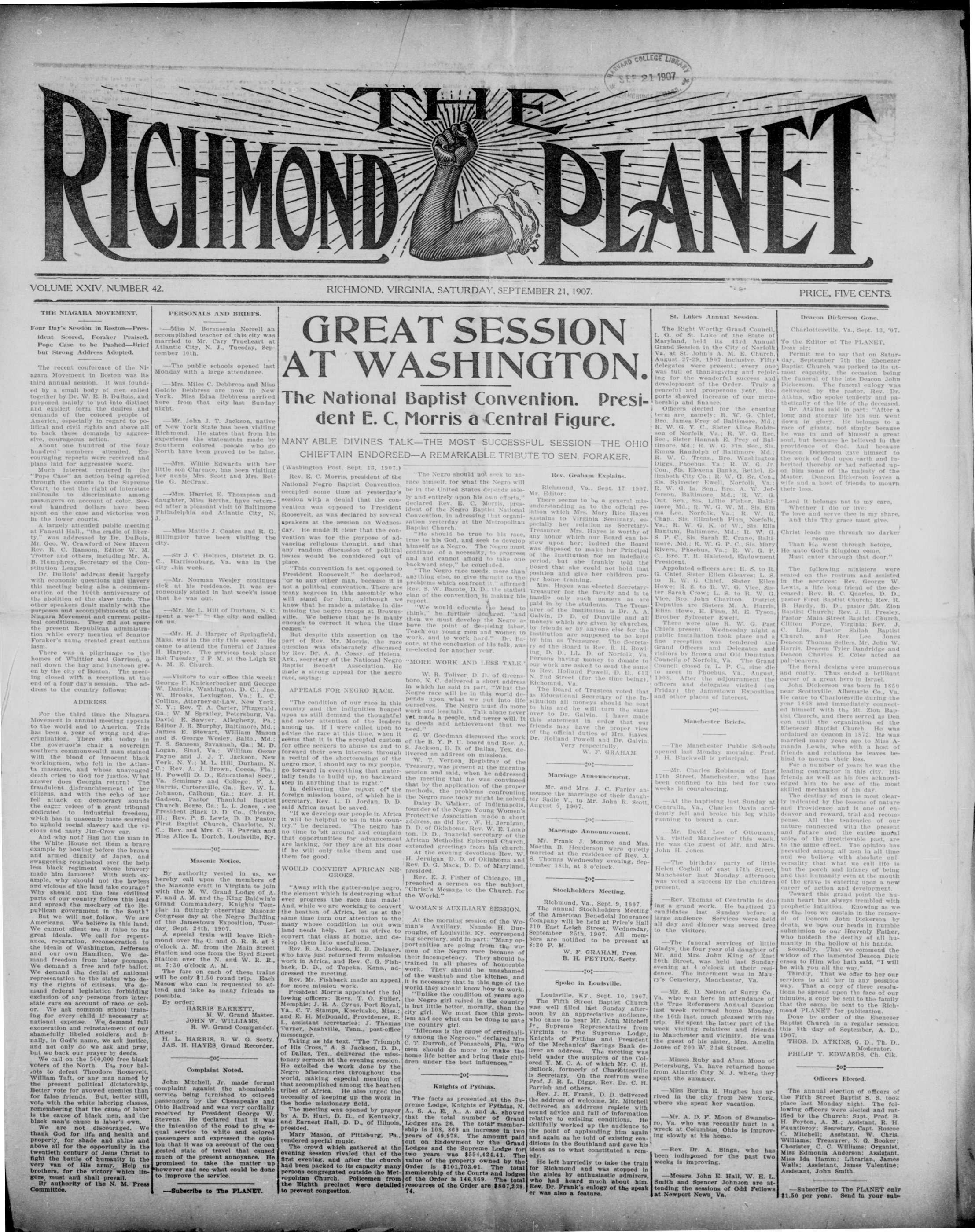
THE NIAGARA MOVEMENT.
Four Day's Session in Boston—President Scored, Foraker Praised. Pope Case to be Pushed—Brief but Strong Address Adopted.
The recent conference of the Niagara Movement in Boston was its third annual session. It was founded by a small body of men called together by Dr. W. E. B. DuBois, and purposed mainly to put into distinct and explicit form the desires and demands of the coreded people of America, especially in regard to political and civil rights and above all to back these demands by aggressive, courageous action.
About one hundred of the four hundred members attended. Encouraging reports were received and plans laid for aggressive work.
Much interest centered in the "Pope Case" an action being carried through the courts to the Supreme Court, to test the right of interstate railroads to discriminate among passengers on account of color. Several hundred dollars have been spent on the case and victories won in the lower courts.
A largely attended public meeting at Faneuil Hall, "the cradle of Liberty," was addressed by Dr. DuBois, Mr. Geo. W. Crawford of New Haven Rev. R. C. Ransom, Editor W. M. Trotter and others, including Mr. A. B. Humphrey, Secretary of the Constitution League.
Dr. DuBois' address dealt largely with economic questions and slavery this meeting being also a commemoration of the 100th anniversary of the abolition of the slave trade. The other speakers dealt mainly with the purposes and accomplishments of the Niagara Movement and current political conditions. They did not spare the present Republican administration while every mention of Senator Foraker's name created great enthusiasm.
There was a pilgrimage to the homes of Whittier and Garrison, a sail down the bay and luncheon given by the city of Boston. The meeting closed with a reception at the end of a four day's session. The address to the country follows:
ADDRESS
For the third time the Niagara Movement in annual meeting appeals to the world and to America. This has been a year of wrong and discrimination. There sits today in the governor's chair a sovereign southern commonwealth man stained with the blood of innocent black workingmen, who fell in the Atlanta massacre, and whose unavenged death cries to God for justice. What answer does Georgia return? The fraudulent disfranchisement of her citizens, and with the echo of her fell attack on democracy sounds the eager voices of a great tribunal dedicated to industrial freedom, which has in unseemly haste scurried to uphold social slavery and the vicious and nasty Jim-Crow car.
And why not? Has not the man in the White House set them a brave example by bowing before the brown and armed dignity of Japan, and swaggering roughshod over the help less black regiment whose bravery made him famous? With such example, why should not the lawless and vicious of the land take courage? Why should not the less civilized parts of our country follow this lead and spread the mockery of the Republican government in the South? But we will not follow. We are Americans. We believe in this land. We cannot silent see it false to its great ideals. We call for repentance, reparation, reconsecration to the ideals of Washington, Jefferson and our own Hamilton. We demand freedom from labor peonage. We demand a free and fair ballot. We demand the denial of national representation to the states who deny the rights of citizens. We demand federal legislation forbidding exclusion of any persons from interstate cars on account of race or color. We ask common school training for every child if necessary at national expense. We demand full exoneration and reinstatement of our shamefully libelled soldiers, and finally, in God's name, we ask justice, and not only do we ask and pray, but we back our prayer by deeds.
We call on the 500,000 free black voters of the North. Use your ballets to defeat Theodore Roosevelt, William Taft, or any man named by the present political dictatorship. Better vote for avowed enemies than for false friends. But, better still, vote with the white laboring classes, remembering that the cause of labor is the cause of black men, and the black man's cause is labor's own. We are not discouraged. We thank God for life and health and property, for shade and shine and above all for the opportunity in the twentieth century of Jesus Christ to fight the battle of humanity in the very van of His army. Help us brothers, for the victory which liners, must and shall prevail.
By authority of the N. M. Press Committee.
PERSONALS AND BRIEFS.
Miss N. Beransenia Norrell an accomplished teacher of this city was married to Mr. Cary Trueheart at Atlantic City, N. J., Tuesday, September 10th.
The public schools opened last Monday with a large attendance.
Mrs. Miles C. Debbress and Miss Goldie Debbress are now in New York. Miss Edna Debbress arrived here from that city last Sunday night.
Mr. John J. T. Jackson, native of New York State has been visiting Richmond. He states that from his experience the statements made by Southern colored people who go North have been proved to be false.
Mrs. Willie Edwards with her little son Clarence, has been visiting her aunts, Mrs. Scott and Mrs. Bettie G. McCraw.
Mrs. Harriet E. Thompson and daughter, Miss Bertha, have returned after a pleasant visit to Baltimore Philadelphia and Atlantic City, N. J.
Miss Mattie J. Coates and R. G. Billingsler have been visiting the city.
Sir J. C. Holmes, District D. G. C., Harrisonburg, Va. was in the city his week.
Mr. Norman Wesley continues slick at his residence. It was erroneously stated in last week's issue that he was out.
Mr. Mc L. Hill of Durham, N. C. spent a week in the city and called on us.
Mr. H. J. Harper of Springfield, Mass. was in the city this week. He came to attend the funeral of James H. Harper. The services took place last Tuesday. 2 P. M. at the Leigh St. A. M. E. Church.
Visitors to our office this week: George F. Knickerbocker and George W. Daniels, Washington, D. C.; Jao, W. Brooks, Lexington, Va.; L. C. Collins, Attorney-at-Law, New York, N. Y. Rev. T. A. Carter, Fitzgerald, Ga.; J. W. Spratley, Petersburg, Va. David E. Sawyer, Allegheny, Pa.; Editor J. R. Murphy, Baltimore, Md.; James E. Stewart, Baltimore Md. and S. George Wesley, Ga.; Md. T. S. Sansom, Sawannah, Ga.; Md. D. Logan, Sinai, Va.; William Payne and J. J. T. Jackson, New York, N. Y.; M. L. Hill, Durham, N. C.; Rev. A. J. Brown, Cocoa, Fla.; Powell D. D., Educational Secy. Va. Seminary and College; F. A. Harris, Cartersville, Ga.; Rev. W. L. Johnson, Calhoun, Ga.; Rev. J. W. Gadson, Pastor Thankful Baptist Church, Rome, Ga.; L. L. Jones, Ice President Black D. D. Co., Chicago, Ill.; Rev. P. S. Lewis, D. D. Pastor First Baptist Church, Charlotte, N. C.; Rev. and Mrs. C. H. Parrish and Miss Alice L. Dick, Louisville, Ky.
Masonic Notice
By authority vested in us, we hereby call upon the members of the Masonic craft in Virginia to join with the M. W. Grand Lodge of A. F. and A. M. and the King Baldwin's Grand Commandery, Knights Templar in fittingly observing Masonic Congress day at the Negro Building of the Jamestown Exposition, Tuesday, Sept. 24th, 1907.
A special train will leave Richmond over the C. and O. R. R. at 8 o'clock A. M. from the Main Street Station and one from the Byrd Street Station over the N. and W. R. R., at 7:30 o'clock A. M.
The fare on each of these trains will be only $1.50 round trip. Each Mason who can is requested to attend and take as many friends as possible.
By order:
HARRIS BARRETT,
M. W. Grand Master.
JOHN W. WILLIAMS,
R. W. Grand Commander.
Attest:
H. L. HARRIS, R. W. G. Secty.
JAS. H. HAYES, Grand Recorder.
Complaint Noted.
John Mitchell, Jr. made formal complaint against the abominable service being furnished to colored passengers by the Chesapeake and Ohio Railroad and was very cordially received by President George W. Stevens. He declared that it was the intention of the road to give equal service to white and colored passengers and expressed the opinion that it was on account of the congested state of travel that caused much of the present annoyance. He promised to take the matter up however and see what could be done to improve the service.
—Subscribe to The PLANET.
RICHMOND, VIRGINIA, SATURDAY, SEPTEMBER 21, 1907
GREAT SESSION AT WASHINGTON. The National Baptist Convention. President E. C. Morris a Central Figure.
MANY ABLE DIVINES TALK—THE MOST SUCCESSFUL SESSION—THE OHIO CHIEFTAIN ENDORSED—A REMARKABLE TRIBUTE TO SEN. FORAKER. (Washington Post, Sept. 13, 1907.)
Rev. E. C. Morris, president of the National Negro Baptist Convention, occupied some time at yesterday's session with a denial that the convention was opposed to President Roosevelt, as was declared by several speakers at the session on Wednesday. He made it clear that the convention was for the purpose of advancing religious thought, and that any random discussion of political issues would be considered out of place.
"This convention is not opposed to President Roosevelt," he declared, "or to any other man, because it is not a political convention. There are many negroes in this assembly who will stand for him, although we know that he made a mistake in missing the negro troops at Brownsville. We believe that he is many enough to correct it when the time comes."
But despite this assertion on the part of Rev. Mr. Morris, the race question was elaborately discussed by Rev. Dr. A. Cossy, of Helena, Ark., secretary of the National Negro Baptist Benefit Association. He made a strong appeal for the negro race, saying:
APPEALS FOR NEGRO RACE
"The condition of our race in this country and the indignities heaped upon us still demand the thoughtful and sober attention of the leaders among us. If I were called upon to advise the race at this time, when it seems that it is the accepted custom for office seekers to abuse us and to forward their own interests through a recital of the shortcomings of the negro race, I should say to my people go forward in everything that materially tends to build up, no backward step in anything that is right."
In delivering the report of the foreign mission board, of which he is secretary, Rev. L. D. Jordan, D. D. said Africa must be saved.
"If we develop our people in Africa it will be helpful to us in this country," he declared. "The negro has no time to 'sit around and complain that opportunities for advancement are lacking, for they are at his door if he will only take them and use them for good."
WOULD CONVERT AFRICAN NE
GROES
"Away with the gutter-snip negro, the element which is destroying what ever progress the race has made! And, while we are working to convert the heathen of Africa, let us at the same time turn our attention to the many whose condition in our own land needs help. Let us strive to convert that class at home, and develop them into usefulness."
Rev. R. A. Jackson, E. B. Delaney, who have just returned from mission work in Africa, and Topeka, C. G. Flushback, D. D., of Topeka, Kans., addressed the meeting.
Rev. Mr. Fishback made an appeal for more mission work.
President Morris appointed the following officers: Revs. T. O. Fuller, Memphis; J. H. A. Cyrus, Port Royal, Va., C. T. Stamps, Kosciusko, Miss.; and E. H. McDonald, Providence, R. I. assistant secretaries; J. Thomas Turner, Nashville, Tenn., post-office messenger.
Taking as his text, "The Triumph of His Cross," A. S. Jackson, D. D., of Dallas, Tex., delivered the missionary sermon at the evening session. He extolled the work done by the Negro Missionaries throughout the world, making especial mention of that accomplished among the heathen tribes of Africa. He also urged the necessity of keeping up the work in the home missionary field.
The meeting was opened by prayer by A. D. Hurt, D. D., of Kentucky, and Earnest Hall, D. D., of Illinois, presided.
Mary Mason, of Pittsburg, Pa., rendered special music.
The crowd which gathered at the evening session rivaled that of the first evening, and after the church had been packed to its capacity many persons congregated outside the Metropolitan Church. Policemen from the Eighth precinct were detailed to prevent congestion.
"The Negro should not seek to unrace himself, for what the Negro will be in the United States depends solely and entirely upon his own efforts," declared Rev. E. C. Morris, president of the Negro Baptist National Convention, in adressing that organization yesterday at the Metropolitan Baptist Church.
"He should be true to his race, true to his God, and seek to develop himself as a Negro. The Negro must continue, of a necessity, to progress and cannot afford to take one backward step," he concluded.
"The Negro race needs more than anything else, to give thought to the problems which confront it." affirmed Rev. S. W. Bacote, D. D., the stalstiian of the convention, in making his report.
"We would educate the head to think," he further declared, "and then we must develop the Negro above the point of despising labor. Teach our young men and women to work, and to work hard." Dr. Bacote, at the conclusion of his talk, was re-elected for another year.
"MORE WORK AND LESS TALK
W. R. Toliver, D. D. of Greensboro, N. C. delivered a short address in which he said in part, "What the Negro race will be in this world depends upon what we put into life ourselves. The Negro must do more work and less talk. Talk alone never yet made a people, and never will. It is deeds and achievement that we need."
G. W. Goodman discussed the work of the B. Y. P. U. board and Rev. A. S. Jackson, D. D. of Dallas, Tex. delivered an address on missions.
W. T. Vernon, Registrar of the Treasury, was present at the morning session and said, when he addressed the meeting that he was convinced that by the application of the proper methods, the problems confronting the Negro race today might be solved Daisy D. Walker, of Indianapolis, founder of the Negro Young Women's Protective Association made a short address, as did Rev. W. H. Jernigan, D. D. of Oklahoma. Rev. W. E. Lampon, D. D., financial secretary of the African Methodist Episcopal Church, extended greetings from his church.
At the evening devotions Rev. W. H. Jernigan, D. D. of Oklahoma and Rev. D. G. Mack, D. D. of Maryland, presided.
Rev. E. J. Fisher of Chicago, HL, preached a sermon on the subject, "Christ's Message to the Church for the World."
WOMAN'S AUXILIARY SESSION
At the morning session of the Woman's Auxiliary, Nannie H. Burroughs, of Louisville, Ky. corresponding secretary, said in part: "Many opportunities are going from the women of the Negro race because of their incompetency. They should be trained in all phases of honorable work. They should be unashamed of the washtub and the kitchen, and it is necessary that in this age of the world they should know how to work. "Unlike the condition of years ago the Negro girl raised in the country is but little better, morally, than the city girl. We must face this problem and see what can be done to save the country girl. "Idleness is the cause of criminality among the Negroes," declared Mrs. C. T. Durroh, of Pensacola, Fla. "We men should do more to make the home life better and bring their children under the best influences."
Knights of Pythias.
The facts as presented at the Supreme Lodge, Knights of Pythias, N. A., S. A., E. A., A. and A. showed that the total number of Grand Lodges are 26. The total membership is 108, 869 an increase in two years of 49,978. The amount paid out on Endowment by the Grand Lodges and the Supreme Lodge for two years was $554,424.41. The value of the property owned by the Order is $101,703.01. The total membership of the Courts and lodges of the Order is 146,869. The total resources of the Order are $807,229.74.
Rev. Graham Explains
Richmond, Va., Sept. 17, 1907. Mr. Editor:
There seems to be a general misunderstanding as to the official relation which Mrs. Mary Rice Hayes sustains to Virginia Seminary, especially her relation as Secretary Treasurer. Mrs. Hayes is worthy of any honor which our Board can bestow upon her; indeed the Board was disposed to make her Principal of the Institution for an indefinite period, but she frankly told the Board that she could not hold that position and give her children proper home training.
Mrs. Hayes was elected Secretary Treasurer for the faculty and is to handle only such monies as are paid by in the students. The Treasurer of the institution is Dr. A. A. Galvin, D. D. of Danville and all monies which are given by churches, by friends or by anyone else for the institution are supposed to be kept by him as Treasurer. The Secretary of the Board is Rev. R. H. Bowling, D. D., LL. D. of Norfolk, Va. Persons having money to donate to our work are asked to send the same to Rev. Holland Powell, D. D., 613 N. 2nd Street (for the time being), Richmond, Va.
The Board of Trustees voted that as Educational Secretary of the Institution all monies should be sent to him and he will turn the same over to Dr. Galvin. I have made this statement in order that our friends may have the proper view of the official duties of Mrs. Hayes, Dr. Holland Powell and Dr. Galvin.
Marriage Announcement
Mr. and Mrs. J. C. Farley announce the marriage of their daughter Sadie V., to Mr. John R. Scott, August 5 1907.
Marriage Announcement.
Mr. Frank J. Monroe and Mrs. Martha B. Henderson were quietly married at the residence of Rev. A. Thomas W. Wednesday, evening. A. Thomas 18th, at 8:30.
Stockholders Meeting.
Richmond, Va., Sept. 9, 1907.
The annual Stockholders Meeting of the American Beneficial Insurance Company will be held at Price's Hall 210 East Leigh Street, Wednesday, September 25th, 1907. All members are notified to be present at 8:30 P. M.
W. F. GRAHAM, Pres
B. H. PEYTON, Sectv
Spoke in Louisville
Louisville, Ky., Sept. 10, 1907. The Fifth Street Baptist Church was well filled last Sunday afternoon by an appreciative audience, who came to hear Mr. John Mitchell Jr., Supreme Representative from Virginia to the Supreme Lodge, Knights of Pythias and President of the Mechanics' Savings Bank deliver an address. The meeting was held under the auspices of the Colored Y. M. C. A. of which Mr. C. H. Bullock, formerly of Charlottesville is Secretary. On the rostrum were Prof. J. R. L. Diggs, Rev. Dr. C. H. Parrish and others. Rev. J. H. Frank, D. D. delivered the address of welcome. Mr. Mitchell delivered an address replete with sound advice and full of information relative to existing conditions. He skillfully worked up the audience to the point of applauding him again and again as he told of existing conditions in the Southland and gave his ideas as to what constituted a remedy. He left hurriedly to take the train for Richmond and was stopped in the aisles by enthusiastic admirers, who had heard much about him. Rev. Dr. Frank's eulogy of the speaker was also a feature.
St. Lukes Annual Session.
Appointed officers are: R. S. to R. G. Chief, Sister Ellen Gleaves; L. S. to R. W. G. Chief, Sister Ellen Howe; R. S. to R. W. G. Vice, Sister Sarah Crow; L. S. to R. W. G. Vice, Bro. John Charlton. District deputies are Sisters M. A. Harris Eliza Howe, E. Pinn, M. E. Tyson, Brother Sylvester Ewell. There were nine R. W. G. Past Chiefs present. Wednesday night a public installation took place and a fine reception was tendered the Grand Officers and Delegates and visitors by Brown and Old Dominion Councils of Norfolk, Va. The Grand Council closed in L. P. C., sine dite to meet in Phoebus, Va., August, 1908. After the adjournment the officers and delegates visited (on Friday) the Jamestown Exposition and other places of interest.
Manchester Briefs.
—The Manchester Public Schools opened last Monday morning, Prof. J. H. Blackwell is principal.
—Mr. Charles Robinson of East 17th Street, Manchester, who has been confined to his bed for two weeks is convalescing.
—At the baptising last Sunday at Centralia, Va., Charles Davis accidentally fell and broke his leg while running to board a car.
—Mr. David Lee of Ottomans, Va. visited Manchester this week. He was the guest of Mr. and Mrs. John H. Jones.
—The birthday party of little Helen Cogbill of east 17th Street, Manchester last Monday afternoon was voted a success by the children present.
—Rev. Thomas of Centralia is doing a grand work. He baptized 25 candidates last Sunday before a large audience. Services were held all day and dinner was served free to the visitors.
—The funeral services of little Gladys, the four year old daughter of Mr. and Mrs. John King of East 20th Street, was held last Sunday evening at 4 o'clock at their residence. The interment was in Maury's Cemetery, Manchester, Va.
—Mr. E. D. Nelson of Surry Co., Va. who was here in attendance of the True Reformers Annual Session last week returned home Monday, the 16th inst. much pleased with his trip. He spent the latter part of the week visiting relatives and friends in Manchester and vicinity. He was the guest of his sister, Mrs. Amelia Jones of 200 W. 21st Street.
—Misses Ruby and Alma Moon of Petersburg, Va. have returned home from Atlantic City N. J. where they spent the summer.
—Miss Bertha E. Hughes has arrived in the city from New York, where she spent her vacation.
—Mr. A. D. F. Moon of Swansboro, Va. who was recently hurt in a wreck at Columbus, Ohio is improving slowly at his home.
—Rev. Dr. A. Binga, who has been indisposed for the past two weeks is improving.
—Messrs. John E. Hall, W. E. L. Smith and Spencer Johnson are attending the sessions of Odd Fellows at Newport News Va.
PRICE, FIVE CENTS.
Deacon Dickerson Gone.
Charlottesville, Va., Sept. 13, '07.
To the Editor of The PLANET,
Dear sir:
Permit me to say that on Saturday, September 7th the Ebenezer Baptist Church was packed to its utmost capacity, the occasion being the funeral of the late Deacon John Dickerson. The funeral eulogy was delivered by the pastor, Rev. Dr. Atkins, who spoke tenderly and pathetically of the life of the deceased.
Dr. Atkins said in part: "After a long and stormy life his sun went down in glory. He belongs to a race of giants, not simply because he was in and of himself a great soul, but because he believed in the providence of God. And because Deacon Dickerson gave himself to the work of God upon earth and inherited thereby or had reflected upon him some of the majesty of the Master. Deacon Dickerson leaves a wife and a host of friends to mourn their loss.
"Lord it belongs not to my care,
Whether I die or live:
To love and serve thee is my share,
And this Thy grace must give.
Christ leads me through no darker room
Than He went through before,
He unto God's Kingdom come,
Must enter through that door."
The following ministers were seated on the rostrum and assisted in the services: Rev. George W. Lewis, a life long friend of the deceased; Rev. R. C. Quarles, D. D.; pastor First Baptist Church; Rev. R. B. Hardy, B. D., pastor Mt. Zion Baptist Church; Rev. J. H. Presley, Pastor Main Street Baptist Church, Clifton Forge, Virginia; Rev. J. C. Lias, Pastor Shiloh Baptist Church and Rev. Lee Jones Deacon Thomas Sellers, Mr. John W. Harris, Deacon Tyrler Dandridge and Deacon Charles E. Coles acted as pall-bearers. The floral designs were numerous and costly. Thus ended a brilliant career of a great hero in Israel. John Dickerson was born in 1850 near Scottsville, Albemarle Co., Va. He came to Charlestonville during the year 1868 and immediately connected himself with the Mt. Zion Baptist Church and there served as Dea enclosed until the organization of the Ebenezer Baptist Church was ordained as deacon in 1872. He was married many years ago to Miss A. manda Lewis, who with a host of friends and relations he leaves behind to mourn their loss. For a number of years he was the leading contractor in this city. His friends as well as his heoes acknowledged him to be one of the most skilled mechanics of his day.
The destiny of man is most clearly indicated by the lessons of nature and Providence and is one of endeavor and reward, trial and recompense. All the tendencies of our nature connected with the present and future and the entire moral voice of the irretrievable past, are to the same effect. The opinion has prevailed among all men in all time and we believe with absolute universality that what we call life is but the porch and infancy of being and that humanity even at the mouth of the grave is entering upon a new career of action and development. Toward this grand point the human heart has always trembled with prophetic intuition. Knowing as we do the loss we sustain in the removal of Deacon John Dickerson by death, we bow our heads in humble submission to our Heavenly Father, who holdeth the destiny of all humanity in the hollow of his hands. Secondly, That we commend the woe of the lamented Deacon Dickerson to Him who hath said, "I will be with you all the time." Thirdly, That we offer to her our services to aid her in any possible way. That a copy of these resolutions be spread upon the face of our minutes, a copy be sent to the family that the same be sent to the Richmond PLANET for publication. Done by order of the Ebenezer Baptist Church in a regular session this 8th day of September, A. D., 1907. THOS. D. ATKINS, G. D., Th. D. Moderator. PHILIP T. T. EDWARDS, Ch. Clk
Officers Elected.
The annual election of officers of the Fifth Street Baptist S. S. took place last Monday night. The following officers were elected and ratified by the Church: Supt., Prof. B. H. Peyton, A. M.; Assistant, R. H. Fauntierley; Secretary, Capt. Roscoe C. Mitchell; Assistant, W. Chris. Williams; Treasurer, N. G. Booker; Chorister, C. C. Williams; Organist, Miss Edmonia Anderson; Assistant, Miss Ida Hamm; Librarian, James Walls; Assistant, James Valentine; Assistant, John Smith.
—Subscribe to The PLANET only $1.50 per year. Send in your sub-
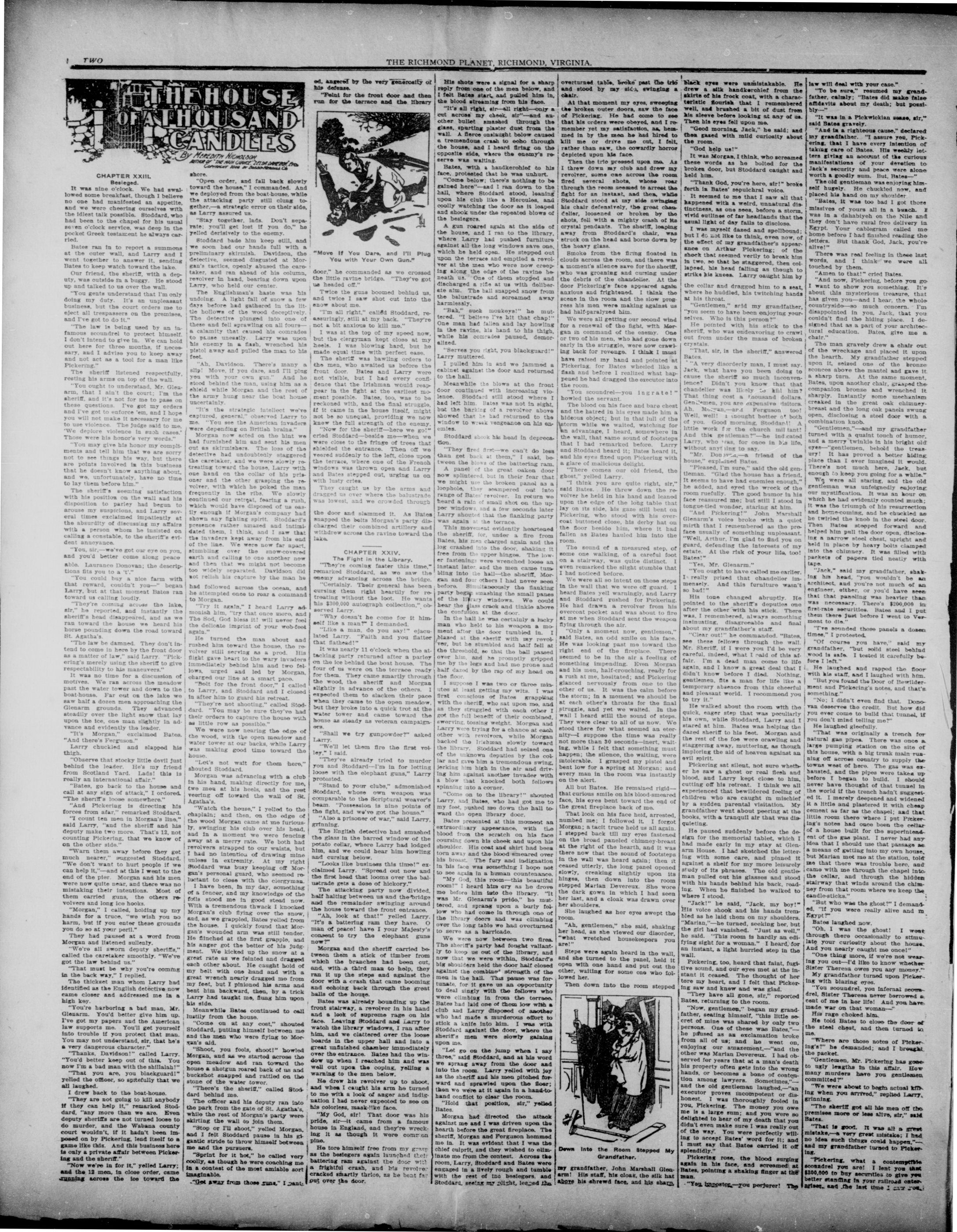
THE HOUSE
OF A THOUSAND
CANDLES
BY MEREDITH NICOLSON
AUTHOR OF THE MAIN LUNCH
TWO
It was nine o'clock. We had swallowed some breakfast, though I believe no one had manifested an appetite, and we were cheering ourselves with the idleest talk possible. Stoddard, who had been to the chapel for his usual seven o'clock service, was deep in the pocket Greek testament he always carried.
Bates ran in to report a summons at the outer wall, and Larry and I went together to answer it, sending Bates to keep watch toward the lake.
Our friend, the sheriff, with a deputy, was outside in a buggy. He stood up and talked to us over the wall.
"You gents understand that I'm only doing my duty. It's an unpleasant business, but the court orders me to eject all trespassers on the premises, and I've got to do it."
"The law is being used by an infamous scoundrel to protect himself. I don't intend to give in. We can hold out here for three months, if necessary, and I advise you to keep away and not act as a tool for a man like Pickering."
The sheriff listened respectfully, roosting his arms on top of the wall.
"You ought to understand, Mr. Glenarm, that I ain't the court; I'm the sheriff, and it's not for me to pase on these questions. I've got my orders and I've got to enforce 'em, and I hope you will not make it necessary for me to use violence. The judge said to me, 'We deplore violence in such cases.' Those were his honor's very words."
"You may give his honor my compliments and tell him that we are sorry not to see things his way, but there are points involved in this business that he doesn't know anything about, and we, unfortunately, have no time to lay them before him."
the sheriff's seeming satisfaction with his position on the wall and his disposition to parley had begun to arouse my suspicions, and Larry several times exclaimed impatiently at the absurdity of discussing my affairs with a person whom he insisted on calling a constable, to the sheriff's evident annoyance.
"You, sir,—we've got our eye on you, and you'd better come along peaceable. Laurance Donovan; the descriptions fits you to a 't."
"You could buy a nice farm with that reward, couldn't you—" began Larry, but at that moment Bates ran toward us calling loudly.
"They're coming across the lake, sir," he reported, and instantly the sheriff's head disappeared, and as we ran toward the house we heard his horse pounding down the road toward St. Agatha's.
"The law be damned. They don't intend to come in here by the front door as a matter of law," said Larry. "Pickering's merely using the sheriff to give respectability to his maneuvers."
It was no time for a discussion of motives. We ran across the meadow past the water tower and down to the boat-house. Far out on the lake we saw half a dozen men approaching the Glenarm grounds. They advanced steadily over the light snow that lay upon the ice, one man slightly in advance and evidently the leader.
"It's Morgan," exclaimed Bates. "And there's Ferguson."
Larry chuckled and slapped his thigh.
"Observe that stocky little devil just behind the leader. He's my friend from Scotland Yard. Lads! this is really an international affair."
"Bates, go back to the house and call at any sign of attack," I ordered.
"The sheriff's loose somewhere."
"And Pickering is directing his forces from afar," remarked Stoddard.
"I count ten men in Morgan's line," said Larry, "and the sheriff and his deputy make two more. That's 12, not counting Pickering, that we know of on the other side."
"Warn them away before they get much nearer," suggested Stoddard. "We don't want to hurt people if we can help it,"—and at this I went to the end of the plier. Morgan and his men were now quite near, and there was no mistaking their intentions. Most of them carried guns, the others revolvers and long ice hooks.
"Morgan," I called, holding up my hands for a truce, "we wish you no harm, but if you enter these grounds you do so at your peril."
They had paused at a word from Morgan and listened sullenly.
"We're all sworn deputy sheriffs," called the caretaker smoothly. "We've got the law behind us."
"That must be why you're coming in the back way," I replied.
The thickset man whom Larry had identified as the English detective now came closer and addressed me in a high key.
"You're harboring a bad man, Mr. Glenarm. You'd better give him up. I've got my papers and the American law supports me. You'll get yourself into trouble if you protect that man. You may not understand, sir, that he's a very dangerous character."
"Thanks, Davidson!" called Larry. "You'd better keep out of this. You now I'm a bad man with the shillahal!"
"That you are, you blackguard!" yelled the officer, so spitefully that we all laughed.
I drew back to the boat-house.
"They are not going to kill anybody if they can help it," remarked Stoddard. "any more than we are. Even deputy sheriffs are not turned loose to do murder, and the Wabana county court wouldn't, if it hadn't been imposed on by Pickerling, lend itself to a game like this. And this business here is only a private affair between Pickerling and the sheriff."
"Now we're in for it," yelled Larry; and the 12 men, in close order, came running across the ice toward the
shore.
"Open order, and fall back slowly toward the house," I commanded. And we deployed from the boathouse, while the attacking party still clung together,—a strategic error on their side, as Larry assured us.
"Stay together, lads. Don't separate; you'll get lost if you do," he yelled derisively to the enemy.
Stoddard bade him keep still, and we soon had our hands full with a preliminary skirmish. Davidson, the detective, seemed disgusted at Morgan's tactics, openly abused the caretaker, and ran ahead of his column, revolver in hand, bearing down upon Larry, who held our center.
The Englishman's haste was his undoing. A light fall of snow a few days before had gathered in the little hollows of the wood deceptively. The detective plunged into one of these and fell sprawling on all fours—a calamity that caused his comrades to pause uneasily. Larry was upon his enemy in a flash, wrenched his pistol away and pulled the man to his feet.
"Ah, Davidson. There's many a slip! Move, if you dare, and I'll plug you with your own gun." And he stood behind the man, using him as a shield while Morgan, and the rest of the army hung near the boat house uncertainly.
"It's the strategic intellect we've captured, general," observed Larry to me. "You see the American invaders were depending on British brains."
Morgan now acted on the hint we had furnished him and sent his men out as skirmishers. The loss of the detective had undoubtedly staggered the caretaker, and we were slowly retreating toward the house, Larry with one hand on the collar of his prisoner and the other grasping the revolver, with which he poked the man frequently in the ribs. We slowly continued our retreat, fearing a rush, which would have disposed of us easily enough if Morgan's company had shown any fighting spirit. Stoddard's presence rather amazed and intimidated them, I think, and I saw that the invaders kept away from his end of the line. We were now far apart, stumbling over the snow-covered earth and calling to one another now and then that we might not become too widely separated. Davidson did not relish his capture by the man he had followed across the ocean, and he attempted once to roar a command to Morgan.
"Try it again." I heard Larry admonish him, "try that once more, and The Sod, God bless it will never feel the delicate imprint of your web-feet again."
He turned the man about and rushed him toward the house, the revolver still serving as a prod. His flight gave heart to the wary invaders immediately behind him and two fellows, urged and led by Morgan, charged our line at a smart pace.
"Bolt for the front door," I called to Larry, and Stoddard and I closed in after him to guard his retreat.
"They're not shooting," called Stoddard. "You may be sure they've had their orders to capture the house with as little row as possible."
We were now nearing the edge of the wood, with the open meadow and water tower at our backs, while Larry was making good time toward the house.
"Let's not wait for them here," shouted Stoddard.
Morgan was advancing with a club in his hand, making directly for me, two mea at his heels, and the rest veering off toward the wall of St. Agatha's.
"Watch the house," I yelled to the chaplain; and then, on the edge of the wood Morgan came at me furiously, swinging his club over his head, and in a moment we were fencing away at a merry rate. We both had revolvers strapped to our waists, but I had no intention of drawing mine unless in extremity. At my right Stoddard was busy keeping off Morgan's personal guard, who seemed reluctant to close with the cieverman.
I have been, in my day, something of a fencer, and my knowledge of the foils stood me in good stead now. With a tremendous thwack I knocked Morgan's club flying over the snow, and, as we grappled, Bates yelled from the house. I quickly found that Morgan's wounded arm was still tender. He finched at the first grapple, and his anger got the better of his judgment. We kicked up the snow at a great rate as we feinted and dragged each other about. He caught hold of my belt with one hand and with a great wrench nearly dragged me from my feet, but I pinioned his arms and bent him backward, then, by a trick Larry had taught me, flung him upon his side.
Meanwhile Bates continued to call lustily from the house.
"Come on at any cost," shouted Stoddard, putting himself between me and the men who were flying to Morgan's aid.
"Shoot, you fools, shoot!" howled Morgan, and as we started across the open meadow and ran toward the house a shotgun roared back of us and buckshot snapped and rattled on the stone of the water tower.
"There's the sheriff," called Stoddard behind me.
The officer and his deputy ran into the park from the gate of St. Agatha's, while the rest of Morgan's party were skirting the wall to join them.
"Stop or I'll shoot," yelled Morgan, and I felt Stoddard pause in his gigantic desire to throw himself between me and the pursuers.
"Sprint for it hot," he called very coolly, as though he were coaching me in a contest of the most amiable sort imaginable.
"Get away from those runs." I went.
THE RICHMOND PLANET, RICHMOND, VIRGINIA
ed, angered by the very generosity of his defense.
"Feint for the front door and then run for the terrace and the library
"Move If You Dars, and I'll Plug You with Your Own Gun."
door," he commanded as we crossed the little ravine bridge. "They've got us headed off."
Twice the guns boomed behind us, and twice I saw shot cut into the snow about me.
"I'm all right," called Stoddard, reassuringly, still at my back. "They're not a bit anxious to kill me."
I was at the top of my speed now, but the ciergian姆 kept close at my heels. I was blowing hard, but he made equal time with perfect ease.
The sheriff was bawling orders to the men, who awaited us before the front door. Bates and Larry were not visible, but I had every confidence that the Irishman would reappear in the fight at the earliest moment possible. Bates, too, was to be reckoned with, and the final struggle, if it came in the house itself, might not be so unequal, providing we now knew the full strength of the enemy.
"Now for the sheriff—here we go!" cried Stoddard—beside me—when we were close to the fringe of trees that shielded the entrance. Then off we weed suddenly to the left, close upon the terrace, where one of the French windows was thrown open and Larry and Bates stepped out, urging us on with lusty cries.
They caught us by the arms and dragged us over where the balustrade was lowest, and we crowded through the door and slammed it. As Bates snapped the belts Morgan's party discharged their combined artillery and withdrew across the ravine toward the lake.
CHAPTER XXIV
"They're coming faster this time," remarked Stoddard, as we saw the enemy advancing across the bridge. "Certainly. Their general has been cursing them right heartily for retreating without the loot. He wants his $300,000 autograph collection," observed Larry.
"Why doesn't he come for it himself like a man?" I demanded.
"Like a man, do you say!" ejaculated Larry. "Faith and you flatter that flathead!"
It was nearly 11 o'clock when the attacking party returned after a parley on the ice behind the boat house. The four of us were on the terrace ready for them. They came smartly through the wood, the sheriff and Morgan slightly in advance of the others. I expected them to slacken their pace when they came to the open meadow, but they broke into a quick trot at the water tower and came toward the house as steady as veteran campaigners.
"Shall we try gunpowder?" asked Larry.
"We'll let them fire the first volley," I said.
"They've already tried to murder you and Stoddard—I'm in for letting loose with the elephant guns," Larry protested.
"Stand to your clubs," admonished Stoddard, whose own weapon was comparable to the Scriptural weaver's beam. "Possession is nine points of the fight, and we've got the house."
"Also a prisoner of war," said Larry, grinning.
The English detective had smashed the glass in the barred window of the potato collar, where Larry had lodged him, and we could hear him howling and cursing below.
"Looks like business this time!" exclaimed Larry. "Spread out now and the first head that looms over the balustrade gets a dose of hickory."
The attacking party now divided, half halting between us and the bridge and the remainder swinging around the house toward the front entrance. "Ah, look at that!" yelled Larry. "It's a battering ram they have. O man of peace! have I your Majesty's consent to try the elephant guns now?" Morgan and the sheriff carried between them a stick of timber from which the branches had been cut, and, with a third man to help, they ran it up the steps and against the door with a crash that came booming and echoing back through the great halls of the house.
Bates was already bounding up the front stairway, a revolver in his hand and a look of supreme rage on his face. Leaving Stoddard and Larry to watch the library windows, I ran after him, and we clattered over the loose boards in the upper hall and into a great unfinished chamber immediately over the entrance. Bates had the window up when I reached him and was well up upon the coping, yelling a warning to the men below.
He drew his revolver up to shoot, and when I caught his arm he turned to me with a look of anger and indignation I had never expected to see on his colorless, mask-like face.
"My God, sir! That door was his pride, sir—it came from a famous house in England, and they're wrecking it as though it were common pline.
He tore himself free from my grasp as the bestegers again launched their battering ram against the door with a frightful crash, and his revolves cracked sharply thrice, as he bent far put over the door.
His shots were a signal for a sharp reply from one of the men below, and I felt Bates start, and pulled him in, the blood streaming from his face.
"It's all right, sir—all right—only a cut across my cheek, sir"—and another bullet smashed through the glass, spurting plaster dust from the wall. A flerce on laughed below caused a tremendous crash to echo through the house, and I heard firing on the opposite side, where the enemy's reserve was waiting.
Bates, with a handkerohlef to his face, protested that he was unhurt.
"Come below; there's nothing to be gained here"—and I ran down to the hall, where Stoddard stood, leaning upon his club like a Hercules, and coolly watching the door as it leaped and shook under the repeated blows of the bestegers.
A gun roared again at the side of the house, and I ran to the library, where Larry had pushed furniture against all the long windows save one, which he held open. He stepped out upon the terrace and emptied a revolver at the men who were now creeping along the edge of the ravine beneath us. "One of them stopped and discharged a rifle at us with deliberate aim. The ball snapped snow from the balustrade and screamed away harmlessly.
"Bah," such monkeys!" he muttered. "I believe I've hit that chap!" One man had fallen and lay howling in the ravine, his hand to his thigh, while his comrades paused, demoralized.
"Serves you right, you blackguard!" Larry muttered.
I pulled him in and we jammed a cabinet against the door and returned to the hall.
Meanwhile the blows at the front door continued with increasing violence. Stoddard still stood where I had left him. Bates was not in sight, but the barking of a revolver above showed that he had returned to the window to wreak vengeance on his enemies.
Stoddard shook his head in depreciation.
"They fired first—we can't do less than get back at them," I said, between the blows of the battering ram. A panel of the great oaken door now splintered, but in their fear that we might use the broken panel as a loophole, they scampered out into range of Bates' revolver. In return we heard a rain of small shot on the upper windows, and a few seconds later Larry shouted that the flanking party was again at the torrace.
This movement evidently heartened the sheriff, for, under a fire from Bates, his men charged again and the log crashed into the door, shaking it free from the upper hinges. The lower fastenings were wrenched loose an instant later, and the men came tumbling into the hall—the sheriff. Morgan and four others I had never seen before. Simultaneously the flanking party began smashing the small panes of the library windows. We could hear the glass crack and tinkle above the confusion at the door.
In the hall he was certainly a lucky man who held to his weapon a moment ator the door tumbled in. I blazed at the sheriff with my revolver, but he stumbled and half fell at the threshold, so that the ball passed over him, and he promptly gripped me by the legs and had me prone and half dazed by the rap of my head on the floor.
I suppose I was two or three minutes at least getting my wits. I was first conscious of Bates grappling with the sheriff, who sat upon me, and as they struggled with each other I got the full benefit of their combined, swerving, tossing weight. Morgan and Larry were trying for a chance at each other with revolvers, while Morgan backed the Irishman slowly toward the library. Stoddard had seized one of the unknown deputies by the collar and gave him a tremendous swing, jerking him high in the air and driving him against another invader with a blow that knocked both follows spinning into a corner.
"Come on to the library!" shouted Larry, and Bates, who had got me to my feet, pushed me down the hall toward the open library door.
Bates presented at this moment an extraordinary appearance, with the blood from the scratch on his face coursing down his cheek and upon his shoulder. His coat and shirt had been torn away and the blood smeared over his breast. The fury and indignation in his face was something I hope not to see again in a human countenance. "My God, this room—this beautiful room!" I heard him cry as he drove me before him into the library. "It was Mr. Glenarm's pride," he muttered, and sprang upon a burly follow who had come in through one of the library doors and was climbing over the long table we had overturned to serve as a barricade.
We were now between two fires. The sheriff's party had fought valiantly to keep us out of the library, and now that we were within, Stoddard's big shoulders held the door half closed against the combine' strength of the men in the hall. This pause was fortunate, for it gave us an opportunity to deal singly with the fellows who were climbing in from the torrace. Hates had laid one of them low with a club and Larry disposed of another who had made a murderous effort to stick a knife into him. I was with Stoddard against the door, where the sheriff men were slowly gaining upon me.
"Let go on the jump when I say three," said Stoddard, and at his word we sprang away from the door and into the room. Larry yelled with joy as the sheriff and his men pitched forward and sprawled upon the floor; then we were at it again in a hand-to-hand conflict to clear the room.
"Hold that position, sir," yelled Bates.
Morgan had directed the attack against me and I was driven upon the hearth before the great fireplace. The sheriff, Morgan and Ferguson hemmed me in. It was evident that I was the chief culprit, and they wished to eliminate me from the contest. Across the room, Larry, Stoddard and Bates were engaged in a lively rough and tumble with the rest of the beslegers, and Stoddard seeing my silent, leaped the
overturned table, broke past the trio and stood by my side, swinging a chair.
At that moment my eyes, sweeping the broken outer doors, saw the face of Pickerling. He had come to see that his orders were obeyed, and I remember yet my satisfaction, as he reminded in by the men he had hired to kill me or drive me out, I felt, rather than saw, the cowardly horror depicted upon his face.
Then the trio pressed upon me. As I throw down my club and drew my revolver, some one across the room fired several shots, whose roar through the room seemed to arrest the fight for an instant, and then, while Stoddard stood at my side swinging his chair defensively, the great chandler, loosened or broken by the shots, fell with a mighty crash of its crystal pendants. The sheriff, leaping away from Stoddard's chair, was struck on the head and borne down by the heavy glass.
Smoke from the firing floated in clouds across the room, and there was a moment's silence save for the shooflip, who was grooming and cursing under the debris of the chandelier. At the door Pickerling's face appeared again anxious and frightened. I think the scene in the room and the slow progress his men were making against us had half-paralyzed him.
We were all getting our second wind for a renewal of the fight, with Morgan in command of the enemy. One or two of his men, who had gone down early in the struggle, were now crawling back for revenge. I think I must have raised my hand and pointed at Pickerling, for Bates wheeled like a flash and before I realized what happened he had dragged the executor into the room.
"You scoundrel—you ingrate!" howled the servant.
The blood on his face and bare chest and the hatred in his eyes made him a hideous object; but in that lull of the storm while we waited, watching for an advantage, I heard, somewhere in the wall, that same sound of footsteps that I had remarked before. Larry and Stoddard heard it; Bates heard it, and his eyes fixed upon Pickering with a glare of malicious delight.
"There comes our old friend, the ghost," yelled Larry.
"I think you are quite right, sir," said Bates. He threw down the revolver he held in his hand and leaned upon the edge of the long table that lay on its side, his gaze still bent on Pickering, who stood with his over-cotton buttoned close, his derby hat on the floor beside him, where it had fallen as Bates hauled him into the room.
The sound of a measured step, of some one walking, of a careful foot on a stairway, was quite distinct. I even remarked the slight stumble that I had noticed before.
We were all so intent on those steps in the wall that we were off guard. I heard Bates yell warningly, and Larry and Stoddard rushed for Puckering. He had drawn a revolver from his overcoat pocket and was about to fire at me when Stoddard sent the weapon flying through the air.
"Only a moment now, gentleman," said Bates, an odd smile on his face. He was looking past me toward the right end of the fireplace. There seemed to be in the air a feeling of something impending. Even Morgan and his men, half-crouching, ready for a rush at me, hesitated; and Pickerling glanced nervously from one to the other of us. It was the calm before the storm; in a moment we should be at each other's throats for the final struggle, and yet we waited. In the wall I heard still the sound of steps. They were clear to all of us now. We stood there for what seemed an eternity—I suppose the time was really not more than 30 seconds—inert, waiting, while I felt that something must happen; the silence, the waiting, were intolerable. I grasped my pistol and bent low for a spring at Morgan; and every man in the room was instantly on the alert.
All but Bates. He remained rigid—that curious smile on his blood-moened face, his eyes bent toward the end of the great fireplace back of me.
That look on his face held, arrested, numbed me; I followed it. I forgot Morgan; a tacit truce held us all again.
I stepped back till my eyes fastened on the broad paneled chimney-breast at the right of the hearth, and it was there now that the sound of footsteps in the wall was heard again; then it ceased utterly, the long panel opened slowly, creaking slightly upon its hinges, then down into the room stepped Marian Devereux. She wore the dark gown in which I had seen her last, and a cloak was drawn over her shoulders.
She laughed as her eyes swept the room.
"Ah, gentlemen," she said, shaking her head, as she viewed our disorder, "what wretched housekeepers you are!"
---
Steps were again heard in the wall, and she turned to the panel, held it open with one hand and put out the other, waiting for some one who followed her. Then down into the room stepped
Down Into the Room Stepped My Grandfather.
my grandfather, John Marshall Glen-
arm! His staff, his cloak, the slik hat
above his shrewd face, and his sharp
black eyes were unmistakable. He drew a silk handkerchief from the skirts of his frock coat, with a characteristic flourish that I remembered well, and brushed a bit of dust from his sleeve before looking at any of us. Then his eyes fell upon me.
"Good morning, Jack," he said; and then gazed with mild curiosity about the room.
"God help us!"
It was Morgan, I think, who screamed these words as he bolted for the broken door, but Stoddard caught and held him.
"Thank God, you're here, str!" broke forth in Bates' sepulchral voice.
It seemed to me that I saw all that happened with a weird, unnatural distinctness, as one sees, before a storm, vivid outlines of far headlands that the usual light of day falls to disclose.
I was myself dazed and spellbound; but I do not like to think, even now, of the effect of my grandfather's appearance on Arthur Pickering; of the shock that seemed verily to break him in two, so that he staggered, then collapsed, his head falling as though to strike his knees. Larry caught him by the collar and dragged him to a seat, where he huddled, his twitching hands at his throat.
"Gentlemen," said my grandfather, "you seem to have been enjoying yourselves. Who is this person?"
He pointed with his stick to the sheriff, who was endeavoring to crawl out from under the mass of broken crystals.
"That, sir, is the sheriff," answered Bates.
"A very disorderly man, I must say, Jack, what have you been doing to cause the sheriff so much inconvenience? Didn't you know that that chandlerer was likely to kill him? That thing cost a thousand dollars. Gentlemen, you are expensive distors. Ah, McQuan—and Ferguson too! Well, well! I thought better of both of you. Good morning, Stoddan! A little work for the church milt! And this gentleman?"—he indicated Larry, who was, for once in his life, without anything to say.
"Mr. Donvay—a friend of the house," explained Bates.
"Pleased, I'm sure," said the old gentleman. "Glad the house has a friend. It seems to have had enemies enough." he added, and eyed the wreck of the room ruefully. The good humor in his face reassured me; but still I stood in tongue-tied wonder, staring at him.
"And Pickering!" John Marshall Glenarm's voice broke with a quiet mirth that I remembered as the preface usually of something unpleasant. "Well, Arthur, I'm glad to find you on guard, defending the interests of my estate. At the risk of your life, too! Bates!" "Yes, Mr. Glenarm." "You ought to have called me earlier. I really prized that chandeller immensely. And this furniture wasn't so bad!" His tone changed abruptly. He pointed to the sheriff's deputies one after the other with his stick. There was, I remembered, always something insinuating, disagreeable and final about my grandfather's staff.
"Clear out!" he commanded. "Bates, see these fellows through the wall. Mr. Sheriff, if I were you I'd be very careful, indeed, what I said of this affair. I'm a dead man come to life again, and I know a great deal that I didn't know before I died. Nothing, gentlemen, fits a man for life like a temporary absence from this cheerful and pleasant world. I recommend you to try it."
He walked about the room with the quick, eager step that was peculiarly his own, while Stoddard, Larry and I stared at him. Bates was helping the dazed sheriff to his foot. Morgan and the rest of the foe were orawling and staggering away, muttering, as though imploring the aid of heaven against an evil spirit.
Pickering sat silent, not sure whether he saw a ghost or real flesh and blood, and Larry kept close to him, cutting off his retreat. I think we all experienced that bewildered feeling of children who are caught in mischief by a sudden parental visitation. My grandfather went about peering at the books, with a tranquil air that was disquieting.
He paused suddenly before the design for the memorial tablet, which I had made early in my stay at Glenarm House. I had sketched the lettering with some care, and planned it against a shelf for my more leisurely study of its phrases. The old gentleman pulled out his glasses and stood with his hands behind his back, reading. When he finished he walked to where I stood.
"Jack!" he said, "Jack, my boy!" His voice shook and his hands trembled as he laid them on my shoulders, "Marian,"—he turned, seeking her, but the girl had vanished. "Just as well," he said. "This room is hardly an edifying sight for a woman." I heard for an instant, a light hurried step in the wall.
Pickering, too, heard that faint, fugitive sound, and our eyes met at the instant it ceased. The thought of her tore my heart, and I felt that Pickering saw and knew and was glad. "They have all gone, sir," reported Bates, returning to the room.
"Now, gentlemen," began my grandfather, seating himself, "this little secret of mine was shared by only two persons. One of these was Bates," he paused as an exclamation broke from all of us; and he went on, enjoying our amazement.—"and the other was Marian Devereux. I had observed for years that at a man's death his property often gets into the wrong hands, or becomes a bone of contention among lawyers. Sometimes,"—and the old gentleman laughed.—"an executor proves incompetent or dishonest. I was thoroughly fooled in you, Picklering. The money you owe me is a large sum; and you were so delighted to hear of my death that you didn't even make sure I was really out of the way. You were perfectly willing to accept Bates' word for it; and I must say that Bates carried it off splendidly."
Pickering rose, the blood surging again in his face, and screamed at Bates, pointing a shaking finger at the man.
"You kingston—you perjurer! The
law will deal with your case."
"To be sure," resumed my grandfather, calmly; "Bates did make false affidavits about my death; but possibly—"
"It was in a Pickwickian sense, sir," said Bates gravely.
"And in a righteous cause," declared my grandfather. "I assure you, Pickering, that I have every intention of taking care of Bates. His weekly letters giving an account of the curious manifestations of your devotion to Jack's security and peace were alone worth a goodly sum. But, Bates—"
"The old gentleman was enjoying himself hugely. He chuckled now, and placed his hand on my shoulder."
"Bates, it was too bad I got those missives of yours all in a bruch. I was in a dahabiyeh on the Nile and they don't have rural free delivery in Egypt. Your cablegram called me home before I had finished reading the letters. But thank God, Jack, you're alive!"
There was real feeling in these last words, and I think we were all touched by them.
"Amen to that!" cried Bates.
"And now, Pickering, before you go I want to show you something. It's about this mysterious treasure, that has given you—and I hear, the whole countryside—so much concern. I'm disappointed in you, Jack, that you couldn't find the hiding place. I designed that as a part of your architectural education. Bates, give me a chair."
The man gravely drew a chair out of the wreckage and placed it upon the hearth. My grandfather stepped upon it, seized one of the bronze sccones above the mantel and gave it a sharp turn. At the same moment, Bates, upon another chair, grasped the companion bronze and wrenched it sharply. Instantly some mechanism creaked in the great oak chimney-breast and the long oak panels swung open, disclosing a steel door with a combination knob.
"Gentlemen,"—and my grandfather turned with a quaint touch of humor, and a merry twinkle in his bright old eyes—"gentlemen, behold the treasury! It has proved a better hiding place than I ever imagined it would. There's not much here, Jack, but enough to keep you going for a while." We were all staring, and the old gentleman was unfeelingly enjoying our mystification. It was an hour on which he had evidently counted much; it was the triumph of his resurrection and home-coming, and he chuckled as he twirled the knob in the steel door. Then Bates stopped forward and helped him pull the door open, disclosing a narrow steel chest, upright and held in place by heavy bolts clamped into the chimney. It was filled with packets of papers tied neatly with tape.
"Jack," said my grandfather, shaking his head, "you wouldn't be an architect, and you're not much of an engineer, either, or you'd have seen that panelling was heavier than was necessary. There's $200,000 in first-rate securities. Bates and I put them there just before I went to Vermont to die."
"I've sounded those panels a dozen times," I protested.
"Of course you have," said my grandfather, "but solid steel behind wood is safe. I tested it carefully before I left."
He laughed and rapped the floor with his staff, and I laughed with him.
"But you found the Door of Bewilderment and Pickering's notes, and that's something."
"No; I didn't even find that. Donovan deserves the credit. But how did you ever come to build that tunnel, if you don't mind telling me?"
He laughed closely.
"That was originally a trench for natural gas pipes. There was once a large pumping station on the site of this house, with a big trunk main running off across country to supply the towns west of here. The gas was exhausted, and the pipes were taken up before I began to build. I should never have thought of that tunnel in the world if the trench hadn't suggested it. I merely deepened and widened it a little and plastered it with cheap cement as far as the chapel; and that little room there where I put Pickering's notes had once been the cellar of a house built for the superintendent of the gas plant. I never had any idea that I should use that passage as a means of getting into my own house, but Marian met me at the station, told me that there was trouble here, and came with me through the chapel into the cellar, and through the hidden stairway that winds around the chimney from that room where we keep the candle-sticks."
"But who was the ghost?" I demanded. "If you were really alive and in Egypt?" Bates laughed now. "Oh, I was the ghost! I went through there occasionally to stimulate your curiosity about the house. And you nearly caught me once!" "One thing more, if we're not wearing you out—I'd like to know whether Sister Theresa owes you any money." My grandfather turned upon Pickering with blazing eyes. "You soundrel, you infernal scoundrel, Sister Theresa never borrowed a cent of her in her life! And you have made war on that woman-"
Hisrage choked him.
He told Bates to close the door of the steel chest, and then turned to me.
"Where are those notes of Pickering's?" he demanded; and I brought the packet.
"Gentlemen, Mr. Pickering has gone to ugly lengths in this affair. How many murders have you gentlemen committed?"
"We were about to begin actual killing when you arrived," replied Larry, grinning.
"The skier gift all his men off the premises more or less alive, sir," said Bates.
"That is good. It was all a great mistake—a very great mistake; I had no idea such things could happen,"—and my grandfather turned to Pickering.
"Pickering, what a contemptible secondhand you are! I lent you that $200,000 to buy securities to give you better standing in your railroad enterprise, and the last time I载 you."
---
THE PLANET
SATURDAY.....SEPT. 21, 1907
you got me to release the collateral so you could raise money to buy more shares. Then, after I died"—he chuckled—"you thought you'd find and destroy the notes and that would end the transaction; and if you had been smart enough to find them you might have had them and welcome. But as it is, they go to Jack. If he shows any mercy on you in collecting them he's not the boy I think he is."
Pickering rose, seized his hat and backed away toward the shattered library door. He paused for a moment, his face laced with rage.
"You old fool!" he screamed at my grandfather. "You old lunatic, I wish to God I had never seen you! No wonder you came back to life! You're a tricky old devil and too mean to die!"
He turned toward me with some similar complaint ready at his tongue's end; but Stoddard caught him by the solublers and thrust him out upon the terrace.
A moment later we saw him cross the meadow and hurry toward St. Agatha's.
(To be Continued.)
THE FIRST BOAT BUILDER.
Some Interesting Facts Concerning a Common Insect.
Would you believe that it was our constant and most affectionate friend, the mosquito, who built the first boat? Often on small pools you may see a tiny, soot-black barge floating about. This is filled with neat rows of eggs. No matter how wild a storm rages.
The Queen Boat.
the little boat, tossed and tumbled from side to side, will never sink. In a few days out of it come quantities of wriglers, hungry as wolves. They feast on the scum and minute vegetation that covers the pool, and in a week or two from each wrigler emerges a mosquito. At first their wings are wet and closely folded. So each mosquito uses his larval skin for
The Mosquito.
a fairy boat, to float about in while he airs and dries his wings, but as soon as he is able to fly, off he goes to lunch upon you or me, or the first person he can spy.—Cincinnati Enquirer.
A. New. Baby.
Next time you visit the zoo, ask them if they can show you a baby hippopotamus. The London zoo has one.
He's such a quaint, big baby, with the pinkest of toes and legs and a fat, plum-colored, pudding-shaped body.
He's a dreadfully fat young man, this Master Hippo, with no less than four double chins, and he weighs about 180 pounds. I shouldn't like to have to carry him very far, would you? This baby hippopotamus has come all the way from Nigeria, in Africa, and he seems to have settled down quite happily in his new home.
There are quite a lot of baby animals just now at the various zoos, so mind you look out for them the next time you go—some of them are such pretty, interesting little creatures.
A PICTURE PUZZLE.
Cut diagonally and place so as to make a complete picture.—Philadelphia Leader.
Three Brave Little Ones
One summer evening two boys and a girl who were rowing off Sea View in the Isle of Wight were horrified to see a man slip on the slimy green weeds on the landing stage and fall into the water just as the South Sea steamer was leaving. Grown-up people are famous for losing their heads in the presence of sudden danger, but these young children kept theirs. Pulling to the spot as fast as they
WE WILL HELP YOU TO OBTAIN A PREMIUM.
COLORED INFANTRY IN RESCUE OF ROUGH RIDERS AT SAN JUAN HILL, JULY 2, 1898, SIZE 20X28 AND 20X24 INCHES, ADMIRAL DEWEY'S GREAT NAVAL BATTLE OFF CAVITE IN MANILA BAY, MAY 1ST, 1898, NAVAL BATTLE, DESTRUCTION OF ADMIRAL CERVERA'S SPANISH FLEET OFF SANTIAGO DE CUBA, JULY 3RD, 1898, SIZE 22X28 INCHES; LAND BATTLE, CAPTURE OF EL CANEY, EL PASO AND FORTIFICATIONS OF SANTIAGO, JULY FIRST AND SECOND, 1898, SIZE 22X28 AND 22X27 INCHES. WE WILL SEND YOU ONE OF ANY OF THE FOLLOWING BATTLES OF THE CIVIL WAR ON THE SAME TERMS. THE PICTURES LIKE THE OTHER BATTLES ARE FINISHED IN COLORS. THEY ARE 22X28 INCHES AND RETAIL AT ONE DOLLAR EACH. WE WILL FURNISH FRAMES FOR ANY OF THESE FINE CHROMOS FOR 2 DOLLARS & 50CTS. EACH ADDITIONAL. BATTLE OF GETTYSBURG, BATTLE OF SHILOH, BATTLE OF FIVE FORKS, VA., BATTLE OF ATLANTA, GA., BATTLE OF SPOTTSYLVANIA, VA., BATTLE OF VICKSBURG, MISS., BATTLE OF LOOKOUT MOUNTAIN, TENN., BATTLE BETWEEN THE MONITOR AND THE MERRIMAC, BATTLE OF BULL RUN, VA., BATTLE OF CHANCELLORSVILLE, BATTLE OF THE BIG HORN, (CUSTER'S LAST CHARGE) STORMING OF FORT WAGNER, S. C., (COLORED TROOPS IN THIS FIGHT), BAT-
E OF NEW ORLEANS, LA., CAPTURE AND ATH OF SITTING BULL, THE GREAT INDIAN CHIEFTAIN; FORT PILLOW MASSACRE, FALL OF PETERSBURG, VA., BATTLE OF WINCHESTER, VA., BATTLE OF OLUSTEE, FLA. WE WILL SEND FAMILY RECORD, SIZE 22 BY 28. WHICH CONTAINS SPACE FOR PHOTOGRAPHS OF PARENTS AND TEN CHILDREN. WE WILL SEND SOLDIERS WAR RECORD (CERTIFICATE OF SERVICE IN UNITED STATES ARMY.)
FOR ONE YEAR EACH, OR THEIR EQUIVALENT, WE WILL SEND YOU A COPY OF UNCLE TOM'S CABIN, THE MOST INTENSELY INTERESTING BOOK IN THE COUNTRY. WE WILL SEND YOU A GOLD-PLATED BROOCH WITH YOUR PICTURE THEREIN, YOU TO
could, they soon came up with the man and let him setze hold of the boat, but in order to prevent him from capsize it they got him to work himself along to the stern.
Flying Matches
Little Irene, who had just moved to the country from the city of New York, was sitting on the porch with her brother Edgar. They had never seen lightning bugs before, so they were surprised when they saw several bugs flying and lighting in the air.
"They are bugs," cried Edgar.
"No, they're not," declared Irene; "they're matches in the air!"
A Study in Anatomy
Sadie was 11 and Alice was seven.
At luncheon Sadie said:
"I wonder what part of an animal a chop is. Is it a leg?"
"Of course not," replied Alice; "it's the jawbone. Haven't you ever heard of animals licking their chomel?"
FREE·N·EQUAL
Story of a Cow that Belonged to a Little Girl Long Age.
Debbie lived ling, long ago, when the colonists were taking a firm stand for freedom. Ever since the child was born the war of independence had been raging, and when only a wee malden, her stout heart beat furiously when she heard the story of the famous "Boston Tea Party." The following year, when England shut up the harbor of Boston, her eyes flashed fire, and she then resolved to stand close to her country and her people. Her brother John had been shot dead at the battle of Bunker Hill, and Debbie wept hot tears in her coarse homespun apron; but she dried them in a sort of strange delight when brother Tom buckled on his sword and followed George Washington to the war.
Tom wrote home a glowing account of the fight they were making: "It's our shirts, and its liberty or death we have engraved in our hearts." After reading the letter, Debbie's father grimly smiled, and turning to his two younger boys, he said: "Just wait and hold yourselves in readiness. We'll have the war at our own doors before it is all over."
Debbie longed to be a boy, so that she might fight the "Britishers" on her own account, but was only 12 years of age, and she had much to do in the household, so had little time for patriotic dreaming.
When Debbie had been eight years old, two very important events happened. One was the signing of the Declaration of Independence, and the other was the birth of a calf in her father's barn.
The calf she named "Free'n-Equal," and the animal grew up to deserve its name. Free'n-Equal was Debbie's only playmate, as there were no other children within six miles of her home. Debbie confided all her secrets to this favorite, and even consulted it about many important undertakings.
Soon after Tom died, during that awful winter at Valley Forge, and then Debbie sobbed her grief in Free'n-Equal's sympathetic ear. Her father and her remaining brothers went to join the army. The cow's low "noo-o" plainly told the girl: "I'm very sad over your misfortunes," and then the girl shook her head proudly, brushed away her tears and exclaimed: "Till take care of mother!"
The Britishers soon surrounded the Smith home, and Debbie and her mother lived a poor, lonely and desperate life in their midst. One day, when the child returned home with a bundle of sticks on her back for the day's cooking, her mother met her at the door and said: "Debbie, they have driven off Free'n-Equal." "They!" gasped the girl. "Who?" "The British soldiers. They tied a rope around her horns and drove her into camp." Debbie uttered a cry and darted from the house, and ran—the yellow sunbonnet back on her shoulders and her brown curls covered with dust—ran miles, until she reached Lord Cornwallis' headquarters. Without waiting for permission, she passed sentinels and all and walked into the room where Cornwallis and some of his men sat eating and drinking. "I'm Debbie Smith, and I came to get Free'n-Equal."
"Who may that person be?" inquired the general.
"My cow. They carried her off."
"Who are you, and where do you live?"
"I'm Debbie Smith. I live three miles from here, and—"
"Your father?"
"He's in Gen. Gates' army, Mr. Cornwallis."
"Oh, he is a rebel, is he?"
```markdown
```
"Yes, sir," answered Debbie, proudly. "And so are my brothers."
"Rank rebels, and yet you come here for your cow. Is she a rebel, too?"
"If she had less horn and two less legs, I have no doubt she'd be a red-hot one."
Lord Cornwallis laughed loud and long. Then he said: "Come here, my little maid. I myself will see that you get your cow back safe. And, perhaps, he added, unfastening a pair of silver knee buckles which he wore, "perhaps you will accept these from one who wishes no harm to these rebels." Then he arose, and holding high his glass, he said: "Here's to the health of as fair a little rebel as we shall meet, and God bless her!"
She dropped a courtesy, clasped her gift to her heart and ran home, glad to have her Free-n-Equal all her own pity.
She Was Indignant.
A little girl came home flushed with indignation because she had been "kept in" to correct her examples. "Mamma, I'll never speak to Janie Smith again as long as I live," she exclaimed. "Why, - what has Janie done to deserve that?" "Because—well, because I copied all her arithmetic, and every sum of hers was wrong."
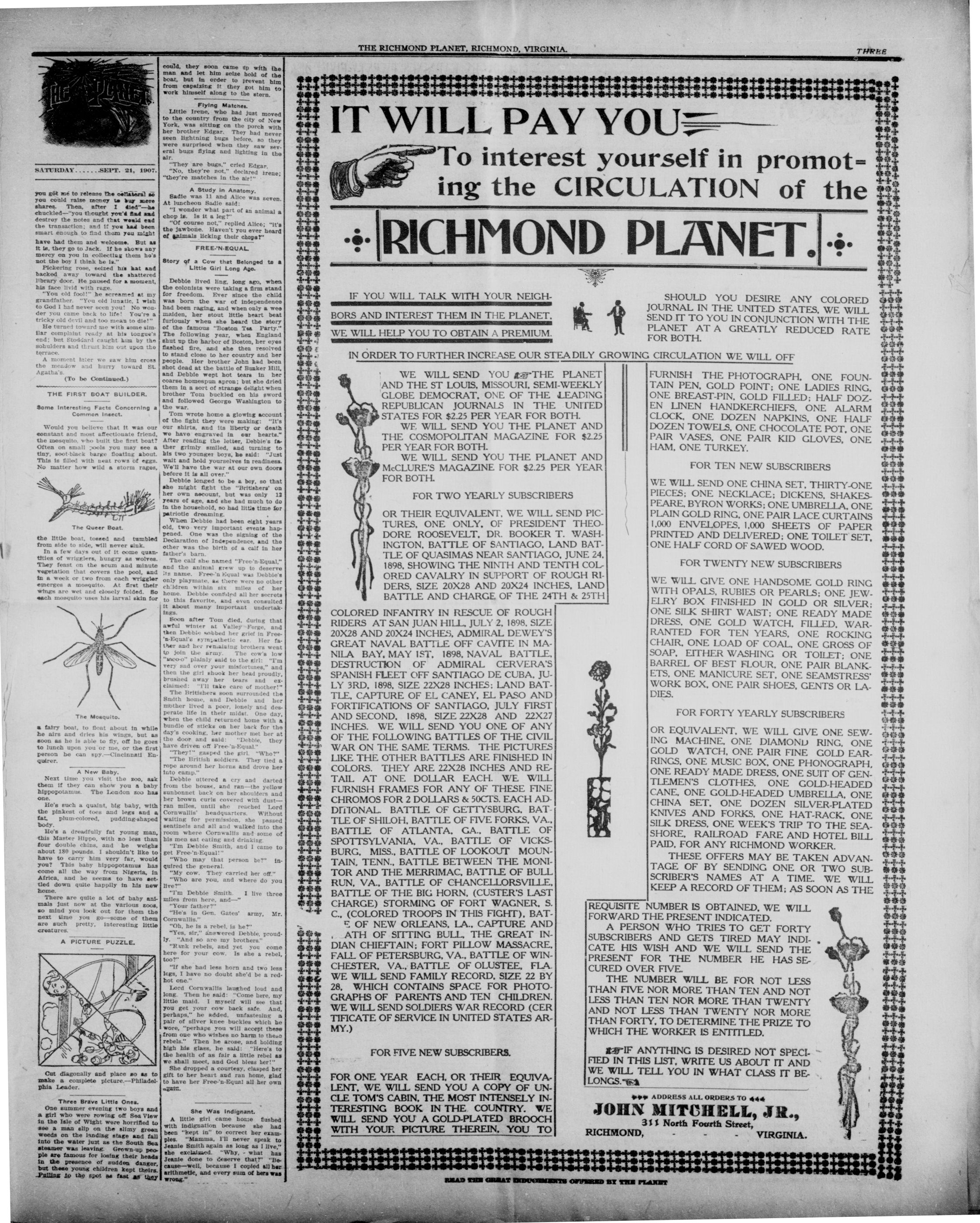
To interest yourself in promot ing the CIRCULATION of the
IN ORDER TO FURTHER INCREASE OUR STEADILY GROWING CIRCULATION WE WILL OFF
WE WILL SEND YOU THE PLANET AND THE ST LOUIS, MISSOURI, SEMI-WEEKLY GLOBE DEMOCRAT, ONE OF THE LEADING REPUBLICAN JOURNALS IN THE UNITED STATES FOR $2.25 PER YEAR FOR BOTH.
WE WILL SEND YOU THE PLANET AND THE COSMOPOLITAN MAGAZINE FOR $2.25 PER YEAR FOR BOTH.
WE WILL SEND YOU THE PLANET AND McCLURE'S MAGAZINE FOR $2.25 PER YEAR FOR BOTH.
OR THEIR EQUIVALENT, WE WILL SEND PICTURES, ONE ONLY, OF PRESIDENT THEODORE ROOSEVELT, DR. BOOKER T. WASHINGTON, BATTLE OF SANTIAGO, LAND BATTLE OF QUASIMAS NEAR SANTIAGO, JUNE 24, 1898, SHOWING THE NINTH AND TENTH COLORED CAVALRY IN SUPPORT OF ROUGH RIDERS, SIZE 20X28 AND 20X24 INCHES, LAND BATTLE AND CHARGE OF THE 24TH & 25TH
READ THE GREAT ENDUCHMENTS OFFERED BY THE PLANET
THE RICHMOND PLANET, RICHMOND, VIRGINIA
IF YOU WILL TALK WITH YOUR NEIGH-
```markdown
```
FOR TWO YEARLY SUBSCRIBERS
FOR FIVE NEW SUBSCRIBERS
REQUISITE NUMBER IS OBTAINED, WE WILL FORWARD THE PRESENT INDICATED. A PERSON WHO TRIES TO GET FORTY SUBSCRIBERS AND GETS TIRED MAY INDICATE HIS WISH AND WE WILL SEND THE PRESENT FOR THE NUMBER HE HAS SECURED OVER FIVE. THE NUMBER WILL BE FOR NOT LESS THAN FIVE NOR MORE THAN TEN AND NOT LESS THAN TEN NOR MORE THAN TWENTY AND NOT LESS THAN TWENTY NOR MORE THAN FORTY, TO DETERMINE THE PRIZE TO WHICH THE WORKER IS ENTITLED.
IF ANYTHING IS DESIRED NOT SPECIFIED IN THIS LIST, WRITE US ABOUT IT AND WE WILL TELL YOU IN WHAT CLASS IT BELONGS.
A man in a suit talking to a woman in a chair.
LANET
EEKLY
READING
UNITED
TH.
T AND
R $2.25
T AND
YEAR
ND PIC-
THEO-
WASH-
D BAT-
JUNE 24,
TH COL-
BLEUG RI-
LAND
& 25TH
花
REQUIRED FOR WAI
SHOULD YOU DESIRE ANY COLORED JOURNAL IN THE UNITED STATES, WE WILL SEND IT TO YOU IN CONJUNCTION WITH THE PLANET AT A GREATLY REDUCED RATE FOR BOTH.
FURNISH THE PHOTOGRAPH, ONE FOUNTAIN PEN, GOLD POINT; ONE LADIES RING, ONE BREAST-PIN, GOLD FILLED; HALF DOZEN LINEN HANDKERCHIEFS, ONE ALARM CLOCK, ONE DOZEN NAPKINS, ONE HALF DOZEN TOWELS, ONE CHOCOLATE POT, ONE PAIR VASES, ONE PAIR KID GLOVES, ONE HAM, ONE TURKEY.
WE WILL SEND ONE CHINA SET, THIRTY-ONE PIECES; ONE NECKLACE; DICKENS, SHAKESPEARE, BYRON WORKS; ONE UMBRELLA, ONE PLAIN GOLD RING, ONE PAIR LACE CURTAINS 1,000 ENVELOPES, 1,000 SHEETS OF PAPER PRINTED AND DELIVERED; ONE TOILET SET, ONE HALF CORD OF SAWED WOOD.
FOR TWENTY NEW SUBSCRIBERS
WE WILL GIVE ONE HANDSOME GOLD RING WITH OPALS, RUBIES OR PEARLS; ONE JEWELRY BOX FINISHED IN GOLD OR SILVER; ONE SILK SHIRT WAIST; ONE READY MADE DRESS, ONE GOLD WATCH, FILLED, WARRANTED FOR TEN YEARS, ONE ROCKING CHAIR, ONE LOAD OF COAL, ONE GROSS OF SOAP, EITHER WASHING OR TOILET; ONE BARREL OF BEST FLOUR, ONE PAIR BLANKETS, ONE MANICURE SET, ONE SEAMSTRESS' WORK BOX, ONE PAIR SHOES, GENTS OR LADIES.
FOR FORTY YEARLY SUBSCRIBERS
OR EQUIVALENT, WE WILL GIVE ONE SEWING MACHINE, ONE DIAMOND RING, ONE GOLD WATCH, ONE PAIR FINE GOLD EARRINGS, ONE MUSIC BOX, ONE PHONOGRAPH, ONE READY MADE DRESS, ONE SUIT OF GENTLEMEN'S CLOTHES, ONE GOLD-HEADED CANE, ONE GOLD-HEADED UMBRELLA, ONE CHINA SET, ONE DOZEN SILVER-PLATED KNIVES AND FORKS, ONE HAT-RACK, ONE SILK DRESS, ONE WEEK'S TRIP TO THE SEASHORE, RAILROAD FARE AND HOTEL BILL PAID, FOR ANY RICHMOND WORKER. THESE OFFERS MAY BE TAKEN ADVANTAGE OF BY SENDING ONE OR TWO SUBSCRIBER'S NAMES AT A TIME. WE WILL KEEP A RECORD OF THEM; AS SOON AS THE
FOR TEN NEW SUBSCRIBERS
THREE
```markdown
```
```markdown
```
FOUR
THE PANET
Published every Saturday by JOHN MITCHELL,
JR., at 811 North 4th Street, Richmond Va.
JOHN MITCHELL, JR., - EDITOR.
All communications intended for publication
should be sent so as to reach us by Wednesday.
TERMS IN ADVANCE
One Copy, one year. $1.20
One Copy, eight months. 1.05
One Copy, six months. .80
One Copy, four months. 50
One Copy, three months. .40
Single Copy .05
ADVERTISING RATES
COMMUNICATIONS.—When writing to us to renew your subscription or to discontinue your paper, you should give our name and address myself otherwise; we cannot find your name on our books.
CHANGE OF ADDRESS.—In order to change the address of a subscriber, we must be sent the former as well as the present address.
Entered at the Post-Office at Richmond. Va., as second-class matter.
SATURDAY.....SEPT. 21, 1907
We have received the catalogue of the Richmond School of Elocution, Physical Culture, Fencing, Music and Languages. Prof. Bryan C. Buck is President and Principal.
We have received an invitation to the silver wedding of Rev. and Mrs. Adams, Wednesday, September 28, 8 P. M. at Danville, Va.
The announcement is made that Mr. Robert W. Taylor, formerly Financial Secretary of Tuskegee Institute has now opened an office in Wall Street. We wish him success and hope that he may secure the patronage of the public, but his venture is a risky one and rosy promises of profit to investors is hardly the way to begin the business. Wall Street is a delicate proposition and it requires years of experience to learn its ways. It is a good omen that Mr. Taylor has decided to undertake the task and we hope he may receive the right kind of encouragement and be able to acquire a full realization of all of his expectations.
PRESIDENTIAL INTERFERENCE
President Roosevelt is pursuing a policy that is as audacious as it is surprising. It has brought disaster to more than one statesman and if his popularity does not suffer as a result of his meddling in the affairs of not only states, but municipalities he will bear a charmed political life that will defy destruction.
Congressman Theodore E. Burton of Cleveland, Ohio gives to the public a letter from President Roosevelt of New York, endorsing him (Burton) and urging him to run for the position of Mayor of Cleveland against Mayor Tom L. Johnson. Secretaries Taft and Garfield are said to have given similar advice, but they are residents of Ohio and could not be charged with interfering with the local affairs of another state.
It may be well to state that Congressman Burton has been spoken of as the administration's candidate to succeed Senator J. B. Foraker in the United States Senate. All of these things tend to show the way affairs are drifting. The distinguished occupant of the White House has done much to make himself popular, but it seems that he is persistently drawing upon the stored up supply in a way that indicates that sooner or
---
later he will be the worst hated man in the United States.
His enemies are in ambush, but a temporary political defeat of either himself or his policies will bring them out of the woods, in battalions and brigades.
He has reached the highest point in not only the public estimation but has attained a fame that the great men of the world might envy. Let us hope that he will be careful and take heed less in a few years, he may regret that he outlived his usefulness and was too careless of the warnings that now line every step of his pathway.
THOSE ONANCOCK CONVICTIONS
The trial of James D. Uzzle at Onancock, Va. resulted in his conviction and a jury of white men gave him three years in the Virginia Penitentiary. The trial of Samuel L. Burton followed and he was given ten years in the penitentiary. The trial of Sylvanus Conquest resulted in a verdict of ten years in the penitentiary.
The charge was that of inciting and causing a riot. The white men, who were guilty of having caused the trouble have not been even arrested, while the white men who are guilty of arson in that they burned to the ground the houses of both Burton and Uzzle are walking about the streets of Onancock, Va. with a self-satisfied smile on their countenances.
It will be seen that these colored men are no worse off than they would have been had they burned the town of Onanocock. They have not committed a felony and yet they have been given the punishment of a felon. This is why we were of the opinion that it would have been better for all of them to have remained in hiding until the excitement had subsided. As it is now, they are unable to give the heavy bail that would have been required of them and they are forced to spend months within the narrow confines of the jail at Hampton.
It seems to us that a speedy trial of them was like forcing them into the very condition that they wished most to avoid, while the failure to get a change of venue was as disastrous to their cause as would have been summary punishment at the hands of the mob. It is a long chase to freedom and yet we are of the opinion that it is in sight. The case is especially significant for these men represent the new type of Negroes. They are educated, industrious and they were of positive benefit to the community in which they lived.
Uzzle is said to be a graduate of the Hampton Normal and Agricultural Institute and it is known that the kind of instruction inculcated there does not make the graduates candidates for either the jails or the penitentiaries. We feel that we are safe in saying that the penitentiary of Virginia was not built for men of this type. They have been railroaded to the state institution so to speak and their summary entrance therein can only be checked by the mandates of the Supreme Court of Appeals of this state.
If they have able attorneys, there is but little doubt, but what success will crown their efforts. It is indeed a peculiar condition of affairs in this state, when a man of the standing of J. D. Uzzle and a merchant of the type of S. L. Burton cannot secure an even chance before the courts of this state. We know the days of suffering to which they have already been subjected. We realize the moments of anguish, the times when they did not know what to do or what course to pursue in the face of conflicting advice.
While they suffered, what must have been the feeling of their families? Colored people are emotional but many of them are scared when trouble arises. It is then that a cool temperament is necessary and the strongest nerves must be brought in to play. We do not like the idea of leaving one's property to a mob. A man's home is his castle and he has the right to defend it. It is getting so down here now, that it is regarded as high treason for a colored man to own a shot-gun and a repeating rifle and yet conditions are such that it is well nigh suicidal not to own both.
They are useless unless there is a man with nerve enough to use them. We do not have any fear of the upper or better class of white people. It is the hoodlum white element that becomes as uncontrollable at times as do the hoodlum Negroes. Both can be controlled only by fear and the danger of losing that worthless life that really is a menace to the community in which they live.
The industrious, business, colored people had better take warning by this Onancock outburst. They had better see to it, that the conditions there do not spread to other sections of Virginia. The punishment meted is all that could have been expected by the most depraved colored man in Virginia, even if guilty. In this case innocent colored men of respect ability have been unceremoniously sent to the penitentiary, upon evi-
THE RICHMOND PLANET. RICHMOND. VIRGINIA
dence that would not have convicted a yellow dog.
So filmsy was the testimony submitted that even the newspaper correspondents declared that it was insufficient to convict. The fact is that they were innocent of any wrong doing and being strong in their own innocence these colored men took the first opportunity to surrender themselves to the authorities. They could not understand that evidence weighs but little as against race prejudice and now they are within the shadow of the penitentiary walls, where lots of money and much ability can alone save them from a fate, which to men of their standing is "worse than death."
It is a sad ending. Of course there is but one thing for Christian people to do and that is to point them to "the Lamb of God, who taketh away the sins of the world." This will be a consolation to people of our religious tendencies. To our minds, it will require something more than this while battling in this world of sin and sorrow. The financial artillery of this commonwealth is now levelled against these men. They are innocent and this fact must be established in a court of law.
The very property needed for the defense has been destroyed by the fire fiends and thus by one fell blow, the ammunition chests of the defense have been destroyed. These men should not be sent to the penitentiary. It was not built for people of their kind. The outbreak in Onanceck was the result of an unreasoning passion.
The fate of these men rests with the liberal minded white men of this commonwealth. If they say they shall go free, that decree will be so recorded. It will be well for the influential men of this commonwealth to "get busy" and utilize every influence at their command upon Judge Blackstone, the Commonwealth's Attorney and Gov. Claude A. Swanson at Richmond.
These men are innocent of the crime with which they stand charged. The charge has not been proved and it is evident that they should be permitted to walk again in the sunlight as free men and not kept penned up in the Elizabeth City County jail at Hampton, Va.
AGED OFFICER DEAD
Admiral Walker Is Suddenly Called
Away In Maine.
YORK BEACH, Me, Sept. 18,—Rear
Admiral John G. Walker, U. S. N.
retired, died very suddenly at the home of
a friend at High Pasture, York
Cliffs. Admiral Walker was seventy-
two years of age and a native of New
Hampshire. He was the promoter of
the famous squadron of evolution
which became known as the "white
squadron" and of which he was
appointed commander.
Admiral Walker had been ill for
several days, but his death was quite
unexpected. He had been spending
several weeks with his family at the
cottage of Miss S. A. Pickering of Salem,
Mass. Death was due to heart
disease.
It is the understood intention of the
admiral's family to have the body
cremated, after which the ashes will be
sent to Washington for interment at
the national capital.
Rear Admiral Walker was seventy-
two years old and was retired with the
rank of rear admiral after forty-nine
years on the active list. He saw dis-
tinguished service during the civil war
and commanded several important
squadrons during his naval career.
CASSIE CHADWICK BLIND
Wrecker of Oberlin National Bank
Stricken In Prison.
COLUMBUS, O., Sept. 18.—While engaged in conversation with her son in the Ohio penitentiary, where she has been confined for two years, serving a ten years' sentence for wrecking the Oberlin National bank, Mrs. Cassie Chadwick, former exponent of high finance, who represented herself as the daughter of Andrew Carnegie and victimized dozens of Ohio and eastern bankers and capitalists to the extent of millions through loans on bogus securities and jewelry, suffered a nervous collapse that almost cost her life and left her temporarily stone blind.
Wild with anxiety, her son, who had come down from Cleveland to visit her, stood over the bed urging the physician to do his best to save her. Under the strong restoratives Mrs. Chadwick was revived within twenty minutes, but was very weak and sightless.
WHI Prosecute Bottle Thrower.
ST. LOUIS, Sept. 18.—President Johnson of the American league has arrived here to pro-execute Hugo Dusenberg, the boy who threw a bottle which hit Unique Billy Evans on Sunday. Johnson says he intends making an example of the case, as he wants bottle throwing and similar rowdism at baseball games suppressed. Evans is doing well.
Pettibone Too III For Trial.
BOISE, Ida, Sept. 18.—George A. Pettibone was unable to appear in the district court to have his case set for trial. An aufdavit of the attending physician states that Pettibone is suffering from ulcer of the bladder, which unless soon checked will prove fatal. It says an operation may be necessary, but fears the patient will be unable to survive it.
After Roosevelt Taft and Hughes.
CHICAGO, Sep. 18.—Having completed its poll of New England in the series covering all sections of the United States, the Chicago Tribune says that the most overwhelming sentiment was expressed in favor of the continuance of President Roosevelt's policies. After Roosevelt, Secretary Taft and Governor Hughes were shown to be the most popular.
FABULOUS EARNINGS
Standard Oil In Eight Years Made $490,315,934.
GOVERNMENT WOULD WIPE IT OUT
Suit to Dissolve Gint Monopoly Discloses For First Time Enormous Profits Obtained in Production of Petroleum.
NEW YORK, Sept. 18.—Sensational disclosures regarding the fabulous earnings of Standard Oil were brought out at the hearing in the suit of the United States government to dissolve the corporation. Adroit questioning drew from the reluctant lips of Clarence G. Fay, resident controller of the Standard Oil Company of New Jersey, the admission that in eight years the Standard Oil's total profits amounted to nearly $500,000,000. Mr. Fay was also forced to admit that in 1899 the profits were nearly $80,000,000 instead of $34,000,000, as set forth on the books of the company. The Standard Oil managed to cover up its great earnings in that year by deliberately
FRANK B. KELLOGG. falling to credit the earnings of nineteen subsidiary companies that contributed vast sums to the parent corporation.
This is the first time the company's earnings have been made public.
A list of securities owned by the Standard Oil Company of New Jersey presented shows that that corporation possesses 9,900 shares of the stock of the Standard Oil Company of Indiana, which company was recently sentenced by Judge Landis in Chicago to pay a fine of $29,240,000.
With the calling of Charles M. Pratt, secretary of the Standard, to the witness stand efforts were made by the government officers conducting the case to throw light on the formation of the company.
Frank M. Kellogg, chief of the government's counsel, examined Mr. Pratt at length on the processes by which the present Standard Oil company was developed, though Mr. Pratt said he could give little information on the subject. Mr. Kellogg produced a statement furnished by the Standard Oil company giving a list of companies in which it owned securities and the amounts.
Then came the sensation of the hearing, when Mr. Kellogg forced Mr. Fay to admit the earnings of the Standard Oil company from the year 1890 to 1906 to be the colossal amount of $490.,315,334. The total profits or net earnings of the oil trust for the eight years astounded the few auditors in the courtroom, Mr. Kellogg went further and impressed upon the court the fact that every cent of this vast sum came directly as the result of the oil trust's absorption of smaller concerns and the earning capacity of the organized system, which Mr. Fay admitted.
Canada Will Squre Japan.
OTTAWA, Sept. 18.-M. Ishii, the special envoy of Japan, arrived here today, and the whole subject of Japanese immigration is being discussed between the premier and himself. The policy of the Dominion is to reduce oriental immigration to the minimum, and Japan is willing to agree to this. The damage which has been caused by the rioters will be paid by the Dominion. Vancouver will afterward be charged with the amounts by the Ottawa authorities.
College Boys Had Tombstone.
NORTHAMPTON, Mass., Sept. 17.—After being missed four years the headstone which stood more than a quarter of a century over the humble grave of Mrs. Ellen M. Mirick in a cemetery near Amherst has been found by State Policeman James McKay in the Delta Kappa Epsilon fraternity house at Amherst college. The husband of the woman has searched long for the missing headstone.
Preachers to Form a Union
Chicago Rejects New Charter. CHICAGO, Sept. 18. -Present indications are that the proposed new charter for the city has been rejected by a majority of from 40,000 to 50,000.
State Constable Murdered
READING, Pa., Sept. 16.—Timothy Kelleher, a member of the state constabulary, who was recognized as one of the bravest and best officers in the organization, was stabbed to death here late at night by one of two Italians he was attempting to arrest for assaulting a young woman. The body of the officer was found on the banks of the Schuylkill river.
TWENTY-FIVE DEAD.
Head-on Collision on Boston and Maine Road.
DISASTROUS WRECK AT CANAAN, VT
Excursionists From Sherbrooke, Returning Over Canadian Border, Meet Death and Injury Near White River Junction.
WHITE RIVER JUNCTION, Vt., Sept. 18. — Twenty-five and perhaps more people, mostly excursionists returning from the Canadian provinces, met death and many others were injured at about daylight in a fearful train wreck, due to a head-on collision on the Concord division of the Boston and Maline railroad about four miles west of Canaan station. The badly injured numbered nearly thirty, some of whom, it is feared, may not survive. Following is a partial list of the dead: Annie St. Pierre, Isle Vert, Que; Mrs. E. T. Briggs, West Lebanon, N.H.; Fred M. Phelps, Ochiltree, Tex.; Mrs. M. E. Warren, Haverhill, Mass.; Mrs. F. C. Blake, South Corinth, Vt.; Timothy Shaugnessey and his wife, Castle Bar, Que; Mrs. John Barrett and her daughter, Manchester, N.H.; Mrs. Philip Gagnon, Sherbrooke, Que; Miss Alvina Giron, Nashua, N. H.; J. M. Congdon, 133 Summer street, Boston; infant child of Ervin Gifford, Concord, N. H.; Mrs. Webster, dressmaker, living in Massachusetts, and five others, unidentified.
Six victims just identified are: Dominick Benoit, Lowell, Mass.; C. E. Derby, Boston; Mrs. L. C. Blake, Somerville, Mass.; H. L. Hould, Manchester, N. H.; H. D. Stevens, Musquodoboit Harbor, N. S., and Annie St. Pierre, Isle Verte, Que.
At the Mary Hitchcock hospital at Hanover Miss Albina Juron of Nashua, N. H., lies internally injured and may die.
A train of four cars, well filled with fire, sleepy excursionists, nearly all of whom had been spending the day at the fair at Sherbrooke, Quec., 160 miles over the Canadian border to the north, had rounded a curve at lively speed when the headlight of a freight locomotive flashed before the eyes of the engineer. In another instant there was a crash and both engines were lying together a mass of wreckage in the ditch beside the track. The baggage car, next to the passenger locomotive, had been driven back into the passenger coach, telescoping it and crushing the lives out of half a carload of people. At the same time nearly every one else in that car were injured. A few escaped, but those who were in the sleeping car in the rear were saved from death by the more sturdy qualities of their car.
The accident occurred just as the dawn was showing in the east. The moment after it happened train hands who had escaped injury and passengers in the sleeping car were looking upon one of the worst wrecks ever seen in New Hampshire.
It is estimated that both trains were going at a speed of thirty to forty miles an hour. There was time to put on the brakes, and then both engine crews jumped, escaping injury.
Walked Long In Darkness
Walked Long In Darkness.
NEW YORK, Sept. 17.--After serving twenty-five years of a life sentence for the murder of his wife Michael Hackett, a former New York policeman, walked out from the gray gloom of Sing Sing prison into sunshine and freedom under a parole. During all the years he has not had a glimpse of the outside world, and all of his impressions had been formed from occasional papers and pictures. He had never seen a trolley nor an automobile, and a skyscraper was an imagined mystery. Even the dresses of the women are novelties and objects of curiosity to him.
Standing of the Baseball Clubs.
Standing of the Baseball Clubs.
NATIONAL LEAGUE.
Chicago 97 L. 18 P.C.
Pittsburgh 97 38 .718
New York 81 54 .600
Philadelphia 73 59 .533
Brooklyn 63 73 .468
Cincinnati 55 73 .411
Boston 52 71 .391
St. Louis 41 96 .390
AMERICAN LEAGUE.
W. 81 L. 18 P.C.
Philadelphia 80 59 .600
Detroit 80 54 .600
Chicago 79 57 .581
Cleveland 77 59 .565
New York 74 59 .477
Boston 58 79 .452
St. Louis 57 78 .422
Washington 43 83 .395
Peace Protocol Signed.
WASHINGTON, Sept. 18.—A protocol was signed at the state department by diplomatic representatives of the five Central American republics accepting the invitation of the United States and Mexico to meet here at an early date to negotiate an agreement providing for permanent peace between the countries represented. The protocol was signed in the presence of Acting Secretary Adee of the state department and Minister Godoy, charge d'affaires of the Mexican embassy.
"Dig Her Deep Through Dixie."
ST. LOUIS, Sept. 17.—Three thousand trained voices will lead in the song "Dig Her Deep Through Dixie" when President Roosevelt reaches St. Louis on his way to the deep waterways commission in Memphis, and it is probable that 5,000 persons will join in the chorus. This melody of the new war song is that of "Dixie."
Child Commit Suicide
ST. ALBANS, Vt, Sept. 16—Stephen Flinn, the eight-year-old child of Silas W. Flinn, formerly judge of the city court, committed suicide by hanging. The boy had been rather eccentric for some months and disappeared. After a search his body was found banging from a beam in his father's barn.
Cobbossecontee Hotel Burned
Cobbissette Hotel Burned.
LEWISTON, Me., Sept. 18. — The Cobbissette colony summer hotel, together with two cottages and outbuildings, a boathouse and a number of boats, all belonging to Harry R. Money of New York, were burned near here last night. Mr. Money estimated his loss at $17,000. The hotel had been closed since Saturday.
With a year's subscription to the (Name of Your Paper) and
The Philadelphia Press
The razor is made from the best Sheffield Steel, hardened and tempered thermometrically and guaranteed.
It's Particular Merit is its
It's Particular Merit is its Shaving Quality
$3.50
BUYS
The Philadelphia
ONE YEAR daily, regular
Fremont Razor
Your Favorite Home N
Value
ALL FOR
$3.50 C
Mailed immediately upon
subscription
Order To-day
ONE YEAR daily, regular price $3.00
Fremont Razor $2.00
Your Favorite Home Newspaper $1.50
Mailed immediately upon receipt of your subscription.
TWENTY-SEVEN JAPS DEAD.
Disastrous Explosion on Warship
Kashima Off Kabuto Island.
TOKYO, Sept. 18- While the battle-ship Kashima was engaged in target practice off Kabuto island a ten inch powder cartridge exploded in one of her guns mounted in barbette while it was being loaded owing to the fact that the gun had become overheated. Twenty-seven men, including Lleutenant Artila, the commander of the gun squad, were killed and eighteen were wounded.
The dead include five officers. Two officers and six men were severely and two officers and six men were slightly wounded.
The accident was due to the explosion of powder catching fire from gas emitted from the breech of the gun when it was opened for the purpose of reloading. The hull of the ship was uninjured.
The Kashima is a ship of 16,400 tons and was built in England in 1905. She carries four twelve-inch and four ten-inch guns, the twelve inch guns in pairs and the ten inch singly in barbette. Her complement is 980 men.
Secretary of War Reluctantly In The Field as Candidate In 1908.
Field as Candidate in 1908.
SAN FRANCISCO, Sept. 18.—A special dispatch from Seattle, Wash., says that the last few minutes of Secretary of War Taff's time before he sailed on the steamship Minnesota for Japan on his around the world trip were devoted to a conference with Representative Duncan E. McKinlay of California, who had this to say of Mr. Taff's presidential aspirations:
"Mr. Taff is reluctantly in the field as a candidate for the presidency. He considered the situation most deliberately and carefully. He participated in the great work of Mr. Roosevelt and is in full harmony with it. No one doubts this.
"Mr. Taff possesses the ability and the disposition to carry on Mr. Roosevelt's policies and to inaugurate policies of his own. Once definitely in the field, he has thrown himself into the situation with his whole heart and soul."
MARK TWAIN HIS QUEST.
H. H. Rogers Entertains Author at His Summer Home...
FAIRHAVEN, Mass., Sept. 18. — Mark Twain was the guest of Henry H. Rogers at the summer residence of the latter in this town. The author came over from New York on the New Bedford line steamboat. During the forenoon Mr. Rogers and his guest went for an automobile ride, Mr. Rog-
TAFT'S LAST WORD.
is its Shaving Quality
BUYS
elphia Press
regular price $3.00
$2.00
time Newspaper $1.50
value $6.50
FOR
Cash
upon receipt of your
description.
day—NOW!
ers acting as his own chauffeur in operating an electric victoria. Mr. Rogers slept well last night. He was in bed shortly before 8 o'clock, and this morning was up and about at the same hour. His plans contemplate as much rest and as little mental work as possible. It was on the advice of his physclans that he abandoned business cares and is taking a long rest.
THOSE FAIRBANKS COCKTAILS.
Secretary Loeb Denies That President or Himself Ordered Liquor.
OYSTER BAY, N. Y., Sept. 18. Because of the widespread publicity given the statement of Bishop Berry of Detroit that either President Roosevelt or Secretary Loeb and not Mr. Fairbanks was responsible for the cocktails served at the luncheon tendered them by the vice president at Indianapolis, Secretary Loeb has issued the following formal statement in denial: "The statement is too absurd to be given any credence. Neither the president nor his secretary either directly or indirectly ordered anything of any kind at the lunch in question or at any other lunch where they were guests."
Jamestown Fair Director Resigns.
NORFOLK, Va., Sept. 18. In a letter addressed to the committee of directors which arranged a settlement of differences existing some weeks ago between himself and President Harry St. George Tucker of the Jamestown exposition James M. Barr requests to be relieved of his duties as director general. Continued conflict between Mr. Tucker and Mr. Barr over the social features of the exposition causes Mr. Barr's action. He claims he cannot continue in his position and maintain his self respect.
Kutenbunch Nominated at Trenton.
TRENTON, N. J., Sept. 18--Former Mayor Frank S. Katzenbach, Jr., of Trenton was nominated for governor by the Democratic state convention on the first ballot. The principal features of the platform are a declaration for a general house cleaning in state departments, for the taxation locally of main stem railroad property and the franchises of public utilities companies.
League Varsel In World
NEWCASTLE-ON-TYNE, Sept. 18.—The new Cunarder Mauretania left the Tyne for her first sea trial. After her trial the Mauretania will return to the builders' yard at Wallsend for her final fittings and furnishings. She is the largest vessel in the world, being 700 feet in length, three feet longer than her sister ship, the Lusitania. Her gross tonnage is 33,200.
THE PLANET
SATURDAY.....SEPT. 21, 1907.
Methodist Free Fight.
Petersburg, Sept. 14.—(Special.)—A row of serious character, which the police were called upon to suppress, and by reason of which nine arrests were made, occurred last night about ten o'clock in the African Methodist Episcopal Zion church, colored, in Oak street, of which the Rev. Dr. J. A. Robins is pastor. A quarterly conference of the church was being held at the time, with Presiding-Elder M. P. Hawkins present.
The trouble is said to have originated about the church books. James H. Brooks, the church clerk, says that two months ago, at a meeting of the negotiation, he tendered his resignation as clerk, which was laid on the table. Last Thursday he asked for the books which he promised to deliver up at the conference meeting last night. He did offer to give them up last night, but too late for reports to be made from them.
PASTOR ROBINS REFUSED THEM
Then followed a lively discussion and great confusion, resulting in the row, in which blows were given and received. A call was sent in for the police and arrests followed. Warrants were sworn out against Pastor Robins, Robert Warnen, D. B. Cornish John Urquhart and James H. Brooks for assault and breach of the peace, and for Nannie Venable, Martha Alston and Elvira Parham for conduct to disturb the meeting.
Pastor J. A. Robins claims to have been struck on the head with a stick by D. B. Cornish; James H. Brooks declares he was struck by Pastor Robins, after the latter left the pulpit; Robert Warden says he was struck on the mouth by the pastor; Richard Black was struck with a sword while acting as peacemaker. Other blows were struck and the scene for a while was one of great noise and disorder.
The persons arrested, including Pastor Robins, were all taken to the police station, where they were bailed in the sum of $50 each to answer in court. No one was hurt much.
Pastor Tartt, of Harrison-Street church preached in the Oak-Street church by invitation several Sundays ago, and this occurrence, it is reported, gave offense to a portion of the Oak-Street congregation.
The parties all appeared in the mayor's court to answer the warrants this morning. It appeared from the evidence that the pastor was leaving the church, that the time the trouble occurred, being unable to preserve order. Many witnesses testified to seeing him draw back to strike Brooks and to strike Warden, while attempting to keep the two men apart a man named Urquhart was thrown upon the floor during the disorder.
EXCEPTIONS TAKEN.
Counsel for the complainant deacons in court proceedings against Rev. Ell Tartt and others of the Harrison-Street (colored) Baptist church, have excepted to all of the votes cast in the election held in the church last Monday night by persons whose names were not enrolled on the church books as members. If the exceptions are sustained the result of Monday night's election, in which Pastor Tartt was sustained and the action of the congregation in removing and expelling the deacons and other officers was upheld, may be reversed. But it is claimed by the defendants that the church roll as furnished the commissioner was incomplete; that the names of many members (who were allowed to vote) had been left off of it through carelessness in keeping the records, and that as members they were legally entitled to vote.
The case will come up in the hustings court for hearing and in the meantime, until settled, the church will remain closed and the meeting appointed by the court from next Monday night for the election of officers will not, as agreed by court, be held.
Johnson Bests Burke
Bridgeport, Conn., Sept. 16.—For the second time within a week a negro fighter has triumphed over a white man. Jack Johnson the burly colored man, had all the better of his six-round bout with "Sailor" Burke last night.
The mill took place in Smith's Theater and the house was packed and jammed. Sporting men from all parts of the country were present. Al Kaufmann, the California fighter, issued a challenge to the winner of the bout. Johnson weighed 185 pounds and his opponent was twenty pounds lighter.
In the first round Johnson had a slight lead. The colored fighter rained ebd blow after blow on the white man, with telling effect, while Burke's blow did not seem to have the least effect on the black man.
SENDS. BURKE TO FLOOR
Twice in the second round Johnson sent Burke to the floor and had all the better of the round. In the third round Burke rushed Johnson, and then clinched to avoid punishment, and at the end the white man seemed to be very tired.
There was more clinching in the fourth and then Burke landed some hard blows, and Johnson seemed worried. Before the round ended Johnson sent Burke down three times. In the fifth round Johnson landed a stinging blow on Burke's jaw, and Burke replied in kind.
Burke was sent to his knees and Johnson then tried to put him out, but failed. In the last round John-
son tried hard to land the fatal blow, but Burke kept clinching to avoid punishment, and when the bell rang both men were on their feet. The negro had all the best of every round of the bout and Burke was cheered for staying the limit.
Soldiers May Offend.
(Washington, Post Sept. 13, 1907)
Gen. Oliver, Acting Secretary of War. yesterday issued an order that will probably cause a commotion in New York, his home State. It provides for the relief of a number of regiments that have been serving in the Philippines for more than the allotted term of two years, and the point of interest is found in the fact that included in the returning organizations is a negro regiment—the Twenty-fourth Infantry.
With the dispatch to the Philippines of the Twenty-fifth Infantry some months ago the United States was left without any negro troops, except a few short term cavalrymen employed in the stables at the West Point Military Academy. When the proposition was made about two months ago to return the negro made to the department by Count men and other prominent persons representing communities where it was reported these troops were to be posted.
Gen. Oliver has settled the matter by ordering these soldiers into his own State. As a matter of fact, on February 15 next, according to the terms of the order, the Twenty-fourth Infantry is to sail from Manila for San Francisco and proceed by rail to New York. The headquarter's band, and two battalions, to be selected by the regimental commander, are to take station at Madison Barracks, near Watertown, and the remaining battalion at Fort Ontario, near Oswego.
CAVALRY TO BE SHIFTED
The other changes of importance recorded in the order are as follows: The First Cavalry, now at Fort Clark and Fort Houston, Tex., will sail from San Francisco September 15 to relieve the Third Cavalry in Manila. The Third Cavalry will sail from that port January 15 to take up the stations in Texas vacated by the First Cavalry. The Fourteenth Infantry will sail for Manila January 5, the Twenty-third Infantry February 5, the Fourth Infantry March 5, and the Seventh Infantry April 5. They will relieve the Twenty-fourth Infantry, which sails from Manila February 15. The Second Infantry will sail March 15 to take station at Fort Wayne and Fort Brady, Mich., and Fort Thomas, Ky. The Eighth Infantry will sail April 15 to take station at Fort McDowell and the Presidio of Monterey, Cal., and the First Infantry will sail May 15 next for Manila, to take station at Vancouver Barracks, Wash.
RELIEVE SHORT TERM MEN
Instructions are given to the commanding officers to relieve short-term men before the departure of their regiments for the Philippines.
Another paragraph of the order relieves the Twenty-second Infantry from duty at Fort McDowell and the Presidio of Monterey, Cal., July 1, when they are ordered to Alaska, taking station at Fort William H. Seward, Fort Liscum, Fort Egbert, Fort Gibbon, Fort St. Michael, and Fort Davis. They will relieve at those places the Tenth Infantry, which ordered to take station at Fort Benjamin Harrison, probably constituting the nucleus of the new brigade point.
The Nineteenth Infantry battalion at Fort Reno, Oklaho is ordered to Fort Mackenzie, Wyo. March 1, to relieve at that point the battalion of the Fourth Infantry, which is ordered to the Philippines.
Fort Reno, Oklaho, will then be placed in the charge of caretakers, and ultimately will be abandoned
Officers Elected.
The following officers were elected at the recent meeting of the Imperial Council. Ancient, Egyptian, Arabic Order, Nobles of the Mystic Shrine held at the Pythian Castle, North Third Street:
J. F. Wright, Imperial Potentate, Richmond, Va.; Charles Freeman, Deputy Imperial Potentate, Washington, D. C.; Eugene Phillips, Chief Rabban New York; David E. Sawyer Asst. Rabban, Pittsburgh, Pa.; A. T. Waller, Treasurer, Baltimore, Md.; J. H. Murphy, Recorder Baltimore, Md.; A. J. Harris, Assistant Recorder, Richmond, Va.; W. H. Severson, H. P. and P., Washington, D. C.; A. O. Coffin, Oriental Guide, Kansas City, Mo.; J. O. Bampfield, Imperial Lecturer, Washington, D. C.; J. T. Mc Cadam, Assistant Imperial Lecturer, New York; T. W. Collins, Ceremonial Master, Philadelphia, Pa.; T. A. Dodd, Assistant Ceremonial Master, Baltimore, Md.; W. A. Mason, Imperial Chief Exalted Pass, Baltimore, Md.; J. H. Levy, Imperial Marshall, Washington, D. C.; R. W. Anderson, Imperial Assistant Marshal, New York; A. T. Clark, Outside Guard, Richmond Va.; Nelson Walker, Inside Guard, Baltimore, Md.
Fire Started by Thieves.
HAZLETON, Pa., Sept. 18.—A fire which is believed to have been started by thieves and which threatened the destruction of the place occurred at Beaver Mendow, a mining town near here. The fire started in the general store of Curran Bros., destroying the building, and then spread to the residence of James Rowe, a mining superintendent, it being entirely consumed. The loss is estimated at $5,000. Beaver Mendow is without fire protection.
Thirty Drowned Near Tokyo.
TOKYO, Sept. 18.—Thirty persons were drowned and 100 houses burned at the Kosakabi mine, near Kotaro. A fire started in the mining works, and while attempts were being made to save the mine the water reservoir was broken, flooding a portion of the village. Many women and children were among the victims.
THE RICHMOND PLANET, RICHMOND, VIRGINIA
JOB DEPARTMENT
EXCURSION
We print Handbills, Quarter-Sheet posters, Tags, Tickets, Placard utes, Visiting Cards, Mourning Stations
WE HAVE
Our St
OF THE LATE
WE CAN PRINT A BILL AS SMALL
A Three-Sheet
AS LARGE AS A FRO
Our street-entrance is retired and fastidious. Lady being able to enter w
EXCURSION WORK OF ALL DESCRIPTIONS
OF THE LATEST STYLE BOND, FINE WRITING-FLAT AND LINEN PAPER, ENVELOPES ETC
Our street-entrance is retired and has no objectionable features, the most fastidious lady being able to enter without embarrassment or annoyance.
LONG DISTANCE TELEPHONE, 2213.
The Ozonized Ox Marrow Co.
(None genuine without my signature)
Charlie Ford Paul
153 E. KINZIE ST., CHICAGO, ILL.
Agents wanted everywhere.
It is thoroughly equipped to do all kinds of printing on short notice. We make a specialty of Society printing and work for Insurance Companies, such as Financial
HAS MAD DOG $CARE.
Seven Persons Bitten by Rabid Ani-
mal at Phillipsburg, N. J.
PHILIPSBURG, N. J., Sept. IS—This town has a genuine mad dog scare. Five victims of the dog have been sent to the Pasteur institute, Brooklyn, for treatment at the expense of the public treasury.
The patients are: Hugh Smith, seven years old, bitten on the arm; Lucy Wilhelm, aged seven years, hand lacerated; George Lutz, twenty-five years old, numerous bites and scratches on the legs; Milton Kohl, aged three years, bitten on the face and legs; James Caffrey, ten years old, bitten on the face and forehead. He is in the most danger of serious effects from the wounds.
Suddenly a mad dog ran through the town, snarling and snapping at persons and animals. He bit a number of persons, and then the cry of "Mind dog" was set up and a search instituted for the canine, which was caught and killed.
The head was sent to the Pasteur institute, and word came back that the dog had had rabies, and the officials were urged that those bitten be sent to Brooklyn for treatment. The police gathered the injured together and sent them. Notices have been posted and inserted in the newspapers ordering the owners of dogs to chain and muzzle them. All dogs found running at large will be killed.
FORD'S
HAIR POMADE
Formerly known as
"OZONIZED OX MARROW"
HAIR that it can be KINKY or CURLY
decorated consistent with its length.
known as "OZONIZED OX MARROW" and is
one of the preparations known to us that
can be used for hair preparation. It is
known as the most stubborn,
hursh, kinks or the most stub-
plable and easy to comb. These results
are usually sufficient for a man. If
bottles are usually sufficient for a woman,
prevents dandruff. If tomato removes
the scab, stops the hair from failing
nourishes the roots, gives it new life and
nourishes the roots, gives it new life and
harmless, it is to toilet necessary for ladies.
made has ness made and sold continuously
MARROW* was registered in the United
States as Agent Office, in 1961, in picture get
SOFT and FLLABLE. Beware of imitations.
put up only in 50 ct. size, and is only
signature Charles Ford. Presume has the
age all others. Furniture directions with
both persons. Furniture and drugstores and dealers. If your drugstores and dealers for you from his jobber or wholesale dealer or send us 50 cts. or one hundred $60 per person, or express payment to a pay post and express send postal or express money order, and send postal or express money order, Write your name and address plainly to
Cards, Policies, both straight life and benevolent, Physician's Certificates, Sick Cards, Application blanks, Agents Report Sheets, Rate Cards, etc.
HION WORK
arter-Sheets, Half and Whole
Placards, Society Cards, Min-
ing Stationery.
WE AN ELSE
WHICH WE WILL
Stock Roo
LATEST STYLE BOND, FI
AS SMALL AS A DODGER.
sheet Poster
A FRONT DOOR.
OUR PRESENT CORP OF EMPLOYE
IS WITHIN EASY REACH OF
ired and has no objectionable f
enter without embarrassment o
2213.
LING
HAIR P
MAKES
KINKY
HAIR
SOFT
REMOVES
DANDRUFF
AND
MAKES
IT
GROW
LONG
AND
LUXURIOUS
A Woman's Hair Make
If your hair is short. If you
your scalp is diseased, LING
make it grow, remove the dand
LINCOLN HAIR POMADEN
the finest toilet preparation o
for you to give it a trial and w
be so satisfactory that you will
Be sure and get the genuine
substitutes. For sale at all D
PRICE, 1
MANUFACT
The Lincoln Po
N WORK C
s, Half and Whole
Society Cards, Min-
ury.
is to please
give them
the lowest
with satis
AN ELEGANT
WHICH WE WILL SHOW A
Rock Room
STYLE BOND, FINE WRITTEN
AL AS A DODGER.
Poster
DOOR.
PRESENT CORP OF EMPLOYEES ARE
IN EASY REACH OF THE PUBLISHER
as no objectionable features, thou
out embarrassment or annoyance
LINCOLN
HAIR POMADE
MAKES
INKY
HAIR,
SOFT
MOVES
ANDRUFF
AND
MAKES
IT
ROW
LONG
AND
RIOUS
Woman's Hair Makes or Makes
hair is short. If your head is
no is diseased, LINCOLN HAIR
row, remove the dandruff and o
LINCOLN HAIR POMADE is high-
toilet preparation on the mark,
give it a trial and we feel conf
factory that you will recommend
and get the genuine and refuse
s. For sale at all Drug Stores
PRICE, 15 CENTS
MANUFACTURED BY
Lincoln Pomade
WHICH WE WILL SHOW ANY ONE DESIRING TO SEE THEM.
OUR PRESENT CORP OF EMPLOYEES ARE COMPETENT AND QUICK-WORKING. OUR OFFICE IS WITHIN EASY REACH OF THE PUBLIC, BEING WITHIN FIFTY YARDS OF BROAD ST.
LINCOLN
HAIR POMADE
MAKES
KINKY
HAIR
SOFT
REMOVES
DANDRUFF
AND
MAKES
IT
GROW
LONG
AND
LUXURIOUS
SOFTENS
THE
HAIR
AND
KEEPS IT
FROM
BREAKING
KEEPS
SCALP
FRESH
CLEAN
AND
WHOLESOME
A Woman's Hair Makes or Mars Her Beauty. If your hair is short. If your head is full of dandruff. If your scalp is diseased, LINCOLN HAIR POMADE will make it grow, remove the dandruff and cure scalp diseases. LINCOLN HAIR POMADE is highly perfumed and is the finest toilet preparation on the market. All we ask is for you to give it a trial and we feel confident the result will be so satisfactory that you will recommend it to your friends. Be sure and get the genuine and refuse weak and inferior substitutes. For sale at all Drug Stores.
The Lincoln Pomade Company.
NORFOLK, VA., U. S. A.
If your dealer does not keep it, send will send you a bottle by return mail. for particulars.
dealer does not keep it, send his name and
a bottle by return mail. Agents w
s.
Da
If your dealer does not keep it, send his name and 20 cents in silver and we
will give him a bottle by return mail. Agents wanted everywhere. Write
for particulars.
JURGEN'S SON
Before making your purchase you would do well to call at the most reliable furniture house in the city and see the fine line of
REFRIGERATONS,
MATTINGS,
OIL-CLOTHS
And in fact everything that is needed in house furnishings.
Of every description; also the latest designs in ROCKERS and special CHAIRS.
Our goods are the best for the price and the price is very low.
C. G. JURGEN'S SON,
ADAMS AND BROAD STREETS.
---
WORK OF ALL
OUR AIM
is to please our patrons and to
give them the best service at
the lowest prices, consistent
with satisfactory work.
ELEGANT I
SHOW ANY ONE DESIRING
from Embrace
ONE WRITING—FLAT AND
JOYEES ARE COMPETENT AND QUI
THE PUBLIC, BEING WITHIN F
features, the most
or annoyance.
FOR FUR
COLN
POMADE
SOFTENS
THE
HAIR
AND
KEEPS IT
FROM
BREAKING
KEEPS
SCALP
FRESH
CLEAN
AND
WHOLESOME
or Mars Her Beauty.
Our head is full of dandruff. If
COLN HAIR POMADE will
dandruff and cure scalp diseases.
HE is highly perfumed and is
in the market. All we ask is
we feel confident the result will
recommend it to your friends.
and refuse weak and inferior
Drug Stores.
5 CENTS.
PICTURED BY
made Company.
Daily to Baltimore.
On and after April 1st, 1907, sched ule via the popular York River Line will leave Richmond at 4:30 P. M. daily except Sunday, returning leave Baltimore at 5 P. M. daily except Sunday. Very low rates one way and round trip to Baltimore, Philadelphia and New York. It's the best way to reach Northern and Eastern points.
Excursions to Jamestown Exposition
Norfolk, Va. via Southern
Railway.
Commencing April 19th and continuing daily to November 30, 1907 Southern Railway will sell season sixty day, fifteen day and ten day excursion tickets to Norfolk, Va. and return at reduced rates account the above; and on Tuesday of each week coach excursion tickets, not good in parlor or pullman cars, will be sold at greatly reduced rates, limited seven days. Inquire of Southern Railway Agents.
We print Wedding Invitations, and High Class Stationery for Balls, Parties, Picnics and all entertainments of a social nature. We print Church Envelop.
ALL DESCR
us and to
service at
consistent
work.
We furnish "cuts" when des-
complete special work in our 1
in our line, call and see us and
T LINE OF S
DESIRING TO SEE THEM.
oraces a full
AT AND LINEN PAPER, ENVELOP
WE HAVE ONE OF THE
OF WOOD
Of Any Job Printing E
T AND QUICK-WORKING. OUR OFFICE
WITHIN FIFTY YARDS OF BROAD ST.
FOR FURTHER INFORMATION, AP
John Mitch
311 N. 4th St
FOR FURTHER INFORMATION, APPLY TO
John Mitchell, Jr.,
AIR LINE RAILWAY
SOUTHBOUND TRAIN. SCHED-
ULED TO LEAVE RICHMOND
DAILY.
9:10 A. M.—Local to Norlina, Raleigh, Charlotte, Wilmington, 2:20 P. M.—Sleepers and coaches, Savannah, Jacksonville and Florida points.
9:50 P. M.—Sleepers and coaches Atlanta, Birmingham, Memphis, Savannah, Jacksonville and Southwest.
NORTHBOUND TRAINS SCHED-
ULED TO ARRIVE RICHMOND
DAILY.
6:45 A. M., 5:10 P. M., 5:45 P. M.
H. S. LEARD, D. P. A.
Special Attention Given to Balls,
Suppers, Installations and Smok
ers at the Shortest Notice.
Your Patronage Solicited.
Refreshment Cars and Boat Privile
es Handled in Season.
Address all communications to
LLAM L. BANKS, 511 N. 3d St
Residence: 1312 N. 26th St.
ALL WORK GUARANTEED.....
Cards, Letters or Orders.
...Give us a trial, you will never regret it.
Address, Cor. Price and Jackson Sts.
RICHMOND, VA.
---
Railway.
WE HAVE ONE OF THE LARGEST ASSORTMENTS OF WOOD-TYPE Of Any Job Printing Establishment in the city.
SEABOARD
JOSHUA BANKS & SONS
EVERY FACILITY CONSISTENT
WITH FINE CATERING.
BLACKWELL & BRO.
Practical House and Sign Painters,
Graining and General Contracts
PLANET DEPOTS
NEW YORK CITY
W. H. Warrington, 71 W. 99th St.
W. H. White, 328 Columbus Ave.
R. Plummer, 100 W. 134th St.
Standard News Co., 131 W. 53d St.
Jews, 334 W. 52d St.
W. Linn, M. Meeke, 52 E. 132d St.
F. Green, 309 W. 52d St.
W. H. Jones, 249 W. 35th St.
W. B. Bee, 1 W. 134th St.
Clarence Bush, 851 Morris Ave.,
Bronx-Borough.
J. H. Parker, 144 W. 26th St.
Charles Devan, 1.1 W. 30th St.
W. J. Buckner, 150 W. 39rd St.
W. W. Johnson, 247 W. 47th St.
E. H. Mitchell, 152 W. 27th St.
Turner R. Robinson, 12-6th Ave.
E. A. Williams, 200 W. 63rd St.
Smith & Miles, 232 W. 41st St.
M. B. Wineglass, 322 W. 59th St.
PHILADELPHIA, PA.
J. H. Gray, 1233 Pine St.
Bishop Robinson, 1234 Melon St.
E. P. Mackens, 1116 Pine St.
James E. Warwick, 254 S. 11th St.
Mrs. R. Homser, 1040 Pine St.
William Parker, 681 Pine St.
Mrs. Lavinia Aidridge, 521 S. 12th.
Chas. A. George, 4063 Market St.
F. A. Stewart, 1730 Federal St.
PITTSBURG, PA.
F. H. Harrison, 1310 Wylie Ave.
Jos. Evans, care Jones & Laughlin.
E. K. Thumma, 1402 Wylie Ave.
FIVE
opes, Note and Letter Paper
Bill-heads, Monthly State
ments, Business Cards, Fin
ancial and Order Books
Circulars, Check-books, Pam
phlets.
SAMPLES
Line
PES, ETC
LARGEST ASSORTMENTS
OD-TYPE
Establishment in the city.
PLY TO
nell, Jr.,
Richmond, Va.
BOSTON, MASS.
I. D. Robbins, 155 Cambridge St.
Oxford, MA, 01050 Ave.
W. White, 1100 W. 11th St.
John Debona, 610 Church St.
T. E. W. Perry, 2 Jenos Place.
CHICAGO, ILL.
E. H. Faulkner, 8104 State St.
BROOKLYN, N. Y.
Lee Ricks, 782 Fulton St.
William A. Dabney, 3 Quincy St.
CHARLESTON, W. VA.
L. C. Barrar, 601 Brooks St.
ASTORIA, L. I.
Frank R. Wood, 144 Broadway,
ATLANTIC CITY, N. J.
L. H. Singleton, 20th and E 6th.
Southwestern Drug Co.
732-2d Street, ! W.
COVINGTON, VA.
Daniel Braxton, Box 91.
NEWPORT NEWS, VA.
Freddie Smith, 1358-29th St.
E. J. Jefferson, 1211-30th St.
TARPORO, N. C.
V. E. Heward.
WILMINGTON, N. C.
William H. Moore.
STAUNTON, VA.
Wm. C. Johnston, 111 B. Main St.
LYNCHBURG, VA.
James Wingfield, 422-12th St.
Charles Morgan, 702 Taylor St.
HAMPTON, VA.
John M. Phillips.
DANVILLE, VA.
O. P. Clark, 233 N. Union St.
PORTSMOUTH, VA.
H. S. Cooper, 1332 County St.
JACKSONVILLE, FLA.
John H. Johnson, 210 Bridge St.
PROVIDENCE, R. I.
Douglass A. A. P. Agency.
DEMOPOLIS, ALA.
BALTIMORE, MD.
Henry Albart, 203 Richmond St.
PASSAIC, N. J.
Robt Lee Greenwood, 142 Myrtle Ave
ASBURY PARK, N. J.
Geo W. Moody, 1183 Springwood Ave
A. Haynes, 1103 Springwood Ave.
ST. AUGUSTINE, FLA.
W. A. Fleming.
BURLINGTON, N. J.
Joseph Anderson, 120 E. Delaware ave
WICHITA FALLS, TEX.
F. L. Lindsey, Box 72.
MEMPHIS, TENN.
Standard? News Company.
RECORDER
SATURDAY.....SEPT. 21, 1907.
Jokes FROM THE Jokers
HIS LAST CALL.
He was a canvasser in the cheap musical instrument line, and he was not easily discouraged. As he knocked at this particular door he remembered that he had called before. Moreover, he had received a point-blank "No!" But he thought he knew the value of that from a woman.
"Oh," remarked the lady of the house, who had evidently come straight from the wash-tub, "it's you again, is it? Come in!"
Hopefully he accepted the invitation, and followed his guide down the dimly-lighted passage. Suddenly a door opened on his right, and, before he was aware of it, he was ushered into a room full of howling youngsters, who redoubled their efforts at the sight of a stranger.
Then the canvasser turned to find his retreat cut off. The door was locked behind him.
The woman went on with her washing, and it was a very dejected individual she led to the front door an hour or so later. "Now," she remarked, sweetly, "if you still feel convinced that I require a little more music in the house, you might call again." But he hasn't been seen in that street since.
A Good Reminder
Smith dropped into Jones' office about quitting time, his usually placid face marked with care.
"Hello, old man," said Jones, "you look worried."
"Am worried. Wife told me to bring out something to night. Can't think, what the fool thing was."
"Oh. I can help you," said Jones. "Get your mind off your trouble and smoke. Tobacco will fetch it. Here, try one of my cigars."
Smith took the cigar, dropped into a chair, puffed moodily for a few minutes and then sprang up, a look of relief on his face.
"Get it, have you?" chuckled Jones, elated over the success of his idea.
"What was it?"
"Cabbage!" shouted Smith, as he slid down the elevator shaft—Cleveland Leader.
Wouldn't Be Soaked
"Uncle Henry," said the young man,
"I want to raise enough money to pay
off my creditors and then wash my
hands of the business I've been trying
to run."
"All right, nephew," said the kind
uncle. "I will let you have a hundred
dollars. if that will help you."
"But a hundred will be merely a
drop in the bucket."
"A drop in the bucket? I thought
you only wanted to wash your hands
—not to take a bath."—Judge
Quite Sufficient.
Agent—Excuse me, but have you a piano?
Shortleigh—Yes.
Agent—Well, I have an automatic attachment for pianos that I'd like to show you.
Shortleigh—Nothing doing. Our piano has a sheriff's attachment on it and I guess that will hold it for a while.—Chicago Daily News.
VERY POSSIBLE.
Anxious Mother (who is placing her offspring in a new school)—And his wardrobe, doctor. I hope that will be properly looked after.
Dr. Swishtall — Have no fear
nadam. His clothes will be brushed
twice a day, and, if necessary, I shall
even dust his jacket myself—Scraps
Bad Luck.
Tired Tatters- I saw de new moon over me left shoulder las' night. I wonder wot dat'a sign uv?
Weary Walk- It's a sign dat de nex' place youse ask for youse'll git it- Chicago Daily News.
The Smile Broke Loose.
"Freddy, you shouldn't laugh out loud in the schoolroom," exclaimed the teacher.
"I didn't mean to do it," apologized Freddy. "I was smiling, when all of a sudden the smile busted."
PROSE AND VERSE
Writing this way at so much a word
hardly would pay. Writing this way?
Never! Nay, nay! It is absurd
writing
this way at so much a word
Good deal honester
Than calling this kind
Of
Stuff
Poetry and getting so
Much
A
Line
For it.
Eh?—Franklin P. Adams, in Life
AN ANTI-EXPANSIONIST.
LORD BULLER
"Roster was a victim of anti-expansionist sentiments."
"How's that?"
"Made up his mind he was too fat and he doctored and starved himself to death."
Failed to Blossom
And thought and thought, a theme to get-
Twas years ago, and I guess that
He's writing and thinking that.
-Milwaukee Sentence.
Long Distance Foretelling
"You will marry a rich and beautiful blonde," said the fortune teller, "and become the father of a large family."
"Then I'll have a long time to wait," said the young man, with a half sigh. "I married a rich but homely brunette a couple of weeks ago, and she looks good for 50 years yet."—Chicago Tribune.
Same Old Touch.
the coral reef and mopped his brow.
"So white men have called here before?" he interrogated. "Well, then, my sable brother, I suppose you have felt the touch of civilization?" Chief Ebony grilaned.
"Umph, yes!" he granted; "touched of all the ivory and gold on the island."—Chicago Daily News.
Could Use Him
Tommy—So glad you've come, Mr. Bowlegs.
Mr. Bowlegs (fishing for compilations)—And why are you so glad I've come, my little man?
Tommy—Ethel and I are playing at rains, and you'll make such a lovely bridge.
Up to Her.
"I'm going to kiss you," said the bold, bad man. "How will you have it—with or without?" "With or without what?" queried the innocent mald. "A struggle," replied the b. b. m.—Chicago Daily News.
Why He Game Back
Old Neighbor—My goodness, Mr. Arden, you back, after all these years? Don't you know your wife has married again?
Mr. Arden—Yes, I heard of it afore I started. Guess I kin live here in peace now. N. Y. Weekly.
"Did the Browns treat you well, when you visited them?"
"I should say they did. I stayed here three days and they never even mentioned the people they've entertained who always made up their owneds." -Detroit Free Press.
Observing Tommy.
Tommite—What's the use of my learning to speak, manma, if when I grow up I'm to get a wife who won't get met—Yonkers Statesman.
Sure.
What is the surest sign of rain?
'Tis not rheumatics in the blood.
Nor aching corns—there's one more plain—
MUD!
-Cleveland Leader.
Discredited.
Little Ella—I'm never going to Holland when I grow up. Governess—Why not?
Begned Leave to Differ
Mrs. Vick-Senn's husband—Not so
When my wife takes one side of a
question there isn't any other side.—
Chicago Tribune.
Incredible
"Was the fishing good down at the lake?"
"Good? Say, it was so bully that no
THE RICHMOND PLANET, RICHMOND, VIRGINIA
body has to lie about it!"—Cleveland
Leader.
The Long Green
"What's your idea of being in clover?"
"Marrying a grass widow who has just collected big allmony."—Cleveland Leader.
Called.
Jimmy Jenkins (to new boy in neighborhood)—What's yer old man do? What's he work at?
Harold Harrington (loftily)—He's on the bench.
Jimmy Jenkins—Den he's wit' some bush league, kid, fder dere ain't no sich player in de National er American!—Puck.
"You have used the word 'donkey' several times in the last ten minutes. Am I to understand that you mean anything of a personal nature?" "Certainly not. There are lots of donkeys in the world besides you"—Chicago Journal.
He Knew Why
"My husband and I never quarrel," she said. "I've always noticed," remarked the crusty old bachelor, "that your husband gets up and walks away when people don't agree with him."—Chicago Record-Hexald.
And Cuald Shricked!
Miss Flippant—Perhaps; but the average woman loves a man for the enemies he has made.—Judge.
Double Service
"My dear, I wish you wouldn't wear that peek-a-boo waist to day." "Why, mother?" "Well, I expect Mrs. Gotrox to call, and I need it for a lace panel on the front door."-Detroit Free Press.
Diamond Gossin
"No wonder our boys lost when we played that female baseball team."
"What was the matter?"
"Every time we had our innings our runners persisted in hugging the bases."—Milwaukee Sentinel.
Out of Sight.
Redd—And wouldn't you trust your chauffeur any further than you could see him?
Greene—Ob, yes; I often trust him when he's under the machine!—Yonkers Statesman.
The Point at Issue
He—I tell you I'm always willing to acknowledge my faults when I see them.
She—Yes; but the trouble is you never acknowledge them when other people see them—Judge.
Nothing Doing
Howard—Going to keep chickens this year?
Coward—Nope. Our neighbors have no garden.—Judge.
Count the Letters Yourself.
Bacon—What are the shortest hours of the day?
Egbert—One, two, six and ten.
With His Uncle.
Mr. Madison Squeer—I suppose in your grace's family there are a number of historic jewels?
His Grace—Yes, indeed. I must get them out some day and show them to you, by Jove!
Mrs. Madison Squeer—Ah, then you still have the tickets?
"Have you got an old pair of trousers you could give us, Mr. Bowling?"
"Wotever do you want a pair of my trousers for, Master Bobby? You couldn't wear 'em."
"I don't want to wear them, Mr Bowling; I want them to make a bathing tent!"
A Reminder
When the thermometer has scaled
The suitty heights it knew of old,
Or then, remember how you wailed
On the stairs, the thermometer it rather cold.
-Washington Star.
Trouble.
"Do you have any trouble with your naphtha launch?"
"Not a blt. I always take a few friends along who are strong enough to row it back to shore."—Detroit Free Press.
Just Talk.
Fliery Orator (after he had delivered his speech)—I had no difficulty in making myself heard, had P?
Auditor—Oh, no; we heard you all right, but we—we didn't exactly know what you were talking about.
Done.
The Fellow—You shall not make a fool of me!
The Girl—I couldn't. Someone finished that job long before I met you.
Cleveland Leader.
Certainly Not.
Gotham—Why, no; there doesn't appear to be, so far as I can see. Yonkers Statesman.
Knights of Pythias,
This organization is one of the most powerful in the country and its progress has been phenomenal. The Grand Lodge of Virginia has jurisdiction over all of the cities and counties in this state. Thirty males are required to organize a new lodge. The benefits paid constitute one of its strongest features, but the principles are greater than anything else. Founded on Friendship, based on Charity and established on Benevolence, the respectable, upright people of the state will find it an order worthy of their heartiest support.
The Courts of Calanthe
Is the Female Department of the Order. It requires a membership of thirty persons to organize a court. Its members are pledged to exhibit Fidelity, exercise Harmony and prove Love one for the other. It pays an endowment and burial benefit of $150.00. It pays $3.00 per week sick dues. The only expense for regalia is the cost of the badge, 50 cents and a rosette, costing 25 cents for funeral occasions.
THE BANDS OF CALANTHE or Children's Department also constitutes a feature and persons cannot do better than to enter the little ones into this mystic circle. The expense is nominal and the benefits all that could be expected. It pays from $1.00 to $1.50 sick dues and death benefits of from $30.09 to $40.00. If you have no Pythian Lodge or Court or Band in your neighborhood, orgnize one.
For all information concerning the Children's Department address.
For all information concerning special rates of JOHN MITCHELL, JR. membership in the lodges and courts, address 311 N. 4th St., Richmond, Va
KNIGHTS OF PYTHIAAS
ECB
only absolutely necessary regal apply at the main office.
The Court
Is the Female Department of the thirty persons to organize a court Fidelity, exercise Harmony and an endowment and burial benefit dues. The only expense for rea rosette, costing 25 cents for fur
THE BANDS OF CALAN
stitutes a feature and persons ca circle. The expense is nominal $1.00 to $1.50 sick dues and dead Lodge or Court or Band in your
For all information concernin
For all information concern membership in the lodges and c
SHE ASKED TOO MUCH.
"You say that you love me," she said; "that you would do anything for me. I am going to put you to the test."
"Darling, I am ready to do anything, to dare anything, for you. If it will make you happy to see me enter a den of wild beasts I will do it. If you would have me jump from a high building to prove that I love you I am ready to take the risk. Bid me navigate the rapids of Niagara in a barrel and I will make the effort, so that you may know how deep is my affection for you."
"I shall not ask you to do any of the foolish things you mention; but won't you, if you really love me, go out in the back yard and play croquet with Aunt Mehitabel? She says she gets so lonesome knocking the balls around alone."
With a groan of despair he grabbed his hat and ran. She had asked too much. He could not, even for her love, assume the risk of being referred to as a mollycoddle—Judge.
LIKED FIRES.
Cohen—My mudder-in-law talks just like a house aire.
Nathan—Dot ith vy you don't put her out, eh?
A Threat.
Now I rise to remark.
And my language is plain;
The "hot enough" shark
Has reported again.
Some night after dark.
He'll be found with the slain.
-Detroit Free Press.
A Morning Call.
Mrs. Gadd—I'm nearly tired to death; was at Mrs. Nabb's party last night.
Mrs. Gabb—I didn't go; in fact, did not get an invitation. Were there many there?
"Oh, no; it was very select."—N. Y. Weekly.
Not Original
Mrs. Oldwed—Does your husband ever say anything about his mother's cooking?
Mrs. Newed—No; but he says things about my cooking that are probably the same as his father used to say about his mother's cooking.—Chicago Dally News.
The Quickest.
"What's he doing, raising squabs in the back yard?"
"Raising stock subscriptions for a fake mine."-Milwaukee Sentinal.
An Expert's Opinion.
Yeast—Was your wife waiting for you when you got home last night? Grimsonbeak—I should rather say she was.
"Yes," said the bride of a week,
"Jack tells me everything he knows,
and I tell him everything I know."
"Indeed!" rejoined her ex rival, who
N. A., S. A. E. A., A. AND A.
organization is one of the most powerful has been phenomenal. The Grand Merit all of the cities and counties in need to organize a new lodge. The longest features, but the principles based on Friendship, based on Charity the respectable, upright people of their heartiest support. An endowment and burial benefit of per week sick dues. The badge, regalia. For information concerning surts of Calantia.
in the Order. It requires a memorial court. Its members are pledged and prove Love one for the other. Benefit of $150.00. It pays $3.00 per regalia is the cost of the badge, 50 funeral occasions.
ANTHE or Children's Department cannot do better than to enter the usual and the benefits all that could death benefits of from $30.09 to $44our neighborhood, orgrize one.
using the Children's Department at Mrs. ANNA T. 120 W. H.
perning special rates of JOHN and courts. address
$150 PER SURE TO GOOD AGENT
greatest seller in America to-day. Nothing does the work. Sells at almost every home on the dollar. Write to-day for full parties Address
Department also con-
to enter the little ones into this mystic
al that could be expected. It pays from
$30.09 to $40.00. If you have noPythian
ornize one.
department address,
s. ANNA TAYLOR, W. M.,
120 W. Hill St., Richmond, Va.
JOHN MITCHELL, JR.,
311 N. 4th St., Richmond, Va
PER MONTH
OD AGENTS, HAIL TONICS. Absolutely the
o-day. Nothing else like it. No long talk. My plan
most every home over and over again. 77 clear profit
y for full particulars, with real chance of a lifetime.
greatest seller in America to-day. Nothing else like it. No long talk. My plan does the work. Sells at almost every home over and over again. 67 clear profit on the dollar. Write to-day for full particulars, with real chance of a lifetime. Address J. F. CLARK, CONWAY, ARK.
had been left at the post. "The silence when you are together must be oppressive."
"She's always trying to get things to match her complexion."
"What of it?"
"Haven't you ever noticed her complexion?"—Millwaukee Sentinel.
First Dame—Do you ever go through your husband's pockets in the morning?
Second Dame—Huh! Catch me waiting until morning. I go through them before he goes out in the evening.—N. W. Weekly.
She--Don't you think she has a slender waist?
He--Oh, I don't know! I only put my arm around her waist once, and I've put my arm around yours several times! -Yonkens Statesman.
"In what book form would you like to see your poems?" asked the friend. "In pocketbook form," sighed the young bard who had not sold a spring sonnet since last year.—Chicago Daily News.
een of your ALL ORDERS WILL RECEIVE PROMPT ATTENTION. Long Distance Phone. 728.
"Is your wife the queen of your home?"
"Yep—absolute despot."—Cleveland Leader.
Green branches lightly swayed above
By breezes cool and sweet;
A tale of knighthood and of love,
Glad looks that often meet.
Theo Logge—When you make lying excuses for not attending chapel you can't fool the Ruler of the Universe, my boy.
Yaleton Princevard—I don't try to. It's the ruler of the university I try to hoodwink—Life.
"Look here, young man, I don't care to have you seeing my daughter evenings any more."
"Very good, sir. I'll just speak to her and have her turn the light entirely off before I go into the parlor after this."—Life
"In't sit it queer that there are so many bargain sales in umbrellas?" "Why so?" "Because, as a rule, they are things of all others to be put up."—Baltimore American.
"Tm awfully frightened way up here," said the fair young thing in the airship.
"Worry not, Clarissa," replied Harvey Giltrocks; "your fears are groundless."-Life.
---
ho
Hard Matching.
"I can't understand Mabel."
"Why not?"
Two Ways.
Measurement
Struggling Bard.
The Limit.
BY THE RIVER.
A green spot by a river's brim,
A man without a care;
A pensive maiden close to him,
A day superbly fair.
A hand within another laid,
A sigh, a whispered word;
A man without a care, a maid
Whose breast is strangely stirred.
A sky without a single fleck
On all its broad expanse;
A wasp upon the maiden's neck,
A busted-up romance.
-Chicago Record-Herald.
Collegians.
One Way Out of It.
A Business Paradox
In the Near Future
```markdown
```
Established 1899.
JOHN FOXEL
Dealer in General Line of
FANCY AND STAPLE GROCERIES
NOTIONS, FRESH MEATS, CIGARS, TOBACCO, ICE,
WOOD, COAL, &c.
11 S. 4TH ST., RICHMOND, VA
BOARDING & LODGING
Rates Reasonable. All the Comforts
of Home
Orders received by letter or telegraph
MRS. BOOKER LEFTWICH.
PROPRIETRESS,
816 N. 2nd St., Richmond, Va.
H F Jonathan
FISH, OYSTERS; AND
PRODUCE.
120 N. 17TH St., RICHMOND, VA.
HIGHER WAGES TO NEGRO WORKMEN
Secured by This New Union Order—Grows By Leaps and Bounds—Started Five Years Ago with Nothing But a "Principle"—Now Has Over 400 Subordinate Lodges and 36,000 Members.
Over 30,000 homes of our people have been filled with joy, because of the Protection of a great and powerful Union Order, which is using its strength and influence to secure better conditions for our people. This is the first and only great Union Order in this country, holding an International Union Charter from the Courts, which gives a full Protection and Benefits to our race.
There is no color, race or sex discrimination in this Order. The negro has an equal standing with the white members, and can be elected to hold any office. Every effort is made to advance the condition of the members, by securing equal opportunities to work with other workmen, to learn the trades and to have steady work at high wages and Union hours.
The Grand Lodge donates $100.00 for the burial of each deceased member. A fine monthly Journal is published. A Membership Book of the Order is recognized by all Lodges everywhere. Distressed members are assisted. Each member and Subordinate Lodge has the privilege of buying stock in the Order, on low monthly payments, said stock paying $ per cent interest, guaranteed.
A Negro Deputy is wanted in each locality AT ONCE, to form Lodges, sell Buttons, take Journal scripts, sell Stock and act as DISTRICT DEPUTY ORGANIZER. This work can be done in spare hours, but many are devoting their whole time and attention to it. Big money is made by boud hustlers.
Write at once. State name of this paper, and enclose 10 cents for full information and postage. Address
THE I. L. U. GRAND LODGE,
34 to 40 Canby Building, Dayton, Ohio.
Virginia's Most Successful Hair Culturist.
...PARLORS.....
108 E. Leigh St. - Richmond, 'Phone, 1034.
The largest and most up-to-date Hair Dressing Parlors in Richmond. The very best preparations that can be made for the hair, scalp, face and skin.
Graham's Superior Scalp Food for growing hair on bald heads and bare temples, 25cts. per jar. By mail, 35cts.
Graham's Superior Orange Flower Skin Fo " for developing and beautifying the skin, 25cts a jar. By mail 35cts.
Graham's Superior Velvet Liquid Powder for giving the face a beautiful fair color, 25 cents a bottle. By mail 35cts.
Graham's Vegetable Hair Dye the best on market giving a rich natural color, $1.00 per bottle. By mail, $1.25.
Mrs. Graham skampoos the head and puts it in a healthy condition, 25 cents. All ladies who attend parties and other social gatherings should have their finger nails manicured and made beautiful, 25 cents. Mrs. Graham's preparations sell at sight. Ladies living in other cities and towns can make good money by selling these preparations. Write for terms to Mrs. J. A. Graham, No. 108 E. Leigh St., Richmond, Va.
John H. Braxton
REAL ESTATE & LOANS
Private Banker and Broker,
Loans negotiated on Real Estate,
Interest allowed on Deposits,
Estates managed,
Rent collected and prompt returns
Special attention to repairs.
Notary With Seal.
Established 1892.
LYNCHBURG, VA.
COURSES:
Phonographic, Commercial, Penning
English, Electric wiring, Civil
Engineering.
No Vacation.
Instruction Thorough. Positions Se
cured. Correspondence Solicited:
Send 2c for particulars. Address:
T. P. SMITH, A. R.
President
STRAUS' SPECIAL
Old Yacht Club.
PURE WHISKEY
Will satisfy the lover of the right kind of stimulant. Special prices. We have all grades of good liquors, Gigars and Tobacco. Call and see us.
ISAAC STRAUS & CO.,
422 E. Broad St.,
Richmond, Virginia.
S. W. ROBINSON.
NO. 23 NORTH 18TH ST.
DEALER IN
FINE WINES, LIQUORS
CIGARS, &c.
All Stock Sold as Guaranteed.
* PROMPT ATTENTION.
Your patronage is respectfully solicited.
—Subscribe to the Richmond, Va.
PLANET. $1.60 per year.
GEORGE O. BROWN.
PHOTOGRAPHER,
603 N. 2nd St., Richmond, Va.
Fine Photographs. True to Life. High-class
service. Latest improvements in Photograph-
ing. Out-of-print estimates and Prompt Service. Fotures Enlarged
from old negatives or Photographs. S-ms
303-5 North Third St.
FINE
TAILORING.
CLEANING, DYEING AND
REPAIRING
CHITMAN M. WHITE,
PROPRIETOR.
A. Hayes
OFFICE AND WARE-ROOMS,
727 North Second Street
RESIDENCE, 725 N. 2nd St.
First-class Hacks and Caskets of all descriptions, I have a spare room for bodies when the family have not a suitable place. All country orders are given special attention. Your special attention is called to the new style Oak Caskets. Call and see me and you shall be wetted or cindly.
'Phone, 2778.
IDEAS FOR ENTERTAINMENTS
Mme. Merri's Useful Hints to Hostesses—Japanese Luncheon and Automobile Card Party—New and Novel Suggestions for a Church Entertainment.
A Picnic Board
Now that our thoughts turn to picnics and boating excursions, the simple contrivance, of which we give a small sketch, will be found of great convenience. For use in a boat it should be made wide enough to rest across two of the seats, and in it circular holes are cut to fit cups, teapot, etc. No amount of motion in the boat will upset tea-things held in this manner, and even a soda-water bottle, one of the worst offenders, cannot misbehave itself when once placed in its division.
For use on land, four little legs should be made for the table, and for the sake of convenience may be made to screw on and off, in order that the board will take up little space and may be more easily packed away. The upper sketch shows a board so fitted. The board may be stained and polished, or may be enameled.
For a Japanese Luncheon.
The first requisite for a Japanese affair is an abundance of flowers. Of course cherry blossoms are the favorite or wistaria, both of which are cleverly imitated by using tissue paper. There is not a month in Japan that does not have its own special flower. In August the lotus is in bloom, in this country the water or pond lily makes a good substitute. Use delicate paper napkins of Japanese import; they are much softer in texture than the ones of American manufacture.
Of course rice, tea and fish must figure in the menu. A delicious combination is creamed chicken in rice cups with mushrooms, a sandwich of anchovy or some fish relish and a salad of radishes and cucumbers (both of which the Japs are very fond) would be a fine combination. Have a fruit ice, preferably cherry with caudled ginger. Another good dessert is rice jelly frozen served with whipped cream and a fruit sauce. If practical it would be typically Japanese to serve each guest individually on a small tray. There have been so many requests for things "a la Japan" that I hope these suggestions will prove helpful.
An Automobile Card Party
A hostess who was a member of a "Country" club entertained at dinner and then played cards afterwards with these novel settings. In the first place the invitations were decorated with tiny red auto's and her "car" took the guests to the club; as it held seven, the driver made four trips with a merry load each time.
The dinner table was in shape of a Maltese cross, with the centerpiece a large auto made by a confectioner and filled with flowers. The place cards were auto candy boxes and even the playing cards had automobiles on the backs. Score cards were ornamented in a like manner. The prizes consisted of an auto veil, cup in case for long country runs, picnic set, mechanical toy in form of an automobile for the man who was awarded the consolation prize.
It was the last of August and peaches were in their prime; the dessert was ice cream molded into exact productions of the real fruit; in fact, the stem and leaves were right off the trees.
For Church Entertainment
This affair was given at a country place on the lawn and the attractions were under tents or awnings screened from public gaze. Large posters set forth the contents of the booths and for a small sum guests were admitted into the following galleries: "Statuary Hall." "Landscape Exhibition," "The Greatest Collection of Miscellaneous Pictures on Earth," "Famous Portraits and Figures."
The catalogues issued to each person on the payment of a dime contained the following list:
STATUARY
1. A Marble Bust. (A common marble broken in two.)
2. A Plaster Cast. (A porous plaster laid carelessly on the table.)
3. A Plate Foot. (Two Kid Gloves.)
4. Bust of Plate. (A broken plate and a large letter O.)
5. Bust of Our Next President. (A broken plaster bust of indiatingulable features.)
6. A Perfect Foot. (A 12-inch rule.)
7. Ananas and Sapphire. (Two lynx.)
8. The Great Solitaire Diamond. (The Ace of Diamonds.)
9. Cain and Abel. (A cane and a bell.)
10. The Scorcher. (A Flatiron.)
11. The Scorcher. (A Flatiron.)
12 The Athletes. (A common glass
tumbler.)
13. A Column from Greece (A tallow candle)
2. The Early Home of Theodore Roosevelt. (A cradle.)
3. Down on the Suwannee River. (Bit of swandown on the map of Georgia) 4. A Yard of Sweet Peas. (Candy "Ps" laid in a row one yard long.)
5. A Heaven on Earth. (A mound of earth with "Heaven" written on a card laid on it.)
6. View of the Interior of China. (Large
A Picnic
Now that our thoughts turn to plebe contrivance, of which we give a svenience. For use in a boat it should be of the seats, and in it circular holes amount of motion in the boat will nip even a soda-water bottle, one of the w when once placed in its division.
For use on land, four little legs the sake of convenience may be made board will take up little space and n upper sketch shows a board so fitted, or may be enameled.
Diffused Knowledge.
Diffused knowledge immortalizes it-
self.—Mackintosh.
Great Truth in Few Words.
He is most powerful who governs
himself.—Seneca.
Wisdom from the German.
Do not hang all on one nail.—German Proverb.
China pitcher tipped to show inside.
I. Japanese Landscape. (A Japanese
fashion designer.)
8. Out for the Night. (An extinguished candle.)
9. Beautiful Spring. (A large steel spring, gilled.)
10. Prison Scene. (A mouse trap with bit of cheese.)
13. Partial View of a River. (A bowl of water)
THE GREATEST COLLECTION OF
PICTURES
1. Reflection. ta mirror.
2. Shells of the Ocean. (Clam or oyster shells.)
3. Fifteenth Death of the Camel. (A straw.)
4. Saved. (A pencil.)
5. A Poor Driver. (A screw driver.)
6. Falling Dew. (A promissory note, dated to fall due the date after the entertainment.)
7. A Fruit Piece. (A section of orange or apple.)
8. A Cause of Tears. (An onion.)
9. True to the Cors. (A sound red apple.)
10. Paradise Lost. (An empty dice box.)
11. Horse Fair. (Dats and Hay.)
12. The Fancy Ball. (A celluloid ball.)
13. Game Piece. (A chessman or a chacker.)
17. Meine under Water. (Map of Maine
in a Plate of Water.)
FOR AN OVERLAITE AND FIGURES.
1. Queen Victoria. (An English coin
or stamp.)
2 George Washington. (An American two-cent stamp.)
19. Mark Twain. (Two parallel marks on a card.)
20. Bill Nye. (A blank bill and the letter L.)
9. Burns. (A bit of cloth full of burned holes.)
10. Lo—the Poor Indian. (A heap of Indian meal)
2. The Old Colonel. (An old hard grain of corn.)
3. Sweet Sixteen. (Sixteen bits of candy.)
4. Visions of Old Age. (A pair of spectacles.)
A free dish of ice cream was offered to the one who recognized the most of the subjects in each gallery. After they got through all were requested to go to the "manager's office to have their catalogues examined" and in this way credit was given.
It was a most successful affair and their were "guides" on the grounds to conduct visitors to the attractions; also "barkers." Of course these individuals turned their "tips" into the treasury.
MADAME MERRL
Parasol Novelty
A brand-new novelty has appeared at the English race tracks. It is a square parasol. The parasol, while odd, is made in many pretty styles, with edges fringed with silk or silver balls. These fringes are beautifully made with floral designs, while the panels of the parasol are artistically embroidered
Why Is It?
Men may say that it is still for a woman to wish herself a man: that the state of being a man is not superior to that of being a woman, only different—"nor equal, nor unequal." But why is it that there is no man so wretched, so broken on the ever-turning wheel of fortune, as to wish himself a woman?—The Dellnacator.
enics and boating excursions, the sim-
mall sketch, will be found of great con-
de made wide enough to rest across two
are cut to fit cups, teapot, etc. No
set tea-things held in this manner, and
most offenders, cannot misbehave itself
should be made for the table, and for
to screw on and off, in order that the
may be more easily packed away. The
The board may be stained and polished.
Japanese Bond of Tea
A Japanese porter carries his tea pot with him when he goes to his day's work as an American workman carries a dinner pail.
Tom Thompson, the Sage.
Tom Thompson has noticed that the boy who falls to catch the ball always blames it on the boy who threw it— Kansas City Star.
THE RICHMOND PLANET, RICHMOND, VIRGINIA
ENGINEER IN HIS CAB
ROCK ISLAND TRAINMEN HAVE A
FURIOUS FIGHT WITH
A MANIAC.
Atlantic, In.—Developing a case of raving insanity while at the throttle of his locomotive, pulling a heavy freight train over a single track of the Rock Island main line in Iowa, Benjamin Merkson, the engineer, drove his iron horse from Valley Junction to Atlantic, a distance of 80 miles, before the trainmen were able to overcome him. When the train reached here it required the efforts of several men to remove the engineer to a hospital.
Merkson had been sick and had not worked for two weeks. He reported for duty at Des Moines and was sent out on his regular run. After leaving
THE FLOOR IS BREAKING.
Then He Clinched with Merksen.
Valley Junction, the fireman, Will Robson, noticed that Merksen was talking to himself. Finally Merksen told the fireman a man was pursuing him, trying to force him to take cocaine. He kept up this harrangue despite the efforts of the fireman to quiet him.
After leaving Adair Merksen pulled the throttle wide open and got the train under a terrific speed. The train tore through the next town at a rate of 6 miles an hour.
The fireman knew the train had a meeting point at Atlantic, 23 miles distant, and tried to quiet the crazed engineer without success. The train's speed increased, and Merksen gave no heed to the grades, going down hills at a speed that threatened to dash the train into the ditch.
The head brakeman suspected that something was wrong and came forward to the engine. Seeing him start over the tender, Merksen stepped down from his seat in the cab, and, grasping a coal pick, threatened to brain the brakeman, if he came into the cab. The fireman took advantage of the diversion to shut off the steam. Then he clinched with Merksen, who was a large and powerful man.
Coming over the tender the brakeman took a hand in the three-cornered contest. Merksen fought like a demon, and it was some time before the two men were able to overcome him and force him into a corner. At this moment the conductor came scrambling into the cab, and the two trainmen took charge of the maniac, while the fireman took the throttle.
The run from Adair to Atlantic was an exciting one. The fireman divided his time between the directing of the movement of the engine and shoveling coal into the firebox, while the two trainmen struggled to prevent the crazed engineer from breaking away and jumping from the locomotive.
Atlantic was reached in safety, however, and the engineer sent to the hospital.
In the state of Texas you could place each man, woman and child 70 feet apart, giving each 4,900 square feet of land—room sufficient for house, cattle and vegetable garden.
BY OUR OWN SAGE.
Give the inchworm time and it will gain a foothold.
Many a government forecaster has been badly weather-beaten.
The more a man accomplishes the less time he has to talk about it.
And when it comes to mistakes the supply always exceeds the demand.
Men who believe that whisky is good for a cold nearly always have a cold.
We meet some people with pleasure and part from them with genuine satisfaction.
Can a man be said to be partial to a thing when he gives his entire attention to it?
A woman likes to have a man flatter her even when she knows he is a pernicious fabricator.
PETER PRY'S PHILOSOPHY
Applause has been responsible for many a failure.
Greatness does not depend on things we do, but the way we do them.
When the man who is always complaining of his superiors gets to be boss he acts about the way the boss did—but usually worse.
Don't waste time worrying about your feelings. A man is never happy until he has ceased to care whether he is or not.
Everthing! Everthing!
IN FURNITURE AND
FLOOR COVERINGS
SYDNOR & HUNDLEY, INC.
Leaders.
709 711 713 EAST BROAD STREET.
The People's Restaurant,
750 North 3rd St., Richmond, Va.
MEALS at All Hours—Hot or Cold. Board by Day, Week
or Month. SOFT DRINKS.
POLITI ATTENTION.....
Mme. SYLVIA L. MITCHELL, Proprietress.
Oldest School in America. Hartford claims the oldest school in the country. It was founded in 1628 by William Glbbins, and was partly supported by the town and partly by tuition fees. It received bequests in 1655, 1659, 1664 and 1680, and continued under the care of the town until 1847, when it was merged with the classical department of the Hartford high school.
Aerial Dreadnoughts
Little imagination is needed to picture the revolution in modern methods that the armed airship would produce, and the nation which first commands the air may possibly command the earth and sea. War will grow so terrible in its latest stages that mankind will revolt at the devilish nature of its own ingenuity—South China Morning Post.
Healthfulness of Laundry Work. Laundry work is one of the most healthy forms of labor, and especially female labor, that can be found, and we challenge any one claiming the contrary to produce anywhere in any industry a finer and healthier class of girls than are to be seen any day of the week in a modern sanitary laundry—Laundry record.
Preserving Forests
Precautions are now being taken to preserve the forests which were once destroyed so ruthlessly. A telephone system is to be installed in one of the government forest reserves in the state of Wyoming, so that if forest fires break out men can be quickly summoned from any other part of the reserve to fight the fire.
"Bumper."
The word "bumper," meaning a drinking vessel, derived its origin from the Roman Catholic religion. It was the custom in England in ancient times to drink to the health of the pope after dinner in a full glass of wine. This was called "au bon pere," from which we have the contraction "bumper."
Not Quite the Same
Two gentlemen were walking on the deck of a Long Branch steamer the other evening, when one of them accidentally turned over a small bucket. The other one, essaying to be smart, asked: "Did you kick the bucket?" "No," replied the other. "I just turned a little pail."
Proper Way to Water Plant
No plant should be given nourishment if it shows plain signs of still retaining sufficient for immediate wants. "Dribblets" are not beneficial; the ideal way to water a plant is to immerse the whole pot in a pail of water from a quarter to half an hour.
Small Girl's Idea.
"I never in my life saw a little girl so willful, exacting, cross and unreasonable as you are, Lorella," said the governess. "Whom do you take after, anyway?" "I dess I take after my stepmamma," replied the small miss.
Not Complimentary to Her Sex. "Women as a sex are poor things," said Lady Wolseley recently, and she declared that they were created out of the leavings and that woman was made of scraps left after the creation of man and moreover she is two parts cat and one part angel.
Ear Rings of Arab Women. The ears of an Arab baby girl are pierced in six places on the seventh day after her birth. When she is two months old heavy gold rings are placed in these holes, and are worn throughout life, except in periods of mourning.
Chance Overlooked
A Pittsburg woman is suing her husband on the ground of cruel and inhuman treatment in that he keeps her on a diet of bean soup. She might have spited him by refusing to eat anything.
Economizing.
Every now and then a man feels that it is absolutely necessary for him to economize, and immediately looks around to see what unnecessary expenditures his wife is making
SCENIC ROUTE
TO THE WEST
TRAINS LEAVE RICHMOND, MAIN STREET
STATION, BASTOUND.
6:00 A. M. First daily trains to Newport
6:10 P. M. New Old Point, Norfolk and
4:00 F. M. Expressions All trains carry Pull-
mains or Parlor cars.
7:00 A. M. Daily Locals to Newport
6:00 P. M. News.
WESTBOUND—MAIN LINE
10:00 A. M.-Daily-Charleston, Columbus and Toledo. Pullman Sleeper to Toledo via Gaudey and Ohio Central Line.
2:00 P. M. Daily. Louisville, Cincinnati, Chicago and St. Louis Through
11:00 P. M. Pullman Sleepers.
17:28 A. M.-Week Days-Clifton Forge.
15:15 P. M.-Week Days-Local to Orange.
JAMES RIVER LINE.
10:00 A. M.-Daily-Lynchburg, Lexington, Va., and Clifton Forge.
15:15 P. M.-Week Days-To Lynchburg. Sleeper Natural Bridge and Clifton Forge.
TRAINS ARRIVE RICHMOND
From the East -9:10 A. M. 9:30 A. M. 11:45
M. Main Line West -8:30 A. M. 10:30 P. M.
Main Line West -8:30 A. M. 7:30 A. M.
*8:30 A. M. 4:15 P. M. 7:45 P. M.
*River Line* -8:50 A. M. 7:30 P. M.
R.F. & P. Richmond, Fredericksburg, and Pote mac Railroad.
TRAINS LEAVEN RICHMOND—NORTHWARD
8:40 A. M.—Daily—Byrd St. Through. Local stone
12:01 Noon—Week Days—Byrd St. Through.
12:30 — Week Days. Elba, Ashland Ac-
communication.
4:00 P. M. — Week Days—Byrd Street. Wash-
ington Accommodation.
5:45 P. M. — Sunday only. Washington
Accommodation.
6:50 P. M. — Week Days—Elba, Ashland Ac-
communication.
6:45 P. M. — Daily—Main Street. Through.
8:20 P. M. — Daily—Byrd Street. Through.
TRAINS ARRIVE RICHMOND—SOUTHWARD.
6:20 A. M. — Week Days—Elba, Ashland Ac-
commation.
7:80 A. M. — Daily—Byrd Street. Through.
8:25 A. M. — Week Days—Byrd Street. Wash-
ington Accommodation.
10:35 A. M. — Sunday only. Washington
Accommodation.
10:40 A. M. — Week Days—Elba, Ashland Ac-
commation.
12:30 P. M. — Daily—Main Street. Through.
2:45 P. M. — Daily—Byrd Street. Through.
3:45 P. M. — Week Days. Main Street
through. Exposition Special.
7:15 P. M. — Daily—Byrd Street. Through.
9:00 P. M. — Daily St. Through. Local
stops.
9:15 P. M. — Daily—Main Street. Through.
NOTE—Pulman Sleeping or Pator Car on all
stops except local accommodations.
All trains to and from Byrd Street Station
stop at Elba.
Time of arrivals and departures and connexions not guaranteed. W. P. TAYLOR.
ONLY ALL RAIL LINE TO NORFOLK
Leave byrd Street Station, Richmond
in effect July 14, 1971.
FOR NORFOLK-7-252 P. M., dally; 6:00 A. M.
9:00 A. M. and 7:00 P. M. Sunday;
8:10 A. M. and 7:00 P. M. Sunday only
NORFOLK-BURG, THE WEST AND SOUTH
WEST-9:00 P. M. Sunday only;
12:10 P. M. and 9:00 P. M. Sunday only;
12:10 P. M. and 9:00 P. M. Except
ARRIVAL RICHMOND-Fronn Norfolk; 11:30
A. M. and 9:45 P. M. Except
Sunday; 11:15 A. M. and 9:45 P. M. Sunday
Fullman Park and Library
ATLANTIC COAST LINE
TRAINS LEAVE RICHMOND DAILY.
For Florida and South: 1:25 A. M. 7:25 P. M.
For Florida and North: 1:25 A. M. 7:25 P. M.
P. M. and 6:00 P. M.
For M. and W. Ry. West: *1:20 A. M. and 7:00
P. M.
For Petersburg: *6:00 and 9:00 A. M. 12:10
*8:00, *3:28 P. M. 8:00, *9:00 P. M. 7:28 and
For Goldabaro and Fayetteville: *3:28 P. M.
Trains arrive Richmond daily: 6:25, 7:40 A.
10:45 and *11:40 A. M. 11:27, 2:00
*9:00, *8:00, *10:00 A. M.
Except Sunday, *Sunday only.
Time of arrival and departures and con-
nections not guaranteed.
CAMPBELL, D. P. A.
Custalo House.
702 East Broad Street.
Having remodeled my BAR, and having an up-to-date place, I am prepared to serve my friends and the public at the same old stand.
CHOICE WINES, LIQUORS & CIGARS.
Everthing!
TURE AND
COVERINGS
PROF. D. D. BRUCE, M. D.
Strange, Wonderful but True are the awe stricken tales by The Great Austrianian Medium.
the only Living Apostle of Science
of the Mysteries.
$5000 in Gold to any one in the
World to compete with him. Possessing more power than any four mediums combined.
No card, trance or hand humbug.
Greatest Hindoo Medium in the
World.
SO GREAT IS HIS POWER that
we can tell you while in a Chakravyant state, all you wish to know with out a word being spoken. Come, all ye unbelievers, scotters and jeers; bring all your skepticism with you—he will open your eyes to the private chamber mystery. Come all ye broken hearted wives, all with low spirits and let him lift the burden from your aching and jealous heart. He challenges the World to compete with him in causing a speedy marriage with the one you love:
Mechanics' Savings Bank OF RICHMOND, VA. 511 NORTH THIRD STREET.
in deposit and interest paid on a
which remains 60 days and over.
Satisfactory Security.
Handled Promptly.
bits and upwards received on deposit
up in the most improved style, having a large
hest, electric lights and every modern conven-
tion of the public.
ing Stocks, Deposits, Loans, etc., apply to the
arranged for the special convenience of the work
to 4 P. M. Satundays, 9 A. M. to 8 P. . We
open again at 5 P. M., remaining open until 7
work.
Money received on deposit amounts above $1.00 which remain Money Loaned on Satisfactory Business Accounts Handled Amounts of ten cents and up This establishment is fitted up in the m white vanit, burlar-proof steel chest, electricity for safety and the accommodation of the For all information concerning Stocks, Cashier Banking Hour have been arranged for ing people as follows: 9 A. M. to 4 P. M. close Saturday at 8 P. M. and open again at P. M., Call by as you come from work. OFFICE JOHN MITCHELL, JR., President. THOS. M. WYAT BOARD OF DIV REV. W. F. GRAHAM, D. D., JEO. M. R. JEFFERSON H. F. JONATHAN, J. C. FARLEY.
Money received on deposit and interest paid on amounts above $1.00 which remains 60 days and over.
Money Loaned on Satisfactory Security.
Business Accounts Handled Promptly.
Amounts of ten cents and upwards received on deposit
This establishment is fitted up in the most improved style, having a large white vault, burlar-proof steel chest, electric lights and every modern convenience for safety and the accommodation of the public.
For all information concerning Stocks, Deposits, Loans, etc., apply to the Cashier.
Banking Hours have been arranged for the special convenience of the working people as follows: 9 A. M. to 4 P. M., Saturdays, 9 A. M. to 3 P. M. We close Saturday at 3 P. M. and open again at 5 P. M., remaining open until 7 P. M., Call by as you come from work.
OFFICERS
Indent.
H. F. JONATHAN, Vice-President.
N. M. WYATT, Cashier.
ORD OF DIRECTORS:
J. JO. R. CHILES,
B. P. VANDERVALL,
JONATHAN,
TROMAS SMITH
D. J. CHAVERS,
JNO. C. TAYLOR.
JOHN MITCHELL, JR., President. H. F. JONATHAN, Vice-President. THOS. M. WYATT, Cashier. BOARD OF DIRECTORS: REV. W. F. GRAHAM, D. D., JNO. R. CHILES, B. P. VANDERVALL, H. R. JEFFERSON H. F. JONATHAN, TROMAS SMITH D. J. CHAVERS, J. C. FARLEY, JNO. C. TAYLOR.
R. A. WASHINGTON, R. W. WHITING,
JOHN MITCHELL, JR., PRES.
The J. V. Hawkii
hawkin's HAIR GROWER & RESTORER
The J. V. Hawkin's HAIR GROWER & RESTORER
The J. V. Hawkin's HAIR GROWER & RESTORER
-[TRADE MARK REGISTERED.]
Has proved to be a fortune to many of the unfortunate, who are to-day delighted with its wonderful results. The merits of this great hair preparation naturally places it in a sphere of its own, and the glowing terms in which nurseries speak it reassures us of its satisfactory results. We count of a large patronage throughout this and other states and also enjoys the commendation of the world white and colored people in this immediate community. In order to convince the most skeptical readers of the merits and results of the J. V. Hawkin's Hair Grower and Restorer, we will from time to time produce in print the photo of our hair giving us permission to do so, who have need our help.
among the many bearing witness of its gen
correspondence of those expecting a miracle
ration is a natural and pure compound, the
hesitate to put in print. We will just here
States Government has placed national pas
which it is protected and we are in turn res
methods and square dealings.
It will positively remove Dandruff. Out
of all impurities, Restore Hair on Olean
or Bald Head, where the roots are not dea
PRICES;—45 cts. per box; eight box
express prepaid.
The Face Beautifier makes the use of po-
turely unnecessary, and is perfectly harmle
prices; 25, 50cts and $1.00.
Money can be sent by Post Office Money
less of its genuine qualities. We do not desire the miracula or anything unreasonable. Our preparation, the ingredients of which we would not till just here remind the public that the United national patent rights on our hair preparation by use in turn responsible to the government for honors.
among the many bearing witness of its genuine qualities. We do not desire the correspondence of those expecting a miracle or anything unreasonable. Our preparation is a natural and pure compound, the ingredients of which we would not hesitate to put in print. We will just here remind the public that the United States Government has placed national patent rights on our hair preparation by which it is protected and we are in turn responsible to the government for honest methods and square dealings.
It will positively remove Dandruff, Our Scalp of all impurities, Restore Hair on Clean Temples or Bald Heads, where the roots are not dead.
PRICES: 25 cts. per box; eight boxes, $2.80 express prepaid.
The Face Beautifier makes the use of powder entirely unnecessary, and is perfectly harmless. Sale prices: 25, 50cts and $1.00.
Money can be sent by Post Office Money Order or Express Money Order. A charge of 10cts. extra is imposed on all out-of-city orders.
All communication
. PRICE,
Embalmer and Liveryman.
and short notice by telegraph or telephone.
and nice entertainments. Plenty of room
enclosures. Large plenic or band wagons for
nothing but first-class carriages, buggies,
and fine funeral supplies.
2 East Leigh Street.
Residence Next Door.
NIGHT.—Man on Duty All Night
A. D. PRICE,
Funeral Director, Embalmer and Liveryman. All orders promptly filled at short notice by telegraph or telephone. Halls rented for meetings and nice entertainments. Plenty of room with all necessary conveniences. Large plonic or band wagons for hire at reasonable rates and nothing but first-class carriages, buggies, etc. Keeps constantly on hand fine funeral supplies.
OPEN ALL DAY & NIGHT.—Man on Duty All Night
W. I. JOHNSON, FUNERAL DIRECTOR AND EMBALMER.
Office & Wasterooms, 207 N. Foushee St. Corner Broad
HACKS FOR HIRE:
A. B.
PROF. D. D. BRUCE. M. D.
1820
1900
uniting the separated and bring back the lost one. Troubles lost or stolen goods. Unanticipated mishaps. Removes evil influences Crosses, Spells, Ill Luck, cures tricks and Conjurations, gives Luck and Success in all you undertake. Cures the Tobacco and Liquor Habits. Allows the Captive to be set Free. He is the only one that will give a Written Guarantee to complete your business or refund your money Are you sick? Do you know what the trouble is with you? Come and Consult Nature's Doctor. Rheumatism, Insomnia, Hysteria and all Diseases cured. Points given for Horse Racing and all Games of Chance. No matter what alls you, come and see this wonderful man. Reader have you noticed that some people have a hard time to get alergy no matter how they tell, while others have success. Many wealthy men and women owe their success to this wonderful man.
He will tell you whom you will marry. Will you be happy? He will tell you who your friends and enemies are. Can you tell? Don't take a leap in the dark, but be advised by this wonderful man. Greatest Prophet in existence. He always Succeeds when others fail. This is the chance of a life time. Don't let it pass you. Office hours: $ A. M. to $ 9:30 P. M. Sunday: 2:30 to 7:30 P. M. N. B. Our consultation Fee is 50 cents. Sittings, $1.00. All letters containing $1.00 will be answer ed in full.
MAIN OFFICE:
510 S. 8th St., Philadelphia, Pa.
—Now is the time. Send your advertisement to the PLANET and look pleasant.
Capital, $25,000.
WILL AM CUSTALO. J. J. CARTER
THOMAS M. ORUMP. SECX.
SEJMIN
1924
Richmond, Va
EIGHT
THE PLANET
EXPOSITION NOTES.
Negro Masonic Day at Exposition
Responding to the invitation of the Grand Lodge of Masons of Virginia, twenty-five of the thirty-five Grand Lodges of colored Masons in the U. S. have agreed to meet in a Congress to consider matters for the material advancement, and general good of the order, in this country. The body will meet in Convention Hall of the Negro Building on the grounds of the Exposition on Tuesday, 24th inst. and will last four days. Besides the special exercises on the Exposition grounds the featuring the opening day will be a monster parade of Masons and Knights Templar in Norfolk and a Banquet at night. Ticket: for the Jamestown Exposition will be sold over all railroads and steamboat lines, at greatly reduced rates, thus making it possible for all who desire to attend.
The committee plans to take a thousand people from Richmond and Petersburg, and with those from other cities and towns, in the state they are expecting to have 5000 people in evidence on "Nergo Masonio Day."
---
An opinion has gone abroad that a man in ordinary circumstances cannot take in the Exposition on account of the great cost, but such is not the case. Men can spend as much as they desire but the man who comes to see the Expositions can do so at a moderate cost. Good meals can beained on the grounds for from 25 to 30 minutes. There is no expense attached to seeing the great exposition proper after having once been admitted to the grounds. Hotel rates in Norfolk and vicinity are no higher than in other cities.
(By Geo. S. Jack)
Col. Campbell Slemp, Member of Congress from the Ninth Virginia District, together with Mrs. Slemp, two daughters with a gay party of friends are taking in the Exposition. Col. Slemp when seen and asked as to what he thought of the great show exclaimed, "Wonderful! Wonderful! Wonderful." He said that he was proud of the greatest of all the expositions ever held in this country and now felt that he made no mistake when he lent his official sanction and influence towards making the show certainty. He was unreserved in his praises for the great show, especially showing on the educational features, showing the advancement and progress of the wealth of the Old Dominion as well as many other States.
The party spent some time in the States Exhibit Palace, and were greatly interested in the Virginia Agricultural and Horticultural exhibits. The Colonel's eyes fairly danced when shown many of the special features of Virginia's agricultural wealth. "What wonderful possibilities" he exclaimed "for Old Virginia to come to the front."
The Ninth District Congressman and his party, however, had not yet seen what pleased them most. It was not until they reached the beautiful mineral and timber exhibits palace of Virginia that the great Tern Centennial broke in upon them with all its glory. It was here that he found the wealth producing products of his home country and of the other counties of the District which he has the honor of representing in the National Congress. He took it all in. Mr. Banks and his assistants took pleasure in showing the distinguished party through the greatest mineral timber collection ever before shown. The Colonel said that the mineral and timber exhibit alone was worth traveling a thousand miles to see. He said that everybody ought to come to the Exposition and that the people of Southwest Virginia will make no mistake in coming to James town.
The fine mineral and timber exhibits of Wythe, Bland, Smyth, Tazewell, Russell, Scott, Buchanan, Dickenson, Wise and Lee counties were pointed out to the party. The Congressman then talked of the untold possibilities and the great future in store for the section of the State represented by these exhibits. He had a good word to say for the Norfolk and Western Railway Company which has made it possible for this wonderful exhibit to go before the world and to be seen by the representatives of all the nations of the earth. The Norfolk and Western has also made it possible for the people of the Ninth Virginia District to see the greatest Exposition of modern times by selling low rate tickets to and from Jamestown and by running special trains for the accommodation of the thousands who are coming from the great Southwest section of Virginia.
Jamestown Exposition, Sept. 10, '07; By George S. Jack.
Gen. Rufus A. Ayers of Big Stone Gap, Vice-President of Virginia Mineral and Timber Association under whose auspices the great mineral and timber exhibit is made was here today and visited the beautiful mineral and timber palace. He called on Mr. Banks who is superintending the exhibit and stated that he was highly gratified at the great work accomplished and said it would be of untold importance to the State of Virginia and would do much good towards properly exploiting the resources of the State. Gen. Ayres says that the state should by all means perpetuate this wonderful exhibit. He spoke in the most glowing terms of the Exposition generally and says that every Southwest Virginian should come to see it.
The Louisville Trip.
The residence of Dr. Fitzbutler at 1110 W. Madison Street, Louisville, Ky. was the scene of much gaiety dur ing our stay there. The peculiar part of the business is that this is the office of physicians. The father, now deceased, is the wife is a physician, their daughter and son are both physicians.
THE Y. M. C. A.
The Colored Y. M. C. A. building here was a revelation to us. It is located in the best portion of the city and has evidently been the palatial residence of some of the most wealthy families of Louisville. It is in first class repair and has a spacious lawn surrounding the same. The reading room is all that could be desired, while in the dining apartments first class meals are served.
A PLEASANT TIME THERE
We enjoyed lunch in company with Dr. E. R. Jefferson, Mr. Thom as M. Crump and the polite Secretary. Mr. Bullock is doing a grand work here and appears to be leseryly popular. The order in the building was the very best. Although games were going on, one would hardly have noticed the fact, but for the silent movements of the players.
A FEMALE-FUNERAL DIRECTOR.
There are several female funeral directors in Louisville. Mrs. Smith is one of the lending ones there regardless of sex. She continued the management of the business after her husband's death and she has succeeded in building up a great treasure met Dr. John H. Holmes of Winchester, Ky, and his attractive Madame. They were pictures of health.
MR. WASHINGTON'S SUCCESS
Mr. J. L. V. Washington was easily the central figure in the management of this great affair and it was easily seen that no mains had been spared to show to the people of the country what the colored people of Louisville could accomplish. The city was decorated in many places and the behaviour of the visitors was exemplary. We took a trip across the river into Indiana and we dined with Mr. and Mrs. Brown, formerly of Virginia. Our return to the Old Dominion was picturesque. At Winchester we were met by Dr. John H. Holmes and his entire family. They provided us with a fine lunch, which was greatly enjoyed. Mr. J. H. Garvin was there also and we regretfully continued our journey, having a longing to spend some time in Winchester.
Rev. W. J. Lucas Resigns
Lexington, Va., Sept. 14, 1907. The First Baptist Church of this city desires to express its appreciation of the valuable services rendered by its present Pastor, Rev. W. J. Lucas during the past twelve months. We, the officers and members sincerely feel that he has striven to discharge his duty in every respect and that he has preached the word of God without fear or favor. He has furthermore lived an exemplified life in our community. We further wish to say that his resignation was with us (with deep regret; and after careful consideration, we are compelled to accept it for the reasons as set forth by him.
And now that the time is night that we are to separate as Pastor and people, we wish to extend to him our sincere and best wishes and our prayers, praying that his future may be exceedingly bright and that he may live long and ever continue to preach the word of God in all of its simplicity and purity Again whining him a successful career, we beg to remain.
Yours for the success of the Kingdom of Christ.
FIRST BAPTIST CHURCH
Done by order of the Deacon Board
WM. L. PRICE, Chair.
JOSEPH D. LEWIS, Clerk.
Annual Session.
The Consolidated Colored Cooks' Walters', Bellmen and Porters' Association will hold their annual conference at Reading, Pa., October 15, 16, and 17th, 1907. This organization is one of the largest in America and has local assemblies in nearly every large city in the United States, and, from all indications this convention will be the largest in the history of the consolidation.
One of the main things that will lend inducements to the boys to attend this year's meeting is the fact that the people of Reading, Pa., are known for their hospitality and liberality and are not prejudicial to color, sect or creed. The National Executive Committee will utilize every honest effort to make it pleasant for all that attend this convention. There will be a banquet, a ball and a concert.
The Committee of Arrangements is: G. Harold Smith, R. A. King, B. G. Graves, R. B. Patten, A. Richard Pauntierloy, Charles Lanhans, J. T. Shireh, S. G. Thompson, Barney McKay, J. W. Patterson, E. C. Haller
Would Bar Colored Folk
(Washington, D. C., Post Sept. 6.)
The validity of deeds which contain a prohibition against the sale to colored persons of certain suburban properties will soon be decided by the District Supreme Court.
This question is involved in a suit filed yesterday by Charles D. Harrison, a property owner in Bloomingdale, asks for an injunction against James Smith, colored, restraining the latters from occupying a house on lot 22, square 6, Dobbins' Addition in Bloomingdale.
The papers show that lot 22 sold to Bertha R. Hudson, by Ray A. Middaugh. The deed of conveyance contained a clause of covenant that the purchaser obligated herself neither to lease, rent, transfer, nor convey the land to "any Negro or color-
MILLER'S HOTEL
W.M.MILLER.
PROPRIETOR
WITHIN
ONE BLOCK OF
STREET CAR LINES
THAT TAKE YOU
TO ALL
PARTS OF THE
CITY
TERMS
REASONABLE
SECOND AND LEIGH STS.
RICHMOND, VA.
HOWARD UNIVERSITY
REV. WILBUR P. THIRKIELD, D. D. ROBERT REYBURN, M. D. President. Dean.
The Fortieth Annual Session will begin October 1, 1907 and continue eight months.
FOUR YEAR'S GRADED COURSE IN MEDICINE
THREE YEAR'S GRADED COURSE IN DENTAL SURGERY.
THREE YEAR'S GRADED COURSE IN PHARMACY.
AN OPTIONAL FIVE-YEAR COURSE IN MEDICINE IS OFFERED.
Full corps of forty-five instructors. Well equipped laboratories. The New Freedmen's Hospital just completed at a cost of $500,000 offers unexcelled clinical facilities.
The Second Session of the Post-Graduate School and Polyclinic will begin May 18, 1908 and continue six weeks for Medical Course and four weeks for Dental Course.
This School is connected with a Great University of seven Departments; one thousand students and over one hundred professors.
For further information or catalogue, write
DINWIDDIE AGRICULTURAL & INDUSTRIAL
SCHOOL INCORPORATED. Dinwiddie Va.
ADVANCED AND ELEMENTARY COURSES in the Enlish Branches. Special courses in Agriculture and Domestic Science. 12 Instructors. Next Session begins October 1st. For circulars and information, address.
Howard University
BENJAMIN F. LIGHTON, LL. D., Dean.
Regular Annual Session will begin October 1st, 1907. Course Three Years. School Open to all, without regard to Race, Sex, or Creed. Tuition, $25.00. For further information, write or apply to
ed person," under a $2,000 penalty. Mr. Harrison owns the property adjoining lot 22. It is alleged that Mrs. Hudson later sold the property to Clayton E. Emig, who conveyed it to A. J. Shippert. The latter transferred it to R. E. Pairo. The property was purchased from Pairo by the colored man. It is alleged that Smith is a colored man and is about to enter upon the possession of the property with his family. It is said that Mr. Pairo violated the covenants in the deed by selling to Smith. The occupancy of Smith upon the land, it is also alleged, will do irreparable injury to the residents and depreciate the value of the adjacent properties.
Nelson's Hair Dressing can be be
bought in settings and Brown Drug
Store, Pittsburgh.
What's in McClure's.
Cover Design from the portrait of
Ellen Terry by G. F. Watts R. A.
Balloon Terry by G. F. Watts, R. A.
Picture by F. Walter Taylor,
Frontispiece. To accompany "Eleanor's House."
My Children and I, Ellen Terry.
Illustrations from paintings and portraits.
An Idyl' of the Road, Josephine Daskam Bacon. Illustrations by Reginald Birch, reproduced in tint.
The Third Degree, Hugo Munsterberg.
On the Heights, William Aspenwall Bradley. A poem.
Eleanor's House, Willa Sibert Gather. Illustration by F. Walter Taylor.
The Five Senses, Jessie Willcox Smith. A series of drawings reproduced in color.
Winning the First International Balloon Race, Cleveland Moffett. Illustrations from photographs.
Mr. Weeks, Viola Roseboro' and W. Carr Morrow. Illustrations by Jay Hambridge.
A. Roman Garden, Florence Wilkinson. A poem, with drawings by Israel) Doskow.
The Confession and Autobiography of Harry Orchard. Fourth installment. Illustrations from photographs. The Meagre Life, Perceval Gibbon Part One. Illustrations by W. Hath erell, R. I. Mary Baker G. Eddy, Georgine Milmine. The story of her life and the history of Christian Science. IX. Literary Activities.
Slaterville's Apostate, Casper Day Illustrations by Wldswalst T. Benda THE S. S. McCLURE CO., 44-60 East 23d St., N. Y. City
- Subscribe to The Richmond
PLANET. $1.50 per year.
THE RICHMOND PLANET, RICHMOND, VIRGINIA
NATURAL & INDUSTRIAL
RATED, Dinwiddie, Va.
ELEMENTARY COURSES
es. Special courses in Ag-
tic Science. 12 Instructors.
October 1st. For circulars and
J. M. COLSON, Supt.
Dinwiddie, Va.
UNIVERSITY
OF LAW.
ED. 1867.
ADDIARY SQUARE,
, LL. D., President.
BENJAMIN F. LEIGHTON, LL. D., Dean.
in October 1st, 1907. Course Three
regard to Race, Sex, or Creed. Tui-
on, write or apply to
ES F. BUNDY, Secretary,
Office in Law School Building,
Sh St., North-west, Washington, D. C.
Notice!
Notice!
Mr. O. H. Murray, formerly in charge of The Richmond office of the Metropolitan Mercantile and Reality Company, has been transferred to the Delaware District. Rev. T. A. Carter has been appointed State Agent for Virginia, with headquarters at 210 East Broad Street, Richmond All payments on stock and bonds, must be made to him, and all agents in Virginia must report to Rev. T. A. Carter.
(signed) L. C. COLLINS, Secretary.
JUDGE TERRELL AS A JURIST
Baltimore American, Sept. 10, 1907 "There are quite a number of men in our city who seem to have risen superior to the handicap of having a trace of negro blood in their veins," said Mr. S. R. Stevens, of Washington, D. C., at the Carrollton. "In the front rank of the class is Judge Robert H. Tyrrell, who presides over one of the six magistrates' courts established by Congress for the District of Columbia. These courts are in reality the municipal courts of Washington, and have jurisdiction in all civil actions in which he amount involved does not exceed $10,000. In certain cases they have concurrent jurisdiction with the Supreme Court of the District. No one can be appointed a justice in one of these courts who has not practiced before the Supreme Court for at least five years, and there is always keen competition for a justiceship, because of the prestige it gives an incumbent and the good salary attached.
"Judge Terrell was first appointed in 1901 by President Roosevelt, and again in 1905. He is the only colored man in the country holding a judicial commission from the President of the United States. The ablest white lawyers of Washington practice before Judge Terrell, and nearly all the litigants are white people. When he came up for reappointment the leaders of the bar—Democrats and Republicans alike—indorsed him in strong terms, commending him as a jurist learned in the law and with the judicial temperament and common sense requisite to meet the demands of a responsible and important office. Judge Terrell was born in Orange county, Va., in 1857, and was brought to Washington when very young. He got his preparatory schooling at Groton, Mass., and was graduated from Harvard in the class of '84, taking a degree, and being one of six speakers at the commencement in his class of over 200, being the first colored man to win this honor at Harvard. His wife, Mrs. Mary Church Terrell, is a well-known writer and lecturer, and she has often been proclaimed the most intellectual colored woman in the United States."
---
KINK·INE
Great Hair Straightener and Grower
Most Wonderful Discovery ever made for curly, kinky and knotty hair. Makes hair grow long, straight, soft and silky; cures dandruff and stops falling hair. Kink-ine acts like magic on the hair.
Kink-ine Is No Experiment. It was discovered by R. Roberts, a famous English chemist, who has made a study of the scalp of colored people for the past 30 years, and who, after much time and experience, has prepared this great tonic for the colored people.
This chemist says that his experience and study have taught him that the scalp of the colored people requires a special treatment and after laboring and testing these many years he has discovered the greatest REMEDY the WORLD has ever known for the HAIR of colored people.
KINK-INE will make the hair GROW from one to three inches per month, if the directions and instructions are carefully followed out. We have many cases on record where the above results have been obtained, and we do not hesitate when we make these claims.
KINK-INE is the only safe preparation in the world that is guaranteed to make the hair straight and make dry hair smooth and stop it from breaking off and falling out; takes out all the kinks and knots, cures dandruff, makes the hair soft and silky, and by nourishing the roots gives it new life and vigor, restoring it to natural color.
Read what Miss Elizabeth Jones of Chicago says of KINK-INE: "My hair was not more than three inches long when I commenced to use Kink-ine, six months ago. I have used it steadily since that date and it has grown on an average of two inches each month and it is now more than fifteen inches long. Besides, my hair has become almost straight and I fully believe by the end of the year I will have the most beautiful head of hair of any colored lady in the world."
SPECIAL OFFER—To prove the quality and an superiority of our goods over all others, we will sell one full-size bottle of Kink-ine, price 35 cents, one cake of Kink-ine Soap, the best Shampoo and Toilet Soap in the world, price 25 cents, both for only 50 cents, or six bottles and six cakes of soap for $3.00. Special offer good only at the following stores:
OWENS & MINOR DRUG CO., Ldt.—Distributors, 1007 E. Main St.
Furnished Rooms, 50c. up.
Meals, 50c. up.
THE MT. CLEMENS HOTEL
AND MINERAL BATH HOUSE
AMERICAN AND EUROPEAN PLAN Phone, 245. Has opened its doors for the accommodation of COLORED PEOPLE that may come to Mt. Clemens in the future for their Health and Treatment
It is the only Hotel and Mineral Bath House owned and conducted by a colored man at any of the health resorts in the United States.
Write for Special Rates.
GEO. I. HUTCHINSON, FROP.
48 Welts St., - Mt. Clemens, Mich.
TEACHERS WANTED!
We have a large number of applications for colored teachers for rural and graded schools. Six to nine months terms, salaries up to $75.00 per month. Also for private schools matrons, etc. Graduates from Petersburg and Hampton Normal Schools, and those holding First Grade Certificates preferred. Graduates from other schools and those holding Second and Third Grade Certificates will also be accepted. Our applications for teachers from School Boards are coming daily.Full particulars upon application. Enclose stamps for reply. Address, Va. Teachers' Co-operative Assoc. 14 E. 13th St. Manchester, Va. Reference given and required.
HOTEL Vancouver,
NIAGARA FALLS, N. Y.
First class in all appointments,
situated near the Falls, Parks and
Depots. Rates. $1.00 and $2.00
per day. For information address
R. T. DETT, Prop.
Niagara Falls, N. Y.
Do You Know Them?
Ellisville, Miss., Aug. 24, '07. I am seeking information about some of my relatives. I was born in Amelia County, Va., near Farmer's Bank. Don't know name of town. My age is about 56 years. I left home about 1858, a slave, belonging to Henry Anderson. Left with Ed. Stokes and came to Mississippi. My relatives left in Virginia were my mother, Rachael Banister. Afterward learned she married a man by the name of Cy. Stokes. Also left four brothers, Randall, Dave Billy and Stephen Banister and one sister named Sarah who married Barnett Pegram. I want to hear from some of them. If any one of them or anyone who knows anything about any of them, will write me, the information will be very gratifying to me.
Address,
BETTIE CLAYTON,
Ellisville, Miss.
---
WINSTON'S HEADQUARTERS
For Ice-Cream & Refreshments
ICE-CREAM FURNISHED IN EVERY STYLE AND IN ANY QUANTITY. SPECIAL PRICES TO DEALERS AND THE RETAIL TRADE
587 Brook Ave. 'Phone. 2253.
A PROBLEM SOLVING INSTITUTION.
TO OWN YOUR HOME MEANS TO SOLVE THE NEGRO PROBLEM.
WHEN BUYING,
WHEN SELLING,
HEN RENTING PROPERTY call on the
PEOPLE'S REAL ESTATE & INVESTMENT Co
REALTY IN ALL OF ITS BRANCHES.
707 North Second Street, Richmond, Virginia.
Telephone, 4854.
J. J CARTER, President.
W. F. DENNY, Secretary.
Coal! Coal! Coal!
Coal! Coal! Coal!
All kinds of the very best Anthracite Coal in Stove, Egg and Nut Sizes. Splint Coal Lump and Hail Sizes. All of our product whether purchased by the Bushel or by the Ton carefully screened before leaving our yards.
SOLD AT THE LOWEST PREVAILING PRICES
SATISFACTION GUARANTEED.
'Phone us your orders, if you haven't the time to
send them. A call on Long Distance 'Phone 83
will receive prompt attention.
NOW IS THE TIME TO PLACE
Your Winter Orders
Crump & West Coal Co.
YARDS: 18th and Cary Streets
and 16th and Clay Sts., Richmond, Va.
Your Winter Orders
YARDS: 18th and Cary Streets and 16th and Clay Sts., Richmond, Va.
A REVELATION.
A REVELATION.
The Book of Seven Seals by Lucinda Young, who in the year of 1890 laid on her bed twenty-four days and saw dreams and visions, was commanded by God to write the wonders she saw into a book. This book tells also about a seven years
Agents Wanted.
AGENTS WANTED everywhere to sell Ruby Dressine, the greatest ten cent preparation for the hair on the market. Sells like hot-cakes. Everybody buys. Big money made. Address.
Sample postpaid 16 cents.
KIRKLEY SPECIALTY MFG. CO.,
313 W. Madison Street,
Baltimore, Maryland.
We are sending out sample copies. We shall be glad to have your name on our regular subscription list.
ter Orders
West Coal Co,
Streets
Clay Sts., Richmond, Va.
famine that is to come. It is sold at $1.04.
Address all communications to MRS. LUCINDA YOUNG, Lambertville, N. J. Agents Wanted.
SCHOOL SHOES.
Capitol Shoe & Supply Company,
A complete stock of Boys,' Misses,' Men's, Ladles,' & Children's Shoes.
ALL THE LATEST STYLES.