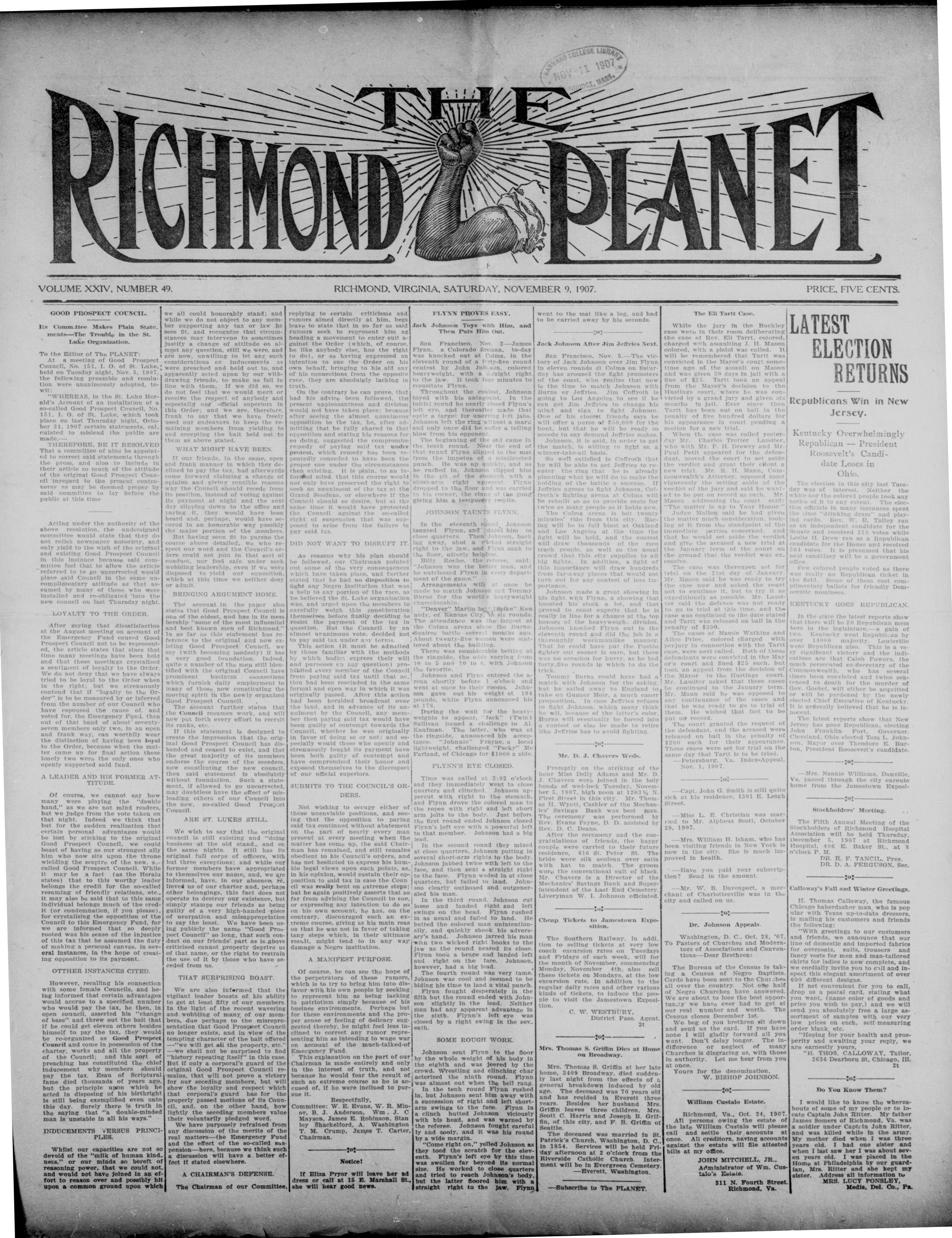
Richmond Planet
Saturday, November 9, 1907
Richmond, Virginia
Page text (machine-generated)
THE RICHMOND PLANET
GOOD PROSPECT COUNCIL.
Is Comm.ttee Makes Plain Stat-
ments—The Trouble in the St.
Luke Organization.
To the Editor of The PLANET:
At a meeting of Good Prospect
Council, No. 151, I. O. of St. Luke,
held on Tuesday night, Nov. 5, 1907,
the following preamble and resolution
were unanimously adopted, to-wit:
"WHEREAS, in the St. Luke Herald's
Account of an installation of a
so-called Good Prospect Council, No.
151, I. O. of St. Luke, which took
place on last Thursday night, Octo-
ber 31, 1907 certain statements, cal-
culated to mislead the public are
made.—
THEREFORE, BE IT RESOLVED
That a committee of nine be appointed
to correct said statements through
the press, and also to include in
their article so much of the attitude
of the original Good Prospect Coun-
cil inregard to the present controversy
as may be deemed proper by
said committee to lay before the
public at this time.
Acting under the authority of the above resolution, the undersigned committee would state that they do not relish newspaper notoriety, and only yield to the wish of the original and existing Good Prospect Council In this instance because said committee feel that to allow the article referred to to go uncorrected would place said Council in the same uncomplimentary attitude as that assumed by many of those who were installed and re-obligated 'into the new council on last Thursday night.'
LOYALTY TO THE ORDER
After saying that dissatisfaction at the August meeting on account of the Emergency Fund caused Good Prospect Council not to be represented, the article states that since that time many meetings have been held and that these meetings crystalized a sentiment of loyalty to the Order. We do not deny that we have always tried to be loyal to the Order when in the right; but we strenuously contend that if "loyalty to the Order" is to be measured by or inferred from the number of our Council who have espoused the cause of, and voted for, the Emergency Fund, then out of that band of about seventy-seven members only two, in an open and frank way, can worthily wear the distinction of having been loyal to the Order, because when the matter came up for final action these lonely two were the only ones who openly supported said fund.
A LEADER AND HIS FORMER AT TITUDE.
Of course, we cannot say how many were playing the "double hand," as we are not mind readers, but we judge from the vote taken on that night. Indeed we think that but for the sudden realization that certain personal advantages would be lost by sticking to the original Good Prospect Council, we could boast of having as our strongest ally him who now sits upon the throne wielding the sceptre of the new, so-called Good Prospect Council. While it may be a fact (as the Herald states) that to this worthy leader belongs the credit for the so-called resuming of friendly relations, etc., it may also be said that to this same individual belongs much of the credit (or condemnation, if you please), for crystallizing the opposition of the Council to this Emergency Fund, for we are informed that so deeply rooted was his sense of the injustice of this tax that he assumed the duty of making a personal canvas, in several instances, in the hope of creating opposition to its payment.
OTTHER INSTANCES CITED
However, recalling his connection with some female Councils, and being informed that certain advantages would accrue to a specified number who would pay the tax, he then, in open council, asserted his "change of base" and threw out the bait that if he could get eleven others besides himself to pay the tax, they would be re-organized as Good Prospect Council and come in possession of the charter, works and all the property of the Council; and this sort of preaching has constituted the chief inducement why members should pay the tax. Esau of Scriptural fame died thousands of years ago, but the principle upon which he acted in disposing of his birthright is still being exemplified even unto this day. Surely there is truth in the saying that "a double-minded man is unstable in all his ways."
INDUCEMENTS VERSUS PRINCI-
PLES.
Whilst our capacities are not so devoid of the "milk of human kindness," or our minds so bereft of reasoning power, that we could not, and would not have joined in an effort to reason over and possibly hit upon a common ground upon which
we all could honorably stand; and while we do not object to any member supporting any tax or law he sees fit, and recognize that circumcision may serve to oblige him justify a range of attitudes almost any question, still we were and are now, unwilling to let any such considerations or inducements as were preached and held out to, and apparently acted upon by our withdrawing friends, to make us fall in line with them. If we did so, we do not feel that we would merit or receive the respect of anybody and especially our official superiors in this Order; and we are, therefore, frank to say that we have freely used our endeavors to keep the remaining members from yielding to and accepting the bait held out to them as above stated.
WHAT MIGHT HAVE BEEN
If our friends, in the same, open and frank manner in which they declined to pay the tax, had afterwards come forward claiming a change of opinion and giving sensible reasons why the Council should recede from its position, instead of voting against its payment at night and the next day slipping down to the office and paying it, they would have been heard and, perhaps, would have secured in an honorable way possibly the major portion of the members. But having seen fit to pursue the course above detailed, we who respect our word and the Council's orders could not join in that sort of conduct, nor feel safe under such wobbling leadership, even if we were disposed to yield our opposition, which at this time we neither deny or admit.
BRINGING ARGUMENT HOME.
ARE ST LUKES STILL
We wish to say that the original council is still existing and "doing business at the old stand," and on the same nights. It still has its original full corps of officers, with but three exceptions; and while our former members have appropriated to themselves our name, and, we are informed, have, in our absence, relieved us of our charter and, perhaps other belongings, this fact does not operate to destroy our existence, but simply stamps our friends as being guilty of a very high-handed piece of usurpation and misappropriation of usurpation and misappropriation of publicly the name "Good Expect Council" so long, that such conduct on our friends' part as is above criticised cannot properly deprive us of that name, or the right to restrain the use of it by those who have seceded from us.
THAT SURPRISING BOAST
We are also informed that the vigilant leader boasts of his ability to get at least fifty of our members. In the light of the recent wavering and wobbling of many, of our members, due perhaps to the misrepresentation that Good Prospect Council no longer exists, and in view of the tempting character of the bait offered—"we will get all the property, etc."—we shall not be surprised to find "history repeating itself" in this case. But if only a corporal's guard of the original Good Prospect Council remains, that will not prove a victory for our seeding members, but will show the loyalty and respect which that corporal's guard has for the property passed on to Corporal Chell and the other hand, how lightly the seeding members value their voluntarily pledged word.
We have purposely refrained from any discussion of the merits of the real matters—the Emergency Fund and the effect of the so-called suspension—here, because we think such a discussion will have a better effect if stated elsewhere.
A CHAIRMAN'S DEFENSE.
The Chairman of our Committee.
RICHMOND, VIRGINIA, SATURDAY, NOVEMBER 9, 1907.
replying to certain criticisms and rumors aimed directly at him, begs leave to state that in so far as said rumors seek to represent him as heading a movement to enter suit against the Order (which, of course, he like anybody else, has the right to do), or as having expressed an intention to sue the Order on his own behalf, bringing to his aid any of his connections from the opposite race, they are absolutely lacking in truth.
On the contrary he can argue that, had his advice been followed, the present unpleasantness and division would not have taken place; because after seeing the almost unanimous opposition to the tax, he, after admitting that he fully shared in that opposition and stating his reasons for so doing, suggested the compromise remedy of paying said tax under protest, which remedy has been repeatedly conceded to have been the one under the circumstances then existing. It is plain, to an informed mind that this course would not only have preserved the right to seek an annulment of the tax at the Grand Sessions, or elsewhere if the Council should so desire, but at the same time it would have protected the Council against the so-called right of suspension that was supposed to arise from the failure to pay said tax.
DID NOT WANT TO DISRUPT IT
As reasons why his plan should be followed, our Chairman pointed out some of the very consequences which have taken place, and further stated that he had no disposition to fight any Negro institution that was a help to any portion of the race, as he believed the St. Luke organization was, and urged upon the members to carefully weigh this consideration themselves before finally deciding to resist the payment of the tax in question. But the Council by an almost unanimous vote, decided not to pay said tax under any terms. This action (it must be admitted by those familiar with the methods by which bodies express their will and purposes in any question) prohibited every member of the Council from paying said tax until that action had been rescinded in the same formal and open way in which it was originally passed. After this action had been heralded broadcast over the land, and in connection of its antonym, the Council of members then paying said tax would have been guilty of contempt towards the Council, whether he was originally in favor of doing so or not; and especially would those who openly and strenuously fought its payment have been both guilty of contempt and have compromised their honor and exposed themselves to the disrespect of our official superiors.
SUBMITS TO THE COUNCIL'S OR DEPS
Not wishing to occupy either of these unenviable positions, and seeing that the opposition to paying said tax continued without abatement on the part of nearly every man present at every meeting when the matter has come up, the said Chairman has remained, and still remains obedient to his Council's orders, and has not hesitated to express his humble legal views upon such points, as in his opinion, would sustain their opposition to said tax in case the Council was really bent on extreme steps; but he again positively asserts that so far from advising the Council to sue, or expressing any intention to do so on his own account, he has, on the contrary, discouraged such an extreme course, giving as his main reason that he was not in favor of taking tany steps which, in their ultimate result, might tend to in any way damage a Negro institution.
A MANIFEST PURPOSE
Of course, he can see the hope of the perpetrators of these rumors, which is to try to bring him into disfavor with his own people by seeking to represent him as being lacking in patriotism simply because of his businesses environments. Perhaps but for these environments and the proper sense or feeling of delicacy suggested thereby, he might feel less inclined to correct any rumor representing him as intending to wage war on account of the much-talked-of Emergency Fund.
This explanation on the part of our Chairman is made entirely and only in the interest of truth, and not because he would fear the result of such an extreme course as he is accused of, if he were inclined to pursue it.
Respectfully,
Committee: W. E. Evans, W. R. Minor, B. J. Anderson, Wm. J. C. Mayson, James E. Robinson, Stanley Shackelford, A. Washington T. M. Crump, James T. Carter, Chairman.
If Eliza Pryor will leave her ad dress or call at 15 E. Marshall St. she will hear good news.
FLYNN PROVES EASY.
Jack Johnson Toys with Him, and Then Puts Him Out.
San Francisco, Nov. 2—James Flynn, a Colorado fireman, to-day was knocked out at Colma, in the eleventh round of a forty-five round contest by John Johnson, colored heavyweight, with a straight right to the jaw. It took four minutes to resuscitate Flynn. Throughout the contest, Johnson toyed with his antagonist. In the initial round he nearly closed Flynn's left eye, and thereafter made that optic a target for unerring left jabs. Johnson left the ring without a mark and only once did he suffer a telling blow from his opponent. The beginning of the end came in the tenth round. Near the end of the round Flynn slipped to the mat from the floor, and he punched. He was up quickly, and as he rushed in, Johnson slipped him in the pit of the stomach with a short-arm right uppercut. Flynn dropped to the floor and was carried to his corner, the clause of the gong giving him a temporary respite.
JOHNSON TAUNTS FLYNN
In the eleventh round, Johnson taunted Flynn, and dared him to close quarters. Then Johnson, backing away, shot a wicked straight right to the jaw, and Flynn sank to the floor, utterly helpless. Billy Roche, the referee, said: "Johnson was the better man, and he outclassed Flynn in every department of the game."
Arrangements will at once be made to match Johnson and Tommy Burns for the world's heavyweight championship.
"Denver" Martin beg, "Spike" Kenedy, of Kansas City, in six rounds. The attendance was the largest at the Colma arena since the Burns-Squires battle several months ago. About twenty-five women were scattered about the building.
There was considerable betting at the ringside, the oids varying from 10 to 5 and 10 to 6, with Johnson the favorite.
Johnson and Flynn entered the arena shortly before 1 o'clock and went at once to their rooms. Johnson gave out his weight at 194 pounds, while Flynn announced his at 176.
During the wait for the heavyweights to appear, "Jack" (Twin) Sullivan issued a challenge to Al Kaufman. The latter, who was at the ringside, announced his acceptance. "Johnnie" Frayne, a local lightweight, challenged "Packy" Mo Farland, of Chicago for $1000 a side.
FLYNN'S EYE CLOSED
Time was called at 3:02 o'clock and they immediately went to close quarters and clinched. Johnson uppercut with right to the stomach, and Flynn drove the colored man to the ropes with right and left short arm jolts to the body. Just before the first round ended Johnson closed Flynn's left eye with a powerful left to that member. Johnson had a big lead.
In the second round they mixed at close quarters, Johnson putting in several short-arm rights to the body. Johnson jabbed twice with left to the face, and then sent a straight right to the face. Flynn wud in at close quarters, but failed to land. Johnson clearly outboxed and outgeneraled his man.
In the third round. Johnson cut loose and landed right and left swings on the head. Flynn rushed in as usual and failed to land. He butted the colored man unintentionally, and quickly shot his adversary and Johnson jarred his man with two wicked right hooks to jaw as the round neared its close. Flynn took a brace and landed left and right on the face. Johnson, however, had a big lead.
The fourth round was very tame. Johnson was cool and seemed to be bliding his time to land a vital punch.
Johnson was cool and seemed to be bliding his time to land a vital punch. Flynn fought desperately in the fish but the round ended with Johnson slightly in the lead. The man had any apparent advantage in the sixth. Flynn's left eye was closed by a right swing in the sev. enth.
SOME ROUGH WORK
Johnson sent Flynn to the floor by the whole weight of his body in the eighth and was jeered by the crowd. Wrestling and clinching char acterized the ninth round. Flynn was almost out when the bell rang. In the tenth round Flynn rushed in, but Johnson sent him away with a succession of right and left shortarm swings to the face. Flynn in a clinch butted Johnson viciously with his head, and was warned by the referee. Johnson fought careful ly and coolly, and it was his round by which Johnson "come right on," yelled Johnson as they tood the scratch for the eleventh. Flynn's left eye by this time was swollen far beyond its normal size. He worked to close quarters and tried to reach Johnson's body, but the latter floored him with a straight right to the jaw. Flynn
went to the mat like a log, and had to be carried away by his seconds.
Jack Johnson After Jim Jeffries Next.
San Francisco, Nov. 5. —The victory of Jack Johnson over Jim Flynn in eleven rounds it Colma on Saturday has aroused the fight promoters of the coast, who realize that now is the time to match Johnson with Burns or Jeffries. Jim Coffroth is going to Los Angeles to see if he can get Jim Jeffries to change his mind and sign to fight Johnson. One of his closest friends says he will offer a purse of $50,000 for the bout, but that he will be ready to accede to any demand Jeffries makes. Johnson, it is said, in order to get the match, is willing to fight on a winner-take-all basis. So well satisfied is Coffroth that he will be able to get Jeffries to reenter the ring that he is already planning what he will do to make the holding of the battle a success. If Jeffries agrees to fight Johnson, Coffroth's fighting arena at Colma will be rebuilt so as to provide seats for twice as many people as it holds now. The Colma arena is but twenty minutes' ride from this city. Racing is in full at at Oakland and Los Angeles. Once the fight will be hold, and the contest will draw thousands of the race track people, as well as the usual crowd that this city supplies to all big fights. In addition, a fight of this importance will draw hundreds from far-away places that would not turn out for any contest of less importance.
Johnson made a great showing in his fight with Flynn, a showing that boosted his stock a lot, and that proved to coast experts that he is really in line for a chance at the top honors of the heavyweight division. Johnson knocked Flynn out in the eleventh round and did the job in a thoroughly workmanlike manner. That he could have put the Pueblo fighter out sooner is sure, but there was no occasion for hurry, as he had forty-five rounds in which to do the trick.
Tommy Burns could have had a match with Johnson for the asking, but he sailed away to England to take on Gunner Moir, a much easier proposition. In case Jeffries refuses to fight Johnson, which many think he will, because of the latter's color, Burns will eventually be forced into a contest or else be made to retire like Jeffries has to avoid fighting.
Mr. D. J. Chayers Weds.
Promptly on the striking of the hour Miss Dolly Adams and Mr. D. J. Chavers were joined in the holy bonds of wed-lock Tuesday, November 5, 1907, high noon at 1263 $ N. First Street in this city. Mr. Thomas H. Wyatt, Cashier of the Mechanics' Savings Bank was best man. The ceremony was performed by Rev. Evans Payne, D. D. assisted by Rev. D. C. Deans.
After the ceremony and the congratulations of friends, the happy couple were carried to their future residence, 616 St. Peter St. The bride wore silk aeleanor over satin with hat to match. The groom wore the conventional suit of black. Mr. Chavers is a Director of the Mechanics' Savings Bank and Superintendent of the East End Cemetery, Liverman W. I. Johnson officiated.
Cheap Tickets to Jamestown Expo sition.
The Southern Railway, in addition to selling tickets at very low coach excursion rates on Tuesdays and Fridays of each week, will for the month of November, commencing Monday, November 4th, also sell these tickets on Mondays, at the low excursion rate, in addition to the regular daily rates and other various kinds of tickets, to induce the people to visit the Jamestown Exposition.
C. W. WESTBURY,
District Pass. Agent.
3t
Mrs. Thomas S. Griffin Dies at Home on Broadway.
Mrs. Thomas S. Griffin at her late home, 3409 Broadway, died suddenly last night from the effects of a general breakdown induced by old age. The deceased was 70 years old and has resided in Everett three years. Besides her husband Mrs. Griffin leaves three children, Mrs. Scott C. Harris and Joseph B. Griffin, of this city, and F. B. Griffin of Seattle.
The deceased was married in St. Patrick's Church, Washington, D. C., in 1854. Services will be held Friday afternoon at 2 o'clock from the Riverside Catholic Church. Interment will be in Evergreen Cemetery.
—Subscribe to The PLANET
The Eli Tartt Case.
While the jury in the Buckley case were in their room deliberating the case of Rev. Eli Tarrt, colored, charged with assaulting J. H. Mason colored, with a pistol was called. It will be remembered that Tarrt was convicted in the Mayor's court sometime ago of the assault on Mason and was given 30 days in jail with a fine of $25. Tarrt took an appeal from the Mayor's decision to the Hustings court, where he was convicted by a grand jury and given six months in jail. Ever since then Tarrt has been out on bail in the penalty of five hundred dollars for his appearance in court pending a motion for a new trial.
When the case was called yesterday Mr. Charles Trotter Lasater, who with Mr. P. H. Drewry and Mr. Paul Petit appeared for the defendant, moved the court to set aside the verdict and grant their client a new trial. Mr. R. H. Mann, Commonwealth's Attorney, opposed most vigorously the setting aside of the verdict of the jury and said he wanted to be put on record as such. Mr. Mason addressing the court said: "The matter is up to Your Honor." Judge Mullen said he had given the matter much consideration, looking at it from the standpoint of the immediate parties concerned, and that he would set aside the verdict and give the accused a new trial at the January term of the court on the ground that the verdict was excessive.
The case was thereupon set for trial on the 21st day of January. Mr. Mason said he was ready to try the case now and asked the court not to continue it, but to try it as expeditiously as possible. Mr. Lassiter said the defence was not ready to go to trial at this time, and the case was continued to the date stated and Tartt was released on ball in the penalty cases of Mamie Watkins and Alice Price, colored charged with perjury in connection with the Tartt case, were next called. Both of these defendants were convicted in the May or's court and fined $25 each, but took an appeal from the decision of the Mayor to the Hustings court. Mr. Lassiter asked that these cases be continued to the January term. Mr. Mann said he was opposed to any continuance of the cases and that he was ready to go to trial of them. He wished that fact to be put on record.
The court granted the request of the defendant, and the accused were released on bail in the penalty of $200 each for the duplication. These cases were set for trial on the same day that Tartt is to be tried.
Petersburg, Va. Index-Appeal, Nov. 1, 1907
—Capt. John G. Smith is still quite sick at his residence, 1301 E. Leigh Street.
—Miss L. E. Christian was married to Mr. Alpheus Scott, October 29, 1907.
—Mrs. William H. Isham, who has been visiting friends in New York is now in the city. She is much improved in health.
—Have you paid your subscription? Send in the amount.
—Mr. W. B. Davenport, a merchant of Charlottesville was in the city and called on us.
Dr. Johnson Appeals
Washington, D. C., Oct. 28, '07.
To Pastors of Churches and Modernors of Associations and Conventions—Dear Brethren:
The Bureau of the Census is taking a Census of Negro Baptists. Cards have been sent to the Churches all over the country. Not one half of Negro Churches have answered. We are about to lose the best opportunity we have ever had to get at our real number and worth. The Census closes December 1st.
We beg of you brethren sit down and send us the card. If you have none I will gladly forward all you want. Don't delay longer. The indifference or neglect of many Churches is disgregating us, with those in authority. Let me hear from you at once.
Yours for the denomination.
W. BISHOP JOHNSON.
William Custalo Estate.
Richmond, Va., Oct. 24, 1907.
All persons owing the estate of the late William Custalo will please call and settle their accounts at once. All creditors, having accounts against the estate will file attested bills at my office.
JOHN MITCHELL, JR.,
Administrator of Wm. Custalo's Estate.
311 N. Fourth Street,
Richmond, Va.
PRICE, FIVE CENTS.
LATEST ELECTION RETURNS
Republicans Win in New Jersey.
Kentucky Overwhelmingly Republican — President Roosevelt's Candidate Loses in Ohio.
The election in this city last Tuesday was of interest. Neither the white nor the colored people took any notice of it to any extent. The election officials in many instances spent the time "drinking dram" and playing cards. Rev. W. E. Talley ran as an independent candidate for the Senate and received 218 votes while Leslie H. Drew ran as a Republican candidate for the House and received 564 votes. It is presumed that his next candidacy will be a government office.
Few colored people voted as there was really no Republican ticket in the field. Some of them cast complimentary ballots for friendly Democratic nominees.
KENTUCKY GOES REPUBLICAN
In the state the latest reports show that there will be 20 Republican members in the legislature,—a gain of two. Kentucky went Republican by over 14000 majority. Louisville went Republican also. This is a very significant victory and the indications are that Caleb Powers, the much persecuted ex-Secretary of the Commonwealth, who has several times been convicted and twice sentenced to death for the murder of Gov. Goebel, will either be acquitted or will be pardoned by the newly Chief Executive of Kentucky. It is generally believed that he is innocent.
The latest reports show that New Jersey has gone Republican, electing John Franklin Fort, Governor Cleveland, Ohio elected Tom L. Johnson, Mayor over Theodore E. Burton, President Roosevelt's candidate
Mrs. Nannie Williams, Danville, Va.
masse through the city enroute
home.
Stockholders' Meeting
The Fifth Annual Meeting of the Stockholders of Richmond Hospital Association will be held Thursday, December 5. 1907 at Richmond Hospital, 406 E. Baker St., at $ o'clock P. M.
DR. R. F. TANCIL, Pres.
DR. D. A. FERGUSON, Sec.
Calloway's Fall and Winter Greetings
H. Thomas Calloway, the famous Chicago haberdasher man, who is popular with Texas up-to-date dressers, is mailing his customers and friends the following:
"With greetings to our customers and friends, we announce that our line of domestic and imported fabrics for overcools, suits, trousers and fancy vests for men and man-tailored skirts for ladies is now complete, and we cordially invite you to call and inspect this elegant assortment of over 600 different designs.
If not convenient for you to call, drop us a postal card, stating what you want, (name color of goods and price you wish to pay), and we will send you absolutely free a large assortment of samples with our very low prices on each, self-measuring order blank etc.
"Hoping for your health and prosperity and awaiting your reply, we are earnestly yours,
"H. THOS. CALLOWAY, Tailor,
3636 Dearborn St, Chicago, Ill.
2t
Do You Know Them?
I would like to know the whereabouts of some of my people or to locate Captain John Ritter. My father James Somers of Richmond, Va. was a soldier under Captain John Ritter, and was killed while in the army. My mother died when I was three years old. I had one sister and when I last saw her I was about seven years old. I was placed in the Home at Philadelphia by our guardian, Mrs. Ritter and she kept my sister. Address all information to MRS. LUCY PONSLEY, Media, Del. Co., Pa.
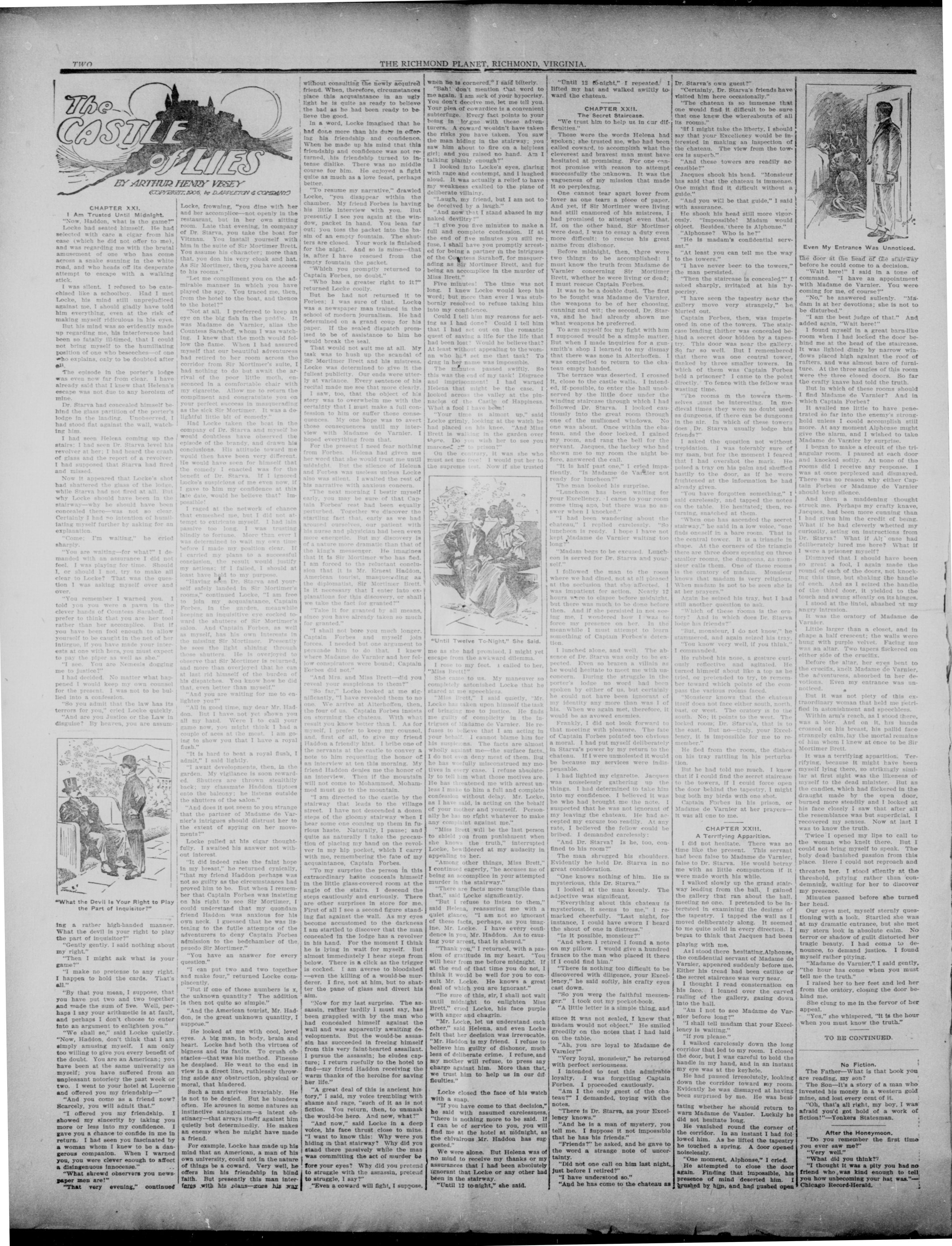
The CASTLE of LIES
CHAPTER XXI.
"Now, Hadden, what is the game?" Locke had seated himself. He had selected with care a cigar from his case (which he did not offer to me), and was regarding me with the brutal amusement of one who has come across a snake sunning in the white road, and who heads off its desperate attempt to escape with a walking stick.
I was silent. I refused to be catechised like a schoolboy. Bad I met Locke, his mind still unprejudiced against me. I should gladly have told him everything, even at the risk of making myself ridiculous in his eyes.
But his mind was so evidently made up regarding me, his interference had been so fatally ill-timed, that I could not bring myself to the humiliating position of one who beseeches—of one who explains, only to be doubted after
The episode in the porter's lodge was even now far from clear. I have already said that I knew that Helena's escape was not due to any heroism of mine.
Dr. Starva had concealed himself behind the glass partition of the porter's lodge in the landing. Unobserved, I had stood flat against the wall, watching him.
I had seen Helena coming up the stairs; I had seen Dr. Starva level his revolver at her; I had heard the crash of glass and the report of a revolver. I had supposed that Starva had fired and missed.
Now it appeared that Locke's shot had shattered the glass of the lodge, while Starva had not fired at all. But why Locke should have been in the stairway—why he should have been concealed there—was not so clear. Certainly I had no intention of humiliating myself further by asking for an explanation.
"Come; I'm waiting," he cried sharply.
"You are waiting—for what?" I demanded with an assurance I did not feel. I was playing for time. Should I, or should I not, try to make all clear to Locke? That was the question I was asking myself over and over.
"You remember I warned you. I told you you were a pawn in the clever hands of Countess Sarahoff. I prefer to think that you are her tool rather than her accomplice. But if you have been fool enough to allow yourself to be caught in the net of her intrigue, if you have made your interests at one with hers, you must expect to pay the piper as well as she."
"I see. You are Nemesis dogging me to justice?"
I had decided. No matter what happened I would keep my own counsel for the present. I was not to be bullied into a confession.
"So you admit that the law has its terrors for you," cried Locke quickly.
"And are you Justice or the Law in disguise? By heaven, you are assum-
"What the Devil Is Your Right to Play
the Part of Inquisitor?"
ing a rather high-handed manner.
What the devil is your right to play
the part of inquisitor?"
"Gently gently. I said nothing about
my right."
"Then I might ask what is your
game?"
"I make no pretense to any right.
I happen to hold the cards. That's
all."
"By that you mean, I suppose, that
you have put two and two together
and made the sum of five. Well, per-
haps I say your arithmetic is at fault,
and perhaps I don't choose to enter
into an argument to enlighten you."
"We shall se," said Locke quietly.
"Now, Haddon, don't think that I am
simply amusing myself. I am only
too willing to give you every benefit of
the doubt. You are an American; you
have been at the same university as
myself; you have suffered from an
unpleasant notoriously the past week or
two. I went to your hotel at Lucerne
and offered you my friendship—"
"And you come as a friend now? Scarcely, you will admit that."
"I offered you my friendship. I showed my sincerity by taking you more or less into my confidence. I gave you a chance to confide in me in return. I had seen you fascinated by a woman whom I knew to be a dangerous companion. When I warned you, you were clever enough to affect a disingenuous innocence."
"What shrewd observers you newspaper men are!"
"That very evening," continued
Locke, frowning, "you dine with her and her accomplice—not openly in the restaurant, but in her own sitting room. Late that evening, in company of Dr. Starva, you take the boat for Vitzanau. You install yourself with him in the suite of Sir Mortimer Brett. You assume his character; more than that, you don your very cloak and hat. As Sir Mortimer, then, you have access to his rooms."
"Let me compliment you on the admirable manner in which you have played the spy. You traced me, then, from the hotel to the boat, and thence to the hotel?"
"Not at all. I preferred to keep an eye on the big fish in the puddle. It was Madame de Varnier, alias the Countess Sarahoff, whom I was watching. I knew that the moth would follow the flame. When I had assured myself that our beautiful adventures had retired to her room across the corridor from Sir Mortimer's suite, I had nothing to do but await the arrival of the poor little moth, enconced in a comfortable chair with my cigarette. Allow me to return the compliment and congratulate you on your perfect success in masquerading as the sick Sir Mortimer. It was a delightful little bit of comedy."
Had Locke taken the boat in the company of Dr. Starva and myself he would doubtless have observed the episode of the brandy, and drawn his conclusions. His attitude toward me would then have been very different. He would have seen for himself that the comedy I enacted was for the benefit of Dr. Starva. If I ignored Locke's suspicions of me even now, if I gave to him my confidence at this late date, would he believe that? Impossible!
I raged at the network of chance that enmeshed me, but I did not attempt to extricate myself. I had lain passive too long. I was trusting blindly to fortune. More than ever I was determined to wait my own time before I made my position clear. If I carried my plans to a successful conclusion, the result would justify my actions; if I failed, I should at least have hgld to my purpose.
"Having seen Dr. Starva and your safely landed in Sir Mortimer's rooms," continued Locke, "I am free to join my acquaintance, Captain Forbes. In the garden, meanwhile keeping an inquisitive eye cocked toward the shutters of Sir Mortimer's salon. And Captain Forbes, as well as myself, has his own interests in the missing Sir Mortimer. Presently he sees the light shining through those shutters. He is overjoyed to observe that Sir Mortimer is returned, and more than overjoyed that he can at last rid himself of the burden of his dispatches. You know how he did that, even better than myself."
"And you are waiting for me to enlighten you?"
"All in good time, my dear Mr. Haddon. But I have not yet shown you all my hand. Were I to call your game now, you might think I had a couple of aces at the most. I am going to show you that I have a royal flush."
"It is hard to beat a royal flush, I admit." I said lightly.
"I await developments, then, in the garden. My vigilance is soon rewarded. Shutters are thrown stealthily back; my classmate Haddon tiptoes onto the balcony; he listens outside the shutters of the salon."
"And does it not seem to you strange that the partner of Madame de Varnier's intrigues should distrust her to the extent of spying on her movements?"
Locke pulled at his cigar thoughtfully. I awaited his answer not without interest.
"It did indeed raise the faint hope in my breast," he returned cynically, "that my friend Haddon perhaps was not so guilty as the circumstances had proved him to be. But when I remember that Captain Forbes was insisting on his right to see Sir Mortimer, I could understand that my quondam friend Haddon was anxious for his own neck. I guessed that he was listening to the futile attempts of the adventurers to deny Captain Forbes admission to the bedchamber of the psuedo Sir Mortimer."
"You have an answer for every question."
"I can put two and two together and make four," returned Locke complacently.
"But if one of those numbers is x, the unknown quantity? The addition is then not quite so simple."
"And the American tourist, Mr. Haddon, is the great unknown quantity, I suppose."
He looked at me with cool, level eyes. A big man, in body, brain and heart. Locke had both the virtues of bigness and its faults. To crush obstacles—that was his method. Finesse he despised. He went to the end in view in a direct line, ruthlessly throwing aside any obstruction, physical or moral, that hindered.
Such a man arrives invariably. He is not to be denied. But he blunders often. He arouses in some natures an instinctive antagonism—a latent obstinacy—that arrays itself against him quietly but determined. He makes an enemy when he might have made a friend.
For example, Locke has made up his mind that an American, a man of his own university, could not in the nature of things be a coward. Very well, he offers him his friendship in blind faith. But presently this man interferes with his plans—goes his way
THE RICHMOND PLANET, RICHMOND, VIRGINIA
without consulting the newly acquired friend. When, therefore, circumstances place this acquaintance in an ugly light he is quite as ready to believe the bad as he had been ready to believe the good.
In a word, Locke imagined that he had done more than his duty in offering his friendship and confidence. When he made up his mind that this friendship and confidence was not returned, his friendship turned to intense dislike. There was no middle course for him. He enjoyed a fight quite as much as a love feast, perhaps better.
"To resume my narrative," drawled Locke, "you disappear within the chamber. My friend Forbes is having his little interview with you. But presently I see you again at the window, packet in hand. You lean far out; you toss the packet into the basin of an empty fountain. The shutters are closed. Your work is finished for the night. And so is mine—that is, after I have rescued from the empty fountain the packet.
"Which you promptly returned to Captain Forbes, no doubt."
"Who has a greater right to it?" returned Locke coolly.
But he had not returned it to Forbes; I was sure of that. Locke was a newspaper man trained in the school of modern journalism. He had determined on a grand coup for his paper. If the sealed dispatch promised to be of assistance to him he would break the seal.
That would not suit me at all. My task was to hush up the scandal of Sir Mortimer Brett and his mistress. Locke was determined to give it the fullest publicity. Our ends were utterly at variance. Every sentence of his recital made me see that more clearly. I saw, too, that the object of his story was to overwhelm me with the certainty that I must make a full confession to him or suffer those consequences. My one hope was to avert those consequences until my interview with Madame de Varnier. I hoped everything from that. For the present I need fear nothing from Forbes. Helena had given me her word that she would trust me until midnight. But the silence of Helena and Forbes was useless unless Locke also was silent. I awaited the rest of his narrative with anxious concern.
"The next morning I bestir myself early, you may be sure of that Captain Forbes' rest had been equally perturbed. Together we discover the startling fact that, early as we had aroused ourselves, our patient with his nurse and physician had been even more energetic. But my discovery is of a nature more dramatic than that of the king's messenger. He imagines that it is Sir Mortimer who has fled. I am forced to the reluctant conclusion that it is Mr. Ernest Haddon, American tourist, masqueading as the diplomatist, Sir Mortimer Brett. Is it necessary that I enter into explanations for this discovery, or shall we take the fact for granted?" "Take it for granted by all means, since you have already taken so much for granted."
"I shall not bore you much longer, Captain Forbes and myself join forces. I needed but one argument to persuade him to do that. I knew where Madame de Vernier and her fellow conspirators were bound; Captain Forbes did not."
"And Mra. and Miss Brett—did you reveal your suspicions to them?" "So far," Locke looked at me significantly, "I have revealed them to no one. We arrive at Alterhoffen, then, the four of us. Captain Forbea insists on storming the chateau. With what result you know better than I. As for myself, I prefer to keep my counsel, and, first of all, to give my friend Haddon a friendly hint. I bribe one of the servants at the castle to convey a note to him requesting the honor of an interview at ten this morning. My friend Haddon denies me the honor of an interview. Then if the mountain will not come to Mohammed, Mohammed must go to the mountain.
"I am directed to the castle by the stairway that leads to the village street. I have not descended a dozen steps of the gloomy stairway when I hear some one coming up them in furious haste. Naturally, I pause; and quite as naturally I take the precaution of placing my hand on the revolver in my hlp pocket, which I carry with me, remembering the fate of my acquaintance, Captain Forbes.
"To my surprise the person in this extraordinary haste conceals himself in the little glass-covered room at the angle of the stairs. I descend the steps cautiously and curiously. There are other surprises in store for me. First of all I see a second figure standing flat against the wall. As my eyes become accustomed to the darkness I am startled to discover that the man concealed in the lodge has a revolver in his hand. For the moment I think he is lying in wait for myself. But almost immediately I hear steps from below. There is a click as the trigger is cocked. I am averse to bloodshed—even the killing of a would-be murderer. I fire, not at him, but to shatter the pane of glass and divert his aim.
"Now for my last surprise. The assassin, rather tardily I must say, has been grappled with by the man who had concealed himself against the wall and was apparently awaiting developments. But the would-be assassin has succeeded in freeing himself from this very faint-hearted assailant. I pursue the assassin; he eludes capture; I return ruefully to the hotel to find-my friend Haddon receiving the warm thanks of the heroine for saving her life."
"A great deal of this is ancient history," I said, my voice trembling with shame and rage, "such of it as is not fiction. You return, then, to unmask the would-be hero. And now, what?"
"And now," said Locke in a deep voice, his face thrust close to mine. "I want to know this: Why were you hiding in that stairway? Why did you stand there passively while the man was committing the act of murder be fore your eyes? Why did you pretend to struggle with the assassin, pread to struggle, I say?"
"Even a coward will fight, I suppose.
when he is cornered," I said bitterly.
"Bah! don't mention that word to me again. I am sick of your hypocrisy. You don't deceive me, let me tell you. Your plea of cowardice is a convenient subterfuge. Every fact points to your being in loege with these adventurers. A coward wouldn't have taken the risks you have taken. You saw the man hiding in the stairway; you saw him about to fire on a helpless girl; and you raised no hand. Am I talking plainly enough?"
"I looked into Locke's eyes, glaring with rage and contempt, and I laughed aloud. It was actually a relief to have my weakness exalted to the plane of deliberate villainy.
"Laugh, my friend, but I am not to be deceived by a laugh."
"And now that I stand abased in my naked deviltry."
"I give you five minutes to make a full and complete confession. If at the end of five minutes you still refuse, I shall have you promptly arrested for being a partner in the intrigues of the Countess Sarahoff, for masquerading as Sir Mortimer Brett, and for being an accomplice in the murder of Miss Brett."
Five minutes! The time was not long. I knew Locke would keep his word; but more than ever I was stubbornly resolved to refuse taking him into my confidence.
Could I tell him my reasons for acting as I had done? Could I tell him that I had set out on the romantic quest of saving a life for the life that had been lost? Would he believe that? At least without appealing to the woman who had set me that task? To drag in her name was impossible.
The minutes passed swiftly. So this was the end of my task! Disgrace and imprisonment! I had warned Helena that might be the case. I looked across the valley at the pinnacles of the Castle of Happiness. What a fool I have been!
"Your time is almost up," said Locke grimly, looking at the watch he had placed on his knee. "And Miss Brett is walking in the garden over there. Do you wish her to see you marronne to prison?"
On the contrary, it was she who must set me free! I would put her to the supreme test. Now if she trusted
"Until Twelve To-Night," She Said.
me as she had promised, I might yet escape from the awkward dilemma. I rose to my feet. I called to her, "Miss Brett!"
She came to us. My maneuver so completely astonished Locke that he stared at me speechless.
"Miss Brett," I said quietly, "Mr. Locke has taken upon himself the task of bringing me to justice. He finds me guilty of complicity in the intrigues of Madame de Varnier. He refuses to believe that I am acting in your behalf. I cannot blame him for his suspicions. The facts are almost wholly against me—the surface facts. I do not even deny most of them. But he has woefully misconstrued my motives in every case. I refuse absolutely to tell him what those motives are. He has threatened me with arrest unless I make to him a full and complete confession without delay. Mr. Locke, as I have said, is acting on the behalf of your mother and yourself. Personally he has no right whatever to make any complaint against me."
"Miss Brett will be the last person to shield you from punishment when she knows the truth," interrupted Locke, bewildered at my audacity in appealing to her.
"Among other things, Miss Brett," I continued eagerly, "he accuses me of being an accomplice in your attempted murder in the stairway."
"There are facts more tangible than that," said Locke significantly.
"But I refuse to listen to them," said Helena, reassuring me with a quiet glance. "I am not so ignorant of these facts, perhaps, as you imagine. Mr. Locke. I have every confidence in you, Mr. Haddon. As to causing your arrest, that is absurd."
"Thank you," I returned, with a passion of gratitude in my heart. "You will hear from me before midnight. If at the end of that time you do not, I think it would be well for you to consult Mr. Locke. He knows a great deal of which you are ignorant."
"Be sure of this, sir, I shall not wait until midnight to enlighten Miss Brett," creed Locke, his face purple with anger and chagrin.
"Mr. Locke, let us understand each other," said Helena, and even Locke felt that her decision was irrevocable.
"Mr. Haddon is my friend. I refuse to believe him guilty of dishonor, much less of deliberate crime. I refuse, and my mother will refuse, to press any charge against him. More than that, we trust him to help us in our difficulties."
Locke closed the face of his watch with a snap.
"If you have come to that decision," he said with assumed carelessness, "there is nothing more to be said. If I can be of service to you, you will find me at the hotel at midnight, as the chivalrous Mr. Haddon has suggested."
We were alone. But Helena was of no mind to receive my thanks or my assurances that I had been absolutely ignorant that Locke or any other had been in the stairway.
"Until 12 to-night." she said.
"Until 12 65-night," I repeated. I lifted my hat and walked swiftly to ward the chateau.
CHAPTER XXII.
"We trust him to help us in car difficulties."
Those were the words Helena had spoken; she trusted me, who had been called coward, to accomplish what the cleverest and bravest man must have hesitated at promising. For one cannot promise with reason to attempt successfully the unknown. It was the vagueness of my mission that made it so perplexing.
One cannot tear apart lover from lover as one tears a piece of paper. And yet, if Sir Mortimer were living and still enamored of his mistress, I had promised to attempt even that. If, on the other hand, Sir Mortimer were dead, I was to essay a duty even more difficult: to rescue his great name from dishonor.
Before midnight, then, there were two things to be accomplished: I must know the truth from Madame de Varnier concerning Sir Mortimer Brett, whether he were living or dead; I must rescue Captain Forbes.
It was to be a double duel. The first to be fought was Madame de Varnier, the weapons to be of her choosing, cunning and wilt; the second, Dr Starva, and he had already shown me what weapons he preferred.
To arm myself for my fight with him I supposed would be a simple matter. But when I made inquiries for a gunsmith's shop I learned to my dismay that there was none in Alterhoffen. I was compelled to return to the chateau empty handed.
The terrace was deserted. I crossed it, close to the castle walls. I intended, if possible, to enter the hall unobserved by the little door under the winding staircase through which I had followed Dr. Starva. I looked cautiously into the great room through one of the mullioned windows. No one was about. Once within the chateau, and the door locked, I gained my room, and rang the bell for the servant. Jacques, the lackey who had shown me to my room the night before, answered the call.
"It is half past one," I cried impatiently. "Is Madame de Vartier not ready for luncheon?"
The man looked his surprise.
"Luncheon has been waiting for your Excellency. I came to your room some time ago, but there was no answer when I knocked."
"I had been wandering about the chateau," I replied carelessly. "So luncheon is ready. I hope I have not kept Madame de Varnier waiting too long."
"Madam begs to be excused. Luncheon is served for Dr. Starva and yourself."
I followed the man to the room where we had dined, not at all pleased at the seclusion that she affected. I was impatient for action. Nearly 12 hours were to elapse before midnight, but there was much to be done before then. And if she persisted in not seeing me, I wondered how I was to force my presence on her. In the meanwhile I must attempt to learn something of Captain Forbes's detention.
I lunched alone, and well. The absence of Dr. Starva was only to be expected. Even so brazen a villain as he would hesitate to meet me with unconcern. During the struggle in the porter's lodge no word had been spoken by either of us, but certainly he could not have been ignorant of my identity any more than was I of his. When we again met, therefore, it would be as avowed enemies.
Frankly, I did not look forward to that meeting with pleasure. The fate of Captain Forbes pointed too obvius a moral. I had put myself deliberately in Starva's power by my return to the chateau. If I were unmolested it would be because my services were indispensable.
I had lighted my cigarette. Jacquess was noiselessly gathering up the things. I had determined to take him into my confidence. I believed it was he who had brought me the note. I suspected that he was not ignorant of my leaving the chateau. He had accepted my excuse too readily. At any rate, I believed the fellow could be bribed. I demanded carelessly:
"And Dr. Starva? Is he, too, confined to his room?"
The man shrugged his shoulders. Evidently he held Dr. Starva in no great consideration.
"One knows nothing of him. He is mysterious, this Dr. Starva."
I looked at the man keenly. The adjective was significant.
"Everything about this chateau is mysterious, it seems to me," I remarked cheerfully. "Last night, for instance, I could have sworn I heard the shout of one in distress."
"And when I retired I found a note on my pillow. I would give a hundred frances to the man who placed it there if I could find him."
"There is nothing too difficult to be discovered with diligence, your Excellency," he said softly, his crafty eyes cast down.
"So you were the faithful messenger." I took out my pocket-book.
"A little letter is a simple thing, and since it was not sealed, I knew that madam would not object." He smiled greedily on the notes that I had laid on the table.
"Ah, you are loyal to Madame de Varnier?"
"Very loyal, monsieur," he returned with perfect seriousness.
I intended to test this admirable loyalty. I was forgetting Captain Forbes. I proceeded cautiously.
"Am I the only guest of the chateau?" I demanded, toying with the notes.
"There is Dr. Starva, as your Excellency knows."
"And he is a man of mystery, you tell me. I suppose it not impossible that he has his friends."
"Friends? he asked, and he gave to the word a strange note of uncertainty.
"Did not one call on him last night, just before I retired?"
"I have understood so."
"And he has come to the chateau as
Dr. Starva's own guest?"
"Certainly, Dr. Starva's friends have visited him here occasionally."
"The chateau is so immense that one would find it difficult to be sure that one knew the whereabouts of all its rooms."
"If I might take the liberty, I should say that your Excellency would be interested in making an inspection of the chateau. The view from the towers is superb."
"And these towers are readily accessible?"
Jacques shook his head. "Monsieur has said that the chateau is immense. One might find it difficult without a guide."
"And you will be that guide," I said with assurance.
He shook his head still more vigorously. "Impossible! Madam would object. Besides, there is Alphouse."
"Alphonse? Who is he?"
"He is madam's confidential servant."
"At least you can tell me the way to the towers."
"I have never beer to the towers," the man persisted.
"Then the staircase is concealed?" I asked sharply, irritated at his hypocrisy.
"I have seen the tapestry near the gallery move very strangely," he blurted out.
Captain Forbes, then, was imprisoned in one of the towers. The staircase leading thither was concealed behind a secret door hidden by a tapestry. This door was near the gallery. So far so well. But I remembered that there was one central tower, flanked by three smaller towers. In which of them was Captain Forbes held a prisoner? I came to the point directly. To fence with the fellow was wasting time.
"The rooms in the towers themselves must be interesting. In medieval times they were no doubt used as dungeons, if there can be dungeons in the air. In which of these towers does Dr. Starva usually lodge his friends?"
I asked the question not without trepidation. I was tolerably sure of my man, but for the moment I feared that I had overshot the mark. He poised a tray on his palm and shuffled hastily to the door, as if he were frightened at the information he had already given.
"You have forgotten something," I said carelessly, and tapped the notes on the table. He hesitated; then, returning, snatched at them.
"When one has ascended the secret stairway," he said in a low voice, "one finds oneself in a bare room. That is the central tower. It is a triangle in shape. At the corners of the triangle there are three doors opening on three smaller rooms, the dungeons, as monsieur calls them. One of these rooms is the oratory of madam. Monsieur knows that madam is very religious. When madam is not to be seen she is at her prayers."
Again he seized his tray, but I had still another question to ask.
"Which of these rooms is the oratory? And in which does Dr. Starva lodge his friends?"
"But, monsieur, I do not know," he stammered, and again seized his tray.
"You know very well, if you think," I commanded.
He rubbed his nose, a gesture curiously reflective and agitated. He turned himself about like a top as he tried, or pretended to try, to remember toward which points of the compass the various rooms faced.
"Monsieur knows that the chateau itself does not face either south, north, east, or west. The oratory is to the south. No; it points to the west. The locked room; Dr. Starva's, that is to the east. But no—truly, your Excellency, it is impossible for me to remember."
He fled from the room, the dishes on his tray rattling in his perturbation.
But he had told me much. I knew that if I could find the secret staircase to the towers, if I could force open the door behind the tapestry, I might bug both my birds with one shot.
Captain Forbes in his prison, or Madame de Varnier at her prayers—it was all one to me.
CHAPTER XXIII.
A Terrifying Apparition
I did not hesitate. There was no time like the present. This servant had been false to Madame de Varnier, false to Dr. Starva. He would betray me with as little compunction if it were made worth his while.
I walked slowly up the grand stairway leading from the hall, I gained the gallery that ran about the hall, meeting no one. I pretended to be interested in examining the designs of the tapestry. I tapped the wall as I moved deliberately along. It seemed to me quite solid in every direction. I began to think that Jacques had been
playing with me.
As I stood there hesitating Alphonse, the confidential servant of Madame de Varnier, appeared suddenly before me. Either his tread had been catlike or the secret staircase was very near.
I thought I read consternation on his face. I leaned over the carved railing of the gallery, gazing down into the hall.
"Am I not to see Madame de Varnier before long?"
"I shall tell madam that your Excellency is waiting."
"If you please."
I walked carelessly down the long corridor that led to my room. I closed the door, but I was careful to hold the handle in my hand, and in an instant my eye was at the keyhole.
He had paused irresolutely, looking down the corridor toward my room. Evidently he was dismayed at having been surprised by me. He was hesl-
tating whether he should return to warn Madame de Vanier. Luckily he did not hesitate long.
He vanished round the corner of the corridor. In an instant I had followed him. As he lifted the tapestry he touched a spring. A door opened noiselessly.
"One moment, Alphonse," I cried.
He attempted to close the door again. Finding that impossible, his presence of mind deserted him. I brushed by him, and had pushed open
Even My Entrance Was Unnoticed.
the door at the head of the stairway before he could come to a decision.
"Wait here!" I said in a tone of command. "I have an appointment with Madame de Varnier. You were coming for me, of course?"
"No," he answered sullenly. "Madam is at her devotions; she is not to be disturbed."
"I am the best judge of that." And added again, "Wait here!"
I found myself in a great barn-like room when I had locked the door behind me at the head of the staircase. It was lighted dimly by narrow windows placed high against the roof of rafters, and was almost bare of furniture. At the three angles of this room were the three closed doors. So far the crafty knave had told the truth.
But in which of these rooms should I find Madame de Varnier? And in which Captain Forbes?
It availed me little to have penetrated so far into the enemy's stronghold unless I could accomplish still more. At any moment Alphonse might give the alarm, and I wished to take Madame de Varnier by surprise.
I began to make a circuit of the triangular room. I paused at each door and knocked softly. At none of the rooms did I receive any response. I was at once perplexed and dismayed. There was no reason why either Captain Forbes or Madame de Varnier should keep silence.
And then a maddening thought struck me. Perhaps my crafty knave, Jacques, had been more cunning than I had given him the credit of being. What if he had cleverly whetted my curiosity, acting on instructions from Dr. Starva? What if Al'jone had deliberately lured me here? What if I were a prisoner myself?
Dismayed that I should have been so great a fool, I again made the round of each of the doors, not knocking this time, but shaking the handle of each. And as I seized the handle of the third door, it yielded to the touch and swung silently on its hinges. I stood at the lintel, abashed at my angry intrusion. It was the oratory of Madame de Varnier. Little larger than a closet, and in shape a half crescent; the walls were hung with purple velvet. Facing me was an altar. Two tapers flickered on either side of the crucifix. Before the altar, her eyes bent to the crucifix, knelt Madame de Varnier, the adventures, absorbed in her devotions. Even my entrance was unnoticed. But it was not plenty of this extraordinary woman that held me pitied in astonishment and speechless.
Within arm's reach, as I stood there, was a bier. And on it, his hands crossed on his breast, his pallid face strangely calm, lay the mortal remains of him whom I knew at once to be Sir Mortimer Brett.
It was a terrifying apparition. Terrifying, because it might have been myself lying there, so strikingly similar at first sight was the likeness of myself to the dead minister. But as the candles, which had flickered in the draught made by the open door, burned more steadily and I looked at his face closely I saw that after all the resemblance was but superficial. I recovered my senses. Now at last I was to know the truth.
Twice I opened my lips to call to the woman who knelt there. But I could not bring myself to speak. The holy dead banished passion from this place. Here I could not reproach and threaten her. I stood silently at the threshold, pitying rather than condemning, waiting for her to discover my presence.
Minutes passed before she turned her head.
Our eyes met, myself sternly questioning with a look. Startled she was at my dramatic entrance, but she met my stern look in absolute calm. No terror or shadow of guilt distorted her tragic beauty. I had come to denounce, to demand justice. I found myself rather pitying.
"Madame de Varnier," I said gently, "the hour has come when you must tell me the truth."
I raised her to her feet and led her from the oratory, closing the door behind me.
She clung to me in the fervor of her appeal.
"Yes," she whispered. "it is the hour when you must know the truth."
TO BE CONTINUED
No Fiction.
The Father—What is that book you are reading, my son?
The Son—It's a story of a man who invested his money in a western gold mine, and lost every cent of it.
"Oh, that's all right, my boy, I was afraid you'd got hold of a work of fiction!" —Yonkers Statesman.
After the Honeymoon
"Do you remember the first time
you ever saw me?"
"Very well."
"What did you think??"
"I thought it was a pity you had no friend who, was kind enough to tell you how unbecoming your hat was."—Chicago Record-Herald.
THE PULVER
SATURDAY...NOVEMBER 9. '07
CUPID AUTO IS FRANCE'S LATEST
HIGH-POWER MACHINE TO SPEED
ELOPERS FROM THEIR
ANGRY PARENTS.
WOMAN RUNS UNIQUE BUREAU
So Many Runaway Matches in Paris
That Special Cars Have Been
Fitted to Hasten Lovers to
Conjugal Happiness.
Paris—There has been a regular
epidemic of mysterious elopements in
Paris during the past six months.
Every guard which stern parents have
put about their infatuated daughters
has been broken down, and piff! in a
twinkling loving couples have been
wrinkled away to conjugal happiness—
carried off apparently on the wings of
Cupid.
Indeed, Cupid has played a most
practical and effective part in these
runaway marriages, but it is a Cupid
of rubber tires, shining wheels and
powerful motor power; it's a Cupid
with the speed of Mercury—in short,
it is the latest make of racing automobile.
For a long while all that could be wrested from runaway couples was the statement that they had been married in the "Cupid's Car." What the Cupid Car was or where it was to be found they declined to reveal to any but those whose hearts were torn by "the cruelty of opposing parents."
Somehow the secret leaked out, as even the deepest mysteries will in time, and lo! there is in Paris a perfectly equipped elopement bureau with a polished and charming Parisienne in charge—a regular fairy godmother she is to the elopers—and her splendid garage is a much sought port in the rough ocean of love.
This elegant garage is a regular Jekyll and Hyde establishment, for, besides providing means of escape, it also supplies enraged parents with high speed cars in which to follow.
Mile, Bob Wallers is known in Paris as the owner of one of the finest garages in the French capital and many races have been won in her machines. Sometimes she receives word weeks ahead that her Cunild will be desired
THE FIRST CAR
Honk, Honk, and Another Elopement Is On.
on such and such a date, then the matter of wardrobe, route, etc., can all be attended to with leisure, but more frequently the couples run into her garage, breathless and incoherently plead for speedy first aid. Then all mademoiselle's ingenuity is roused and she soothes, assures and plans as she gives orders and bustles about fitting out the bride with finery which hasty flight has obliged her to leave behind. She has the route laid out, the honeymoon planned, a telegram sent to the mayor or parson, rooms at a distant hotel secured, a substantial lunch packed, Cupid run out, Jacques, the chauffeur, equipped, a dainty maid to act as necessary witness instructed, all four packed into the double-seated auto with the luggage in the tonneau and honk, honk and another elopement is on.
After about an hour's respite mademoiselle's services are again called for Mondeur, very red of face, very damp of brow and very fierce of temper, dashes into the garage so innocently famous for its speed motor carriages, and excitedly implores Mile, to bring out her best car and put her cleverest chauffeur at the wheel.
She may not wilfully lead him astray as to the road to take, indeed, she earnest asserts that she often helps a little—no, enough to cause trouble—in this direction. And who can blame her if Cupid is many horse power superior to any other auto in her garage, or if the lovers got a full two hours' start of "papa?" Surely not the eloping couple, and so her business grows. Cupid is constantly changing his color and his number, even his trimmings are renewed about once a fortnight, so that although Mile. Bob's garage is famous throughout Paris
among sportsmen, and has a fame of a different order among a number of happily married young people, as yet the Cupid has not been "spotted." To have the car become familiar would be to materially injure the value of this strange elopement bureau.
DOG SAVES GIRL IN
TRUE ALPINE FASHION
YOUNG WOMAN, LOST THREE DAYS, RESCUED FROM MOUNTAIN SNOW.
Seattle, Wash.—Caught in a snowslide and held captive for 46 hours, and at last discovered, Alpine fashion, by a great St. Bernard dog, Miss Lillian Birchard, recently of Davenport, In., but now residing with her parents at Tacoma, Wash., is recovering from the effects of the exposure she underwent.
With a party of friends and tourists, the young woman was attempting to climb to the summit of Mount Rainier, near this city. When at an altitude of more than 10,000 feet and within a mile of the top, a dense cloud obscured everything and a furious snowstorm set in. Snow fell to a depth of three feet.
In the excitement of seeking a temporary shelter, Miss Birchard stepped
A
Miss Birchard Was Hurled from the Sight of Her Companions.
upon treacherous ice and was hurled from the sight of her companions. Her cries were drowned by the roar of the wind. The men tied ropes to a bare stump, and, leaving the women huddled together for warmth, attempted to discover the whereabouts of the girl.
They returned at nightfall, having seen no trace of Miss Blaanchard. A temporary protection from the storm was built and a sleepless night passed. The next day the storm had subsided. With experienced guides the search was kept up all day without success. The third day Fred Thomas, of Tacomah, was sent for, and with his big St. Bernard dog the party returned to the scene of the slide.
Within 300 yards of the temporary camp the missing girl was found. A great angle of evergreens fully protected her from the ice and snow and kept off the fierce wind. Though suffering from frozen cars, fingers and toes, Miss Planchard was otherwise uninjured. She was nearly famished from her long fast. It is the third rescue by the same dog.
FIGHTS FEROCIOUS QTTER.
Game Amphibian Drags Man's Row boat Across River.
London.—A fight between a man and an otter took place on the River Eden at Kirkby Stephen, in Westmerland. The story of this remarkable incident was related by Tom Barker, who eventually killed the animal.
Otters have infested the river at Kirkby Stephen for some days past, and unsuccessful attempts have been made to unearth them by means of dogs. Mr. Barker set a rat trap on the brink of the river and secured it to a tree by a chain.
On going to the place in a boat he found a fine dog otter fast by two claws in the trap. The otter snapped viciously at him, and caught hold of the gunwale of the boat in the attempt to reach him. Repeated blows on the head, however, disabled it, and it sank out of sight and out of reach in the water.
Mr. Barker then locosed the chain from the tree, and the otter, thus partly liberated, actually pulled the boat from one side of the stream to the other in its frantic attempt to escape. Hauling the otter to the surface of the water, Mr. Barker endeavored to dispatch it with his stick, but the otter seized and almost bit the stick through, and gnawed the edge of the boat, trying to reach its opponent.
The man then drove the animal beneath the surface and, fastening the chain to the boat, pulled up and down the river until the otter was drowned. It was found to measure 46 inches from snout to tip of the tail, and to weigh 18 pounds.
Law Halts Nude Mermaid Pose
Wichita, Kan.—After posing nude in a illly pond in North Riverside park, Miss Mona Pauna, 19 years old, was sent home and the photographer, J. J. Todd of this city, was arrested. Todd said he wanted to take the girl's head and shoulders and convert it into the picture of a mermaid basking in a pond of illies. He proposed to enter the photograph in a prize competition, but the women of the neighborhood objected to a nude model posing in a public park and called the police. When the police arrived a curious crowd assembled around the pond and had to be driven away before the girl could emerge from the water.
- Subscribe to The PLANET. On
$1.50 per year.
THE RICHMOND PLANET, RICHMOND, VIRGINIA
---
Hand
IF YOU WILL
BORS AND INTER
WE WILL HELP Y
IN ORDER TO
YOU WILL TALK WITH YOUR
AND INTEREST THEM IN THE
WILL HELP YOU TO OBTAIN A PRIOR
ORDER TO FURTHER INCREASES.
WE WILL SEND YOU
AND THE ST LOUIS, MISSOUR
GLOBE DEMOCRAT, ONE
REPUBLICAN JOURNALS
STATES FOR $2.25 PER YEAR.
WE WILL SEND YOU
THE COSMOPOLITAN MAGAZINE
PER YEAR FOR BOTH.
WE WILL SEND YOU
McCLURE'S MAGAZINE FOR
FOR BOTH.
FOR TWO YEARLY S
OR THEIR EQUIVALENT, W
TURES, ONE ONLY, OF
DORE ROOSEVELT, DR.
INCTON, BATTLE OF SAN
TLE OF QUASIMAS NEAR S
1898, SHOWING THE NINTH
ORED CAVALRY IN SUPP
DERS, SIZE 20X28 AND 20
BATTLE AND CHARGE OR
ED INFANTRY IN RESCUE OF
AT SAN JUAN HILL, JULY 2, 1898, SIZE 22X28 INCHES; LA
CAPTURE OF EL CANEY, EL PAC
ICATIONS OF SANTIAGO, JUL
SECOND, 1898, SIZE 22X28 AND
WE WILL SEND YOU ONE
FOLLOWING BATTLES OF THE
IN THE SAME TERMS. THE P
THE OTHER BATTLES ARE FIN
S. THEY ARE 22X28 INCHES
AT ONE DOLLAR EACH. W
WITH FRAMES FOR ANY OF THE
POS FOR 2 DOLLARS & 50CTS. E
AL, BATTLE OF GETTYSBUR
SHILOH, BATTLE OF FIVE FOR
E OF ATLANTA, GA., BATT
YLVANIA, VA., BATTLE OF
MISS., BATTLE OF LOOKOUT
PENN., BATTLE BETWEEN THE
AND THE MERRIMAC, BATTLE
A., BATTLE OF CHANCELLOR
E OF THE BIG HORN, (CUSTER
E) STORMING OF FORT WAG
LORED TROOPS IN THIS FIGHT
IN NEW ORLEANS, LA., CAPTU
OF SITTING BULL, THE GR
CHIEFTAIN; FORT PILLOW MAY
PETERSBURG, VA., BATTLE
ER, VA., BATTLE OF OLUSTH
ALL SEND FAMILY RECORD, SIZE
WHICH CONTAINS SPACE FOR
S OF PARENTS AND TEN CH
ALL SEND SOLDIERS WAR RECORD
OF SERVICE IN UNITED STAT
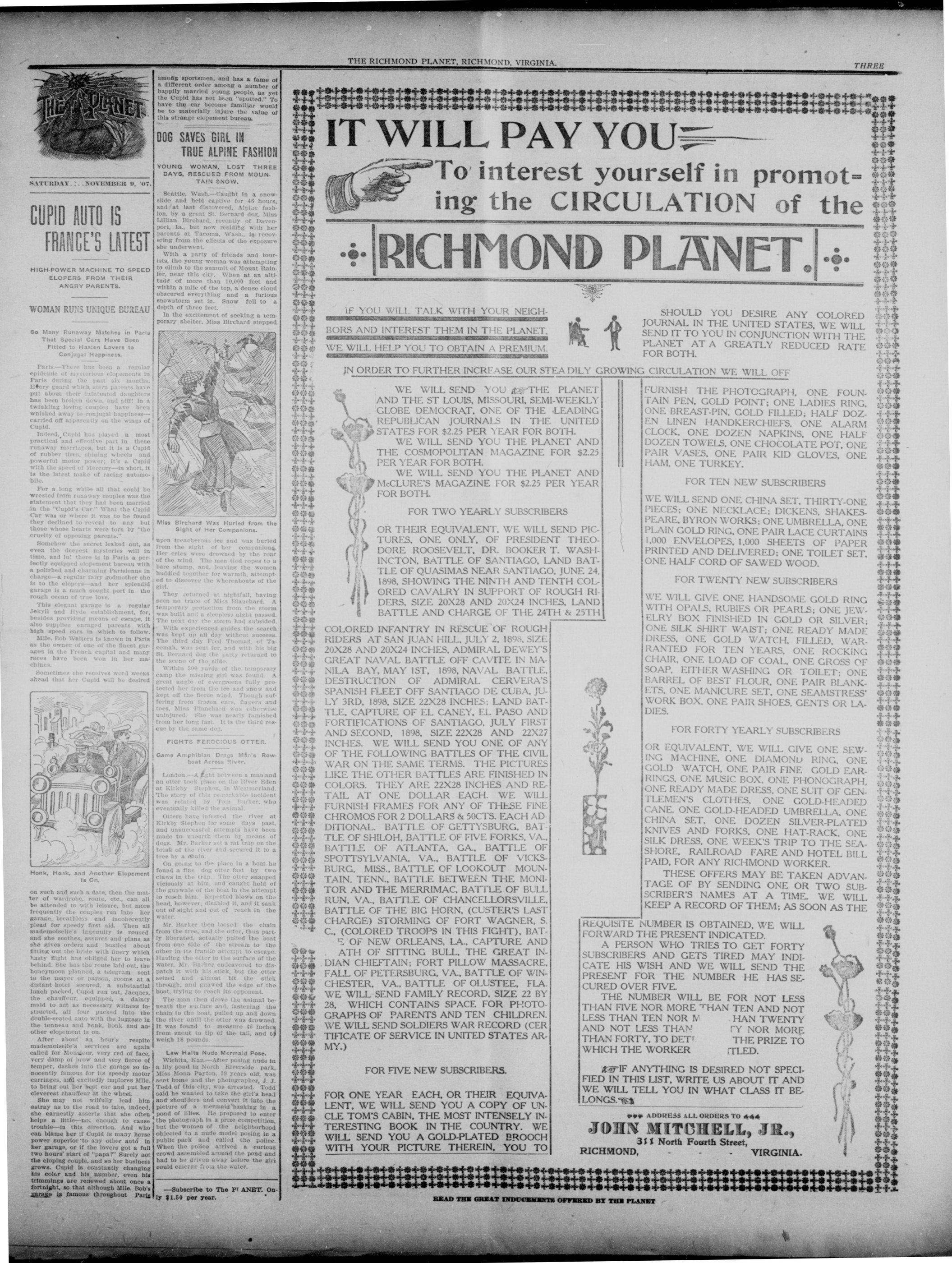
BORS AND INTEREST THEM IN THE PLANET WE WILL HELP YOU TO OBTAIN A PREMIUM.
IN ORDER TO FURTHER INCREASE OUR STEADILY GROWING CIRCULATION WE WILL OFF
WE WILL SEND YOU THE PLANET AND THE ST LOUIS, MISSOURI, SEMI-WEEKLY GLOBE DEMOCRAT, ONE OF THE LEADING REPUBLICAN JOURNALS IN THE UNITED STATES FOR $2.25 PER YEAR FOR BOTH. WE WILL SEND YOU THE PLANET AND THE COSMOPOLITAN MAGAZINE FOR $2.25 PER YEAR FOR BOTH. WE WILL SEND YOU THE PLANET AND McCLURE'S MAGAZINE FOR $2.25 PER YEAR FOR BOTH.
OR THEIR EQUIVALENT, WE WILL SEND PICTURES, ONE ONLY, OF PRESIDENT THEO DORE ROOSEVELT, DR. BOOKER T. WASH INCTON, BATTLE OF SANTIAGO, LAND BATTLE OF QUASIMAS NEAR SANTIAGO, JUNE 24, 1898, SHOWING THE NINTH AND TENTH COLORED CAVALRY IN SUPPORT OF ROUGH RIDERS, SIZE 20X28 AND 20X24 INCHES, LAND BATTLE AND CHARGE OF THE 24TH & 25TH
COLORED INFANT RIDERS AT SAN JUAN 20X28 AND 20X24 GREAT NAVAL BANILA BAY, MAY DESTRUCTION OF SPANISH FLEET OLY 3RD, 1898, SIZE TLE, CAPTURE OF FORTIFICATIONS AND SECOND, 189 INCHES. WE WILL OF THE FOLLOW WAR ON THE SAN LIKE THE OTHER COLORS. THEY A TAIL AT ONE D FURNISH FRAMES CHROMOS FOR 2 DITIONAL. BATTLE OF SHILOH, B BATTLE OF ATI SPOTTSYLVANIA, BURG, MISS., BATTAIN, TENN., BAT TOR AND THE MIR RUN, VA., BATTLE BATTLE OF THE CHARGE) STORM C., (COLORED TRE E OF NEW ORIATH OF SITTIDIAN CHIEFTAIN; FALL OF PETERSE CHESTER, VA., B WE WILL SEND FA 28, WHICH CON GRAPHS OF PARI WE WILL SEND SO TIFICATE OF SERV MY.)
COLORED INFANTRY IN RESCUE OF ROUGH RIDERS AT SAN JUAN HILL, JULY 2, 1898, SIZE 20X28 AND 20X24 INCHES, ADMIRAL DEWEY'S GREAT NAVAL BATTLE OFF CAVITE IN MANILA BAY, MAY 1ST, 1898, NAVAL BATTLE, DESTRUCTION OF ADMIRAL CERVERA'S SPANISH FLEET OFF SANTIAGO DE CUBA, JULY 3RD, 1898, SIZE 22X28 INCHES; LAND BATTLE, CAPTURE OF EL CANEY, EL PASO AND FORTIFICATIONS OF SANTIAGO, JULY FIRST AND SECOND, 1898, SIZE 22X28 AND 22X27 INCHES. WE WILL SEND YOU ONE OF ANY OF THE FOLLOWING BATTLES OF THE CIVIL WAR ON THE SAME TERMS. THE PICTURES LIKE THE OTHER BATTLES ARE FINISHED IN COLORS. THEY ARE 22X28 INCHES AND RETAIL AT ONE DOLLAR EACH. WE WILL FURNISH FRAMES FOR ANY OF THESE FINE CHROMOS FOR 2 DOLLARS & 50CTS. EACH ADDITIONAL. BATTLE OF GETTYSBURG, BATTLE OF SHILOH, BATTLE OF FIVE FORKS, VA., BATTLE OF ATLANTA, GA., BATTLE OF SPOTTSYLVANIA, VA., BATTLE OF VICKSBURG, MISS., BATTLE OF LOOKOUT MOUNTAIN. TENN., BATTLE BETWEEN THE MONITOR AND THE MERRIMAC, BATTLE OF BULL RUN, VA., BATTLE OF CHANCELLORSVILLE, BATTLE OF THE BIG HORN, (CUSTER'S LAST CHARGE) STORMING OF FORT WAGNER, S. C., (COLORED TROOPS IN THIS FIGHT), BAT-
OF NEW ORLEANS, LA., CAPTURE, AND ATH OF SITTING BULL, THE GREAT INDIAN CHIEFTAIN; FORT PILLOW MASSACRE, FALL OF PETERSBURG, VA., BATTLE OF WINCHESTER, VA., BATTLE OF OLUSTEE, FLA. WE WILL SEND FAMILY RECORD, SIZE 22 BY 28, WHICH CONTAINS SPACE FOR PHOTOGRAPHS OF PARENTS AND TEN CHILDREN. WE WILL SEND SOLDIERS WAR RECORD (CERTIFICATE OF SERVICE IN UNITED STATES ARMY.)
FOR FIVE NEW SUBSCRIBERS
FOR ONE YEAR
LENT, WE WILL S
CLE TOM'S CABIN
TERESTING BOOK
WILL SEND YOU
WITH YOUR PIC
THE YEAR EACH, OR THEIR
WE WILL SEND YOU A COPY
M'S CABIN, THE MOST INTEN-
TING BOOK IN THE COUNT
END YOU A GOLD-PLATED
YOUR PICTURE THEREIN, Y
READ THE GREAT I
FOR ONE YEAR EACH, OR THEIR EQUIVALENT, WE WILL SEND YOU A COPY OF UNCLE TOM'S CABIN, THE MOST INTENSELY INTERESTING BOOK IN THE COUNTRY. WE WILL SEND YOU A GOLD-PLATED BROOCH WITH YOUR PICTURE THEREIN, YOU TO
ADDRESS ALL ORDERS TO
JOHN MITCHELL, JR.,
311 North Fourth Street,
RICHMOND, VIRGINIA.
```markdown
```
```markdown
```
To interest yourself in promoting the CIRCULATION of the
READ THE GREAT INDUCEMENTS OFFERED BY THE PLANET
FOR TWO YEARLY SUBSCRIBERS
REQUISITE NUMBER IS OBTAINED, WE WILL FORWARD THE PRESENT INDICATED.
A PERSON WHO TRIES TO GET FORTY SUBSCRIBERS AND GETS TIRED MAY INDICATE HIS WISH AND WE WILL SEND THE PRESENT FOR THE NUMBER HE HAS SECURED OVER FIVE.
THE NUMBER WILL BE FOR NOT LESS THAN FIVE NOR MORE THAN TEN AND NOT LESS THAN TEN NOR M HAN TWENTY AND NOT LESS THAN TY NOR MORE THAN FORTY, TO DET THE PRIZE TO WHICH THE WORKER TLED.
IF ANYTHING IS DESIRED NOT SPECIFIED IN THIS LIST, WRITE US ABOUT IT AND WE WILL TELL YOU IN WHAT CLASS IT BE LONGS.
ADDRESS ALL ORDERS TO
JOHN MITCHELL, JR.,
311 North Fourth Street,
RICHMOND, VIRGINIA
A man in a suit talking to a man in a chair.
LANET WEEKLY
READING
UNITED
TH.
T AND
R $2.25
T AND
YEAR
ND PIC-
THEO-
WASH-
D BAT-
JUNE 24.
TH COL-
HIGH RI-
LAND
& 25TH
```markdown
```
REQUIST FORWAR
SHOULD YOU DESIRE ANY COLORED JOURNAL IN THE UNITED STATES, WE WILL SEND IT TO YOU IN CONJUNCTION WITH THE PLANET AT A GREATLY REDUCED RATE FOR BOTH.
FURNISH THE PHOTOGRAPH, ONE FOUNTAIN PEN, GOLD POINT; ONE LADIES RING, ONE BREAST-PIN, GOLD FILLED; HALF DOZEN LINEN HANDKERCHIEFS, ONE ALARM CLOCK, ONE DOZEN NAPKINS, ONE HALF DOZEN TOWELS, ONE CHOCOLATE POT, ONE PAIR VASES, ONE PAIR KID GLOVES, ONE HAM, ONE TURKEY.
WE WILL SEND ONE CHINA SET, THIRTY-ONE PIECES; ONE NECKLACE; DICKENS, SHAKESPEARE, BYRON WORKS; ONE UMBRELLA, ONE PLAIN GOLD RING, ONE PAIR LACE CURTAINS 1,000 ENVELOPES, 1,000 SHEETS OF PAPER PRINTED AND DELIVERED; ONE TOILET SET, ONE HALF CORD OF SAWED WOOD.
FOR TWENTY NEW SUBSCRIBERS
WE WILL GIVE ONE HANDSOME GOLD RING WITH OPALS, RUBIES OR PEARLS; ONE JEWELRY BOX FINISHED IN GOLD OR SILVER; ONE SILK SHIRT WAIST; ONE READY MADE DRESS, ONE GOLD WATCH, FILLED, WARRANTED FOR TEN YEARS, ONE ROCKING CHAIR, ONE LOAD OF COAL, ONE GROSS OF SOAP, EITHER WASHING OR TOILET; ONE BARREL OF BEST FLOUR, ONE PAIR BLANKETS, ONE MANICURE SET, ONE SEAMSTRESS' WORK BOX, ONE PAIR SHOES, GENTS OR LADIES.
FOR FORTY YEARLY SUBSCRIBERS
OR EQUIVALENT, WE WILL GIVE ONE SEWING MACHINE, ONE DIAMOND RING, ONE GOLD WATCH, ONE PAIR FINE. GOLD EARRINGS, ONE MUSIC BOX, ONE PHONOGRAPH, ONE READY MADE DRESS, ONE SUIT OF GENTLEMEN'S CLOTHES, ONE GOLD-HEADED CANE, ONE GOLD-HEADED UMBRELLA, ONE CHINA SET, ONE DOZEN SILVER-PLATED KNIVES AND FORKS, ONE HAT-RACK, ONE SILK DRESS, ONE WEEK'S TRIP TO THE SEASHORE, RAILROAD FARE AND HOTEL BILL PAID, FOR ANY RICHMOND WORKER. THESE OFFERS MAY BE TAKEN ADVANTAGE OF BY SENDING ONE OR TWO SUBSCRIBER'S NAMES AT A TIME. WE WILL KEEP A RECORD OF THEM; AS SOON AS THE
FOR TEN NEW SUBSCRIBERS
THREE
```markdown
```
```markdown
```
FOUR
THE PLANET
All communications intended for publication should be sent so as to reach us by Wednesday.
TERMS IN ADVANCE
ADVANCE
One Copy, one year, . . . $ 1.50
One Copy, eight months, . . . $ 1.50
One Copy, six months, . . . $ 8.00
One Copy, four months, . . . $ 8.00
One Copy, three months, . . . $ 4.00
Single Copy, . . . $ 6.00
ADVERTISING RATES
For one inch, one insertion, . . . $ .50
For one inch each subsequent insertion, . . . $ 40
For two inches, three months, . . . $ 6.00
For two inches, four months, . . . $ 10.00
For two inches, nine months, . . . $ 14.00
For two inches, twelve months, . . . $ 20.00
For two inches, twenty months, . . . $ 20.00
Stanling and Transient Notices per line, . . . $ 10.
POSTAGE STAMPS OF A HIGHER DENOMINATION THAN TWO NOT RECEIVED ON SUBSCRIPTIONS.
THE PLANET is issued weekly. The subscription price is $ 50 per year in advance. There are four ways in which money can be sent by mail at our risk—In a Post Office Money Order, by Bank check or Draft, or an Express Order, by Post Office. These can be procured in a Registered Letter.
MONEY ORDERS—You can buy a Money Order at your Post Office, payable at the Richmond and we will be responsible for its safe arrival.
EXPRESS MONEY ORDERS can be obtained at any office of the American Express Co., the United States Express Co., and the Well's Fargo Corp. or at any of the other companies able for money sent by any of these companies. The Express Money Order is a safe and convenient way of receiving money.
REGISTERED ORDER A Money Order, Post Office or an Express Office is not within your reach, your Postmaster will register the letter you wish to send us on payment of the letter. You can send it or steal it. can be traced. You can send money the manner at our risk.
I cannot be responsible for money and letter in any other way than one of the forms mentioned above. If you send your money in any other way, you must do it at your own risk.
RENEWALS, ETC.-If you do not want THE PLANET continued for another year your subscription has run out, you then notify us by Postal Card to discontinue it. The courts have ruled that you cannot order their paper discontinued at the expiration time for which it has been paid are held liable for the payment of the subscription up to date when they order the paper discontinued.
COMMUNICATIONS—When writing to us to
review your subscription or to discontinue your
paper, you should give your name and address
to fulfill this subscript. we cannot find your name on
our books.
CHANGE OF ADDRESS—In order to change
the address of a subscriber, we must be sent the
former as well as the present address.
Entered at the Post Office at Richmond, Va.
as second class matter.
SATURDAY.....NOVEMBER 9, '07.
HON. JOHN SHARP WILLIAMS ON
THE NEGRO.
"He makes no friend, who never made a foe."—Tennyson.
It seems that some people never tire in discussing the Negro. Although he has been despoiled of the ballot and eliminated as a political factor in the Southland, there is still a disposition to nag him and to keep him ever present as a subject of discussion in this truly remarkable land.
The southerners have declared repeatedly upon the hustings, in magazine articles and in the Congress of the United States that if the South was let alone it would settle the Negro question in its own way and there would be no more trouble. Now comes Hon. John Sharp Williams, from the rock-ribbed bourbon Negro-hating state of Mississippi, where a Negro has no more chance for liberty than a "bob-tailed mule in fly time," and gives his views upon this great Negro question, which according to polite information was settled more than ten years ago.
The Supreme Court of the United States by its infamous decisions gave notice to this commonwealth that it could settle the Negro in its own way. It did so by one of the most remarkable constitutions ever put in force in any State in the Union. It did so by a system of peonage that is but a shade removed from actual slavery. It did so by human butcheries that for brutality and fiendishness have equalled to tortures of the Spanish Inquisition and the horrors of the Middle Ages.
Rapine and immorality have run riot in that State and blood has flowed in streams. The butchery of Negroes by white men has led to the killing of white men by white men. The political robbery of Negroes by white men has led to the political robbery of white men by white men. So true is this that Hon. John Sharp Williams, who is admittedly one of the fairest Democratic white men in Mississippi has just emerged from a political contest with an unscrupulous antagonist in which under normal conditions he should have won with "hands down."
As it was by methods that are very much similar to those invoked in dealing with the Negroes, and which he successfully combated, he won only by "the skin of his teeth." But we cannot discuss this phase of the question further. Mr. Williams has contributed an article to the November number of "The Metropolitan Magazine and that publication has illustrated the same with timely illustrations. The editor says:
The publication of a Southerner's views of the Negro problem and his grasp of its possible solution is something of a unique undertaking. Most of the great mass of material that the race question has called forth has come from the pens of
---
Northerners who have brought them best efforts to a severe task; for only one who has lived years of his life in close contact with the Southern Negro can discuss the problem from thorough knowledge. Is it not time then, that a Southerner should state the facts as he sees them, and suggest his solution of the riddle? The Southerner's knowledge, presented fairly, it is agreed, is the word for which the entire country has long been waiting; and Mr. Williams tries here to fulfil this urgent demand. His reputation needs small comment. He is one of the great leaders of the South. For years he has been lader of the minority in the House of Representatives, and only recently, Mississippi, his State, chose him to go to the United States Senate.
We might add that inasmuch as the Negroes or a large proportion of them are literate and many of them are college-bred, it would be well to permit some one of them to explain the situation and demonstrate to the people of this country that there is not half as much riddle in the Negro question as there is problem in the white man's disregard of his own laws.
To speak plainly, the white people are trying the experiment of governing the black people of the Southland without governing the white people. They play fast and lose in dealing with white men's crimes and fast in dealing with Negroes' short-comings. They marvel because the Negroes are not ten times more law-abiding than the white man, when as a matter of his environments and teachings, he should be ten times worse. They herd the Negroes like cattle and leave them to their ownuge-nities, establishing what is closely akin to leper colonies and then blame these same Negroes because they do not possess all of the refinement and intelligence of the upper class of white people. But to Hon. John Sharp Williams; here is what he says:
The South has less than one-third of the American Union in its population, and in its white population very much less than one-third. It is represented in the Senate by less than one-third of the Senators and in the House by less than one-third of its membership. To repeat an amendment to the Constitution of the United States requires that it be done by way of further amendment. The Constitution of the United States provides that, in order to amend the Constitution, a resolution must pass both Houses by a two-thirds vote in each, and that it must also receive the indorsement of three-fourths of the States.
Nobody but a man with his head in the clouds or in a dark closet, nobody who has traveled over the balance of the Union and talked to the people, has the slightest notion that two-thirds of the representatives in the National Congress and three-fourths of the States of the Union can be prevailed upon now or for at least a generation yet to come, if ever, to indorse the repeal of the fifteenth amendment.
This is very gratifying information to the average colored man in these United States. The laws were enacted at a time when the stress of circumstances and the march of events justified the means. The South realizes that some day men will occupy seats upon the Supreme Court "bench" of the United States who will be guided by the law, rather than by sentiment. The Negroes of this country are preparing themselves for that event by patronizing every institution of learning, both industrial and collegiate.
Mr. Williams continues:
It must be remembered that among the States in this Union are Rhode Island, Maine, Massachusetts, Minnesota, Wisconsin, far away Washington, the Dakotas, Montana—I need not name them all—States within which the presence of the Negro has never proved a menace to the white man's civilization or his social life. These people can no more understand our position upon the race question than we can understand theirs.
Our views are summed up by them in the short and contemptuous phrase, "Southern race prejudice," or as one of the great Democratic newspapers in Boston said, when discussing race and my views on the race question in one of its editors, "col orrophilia." Now, as a matter of fact what is called "race prejudice" is not race prejudice at all but is race knowledge, and our convictions would be shared by the men of the North if only they had equal knowledge.
I do not know any way of giving them equal knowledge except by bringing down a sufficient number of them, putting them in direct proximity with the Negro, on the farm and in the sawmill, and in every day life, and keeping them there long enough for the object lesson to sink in. I am not rich enough to import and maintain a majority of the population of the Northern States of Northern people who do come mongolian for two or three years adopt our views, showing the truth of what I have said—that our feeling upon the race question is not race prejudice, but race knowledge. When they share our knowledge they share our feelings.
Mr. Williams seems to forget that Northerners who locate in the South do so for profit. This profit is dependent upon their views, relative to the Negro and his surroundings. He is no more free to give voice to his views, and indulge in his tastes, and exercise his personal privileges relative to the colored people than are the Negroes themselves.
When he does express himself, he soon finds that the neighborhood is not only unsafe for him, but his belongings as well. As a result, he is
THE RICHMOND PLANET, RICHMOND, VIRGINIA
usually more emphatic in condemnation of the Negro than the native Southernner seems to be. President Roosevelt found this out and he has taken advantage of this knowledge. He first "booted" the Negro battalion out of the army and then went South, landing the Inhabitants and ignoring the Negroes.
Only a few of them who made arrangements through the more liberal Southernners were able to secure a few words of advice from his store of knowledge. The Booker T. Washington episode has completely revolutionalized the President of the nation. True, he receives the distinguished Negro instructor, diplomat and statesman, but it is behind closed doors and never during the luncheon hour at the White House of the nation.
Mr. Williams undertakes an onerous task to explain that race-prejudice is a misnomer when applied either to himself or to the natives of the Southland. He is having a hard time of it, but here is the way he is making the effort.
The word "prejudice," indeed, comes from the two Latin words, and it means etymologically "before judgment;" that is to say, a conclusion adopted before getting knowledge or information on which to base "judgment." If I were to call our race feeling anything etymologically, I would call it a "postjudice" and not "pre-judice." I notice that nobody has our race feeling or any race feeling indeed until after knowledge. It is a conviction born of experience.
That sounds very well, Mr. Williams, but all of the people are not mullets—swallowing everything that comes along. Let us see. A colored man of education and refinement enters a street-car, you turn your head and spread yourself out, lest he should take the notion to occupy a seat at your side. You do not know that he is a man of means, owns his own place of business, occupies his own residence, bathes in his own porcelain bath tub once a day and has won the respect of all classes of citizens in the community in which he lives. That's not race "post-judice," Mr. Williams. That is race prejudice, sometimes called color phobia.
Let us bring the matter still further home. You have a trusted Negro servant. He is polite, obliquing and thanks to the training in your household he is a polished Chesterfieldan gentleman. The servant enters a hotel corridor unaccompanied by Mr. John Sharp Williams or by any member of the William's family. He seats himself in one of the chairs in the hotel office. He is attired in his Sunday "best" and is awaiting the arrival of his boss. A look of surprise is upon the countenance of the white men more than six feet away. It intensifies into a look of contempt, which is soon to be followed by a demand upon the proprietor that this Negro be made to seek the balmy sidewalk on the outside.
A white man who knows him whispers, "That's Congressman John Sharp Williams' Negro. He's evidently waiting for his boss." That's not race "post-judice," Mr. Williams. That's race prejudice. This then should dispose of Mr. Williams definitions as applied to the doctrine of caste now being practiced in the Southland.
The cases we have cited are "before judgment." They are every day occurrences in this section of the United States. The texture of a citizen's hair, the color of his skin is taken as meaning "the type of Negro against which the South arms itself." The good, Christian Negro is rated along with the shiftless, good for-nothing one. If this is not prejudging a Negro, Mr. Williams; if this is not race prejudice, what is it? The distinguished Southerner continues:
If you go to Cal fornia to-day, you find an immense and irrepressible feeling of race antagonism against the Chinaman and, virtually, none at all against the Negro. There is race knowledge concerning Chinamen, and enough Chinamen there to constitute a race menace, but not enough Negroes. If you go to Vermont, you will find none against either. If you come to Mississippi, you will find the same irrepressible outbreaking of antagonism between the white and the Negro races, and very little against the Chinese.
A Chinaman, well dressed and behaving himself, taking dinner at a Mississippi hotel, might excite some little remark, but nothing more. A Negro, if he were a graduate of Harvard College, spotlessly clothed and just washed, would, if he were admitted to the dinner-table at a hotel in my State, excite a riot. If, on the contrary, he went to a hotel in Vermont, the other guests would doubtless seek an introduction to him if being an opportunity to see and study something of a new and strange type.
It seems to us that by the above utterances, Mr. Williams gives away his case and proves, beyond the shadow of a doubt the existence in the Southland of race prejudice, sometimes called colorphobia. In Vermont where there is no race prejudice, they have a favorable impression at first, suspend judgment, seek an introduction and form a lasting opinion afterwards. Mr. Williams says further:
The total absence of this feeling among people who have never felt the presence of the Negro as a men.
ace to the moralities of social life, to the white man's civilization or his code of ethics, will be realized when you remember that Carnegie, W. Winnmaker, Bishop Potter of New York President Roosevelt, have all eaten with the Negro, as host and guest, at the same table. You would realize it all the more if you knew how absolutely astonished they have been at the outbreak of feeling in the South concerning their actions.
This is further evidence against Mr. Williams' form of reasoning. He places the loafing Negroes of the cities, the industrial stevedores on the wharves, the wealth-producing Negroes on the plantations on a level with the Negro of the Booker T. Washington, W. H. Councill, W. D. Crum, W. T. Vernon, Judson W. Lyons, John C. Dancy, T. Thomas Fortune, George H. White Bishop S. D. Ferguson type. Yet Mr. Williams admits that the presence of any one of these Negroes in a Southern hotel would result in a riot. These Southerners would not wait to find out the calibre, the social standing, the educational ability of these citizens of color. They would class them as "corn-field" Negroes. They would prejudge them. They would proceed to murder the innocent men and gloat in that act of fiendishness and their apologist. Mr. John Sharp Williams would argue that they are not actuated by prejudice of race. Oh, no, it is a case of "post-judice" of race—a fore-knowledge of colored men that they had never met based upon a past knowledge of colored men, whom they had met. Could argument be more ridiculous?
On the other hand, there are foolish Negroes who pre-judge white men, thinking that all white men are against them and their best interests because some white men that they have met and known are against the Negroes and their best interests, Mr. Williams has the effrontery to say:
The truth is that we have no "pre-judge" against the Negro. Northerners have a prejudice in favor of him, owing to their lack of personal knowledge of the limitations of his character. They ask you: "After all is he not a member of the human race, of the genus homo, a human being?" I have replied: "Yes; so are zebras and horses and asses all members of the genus equus—of the equine race. But for all that, a horse is not a zebra, and an ass is not a horse."
White men, red men, black men, yellow men, are all of the genus homo, but they are different animals, all the same, and their inherent and inherited race traits and tendencies, their physical, mental and moral differences, strengthened by experience of man's development, are as inherent as the link of color and the color of the skin, which are but the outward and visible signs of these inward and spiritual "differences."
It is inconceivable that a gentleman of Mr. Williams' type possessing an abiding faith in the Master and professing a desire to observe his teachings should give voice to such impracticable argument. What basis of comparison can there be between a black man and a white one and a zebra and a horse or an ass? The mating of a zebra and a horse does not produce either a horse or a zebra and the mating of a horse and an ass does not produce an horse or an ass. But the mating of a white man and a colored woman or vice versa does produce a white man and then again a colored one dependent absolutely upon the strain of color in either the one sex or the other. To emphasize this fact we cite again from the Code of Virginia, Page 1119, Section 2252, explanatory part:
"A marriage between a white man and a woman who is of less than one-fourth Negro blood, however small the lesser amount may be, is legal. A woman whose father was white, whose mother's father was white, and whose great.great grand. mother was not a Negro in the sense of the statute—McPherson Case, 28 Grat. 933."
Where then is there a basis of comparison with that of the animal kingdom cited? History records the rise and fall of races, while the Good Book tells us that He made of one blood all of the nations of the earth. The Jews are regarded with contempt in Russia and Turkey, the Kafirs with the same feeling in South Africa, the Irish are struggling for greater recognition in England, while the Negroes are insisting upon and demanding all of their rights and privileges in the United States.
The Japanese are the coming people in the Far East and who knows but what during the centuries which are to come, but what they may have organized the Great Britain of Eastern Asia and the islands of the Pacific? It is surprising then that a statesman of Hon. John Sharp Williams type should give voice to such senseless argument and we feel like saying to him in the language of the Saviour. "Art thou a master In Israel and knoweth not these things?"
Mr. Williams says further:
Once, in conversation with a man of great intellect from the North, he suggested that "Northern and Southern people do not so much differ with as misunderstand one another upon the race question." I replied: "I think you are wrong there. We differ radically—at the very root of things. Now for example, I think you share, to a certain extent, the
opinion of nearly all white people in the North, with no knowledge of Negro racial traits and tendencies, who have talked to me, in thinking that a Negro is a sort of a "white man with a black skin," and that, with the same 'opportunities,' as you call it, he will do the same work." He admitted that he did, and expressed some surprise that anybody should differ from that view. Seeing that it was useless to reason with him, I resorted to the argument of reductio ad absurdum. I said, "Then I suppose you think that a North American Indian is a Chinaman with a red skin?" The repatriee did more good than any amount of argument, because it made the whole fabric of his previous utterance so ridiculous that he broke into a laugh. And yet I did not get that idea out of that man's head. It is there yet, and nothing but boarding him for a couple of years and bringing him in direct contact with the Negro's life every day would get it out of his head.
Mr. Williams seems oblivious of the fact that there are Negroes born and reared in Canada and in the northern and western part of the United States who have none of the Negro racial traits and tendencies possessed by those Negroes with whom he has come in contact. He is as ignorant of this type of the American citizen of color as is the northerners whose ideas he so glibly ridicules. His attempt at repartee did not touch the question at issue, which is, whether or not a Negro, an American Indian or a Chinaman is under relatively the same conditions, subject and capable of the same degree of educational and industrial advancement as a white man of a similar type?
To fail to answer this question squarely, buttressing the answer with facts is to fail to convince a conservative Northernner. Mr. Williams and his friends of the same prejudiced class insist upon living in their own cocoons. They insist upon producing their own Negroes and they refuse to accept or believe that there are any Negroes who can be any more or accomplish any more than the cotton-pickling Negroes of this sunny land.
And yet there are thousands of instances where Northerners have taken the children of Negroes of even this type and moulded them into learned doctors, professors, theologians, pharmacists, economists, electricians, statesmen, government employees, stenographers, journalists, real estate agents, merchants, bankers, authors, poets, inventors, orators, legislators, congressmen, and senators.
These are practical demonstrations of facts reinforced by other facts and Mr. Williams, being blind himself wonders why these white philanthropists of the North cannot see. Oh, no. Senator Williams, the trouble is well explained by our Saviour when he exclaimed in one of his wrathful outbursts: "Thou hypocrite, first cast out the beam out of thine own eye; and then shalt thou see clearly to cast out the mote out of thy brother's eye."
But enough for this week. We shall deal further in our next issue with these astounding assertions from the distingushed Senatorial nominee of Mississippi.
"Freedom's battle once begun. Bequeathed from bleeding sire to son. Though baffled oft, is ever won."
THE NEGRO AND THE BALLOT
The announcement that Mr. Andrew Carnegie, that "prince of philanthropists" and admirer of Dr. Booker T. Washington had been a party to a discussion of the Negro question in conjunction with Lord Rosebery was somewhat a surprise. The event took place before a large audience at the Philosophical Institution, Edinburg, Scotland, October 16, 1907.
The telegraphic report says;
Mr. Carnegie strongly championed the Negroes. He traced their development from slaves to citizens, the gradual decrease of illiteracy among them, their general inclusion in church organizations and the enormous expenditure of money for churches and schools.
He counted that the Negro was a saving man, with land hunger, and declared there was no better test of a respectable member of society than a bank book showing a good balance of money to a house or farm unencumbered by debt. He magnified the idea that the Negro is lazy. On the contrary, he said, he was busied in every field of activity, even in newspapers.
The question used to be what can be done with the Negroes, but now it is how more of them and other workers can be obtained. The Negro has become of immense economic value and is indispensable. Nevertheless, Mr. Carnegie admitted, the Negro problem is as yet unsolved, and the question whether Negroes will ever be raised into the mass of the nation is still unanswerable.
Mr. Carnegie is evidently well-posted as to the progress and the producing power of the Negroes. As a matter of fact government statistics show that the Negroes add six hundred million dollars per annum to the wealth of the country. The report says further:
Lord Rosebey, while professing the incompetency to offer an opinion on the subject and believing it undesirable to submit his views on the internal affairs of other nations, nevertheless said he doubted the wis-
Jom of enfranchising the Negroes.
He believed 90 per cent. of them
were illiterate when they were
enfranchised, and even on Mr. Carnegie's showing 47 per cent. were still so.
It seemed to him that a period of tutelage might have been wisely imposed. Had not the United States he asked in a generous impulse of the moment admitted to the franchise men wholly incompetent to exercise that high prerogative?
There was danger, he declared, in dealing with vast masses of voters, of underrating the individual importance, he might, indeed, say the solemnity of a vote. Looking coolly and historically back with criticism, which is so easy now of what was done in him, he told us the old picture of a chained slave appealing to a white man, saying, "Am I not a man and brother? he could not help thinking the wise answer would have been. "A man? Yes. A brother? Yes, but if you think you have proved your fitness for the suffrage and full citizenship, no."
We are not surprised at Lord Roseb ry's frank expression of opinion and pause to remark that this would be substantially his opinion of the English colonists who landed upon these shores. If he concedes that when a man, be he black or white, red or yellow, Jew or Gentile proves his fitness to suffrage and full citizenship, he is entitled to receive it, then there is no disagreement between him and the leading Negroes of this country. We are handicapped by the doctrine of caste, that color bars advancement along all lines.
The report says further;
Continuing Lord Rosebery said that things were sometimes done under high and generous impulses which were afterward regretted. He was inclined to think there were some persons in America who regreted that the suffrage had been given to the Negroes. Dealing more brief with future fusion of the races and the persistence of the color line, regarding which he said he would refrain from prophesying. Lord Rosebery described the experiment in the amalgamation of races going on in the United States as one of intense interest. He said on this subject:
"The United States is a great crucible in which the metals of every race and nation under the sun are being melted together. Will this result in the production of the perfect man of the future or in an entirely new type hitherto unknown to anthropologists, which will be the subject of study by the older races of the globe? We who are in a quasipaternal position look forward to the development of the experiment with almost breathless interest. Our hope is that out of the anglam will arise men like Mr. Carnegie whose generous character and large philanthropy are not limited by the boundaries of countries or differences of race, but who scatters his benefactions as a locomotive scatter sparks.
We are of the opinion that Lord Rosebery meant well and that his cautious but blunt utterances came from the fullness of a pure heart. He was evidently influenced however by the representations of white men who were unfair in their statements. It is generally accepted that the basis of political accountability is education. When the Negro was enfranchised 90 per cent. of them were illiterate and now only 47 per cent. of them are still so. The question presented is "Shall the 53 per cent. of educated Negroes be permitted to exercise the right of franchise?"
If Lord Rosebery had attacked the American experiment of universal suffrage, rather than the specific act of the United States Government in enfranchising the slave, we would have been in a position to understand his utterances and we would have declared that he was untainted by the racial antipathy which is now holding high carnival in this country.
The point that we wish to emphasize here is that a Negro may be intelligent, without being educated. Thousands of these kind of people live in the Southland. There are men and women here who earn money, buy property and conduct business, guided only by that innate wisdom, known from one section of this country to the other as "mother wit."
They hire the "school-learned female and the college-bred male to keep books for them and to conduct that part of the business with which they are not educationally acquainted. We know illiterate men and women who buy and sell produce in this city who can figure to a quarter of a cent a pound more quickly and accurately than some of the best learned students in our schools.
They are quick-witted, honest, law abiding, God-fearing and yet it is argued that a sporting white liberty is more entitled to the ballot than this tax-paying Negro. We can not see it that way. A person in a republic, be he Negro or white man, who is good enough to fight for his country is good enough to exercise the right of franchise in an organized form of government, that his valor has saved.
Of course we have the lazy, good-for-nothing Negro, but it is not that class, whose cause we plead. We are opposed to any discrimination based upon race, color or previous condition of servitude. We do not believe that the enfranchisement of the black man was a mistake. By this act many ills were avoided that might have culminated in another Civil War.
He was not as bad as he was painted, and much with which he was
charged was the direct result of the instructions of white men, who were alone responsible. Ever since the Negroes came to this country they have been the door mats for every white man to wipe his feet upon and the object of responsibility for every crime named in the decalogue. Southern white men of liberal ideas now admit this.
We now own ($700,000,000) seven hundred million dollars worth of property. We add ($600,000,000) six hundred million dollars annually to the wealth of the country by our producing power in the fields, farms and plantations of the country. We have given up our life's blood for the nation that now turns a deaf ear to our appeals and which looks with indifference upon the action of its President, Hon. Theodore Roosevelt in driving out of the army with out trial three of the bravest and best companies that ever wore uniform or sighted a rifle.
It is well that Mr. Andrew Carnegie spoke a word in our favor. We occupy the position of the "under-dog" so to speak. But we have faith in God and our own strong arm for the dark clouds will yet be lifted and the dawn of our vindication will yet be at hand.
"O. fear not in a world like this And thou shalt know ere long, Know how sublime a thing it is To suffer and be strong."
AN ECHO OF BROWNSVILLE
Hon. Theodore E. Burton, who resigned his seat in the Congress of the United States to be a candidate for Mayor of Cleveland, Ohio against Mayor Tom L. Johnson was defeated last Tuesday although he had the endorsation of President Roosevelt and it was said made the canvass on his suggestion. Previous to the election, Mr. Burton refused to give any assurances to a delegation of colored men that he would not antagonize Senator J. B. Foraker for re-election to the United States Senate. As a result, he was bitterly opposed by some of the colored citizens under the acknowledged leadership of Hon. H. C. Smith, editor of the Cleveland, O. Gazette. There will be no tears shed over the result by the colored people of the country.
Previous to the election, the Richmond, Va. News-Leader made the following editorial comment:
Now Cleveland, O., is hard against the Negro as a voter. That city is engrossed in a local fight of intense interest between Tom Johnson with his Democratic and Independent forces on one side and former Congressman Burton, regular Republican on the other. Mr. Burton is the man who resigned his seat in congress at the special suggestion of President Roosevelt to become a candidate for mayor of Cleveland and attempt to overthrow Johnson and his three cent street car fare and generally socialistic policies.
The Negroes of Cleveland threaten to use the opportunity to punish the president for dismissing the Negro troops at Brownsville, Texas by voting against the Republican nominee. Consequently the most servile overtures are being made to them by the Negro managers and Foraker has been important successfully to use his influence to keep the black vote in line.
It continued:
The interesting point is that the Negroes apparently do not give the slightest attention to the issues involved or the tremendously important effect their vote may have on the welfare of the city and the interests of their fellow citizens. They threaten en to vote solidly, not as Democrats or Republicans or Socialists, not as opponents or friends of the three cent car fare, not as American citizens, nor as their ideal seems to be to vote as Negroes to avenge the dismissal of guilty Negro soldiers from the army.
Their position is taken regardless of the merits of the Brownsville case.
It is indeed surprising that a newspaper of the character and standing of the News-Leader should give voice to such misleading assertions. These colored voters did just what they have been advised to do by the Democratic orators and men of ability. They exercised discriminating judgment and either stayed away from the polls or voted against Hon. Theodore E. Burton, the man who was the avowed antagonist of Hon. Joseph Benson Foraker of Ohio. They were not there to avenge the dismissal of guilty Negro soldiers, but were at the polls to emphasize their displeasure over the dishonorable discharge of innocent Negro soldiers. Their position was taken after a careful and prayerful consideration of the merits of the Brownsville case. The News-Leader said further:
It will be remembered that Senator Foraker with all his ingenuity and persistence was unable to shake the statement that the Negro troopers did commit riot and murder and invade and shoot up a peaceful community. This makes no difference to the Cleveland Negroes. Their demand seems to be that Negroes shall be exempted from punishment and that all who undertake to punish them or who offend the race in any way shall be the objects of Negro vengeance to be taken at the polls.
Considering this situation, probably the most enthusiastic Cleveland Republican is ready to concede by this time that to give the Negro the vote was a mistake and that the white people of the South knew to-
THE PLANET
SATURDAY...NOVEMBER 9. '07
erably well what they were about and had reasonably correct notions of the requirement for their own self-preservation when they took his vote away from him.
Senator Foraker did shake the statement as to the guilt of the Negro troopers. He not only shook it, but battered it down as well. He flew the colors of the law that every person is presumed innocent until he is proved guilty and that in a republic drastic, heinous or infamous punishment shall not be meted, save by due process of law.
This was the position of the distinguished Senator from Ohio and this is the position of the voters of color of Cleveland, Ohio, led by that "prince of race leaders," Hon. H. C. Smith of Ohio, who contributed largely to the discomfiture and defeat of Hon. Theodore E. Burton of the Buckeye State.
This is a warning on the political horizon and is an indication as to what the Republican leaders of the Roosevelt stripe may expect in Ohio, Indiana, New York, New Jersey and many other northern states unless something is done to right the wrong done them and place this Black Battalion in its true light before the people of the world.
MORGAN HOLDS HELM
New York Banks Will Aid Trust Companies.
THIRTY- TWO MILLIONS COMING.
Greatest Fight In the History of American Finance Ends In Victory—Money Magnates In All Night Conference.
NEW YORK, Nov. 6.—Despite what had appeared to be auguries of further financial troubles there were neither bank crashes nor a panic in stocks. Prices were weak at the opening in Wall street, but there was a decided rally within an hour. There were still cuns on the two trust companies that were affected last week, but both kept their doors open and seemed to have ample support.
The prolonged conference of leading financiers evidently resulted in an arrangement whereby the leading banking interests, under J. P. Morgan's guiding hand, were to stand behind the Trust Company of America and the Lincoln Trust company. The doors of such institution were opened promptly. In an all night's conference the group of men whose immense fortunes have stood between the companies and trouble gathered in the library adjoining the residence of Mr. Morgan. In one room at the Waldorf-Astoria hotel the entire board of directors of the Trust Company of America met, while in an adjoining room on the same floor the board of directors of the Lincoln Trust company gathered.
Each of these bodies went into session at 9 o'clock Sunday night, and the final closing of those sessions did not come until 5:30 o'clock Monday morning. In the interim prominent financiers connected with each of those three groups rushed back and forth between the hotel and Mr. Morgan's library, and four times before the ending of the discussion a procession of men, which included all the directors of one or the other of the companies interested, weeded its way from the hotel to the library or from the library to the hotel.
Kumors of impending difficulties were set at rest by the deputy state superintendent of banks, Mr. Hutchinson, who said he had assurances that no banking house would close its doors. The directors of the Lincoln Trust company were in session all the morning. At noon President Frank Tilford gave out this statement:
"This has been the greatest fight in the history of finance. The directors have decided to continue the fight and to pay off the depositors." The raising of the Bank of England discount rate to 6 per cent at a special meeting of the board of governors was not unexpected by those familiar with conditions in Europe, although it was hoped in some quarters that this action of the governors would not be taken until the regular meeting on Thursday.
The fact that $2,000,000 in gold was purchased in the open market in London during the morning for export to America probably hastened the action of the bank. This brings the total gold engagement up above $2,000,000, of which about $7,200,000 will arrive on Wednesday and $10,000,000 on Friday. This will go at once into bank reserves.
The United States Steel corporation has secured a controlling interest in the Tennessee Coal, Iron and Railroad company. The deal was concluded and is traceable to a conference held at the home of J. Pierpont Morgan. It is understood that the price paid is a little above $85 a share.
Facing a Beer Famine.
ST. LOUIS, Nov. 6.—The federal authorities announced that nothing but legal tender will be accepted for internal revenue scamps. With this announcement St. Louis is surely facing a beer famine.
Governor Guild Re-elected by 75,000 Plurality.
BATTLED AGAINST SIX CANDIDATES
Feature of Boston Contest Was Fight For Office of District Attorney, J. B. Moran Being Returned by Large Majority.
BOSTON, Nov. 6.—The Republicans won a great victory in the state election, re-electing Governor Guild and all other state officers. The Republicans will have their usual majority in both branches of the legislature.
The state officers elected were: Governor, Curtis Guild, Jr., of Boston; lieutenant governor, Eben S. Draper of Hopedale; secretary of state, William M. Olin of Boston; treasurer, Arthur D. Chapin of Holyoke; auditor, Henry E. Turner of Malden; attorney general, Dana Malone of Greenfield.
Returns, not complete, indicate Governor Guild's plurality at 75,000 or more.
Governor Guild was opposed for reelection by six other candidates—Henry M. Whitney of Brookline (Dem.) and also running on two sets of nomination papers; Thomas L. Hisgen of West Springfield (Ind. League), General Charles W. Bartlett of Newton (Antimerger), Hervie S. Cowell of Ashburnham (Pro.), John Brown of Worcester (Soc.) and Thomas F. Brennan of Salem (Soc. Lab.).
The total vote of Boston for governor was: Bartlett, 3,446; Guild, 33,442; Hisgen, 18,993; Whitney, 25,511.
Last year's vote was: Guild, 37,143; Moran, 50,671.
With Governor Guild so far in the lead the feature of the election was the contest for the second position in the race for governor between Whitney and Hisgen. Early returns showed the former as having a slight lead over the Independence League candidate.
Mr. Whitney based his campaign almost entirely on reciprocity and on criticism of Governor Guild. Mr. Hisgen, however, attacked both parties and claimed that they were each under the influence of corporations. This was the second time that the Independence League had figured in the state campaign, and the early returns showed that it was holding its own as compared with the two other leading parties.
General Bartlett refrained from any speechmaking after the convention at Springfield, which ultimately resulted in his name being thrown off the Democratic ticket by the ballot law commission on the ground that the convention which nominated him was illegally conducted. In the three weeks preceding the election he issued two statements, in both of which he claimed that the only issue before the people was the threatened merger of the Boston and Maine railroad with the New York, New Haven and Hartford system.
The election passed off very quietly, and early returns showed a falling off in the heavy vote of last year, but not to such a degree as might have been expected in an "off" year. In Boston the feature of the election was the contest for district attorney, in which Joseph A. Dennison (Dem.) and Walter A. Webster (Rep.) opposed the re-election of John B. Moran, the candidate of the Independence League and also running on nomination papers. Here again the Independence League came into prominence, as Mr. Moran was re-elected by a large plurality.
AFTER BAD UTES
Two Cavalry Squadrons Take Field Against Warlike Braves
OMAHA, Neb., Nov. 6—As a result of orders to dispatch the remaining two squadrons of the Second United States cavalry, composed of eight companies, to Thunder Butte, S. D., at the earliest possible moment, the command left Fort Des Moines. Colonel Frank West of the Second cavalry will be placed in command of the expedition on arrival at Thunder Butte. Colonel West is an old time Indian fighter and is said to be thoroughly competent to handle the situation in whatever phase it may develop. It is thought the idea is to prevent any portion of the Sioux tribe from making common cause with the Utes in their revolt against authority.
Company M, Sixteenth infantry, under command of Captain Harry F. Dalton, will leave Fort Crook in a day or two for Gettysburg, S. D., to take charge of the base of supplies which has been established there for the operations against the Ute Indians should they make any troublesome overtures. Major Sibly and the First squadron of four companies of the Second cavalry are now at Thunder Butte. It is possible that the base of operations may be transferred from Gettysburg, which is the end of the railway lines, to Cheyenne River reservation, eighteen miles west of Gettysburg, on the west side of the Missouri river.
Will Suspend Strike:
CHICAGO, Nov. 6. - Striking telegraph operators of the Chicago local union last night decided by a vote of 212 to 109 to recommend to the national executive board that the strike be "suspended." The executive committee will meet today to act on the recommendation.
Dies as He Was Voting.
OSWEGO, N. Y., Nov. 6. - William H. Kelly, a well known hotel man, died suddenly in the polling place of the Third ward here. He was just about to enter the voting machine when he collapsed and died five minutes later.
Mitchell Has a Relapse
INDIANAPOLIS, Ind., Nov. 6. — Word was received at the mine workers' headquarters that President John Mitchell of that organization, who is in the hospital at La Salle, Ill., has suffered a relapse. His condition is critical, but the physicians say there is little likelihood of a change either way for two or three days.
THE RICHMOND PLANET, RICHMOND, VIRGINIA
JOB DEPARTMENT
EXCURSION
We print Handbills, Quarter-Sheet posters, Tags, Tickets, Placardumes, Visiting Cards, Mourning Stations
WE HAVE
Our St
OF THE LATE
WE CAN PRINT A BILL AS SMALL
A Three-Sheet
AS LARGE AS A FRO
Our street-entrance is retired and fastidious lady being able to enter w
EXCURSION WORK OF ALL DESCRIPTIONS
We print Handbills, Quarter-Sheets, Half and Whole Sheet posters, Tags, Tickets, Placards, Society Cards, Minutes, Visiting Cards, Mourning Stationery. OUR AIM is to please our patrons and to give them the best service at the lowest prices, consistent with satisfactory work. We furnish "cuts" when desired and we will arrange complete special work in our line. When in need of any work in our line, call and see us and estimates will be furnished.
OF THE LATEST STYLE BOND, FINE WRITING--FLAT AND LINEN PAPER, ENVELOPES, ETC.
Our street-entrance is retired and has no objectionable features, the most fastidious lady being able to enter without embarrassment or annoyance.
LONG DISTANCE TELEPHONE, 2213.
FORD'S
HAIR POMADE
Formerly known as
"OZOMIZED OX MARROW"
The Ozonized Ox Marrow Co.
(None genuine without my signature)
Charlie Ford Post
153 E. KINZIE ST., CHICAGO, IL.
Agents wanted everywhere.
It is thoroughly equipped to do all kinds of printing on short notice. We make a specialty of Society printing and work for Insurance Companies, such as Financial
WESTON'S LONG JOG.
Portland to Chicago Pedestrian Is
Ahead of Time, at Hartford
GREAT BARRINGTON, Mass., Nov. 5.-Edward Payson Weston, who left Torrington, Conn., in the morning on his walk to Chicago from Portland, Me., rested here for more than two hours and at 8 o'clock continued on his way. He expected to reach Chatham, N. Y., some time after midnight and to pass the night there. Chatham is about twenty miles from Great Barrington.
Weston, the aged pedestrian who is walking from Portland to Chicago, passed through Hartford from Andover.
Without stopping any length of time he crossed the city and headed for New Britain. Weston was ahead of his schedule.
After spending Sunday and parts of two nights at Andover, Conn., getting needed rest and sleep, Weston left Andover at 12:05 a. m. for Hartford.
Weston had an enthusiastic sendoff, the houses being illuminated and a large crowd bidding him godspeed.
Kaiser In England.
BERLIN, Nov. 6.—It is announced that Emperor William, after visiting the English court, will remain a fortnight incognito on the Isle of Wight in order completely to get rid of his catarron, from which he is still a sufferer. The visit of his majesty to the court of the Netherlands, which was artended to follow the visit to London, will therefore be postponed.
```markdown
```
Cards, Policies, both straight life and benevolent, Physician's Certificates, Sick Cards, Application blanks, Agents Report Sheets, Rate Cards, etc.
MISSION WORK
arter-Sheets, Half and Whole
Placards, Society Cards, Min-
ing Stationery.
WE AN ELSE
WHICH WE WILL
Stock Rooms
LATEST STYLE BOND, FIRE
AS SMALL AS A DODGER.
Sheet Poster
A FRONT DOOR.
OUR PRESENT CORP OF EMPLOYE
IS WITHIN EASY REACH OF
2213.
LINCOLN
HAIR P
MAKES
KINKY
HAIR
SOFT
REMOVES
DANDRUFF
AND
MAKES
IT
GROW
LONG
AND
LUXURIOUS
A Woman's Hair Make
If your hair is short. If your
your scalp is diseased, LINCOLN
make it grow, remove the dand
LINCOLN HAIR POMADE
the finest toilet preparation on
for you to give it a trial and w
be so satisfactory that you will
Be sure and get the genuine
substitutes. For sale at all D
PRICE, 1
MANUFACT
The Lincoln Po
N WORK C
, Half and Whole
Society Cards, Min-
ry.
is to please
give them
the lowest
with satis
AN ELEGANT
WHICH WE WILL SHOW AN
Rock Room
STYLE BOND, FINE WRITT
L AS A DODGER.
Poster
DOOR.
SENT CORP OF EMPLOYEES ARE
IN EASY REACH OF THE PUBLIS
is no objectionable features, the
but embarrassment or annoyance
LINCOLN
HAIR POMADE
AKES
INKY
HAIR
SOFT
MOVES
DRUFF
AND
MAKES
T
HOW
LONG
AND
RIDIOUS
Woman's Hair Makes or Mars
air is short. If your head is f
is diseased, LINCOLN HAIR
now, remove the dandruff and cu
N HAIR POMADE is highly
toilet preparation on the market
give it a trial and we feel confi
factory that you will recommend
and get the genuine and refuse
s. For sale at all Drug Stores.
PRICE, 15 CENTS.
MANUFACTURED BY
Lincoln Pomade
WHICH WE WILL SHOW ANY ONE DESIRING TO SEE THEM.
OUR PRESENT CORP OF EMPLOYEES ARE COMPETENT AND QUICK-WORKING. OUR OFFICE IS WITHIN EASY REACH OF THE PUBLIC, BEING WITHIN FIFTY YARDS OF BROAD ST.
LINCOLN
HAIR POMADE
MAKES
KINKY
HAIR
SOFT
REMOVES
DANDRUFF
AND
MAKES
IT
GROW
LONG
AND
LUXURIOUS
SOFTENS
THE
HAIR
AND
KEEPS IT
FROM
BREAKING
KEEPS
SCALP
FRESH
CLEAN
AND
WHOLE SOME
If your hair is short. If your head is full of dandruff. If your scalp is diseased, LINCOLN HAIR POMADE will make it grow, remove the dandruff and cure scalp diseases. LINCOLN HAIR POMADE is highly perfumed and is the finest toilet preparation on the market. All we ask is for you to give it a trial and we feel confident the result will be so satisfactory that you will recommend it to your friends. Be sure and get the genuine and refuse weak and inferior substitutes. For sale at all Drug Stores.
The Lincoln Pomade Company.
NORFOLK, VA., U. S. A.
If your dealer does not keep it, sen will send you a bottle by return mail. for particulars.
dealer does not keep it, send his name and
a bottle by return mail. Agents wa
Dall
If your dealer does not keep it, send his name and 20 cents in silver and we
will give a bottle by return mail. Agents wanted everywhere. Write
for particular
JURGEN'S SON
Before making your purchase you would do well to call at the most reliable furniture house in the city and see the fine line of REFRIGERATONS, MATTINGS, OIL-CLOTHS And in fact everything that is needed in house furnishings.
Of every description; also the latest designs in ROCKERS and special CHAIRS. Our goods are the best for the price and
Our goods are the best for the price and the price is very low.
C. G. JURGEN'S SON,
ADAMS AND BROAD STREETS.
---
WORK OF AL
OUR AIM
is to please our patrons and to
give them the best service at
the lowest prices, consistent
with satisfactory work.
ELEGANT I
SHOW ANY ONE DESIRING
em Embrace
ONE WRITING—FLAT AND
JOYEES ARE COMPETENT AND QUI
THE PUBLIC, BEING WITHIN FI
features, the most
annoyance.
FOR FURT
COLN
POMADE
SOFTENS
THE
HAIR
AND
KEEPS IT
FROM
BREAKING
KEEPS
SCALP
FRESH
CLEAN
AND
WHOLESOME
es or Mars Her Beauty.
Our head is full of dandruff. If
COLN HAIR POMADE will
dandruff and cure scalp diseases.
It is highly perfumed and is
the market. All we ask is
we feel confident the result will
recommend it to your friends.
and refuse weak and inferior
drug Stores.
5 CENTS.
FEATURED BY
made Company,
On and after April 1st, 1907, sched ule via the popular York River Line will leave Richmond at 4:30 P. M. daily except Sunday, returning leave Baltimore at 5 P. M. daily except Sunday. Very low rates one way and round trip to Baltimore, Philadelphia and New York. It's the best way to reach Northern and Eastern points.
Excursions to Jamestown Exposition
Norfolk, Va. via Southewn
Railway.
Commencing April 19th and continuing daily to November 30, 1907 Southern Railway will sell season sixty day, fifteen day and ten day excursion tickets to Norfolk, Va. and return at reduced rates account the above; and on Tuesday of each week coach excursion tickets, not good in parlor or pullman cars, will be sold at greatly reduced rates, limited seven days. Inquire of Southern Railway Agents.
We print Wedding Invitations, and High Class Stationery for Balls, Parties, Picnics and all entertainments of a social nature.
We print Church Envel.
ALL DESCRIBE
us and to
service at
consistent
k.
We furnish "cuts" when de-
complete special work in our
in our line, call and see us and
T LINE OF S
DESIRING TO SEE THEM.
races a full
AT AND LINEN PAPER, ENVELOP
WE HAVE ONE OF THE
OF WOOD
Of Any Job Printing E
T AND QUICK-WORKING. OUR OFFICE
WITHIN FIFTY YARDS OF BROAD ST.
OUR FURTHER INFORMATION, AP
John Mitch
311 N. 4th St.
FOR FURTHER INFORMATION, APPLY TO
John Mitchell, Jr.,
Special Attention Given to Balls,
Suppers, Installations and Smokers at the Shortest Notice.
Your Patronage Solicited.
Refreshment Cars and Boat Privileges Handled in Season.
Address all communications to LLAM L. BANKS, 511 N. 3d St
Residence; 1312 N. 26th St.
ALL WORK GUARANTEED.....
Cards, Letters or Orders.
Give us a trial, you will never regret it....
Address, 608 St. Peter Street,
RICHMOND, VA.
---
Dally to Baltimore.
WE HAVE ONE OF THE LARGEST ASSORTMENT OF WOOD-TYPE Of Any Job Printing Establishment in the city.
311 N. 4th St., Richmond Va;
SEABOARD
SOUTHBOUND TRAIN SCHED-
ULED TO LEAVE RICHMOND
DAILY.
9:10 A. M.—Local to Norlina, Raleigh, Charlotte, Wilmington, 2:20
P. M.—Sleepers and coaches, Savannah, Jacksonville and Florida pots,
9:50 P. M.—Sleepers and coaches
Atlanta, Birmingham, Memphis, Savannah, Jacksonville and Southwest.
NORTHBOUND TRAINS SCHED-
ULED TO ARRIVE RICHMOND
JOSHUA BANKS & SONS
EVERY FACILITY CONSISTENT WITH FINE CATERING.
BLACKWELL & BRO.
Practical House and Sign Painters, Graining and General Contractors.
PLANET DEPOTS
NEW YORK CITY.
W. H. Warrington, 71 W. 99th St.
W. H. White, 328 Columbus Ave.
R. Plummer, 100 W. 134th St.
Standard News Co., 131 W. 53d St.
J. Voll, 324 W. 52d St.
Rev A. McKeen, 52 E. 123d St.
F. Green, 302 W. 40th St.
W. H. Jones, 249 W. 35th St.
W. B. Bee, 1 W. 134th St.
Clarence Bush, 515 Morris Ave.,
Bronx-Borough.
J. H. Parker, 144 W. 26th St.
Charles Devan, 1.1 W. 30th St.
W. J. Buckner, 150 W. 53rd St.
W. W. Johnson, 247 W. 47th St.
E. H. Mitchell, 152 W. 27th St.
Turner R. Robinson, 12-6th Ave.
E. A. Williams, 200 W. 53rd St.
Smith & Miles, 232 W. 41st St.
M. B. Wineglass, 322 W. 59th St.
PHILADELPHIA, PA.
J. H. Gray, 1233 Pine St.
Bishop Robinson, 1234 Melon St.
E. P. Mackens, 1116 Pine St.
James E. Warwick, 254 S. 11th St.
Mrs. B. Homser, 1040 Pine St.
William Parker, 631 Pine St.
Mrs. Levina Aldridge, 551 S. 12th.
Chas. A. George, 4063 Market St.
F. A. Stewart, 1730 Federal St.
PITTSBURG, PA.
F. H. Harrison, 1310 Wylie Ave.
Jos. Evans, care Jones & Laughlin
E. K. Thumm., 1402 Wylie Ave.
FIVE
opes, Note and Letter Papers
Bill-heads, Monthly Statements,
Business Cards, Financial and Order Books,
Circulars, Check-books, Pamphlets.
SCRIPTIONS
insired and we will arrange so fine. When in need of any work estimates will be furnished.
SAMPLES
Line
PES, ETC
LARGEST ASSORTMENTS
OD-TYPE
establishment in the city.
PLY TO
nell, Jr.,
Richmond Va.
BOSTON MASS
I. D. Robbins, 155 Cambridge St.
John Debona, 610 Church St.
T. E. W. Perry, 2 Jones Place.
CHICAGO, ILL.
M. H. Faulkner, 3104 State St.
BROOKLYN, N. Y.
Lee Ricks, 782 Fulton St.
William A. Dabney, 5 Quincy St.
CHARLESTON, W. VA.
L. C. Farrar, 601 Brooks St.
ASTORIA, L. I.
Frank R. Wood, 144 Broadway,
ATLANTIC CITY, N. J.
Hursey Bres., 1217 Commerce Ave.
L. H. Singleton, 20th and E 6th.
Southwestern Drug Co.,
732-2d Street, 1 W.
COVINGTON, VA.
Daniel Braxton, Box 91.
NEWPORT NEWS, VA.
Freddie Smith, 1358-29th St.
M. J. Jeffersen, 1211-30th St.
TARPORO, N. C.
V. M. Heward.
WILMINGTON, N. C.
William H. Moere.
STAUNTON, VA.
Wm. C. Johnsten, 111 B. Main W.
LYNCHBURG, VA.
James Wingfield, 422-12th St.
Charles Morgan, 702 Taylor St.
HAMPTON, VA.
John M. Phillips.
DANVILLE, VA.
O. P. Clark, 233 N. Union St.
John H. Johnsea, 210 Bridge St.
PROVIDENCE, R. L.
Douglas A. A. P. Agency.
DEMOPOLIS, ALA.
John W. Anderson.
BALTIMORE, MD.
Henry Albert, 203 Richmond St.
PASSAIC, N. J.
Robt Lee Greenwood, 142 Myrtle Ave
ASBURY PARK, N. J.
Geo W. Moody, 1139 Springwood Ave
A. Haynes, 1103 Springwood Ave.
ST. AUGUSTINE, FLA.
W. A. Fleming
BURLINGTON, N. J.
Joseph Anderson, 130 B Delaware ave
WICHITA FALLS, TEX.
F. L. Lindsey, Box 72.
MEMPHIS, TENN.
Standard? News Company.
THE APEXET
Joshua Renewing the
Covenant With Israel
Sunday School Lesson for Nov. 10, 1907
Specially Prepared for This Page
LESSON TEXT.—Joshua 24:14-28. Memory verses 22-24.
GOLDEN TEXT.—"Choose you this day whom ye will serve"—Joshua 24:15.
According to our Bible margins, B. C. 145, 182 years after crossing the Jordan, and 15 after our last lesson. Prof. Besser thinks that the time since the crossing of the PlACE. The religious capital was at Shaesh Josh. Jebel. The great assembly for renewing the covenant was at Shechem, between Mounts Ebal and Gerim. JOSHUA was nearly 190 years old. Living at Taimath Serah, not far from Shechem.
Comment and Suggestive Thought.
The conquest of the country took several years, not of uninterrupted warfare, but of wars intermingled with cultivating the fields and making homes and becoming citizens. All though the Canaanites were not wholly exterminated (Josh. 23:12), Judz. 2:2, 3), yet the war was practically ended, and the people gave themselves to the positive work of settling down as prosperous citizens of the Promised Land (Josh. 23:14-25).
Joshua was drawing near to the close of a long and useful life of 110 years. He had been watching the tendencies of the times, and knew well the character of his people and the peculiar dangers to which they would be exposed. Therefore he determined to make, before he died, one more appeal to them, under the most solemn circumstances possible.
It is uncertain whether the last two chapters of Joshua are two different addresses or two reports of the same address. The only importance of the question is its bearing on the structure of the book.
The Polychrome Bible, the Expositor's Bible, and others regard them as two trustworthy reports of the Shechem address, given separately as the editor received them, and not interwoven according to the plan usually adopted.
Others regard them as two similar addresses on the same great occasion to different audiences, the first to a mass meeting of the people, and the second to the officers and judges of all the tribes assembled at Shechem, probably on the sloping sides of Mts. Ebal and Gerizim, where they had gathered 25 years before, on the first entrance into the Promised Land, and made the most solemn promises to God.
Vs. 1-13. No circumstances could be more impressive as, amid these hallooled associations and memories, the white-haired, beloved leader, saintly in character and touched with the light of a near eternity, arose and made his dying appeal, somewhat as the Apostle John, when very old, went feebly among the disciples, saying continually: "Little children, love one another." In this place all the assembled multitudes could see and hear him. For the air is so clear that a "single voice can be heard by many thousands." The longest recorded distance at which a man's voice has been heard is 18 miles in the Grand Canyon of Colorado, Dr. Young records that at Gibraltar the human voice has been heard at a distance of ten miles.
Joshua first proclaims what God has done in the past, as a motive for trusting and obeying him in the present. Gratitude and love are awakened by his wonderful goodness to them. Faith in him and reverence and awe are inspired by the manifestations of his divine power (vs. 1:13).
Joshua's Conference with the People.—Vs. 14:24. Urges the people to choose you this day whom ye will serve. Vs. 14, 15. V. 14. "Now therefore," in view of these facts, "fear the LORD." Not be in terror before him, nor driven from him by fright, but hold him in reverential awe and respect, realize his power to help and to punish, so as to devote yourselves to him in perfect trust. There can be no trifling. "Serve him in sincerity and in Truth." Not in outward farms merely, but also in the heart and the life (John 4:23, 24). The idea, says Prof. Beecher, is rather of wholeness, integrity, than sincerity.
The Double Witness. — Vs. 25.28.
First. The Covenant. — V. 25. “Made a covenant with the people that day.”
L. e. “he solemnly rattled and renewed the covenant of Sinai (Ex. 19:20), as Moses had done before him in the plains of Moab (Dout. 29:1).” — Cook.
“Set them a statue.” He determined and established “what in matters of religion should be with Israel law and right.”
V. 26. “And Joshua wrote.” As Moses at Sinai wrote all the words that Jehovah had spoken in a book, probably a papyrus-roll (Ex. 24:4), so Joshua now inscribed ‘minutes’ of the transactions connected with the renewal of the covenant at Schem.
“In the book of the law of God.” This protocol he placed inside the roll of the Law of Moses. — Cambridge Bible.
Practical Points.
There is only one right principle of living, and that is loving and choosing God with all the heart.
After one has made this choice, then there is need of conferring him in the choice, and guiding him in its expression in life.
The need of all others—of the majority of persons—is an impulse and reinforcement of motives which lead
There are great advantages in large public meetings where every possible appeal can be made to persuade him to decide to serve God.
BY THE WAY
It is altogether too easy to fall into the habit of talking too much.
The money one does not earn always seems as if liable to disappear.
Theories would be of greater value if they fitted more closely to facts.
The most severe criticism that falls on professionals comes from anateurs.
The man who drives his horse without water seldom forgets beer for himself.
If you want to accomplish a good day's work do not be in a hurry in the morning.
A record is of more use in soliciting charity or applause than it is for making progress.
When a woman is absolutely out of place it is when scolding the agent because she bought the wrong kind of a ticket.
Although we all have our ups and downs, it will be noticed that it always seems further up than it does down.
Crankiness is no more an indication of brains than stinginess is of sound financial policy.—Uncle Dick, in Madison Journal.
THE UNEMBELLISHED ONE.
Drape me with a fig leaf, said Prudery.
Decorate me with epanlets, said Mediocrity.
Cover me with the draperies of love, said Lust.
Give me the staff of tolerance, said
Persecution.
Adorn me with the cloak of liberty,
said Tyranny.
Clothe me in the robes of righteousness, said Sin.
Deck me with the garments of innocence, said Vice.
Place the crown of fidelity on my brow, said Disloyalty.
Garb me with the habilliments of humility, said Pride.
Beautify me with the dress of duty, said Irresponsibility.
Put sincerity's gown upon my shoulders, said Deceit.
Then Truth said: Let me be naked and unashamed—Victor Robinson, in Life.
Between genius and stupidity is that
the farmer is handcapped.
Between a cow and a milkman is
that the cow gives real milk.
Between lightning and electricity is
that there is a charge for the latter.
Between a playwright and a plagiarist is usually not discernible, while that
Between bare truth and a bear story,
on the other hand, is the greatest imaginable.
Between cereals and servials is that
while the ones builds up, the other pulls us down.
Between necessity and wealth is
that the one knows no law, while the other merely ignores it.
Between a caroless man and a downright villain is that the first is the greater plague to society.
Between a racing yacht and a pleasure yacht is often only that between a center-board and a sideboard.—MII waukee Sentinel.
MERE OPINION
Men still kiss the hands of women—but only in novels and melodramas.
If a man is willing to work for nothing he never has to look far for a job.
The early bird may catch the worm, but merely early is not sufficient.
Most of us could save money if our friends didn't keep us going so fast to outdo them.
What a good many people call luck is simply being on the spot with the goods.
About the only pleasure the long-faced, angular, sour-looking woman has in life she finds in repeating that she would never permit a daughter of hers to go on the stage.
MAXIMS OF A GRASS WIDOW.
When he makes use of the words "Can't you trust me, dear?" it is time not to.
Men who hold it a divine right to abuse women are strangely popular with women.
A man's as good as landed when he tells his friends how solicitous she is about his future success, and believes it impersonal.
Advice to After-Dinner Orators.
Make for yourself one little joke,
But known to be your own.
Treat better than a thousand plucked
From fields by others sown.
-Judge
---
THE RICHMOND PLANET, RICHMOND, VIRGINIA
HORTICULTURE
Some Advice Which May Be Kept for Next Year's Use.
There are numerous styles of budding, but only the one in the most common use will be described here. Budding is one of the most economical forms of artificial reproduction, and each year witnesses its more general use. Some nurserymen go so
common use will be described here. Budding is one of the most economical forms of artificial reproduction, and each year witnesses its more general use. Some nurserymen go so far as to use it as a substitute for all modes of grafting, save whip grafting, in the propagation of the dwarf pear. Budding is economical in the amount of wood used from which to take buds. In this method, a single bud does the work of two or three or more upon the sclon used in grafting. But while it is economical of wood, it is expensive in the use of stocks, a seedling being required for each tree, while with the piece-root system of grafting, two, three or more stocks can be made from a single seedling.
The operation of budding is simple, and can be done with great speed by expert budders. The expense of the operation is, therefore, not more than
a
b
Preparing Stock for Bud.
that of whip grafting. The usual plan, says Orange Judd Farmer, is for a man to set the buds with a boy following closely to do the tying.
The bud should be taken from wood of the present season's growth. Since the work of budding is done during the season of active growth, the bud sticks are prepared so that the petiole or stem of each leaf is left attached to serve as a handle to aid in pushing the bud home when inserting it beneath the bark of the stock. This is what is usually called a shield bud. It is cut so that a small portion of the woody tissue of the branch is removed with the bud. The bud stick and method of cutting is shown in the accompanying figure by Prof. Corbett.
The stock for budding should be at least as thick as an ordinary lead pencil. With apple and pear, a second season's growth will be necessary to develop this size, while with peach, a single season will suffice; hence, peach stocks can be budded the same season the pits are planted. Consequently the peach is left until as late
Budding, Tying and Cutting Top.
In the season as is practicable, to obtain stocks of suitable size. The height at which buds are inserted varies with the operator. In general, the nearer the ground the better.
To bud a plant, make a cut for the reception of the bud in the shape of a letter T as shown at a. Usually the crosscut is not quite at right angles with the body of the tree and the stem to the T starts at the crosscut and extends toward the root for an inch or more. Loosen the flaps of bark caused by the intersection of the two cuts as seen at b, with the ivory heel of the budding knife.
Grasp the bud by the leaf stem as a handle, insert it under the flaps and push it firmly in place until its cut surface is entirely in contact with the peeled body of the stocks as shown at a. Tie tightly above and below the bud, as indicated at b, to hold it in place until a union shall be formed. Raffia or wrapping cotton (ordinary cotton string) about ten to 12 inches long, makes a most convenient tying material. As soon as the buds have united with the stock the ligature should be cut, to prevent girdling the stock. This done, the operation is complete until the following spring. Trees in which the buds have taken should have the top cut off just above the bud as seen at c.
In many of our farmers' gardens the ground is not fertilized as highly as it should be to get the best results with early vegetables.
OIL STOVES IN HOTBEDS.
A Suggestion Which Will Prove Valuable Next Spring.
For years, says a writer in Rural New Yorker, I had a hotbed 15 or 18 feet long to start tomato plants. It was heated by two one-wick oil stoves, and was a perfect success after I found how to manage it. I will try to tell how one can have an
Knights of Pythias,
This organization is one of the most powerful in the country and its progress has been phenominal. The Grand Lodge of Virginia has jurisdiction over all of the cities and counties in this state. Thirty males are required to organize a new lodge. The benefits paid constitute one of its strongest features, but the principles are greater than anything else. Founded on Friendship, based on Charity and established on Be nevolence, the respectable, upright people of the state will find it an order worthy of their heartiest support.
It pays an endowment and burial benefit of of $200.00 for all ages. It pays $4.00 per week sick dues. The badge costing 75 cents each is the only absolutely necessary regalia. For information concerning the organization of lodges apply at the main office.
The Courts of Calanthe
The Courts of Calanthe
Is the Female Department of the Order. It requires a membership of thirty persons to organize a court. Its members are pledged to exhibit Fidelity, exercise Harmony and prove Love one for the other. It pays an endowment and burial benefit of $150.00. It pays $3.00 per week sick dues. The only expense for regalia is the cost of the badge, 50 cents and a rosette, costing 25 cents for funeral occasions.
THE BANDS OF CALANTHE or Children's Department also constitutes a feature and persons cannot do better than to enter the little ones into this mystic circle. The expense is nominal and the benefits all that could be expected. It pays from $1.00 to $1.50 sick dues and death benefits of from $30.09 to $40.00. If you have no Pythian Lodge or Court or Band in your neighborhood, orgnize one.
For all information concerning the Children's Department address
For all information concerning special rates of membership in the lodges and courts, address
KNIGHTS OF PYTHIAST
F.C.B.
only absolutely necessary rega
apply at the main office.
The Court
Is the Female Department of the
thirty persons to organize a con-
Fidelity, exercise Harmony and
an endowment and burial bene-
dues. The only expense for re-
a rosette, costing 25 cents for f
THE BANDS OF CALA-
stitutes a feature and persons o
circle. The expense is nomine-
$1.00 to $1.50 sick dues and da
Lodge or Court or Band in you
For all information concerni
For all information concer-
membership in the lodges and
oil stove hebted to grow pepper, tomato plants, egg plants and the like to perfection. The hotbed must be elevated on blocks of wood high enough so that a person can get under it to care for the lamps; it should be sheltered from the winds, but not near enough to any building to cause danger if the hotbed should get on fire. In the accompanying diagram A represents the glass area, B is a false bottom made of sheet-iron and resting on iron rods run crossways of the
Diagram of the Hotbed.
hotbed. C is the true bottom, made of wood, and distance about six inches from the sheet iron bottom; D and E are small boxes, each big enough to hold a one-wick oil stove. A two-wick oil stove will make the soil too hot just above the flame. Each box is fitted with a door in which are bored a few holes to admit air. The dirt is placed on the sheet iron bottom to a depth of six inches, the warm air circulates between the wooden bottom and the sheet iron one, but no fumes from the oil stove ever reach the interior of the hotbed proper. The woodwork at the under side of the hotbed should not be too tight; a few small cracks should be left, or there will be no circulation of air for the lamps, and they will smoke. I once showed hotbeds made like this to an Englishman, the private gardener to a rich man. This gardener makes his hotbeds by the help of manure. I told him after I got the hang of my oil stove hotbeds I never had a failure. He said: "You are, then, ahead of me, for with all my care my manure beds are not always a success, and it is some work to make them."
TOMATO BLIGHT.
Is Fungus Growth That Begins Attack
In the Seed Bed.
Tomato blight is due to a fungus, which attacks the plants for the most part in the seed bed. This being the case, there can be no remedy for the plant after it is once attacked. This is true, for the reason that the fungus grows on the inside of the plants and evidently enters the rootlets of young plants. By examining the tissues of a young plant with a microscope, the threads of the fungus may be seen clogging the cells where they interfere with the passage of food material. At the present time, then, we see no hope of ever being able to combat this blight successfully in the field. But we do hope to find a method of prevention by improving the sanitary condition of the seed beds. With this end in view, we believe it will pay to thoroughly clean and disinfect the frames or flats in which the seeds are planted. This may be done by washing or spraying all of the parts after the dirt and soil have been removed, with a strong solution of copper sulphate. Then fresh soil and manure should be procured, which should also be sterilized. This can be best done by steam. This may be done at small cost by fitting up a small system of two-inch iron pipes which are to be placed in the bottom of a bed made for the purpose. Three ten or 12 foot lengths of pipe will be ample, and small holes must be drilled in them about six inches apart to allow steam to escape. The pipes are now placed parallel to each other and connected at both ends, so that they are about 18 inches apart. The apparatus may be connected to a traction engine or other available source of steam supply. Soil should be filled into the bed over the pipes to the depth of about one foot, then the surface covered with gunny sacks or some similar material. If steam is turned on for an hour, the low organisms will be killed, and plants which will be practically free from blight should be raised in soil
---
N. A., S. A, E. A., A. AND A.
organization is one of the most powerful
has been phenomenal. The Grand
over all of the cities and counties
in need to organize a new lodge. The b
largest features, but the principles are
based on Friendship, based on Char-
the respectable, upright people of
their heartiest support.
an endowment and burial benefit of
per week sick dues. The badge
galla. For information concerning
curts of Calanthe
in the Order. It requires a memb
court. Its members are pledged to
and prove Love one for the other.
benefit of $150.00. It pays $300 per
funeral occasions.
ANTHE or Children's Department
cannot do better than to enter the
final and the benefits all that could
death benefits of from $30.09 to $40
our neighborhood, orgrize one.
using the Children's Department ad-
mits:
Mrs. ANNA TAY
120 W. H
morning special rates of
JOHN
and courts, address
31
$150 PER
SURE TO GOOD AGENT
greatest seller in America to-day. Nothing
does the work. Sells at almost every home
on the dollar. Write to-day for full particu-
Address
Department also con-
to enter the little ones into this mystic
i that could be expected. It pays from
$30.09 to $40.00. If you have noPythian
ruize one.
department address,
s. ANNA TAYLOR, W. M.,
120 W. Hill St., Richmond, Va.
JOHN MITCHELL, JR.,
311 N. 4th St., Richmond, Va
PER MONTH
OD AGENTS handling the world's greatest of
HAIR TONICS. Absolutely the
o-day. Nothing else like it. No long talk. My plan
most every home over and over again. 87 clear profit
for full particulars, with real chance of a lifetime.
$150 PER MONTH
SURE TO GOOD AGENTS,HAIR TONICS. Absolutely the greatest seller in America to-day. Nothing else like it. No long talk. My plan does the work. Sells at almost every home over and over again. 87 clear profit on the dollar. Write to-day for full particulars, with real chance of a lifetime.
Address
J. F. CLARK, CONWAY, ARK.
which has been treated in this manner.—W. Paddock.
The Farmer's Vegetable Garden.
The farmer's vegetable garden is growing in popularity with the farmers that wish their families to have the greatest amount of comforts in their farm life. A half acre devoted to this work can be made a constant source of pleasure, not only on account of the vegetables it will produce but also on account of the large amount of information it will yield up relative to that treatment of the soil will give the best results. Such a garden should be very heavily manured, so that it will be always at its best for growing crops. We would put on manure both fall and spring and see that the manure gets into the soil. Such a garden if properly worked can but be profitable and be a constant source of delight.
Dealer in General Line of
FANCY AND STAPLE GROCERIES,
NOTIONS, FRESH MEATS, CIGARS, TOBACCO, ICE,
WOOD, COAL, &c.
11 S. 4TH ST., RICHMOND, VA.
produce but
arms amount
up relative
Hogs Sister Than Chickeng.
Hogs in the orchard to destroy windfalls are more effective than chickens. The latter pick out only the soft fruit around the core leaving the pest therein, while hogs eat the entire apple, core, worm and all.
"I say, you've got a fine cheek to charge $15 for stabling my motor car one night in a rotten old barn not worth two cents."
"Well, ye see, gov'nor, I charges it at the rate of 25 cents a horse."
When they have all come back to town,
With all their money spent,
Papa will figure what he had saved.
I once met them had went.
—Houston Post.
Caller—Is your husband still in the asylum, Mrs. Lakeside?
Mrs. Lakeside (of Chicago)—Yes,
and the poot darling is getting craxier
every week. In his last letter he says
he wants to pay his debts.—N. Y.
Wekly.
"Why should an eminent literary man like you talk so much about himself?" asked the critical friend. "Because," answered Mr. Jawburn-em Short, "I am a topic of so much importance that nobody else could do me justice."—Washington Star.
Elsie—I should just like to catch a man kissing me!
Kelsie—I know you would, dear, but you shouldn't admit it—Comic Cuts.
"Miss 'em? I should say not. I only wished I had never met any of them."
---
A. Whele Lot.
Reason Dethroned
A Sense of Fitness
Her Natural Wish
A B C D E F G H I J K L M N O P Q R S T U V W X Y Z
311 N. 4th St., Richmond, Va
JOHN FOXEL.
BOARDING & LODGING
Rates Reasonable. All the Comforts
of Home
Orders received by letter or telegraph
H F Jonathan FISH, OYSTERS AND PRODUCE.
120 N. 17TH ST., RICHMOND, VA.
ALL ORDERS WILL RECEIVE
PROMPT ATTENTION.
Long Distance Phone, 752.
LITTLE THOUGNTS.
A good, hard thump will take the spunk out of many a braggart.
Some friends are not unlike the weather—subject to change without notice.
The man who declares that he would not trust anyone is not to be trusted himself.
The know it all is one who forms his opinions first and thinks everyone ignorant whose ideas differ from his own.
The ambition to be considered in the fashion has been a most serious impediment to the advancement of many a man and many a woman.
Some people boast their station in life is above that of others, and then go to the back door and tell the butcher to come around next week to collect last week's bill.
A man would feel ashamed of himself if he uttered a word of profanity while in a friend's house, but he will go into his own home and around a mother, sister, wife or children and cuss to his heart's content. That man is a hypocrite.
GREAT MULLEIN.
Do you know it?
There's Aaron's rod for one.
It is also called mullein dock.
Velvet or flannel plant are yet others.
You'll find it on stony waste land in dry fields.
Its yellow blossoms are seated around an elongated spike.
On the seeds from its matured blossoms feast birds and insects.
JOSIE A. GRAHAM
Virginia's Most Successful
Hair Culturist.
...PARLORS.....
108 E. Leigh St., - Richmond, /
'Phone, 1034.
Private Parlors, Confidential Inter
The largest and most up-to-date Hair Dressing Parlors in Richmond. The very best preparations that can be made for the hair, scalp, face and skin.
Graham's Superior Scalp Food for growing hair on bald heads and bare temples, 25cts. per jar. By mail, 35cts.
Graham's Superior Orange Flower Skin Fo' for developing and beautifying the skin, 25cts a jar. By mail, 35cts.
Graham's Superior Velux Liquid Powder for giving the face a beautiful fair color, 25 cents a bottle. By mail, 35cts.
Graham's Vegetable Hair Dye the best on market giving a rich natural color, $1.00 per bottle. By mail, $1.25.
Mrs. Graham makes a speciality of massaging and beautifying ladies' faces for paruses and public gatherings, 25 cents.
Mrs. Graham shampoos the head and puts it in a healthy condition, 25 cents.
All ladies who attend parties and other social gatherings should have their finger nails manicured and made beautiful, 25 cents.
Mr. Graham's preparations sell at sight. Ladies living in other cities and towns can make good money by selling these preparations.
Write for terms to Mrs. J. A. Graham, No. 108 E. Leigh St., Richmond, Va.
'Phone 2048 112 W. Leigh S.
REAL ESTATE & LOANS
Private Banker and Broker,
Loans negotiated on Real Estate,
Interest allowed on Deposits,
Estates managed,
Rent collected and prompt returns
Special attention to repairs.
Notary With Seal
Established 1892
SMITH'S BUSINESS COLLEG
LYNCHBURG, VA.
COURSES:
Phonographic, Commercial, Penning
English, Electric wiring, Civil
Engineering.
No Vacation.
Instruction Thorough...Positions Secured.
Correspondence Solicited.
Send 2c for particulars. Address:
T. P. SMITH, A. B.
President
STRAUS' SPECIAL
Old Yacht Club.
PURE WHISKEY
Will Satisfy the lover of the right kind of stimulant. Special prices. We have all grades of good liquors, Cigars and Tobacco. Call and see us.
ISAAC STRAUS & CO.,
422 E. Broad St.,
Richmond, Virginia.
S. W. ROBINSON.
NO. 23 NORTH 18TH ST.
FINE WINES, LIQUORS
CIGARS, &c.
All Stock Sold as Guaranteed.
PROMPT ATTENTION.
Your patronage is respectfully solicited.
—Subscribe to the Richmond, Va.
PLANET. $1.50 per year.
GEORGE O. BROWN,
PHOTOGRAPHER
GCS N. 2nd St., Richmond, Vn.
Fine Photographs. True to Life. High-class
services. Latest Improvements in Photography.
Out-door Work executed. Reasonable B
estimates and Prompt Service. Pictures Eularged
from Old negatives or Photographs. 3-ms
THE ECONOMY,
303-5 North Third St
FINE
TAILORING.
CLEANING, DYEING AND
REPAIRING
CHITMAN M. WHITE,
PROPRIETOR.
A. Hayes
OFFICE AND WARE-ROOMS,
727 North Second Street
RESIDENCE, 725 N. 2nd St.
First-class Hacks and Caskets of all descriptions. I have a spare room for bodies when the family have not a suitable place. All country orders are given special attention. Your special attention is called to the new style Oak Caskets. Call and see me and you shall be waited on individually.
'Phone, 2778.
THE PLANET
SATURDAY...NOVEMBER 9, '07
THE DAIRY
BITTING A SUCKING COW.
Wire Contrivance and How to Adjust It on Animal.
Use a wire about the size of telegraph wire. Have it long enough to go through mouth as a bit and to hook
Prevents Self-Sucking.
together behind the ears as a headstall. The bit will prevent her tongue from getting in suction shape, but, declares the correspondent of the Valley Farmer, she can eat and drink as usual.
SALTING BUTTER
Even Distribution of Moisture Essential to the Process.
The following thoughts were suggested to the writer by reading a report from the Iowa station:
No established rule for salting butter properly can be given. The butter maker will have to be governed entirely by local conditions.
The amount of salt to be incorporated in the butter depends directly on the amount of moisture the butter contains. Butter fat is not a salt dissolving substance. This can be done only by the moisture in the butter. The first thing, then, to get a uniform amount of dissolved salt in butter is to get a uniform amount of moisture. The water should be evenly distributed through the mass of butter. If it is present in pockets or crevices in the butter when the salt is added, much salt will be lost in the form of brine, besides those particles of butter near the pockets will contain more salt than those farther away.
Best results are obtained by allowing the butter to drain well after washing and then apply the salt. In no case should salt be added till the butter has assumed a gathered condition. When the butter is medium soft after being worked, it has been found that from three-fourths to an ounce of salt for each pound of butter is not far from the correct amount.
DAIRY DOINGS.
A separator is easily washed after the owner learns how to do it.
Denmark has about 1,300 creameries and they make annually about 100,000 tons of butter.
Every intelligent man can make dairying pay because intelligent methods always win.
The man that owns a separator can often sell sweet skimmilk to city people at a good price.
So far as is possible avoid metals about butter. The salt will cause rust and stain the butter.
Sunshine is a great enemy of bacteria. Place the milking utensils in the sun when not in use.
The feeding of grain or a highly nitrogenous food is always dangerous when carried to excess.
The green pasture is a healthy place for the cows, if no diseased animals are permitted to graze on it.
One extra good cow will produce better results at the end of the year than three or four poor ones. Every time a dairy cow is abused or frightened her milk and butter machinery is thrown out of gear. Fattening old cows for beef is not generally a very profitable operation and it becomes less so as corn goes higher in price.
The Mean Dog.
When the cows come down to the stables with their heels all sit up, their tails swinging wildly in the air and a dog tight to their starboard quarters, don't be surprised if you get scanty milk of a decidedly poor quality. The price is just what you ought to pay for allowing a mean dog in your yard, says Farm Journal. Good, intelligent dogs, or none, should be the motto.
Breaking the Calf to Drink
It requires a sweet disposition as well as sweet milk to break the calf to eat from the bucket. One can make about as much success with the hand-fed calf on sour milk as on a sour disposition.
MEANS SUCCESS OR FAILURE.
Knowledge in Dairying Is of the Most Vital Importance.
Knowledge is valuable in dairying to a very great extent, more so than in some other occupations of an agricultural nature. The effect of a single piece of information may make all the difference there is between success and failure in dairy operations. This is true in the matter of feeds, especially, for it is very easy for a man to go on feeding his cows a food that costs a great deal and yet that will produce less result than a food that costs less. We had an illustration of this during the long years when farmers raised and fed to their cows timothy hay rather than clover hay. Some even went into the markets and purchased timothy hay at a higher price by 50 per cent, than they would have had to pay for sweet, bright clover hay. This was due to ignorance of the feeding value of the two kinds of hay, the clover being worth more ton for ton than the timothy. Think of the vast sums of money that have been paid out alone on account of this one item.
What is true of the two kinds of hay is also true of the concentrated feeds. There is a certain prejudice in favor of a certain concentrated feed in each neighborhood and this is allowed to dictate the course to be followed rather than the choice of feeds after thorough investigation. Many of the mills are now turning out brans that are of little value for feeding purposes. This is true, too, of the kind of feed known as "shorts," which in some cases consist of bran ground over and over till they are fine. The man that will inform himself about the various kinds of concentrated feeds will be able to feed intelligently and that is a good way to save money.
The value of knowledge as to the capacity of cows is very great. The man that begins the study of his cows as to their capacities and the results they are giving will be able to turn off his poorest cows and get better ones in their places. Some of our dairymen and farmers would be able to make good profits out of their herds of cows if they would do this, while at the present time they are just about making expenses.
AGE TO BREED HEIFERS
Time Varies with the Animal and the Purpose She Is to Serve.
Farmers differ as to the best time to breed heifers. It is probably true, as a whole, that most of our heifers are bred too young which undoubtedly decreases their size and efficiency. If we want all the size possible heifers should not be bred before they are 10 or 20 months old. If they are bred younger than this they will undoubtedly be somewhat stunted and will never attain the size they would have had If the gestation period had been delayed until later in life. Dairy heifers that are milked by hand can be bred earlier than the beef heifers for the reason that milking by hand is not so great a tax on the system as is the sucking of a vigorous calf. Then, too, dairy capacity should be developed as early as possible. To make the best kind of a beef cow a heifer should not be bred until she is 18 to 22 months old. Of course considerable depends upon the size of the heifer when bred which in turn depends on the way she has been raised. Some heifers are too sma' to breed until they are two years old because they have not been properly raised. Then again, says The Farmer, other heifers which have made the greatest possible gains in early life are suitable to breed before the average age. Breeding at an early age will of course tend to promote proficiency and it will also sometimes tend on the other hand to weaken the system so that disease is likely. Many cases of habitual abortion are due to the fact that the heifer was bred before her system was strong enough to sustain the strain of pregnancy. It can generally be taken as a safe rule that we should not breed heifers until they have the size of a normal 18-month-old heifer or until they show by their vigor and health that they are fit for the duties of maternity.
A COMFORTABLE MILK STOOL.
Seat Is Cushioned to Make Long Task
Easier.
Make a box of inch boards 12x16
inches and 4 inches deep. Make legs
three inches wide, nine inches long.
The Milking Stool.
Then take a piece of grain sacking nail to three sides of stool and stuh with excelsior or something similar. In Wisconsin, where we milk three hours a day, write the correspondent of the Missouri Valley Farmer, we find the need of cushions.
Winter Killing of Crops
Crops rarely winter kill on soils which are well drained. It is the presence of a great deal of water that can not drain away that causes the crops to winter kill. Under drainage by means of tile is the only remedy.
Cheer
When things go wrong and you're feeling blue,
And the clouds are dark and gray;
When you've done your best and feel that you
Are losing your grip each day;
When your heart lies heavy within your breast,
And you're sick of the ceaseless trying.
It cheers when you smell, as you reach your nest.
The steak and the onions frying.
-Detroit Free Press.
THE RICHMOND PLANET, RICHMOND, VIRGINIA
DIVER LONG UNDER WATER IS RESCUED
ASSOCIATE PERFORMS HEROIC FEAT WHEN AIR PIPE AND LIFE LINE ARE ENTANGLED.
UNCONSCIOUS WHEN RELEASED
Heroic Deed in Vain, for He Survives Terrible Experience Only by a Day, Despite Best Medical Attention.
London. It is difficult to conceive a more dramatic story than that of the rescue of a diver off Torbay after he had been imprisoned beneath 150 feet of water for five hours and a half.
Walter Trapnell, a government diver, descended in the English channel outside Torbay at night from the deck of the gunboat Spanker in connection with the salvage operations of the sunken torpedo boat No. 99. He got entangled, and another diver, named Leverett, went to his rescue. In tense, simple language Leverett told a correspondent of the events that followed on the ocean bed.
"We are," he said, "only supposed to remain down about 20 minutes at a stretch in such a depth as 25 fathoms. When Trapnell stayed so long I thought there was something wrong, and I telephoned to him. He told me that he was fouled in the wreck and could not get clear. 'All right,' I replied, 'I will come down and help you.' I descended immediately, and upon getting down found that Trapnell was fixed in such a position that he was absolutely helpless. The wreck lies almost upright. Trapnell was standing upon the sea bed, and his air pipe and life line were entangled in the deck gear of the torpedo boat high above his head. It was quite impossible for him to get up to her decks and clear himself.
"Being unable to speak to him, I gripped his hand to reassure him, and he returned my grasp heartily. After that brief handshake I set about releasing him, but it was very difficult work. Only those who have dived to such a depth can realize what the surroundings were like. It was very dark.
A Skipper
"His Air Pipe and Life Line Were Entangled."
and the pressure of the water was great and the currents ran strongly.
"Slowly and laboriously I crept about the deck of the sunken boat, disentangling Trapnell's Life line and air pipe where the davits and other places where they had fouled. It took me three hours to get them clear, and I thought I should never be able to finish the job, as I was getting exhausted. Once, in fact, I gave it up and left him, but I pulled myself together again and went back to him. We had been good chums for years; Trapnell was one of the best of comrades, and I could not desert him, for I knew that if I left him his last chance would be gone.
"I was getting nearly done myself; blood poured from my nostrils, and I was much exhausted, but I made another effort and stuck to the job until I got Trapnell free. This was accomplished only just in time, for about three minutes before he was raised to the surface Trapnell became unconscious. I do not now feel much the worse for my trying experience. I must pay a tribute to the naval surgeon and the boat's crew for the way they looked after Trapnell when he was brought up. They did everything possible for him."
Leverett was greatly distressed to hear of the fate of Trapnell, whose condition at first raised hopes of his recovery. Trapnell, however, died suddenly in the hospital next night, soon after his wife and daughter had left his side.
Leverett, the hero of this ocean bed tragedy, is a splendidly built, athletic young fellow, who is known as a keen footballer. When arranging for the salvage of No. 99 the admiralty asked for volunteer divers, as 25 fathoms, the depth in which the wreck lies, is much above that to which service divers are obliged to descend. Trapnell and Leverett, the two senior shipwright divers in Portsmouth dock yard, volunteered for the dangerous task.
Getting Even.
Mrs. Kross-Rhodes—isn't it awfully annoying to have to pay more for a spool of thread nowadays than you ever did before?
Mrs. Avnoo—O, I don't know. I take a lot of satisfaction in stepping into a first-class dry goods store, ordering a spool of thread, and having it delivered at my house, seven miles away—Chicago Tribune.
Everthing! Everthing!
IN FURNITURE AND
FLOOR COVERINGS
SYDNOR & HUNDLEY, INC.
Leaders.
709 711 713 EAST BROAD STREET.
The People's Restaurant,
750 North 3rd St., Richmond, Va
MEALS at All Hours—Hot or Cold. Board by Day, Week
or Month. SOFT DRINKS.
POLITE ATTENTION..... GIVE ME A CALL.
Mme. SYLVIA L. MITCHELL, Proprietress.
PERSONAL.
Hall Caine has a great horror of the autograph hunter.
King Edward is a diligent collector of walking sticks, match boxes, caricatures and model ships.
Richard Croker, the ex-Tammany chieftain, is said to have been offered $100,000 for an autobiography.
Jacob Epstein has offered Johns Hopkins university $25,000 for the establishment of a hospital for Jewish consumptives.
Miss Flora McIntyre, sophomore in Berkeley university, California, pays her board and tuition fees by the sale of queen bees she raises.
The princess of Wales has a large scrapbook in which all cuttings from the society papers relating to herself and her royal relatives are preserved.
Senator Redfield Proctor of Maine is said to have the most remarkable voice of any member of the United States senate. Unkindly critics call it a "boiler factory" voice.
Lady Tweeddale is one of the few ladies of title who understand the mysteries of engine driving, and she had the honor of driving the first engine which crossed the great Forth bridge.
The marquis of Bute owns the finest private residence in the world, and the largest in Great Britain, which cost $10,000,000. Everything from a dining room to aquarium is to be seen there, and among other things three libraries, swimming and Turkish baths, aviaries, a billiard room and a dining room which will accommodate 300 guests.
CUBAN PROVERBS
Constant scratching will change the itch into an abscess.
Locked in Cabanas, one does not shout because the day is fine.
So beans, so children. Becoming ripe they forget their pods with speed.
Give me a sinner trying to be good. Keep, yourself, for all I care, the idle saint.
Could we see through a man's shirt, how often would we refuse to give him friendship.
There are beautiful flowers which, if worn in the hair, will smear a belle with sticky juice.
He who has been wise enough to get plenty of salve will be too wise to have much need for it.
The back of a machete would cut as well as the front if enough time were spent in sharpening it.
I force my mule to walk, to trot, to run; yet he weighs thrice as much as I. I cannot force my new-born babe to smile, yet I could crush him with one hand.
Sailors, in calm, pray for another ship so that they may visit; in storm they pray for solitude, that they may avoid collision. And Oh, remember that storms rise quickly out of calms. — Bohemian.
MAXIMS OF A GRASS WIDOW
No authority has yet decided why a girl closes her eyes when she murmurs "Yes."
She who can "weep bitterly" without producing redness of nose or eyes knows her business.
How woman's clubs would disintegrate if the members were compelled to follow all their publicly expressed advice.
Cow's Milk.
Cow's milk will be consumed by nearly every living creature. However, it rarely can be made to take the place of water. Every form of life living upon it, from the infant to the calf, pig or colt, requires water in addition to milk.
Everthing! IN FURN FLOOR
TRAINS LEAVE RICHMOND, MAIN STREET
STATION, EASTBOUND.
6:00 A. M. Fast daily trains to Newport
8:00 A. M. News. Old Point, Norfolk and
4:00 P. M. Exposition. All trains carry Pull-
mans or Parlier cars.
4:25 P. M. Daily Locals to Newport
7:00 A. M. News.
WESTBOUND—MAIN LINE.
10:00 A. M—Daily-Charleston, Columbus and
Toledo. Pullman Sleeper to To-
ledo via Gauley and Ohio Central
Lines.
2:00 P. M. Daily, Louisville, Cincinnati,
Chicago and St. Louis. Through
11:00 P. M. Pullman Sleeper.
7:25 A. M—Week Days-Clifton Forge.
Daily-Charlotteville.
5:15 P. M—Week Days—Local to Orange.
JAMES RIVER LINE.
10:20 A. M—Daily-Lynchburg, Lexington, Va.,
and Clifton Forge.
5:15 P. M—Week Days-Lynchburg, Sleeper
Natural Bridge and Clifton Forge.
TRAINS ARRIVE RICHMOND.
From the East—9:10 A. M. 9:30 A. M. 11:45
A. M. 7:00 P. M. 8:00 P. M. 9:00 A. M. 10:00 A. M.
Main Line West—5:30 A. M. 7:30 A. M.
8:30 M. 4:15 P. M. 7:45 P. M.
Jamaica West—4:15 A. M. 7:30 P. M.
Daily except Sunday.
DAILY - Main Street. Through.
NOTE - Pullman Sleeping or Porter Cars on all above trains, except local accommodations.
All trains to and from Byrd Street Station
staffed at N & W.
Tent of arrivals and departures and connections not guaranteed.
C. W. CULP.
Gen'l. Supt.
W. P. TAYLOR.
Traffic Mgr.
NORFOLK & WESTERN.
ONLY CALL RAIL LINE TO NORFOLK.
Leave Byrd Street Station, Richmond.
In effect July 14, 1907.
FOR NORFOLK-7-25 P. M., daily; 6:00 A. M.; 9:00 A. M. and 8:00 P. M. Except Sunday; at 7:00 P. M. Sunday only.
FOR LYNCHBURG WEST AND SOUTH-WEST-9:00 A. M. Except Sunday and Sunday only; 12:10 P. M. and 9:00 P. M., daily.
ARRIVE RICHMOND - From Norfolk; 11:30 A. M.; 6:00 P. M. and 10:40 P. M., Except Sunday; 11:15 A. M. and 9:45 P. M., Sunday only.
Pulliam Parlor and Sleeping Cara. Cafe Din
ing Cara.
W. H. JEWELY
ATLANTIC COAST LINE
TRAINS LEAVE RICHMOND DAILY.
For Florida and South: 3:15 A.M. 7:35 P.M.
For Norfolk: 8:00 A.M. 9:00 A.M. *9:00 A.M. *3:00
P.M. M. 3:00 P.M.
For N. and W. Ry. West: *8:10 and 9:00
P.M. M. 10:00 and 9:00
For Peterborough: 9:00 and 9:00 *9:00 A.M. 12:10
*3:00 P.M. M. 6:00; 9:00 P.M. 7:25 and
11:25
For Goldsboro and Fayetteville: *8:28 P.M.
Trains arrive Richmond daily: 6:35; 7:40
A.M. *8:33; *10:45 and *11:40 A.M. *1:27; *2:05
*8:50; 8:50 and 10:40 P.M.
Just Had to Let Him Do It.
Editor—I hated to refuse Scribbler's poem. It was a good one.
Sub-editor—Then why did you refuse it?
Editor—Why, he said if I didn't take it he would kill himself—Judge.
Dog Saved His Life.
"Yes," said the young man, pensive, "a dog I once had saved my life." "Tell me about it," said the young lady, with eager interest. "I sold him for five dollars," said the young man, "when I was nearly starving."—Chicago Journal.
Everthing!
NATURE AND
COVERINGS
Mechanics' Savings Bank
OF RICHMOND, VA.
No. 511 North Third Street
TOTAL $25000.
It is paid and interest paid on all amounts above
minus 60 days and over. Money loan-
satisfactory Security. Business
ants Handled Promptly.
Deposits and upwards received on Deposits.
It is fitted up in the most improved style,
built, burglar-proof steel chest, electric lights
ensurance for safety and the accommodation
information concerning Stocks, Deposits,
e Cashier.
Arranged for the special convenience of
as follows: 9 A. M. to 4 P. M. Satur-
d 3 P. M. We close Saturdays at
and open again at 5 P. M., re-
ring open until 7 P. M.
AS YOU COME FROM WORK.
BAND BOARD OF DIRECTORS.
Pres. H. F. JONATHAN, Vice-Pres.
AS H. WYATT, Cashier.
D. JNO. R. CHILES, THOS. H. WYATT,
H. F. JONATHAN, THOMAS SMITH,
NO. T. TAYLOR, R. W. WHITING,
J. J. CARTER.
R. Pres. THOS. M. CRUMP, Sec.
Richmond, Va.
D. PRICE,
Embalmer and Liveryman.
Filled at short notice by telegraph or tel-
for meetings and nice entertainments.
Necessary conveniences. Large picnic or
at reasonable rates and nothing but first-
etc. Keep constantly on hand fine fun-
2 East Leigh Street.
Residence Next Door.)
BAND NIGHT.—Man on Duty All Night.
Hawkin's HAIR GROWER & RESTORER
CAPITAL $2.00
Money received on deposit and interest is $1.00 which remains 60 days and ed on Satisfactory Security Accounts Handled Precautions.
Amounts of ten cents and upwards.
This establishment is fitted up in having a large white vault, burglar-proof and every modern convenience for safety of the public. For all information co- Loans, etc., apply to the Cashier.
Banking Hours have been arranged for the working people as follows: 9 A. M. days, 9 A. M. to 3 P. M. We are 3 P. M. and open again at maining open until 7 CALL BY AS YOU COME OFFERERS AND BOARD OF JOHN MITCHELL, JR., Pres. H. THOMAS H. WYATT, REV. W. F. GRAHAM, D. D. JNO. R. C. E. R. JEFFERSON, H. F. JONATH D. J. CHAVERS, JNO. T. TAYLOR J. J. CARTER
JOHN MITCHELL, JR., Pres.
'Phone. 577.
A. D. PR
Funeral Director, Embalmer
All orders promptly filled at short ephone. Halls rented for meetings. Plenty of room with all necessary conv band wagons for hire at reasonable ra class, carriages, buggies, etc. Keep cor- eral supplies.
No. 212 East Leigh
(Residence Next D)
OPEN ALL DAY AND NIGHT.—Ma
The J. V. Hawkin's
Money received on deposit and interest paid on all amounts above $1.00 which remains 60 days and over. Money loaned on Satisfactory Security. Business Accounts Handled Promptly. Amounts of ten cents and upwards received on Deposits. This establishment is fitted up in the most improved style, having a large large vault, burglar-proof steel chest, electric lights and every modern convenience for safety and the accommodation of the public. For all information concerning Stocks, Deposits, Loans, etc. apply to the Cashier. Banking
lking Hours have been arranged for the special convenience of the working people as follows: 9 A. M. to 4 P. M. Satur-
REV. W. F. GRAHAM, D. D., JNO. R. CHILES, THOS. H. WYATT,
E. R. JEFFERSON, H. F. JONATHAN, THOMAS SMITH,
D. J. CHAYERS, JNO. T. TAYLOR, R. W. WHITING,
J. J. CATER
A. D. PRICE,
GENERAL DIRECTOR, LEBANADER and LIVEMAN.
All orders promptly filled at short notice by telegraph or telephone. Halls rented for meetings and nice entertainments. Plenty of room with all necessary conveniences. Large picnic or band wager for hire at reasonable rates and nothing but first-class, carriages, buggies, etc. Keep constantly on hand fine funeral supplies.
OPEN ALL DAY AND NIGHT.—Man on Duty All Night.
The J. V. Hawkin's HAIR GROWER & RESTORER
[TRADE MARK REGISTERED.]
Has proved to be a fortune to many of the unfortunate, who are to-day delighted with its wonderful results. The merits of this great hair preparation naturally places it in a sphere all of its own, and the glowing terms in which our patrons speak of it reassures us of its satisfactory results. We can well boast of a large patronage throughout this and other States and also enjoys the commendation of the very best white and colored people in this immediate community. In order to convince the most skeptical readers of the merits and results of the J. V. Hawkin's Hair Grower and Restore, we will from time to time produce in print the photographs of those giving us permission to do so, who have used our preparation and
among the many bearing witness of its genuine correspondence of those expecting a miracle or auction is a natural and pure compound, the ingress hostile to pat in print. We will just here remit States Government has placed national patent rights which it is protected and we are in turn responsibly est methods and square dealings.
It will positively remove Dandruff, Cure Soil of all impurities, Restore Hair on Clean Temp or Bald Heads, where the roots are not dead.
Prices:—25 cts. per box; eight boxes, $3 express prepaid.
The Face Beautifier makes the use of powder a tirely unnecessary, and is perfectly harmless. S prices; 25, 50cts and $1.00.
Money can be sent by Post Office Money Order or Express Money Order. A charge of 10c extra is imposed on all out of city orders.
Address all communications to
MME. J. V. HAWKINS,
612 N. First Street,
Richmond, N.
PHONE, 4601.
Correspondence strictly confidential.
W. I. JOHN
Funeral Director and
Office & Warerooms, 207 N. Four
HACKS FOR
Orders by Telephone or Telegraph
Suppers and Entertainments p
Telephone, 686. R
less of its genuine qualities. We do not desire the hug a miracle or anything unreasonable. Our prepapound, the ingredients of which we would not just here remind the public that the United national patent rights on our hair preparation by me in turn responsible to the government for honeys.
druff. Gure Scalp
Closet Tissue.
among the many bearing witness of its genuine qualities. We do not desire the correspondence of those expecting a miracle or anything unreasonable. Our preparation is a natural and pure compound, the ingredients of which we would not hesitate to put in print. We will just here remind the public that the United States Government has placed national patent rights on our hair preparation by which it is protected and we are in turn responsible to the government for honest methods and square dealings.
It will positively remove Dandruff, Cure Scalp of all impurities, Restore Hair on Clean Temples or Bald Heads, where the roots are not dead.
Prices:- 35 cts. per box; eight boxes, $2.80
express
The Face Beautifier makes the use of powder entirely unnecessary, and is perfectly harmless. Sale prices; 25, 50cts and $1.00.
Money can be sent by Post Office Money Order or Express Money Order A charge of 10cts, extra is imposed on all out of city orders.
JOHNSON,
Director and Embalmer,
s, 207 N. Foushee St. Cor. Broad.
S FOR HIRE.
e or Telegraph filled. Weddings,
entertainments promptly attended.
W. I. JOHNSON. Funeral Director and Embalmer Office & Warerooms, 207 N. Foushee St. Cor. Broad. HACKS FOR HIRE.
Orders by Telephone or Telegraph filled. Weddings, Suppers and Entertainments promptly attended.
A
1820
PROF. D. D. BRUCE, M. D.,
Strange, Wonderful, but True are
the awe stricken tests given by The
Great Australian Medium.
PROF. D. D. BRUCE, M. D.
the only Living Apostle of Science
of the Mysteries.
$5000 in Gold to any one in the
World to compete with him. Possessing mere power than any four mediums combined.
No card, trance or hand humbug
Greatest Hindoo Medium in the
World.
SO GREAT IS HIS POWER that
we can tell you while in a Clairvoyant state, all you wish to know with
out a word being spoken. Come,
all ye unbelievers, scoffers and jeerers;
bring all your skepticism with
you—he will open your eyes to the
private chamber mystery. Come all
ye broken hearted wives, all with
low spirits and let him lift the burden from your aching and jealous heart. He challenges the World to compete with him in causing a speedy marriage with the one you love;
uniting the separated and bring
SEVEN
1837
Residence in Building.
back the lost one. Traces lost or stolen goods. Unearths hidden treasures. Removes evil influences Crosses, Spells, Ill Luck, cures tricks and Conjurations, gives Luck ann Success in all you undertake. Cures the Tobacco and Llquor Habits. Allows the Captive to be set Free. He is the only one that will give a Written Guarantee to complete your business or refund your money Are you sick? Do you know what the trouble is with you? Come and Consult Nature's Doctor. Rheumatism, Insomnia, Hysteria and all Diseases cured. Points given on Horse Racing and all Games of Chance. No matter what alls you, come and see this wonderful man. Reader have you noticed that some people have a hard time to get along, no matter how they toll, while others have success. Many wealth men and women owe their success to this wonderful man.
He will tell you whom you will marry. Will you be happy? He will tell you who your friends and enemies are. Can you tell? Don't take a leap in e dark, but be advised by this wonderful man. Greatest Prophet in existence.
He always Succeeds when others fail. This is the chance of a life time. Don't let it pass you.
Office hours: 9 A. M. to 9:30 P. M.
Sunday: 2:30 to 7:30 P. M.
N. B.—Our consultation Fee is 50 cents. Sittings, $1.00. All letters containing $1.00 will be answer ed in full.
MAIN OFFICE:
510 S. 8th St., Philadelphia, Pa.
EIGHT
THE PLANET
SATURDAY...NOVEMBER 9. '07
The Elections BARTLETTS WIN IN NEW YORK
Tammany Hall Has Long Lead Over Independents.
Results In Many States Slow In Com-
ing, but Returns Indicate Many
Republican Victories, Except In
New Jersey, Where Democrats
Elect Governor and Other—Shentz
Hends Ticket In Pennsylvania, and
Moran Is Re-elected After Hard
Battle at Boston—Close Race In
Rhode Island—Americana Party In
Lead at Salt Lake City.
NEW YORK, Nov. 6.—The elections
throughout the country passed off in
comparative quiet.
The returns from all sections give the
following results:
In Massachusetts, Governor Guild
(Rep.) has an estimated plurality of
about 75,000 and is elected. His plurality in 1904 was 30,233.
In New Jersey the returns on governor are coming in slowly, but a report from the state capital indicates that Katzenbach, Democratic candidate for governor, may have a plurality of 10,000.
In 1904 Stokes, the Republican candidate for governor, had a plurality of 81,000.
In Pennsylvania, Sheatz, who heads the Republican ticket for state treasurer, is elected by a large majority, estimated at 175,000. In 1906 the plurality of Stuart, Republican candidate for governor, was 48,235.
In New York state Edward T. Bartlett and Willard Bartlett, who ran jointly on the Republican and Democratic tickets, are elected as judges of the court of appeals over the candidates of the Independence league. In New York city the Tammany candidates are leading those of the Independence league by large majorities.
In Rhode Island, Higgins, Democratic candidate for governor, is making gains, but the race is close. In 1906 Higgins had a plurality of 1,318. In Maryland the county returns indicate that Ex Governor Smith wins in the senatorial primaries. There are no early returns on the governorship. In Kentucky, Wilson, Republican candidate for governor, is making gains, but there is doubt as to his overcoming the Democratic majority of 1903. In Mississippi the election of Noel, Democratic candidate for governor, is assured, as he has no opposition. At Cleveland the latest returns indicate a plurality for Burton, Republic an candidate for mayor, over Tom L Johnson (Dem.). At San Francisco the Union Labor candidate is showing unexpected strength. At Salt Lake City the American, or Anti-Mormon party is leading. At Toledo, Mayor Whitlock is re-elected.
Frederick C. Filley (Rep.) was elected assemblyman in the First district of Rensselaer county, N. Y., by a majority of 1,574. Bradford R. Lansing (Rep.) was elected from the Second district by 743.
At Salt Lake City municipal candidates of the American (Anti-Mormon) party had the largest plurality ever given in this city. Bransford, for mayor, has from 7,000 to 10,000 plurality over Plummer (Rep.) and Morris (Dem.), whose strength is evenly divided. The Americans will control the council. They have been in power for the last two years.
A San Francisco dispatch says complete returns from eight precincts give Taylor (Dem.) 147, McCarthy (Union Labor) 40, Ryan (Rep) 32.
Incomplete returns from ten precincts give Taylor 299, McCarthy 82 and Ryan 65.
In Nebraska M. Beeze, Republican candidate for the supreme court, the most important state office voted on, carried Douglas county by 3,000 and is undoubtedly elected, with H. T. Clarke for railway commissioner. The victories seem to be largely with the Republican candidates.
Probably never before has the result of an election in Maryland come in so slowly. Chairman Vandiver of the Democratic state central committee claims the state for his tickets by 12,000, but the Republican leaders declared themselves hopeful as ever.
In the senatorial primaries Ex-Governor John Walter Smith has carried the state by a large majority. In the city of Baltimore Governor Edwin Warfield appears to have received a considerably larger share of the popular vote than Ex-Governor Smith. While a legislative district might go strongly for either Smith or Warfield, unless the Democratic candidates for the legislature are elected the primaries in that district will be without effect.
The Republican organization, of which State Committeeman William Barnes, Jr., is the leader, won in both Albany city and county against a fusion of the Democrats, led by State Committeeman Patrick E. McCabe, the Independence League and a local or
ganization known as the Citizens' Union.
In the fusion movement considerable numbers of the ministers of the city took active part. Mayor Charles H. Gaus was elected over Edward A. Durant for a fourth term, and with him the entire Republican city ticket wing by a plurality of about 4,000. The Republican county ticket is elected by a plurality of about 6,000.
The Democrats gained two aldermen, the board standing 15 Republicans to 4 Democrats as against 17 to 2 two years ago. They gain likewise 5 supervisors, the board standing now 28 to 10 as against 33 to 5.
For the first time since 1890 the Democrats of Newburg elected a mayor. Returns indicate the election of Benjamin McClung (Dem.) by about 400 plurality over Ex-Mayor John D Wilson, who had served three terms. The returns indicate that the Republicans ans have lost control of the county board of supervisors for the first time in many years. The greater part of the Democratic city and ward ticket is elected, but the Republican county ticket is probably elected with the exception that William A. Parshali (Dem.) is elected surrogate. Fred G. Whitney (Rep.) has been re-elected to the assembly in Oswego county. M. B. Wright (Dem.) has been elected to the assembly in the Second district of Westchester county. Edward Quirk (Dem.) has been elected mayor of Fulton over John Hunter (Rep.) by 266 plurality. L. D. West (Rep.) was elected to the assembly in Yates county by a majority of about 100.
Latest returns indicate the election of Thomas Briggs (Dem.) to the assembly in Greene county.
In the First district of Rensselaer county Assemblyman F. C. Filley (Rep.) was elected, and in the Second district Bradford R. Lansing (Rep.) was elected.
Congressman W. Bourke Cockran was arrested here in the polling place at 189 Third avenue, in the Twelfth assembly district, by Patrolman Walter Thornton on a charge of having voted illegally.
The congressman was taken to the Yorkville police court, where he was honorably discharged by Magistrate Cornell after Colonel McChelland of the attorney general's office had denounced the arrest as an outrage.
The arrest was made on a warrant issued by Magistrate Cornell on an affidavit by Mary O'Mallon, a servant in the house at 310 East Seventeenth street, who swore on information and belief that no person by the name of Bourke Cockran lived there.
This address is claimed by the congressman as his legal residence. When the congressman registered he gave this address and said he was entitled to vote from it, though the police say he had not voted since going to congress. When Thornton went around to verify the name and address from the registration lists the servant said she didn't know Bourke Cockran. The arrest followed when the congressman tried to vote. At East Orange, N. J., Judge J. Franklin Fort said: "The result, so far as I have it, is too close for me to make any statement yet." At the Newark (N. J.) Republican headquarters it was claimed that Fort had carried the state by about 6,000. Fort, it was claimed, carried Union, Middlesex and Passaic counties, while Monmouth and Essex are doubtful.
Fort, according to Republican estimates, carries East Orange by 2,450, Montclair by 700 and Bloomfield by 600.
A Trenton (N. J.) report says that Mercer county has been carried by Fort (Rep.) for governor by between 1,200 and 1,300. This is Katzenbach's home county.
John E. Gill (Rep.) was elected mayor of Trenton.
Salem, N. J., gave Fort (Rep.) for governor about 300 plurality.
Bergen county gave Fort 1,200 plurality. Senator Wakelee is again elected, although he runs behind his ticket.
A Jersey City report says that Hudson county has been carried by Katzenbach (Dem.) for governor by at least 15,000.
In Jersey City every ward was carried by H. Otto Wittpenn (Dem.) for mayor. He beat Fagan (Rep.) by from ten to eleven thousand.
In Hoboken Stell, the regular Democrat, was elected by a safe plurality.
Mystery in Boston Man's Death.
BOGOTA, N. J., Nov. 6.—Mystery surrounding the death of Walter F. Baker, a wealthy Boston man, who died a week ago Saturday night at the home of his friend, Frank H. Hurd, here a few hours after he had declared while in Browne's chaphouse that he had been poisoned, deepened when it was reported that scheming persons had obtained control of a large part of his fortune in a few weeks prior to his death.
Top of His Head Blown Off.
MONTICELLO, N. Y., Nov. 6.—Frank Worthy of Winterton, N. Y., was accidentally shot to death while hunting deer in the woods near Monticello. The entire top of his head was torn off by a charge of buckshot
Big Fire at Grand Rapids
GRAND RAPIDS, Mich., Nov. 4.— Fire completely destroyed the plant of the Grand Rapids Clock and Mantel company. The building was filled with clocks and mantels. The loss is $70,000.
Portrait of Great Commoner.
MANILA, Nov. 6.— A portrait of William J. Bryan has been presented to the assembly by Justice Mapa. It was received with thanks and will be hung in the assembly hall.
Will Close Thirty Saloons.
JACKSONVILLE, Ill., Nov. 6.— Local option won in the city election here by 600 votes. Thirty saloons will be closed.
Till After Christmas.
LONDON, Nov. 6.—A royal proclamation announces that parliament is further progruded from Nov. 16 to Dec. 26.
THE RICHMOND PLANET, RICHMOND, VIRGINIA
ThePeopleAllLikeHim
KRONK
This $20 Watch for $5.45
Send us your name, postal address, and messenger address and list of this paper. Tell us whether you want a ladder or a ladder of this paper. Express office at once. If it satisfies you, after a careful review of the paper, send us the amount of charges and the watch you bought, but if it does not, send us our expense. The account will be placed in the front case of the watch and we will send it to the 10,000 customers we will be helpful paid on watch chain. We refer to the firm's website for the price: NATIONAL CONSOLIDATED WATCH CO.
VIRGINIA—In the Law and Equity
County, the governor of Richmond,
the mayor of 1967.
IN CHANCERY
Lucy Thomas,
The object of this suit is to obtain a divorce, a vinculo matrimonii by the plaintiff from the defendant on the grounds of desertion and abandonment. And an affidavit having been made and filed that the defendant Mitchell Thomas, is not a resident of the State of Virginia, it is therefore ordered that the said Mitchell Thomas do appear here within 15 days after due publication of this notice and appear at the bar of this court and do what is necessary to protect his interest in this suit.
To Mitchell Thomas:
Take notice that I shall on the 20th of December, 1907, at the office of E. M. Roscher, 1112 E. Main Street, Richmond, Va., between the hours of 9 A. M. and 6 P. M. of that day proceed to take the depositions of Lucy Thomas and others to be read as evidence in my behalf in a certain suit in Equity now depending in the Law and Equity Court of the city of Richmond, Va., wherein you are the defendant and I am the plaintiff, and if from any cause, the taking of the said depositions be not commenced on that day, or if commenced, be not concluded on that day, the taking of the same will be adjourned and continued from day to day or for time to time, at the same place and between the same hours until the same shall be completed.
Respectfully,
LUCY THOMAS.
By counsel.
E. M. ROSCHER, p. q.
Nelson's Hair Dressing can be
e tough Jennings and Brown Drug
Store, Fittsshaw
Mikado's Birthday.
WASHINGTON, Nov. 4.—The fifty-fifth birthday anniversary of the emperor of Japan was celebrated here by a dinner at the Japanese embassy when the members of the embassy were guests of Ambassador and Countess Aoki.
ThePeople
Rev. H. Charles Pope of Washington, D. C. of Devil's Kitchen fame is in Richmond, Va. He played for Rev. Dr. Graham two nights at the Fifth Baptist Church to standing room although it rained. Rev. Pope is making an Appeal to Reason with his Great and New Lecture "The Devil and the Black Hand." It is a True and Wonderful Story on canvas, full of life and history of the Black Hand in the annals of American History.
At the Sharon Baptist Church of which Rev. A. S. Thomas is pastor he had a full house November 4th, and all were pleased at his wonderful display of Negro talent and genius all through the exhibition. He keeps his audience full of life. Rev. Pope entertains on a high order. He says something and tells many stories of his experience in the Southland.
Rev. Archer Brown, the Great and Young Rising Lecturer and Great Singer is also with Rev. Pope and is doing a great and wonderful work. He too, is full of life. Rev. Brown is one of Rev. Pope's men that pleases also. He is a good talker and also good gospel preacher and an old
SHEATZ BY SIX THOUSAND.
Republicans Elect State Treasurer in Keystone State.
PHILADELPHIA, Nov. 6.—The election in Philadelphia passed off very quietly, the Republicans electing all their candidates by large majorities.
There was more interest taken in the fate of the $10,000 loan proposition than in the success of any candidate on the city or state ticket. The City party, the reform organization, which has fought the Republican organization for several years, went on record as against the loan and made a fight against the proposition. The returns show that the loan, which had the solid backing of the Republican leaders, carried the city by a majority considerably under that given the successful Republican candidates.
John O. Sheatz, the Republican candidate for state treasurer, whose home is in this city, ran strong, and his plurality will be close to 60,000 in the city.
The following are the successful local candidates, all of whom are now serving in the offices to which they have been again elected: Judges of common pleas court, F. Amedee Bregy, John L. Kinsey, Edward W. Magill, William W. Wiltbank, William C. Ferguson and Charles Y. Audearel; judge of orphans' court, Edward A. Anderson; city comptroller, John M. Walton; recorder of deeds, William S. Vare, and clerk of quarter sessions, Thomas W. Cunningham.
Joel Cook (Rep.) was elected to congress from the Second district to fill the vacancy caused by the resignation of John E. Reyburn, who was elected mayor of Philadelphia last spring. His only opponent was a Probationist
Returns indicate that John O. Sheatz (Rep.), for state treasurer, had a majority of 30,000 in Allegheny county over John Harman (Dem.). In Allegheny county 178 districts out of 650 give the lowest Republican candidate for common pleas judge 2,380 over W. J. Brennen, the Democratic candidate. Democrat claim the election of Brennen, who was strongly supported by the labor vote, but Republican leaders do not concede that he stands a chance.
ALFONSO IN ENGLAND.
German Emperor to Visit Edward Next Week.
LONDON, Nov. 6.—The king after holding a council has gone to Sandringham, where he will entertain the king and queen of Spain for a week. England is to be invaded by royalty during the month of November. The German emperor and empress, who, it is expected, will be accompanied by the imperial chancellor, Prince von Buelow, and to whose visit some political significance is therefore attached, will arrive here on Monday next and will spent a week as guests of King Edward and Queen Alexandra at Windsor castle.
Soon Windsor castle will shelter no fewer than four ruling European monarchs, the German emperor and the kings of England, Spain and Norway. The kings of Spain and Norway, with their consorts and the infant heirs to their respective thrones, are coming on unofficial visits, but with all the members of the British royal family will go to Sandringham for the celebration of the king's birthday, Nov. 9. The birthday of King Edward of Great Britain will be marked among other things by the presentation to him on behalf of the people of the Transvaal of the great Cullinan diamond, whose value approximates $800,000.
—Subscribe to The PLANET. Only $1.50 per year.
AllLikeHim
Richmond Boy. He is a concert singer.
These are Rev. Pope's dates in Richmond:
Nov. 11—Rising Mt. Zion Baptist Church, Rev. Nelson Brown, pastor.
Nov. 12—2nd Baptist Church, Dr. Z. D. Lewis, pastor.
Nov. 13—St. Luke Hall, for the benefit of the poor of Richmond.
Nov. 14—Union Level Baptist Church.
Nov. 18—St. Luke Hall, for the Sixth Mt. Zion Baptist Church, Rev. R. V. Peyton, pastor.
Nov. 19—First Baptist Church, Rev. Dr. W. T. Johnson, pastor.
Nov. 20—6th St. Baptist Church, Manchester, Va.
Nov. 24—Fourth Baptist Church, Rev. Dr. Evans Payne, pastor, last exhibition in Richmond.
The First Baptist Church at Farmville, Va., Monday, Nov. 18. Exhibition, No. 2. Don't miss this exhibition.
All Churches wishing to have our exhibition please write to REV. H. CHARLES POPE, 18 E Leigh St. Richmond, Va. until Nov. 25, 1907. It is the lesson of the hour. Music by the Silver Moon Quartette.
KINK·NE
A Beautiful Hair Dressing and Tonic for the Hair!
Read what Madam Robinson, the Famous Black Patti, Queen of the Opera, says of Kink-line PROF. ROBERTS, New York City, Dear Sir:
I have used your Kink-me for the past year and my hair is growing very fast. I find it the most delightful hair dressing and tonic I have ever used, altogether different from the many cheap pomades and vaselines on the market. It makes my hair so beautiful, soft, silky, and has entirely removed all dandruff and stopped it from falling out and breaking off. And enables me to do it up in any of the many styles that I use on the stage. It does all you claim for it, and I would not be without it. Yours sincerely, MME. ROBINSON.
I have used your Kink-ine for the past year and find it the most delightful hair dressing and tonic I have the many cheap ponades and vaselines on the market silky, and has entirely removed all dandruff and stiff. And enables me to do it up in any of the mills all you claim for it, and I would not be without Kink-ine Hair Dressing is a delightful perfume colored people; is guaranteed to be absolutely sale at kinky, curly hair soft, silky and glossy, enables you in any style that you may wish.
SSING by supplying the needed oils directly to the growth and giving new life and vigor to the hair.
SSING is for sale at all druggists for 35c per bottle to get it. If not, send me 50c, and I will send same to prove the quality and superiority of our goods over others, one cake of Kink-ine Soap, the best shampoo, or six bottles and six cakes of soap for $5.00.
MINOR DRUG CO., Ldt.—Distributor
MILLER'S
SECOND AND RICHMO
Hat Repair
Silk, Stiff and Soft Felt Hats 50cts. Binding. Bands, Sweat made to order.
AMERICA
According to the WALL SIX Investors put ONE HAT DOLLARS into GONDS between and November. Don't fail to take advantage MARKABLE OPPORTUNITY to vest your money in a way to ROBT. W.
Investment Securities. 35c "IN THE HEART OF THE
A PROBLEM SOLVED TO OWN YOUR HOME MEANS TO WHEN BUYING, WHEN SELLING, WHEN RENTING PEOPLE'S REAL ESTATE
REALTY IN ALL OF 707 North Second Street, Telephone J. J. CARTER, President.
Kink-ine Hair Dressing is a delightful perfumed tonic prepared largely for the use of colored people; is guaranteed to be absolutely sale and harmless. It makes harsh, stubborn, kinky, curly hair soft, silky and glossy, enables you to comb it with ease and dress it in any style that you may wish.
KINK-INE HAIR DRESSING by s
the scalp, increasing the growth and g
KINK-INE HAIR DRESSING is for
him order it for you; he can get it. If
SPECIAL OFFER—To prove the qu
bottle of Kink-ine, price 35 cents, one c
cents, both for only 50 cents, or six bot
stores:
OWENS & MINOR
Furnished Rooms, 50c. up.
Meals, 50c. up.
THE M.T. CLEMENS HOTEL
AND MINERAL BATH HOUSE
KINK-INE HAIR DRESSING by supplying the needed oils directly to the roots of the hair tones up and nourishes the scalp, increasing the growth and giving new life and vigor to the hair.
KINK-INE HAIR DRESSING is for sale at all druggists for 35c per bottle. If your druggist does not keep it have him order it for you; he can get it. If not, send me 50c, and I will send same to you, prepaid.
SPECIAL OFFER.—To prove the quality and superiority of our goods over all others, we will sell one full-size bottle of Kink-ine, price 35 cents, one cake of Kink-ine Soap, the best shampoo and Toilet Soap in the world, price 25 cents, both for only 50 cents, or six bottles and six cakes of soap for $3.00. Special offer good only at the following stores:
OWENS & MINOR DRUG CO., Ldt.—Distributors, 1007 E. Main St.
AMERICAN AND EUROPEAN PLAN Phone, 245.
Ruby Dressine.
The pulpit of the First Baptist Church, Pocahontas, Va. is now vacant. All preachers desiring further information will please address.
---
```markdown
```
MADAM ROBINSON
MISSION HOTEL
Has opened its doors-for the accommodation of
that may come to Mt. Clem ens in the future for their Health and Treatment
on Rheumatism
It is the only Hotel and Mineral Bath House owned and conducted by a colored man at any of the health resorts in the United States.
Write for Special Rates.
GEO. I, HUTCHINSON, PROP.
48 Welts St., - Mt. Clemens, Mich.
TEACHERS WANTED!
We have a large number of applications for colored teachers for rural and graded schools. Six to nine months terms, salaries up to $75.00 per month. Also for private schools matrons, etc. Graduates from Petersburg and Hampton Normal Schools, and those holding First Grade Certificates preferred. Graduates from other schools and those fifth, Second and Third Grade Certificates will also be accepted. Our applications for teachers, from School Boards are coming in daily.Full particulars upon application. Enclose stamps for reply.
Address,
Va. Teachers' Co-operative Assn.
14 E. 13th St. Manchester, Va.
Reference given and required.
HOTEL Vancouver,
NIAGARA FALLS, N. Y.
First class in all appointments,
situated near the Falls, Parks and
Depots. Rates, $1 10 and $2.00
per day. For information address
R. T. DETT, Prop.
Niagara Falls, N. Y.
Wants to Find Them:
I would like to know the whereabouts of some of my people. Lewis Smith, my uncle is of dark brown complexion. When last heard of he was in Arkansas. My aunt, Sallie Anne Thorp married a Spaniard some years ago. I had another aunt named Patsy Thorp. She was sold during slavery and when last heard of was living in Louisiana.
Any information concerning them will be thankfully received. Address
MRS. MOLLIE CURREN,
(Agnes Thorp.)
30% Cherry Street,
Covington, Va.
Pulpit Vacant.
Pocahontas, Va.
Kink-me for the past year and my hair is growing in hair dressing and tonic I have ever used, altogether and vaselines on the market. It makes my hair so removed all dandruff and stopped it from falling on it up in any of the many styles that I use or I would not be without it. Yours sincerely, M. Ming is a delightful perfumed tonic prepared largely needed oils directly to the roots of the hair tones used and vigor to the hair. Drumming is for 35c per bottle. If your druggist does not, and I will send same to you, prepaid.
Horry of our goods over all others, we will sell one Soap, the best shampoo and Toilet Soap in the makes of soap for $3.00. Special offer good only at D., Ldt.—Distributors, 1007 E. Main St.
MILLER'S HOTEL
W.M.MILLER,
PROPRIETOR
WITH ONE BEST STREET OVER THAT TO PARTS CENTER
REASON SECOND AND LEIGH STS.
RICHMOND, VA.
at Repairing
Hand Soft Felt Hats Cleaned. Blocked. Bing. Bands, Sweat Leathers, also. Americana Hatters, 404 E. Marsh.
Don't fail to take advantage of some of the EASABLE OPPORTUNITIES OFFERS. Our money in a way to bring large return.
ROBT. W. TAYLOR, Investment Securities. 35 Broad St., New York.
THE HEART OF THE WALL ST. DISTRICT.
PROBLEM SOLVING INSTITUTE
YOUR HOME MEANS TO SOLVE THE NEGRO
HEN BUYING,
HEN SELLING,
HEN RENTING PROPERTY calls
HE'S REAL ESTATE & INVESTMENT
REALTY IN ALL OF ITS BRANCH.
North Second Street, Richmond,
Telephone, 4854.
VER, President. W. F. DENN
MILLER'S HOTEL
W.M.MILLER,
PROPRIETOR
WITHIN
ONE BLOCK OF
STREET CAR LINES
THAT TAKE YOU
TO ALL
PARTS OF THE
CITY
TERMS
REASONABLE
SECOND AND LEIGH STS.
RICHMOND, VA.
Hat Repairing.
Silk, Stiff and Soft Felt Hats Cleaned. Blocked 25cts. and 50cts. Binding. Bands, Sweat Leathers, also Soft Hats made to order. AMERICAN HATTERS, 404 E. Marshall St.
According to the WALL STREET JOURNAL small Investors put ONE HUNDRED MILLION DOLLARS into good STOCKS and BONDS between Oct. 20th and November 1st. Don't fail to take advantage of some of the REMARKABLE OPPORTUNITIES OFFERED to invest your money in a way to bring large returns. ROBT. W. TAYLOR, Investment Securities. 35 Broad St., New York City. "IN THE HEART OF THE WALL ST. DISTRICT."
A PROBLEM SOLVING INSTITUTION.
TO OWN YOUR HOME MEANS TO SOLVE THE NEGRO PROBLEM
PEOPLE'S REAL ESTATE & INVESTMENT Co
A REVELATION.
A REVELATION.
The Book of Seven Seals by Lucinda Young, who in the year of 1890 laid on her bed twenty-four days and saw dreams and visions, was commanded by God to write the wonders she saw into a book. This book tells also about a seven years famine that is to come $1.00.
Address all commu
MRS. LUCINDA
Lambertv
Agents War
Ruby Dressine. SCHOOL SHOES.
(Trade Mark Registered.)
Guaranteed Pure under Pure Food and
Drug Act, June 30th, 1906.
Makes Harsh, Stubborn Hair
Straight and Soft. Removes Dandruff and makes Roots of Hair
Healthy and Strong, thereby Adding
to its Growth. Contains no Injurious Mineral or Chemical Substances.
Sold by Druggists Everywhere at 10 cents a Bottle or Sent Direct Post-
paid for 15 cents.
Made only by KIRKLEY SPECIAL
TY MFG. C., Baltimore, Md.
WANTED—Educated colored woman
as matro; and instructor of Music
and Sewing. Also competent
colored girl as Steenographer and
Typewriter and colored carpenter
to instruct in Carpentry and Build-
ing. Apply to PROF. W. M. BO-
LEY, President Lowry Institute,
Mayesville, S. C.
```markdown
```
Address all communications to
MRS. LUCINDA YOUNG,
Lambertville, N. J.
Agents Wanted.
SCHOOL SHOES.
Capitol Shoe & Supply
Company,
No. 210 East Broad Street.
A complete stock of Boys,' Misses,' Men's, Ladies,' & Children's Shoes.
ALL THE LATEST STYLES.
For old papers, call on us. We are selling them at fifteen cents per hundred.
—Subscribe to The PLANET.
Notice!