Richmond Planet
Saturday, November 16, 1907
Richmond, Virginia
Page text (machine-generated)
THE RICHMOND PLANET
VOLUME XXIV. NUMBER 50.
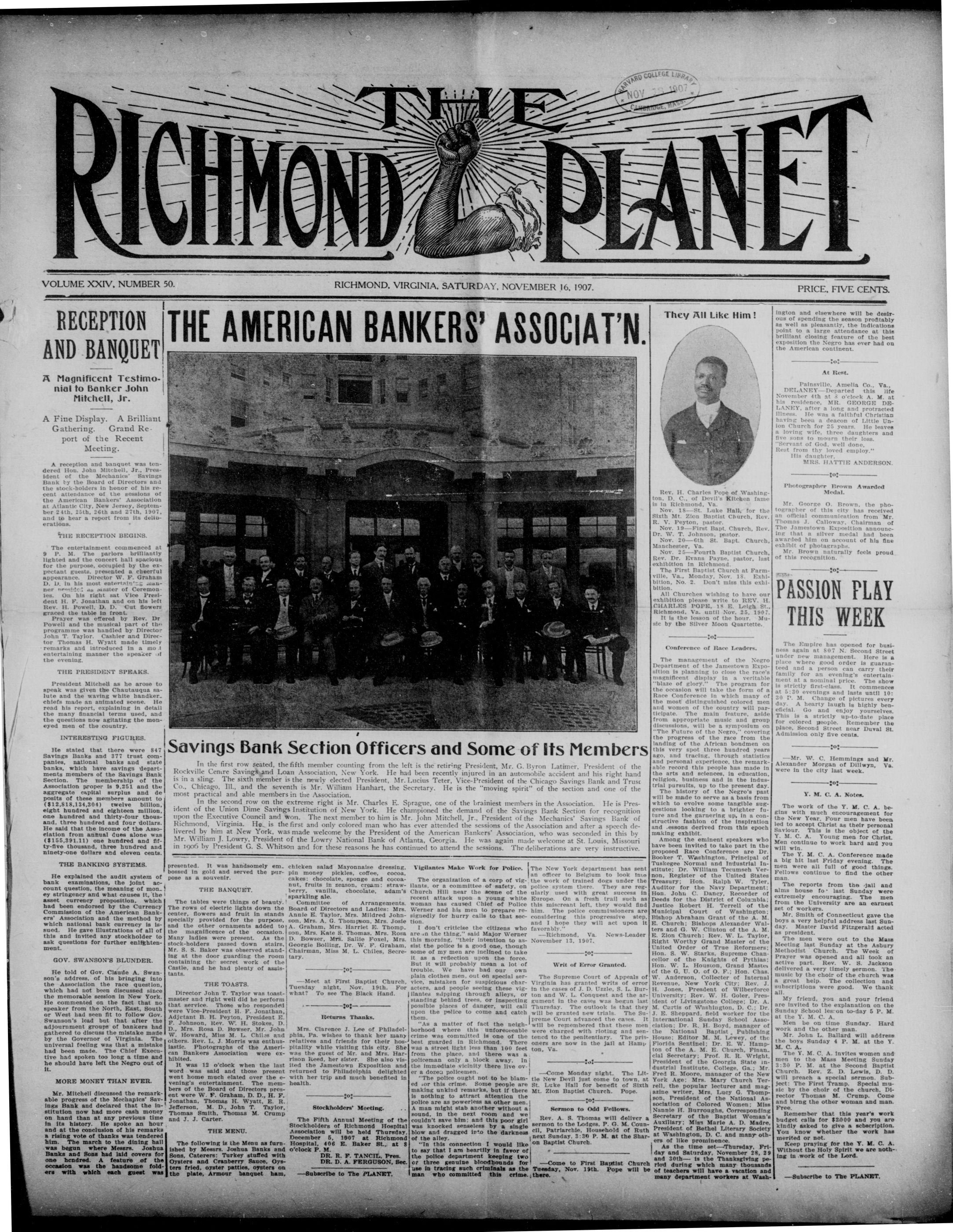
RECEPTION AND BANQUET
A Magnificent Testimonial to Banker John Mitchell, Jr.
A Fine Display. A Brilliant Gathering. Grand Report of the Recent Meeting.
A reception and banquet was tendered Hon. John Mitchell, Jr., President of the Mechanics' Savings Bank by the Board of Directors and the stock-holders in honor of his recent attendance of the sessions of the American Bankers' Association at Atlantic City, New Jersey, September 24th, 25th, 26th and 27th, 1907, and to hear a report from its deliberations.
THE RECEPTION BEGINS
The entertainment commenced at 9 P. M. The parlers brilliantly lighted and the concert hall spacious for the purpose, occupied by the expectant guests, presented a cheerful appearance. Director W. F. Graham D. D. in his most entertaining manner presided as master of Ceremonies. On his right sat Vice President H. F. Jonathan and on his left Rev H. Powell, D. D. Cut flowers graced the table in front. Prayer was offered by Rev. Dr Powell and the musical part of the programme was handled by Director John T. Taylor. Cashier and Director Thomas H. Wyatt made timely remarks and introduced in a most entertaining manner the speaker of the evening.
THE PRESIDENT SPEAKS.
President Mitchell as he arose to speak was given the Chautauqua salute and the waving white handkerchiefs made an animated scene. He read his report, explaining in detail the many financial terms used, and the questions now agitating the moneyed men of the country.
INTERESTING FIGURES.
He stated that there were 847 Savings Banks and 377 trust companies, national banks and state banks, which have savings departments members of the Savings Bank Section. The membership of the Association proper is 9,251 and the aggregate capital surplus and deposits of these members amount to ($12,818,134,304) twelve billion, eight hundred and eighteen million, one hundred and thirty-four thousand, three hundred and four dollars. He said that the income of the Association from annual dues alone was ($155,391.11) one hundred and fifty-five thousand, three hundred and ninety-one dollars and eleven cents.
THE BANKING SYSTEMS
He explained the audit system of bank examinations, the joint account question, the meaning of money stringency and what causes it, the asset currency proposition, which had been endorsed by the Currency Commission of the American Bankers Association and the method by which national bank currency is issued. We have also asked this and invited any stockholder to ask questions for further enlightenment.
GOV. SWANSON'S BLUNDER
He told Gov. Claude A. Swanson's address, of his bringing into the Association the race question, which had not been discussed since the memorable session in New York. He commented on the fact that no speaker from the North, East, South or West had seen fit to follow Gov. Swanson's lead but that after the adjournment groups of bankers had gathered to discuss the mistake made by the Govor of Virginia. The universal feel was that the mistake had been made. The Chief Executive had spoken too long a time and he should have left the Negro out of it.
MORE MONEY THAN EVER
Mr. Mitchell discussed the remarkable progress of the Mechanics' Savings Bank and declared that the institution now had more cash money on hand than at any previous time in its history. He spoke an hour and at the conclusion of his remarks a rising vote of thanks was tendered him. The march to the dining hall was begun where Messrs. Joshua Banks and Sons had laid covers for one hcdred. A feature of the occasion was the handsome folders with which each guest was
THE AMERICAN BANKERS' ASSOCIAT'N.
THE MEMBERS OF THE MEMBERSHIP
Savings Bank Section Officers and Some of Its Members
In the first row seated, the fifth member counting from the left is the retiring President, Mr. G. Byron Latimer, President of the Rocky Centre Centre Savings and Loan Association, New York. He had been recently injured in an automobile accident and his right hand is in a sling. The sixth member is the newly elected President, Mr. Lucius Teter, Vice-President of the Chicago Savings Bank and Trust Co., Chicago, Ill., and the seventh is Mr. William Hanhart, the Secretary. He is the "moving spirit" of the section and one of the most practical and able members in the Association.
In the second row on the extreme right is Mr. Charles E. Sprague, one of the brainiest members in the Association. He is President of the Union Dime Savings Institution of New York. He championed the demand of the Savings Bank Section for recognition upon the Executive Council and won. The next member to him is Mr. John Mitchell, Jr., President of the Mechanics' Savings Bank of Richmond, Virginia. He is the first and only colored man who has ever attended the sessions of the Association and after a speech delivered by him at New York, was made welcome by the President of the American Bankers' Association, who was seconded in this by Mr. William J. Lowry, President of the Lowry National Bank of Atlanta, Georgia. He was again made welcome at St. Louis, Missouri in 1906 by President G. S. Whitson and for these reasons he has continued to attend the sessions. The deliberations are very instructive.
presented. It was handsomely em- chicken salad Mayonnaise dressing. Vigilantes Make Work for Police. The New York department has set an officer to Belgium to look for pose as a souvenir.
THE BANQUET
The tables were things of beauty. The rows of electric lights down the center, flowers and fruit in stands specially provided for the purpose, and the other ornaments added to the magnificence of the occasion. Many ladies were present. As the stock-holders passed down stairs, Mr. S. S. Baker was observed standing in the door guarding the room containing the screen work of the Castle, and he had plenty of assistants.
THE TOASTS
Director John T. Taylor was toastmaster and right well did he perform that service. Those who responded were Vice-President H. F. Jonathan, Adjunct B. H. Peyton, President E. F. Johnson, Rev. W. H. Stokes, D. D., Mrs. Rosa D. Howser, Mr. John W. Howard, Miss M. L. Chiles and others. Rev. L. J. Morris was enthusiastic. Photographs of the American Bankers Association were exhibited.
It was 12 o'clock when the last word was said and those present went home home elated over the evening's entertainment. The members of the Board of Directors present were W. F. Graham, D. D., H. F. Jonathan, Thomas H. Wyatt, E. R. Jefferson, M. D., D. T. Taylor, Thomas Smith, Thomas M. Crump and J. J. Carter.
THE MENU.
The following is the Menu as furnished by Messrs. Joshua Banks and Sons, Caterers; Turkey stuffed with Oysters and Cranberry Sauce, Oysters fried, oyster patties, oysters on the plate, Armour banquet ham.
RICHMOND, VIRGINIA, SATURDAY, NOVEMBER 16, 1907.
chicken salad Mayonnaise dressing, pin money pickles, coffee, cocoa, cakes; chocolate, sponge and cocoa, fruits in season, cream; strawberry, vanilla, chocolate, adam's sparkling ale.
Committee of Arrangements Board of Directors and Ladies: Mrs. Annie E. Taylor, Mrs. Mildred Johnson, Mrs. A. G. Thompson, Mrs. Josie A. Graham, Mrs. Harrlet E. Thompson, Mrs. Kate S. Thomas, Mrs. Rosa D. Bower, Mrs. Salile Foxel, Mrs. Georgie Bolling, Dr. W. F. Graham, Chairman, Miss M. L. Chiles, Secretary.
Meet at First Baptist Church
Tuesday night. For
Whitley, The Black Hand.
Mrs. Clarence J. Lee of Philadelphia, Pa. wishes to thank her many relatives and friends for their hospitality while visiting this city. She was the guest of Mr. and Mrs. Harrison Keed, her sister. She also visited the Jamestown Exposition and returned to Philadelphia delighted with her trip and much benefited in health.
Stockholders' Meeting
The Fifth Annual Meeting of the Stockholders of Richmond Hospital Association will be held Thursday, December 5, 1907 at Richmond Hospital, 406 E. Baker St., at 8 o'clock P. M.
DR. R. F. TANCIL, Pres.
DR. D. A. FERGUSON, Sec.
—Subscribe to The PLANET.
Vigilantes Make Work for Police.
The organization of a corp of vigilants, or a committee of safety, on Church Hill near the scene of the recent attack upon a young white woman has caused Chief of Police Werner and his men to prepare resignedly for hurry calls to that section.
I don't criticise the citizens who are in the thing," said Major Werner this morning, "their intention to assist the police is a good one, though some of my men are inclined to take as a reflection upon the force. But it will probably mean a lot of trouble. We have had no proper plain clothes men, out on special service, mistaken for suspicious characters, and people seeing these vigilantes slipping through alleys, or standing behind trees, or inspecting possible places of danger, will call upon the police to come and catch them.
"As a matter of fact the neighborhood where this unforeseeable crime was committed is one of the best guarded in Richmond. There was a street light less than 100 feet from the place, and there was a policeman only a block away. In the immediate vicinity there live over a dozo policemen.
"The police ought not to be blamed or this crime. Some people are making unkind remarks, but if there nothing to attract attention the police are as powerless as other men. A man might stab another woman. In the next room and we couldn't save him; and this poor girl was knocked senseless by a single blow and dragged into the darkness of the alley.
"In this connection I would like to say that I am heartily in favor of the police department keeping two or three genuine bloodbounds for use in tracing such criminals as the man who committed this crime.
The New York department has sent an officer to Belgium to look into the work of trained dogs under the police system there. They are regularly used with great success in Europe. On a fresh trail such as this miscreant left, they would find him. The police commissioners are considering this progressive step, and I hope they will act upon it favorably. —Richmond, Va. News-Leader November 13, 1907.
Writ of Error Granted.
The Supreme Court of Appeals of Virginia has granted writs of error in the cases of J. D. Uzzie, S. L. Burton and W. L. Conquest and the argument in the cases was begun last Thursday. The outlook is that they will be granted new trials. The Supreme Court advanced the cases. It was charged with rioting and sentenced to the penitentiary. The prisoners are now in the jail at Hampton, Va.
—Come Monday night. The Little New Devil just come to town, at St. Luke Hall for benefit of Sixth Mt. Zion Baptist Church. Pone.
Sermon to Odd Fellows.
Rev. A. S. Thomas will deliver a sermon to the Lodges, P. G. M. Council, Patriarchicle, Household of Ruth and John, P. M. at the Sharon Baptist, Church
Come to First Baptist Church Tuesday, Nov. 19th. Pope will be there.
They All Like Him!
Rev. H. Charles Pope of Washington, D. C., of Devil's Kitchen fame is in Richmond, Va.
Nov. 19—St. Luke Hall, for the Sixth Mt. Zion Bantist Church, Rev. R. V. Peyton, pastor.
Nov. 19—First Baptist Church, Rev. Dr. W. T. Johnson, pastor.
Nov. 20—6th St. Baptist Church, Manchester, Va.
Nov. 25—Fourth Baptist Church, Rev. Dr. Evans Payne, pastor, last exhibition in Richmond.
The First Baptist Church at Farmville, Va., Monday, Nov. 18. Exhibition, No. 2. Don't miss this exhibition.
Churches wishing to have our exhibition please write to REV. H CHARLES POPE, 18 E. Leigh St. Richmond, Va. until Nov. 25, 1907.
It is the lesson of the hour. Music by the Silver Moon Quarterie.
Conference of Race Leaders
The management of the Negro Department of the Jamestown Exposition is planning to close the race's magnificent display in a veritable "blaze of glory." The program for the occasion will take the form of a Race Conference in which many of the most distinguished colored men and women of the country will participate. The main feature, aside from appropriate music and group discussions, will be a symposium on "The Future of the Negro," covering the progress of the race from the landing of the African bondmen on this very spot three hundred years ago, and tracing, through statistics and personal experience, the remarkable record this people has made in the arts and sciences, in education, religion, business and in the industrial pursuits, up to the present day. The history of the Negro's past will be made to serve as a basis from which to evolve some tangible suggestions looking to a brighter future and the garnering up, in a constructive fashion of the inspiration and lessons derived from this epoch making exhibit.
Among the eminent speakers who have been invited to take part in the proposed Race Conference are Dr. Booker T. Washington, Principal of Tuskegee Normal and Industrial Institute; Dr. William Tecumsch Vernon, Register of the United States Treasury; Hon. Ralph W. Tyler, Auditor for the Navy Department; Hon. John C. Dancy, Recorder of Deeds for the District of Columbia; Justice Robert H. Terrell of the Municipal Court of Washington; Bishop Abraham Grant of the A. M. E. Church; Bishop Alexander Walters and G. W. Clinton of the A. M. E. Zion Church; Rev. W. L. Taylor, Right Worthy Grand Master of the United Order of True Reformers; Hon. S. W. Starks, Supreme Chancellor of the Knights of Pythias; Hon. W. L. Houston, Grand Master of the G. U. of O. F.; Hon. Chas. W. Anderson, Collector of Internal Revenue, New York City; Rev. J. H. Jones, President of Wilberforce University; Rev. W. H. Goler, President of Livingstone College; Dr. A. M. Curtis of Washington, D. C.; Dr. J. E. Sheppard, field worker for the International Sunday School Association; Dr. H. Hogoy, manager of the National Ragist, Publishing House; Editor M. M. Lewis, Florida Sentinel; Dr. E. W. Hamilton of the A. M. E. Church, Financial Secretary; Prof. R. R. Wright, President of the Georgia State industrial Institute, Georgia,; Mr. Fred R. Moore, manager of the New York Age; Mrs. Mary Church Terrell, the popular lecturer and magazine writer, Mrs. Lucy G. Thompson, President of the National Association of Colored Women; Miss Nannie H. Burroughs, Corresponding Secretary of the Baptist Woman's Auxiliary; Miss Marie A. D. Madre President of Bethel Literary Society at Washington, D. C. and many others of like prominence.
As the time set—Thursday, Friday and Saturday, November 28, 29 and 30th—is the Thanksgiving period during which many thousands of teachers will have a vacation and many department workers at Wash-
PRICE, FIVE CENTS.
ington and elsewhere will be desirous of spending the season profitably as well as pleasantly, the indications point to a large attendance at this exhibition, the leading feature of the best exhibition the longest ever had on the American continent.
At Rest
Painsville, Amelia Co., Va., DELANEY—Departed this life November 4th at 8 o'clock A. M. at his residence, MR. GEORGE DELANEY, after a long and protracted illness. He was a faithful Christian having been a deacon of Little Union Church for 25 years. He leaves a loving wife, three daughters and five sons to mourn their loss.
"Servant of God, well done, Rest from thy loved employ."
His daughter,
MRS. HATTIE ANDERSON.
Photographer Brown Awarded Medal.
Mr. George O. Brown, the photographer of this city has received an official communication from Mr. Thomas J. Calloway, Chairman of The Jamestown Exposition announcing that a silver medal had been awarded him on account of his fine exhibit of photographs.
Mr. Brown naturally feels proud of this recognition.
PASSION PLAY THIS WEEK
The Empire has opened for business again at 807 N. Second Street under new management. Here is a place where good order is guaranteed and a person can carry their family for an evening's entertainment at a nominal price. The show is strictly first-class. It commences at 5:30 evenings and lasts until 10:00 P. M. Change of pictures every day. A hearty laugh is highly beneficial. Go enjoy yourselves. This is a strictly up-to-date place for colored people. Remember the place, Second Street near Duval St. Admission only five cents.
Mr. W. C. Hemmings and Mr. Alexei Dillwyn, Va. were in the city has been
Y. M. C. A. Notes.
The work of the Y. M. C. A. begins with much encouragement for the New Year. Four men have been led to accept Christ as their personal Saviour. This is the object of the Y. M. C. A. Young men for Christ. Men continue to work hard and you will win.
The Y. M. C. A. Conference made a big hit last Friday evening. The men were all full of good things. Fellows continue to find the other man.
The reports from the jail and alms house for last Sunday were extremely encouraging. The men from the University are an earnest set of workers.
Mr. Smith of Connecticut gave the boys a very helpful address last Sunday. Master David Fitzgerald acted as president.
The men were out to the Mass Meeting last Sunday at the Asbury Methodist Church. The Week of Prayer was opened and all took an active part. Rev. W. S. Jackson delivered a very timely sermon. The music by the choir of the church was great help. The collection and subscriptions were good. We thank all.
My friend, you and your friend are invited to the explanation on the Sunday School les-on to-day 5 P. M. at the Y. M. C. A.
Men be on time Sunday. Hard work and the other man.
Mr. John L. Ballard will address the boys Sunday 4 P. M. at the Y. M. C. A.
The Y. M. C. A. invites women and men to the Mass Meeting Sunday 3:30 P. M. at the Second Baptist Church. Rev. Z. D. Lewis, D. D. will preach a special sermon. Subject: The First Tramp. Special music by the choir of the church, Director Thomas M. Crump. Come and bring the other woman and man. Free.
Remember that this year's work budget calls for $2000 and you are kindly asked to give a scripitation. You know whether the work has merited or not.
Keep praying for the Y. M. C. A. Without the Holy Spirit we are nothing in work of the Lord.
—Subscribe to The PLANET.
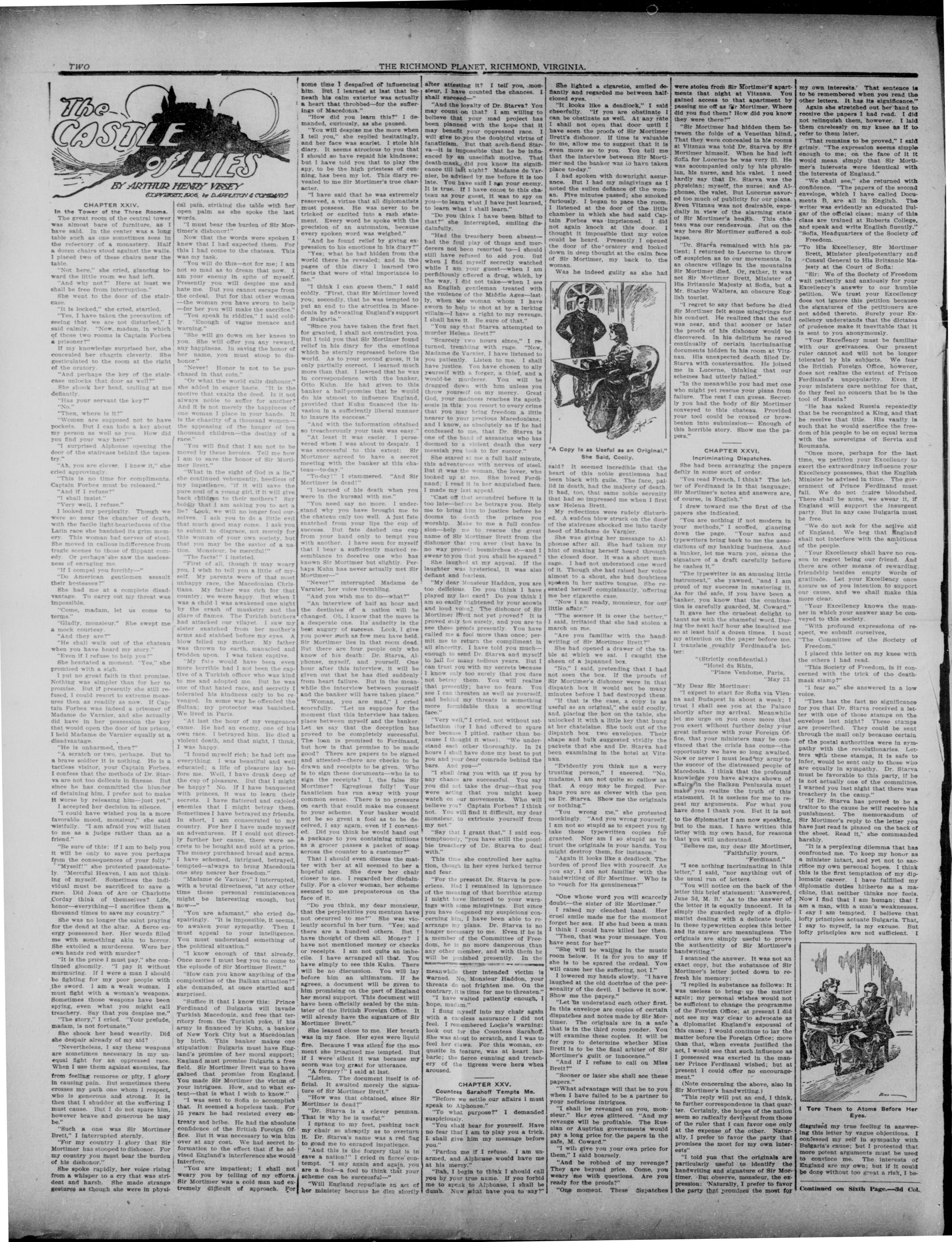
The CASTLE OF LIES
BY ARTHUR HENRY VERSE
(COPYRIGHT, 1906, BY DARPLESTON & COMPANY)
In the Tower of the Three Rooms.
The great room of the central tower was almost bare of furniture, as I have said. In the center was a long table such as one sometimes sees in the refectory of a monastery. Half a dozen chairs stood against the walls. I placed two of these chairs near the table.
"Not here," she cried, glancing toward the little room we had left.
"And why not?" Here at least we shall be free from interruption." She went to the door of the staircase.
"It is locked," she cried, startled.
"Yes, I have taken the precaution of seeing that we are not disturbed." I said calmly. "Now, madam, in which of those two rooms is Captain Forbes a prisoner?"
If my knowledge surprised her, she concealed her chagrin cleverly. She gesticulated to the room at the right of the oratory.
"And perhaps the key of the staircase unlocks that door as well?"
She shook her head, smiling at me defiantly.
"Has your servant the key?"
"No."
"Then, where is it?"
"Women are supposed not to have pockets. But I can hide a key about my person as well as you. How did you find your way here?"
"I surprised Alphonse opening the door of the staircase behind the tapestry."
"Ah, you are clever. I knew it," she cried approvingly.
"This is no time for compliments. Captain Forbes must be released."
"And if I refuse?"
"I shall insist."
"Very well, I refuse."
I looked my perplexity. Though we were so near the chamber of death, with the facile light-heartedness of the Latin race she banished its grim memory. This woman had nerves of steel. She moved in callous indifference from tragic scenes to those of flippant comedy. Or perhaps' she saw the uselessness of enraging me.
"If I compel you forcibly—"
"Do American gentlemen assault their hostesses?"
She had me at a complete disadvantage. To carry out my threat was impossible.
"Come, madam, let us come to terms."
"Gladly, monsleur." She swept me a mock courtesy.
"And they are?"
"He shall walk out of the chateau when you have heard my story."
"Even if I refuse to help you?"
She hesitated a moment. "Yes," she promised with a sigh.
I put no great faith in that promise. Nothing was simpler than for her to promise. But if presently she still refused, I could resort to extreme measures then as readily as now. If Captain Forbes was indeed a prisoner of Madame de Varnier, and she actually did have in her possession the key that would open the door of his prison, I held Madame de Varnier equally at a disadvantage.
"He is unharmed, then?"
"A scratch or two, perhaps. But to a brave soldier it is nothing. He is a tactless visitor, your Captain Forbes. I confess that the methods of Dr. Starva are not too delicate in finesse. But since he has committed the blunder of detaining him, I prefer not to make it worse by releasing him—just yet." I accepted her decision in silence.
I accepted her decision in silence.
"I could have wished you in a more favorable mood, monsieur," she said wistfully. "I am afraid you will listen to me as a judge rather than as a friend."
"Be sure of this: if I am to help you it will be only to save you perhaps from the consequences of your folly."
"Myself!" she protested passionately. "Merciful Heaven, I am not thinking of myself. Sometimes the individual must be sacrificed to save a race. Did Joan of Arc or Charlotte Corday think of themselves? Life, honor—everything—I sacrifice them a thousand times to save my country."
She was no longer the saint praying for the dead at the altar. A fierce energy possessed her. Her words filled me with something akin to horror. She extolled a murderess. Were her own hands red with murder?
"It is the price I must pay," she continued gloomily, "I pay it without murmuring. If I were a man I should be fighting for my poor people with the sword. I am a weak woman. I must fight with a woman's weapons. Sometimes those weapons have been spying, even what you might call treachery. Say that you despise me." "The story," I cried. "Your prelude, madam, is not fortunate."
She shook her head wearily. Did she despair already of my aid? "Nevertheless, I say these weapons are sometimes necessary in my unequal fight for an oppressed race. When I use them against enemies, far from feeling remorse or pity, I glory in causing pain. But sometimes there crosses my path one whom I respect, who is generous and strong. It is then that I shudder at the suffering I must cause. But I do not spare him, however brave and generous he may be."
"Such a one was Sir Mortimer Brett. I interrupted sternly.
"For my country I glory that Sir Mortimer has stooped to dishonor. For my country you must bear the burden of his dishonor."
She spoke rapidly, her voice rising from a whisper to a cry that was strident and harsh. She made strange gestures as though she were in physi-
cal pain, striking the table with her open palm as she spoke the last words.
"I must bear the burden of Sir Mortimer's dishonor!" Now that the words were spoken I knew that I had expected them. For this I had come to the chateau. This was my task.
"You will do this—not for me; I am not so mad as to dream that now. I am your enemy in spite of myself. Presently you will despise me and hate me. But you cannot escape from the ordeal. But for that other woman
—the woman you have sworn to help
—for her you will make the sacrifice."
"You speak in riddles," I said coldly. "Enough of vague menace and warning."
"She will go down on her knees to you. She will offer you any reward, any happiness. In saving the honor of her name, you must stoop to dishonor."
"Never! Honor is not to be purchased in that coin."
"Or what the world calls dishonor," she added in eager haste. "It is the motive that exalts the deed. It is not always noble to suffer for another?" And it is not merely the happiness of one woman I place in your hands. It is the chastity of a thousand women—the appeasing of the hunger of ten thousand children—the destiny of a race."
"You will find that I am not to be moved by these heroics. Tell me how I am to save the honor of Sir Mortimer Brett."
"What in the sight of God is a lie," she continued vehemently, heedless of my impatience, "if it will save the pure soul of a young girl, if it will give back children to their mothers? Say boldly that I am asking you to act a lie? Look, we will no longer fool ourselves. I ask you to do a little evil that much good may come. I ask you to submit to disgrace, not merely for this woman of your own society, but that you may be the savior of a nation. Monsieur, be merciful!"
"First of all, though it may weary you, I wish to tell you a little of myself. My parents were of that most unhappy race, the Macedonian Christians. My father was rich for that country; we were happy. But when I was a child I was awakened one night by the crash of musketry and the glare of flames. The Turkish butchers had attacked our vilayet. I saw my sister snatched from her mother's arms and stabbed before my eyes. A blow felled my mother. My father was thrown to earth, manacled and trodden upon. I was taken captive.
"My fate would have been even more horrible had I not been the captive of a Turkish officer who was kind to me and adopted me. But he was one of that hated race, and secretly I tolerated his kindness only to be revenged. In some way he offended the Sultan; my protector was banished. We lived in Paris.
"At last the hour of my vengeance came. He had an enemy, one of his own race. I betrayed him. He died a violent death, and that night, I think, I was happy.
"I found myself rich; he had left me everything. I was beautiful and well educated; a life of pleasure lay before me. Well, I have drunk deep of the cup of pleasure. But that I might be happy? No. If I have banqueted with princes, it was to learn their secrets. I have flattered and cailed enemies that I might betray them. Sometimes I have betrayed my friends. In short, I am consecrated to my country. For her I have made myself an adventurer. If I could not directly further her cause, there were secrets to be bought and sold at a price. The money purchased bread and arms. I have schemed, intrigued, betrayed, tempted—always to bring Macedonia one step nearer her freedom."
"Madame de Varnier," I interrupted, with a brutal directness, "at any other time these personal reminiscences might be interesting enough, but now—"
"You are adamant," she cried despairingly. "It is impossible, it seems, to awaken your sympathy. Then I must appeal to your intelligence. You must understand something of the political situation."
"I know enough of that already. Once more I must beg you to come to the episode of Sir Mortimer Brett."
"How can you know anything of the complexities of the Balkan situation?" she demanded, at once startled and surprised.
"Suffice it that I know this: Prince Ferdinand of Bulgaria will invade Turkish Macedonia, and free that territory from the Turkish yoke, if his army is financed by Kuhn, a banker of New York City but a Macedonian by birth. This banker makes one stipulation: Bulgaria must have England's promise of her moral support; England must promise Bulgaria a free field. Sir Mortimer Brett was to have gained that promise from England. You made Sir Mortimer the victim of your intrigues. How, and to what extent—that is what I wish to know."
"I was sent to Sofia to accomplish that. It seemed a hopeless task. For 15 years he had resisted every entreaty and bribe. He had the absolute confidence of the British Foreign Office. But it was necessary to win him over at any cost. We had secret information to the effect that if he advised England's interference she would interfere.
"You are impatient; I shall not weary you by telling of my efforts. Sir Mortimer was a cold man and extremely difficult of approach. For
THE RICHMOND PLANET, RICHMOND, VIRGINIA
some time I despaired of influencing him. But I learned at last that beneath his calm exterior was actually a heart that throbbed—for the sufferings of Macedonia.
"How did you learn this?" I demanded, curiously, as she paused.
"You will despise me the more when I tell you," she replied hesitatingly, and her face was scarlet. I stole his diary. It seems atrocious to you that I should so have repaid his kindness; but I have told you that to play the spy, to be the high priestess of cunning, has been my lot. This diary revealed to me Sir Mortimer's true character.
"I have said that he was extremely reserved, a virtue that all diplomats must possess. He was never to be tricked or excited into a rash statement. Every word he spoke with the precision of an automaton, because every spoken word was weighed."
"And he found relief by giving expression to his emotions in his diary".
"Yes; what he had hidden from the world there he revealed; and in the pages of this diary I learned two facts that were of vital importance to me."
"I think I can guess them," I said coldly. "First, that Sir Mortimer loved you; secondly, that he was tempted to put an end to the atrocities in Macedonia by advocating England's support of Bulkaria."
"Since you have taken the first fact for granted, I shall not contradict you. But I told you that Sir Mortimer found relief in his diary for the emotions which he sternly repressed before the world. As to your second guess, it is only partially correct. I learned much more than that. I learned that he was in correspondence with the banker, Otto Kuhn. He had given to this banker a half promise that he would do his utmost to influence England, provided that Kuhn financed the invasion in a sufficiently liberal manner to insure its success."
"And with the information obtained so treacherously your task was easy." "At least it was easier. I persevered when I was about to despair. I was successful to this extent: Sir Mortimer agreed to have a secret meeting with the banker at this chateau—to-day."
"To-day!" I stammered. "And Sir Mortimer is dead!"
"I learned of his death when you were in the kursaal with me."
"You need say no more. I understand why you have brought me to the chateau only too well. A just fate snatched from your lips the cup of success. But fate dashed one cup from your hand only to tempt you with another. I have seen for myself that I bear a sufficiently marked resemblance to doceive one who has known Sir Mortimer but slightly. Perhaps Kuhn has never actually met Sir Mortimer—"
"Never!" interrupted Madame de Varnier, her voice trembling.
"And you wish me to do—what?" "An interview of half an hour and the destinies of a nation will be changed. Oh, I know that the move is a desperate one. Its audacity is the best augury of success. Lock, I give you power such as few men have held. Sir Mortimer liles in that room dead. But there are four people only who know of his death: Dr. Starva, Alphonse, myself, and yourself. One hour after this interview, it will be given out that he has died suddenly from heart failure. But in the meanwhile the interview between yourself and the banker will have taken place."
"Woman, you are mad," I cried scornfully. "Let us suppose for the moment that this interview has taken place between myself and the banker. Let us say that the deception has proved to be completely successful. The loan is promised to Ferdinand, but how is that promise to be made good? There are papers to be signed and attested—there are checks to be drawn and receipts to be given. Who is to sign these documents—who is to sign the receipts? I, the false Sir Mortimer? Egregious folly! Your fanaticism has run away with your common sense. There is no pressure on earth that could make me consent to your scheme. Your banker would not be so great a fool as to be deceived, I say again, even if I consented. Did you think he would hand out a package to you containing millions as a grocer passes a packet of soap across the counter to a customer?"
That I should even discuss the matter with her at all seemed to her a hopeful sign. She drew her chair closer to me. I regarded her disdainfully. For a clever woman, her scheme seemed to me preposterous on the face of it.
"Do you think, my dear monsieur, that the perplexities you mention have not occurred to me?" She was violently scornful in her turn. "Yes; and there are a hundred others. But I have thought of them all. Money? I have not mentioned money or checks or receipts. I am not quite an imbecile. I have arranged all that. You have simply to see this Kuhn. There will be no discussion. You will lay before him an ultimatum. If he agrees, a document will be given to him promising on the part of England her moral support. This document will have been officially sealed by the minister of the British Foreign Office. It will already have the signature of Sir Mortimer Brett."
She leaned close to me. Her breath was in my face. Her eyes were liquid fire. Because I was silent for the moment she imagined me tempted. But if I were silent it was because my scorn was too great for utterance.
"A forgery!" I said at last.
"Listen. The document itself is official. It awaited merely the signature of Sir Mortimer Brett."
"How was that obtained, since Sir Mortimer is dead?"
"Dr. Starva is a clever pennman. That is why he is useful." I sprang to my feet, pushing back my chair so abruptly as to overturn it. Dr. Starva's name was as a red flag to goad me to enraged impatience. "And this is the forgery that is to save a nation!" I cried in fierce contempt. "I say again and again, you are a fool—a fool to think that your scheme can be successful—" "Will England repudiate an act of her minister because he dies shortly
after attesting it? I tell you, monsieur, I have counted the chances. I shall succeed—"
"And the loyalty of Dr. Starva? You may count on that? I am willing to believe that your mad project has been planned with the hope that it may benefit your oppressed race. I will give to you the doubtful virtue of fanaticism. But that arch-hend Starva—it is impossible that he be influenced by an unselfish motive. That death-mask, did you know its significance till last night? Madame de Vernier, be advised by me before it is too late. You have said I am your enemy. It is true. If I have come to this chateau as your guest, it was to spy on you—to learn what I have just learned, to learn what I shall learn."
"Do you think I have been blind to that?" she interrupted, smiling disdainfully.
"Had the treachery been absent—had the foul play of thugs and murderers not been resorted to—I should still have refused to aid you. But when I find myself secretly watched while I am your guest—when I am perficultively offered a drug, which by the way, I did not take—when I see an English gentleman treated with the violence of the Middle Ages—lastly, when the woman whom I have sworn to help is shot at by a lurking villain—I have a right to my revenge. I shall have it. Be sure of that."
"You say that Starva attempted to murder Helena Brett?"
"Scarcely two hours since," I returned, trembling with rage. "Now, Madame de Varnier, I have listened to you patiently. Listen to me. I shall have justice. You have chosen to ally yourself with a forger, a thief, and a would-be murderer. You will be dragged down with him unless you throw yourself on my mercy. Great God, your madness reaches its apotheosis in this; you resort to every crime that you may bring freedom a little nearer to your precious Macedonians; and I know, as absolutely as if he had confessed to me, that Dr. Starva is one of the band of assassins who has doomed to a violent death the very messiah you look to for succor."
She stared at me a full half minute, this adventures with nerves of steel. But it was the woman, the lover, who looked up at me. She loved Ferdinand; I read it in her anguished face. I made my last appeal.
"Cast off that soundrel before it is too late—before he betrays you. Help me to bring him to justice before he dooms to death the prince you worship. Make to me a full confession—help me to rescue the great name of Sir Mortimer Brett from the dishonor that you aver (but have in no way proved) besmirches it—and I swear to you that you shall be spared." She laughed at my appeal. If the laughter was hysterical, it was also defiant and fearless.
"My dear Monsieur Haddon, you are too delicious. Do you think I have played my last card? Do you think I am so easily frightened by your scowls and loud voice? The dishonor of Sir Mortimer Brett not yet proved? It is proved only too surely, and you are to see those proofs presently. You have called me a fool more than once; permit me to return the compliment in all sincerity. I have told you much—enough to send Dr. Starva and myself to jail for many tedious years. But I can trust you with my secrets because I know only too surely that you dare not betray them. You will realize that presently; have no fears. You see I can threaten as well as yourself, and behind my threats is something more formidable than a scowling face."
"Very well," I cried, not without satisfaction (if I had offered to spare her because I pitted, rather than because I thought it wise). "We understand each other thoroughly. In 24 hours I shall have done my best to put you and your dear comrade behind the bars. And you—"
"I shall drag you with us if you by any chance are successful. You say you did not take the drug—that you were acting that you might keep watch on our movements. Who will believe you? Captain Forbes? I think not. You will find it difficult, my dear monsieur, to extricate yourself from my net."
"Say that I grant that," I said contemptuously, "you have still the possible treachery of Dr. Starva to deal with."
This time she controlled her agitation, though in her eyes lurked terror and fear.
"For the present Dr. Starva is powerless. Had I remained in ignorance of the meaning of that horrible stamp I might have listened to your warnings with some misgivings. But since you have deepened my suspicions concerning him, I have been able to rearrange my plans. Dr. Starva is no longer necessary to me. Even if he is a member of the Committee of Freedom, he is no more dangerous than any other member, and with them he will be punished presently. In the meanwhile their intended victim is warned. No, Monsieur Haddon, your threats do not frighten me. On the contrary, it is time for me to threaten." "I have waited patiently enough, I hope, madam."
I flung myself into my chair again with a careless assurance I did not feel. I remembered Locke's warning: look out for the Countess Sarahoff. She was about to scratch, and I was to feel her claws. For this woman, exquisite in feature, was at heart barbaric; the fierce cunning and treachery of the tigress were hers when aroused.
CHAPTER XXV.
Countess Sarahoff Tempts Me
"Before we settle our affairs I must speak to Alphonse."
"To what purpose?" I demanded suspiciously.
"You shall hear for yourself. Have no fear that I am to play you a trick. I shall give him my message before you."
"Pardon me if I refuse. I am unarmed, and Alphonse would have me at his mercy."
"Bah, I begin to think I should call you by your true name. If you forbid me to speak to Alphonse, I shall be dumb. Now what have you to say?"
She lighted a cigarette, smiled defiantly and regarded me between half-closed eyes.
"It looks like a deadlock," I said cheerfully. "If you are obstinate I can be obstinate as well. At any rate I shall not open that door until I have seen the proofs of Sir Mortimer Brett's dishonor. If time is valuable to me, allow me to suggest that it is even more so to you. You tell me that the interview between Sir Mortimer and the banker was to have taken place to-day."
I had spoken with downright assurance. But I had my misgivings as I noted the suilen defiance of the woman. Five minutes passed; she smoked furiously. I began at pace the room. I listened at the door of the little chamber in which she had said Captain Forbes was imprisoned. I did not again knock at this door. I thought it impossible that my voice could be heard. Presently I opened the door of the oratory and looked down in deep thought at the calm face of Sir Mortimer, my back to the woman. Was he indeed guilty as she had
M. H. H.
"A Copy Is as Useful as an Original," She Said, Cooly.
said? It seemed incredible that the heart of this noble gentleman had been black with gulle. The face, palpled in death, had the majesty of death. It had, too, that same noble serenity that had so impressed me when I first saw Helena Brett.
My reflections were rudely disturbed. A sudden blow struck on the door of the staircase shocked me into tardy heed of Madame de Varnier.
She was giving her message to Alphonse after all. She had taken my hint of making herself heard through the closed door. It was a short message. I had not understood one word of it. Though she had raised her voice almost to a shout, she had doubtless spoken in her native tongue. She reseated herself complaisantly, offering me her cigarette case.
"Now I am ready, monsieur, for our little affair."
"The sooner it is over the better," I said, irritated that she had stolen a march on me.
"Are you familiar with the hand-writing of Sir Mortimer Brett?"
She had opened a drawer of the table at which we sat. I caught the sheen of a japanned box.
"No," I said, pretending that I had not seen the box. If the proofs of Sir Mortimer's dishonor were in that dispatch box it would not be many minutes before I had destroyed them.
"If that is the case, a copy is as useful as an original," she said coolly, and, placing the box on the table, she unlocked it with a little key that hung at her chateelaine. She took out of the dispatch box two envelopes. Their shape and bulk suggested vividly the packets that she and Dr. Starva had been examining in the hotel at Vitznau.
"Evidently you think me a very trusting person," I sneered. "No, madame, I am not quite so callow as that. A copy may be forged. Perhaps you are as clever with the pen as Dr. Starva. Show me the originals or nothing."
"You wrong me," she protested mockingly. "And you wrong yourself. I am not so stupid as to expect you to take these typewritten copies for granted. Nor am I so stupid as to trust the originals in your hands. You might destroy them, for instance."
"Again it looks like a deadlock. The burden of proof lies with yourself. As you say, I am not familiar with the handwriting of Sir Mortimer. Who is to vouch for its genulineness?"
"One whose word you will scarcely doubt—the sister of Sir Mortimer."
I raised my clenched hand. Her cruel smile made me for the moment forget her sex. If she had been a man I think I could have killed her then. "Then, that was your message. You have sent for her?" "She will be waiting in the music room below. It is for you to say if she is to be spared the ordeal. You will cause her the suffering, not I." I lowered my hands slowly. "I have laughed at the old doctrine of the personality of the devil. I believe it now. Show me the papers." "Let us understand each other first. In this envelope are copies of certain dispatches and notes made by Sir Mortimer. The originals are in a safe that is in the third room yonder. You will examine these copies. It will be for you to determine whether Miss Brett is to be the final arbiter of Sir Mortimer's guilt or innocence."
"And if I refuse to call on Miss Brett?"
"Sooner or later she shall see these papers."
"What advantage will that be to you when I have failed to be a partner to your nefarious intrigues."
"I shall be revenged on you, monsteur." Her eyes glittered. "And my revenge will be profitable. The Russian or Austrian governments would pay a long price for the papers in the safe, M. Coward."
"I will give you your own price for them," I said hoarsely.
"And be robbed of my revenge? They are beyond price. Come, you weary me with questions. Are you ready for the proofs?"
"One moment. These dispatches
were stolen from Sir Mortimer's apartments that night at Vitznau. You gained access to that apartment by passing me off as Sir Mortimer. Where did you find them? How did you know they were there?”
“Sir Mortimer had hidden them between the folds of a Venetian blind. That they were concealed in his rooms at Vitznau was told Dr. Starva by Sir Mortimer himself. When he had left Sofia for Lucerne he was very ill. He was accompanied only by his physician, his nurse, and his valet. I need hardly say that Dr. Starva was the physician; myself, the nurse; and Alphonse, the valet. But Lucerne savored too much of publicity for our plans. Even Vitznau was not desirable, especially in view of the alarming state of Sir Mortimer's health. This chateau was our rendezvous. But on the way here Sir Mortimer suffered a collapse.
"Dr. Starva remained with his patient; I returned to Lucerne to throw off suspicion as to our movements. In an obscure village in the mountains Sir Mortimer died. Or, rather, it was not Sir Mortimer Brett, Minister of His Britannic Majesty at Sofia, but a Mr. Stanley Walters, an obscure English tourist.
"I regret to say that before he died Sir Mortimer felt some misgivings for his conduct. He realized that the end was near, and that sooner or later the proofs of his dishonor would be discovered. In his delirium he raved continually of certain incriminating documents hidden in his room at Vitznaun. His unexpected death filled Dr. Starva with consternation. He joined me in Lucerne, thinking that our schemes had utterly failed."
"In the meanwhile you had met one who might yet rescue your plans from failure. The rest I can guess. Secretly you had the body of Sir Mortimer conveyed to this chateau. Provided your tool could be coaxed or browbeaten into submission—Enough of this horrible story. Show me the papers."
CHAPTER XXVI.
She had been arranging the papers deftly in some sort of order.
"You read French, I think? The letter of Ferdinand is in that language; Sir Mortimer's notes and answers are, of course, in English."
I drew toward me the first of the papers she indicated.
"You are nothing if not modern in your methods," I scoffed, glancing down the page. "Your safes and typewriters bring back to me the associations of my banking business. And a banker, let me warn you, scans the signature of a draft carefully before he cashes it."
"The typewriter is an amusing little instrument," she yawned, "and I am proud of my success in mastering it. As for the safe, if you have been a banker, you know that the combination is carefully guarded. M. Coward."
It gave her the cruelest delight to taunt me with the shameful word. During the next half hour she insulted me so at least half a dozen times. I bent my attention on the paper before me. I translate roughly Ferdinand's letter:
"Place Vendome, Paris,
"May 23.
"My Dear Sir Mortimer:
"I expect to start for Sofia via Vienna and Budapest in about a week; I trust I shall see you at the Palace shortly after my arrival. Meanwhile let me urge on you once more that you exert without further delay your great influence with your Foreign Office, that your ministers may be convinced that the crisis has come—the opportunity we have so long awaited. Now or never I must lead 'my army' to the succor of the distressed people of Macedonia. I think that the profound knowledge you have always shown of affairs in the Balkan Peninsula must make you realize the truth of this statement. It is useless for me to repeat my arguments. For what you have done I thank you. But it is not to the diplomatist I am now speaking, but to the man. I have written this letter with my own hand, for reasons that you will understand.
"Ferdinand."
"I see nothing incriminating in this letter," I said, "nor anything out of the usual run of letters.
"You will notice on the back of the letter this brief statement: 'Answered, June 3d, M. B.' As to the answer of the letter it is equally innocent. It is simply the guarded reply of a diplomatist dealing with a delicate topic. In these typewritten copies this letter and its answer are meaningless. The originals are simply useful to prove the authenticity of Sir Mortimer's handwriting."
I scanned the answer. It was not an exact copy, but the substance of Sir Mortimer's letter jotted down to refresh his memory:
"I replied in substance as follows: It was useless to bring up the matter again; my personal wishes would not be sufficient to change the programme of the Foreign Office; at present I did not see my way clear to advocate as a diplomatist England's espousal of this cause; I would continue to lay the matter before the Foreign Office; more than that, when events justified the act, I would see that such influence as I possessed was exerted in the manner Prince Ferdinand wished; but at present I could offer no encouragement."
(Note concerning the above, also in Sir Mortimer's handwriting.)
"This reply will put an end, I think, to further correspondence in that quarter. Certainly, the hopes of the nation seem so radically deviant from those of the ruler that I can favor one only at the expense of the other. Naturally, I prefer to favor the party that promises the most for my own interests"
"I told you that the originals are particularly useful to identify the handwriting and signature of Sir Mortimer. But observe, monsieur, the expression: 'Naturally, I prefer to favor the party that promises the most for
my own interests." That sentence is to be remembered when you read the other letters. It has its significance." Again she stretched out her hand to receive the papers I had read. I did not relinquish them, however. I laid them carelessly on my knee as if to refer to them later.
"That remains to be proved," I said grimly. "The expression seems simple enough to me; on the face of it it would mean simply that Sir Mortimer's interests were identical with the interests of England."
"We shall see," she returned with confidence. "The papers of the second envelope, which I have called Documents B, are all in English. The writer was evidently an educated Bulgar of the official class; many of this class are trained at Roberts College, and speak and write English fluently." "Sofia, Headquarters of the Society of Freedom.
"To His Excellency, Sir Mortimer Brett, Minister plenipotentiary and Consul General to His Britannic Majesty at the Court of Sofia:
"Sir: We of the Society of Freedom wait patiently and anxiously for your Excellency's answer to our humble petition. We trust your Excellency does not ignore this petition because the signatures of the petitioners are not added thereto. Surely your Excellency understands that the dictates of prudence make it inevitable that it is sent to you anonymously.
"Your Excellency must be familiar with our grevances. Our present ruler cannot and will not be longer tolerated by his subjects. We fear the British Foreign Office, however, does not realize the extent of Prince Ferdinand's unpopularity. Even if your ministers care nothing for that, do they feel no concern that he is the tool of Russia?
"He has asked Russia repeatedly that he be recognized a King, and that he receive that title. His vanity is such that he would sacrifice the freedom of his people to be on equal terms with the sovereigns of Servia and Roumania.
"Once more, perhaps for the last time, we petition your Excellency to exert the extraordinary influence your Excellency possesses, that the English Minister be advised in time. The government of Prince Ferdinand must fail. We do not desire bloodshed. There shall be none, we swear it, if England will support the insurgent party. But in any case Bulgaria must be free.
"We do not ask for the active aid of England. We beg that England shall not interfere with the ambitions of the people.
"Your Excellency shall have no reason to regret being our friend. And there are other means of rewarding friendship besides empty words of gratitude. Let your Excellency once assure us of your intention to support our cause, and we shall make this more clear.
"Your Excellency knows the manner in which your answer may be conveyed to this society.
"With profound expressions of respect, we submit ourselves,
"The Committee of the Society of Freedom."
I placed this letter on my knee with the others I had read.
"This Society of Freedom, is it concerned with the trick of the death-mask stamp?
"I fear so," she answered in a low voice.
"Then has the fact no significance for you that Dr. Starva received a letter with one of those stamps on the envelope last night? These stamps are proscribed. They could be sent through the mail only because certain of the postal authorities were in sympathy with the revolutionaries. Letters with these stamps, it is safe to infer, would be sent only to those who are equally in sympathy. Dr. Starva must be favorable to this party, if he is not actually one of the committee. I warned you last night that there was treachery in the camp."
"If Dr. Starva has proved to be a traitor to the cause he will receive his punishment. The memorandum of Sir Mortimer's reply to the letter you have just read is pinned on the back of the sheet. Read it," she commanded harshly.
"It is a perplexing dilemma that has confronted me. To keep my honor as a minister intact, and yet not to sacrifice my own personal hopes. I think this is the first temptation of my diplomatic career. I have fulfilled my diplomatic duties hitherto as a machine, that neither thinks nor feels. Now I find that I am human; that I am a man, with a man's weaknesses. I say I am tempted. I believe that lofty principles actuate Bulgaria. That, I say to myself, is my excuse. But lofty principles are not sufficient. I
I Tore Them to Atoms Before Her Eyes.
disgusted my true feeling in answering this letter by vague objections. I confessed my self in sympathy with Bulgaria's cause; but I protested that more potent arguments must be used to convince me. The interests of England are my own; but if it could be done without too great a risk, I be
Continued on Sixth Page.—3d Col.
ie a ar ae
aut E elt GT.
OAD ane
alan
sHPROVEMEN,
ice nares ake 6 ae
‘The drawing shows a low down
Darrow in sufficient detail to enable
any one to make a similar one. We
think that next to the low down cart
Ht ts the handicst thing around the
bulldings and garden that we have,
says a writer in Farm and Fireside.
Its capacity is more than double that
‘of the ordinary kind, and the load 1s
much more easily put aboard, It has
the advantaze of getting into close
quarters where the cart would not g0,
and for use about the feeding alleys,
the stable, the lawn and the garden
there is hardly anything that will take
its place.
For the framework get two pleces
of hard wood 2 by 2 inches which will
project to form handles on one end
And for the wheel frame on the other.
At front end of box in rear of wheel
a plece of the same dimensions 1s
mortised tuto the frame to hold it rig-
idly and to make the front end of the
box frame.” Pieces 1% by 1% inches
are also mortised into the bottom of
the legs, both front and back. These
form the foundation for the ficor,
EE | =
Aes Been esree:
which should be of three-quarter inch
boards. The logs are mortised into the
shaft or handle pieces, the front ones
resting about three inches from the
ground and the rear ones securely
Draced, as shown in the cut.
If desired the sides may be bullt
from the floor solid and straight up,
Dut we find it better to have a per-
manent bed from floor to top of han-
des, with removable side boards to
slip on for use in handling bulky
stuff, _
Heavy material, such as bags of
fertilizer, large stones, etc., are easily,
hhandied with this type of barrow, as
they may be loaded between the
handles directly from the ground.
MANURE SCIENCE.
How Different Feeds Influence Value
of the Fertilizer.
‘The Maine station has recently is-
sued a bulletin describing a feeding
‘experiment. One part of the expert-
ment, at least, fs very interesting. It
deals with the influence feed has on
the fertilizing value of manure. Figur-
ing the elements at what they would
cost on the market, it was found that
‘a ton of hay contains $4.40 worth of
plant food elements. It fs not stated
what kind of hay was used, but the
supposition is that it was mixed hay.
Spring wheat bran contains $11.80
worth; fall wheat bran, $9.60 worth;
and cotton seéd meal, $23.60 worth of
fertilizing elements to the ton. In this
experiment no consideration was tak-
en of the value the manure would
possess as an inprover of the humus
content of the soil, which will be very
considerable indeed.
‘This shows the reader that if he
needs feeds for his cattle and at the
same time it is necessary to pay some
attention to the fertility of his sot], he
should purchase those feeds which are
most valuable as improvers of the ma-
nure voided by the stock. It was found
that hay was richer in potash than
any other element, containing more
potash than both nitrogen and phos-
mage acid. Spring wheat bran had
‘as much phosphoric acid as
both nitrogen and potash. Cotton seed
meal contained almost twice as much
nitrogen as both phosphoric acid and
potash. Hence, if the soll needs hu-
mus and perhaps potash, feed liberally
‘of hay; If it needs phosphoric acid,
Jet bran enter largely into the ration;
if ft needs nitrogen, a great deal of
cotton seed meal should be fed.
FARM ITEMS.
Do not wait for phe wagon to whis-
tle for grease before putting it on.
We are told that tn bnilding the
great dam which holds back the wa-
ters of the Nile for irrigation, flocks of
‘sheep and goats were driven back and
forth to packdown the earth. A roller
with teeth like a sheep's hoof has row
been invented for packing otled roads.
‘The Connecticut experiment station
states that 5,000 tons of cotton-seed
meal are annually used as fertilizer by
tobacco growers in that state at a cost
of $155,000. In 1899 the acreage cost
was $22.80 per ton, making nitrogen
cost 12.9 cents a pound. Last year
the price had risen to $31 per ton of
meal or 19.4 a pound for nitrogen.
No soil that will produce a variety
of crops should be farmed continually
with one crop. One writer has esti-
‘mated that ten crops of one kind of
‘grain will exhaust the best soll tn the
‘United States. /
It has been shown that cowpeas ma-
ture in about $0 days. This’ proves
=< seed Se ‘be sown after an
and a heavy growth will result by the
time the farmer is ready to fall plow.
The farmer who practices a rotation
of corm, small grein, corn, small grain,
clover two years and pasture two
years and then repeats, will never be
confronted with a worn-out farm.
GOOD ROAD A CIVILIZER.
Why the Improvement of the High.
‘ways Should Be Encouraged.
Civilized nations have good roads.
Savage nations have no roads. Prob-
ably the road ia the greatest index of
ctvilization. The communities living
in savagery do not desire intercourse
with other communities and do alt
possible to make Intercourse difficult.
A nation must be well advanced in
civilization before it undertakes the
Dullding of roads. We do not have
to go back many thousands of years to
find the Caucassian race living with.
out roads and depending on trails in
the fields and forests.
‘One of the great drawbacks about
country life has been its isolation.
This taolation has been rendered more
intense by the badness of the roads
which have kept families apart. They
have not only kept the families from
visiting, but by making progress slow,
have compelled the men hauling loads
to town to consume twice as much
time as was necessary. This extra
wasted time has to come out of some
place and that place has to be the
time that should be devoted to socia-
bility. The years of time that are
wasted pulling loads over muddy
roads is a great obstacle in the path
of civilization. The lost time is such
@ factor that the farmer in a communt-
ty of. poor roads must spend most of
his time in drudgery to make up for
it.
Fortunately now there is a move-
ment all over the country to improve
the roads and to reduce them to a
condition of permanent hardness.
‘This {s a movement in the interest of
civilization. The good road will do
‘more for civilization than almost any-
thing else. The road that the farmer
had to take two hours to traverse can
now be traversed in one, where the
roads have been improved.
If we mistake not the general move-
ment, the United States government
will in the near future do much more
for the construction of roads than it
has ever before done. In the recent
‘sessions of congress there has beea
‘much talk and some action in this dl
‘rection. It is evident that the na-
‘tional government can build inter
‘state roads for military purposes if for
‘no other, and we may expect to see
‘some such roads constructed. Every
mile of such a road will be a ctvilizer
and a stimulus to the communities
to bulld good roads.
It 18 Impossible for nations to have
good roads while the populations are
sparse, but as soon as the populations
become dense the relative cost of
Dutlding 1s reduced. The population of
this country has now reached the
point where it is feasible to construct
roads throughout the length and
breadth of the land.
Every dollar spent in the construc-
tion of good roads is a dollar spent tn
the interests of a higher civilization.
‘The good road opens the school to the
use of the pupil and Increases the av-
erage attendance. The good road
makes it possible for many a child to
obtain an education that otherwise
would have half of one. The good road
increases the attendance on the
church and on every other religious
and social agency.
In some sections we hear of the
farmers opposing the construction of
ood roads. But, declares the Farm-
ers’ Review, that 1s only because in
thelr case the cost is so great that
they do not believe the demand Justt-
fies it. There ts such a thing as put-
ting in a tooexpensive road. What
would be the right kind of a road for
‘one place would be the wrong kind of
road for another place. Circumstances
alter cases, Every community 1s {n-
telligent enough to settle the matter
of detatis for itself, Every community
is not, however, awake as to the value
of good roads and this ts why such
articles as this appear. The matter
should be everywhere agitated tn the
interests of a broader and grander elv-
A TIME SAVER.
Have Style of Gate Which Will Cause
the Least Trouble.
To open and close gates that stock
may be kept within bounds the year
round is one thing which uses up a
great deal of time, and makes no re-
turn’ Every gate should be so made
is fF | | !
ise
iH 3)
a
CHASE
Pec
<a Se a
| "A Handy Farm Gate.
that {t will fall into place of its own
‘weight and stay closed and open with-
‘out hitch or bother. The cut illustrates
@ convenient thing that should be in
larger use on farms. It is always open
and always closed against stock. Put
up and weil painted, says Farm and
oe it will last for maay years. |
Cine Mite Matias
One successful dairyman near Chf
cago sprinkles the floor and walls of
his dafry barn with a hose before each
allking. fe has an elevated water
tank, which farnishes pressure enough
to throw a stream of water to the top
of the statis. The water “lays” the
dust and makes it lers possible for
the milk to beccme contaminated
—Subseribe to The P" ANRT. On.
ly $1.50 per year.
HE RICHMOND PLANET, RICHMOND, VIRGINIA.
THREE
lf YOU WILL TALK WITH YOUR NEIGH-
——s~ ee SY SS WI Ee VAI ES, We. Wis 2
SEND IT TO YOU IN CONJUNCTION WITH THE §
PLANET ATA GREATLY REDUCED RATE
FOR BOTH. #
S CIRCULATION WE WILL OFF
FURNISH THE PHOTOGRAPH, ONE FOUN- :
TAIN PEN, GOLD POINT; ONE LADIES RING,
ONE BREAST-PIN, GOLD FILLED; HALF DOZ-
EN LINEN HANDKERCHIEFS, ONE ALARM
CLOCK, ONE DOZEN NAPKINS, ONE HALF
DOZEN TOWELS, ONE CHOCOLATE POT, ONE. $3
PAIR VASES, ONE, PAIR KID GLOVES, ONE
HAM, ONE TURKEY. %
FOR TEN NEW SUBSCRIBERS #
WE WILL SEND ONE CHINA SET, THIRTY-ONE =
PIECES; ONE NECKLACE; DICKENS, SHAKES. #4
PEARE, BYRON WORKS; ONE UMBRELLA, ONE &
PLAIN GOLD RING, ONE PAIR LACE CURTAINS
1,000 ENVELOPES, 1,000 SHEETS OF PAPER #
PRINTED AND DELIVERED; ONE TOILET SET, $;
ONE HALF CORD OF SAWED WOOD.
FOR TWENTY NEW SUBSCRIBERS :
WE WILL GIVE ONE HANDSOME GOLD RING ©
WITH OPALS, RUBIES OR PEARLS; ONE JEW- :
ELRY BOX FINISHED IN GOLD OR SILVER; #
ONE SILK SHIRT WAIST; ONE READY MADE ®
DRESS, ONE GOLD WATCH, FILLED, WAR-
RANTED FOR TEN YEARS, ONE ROCKING
CHAIR, ONE LOAD OF COAL, ONE GROSS OF #
SOAP, EITHER WASHING OR TOILET; ONE $
BARREL OF BEST FLOUR, ONE PAIR BLANK-
ETS, ONE MANICURE SET, ONE SEAMSTRESS’ #4
WORK BOX, ONE PAIR SHOES, GENTS OR LA- $;
DIES.
FOR FORTY YEARLY SUBSCRIBERS =
OR EQUIVALENT, WE WILL GIVE ONE SEW- :
ING MACHINE, ONE DIAMOND RING, ONE
GOLD WATCH, ONE PAIR FINE GOLD EAR.
RINGS, ONE MUSIC BOX, ONE PHONOGRAPH, ee
ONE READY MADE DRESS, ONE SUIT OF GEN.
TLEMEN'S CLOTHES, ONE GOLD-HEADED
CANE, ONE GOLD-HEADED UMBRELLA, ONE #:
CHINA SET, ONE DOZEN SILVERPLATED $
KNIVES AND FORKS, ONE HAT-RACK, ONE.
SILK DRESS, ONE WEEK'S TRIP TO THE SEA- #!
SHORE, RAILROAD FARE AND HOTEL BILL ¥;
PAID, FOR ANY RICHMOND WORKER.
THESE OFFERS MAY BE TAKEN ADVAN.
TAGE OF BY SENDING ONE OR TWO SUB. §;
SCRIBER'S NAMES AT A TIME. WE WILL
KEEP A RECORD OF THEM; AS SOON AS THE §
4
NUMBER IS OBTAINED, WE. WILL & t
THE PRESENT INDICATED. x :
ON WHO TRIES TO GET FORTY \
Ss AND GETS TIRED MAY INDI c- z
WISH_ AND WE WILL SEND THE > hs
"OR THE NUMBER HE. HAS SE- i @
=R FIVE. \
JMBER WILL BE FOR NOT LESS Ky :
NOR MORE THAN TEN AND NOT __~ 4
TEN NOR M HAN TWENTY & P ,
_ESS THAN TY NOR MORE s :
rY, TO DET? THE PRIZE TO J
2 WORKER (TLED. th ;
NYTHING IS DESIRED NOT SPECI- /,
iS LIST, WRITE US ABOUT IT AND Ay
ELL YOU IN WHAT CLASS IT BE- (i
mca ee SY ee 4
» ADDRESS ALL ORDERS TO 444 i :
MITCHELL, JR., i
34% North Fourth Street,
LS hed Och bb O bObS OO5000606048a.R
BORS AND INTEREST THEM IN THE PLANET,
A OA
WE WILL HELP YOU TO OBTAIN A PREMIUM.
ATT AOE EET
IN ORDER TO FURTHER INCREASE OUR S71
i ee
He ‘ WE WILL SEND YOU 4@-THE PLA
AND THE ST LOUIS, MISSOURI, SEMI-WEE
GLOBE DEMOCRAT, ONE OF THE LEAL
REPUBLICAN JOURNALS IN THE UNI
STATES FOR $2.25 PER YEAR FOR BOTH.
WE WILL SEND YOU THE PLANET |
THE COSMOPOLITAN MAGAZINE FOR
PER YEAR FOR BOTH.
WE WILL SEND YOU THE PLANET |
McCLURE'S MAGAZINE FOR $2.25 PER Y
\ FOR BOTH.
age . FOR TWO YEARLY SUBSCRIBERS
ie OR THEIR EQUIVALENT, WE WILL SEND
; TURES, ONE ONLY, OF PRESIDENT TI
DORE ROOSEVELT, DR. BOOKER T. W.
ot? INGTON, BATTLE OF SANTIAGO, LAND |
. \\ TLE OF QUASIMAS NEAR SANTIAGO, JUN
i \ 1898, SHOWING THE NINTH AND TENTH |
ORED CAVALRY IN SUPPORT OF ROUG!
DERS, SIZE 20X28 AND 20X24 INCHES, L
BATTLE AND CHARGE OF THE 24TH &
COLORED INFANTRY IN RESCUL OF ROUGH
RIDERS AT SAN JUAN HILL, JULY 2, 1898, SIZE
20X28 AND 20X24 INCHES, ADMIRAL DEWEY’S
GREAT NAVAL BATTLE OFF CAVITE IN MA-
NILA BAY,MAY IST, 1898, NAVAL BATTLE,
DESTRUCTION OF ADMIRAL CERVERA'S
SPANISH FLEET OFF SANTIAGO DE CUBA, JU-
LY 3RD, 1898, SIZE 22X28 INCHES; LAND BAT-
TLE, CAPTURE OF EL CANEY, EL PASO AND
eee FORTIFICATIONS OF SANTIAGO, JULY FIRST
AND SECOND, 1898, SIZE 22X28 AND 22X27
INCHES. WE WILL SEND YOU ONE OF ANY
OF THE FOLLOWING BATTLES OF THE CIVIL
WAR ON THE SAME TERMS. THE PICTURES
$99 LIKE THE OTHER BATTLES ARE FINISHED IN
COLORS. THEY ARE 22X28 INCHES AND RE-
TAIL AT ONE DOLLAR EACH. WE WILL
FURNISH FRAMES FOR ANY OF THESE FINE
ee CHROMOS FOR 2 DOLLARS & 50CTS. EACH AD-
DITIONAL. BATTLE OF GETTYSBURG, BAT-
TLE OF SHILOH, BATTLE OF FIVE FORKS, VA.,
BATTLE OF ATLANTA, GA, BATTLE OF
SPOTTSYLVANIA, VA. BATTLE OF VICKS-
BURG, MISS, BATTLE OF LOOKOUT MOUN-
TAIN. TENN., BATTLE BETWEEN THE MONI-
TOR AND THE MERRIMAC, BATTLE OF BULL
RUN, VA., BATTLE OF CHANCELLORSVILLE,
BATTLE OF THE BIG HORN, (CUSTER'S LAST
é CHARGE) STORMING OF FORT WAGNER, S.
C., (COLORED TROOPS IN THIS FIGHT), BAT-
: © OF NEW ORLEANS, LA., CAPTURE AND
ATH OF SITTING BULL, THE GREAT IN-
DIAN CHIEFTAIN; FORT PILLOW MASSACRE,
FALL OF PETERSBURG, VA., BATTLE OF WIN-
$$$ CHESTER, VA.BATTLE OF OLUSTEE, FLA.
WE. WILL SEND FAMILY RECORD, SIZE 22 BY
28, WHICH CONTAINS SPACE FOR PHOTO-
GRAPHS OF PARENTS AND TEN CHILDREN.
aes WE WILL SEND SOLDIERS WAR RECORD (CER
TIFICATE OF SERVICE IN UNITED STATES AR-
MY.)
FOR FIVE NEW SUBSCRIBERS.
FOR ONE YEAR EACH, OR THEIR EQUIVA-
LENT, WE WILL SEND YOU A COPY OF UN-
CLE TOM'S CABIN, THE MOST INTENSELY IN-
TERESTING BOOK IN THE COUNTRY. WE
WILL SEND YOU A GOLD-PLATED BROOCH
$32 WITH YOUR PICTURE THEREIN, YOU TO
FOUR
THE PLANET
Published every Saturday by JOHN MITCHELL
JR., at 311 N. Fourth Street, Richmond, Va.
JOHN MITCHELL, JR., - EDITOR.
All communications intended for publication
should be sent so as to reach us by Wednesday.
TERMS IN ADVANCE.
One Copy, one year. $ 1.50
One Copy, six months. 1.00
One Copy, four months. .50
One Copy, three months. 40
Single Copy .00
ADVERTISING RATES.
For one inch, one insertion. $ 50
For one inch each subsequent insertion. 40
For two inches, six months. 10.00
For two inches, nine months. 14.00
For two inches, ten months. 15.00
Marriage and Funeral Notices, one inch. 10
Standing and Transient Notices per line.
POSTAGE STAMPS OF A HIGHER DENOMINATION THAT HAS NOT RECEIVED
ON SUBSCRIPTION.
THE PLANET is issued weekly. The subscription price is $1.50 per year in advance. There are four ways by which money can be obtained: in the Installed Office Money Order, by Bank Check or Draft, or an Express Money Order, and when none of these can be procured, in a Registered Letter.
MONEY ORDERS. You can buy a Money Order at your Post Office, payable to the Richmond Post Office and we will be responsible for its safe arrival.
EXPRESS MONEY ORDERS can be obtained at any office of the American Express Co., the United States Express Co. and the Wells and Co.'s Express Company. We will be responsible for money sent by any of these companies.
The Express Money Order is a safe and convenient method for money sent by any of these companies. You can trace money in this manner at our risk.
REGISTERED LETTER. If a Money Order, Post Office or an Express Office is not within your reach, your Postmaster will Register the Letter you wish to send us on payment of ten cents or fifty cents. If you send money in this manner at our risk, you are responsible for money sent in letters any other way than one of the forms mentioned above. If you send your money in any other way, you must do it at your own risk.
REWALS, RTC. If you do not want THE PLANET continued for another year after your subscription has run out, you then notify us by Post Card to discontinue it. The courts have decided that subscribers to newspapers who owe order time for payment of ten cents or fifty cents can be traced of time for which it has been paid are held liable for the payment of the subscription date when they order the paper discontinued.
COMMUNICATIONS.—When writing to us to renew your subscription or to discontinue your paper, you should give your name and address otherwise we cannot find your name on our book.
CHANGE OF ADDRESS.—In order to change the address of a subscriber, we must be sent the former as well as the present address.
Entered at the Post Office at Richmond, Va. as second class matter.
SATURDAY...NOVEMBER 16, '07.
The streets were made for walking and not for loaning.
Some white folks on Church Hill seem to be very anxious for a race riot in Richmond.
A man who will hang around a woman for a living should beg God to take him off the face of the earth.
We should teach our children politeness. Good manners is an asset that can always be converted into good treatment.
No respectable, honest, hard-working colored man will grieve when a loafing, criminal Negro is put in jail or in the work-house. In fact that's the place for him.
Yes, the Negro has a place, but it is the place that he makes for himself. It may be high or low, but it is not limited or bounded by either his race or his color, his politics or religion.
Colored men, do not be discouraged. We are making giant strides up the hill of progress. If you don't believe it, look behind you at the white folks you have outstripped,—with their mouths wide open yelling at you. Those white folks at our side and in front of us haven't time to bother with either them or us. They're too busy.
Some of the white folks around here have discovered "a mare's nest." They say that Bishop Ferguson, a Negro when to the Governor's Mansion to see the Bishop of London, when a reception was tendered him there, and the House of Bishops and all of the citizens in Richmond were invited to meet him there. Bishop Ferguson was there long enough to pay his respects and leave
That's nothing. Negroes have been going to the Executive Mansion long before the present Chief Executive was thought about. They have eaten there, slept there and played with children there. They are there now. Of course they ate after the white folks got through with the repast and they slept in the nursery and they patronized the kitchen and they rode in the Governor's carriages,—as servants, but, what's the difference? They were there and they are there yet. Will the poor white folks let the Negro alone?
SENATOR FORAKER AND THE
OHIO MUDDLE.
"Thou canst-not say I did it: never shake
The defeat of Congressman Theodore E. Burton by Mayor Tom L. Johnson in the recent election for Mayor of Cleveland. Ohio is the culmination of a political fight, national in its character, and which really had its commencement under the dome of the Capitol at Washington. It will be difficult for one who has not kept track of the rapidly changing events to understand to what extent President Roosevelt was interested in a contest which appeared to be purely local in its character. Let us see.
When the distinguished occupant of the White House began his crusade against the trusts in general and the railroads in particular, he found that the Republican organization in the United States Senate, under the leadership of Senator Nelson W. Aldrich of Rhode Island was against his policies. This astute political leader was diplomatic in his opposition, while Senator J. B. Foraker was bluntly outspoken and accepted no compromise in a matter that he believed would not afford the relief expected. He insisted that the Elkins law, already enacted was capable of a construction that would cure the evils of which a complaint had been made.
The result was that President Roosevelt, backed by the machinery of the government and the sentiment of the people forced the Hepburn Rate Bill through the United States Senate, enlisting the active support of the Democrats in so doing and being forced into the humiliating position of accepting the leadership of Hon. B. R. Tillman of South Carolina in so doing. Senator Foraker and Senator Aldrich were held responsible for this result. Senator Tillman's "blunderbuss" methods endangered the success of the measure and when the Hepburn Rate Bill was finally enacted into law, it was in such shape that its own father wouldn't recognize it. The only thing that really had been gotten through the Senate practically unchanged was its name, and even this was badly damaged for some of the legislators insisted upon calling it the Tillman.Hepburn Rate Bill.
It was known from one end of the country to the other that President Roosevelt and Senator Tillman were not even on speaking terms and accordingly the former was handicapped to the extent that he could not even consult with the senatorial leader, who had been given charge of his pet measure. That the Chief Executive of the nation was wrathy was a mild way of expressing it. Even when a compromise was effected among the Republican leaders, by means of modifications and changes, Senator Foraker stood against it, and when the roll was called voted against the measure, declaring that the purpose sought would not be accomplished by the passage of this bill.
He declared too that the only conviction and punishment of railroads had been under the Elkins Bill and that the Tillman-Hepburn Rate Bill had been so changed as to make it practically a law acceptable to the railroads. Time has demonstrated the truthfulness of all that he said. The shrewd, diplomatic, able representative from Rhode Island had accomplished his designs.
It will be readily seen then that the feeling of President Roosevelt towards Senator Foraker was at white heat. To add to this feeling, the alleged shooting up of Brownsville, Tex., where Companies B, C, & D of the Twenty-fifth Infantry were stationed was heralded to the country. The War Department began an alleged investigation and accepted in-toto the statements of the Texans backed up by the vehement demands of the Senators from the Lone Star State. In his fight for the passage of the Tillman-Hepburn Rate Bill, President Roosevelt had enlisted the support of the Democratic Senators from the South and was accordingly under obligations to them.
When they represented that Negro soldiers had fired upon white people in Brownsville, he accepted exparte statements; that is, statements of only one side to the controversy and demanded that the companies find out who were the guilty men and deliver them up forthwith to the legal authorities. The failure to do this would result in the summary dismissal of the entire battalion, both the innocent and the alleged guilty ones from the service, and they would forfeit their right to retirement and re-enlistment and be forever disgraced upon the roster of the War Department.
The Texan officials, after a thorough investigation dismissed the soldiers charged with the crime on account of insufficient evidence. The anomalous condition was presented of citizen soldiers dismissed from the service and punished without even the form of a trial, either civil or military and accordingly in violation of that constitutional provision which declares that no person shall be punished for an infamous offense save by due process of law.
THE RICHMOND PLANET, RICHMOND, VIRGINIA
Appeals were made to the President by both white and colored persons and to the Secretary of Whr. William H. Taft, but both turned a deaf ear to all of these urgent representations.
It was then that Senator Joseph Benson Foraker brought the matter to the attention of the United States Senate and the investigation was begun which resulted in the collapse of many theories and assertions made by the over-anxious Texans. By the time Senator Foraker got through with the case, it was settled beyond the shadow of a doubt that the proof as to the guilt of any colored soldier was by no means conclusive. The same result reached by the legal authorities in Texas, that of insufficient evidence to convict was reached by the Senatorial investigators at Washington.
President Roosevelt was placed in the embarrassing position of convicting and punishing men first and trying them afterwards. It was not long before it was announced that Senator Foraker would be defeated for re-election to the Senate. The stumbling block in the way was Senator Charles Dick, Chairman of the Republican State Committee of Ohio. He supported his colleague. As a result, they were ignored at the White House, it is said and their endorsations for appointments in Ohio became worthless.
As it was hinted that Senator Foraker was a presidential possibility, President Roosevelt announced to his friends that Hon. William H. Taft, Secretary of War was the man to succeed him and it was also noised abroad that Hon. Theodore E. Burton would be a most admirable selection to succeed Senator Joseph Benson Foraker in the United States Senate. It is needless to say that while Senator Foraker who is by nature a fighter had been marching towards the "enemy" before, he was running towards him now. His speeches delivered since that time are masterpieces of sound judgment and wisdom. Despite the provocation he has been very careful of all that he has been bold enough to say. He attempted to rip the Taft presidential boom fore and aft by attacking that statesman relative to his pronounced policies, noticeably on the tariff.
It seems that either Mr. Roosevelt or his supporters or both conceived the idea of having Mr. Burton resign his seat in Congress and become a candidate for Mayor of Cleveland, Ohio, as against Mayor Tom L. Johnson, an Independent democrat with socialistic tendencies and the advocate of three cent fares on the street railways of that city. Cleveland is normally Republican. When a committee of colored men called on Mr. Burton for an expression of his attitude towards Senator Foraker, he refused to commit himself. In the meantime, he had a letter from President Roosevelt endorsing his candidacy for Mayor of Cleveland. It was not denied that he had made the fight at the suggestion and instigation of the President of the United States.
When Senator Foraker was approached concerning Congressman Burton, he issued a statement endorsing him as the regular candidate of the Republican Party of Cleveland and asking his friends to support him. While probably not so intended, this was nevertheless a "backhanded slap" at Mr. Burton, for he had returned good for evil and emphasized his loyalty to the party. This then caused us to think of the quotation from Shakespeare which appears at the commencement of this article.
Had Mr. Burton won he would have been the acknowledged leader in Northern Ohio. He would either have been a dangerous aspirant for the senatorial togo, now being worn by Joseph Benson Foraker of Ohio, or he would have been able to dictate his successor. He lost, thanks to the votes of the colored citizens who remembered Brownsville and had not forgotten the patriotic action of the distinguished Ohioan in the United States Senate.
The news has been heralded all over the country to the discomfiture of Senator Foraker's enemies and the most popular President who ever sat in the White House now knows the result. Selah.
"I charge thee, fling away ambition: By that sin fell the angels."
—Shakespeare.
ANOTHER SUPREME COURT DE
CISION.
We have repeatedly called attention to the fact that the decisions of the Supreme Court of the United States upon all questions affecting the status of the Negroes of this country were antagonistic. The following telegraphic report emphasizes this opinion:
The case of C. B. Boyette and others, charged with intimidating Negroes "because they were Negroes," contrary to the provisions of sections 1977 and 5508 of the Revised Statutes of the United States, was decided by the Supreme Court of the United States to-day favorably to Boyette and his co-defendants. The alleged offense was committed in Bradley county, Arkansas in 1905 when Boyette and other white men were charged with having conspired
to drive away a number of Negroes employed by the Arkansas Lumber Company. This result was accomplished by posting notices of warning to the Negroes and firing guns in their vicinity. The whites were tried in the United States District Court for the Eastern District of Arkansas, and each was sentenced to pay a fine of $1,000 and serve a year in prison. The decision of the trial court was reversed.
The announcement of the court's judgment was made by the Chief Justice, but there was no written opinion. The decision of the court was based upon the decision of the last term in the case of Hodges vs. the United States, in which it was held that as Negroes are citizens, then must rely upon the State courts in action as this, rather than upon the Federal courts. In that case the court held that it had no jurisdiction of a charge of conspiracy made in a State to prevent citizens of African descent because of their race and color, from making contracts of labor.
That is the usual way that this tribunal evades responsibility by pleading want of jurisdiction. In this case, the white men composing the Arkansas Lumber Company are the sufferers. It is their work which has been hindered and whose laborers are now resting easily in other parts of the commonwealth. These Negroes had sense enough to leave before the executions had begun. If the Arkansas Lumber Company wishes to secure laborers it must also provide the means to protect them. That the corporation will be forced to do this hardly admits of a question. We are of the opinion that the white men owning the stock of the Arkansas Lumber Company are residents of other states, and yet the United States government, by way of the Supreme Court tells them plainly that it will not provide the means or afford them protection of property held in a Southern State.
This will have a tendency to check the flow of capital to that part of the Southland and these Negro-haters, when poverty pinches will find that if it is another case of "cutting off the nose to spite the face."
ORGANIZING VIGILANTS IN RICH MOND.
An alleged brutal assault was made on a white female who resides at 519 N. 31st Street. The party in question was within a few feet of a window where a white man was standing, it is said and either failed or was unable to make a noise to call for help. She claims that she did not know whether her assailant was a white or a colored man.
These cases have been used to stir up the white citizens of East End and to create the impression that Negro footpads and fiends are patrolling that section. Even our usually conservative daily newspapers have permitted themselves to be drawn into this "much ado about nothing" affair and with flaming headlines and doubly leaded articles called upon both the Governor of the State and the Mayor of the city to offer rewards for the apprehension of the guilty parties.
This is done to the discomfiture of the Police Department of this city for the reason that it is an indirect way of pronouncing it wholly incompetent to do its duty. Its membership has been recently increased and the salaries have been recently raised. We have been wondering then if there is any politics in all of this rumpus. Here we have a population of over one hundred thousand, about forty thousand of which is composed of the most orderly Negroes in the United States. They are living in peace with their white neighbors, and it is indeed a rare thing for an altercation to take place between a white person and a colored one.
Yet, because three or four cases are cited, the entire community is aroused, hysterical women are made frantic, husbands cannot sleep at night and are almost afraid to go to work in the morning, while the female portion of the household think they see a lurking Negro in every shadow. Gentlemen, this thing wont do.
A stop should be put to this dangerous practice. Every outburst in the Southland has been caused by just such foolishness. You can't hunt game with a lighted candle, and secrecy is the best method for hunting criminals. The way the matter is now being handled, the police and detectives are hand-capped from the start by these foolish and unreasonable practices.
The latest act is the attempt to organize a vigilance committee, composed of the white citizens of East End to patrol the streets of Richmond and thereby emphasize the fact that this is a lawless city and that we have no officers competent to discharge this duty. This action is dangerous and is in keeping with the same methods pursued in Atlanta, Georgia when orgies of blood and slaughter were begun. It will cause
trouble here and even though a thousand Negroes be slaughtered as a result of it and ten white people killed, it will not justify the cost of blood and treasure.
The colored people here have never concealed crime, or condoned criminal actions on the part of colored people or white ones. They have aided the police authorities and whenever a Negro has committed a crime, and the same has been proved, he has been punished. When Mayor Carlton McCarthy, one of the most conscientious officials in the United States and Chief Louis Werner, admittedly competent and his corp of assistants, and Chief Alexander Tomilinson, one of the best known sleuths in the country and many others that we might name cannot ferret out the criminals, it is because the clues given would not enable any one short of God Almighty to trace the criminal.
There are times when the assaults are made by persons, whom the person assaulted does not wish to be apprehended and there are times when the officers are denied information that would bring about successful results. It was only recently that the robbing of a Broad Street merchant was traced to his own nephew and he then endeavored to have the detectives drop the case, but they would not and the young white man confessed the crime.
Richmond is orderly and it is well-governed. Between Judge Crutchleid's court and Judge Witt's tribunal a guilty Negro and a suspected white man have no chance to escape. We warn the authorities, though that the city will not stand for any three hundred white men, many of whom may be of doubtful reputations themselves will be permitted to patrol the streets of either Church Hill or any other portions of this city. We pay police officers for just this purpose.
If the City Council authorizes it though we shall ask the privilege of organizing a band of 500 orderly, well-behaved, God-fearing colored men to act with the same number of white ones to put down lawlessness of all kinds, to keep down the worthless, shiftless, criminal Negroes and white hoodlums, who would disturb the peace of this community by frightening the white ladies of this city into spasms.
All lawless Negroes injure the colored people more than they frighten the white ones. We are progressive here, we are industrious and we insist that Negro lawlessness can best be dissipated by Negro vigilants. When you discount the efforts of the officers of the law though, by the permitting of outside irresponsible crowds to discharge their functions, you take the first step towards anarchy, the last act in the drama of over-riding the law. Well may you picture white and black men being shot down, the streets red with blood, business paralyzed, porters afraid to go to work and laborers too frightened to earn a living. Add to this the work of the torch, millions of dollars going up in smoke and the roops of the State patrolling the capital of Virginia and you have an idea of the unrestrained play of bourbon stupidity and racial hatred.
Lawlessness must go and the vigilants with it. Let us have peace.
HON. JOHN SHARP WILLIAMS ON THE NEGRO.
"All is of God. If He but wave His hand,
The mists collect, the rains fall thick and loud;
Till, with a smile on sea and land,
Lo! He looks back from the departing cloud.
"Angels of life and death alike are His;
Without His leave they pass no threshold o'er;
Who, then wish or dare believing this,
Against His messengers to shut the door?"—Longfellow.
Hon. John Sharp Williams' contribution to the Metropolitan Magazine of New York will tend to give thoughtful men of both races an insight into the prejudices which permeate even the more liberal white men of this section. In this remarkable contribution to the literature upon this subject, there are scintillations of a desire on his part to be fair to the Negro and yet his political training and his future ambitions triumph in the end and he finds himself like the average self propelling flying machine again on Mother Earth, with many of his springs of good intentions damaged and destroyed. He says:
In nearly all of the Northern States whites and blacks travel in the same coaches and their children sit on the same bench in the same public school. Great, astonishingly great, indeed, must be the self confidence of that man who thinks he can revolutionize this whole state of public sentiment in the North by a few speeches in the Senate. It is so astonishing that I hesitate to conclude that any man, however confident of his own oratorical pyrotechnics, really and at heart believe it.
This would seem to be an indirect slap at Senator B. R. Tillman of South Carolina. He has labored long and loud, not with the idea of convincing the North, but for the purpose of enthusing the South or
rather that portion of it bounded by the lines of the State that he represents. Mr. Williams though is absolutely correct in his conclusions. If we are to judge by Mr. Williams' assertions, and we must admit that he has them first hand, the sentiment at the North is not so much against us as some people would have us believe. Mr. Williams' cautious utterances indicate that the great heart throbs of the North are all right and while the white people there may not be enthusiasm in favor of the Negro, they are not bitterly against him. They are in favor of doing Justice to all men, regardless of race or color, politics or religion. So much for that. He says:
The people of the entire United States, including our Northern brethren, who held the whip handle and who hold it now, were once before in our history called to judgment, or rather called themselves into judgment, to decide upon the relationship which should exist between the white man and the black man at the South. It resulted in the shape of the constitutional amendments and in the shape of reconstruction rule. I need not dwell upon it. But as a conclusion from that experience, I say that I do not want to call them into judgment again. I am not well enough satisfied that they would decide my way.
I would rather bear the ills we have than to run the risk of ills that might come from this "appeal to Caesar." When you appeal to Caesar" he takes cognizance and jurisdiction of the whole cause, and, after hearing both sides, he decides it, not upon my views or yours, but up on his own views. It is childish to suppose that he will take only partial jurisdiction, and with such results only as you choose to suggest. The experience of history and my knowledge of the present woful ignorance that exists in the Northern mind upon this race question does not embolden me to make the appeal to Caesar.
He says further:
I, like any other man with a drop of Southern blood tingling in his veins, would rather be able to accomplish directly by national action that which we have been forced to do indirectly by State action with approximately the same result, to wilt: the disfranchisement of the Negro, and the prevention of Negro political domination. I would rather see the fifteenth amendment repealed, and the States restored to their original right of fixing, without limitation of any description, the qualifications for suffrage of those lodging within the borders of every Southerner. I do want to do that, than indirectly, but when I cannot accomplish a great public good by traveling in a straight and a national road toward it, and can accomplish it by going a few miles out of my way, on a roundabout State road, I will, as a man of common sense, travel the roundabout road.
There you have it in plain language. Hon. John Sharp Williams states plainly that so far as the State of Mississippi is concerned, the Fifteenth Amendment to the Constitution of the United States has been "repealed." It has been nullified by State enactments. Yet he dreads the time when a test of this questionable constitutional legislation will be made. "But, come it will, the day decreed by fate." He continues:
The problem, so far as the political phase of the Negro question is concerned, with which we were confronted during the reconstruction period, was to save the white man's civilization, based upon his peculiar code of ethics, which code, in its turn, has for its keystone the sanctity of his family life. That problem we have solved by State action. At bottom, saving our civilization was what we fought for during the war, and not merely for the money value of the slaves. During the entire reconstriction period that was what Benjamin Hill, General Gordon and L. Q. C. Lamar fought for. The appealing cry which we made to our brethren of the North was summed up in this sentence: "Let us alone to handle our own conditions. They are not your conditions. You are not confronted with them. We are."
And yet the northerners are wondering why there is any further talk about the Negro question. The South has been let alone to handle its own conditions. Still, we find Hon. John Sharp Williams writing a dissertation to a Northern magazine discussing the very conditions which he and his people declare they have settled. Not alone is this a fact, but these same Southerners with the arrogance of 1861, and while demanding that they, themselves be let alone are proceeding to dictate to people of the North as to what they shall do.
They do not seem to understand that the same demand by the Southerners for immunity from interference in the South is equally as potent in emphasizing the demand of the Northerners for immunity from interference in the North. When President Roosevelt dines Dr. Booker T. Washington, whose business is it but President Roosevelt's and Dr. Washington's, especially when no Southerners are present? When Bishop Potter dines Bishop Ferguson, whose business is it, when no Southerners are present? Mr. Williams recognizes the force of some things at least when he continues:
That appeal has been, in a measure, successful. We are now about let alone. They are acquiescent. I believe in "letting a sleeping dog sleep." I warn against the re-agitation of this race question. I have heard it has been said that the reason why Southern Representatives in
Congress had not made it their main business to agitate for the repeal of the fifteenth amendment was because they were "afraid of Northern sentiment." I deny the charge. The South has been represented in Congress in the past, and is now represented in several instances, by men whose courage has been demonstrated in war and in peace. They have all had the desire in their hearts to repeal the fifteenth amendment, as I have, and as every white man in the South has.
These men did not fail to make it their main business at Washington to agitate for the repeal of the fifteenth amendment because they were cowards. They failed to do it simply because they were men of practical common sense with their feet on the ground, and all of them with some slight degree of information as to the state of public opinion in the United States.
Mr. Williams states the truth there. 'They didn't take the goose, because they couldn't get it, and there are thousands of people in this country, who believe that there are millions of white people in the Southland who feel the same way about the Thirteenth Amendment to the Constitution of the United States. It is natural to suppose that while Mr. Williams is in the business of confessing that he should at least make "a clean breast of it." He volces a hope,—let us believe, a vain hope when he says:
I agree that there may some time be a repeal of the fifteenth amendment, but if so, it will not come in response to a sectional Southern demand, nor will it come in response to a partisan political demand. It will come after the Northern people have attained the same degree of knowledge concerning the Negro, his characteristics, his limitations, his impulses, his eccentricities—as he is—that we now possess. This will be only after, by industrial evolution, the Negro has been scattered all over the United States, or over at least two-thirds of it, in sufficient numbers to make himself known and to make our opinion of him, as a consequence, appreciated.
We are willing to take our chances in waiting for this time. It will be long after Hon. John Sharp Williams and his colleagues have been gathered into the graves of their fathers. The Negroes are undergoing an evolution, caused by a change in their surroundings and environments. The question that we are now discussing will not be the issues of the years that are to come. Mr. Williams says:
There is already a drift of the Negro population toward the Northern States, principally to the cities. This drift is annually increasing, especially in the border States, Indiana Ohio, Illinois and in New Jersey, and eastern Pennsylvania. They are the worst Negroes who leave our fields and go North, and not the best—the best are in our cotton-fields. Fully ninety per cent. of the Negro race is behaving itself as well as could be expected; it is at work in the fields, on the railroads, and in the saw, mills, and does not, for the most part know that there is a fifteenth amendment, either to be repealed or to be buttressed by further legislation of Congress.
The above is a correct statement. Most of the colored people who go North are of the worst type, but there are notable exceptions. Many colored people in the North are accumulating money and many of them are paying for homesteads purchased in the Southland. They are handicapped though by this very worthless element that fills the streets of Northern cities and the jails of northern municipalities. But then even white folks north can understand. They have the white hoodlums there too. Mr. Williams say:
The bad element that goes North constitutes the strongest argument against the old New England idea of the equality of featherless blipeds and in favor of the Southern idea on the race question—an object-less argument. Some time it may be that this argument will prove strong enough to cause a demand to be made from New Jersey or from Indiana or Ohio or Illinois for a repeal of the fifteenth amendment, so that the people of those States may frankly confine their suffrage to "white men twenty-one years of age," their people, being, as a whole, opposed to resorting to educational or poll-tax qualifications.
Mr. Williams indulges in a "pipe dream" for the reason that there are white people with the same inclinations and tendencies as the colored ones. White men in the North know that crime is not confined to colored people and that the same class and kind of Negroes that find a way to the falls are duplicated by the same class and kind of white hoodlums, who meet them there.
In the absence of race prejudice, they fail to see any difference in the same kind of crime committed either by a white man or by a Negro. He says:
There is a Negro problem and—although we in Mississippi have reached a practically satisfactory sol. ion of its political phase, a solution which we will maintain—there still remains the industrial and criminological phase of the question to be dealt with. The real problem consists in the actual physical presence of the Negro. Of course, the first and obvious solution would be the deportation of all, or nearly all of the Negroes from the South—in other words, a separation of the races, sending the Negro somewhere where he could develop undisturbed along his own racial lines of evolution, with the advantages which he has obtained from residence among us, and leaving us unhampered by him. This remedy would be radical and com-
THE PLANET
SATURDAY...NOVEMBER 16. '07.
pleate, but it can not be resorted to for three reasons: first, because it would require too stupendous an outlay of money; second, because the white people of the South do not want to hasten the departure of the good Negroes; third, because the Negroes do not want to leave the South and will not leave by any sudden way of exodus. The darky complains a good deal, especially the Northern darky, about "the sad fate to you in New York," but whenever you suggest that to leave the Southern darky replies in scriptural phrase, "Ask me not to leave thee." They are here, and they are going to remain here so long as there is a cotton-field in sight.
Mr. Williams admits that the South's solution of this question is no solution. He virtually states that the promises made to the North were deceptive ones. He "owns up" that the only solution is an impossible solution, a proposition that is absolutely out of the question. It could not be accomplished in many centuries. When you speak of deporting a citizen, legally speaking, it cannot be done. When you speak of deporting ten million people, physically speaking, it cannot be done. We find it difficult to transport even one hundred thousand men from place to place. Mr. Williams makes other admissions when he says:
Some people talk as if the repeal of the fifteenth amendment would get rid of markies. It is the physical presence of the Negro that constitutes the problem. That cannot be too often repeated and that constituted the problem even when his status was one of slavery. The physical presence, as far as I can see, is unavoidable. It cannot be escaped by the white people moving out of the South and leaving the Negro in possession of the accumulated fruits of their intelligence and civilization. It cannot be escaped by the extermination of either race by the other.
If then, Mr. Williams' conclusions are correct why discuss the subject further? We are gratified to know that he has given the Northerners an insight into the methods of the Southern representatives in Congress.
In Hon. John Sharp Williams' reference to a good man, a believer in the divine philosophy of the Lord Jesus Christ, we are led to believe that he referred in a measure to himself. If so, we have one man we believe, if unhampered by political conditions, to whom we can make an appeal. The colored people of this country have a simple, child-like faith in God. They believe that He will bind up a wounded heart and all of their sorrows heal. Can Mr. Williams square his utterances with his duty as a Christian? We believe not. The Negroes of the Southland are as little children. They believe in the Saviour. Let us see:
"At the same time came the disciples unto Jesus, saying, Who is the greatest in the kingdom of heaven?
2. And Jesus called a little child unto him, and set him in the midst of them.
3. And said, Verily I say unto you. Except ye be converted, and become as little children, ye cannot enter into the kingdom of heaven.
4. Whosoever therefore shall humble himself as this little child, the same is greatest in the kingdom of heaven.
5. And whoso shall receive one such little child in my name receiveth me.
6. But whoso shall offend one of these little ones which believe in me, it were better for him that a millstone were hanged about his neck and that he were drowned in the depth of the sea.
7. Woe unto the world because of offences, for it must needs be that offences come; but woe to that man by whom the offense cometh."
BUTLER KILLED HIMSELF.
Paul G. Thebaud, Jr., Found Unconscious With Bullet Wound.
WHITE PLAINS, N. Y., Nov. 13. John Bjorlin, butler at the Hillair farm, the country home of Paul G. Thebaud, the New York commission merchant, killed himself after he had shot and dangerously wounded his employer's eldest son, Paul G. junior. The latter, who alone might explain the shooting, remains unconscious.
The family was aroused at daybreak by the report of a revolver twice discharged. Young Thebaud was found senseless in bed. A bullet had struck his skull and, though deflected, had fractured and depressed the bone. The butler, stretched upon the floor, was dead with a bullet in his brain. It is believed that Thebaud will recover.
It is suggested that the butler may have lost his head while hunting supposed burglaries and killed himself in remorse when he discovered his mistake. He was thirty-five years of age and had been in the family for several years.
TO BOOM CORTELYOU
Archbishop Ireland Said to Be Working For It.
ROOSEVELT REPORTED TO FAVOR HIM
Washington Dispatch Says President Has Declared For Secretary of the Treasury, According to Roman Prelate's Account.
WASHINGTON, Nov. 13.—A sensation was caused in political circles here by the assertion from a certain quarter to the effect that Archbishop Ireland of St. Paul had been at work in the northwest for a month or more organizing such strength in and out of the church as he can command for George B. Cortelyou for president. In doing so, it is declared, he has had the backing of President Roosevelt. The story has caused politicians here to sit up and anxiously inquire whether the president has thrown Taft overboard and has determined to test the secretary of the treasury as presidential timber.
The story runs that at a dinner at Minnesota Archbishop Ireland gave it out that he had been called to New York to confer with Secretary Cortel-
ARCHBISHOP IRELAND.
you and that Mr. Cortelyou told him he was a presidential candidate having Mr. Roosevelt's backing. The archbishop was sufficiently impressed to undertake to do what he could in Mr. Cortelyou's behalf. Mgr. Ireland dined here at the home of Secretary Straus, but this dinner is not known to have had any particular bearing on the matter save that it indicates the archbishop's closeness to official administration circles. The archbishop has spoken of Cortelyou as the man he favors and as the growing candidate since he has been in Washington. And the mere fact that the clergyman, with his wide influence, is for the secretary is sufficient to cause a profound sensation in political circles. Taft supporters have long suspected much quiet work was being done for Cortelyou, and this latest development is certain to stir them deeply.
When the archbishop was seen here he denied having ever said Mr. Cortelyou had the president's backing as a candidate. Further than that he parried all questions adroitly and denied nothing.
When Secretary Cortelyou's attention was called after the cabinet meeting to the reported conference between himself and the archbishop he raised his hand deprecatingly when the presidency was alluded to and said it was on of those topics he could not discuss one way or another, as anything he might say would be misconstrued.
"All I want is to be let alone in the discharge of my duties," he declared, and when told the archbishop was here he said he was not aware he was in the city.
Hotel Castleton Burned
NEW YORK, Nov. 13.—The Hotel Castleton, a summer house at St. George, Staten Island, whose elevated site commanded a wide view of New York harbor, was burned last night. The hotel was recently closed for the season and was unoccupied. The loss, which included the destruction of the furniture, probably will total $200,000. Bernard Kerns was the owner and manager.
Carnegie Gives $10,000
CHICAGO, Nov. 13. Andrew Carnegie made a gift to the University of Chicago of $10,000, to be used for the William Rainey Harper memorial library fund. With this gift the university has a total of $130,000 toward the $200,000 it must raise to take advantage of Rockefeller's recent conditional gift of $600,000.
A FAKE CHECK FRAUD.
B. O. Smith Held at Pittsburgh on Forgery Charge.
PITTSBURG, Nov. 13.—B. O. Smith, alias Paul Hallaway, of Fort Smith, Ark., who was arrested here charged with passing numerous worthless checks in this city and who is believed to have worked extensively throughout the country, was accused of other forgeries.
S. C. Betz, a banker of Homer City Ind., talked with the local authorities over the telephone and alleged Smith had passed a check for $400 on him, while half a dozen other checks for the same amount were passed on business men of Homer City.
"He had visiting cards from George Gould, John Jacob Astor and many other prominent men," said Mr. Betz over the telephone.
Edward Eggers of the Carnegie library, Allegheny, identified the folle containing the photographs of prominent men of western Pennsylvania which was found on Smith as one that was recently stolen from the library. Among the well known men with whom he has had dealings are Charles M. Schwab, former Vice President Levi P. Morton, J. Plerpont Morgan and Thomas A. Edison. In the prisoner's memorandum book was read, "Levi P. Morton - Stung him for $4,500." J. Plerpont Morgan was not so easy
THE RICHMOND PLANET, RICHMOND, VIRGINIA
JOB DEPARTMENT
EXCURSION
We print Handbills, Quarter-Sheet posters, Tags, Tickets, Placard notes, Visiting Cards, Mourning Stations
WE HAVE
Our St
OF THE LATE
WE CAN PRINT A BILL AS SMALL
A Three-Sheet
AS LARGE AS A FRO
Our street-entrance is retired and fastidious lady being able to enter w
EXCURSION WORK OF ALL DESCRIPTIONS
We print Handbills, Quarter-Sheets, Half and Whole Sheet posters, Tags, Tickets, Placards, Society Cards, Minutes, Visiting Cards, Mourning Stationery. OUR AIM is to please our patrons and to give them the best service at the lowest prices, consistent with satisfactory work. We furnish "cuts" when desired and we will arrange to complete special work in our line. When in need of any work in our line, call and see us and estimates will be furnished.
WE CAN PRINT A BILL AS SMALL AS A DODGER. A Three-Sheet Poster AS LARGE AS A FRONT DOOR. WE HAVE ONE OF THE LARGEST OF WOOD- Of Any Job Printing Establishment
Our street-entrance is retired and has no objectionable features, the most fastidious lady being able to enter without embarrassment or annoyance.
LONG DISTANCE TELEPHONE, 2213.
Scientific American.
A handsomely illustrated weekly. Largest ctr.
ofiation of any scientific journal. Terns. 61
year. four months. In gold by all newspapers.
MUNN & Co. 361 Broadway, New York
Branch Office, 638 F St. Washington, D.C.
FORD'S
HAIR POMADE
Formerly known as
"OZONIZED OX MARROW"
The Ozonized Ox Marrow Co.
(None genuine without my signature)
Charlie Fort Paxton
153 E. KINZIE ST., CHICAGO, IL.
Agents wanted everywhere.
It is thoroughly equipped to do all kinds of printing on short notice. We make a specialty of Society printing and work for Insurance Companies, such as Financial
apparently, as the comment on the great financier was:
"Too cold; couldn't touch him."
In Smith's room was found a biography of western Pennsylvania, with notes opposite the names of prominent capitalists, and the police believe he was about ready to begin operations here. There were also portraits and signatures of many New Yorkers.
Offered Her to Butcher Boy.
NEW YORK, Nov. 11.—Mrs. Joseph Ruppel in her suit for a separation and allmany charged that her husband offered to make a present of her to a butcher boy.
60 YEARS' EXPERIENCE
PATENTS
TRADE MARKS
DESIGNS
COPYRIGHTS & C.
Anyone sending a sketch and description
quickly ascertain our opinion free whether an
institution will pay, obtain, communicate,
strictly confidential, HANDBOOK on Patent
sent free. Oldest agency for securing patients.
Patents taken through Munn Co. receive
paid mail, without charge to the
So STRAIGHTEN KINKY or CURLY
you can be put up in any style
Ford's Hair Pomade is formedly
the only use of hair preparation known to us that
makes kinky or curly hair straight, as
born, hair, harky or curly hair soft,
may be obtained from one treatment; it is
bottles are usually unsuitable for a year. The
prevents dandruff, relieves itching, invig-
gulates, nourishes, from falling out or breaking off, makes it from falling out or breaking off, nourishes the roots, gives it new life and harms it, it is a toilet necessity for ladies,
gentlemen and children. Ford's Hair Fo-
rments since about 1888, and label, "GIZONIZED OX States Patient Office, in 1871. Be sure to get Ford's hair man makes the air STRAIGHT.
Romember that Ford's Hair Pomade is
in Chicago and by us. The genuine has the signature, Charles Ford, Pres. on each pack,
dealer can not supply you your druggrist or dealer can not supply you your wholesale dealer
for you from his jobber or wholesale dealer
$1.40 for three bottles or $3.00 for six bottles, express pack, postage and express pack,
send postal or express money order, and
write your name and address plainly to
Cards, Policies, both straight life and benevolent, Physician's Certificates, Sick Cards, Application blanks, Agents Report Sheets, Rate Cards, etc.
ION WORK
arter-Sheets, Half and Whole
Placards, Society Cards, Min-
ing Stationery.
WE AN ELSE
WHICH WE WILL
Stock Roo
LATEST STYLE BOND, FI
AS SMALL AS A DODGER.
sheet Poster
A FRONT DOOR.
OUR PRESENT CORP OF EMPLOYE
IS WITHIN EASY REACH OF
2213.
LINCOLN
HAIR P
MAKES
KINKY
HAIR
SOFT
REMOVES
DANDRUFF
AND
MAKES
IT
GROW
LONG
AND
LUXURIOUS
A Woman's Hair Make
If your hair is short. If you
your scalp is diseased, LINCOLN
make it grow, remove the dand
LINCOLN HAIR POMADEN
the finest toilet preparation on
for you to give it a trial and w
be so satisfactory that you will
Be sure and get the genuine
substitutes. For sale at all D
PRICE, 1
MANUFACT
The Lincoln Po
N WORK C
s, Half and Whole
Society Cards, Min-
istry.
is to please
give them
the lowest
with satis
AN ELEGANT
WHICH WE WILL SHOW AN
Rock Room
STYLE BOND, FINE WRITT
AL AS A DODGER.
Poster
DOOR.
NENT CORP OF EMPLOYEES ARE
BIN EASY REACH OF THE PUBLIS
as no objectionable features, the
but embarrassment or annoyance
LINCOLN
HAIR POMADE
WAKES
INKY
HAIR
SOFT
MOVES
ANDRUFF
AND
WAKES
IT
GLOW
LONG
AND
GRIOUS
Woman's Hair Makes or Mars
hair is short. If your head is f
o is diseased, LINCOLN HAIR
row, remove the dandruff and c
IN HAIR POMADE is highly
toilet preparation on the mark,
give it a trial and we feel confi
factory that you will recommend
and get the genuine and refuse
s. For sale at all Drug Stores.
PRICE, 15 CENTS
MANUFACTURED BY
Lincoln Pomade
OUR PRESENT CORP OF EMPLOYEES ARE COMPETENT AND QUICK-WORKING. OUR OFFICE IS WITHIN EASY REACH OF THE PUBLIC, BEING WITHIN FIFTY YARDS OF BROAD ST.
LINCOLN
HAIR POMADE
MAKES
KINKY
HAIR
SOFT
REMOVES
DANDRUFF
AND
MAKES
IT
GROW
LONG
AND
LUXURIOUS
LINCOLN
HAIR POMADE
SOFTENS
THE
HAIR
AND
KEEPS IT
FROM
BREAKING
KEEPS
SCALP
FRESH
CLEAN
AND
WHOLESOME
If your hair is short. If your head is full of dandruff. If your scalp is diseased, LINCOLN HAIR POMADE will make it grow, remove the dandruff and cure scalp diseases. LINCOLN HAIR POMADE is highly perfumed and is the finest toilet preparation on the market. All we ask is for you to give it a trial and we feel confident the result will be so satisfactory that you will recommend it to your friends. Be sure and get the genuine and refuse weak and inferior substitutes. For sale at all Drug Stores.
The Lincoln Pomade Company,
NORFOLK, VA., U. S. A.
If your dealer does not keep it, send will send you a bottle by return mail. for particulars.
dealer does not keep it, send his name and
a bottle by return mail. Agents will
s.
If your dealer does not keep it, send his name and 20 cents in silver and we
give him a bottle by return mail. Agents wanted everywhere. Write
for particulars.
JURGEN'S SON
Before making your purchase you would do well to call at the most reliable furniture house in the city and see the fine line of REFRIGERATONS,
MATTINGS,
OIL-CLOTHS
And in fact everything that is needed in house furnishings.
RUGS AND CARPETS
Of every description; also the latest designs in ROCKERS and special CHAIRS. Our goods are the best for the price and the price is very low. C. G. JURGEN'S SON, ADAMS AND BROAD STREETS.
---
RK OF AL
OUR AIM
is to please our patrons and to
give them the best service at
the lowest prices, consistent
with satisfactory work.
LEGANT I
SHOW ANY ONE DESIRING
om Embrace
NE WRITING—FLAT AND
COLN
POMADE
SOFTENS
THE
HAIR
AND
KEEPS IT
FROM
BREAKING
KEEPS
SCALP
FRESH
CLEAN
AND
WHOLESOME
es or Mars Her Beauty.
Our head is full of dandruff. If
COLN HAIR POMADE will
dandruff and cure scalp diseases.
It is highly perfumed and is
the market. All we ask is
we feel confident the result will
recommend it to your friends.
and refuse weak and inferior
drug Stores.
5 CENTS.
FURNISHED BY
made Company,
On and after April 1st, 1907, sched ule via the popular York River Line will leave Richmond at 4:30 P. M. daily except Sunday, returning leave Baltimore at 5 P. M. daily except Sunday. Very low rates one way and round trip to Baltimore. Philadelphia and New York. It's the best way to reach Northern and Eastern points.
Excursions to Jamestown Exposition
Norfolk, Va. via Southern
Railway.
Commencing April 19th and continuing daily to November 30, 1907 Southern Railway will sell season sixty day, fifteen day and ten day excursion tickets to Norfolk, Va. and return at reduced rates account the above; and on Tuesday of each week coach excursion tickets, not good in parlor or pullman cars, will be sold at greatly reduced rates, limited seven days. Inquire of Southern Railway Agents.
We print Wedding Invitations, and High Class Stationery for Balls, Parcs, Picnics and all entertainments of a social nature. We print Church Envel-
ALL DESCR
ns and to
service at
consistent
ink.
We furnish "cuts" when des-
complete special work in our l
in our line, call and see us and
T LINE OF S
DESIRING TO SEE THEM.
oraces a full
AT AND LINEN PAPER, ENVELOP
WE HAVE ONE OF THE I
OF WOOC
Of Any Job Printing E
NT AND QUICK-WORKING. OUR OFFICE
WITHIN FIFTY YARDS OF BROAD ST.
FOR FURTHER INFORMATION, AP
John Mitch
311 N. 4th St.
FOR FURTHER INFORMATION. APPLY TO
John Mitchell, Jr.,
John Mitchell, Jr.,
---
---
Daily to Baltimore.
---
Railway.
WE HAVE ONE OF THE LARGEST ASSORTMENTS OF WOOD-TYPE Of Any Job Printing Establishment in the city.
311 N. 4th St., Richmond, Va.
SEABOARD
SOUTHBOUND TRAIN. SCHED-
ULED TO LEAVE RICHMOND
DAILY.
9:10 A. M. — Located to Norlina, Raleigh, Charlotte, Wilmington, 2:20 P. M. — Sleepers and coaches, Savannah, Jacksonville and Florida points.
9:50 P. M. — Sleepers and coaches Atlanta, Birmingham, Memphis, Savannah, Jacksonville and Southwest.
NORTHEOUND TRAINS SCHED-
ULED TO ARRIVE RICHMOND
JOSHUA BANKS & SONS
CATERERS
EVERY FACILITY CONSISTENT
WITH FINE CATERING.
Special Attention Given to Balls,
Suppliers, Installations and Smok
ers at the Shortest Notice.
Your Patronage Solicited.
Refreshment Cars and Boat Privileg
es Handled in Season.
Address rll communications to
ELAM L. BANKS, 511 N. 3d St
Residence: 1312 N. 26th St
BLACKWELL & BRO.
ONE OF THE LEADING PAINTERS
Practical House and Sign Painters,
Graining and General Contractors.
.....ALL WORK GUARANTEED.....
Cards, Letters or Orders.
"Give us a trial, you will never regret it."
Address, 608 St. Peter Street,
RICHMOND, VA.
PLANET DEPOTS
NEW YORK CITY
W. H. Warrington, 11 W. 99th St.
W. H. White, 26 W. Columbus Ave.
R. Plummer, 100 W. 134th St.
Standard News Co., 131 W. 52d St
J. Wells, 334 W. 52d St.
Rev. A. L. McKee, 52 E. 132d St.
F. Green, 302 W. 40th St.
F. Green, 302 W. 55th St.
F. B. Bee, 1 W. 134th St
Clarence Bush, 511 Morris Ave.,
Bronx-Borough.
J. H. Parker, 144 W. 26th St.
Charles Devan, 1.1 W. 30th St.
W. J. Buckner, 150 W. 53rd St.
W. W. Johnson, 247 W. 47th St
E. H. Mitchell, 152 W. 27th St.
Turner R. Robinson, 12-6th Ave.
E. A. Williams, 200 W. 63rd St.
Smith & Miles, 232 W. 41st St
M. B. Wineglass, 322 W. 59th St.
PHILADELPHIA, PA.
J. H. Gray, 1233 Pine St.
Bishop Robinson, 1234 Melon St.
E. P. Mackenzie, 1116 Pine St.
James E. Warwick, 254 S. 11th St.
Mrs. B. Homsher, 1040 Pine St.
William Parker, 681 Pine St.
Mrs. Lavinia Aldridge, 521 S. 12th.
Chas. A. George Marker, 521 S. 12th.
F. A. Stewart, 1730 Federal St.
PITTLEBURG, PA.
PITTSBURG, PA.
F. H. Harrison, 1301 Wylie Ave.
Jos. Evans, care Jones & Laughlin.
H. K. Thumm., 1402 Wylie Ave.
opes, Note and Letter Paper
Bill-heads, Monthly Statements,
Business Cards, Financial and Order Books,
Circulars, Check-books, Pamphlets.
SCRIPTIONS
sired and we will arrange to
line. When in need of any work
estimates will be furnished.
SAMPLES
Line
PES, ETC
LARGEST ASSORTMENT
OD-TYPE
establishment in the city.
PLY TO
nell, Jr.,
Richmond. Va.
BOSTON MASS.
I. D. Robbins, 155 Cambridge St.
Blaimn, 604 Snawmut Ave.
W. White, 832 Tremont St.
John Debona, 610 Church St.
T. E. W. Perry, 2 Jenes Place.
CHICAGO, ILL.
M. H. Faulkner, 604 State St.
FAULKLYN, N. Y.
Lee Ricks, 782 Fulton St.
William A. Dabney, 2 Quinquef St.
CHARLESTON, W. VA.
L. C. Farrar, 501 Brooks St.
Frank R. Wood, 144 Broadway,
ATLANTIC CITY, N. J.
Hursey Bres., 1217 Commerce Ave.
WASHINGTON, D. C.
L. H. Singleton, 20th and N St.
Southwestern Drug Co.,
732-2d Street, 1 W.
COVINGTON, VA.
Daniel Braxton, Box 91.
NEWPORT NEWS, VA.
Freddie Smith, 1358-29th St.
E. J. Jefferson, 1211-30th St.
TARPORO, N. C.
V. M. Neward.
WILMINGTON, N. C.
William H. Moera.
STAUNTON, VA.
Wm. C. Johnsten, 111 M. Main St.
LYNCHBURG, VA.
James Wingfield, 422-12th St.
Charles Morgan, 702 Taylor St.
HAMPTON, VA.
John M. Phillips.
DANVILLE, VA.
O. P. Clark, 288 N. Union St.
PORTSMOUTH, VA.
H. S. Cooper, 1332 County St.
JACKSONVILLE, T. A.
John H. Johnsea, 210 Bridge 84
PROVIDENCE, R. L
Douglass A. A. P. Agenty.
John W. Anderson.
BALTIMORE, MD.
Henry Albert, 208 Richmond St.
PASSAIC, N. J.
Roht Lee Greenwood, 142 Myrtle Ave
ASBURY PARK, N. J.
Geo W. Moody, 1139 Springwood Ave
A. Haynes, 1103 Springwood Ave.
ST. AUGUSTINE, FLA.
W. A. Fleming.
BURLINGTON, N. J.
Joseph Anderson, 120 E Delaware ave
WICHITA FALLS, THK.
F. L. Lindsey, Box 72.
MEMPHIS, TENN.
Standard? News Company.
THE PLANET
SATURDAY...NOVEMBER 16, '07
Gideon and His
Three Hundred
Sunday School Lesson for Nov. 17, 1907
Specially Prepared for This Paper
LESSON TEXT--Judges 7:9-23. Memory
verses 17, 18.
GOLDEN TEXT--"Ye shall not fear
them; for the Lord your God He shall
fight for you." Deut. 3:22.
TIME--The medal of the judges lasted,
according to the Bible margins, 332 years,
B. C. 147-1966 (including Eli and Samuel).
Gideon lived about the middle of this
period. Many scholars make the period
shorter, and place it later. The question
is unsure.
PLACE—The broad valley of Jazreel, which extends from the plain of Edsraelron southeast to the Jordan. The southern part of Gallilee. The test of the 300 bore in the Well Hared, 15 miles from the Jordan, and 100 miles from arreth. In this region took place the great battle in which Saul and his sons were slain (1 Sam. 29:1; 31:1).
Comment and Suggestive Thought. The Period of the Judges.—The Book of Judges is a collection of records belonging to the period between the death of Joshua and the birth of Samuel, a period of 280 years according to our common chronology. But if we add together the numbers given in Judges they amount to 410 years. For this and other reasons it is entirely probable that "the oppressions and deliverances were not successive, but, in part, synchronous. There were, in fact, without exception, local struggles; and it is not only conceivable, but highly probable, that while one part of the land was enjoying security under its judge other tribes were grooming under the foreign yoke."—Prof. Moore. While several of the events were thus occurring at the same time in different parts of the land, in other cases the judges ruled practically over the whole. "The judges formed temporary heads in particular centers, or over particular groups of tribes."—Barak, in the north of Israel, Gideon, in the center, Jephthah, on the east of Jordan, Samson, in the extreme southward."—Driver
The Moral Decline.—At the close of a long period of peace and prosperity the people had degenerated morally. Business transactions with the Canaanites,—transactions which often required the performance of religious rites,—made it easy not to realize the difference between them. They were attracted by the easy morals of the heathen.
The Cry from the Depths.—In their great distress the people began to repent and cry unto the Lord for help. A prophet was sent to show them that their trouble was on account of their sins (Judg. 6:7-10).
The Answer.—God Raises Up Gideon.—Gideon belonged to the tribe of Manasseh. His father's name was Joash and lived at Ophrah, not far from Shechem. He was a man of highly noble person, and a noble race, like the son of a king, and whose brothers "cach one resembled the children of a king" (Judg. 8:18). He was a man of strong common sense, a patriot, a true lover of God, cautious, modest, brave, and enthusiastic. The signs of the foe (Judg. 6: 36-40), says Ewald, illustrate Gideon's own character; warm and zealous, while all around were indifferent and cold; calm and cool, when all around were excited. Gideon was probably a middle-aged man at this time, for he had a son of his own almost grown up (Judg. 8:20).
The Sifting of the Army—Gideon proclaimed: "Whoever is fearful and afraid, let him depart." In view of the fearful odds against them two-thirds of the army turned back, leaving only 10,000 soldiers.
Still there were too many for the purpose. The second sieve was woven of alertness, quick wilt, self-control, vigorous strength, boldness. The test was through their way of drinking in the near presence of the enemy.
In order to understand the test we must see clearly the circumstances. Gideon's army was on one side of the stream, and the enemy on the other, and how near some scouting parties might be was unknown, for the reeds and shrubs along the banks afforded ample cover for hostile ambushes. Those who bowed down, drinking headlong, did not appreciate their position or the foe:
The Victory by the Sword of the Lord and of Gideon—Vs. 9:23. The Encouragement—Vs. 9:15. Everything was now ready, except a new inbreathing of courage and faith. To accomplish this Gideon and his officer went early in the night into the camp of the Midianites sleeping in the security of their numbers. Listening near a tent, they heard a man telling to his comrade a dream from which he had just awakened. Compare with v.13 the translation and annotation of the Polychrome Bible. "I dreamed that a cake of barley griddle-bread—a kind of flat, round, hard-baked, ashcake, representing the Israelite peasant—was rolling hither and thither through the camp of Midian, and it came to a tent and struck it and turned it upside down." The men interpreted the dream as meaning the overthrow of Midian by Israel.
Practical Points.
The story of Gideon does not teach that he cares nothing for means adapted to the end. Gideon had faith, but he used his forces in the best way, and selected the 300 because of their adaptation to the special service required. In the Christian warfare the trumpets express our power of speaking
for God. The lamps are our character and example, lighted by God's grace, and shining for men; and the pitchers represent our capacity of receiving the truth and the spirit of God.
MONSTER RATTLER RULES
COUNTRY ALONG WABASH
MONSTER RATTLER RULES
COUNTRY ALONG WABASH
BIG SNAKE BENDS HUGE IRON
BAR—PLOWS UP ROWS OF
POTATOES.
Boonville, Ind.—Holding forth on
his wooded throne along the banks of
the lazy Wabash, surrounded by
a royal retinue, the largest rattlesnake
in the world no doubt is living, for
the farmers in the locality of Gray-
ville, Ill., recently have been served
a taste of the monster reptile's
strength.
The monster rattler recently made
an incursion on the Brey farm, and
there devastated property for several
hours. When discovered by Brey the
reptile was plowing up rows of potatoe
for the frightened farmer, who
flung an iron bar at the reptile. The
bar weighed 50 pounds.
Although Brey hit the snake, it
curled itself around the bar and
carried it off, taking such hurdles as
A man in a hat and boots is holding a stick and trying to bite a snake that is coiled around a fence in a wooded area.
The Monste. Rattler Devastated Property for Several Hours.
hedges and rail fences in its flight.
More than a dozen rails and three yards of hedge were destroyed. At last the reptile released the bar, which was bent into a horseshoe shape.
Brey, near whose farm the retreat of this snake is located, has for more than three years worn rubber boots to protect himself against snake blites.
The rattler's hundreds of scouts are constantly on the watch, and thousands of snakes are said to abound along the river banks.
Dynamited, fired upon, his retreat subjected to every known method of extirpation, the great snake, defiant of them all, has withstood the attacks with seeming impunity. Hundreds of small rattlers have been killed this summer by the angry farmers of the neighborhood, but never have they even injured the terror of the Wabash.
Some of the nets permeated by the smaller, silly animals are those of sucking eggs, stealing chickens, milking cows, hugging women, fighting duels to death with rats and girdling trees. Hundreds of trees have been killed in this manner by the reptiles, it is claimed. This snake is supposed to be the one that has infested Rattlesnake bluff, near Carmi, III., for the last ten years. At any rate, the reptile is the terror of the Wabash and the worst property wrecker that ever inhabited the neighborhood of Gravyville.
ROOSTER PROTECTS PUPPIES.
Bantam Exercises Fatherly Authority
Over Little Pointers.
Parkersburg, W. Va.—A Bantam rooster making his bed with a litter of ten pups and caring for them as a hen would for a brood of chickens is not only an unusual sight, but can be witnessed by any who will take the trouble to call at the Monroe hotel and ask for the privilege.
John M. Baker, son-in-law of Proprietor Wolfe, of the hotel, owns the pups and the rooster. The pups are about five weeks old and are fine specimens of the English pointer family. They have made a great hit with the Bantam, who stays with them day and night. He watches them with great care, picking flees from them and fighting for them. If any other rooster or member of the chicken family starts to making things unpleasant for the pups, Mr. Bantam quickly interferes and makes a fine protector. The pups have attracted much attention. Their mother is a Rip Rap and was imported from England.
Though only five weeks old, the pups are very large and frisky as could be. Their father is worth in the neighborhood of $1,600, and their mother being valued at $500 the pups are highly valued.
Woman Works in Mine as Man
Washington, Pa.—Masquerading as a man and working side by side with her husband in Washington county coal mines, "Joe" Povle was discovered to be Mrs. Susie Povle, when she was taken to a hospital suffering from injuries sustained in a mine accident at Cecil. The woman, according to her husband, Steve Povle, had been working with him three years. Her deep voice and close-cropped hair deceived all as to her sex, while her strength equaled that of any of her male Slav companions. The woman's injuries were discovered to be not serious and her husband was lodged in the county jail here, charged with violating the law in employing female help in a mine. "The woman" as Povle's helper" and was paid by him
Going Back on It.
"Going back on the old farm this summer."
"Yes; going back on the old farm. Some new farm for ours."
THE RICHMOND PLANET, RICHMOND, VIRGINIA.
THE Castle of Lies.
THE Castle of Lies.
(Continued From Second Page.
Ivee, God help me, I would further my own ambitions at her expense. I say I am tempted.
"I say I am tempted;" "If it could be done without too great risk, I believe, God help me, I would further my own ambitions at her expense"—such expressions were hideously significant. But I met calmly the maievolent triumph of Madame de Varnier. "When you read the next letter," she said, watching me closely, "you will understand the meaning of the expression. There are other means of rewarding friendship besides empty words of gratitude." Even so stanch an advocate of Sir Mortimer's honor as yourself must realize that in the words you have just read, he was deavoring to discover just what that vague promise meant.
I received the next letter in silence. "To His Excellency, etc.
"Our answer to your Excellency's kind letter wishes to make this fact clear: The people of Bulgaria pledge their word, through this committee, that if England gives to the insurgent party is support in overthrowing the rule of Ferdinand, the relation of England to Bulgaria shall be similar to that which exists between Egypt and England.
"The Society of Freedom is fully aware that your Excellency's inconvenience and labor must be recompensed. The sum of £20,000 is already placed in the Ottoman bank, payable to your Excellency on demand."
(Note by Sir Mortimer pinned to the above letter.)
"To this I replied that the sum mentioned was too ludicrous small to be considered. Only the most substantial guarantee could justify me in taking the risks involved."
(Third letter to Sir Mortimer from the society.)
"To His Excellency, Etc.:
"The sum of £50,000 has been placed in the Ottoman bank to your Excellency's account. The society trusts that this sum will be sufficient to justify the risks. Will your Excellency give his answer without delay?" (Note by Sir Mortimer pinned to the above letter.)
"I have taken the step. It is too late to ask myself now whether I have been indiscreet. If I have consulted my own wishes, if I have furthered my own plans, I feel that I am justified morally. I am helping an oppressed people gain their liberty. My own recompense is meager enough. If the Foreign Office should probe the matter, and discover the extent of my indiscretion, my diplomatic career will be ended. But I am content to do a little evil that good may come."
I crushed the paper in my hand, slick at heart. I shuddered at the hypocritical comfort this guilty man had hugged to his breast. I had hoped against hope. But if they were true copies, I could no longer doubt that Sir Mortimer had stooped to the taking of bribes.
"And these documents are word for word copies of those in the safe?" I demanded gloomily.
"I swear it by every oath I hold sacred!" she replied without hesitation and kissed the jewelled cross that hung about her neck.
She stretched out her hand for the papers. I tore them to atoms before her eyes.
For a moment she struggled to rescue them from my grasp. When she saw that it was too late, she laughed bolsterously—a laughter that showed at once contempt, defiance and triumph.
"Bravo!" She clapped her hands dersely, "You take your precautions. You are desperate. Protest as you will, you are convinced of Sir Mortimer's guilt."
"You are mistaken," I replied cooky. "But even if these papers are true copies of genuine documents, it is as well that even the copies be destroyed. If they are forgeries, and you have yet to prove to me they are not, they are dangerous toys, and so better destroyed."
"Another copy is easily made, so long as I have the combination of my safe, M. Coward."
"You are never weary of insulting me," I said indifferently. "But be sure of this, you will find I am not coward enough to yield weakly to your scheme of blackmail."
"No; you are so brave that you leave a helpless girl to bear the disgrace of her dead brother, when by a word you might save her the suffering. Your pretended honor is so precious to you that you scorn to aid the woman whom you love."
"Silence, woman!" I cried passionately. "Do you think I am convinced of Sir Mortimer's guilt because of these films typewritten copies? You must let me see the papers in the safe."
"If you are desperate enough to destroy a copy, I should scarcely trust you with the original. For the last time, must the woman you love know of her brother's disgrace? I am in your power; perhaps you hope that I shall be coaxed into opening the safe. Or are you about to compel me?"
"I should have resorted to that measure long ago had I thought it would prove effectual. It seems that there is again a deadlock between us. I refuse absolutely, not only to help you, but to believe that Sir Mortimer is guilty."
"If I show the papers in the safe to Helena Brett, even she must believe the evidence of her eyes. Shall I call her and ask her if she recognizes her brother's handwriting? If you believe so strongly as you profess that Sir Mortimer was innocent of wrong-doing, you will not refuse that."
"I would spare her even the thought of its possibility," I said sternly.
"That is impossible. She shall see those papers—if not to-day, to-morrow, the next day; it makes little difference to me."
"Sufficient unto the day is the evil
Knights of Pythias,
This organization is one of the most powerful in the country and its progress has been phenominal. The Grand Lodge of Virginia has jurisdiction over all of the cities and counties in this state. Thirty males are required to organize a new lodge. The benefits paid constitute one of its strongest features, but the principles are greater than anything else. Founded on Friendship, based on Charity and established on Benevolence, the respectable, upright people of the state will find it an order worthy of their heartiest support.
It pays an endowment and burial benefit of of $200.00 for all ages. It pays $4.00 per week sick dues. The badge costing 75 cents each is the only absolutely necessary regalla. For information concerning the organization of lodges apply at the main office.
The Courts of Calanthe
Is the Female Department of the Order. It requires a membership of thirty persons to organize a court. Its members are pledged to exhibit Fidelity, exercise Harmony and prove Love one for the other. It pays an endowment and burial benefit of $150.00. It pays $3.00 per week sick dues. The only expense for regalia is the cost of the badge, 50 cents and a rosette, costing 25 cents for funeral occasions.
THE BANDS OF CALANTHE or Children's Department also con-
stitutes a feature and persons cannot do better than to enter the little ones into this mystic circle. The expense is nominal and the benefits all that could be expected. It pays from $1.00 to $1.50 sick dues and death benefits of from $30.09 to $40.00. If you have noPythian Lodge or Court or Band in your neighborhood, orgnize one.
For all information concerning the Children's Department address.
For all information concerning special rates of membership in the lodges and courts, address
KNIGHTS OF PYTHIAST
FCB
pays $4.00 only absolutely necessary regu-
apply at the main office.
The Court
Is the Female Department of the thirty persons to organize a co-
Fidelity, exercise Harmony and an endowment and burial bene-
dues. The only expense for me a rosette, costing 25 cents for f.
THE BANDS OF CALA
stitutes a feature and persons a circle. The expense is nomin-
$1.00 to $1.50 sick dues and do
Lodge or Court or Band in you.
For all information concern
For all information conce-
membership in the lodges and
thereof," I quoted flippantly; but I began to think it inevitable that Heiana Brett be summoned.
"Again we must compromise it appears. I will call Sir Mortimer's sister here. She shall see the papers—decide for herself and for you whether they are genuine. You see, I am strong enough to prevent a woman from destroying the originals as you have destroyed the copies."
"And when she has seen those papers?" I asked thoughtfully. "Say even that she herself believes them genuine? What then."
"It will be for her to decide. Perhaps she will refuse to ask you to do what I wish. Perhaps she will offer to you happiness if you consent. She shall be the one to decide. You profess to believe that Sir Mortimer is innocent. More than that, you think her soul so white that she will refuse, even if she believes her brother guilty, to rescue his memory from dishonor with dishonor."
"We will let her decide," I said quietly.
TO BE CONTINUED
TRYING TO BREAK IT GENTLY.
"Gloriana," said the young college professor, pale with emotion, "in my judgment the time has come for me to speak."
The young woman said nothing. She waited.
"I shall try to be brief," he proceeded, "but I cannot shake off the conviction that it is necessary for me to express what is in my mind, in order to clear the atmosphere. Gloriana, you have any fault to find with the murder in which I have conducted myself for the last two months?" "Fault to find? No; not the least in the world."
"I am glad to hear that. It makes my task easier. On my part, I may say, with equal frankness, that there has been nothing in your conduct during that time to which I can take any exception whatever. And yet, Gloriana—please give me your close attention now—we do not seem to have been wholly in accord. Has it so occurred to you?"
"Precisely. We seem to have been drifting apart. I am unable to allege any reason. I find nothing tangible on which to base a complaint. Yet the possibility has presented itself to my mind that we have made a mistake. The idea may not have suggested itself to you. For that reason I have hesitated. In the natural order of things the—er—first intimation should come from you. May I hope that if I assume the prerogative myself it will give you no pain when I request that we formally cancel our engage—"
"O, that's all right, Prof. McGoozle," interrupted Miss Goovius, with a yawn. "I'm perfect willing to call it off. You are not the only plum in the pudding."—Chicago Tribune.
Authoritative
Miss Prim—Mrs. DeFashion, I want to ask you a question. Some authorities say cheese should be eaten with a fork and some say with the fingers, the same as bread. Now, which is right?
Mrs. DeFashion—Both are right, my dear. New cheese should be handled with the fork, but very old cheese should be taken in the fingers. It might wriggle off the fork.—N. Y. Weekly.
Too Much Stuck Up
Miss Upperten (daughter of a rich manufacturer)—Pardon me, miss, but I have not the honor of your acquaintance.
Miss Lowerten (who does not intend to be put down in that style)—I thought you had, at one time; but never mind. Perhaps if my father owned a big mucilage factory like your father's, I'd be stuck up, too.—N. Y. Weekly.
Wanted a Good Feed.
Mr. Kraffe—Henry, while you're at
N. A., S. A., E. A., A. AND A.
organization is one of the most powerful has been phenominal. The Grand over all of the cities and counties in need to organize a new lodge. The longest features, but the principles based on Friendship, based on Charity, the respectable, upright people of their heartiest support. An endowment and burial benefit of per week sick dues. The badge of gallia. For information concerning courts of Calantia at the Order. It requires a member court. Its members are pledged and prove Love one for the other. Benefit of $150.00. It pays $3.00 per regalia is the cost of the badge, 500 funeral occasions.
ANTHE or Children's Department cannot do better than to enter the final and the benefits all that could death benefits of from $39.09 to $49 our neighborhood, orgrnize one. Using the Children's Department ad
is the most powerful in the country and its real. The Grand Lodge of Virginia has jurisdiction counties in this state. Thirty males new lodge. The benefits paid constitute one of the principles are greater than anything else, based on Charity and established on Be- right people of the state will find it an order report. The burial benefit of of $200.00 for all ages. It is. The badge costing 75 cents each is the nation concerning the organizaition of lodges
Men's Department also con-
tan to enter the little ones into this mystic
is all that could be expected. It pays from
from $30.09 to $40.00. If you have noPythiaan
orgrnize one.
Department address,
Mrs. ANNA TAYLOR, W. M.
120 W. H.
merning special rates of
d courts, address
JOHN
$150 PER
SURE TO GOOD AGENT
greatest seller in America to-day. Nothing
does the work. Sells at almost every home
on the dollar. Write to-day for full particu
Address
O PER MONTH
GOOD AGENTS handling the world's greatest of
HAIR TONICS. Absolutely the
rica to-day. Nothing else like it. No long talk. My plan
at almost every home over and over again. 87 clear profit
o-day for full particulars, with real chance of a lifetime.
address
$150 PER MONTH
HAIR TONICS. Absolutely the greatest seller in America to-day. Nothing else like it. No long talk. My plan does the work. Sells at almost every home over and over again. 87 clear profit on the dollar. Write to-day for full particulars, with real chance of a lifetime. Address J. F. CLARK, CONWAY, ARK
the telephone, just tell my wife I'll bring Mr. Topnotch home to dinner with me to-night.
Clerk—Beg pardon, sir, but Mr. Topnotch is out of town to-day, and won't be back.
Kraftee—I know it, but I feel as if I'd like to have just one good square meal.
Build your hopes and castles high,
Keep on piling, piling,
But when they tumble you must try
to come from under smiling:
-Milwaukee, Sentinel
NOT A SUMMER FLIRTATION.
Hattle—George is very much taken with that blond Dobbins girl. Harold—Yes, he even thinks she's pretty after she's been eating huckleberry pie—N. O. Picayune.
"You say you know the lady that Spendit is going to marry?"
"Yes, very well."
"Is she a blonde or a brunette?"
"I don't know; I haven't seen her this season."—Ealtimore American
A PLAUSIBLE EXPLANATION.
"Why is it I feel so sheepish when I go sailing with you?"
"Perhaps it's because our boat has a lego-o'-mutton sail."
A widow's "weeds" are flowers that tell Her sad bereavement's story. Her sadness are so pretty that We'd call them "mourning glory." - Cleveland Leader.
Parishioner—That was an able ser- of yours, doctor, I have no doubt, but it was a little too deep for me. I found it hard to digest.
The Rev. Dr. Fourthly—It ought to have been easy for you, brother. I had predigested it—Chicago Tribune.
Not Posted.
Missed His Chance.
He wasn't at home to answer
Old Opportunity's call,
He happened that day
To have gone away
To root at a game of ball.
—Chicago Tribune.
Flowers.
Food for Thought
```markdown
```
311 N. 4th St., Richmond, Va
JOHN FOXEL.
Dealer in General Line of FANCY AND STAPLE GROCERIES NOTIONS, FRESH MEATS, CI GARS, TOBACCO, ICE, WOOD, COAL, &c.
BOARDING & LODGING
Rates Reasonable. All the Comforts
of Home
Orders received by letter or telegraph
MRS. BOOKER LEFTWICH.
PROPRIETRESS,
816 N. 2nd St., Richmond, Va
H F Jonathan FISH, OYSTERS AND PRODUCE.
120 N. 17TH ST., RICHMOND, VA.
ALL ORDERS WILL RECEIVE
PROMPT ATTENTION.
Long Distance 'Phone, 752.
SHE WAS MISTAKEN.
"I don't quite understand the new boarder," said the landlady, in a burst of confidence, to the privileged resident.
"What's up?" asked he, suspiciously. "Isn't he disposed to pay?"
"Oh, not that," she remonstrated. "He's perfectly good, I'm sure. It's the way he looks at me." "How's that? As if you were going to give him not go?"
"He's robbed somebody, likely, and is afraid you'll get on to him."
"You shan't talk so," she said, indignantly. "Only this morning at breakfast, he was cutting his steak, and I happened to look down his way, when he gave me such an earnest, pleading look that I felt the blood rush into my face. Oh—I—I—I wonder, Mr. Star, she twittered, "I wonder if he can be in love with me?"
"Love, nothing!" he snorted; "that isn't love. That's tough beefsteak," and the sentimental landlady burst into tears.
An Unappreciated Party
Bilkins—How is business, Wilkins?
Wilkins—Can't make it go. At this rate I be bankrupt in another month. I don't seem to have any head for business.
Bilkins—No, you haven't; but you have a good stand, and if you'll promise to keep hands off and let me run things, I'll go in with you as partner.
Wilkins—Done. A friend in need is a friend indeed.
Guest of Mr. Wilkins (ten years later)—What a magnificent place you have!—everything that wealth can buy or heart wish! You have been wonderfully prosperous, Mr. Wilkins.
Mr. Wilkins (sally)—True, but after all I get only half the profits of my great establishment. I just tell you, old friend, the mistake of my life was in taking a partner.—N. Y. Weekly
Mrs. JOSIE A. GRAHAM
Virginia's Most Successful Hair Culturist.
...PARLORS.....
108 E. Leigh St., - Richmond, /
'Phone, 1034.
views and Correspondence.
The largest and most up-to-date Hair Dressing Parlors in Richmond. The very best preparations that can be made for the hair, scalp, face and skin.
Graham's Superior Scalp Food for growing hair on bald heads and bare temples, 25cts. per jar. By mail, 35cts.
Graham's Superior Orange Flower Skin Fo ' for developing and beautifying the skin, 25cts a jar. By mail 35cts.
Graham's Superior Velvet Liquid Powder for giving the face a beautiful fair color, 25 cents a bottle. By mail 35cts.
Graham's Vegetable Hair Dye the best on market giving a rich natural color, $1.00 per bottle. By mail, $1.25.
Mrs. Graham makes a specialty of massaging and beautifying ladies' faces for parties and public gatherings, 35 cents.
Mrs. Graham stampoos the head and puts it in a healthy condition, 25 cents.
All ladies who attend parties and other social gatherings should have their finger nails manicured and made beautiful. 25 cents.
Mrs. Graham's preparations sell at sight. Ladies living in other cities and towns can make good money by selling these preparations.
Write for terms to Mrs. J. A. Graham, No. 108 E. Leigh St., Ricamond, Va.
'Phone 2048 112 W. Leigh S
John H. Braxton
REAL ESTATE & LOANS
Private Banker and Broker,
Loans negotiated on Real Estate,
Interest allowed on Deposits,
Estates managed,
Rent collected and prompt returns
Special attention to repairs.
Notary With Seal
Established 1892.
SMITH'S BUSINESS COLLEG
LYNCHBURG, VA.
COURSES:
Phonographic, Commercial, Penning
English, Electric wiring, Civil
Engineering.
No Vacation.
Instruction Thorough...Positions Se-
cured. Correspondence Solicited.
Send 2e for particular address:
T. P. SMITH, A. B.
President
STRAUS' SPECIAL
Old Yacht Club.
PURE WHISKEY
Will Satisfy the lover of the right kind of stimulant. Special prices. We have all grades of good liquors, Cigars and Tobacco. Call and see us. ISAAC STRAUS & CO., 422 E. Broad St.,
S. W. ROBINSON.
NO. 23 NORTH 18TH ST.
FINE WINES, LIQUORS
CIGARS, &c.
All Stock Sold as Guaranteed.
'PROMPT ATTENTION.
Your patronage is respectfully solicited.
—Subscribe to the Richmond, Va.
PLANET. $1.50 per year.
GEORGE O. BROWN.
0 0 3 N. 2nd St., Richmond, Va.
Fine Photographs. True to Life. High-class
service. Latest Improvements in Photograph-
tography. Exposed. Reasonable Estimates
and Promises. From old negatives or Photographs. 2 mos.
THE ECONOMY
303-5 North Third St
FINE
CLEANING, DYEING AND REPAIRING
CHITMAN M. WHITE,
PROPRIETOR.
A. Hayes
OFFICE AND WARE-ROOMS,
727 North Second Street
RESIDENCE, 725 N. 2nd St.
First-class Hacks and Caskets of all descriptions. I have a spare room for bodies when the family have not a suitable place. All country orders are given special attention. Your special attention is called to the new style, Oak Caskets. Call and see me and you shall be waited on individually.
'Phone. 2778.
y F
EEE
(i wen at
Se ae re
a 3
(@ ) Weeden
PE Tonia
Fe oe “~
SAVED BY HIS PIPE
It ts a strange story of a battle tn
the clvil war, how a pipe that a man
carried tn his pocket saved, bis lfe,
the loss of the pipe and its recovery
over two score years after it had
‘been lost. ‘The story has come to
light, says the Indianapolis News, as
& result of the recent reunion of ‘aol-
dlers of all wars at Frankfort.
The central figure in the story Is
Capt. J. H. Boyle, 404 Lord street, In-
Gianapolis, who was in command of
company ©, Tenth Indiapa volunteer
Anfantry, during the clvil*war. Capt.
Boyle owned the pipe and had it in
his pocket 43 years ago when a con-
federate bullet struck it. Six months
later the pipe was stolen, but was re-
covered by a friend. it was not
tumed over to Capt. Boyle, however,
until three days ago.
The pipe is of meerschaum and was
purchased in Chattanooga, Tenn., by
Capt. Boyle tn 1863 for the sum of
$25. ‘The captain carried {t with him
throughout his soldiering and on July
9, 1864, during the Atlanta campaign
when his company was In a heavy skir-
mish at Vining Station on the Chatta-
hooche river the pipe occupied a place
in & pocket directly over his heart.
When the company was called Into
action Capt. Boyle lald the pipt down
on his blanket, but afterward decided
that it were best to take it with him,
for it might be stolen, or he might be
Prevented from returning to the spot
Where he left it. He returned the
pipe to the left inside pocket of his
army blouse, and weut into the
fight.
“The confederates were driven off,
and the fight was noarly over,” said
Capt. Boyle, “when one Jobuny Reb,
who lingered a moment when the oth.
ers were retreating, raised his musket
and fired a parting shot. 1 was eu-
gaged In straightening out my line of
men. I was a ittle higher up than
the others, and heard the bullet com-
ing. I instinctively moved to the
right just as the bullet struck the
Dow! of the pipe in my pocket, James
A. Price was standing beside me at
the moment and heard the bullet
strike the pipe.
“The bullet knocked a big plece out
of the bowl, and later I sent the pipe
to New York, where I had a new bowl
put on.
“In 1865 I was attending a meeting
at Clarks Hill, Ind., and while 1 was
there the plpe was taken from my
pocket by unknown parties, I after:
ward learned who had the pipe, and
William Pay, at one time a well-known
citizen of Frankfort, volunteered to
recover {t for me. He did so and re
turned it to me one day tn 1867,
“Later I was in Frankfort and was
smoking the pipe while walking about
the streets when Mr. Pay came up to
OLR PEN
il I | | ms x3
sea
Ry i A) Uy f
i Ml
oe, 4 yy _s C
me and tn a jocular way took the
pipe out of my bands. I did not think
much about it at the time, and sup-
posed that Pay would return the pipe
in a short time. When I asked him
about it he said he wanted to keep
ft and would return It to me at his
death, Years passed and Mr. Pay
died. His widow found the pipe among
his effects. Afterward she went to
live with her son-in-law, Manley Car-
ter of Frankfort, and remained there
until her death, leaving the pipe
among her keepsakes.
Recovers It Again.
“While I was in Frankfort a few
days ago attending the reunion I
Jeayned that Mrs. Carter had my pipe.
In company with Cyrus Clark of
Frankfort and James A. Price I went
to Mrs. Carter’s home, told tlie story
and got the pipe.”
‘The pipe is a splendid one and cost
Capt. Boyle, all told, in the nelghbor-
hood of $60, It is ten inches fn length
end wetehp avout, ten ounces, The
dow! fs three inches long and two and
onefourth inches in diameter. Capt.
Baris Sah it Be weeks a ta #009
for the pipe an 1 not allow it out
of his posession. Whea he dies he
wants to b> cremated and he wants
che pipe reduced to estes with his
atthe time. The veteran cap
tain bears thy Ais inetion of having
given the order that caused the open-
ing of the battle of Chickamaugua.
“My company,” said Capt. Boyle,
“was on the skirmish line on the
morning of September 19, 1863, which
‘was the morning on which the big bat-
‘tle opened. We had just emerged
from a dense plece of woodland and
had come suddenly upon a bunch of
rebels behind a lot of underbrush not
more than 60 yards away. Jeff Goar,
& member of my company, who was
‘Marching a little in advance of me,
saw them first, and came running back
to me.
“There they are, captain,’ he shout-
ea.
| “Well, why in the —— don’t you
shoot?" I called. |
| “The words were hardly out of my
“mouth when Goar fired into the bunch
of rebels. It was like throwing a stick
into a hornets’ nest. ‘There was a yell,
and then the whole line blazed away.
‘The rebels that we had ran on to were
wa was known as the Black Horse
cavalry. ‘The fight raged flereely for
& time and we were forced to retreat
to the main column. While the fight
Was on both of my Heutenants, Thomas
Thompson and D. F. Allen, were
/ wounded.
| Our colone! was also killed that day.
When the column advanced on the
enemy the Fourteenth Ohio was im-
‘mediately on our right. This regiment
had 20 men killed in an instant. The
fire was terrific. After some very hard
fighting we forced the cavalry to re-
‘treat to @ line of infantry that was
coming up tn the rear. ‘Then the line
rallied and advanced. A rebel brigade
advanced upon us at an obtuse angie
to the battalion in which my company
belonged. The firing became fast and
furious. In some way, I don't know
Just how Teame to doit, 1 became sep-
arated from my command and found
Myself between both Mnes of fire. It
‘was a most dangerous position. I got
behind a tree, and when our battalion
‘fired I jumped to the side of the tree
next the rebels
“When the rebels fired their volleys
1 jumped around to the side of the
tree next to my own company. I stood
this for some time, and finally got a
‘chance to get back to my company. A
number of bullets struck the tree
while I was there, but I escaped un-
hurt.
“During the day we lost a battery
of artillery close to our line. Gen.
‘Thomas came riding up and ordered
us to retake it, which we did. The
‘capture of this battery ended the first
‘day's fight as far as our regiment was
‘concerned.
“Next morning I went into the fight
with 66 men. [had one man instant-
ly Killed early in the fight, and before
night there wasn't a man In my com-
Pany but that had been struck by a
bullet except John Sutton, Cyrus
Clark and myself. Out of the entire
66 only 17 were able to fight.
“We maintained our organization,
however, and finally I took what men
‘Thad left and went with the rest of
‘the regiment to the point where Gen.
Thomas was fizbtirg. three-quarters of
a mile to the southwest. While the
regiment was going to his assistance
We came to an cpen field and met a
rebel brigade coming across. It was
marching in as fine order as I ever
saw. L ordered my men to fire. They
did, and our entire line joined in. The
rebels returned one volley and then
fled. 1 firmly believe that if that rebel
brigade had not been repulsed the
chances arg Gen. Thomas and his
staff would have been cut off from the
Une and the battle might have ended
then and there.
| “The battle of Chickamauga was one
‘of the most bitter engagements in
which I participated. During the fight
‘the nolse was #9 great that all antmal
‘nature seemed to lose its natural in-
stinct. Quail would drop to a log or
hide ina bush. They would stay
there, huddiing close to the wood, un-
[tf one could go up and touch them
swith one’s hands, Rabbits would run
to the men and hide between their
legs or crawl under the knapeacks or
blankets. It was pitiful.
Hit Between Eyes.
“During the fight James A. Price,
‘who went with me to recover my pipe,
was struck squarely between the eyes,
at the top of the nose, by a flattened
bullet that became imbedded in his
skull. He came to me and asked me
to pull t out. ‘But I could not get it
out of his skull, It required all of the
surgeon's strength, with a pair of for-
eps, to extract that bullet, Andrew
‘Leverton, a friend of mine and a mem-
ber of my company, who was killed
‘that day, asked me early in the
‘morning to be left bebind with the
guard about the supplies and baggage
T told him that we would need every
man and he promptly fell into line, I
have always thought that he had a pre-
monition that he was going to be
killed that day.”
Capt. Boyle yarticipated in some of
the hottest engagements of the civil
war. He participated In the battls of
Rich Mountain, Mil! Springs, Shiloh,
Perryville, Stone River and numerous
other engagements. Notwithstanding
j A Lot of Difference.
| “How is tt that young Stuff got em.
[ployment hefore young Bluff, when
they started out together?”
be bo a
young Bluff was ready to accept a po.
sition while young Stuff went out and
Hooked fora job."—Raltimore Amer.
fean.
Takes No Part.
“Ho seems to be a xood man, but
he cheats ina horse trade. How can
fhe reconcile that with is” com
selence?” :.
“My dear sir, when a man trades
horses his conscience always goes to
sleep."—Chicago Tribune. é
THE RICHMOND PLANET, RICHMOND. VIRGINIA.
: FOOT PRINTS.
Oh, pretty little foot-steps laid,
So neatly on the smooth-swept shore,
Now, saa it widow, wife.or mata,
_ Who firmly paced ‘these er’
I pause, and muse, and wish I knew
Just who, hereon, had printed you!
Hers was no fitful careless pace,
‘She Kept the tenor of her way
Onward, with ure and steadfast grace
As one, who could not err, nor stray,
Nor deviate to left or right
From the fatr goal she had in aight.
Oh, lovely one, from these slim feet,
T've planned and built you tall and itthe
Of charming stature—youthful, sweet,
; Modest and kind, bright-hatred and
: ‘blithe,
Ana yet—porchance, it might befall
You're not that sort of «irl at all!
So what's the use? You're gone your
: way,
| And had'we met, and loved, and wed,
Not one word, dear, of this Td say—
Nor notice where your boot might
tread;
‘These rhymes I'm writing, just, you sve
‘Because you are not known to me
Madeline Bridges, in Puck.
ee. a
A stickler for the good old ways,
which we all admit to be the best.
dropped in from church to see a
writer.
To the great surprise and horror of
the Sunday visitor, the writer was at
work. The cheery click, click of the
typewriter sounded from his den.
“Oh, my dear man,” exclaimed the
shocked caller, “you have not so far
forgotten your early training as to be
composing on Sunday?”
“Oh, my dear, only jokes—and they
ave all jokes on religious subjects.”
SCIENCE BREVITIES.
Key West has a salt water fire and
sanitary flushing system.
A well at New Burlington, 0., yields
both salt and fresh water.
Stee! piles are now economically cut
off by the use of the electric arc.
Niagara Falls as a power generating
plant is worth $46,000,000 per year.
Nevada seems apt to forge to the
first place in the production of pre-
cious metals.
Colorado, Montana and Utah have
shown a decided decline in the produe-
tion of precious metals.
Architects in many instances are
specifying electric plate warmers in
new houses being constructed.
The steel sleeping cars which the
Pullman company is building will
weigh 25 per cent. more than the pres
ent cars.
‘The Edison company of Milan, Italy,
1s at the head of the largest hydro
generating syndicate ever formed in
that country,
The record of six ducks which latd
207 eges between March 4 and May 11
is beaten by the performance of four
ducks belonging to Albert Allmut, Wit
tenham, Abingdon. In the same period
they Inid 240 eggs.
Electricity 1s now being largely used
in the bookbinding industry for em.
bossing and such work. With the aid
of the current ft 1s possible to make
480 impressions per minute, which
more than atones for the increased
post of the heat.
WITH THE SAGES.
Better shun the habit than struggle
in the snare—Dryden.
Circumstances are not in our pow.
er; virtues are—Dean Farrar.
If we cannot live #0 as to be happy
we can at least live #0 as to deserve
it—Fitehe,
A reader would like tnformation re-
warding a song, “By and by you will
forget me.”
There never was any heart truly
great that was not also tender and
compassionate.—South,
Keep thyself in peace, and thou
shalt then be able to make peace
among others.—Thomas a Kempis.
He who receives a good turn, should
never forget it; he who does one
should never remember it—Charron.
He that does good for good's sake
seeks neither praise nor reward, but
he 1s sure of both in the end.—Penn,
ne action will be considered truly
00d, unless the will was so, for by
the will the act was dictated —Seneca.
. =
Saale ee eae or Ue eee ee ae ee
Nobody does anything well that he
cannot help doing; work is only done
well when it is done with a will—
Ruskin,
Experience is a safer and more use-
ful guide than any principle, however
accurate and scientific tt may be.—
Buckle,
For him who aspires and him who
loves, iife may lead through the
thorns, but it never stops tn the des-
ert.—Lord Lytton.
MAXIMS FOR THE PLODDER.
Be ready for emergencies, and never
doubt.
Don’t trust to luck, but hard work.
“Drudgery is the gray angel of suc-
cess.”
Good habits and the ability to grasp
opportunities and see possibilities are
indispensables.
| ‘There ts no royal road, no special
gift. “It is the rut, the plod, the grind,
‘the humdrum that win.”
Such tools as honesty, order, pa-
tience, self-denial, accuracy, p>ompt-
‘ness, punctuality must be always at
hand, olled and sharpened.
‘Make your work your hobby. If you
$€333935555555555
£ Everthing! Sige
$e FURNITURE 8
@ FLoor Coverinesieg
#SYDNOR 4 HUNDLEY, NG
$ Leaders. 3
| 8 709 711 713 EAST BROAD STREET. &
393359009050050030000CCCC6
Seccccsweccccosccsccece
me The People's Restaurant, aq
———— 750 North 3rd St., Richmond, Va ———-——
MEALS at All Hours—Hot or Cold. Board by Day, Week
or Month. SOFT DRINKS.
Pe plas GuAeeCy amer P .GIVE ME A CALL-
SSSOSssessesoonooseseces
cannot realize your ideal, !dealize your
real. Be cheerful. look for stars, not
sunspots. If you fall don’t forget that
“your greatest glory consists in rising
every time you fall.”
SIZING UP WOMAN.
It fs one of mau's joys.
He thinks he does it wel!
‘Much too often he fs ail wrong.
He fails for a number of reasons,
First he takes the charter that ap-
peals to him.
He prefers one who devotes her
time to dazzling him,
Naturally such a sweet thing is not
the many-aided type.
She mag even M shout 9 friend tn
order to gain his extire dion,
Then. ven he finds !t 0, he feos
himself azgrieved to the jolat uf de
elaritg ali wou.cn fas,
THE FACT FACTORY.
Ivory doubles in price every few
years,
A fourth of Venice's population are
Ppaupers,
Tea men to one woman carry Iffe
insurance.
Cremation costs but 60 cents a body
tn France.
A grasshopper can hop 200 times its
own length.
Belgium's navy—one vessel—is the
smallest in the world.
Nearly 33 per cent. more women
than men wear false teeth.
It takes 8,000,000 of the largest sized
microbes to make an ounce.
In India the people consume annual-
ly one ounce of soap per head.
Death Valley, in California, has at
this season a shade temperature of 130
degrees. It is the hottest place on
earth.
In medieval times chimneys were
only permitted to the nobility and the
church—one to each priory, and one to
each castle or hall. The poor's chim.
ney was the door or window
SUNFLOWER PHILOSOPHY.
Every time a man Is caught wives
redouble their vigilance.
The smaller the man the bigger the
chip he carries on his shoulder.
Children never appreciate thelr par-
ents #0 long as life is a two-step.
A publie speaker, in order to become
‘popular, must know when to quit,
When milliners put out a partieu-
larly young hat all the old girls want it.
What has become of the old-tash-
foned people who called a lunch “a
snack?”
What has become of the old-fash-
toned boy who stopped to spit when-
ever he saw a caterpillar?
It 1s always sald, as a matter of
course, that the devil is a man. But
who knows?
Widows seem to shed tears with one
eye and use the other to “look
around.”"—Atchison (Kas.) Globe.
GREAT MEN ON MONEY.
Make all you can; save all you can;
sive all you can.—John Wesley.
A wise man should have money In
his head, but not in his heart—Dean
Swift.
The use of money {s all the advan-
tage there Is in having it—Benjamin
Franklin.
TRAINS LEAVE RICHMOND, WAIN STREET
‘STATION, EASTBOUND.
$00 A. Mast daily traing to. Newport
$0 A MC wewe, Oldl Raines Nortlt end
£0 F ion. All treinw :
GB FM. Mine or Parlor cae
Tro AM. Daily Locals to” Newport
8:00PM News:
WESTBOUND—MAIN. LINE.
10:00 A. M.—Dalty—Charleston, Columbus and
Toledo. Pullman “Sleeper to Tor
edo" via Guitey” and Oslo. Centr
2:00 P.M.” “Daily. Louisville, Cincinnati,
hicago and’ Bt. Louie. Through
nog tw Paliman Sleeper.
1:38 A M—Week “Days-Clifton Forge.
Dally—Chariottewile.
SAS P. M—Week Daye-Local to Orange.
JAMES RIVER LINE
10:20 A. M.—Dally—tynchhurg, Lexington, Va.,
and Clifton Forge.
8:18 P. M—Week” Daye—To “Lynchburg. Sleep-
¢r Natural Bridge and’ Clinton
Forse
TRAINS ARRIVE RICHMOND.
From the Past—:10 A.M. 0:30 A. M., 11:45
ALM 7:00 PM, 8:00 Pe ike 10:90 Pee
Mais ‘Line West—¢:20 A. i. 7:30 AY M.,
ces A. Mace Pay 748 Pe ae
James River Line—*8:40 A. My 7:80 P.M
“Dally except ‘Sunday.
—$—$—$$
Richmond, Freder
.Jcksburg, and Pote
ak ‘mac Raliroad
TRAINS LEAVE RICHMOND—NORTHWARD.
$88 A. M—Delty—tyrd Breet. Through.
fi A Mpeg ae Sot Peceeh
180 A Se Sheok Dine Ek. RIMES Ae
S04. «Delgo st, Through. Loe
0 Neon “Wetk Daye—Bymd Rt. Throwgh.
Bob eo wear ATR LT,
:00 P.M —Weat Baye—Byed_Bireet. Wash
* ington Accommodation.
8: P, tay Mente EL asington
eceetmodtia:
a0 mw —iheee Dal. Aaland Accom
Tada
Cia. e-“oatyeala erect Through.
SB rat baly nye see rae
TRAINS ARLIVE RICHMOND-soUTHWARD.
20 A. M—Week, Daye—Eiba. Aland Acco
140 A MDa red puree. Thrwugh,
33 ER Set Be
feston ASSramti
eas A aS SE Watlagton
30 4 aN Dareihe Aakand Ac
pa
1pm pa felly hae” street. Through.
fa F M—heap—peet gett Ferough.
58 Meck Daye Ss a erwagh,
ran ae gegen eee
oo FMR ae See Lee
ee
928 P. M—Dall—ain Street Trou,
hort: Palma Senne or Parlor ee an
store trian ees Teak Sera
re pine (Stes ‘ron “Byrd Seeks Ratton
ine ot rvivtla and departure and. connec
tong steer
ee W. Tavton,
oct ut The eer.
pee eee
N & W. Norrork «&
' WESTERN
‘Leave Byrd Stee NE TO WoRFOL
-—Teave “Tisrd Street Station, Itichmost:
| Th etect July 14, hoot,
FOR NORFOLK7:25 P.M, dally; 0:
M80 A a, ae Sto FMC aE OR
Selo A.M an 00 1 MC, Samay alee
FOR LYNCHBURG. THE "WEST “AND SOUTH.
Sear 8 AM; Eecept Sunday {esto a. a
Sundar only: 12:10 PM and 9:0) PM. athe
ARKIVE ‘RICHMOND —From | Nortotey “4%
feats, G20, PM and toca Pew? ltt
Sanday: 1125 A.M" and oso P.M! Bee!
inbtlloan Parlor and Sleeping Carn Cate Din.
WE hey, © m. postr,
Gen, Pas “Agent. Dia Pass. Age
$e
ATLANTIC COAST LINE
Paective July 14. 1007
TRAINS LEAVE RICHMOND. DAILY.
For Florida and South! 3115-4 M235 Pw.
Por Noctolk: “t:00 AL My 500A. Me, 3:08
PM at eso PM
Fog Ni and W. My. Went: **6:10 and *9:00
A Mie and gto
‘Por ‘Petersburg: 0:00 and’ *9:00 A. M., 12:10,
SER BRT cco bi ad ae
11:30 P
For Goldsboro and Fayetteville: 98:28 P.M
Train arrive ichmout dally! 2 7540 VA
M888, SrA0e8 and M1140" AC My eL:St, 800,
ig Si a as A
except, Sunday. only.
‘Time ‘ot arrival and’ departures and conneo
tions ot guranteed.
: C. 8, CAMPRELL, D. P. A.
} Put not your trust in money; but
put your money in trust—Oliver Wen-
dell Holmes,
He that wants money, means and
content 1s without three good friends.
| — Shakespeare.
Money fs a handmaid if you know
how to use it—a mistress if you do not
know how.—Horace.
PROVERBS AND PHRASES.
A good neighbor fs the safest guide.
—German.
MS (5 peas pe hee ae er
| BS [Mechanics’
; ns |
f ges
ef = 7 B :
3 | aUIf S bap
_\ ae j {
av y mage
: a y OF RICHMOND, VA. |
; revises No. 541 North Third Street
: CAPITAL $25000. |
g Money recolved on deposit and faterest pald on all amounts above |
5 $1.00 which remains 60 days and over. Money loan f
‘don Satistictory Security," Business
= Accounts Handled Promptly ‘
@ Amounts of ten cents and upwarde received on Deposits, |
¢ ‘This establishment te fitted up a the most tameron siyle, |
J having a largo white vault, burglar-proot ase! chest, chests siete |
5 and every modern convenience for safety anil the accommodation |
G of the public. For all information concerning Stocks, Deposits, |
2 Loans, etc., apply to the Cashier '
§ Banking Hourn have been arranged for the special convenience of |
f° the working people as follows: 9A. Me toes Baie Senos of
g days, 9 A.M. to P.M. We close Saturdays at f
: 2°P. M. and open again at ¢ P.M ce f
3 maining open until 7 P. M. §
: GEPCALL BY AS YOU COME FROM WORK.=eq ‘
: OFFICERS AND BOARD OF DiRborons j
=. JOHN MITCHELL, JR., Pres. H. F. JONATHAN, Vice-Pres, |
: THOMAS Hi. YATE, Game
f REV. W. F. GRAHAM, D.D., JNO. R. CHILES, THOS. H. WYATT, |
@ E.R. JEFFERSON,’ H. F. JONATHAN, "THOMAS SMITH,’ |
BD. 5. CHAVERS, 3NO. 7. TAYLOR, Re ae Aare
2 J. 3. CARTER ‘
§ «JOHN MITCHELL, JR) Pres THOS. M. CRUMP, Sec. |
lean nn ei Le
aN gE a ne en
, Phone, 577. Richmond, Va
A.D. PRI CE,
. Funeral Director, Embalmer and Liveryman.
All orders promptly filled at short notice by telegraph or tel-
ephone. Halls rented for meetings and nico entertainments
Plenty of room with all necessary conveniences. Large pleale oF
band wagons for hire at reasonable rates and nothing but first.
j class, carriages, buggies, eic. Keep constantly on hand fine func
| oral euppiles.
ww No. 212 East Leigh Street. go
; (Residence Next Door.)
: OPEN ALL DAY AND NIGHT.—Man on Daty All Night.
lectin aaa ae
in’q HAIR GROWER &
i€ AWKIN §,, RESTORER <<”
4 : (TRADE MARK REGISTERED]
Has proved to be a fortane to a
many of the unfortunates, who “a ~
fare to-day delighted with its won-
derfal results, The merits of this MMC g
great hair preparation naturally’ /
places it in a sphere all of its [
own, and the glowing terms in /(/—_—s i
which our patrons speak of it re- fl
assures us of its satisfactory re- oe ;
salts. We can well boast of a
large patronage throughout this Wi
and other States and also enjoys NG ny
the commendation of the very eo EY
dest white aud oolored people in eS
this immediate commanity. In orler to convince the most skeptioal readers of
the merits and results of the J. V. Hawkin's Hair Grower and Restorer, we
Will from time to time produce in print the photographs of those givini us
permission to do sc, who gQa-have used our preparation and are today “Qh
among the many bearing witness of its genuine qualities. We do not desire tie
correspondence of those expecting amiracle or anything unreasonable. Our prepa-
ration is a natural and pure compoand, the ingredients of which we would hot
hesitate to put in print. We will just here remind the public that the United
States Government bas placed national patent rights on our hair preparation by
which it is protected and we are in turn responsible to the government for hom
est methods and square dealings.
It will positively romove Dattraff, Oure Scalp of all impurities, Restore
Hair on Olean Temples or Bald Heads, where the roote are not dead
OF Prices;—35 ots. per box; sight boxes, $2.S0exproes propaid. ‘The Face
Beautifier makes the uve of powder entirely unnecessary, and ia perfectly harm
less Sale prices; 25, G0cts and $1.00. Money can be sent by Post’ Office Money
Order or Express Money Order QA charge of 10cts. extra is imposed on
all out of elty orders.“
Address all communications to
Mme. J. V. HAWKINS,
632 NORTH FIRST ST, — RICHMOND, VA
= Telephone, 4601. ===
WGe—Correspondence Strictly Confidential. <r
> , TT Inmnrmr,Icr: Rd
| W. TAFORNSON, |
Wa tsJ
;
Funeral Director and Embalmer, :
§ Office & Warerooms, 207 N. Foushee St. Cor. Broad. |
:
Si AC Ie Si OR sul Fe]
| Orders by Telephone or Telegraph filled, Weddings,
; Suppers and Entertainments promptly attended.
* Telephone, 686 Residence in Building.
lephone,
ban RNR ROOT GOREN CASON
Sa
ee oe ck .
i. Halen, ‘poods, "Unertaey nds
| - treasures. Removes evil influence
ba ~ Crosses, Spells, 11 Luck, cures trick
‘ and Conjurations, gives Luck an
ae Success in all you undertake. Cure
[Pe Pee the Tobacco and Liquor Habits. A
et fe lows the Captive to be set Free.
| oN ¢ He ts the only one that will giv
- y & Written Guarantee to complet
’ S| Your business or refund your mone
3 S| Are you sick? Do you know whs
= — the trouble is with you? Come an
oe Consult Nature's Doctor.
PROF. D. D. BRUCE. M. D, | Rheumatism, Insomnia, Hystert
Strange, Wonderful, but True are
the awe stricken tests given by The
Great Australian Medium.
PROF. D. D. BRUCE, M. D.
the only Living Apostle of Sclmnce
of the Mysteries.
$5000 in Gold to any one in the
World to compete with him. Pow
sessing mere power than any four
mediums combined.
No card, trance or hand humbug
Greatest Hindoo Medium in the
World.
SO GREAT I3 HIS POWER that
fe can tell you while tn a Clatrroy-
ant state, all you wish to know with
out a word being spoken. Come,
all ye unbelievers, scoffers and jeer-
ers; bring all your skepticism witb
you—he will open your eyes to the
private chamber mystery. Come all
ye broken hearted wives, all with
low spirits and let him lft the bur-
den from your aching and jealous
heart. He challenges the World to
compete with him in causing a speed-
y marriage with the one you love:
uniting the separated and bring
SEVEN
back the lost one. Traces lost or
swolen goods. Unearths hidden
treasures. Removes evil influences
Crosses, Spells, 111 Luck, cures tricks
and Conjurations, gives Luck anu
Success in all you undertake. Cures
the Tobacco and Liquor Habits. Al-
lows the Captive to be set Free.
He ts the only one that will give
& Written Guarantee to complete
your business or refund your money
Are you sick? Do you know what
the trouble is with you? Come and
Consult Nature's Doctor.
Rheumatism, Insomnia, Hysterta
and all Diseases cured. Points giv-
en on Horse Racing and all Games
of Chance,
No matter what afls you, come
and see this wonderful man. ' Read-
er have you noticed that some peo-
ple have a hard time to get along,
do matter how they tofl, while oth-
ers have success. Many wealtk=
men aud women owe their success to
this wonderful man.
He will tell you whom you will
marry. Will you be happy? He
will tell you who your friends and
enemies are. Can you tell? Don’t
take a leap ine dark, but be ad-
‘vised by this wontlerful man. Great-
est Prophet tn existence.
He always Succeets when others
fail, This is tho chance of a» life
time. Don't let tt pass you.
Office hours: 9 A. M. to 9:30 P.M.
Sunday: 2:30 to 7:30 P. M.
N, B.—Our consultation Fee is
50 cents, Sittings, $1.00. All let-
ters containing $1.00 will be answer
ed in fail.
‘ MAIN OFFIOR:
510 S. Sth St, Philedelphia, Pa.
EIGHT
THE PLANET
SATURDAY...NOVEMBER 16, '07
MEN OF CHURCH HILL TO BE
COME VIGILANTS.
Organize a Band of Three Hundred
to Patrol the Streets.
The following was handed in at
the office of the Evening Journal to
day by a profinent Church Hill citi-
zen:
"In view of the many assaults
being made recently upon the ladies
of the East End, there will be a mass meeting of the citizens
of the East End at Corcoran Hall
Friday night, November 15th, at
8 o'clock, for the purpose of organizing a vigilance committee to patrol the East End every night to insure women proper protection.
"It is the purpose of the promoters of this meeting to organize a committee of three hundred and it is earnestly hoped that every male person in the East End will attend."
Following in the wake of the carnival of crime which has recently swept over Church Hill and which culminated last Saturday night in the criminal assault of Miss Mamie Conners and two other separate attempted assaults on white women of that neighborhood, the men of that section are about to take the situation in hand, and have called a mass meeting of citizens for Friday night. At this meeting there will be appointed a vigilance committee, who will guard all homes in the neighborhood after dark.
For many weeks the East End of Richmond has undergone an incipient reign of terror. Footpads, thugs, drunken loafers, thieves and the fiends who offer insults to women have depredated boldly on the peace and safety of that section of the city which they rendered dangerous after nightfall.
Last Saturday night put a climax to the heinousness of the outwaws by the murderous assault and subsequent mistreatment of Miss Connors, of 519 North Thirty-first St., and the attempted assaults upon other women.
The police have tried in vain so far to apprehend the authors of these crimes, and Church Hill has become greatly excited.
To render impossible a repetition of last week's horrors, the men of the crime-infected section have determined to band themselves together.
Most of the lawlessness is attributed to Negroes.
The proposed war will be made against this element.
The proposed war will be made against this element. The meeting has been called for Friday to have an ocean Hall, which will be thronged to its capacity.
Many Negroes are said to already be marked as leaders of disorderly gangs. There are white men who will also be watched attentively. The vigilance committee will be composed of approximately three hundred men, which will be divided into bands of fifty, and which bands will alternate nightly in patrolling the Hill. —Richmond, Va. Evening Journal, Nov. 14, 1907.
- Rev H. Charles Pope filled the
St. Stephen's room
Wednesday, November 13th
Need Light; Not Citizen Patrol. In the opinion of the police department no necessity exists for the organization of a vigilance committee, which has been proposed by certain citizens of Church Hill and for the formation of which a meeting has been called for to-morrow night in Corcoran Hall.
Despite the report to the effect that Church Hill has been subjected to all manner of depredations, the police records show that not one robbery has been recorded within the last two months. As for the suspicious characters and the loafers said to congregate on the streets, Church Hill is comparatively free of them. Two young ladies have recently been assaulted, but neither of the assaults could have been prevented unless the police has been forewarned or one of them had been actually on the spot when the crime was committed. Moreover, one-fifth of the police force reside on Church Hill, or in its immediate vicinity. East of Seventeenth Street live over forty pocemen. East of Thirty-fifth and north of Broad live more than twenty-five. Three or four ocems have their homes within a few blocks of the place where the crime was committed, on North Thirty-first Street. It is contended by the police, therefore that Church Hill is one of the best guarded districts of the city.
HAVE SITUATION IN HAND.
When the assault was committed on Thirty-first Street last Saturday night, a police officer stood within a block of the scene; people in nearby houses were eating their suppers others were up and about in the house within a few yards of where the crime occurred; yet no one heard the sound of a blow or of the girl pleading for pity. Hence it is held to be next to impossible to prevent the occasional occurrence of such a crime; the only thing to be done is to try to hunt the criminal down. In many sections of the city where the proposal to organize a vigilance committee has been discussed it is
folt that some one is apt to be stoned by over-zealous vigilantes; it is almost certain that some one will be hurt if the committee be formed. It is true that many women are fearful now of going out on the streets at night. But often there is little foundation for their fears. Every time now that a woman looks over her shoulder and sees a Negro behind her, following, perhaps a square or two, an alarm is sent into the police station. Not long ago a woman tapped wildly at a window pane as well known citizen passed by. She beckoned him in. He entended her with fear, the woman said that she was afraid in the house, save for a man who was in the cellar. She was sure she had heard a man moving about.
Bravely the citizen struck a match and proceeded to investigate, outwardly imperturbable. Inwardly he quaked with fear. He got halfway down the stairs and the match went out. The listening woman heard the sound of a scuffle. She began to pray. She almost fainted when a large toast shot by her into the mouth will be provided "meow." The citizen clamored back. "Did you see him?" he asked. The Police Department does not engage to arrest cats acting in a suspicious manner.
NEED MORE LIGHTS
As a matter of fact, whether there is good ground for it or not, the alarm is felt by residents of lonely sections is reasonable, but what is needed is not a vigilance committee, but more street lights and the presence of the police nearby. The police department professes its ability to meet the requirements, and the energy with which the officers are entering into the prosecution of the present case is an assurance that it can do so. As for the rest the Council can speedily apply a remedy by installing lights of some sort where dark and tortuous streets make walking a bitter trial even after the police have chased all the criminals away.
The demand for better lighting in several sections of the city is growing and people generally will look to the Council for prompt action that will make unnecessary the formation of citizen patrols that are likely to excite rather than to allay excitement.
—Richmond, Va. Times Dispatch, November 14, 1907.
Will Make it Permanent.
An effort is being made by Director General Giles B. Jackson and his associates to have the white people of this community assist in making the Negro Exhibit at Jamestown permanent with the location in this city. A well attended meeting of white people was held at the Academy of Music last Monday night. President W. Isaac Johnson presided and addresses were delivered by Director General Jackson, Rev. D. Wesley Davis, A. M. Mr. R. Kelser and other. The plan was endorsed. We learn that Mr. Jackson has leased the building on the northeast corner of Second and Broad Streets.
William Custalo Estate.
Richmond, Va., Oct. 24, 1907.
All persons owing the estate of
the late William Custalo will please
call and settle their accounts at
once. All creditors, naving accounts
against the estate will file attested
bills at my office.
JOHN MITCHELL, JR.
Administrator of Wm. Custalo's Estate.
311 N. Fourth Street.
Richmond, Va.
Cheap Tickets to Jamestown Exposition.
The Southern Railway, in addition to selling tickets at very low coach excursion rates on Tuesdays and Fridays of each week, will for the month of November, commencing Monday, November 4th, also sell these tickets on Mondays, at the low excursion rate, in addition to the regular daily rates and other various kinds of tickets, to induce the people to visit the Jamestown Exposition.
C. W. WESTBURY,
District Pass. Agent.
3t
—Have you seen Rev. Pope's Black Hand? If not, come to the First Baptist Church, Nov. 19th.
Do You Know Them?
I would like to know the whereabouts of some of my people or to locate Captain John Ritter. My father James Somers of Richmond, Va. was a soldier under Capt. in John Ritter, and was killed while in the army. My mother died when I was three years old. I had one sister and I had one brother. I was ennaged en years old. I was placed in the Home at Philadelphia by our guardian, Mrs. Ritter and she kept my sister. Address all information to
VIRGINIA—In the Circuit Court of the County of Henrico, the 12th day of November, 1907.
Jennie Neal, Plaintiff against
Phillip Neal, Defendant
IN CHANCERY
The object of this suit is to obtain a divorce, a vinculo matrimonii by the plaintiff from the defendant. And affidavit having been made and filed that the defendant is a non-resident of the State of Virginia, it is ordered that he appear here within fifteen days after due publication hereof and do whatsoever may be necessary to protect his interests herein.
A Copy—Teste:
SAMUEL P. WADDELL, Clk.
N. J. LEWIS, p. q.
THE RICHMOND PLANET, RICHMOND, VIRGINIA
Black Diamond Development
COMPANY.
This Company is engaged in developing Gas in Kansas. It was organized over two years ago by ten enterprising colored business men in Chicago, Ill.
THIS COMPANY HAS A CHARTER AND HAS MADE GOOD.
It has to-day over 500 Stockholders. Its Capital Stock is $1,000,000.00. Shares One Dollar each. Dividends will be paid within one year from Now. This is a Business Corporation and not a Scheme. Every share is fully paid. The Stock is not Assessable. There is no Personal Liability to You.
This Company has eight splendid Gas Wells now in operation and the contract has been et to drill 22 more wells.
Well No. 9 will be finished by October 30th. The Company is Piping its Gas daily to the Kansas Natural Gas Company, (a twenty million dollar Corporation of the Standard Oil Co.). This Company has 630 acres of Gas leases. There are a few shares to be had at fifty cents per share. Buy stock in this Company, whose Success is made. The smallest number of shares sold to any one is fifty, (which would be $25,00).
THE ONLY WAY TO MAKE MONEY IS BY INVESTMENT. ONI GOOD INVESTMENT IS WORTH A LIFE TIME OF LABOR.
For further information write the President.
This $20 Watch for $5.45
VIRGINIA—In the Law and Equity
Composition of the city of Richmond,
Maryland.
IN CHANCERY.
Lucy Thomas,
Plaintiff.
Mitchell Thomas
Mitchell Thomas, Defendant.
The object of this suit is to obtain a divorce, a vinculo matrimonii by the plaintiff from the defendant on the grounds of desertion and abandonment. And an affidavit having been made and filed that the defendant Mitchell Thomas, is not a resident of the State of Virginia, it is therefore ordered that the said Mitchell Thomas do appear here within 15 days after due publication of this notice and appear at the bar of this court and do what is necessary to protect his interest in this suit.
A Copy—Teste:
P. P. WINSTON, Clerk.
To Mitchell Thomas:
Take notice that I shall on the 20th of December, 1907, at the office of E. M. Roscher, 1112 E. Main Street, Richmond, Va., between the hours of 9 A. M. and 6 P. M. of that day proceed to take the depositions of Lucy Thomas and others to be read as evidence in my behalf in a certain suit in Equity now depending in the Law and Equity Court of the city of Richmond, Va., wherein you are the defendant and I am the plaintiff, and if from any cause, the taking of the said depositions be not commenced on that day, or if commenced, be not concluded on that day, the taking of the same will be adjourned and continued from day to day or from time to time, at the same place and between the same hours until the same shall be completed.
Respectfully,
LUCY THOMAS.
By counsel.
E. M. ROSCHER, p. q.
Nelson's Hair Dressing can be
bought in Jennings and Brown Drug
Store, Pittsburgh.
TO INHAVE Sponge Prices.
TARPON SPRINGS, Fla., Nov. 13.—The Greek spongers here have decided to form a union, build a warehouse and hold sponges for better prices. The sponge market has been controlled by a New York firm that claims that overproduction has caused low prices.
Judge McComas Dead
WASHINGTON, Nov. 12.—Louis Emory McComas, associate justice of the court of appeals of the District of Columbia, former United States senator and for four terms congressman from Maryland, is dead at his home here. His death was due to heart failure.
Milkman Hangs Himself
FREEHOLD, N. J., Nov. 13—Because the producers had raised the price of milk until he could no longer earn a livelihood by selling it, William L. Dey, a milk dealer, committed suicide by hanging himself in his hay-mow. His body was found by his wife.
Amador Gets the Legion.
PARIS, Nov. 13.—President Amador of Panama, who has been traveling in Europe for some months past, paid his farewell visit to President Fallieres, who made him a commander of the Legion of Honor.
FREE! An Astrological Reading sent free to anyone enclosing 2ct. stamp for mailing, charges, etc. Send date and month of birth. Write to-day and address.
PROF. J. H. HOLMES,
15 N. Kentucky Avenue,
Atlantic City, N. J.
BRYAN HONOR GUEST
BRYAN HONOR GUEST
Nebraskan at Milwaukee Jefferson Club Banquet.
Favors the Enforcement of Criminal Laws Against Trusts and Control of Their Output - Is For Tariff Reform.
MILWAUKEE, Wis., Nov. 13.—William J. Bryan was the guest of honor at a banquet of the Jefferson club here last night. Mr. Bryan received a great ovation on rising to speak.
In his address Mr. Bryan condemned the national incorporation of railroads as proposed by President Roosevelt, saying that such a plan was in the interests of the railroads, which desired not greater federal regulation, but escape from state regulation.
He favored the enforcement of the criminal laws against the trusts and the enactment of new laws, one of which is known as the license system, to be applied to corporations when they control as much as 25 per cent of the total output in their respective lines. According to this system, no one corporation would be permitted to control more than 50 per cent of the total product.
He favored immediate revision of the tariff, beginning with articles which come into competition with trust made articles. Such a tariff, he thought, ought to be entirely removed. On the railroad question he expressified himself in favor of more stringent regulations, that regulation to take the form of legislation ascertaining the present value of the railroads, preventing the watering of stock and reducing rates. He argued that a reasonable rate would be one that would enable the railroads to maintain their stock at par when the road was honestly capitalized. He said the present money stringency began with speculation in New York, but that it had extended owing to the timidity of depositors. He thought that this timidity was not justified and that the banks of the west were sound. He favored legislation which by increasing the security of depositors would remove even an unreasonable fear.
TO CONVICT HARRY THAW
Missing Witness Ida Vora Simonton
at Pittsburgh.
PITTSBURG, Nov. 13.—"I will convict Harry Thaw of the murder of Stanford White. I am not a fugitive from justice nor have I ever been, I was only a subpoena dodger. Now I am ready to give myself up and will go to New York with the first official who serves me." This was the unqualified declaration made by Ida Vera Simonton, the young woman who, it is said, fled America and went to the jungles of Africa to keep from testifying when the young Pittsburg millionaire was first placed on trial for slaying the famous New York architect.
Forty Hurt in Trolley Accident.
SEATTLE, Wash., Nov. 13—Forty men, women and children were injured, twenty-six seriously, in a street car accident when two speeding cars crashed into each other in a dense fog. Both cars were crushed. The accident was due to the attempt of the conductor and motorman of one car to steal a switch.
KINK·NE
A Beautiful Hair Dressing and Tonic for the Hair!
Read what Madam Robinson, the Famous Black Patti, Queen of the Opera, says of Kink-ine PROF. ROBERTS. New York City. Dear Sir:
I have used your Kink-me for the past year and my hair is growing very fast. I find it the most delightful hair dressing and tonic I have ever used, altogether different from the many cheap pomades and vaselines on the market. It makes my hair so beautiful, soft, silky, and has entirely removed all dandruff and stopped it from falling out and breaking off. And enables me to do it up in any of the many styles that I use on the stage. It does all you claim for it, and I would not be without it. Yours sincerely, MME. ROBINSON.
I have used your Kink-me for the past year. I find it the most delightful hair dressing and tonic I have the many cheap ponades and vaselines on the market silky, and has entirely removed all dandruff and stiff. And enables me to do it up in any of the mails does all you claim for it, and I would not be without Kink-ine Hair Dressing is a delightful perfume colored people; is guaranteed to be absolutely safe at kinky, curly hair soft, silky and glossy, enables you in any style that you may wish.
ESSING by supplying the needed oils directly to the growth and giving new life and vigor to the hair.
ESSING is for sale at all druggists for 35c per bottle, can get it. If not, send me 50c, and I will send same to prove the quality and superiority of our goods over cents, one cake of Kink-ine Soap, the best shampoo, or six bottles and six cakes of soap for $3.00.
MINOR DRUG CO., Ldt.—Distributor
MILLER'S
SECOND AND RICHMO
Hat Repair
Silk, Stiff and Soft Felt Hats 50cts. Binding. Bands, Swed made to order.
AMERICAN
According to the WALL SHOW, Investors put ONE HAT DOLLARS into GOLDDS between and November. Don't fail to take advantage MARKABLE OPPORTUNITY to vest your money in a way that ROBT. WORKS.
Investment Securities. 35c "IN THE HEART OF THE
A PROBLEM SOLVED TO OWN YOUR HOME MEANS TO WHEN BUYING, WHEN SELLING, WHEN RENTING PEOPLE'S REAL ESTATE
REALTY IN ALL OCTOBER 707 North Second Street, Telephone J. J. CARTER, President.
Kink-ine Hair Dressing is a delightful perfumed tonic prepared largely for the use of colored people; is guaranteed to be absolutely safe and harmless. It makes harsh, stubborn, kinky, curly hair soft, silky and glossy, enables you to comb it with ease and to dress it in any style that you may wish.
MADAM ROBINSON in any style
KINK-INE HAIR DRESSING by
the scalp, increasing the growth and g
KINK-INE HAIR DRESSING is f
him order it for you; he can get it. If
SPECIAL OFFER—To prove the qu
bottle of Kink-ine, price 35 cents, one
cents, both for only 50 cents, or six b
stores:
Furnished Rooms, 50c. up.
Meals, 50c. up.
THE M.T. CLEMENS HOTEL
AND MINERAL BATH HOUS!
KINK-INE HAIR DRESSING by supplying the needed oils directly to the roots of the hair tones up and nourishes the scalp, increasing the growth and giving new life and vigor to the hair.
KINK-INE HAIR DRESSING is for sale at all druggists for 35c per bottle. If your druggist does not keep it have him order it for you; he can get it. If not, send me 50c, and I will send same to you, prepaid.
SPECIAL OFFER.—To prove the quality and superiority of our goods over all others, we will sell one full-size bottle of Kink-ine, price 35 cents, one cake of Kink-ine Soap, the best shampoo and Toilet Soap in the world, price 25 cents, both for only 50 cents, or six bottles and six cakes of soap for $3.00. Special offer good only at the following stores:
OWENS & MINOR DRUG CO., Ldt.—Distributors, 1007 E. Main St.
AMERICAN AND EUROPEAN PLAN Phone,245.
We have a large number of applications for colored teachers for rural and graded schools. Six to nine months terms, salaries up to $75.00 per month. Also for private schools matrons, etc. Graduates from Petersburg and Hampton Normal Schools, and those holding First Grade Certificates preferred. Graduates from other schools and those in Second and Third Grade Certificates will also be accepted. Our applications for teachers, from School Boards are coming in daily.Full particulars upon application. Enclose stamps for reply.
Address,
Va. Teachers' Co-operative Assn.
14 E. 13th St. Manchester, Va.
Reference given and required.
Ruby Dressine.
I would like to know the whereabouts of some of my people. Lewis is Smith, my uncle is of dark brown complexion. When last heard of he was in Arkansas. My aunt, Sallie Anne Thorp married a Spaniard some years ago. I had another aunt named Patsy Thorp. She was sold during slavery and when last heard of was living in Louisiana.
Any information concerning them will be thankfully received. Address
The pulpit of the First Baptist Church, Pocahontas, Va. is now vacant. All preachers desiring further information will please address, J. E. McGLANAHAN, Clerk Pocahontas, Va.
```markdown
```
A
MRS. CALMORE
MUSEUM
Has opened its doors for the accommodation of
that may come to Mt. Clemens in the future for their
It is the only Hotel and Mineral Bath House owned and conducted by a colored man at any of the health resorts in the United States.
Write for Special Rates.
GEO. I. HUTCHINSON, FROP.
48 Welts St., - Mt. Clemens, Mich.
TEACHERS WANTED!
HOTEL Vancouver,
NIAGARA FALLS, N. Y.
First class in all appointments,
situated near the Falls, Parks and
Depots. Rates. $1.00 and $2.00
per day. For information address
R. T. DETT, Prop.
Niagara Falls, N. Y.
Wants to Find Them.
(Agnes Thorp.)
303 Cherry Street,
Covington, Va.
Pulpit Vacant.
MILLER'S HOTEL
W.M. MILLER.
PROPRIETOR
WITHIN
ONE BLOCK OF
STREET CAR LINES
THAT TAKE YOU
TO ALL
PARTS OF THE
CITY
TERMS
REASONABLE
SECOND AND LEIGH STS.
RICHMOND, VA.
Hat Repairing.
Hat Repairing.
Silk, Stiff and Soft Felt Hats Cleaned. Blocked 25cts. and 50cts. Binding. Bands, Sweat Leathers, also Soft Hats made to order. AMERICAN HATTERS,
According to the WALL STREET JOURNAL small Investors put ONE HUNDRED MILLION DOLLARS into good STOCKS and BONDS between Oct. 20th and November 1st.
Don't fail to take advantage of some of the REMARKABLE OPPORTUNITIES OFFERED to invest your money in a way to bring large returns.
ROBT. W. TAYLOR,
Investment Securities. 35 Broad St., New York City.
"IN THE HEART OF THE WALL ST. DISTRICT."
PEOPLE'S REAL ESTATE & INVESTMENT Co
A REVELATION.
A REVELATION.
The Book of Seven Seals by Lu-
linda Young, who in the year of
1890 laid on her bed twenty-four
days and saw dreams and visions,
was commanded by God to write the
wonders she saw into a book. This
book tells also about a seven years
Ruby Dressine.
(Trade Mark Registered.)
Guaranteed Pure under Pure Food and
Drug Code
famine that is to come
$1.00.
Address all commu-
MRS. LUCINDA.
Lamberty
Agents War
SCHOOL SH
Capitol Shoe
Drug Rec. June 30th, 1906.
Makes Harsh, Stubborn Hair
Straight and Soft. Removes Dandruff and makes Roots of Hair Healthy and Strong, thereby Adding to its Growth. Contains no Injurious Mineral or Chemical Substances. Sold by Druggists Everywhere at 10 cents a Bottle or Sent Direct Post-paid for 15 cents.
Made only by KIRKLEY SPECIAL
TY MFG. C., Baltimore, Md.
WANTED—Educated colored woman as matro; and instructor of Music and Sewing. Also competent colored girl as Steenographer and Typewriter and colored carpenter to instruct in Carpentry and Building. Apply to PROF. W. M. BOLEY, President Lowry Institute, Mayesville, B. C.
---
W
famine that is to come. It is sold at $1.00.
Address all communications to
MRS. LUCINDA YOUNG,
Lambertville, N. J.
Agents Wanted.
SCHOOL SHOES.
Capitol Shoe & Supply
Company,
No. 210 East Broad Street.
A complete stock of Boys,' Misses,' Men's, Ladies,' & Children's Shoes.
ALL THE LATEST STYLES.
For old papers, call on us. We are selling them at fifteen cents per hundred.
Subscribe to The PLANET.