Richmond Planet
Saturday, November 30, 1907
Richmond, Virginia
Page text (machine-generated)
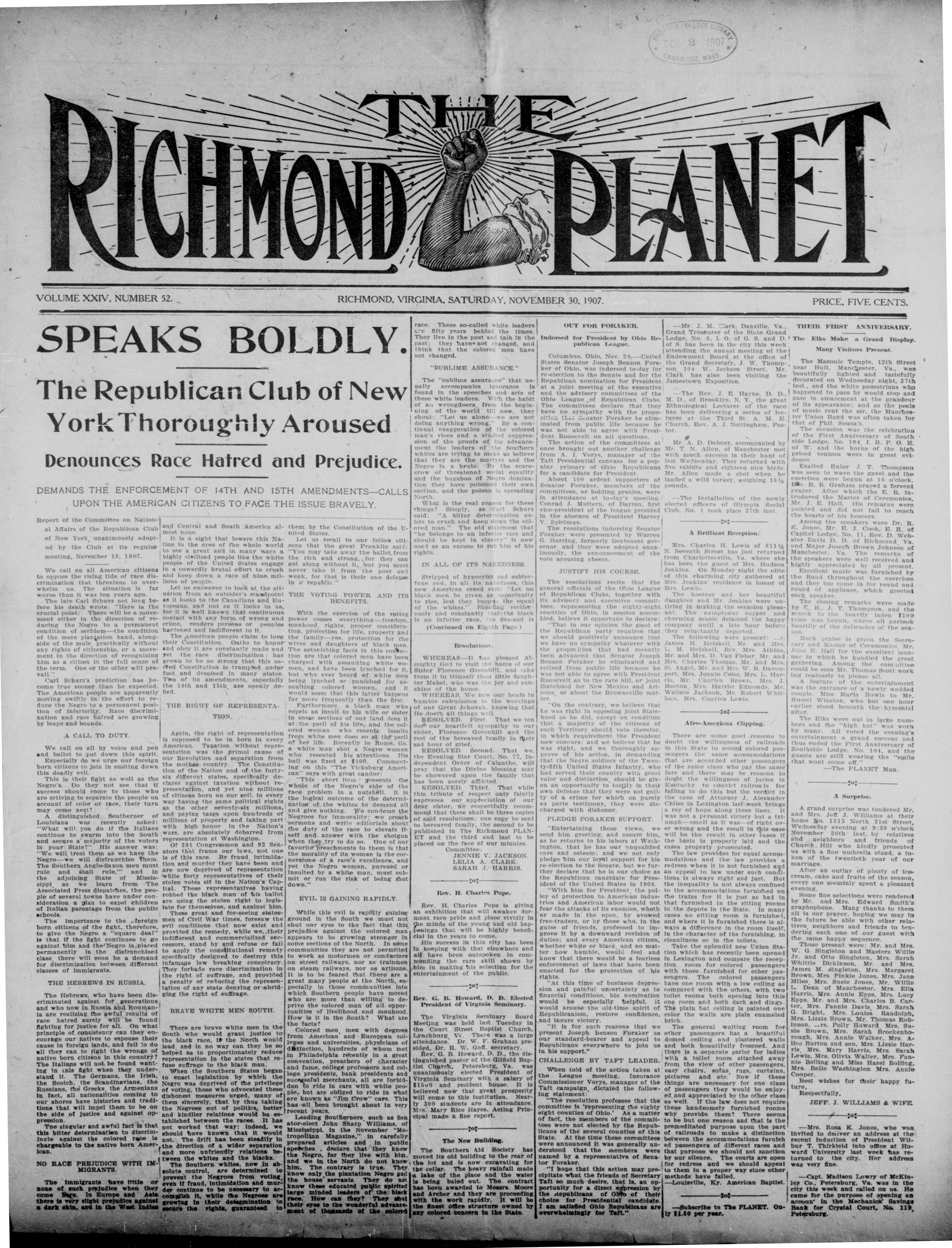
THE RICHMOND PLANET
SPEAKS BOLDLY.
The Republican Club of New York Thoroughly Aroused
DEMANDS THE ENFORCEMENT OF 14TH AND 15TH AMENDMENTS—CALLS UPON THE AMERICAN CITIZENS TO FACE THE ISSUE BRAVELY.
VOLUME XXIV, NUMBER 52.
SPEAKS
The Republ
York Thor
Denounces Rac
DEMANDS THE ENFORCEMENT
UPON THE AMERICAN
Report of the Committee on Nationa-
al Affairs of the Republican Club
of New York, unanimously ado-
ted by the Club at its regular
meeting, November 18, 1907.
We call on all American citizens to oppose the rising tide of race discrimination that threatens to overwhelm us. The situation is far worse than it was ten years ago.
The late Carl Schurz not long before his death wrote: "Here is the crucial point: There will be a movement either in the direction of reducing the Negro to a permanent condition of serfdom—the condition of the mere plantation hand, alongside of the mule practically without any rights of citizenship, or a movement in the direction of recognizing him as a citizen in the full sense of the term. One or the other will prevail."
Carl Schurz's prediction has become true sooner than he expected. The American people are apparently moving swiftly in the effort to reduce the Negro to a permanent position of inferiority. Race discrimination and race hatred are growing by leaps and bounds.
A CALL TO DUTY.
We call on all by voice and pen and ballot to put down this spirit. Especially do we urge our foreign born citizens to join in smiling down this deadly evil. This is their fight as well as the Negro's. Do they not see that if success should come to those who are striving to separate the people on account of color or race, their turn may come next? A distinguished Southerner of Louisiana was recently asked: "What will you do if the Italians continue to swarm into the South and secure a majority of the voters in your State?" His answer was: "We will treat them as we have the Negro—we will disfranchise them. The Southern Anglo-Saxon men must rule and shall rule," and in the adjoining State of Mississippi, as we learn from the Associated Press dispatches, the people of several towns have under conspiration a plan to expel children of Italian parentage from the public schools. The importance to the foreign born citizens of the fight, therefore, to give the Negra a "square deal" is that if the fight continues to go against him and the Negro is placed permanently in the disfranchised class there will soon be a demand for discrimination between different classes of immigrants.
THE HEBREWS IN RUSSIA
The Hebrews, who have been discriminated against for generations and who now in Russia and Roumania are realizing the awful results of race hatred surely will be found fighting for justice for all. On what principle of consistency can they encourage our natives to espouse their cause in foreign lands, and fall to do all they can to right the wrongs of native born citizens in this country? The Italians will not be found wanting in this fight when they understand it. The Germans, the Irish, the Scotch, the Scandinavians, the Russians, the Greeks the Armenians in fact, all nationalities coming to our shores have histories and traditions that will impel them to be on the side of justice and against oppression.
The singular and awful fact is that this bitter determination to discriminate against the colored race is chargeable to the native born American.
NO RACE PREJUDICE WITH IM- MIGRANTS.
The immigrants have little or none of such prejudice when they come Here. In Europe and Asia there is very slight prejudice against a dark skin, and in the West Indies
and Central and South America almost none.
It is a sight that lowers this Nation in the eyes of the whole world to see a great and in many ways a highly civilized people like the white people of the United States engage in a cowardly brutal effort to crush and keep down a race of nine millions of people.
Let us endeavor to look at the situation from an outsider's standpoint as it looks to the Canadians and Europeans, and not as it looks to us, for it is well known that continuous contact with any form of wrong and crime, renders persons or peoples hardened and indifferent to it.
The American people claim to love their Constitution. Oaths to honor and obey it are constantly made and yet the race discrimination has grown to be so strong that this sacred Constitution is trampled under foot and despised in many states. Two of its amendments, especially the 14th and 15th, are openly defied.
THE RIGHT OF REPRESENTA
Again, the right of representation is supposed to be in born in every American. Taxation without representation was the primal cause of our Revolution and separation from the mother country. The Constitution of the Nation and of the forty-six different states, specifically declares against taxation without representation, and yet nine millions of citizens born on our soil, in every way having the same political rights as the other seventy-six millions, and paying taxes upon hundreds of millions of property and taking part with high honor in the Nation's wars, are absolutely debarred from representation at Washington. Of 391 Congressmen and 92 Senators that frame our laws, not one is of this race. By fraud, intimidation and murder they have been and are now deprived of representation while forty representatives of their stolen votes sit in the Nation's Capital. These representatives having robbed the black man of his ballot are using the stolen right to legislate for themselves, and against him.
These great and forseeing statesmen of Civil War times, foresaw the evil conditions that now exist and provided the remedy, while we, their indifferent and commercialized successors, stand by and refuse or fail to apply the constitutional remedy specifically designed to destroy this infamous law breaking conspiracy. They forbade race discrimination in the right of suffrage, and provided a penalty of reducing the representation of any state denying or abridging the right of suffrage.
BRAVE WHITE MEN SOUTH.
There are brave white men in the South who would grant justice to the black race, if the North would lead and in no way can they be so helped as to proportionately reduce representation in the states that refuse suffrage to the black man.
When the Southern States began to enact legislation by which the Negro was deprived of the privilege of voting, those who advocated these dishonest measures urged, many of them sincerely, that by thus taking the Negroes out of politics, better and kindlier relations would be established between the races. It has not worked that way: indeed, we should have known that it would not. The drift has been steadily in the direction of a wider separation and more unfriendly relations between the whites and the blacks.
The Southern whites, now in absolute control, are determined to prevent the Negroes from voting, even if fraud, intimidation and murder continue to be necessary to accomplish it, while the Negroes are growing in their determination to secure the rights, guaranteed to
RICHMOND, VIRGINIA, SATURDAY, NOVEMBER 30, 1907.
them by the Constitution of the United States. Let us recall to our fellow citizens that the great Franklin sait: "You may take away the ballot from the rich and strong, for they can get along without it, but you must never take it from the poor and weak, for that is their one defense in a republic."
THE VOTING POWER AND ITS BENEFITS.
With the exercise of the voting power comes everything—freedom, manhood, rights, proper consideration, protection for life, property and the family—yes, protection for the wives and daughters of black men. The astonishing facts in this connection are that colored men have been charged with assaulting white women, and have been lynched for it, but who ever heard of white men being lynched or punished for assaulting colored women, and it would seem that this latter happens far more frequently than the first. Furthermore, a black man who repels an insult to his wife or sister in some sections of our land does it at the peril of his life, and the colored woman who resents insults from white men does so at the peril of life. Recently in Rome, Ga. a white man in Negro woman who resented his attentions, His ball was fixed at $100. Commenting on this "The Vicksburg American" says with great candor:
"This short item presents the whole of the Negro's side of the race problem in a nutshell. It is the logical outcome of the determination of the whites to demand all and give nothing. We condemn the Negroes for immorality; we preach sermons and write editorials about the duty of the race to elevate itself and answer with the shotgun when they try to do so. One of our favorite preachments to them is that the morality of its women is the cornerstone of a race's excellence, and yet the Negro woman, pursued or insulted by a white man, must submit or run the risk of being shot down."
EVIL IS GAINING RAPIDLY.
While this evil is rapidly gaining ground in the South we must not shut our eyes to the fact that this prejudice against the colored man appears to be growing stronger in some sections of the North. In some communities they are not permitted to work as motormen or conductors on street railways, nor as trainmen on steam railways, nor as artisans. It is to be feared that there are a great many people at the North, especially in those communities into which Southern people have moved who are more than willing to deprive the colored man of all opportunities of livelihood and manhood. How is it in the South? What are the facts? Colored men, men with degrees from American and European college, physicians of distinction, hundreds of them in Philadelphia recently in a great convention, preachers of character and fame, college professors and college presidents, bank presidents and successful merchants, all are forbiddent to ride in cars with white people, but are obliged to ride in what are known as "Jim Crow" cars. This has all been brought about in very recent years.
Leading Southernners, such as Senator-elect John Sharp Williams, of Mississippi, in the November "Metropolitan Magazine," in carefully prepared articles and in public speeches, declare that they know the Negro, for they live with him, and we in the North do not know him. The contrary is true. They know only the plantation Negro and the house servants. They do not know these educated public spirited large minded leaders of the black race. How can they? They shut their eyes to the wonderful advancement of the thousands of the colored
race. These so-called white leaders are fifty years behind the times. They live in the past and talk in the past; they have not changed, and think that the colored men have not changed.
"SUBLIME ASSURANCE"
The "sublime assurance" that usually accompanies ignorance is found in the speeches and acts of these white leaders. With the habit of all wrongdoers, from the beginning of the world till now, they shout: "Let us alone—we are not doing anything wrong." By a continual exaggeration of the colored man's vices and a studied suppression of the proofs of his advancement the leaders of the Southern whites are trying to make us believe that they are the martyrs and the Negro is a brute. By the scarecrow of threatened social equality and the bugaboo of Negro domination they have poisoned their own section, and the poison is spreading North.
What is the real reason for these things? Simply, as Carl Schurz said: "A bitter determination exists to crush and keep down the colored man." The old statement that "he belongs to an inferior race and should be kept in slavery" is now used as an excuse to rob him of his rights.
IN ALL OF ITS NAKEDNESS
Stripped of hypocrisy and subterfuge and, in all its nakedness, this new American creed says: "Let no black men be given an opportunity to rise, lest they become the equal of the whites." Showing vociferously and constantly that the black is an inferior race, the demand is (Continued on Eighth Page.)
Resolutions
WHEREAS—It has pleased Almighty God to visit the home of our Sister Florence Greenhill!, and take from it to Himself their little daughter Mabel, who was the joy and sunshine of the home.
WHEREAS, We bow our heads in humble submission to the workings of our Great Jehovah, knowing that He doeth all things well.
RESOLVED. First. That we ten der our heartfelt sympathy to our sister, Florence Greenhill and the rest of the bereaved family in their sad hour of grief.
RESOLVED. Second. That we, the Evening Star Court, No. 77, Independent Order of Calanthe, will pray that the Divine blessing may be showered upon the family that has been sorely afflicted.
RESOLVED. Third. That while this tribute of respect only faintly expresses our appreciation of our dear sister, we respectfully recommend that there shall be three copies of said resolutions; one copy be sent to bereaved family, the second to be published in The Richmond PLANET and the third and last to be placed on the face of our minutes.
Committee:
JENNIE V. JACKSON.
LELIA A. CLARK.
SARAH J. HARRIS.
Rev. H. Charles Pope.
Rev. H. Charles Pope is giving an exhibition that will awaken dormant race pride and place vividly in the minds of the young and old happenings that will be highly beneficial in the years to come.
His success in this city has been in keeping with that elsewhere and all have been outspoken in commending the rare skill shown by him in making his selection for the entertainment of the public.
Rev. G. B. Howard, D. D. Elected President of Virginia Seminary.
The Virginia Seminary Board Meeting was held last Tuesday in the Court Street Baptist Church, Lynchburg, Va. There was a large attendance. Dr. W. F. Graham presided, Dr. R. W. Goff, secretary. Rev. G. B. Howard, D. D., the distinguished pastor of the Gillfield Baptist Church, Petersburg, Va. was unanimously elected President of Virginia Seminary with a salary of $1500 and resident house. It is believed now that great prosperity will come to this institution. Nearly 300 students are in attendance. Mrs. Mary Rice Hayes, Acting Principal made a fine report.
The New Building.
The Southern Aid Society has moved its old building to the rear of the lot and is now excavating for the cellar. The heavy rainfall made a lake of the place and the water is being baled out. The contract has been awarded to Messrs. Moore and Archer and they are proceeding with the work rapidly. It will be the finest office structure owned by any colored concern in the State.
OUT FOR FORAKER
Indorsed for President by Ohio Republican League.
Columbus, Ohio, Nov. 20.—United States Senator Joseph Benson Foraker of Ohio, was indorsed to-day for re-election to the Senate and for the Republican nomination for President at a joint meeting of the executive and the advisory committees of the Ohio League of Republican Clubs. The committees declare that they have no sympathy with the proposition that Senator Foraker be eliminated from public life because he was not able to agree with President Roosevelt on all questions. The action of the committees at once brought out another challenge from A. I. Vorys, manager of the Taft Presidential canvass for a popular primary of Ohio Republicans for a candidate for President. About 100 ardent supporters of Senator Foraker, members of the committees, or holding proxies, were in attendance at to-day's meeting, Conrad J. Mattern, of Dayton, first vice-president of the league presided in the absence of President Harvey V. Spielman. The resolutions indorsing Senator Foraker were presented by Warren G. Harring, formerly lieutenant governor, and they were adopted unanimously, the announcement of the vote arousing cheers.
JUSTIFY HIS COURSE.
The resolutions recite that the general officials of the Ohio League of Republican Clubs, together with its advisory and executive committees, representing the eighty-eight counties of Ohio, in session assembled, believe it opportune to declare: "That in our opinion the good of the Republican party requires that we should positively announce that we have no sympathy whatever with the proposition that had recently been advanced that Senator Joseph Benson Foraker be eliminated and retired from public life because he was not able to agree with President Roosevelt as to the rate bill, or joint Statehood for New Mexico and Arizona or about the Brownsville matter.
"On the contrary, we believe that he was right in opposing joint Statehood as he did, except on condition that a majority of the citizens of each Territory should vote therefor, in which requirement the President now concurs; and we believe that he was right, and we thoroughly approve of his action, in demanding that the Negro soldiers of the Twenty-fifth United States Infantry, who had served their country with great valor and distinction, should be given an opportunity to testify in their own defense that they were not guilty of a crime for which on purely ex parte testimony, they were discharged with dishonor.
PLEDGE FORAKER SUPPORT
"Entertaining these views, we send him greeting, and assure him, as he returns to his labors at Washington, that he has our unqualified care and esteem; and we not only pledge him our loyal support for his re-election to the Senate, but we further declare that he is our choice as the Republican candidate for President of the United States in 1908. "With him for President, the policy of protection to American industries and American labor would not fear the attacks of its enemies, whether er made in the open, by avowed free-traders, or by those who, in the guise of friends, professed to improve it by a downward revision of duties; and every American citizen, whether white or black, and no matter how humble, would feel and know that there would be a fearless enforcement of laws that have been enacted for the protection of his rights.
"At this time of business depression and painful uncertainty as to financial conditions, his nomination would be especially helpful. It would arouse the old-time spirit of Republicanism, restore confidence, and insure victory.
"It is for such reasons that we present Joseph Henson Foraker as our standard-bearer and appeal to Republicans everywhere to join us in his support."
CHALLENGE BY TAFT LEADER.
When told of the action taken at the League meeting, Insurance Commissioner Vorys, manager of the Taft campaign, dictated the following statement:
"The resolution professes that the committee is 'representing the eighty eight counties of Ohio.' As a matter of fact, the members of the committees were not elected by the Republicans of the several counties of this State. At the time these committees were announced it was generally understood that the members were named by a representative of Senator Foraker.
"I hope that this action may precipitate what the friends of Secretary Taft so much desire, that is, an opportunity for a direct expression by the republicans of Ohio of their choice for Presidential candidate. I am satisfied Ohio Republicans are overwhelmingly for Taft."
Mr. J. M. Clark, Danville, Va., Grand Treasurer of the State Grand Lodge, No. 6, I. O. of G. S. and D. of S. has been in the city this week attending the annual meeting of the Endowment Board at the office of the Grand Secretary, J. W. Thompson, 104 W. Jackson Street. Mr. Clark has also been visiting the Jamestown Exposition.
The Rev. J. E. Hayne, D. D., M. D., of Brooklyn, N. Y., the great Ethnological Lecturer of the race has been delivering a series of lectures at the Third St. A. M. E. Church, Rev. A. J. Nottingham, Pastor.
Mr. A. D. Dabney, accompanied by Mr. T. N. Allen, of Manchester met with much success in their hunt of last Wednesday. They returned with five rabbits and eighteen nice birds. Mr. Allen made a shot when he landed a wild turkey, weighing 18½ pounds.
The Installation of the newly elected officers of Olympia Social Club, No. 1 took place 23th inst.
A Brilliant Reception.
Mrs. Charles H. Lewis of $811.5$ N. Sowenth Street has just returned from Charlottesville, Va., where she has been the guest of Mrs. Hudson Jenkins. On Monday night the elite of this charming city gathered at Mrs. Jenkins' residence in honor of Mrs. Lewis.
The hostess and her beautiful daughter and Mr. Jenkins were untiring in making the occasion pleasant. The sumptuous supper and charming music detailed the happy company until a late hour before they reluctantly departed.
The following were present: —r James H. Heiskell, Mr. and Mrs. L. M. Heiskell, Rev. Mrs. Atkins, Mr. and Mrs. D. Van Fisher, Mr. and Mrs. Charles Thomas, Mr. and Mrs. St. Angel, Mr. and Mrs. W. B. Davenport, Mrs. Jennie Colems, Mrs. L. Harris, Mr. Charles Brown, Mrs. J. Morton, Mrs. Harriet Edmonds, Mr. Wallace Jackson, Mr. Robert Whitlock, Mrs. Charles Lewis.
Afro-Americana Clipping.
There are some good reasons to doubt the willingness of railroads in this State to accord colored passengers the same accommodations that are accorded other passengers of the same class who pay the same fare and there may be reasons to doubt the willingness of juries in Kentucky to convict railroads for failing to do this but the verdict in the case of Attorney J. Alexander Chiles in Lexington last week brings a ray of hope along these lines. It was not a personal victory but a triumph—small as it was—of right over wrong and the result in this case will be the result in other cases if the basis is properly laid and the cases properly prosecuted.
The law provides for equal accommodations and the law provides a redress when it is not furnished and an appeal to law under such conditions is always right and just. But the inequality is not always confined to the accommodations furnished on the trains for it is just as bad in that furnished in the sitting rooms in the depots in the State. In many cases no sitting room is furnished, and where it is furnished there is always a difference in the room itself, in the character of the furnishing, in cleanliness or in the toilets.
Take the splendid new Union Station which has recently been opened in Lexington and compare the reception room for colored passengers with those furnished for other passengers. The colored passengers have one room with a low ceiling as compared with the others, with two toilet rooms both opening into this one room and both dark and dingy. The plain bat ceiling is painted one color the walls are plain enameled brick. The general waiting room for other passengers has a beautiful domed ceiling and plastered walls and both beautifully frescoed. And there is a separate parlor for ladies with a toilet room attached away from the view of other passengers, easy chairs, sofas, rugs, curtains, pictures and etc. Now if these things are necessary for one class of passengers they would be enjoyed and appreciated by the other class as well. If the law does not require these handsomely furnished rooms why provide them? There seems to be but one reason and that is the premeditated purpose upon the part of railroads to make a distinction between the accommodations furnish ed passengers of different races and that purpose we should not sanction by our silence. The courts are open for redress and we should appeal to them in a proper way since other methods have failed.—Louisville, Ky. American Baptist.
—Subscribe to The PLANET. Only $1.50 per year.
PRICE, FIVE CENTS.
THEIR FIRST ANNIVERSARY.
Near the Masonic Temple, 12th Street near Hull, Manchester, Va., was beautifully lighted and tastefully decorated on Wednesday night, 27th inst., and the white pedestrians who happened to pass by would stop and gaze in amazement at the grandeur of its appearance; and as the peals of music rent the air, the Manchester Union Band was often taken for that of Phil. Sousa's.
The occasion was the celebration of the First Anniversary of South side Lodge, No. 104. I. B. P. O. E. of W., and the horns of the high priced venison were in great evidence.
Exalted Ruler J. T. Thompson was seen to wave the gavel and the exercises were begun at 10 o'clock. Rev. R. R. Graham prayed a fervent prayer. After which the E. R. introduced the Master of Ceremonies, Mr. J. E. Hall. His remarks were pointed and did not fail to reach the hearts of his hearers.
Among the speakers were Dr. R. E. Jones, J. E. Cook, E. R. of Capitol Lodge, No. 1, Rev. D. Webster Davis D. D. of Richmond, Va. and Major Joseph Brown Johnson of Manchester, Va. The remarks of the speakers were well received and highly appreciated by all present.
Excellent music was furnished by the Band throughout the exercises and they too came in for round and round of applause, which greeted each speaker.
The closing remarks were made by E. R., J. T. Thompson, and the march to the heavily laden $100 table was begun, where all partook heartily of the delicacies of the season.
Much praise is given the Secretary and Master of Ceremonies Mr. John E. Hall for the excellent manner in which he handled the great gathering. Among the committee could be seen Mr. Thomas Scott working zealously to please all.
A feature of the entertainment was the entrance of a newly wedded couple, Miss Maria Bowls to Mr. Russel Winston, who but one hour earlier stood beneath the menial altar.
The Elks were out in large numbers and the "high hat" was worn by many. All voted the evening's entertainment a grand success and thus ended the First Anniversary of Southside Lodge, No. 104, and the guests are still wearing the "smile that wont come off."
—The PLANET Man.
A. Surprise.
A grand surprise was tendered Mr. and Mrs. Jeff J. Williams at their home No. 1313 North 31st Street. Wednesday evening at 9:30 o'clock November 20th inst. by relatives and neighbors and friends of Church. Hill who kindly presented us with a fine umbrella stand, a token of the twentient year of our marriage.
After an outlay of plenty of ice cream, cake and fruits of the season, every one seemingly spent a pleasant evening.
Some fine selections were rendered by Mr. and Mrs. Edward Smith's graphophone. Many thanks to them all is our prayer, hoping we may in the future be able with other relatives, neighbors and friends to tendering each one of our guest with the same happy sequence.
Those present were: Mr. and Mrs. W. G. Singleton and Masters Willie Jr. and Otto Singleton, Mrs. Sarah Wattle Dickinson, Mr. and Mrs. James M. Singleton, Mrs. Margaret Brown, Mrs. Pinkie Jones, Mrs. Jane Miles, Mrs. Susie Jones, Mr. Willie L. Dean of Manchester, Mrs. Ella Harris, Mrs. Annie Epps, Mrs. Lucy Epps, Mr. and Mrs. Charles B. Carter, Mrs. Fannie Davis, Mrs. Sarah G. Bright, Mrs. Louisa Randolph, Mrs. Lizzie Brown, Mr. Thomas Robinson, ...rs. Polly Howard, Mrs. Susie Brown, Mrs. Sarah Brockenborough, Mrs. Annie Walker, Mrs. Alice Burton and son, Mrs. Lizzie Harris, Mrs. Mary Harris, Mrs. Sarah Lewis, Mrs. Olivia Walter, Mrs. Fannie Bollong and Miss Hazel Bolling, Mrs. Belle Washington Mrs. Annie Cooper.
Best wishes for their happy future.
Respectfully.
—Mrs. Rosa K. Jones, who was invited to deliver an address at the recent induction of President Wilbur T. Thirkield into office at Howard University last week has returned to the city. Her address was very fine.
—Capt. Madison Lowry of McKinley Co., Petersburg, Va. was in the city this week and called on us. He came for the purpose of opening an account' in the Mechanics' Savings Bank for Crystal Court, No. 119, Petersburg.
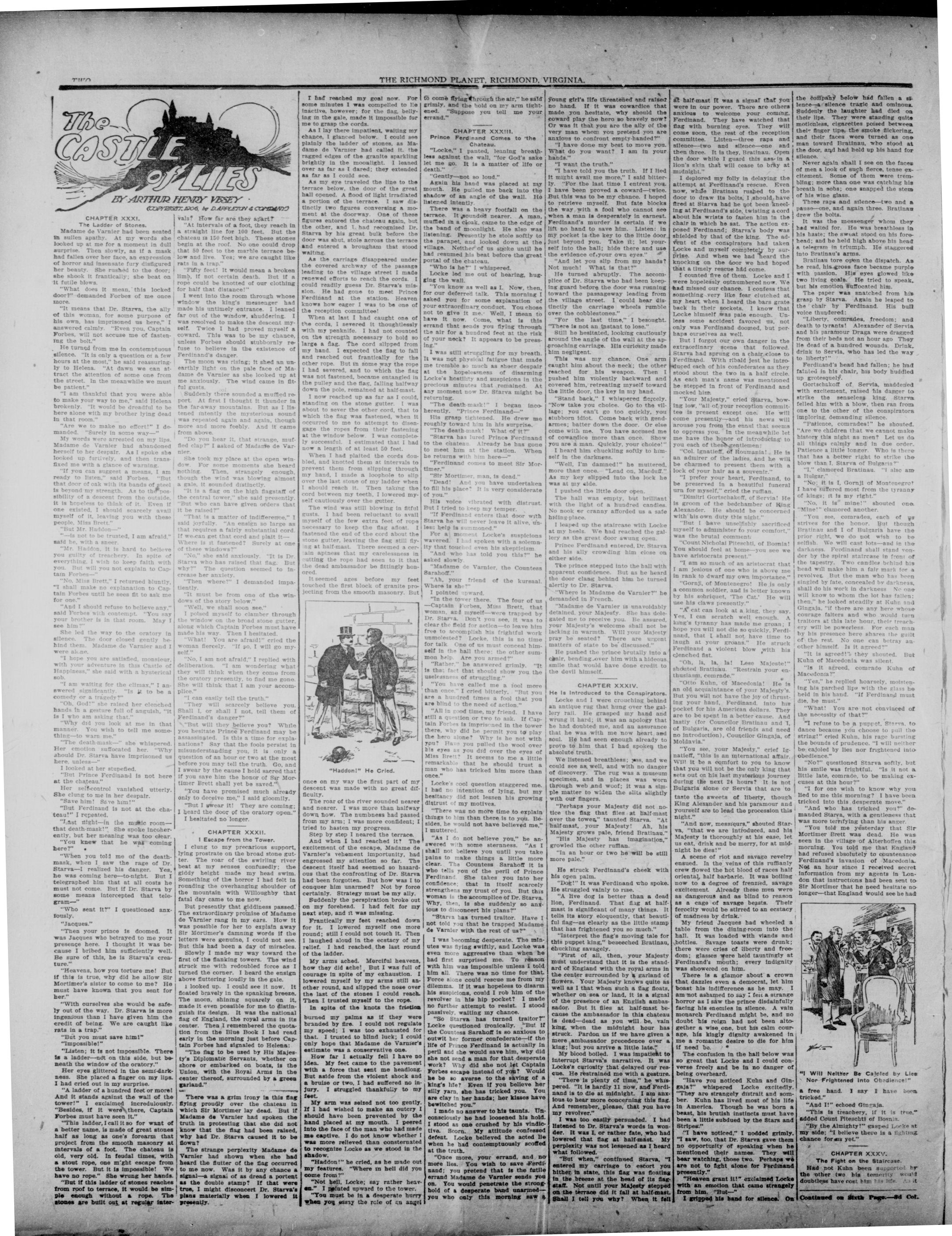
The CASTLE of LIES
BY ARTHUR HENRY VERSYE
(COPYRIGHT 2005 BY DABBERT & COMPANY)
TWO
Madame de Varnier had been seated in sullen apathy. At my words she looked up at me for a moment in dull surprise. Then slowly, as if a mask had fallen over her face, an expression of horror and insensate fury disfigured her beauty. She rushed to the door; she shook it frantically; she beat on it futile blows.
"What does it mean, this locked door?" demanded Forbes of me once more.
"It means that Dr. Starva, the ally of this woman, for some purpose of his own, has imprisoned us here," I answered calmly. "Even you, Captain Forbes, will not accuse me of fastening the bolt."
He turned from me in contemptuous silence. "It is only a question or a few hours at the most," he said reassuringly to Helena. "At dawn we can attract the attention of some one from the street. In the meanwhile we must be patient."
"I am thankful that you were able to make your way to me," said Helena brokenly. "It would be dreadful to be here alone with my brother lying dead in that room."
"Are we to make no effort!" I demanded. "Surely in some way—"
My words were arrested on my lips. Madame de Varnier had abandoned herself to her despair. As I spoke she looked up furiously, and then transfixed me with a glance of warning.
"If you can suggest a means, I am ready to listen," said Forbes. "But that door of oak with its bands of steel is beyond my strength. As to the possibility of a descent from the outside, it is hopeless to think of it. Even if one existed, I should scarcely avail myself of it, leaving you with these people, Miss Brett."
"But Mr. Haddon—"
"—is not to be trusted, I am afraid," said he, with a sneer.
"Mr. Haddon, it is hard to believe you guilty of treachery. In spite of everything, I wish to keep faith with you. But will you not explain to Captain Forbes—"
"No, Miss Brott," I returned bluntly, "I shall make no explanation to Captain Forbes until he sees fit to ask me for one."
"And I should refuse to believe any," said Forbes with contempt. "You say your brother is in that room. May I see him?"
She led the way to the oratory in silence. The door closed gently behind her. Madame de Varnier and I were alone.
"I hope you are satisfied, monsieur, with your adventure in this Castle of Happiness," she said with a hysterical sob.
"I am waiting for the climax," I answered significantly. "Is it to be a comedy or a tragedy?"
"Oh, God!" she raised her clenched hands in a gesture full of anguish, "it is I who am asking that."
"Why did you look at me in that manner. You wish to tell me something—to warn me."
"The death-mask—" she whispered. Her emotion suffocated her. "Why should Dr. Starva have imprisoned us here, unless—"
I looked at her stupefied.
"But Prince Ferdinand is not here at the cateau."
Her self-control vanished utterly
She clung to me in her despair.
"Save him! Save him!"
"But Ferdinand is not at the chateau!" I repeated.
"Last night—in the music room—that death-mask!" She spoke incoherently, but her meaning was too clear.
"You knew that he was coming here?"
"When you told me of the death-mask, when I saw the rage of Dr. Starva—I realized his danger. Yes, he was coming here—to-night. But I telegraphed him that at all costs he must not come. But if Dr. Starva by some means intercepted that telegram—"
"Who sent it?" I questioned anxiously.
"Jacques."
"Then your prince is doomed. It was Jacques who betrayed to me your presence here. I thought it was because I bribed him sufficiently well. Be sure of this, he is Starva's creature."
"Heavens, how you torture me! But if this is true, why did he allow Sir Mortimer's sister to come to me? He must have known that you sent for her."
"With ourselves she would be safely out of the way. Dr. Starva is more ingenious than I have given him the credit of being. We are caught like rats in a trap."
"But you must save him!"
"Impossible!"
"Listen; it is not impossible. There is a ladder—not on this side, but beneath the window of the oratory."
Her eyes glittered in the semi-darkness. She placed a finger on my lips. I had cried out in my surprise.
"A ladder of a hundred feet or more! And it stands against the wall of the tower!" I exclaimed incredulously.
"Besides, if it were there, Captain Forbes must have seen it."
"This ladder, I call it so for want of a better name, is made of great stones half as long as one's forearm that project from the smooth masonry at intervals of a foot. The chateau is old, very old. In feudal times, with a stout rope, one might escape from the tower. But it is impossible! We have no rope." She wrung her hands.
"But if this ladder of stones reaches from roof to terrace, it would be simple enough without a rope. The stones are built out at regular inter-
vals? How far are they apart?
"At intervals of a foot, they reach in a straight line for 100 feet. But the chateau is 150 feet high. These stones begin at the roof. No one could drop that 50 feet to the marble terrace below and live. Yes; we are caught like rats in a trap."
"Fifty feet! It would mean a broken limb, if not certain death. But if a rope could be knotted of our clothing for half that distance!"
I went into the room through whose window the king's messenger had made his untimely entrance. I leaned far out of the window, shuddering. I was resolved to make the descent myself. Twice I had proved myself a coward. This was to be my chance, unless Forbes should stubbornly refuse to believe in the existence of Ferdinand's danger.
The moon was rising; it shed an unearthly light on the pale face of Madame de Varnier as she looked up at me anxiously. The wind came in fitful gusts.
Suddenly there sounded a muffled report. At first I thought it thunder in the far-away mountains. But as I listened intently the mysterious sound was repeated again and again, though more and more feebly. And it came from above.
"Do you hear it, that strange, muffled clap?" I asked of Madame de Varnier.
She took my place at the open window. For some moments she heard nothing. Then, strangely enough, though the wind was blowing almost a gale, it sounded distinctly.
"It is a flag on the high flagstaff of the central tower," she said presently. "But who can have given orders that it be raised?"
"That is a matter of indifference," I said joyfully. "An ensign so large as that requires a fairly substantial cord. If we can get that cord and plait it—Where is it fastened? Surely at one of these windows?"
"No," she said anxiously. "It is Dr. Starva who has raised that flag. But why?" The question seemed to increase her anxiety.
"Then where?" I demanded impatiently.
"It must be from one of the windows of the story below."
"Well, we shall soon see."
I polished myself to clamber through the window on the broad stone gutter, along which Captain Forbes must have made his way. Then I hesitated.
"What! You are afraid!" cried the woman fiercely. "If so, I will go myself."
"No, I am not afraid," I replied with deliberation. "I am wondering what they will think when they come from the oratory presently, to find me gone. She will think that I am your accomplice."
"I can easily tell the truth."
"They will scarcely believe you. Shall I, or shall I not, tell them of Ferdinand's danger?"
"But will they believe you? While you hesitate Prince Ferdinand may be assassinated. Is this a time for explanations? Say that the fools persist in misunderstanding you, it is only a question of an hour or two at the most before you may tell the truth. Go, and I swear by the cause I hold sacred that if you save him the honor of Sir Mortimer Brett shall yet be saved." "You have promised much already only to deceive me," I said gloomly. "But I swear it! They are coming; I heard the door of the oratory open." I hesitated no longer.
CHAPTER XXXII.
I clung to my precarious support, lying prostrate on the broad stone gutter. The roar of the swirling river beat at my senses confusedly; the giddy height made my head swim. Something of the horror I had felt in rounding the overhanging shoulder of the mountain with Willoughby that fatal day came to me now.
But presently that giddiness passed. The extraordinary promise of Madame de Varnier rang in my ears. How it was possible for her to explain away Sir Mortimer's damning words if the letters were genuine, I could not see. But this had been a day of miracles. Slowly I made my way toward the first of the flanking towers. The wind struck me with redoubled force as I turned the corner. I heard the ensign above fluttering loudly in the gale.
I looked up. I could see it now. It floated bravely in the spanking breeze. The moon, shining squarely on it, made it even possible for me to distinguish its design. It was the national flag of England, the royal arms in its center. Then I remembered the quotation from the Blue Book I had read early in the morning just before Captain Forbes had signaled to Helena: "The flag to be used by His Majesty's Diplomatic Servants, whether on shore or embarked on boats, is the Union, with the Royal Arms in the center thereof, surrounded by a green garland."
There was a grim irony in this flag flying proudly over the chateau in which Sir Mortimer lay dead. But if Madame de Varnier had spoken the truth in protesting that she did not know that the flag had been raised, why had Dr. Starva caused it to be flown?
The strange perplexity Madame de Varnier had shown when she had heard the flutter of the flag occurred to me now. Was it by any chance a signal—a signal of as dread a portent as the double stamp? If that were true, I might disconcert Dr. Starva's plans materially when I lowered it presently.
THE RICHMOND PLANET, RICHMOND, VIRGINIA
I had reached my goal now. For some minutes I was compelled to lie inactive, however; for the dag, bellying in the gale, made it impossible for me to grasp the cords.
As I lay there impatient, waiting my chance, I glanced below. I could see plainly the ladder of stones, as Madame de Varnier had called it. the ragged edges of the granite sparkling brightly in the moonlight. I leaned over as far as I dared; they extended as far as I could see.
As my eye traveled the line to the terrace below, the door of the great hall opened. A flood of light irradiated a portion of the terrace. I saw distinctly two figures conversing a moment at the doorway. One of these figures entered the chateau again, but the other, and I, had recognized Dr. Starva by his great bulk before the door was shut, stole across the terrace and entered a brougham that stood waiting.
As the carriage disappeared under the covered archway of the passage leading to the village street I made renewed efforts to reach the cords. I could readily guess Dr. Starva's mission. He had gone to meet Miss Ferdinand at the station. Heaven knows how eager I was to be one of the reception committee!
When at last I had caught one of the cords, I severed it thoughtlessly with my penknife. I had not counted on the strength necessary to hold so large a flag. The cord slipped from my hand. I expected the flag to fall and reached out frantically for the other rope. But in some way the rope I had severed, and to which the flag was not fastened, became entangled in the pulley and the flag, falling halfway down the pole, remained at half-mast.
I now reached up as far as I could, standing on the stone gutter. I was about to sever the other cord, that to which the flag was fastened, when it occurred to me to attempt to disengage the ropes from their fastening at the window below. I was completely successful. I estimated that I had now a length of at least 50 feet. When I had plaited the cords doubled, and knotted them at intervals to prevent them from slipping through my hand, I made a loophole to slip over the last stone of my ladder when I should reach it. Then taking the cord between my teeth, I lowered myself cautiously over the gutter.
The wind was still blowing in fitful gusts. I had been reluctant to avail myself of the few extra feet of rope necessary to keep the flag afloat. I fastened the end of the cord about the stone gutter, leaving the flag still flying at half-mast. There seemed a certain aptness that my carelessness in cutting the rope had seen to it that the dead ambassador be fittingly honored.
It seemed ages before my feet touched the first block of granite projecting from the smooth masonry. But
"Haddon!" He Grilled
once on my way the first part of my descent was made with no great difficulty. The roar of the river sounded nearer and nearer. I was more than halfway down now. The numbness had passed from my arm; I was more confident; I tried to hasten my progress. Step by step I neared the terrace. And when I had reached it! The excitement of the escape, Madame de Varnier's vehement importunity, had engrossed my attention so far. The descent itself had seemed so hazardous that the confronting of Dr. Starva had been forgotten. But how was I to conquer him unarmed? Not by force certainly. Strategy must be my ally. Suddenly the perspiration broke out on my forehead. I had felt for my next step, and it was missing.
Frantically my feet reached down for it. I lowered myself one more round; still I could not touch it. Then I laughed aloud in the ecstacy of my relief. I had reached the last round of the ladder.
My arms ached. Merciful heavens, how they did ache! But I was full of courage in spite of my exhaustion. I lowered myself by my arms still another round, and slipped the nose over the last of the stones I could reach. Then I trusted myself to the rope.
In spite of the knots the friction burned my palms as if they were branded by fire. I could not regulate my speed; I was too exhausted for that. I trusted to blind luck; I could only hope that Madame de Varnier's estimate was a conservative one. How far I actually fell I have no idea. My feet came to the pavement with a force that sent me headlong. But aside from the violent shock and a bruise or two, I had suffered no injury. I struggled thankfully to my feet.
My arm was seized not too gently. If I had wished to make an outcry I should have been prevented by the hand placed at my mouth. I peered into the face of the man who had made me captive. I do not know whether I was more relieved than consternated to recognize Locke as we stood in the shadow.
"Haddon!" he cried, as he made out my features. "Where in hell did you come from?"
"Not hell, Locke; say rather heaven." I painted upward to the tower.
"You must be in a desperate hurry when you essay the role of an angel
to come flying through the air," he said grimly, and the hold on my arm tightened. "Suppose you tell me your errand."
CHAPTER XXX!!!
"Locke," I panted, leaning breathless against the wall. "for God's sake let me go. It is a matter of life or death."
"Gently—not so loud."
Again his hand was placed at my mouth. He pulled me back into the shadow of an angle of the wall. He listened intently.
There was a heavy footfall on the terrace. It sounded nearer. A man, muffled in a cloak, came to the edge of the band of moonlight. He also was listening. Presently he stole softly to the parapet, and looked down at the village. Neither of us spoke until he had resumed his beat before the great portal of the chateau.
"Who is he?" I whispered.
Locke led me out of hearing, hugging the wall.
"You know as well as I. Now, then, for our deferred talk. This morning I asked you for some explanation of your extraordinary conduct. You chose not to give it me. Well, I mean to have it now. Come, what is this errand that sends you flying through the air for a hundred feet at the risk of your neck? It appears to be pressing."
I was still struggling for my breath. It was not physical fatigue that made me tremble so much as sheer despair at the hopelessness of disarming Locke's hostility and suspicions in the precious minutes that remained. At any moment now Dr. Starva might be returning.
"The death-mask!" I began incoherently, "Prince Ferdinand—" His grasp tightened. He drew me roughly toward him in his surprise.
"The death-mask! What of it?" "Starva has lured Prince Ferdinand to the chateau. Already he has gone to meet him at the station. When he returns with him here—"
"Ferdinand comes to meet Sir Mortimer."
"Sir Mortimer, man, is dead."
"Dead! And you have undertaken to fill his place? It is very considerate of you."
His voice vibrated with distrust. But I tried to keep my temper.
"If Ferdinand enters that door with Starva he will never leave it alive, unless help is summoned."
For a moment Locke's suspicions wavered. I had spoken with a solemnity that touched even his skepticism
"And who has told you this?" he asked slowly.
"Madame de Varnier, the Countess Sarahoff."
"Ah, your friend of the kursaal. Where is she?"
I pointed upward.
"In the tower there. The four of us
—Captain Forbes, Miss Brett, that
woman, and myself—were trapped by
Dr. Starva. Don't you see, it was to
clear the field for action—to leave him
free to accomplish his frightful work
umnoleted? Locke, this is no time
for talk. One of us must conceal him-
self in the hall there; the other summon
help. Are you armed?"
"Rather," he answered grimly. "It
is that fact that should show you the
uselessness of struggling."
"You have called me a fool more
than once." I cried bitterly. "But you
are a hundred times a fool that you
are blind to the need of action."
"All in good time, my friend. I have still a question or two to ask. If Captain Forbes is imprisoned in the tower there, why did he permit you to play the hero alone? Why is he not with you? Have you pulled the wool over his eyes as you did over the eyes of Miss Brett? It seems to me a little remarkable that he should trust a man who has tricked him more than once."
Locke's cool question staggered me. I had no intention of lying, but my hesitancy did not lessen his growing distrust of my motives.
"There was no more time to explain things to him than there is to you. Besides, he would not have believed me," I muttered.
"As I do not believe you," he answered with some sternness. "As I shall not believe you until you take pains to make things a little more clear. The Countess Sarahoff it is who tells you of the peril of Prince Ferdinand. She takes you into her confidence; that in itself scarcely strengthens my trust of you. But this woman is the accomplice of Dr. Starva. Why, then, is she suddenly so anxious to disconcert his plans?" "Starva has turned traitor. Have I not told you that he trapped Madame de Varner with the rest of us?"
I was becoming desperate. The minutes was flying swiftly, and Locke was even more aggressive than when he had first surprised me. To reason with him was impossible unless I told him all. There was no time for that. Force alone could rescue me from my dilemma. If it was hopeless to disarm his suspicions, could I rob him of the revolver in his hip pocket? I made no further attempt to resist. I stood passively, waiting my chance.
"So Starva has turned traitor?" Locke questioned ironically, "But if the Countess Sarahoff is so anxious to outwilt her former confederate—if the life of Prince Ferdinand is actually in peril and she would save him, why did she not send a man for that desperate work? Why did she not let Captain Forbes escape instead of you? Would he be so averse to the saving of a king's life? Even if you believe her silly yarn, she has tricked you. You are clay in her hands; her kisses have bewitched you."
I made no answer to his taunts. Un-consciously he he had loosened his hold. I stood as one crushed by his vindictive. Scorn. My attitude confessed defeat. Locke believed the act lie when he had contemptuously scoffed at the truth.
"Once more, your errand, and no more lies. You wish to save Ferdinand; you pretend that is the fattie errand Madame de Varnier sends you on. You would penetrate the stronghold of a desperate band unarmed—you who only this morning saw a
young girl's life threatened and raised no hand. If it was cowardice that made you hesitate, why should the coward play the hero so bravely now? Or was it that you are the ally of the very man whom you pretend you are anxious to confront empty-handed?" "I have done my best to move you. What do you want? I am in your hands." "I want the truth."
"I have told you the truth. If I lied it might avail me more." I said bitterly. "For the last time I entreat you. I have been proved a coward—twice. But this was to be my chance. I hoped to retrieve myself. But fate blocks the way, with a fool who cannot see when a man is desperately in earnest. Ferdinand's murder is certain if we lift no hand to save him. Listen: in my pocket is the key to the little door just beyond you. Take it; let yourself into the hall; hide there and use the evidence of your own eyes." "And let you纵身 from here."
"And let you slip from my hands? Not much! What is that?" He turned abruptly. The accomplice of Dr. Starva who had been keeping guard before the door was running toward the passageway leading from the village street. I could hear distinctly the carriage wheels rumble over the cobblestones.
"For the last time," I besought. "There is not an instant to lose." Still he hesitated, looking cautiously around the angle of the wall at the approaching carriage. His curiosity made him negligent. This was my chance. One arm caught him about the neck; the other reached for his weapon. Then I pushed him violently backward and covered him, retreating myself toward the little door, the key in my hand.
"Stand back," I whispered fiercely.
"Now take you choice. Go to the village; you can't go too quickly, you stubborn idot. Come back with gendarmes; batter down the door. Or else come with me. You have accused me of cowardice more than once. Show you are a man. Quickly, your choice!"
I heard him chuckling softly to himself in the darkness.
"Well, I'm damned!" he muttered, more than once. "Lead on, Macduff." As my key slipped into the lock he was at my eld.
I pushed the little door open.
The hall was empty, but brilliant with the light of a hundred candles. No nook or cranny afforded us a safe hiding place.
I leaped up the staircase with Locke at my beels. We had reached the gallery as the great door swung open.
Prince Ferdinand entered, Dr. Starva and his ally crowding him close on either side.
The prince stepped into the hall with apparent confidence. But as he heard the door clang behind him he turned alertly to Dr. Starva.
"Where is Madame de Varnier?" he demanded in French.
"Madame de Varnier is unavoidably detained, my Majesty. She has delegated me to receive you. Be assured, your Majesty's welcome shall not be lacking in warmth. Will your Majesty pray be seated? There are urgent matters of state to be discussed."
He pushed the prince brutally into a chair, bending over him with a hideous smile that would have done credit to the devil himself.
CHAPTER XXXIV
He is introduced to the Conspirators.
Locke and I were crouching behind an antique rug that hung over the gallery rail. He grasped my hand and wrung it hard; it was an apology that he had doubted me, and an assurance that he was with me now heart and soul. He had seen enough already to prove to him that I had spoken the absolute truth.
We listened breathless; yes, and we could see as well, and with no danger of discovery. The rug was a museum specimen, and in places was worn through web and wool; it was a simple matter to widen the slits slightly with our fingers.
"Perhaps your Majesty did not notice the flag that files at half-mast over the toenw" taunted Starva. "At half-mast, your Majesty! Ah, his Majesty grows pale, friend Bratinau."
"His Majesty has imagination," growled the other ruffian.
"In an hour or two he will be still more pale."
He struck Ferdinand's cheek with his open palm.
"Dog!" It was Ferdinand who spoke. He struggled vainly to rise.
"A live dog is better than a dead lion, Ferdinand. That flag at half-mast is significant of many things. It tells its story eloquently, that beautiful flag—as clearly as the little stamp that has frightened you so much."
"Interpret the flag's moving tale for this puppet king," beseeched Bratinau, chuckling savagely.
"First of all, then, your Majesty must understand that it is the standard of England with the royal arms in the center surrounded by a garland of flowers. Your Majesty knows quite as well as that when such a flag floats, whether on sea or land, it is a signal of the presence of an English ambassador. But it files at half-mast because the ambassador in this chateau is dead—dead as you will be, vain king, when the midnight hour has struck. Pardon us if we have given a mere ambassador precedence over a king; but you arrive a little late." My blood boiled. I was impatient to interrupt Starva's narrative. It was Locke's curiosity that delayed our rescue. He restrained me with a gesture. "There is plenty of time," he whispered. "It is hardly 11 now, and Ferdinand is to die at midnight. I am anxious to hear more concerning this flag. And remember, please, that you have my revolver."
I was too easily persuaded. I had listened to Dr. Starva's words in wonder. It was I, or rather fate, who had lowered that flag at half-mast. My perplexity was not lessened as I heard what followed.
"But when," continued Starva, "I entered my carriage to escort you hither in state, this flag was floating in the breeze at the head of its flagstaff. Not until your Majesty stepped on the terrace did it fall at half-mast. Shall I tell you why? When it fell
at half-mast It was a signal that you were in our power. There are others anxious to welcome your coming, Ferdinand. They have watched that flag with burning eyes. They will come soon, the rest of the reception committee. Listen—three raps and silence—two and silence—one and then three. It is they, Bratian. Open the door while I guard this ass-in a lion's skin that will cease to bray at midnight."
I deplored my folly in delaying the attempt at Ferdinand's rescue. Even now, while Bratian rushed to the door to draw its bolts, I should, have fired at Starva he had not been kneeling at Ferdinand's side, twisting a cord about his wrists to fasten him in the chair in which he sat. The action exposed Ferdinand; Starva's body was shielded by that of the king. The advent of the conspirators had taken Locke and myself completely by surprise. And when we had heard the knocking on the door we had hoped that a timely rescue had come.
I counted five of them. Locke and I were hopelessly outnumbered now. We had missed our chance. I confess that something very like fear clutched at my heart when I heard the bars grate back in their sockets. I know that Locke himself was pale enough. Unless some accident favored us, not only was Ferdinand doomed, but perhaps ourselves as well.
But I forgot our own danger in the extraordinary scene that followed. Starva had sprung on a chair close to Ferdinand. With rabid jest he introduced each of his confederates as they stood about the two in a half circle. As each man's name was mentioned he stepped in front of Ferdinand and mocked him.
"Your Majesty," cried Starva, bowing low, "all of your reception committee is present except one. He will come presently—and his news will arouse you from the ennui that seems to oppress you. In the meanwhile let me have the honor of introducing to you each of these gentlemen;
"Col. Ignatief, of Roumania! He is an admirer of the ladies, and he will be charmed to present them with a lock of your hair as a souvenir."
"I prefer your heart, Ferdinand, to be preserved in a beautiful funeral urn for myself," cried the ruffian.
"Dimitri Gortschakoff, of Servia! He is groom of the bedchamber of King Alexander. He should be concerned with his own duty this night."
"But I have unselfishly sacrificed myself to administer to your comfort," was the brutal comment.
"Count Nicholai Pitschtei, of Bosnia! You should feel at home—you see we have aristocrats present."
"I am so much of an aristocrat that I am jealous of you who is above me in rank to dwarf my own importance."
"Gornjil, of Montenegro! He is only a common soldier, and is better known by his sobriquet, 'The Cat.' He will use his claws present."
"A cat can look at a king, they say, Yes, I can scrape well enough. A king's tyranny has made me groan; I hope you will not die so quickly. Ferdinand, that I shall not have time to laugh at your groans." He struck Ferdinand a violent blow with his clenched fist.
"Oh, la, la, la! Lese Majeste!" shouted Bratinaun. "Restrain your enthusiasm, comrade."
"Otto Kuhn, of Macedonia!" He is an old acquaintance of your Majesty's. But you will not have the joy of thrusting your hand, Ferdinand, into his pocket for his American dollars. They are to be spent in a better cause. And lastly (for Councilor Bratinaun and I, of Bulgaria, are old friends and need no introduction), Councilor Gingaja, of Moldavia."
"You see, your Majesty," clerk Ignatief, "this is an international affair. Will it be a comfort to you to know that you will not be the only king that sets out on his last mysterious journey during the next 24 hours? It is not Bulgaria alone or Servia that are to taste the sweets of liberty, though King Alexander and his paramour and yourself are to lead the procession this night."
"And now, messieurs," shouted Starva, "that we are introduced, and his Majesty is thoroughly at his ease, let us eat, drink and be merry, for at midnight he dies!"
A scene of riot and savage revelry ensued. In the veins of this ruffly crew flowed the hot blood of races half oriental, half barbaric. It was boiling now to a degree of frenzied, savage excitement. Already these men were as dangerous and as blind to reason as a cage of savage beasts. Their ferocity would be stirred to an ecstacy of madness by drink.
My friend Jacques had wheeled a table from the dining-room into the hall. It was loaded with vials and bottles. Savage toasts were drunk; there were cries of liberty and freedom; glasses were held tauntingly at Ferdinand's mouth; every indignity was showered on him.
There is a glamor about a crown that dazzles even a democrat, let him boast his indifference as he may. I am not ashamed to say I feel a strange horror as I saw the prince disdainfully facing his enemies in silence. A vain monarch Ferdinand might be, and no doubt his reign had not been altogether a wise one, but his calm courage, his kingly dignity awakened in me a romantic desire to die for him if need be.
The confusion in the hall below was so great that Locke and I could converse freely and be in no danger of being overheard.
"Have you noticed Kuhn and Gingaja?" whispered Locke excitedly. "They are strangely distrait and somber. Kuhn has lived most of his life in America. Though he was born a beast, his brutish instincts must have been a little subdued by the Stars and Stripes."
"I have noticed," I nodded grimly. "I saw, too, that Dr. Starva gave them no opportunity of speaking when he mentioned their names. They will bear watching, those two. Perhaps we are not to fight alone for Ferdinand presently."
"Heaven grant it!" exclaimed Locke with an emotion that came strangely from him. "But—"
I gripped his hand for silence. On
I gripped his hand for silence. On
the company below had fallen a silence—a silence tragic and ominous. Suddenly the laughter had died on their lips. They were standing quite motionless, cigarettes poised between their finger tips, the smoke flickering, and their faces were turned as one man toward Bratinau, who stood at the door, and had held up his hand for silence.
Never again shall I see on the faces of men a look of such fierce, tense excitement. Some of them were trembling; more than one was catching his breath in sobs; one snapped the stem of his wine glass.
Three raps and silence—two and a pause—one, and again three. Bratinau drew the bolts.
It was the messenger whom they had waited for. He was breathless in his haste; the sweat stood on his forehead; and he held high above his head a telegram in triumph. He staggered into Bratinau's arms.
Bradtian tore open the dispatch. As he read, his gross face became purple with passion. His eyes glowed like two living coals. He tried to speak, but his emotion suffocated him.
The paper was snatched from his grasp by Starva. Again he leaped to the chair by Ferdinand. His bull voice thundered:
"Liberty, comrades, freedom; and death to tyrants! Alexander of Servia and his paramour Draga were dragged from their beds not an hour ago. They lie dead of a hundred wounds. Drink, drink to Servia, who has led the way to liberty!"
Ferdinand's head had fallen; he had falted in his chair, his body huddled up grotesquely.
Gortschakoff of Servia, maddened with excitement, raised his dagger to strike the senseless king. Starva felled him with a blow, then run from one to the other of the conspirators imploring, demanding silence.
"Patience, comrades!" he shouted.
"Are we children that we cannot make history this night as men? Let us do all things calmly and in due order. Patience a little longer. Who is there that has a better right to strike the blow than I. Starva of Bulgaria?"
"I, clamored Bratinau. "I also am a Bulgar."
"No; it is I. Gornjil of Montenegro! I have suffered most from the tyranny of kings; it is my right."
"No, it is mine!" shouted one.
"Mine!" clamored another.
"You see, comrades, each of us strives for the honor. But though Bratinau and I of Bulgaria have the prior right, we do not wish to be selfish. We will cast lots—and in the darkness, Ferdinand shall stand vonder by the spiral staircase in front of the tapestry. Two candles behind his head will make him a fair mark for a revolver. But the man who has been singled by fate, concealed by darkness, shall do his work in darkness. No one will know to whom the lot has fallen; then," he looked steadily at Kuhn and Gingaia. "if there are any here whose courage falters and who would turn traitors at this late hour, their treachery will be powerless. For each man by his presence here shares the guilt of the rest. No one can betray another himself. Is it agreed?"
"It is agreed!" they shouted. But Kuhn of Macedonia was silent.
"Is it agreed, comrade Kuhn of Macedonia?"
"Yes," he replied hoarsely, moistening his parched lips with the glass he held in his hand. "If Ferdinand must die, he must."
"What! You are not convinced of the necessity of that?"
"I refuse to be a puppet, Starva, to dance because you choose to pull the string!" cried Kuhn, hisrage bursting the bounds of prudence. "I will neither be cailed by lies nor frightened into obedience."
"No?" questioned Starva softly, but his smile was frightful. "Is it not a little late, comrade, to be making excuses at this hour?"
"I for one wish to know why you lied to me this morning? I have been tricked into this desperate move."
"And who has tricked you?" demanded Starva, with a gentleness that was more terrifying than his anger.
"You told me yesterday that Sir Mortimer Brett was dead. He was seen in the village of Alterhoff this morning. You told me that England had refused absolutely to countenance Ferdinand's invasion of Macedonia. Not an hour since I received secret information from my agents in London that instructions had been sent to Sir Mortimer that he need hesitate no longer—that England would see he had
Wilhelm
"I Will Neither Be Calcled by Lies
Nor Frightened into Obedience!"
a free hand. I say I have been
tricked."
"And I!" echoed Gingaja.
"This is treachery, if it is true."
added Count Piteschi of Bosnia.
"By the Almighty!" gasped Locke at
my side; "I believe there is a fighting
chance for us yet."
CHAPTER XXXV.
Had not Kuhn been supported by the other two his temerity would doubtless have cost him his life. As it
Continued on Sixth Page.—8d Col.
---
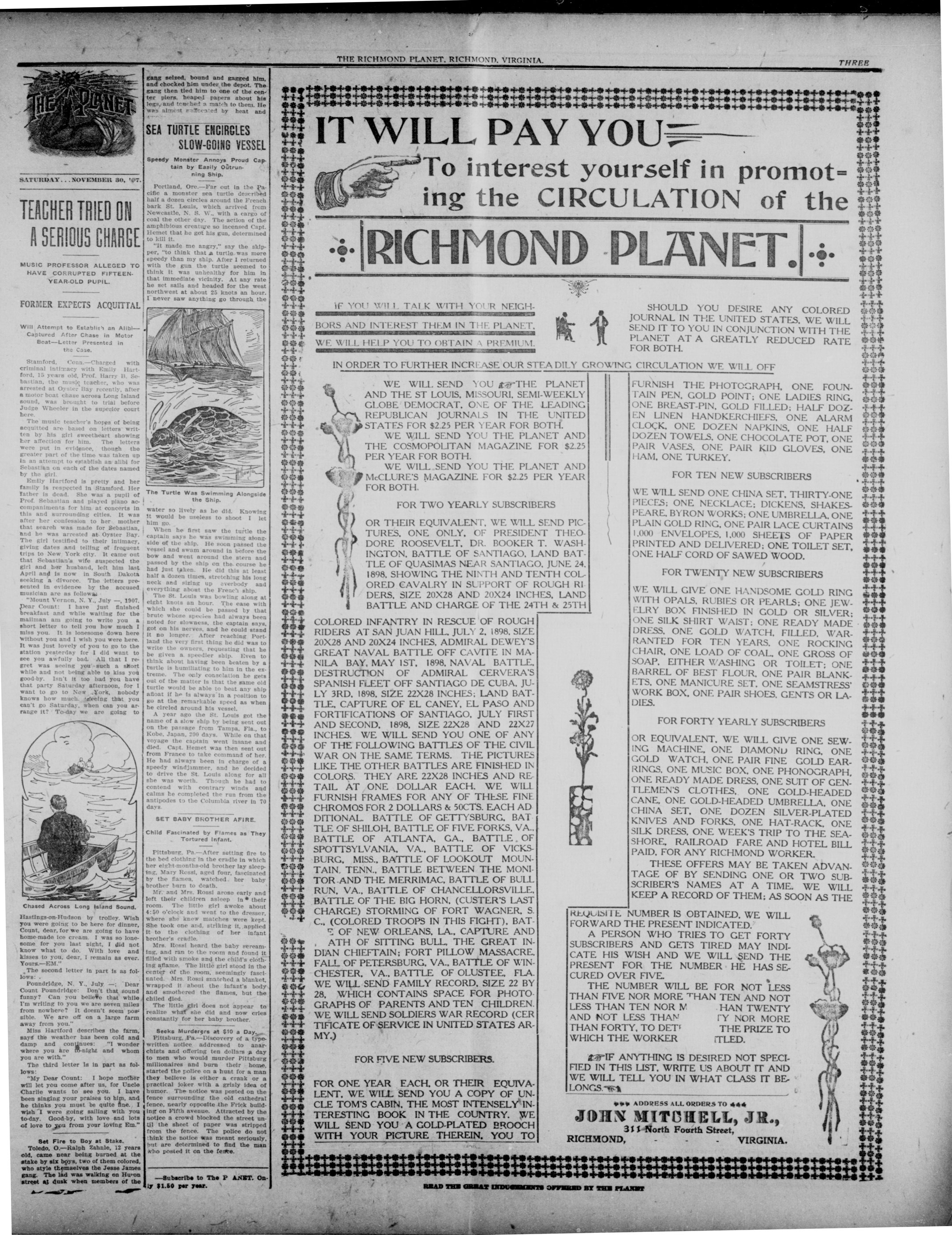
IT WILL PAY YOU To interest yourself in promot ing the CIRCULATION of the RICHMOND PLANET.
---
THE PLANET
SATURDAY...NOVEMBER 30, '07
TEACHER TRIED ON A SERIOUS CHARGE
MUSIC PROFESSOR ALLEGED TO
HAVE CORRUPTED FIFTEEN-
YEAR-OLD PUPIL.
FORMER EXPECTS ACQUITTAL
Will Attempt to Establish an Aliib—Captured After Chase in Motor Boat—Letter Presented in the Case.
Stamford, Conn.—Charged with criminal intimacy with Emily Hartford, 15 years old, Prof. Harry B. Sebastian, the music teacher, who was arrested at Oyster Bay recently, after a motor boat chase across Long Island sound, was brought to trial before Judge Wheeler in the superior court here.
The music teacher's hopes of being acquitted are based on letters written by his girl sweetheart showing her affection for him. The letters were put in evidence, though the greater part of the time was taken up in an attempt to establish an alibi for Sebastian on each of the dates named by the girl.
Emily Hartford is pretty and her family is respected in Stamford. Her father is dead. She was a pupil of Prof. Sebastian and played piano accompaniments for him at concerts in this and surrounding cities. It was after her confession to her mother that search was made for Sebastian, and he was arrested at Oyster Bay. The girl testified to their intimacy, giving dates and telling of frequent trips to New York city. It came out that Sebastian's wife suspected the girl and her husband, left him last April and is now in South Dakota seeking a divorce. The letters presented in evidence by the accused musician are as follows.
"Mount Vernon, N. Y., July — 1907,
Dear Count: I have just finished
breakfast and while waiting for the
maltman am going to write you a
short letter to tell you how much I
miss you. It is lonesome down here
without you and I wish you were here.
It was just lovely of you to go to the
station yesterday for I did want to
see you awfully bad. All that I regret
was seeing you such a short
while and not being able to kiss you
good-by. Isn't it too bad you have
that party Saturday afternoon, for I
want to go to New York, nobody
knows how much, seeing that you
can't go Saturday, when can you
arrange it? To-day we are going to
A man in a boat
Chased Across Long Island Sound.
Hastings Across-Hudson by trolley. Wish you were going to be here for dinner, Count, dear, for we are going to have home-made ice cream. I was so lonesome for you last night. I did not know what to do. With love and kisses to you, dear, I remain as ever. Yours.—EM."
The second letter in part is as follows:
Poundridge, N. Y., July —; Dear Count Poundridge: Don't that sound funny? Can you believe that while I'm writing to you we are seven miles from nowhere? It doesn't seem possible. We are off on a large farm away from you."
Miss Hartford describes the farm, says the weather has been cold and damp and continues: "I wonder where you are on night and whom you are with."
The third letter is in part as follows:
"My Dear Count: I hope mother will let you come after us, for Uncle Charlie wants to see you. I have been singing your praises to him, and he thinks you must be quite fine. I wish I were going sailing with you to-day. Good-by, with love and lots of love to you from your loving Em."
Set Fire to Boy at Stake.
Toledo, O.—Ralph Zahnle, 12 years old, came near being burned at the stake by six boys, two of them colored, who style themselves the Jesse James gang. The lad was walking on Hu-on street at dusk when members of the
COLORED INFANTRY IN RESCUE OF ROUGH RIDERS AT SAN JUAN HILL, JULY 2, 1898, SIZE 20X28 AND 20X24 INCHES, ADMIRAL DEWEY'S GREAT NAVAL BATTLE OFF CAVITE IN MANILA BAY, MAY 1ST, 1898, NAVAL BATTLE, DESTRUCTION OF ADMIRAL CERVERA'S SPANISH FLEET OFF SANTIAGO DE CUBA, JULY 3RD, 1898, SIZE 22X28 INCHES; LAND BATTLE, CAPTURE OF EL CANEY, EL PASO AND FORTIFICATIONS OF SANTIAGO, JULY FIRST AND SECOND, 1898, SIZE 22X28 AND 22X27 INCHES. WE WILL SEND YOU ONE OF ANY OF THE FOLLOWING BATTLES OF THE CIVIL WAR ON THE SAME TERMS. THE PICTURES LIKE THE OTHER BATTLES ARE FINISHED IN COLORS. THEY ARE 22X28 INCHES AND RETAIL AT ONE DOLLAR EACH. WE WILL FURNISH FRAMES FOR ANY OF THESE FINE CHROMOS FOR 2 DOLLARS & 50CTS. EACH ADDITIONAL. BATTLE OF GETTYSBURG, BATTLE OF SHILOH, BATTLE OF FIVE FORKS, VA., BATTLE OF ATLANTA, GA., BATTLE OF SPOTTSYLVANIA, VA., BATTLE OF VICKSBURG, MISS., BATTLE OF LOOKOUT MOUNTAIN. TENN., BATTLE BETWEEN THE MONITOR AND THE MERRIMAC, BATTLE OF BULL RUN, VA., BATTLE OF CHANCELLORSVILLE, BATTLE OF THE BIG HORN, (CUSTER'S LAST CHARGE) STORMING OF FORT WAGNER, S. C., (COLORED TROOPS IN THIS FIGHT), BAT-
E OF NEW ORLEANS, LA., CAPTURE AND
ATH OF SITTING BULL, THE GREAT INDIAN CHIEFTAIN; FORT PILLOW MASSACRE,
FALL OF PETERSBURG, VA., BATTLE OF WINCHESTER, VA., BATTLE OF OLUSTEE, FLA.
WE WILL SEND FAMILY RECORD, SIZE 22 BY
28, WHICH CONTAINS SPACE FOR PHOTOGRAPHS OF PARENTS AND TEN CHILDREN.
WE WILL SEND SOLDIERS WAR RECORD (CERTIFICATE OF SERVICE IN UNITED STATES ARMY.)
FOR ONE YEAR EACH, OR THEIR EQUIVALENT, WE WILL SEND YOU A COPY OF UNCLE TOM'S CABIN, THE MOST INTENSELY INTERESTING BOOK IN THE COUNTRY. WE WILL SEND YOU A GOLD-PLATED BROOCH WITH YOUR PICTURE THEREIN. YOU TO
gang selzed, bound and gagged him, and chocked him under the depot. The gang then tied him to one of the center piers, heaped papers about his legs, and touched a match to them. He was almost suffocated by heat and
SEA TURTLE ENCIRGLES
SLOW-GOING VESSEL
Speedy Monster Annnoys Proud Captain by Easily Oùtrunning Ship.
Portland, Ore.—Far out in the Pacific a monster sea turtle described half a dozen circles around the French bark St. Louis, which arrived from Newcastle, N. S. W., with a cargo of coal the other day. The action of the amphibious creature so incensed Capt. Hemet that he got his gun, determined to kill it.
"It made me angry," say the skipper, "to think that a turtle was more speedy than my ship. After I returned with the gun the turtle seemed to think it was unhealthy for him in that immediate vicinity. At any rate he set sails and headed for the west northwest at about 25 knots an hour. I never saw anything go through the
Turtle in the sea
```markdown
```
The Turtle Was Swimming Alongside the Ship.
water so lively as he did. Knowing it would be useless to shoot I let him go.
When he first saw the turtle the captain says he was swimming alongside of the ship. He soon passed the vessel and swam around in before the bow and went around the stern and passed by the ship on the course he had just taken. He did this at least half a dozen times, stretching his long neck and sizing up overbody and everything about the French ship.
The St. Louis was bowling along at eight knots an hour. The ease with which she could be passed by that brute whose species had always been noted for slowness, the captain says, got on his nerves, and he could stand it no longer. After reaching Portland the very first thing he did was to write the owners, requesting that he be given a speedier ship. Even to think about having been beaten by a turtle is humiliating to him in the extreme. The only consolation he gets out of the matter is that the same old turtle would be able to beat any ship afloat if he is always in a position to go at the remarkable speed as when he circled around his vessel.
A year ago the St. Louis got the name of a slow ship by being sent out on the passage from Tampa, Fla., to Kobe, Japan, 200 days. While on that voyage the captain went insane and died. Capt. Hemet was then sent out from France to take command of her. He had always been in charge of a speedy windjammer, and he decided to drive the St. Louis along for all she was worth. Though he had to contend with contrary winds and calms he completed the run from the antipodes to the Columbia river in 70 days.
SET BABY BROTHER AFIRE
Child Fascinated by Flames as They Tortured Infant.
Pittsburg, Pa.—After setting fire to the bed clothing in the cradle in which her eight-months-old brother lay sleeping, Mary Rossi, aged four, fascinated by the flames, watched, her baby brother burn to death.
Mr. and Mrs. Rossi arose early and left their children asleep in their room. The little girl awoke about 4:50 o'clock and went to the dresser, where she knew matches were kept.
She took one and, striking it, applied it to the clothing of her infant brother's cradle.
```markdown
```
Mrs. Rossi heard the baby screaming, and ran to the room and found it filled with smoke and the child's clothing aflae. The little girl stood in the center of the room, seemingly fascinated. Mrs. Rossi snatched a blanket, wrapped it about the infant's body and smothered the flames, but the chiled died.
The little girl does not appear to realize what she did and now cries constantly for her baby brother.
Seeks Murders at $10 a Day
Pittsburgh, Pa.—Discovery of a type-
written notice addressed to an aarchists and offering ten dollars a day to men who would murder Pittsburgh millionaires and burn their home, started the police on a hunt for a man they believe is either a crank or a practical joker with a grisly idea of humor. The notice was posted on the fence surrounding the old cathedral fence, nearly opposite the Frick building on Fifth avenue. Attracted by the notice a crowd blocked the street until the sheet of paper was stripped from the fence. The police do not think the notice was meant seriously, but are determined to find the man who posted it on the fence.
- Subscribe to The P ANET. Only $1.50 per year.
WE WILL SEND YOU THE PLANET AND THE ST LOUIS, MISSOURI, SEMI-WEEKLY GLOBE DEMOCRAT, ONE OF THE LEADING REPUBLICAN JOURNALS IN THE UNITED STATES FOR $2.25 PER YEAR FOR BOTH.
WE WILL SEND YOU THE PLANET AND THE COSMOPOLITAN MAGAZINE FOR $2.25 PER YEAR FOR BOTH.
WE WILL SEND YOU THE PLANET AND McCLURE'S MAGAZINE FOR $2.25 PER YEAR FOR BOTH.
FURNISH THE PHOTOGRAPH TAIN PEN, GOLD POINT; ONE ONE BREAST-PIN, GOLD FILLEN LINEN HANDKERCHIEFS, CLOCK, ONE DOZEN NAPKI DOZEN TOWELS, ONE CHOCO PAIR VASES, ONE PAIR KID HAM, ONE TURKEY.
FOR TEN NEW SUBSC
OR THEIR EQUIVALENT, WE WILL SEND PICTURES, ONE ONLY, OF PRESIDENT THEODORE ROOSEVELT, DR. BOOKER T. WASHINGTON, BATTLE OF SANTIAGO, LAND BATTLE OF QUASIMAS NEAR SANTIAGO, JUNE 24, 1898, SHOWING THE NINTH AND TENTH COLORED CAVALRY IN SUPPORT OF ROUGH RIDERS, SIZE 20X28 AND 20X24 INCHES, LAND BATTLE AND CHARGE OF THE 24TH & 25TH
READ THE GREAT INDUCEMENTS OFFERED BY THE PLANET
THE RICHMOND, PLANET, RICHMOND, VIRGINIA
IF YOU WILL TALK WITH YOUR NEIGH-
FOR TWO YEARLY SUBSCRIBERS
FOR FIVE NEW SUBSCRIBERS
REQUISITE NUMBER IS OBTAINED, WE WILL FORWARD THE PRESENT INDICATED.
A PERSON WHO TRIES TO GET FORTY SUBSCRIBERS AND GETS TIRED MAY INDICATE HIS WISH AND WE WILL SEND THE PRESENT FOR THE NUMBER HE HAS SECURED OVER FIVE.
THE NUMBER WILL BE FOR NOT LESS THAN FIVE NOR MORE THAN TEN AND NOT LESS THAN TEN NOR M HAN TWENTY AND NOT LESS THAN TY NOR MORE THAN FORTY, TO DET THE PRIZE TO WHICH THE WORKER TLED.
IF ANYTHING IS DESIRED NOT SPECIFIED IN THIS LIST, WRITE US ABOUT IT AND WE WILL TELL YOU IN WHAT CLASS IT BE-LONGS.
ADDRESS ALL ORDERS TO
JOHN MITCHELL, JR.,
311 North Fourth Street,
RICHMOND, VIRGINIA.
A
DILY GROW
LANET
EEKLY
READING
UNITED
H.
T AND
R $2.25
T AND
YEAR
ND PIC-
THEO-
WASH-
D BAT-
JUNE 24.
H COL-
HIGH RI
LAND
& 25TH
```markdown
```
REQUISE FORWA
SHOULD YOU DESIRE ANY COLORED JOURNAL IN THE UNITED STATES, WE WILL SEND IT TO YOU IN CONJUNCTION WITH THE PLANET AT A GREATLY REDUCED RATE FOR BOTH.
FURNISH THE PHOTOGRAPH, ONE FOUNTAIN PEN, GOLD POINT; ONE LADIES RING, ONE BREAST-PIN, GOLD FILLED; HALF DOZEN LINEN HANDKERCHIEFS, ONE ALARM CLOCK, ONE DOZEN NAPKINS, ONE HALF DOZEN TOWELS, ONE CHOCOLATE POT, ONE PAIR VASES, ONE PAIR KID GLOVES, ONE HAM, ONE TURKEY.
WE WILL SEND ONE CHINA SET, THIRTY-ONE PIECES; ONE NECKLACE; DICKENS, SHAKESPEARE, BYRON WORKS; ONE UMBRELLA, ONE PLAIN GOLD RING, ONE PAIR LACE CURTAINS 1,000 ENVELOPES, 1,000 SHEETS OF PAPER PRINTED AND DELIVERED; ONE TOILET SET, ONE HALF CORD OF SAWED WOOD.
FOR TWENTY NEW SUBSCRIBERS
WE WILL GIVE ONE HANDSOME GOLD RING WITH OPALS, RUBIES OR PEARLS; ONE JEWELRY BOX FINISHED IN GOLD OR SILVER; ONE SILK SHIRT WAIST; ONE READY MADE DRESS, ONE GOLD WATCH, FILLED, WARRANTED FOR TEN YEARS, ONE ROCKING CHAIR, ONE LOAD OF COAL, ONE GROSS OF SOAP, EITHER WASHING OR TOILET; ONE BARREL OF BEST FLOUR, ONE PAIR BLANKETS, ONE MANICURE SET, ONE SEAMSTRESS' WORK BOX, ONE PAIR SHOES, GENTS OR LADIES.
FOR FORTY YEARLY SUBSCRIBERS
OR EQUIVALENT, WE WILL GIVE ONE SEWING MACHINE, ONE DIAMOND RING, ONE GOLD WATCH, ONE PAIR FINE GOLD EARRINGS, ONE MUSIC BOX, ONE PHONOGRAPH, ONE READY MADE DRESS, ONE SUIT OF GENTLEMEN'S CLOTHES, ONE GOLD-HEADED CANE, ONE GOLD-HEADED UMBRELLA, ONE CHINA SET, ONE DOZEN SILVER-PLATED KNIVES AND FORKS, ONE HAT-RACK, ONE SILK DRESS, ONE WEEK'S TRIP TO THE SEASHORE, RAILROAD FARE AND HOTEL BILL PAID, FOR ANY RICHMOND WORKER. THESE OFFERS MAY BE TAKEN ADVANTAGE OF BY SENDING ONE OR TWO SUBSCRIBER'S NAMES AT A TIME. WE WILL KEEP A RECORD OF THEM; AS SOON AS THE
FOR TEN NEW SUBSCRIBERS
THREE
工
```markdown
```
FOUR
THE PANET
the subscription price is $1.50 per year, the subscription price is $4.00 per year, which money can be sent by mail at our risk—In a Post Office Money Order, by Bank Check or Draft, or an Express Money Order, in any of these three can be procured, in a Recognized Letter.
MONEY ORDERS—You can buy a Money Order at your Post Office, payable at the Richmond and we will be responsible for its safe arrival.
EXPRESS MONEY ORDERS can be obtained at any office of the American Express Co., the Richmond and Co. and Co.'s Express Company. We will be responsible for money sent by any of these companies. The Express Money Order is a safe and convenient way to send money to the Richmond and Co.'s Registered LETTER—If a Money Order, Post Office or an Express Office is not within your reach, your Postmaster will register the money in your account and send it to the centers. Then, if the Letter is lost or stolen, it can be traced. You can send money in this manner at our Post Office, or you can be responsible for money sent in letters in any other way than one of the few ways mentioned above. If you send your money in any other way, you must do it at your own
RENEWALS, ETC.—If you do not want THE PLANET continued for another year after your subscription has run out, you then notify us by email Carr to discuss it. The team who decided that subscribers to newspapers who not order their paper discontinued at the expiration of time for which it has been paid are held liable for the payment of the subscription to date when they order the paper discontinued.
COMMUNICATIONS—When writing to us to renew your subscription or to discontinue your paper, you should give your name and address to the otherwise we cannot find your name on our books.
CHANGE OF ADDRESS—In order to change the address of a subscriber, we must be sent the former as well as the present address.
Entered at the Post Office at Richmond, Va. as second class matter.
SATURDAY...NOVEMBER 30, '07.
The action of the Executive and Advisory Committee of the Ohio League of Republican Clubs in declaring that it had no sympathy with the effort now being made to eliminate Senator Joseph B. Foraker from public life and endorsing him as a candidate for President of the United States will awaken a responsive chord throughout the length and breadth of the United States.
It will make clear cut, the issues now pending between the candidates and emphasize great principles that have lain dormant for many days.
It means that the Republicans of Ohio are determined to name their choice for the highest office in the Republic without outside interference.
Attorney J. Alexander Chiles of Lexington, Kentucky won his suit for equal accommodations upon the railroads and a jury, composed of Kentucky white men was fair enough to recognize the merit in the case. The verdict of course will not pay the monetary cost of the plaintiff but the moral effect of it will compensate for all of the time and trouble expended. It was very unfortunate that this course was necessary for the Chesapeake and Ohio Railroad has been one of the most accommodating corporations in the country in its dealings with both races. Of late, however, there has been a decided change. The passenger department is hindered and hampered by the management and its appeals for service seem to go unanswered by the gentlemen who have charge.
President George W. Stevens is the one distinguished official who can remedy the trouble. His power is well-nigh absolute, and to him one must look for a change in conditions, which have become well-nigh unbearable.
Now they say that President Roosevelt violated the law when he authorized the issuance of one hundred million dollars worth of 3 per cent. certificates, which were available for the purpose of war supplies for the army in time of war.
He violated the law when he sent troops from the Jefferson Barracks to do police duty at the balloon ascensions at St. Louis, Mo.
He violated the law when he arbitrarily directed the revocation of a Mississippi river pilot's license for offending him, and this without according to the man suspended a trial.
He violated the law when he meted infamous punishment to Companies
---
B, C and D of the Twenty-fifth Infantry.
He astounded the country when he declared that the Constitution of the United States would be virtually amended by judicial interpretation of the Supreme Court of the United States, the appointees to which position are named by the President of the United States.
If Mr. Roosevelt is guilty of all these charges as his critics allege, it would seem that his finish has already been seen upon the horizon of the political world and written in flaming letters across the starry heavens.
THE AGE AND MR. FORTUNE
The New York Age, one of the ablest and best Afro-American Journals ever published in this country seems to be greatly worried over the criticism indulged in by many people. In its last issue, it states its principles plainly, assuring all who seem to be interested in its business management that Mr. T. Thomas Fortune, the ablest Afro-American in the United States was not ousted from either editorial or ownership department of that journal.
It states that it was a purely business transaction and that Mr. Fortune "got his price". This is to say the least an interesting statement of a most interesting question and naturally causes the query, as to who was willing or able to pay Mr. Fortune's price. No one who knows this distinguished gentleman will ever charge him with being a cheap man either as to his services or as to the stock in a journal that he controls.
He knows values and when it comes to the bargain counter, one will find it more profitable to buy elsewhere than to purchase where he holds sway. It will be seen then that instead of stopping comment or checking inquiries the present editor has thrown open the flood-gates of meddlesome comment.
It is evident that there was a motive in the purchase. Afro-American journalism has not reached that point of profit where it can be regarded as a means of financial investment. No one knows this better than the well-known gentleman, who now holds sway. It is then the motive of the purchaser or purchasers who have secured a controlling interest in the corporation that is attracting the attention of the colored people and their leaders, and who have regarded this publication as the leading mouthpiece of the Negroes in this country.
For our own part, it does not concern us materially. So far the typographical make-up of the Age is well-nigh faultless, and from a literary standpoint its editorial department is almost equally so. Still, there have been indications of a "falling away" from the standards set by Mr. Fortune and a disposition to support those policies that he has never been known to espouse. It is a delicate matter to express an open opinion concerning so able a contemporary, and it is with the best of feeling that we make these present observations.
HON. JOHN SHARP WILLIAMS
AND THE NEGRO.
Hon. John Sharp Williams' opinion of the Negro as set forth in the November issue of the Metropolitan Magazine will cause many conservative people of both races to carefully consider his statements before arriving at a mature conclusion, relative to his purposes and his motives. It will be well to consider to what extent he was affected by his environments, and whether or not he was considering his political future in connection with his utterances upon this most important subject.
It is evident to our minds that he is between two fires so to speak. He has been regarded at the North as a conservative in connection with this all important subject and his nomination to the position of United States Senator has been hailed with satisfaction by well-nigh every colored man of prominence in the United States. He said:
The history of the West is our object-less lesson of this. It is the man behind the gun and the man upon the quarter-deck that count in time of war. In our war with Spain we had no better ships nor guns nor powder than she. We did have, however, better men upon the quarter-deck, supervising and directing, and better men behind the guns, executing orders. In the sharp industrial competition of the twentieth century it will be the man in the supervising and managing office and the man behind the loom, the spindle, the pickaxe, the plow and the machine who will win the fight. The South has the supervising intelligence, as all the world has seen—the man upon the quarter-deck. We must have a better man behind the gun than the Negro. Our birth-rate is furnishing us with a great many of them, but we must add to that by process of immigration.
In Mr. Williams' references to the Spaniards he is as is unfair as he is in his statements concerning the Negroes. He knows that there was no basis of a fair comparison between the foul-bottomed Spanish cruisers, without coal and with a dispirited
THE RICHMOND PLANET, RICHMOND, VIRGINIA
crew. In addition to this the few vessels in the fleet were hopelessly outnumbered. Mr. Williams' innate spirit of fair-play should have most assuredly asserted itself at this point and it should have caused him to pause before making any such invidious comparisons. But then, we are not here to defend the Spaniards. He said further:
So much for the industrial phase of the Negro question. Now for the criminal side of it. Many people can see no light upon the horizon at all, but we have become pessimistic, as those accustomed to look upon the black spots alone must become. That there has been a great change there is no doubt. Negroes perpetrate crimes that they never dreamed of forty years ago. The worst feature is that other Negroes help to conceal them and their crimes. They seem to have entered into a racial agreement that they must help each one of their race to escape the penalties of the white man's law by resorting to every artifice of untruthfulness and concealment. Why is it? The reason seems plain to me. No race ever succeeded in reaching civilization by the superposition of the civilization of another race unless that superposition were by force. Then only a veneering of the civilization is put on, and it comes off when the veneered race is left to itself.
Hon. John Sharp Williams knows that well-nigh every Negro hunt is conducted with the aid and help of colored men anxious to bring to justice the Negro criminal. The truth of the matter is that the punishment meted the average Negro for the most trivial offense has been so severe in recent years that a person either white or black must be devoid of the usual feeling of humanity to turn over to the mob a victim to be tortured with hot irons, eyes gouged out, private parts muffled and the body burned at the stake.
Mr. Williams does not tell of the continual concealing of the white men guilty of these offenses. He makes no reference to the white men caught red-handed in crime, who are shielded by white witnesses and acquitted by white juries. He argues that Negroes should yield up Negroes guilty of offenses against white people apparently ignorant of the fact that if they did so, they would not be following the example of the white people in their respective neighborhoods. But then, Hon. John Sharp Williams is nothing if he is not inconsistent. He says:
The Negro, during slavery times, had his entire conduct and habits of thought regulated, controlled, and fixed by the white man in accordance with the white man's notions of ethics and for the purpose of making him an object of trust and confidence and profit to the white man. A slave had to be taught to be faithful and trustworthy or else the money invested in him was a very poor investment. He had to be taught habits of constant industry and regality and moderation for the same reason. There never was as great an apparent improvement effected in so short a time in any race in the world as in the Negroes when you compare their status in Africa with the moral and industrial condition of the race when emancipated. But, after all, it was veneered and not the result of a natural evolution. It was habit and not nature. There has been since that time upon the part of the Negroes a drawing away from the white man's standards and association and a consequent recurrence to their own racial traits. Under slavery they heard white preachers. Although under slavery they had no teachers to teach them letters, they had the best of teachers to teach them conduct. These teachers were white men and women intimately interested in their physical and moral welfare. Now they have teachers who are black men.
No right thinking citizen of color will undervalue slavery as the great training school of civilization. It had its lights and its shadows. The Negro improved under the heel of oppression. For many of the qualities he now possesses, he must thank some of the humane Southern masters. For many of the faults he finds himself possessed, he must curse some others.
Mr. Williams tells of the progress before the war, but seems entirely ignorant of the standards of excellence attained since that time. The change is miraculous, but Mr. Williams lives in the past. He prefers to look at his Negro cook, form an estimate of his, Negro maid, and draw conclusions from his Negro coachman.
He turns a deaf ear to the Negro merchant in his town, and goes stone blind when he sees a Negro physician. He prefers to live in the past and in his persuasive argument would have the world do the same thing. He said:
More and more every year the Negro's life—moral, intellectual, and industrial—is isolated from the white man's life, and therefore from his influence. There was a kindlier and more confidential relationship between the races when my father was a boy than when I was, a kindlier and more confidential relationship when I was a boy than between my children and the present generation of Negroes. Just in proportion as the white man has withdrawn from the Negro and the Negro has withdrawn from the white man, the Negro has reverted to the black man's racial traits and tendencies, has shed the veneering which has been placed upon him, has become more and more himself and less and less the reflection of his white neighbor. This view is re-enforced by the fact that nearly all the unspeakable Negro crimes are committed by Negro vagrants and tramps, who are
brought into no sort of relationship with the white man's life.
Yes, the Negro has shown a desire and a disposition not to force himself upon the white man. He was advised to do this by the white man, and now the white man unfavorably criticizes him for doing what the white man told him to do. The Negro vagrant and tramp commit the same kind of crimes as are committed by the white vagrant and tramp. Mr. Williams said further:
These thoughts suggest some sort of common-sense remedies of the Negro question upon the criminal side, principally in the nature of preventives. In the first place, they suggest the rigid enforcement of vagrant laws and the strengthening of existing vagrant laws by new laws wherever, in justice and right, they need strengthening. In the second place, they suggest a closing of all low dives and brothels where the vagrant, tramp, and idle Negroes con sort and where their imaginations—the being peculiarly a race of imagination and emotion—are inflamed by whiskey, cocaine, and lewd pictures. It must be remembered that which would not infame the imagination of a white man will have that effect upon the tropical, emotional nature of the darky.
There can be no valid objection to this view of the situation or the remedies suggested for a cure of the evils. And again:
In the first place, I suggest that we ought, like Canada and Cape Colony, to have mounted rural police or constabulary, whose duty it would be to patrol the country districts day and night. They would, to a certain extent, take the place of the patrols the Southern States used to have. We would, of course, find some inconveniences in that. The white man hates to be held up on the road to give an account of himself, where he lives and whither he is going, but we must sacrifice something to meet the peculiar conditions under which we live. Putting up with that sort of inconveniences but a slight sacrifice to make, in order to remove the sense of fear and to give an assurance of safety to our women, sometimes alone and unprotected in their houses, while the husband and father are in the field, gone for the doctor or otherwise necessarily absent. Above all things, we must show common sense and courage, and as much moderation as possible, in dealing with each hap penning as it arises. We must meet each happening as it arises, with a resolute determination to protect, at all hazards, the sanctity of our homes, and do it with as much moderation as the provocation admits of.
This would be another form of legalizing the "night riders" and the Ku-Klux-Klan, but let us presume that the Negroes of the Southland can stand it. Certainly if the ideas of Mr. Williams were carried out in good faith no honest, reputable peace loving citizen of color could object to the innovation. He continued.
When we find a good Negro we must encourage him, to stay good and to grow better. We are doing too little of that. The old adage, "Give a dog a bad name and you have made a bad dog," is a good one. Indiscriminate cursing of the whole Negro race, good and bad allure included, is an exemplification of the adage. I have frequently thought how hard it was for a good Negro, especially during campaign times, to stay good or grow better when he could not come within sound of a white speaker's voice without hearing his whole race indiscriminately reviled without mention of him as an exception, even in the neighborhood where he was known to be one. Whatever else is, or is not, a solution of this vexed problem, this habit is not. Justice goes hand in hand with power or else power becomes tyranny. To every white man I would say in the words of Shakespeare: "It is excellent to have a giant's strength, but it is tyrannical to use it like a giant!"—irrationally. We must and we will maintain the supremacy of the white man's law, even though sometimes the letters and forms of that law are unfortunately violated in order to maintain the supremacy of its spirit. We will maintain in perpetuity the integrity of the race and of its civilization. To doubt that we can do that, when the governors, sheriffs, judges, and law-makers are of our race and elected by us is to doubt our own capacity for self-government.
Ah, Hon. John Sharp Williams is returning to his "first love." He is placing himself in the Negro's place so to speak, and thereby sympathizing with him in his pitiful condition. We can add nothing to this appeal. We leave it to the mature consideration of those who have interested themselves in this rather remarkable article from the pen of one of the most diplomatic statesmen in all of the Southland.
The Limit
Dr. Johnson once, speaking of a quarrelsome fellow, said: "If he had two ideas in his head they would fall out with each other."
No Friend of Teddy's
No Friend or Teddy's.
The Queen of Holland discourages
gunning so far as she is able. She is
an ardent lover of all animals.
A Passing Fad.
On the streets of New York city
there are now one bicycle where there
were 140 nine years ago.
The Easiest Kind.
Oegeneracy.
When genius learns to get rich it becomes more talent.
BATTLE FOR LIFE ON
LONELY BARREN
Vessel Wrecked in Storm on Rocky Shore and Four of Crew Perish.
New York.—Six members of the American bark Prussia, wrecked on Staten island, Terro del Fuego, were landed here the other day by the steamer Tennyson, which brought them from Montevideo.
Four members of the crew perished and three are still in the hospital at Punta Arenas.
Capt. Johnson died on Staten island. Sabata, a Japanese cook, and Harry Hammond are supposed to have perished in the wreck. Joseph Hosteth, a Norwegian, died in trying to get to the lighthouse on New Years island for help.
Stanislaus Porthan, a sailor, and Herman Harke are at Punta Arenas. The Prussia was owned at San Francisco and sailed from Norfolk on
114
Wrecked on Staten Island.
March 17 with a cargo of coal. On June 19 it was off Staten Island. It was bitterly cold. Capt. Johnson was trying to make New Years island light. A storm came up in the night, and the bark was ashore a wreck before the danger was realized. It broke up at once.
Every man jumped overboard, and 11 of the 13 reached a strip of sand which was sheltered by overhanging rocks. They kept warm as best they could throughout the night.
At dawn Sabata, the cook and Hammond, a sailor, were missing. The Prussia was gone. The strip of sand was not more than 311 feet long, and impassable cliffs kept the men from escaping across the island. The captain was so exhausted that he died and was buried on the beach.
HANGED, BUT LIVES TO TELL IT.
Detective, Mistaken for Non-Union Man, Cut Down Just in Time.
Pittsburg, Pa.—In a fight between union and non-union workmen in the Lawrenceville mill district County Detective J. K. McColough was mistaken for a non-union man by a crowd, which secured a rope, placed it about his neck, threw the other end over the cross-arm of a lamp post and had the detective dangling in the air before the mistake was discovered and he was lowered to the ground.
Employees in a number of machine shops are on strike. John Anderson, a non-union man, met John Manning, a striker, and both opened fire. Manning was so seriously wounded that he may not recover.
Detective McCollough and Anderson engaged in a running pistol fight, in which almost 50 shots were exchanged. The crowd closed in and mistook McCollough for Anderson. The detective was almost dead when some one noticed his badge. After being lowered he was soon revived. His only injury is an ugly welt around his neck from the rope. Anderson was captured.
Washed Brain Restores H
Richmond, Va.—After an operation, in which a clot was removed from the brain, David Walke, of Manchester, is now able to walk and talk, and every indication points to a complete recovery.
Mr. Walke fell from a building and injured his head. He apparently recovered from his injury, but in a few weeks he lost the power of speech and the use of an arm and a leg from paralysis.
The skull was trephined several weeks ago, a clot removed and the brain thoroughly washed. Since then Mr. Walke has been rapidly improving. He has been discharged from the hospital.
This Ghost Drone Hairpin
This Ghost Dress Hairpins.
Clayton, N. J.-Clayton has a "ghost" scare, and Mayor Nichols is trying to clear up the mystery. Frequently of late a room in the town hall has shown evidences of visitors; the electric lights have been turned on and the glass in front of the switchboard has been broken. A parasol, a few hairpins, a glove and a lace collar give evidence that the ghostly visitor is a woman.
The mystery is how anyone can enter the hall and get away again. The place is watched; the locks on doors and windows are never disturbed, and the only keys are in the hands of the public property committee, who disclaim all knowledge of the nocturnal visits.
TOMMY AND THE DONKEY
Story Which Helped a Little Boy to
Make a Choice.
"I don't know which to do," pouted
Tommy. "I have been invited to sail
and to ride, and I can't decide."
"Which do you like the beat?" asked
Uncle Jack.
"Why, I like both allike. It is a jolly day for sailing, but the driving party
is going through a new country, and
I'd like to go with them."
"Then go, by all means," sald his uncle.
"But I like sailing too much to miss it."
"You remind me of a donkey," said Uncle Jack, solemnly.
"Of a little, shaggy, lazy, undecided donkey I heard about." went on Uncle Jack. "He was well fed—too well fed, I suspect, or he wouldn't have been such a donkey. One day his master turned him into a field in which there were two large stacks of hay, one at either end. Plenty of dinner either way he turned. In fact, he turned first one way and then the other, trying to decide which haystack looked the more luxious and inviting. There did not seem to be a pin to choose between them, however, and the poor donkey despaired of being able to decide which would make the better dinner, and which he ought to tackle first.
"When he got tired of standing up to think about it, he lay down and wagged his head. "I like both," he said to himself. "If I choose one, I feel sure I shall be sorry I haven't chosen the other." "I don't think there ever was such a donkey," cried Tom, getting red. "Oh yes, there was," replied Uncle Jack. "There are lots of just such donkeys." "Well, what did this one do?" asked the boy. "He went first one way and then the other, turning round and round and back and forth, until he dropped from sheer exhaustion. "And then he lay down because he had to, still trying to think which hay-stack he had better try to crawl toward first. By this time, of course, he was very hungry, but yet it seemed to him very foolish to take the haystack which might, after all, be not so good as the other one.
"And finally this donkey of donkeys actually lay there and starved to death for no other reason on earth than because he could not decide what to eat first. It was a hard fate, indeed, to be unable to choose between them. Terrible, indeed!"
"It must have been pretty rough on the donkey, Uncle Jack,' commented Tom, with a terrible look in his eyes.
"But if you'll excuse me, uncle, I won't stop to talk about it now. I must run down to the river. The fellows will be gone, and I want dreadfully to go sailing this morning!"
CREOLE BUZZER KITE
How to Make It and What It Will Do When Made.
The New Orleans creole kite is made of three slim sticks, fastened together in the center with a pin driven through and bent over, or tied with heavy thread. Cover the kite with tissue paper (all one color or by fastening two or more colors together). The buzzer is fastened by turning over its edge and pasting over the
Buzzer
Buzzer
Buzzer
Star nite
with buzers
all around it
These may be
left-off
Buzzer
model of
throne power
folded over
stripping which
binds the
kite sticks
Bridge of kite
All the wings
cur into range
of preferred
tail
blade of kite
tail
blade of kite
Details of Buzzer Kite.
string. A slim, flat piece of wood is sharpened at both ends, the latter being inserted in alts made in the two upright sticks, to paste the paper on.
The wings can be cut the length of the sides and pasted on their edges.
The wings can be $1\frac{1}{2}$ or two inches wide; these may be left whole or cut into fringes after being pasted on.
If properly made, says the Philadelphia Ledger, this kite when raised, will make a loud buzzing noise, which can be heard at a great distance.
Naturally.
Ethel (reciting)—"Oh, tell me, where is fancy bred?"
Tommy—At the bakery, I suppose.
-Harper's Weekly.
An Old Subject.
Italian newspapers are once more discussing the question as to who invented oil painting. Most of them side with Vasari, who maintained that Jan van Eyck was the first to use oils as a means of fixing pigments.
For a Biography.
Mrs. Michael Davitt is soliciting from friends of her husband in this country such documents and other material as may be useful in preparing an authentic life of the well-known Irishman.
No Cause for Jealousy
"Mama," asked the beautiful young wife, "dq you ever attach any significance to what papa says in his sleep"
"No, dear. Don't let that worry you."
Back of his splendid song, Oh, think of the songs ussung!
Back of his painted dreams, the dream that he never reveals!
Behind each lyric captures the theme of the song cannot capture
Save for his own delight, to keep his heart still young!
But the songs that he never can sing-
Children excited of one glad song tell us that he feels...
wonderful spring!
—Charles Hanson Towne, in Appleton's.
Influence.
My friend leaned 'er the flowery brink
Of Evil, bending down to dinkk;
But though he stooped, resolved to take
The harmful draught despite my fears,
He yielded for my pleading's sake—
Feeling my love and tears.
Again he stoops; again I long
To save him from a fatal wrong.
He was my friend-'yea, in this hour
I would defend him, as before;
I would defend him, as before,
Who love him now no more.
—Florence Earle Coates, in Harper's.
The Only Fear.
Have you a something of moment planned of work, or barter, or sale? And do you now, like a craven, stand Deterred by the fear you'll fail? Then may this message of mine ring
-Roy Farrell Greene, in Success magazine.
Mere Toys to Him
"What kind of snakes do you suppose those were that the baby Hercules just played with in his cradle?"
"I guess they were ratttlesnakes."—Baltimore American.
DELVING.
A
Bill—Where in the world have you kept yourself so long?
Gill—Under cover, old pal.
Bill—Not bigamy, I hope?
Gill—Nope; coal mining.—N. Y.
Teelgram.
Gathering Birdnests.
One of the sources of income of certain Burmah provincial governments is the letting of rights to collect edible birds' nests in the northern and southern groups of the Moscos islands in the Tavoly district. These nests command fancy prices, and are used in seasoning soups and other dishes.
To Restore Old Paintings
The blackened lights of old pictures may be frequently restored to their original color by touching them up with deutoxide of hydrogen diluted with six or eight times its weight of water. The part touched up must be afterward washed with a clean sponge.
To Take Out Mildew
Wet the spots with chloride of lime or with chlorine water, and they will disappear immediately. If the linen has been starched, the spots will require an application daily for two or three days, rinsing out and bleaching in the sunshine after each application
THE ELOPEMENT.
"Just throw down the few things you will need." (She throws them.)—London Judy.
Full many a rose is born to blush unseen,
Full many a gem will never gleam before us;
But let us not neglect to be serene.
The pretty girls keep getting in the chorus.
-Chicago Record-Herald.
Artistically Speaking.
Mrs. Kawler (looking at photograph)—it's an excellent picture of you, but it's an exceedingly poor one of your husband.
Mrs. Crossway—I know it, but I like it all the better on that account.
He makes such an admirable—er—foll, you know.—Chicago Tribune.
Handled Him Some
Mr. Jawback—What do you mean by saying that Jones is "more or less handsome?"
Mrs. Jawback—Well, he's more handsome than you, and less handsome than most of the men I know.—Cleveland Leader.
aA NG STG
ne Zoe(te
{! Dy en FANT
We AAC eras
Nt be q
aN’ r,
’ Sie"
SATURDAY. . NOVEMBER 50, *07.
AG aonkes
Philosophy in irouble ts what 1s so
nice to advise for other people.
Although the czar's yacht stuck fast
after it ran aground, there was no
hurry call for willing and able dyna-
miters to raise {t
The real victims of nature faking,
the animals themselves, do not appear
to care a rap about the matter, one
‘way or the other.
‘That your husband will admire your
prowess in making a good cake as
mtich as your deftness in dressing
‘Your hair in the latest fashion?
Flirting has been made a misde-
meanor in a South Dakota town. The
state appears to be really trying to
reduce the divorce evil.
New Zealand insists on being called
dominion and not a colony. The
Pride of social distinction exists
among nations as well as among indi-
viduals.
A team of polar bears is to be tried
dy a Swedish explorer as a means of
reaching the north pole. When pro-
visions run short there Is likely to be
‘an Interesting argument as to whether
the explorer shall eat the bears or the
Qeare shall eat the explorer.
PERSONAL.
Lora Walsingham's collection of
moths and butterflies 1s sald to be the
Sinest in the world.
Richard Robbins of Boston has
started a movement to mark the birth-
place of Benjamin Franklin.
Every Christmas Lord Rothschild
gives a brace of pheasants to every
omnibug driver and conductor in Lon:
don,
The kaiser when ont shooting some
‘tmes leads a severely simple life. He
‘thas a shooting lodge near Syittkehs.
men made of plain boards covered
with bark and hidden away in the
‘woods. ° ‘
Prince Rechad, heir to the Turkish
throne, hes been the victim of a sys
tem of tyranny of which history of.
fers but few instances. For 30 years
he has been virtually a prisoner in his
own palace, .
FLASH LIGHTS.
There's one thing about the snorer.
‘He can always get to sleep on a sleep-
ing car.
‘An Italian poet recently won $10,
000 tn a lottery, proof that all poets
‘don't starve to death.
The trouble is that people who get
married on the sly don’t do their
quarreling the same way afterwards,
It won't be long now before we
shall be reading accounts of the un-
timely death of the man who “looked
Uke a deer.”
A New York man and woman are
to be married under fourteen feet of
water. This is to be a nautical knot,
as it were.
Indigestion is sald to be unknown
in Norway. Evidently Norway would
be a good place to start a quick lunch
one-armed man's chair restaurant.
PRODODINGS.
Be neat, but not too all-powerful
neat. <
Better a dusty room than a spotless
one gained by nagging.
Some women's sole idea of a home
is a place where every corner may
be Inspected at any moment by her
dearest foe.
“Persnicketty” is a homely expres-
sion of what a housewife should not
be would she not have her husband 4
dellever in divorce,
Cleanliness may be akin to Godlt-
ness, but it's mighty hard to make
‘the victims of a perniciously clean
‘woman see ft in that light.
On the other hand do not be slop-
py. No woman need be a fright be-
cause she does her own work. Like
wise a slovenly house is. not one
where the father or children delight
to linger. :
REFLECTIONS.
The fat hog is the one sent to mar.
ket.
The pacemaker gets more substan:
tlal rewards than the. peacemaker.
No man caa serve two masters, and
few masters are ft for two men to
serve them.
It is not wise to put all your eggs
Jn one basket. They can be trans-
ported with much less danger in a
safety egg-box.
‘The reward offered for a man's re-
turn after his disappearance 1s often
more than the salary paid to him for
a year's work.
‘SUNFLOWER PHILOSOP
i PHILOSOPHY.
Most excuses are les.
It ts sald that every thin woman
‘who complains about fat women lac
ing wears pads _
Some people say that wérking down
town does a girl more good than a
term at an eastern school.
gp
When two women kiss it doesn't
mean any more than the word “dear”
at the beginning of a letter.
“The men,” every woman says, who
has been married any length of time,
“don't have to know everything.”
Some people look so far ahead into
the possibilities of the future that It
is no wonder they forget the past.
When things go wrong at home,
what an affection the average man
develops for his business and his of.
fice!
Crazy people are smarter than is
generally believed. Who ever heard
of an old crazy man having a delusion
to the effect that he was young?
A mother has to call a boy five
‘times in the morning before she has
expressed as much as his father ex
presses when he calls him once.—
Atchison Globe.
LITTLE GRAINS OF FACT.
A bee can outily a pigeon.
Paris eats 37,000 horses every year.
One million blossoms are drained to
make one pound of honey.
Some one has computed that the av:
erage woman carries fifty miles of
hair on her head.
John Bull figures out that his coun-
try has been successful in 82 per cent
of the battles In which it has engaged.
An average of 800 persons are killed
fn the United States each year by
lightning. This means one in every
100,000.
No Arctic explorers have ever had
colds until they returned to clviliza.
tion, Then, one and all, they are pros-
trated by severe influenza.
Statistics show that, though far
haired people are as a rule less strong
than those who have dark hair, yet
the former live longer than the latter.
‘The Norwdgian government {s con-
sidering the advisability of putting
advertisemnets on the back of post-
age stamps, the proceeds to go to
some" national charity.
‘THE GENTLE Cynic.
It's no credit to be good because
you can’t help it.
Strange as it may seem, it's when
& fellow ts used up that he is down
and out.
The still, small voice of conscience
seems to have a habit of getting atill-
er and smaller.
Honeyed phrases may lose thelr
sweetness when we are compelled to
eat our own words.
When you have a chance to get
something for nothing, look carefully
for the concealed price tag.
We naturally avold those persons
who always want to borrow money,
also those who have none to lend.
Many a politician has boasted that
all the leaders of his party are at his
back, only to discover that they are
there to kick him.
ODD WEDDING TRIPS.
One newly wedded couple went to
the jungles of Africa to kill elephants
and tigers while getting acquainted
with each other.
A newly wedded pair set out, as
soon as the knot was tled, for frozen
regions near the north pole.
It was the choice of one bride to
instantly face extinction by accom:
panying her bridegroom on one of
the fastest automobile races in the
world.
Queerest of all was a balloon hon-
eymoon. At one thousand feet in the
air the bride prepared her first mar
ital luncheon in a chafing dish. They
descended soon after, and the little
bride waited only to touch earth to
faint dead away.
LANGUAGE KINKS,
The Hindoos have no word for
“friend,” and the Italians have none
for “humility.” 3
a =
The French have no verb “to stand,”
and no verb “to kick.” Neither have
they any word for “home.”
We have no words equivalent to
“bon appetit,” “bon voyage” and
“buon riposo,” polite and gracious ex-
Pressions to be applied before a meal,
before a journey and before retire-
ment for the night.
The Getmans call a thimble a
Hy a8 hat” and a grasshopper a “hay
"A glove with them is @
“hand shoe."5 Poultry ta “feather cat-
fs” and oxsMen and hydrogen are ree
spectively “sour stuff” and “water
stuff.”
Ss eee dela
‘The British navy is to use subtlety
tn promoting the cause of temper-
ance. Hitherto the names of teé-
totalers have been marked with
Gistinguishing letter in the ships’
books, to separate them like white
blackbirds. Hereafter it Is to be
the users of grog who are to be mark.
ed, and the abstinence that is to be
‘takes Sor the normal thine,
THE RICHMOND PLANET, RICHMOND. VIRGINIA
—— ————— WE INVITE THE ATTF’'TION OF THE PUBLIC TO OUR————_________—_
ed AR t 4
It is thoroughly equipped Cards, Volicies, both straight We print Wedding Invita- opes, Note and Letter Papery
to do all kinds of printing on life and benevolent, Physi- tions, and High Class Sta- Bill-heads, Monthly State.
short notice. We make a edan’s Ccrtificates, Sick Cards, tionery for Balls, Pars, Pic- ments, Business Cards, Fh
specialty of Society printing Application blanks, Agents nics and ali entertainments of nancial and* Order Books,
and work for Insurance Com- Report Sheets, Rate Cards, a social natuze. Circulars, Check-books, Pam
panies, such as Financial etc. We print Church Envel phiets.
Se SP SSsenSSenenan cree nner nen eestor es piemmaynmnnseenininimnsccisiananiiitis
“7 Es —
©
EXCURSION WORK OF ALL DESCRIPTIONS
—_——————————
We print Handbills, QuarterSheets, Half and Whole]; |, neon ae andto| We furnish “cuts” when desired and we will arrauye iz
Sheet posters, Tags, Tickets, Placards, Society Cards, Min-|give them the best service at]complete special work in our line. When in weed of any work
utes, Visiting Cards, Mourning Stationery. aoe in our line, call and sce us and estimates will be furnished ;
HAVE AN ELEGANT LINE OF SAMPLES
WE LEG i NEO i}
__WHICH WE WILL SHOW ANY ONE DESIRING TO SEE THEM
r
2 e A ” >
——= Our Stock Room Embraces a Full Liness=
O¥ THE LATEST STYLE BOND, FINE WRITING—FLAT AND LINEN PAPER, ENVELOPES, BE:
WE CAN.PRINT A BILL AS SMALL AS A DODGER. | e 2 WE HAVE ONE OF THE LARGEST ASSORTMENTS
r= 7 Vp
i i 1
A Three-Sheet Poster * i OF WOOD-TYPE
AS LARGE AS A FRONT DOOR | Of Any Job Printing Establishment in the city.
Sia ae a a i
‘ Our Present Corr or EMPLOYEES ARE CoMPETENT AND Quick-worKING. Our Orricz
a ee ——————__—__—..
a | is wiTHn Easy Reach oF THE Pustic, Berne wrrHin Fiery Yarps or Broap St. ~
Onur street-entrance js retired and has no objectionable features, the most
fastidious lady bein, able to enter without embarrassment or annoyance, FOR FURTHER INFORMATION, APPLY TO
itehall |
ohn wehall Ir.
GO TO THE WEST
Pes Megas ap pclae
| Seamer oat
ieee ameter Se
ree xi) rare setae Be
=a
sm he teen Siaeeee
| ee a ee
ek aha eek ack ee
12 ee eS Sar
Wine oeee ies tear
sen vi | Steins Saiieen coat
ee ere teat
11:00 P. M.gh Steep.
100) A, Mate _Daye-Ceat, Day
atc
fn 9 ne Pe eal w ones
ata os
ieee ky nies bade ore. Fe
5:15 FP. M.—Week Days—To' Lynchburg. .
Ski ear saan
tren a pes bus A ac ae
seen Caen essa
See eee
See Se ae ois ote
ee Seca
Richmond, Freder-
RR & Premise
2 . mac Railroad
Se
€35 4. Xap <ayed Sire. Thou
$3 t EomeRa St Reet
SARE UY ae
804 REN me eek tom
wi
Bim Sage WE bere nyrt touch
2S ever aR! Mia We
zo’
4:00 raat" Baretyed Steet. Wa
Ee Seo
Se er
pease
629 7. t—Nek Bape Ee. land Aeon
$5 Fe TRS, see Tao.
SS atone aa eae
TRAINS ARRIVE RICHMOND—SOUTHWARD.
690 A. MWe, Daye. dint Aes
124 ERG Et Siewert
£8 A Mo Week “Bayete ‘Stree wast
Eiien Sates
vo A Kits MS rattan
10:40 AL pe Sd c Ashland — Ac-
ttm SCRA eet. Tver.
S25 Romi we geet Reo
0 Foal Sue-ENadlsel cam
TET u—RIe rd eet Tiecaeh
$90 MSIE Bd STR oe
ao
028 7 BSF aain siret. Tso
OTE —Pullman Siping or eee an
ane tala eee a See
ita ta on ap See San
at
“Bw Scr sd deprtare nd soene
OWeteT wm ron,
Gen’. Supt. * "Teale iter.
peer Ns ee
N. & W, NORFOLK &
i + WESTERN.
Teave SU, RAIL LINE TO NORFOLK.
Leave Byrt "Street Station, Richmosde
Ta effect July "M4, 200.
FOR NORFOLK —1:25 P.M, dally: 6:00 A
M.,9:00 A” M. and 8:00 8. M' Parse seistay®
Slo AC at ant 7:00 Po Me, ‘Sontag oa
FOR LYNCHBURG, THE” WEST AND: SOUTH
WEST—9:00 A.M “Except Bunday.f BO Ce
Sunay onty: i210 Po Qk an 90°F A, ath
ARRIVE "'RICHMOND—Prom | Norfolk “ay
A Me 680 PM and oct Pen ee
Scndays 11S A. Mend oss BM So
, Putman ‘Parlor and Sleeping Cart Cate Din
Wis Bevien, ©. i nostay,
Gen. Pass. “Agent. Dis. Pass. ‘Age
Seer
Subscribe to The PLANET. On.
ly $1.50 per year,
TRAINS LEAVE jicitMoND,
X. R—Following achadie Aguree publishes
only. at Tnformation arst'a's ott guaranteed
70 "4. "Mo dally“tenlt for Charlottes Son.
‘connecting “at Reville for'Chass O19
shi "Carhart
nas AY x DallyLinited—utet Pullman
to Atianta ‘and’ tirmingham, New "Or
Jeans, Memphis, Chattanooga, ana all
the'South Thtvcsh conch for "Chase
20 Pe Mk Rceye SadaeKeyeiie Lace
* a eyeite
1130. Fala Lins od Pullman realy” 02
init for’ al t= South.
YORE RIVER LANE.
4:90 P, M.—Except S:0yy—Lamited—To. Wea
Polnt—Conmcting fr Baltinar
235 PM eeepe Sanaa
H23 K Meeepe Ruomye Loc to Wee
Point.
TRAINS ARRIVE RICHMOSD.
$35 A.M. a0 P, s.—Prom all the South
420 Mtrom Charlotte, Maleigh, Durban,
‘chase ‘City and oval stations
8:0 AC ition ‘Reywilie—teoeal
9:9) A. MCFrom Maldmore and West Point.
1:6 AMES GASP. MSc from Weat Polat:
© W, westouRY, D. P. A,
Bao Bain Se, Rictraoaly Va,
LEAVE RICHMOND. DAILY.
For Honda ani Seuth! S18 Mw BM
Foe Norfotk, "6:00 A. My "900 A. My "22
Pree Ney ands W. Ty. Wants 8:10 and 9:0
Spor Retenburts 56:00 and i930 A. M., 12:10
estin, “ois Pen, 6200, 8300 P.M, 83 am
ioe pat
Por ‘Golaboro’ and Payettewitle: 92:98 P.M.
Traine arrive” Richmond. Gallys 6:35, 7:40 A
Mey tosts, Soca and iw Ar Mey eit, 2:08
ign So, ia ely RA
itcept, Buniay. "*Suniay ‘oa
Tue vet arrivel act Gqpartores and_ connec
ona Hot guarantee
: fences. CAMPBELL, D. P. A.
Arr Line Ramway
SOUTHBOUND TRAIN. SCHED-
ULED TO LEAVE RICHMOND
DAILY.
9:10 A. M.—Local to Norlina, Ra-
leigh, Charlotte, Wilmington, 2:20
P. M.—Sleepers and coaches, Savan-
nah, Jacksonville and Florida potnts.
9:50 P. M.—Sleepers and coaches
Atianta, Birmingham, Memphis, Sa-
vannah, Jacksonville and Southwest.
NORTHBOUND TRAINS SCHED-
ULED TO ARRIVE RICHMOND
DAILY,
6:45 A.M. 6:10 P.M. 5:45 P.M.
H. 8. LEARD, D. P. A.
: He Was a Slow Lobster.
| He—You say you are fond of lob-
sters, but would not eat a snail?
She—That Is true,
“But don't you think that lobsters
and snails are in the same class?
“Well, I've seen lobsters that were
quite as slow as snails."—Yonkers
Statesman.
‘The Unpardonabie Sin.
“Was not your discovery that you
@id_not love him rather sudden?”
“Yes, but I learned that he had been
tying.”
“About you?”
| “No; I could have forgiven that,
Dut he'd been lying about his in
come.”—Wasbington Post. :
FORD'S
HAIR POMADE:
:
Formerly known aa :
“OZONIZED OX MARROW”
;
3
. :
3
> 3
3
e at en
fegiraowrene nue ercents
“Pord ls ett Pomtnd ete tormeriy
Nee cae reer ane cant
makes batty oe Wouely bale Straight. as
g baci baishs RiMky cacorit bar eet:
$ farts obtained rom, cig (rratinent ho
g meoariiede Winer Posssde' aloe, tt
$ Siatse the ‘scalp. stope the hate Hess Atv :
Poe Using nigantis" werkamed tnt
Excrccteschigiee Boral Hale:
dente ut Haan, and label, *¢ ZORIEE ‘BOs *
Rite heead Sacgtia tat Baltic
Poptart atesien ek oP gana te
eae reed nese
Romettee eeek arabe aire senna
Ta cWiccey and by ss. “the ecnwine hee the
Hetiehceatnecce polracectncen
B repute Stee etree atthe ot
: ‘chain top iig Seber, vente, Spr ;
SiS fe Race lacs BesG Ter ey
; teheereenfeae ee SMe Wese eae
Eeeeign ef Ae pape Wee ya
The Ozonized Ox Marrow Co. {
(None gensine without my signature) 4
& io Se
Chit, Inde 3
153 E. KINZIE ST., CHICAGO, ILL.
Agents wanted everywhere. ;
Parents sais
Copymanrs &e.
gulag earenalt’ sue cone ees ches
Ese Rania illo ars
wecidiunice sinoat arse in eee
Scientific American.
Seurt tour momther$L Gta byall neseasaers
HUN & oem New York
Discovery.
“Do you expect to discover the
north pole?”
| “Not immediately,” answered the
arctic explorer; “for the present Tam
content with discovering new meth-
ods of discovering the pole."—Wash.
ington Star.
Throwing Away What He Pays For.
“By george, I don't believe this mag.
azine Is worth the price they charge
for it”
“No wonder you feel that way. You
always tear the advertising pages out
‘the firat thing." —Chicago Record-Hen,
is LN a
« EEVNSS LOC IN) *
kage fe sre
Soe GRR FAB:
Sina? ema veers
ANNE \\;
Eat case iat
(Sass DN
LURIOUS "asa Wath oone *
tkse>A Woman's Hair Makes or Mars Her Beasty ow
{Lf your hair is short. If your head is full of dandruff. If
lyour scalp is diseased, LINCOLN HAIR POMADE will
make it grow, remove the dandruff and cure scalp diseases.
LINCOLN HAIR POMADE is highly perfumed and is
the finest toilet preparation on the market. All we ask is
for you to give it a trial and we feel confident the result will
be so satisfactory that you will recommend it to your friends.
Be sure and get the genuine and refuse weak and inferior
substitutes. For sale at all Drug Stores.
| quam PRICE, 15 CENTS. cma
MANUFACTURED BY
The Lincoln Pomade Company,
NORFOLK, VA., U.S. A.
omit Your dealer docs ndt keep it, setid his name and 20 cents in silver and we
will send you a bottle by return mail."W&Q Agents wanted everywhere. Write
fof particulars.
JURGEN'S SON
Before making your purchase
you would do well to call at
the most reliable furniture
house in the city and see the
fine line of
REFRIGERATONS,
MATTINGS,
OIL-CLOTHS
And in fact everything that is
needed in house’ furnishings.
RUGS AND
CARPETS
|Of every description; also the
latest designs in ROCKERS
and special CHAIRS.
Sieve
C.G. JURGEN’S SON;
ADAMS AND Broap STREETS,
PIVE
JOSHUA BANKS & SONS
EVERY FACILITY CONSISTENT
WITH FINE CATERING.
Special Attention Giyen to Balla,
Suppers, Installations aed Smok
ers at the Shortest Notice,
Tgp Your Patronage Solicited.<ey
Refreshment Cars and Boat Privileg
3 Handled in Season.
Address rll counmunications to
LLAM L. BANKS, SILN. 34 St
Residence: 1312 N. 26th St.
BLACKWELL & BRO.
ONE OF THE LEADING PAINTERS
Practical House and Sign Painters,
Graining and Geveral Contrac
tore.
eALL WORK GUARANTEED......
Cants, Letters or Orders.
Give us 8 trial, you will never regret tt
Address, 608 St. Peter Street,
RICHMOND, VA. i
SIX
THE PLANET
SATURDAY...NOVEMBER 30. '07
THE DEATH OF SAMSON
Sunday School Lesson for Dec. 1, 1907
Specially Prepared for This Paper
LESSON TEXT—Judges 16:21-31. Memory
verses 28-30.
GOLDEN TEXT—"Be strong in the
Lord, and the power of His might"—
Eph. 6:10.
TIME—B. C. 1116-1096. During the last
part of the period of the Judges, the
40 miles west of Jerusalem, and
West Israel, 1124-1094, and contemporary
with the first 20 years of Samuel.
PLACE—If we make Jerusalem and
Hebron centers from which to measure,
Zorah, the birthplace of St. Simon, will be
14 miles west of Jerusalem; the valley
of Searah, four miles north of nath,
four miles south of Zorah; and
Ashadd, 20 miles further west near the
sea. Hebron is 20 miles south of Jerusalem,
and Gaza 24 miles directly west.
See colored map. The tribe of Dan bor-
ed, at the north, Judah, and west of
Benjamin, the line running through
Jerusalem east and west.
Comment and Suggestive Thought.
The Samson Stories.—It seems strange, at first sight, that three chapters of the Bible should be given to the story of such a man as Samson—great, strong, jovial, good-natured, ready to fight, equally ready to play rough jokes and utter witty sayings, with an animal nature overshadowing the spiritual. It is still more strange that in the roll-call of heroes of the faith in the eleventh chapter of Hebrews, Samson should be named with Abraham, Glideon, and David, among those "who through faith subdued kingdoms, wrought righteousness, obtained promises, stopped the mouths of lions."
Samson and His Characteristics.—1. The name Samson is derived from the Hebrew word for "sun," and means "sunny" or "sun-hero." He was born at Zorah in the more southern of the two settlements of the tribe of Dan, on the borders of Judah, 14 miles west of Jerusalem. His father's name was Manoah.2. Even before his birth his mission was announced. He was to be one who should "begin to save Israel out of the hand of the Philistines," and to this end was to be consecrated to God (Judges 13). It is a great thing for any person to be so endowed and so trained as to have a definite mission in this world. Only partially did Samson fulfill his ideal, but the presence of it influenced his whole life.
3. The consecration of Samson was through the Nazirite vow, which required (Num. 6: 2-6) total abstinence from grapes, wine, and all intoxicating liquors; that the hair should go uncut; and that all contamination with dead bodies be avoided. It was usually a temporary vow, but Samson and John the Baptist were perpetual Nazirites. The meaning of the vow was probably "entire consecration to God."
It is to be noted that, according to the record, Samson, with all his other fallings, yet kept sacred the conditions of this vow. On the keeping of the vow his strength and prowess depended.
4. The first and most effective of the endowments of Samson for his mission was his great strength, which, in general, he used to deliver his nation from the power of the oppressor, although not always in the wisest way.
5. A second special endowment of Samson was his sense of humor, his impulsive practical joking, pups, and riddles. These were an advantage to him even in his efforts to overcome the Philistine oppressors.
6. "He was a born fighter. He knew his strength and loved to use it. Nothing stirred him like the joy of a battle, unless, indeed, the sweet rewards of victory, its spoils and pleasures. Such men commonly degenerate into mercenary brutes, fighting here and there, on whichever side inclination may be strongest or personal advantage greatest."—Rev. Ira S. Dodd.
But it was not so in, the case of Samson.
7. His weakness was very great. His spiritual nature was not highly developed. He was not a leader or organizer of men. He did his work alone, and not by massing the nation against the oppressor. He was infected with the loose morals of his heathen neighbors. These were a hindrance to his mission, and brought him to blindness, slavery, and an untimely death.
8. But in the main he was firmly on the side of God's people and the fulfillment of his mission. He never broke his Nazirite vows. He was a total abstinence man to the end. "To appreciate the faith of Samson it is necessary to understand the temptations and difficulties in face of which the performed his task. If Samson had cared only for the satisfaction of his course and selfish impulses, the road to that infamous fame would have been wide open. But read his story. You will see that he always fought on one side—the unpopular, the dangerous, the apparently hopeless side.
Practical Points.
Strength, even physical strength,
has a real use in the kingdom of God.
The jollity and frolicsomeness of
youth, even the tendency to pranks
and hazing, becomes a means of use-
fulness.
Samson was a temperance man and
never broke his vow.
Samson's failure in his work was
the result of his moral failure, and
wrecked his life.
Great strength invites attack. The evil does not like gigantic leadership when it has a sacred talisman of ower and purity on its forehead."
Brushes Much Used.
It is a good idea to have on hand a half-dozen or more of the small brushes that cost only a few cents. They may be used to clean the rind of orange or lemon; they are valuable for cleaning graters, as there is no lint; they may be used to clean the reservoir, and one especially for the fingers may be kept in the kitchen sink.
Ballooning.
The science of aeronautics is almost a fait accompli. There are only two points left for aeronauts to discover and then the problem will be solved. They are: Frist—The means of raising themselves into the air. Second—The means of keeping up there—Pele Melo.
His Pet Record.
The Recording Angel (after referring to data)—You ought to be proud of your record. The Multi-millionaire (absentmindedly cackling)—Ugghn't I thought? I tell you it'll be a long time before another fellow of my standing dodges a subpoena for more than 29 days!—Brooklyn Life.
The Secret
"Every woman her own designer" would not be a bad watchword, Think! I say think! think before you buy. Insist upon something different, just different enough to lift you out of the crowd and yet keep you in the line of correct style"—Mrs. Osborne in the Dellencator.
As a Man Is Born:
Men are born Popists or Wordsworthians, Lockists or Kantists, and there is nothing more to be said of the matter. We do not hear that the green spectacles persuaded the horse into thinking that the shavings were grass—James Russell Lowell.
Cause for Thankfulness
An old lady and gentleman were taking their first trip on the steam cars. She held her breath while crossing a trestle, and then, turning to her husband, exclaimed in a high voice: "Thank heaven, Era, we have lit!"
Danish Edelweiss.
The edelwiss that is sold in Switzerland comes this year, it appears, from the neighborhood of Copenhagen. The little Alpine flower has been so often gathered by tourists that it is becoming more and more rare on Swiss mountains.
Immense Steel Chimney.
A huge steel chitney, the largest ever erected in one piece, has been put up at Attterliffe, England. It is over 100 feet high, 10 feet in diameter at the bottom and 7 feet at the top.
Nearer Man's Heart
"Men are so queer. Tell them after the honeycombon that your love is growing cold, and they never glance up from the paper." "No; but tell them the soup is getting cold and they jump about ten feet."
Wickedness is Akin to Weakness. We need to be strongly reminded that wickedness is closely akin to weakness, and then to consider the moral consequences of our physiological ignorance—Nicholas Murray Butler.
The Modern Milliner
"Milliner" is a corruption of "Mil-
ganer," from Milan, which city at one
time gave the fashion to Europe in
all matters of taste in woman's head-
gear.
Uncle Allen.
"Take everything as it comes," advised Uncle Allen Sparks. "You bump into half the troubles of this life by trying to dodge the other half."
FLY Conversation
Did you ever notice how many people think they can't be heard through a screen door and hold it open while they have their say?
Be Cheerful
Practice smiling at yourself in the mirror and then go abroad and try it on folks. The world loves a cheerful soul.
Daily Thought
Have a heart that never hardens,
a temper that never tires, and a touch
that never hurts*—Charles Dickens.
Australian Butter in England.
Far distant Australia is shipping
more than 100 tons of butter a day
to England.
The Right Way
Endeavor to be in reality that which you wish others to think you are.
Industry and Frugality
Industry is fortune's right hand and
frugality her left.—German Proverb.
Disraeli's Wisdom.
The strongest things are in danger
from the weakest.—Disraeli.
Missed
"You must miss your husband so,
Mrs. Wilderly."
"Yes,' specially at meals. He could
ask the shortest blessing of anyone
I ever knew."—Chicago Record-Herald.
A Quick Way.
"How did the Bullyons ever manage to get in the social swim?" "Via Wall street. Old Bullyona went there and 'plunged in.'"—Baltimore American.
THE RICHMOND PLANET, RICHMOND, VIRGINIA.
Castle of Lies.
Castle of Lies.
(Continued From Second Page.
was, Gornji of Montenegro leaped toward him, drawn dirk in his hand. Starva sent it spinning along the polished floor.
"Imbecile!" he hissed. "There is none here who will be more loyal to our cause than Otto Kuhn of Macedonia. There is none who can help it so much. He needs but to be convinced. Is it not so, comrade?"
"I ask only to go into the affair with my eyes open," muttered Kuhn, his voice trembling with rage and fear.
"But we will have no traitors," Gornji grumbled.
"And if any have forced their way into this meeting and are unwilling to pay the price of admission, they must be put out—yes, out of this world!" cried Ienatlef.
The four assassins most zealous ranged themselves side by side, facing the three. Starva stood between them. "Patience, friends. What you say would be quite true," he pleaded, "if it were so. There can be no traitors among us. No one may leave this room to-night until he is committed invocably to the cause. As it is, each man by his presence has committed himself. There must be complete harmony among us. Ferdinand is to die. But he and Alexander merely lead the procession of ghosts. There are others to follow them into Hades. And that is only the beginning of our work. We shall find half of Europe arrayed against us. The new republic will have to fight perhaps for its existence. We shall need money, and comrade Kuhn has pledged his millions to the cause—"
"But only on the condition that England had refused to alm Ferdinand," interrupted Kuhn defiantly. "I say you have tricked me into committing myself."
"And if," flercely shouted Gortschakoff of Servia, "the British ambassador were actually living—if he could promise what he has been vainly asked, it could avail nothing now. Has not Ferdinand heard the names of all of us? Can he not see us? Enough of this vain talk Gornhjl speak with reason. We can have no traitors among us. If Caesar fell pierced by the daggers of 50 senators, Ferdinand must be content with eight. But there can be no shirking. Each man must have a hand in his death."
"All in good time. But first of all I would answer our skeptical friend here. You say, Kuhn that the ambassador is living. If I show him to you on his bier will you believe me?"
"Prove to me what you say," said Kuhn, unacely.
"I tell you that it is you who would have been tricked had it not been for my vigilance. Sir Mortimer Brett has been dead these four days. With his death ended the schemes of the woman, the Countess Sarahoff, Ferdinand's spy. But by one of those jests of fate she found a ready tool to aid her as a price for her caresses. This tool of hers bears a marvelous resemblance to the dead minister. It was he whom you saw this morning and not Sir Mortimer. He came to this chateau with the Countess Sarahoff to play the part of the English minister. It was he who was to trick you out of your millions. Now what have you to say?"
"This sounds too improbable to be believed without proof," Kuhn replied, turning to the two men who stood on either side of him.
"I shall show you the proof," thundered Starva, his patience at an end, "and that before you leave this castle. I hold them all in the hollow of my hand—the countess herself, her accomplice, and the king's messenger. Now what have you to say?"
"Show me this man who has tricked me, and I am with you heart and soul," was Kuhn's response. His words were brave enough, but they were those of a man forced into a corner. "I told you that I wish only to go into this affair with my eyes open."
"You see, friends," said Starva, "a little patience was all that was necessary. Our comrade needed but to be convinced. I shall satisfy his curiosity without delay." He raised his voice: "Jacques!"
The servant came forth from the dining-room and stood silent before him.
"Jacques, go to the tower and bring to me the friend of Countess Sarahoff. You are armed? If he gives you any trouble, call me."
"He will give me no trouble," said the man, contemptuously, starting on his errand.
Locke and I instinctively poised ourselves to leave our hiding place to greet Jacques when he should near us.
"But when this man comes," objected Ignattie, angrily, "is he to recognize all of us to gratify the curiosity of Kuhn? Unless he is to go with Ferdinand—"
"That is not necessary," assured Starva. "Let all these candles be snuffed except those in the candelabrum that stands at the head of the staircase. Bring your man, Jacques, to that point and no farther. We shall see him; but he will not be able to see us."
Fortune was favoring us indeed. Locke and I silently bestirred ourselves. Now at last had coms the moment for action. But still another grumbled; and still fortune favored us.
"That is all very well," objected Ignatelle. "And perhaps a traitor may strike a blow in the dark. I for one refuse to gratify the curiosity of Kuhn in this matter."
"But Starva was determined to have his way.
"To prevent that," he answered, "each of us will lay his weapons on the table at the end of the hall."
There were cries of fierce dissent. Starva silenced them with an angry gesture.
"One more
Knights of Pythias,
This organization is one of the most powerful in the country and its progress has been phenominal. The Grand Lodge of Virginia has jurisdiction over all of the cities and counties in this state. Thirty males are required to organize a new lodge. The benefits paid constitute one of its strongest features, but the principles are greater than anything else. Founded on Friendship, based on Charity and established on Nevolence, the respectable, upright people of the state will find it an order worthy of their heartiest support. It pays an endowment and burial benefit of of $200.00 for all ages. It pays $4.00 per week sick dues. The badge costing 75 cents each is the
The Courts of Calanthe
Is the Female Department of the Order. It requires a membership of thirty persons to organize a court. Its members are pledged to exhibit Fidelity, exercise Harmony and prove Love one for the other. It pays an endowment and burial benefit of $150.00. It pays $300 per week sick dues. The only expense for regalia is the cost of the badge, 50 cents and a rosette, costing 25 cents for funeral occasions. THE BANDS OF CALANTHE or Children's Department also con-
stitutes a feature and persons cannot do better than to enter the little ones into this mystic circle. The expense is nominal and the benefits all that could be expected. It pays from $1.00 to $1.50 sick dues and death benefits of from $30.00 to $40.00. If you have no Pythian Lodge or Court or Band in your neighborhood, orgniz. one.
For all information concerning the Children's Department address.
For all information concerning special rates of membership in the lodges and courts, address
KNIGHTS OF PYTHIAST
FCB
only absolutely necessary regularly apply at the main office.
The Court
Is the Female Department of the thirty persons to organize a court Fidelity, exercise Harmony and an endowment and burial benefits. The only expense for reg a rosette, costing 25 cents for fun.
THE BANDS OF CALAN institutes a feature and persons can circle. The expense is nominal $1.00 to $1.50 sick dues and dead Lodge or Court or Band in your. For all information concerning
For all information concern membership in the lodges and c
ment, friends," he purred. "You do not quite understand. When we first came into this room I suggested that lots should be drawn, and he who was favored with the lucky number should fire, concealed in the gloom, that none might be sure who had been chosen to snuff out Ferdinand's little soul. But since our friend Kuhn's loyalty has been questioned, it is he who shall have that honor, and with Gorniji's dagger he shall do the work. And lest an accident should happen, or lest his courage should fall him, Bratinau and I will keep our revolvers. I think there is none to question our loyalty?"
Ruhm had grown frightfully pale, he trembled. But he spoke no word. "By this arrangement," continued Starva, "the loyalty of Kuhn of Macedonia will be established. And if," he was glaring at Ginga and Count Piteschi, "there are any mad enough to dream of disloyalty at this late hour, and harbor treachery, they will be powerless. Starva's ruse was hailed with shouts of approval. Gornij, Ignattlef, and Gortschakh strode to the table at the end of the hall and flung down their weapons defiantly. Gingaja reluctantly followed their example. Piteschi folded his arms defiantly, standing motionless. "This is child's play," he muttered, with pale lips.
"Nevertheless," whispered Brattnaun in his ear, "you will obey, and quickly. By all the saints, Starva, I think your plan has proved a wise one. Come, sir, we are waiting. Or are you so ignorant of the rules of etiquette that you insist in taking precedence over a king?" With a resture of despair Count Piteschi walked slowly to the table and left his revolver there.
"Now, friend Kuhn, we are waiting only for you!" cried Starva sharply.
"I have no arms," answered the poor wretch, with a sob.
"You shall be armed presently," cried Gornji.
"Now, Jaques, you may go. Out with the candles, Gornji and Ignatieff. The rest of you remain quietly as you value your lives. You will find your man defenseless, Jacques. But if he proves troublesome, you have only to call and I will come. You have taken care of Aphonse?"
"I have put him to sleep," he chuckled.
As Jaques lifted the tapestry Locke choked him into silence. Together we carried him struggling up the hidden staircase and burst into the anteroom of the tower. Not until we had flung him breathless into the room of the safe, and had locked the door, did we answer Forbes's frenzied questions. Locke gripped his arm for silence.
"Quick, there is not a moment to lose. Have you arms?"
"No," growled Forbes, ready for action.
"In the first room to the right of the corridor," panted Madame de Varnier. "In the drawer of the cabinet near the door."
"Then come. And you two stay here. There is man's work below."
We stole silently down the stairs, Locke and myself in the lead, to the cabinet, where both Locke and Forbes chose their revolvers.
"Do you, Capt. Forbes, make your way along the gallery until you come to the spiral staircase at the end of the hall," I commanded, briefly. "When I appear at the main stairway with Locke, reach the hall with no delay. There is a table by the little stairway; there are arms on it; let no one approach that table until Locke or myself have reached your side. Now then, Locke, are we ready?" We had filed silently into the corridor. Forbes sped with caution to his vantage ground. Locke was already approaching the main staircase when I seized him by the arm. "I am going to fool Starva I am going to call for help. He will think it Jaccus. As he comes, I shall take care of him. Bratian is your man. Walt till he shows himself, and mind you, aim straight."
I raised my voice in a cry of dis-
N. A., S. A., E. A., A. AND A.
organization is one of the most power
has been phenominal. The Grand
over all of the cities and counties in
in need to organize a new lodge. The
largest features, but the principles
based on Friendship, based on Cha-
the respectable, upright people of
their heartiest support.
an endowment and burial benefit o
per week sick dues. The badge
galla. For information concerning
courts of Calant
of the Order. It requires a mem-
burt. Its members are pledged
and prove Love one for the other.
benefit of $150.00. It pays $3.00 per
regalia is the cost of the badge, 50
funeral occasions.
ANTHE or Children's Department
cannot do better than to enter the
final and the benefits all that could
death benefits of from $30.00 to $4
our neighborhood, orgruiz. one.
ning the Children's Department a
Mrs. ANNA TAYLOR, W. M.
120 W. Hill St., Richm
erning special rates of
d courts, address
JOHN MITCHELL
311 N. 4th St.,
$150 PER MON
SURE TO GOOD AGENTS, handling the
greatest seller in America to-day. Nothing else like it. No
does the work. Sells at almost every home over and over as
on the dollar. Write to-day for full particulars, with real ch
Address
$150 PER MONTH
SURE TO GOOD AGENTS, HAIR TONICS. Absolutely the greatest seller in America to-day. Nothing else like it. No long talk. My plan does the work. Sells at almost every home over and over again. 87 clear profit on the dollar. Write to-day for full particulars, with real chance of a lifetime. Address J. F. CLARK, CONWAY, ARK.
My trick succeeded admirably. Starva bounded up the staircase. As he showed himself in the light of the candelabrum I fired. He fell headlong without a groan. Locke stood at the head of the staircase waiting. I peered down in the darkness below. Forbes' revolver rang out again and again. The uproar was terrible. "Kuhn! Gingaja! Pitescht! To the staircase!" I cried in French. That was the last I knew of our melee. I sank gently to my knees behind the antique rug. Bratinau's bullet had struck me.
PROGRESS OF FREEDOM
Uncle Eph was standing in the doorway of Johnson's Cross Roads Emporium at Red House, Georgia, when the first touring car ever seen in the neighborhood went puffing up the road towards Squiggs' Corners.
"Sakes alibe, Marse Johnsning!" he exclaimed to the merchant prince who never stopped his whittling, "wot's dat?"
"Oh, jest one o' them hassles kerridges," answered the sage, who had once visited Atlanta.
"Well, who made it, Marse Johnsning—de debell?"
"Wuss than that, Eph—them pesky Yankees!"
"Lawdy, Lawdy! Now, wan't n't dat Jes' like em? Back dere in 'senty, six dey freed de kentry, an' den in 'sixty-tree dey freed de darkles, an' were dey goes a-freein' de hosses an mules!">—Judge
Uncompromised.
Ed. and Mag. together were
Oft in close communion seen.
Ed. was but an editor.
Mag. a weekly magazine.
-Judge.
M. H. H.
She—I will confess that I want to marry a title.
He—Well, I'm chairman of the board of directors of our Neighborhood Croquet club.
A "honk!" A streak of ugly smell;
A few drinks and a driver rash;
A sudden turn; a crash; a yell;
A shred of smash.
—Washington Star.
Gunner—Let me see. What great woman astronomer was it who said: "I think mars is inhabited, but I mar
"A mot Starva!"
TO BE CONTINUED.
Uncompromised.
Modern Tragedy
Always Bright.
```markdown
```
311 N. 4th St., Richmond, Va
JOHN FOXEL.
Dealer in General Line of FANCY AND STAPLE GROCERIES NOTIONS, FRESH MEATS, CI GARS, TOBACCO, ICE, WOOD, COAL, &c. 11 S. 4TH ST. RICHMOND, VA
Orders received by letter or telegraph
MRS. BOOKER LEFTWICH.
PROPRIETRESS,
816 N. 2nd S.,
Richmond, Va
Guyer-It couldn't have been a woman, old chap.
Ghan, Noah
Gummen, Why not?
Guyer—Because no woman ever
said "I may be wrong!" in anything.
—Chicago News.
March of Progress
Gunner—The arcid atmosphere is unusually healthy. They say the Eskimos never have a cough.
Guyer—Oh, just wait until civilization begins to march toward the pole.
Gunner—Hhh! Do you think civilization will make the Eskimos cough?
Guyer—Yes, "cough up."—Chicago News.
Spailed Hot Pleasure
"I hear that you were at the McGiffert's last night."
"Yes."
"Had a jolly time, I suppose?"
"Well, I thought it was that kind of a time until we settled. I was $18 to the good, but my numskill of a husband was $24 on the wrong side."—Chicago Record-Herald.
Credulity Estimated
"Think of the old-time statesmen who _were content to live modestly for the sake of fame!" "Yes," answered Senator Sorghum; "I am inclined to think that a number of those old-time statesmen were artistic successes but financial failures."—Washington Star.
Intangible
"Every cloud," said the cheery citizen, "has a silver lining." "Yes," answered the morose person; "but what's the sense in getting joyous over a silver lining that you can't see and that is so far off you can't reach it?"—Washington Star.
Mrs. Hobson's Choice
Mrs. Hobson—I wish I had something to read. Did you get only one Sunday paper?
Mr. Hobson—Yes, my dear, but it is in two parts.
"Well, let me have one while you are reading the other."
"Certainly, my love. Which half would you prefer, the political half or the sporting half?"—N. Y. Weekly.
Foiled.
The villain was skulking in the shadows.
Suddenly two men in slouch hats, armed to the teeth, overpowered and bound him.
"Curse the luck!" hissed the villain.
"Caught in the act."
This being the climax, the curtain was rung down—Milwaukee Sentelnel.
Mrs. JOSIE A. GRAHAM.
Virginia's Most Successful Hair Culturist.
.....PARLORS.....
108 E. Leigh St., - richmond, / Phone, 1034.
Private Parlors, Confidential Interviews and Correspondence.
The largest and most up-to-date Hair Dressing Parlors in Richmond. The very best preparations that can be made for the hair, scalp, face and skin.
Graham's Superior Scalp Food for growing hair on bald heads and bare temples, 25cts, per jar. By mail, 35cts.
Graham's Superior Orange Flower Skin Fo. for developing and beautifying the skin, 25cts a jar. By mail 35cts.
Graham's Superior Velvet Liquid Powder for giving the face a beautiful fair color, 25 cents a bottle. By mail 35cts.
Graham's Vegetable Hair Dye the best on market giving a rich natural color, $1.00 per bottle. By mail, $1.25.
Mrs. Graham makes a speciality of massaging and beautifying ladies' faces for parties and public gatherings, 35 cents.
Mrs. Graham shampoos the head and puts it in a healthy condition, 25 cents.
All ladies who attend parties and other social gatherings should have their finger nails manicured and made beautiful, 25 cents.
Mrs. Graham's preparations sell at sight. Ladies living in other cities and towns can make good money by selling these preparations.
Write for terms to Mrs. J. A. Graham, No. 108 E. Leigh St., Ricomp, Va.
'Phone 2048
112 W. Lelgh S
REAL ESTATE & LOANS
Private Banker and Broker,
Loans negotiated on Real Estate,
Interest allowed on Deposits,
Estates managed,
Rent collected and prompt returns
Special attention to repairs.
Notary With Seal.
H F Jonathan
FISH, OYSTERS AND
PRODUCE.
120 N. 17TH ST., RICHMOND, VA.
ALL ORDERS WILL RECEIVE
PROMPT ATTENTION.
Long Distance 'Phone, 752.
STRAUS' SPECIAL
Old Yacht Club,
PURE WHISKEY
Will Satisfy the lover of the right
kind of stimulant. Special prices.
We have all grades of good liquors,
Cigars and Tobacco. Call and see
us.
ISAAC STRAUS & CO.,
422 E. Broad St.,
Richmond, Virginia.
S. W. ROBINSON
NO. 23 NORTH 18TH ST.
FINE WINES, LIQUORS
CIGARS, &c.
All Stock Sold as Guaranteed.
*PROMPT ATTENTION.
Your patronage is respectfully solicited.
GEORGE O. BROWN.
PHOTOGRAPHER,
6.08 N. 2nd St., Richmond, Va.
Fine Photographs. True to Life. High-class
service. Latest Improvements in Photograph-
ing. Customizable Boundaries.
Estimates and Prompt Service. Pictures Enlarged
from Old negatives or Photographs. 3-ms
THE ECONOMY
303-5 North Third St
FINE
TAILORING.
CLEANING, DYEING AND
REPAIRING
CHITMAN M. WHITE,
PROPRIETOR.
A. Hayes
First-class Hacks and Caskets of all descriptions. I have a spare room for bodies when the family have not a suitable place. All country orders are given special attention. Your special attention is called to the new style Oak Caskets. Call and see me and you shall be waited on individually.
'Phone. 2778.
THE PENET
SATURDAY...NOVEMBER 30. '0K
FEMININE FANCIES
LITTLE HINTS AND HELPS FOR ALL WOMANKIND.
The Careful Woman Rests Her Clothes, Thereby Keeping Them Always Fresh and Free from Shabbiness—Other Items.
The careful woman has taken to resting her clothes.
Nothing induces shabbiness in coats and gown more than the lines and wrinkles which show they have been worn and reworn.
Walking creases and sitting creases make a garment old before it has done its duty.
Men appreciate this fact better than women. That is why a man can always appear well dressed with a small wardrobe, because every week or so he makes a change of suits and sends the one he has been wearing to the tailor, and never by any chance allows a wrinkle to become fixed in his suit.
Not all women's frocks can go to a tailor, but she can manage to change her clothes often enough to give them an entire rest. And it is real economy to do so.
Here is a practical plan for cleaning and pressing skirts: Brush them first, then whisk off with a clean brush dampened in ammonia and warm water.
Any stain can be removed if rubbed out at once with a mixture of equal parts of ammonia, alcohol and water. After the skirt is thoroughly cleaned, brushed and dried, lay it on the pressing, table or board, pin each pleat down in the proper fold, cover the skirt with a piece of dark woolen goods, which has been previously dampened, and then press. To remove dust from silk skirts, do not use a brush, but wipe them with a piece of velvetteen, which will not wear the silk and will remove the dust very much more satisfactorily than a brush. Silk or ruffled skirts should be fitted out with tapes sewn on the lower ruffles, by which they may be hung upside down. This prevents the skirt from sagging and the ruffles from dropping.
Gowns of delicate material should be put away in long boxes or drawers, each skirt being folded in plants, into which it should fall when being worn. The bodices should be stuffed with tissue paper, also the sleeves and trimmings nited out with the paper. Wash frocks should always be put away in trunks, boxes or drawers, whether they have been worn or not, for in hanging they grow stringy, are more easily affected by dampness, and lose their freshness before they are worn.
DRAPING A SMALL WINDOW.
With a Little Care It Can Be Made to Look Much Larger.
By the use of draperies in cretonne, silk, or any preferred material, a small window can be so treated that it can be made to look very much larger, the result being an immense improvement to the room. For fall and winter use a room always looks much more cozy and habitable when draperies in some artistic material are used*at the windows, and when the window is a small, narrow one, if the straight side curtains are set on a wide pole and allowed to hang part-
Prettily Draped.
ly over the wall of the room, the effect of a wide window is given. If the window is rather low the rod holding the valance can be placed above the woodwork of the window, as in the illustration.
The window pictured was hung with curtains of linen taffeta in tones of green and mulberry, the fabric exactly matching in pattern and coloring the frieze of the room, the side walls of which were plain green. Inner curtains of ecru net trimmed with a simple pattern in lace braid were set close to the sash—Bentrice Carey.
Belts of Suede.
Each season brings forth something new in suede articles, either gloves, shoes, belts or handbags. Just nowtion, for they are deserving of it since the belts attract considerable attenthey are neatly made, not too wide, and are finished with beautiful oval buckles, rather flashy, it is true, yet nicely adapted for a shirtwalt costume. The colors are numerous, so one has no difficulty in selecting a shade to exactly match or nicely harmonize with the dress skirt.
COATS HAVE QUAINT EFFECTS
Special Features Show Them Off to Great Advantage.
Nothing could be qualifier than some of the coats contrived with cloth for some of the smart tailored frocks. Although the empire vest is a dainty feature of these coats, the general empire effect is gradually giving way to other models, particularly the semi-cutaway designs, with fronts smartly rounded away and finished with several rows of stitching or a binding of elegant silk braid.
Redfern shows a tailored gown in very dull mauve cloth, the skirt having two broad box pleats on either side of the front, the pleats beginning just above the knees. Across the top of these are stretched two straight bands of the cloth, finished at either edge with large buttons covered with mauve moire circled in dull gold rims. The coat is piped with modern brown moire, a rather queer sounding combination, but an effect beautiful to look at. The pipings outline stitchings of the cloth, which follow the curved lines of the coat, and the empire vest is made entirely of the brown moire, with handsome metal buttons stitched down either side. The shoulders are long in effect, and one might describe the sleeves as a series of cuffs, for they are stitched with bands of cloth, secured only at the lower edge, each standing out beyond the outside seam, cuff-like, with a large button setting off each band. At the wrists there is a wider piping of brown than appears anywhere else on the coat, and the sleeves have sufficient novelty about them to suggest the coming of winter.
TEA POT HANDLE HOLDER.
Made of Quilted Silk, Six by Four Inches Square.
"To be mistress of oneself, though china fall," is not more difficult sometimes than to keep one's temper when a hot tea pot handle is burning one's
4 INCHES
6 INCHES
The Holder.
fingers; In fact, sometimes one is almost tempted to drop the tea pot, even at the risk of breaking the cups beneath.
It is a good plan, therefore, to have at hand a neat little contrivance for holding the handle of the tea pot without burning one's fingers, some such holder, for instance, as may be seen in the accompanying illustration. This little holder is made in quilted silk, measuring six inches by four, lined with plain silk and bordered with a frill, and it might be further adorned at each corner with small ribbon bows. The color of the silk should be chosen to suit the tea service.
PURPLE FAD IN PARIS
Brightest of Hues Find Favor in the French Capital.
A mention of purple is justified by the fact that this color in the brightest of hues seems a fad in Paris at the moment. There are entire costumes of it, large hats and coats of it, and everything about the toilette is purple. It is as if the women of fashion were royally mourning for something departed, as indeed they are—"we are mourning the hasty departure of a too short summer," as some one put it in one of the smart atellers the other afternoon.
There is nothing unusual about this new vogue, however, for Paris often goes mad over a color, usually a difficult one; but then complexions and hair do not matter in a land that owns the best parfarmeurs and coffeurs in the world.
A number of exquisite silk frocks in purple are stamped with motifs of cloth. They are perfect works of art, besides being strikingly original; but, alas, originality nowadays means endless patience in ordering new cloths, and endless coin, to use a forceful bit of American slang.
Purple seldom appears in the striped materials, but is used effectively for pipings, being especially smart upon light gray, white or even pale blue.
A Bright Idea.
It was a quick-witted bachelor girl who discovered that bamboo porch curtains made an ideal partition in the large room she was obliged to use for both sitting and sleeping apartment. Two upright curtain poles secured to the floor and a half dozen screw eyes in the floor helped to hold them secure, and a doorway was constructed out of oriental cotton cloth. The screens allowed of better ventilation than was possible with drapery.
Chinese Silk Pajamas.
A little pair of blue Chinese silk pajamas "broidered with cherry blossoms is cunning enough to knock all the "nighties" out of business.
Otter Put Up Eight.
A young man named Tom Barker was boating on the Eden at Kirkby Stephen, Eng., recently, when he saw an otter in the water and struck at it with his oar. The otter jumped into the boat and attacked him, but Barker, after a severe tussle, killed it. The otter was a female and its family was nestling in the neighborhood.
THE RICHMOND PLANET, RICHMOND, VIRGINIA
ANSWERS TO CORRESPONDENTS
Madame Merri Helps Many Readers with Practical Suggestions.
For the Fifteenth Wedding Day.
Will you kindly send me your suggestions for the fifteenth wedding anniversary?
LACKSPUR.
All of the anniversaries have appeared in the department. Some day we will repeat them. In the meantime send me a self addressed stamped envelope and I will forward you the required information.
A Farewell Luncheon.
I want to entertain for a friend of mine who is going away. I want to entertain about 24 people, and have not a dining room large enough to give a luncheon for so many, so will you please suggest a farewell party to be given in the afternoon. I want quite elaborate refreshments. CODY.
As your dining room is limited as to space why not serve a luncheon at small tables scattered throughout the rooms. That is about the only way you could have elaborate refreshments. Have attended some beautiful affairs of this kind.
Another Name for a Shower
A girl friend is very soon to marry and we wish to give her a kitchen shower, but as everyone in this town has gone "shower" mad and worn the name to frazzies we pine for a new name. We fancy a shower by any other name would be far "sweeter" and so we ask you to kindly suggest some other. PHILLYS.
My dear, I think it would be just about as difficult to find another name for a wedding as the word "shower" has become inseperable from affairs given for brides-to-be. I fail to think of a substitute.
An Autumn Luncheon
Dear Madam—You have been so kind and helpful to me before will you kindly assist me in planning a luncheon. I want to entertain twelve ladies. My idea is to use autumn leaves. Please tell me some pretty way to use them. B. T. M.
Your idea is a good one. Use the leaves for decorations and scatter over the table cloth. The place cards may be leaf shape, colored with paint or some of the crepe papers come in autumn leaf design. They are lovely when cut out and suspended over the table by invisible thread.
For a Smoker
Please Mme. Merri, send me a form of invitation for a "smoker." What entertainment is most in vogue. Should it be a game? What sort of refreshments, beverages and decorations should I have?—Marie.
The "smoker" invitations are written in the name of a man for whom the affair is given, with day, date and hour, the word "smoker" in the lower left-hand corner. This shows the guests that there will be no ladies present.
As to the game of cards to be played, it depends entirely upon the man and his guests. Of course, at present everything is "bridge," though many play whist, euchre and five hundred.
The decorations should be very simple, bowls and vases of nasturtiums, asters, geraniums or carnations. Men are proverbially fond of red carnations.
I should serve a herring or anchovy canape first, potato salad, sandwiches, coffee and chocolate ice cream. The drinks, if you have any, I should leave to the man in the case. He will know just what to have and how to serve it.
Regarding a Book of Entertainments.
We have organized a Book club, but have not been federated. We make it more of a social meeting than study and will you give me information as to where I could get a book on different ways of entertaining, etc.—J. P. L.
Names of books, authors and publishers or addresses are not permissible in this department. I will be glad to tell you of the book you desire if you will forward me the necessary stamped envelope, self-addressed. I think you will find it just what you need for your club.
A November Wedding Gown.
Will you please tell me what to get for a November wedding dress. Something inexpensive in white wool that could be worn all winter and spring. Also how to make it. I am 16 years old and do my own sewing—Marjorie.
It would seem to me, my dear, that a wedding gown should be the last thing for a 16-year-old girl to be contemplating, but as I do not know the circumstances, I suppose I mustn't judge. White wool challis, brillianttines, serge, and what they call tafetas are all good. Thin materials are much worn all through the winter and as you do your sewing, why not make up an elaborate lingerie gown?
New Millinery Models.
The millinery of the moment shows as much eccentricity as at the beginning of the season; the front brim has a tendency to get even narrower. Hats are worn slightly raised and farther back on the head. The recent mode of wearing the mushroom shape tilted over the face has disappeared—this style of hat is still worn, but at a different angle, so that, the trimming being all in the front, it now presents a totally different appearance.
Caused by Kissing.
Jack—No; she wore a veil.—Chicago News.
Bob Hampton of Placer
Author of "When Wilderness Was King," "A Sword of the Old Frontier," etc.
This remarkable story will be run serially in this paper. Read what the critics say of it:
St. Paul Dispatch—A compelling interest biases the reader in favor of this tale, which, with a wealth of dramatic power, reaches its climax in a description of the Custer massacre. Injustice makes men restless, and Bob Hampton was no mean specimen, but the love he bears his old commander, General Custer, like a magnet draws him with untailing fatality, so that, with his old company, he, reinstated, falls with that gallant leader.
Houston Chronicle—The story is decidedly the best Mr. Parrish has written, and the popularity of his former volumes in connection with the excellence of this latest will make it one of the widely read novels of the day. In this story he has, perhaps, reached the summit of his art.
The Little Rock Gazette—This is one of the strongest, most virile stories of the year. The author has had several successes. This latest should eclipse them all.
The Portland Oregonian—Mr. Parrish can rest assured that in writing this military tale he has created a true American novel on rational lines.
Chicago Daily News—The best and strongest story in the line of succession from Mr. Parrish's pen. The story in complication and characterization is wonderfully clever, the elements of suspense remarkably sustained, while its atmosphere of mystery is as strong and its purpose as deep as any that ever entered the most subtle, calculating mood of Sherlock Holmes.
Philadelphia Press—"Bob Hampton of Placer" is another thrilling American novel by Randall Parrish. Like its predecessors, it commands attention from the start and holds the interest absorbed by its continuous action. Furthermore it is a notably well written story, exhibiting the author's rare sense of dramatic values.
Grand Rapids Herald—The surpassing power of this new novel, "Bob Hampton of Placer," marks it not only as the best by Mr. Parrish but as probably the strongest in human interest of the season. Seldom has any novel exceeded it in virile strength and the quality that arouses the emotions.
The People's Restaurant,
750 North 3rd St., Richmond, Va
CIVILIZED.
See the Woman!
She has step-ladder, corkscrew heels on her shoes and has squeezed her feet into a pair several sizes too small; and she looks as if she was going to fall forward and be deformed some more. She is having a continuous struggle with the law of gravitation.
She has a steel frame about her upper part and has compressed her waist so that it looks like the small end of a funnel, and she can hardly breathe, and her internal anatomy has shifted quarters, and there are several jobs ahead for the family doctor. And she don't know why she feels "poorly" most of the time. She is plined, tied, laced and braced.
She uses cosmetics, hair dyes, paints, powders, belladonna to brighten her eyes, and all manner of false and uncomfortable things are on and about her from head down.
She has rings on her fingers, bangles on her wrists a clash about her neck, and many trifles on her breast, and her blood has to struggle for circulation.
She has birds and gay-colored plumes and feathers on her hat, and she weareth many colors.
She is not what she was created, but is what she has created.
Is the Woman a Savage?
No—she is the Flower of Civilization!—Henry Waldorf Francis, in Life.
Disillusion.
The American contractor stood at the base of the great pyramid and locked at the venerable monument in disgust.
"It's a big pile, all right," he said; "and it might do well, enough for
Egypt, but if a man in the United States should turn out a job of stone work like that the papers would roast him from Hoboken to Hegewisch."
Turning away disappointed, he consolled himself by taking a ride on a camel, which animal he found fully up to all the descriptions he had read of it.—Chicago Tribune.
Surprised.
"Oh, Mr. Friend, you surprise me!" sald the New York girl to the Pennsylvania young man who had just kissed her.
"Then you didn't expect me to kiss you!"
"Oh, yes, I did! But you made so much noise! I always thought the Philadelphiaians were so quiet about everything!"—Yonkers Statesman.
No Horshops.
Postmaster — Yes, stranger, the crowd of old fogies that loaf around the postoffice are bitterly opposed to the automobiles. They be afraid that in time they will displace the horse. Drummer—What of that?
Postmaster—What of it? Why, where are they going to get any hoss shoes to play quolts when the hoss becomes extinct? — Chicago Daily News.
Encouraging Him.
Mr. Crimsonbeak—I am discouraged! I don't think I'm any account in this world!
Mrs. Crimsonbeak—Oh, don't say that, John. I was reading only yesterday that somebody had said that the normal human body has in it the iron needed to make seven large nails.—Yonkers Statesman.
P
CAPITAL
Money received on deposit and due
$1.00 which remains 60 days
ed on Satisfactory
Accounts Hait
Amounts of ten cents and 10
This establishment is fitted
having a large white vault, burge
and every modern convenience
of the public. For all informa
Loans, etc., apply to the Cashi
Banking Hours have been arran
the working people as follow
days, 9 A.M. to 3 P.M.
3 P.M. and open
mating open
mating open
CALL BY AS YOU
OFFICERS AND BO
JOHN MITCHELL, JR., Pres.
THOMAS H. V.
REV. W. F. GRAHAM, D. D., JN.
E. R. JEFFERSON, H. F.
D. J. CHAVERS, JNO. T.
J. J. C.
JOHN MITCHELL, JR., Pres.
'Phone: 577.
A. D.
Funeral Director, Emily
All orders promptly filled at
ephone. Halls rented for me.
Plenty of room with all neces-
band wagons for hire at reason
class, carriages, buggies, etc. I
eral supplies.
No. 212 East
(Residence)
OPEN ALL DAY AND NIGHT
Tle J. V. Hawk
PITAL $250
on deposit and interest paid on
which remains 60 days and over. H.
on Satisfactory Security. Busi-
Accounts Handled Promptly.
ten cents and upwards receive-
ishment is fitted up in the mo-
white vault, burglar-proof steel
convenience for safety and t
For all information concerning
y to the Cashier.
have been arranged for the speci-
ple people as follows: 9 A. M. to 4
A. M. to 3 P. M. Wa close Sat-
P. M. and open again at 5 P. M.
maining open until 7 P. M.
BY AS YOU COME FROM
CANCERS AND BOARD OF DIREI-
L JR., Pres. H. F. JON-
THOMAS H. WYATT, Cashier.
D. PRICE
Director, Embalmer and
promptly filled at short notice be-
prented for meetings and night
with all necessary conveniences
hire at reasonable rates and
buggles, etc. Keep constantly
No. 212 East Leigh Street
(Residence Next Door.)
DAY AND NIGHT.—Man on Du-
Hawkin's HAIR RES
TRADE
Money received on deposit and interest paid on all amounts above $1.00 which remains 60 days and over. Money loaned on Satisfactory Security. Business Accounts Handled Promptly. Amounts of ten cents and upwards received on Deposits. This establishment is fitted up in the most improved style, having a large white vault, burglar-proof steel chest, electric lights and every modern convenience for safety and the accommodation of the public. For all information concerning Stocks, Deposits, Loans, etc., apply to the Cashier.
REV. W. F. GRAHAM, D. D., JNO. R. CHILES, THOS. H. WYATT,
E. R. JEFFERSON, H. F. JONATHAN, THOMAS SMITH,
D. J. CHAVERS, JNO. T. TAYLOR, R. W. WHITING,
J. L. CARTER
All orders promptly filled at short notice by telegraph or telephone. Halls rented for meetings and nice entertainments. Plenty of room with necessary conveniences. Large picnic or band wagons for hire at reasonable rates and nothing but first-class, carriages, buggies, etc. Keep constantly on hand fine funeral supplies.
fLe J V. Hawkin's HAIR GROWER & RESTORER
Has proved to a fortune to many of the unfortunate, who are to-day delighted with its wicked result, the merits of this great hair preparation naturally places it in a sphere all of its own, and the glowing terms in which our patrons speak of it resumes us of its satisfactory results. We can well boast of a large carriage throughout this and other States and also enjoys the commendation of the very best white and colored people in
this immediate community. In order to
the merits and results of the J. V. H.
will from time to time produce in print
permission to do so, who have not use
up the many beating of its
correspondence of those expecting an
injunction is a natural and pure compound,
estimate to put in print. We will just
state Government has placed national
bit it is protected and we are in turn
est methods and square dealings.
It will positively remove Dandruff
Heir on Prices: -35 cts. per box eight
Beautifier makes the use of powder eat
sales price: 35, 50 cts and $1.00
Order or Express Money Order
all out of city orders
Country. In order to convey the name of the J. I. V. Hawkins's hair gray produce in print the photograph who have used our preparation of its genuine qualities, expecting a miracle or awaunting nature compound, the ingredients of it. We will just here remind the print placed national patent rights on our we are in turn responsible to the dealings. Remove dandruff. Oure Scalp of fuses or Bald heads, where the roots are, box; eight boxes, $2.80 receipts of powder entirely unnecessary roots and $1.00. Money can be sent to Order. A charge of 10c.
this unimplicate community. In order to convince the most skeptical of the merits and results of the J. H. Vawkhan's hair Grower and Restorer, we will time to time produce in print the photographs of those giving us permission, who have used our preparation and are to take our notice today to attain its genuine qualities. We do not desire the correspondence of those expecting a natural hair restoration. Our preparation is a natural and pure compound, the ingredients of which we estimate to put in print. We will just remind the public that the United States Government has placed national patent rights on our hair preparation by which it is protected and we are in turn responsible to the government for honest methods and square dealings.
It will positively remove Dandruff, Oure Scalp of all impurities, Restore
Heir on Clean Temples or Bald heads, where the roots are not dead.
PRICES;-35 cts. per box; eight boxes; $2.80express propaid. The Face
Beauty makes the use of powder entirely unnecessary, and is perfect for barmen
sales; prices; 55, 50cts and $1.00 Money can be sent by Post Office. Money
Order or Express Money Order
A charge of 10cts, extra is imposed on
all out of city orders.
Address communications to
Mme. J. V.
612 NORTH FIRST ST.
Telephone
Correspondence S
W. I. JO
Funeral Director
Office & Warerooms, 207
HACKS F
Orders by Telephone or The
Suppers and Entertainm
Telephone, 686
J. V. HAWSE
FIRST ST, — RI
Telephone. 4601
Respondence Strictly Confid
I. JOHNS
Director and E
erooms, 207 N. Foushee S
CKS FOR H
Telephone or Telegraph filled
and Entertainment prompt
186 Residence
W. I. JOHNSON. Funeral Director and Embalmer. Office & Warerooms, 207 N. Foushee St. Cor. Broad. HACKS FOR HIRE. Orders by Telephone or Telegraph filled. Weddings, Suppers and Entertainments promptly attended. Telephone, 686 Residence in Building.
PROF. D. D. BRUCE, M. D. Strange, Wonderful, but True are the awe stricken tests given by The Great Australian Medium.
PROF. D. D. BRUCE, M. D. the only Living Apostle of Science of the Mysteries.
$5000 in Gold to any one in the World to compete with him. Possessing more power than any four mediums combined.
No card, trance or hand humbug Greatest Hindoo Medium in the World.
SO GREAT IS HIS POWER that we can tell you while in a Clairvoyant state, all you wish to know with out a word being spoken. Come, all ye unbeliever, scavers and jeersers; bring all your skepticism with you—he will open your eyes to the private chamber mystery. Come all ye broken hearted wives, all with low spirits and let him lift the burden from your asking and jealous heart. He challenges the World to compete with him in causing a speedy marriage with the one you love; unmarried the sameor head bring
[Oval portrait of a man]
S
Mechanics' Savings Bank
OF RICHMOND, VA.
No. 511 North Third Street
L $25000.
And interest paid on all amounts above
60 days and over. Money loan-
ary Security. Business
Handled Promptly.
And upwards received on Deposits.
Metted up in the most improved style,
angular-proof chest steel, electric lights
ne for safety and the accommodation
mation concerning Stocks, Deposits,
either.
Changed for the special convenience of
flows: 9 A. M. to 4 P. M. Satur-
M. We close Saturdays at
n again at 5 P. M., re-
pen, until 7 P. M.
U COME FROM WORK.
BOARD OF DIRECTORS.
H. F. JONATHAN, Vice-Pres.
A. WYATT, Cashier.
JUNO. R. CHILES, THOS. H. WYATT,
R. JONATHAN, THOMAS SMITH,
T. TAYLOR, R. W. WHITING,
CARTER.
THOS. M. CRUMP, Sec.
tes.
Richmond, Va
PRICE,
Embalmer and Liveryman.
At short notice by telegraph or tel-
meetings and nice entertainments,
essary conveniences. Large picnic or
reasonable rates and nothing but first-
Keep constantly on hand fine fun-
Fast Leigh Street.
Face Next Door.)
RIGHT.—Man on Duty All Night.
Kin's
HAIR GROWER &
RESTORER
(TRADE MARK REGISTERED)
to convince the most skeptical members of Hawkin's hair Grower and Reseller, we print the photographs of those giving us our preparation and are to date its genuine qualities. We do not desirably or ornament unreasonable our preparation, the ingredients of which we would not here remind the public that the United patent rights on our hair preparation by burn responsible to the government for honour, Oure Scalp of all impurities, Restore boxes, where the roots are not dead, sent boxes, $2.80express pack. The Face nutrity unnecessary, and is perfects burn Money can be sent by Post Office. Money A charge of 10cts, exura is imposed on
HAWKINS.
RICHMOND, VA
phone. 4601
Strictly Confidential.
OHNSON.
or and Embalmer.
7 N. Foushee St. Cor. Broad.
FOR HIRE.
Telegraph filled. Weddings,
comments promptly attended.
Residence in Building.
back the lost one. Traces lost or stolen goods. Unearths hidden treasures. Removes evil influences Crosses, Spells, Ill Luck, cures tricks and Conjurations, gives Luck and Success in all you undertake. Cures the Tobacco and Llqor Habits. Allows the Captive to be set Free. He is the only one that will give a Written Guarantee to complete your business or refund your money Are you sick? Do you know what the trouble is with you? Come and Consult Nature's Doctor. Rheumatism, Insomnia, Hysteria and all Diseases cured. Points given on Horse Racing and all Games of Chance. No matter what ails you, come and see this wonderful man. Reader have you noticed that some people have a hard time to get along, no matter how they toll, while others have success. Many wealth men and women owe their success to this wonderful man.
He will tell you whom you will marry. Will you be happy? He will tell you who your friends and enemies are. Can you tell? Don't take a leap in e dark, but be advised by this wonderful man. Greatest Prophet in existence.
He always Successes when others fall. This is the chance of a life time. Don't let it pass you.
Office hours: 9 A. M. to 9:30 P. M.
Sunday: 2:30 to 7:30 P. M.
N. B.—Our consultation Fee is 50 cents. Sittings. $1.00. All letters containing $1.00 will be answer ed in full.
MAIN OFFICE:
$100 S. 8th St., Philadelphia, Pa.
SEVEN
1900
EIGHT
THE PLANET
SATURDAY...NOVEMBER 30, '07
Speaks Boldly.
(Continued From First Page.)
that the Negro shall not have an opportunity to rise in the world. Thus it is that this bitter animosity seems to be directed, not against the most ignorant and debased of the black race, but against the most influential, the best educated, well-dressed and well-behaved. No amount of honesty and thrift, or culture of head, or hand, or heart, can make them safe from insult, injury, and even death. The men who commit these acts, and the defenders of such actions, say: "If the nigger tries to like us, we white folks, he must be strong enough; we must be taught to keep his place." It is a brutal, deplacable, indefeable, "red-american attitude and as President Harrison so aptly said, will bring our posterity to a heritage of woe unless we meet the issue bravely right this national wrong, and avert a real national danger.
LEST WE FORGET
Because we live in America and become accustomed to this attempt to keep down the Negroes, we must not forget that they have the sympathy of the whole civilized world in their efforts to rise; that the human race generally does not look down upon a man or despise him or hate him, because of his skin color. In the sacred writings of both the Old Testament and the New, it is affirmed that God is no respecter of persons, and we believe. His desire to be that His children both black and white, should live together in this world in peace, justice and mutual helpfulness. There are portions of our country which are declared by foreign observers to be as uncivilized as any in the world. In what other country have men been in the color of their skins, as was done in Atlanta, Ga., when men rushed into barber shops and killed men while at work at their trade, because they were black.
In Arkansas, recently, two young colored girls were killed by white men, according to the accounts published in their own local papers, because they had slapped a white boy's face.
GOV. NORTHERN'S DECLARATION.
Former Governor Northern of Georgia, a citizen of the highest standing, an ex-Confederate soldier, a loyal Democrat, identified with put lie movements for the benefit of his State, and probably understanding conditions in the South as well as any man living, in a recent speech on the subject of murdering Negrees, said: "Many are trying to be little this great question. It is greater than all the other problems combined. Just now we are lapsing into barbarism and our civilization is slipping from us. Something must be done." What can be done to eradicate this race hatred and prejudice against color? We realize the difficulty that all peoples have had since the earliest records in dealing with race hareds. This difficulty is increased because it has no reason, no conscience; it is rooted and imbbeded in prejudice, but some things can be done and should be done.
MUST STRIKE BOLDLY
We must strike, not timorously and apologetically, but openly and frankly at race discrimination and hatred wherever they show themselves, remembering ever that race hatred grows rapidly and that its ferocious and barbaric spirit must be exterminated.
We call on all citizens, and especially the foreign born, to join in the demand that the Constitution to which they have sworn allegiance, shall be observed by all.
We demand the enforcement of the Constitution, especially that the 14th and 15th Amendments be obeyed now. These forbid the United States or any State to limit or take away the right of suffrage by reason of race, color or previous condition of servitude, and if suffrage is taken away, the State so doing shall have their representation in Congress proportionately reduced.
Therefore, in view of the origin and history of the Republican party and its principles and policies outlined in its National platforms, and especially in view of its important accomplishment of incorporating the last three great amendments into the Federal Constitution.
A REAFFIRMATION OF PRINCIPAL ES.
Resolved, 1st: That the Republican Club of the City of New York reaffirms its previous demands for the enforcement of the Constitution of the United States, both in letter and spirit.
Resolved 2: That we denounce regardless of locality, all attempts to create race hatred and prejudice, and its accompanying injustice, as a danger to any community and a menace to the ultimate peace and welfare of the Republic.
Resolved, 3rd: That we insist upon the recognition of all political and civil rights of all citizens, national and local, regardless of race, color or creed.
Resolved 4th: That we demand the immediate enforcement of the 14th and 15th Amendments by means of the power given to Con-
gress in these amendments, which each specifically declares that "Congress shall have power to enforce this article by appropriate legislation. Respectfully submitted by the Committee.
WILLIAM GREENWOOD, Sec.
New York, Nov. 18, 1907.
A 20-Year guarantee will be placed in the front case of the watch and we send to you the 10 first 100 customers we will sell. We also refer to the first National Bank of Chicago $10,000. NATIONAL CONSOLIDATED WATCH CO.
Colored People Win Prizes
Following is the list of honored colored exhibitors who carried off the trophies of victory at the Negro Exhibit at Jamestown:
GOLD—Hampton Normal and Industrial Institute, Hampton, Va., photographs and industrial work; Lynchburg Public School, Lynchburg Va., class room and industrial work; Frances Spencer Dorkins, Norfolk, Va., hand-painted china; Norfolk County Public School, Norfolk, Va., industrial work; Mrs. Marcella Meckens, Covington, Va., Mt. Mellick centerpiece; St. Emma Industrial and Agricultural Institution, Rock Castle, Va., industrial work; St. Frances Ie Sales Institute, Rock Castle, Va., Ie needle work; Virginia Union University, Richmond, Va., photographs and literary and industrial work.
SILVER—George O. Brown, Richmond, Va., photographs; Mrs. Julia Harris, Norfolk, Va., embroidered skirt; Mrs. M. R. Jennings, Roanoke, Va., centerpiece; Anna McNorton, Yorktown, Va., centerpiece; Mrs Ida Parsons, Princess Anne C. H. Va., battenwork work; Mrs. Esther Turner, Richmond, Va., counterpane; Hartshorn Memorial College, Richmond, Va., literary and industrial work; Norfolk Mission College, Norfolk, Va., photographs anl industrial work; Newport News Public School, Newport News Va., class room and industrial work; Portsmouth Public School, Portsmouth, Va. industrial work; Richmond Public School, Richmond, Virginia, class room and industrial work; Temperance and industrial Institute, Claremont, Va. industrial exhibits; Virginia Normal and Industrial Institute, Petersburg Va., literary and industrial work.
BRONZE—Mrs. B. L. Barber, Norfolk, Va., knitted work; Mrs. Linnle Davis, Portsmouth, Va., counterpane; J. C. Farley, Richmond, Va., photographs; Frances F. Jackson, Sutherlin Va., centerpiece; Kate Nelson Battery, Va., fancy work; Mrs. Mollie Pollock, Norfolk, Va. table cover; L. Simms, Norfolk, Va. shoemaking and repairing; Mrs. R. N. Smith, Covington, Va., centerpiece; W. A. Thomas, Millwood, Va. table cover; Woman's Exchange, Norfolk, Va., needle work; W. H. Crocker, Suffolk, Va., Negro's Progress in Norfolk; Rev. R. H. Bowling, photograph of Bute St. Baptist Church, Norfolk, Va.; Boydton Academy, Boydton, Va., class room and industrial work; St. Paul Normal and Industrial Institute, Lawrenceville, Va., industrial exhibit; Thyne Institute, Chase City, Va., class work.
Y. M. C. A. Notes
The Y. M. C. A. conference was attended last Friday evening.
The Y. M. C. A. Bee was humming last Friday evening.
The meeting in the jail was very encouraging.
The inmates of the alms house enjoyed the meeting last Sunday evening.
Rev. R. V. Peyton, preached a sermon last Sunday that will never be forgotten. Preach that sermon again, brother.
The boys will render a special programme tomorrow, 4 P. M. Short addresses by the President and Secretary of this Department.
Coming from Washington to address women Sunday 3:30 P. M. at the Third Street M. E. Church Rev. J. E. Mooreland, international Secretary Y. M. C. A. Subject: The True Woman.
Rev. J. E. Mooreland will also speak to men at the True Reformer Hall at 8:00 P. M. Subject: Successful Life.
Continue the prayer for the Y. M. C. A.
The Lean Years.
Quite a sensation has been caused among biblical students by the discovery by Brugsch Bey, the great Egyptologist, of a monumental inscription telling how the Nile failed to rise for seven years in succession about 1,700 years before the Christian era, and a long and terrible famine was the result.
Clothing of Trees
Mr. David Garrick Longworth, who has been traveling in Africa, spent several months in Nairobi. "I found the natives making good use of the bark of the trees they cut down," he states. "After drying it they hammered it into shape and made decent clothing for themselves.
THE RICHMOND PLANET, RICHMOND, VIRGINIA
Black Diamond Development
Stock. A Good Investment. A Money Maker
This Company is engaged in developing Gas in Kansas. It was organized over two years ago by ten enterprising colored business men in Chicago, Ill.
THIS COMPANY HAS A CHARTER AND HAS MADE GOOD.
It has to-day over 500 Stockholders. Its Capital Stock is $1,000,000.00. Shares One Dollar each. Dividends will be paid within one year from Now. This is a Business Corporation and not a Scheme. Every share is fully paid. The Stock is not Assessable. There is no Personal Liability to You.
This Company has eight splendid Gas Wells now in operation and the contract has been et to drill 22 more wells.
Well No. 9 will be finished by October 30th. The Company in Piping its Gas daily to the Kansas Natural Gas Company, (a twenty million dollar Corporation of the Standard Oil Co.). This Company has 630 acres of Gas leases. There are a few shares to be had at fifty cents per share. Buy stock in this Company, whose Success is made. The smallest number of shares sold to any one is fifty. (which would be $25.00).
THE ONLY WAY TO MAKE MONEY IS BY INVESTMENT. ONI GOOD INVESTMENT IS WORTH A LIFE TIME OF LABOR. For further information write the President
DR. A. WILBERFORCE WILLIAMS.
ANTED GOOD BUSINESS PARTNER, with small capital, who wishes to invest in good PAYING BUSINESS.
All High Class Work. 95 per cent of customers among wealthiest white people. Position in business if wanted. Experience not necessary. Our reason is to enlarge business to meet growing demands of customers. Present carrying capacity. $5,000 per year. If you are a Tailor, All Right. For particulbrs, call on or write
DETOXYL (NATURAL FRUIT SALT.)
Contains no drug or poison. Safe, quick and effective. As true as nature itself. Eliminates disease from any and all parts of the body. First dose gives relief. Everybody says, "IT'S WONDERFUL." No sickness this winter, if you use DETOXYL. Please to take. A box of 100 tablets sent postpaid to any address for $1.00. Booklet free.
---
STIRS POLITICAL CIRCLES.
Indorsement of Foraker by Ohio Clubs is Variously Viewed.
Something of a stir in political circles was created by the indorsement of Senator Foraker for the Republican Presidential nomination by the executive committee of the Ohio League of Republican Clubs. Columbus yesterday. This is perhaps the indirect announcement of the Senator's candidacy, to which velled allusions have been made for a week. But it scarcely can be considered a formal declaration by Mr. Foraker that he is in the Presidential race.
When the Senator reached Washington last week he said the report that he intended to make an announcement himself was a mistake, and last night when his attention was called to the endorsement of the league's executive committee, he said he knew little about it, except what he had learned from the press dispatches. Nevertheless, he was considerably interested in the brief report that reached here early in the evening, but had retired before a more comprehensive account of the Columbus meeting had been received.
Ohio politicians who are in Washington believe the league's indorsement of the senior Senator, while it may be construed as an indication of his purpose to eventually enter the Presidential contest, is rather a move toward disconcerting the friends of Secretary Taft. They look upon it as further evidence that the Republican factions in the Buck-ness are not yet harmonious, and that Senator Bob Dole are determined to emphasize this fact for the effect it will have in other States.
—Mr. A. D. Price is now pulling down the old frame structure at 208 E. Leigh Street, once owned by Mr. John B. Harris and will erect brick flats thereon at a cost approximating $7000 it is said.
—The New Serial Story "BQB HAMPTON OF PLACER" will commence soon on page 2 and every one should read it until completed. Don't miss this opportunity.
Do You Know Them?
I would like to know the whereabouts of some of my people or to locate Captain John Ritter. My father James Somers of Richmond, Va. was a soldier under Capt. in John Ritter, and was killed while in the army. My mother died when I was three years old. I had one sister and when I first saw her I was about seventy years old. I was placed in the Home at Philadelphia Guardian, Mrs. Ritter and she kept my sister. Address all information to.
VIRGINIA—In the Law and Equity Court of the City of Richmond, November 4, 1907.
IN CHANCERY
Plaintiff
The object of this suit is to obtain a divorce, a vinculo matrimonii by the plaintiff from the defendant on the grounds of desertion and abandonment. And an affidavit having been made and filed that the defendant Mitchell Thomas, is not a resident of the State of Virginia, it is therefore ordered that the said Mitch ell Thomas do appear here within 18 days after due publication of this notice and appear at the bar of this court and do what is necessary to protect his interest in this suit.
To Mitchell Thomas:
Take notice that I shall on the 20th of December, 1907, at the office of E. M. Roscher, 1112 E. Main Street, Richmond, Va., between the hours of 9 A. M. and 6 P. M. of that day proceed to take the depositions of Lucy Thomas and others to be read as evidence in my behalf in a certain suit in Equity now depending in the Law and Equity Court of the city of Richmond, Va., wherein you are the defendant and I am the plaintiff, and if from any cause, the taking of the sald depositions be not commenced on that day, or if commenced, be not concluded on that day, the taking of the same will be adjourned and continued from day to day or from time to time, at the same place and between the same hours until the same shall be completed.
Respectfully,
LUCY THOMAS.
By counsel.
E. M. ROSCHER, p. q.
KINK·INE
A Beautiful Hair Dressing and Tonic for the Hair!
PROF, ROBERTS, New York City, Dear Sir:
I have use your Kink-me for the past year and my hair is growing very fast. I find it the most delightful hair dressing and tonic I have ever used, altogether different from the many cheap pomades and vaselines on the market. It makes my hair so beautiful, soft, silky, and has entirely removed all dandruff and stopped it from falling out and breaking off. And enables me to do it up in any of the many styles that I use on the stage. It does all you claim for it, and I would not be without it. Yours sincerely, MME, ROBINSON.
I have used your Kink-ine for the past year and find it the most delightful hair dressing and tonic for the many cheap ponies and vaselines on the man silky, and has entirely removed all dandruff and off. And enables me to do it up in any of the does all you claim for it, and I would not be with Kink-ine Hair Dressing is a delightful perfumed people; is guaranteed to be absolutely safe kinky, curly hair soft, silky and glossy, enables us in any style that you may wish.
ESSING by supplying the needed oils directly to the tooth and giving new life and vigor to the hair.
ESSING is for sale at all druggists for 30c per bottle and get it. If not, send me 50c. and I will send same time to prove the quality and superiority of our goods over cents, one cake of Kink-ine Soap, the best shampoo, or six bottles and six cakes of soap for $3.00.
MINOR DRUG CO., Ldt.—Distributor
MILLER'S SECOND AND RICHMO
Hat Reel
Silk, Stiff and Soft Felt Hats, 50cts. Binding. Bands, Sweated to order.
AMERICAN
THE SECOND THERE IS NO BETTER INVESTMENT THE ALPHA FINANCE
It will pay you a dividend of The loan you at any time $2.00 on each share, fered at FIVE DOLLARS EACH cents per share each month until full maturation address,
ROBT. W. TAYLOR, 32
"IN THE HEART OF THE
A PROBLEM SOLVED TO OWN YOUR HOME MEANS TO WHEN BUYING, WHEN SELLING, WHEN RENTING PEOPLE'S REAL ESTATE
REALTY IN ALL CITY 707 North Second Street
Telephone
J. J. CARTER, President.
Kink-ine Hair Dressing is a delightful perfumed tonic prepared largely for the use of colored people; is guaranteed to be absolutely safe and harmless. It makes harsh, stubborn, kinky, curly hair soft, silky and glossy, enables you to comb it with ease and to dress it in any style that you may wish.
KINK-INE HAIR DRESSING by supplying the needed oils directly to the roots of the hair tones up and nourishes the scalp, increasing the growth and giving new life and vigor to the hair.
KINK-INE HAIR DRESSING is for sale at all druggists for $35 per bottle. If your druggist does not keep it have him order it for you; he can get it. If nigt, send me scc. and I will send same to you, prepaid.
SPECIAL OFFER—To prove the quality and superiority of our goods over all others, we will sell one full-size bottle of Kink-ine, price 35 cents, one cake of Kink-ine Soap, the best shampoo and Toller Soap in the world, price 25 cents, both for only 50 cents, or six bottles and six cakes of soap for $3.00. Special offer good only at the following stores:
OWENS & MINOR DRUG CO., Ldt.—Distributors, 1007 E. Main St
MADAM ROBINSON
KINK-INE HAIR DRESSING by
the scalp, increasing the growth and
KINK-INE HAIR DRESSING is
him order it for you; he can get it.
SPECIAL OFFER—To prove the
bottle of Kink-ine, price 35 cents, on
cents, both for only 50 cents, or six
stores:
OWENS & MINO
Furnished Rooms, 50c. up.
Meals, 50c. up.
THE M.T. CLEMENS HOTEL
AND MINERAL BATH HOUSE
AMERICAN AND EUROPEAN FLAN Phone, 245. Has opened its doors for the accommodation of
that may come to Mt. Clemens in the future for their
It is the only Hotel and Mineral Bath House owned and conducted by a colored man at any of the health resorts in the United States.
Write for Special Rates.
GEO. I. HUTCHINSON. Frop.
48 Welts St., - Mt. Clemens, Mich
TEACHERS WANTED!
We have a large number of applications for colored teachers for rural and graded schools. Six to nine months terms, salaries up to $75.00 per month. Also for private schools matrons, etc. Graduates from Petersburg and Hampton Normal Schools, and those holding First Grade Certificates preferred. Graduates from other schools and those holding Second and Third Grade Certificates will also be accepted. Our applications for teachers, from School Boards are coming in daily. Fully particulars upon application. Enclose stamps for reply. Address. Va. Teachers' Co-operative Assn. 14 E. 13th St., Manchester, Va. Reference given and required.
FREE! An Astrological Reading sent free to anyone enclosing 2ct. stamp for mailing, charges, etc. Send date and month of birth. Write to-day and address.
PROF. J. H. HOLMES,
15 N. Kentucky Avenue,
Atlantic City, N. J.
Cheap Tickets to Jamestown Exposition.
The Southern Railway, in addition to selling tickets at very low coach excursion rates on Tuesdays and Fridays of each week, will for the month of November, commencing Monday, November 4th, also sell these tickets on Mondays, at the low excursion rate, in addition to the regular daily rates and other various kinds of tickets, to induce the people to visit the Jamestown Exposition.
C. W. WESTBURY,
District Pass. Agent.
3t
Read what Madam Robinson, the Famous Black Patti. Queen of the Opera, says of Kink-ine
for Kink-me for the past year and my hair is growlful hair dressing and tonic I have ever used, altogether and vaselines on the market. It makes my hair removed all dandruff and stopped it from falling to do it up in any of the many styles that I use, it, and I would not be without it. Yours sincerely, dressing is a delightful perfumed tonic prepared large and druggist for absolutely safe and harmless. It makes silky and glossy, enables you to comb it with ease may wish.
needed oils directly to the roots of the hair tones life and vigor to the hair.
druggist for 35c per bottle. If your druggist does good, and I will send same to you, prepaid.
meritorious of our goods over all others, we will treat the Soap, the best shampoo and Toller Soap in the cakes of soap for $3.00. Special offer good only.
CO., Ldt.—Distributors, 1007 E. Main
ILLER'S HOTEL
W.M.MILLER, PROPRIETOR
ONE E STREET THAT PART REAS
SECOND AND LEIGH STS.
RICHMOND, VA
at Repairi
and Soft Felt Hats Cleaned. Blocked fading. Bands, Sweat Leathers, also order.
AMERICAN HATTERS,
MILLER'S HOTEL
W.M.MILLER.
PROPRIETOR
WITHIN
ONE BLOCK OF
STREET CAR LINES
THAT TAKE YOU
TO ALL
PARTS OF THE
CITY
TERMS
REASONABLE
SECOND AND LEIGH STS.
RICHMOND, VA.
Silk, Stiff and Soft Felt Hats Cleaned. Blocked 25cts. and 50cts. Binding. Bands, Sweat Leathers, also Soft Hats made to order. AMERICAN HATTERS,
THE SECOND CALL
HERE IS NO BETTER INVESTMENT THAN THE SECOND
ALPHA FINANCE AND SECURITY
will pay you a dividend of TEN PER CENT. The
at any time $3.00 on each share you own. Only 25
DOLLARS EACH. One dollar per share do
share each month until full amount is paid. For
address,
T. W. TAYLOR, 35 Broad St., New Y
IN THE HEART OF THE WALL ST. DISTRICT
PROBLEM SOLVING INSTITUTE
YOUR HOME MEANS TO SOLVE THE NEGRO
WHEN BUYING,
WHEN SELLING,
WHEN RENTING PROPERTY call
LEE'S REAL ESTATE & INVESTMENT
REALTY IN ALL OF ITS BRANCH
North Second Street, Richmond,
Telephone, 4854.
TER, President. W. F. DENN
THE SECOND CALL.
THERE IS NO BETTER INVESTMENT THAN THE STOCK OF
THE ALPHA FINANCE AND SECURITIES CO.
It will pay you a dividend of TEN PER CENT. The Company will
loan you at any time $3.00 on each share you own. Only 2500 shares offered
at FIVE DOLLARS EACH. One dollar per share down and fifty
cents per share each month until full amount is paid. For further informa-
tion address.
ROBT. W. TAYLOR, 35 Broad St., New York City.
"IN THE HEART OF THE WALL ST. DISTRICT."
A PROBLEM SOLVING INSTITUTION.
TO OWN YOUR HOME MEANS TO SOLVE THE NEGRO PROBLEM.
PEOPLE'S REAL ESTATE & INVESTMENT Co
'A REVELATION.
The Book of Seven Seals by Lucinda Young, who in the year of 1890 laid on her bed twenty-four days and saw dreams and visions, was commanded by God to write the wonders she saw into a book. This book tells also about a seven years
Nelson.s Hair Dressing can be bought at Jennings and Brown Drug Store, Pittsburg, Pa.
VIRGINIA-In the Circuit Court of the County of Henrico, the 12th day of November, 1907.
IN CHANCERY.
The object of this suit is to obtain a divorce, a vinculo matrimonii by the plaintiff from the defendant. And amdavit having been made and filed that the defendant is a nonresident of the State of Virginia, it is ordered that he appear here within fifteen days after due publication hereof and do whatsoever may be necessary to protect his interests herein.
A Copy—Tests:
SAMUEL P. WADDELL, Clk,
N. J. LEWIS, d. G.
404 E. Marshall St.
BOND CALL.
INSTMENT THAN THE STOCK OF
STATE AND SECURITIES CO.
OPEN PER CENT. The Company will
share you own. Only 2500 shares of
One dollar per share down and fifty
amount is paid. For further infor-
5 Broad St., New York City.
THE WALL ST. DISTRICT."
LIVING INSTITUTION.
TO SOLVE THE NEGRO PROBLEM.
PROPERTY call on the
STATE & INVESTMENT Co.
OF ITS BRANCHES.
Richmond, Virginia.
Phone, 4854.
W. F. DENNY, Secretary.
famine that is to come. It is sold at $1.00.
Address all communications to
MRS. LUCINDA YOUNG,
Lambertville, N. J.
Agents Wanted.
SCHOOL SHOES.
Capitol Shoe & Supply Company,
A complete stock of Boys,' Misses,' Men's, Ladies,' & Children's Shoes.
ALL THE LATEST STYLES.
For old papers, call on us. We are selling them at fifteen cents per hundred.
—Subscribe to The PLANET.