Richmond Planet
Saturday, January 4, 1908
Richmond, Virginia
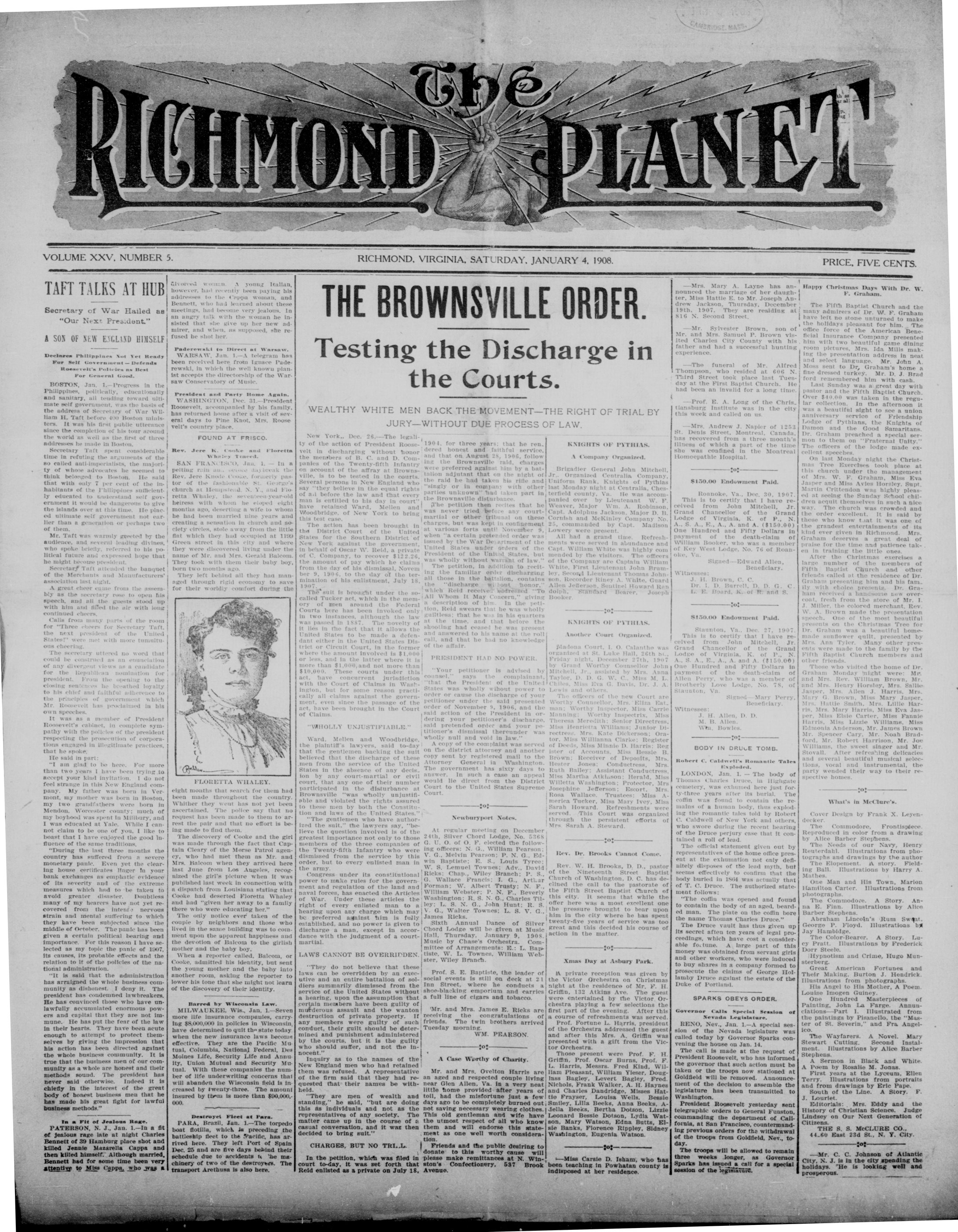
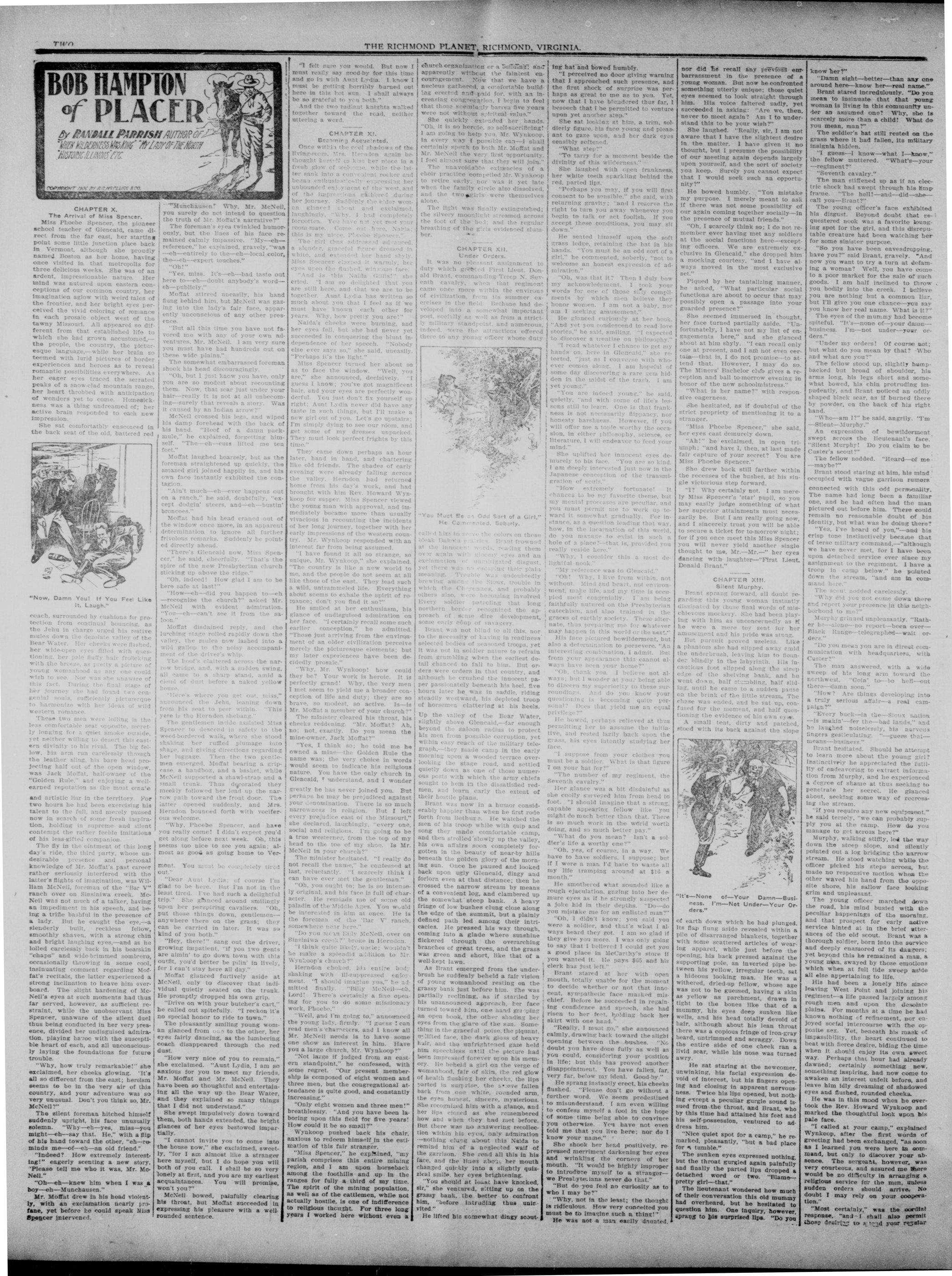
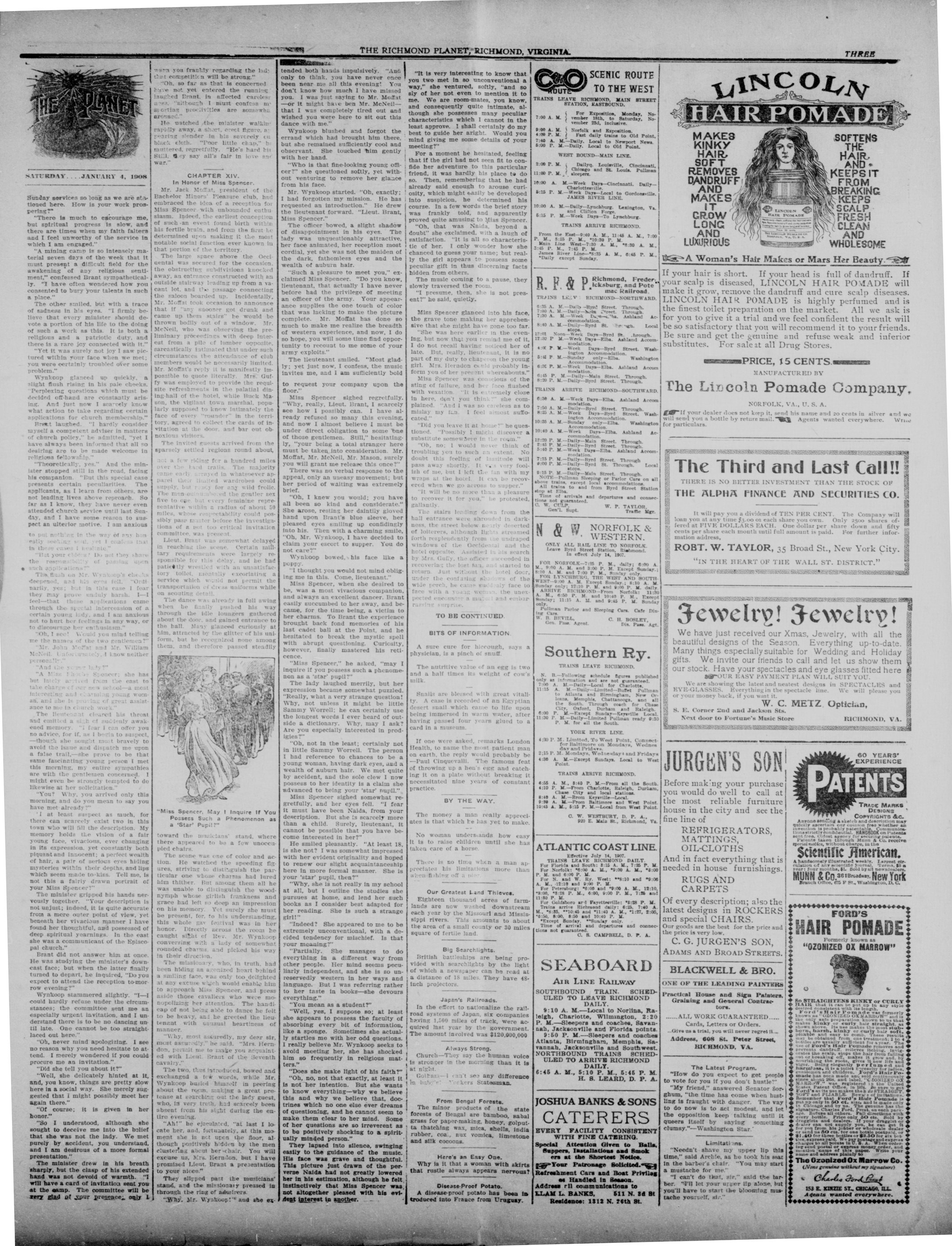
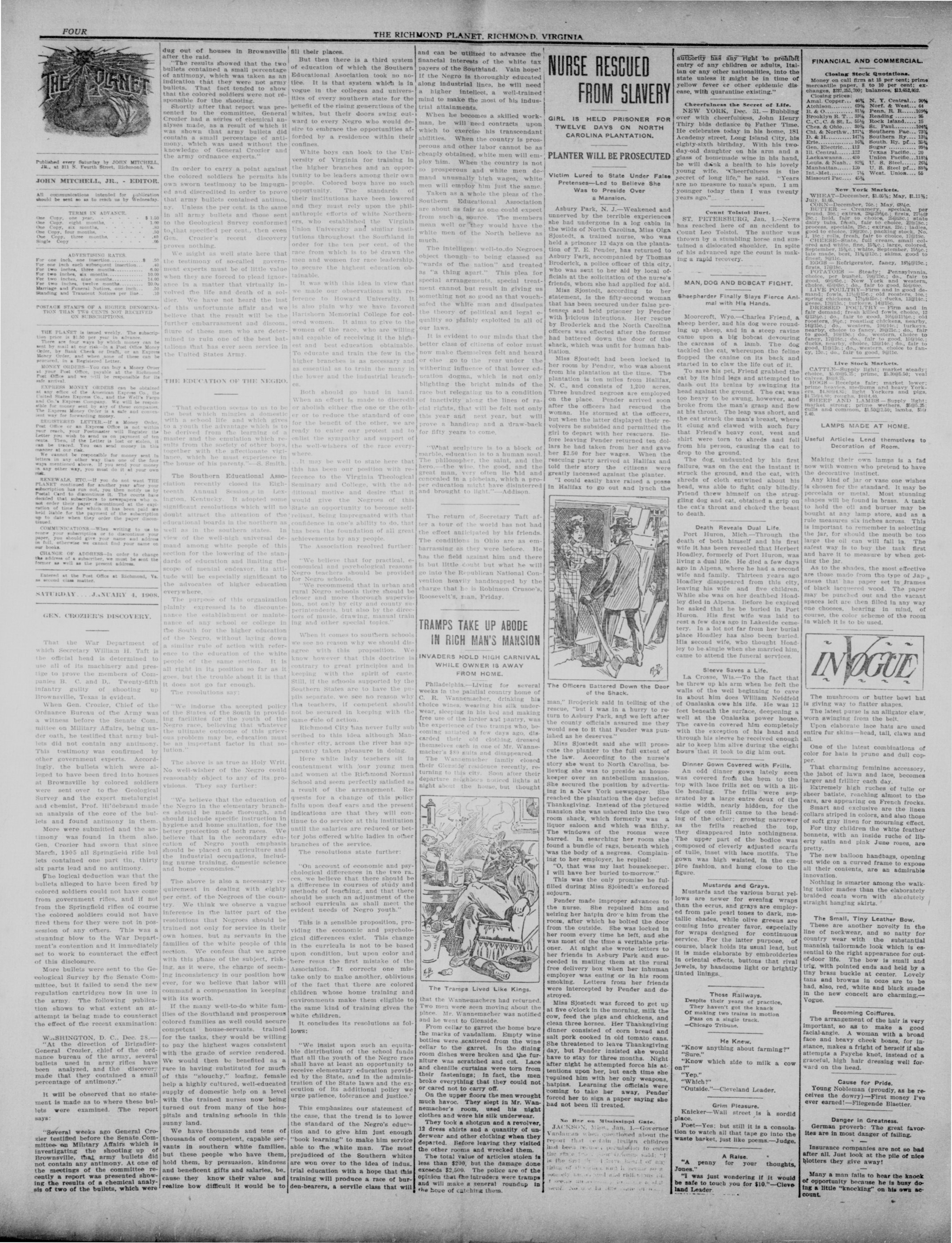
Page text (machine-generated)
THE RICHMOND PLANET
Secretary of War Hailed as "Our Next President."
A SON OF NEW ENGLAND HIMSELF
Declares Philippines Not Yet Ready
For Self Government - Defends
Roosevelt's Policies as Best
For General Good.
BOSTON, Jan. L.-Progress in the
Philippines, politically, educationally
and sanitary, all tending toward ultimate
self government, was the basis of
the address of Secretary of War William H. Taft before 400 Boston ministers. It was his first public utterance since the completion of his tour around the world as well as the first of three addresses he made in Boston.
Secretary Taft spent considerable time in refuting the arguments of the so called anti-imperialists, the majority of whose advocates he seemed to think belonged to Boston. He said that with only 7 per cent of the inhabitants of the Philippines sufficiently educated to understand self government it would be dangerous to give the islands over at this time. He placed ultimate self government not earlier than a generation or perhaps two of them.
Mr. Taft was warmly greeted by the audience, and several leading divines, who spoke briefly, referred to his political future and expressed hope that he might become president.
Secretary Taft attended the banquet of the Merchants and Manufacturers' association last night.
A great cheer came from the assembly as the secretary rose to open his speech, and all the guests stood up with him and filled the air with long continued cheers.
Calls from many parts of the room for "Three cheers for Secretary Taft, the next president of the United States" were met with more tumultuous cheering. The secretary uttered no word that could be construed as an emulation of any divergent views as a candidate for the Republican nomination for president. From the opening to the closing sentences he breathed loyalty to his chief and faithful adherence to the principles of government which Mr. Roosevelt has proclaimed in his own speeches. It was as a member of President Roosevelt's cabinet, in complete sympathy with the policies of the president respecting the prosecution of corporations engaged in illegitimate practices, that he spoke.
He said in part;
"I am glad to be here. For more than two years I have been trying to accept your kind invitation. I do not feel strange in this New England company. My father was born in Vermont, my mother was born in Boston, my two grandfathers were born in Mendon, Worcester county; much of my boyhood was spent in Milbury, and I was educated at Yale. While I cannot claim to be one of you, I like to boast that I have enjoyed the good influence of the same traditions.
"During the last three months the country has suffered from a severe monetary panic. Even yet the clearing house certificates linger in your bank exchanges as emphatic evidence of its severity and of the extreme measures which had to be taken to avoid greater disaster. Doubtless many of my hearers have not yet recovered from the intense nervous strain and mental suffering to which they have been subjected since the middle of October. The panic has been given a certain political bearing and importance. For this reason I have selected as my topic the panic of 1907, its causes, its probable effects and the relation to it of the policies of the national administration.
"It is said that the administration has arraigned the whole business community as dishonest. I deny it. The president has condemned lawbreakers. He has convinced those who have unlawfully accumulated enormous powers and capital that they are not immune. He has put the fear of the law in their hearts. They have been acute enough to attempt to protect themselves by giving the impression that his action has been directed against the whole business community. It is true that the business men of our community as a whole are honest and their methods sound. The president has never said otherwise. Indeed it is chiefly in the interest of the great body of honest business men that he has made his great fight for lawful business methods."
In a Fit of Jealous Bags
PATERSON, N. J., Jan. 1.—In a fit of jealous rage late at night Charles Bennett of 39 Hamburg place shot and killed Jennie Mazarella Cappa and then killed himself. Although married, Bennett had for some time been very attentive to Miss Cappa, who was a
divorced woman. A young Italian, however, had recently been paying his addresses to the Cappa woman, and Bennett, who had learned about these meetings, had become very jealous. In an angry talk with the woman he insisted that she give up her new admirer, and when, as supposed, she refused he shot her.
Paderewski to Direct at Warsaw. WARSAW, Jan. L.—A telegram has been received here from Ignace Paderewski, in which the well known pianist accepts the directorship of the Warsaw Conservatory of Music.
President and Party Home Again. WASHINGTON, Dec. 31.—President Roosevelt, accompanied by his family, has returned home after a visit of several days to Pine Knot, Mrs. Roosevelt's country place.
FOUND AT FRISCO.
Rev. Jere K. Cooke and Floretta Whitley Traced.
SAN FRANCISCO, Jan. 1. — In a pelting rain rain, oocice daybreak the Rev. Jere Knode Cooke, formerly pastor of the fashionable St. George's church at Hopmstead, N. Y., and Floretta Whitley, the seventeen-year-old heiress with whom he eloped eight months ago, deserting a wife to whom he had been married nine years and creating a sensation in church and society circles, stole away from the little flat which they had occupied at 1199 Green street in this city and where they were discovered living under the name of Mr. and Mrs. Gerald Baleum. They took with them their baby boy, born two months ago.
They left behind all they had managed through rigid economy to save for their worldly comfort during the
FLORETTA WHALEY.
eight months that search for them had been made throughout the country. Whither they went has not yet been ascertained. The police say that no request has been made to them to arrest the pair and that no effort is being made to find them.
The discovery of Cooke and the girl was made through the fact that Captain Cleary of the Morse Patrol agency, who had met them as Mr. and Mrs. Balcom when they arrived here last June from Los Angeles, recognized the girl's picture when it was published last week in connection with a dispatch from Louisiana stating that Cooke had deserted Floretta Whaley and had "given her away to a family there who were educating her." The only notice ever taken of the couple by neighbors and those who lived in the same building was to comment upon the apparent happiness and the devotion of Balcom to the girlish mother and the baby boy. When a reporter called, Balcom, or Cooke, admitted his identity, but sent the young mother and the baby into another room, asking the reporter to lower his tone that she might not learn of the discovery of their identity.
Barred by Wisconsin Law
MILWAUKEE, Wis., Jan. 1—Seven more life insurance companies, carrying $8,000,000 in policies in Wisconsin, have determined to quit the state today when the new insurance laws become effective. They are the Pacific Mutual, Columbia, National Federal, Des Moines Life, Security Life and Annuity, Union Mutual and Security Mutual. With these companies the number of life underwriting concerns that will abound the Wisconsin field is increased by twenty-three. The amount insured by them is more than $00,000,000.
Destroyed Fleet at Para
PARA, Brazil, Jan. 1.—The torpedo boat flotilla, which is preceding the battleship fleet to the Pacific, has arrived here. They left Port of Spain Dec. 25 and are five days behind their schedule due to accidents to the machinery of two of the destroyers. The transport Arethusa is also here.
RICHMOND, VIRGINIA, SATURDAY, JANUARY 4, 1908.
THE BROWNSVILLE ORDER. Testing the Discharge in the Courts.
WEALTHY WHITE MEN BACK THE MOVEMENT—THE RIGHT OF TRIAL BY JURY—WITHOUT DUE PROCESS OF LAW.
New York., Dec. 26.—The legality of the action of President Roosevelt in discharging without honor the members of B. C. and D. Companies of the Twenty-fifth Infantry on account of the affray at Brownsville, is to be tested in the courts. Several persons in New England who say "they believe in the equal rights of all before the law and that every man is entitled to his day in court" have retained Ward, Mellen and Woodbridge, of New York to bring this test case.
The action has been brought in the District Court of the United States for the Southern District of New York against the government, in behalf of Oscar W. Reid, a private of C. Company, to recover $122.26, the amount of pay which he claims from the day of his dismissal, November 2, 1907, to the day of the termination of his enlistment, July 18, 1907.
1904, for three years; that he rendered honest and faithful service, and that on August 28, 1906, following the Brownsville raid, charges were preferred against him by a battalion adjutant that on the night of the raid he had taken his rifle and "singly or in company with other parties unknown" had taken part in the Brownsville disturbance.
The petition then recites that he was never tried before any court-martial or other tribunal on these charges, but was kept in confinement at various forts until November 9, when "a certain protended order was issued by the War Department of the United States under orders of the President of the United States, but was wholly without warrant of law."
The petition, in addition to reciting the familiar order discharging all those in the battalion, contains the "discharge without honor."
KNIGHTS OF PYTHIAS.
A Company Organized.
Brigadier General John Mitch Jr. Organized Centralia Company Uniform Rank. Knights of Pythia last Monday night at Centralia, Chicotfield county, Va. He was accorded panied over by Leutenant W. Weaver, Major Wm. A. Robins Capt. Adolphus Jackson, Major D. Cornish and McKinley Company N. 25, commanded by Capt. Madis Lowery were present.
All had a grand time. Refreshments were served in abundance at Capt. William White was highly commended by the visitors. The office of the Company are Captain William White, First Lieutenant John Bruley, Second Lieutenant Thomas Johnson, Recorder Riney A. Whitle, Gus Allen Jefferson, Sentuline Howard B.
The suit is brought under the so-called Tucker act, which in the memory of men around the Federal Courts here has been invoked only in two instances, although the law was passed in 1887. The novelty of it lies in the fact that it allows the United States to be made a defendant either in the United States District or Circuit Court, in the former where the amount involved is $1,000 or less, and in the latter where it is more than $1,000, and not more than these courts under this act, have concurrent jurisdiction with the Court of Claims in Washington, but for some reason practically all claims against the government, even since the passage of the act, have been brought in the Court of Claims.
"WHOLLY UNJUSTIFIABLE"
Ward, Mellen and Woodbridge, the plaintiff's lawyers, said to-day that the gentlemen backing the suit believed that the discharge of these men from the service of the United States in the absence of any decision by any court-martial or civil court, that any one of their number participated in the disturbance at Brownsville "was wholly unjustifiable and violated the rights assured to these men by both the Constitution and laws of the United States." "The gentlemen who have authorized the suit," the lawyers say, "believe the question involved is of the greatest importance not only to those members of the three companies of the Twenty-fifth Infantry who were dismissed from the service by this order, but to every enlisted man in the army.
Congress under its constitutional power to make rules for the government and regulation of the land and naval forces, has enacted the Articles of War. Under these articles the right of every enlisted man to a hearing upon any charge which may be preferred against him is fully established, and no power is given to discharge a man, except in accordance with the judgment of a court-martial.
LAWS CANNOT BE OVERRIDDEN
"They do not believe that these laws can be overridden by an executive and an entire battalion of soldiers summarily dismissed from the service of the United States without a hearing, upon the assumption that certain members have been guilty of murderous assault and the wanton destruction of private property. If any members were guilty of such conduct, their guilt should be determined and punishment administered by the courts, but it is the guilty who should suffer, and not the innocent."
Inquiry as to the names of the New England men who had retained them was refused. A representative of the firm said that they had requested that their names be withheld.
"They are men of wealth and standing," he said, "but are doing this as individuals and not as the representatives of any society. The matter came up in the course of a casual conversation, and it was then decided to bring suit."
CHARGES, BUT NO TRLL.
In the petition, which was filed in court, the judge said that Reid exhibited a private or "pri
1904, for three years; that he rendered honest and faithful service, and that on August 28, 1905, following the Brownsville raid, charges were preferred against him by a bailion adjutant that on the night of the raid he had taken his rifle and "singly or in company with other parties unknown" had taken part in the Brownsville disturbance.
The petition then recites that he was never tried before any court-martial or other tribunal on these charges, but was kept in confinement at various forts until November 9, when "a certain pretended order was issued by the War Department of the United States under orders of the President of the United States, but was wholly without warrant of law."
The petition, in addition to reciting the familiar order discharging all those in the battalion, contains the "discharge without honor," which Reid receive addressed "To All Whom It May Concern," giving a description of him. In the petition, Reid swears that he was wholly guiltless; that he was in his quarters at the time, and that before the shooting had ceased he was present and answered to his name at the roll call, and that he had no knowledge of the affair.
PRESIDENT HAD NO POWER.
"Your petitioner is advised by counsel," says the complainant, "that the President of the United States was wholly without power to order or cause the discharge of your petitioner under the said presented order of November 9, 1906, and the said action of the President in ordering your petitioner's discharge, said pretended order and your petitioner's dismissal thereunder was wholly null and void in law." A copy of the complaint was served on the district attorney and another copy sent by registered mail to the Attorney General in Washington. Government has sixty days to answer. It is such a case an appeal would lie direct from the District Court to the United States Supreme Court
Newburyport Notes
At regular meeting on December 24th, Silver Chord Lodge, No. 5388 G. U. O. of O. F. elected the following officers: N. G., William Pearson; V. G., Melvin Pearson; P. N. G., Edwin Baptiste; E. S. Louis Tyree; W. S. Lemuel Townes; Adv. David Ricks; Chap, Wiley Branch; P. S. G. Wallace Francis; I. G., Arthur Forman; W. Albert Trusty; N. F. W. Webster William; P. N. F., Beverly Washington; R. S. N. G., Charles Tilley; L. S. N. G., John Hunt; R. S. V. G., Walter Townes; L. S. V. G., James Ricks.
Sixth Annual Dance of Silver Chord Lodge will be given at Music Hall, Thursday, January 9, 1908. Music by Chase's Orchestra. Committee of Arrangements: E.: L. Baptiste, W. L. Townes, William Webster, Wiley Brunch.
Prof. S. E. Baptiste, the leader of social events is still on deck at 21 Inn Street, where he conducts a shoe-blacking emporium and carries a full line of cigars and tobacco.
Mr. and Mrs. James E. Ricks are receiving the congratulations of friends. The twin brothers arrived Tuesday morning.
Mr. and Mrs. Ovelton Harris are an aged and respected couple living near Glen Allen, Va. in a very neat little home provided after years of toll, had the misfortune just a few days ago to be completely burned out not saving necessary wearing clothes. This old gentleman and wife have the utmost respect of all who know them and will endorse this statement as one well worth consideration. Friends and the public desiring to donate to this worthy cause will please make remittances at N. Winston's Confectionery. 537 Brook Avenue
KNIGHTS OF PYTHIAS.
A Company Organized
Brigadier General John Mitchell, Jr. Organized Centralia Company,Uniform Rank, Knights of Pythias last Monday night at Centralia, Chesterfield county, Va. He was accompanied over by Lieutenant W. F. Weaver, Major Wm. A. Robinson, Capt. Adolphus Jackson, Major D. B. Cornish and McKinley Company No. 25, commanded by Capt. Madison Lowery were present.
All had a grand time. Refreshments were served in abundance and Capt. William White was highly commended by the visitors. The officers of the Company are Captain William White, First Lieutenant William Brumley, Second Lieutenant Thomas Johnson, Recorder Riney A. White, Guard Allen Jefferson, Seventh Howard Randolph, Standard Bearer, Joseph Booker.
KNIGHTS OF PYTHIAS
Another Court Organized
Madona Court, I. O. Calanthe was organized at St. Luke Hall, 26th St. L., Friday night, December 27th, 1967 by Grand Worthy Counsellor John Mitchell, Jr., assisted by Mrs. Anna Taylor, D. D. G. W. C., Miss M. L. Chiles, Miss Eva G. Davis, Dr. J. A. Lewis and others.
The officers of the new Court are Worthy Counsellor, Mrs. Eliza Eatman; Worthy Inspector, Miss Carrie Manning; Worthy Inspectrix, Miss Theresa Meredith; Senior Directress, Miss Henrietta Williams; Junior Directress, Mrs. Kate Dickerson; Orator, Miss Williana Clark; Register of Deeds, Miss Minnie D. Harris; Register of Accounts, Miss Bessie B. Brown; Receiver of Deposits, Mrs. Hester Jones; Conductress, Mrs. Ruth Bailey; Assistant Conductress, Miss Marta Atkinson; Herald, Miss Willetta Washington; Protector, Mrs Josephine Jefferson; Escort, Mrs. Rosa Wallace. Trustees: Miss America Tucker, Miss Mary Ivey, Miss Sarah Howard. Refreshments were served. This Court was organized through the persistent efforts of Mrs. Sarah A. Steward.
Rev. Dr. Brooks Cannot Come.
Rev. W. H. Brooks, D. D., pastor of the Nineteenth Street Baptist Church of Washington, D. C. has declined the call to the pastorate of the Fifth Street Baptist Church of this city. It seems that while the offer here was a most excellent one the pressure brought to bear upon him in the city where he has spent twenty-five years of service was too great and this decided his course of action in the matter.
Xmas Day at Asbury Park.
A private reception was given by the Victor Orchestra on Christmas night at the residence of Mr. F. H. Griffin, 132 Atkins Ave. The guest were entertained by the Victor Orchestra playing a few selections the first part of the evening. After this a course of refreshments was served. Prof. Fortune L. Harris, president of the Orchestra addressed the guest and after this Mrs. A. Griffin was presented with a gift from the Victor Orchestra.
Those present were Prof. F. H. Griffin, Prof. Oscar Burns, Prof. F. L. Harris, Messrs. Fred Kind, William Pleasant, William Yleser, Douglass Bagley, Levert Bagley, Fred Nichols, Frank Walker, A. H. Haynes and Charles Dandridge, Misses Hattie Frayser, Loewa Wells, Bessie Smiley, Lilla Beeks, Anna Beeks, AJella Beeks, Bertha Dotson, Lizzle Leonard Bessie Dotson, Lydia Watson, Mary Watson, Edna Butts, Elsie Banks, Florence Rippley, Sidney Washington, Eugenia Watson.
Miss Carsie D. Isham, who has been teaching in Powhatan county is indisposed at her residence.
—Mrs. Mary A. Layne has announced the marriage of her daughter, Miss Hattie E. to Mr. Joseph Andrew Jackson, Thursday, December 19th, 1907. They are residing at 816 N. Second Street.
—Mr. Sylvester Brown, son of Mr. and Mrs. Samuel P. Brown visited Charles City County with his father and had a successful hunting experience.
—The funeral of Mr. Alfred Thompson, who resided at 606 N. Third Street took place last Tuesday at the First Baptist Church. He had been an invalid for a long time.
—Prof. E. A. Long of the Chris-tainsburg Institute was in the city this week and called on us.
—Mrs. Andrew J. Napier of 1253 St. Denis Street, Montreal, Canada, has recovered from a three month's illness of which a part of the time she was confined in the Montreal Homeopathic Hospital.
$150.00 Endowment Paid
Roanoke, Va., Dec. 30, 1907.
This is to certify that I have received from John Mitchell, Jr.
Grand Chancellor of the Grand
Lodge of Virginia, K. of P., N.
A., S. A., E., A., A. and A. ($150.00)
One Hundred and Fifty Dollars in payment of the death-claim of
William Booker, who was a member of Key West Lodge, No. 76 of Roanoke, Va.
Signed—Edward Allen,
Beneficiary.
Witnesses:
J. H. Brown, C. C.
Dr. I. D. Burrell, D. D. G. C.
L. E. Board, K. of R. and S.
$150.00 Endowment Paid
Staunton, Va., Dec. 27, 1907.
This is to certify that I have received from John Mitchell, Jr.
Grand Chancellor of the Grand
Lodge of Virginia, K. of P., N.
S. A., E., A., A. and A. ($150.00)
One Hundred and Fifty Dollars in payment of the death-claim of Allen Perry, who was a member of Brotherly Love Lodge, No. 78, of Staunton, Va.
Signed—Mary Perry,
Beneficiary.
Witnesses:
J. H. Allen, D. D.
M. B. Allen.
Wm. Bowles.
BODY IN DRUCE TOMB.
Robert C. Caldwell's Romantic Tales Exploded.
LONDON, Jan. 1. — The body of Thomas Charles Druce, in Highgate cemetery, was exhumed here just forty-three years after its burial. The coffin was found to contain the remains of a human body, thus exploding the romantic tales told by Robert C. Caldwell of New York and others, who swore during the recent hearing of the Druce perjury case that it contained a roll of lead.
The official statement given out by representatives of the home office present at the exhumation not only definitely disposes of the lead myth, but seems effectively to confirm that the body buried in 1864 was actually that of T. C. Druce. The authorized statement follows:
"The coffin was opened and found to contain the body of an aged, bearded man. The plate on the coffin bore the name Thomas Charles Druce."
The Druce vault has thus given up its secret aften ten years of legal proceedings, which have cost a considerable fortune. A large part of this money was obtained from servant girls and other workers, who were induced to buy shares in a company formed to prosecute the claims of George Holamby Druce against the estate of the Duke of Portland.
SPARKS OBEYS ORDER.
Governor Calls Special Session of Nevada Legislature.
RENO, Nev., Jan. 1—A special session of the Nevada legislature was called today by Governor Sparks convening the house on Jan. 14.
The call is made at the request of President Roosevelt, who has informed the governor that such action must be taken or the troops now stationed at Goldfield will be removed. Announcement of the decision to assemble the legislature has been transmitted to Washington.
President Roosevelt yesterday sent telegraphic orders to General Funston, commanding the department of California, at San Francisco, countermanding previous orders for the withdrawal of the troops from Goldfield, Nev., today.
The troops will be allowed to remain three weeks longer, as Governor Sparks has issued a call for a special session of the legislature.
PRICE, FIVE CENTS
Happy Christmas Days With Dr. W. F. Graham.
The Fifth Baptist Church and the many admirers of Dr. W. F. Graham have left no stone unturned to make the holidays pleasant for him. The office force of the American Beneficial Insurance Company presented him with two beautiful game dining room pictures, Mrs. Ida Mills making the presentation address in neat and select language. Mr. John A. Moss sent to Dr. Graham's home a fine dressed turkey, Mr. D. J. Bradford remembered him with cash. Last Sunday was a great day with pastor and the Fifth Baptist Church. Over $40.00 was taken in the regular collection. In the afternoon it was a beautiful sight to see a union anniversary service of Friendship Lodge of Pythians, the Knights of Damon and the Good Samaritans. Dr. Graham preached a special sermon to them on "Fraternal Unity." The officers of the lodge made excellent speeches.
On last Monday night the Christmas Tree Exercises took place at this church under the management of Mrs. W. F. Graham, Miss Eva Jasper and Miss Avies Horsley, Supt. Martin Crittendon was highly pleased at seeing the Sunday School children acquit themselves in such a nice way. The church was crowded and the order excellent. It is said by those who know that it was one of the grandest entertainments of its kind ever given in Richmond. Mrs. Graham deserves a great deal of praise for the time and patience taken in training the little ones. After the Christmas exercises a large number of the members of Fifth Baptist Church and other friends called at the residence of Dr. Graham presenting him and his family with choice presents. Dr. Graham received a handsome new over-cont, fresh from the store of Mr. I. J. Miller, the colored merchant, Rev. W. A. Brown made the presentation speech. One of the most beautiful presents on the Christmas Tree for Dr. Graham was a beautiful homemade sunflower quilt, presented by Mrs. Ann Tyler. Many other presents were made to the family by the Fifth Baptist Church members and other friends.
Those who visited the home of Dr. Graham Monday might were: Mr. and Mrs. Rev. William Brown, Mr. and Mrs. Henry Horsley, Mrs. Sallie Jasper, Mrs. Allen J. Harris, Mrs. Mary G. Brown, Miss Mary Jasper, Mrs. Hattie Smith, Mrs. Lillie Harris, Mrs. Mary Harris, Miss Eva Jasper, Miss Elise Carter, Miss Fannie Harris, Mrs. Lizzie Williams, Miss Edmonia Anderson, Mr. James Brown Mr. Spencer Cary, Mr. Noah Bradford, Mr. Robert Harrison, Mr. Joe Williams, Wendy Wagner, and Mr. Stovall. After refreshing delicacies and several beautiful musical selections, vocal and instrumental, the party wended their way to their respective homes.
What's in McClure's.
Cover Design by Frank X. Leyendecker.
The Commodore, Frontispiece.
Reproduced in color from a drawing by Alice Barber Stephens.
The Needs of our Navy, Henry Reuterdahl. Illustrations from photographs and drawings by the author
The Elopement. A story. Fielding Ball. Illustrations by Harry A. Mathes.
One Man and His Town, Marion Hamilton Carter. Illustrations from photographs.
The Commodore. A Story. Anna E. Finn. Illustrations by Alice Barber Stephens.
Abraham Lincoln's Rum Swat, George P. Floyd. Illustrations by Jay Hambidge.
The Color-Bearer. A Story, Lucy Pratt. Illustrations by Frederick Dorr Steele.
Hypnotism and Crime, Hugo Munsterberg.
Great American Fortunes and Their Making, Burton J. Hendrick. Illustrations from photographs.
His Angel to His Mother, A Poem. Louise Imogen Guiney.
One Hundred Masterpieces of Painting, John La Farge. Annunciations—Part I. Illustrated from the paintings by Pisanello, the "Master of St. Severin," and Fra Angelico.
The Wayfarers. A Novel. Mary Stewart Cutting. Second Instalment. Illustrations by Alice Barber Stephens.
A Sermon in Black and White. A Poem by Rosalie M. Jonas.
First years at the Lyceum, Ellen Terry. Illustrations from portraits and from drawings by Eric Pape.
South of the Line. A Story. F.
J. Lourie.
Editorials: Mrs. Eddy and the
History of Christian Science. Judge
Lindsey on Our Next Generation of
Citizens.
THE S. S. McCLURE CO.,
44.60 East 23d St., N. Y. City.
—Mr. C. C. Johnson of Atlantic
City, N. J. is in the city spending the
holidays. 'He is looking well and
prosperous.
BOB HAMPTON of PLACER
"Munchausen! Why, Mr. McNeil, you surely do not intend to question the truth of Mr. Moffat's narrative?" The foreman's eyes twinkled humorously, but the lines of his face remained calmly impassive. "My—eh—reference," he explained, gravely, "was—eh—entirely to the—eh—local color, the—eh—expert touches." "Oh!!" "Yes, miss. It's—eh—bad taste out here to—eh—doubt anybody's word—eh—publicly." Moffat stirred uneasily, his hand flung behind him, but McNeil was gazing into the lady's fair face, apparently unconscious of any other presence. "But all this time you have not favored me with any of your own adventures, Mr. McNeil. I am very sure you must have had hundreds out on these wide plains." The somewhat embarrassed foreman shook his head discouragingly.
"Oh, but I just know you have, only you are so modest about recounting them. Now, that scar just under your hair—really it is not at all unbecoming—surely that reveals a story. Was it caused by an Indian arrow?"
McNell crossed his legs, and wiped his damp forehead with the back of his hand. "Hoof of a damn pack-mule," he explained, forgetting himself. "The—eh—cuss lifted me ten feet."
Moffat laughed hoarsely, but as the foreman straightened up quickly, the amazed girl joined happily in, and his own face instantly exhibited the contagion.
"Ain't much—eh—ever happens out on a ranch," he said, doubtfully, "except dodgin' steers, and—eh—bustin' broncoes."
Moffat had his head craned out of the window once more, in an apparent determination to ignore all further frivolous remarks. Suddenly he pointed directly ahead.
"There's Glencauld now, Miss Spencer," he said, cheerfully. "That's the spire of the new Presbyterian church sticking up above the ridge."
"Oh, indeed! How glad I am to be here safe at last!"
"How—eh—did you happen to—eh—recognize the church?" asked Mr. McNell with evident admiration.
"You—eh—can't see it from the saloon."
Moffat disclaimed reply, and the lurching stage rolled rapidly down the valley, the mules now lashed into a wild gallop to the noisy accompaniment of the driver's whip.
The hoof's clattered across the narrow bridge, and, with a sudden swing, all came to, a sharp stand, amid a cloud of dust before a naked yellow house.
"Here's where you get out, miss," announced the Jehu, leaning down from his seat to peer within.
"This vere is the Hernden sheang."
The gentlemen inside assisted Miss Spencer to descend in safety to the weed-bordered walk, where she stood shaking her ruffled plumage into shape, and giving directions regarding her luggage. Then the two gentlemen emerged, Moffat bearing a gripcase, a handbox, and a basket, while McNell supported a shawl-strap and a small trunk. Thus decorated they meekly followed her load up the narrow path toward the front door. The latter opened suddenly, and Mrs. Herndon bounced forth with vociferous welcome.
"Why, Phoebe Spencer, and have you really come! I didn't expect you'd get along before next week. Oh, this seems too nice to see you again; almost as good as going home to Vermont. You must be completely tired out."
"Dear Aunt Lyda; of course I'm glad to be here. But I'm not in the least tired. I've had such a delightful trip." She glanced around smilingly upon her perspiring cavaliers. "Oh, put those things down, gentlemen—anywhere there on the grass; they can be carried in later. It was so kind of you both."
"Hey, there!" sang out the driver, growing impatient, "if you two gents are alimn to go down town with this outfit, you'd better be pilin' in lively, for I can't stay here all day."
Moffat glancedfurtely aside at McNell, only to discover that individual quietly seated on the trunk. He promptly dropped his own grip.
"Drive on with your butcher's cart," he called out spitfully. "I reckon it's no special honor to ride to town."
The pleasantly smiling young woman glanced from one to the other, her eyes fairly dancing, as the lumbering coach disappeared through the red dust.
"How very nice of you to remain," she exclaimed. "Aunt Lydia, I am so anxious for you to meet my friends, Mr. Moffat and Mr. McNell. They have been so thoughtful and entertaining all the way up the Bear Water, and they explained so many things that I did not understand."
She swept impulsively down toward them, both hands extended, the bright glances of her eyes bestowed impartially.
"I cannot invite you to come into the house now," she exclaimed, sweetly, "for I am almost like a stranger here myself, but I do hope you will both of you call. I shall be so very lonely at first, and you are my earliest acquaintances. You will promise, won't you?"
McNell bowed, painfully clearing his throat, and Moffat succeeded in expressing his pleasure with a well-rounded sentence.
TWO
CHAPTER X
The Arrival of Miss Spencer
The Arrival of Miss Spencer.
Miss Phoebe Spencer, the pioneer school teacher of Glencaird, came direct from the far east, her starting point some little junction place back in Vermont, although she proudly named Boston as her home, having once visited in that metropolis for three delicious weeks. She was of an ardent, impressionable nature. Her mind was nurtured upon eastern conceptions of our common country, her imagination aglow with weird tales of the frontier, and her bright eyes perceived the vivid coloring of romance in each prosaic object west of the tawny Missouri. All appeared so different from that established life to which she had grown accustomed, the people, the country, the picturesque language,—while her brain so seemed with lurid pictures of border experiences and heroes as to reveal romantic possibilities everywhere. As her eager eyes traced the serrated peaks of a snow-clad mountain range, her heart throbbed with anticipation of wonders yet to come. Homesickness was a thing undreamed of; her active brain responded to each new impression.
She sat comfortably ensconced in the back seat of the old, battered red
"Now, Damn You! If You Feel Like It, Laugh."
coach, surrounded by cushions for protection from continual bouncing, as the Jehu in charge urged his restive mules down the desolate valley of the Bear Water. Her cheeks were flushed, her wide-open eyes filled with questioning, her pale faint hair frolicking with the breeze, as pretty a picture of young womanhood as any one could wish to see. Nor was she unaware of this fact. During the final stage of her journey she had found two congenial souls, sufficiently pictureque to harmonize with her ideas of wild western romance.
These two men were loiling in the less comfortable seat opposite, secretly longing for a quiet smoke outside, yet neither willing to desert this eastern divinity to his rival. The big fellow, his arm run carelessly through the leather sling, his bare head projecting half out of the open window, was Jack Moffat, half-owner of the "Golden Rule," and enjoying a well-earned reputation as the most ornate and artistic liar in the territory. For two hours he had been exercising his talent to the full, and merely paused now in search of some fresh inspiration, holding in supreme and silent contempt the rather feeble imitations of his less-gifted companion.
The fly in the ointment of this long day's ride, the third party, whose undesirable presence and personal knowledge of Mr. Moffat's past career rather seriously interfered with the latter's flights of imagination, was William McNeill, the foreman of the "Bar V" ranch over on Sinsiniwa creek. McNeill was not much of a talker, having an impediment in his speech, and being a trifle bashful in the presence of a lady. But he caught the eye—a slenderly built, reckless fellow, smoothly shaven, with a strong chin and bright laughing eyes,—and as he lolled carelessly back in his bearskin "chaps" and wide-brimmed somber, occasionally throwing in some cool, insinuating comment regarding Moffat's recitals, the latter experienced a strong inclination to heave him overboard. The slight hardening of McNeill's eyes at such moments had thus far served, however, as sufficient restraint, while the unobservant Miss Spencer, unaware of the silent duel thus being conducted in her very presence, divided her undisguised admiration, playing havoc with the susceptible heart of each, and all unconsciously laying the foundations for future trouble.
"Why, how truly remarkable!" she exclaimed, her cheeks glowing. "It's all so different from the east; herolism seems to be in the very air of this country, and your adventure was so very unusual. Don't you think so, Mr. McNell?"
The silent foreman hitched himself suddenly upright, his face unusually solemn. "Why—eh—yes, miss—you might—eh—say that. He," with a flip of his hand toward the other, "eh—reminds me—of—eh—an old friend."
"Indeed? How extremely interesting!" eagerly scenting a new story, "Please tell me who it was, Mr. McNell."
"Oh—eh—knew him when I was a boy—eh—Munchausen."
Mr. Moffat drew in his head violently, with an exclamation nearly profane, yet before he could speak Miss Spencer intervened.
THE RICHMOND PLANET, RICHMOND, VIRGINIA
"I felt sure you would. But now I must really say good-by for this time and go in with Aunt Lydia. I know I must be getting horribly burned out here in this hot sun. I shall always be so grateful to you both."
And the two radiant knights walked together toward the road, neither uttering a word.
CHAPTER XI
Once within the cool shadows of the living room, Mrs. Hernden again beathought herself to kiss her niece in a fresh glow of welcome, while the latter sank into a convoluted rocker and began enthusiastically expressing her unbound enjoyment of the west and of the impressions glabrated during her journey. Suddenly the elder woman glanced about and exclaimed, laughingly, "Why, I had completely forcotten. You have not yet met your room-mate. Come out here, Nabla; this is my niece Phoebe Spencer." The girl thus addressed advanced, a slender, graceful figure dressed in white, and extended her hand shyly. Miss Spencer clasped it warmly, her eyes upon the flushed, winnow face. "And is this Nabla Gillings?" she cried. "I am so delighted that you are still here, and that we are to be together. Aunt Lydia has written so much about you that I feel as if we must have known each other for years. Why, how pretty you are!"
Naida's cheeks were burning, and her eyes fell, but she had never yet succeeded in conquering the blunt independence of her speech. "Nobody else ever says so," she said, uneasily. "Perhaps it's the light."
Miss Spencer turned her about so as to face the window. "Well, you are," she announced, decisively. "I guess I know; you've got magnificent hair, and your eyes are perfectly wonderful. You just don't fix yourself up right; Aunt Lydia never did have any taste in such things, but I'll make a new girl out of you. Let's go upstairs; I'm simply dying to see our room, and get some of my dresses unpacked. They must look perfect frights by this time."
They came down perhaps an hour later, hand in hand, and chattering like old friends. The shades of early evening were already falling across the valley. Herndon had returned home from his day's work, and had brought with him Rev. Howard Wynkoop for supper. Miss Spencer viewed the young man with approval, and immediately became more than usually vivacious in recounting the incidents of her long journey, together with her early impressions of the western country. Mr. Wynkoop responded with an interest far from being assumed.
"I have found it all so strange, so unique, Mr. Wynkoop," she explained.
"The country is like a new world to me, and the people do not seem at all like those of the east. They lead such a wild, untrammeled life. Everything about seems to exhale the spirit of romance; don't you find it so?"
He smiled at her enthusiasm, his glance of undisguised admiration on her face. "I certainly recall some such earlier conception," he admitted. "Those just arriving from the environment of an older civilization perceive merely the picturesque elements; but my later experiences have been decidedly prosocial."
"Why, Mr. Wynkoop! how could they be? Your work is heroic. It is perfectly grand! Why, the very men I met seem to yield me a broader conception of life and duty; they are so brave, so modest, so active. Is—is Mr. Moffat a member of your church?" The minister cleared his throat, his cheeks reddening. "Mr. Moffat? Ah, no; not exactly. You do the mine-owner, Jack Moffat?"
"Yes, I think so; he told me he owned a mine—the Golden Rule the name was; the very choice in words would seem to indicate his religious nature. You have the only church in Glencald, 't understand, and I wonder
greatly he has never joined you. But perhaps he may be prejudiced against your denomination. There is so much narrowness in religion. But I left every prejudice east of the Missouri," she declared, laughingly, "every one, social and religious. I'm going to be a true westerner, from the top of my head to the toe of my shoe. Is Mr. McNell in your church?"
The minister heitated. "I really do not recall the name," he confessed at last, reluctantly. "I scarcely think I can have ever met the gentleman."
"Oh, you ought to; he is so intensely original, and his face is full of character. He reminds me of some old paladin of the Middle Ages. You would be interested in him at once. He is the foreman of the Bar V' ranch, somewhere near here."
"Do you know Billy McNell, over on Sinsiniwa creek?" broke in Hernden. "I think quite likely, nack; wouldn't he make a splendid addition to Mr. Wynkoop's church?"
Herndon choked, his entire body shaking with ill-suppressed enjoyment. "I should imagine you," he admitted finally. "Billy McNeill—ch Lord! There's certainly a fine opening for you to do some missionary work, Phoebe."
"Well, and I'm going to," announced the young lady, firmly. "I guess I can read men's characters, and I know all Mr. McNeill needs is to have some one show an interest in him. Have you a large church, Mr. Wynkoop?"
"Not large if judged from an eastern standpoint," he confessed, with some regret. "Our present membership is composed of eight women and three men, but the congregational attendance is quite good, and constantly increasing."
"Only eight women and three men!" breathlessly. "And you have been laboring upon this field for five years! How could it be so small?"
Wynkoop pushed back his chair, anxious to redeem himself in the estimation of this fair stranger. "Miss Spencer," he explained, "my parish comprises this entire mining region, and I am upon horseback among the foothills and up in the ranges for fully a third of my time. The spirit of the mining population, as well as of the cattlemen, while not actually hostile, is one of indifference to religious thought. For three long years I worked here without even a
church organization or a ballroom, and apparently without the faintest encouragement. Now that we have a nucleus gathered, a comfortable building erected and paid for, with an increasing congregation, I begin to feel that those seemingly barren five years were not without spiritual value."
She quickly extended her hands. "Oh, it is so heroic, so self-sacrificing! I am going to help you. Mr. Wynkoop, in every way I possible can—I shall certainly speak to both Mr. Mofat and Mr. McNell the very first opportunity, I feel almost sure that they will join."
The unavoidable exigencies of a choir practice compelled Mr. Wynkoop to retire early, nor was it yet late when the family circle also dissolved, and the two girls were themselves alone.
The light was finally extinguished; the silvery moonlight streamed across the foot of the bed; and the regular breathing of the girls evidenced slumber.
CHAPTER XII.
Under Orders.
It was no pleasant assignment to duty which greatest First Lieut. Donald Brant, commanding Treep N. Seventh cavalry, when that regiment came once more within the environs of civilization, from its summer exercises in the field. Bethune had developed into a somewhat important post, socially as well as from a strictly military standpoint, and numerous, indeed, were the attractions offered there to any young officer whose duty
"You Must Be an Odd Sort of a Girl," He Commented, Sobarly.
"You Must Be an Odd Sort of a Girl," He Commented, Sobserly, called him to serve the colors on these bleak Dakota pastures. Brant trowned at the innocent words, reading them over again with gloomy eyes and an exclamation of unrutilized disgust, yet there was no escaping their plaah meaning. Trouble was undoubtedly brewing among the Sioux, trouble in which the Chiequennes, and probably others also, were becoming involved Every soldier patrolling that long northern border recognized the approach of some dire development, some early coup of savagery.
Brant was not blind to all this, nor to the necessity of having in readiness selected bodies of seasoned troops, yet it was not in soldier nature to refrain from grumbling when the earliest detail chanced to fall to him. But orders were orders in that country, and although he crushed the innocent paper passionately beneath his heel, five hours later he was in saddle, riding steadily westward, his depleted troop of horsemen clattering at his heels.
Up the valley of the Bear Water, slightly above Glencaid,—far enough beyond the saloon radius to protect his men from possible corruption, yet within easy reach of the military telegraph,—they made camp in the early morning upon a wooded terrace overlooking the stage road, and settled quietly down as one of those numerous posts with which the army chiefs sought to hem in the disatisfied redmen, and learn early the extent of their hostile plans.
Brant was now in a humor considerably happier than when he first rode forth from Bethura. He watched the men of his troop while with quip and song they made comfortable camp, and then strolled slowly up the valley, his own affairs soon completely forgotten in the beauty of near-by hills beneath the golden glory of the morning sun. Once he paused and looked back upon ugly Glencaird, dingy and forlorn even at that distance; then he crossed the narrow stream by means of a convenient log, and clambed up the somewhat steep bank. A heavy fringe of low bushes clung along the edge of the summit, but a plainly defined path led among their intricacies. He pressed his way through, coming into a glade where sunshine flickered through the overarching branches of great trees, and the grass was green and short, like that of a well-kept lawn.
As Brant emerged from the underbrush he suddenly beheld a fair vision of young womanhood resting on the grassy bank just before him. She was partially reclining, as if startled by his unannounced approach, her face turned toward him, one nand grapping an open book, the other shading her eyes from the glare of the sun. Something in the graceful poise, the plquant, unlifted face, the dark gloss of heavy hair, and the unfrightened gaze held him speechless until the picture had been impressed forever upon his memory. He beheld a girl on the verge of womanhood, fair of skin, the red glow of health flushing her cheeks, the lips parted in surprise, the sieve fallen back from one white, rounded arm, the eyes honest, sincere, mysterious. She recognized him with a glance, and her lips closed as she remembered how and when they had met before. But there was no answering recollection within his eyes, only admiration—nothing clung about this Naida to remind him of a neglected walt of the garrison. She read all this in his face, and the lines about her mouth changed quickly into a slightly quizzical smile, her eyes brightening.
"You should at least have knocked, sir," she ventured, sitting up on the grassy bank, the better to confront him, "before intruding thus uninvited."
He lifted his somewhat dingy scout-
ing hat and bowed humbly.
"I perceived no door giving warning that I approached such presence, and the first shock of surprise was perhaps as great to me as to you. Yet, now that I have blundered thus far, I beseech that I be permitted to venture upon yet another step."
She sat looking at him, a trim, soldierly figure, his face young and pleasant to gaze upon, and his dark eyes sensibly softened.
"What step?"
"To tarry for a moment beside the divinity of this wilderness."
She laughed with open frankness, her white teeth sparkling behind the red, parted lips.
"Perhaps you may, if you will first consent to be sensible," she said, with returning gravity; "and I reserve the right to turn you away whenever you begin to talk or act foolish. If you accept these conditions, you may sit down."
He seated himself upon the soft grass ledge, retaining the hat in his hands. "You must be an odd sort of a girl," he commented, soberly, "not to welcome an honest expression of admiration."
"Oh, was that it? Then I duly bow my acknowledgment. I took your words for one of those silly compilations by which men believe they honor women. I am not a baby, nor am I seeking amusement."
He glanced curiously at her book. "And yet you condescend to read love stories," he said, smiling. "I expected to discover a treatise on philosophy."
"I read whatever I chance to get my hands on, here in Glencald," she retorted, "just as I converse with whoever comes along. I am hopeful of some day discovering a rare gem hidden in the midst of the trash. I am yet young."
"You are indeed young," he said, quietly, "and with some of life's lessons still to learn. One is that frankness is not necessarily flippancy, nor honesty harshness. However, if you will offer me a tople worthy the occasion, in either philosophy, science, or literature, I will endeavor to feed your mind."
She uplifted her innocent eyes demurely to his face. "You are so kind, I am deeply interested just now in the Japanese conception of the transmigration of souls."
"How extremely fortunate! It chances to be my favorite theme, but my mental processes are peculiar, and you must permit me to work up toward it somewhat gradually. For instance, as a question leading that way, how, in the incarnation of this world, do you manage to exist in such a hole of a place?—that is, provided you really reside here."
"Why, I consider this a most delightful nook."
"My reference was to Glencaid."
My reference was to Glencaird."
"Oh! Why, I live from within, not without. Mind and heart, not environment, make life, and my time is occupied most congenially. I am being faithfully nurtured on the Presbyterian catechism, and also trained in the graces of earthly society. These alternate, thus preparing me for whatever may happen in this world or the next."
His face pictured bewilderment, but also a determination to persevere. "An interesting combination, I admit. But from your appearance this cannot always have been your home."
"Oh, thank you. I believe not always; but I wonder at you: being able to discern my superiority to these surroundings. And do you know your questioning is becoming quite personal? Does that yield me an equal privilege?"
He bowed, perhaps relieved at thus permitting her to assume the initiative, and rested lazily back upon the grass, his eyes intently studying her face.
"I suppose from your clothes you must be a soldier. What is that figure 7 on your hat for?" "The number of my regiment, the Seventh cavalry." Her glance was a bit disdainful as she coolly surveyed him from head to foot. "I should imagine that a strong, capable appearing fellow like you might do much better than that. There is so much work in the world worth doing, and so much better pay." "What do you mean? Isn't a soldier's life a worthy one?" "Oh, yes, of course, in a way. We have to have soldiers, I suppose; but if I were a man I'd hate to waste all my life tramping around at $16 a month." He smothered what sounded like a rough ejaculation, gazing into her demure eyes as if he strongly suspected a joke hid in their depths. "Do—do you mistake me for an enlisted man?"
"Oh, I didn't know; you said you were a soldier, and that's what I always heard they got. I am so glad if they give you more. I was only going to say that I believed I could get you a good place in McCarthy's store if you wanted it. He pays $65 and his clerk has just left."
Brant stared at her with open mouth, totally unable for the moment to decide whether or not that innocent, sympathetic face masked mischief. Before he succeeded in regaining confidence and speech, she had risen to her feet, holding back her skirt with one hand.
"Really, I must go," she announced calmly, drawing back toward the slight opening between the bushes. "No doubt you have done fully as well as you could, considering your position in life; but this has proved another disappointment. You have fallen, far, very far, below my ideal. Good by."
He sprang instantly erect, his cheeks flushed. "Please don't go without a further word. We seem predestined to misunderstand. I am even willing to confess myself a fool in the hope of some time being able to convince you otherwise. You have not even told me that you live here; nor do I know your name."
She shook her head positively, repressed merriment darkening her eyes and wrinkling the corners of her mouth. "It would be highly improper to introduce myself to a stranger—we Preslyte;ians never do that."
"But do you feel no curiosity as to who I may be?"
"Why, not in the least; the thought is ridiculous. How very conceited you must be to imagine such a thing!"
He was not a man easily daunted.
nor did he recall any previous embarrassment in the presence of a young woman. But now he confronted something utterly unique; those quiet eyes seemed to look straight through him. His voice faltered sadly, yet succeeded in asking: "Are we, then, never to meet again? Am I to understand this to be your wish?" She laughed. "Really, sir, I am not aware that I have the slightest desire in the matter. I have given it no thought, but I presume the possibility of our meeting again depends largely upon yourself, and the sort of society you keep. Surely you cannot expect that I would seek such an opportunity?" He bowed humbly. "You mistake my purpose. I merely meant to ask if there was not some possibility of our again coming together socially—in the presence of mutual friends."
"Oh, I scarcely think so; I do not remember ever having met any soldiers at the social functions here—excepting officers. We are extremely exclusive in Glencald." she dropped him a mocking courtesy, "and I have always moved in the most exclusive set."
Piqued by her tantalizing manner, he asked, "What particular social functions are about to occur that may possibly open a passage into your guarded presence?"
She seemed immersed in thought, her face turned partially aside. "Unfortunately, I have not my list of engagements here," and she glanced about at him shyly. "I can recall only one at present, and I am not even certain—that is, I do not promise—to attend that. However, I may do so. The Miners' Bachelor club gives a reception and ball to-morrow evening in honor of the new schoolmistress."
"What is her name?" with responsive eagerness.
She hesitated, as if doubtful of the strict propriety of mentioning it to a stranger.
"Miss Phoebe Spencer," she sald, her eyes cast demurely down.
"Ah!" he exclaimed, in open triumph; "and have I, then, at last made fair capture of your secret? You are Miss Phoebe Spencer."
She drew back still farther within the recesses of the bushes, at his single victorious step forward.
"I? Why certainly not. I am merely Miss Spencer's 'star' pupil, so you may easily judge something of what her superior attainments must necessarily be. But I am really going now, and I sincerely trust you will be able to secure a ticket for to-morrow night; for if you once meet this Miss Spencer you will never yield another single thought to me, Mr.-Mr.-" her eyes dancing with laughter—"First Lieut. Donald Brant."
CHAPTER XIII
Brant sprang forward, all doubt regarding this young woman instantly dissipated by those final words of mischievous mockery. She had been playing with him as unconcernedly as if he were a mere toy sent for her amusement and his pride was stung. But pursuit proved useless. Like a phantom she had slipped away smud the underbrush, leaving him to flounder blindly in the labyrinth. His cautious foot slipped along the steep edge of the shelving bank, and he went down, half stumbling, half sliding, until he came to a sudden pause on the brink of the little stream. The chase was ended, and he sat up, confused for the moment, and half questioning the evidence of his own eyes. A small tent, dirty and patched.
A small tent, dirty and patched, stood with its back against the slope
"it's—None of—Your Damn—Business. I'm—Not Under—Your Orders."
of earth down which he had plunged. Its flap flung aside revealed within a pile of disarranged blankets, together with some scattered articles of wearing apparel, while just before the opening, his back pressed against the supporting pole, an inverted pipe between his yellow, irregular teeth, sat a hideous looking man. He was a withered, dried-up fellow, whose age was not to be guessed, having a skin as yellow as parchment, drawn in tight to the bones like that of a mummy, his eyes deep sunken like wells, and his head totally devoid of hair, although about his lean throat there was a copious fringe of iron-gray beard, untrimmed and scraggy. Down the entire side of one cheek ran a livid scar, while his nose was turned awry.
He sat staring at the newcomer, unwinking, his facial expression devoid of interest, but his fingers opening and closing in apparent nervousness. Twice his lips opened, but nothing except a peculiar gurgle sound issued from the throat, and Brant, who by this time had attained his feet and his self-possession, ventured to address him.
"Nice quiet spot for a camp," he remarked, pleasantly, "but a bad place for a tumble."
The sunken eyes expressed nothing, but the throat gurgled again painfully and finally the parted lips dropped a detached word or two. "Blame—pretty girl—that."
The lieutenant wondered how much of their conversation this old mummy had overheard, but he hesitated to question him. One inquiry, however, sprawg to his surprised lips. "Do you
know her?"
"Damn sight—better—than any one
around here—know her—real name."
Brant stared incredulously. "Do you mean to insinuate that that young woman is living in this community under an assumed one? Why, she is scarcely more than a child! What do you mean, man?" The soldier's hat still rested on the grass where it had fallen, its military insignia hidden. "I guess—I know—what I—know," the fellow muttered. "What's—your—regiment?" "Seventh cavalry."
The man stiffened up as if an electric shock had swept through his limp frame. "The hell!—and—did—she—call you—Brant?"
The young officer's face exhibited his disgust. Beyond doubt that sequestered nook was a favorite bouncing spot for the girl, and this disreputable creature had been watching her for some sinister purpose.
"So you have been eavesdropping, have you?" said Brant, gravely. "And now you want to try a turn at defaming a woman? Well, you have come to a poor market for the sale of such goods. I am half inclined to throw you bodily into the creek. I believe you are nothing but a common liar, but I'll give you one chance—you say you know her real name. What is it?"
The eyes of the mummy had become spiteful. "It's—none of—your dann—business. I'm—not under—your orders."
"Under my orders! Of course not; but what do you mean by that? -Who and what are you?" The fellow stood up, slightly bump-backed but broad of shoulder, his arms long, his legs short and somewhat bowed, his chin protruding impudently, and Brant noticed an oddly shaped black scar, as if burned there by powder, on the back of his right hand.
"Who—am I?" he said, angrily. "Tm—Silent—Murphy."
An expression of bewilderment swept across the leutenant's face. "Silent Murphy! Do you claim to be Custer's scout?" The fellow nodded. "Heard—of me—mazhe!"
Brant stood staring at him, his mind occupied with vague garrison rumors connected with this odd personality. The name had long been a familiar one, and he had often had the man pictured out before him. There could remain no reasonable doubt of his identity, but what was he doing there? "Yes, I've heard of you," and his crisp tone instinctively became that of tense military command,—"although we have never met, for I have been upon detached service ever since my assignment to the regiment. I have a troop in camp below," he pointed down the stream, "and am in command here."
The scout nodded carelessly. "Why did you not come down there and report your presence in this neighborhood to me?"
Murphy grinned unpleasantly. "Rather he—alone—no report—beca over—Black Range—telegraphed—wait orders."
"Do you mean you are in direct communication with headquarters, with Custer?"
The man answered, with a wide sweep of his long arm toward the northwest. "Goin' to—be hell—out there—damn soon."
"How? Are things developing into a truly serious affair—a real campaign?"
"Every buck—in the—the Sioux nation—is makin'—fier—the bad lands," and he laughed noiselessly, his nervous fingers gesticulating. "—guess that—means—business."
Brant hesitated. Should he attempt to learn more about the young girl? Instinctively he appreciated the futility of endeavoring to extract information from Murphy, and he experienced a degree of shame at thus seeking to penetrate her secret. He glanced about, seeking some way of recrossing the stream.
"If you require any new equipment," he said tersely, "we can probably supply you at the camp. How do you manage to get across here?" Murphy, walking stiffly, led the way down the steep slope, and silently pointed out a log bridging the narrow stream. He stood watching while the officer picked his steps across, but made no responsive motion when the other waved his hand from the opposite shore, his sallow face looking grim and unpleasant.
The young officer marched down the road, his mind busied with the peculiar happenings of the morning, and that prospect for early active service hinted at in the brief utterances of the old scout. Brant was a thorough soldier, born into the service and deeply enamored of its dangers; yet beyond this he remained a man, a young man, swayed by those emotions which when at full tide sweep aside all else appertaining to life.
His had been a lonely life since leaving West Point and joining his regiment—a life passed largely among rough men and upon the desolate plains. For months at a time he had known nothing of refinement, nor enjoyed social intercourse with the opposite sex. Yet, beneath his mask of impassibility, the heart continued to beat with fierce desire, biding the time when it should enjoy its own sweet way. Perhaps that hour had already dawned; certainly something new, something inspiring, had now come to awaken an interest unfelt before, and leave him idly dreaming of shadowed eyes and flushed, rounded cheeks.
He was in this mood when he overtook the Rev. Howard Wynkoop and marked the thoughtful look upon his pale face.
"I called at your camp," explained Wynkoop, after the first words of greeting had been exchanged, "as soon as I learned you were here in command, but only to discover your absence. The sergeant, however, was very courteous, and assured me there would be no difficulty in arranging a religious service for the men, unless sudden orders should arrive. No doubt I may rely on your cooperation."
"Most certainly," was the cordial response, "and I shall also permit those desiring to attend your regular
THE PLANET
SATURDAY...JANUARY 4,1908
Sunday services so long as we are stationed here. How is your work prospering?
"There is much to encourage me, but spiritual progress is slow, and there are times when my faith falters and I feel unworthy of the service in which I am engaged."
"A mining camp is so intensely material seven days of the week that it must present a difficult field for the awakening of any religious sentiment." confessed Brant sympathetically.
"I have often wondered how you consented to bury your talents in such a place."
The other smiled, but with a trace of sadness in his eyes. "I firmly believe that every minister should devote a portion of his life to the doing of such a work as this. It is both a religious and a patriotic duty, and there is a rare joy connected with it."
"Yet it was surely not joy I saw pictured within your face when we met; you were certainly troubled over some problem."
Wynkoop glanced up quickly, a slight flush rising in his pale cheeks. "Perplexing questions which must be decided off-hand are constantly arising. And just now I scarcely know what action to take regarding certain applications for church membership."
Brett laughed. "I hardly consider myself a competent adviser in matters of church policy." he admitted, "yet I have always been informed that all so desiring are to be made welcome in religious fellowship."
"Theoretically, yes." And the minister stopped still in the road, facing his companion. "But this special case presents certain peculiarities. The applicants, as I learn from others, are not leading lives above reproach. So far as I know, they have never even attended church service until last Sunday, and I have some reason to suspect an ulterior motive. I am anxious to put nothing in the way of any honestly seeking soul, yet I confess that in these cases I need help."
"But your oldest? Do not they share the responsibility of passing upon such applications?"
The flush on Mr. Wynkoop's checks deepened, and his eyes fell. "Ordnarily, yes; but in this case I fear they may prove unduly harsh. I—I feel—that these applications came through the special intercession of a certain young lady, and I am anxious not to hurt her feelings in any way, or to discourage her enthusiasm."
"Oh, I see! Would you mind telling me the names of the two gentlemen?" "Mr. John Moffat and Mr. William McNeil. Unfortunately, I know neither personally."
"And the young lady?"
"A Miss Eliza Spencer; she has but lately arrived from the east to take charge of our new school—a most interesting and charming young woman, and she is proving of great assistance to me in church work."
The lieutenant cleared his throat and emitted a sigh of suddenly awakened memory. "I fear I can offer you no advice, for if, as I begin to suspect,—though she sought most bravely to avoid the issue and dispatch me upon a false trail,—she prove to be that same fascinating young person I met this morning, my entire sympathies are with the gentlemen concerned. I might even be strongly tempted to do likewise at her solicitation."
"You? Why, you arrived only this morning, and do you mean to say you have met already?"
"I at least suspect as much, for there can scarcely exist two in this town who will fill the description. My memory holds the vision of a fair young face, vivacious, ever changing in its expression, yet constantly both pliant and innocent; a perfect wealth of hair, a pair of serious eyes hiding mysteries within their depths, and lips which seem made to kiss. Tell me, is not this a fairly drawn portrait of your Miss Spencer?" The minister gripped his hands nervously together. "Your description is not unjust; indeed, it is quite accurate from a mere outer point of view, yet beneath her vivacious manner I have found her thoughtful, and possessed of deep spiritual yearnings. In the east she was a communicant of the Episcopal church."
Brant did not answer him at once. He was studying the minister's downcast face; but when the latter finally turned to depart, he inquired, "Do you expect to attend the reception to-morrow evening?" Wynkoop stammered slightly. "I—I could hardly refuse under the circumstances; the committee sent me an especially urgent invitation, and I understand there is to be no dancing until late. One cannot be too straight-laced out here." "Oh, never mind apologizing. I see no reason why you need hesitate to attend. I merely wondered if you could procure me an invitation." "Did she tell you about it?" "Well, she delicately hinted at it, and, you know, things are pretty slow here in a social way. She merely suggested that I might possibly meet her again there." "Of course; it is given in her honor."
"So I understood, although she sought to deceive me into the belief that she was not the lady. We met purely by accident, you understand, and I am desirous of a more formal presentation."
The minister drew in his breath sharply, but the clasp of his extended hand was not devoid of warmth. "I will have a card of invitation sent you at the camp. The committee will be very glad of your presence; only I
---
when you frankly regarding the lady that competition will be strong." "Oh, so far as that is concerned have not yet entered the running-laughed Brant, in affected carelessness, "although I must confess my sporting proclivities are somewhat aroused." He watched the minister walk rapidly away, a short, erect figure, an apeing slender in his severely cucked cloth. "Poor little chap," he muttered, regretfully. "He's hard his Still. He say all's fair in love and war."
CHAPTER XIV.
Mr. Jack Moffat, president of the Bachelor Miners' Pleasure club, had embraced the idea of a reception for Miss Spencer with unbounded enthusiasm. Indeed, the earliest conception of such an event found birth within his fertile brain, and from the first he determined upon making it the most notable social function ever known in that portion of the territory.
The large space above the Occidental was secured for the occasion, the obstructing subdivisions knocked away, an entrance constructed with an outside stairway leading up from a vacant lot, and the passage connecting the saloon boarded up. Incidentally, Mr. Moffat took occasion to announce that if "any snoozer got drunk and came up them stairs" he would be thrown bodily out of a window. Mr. McNeil, who was observing the preliminary proceedings with deep interest from a pile of lumber opposite, sarcastically intimated that under such circumstances the attendance of club members would be necessarily limited. Mr. Moffat's reply it is manifestly impossible to quote literally. Mrs. Guffy was employed to provide the requisite refreshments in the palatial dining-hall of the hotel, while Buck Mason, the vigilant town marshal, popularly supposed to know intimately the face of every "rounder" in the territory, agreed to collect the cards of invitation at the door, and bar out obnoxious visitors.
The invited guests arrived from the sparsely settled regions round about, not a few riding for a hundred miles over the hard trails. The majority came early arrayed in whatsoever apparel their limited wardrobes could supply, but ready for any wild frolic. The men unnumbered the gentler sex five to one, but every feminine representative within a radius of about 50 miles, whose respectability could possibly pass master before the investigations of a not too critical invitation committee, was present.
Lieut. Brant was somewhat delayed in reaching the scene. Certain military requirements were largely responsible for this delay, and he had patiety wrestled with an unsatisfactory toilet, mentally exorbitating a service which would not permit the transportation of dress uniforms while on scouting detail.
The dance was already in full swing when he finally pushed his way through the idle loungers gathered about the door, and gained entrance to the hall. Many glanced curiously at him, attracted by the glitter of his uniform, but he recognized none among them, and thusera passed steadily
"Miss Spencer, May I Inquire If You Possess Such a Phenomenon as a 'Star' Pupil?"
toward the musicians' stand, where there appeared to be a few unoccupied chairs. The scene was one of color and action. He watched the speeding figures, striving to distinguish the particular one whose charms had lured him thither. But among them all he was unable to distinguish the wood-nymph whose grifflin frankness and grace had left so deep an impression on his memory. Yet surely she must be present, for, to his understanding, this whole gay festival was in her honor. Directly across the room he caught sight of Rev. Mr. Wynkoop conversing with a lady of somewhat rounded charms, and picked his way in their direction.
The missionary, who, in truth, had been hiding an arizonized heart behind a smiling face, was only too delighted at any excuse which would enable him to approach Miss Spencer, and press aside those cavaliers who were monopolizing her attention. The handicap of not being able to dance he felt to be heavy, and he greeted the lieutenant with annual heartiness of manner.
"Why, most assuredly, my dear sir, most assuredly," he said. "Mrs. Herndon, permit me to make you acquainted with Lieut. Brant of the Seventh cavalry."
The two, thus introduced, bowed and exchanged a few words, while Mr. Wynkoop busied himself in peering about the room, making a great pretense at searching out the lady guest, who, in very truth, had scarcely been absent from his sight during the entire evening.
"Ah!" he circulated, "at last I locate her, and, fortunately, at this moment she is not upon the floor, although positively hidden by the men clustering about her chair. You will excuse us, Mrs. Herndon, but I have promised Lieut. Brant a presentation to your niece."
They slipped past the musicians' stand, and the missionary pressed in through the ring of admirers.
"Why, Mr. Wykoop!" and she ex-
THE RICHMOND PLANET, RICHMOND. VIRGINIA
tended both hands impulsively. "And only to think, you have never once been near me all this evening! You don't know how much I have missed you. I was just saying to Mr. Mofaf—or it might have ben Mr. McNell—that I was completely tired out and wished you were here to sit out this dance with me."
Wynkoop blushed and forgot the errand which had brought him there, but she remained sufficiently cool and observant. She touched him gently with her hand.
"Who is that fine-looking young officer?" she questioned softly, yet without venturing to remove her glance from his face.
Mr. Wynkoop started. "Oh, exactly; I had forgotten my mission. He has requested an introduction." He drew the lieutenant forward. "Lieut. Brant, Miss Spencer."
The officer bowed, a slight shadow of disappointment in his eyes. The lady was unquestionably attractive, her face animated, her reception most cordial, yet she was not the maiden of the dark, fathomless eyes and the wealth of auburn hair.
"Such a pleasure to meet you," exclaimed Miss Spencer. "Do you know, lieutenant, that actually I have never before had the privilege of meeting an officer of the army. Your appearance supplies the one touch of color that was lacking to make the picture complete. Mr. Moffat has done so much to make me realize the breadth of western experience, and now, I do so hope, you will some time find opportunity to recount to me some of your army exploits."
The lieutenant smiled. "Most gladly; yet just now, I confess, the music invites me, and I am sufficiently bold
to request your company upon the floor."
Miss Spencer sighed regretfully,
"Why, really, Lieut. Brant. I scarcely
see how I possibly can. I have al-
ready refused so many this evening,
and now I almost believe I must be
under direct obligation to some one
of those gentlemen. Still," hesitat-
ingly, "your being a total stranger here
must be taken into consideration. Mr.
Moffat, Mr. McNell, Mr. Mason, surely
you will grant me release this once?"
There was no verbal response to the
appeal, only an uneasy movement; but
her period of waiting was extremely
brief.
"Oh, I knew you would; you have
all been so kind and considerate."
She arose, resting her daintily gloved
hand upon Brant's blue sleeve, her
pleased eyes smiling up confidingly
into his. Then with a charming smile,
"Oh, Mr. Wynkoop, I have decided to
claim your escort to supper. You do
not care?"
Wynkoop bowed, his face like a
poppy.
"I thought you would not mind obliqing me in this. Come, licutenant."
Miss Spencer, when she desired to be, was a most vivacious companion, and always an excellent dancer. Brant easily succumbed to her sway, and became, for the time being, a victim to her charms. To Brant the experience brought back fond memories of his last cadet ball at the Point, and he hesitated to break the mystic spell with abrupt questioning. Curiosity, however, finally mastered his reticence.
"Miss Spencer," he asked, "may I inquire if you possess such a phenomenon as a 'star' pupil?"
The lady laughed merrily, but her expression became somewhat puzzled. "Really, what a very strange question! Why, not unless it might be little Sammy Worrell; he can certainly use the longest words I ever heard of outside a dictionary. Why, may I ask? Are you especially interested in prodicies?"
"Oh, not in the least; certainly not in little Sammy Worrell. The person I had reference to chances to be a young woman, having dark eyes, and a wealth of auburn hair. We met quite by accident, and the sole clew I now possess to her identity is a claim she advanced to being your 'star' pupil." Miss Spencer sighed somewhat regrettfully, and her eyes fell. "I fear it must have been Nalda, from your description. But she is scarcely more than a child. Surely, lieutenant, it cannot be possible that you have become interested in her?" He smiled pleasantly. "At least 18, is she not? I was somewhat impressed with her evident originality and hoped to renew our slight acquaintanceship here in more formal manner. She is your 'star' pupil, then?"
"Why, she is not really in my school at all, but I outline the studies she pursues at home, and lend her such books as I consider best adapted for her reading. She is such a strange girl!"
"Indeed? She appeared to me to be extremely unconventional, with a decided tendency for mischief. Is that your meaning?"
"Partially. She manages to do everything in a different way from other people. Her mind seems peculiarly independent, and she is so unreservedly western in her ways and language. But I was referring rather to her taste in books—she devours everything."
"You mean as a student?"
"Well, yes, I suppose so; at least she appears to possess the faculty of absorbing every bit of information, like a sponge. Sometimes she actually startles me with her odd questions. I really believe Mr. Wynkoop seeks to avoid meeting her, she has shocked him so frequently in religious matters."
"Does she make light of his faith?"
"Oh, no, not that exactly, at least it is not her intention. But she wants to know everything—why we believe this and why we believe that, doctrines which no one else ever dreams of questioning, and he cannot seem to make them clear to her mind. Some of her questions are so irreverent as to be positively shocking to a spiritually minded person."
They lapsed into silence, swinging easily to the guidance of the music. His face was grave and thoughtful. This picture just drawn of the perverse Naida had not greatly lowered her in his estimation, although he felt instinctively that Miss Spencer was not altogether pleased with his evident interest in another.
"It is very interesting to know that you two met in so unconventional a way," she ventured, softly, "and so sly of her not even to mention it to me. We are room-mates, you know, and consequently quite intimate, although she possesses many peculiar characteristics which I cannot in the least approve. I shall certainly do my best to guide her aright. Would you mind giving me some details of your meeting?"
For a moment he hesitated, feeling that if the girl had not seen fit to confide her adventure to this particular friend, it was hardly his place to do so. Then, remembering that he had already said enough to arouse curiosity, which might easily be developed into suspicion, he determined his course. In a few words the brief story was frankly told, and apparently proved quite amusing to Miss Spencer.
"Oh, that was Naida, beyond a doubt" she exclaimed, with a laugh of satisfaction. "It is all so characteristic of her. I only wonder how she chanced to guess your name; but really the girl appears to possess some peculiar gift in thus discerning facts hidden from others.
The music coming to a pause, they slowly traversed the room.
"I presume, then, she is not present?" he said, quietly.
Miss Spencer glanced into his face, the grave tone making her apprehensive that she might have gone too far.
"She was here earlier in the evening, but now that you remind me of it, I do not recall having noticed her of late. But, really, lieutenant, it is no part of my duty to chapern the young girl. Mrs. Herndon could probably inform you of her present whereabouts."
Miss Spencer was conscious of the sting of failure, and her face flushed with vexation. "It is extremely close in here, don't you think?" she complained. "And I was so careless as to mislay my fax. I feel almost suffocated."
"Did you leave it at home?" he questioned. "Possibly I might discover a substitute somewhere in the room."
"Oh, no; I would never think of troubling you to such an extent. No doubt this feeling of lassitude will pass away shortly. It v. s'very foolish of me, but I left the fan with my wraps at the hotel. It can be recovered when we go across to supper."
"It will be no more than a pleasure to recover it for you," he protested, gallantly.
The stairs leading down from the hall entrance were shrouded in darkness, the street below nearly deserted of loiterers, although lights streamed forth resplendently from the undraped windows of the Occidental and the hotel opposite. Assisted in his search by Mrs. Guffy, the officer succeeded in recovering the lost fan, and started to return. Just without the hotel door, under the confusing shadows of the wide porch, he came suddenly face to face with a young woman, the unexpected encounter a mutual and embarking surprise.
TO BE CONTINUED
BITS OF INFORMATION
A sure cure for hiccough, says a physician, is a pinch of snuff.
The nutritive value of an egg is two and a half times its weight of cow's milk.
Snails are blessed with great vitality. A case is recorded of an Egyptian desert snail which came to life upon being immersed in warm water, after having passed four years glued to a card in a museum.
If one were asked, remarks London Health, to name the most patient man on earth, the reply would probably be - Paul Cinquevalli. The famous feat of throwing up a hen's egg and catching it on a plate without breaking it necessitated nine years of constant practice.
BY THE WAY.
The money a man really appreciates is that which he has yet to make.
No woman understands how easy it is to raise children until she has taken care of a horse.
There is no time when a man appreciates his limitations more than when fishing off a pier.
Our Greatest Land Thieves
Eighteen thousand acres of farmlands are now washed downstream each year by the Missouri and Mississippi rivers. This amounts to about the area of a small county or 30 miles square of fertile land.
Big Searchlights
British battleships are being provided with searchlights by the light of which a newspaper can be read at a distance of 18 miles. They have 48-inch projectors.
Jacan's Railroads.
In the effort to nationalize the railroad systems of Japan, six companies having 1,500 miles of track, were acquired last year by the government. The amount involved was $120,000,000.
Always Strong.
Church—They say the human voice is stronger in the morning than it is at night.
Gotham—I can't see any difference in habitat—Workers Statesman.
From Bengal Forests
The minor products of the state forests of Bengal are bamboo, sabal grass for paper-making, honey, gulputha thatching wax, mica, shells, india rubber, coa, nux vomica, limestone and silk cocoons.
Here's an Easy One
Why is it that a woman with skirts that rustle always appears nervous?
Disease-Proof Potato.
A disease-proof potato has been in produced into France from Uruguay.
SCENIC ROUTE
TO THE WEST
ROUTE
TRAINS LEAVE RICHMOND, MAIN STREET
STATION, EASTBOUND.
7:00 A. M. { For Exposition, Monday, Nov
November 18th, to Saturday, Nov
November 23d, inclusive.
9:00 A. M. { Norfolk and Exposition.
4:00 P. M. { West Gully trains to Old Point.
7:40 A. M. —Daily. Local to Newport News.
8:00 P. M. —Daily. Local to Old Point.
WEST BOUND—MAIN LINE.
2:00 P. M. { Daily RI. Louisville, Cincinnati,
11:00 P. M. { Chicago and St. Louis. Pullman
sleeper.
10:00 A. M. —Week Days—Cincinnati, Dally—
Charlottesville.
8:15 P. M. —Week Days—Local to Gordonsville.
JAMES RIVER LINE.
10:00 A. M. —Daily—Lynchburg, Lexington, Va.
and Cilton Forge.
6:15 P. M. —Week Days—To Lynchburg.
TRAINS ARRIVE RICHMOND.
From the East-9:40 A. M. 11:45 A. M. 7:00
P. M. 7:00 A. M.
Main Line West-7:30 A. M. *8:00 A. M.
3:45 P. M. 7:45 P. M.
Immediate Sunday
Daily except Sunday.
NORFOLK & WESTERN.
ONLY ALL RAIL LINE TO NORFOLK.
Leave Byrd Station, Richmond.
In effect July 14, 1907.
FOR NORFOLK-7:25 P. M. dally; 6:00 A. M. 9:00 A. M. and 3:00 P. M. Except Sunday;
8:10 A. M. and 5:00 P. M. Sunday only.
FOR LYNCHBURG, THE WEST BOUTHWEST-9:00 A. M. Except Sunday; 8:10 A. M. Sunday only;
12:10 P. M. and 9:00 P. M. daily.
ARRIVE RICHMOND-From Norfolk; 11:30 A. M. 6:00 P. M. and 10:40 P. M. Except Sunday;
11:15 A. M. and 9:45 P. M. Sunday only.
Pullman Parlor and Sleeping Cars. Cafe Dining Cars.
W. B. BEVILL. C. H. BOSLEY.
Gen. Pass. Agent. Dis. Pass. Agt.
Southern Rv.
TRAINS LEAVE RICHMOND.
N. R—Following schedule figures published only as information and is guaranteed.
7:00 A. M—Daily-Local for Chattanooga.
11:15 A. M—Daily-Limited-Buffet Pullman to Atlanta and Birmingham, New Orleans, Memphis, Chattanooga, and all the South, south, south, south City, Oxford, Durham and Raleigh.
6:00 P. M—Except Sunday-Keysville Local.
11:30 P. M—Daily-Limited Pullman ready 9:30
YORK RIVER LINE
4:30 P. M. Limited, To West Point, Connector for Baltimore on Mondays, Wednesdays day and Fridays.
2:15 P. M. Mondays, Wednesday and Fridays.
4:30 A. M.-Except Sundays. Local to West Point.
TRAINS ARIVER RICHMOND.
6:55 A. M., 8:40 P. M.-From all the South.
4:10 P. M.-From Charlotte, Raleigh, Durham, Chase City and local stations.
9:20 A. M.-From Baltimore and West Point.
9:20 A. M.-From Baltimore and West Point.
10:45 A. M., 6:15 P. M.-Local from West Point.
G. W. WESTBURY, D. P. A.
G. W. MAIN St., Richmond, Va.
ATLANTIC COAST LINE
TRAINS LEAVE RICHMOND DAILY.
For Norfolk: *8:00* A.M. *9:00* A.M. *12:55* P.M.
*P.M.* M. and 6:00 P.M. M.
For Middletown: *8:00* A.M. *9:00* A.M. *12:55* P.M.
*P.M.* M. and 6:00 P.M. M.
For West: *8:10* A.M. *9:00* A.M.
*A.M.* 12:19 and 9:00 P.M.
For Peterburg: *8:00* A.M. *9:00* A.M. *12:10*
*8:00* *12:55* P.M. *6:00* P.M. *7:25* and
*11:00* P.M.
For Goldbordar and Fayetteville: *8:28 P. M.
Trins arrive Richmond daily: 6:25; 7:23; *8:17; 2:06
*8:50; 8:00; 8:59 and 10:40 P. M.
*Except Sunday. **Sunday only.
Time of arrival and departures and connc
tions not guaranteed.
C. S. CAMPBELL, D. P. A.
SEABOARD
AIR LINE RAILWAY
SOUTHBOUND TRAIN. SCHED-
ULED TO LEAVE RICHMOND
DAILY.
9:10 A. M. - Local to Norlina, Raleigh, Charlotte, Wilmington, 2:20 P. M. - Sleepers and coaches, Savannah, Jacksonville and Florida points.
9:50 P. M. - Sleepers and coaches Atlanta, Birmingham, Memphis, Savannah, Jacksonville and Southwest. NORTHBOUND TRAINS. SCHED-
ULED TO ARRIVE RICHMOND
DAILY.
6:45 A. M., 5:10 P. M., 5:45 P. M.
H. S. LEARD, D. P. A.
JOSHUA BANKS & SONS CATERERS
JOSHUA BANKS & SONS
EVERY FACILITY CONSISTENT
WITH FINE CATERING.
Your Patronage Solicited. Refreshment Cars and Boat Privilege as Handled in Season. Address ril communications to ELAM L. BANKS, 511 N. 3d St Residence: 1312 N. 26th St.
MAKES
KINKY
HAIR
SOFT
REMOVES
DANDRUFF
AND
MAKES
IT
GROW
LONG
AND
LUXURIOUS
LANCOLN
HAIR POMADE
SOFTENS
THE
HAIR
AND
KEEPS IT
FROM
BREAKING
KEEPS
SCALP
FRESH
CLEAN
AND
WHOLESOME
A Woman's Hair Makes or Mars Her Beauty.
If your hair is short. If your head is full of dandruff. If your scalp is diseased, LINCOLN HAIR POMADE will make it grow, remove the dandruff and cure scalp diseases. LINCOLN HAIR POMADE is highly perfumed and is the finest toilet preparation on the market. All we ask is for you to give it a trial and we feel confident the result will be so satisfactory that you will recommend it to your friends. Be sure and get the genuine and refuse weak and inferior substitutes. For sale at all Drug Stores.
NORFOLK, VA., U. S. A.
If your dealer does not keep it, send he will send you a bottle by return mail for particulars.
The Third and
THERE IS NO BETTER INVESTMENT
THE ALPHA FINANCE A
It will pay you a dividend of TEN loan you at any time $3.00 on each share, fered at FIVE DOLLARS EACH. One cents per share each month until full ammation address.
ROBT. W. TAYLOR, 35 E.
"IN THE HEART OF THE
Jewelry!
We have just received our Xn beautiful designs of the Season. Many things especially suitable gifts. We invite our friends to our stock. Have your spectacles.
OUR EASY PAYMENT
We are showing the latest and neatest EYE-GLASSES. Everything in the spec or your money back, if you want it.
W. C. M.
Bird and Last Call!!
BETTER INVESTMENT THAN THE STOCK OF FINANCE AND SECURITIES CO.
dividend of TEN PER CENT. The Company will
00 on each share you own. Only 2500 shares of
RS EACH. One dollar per share down and fifty
nth until full amount is paid. For further infor-
TYLOR, 35 Broad St., New York City.
ART OF THE WALL ST. DISTRICT."
Irly! Jewelry!
Received our Xmas, Jewelry, with all the
of the Season. Everything up-to-date.
Specially suitable for Wedding and Holiday
our friends to call and let us show them
our spectacles and eye glasses fitted here
BY PAYMENT PLAN WILL SUIT YOU.
latest and neatest designs in SPECTACLES and
thing in the spectacle line. We will please you
want it.
If your dealer does not keep it, send his name and 20 cents in silver and wo will send you a bottle by return mail. Agents wanted everywhere. Wr for particulars.
The Third and Last Call!!
THERE IS NO BETTER INVESTMENT THAN THE STOCK OF THE ALPHA FINANCE AND SECURITIES CO.
It will pay you a dividend of TEN PER CENT. The Company will loan you at any time $3.00 on each share you own. Only 2500 shares offered at FIVE DOLLARS EACH. One dollar per share down and fifty cents per share each month until full amount is paid. For further information address.
ROBT. W. TAYLOR, 35 Broad St., New York City.
"IN THE HEART OF THE WALL ST. DISTRICT."
Jewelry! Jewelry!
We have just received our Xmas, Jewelry, with all the beautiful designs of the Season. Everything up-to-date. Many things especially suitable for Wedding and Holiday gifts. We invite our friends to call and let us show them our stock. Have your spectacles and eye glasses fitted here. OUR EASY PAYMENT PLAN WILL SUIT YOU. We are showing the latest and nearest designs in SPECTACLES and EYE-GLASSES. Everything in the spectacle line. We will please you or your money back, if you want it.
W. C. METZ. Optician.
S. E. Corner 2nd and Jackson Sts.
Next door to Fortune's Music Store
NEXT door to Fortune's Music Store RICHMOND, VA.
JURGEN'S SON
JURGEN'S SON
Before making your purchase you would do well to call at the most reliable furniture house in the city and see the fine line of
And in fact everything that is needed in house furnishings.
Of every description; also the latest designs in ROCKERS and special CHAIRS.
Our goods are the best for the price and the price is very low. C. G. JURGEN'S SON, ADAMS AND BROAD STREETS.
ONE OF THE LEADING PAINTERS
Practical House and Signa Painters,
Graining and General Contractors.
.....ALL WORK GUARANTEED.....
Cards, Letters or Orders.
...Give us a trial, you will never regret it....
Address, 608 St. Peter Street,
RICHMOND, VA.
"How do you expect to get people to vote for you if you don't hustle?" "My friend," answered Senator Sorghum, "the time has come when hustling is fraught with danger. The way to do now is to act modest, and let the opposition keep talking until it queers itself by saying something clumsy."—Washington Star.
"Needn't shave my upper lip this time," said Archie, as he took his seat in the barber's chair. "You may start a mustache for me."
The Ozonized Ox Marrow Co.
(None genuine without my signature)
Charles Ford Smith
153 E. KINZIE ST., CHICAGO, IL.
Agents wanted everywhere.
"I can't do that, sir," said the barber. "I'll let your upper lip alone, but you'll have to start the blooming mustache yourself, sir."
REFRIGERATORS,
MATTINGS,
OIL-CLOTHS
BLACKWELL & BR0.
The Latest Program:
Limitations
THREE
RICHMOND, VA.
60 YEARS' EXPERIENCE
DATENTS
TRACE MARKS DESIGNS
COPYRIGHT & C.
Anyone sending a sketch and description may quickly ascertain our opinion free whether an invention is patented or not. HANDSOOK, COMMUNICATION, MEDICAL, MUNK, and patented free. Oldest agency for securing patent, Larson & Co., receive special notice, without charge, in the Scientific American.
A handsomely illustrated weekly. Largest circulation of any authorized patent. Garners a $40 four-page proof. Sold by mail, and MUNN & Co. 36 Broadway, New York
Branch Office, 65 E. F. St., Washington, D.C.
FORD'S
HAIR POMADE
Formerly known as
"OZONIZED OX MARROW"
**So STRAIGHTENKS KINNY or CURLY**
that it can be put up in any style
Ford's Hair Pomade is formerly
known as the SARROW and is the
makes klunky or curly hair straight as
born, harsh, klunky or curly hair soft,
plikable and easy to comb. These results
bottles are equally sufficient for a year.
The Pomade removes and
prevents dandruff. Pomade removes and
orates the scalp, stops the hair from falling
nourishing the roots, gives it new life and
glenement and children. Ford's Hair Pomade
is made a sold and continuously
sarrows the roots. Ford's hair pomade
is registered in the United
Patent office. Ford's爽仕 makes then the STRAIGHT.
Remember that Ford's Hair Pomade is
put only in 50 ct. size and is made only
by a licensed designer and signature. Charles Ford, Frest, on each page.
every bottle. Price only 50 cts. Sold by
droglights and dealers. If your dragrigist or
for you from his jobber or wholesale dealer
for $40 for three bottles or $5.00 for
$1.00, express paid. We pay postage and express
send postal or express money order and
mandatory mailing paper. Write your
name on the back.
FOUR
THE PLANET
All communications intended for publication should be sent so as to reach us by Wednesday.
TERMS IN ADVANCE
TERMS IN ADVANCE.
One Copy, one year. . . . $1.00
One Copy, eight months, . . . 1.00
One Copy, six months, . . . . .80
One Copy, four months, . . . . .50
One Copy, three months, . . . . .40
Single Copy
ADVERTISING RATES
ADVERTISING RATES.
For one inch in tapestry . . . $ 5.00
For one inch each subsequent insertion . . . 40
For two inches, three months . . . 6.00
For two inches, six months . . . 10.00
For two inches, nine months . . . 14.00
For two inches, twelve months . . . 18.00
Marriage and Funeral Notices, one inch . . . 10
Standing and Transient Notices per line . . . 10
POSTAGE STAMPS OF A HIGHER DENOMINATION THAN TWO CENTS NOT RECEIVED ON SUBSCRIPTIONS.
THE PLANET is issued weekly. The subscription price is $1.00 per year in a plan.
tion price is $1.50 per year in advance.
There are four ways by which money can be sent to the Post Office. You can buy a Money Order, by bank Check or Draft, or an Express Money Order, and when none of these can be procured, in a Registered Letter.
You can buy a Money Order at your Post Office, or at the Richmond Post Office and we will be responsible for its safe arrival.
EXPRESS MONEY ORDERS can be obtained by the Office of the American Post Office, the United States Express Co., and the Wells Fargo and Co.'s Express Company. We will be responsible for money sent by any of these companies. The Post Office will be safe and convenient way for forwarding money.
REGISTERED LETTER.—If a Money Order, Post Office or an Express Office is not within reach, your Postmaster will Register the Letter. If you do not have a safe and convenient way, then, if the Letter is lost or stolen, it can be traced. You can send money in this way.
We cannot be responsible for money sent in letters in any other way than one of the four ways mentioned above. If you send your money in any other way, you must do it at your own risk.
RENEWALS, ETC.—If you do not want THE PLANET continued for another year after your subscription has run out, you then notify us by metal Card to despatch it. The papers have decided that subscribers to newspapers do not order their paper discontinued at the expiration of time for which it has been paid are held liable for the payment of the subscription to date when they order the paper discontinued.
COMMUNICATIONS—When writing to us to renew your subscription or to discontinue your paper, you should give your name and address otherwise we cannot find your name on our books.
CHANGE OF ADDRESS—In order to change the address of a subscriber, we must be sent the former as well as the present address.
Entered at the Post Office at Richmond, Va. as second class matter.
SATURDAY . . JANUARY 4. 1908.
GEN. CROZIER'S DISCOVERY
That the War Department of which Secretary William H. Taft is the official head is determined to use all of its machinery and prestige to prove the members of Companies B. C. and D.. Twenty-fifth infantry guilty of shooting up Brownsville, Texas is evident.
When Gen. Crozier, Chief of the Ordnance Bureau of the Army was a witness before the Senate Committee on Military Affairs, being under oath, he testified that army bullets did not contain any antimony. This testimony was confirmed by other government experts. Accordingly, the bullets which were alleged to have been fired into houses at Brownsville by colored soldiers were sent over to the Geological Survey and the expert metalurgist and chemist, Prof. Hi'debrand made an analysis of the core of the bullets and found antimony in them. More were submitted and the antimony was found in them also. Gen. Crozier had sworn that since March, 1905 all Springfield rifle bullets contained one part tin, thirty six parts lead and no antimony.
The logical deduction was that the bullets alleged to have been fired by colored soldiers could not have come from government rifles, and if not from the Springfield rifles of course the colored soldiers could not have fired them for they were not in possession of any others. This was a stunning blow to the War Department's contention and it immediately set to work to counteract the effect of this disclosure.
More bullets were sent to the Geological Survey by the Senate Committee, but it failed to send the new regulation cartridges now in use in the army. The following publication shows to what extent an attempt is being made to counteract the effect of the recent examination:
W.SHINGTON, D. C., Dec. 28. "At the direction of Brigadier-General Crozier, chief of the ordnance bureau of the army, several bullets used in army rifles have been analyzed, and the discovery made that they contained a small percentage of antimony."
It will be observed that no statement is made as to where these bullets were examined. The report says:
"Several weeks ago General Crozier testified before the Senate Committee on Military Affairs which is investigating the shooting up of Brownsville, that army bullets did not contain any antimony. At one of the meetings of the committee recently a report was presented showing the results of a chemical analysis of two of the bullets, which were
dug out of houses in Brownsville after the raid.
"The results showed that the two bullets contained a small percentage of antimony, which was taken as an indication that they were not army bullets. That fact tended to show that the colored soldiers were not responsible for the shooting.
Shortly after that report was presented to the committee, General Crozier had a series of chemical analyses made, as a result of which it was shown that army bullets did contain a small percentage of antimony, which was used without the knowledge of General Crozier and the army ordnance experts."
In order to carry a point against the colored soldiers he permits his own sworn testimony to be impugned and discredited in order to prove that army bullets contained antimony. Unless the per cent. is the same in all army bullets and those sent to the Geological Survey conformed to that specified per cent., then even Gen. Crozier's recent discovery proves nothing.
We might as well state here that the testimony of so-called government experts must be of little value when they are forced to plead ignorance in a matter that virtually involved the life and death of a soldier. We have not heard the last of this unfortunate affair and we believe that the result will be the further embarrassment and discomfiture of these men who are determined to ruin one of the best battalions that has ever seen service in the United States Army.
THE EDUCATION OF THE NEGRO
"That education seems to us to be the best which mingles a domestic with a school life and which gives to a youth the advantage which is to be derived from the learning of a master and the emulation which results from the society of other boys, together with the affectionate vigilance, which he must experience in the house of his parents."—S. Smith.
The Southern Educational Association recently closed its Eighteenth Annual Session in Lexington, Kentucky. It adopted some significant resolutions which will no doubt attract the attention of the educational boards in the northern as well as in the southern states. In view of the well-nigh universal demand among white people of this section for the lowering of the standards of education and limiting the scope of mental endeavor, its attitude will be especially significant to the advocates of higher education everywhere.
The purpose of this organization plainly expressed is to discountance the establishment or maintenance of any school or college in the South for the higher education of the Negro, without laying down a similar rule of action with reference to the education of the white people of the same section. It is all right in its position so far as it goes, but the trouble about it is that it does not go far enough.
The resolutions say:
"We indorse the accepted policy of the States of the South in providing facilities for the youth of the Negro race, believing that whatever the ultimate outcome of this grievous problem may be, education must be an important factor in that solution."
The above is as true as Holy Writ. No well-wisher of the Negro could reasonably object to any of its provisions. They say further:
"We believe that the education of the Negro in the elementary branches should be made thorough, and should include specific instruction in hygiene and home sanitation, for the better protection of both races. We believe that in the secondary education of Negro youth emphasis should be placed on agriculture and the industrial occupations, including nurse training, domestic science and home economies."
The above is also a necessary requirement in dealing with eighty per cent. of the Negroes of the country. We think we observe a vague inference in the latter part of the resolutions that Negroes should be trained not only for service in their own homes, but as servants in the families of the white people of this section. We confess that we agree with this phase of the subject, risking, as it were, the charge of seeming inconsistency in our position how ever, for we believe that labor will command a compensation in keeping with its worth.
If the many well-to-do white families of the Southland and prosperous colored families as well could secure competent house-servants, trained for the tasks, they would be willing to pay the highest wages consistent with the grade of service rendered. We would then be benefited as a race in having substituted for much of this "slouchy," loafing, female help a highly cultured, well-educated supply of domestic help on a level with the trained nurses now being turned out from many of the hospitals and training schools in this sunny land.
We have thousands and tens of thousands of competent, capable servants in southern white families, but these people who have them, hold them, by persuasion, kindness and beneficent gifts and salaries, because they know their value and realize how difficult it would be to
THE RICHMOND PLANET. RICHMOND. VIRGINIA
fill their places.
But then there is a third system of education of which the Southern Educational Asociation took no notice. It is that system which is in vogue in the colleges and universities of every southern state for the benefit of the rising generations of the whites, but their doors swing outward to every Negro who would desire to embrace the opportunities afforded by a residence within their confines.
White boys can look to the University of Virginia for training in the higher branches and an opportunity to be leaders among their own people. Colored boys have no such opportunity. The standards of their institutions have been lowered and they must rely upon the philanthropic efforts of white Northerners, who established the Virginia Union University and similar institutions throughout the Southland in order for the ten per cent. of the race from which is to be drawn the men and women for race leadership to secure the highest education obtainable.
It was with this idea in view that we made our observations with reference to Howard University. It is also plain why we have favored Hartshorn Memorial College for colored women. It aims to give to the women of the race, who are willing and capable of receiving it the highest and best education obtainable. To educate and train the few in the higher branches is as necessary and as essential as to train the many in the lower and the industrial branches.
Both should go band in hand. When an effort is made to discredit or abolish either the one or the other or to reduce the standard of one for the benefit of the other, we are ready to enter our protest and to enlist the sympathy and support of the well-wishers of the race everywhere.
...It may be well to state here that this has been our position with reference to the Virginia Theological Seminary and College, with the additional motive and desire that it would give the Negroes of this State an opportunity to become self-reliant, being impregnated with that confidence in one's ability to do, that has been the foundation of all great achievements by any people.
The Association resolved further:
"We believe that for practical, economical and psychological reasons Negro teachers should be provided for Negro schools.
"We recommend that in urban and rural Negro schools there should be closer and more thorough supervision, not only by city and county superintendents, but also by the directors of music, drawing, manual training and other special topics."
When it comes to southern schools we see no reason why we should disagree with this proposition. We know however that this doctrine is contrary to great principles and in keeping with the spirit of caste. Still, if the schools supported by the Southern States are to have the pupils separate, we see no reason why the teachers, if competent should not be secured in keeping with the same rule of action.
Richmond City has never fully subcribed to this idea although Manchester city, across the river has apparently taken pleasure in doing.
Here white lady teachers sit in contentment with 'our young men and women at the Richmond Normal School and seem perfectly satisfied as a result of the arrangement. Requests for a change of this policy falls upon deaf ears and the present indications are that they will continue to do service at this institution until the salaries are reduced or better jobs offered white ladies in other branches of the service.
The resolutions state further:
"On account of economic and psychological differences in the two races, we believe that there should be a difference in courses of study and methods of teaching, and that there should be such an adjustment of the school curricula as shall meet the evident needs of Negro youth."
This is a sensible proposition, providing the economic and psychological differences exist. This change in the curricula is not to be based upon condition, but upon color and here resus the first mistake of the Association. It corrects one mistake only to make another, oblivious of the fact that there are colored children whose home training and environments make them eligible to the same kind of training given the white children.
It concludes its resolutions as follows:
"We insist upon such an equitable distribution of the school funds that all the youth of the Negro race shall have at least an opportunity to receive elementary education provided by the State, and in the administration of the State laws and the execution of its additional policy we urge patience, tolerance and justice."
This emphasizes our statement of the case, that the trend is to lower the standard of the Negro's education and to give him just enough "book learning" to make him service able to the white man. The most prejudiced of the Southern whites are won over to the idea of indus-trial education with a hope that this training will produce a race of burden-bearers, a servile class that will
and can be utilized to advance the financial interests of the white tax payers of the Southland. Vain hope! If the Negro is thoroughly educated along industrial lines, he will need a higher intellect, a well-trained mind to make the most of his industrial attainments. When he becomes a skilled workman, he will need contracts upon which to exercise his transcendant abilities. When the country is prosperous and other labor cannot be as cheaply obtained, white men will employ him. When the country is not so prosperous and white men demand unusually high wages, white men will employ him just the same.
Taken as a whole the pleas of the Southern Educational Association are about as fair as one could expect from such a source. The members mean well or they would have the white men of the North believe as much.
The intelligent well-to-do Negroes object though to being classed as "wards of the nation" and treated as "a thing apart." This plea for special arrangements, special treatment cannot but result in giving us something not so good as that vouchsafed the white man and dissipates the theory of political and legal equality so plainly exploited in all of our laws.
It is evident to our minds that the better class of citizens of color must now make themselves felt and heard or else go to the rear under the withering influence of that lower education dogma, which is not only blighting the bright minds of the race but relegating us to a condition of inactivity along the lines of racial rights, that will be felt not only this year and next year, but will prove a handicap and a draw-back for fifty years to come.
"What sculpture is to a block of marble, education is to a human soul. The philosopher, the saint, and the hero,—the wise, the good, and the great man, very often lie hid and concealed in a plebeian, which a proper education might have disinterred and brought to light."—Addison.
The return of Secretary Taft after a tour of the world has not had the effect anticipated by his friends. The conditions in Ohio are as embarrassing as they were before. He has the field against him and there is but little doubt but what he will go into the Republican National Convention heavily handicapped by the charge that he is Robinson Crusoe's, Roosevelt's, man, Friday.
TRAMPS TAKE UP ABODE IN RIGH MAN'S MANSION
INVADERS HOLD HIGH CARNIVAL WHILE OWNER IS AWAY FROM HOME.
Philadelphia.—Living for several weeks in the palatial country home of C. R. Wannemacher, drinking his choice wines, wearing his silk underwear, sleeping in his bed and making free use of the larder and pantry, was the experience of two tramps who, becoming satiated a few days ago, discarded their old clothing, dressed themselves each in one of Mr. Wannemacher's $80 suits and disappeared.
The Wannemacher family closed their Glideon residence recently, returning to this city. Soon after their departure neighbors noticed lights at night about the house, but thought
R.B.
The Tramps Lived Like Kings.
that the Wannemachers had returned.
Two men were seen moving about the place. Mr. Wannemacher was notified and he went to Glenside.
From cellar to garret the home bore the marks of vandalism. Empty wine bottles were scattered from the wine cellar to the garret. In the dining room dishes were broken and the furniture was scratched and cut. Lace and chenille curtains were torn from their fastenings; In fact, the men broke everything that they could not or cared not to carry off.
On the upper floors the men wrought much havoc. They slept in Mr. Wannemacher's room, used his night clothes and wore his silk underwear.
They took a shotgun and a revolver, 12 dress shirts and a quantity of underwear and other clothing when they departed. Before leaving they visited the other rooms and wrecked them.
The total value of articles stolen is less than $200, but the damage done exceeds $2,500. The police are of the opinion that the fatruders were tramps and will make a general roundup in the hope of catching them.
NURSE RESCUED FROM SLAVERY
GIRL IS HELD PRISONER FOR
TWELVE DAYS ON NORTH
CAROLINA PLANTATION.
PLANTER WILL BE PROSECUTED
Asbury Park, N. J.—Weakened and unnerved by the terrible experiences she had undergone in a log cabin in the wilds of North Carolina, Miss Olga Sjostedt, a trained nurse, who was held a prisoner 12 days on the plantation of T. E. Pender, has returned to Asbury Park, accompanied by Thomas Broderick, a police officer of this city, who was sent to her aid by local officials at the solicitation of the nurse's friends, whom she had applied for aid. Miss Sjostedt, according to her statement, is the fifty-second woman that has been secured under false pretenses and held prisoner by Pender with vicious intentions. Her rescue by Broderick and the North Carolina officers was effected after the former had battered down the door of the shack, which was unfit for human habitation.
Miss Sjostedt had been locked in her room by Pender, who was absent from his plantation at the time. The plantation is ten miles from Hallifax, N. C., and consists of 1,200 acres. Three hundred negroes are employed on the place. Pender arrived soon after the officers had rescued the woman. He stormed at the officers, but when the latter displayed their revolvers he subsided and permitted the girl to depart with her rescuers. Before leaving Pender returned ten dollars he had taken from her and gave her $2.50 for her wages. When the rescuing party arrived at Hallifax and told their story the citizens were greatly incensed against the planter. "I could easily have raised a posses in Hallifax to go out and lynch the
M. W.
The Officers Battered Down the Door of the Shack.
man," Broderick said in telling of the rescue, "but I was in a hurry to return to Asbury Park, and we left after the county officials assured me they would see to it that Pender was punished as he deserves."
Miss Sjostedt said she will prosecute the planter to the full extent of the law. According to the nurse's story she went to North Carolina, believing she was to preside as housekeeper over an antebellum mansion. She secured the position by advertising in a New York newspaper. She reached the plantation the day before Thanksgiving. Instead of the pictured mansion she was ushered into the two room shack, which formerly was a liquor saloon and which was filthy. The windows of the rooms were barred. In searching her room she found a bundle of rags, beneath which was the body of a negress. Complaining to her employer, he replied: "O, that was my last housekeeper. I will have her buried to-morrow."
Pender made improper advances to the nurse. She repulsed him and seizing her hatpin drove him from the room, after which he bolted the door from the outside. She was locked in her room every time he left, and she was most of the time a veritable prisoner. At night she wrote letters to her friends in Asbury Park and succeeded in mailing them at the rural free delivery box when her inhuman employer was eating or in his room smoking. Letters from her friends were intercepted by Pender and destroyed.
Miss Sjostedt was forced to get up at five o'clock in the morning, milk the cow, feed the pigs and chickens, and clean three horses. Her Thanksgiving dinner consisted of corn bread and salt pork cooked in old tomato cans. She threatened to leave Thanksgiving day, but Pender insisted she would have to stay for three months. Night after night he attempted force his attentions upon her, but each time she repulsed him with her only weapons, hatpins. Learning the officials were coming to take her away, Pender forced her to sign a paper saying she had not been ill treated.
No Pay or Minimum Gst
JACKSON, Mist. Jan. L.-Governor Vardanian when questioned about the report that ousted Italian children had been restrained, permission to enter the state place, now Goswami said: "I is the first time I have heard of anything of the sort and I see some sootlessly burnt, used and shillings can seem intolerable to deal with. No one is the state of the time."
authority has any right to prohibit entry of any children or adults, Italian or any other nationalities, into the state unless it might be in time of yellow fever or other epidemic disease, with quarantine existing."
Cheerfulness the Secret of Life.
NEW YORK, Dec. 31.—Bubbling over with cheerfulness, John Henry Thiry blids defiance to Father Time. He celebrates today in his home, 181 Academy street, Long Island City, his eighty-sixth birthday. With his two-day-old daughter on his arm and a glass of homemade wine in his hand, he will drink a health to his lovely young wife. "Cheerfulness is the secret of long life," he said. "Years are no measure to man's span. I am younger today than I was twenty years ago."
Count Telstol Hurt
ST. PETERSBURG, Jan. 1.—News has reached here of an accident to Count Leo Toilstol. The author was thrown by a stumbling horse and sustained a dislocated shoulder. In spite of his advanced age the count is making a rapid recovery.
MAN, DOG AND BOBCAT FIGHT.
Sheepherder Finally Slays Fierce Ani
mal with Hands.
Moorcroft, Wyo.—Charles Friend, a sheep herder, and his dog were rounding up sheep, and in a steep ravine came upon a big bobcat devouring the carcass of a lamb. The dog tackled the cat, whereupon the feline flopped the canine on its back and started in to claw the life out of it.
To save his pet, Friend grabbed the cat by its hind legs and attempted to dash out its brains by swinging its head against the ground. The cat was too heavy to be swung, however, and broke from the man's grasp and flew at his throat. The leap was short, and the cat struck the man's breast, where it clung and clawed with such fury that Friend's heavy coat, vest and shirt were torn to shreds and fell from his person, causing the cat to drop to the ground.
The dog, undaunted by his first failure, was on the cat the instant it struck the ground, and the cat, with shreds of cloth entwined about his head, was able to fight only blindly. Friend threw himself on the struggling dog and cat, obtained a grip on the cat's throat and choked the beast to death.
Death Reveals Dual Life
Port Huron, Mich.—Through the death of both himself and his first wife it has been revealed that Herbert Hoadley, formerly of Port Huron, was living a dual life. He died a few days ago in Alpena, where he had a second wife and family. Thirteen years ago Hoadley disappeared from this city, leaving his wife and five children. While she was on her deathbed Hoadley died in Alpena. Before he expired he asked that he be buried in Port Huron. His first wife was laid to rest a few days ago in Lakeside cemetery. In a lot not far from her burial place Hoadley has also been buried. His second wife, who thought Hoadley to be single when she married him, came to attend the funeral services.
Sleeve Saves a Life.
La Crosse, Wis.—To the fact that he threw up his arm when he felt the walls of the well beginning to cave in about him does William Neeldiff of Onalaska owe his life. He was 13 feet beneath the surface, deepening a well at the Onalaska power house. The cave-in covered him completely with the exception of his hand and through his sleeve he received enough air to keep him alive during the eight hours that it took to dig him out.
Dinner Gown Covered with Frills
An odd dinner gown lately seen was covered from the hem to the top with lace frills set on with a little heading. The frills were separated by a large entre deux of the same width, nearly hidden, for the edge of one frill came to the heading of the other; growing narrower as the frills reached the top, they disappeared into nothingness. The upper part of the bodice was composed of cleverly adjusted scarfs of tulle, inset with lace motifs. The gown was high waisted, in the empire fashion, and hung close to the figure.
Mustards and Grays
Mustards and the various burnt yellows are newer for evening wraps than the ecrus, and grays are employed from pale pearl tones to dark, metallic shades, while olive greens are coming into greater favor, especially for wraps designed for continuous service. For the latter purpose, of course, black holds its usual lead, but it is made elaborate by embroideries in oriental effects, buttons that rival jewels, by handsome light or brightly tinted linings.
Those Railways.
Despite their years of practice,
They haven't got the knack
Of making two trains in motion
Pass on a single track.
-Chicago Tribune.
He Knew.
"Know anything about farming?"
"Sure."
"Know which side to milk a cow
on?"
"Yep."
"Which?"
"Outside."—Cleveland Leader.
Grim Pleasure.
Nickler—Wall street is a sordid
place.
Poet—Yes; but still it is a consolation
to watch all that tape go into the
waste basket, just like poems.—Judge.
"A penny for your thoughts, Jones."
"I was just wondering if it would be safe to touch you for $10."—Cleve land Leader
FINANCIAL AND COMMERCIAL
Closing Stock Quotations
Closing Stock Quotations.
Money on call firm at 15 per cent; prime
mercantile paper, 8 to 10 per cent; ex-
changes, $27,355,700; balances, $1,623,902.
Cincinnati. 46% N. Y. Central. 20%
Amal. Copper. 69% Norf. & West. 64%
Atchison. 69% Penn. R. R. 109%
B. O. & B. 81% Reading. 96
Brooklyn R. T. 37% Rock island. 15
C. C. C. & St. L. 55% Southern Pacific. 18
Chi. & Northw. 137% Southern Pacific. 72
D. H. & H. 147% Southern Ry. 13%
Erie. 15% Southern Ry. 35%
Gen. Electric. 112 Sugar. 99%
Ill. Central. 122 Texas Pacific. 20
Lackawanna. 400 Union Pacific. 118%
Wash. 130 U. S. Steel. 188%
Manhattan. 140 U. S. Steel. 88%
Int.-Met. 71 West. Union. 15
Missouri Pac. 45%
New York Markets
WHEAT-December, $1.06%; May, $1.11%; July, $1.05.
CHIESE-Site, full cream, small colored and white, fine, 15%c; large, colored, September, 15%c; white, September, 15%c; white, 11%c; skims, good to finest, 9%c.
EGGS - Refrigerator, fancy, 18½@19c.; firsts, 17@19c.
Live Stock Markets.
CATTLE $35-Supply light; market steady;
choice, $3.6925.75; prime, $3.695.50; veal
calves, $828.75.
HOGS Receipts fair; market lower;
price on mediums and heavy Yorkers,
$4.409.88; light Yorkers and pigs,
$7.554.90; roughs, $4.44.40
SRIEFF AND LAMISR - Supply light
mails and common. $1,500-$2,500. lambas.
LAMPS MADE AT HOME.
Useful Articles Lend themselves to Decoration of Room.
Making their own lamps is a fad now with women who pretend to have the decorative instinct.
Any kind of jar or vase one wishes is chosen for the standard. It may be porcelain or metal. Most stunning shapes will be found in brass. A tank to hold the oil and burner may be bought at any lamp store, and as a rule measures six inches across. This is important to remember in selecting the Jar, for should the mouth be too large the oil can will fall in. The safest way is to buy the tank first and have it to measure by when getting the jar.
As to the shades, the most effective are those made from the type of Japanese that has paper set in frames of black lacquered wood. The paper may be punched out and the vacant spaces left are then filled in any way one chooses, bearing in mind, of course, the color scheme of the room in which it is to be used.
IN VOGUE
The mushroom or butter bowl hat is giving way to flatter shapes.
The latest purse is an alligator claw, worn swinging from the belt.
Upon elaborate lace hats are used entire fur skins—head, tall, claws and all.
One of the latest combinations of color for hats is prune and dull copper.
That charming feminine accessory, the jabot of lawn and lace, becomes larger and frillier each day.
Extremely high ruches of tulle or sheer batiste, reaching almost to the ears, are appearing on French frocks. Smart and exclusive are the linen collars striped in colors, and also those of soft gray linen for mourning effect. For tiny children the white feather bonnets, with an inside ruche of liberty satin and plink June roses, are pretty. The new balloon handbags, opening out wide on a curved frame to expose all their contents, are an admirable innovation. Nothing is smarter among the walking taller modes than the elaborately braided coats worn with absolutely straight hanging skirts.
The Small, Tiny Leather Bow
These are another novelty in the line of neckwear, and so natty for country wear with the substantial mannish tailormade look which is essential to the right appearance for out-of-door life. The bow is small and trig, with pointed ends and held by a tiny brass buckle at center. Lovely tans and browns in ooze are to be had, also, red, white and black suede in the new conceit are charming.—Vogue.
Becoming Coiffures
The arrangement of the hair is very important, so as to make a good facial-angle. A woman with a broad face and heavy cheek bones, for instance, makes a fright of herself if she attempts a Psyche knot, instead of a graceful, high hair dressing well forward on the head.
Cause for Pride
Young Nobleman (proudly, as he receives the dowry)—First money I've ever earned!—Flagene Blaetter
Danger in Greatness
German proverb: The great favor
ites are in most danger of failing.
Insurance companies are not so bad
after all. Just look at the pile of nice
blotters they give away!
Many a man falls to hear the knock
of opportunity because he is busy do-
ing a little "knocking" on his own ac-
count.
IT WILL PAY YOU To interest yourself in promot ing the CIRCULATION of the RICHMOND PLANET.
THE YULET
SATURDAY...JANUARY 4, 1908
TRAP HOLDS MAN CAPTIVE TWO DAYS
STEEL DEVICE SET FOR BEARS
NEARLY KILLS ONE-ARMED
CANADIAN HUNTER.
TRAGIC STORY OF HARDSHIP
Partner of Victim III In Bed and Unable to Render Assistance—Is Finally Liberated by Pair of Strangers.
Ignace, Ont.—The trapping season has developed one tragic story of hardship. The tale comes from the far belt, a hundred-odd miles from the north, and is one of the most peculiar brought here in recent years by woodsmen.
Early in September Ben Hardy, an old-time trapper, took as his partner for the season Hendy Sandford, a short and stockily built one-armed man, who, in spite of the fact that he is crippled, is one of the best hunters in this region. For 30 years Sandford has made his living shooting and trapping, and has been so successful that he has had no difficulty in finding a partner each fall. He is particularly expert in locating game and enticing it to the traps. He is said to possess valuable secrets for decoying wild animals, being the originator of a formula which, when placed on bait, is irresistible to carnivora.
The men established a camp about half-way between Cat and Pach-Hoom lakes, on the west bank of the Cat river, and set out a line of light and heavy traps. From the first they were successful, and had taken many fine fur-bearing animals, when Hardy was taken ill of a fever and was obliged to lay up. This throw the entire burden on Sandford and forced him to set traps, the one labor difficult to him to accomplish because of his lack of two hands.
Hardy begged his companion to leave the large traps alone, but one morning when signs of bears were seen in Indian Gut, a dried river bed, three miles from camp, Sandford set out with a big spring trap with the declaration that he would set it or die
R.P.
The Teeth Held Him as in a Vise.
in the attempt. Before leaving he placed a pot of gruel by Hardy's bunk and said he would be back at sun-down.
But Sandford failed to return, either at dusk or the following morning, and Hardy became semi-dellirious through worry and lack of nourishment. He was too weak to leave his bunk, and all that day he lay hoping against hope that his partner would enter the cabin and end the terrible strain under which he was laboring. Night fell with no signs of Sandford, and Hardy fell into a sleep brought on by exhaustion.
The man was aroused before daylight next morning by voices, and next instant two strangers opened the door of the cabin and entered. Few words were wasted. Hardy explained briefly, gruel was cooked, and then the men set off on a hunt for Sandford. One of the strangers, a trapper named Smithson, told the rest of the story when he reached here.
"We took a map drawn by Hardy's direction and got into the timber as soon as possible," he said. "Now and then we shouted or fired a gun, but we got no response for nearly three hours, when we thought we heard a faint call from about the center of the Gut. We located the sound as best we could, and pushing on, shortly came upon Sandford. I shall never forget the sight. The man's one arm was caught above the elbow by the powerful spring, and the teeth held him as in a vise. He was bent over and as he turned his face to us he looked ghastly.
"As I remember it, the man didn't say a word until after we had liberated him, and then he began to jabber as though he was crazy. And I guess he was temporarily, but after we had stripped him and rubbed his back and legs so that he could walk and had given him food and water, he became rational. Little by little we got the story out of him.
IF YOU WILL TALK WITH YOUR NEIGH BORS AND INTEREST THEM IN THE PLANET. WE WILL HELP YOU TO OBTAIN A PREMIUM.
COLORED INFANTRY IN RESCUE OF ROUGH RIDERS AT SAN JUAN HILL, JULY 2, 1898, SIZE 20X28 AND 20X24 INCHES, ADMIRAL DEWEY'S GREAT NAVAL BATTLE OFF CAVITE IN MANILA BAY, MAY 1ST, 1898, NAVAL BATTLE, DESTRUCTION OF ADMIRAL CERVERA'S SPANISH FLEET OFF SANTIAGO DE CUBA, JULY 3RD, 1898, SIZE 22X28 INCHES; LAND BATTLE, CAPTURE OF EL CANEY, EL PASO AND FORTIFICATIONS OF SANTIAGO, JULY FIRST AND SECOND, 1898, SIZE 22X28 AND 22X27 INCHES. WE WILL SEND YOU ONE OF ANY OF THE FOLLOWING BATTLES OF THE CIVIL WAR ON THE SAME TERMS. THE PICTURES LIKE THE OTHER BATTLES ARE FINISHED IN COLORS. THEY ARE 22X28 INCHES AND RETAIL AT ONE DOLLAR EACH. WE WILL FURNISH FRAMES FOR ANY OF THESE FINE CHROMOS FOR 2 DOLLARS & 50CTS. EACH ADDITIONAL. BATTLE OF GETTYSBURG, BATTLE OF SHILOH, BATTLE OF FIVE FORKS, VA., BATTLE OF ATLANTA, GA., BATTLE OF SPOTTSYLVANIA, VA., BATTLE OF VICKSBURG, MISS., BATTLE OF LOOKOUT MOUNTAIN, TENN., BATTLE BETWEEN THE MONITOR AND THE MERRIMAC, BATTLE OF BULL RUN, VA., BATTLE OF CHANCELLORSVILLE, BATTLE OF THE BIG HORN, (CUSTER'S LAST CHARGE) STORMING OF FORT WAGNER, S. C., (COLORED TROOPS IN THIS FIGHT), BAT-
E OF NEW ORLEANS, LA., CAPTURE AND ATH OF SITTING BULL, THE GREAT INDIAN CHIEFTAIN; FORT PILLOW MASSACRE, FALL OF PETERSBURG, VA., BATTLE OF WINCHESTER, VA., BATTLE OF OLUSTEE, FLA. WE WILL SEND FAMILY RECORD./SIZE 22 BY 28, WHICH CONTAINS SPACE FOR PHOTOGRAPHS OF PARENTS AND TEN CHILDREN. WE WILL SEND SOLDIERS WAR RECORD (CERTIFICATE OF SERVICE IN UNITED STATES ARMY.)
FOR ONE YEAR EACH, OR THEIR EQUIVALENT, WE WILL SEND YOU A COPY OF UNCLE TOM'S CABIN, THE MOST INTENSELY INTERESTING BOOK IN THE COUNTRY. WE WILL SEND YOU A GOLD-PLATED BROOCH WITH YOUR PICTURE THEREIN, YOU TO
"He said that he had spread the trap and was placing the bait on it when the catch-cog slipped and the trap nipped him. The teeth sunk into the flesh and for a time he was dizzy from pain. Later on his arm became numb and he set to figuring out how he could liberate himself. It didn't take him long to decide that he was caught for keeps and knowing that his partner was unable to leave his bunk he came to the conclusion that it was all up with both. He didn't give up completely. He yelled until his throat gave out, and when he heard us he had just voice enough to reply.
...
"It took us a week to straighten out the pair so we could leave them. Sandford's arm then was so well mended that he could use, it and his partner was well enough to get about the camp a little while each day."
INJURED MAN SEWS
WOUND IN OWN ARM
MEMBER IS CAUGHT IN MACHINERY, BUT OWNER'S PROMPTNESS SAVES IT.
Chester, Pa.—Gazing affectionately at his right arm, James Cassidy had the satisfaction of knowing it was he
F.
Cassidy Took Stitch After Stitch.
cause of his own fortitude he still wore it, to say nothing of the fact that he was still in the land of the living. Cassidy had the arm, and there was a Cassidy to have an arm, because with his left hand he clumsily but effectively sewed up a wound in it through which his life blood was pouring at an alarming rate. Medical men said it was one of the best bits of basting they'd seen in a long time. With practice, they added, Cassidy easily might learn to decorate himself from top to toe with hemstitching and embroidery. It would not astonish them to see him in the convalescent ward setting insertion into his cuticle or adorning his ears with Hamburg edging.
"He's so handy with a needle," they explained, admiringly.
Cassidy was earning his pay in the Edystone print works when his right forearm became involved in an altercation with part of the machinery, and the next moment it was spurting a ruddy fountain.
"Get me a needle and thread, quick, or I'll bleed to death," he cried. A needle was threaded and placed in his left hand. Both needle and thread were dipped in an antiseptic solution that stood at hand. Swiftly and steadily Cassidy took stitch after stitch in the ugly wound until he closed it. Then he asked his friends to rush him to a hospital, saying the surgeons could finish felling the scam.
GIRL'S HEROIC DEED
Sucks Poison from Hand Bitten by Gila Monster.
New York.—Frank Gillian, an attendant at the Children's museum, Bedford park, Brooklyn, is back at work after six weeks in a hospital, with the knowledge that he owes his life to the promptness and bravery of Miss Mary Day Lee, formerly of Richmond, Va.
Six weeks ago Gillian was cleaning out the cage which is occupied by the Gila monster in the museum when the venomous reptile bit him. Its teeth were buried in Gillian's hand, and he was forced to pry its jaws apart. Gillian at once bathed his hand in alcohol, and then Miss Lee lacerated the hand with a sharp knife and, applying her lips to the wound, sucked out the poison. In spite of her prompt action Gillian's hand at once began to swell and he was rushed to a hospital, where he was forced to remain for six weeks. The bite of the Gila monster is usually deadly and the surgeons say it was only Miss Lee's promptness that saved Gillian's life.
```markdown
```
Now the reptile is dying, not from the effects of the bite, but because it is unable to stand the cold northern winter.
Fierce Hog Fights Farmer.
New York.—W. Irving Green, a farmer of Ocean township, was attacked by a vicious boar, and before al reached him the hog had nearly chewed off his left hand. Green is now at Monmouth Memorial hospital. The boar refused to be driven into its pen. Green was compelled to fire his shotgun, using blank cartridges, three times at the hog before it would enter. He tried later to drive the boar with a big stick. Green struck at the boar but fell. The boar attacked him, grabbing him by the left hand and dragging him down the field. Green's cries were heard by his small son who fired a blank shot at the boar, frightening it so that it dropped Green's hand.
"Take a Thought and Mend."
The fault you know you have not.
For your fault and you soon sever;
But the fault "you know you have not," Abides with you forever.
IN ORDER TO FURTHER INCREASE OUR STEADILY GROWING CIRCULATION WE WILL OFF
WE WILL SEND YOU THE PLANET AND THE ST LOUIS, MISSOURI, SEMI-WEEKLY GLOBE DEMOCRAT, ONE OF THE LEADING REPUBLICAN JOURNALS IN THE UNITED STATES FOR $2.25 PER YEAR FOR BOTH. WE WILL SEND YOU THE PLANET AND THE COSMOPOLITAN MAGAZINE FOR $2.25 PER YEAR FOR BOTH. WE WILL SEND YOU THE PLANET AND McCLURE'S MAGAZINE FOR $2.25 PER YEAR FOR BOTH.
OR THEIR EQUIVALENT, WE WILL SEND PICTURES, ONE ONLY, OF PRESIDENT THEODORE ROOSEVELT, DR. BOOKER T. WASHINGTON, BATTLE OF SANTIAGO, LAND BATTLE OF QUASIMAS NEAR SANTIAGO, JUNE 24, 1898, SHOWING THE NINTH AND TENTH COLORED CAVALRY IN SUPPORT OF ROUGH RIDERS, SIZE 20X28 AND 20X24 INCHES, LAND BATTLE AND CHARGE OF THE 24TH & 25TH
READ THE GREAT INDUGEMENTS OFFERED BY THE PLANET
THE RICHMOND PLANET, RICHMOND, VIRGINIA
```markdown
```
FOR TWO YEARLY SUBSCRIBERS
FOR FIVE NEW SUBSCRIBERS
REQUISITE NUMBER IS OBTAINED, WE WILL FORWARD THE PRESENT INDICATED.
A PERSON WHO TRIES TO GET FORTY SUBSCRIBERS AND GETS TIRED MAY INDICATE HIS WISH AND WE WILL SEND THE PRESENT FOR THE NUMBER HE HAS SECURED OVER FIVE.
THE NUMBER WILL BE FOR NOT LESS THAN FIVE NOR MORE THAN TEN AND NOT LESS THAN TEN NOR M HAN TWENTY AND NOT LESS THAN Y NOR MORE THAN FORTY, TO DET THE PRIZE TO WHICH THE WORKER TLED.
IF ANYTHING IS DESIRED NOT SPECIFIED IN THIS LIST, WRITE US ABOUT IT AND WE WILL TELL YOU IN WHAT CLASS IT BE LONGS.
ADDRESS ALL ORDERS TO
JOHN MITCHELL, JR.,
311 North Fourth Street,
RICHMOND. VIRGINIA.
A
ALANET
WEEKLY
READING
UNITED
H.
T AND
R $2.25
T AND
YEAR
ND PIC-
THEO-
WASH-
BAT-
JUNE 24.
H COL-
IGH RI-
LAND
& 25TH
```markdown
```
REQUISE FORWARD
FIVE
SHOULD YOU DESIRE ANY COLORED JOURNAL IN THE UNITED STATES, WE WILL SEND IT TO YOU IN CONJUNCTION WITH THE PLANET AT A GREATLY REDUCED RATE FOR BOTH.
FURNISH THE PHOTOGRAPH, ONE FOUNTAIN PEN, GOLD POINT; ONE LADIES RING, ONE BREAST-PIN, GOLD FILLED; HALF DOZEN LINEN HANDKERCHIEFS, ONE ALARM CLOCK, ONE DOZEN NAPKINS, ONE HALF DOZEN TOWELS, ONE CHOCOLATE POT, ONE PAIR VASES, ONE PAIR KID GLOVES, ONE HAM, ONE TURKEY.
FOR TEN NEW SUBSCRIBERS
WE WILL SEND ONE CHINA SET, THIRTY-ONE PIECES; ONE NECKLACE; DICKENS, SHAKESPEARE, BYRON WORKS; ONE UMBRELLA, ONE PLAIN GOLD RING, ONE PAIR LACE CURTAINS 1,000 ENVELOPES, 1,000 SHEETS OF PAPER PRINTED AND DELIVERED; ONE TOILET SET, ONE HALF CORD OF SAWED WOOD.
FOR TWENTY NEW SUBSCRIBERS
WE WILL GIVE ONE HANDSOME GOLD RING WITH OPALS, RUBIES OR PEARLS; ONE JEWELRY BOX FINISHED IN GOLD OR SILVER; ONE SILK SHIRT WAIST; ONE READY MADE DRESS, ONE GOLD WATCH, FILLED, WARRANTED FOR TEN YEARS, ONE ROCKING CHAIR, ONE LOAD OF COAL, ONE GROSS OF SOAP, EITHER WASHING OR TOILET; ONE BARREL OF BEST FLOUR, ONE PAIR BLANKETS, ONE MANICURE SET, ONE SEAMSTRESS' WORK BOX, ONE PAIR SHOES, GENTS OR LADIES.
FOR FORTY YEARLY SUBSCRIBERS
OR EQUIVALENT, WE WILL GIVE ONE SEWING MACHINE, ONE DIAMOND RING, ONE GOLD WATCH, ONE PAIR FINE GOLD EARRINGS, ONE MUSIC BOX, ONE PHONOGRAPH, ONE READY MADE DRESS, ONE SUIT OF GENTLEMEN'S CLOTHES, ONE GOLD-HEADED CANE, ONE GOLD-HEADED UMBRELLA, ONE CHINA SET, ONE DOZEN SILVER-PLATED KNIVES AND FORKS, ONE HAT-RACK, ONE SILK DRESS, ONE WEEK'S TRIP TO THE SEASHORE, RAILROAD FARE AND HOTEL BILL PAID, FOR ANY RICHMOND WORKER. THESE OFFERS MAY BE TAKEN ADVANTAGE OF BY SENDING ONE OR TWO SUBSCRIBER'S NAMES AT A TIME. WE WILL KEEP A RECORD OF THEM; AS SOON AS THE
```markdown
```
SIX
SATURDAY ... JANUARY 4, 1908
LESSON TEXT.-John 1:1-18. Memory
Verse. 5.
GOLDEN TEXT.-"The Word
was
made flesh, and dwelt among us."-John
13:18.
SCRIPTURAL REFERENCES.-The
Divine Christ.-Heb. 1:1-19. John 2:15, 18.
Col. 1:16; 7. Isa. 2:6. Phil. 2:1-11. Rev. 1:8.
12:16. The Words Made Flesh.-Study what
new light is thrown upon this statement
by the accounts of the virgin birth in
Luke and in Matthew. by John 3:16.
John 3:16. Rom. 8:3. Phil. 2:7. Hey. 2:9.
John 1:1, 2.
Comment and Suggestive Thought.
He is the Word of God. And the Word Was God. 1. "In the beginning," as in Genesis 1. Back of all manifestations of God was the word which proceeded from him. "The Word" is "the revealer of the incomprehensible and invisible God." Exp. Greek Test. Words are the expression of what is in the soul—reason, conscience, will, purpose. "The word was with God." The Greek preposition expresses not merely being beside, but a living union and communion, implying the active notion of intercourse. "The divine word not only abode with the father from all eternity, but was in the living, active relation of communion with him."—M. R. Vincent. "The word was God." There is only one God, and this statement guards against the error; which the phrase "with God" might suggest, that there is more than one. No one can more emphatically assert the absolute unity of God than both the Old and the New Testaments, and the whole Christian church.
V. 3. "All things were made by Him." Whatever God does, the Word does. In Col. 1:15, 16 we are told that Jesus "Is the image of the invisible God, the first-born of every creature." "For by him were all things created that are in Heaven, and that are in earth, visible and invisible, whether they be thrones, or dominions, or principalities, or powers; all things were created by Him, and for Him." And in Heb. 1:13: "Who being the brightness of His glory, and the express image of His person, and upholding all things by the word of His power, when He had by Himself purified our sins, sat down on the right hand of the Majesty on high." See John 3:16-18. Phil. 2:5-11; Rev. 1:8 12:16; Isa. 2:6
He is the source of life. V. 4. "In Him was life." "That power which creates life and malinures all else in existence was in the Word." He was the fountain of existence to all things, including every form and degree and kind of life, natural and spiritual. So Exp. Greek Text. "For as the Father raiseth the dead, and quickeneth them, even so the Son quickeneth whom he will" (John 5:21-25; 6:47-58). In the first chapters of Genesis the word create (whose meaning is interpreted by v. 3 of this chapter, "to cause to come into being") is used only three times, (1) of matter, (2) of life, (3) of the soul of man; and at each of these points the effects of men to produce either of these by the forces of nature have proved a complete failure. Life must come from life. It includes intellectual life, based on the physical life, and spiritual life based on the intellectual
He is the source of light. V. 4. "And the life was the light of men." For not only was the first effect of life on matter to produce light, but the first condition of seeing the light is life. All the light in the universe cannot make dead things see. Dead minds cannot know.
And mere life without light is of little avail. It is difficult for us to realize what a light does for us.
Jesus Christ is the revelation of the Father. V. 15-18. The witness
The testimony of experience. V. 16. "Of His fulness." His inexhaustible store of grace and truth, which belong to the Son of God; a fountain forever flowing; a sun forever shining. "Have all we received." We know what these are by experience; we have felt His love, His forgiving love; we have received His grace in our hearts; we have seen His loving deeds; we have heard His gracious words; we received His gift of Pentecost; His graces have begun to grow in our hearts; we have been transformed by Him. Illustrations. Jesus is the inexhaustible source of grace and truth. In the Norse legends, Thor was given a drinking-horn, which he vainly tried to drink dry. He afterward learned that it was connected with the ocean, and he would have had to drink all the water of the world before he could have emptied the cup.
An eastern king was showing his treasure-chest to the ambassador of the king of Spain, after their discovery of the mines in America. The ambassador put his hand to the bottom of the king's chest, and said, "I can reach the bottom of your treasures; but there is no bottom, no end, to the treasures of my Master."
Points of Contact with Modern Life.
1. Here we find exactly the Savlour we need.
2. Our first duty and privilege is, therfore, to receive Him.
3. The Savlour we need is the Savlour for the whole world.
4. Therefore we should make Him known everywhere, far and near. If we really believe in this Savlour we
cannot but exhaust every effort to have all men receive Him, and to bring in His kingdom. The great need of all living men is Spiritual Life and its ultimate realization, Eternal Life.
PLAN OF COW STABLE.
Building Which Will Prove Convenient and Sanitary.
The ground plan of a cow stable shown herewith was suggested to a farmer who desired to build a barn upon the side of the hill. The floor plan contemplates two rows of cows instead of one in the south, exposed end, of the building, and a root cellar, a cool room and dairy room separated by a hallway from the cow stable, in the back portion of the building and therefore in the bank. The plan
DAIRY ROOM COOL ROOM ROOT CELLAR
HALWAY
FEED ALLEY
1
8
8
7
9
11
13
18
17
19
21
5
4
6
8
10
12
14
14
18
20
22
FEED ALLEY
Ground Plan of Dairy Barn.
further contemplates the placing of the icehouse above the cool room, and the root cellar so that, without moving the ice, a cool room adjacent to the dairy room can be provided, all under one roof. A driveway into the barn on the second floor is indicated on the uphill side, which would permit roots to be unloaded through the floor into the root cellar, hay and grain to be put into the barn above, and the ice into the ice-chamber, or the ice can be filled in from the outside if that is more desirable. With the icehouse over the cool room and root cellar a feed room can be provided over the dairy room, if that is desired. With such a plan the barn on the north end and on the east side would be entirely below the ground for the first story to the south of the driveway. The cow stable would be above ground so as to have easy access and abundance of light, and the hallway and dairy room would be ground far enough to give an abundance of light. The whole structure as planned would have dimensions 32 feet wide by 70 feet long, the root cellar being 13 by 22 inside. If less number of cows are desired the building may be proportionately shortened.
If it is desired to have all compartments named single story and the ice on the ground floor, the Rural New Yorker suggests that it might be better to adopt the same general floor plan, but to widen the back end of the building so as to drop the icehouse in between the dairy room and cool room and the root cellar so that one side of the icehouse could be brought against the cool room, and it would probably be better to make the floor of the dairy room and cool room far enough below the bottom of the icehouse so that the drainage from the icehouse and cold air from it can be taken into the cool room. The wall of the root cellar may be made common to the stable and the cellar and this portion of the wall need not be hollow, as the necessary warmth would be provided for by contact with the stable, so the wall between the root cellar and the cool room need not be hollow, but if the icehouse is dropped down so as to stand between the root cellar and the cool room the icehouse wall would have to be hollow all around except on the side adjacent to the cool room, which would need to be solid for its cooling effect on the room.
TREATMENT OF CALF SCOURS
Prof. R. S. Shaw Gives His Remedy for the Ailment.
There are some interesting things in connection with that, for instance, with calf scours. Those side issues are being worked out very carefully. I might throw out this suggestion that if you have trouble of that kind with calves, one of the best things we have used and are using almost altogether with which to suppress outbreaks of calf scours, is a mixture of tincture of rhubarb, camphor and oplate, equal parts in hot water, about a teaspoonful. One of the most interesting recoveries I have ever seen was about three weeks ago in the case of a calf that scoured and was so near death the feet were stretched out cold and stiff, and there was every symptom of death. The calf was treated in that way twice, then was fed with raw eggs and milk occasionally and he recovered. He was the sickest calf I ever saw, so sick his hair all came off after a week or ten days, but he is one of the best feeders we have in the bunch to day
AN ICE HOUSE FOR FARM.
When Planning it, Be Sure and Don't Get it Too Small.
The farmer in planning his ice house should not make the mistake in building too small, especially if he lives in my locality, excepting the extreme northern states. It is not so much a question of how much ice he needs for family use, but how much is going to waste and whether it will last through the hot season until cool weather arrives again. A large block
THE RICHMOND PLANET, RICHMOND, VIRGINIA.
of ice will last much longer relatively than one somewhat smaller. Fifteen feet square on the outside should be about the size to build an ice house for the farm. Allowing $1\frac{1}{2}$ feet for the space between the two walls and the space between the inner wall and the ice, this will give a block of ice 12 feet square, and if it is 12 feet high it will contain theoretically 52 tons, but in practice not more than 40 to 45 tons, according to how closely it is laid. The loss of ice from melting is very great in all ordinary ice houses, and especially is this true where it is taken out daily in such small pieces as is usually the case.
The house should be built above ground and if it can be placed where it will be protected from the noon-day sun by shade trees, it will be found to be of advantage, says the Orange Judd Farmer. A low cost ice house can be built with ordinary lumber and by any one handy with tools. The essentials to be observed are: First, drainage below and ventilation above; second, a perfectly tight foundation. Warm air rises and if a current of warm air gets started through the ice it will cause quick melting. Third, a reasonably double wall surrounding the ice on sides and top.
The foundation should be made of brick, concrete or stone masonry, and in which sills 2x8 should be bedded in cement. On this erect 2x8 studding 24 inches apart. On the inside for the inner wall $ \frac{1}{2} $ - inch sheathing material may be used of almost any kind of lumber. Some durable wood is to be preferred, as these boards are apt to decay quickly. For the outside good novelty sliding may be used. It should be free from knotholes and cracks. The rafters should be 2x4, with sheathing on the underside. It is important to have air space between shingles and sheathing beneath the rafters, as everyone knows how hot it gets under a barn roof in summer. The space between the two walls on the four sides may be left empty if the outer enclosure is very tight, as a dead air space is one of the best nonconductors. But it will not be a dead air space if there are holes or cracks in the sliding, but the air will circulate and prove of little value as a nonconductor.
If the ground on which the house is situated is of a gravelly, porous nature, no provision need be made for
Ice House Wall
drainage, as the water will be absorbed as fast as the ice melts. Otherwise, the floor should be graded off, so as to slope to one point, where surplus noted may be taken off by means of a trapped outlet pipe to exclude all air while allowing the water to escape. The opening of the house should begin about four feet from the ground and extend upward nearly to the top of the roof. The outer may be made in two or three sections, and the inner incroachment supplied by boards crosswise, put in as the house is filled and taken out as it is emptied. It is a mistake to provide too much ventilation. For an ordinary house 1-foot square openings at each end under the apex of the roof are sufficient, and it would be of advantage to provide for closing these on warm days.
In filling the house never lay the ice on the ground. The warmth of the earth will melt the ice continuously. The cakes of ice should be laid on old rails or any kind of timber. Straw or cornstalks are not good, as they crush tightly to the earth, and get wet, and water is a good conductor of heat. The ice on the pond should be worked out carefully and the blocks made of uniform dimensions. In laying, the joints should be broken and a space of 8 to 12 inches should be left between the ice and the wall. This may be filled with straw, the same material being used to cover over the top of the ice after the house is filled. The house should be painted white.
An ice house 15 feet square and 12 high will require approximately the following amounts of lumber: 26 pieces 2 by 8 inches by 12 feet eight pieces 2 by 8 inches by 15 feet, 14 pieces 2 by 6 inches by 10 feet, 720 feet sheathing, 850 feet siding, 900 feet shingles. It will cost at present prices of lumber about $80, independent of the foundation.
Sweet Skim Milk
If all milk is hauled to the creameries in a sweet condition and pasteurized the farmers will be able to always haul away perfectly sweet skim milk.
Use a Separator
The farmer that owns a few cows should investigate the matter of hand separators.
Still Alive
Stranger (meeting old friend in New York)—Ah! How de do? Still living in New York, eh? Gothamite (who has just had half a dozen narrow escapes from vehicles, subway explosions, dead wires, and fatalities at Dead Man's Curve)—Y-e-s—still living.—N. Y. Weekly.)
Poor Jones!
Missionary—Can you give me any information about Deacon Jones, who labored amongst your people three years ago?
Cannibal—Well, the last I heard about him he had gone into consumption.—Judge.
No Cause for Worry
Mrs. DeStyle—Oh, doctor, you must do something to get me on my feet. This is my "at home" day. Dr. Cubebs—Don't worry, madam. You'll be at home all right—Chicago Daily News.
knights of Pythias,
this organization is one of the most powerfulgress has been phenominal. The GrandJion over all of the cities and counties inrequired to organize a new lodge. Theits strongest features, but the principles. Founded on Friendship, based on Chaplinence, the respectable, unright people ofthy of their heartiest support. It pays an endowment and burial benefit ous $4.00 per week sick dues. The badge,ary regalia. For information concerninge.
Courts of Calant
ment of the Order. It requires a memorial a court. Its members are pledgedmoney and prove Love one for the other. Trial benefit of $150.00. It pays $3.00 peruse for regalia is the cost of the badge,50ents for funeral occasions.
CALANTHE or Children's Departmentpersons cannot do better than to enter thenominal and the benefits all that couldiss and death benefits of from $30.00 to $4.00 in your neighborhood, orgrniz one,concerning the Children's Department a
This organization is one of the most powerful in the country and its progress has been phenominal. The Grand Lodge of Virginia has jurisdiction over all of the cities and counties in this state. Thirty males are required to organize a new lodge. The benefits paid constitute one of its strongest features, but the principles are greater than anything else. Founded on Friendship, based on Charity and established on Be nevolence, the respectable, upright people of the state will find it an order worthy of their heartiest support.
It pays an endowment and burial benefit of of $200.00 for all ages. It pays $4.00 per week sick dues. The badge costing 75 cents each is the only absolutely necessary regalia. For information concerning the organization of lodges apply at the main office.
only absolutely necessary regal apply at the main office.
The Court
Is the Female Department of the thirty persons to organize a court Fidelity, exercise Harmony and an endowment and burial benefit dues. The only expense for rea rosette, costing 25 cents for fur
THE BANDS OF CALAN institutes a feature and persons circle. The expense is nominal $1.00 to $1.50 sick dues and dead Lodge or Court or Band in your For all information concernu
For all information concern membership in the lodges and c
The Courts of Calanthe
Is the Female Department of the Order. It requires a membership of thirty persons to organize a court. Its members are pledged to exhibit Fidelity, exercise Harmony and prove Love one for the other. It pays an endowment and burial benefit of $150.00. It pays $3.00 per week sick dues. The only expense for regalia is the cost of the badge, 50 cents and a rosette, costing 25 cents for funeral occasions. THE BANDS OF CALANTHE or Children's Department also con-
THE BANDS OF CALANTHE OF Children's Department also constitutes a feature and persons cannot do better than to enter the little ones into this mystic circle. The expense is nominal and the benefits all that could be expected. It pays from $1.00 to $1.50 sick dues and death benefits of from $30.00 to $40.00. If you have no Pythian Lodge or Court or Band in your neighborhood, organize one.
For all information concerning the Children's Department address.
in concerning special rates of
ages and courts, address
INK·II
A Beautiful Hair
Tonic for th
Read what Madam Robinson, th
Queen of the Opera, sa
For all information concerning special races of membership in the lodges and courts, address
KINK·NE
A Beautiful Hair Dressing and Tonic for the Hair!
PROF. ROBERTS, New York City, Dear Sir;
I have used your Kink-me for the past year and my hair is growing very fast. I find it the most delightful hair dressing and tonic I have ever used, altogether different from the many cheap pomades and vasselines on the market. It makes my hair so beautiful, soft, silky, and has entirely removed all dandruff and stopped it from falling out and breaking off. And enables me to do it up in any of the many styles that I use on the stage. It does all you claim for it, and I would not be without it. Yours sincerely, MMR. ROBINSON.
I have used your Kink-ine for the past year, find it the most delightful hair dressing and tonic I have the many cheap pomades and vaselines on the market silky, and has entirely removed all dandruff and stiff off. And enables me to do it up in any of the man does all you claim for it, and I would not be without Kink-ine Hair Dressing is a delightful perfume colored people; is guaranteed to be absolutely safe at kinky, curly hair soft, silky and glossy, enables you in any style that you may wish.
SSING by supplying the needed oils directly to the root and giving new life and vigor to the hair.
SSING is for sale at all druggists for 35c per bottle in get it. If not, send me 50c. and I will send same to prove the quality and superiority of our goods over cents, one cake of Kink-ine Soap, the best shampoo, or six bottles and six cakes of soap for $5.00.
MINOR DRUG CO., Ldt.—Distributor
Hat Rep
Silk, Stiff and Soft Felt Hats of 50cts. Binding. Bands, Sweep made to order.
AMERICAN
Kink-ine Hair Dressing is a delightful perfumed tonic prepared largely for the use of colored people; is guaranteed to be absolutely safe and harmless. It makes harsh, stubborn, kinky, curly hair soft, silky and glossy, enables you to comb it with ease and to dress it in any style that you may wish.
KINK-INE HAIR DRESSING by the scalp, increasing the growth and give KINK-INE HAIR DRESSING is for him order it for you; he can get it. If SPECIAL OFFER—To prove the quality of Kink-ine, price 35 cents, one cent, both for only 30 cents, or six bots stores:
OWENS & MINOR
KINK-INE HAIR DRESSING by supplying the needed oils directly to the roots of the hair tones up and nourishes the scalp, increasing the growth and giving new life and vigor to the hair.
KINK-INE HAIR DRESSING is for sale at all druggists for 35c per bottle. If your druggist does not keep it have him order it for you; he can get it. If not, send me 50c, and I will send same to you, prepaid.
SPECIAL OFFER—To prove the quality and superiority of our goods over all others, we will sell one full-size bottle of Kink-ine, price 35 cents, one cake of Kink-ine Soap, the best shampoo and Toilet Soap in the world, price 25 cents, both for only 50 cents, or six bottles and six cakes of soap for $5.00. Special offer good only at the following stores:
Established 1809. Phone 4160
JOHN FOXEL,
of Home
Orders received by letter or telegraph
MRS. BOOKER LEFTWICK.
PROPRIETRESS.
816 N. 2nd St.,
Richmond. Vs
PHILOSOPHICAL.
AMERICAN AND EUROPEAN PLAN. Phone, 245.
COLORED PEOPLE that may come to Mt. Clem ens in the future for their Health and Treatment
Marjorle—Some girls got a good husband for nothing.
Eleanor—And others got a bad husband for everything.—Chicago Journal.
---
---
KNIGHTS OF PYTHIAKS
1837
MADAM ROBINSON
Nelson's Hair Dressing can be bought at Jennings and Brown Drug Store, Pittsburgh, Pa.
Dealer in General Line of
FANCY AND STAPLE GROCERIES,
NOTIONS, FRESH MEATS, CI-
GARS, TOBACCO, ICE,
WOOD, COAL, &c.
11 S. 4TH ST. RICHMOND, VA
BOARDING & LODGING
Rates Reasonable. All the Comforts
H. G. CLARKE
N. A., S. A, E. A., A. AND A.
the most powerful in the county. The Grand Lodge of Virginia and counties in this state. My lodge. The benefits paid to the principles are greater than based on Charity and establish people of the state will import. Burial benefit of of $200.00 for its. The badge costing 75 cents in concern concerning the organization.
Calanthe
requires a membership of are pledged to exhibit for the other. It pays pays $3.00 per week sick of the badge, 50 cents and men's Department also can enter the little ones into all that could be expected. On $30.00 to $40.00. If you borgniz one. Department address.
Mrs. ANNA TAYLOR, W. M.
120 W. Hill St., Richm
JOHN MITCHELL
311 N. 4th St.,
K·IN
All Hair Dressing
for the Hair
Robinson, the Famous H
the Opera, says of Kink-
for the past year and my hair is g
pressing and tonic I have ever used, alo
lines on the market. It makes my hair
all dandruff and stopped it from falli
up in any of the many styles that I w
could not be without it. Yours sincere
a delightful perfumed tonic prepared
be absolutely safe and harmless. It m
glossy, enables you to comb it with
ills directly to the roots of the hair to
gor to the hair.
is for 35c per bottle. If your druggist o
I will send same to you, prepaid.
of our goods over all others, we w
the best shampoo and Toilet Soap in
soap for $5.00. Special offer good o
Distributors, 1007 E. M.
Repair
soft Felt Hats Cleaned. Blo
Bands, Sweat Leathers,
AMERICAN HATTER
Hat Repairing.
Silk, Stiff and Soft Felt Hats Cleaned. Blocked 25cts. and 50cts. Binding. Bands, Sweat Leathers, also Soft Hats made to order. AMERICAN HATTERS.
Furnished Rooms, 50c. up.
Meals, 50c. up.
THE M.T. CLEMENS HOTEL
AND MINERAL BATH HOUSE
Has opened its doors for the accommodation of
on Rheumatism
It is the only Hotel and Mineral Bath House owned and conducted by a colored man at any of the health resorts in the United States.
Write for Special Rates.
SEC. I. HUTCHINSON, PROP.
48 Welts St., - Mt. Clemens, Mich.
---
t also con-
little ones into this mystic
be expected. It pays from
0.00. If you have no Pythian
idress.
ILL St., Richmond, Va.
MITCHELL, JR.,
N. 4th St., Richmond, Va.
NE
Dressing and
the Hair!
The Famous Black Patti,
days of Kink-ine
and my hair is growing very fast. I have ever used, altogether different from it. It makes my hair so beautiful, soft, tipped it from falling out and breaking my styles that I use on the stage. It it. Yours sincerely, MME. ROBINSON, and tonic prepared largely for the use of and harmless. It makes harsh, stubborn, to comb it with case and to dress it
oots of the hair tones up and nourishes
If your druggist does not keep it have you, prepaid.
all others, we will sell one full-size and Toilet Soap in the world, price 25 special offer good only at the following
rs, 1007 E. Main St.
pairing.
Cleaned. Blocked 25cts. and at Leathers, also Soft Hats AN HATTERS,
404 E. Marshall St.
FREE! An Astrological Reading sent free to anyone enclosing two cent stamp for mailing charges, etc. Send date and month of birth. Write to day and address
PROF. J. H. HOLMES,
15 N. Kentucky Ave.,
Atlantic City, N. J.
SCHOOL SHOES.
Capitol Shoe & Supply Company,
No. 210 East Broad Street.
A complete stock of Boys,' Misses,' Men's,' Ladies,' & Children's Shoes.
ALL THE LATEST STYLES.
For old papers, call on us. We are selling them at fifteen cents per hundred.
Notice!
Virginia's Most Successful Hair Culturist.
...PARLIORS...
108 E. Leigh St., - Richmond,
Phone, 1034.
views and Correspondence.
The largest and most up-to-date Hair Dressing Parlors in Richmond. The very best preparations that can be made for the hair, scalp, face and skin.
Graham's Superior Scalp Food for growing hair on bald heads and bare temples, 25cts. per jar. By mail, 35cts.
Graham's Superior Orange Flower Skin Fo' for developing and beautifying the skin, 25cts a jar. By mail 35cts.
Graham's Superior Velvet Liquid Powder for giving the face a beautiful fair color, 25 cents a bottle. By mail 35cts.
Graham's Vegetable Hair Dye the best on market giving a rich natural color, $1.00 per bottle. By mail, $1.25.
Mrs. Graham makes a speciality of massaging and beautifying ladies faces for parades and public gatherings, 35 cents.
Mrs. Graham shampoos the head and puts it in a healthy condition, 25 cents. All ladies who attend parties and other social gatherings should have their finger nails manicured and made beautiful, 25 cents. Mrs. Graham's preparations sell at sight. Ladies living in other cities and towns can make good money by selling these preparations. Write for terms to Mrs. J. A. Graham, No. 108 E. Leigh St., Richmond, Va.
John H. Braxton
REAL ESTATE & LOANS
Private Banker and Broker,
Loans negotiated on Real Estate.
Interest allowed on Deposits.
Estates managed,
Rent collected and prompt returns
Special attention to repairs.
H F Jonathan
FISH, OYSTERS AND
PRODUCE.
120 N. 17TH ST., RICHMOND, VA.
ALL ORDERS WILL RECEIVE
PROMPT ATTENTION.
Long Distance 'Phone, 752.
STRAUS' SPECIAL
Old Yacht Club,
PURE WHISKEY
Will Satisfy the lover of the right kind of stimulant. Special prices. We have all grades of good liquors, Cigars and Tobacco. Call and see us. ISAAC STRAUS & CO., 422 E. Broad St.,
S. W. ROBINSON
NO. 23 NORTH 18TH ST
FINE WINES, LIQUORS
CIGARS, &c.
All Stock Sold as Guaranteed.
'PROMPT ATTENTION
Your patronage is respectfully solicited.
GEORGE O. BROWN.
PHOTOGRAPHER,
603 N. 2nd St., Richmond, Va.
Fine Photographs. True to Life. High-class
services. Best improvements in Photograph-
ies Out-door. Estimates and Prompts Service. Pictures Earl-
ing from Old negatives or Photographs. 3-me
THE ECONOMY
303-5 North Third St
FINE
CLEANING, DVEING AND REPAIRING
CHITMAN M. WHITE,
PROPRIETOR.
A. Hayes
OFFICE AND WARK-ROOMS,
727 North Second Street
RESIDENCE, 725 N. 2nd St.
First-class Hacks and Caskets of
all descriptions. I have a spare
room for bodies when the family
have not a suitable place. All country
orders are given special attention.
Your special attention is called
to the new style Oak Caskets.
Call and see me and you shall be
waited on individually.
'Phone, 9778.
THE PENET
SATURDAY...JANUARY 4.1908
BEST CURRENT VERSE
Run me fum de snadders ter de breakin'
er de light;
An' I can't climb ter heaven an' de
wuther place in sight.
An' I dunno what's a-comin' on Termerrer!
He run me -O₂ he run me des ez fur ez
he hein see;
He swim de rugin' river an' he climb de
burnin' tres;
An' I wenders what he wantin' wid a sinner po' ez me?
An' I dunno what's a-comin' on Termerrer!
He she' got time-I tell you!-ter be runnin' roon' lak' dat!
Frank L. Stanton, in Uncle Remus' Magnaeus.
Love Beyond the Stars.
When that I loved a malden
My heart was, in her eyes,
And when they hurt above me
I knew no deeper sights.
But when her heart forsook me
My spirit broke its bars
For grief beyond the sunset
And leve beyond the stars.
When that I loved a malden
She seemed the world to me;
Now is my soul the universe,
My dream—the sky and sea!
There bends no heaven above me,
Not glory binds or bars
My grief beyond the sunset,
My love beyond the stars.
When that I loved a malden
I worshipped where she trod;
But when she clove my heart, the cleft
Set free the imprisoned god;
Then we kissed the world;
My soul had burst its bars.
For grief beyond the sunset
And leve beyond the stars.
Thanks to a Dimple.
I am a plain, blunt man. To be
When making love absurdly antic
Is quite impossible for me,
Who am so very incommanable.
And oft the thought would come to tease
And keep me dumb with pretty Dolly,
That I must fall upon my knees
Or do some other act of folly.
But when I called on her to-day
While talking of indifferent matters
I caught a glance that, I may say,
Tore all my doubts and fears to tatters.
Her dimpleming smile, just touched with
fun,
My few words whispered in a hurry—
And prete, lo! the deed was done
With no unpleasant fass or flurry.
'Tis done and none the worse am I—
When would have thought the thing so
simple,
O, Fate, whatever you deny.
I thank you for that telittle dimple!
—Brooklyn Life.
Seated one day my airship
I was weary and ill at ease.
As my gas-bag drifted idly
Over the waving trees;
I knew not what I was doing.
But I heaved out a sand-bag then.
And it struck on a farmer's shoulders
And he cussed nobling like amen.
His oaths came through the twilight
And punctured the evening's calm;
At handling deck-hand language
This Reuben could take the palm;
His words told of pain and sorrow,
And desire to take my life;
All because of that innocent sand-bag
He was bent upon bloody strife.
I have tried, but I try all vainly.
To arouse those sounds divine.
But I always dump my sand-bags
On some milder fellow's spine;
It may be some other balloonist
Will hear that talk again.
And will write it on drope paper,
With a patent asbestos paint!
Republican
Sonnet.
A gentleness that grows of steady faith;
A joy that sheds its sunshine everywhere;
A humble strength and readiness to bear
Those burthens which strict duty ever lifts
Upon our hearts—Which unto sorrow saith,
"Here is no soil for thee to strike thy roots.
A patience which the world can neither give
Nor can be given, a source of strength and
Nor take away; a courage strong and
that dares in simple usefulness to live.
And without one sad look behind to die
When that day comes"; these tell me
that
Is building for itself a home above.
—James Russell Lowell.
To Age.
Welcome, old friend! These many years
Have we lived door by door;
The fates have laid aside their shears
Perhaps for some few more.
I was indoctr at an age
When better boys were taught;
But thou at length hast made me sage,
If I am sage at aught.
Little I know from other men,
Too little they from me.
But thou hast pointed well the pen
That writes these lines to thee.
Thanks for expelling fear and hope—
One vile, the other vain;
One's scourge, the other's telescope—
I shall not see again.
Rather that lies before my feet
My wife shall enqueue.
He who hath bravely youth's dizzy heat
Dreads not the frost of age.
—Walter Savage Landor.
The Cup of Life.
Of all the vintage in the world
One single cup of wine,
One cup of life, one cup of death,
One destiny is mine.
I'd not give up that special cup
My fates have filled for me
For any other in all time
Or all eternity.
For in my time and in my place
No foot has stood before:
The Blue Beyond.
I had a regal busk, and it died
Just at the opening of the Spring;
I had a bird—it flew away
Before it had quite learned to sing.
They tell me, in the blue beyond
I'll find them waiting there for me—
The rose-bush full of scarlet buds,
The bird, a singing on a tree.
Strong French Porters
The porters of the central markets at Paris, which are the largest markets in the world, are called "the strong men of the markets" because of their great muscle and endurance. They wear hats as big as parasols, which enable them to carry on their heads most unwieldy and unpleasant burdens, such as crates of fowls, rabbits and little pigs.
Too Sharp a Dividing Line
Elder (discussing the new minister's probation discourse)—in my opinion he wasna justified in dividing folk into the sheep and the goats. I wadna just say, Jamie, that I was among the unco gold, and I wadna say that you were among the unco bad. So what do we come in? He'll no do for us, Jamie. We'll no vote for him.—Punch.
Good Work of Electric Clock
The world's best timekeeper is said to be the electric clock in the basement of the Berlin observatory, which was installed by Prof. Forster in 1865. It is enclosed in an air-tight glass cylinder and has frequently run for periods of two or three months with an average daily deviation of only fifteen thousandths of a second.
Everyday Woman
About the everyday woman there can be no mistake; she stands outside of all isms and ologies; she thinks of the day as it is, of people as they look, of her surroundings as they are; the great aim of her life is to live through every day with all the quiet, comfort, and the dignity that she can.
New Government Monetary
Germany's government has decided to monopolize the manufacture of brandy throughout the empire. It will guarantee the manufacturers market prices for their spirit, but the price of brandy to consumers will be raised. The net profit to the government will, it is estimated, be about $17,500,000 in the first year.
The pensioning of mothers by the state is advocated by a University of Chicago lecturer. The professor thinks the pension should increase in amount up to the third child, and then decrease until the advent of the sixth, when it should cease. This seems to be a sort of comprouise between anti-race suicide and socialism.
Secret of Happiness
Keep true to our best faith and dot the day with deeds which love and kindness prompt. Be just in your dealings, and keep from stum of sin in thought and word, and you shall wear the crown of an approving conscience and know the secret of the happy Life.-L. Mench Chambers.
Hopeful
"I begin to realize," said young Mr. Kallow, "that I am no longer a mere youth, now that I've got a little hair on my Hip." "Yes," said Miss Pert, "and I suppose in a mouth or so you'll have another one."—Philadelphia Press.
Nitrogen in Animal Charcoal
Why animal charcoal removes the color from colored liquids, while wood charcoal has no effect, has not been understood. A European chemist now finds that the action of the former is due to the presence of five to seven per cent of nitrogen.
How to Make Furniture Shine
Take four tablespoonfuls of turpentine, two ounces of white wax, four ounces cashew soap Place together in a clean enamel saucepan and dissolve slowly over a gentle heat. Next add a sufficient quantity of boiling water to form it into a cream.
Death Grip of Octopus.
Measuring ten feet six inches, an octopus, while being killed at Tooradin, Victoria, entwined a tentacle so firmly around the foot of one of its captors that the membrane had to be cut to free the man.
Boston Traits.
Rev. Anson Titus in an address on "Forgotten Bostonians" declared that the Bostonian has a characteristic all his own. From earliest times he has been regarded as different from other people.
For Success in Life.
Whoever will prosper in any line of life must save his own time and do his own thinking. He must spend neither time nor money which he has not earned.—David Starr Jordan.
On the Make.
Some men who believe in making the most of their opportunities unfortunately regard every other man as an opportunity.-Philadelphia Record.
Evils That Rapidly Multiply
Indiscretion, malice, rashness and falsehood produce each other.—L'Enclos.
Extremes in Brazil
Brazil has no middle class. There are but two classes there—the rich and the poor.
Mistake Some Women Make.
She is a foolish woman who thinks she can make a front by putting everything on her back—Exchange.
Where Conceit Fails.
Where Conceit Falls.
Conceit may pull a man up, but
never props him up—Ruskin.
Short incubation Period.
The period of incubation is shortest
with the incubation being ten days
THE RICHMOND PLANET, RICHMOND, VIRGINIA
"Two Story" Bed Appears.
Among the new inventions for flats, where room is at a premium, are the two and three-story beds or cots of enameled iron. They certainly have the advantage of being room savers, whatever their defects from the standpoint of beauty may be. In width they are about the size of ordinary single beds. Each is furnished with a woven wire spring, mattress and pillow.
Strange Disease.
Two middle-aged women on a car were discussing the sickness of two children of one of them. "And what does the doctor say alls them?" asked one. "The little child has some sort of a fever," was the answer, "and he said that the disease of the other was epidemic." "It's a sickness I never heard of," responded mother number one.
Shy Amateurs
"Splendid spectacles," that is the definition towards which athletics in England are gradually drifting, and chiefly, it is to be feared, upon the current of highly trained professionalism. The ordinary man, conscious of his own mediocre ability, is afraid to venture into the field.—North China Herald.
The True Home
Homes are not built of brick and mortar. It is the person, not the places, that make the homes; the face of a smiling woman, the patter of tiny feet and the music of children's voices, aye, even the barking of a dog and the human look of joy at our coming bring us the nameless charm that we call "home."
The Just Man and the Unjust.
The just man or woman fears nothing; the wicked fears everything. Above all he fears death as the portal of another world of which he stands in dread; whereas the good man welcomes death as the surcease from earth's cares and sorrows and the hope of a happy immortality beyond the grave
Noah's First Task
The Scripture lessons are full of pitfalls for the children, if would seem "What was the first thing Noah did when he came out of the ark?" was a question put to a tiny girl in Sunday school. "Please, miss, he buried all the drowned people," was the unhesitating reply.
Shell Polishing.
Shell polishing is an extensive and profitable business on the coast of Southern California, where are found many shells which are capable of a high degree of polish, and show wonderful iridescent shades after their rough outside covering has been rubbed off.
Oratory in Virginia
An impassioned negro orator recently declared at a gathering of his people at Richmond, Va.: "Dere has never been but four great nations—de Hottentots, de Huguenots, de Assyrians and de Virginians."—Richmond Times-Dispatch
Removing Paint.
If, while painting the house, paint is splashed upon the window panes, it can be readily removed if not allowed to remain on too long. Rub over the panes with a cotton cloth dipped in turpentine. This saves time and trouble.
Prosperity supposes capacity. Win in the lottery and you are an able man. The victor is venerated. To be born with a call is everything. Have but luck and you will have the rest: be fortunate and you will be thought great.—Hugo.
A "Tiny Tim" cot in the hospital at Portsmouth, England, has been endowed by the Dickens birthplace fellowship, and there is no kind of memorial of which the great novelist would more heartily have approved.
The One Exception
"The mill will never grind again with water that is past," remarked a mournful citizen. "That's where a joke mill has the bulge on the water mill," cackled the cheerful press humorist.—Louisville Courier-Journal.
Virtue of Forbearance
To be able to live peaceably with hard adverse persons, or with such as go contrary to us, is a great grace, and a most commendable and manly thing—Thomas a Kempis.
Fearful and Wonderful Name
"Rattenvertiligungszweckverband." is the title of a society which has been formed in three suburbs of Berlin to combat a plague of rats.
Human Nature
There are some natures nothing can corrupt, as there are others nothing can ennoble.—Sydney Grundy.
Bits That Mean "Reputation."
Meet liabilities, however small, promptly, and never make a promise you do not mean to fulfill.
Daily Thought.
No man is born into the world whose work is not born with him.—
Lowell.
In Chicago
Ella—Which man are you going to marry?
Stella—I don't know; but it doesn't make any particular difference, anyway. One man's alimony is as good as another's.—Judge.
At a Disadvantage
"You seem to have lost flesh while you were at your summer resort."
"Yes. I had a lame ankle and could not run when the bell was rung for dinner."--Chicago Record-Herald.
MILLER'S HOTEL
W.M.MILLER.
PROPRIETOR
WITHIN
ONE BLOCK OF
STREET CAR LINES
THAT TAKE YOU
TO ALL
PARTS OF THE
CITY
TERMS
REASONABLE
SECOND AND LEIGH STS.
RICHMOND, VA.
And reap its benefits which are as sure as death.
The Parents Benevolent Association is not a secret order, nor a life insurance, in which a member has to die to win, but it is a purely mutual association in which all of its members are assessed to raise $500.00 for a sister member who has given birth to a living child. Every person becoming a member of this Association agrees to promptly pay her dues to the Association and also her assessments to other sister members giving birth to a living child. Any marrige woman of good moral character can become a member of the Association by paying a membership fee of $5.00.
Thousands of white mothers all over the United States are making applications for membership every week and now that the doors of the Association have been thrown open to colored families of good character, it is to be hoped that they will take advantage of such a great opportunity. Send for Catalogue giving further and full information regarding the Association.
R. SHELDON MOORE, Southern Agent,
220 East 75th Street,
New York City.
---
Everthing! Everthing!
IN FURNITURE AND
FLOOR COVERINGS
SYDNOR & HUNDLEY, INC.
Leaders.
709 711 713 EAST BROAD STREET.
```markdown
```
WAITING FOR A CUE.
Guest (in a hotel bedroom, shivering)—Cold as all outdoors! I want a fire. Quick!
Porter (opening a window)—Yes, sah; bettuh air the room, sah; awful close heath.
"Why, I'll freeze with that up. Woo! Put it down."
"Yes, sah, right away, sah. There, sah. Perhaps this other window hasn't so much draft, sah. Try that, sah."
"Great snakes! Woo! Put it down. I want a fire, I tell you. I'm half frozen. Can't you see?"
"Yes, sah. Pretty cold heah, sah, but not half so cold as in Dakota. I was in Dakota once, sah, and—"
"Hang Dakota! Why don't you get some coal!"
"Yes, sah, right away, sah, Evah in Montana, sah? I spent one wintah in Montana, and it most took my hide off, I jes tell you, sah, Why, sah, one mornin', sah, I think it was in January or February, sah, mebby in December; you see, sah, I ain't very good it dates, but it was—"
"Here! Here's a quarter."
"Have a big blaze in a minute, sah."
—N. Y. Weekly.
Ever Hear It?
Julius Tannen, the cleverest monologist on the vaudeville stage (we get space rates for this), sprung this one on us the other day:
"Two uncles of mine from Chicago came to New York the other day, and I showed them the town. I had a date on the top floor of the Flatiron building, and they stayed below while I went up. When I finished my business I looked out of the window to see if they were waiting for me. Finally I spied them—but you know how small people look from such a height? Why, my uncles looked like ants—"
Groans interrupted the speaker at this point, so we never learned what the story was about. —Cleveland Leader.
A Terrible Shock
Great Editor's Wife—I regret to say, sir, that my husband is sick, and cannot see anyone.
Caller (sympathetically) — What seems to be the matter?
"I don't know; he has not uttered a word since he came in; he has received some terrible shock."
"Ah, I see. He probably ran across some man who never heard of his paper."—N. Y. Weekly.
What Stung Him.
Mrs. Wayback—I notice these here submarine torpedo boats are named after stingin' things mostly.
Mr. Wayback—Ye don't say? Wonder if any uv them are yet named "Sond Agent," "Portrait Solicitor."
"Rheumatiz Specialist" or "Patent Churn Peddler."—Puck.
Gladys—I thought you said Horace was very popular. Evelyn—So he is—one of the most popular men in colleges.
Gladys-That's funny. Everybody seems to be down on him now.
Great Turn
He turned up his trousers, he turned up his hat.
He started away to propose;
But the sensible maiden snubbed him flat-
When she fell turned up her nose. Chicago Daily News.
Eva—if a young man should come down the road?
Eva--Suppose a real handsome young man should come down the road?
Katharine--Oh, then I should snap him up.-Chicago Daily News.
Just a Hint.
Reggy Sapp—Yeas, weally, while I was in New York I spent much of my time in the subway and the river tunnels. Big bores always interest me, you know.
Miss Tabasco (glancing at clock)—Well, er—big bores don't interest me!—Chicago Daily News.
Sampled Things.
Patience—Did you ever attend a cooking school?
Patrice—Oh, yes; I've had that kind of dyspepsia, too!—Yonkers Statesman.
Somewhat Sarcastic.
Miss Upson—My ancestors came over in the Mayflower. Did yours?
Miss Cutting—No; I have the advantage of you there—Chicago Daily News.
MEALS at All Hours—Hot or Cold. Board by Day, Week or Month. SOFT DRINKS.
---
All orders promptly filled at short notice by telegraph or telephone. Halls rented for meetings and nice entertainments. Plenty of room with all necessary conveniences. Large picnic or band wagons for hire at reasonable rates and nothing but first-class, carriages, buggies, etc. Keep constantly on hand fine funeral supplies.
No. 212 East Leigh Street.
(Residence Next Door.)
Has proved to be a fortune to many of the unfortunate, who are to-day delighted with its wonderful results. The merits of this great hair preparation naturally places it in a sphere all of its own, and the glowing terms in which our patrons speak of it reassures us of its satisfactory results. We can well boast of a large patronage throughout this and other States and also enjoys the commendation of the very best white and colored people in
this immediate community. In order to the merits and results of the J. V. Hir will from time to time produce in print permission to do so, who have us among the many bearing witness of its correspondence of those expecting its ration is a natural and pure compound, hostile to put in print. We will just States Government has placed national which it is protected and we are in turn est methods and square dealings. It will positively remove Dandruff Hair on Olean Temples or Bald Heads, prices:—35 cts, per box; eight Beautifier makes the use of powder entitles Sale prices; 25, 50 cts and $1.00. M Order or Express Money Order all out of city orders.
Address all con
Mme. J. V.
612 NORTH FIRST ST.,
Telephone
Correspondence S
W. I. JOE
Funeral Director
Office & Warerooms, 207
HACKS F
Orders by Telephone or Tele Suppers and Entertainment
Telephone, 686
unity. In order to convince the man
of the J. V. Hawkin's Hair Group
to produce in print the photograph
who have used our preparation
wing witness of its genuine qualities
ex expecting a miracle or anything un
pure compound, the ingredients of
it. We will just remind the p
placed national patent rights on
and we are in turn responsible to the
dealings.
Dandruff, Cure Scalp of
les or Bald Hands, where the roots s
s. per box; eight boxes, $2.80express
of powder entirely unnecessary,
Oats and $1.00. Money can be sent
New Order A charge of 10c
Address all communications to
J. V. HAW
FIRST ST., — RI
Telephone, 4601.
respondence Strictly Confid
I. JOHNS
Director and E
terrooms, 207 N. Foushee S
CKS FOR H
Telephone or Telegraph filled
and Entertainments prompt
186. Residence
this immediate community. In order to convince the most skeptical readers of the merits and results of the J. V. Hawkins' Hair Grower and Restorer, we will from time to time produce in print the photographs of those giving us permission to pat so, who have used our preparation and are to-day among the many benign witness of its genuine qualities. We do not desire the correspondence of those expecting a miracle or anything unreasonable. Our preparation is a natural and pure compound, the ingredients of which we would not hesitate to pat in print. We will just here remind the public that the United States Government has placed national patent rights on our hair preparation by which it is protected and we are in turn responsible to the government for honest methods and square dings.
It will positively remove Dandruff, Cure Scalp of all impurities, Restore Hair on Olean Temples or Bald tians, where the roots are not dead. PRICES:—$3 cts. per box; eight boxes, $2.80express propail. The Face Beautifier makes the use of powder entirely unnecessary, and is perfectly harmless. Sale prices: $25, 50cts and $1.00. Money can be sent by Post Office Money Order or Express Money Order. A charge of 10cts. extra is imposed on all out of city orders.
Address all communications to
Mme. J. V. HAWKINS,
612 NORTH FIRST ST., — RICHMOND, VA
Telephone, 4601.
Correspondence Strictly Confidential.
W. I. JOHNSON, Funeral Director and Embalmer Office & Warerooms, 207 N. Foushee St. Cor. Broad. HACKS FOR HIRE.
Orders by Telephone or Telegraph filled. Weddings, Suppers and Entertainments promptly attended.
PROF. D. D. BRUCE, M. D.
Strange, Wonderful, but True are
the awe stricken tests given by The
Great Australian Medium.
PROF. D. D. BRUCE, M. D.
the only Living Apostle of Science
of the Mysteries.
$5000 in Gold to any one in the
World to compete with him. Possessing more power than any four mediums combined.
No card, trance or hard humbug
Greatest Hindoo Medium in the
World.
SO GREAT IS HIS POWER that we can tell you while in a Clairvoyant state, all you wish to know with out a word being spoken. Come, all ye unbelievers, scoffers and jeerers; bring all your skepticism with you—he will open your eyes to the private chamber mystery. Come all ye broken hearted wives, all with low spirits and let him lift the burden from your aching and jealous heart. He challenges the World to compete with him in causing a speedy marriage with the one you leave; uniting the separated and bring
MARY
M. A. B.
no convince the most skeptical readers of Hawkins's Hair Grower and Restorer, we sent the photographs of those giving us used our preparation and use 10-day genuine qualities. We do not deserve theacle or anything unreasonable. Our preparate the ingredients of which we would not there remind the public that the United patent rights on our hair preparation by an responsible to the government for hon.
Cure Scalp of all impurities, Restore where the roots are not dead boxes, $3.80express propaid. The Face is truly unnecessary, and is perfectly harm- A charge of 10cts. extra is imposed on communications to
HAWKINS,
RICHMOND, VA
ne, 4601.
Strictly Confidential.
JOHNSON,
Hair and Embalmer,
N. Foushee St. Cor. Broad.
FOR HIRE.
Telegraph filled. Weddings, events promptly attended.
Residence in Building.
back the lost one. Traces lost or stolen goods. Unearths hidden treasures. Removes evil influences Crosses, Spells, Ill Luck, cures tricks and Conjurations, gives Luck anu Success in all you undertake. Cures the Tobacco and Liquor Habits. Allows the Captive to be set Free. He is the only one that will give a Written Guarantee to complete your business or refund your money Are you sick? Do you know what the trouble is with you? Come and Consult Nature's Doctor. Rheumatism, Insomnia, Hysteria and all Diseases cured. Points given on Horse Racing and all Games of Chance. No matter what ails you, come and see this wonderful man. Reader have you noticed that some people have a hard time to get along, no matter how they toll, while others have success. Many wealthy men and women owe their success to this wonderful mgn.
He will tell you whom you will marry. Will you be happy? He will tell you who your friends and enemies are. Can you tell? Don't take a leap in e dark, but be advised by this wonderful man. Greatest Prophet in existence.
He always Succeeds when others fall. This is the chance of a life time. Don't let it pass you.
Office hours: 9 A. M. to 8:30 P. M.
Sunday: 2:30 to 7:30 P. M.
N. B.—Our consultation Fee is 50 cents. Sittings. $1.00. All letters containing $1.00 will be answered in full.
MAIN OFFICE:
510 S. 8th St., Philadelphia, Pa.
SEVEN
A. E.
EIGHT
EIGHT
THE PLANET
SATURDAY...JANUARY 4, 1908
MAN'S LIFE SAVED BY WIFE'S GHOST
APPARITION APPEARS TO NEW JERSEY FARMER AND UTTERS WORDS OF WARNING.
DETAINED ON ROAD ALL NIGHT
Horse Trembles and Refuses to Proceed Home—Finds on Returning That Enemy Had Been Lying in Wait.
New York.—That a whispered warning in the dark by the ghost of his dead wife saved him from death by assassination is the belief of Charles Henry Durand, a farmer living in the hills near Caldwell, N. J. His strange story is being used as a clew by the authorities. Durand says that late the other night as he was driving home from Paterson his horse stopped in the road and began to tremble. In vain he urged the animal to proceed. It would not budge.
Suddenly the air became oppressive and a faint light like distant heat lightning appeared. Then gradually amid the dim flashes a white figure assumed a vague form beside the wagon. Durand himself commenced to quake. He tried to get out of the buggy, but his limbs refused to obey his will. After an interval the apparition in white spoke in a whisper. He recognized in fear and trembling the voice of his dead wife.
"There is danger at home. Stay away till morning," the voice said.
Cold chills crept over Durand. Scarcely had the supernatural warning been uttered when the ghost vanished. It took the farmer some time to recover his nerve, and then he found the horse would not take a step forward. He took off the harness, and after two hours' work brought the animal out of its chill and slowly proceeded homeward. Though badly scared he did not put much faith in the warning that had been whispered to him in such an uncanny way. So
B.
; He Recognized His Dead Wife.
long had Durand been delayed by his adventure that it was daylight when he reached his farmhouse, which is in a lonely location.
Putting the horse in the stable Durand entered the dwelling. He noticed that a window on the ground floor which he had fastened was unlatched. Next he discovered muddy footprints on the floor. As he was about to go into his room upstairs he saw a string stretched across the open doorway, near the floor. It was just high enough to have caught his foot upon entering. Standing to one side Durand hooked his umbrella handle over the string and gave it a jerk.
A flash inside the room was accompanied by a loud report, and a bullet burled itself in the wall of the hallway opposite the door. Durand then ran inside his room and found the bullet had come from a pistol fastened to the top of his bureau. The trigger had been connected with a string across the door. The shot would have struck him in the breast had he touched the string with his foot in entering the room. Durand, who moved here from the west five years ago, says some one, whose name he will not divulge, evidently had仁 in wait for him all night at his home and would have killed him but for the warning from his dead wife's spirit.
Live Mouse Inside Cat.
Appleton, Wis.—In an attempt to escape from her clutches a mouse jumped into the open mouth of a cat owned by Prof. C. W. Treat of Lawrence university. Frightened at the unexpected turn of events, the cat gulped down the little animal, which, according to Prof. Treat, remained alive in the cat's stomach for some time after. For more than an hour the cat was in evident distress.
Bedrooms Without Windows
It has been reported to the Camilford district council in England that at a house in St. Cleather two of the occupied bedrooms have no windows, but only open apertures. It was stat-
ed that the house was very clean and that no person had died there recently until 80 years of age, and some were 90. The council decided to call on the owners to put windows in each room.
JERSEY TROLLEY CAR
IS RUN BY A GHOST
JERSEY TROLLEY CAR
IS RUN BY A GHOST
MAKES TRIP FROM BARN TO END OF LINE AND BACK WITH OUT APPARENT POWER.
Rutherford, N. J.—A haunted troley car is the latest sensation.
The car, which is one of the well known half dozen that daily run through East Rutherford, over the tracks of the Newark and Hackensack line, was always considered perfectly normal until recently. Just what is the matter with it now no one seems able to determine.
The car, (No. 47 for the purposes of identification) had to run in from Hackensack to the car barn at East Rutherford and was left standing on a sliding while the motorman and conductor went into the barn to get their midday meal. Before going the mo-
M.
The Car Ran the Full Length of the Trip.
torman had taken the precaution to remove the controller and the conductor had pulled the trolley two feet down from the overhead wire and tied it to the car.
While the car was standing all by itself employees eating in the car barn noticed a peculiar electric disturbance in the air, and could hear also a strange sound, half moan, half hoot, unlike any sound they had ever heard before. One man wanted to go out and investigate, but his companions laughed at him and told him the sound was merely the ordinary noise of a trolley spool on a wire. Probably the spool was stiff, they said.
Just then a hatless man dashed to the door and cried that the car that had been standing outside was moving away on its own account, with its trolley pole two feet short of the wire. The laughing men left their food and hurried out in time to see the car rapidly disappearing.
Although the car's trolley pole was way short of the wire, it was splitting showers of sparks. Some of the men declared positively that a distinct sulphurous smell filled the air.
The car was away two hours. In that time it was seen by hundreds of persons. It ran the full length of the trip to Hackensack, doubled the trolley there, and came back to the East Rutherford barn, where it started. Then it stopped of its own accord.
One man who had followed it in an automobile, declares the car invariably slowed down when in danger of overtaking a car ahead. Since none of the persons who met it knew anything about trolley cars no one dared to board it.
Expert electricians who examined the car after its return to the barn were unable to find anything wrong with it. The whole occurrence is a profound mystery.
Peeping Toms Are Arrested
Philadelphia —Peeping Toms, armed with strong lensed opera glasses and a powerful telescope, have been caught in the treetops in Wayne. They were seated on the swaying limbs which overlook the grounds of the Armitage school, a select educational institution exclusively for girls. They were arrested as they clambered from their perches when the last lights in the bedrooms went out. They numbered two. The police say that their prisoners turned out to be the sons of prominent Wayne families. For the sake of their sires they were allowed to go after a severe reprimand by Chief of Police Hasket.
Cast on a Desolate Isle.
London—A thrilling story of the privations undergone by six members of the crew of the American bark Prussia, wrecked off Cape Horn, has reached Plymouth. The crew was cast on a desolate isle, and lived for 20 days on seals flesh, Himpets and a small quantity of food which was washed ashore from the wreck. The men built a small boat, and three of them succeeded in navigating it to New Year's island, a hundred miles away, whence they brought back a whaling vessel and rescued their companions.
Flight for Life with an Eagle
Waterbury, Conn.—Chares Kench of East Litchfield was severely injured in a fight with an eagle. The eagle seized Kench's dog, but turned its attention to the man when Kench went to the dog's rescue. Kench's scalp was badly torn and his face and hands scratched by the bird's beak and claws, but he finally managed to cut its throat with a garden trowel which he had in his hand.
Frank Ridgway Dead at Pittsburg.
PITTSBURG, Jan. 1.—Director Frank Ridgway of the department of public safety and known in connection with the United States weather bureau, died here of typhoid pneumonia.
THE RICHMOND PLANET, RICHMOND, VIRGINIA
RAY B. SMITH WINS Weak Man
Chosen by Republican Caucus For Assembly Clerk.
NEW YORK LEGISLATURE CONVENES
Solons Await Issuance of Hughes' Message With Great Interest. Wadaworth Nominated For Speaker by Caucus.
ALBANY, N. Y., Jan. 1.—The legislature convened in annual session at noon today. Aside from the results of the caucus nominations last night the main interest centers in what the governor will recommend in his annual message to the legislature. The fact that the document is to be viewed as the crowning achievement in the governor's public life, together with its possible bearing on him as a presidential possibility, has made it a matter of great interest. The governor kept his own counsel in preparing this message, as he did the one a year ago.
Caucuses preliminary to the opening of the session were held last night by the Republican and Democratic members of the assembly. James W. Wadsworth, Jr., of Livingston was nominated without opposition by the Republicans for a third successive term as speaker. The only contest in the Republican caucus was that for the clerkship, Colonel Archie E. Baxter of Chemung, who has been clerk for twelve years, being defeated 67 to 23 by Ray B. Smith of Onondaga, who has been assistant clerk for the past six years.
George M. Palmer of Schoehrie was selected without opposition by the Democratic caucus as the minority candidate for speaker, this nomination carrying with it the floor leadership of the minority.
The majority leadership, which goes by custom with the chairmanship of the committee on ways and means, is still in doubt and lies entirely in the control of Speaker Wadsworth.
It will not be announced until the speaker makes public his committee assignments, after the preliminary recess of the legislature. It lies between Jesse S. Phillips of Allegany and Edwin A. Merritt, Jr., of St. Lawrence, Gossip lately has favored Merritt, but the Phillips adherents last night showed much confidence. Speaker Wadsworth would say nothing about it.
The Republican senators will caucus today to nominate for several minor offices, including sergeant at arms and stenographer. Senator Raines of Ontario, as president pro tempore, and Lafayette B. Glenson of Delaware, as clerk, were chosen last year for two years.
Assemblyblyman G. H. Whitney of Saratoga presided in the Republican caucus. Mr. Hamn of Wayne nominated Speaker Wadsworth and Mr. Francis of New York seconded. Mr. Smith, for clerk, was nominated by Mr. Hammond of Onondaga, seconded by Mr. Murphy of Kings. Colonel Baxter was nominated by Mr. Merritt and seconded by Mr. Wainwright of Westchester. Colonel Baxter's distinguished war record was dwelt upon by both speakers.
Frank Johnson of Erie and Henry C. Lammert of New York were nominated to succeed themselves as sergeant at arms and stenographer respectively.
It is expected that adjournment will be taken until Monday evening.
For Closer German Alliance
CHICAGO, Jan. 1.—After declaring that his views did not officially reflect those of either President Roosevelt or the German emperor Professor John W. Burgess, first Roosevelt exchange professor to Germany, made a plea for a close offensive and defensive alliance between the United States and Germany in an address to the Germanic society here. He based his plea on the ethical bond between the two countries, the similarity between their political institutions and the absolute need of such a union that each might perform its appointed mission. The mission of the United States he conceived to be the domination of the Pacific and civilization of Asia and that of Germany the rejuvenation of Europe and the colonization of Africa.
Yarmouth Objects to It.
NEW YORK, Jan. 1. It was announced that Harry K. Thaw will have to go through the ordeal of the second trial for the killing of Stanford White without the presence of his favorite sister, the Countess of Yarmouth. Her husband, it is understood, objects to her attendance at the trial, and so not to cause trouble she will remain in England. Mrs. William Thaw, the prisoner's mother, has been in ill health, but will come to the city on Friday next, when she will have a conference with Martin W. Littleton, her son's counsel.
APPUCHE Eddy Power.
BOSTON, Dec. 31. — Disputing the power of Mrs. Mary Baker Glover Eddy, head of the Christian Science church, to make disposition of so large a part of her fortune, formal notices have been served by the "next friends" upon Trustees McLellan, Fonnaid and Baker, having in charge Mrs. Eddy's estate, ordering them not to make the $1,000,000 gift to found a charitable institution, recently announced, or any other appropriation from Mrs. Eddy's estate pending the outcome of litigation.
French Senator Drops Dead.
PARIS, Jan. 1. — At the session of the senate Jean Francois Edmond Guyot-Dessalgue, French minister of justice, dropped dead of apoplexy. He was born in 1883, entered the public service in 1883 and in 1885 he was elected to the chamber of deputies.
Kansas Indorses Taft
TOPEKA, Kan., Dec. 31. At a session of the Republican state central committee Secretary Taft was unanimously indorsed for president of the United States. A resolution to nominate state officers by the primary system was tabled after a stormy debate. The state convention was called for March 4 at Topeka.
Receipt Free.
Any man who suffers with nervous debility, loss of natural power, weak back, falling memory or deficient manhood, brought on by excesses, dissipation, unnatural drains or the follies of youth, may cure himself at with a simple prescription that I will write to you in a plain sealed envelope, to any man who write for it. A. E. Robinson. 3895 Luck Building, Detroit, Michigan.
CONDENSED DISPATCHES
Notable Events of the Week Briefly
Chronicled.
Mrs. Mary E. Kinsey, mother of
Mrs. Charles M. Schwab and President
Alva C. Dinkey of the Carnegie Steel
company, is reported to be dying at
St. David, near Philadelphia. Members
of the family have been summoned.
The Rev. Thomas McKay was de-
clared vindicated by a council of New
Haven (Conn.) clergymen of the
charges of attempting to break up the
Taylor Congregational church, of raffling hams in the church, of plagiarism
and of using slang in the pulit.
Tuesday, Dec. 31
Mrs. Jack Gardner, a leader in Boston society, has caused a new sensation by embracing the Behistit faith, a branch of which cult is led by All Kull Khan, a young Persian, and his Boston wife.
New Year's greetings from Mayor J. C. Haynes of Minneapolis, Minn., will be sent to the mayor of Boston by carrier pigeons. It is thought the birds can complete the long journey of 1,200 miles in about forty-six hours.
Monday, Dec. 30.
John Black of Kingston, N. Y., has asked the police to assist in a search for his father, Captain James Black of the Cornell Steamboat company's tug Berier, plying in and around New York harbor, Captain Black disappeared Dec. 10. He was last seen in New York city.
A big sensation was caused by the posting in saloons at Cumberland, Md., by the Liquor Dealers' association of a printed list containing the names of thirty "habitual drunkards," headed by a prominent wholesale merchant and a son of a high officer of the United States navy.
Saturday, Dec. 28.
The zearnia is ill at the palace of Tzarskoe-Selo, and her condition is such as to cause her family great anxiety. The court fetes set for this week have been countermanded.
What is said to be the worst epidemic of sickness since 1889 is being experienced in Pittsburgh, and physicians estimate that thousands of persons are prostrated by pneumonia, typhoid fever and especially grip.
Edwin W. Muggleberg, office boy for the National Manufacturing company at Detroit, Mich., at a salary of $12 a week, owner of a large touring car and who puzzled half a dozen cooperage firms, was arrested on the charge that he had swindled the National company, dealers in cooperage supplies, out of nearly $2,000.
Friday, Dec. 27.
Leopold Vilsack, sixty-eight years old, millionaire banker, brewer and property owner, dropped dead of heart failure at his home in Pittsburgh. Admiral Brownson relinquished his position as chief of the bureau of navigation at Washington, and the duties of that office are being discharged by Commander McRae Winslow, the assistant chief of the bureau. While the platforms of the Fourteenth street subway station were thronged with rush hour travelers Ernest G. Stedman, a lawyer of 128 Broadway, leaped to the track in front of a northbound local train. He was crushed to death. He was despondent over business affairs.
Thursday, Dec. 26.
Mrs. Longworth has so far recovered from the effects of the operation for appendicitis which she underwent on Dec. 11 that she left the White House today for her own residence.
Admiral George Dewey is seventy years old. He is in splendid health and robust in physique. As is his custom, he spent the morning at his office, with the exception of an hour when he attended a meeting of the Naval Relief association, of which he is president.
Thirty thousand New York families on the east side began a strike against the payment of unreasonable rents, and if the landlords do not grant the demands of the tenants for reductions there will follow scenes of confusion and strife that will keep the police busy. The tenants are led by Miss Pauline Newman, said to be a Socialist.
Major Butterfield Dead
JERSEY CITY, N. J., Jan. L.-Major James Butterfield, one of the best known bank messengers in New York, died suddenly at his home here at the age of eighty. He was in active service up to Monday last, having been in the employ of the Fourth National bank for the last forty-two years. His special work was to take charge of the money carried between the bank and the United States subtreasury and the clearing house, and he has probably had charge of more actual cash in that way than any other man in the city. He was a veteran of both the Mexican and civil wars.
A Public Benefactor
Jinks—What's become of young De Dude?
Blinks—He's in a hospital.
"You don't say so! Railroad accident?"
"No. He carried his cane, point upward, under his arm one day, when the man behind him happened to be Bob Fitzsimmons."—N. Y. Weekly.
A Run on This Bank
NEW YORK, Dec. 31. The run on the newly established municipal marriage license bureau was so great the city court was compelled to call for more clerical assistance.
BISHOP ANDREWS DEAD.
For Half a Century One of Leading
Clergymen of the World.
NEW YORK, Jan. 1.-Bishop Edward G. Andrews of the Methodist Episcopal church, died of the grip in his apartments in the Breevoort, Fulton street and Bedford avenue, Brooklyn.
While he lay dying the Methodist ministers' association, in session at 150 Fifth avenue, offered prayers for his recovery.
While on a trip from the Pacific coast, after attending a bishops' conference and meetings of the home and foreign mission boards of the Methodist Episcopal church, Bishop Andrews, who was over eighty-two years old, contracted influenza.
He was able to attend to his duties until four days ago, when he was compelled to take to his bed.
Bishop Andrews had for nearly half a century been one of the best known clergymen in the world. Before his elevation to his present office he was pastor of several large churches in the New York East conference.
Born in central New York, he studied for the ministry in Wesleyan college. Before entering the pulpit he was for several years president of Cazenovia academy. After that he was pastor of a church in Stamford, Conn. He then came to Brooklyn.
Boom In Ohio Industries
DAYTON, O., Jan. I.—Industrial conditions here show unmistakable improvements, all factories being on the threshold of another period of prosperity. The Platt Iron works will resume tomorrow and the Davis Sewing Machine company on Jan. 6, both on full time and with their entire force. The Barney & Smith car works will also soon increase their force. About 4,500 men are affected.
Sewers Bar With Beer
OKLAHOMA CITY, Okla., Dec. 31.—Twenty-three hundred barrels of beer, valued at $17,500 and belonging to the New State brewery, were emptied into the sewers by internal Revenue Collector Charles Howard. The brew was completed after Oklahoma became a state. The state would not permit its sale and shipment from the state. VON MOLTKE WITHOUT STAIN.
Officers of Kaiser Exonerated In the Harden Seundal Suit.
BERLIN, Jan. 1.—At the hearing of the Harden-Von Moltke libel suit the judges questioned Count Kuno von Moltke as to whether he had resigned from the army as a result of the articles published by Harden, and the count responded in the affirmative.
The state attorney, Dr. Isenbled, opened the pleadings and demanded a sentence of four months' imprisonment against Harden.
He declared that Harden has assumed that there existed near the person of the emperor a group of men whose influence was detrimental to the interests of the fatherland and which he felt himself called upon to disperse.
Among the members of this group were Prince Philip zu Eulenberg and Kuno von Moltke. Harden attacked these two men, and, founding his accusation upon the mere word of a hysterical woman, Mrs. von Elbe, he declared them to be possessed of abnormal tendencies.
"Count von Moltke," he said, "who has been covered with fifth by Harden, leaves this court completely cleared. He is without stain, a nobleman from head to foot. Prince zu Eulenberg is equally vindicated.
"I do not know what the emperor said to Count von Moltke, but he probably told him, 'Go, Von Moltke, and clear yourself; stamp on this poisonous snake.'"
In conclusion the state attorney said he had received a letter threatening him with death if the verdict of the court was unfavorable to Harden. He felt obliged to call attention to this letter, but he laughed at the threat.
ILL TREATED IN AMERICA
Dr. Emil C. Hirsch Protests Against "Our Boasted Civilization."
"Our Boasted Civilization."
CHICAGO, Jan. 1—Declaring that the persecution of the Jews in the United States makes their existence far from comfortable, often burdensome, Dr. Emil C. Hirsch arrangels the boasted civilization of today "for its mistreatment of the Jewish race."
It was at the closing session of the convention of American Ethical societies that Dr. Hirsch surprised his hearers with strong remarks as to the condition of present day Jews. He was talking upon the general topic of "Ethical Tendencies In the Churches," but he spent much of his time in pointing out the lack of ethical tendencies in present day civilization.
"In Chicago there are Jews who tremble to go out in the streets because they may be stoned by children who believe they do not look like a citizen of Chicago should look," said Dr. Hirsch.
"Why, a Jew is barred from college fraternities. For this, however, he should sing a song of thanks.
"So it is plain that to be a Jew in the United States, with all its boasted democracy and civilization, is not such a comfortable thing. In Europe the condition of the Jew is worse, and in Russia it is unbearable.
"Why is this so? Here is an ethical problem for the members of the Ethical society to answer."
WANTED—To buy groceries, live chickens, turkeys and one good size pig for the winter. Would also like to get an old man to live with the family. A good home for some person who has no people and wants a home. Address
MYSTERIOUS SKULL Shines in the Dark.
This mysterious skull shines in the dark with a wierd, blue light. Scaring! Funny Ghost! Sent postpaid for 25 cents. IMPERIAL NOVELTY CO., Box 584 Milwaukee, Wis.
H. Thomas Calloway. 3636 Dearborn St, Chicago, Ill.
```markdown
```
Don't Play a
You ought to be wiser in ing from past experience that or drugs. The human body all foods must be. Fruit S but drugs are inorganic (dea creation that can bring life o have heretofore been mistake est man may make a mistake tinue in it." Are you wise? brings our free book. 10 o TOXYL, nature's remedy for ments.
Play a Foot
be wiser in 1908 th
experience that there is
human body is organ
Fruit Salt (DET
organic (dead). Is
bring life out of dea
seen mistaken. Th
be a mistake, but only
you wise? We sh
ok. 10 cents a tri
remedy for all acut
You ought to be wiser in 1908 than in 1907, learning from past experience that there is no life in poisons or drugs. The human body is organic (living); likewise all foods must be. Fruit Salt (DETOXYL) is organic, but drugs are inorganic (dead). Is there a man in all creation that can bring life out of death? Not one. You have heretofore been mistaken. That's all. "The wisest man may make a mistake, but only a fool will continue in it." Are you wise? We shall see. A pcstal brings our free book. 10 cents a trial package. DETOXYL, nature's remedy for all acute and chronic ailments.
L. C. FARRAR
THIS P
Practically FRE
With a year's subscription to the (Name of Your Paper) and
The Philadelphia Press
The razor is made from the best Sheffield Steel hardened and tempered thermometrically and guaranteed.
It's Particular Merit
$3
BU
The Philadelphia
ONE YEAR daily, re Fremont Razor .
Your Favorite Home
ALL
$3.50
Mailed immediately
subsc
S RA
FREE
its subscript-
(Name of
and
Delphia
made from
Buffield Steel,
and tempered
cally and
Our Merit is its S
$3.50
BUYS
Philadelphia
daily, regular
razor . . .
state Home New
Value .
ALL FOR
.50 Ca
mediately upon re-
subscription.
To-day-
---
THIS RAZOR
Practically FREE
With a year's subscription to the (Name of Your Paper) and
The Philadelphia Press
The razor is made from the best Sheffield Steel, hardened and tempered thermometrically and guaranteed.
It's Particular Merit is its Shaving Quality
$3.50
BUYS
The Philadelphia Press
ONE YEAR daily, regular price $3.00
Fremont Razor $2.00
Your Favorite Home Newspaper $1.50
Value $6.50
ALL FOR
$3.50 Cash
Mailed immediately upon receipt of your subscription.
Order To-day—NOW!
John Henry Langster, 150 Walnut St., Springfield, Mass. was born in Gloucester Co., Va. near James River in 1865. His mother's name was Jennie Langster, father's name Peter Langster. He had a brother named Peter Langster, a twin sister named Maria Langster and four other sisters, Jane, Sallie, Easter, and Keziah Langster. The family was owned by Thomas Banks. If any one knows of the whereabouts of the above named parties or can give any information concerning them address
WM. T. AMIGER,
150 Walnut Street,
Springfield, Mass.
```markdown
```
Do You Know Them?
SPRING LINE OF 1908
NOW READY.
Mail Orders a Specialty.
Fashion Plates and Samples mailod on
Request.
Fool's Part!!
in 1908 than in 1907, learn-
that there is no life in polsons
y is organic (living); likewise
salt (DETOXYL) is organic,
ad). Is there a man in all
out of death? Not one. You
seen. That's all. "The wise,
but only a fool will con-
We shall see. A pcstal
cents a trial package. DE-
er all acute and chronic ail-
ARRAR,
RAZOR
EE
is its Shaving Quality
3.50
JOYS
elphia Press
regular price $3.00
$2.00
time Newspaper $1.50
value $6.50
FOR
Cash
upon receipt of your
description.
day—NOW!
Madame E. L. Monszaro, the wonderful medicine manufacturer and Tooth Extractor has on sale at her office:
Monzaro's Blood Purifier and Stomach Bitters.
Monszaro's Liniment.
Monszaro's Cough Syrup.
Monszaro's Hair Tonic.
Monszaro's Skin Food.
Monszaro's Tooth Powders.
Monszaro's Triple Extract of White Rose.
A Word to the Mothers—The Madame makes a specialty of beautifying the children's teeth; Regulating them and taking out tushes.
OFFICE—18 E. Leigh Street.
```markdown
```
Charleston W V₂
Important Notice!