Richmond Planet
Saturday, January 18, 1908
Richmond, Virginia
Page text (machine-generated)
HARVARD COLLEGE LIBRARY
JAN. 20. 1908
CAMBRIDGE, MASS.
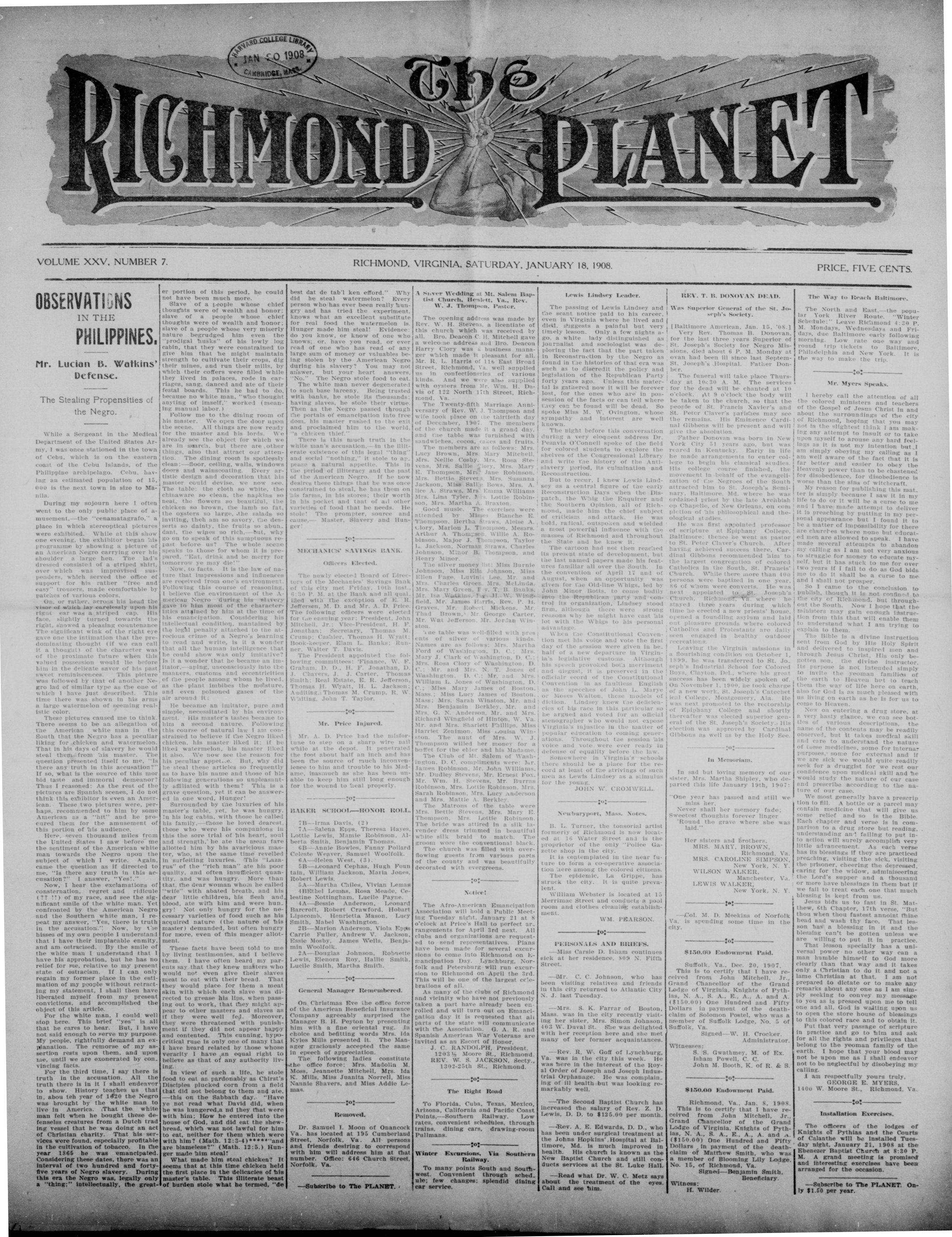
The RICHMOND PLANET
OBSERVATIONS IN THE PHILIPPINES.
Mr. Lucian B. Walkins' Defense.
The Stealing Propensities of the Negro.
While a Sergeant in the Medical Department of the United States Army, I was once stationed in the town of Cebu, which is on the eastern coast of the Cebu Islands, of the Philippine archipelago. Cebu, having an estimated population of 15,000 is the next town in size to Manila.
During my sojourn here I often went to the only public place of amusement,—the "cenamatagrafo," a place in which stereotypical pictures were exhibited. While at this show one evening, the exhibitor began his programme by showing a picture of an American Negro carrying over his shoulder a bag. The lad's dressed consisted of a striped shirt, over which was improvised suspenders, which served the office of support for his rather "free and easy" trousers, made comfortable by patches of various colors.
On, or rather, across his head the visor of which lay carelessly upon his rigid ear was a striped cap. His face, slightly turned towards the right, showed a pleasing countenance The significant wink of the right eye gave one the intimation that the predominating thought (if we can call it a thought) of the character was of the proximate future when this valued possession would lie before him in the delicate savor of his past sweet reminiscences. This picture was followed by that of another Negro lad of similar type as the one of which I have just described. This time there was shown in his arms a large watermelon of seeming realistic color. These pictures caused me to think. There seems to be an allegation of the American white man in the South that the Negro has a peculiar liking for chicken and watermelon. That in his days of slavery he would steal them from his master. The question presented itself to me, "Is there any truth in this accusation?" If so, what is the source of this morbid taste and immoral demeanor? Thus I reasoned: As the rest of the pictures are Spanish scenes, I do not think this exhibitor is even an American. These two pictures were, perhaps, recommended to him by some American as a "hit" and he procured them for the amusement of this portion of his audience.
Here, seven thousand miles from the United States I saw before me the sentiment of the American white man towards the Negro upon the subject of which I write. Again, came the question as if directed to me, "Is there any truth in this accusation?" I answer, "Yes!." Now, I hear the exclamations of consternation, regret and ridicule (??!!) of my race, and see the significant smile of the white man. Yet confronted by the American Negro and the Southern white man, I repeat my answer, "Yes, there is truth in the accusation." Now, by the blisses of my own people I understand that I have their implacable enmity, and am ostracised. By the smile of the white man I understand that I have his approbation, but he has no relief for me, relative to my present state of ostracism. If I can only regain my former place in the estimation of my people without retracting my statement, I shall then have liberated myself from my present convictions, and accomplished the object of this article.
For the white man, I could well stop here. This brief "yes" is all that he cares to hear. But, I have not said enough to serve my purpose. My people, rightly demand an explanation. The remorse of my assertion rests upon them, and upon me, until we are exonerated by convincing facts.
For the third time, I say there is truth in the accusation. All the truth there is in it I shall endeavor to show. History teaches us that in, abou teh year of 1620 the Negro was brought by the white man to live in America. That the white man felt when he bought these defensels creatures from a Dutch trad vessel that he was doing an act of Christian charity. That his services were found, especially profitable in the cultivation of tobacco. In the year 1865 he was emancipated. Considering these dates, there was an interval of two hundred and forty-five years of Negro slavery. During this era the Negro was, legally only a "thing:" intellectually the great-
er portion of this period, he could not have been much more.
not have been much more.
Slave of a people whose chief thoughts were of wealth and honor; slave of a people whose chief thoughts were of wealth and honor; slave of a people whose very miserly nature begrudged him even the "prodigal husks" of his lowly log cabin, that they were constrained to give him that he might maintain their crops, dig their mines, and endure their nails which their coffers were filled while they lived in palaces, rode in carriages, sang, danced and ate of their festal boards. This he had to do, because no white man, "who thought anything of myself" worked (meaning manual labor.)
Follow me to the dining room of his master. We open the door upon the scene. All things are now ready for the master and his lords. We already see the object for which we are in search, but there are other things, also that attract our attention. The dining room is spotlessly clean—floor, ceiling, walls, windows doors and wainscoating. Every artistic design and decoration that his master could devise, we now see. The table: the cloth so white, the chinaware so clean, the napkins so neat, the flowers so beautiful, the chicken so brown, the lamb so fat, the open, so large, the salads so deep, the them, so large, the salads so saintly, the fruits so abundant, the wines so rich,—but, why go on to speak of this sumptuous repast before us? The whole scene speaks to those for whom it is prepared, "Eat, drink and be merry for tomorrow ye may die!"
Now, to facts. It is the law of nature that impressions and influences are received from one's environment. Following this course of reasoning, I believe the environment of the American Negro during his slavery gave to him most of the characteristics attained by him at the time of his emancipation. Considering his intellectual condition, maintained by the leigh penalty attached to the atrocious crime of a Negro's learning to read and write, is it a wonder that all the human intelligence that he could show was only imitative? Is it a wonder that he became an imitator,—aping, unconsciously into the customs, customs and eccentricities of the people among whom he lived, as the plant imbibes the moisture, and even polished gases of the air around it.
He became an imitator, pure and simple, necessitated by his environment. His master's tastes became to him a second nature. Following this course of natural law I am constrained to believe if the Negro liked chicken, his master liked it: if he liked watermelon, his master liked it also. We now see the reason for his peculiar appet...e. But, why did he steal these articles so frequently as to have his name and those of his following generations so unpleasantly affiliated with them? This is a grave question, yet it can be answered in one word, Hunger!
Surrounded by the luxuries of his master's table, yet, he was hungry. In his log cabin, with those he called his family,—those he loved dearest, those who were his companions in this the sore trial of his heart, soul and strength, he ate the mean fare allotted him by his avaricious master, who, at the same time revelled in surfeiting luxuries. This "Lazarus" of the "rich man" ate his poor quality, and often insufficient quantity, and was hungry. More than that, the dear woman whom he called "wife" with abated breath, and his dear little children, his flesh and blood, ate with him and were hungry. Not only hungry for the necessary varieties of food such as his acquired nature (the nature of his master) demanded, but often hungry for more, even of this meager allotment.
These facts have been told to me by living testimonies, and I believe them. I have often heard my parents say that they knew masters who would not even give their slaves meat to eat with their bread. That they would place for them a meat skin with which each slave was directed to grease his lips, when passing out to work, that they might appear to other masters and slaves as if they were well fed. Moreover, they were threatened with punishment if they did not appear happy and contented. This cunning, hypocritical ruse is only one of many that I have heard related by those whose veracity I have an equal right to believe as that of any authority living.
In view of such a life, he stole food to eat as pardonably as Christ's Disciples plucked corn from a field that did not belong to them and ate—this on the Sabbath day. "Have ye not read what David did, when he was hungered, and that they were with him; How he entered into the house of God, and did eat the shewbread, which was not lawful for him to eat, neither for them which were with him? (Math. 12:3-4)****and are blameless?" (Math. 12:5.) Hunger made him steal!
What made him steal chicken? It seems that at this time chicken held the first place in the delicacies of his master's table. This illiterate beast of burden stole what he termed. "de
RICHMOND, VIRGINIA, SATURDAY, JANUARY 18, 1908
best dat de tab'l ken efford." Why did he steal watermelon? Every person who has ever been really hungry and has tried the experiment, knows what an excellent substitute for real food the watermelon is. Hunger made him steal! Evidence: do you know, or know of one who knows, or. have you read, or ever read of one who has read of any large sum of money or valuables being stolen by the American Negro during his slavery? You may not answer, but your heart answers, "No." The Negro stole food to eat. The white man never degenerated to such base larceny. Being trusted with banks, he stole its thousands; having slaves, he stole their virtue. Then as the Negro passed through the portals of emancipation into free dom, his master rushed to the exit and proclaimed him to the world, "a chicken thief." There is this much truth in the white man's accusation,—in the illiterate existence of this legal "thing" and social "nothing," it stole to appease a natural appetite. This in the period of illiteracy and the past of the American Negro. If he now desires these things that he was once constrained to steal, he has them on his farms, in his stores; their worth in his pocket and that of all other varieties of food that he needs. He stole! The prompter, source and cause,— Master, Slavery and Hunger.
MECHANICS' SAVINGS BANK
Officers Elected.
The newly elected Board of Directors of the Mechanics' Savings Bank of this city met Friday, 10th inst. 6:30 P. M. at the Bank and all qualified with the exception of E. R. Jefferson, M. D. and Mr. A. D. Price The following officers were elected for the ensuing year: President, John Mitchell, Jr.; Vice-President, H. F. Jonathan; Secretary, Thomas M. Crump; Cashier, Thomas H. Wyatt; Book-keeper, Elam L. Banks; Runner, Walter T. Davis. The President appointed the following committees: Finance, W. F. Crahm, D. H. F. Dathan, D. J. Dhullery, J. Carson, Thomas Smith; Real Estate, E. R. Jefferson Thomas H. Wyatt, L. H. Jackson; Auditing, Thomas M. Crump, R. W. Waiting, John T. Taylor.
Mr. Price Injured.
Mr. A. D. Price had the mistor tune to step on a sharp wire nail while at the depot. It penetrated the foot about half an inch and has been the source of much inconvenience to him and trouble to his Madame, inasmuch as she has been un able to keep him still long enough for the wound to heal properly.
BAKER SCHOOL—HONOR ROLL
B—Irma Davis, (2)
7A—Salena Epps, Theresa Hayes,
Lottie Lewis, Mamie Robinson, Al-
berta Smith, Benjamin Thomas.
6B—Annie Bowles, Fanny Pollard
Celeste Weaver, Samuel Woolfolk.
6A—Helen West, (3).
5B—Leonard Cephas, Hugh Foun
tain, William Jackson, Maria Jones,
Robert Lewis.
5A—Martha Cailes, Vivian Lemas
4BEthel Lemas, Rosa Meade, Celestine
Nottingham, Lucile Payne.
4A—Bessie Anderson, Leonard
Barcroft, Robert Crawford, Hobart
Lipscomb, Henrietta Mason, Lucy
Smith, Mabel Washington.
2B—Marion Anderson, Viola Epps
Carrie Fuller, Andrew V. Jackson,
Essie Mosby, James Wells, Benjamin
Woolfolk.
2A—Douglas Johnson, Robette
Lewis, Elenora Roy, Hallie Smith,
Lucie Smith, Smith.
General Manager Remembered.
On Christmas Eve the office force of the American Beneficial Insurance Company agreeably surprised the Manager B. H. Peyton by presenting him with a fine oriental rug. in choice and befitting words Mrs. Ida Kyles Mills presented it. The Manager graciously accepted the same in epech of appreciation. The following ladies constitute the office force: Mrs. Madolin M. Moss, Jeannette Mitchell, Mrs. Ida K. Mills, Miss Juanita Norrell, Miss Nannie Shavers, and Miss Addie Lemas.
Dr. Samuel L. Moon of Onancock Va. has located at 195 Cumberland Street, Norfolk, Va. All persons and friends desiring to correspond with him will address him at that number. Office: 646 Church Street, Norfolk, Va.
—Subscribe to The PLANET.
A Silver Wedding at M. Salem Baptist Church, Hewlett, Va., Rev. W. J. Thompson, Pastor.
The opening address was made by Rev. W. H. Stevens, a licentiate of this church which was received by all. Bro. Deacon C. H. Mitchell gave a welcome address and Bro. Deacon Harry Clory was a business manager which made it pleasant for all. Mr. R. L. Harris of 116 East Broad Street, Richmond, Va. well supplied us in confectioneries of various kinds. And we were also supplied with oysters from Mr. Wm. H. Davis of 122 North 17th Street, Richmond, Va.
The Twenty-fifth Marriage Anniversary of Rev. W. J. Thompson and wife took place on the thirtieth day of December, 1907. The members of the church made it a grand day, and the table was furnished with sandwiches and cakes and fruits. The members are a fellow Mr. Lucy Brown, Mrs. Mary Mitchell, Mrs. Nellie Cosby, Mrs. Rosa Stevens, Mrs. Sallie Clory, Mrs. Mary E. Thompson, Mrs. Jane Robinson, Mrs. Bettie Stevens Mrs. Susanna Jackson, Miss Sallie Bows, Mrs. Alice A. Straws, Mrs. Emma Williams Mrs. Lina Tyler, Mrs. Lottie Robinson, Mrs. Martha A. Braxton.
The Club of Mt. Salem of Washington, D.C. compliments were: Mr. James Robinson, Mr. John Williams, Mr. Dudley Stevens, Mr. Ernest Fox, Mr. Wm. H. Stevens, Mr. Burrass Robinson, Mrs. Lottie Robinson, Mrs. Sarah Robinson, Mrs. Lucy Anderson and Mrs. Mattie A. Berkley.
The Matrons of the table were Mrs. Bettie Stevens, Mrs. Mary E. Thompson, Mrs. Lottie Robinson.
The bride was attired in a silk lavender dress trimmed in beautiful white silk braid to match. The groom wore the conventional black.
The church was filled with overflowing guests from various parts of the county and was beautifully decorated with evergreens.
Notice!
The Afro-American Emancipation Association will hold a Public Meeting Tuesday night, January 21 at 8 o'clock at Price's Hall to perfect ar. ranglements for April 3rd next. All clubs and organizations are requested to send representatives. Plans have been made for several excursions to come into Richmond on Emancipation Day. Lynchburg, Norfolk and Petersburg will run excursion to Richmond on April the 3rd. This will be one of the largest celebrations of all.
As many of the clubs of Richmond and vicinity who have not previously taken a part have already been enrolled and will turn out on Emancipation day it is requested that all parts of the state will communicate with the Association. G. A. R. and Spanish American War Veterans are invited as an Escort of Honor.
J. C. RANDOLPH, President.
1203 ½ Moore St., Richmond.
REV. W. S. JACKSON, Secty.
1302-25th St., Richmond.
The Right Road
To Florida, Cuba, Texas, Mexico, Arizona, California and Pacific Coast Points.—Southern Railway. Low rates, convenient schedules, through trains, dining cars, drawing-room Pullmans.
Winter Excursions, Via Southern Railway.
To many points South and Southwest. Convenient through schedule; few changes; splendid dining car service.
Lewis Lindsey Leader
The passing of Lewis Lindsey and the scant notice paid to his career, even in Virginia where he lived and died, suggests a painful but very timely lesson. Only a few nights ago, a white lady distinguished as journalist and sociologist was deploring the fact that the part taken in Reconstruction by the Negro as found in the histories of that era was such as to discredit the policy and legislation of the Republican Party forty years ago. Unless this material is gathered now it will be forever lost, for the ones who are in possession of the facts or can tell where they can be found will be dead. So spoke Miss M. W. Ovington, whose sympathy and interest are well known.
The night before this conversation during a very eloquent address Dr. Pezavia O'Connell spoke of the field for colored students to explore the shelves of the Congressional Library and write the history of the Antislavery period, its culmination and Reconstruction. But to recur, I knew Lewis Lindsey as a central figure of the early Reconstruction Days when the Dispatch, the Waig the Enquirer and the Southern Opinion, all of Richmond, made him the chief subject of criticism and attack. He was bold, radical, outspoken and wielded a most powerful influence with the masses of Richmond and throughout the State and he knew it.
The cartoon had not then reached its present state of development, but the last named papers made his features familiar all over the South. In the convention of April 17 and of August, when an opportunity was given for the Old-line Whigs, led by John Minor Botts, to come bodily into the Republican party and control its organization, Lindsey stood firm, although there were strong reasons why he might have cast 'als lot with the Whigs to his personal advantage.
When the Constitutional Convention met his voice and vote the first day of the session were given in be-half of a new departure in Virginia's legislative customs. Although his speech provoked both merriment and disgust, it is preserved in the official record of the Constitutional Convention in as faultless English as the speeches of John L. Marye or Moses Walton, those models of diction. Lindsey knew the deficiencies of his race in this particular so he argued and voted for an official stenographer who would not expose Virginia's injustice in the matter of popular education to coming generations. Throughout the session 'als voice and vote were ever ready in defense of equality before the law. Somewhere in Virginia's schools there should be a place for the record at least of the strivings of such men as Lewis Lindsey as a stimulus for the young.
JOHN W. CROMWELL.
Newburyport, Mass. Notes.
B. L. Turner, the tonsorial artist formerly of Richmond is now located at 16 Water Street and is the proprietor of the only "Police Gazette shop in the city. It is contemplated in the near future to form a co-operative association were among the colored citizens. The epidemic, La Gripe, has struck the city. It is quite prevalent. William Webster is located at 15 Merrimac Street and conducts a pool room and clothes cleaning establishment. WM. PEARSON.
PERSONALS AND BRIEFES
—Miss Carsie D. Isham continues sick at her residence, 809 N. Fifth Street.
—Mr. C. C. Johnson, who has been visiting relatives and friends in this city returned to Atlantic City N. J. last Tuesday.
—Mrs. S. K. Farrar of Boston, Mass. was in the city recently visiting her sister, Mrs. Simon Johnson, 403 W. Duval St. She was delighted with her reception here and she met many of her former acquaintances.
—Rev. R. W. Goff of Lynchburg, Va. was in the city this week. He was here in the interest of the Royal Order of Joseph and Joseph Industrial Orphanage. He was complaining of ill health but was looking remarkably well.
—The Second Baptist Church has increased the salary of Rev. Z. D. Lewis, D. D. to $125.00 per month.
—Rev. A. E. Edwards, D. D., who has been under surgical treatment at the Johns Hopkins' Hospital at Baltimore, Md. is much improved in health. His church is known as the New Baptist Church and still conducts services at the St. Luke Hall.
—Read what Dr. W. C. Metz says about the treatment of the eyes. Call and see him.
REV. T. B. DONOVAN DEAD.
Was Superior General of the St. Joseph's Society.
[Baltimore American, Jan. 15, '08.] Very Rev. Thomas B. Donovan, for the last three years Superior of St. Joseph's Society for Negro Missions, died about 6 P. M. Monday at ovan had been ill since last Septem St. Joseph's Hospital. Father Donber.
The funeral will take place Thursday at 10:30 A. M. The services for the dead will be chanted at 10 o'clock. At 9 o'clock the body will be taken to the church, so that the people of St. Francis Xavier's and St. Peter Claver's parishes may see the remains. His Eminence Cardinal Gibbons will be present and will give the absolution.
Father Donovan was born in New York City 51 years ago, but was reared in Kentucky. Early in life he made arrangements to enter college to be himself his classical studies. His college course was the english, the movement in behalf of the evangelization of the Negroes of the South attracted him to St. Joseph's Seminary. Baltimore, Md. where he was ordained priest by the late Archibald op Chapelle, of New Orleans, on completion of his philosophical and theological studies.
He was first appointed professor of scripture at Epiphany College, Baltimore; thence he went as pastor to St. Peter Claver's Church. After having achieved success there, Cardinal Gibbons recommended 'him to the largest congregation of colored Catholics in the South, St. Franck's Church. While there more than 400 persons were baptized in one year, 86 of whom were converts. He was next appointed to St. Joseph's Church, Richmond, Va. where he stayed three years during which time he erected a new priest's house, opened a foundling asylum and laid out pleasure grounds where colored Catholics and Protestants are daily seen engaged in healthy outdoor recreations.
Leaving the Virginia missions in a flourishing condition on October 1, 1899, he was transferred to St. Joseph's Industrial School for Colored Boys, Clayton, Del., where his great success has been widely spoken of. On November 1, 1900, he took charge of a new work, St. Joseph's Catechetical College, Montgomery, Ala. He was next promoted to the rectorship of Epiphany College and shortly thereafter was elected superior general of the St. Joseph's Society. His election was approved by Cardinal Gibbons as well as by the Holy See.
In Memoriam.
In sad but loving memory of our
sister, Mrs. Martha Shipley, who departed this life January 19th, 1907:
"One year has passed and still we
miss her.
Never shall her memory fade;
Sweetest thoughts forever linger
'Round the grave where she was
laid."
Her sisters and brothers.
MRS. MARY, BROWN,
Richmond, Va.
MRS. CAROLINE SIMPSON,
New York, N. Y.
WILSON WALKER,
Manchester, Va.
LEWIS WALKER,
New York, N. Y.
Col. M. D. Meekins of Norfolk
Va. is spending some time in the
city.
$150.00 Endowment Paid.
Suffolk, Va., Dec. 20, 1907.
This is to certify that I have received from John Mitchell, Jr.,
Grand Chancellor of the Grand Lodge of Virginia, Knights of Pythias, N. A., S. A., E., A., A. and A. ($150.00) One Hundred and Fifty Dollars in payment of the death-claim of Solomon Postel, who was a member of Suffolk Lodge, No. 5 of Suffolk, Va.
Signed—W. H. Crocker.
Administrator.
Witnesses:
S. S. Gwathmey, M. of Ex.
Isham Powell, C. C.
John M. Booth, K. of R. & S.
$150.00 Endowment Paid.
Richmond, Va., Jan. 8, 1908.
This is to certify that I have received from John Mitchell, Jr.,
Grand Chancellor of the Grand
Lodge of Virginia, Knights of Pythias,
N. A., S. A., E., A., A. and A.
($150.00) One Hundred and Fifty
Dollars in payment of the death-
claim of Matthew Smith, who was
a member of Blooming Lily Lodge,
No. 15, of Richmond, Va.
Signed—Benjamin Smith
Beneficiary.
Witness:
H. Wilder.
The Way to Reach Baltimore
The North and East,—the popular York River River Route. "Winter Schedule:" Leave Richmond 4:30 P. M. Mondays, Wednesdays and Fridays, due Baltimore early following low rate one way and round trip to Baltimore, Philadelphia and New York. It is the way to make the trip.
Mr. Myers Speaks
I hereby call the attention of all the colored ministers and teachers of the Gospel of Jesus Christ in and about the surroundings of the city of Richmond, hoping that you may not in the slightest best think I am making any attempt to insult or to take upon myself to arouse any hard feelings as it is not my intention but I am simply obeying my calling as I am well aware of the fact that it is far better and easier to obey the Heavenly power than to be chastened for disobedience, for disobedience is worse than the sins of witchcraft.
My reason for publishing this matter is simply because I saw it in my life to do or it will be a curse to me and I have made attempt to deliver it in preaching by putting in my personal appearance but I found it to be a matter of impossibility for there are charches where none but educated men are allowed to speak. I have made several attempts to abandon my calling as I am not very anxious to struggle for money to educate myself, but has stuck to me for over two years if I fail to do as God bids me to do it shall be a curse to me and I shall not prosper.
So I came to the conclusion to publish, though it is not confined to the city of Richmond, but throughout the South. Now I hope that the ministers may gain enough instruction from this that will enable them to understand what I am trying to explain to them.
The Bible is a divine instruction sent from God by His Holy Spirit and delivered to inspired men and through Jesus Christ. His only be-gotten son, the divine instructor, its purpose is not intended simply to invite the yeoman families of the earth to Heaven but to teach them the way of life here on earth, also for God is as much pleased with us living on earth as he is for us to come to Heaven.
Now on entering a drug store, at a very hasty glance, we can see bottles of various descriptions, the name of the contents may be readily observed, but it takes medical skill and care to understand the nature of these medicines, some for internal purposes, some for external and if we are slick we would quite readily seek for a druggist for we rest our confidence upon medical skill and he would study the nature of our case and prescribe according to the nature of our case.
We most generally have a prescrip tion to fill. A bottle or a parcel may contain medicine that will give us some relief and so is the Bible. Each chapter and verse is in comparison to a drug store but reading, understanding and failing to put in action will ultimately accomplish very little advancement. As each verse has its blessings if we are practiced preaching, visiting the sick, visiting the prisoner, cheering the depressed, caring for the widow, administering the Lord's supper and a thousand or more have blessings in them but if we fail to treat each one that much blessing is kent from us.
Jesus bids us to fast in St. Matthew, 5th Chapter, 17th verse, "But thou when thou fastest annoint thine head and wash thy face. That lesson has a blessing in it and the blessing can't be gotten unless we are willing to put it in practice. That lesson specially has a universal power no other way can a man humble himself to God more clearly than that way and it takes only a Christian to do it and not a lame Christian at that. I am not prepared to dictate or to make any remarks about any one as I am simply seeking to convey my message to you as is pressed upon me to tell one and all, God is waiting upon us to open the store house of blessings to this colored race and to obtain it. Put that very passage of scripture in practice and go to him and ask for all the rights and privileges that belong to the yeoman family of the earth. I hope that your blood may not be upon me as I shall endeavor not to be neglectful by disobeying my calling.
I am respectfully yours truly,
GEORGE E. MYERS,
1400 W. Moore St., Richmond, Va.
Installation Exercises.
The officers of the lodges of
Knights of Pythias and the Courts
of Calanthe will be installed Tuesday
night, January 21, 1908 at the
Ebenezer Baptist Church at 8:30 P.
M. A grand meeting is promised
and interesting exercises have been
arranged for the occasion.
—Subscribe to the PLANET. Only
$1.50 per year.
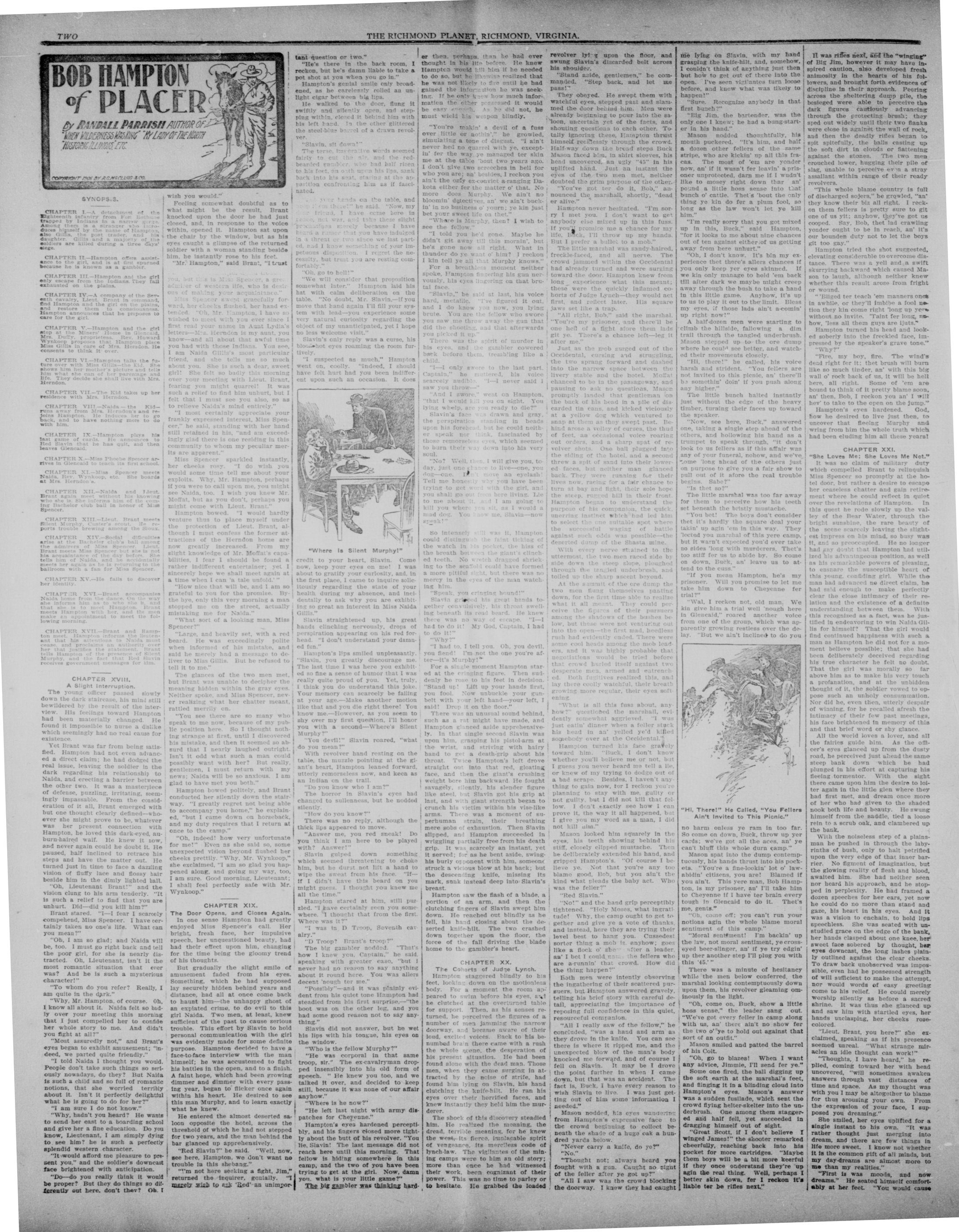
BOB HAMPTON
of PLACER
By RANDALL PARRISH AUTHOR OF
"WHEN WILDERNESS WASKING" "MY LADY OF THE NORTH
HISTORIC ILLINOIS, ETC.
COPYRIGHT 1906 BY R.G.MECLURG B.O.O.
TWO
SYNOPSIS.
CHAPTER I.—A detachment of the Eighteenth infantry from Fort Bethune trapped by Indians in a narrow gorge, duces himself by the name of Hampion, also Gillis, the post trader, and his daughter. Gillis and a majority of the duces are killed during a three days' siege.
CHAPTER II.—Hampton offers assistance to the girl and is at first spurned because he is known as a gambler.
CHAPTER III.—Hampton and the girl only escape from the Indians. They fall exhausted on the plains.
CHAPTER IV.—A company of the Seventh cavalry, Lleut. Brant in command, find Hampion the girl on the plains, and restore them to command. Hampton announces that he proposes to care for the girl.
CHAPTER V.—Hampton and the girl stop at the Miners' Home in Glencail, Mrs. Duffy, proprietress. Rev. Howard stop proposes that Hampton place Miss Gillis in care of Mrs. Hendon. He consents to think it over.
CHAPTER VI.-Hampton talks the future over with Miss Gillis—the Kid. She shows him her mother's picture and tells him that she has a paraphrase and life. They decide she shall live with Mrs. Herndon.
CHAPTER VII.-The Kid takes up her residence with Mrs. Herndon.
CHAPTER VIII.-Nalda—the Kid runs away from Mrs. Herndon's and rejoins Hampton. He induces her to go back, and to have nothing more to do with him.
CHAPTER IX.-Hampton plays his last game of cards. He announces to Red that he has quit, and then leaves Glencaid.
CHAPTER X.-Miss Phoebe Spencer arrives in Glencaid to teach its first school.
CHAPTER XI.-Miss Spencer meets Nalda. Rev. Wynkoop, etc. She boards at Mrs. Herndon'a.
CHAPTER XII.-Nalda and Leit. Brant again meet without his knowing what is. He informs him of the college club ball in honor of Miss Spencer.
CHAPTER XIII.-Lleut. Brant meets Murphy, Custer's scout. He reports trouble brewing among the Sioux.
CHAPTER XIV—Social difficulties arise at the Bachelor club's ball among admirers of Miss Spencer. Lieut. Brant meets Miss Spencer, but she is not his acquaintance of the day before. She tells him of Naida, and he accidentally meets her again as he is returning to the ballroom with a fan for Miss Spencer.
CHAPTER XV.—He fails to discover her identity.
CHAPTER XVI—Brant accompanies Naida home from the dance. On the way she informs him as to who she is, and that she is to meet Hampton. Brant meets Hampton with her, and the men treatment to meet the following morning.
CHAPTER XVII—Brant and Hampton meet Hampton informing that his attention in Naida may cause, and proclaims an authority over her that justifies the statement. Brant meets the presence of Murphy and the fainting Red Shuv receives government messages for him.
CHAPTER XVIII
A Slight Interruption
The young officer passed slowly down the dark staircase, his mind still bewildered by the result of the interview. His feelings toward Hampton had been materially changed. He found it impossible to nurse a dislike which seemingly had no real cause for existence.
Yet Brant was far from being satisfied. Hampton had not even advanced a direct claim; he had dodged the real issue, leaving the soldier in the dark regarding his relationship to Nalda, and erecting a barrier between the other two. It was a masterpiece of defense, puzzling, irritating, seemingly impassable. From the consideration of it all, Brant emerged with but one thought clearly defined—whoever she might prove to be, whatever was her present connection with Hampton, he loved this dark-eyed, auburn-haired waff. He knew it now, and never again could he doubt it. He paused, half inclined to retrace his steps and have the matter out. He turned just in time to face a dazzling vision of fluffy lace and flossy hair beside him in the dimly lighted hall. "Oh, Lieutenant Brant!" and the vision clung to his arm tenderly. "It is such a relief to find that you are unhurt. Did—did you kill him?"
Brant stared. "I—I fear I scarcely compehend, Miss Spencer. I have certainly taken no one's life. What can you mean?"
"Oh, I am so glad; and Naida will be, too. I must go right back and tell the poor girl, for she is nearly distracted. Oh, Lieutenant, isn't it the most romantic situation that ever was? And he is such a mysterious character!"
"To whom do you refer? Really, I am quite in the dark."
"Why, Mr. Hampton, of course. Oh, I know all about it. Naida felt so badly over your meeting this morning that I just compelled her to confide her whole story to me. And didn't you fight at all?"
"Most assuredly not," and Brant's eyes began to exhibit amusement; "indeed, we parted quite friendly."
"I told Naida I thought you would. People don't take such things so seriously nowadays, do they? But Naida is such a child and so full of romantic notions, that she worried terribly about it. Isn't it perfectly delightful what he is going to do for her?"
"I am sure I do not know."
"Why, hadn't you heard? He wants to send her east to a boarding school and give her a fine education. Do you know, Lieutenant, I am simply dying to see him? he is such a perfectly splendid western character.
"It would afford me pleasure to present you," and the soldier's downcast face brightened with anticipation.
"Do—do you really think it would be proper? But they do things so differently out here, don't they? Oh.
wish you would."
Feeling somewhat doubtful as to what might be the result, Brant knocked upon the door he had just closed, and, in response to the voice within, opened it. Hampton sat upon the chair by the window, but as his eyes caught a glimpse of the returned soldier with a woman standing beside him, he instantly rose to his feet.
"Mr. Hampton," said Brant, "it must you, but this is Miss Spencer, a great admirer of western life, who is desirous of making your acquaintance."
Miss Spencer gracefully forward, her cheeks flushed, her hand extended. "Oh, Mr. Hampton, I have so wished to meet with you ever since I first read your name in Aunt Lydia's letters—Mrs. Hernden is my aunt, you know—and all about that awful time you had with those Indians. You see, I am Naida Gillis's most particular friend, and she tells me so much about you. She is such a dear, sweet girl! She felt so badly this morning over your meeting with Lieut. Brant, fearing you might quarrel! It was such a relief to find him unhurt, but I felt that I must see you also, so as to relieve Naida's mind entirely."
"I most certainly appreciate your frankly expressed interest, Miss Spencer," he said, standing with her hand still retained in his, "and am exceedingly glad there is one residing in this community to whom my peculiar merits are apparent."
Miss Spencer sparkled instantly, my cheeks cries, "I do wish you would some time tell me about your exploits. Why, Mr. Hampton, perhaps if you were to call upon me, you might see Naida, too. I wish you knew Mr. Moffat, but as you don't, perhaps you might come with Lieut. Brant."
Hampton bowed. "I would hardly venture thus to place myself under the protection of Lieut. Brant, although I must confess the former attractions of the Herndon home are now greatly increased. From my slight knowledge of Mr. Moffat's capabilities, I fear I should be found a rather indifferent entertainer; yet I sincerely hope we shall meet again at a time when I can 'a tale unfold.'"
"How nice that will be, and I am so grateful to you for the promise. By the bye, only this very morning a man stopped me on the street, actually mistaking me for Naida."
"What sort of a looking man, Miss Spencer?"
"Large, and heavily set, with a red beard. He was exceedingly polite when informed of his mistake, and sald he merely had a message to deliver to Miss Gillis. But he refused to tell it to me."
The glances of the two men met, but Brant was unable to decipher the meaning hidden within the gray eyes. Neither spoke, and Miss Spencer, never realizing what her chatter meant, rattled merrily on.
"You see there are so many who speak to me now, because of my public position here. So I thought nothing strange at first, until I discovered his mistake, and then it seemed so absurd that I nearly laughed outright. Isn't it odd what such a man could possibly want with her? But really, gentlemen, I must return with my news; Naida will be so anxious. I am glad to have met you both."
Hampton bowed politely, and Brant conducted her silently down the stairway. "I greatly regret not being able to accompany you home," he explained, "but I came down on horseback, and my duty requires that I return at once to the camp."
"Oh, indeed! how very unfortunate for me!" Even as she said so, some unexpected vision beyond flushed her cheeks prettily. "Why, Mr. Wynkoop, she exclaimed, "I am so glad you happened along, and going my way, too, I am sure. Good morning, Lieutenant; I shall feel perfectly safe with Mr. Wynkoop."
CHAPTER XIX.
The Door Opens, and Closes Again.
In one sense Hampton had greatly enjoyed Miss Spencer's call. Her bright, fresh face, her impulsive speech, her unquestioned beauty, had had their effect upon him, changing for the time being the gloomy trend of his thoughts.
But gradually the slight smile of amusement faded from his eyes. Something, which he had supposed lay securely hidden behind years and distance, had all at once come back to haunt him—the unhappy ghost of an explated crime, to do evil to this girl Naida. Two men, at least, knew sufficient of the past to cause serious trouble. This effort by Slavin to hold personal communication with the girl was evidently made for some definite purpose. Hampton decided to have a face-to-face interview with the man himself; he was accustomed to fight his battles in the open, and to a finish. A faint hope, which had been growing dimmer and dimmer with every passing year, began to flicker once again within his heart. He desired to see this man Murphy, and to learn exactly what he knew.
He entered the almost deserted saloon opposite the hotel, across the threshold of which he had not stepped for two years, and the man behind the bar glanced up apprehensively.
"Red Slavin?" he said. "Well, now, see here, Hampton, we don't want no trouble in this shebang."
"I'm not here seeking a fight, Jim," returned the inquirer, genially. "I merely wish to ask 'Red' an unimpor-
THE RICHMOND PLANET. RICHMOND. VIRGINIA
tant question or two."
"He's there in the back room, I reckon, but he's damn liable to take a pot shot at you when you go in."
Hampton's genial smile only broadened, as he carelessly rolled an unlight cigar between big lips.
He walked to the door, flung it swiftly and silently open, and stepping within, closed it behind him with his left hand. In the other glittered the steel-blue barrel of a drawn revolver.
"Slavin, sit down!"
The terse, imperative words seemed fairly to cut the air, and the red-bearded gambler, who had half risen to his feet, an outh upon his lips, sank back into his seat, staring at the apartment confronting him as if fascinated.
take your hands on the table, and
come in there!" he said. "Now, my
dear friend, I have come here in
peace, not war, and take these slight
procedures merely because I have
heard a rumor that you have indulged
in a threat or two since we last parted,
and I know something of your impetuous disposition. I regret the necessity, but trust you are resting comfortably."
"Oh, go to hell!"
"We will consider that proposition
somewhat later." Hampton laid his
hat with calm deliberation on the
table. "No doubt, Mr. Slavin,—if you
move that hand again I'll fill your system
with lead—you experience some
very natural curiosity regarding the
object of my unanticipated, yet I hope
no less welcome visit."
Slavin's only reply was a curse, his
blood-hot eyes roaming the room furtively.
"I suspected as much." Hampton went on, coolly. "Indeed, I should have felt hurt had you been indifferent ent upon such an occasion. It does
"Where Is Silent Murphy!"
credit to your heart, Slavin. Come now, keep your eyes on me! I was about to gratify your curiosity, and, in the first place, I came to inquire solicitously regarding the state of your health during my absence, and indecently to ask why you are exhibiting so great an interest in Miss Naida Gillas." Slavin straightened up, his great hands clinching nervously, drops of perspiration appearing on his red forhead. "I don't understand your damned fun."
Hampton's lips smiled unpleasantly.
"Slavin, you greatly discourage me.
The last time I was here you exhibited so fine a sense of humor that I was really quite proud of you. Yet, truly, I think you do understand this joke.
Your memory can scarcely be falling at your age—Make another motion like that and you die right there! You know me—However, as you seem to shy over my first question, I'll honor you with a second—Where's the Silent Murphy?"
"You devil!" Slavin roared, "what do you mean?"
With revolver hand resting on the table, the muzzle pointing at the giant's heart, Hampton leaned forward, utterly remorseless now, and keen as an Indian on the trail.
"Do you know who I am?"
The horror in Slavin's eyes had changed to sullenness, but he nodded silently.
"How do you know?"
There was no reply, although the thick lips appeared to move.
"Answer me, you red sneak! Do you think I am here to be played with? Answer!"
Slavin gulped down something which seemed threatening to choke him, but he durs not lift a hand to wipe the sweat from his face. "If—if I didn't have this beard on you might guess. I thought you knew me all the time."
Hampton stared at him, still puzzled. "I have certainly seen you somewhere. I thought that from the first. Where was it?"
"I was in D Troop, Seventh cavalry."
"D Troop? Brant's troop?"
The big gambler nodded. "That's how I knew you, Captain," he said, speaking with greater ease, "but I never had no reason to say anything about it round here. You was allers decent 'nough ter me."
"Possibly"—and it was plainly evident from his quiet tone Hampton had steadied from his first surprise,—"the boot was on the other leg, and you had some good reason not to say anything."
Slavin did not answer, but he wet his lips with his tongue, his eyes on the window.
"Who is the fellow Murphy?"
"He was corporal in that same troop, sir." The ex-cavalryman dropped insensibly into his old form of speech. "He knew you too, and we talked it over, and decided to keep still, because it was none of our affair anyhow."
"Where is he now?"
"He left last night with army dispatches for Cheyenne."
Hampton's eyes hardened perceptibly, and his fingers closed more tightly about the butt of his revolver. "You lie, Slavin! The last message did not reach here until this morning. That fellow is hiding somewhere in this camp, and the two of you have been trying to get at the girl. Now, damn you. what is your little game?"
The big gambler was thinking hard-
or then, perhaps, than he had ever thought in his life before. He knew Hampton would kill him if he needed to do so, but he likewise realized that he was not likely to fire until he had gained the information he was seeking. If he only knew how much information the other possessed it would be easy enough. As he did not, he must wield his weapon blindly.
"You're makin' a devil of a fuss over little or nothin'," he growled, simulating a tone of disgust. "I ain't never hed no quarrel with ye, exceptin' fer the way ye managed ter skin me at the table 'bout two years ago. I don't give two screeches in hell for who you are; an' besides, I reckon you ain't the only ex-convict a-ranging Dakota either for the matter o' that. No more does Murphy. We ain't no bloomin' detectives, an' we ain't buckin' in no business o' yourn; ye kin just bet your sweet life on that."
"Whate is Murphy, then? I wish to see the fellow."
"I told you he'd gone. Maybe he didn't git away till this morale, but he's gone now all right. What in thunder do ye want o' him? I reckon I kin tell ye all that Murphy knows."
For a breathless moment neither spoke, Hampton fingering his gun nervously, his eyes lingering on that brutal face.
"Slavin," he said at last, his voice hard, metallic. "I've figured it out, and I do know you now, you lying brute. You are the fellow who swore you saw me throw away the gun that did the shooting, and that afterwards you picked it up."
There was the spirit of murder in his eyes, and the gambler cowered back before them, trembling like a child.
"I—I only swore to the last part, Captain," he muttered, his voice scarcely audible. "I—I never said I saw you throw—"
"And I swore," ween on Hampton,
"that I would kill you on sight. You
lying whelp, are you ready to die?"
Slavin's face was drawn and gray,
the perspiration standing in beads
upon his forehead, but he could neither
speak nor think, fascinated by
those remorseless eyes, which seemed
to burn their way down into his very
soul.
"No? Well, then, I will give you, today,
just one chance to live—one, you
dog—one. I don't move an eyelash!
Tell me honestly why you have been
trying to get word with the girl, and
you shall go out from here living. Lie
to me about it, and I am going to
kill you where you sit, as I would a
mad dog. You know me, Slavin—now
speak!"
So intensely still was it, Hampton could distinguish the faint ticking of the watch in his pocket, the hiss of the breath between the giant's clenched teeth. No wretch dragged shrieking to the scaffold could have formed a more pitiful sight, but there was no mercy in the eyes of the man watching him.
"Speak, you cringing hounds!"
Slavin grinned his great hands together convulsively, his throat swelling beneath its read beard. He knew there was no way of escape. "I—I had to do it!" My God, Captain, I had to do it!
"Why?"
"I had to, I tell you. Oh, you devil, you fiend! I'm not the one you're after—it's Murphy!"
For a single moment Hampton starred at the cringing figure. Then suddenly he rose to his feet in decision. "Stand up! Lift up your hands first, you fool. Now unbuckle your gunbelt with your left hand—your left, I said! Drop it on the floor."
There was an unusual sound behind, such as a rat might have made, and Hampton glanced aside apprehensively. In that single second Slavin was upon him, grasping his pistol-arm at the wrist, and striving with hairy hand to get a death-grip about his throat. Twice Hampton's left drove straight out into that red, gloating face, and then the giant's crushing weight bore him backward. He fought savagely, silently, his slender figure like steel, but Slavin got his grip at last, and with giant strength began to crunch his victim within his vise-like arms. There was a moment of superhuman strain, their breathing mere sobs of exhaustion. Then Slavin slipped, and Hampton succeeded in wriggling partially free from his death grip. It was scarcely an instant, yet it served; for as he bent aside, swings his burly opponent with him, someone struck a vicious blow at his back; but the descending knife, missing its mark, sank instead deep into Slavin's breast.
Hampton saw the flash of a blade, a portion of an arm, and then the clutching fingers of Slavin swept him down. He reached out blindly as he fell, his hand closing about the deserted knife-hilt. The two crashed down together upon the floor, the force of the fall driving the blade home to the gambler's heart.
CHAPTER XX
The Cohorts of Judge Lynch.
Hampton staggered blindly to his feet, looking down on the motionless body. For a moment the room appeared to swim before his eyes, and he clutched at the overturned table for support. Then, as his senses returned, he perceived the figures of a number of men jamming the narrow doorway, and became aware of their loud, excited voices. Back to his numbed brain there came with a rush the whole scene, the desperation of his present situation. He had been found alone with the dead man. Those men, when they came surging in attracted by the noise of strife, had found him lying on Slavin, his hand clutching the knife-hilt. He ran his eyes over their horrified faces, and knew instantly they held him the murderer.
The shock of this discovery steadied him. He realized the meaning, the dread, terrible meaning, for he knew the west, its fierce, immanable spirit of vengeance, its merciless code of lynch-law. The vigilantes of the mining camps were to him an old story; more than once he had witnessed their work, been cognizant of their power. This was no time to parley or to hesitate. He grabbed the loaded
revolver lying upon the floor, and swung Slavin's discarded belt across his shoulder.
"Stand aside, gentlemen," he commanded. "Step back, and let me pass!"
They obeyed. He swept them with watchful eyes, stepped past and slammed the door behind him. Men were already beginning to pour into the saloon, uncertain yet of the facts, and shouting questions to each other. Totally ignoring these, Hampton thrust himself recklessly through the crowd. Halfway down the bread steps Buck Mason faced him, in shirt sleeves, his head uncovered, an ugly "45" in his uplifted hand. Just an instant the eyes of the two men met, neither doubted the grim purpose of the other. "You've got ter do it, Bob," announced the marshall, shortly, "dead er alive."
Hampton never hesitated. "I'm sorry I met you. I don't want to get anybody else mixed up in this fuss. If you' promise me a chance for my life, back, I'll throw up my hands. But I prefer a bullet to a mob."
The little marshal was sandy-haired, freckle-faced, and all nerve. The crowd jammed within the Occidental had already turned and were surging toward the door. Hampton knew from long experience what this meant; these were the quickly inflamed cohorts of Judge Lynch—they would act first, and reflect later. His square jaws set like a trap.
"All right, Bob," said the marshal. "You're my prisoner, and there'll be one hell of a fight afore them lads git ye. There's a chance left—leg it after me."
Just as the mob surged out of the Occidental, cursing and struggling, the two sprang forward and dashed into the narrow space between the livery stable and the hotel. Moffat chanced to be in the passageway, and pausing to ask no questions. Mason promptly landed that gentleman on the back of his head in a pile of discarded tin cans, and kicked viciously at a yellow dog which ventured to snap at them as they swept past. Behind a volley of curses, the thud of feet, an occasional voice roaring out orders, and a sharp spat of revolver shots. One ball plugged into the sliding of the hotel, and a second threw a spit of sand into their lowered faces, but neither man glanced back. They were running for their lives now, racing for a fair chance to turn at bay and fight, their sole hope the steep, rugged hill in their front. Hampton began to understand the purpose of his companion, the quick, unerring instinct which had led him to select the one suitable spot where the successful waging of battle against such odds was possible—the deserted dump of the Shasta mine.
With every nerve strained to the uttermost, the two men raced side by side down the steep slope, ploughed through the tangle underbrush, and toled up the sharp ascent beyond. At the summit of the ore dump the two men flung themselves panning down, for the first time able to realize what it all meant. They could perceive the figures of their pursurers among the shadows of the bushes below, but these were not venturing out into the open—the first mad, heedless rush had evidently ended. There were some cool heads among the mob leaders, and it was highly probable that negotiations would be tried before that crowd burled itself against two desperate men, armed and entrenched. Both fugitives realized this, and lay there coolly watchful, their breath growing more regular, their eyes softening.
"What is all this fuss about, anyhow?" questioned the marshall, evidently somewhat aggrieved. "I was just eatin' dinner when a teller stuck his head in an' yelled ye'd killed somebody over at the Occidental." Hampton turned his face gravely toward him. "Buck, I don't know whether you'll believe me or not, but I guess you never heard me tell a lie, or knew of my trying to dodge out of a bad scrape. Besides, I haven't anything to gain now, or I reckon you're planning to stay with me, guilty or not guilty, but I did not kill that follow. I don't exactly see how I can prove it, the way it all happened, but I give you my word as a man, I did not kill alm."
Mason looked him squarely in the eyes, his teeth showing behind his stiff, closely clipped mustache. Then he deliberately extended his hand, and gripped Hampton's. "Of course I believe ye. Not that you're any too blame good, Bob, but you ain't the kind what pleads the baby act. Who was the feller?"
"Red SlavIn."
"No!" and the hand grip perceptibly tightened. "Holy Moses, what ingratitude! Why, the camp ought to get together and give ye a vote of thanks, and instead, here they are trying their level best to hang you. Cusseted sorter thing a mob is; anyhow; goes like a flock o' sheen after a leader, an' I bet I could make the fellers who are a-running' that crowd. How did the thing happen?"
Both men are intently observing the ingathering of their scattered pursuers, but Hampton answered gravely, telling his brief story with careful detail, appreciating the importance of reposing full confidence in this quiet, resourceful companion.
"All I really saw of the fellow," he concluded, "was a hand and arm as they drove in the knife. You can see there is where it ripped me, and the unexpected blow of the man's body knocked me forward, and of course I fell on Slavin. It may be I drove the point further in when I came down, but that was an accident. The fact is, Buck, I have every reason to wish Slavin to live. I was just getting out of him some information I needed."
Mason nodded, his eyes wandering from Hampton's expressive face to the crowd beginning to collect beneath the shade of a huge oak a hundred yards below.
"Never carry a knife, do ye?"
"No."
"Thought not; always beard you fought with a gun. Caught no sight of the feller after ye got up?"
"All I saw was the crowd blocking the doorway. I knew they had caught
me lying on Slavin, with my hand grasping the knife-hilt, and, somehow, I couldn't think of anything just then but how to get out of there into the open. I've seen vigilantes turn loose before, and knew what was likely to happen!
"Sure. Recognize anybody in that first bunch?"
"Big Jim. the bartender, was the only one I knew; he had a bung-starter in his hand."
Mason nodded thoughtfully, his mouth puckered. "It's him, and half a dozen other fellers of the same stripe, who are kickin' up all this fracas. The most of 'em are yonder now, an' if it wusn't fer leavin' a prisoner unprotected, darn me if I wudn't like to mosey right down thar an' pound a little hoss sense into that bunch o' cattle. Thet's 'bout the only thing ye kin do for a plum fool, so long as the law won't let ye kill him."
"I'm really sorry that you got mixed up in this, Buck," said Hampton, "for it looks to me about nine chances out of ten against either of us getting away from here unhurt."
"Oh, I don't know. It's bin my experience that there's all chances if you only keep yer eyes skinned. If we kin only manage to hold 'em back till after dark we maybe might creep away through the bush to take a hand in this little game. Anyhow, it's up to us to play it out to the limit. Bless my eyes, if those lads ain't a-comin' up right now!"
A half-dozen men were starting to climb the hillside, following a dim trail through the tangled underbrush. Mason stepped up to the ore dump where he could' see better, and watched their movements closely.
"Hi, there!" he called, his voice harsh and strident. "You felliers are not invited to this picnic, an' there'll be sometin' doin' if you push along any higher."
The little bunch halted instantly just without the edge of the heavy timber, turning their faces up toward the speaker.
"Now, see here, Buck," answered one, taking a single step ahead of the others, and hollowing his hand as a trumpet to speak through, "it don't look to us fellers as if this affair was any of your funeral, nohow, and we've some 'long ahead of the others just on purpose to give you a fair show to pull out of it after the real trouble begins. Sabe?"
"Is that so?"
The little marshal was too far away for them to perceive how his teeth set beneath the bristly mustache.
"You bet! The boys don't consider it he's hardly the square deal your takin' up again 'em in this way. They 'lected you marshal of this yere camp, but it warnn't expected you'd ever take no sides 'long with murderers. The'ts too stiff for us to abide by. So come on down, Back, an' leave us to attend to the cuss."
"If you mean Hampton, he's my prisoner. Will you promise to let me take him down to Cheyenne fer trial?"
"Wal, I reckon not, old man. We kin give him a trial well 'nough here in Glencald," roared another voice from one of the group, which was apparently growing restless over the delay. "But we ain't inclined to do you
"Hi, There!" He Called, "You Fellers Ain't Invited to This Picnic."
no harm unless ye ram in too far.
So come on down, Buck, up yer cards; we've got all the aces, an' ye can't bluff this whole durn camp."
Mason spat into the dump contemptuously, his hands thrust into his pockets. "You're a fine-lookin' lot o' law-abidin' citizens, you are! Blamed if you ain't. This yere man, Bob Hampton, is my prisoner, an' I'll take him to Cheyenne if I have terv brain every tough in Glencaid to do it. Thet's me, gents."
"Oh, come off; you can't run your notions again the whole blame moral sentiment of this camp."
"Moral sentiment! I'm backin' up the law, not moral sentiment, ye cross-eyed beer-slinger, an' if ye try edgin' up her another step I'll plug you with this '45."
There was a minute of hesitancy while the men below conferred, the marshal looking contemptuously down upon them, his revolver gleaming omniously in the light.
"Oh, come on, Buck, show a little hoss sense," the leader sang out. "We've got every feller in camp along with us, an' there ain't no show fer the two o'ye to hold out against that sort of an outfit."
Mason smiled and patted the barrel of his Coit.
"Oh, go to blazes! When I want any advice, Jimmie, I'll send fer ye." Some one fired, the ball digging up the soft earth at the marshal's feet, and finging it in a blinding cloud into Hampton's eyes. Mason's answer was a sudden fusilade, which sent the crowd flying helter-skelter into the underbrush. One among them staggered and half fell, yet succeeded in dragging himself out of sight.
"Great Scott, if I don't believe I winged James!" the shooter remarked cheerfully, reaching back into his pocket for more cartridges. "Maybe them boys will be a bit more keerful if they once understand they're up agin the real thing. Well, perhaps I better skin down, fer I reckon it's liable ter b rifles next."
It was rifles next, and the "winging" of Big Jim, however it may have inspired caution, also developed fresh animosity in the hearts of his followers, and brought forth evidences of discipline in their approach. Peering across the sheltering dump pile, the besieged were able to perceive the dark figures cautiously advancing through the protecting brush; they sped out widely until their two flanks were close in against the wall of rock, and then the deadly rifles began to spit spitefully, the balls casting up the soft dirt in clouds or flattening against the stones. The two men crouched lower, hugging their pile of slag, unable to perceive even a stray assailant within range of their ready revolvers.
"This whole blame country is full of discharged sojers," he growled, "an' they know their biz all right. I reckon them fellers is pretty sure to git one of us yit; anyhow, they've got us cooped. Say, Bob, that lad crawling yonder ought to be in reach, an' it's our bounden duty not to let the boys git too gay."
Hampton tried the shot suggested, elevating considerable to overcome distance. There was a yell and a swift skurrying backward which caused Mason to laugh, although neither knew whether this result arose from fright or wound.
"Eliged ter teach 'em manners once in awhile, or they'll imbibe a fool nation they kin come right 'long up yer without no invite. 'Taint far long, now, 'less all them guys are ijuts."
Hampton turned his head and looked soberly into the freckled face, impressed by the speaker's grave tone."
"Why?"
"Fire, my boy, fire. The wind's dead right for it; the brush will burn like so much tinder, an' with this big wall o' rock back of us, it will be hell here, all right. Some of 'em are bound to think of it pretty blame soon, an' then, Bob, I reckon you an' I will hew' to take to the open on the jump." Hampton's eyes hardened. God, how he desired to live just then, to uncover that fleeing Murphy and wring from him the whole truth which had been eluding him all these years!
CHAPTER XXI.
"She Loves Me; She Loves Me Not."
It was no claim of military duty which compelled Brant to relinquish Miss Spencer so promptly at the hotel door, but rather a desire to escape her ceaseless chatter and gain retirement where he could reflect in quiet over the revelations of Hampton. In this quest he rode slowly up the valley of the Bear Water, through the bright sunshine, the rare beauty of the scene scarcely leaving the slightest impress on his mind, so busy was it, and so preoccupied. He no longer had gay doubt that Hampton had utilized his advantageous position, as well as his remarkable powers of pleasing, to ensnare the susceptible heart of this young, confiding girl. While the man had advanced no direct claim, he had said enough to make perfectly clear the close intimacy of their relation and the existence of a definite understanding between them. With this recognized as a fact, was he justified in endeavoring to win Naida Gillis for himself? That the girl would find continued happiness with such a man as Hampton he did not for a moment believe possible; that she had been deliberately deceived regarding his true character he felt no doubt. That the girl was morally so far above him as to make his very touch a profanation, and at the unbidden thought of it, the soldier vowed to oppose such an unholly consumption. Nor did he, even then, utterly despair of winning, for he recalled afresh the intimacy of their few past meetings, his face brightened in memory of this and that brief word or shy glance.
All the world loves a lover, and all the fairies guide him. As the officer's eyes glanced up from the dusty road, he perceived just ahead the same steep bank down which he had plunged in his effort at capturing his fleeing tormentor. With the sight there came upon him the desire to loiter again in the little glen where they had first met, and dream once more of her who had given to the shaded nook both life and beauty. He swung himself from the saddle, tied a loose rein to a scrub oak, and clambered up the bank.
With the noiseless step of a plainman he pushed in through the labyrinths of bush, only to halt petrified upon the very edge of that inner barrier. No figment of imagination, but the glowing reality of flesh and blood, awaited him. She had neither seen nor heard his approach, and he stopped in perplexity. He had framed a dozen speeches for her ears, yet now he could do no more than stand and gaze his heart in his eyes. And it was a vision to enchain, to hold lips speechless. She was seated with unstudied grace on the edge of the bank, her hands clasped about one knee, her sweet face sobered by thought, her eyes downcast, the long lashes plainly outlined against the clear cheeks. To draw back unobserved was impossible, even had he possessed strength of will sufficient to make the attempt, nor would words of easy greeting come to his relief. He could merely worship silently as before a sacred shrine. It was thus she glanced up and saw him with startled eyes, her hands unclasping, her cheeks rose-colored.
"Lieut. Brant, you here?" she exclaimed, speaking as if his presence seemed unreal. "What strange miracles an idle thought can work!" "Thoughts, I have heard," he replied, coming toward her with head uncovered, "will sometimes awaken answers through vast distances of time and space. As my thought was with you I may be altogether to blame for thus arousing your own. From the expression of your face, I supposed you dreaming."
She smiled, her eyes uplifted for a single instant to his own. "It was rather thought just merging into dream, and there are few things in life more sweet. I know not whether it is the common gift of all minds, but my day-dreams are almost more to me than my realities."
"First is was moods, and now dreams." He seated himself comfortably at her feet. "You would cause
rie AR UES
[Roa ET.
ERA Se Sh
eta ee ee WS
Derson, Miss Naida.”
“If that were only true, 1 am sure
I should be most happy, for it has
deen my fortune so far to conjure up
only pleasure through day-dreacuing
—the things I Like and long for be-
come my very own then. Bat ifyou
mean, as I suspect, thot 1 do not en-
Joy the dirt and drudgery of Ife, then
my plea will have to be guilty. Back
of what you term practical some one
has said there is always a dream, a
first conception. In that sense I
choose to be a dreamer.”
“And not so unwise a choice, if
your dreams only tep) toward re
sults.” He sat looking into her ani-
mated face, desply puzzled by both
words and actions. “I cannot help
noticing that you avold all reference
to my mosting with Mr. Hampton. Ts
this another sign of your impractical
mind?”
“I should say rather the opposite,
for I had not even supposed it con.
cerned me.”
“Indeed! That presents a vastly qif-
ferent view from the one given us ain
hour since. The distinct impression
was then conveyed to both our minds
that you were greatly distressed re
Sarding the matter, Is It possible you
ean have boca acting kgaln?”
“I? Certainly not!” and she made
Bo attempt to hide her ladignation,
“What ¢o you mean?”
He hesitated an instant in hie re
Diy, feeling that posz'dly he was
treading upon thin Ice. But her eyes
commanded a direct answer, and he
ylelded to them.
“We were Informed that you expe
rienced great anxiety for fear we
might quarre!—so great. indeed, that
you had confided your troubles to an-
other.”
“To whom?"
“Miss Spencer. She came to us os-
tensibly in your name, and as a peace-
maker.”
For a moment she eat gazing direct-
ly at him, then she laughed softly,
“Why, how supremely ridiculoas; I
can hardly belleve it true, only your
face tells me you certainly, are not
in, play Lieut. Brant, 1 have never
even dreamed of euch’a thing. You
had informed me that your mission
Was one of peace, and he pledged me
his word not to permit any quarrel
1 had the etmost couddence in you
both.”
“How, thea, did she even know of
our meetiine 2”
“Tam entircly In the dark, as mys-
tiled as yoi,” she acknowledged,
frankly, “for it“bas certainly never
been a habit with me to betray the
confidence of my friends, and 1 learn.
€d long since not to contide secrets to
Misa Spencer
Apparently neither cared to discuss
the problem Ioncer, yet he remained
silent considering thoso questions
Which micht decide his fate.
“You steak of your confidence in
Us both.” he ssid, slowly. “To me
the complete trust you repose in Mr.
Hampton is seareely comprehensible.
Do you truly beileve in his reform?"
“Certainly, Don't yout"
‘The direct return question served
to nettle and confuse him. “It ts,
Perhaps, not my place to soy, as my
future happiness does not directly de-
pend on the permancnce of his
reformation. But ff his word can be
depended upon, your happiness to a
very largo extent docs."
She bowed. “1 have no doubt you
can safely repose confidence In what-
ever he may have told you regarding
me.”
“You tndorse, then, the claims he
advances?"
“You are very insistent; yet 3
know of-no good reason why I should
not answer, Without at all knowing
the nature of those claims to which
you refer, I have no hesitancy tn say-
ing that I possess such coniplote con-
fidence in Bob Hampton as to reply
‘unreservedly yes. But really, Lieut.
Brant, I should prefer talking upon
some other topic. Is ts evident that
you two gentlemen are not friendly,
yet there Is no reason why any mis.
understanding between you should in-
terfere with our friendship, is there?"
She asked this question with such
Perfect innocence that Brant believed
she failed to comprehend Hampton's
claims.
“T have been informed that {t must,”
‘he explained. “1 have been told that
1 was no longer to force my attentions
upon Miss Gillis."
“By Bob Hampton?”
“Yes. Those were, I believe, his ex-
act words. Can you wonder that 1
Bardly know how I stand in your
‘a she
“I do not at all understand,”
faltered. “Truly, Lieut. Brant, I do
not. I feel that Mr. Hampton would
Rot say that without a good and sut-
ficient reason. He is not # man to
‘be swayed by prejudice; yet, what-
‘ever the reason may be, 1 know noth-
ing about it."
““But you do not answer my last
query.”
“Perhaps I did not hear it.”
ee er How do ¥ siand te your
‘ight? That is a
ines count ez! a te a ae |
A i ed ee ee A
onr {deais. you know, or elze ther
‘would entitely cease to be ideals. My
confession is limited to a mere admts-
sion that 1 now consider you a very
pleasant young gentieman.”
“You oder me a stone when I cry
unto your for bread,” he exclaimed.
“The world is filled with pleasant
young men. They are a drug on the
as. ee
Sa ne
Sere: pie a
mee. Ge Mery
Bo |
ey eae raat
= py asa
. BaP LS:
» tees] = = AS?
as V Rose Ae
ay ES Bae
A 43 pe, 1 >
5 aes 2D
aieerr 7 - Bh
SUISs a k
aga Z&
{ ;F
Longer to Force My Attentions Up-
market. I beg some special distine-
| tion, some different classification in
your eyes.”
| “You are becoming quite hard to
| please,” her face turned partial!y
away, her look meditative, “and—
| and dictatorial; but I will try. You
are intelligent, a splendid dancer,
| fairly good looking, rather bright at
times, and, no doubt, would prove
venturesome If not held strictly to
your proper place. Take it all in all,
| you are even interesting, and—I ad.
| mit—I am inclined to like you.”
The tantalizing tone and. manner
nerved him; he grasped the white
| hand resting invitingly on the grass,
jand held it firmly within his own
| “You only make sport as you did
| once before. I must have the whole
| truth.”
| “Oh, no; to make sport at such a
time would be sheerest mockery, and
I would never dare to be so. fre
| Why, remember we are scarcely mare
than’ strangers. How rude you are!
only our third time of meeting, and
you Will not release my hand."
| “Not unless I must, Nafda,” and the
| deep ringing soberness of his voice
| startled the girl into suddenly uplift
| ing her eyes to his face. What she
read there instantly changed her mood
| from playfulness to earnest gravity
“Oh, pleaso do not—do not say what
you are tempted to,” her voice almost
pleading. “I cannot listen; truly I
cannot; I must not. It would make us
both very unhappy, and youwould be
sure to regret such hasty words.”
Regret!” and he yet clung to the
hand which she searcely endeavored
to release, bending forward hoping to
read in her hidden eyes the secret hor
Mps guarded. “Am I, then, not old
| enough to know my own mind?"
“Yes—yes; I hope so, yes; but ft Is
| not for me; it can never be for me—
Tam no more than a child, a homeless
waif, a nobody. You forget that 1 do
not even know who I'em, or the name
T ought rightfully to bear, I will
not have it so
Naida, sweetheart!” and he burst
{mpetuously through all bonds of re:
straint, her flushed cheeks the inspir
ation of his daring. “I will speak,
for I care nothing for all this. It is
you I love—love forever, Do you un
derstand me, darling? I love you! 1
love you!”
For an instant—one glad, weak,
helpless, forgetful instant—she did
not see him, did not even know her.
self; the very world was lost. ‘Then
sho awoke as if from a dream, his
strong arms clasped about her, his
Lips upon hers
“You must net,” she sobbed. “T
tell you no! I will not consent; I
Will not be false to myself. You have
no right; I gave you no right.”
| He permitted her to draw away,
and they stood facing each other, he
eager, mystified, thrilling with pas-
sion almost beyond mastery, she trem.
bling and unstruns, her cheeks crim:
son, her eyes filled with mute ap
peal.
“I read ft in your face,” he insigted.
“It told of love.”
“Then my face must have Ned,"
she answered; her soft voice tremu-
tous, “or else you read the message
wrongly. It is from my lips you must
take the answer.”
“And they kissed me.”
“If 90, I knew it not. It was by
ne volition of mine. , Lieut. Brant, I
have trusted you so completely; that
Was not right.”
“My heart exonerates me.”
“I cannot accept that guidance.”
“Then you do not love me?”
She paused, afraid of the impulse
that swept her on. “Perhaps,” the
low ‘oice scarcely audible, “I may
love you too well.”
“You mean there is something—
some person, perhaps—standing be-
tween?”
She looked frankly at him. “I do
mean just that. I am not heartless,
and I sincerely wish we had never
‘met; but this must be the end.”
‘The end? And with no explana-
tion?”
“There is no other way.” He could
percelve tears in her eyes, althoush
she spoke bravely. “Nor can I ex-
Plain, for all is not clear to me. But
this I know, there is a barrier between
us insurmountable; not even the pow-
er of love can overcome It; and I
appeal to you to ask me no more.”
At was tmpossibie for him to doubt
her sober earnestness, or the depth
ot her feelings; the full truth in her
words was pictured upon her face,
‘and in the pathetic appeal of her eye.
She extended both hands.
“You will forgive me? ‘Truly, this
barrier has not been ratsed by me.”
He bowed low, until his lips pressed
the white fingers, but before be could
master himsolf to utter 1 in re-|
Diy, a volee called bis name, |
- glan 1 “ag
ieee aca = ate ame
Thi key case e from the valley,” |
THE RICHMOND PLANET, RICHMOND. VIRGINIA.
Necdiy knowing why she dil so. Ho
stcod sione upon the sammit of the
Mzb btuff whence be could look
across the stream. Miss Spencer stood
delow waving her parasol frantically,
and eves as he razed at hor, his ears
caught the sound of heavy fiting down
the valley,
CHAPTER xxi
That Miss Spericer was decply aci-
tated was evident at a glanve, while
the nervous manuer tn waich sbe
glanced in the direction of those és
tant gunshots, led Brent to Jump to
‘the conclusion that they were in come
‘way connected with her appenrance.
“Oh, Lieutenant Brant,” ghe cr'ed,
excitedly, “they are goinz to kill him
down there, and he never did it at ail.
I know he didn't, and 0 does Mr.
Wynkoop. Oh, pleare hurry! No.
body knew where you were, until T
saw your horse tied here, and Mr.
Wynkoop has been hunting for you ev
erywhere. He ts nearly fantle, poor
man, anil I cannot learn where either
Mr. Moffat or Mr. MeNeil ts, ami 1
Just know thos¢ dreadfal creatures
will Kil him before we can get help.”
“Kill whom?” barstin Brant, spring-
ing down the bank fully awakened to
the realization of some unknown
emergency. “My dear Miax Spence,
tell me your story quickly if you wish
me to act. Who fs in danger, and
from what?”
‘The girl burst into tears, but strug:
sled bravely throush with her mes-
sage.
“It's those awful men, the roughs
and rowdies down tn Glencald. They
say he murdered Red Slavin, that biz
gambler who spoke to me this morn-
fag, but he didn't for 1 saw the man
who did, and so did Mr. Wynkoop. He
Jumped out of the stloon window. his
hand all bloody, and ran away. But
they've rot him and the town marshal
up behind the Shasta dump, and swear
they're soins to bang him if they can
only take him olive. Oh, just hear
those awful guns!”
“Yes, but who Ix it?"
“Bob Hampton, and—and he never
aid tt at all.”
Before rant could elther move or
speay. Noida swept past him, down
jthe steop bank, and her votce rang
ont clear, insistent. “fob Hampton
attacked “by 2 mob? Is that. true,
Phoebe? They are fisting at the
Shasta durap, yeu ray? Lieat, Brant,
you must act—yow must act now, for
my sake!”
She sprens toward the horse, nery-
ed by Brant’s apparent slowness to re-
| spond, and toceoned the reln from the
| scrub oak. “Ther t will go to him,
even if they kill me also, the
cowards!”
But Rrant bad got his head now.
Grasping her arm snd the rein of the
plunging horse, *You will go home,”
he commancted, with the tone of mill
[tary authority. “Go home with Ales
Spencer. Al! that can possibly be
done to ald Hampton I shall do—will
you go?”
She looked helplessly Into his face.
“You—you don't ke him.” ehe falter.
ed: “I know you den't. fut—but you
will help him, won't you, for my
anko?™
He erushed back an cath. “Like
j tim or not like him, 1 will save him if
Ibe in the power of man. Now will
you go?”
“Yes,” she answered, and suddenly
extended her arms, “Kite me first.”
With the mazfeal pressure of her
Ups upon his, he swang Into the sad-
| die and epurred down tho road. It
| was a principle of bis military train-
jing never to tewporlze with a mob—
he would strike hard, but he must
have suficien: force behind him, He
relned up before the soeminaly, desert-
ed camp, bie horse flung baex upon Its
[haunches, white foam flecking Its
t quivering farks.
| “Sergeant!” The sharp enap of his
Yolee brought thet oMecr forward on
[the run. “Where are the men?”
| “Playin’ ball, most of ‘em, sir, Just
Beyond the ridz0."
“Are the horses out In the herd?”
“Yes, sir.”
“Sound the recall; arm and mount
every men: bring them Into Glencald
on the gallop. Dp you know the old
Shasta mine?”
“No, sin”
“Halfway up the hill back of the
hotel. You'll fad me somewhere tn
front of {t. This is a matter of life or
Yeath, so ump vely now.!"
He drove in kis spurs, and was off
Mke the wind. A number of men were
“in the street, ail hurrying forward in
the same direction, but be dashed past
them. ‘These were minors. mostly,
eager to have a hund Ia the man-hunt.
Here and there a rider skurried along
and joined in the chase, Just beyond
the hotel, half-way up the hill, riftes
were speaking irregularly, the white
Duffs of smoke blown quickly away by
the sti breeze. Near the center of
this line of skirmishers 2 denser eloud
was besianing to rise in spirals.
"Brant, perceiving the largest group of
men gathered just before him, rode
Straight toward them. The —erowd
Seattered slightly at his approach, but
promptly closed in agata as he drew
Wp his horse witk taut rein. He look-
ed down into rough, bearded faces.
Clearly enough these men Were fn no
Ait spirit for peace making.
“You smn fool!” roared one, .
hoarsely, his sun poised as if in
threat, “what ¢o you mean by riding
us down lixe that? Do you own this
country 2”
Brant flung himself from the saddle
and strode in front of the fellow. “I
mean business. You see this uniform?
aes ee
“ae a vigorously
sak the lenrecander foot, and draw-
ing one hairy hand across his lps,
flushed angrily to the unexpected in
Oh, tel him, Ben What's the
Blame odds? He can't do ye no hurt.”
‘The man's look became dogged.
“I'm Ben Colton, if it'll do ye any good
to know.”
“L thought T had seen you some
where before,” sald Brant, contemptu:
ously, and then swept his glance
about the circle, “A nice leader of
Vigilantes you are, & fine representa-
tive of law and order, a lovely spect-
men of the free-born American
citizen! Men, do you happen to
know what sort of a cur you are fol:
lowing in this affair?”
“Ob, Ben's all right.”
“What ye got against him, young
fetler?”
“Just this,” and Frant squarely
fronted the man, his voice ringing like
steel. “I've seen mobs before to-day.
and I've deait with them. [I'm not
afraid of you or your whole ontht,
and I've got fighting men to back me
up. I never yet saw any mob which
wesn't led ard incited by some cow-
ardly, revengeful rases!. Honest men
get mixed up in such a‘airs, bat they
are {nvariably inflamed by some low-
down sneak with an ax to grind, I
confess I don't know «!] about this
Colton, bat I know enouch to say he
is an army deserter, « liar, a dive-
Keeper, a gambler, #n4, to my eertain
knowledge, the direct couse of the
death of three men, one a soldler of
| my troop. Now isn’t he o sweet speck
men to lead In the aversing of a sup-
posed crime?”
Whatever else Cottey micht have
failed in, he was a man of action. Like
Aftash his gun flew to thr level, but
was instantly knocked de by the
grizzled old miner standin: next him.
“None o' that, Hen,” he growled,
warning, “fGen ucrer pay Ws
shoot holes in Unele §:
| Brant smiled. He was not there
‘Just then to fight, but to sceure delay
until bis own men oo! arrive, and
to turn agite the Merce mob epirit if
such a result was found posstbte.
“L xeally would enjoy accommodat
Ing you, Colton," he sald. coolly, feel
Ing much more at ease, “but 1 never
fight personal battles with such fet-
lgws as you. And now. you other
men, It Is about time you woke up to
the facts of this matter. A couple of
hundred of you ehasins afer two
men, one an officer of the law doing
his sworn duty, and the other inno-
cent of any crime. I should imagine
you would feel proud of your job.”
“Innocent? Hell!”
“That is what I said. You fellows
have gone off half-cocked—a mob gen-
erally does. Both Miss Spencer and
Mr. Wynkoop state posl(ively that
they saw the real murcrer of Red
‘Slavin, and {t was not Pj) Hampton.”
| The men were Impree M4 be his ev
dent earnestness, his unquestioned
courage. Several voices spoke ximost
at onee.
“fs that rigbt?™
“Oh, say, Taw the fellow with his
hand on the knife.”
After we git the chap, wel give
them people a chance to tell what
they know.”
Brant’s keenly attentive ears heard
the farof chus of numerous horses’
feet
“E rathgr think you will,” he said.
confidently, his voice ringing out with
sudden authority.
He stepped hack, lifted a sitver
whistle to hla Ips, and sounded one
sharp, clear note. There was a grow-
ing thunder of hoofs. « qutek, manly
cheer, @ crashing through the under.
brush, and a squad of eager troopers,
halfdressed but with faces glowing
in antigfpation of trouble, came gal-
loping up the slope, swinting out {nto
line ag they advanced thelr ca-bines
gleaming in the suslisht, It was
Prettlly, sharply perfurned, and their
officer's face brightened.
“Very nicely doze, Watson,” he
sald to the expectant eorzoaat. “De-
ploy your men to Joft and right, and
clear out thoze shocters, Make a
good job of it, but no firing unless
you have to.”
‘The troopers went at ft as if they
enjoyed the task, fyrcine thatr restive
horses throngh’ the Uilekets, and
roughly handling more than ene who
ventured to question thelr authority.
Yet the work was over in less time
than It takes to tell, the discomfited
regulators driven pell-mell down the
hill and back inte the town, the eager
cavalrymen halting only at the com-
mand of the bagie. Erant, confident
of his first sergeant in such emergen-
cy, merely paused iong enough to
watch the men depicy. and then press-
ed straight up the bill, alone and on
foot. ‘That denser to the besieged
Was yet imminent was very evident.
The black spiral of smoke had be-
come an enveloping cloud, spreading
rapidly in both directions from its
original starting-point. He ‘wrrived
finally where the ground was charred
black and covered with wood ashes,
still hot under foot and smoking, but
he pressed upward, sheltering his
| you. ITi protect you and your prison’
er, but you'll have to get out of there
at once. Can you locate me and make
a dash for it? Wrap your coats around
your heads, and leave your guns be
hind.”
An instant he waited for the an-
swer, fairly writhing In the Intense
heat, then Mason shouted, “Hamp.
ton’s been shot, and I'm winged a lit
‘tle; Lean’t carry him.”
Brant ripped off bis jacket, wrapped
It about his face, fammed a handker
chief into his mouth and with a prayer
in his heart. leaped forward into the
“seemingly narrow fringe of fire In his
‘front. Head down, he ran blindly,
stumbling forward as he struck the
oredump, and beating out with his
hands the sparks that scorched his
clothing. ‘The smoke appeared to roll
higher from the ground here, and the
coughing soldier erept up beneath tt,
breathing the hot alr, and fecling as
thongh his entire body were alfire.
Mason, his countensnce black and un-
recognizable, his ebict soaked with
blusd, peered Into his face.
“Hell, aln't it!” be sputtered, “but
you're a dandy, all risht.”
“Is Hampton deat?”
“I reckon not. Got hit bad, though.”
Brant cast one slance Into the
white, unconsctous face of his rival.
and acted with the promptness of mil
itary training.
“Whip off your shirt, Mason, and tie
it around your face,” he commanded.
“Lively now!”
He bound his silk neckerchtef
across Hampton's mouth, and lifted
the mp form partially from the
Ey bec Po
Ba ee, Picsmase tw’
eae S84. ese ing
fee Fh cea
ey Waa Ties ee
oe Ms a eS Rage
wand. Ge Ia
PANS Ee.
Aas hat ee Mp “eR
SRR EGS AN
apapie 8.2
“1 Read it in Your Face” He Insisted,
“it Told of Love.”
Rround. “Kelty me to get him up.
There, that will do. Now keep as
close ag you can s0 a8 to steady him
{€ Ltrip. Straight abead—run for it!”
‘Phey sprang directly into the lurid
flames, bending low, Prant’s hands
erasping the Inert form lying across
bis shoulder, They deshed stumbling
‘through the black, smouldering lane
beyond. ra ne down this, the
ground yet hot beneath their feet, the
vapor stifling, but with clearer
breaths of air blowing In thelr faces,
Brant tripped and fell. Mason beat
out the smouldering sparks in his
clothing, and assisted him to stagger
to his fret once more. Then together
‘they bore him slowly down below the
first fireline.
TO BE CONTINUED.
—
“DIABOLO.”
| T saw eweet Kate, who's learnt the came
Her “devil” detuy throwing:
Into the slr above my bead
T watched the demon gains.
Unused to tte Internal tricks
T failed to "tad from warior,”
And shordy, like the very deuce,
T suffered for my blunder
As Satan aia. that “ovis tom
(We've mosity read our Milton)
My tnnocent and uplorned face
jhe Hlendian toy was spilt on
T muttered, “Ob, the Diekens! and
Eince then, by that sume token,
Tve wistlod the pastime at Old Nickey
Because my nose * broken!
Fluency.
“I am looking forward to the time
when the waters will low through our
mighty inland channels and carry our
commeree—"
“Yes,” answered Senator Sorghum,
“you've got the right Idea. The water
will flow some day, but a lot of lan-
guage will have to flow first,"—Wash-
ington Star.
Not an Cdortess Tewn.
Redd—One factory in Cape Colony
Is turning out cheese at the rate of
100,000 pounds annually.
Greene—¥es, and 1 heard that ta
consequence it was almost Impossible
to distinguish the smell of one’s own
automobile! —Yonkers Statesman,
THINKING IN STRAIGHT LINES.
Fragment of ordinary conversation
In the smoking ea
What did the blank dash blank of
a dash say to that?
“Blank him, he couldn't say a dash
word. He's a bisnk of a fellow, isn't
he? Why, by blank, he knows dash
well that i won't stand for any of bis
blank dash nonscnse.”
"Didn't he have a lank word to
sea?
“Not a blank dash word, blank him!
If he'd opened his dash mouth ra
blank soon have knocked his dash
head off, blank nim!”
“By dash, if ever the blank dash
blank of a dach comes golly whoopin’
‘round me, by blank, TM smash his
Dlank face in, dash blaak him! What's
the blank weather going to be to-
day?”
| “Blanked {f | know. I haven't looked
at the dash blank paper yet.”
(Followed by more conversation on
Seneral topics. evincing the same
style of thinking in curveless Hees.)—
Shicago Tribune.
te
We are dazzied and charmed by
those who love deepest, but we are
comforted and strengthened by those
)Who love longest. Sat
g pera es
eiseeics oto a
| Plenty of Material to Draw From.
~ UINGOEN _-
« ONTO NYS
AKES ig OFT!
Re gel “ae
a SS
SOFT am—anr ‘
Removes MM, a. KEEpSit
DANDRUFF (Mit==——\ NAC FROM
AND eu | iN BREAKING
MAKES 7 foo SNCS KEEPS
VT WRN seems PAIN SCALP
GROW (WY nen (QQ FRESH
CONG {((W\ Sse CLEAN
AND“ Oi)\hreetnce= |X AND
LUAURIOUS “eos “ WHOLESOME
ircse> A Woman’s Hair Makes or Mars Her Beastv.
If your hair is short. If your head is full of dandruff. If
your scalp is diseased, LINCOLN HAIR POMADE. will
make it grow, remove the dandruff and cure scalp diseases.
LINCOLN HAL POMADE is highly perfumed and is
the finest toilet preparation on the market. All we ask is
for you to give it a trial and we feel confident the result will
Ibe so satisfactory that you will recommen! it to your friends.
‘Be suraand get the genuine and refuse weak and inferior
substitutes. ‘For sale at all Drug Stores.
emmame PRICE, 15 CENTS.
MANUFACTURED BY
The Lincoln Pomade Company,
NORFOLK, VAL, U.S.A.
EGF vour dealer does not keep it, send his name and ao ceatyin silver and we
will send you a bottle by return mail. “QQ Agents waited everywhere. Wrne
for particilure
[ee rirehe tt TT, Saestiaet ae
:
‘The Third and Last Call!
THERE IS NO BETTER INVESTMENT THAN THE STOCK OF
THE ALPHA FINANCE AND SECURITIES CO.
pte SS
. Tt will pay you a dividend of TEN PER CENT. ‘The Company will |
Joun vou at any time $3.00 of each share you own. Ouly ago shares “of- |
fered at FIVE DOLLARS EACH. One dollar per share down and. Blty
cents per share cach month until full amount is paid, For further infore |
uation address,
ROBT. W. TAYLOR, 35 Broad St., New York City. |
“IN THE HEART OF THE WALL ST. DISTRICT.”
RRs Th Dae Sb Sars cet LES LETRA See ae Nel
EE SAS OR SA
: >149* 7 {
—Fewelry! Fewelry! |
| We have just received our Xmas, Jewelry, with all the |
) beautiful designs of the Season. Everything up-to-date. |
Many things especially suitable for Wedding and Holiday |
gifts. We invite our friends to call and let us show them |
; our stock. Have your spectacles and eye glassesiitted here ;
; Bar0UR BASY PAYMENT PLAN WILL SUIT YOU.
| __ Weare showing the latest and nestest designs in SPECTACLES and
| EYEGLASSES. Everything in the spectacle line. We will please you
) or your money back, if you want it.
: W C. METZ Optician,
| 8. KE. Corner 2nd and Jackson Sts,
: Neat door to Fortune's Music Store RICHMOND, VA.
a a ee ae
JURGEN'S SON
Before making your purchase
you would do well to call at
the most reliable furniture
house in the city and see the
fine line of
REFRIGERATORS,
MATTINGS,
OIL-CLOTHS
And in fact everything that is
needed in house’ furnishings,
RUGS AND
CARPETS
Of every description; also the
latest designs in ROCKERS
and special CHAIRS
Our goods are the best for the price and
the price is very low.
C. G. JURGEN’S SON,
ADAMS AND Broap STREETS.
BLACKWELL & BRO.
ONE OF THE LEADING PAINTED
sn House and Sign Painters
Graining and General Contraco:
tors.
ALL WORK GUARANTEED.
Cards, Letters or Orders.
Address, 608 St. Peter Street,
KICHMOND, VA.
Sern
JOSHUA BANKS & SONS
CA FACILITY CONSISTENT
WITH FINE CATERING.
Special Attention Given to Balls,
_ Suppers, Installations and Smok
: ers at the Shortest Notice.
(Ter Your Patronage Solieited.<eey
‘Refreshment Cars and Boat Priviies
es Handled in Season.
Address *) communications to
LLAM L. BANKS, S11 N. 34 8
Residence: 1312 N. 26th St.
| —Subseribe to The P ANET. On-
ly $1.50 per year. |
THPrr
\ 60 YEARS*
ieee, EXPERIGNCE
Se errr
PATENTS
Prete Trace Marks,
Poss Ocsicns
CopvnicuTs &c.
aatetiy sogrtnine os Sense free wheter oS,
ie aa ti eae
Pitiog taken theourh Monn Cor recetve
vical estas boas charesia the
Scientili¢ American,
Sbentewyay scteist mets. Lermest ge,
Fah Peek pg
MUI Fo recente LON
LPOSOOO SS,
FORD’S
HAIR POMADE:
; Formerly knows ae
; “OZONIZED OX MARROW”
: ;
; ;
; ba ;
3 :
e
Hearne eens Som
mere eainliesmndnaetreez
5 Raass ibis cents be Sng
bilatae pecan ae et
FR ee
tos Poa Mids Ponsads' aan ted
Sy Bestia ore Se Meee
ieaadara esis Parte ad te
Seuss mechs, Aap uae
Hite jaeine p ar toed
Uspt ast iirrapatepstes cpekaicite:
Point npg se steen Reet
PRS AO ed
Beriche cine Rilumatar
ee, ese ee
aay aay
PE abe :
aaa tplenee $b for te bor
Seieeeear arene ecg ee
Svea ayer
Fgh aarsme hoy eco
| Chak, donk
453 KINZIE ST, cmtcaga,
| Agents wanted everywhere.
FOUR
THE PLANET
Published every Saturday by JOHN MITCHELL
JR., at 311 N. Fourth Street, Richmond, Va.
subscription price is $1.50 per year in advance.
There are four ways by which money can be sent by mail at our risk- In a Post Office Money Order, by Bank Check or Draft, or an Express Money Order, in which none of those can be presented, in a Registered form.
MONEY ORDERS-You can buy a Money Order at your Post Office, payable at the Richmond Post Office and we will be responsible for its safe arrival.
EXPRESS MONEY ORDERS can be obtained at the American Express Co. the United States Express Co. and Co.'s Express Company. We will be responsible for money sent by any of these companies.
The Express Money Order is a safe and convenient forwarding money.
REGISTERED LETTER - a Money Order, Post Office or an Express Office is not within your reach, your Postmaster will Register the Letter you wish to send on payment of ten cents.
If the Letter is lost or stolen, it may be sent you can send money in this manner at our risk.
We cannot be responsible for money sent in letters in any other way than one of the four ways mentioned above. If you send your money in any other way, you must do it at your own risk.
RUNEWALS, ETC.—If you do not want THE PLANET continued for another year after your book has run out, you then notify us by Pewell Mail and we will decide that subscribers to newspapers who do not order their paper discontinued at the expiration of it, it has been paid are held liable for the payment. We also send a description up to date when they order the paper discontinued.
COMMUNICATIONS—When writing to us to renew your subscription or to renew your paper, you should give your name and address in full, otherwise we cannot find your name on our CHANGE OF ADDRESS. In order to change the address of a subscriber, we must be sent the format as well as the present address.
SATURDAY JANUARY 18, 1907
We received an invitation to the Birthday Anniversary of Mr. J. H.
Bayton at Amburg, Va., January 15,
1908.
The Ohio Senatorial axe seems to be no less effective than was the Presidential tomahawk
We have received the initial number of Facts, a monthly magazine published by Messrs. C. K. Robinson and Charles S. Hunter of St. Louis Mo. It is a creditable publication and gives indications that it will have long life and a prosperous journey. It has our best wishes.
We have received the Cornell University Register for 1907-8. It is complete in every particular and gives detailed information concerning this great institution at Ithaca N. Y. Hon. Jacob Gould Schurman is President.
Thirty_two thousand Negro voters in Oklahoma are for Foraker, and not Taft nor Roosevelt—Langston Oklahoma Western Age.
We suspected this before, but our contemporary has rather a blunt way of expressing it, and in language that no one can doubt its meaning
We have received the Souvenir Journal of the American Association of Railway Employees, telling of a social entertainment Thursday evening, January 16, 1968 at Manhattan Casino, New York. Mr. William H. Denegal was chairman of the committee of arrangements and Mr. E. V. Smith editor of the Journal and founder of the Association.
The officers are: Sylvester Brown, President; J. Edward Freeman, Vice-President; John Johnson, Second Vice-President; Thomas Leffhouse, Financial Secretary; William J. Grandy, Treasurer; Ernest V. Smith, Chairman Executive Board; Wm. H. Denegal, Secretary; Hanyton G. Parris, Chairman Finance Committee
NEW TRIALS GRANTED
"Poetic justice, with her lifted scale Where in nice balance, truth with gold she weighs
And solid pudding against empty praise"—Shakespeare.
The Supreme Court of Appeals of Virginia did an unusual thing last
Tuesday morning in the cases of Burton and Uzzle and Conquest. It heard argument one day and without waiting for the usual opinion day handed down a decision granting to these colored men a new trial, announcing that the opinion or rather the cause for so doing would be delivered later.
The opinion will be given by Justice James Keith, president of the court. This is the famous Accomac county case that has been so freely discussed in these columns and the colored men in question were persons of high standing in the community.
The affair was trivial in the beginning and was the result of an altercation between a collector of a livery bill and Conquest. Mr. Burton, who conducted a large store was practically a by-stander. Mr. Uzle, who was a teacher in the schools there and the editor of a newspaper of the most conservative type was attacked by white men and narrowly escaped with his life.
Burton's place of business was destroyed by a mob of white men and his savings of a life-time went up in smoke. The situation became so aggravated that Gov. Claude A. Swanson ordered troops to the scene to preserve order and to protect life and property. For this he was openly criticized and practically condemned by Judge Blackstone, who since was found to be in a state of coma while trying a case for a capital offense.
This condition of affairs was alleged by some to have been caused by his convivial habits superinduced by an over-indulgence in "John Barleycorn," while his attending physician came forward with the statement that it was produced by medicine that had been given him for his bodily infirmities. Be that as it may, there is no denial that overindulgence in liquor has been a characteristic of this judge for many years.
The counsel for these colored men asked for a change of venue; that is, a change of place of trial alleging that in the midst of the exilement, justice could not be obtained in Accouac County. This plea was denied and it was on this account that the Supreme Court of Appeals granted them a new trial.
This emphasizes an opinion held by us for many years. A colored man who can secure able counsel and can secure a hearing before this Virginia tribunal will be sure to get justice. This is why we have in recent years discountened appeals to the Supreme Court of the United States. As between the jurists of the two tribunals we will stake our chances on any issue with the body that is presided over by President James Keith. It is not swayed by race prejudice in dealing out even-handed justice, and a Virginia Negro with the reputation and the law to sustain him can rest assured that he will get a "squared deal" from its hands.
We are gratified to be able to record another case as evidence of it: fairness and we hope that every citizen of color in the Old Downtown will realize that despite the surging waves of prejudice and the storms of racial viluperation that at times hover over and beat down upon us, there are calm, determined, justice-loving white men in this locality, who hold in their hands poetic justice and if we apply properly will see that we get it.
This decision is especially gratifying for the reason that Burton and Uzile represented the new type of the energetic progressive, industrious Negroes,—men who were adding to the material wealth of the community, and who were improving the surrounding conditions by virtue of their living in the neighborhood.
The Supreme Court has restored confidence to the better class of colored people and the effect of its decision will be felt for years to come. These colored men do not belong to the blatant hoodlum elements amongst us and their practical vindication at the hands of the Supreme Court will ensure them a fair trial by a jury of impartial Virginians, who will weigh the facts and give them a verdict we hope in accordance with the evidence.
Again, we repeat, the Virginia penitentiary was not built for this class of colored people. One thing we know and that is, should justice not be obtained, relief can be again sought and again obtained from this great legal tribunal in the mother State.
For our part, that justice that we cannot get from the Supreme Court of Appeals of Virginia, we are willing and ready to go without. As to the Supreme Court of Appeals of the United States, the door is slammed against the Negro even before he steps across the Potomac at Washington. The order so to do seems to be given when the first notice of his coming is made known to the presiding genius of that august tribunal at the Capital.
Our Virginia tribunal rule of action is well described as follows:
"Of law there can be no less acknowledged, than that her seat is the bosom of God, her voice the harmony of the world: all things in heaven and earth do her homage, the very least as feeling her care, and the greatest as not exempted from her power."—Hooker
THE RICHMOND PLANET, RICHMOND, VIRGINIA
SENATOR FORAKER AND OHIO.
"He makes no friend who never made a foe."—Tennyson.
The contest in Ohio for delegates to the Republican National Convention is attracting the attention of the country at the present time. The sharp practices now being resorted to by the friends of the administration and advocates of the candidacy of Hon. William H. Taft has caused a revulsion of feeling against him, and has done much to injure his chances in the country at large.
The Republican State Central Committee of Ohio by a vote of 15 to 7 issued an early call for the choosing of delegates and inserted provisions therein, which were highly distasteful and unsatisfactory to Senator J. B. Foraker and those associated with him.
The call was issued under the Brunson primary election law of that State which applies only to counties, townships and cities, but which has no application whatever to congressional districts. Senator Foraker promptly announced that the call was illegal and that he would not be bound by its provisions. The question was submitted to Mr. Elmer Dover. Secretary of the Republican National Committee, who in turn submitted it to Mr. John W. Yerkes, Mr. Frank S. Streeter and Mr. Frank B. Kellog, national committee from Kentucky, New Hampshire and Minnesota respectively and who compose the sub-committee that drafted the official call for the election of delegates to the Republican National Convention.
Both Messrs. Streeter and Kellop are favorable to the nomination of Secretary Taft while Mr. Yerkes is set down as being in favor of Vice-President Fairbanks. Despite this fact, the sub-committee rendered a decision sustaining the contention of Senator Foraker and deciding that the call issued by Secretary Taft's friends as expressed by the Ohio Republican State Central Committee was not legal. Again, result, the delay so much desired by Senator Foraker's friends will necessarily follow and inspiration will be given the Foraker movement throughout the length and breadth of the buckeye State.
In order to appreciate the force and effect of this decision it is well to understand that under the official call of the Republican National Committee the districts are independent and deal direct with the national organization. The state convention elects only the delegates at large and its action does not bind the delegates from the respective congressional district conventions.
Under this arrangement, it is well nigh impossible for Secretary Taft to secure a solid delegation favorable to his nomination from his own State. As President Roosevelt is known to have decided that Senator Foraker shall be driven from public life and his re-election to the United States Senate made an impossibility that distinguished statesman has all to gain by the contest and nothing to lose.
On the other hand, the embarrassing situation in his own State has had a tendency to check the Taft sentiment in other States and handicaps him seriously in his missionary efforts in other directions.
The most serious charge as yet made was voiced in the United States Senate last Tuesday, when Senator Foraker asserted that Federal patronage had been prostituted in order to carry out political bargains and for that reason secured the rejection of the nominations of C. B. Mahon of Dennison, Ohio; George W. White of Uhrichsville, O.; Emil H. Moser, of Wapakoneta, O.; and John Wetherill of Spencerville, O. to be postmasters of the respective places.
Both of the Ohio Senators declared that these men were appointed in pursuance of bargains made with the managers of Secretary Taft's campaign in Ohio. To emphasize the rejection, Senator Foraker moved that the action of the Senate be communicated to the President of the United States at once. This motion was adopted amidst applause and indicates that Senator Foraker will be supported by his senatorial col. leagues.
This then means that President Roosevelt will not be able to place his Secretary of War in the White House without first making satisfactory terms with those who are most bitterly opposing him.
Roosevelt, the man has a right to favor any of the many candidates now aspiring to the Presidency of the Republic, but when Roosevelt, the President not only openly advocates a candidate and uses the machinery of the government in his interest he transcends the rules of propriety and ignores the principle of "a square deal" that has been the main feature of his previous utterances.
Secretary Taft's boom in our judgment has seen its best days. Conditions are crystallizing that will spell defeat for him either at Chicago or at the polls.
Secretary Taft weighs over three hundred pounds and this apt quotation will evidently be as much appreciated by our readers as by Pres-
Yond' Cassius has a lean and hungry look:
He thinks too much: such men are dangerous."—Shakespeare.
BROWNSVILLE AND THE BUL
LETS.
"Let us consider the reason of the case. For nothing is law that is not reason."—Sir John Powell.
The Senate Committee on Military Affairs continued its investigation of the Brownsville riot Tuesday, 15th inst. It was established that some of the ammunition issued to troops a few months before the trouble at Brownsville, Texas contained antimony. Still it was not proven or even remotely established that any of this ammunition had been sent to the men of the Twenty-fifth Infantry.
Under the ordinary rules of evidence, this would have established the innocence of the men of Companies B, C, and D. Despite all this the report says "In the minds of some members of the committee, the belief became fixed that the bullets dug from the Brownsville houses were some of this issue.
It would seem then that although the army bullets do not contain antimony and the bullets dug out of the houses at Brownsville, Texas did contain antimony, these members of the committee stand ready to find the colored soldiers guilty because it was established that a few months before army ammunition had been made with antimony, although there is not a scintilla of evidence to show that any of these cartridges were shipped to Brownsville, Texas.
This evidence would not convict the average yellow dog, much less men who had spent some of the best years of their lives in the service of the nation.
In this connection it may be well to refer to Secretary of War Taft's recent report. He is quoted as follows:
Inadequacy of pay is ascribed by Secretary Taft in his annual report, made public yesterday, as the cause of the failure of the War Department to obtain the full number of enlisted men for the army."
And again:
"In regard to this failure to get enough men to serve Mr. Taft continues: 'It has been found impossible to secure the full number of enlisted men for the army that is authorized by law and executive order made in pursuance of law. The results in this respect were not as satisfactory for the past fiscal year as they were for the year preceding, although increased effort was made to that end and every practicable method that could be devised was resorted to."
This then is the statement of a fact and emphasizes the well known remark that "it is a condition and not a theory that confronts us."
Secretary Taft, ascribes every reason for the failure to secure re-enlistments and recruits but the right reason. He should know that the precedent set in the Brownville case has affected every enlisted man in the service, who sees in this action disgrace for himself at any time that some allegation against a company may be made by prejudiced citizens or by those people anxious for a company's removal.
The court-martial in the army and a court of law in civil life is the great protection of the soldier and the citizen of a republic. Take these away and we live in an absolute monarchy, where the will of a man or a mob holds sway. Men will not risk life and endanger reputations on meagre pay where they are liable to be disgraced for a lifetime and have a legacy of dishonor handed down to their children and their children's children.
Secretary Taft admits that the general average for last year was lower than for the year preceding and then says:
"Notwithstanding all these efforts it was found impossible wholly to make good the losses occurring so as to maintain the enlisted strength of the army as heretofore authorized, to say nothing of increasing that strength to the limit authorized for the increase of the artillery branch of the service. The present enlisted strength of the army is 50, 190 enlisted men, while the authorized strength is 69,861 enlisted men and although the department, by the most strenuous efforts has succeeded in raising the average monthly number of enlistments and reenlistments beyond the monthly average of the preceding year, this increased average, even if kept up, will not be sufficient to maintain the army at its present enlisted strength, which, as shown above, is less than 72 per cent. of the maximum authorized strength."
This is the result of the agitation. It is the logical consequence of striking the Negroes of this country over the shoulders of their soldiers. It has not only affected the army, but it has affected citizens in private life. It is the spectre upon the horizon that threatens to blast the hopes of the Secretary of War as a Presidential quantity, and indirectly eliminate President Roosevelt as an aspirant for the same honor just four years from now.
In this admitted failure of his
department, Secretary Taft should be able to read the words as plainly as though they were written in the Heavens, "Mene, Mene, Tekel, Upharsul." "Thou art weighed in the balances, Mr. Secretary and found wanting."
"The only true way to make the mass of mankind see the beauty of justice, is by showing to them in pretty plain terms the consequences of injustice." - S. Smith.
NOBLE AUSTRIANS COME.
Wedding Party for Szechenyl-Vanderbilt Naptalts.
NEW YORK, Jan. 15—A party of friends of the noble Austrian bridegroom who are to be guests at the approaching wedding on the 27th inst. of Miss Gladys Vanderbilt and Count Laszlo Szechenyl arrived here on the stoner Kron Prinzezzin Cecelle.
They are Count Denez Szechenyl, the bridegroom's oldest brother, who is secretary to the Hungarian embassy at Berlin; the latter's wife, Countess Szechenyl, formerly Princess Carman Climay of Bodrum; Count Stefan Szechenyl, Count Anton Sigray, who, it is reported, will act as the count's best man; Count Paul Esterhazy, an old companion of Count Laszle and Mr. and Mrs. Nelson O'Shaughnessy of the American embassy at Vienna.
Mrs. O'Shaughnessy is a daughter of Dr. Elliott Cottes of Baltimore. She has been an intimate friend of the Szechendl family for years and declared with empathies that Gladys Vanderbilt world receive a welcome from the nobility of Hungary equal to that bestowed on a princess of the royal blood.
When a question about a possible marriage settlement was asked Count Debes broke in with:
"Well, you can say for Count Laszlo's big brother that there is no such a thing as a settlement. They will soon go to Hungary, and the welcome accorded Count Laszlo and Countess Gladys will be heard around the world. Then you will know the sentiments of the Hungarian nobility."
SLAUGHTER OF INNOGENTS
In Pane at Barasley, England, Sixteen Children Were killed.
BARNSLEY, England, Jan. 15. - Sixteen children were trapped to death and forty others, several of whom cannot live, were injured in a mad rush for better seats at an entertainment given in the public hall here.
There was a great crush to secure admittance to the entertainment, and when the show opened every seat was taken with children, who filled the aisles and were dangerously massed against the lower railing. With a view to refreshing this crowding in the gallery the attendants decided to transfer some of the children to the body of the house, and one of the ushers called out:
"Some of you children come downstairs."
Immediately the rush started, and within a few seconds hundreds of children were being trapped under foot.
Puget Sound Stormer Nirving
Puget Sound Steamer Missing.
BELLINGHAM, Wash., Jan. 15.—The gasoline passenger steamer Island Flyer left Bellingham for Anacortes, twenty-five miles up the sound, with twelve passengers aboard. She has not been heard from since, but her route is that followed by a dozen sound steamers daily, and it is feared she has gone down with all on board. Ordinarily she makes the run in two and a half hours. Three vessels are now searching for the steamer. The boat was in chugge of Captain Fred King of Anacortes. It is alleged that her machinery was deranged when she left port. The Island Flyer is one of the largest passenger launches on Puget sound.
FINANCIAL AND COMMERCIAL
Closing Stock Quotations
Closing Stock Quotations.
Money on call scaday at 4½ per cent;
prime mercantile paper, 6 to 7 per cent;
exchange mercantile £40.00; balances, £115.842
Closing prices:
Anual. Copper. 53% N. Y. Central. 162%
Atchison. 74 Norf. & West. 63%
B. & O. 19% Penn. R. R. 116%
Brooklyn R. T. 47% Reading. 168%
C. C. C. & St. L. 53% Rock Island. 15%
Ches. & Otis. 22% St. Paul. 15%
Ches. & Otis. North. 15% Southern Pac. 58%
D. & T. 130% Southern Pac. 58%
Erie. 16% South R. pf. 31%
Gen. Electric. 132% Sugar. 113%
Il. Central. 132 Texas Pacific. 56%
Lackawanna. 109 Union Pacific. 125%
Louis. & Nash. 10 U. S. Steel. 50%
Manhattan. 125 U. S. Steel. 50%
Miami. 17 West. Union. 68
Missouri Cap. 125
New York Markets.
FLOUR-Dull and lower to sell; Minnesota patents, $4.40/6.5; winter patents, $4.50/6.5; winter straights, $4.50/4.5; winter extras, $3.75/4.5
RYE FLOUR-Quiet, fair to good, $1.90
$6.15; choice to fancy, $3.265.50.
WHEAT- in response to easier cables and a disappointing decrease in the visible supply wheat sold off half a cent; 8.11.19 6:44:11 13:16; July, $1,006 1.06.16 3.16.
CORN- Option market was quiet and the wheat was ralying with the west; May, 629 6:08 3-15e.
BUTTER - Creamery, specials, per
pound 31¢e; extras, 31¢e; firsts, 28¢e; 30¢e;
dairy, 28¢e; dairy, t fresh, common to fair, 18¢e;
lc; process, specials, 27¢e; extras, 22¢e;
lc; fresh, good to choice, 18¢e; 30¢e;
neld, good to choice, 18¢e; 30¢e;
packing
stock, No. 1, 18¢e; rolls, fresh, fair
choice, 16¢e; 18¢e;
fell, fall cream, small, color
and white, 16¢e; 18¢e;
September, 15¢e; white, September, 18�e;
good to prime, 14¢e; winter made, 11¢e;
skims, good to finest, 9¢e; 11¢e;
refrigerator, fancy, 19¢e; 20¢e;
refrigerator, firsts, 18¢e
Sleedy; good to choice, $1.0.6.
STRAIN
Live Stock Markets.
CATTLE- Supply Light; light; stand steady.
CATTLE- $ 600.00; prime; $ 300.00; vea
camper.
HOGS-Feat receipts fair; market higher;
prime heavies $3.50; other grades, $4.500
SHEEP AND LAMBS - Supply fair:
SHEEP; early; prime wethers, $49.50.50.
lambs, $69.50.
CONDENSED DISPATCHES.
Notable Events of the Week Briefly Chronicleed.
President Roosevelt's declaration that the turning over of the government to the new Cuban president and congress must occur not later than Feb. 1, 1909, was given out at the palace at Havana.
The London Tribune says that the missing Irish regalia is held intact for a large ransom and a guarantee of immunity from punishment. It learns also that the mystery of the disappearance can, however, only be solved by a public inquiry, which would reveal amazing and romantic features.
Tuesday, Jan. 14.
Mrs. Grover Cleveland was appointed by Governor Stokes of New Jersey a member of the board of managers of the state village of epileptics at Skillman.
The gold mining camp of El Oro, one of the largest in the Mexican republic, has been almost destroyed by fire. The principal hotel and most of the important buildings were burned.
Secretary Taft has written a letter to the president recommending an increase of the width of the Panama canal from 100 feet, as at present planned, to 110 feet. The change will cost about $5,000,000 additional, but meets the naval view as to the likelihood of larger battleships in the future.
Justice Marean in the equity term of the supreme court, Brooklyn, found the Rev. William F. Chase, canon of Christ Episcopal church, Bedford avenue, Brooklyn, guilty of contempt of court. He had criticised an injunction granted by Justice Marean in relation to moving picture shows on Sunday.
Monday, Jan. 12
Edward Kelper, who died at San Antonio, was the son of a prosperous Louisville merchant. The hazing which is alleged to have brought on his fatal illness occurred at Rose Polytechnic institute, Terre Haute, Ind. Francis Vinton, one time minister of finance of Newfoundland, years ago partner of Horace Greeley on the New York Trifune and recently a humble city missionary of the Watchtower society, a local Bible distributing organization, died at his home in Pittsburg.
Saturday, Jan. 11.
A large increase of the national guard of Hawaii is urged by the war department in a communication to territorial officials. A military disaster in Somali land, on the east coast of Africa, is reported at Rome, Lugh, the farthermost Italian station in the interior, was besieged and destroyed by Abyssinians after a desperate and unequal fight and its defenders put to death.
Friday, Jan. 10.
A careful canvass of the labor situation in Chicago has revealed the fact that there are in the city 138,950 idle working people. James Monilton and his wife, both aged more than seventy-five years, were burned to death in a fire that destroyed their little home at Auburn, N. H. Admiral Baron L. Ito of the supreme naval council at Tokyo, who commanded the Japanese navy in the war with China, has been dismissed from the service because of scandal which involves him with the wife of a workman in the Yokosuka navy yards.
The acceptance of John A. Roebling's fine Victoria property on St. Dunstan's road at Asheville, N. C., which Mr. Roebling offered as a gift to the home mission board of the Presbyterian church, has been declined by the board on account of reasons given by Mr. Roebling in a signed statement that he was leaving Asheville because the town had gone dry and that he was opposed to prohibition as a matter of principle.
Thursday, Jan. 9.
General Horace Binney Sargeant, a civil war veteran, is dead at the home of his son-in-law, R. Bowman McCalla, at Santa Barbara, Cal.
Captain Daniel Ellis, aged seventy-nine, a celebrated Union scout of east Tennessee, is dead at his home near Elizabeth, Tenn. During the civil war the Confederacy set a price on his head. He was also a veteran of the Mexican war.
The British government has appointed a commission to sift the mystery of the disappearance of a portion of the state regalia and jewels from Dublin castle. The authorities have been impelled to action by persistence of reports that the jewels are known to have been deposited as security for a loan.
The Paris Matin, referring to the American-Japanese situation, declares that President Roosevelt spoke to a diplomat in Washington a few days ago in the following words: "All will be arranged in the most satisfactory manner. The last memorandum received from Japan was expressed in the most conciliatory terms, and there is not the slightest apprehension of a conflict."
His Benny For Buttons
NEW YORK, Jan. 13. — Henry E. Sullivan of Harlem has made a will directing that his body and bones be used in the manufacture of useful articles, including buttons.
Jackson (02) Fire Chief Killed
COLUMBUS, O., Jan. 15. - J. P. Harding, for ten years fire chief at Jackson, O., was instantly killed while answering a fire call. He fell from his buggy and was run over.
Proclaim Mulai Başd. Sultan
TANGIER, Jan. 13. There is much consternation among Moroccan officials at the sensational news from Fez announcing the proclaiming of Mulai Haifd as sultan and the dangerous conditions now prevailing in that city. Courlers announce that the people of Mequinez have proclaimed Mulai Haifd sultan.
Wants to Afflict Others
Every man has a right to his own opinion, but the trouble is he isn't satisfied to keep it to himself
RAILROADS.
SCENIC ROUTE
TO THE WEST
9:00 A. M. and Norfolk.
14:00 P. M. Fact daily trains to Old Point
15:00 A. M. Daily train to Newport News.
15:00 P. M. Daily Local to Old Point
11:00 P. M. Daily Louise, Cincinnati
11:00 P. M. Chicago and St. Louis Pulman
20:00 P. M. sleeper.
10:00 A. M. Charleston-sville, except Sunday
to Hoboken, except Satur
and Sunday to Cincinnati.
5:15 P. M. Week Days-Local to Cordova-sville.
10:00 A. M. Daily-Lynchburg, Lexington, Va.
and Clinton Fone.
5:15 P. M. Week Days-Lynchburg.
TRAINS ARRIVE RICHMOND
James River Line—8250 A. M., 6:25 P. M.
7:00 P. M., 8:15 P. M.
8:30 P. M., 9:15 P. M., *8:30 A. M.
9:35 P. M., 7:45 P. M.
James River Line—8250 A. M., 6:25 P. M.
R P & P Richmond, Frederick
kingsburg and Pote
Palliser Pollino
TRAINS LEAVE RICHMOND-NORTHWARD.
6:10 A. M—Daily—Main St. Through.
6:20 A. M—Daily—Byrd St. Through.
7:00 A. M—Daily—Byrd St. Through. All Pullman cars.
7:30 A. M—Week Days—Elba. Ashland Accommodation.
8:40 A. M—Daily—Byrd St. Through. Local stops.
9:20 A. M—Daily—Main St. Through. All Pullman cars.
12:04 Noon. Ashland—Byrd St. Through.
4:00 P. M—Week Days—Byrd St. Washington Accommodation.
5:09 P. M—Sunday only—Elba. Washington Accommodation.
6:15 P. M—Daily—Main St. Through.
6:32 P. M—Week Days—Elba. Ashland Accommodation.
8:30 P. M—Daily—Byrd St. Through.
TRAINS ARRIVE RICHMOND-SOUTHWARD.
6:40 A. M—Week, Days—Elba. Ashland Accommodation.
7:00 A. M—Daily—Bryd St. Through.
8:25 A. M—Daily Days—Bryd St. Washington Accommodation.
10:35 A. M—Sunday only—Elba. Washington Accommodation.
12:35 P. M—Week, Days—Bryd St. Through. Local stops.
12:40 P. M—Daily—Main St. Through.
1:40 P. M—Week, Days—Elba. Ashland Accommodation.
1:15 P. M—Daily—Bryd St. Through.
9:00 P. M—Daily—Bryd St. Through. Local
10:10 P. M—Daily—Main St. Through. All Pullman cars.
11:30 P. M—Week, Days—Bryd St. Through. All Pullman cars.
12:45 A. M—Daily—Main St.
NOTE: Pullman, Sleeping or Parlor Cars on all above trains, except local accommodations. All trains to and from Bryd Street Station are
N & W. NORFOLK & WESTERN
ONLY ALL-RAIL, LINE TO NORFOLK
Leave Hyrd Street Station, Richmond. In Ef-
f. District December 1, 1907.
For Norfolk 0 A. M. 3:00 P. M and 7:25
P. M daily.
For Lyvieburg, the West and Southwest—
9:30 A.M. 12:10 P.M. , and 9:30 P.M. daily.
ARRIVE RICHMOND—From Norfolk—11:30 A.
M. and 5:30 P.M. daily. From the West—
7:40 A.M. P.M. and 8:50 F.M. daily.
Pulman, Parker and Sleeping Cars, Cafe
Dining Cars.
B. BEVILL, C. H. BOSLEY,
Gen. Pass, Agent. Div. Pass, Agt.
Southern Ry.
TRAINS LEAVE RICHMOND.
N. B—Following schedule figures published;
as information, and are not guaranteed;
7:30 A. M.—Daily-Local for Charlotte;
11:15 A. M.—Daily-Limited-Buffet Pullihan to
Houston and Birmingham, New Orleans,
Mississippi, Cattanooga, and all the South.
Through coast to Chance City, Oxford,
Burbank.
6:00 A. M.—Mary-Limited-cityville Local.
11:30 P. M.—Daily-Limited Pullihan ready 9:20
P. M. for all the South.
YORK RIVER LINE
4:30 P. M. - Ex. Sunday - To West Point - Con
meeting for Baltimore Monday, Wednesday
TRAINS ARRIVE RICHMOND.
6:55 A. M. M. 8:40 P. M.—From all the South.
4:10 P. M. horticole and轧酪, Durham
Chase City and local station.
8:40 A. M.—From Keysville—Local.
9:20 A. M.—From West Point and from Baltimore Wednesday, Friday and Sunday.
10:45 A. M.—From West Point from West Point.
C. W. WESTBURY, D. P. A.
660 E. Main Street, 'Phone 455.
ATLANTIC COAST LINE
(Effective January 5, 1908.)
TRAINS LEAVE RICHMOND DAILY.
For Florida and South—8:15 A. M. and 7:25
P. M.; "11:40 P. M.
For Nortok—0:00 A. M.; 3:00 P. M. and; 7:25
P. M.
For N. and W. Ry. West-9:00 A. M., 12:10 and 9:40 P. M.
For Petersburg: 9:00 A. M., 12:10, 13:00, *32:28*
P. M., 6:00, 9:40 P. M., 7:25 and 11:30 P. M.
Trains arrive Richmond daily: *8-10*, ***6*:50*
7:40 A. M.; *8*:35, ***10*:45 and 11*:30 A. M.*; *12*:25,
6:50, 8:00 and 8:50 P. M.
Trains arrive Sunday, ***Sunday only.* **Except
Monday.
Time of arrivals and departures and connections
not guaranteed.
S. CAMPBELLD. D. A. M.
SEABOARD AIR LINE RAILWAY
SOUTHBOUND TRAINS SCHEDULED TO LEAVE
RICHMOND DAILY.
9:15 A. M.-Local to Norlina, Raleigh, Char-
lotte, Wilmington.
2:25 P. M.-Sleepers and coaches, Atlanta,
Birmingham, Savannah, Jacksonville
and Florida polite.
10:45 P. M.-Florida Limited.
17:55 A. M.-Sleepers and coaches, Savannah,
Jacksonville and Southwest.
NORTHBOUND TRAINS SCHEDULED TO ARRIVE
RICHMOND DAILY.
6:05 A. M., 9:15 A. M., Florida Limited, 6:05
P. M.; 6:35 P. M
Home of the "Penny Toy."
It is said that London produces over
200 new designs in "penny toys" every
week.
"As the Heart Is"
"As the Heart Is."
A blithe heart makes a blooming visage.—Irish Proverb.
Bad All Through.
Anger begins in folly and ends in repentance.—Pythagoras.
THE PLANET
EVANS' FLEET AT RIO
Brazil Opens Wide Its Gates to Battleships.
FATHER NEPTUNE GREETS THEM.
Cruisers and Floilla of Small Craft
Welcome Our Tars at Sea Off
South America's Great Port.
To Stay Ten Days.
RIO JANEIRO, Jan. 15.—The American fleet of sixteen battleships entered the port of Rio Janeiro at 3 o'clock in the afternoon, after a passage from Port of Spain, Trinidad, more than 3,000 miles, unmarred by serious accident, with all well on board and ending with a royal welcome from the thousands of Brazilians that had gathered to greet the visitors.
At midnight on the 5th of January the feet crossed the equator, and Father Neptune visited the ships. On the flagship Connecticut, Neptune, surrounded by his various assistants and satellites, addressed a warm welcome to the admiral in command. Never before had so many recruits crossed the line at one time, numbering fully 90 per cent of the crews. This great number of green hands gave Father Neptune and his followers an unusual opportunity to put them through the initiation with inimitable spirit. Neptune's flag hung at the yardards daring the ceremonies.
All the newspaper correspondents on the vessels paid the feeding with the older officers and a number of midshipmen who took the initiation. There was the usual lathering and shaving by the barbers and the ducking in the tanks which was administered by Neptune's followers, the Teddy bears.
Early in the morning the crowds began to gather in the streets of Rio Janelco, and long before the signal flags were hoisted announcing the approach of the American ships of war thousands of curious spectators had taken up the points of vantage on public buildings and the elevated quays. When the fleet steamed into the harbor under the splendid mountains that framed the bay, beautiful in the tropical sun, it was a spectacle incomparable to the eye. The roadstead lay like a glittering mirror beneath.
When word that the fleet had passed Cape Frio, about forty-five miles out, was received, immediately scores of tugs and other small craft, crowded with spectators, set out to meet the visitors and accompanied them to the anchorage.
Outlined against the horizon, the great battleships, stretched out in one long line, came slowly through the passage into the bay. The Connecticut, Bear Admiral Evans' flagship, was in the lead, with the Brazilian cruisers, dressed in gala attire, on either side. Passing the fortresses, the Connecticut fired a salute of twenty-one guns, which was responded to by the Brazilian warships, the German cruiser Bremen and the shore batteries. The yards and fighting tops were manned, and cheers upon cheers were given for the splendid flagship and her sister ships, their commanders and crews.
The battleship fleet will remain here until next Sunday, where officers and men will be elaborately entertained both by the government and the municipality and by organizations of citizens. From today until the 19th every day will bring some function in honor of the visitors.
It is reported here that Admiral Evans has rheumatism and will be represented ashore by Rear Admiral Thomas.
Shore leave was allowed to between three and four thousand sailors, and much disorder marked the presence of the sailors ashore last night. Ten sailors were injured in a disturbance at the landing. The trouble was so serious that the liberty parties were recalled to the ships.
No Respite For Gooids
MONTE CARLO, Jan. 15.—The appeal of Vere St. Lager Goold and his wife for revision of the sentences passed upon them for the murder of Emma Levin has been dismissed. Goold was sentenced to penal servitude for life and his wife to death, the trial court being of the opinion that Goold was instigated to his share in the crime by his wife, who was much the stronger character. Should the sentence be carried out in Mrs. Goold's case she will be put to death by the galliotine.
Monterey Has Big Blaze.
MONTEYER, Mexico, Jan. 13.-The San Luis bridge, connecting the northern part of Monterey with the southern part, has been burned, causing a heavy loss. Adjoining the bridge several blocks of frame business houses were destroyed. The loss will probably be $400,000.
Pennsylvania Subways Complete.
NEW YORK, Jan. 13.-After three years of continuous work, day and night, the Pennsylvania railroad's tunnels connecting New York and Jersey City have been completed, the final blast being fired at 5 p. m. on Saturday sixty feet under Sixth avenue and Thirty-second street.
Fire Sweeps Fulton Village
THREE RIVERS, Mich., Jan. 13. About half the business section of the village of Fulton, near here, was destroyed by a fire supposedly of incendiary origin. The fire, which was discovered in Woods' general store, spread to and destroyed six other buildings; loss, $20,000.
THAW TRIAL RAPID.
Littleton Springs Sensational Pleas For Millionaire.
NEW YORK, Jan. 15.-The Thaw trial is moving rapidly, as after the state had presented its direct case and Assistant District Attorney Garvan had characterized the killing of Stanford White as "a premeditated, deliberate and cowardly murder" Martin W. Littleton, for the defense, made the opening plea for the prisoner.
His promise of new evidence was sensational and held the supreme attention of all in the courtroom. District Attorney Jerome, seemingly taken by surprise, seated himself in the witness chair the better to hear the outline of the new defense.
Mr. Littleton promised to forge a chain of circumstances and to produce a line of testimony which will prove Harry K. Thaw undeniably insane at the time of the homicide.
Evidence of hereditary insanity and of strange, unusual acts of Thaw not even hinted at during the first trial was told of by Mr. Littleton, who said that physicians and nurses who had attended Thaw were hurrying here from Europe and that teachers of the defendant in childhood would be on hand to give their impressions of "the wide eyed, distant boy." In conclusion Mr. Littleton challenged the district attorney to produce a single reputable physician who would say that Thaw was not insane at the time he killed the noted architect.
Mr. Littleton's speech fairly bristled with surprises. He startled the courtroom by declaring that after Evelyn Nesbit told him her story in Paris in 1903 Thaw "drenched himself with a poison" and would have died but for the heroe work of three physicians who labored over him all of one night.
ROOSEVELT IN REICHSTAG.
Count von Kanitz Says President Was
Responsible For Panle.
BERLIN, Jan. 15.—In the course of an interpellation in the rechstag in reference to the high rate of discount charged by the Imperial bank Count von Kanitz, Conservative, suggested that President Roosevelt was responsible for the critical financial situation existing today throughout the entire world, and the direct cause thereof, according to the speaker, was to be found in the president's "threats against the trusts." Count von Kanitz said that the opponents of the trusts must recognize that interference with the financial activity of the United States, which is based on the operations of the trusts, means interference with the entire economic situation in America. "America's error has been that she allowed the trusts to go so long without interference," said the speaker.
Count von Kanitz then reviewed what he called the "frenzled finances" of America of the past few months and drew the attention of his hearers to the recent fight for gold in Europe. He said that the amount of gold leaving Europe could not be estimated exactly, but that in the month of November alone 158,000,000 marks (about $39,500,000) had left Germany for the United States. Continuing, he declared that the assistance given the American treasury department had very little effect in improving conditions.
Antigambling Bills at Albany
Migrating Bills at Albany.
ALBANY, N. Y., Jan. 15—Following a conference between Senator Agnew and Assemblyman Hart It was announced that two antitrace track gambling bills would be introduced in both houses of the legislature today which will provide for the penalty of imprisonment for race track gambling. The original Agnew bills fixed a penalty of one year imprisonment or $500 fine or both, and the Hart bills contained an arbitrary penalty of imprisonment for not less than six months or more than one year. The new bills will fix the penalty at one year.
Airship Regatta at Chicago
CHICAGO, Jan. 13. — Cash prizes amounting to $10,000 and five trophies and medals are offered by the Chicago Aeronautique club to be presented to winners in sailing contests which will be held by the organization July 2 and 4. Seven events are on the programme. The first and principal race will be ballooning contests open to the world. A trophy costing $2,000 will go to the contestant who makes the longest flight.
Sir Arthur Declines.
DUBLIN, Jan. 15.-The vice regal commission, which is investigating the disappearance from Dublin castle of the regalia of the Order of St. Patrick, has renewed its attempts to draw Sir Arthur Edward Vicars, Ulster king at arms, the custodian of the missing jewels, into giving evidence, but Sir Arthur declines to do so.
Asked Only Human Sympathy
Asked Only Human Sympathy.
NEW YORK, Jan. 15.—Having traveled more than 5,000 miles to present in a single address the cause of popular government in Russia, Professor Paul Milyonkov concluded his remarks at Carnegie hall last night with the declaration that all that he sought on this side of the ocean was human sympathy.
Boston Doctors Form a Union.
BOSTON, Jan. 15.—About 200 physicians of greater Boston attended three different meetings in different suburbs of Boston and formally organized the Physicians' Protective association, which has the nature of a union.
Receiver For Trust Company.
SAN FRANCISCO, Jan. 15.—Presiding Judge Coffey of the superior court made an order appointing Edward J. Lebreton receiver for the California Safe Deposit and Trust company and fixing his bond at $1,000,000.
Hughes to Speak on Negro Question.
NEW YORK, Jan. 13. — Governor Hughes will be the chief speaker at a meeting to be held in New York on Friday for the discussion of negro educational conditions in the south. The meeting is expected to be a notable one, as among the other speakers will be Henry Watterson of Kentucky, Booker T. Washington and probably Cardinal Gibbons.
THE RICHMOND PLANET. RICHMOND. VIRGINIA
---
```markdown
```
IF YOU WILL
BORS AND INTERE
WE WILL HELP YOU
IN ORDER TO F
YOU WILL TALK WITH YOU.
AND INTEREST THEM IN THE
WEL HELP YOU TO OBTAIN A P
ORDER TO FURTHER INCREASES
WE WILL SEND YOU
AND THE ST LOUIS, MISSO
GLOBE DEMOCRAT, ONE
REPUBLICAN JOURNALS
STATES FOR $2.25 PER YEAR.
WE WILL SEND YOU
THE COSMOPOLITAN MA
PER YEAR FOR BOTH.
WE WILL SEND YOU
McCLURE'S MAGAZINE FOR
FOR BOTH
FOR TWO YEARLY
OR THEIR EQUIVALENT,
TURES, ONE ONLY, OF
DORE ROOSEVELT, DR.
INGTON, BATTLE OF SAN
TLE OF QUASIMAS NEAR S
1898, SHOWING THE NINTH
ORED CAVALRY IN SUPP
DERS, SIZE 20X28 AND 20
BATTLE AND CHARGE OF
ED INFANTRY IN RESCUE OF
AT SAN JUAN HILL, JULY 2,
AND 20X24 INCHES, ADMIRAL
NAVAL BATTLE OFF CAVIT
AY, MAY 1ST, 1898, NAVAL
SUCTION OF ADMIRAL CEN
H FLEET OFF SANTIAGO DE O
, 1898, SIZE 22X28 INCHES; LA
CAPTURE OF EL CANEY, EL PA
ICATIONS OF SANTIAGO, JU
SECOND, 1898, SIZE 22X28 AND
WE WILL SEND YOU ONE
FOLLOWING BATTLES OF T
IN THE SAME TERMS. THE P
THE OTHER BATTLES ARE FIN
S. THEY ARE 22X28 INCHES
AT ONE, DOLLAR EACH. W
WH FRAMES FOR ANY OF THE
ROS FOR 2 DOLLARS & 50CTS. E
AL. BATTLE OF GETTYSBU
SHILOH, BATTLE OF FIVE FOR
E OF ATLANTA, GA., BAT
YLVANIA, VA., BATTLE OF
MISS., BATTLE OF LOOKOUT
EENN., BATTLE BETWEEN THE
AND THE MERRIMAC, BATTLE OF
A., BATTLE OF CHANCELLO
E OF THE BIG HORN. (CUSTE
E) STORMING OF FORT WA
LORED TROOPS IN THIS FIGHT
IN NEW ORLEANS, LA., CAPT
U OF SITTING BULL, THE GR
CHIEFTAIN; FORT PILLOW MA
F PETERSBURG, VA., BATTLE
AR, VA., BATTLE OF OLUSTH
EL SEND FAMILY RECORD, SIN
WHICH CONTAINS SPACE FOR
S OF PARENTS AND TEN CH
L SEND SOLDIERS WAR RECORD
OF SERVICE IN UNITED STA
BORS AND INTEREST THEM IN THE PLANET
WE WILL HELP YOU TO OBTAIN A PREMIUM
IN ORDER TO FURTHER INCREASE OUR SULADILY GROWING CIRCULATION WE WILL OFF
WE WILL SEND YOU THE PLANET AND THE ST LOUIS, MISSOURI, SEMI-WEEKLY GLOBE DEMOCRAT, ONE OF THE LEADING REPUBLICAN JOURNALS IN THE UNITED STATES FOR $2.25 PER YEAR FOR BOTH. WE WILL SEND YOU THE PLANET AND THE COSMOPOLITAN MAGAZINE FOR $2.25 PER YEAR FOR BOTH. WE WILL SEND YOU THE PLANET AND McCLURE'S MAGAZINE FOR $2.25 PER YEAR FOR BOTH.
OR THEIR EQUIVALENT, WE WILL SEND PICTURES, ONE ONLY, OF PRESIDENT THEODORE ROOSEVELT, DR. BOOKER T. WASHINGTON, BATTLE OF SANTIAGO, LAND BATTLE OF QUASIMAS NEAR SANTIAGO, JUNE 24, 1898, SHOWING THE NINTH AND TENTH COLORED CAVALRY IN SUPPORT OF ROUGH RIDERS, SIZE 20X28 AND 20X24 INCHES, LAND BATTLE AND CHARGE OF THE 24TH & 25TH
COLORED INFANT RIDERS AT SAN JUCE 20X28 AND 20X24 IN GREAT NAVAL BAY NILA BAY, MAY IS DESTRUCTION OF SPANISH FLEET OF LY 3RD, 1898, SIZE TLE, CAPTURE OF FORTIFICATIONS OF AND SECOND, 1898 INCHES. WE WILL OF THE FOLLOWING WAR ON THE SAM LIKE THE OTHER COLORS. THEY ATTAIL AT ONE D FURNISH FRAMES CHROMOS FOR 2 DITIONAL. BATTLE OF SHILOH, BA BATTLE OF ATL SPOTTSYLVANIA, BURG, MISS., BATT TAIN TENN., BATT TOR AND THE MEN RUN, VA., BATTLE BATTLE OF THE B CHARGE) STORMIC. (COLORED TRO E OF NEW ORL ATH OF SITTIN DIAN CHIEFTAIN; FALL OF PETERSBU CHESTER, VA., BA WE WILL SEND FA 28, WHICH CONT GRAPHS OF PARE WE WILL SEND SOL TIFICATE OF SERVI MY.)
COLORED INFANTRY IN RESCUE OF ROUGH RIDERS AT SAN JUAN HILL, JULY 2, 1898, SIZE 20X28 AND 20X24 INCHES, ADMIRAL DEWEY'S GREAT NAVAL BATTLE OFF CAVITE IN MANILA BAY, MAY 1ST, 1898, NAVAL BATTLE, DESTRUCTION OF ADMIRAL CERVERA'S SPANISH FLEET OFF SANTIAGO DE CUBA, JULY 3RD, 1898, SIZE 22X28 INCHES; LAND BATTLE, CAPTURE OF EL CANEY, EL PASO AND FORTIFICATIONS OF SANTIAGO, JULY FIRST AND SECOND, 1898, SIZE 22X28 AND 22X27 INCHES. WE WILL SEND YOU ONE OF ANY OF THE FOLLOWING BATTLES OF THE CIVIL WAR ON THE SAME TERMS. THE PICTURES LIKE THE OTHER BATTLES ARE FINISHED IN COLORS. THEY ARE 22X28 INCHES AND RE TAIL, AT ONE DOLLAR EACH. WE WILL FURNISH FRAMES FOR ANY OF THESE FINE CHROMOS FOR 2 DOLLARS & 50CTS. EACH ADDITIONAL. BATTLE OF GETTYSBURG. BATTLE OF SHILOH, BATTLE OF FIVE FORKS, VA. BATTLE OF ATLANTA, GA., BATTLE OF SPOTTSYLVANIA, VA., BATTLE OF VICKS BURG. MISS., BATTLE OF LOOKOUT MOUNTAIN TENN., BATTLE BETWEEN THE MONITOR AND THE MERRIMAC, BATTLE OF BULL RUN, VA., BATTLE OF CHANCELLORSVILLE, BATTLE OF THE BIG HORN. (CUSTER'S LAST CHARGE) STORMING OF FORT WAGNER, S C., (COLORED TROOPS IN THIS FIGHT), BAT
5. OF NEW ORLEANS, LA., CAPTURE AND ATH OF SITTING BULL, THE GREAT INDIAN CHIEFTAIN; FORT PILLOW MASSACRE, FALL OF PETERSBURG, VA., BATTLE OF WINCHESTER, VA., BATTLE OF OLUSTEE, FLA WE WILL SEND FAMILY RECORD, SIZE 22 BY 28, WHICH CONTAINS SPACE FOR PHOTO GRAPHS OF PARENTS AND TEN CHILDREN WE WILL SEND SOLDIERS WAR RECORD (CERTIFICATE OF SERVICE IN UNITED STATES ARMY.)
FOR FIVE NEW SUBSCRIBERS
FOR ONE YEAR E
LENT, WE WILL SE
CLE TOM'S CABIN,
TERESTING BOOK
WILL SEND YOU
WITH YOUR PICT
THE YEAR EACH, OR THEIR
WE WILL SEND YOU A COPY
MIS CABIN, THE MOST INTEN-
TING BOOK IN THE COUNT
END YOU A GOLD-PLATED
YOUR PICTURE THEREIN.
FOR ONE YEAR EACH, OR THEIR EQUIVALENT, WE WILL SEND YOU A COPY OF UNCLE TOM'S CABIN, THE MOST INTENSELY INTERESTING BOOK IN THE COUNTRY. WE WILL SEND YOU A GOLD-PLATED BROOCH WITH YOUR PICTURE THEREIN, YOU TO
ADDRESS ALL ORDERS TO
JOHN MITCHELL, JR.,
311 North Fourth Street,
RICHMOND, VIRGINIA.
```markdown
```
```markdown
```
To interest yourself in promoting the CIRCULATION of the
READ TUR GREAT INDUCEMENTS OFFERED BY THE PLANET
FOR TWO YEARLY SUBSCRIBERS
REQUISITE NUMBER IS OBTAINED, WE WILL FORWARD THE PRESENT INDICATED.
A PERSON WHO TRIES TO GET FORTY SUBSCRIBERS AND GETS TIRED MAY INDICATE HIS WISH AND WE WILL SEND THE PRESENT FOR THE NUMBER HE HAS SECURED OVER FIVE.
THE NUMBER WILL BE FOR NOT LESS THAN FIVE NOR MORE THAN TEN AND NOT LESS THAN TEN NOR M HAN TWENTY AND NOT LESS THAN Y NOR MORE THAN FORTY, TO DET THE PRIZE TO WHICH THE WORKER TLED.
IF ANYTHING IS DESIRED NOT SPECIFIED IN THIS LIST, WRITE US ABOUT IT AND WE WILL TELL YOU IN WHAT CLASS IT BELONGS
ADDRESS ALL ORDERS TO
JOHN MITCHELL, JR.,
311 North Fourth Street,
RICHMOND, VIRGINIA.
```markdown
```
LANET
EEEKLY
LADING
UNITED
TH.
T AND
ER $2.25
T AND
YEAR
ND PIC-
THEO-
WASH-
D BAT-
JUNE 24,
TH COL-
UGH RI-
LAND
& 25TH
```markdown
```
REQUIRED
FORWARD
SHOULD YOU DESIRE ANY COLORED JOURNAL IN THE UNITED STATES, WE WILL SEND IT TO YOU IN CONJUNCTION WITH THE PLANET AT A GREATLY REDUCED RATE FOR BOTH.
FURNISH THE PHOTOGRAPH, ONE FOUNTAIN PEN, GOLD POINT; ONE LADIES RING, ONE BREAST-PIN, GOLD FILLED; HALF DOZEN LINEN HANDKERCHIEFS, ONE ALARM CLOCK, ONE DOZEN NAPKINS, ONE HALF DOZEN TOWELS, ONE CHOCOLATE POT, ONE PAIR VASES, ONE PAIR KID GLOVES, ONE HAM, ONE TURKEY.
WE WILL SEND ONE CHINA SET, THIRTY-ONE PIECES; ONE NECKLACE; DICKENS, SHAKESPEARE, BYRON WORKS; ONE UMBRELLA, ONE PLAIN GOLD RING, ONE PAIR LACE CURTAINS 1,000 ENVELOPES, 1,000 SHEETS OF PAPER PRINTED AND DELIVERED; ONE TOILET SET, ONE HALF CORD OF SAWED WOOD.
FOR TWENTY NEW SUBSCRIBERS
WE WILL GIVE ONE HANDSOME GOLD RING WITH OPALS, RUBIES OR PEARLS; ONE JEWELRY BOX FINISHED IN GOLD OR SILVER; ONE SILK SHIRT WAIST; ONE READY MADE DRESS, ONE GOLD WATCH, FILLED, WARRANTED FOR TEN YEARS, ONE ROCKING CHAIR, ONE LOAD OF COAL, ONE GROSS OF SOAP, EITHER WASHING OR TOILET; ONE BARREL OF BEST FLOUR, ONE PAIR BLANKETS, ONE MANICURE SET, ONE SEAMSTRESS' WORK BOX, ONE PAIR SHOES, GENTS OR LADIES.
FOR FORTY YEARLY SUBSCRIBERS
OR EQUIVALENT, WE WILL GIVE ONE SEWING MACHINE, ONE DIAMOND RING, ONE GOLD WATCH, ONE PAIR FINE GOLD EARRINGS, ONE MUSIC BOX, ONE PHONOGRAPH, ONE READY MADE DRESS, ONE SUIT OF GENTLEMEN'S CLOTHES, ONE GOLD-HEADED CANE, ONE GOLD-HEADED UMBRELLA, ONE CHINA SET, ONE DOZEN SILVER-PLATED KNIVES AND FORKS, ONE HAT-RACK, ONE SILK DRESS, ONE WEEK'S TRIP TO THE SEASHORE, RAILROAD FARE AND HOTEL BILL PAID. FOR ANY RICHMOND WORKER. THESE OFFERS MAY BE TAKEN ADVANTAGE OF BY SENDING ONE OR TWO SUBSCRIBER'S NAMES AT A TIME. WE WILL KEEP A RECORD OF THEM: AS SOON AS THE
FOR TEN NEW SUBSCRIBERS
FIVE
```markdown
```
```markdown
```
THE PLANET
LIVE STOCK
HANDLING HEAVY HOGS.
Convenient Arrangement by Which One Man Can Do Work Alone.
The old fashion of having a lot of help around at hog killing time is going out owing to the use of better appliances for handling the animals after killing. I rigged up a simple arrangement so that I am able to handle heavy hogs without assistance, says a writer in Farm and Home. I built a fire box with a flue b of
A One-Man Butchering Plant. three joints of old stovepipe. The vat was made of heavy galvanized iron four feet long by two feet wide and 18 inches deep.
Over this I erected a frame of two by four-inch strips, upon which I placed an old traveler from a hay carrier. With the windlass arrangement, a, and the tackle, e, to which were attached the four feet of the hog, I can convey it from the vat to the bench. A rope, c, passing over the pulley at g, serves to pull the carrier, d, over the bench from the vat. I have seen arrangements that were more simple than this but have never used one that was any easier to work.
CANKER OR SORE MOUTH
A Disease Which Is Apt to Appear in the Hair in the Spring.
It usually happens in the spring that there is a great deal of complaint from this trouble. The disease is one that is quite common in almost every section of the country and while it has been noticed that it is more prevalent some seasons than others, we feel justified in quoting from Mr. S. M. Shepard in his excellent book, "The Hog in America," on account of the number of letters we have recently received asking for information about this disease. Mr. Shepard thinks it is usually the result of unhealthful milk from the sow or from poison on her teats obtained by contact with poloisonous vines or wet grass. He says: "The first symptoms are lumps on the sows' udder, and sometimes sores; next will be noticed blisters on the lip, tongues and mouth of the pig; the tongue and lips become swollen and the roof and the sides of the mouth inflamed and corroded with deep red or white blister spots. Swab the pig's mouth out thoroughly with a solution of carbolic acid and water sufficiently strong to make the flesh upon the arm tingle. Apply with a rag or small piece of sponge tied on a stick. Strong sage tea applied in the same way is good and in addition blow powdered sulphur through a straw into the pig's mouth. Eathe the sow's teats and udder with a weak solution of carbolic acid, and keep afflicted litters away from other plums."
THE FARM STOCK
Improved breeds are most profitable.
Old horses with poor teeth need ground grain. Save waste grain by grinding their feed for them.
It's a good plan to have a veterarian inspect the teeth before winter time and do any floating that is necessary.
Too many feed, the sow too much corn and when the pigs arrive they are weak, the sow is feverish, and the result is only about a half crop of pigs saved.
I always fatten my hogs on old corn. In this way I get them to market earlier in the fall and secure the high prices. Do not feed old, hard corn to hogs until it is ground and soaked.
Hogs are apt to get too hot in a straw pile then chill, and trouble begins.
In feeding hay to hogs cut and molsten it and mix with meal for A-1 results.
One ear of corn a day and all the alfalfa hay she will eat will carry a brood sow through the winter in good breeding condition, says ex-Gov. Hoard, who keeps his that way.
Beans Make Good Pig Feed
Mixed with other grains, cull beans may be fed to sheep and swine. Sometimes they are used for dairy cows. In tests of feeding swine on culled beans, it was found that an average gain of a little more than one pound per day could be made, at a cost of about $2.50 per 100 pounds. There is practically no better way to make use of culled beans than to feed them to hogs. The beans should only be fed when cooked, and to do this, they should be soaked for several hours before the cooking is begun. They can be cooked either by running live steam into a barrel containing them or by putting them into an ordinary feed cooker or not.
over a fire.' For small quantities the pot is more convenient.
Breeding Qualities.—It is essential that all breeding animals should stand up in good shape and have plenty of bone, muscle and circulation.
EXPOSURE OF COWS.
Dairy Animals Need More Protection Than Beef Animals.
Dairy cows will not stand the exposure that beef cows will stand. This is one of the arguments put forth by some of the advocates of the use of beef cows for the production of milk. We have to acknowledge its force. If cows are to be left to hustle around wintry strawstacks perhaps it is better to keep beef cows than any other. This can be said for them, that the fat that is laid up from high feeding is distributed through their flesh and forms also a layer under the skin, which serves as a non-conductor of heat. This prevents the escape of the heat from the body and gives the cows a certain amount of protection when they are exposed.
The cow of a dairy breed makes all this fat up into milk and does not have it to use as wadding under her skin. The cold air strikes her skin and she shivers. Therefore the dairy cow must not be exposed to the cold rains of fall and spring or to the cold winds of winter. A Holstein, Guernsey, Jersey, or Ayrshire cow of pure breeding must be given a fair amount of protection in winter, though not so much as was once thought to be necessary.
Some years ago one of the prominent dairymen living in northern Illinois came out with a theory which he promulgated that the dairy cow needed no protection in winter. He had made an experiment and found that when his cows were allowed to fight their way through snow drifts and suffer other hardships they did as well as at any other time. He preached his theory quite vigorously, but did not obtain many followers. His experiments may have been made with cows that belonged to the beef breeds or that were grades having in them a large per cent of beef blood.
If there is one thing that seems to have been fairly well demonstrated by a large number of experiments, says Farmers' Review, it is that exposure of cows belonging to the dairy breeds lessens the milk supply and the fat supply. In Holland and some other countries the cows are frequently blanketed in cold days in spring and fall and are warmly housed in winter. Protection is given them against cold and wet, and it is a generally accepted tenet that exposure reduces profits. In winter it may be that some of the protection given such cows is excessive, but we cannot afford to go far in the opposite direction.
FEED RACK FOR SHEEP.
One Which Is in Use on Experimental Farm in Louisiana.
Dr. D. H. Dalrymple of Louisiana in a bulletin from the experiment station illustrates a feed rack that is being used in experiments made at the station. A good idea of one of these racks is given in the accompanying
A Good Feed Rack for Sheep.
illustration. Its advantages are a covered manger for roughage, a shelf to catch the waste, and a platform for the fore feet of the sheep or lambs. This sketch ought to contain some suggestions that will prove useful to those building feeding racks.
THE GOAT IN AGRICULTURE
No Better Helper Can Be Found to Clear Land of Brieres or Bushes.
The owner of a badly brier infested or bush covered farm has before him an expensive and disagreeable task. If he intends to clean it by manual labor. Many millions of dollars have been expended in this country in that kind of work, and many millions more will be spent in the same direction. But the Angora goat will do the work for nothing and will pay for the privilege. It prefers briers and bushes to the best clover or grass that was ever grown. An Iowa land owner has cleared 600 acres of briers and bushes through this agency. He estimates that the goat has increased the value of this land at least ten dollars an acre, and while the animal has been making the owner money in that direction it has been contributing to his bank account with its hair, skin and flesh. Nor has it been troubled during the time by the great enemy of the sheep, the dog.
Treating Horses' Hoofs.
For horses that have eaten so much corn that the feet begin to swell near the top of the hoofs, the following mixture is advised: Poultry the feet for two days with any good poultry, such as bread and milk, bran or flax seed meal. Keep the poultry hot by the continued application of hot water while it is on the foot. When it is removed, the part should be washed well with warm water and castile soap suds, then dried with a linen cloth. Make a mixture of one part carolic acid and three of glycerine by weight and apply this to the affected parts twice each day.
Don't Let Seeds Freeze
Don't Let Seeds Freeze. Seeds that are kept for sowing should never be allowed to freeze.
THE RICHMOND PLANET. RICHMOND. VIRGINIA.
Watch Children's Nerves.
Mothers should guard their children from nervous exhaustion, a form of fatigue which often manifests itself after concentration on the part of the child elbow in play or work. Its chief indications are laugur, indifference, or irritability. Children should not be allowed to do for any length of time work which requires much concentration, and should be taught how to relax. This is an easy thing to accomplish and is of the utmost importance for children of a highly strung nervous temperament.
Woman Favors War
Society is in a process of growth, has not yet arrived at its maturity, or its equilibrium of forces, and, therefore, must have its public and private war until social adaptation be complete, and war thereby come to an end. It is well that the so-called "peace advocates" are in a magnificent minority, since with a whole nation of peace men you would have a people like the Chinese.-Mrs. Haldeman in Modern World, Denver.
As It Was.
The giants of intellect, men who rendered the world possible to live in, eras ago were in the habit of consulting the aged. The oracles were old men of experience, and their wisdom was accepted as if it came directly from God. Aspiring young men sat at the feet of Gannalliel. Even Caesar asked this pundit pointed questions.
Self-Satisfied Parrots
Parrots are very sensitive to praise and also have an excellent opinion of themselves; and it is by playing on these two feelings that they can be taught such wonderful tricks. The one thing they cannot bear is to remain unnoticed; and you can throw a parrot into a passion of jealousy by pretending not to hear it, and by talking to another bird.
May Change Conditions.
A process has been discovered by a Shanghai scientist of softening and degumming the ramie fiber, by which it becomes superior to cotton yarn and much like silk. A secret process does the work in ten minutes. This is likely to revolutionize the textile trade of China and to affect the United States cotton exports.
In Praise of the Novel
Novels are sweets. All people with healthy literary appetites love them—almost all women; a vast number of clear, hard-headed men, judges, bishops, chancellors, mathematicians, are notorious novel-readers, as well as young boys and sweet girls, and their kind, tender mothers.—William Makepeace Thackeray.
Wooden Garb.
Wooden hats, coats, carpets, towels as well as "wooden shoon" are promised by Prof. Emil Clavicz of Dresden, who is said to expect to teach all his man beings to wear wooden clothes. After being ground into pulp as for paper the wood is impregnated with chemicals and woven into yarns.
Unincumbered
In the course of an examination of a negro witness in the Jackson, Miss., chancery court a few weeks since, the attorney asked: "Are there any incumbrances on your land?" "Naw, suh," responded the witness, "nothin' but pines."—Law Notes.
Harmless Amusement
Many persons with refined minds are apt to depreciate happiness, especially if it is of "a low type." Broadly speaking, it is the one thing worth having, and low or high, if it does no mischief, is better than the most spiritual misery.—Mark Rutherford.
Women in Japan.
A Japanese saying runs: Woman is an unmanageable creature; fatter her, she is elated; thrasher her, she weepeth; kill her, her spirit haunts you. We would suggest that the best remedy is to love her.—Japan Times.
Pure Metals.
Lead and tin can be obtained pure. Good brands of commercial lead contain 99.05 per cent, lead, and are often even purer. Lead is the purest metal which is made commercially. Good brands of tin are 99.8 per cent pure.
Foolscap.
The word foolscap is a corruption of the Italian folio-capo (folio-sized sheet). From the 13th to the 17th century this sort of paper was water-marked with a fool's head, with cap and bells.
Latest Methods
Now that they are making engine drivers by the correspondence method next move will be to teach the brethren how to attend the furnace by mail.—N. Y. Herald.
Chromite Mines in United States.
The only active-chromite mines in the United States are in California, where two mines furnish a small product, used crude, for lining copper furnaces.
All in the Diet
Lean Customer—I want some meddle or something that will put more flesh on my bones.
Medicine Dealer (filling bottle from large glass jar)—This will fix you.
Take a tablespoonful three times a day, eat plenty of soup, meat, leguminous vegetables, wheat bread and fruits, and abstain from energetic exercise. Two-and-nine. Thanks.
Fat Customer (five minutes later)—I want something that will relieve me of this superfluous fat.
Medicine Dealer (filling bottle from the same large glass jar)—This will fix you. Take a teaspoonful three times a day, abstain from soup, meat, leguminous vegetables, wheat bread and fruits, and take plenty of energetic exercise. Two-and-nine. Thanks.
Knights of Pythias,
This organization is one of the most powerful progress has been phenomenal. The Grand Jury over all of the cities and counties is required to organize a new lodge. The juries strongest features, but the principles are. Founded on Friendship, based on Charity, violence, the respectable, upright people of the city of their heartiest support. It pays an endowment and burial benefit of $4.00 per week sick dues. The badge of Mary regalia. For information concerning the Courts of Calanthe.
ment of the Order. It requires a memberize a court. Its members are pledged to charity and prove Love one for the other. Serial benefit of $150.00. It pays $300 per case for regalia is the cost of the badge, 500 cents for funeral occasions.
CALANTHE or Children's Department persons cannot do better than to enter the nominal and the benefits all that could be and death benefits of from $30.00 to $40.00 in your neighborhood, orgriz one.
concerning the Children's Department at Mrs. ANNA TA 120 W. H.
on concerning special rates of JOHN GAGES and courts, address
INK-II
A Beautiful Hair Tonic for the
Read what Madam Robinson, the Queen of the Opera, says
This organization is one of the most powerful in the country and its progress has been phenomenal. The Grand Lodge of Virginia has jurisdiction over all of the cities and counties in this state. Thirty males are required to organize a new lodge. The benefits paid constitute one of its strongest features, but the principles are greater than anything else. Founded on Friendship, based on Charity and established on Bennevolence, the respectable, upright people of the state will find it an order worthy of their heartiest support.
It pays an endowment and burial benefit of of $200.00 for all ages. It pays $4.00 per week sick dues. The badge costing 75 cents each is the only absolutely necessary regalia. For information concerning the organization of lodges apply at the main office.
The Courts of Calanthe
Is the Female: Department of the Order. It requires a membership of thirty persons to organize a court. Its members are pledged to exhibit Fidelity, exercise Harmony and prove Love one for the other. It pays an endowment and burial benefit of $150.00. It pays $3.00 per week sick dues. The only expense for regalia is the cost of the badge, 50 cents and a rosette, costing 25 cents for funeral occasions.
THE BANDS OF CALANTHE or Children's Department also constitutes a feature and persons cannot do better than to enter the little ones into this mystic circle. The expense is nominal and the benefits all that could be expected. It pays from $1.00 to $1.50 sick dues and I death benefits of from $30.00 to $40.00. If you have no Pythian Lodge or Court or Band in your neighborhood, orruiz one.
For all information concerning special races of membership in the lodges and courts, address 411 N. 4th St. Richmond, Va.
KINK·NE
A Beautiful Hair Dressing and Tonic for the Hair!
Read what Madam Robinson, the Famous Black Patti, Queen of the Opera, says of Kink-ine
PROF. ROBERTS, New York City, Dear Sir:
I have used your Kink-ue for the past year and my hair is growing very fast. I find it the most delightful hair dressing and tonic I have ever used, altogether different from the many cheap pomades and vaselines on the market. It makes my hair so beautiful, soft, silky, and has entirely removed all dandruff and stopped it from falling out and breaking off. And enables me to do it up in any of the many styles that I use on the stage. It does all you claim for it, and I would not be without it. Yours sincerely, MME. ROBERTS.
I have used your Kink-ine for the past year, find it the most delightful hair dressing and tonic I have the many cheap pomades and vaselines on the market silky, and has entirely removed all dandruff and stop off. And enables me to do it up in any of the man does all you claim for it, and I would not be without Kink-ine Hair Dressing is a delightful perfumed colored people; is guaranteed to be absolutely safe and kinky, curly hair soft, silky and glossy, enables you in any style that you may wish.
SSING by supplying the needed oils directly to the rooth and giving new life and vigor to the hair.
SSING is for sale at all drugstores for 3¢ per bottle.
n get it. If not, send me 50c. and I will send same to you.
prove the quality and superiority of our goods over 10 cents, one eake of Kink-ine Soap, the best shampoo, or six bottles and six eakes of soup for $3.00. Sp
MINOR DRUG CO., Ldt.—Distributor
Furnished Rooms, 50c. up.
Meals, 50c. up.
THE M.T. CLEMENS HOTEL
AND MINERAL BATH HOUSE
Kink-ine Hair Dressing is a delightful perfumed tonic prepared largely for the use of colored people; is guaranteed to he absolutely sale and harmless. It makes harsh, stubborn, kinky, curly hair soft, silky and glossy, enables you to comb it with ease and to dress it in any style that you may wish.
KINK-INE HAIR DRESSING by supplying the needed oils directly to the roots of the hair tones up and nourishes the scalp, increasing the growth and giving new life and vigor to the hair.
KINK-INE HAIR DRESSING is for sale at all druggists for 34c per bottle. If your druggist does not keep it have him order it for you; he can get it. If not, send me soe, and I will send same to you, prepaid.
SPECIAL OFFER.—To prove the quality and superiority of our goods over all others, we will sell one full-size bottle of Kink-ine, price 35 cents, one cake of Kink-ine Soup, the best shampoo and Toilet Soap in the world, price 25 cents, both for only 50 cents, or six bottles and six cakes of soup for $3.00. Special offer good only at the following stores:
OWENS & MINOR DRUG CO., Ldt.—Distributors, 1007 E. Main St.
AMERICAN AND EUROPEAN PLAN. Phone, 245.
Established 1890. 'Phone 4160.
JOHN FOXEL,
Dealer in General Line of
FANCY AND STAPLE GROCERIES,
NOTIONS, FRESH MEATS, CI-
GARS, TOBACCO, ICE,
WOOD, COAL, &c.
11 S. 4TH ST., RICHMOND, VA.
KNIGHTS OF PYTHIAST
FOUR
1890
only absolutely necessary regu-
apply at the main office.
The Court
Is the Female: Department of
thirty persons to organize a co-
Fidelity, exercise Harmony and
an endowment and burial bene-
dues. The only expense for m
a rosette, costing 25 cents for r
THE BANDS OF CALA
stitutes a feature and persons a
circle. The expense is nomin-
$1.00 to $1.50 sick dues and I d
Lodge or Court or Band in you
For all information concern
For all information conce-
membership in the lodges and
MADAM ROBINSON
KINK-INE HAIR DRESSING by
the scalp, increasing the growth and
KINK-INE HAIR DRESSING is
him order it for you; he can get it.
SPECIAL OFFER.—To prove the q
bottle of Kink-ine, price 35 cents, one
cents, both for only 50 cents, or six
stores:
OWENS & MINO
—Nelson's Hair Dressing can be
bought at Jennings and Brown Drug
Store, Pittsburg, Pa.
MUSTACHE MUSINGS.
You can tell the nationality
Of any man. By clothes?
Why, no; but simply by the style
Of hair beneath his nose.
The German count is known at once.
By his mustache? Gewiss!
You notice how the thing is trained
T s.
o i
g h
row like t
In picking out an English lord
You'll never make a miss.
Because you know he wears his hair
The Frenchman is not picked because
he dresses like a sport.
But by his well-waxed mustache.
To tell the woolly westerner
Is simple quite, I wise;
For he's the man whose coarse mustache
Hangs care
lessly like
th is.
—F. P. Pitzer, in Judge.
Matter of Knowledge.
Lawyer—Are you acquainted with
any of the men on the jury?
Witness—Yes, sir—more than half
of them.
Lawyer—Are you willing to swear
that you know more than half
of them?
Witness—Say, if it comes to that,
I'm willing to swear that I know more
than all of them put together.—Chicago
go Daily News.
His Happiest Moment
His Happiest Moment.
"What was the happiest moment of your life?" asked the sweet girl.
"The happiest moment of my life," answered the old bachelor, "was when the jeweler took back an engagement ring and gave me sleeve links in exchange.
She Told Him All About They
"I hear that you took Miss Poddies thwate out to dinner the other evening. Did you have a pleasant time?" "Oh, fine. I feel almost personally acquainted with her dressmaker and manicurist." -Chicago Record Herald
N. A., S. A. E. A., A. AND A.
MALCUNVILLE
HISTORY
Has opened its doors for the accommodation of
COLORED PEOPLE
that may come to Mt. Clem ens in the future for their Health and Treatment
It is the only Hotel and Mineral Bath House owned and conducted by a colored man at any of the health resorts in the United States. Write for Special Rates. GEO. I. HUTCHINSON, FROP. 48 Welts St., - Mt. Clemens, Mich.
VINE
ment also con-
e little ones into this mystic
and be expected. It pays from
40.00. If you have no Pythiae
address,
YAYLOR, W. M.
Hill St., Richmond, Va.
N MITCHELL, JR.,
RRI N. 4th St., Richmond, Va.
NE
Dressing and
the Hair!
The Famous Black Patti,
days of Kink-ine
or and my hair is growing very fast. I
have ever used, altogether different from
set. It makes my hair so beautiful, soft,
stopped it from falling out and breaking
many styles that I use on the stage. It
out it. Yours sincerely, MME. ROBINSON.
Need tonic prepared largely for the use of
and harmless. It makes harsh, stubborn
you to comb it with ease and to dress it
roots of the hair tones up and nourishes
e. If your druggist does not keep it have
you, prepaid.
for all others, we will sell one full-size
so and Toilet Soap in the world, price 22
Special offer good only at the following
ors, 1007 E. Main St.
M.
FREE! An Astrological
Rending sent free to anyone
enclosing two cent stamp for
mailing charges, etc. Send
date and month of birth.
Write to day and address
PROF. J. H. HOLMES,
15 N. Kentucky Ave.,
Atlantic City, N. J.
SCHOOL SHOES.
Capitol Shoe & Supply Company,
A complete stock of Boys,' Misses,' Men's, Ladies,' & Children's Shoes. ALL THE LATEST STYLES.
Notice!
For old papers, call on us. We are selling them at fifteen cents per hundred.
BOARDING & LODGING
Rates Reasonable. All the Comforts
of Home
Orders received by letter or telegraph
MRS. BOOKER LEFTWICH.
PROPRIETRESS
816 N. 2nd St., Richmond. Va
MRS. JOSIE A. GRAHAM
Virginia's Most Successful Hair Culturist.
...PARLORS....
108 E. Leigh St., - kichmond,
'phone, 1034.
views and Correspondence.
The largest and most up-to-date Hair Dressing Parlors in Richmond. The very best preparations that can be made for the hair, scalp, face and skin.
Graham's Superior Scalp Food for growing hair on bald heads and bare temples, 25cts. per jar. By mail, 35cts.
Graham's Superior Orange Flower Skin Fo' for developing and beautifying the skin, 25cts a jar. By mail, 35cts.
Graham's Superior Velvet Liquid Powder for giving the face a beautiful fair color, 25 cents a bottle. By mail, 35cts.
Graham's Vegetable Hair Dye the best on market giving a rich natural color, $1.00 per bottle. By mail, $1.25.
Mrs. Graham makes a specialty of massaging and beautifying ladies' faces for parades and public gatherings, 35 cents.
Mrs. Graham s.ampoos the head and puts it in a healthy condition, 25 cents. All ladies who attend parties and other social gatherings should have their finger nails manicured and made beautiful, 25 cents. Mrs. Graham's preparations sell at sight. Ladies living in other cities and towns can make good money by selling these preparations. Write for terms to Mrs. J. A. Graham, No. 108 E. Leigh St., Riemann, Va.
'Phone 2048
112 W. Leigh S.
REAL ESTATE & LOANS
Private Banker and Broker,
Loans negotiated on Real Estate,
Interest allowed on Deposits,
Estates managed,
Rent collected and prompt returns
Special attention to repairs.
Notary With Seal
H F Jonathan
FISH, OYSTERS AND
PRODUCE.
120 N. 17TH ST., RICHMOND, VA.
ALL ORDERS WILL RECEIVE
PROMPT ATTENTION.
Long Distance 'Phone, 752.
STRAUS' SPECIAL
Old Yacht Club,
PURE WHISKEY
Will Satisfy the lover of the right kind of stimulant. Special prices.
We have all grades of good liquors, Cigars and Tobacco. Call and see us.
ISAAC STRAUS & CO.,
422 E. Broad St.,
Richmond, Virginia.
S. W. ROBINSON
DEALER IN
FINE WINES, LIQUORS
CIGARS, &c.
All Stock Sold as Guaranteed.
PROMPT ATTENTION
Your patronage is respectfully solicited.
GEORGE O. BROWN.
606 N. 2nd St., Richmond, Va.
Fine Photographs. True to Life. Highclass service. Latest Improvements in Photograph- to Outdoor Work executed. Reasonable Estimates and Prompt Service. Pictures Enlarged from Old negatives or Photographs. 8-ms
THE ECONOMY,
303—5 North Third St
FINE
TAILORING.
CLEANING, DYEING AND REPAIRING
CHITMAN M. WHITE,
PROPRIETOR.
A. Hayes
OFFICE AND WARE-ROOMS,
727 North Second Street
RESIDENCE, 725 N. 2nd St.
First-class Hacks and Caskets of
all descriptions. I have a sparc
room for bodies when the family
have not a suitable place. All country orders are given special attention. Your special attention is called to the new style Oak Caskets. Call and see me and you shall be waited on individually.
'Phine, 2778.
THE PENET
MILLINERY IN MODE
EXTRAVAGANT STYLES ARE LOSING FAVOR.
Reaction to Simplicity Has Followed Extremes in Size and Decoration Design Easily Fashioned by Home Milliner.
Women of every generation since Eve's time have taken to many peculiar notions in the matter of personal adornment, and as one looks at the fashion of times gone by, as reflected in the writings and prints of the period, the thought always is uppermost that there is no accounting for tastes. This thought may apply to our own day in the matter of hats, for if there ever has been anything more absurd than are the present fashions it is not recorded. While the summer lasted there was little prospect of a diminution in extravagance, alike in size, color and decoration, and, while many of the greatest extremes are shown at present, both in size and manner of trimming, there are signs of a reaction to styles of a studied moderation and unquestionably good taste. In color there is a decided tendency towards green of various shades.
The fect of many hats is spoiled by the dressing of the hair, which frequently has an inclination to allow the deep brim at the back to drop too low down over the shoulders. An appearance it would be impossible to make more unbecoming is the back view of a deep brimmed hat flattened against the head, and the edge meeting a feather boa. Just at present it is fortunate that there is such an admirable array of
```markdown
```
untrimmed shapes. This should be an encouragement to the home milliner. A great many women who cannot design hats or methods of applying trimming are quick to tell at a glance when they see a hat whether or not it would be becoming, and if they are good at copying can turn out a most beautiful looking hat for a comparatively small price.
A jaunty, smart little hat is shown in black velvet. It is a shape that, titling way up as it does on the left side, would not be becoming to every face, but if it did suit would be bewitching. The crown is covered perfectly plain, then there is a narrow bow of velvet ribbon, which lies flat against the side of the crown on the front, and a beautiful black plume comes from under this and falls gracefully over the top of the brim on the left side. Bow and plume are held in place by a handsome rhinestone buckle. If one had a plume and could cover and make the hat it would not cost much and would really be handsome.
FOR THE TUNIC EFFECT
Perisian Dressmakers Said to Favor
Pronounced Style.
Some of the new skirts for dressy
gowns have tunic effects, but rather
carried out by an upper skirt of trimming
than by an upper skirt of the
material.
It is more than probable that what
will succeed the present type of
toilette will in some form or other be
the tunic.
Such, at any rate, is the opinion of
many dressmakers, and were the
tunic boldly launched for a dressy sort
of a winter toilet, nobody in Paris
would be taken much by surprise, so
it is said.
Still this is more likely to be brought
out for very late rather than the
early winter, and for evening rather
than street wear.
Long Coat Popular.
The long coat is the most popular form of wrap for street wear. Black broadcloth, braid trimmed, makes a practical, serviceable outer garment built on loose box lines and is becoming to the average figure.
The redingote has returned to favor and is seen in the most handsome fabrics, lavishly decorated with braiding and embroideryes. Only a tall, well proportioned figure should attempt this style of wrap, but on the right woman it is stunning.
The nasty military coat is now furnished with skirts—following the prevailing fashion—that fall flaring quite below the knee.
and narrow strings about half an inch wide are threaded through the reeds of the sides. An old basket might be beautified this way, first staining the reeds in some harmonious tint if they are discolored by long usage.
NEW IDEA IN DECORATION
Live Flowers to Brighten the Photograph Frame.
A novel and pretty way of decorating a leather photograph frame that has become, perhaps, a little shabby and worn, is shown in the accompanying sketch. Two small glass tubes may be procured (tubes suitable for
the purpose may be obtained from almost any druggist), and these should be fastened on either side of the frame. This can be done by boring two small holes in the frame, through which can be pushed, with the aid of a pen-knife, little pieces of narrow ribbon, the tube can then be placed in position, and tied in its place as shown. The tubes are, of course, for holding water, and flowers can be arranged in them in any way we fancy.
POINTS FOR NEEDLE WORKERS
Little Hints That Will Save Much Time and Labor.
In knitting it will be found much easier when casting on stitches, if using very large needles, to introduce an ordinary steel needle in place of the large one held in the right hand. Use the steel needle for knitting the stitch and pass it over the large needle. This is to be done only when casting on stitches.
Handkerchiefs are marked in old English letters of a very small size. These tiny letters are often placed in the center of a circle done in the finest of over-and-over embroidery.
By reversing a shirtwalst pattern and lengthening it at the narrow part it may easily serve as a pattern for a skirt panel. Feather stitching is always a dainty finish for a child's dress, but it should be very evenly done and as small as possible. No. 3 mercerized cotton is best for the work. Marking cotton in that soft, cool shade known as china is used a great deal in buttonholing and scalloping the edges of turnover collars.
HOW VEIL SHOULD BE WORN.
Some Things to Consider with This Indispensable Article.
Invariably the veil should harmonize with the color of the hat, though dark gray and golden brown are fashionable shades that may be worn with almost any colored hat.
The smartest driving veil is of ivy green chiffon, with tucked or hemstitched border, and is worn plinned closely over the hat and face with flying ends.
While this shade is best suited for the eyes, it also has the advantage over other shades that it harmonizes with almost any color.
Complexion veils are clamoring for recognition again, but it is doubtful if they will be accepted by the multitude.
Those who have adopted them are wearing coarse black meshes with white threads running in the opposite direction from the heavy threads. Instead of barely covering the noses as formerly, the complexion vell now reaches the chin, where it is retained by a group of fine gathers.
Fancy Work Apron.
A most convenient apron and one which is charmingly dainty and neat is made of an oblong of white lawn. Both ends of the apron are first hemmed with a half an inch hem, to which lace is sowed, slightly fulled. One end is then turned up so as to form a pocket. Both sides of the apron are sewed to the sides of the turned up portion. Three pockets are made from this large one, by dividing the width of the apron into three equal parts and stitching on the lines, from the top to the lower edge of the turned up part. These seams, as well as the side seams, have a pretty finished look if they are neatly cat-stitched or feather-sitched. Ribbon a half inch wide is then run through the top hem of the apron and through the hem at the top of the turned-up part. The ribbon which is run through the top hem is used to tie around the waist.
Scarf Beauties.
Nothing in the scarf line is quite so new as suede. The suede scarf is particularly apropos for motor runs, and some designed for this purpose are quite captivating. One such is of navy blue suede, cut to show through its lining of the same material in mauve color. For evening wear there is a delicate scarf of white chamois embroidered in gold thread, and finished with gold fringes.
How to Make French Seams.
The French seam is always used on fine underwear.
To make it the cloth is seamed on the right side, taking a very narrow seam, and then trimmed off as closely as possible.
It is then turned and stitched on the wrong side, the first seam being entirely incised.
Variety of Rubber Tress.
The new progloble of Liberia has
22 species of rubber trees.
THE RICHMOND PLANET, RICHMOND, VIRGINIA
The Historian's Site
The Hortonian SEE.
Macaulay was destitute of bodily accomplishments. He could neither swim nor ride nor drive nor skate nor shoot. But he viewed his deficiencies with indifference touched with humor. When in attendance at Windsor as a cabinet minister, the historian was informed that a horse was at his disposal. "If her majesty wishes to see me ride," said he, "she must order out an elephant." -Youth's Companion.
There was not even standing room in the six o'clock crowded car, but one more passenger, a young woman, wedgeed her way along just inside the doorway. Each time the car took a sudden lurch forward she fell helplessly back, and three times she landed in the arms of a large, comfortable man on the back platform. The third time it happened he said quietly: "Hadn't you better stay here?"
Too Much Fishing.
If the American boy can go fishing three or four times a year he thinks he is having a good time of it, but an American missionary in China says that Chinese boys whose parents live near the water begin fishing when four years old and put in at least 300 days a year at it. They have to do it for a living. When the fish don't bite the boy is apt to come in for a licking.
The Starfish Analyzed
The starfish, one of the lowest forms of life, has on its back about 25,000 jaws or hands arranged in rings and bands. By the aid of these it captures many animals for food, even quick, active fish of considerable size. Prof. Jennings of John Hopkins has photographed the starfish at dinner, and has discovered that even this low form of animal life has "habits."
Land of Cider
The left bank of the Rhine in the neighborhood of Aix-la-Chapelle and Treves is the classic land of cider. The superior brand is called viets, and this shares with the Taunus brand the reputation of being the best cider in the world. In both the specliering or sorb apple or service apple, a small sweet fruit peculiar to Europe, is used.
The Quip Modest
The great tragodian Julius Brutus Booth, who was a careless dresser and unassuming in his manner, was told by an importent lackey at an inn: "You don't look like a gentleman; you look like a groom." "I am one," he answered, "and I am ready to rub down an gas."
Immense Silver Tray.
A gigantic tray of solid silver, weighing more than 10,000 ounces, has just been made by a firm in London for an oricental potentate. The tray is seven feet in diameter, and is said to be the largest ever executed; it has been in the hands of the workmen for over a year.
Worthy Praver
Though I am poor, send me to carry some gift to those who are poorer, some cheer to those who are lonerier * * and light thou my Christmas candle at the gladness of an innocent and grateful heart.—Henry Van Dyke.
Husband's Testimonial
A Burman witness, looking in the prime of condition, deposed quite complacently in a criminal case that he had no occupation. "My wife, a good, careful and hardworking woman, supports me," he added.—Calcutta Statesman.
Limit to Speed of Autos
The authorities of Shanghai, one of the busiest towns in China, have passed a by-law allowing motorists to maintain a speed of not more than 30 miles an hour while passing through the city.
Sure.
"After all," declared the wise guy,
"there is no nature faker more dangerous to the community than the geezer that sold my wife a sealskin jacket for $200, and which was found to be rabbit hide worth $21!"
The Ephemeral False.
All false art, all empty wisdom, lasts its time; but it destroys itself in the end, and its highest cultivation is at the same time the moment of its decline.—Immanuel Kant (1724-1804).
Overheard in Rome
American Girl—"Let's go to the Capitol toline museum and see the wolf that nursed Romeo and Juliet."—Lippincott's.
Farmers Live Long
The average length of life of a tradesman is two-thirds that of a farmer.
Quick Telegraph Delivery.
In Belgium-70 per cent. of telegraph messages are delivered in from one to 15 minutes.
Serve No Salt or Wine
In some Italian vegetarian restaurants, for some mysterious reasons, salt and wines are tabooed.
Can Go Long Without Food.
The eagle can withstand a 28-day fast.
Do Their Better.
Some men do their best, others their betters.
Real Hardship
We speak of hardships, but the true hardship is to be a dull fool and permitted to mismanage our life in our own dull and foolish manner.—R. L. Stevenson.
Jest and Earnest
Many a true word is spoken in jest, but the majority of lies are uttered in dead earnest.—Judge.
MILLER'S HOTEL
W.M.MILLER,
PROPRIETOR
WITHIN
ONE BLOCK OF
STREET CAR LINES
THAT TAKE YOU
TO ALL
PARTS OF THE
CITY
TERMS
REASONABLE
SECOND AND LEIGH STS.
RICHMOND, VA.
Everything Everything
IN FURNITURE AND
FLOOR COVERINGS
SYDNOR & HUNDLEY, INC.
Leaders.
---
DIFFICULTY WITH LANGUAGE.
"I begin to understand your language better," said my French friend, M. Arcourt, to me: "but your verbs trouble me still—you mix them so with your prepositions."
"I am sorry you find them troublesome," was all I could say.
"I saw your friend, Mrs. James, just now," continued he; "she says she intends to break down housekeeping. Am I right there?"
"Break up housekeeping, she must have said."
"Oh, yes. I remember; break up housekeeping."
"Why does she do that?" I asked.
"Because her health is so broken into."
"Broken down, you should say."
"Broken down! Oh, yes. And, indeed, since the small box has broken up in your town—"
"She thinks she will leave it for a few weeks."
"Indeed! And she will close her house?"
"No; she is afraid it will be broken—broken—how do I say that?"
"Broken into."
"Certainly; it is what I meant to say."
"Is her son to be married soon?"
"No; that engagement is broken—broken—"
"Broken off."
"Ah! I had not heard that. She is very sorry about it. Her son only broke the news down to her last week. Am I right? I am so anxious to speak the English well."
"He merely broke the news; no preposition this time."
"It is hard to understand. That young man, her son, is a fine fellow—a breaker, I think."
"A broker, and a very fine fellow. Good day."
"So much," thought I, "for the verb 'to break.'"
A Strange Strange:
"There was a queer man here yesterday—a powerful queer man," remarked the landlord of the tavern at Polkville, Ark. "He was big and portly and loud-voiced, and pretty considerably red-nosed, and so as soon as he had registered I says: 'Going to stay with us a few days, colonel?' and blamed if he didn't r'ar back and say: 'I'm no colonel, sir, and never was one!' Some kind of a durned crank or crazy reform feller, I betcha!"—Puck.
WOULD SEEM SO.
Hook—No matter what you go to
see a doctor about, he is bound to end
on your lungs.
Cook—How is that?
Hook—Well, he always makes you
cough up.
An Epitaph.
Beneath this stone a button lies,
A trousers button bright;
'Tis all we found of Farmer Green,
Who thawed out dynamite.
—Detroit Free Press.
Explain ing It
"It is said that George Washington sometimes used harsh language," said
the iconoclast.
"Did he?" rejoined the unlucky person.
"Yes. And that he speculated in real estate."
"Well, maybe that's why he used harsh language."—Washington Stan
Jocose.
"I suppose that success in a campaign depends on electioneering?"
"Somewhat," answered Senator Sorghum, who was in a particularly jocose mood; "and somewhat on collectioneering!"—Washington Star.
Her Beauty Sleep.
"Yes," said Mrs. Mugley, "I always try to retire before midnight. I don't like to miss my beauty sleep." "Really," said Miss Knox, "you should try harder. You certainly don't get enough of it."
No One Could Read It
Doctor (to his cook, who is just leaving)—Well, Mina, I am sorry, but I can only give you a very indifferent character.
Mina—Well, str, never mind. Write it just as you do your prescriptions.
A. Waste of Time
A Waste of Time.
Grandma—Have you wasted any time to-day, Margaret?
Margaret—Yes, indeed. I played bridge all the afternoon with only one pack of cards.—Life.
Uncertaintly.
"Don't you think there is a great deal of pomp about that girl?"
"Are you talking about her style or her hair?"—Baltimore American.
Wit in the Barnyard.
Duck—You have all sorts of jokes made about these times, don't you?
Turkey—Yes, both fowl and fare.—Baltimore American.
A man in a plaid shirt and trousers is suspended from a rope, leaping over a rocky cliff. Below him, a woman in a hat and dress is seated on the ground, holding a child.
"I think we'll rest a few minutes, if you don't mind. I'm quite out of breath, and this is a very comfortable place."
In the Style.
The lovely mermaid sat on a rock combing her long golden hair. Her sisters floated in the water about her. "Come with us!" they sang. "You have been sticking on that rock for the last hour. None of the mermen will be along, for they have all gone down to the harbor bar to get a drink. What are you waiting for?" The knowing mermaid cast a fond glance upon her flowing tresses. "I am waiting," she answered, "for a marcel wave to come along."—Baltimore American.
A PROBLEM SOLVING INSTITUTION. TO OWN YOUR HOME MEANS TO SOLVE THE NEGRO PROBLEM
MEALS at All Hours—Hot or Cold. Board by Day, Week or Month. SOFT DRINKS.
(General Director, Embalmer and Liveryman.
All orders promptly filled at short notice by telegraph or telephone. Halls rented for meetings and nice entertainments. Plenty of room with all necessary conveniences. Large picnic or band wagons for hire at reasonable rates and nothing but first-class, carriages, buggies, etc. Keep constantly on hand fine funeral supplies.
No. 212 East Leigh Street.
(Residence Next Door.)
OPEN ALL DAY AND NIGHT.—Man on Duty All Night.
Has proved to be a fortune to many of the fortunates, who are to-day delighted with its wonderful results. The merits of this great hair preparation naturally places it in a sphere all of its own, and the glowing terms in which our patrons speak of it resumes us of its satisfactory results. We can well boost of a large patronage throughout this and other States and also enjoys the commendation of the very best white and colored people in
this immediate community. In order to the merits and results of the J. V. Hair will from time to time produce in print permission to do sc. who have uu among the many bearing witness of its correspondence of those expecting a miracrion is a natural and pure compound, hesitate to put in print. We will just States Government has placed national which it is protected and we are in turn est methods and square dealings. It will positively remove Dandruff Hair on Clean Temples or Bald heads. Prices: - 35 cts. per box eight Beaufort makes the use of powder outliers Sal price: 25, 50 cts and $1.00. Order or Express Money Order all out of city orders.
unity. In order to convince the mum of the J. V. Hawkin's Hair Group produce in print the photograph who have used our preparation witness of its genuine quality, we expecting a miracle or anything pure compound, the ingredients of it. We will just here remind the mum placed national patent rights on us and we are in turn responsible to the dealings.
Remove Dandruff, Cure Scalp of less or Bald Heads, where the roots are, super box; eight boxes, $2.80exprese of powder entirely unnecessary Dots and $1.00. Money can be sent by Order A charge of 10c
this immediate community. In order to convince the most skeptical readers of the merits and results of the J. V. Hawkin's Hair Grower and Restore, we will from time to time produce in print the photographs of those giving us the merits to do so, who have used our preparation and are to-day among the best witnesses of its genuine qualities. We do not desire the correspondence of the one expecting a miracle or anything unreasonable. Our preparation is a natural and put compound, the ingredients of which we would not hesitate to put in print. We therefore remind the public that the United States Government has placed national patent rights on our hair preparation by which it is protected and we are in turn responsible to the government for honest methods and square dealings.
It will positively remove Dandruff, Oure Scalp of all impurities, Restore Hair on Clean Temples or Bald Heads, where the roots are not dead.
PRICES;-25 cts. per box; eight boxes, $2.80express prepaid. The Face
Beautifier n makes the use of powder entirely unnecessary, and is perfectly harm-
less. Sal-prices;25, 50cts and $1.00. Money can be sent by Post Office Money
Order or Express Money Order A charge of 10cts. extra is imposed on
all out of city orders.
Address all communications to
Mme. J. V. HAWKINS,
612 NORTH FIRST ST., RICHMOND, VA
Telephone, 4601.
Correspondence Strictly Confidential.
Mme. J. V.
612 NORTH FIRST ST.
Telephone
Correspondence S
W. I. JO
Funeral Director
Office & Warerooms, 207
HACKS F
Orders by Telephone or T
Suppers and Entertainm
Telephone, 686.
J. V. HAWK
FIRST ST., — RI
Telephone, 4601.
Respondence Strictly Confid
I. JOHNS
Director and B
verooms, 207 N. Foushee S
CKS FOR H
Telephone or Telegraph fille
and Entertainments prompt
186. Residen
W. I. JOHNSON.
Funeral Director and Embalmer,
Office & Warerooms, 207 N. Foushee St. Cor. Broad.
HACKS FOR HIRE.
Orders by Telephone or Telegraph filled. Weddings,
Suppers and Entertainments promptly attended.
Telephone, 686. Residence in Building.
PROF. D. D. BRUCE, M. D.
Strange, Wonderful, but True are
the awe stricken tests given by The
Great Australian Medium.
PROF. D. D. BRUCE, M. D.
the only Living Apostle of Science
of the Mysteries.
$5000 in Gold to any one in the
World to compete with him. Possessing more power than any four mediums combined.
No card, trance or hand humbug.
Greatest Hindeo Medium in the
SO GREAT IS HIS POWER that we can tell you while in a Clairvoyant state, all you wish to know with out a word being spoken. Come, all ye unbelievers, scoffers and jeerers; bring all your skepticism with you—he will open your eyes to the private chamber mystery. Come all ye broken hearted wives, all with low spirits and let him lift the burden from your aching and jeoubous heart. He challenges the World to compete with him in causing a speedy marriage with the one you love; uniting the separated and bring
A. B.
M. B.
HAIR GROWER & RESTORER
TRADE MARK REGISTERED
to convince the most skeptical readers of Hawkins's Hair Grower and Restorer, we sent the photographs of those giving us our preparation and are to-day using genuine qualities. We do not desire to useracle or anything unreasonable. Our prepure the ingredients of which we would not here remind the public that the United patent rights on our hair preparation by an responsible to the government for home, Cure Scalp of all impurities, Restore boxes, $2.80express prepaid. The Face irrelly unnecessary, and is perfectly harming Money can be sent by Post Office Money A charge of 10cts, extra is imposed on
HAWKINS,
RICHMOND, VA
ne, 4601.
Strictly Confidential.
JOHNSON.
r and Embalmer,
N. Foushee St. Cor. Broad.
FOR HIRE.
Telegraph filled. Weddings,
ments promptly attended.
Residence in Building.
back the lost one. Traces lost or stolen goods. Unearths hidden treasures. Removes evil influences Crosses, Spells, Ill Luck, cures tricks and Conjurations, gives Luck an Success in all you undertake. Cures the Tobacco and Liquor Habits. Allows the Captive to be set Free.
He is the only one that will give a Written Guarantee to complete your business or refund your money Are you sick? Do you know what the trouble is with you? Come and Consult Nature's Doctor.
Rheumatism, Insomnia, Hysteria and all Diseases cured. Points given on Horse Racing and all Games of Chance.
No matter what ails you, come and see this wonderful man. Reader have you noticed that some people have a hard time to get along, no matter how they toll, while others have success. Many wealth-men and women owe their success to this wonderful man.
He will tell you whom you will marry. Will you be happy? He will tell you who your friends and enemies are. Can you tell? Don't take a leap in e dark, but be advised that this wonderful man. Greatest Propet existence. He always succeeds when others fail. This is the most of a life time. Don't let it pass you. Office hours: 9 A. M. to 9:30 P. M.
Office hours: 9 A. M. to 9:30 P. M.
Sunday: 2:30 to 7:30 P. M.
Sunday: 2:30 to 7:30 P. M.
N. Your consultation Fee is
50 cents. Sittings, $1.50. All
letters containing $1.00 will be
answered in full.
MAIN OFFICE:
510 S. 8th St.
Philadelphia, Pa.
SEVEN
A. B.
EIGHT
THE PLANET
PERISH IN FLAMES
WOMEN AND CHILDREN BURNED
Wild Panic Sized Audience When Explosion Game.
ENTIRE FAMILIES WIPED OUT
Worst Fire Horror in Yearn in Pennsylvania Town When Moving Picture But the Caused Blaze That Might Have Proved Harmless if Crowd at an Amateur Church Play, Called "The Reformation," Had Kept Theiz Heads, but the Mad Crowd Strangeted For Exits When Sudden Terror Came to Them, Many Jumping From Windows to Death, Over Seventy Lifed, Same Family.
BOYERTOWN, Pa., Jan. 15—So far as known, 161 men, women and children lost their lives in a fire which destroyed Rhodes' Opera House. About 500 were in the audience. Seventy were injured, some fatally.
So far no complete list of the dead can be made up. It is known, however, that Alice and Mary Kochel daughters of Milton Kochel of Potts town, the adjoining town eight miles away, are among the dead.
It is known, too, that these persons members of the cast, were in the building, and it is doubtful if any escaped: Emmet Ritz, Annie Johnson, Ellen Krause, Mabel Nestor, Annie Boreman, Sallie Haltman, May Fox, George Moyer, Hiram Leiby, Sheldon Funk, Newton Mitchell, Howard Wren, Leon Tabor, Clarence Stauffer, Harry Ritter, James Britt, Henry Lorah, Savella Johnson, Raymond Leidy, Kelly Doyer and Amos Thompson.
Early in the morning the opera house building was almost destroyed and the Manslon House, next to it, partially destroyed.
The opera house was crowded with the members of St. John's Lutheran Sunday school, who were attending a benefit given for that church. While the show was in progress a tank exploded. The actors endeavored to quiet the audience, but in their anxiety to make themselves heard and to avoid the awful stumpage of the women and children the coal oil lamps which were used at the footlights were overturned, setting the place on fire. The flames, fed by the oil, shot almost to the ceiling, and there was a wild rush of the 500 persons to escape from the burning building. Scores of women and children were tramped on, and several who escaped being burned to death died after being dragged from the opera house.
In many cases, it is said, entire families have been wised out. The scene which followed the explosion is indescribable. Scores of persons who were in the laboratory at the time the explosion occurred jumped from the windows and sustained fractured limbs and skulls.
To add to the terrible disaster the fire apparatus became disabled, and the structure was badly entrained to the mercy of the reaching figures. It is almost certain that a vesture of the bodies of the authorities who were overcome by the smoke and perished ever will be found. Assistance was asked from Pottstown, but before the fire apparatus from that city reached this place the entire center of the structure was a pearling furnace.
Boyertown is a borough with a population of about 2,500 and is located about midway between Pottstown and Reading.
The fire was first communicated from the front of the stage to the filmmy scenery, and as the auditorium was small the shooting flames caught the fleeing hundreds, while heavy smoke infilated them.
The greatest loss of life was at the doors and the one narrow exit to which they led. Here the people became jammed, and as they struggled, fought and trampled on each other they were caught by the lightninglike spread of the flames.
Many were trampled to death in a narrow stairway leading from the balcony. The main entry was soon filled with dead and dying, and scores of persons were driven back by the struggling ones ahead into the auditorium. These were met by a fierce blaze which overpowered them, and they rapidly succumbed.
The fire raged with great fury, and in ten minutes the whole building was in flames.
Some of the most prominent families in the town were bereft, and frantic parents were running about the streets of the borough looking for husband or wife or children. Of those who perished the bodies of some were entirely consumed, and others were burned to a crisp. The remains of many will never be found. Bodies are tightly wedged in the stairway. Those who could not get that far went down when the floor of the auditorium fell to death. Still others were suffocated before the fire reach-
ed them.
Rhoades' Opera House was a two story brick building. The first floor was occupied by a hardware store, and on the second was the entertainment hall.
The entertainment was being given by home talent under the direction of a Mrs. Monroe.
While the official roll numbers 167, there may be more bodies buried beneath the wreck, but this cannot be positively determined. It is the belief, however, of those who had charge of the grewsone work that nearly all of the dead have been removed and that the total list of victims will not go above 170. The ratio of women and girls to men and boys is about nine to one. The work of identification has been slow, as most of the bodies are still lying, in a confused state at the four improvised nooses.
The light was in charge of H. W. Fisher of Carlslea, Pa., and he says a rubber tube slipped from one of the tanks. At any rate, there was a loud hissing sound which caused many in the audience to turn their heads in curiosity to see what it was. There was a panic, and the disaster followed. W. L. Fose, a resident of Boyertown, was one of those who made his escape from the burning opera house. Accompanied by a young woman friend, he had gone to the entertainment. They had seats in the front row. When the explosion came and the stampede of those upon the stage had overturned the oil lamp footlights, adding to the panic. Rose seized the young woman in his arms and fought his way to an exit. Although his clothes were torn from his body and his face and head bruised, he brought himself and the young woman to the street without serious hurt.
The Hon. Charles R. Spatz, editor and publisher of the Berks County Democrat and one of the most prominent men of Boyertown, is among the injured. With other members of the Boyertown fire company he was among the leaders in the work of rescue. While at the top of a ladder taking women and children from the upper windows he was thrown backward and in the fall had three ribs broken. Robert La Pisk, one of those burned to death, was a linemotor operator in Mr. Spatz's printing office. In addition to Mr. Spatz's broken ribs he sustained internal injuries, and there are slight hopes for his recovery. Another of the vietnamese was John Graver, foreman of a cigar factory. Mr. Graver was run over by the fire apparatus and that was so badly crushed and injured that he died two hours afterward.
Dr. Thomas B. Rhodes, owner of the opera hero, said he believed that the exits and fire escapes would have been ample for the escape of all those in attendance if the pane had not destroyed all semblance of order.
WAR POET RANDALL DEAD
Famous Author of "Maryland, My Maryland." No More.
AUGUSTA, Ga., Jan. 15. James Ryder Randall of this city, famous as a war poet, is dead here after an illness of a few days. While going to church in inclement weather several days ago he contracted a cod which developed into congestion of the lungs, and on Monday he was found in his room unconscious. He never rallied.
He was born in Haulance in 1843. Among other products of his pen was "Maryland, My Maryland," of which Oliver Wendell Holmes said, "My only regret is that I could not do for Massachusetts what landfall did for Maryland."
For twenty years he was editorial writer of the Augusta Chronicle, severing his connection with that paper in 1888 when he became connected with the Baltimore Press. He graduated from Georgetown and received his LL. D. from Notre Dame.
Mrs. Gelrichs Lights Up.
SAN FRANCISCO, Jan. 14 — Mrs. Tereen Fair Oehrichs, widow of Hermann Oehrichs, has been brave enough to give the continental custom the seal of American approval, and San Francisco society women have how an unpositioned precedent for smoking if they feel so inclined. This all came abew when Mrs. Oehrichs lighted an after dinner cigarette in Tall's café here. In her party were Mrs. Richard McCreary, Mr. and Mrs. Francis J. Carleton, Mr. and Mrs. Peter Marlin and Mr. John Lawson.
Americans Get Stevie Justice.
CITY OF MENPO' O. Jan., 15—William Mitchell, Dr. Charles S Hacle and Leslie E. Hurtlert, three Americans sentenced to twenty years' imprisonment for the murder of two other Americans for their life insurance have been taken to Vera Cruz, where they will be confined in the fortress of San Juan de Ulloa. The three convicts are prohibited from uttering a word during their first six years' imprisonment. They will be kept in solitary confinement during that time.
NORTH ATTLEBORO, Mass., Jan. 15. The fact that Frederick E. Sargent, the late cashier of the Jewelers' National bank of North Attleboro, which is now in the hands of a receiver, had been hypocathetic the funds of the bank became definitely known when the surety company which furnished his bonds paid over to the receiver of the bank the sum of $20,000, the full amount of the bond.
Rev. W. H. White Dend In Bed.
LITTLE FALLS, N. Y., Jan. 13.
Rev. W. H. White, for fifteen years pastor of St. Mary's Roman Catholic church in this city, was found dead in bed. Heart disease was the cause of death. He was born in Waterbury, Conn., forty-seven years ago.
Where Southey and Coleridge Lived.
At Keswick, England, the Keswick
estate of the late Miss Gibson, which
includes Greta hall as occupied
formerly by Southey and Coleridge, was
offered for sale by auction. A Penith
lady bid £1,450 for Greta hall and
grounds, with a slice of the field on
the east side. The property was
eventually sold in one lot to the
agent for Robert Slack, Derwenthill,
Keswick for £2,500.
THE RICHMOND PLANET. RICHMOND. VIRGINIA
THE OLD LADY.
The honeymoon is over now,
The glamour of the wedding tour
Has rubbed and tarnished, very much
Like a treasured gift of joy.
She weeps no more because he falls
To kiss her when he says good-by;
He calls her his "old lady" now—
Of course that is the reason why.
She used to say her married life
Would never lose its primal charm,
Like lovers they would always be,
The prosy life was fraught with harm.
But times have changed, she's settled
down.
The dull and prosy days are nigh;
He calls her his "old lady" now—
Of course that is the reason why.
Sometimes he wonders, too, why she
No longer meets him at the door;
And gives a kissing welcome, as
She used to do in days of yore.
He feels sorry in a rut.
The good old days are slipping by;
He calls her his "old lady" now—
Of course that is the reason why.
He means no disrespect, and yet.
To her it has a grating sound;
And oft she thinks, perhaps, that he
is tired of having her around.
She feels his love is growing cold,
and he tries to be to her.
He calls her his "old lady" now.
That seems to be the reason why.
-Detroit Free Press.
The Record.
There came a time when St. Joseph was too far away for impatient swains and maidens, so an enterprising promoter fitted up a matrimonial craft and christened her "Hymen." Then came the day of marriages out on the lake.
"Hurrah!" exclaimed the parson who had just joined two score of couples in wedded bliss.
"What are you hurrahing for, parson?" asked the astonished captain.
"Why, we have just beaten the Lusitania's record."
"How so?"
"Why, aren't we making 40 knots an hour?"—Chicago News.
A Vague Idea.
During his first visit to a farm little the Willie came into the house crying softly.
"What is the matter, dear?" asked his mother.
"I went cut to see the cows, and they didn't give nothing but milk," sobbed the boy.
"What did you expect?" inquired the mother.
"I'm not sure what I expected," replied Willie; "but, mother, where does beet-tea come from?"—Judge.
-
Sportsman (to Snobson, who hasn't shot a single bird all day)—Do you know Lord Peckham?
Snobson—Oh, dear, yes. I've often shot at his house.
Sportsman—Ever hit it?
The Reason.
1 hear a mother, calling for her boy,
Whom but an hour ago she sent, with
breast,
Monitions, to his play upon the street,
Awhile 1 heard his shrieks of childish
joy,
And all the harmless oaths the young em-
ploy,
In heartless converse; heard the shuff-
ling feet.
The clattering cans with which the kids
compete
Their shoes and my slaesta to destroy.
She calls him—but he will not answer now!
So full of life, then—now so quiet—so unnaturally still! The stray dares room Unharmed. And still she calls him; but, umbrella.
I know I'll never answer. For I know.
As he does, that his father's not at home.
Measuring His Influence
"Why don't you come right out and say you don't like that man who wants to marry your daughter?"
"What for?" asked Mr. Cumrox.
"He's popular enough with mother and the girls now."—Washington Star
Its Only Use.
"Will you please tell me if this mammoth blanket ballot has any use?"
"Oh, yes; to keep the voters' wrath warm"—Baltimore American.
Early Wisdom.
Grumpy Uncle—is the child really precocious?
Friend of Farfilly—Remarkably so;
three years old and hasn't said a word—Puck.
Unappreciated
The Poet—How did my sonnet strike you?
The Philistine—Strike me? It never touched me!—Cleveland Leader.
Cultivate Cheerfulness
Age without cheerfulness is a Lap-land winter without sun; and this spirit of cheerfulness should be encouraged in our youth if we would wish to have the benefit of it in our old age.-Colton.
Careless.
A man was arrested in New York for selling stock in a company that does not exist. There is no excuse for such crude methods in a community where charters may be obtained so cheaply and no questions asked.
Uncle Jerry.
"If ever Opportunity knocked at my door," grumbled Uncle Jerry Peebles, "he must have come in the night time, and had big boxing gloves on his hands—and I'm a light sleeper, too."
Weak Man Receipt Free.
Weak Man Receipt Free.
Any man who suffers with nervous debility, loss of natural power, weak back, falling memory or deficient manhood, brought on by excesses, dissipation, unnatural drains or the follies of youth, may cure himself at home with a simple prescription that I will gladly send free, in a plain sealed envelope, to any man who will write for it. A. E. Robinson. 3895 Luck Building, Detroit, Michigan.
[Name]
Advice That
Statistics published (New York
States Government will largely depen
the currency problem. There are re
sold at 15c. in November, 1905, adve
paying 50c. per share dividends. R
ing, Nevada Hills, etc., have equally
Manhattan will repeat Goldfield
large, rich bodies of ore are now su
ting them on earning basis, from whi
ly increasing stock values. These o
share—end as readily sold.
Write for expert advice on 'best
Clients guaranteed against loss.
Will loan "6 2" per cent, of se
Bank and commercial referenc
Advice That Makes Money!
Statistics published (New York Mall, December 13) says the United States Government will largely depend upon Nevada gold mines to solve the currency problem. There are reasons: Mohawk, of Goldfield, which sold at 15c in November, 1905, advanced to $20 per share within a year, paying 50c. per share dividends. Red Top, Combination, Tonopah, Mining, Nevada Hills, etc., have equally marvelous records. Manhattan will repeat Goldfield's history. Several companies with large, rich bodies of ore are now supplying recently completed mills, putting them on earning basis, from which big dividends will be paid—greatly increasing stock values. These can now be bought at 15 to 50c. per share—and as readily sold.
Write for expert advice on test purchases in proven properties. Clients guaranteed against loss.
Will loan "6 2-3" per cent of selling value on all listed securities.
Bank and commercial references.
CHARLES HENRY HALL.
COMMISSION MINING &
Represented on all
1433 BR
'PHONE, 3625 MADISON
Why I Adver
I believe that seven-tent
origin in strained visi
rectly-fitted glasses w
aches by removing the caus
but I relieve some sufferer
Making and Fitting Glasses
all sufferers should know th
This is one reason why I a
W. J. C. MET
COMMISSION MINING & INVESTMENT BROKER Represented on all Mining Exchanges.
'PHONE, 3625 MADISON SQUARE, NEW YORK
believe that seven-tenths of headaches have their origin in strained vision. I also know that cor-
origin in strained vision. I also know that correctly-fitted glasses will entirely relieve the headaches by removing the cause. Scarcely a day passes but I relieve some sufferer through my knowledge of Making and Fitting Glasses. I am anxious that all sufferers should know there is a remedy so simple. This is one reason why I advertise.
W. C. METZ, Optician.
Cor. 2d and Jackson Sis.
RICHMOND,
Easton Fashion Note
A local tailor has made a hit with a large number of customers by inserting a secret pocket in the coats of married men who trade with him. As he broadly advertises the new trick, it is for the purpose of enabling married men to hide their change from their curious wives. Already he is hiring more held—Boston Record.
Humor of the Stage
The comedians supposed to be broadly humorous in our travesties are either made up as Irishmen with green whiskers, or Germans verging on imbecility. In France the stage butt is a caricature of the English globe-trotter; in Germany, a freak imitation of our depictions of "Uncle Sam." - Travel Magazine.
Blow to Medical Theory.
The theory that the germs of tuberculosis get into the human system chiefly through the medium of cow's milk is discounted in Japan, where such milk is practically unknown, while the mortality from tuberculosis is nevertheless very great, being in Tokyo about one-fifth of the total number of deaths.
Woman Who Wins in Business
A woman in business who has a pleasing manner possesses capital sometimes more valuable than money. There is no royal road for reaching this desirable quality, but goodness of heart, sincerity of character, truth and an honest desire to please are paths that will lead to it.
A Bit Difficult.
Riding in an omnibus up Regent street the other evening, I heard an old lady annoying the other passengers by her remarks. The conductor demonstrated with her, saying: "Ma'am, remember you are in a public vehicle, and behave as such"—Spectator.
In the journey of Life.
No one has solved the problem of living and the greatest wonder of all is that with our limited powers we are able to question and to wonder. The one who cultivates hope and cheer has sunshine and friends in the darkest hours.
Important Notice!
Madame E. L. Monszaro, the wonderful medicine manufacturer and Tooth Extractor has on sale at her office: Monzaro's Blood Purifier and Stomach Bitters.
Monszaro's Triple Extract of White Rose.
A Word to the Mothers—The Mad.
ame makes a specialty of beautifying the children's teeth; Regulating them and taking out tushes.
A Revelation.
LUCINDA YOUNG.
Who in the year of 1890 laid on her bed twenty-four days and SAW DREAMS AND VISIONS, was commanded by God to write the wonders she saw into a book. This book tells also about A SEVEN YEAR'S FAMINE. that is to come. It is sold at $1.00. Terms in advance. Address all communications to MRS LUCINDA YOUNG. Lambertville, N. J. SPECIAL RATES TO AGENTS.
Makes Money!
(Mall, December 13) says the United and upon Nevada gold mines to solve reasons: Mohawk, of Goldfield, which enced to $20 per share within a year, ed Top, Combination, Tonopah, Minmarvelous records. Several companies with applying recently completed mills, put-ich big dividends will be paid—great an now be bought at 15 to 50c. per purchases in proven properties. billing value on all listed securities.
INVESTMENT BROKER,
Mining Exchanges.
OADWAY
N SQUARE, NEW YORK.
rtise.
things of headaches have their
on. I also know that cor-
ill entirely relieve the head-
se. Scarcely a day passes
through my knowledge of
ses. I am anxious that
here is a remedy so simple.
advertise.
Z, Optician,
VIRGINIA.
$150.00 Endowment Paid.
Richmond, Va., Jan. 9, 1908.
This is to certify that I have received from John Mitchell, Jr.
Grand Chancellor of the Grand Lodge of Virginia, Knights of Pythias, N. A., S. A., E., A., A. and A. ($150.00) One Hundred and Fifty Dollars in payment of the death-c claim of William Johnson, who was a member of Myrtle Lodge, No. 17 of Richmond, Va.
Signed—Lillie Johnson.
Beneficiary.
Witnesses:
Samuel Johnson.
W. B. Harris.
L. J. Morris.
Tommy Twaddles—Pa, what is a equinox?
Pa Twaddles—Why—er—it is, ahem!
For goodness's sake, Tommy, don't you know anything about mythology at all? An equinox was a fabled animal, half horse, half cow. Its name is derived from the words "equine" and "ox." It does seem as if these public schools don't teach children anything nowadays!—Cleveland Leader.
Suicide Anyhow
Antiquarian Bore—Now, do you think Cleopatra really killed herself with an asp? Business Man (rudely)—N-o, of course not. Most likely, while in search of youth and beauty, she tried somebody's elixir of life.—N. Y. Weekly.
"He's one of your milk-and-water
fellows, that chap Streeter."
"You surprise me. He seems such
a rugged character."
"Understand me. I mean that when
he takes a property to finance, he
milks it first and then waters it."—
Puck.
Be pitiful, for every man is fighting a hard battle.
Not education, but character, is man's greatest need and man's greatest safeguard.—Woman's Life.
```markdown
```
Information
Finance
TWO GEMS
H. Thomas Calloway 3636 Dearborn St, Chicago, Ill.
```markdown
```
Advantages
It is a food (fruit salt); has to well and sick alike, asious; gives instant relief mediately); cures in less than ed by any other remedy; meet ery case; permanent in results of disease; inexpensive (3 day month $1.00); guaranteed to c "Autology," price $1 books. It tells "How to Raise and treatment by return mail,
ntages of Det
fruit salt); has a pleasant ta
d sick alike, as it contains
its instant relief (stops head
ness in less than one-third the
remedy; meets the require
ment in results, driving our
expensive (3 days treatment,
guaranteed to cure or money
y," price $1.50 is a woe
"How to Raise Brains."
my return mail, 10cts.
Advantages of Detoxyl.
T is a food (fruit salt); has a pleasant taste; harmless to well and sick alike, as it contains nothing injur-
ious; gives instant relief (stops headache, etc. Immediately); cures in less than one-third the time required by any other remedy; meets the requirements of every case; permanent in results. driving out every trace of disease; inexpensive (3 days treatment 10 cents, 1 month $1.00); guaranteed to cure or money refunded.
"Autology," price $1.50 is a wonder among books. It tells "How to Raise Brains." Our literature and treatment by return mail, 10cts.
L. C. FARRAR
3-Great Park
IN DEFENSE of the
BY PROF. KELLY MILLE
(WASHINGTON)
As to the Leopard's Spo
An Appeal to Reason. (op
Roosevelt and the Negro
PRICE, Ten Cents each—the Three for
Thousand. AGENTS WANTED.
Address the
THIS R
Practically FRE
Great Pamphlet
DEFENSE of the NEGRO RACE
BELLY MILLER, Howard U.
(WASHINGTON, D.C.)
Hopard's Spots, (Open Letter
on Jr.)
To Reason. (Open Letter to John
and the Negro. (Full Discussion
ville Issue.)
each—the Three for a Quarter Circum-
MENTS WANTED. Commission 4 co-
Address the Author.
IS RAZZ
FREE
BY PROF. KELLY MILLER, Howard University.
(WASHINGTON, D C)
As to the Leopard's Spots. (Open Letter to Thomas Dixon, Jr.)
An Appeal to Reason. (Open Letter to John Temple Graves.)
Roosevelt and the Negro. (Full Discussion of the Browns ville Issue.)
PRICE, Ten Cents each—the Three for a Quarter Circulation, over Sixty Thousand. AGENTS WANTED. Commission 4 cents per copy.
Address the Author.
With a year's subscription to the (Name of Your Paper) and
The Philadelphia Press
The Philadelphia Press
The razor is made from the best Sheffield Steel, hardened and tempered thermometrically and guaranteed.
It's Particular Merit is
Sular Merit is its Shaving
It's Particular Merit is its Shaving Quality
$3.50
BUYS
The Philadelphia
ONE YEAR daily, regular price
Fremont Razor
Your Favorite Home Newspa
BUYS Philadelphia R daily, regular price Razor . . . orite Home Newspa Value . .
The Philadelphia Press
ONE YEAR daily, regular price $3.00
Fremont Razor $2.00
Your Favorite Home Newspaper $1.50
Value $6.50
Mailed immediately upon receipt of your subscription.
Order To-day—NOW!
3
SPRING LINE OF 1908 NOW READY. Mail Orders a Specialty. Fashion Plates and Samples mailed on Request.
of Detoxyl.
is a pleasant taste; harmless
it contains nothing injur-
ef (stops headache, etc. im-
mone-third the time requir-
ets the requirements of evi-
ts driving out every trace
days treatment 10 cents, 1
cure or money refunded.
$1.50 is a wonder among
use Brains." Our literature
, 10cts.
BARRAR,
Charleston, W. Va.
Amphlets-3
the NEGRO RACE.
BER, Howard University,
BUTON, D.C.
Oils. (Open Letter to Thomas Dix-
on, Jr.)
Open Letter to John Temple Graves.)
Ro. (Full Discussion of the Browns-
ville Issue.)
a Quarter. Circulation, over Sixty
. Commission 4 cents per copy.
e Author.
A
s its Shaving Quality
elphia Press
regular price $3.00
$2.00
1
```markdown
```
3