Richmond Planet
Saturday, January 25, 1908
Richmond, Virginia
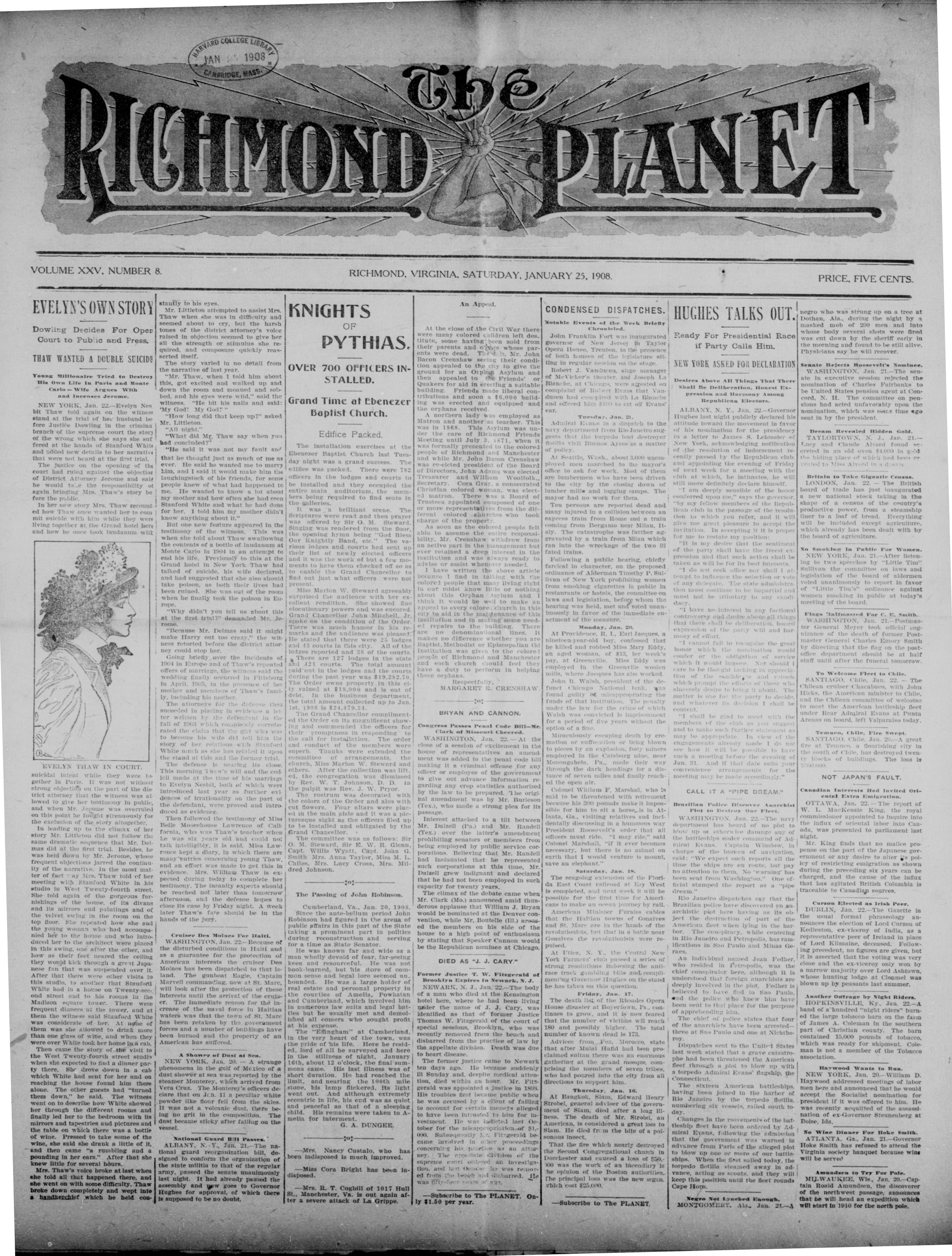
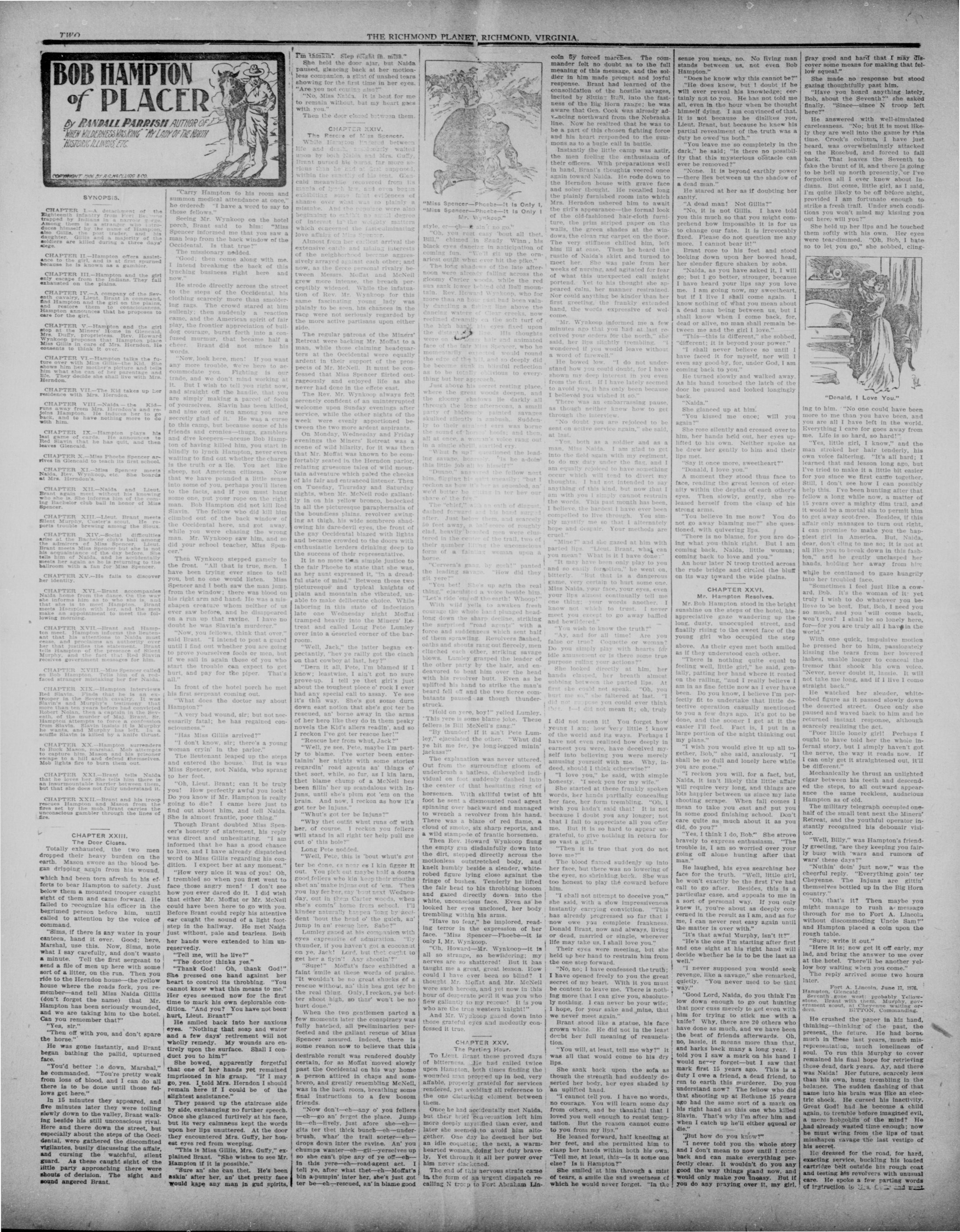
Page text (machine-generated)
MARVARD COLLEGE LIBRARY
JAN. 20. 1908
CAMBRIDGE, MASS.
The RICHMOND PLANET
EVELYN'S OWN STORY
Dowling Decides For Open Court to Public and Press.
Young Millionaire Tried to Destroy
His Own Life In Paris and Monte
Carlo—Wife Argues With
and Incenses Jerome.
NEW YORK, Jan. 22.—Evelyn Nes
bit Thaw told again on the witness
stand at the trial of her husband be
fore Justice Dowling in the criminal
branch of the supreme court the story
of the wrong which she says she suf
fered at the hands of Stanford White
and added new details to her narrative
that were not heard at the first trial.
The justice on the opening of the
court had ruled against the objection
of District Attorney Jerome and sale
he would take the responsibility of
again bringing Mrs. Thaw's story be
fore the public.
In her new story Mrs. Thaw recounted
how Thaw once wanted her to com-
mit suicide with him while they were
living together at the Grand hotel here
and how he once took laudanum with
EVELYN THAW IN COURT.
suicidal intent while they were together in Paris. It was not without strong objection on the part of the district attorney that the witness was allowed to give her testimony in public and when Mr. Jeonea was overruled on this point he follought grenouilly for the exclusion of the story altogether.
In leading up to the climax of her story Mr. Littleton did not follow the same dramatic sequence that Mr. Delmas did at the first trial. Besides, he was held down by Mr. Jerome, whose frequent objections jarred the continuity of the narrative. In the most matter of fact may Mrs. Thaw told of her meeting with Stanford White in his studio in West Twenty-fourth street. She told again of the gorgeous furnishings of the house, of its divans and its mirrors and paintings and of the velvet swing in the room on the top floor. She repeated how she and the young woman who had accompanied her to the house and who introduced her to the architect were placed in this swing, one after the other, and how as their feet neared the ceiling they would kick through a great Japanese fan that was suspended over it. After that there were other visits to this studio, to another that Stanford White had in a house on Twenty-second street and to his rooms in the Madison square tower. There were frequent dinners at the tower, and at the witness said Stanford White was considerate of her. At none of them was she allowed to drink more than one glass of wine, and when they were over White took her home in a cab.
Then came the story of the visit to the West Twenty-fourth street studio when she expected to find a dinner party there. She drove down in a cab which White had sent for her and on reaching the house found him there alone. The other guests had "turned them down," he said. The witness went on to describe how White showed her through the different rooms and finally led her to the bedroom with its mirrors and tapestries and pictures and the table on which there was a bottle of wine. Pressed to take some of the wine, she said she drank a little of it, and then came "a rumbling and a pounding in her ears." After that she knew little for several hours.
Mrs. Thaw's voice broke at last when she told all that happened there, and she went on with some difficulty. Thaw broke down completely and wept into a handkerchief which he held con-
stantly to his eyes.
M. Littleton attempted to assist Mrs.
Thaw when she was in difficulty and
seemed about to cry, but the harsh
tones of the district attorney's voice
raised in objection seemed to give her
all the strength or stimulus she
required, and composure quickly reasserted itself.
The story varied in no detail from
the narrative of last year.
"Mr. Thaw, when I told him about
this, got excited and walked up and
down the room and moaned and sobbed, and his eyes were wild," said the
witness. "He bit his nails and said:
'My God! My God!'
"How long did that keep up?" asked
Mr. Littleton.
"All night."
"What did Mr. Thaw say when you
had concluded?"
"He said it was not my fault and
that he thought just as much or me as
ever. He said he wanted me to marry
him, and I said it would make him the
laughstock of his friends, for some
people knew of what had happened to
me. He wanted to know a lot about
my mother and how often she had seen
Stanford White and what he had done
for her. I told him my mother didn't
know anything about it."
But one new feature appeared in the testimony of the witness. This was when she told about Thaw swallowing the contents of a bottle of laudanum at Monte Carlo in 1904 in an attempt to end his life. Previously to this at the Grand hotel in New York Thaw had talked of suicide, his wife declared, and had suggested that she also should take poison, as both their lives had been ruined. She was out of the room when he finally took the poison in Europe.
"Why didn't you tell us about this at the first trial?" demanded Mr. Jerome.
"Because Mr. Delmas said it might make Harry out too crazy," the witness retorted before the district attorney could stop her.
Going briefly over the incidents of 1904 in Europe and of Thaw's repeated offers of marriage, the witness said the wedding finally occurred in Pittsburgh in April, 1905, in the presence of her mother and members of Thaw's family, including his mother.
The attorneys for the defense then succeeded in placing in evidence a letter written by the defendant in the fall of 1903 which completely corroborated the claim that the girl who was to become his wife did tell him the story of her relations with Stanford White much as she has relied it upon the stand at this and the former trial.
The defense is nearing its close. This morning Thaw's will and the codell made at the time of his marriage to Evelyn Nesbit, both of which were introduced last year as further evidences of irrationality on the part of the defendant, were proved and introduced as evidence.
Then followed the testimony of Miss Belle Moorehouse Lawrence of California, who was Thaw's teacher when he was six years old and could not talk intelligibly, it is said. Miss Lawrence kept a diary, in which there are many entries concerning young Thaw, and an effort was made to get this in evidence. Mrs. William Thaw is expected during today to complete her testimony. The insanity experts should be reached not later than tomorrow afternoon, and the defense hopes to close its case by Friday night. A week later Thaw's fate should be in the hands of the jury.
---
Cruiser Des Molars For Haiti
Cruiser Des Moines For Haiti.
WASHINGTON, Jan. 22—Because of the disturbed conditions in Haiti and as a guarantee for the protection of American interests the cruiser Des Moines has been dispatched to that island. The gunboat Eagle, Captain Marvell commanding, now at St. Marc, will look after the protection of these interests until the arrival of the cruiser. The immediate reason for the increase of the naval force in Haitian waters was that the town of St. Marc has been retaken by the government forces and a number of buildings have been burned and the property of an American has suffered.
A Shower of Dust at Sea.
NEW YORK. Jan. 20. — A strange phenomena in the gulf of Mexico of a dust shower at sea was reported by the steamer Monterey, which arrived from Vera Cruz. The Monterey's officers declare that on Jan. 11 a peculiar white powder like flour fell from the skies. It was not a volcanic dust, there being no grit in the composition. The dust became sticky after failing on the vessel.
National Grand Bill Req.
ALBANY, N. Y., Jan. 21.—The national guard reorganization bill, designed to conform the organization of the state militia to that of the regular army, passed the senate unanimously last night. It had already passed the assembly and now goes to Governor Hughes for approval, of which there is supposed to be no doubt.
RICHMOND, VIRGINIA, SATURDAY, JANUARY 25, 1908
KNIGHTS OF PYTHIAS.
OVER 700 OFFICERS INSTALLED.
Grand Time of Ebenezer Baptist Church.
Edifice Packed
The installation exercises at the Ebenezer Baptist Church last Tuesday night was a grand success. The elfice was packed. There were 782 officers in the lodges and courts to be installed and they occupied the entire main auditorium, the members being required to find seats in the galleries.
It was a brilliant scene. The Scriptures were read and then prayer was offered by Sir O. M. Steward. Singing was rendered from the floor, the opening hymn being "God Bless Our Knightly Band, etc." The various lodges and courts had sent up their list of newly elected officers and it was the work of but a few moments to have them checked off so as to enable the Grand Chancellor to find out just what officers were not present.
Miss Marion W. Steward agreeably surprised the audience with her excellent rendition. She showed fine executionary powers and was enclosed. Grand Chancellor John Mitchell, Jr, spoke on the condition of the Order. There was much humor in his remarks and the audience was pleased. There were 25 lodges and 43 courts in the state of lodges reported and 38 of the courts. There are 127 lodges in the state and 421 courts. The total amount paid out in the lodges and the courts during the past year was $19,282.70. The Order owns property in this city valued at $18,000 and is out of debt. In the business department, the total amount collected up to Jan. 1st, 1908 is $24,479.34.
The Grand Chancellor complimented the Order on its magnificent showing and commended the officers for their promptness in responding to the call for installation. The order and conduct of the members were superb. Thanks were extended the committee of arrangements, the church, Miss Marlon W. Steward and others. After the collection was lifted, the congregation was dismissed by Rev. W. T. Johnson, D. D. in the pulpit was Rev. J. W. Pryor. The rostrum was decorated with the colors of the Order and also with cut flowers. Four altars were placed in the main aisle and it was a picturesque sight as the officers filed up to be installed and obligated by the Grand Chancellor.
The committee was as follows: Sir O. M. Steward, Sir E. W. R. Glenn, Capt. Willis Wyatt, Capt. John G. Smith Mrs. Anna Taylor, Miss M. L. Calles, Mrs. Lucy Cross, Mrs. Mildred Johnson.
The Passing of John Robinson
Cumberland, Va., Jan. 20, 1908. Since the ante-bellum period John Robinson had figured in the arena of public affairs in this part of the State taking a prominent part in politics during reconstruction and serving for a time as State Senator. He was known far and wide as a man wholly devoid of fear, far-seeing keen and resourceful. He was not book-learned, but his store of common sense and legal lore seemed unbounded. He was a large holder of real estate and personal property in the counties of Amella, Powhatan and Cumberland, which involved him in numerous law suits and legal battles but he usually met and demolished all comers who sought profit at his expense. The "Effingham" at Cumberland, in the very heart of the town, was the pride of his life. Here he resided, lord of all he surveyed and here in the stillness of night, January 16th, about 12 o'clock, the final summons came. His last illness was of short duration. He had speeched the limit, and nearing the 100th mile stone, his lamp flickered, its light went out. And although extremely eccentric in life, his end was as quiet and peaceful as that of a sleeping child. His remains were taken to Amelia for interment.
—Mrs. Nancy Custalo, who has been indisposed is much improved.
—Miss Cora Bright has been indisposed.
—Mrs. R. T. Cogbill of 1017 Hull St., Manchester, Va. is out again after a severe attack of La Grine.
An Appeal.
At the close of the Civil War there were many colored children left des- titute, some having been sold from their parents and others whose parents were dead. The man, Mr. John Bacon Crenshaw seeing their condition appealed to the city to give the ground for an Orphan Asylum and then appealed to the Friends' or Quakers for aid in erecting a saitable building. Friends made liberal contributions and soon a $6,000 build- ing was erected and equipped and the orphans received.
A northern lady was employed as Matron and another as teacher. This was in 1868. This Asylum was under the care of Richard Friends Meeting until July 3, 1871, when it was formally presented to the colored people of Richmond and Manchester and while Mr. John Bacon Crenshaw was re-elected president of the Board of Directors, John Adams was elected Treasurer and William Woolfolk, Secretary. Cora Gray, a consecrated Christian colored woman, was elected matron. There was a Board of Trustees appointed composed of one or more representatives from the different colored churches who took charge of the property.
As soon as the colored people felt able to assume the entire responsibility, Mr. Crenshaw withdrew from an active part in the management but ever retained a deep interest in the institution and was always ready to advise or assist whenever needed.
I have written the above article because I am in talking with the colored people that may living right in our midst know little about this Orphan Asylum and I think it would be well to make an appeal to every colored church in this city to aid in the malaise of this institution and in making some needed repairs to the building. There are no denominational lines. It makes no difference whether you are Baptist, Methodist or Episcopalian this institution was given to the colored people of Richmond and Manchester and each church should feel they have a duty to perform in helping these orphans.
Respectfully,
MARGARET E. CRENSHAW
BRYAN AND CANNON.
Congress Passes Penal Code Bill-Mr. Clark of Missouri Cheered.
WASHINGTON, Jan. 22. - At the close of a session of excitement in the house of representatives an amendment was added to the penal code bill making it a criminal offense for any officer or employee of the government to give out advance information regarding any crop statistics authorized by the law to be prepared. The original amendment was by Mr. Burleson (Tex.), who made a strong plea for its passage.
Interest attached to a tilt between Mr. Dalzell (Pa.) and Mr. Randell (Tex.) over the latter's amendment prohibiting senators or members from being employed by public service corporations. Believing that Mr. Randell had insinuated that he represented such corporations at this time, Mr. Dalzell grew indignant and declared that he had not been employed in such capacity for twenty years.
The climax of the debate came when Mr. Clark (Mo.) announced amid thunderous applause that William J. Bryan would be nominated at the Denver convention, while Mr. Boutelle (Ill.) resumed the members on his side of the house to a high point of enthusiasm by stating that Speaker Cannon would be the Republican nominee at Chicago.
DIED AS "J. J. CARY."
Former Justice T. W. Fitzgerald of Brooklyn Expires in Newark, N. J.
NEWARK, N. J., Jan. 22.—The body of a man who died at the Kensington hotel here, where he had been living under the name of J. J. Cary, was identified as that of former Justice Thomas W. Fitzgerald of the court of special sessions, Brooklyn, who was recently removed from the bench and disbarred from the practice of law by the appellate division. Death was due to heart disease.
The former justice came to Newark ten days ago. He became suddenly ill Sunday and, despite medical attention, died within an hour. Mr. Fitzgerald was appointed a justice in 1808. His troubles first became public when he was accused by a client of failing to account for certain money alleged to have been entrusted to him for investment. He was indicted last October for the misappropriation of $1,000. Subsequently Mr. Fitzgerald became involved in other proceedings concerning his practice as an attorney. The appellate division of the supreme court ordered an investigation, and last October he was removed from the bench and disbarred. He was fifty-four years of age.
Subscribe to The PLANET. Only $1.50 per year.
CONDENSED DISPATCHES:
Notable Events of the Week Briefly Chronicled.
John Franklin Fort was inaugurated governor of New Jersey in Taylor Opera House, Trenton, in the presence of both houses of the legislature sitting in regular session on the stage.
Robert J. Vandenbrug, stage manager of McVicker's theater, and Joseph La Blanche, at Chicago, were agreed on complaint of Robert Evans that Vandusen had conspired with La Blanche and offered him $100 to cut off Evans' ear.
Tuesday, Jan. 21.
Admiral Eamus in a dispatch to the navy department from Rio Janeiro suggests that the torpedo boat destroyer tobita visit Buenos Ayres as a matter of policy.
At Seattle, Wash., about 3,000 unemployed men marched to the mayor's office to ask for work. Most of them are lumbermen who have been driven to the city by the closing down of lumber mills and logging camps. The mayor had no work for them.
Ten persons are reported dead and many injured in a collision between an express train from Rome and a train coming from Bergamo near Milan, Italy. The catastrophe was further aggravated by a train from Milan which ran into the wreckage of the two ill fated trains.
Following a public hearing, chiefly farcled in character, on the proposed ordinance of Alderman Timothy P. Sullivan of New York prohibiting women from smoking cigarettes in public in restaurants or hotels, the committee on laws and legislation, before whom the hearing was held, met and voted unanimously in favor of the immediate enactment of the measure.
Monday, Jan. 20.
At Providence, R. I., Earl Jacques, a nineteen-year-old boy, confessed that he killed and robbed Miss Mary Eddy, an aged woman, of $13, her week's pay, at Greenville. Miss Eddy was employed in the Greenville woolen mills, where Jacques has also worked. John R. Walsh, president of the defunct Chicago National bank, was found guilty of misappropriating the funds of that institution. The penalty under the law for the crime of which Walsh was convicted is imprisonment for a period of five years without the option of a fine.
Miraculously escaping death by cremation or suffocation or being blown to pieces by an explosion, forty miners employed in the Catsburg mine, near Monongahela, Pa., made their way through the dark headings for a distance of seven miles and finally reached the open air.
Colonel William F. Marshall, who is said to be threatened with retirement because his 300 pounds make it impossible for him to sit a horse, is in Atlanta, Ga., visiting relatives and incidentally discussing in a humorous way President Roosevelt's order that all officers must ride. "I may ride," said Colonel Marshall, "if it ever becomes necessary, but there is no animal on earth that I would venture to mount, save an elephant."
Saturday, Jan. 18.
The seagoing extension of the Florida East Coast railroad at Key West is completed, and next week it will be possible for the first time for Americans to make an ocean journey by rail. American Minister Furniss cables that the Haitian towns of Gonalves and St. Marce are in the hands of the revolutionists, but that in a battle near Gonalves the revolutionists were repulsed. At Utica, N. Y., the Central New York Farmers' club passed a series of strong resolutions indoosing the anti-trace truck gambling bills and complimenting Governor Hughes on the stand he has taken on this question.
Friday. Jan. 17.
The death list of the Rhoades Opera House disaster at Boyertown, Pa., continues to grow, and it is now feared that the number of victims will reach 180 and possibly higher. The total number of known dead is 173. Advices from Fez, Morocco, state that after Mulai Haifd had been proclaimed sultan there was an enormous gathering at the grand mosque, comprising the members of seven tribes, who had poured into the city from all directions to support him.
Thursday. Jan. 16.
At Bangkok, Siam, Edward Henry Strobel, general adviser of the government of Siam, died after a long illness. The death of Mr. Strobel, an American, is considered a great loss to Siam. He died from the bite of a polious insect.
That the fire which nearly destroyed the Second Congregational church in Dorchester and caused a loss of $50,000 was the work of an incendiary is the opinion of the Boston authorities, the principal loss was the new organ, which cost $25,000.
—Subscribe to The PLANET
HUGHES TALKS OUT.
Ready For Presidential Race if Party Calls Him.
NEW YORK ASKED FOR DECLARATION
Desires Above All Things That There Shall Be Deliberation, Honest Expression and Harmony Among Republican Electors.
ALBANY, N. Y., Jan. 22.—Governor Hughes last night publicly declared his attitude toward the movement in favor of his nomination for the presidency in a letter to James S. Lehmier of New York, acknowledging notification of the resolution of indulgence recently passed by the Republican club, and appointing the evening of Friday of next week for a meeting with the club at which, he intimates, he will still more definitely declare himself.
"I am deeply sensible of the honor conferred upon me," says the governor, "by my fellow members of the Republican club in the passage of the resolution to which you refer, and it will give me great pleasure to accept the invitation. In accepting it it is proper for me to restate my position:
"It is my desire that the sentiment of the party shall have the freest expression and that such action shall be taken as will be for its best interests.
"I do not seek office nor shall I attempt to influence the selection or vote of any delegate. The state administration must continue to be impartial and must not be tributary to any candidacy.
"I have no interest in any factional controversy and desire above all things that there shall be deliberation, honest expression of the party will and harmony of effort."
"I cannot fail to recognize the great honor which the nomination would confer or the obligation of service which it would impose. Nor should I care to be thought lacking in appreciation of the confidence and esteem which prompt the efforts of those who sincerely desire to bring it about. The matter is one for the party to decide, and whatever its decision I shall be content.
"I shall be glad to meet with the members of the club as you suggest and to make such further statement as may be appropriate. In view of the engagements already made I do not see how it will be possible to have such a meeting before the evening of Jan. 31. And if that date suits your convenience arrangements for the meeting may be made accordingly."
CALL IT A "PIPE DREAM."
Brazilian Police Discover Anarchist Plot to Busty Our Fleet.
WASHINGTON, Jan. 22—The navy department has heard of no plot to blow up or otherwise damage any of the battleships under command of Admiral Evans, Captain Winslow, in charge of the bureau of navigation, said: "We expect such reports all the time the ships are en route, but pay no attention to them. No 'warning' has been sent from Washington." One official stamped the report as a "pipe dream."
Rio Janeiro dispatches say that the Brazilian police have discovered an anarchistic plot here having as its object the destruction of part of the American fleet when lying in the harbor. The conspiracy, while centering in Rio Janeiro and Petropolis, has ramifications in Sao Paulo and Minas Geraes.
An individual named Jean Fedher, who resided in Petropolis, was the chief conspirator here, although it is understood that foreign anarchists are deeply involved in the plot. Fedher is believed to have fled to Sao Paulo, and the police who knew him have been sent to that place for the purpose of apprehending him.
The chief of police states that four of the anarchists have been arrested—three at Sao Paulo and one at Nichtheroy.
Dispatches sent to the United States last week stated that a grave catastrophe had been threatened the American fleet through a plot to blow up with a torpedo Admiral Evans' flagship, the Connecticut.
The sixteen American battleships, having been joined in the harbor of Rio Janeiro by the torpedo flotilla, numbering six vessels, sailed south today.
Changes in the movements of the battleship fleet have been ordered by Admiral Eyans, following the admission that the government was warned in advance from Paris of the alleged plot to blow up one or more of our battleships. When the fleet sailed today, the torpedo flotilla steamed away in advance, acting as scouts, and they will keep this position until the fleet rounds Cape Horn.
Negro Not Lynched Enough.
MONTGOMERY, Ala., Jan. 21—A
PRICE, FIVE CENTS.
negro who was string up on a tree at Dothan, Ala., during the night by a masked mob of 200 men and into whose body several shots were fired was cut down by the sheriff early in the morning and found to be still alive. Physicians say he will recover.
Senate Rejects Roosevelt's Nominee. WASHINGTON, Jan. 21.-The senate in executive session rejected the nomination of Charles Fairbanks to be United States pension agent at Concord, N. H. The committee on pensions had acted unfavorably upon the nomination, which was some time ago sent in by the president.
Dream Revealed Hidden Gold
TAYLORTOWN, N. J., Jan. 21. Lucy and Claude Alvord found secre-
ted in an old oven $4,000 in gold the hiding place of which had been re-
vealed to Miss Alvord in a dream.
Britain to Take Gigantic Censors
Britain to Take Gigantic Census.
LONDON, Jan. 22. — The British board of trade has just inaugurated a new national stock taking in the shape of a census of the country's productive power, from a steamship liner to a loaf of bread. Everything will be included except agriculture, which already has been dealt with by the board of agriculture.
No Smoking In Public For
No Smoking In Public For Women.
NEW YORK, Jan. 21.-After listening to two speeches by "Little Tim" Sullivan the committee on laws and legislation of the board of aldermen voted unanimously to report in favor of "Little Tim's" ordinance against women smoking in public at today's meeting of the board.
Flags Inhaltmasted For C. E. Smith.
WASHINGTON, Jan. 21.-Postmaster General Meyer took official cognizance of the death of former Postmaster General Charles Emory Smith by directing that the flag on the post-office department should be at half staff until after the funeral tomorrow.
To Welcome Fleet to Chile
SANTIAGO, Chile, Jan. 22. - The Chilean cruiser Chacabuco, with John Hicks, the American minister to Chile, and the Chilean committee of welcome to meet the American battleship fleet under Rear Admiral Evans at Punta Arenas on board, left Valparaiso today.
Temoco, Chile, Fire Swept
SANTIAGO, Chile, Jan. 26. -A great fire at Temuco, a flourishing city in the south of Chile, has destroyed twenty blocks of buildings. The loss is $500,000.
NOT JAPAN'S FAULT.
Canadian Interests Had Invited Oriental Extra Emigration.
OTTAWA, Jan. 22. — The report of W. L. MacKenzie King, the royal commissioner appointed to inquire into the infux of oriental labor into Canada, was presented to parliament last night.
Mr. King finds that no malice propone on the part of the Japanese government or any desire to alter its policy of restricting emigration as shown during the preceding six years can be charged, and the cause of the infux that has agitated British Columbia is traceable to Canadian sources.
Curzon Elected as Irish Poor
DUBLIN, Jan. 22—The Gazette in the usual formal phrasology announces the election of Lord Curzon of Kedleston, ex-viceroy of India, as a representative peer of Ireland in place of Lord Kilmaine, deceased. Following precedent, no figures are given, but it is asserted that the voting was very close and the ex-viceroy only won by a narrow majority over Lord Ashtown, whose hunting lodge at Clonmel was blown up by peasants last summer.
Another Outrage by Night Riders.
HOPKINSVILLE, Ky., Jan. 22—A band of a hundred "night riders" burned the large tobacco barn on the farm of James A. Coleman in the southern part of Christian county. The barn contained 15,000 pounds of tobacco, which was ready for shipment. Coleman is not a member of the Tobacco association.
Haywood Wants to Run
HAYWOOD WANTS to Run.
NEW YORK, Jan. 20—William D. Haywood addressed meetings of labor men here and announced that he would accept the Socialist nomination for president if it was offered to him. He was recently acquitted of the assassination of ex-Governor Steuenberg at Bolse, Ida.
No Wine Dinner For Hoke Smith.
ATLANTA, Ga., Jan. 21—Governor Hoke Smith has refused to attend the Virginia society banquet because wine will be served
Amundsen to Try Pole.
MLWAUKEE, Wis., Jan. 20—Captain Roald Amundsen, the discoverer of the northwest passage, announces that he will head an expedition which will start in 1910 for the north pole.
BOB HAMPTON of PLACER
TWO
SYNOPSIS.
CHAPTER I.—A detachment of the Eighteenth infantry from Fort Bellevue trapped by Indians in a narrow gorge. He duces himself by the name of Hampton, also Gillis, the post trader, and his daughter. Gillis and a majority of the officers are killed during a three days' siege.
CHAPTER II.—Hampton offers assistance to the girl, and is at first spurned because he is known as a gambler.
CHAPTER III.—Hampton and the girl only escape from the Indians. They fail exhausted on the plains.
CHAPTER IV.—A company of the Seventh cavalry, Llent. Brant in command, find Hampton the girl in the plains, and restore them to consciousness. Hampton announces that he proposes to care for the girl.
CHAPTER V.—Hampton and the girl stop at the Miners' Home in Glenaue, Mrs. Duffy, proprietress. Rev. Howard Minkop proposes that Hampton place Miss Gillis in care of Mrs. Herndon. He consents to the latter.
CHAPTER VI.-Hampton talks the future over with Mice Gillis—the Kid. She shows him her mother's picture and tells him how she came of her parentage and life. They decide she shall live with Mrs. Herndon.
CHAPTER VII.-The Kid takes up her residence with Mrs. Herndon.
CHAPTER VIII.-Nalda—the Kid runs away from Mrs. Herndon's and rejoins Hampton. He induces her to go back, and to have nothing more to do with him.
CHAPTER IX.-Hampton plays his last game of cards. He announces to Red Slavin that he has quit, and then leaves Glencairn.
CHAPTER X.-Miss Phoebe Spencer arrives in Glencairn to teach its first school.
CHAPTER XI.-Miss Spencer meets Nalda, Rev. Wynkoop, etc. She boards at Mrs. Herndon's.
CHAPTER XII.-Nalda and Leut. Brant again meet without his knowing who she is. She informs him of the comedy color club bail in honor of Miss Spencer.
CHAPTER XIII.-Leut. Brant meets Silent Murphy, Custer's scout. He reports trouble brewing among the Sioux.
CHAPTER XIV.-Social difficulties arise at the Bachelor club's ball among the members of Miss Spencer. Lieut. Brant meets Miss Spencer but she is not acquaintance of the day before. She tells him of Nalda, and he accidentally hits her with a balloon in the ballroom with a fan for Miss Spencer.
CHAPTER XV.-He fails to discover her identity.
CHAPTER XVI.-Brant accompanies Nalda home from the dance. On the way informs him as she is in that and that he meets Hampton. Brant meets Hampton with her, and the men make an appointment to meet the following morning.
CHAPTER XVII.-Brant and Hampton meet Hampton informs the lieutenant that attempts to have the must cease, and presses a authority her that justifies the statement. Brant Hampton of the presence of Silent Martinez finds that Red vain receives government messages for him.
CHAPTER XVIII.-Miss Spencer called on Bob Hampton. Telling faced stranger mistaken by her for Nalda.
CHAPTER XIX—Hampton interviews Red Slavin. Finds that he is an extropreter in the Seventh cavalry. It was Slavin's and Murphy's testimony, that he was a convict who was convicted Robert Nolan, then a captain in the Seventh, of the murder of Mal. Brant, Sr. rescues Murphy from Slavin. Slavin insists it is Murphy he wants, and Murphy has left. In a scuffle Slavin is killed by a knife thrust.
CHAPTER XIX—Hampton surrenders to Buck Mason, marshal. Mob attempts to capture him. Mason and his prisoner escape to a hill and defend themselves. Mob lights fire to burn them out.
CHAPTER XXI—Brant tells Nalda that he loves her. She tells him there is an insurmountable barrier between them, but she does not fully understand it.
CHAPTER XXII—Brant and his troop rescues Hampton and Mason from the fires set by the mob. Brant carries the conscious gambler through the lines of fire.
Totally exhausted, the two men dropped their heavy burden on the earth. Mason swore as the blood began dripping again from his wound, which had been torn afresh in his efforts to bear Hampton to safety. Just below them a mounted trooper caught sight of them and came forward. He failed to recognize his officer in the begrimed person before him, until called to attention by the voice of command.
"Sims, if there is any water in your canteen, hand it over. Good; here, Marshal, use this. Now, Sims, note what I say carefully, and don't waste a minute. Tell the first sergeant to send a file of men up here with some sort of a litter, on the run. Then you ride to the Herndon house—the yellow house where the roads fork, you remember—and tell Miss Naida Gillis (don't forget the name) that Mr. Hampton has been seriously wounded, and we are taking him to the hotel. Can you remember that?"
"Yes, sir."
"Then off with you, and don't spare the horse."
He was gone instantly, and Brant began bathing the pallid, upturned face.
"You'd better lie down, Marshal," he commanded. "You're pretty weak from loss of blood, and I can do all there is to be done until those fellows get here."
In 15 minutes they appeared, and five minutes later they were toiling slowly down to the valley, Brant walking beside his still unconscious rival. Here and there down the street, but especially about the steps of the Occidental, were gathered the discomfited vigilantes, busily discussing the affair, and cursing the watchful, silent guard. As these caught sight of the little party approaching there were shouts of derision. The sight and sound angered Brant.
"Carry Hampton to his room and summon medical attendance at once," he ordered; "I have a word to say to those fellows."
Seeing Mr. Wynkoop on the hotel porch, Brant said to him: "Miss Spencer informed me that you saw a man leap from the back window of the Occidental. Is that true?"
The missionary nodded.
"Good; then come along with me.
I intend breaking the back of this lynching business right here and now."
He strode directly across the street to the steps of the Occidental, his clothing scarcely more than smoldering rags. The crowd stared at him sullenly; then suddenly a reaction came, and the American spirit of fair play, the frontier appreciation of bulldog courage, burst forth into a confused murmur, that became half a cheer. Brant did not mince his words.
"Now, look here, men! If you want any more trouble, we're here to accommodate you. Fighting is our trade, and we don't mind working at it. But I wish to tell you right now, and straight off the handle, that you are simply making a parcel ofools of yourselves. Slavin has been killed, and nine out of ten among you are secretly glad of it. He was a curse to this camp, but because some of his friends and cronies—thugs, gamblers and dive keepers—acuse Bob Hampton of having killed him, you start in blindly to lynch Hampton, never even waiting to find out whether the charge is the truth or a lie. You act like sheep, not American citizens. Now that we have pounded a little sense into some of you, perhaps you'll listen to the facts, and If you must hang some one, put your rope on the right man. Bob Hampton did not kill Red Slavin. The fellow who did kill him climbed out of the back window of the Occidental here, and got away, while you were chasing the wrong man. Mr. Wynkoop saw him, and so did your school teacher, Miss Spencer."
Then Wrykop stepped gamely to the front. "All that is true, men I have been trying ever since to tell you, but no one would listen. Miss Spencer and I both saw the man jump from the window; there was blood on his right arm and hand. He was a mishapen creature whom neither of us ever saw before, and he disappeared on a run up that ravine. I have no doubt he was Slavin's murderer."
"Now, you fellows, think that over," said Brant. "I intend to post a guard until I find out whether you are going to prove yourselves fools or men, but if we sail in again those of you who start the trouble can expect to get hurt, and pay for the piper. That's all."
In front of the hotel porch he met his first sergeant coming out.
"What does the doctor say about Hampton?"
"A very bad wound, sir; but not necessarily fatal; he has regained consciousness."
"Has Miss Gillis arrived?"
"I don't know, sir; there's a young woman cryin' in the parlor."
The lieutenant leaped up the steps and entered the house. But is was Miss Spencer, not Nalda, who sprang to her feet.
"Oh, Lleut. Brant; can it be truly you! How perfectly awful you look! Do you know if Mr. Hampton is really going to die? I came here just to find out about him, and tell Nalda. She is almost frantic, poor thing."
Though Brant doubted Miss Spencer's honesty of statement, his reply was direct and unhesitating. "I am informed that he has a good chance to live, and I have already dispatched word to Miss Gillis regarding his condition. I expect her at any moment."
"How very nice it was of you! Oh, I trembled so when you first went to face those angry men! I don't see how you ever dared do it. I did wish that either Mr. Moffat or Mr. McNell could have been here to go with you. Before Brant could reply his attentive ear caught the sound of a light footstep in the hallway. He met Naida just without, pale and tearless. Both her hands were extended to him unreservedly.
"Tell me, will he live?"
"The doctor thinks yes."
"Thank God! Oh, thank God!"
She pressed one hand against her heart to control its throbbing. "You cannot know what this means to me."
Her eyes seemed now for the first time to mark his own deplorable condition. "And you? You have not been hurt. Lleut. Brant?"
He smiled back into her anxious eyes. "Nothing that soap and water and a few days' retirement will not wholly remedy. My wounds are entirely upon the surface. Shall I conduct you to him?" She bowed, apparently forgetful that one of her hands yet remained imprisoned in his grasp. "If I may go, yes. I told Mrs. Herndon I should remain here if I could be of the slightest assistance." They passed up the staircase side by side, exchanging no further speech. Once she glanced furtively at his face, but its very calmness kept the words upon her lips unuttered. At the door they encountered Mrs. Guffy, her honest eyes red from weeping. "This is Miss Gillis, Mrs. Guffy," explained Brant. "She wishes to see Mr. Hampton if it is possible." "Sure an' she can thet. He's been askin' after her, an' thet pretty face would kape any man in gud spirits.
THE RICHMOND PLANET, RICHMOND, VIRGINIA
I'm thinkin'. Step roisht in. miss."
I'm thinkin' Step right fn. miss."
She held the door ajar, but Naida paused, glancing back at her motionless companion, a glint of unshed tears showing for the first time in her eyes. "Are you not coming also?"
"No, Miss Naida. It is best for me to remain without, but my heart goes with you."
Then the door closed between them.
CHAPTER 8XIV
THE Rescue of Miss Spencer.
While Harrison helped between life and death manoeuvry waited upon by both Nalaia and Mrs. Gully, Brant nursed his burns, far more serious than he had at first supposed, within the sanctity of his tent. Glencaid meanwhile recovered from his mania of lynch law, and even began exhibiting some fault evidences of shame over what was so plainly a mistake. And the populace were also beginning to exhibit no small degree of interest in the weighty matters which concerned the fast-caliminating love affairs of Miss Spencer.
Almost from her earliest arrival the extensive cattle and milking interests of the neighborhood become aggressively arrayed against each other; and now, as the fierce personal rivalry between Messrs. Moffat and McNell grew more intense, the breach perceptibly widened. While the infatuation of Rev. Mr. Wynkcoop for this same fascinating young lady was plainly to be seen, his chances in the race were not seriously regarded by the more active partisans upon either side.
The regular patrons of the Miners' Retreat were backing Mr. Moffat to a man, while those claiming headquarters at the Occidental were equally ardent in their support of the prospects of Mr. McNell. It must be confessed that Miss Spencer flirted outrageously and enjoyed life as she never had done in the efface east.
The Rev. Mr. Wrykoop always felt serenely confident of an uninterrupted welcome upon Sunday evenings after service, while the other nights of the week were evenly apportioned between the two more ardent aspirants. On Monday, Wednesday and Friday evenings the Miners' Retreat was a scene of wild bilarity, for it was then that Mr. Moffat was known to be comfortably seated in the Herndon parlor, relating gruesome tales of wild mountain adventure which paled the cheeks of his fair and entranced listener. Then on Tuesday, Thursday and Saturday nights, when Mr. McNeill rode gallantly in on his yellow bronco, bedecked in all the picturesque paraphernalia of the boundless plains, revolver swinging his dare-devil eyes, the front of the gay Occidental blazed with lights and became crowded to the doors with enthusiastic herders drinking deep to the success of their representative.
It is no more than simple justice to the fair Phoebe to state that she was, as her aunt expressed it, "in a dreadful state of mind." Between these two picturesque and typical knights of plain and mountain she vibrated, unable to make deliberate choice. While laboring in this state of indecision late one Wednesday night Moffat tramped heavily into the Miners' Retreat and called Long Pete Lumley over into a deserted corner of the barroom.
"Well, Jack," the latter began expectantly, "hey he really got the cinch on that cowboy at last, hey?"
"Dern it all, Pete. I blame if I know; leastwise, I ain't got no sure prove-up. I tell ye that girl's just about the toughest piece o' rock I ever had any special call to assay. Ye see it's this way. She's got some durn down east notion that she's got ter be rescued, an 'borne away in the arms of her hero like they do in them pesky novels the Kid's allers readin', and so I reckon I've got ter rescue her!"
"Rescue her from whut, Jack?"
"Well, ye see, Pete, maybe I'm partly to blame. I've sorter been entertainin' her nights with some stories regardin' road agents an' things o' thet sort, while, so fur, as I klin larn, thet blame chump of a McNell hes been fillin' her up scandalous with Injuns, until she's plum got 'em on the brain. And now, I reckon as how it's got ter be Injuns."
"What's got ter be Injuns?"
"Why the outfit what runs off with her, of course. I reckon you fellers will stand in all right ter help pull me out o' this hole?"
Long Pete nodded.
"Well, Pete, this is 'bout what's got ter be done, es near es I kin figger it out. You pick out maybe half a dozen good fellers who kni keep their mouths shet an' make injuns out of 'em. Then you lay fer her, say 'bout next Wednesday, out in them Carter woods, when she's comin' home from school. I'll kinder naturally happen 'long by accident 'bout the head o' the gulch, an' jump in an' rescue her, Sabe?"
Lumley gaced at his companion with eyes expressive of admiration. "Dy thunder, if you haven't got a cocoanut on ye, Jack! Lord, but that ought to get her a flyin' Any shootin'."
"Sure!" Moffat's face exhibited a faint 'smile at these words of praise. "It wouldn't be no great shucks of a rescue without, an' this hes got her be the real thing. Only, I reckon, ye better shoot high, so that' won't be no hurt done."
When the gentlemen parted a few moments later the conspiracy was fully batched, all preliminaries perfected and the gallant rescue of Miss Spencer assured. Indeed, there is some reason now to believe that this desirable result was rendered doubly certain, for as Moffat moved slowly past the Occidental on his way home a person attired in chaps and sombrero, and greatly resembling McNell, was in the back room, breathing some final instructions to a few bosom friends.
"Now don't -eh- any o you fellers
-eh- go an' forget the place. Jump in
-eh- lively, just afore she -eh-
-gits ter thet bunch -eh- underbrush, whar' the trail sorter -eh-
-drops down inter the ravine. An' you
chumps wanter -eh- git- yerselves up so she can't pipe any of ye off -eh-
in this yere -eh- road-agent act. I tell ye, after what thet -eh- Moffat's
bin a-pumpin' inter her, she's just got
ter be -eh- rescued, an' in blame good
"Miss Spencer—Phoebe—It Is Only I,
"Miss Spencer—Phoebe—It Is Only I
Mr. Wynkeen."
style, er—oh—can't no go."
"Oh, you rest easy 'bout all thet, Bill," chlmed in Sandy Winn, his black eyes dancing in anticipation of coming fun. "We'll git up the ornate outfit what ever hit the pike."
The long shadows of the late afternoon were already falling across the gloomy Carter woods, while the red sun sank lower behind old Bull mountain. Rev. Howard Wynkoop, who for more than an hour past had been vainly dancing a fashing line above the dancing waters of Clear creeks, now reclined dreamily on the soft turf of the high bank his eyes fixed upon the distant line. His thoughts were on the honey hair and animated face of the fair Miss Spencer, who he momentarily expected would round the edge of the hill, and so deeply did he become sunk in blissful reflection as to be totally oblivious to everything but her approach.
Just above his secret resting place, where the great woods deepen, and the gloomy shadows lie darkly all through the long afternoons, a small party of hideously painted savages skulled elightly in ambush. Suddenly to their strained ears was borne the sound of horns' hoofs; and then, all at once, a woman's voice rang out in a single shrill, startled cry.
"What is up?" questioned the leading savage, horribly. "Is he a doin' this little job all by hisself"?
"Dunno," answered the fellow next him, slipping his gait uneasily; "but I reckon as how it her is as squealed, an' wed better be sitting in ter hev our share o' the fur."
The "chief," with an eath of disgust, dashed forward and his band surged after. Just below them, and scarcely 50 feet away, a half score of roughly clad, heavily bearded men were clustered in the center of the trail, two of their number lifting the unconscious form of a fainting woman upon a horse.
"Cervera's gang, by gosh!" panted the leading savage. "How did they git yere?"
"You bet! She's up agin the real thing." elaculated a voice beside him. "Let's ride 'em off the earth! Whooon!"
With wild yells to awaken fresh courage the whole hand plunged beadlong down the sharp decline, striking the surprised "road agents" with a force and suddenness which sent half of them sprawling. Revolvers flashed, oaths and abounds rang out fiercely, men clinched each other, striking savage blows. Lumley grasped the leader of the other party by the hair, and endeavored to beat him over the head with his revolver butt. Even as he uplifted his hand to strike the man's beard fell off and the two fierce combatants paused as though thunder-struck.
"Hold on yere, boy!" yelled Lumley. "This yere is some blame joke. These fellers is Bill McNeill's gang."
"By thunder! If it ain't Pete Lumley," ejaculated the other. "What did ye hit me fer, ye long-legged minin' jackass?"
The explanation was never uttered. Out from the surrounding gloom of underbrush a hatless, disheveled individual on foot suddenly dashed into the center of that hesitating ring of horsemen. With skillful twist of hit foot he sent a dismounted road agent spinning over backward and managed to wrench a revolver from his hand. There was a blaze of red flame, a cloud of smoke, six sharp reports, and a wild stampede of frantic horsemen. Then Rev. Howard Wynkoop flung the empty gun disdainfully down into the dirt, stepped directly across the motionless outstretched body, and knelt humbly beside a slender, white-robed figure lying close against the fringe of bushes. Tenderly he lifted the fair head to his throbbing bosom and gazed directly down into the white, unconscious face. Even as he looked her eyes unclosed, her body trembling within his arms.
"Have no fear," he implored, reading terror in the expression of her face. "Miss Spencer—Phoebe—it is only I, Mr. Wynkoop.
"Oh, Howard—Mr. Wynkoop—it is all so strange, so bewildering; my nerves are so shattered! But it has taught me a great, great lesson. How could I have ever been so blind? I thought Mr. Mofat and Mr. McNeill were such heroes, and yet now in this hour of desperate peril it was you who flew gallantly to my rescue! It is you who are the true western knight!"
And Mr. Wynkoop gazed down into those grateful eyes and modestly confessed it true.
CHAPTER XXV.
The Parting Hour
To Lient. Brant these proved days of bitterness. He had called twice upon Hampton, both times finding the wounded man propped up in bed, very affable, properly grateful for services rendered, yet avoiding all reference to the one disturbing element between them.
Once he had accidentally met Nalda, but their brief conversation left him more deeply myllated than ever, and later she seemed to avoid him altogether. One day he deemed her but an idle coquette; the next, a warm-hearted woman, doing her duty bravely. Yet through it all her power over him never slackened.
The end of this nervous strain came in the form of an urgent dispatch recalling N troop to Fort Abraham Lin-
colin by forced marches. The commander felt no doubt as to the full meaning of this message, and the soldier in him made prompt and joyful response. Brant had learned of the consolidation of the hostile savages, incited by Sitting: Bull, into the fastness of the Big Horn range; he was aware that Gen. Cook was already advancing northward from the Nebraska line. Now he realized that he was to be a part of this chosen fighting force and his heart responded to the summons as to a bugle call in battle.
Instantly the little camp was asir, the men feeling the enthusiasm of their officers. With preparations well in hand, Brant's thoughts veered once again toward Naida. He rode down to the Herndon house with grave face and sober thought. He recalled long the plainly furnished room into which Mrs. Herndon ushered him to await the girl's appearance—the formal look of the old-fashioned hair-cloth furniture, the prim striped paper on the walls, the green shades at the windows, the clean rag carpet on the floor. The very stiffness chilled him, left him ill at ease. Then he heard the rustle of Naida's skirt and turned to meet her. She was pale from her weeks of nursing, and agitated for fear of what this unexpected call might portend. Yet to his thought she appeared calm, her manner restrained. Nor could anything be kinder than her first greeting, the frankly extended hand, the words expressive of welcome.
"Mr. Wynkoop informed me a few minutes ago that you had at last received your orders for the north," she said, her lips slightly trembling. "I wondered if you would leave without a word of farewell."
He bowed low. "I do not understand how you could doubt, for I have shown my deep interest in you even from the first. If I have lately seemed to avoid you, it has only been because I believed you wished it so."
There was an embarrassing pause, as though neither knew how to get through the interview.
"No doubt you are rejoiced to be sent on active service again," she said, at last.
"Yes, both as a soldier and as a man, Miss Nalda. I am glad to get into the field again with my regiment, to do my duty under the flag, and I am equally rejoiced to have something occur which will tend to divert my thoughts. I had not intended to say anything of this kind, but now that I am with you I simply cannot restrain the words. This past month has been, I believe, the hardest I have ever been compelled to live through. You simply mystify me so that I alternately hope and despair. Your methods are cruel."
"Mine?" and she gazed at him with parted lips. "Leut. Brant, what can you mean? What is it I have done?" "It may have been only play to you and so easily for gotten," he went on, bitterly. "But that is a dangerous game, very certain to hurt some one. Miss Nalda, your face, your eyes, even your lips almost continually tell me one thing; your words another. I know not which to trust. I never meet you except to go away baffled and bewildered."
"You wish to know the truth?"
You wish to know the truth:
"Ay, and for all time! Are you false or true? Coquette or woman? Do you simply play with hearts for idle amusement or is there some true purpose ruling your actions?"
She looked directly at him, her hands elapsed, her breath almost sobbing between the parted lips. At first she could not speak. "Oh, you hurt me so," she faltered at last. "I did not suppose you could ever think that. I—I did not mean it; oh, truly I did not mean it! You forget how young I am; how very little I know of the world and its ways. Perhaps I have not even realized how deeply in earnest you were, have deceived myself into believing you were merely amusing yourself with me. Why, in deed, should I think otherwise?"
"I love you," he said, with simple honesty. "I seek you for my wife."
She started at these frankly spoken words, her hands partially concealing her face, her form trembling. "Oh, I wish you hadn't said that! It is not because I doubt you any longer; not that I fail to appreciate all you offer me. But it is so hard to appear ungrateful, to give nothing in return for so vast a gift."
"Then it is true that you do not love me?"
The blood flamed suddenly up into her face, but there was no lowering of the eyes, no shrinking back. She was too honest to play the coward before him.
"I shall not attempt to deceive you," she said, with a slow impressiveness instantly carrying conviction. "This has already progressed so far that I now owe you complete frankness. Donald Brant, now and always, living or dead, married or single, wherever life may take us, I shall love you."
Their eyes were meeting, but she held up her hand to restrain him from the one step forward.
"No, no; I have confessed the truth; I have opened freely to you the great secret of my heart. With it you must be content to leave me. There is nothing more that I can give you, absolutely nothing. I can never be your wife; I hope, for your sake and mine, that we never meet again."
Brant stood like a statue, his face grown white. He did not in the least debt her full meaning of renunciation.
"You will, at least, tell me why?" It was all that would come to his dry lips.
She sank back upon the sofa as though the strength had suddenly deserted her body, her eyes shaded by an unplifted hand.
"I cannot tell you. I have no words, no courage. You will learn some day from others, and be thankful that I loved you well enough to resist temptation. But the reason cannot come to you from my lips."
He leaned forward, half kneelling at her feet, and she permitted him to clasp her hands within both his own.
"Tell me, at least, this—is it some one else? Is it Hampton?"
She smiled at him through a mist of tears, a smile the sad sweetness of which he would never forget. "In the
sense you mean, no. No living man stands between us, not even Bob Hampton."
"Does he know why this cannot be?"
"He does know, but I doubt if he will ever reveal his knowledge; certainly not to you. He has not told me all, even in the hour when he thought himself dying. I am convinced of that. It is not because he dislikes you, Lleut. Brant, but because he knew his partial revelation of the truth was a duty he owes us both."
"You leave me so completely in the dark," he said; "is there no possibility that this mysterious obstacle can ever be removed?"
"None. It is beyond earthly power—there lies between us the shadow of a dead man."
He stared at her as if doubting her sanity.
"A dead man! Not Gillis?"
"No, it is not Gillis. I have told you this much so that you might comprehend how impossible it is for us to change our fate. It is irrevocably fixed. Please do not question me any more. I cannot bear it!"
Brant rose to his feet and stood looking down upon her bowed head, her slender figure shaken by sobs.
"Naida, as you have asked it, I will go; but I go better, stronger, because I have heard your lips say you love me. I am going now, my sweetheart, but if I live I shall come again.
I know nothing of what you mean about a dead man being between us, but I shall know when I come back, for, dead or alive, no man shall remain between me and the girl I love."
"This—this is different," she sobbed, "different; it is beyond your power."
"I shall never believe so until I have faced it for myself, nor will I even say good-by, for, under God, I am coming back to you."
He turned slowly and walked away.
As his hand touched the latch of the door he paused and looked longingly back.
"Naida."
She glanced up at him.
"You kissed me once; will you again?"
She rose silently and crossed over to him, her hands held out, her eyes uplifted to his own. Neither spoke as he drew her gently to him and their lips met.
"Say it once more, sweetheart?"
"Donald, I love you."
A moment they stood thus face to face, reading the great lesson of eternity within the depths of each other's eyes. Then slowly, gently, she released herself from the clasp of his strong arms.
"You believe in me now? You do not go away blaming me?" she questioned, with quivering lips.
"There is no blame, for you are doing what you think right. But I am coming back, Naida, little woman; coming back to love and you." An hour later N troop trotted across the rude bridge and circled the bluff on its way toward the wide plains.
CHAPTER XXVI.
Mr. Bob Hampton stood in the bright sunshine on the steps of the hotel, his appreciative gaze wandering up the long, dusty, unoccupied street, and finally rising to the sweet face of the young girl who occupied the step above. As their eyes met both smiled as if they understood each other.
"There is nothing quite equal to feeling well, little girl," he said, generally, patting her hand where it rested on the ralling, "and I really believe I am in as fine fettle now as I ever have been. Do you know, I believe I'm perfectly fit to undertake that little detective operation casually mentioned to you a few days ago. It's got to be done, and the sooner I get at it the easier I'll feel. Fact is, I put in a large portion of the night thinking out my plans."
"I wish you would give it up all together, Bob," she said, anxiously. "I shall be so dull and lonely here while you are gone."
"I reckon you will, for a fact, but, Nalda, it isn't likely this little affair will require very long, and things are lots happier between us since my late shooting scrape. When fall comes I mean to take you east and put you in some good finishing school. Don't care quite as much about it as you did, do you?" "Yes, I think I do, Bob." She strove bravely to express enthusiasm. "The trouble is, I am so worried over your going off alone hunting after that man." He laughed, his eyes searching her face for the truth. "Well, little girl, he won't exactly be the first I've had call to go after. Besides, this is a particular case, and appeals to me in a sort of personal way. If you only knew it, you're about as deeply concerned in the result as I am, and as for me, I can never rest easy again until the matter is over with."
"It's that awful Murphy, isn't it?"
"He's the one I'm starting after first and one sight at his right hand will decide whether he is to be the last as well."
"I never supposed you would seek revenge, like a savage," she remarked, quietly. "You never used to be that way."
"Good Lord, Nalda, do you think I'm low down enough to go out hunting that poor cuss merely to get even with him for trying to stick me with a knife? Why, there are 20 others who have done as much, and we have been the best of friends afterwards. Oh, no, lassie, it means more than that, and harks back many a long year. I told you I saw a mark on his hand I would never forget—but I saw that mark first 15 years ago. This is a duty I owe a friend, a dead friend, to run to earth this murderer. Do you understand now? The fellow who did that shooting up at Bothne 15 years ago had the same sort of a mark on his right hand as this one who killed Slavin. That's why I'm after him and when I catch up he'll either squeal or die."
"But how do you know?"
"I never told you the whole story and I don't mean to now until I come back and can make everything perfectly clear. It wouldn't do you any good the way things gland now, and would only make you uneasy. But if you do any praying over it, my girl."
Gray good and hard that I may discover some means for making that fellow squeal.
She made no response but stood gazing thoughtfully past him.
"Have you heard anything lately, Bob, about the Seventh?" she asked finally.
"Since—since N troop left here?"
He answered with well-simulated carelessness. "No; but it is most likely they are well into the game by this time. Crook's column, I have just heard, was overwhelmingly attacked on the Rosebud, and forced to fall back. That leaves the Seventh to take the brunt of it, and there is going to be hell up north presently, or I've forgotten all I ever knew about Indians. But come, little girl, as I said, I'm quite likely to be off before night, provided I am fortunate enough to strike a fresh trail. Under such conditions you won't mind my kissing you out here; will you?"
She held up her lips and he touched them softly with his own. Her eyes were tear-dimmed. "Oh, Bob, I hate so to let you go," she sobbed, cling-
"Donald, I Love You."
ing to him. "No one could have been more to me than you have been, and you are all I have left in the world. Everything I care for goes away from me. Life is so hard, so hard!"
"Yes, little girl, I know," and the man stroked her hair tenderly, his own voice faltering. "It's all hard; I learned that sad lesson long ago, but I I've tried to make it a little bit easier for you since we first came together. Still, I don't see how I can possibly help this. I've been hunting after that fellow a long while now, a matter of 15 years over a mighty dim trail, and it would be a mortal sin to permit him to get away scot-free. Besides, if this affair only manages to turn out right, I can promise to make you the happiest girl in America. But, Naidah, dear, don't cling to me so; it is not at all like you to break down in this fashion," and he gently unclashed her hands, holding her away from him while he continued to gaze hungrily into her troubled face.
"Sometimes I feel just like a coward. Bob. It's the woman of it: yet truly I wish to do whatever you believe to be best. But, Bob, I need you so much, and you 'will come back, won't you? I shall be so lonely here, for—for you are truly all I have in the world."
With one quick, impulsive motion he pressed her to him, passionately kissing the tears from her lowered lashes, unable longer to conceal the tremor that shook his own voice. "Never, never doubt it, hassle. It will not take me long, and if I live I come straight back."
He watched her slender, white-robed figure as it passed slowly down the deserted street. Once only she paused and waved back to him and he returned instant response, although scarcely realizing the act.
"Poor little lonely girl! Perhaps I ought to have told her the whole infernal story, but I simply haven't got the nerve, the way it reads now. If I can only get it straightened out, it'll be different."
Mechanically he thrust an unlighted cigar between his teeth and descended the steps, to all outward appearance the same reckless, and audacious Hampton as of old.
The military telegraph occupied one-half of the small tent next the Miners' Retreat, and the youthful operator instantly recognized his debonair visitor.
"Well, Billy," was Hampton's friendly greeting, "are they keeping you fairly busy with 'wars and rumors of wars' these days?"
"Nuthin' doin' just now," was the cheerful reply. "Everything goin' ter Cheyenne. The Injuns are gittin' themselves bottled up in the Big Horn country."
"Oh, that's it? Then maybe you might manage to rush a message through for me to Fort A. Lincoln without discommoding Ucle Sam?" and Hampton placed a coin upon the rough table.
"Sure; write it out."
"Here it is; now get it off early, my lad, and bring the answer to me over at the hotel. There'll be another yellow boy waiting when you come."
The reply arrived some two hours later.
Fort A. Lincoln, June 17, 1876.
Hampton, Glencairn:
Seventh gone west; probably Yellowstone. Brant with them. Murphy, government scout, Chemung, New orders.
BUTTON, Commanding.
He crushed the paper in his hand, thinking--thinking of the past, the present, the future. He had borne much in these last years, much misrepresentation, much loneliness of soul. To run this Murphy to cover remained his final hope for retrieving those dead, dark years. Ay, and there was Naida! Her future, scarcely less than his own, hung trembling in the balance. The sudden flashing of that name into his brain was like an electric shock. He cursed his inactivity. Great God! had he become a child again, to tremble before imagined evil, a mere hobgoblin of the mind? He had already wasted time enough; now he must wring from the lips of that misshapen savage the last vestige of his secret.
He dressed for the road, for hard, exacting service, buckling his loaded cartridge belt outside his rough coat and testing his revolvers with unusual care. He spoke a few parting words of instruction to us.
THE PLANET
quietly out. Ten minutes later he was in the saddle, galloping down the dusty stage road toward Cheyenne.
CHAPTER XXVII.
The young infantryman who had been detailed for the important service of telegraph operator sat in the Cheyenne office, his feet on the rude table, his face buried behind a newspaper.
"Could you inform me where I might find Silent Murphy, a government scout?"
The voice had the unmistakable ring of military authority, and the soldier operator instinctively dropped his feet to the floor.
"Well, my lad, you are not dumb, are you?"
The telegrapher's momentary hesitation vanished; his ambition to become a martyr to the strict laws of service secrecy was not sufficiently strong to cause him to take the doubtful chances of a he. "He was herd but has gone."
"Where?"
"The devil knows. He rode north, carrying dispatches for Custer."
"When?" "Oh, three or four hours ago." Hampton swore softly but fervently, behind his clinched teeth.
"Where is Custer?"
"Don't know exactly. Supposed to be with Terry and Gibbons, somewhere near the mouth of the Powder, although he may have left there by this time, moving down the Yellowstone. Murphy's orders were to intercept his column somewhere between the Rosebud and the Big Horn. No other scout along this border would take such a detail. But that old devil of a Murphy just enjoys such a trip. He started off as happy as ever I see him."
"How far will he have to ride?"
"Oh, 'bout 300 miles as the crow files, a little west of north, and the better part of the distance, they tell me, it's almighty rough country for night work. But then Murphy, he knows the way all right. Sorry you didn't come along a little earlier," he said, genially. "Do you know Murphy?"
"I'm not quite certain. Did you happen to notice a peculiar black scar on the back of his right hand?"
"Sorry, lerks like the half of a pear. He said it was powder under the skin." "A touch of resplitting determination swept into Hampton's gloomy eyes—beyond doubt this must be his man.
"How many horses did he have?"
"Two."
"Did you overbear him say anything definite about his plans for the trip?"
"What, him? He never talks, that fellow. He can't do nothing but sputter if he tries. But I wrote out his orders, and they give him to the 25th to make the Big Horn. You wasn't planning to strike out after him, was you?"
"I might risk it if I only thought I could overtake him within two days; my business is of some importance."
"Well, stranger, I should recken you might do that with a dog-sane good outfit. Murphy's sure to take things pretty easy to day, and he's almost certain to follow the old mining trail as far as the ford over the Belle Fouche, and that's plain enough to travel. Beyond that point the devil only knows where he will go, for then is when his hard ridin' begins."
The moment the operator mentioned that odd scar on Murphy's hand, every vestige of hesitation varnished. Beyond any possibility of doubt he was on the right scent this time. Murphy was riding north upon a mission as desperate as ever man was called upon to perform. The chance of his coming forth alive from that Indian-haunted land was, as the operator truthfully said, barely one out of a hundred. To the end, to the death if need were, he would follow!
The memory of his old plain craft would not permit any neglect of the few necessaries for the trip. He bought without haggling over prices, but insisted on the best. So it was four in the afternoon when he finally struck into the trail leading northward. He rode a mettlesome, half-broken bronco, a wicked-eyed brute, which required to be conquered twice within the first hour of travel; a second and more quiet animal trailed behind at the end of a lariat, bearing the necessary equipment.
He had, by persistent questioning, acquired considerable information, during that busy hour spent in Cheyeenne, regarding the untracked regions lying before him, as well as the character and disposition of the man he pursued. Both by instinct and training he was able to comprehend those brief hints that must prove of vast benefit in the pathless wilderness.
The night was already dark, but stars were gleaming brilliantly overhead, and the trail remained easily traceable. It became terrily lonely on that wilderness stretching away for unknown leagues in every direction, yet Hampton scarcely noted this, so watchful was he lest he miss the trail. To his judgment, Murphy would not be likely to ride during the night until after he had crossed the Fourche. There was no reason to suspect that there were any hostile Indians south of that stream, and probably therefore the old scout would endeavor to conserve his own strength and that of his horses, for the more perilous travel beyond.
About midnight, the trail becoming obscure, the rider made camp, confident he must have already gained
heavily on the man he pursued. He lariated his horses and flinging himself down on some soft turf, almost immediately dropped asleep. He was up again before daylight, and, after a hasty meal, pressed on. The nature of the country had changed considerably, becoming more broken, the view circumscribed by towering cliffs and deep ravines.
Late in the afternoon he reined up his horse and gazed forward into a broad valley, bounded with precipitous bluffs. The trail led directly down toward where a considerable stream of water shone silvery in the sun, half concealed behind a fringe of willows. And yonder, close in against those distant willows, some black dots were moving. Hampton glued his anxious eyes to the glass. The leveled tubes clearly revealed a man on horseback, leading another horse. The animals were walking. There could be little doubt that this was Silent Murphy.
Hampton lariated his tired horses behind the bluff and returned to the summit, lying flat upon the ground, with the field-glass at his eyes. The distant figures passed slowly forward into the midst of the willows, and for half an hour the patient watcher scanned the surface of the stream beyond, but there was no sign of attempted passage. The sun sank lower and finally disappeared behind those desolate ridges to the westward. Hampton's knowledge of plainscraft rendered Murphy's actions sufficiently clear. This was the Fourche; beyond those waters lay the terrible peril of Indian raiders. Further advance must he made by swift, secret night riding, and never-casey vigilance. This was what Murphy had been saving himself and his horses for. Beyond conjecture, he was resting now within the shadows of those willows, studying the opposite shore and making ready for the dash northward. Hampton believed he would linger thus for some time after dark, to see if Indian fires would afford any guidance. Confident of this, he passed back to his horses, rubbed them down with grass, and then ate his lonely supper, not venturing to light a fire, certain that Murphy's eyes were scanning every inch of skyline.
Darkness came rapidly, while Hampton sat planning again the details of his night's work. Then, with the two animals trailing cautiously behind, he felt his slow way on foot down the steep bluff, into the denser blackness of the valley.
TO BE CONTINUED
THE MYSTERIOUS MAN
Great crowds surged about the city depot where the trains of many busy lines discharged and received their human freight. Many whose appearance was distinguished were amid the throngs—persons whose dress and demeanor would have made them noticeable anywhere and amid any collection of individuals.
Yet apart from all stood a smallish man in almost shabby garb, his face cast downward, as if he were in thought. A glance at his features would not have discovered anything remarkable or attractive. Judging by his appearance, one would have thought him to be almost infinitely poorer in this world's goods than were the well-dressed, opulent-locking people who surged near him in a struggle to reach their trains. One would never have judged him to be a great captain of industry, holding the wealth of John D. Croesus in his possession, and able at will to start or stop a great financial panic.
Yet who was this quiet, unobtrusive, plainly-dressed individual who attracted so little attention? Who was he? we repeat.
Alas, dear reader, perhaps you can tell us? As for ourselves, we haven't the slightest idea!—Strickland W. Gililan, in Judge.
DEAR LITTLE BROTHER.
Brown—Well, you've got the quarter; is your sister coming down?
"Ive arranged it beautifully, old chap. I told her it was you, first, and she said to tell you she was out, and then I said I was fooling, and that it was Charley Jones, and you ought to have seen her hustle to get into a clean shirtwist! She'll be right down!"—Chicago Journal.
Not "Nerves."
Born for a Brakeman
Railway Superintendent—I regret that you are incapacitated for further service; but accidents will happen, you know. Do you know of a good man for your place?
Railroad Brakeman (who has only his thumbs left)—Yes, sir, I know one who would last a good deal longer than I did. You'll find him over at the dime museum. He has 16 fingers.
—New York Weekly.
The Amende Honorable
Reporter (mistaking the English interpreter of the English embassy for a Jap)—You speak remarkably good English for a Japanese. Englishman (indignantly)—Sir! I
THE RICHMOND PLANET, RICHMOND, VIRGINIA
Reporter (abashed)—Um—er-yes
I know. I meant to say you speak
remarkably good English for an Eng-
lishman—New York Weekly.
A Popular Dance.
First Sweet Girl—Oh, you should dance Strauss' new minuet waltz; it's perfectly joyful!
Second Sweet Girl—I hate those poky old minuet figures.
"Oh, it isn't like the old minuet at all. It's too lovely for anything. You waltz for awhile, and then the music changes and you go off in a corner and hug."—New York Weekly.
Forty Cents a Dish
Restaurant Cook (to new assistant)
—Mix three tablespoonfuls of condensed milk with half a pint of flour, some water, and a couple o' spoonfuls of starch. Quick, now!
New Assistant—Yes sir. What's it for?
Cook (slapping some bread on a grillron)—Got an order for cream toast—New York Weekly.
Preferred Position
"Are you going to print a story to tomorrow morning about that divorce in high life?" asked the caller.
"I presume so," answered the young man behind the counter.
"Well, I want this advertisement run right under it. I don't care what it costs," said the other, handing over a small ad—Chicago Tribune.
The Ground Rents
Travers—Not very; but the ground
rents are something awful.
Homer—How do you explain that if land is cheap?
Travers — Earthquakes. — Chicago Daily News.
Keeping Up to Date
"Why do you date your letters a week ahead?"
"I give them to my husband to mail."-Cleveland Leader.
Chicory as a Foodstuff
"Is chicory injurious?" is now being asked in England in consequence of the assertion by a witness in a trial that the selling of 50 per cent, chicory and coffee mixture was likely to cause a great deal of disease in a poor neighborhood, and the further assertion by a medical man that from his experience in poor districts coffee mixed with chicory often set up irritant poisoning.
OFFICE PERSONALITIES.
The Blotter—Retentive; absorbs a great deal.
The Desk—Receptive, sympathetic; likes to be leaned on.
The Ink-Well—Extremely versatile; can write a wrong or wrong a write.
The Scissors—Sarcastic and malicious; very cutting and ever willing to separate.
The Paste-Pot—Persistent, persevering; possesses the faculty of sticking to things.
The Pen—Enterprising, ambitious; ever waits for an opportunity to make its mark.
The Waste-Basket—Intemperate, aggressive; frequently gets full, and is fond of scraps.
The Writing-Paper—Diminutive, quiet; can easily be covered, and always remains stationery.
The Calendar—Contemporaneous, but lazy; always up to date, but frequently takes a month off.
The Revolving-Chair—Retrogressive
but philanthropic; goes backward, but
is always ready to do a good turn.
Judge.
THE BURNING QUESTION.
```markdown
```
Benham—I saw you and Mollie Williams talking for all you were worth on the street this afternoon. What was the burning issue? Mrs. Benham—We were talking about an old flame of mine.—Chicago News.
What He Found.
"Oh, may I wed your daughter, sir?" He asked her father, cross; And he replied: "My daughter, sir, Is always her own boss." They wedded, and to-day he finds He must attend to blz; His wife her own boss used to be, But now alas! she's his.
No Risks Run
Pretty Girl—I called in reference to your advertisement for a typewriter. Cautious Bachelor—I advertised for a young man.
"Yes, I know, but I was in hopes I might do."
"Hem! Can you cook?"
"Fond of society?"
"No, I seldom go out unless obliged to."
"Take that desk there, please."—New York Weekly.
Never Satisfied.
"No," yawned the chronic grumbler on the herring hog, "I will never be contented in this life."
"Oh, cheer up," laughed the optimist "Suppose you had Rockyfeller's
Income of two dollars a minute
wouldn't you be happy then?"
"Nope."
"Why not?" "Well, then I'd worry myself to death wishing minutes were twice as short as they are so I'd get twice as much income in a lifetime."—Chicago Daily News.
Understood Both.
Indulgent Father—My son, your education has cost me $20,000. I have spent all I have and you must now go right to work and earn a living at something you understand.
Finished Son—Well, father, which would you rather have me be, a baseball pitcher or a billiard marker?—New York Weekly.
The Old "Birch."
Church—I see it is said that Juniper is said to be the most durable of woods.
Gotham—And yet, so far, as my recollection goes—and it stretches away back to a little red country schoolhouse—the birch is the first wood I came in contact with, I believe—Yonkers Statesman.
No Great Loss.
He had just been introduced to the widow of a man who had married for more than a century.
"Well," was the suggestive reply, "he was just an expense."—Chicago Daily News.
Promptly Furnishing an Example.
Miss Hope—What tools some young men make of themselves when they are in love!
Mr. Spoonamore—They do, indeed, Dora, will you marry me?—Chicago Tribune.
The Usual Way.
"What were his grounds for divorce?"
"From the testimony, my dear, I should say they were very muddy."—Detroit Free Press.
Defined.
"A game the other always plays, my boy."—Detroit Free Press.
Light of my life, my pup-pup-precious one.
I have you wuh-wuh-welcome to the store.
I watch you kuk-kuk-coming through the door.
And aus-sus are the kuk-kuk-cash boys
To take your wraps. My day has just begun
When I can sus-sus-see my love once more.
And all my pup-up pup-up-passion
pour in to my mui-suz-raz-zon.
In words
And in my dud-dud-dream I walked alone
Behind me the sea, and ere I knew
You came up through the wuh-wuh-
waves, my own.
Like Aphro-dluo-dud-dite, and you threw
me muk-kuk-klisses from your far-off
throne.
-By Klaus-Sam S. Sus-sus-Stinson, in
Judge.
Capital and Invention
Capitalist—Huh! Want capital to develop a patent, eh? Well, you've come to the wrong place. I haven't any money to risk on patents.
Business Man—But in this case there is no risk at all. The invention, though wonderfully attractive to the average mind, is absolutely impracticable. It won't work.
"What? You know it won't work, and yet you come to me for capital to—"
"Calm yourself, my dear sir. You see, if we knew at the start that the thing won't work we shall expect no results from it, and need run no risk. We simply form a big company, sell all the stock, pocket the proceeds, and let the stockholders do the developing. See?"
"I see. You shall have all the capital you want."—New York Weekly.
Superior Knowledge
Teacher—Johnny, what causes the water of the sea to be salty?
Johnny—The salt that's in it.
Teacher—Next; Waldo, what causes the water of the sea to be salty?
Waldo—The salty quality of sea water, ma'm, is due to the admixture of a sufficient quantity of chloride of sodium to impart to the aqueous fluid with which it commingles a saline flavor which is readily recognized by the organs of taste.
Teacher—Correct. Go up head, Waldo.—Chicago Tribune.
His Guess.
Mrs. Crimsonbeak—I see a ton of oil has been obtained from the tongue of a single whale.
Mr. Crimsonbeak—I'll bet it was a gentleman whale. I never knew a female's tongue to need oil—Yonkers Statesman.
LIKE MOST OF THEM.
"Yes, my son is very brilliant. He has a poet's dream."
"Ah, yes, I see. Dreams he is a poet."
Art at a Discount.
Mr. Highart—Yes, I believe in the cultivation of art among the masses.
Artistic taste, no matter where found or in what walk of life, is of incalculable value to the possessor.
Mr. Humdrum—Well, I differ with you. My wife spent $80 last year taking art lessons, and then, on my birthday, she gave me five boxes of cigars—selected by the pictures on the cover—New York Weekly.
Literary Calamity
Borus (struggling author)—You book reviewers were unnecessarily severe on that last novel of mine.
Naggus—Why, you ungrateful hound, with one accord we pronounced it one of the cleanest and most uplifting works of fiction that had appeared this season.
Borus—That's what I mean. I haven't sold a single copy.—Chicago Tribune.
Bare Good Luck
Fond Mamma—Why, what have you in your apron?
Little Daughter (breathlessly)—Oh, mamma! Such good luck! Dotty Dimple's cat had six kittens, and her mamma would not let her keep but one, so she gave me the other five. New York Weekly.
Side Lights on History
George Washington had lost the battle of Brandywine.
"The Prohibitionists are carrying everything before them in Kentucky and Georgia, too!" he groused.
Climbing hastily on the nearest water wagon, he gave the order for retreat—Chicago Tribune.
Johnny's Trouble.
Dottie—Why are you so excited, Johnny?
Johnny—Cause they has twins at my sister's. One a boy and one a girl, and blamed if that doesn't make me an uncle and an aunt both.
READY TO BEGIN.
"Have you given him anything or done anything to relieve him?" asked the young doctor who had fared far into the backwoods to see a patient in the dead of a stormy night.
"Well, no, dock—that is to say, nothin' to speak of," said the patient's wife. "I have had him soak his feet in almost b'lim water with a lot o' mustard in it, an' I've clapped a red-hot plaster on his back an' another one on his chist, an' I've put a couple o' blisters I had in the house under his arms an' a bag o' cracked lee to the back of his neck an' had him drink a pint o' ginger tea with a dash o' rum in it jess as hot as he could swallow it, an' I follerved that with some yarb bitters one o' the neighbors sent over, an' I had him take five or six pills out of a box I got one day of a man that come along with med'cine to sell, an' he's had three or four spoons o' Quacken's palkniller an' one o' these sidelitz powders, but I didn't feel like as if I ort to give him much o' anything or try to do much for him until you come an' see him an' see what you thought alled him. Then I reckoned we could go at him and reely give him something an' do something for him." —Puck.
His Little Joke.
"The run on the bank is over, isn't it?"
"O, yes; it petered out as soon as the crowd saw there was more money coming in than was going out."
"You knew it to be a perfectly solvent bank, didn't you?"
"Of course."
"Then why did you join in the run on it?"
"O, just for fun."—Chicago Tribune.
Wanted to Give Demonstrations.
"Do you know what should be done with liquor?" asked the total abstinence judge to the hard-looking man at the bar.
"No, judge, I can't exactly explain it here," replied the hobo; "but if you've got a dime and will come outside with me, I think I can show you!"
—Yonkon Statesman.
"FALL OUT," HE MEANT.
The Youth—Do you use anything for your hair?
The Ancient—No; I just let it grow out.
A Sure Sign
The changing seasons come and go,
You can depend upon it;
And as they come and go, you bet,
Wife wants another bonnet.
Need of Caution
Mrs. McInty—An' phat did th' docther soy wos th' matter wid yr' eye, Patsy?
Small Son—He say'd thur was some foreign substance in it.
Mrs. McInty (with an 'I told you-so' air)—Now may ye'll kape away from thim yellow Oytallans—New York Weekly.
Warmer Than Ever
Fred—Let's see, you have been married nearly a year, haven't you?
Joe—Yes, it will be a year the first of the month.
Fred—And does your wife greet you as warmly now as she did at first?
Joe—Yes, and then some. She fires up every time I call her down.—Chicago Daily News.
MAKES
KINKY
HAIR
SOFT
REMOVES
DANDRUFF
AND
MAKES
IT
GROW
LONG
AND
LUXURIOUS
LINCOLN
HAIR POMADE
HOW TO EASY CLEAN, COATIFY THE HAIR AND WASH
THE BEST WAY TO WASH HAIR IS TO WASH IT WITH
A Hair Shampoo AND Wash It With A Hair Conditioner
SOFTENS
THE
HAIR
AND
KEEPS IT
FROM
BREAKING
KEEPS
SCALP
FRESH
CLEAN
AND
WHOLESOME
If your hair is short. If your head is full of dandruff. If your scalp is diseased, LINCOLN HAIR POMADE will make it grow, remove the dandruff and cure scalp diseases. LINCOLN HAIR POMADE is highly perfumed and is the finest toilet preparation on the market. All we ask is for you to give it a trial and we feel confident the result will be so satisfactory that you will recommend it to your friends. Be sure and get the genuine and refuse weak and inferior substitutes. For sale at all Drug Stores.
MANUFACTURED BY
NORFOLK, VA., U.S.A.
If your dealer does not keep it, send
will send you a bottle by return mail.
for particulars.
The Third and
THERE IS NO BETTER INVEST
THE ALPHA FINANCE
It will pay you a dividend of T
loan you at any time $3.00 on each sh
fered at FIVE DOLLARS EACH. O
cents per share each month until full
mation address,
ROBT. W. TAYLOR, 35
"IN THE HEART OF THE
If your dealer does not keep it, send his name and 20 cents in silver and we will send you a bottle by return mail. Agents wanted everywhere. Write for particulars.
The Third and Last Call!!
THERE IS NO BETTER INVESTMENT THAN THE STOCK OF THE ALPHA FINANCE AND SECURITIES CO.
It will pay you a dividend of TEN PER CENT. The Company will loan you at any time $3.00 on each share you own. Only 2500 shares offered at FIVE DOLLARS EACH. One dollar per share down and fifty cents per share each month until full amount is paid. For further information address,
ROBT. W. TAYLOR, 35 Broad St., New York City.
"IN THE HEART OF THE WALL ST. DISTRICT."
URGEN'S SON
Before making your purchase you would do well to call at the most reliable furniture house in the city and see the fine line of REFRIGERATORS, MATTINGS, OIL-CLOTHS And in fact everything that is needed in house furnishings.
Of every description; also the latest designs in ROCKERS and special CHAIRS. Our goods are the best for the price and the price is very low. C. G. JURGEN'S SON, ADAMS AND BROAD STREETS.
BLACKWELL & BRO.
ONE OF THE LEADING PAINTERS
Practical House and Sign Painters.
Graining and General Contractors.
.....ALL WORK GUARANTEED.....
Cards, Letters or Orders.
...Give us a trial, you will never regret it....
Address, 608 St. Peter Street,
RICHMOND, VA.
JOSHUA BANKS & SONS
CATERERS
EVERY FACILITY CONSISTENT
WITH FINE CATERING.
Special Attention Given to Balls.
Special Attention Given to Balls,
Suppers, Installations and Smok
ers at the Shortest Notice.
Your Patronage Sollicited.
Refreshment Cars and Boat Privile
LAM L. BANKS, 511 N. 3d St
Residence: 1312 N. 26th St
—Subscribe to The P ANET. Only $1.50 per year.
"Now, my dear sir, I want you to forget all about the annoyance of your office while you are at this water resort."
"Then, doctor, you will have to get them to remove those whistling buoys."—Baltimore American.
"She did a very foolish thing when she married."
"Why, he was rich, wasn't he?"
"Yes—he was the foolish thing."—Cleveland Leader.
Painted.
"He said I had a face like one of Raphael's angels."
"Oh, well, the faces of Raphael's angels were painted, you know."
RUGS AND CARPETS
Too Familiar.
Did Him.
and Last Call!!
MENT THAN THE STOCK OF
AND SECURITIES CO.
EN PER CENT. The Company will
are you own. Only 2500 shares of
one dollar per share down and fifty
amount is paid. For further infor-
Broad St., New York City.
THE WALL ST. DISTRICT."
60 YEARS' EXPERIENCE
DATENTS
TRADE MARKS
DESIGNS
COPYRIGHTS & C.
Anvone sending a sketch and description may quickly ascertain our opinion free whether an
artist for purposes commercial. Commission
is strictly confidential. HANDBOOK on Patents
sout free. Oldest agency for securing patents.
Patents taken through MUNN & Co.
receive special notice, without charge, in the
Scientific American.
A handsomely Illustrated weekly. Largest circulation
of any recurrent publication. Commission
is sold by all dealers.
MUNN & Co. 36 Broadway, New York
Branch Office, 46 E. St., Washington, D.C.
FORD'S
HAIR POMADE
Formerly known as
"OZONIZED OX MARROW"
No STRAIGHTENTS KINKY or CURLY
an ideal desire consistent with its length.
Ford's Hair Pomade was formerly
the only safe preparation known to us that
makes kinky hair curly, straight, as
born, harsh, kinky or curly hair soft,
may be obtained from one treatment or
may be obtained from one treatment or
the use of Ford's Hair Pomade for a year.
The use of Ford's Hair Pomade prevents dandruff, relieves itching, invigorates the scalp, stops the hair from falling
nourishes the roots, gives it new life and
harmlessness, it is a toilet sucessfully for ladies,
gentlemen and children, "Hair Pomade
thinks about ISS, and label "CONZIONED X
States Patent Office, in 1871. Be sure to get
its in your hands, and label "SOFT and
SOFT and so beware of imitations."
Remember that Ford's Hair Pomade is
made in Chicago and by us. The genuine
signature each piece has
fails all others. Full disclosure
every bottle. Price only 50 cts. Sold by
a dealer can not supply you, he can get it
for you and 50 cts. or on behalf of a dealer
$1.40 for three bottles or $2.50 for six
charges to all points in U.S. A. Write your
name and address plainly to
The Ozonized Ox Marrow Co.
(None genuine without my signature)
Charles Ford Press
153 E. KINZIE ST., CHICAGO, ILL.
Agents wanted everywhere.
She Might.
"So," she said, "you have made up
your mind never to marry?"
"Yes, after thinking it over for a
long time I have decided never to ask
any girl to be my wife."
"Pshaw! Don't feel that way about
it. You never can judge by appearances
how foolish some girls are. The
very first one you asked might be
willing to marry you."
"What makes you think some women find it difficult to understand subjects like the tarif?" inquired the suffragette.
THREE
```markdown
```
She Might.
Not Understood.
FOUR
THE PANET
Published every Saturday by JOHN MITCHELL, JR., at 211 N. Fourth Street, Richmond, Va.
JOHN MITCHELL, JR., - EDITOR.
All communications intended for publication should be sent so as to reach us by Wednesday.
TERMS IN ADVANCE.
One Copy, one year,
One Copy, eight months,
One Copy, six months,
One Copy, four months,
One Copy, three months,
Single Copy
ADVERTISING RATES
For one inch, one insertion.....$ .50
For one inch each subsequent insertion.....$ .40
For two inches, three months.....6.00
For two inches, six months.....10.00
For two inches, nine months.....14.00
For two inches, twelve months.....20.00
Marriage and Funeral Notices, one inch.....$ .50
Standing and Transient Notices per line.....10
POSTAGE STAMPS OF A HIGHER DENOMINATION THAN TWO CENTS NOT RECEIVED ON SUBSCRIPTIONS.
THE PLANET is issued weekly. The subscription price is $1.50 per year in advance. Every two weeks, every month, you can be sent by mail at our market—In a Post Office Money Order, by Bank Check or Draft, or an Express Money Order, and when none of these can be procured, in a Registered Letter. You can buy a Money Order at your Post Office, the Richmond Post Office and we will be responsible for its safe arrival.
EXPRESS MONEY ORDER can be obtained at any office of the American Express Co. the Richmond Office and the Fargo and Co.'s Express Company. We will be responsible for money sent by any of these companies.
The Express Money Order is a safe and convenient way for forwarding money.
LETTER—If a Money Order, Post Office or a Company is written with your reach, your Postmaster will Register the Letter you wish to send us on payment of ten cents. Then, if the Letter is lost or stolen, you can send money in this manner at our risk.
We cannot be responsible for money sent in letters in any other way than one of the four ways mentioned above. If you send your money in any other way, you must do it at your own risk.
REWENTALS, ETC.-If you do not want THE PLANET continued for another year after your subscription has run out, then notify us by e-mail. If you do not want the papers who have decided that subscribers to newpaper do not order their paper discontinued at the expiration of time for which it has been paid are held liable for the payment of the subscription for data when they order the paper discontinued.
COMMUNICATIONS-When to write to us to renew your subscription or to discontinue your paper, you should give your name and address to us. Otherwise we cannot find your name on our books.
CHANGE OF ADDRESS-In order to change the address of a subscriber, we must be sent the former as well as the present address.
Entered at the Post Office at Richmond, Va. as second class matter.
SATURDAY . . . JANUARY 25, 1908
We have read with much interest the letter of Mr. William Lloyd Garrison relative to his attitude towards Dr. Booker T. Washington. We have noted too with regret his allegation that the Boston Guardian refused to permit him to state his position and to correct erroneous impressions relative to certain language used in its columns. He took his case so to speak to the columns of the Boston Transcript and thereby emphasized the fact that an advocate of free speech denied to a white man the free speech that he advocated.
Of course we have not heard the Boston Guardian's side of the case and we hope that it will be shown that other reasons other than an abrupt denial caused the failure to give the distinguished advocate of human rights that journalistic recognition to which he was entitled.
We have just received a copy of the National Baptist Sunday School Lesson Commentary for 1908. This book contains 390 pages, neatly bound; it is a well written and interesting volume. It contains a complete series of the study of the International Sunday School Lessons for 1908, with the subjects and motto texts for the lessons of the year 1909. It is the fifth volume and is by far the most complete of its kind.
There are several interesting facts connected with the publication of this book, possibly the most important being that it is the first of its kind ever attempted by the Negro in the United States, and is the only Baptist Commentary published in this country. The Negro Baptists have scored a wonderful victory through their Secretary, Rev. R. H Boyd, of Nashville, Tenn., in getting out this edition. The editors of the book are Rev. R. H Boyd, D. D., LL D., Secretary of the National Baptist Publishing Board and founder of the National Baptist Publishing House, and Rev. W. S. Ellington, A. B., the Editorial Secretary of the Board.
The demand for the book has grown from 3,000, the first volume until the present year it was decided to print 8,000 of the first edition. The indications are the entire edition will be disposed of.
DR. WASHINGTON AND THE PRES IDENCY.
We have been disposed to discredit the persistent reports that have come from Washington, alleging that Dr. Booker T. Washington was using his influence in the interest of either the one or the other of the candidates now aspiring for political office. We
did this because we know that the distinguished colored leader has counselled his people to let politics severely alone and to take no part in the great political questions that have affected the nation for more than a decade.
Still, the positive assertions of the Washington, D. C. Post of the 19th inst. afford food for thought and "liquid" refreshment for mental consideration. It says:
"The broadmindedness of Gov. Charles E. Hughes was well illustrated Friday night when he stood on the same platform with Booker T. Washington and applauded the efforts of that Negro leader. Gov. Hughes could not have been unmindful of the fact that Booker T. Washington had been and is now working for William H. Taft for the Presidency. It is a matter of common knowledge that Mr. Washington was here recently—not at the White House, but near it—interviewing politicians and preparing plans for inducing the black voters to support Secretary Taft. It is equally well known that the Tuskegee leader went to Oalie and exerted his best efforts among his brethren in behalf of the Secretary of War.
Did this make any difference with Gov. Hughes? Not a bit. He saw in Booker Washington only an uplitter and guide of the Negro, and he was glad to aid him in the work. What Gov. Hughes had to say at Carnegie Hall was well worth the study of those who cling to the idea that the chief magistrate of New York is a mere politician, working on a novel line to achieve purely selfish ends. If Gov. Hughes had in mind the political activity of Booker T. Washington in behalf of Secretary Taft—and there is every reason to believe that he must have known all about it—his unselfish and emphatic words in praise of the Negro leader are all the more commendable.
"This little incident is only another proof that Gov. Hughes is a broad gugged well.balanced, and able American. Steadily, as test after test is applied, the Governor of New York reveals those qualities which entitle him to be placed in the company of the great."
Is Dr. Washington playing "the game of politics in the interest of Tuskegee Institute?" We are not disposed to believe it, for the reason that "action is qual to reaction in a contrary direction." It seems to us that he would ultimately have all to lose and but little to gain in the long run in such a contest. If his white admirers have induced him to abandon the "safe and sane" policy of the past, eschewing politics and dealing only with the godly side of men or leaders of both political parties, we think we see not only Dr. Washington's finish but dire distress ahead for the institution he represents.
But then these are the editorial utterances of the Post, and for that reason, they carry with them additional force and credibility. Did Dr. Washington do what this journal openly alleges that he did? Is he an authorized agent representative or advocate of any man for a political office? If he is, has he abandoned his position that colored men should not engage in politics? These are the questions that will sound and reverberate from one section of this country to the other and we are disposed to believe that answer given either one way or the other will attract the attention of every citizen of color of any note or prominence in the United States.
Dr. Washington has done a great work and stands foremost among the great benefactors of the race in this country. Has he plunged into the vortex of political excitement? Is he advocating and aiding the nomination and election of Secretary of War, William H. Taft for the Presidency of the United States? We should like much to have an answer.
THE NEGRO AS AN ISSUE.
The colored people of this country have no need to be discouraged if we are to judge by the signs upon the horizon in both northern and southern climes. The very malignity of the attacks upon us by the white men who have an antipathy to us has resulted in arousing other white men, who possessed latent feelings of sympathy for us, to come forth and express themselves.
The surprise of the new century was the appearance of Hon. Henry Watterson of Kentucky, who spoke at Carnegie Hall, Friday night, January 17th, 1908 upon the subject: "The Negro's Future." But then the preliminary part of the story is best told by the telegraphic dispatches. Here they are:
"New York, Jan. 17. — A Northern governor, a Southern editor and an intellectual leader whose activities are confined to no section, gave sympathetic expression to the needs, aims and hopes of the colored race before a noteworthy audience at Carnegie Hall to-night. To these personally delivered addresses were added messages from Cardinal Gibbons and British Ambassador James Bryce. With unanimity these men advocated further opportunities for this less fortunate people through popular support of Tuskegee Institute, in the interests of which the meeting was held.
"We can never afford to lose sight of the fundamental objects alike of enlightened self-interest, of philanthropy, and of patriotism," said Gov. Hughes. "These are first, to give opportunity and stimulus, so that each man may make the most of himself. A few centuries ago the ancestors of most of us were living a savage life in the forests of Northern Europe
THE RICHMOND PLANET. RICHMOND. VIRGINIA
The black man is entitled to his chance. ""
This is the first public utterance that we have noted as coming from the most probable nominee of the Republican National Convention at Chicago, relative to the all important race question. It is crisp, clear-cut and unmistakable and Gov. Hughes had evidently considered carefully all that it might imply. He declared that the black man is entitled to his chance.
He makes no pledges. He states a fact and by implication at least, now concludes that so far as in him lies he shall have that chance. It took thirty thousand dollars of the government's money by way of the United States Senate Committee on Military Affairs and the continuous efforts of Senator J. B. Foraker to secure this chance for the men of the Black Battalion.
We take it that this means that the great silent North is all right on this question of Negro opportunity and that no man can expect to secure political preferment or elevation to the White House, who ignores these principles. These utterances of Gov. Hughes were preliminary to those voiced by him in a letter to Hon. James S. Lehmater of New York, in which he agreed to be a candidate for the presidency of the United States.
But enough along this line. We desired specifically to comment upon the utterances of Hon. Henry Watterson of Kentucky, but shall reserve our observations for og next issue.
THE OHIO OUTLOOK
---
The situation in Ohio at the present time is such as to make Democratic success certain at the next Presidential election unless something is done to heal the breach between the leaders, two of whom are fighting against political annihilation. Secretary Taft and his supporters including Hon. Theodore Roosevelt have declared that there shall be no quarter, that the march to the White House shall be over the political corpses of Senator J. B. Foraker and Senator Charles Dick.
Senator Foraker announces that neither he nor his friends will participate in the illegal call of the Republican State Convention for the election of four delegates from the State at large to the Republican National Convention. This means that the State of Ohio will go on record as endorsing the candidacy of Secretary Taft, while the District Conventions of Ohio, which are in a large measure independent will send delegates here and there opposing the nomination of Secretary Taft, and assuring the country that the Republicans of these congressional districts do not consider themselves bound by the action of the alleged Republican State Convention.
It should not be forgotten that Senators Foraker and Dick not only have the active, positive support of their colleagues in the United States Senate, but also the sympathy of every other candidate for the presidential honors. They regard President Roosevelt's action in using the powerful influence of the government in favor of one of their rivals as being not only unfair, but brutally unjust. The situation resolves itself then into an algebraic equation. Hon. W. H. Taft and President Theodore Roosevelt are the known quantities. Certainly a dark horse is the unknown quantity. The support of the administration that seemed to be a boost for Secretary Taft at the outset is now proving to be the most embarrassing handicap.
Mr. Roosevelt has made a great political blunder. Secretary Taft should have harmonized some interests first and sought for votes elsewhere afterwards. He did not help his chances any either when he consented to be quizzed and questioned at a meeting at Cooper Union. He left the high level of a statesman to stand upon the low level of the politician. It was no doubt as embarrassing to his admirers as it was disgusting to his opposers. Presidential honors are not won that way. It is in striking contrast to that cool dignified bearing of Gov. Charles E. Hughes of New York and the bold, courageous attitude of that gallant senatorial statesman from Ohio.
As the matter now stands, Secretary Taft's own State is wrought up with dissension and his methods and policies have angered the political leaders in Indiana where Vice-President Fairbanks is the unanimous choice; Illinois where Speaker Canon is the one man chosen; Pennsylvania, where Senator Knox holds absolute control; New York, where Gov. Hughes has declared himself as being in the hands of his friends, who desire his nomination and Wisconsin where the La Follette boomers are already abroad in the land.
You may work out the political problem any way you please and without the support of the States named. Mr. Taft cannot be nominated to the presidency of the United States with the "ghost of a show of winning." The other States without candidates will be well-nigh absolutely influenced by the opinions of the States that have favorite sons, for even the Roosevelt office-holders
know that the election of Hon. William Jennings Bryan means the loss of a political job while the continuance of the Republican Party in power gives hope of a continuance in government service.
When the issues are presented in this manner, even the Roosevelt "big stick" will be powerless to check the desertions that will take place to the ranks of the combine. As for the colored voter, he will go to any candidate free from the odor of the Brownsville "discharge from service order."
Poetry at a Discount.
What chance has a poet in these days? A very poor chance in this country. He may sell 1,000 copies, and, if so, he is a very fortunate man. But 1,000 copies will bring him only £50, and that is poor pay for the thought, the imagination and the labor condensed into a volume of poetry. Nor are things much better in America.—London Reader.
Cure for Fibbing Habit
Cure for Pibbling Hair.
At last the habitual hair has his scientific justification. The Medical Journal excuses headache by asserting that it is produced by certain forms of lodination. Thus children who spontaneously fib are unconsciously suffering from acute dyspepsia and other people who misstate facts need only change their diet to become veracious.
Lucky Horseshoe
People who affect not to believe in popular superstitions are recommended to study an episode in which a horseshoe flamed at Burton. Horseshoes, of course, are lucky. This particular one was flung through the glass of the window of a railway compartment in which were seated seven passengers, but was not injured in the least—London Globe.
Fortunes in Australia
The commonwealth of Australia is still wide enough and undeveloped enough to offer those opportunities for which adventurous and ambitious men are ever seeking. It still holds enough of romance to give a zest to everyday life. There are still fortunes to be made by the man who begins with nothing but a stout heart and a ready wit.—British Australasian.
Prescription by Pingan
Carrier pigeons are used by physicists in the north of Scotland as messengers between the houses of patients and the home of the doctor, who takes several of the pigeons with him on his long rounds. If one of his patients needs medicine immediately he writes out a prescription and sends the bird back to the office for it.
True Manhood
It should be the highest ambition of every man to possess true manhood—that divine attribute which distinguishes the human from the rest of the animal creation and makes him the best and nobest object beneath the skies, the crowning work of an almighty band.
Ancient Water Pipes
Water pipes of terra cotta were used in Crete 40 centuries ago. Those supplying drinking water consisted of a series of sub-cabral tubes sockets into each other with collars and "stop ridges," so constructed as to give the water a shooting motion, thus preventing accumulation of sediment.
Work for Blind Girls
It is found that one of the occupations in which blind girls can very well engage is that of telephone operator. With the loss of one sense another is even more acute, and the blind could easily work in exchanges where other girls are employed.
Ill-Health.
There is a great deal of ill-health which deserves not sympathy or pity, but criticism and condemnation, and a worship of good health, including works as well as faith, might with advantage be made a feature of the national relation—London Hospital.
Small Countries Count
The happiness of life may be greatly increased by small courtesies, in which there is no parade, and which manifest themselves in tender and affectionate looks and words, and little acts of kindly attention.—Sterne
The Philosopher of Folly
"When a young woman has only a chafing dish and a tea pot," says the Philosopher of Folly, "she's a Bachelor Girl; but if some one gives her a stein and a set of cocktail glasses, she becomes a bichoman."
About Housewives
No matter how clever and thoughtful housewives may be we never saw one yet that didn't allow a stringency of matches to occur from time to time
Heredity.
The baby was learning to walk
"Bess its little heart!" exclaimed the
fond mother, "it waddles dess like
its big fat rapa, doesn't it?"
City of Imense Wealth
A careful estimate shows that the buildings and land on Manhattan island are worth $2,000,000,000.
Our Great Asset in Life
You can generally manage to get through the game of life if you have a good long suit of common sense.
Monte Carlo's Profits
The annual profits of Monte Carlo amount to $5,000,000.
School for the Skeptic.
If a man would learn to pray, let him go to sea—French Proverb.
A Secret of Happiness.
Let us sometimes live—be it only for an hour, and though we must lay all else aside—to make others smile.
The sacrifice is only in appearance; no one finds more pleasure for himself than he who knows how, without ostentation, to give himself that he may procure for those around him a moment of forgetfulness and happiness.
—Charles Wagner.
Flustered Orators
It was a reunion of a gallant Irish regiment, and in due course a member rose to express his carefully rehearsed sentiment. "Here's to th' ould Fifth-ninth," he began, hotly, "th' last in th' field an' the first to lave ut." "Ye muddler!" shouted a compatrol, springing to his feet. "Here's to th' ould Fifth-ninth, equil to none!"
Cornered at Last!
Scientists have been grubbing patiently, almost feverishly, for years in the hope of tracing the etiology or source of the growing scourge of cancer, and although no convincing data have yet been brought forward, it is a general suspicion that the rapid prevalence is due to overindulgence in meats—Detroit News.
English Manners Criticized
A man shoves past a woman on a staircase, or he leaves her standing while he rists. He comes into a crowded public room with his hat on and talks loudly, as if all the place belonged to him. His womankind do the same. At present the workingman has the best manners, the middle class the worst—London Graphite.
An Unfortunate Malady
A newspaper down in Maine, in telling of the death of a man through being struck by a railroad train, adds that "it will be remembered that he met with a similar accident a year ago." It is to be hoped that the habit which he appears to have contracted will not become chronic—Philadelphia Inquirer.
Champagne by the Yard
At the annual dinner of the corporation of Hanley, England, new councillors, in accordance with custom, drank champagne from a glass a yard long. Those who did not succeed in finishing the draught had the remainder poured down their shirt fronts by two stalwart cup bearers.
Granite Is World's Redrock
Granite is the bedrock of the world. It is the lowest rock in the earth's crust and shows no signs of animal life. It is from two to ten times as thick as all the other layers of rock combined. No evidences of life, either animal or vegetable, are apparent in granite.
Life's Ideals
Ideals are like stars—you will not succeed in touching them with your hands, but, like the seafaring man on the deserts of waters, you choose them as your guides, and, following them, you reach your destiny.—Carl Schurz.
Dramatic Emotions.
The most effective moments in the theater are those that appeal to commonplace emotions—love of woman, love of home, love of country, love of right, anger, jealousy, revenge, ambition, lust, and treachery. Clay Hamilton in the Forum.
Officers of the Staff
Officers of the staff in the navy are as follows: Medical officers, pay officers, engineer officers, chaplains, professors of mathematics, naval constructors, civil engineers, carpenters, sailmakers.
Only American Jade Mine
A jade mine in Siskiyou county, Cal., is said to be the only one of its kind in this country. Jade was discovered there in 1906, and tests showed that the mineral was up to the standard in every particular.
Too Much Fire Ahead
"At de fust whisper er col' weather we howl fer fire," said Brother Williams, "an' yit, dar's too much fire ahead some or some de po' sinners ter make 'em feel comfortable!"—Atlanta Constitution.
Perturbed
"Oh, the dickens," exclaimed the hunter, who had just shot his friend, "how very annoying. But still, you might have been a deer, you know," he added, brightening at the thought that an excuse was not wanting.
Not Justified
The era of balloon navigation may be at hand, but the prospect scarcely seems so imminent as to justify any abatement of labor in behalf of the good roads movement.
Lightning's Victims
An average of 800 persons are killed in the United States each year by lightning. This means one in every 100,000.
New York's Many Streets
Paved streets of New York city are long enough to reach from the Atlantic ocean to Pike's Peak.
Too True
When a fellow is between the devil and the deep sea he generally goes to the former.
If You Must Choose
The world is better lost for love
than love for the world—Home Notes.
One of the Drifters
"There should be more investigations of cases where graft seems probable," remarked the energetic citizen. "I don't know," answered Farmer Cortnossel; "investigations never yet added much to my peace of mind. I'm one o' these \'oil people who would rather go on suspecting the worst than have it proved."—Washington Star
Circulation of the Blood.
Circulation of the Blood.
The mileage of the blood circulation reveals some astounding facts in our personal history. Thus it has been calculated that, assuming the heart to beat 69 times a minute at ordinary heart pressure, the blood goes at the rate of 207 yards in the minute, or seven miles per hour, 168 miles' per day and 6,230 miles per year. If a man of 84 years of age could have one single blood corpuscle floating in his blood all his life it would have traveled in that same time 5,150,808 miles.
The Lion's Roar.
The dawn is the time when lions roar most. They occasionally give tongue when actually hunting, often after feeding. The sound varies with the age and lung power of the animal, and has many gradations, sometimes sounding as though the pain of doing it at all hurt the throat; sometimes the sound comes in great abrupt coughs, and again one hears even triumphant roars.—From "Two Dianas in Somaliand."
Population.
"How many people in this place?" asked a curious traveler of an indolent native, as the train stopped at a western water-tank. "Wal," replied the native, "I guess they's about 25 providin' old Hank Williams ain't dead yit; he was mighty sick this mornin'. They's a new arrival expected, though, an' that'll still make it the same when Hank dies; that is, providin' the new arrival ain't twins." —Illustrated Sunday Magazine.
Dismal Professions
The question was recently asked in a newspaper: "What is the most dismal of professions?" Among those that occurred to us as having a claim to be so considered were grave digging, scavenging, listening to congressional orations and the writing of poems—or articles—that nobody reads. The washing of dishes may be made interesting if done scientifically.
He Gets His.
Hades Journalists (to shade of New York "ship news" reporter)—How do you like Hades? Did you have a pleasant voyage? What do you think of us on earth? How do our women compare with those of the United States? How do you like our climate? is this your first visit? Are you going to stay long?—Puck.
Novel Birthday Party.
Something new in the way of birthday parties was one representing the four seasons. Each guest came dressed to designate the season in which he or she was born. There were four refreshment tables at which these four divisions partook of viands especially suggestive of their seasons.
Eats 'Em Alive.
"Does this dog like strangers?"
"Loves 'em, ma'am." "Well, I must have a dog that does not like strangers." "As I was about to say, ma'am, when you interrupted me, this dog loves strangers, an' has eaten several of 'em, ma'am. Yes, ma'am, thank you!"—Houston Post.
Education.
Joseph H. Chote, an able lawyer and a distinguished diplomat, was asked by an English newspaper man: "What is the chief industry of the United States?" "The chief industry of the United States," replied Mr. Chote, "is education."
The Better Sentiment
Once Bismarck was asked to write a sentiment in an album and found that the last contributor had penned the following: "I have lived long, and learned to forgive much." Bismarck wrote: "I have lived long, and learned that much has been forgiven me."
Great Art in Life
The great art in life consists in fortitude and perseverance. The mischance of those who fall behind, though flung upon fortune, more frequently arises from want of skill and perseverance.—Sir Walter Scott.
Guide to Matrimony
Never marry a woman without first stepping on her toes. Nothing will teach you more of her character than the words that follow after you have committed this awkward action.—Pele Mele.
Philanthropic Spaniel
Secretary Shields of the water board in New Orleans has a spainl that delights to catch bugs and take them to the yard for the chickens to eat.
An Easy Disquise
(To the barber): "Lather me thor-
oughly—there comes my tailor."—
Filegende Blaetter.
Riches and Length of Life
Among the richer classes 343 in 1,000 live to 60 years, in the middle classes 175; of the laboring class 156.
Breakfast for Studious Man.
Locke considered that the proper breakfast for a studious man was a bit of fish and a piece of bread.
Defect in Human Face.
In three faces, out of five the eyes are out of alignment.
Eyes of Varying Power.
The human eyes are rarely of equal power in the same person.
Where Glass is Costly.
Glass made into microscopic objectives is more costly than gold.
A Brazen Girl.
Miss Highup—It's perfectly scandalous! Did you hear about Miss De Pink?
Miss Tiptop—No. What has she done?
"Oh, the most immodest thing imaginable! She's let all the world know she is crazy to get married by going and joining a cookery school."—New York Weekly.
DON'T GET MAD.
```markdown
```
if your hair ran away from you? Because, you have the remed NOW to feed it with and keep it at home. Don't have a falling out with your hair. It what? Then what? That would mean thin, dry,厉害, course uneven, breaking and falling hair. Give it some-
thing to live on: nourish it; fasten it tightly to your scalp. Of course Meccooroo is the only genuine, perfect and dependable hair tonic, feed extra hair and buy it. Will make the hair grow extra long and buy the hair bulbs save what hair you have and get more too. Three applications convincing or money refunded. Sold everywhere, 25c. Sold always, always money. Send for free interest booklet right. Temporary Office; 335 West 53rd Street. MECCOOROO HAIR TONIC MFG. N. O. Y.
RAILLOADS.
SCENIC ROUTE
TO THE WEST
9:00 A.M. M. ) and Norfolk.
4:00 P. M. ) Fast daily trains to Old Point
5:00 P. M. ) Daily, Local to Newport News.
5:00 P. M. ) Daily, Local to Old Point
11:00 P. M. ) Daily, Louisville, Cincinnati
Chicago and St. Louis Pullman
8:00 P. M. )eeper
10:00 A. M. ) Daily-Charlotteville, except Sun-
day to Haven except Satur 'v' and
Sunday to Cincinnati.
15:15 P. M. ) Week Days-Local to Gordonsville.
10:00 A. M. ) Daily-Lynchburg, Va.
and Clifton Forge.
15:15 P. M. ) Week Days-To Lynchburg.
TRAINS ARRIVE RICHMOND.
James River Line-'8:35 A. M., 6:45 P. M.
7:00 P. M., 8:15 P. M.
Main Line West-7:30 A. M., '8:30 A. M.
3:30 P. M.
James River Line-'8:35 A. M., 6:45 P. M.
*Daily except Sunday.*
R. P & P Richmond, Fredericksburg, and Poto
TRAINS LEAVE RICHMOND-NORTHWARD
6:10 A. M.-Daily-Main St. Through.
6:15 A. M.-Daily-Byrd St. Through.
7:05 A. M.-Except Monday-Byrd St. Through.
All Pullman cars.
7:30 A. Week Days-Elira. Ashland Accommodation.
8:40 A. M.-Daily-Byrd St. Through.
local stops.
9:20 A. M.-Daily-Main St. Through. All Pullman cars.
12:01 Noon-Week Days-Byrd St. Through.
4:00 P. Week Days-Byrd St. Washington Accommodation.
5:00 P. M.-Sunday only-Elba. Washington Accommodation.
6:15 P. M.-Daily-Main St. Through.
6:35 P. M.-Week Days-Elba. Ashland Accommodation.
8:30 P. M.-Daily-Byrd St. Through.
TRAINS ARRIVE RICHMOND—SOUTHWARD.
6:40 A. M. M.-Week Days-Elba. Ashland Accommodation.
7:50 A. M. M.-Week Byrd St. Through.
8:50 A. M. M.-Week Days-Byrd St. Washington Accommodation.
10:35 A. M. M.-Sunday only-Elba. Washington Accommodation.
12:55 P. M.-Week Days-Byrd St. Through. Local stops.
2:15 P. M.-Daily-Main St. Through.
5:40 P. M.-Week Days-Elba. Ashland Accommodation.
7:15 P. M.-Daily-Byrd St. Through.
9:00 P. M.-Daily-Byrd St. Through. Local stops.
10:40 P. M.-Daily-Main St. Through. All Pullman cars.
11:40 P. M.-Week Days-Byrd St. Through. All Pullman cars.
12:45 A. M.-Daily-Main St. Through.
NOTE- Pullman, Sleeping or Parlor Cars on all above trains, except local accommodations.
Note- and from byrd Street Station stop at Elba.
Time of arrival and departures and connections
not guaranteed.
G. W. GULF,
Gen L. Supt.
W. P. TAYLOR,
Traffic Mgr.
NORFOLK &
WESTERN.
ONLY ALL-RAIL LINE TO NORFOLK.
Leave Byrd Street Station, Richmond. In
Effect December 1, 1907.
For Norfolk—9:00 A. M., 3:00 P. M. and 7:25
P. M. daily.
For Loburg, the West and Southwest—
9:00 A. M., 12:10 P. M. and 9:40 P. M. daily.
ARRIVE RICHMIDON—From Norfolk—11:20 A. M.
and 6:50 P. M. daily. From the West—
11:20 A. M., 2:05 P. M. and 8:50 P. M. daily.
Pollination, Parlor and Sleeping Cars. Cafe
Dining Cars.
W. B. BEVILL. C. H. BOSLEY,
Gen. Pass. Agent. Div. Pass. Agt.
Southern Ry.
TRAINS LEAVE RICHMOND.
N. R—Following schedule published published as information and are not guaranteed:
7:00 A. M—Daily-Local for Charleston
11:15 A. M—Daily-Limited-Buffet Pullman to Atlanta and Birmingham, New Orleans, Tennessee, Chattanooga, and all the South. Then coach for Chase City, Oxford, Durham.
6:00 P M - Ex. Sunday - Keysville Local.
11:30 P M - Limited - Pullman read 9:30
YORK RIVER LINE
4:20 P. M.-Ex. Sunday-To West Point-Con
necting for Baltimore Monday, Wednesday
and Friday
2:15 P. Wednesday, Wednesday and Friday
—Local to West Point.
4:30 A. M.-Ex. Sundays-Local to West Point.
TRAINS ARRIVE RICHMOND.
6:55 A. M., 8:40 P. M.-From all the South.
4:10 P. M.-From Charlotte, Raleigh, Durham
Chase City and local stations.
8:40 A. M.-From Reysville-Local.
9:20 A. M.-From Reysville-Local from Rattles
more Wednesday, Friday and Sunday.
10:45 A. M., 5:45 P. M.-Local from West Point.
C. W. WESTBURY, D. P. A.
45
ATLANTIC COASTLINE
(Effective January 5, 2008.)
TRAINS LEAVE RICHMOND DAILY
For Florida and South-8:15 A. M. and 7:25
P. M. *11:40 P. M.
For Norfolk-9:00 A. M. 3:00 P. M and 7:25
P. M.
For N. and W. By. West-9:00 A. M., 12:10
and 9:40 P. M.
For Peterburg: 9:00 A. M. 12:10 3:20 P. M. 6:00 9:40 P. M. 7:25 and 11:30 P. M.
Goldsboro and Fayetteville: *32:0 P. M.
Halifax and Dalby-6:10, *6:50 7:40 A. M.; *8:35, *10:45 and 11:30 A. M., *1:27
6:50 8:50 and 8:50 P. M.
*Except Sunday. **Sunday only. ***Except
Monday.
None of arrivals and departures and con-
nections guaranteed.
C. S. CAMPBELL, D. P. A.
SEABOARD
AIR LINE RAILWAY
SOUTHBOUND TRANS SCHEDULED TO LEAVE
RICHMOND DAILY.
9:15 A. M.—Local to Norrina, Raleigh, Charlote, Wilmington, and coaches, Atlanta, Birmingham, Savannah, Jacksonville and Florida points.
10:45 A. M.—Sleepers and coaches, Savannah, Jacksonville and Southwest.
NORTHBOUND TRANS SCHEDULED TO ARRIVE RICHMOND DAILY.
6:05 A. M. 9:15 A. M., Florida Limited, 6:05 P. M.; 6:35 P. M.
THE PLANET
SATURDAY. JANUARY 25. 1908
LIVE STOCK
HOLDING HARNESS TRACES.
Device Which Will Prove a Great Convenience When Unhooking.
It frequently happens that the hook that holds up the traces of the farm
Fig. 1.—Position of Snap and Strap. harness gets broken or the harness never had one. In either case I use a snap fastened to the back band with a piece of leather and a rivet, as shown in Fig. 1 of the accompanying
Fig. 2.—On Harness and Horse. illustrations. If, suggests Prairie Farmer, a rather large snap is chosen both cock eyes can be held securely with one snap.
BREAKING THE COLT.
Begin Early and Be Very Patient in the Work.
When a colt is coming two years old I put a bitting harness on it and turn it out in a lot, away from other horses and colts, say a writer in Farmers' Review. I then train him to be guided by the use of lines run through rings low down on a wide strap surcingle, which I use for this purpose. I then drive the colt around the lot for a short time. When I desire the colt to turn I pull one line firmly, at the time tapping the colt gently on the opposite side with a light whip. I then train him to back and also to stop by the use of the word whoa.
I then hitch the colt in with an old steady horse that is not afraid of anything. I wish to say that a colt never should be broken with a blind bridle. Colts that are being broken should be permitted to see everything that is going on around them. When something occurs and the colts see that the mate it is being driven with is in no way concerned, it quickly gets over its fright.
There is a great difference in breeds as to the readiness with which the colts become trained to daily work. I find the Percheron by all odds the easiest horse to train. A Hambletonian, I think, requires more time and patience to train, than any other breed with which I have had experience. The Hambletonian is naturally nervous and skittish. I have broken and trained a great many of them, but have never found one that I did not have to watch very closely. They are always on the lookout for something strange.
On the part of the trainer, the most essential elements are patience, firmness and good judgment.
Choking of Animals
Hardly a farmer has not had more or less experience with animals being choked. This can be remedied to a very great extent, or can be relieved. While animals will get choked once in a while it can be helped. The simplest thing to do which may save the life of a valuable animal and will not hurt it, is to insert a piece of common rubber hose about six feet long down the cow's neck; perhaps it would be well to hold the animal's mouth open with a cord until you strike the apple, or whatever it is that chokes her. Often the apple is so swelled, or so firmly wedged, as to be difficult to stir. Run a buggy whip down this rubber pipe. The pipe will fit against that apple, so there will be no danger of making any hole in the animal's gullet. Press the end of the whip carefully down until it reaches the stomach. The gas will escape quickly through the pipe and the animal will be relieved—Dr. E. E. Tower.
Good Hoon Quick Money.
Good hogs are quickly turned into money. There is little reason for disputing the value of a hog raised for pork. The boards of trade quote pork, and that brings the pig into the same category as wheat, which is about the same as money, if it is at a point of railroad transportation. The hog is the more a moneymaker because he is easily reared and within a year from birth is ready for the market. He can make use of a great variety of food and make more meat out of that food than any other animal.
The Brood Sows.
If you expect a fine, uniform lot of pigs next spring the brood sows should be of somewhat the same type.
The boar alone is not capable of curing all the deficiencies of all the sows. The profitable sow is not the big, coarse, rangy sow nor the fine, compact sow, but rather the good-sized, even, smooth sow, with plenty of good teats.
VARIETY IN HOG FEED
The Animals Do Better When Given Many Kinds.
There are some very important considerations in feeding swine which should not be lost sight of. The hog by nature is an omnivorous animal and readily eats a great variety of food. Though domesticated for many years he has not lost his natural instincts and loves to roam the fields and woods in search of various roots and plants and is not averse to eating meat of various kinds whenever opportunity affords. This love of a great variety of food is so deeply rooted in the hog as to have made a permanent impression upon the character of his teeth which are adapted not only to the grinding of grain but also to the tearing asunder of flesh. This of itself should be sufficient to convince the feeder of the advisability of variety in the ration of the hog, but the general cultivation of corn in the corn belt and its cheapness in years gone by have led many farmers to lose sight of this essential matter. Moreover a variety of food while essential to the satisfaction of the animal consuming it stimulates the digestive organs to greater activity, which is a most desirable end to attain, and this of itself would amply reward the feeder for taking greater pains and effort to provide the hog with a greater variety of food suited to his nutrition.
The mere fact that the hog has a ravenous appetite and will eat practically anything that is placed before it should not render it insensible to the value of a variety of food. The instincts of the human being are so deeply grounded in this respect that they should teach us to have more regard for the dumb animals placed under our control and which cannot help themselves by reason of their domestication to secure many of the things which the system naturally craves.
We generally regard the needs of the animal satisfied when we have given a theoretical proportion of protein, carbohydrates and fat, trusting to luck that sufficient mineral matter will be supplied in the foods fed to meet the requirements of the animal body and it is in this respect that a greater injustice is done the fattening hog as a rule than in any other particular—Experiment Station Bulletin.
PLAN OF SMALL STABLE
Suggested Arrangement for Limited Space and Uneven Ground.
A Maryland farmer wishes to plan a stable 28x36 feet to have in it two box stalls, three single stalls and space for carriages. Owing to the nature of the ground he can enter in only one place. The Breeder's Gazette suggests the following as a solution: He can have three stalls five feet wide and ten
36'
STALLS
5*10
5*10
5*10
BOX
100*12'
BOX
100*12'
PASSAGE
OPEN SHED
12*16
CARRIAGES
16*20
Ground Floor Plan of Stable. feet long, two boxes each 10 feet 6 inches by 12 feet (which will be found to be large enough for carriage horses) and a space for carriages 26x20 feet. This leaves space for a large porch or open shed, which will prove useful for many purposes, washing vehicles, hitching under to keep out of the sun or sheltering an extra vehicle in emergency.
THE LIVE STOCK
A man can't drive a balky horse and be a Christian.
The stable for all animals should be well lighted.
Any one is a monster of cruelty who will dock a horse. The horses' tails are given them to protect themselves from files.
It costs no more to raise a colt than it does a calf, and a three or four-year-old grade draft horse is worth four times as much as a grade dairy cow of the same age, and the labor involved in caring for the colt is considerably less.
Don't forget to buy the boar as early as possible and by all means plan to get one of pure blood. A few dollars difference in price between a good registered boar and a scrub boar will be more than made up on one litter of pigs.
If you are crowded for pen room during the winter a cheap shell banked and covered with straw will be found quite satisfactory as a sleeping place for the brood sows. However, they should not be allowed to remain in this shelter throughout the day.
A creamy manager who does a lot of driving has driven his horse for six months without the use of a bit. A special bridle is just as effective to hold and guide the horse and saves it the discomfort of a bit in its mouth. This same chap used a buggy which has tires made with beveled surfaces which do not throw mud or dust. He says they are great success.
An Attack of Modesty
Great Editor—I think it would be a good idea to print our circulation at the head of our editorial page. What's the population of this country?
Business Manager—About 74,000,000.
Great Editor—Well, we'll not claim a circulation over 69,000,000. No use being hoggish. New York Weekly.
THE RICHMOND PLANET, RICHMOND, VIRGINIA
IT WILL PAY YOU
Hand pointing
Rl
IF YOU WILL
BORS AND INTER
WE WILL HELP YOU
IN ORDER TO
BORS AND INTEREST THEM IN THE PLANET WE WILL HELP YOU TO OBTAIN A PREMIUM
IN ORDER TO FURTHER INCREASE OUR STEADILY GROWING CIRCULATION WE WILL OFF
WE WILL SEND YOU THE PLANET AND THE ST LOUIS, MISSOURI, SEMI-WEEKLY GLOBE DEMOCRAT, ONE OF THE LEADING REPUBLICAN JOURNALS IN THE UNITED STATES FOR $2.25 PER YEAR FOR BOTH. WE WILL SEND YOU THE PLANET AND THE COSMOPOLITAN MAGAZINE FOR $2.25 PER YEAR FOR BOTH. WE WILL SEND YOU THE PLANET AND McCLURE'S MAGAZINE FOR $2.25 PER YEAR FOR BOTH.
OR THEIR EQUIVALENT, WE WILL SEND PICTURES, ONE ONLY, OF PRESIDENT THEO DORE ROOSEVELT, DR. BOOKER T. WASHINGTON, BATTLE OF SANTIAGO, LAND BATTLE OF QUASIMAS NEAR SANTIAGO, JUNE 24, 1898, SHOWING THE NINTH AND TENTH COLORED CAVALRY IN SUPPORT OF ROUGH RIDERS, SIZE 20X28 AND 20X24 INCHES, LAND BATTLE AND CHARGE OF THE 24TH & 25TH
COLORED INFANT RIDERS AT SAN JUJU 20X28 AND 20X24 IN GREAT NAVAL BANILA BAY, MAY 1 DESTRUCTION OF SPANISH FLEET ONLY 3RD, 1898, SIZE TLE, CAPTURE OF FORTIFICATIONS O AND SECOND, 1898 INCHES. WE WILL OF THE FOLLOWING WAR ON THE SAM LIKE THE OTHER COLORS. THEY A TAIL AT ONE D FURNISH FRAMES CHROMOS FOR 2 D DITIONAL. BATTLE TLE OF SHILOH, BAT BATTLE OF ATL SPOTTSYLVANIA, BURG, MISS., BATT TAIN TENN., BATT TOR AND THE MER RUN, VA., BATTLE BATTLE OF THE B CHARGE) STORMI C., (COLORED TRO E OF NEW ORI ATH OF SITTIN DIAN CHIEFTAIN; FALL OF PETERSB CHESTER, VA., B A WE WILL SEND FA 28, WHICH CONT GRAPHS OF PARB WE WILL SEND SOT TIFICATE OF SERV MY.)
COLORED INFANTRY IN RESCUE OF ROUGH RIDERS AT SAN JUAN HILL, JULY 2, 1898, SIZE 20X28 AND 20X24 INCHES, ADMIRAL DEWEY'S GREAT NAVAL BATTLE OFF CAVITE IN MANILA BAY, MAY 1ST, 1898, NAVAL BATTLE, DESTRUCTION OF ADMIRAL CERVERA'S SPANISH FLEET OFF SANTIAGO DE CUBA, JULY 3RD, 1898, SIZE 22X28 INCHES; LAND BATTLE, CAPTURE OF EL CANEY, EL PASO AND FORTIFICATIONS OF SANTIAGO, JULY FIRST AND SECOND, 1898, SIZE 22X28 AND 22X27 INCHES. WE WILL SEND YOU ONE OF ANY OF THE FOLLOWING BATTLES OF THE CIVIL WAR ON THE SAME TERMS. THE PICTURES LIKE THE OTHER BATTLES ARE FINISHED IN COLORS. THEY ARE 22X28 INCHES AND RETAIL AT ONE DOLLAR EACH. WE WILL FURNISH FRAMES FOR ANY OF THESE FINE CHROMOS FOR 2 DOLLARS & 50CTS. EACH ADDITIONAL. BATTLE OF GETTYSBURG, BATTLE OF SHILOH, BATTLE OF FIVE FORKS, VA., BATTLE OF ATLANTA, GA., BATTLE OF SPOTTSYLVANIA, VA., BATTLE OF VICKSBURG, MISS., BATTLE OF LOOKOUT MOUNTAIN TENN., BATTLE BETWEEN THE MONITOR AND THE MERRIMAC, BATTLE OF BULL RUN, VA., BATTLE OF CHANCELLORSVILLE, BATTLE OF THE BIG HORN. (CUSTER'S LAST CHARGE) STORMING OF FORT WAGNER, S.C., (COLORED TROOPS IN THIS FIGHT), BAT
C. OF NEW ORLEANS, LA., CAPTURE AND
ATH OF SITTING BULL, THE GREAT INDIAN CHIEFTAIN; FORT PILLOW MASSACRE, FALL OF PETERSBURG, VA., BATTLE OF WINCHESTER, VA., BATTLE OF OLUSTEE, FLA. WE WILL SEND FAMILY RECORD, SIZE 22 BY 28, WHICH CONTAINS SPACE FOR PHOTO GRAPHS OF PARENTS AND TEN CHILDREN WE WILL SEND SOLDIERS WAR RECORD (CERTIFICATE OF SERVICE IN UNITED STATES ARMY.)
FOR FIVE NEW SUBSCRIBERS
FOR ONE YEAR I
LENT, WE WILL S
CLE TOM'S CABIN,
TERESTING BOOK
WILL SEND YOU
WITH YOUR PICT
FOR ONE YEAR EACH, OR THEIR EQUIVALENT, WE WILL SEND YOU A COPY OF UNCLE TOM'S CABIN, THE MOST INTENSELY INTERESTING BOOK IN THE COUNTRY. WE WILL SEND YOU A GOLD-PLATED BROOCH WITH YOUR PICTURE THEREIN, YOU TO
ADDRESS ALL ORDERS TO
JOHN MITCHELL, JR.,
311 North Fourth Street,
RICHMOND, VIRGINIA.
```markdown
```
```markdown
```
```markdown
```
To interest yourself in promoting the CIRCULATION of the
READ THE GREAT INDUCTIONS OFFERED BY THE PLANET
FOR TWO YEARLY SUBSCRIBERS
SHOULD YOU DESIRE ANY COLORED JOURNAL IN THE UNITED STATES, WE WILL SEND IT TO YOU IN CONJUNCTION WITH THE PLANET AT A GREATLY REDUCED RATE FOR BOTH.
FURNISH THE PHOTOGRAPH, ONE FOUNTAIN PEN, GOLD POINT; ONE LADIES RING, ONE BREAST-PIN, GOLD FILLED; HALF DOZEN LINEN HANDKERCHIEFS, ONE ALARM CLOCK, ONE DOZEN NAPKINS, ONE HALF DOZEN TOWELS, ONE CHOCOLATE POT, ONE PAIR VASES, ONE PAIR KID GLOVES, ONE HAM, ONE TURKEY.
FOR TEN NEW SUBSCRIBERS
WE WILL SEND ONE CHINA PIECES; ONE NECKLACE PEARE, BYRON WORKS; PLAIN GOLD RING, ONE N. 1,000 ENVELOPES, 1,000 PRINTED AND DELIVERY ONE HALF CORD OF SAVES.
FOR TWENTY NEW WE WILL GIVE ONE HALF WITH OPALS, RUBIES OF ELRY BOX FINISHED IN ONE SILK SHIRT WAIST DRESS, ONE GOLD WAIVANTED FOR TEN YEAR CHAIR, ONE LOAD OF O SOAP, EITHER WASHING BARREL OF BEST FLOUETS, ONE MANICURE SET, WORK BOX, ONE PAIR SODIES.
FOR FORTY YEAR OR EQUIVALENT, WE WILL MACHINE, ONE DOLL GOLD WATCH, ONE PAIR RINGS, ONE MUSIC BOX, ONE READY MADE DRESS TLEMEN'S CLOTHES, CANE, ONE GOLD-HEAD CHINA SET, ONE DOZEN IVES AND FORKS, ONE SILK DRESS, ONE WEEK SHORE, RAILROAD FA PAID, FOR ANY RICHMO THESE OFFERS MAY TAGE OF BY SENDING SCRIBER'S NAMES AT KEEP A RECORD OF THE NUMBER IS OBTAINED, WILL THE PRESENT INDICATED PERSON WHO TRIES TO GET MERS AND GETS TIRED MARS WISH AND WE WILL SEND FOR THE NUMBER HE OVER FIVE.
NUMBER WILL BE FOR NONE NOR MORE THAN TEN A MAN TEN NOR M MAN TEN LESS THAN TY NO PORTY, TO DET THE F THE WORKER TLED.
IF ANYTHING IS DESIRED NO THIS LIST, WRITE US ABOUT, TELL YOU IN WHAT CLAS
ALL SEND ONE CHINA SET, THIRTY-ONE
OR ONE NECKLACE; DICKENS, SHAKES-
BYRON WORKS; ONE UMBRELLA, ONE
GOLD RING, ONE PAIR LACE CURTAINS
ENVELOPES, 1,000 SHEETS OF PAPER
AND DELIVERED; ONE TOILET SET,
ALL CORD OF SAWED WOOD.
OR TWENTY NEW SUBSCRIBERS
ALL GIVE ONE HANDSOME GOLD RING
PALS, RUBIES OR PEARLS; ONE JEW-
BOX FINISHED IN GOLD OR SILVER;
BELK SHIRT WAIST; ONE READY MADE
ONE GOLD WATCH, FILLED, WAR-
D FOR TEN YEARS, ONE ROCKING
ONE LOAD OF COAL, ONE GROSS OF
EITHER WASHING OR TOILET; ONE
OF BEST FLOUR, ONE PAIR BLANK-
KE MANICURE SET, ONE SEAMSTRESS'
BOX, ONE PAIR SHOES, GENTS OR LA-
OR FORTY YEARLY SUBSCRIBERS
QUIVALENT, WE WILL GIVE ONE SEW-
MACHINE, ONE DIAMOND RING, ONE
WATCH, ONE PAIR FINE GOLD EAR-
ONE MUSIC BOX, ONE PHONOGRAPH,
READY MADE DRESS, ONE SUIT OF GEN-
N'S CLOTHES, ONE GOLD-HEADED
ONE GOLD-HEADED UMBRELLA, ONE
SET, ONE DOZEN SILVER-PLATED
AND FORKS, ONE HAT-RACK, ONE
PRESS, ONE WEEK'S TRIP TO THE SEA-
RAILROAD FARE AND HOTEL BILL
OR ANY RICHMOND WORKER.
THESE OFFERS MAY BE TAKEN ADVAN-
OF BY SENDING ONE OR TWO SUB-
R'S NAMES AT A TIME. WE WILL
RECORD OF THEM; AS SOON AS THE
IS OBTAINED, WE WILL
PRESENT INDICATED.
O TRIES TO GET FORTY
GETS TIRED MAY INDI-
D WE WILL SEND THE
NUMBER HE HAS SE-
WILL BE FOR NOT LESS
MORE THAN TEN AND NOT
M N HAN TWENTY
N N TY NOR MORE
ETT THE PRIZE TO
R R TLED.
IS DESIRED NOT SPECI-
WRITE US ABOUT IT AND
IN WHAT CLASS IT BE-
WE WILL SEND ONE CHINA SET, THIRTY-ONE PIECES; ONE NECKLACE; DICKENS, SHAKESPEARE, BYRON WORKS; ONE UMBRELLA, ONE PLAIN GOLD RING, ONE PAIR LACE CURTAINS 1,000 ENVELOPES, 1,000 SHEETS OF PAPER PRINTED AND DELIVERED; ONE TOILET SET, ONE HALF CORD OF SAWED WOOD
FOR TWENTY NEW SUBSCRIBERS
WE WILL GIVE ONE HANDSOME GOLD RING WITH OPALS, RUBIES OR PEARLS; ONE JEWELRY BOX FINISHED IN GOLD OR SILVER; ONE SILK SHIRT WAIST; ONE READY MADE DRESS, ONE GOLD WATCH, FILLED, WARRANTED FOR TEN YEARS, ONE ROCKING CHAIR, ONE LOAD OF COAL, ONE GROSS OF SOAP, EITHER WASHING OR TOILET; ONE BARREL OF BEST FLOUR, ONE PAIR BLANKETS, ONE MANICURE SET, ONE SEAMSTRESS' WORK BOX, ONE PAIR SHOES, GENTS OR LADIES.
FOR FORTY YEARLY SUBSCRIBERS
OR EQUIVALENT, WE WILL GIVE ONE SEWING MACHINE, ONE DIAMOND RING, ONE GOLD WATCH, ONE PAIR FINE GOLD EARRINGS, ONE MUSIC BOX, ONE PHONOGRAPH, ONE READY MADE DRESS, ONE SUIT OF GENTLEMEN'S CLOTHES, ONE GOLD-HEADED CANE, ONE GOLD-HEADED UMBRELLA, ONE CHINA SET, ONE DOZEN SILVER-PLATED KNIVES AND FORKS, ONE HAT-RACK, ONE SILK DRESS, ONE WEEK'S TRIP TO THE SEASHORE, RAILROAD FARE AND HOTEL BILL PAID. FOR ANY RICHMOND WORKER. THESE OFFERS MAY BE TAKEN ADVANTAGE OF BY SENDING ONE OR TWO SUBSCRIBER'S NAMES AT A TIME. WE WILL KEEP A RECORD OF THEM: AS SOON AS THE
REQUISITE NUMBER IS OBTAINED, WE WILL FORWARD THE PRESENT INDICATED.
A PERSON WHO TRIES TO GET FORTY SUBSCRIBERS AND GETS TIRED MAY INDICATE HIS WISH AND WE WILL SEND THE PRESENT FOR THE NUMBER HE HAS SECURED OVER FIVE.
THE NUMBER WILL BE FOR NOT LESS THAN FIVE NOR MORE THAN TEN AND NOT LESS THAN TEN NOR M HAN TWENTY AND NOT LESS THAN Y NOR MORE THAN FORTY, TO DET THE PRIZE TO WHICH THE WORKER TLED.
IF ANYTHING IS DESIRED NOT SPECIFIED IN THIS LIST, WRITE US ABOUT IT AND WE WILL TELL YOU IN WHAT CLASS IT BE LONGS
ADDRESS ALL ORDERS TO
N MITCHELL,
311 North Fourth Street,
ND,
THE PLANET
MICHELL, JR.,
Fourth Street,
VIRGINIA.
五
FIVE
```markdown
```
```markdown
```
SIX
THE APLANET
FARM & GARDEN
A Pure, Inexpensive Supply Comes from Above and Needs No Lifting.
A galvanized iron tank is placed in an upper room just beneath the caves of roof. The arrangement of the various pipes, etc., can best be understood by reference to diagram given herewith. T is the tank; E, pipe from one side of roof; O, overflow of tank into N, leader from roof to cistern; C, cis
of root. The arrangement of the various pipes, etc., can best be understood by reference to diagram given herewith. T is the tank; E, pipe from one side of roof; O, overflow of tank into N, leader from roof to cistern; C, cistern; I, pipe from clister to tank, by which tank may be filled when rains are not frequent enough to do it; P, pump at kitchen sink; R, range; H, hot-water tank; J, pipe from large tank supplying cold water for bathroom and for hot-water tank; B, bathtub; A, closet; L, cold-water faucet; M, hot-water faucet; V, waste pipe from bathroom; D, soil pipe leading to cesspool away from house.
The cut is made in this way merely to show the different parts. The various fixtures should, of course, be located according to the construction of the house, arranging things so as to take as little pipe with as few turns as is practicable.
The pump is used for the water supply in the kitchen. Being a double-acting pump, one can, by changing the shut-offs, pump water from the clistern to fill the upper tank.
The filter, F, is not entirely necessary. By having an nister attachment to the pump, and by taking the precaution to turn out the first water that falls after a dry spell, the clistern will be quite satisfactory. It should be cleaned out two or three times a year.
Not counting the clistern (which is usually already present) the materials, says the Farm Journal, would cost something as follows (labor not included):
Galvanized iron tank, $5; bathtub $5; hot-water tank, $5; pump, $6.50; one and one-half inch galvanized iron pipe and three-inch east iron pipe to cesspool, about $20; traps, vents, etc., perhaps $10.
The soil pipe to the cesspool should have a good fall so as always to run clear of obstructions; it should be trapped and vented in the best manner. The fixtures in the house should also be trapped and vented—a plumber will explain all such details not shown on diagram. Without traps and vents sewer gas is likely to get into the house and pollen the inmates. Cheap, poorly connected plumbing is worse than none—it is continually getting out of order and menacing health. Get a first-class job.
FERTILITY OF SOIL
Science of the Growth of Plants Should Be Understood by Farmer.
A. R. Whitson of the Wisconsin station says: Directly or indirectly the food of mankind comes from the soil, and there is, therefore, nothing more important in agriculture than that the factors which determine the productivity of the soil be thoroughly understood. This bulletin is written for the purposes of putting before the farmer a statement of our present knowledge of the factors which influence the fertility of the soil and of the relation of these factors to each other. The agricultural plants require for growth a favorable temperature, light, and a supply of material including carbon dioxide, water and cetyl chemical elements derived from the soil. The chief of these elements are nitrogen, phosphorus, potassium, calcium and magnesium. Since oxygen is used at every point of the plant where growth takes place, it is needed at the tops of the roots, and therefore soil must be aerated. All these conditions are dependent on the climate, on the physical and chemical conditions of the soil, and on various changes going on in the soil.
ALL AROUND THE FARM
Have you a good supply of seed corn? The indications are that seed corn of first class quality will be very scarce next spring.
Don't drive the boy off the farm into a store or shop. Arrange the farm work so he will like it.
Don't starve the heifer calf just because she is to be kept for the dairy. She should make a healthy growth all the time.
Some people believe in predestined careers. We believe in making one's career. Don't you? The farm is a good place to work one out.
Don't mix the salt with the feed. Let the stock use it as they wish.
The secret of good breeding is to have a good foundation to work upon.
Don't chain yourself to a profitless cow.
Soil and Keeping Quality of Apples. Investigations of the apple soils of California have shown that there is a
close relationship between the keeping qualities of the apples and the various kinds of soils on which they are grown. This is very important and should prove of great value to apple growers in planting new onchards.
FARM LABOR.
Hard to Get and of Poor Quality—A Suggested Remedy.
One of the most common complaints to-day coming from the farm is the incompetency of most of the farm laborers that can be secured. It is not to be doubted that this will result finally in the establishing of some kind of school or bureau where it will be possible for crude laborers to be made into competent farm laborers. There are thousands of idle men in the cities in ordinary times that would be glad to go out and work in the country if they understood the work. Farm work also varies so greatly in character that one kind of a farm laborer is not well fitted to do other kinds of farm labor.
Thus a city man that has worked as stable man in a great horse-breeding establishment would not be well fitted by his experience to go to work for a horticulturist. When he loses his position with the horse-breeder, he turns his face city-ward and goes to work for some man in town. If he had an opportunity to learn how to do all kinds of farm work he could readily change from one class of work to another, but as a matter of fact it is not easy for a man that wishes to learn farming to get with a man that will let him learn all kinds of farming. Usually his work is so one-sided that he makes little progress.
This is a matter that will doubtless be taken up in time by the departments in our agricultural colleges that deal with farm economics, thinks Farmers' Review. It would be entirely easy for some one of our agricultural colleges to start such a fitting school as an experiment, with the idea of turning out annually a few all-around farm laborers, who would have learned many kinds of work in the various departments of the experiment station farm. Laborers so taught would have the advantage of having been taught more correct principles of farming than is true with most laborers, who pick up a good deal of error with the facts they acquire.
DWARF FRUITS
Earliness Is Their Chief Point of Advantage Over Other Varieties.
Dwarf fruits cannot be made commercially profitable, but they have some advantages over other fruits in the earliness with which the tree begins to bear. Dwarf pears under good treatment as to soil come quickly into bearing. The most prolific sorts give some fruit the second year after setting, and increase the product from year to year for a number of years. A good many dwarf apples are now being planted, and these soon produce good crops. Of course these trees are short-lived and cannot be made to take the place of the standard sort of apples and pears. There are many farms, however, on which it is desired to have some fruit in a few years, and these furnish the means.
They should not, however, be planted between rows of standard trees, as some suggest, but in a plantation by themselves. The plan of planting between standard trees short-lived trees that are to be dug out never works out satisfactorily. Here and there will be found a short-lived tree of more than usual value and longevity and the owner will not cut it out. Nor should such trees be dispensed with till they have passed their period of usefulness. If they are in a plantation of their own the best trees can be left to grow and bear fruit long after the others have been cut out.
DESIRABLE CART FOR FARM USE
One in Which Leaves, Straw, Etc. Can Be Easily Moved.
Where a large quantity of loose material such as manure, straw and lawn rakings must be carted from one place to another I find a cart made after the design shown in the accompanying ll.
A Good Cart for Farm Use.
lustration much more convenient than a wheelbarrow, says a correspondent of Prairie Farmer.
Two wheels from an old riding plow, about three feet in diameter, were selected. For the axle a piece of inch gas piping was used. The frame of the box, which is five feet long and 24 feet wide, was mortised together of two by two material. The front posts are two feet eight inches in height and the box was constructed of three-quarter-inch pine. Handles were bolted to the sides so that the cart may be either drawn or pushed. A leg in front holds the cart when standing in position to load.
Encouraging.
Said an ambitious youth one day to a young lady: "Don't you think I'd better dye my mustache?" caressing the faintly visible progeny. "I think if you let it alone it will die itself," said the lady.—Woman's Home Companion.
Cruel Critic.
Mrs. Yapley (at local opera house)
—The papers said that this here comp'y come here direct after six months in New York.
Mr. Yapley (a justice of the peace)
—Then, by gum, they must have got a writ uhabe corpus, 'cause no upright and fair judge would ever have issued a certificate uv reasonable doubt in their case!- Puck.
THE RICHMOND PLANET, RICHMOND, VIRGINIA
PRECOCIOUS LITTLE FRANCIS.
"Mrs. Watson, your child is a born diplomat."
"Do you really think so, Dr. Thud-legh?"
"When I came in and asked him if you were at home he replied that he would see."
"Yes?"
"He started to go upstairs, but turned at the door and asked: 'How are all the orphans?'"
"The dear little fellow! He has such a kind heart."
"Yes. I told him that as far as I knew the orphans were all getting along very well. Then he wanted to know about the heathens in foreign lands—asked me whether I was finding it necessary to raise money to save them from plagues or send the gospel to them."
"Francis is such a precocious child. He sometimes frightens me by saying things that one would expect to hear only from a grown person. His sympathy seems to be worldwide. Think of a boy of his age being concerned about the physical and spiritual welfare of those that wander in darkness far away."
"It is quite remarkable I assure you, my dear Mrs. Watson. It afforded me much satisfaction to be able to tell him that we were not at present finding it necessary to send assistance financial or otherwise to the children of our church in foreign lands. He seemed pleased to hear me say so and started again to find out whether you were at home or not, but turned a second time to inquire whether we were thinking of purchasing a new organ. I informed him that we had nothing of the sort in mind and then he asked whether we were trying to raise funds for any other purpose."
"Just think of it! The dear little fellow has been carefully saving his pennies all summer. I suppose he would have hunted up his bank and turned it over to you if you had given him to understand that the church was in need of financial assistance."
"No. I hardly think that was his intention. At all events, he seemed to be much relieved when I informed him that I had not come to solicit funds for any purpose. 'I heard mother telling father the other day,' he said, 'that you never came here except to beg for money for something. I guess she'll be glad to see you this time.'" -Chicago Record Herald.
Hard to Find
"Why has she never married?"
"She insisted that she would only marry a hero."
"Well, they are not so very hard to find. There's a good deal of heroism in this world."
"Yes; but she wants a hero with money."
"Oh, that's different. Two deals in one."
"Then why don't you try it some-
where else?"
"What's the use? I'm passin' the
time away without havin' to do any-
thing, ain't I?"—Chicago Record-
Herald.
Amy—That's the first game of tennis I've played. Now I know what "love" means.
George—Well, I've found the feeling coming on very strong since I've known you, Amy.
(Then the sparrows chirped.)
The City of Casualties
First Citizen (out west)—Did you notice that man? His nose is broken, one eye out, forehead all banged up, and one ear gone. Wonder if he was in the Spanish war? Second Citizen—Not old enough. Maybe he lives in New York—N. Y. Weekly.
Didn't Want It.
Inventor—I have just patented a new nickel-in-the-slot machine, which I would like you to take hold of. It is an entirely new design and will never get out of order.
Nickel-in-the-slot Capitalist—Never get out of order? Huh! No money in a machine like that—New York Weekly.
Fertilizers Pay
No farmer should lose sight of the fact that all fertilizers have great value, and not a pound of fertilizer should be allowed to go to waste. On general principles a farmer should be always working into his soil the materials that will make plant food. An abundance of plant food is required in the soil, if farming is to be carried on profitably. It should be remembered that every particle of vegetable matter makes fertility when it decays, and should be worked into the soil. The non-appreciation of this fact leads to the loss of large quantities of barnyard manure, which is allowed to go to waste in various ways.
Purely Personal
E. L.—Thanks for that lovely souvenir postal card.
Inquiler—Yes, we are very fond of kids; prefer them dressed.
Curious—We shave every other day,
but eat daily.
Mabel—The best cooking school is
the kitchen—Detroit Free Press.
knights of Pythias,
This organization is one of the most powerful progress has been phenomenal. The Grand Motion over all of the cities and counties in it required to organize a new lodge. The rights strongest features, but the principles are. Founded on Friendship, based on Charity, violence, the respectable, upright people of the city of their heartiest support. It pays an endowment and burial benefit of $4.00 per week sick dues. The badge is necessary regalia. For information concerning the Courts of Calant.
ment of the Order. It requires a memberize a court. Its members are pledged to amnesty and prove Love one for the other. Burial benefit of $150.00. It pays $3.00 per house for regalia is the cost of the badge, 50 cents for funeral occasions.
CALANTHE or Children's Department persons cannot do better than to enter the nominal and the benefits all that could be and death benefits of from $30.00 to $40.00 in your neighborhood, orgrimiz one, concerning the Children's Department ad
This organization is one of the most powerful in the country and its progress has been phenomenal. The Grand Lodge of Virginia has jurisdiction over all of the cities and counties in this state. Thirty males are required to organize a new lodge. The benefits paid constitute one of its strongest features, but the principles are greater than anything else. Founded on Friendship, based on Charity and established on Nevolence, the respectable, upright people of the state will find it an order worthy of their heartiest support.
It pays an endowment and burial benefit of of $200.00 for all ages. It pays $4.00 per week sick dues. The badge costing 75 cents each is the
The Courts of Calanthe
Is the Female Department of the Order. It requires a membership of thirty persons to organize a court. Its members are pledged to exhibit Fidelity, exercise Harmony and prove Love one for the other. It pays an endowment and burial benefit of $150.00. It pays $3.00 per week sick dues. The only expense for regalia is the cost of the badge, 50 cents and a rosette, costing 25 cents for funeral occasions.
THE BANDS OF CALANTHE or Children's Department also constitutes a feature and persons cannot do better than to enter the little ones into this mystic circle. The expense is nominal and the benefits all that could be expected. It pays from $1.00 to $1.50 sick dues and death benefits of from $30.00 to $40.00. If you have no Pythian Lodge or Court or Band in your neighborhood, orgniz one.
For all information concerning the Children's Department address.
on concerning special rates of
ages and courts, address
INK·II
A Beautiful Hair
Tonic for the
Read what Madam Robinson, the
Queen of the Opera, say
For all information concerning special rates of membership in the lodges and courts, address
KINK·NE
A Beautiful Hair Dressing and Tonic for the Hair!
Read what Madam Robinson, the Famous Black Patti, Queen of the Opera, says of Kink-ine PROF. ROBERTS, New York City, Dear Sir:
I have used your Kink-ine for the past year, and find it the most delightful hair dressing and ionic hair the many cheap pomades and vaselines on the market silky, and has entirely removed all dandruff and stool off. And enables me to do it up in any of the man does all you claim for it, and I would not be without Kink-ine Hair Dressing is a delightful perfume colored people; is guaranteed to be absolutely for kinky, curly hair soft, silky and glossy, enables you in any style that you may wish.
SSING by supplying the needed oils directly to the root and giving new life and vigor to the hair.
SSING is for sale at all drugists for 35c per bottle. In get it. If not, send me 50c. and I will send same to you.
prove the quality and superiority of our goods over 12 cents, one cake of Kink-ine Soap, the best shampoo, or six bottles and six cakes of soap for $3.00. Sp
MINOR DRUG CO., Ldt.—Distributor
Furnished Rooms, 50c. up.
Meals, 50c. up.
THE M.T. CLEMENS HOTEL
AND MINERAL BATH HOUSE
I have used your Kink-ine for the past year and my hair is growing very fast. I find it the most delightful hair dressing and tonic I have ever used, altogether different from the many cheap pomades and vaselines on the market. It makes my hair so beautiful, soft, silky, and has entirely removed all dandruff and stopped it from falling out and breaking off. And enables me to do it up in any of the many styles that I use on the stage. It does all you claim for it, and I would not be without it. Yours sincerely, MME, ROBINSON.
Kink-ine Hair Dressing is a delightful perfumed tonic prepared largely for the use of colored people; is guaranteed to be absolutely safe and harmless. It makes harsh, stubborn, kinky, curly hair soft, silky and glossy, enables you to comb it with case and to dress it in any style that you may wish.
KINK-INE HAIR DRESSING by supplying the needed oils directly to the roots of the hair tones up and nourishes the scalp, increasing the growth and giving new life and vigor to the hair.
KINK-INE HAIR DRESSING is for sale at all druggists for 35c per bottle. If your druggist does not keep it have him order it for you; he can get it. If not, send me soc, and I will send same to you, prepaid.
SPECIAL OFFER—To prove the quality and superiority of our goods over all others, we will sell one full-size bottle of Kink-ine, price 35 cents, one cake of Kink-ine Soap, the best shampoo and Toilet Soap in the world, price 25 cents, both for only 50 cents, or six bottles and six cakes of soap for $3.00. Special offer good only at the following stores:
OWENS & MINOR DRUG CO., Ldt.—Distributors, 1007 E. Main St.
Established 1899. Phone 4160.
JOHN FOXEL,
Dealer in General Line of
FANCY AND STAPLE GROCERIES,
NOTIONS, FRESH MEATS, CI-
GARS, TOBACCO, ICE,
WOOD, COAL, &c.
11 S. 4TH ST., RICHMOND, VA.
KNIGHTS OF PYTHIAAS
F.C.H.
pays $4.00 only absolutely necessary regu-
apply at the main office.
The Court
Is the Female Department of the thirty persons to organize a co-
Fidelity, exercise Harmony and an endowment and burial bene-
dues. The only expense for a rosette, costing 25 cents for a THE BANDS OF CALA
stitutes a feature and persons a circle. The expense is nomin-
$1.00 to $1.50 sick dues and d
Lodge or Court or Band in you.
For all information concern
For all information conce-
membership in the lodges and
A
MADAM ROBINSON in any st
KINK-INE HAIR DRESSING by
the scalp, increasing the growth and
KINK-INE HAIR DRESSING is
him order it for you; he can get it.
SPECIAL OFFER.—To prove the q
bottle of Kink-ine, price 35 cents, one
cents, both for only 50 cents, or six h
stores:
OWENS & MINOR
—Nelson's Hair Dressing can be
bought at Jennings and Brown Drug
Store, Pittsburg, Pa.
Mrs. Witt—Don't swear like that, George, just because the boys hit you with a snowball. Don't lose your temper.
Mr. Witt—Loss my temper, nothing,
I just swearing to please the boys.
That's what they want.
A Calamity.
There was a young fellow named Chau-
ney. Who called his fair ladylove "Nawncey,"
But she gave his love pause.
For she wouldn't say "yawse."
But disgraced him with flat "its." Just
Tawney!
—Baltimore American.
Pat's Dog.
"Gracious, Pat," exclaimed the land-
lord who had called to collect the rent,
"what an odd-looking dog! What
breed is he?"
"Sure, awn he is Welsh, sor," re-
plied Pat with a merry twinkle in his
eye.
"Came from Wales, eh? Well, how
in the world did he get such short
legs?"
"Falth, awn he wore them off chas-
ing Welsh rabbits, sor."—Chicago
News.
City of Special Privileges.
There is no city in the world where so many special privileges are allowed to be enjoyed by the authorities as in the American metropolis.
N. A., S. A. E. A., A. AND A.
is the most powerful in the col-
cal. The Grand Lodge of Virgina and counties in this state. New lodge. The benefits paid on the principles are greater than, based on Charity and establ-right people of the state will support. Burial benefit of of $200.00 for the. The badge costing 75 cents. The concern the organiza-
tion concerning the organiza-
calanthe
requires a membership of are pledged to exhibit for the other. It pays pays $3.00 per week sick of the badge, 50 cents and men's Department also con-丹 to enter the little ones intents all that could be expected. from $30.00 to $40.00. If you b-orgniz one. Department address.
Mrs. ANNA TAYLOR, W. M.
120 W. Hill St., Richmond
JOHN MITCHELL
311 N. 4th St.
K·INI
Real Hair Dressing
for the Hair
Robinson, the Famous B
the Opera, says of Kink-i
for the past year and my hair is greasing and tonic I have ever used, altogether on the market. It makes my hair all dandruff and stopped it from itching up in any of the many styles that I use, could not be without it. Yours sincere, a delightful perfumed tonic prepared late, be absolutely safe and harmless. It makes glossy, enables you to comb it with a mildly directly to the roots of the hair tone or to the hair.
for 35c per bottle. If your druggist does it will send same to you, prepaid.
If our goods over all others, we will the best shampoo and Toilet Soap in soap for $3.00. Special offer good on
t.—Distributors, 1007 E. Ma
AMERICAN AND EUROPEAN PLAN Phone, 245. Has opened its doors for the accommodation of
that may come to Mt. Clem ens in the future for their
It is the only Hotel and Mineral Bath House owned and conducted by a colored man at any of the health resorts in the United States. Write for Special Rates. GEO. I. HUTCHINSON, FROP. 48 Welts St., - Mt. Clemens, Mich.
LE GROCERIES,
MEATS, OI-
CO, ICE,
AL, &c.
RICHMOND, VA.
Orders received by
MRS. BOOKER
PROPRIET
816 N. 2nd St.
ment also con-
ture little ones into this mystic
be expected. It pays from
$40.00. If you have noPythian
address.
Hill St., Richmond, Va.
IN MITCHELL, JR.,
411 N. 4th St., Richmond, Va.
NE
Dressing and
the Hair!
The Famous Black Patti,
Days of Kink-ine
or and my hair is growing very fast. I have ever used, altogether different from set. It makes my hair so beautiful, soft, stopped it from falling out and breaking many styles that I use on the stage. If not it. Yours sincerely, MME. ROBINSON. Med tonic prepared largely for the use of and harmless. It makes harsh, stubborn you to comb it with case and to dress it.
roots of the hair tones up and nourishes.
e. If yourdruggist does not keep it have you, prepaid.
for all others, we will sell one full-size so and Toilet Soap in the world, price 22 Special offer good only at the following:
ors, 1007 E. Main St.
FREE! An Astrological Reading sent free to anyone enclosing two cent stamp for mailing charges, etc. Send date and month of birth. Write to day and address
SCHOOL SHOES.
Capitol Shoe & Supply Company,
A complete stock of Boys,' Misses,' Men's, Ladies,' & Children's Shoes. ALL THE LATEST STYLES.
For old papers, call on us. We are selling them at fifteen cents per hundred.
BOARDING & LODGING
Rates Reasonable. All the Comforts
of Home
Orders received by letter or telegraph
MRS. BOOKER LEFTWICH.
PROFRIETRESS,
816 N. 2nd St.,
Richmond, Va
Morus alba
Notice!
MRS. JOSIE A. GRAHAM
Virginia's Most Successful Hair Culturist.
... PARLORS....
108 E. Leigh St. - Richmond,
'Phouse, 1034.
Private Parlors, Confidential Inter-
views and Correspondence.
The largest and most up-to-date
Hair Dressing Parlors in Richmond.
The very best preparations that can
be made for the hair, scalp, face
and skin.
Graham's Superior Scalp Food for
growing hair on bald heads and
bare temples, 25cts. per jar. By
mail, 35cts.
Graham's Superior Orange Flower
skin Fo. for developing and beauti-
fying the skin, 25cts a jar. By mail
35cts.
Graham's Superior Velvet Liquid
Powder for giving the face a beautiful fair color, 25 cents a bottle.
By mail 35cts.
Graham's Vegetable Hair Dye the best on market giving a rich natural color, $1.00 per bottle. By mail, $1.25.
Mrs. Graham makes a speciality of massaging and beautifying ladies faces for parques and public gatherings, 35 cents.
Mrs. Graham skimpoos the head and puts it in a healthy condition, 25 cents.
All ladies who attend parties and other social gatherings should have their finger nails manicured and made beautiful, 25 cents.
Mrs. Graham's preparations sell at sight. Ladies living in other cities and towns can make good money by selling these preparations.
Write for terms to Mrs. J. A. Graham, No. 10$ E. Leigh St., Richmond, Va.
'Phone 2048
112 W. Leigh S
REAL ESTATE & LOANS
Private Banker and Broker,
Loans negotiated on Real Estate,
Interest allowed on Deposits,
Estates managed,
Rent collected and prompt returns
Special attention to repairs.
Notary With Seal.
H F Jonathan
FISH, OYSTERS AND
PRODUCE.
120 N. 17TH ST., RICHMOND, VA.
ALL ORDERS WILL RECEIVE
PROMPT ATTENTION.
Long Distance 'Phone, 752.
STRAUS' SPECIAL
Old Yacht Club.
Will Satisfy the lover of the right kind of stimulant. Special prices. We have all grades of good liquors, Cigars and Tobacco. Call and see us.
Richmond, Virginia.
S. W. ROBINSON.
NO. 23 NORTH 18TH ST.
FINE WINES, LIQUORS
CIGARS, &c.
All Stock Sold as Guaranteed.
PROMPT ATTENTION
Your patronage is respectfully solicited.
GEORGE O. BROWN.
Fino Photographs. True to Life. High-class service. Latest Improvements in Photographic Out-door Work executed. Reasonable Estimates and Prompt Service. Pictures Rularged from Old negatives or Photographs.
THE ECONOMY
303-5 North Third St
FINE
TAILORING.
CLEANING, DYEING AND
REPAIRING
CHITMAN M. WHITE,
PROPRIETOR.
A. Hayes
OFFICE AND WARK-ROOMS,
727 North Second Street
RESIDENCE, 725 N. 2nd St.
First-class Hacks and Caskets of all descriptions. I have a spare room for bodies when the family have not a suitable place. All country orders are given special attention. Your special attention is called to the new style Oak Caskets. Call and see me and you shall be waited on individually. Phone, 2778.
THE PLANET
SATURDAY.....JANUARY 25, 1908
POULTRY AND BEEF
Waxing the Wires with a Brush and Spoon Combined.
When full sheets of foundation are used in wired frames it is always desirable to put the frames in use soon after the imbedding is done, or the wires are likely to cleave away from the sheet of foundation, and this is especially likely to occur when such frames of foundation are hauled to outyards.
As the spur wire-imbedder comes so near to cutting the sheet of foundation in two, we have, in the past, found it better to use the old Easterday rocker wire-imbedder to avoid occasional trouble from the sheets breaking or pulling apart where the imbedding had been done.
Now we find it safe to use the spur imbedder, and the sheet of foundation will never pull apart at the wires. It is now our practice to wax the wires in place after imbedding them into the sheet of foundation. This in-
Brush and Spoon Waxer.
sures that they will stay imbedded, whether used this year or next; alds in preventing sagging along the wires, making that line (usually the weakest) the strongest place in the sheet of foundation. Frames with sheets of foundation so prepared are especially good for hauling to outyards and over bad roads.
Our older methods of waxing the wires in place were faulty. With a brush the brush would not carry enough wax; with a sharpnosed tin spoon with a small notch in the end it was difficult to follow the wire and to regulate the flow of wax. During the spring of 1806, writes E. F. Atwater in Bee Culture, Mr. H. E. Crowther and myself originated the plan of combining the spoon and brush, as illustrated herewith.
The sheet of foundation, with wires imbedded, should be supported on a slant, then with the combined spoon and brush it is an easy matter to wax the wires in place; easy to follow the wires; easy to regulate the flow of wax, and the spoon easily carries enough wax to finish one or more wires without stopping to dip again. Don't imagine that an exceedingly light coating of wax is required, neither should it be used lavishly.
This little tool is easily made, and should be on the list of supplies. Perhaps the brush can be combined with waxtube, though we prefer the pointed spoon as shown.
Fig. 1 shows the complete spoon and brush combined, ready for use. Fig 2 shows the parts—the brush and the spoon.
The spoon without the brush is the simplest tool to use when we want to attach either starters or full sheets of foundation to plain top-bars. It is the "Onderdonk spoon," as described in the American Bee Journal years ago. It is also perhaps the best tool to use when we fill sections with foundation fastened on three or four sides—a plan that I discarded after years of trial and experiment.
CLEAN WATER VESSELS.
Do Not Contaminate Flock by Unc
clean Dishes.
Water troughs or fountains that can easily be cleaned are the only kind that should be used in the poultry yard. Wooden troughs often become slimy, especially in warm weather, though the water in them appears clear and clean.
A broom and soapsuds should be used on such troughs, afterwards rinsing thoroughly in clean water. If this task is attended to once a week, and the receptacles filled with fresh water every morning, the hens will be amply supplied with all the fresh water they need, if it is kept out of the sun.
If ducks are kept, wooden troughs will be found the most convenient, and in using these slats of lath should be nailed across the top to prevent the ducks wallowing in the water, rendering it filthy and a creating a sloppy muddy place in the yard.
To Get Eggs.
Among other things, it takes lime, protein and fat-producing materials to produce eggs and keep the hens in flesh. It is estimated that a bushel of corn will feed 160 hens one day, but it contains only lime and protein enough to make 32 eggs, while it has fat-forming elements enough for two days' feed for 160 hens. This shows the necessity of having a variety of feed in which there is more lime and protein. Is it any wooster hens do not lay in the winter when they are
Be Regular.
Because sheep are easily cared for do not neglect to salt and water them regularly. This is an absolute necessity if you wish to keep the flock in the most healthy condition.
SKIM MILK FOR HENS.
High Percentage of Eggs Shown by Hens on This Dist.
Concerning the value of skim milk for hens the American Foultright Advocate has the following to say:
The West Virginia experiment station has recently made some systematic tests to prove the value of skim milk for laying hens. The first test covered 122 days. The 22 hens fed skim milk laid 1,244 eggs, as compared with 996 eggs laid by the 22 hens fed mash wet with water. In another test, 60 hens fed the skim-milk ration laid 862 eggs in 37 days, as compared with 632 eggs laid by a similar lot fed no skim milk. Other tests gave about the same comparative results.
The conductors of these experiments estimate that under the prevailing conditions, and with eggs selling for 20 or 25 cents a dozen, the skim milk used for moistening the mash had a feeding value of from $1\frac{1}{2}$ to 2 cents per quart. That milk is one of the best general foods for almost all stock, and human beings, too, is recognized by everybody, and needs no special proof. That it should have better results in nutrition than just plain water is really self-evident. When I feed skim milk to my fowls, I expect to get some benefit from it. But it is a satisfaction to know that it is worth, for feeding purposes, the comparatively high figure of $1\frac{1}{2}$ to 2 cents a quart.
The exceedingly high prices of corn will cut out any profit from the pig feeding at present prices of pork. Shelled corn is worth at wholesale about 60 cents a bushel of 56 pounds in Chicago. It takes 56 pounds to make 10 pounds of pork. The corn is worth 60 cents and the pork at 5½ cents a hundred live weight is worth 65 cents. Not much profit in that.
SIZE OF POULTRY.
Much Can Be Done By Breeding to Increase or Decrease Size.
The size of poultry varies and may be made to vary still more. The possibilities of variation in this respect are beyond the experience of any. It is possible that poultry can be made to vary as greatly in size as do canines, among which are found some no larger than rats and others as big as calves.
The question for the farmer to settle is what is the most profitable size for him to keep. In the matter of hens, where they are to be used for setting, it is easy to get them too large. One poultry raiser has had a great deal of trouble with his Plymouth Rocks, some of which are excessively large. He sets some of them every year, and the large ones break most of the eggs on which they are placed, while the medium ones seldom break an egg.
For eating purposes some of the fowls are now being grown to great size, especially in the case of turkeys, where specimens are every year sold that weigh above 40 pounds. Weights of 60 pounds and excess are recorded, but we have not reached the point yet where that weight is common.
FEEDING TROUGH FOR POULTRY.
One Which Will Prevent the Mussing of the Feed.
A correspondent of the Prairie farmer has hit upon an idea for making a poultry trough for the poultry
Feed Trough Open and Closed. which he says insures the fowls from mussing the feed. A good idea is furnished in the accompanying illustration. An ordinary deep trough is made with a cover hinge in the top as shown.
FATTENING CHICKENS.
One Man Finds It Pays to Let the Farmers Fatten the Birds.
At the meeting of the Western Ontario Poultry association, at Guelph, Mr. Adam Armstrong of Fergus told of his experience in crate fattening chicks. The first season he had 100 fattening croops, each having a capacity of 20 birds, made. At the end of the season he was behind $100 and the cost of the croops. Then he thought of the plan of letting the farmers have the coops and do the fattening themselves. This has worked so well that, though he sold the first coops, he proposes to have more built, which he will let out among the farmers for nothing. He says he usually pays seven cents a pound for unfattened and and nine cents a pound for fattened chickens. Chickens make best gain when put in the coops at three to four pounds weight, and should increase two pounds or more on five weeks' feeding.
Very Appropriate.
"'Pullman Porter,'" commented the stranger. "That's a queer name for cigarettes. Why do they bear that name?"
"Because they are silver-tipped, sir," replied the polite tobaccoist—Chicago Daily News.
THE RICHMOND PLANET, RICHMOND, VIRGINIA
COMFORT FOR BABY
INDISPENSABLE CLOTHING FOR
THE WINTER.
Flannel Bands and Shirts the First Necessity—All Garments for Little One Are Easily Made at Home.
A winter baby has needs that the youngster who arrives in the spring or summer knows nothing about. His clothing must be warm, above all things. Babies grow quickly, and of late years mothers are beginning to realize that too many things of one kind are a foolish extravagance. Three flannel bands and three flannel shirts are the first necessity. If one can knit, by the way, or knows some old lady who does, it is a good plan to have the bands made by hand, as they are warmer and softer than the machine-made article.
There must be three flannel skirts, two plain ones, and another a little more elaborate for company occasions. Dress-up clothes for babies are getting to be less and less the style now that people are beginning to see that it is bad for the child to be paraded about for company to poke in the ribs and kiss-on the mouth. Either the little princess model, for which there are many patterns, or the wide waist band may be used for these flannel skirts. Be careful, however, that all the skirts are of the same weight, for a change might cause a fatal cold to the newly arrived winter baby.
Four underskirts of flannel also are necessary, and these may be cut on the same lines as the outer skirt. If one wishes. Four little cotton night dresses, gathered into a band at the neck and with plain bishop sleeves, will also be necessary. They must be very simply trimmed, a plain lawn frill around the hand being enough. Then there must be six simple presses for every day and two nicer ones for best.
The common dresses should be made with yokes, either tucked or trimmed with insertion, and both neck and sleeves may be finished with a tiny lace frill. These dresses should be 38 inches long when finished, though the best dresses may be longer if one wishes. Cambric, naisook or English cloth are the best materials.
Cambric might be used for the every-day dresses, long cloth for the nighties, while the finer nainsook is reserved for the best slips. For outdoor wear on mild days there should be a warm flannel bonnet, which one could embroider in silk floss; or a plain flannel lining should be used, with an outside of china silk. A flannel shawl or two to put on inside the coat and for house wear also will be necessary, and there should be a dainty nun's veiling wrapper, quilted with sheets of lamb's wool. Then there must be little wool bootlets and a loose warm wrap of some heavy woolen material like poplin or prunella, lined with china silk. Any of these things may be made at home.
VEILS BOTH ODD AND PRETTY
Velvet Dot Is the Feature of the Winter Styles.
Certainly there are some odd but very pretty veils this season. One noticeable feature of the winter velles is the velvet dot. Dotted veils have not been seen for years, yet the new ones are noticeable for the scarcity of dots on one single veil, and the immense size of the coin effect. One veil may have a single dot, two, three or five, and no difference how marked, the dots are conspicuous, though placed where, as one dealer says, they will do the least damage. They are like beauty patches, only much larger. One must know how to adjust a veil of this kind or the dot may appear on the mouth, one eye, tip of the nose or point of the chin, and it gives a quaint appearance to the wearer. Other veils are extremely thin, rather plain of weave and daintly trimmed on the edges with borders of satin, applied or woven in the texture.
The Toilet Table
If your "glory crown" happens to be white and you still hanker for the up-to-date collure, then must you pay for your vanity and right heavily. No bought locks cost like white ones, that is, if you want the genuine. An ounce for $75 is not an uncommon price to pay for a switch. However, much of the white puffs and rats and pompads that are worn was once dark and has been treated by chemical baths to its snowy whiteness.
Abstemiousness is a great beautifier. There is a difference, however, between being abstemious and starving oneself. The latter practice, which too often is the sole idea of dieting, will soon produce undernourished, anaemic women with pasty or broken out skins.
When removing a blackhead by pressure either with a watch key or with the finger tips be careful not to bruise the flesh. It is well to finish the operation with a soothing lotion or some antiseptic bath.
KEEPING SKIN IN CONDITION.
Simple Precautions That Will Prevent Winter Blemishes.
For the harsh and blustering winds of the winter months one should guard against the skin chapping and becoming marred with the other blemishes which often appear in the winter. If the skin is sluggish and yellow look
MILLER'S HOTEL
W.M.MILLER,
PROPRIETOR
WITHIN
ONE BLOCK OF
STREET CAR LINES
THAT TAKE YOU
TO ALL
PARTS OF THE
CITY
TERMS
REASONABLE
SECOND AND LEIGH STS.
RICHMOND, VA.
Everything Everything
IN FURNITURE AND
FLOOR COVERINGS
SYDNOR & HUNDLEY, INC.
Leaders.
709 711 713 EAST BROAD STREET.
ing a good tonic should be taken to tone up the whole system. As a further preventive against these evil care should be taken in the choice of soaps, creams, foods, powders, and washes one uses on the face, using only the best and doing without any rather than using cheap ones. Unfortunately the best will not agree with every one that is different skins require different tonics and creams.
The face should be properly washed with a complexion brush, a soap lather, and is rinsed in several waters, the last being warm and containing a tonic. There are three cosmetics which should be constantly used and which should only be of the best, and they are, a pure, good soap, a simple skin tonic, and a mild and antiseptic cold cream. The cream should be thoroughly massaged into the skin after the face has been washed as directed and afterward bathed in cold water, to which more of the tonic has been added. After such pataking and careful treatment one can safely brave the winter wind's and frosts.
COVERLETS FOR BABY'S CRIB.
Toy Designs Are Feature of the Season's Novelties.
Coverlets that are as entertaining as toys are among the novelties offered for baby's crib or bassinet. These quaint elder or wool comfortables may be bought ready to use or they may be made very easily at home. The foundation is eldordown in whatever color matches baby's belongings. Pink, blue, white and pearl gray are substantial colors and form excellent backgrounds for the old decorations to be put on. These consist of dolls, toys, trees and similar objects stamped on cloth in bright colors, then cut out and sewn flat on the coverlet. The idea has evidently been suggested by the nursery decorations now in vogue.
There is no rule to follow in placing the toy decorations. They are put on wherever they fit, but not too close together, and after being carefully basted in position they are sewn down all around the edge with a fancy embroidery stitch as a finish.
OF GOLDEN-BROWN VELVET.
```markdown
```
Handsome blouse of golden-brown velvet braided with soutache and ornamented with large passementerie buttons and loops of soutache.
It is slashed on each side of the front over fillet gulpure.
The V-shaped neck is finished with an edge of light blue velvet and the chemisette is of fine lace and gulpure.
Morning Waist from Shirt Waist
A morning waist which may be kept much neater than a shirt waist when working in the kitchen, and which is a great deal more comfortable, may easily be remodeled from an old shirt waist. Cut off the neck band and make the neck a little lower. Then stitch a fitted head of the material.
or a band made of a contrasting color to the neck. This is an extremely comfortable neck finish when working, as the head is not strained. Cut the sleeves off above the elbow and finish with bands of the same material as was used for the neck. Now fit the waist on and carefully mark with pins the waist line. Then fit it into a belt and hem the bottom of the waist. It may then be worn outside the skirt as a peplum, and it saves the time of adjusting the skirt over the waist and having to fasten it down.
Bright Colors.
While quite a demand for evening wraps of a pale color still exists, bright colors, such as cerise, coral, leaf greens, lilacs and yellows are favored. Black wraps are seen with bright linings and oriental embroideries. The pale and neutral colored wraps are trimmed, while in many of even the most delicately colored wraps the lining is apt to be in contrasting color, often much darker in tone than the outer material.
Braid a la Militaire.
Wide military braid of the silkiest description is dividing the honors with soutache just now, and instead of the field of decoration being entirely left to the latter a combination of the two is usually introduced into the workmanlike tailormades.
A Tip.
"Madam," said the tramp, "could you give me an old coat or an old suit to shield me from the wintry blasts?" "My dear man," said the kind old lady. "I can't give them to you, but if you care to attend the rummage sale that the Ladies' Aid society of our church is conducting next Thursday and Friday, I shall be glad to sell them to you real cheap."—Detroit Free Press.
"Is he a millionaire?"
"He's worth more than that. Why,
man, he's wealthy enough to permit
his daughter to marry a count."—Detroit Free Press.
A PROSPECTIVE SNUB.
Phoebe—You would hardly know Freddy since he got back from Europe. He lost all his money there, and—
Evelyn—Hardly know him! Why, I
shan't know him at all!
Hopeful
She—You call me beautiful now, but
will you call me beautiful twenty
years from now?
He—Oh, why picture the dismal
side of everything? You may be dead
then—Chicago Record-Herald.
Assumed Age.
"To hear the average man of 25 reminisce," growled a grizzled agriculturist, "you'd think he originally wore knee britches an' a bell-crowned hat. Abner, take that wuthless dawg away from here, before I ruin this whifftree over him."—Puck.
A PROBLEM SOLVING INSTITUTION.
TO OWN YOUR HOME MEANS TO SOLVE THE NEGRO PROBLEM.
HEN BUYING,
HEN SELLING,
HEN RENTING PROPERTY call on the
PEOPLE'S REAL ESTATE & INVESTMENT Co
REALTY IN ALL OF ITS BRANCHES
707 North Second Street, Richmond, Virginia.
Telephone, 4854.
J. J. CARTER, President. W. F. DENNY, Secretary.
MEALS at All Hours—Hot or Colc. Board by Day, Week or Month. SOFT DRINKS.
Phone. 577. Richmond, Va.
A. D. PRICE,
Funeral Director, Embalmer and Liveryman.
All orders promptly filled at short notice by telegraph or telephone. Halls rented for meetings and nice entertainments. Plenty of room with all necessary conveniences. Large picnic or band wagons for hire at reasonable rates and nothing but first-class, carriages, buggies, etc. Keep constantly on hand fine funeral supplies.
No. 212 East Leigh Street.
(Residence Next Door.)
OPEN ALL DAY AND NIGHT.—Man on Duty All Night.
Has proved to be a fortune to many of the unfortunate, who are to-day delighted with its wonderful results. The merits of this great hair preparation naturally places it in a sphere all of its own, and the glowing verus in which our patrons speak of it assures us of its satisfactory results. We can well boast of a large patronage throughout this and other States and also enjoys the commendation of the very best white and colored people in
the immediate community. In order to
the merits and results of the J. V. He
will from time to time produce in pri-
per permission to do sc. who have no
among the many bearing witness of its
correspondence of those expecting a mira-
rization is a natural and pure compound,
besithe to put in print. We will just l
States Government has placed national
which it is protected and we are in turn
est methods and square dealings.
It will positively remove Dandruff
Hair on Clean Temples or Bald Heads,
Prices—35 cts. per box; eight
Beautiful makes the use of powder ent-
less Sale prices; 25, 50 cts. and $1.00.
M Order or Express Money Order
all out of city orders
unity. In order to convince the man
of the J. V. Hawkin's Hair Grou
piece produce in print the photograph
who have used our preparat
witnesses of its genuine qualities,
see expecting a miracle or anything un
pure compound, the ingredients of
it. We will just here remind the pr
place placed national patent rights on
and we are in turn responsible to the
dealings.
remove Dandruff, Cure Scalp of
ties or Bald Heads, where the roots are
per box; eight boxes, $2.80express
of powder entirely unnecessary,
90cts and $1.00. Money can be sent
by Order a charge of 10ct
the immediate community. In order to convince the most skeptical readers of the merits and results of the J. H. V. Hawkins' Hair Grower and Restorer, we will from time to time produce in print the photographs of those giving us permission to do sc. who have used our preparation and are to-day among the many bearing witness of its genuine qualities. We do not desire the correspondence of those expecting a miracle or anything unreasonable. Our preparation is a natural and pure compound, the ingredients of which we would not hesitate to put in print. We will just here remind the public that the United States Government has placed national patent rights on cur hair preparation by which it is protected and we are in turn responsible to the government for honest methods and square dealings.
It will positively remove Dandruff, Cure Scalp of all impurities, Restore Hair on Olean Temples or Bald Heads, where the roots are not dead. PRICES:—35 ots. per box; eight boxes, $2.80express prepaid. The Face Beautifier makes the use of powder entirely unnecessary, and is perfectly harmless. Sale prices: 35, 50 ots and $1.00. Money can be sent by Post Office Money Order or Express Money Order. A charge of 10 ots. extra is imposed on all out of city orders.
Address all communications to
Mme. J. V. HAWKINS,
612 NORTH FIRST ST., — RICHMOND, VA
Telephone, 4601.
Correspondence Strictly Confidential.
Mme. J. V.
612 NORTH FIRST ST.,
Telephone
Correspondence S
W. I. JOE
Funeral Director
Office & Warerooms, 207
HACKS F
Orders by Telephone or The
Suppers and Entertainment
Telephone, 686.
J. V. HAW
FIRST ST., — RI
Telephone, 4601.
Respondence Strictly Confid
I. JOHNS
Director and E
Rerooms, 207 N. Foushee S
CKS FOR H
Telephone or Telegraph filler
and Entertainments prompt
1886. Residene
Orders by Telephone or Telegraph filled. Weddings Suppers and Entertainments promptly attended.
PROF. D. D. BRUCE, M. D.-
Strange, Wonderful, but True are
the awe stricken tests given by The
Great Australian Medium.
PROF. D. D. BRUCE, M. D.
the only Living Apostle of Science
of the Mysteries.
$5000 in Gold to any one in the
World to compete with him. Possessing more power than any four mediums combined.
No card, trance or hand humbug
Greatest Hindoo Medium in the
World.
SO GREAT IS HIS POWER that he can tell you while in a Clairvoyant state, all you wish to know with out a word being spoken. Come, all ye unbelievers, scoffers and jeerers; bring all your skepticism with you—he will open your eyes to the private chamber mystery. Come all ye broken hearted wives, all with low spirits and let him lift the burden from your aching and jealous heart. He challenges the World to compete with him in causing a speedy marriage with the one you love; uniting the separated and bring
[Picture of a woman with a hairstyle]
M.
HAIR GROWER & RESTORER
TRADE MARK REGISTERED
to convince the most skeptical readers of Hawkins's Hair Grower and Restorer, we sent the photographs of those giving us used our preparation and are to-day genuine qualities. We do not desire the acule or anything unreasonable. Our prepara- tions of ingredients of which we would not here remind the public that the United patent rights on cur hair preparation by a responsible to the government for hon- nors, Cure Scalp of all impurities, Restore where the roots are not dead boxes, $2.80express prepaid. The Face irrelly unnecessary, and is perfectly harm- money can be sent by Post Office Money A charge of 10cts, extra is imposed on
HAWKINS,
RICHMOND, VA
ne, 4601.
Strictly Confidential.
JOHNSON,
or and Embalmer,
N. Foushee St. Cor. Broad.
ATOR HIRE.
Telegraph filled. Weddings,
ments promptly attended.
Residence in Building.
back the lost one. Traces lost or stolen goods. Unearths hidden treasures. Removes evil influences Crosses, Spells, Ill Luck, cures tricks and Conjurations, gives Luck anu Success in all you undertake. Cures the Tobacco and Llqor Habits. Allows the Captive to be set Free. He is the only one that will give a Written Guarantee to complete your business or refund your money Are you sick? Do you know what the trouble is with you? Come and Consult Nature's Doctor. Rheumatism, Insomnia, Hysteria and all Diseases cured. Points given on Horse Racing and all Games of Chance. No matter what ails you, come and see this wonderful man. Reader have you noticed that some people have a hard time to get along, no matter how they toll, while others have success. Many wealth-men and women owe their success to this wonderful man.
He will tell you whom you will
marry. Will you be happy? He
will tell you who your friends and
enemies are. Can you tell? Don't
take a leap in e dark, but be
advised by this wonderful man. Greatest Prophet in existence.
He always Succeeds when others
fall. This is the chance of a life
time. Don't let it pass you.
Office hours: 9 A. M. to 9:30 P. M.
Sunday: 2:30 to 7:30 P. M.
N. B.—Our consultation Fee is
50 cents. Sittings, $1.00. All
letters containing $1.00 will be answer
ed in full.
MAIN OFFICE:
510 S. 8th St., Philadelphia, Pa.
SEVEN
A. B. C. D. E. F. G. H. I. J. K. L. M. N. O. P. Q. R. S. T. U. V. W. X. Y. Z.
THE PLANET
BRYAN HAS NO FEARS
Addresses Kentucky Legislature to Aid Beckham.
FOR WHITE HOUSE AND CONGRESS
Advocating Governor's Election to Senate, Nebraska Declares He Wants to Be President to Aid the People.
FRANKFORT, Ky., Jan. 22. — The climax of William J. Bryan's visit to Frankfort was reached when he spoke to the Democratic members of the legislature behind closed doors, advocating the election of former Governor Beckham as United States senator, Mr. Bryan said neither Governor Beckham nor anybody else had invited him to Frankfort.
He declared he had no fears for himself. He said he was told in the Goebel campaign that he might hurt himself if he came to Kentucky.
"I am not afraid of hurting myself when the interests of the Democratic party are at stake," said Mr. Bryan.
"I might be a candidate this year," he said. "I do not know. Only two delegates have been elected, and they have been instructed for me, but they are not enough to elect me. If what I say here affects my chances of election, it is not a sufficient bribe to keep my mouth closed. I am in the habit of saying what I think."
He said he had come to Kentucky not for Beckham, but for the Democratic nominee and that if McCreeary were the nominee for senator he would be here speaking for McCreeary. "I am here," said he. "because I believe the Democratic ticket has a good chance to be elected this year. I do not know who the Democratic stand- ard bearer may be, but I know that it takes a Democratic senate and house to uphold the president. I do not want to be a president simply to sit in a chair, but to do something for the people.
AFTER FORTY·SIX DAYS.
Three Miners Rescued From Starvation and Death at Fly, New York
Honor and Death at Ely, Nev.
ELY, Nev, Jan. 22. After having been entombed forty-six days, 1,000 feet below the surface in the Giroux mine, A. D. Bailey, P. J. Brown and Fred McDonald were rescued during the night. Whistles all over the cann blew loudly, while crowds cheered in the streets of Ely to the ringing of bells.
"Ah!" was the only word of Bailey, the first to reach the outer air. He otterted forward into the arms of comrades, who in a few minutes recuperated him.
"Is that you, Arthur?" queried Fred McDonald as his brother stepped forward and embraced him after nearly seven weeks of separation.
"By George! It certainly seems good to be out of that hole," he said as he was led away, telling his brother of his terrible experience.
"Somebody give me a chew of to bacco," said Brown, with a laugh, as he was led from the mine shaft to the change room of the mine, where the three men were made comfortable.
Mineral Dined by Millennium
PITTSBURG. Jan. 20—In the banquet hall of the Union club, the ultra exclusive social organization of Pittsburg, founded by H. C. Frick and frequented by none except millionaires John H. Jones, president of the Pittsburg-Buffalo Coal company, gave a dinner to the men employed in his mines. There were 150 of them, 100 of whom were coal diggers.
FINANCIAL AND COMMERCIAL
Closing Stock Quotations.
Money on cell copy at 2½ per cent;
prime on paper, 6 to 7 per cent;
exchanges $25,111,251; balances $181,197,251.
Closing prices:
Amal. Copper 48% N. Y. Central 88%
Atchison 71% Nort. West 67%
B. & O. 87% Penn. R. R. 114%
Brooklyn R. T. 44 Reading 163
C. C. C. & St. L. 60 Rock Island 133%
C. C. C. & St. L. 60 Rock Island 133%
Chl. & Northwest 148 Southern Pacific 74
D. & H. 154 Southern Ry. 19%
Erie. 158 Sour. R. pf. 19%
Gen. Electric. 121 Sugar 111
Ill. Central. 121 Texas Pacific 184
Lackawanna 60 Union Pacific 124%
Lackawanna 60 Union Pacific 124%
Manhattan 122 U. S. Steel 294%
Manhattan 122 U. S. Steel 294%
Int.-Met. 8 West. Union 571%
Missouri Fac. 41
New York Markets
FLOUR-Quiet and about steady; Minn-
sota patients, $4,695.10; winter patients,
$4,695.10; winter patients, $4,695.10;
extremes $5,595.10; extremes $5,595.10;
fair to good, $4,99
@&I; choice to choice, $2,995.10;
WHEAT-Reflecting easier cables and large northwest receipts, wheat opened five-eighths of a acre, followed by lengthened corn, May, $1.05; $1.19; July, $1.05; $1.19.
BUER-LE-Creamery, specials, 313e, ex
tur 313e.
CHEESE, full, full cream small cowl
LESE-State, full cream, small, colo
ored and white, fine, 15%c.
EGG
EGGS—Fresh gathered', extras, 72%/6%
TABLE—Steady, city, 51%/6, country
72%/6%
HAY-Dull; good to choice, $1@1.65.
STRAW-Steady at 70c.
HOPS-Steady; state, common to choice.
1907, 12@18c; 1906, 4@18c.
LIVE POUILTRY - Unchained: fowlw
19%#16sc; old roosters; 6c; spring chickens
12%#16sc; ducks; 13%#14c; geese; 11%#2
turkeys; 13%#2c
DRESSED POUILTRY-Firm and in firm demand
14%#16c; do, fair to good; 12%#12c; old roosters
19%#2c; roasting chickens, nearby; 15%#1
by, choice to fancy; 14%#14c; turkeys; by
good; 15%#15c; do, western, choice to fan-
ducks; 15%#15c; do, western, choice to fan-
ducks, nearby, choice; 13%#14c; do, fair to
good; 11%#12c; western, do, choice; 12%
POTATOIS-Firm and in fair demand:
Pennsylvania, choice, per bushel; 78%#3c;
do, air to good; 69%#2c; New York and
choice, choice; 78%#3c; do, fair to good;
69%#2c.
Live Stock Markets.
choice, $5.75.75; prime, $5.30$5.50; veal
cheese, $1.5008
HOGS: Receipts fair; market higher
new arrivals, light Yorks and heavy
Yorkers; light Yorks and heavy
$4564.70; roughs, $5064.
$4564.70; roughs, $5064.
Supply light
slow crime wetters, $496.50
JERSEY JUSTICE.
Wilson Tried, Convicted of Murder and Sentenced All In Nine Hours.
NEWARK, N. J., Jan. 22—Within nine hours from the time he was brought into court here George Wilson, colored, was tried, convicted and sentenced to death for the murder of Frederick R. Romer, an undertaker, who was found dead in his room in a hotel in Orange, N. J., on Dec. 12 last.
The jury was quickly selected, the witnesses for the state testified in rapid succession, and then Wilson took the stand as the sole witness for the defense.
He admitted causing Romer's death, but said he did not attack Romer until he was discovered in his room. Wilson did not say what he was doing in Romer's room when found.
The jury's consideration of the case was brief, and sentence of death in the electric chair was then passed.
Justice Ten Eyck fixing the week beginning March 2 for the execution.
HILTON *Roosevelt's Action Brief*.
WASHINGTON, Jan. 21. - If this were Germany, the proprietors of the Army and Navy Register would probably be arrested for leze majesty and agf other things. Commenting editorially upon the Brownson-Rixey affair, it says, "Mr. Roosevelt's action toward Admiral Brownson was brutal."
Dieterick Aska Diverso
NEW YORK, Jan. 20. Alfred E Dietrich has sued for divorce. His wife, who eloped with Alfred G. Van derbit's horse tractor, Harry Brennley, it is said, will marry him as soon as free.
15 Barred from Telephone.
A New York man is allowed a telephone in his office only on condition that he never uses it himself. The reason for this is that the man is naturally so profane that his ordinary conversation shocks the most hardened, and when he goes to the 'phone the operators fail, one after another. On one occasion he put a whole exchange out of business.
Antiquity of Beer.
The ancients had beer, but whether it was made from hops does not appear. It is known that the Egyptians made beer from barley, and Pilay writes of a beer that was made in Gaul and other parts of Europe from corn and water. Lager beer, or German beer, is probably of comparatively modern date. N. Y. American.
Hydrophobia Plus.
A little girl came running to tell about a mad dog; she had seen. "We saw a mad dog!" she gasped, but the words seemed too tame to do justice to the situation. "Oh, he was mad! mad!" she added, frowning and pumping her fists. "He was furious!"—Harper's Weekly.
Post Somewhat Vain.
At a recent auction in Paris an unpublished letter was offered, written by the poet Heine, who said therein (the letter is dated April 21, 1834): "I am to-day the best German author. Among the blind the one-eyed man is king. But since I have two eyes, no doubt can remain."
For the Linen Chest
Lavender balls for the linen chest are made by mixing dried lavender flowers with a solution of gum tragacanth and lavender water. Ten drops of lavender oil should be added for every quarter of a pound of flowers. Roll the balls in powdered orris.
Enigmatical Galamity
Men have often abandoned what was visible for the sake of what was uncertain, have not got what they expected and have lost what they had—being unfortunate by an enigmatic sort of calamity—Demetrius Phalereus.
Bricks made of sand and lime and hardened in the air are used largely in communities where there is no clay from which clay brick can be made, but where an abundance of sand can be found.
Sensible Little Maid
A little Chicago girl who is attending a private school wanted to go to the public school. "I'm tired," she explained, "of going to a school where the teacher calls me darling."
Wasted Efforts
Society women are giving East Side girls lessons in courtship. Next thing they will be teaching young ducks how to swim—N. Y. Herald.
Na Hope for the Salazar
Proposed schemes to irrigate the desert of Sahara are said to be impracticable because of the great depth of the overlaying deposit of sand.
A Bit of Malice
"Where did you get that pretty hat, Mrs. Gay? My cook wants one exactly like it!"—Illustrated Sunday Magazine.
Ocean's Uniform Temperature.
At 1,000 fathoms below the surface of the ocean there is a uniform temperature just above freezing point.
Have You Ever Noticed It?
Nothing makes a woman prouder than to be able to refer to her "old nurse."
English Capital in Egypt.
Ancient gold mines of old Egypt have been reopened by English capital.
Sardines Caught in Millions.
Four hundred millions of sardines are taken yearly of English coasts.
---
THE RICHMOND PLANET. RICHMOND. VIRGINIA
PROTECT WALL
PROTECT WALL
TO
HERE IS SOMETHING DAINTIER
THAN JAPANESE MATTING.
Directions for Making Splash-Back in Floral Muslim or Cretonne—Pretty Frill with Which to Finish Drapery.
The splash backs in Japanese matting which are so often used to protect a well-paper behind a washstand are never very decorative in effect, and seem always as though their proper place would be rather the floor than the wall of a room. There are many pretty possibilities, however, about a dainty wall drapery of the kind we illustrate in the accompanying sketch. It could be very easily
made at home, and fixed securely to the wall, without any assistance from a professional carpenter.
It might be carried out in any kind of floral muslin or cretonne, or even silk, drapped in the manner shown in the sketch, and arranged so that it will hang from a long, narrow piece of wood, which must also be covered with the same material. A blind-lath would answer the purpose admirably. Into the back of this piece of wood two picture-frame rings might be screwed, which could afterward hang from two nails in the wall; or hooks might be fastened into the wall, on which the wooden lath might rest. A pretty frill of the flowered muslin, or other material, finishes the drapery along the top, while lower down the muslin festoons are caught up with tassels.
CULTIVATE HAPPINESS.
Every girl can do one thing well if she will only take the trouble to find what that thing is.
There are great talents in reach, if one will only look, and these talents may be a comfort in dark hours that will make life better and happier, both for ourselves and those about us.
It is the girl who does things that is attractive.
This does not mean painting great pictures or singing in grand opera or writing the popular book, but it does mean cultivating the faculty of saying bright things, playing light, catchy airs, acquiring the art of being sympathetic.
The girl who puts her own griefs as much as possible aside—who takes a wholesome interest in life, who cultivates looking for the best in people with whom she comes in contact—is happier herself and makes those about her happy.
Use for Silk or Crepe Scarf.
If you happen to have a beautiful silk or crepe scarf fringed and embroidered at the ends and are wondering what possible use can be made of it, use it as one Paris maker does in his latest creation. The center is caught to the waistline in the front with a square rhinestone buckle. Then it is brought up over the shoulders to form a Japanese drapery and down again in the back, where there is an another buckle larger than that in the front, the ends of the scarf hanging almost to the hem of the dress, which in the original model is pale blue satin, and the scarf blue crepe with silver embroideries. Various other ways of using these scarfs equally as good as this may suggest themselves to the ingenuous home sewer or dressmaker, once it is known that these accessories may be used for anything but their original purpose, that of draping the shoulder of the owner as a separate wrap.
New Silk Scarfs.
The new crepe de chine and satin
liberty scarfs are now stole shape.
Some show exquisite hand-embroidered designs; pale gray crepe de chine stole scarfs, for instance, are heavily embroidered in wistaria, and others of apricot with a conventional embroidered design in self-colors. Then there is the stole, altogether new and novel, which has two of the dearest little pockets—one at each end. Norrow silk fringe is often used as a finish for these stole scarfs. Sometimes it is in the self-colors, then again it is in silver or gilt.
Good for the Complexion
Parsley water is said to be useful for clearing the complexion. Take one-half pint of rain water and soak a large bunch of parsley in it all night; in the morning wipe the face with a clean, soft cloth, then sponge with the parsley water; let the face dry without wiping. This should be done three times a day for a fortnight, when great improvement will be seen in the complexion.
Girl's Independence
Not so long ago the girl was of a shy, modest and wholly dependent type, shrinking from observation, learning diligently and thoroughly the art of mother-help, acquiring the science of homebuilding. In this age, however, she is for the most part independent, and boasts of her independence, which is carried to extreme.—American Israelite
Weak Man Receipt Free.
Any man who suffers with nervous debility, loss of natural power, weak back, falling memory or deficient manhood, brought on by excesses, dissipation, unnatural drains or the follies of youth, may cure himself at home with a simple prescription that takes a sent free, in a plain sealed envelope, a letter to write for it. A. E. Robinson, 3895 Luck Building, Detroit, Michigan.
[Name]
The Farmer's Everyday
THE TRI-WEEK
$1.00 A
For rural communities paper proposition on the A guaranteed circu copies—paid in advance description filled unless on payment, and all subscrip expiration of their paid the regulation of Postoffice force many years with the scription list.
Think of it, 156 paper Weekly Constitution, pub day and Friday, and de routes within 500 miles of publication, with ports of the day before; by the following morning, be sent direct accompany registered letter.
AGENTS WANTED rural community in the The Constitution now agents who are making it with but little effort, and their regular work. We locality. Write for term.
Sample copies sent to any ad formation regarding attractive agen on request. Address.
THE CONSTITUTE
Advice That
Statistics published (New York) States Government will largely depend the currency problem. There are resold at 15c. in November, 1905, adv paying 50c. per share dividends. R ing, Nevada Hills, etc., have equally Manhattan will repeat Goldfeder large, rich bodies of ore are now suiting them on earning basis, from whily increasing stock values. These o share—and as readily sold.
Write for expert advice on best Clients guaranteed against loss.
Will loan 66 2-3 per cent. of se Bank and commercial referenc
Farmer's Every-Other-Day News
TRI-WEEKLY CONSTITUTION
$1.00 A YEAR
natural communities the most catchy proposition on the American continent guaranteed circulation exceeding paid in advance subscriptions.
In filled unless order is accompanied, and all subscriptions discontinue of their paid terms in accordance of Postoffice Department—an many years with The Constitution as list.
Of it, 156 papers for only $1.00.
Constitution, published Monday Friday, and delivered to all within 500 miles of Atlanta on the publication, with full market and the day before; beyond this limit sowing morning. Subscript direct accompanied by money written letter.
NTS WANTED in every town community in the South.
Constitution now has several who are making from $50 to $100 little effort, and without interfere regular work. We want one or more Write for terms.
copies sent to any address upon application regarding attractive agency proposition will be addressed.
THE CONSTITUTION, Atlanta
We That Makes M
Published (New York Mail, December 13) will largely depend upon Nevada gold problem. There are reasons: Mohawk, of November, 1905, advanced to $20 per share dividends, etc., have equally marvelous records. will repeat Goldfield's history. Seven of ore are now supplying recently coming basis, from which big dividends willock values. These can now be bought readily sold.
Expert advice on best purchases in printed against loss.
6 2-3 per cent. of selling value on all list commercial references.
The Farmer's Every-Other-Day Newspaper.
THE TRI-WEEKLY CONSTITUTION $1.00 A YEAR.
For rural communities the most catching news paper proposition on the American continent! A guaranteed circulation exceeding 100,000 copies—paid in advance subscriptions. No subscription filled unless order is accompanied by payment, and all subscriptions discontinued upon expiration of their paid terms in accordance with regulation of Postoffice Department—a rule in force many years with The Constitution's subscription list. Think of it, 156 papers for only $1.00, The Tri-Weekly Constitution, published Monday, Wednes day and Friday, and delivered to all R. F. D. routes within 500 miles of Atlanta on the morning of publication, with full market and news reports of the day before; beyond this limit, delivery the following morning. Subscriptions may be sent direct accompanied by money order or registered letter.
AGENTS WANTED in every township and rural community in the South.
The Constitution now has several hundred agents who are making from $50 to $100 a month with but little effort, and without interfering with their regular work. We want one or more in your locality. Write for terms.
Sample copies sent to any address upon application, and full information regarding attractive agency proposition will be mailed upon request. Address
THE CONSTITUTION, Atlanta, Ga.
Advice That Makes Money!
Statistics published (New York Mail, December 13) says the United States Government will largely depend upon Nevada gold mines to solve the currency problem. There are reasons: Mohawk, of Goldfield, which sold at 15c. in November, 1905, advanced to $20 per share within a year, paying 50c. per share dividends. Red Top, Combination, Tonopah, Mining, Nevada Hills, etc., have equally marvelous records.
Manhattan will repeat Goldfield's history. Several companies with large, rich bodies of ore are now supplying recently completed mills, putting them on earning basis, from which big dividends will be paid—greatly increasing stock values. These can now be bought at 15 to 50c. per share, and newly acquired gold properties.
Write for expert advice on best purchases in proven properties. Clients guaranteed against loss.
Will loan "6 2-3" per cent, of selling value on all listed securities.
Bank and commercial references.
CHARLES HENRY HALL.
COMMISSION MINING &
Represented on all
1433 BR
'PHONE, 3625 MADISON
Why I Adver
I believe that seven-tent
origin in strained visi
rectly-fitted glasses w
aches by removing the cau
but I relieve some sufferer
Making and Fitting Glas
all sufferers should know th
This is one reason why I a
W. C. MET
MION MINING & INVESTMENT
represented on all Mining Exchange
1433 BROADWAY
625 MADISON SQUARE, N
I Advertise.
love that seven-tenths of headaches
in strained vision. I also know
y-fitted glasses will entirely relieve
removing the cause. Scarcely a
love some sufferer through my kn
and Fitting Glasses. I am an
should know there is a remedy
the reason why I advertise.
C. METZ, Optic
COMMISSION MINING & INVESTMENT BROKER,]
Represented on all Mining Exchanges.
1433 BROADWAY
'PHONE, 3625 MADISON SQUARE, NEW YORK
Why I Advertise.
believe that seven-tenths of headaches have their origin in strained vision. I also know that correctly-fitted glasses will entirely relieve the headaches by removing the cause. Scarcely a day passes but I relieve some sufferer through my knowledge of Making and Fitting Glasses. I am anxious that all sufferers should know there is a remedy so simple. This is one reason why I advertise.
W. C. METZ, Optician,
SUBSCRIBE TO
THE RICHMOND PI
SUBSCRIBE TO
RICHMOND PI
RICHMOND, VIRGINIA.
THE RICHMOND PLANET
Important Notice!
Madame E. L. Monszaro, the wonderful medicine manufacturer and Tooth Extractor has on sale at her office: Monzaro's Blood Purlifier and Stomach Bitters.
Monszaro's Triple Extract of White Rose.
A Word to the Mothers—The Mad. ame makes a specialty of beautifying the children's teeth; Regulating then and taking out tushes.
A Revelation.
LUCINDA YOUNG.
Who in the year of 1890 laid on her bed twenty-four days and SAW DREAMS AND VISIONS, was commanded by God to write the wonders she saw into a book. This book tells also about A SEVEN YEAR'S PAMINE, that is to come. It is sold at $1.00. Terms in advance. Address all communications to MRS LUCINDA YOUNG, Lambertville, N. J. SPECIAL RATES TO AGENTS.
Other-Day Newspaper.
MY CONSTITUTION,
A YEAR.
Is the most catching news of American continent! Nation exceeding 100,000 subscriptions. No suborder is accompanied by options discontinued upon terms in accordance with Department—a rule in The Constitution's subscriptions for only $1.00. The Tri-billed Monday, Wednesdays delivered to all R. F. D. of Atlanta on the morn-full market and news beyond this limit, delivery Subscriptions may be paid by money order or in every township and South.
Now has several hundred from $50 to $100 a month without interfering with want one or more in your address upon application, and full in-ney proposition will be mailed up.
CONSTITUTION, Atlanta, Ga.
Makes Money!
(Mail, December 13) says the United and upon Nevada gold mines to solve reasons: Mohawk, of Goldfield, whichenced to $20 per share within a year, Red Top, Combination, Tonopah, Minmarvelous records.
It's history. Several companies with applying recently completed mills, putch big dividends will be paid—great man now be bought at 15 to 50c. per purchases in proven properties.
Selling value on all listed securities.
INVESTMENT BROKER,
Mining Exchanges.
ROADWAY
N SQUARE, NEW YORK.
rtise.
things of headaches have their
n. I also know that cor-
ill entirely relieve the head-
se. Scarcely a day passes
through my knowledge of
seses. I am anxious that
there is a remedy so simple.
advertise.
Z, Optician,
VIRGINIA.
RIBE TO
OND PLANET
```markdown
```
Advantages
It is a food (fruit salt); has a to well and sick alike, asious; gives instant relief mediately); cures in less than ed by any other remedy; meets ery case; permanent in results of disease; inexpensive (3 day month $1.00); guaranteed to call "Autology," price $10 books. It tells "How to Raise and treatment by return mail.
L. C. FAR
501 Brooks St.
3-Great Panic IN DEFENSE of the BY PROF. KELLY MILLE (WASHINGTON)
As to the Leopard's Sport An Appeal to Reason. (Op)
Roosevelt and the Negroes
PRICE, Ten Cents each—the Three for a Thousand. AGENTS WANTED.
Address the e
THIS R
Practically FRE
Antages of Detail
fruit salt); has a pleasant taste and sick alike, as it contains no instant relief (stops headaches in less than one-third the remedy; meets the requirement in results, driving out expensive (3 days treatment is guaranteed to cure or money-back), price $1.50 is a work "How to Raise Brains." (Can you return mail, 10cts.)
L. C. FARRAR,
St., Charleston
Great Pamphlet
DEFENSE of the NEGRO RACE
KELLY MILLER, Howard U.
(WASHINGTON, D. C.)
Hopard's Spots, (Open Letter on, Jr.)
To Reason. (Open Letter to John
and the Negro. (Full Discussion ville Issue.)
Teach—the Three for a Quarter. Circu
ENTS WANTED. Commission 4 ce
Address the Author.
IS RAZZ
FREE
Advantages of Detoxyl.
IT is a food (fruit salt); has a pleasant taste; harmless to well and sick alike, as it contains nothing injurious; gives instant relief (stops headache, etc. immediately); cures in less than one-third the time required by any other remedy; meets the requirements of every case; permanent in results. driving out every trace of disease; inexpensive (3 days treatment 10 cents, 1 month $1.00); guaranteed to cure or money refunded. "Autology," price $1.50 is a wonder among books. It tells "How to Raise Brains." Our literature and treatment by return mail, 10cts.
BY PROF. KELLY MILLER, Howard University. (WASHINGTON, D. C.)
```markdown
```
THIS RAZOR
With a year's subscription to the (Name of Your Paper) and
The Philadelphia Press
The Philadelphia Press
The razor is made from the best Sheffield Steel, hardened and tempered thermometrically and guaranteed.
It's Particular Merit is
ular Merit is its Shaving
It's Particular Merit is its Shaving Quality
$3.50
BUYS
The Philadelphia
ONE YEAR daily, regular price
Fremont Razor . . .
Your Favorite Home Newspa
BUYS
Philadelphia
R daily, regular price
Razor . . .
orite Home Newspa
The Philadelphia Press
ONE YEAR daily, regular price $3.00
Fremont Razor $2.00
Your Favorite Home Newspaper $1.50
Value $6.50
Mailed immediately upon receipt of your subscription.
Order To-day----NOW!
SALON