Richmond Planet
Saturday, February 8, 1908
Richmond, Virginia
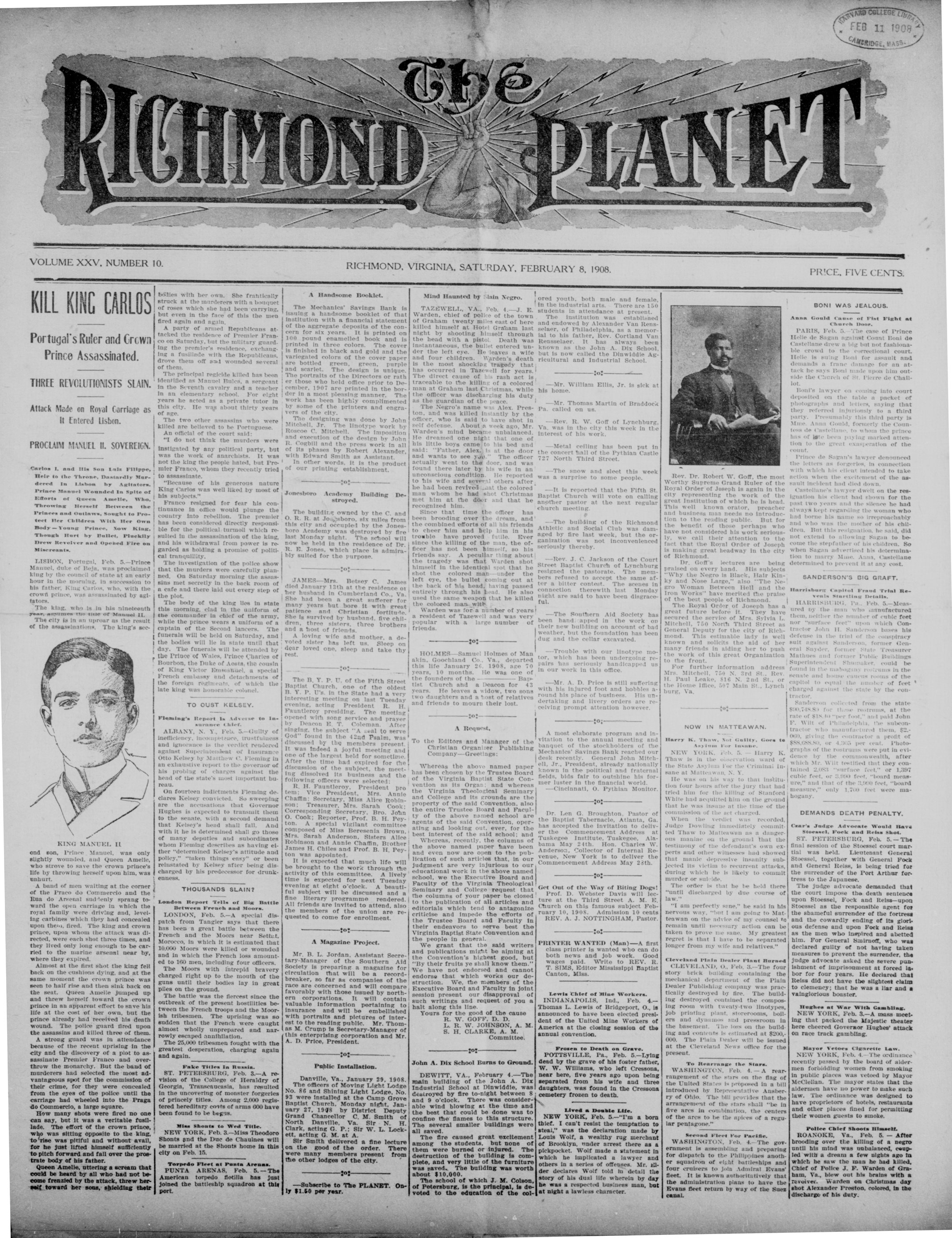
Page text (machine-generated)
THE RICHMOND PLANET
HARVARD COLLEGE LIBRARY
FEB 11 1908
CAMERIDGE, MASS.
KILL KING CARLOS
Portugal's Ruler and Crown Prince Assassinated. THREE REVOLUTIONISTS SLAIN.
Attack Made on Royal Carriage as It Entered Lisbon.
PROCLAIM MANUEL IL SOVEREIGN
Carlos L, and His Son Lulz Filippe,
Heir to the Throne, Dastardly Murdered In Lisbon by Agitators,
Prince Manuel Wounded In Split of Efforts of Queen Amelie, Who,
Throwing Herself Between the Princes and Outlaws, Sought to Protect Her Children With Her Own Body—Young Prince, Now King,
Though Hurt by Bullet, Pluckly Drew Revolver and Opened Fire on Miscreants.
LISBON, Portugal, Feb. 5.—Prince Manuel, duke of Beja, was proclaimed king by the council of state at an early hour in the morning, in succession to his father, King Carlos, who, with the crown prince, was assassinated by agitators.
The king, who is in his nineteenth year, assumes the title of Manuel II. The city is in an uprear as the result of the assassinations. The king's sec-
KING MANUEL II
ond son, Prince Manuel, was only
slightly wounded, and Queen Amelle,
who strove to save the crown prince's
life by throwing herself upon him, was
unhurt.
A band of men waiting at the corner of the Praco do Commercio and the Rua do Arsenal suddenly sprang toward the open carriage in which the royal family were driving and, leveling carbines which they had concealed upon theo, fired. The king and crown prince, upon whom the attack was directed, were each shot three times, and they lived only long enough to be carried to the marine arsenal near by, where they expired.
Almost at the first shot the king fell back on the cushions dying, and at the same moment the crown prince was seen to half rise and then sink back on the seat. Queen Amelle jumped up and threw herself toward the crown prince in an apparent effort to save his life at the cost of her own, but the prince already had received his death wound. The police guard fired upon the assassins and killed three of them.
A strong guard was in attendance because of the recent uprising in the city and the discovery of a plot to assassinate Premier Franco and overthrow the monarchy. But the band of murderers had selected the most advantageous spot for the commission of their crime, for they were concealed from the eyes of the police until the carriage had wheeled into the Praga do Commercio, a large square.
How many shots were fired no one can say, but it was a veritable fusillade. The effort of the crown prince, who was sitting opposite to the king, to rise was pitiful and without avail, for he just lifted himself sufficiently to pitch forward and fall over the prostate body of his father.
Queen Amelie, uttering a scream that could be heard by all who had not become frenzied by the attack, threw herself toward her sons, shielding their
bodies with her own. She frantically struck at the murders with a bouquet of roses which she had been carrying, but even in the face of this the men fired again and again.
A party of armed Republicans attacked the residence of Premier Franco on Saturday, but the military guarding the premier's residence, exchanging a fusilade with the Republicans, drove them off and wounded several of them.
The principal regicide killed has been identified as Manuel Bulca, a sergeant in the Seventh cavalry and a teacher in an elementary school. For eight years he acted as a private tutor in this city. He was about thirty years of age.
The two other assassins who were killed are believed to be Portuguese.
An official of the court said:
"I do not think the murders were
I do not think the murders were instigated by any political party, but was the work of anarchists. It was not the king the people hated, but Premier Franco, whom they recently tried to assassinate.
"Because of his generous nature King Carlos was well liked by most of his subjects."
Franco resigned for fear his continuance in office would plunge the country into rebellion. The premier has been considered directly responsible for the political turmoil which resulted in the assassination of the king, and his withdrawal from power is regarded as holding a promise of political tranquillity.
The investigation of the police show that the murders were carefully planned. On Saturday morning the assassins met secretly in the back room of a cafe and there laid out every step of the plot.
The body of the king lies in state this morning, clad in the uniform of the commander in chief of the army, while the prince wears a uniform of a captain of the Second lancers. The funerals will be held on Saturday, and the bodies will lie in state until that day. The funerals will be attended by the Prince of Wales, Prince Charles of Bourbon, the Duke of Aosta, the cousin of King Victor Emmanuel, a special French embassy and detachments of the foreign regiments, of which the late king was honorable colonel.
TO OUST KELSEY.
Fleming's Report is Adverse to insurance chief.
ALBANY, N. Y., Feb. 5—Guilty of inefficiency, incompetence, trustfulness and ignorance is the verdict rendered against Superintendent of Insurance Otto Kelsey by Matthew C. Fleming in an exhaustive report to the governor of his probing of charges against the head of the state's most important bureau.
On fourteen indictments Fleming declares Kelsey convicted. So sweeping are the accusations that Governor Hughes is expected to transmit them to the senate, with a second demand that Kelsey's head shall fall. And with it he is determined shall go those of many deputies and subordinates whom Fleming describes as having either "determined Kelsey's attitude and policy," "taken things ensy" or been reinstated by Kelsey after being discharged by his predecessor for drunkenness.
THOUSANDS SLAIN?
London Report Tells of Big Battle Between French and Moors
LONDON, Feb. 5. A special dispatch from Tangier says that there has been a great battle between the French and the Moors near Settat, Morocco, in which it is estimated that 10,000 Moors were killed or wounded and in which the French loss amounted to 160 men, including four officers. The Moors with intrepid bravery charged right up to the mouth of the guns until their bodies lay in great piles on the ground. The battle was the fiercest since the outbreak of the present hostilities between the French troops and the Moorish tribesmen. The uprising was so sudden that the French were caught almost wholly unprepared and narrowly escaped annihilation. The 25,000 tribesmen fought with the greatest desperation, charging again and again.
Fake Titles In Russia.
ST. PETER8BURG, Feb. 3.—A revision of the College of Heraldry of Georgia, Transcaucasia, has resulted in the uncovering of monster forgeries of princely titles. Among 2,000 registered hereditary costs of arms 600 have been found to be begus.
Miss Shonts to Wed Title.
NEW YORK, Feb. 3.—Miss Theodoro Shonts and the Duc de Chaulnes will be married at the Shonts home in this city on Feb. 15.
Torpedo Fleet at Punta Arenas.
PUNTA ARENAS, Feb. 5. — The
American torpedo flotilla has just
joined the battleship squadron at this
port.
RICHMOND, VIRGINIA, SATURDAY, FEBRUARY 8, 1908
A Handsome Booklet.
The Mechanics' Savings Bank is issuing a handsome booklet of that institution with a financial statement of the aggregate deposits of the concern for six years. It is printed on 100 pound enamelled book and is printed in three colors. The cover is finished in black and gold and the variegated colors of the cover paper are bottled green, green, purple and scarlet. The design is unique. The portraits of the Directors or rath er those who held office prior to December, 1907 are printed in the border in a most pleasing manner. The work has been highly complimented by some of the printers and engravers of the city.
The designing was done by John Mitchell, Jr. The linetype work by Roscoe C. Mitchell. The imposition and execution of the design by John R. Cogbill and the press work in all of its phases by Robert Alexander, with Edward Smith as Assistant.
In other words, it is the product of our printing establishment.
Jonesboro Academy Building Desstroyed.
The buildings owned by the C. and O. R. R. at Jonesboro, six miles from this city and occupied by the Jonesboro Academy was destroyed by fire last Monday night. The school will now be held in the residence of Dr. R. E. Jones, which place is admirably suited for the purpose.
JAMES--Mrs. Betsey C. James died January 13th at the residence on her husband in Cumberland Co., Va. She had been a great sufferer for many years but bore it with great patience and Christian fortitude. She is survived by husband, five children, three sisters, three brothers and a host of friends. A loving wife and mother, a devoted sister has left us. Sleep on dear loved one, sleep and take thy rest.
The B. Y. P. U. of the Fifth Street Baptist Church, one of the oldest B. Y. P. U's, in the State had a very interesting meeting on last Tuesday evening, acting President R. H. Fauntleroy presiding. The meeting opened with song service and prayer by Deacon E. T. Coleman. After singing, the subject "A seal to serve God" found in the 42nd Psalm, was discussed by the members present. It was indeed a joyful meeting and one of the largest held for sometime. After the time had expired for the discussion of the subject, the meeting dissolved its business and the following officers were selected:
R. H. Fauntleroy, President pro tem; Vice President, Mrs. Annie Chaffin; Secretary, Miss Alice Robinson; Treasurer, Mrs. Sarah Cook; Corresponding Secretary, Bro. John O. Cook; Reporter, Prof. B. H. Peyton. A special visitant committee composed of Miss Beresenia Brown, Mrs. Sarah Anderson, Sisters Alice Robinson and Annie Chaffin, Brother James H. Chiles and Prof. B. H. Peyton was appointed.
It is expected that much life will be brought to the work through the activity of this committee. A lively time is expected for next Tuesday evening at eight o'clock. A beautiful subject will be discussed and a fine literary programme rendered. All friends are invited to attend, also the members of the union are requested to come for enrollment.
A Magazine Project
Mr. B. L. Jordan, Assistant Secretary-Manager of the Southern Ald Society is preparing a magazine for circulation that will be a record-breaker, so far as companies of the race are concerned and will compare favorably with those issued by northern corporations. It will contain valuable information pertaining to insurance and will be embellished with portraits and pictures of interest to the reading public. Mr. Thomas M. Crump is Secretary-Manager of this enterprising corporation and Mr. A. D. Price, President.
Public Installation
Danville, Va., January 29, 1908.
The officers of Moving Light Lodge
No. 86 and Shining Light Lodge, No.
93 were installed at the Camp Grove
Baptist Church, Monday night, January
27, 1948 by District Deputy
Grand Chancellor C. M. Smith of
North Danville, Va. Sir N. H.
Clark, acting G. P.; Sir W. L. Lockett,
acting G. M at A.
Sir Smith delivered a fine lecture
on the good of the order. There
were many members present from
the other lodges of the city.
—Subscribe to The PLANET. Only $1.50 per year.
Mind Haunted by Slain Negro
TAZEWELL, VA., Feb. 4.—J. E. Warden, chief of police of the town of Graham twenty miles east of here killed himself at Hotel Graham last night by shooting himself through the head with a pistol. Death was instantaneous, the bullet entered under the left eye. He leaves a wife and four children. Warden's death is the most shocking tragedy that has occurred in Tazewell for years. The direct cause of his rash act is traceable to the killing of a colored man at Graham last Christmas, while the officer was discharging his duty as the guardian of the peace. The Negro's name was Alex. Preston, and was killed instantly by the officer, who is said to have shot in self defense. About a week ago, Mr. Warden's mind became unbalanced, dreamed one night that one of his little boys came to his bed and said: "Mother, Alex is at the door and wants to see you." The officer actually went to the door, and was found there later by his wife unconscious condition. He reported to his wife and several others after he had been revived that the colored man whom he had shot Christmas met him at the door and that he recognized him.
Since that time the officer has been brooding over the dream, and the combined efforts of all his friends to cheer him and help him in his trouble have proved futtle. Ever since the killing of the man, the officer has not been himself, so his friends say. A peculiar thing about the tragedy was that Warden shot himself in the identical spot that he shot the colored man—under the left eye, the bullet coming out at the back of his head, having passed entirely through his head. He also used the same weapon that he killed the colored man with. Warden was for a number of years a resident of Tazewell and was very popular with a large number of friends.
HOLMES—Samuel Holmes of Manakin, Goochland Co., Va., departed this life January 26, 1908, age 70 years, 10 months. He was one of the founders of the _____ Baptist Church and a Deacon for 43 years. He leaves a widow, two sons two daughters and a host of relatives and friends to mourn their lost.
A Request.
To the Editors and Manager of the Christian Organizer Publishing Company—Greetings:
Whereas the above named paper has been chosen by the Trustee Board of the Virginia Baptist State Convention as its Organ; and whereas the Virginia Theological Seminary and College and its grounds are the property of the said Convention, also the entire Trustee Board and Faculty of the above named school are agents of the said Convention, operating and looking out, ever, for the best interest of the said school; and Whereas, recently, the columns of the above named paper have been and even now are open to the publication of such articles that, in our judgment are very injurious to our educational work in the above named school, we the Executive Board and Faculty of the Virginia Theological Seminary and College request that the names of such articles be used to the publication of all articles and editorials which tend to antagonize criticise and impede the efforts of the Trustee Board and Faculty in their endeavors to serve best the Virginia Baptist State Convention and the people in general.
We grant that the said writers and publications might be aiming at the Convention's highest good, but "By their fruits ye shall know them." We have not endorsed and cannot endorse that which works our destruction. We, the members of the Executive Board and Faculty in joint session present our disapproval of such writings and request of you a halt along this line. Yours for the good of the cause
John A. Dix School Burns to Ground.
DEWITT, VA., February 4.—The main building of the John A. Dix Industrial School at Diwndiddle, was destroyed by fire to-night between 8 and 9 o'clock. There was considerable wind blowing at the time and the best that could be done was to confine the flames to this structure. The several smaller buildings were all saved.
The fire caused great excitement among the students, but none of them were burned or injured. The destruction of the building is complete, and very little of the furniture was saved. The building was worth about $10,000.
The school of which J. M. Colson, of Petersburg, is the principal, is devoted to the education of the col-
ored youth, both male and female, in the industrial arts. There are 150 students in attendance at present.
The institution was established and endowed by Alexander Van Rensselaer, of Philadelphia, as a memorial to his father, Rev. Cortland Van Rensselaer. It has always been known as the John A. Dix School, but is now called the Dinwiddie Agricultural and Industrial School.
—Mr. William Ellis, Jr. is sick at his home.
—Mr. Thomas Martin of Braddock Pa. called on us.
—Rev. R. W. Goff of Lynchburg, Va. was in the city this week in the interest of his work.
—Metal ceiling has been put in the concert hall of the Pythian Castle 727 North Third Street.
—The snow and sleet this week was a surprise to some people.
—It is reported that the Fifth St. Baptist Church will vote on calling another pastor at the next regular church meeting.
—The building of the Richmond Athletic and Social Club was damaged by fire last week, but the organization was not inconvenienced seriously thereby.
—Rev. J. C. Jackson of the Court Street Baptist Church of Lynchburg resigned the pastorate. The members refused to accept the same after a bitter contest. The scenes in connection therewith last Monday night are said to have been disgraceful.
—The Southern Aid Society has been hand-mapped in the work on their new building on account of bad weather, but the foundation has been dug and the cellar excavated.
—Trouble with our lintotype motor, which has been undergoing repairs has seriously handicapped us in our work in this office.
—Mr. A. D. Price is still suffering with his injured foot and hobbles around his place of business. His undertaking and livery orders are receiving prompt attention however.
A most elaborate program and invitation to the annual meeting and banquet of the stockholders of the Mechanics' Savings Bank reached our desk recently. General John Mitchell, Jr., President, already nationally known in the political and fraternal fields, bids fair to outshine his former luster in the financial world. —Cincinnati, O. Pythian Monitor.
Dr. Len G. Broughton, Pastor of the Baptist Tabernacle, Atlanta, Ga. has accepted the invitation to deliver the Commencement Address at Tuskegee Institute, Tuskegee, Alabama May 24th. Hon. Charles W. Anderson, Collector of Internal Revenue, New York is to deliver the Commencement Address May 28th.
Get Out of the Way of Biting Dogs!
Prof. D. Webster Davis will lecture at the Third Street A. M. E
Church on this famous subject February 10, 1908. Admission 10 cents
REV. A. J. NOTTINGHAM, Pastor
PRINTER WANTED (Man)—A first class printer is wanted who can do both news and job work. Good wages paid. Write to REV. R. T. SIMS, Editor Mississippi Baptist Canton, Miss.
Lewis Chief of Mine Workers.
INDIANAPOLIS, Ind., Feb. 4.
Thomas L. Lewis of Bridgeport, O., is announced to have been elected president of the United Mine Workers of America at the closing session of the annual convention.
Frozen to Death on Grave.
POTTSVILLE, Pa., Feb. 5—Lying dead by the grave of his foster father, W. W. Williams, who left Cressona, near here, five years ago upon being separated from his wife and three daughters, was found in the Cressona cemetery frozen to death.
Lived a Double Life.
NEW YORK, Feb. 5.—"I'm a born thief. I can't resist the temptation to steal," was the declaration made by Louis Wolf, a wealthy rug merchant of Brooklyn, under arrest there as a pickpocket. Wolf made a statement in which he implicated a lawyer and others in a series of offenses. Mr. Elder declares Wolf told in detail the story of his dual life wherein by day he was a respected business man, but at night a lawless character.
Rev. Dr. Robert W. Goff, the most Worthy Supreme Grand Ruler of the Royal Order of Joseph is again in the city representing the work of the great Institution of which he is head. This well known orator, preacher and business man needs no introduction to the reading public. But for the benefit of those perhaps who have not considered his work seriously, we call their attention to the fact that the Royal Order of Joseph is making great headway in the city of Richmond.
Dr. Goff's lectures are being praised on every hand. His subjects "Why the Negro is Black, Hair Kinky and Nose Large," also "The Negro Woman Between Hell and the Iron Works" have merited the praise of the best people of Richmond.
The Royal Order of Joseph has a great future before it. They have secured the service of Mrs. Sylvia L. Mitchell, 750 North Third Street as General Deputy for the city of Richmond. This estimable lady is well known and solicits the aid of her many friends in aiding her to push the work of this great Organization to the front.
For further information address Mrs. Mitchell, 750 N. 3rd St., Rev. H. Paul Leake, 816 N. 2nd St., or the Home office, 507 Main St., Lynchburg, Va.
NOW IN MATTEAWAN.
Harry K. Thaw, Not Guilty, Goes to Asylum For Insane.
NEW YORK, Feb. 5. — Harry K. Thaw is in the observation ward of the State Asylum For the Criminal Insane at Mattewan, N. Y.
He was on his way to that institution four hours after the jury that had tried him for the killing of Stanford White had acquitted him on the ground that he was insane at the time of the commission of the act charged.
When the verdict was recorded, Judge Dowling immediately committed Thaw to Mattewan as a dangerous maniac on the ground that the testimony of the defendant's own experts and other witnesses had showed that manic depressive insanity subjected its victim to recurrent attacks, during which he is likely to commit murder or suicide.
The order is that he be held there "until discharged by due course of law."
"I am perfectly sane," he said in his nervous way, "but I am going to Mattewan on the advice of my counsel to remain until necessary action can be taken to prove me sane. My greatest regret is that I have to be separated longer from my wife and relatives."
Cleveland Plain Dealer Plant Burned
CLEVELAND, O., Feb. 3.--The four story brick building containing the mechanical department of the Plain Dealer Publishing company was practically destroyed by fire. The building destroyed contained the composing room with twenty-two linetypes, job printing plant, storerooms, boilers and dynamos and pressroom in the basement. The loss on the building and contents is estimated at $200, 000. The Plain Dealer will be issued at the Cleveland News office for the present.
To Rearrange the Stars
WASHINGTON, Feb. 4. — A rearrangement of the stars on the flag of the United States is proposed in a bill introduced by Representative Ansberry of Ohio. The bill provides that the arrangement of the stars shall "be in five arcs in combination, the centers of the arcs to be the apices of a regular pentagone."
Second Fleet For Pacific
WASHINGTON, Feb. 4.—The government is assembling and preparing for dispatch to the Philippines another squadron of eight battleships and four cruisers to John Admiral Evans' fleet. It is known authoritatively that the administration plans to have the Evans fleet return by way of the Suez canal.
PR!CE. FIVE CENTS
BONI WAS JEALOUS.
Anna Gould Cause of Fist Fight at Church Door.
PARIS, Feb. 5.—The case of Prince Helle de Sagan against Count Boni de Castellane drew a big but not fashionable crowd to the correctional court. Helle is suing Boni for assault and demands a frane damage for an attack he says Boni made upon him outside the Church of St. Pierre de Challot.
Boni's lawyer on coming into court deposited on the table a packet of photographs and letters, saying that they referred injuriously to a third party. Presumably this third party is Mine, Anna Gould, formerly the Countess de Castellane, to whom the prince has of late been paying marked attention to the great exasperation of the count.
Prince de Sagan's lawyer denounced the letters as forgeries, in connection with which his client intended to take action when the excitement of the assault incident had died down.
Castellane's lawyer dwelt on the resignation his client had shown for the past two years and the silence he had always kept regarding the woman who had borne his name so irreproachably and who was the mother of his children. But this resignation, he said, did not extend to allowing Sagan to become the stepfather of his children. So when Sagan advertised his determination to marry Mine, Anna, Castellane determined to prevent it at any cost.
SANDERSON'S BIG GRAFT
Harrisburg Capitol Fraud Trial Reveals Starling Details.
HARRISBURG, Pa. Feb. 5.—Measured by the man who manufactured them, neither the number of cubic feet nor "surface feet" upon which Contractor John H. Sanderson bases his defense in the trial of the conspiracy suit against Sanderson, former General Snyder, former State Treasurer Mathues and former Public Buildings Superintendent Shumaker, could be found in the mabaggy rostrums in the senate and house canes rooms of the capitol to equal the number of feet charged against the state by the contractor.
Sanderson collected from the state $90,748.80 for these rostrums, at the rate of $18.40 per foot," and paid John P. Wilt of Philadelphia, the subcontractor who manufactured them, $2,000, giving the contractor a profit of $88,088.80, or 4,395 per cent. Photographs of the rostrums were put in evidence by the commonwealth, after which Mr. Wilt testified that they contained 2,083 "surface feet," or 1,397 cubic feet, or 3,990 feet, "board measure," and that of the 3,990 feet, "board measure," only 1,700 feet were mahogany.
DEMANDS DEATH PENALTY
Czar's Judge Advocate Would Have
Stocessel, Fock and Relax Shot.
ST. PETERSBURG, Feb. 5. — The final session of the Stoeessel court martial was held. Lieutenant General Stoeessel, together with General Fock and General Reiss, is being tried for the surrender of the Port Arthur fortress to the Japanese.
The judge advocate demanded that the court impose the death sentence upon Stoeessel, Fock and Reiss—upon Stoeessel as the responsible agent for the shameful surrender of the fortress and the cowardly ending of its glorious defense and upon Fock and Reiss as the men who inspired and abetted him. For General Smirnoff, who was declared guilty of not having taken measures to prevent the surrender, the judge advocate asked the severe punishment of imprisonment at forced labor for four years. He declared that Reiss did not have the slightest claim to clemency; that he was a liar and a valglorious boaster.
Hughes at War With Gambling.
NEW YORK, Feb. 3. — A mass meeting that packed the Majestic theater here cheered Governor Hughes' attack on race track gambling.
NEW YORK, Feb. 4.—The ordinance recently passed by the board of aldermen forbidding women from smoking in public places was vetoed by Mayor McClellan. The mayor states that the aldermen have no power to make such law. The ordinance was designed to have proprietors of hotels, restaurants and other places fined for permitting their women guests to smoke.
POLICE CHIEF SHOOTS HIMSELF
ROANOKE, Va., Feb. 5. — After brooding over the killing of a negro until his mind was unbalanced, coupled with a dream a few nights ago in which he saw the man he had killed, Chief of Police J. F. Warden of Graham, Va., blew out his brains with a revoiver. Warden on Christmas day shot Alexander Preston, colored, in the discharge of his duty.
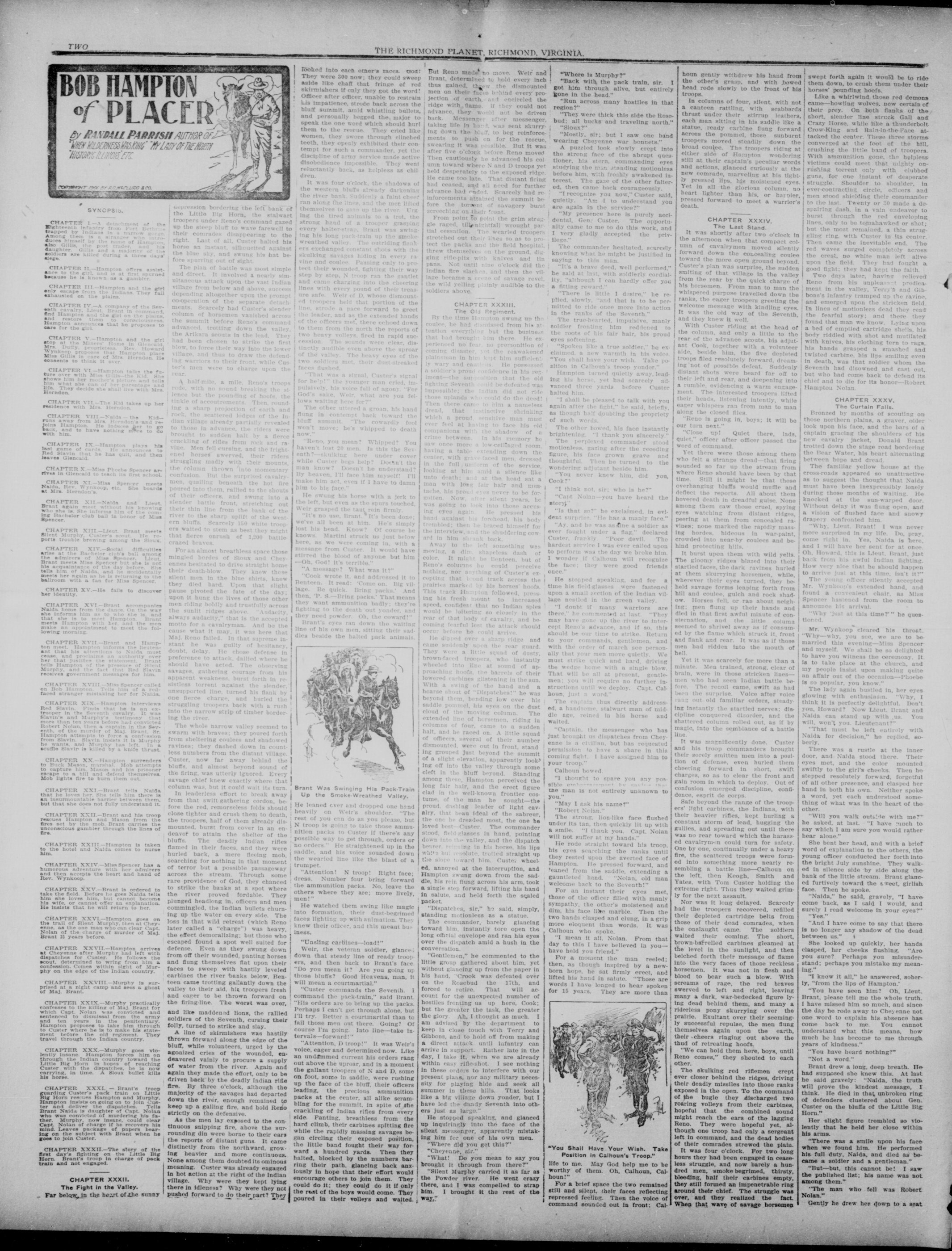
BOB HAMPTON
of PLACER
By RANDALL PARRISH AUTHOR OF
"WHEN WILDERNESS WAS KING" "MY LADY OF THE NORTH
"HISTORIC ILLINOIS" ETC.
COPYRIGHT 1906 BY R.C. MCCLURG & CO.
TWO
SYNOPSIS.
CHAPTER I.—A detachment of the Eighteenth infantry from Fort Bethune trapped the Indians in a narrow gorge ducks himself by the name of Hampon, Gillis, the post trader, and his daughter, and a majority of the soldiers are killed during a three days' siege.
CHAPTER II.—Hampton offers assistance to the girl, and is at first spurned because he is known as a gambler.
CHAPTER III.—Hampton and the girl only escape from the Indians. They fail exhausted on the plains.
CHAPTER IV.—A company of the Seventh cavalry, Lleut. Brant in command, find Hampton and the girl on the plains, then to consciousness, Hampton announces that he proposes to care for the girl.
CHAPTER V.—Hampton and the girl stop at the Miners' Home in Glencoe, Mrs. Duffy, proprietress. Rev. Howard proposes that Hampton place Miss Gillis at her Herndon. He consents to think it over.
CHAPTER VI.—Hampton takes the future over with Miss Gillis—the Kid. She shows him her mother's picture and tells him that she can of her parentage and that she decide she shall live with Mrs. Herndon.
CHAPTER VII.-The Kid takes up her residence with Mrs. Herndon.
CHAPTER VIII.-Naida, the Kid runs away from Mrs. Herndon and rejoins Hampton. He induces her to go back, and to have nothing more to do with him.
CHAPTER IX.-Hampton plays his last game of cards. He announces to Red Slavin that he has quit, and then leaves Glencaid.
CHAPTER X.-Miss Phoebe Spencer arrives in Glencaid to teach its first school.
CHAPTER XI.-Miss Spencer meets Naida, Rev. Wynkoup, etc. She boards at Mrs. Herndon's.
CHAPTER XII.-Naida and Lieut. Brant agonizes without his knowing who she is. She informs him of the coming Bachelor club ball in honor of Miss Spencer.
CHAPTER XIII.-Lieut. Brant meets Silent Murphy, Custer's scout. He reports trouble brewing among the Sloux.
CHAPTER XIV.-Social difficulties arise at the Bachelor club's ball among the members of Miss Spencer but she is not his acquaintance of the day before. She him of Nalaia, and he accidentally meets him with Hampton to the ballroom with a fan for Miss Spencer.
CHAPTER XV.-He fails to discover her identity.
CHAPTER XVII.-Brant accompanies Nalaia home from the dance. On the way she informs him as to who she is, and that she must attend the ballroom. Brant meets Hampton with her, and the men make an appointment to meet the following morning.
CHAPTER XVIIII.-Brant and Hampton meet. Hampton informs the lieutenant that he attends to Nalaia must cease, and proclaims her that justifies the statement. Brant Hampton of the presence of the silent Murphy that hints that Hunt Red Skinn receives government messages for him.
CHAPTER XVIII.-Miss Spencer called on Bob Hampton. Tells her faced stranger mistaking her for Nalaia.
CHAPTER XIX—Hampton interviews Red Slavin. Finds that he is an ex-trooper in the Seventh cavalry. It was more than ten years before had convicted Robert Nolan, then a captain in the Seventh, of the murder of Maj. Brant, Sr. He attempts to kill him from Slavin. Slavin insists it is Murphy he wants, and Murphy has left. In a scuffle Slavir is killed by a knife thrust.
CHAPTER XIX—Hampton surrenders to Buck Mason, marshal. Mob attempts to capture him Mason and his prisoner escape to a hill and defend themselves. Mob lights fire to burn them out.
CHAPTER XXI—Brant tells Nafia that he loves her. She tells him there is an insurmountable barrier between them, but that she does not fully understand it.
CHAPTER XXII—Brant and his troop rescues Hampton and Mason from the fires set by the mob. Brant carries the unconscious gambler through the lines of fire.
CHAPTER XXIII—Hampton is taken to the hotel and Nafia comes to nurse him.
CHAPTER XXIV.-Miss Spencer has a humorous adventure with her admirers and then accepts the heart and hand of Rev. Wynkoop.
CHAPTER XXV.-Brant is ordered to take the field. Before he goes Naida tells him she loves him, but cannot become his wife, or cannot offer an explanation. He insists that he will return to her.
CHAPTER XXVI.-Hampton goes on the trail of Silent Murphy, then at Chayenne, as the one man who can clear Capt. the ship of murder of Maj. Brant 15 years before.
CHAPTER XXVII.-Hampton arrives at Chayenne after Murphy had left with Capt. Crawford. He follo-
scot, determined to wring from him a confession. Comes within sight of Murphy on the edge of the Indian country.
CHAPTER XXVIII.-Murphy is surprised at a night camp and sees a ghost of Maj. Brant.
CHAPTER XXIX.—Murphy practically confesses to the killing of Maj. Brant for which Capot, the commander, to dismiss from the army and ten years in the penitentiary. Hampton proposes to take him through the Indian country to give his statement before the old regiment. They travel through the Indian country.
CHAPTER XXX.—Murphy goes violently insane. Hampton forces him on through the Indian country toward the Horn in hopes of reaching Custer with dispatches he carries, in time. A Sloux bullet kills his horse.
CHAPTER XXXI.—Brant's troop guarding Custer's pack train on Little Big Horn rescues Hampton and Murphy. Hampton insists on going to join the Tull Brant Naida is daughter of Capt. Nolan who was convicted of murdering his father Murphy, now insane, counsel Goff. Nolan of charge of the recover his mind. Leaves package of papers bearing on the subject with Brant when he goes to join Custer.
CHAPTER XXII.—The story of the first day's fighting on the Little Big Horn in charge of charge and not engages.
- Far below in the heart of the sunny
depression bordering the left bank of the Little Bighorn Horn, the stalwart troopers under Reno's command gazed up the steel bluff to wave farewell to their comrades disappearing to the right. Last of all, Custer halted his horse an instant, silhouetted against the blue sky, and swung his hat before spurring out of sight.
The plan of battle was most simple and direct. It involved a nearly simultaneous attack upon the vast Indian village from below and above, success depending altogether upon the prompt co-operation of the separate detachments. Scarcely had Custer's slender column of horsemen vanished across the summit before Reno's command advanced, trotting down the valley, the Arkika scouts in the lead. They had been chosen to strike the first blow, to force their way into the lower village, and thus to draw the defending warriors to their front, while Custer's men were to charge upon the rear.
A half mile, a mile, Reno's troop rode, with no sound breaking the silence but the pounding of hoops, the tinkle of accoutrements. Then, rounding a sharp projection of earth and rock, the scattered lodges of the Indian village already partially revealed to those in advance, the riders were brought to sudden halt by a fierce crackling of rifles from rock and ravine. Men fell cursing, and the frightened horses swerved, their riders struggling madly with their mounts, the column thrown 'into momentary confusion. But the surprised cavalrymen, quailing beneath the hot fire poured into them, rallied to the shouts of their officers, and swung into a slender battle front, stretching out their thin line from the bank of the river to the sharp uplift of the western bluces. Scarcely 150 white troopers waited to stem as best they might that fierce onrush of 1,200 battle-crazed braves.
For an almost breathless space those mingled hordes of Sloux and Cheyennes hesitated to drive straight home their death-blow. They knew these silent men in the blue shirts, knew they died hard. Upon that slight pause pivoted the fate of the day; upon it hung the lives of those other men riding boldly and trustfully across the sunlit ridges above. "Audacity, always audacity," that is the accepted motto for a cavalryman. And be the cause what it may, it was here that MaJ. Reno failed. In that supreme instant he was guilty of hesitancy, doubt, delay. He chose defense in preference to attack, dallied where he should have acted. The observing savages, gathering course from his apparent weakness, burst forth in resistless torrent against the slender, unsupported line, turned his flank by one fierce charge, and hurled the struggling troopers back with a rush into the narrow strip of timber bordering the river.
The whole narrow valley seemed to swarm with braves; they poured forth from sheltering coulees and shadowed ravines; they dashed down in countless numbers from the distant village. Custer, now far away behind the bluffs, and almost beyond sound of the firing, was utterly ignored. Every savage chief knew exactly where that column was, but it could wait to die.
In leaderless effort to break away from that swift gathering cordon, before the red, remorseless folds should close tighter and crush them to death, the troopers, half of them already mounted, burst from cover in an endeavor to attain the shelter of the bluffs. The deadly Indian rifles flamed in their faces, and they were hurled back, a mere fleeing mob, searching for nothing in that moment of terror but a possible passageway across the stream. Through some rare providence of God, they chanced to strike the banks at a spot where the river proved fordable. They plunged headlong in, officers and men commingled, the Indian bullets churning up the water on every side. The loss in that wild retreat (which Reno later called a "charge") was heavy, the effect demoralizing; but those who escaped found a spot well suited for defense. Even as they swung down from off their wounded, panting horses and flung themselves flat upon their faces to sweep with hastily leveled carbines the river banks below. Benteen came trotting gallantly down the valley to their aid, hit troopers fresh and eager to be thrown forward on the firing-line. The worst was over,
and like maddened lions, the rallied soldiers of the Seventh, cursing their folly, turned to strike and slay. A line of skirmishers was hastily thrown forward along the edge of the bluff, while volunteers, urged by the agonized cries of the wounded, endearved vainly to procure a supply of water from the river. Again and again they made the effort, only to be driven back by the deadly Indian rifle fire. By three o'clock, although the majority of the savages had departed down the river, enough remained to keep up a galling fire, and hold Reno strictly on the defensive.
As the men lay exposed to the continuous snipping fire, above the surrounding din were borne to their ears the reports of distant guns. It came distinctly from the northward, growing heavier and more continuous. None among them doubted its ominous meaning. Custer was already engaged in hot action at the right of the Indian village. Why were they kept lying there in idleness? Why were they not pushed forward to do their part? They
THE RICHMOND PLANET, RICHMOND, VIRGINIA
Looked into each other's races. stood!
They were 300 now; they could sweep aside like chaff that fringe of red skimmers if only they got the word! Officer after officer, unable to restrain his impatience, strode back across the bluff summit, amid whistling bullets, and personally begged the major to speak the one word which should hurl them to the rescue. They cried like women, they swore through clinched teeth, they openly exhibited their contempt for such a commander, yet the discipline of army service made active disobedience impossible. They went reluctantly back, as helpless as children.
It was four o'clock, the shadows of the western bluffs already darkening the river bank. Suddenly a faint chee ran along the lines, and the men lifted themselves to sage up the river. Unging the tired animals to a trot, the strong hand of a trooper grasping every hailer-strap, brant was swinging his long pack-train up the smokewreathed valley. The outriding flankers exchanged constant shots with the skulking savages hiding in every ravine and coulee. Pausing only to protect their wounded, fighting their way step by step, N troop ran the gantlet and came charging into the cheering lines with every pound of their treasure safe. Weir of D, whose dismounted troopers held that portion of the line, strode a pace forward to greet the leader, and as the extended hands of the officers met, there echoed down to them from the north the reports of two heavy volleys, fired in rapl succession. The sounds were clear, distinctly audible even above the uproar of the valley. The heavy eyes of the two soldiers met, their duet-streaked faces flushed.
"That was a signal, Custer's signal for help!" the younger man cried, impulsively, his voice full of agony. "For God's sake, Weir, what are you follows waiting for here?" The other uttered a groan, his hand flung in contempt back toward the bluff summit. "The cowardly fool won't move; he's whipped to death now."
"Reno, you mean? Whipped? You haven't lost 20 men. Is this the Seventh?—skilling here under cover while Custer bogs help? Doesn't the man know? Doesn't he understand? By heaven, I'll face him myself! I'll make him act, even if I have to damn him to his face."
He swung his horse with a jerk to the left, but even as the spurs touched, Weir grasped the taut rein firmly.
"It's no use, Brant. 'It's been done; we've all been at him. He's simply lost his head. Know? Of course he knows. Martini struck us just below here, as we were coming in, with a message from Custer. It would have stirred the blood of anyone but him—Oh, God! 'it's terrible.' "A message. What was it?"
"Cook wrote it, and addressed it to Benteen. It read: 'Come on. Big village. Be quick. Bring packs.' And then, 'P. S—Bring packs.' That means they want ammunition badly; they're fighting to the death out yonder, and they need powder. Oh, the coward!" Brant's eyes ran down the waiting line of his own men, sitting their saddles beside the halted neck, animals.
Brant Was Swinging His Pack-Train Up the Smoke-Wreathed Valley
He leaned over and dropped one hand heavily on Weir's shoulder. "The rest of you can do as you please, but N troop is going to take those ammunition packs to Custer if there's any possible way to get through, orders or no orders." He straightened up in the saddle, and his voice sounded down the wearied line like the blast of a trumpet.
"Attention! N troop! Right face; dress. Number four bring forward the ammunition packs. No, leave the others where they are; move lively, men!"
He watched them swing like magic into formation, their dust-begripped faces lighting up with animation. They knew their officer, and this meant business.
"Unsling carbines—load!"
Weir, the veteran soldier, glanced down that steady line of ready troopers, and then back to Brant's face. "Do you mean it? Are you going up those bluffs? Good Heavens, man, it will mean a courtmartial." "Custer commands the Seventh. I command the pack-train," said Brant. "His orders are to bring up the packs. Perhaps I can't get through alone, but I'll try. Better a courtmartial than to fall those men out there. Going? Of course I'm going. Into line—take intervals—forward!"
"Attention, D troop!" It was Weir's voice, eager and determined now. Like an undammed current his orders rang out above the uproar, and in a moment the gallant troopers of N and D, some on foot, some in saddle, were rushing up the face of the bluff, their officers leading, the precious ammunition packs at the center, all alike scrambling for the summit, in spite of the crackling of Indian rifles from every side. Panting, breathless from the hard climb, their carbines spitting fire while the rapidly massing savages began circling their exposed position, the little band fought their way forward a hundred yards. Then they halted, blocked by the numbers barring their path, glancing back anxiously in hope that their effort would encourage others to join them. They could do it; they could do it if only the rest of the boys would come. They poured in their volleys and waited.
But Reno made no move. Weir and Brant, determined to hold every inch thus gained, throw the dismounted men on their faces behind every projection of earth, and encircled the ridge with name. If they could not advance, they would not be driven back. Messenger after messenger, taking life in hand, was sent skurrying down the bluff, to beg reinforcements to push on for the rescue, swearing it was possible. But it was after five o'clock before Reno moved. Then cautiously he advanced his column toward where N and D troops yet held desperately to the exposed ridge. He came too late. That distant firing had ceased, and all need for further advance had ended. Scarcely had reinforcements attained the summit before the torment of savagery burst screeching on their front.
From point to point the grim strangle gled rage, till nightfall wrought partial cessation. The weared troopers stretched out their lines so as to protect the packs and the field hospital threw themselves on the ground, digging rifle-pits with knives and tin pans. Not until nine o'clock did the Indian fire slacken, and then the village became a scene of savage revel, the wild yelling plainly audible to the soldiers above.
CHAPTER XXXIII.
The Old Regiment
By the time Hamilton swung up the couch, he had dismissed from his attention everything but the business that had brought him there. He experienced no fear no precondition of coming disaster, yet the reawakened plainsman in his hiro kept him sufficiently wary and cautious. He possessed a soldier's proud confidence in his regiment—the suppression that the old fighting Seventh could be defeated was impossible; the Indian did not ride those uplands who could do the deed! Then there came to him a nameless dread, that instinctive shrinking which a proud sensitive man must ever feel at having to face his old companions with the shadow of a crime between. In his memory he saw once more a low-ceilinged room, having a table extending down the center, with grave faced men, dressed in the full uniform of the service, looking at him amid a silence like unto death; and at the head sat a man with long fair hair and mustache, his proud eyes never to be forgotten. Now, after silent years, he was going to look into those accusing eyes again. He pressed his hand against his forehead, his body trembled; then he braced himself for the interview, and the shuddering coward in him shrank back.
Away to the left something was moving, a dim, slapeless dash of color. It might be Benten, but of Reno's columns he could perceive nothing, nor anything of Custer's excepting that broad track across the prairies marked by his horses' hoofs. This track Hampton followed, pressing his fresh mount to increased speed, confident that no Indian spies would be loitering so closely in the rear of that body of cavalry, and becoming fearful lest the attack should occur before he could arrive.
He dipped over a sharp ridge and came suddenly upon the rear guard. They were a little squad of dusty, brown-faced troopers, who instantly wheeled into line at sound of approaching hoofs, the barrels of their lowered carbines glistening in the sun. With a swing of the hand and a hoarse shout of "Dispatches!" he was beyond them, bending low over his saddle pommel, his eyes on the dust cloud of the moving column. The extended line of horsemen, riding in columns of four, came to a sudden halt, and he raced on. A little squad of officers, several of their number dismounted, were out in front, standing grouped just beyond the summit of a slight elevation, apparently looking off into the valley through some cleft in the bluff beyond. Standing among these, beyond perceived the long fair hair, and the erect figure clad in the well-known frontier costume, of the man he sought—the proud, dashing leader of light cavalry, that beau ideal of the sabreur, the one he dreaded most, the one he loved best—Custer. The commander stood, field-glasses in hand, pointing down into the valley, and the dispatch beaver, reclaiming in his horse, his lips white but resolute, trotted straight up the slope toward him. Custer; wheeled, annoyed at the interruption, and Hampton swung down from the saddle, his rein flung across his arm, took a single step forward, lifting his hand in salute, and held forth the sealed packet.
"Dispatches, sir," he said, simply, standing motionless as a statue. The commander, barely glancing toward him, instantly tore open the long official envelope and ran his eyes over the dispatch amid a hush in the conversation.
"Gentlemen," he commented to the little group gathered about him, yet without glancing up from the paper in his hand, "Crook was defeated over on the Rosebud the 17th, and forced to retire. That will account for the unexpected number of hostiles fronting us up here, Cook; but the greater the task, the greater the glory. Ah, I thought as much. I am advised by the department to keep in close touch with Terry and Gibbons, and to hold off from making a direct attack until infantry can arrive in support. Rather late in the day, I take it, when we are already within easy rifle-shot. I see nothing in these orders to interfere with our present plans, nor any military necessity for playing hide and seek all summer in these hills. That looks like a big village down yonder, but I have led the dandy Seventh into others just as large."
He stopped speaking, and glanced up in inquiringly into the face of the silent messenger, apparently mistaking him for one of his own men.
"Where did you get this?"
"Cheyenne, sir."
"What! Do you mean to say you brought it through there?"
"I silent Murphy carried it as far as the Powder river. He went crazy there, and I was compelled to strap him. I brought it the rest of the way."
"Where is Murphy?"
"Back with the pack train, sir. I got him through alive, but entirely gone in the head."
"Run across many hostiles in that region?"
"They were thick this side the Rosebud; all bucks and traveling north."
"Sloux?"
"Mostly, sir; but I saw one band wearing Chevonne war honnors."
A puzzled look slowly crept into the strong face of the abrupt questioner, his stern, commanding eyes studying the man standing motionless before him, with freshly awakened interest. The gaze of the other faltered, then came back courageously.
"I recognize you now," Custer said, quietly. "Am I to understand you are again in the service?"
"My presence here is purely accidental, Gen. Custer. The opportunity came to me to do this work, and I very gladly accepted the privilege."
The commander hesitated, scarcely knowing what he might be justified in saying to this man.
"It's a brave deed, well performed," he said at last, with soldierly cordiality, "although I can hardly offer you a fitting reward."
"There is little I desire," he replied, slowly, "and that is to be permitted to ride once more into action in the ranks of the Seventh."
The true hearted, impulsive, manly soldier fronting him reddened to the roots of his fair hair, his proud eyes softening.
"Spoken like a true soldier," he exclaimed, a new warmth in his voice "You shall have your wish. Take position in Calhoun's troop yonder."
Hampton turned quietly away, leading his horse, yet had scarcely advanced three yards before Custer halted him.
"I shall be pleased to talk with you again after the fight," he said, briefly, as though half doubting the propriety of such words.
The other bowed, his face instantly brightening. "I thank you sincerely."
The perplexed commander stood motionless, gazing after the receding figure, his face grown grave and thoughtful. Then he turned to the wondering adjutant beside him.
"You never knew him, did you, Cook."
"I think not, sir; who is he?"
"Capt Nolan—you have heard the story!"
"Is that so?" he exclaimed, in evident surprise. "He has a mainly face."
"Ay, and he was as fine a soldier as ever fought under a flag." declared Custer, frankly. "Poor devil. The hardest service I was ever called upon to perform was the day we broke him. I wonder if Calhoun will recognize the face; they were good friends ence."
He stopped speaking, and for a time his field glasses were fastened upon a small section of the Indian village nestled in the green valley.
"I doubt if many warriors are there," he commented at last. "They may have gone up the river to intercept Reno's advance, and if so, this should be our time to strike. Return to your commands, gentlemen, and with the order of march see personally that your men move quietly. We must strike quick and hard, driving the wedge home with a single blow. That will be all at present, gentlemen; you will require no further instructions until we deploy. Capt. Calhoun, just a word."
The captain thus directly addressed, a handsome, stalwart man of middle age, reined in his horse and waited.
"Captain, the messenger who has just brought us dispatches from Cheyenne is a civilian, but has requested permission to have a share in this coming fight. I have assigned him to your troop."
Calhoun bowed.
"I thought to spare you any possible embarrassment, by saying that the man is not entirely unknown to you."
"May I ask his name?"
"Robert Nolan."
The strong, lion-like face flushed under its tan, then quickly lit up with a smile. "I thank you. Capt. Nolan will not suffer at my hands."
He rode straight toward his troop, his eyes searching the ranks until they rested upon the averted face of Hampton. He pressed forward, and leaned from the saddle, extending a gauntleted hand. "Nolan, old man welcome back to the Seventh!"
For an instant their eyes met, those of the officer filled with many sympathy, the other's moistened and dim, his face like marble. Then the two hands clasped and clung, in a grip more eloquent than words. It was Calhoun who spoke.
"I mean it all, Nolan. From that day to this I have believed in you—have held you friend."
For a moment the man reeled; then, as though inspired by a newborn hope, he sat firmly erect, and lifted his hand in salute. "Those are words I have longed to hear spoken for 15 years. They are more than
P.
life to me. May God help me to be worthy of them. Oh, Calhoun, Calhoun!"
For a brief space the two remained still and silent, their faces reflecting repressed feeling. Then the voice of command sounded out in front: Cal
houn gently withdrew his hand from the other's grasp, and with bowed head rode slowly to the front of his troops.
In columns of four, silent, with not a canteen rattling, with seabarburs thrust under their stirrup leathers, each man sitting in his saddle like a statue, ready carbine flung forward across the pommel, those sunburn troopers moved steadily down the broad coulee. The troopers riding at either side of Hampton wondering still at their captain's peculiar words and actions, glanced curiously at the new comrade, marvelling at his tightly pressed lips, his moistened eyes. Yet in all the glorious column, no heart lighter than his, or harpier, pressed forward to meet a warrior's death.
CHAPTER XXXIV.
The Last Stand
It was shortly after two o'clock in the afternoon when that compact column of cavalrymen moved silently forward down the concealing coues toward the more open ground beyond. Custer's plan was surprise, the sudden smiting of that village in the valley from the rear by the quick charge of his horsemen. From man to man the whispered purpose travelled down the ranks, the eager troopers greeting the welcome message with kindling eyes. It was the old way of the Seventh, and they knew it well.
With Custer riding at the head of the column, and only a little to the rear of the advance scouts, his adjutant Cook, together with a volunteer aide, beside him, the five depleted troops filed resolutely forward, dreaming not of possible defeat. Suddenly distant shots were heard far off to their left and rear, and deepening into a rumble, evidencing a warm engagement. The interested troopers lifted their heads, listening intently, while eager whispers ran from man to man along the closed files.
"Reno is going in, boys; it will be our turn next."
"Close up! Quiet there, lads, quiet," officer after officer passed the word of command.
Yet there were those among them who felt a strange dread—that firing sounded so far up the stream from where Reno should have been by that time. Still it might be that those overhanging bluffs would muffle and deflect the reports. All about them hovered death in dreadful gale. None among them saw those cruel, spying eyes watching from distant ridges, peering at them from concealed ravines; none marked the rapidly massing hordes, hideous in war-paint, crowded into near-by couches and behind protecting hills.
It burst upon them with wild yells. The gloomy ridges blazed into their startled faces, the dark ravines hurled at them skurrying horsemen, while, wherever their eyes turned, they be held savage forms leaping forth from hill and coulee, gulch and rock shadow. Horses fell, or ran about neighing; men flung up their hands and died in that first awful minute of consternation, and the little column seemed to shrivel away as if consumed by the flame which struck it, front and flank and rear. It was as if those men had ridden into the mouth of hell.
Yet it was scarcely for more than a minute. Men trained, strong, clear of brain, were in those stricken lines—men who had seen Indian battle before. The recoil came, swift as had been the surprise. Voice after voice rang out old familiar orders, steadying instantly the startled nerves; discipline conquered disorder, and the shattered column rolled out, as if by magic, into the semblance of a battle line.
It was magnificently done. Custer and his troop commanders brought their sorely smitten men into a position of defense, even hurled them cheering forward in short, swift charges, so as to clear the front and gain room in which to deploy. Out of confusion emerged discipline, confidence, esprit de corps.
Safe beyond the range of the troopers' light caribines, the Indians, with their heavier rifles, kept hurling a constant storm of lead, hugging the gullies, and spreading out until there was no rear toward which the harassed cavalrymen could turn for safety. One by one, continually under a heavy fire, the scattered troops were formed into something more nearly resembling a battle line—Caloun on the left, then Keogh, Smith and Yates, with Tom Custer holding the extreme right. Thus they waited grimly for the next assault.
Nor was it long delayed. Scarcely had the troopers recovered, reilled their depleted cartridge belts from those of their dead comrades, when the onslaught came. The soldiers waited their coming. The short, brown-barrelled carbines gleamed at the level in the sunlight, and then belched forth their message of flame into the very faces of those reckless horsemen. It was not in flesh and blood to bear such a blow. With screams of rage, the red braves swerved to left and right, leaving many a dark, war-bedecked figure lying dead behind them, and many a riderless pony skurrying over the prairie. Exultant over their seemingly successful repulse, the men flung themselves again upon the earth, their cheers ringing out above the thud of retreating hoofs.
"We can hold them here, boys, until Reno comes," they shouted to each other.
The skulking red riflemen crept ever closer behind the ridges, driving their deadly missiles into those ranks exposed in the open. To the command of the bugle they discharged two roaring volleys from their carbines, hopeful that the combined sound might reach the ears of the lagging Reno. They were hopeful yet, although one troop had only a sergeant left in command, and the dead bodies of their comrades strewed the plain. It was four o'clock. For two long hours they had been engaged in ceaseless struggle, and now barely a hundred men, smoke begrimed, thirsty, bleeding, half their carbines empty, they still formed an impenetrable ring around their chief. The struggle was over, and they realized the fact. When that wave of savage horsemen
swept forth again it would be to ride them down, to crush them under their horses' pounding hoofs.
Like a whirlwind those red demons came—howling wolves, new certain of their prey. On both flanks of the short, slender line struck Gall and Crazy Horse, while like a thunderbolt Crow-King and Rain-in-the-Face attacked the center. These three storms converged at the foot of the hill, crushing the little band of troopers. With ammunition gone, the helpless victims could meet that mighty or rushing torrent only with clubbed guns, for one instant of desperate struggle. Shoulder to shoulder, in ever-contracting circle, officers and men stood shielding their commander to the last. Twenty or 20 made a despairing dash, in a vain endeavor to burst through the red enveloping lines, only to be tomahawked or shot; but the most remained, a thin struggling ring, with Custer in its center. Then came the inevitable end. The red waves surged completely across the crest, no white man left alive upon the field. They had fought a good fight; they had kept the faith.
Two days later, having relieved Reno from his unpleasant predicament in the valley, Terry's and Gibbons's infantry trumped up the ravine and emerged upon the stricken field. In lines of motionless dead they read the fearful story; and there they found that man we know. Lying upon a bed of emptied cartridge shells, his body riddled with shot and mutilated with knives, his clothing torn to rags, his hands grasped a smashed and twisted carbine, his lips smiling even in death, was that soldier whom the Seventh had disowned and cast out, but who had come back to defend its chief and to die for its honor—Robert Hampton Nolan.
CHAPTER XXXV.
Bronzed by months of scouting on those northern plains, a graver, older look upon his face, and the bars of a captain gracing the shoulders of his new cavalry jacket, Donald Brant trotted down the stage road bordering the Bear Water, his heart alternating between hope and dread.
The familiar yellow house at the cross-roads appeared so unattractive as to suggest the thought that Nalda must have been inexpressibly lonely during those months of waiting. He knocked at the sun-warped door. Without delay it was flung open, and a vision of flushed face and snowy drapery confronted him.
"Why, Leut. Brant! I was never more surprised in my life. Do, pray, come right in. Yes, Naida is here, and I will have her sent for at once. Oh, Howard, this is Leut. Brant, just back from his awful Indian lighting. How very nice that he should happen to arrive just at this time, isn't it?" The young officer silently accepted Mr. Wynkoop's extended hand, and found a convenient chair, as Miss Spencer hastened from the room to announce his arrival.
"Why just at this time?" he questioned.
Mr. Wynkoop cleared his throat. "Why—why, you see, we are to be married this evening—Miss Spencer and myself. We shall be so delighted to have you witness the ceremony. It is to take place at the church, and my people insist upon making quite an affair out of the occasion—Phoebe is so popular, you know."
The lady again busted in, her eyes glowing with enthusiasm. "Why, I think it is perfectly delightful. Don't you, Howard? Now Leutent Brant and Nalda can stand up with us. You will, won't you Lieutenant?" "That must be left entirely with Nalda for decision," he replied, soberly.
There was a rustle at the inner door, and Nalda stood there. Their eyes met, and the color mounted swiftly to the girl's cheeks. Then he stepped resolutely forward, forgetful of all other presence, and clasped her hand in both his own. Neither spoke a word, yet each understood something of what was in the heart of the other.
"Will you walk outside with me?" he asked, at last. "I have much to say which I am sure you would rather bear alone."
She bent her head, and with a brief word of explanation to the others, the young officer conducted her forth into the bright July sunshine. They walked in silence side by side along the bank of the little stream. Brant glanced furtively toward the sweet, girlish face. Then he spoke.
"Naalda," he said, gravely, "I have come back, as I said I would, and surely I read welcome in your eyes?"
"Yes."
"And I have come to say that there is no longer any shadow of the dead between us."
She looked up quickly, her hands clasped, her cheeks flushing. "Are you sure? Perhaps you misunderstand; perhaps you mistake my meaning."
"I know it all," he answered, soberly, "from the lips of Hampton."
"You have seen him? Oh, Lieut. Brant, please tell me the whole truth. I have missed him so much, and since the day he rode away to Cheyenne not one word to explain his absence has come back to me. You cannot understand what this means, how much he has become to me through years of kindness."
"You have heard nothing?"
"Not a word."
Brant drew a long, deep breath. He had supposed she knew this. At last he said gravely: "Naida, the truth will prove the kindest message, I think. He died in that unbroken ring of defenders clustered about Gen. Custer on the bluffs of the Little Big Horn."
Her slight figure trembled so violently that he held her close within his arms.
"There was a smile upon his face when we found him. He performed his full duty, Naida, and died as became a soldier and a gentleman."
"But—but, this cannot be! I saw the published list; his name was not among them."
"The man who fell was Robert Nolan."
Gently he drew her down to a seat
THE PLANET
SATURDAY...FEBRUARY 8, 1908
upon the soft turf of the bank. She looked up at him helplessly, her mind seemingly dazed, her eyes yet filled with doubt.
"Robert Nolan? My father?"
He bent ever toward her, pressing his lips to her hair and stroking it tenderly with his hand.
"Yes, Naida, darling; it was truly Robert Hampton Nolan who died in battle, in the ranks of his old regiment—died as he would have chosen to die, thank God! completely cleared of every stain upon his honor. Sit up, little girl, and listen while I tell you. There is in the story no word which does not reflect nobility upon the soldier's daughter."
She unlifted her white face. "Tell me," she said, simply, "all you know."
He recounted to her slowly, carefully, the details of that desperate journey northward, of their providential meeting on the Little Big Horn, of the papers left in his charge of
He Held Her Close Within His Arms
Hampton's riding forward with dispatches, and of his death at Custer's side. While he smoke, the girl scarcely moved; her breath came in soba and her hands clasped his.
"These are the papers, Nalda. I opened the envelope as directed, and found deeds to certain properties, including the mine in the Black Range; a will, duly signed and attested, naming you as his sole heir, together with a carefully prepared letter, addressed to you, giving a full account of the crime of which he was convicted, as well as some other matters of a personal nature. That letter you must read alone as his last message, but the truth of all he says has since been proved."
She glanced up at him quickly. "By Murphy?"
"Yes, by Murphy, who is now lying in the hospital at Bethune, slowly recovering. His recent deposition has been forwarded to the department at Washington, and will undoubtedly result in the honorable replacing of your father's name on the army list. I will tell you briefly the man's confession, together with the few additional facts necessary to make it clear.
"Your father and mine were for many years friends and army comrades. They saw service together during the great war, and afterward upon the plains in Indian campaigning. Unfortunately a slight misunderstanding arose between them. One night they openly quarreled when heated by wine, and exchanged blows. The following evening your father chancing to be officer of the guard and on duty, my father, whose wife had then been dead a year, was thoughtless enough to accompany Mrs. Nolan home at a late hour from a post ball. It was merely an act of ordinary courtesy; but gossips magnified the tale.
"Donald, I Love You."
and bore it to Nolan. Still smarting from the former quarrel, in which I fear my father was in the wrong, he left the guard house with the openly avowed intention of seeking immediate satisfaction: In the meanwhile Slavin, Murphy, and a trooper named Flynn, who had been to town without passes, and were half-drunk, stole through the guard lines and decided to make a midnight raid on the colonel's private office. Dodging along behind the powder house, they ran suddenly upon my father, then on the way to his own quarters. Whether they were recognized by him, or whether drink made them reckless of consequences, is unknown, but one of the men instantly fired. Then they ran, and succeeded in gaining the barracks unsuspected."
She sat as if fascinated by his recital.
"Your father heard the shot, and sprang toward the sound, only to fall headlong across my father's lifeless body. As he came heavily down, his revolver was jarred out of its holster
and dropped unnoticed in the grass. An instant later the guard came running up, and by morning Capt. Nolan was under arrest charged with murder. The circumstantial evidence was strong—his quarrel with the murdered man, his heated language a few moments previous, the revolver lying beside the body, having two chambers discharged, and his being found there alone with the man he had gone forth to seek. Slayin and Flynn both strengthened the case by positive testimony. As a result, a court-martial dismissed the prisoner in disgrace from the army, and a civil court sentenced him to ten years' imprisonment."
"And my mother?" The question was a trembling whisper from quivering lips.
"Your mother," he said regretfully, "was an exceedingly proud woman, belonging to a family of social prominence in the east. She felt deeply the causeless gossip connecting her name with the case, as well as the open disgrace of her husband's conviction. She refused to receive her former friends, and even failed in loyalty to your father in his time of trial. It is impossible now to fix the fault clearly, or to account for her actions. Capt. Nolan turned over all his property to her, and the moment she could do so she disappeared from the fort, taking you with her. From that hour none of her old acquaintances could learn anything regarding her whereabouts. She did not return to her family in the east, nor correspond with anyone in the army. Probably, utterly broken hearted, she sought seclusion in some city. How Gillis obtained possession of you remains a mystery."
"Is that all?"
They kept silent for a long time, the slow tears dropping from her eyes, her hands clasped in her lap. His heart, heavy with sympathy, would not permit him to break in upon her deep sorrow with words of comfort. "Nalda," he whispered at last, "this may not be the time for me to speak such words, but you are all alone now. Will you go back to Bethune with me—back to the old regiment as my wife?"
A moment she bowed her head before him; then lifted it and held out her hands. "I will."
"Say to me again what you once said."
"Donald, I love you."
Gently he drew her down to him, and their lips met.
"I wish you to be very happy, Nalda, dear," he whispered, drawing her head tenderly down until it found rest upon his shoulder.
"Yes, I feel you do, and I am; but
it cannot come all at once. Donald,
for I have lost so much—so much
I—I hope he knows."
FORCE.
Horace—What's your father's business, my boy?
Boy—'E 'asn't got or business.
Horace—I mean what does he work at?
Boy—I doesn't work, 'e's a police man!
Advice.
Don't heard your son, eh married man,
In tranners pockets deep;
For wives and burgars oft contrive
To get it while you sleep.
Don't See Press
On His Dignity.
"Waater, what do you call this?" demanded the bushy-haired man at the table in the corner, pointing to a blackened mass that lay shrivelled up in the middle of his plate.
"It looks like an exceedingly well-done steak, sah," said the sable functionary in the white apron, standing stiffly erect. "You ordahed it well done, didn't you?"
"Yes, but—"
"Well, sah, when a gent'man ordahs a steak rare we cook it rare. When he ordahs it mejmu we cook it mejmu, an" when he ordahs it well done we cook it well done, if it takes f'teen hund'd cubic fee o' gas. Wish cawfy, sah?"—Chicago Tribune.
A Weather Prophet
Scientist—So you have followed the sea all your life! I presume you are a thorough meteorological prognosticator by this time.
Jack Tarre—A which?
"A—I mean you can easily foretell a gale, can't you?"
"Easy, nough, sir. When you see the captain dancin' around an 'yellin' out 40 orders at onet, you kin jest make up y'r mind that it's goin' ter blow."—New York Weekly.
Immense Cabbages.
Cabbages in Cuba grow to such size that a single head often weighs 20 pounds.
Chinese Rice Paper
The rice paper upon which the Chinese do such charming drawing is a thin sheet of the pith of a tree.
Trouble Wrought by Envy.
Where envy is, there is confusion and every evil work—New Testament.
THE RICHMOND PLANET. RICHMOND VIRGINIA
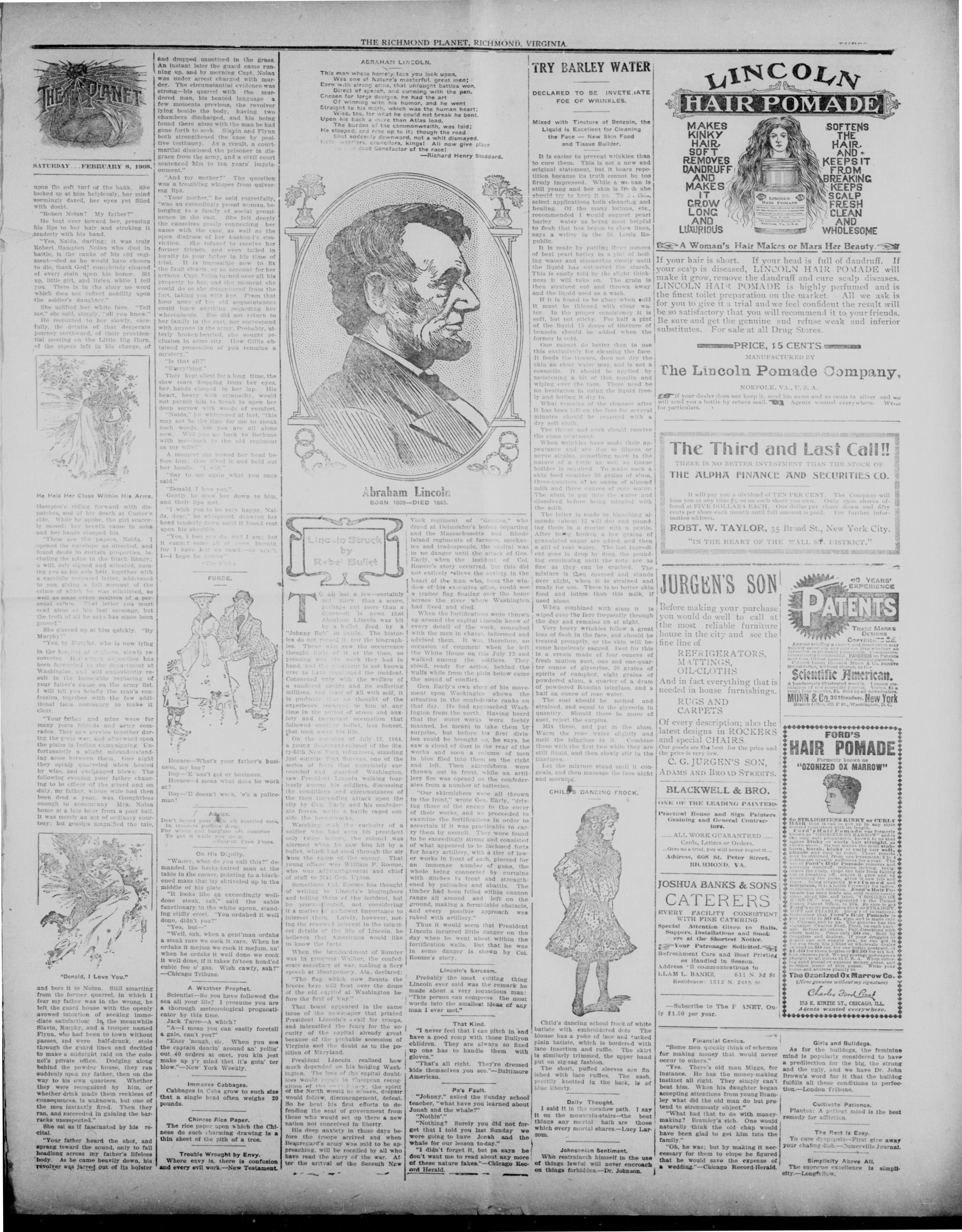
ABRAHAM LINCOLN.
This man whose homely facade
Was one of Nature's mans
Dorn with strong arms, that
Direct of speech, and of
Chosen for large designs, he
Of winning with his h
Straight to his mark, which
Wise, too, for what he did
Upon his back or move than
The burden of the com
He stooped, and rose up to
Shot suddenly downward
Kite warriors, councillors,
to the dead Genefactor.
This man whose homely face you look upon,
Was one of Nature's masterful, great men;
Eorn with strong arms, that unfought battles won,
Direct of speech, and cunning with the pen.
Chosen for large designs, he had the art
Of winning with his humor, and he went
Straight to his mark, which was the human heart;
Wise, too, for what he could not break he bent.
Upon his back a more than Atlas load,
The burden of the commonwealth, was laid;
He stooped, and rose up to it; though the road
Shot suddenly downward, not a whit dismayed.
Bote warriors, councillors, kings! All now give place
To the dead Benefactor of the race!
A. B.
Abraham Lincoln
BORN 1809 - DIED 1865.
Lincoln Struck
by
Rebel Bullet
O all but a few—certainly
not more than a score,
peechs not more than a
dozen—it is news that
Abraham Lincoln was hit
by a bullet, fired by
"Johnny Reb" in battle. The histories do not record it, nor the biographies. These who saw the occurrence thought little of it at the time, so pressing was the work they had in hand, and the president is not known ever to have mentioned the incident. Concerned only with the welfare of a sundered nation and its suffering millions, and least of all with self, it is probable that no thought of the experience occurred to him at any time in the period of stress and anxiety and important occupation that followed another ballet, less honest, that took away his life.
On the morning of July 12, 1864, a young lieutenant colonel of the Sixth-fifth New York volunteers, standing just outside Fort Stevens, one of the series of forts that completely surrounded and guarded Washington, saw President Lincoln walking fearlessly among his soldiers, discussing the conditions and circumstances of the then impending attack upon the city by Gen. Early and his confederate forces, while a battle raged outside the breastworks.
Watching, with the curiosity of a soldier who had seen his president only twice before, the colonel was alarmed when he saw him hit by a bullet, which had shed through the air from the camp of the enemy. That young officer was William P. Roome, who was adiant-general and chief of staff to Mat-Gen. Union.
Sometimes Col. Roome has thought of writing to Lincoln's biographers and telling them of the incident, but he procrastinated, not considering it a matter of sufficient importance to interest them. Lately, however, noting the renewed interest in the minute details of the life of Lincoln, he believes that Americans would like to know the facts.
When the bombardment of Sumter was in progress Walker, the confederate secretary of war, making a fiery speech at Montgomery, Ala., declared: "The flag which now flaunts the breeze here will float over the dome of the old capitol at Washington before the first of May."
That boast appeared in the same issue of the newspaper that printed President Lincoln's call for troops, and intensified the fears for the security of the capital already great because of the probable secession of Virginia and the doubt as to the position of Maryland.
President Lincoln realized how much depended on his holding Washington. The loss of the capital doubtless would result in European recognition of the north army, the spirit of the North would be broken, despair would follow, discouragement, defeat. So he beut his first efforts to defending the seat of government from those who would set up there a new nation not conceived in liberty.
His deep anxiety in those days before the troops arrived and when Beauregard's army was said to be approaching, will be recalled by all who have read the story of the war. After the arrival of the Seventh New
Richard Henry Stoddard.
A
York regiment of "dandies," who dined at Delmontco's before departing and the Massachusetts and Rhode Island regiments of farmers, mechanics and tradespeople, the capital was in no danger until the attack of Gen. Early, when the incident of Col. Roome's story occurred. But this did not entirely relieve the anxiety in the heart of the man who, from the window of his executive office, could see a traitor flag floating over the home across the river where Washington had lived and died.
When the fortifications were thrown up around the capital Lincoln knew of every detail of the work, consulted with the men in charge, informed and advised them. It was, therefore, no occasion of comment when he left the White House on this July 12 and walked among the soldiers. They stood, ready for action, behind the walls while from the plain below came the sound of conflict.
Gen. Early's own story of his movement upon Washington shows the situation in the confederate ranks on that day. He had approached Washington from the north. Having heard that the outer works were feebly manned, he meant to take them by surprise, but before his first division could be brought up, he says, he saw a cloud of dust in the rear of the works and soon a column of men in blue filed into them on the right and left. Then skirmishers were thrown out in front, while an artillery fire was opened on the confederates from a number of batteries.
"Our skirmishers were all thrown to the front," wrote Gen. Early, "driving those of the enemy to the cover of their works, and we proceeded to examine the fortifications in order to ascertain if it was practicable to carry them by assault. They were found to be exceedingly strong and consisted of what appeared to be inclosed forts for heavy artillery, with a tier of lower works in front of each, pierced for an immense number of guns, the whole being connected to curtains with ditches in front and strengthened by palisades and aattitis. The timber had been felled within cannon range all around and left on the ground, making a formidable obstacle, and every possible approach was raked with artillery."
Thus it would seem that President Lincoln incurred little danger on the day when he went about within the fortification walls. But that he was in some danger is shown by Col. Roome's story.
Probably the most cutting thing Lincoln ever said was the remark he made about a very loquacious man: "This person can compress the most words into the smallest ideas of any man I ever met."
"I never feel that I can pitch in and have a good romp with those Bullyon children. They are always so fixed up one has to handle them with gloves."
"That's all right. They're dressed kids themselves you see."—Baltimore American.
**Pa's Fault.**
"Johnny," asked the Sunday school teacher, "what have you learned about Jonah and the whale?"
"Nothin'."
"Nothing? Surely you did not forget that I told you last Sunday we were going to have Jonah and the whale for our lesson to-day."
"I didn't forget it, but pa says he don't want me to read about any more of these nature fakes."—Chicago Record Herald.
---
Lincoln's Sarcasm.
That Kind.
Pa's Fault
TRY BARLEY WATER
TRY BARLEY WATER
DECLARED TO BE INVESTEATE
FOE OF WRINKLES.
Mixed with Tincture of Benzoin, the Liquid is Excellent for Cleaning the Face — New Skin Food and Tissue Bulder.
It is easier to prevent wrinkles than to cure them. This is not a new and original statement, but it bears repetition because its truth cannot be too firm impressed. While a woman is still young and her skin is fresh she should try to keep it so. To do this, select applications both cleansing and healing. Of the many lotions, etc., recommended I would suggest pearl barley water as being most helpful to flesh that has begun to show lines, says a writer in the St. Louis Republic.
It is made by putting three ounces of best pearl barley in a pint of boiling water and simmering slowly until the liquid has extracted the starch. This is easily told by the slight thickness it will take on. The grain is then strained out and thrown away and the liquid used as a wash.
If it is found to be glove when cold it must be thinned with clear water. In the proper consistency it is soft, but not sticky. For half a pint of the liquid 15 drops of tincture of benzoln should be added when the former is cold.
One cannot do better than to use this exclusively for cleaning the face. It feeds the tissues, does not dry the skin as clear water may, and is not a cosmetic. It should be applied by moistening a bit of thin muslin and wiping over the face. There need be no hesitation in using the liquid freely and letting it dry in.
What remains of the cleanser after it has been left on the face for several minutes should be removed with a dry soft cloth. The throat and neck should receive the same treatment. When wrinkles have made their appearance and are due to illness or nerve strains, something more in the nature of a tonic as well as tissue builder is required. To make such a skin food combine 30 grains of alum, three-quarters of an ounce of almond milk and three ounces of rose water. The alum is put into the water and dissolved before being mingled with the milk.
The latter is made by blanching almonds (about 12 will do) and pounding them in a mortar with a peat, After being broken a few grain of granulated sugar are added, and then a gill of rice water. The last ingredient goes in drop by drop, the pounding continuing until the nuts are as fine as they can be crushed. The mixture is then covered and stands over night, when it is strained and ready for use. There is no better skin food and lotion than this milk, if used alone. When combined with alum it is wiped over the face frequently through the day and remains on at night.
Very heavy wrinkles follow a great loss of flesh in the face, and should be treated promptly, or the skin will become hopelessly sagged. Best for this is a cream made of four ounces of fresh mutton suet, one and one-quarter ounce of glycerine, 30 grains of spirits of camphor, eight grains of powdered alum, a quarter of a dram of powdered Russian isinglass, and a half an ounce of rose water.
The suet should be melted and strained, and equal to the glycerin in quantity. Should there be more of suet, reject the surplus.
Mix these, and put in the alum. Warm the rose water slightly and melt the isinglass in it. Combine these with the first two while they are still liquid, and then slowly stir in the tinctures.
Let the mixture stand until it congeals, and then massage the face night and morning.
CHILD'S DANCING FROCK.
-
Child's dancing school frock of white batiste with embroidered dots. The blouse has a yoke of face and tucked plain batiste, which is bordered with lace insertion and ruffle. The skirt is similarly trimmed, the upper band put on zig-zag fashion. The short, puffed sleeves are finished with lace ruffles. The sash, prettily knotted in the back, is of blue liberty.
Daily Thought
I said it in the meadow path. I say it on the mountain-stairs—the best things any mortal hath are those which every mortal shares.—Lucy Larcom.
Johnsonian Sentiment.
Who restraineth himself in the use of things lawful will never encroach on things forbidden.—Dr. Johnson.
MAKES
KINKY
HAIR
SOFT
REMOVES
DANDRUFF
AND
MAKES
IT
GROW
LONG
AND
LUXURIOUS
LINCOLN
HAIR POMADE
THE LINCOLN POMADE CO.
BROOKLYN, VA. U.S.A.
SOFTENS
THE
HAIR
AND
KEEPS IT
FROM
BREAKING
KEEPS
SCALP
FRESH
CLEAN
AND
WHOLESOME
If your hair is short. If your head is full of dandruff. If your scalp is diseased, LINCOLN HAIR POMADE will make it grow, remove the dandruff and cure scalp diseases. LINCOLN HAIR POMADE is highly perfumed and is the finest toilet preparation on the market. All we ask is for you to give it a trial and we feel confident the result will be so satisfactory that you will recommend it to your friends. Be sure and get the genuine and refuse weak and inferior substitutes. For sale at all Drug Stores.
NORFOLK, VA., U. S. A.
If your dealer does not keep it, send
will send you a bottle by return mail.
for particulars.
The Third ar
THERE IS NO BETTER INVEST
THE ALPHA FINANCE
It will pay you a dividend of T
loan you at any time $3.00 on each sh
fered at FIVE DOLLARS EACH. O
cents per share each month until full
mation address.
ROBT. W. TAYLOR, 35
"IN THE BEART OF THE
If your dealer does not keep it, send his name and 20 cents in silver and we will send you a bottle by return mail. Agents wanted everywhere. Write for patrol.
It will pay you a dividend of TEN PER CENT. The Company will loan you at any time $3.00 on each share you own. Only 2500 shares offered at FIVE DOLLARS EACH. One dollar per share down and fifty cents per share each month until full amount is paid. For further information address.
ROBT. W. TAYLOR, 35 Broad St., New York City.
"IN THE HEART OF THE WALL ST. DISTRICT."
JURGEN'S SON
JURGEN'S SON
Before making your purchase you would do well to call at the most reliable furniture house in the city and see the fine line of REFRIGERATORS, MATTINGS, OIL-CLOTHS And in fact everything that is needed in house furnishings.
Of every description; also the latest designs in ROCKERS and special CHAIRS.
Our goods are the best for the price and the price is very low.
C. G. JURGEN'S SON,
ADAMS AND BROAD STREETS.
BLACKWELL & BRO.
Practical House and Sign Painters
Graining and General Contractors.
.....ALL WORK GUARANTEED.....
Cards, Letters or Orders.
...Give us a trial, you will never regret it...
Address, 608 St. Peter Street,
RICHMOND, VA.
JOSHUA BANKS & SONS CATERERS
JOSHUA BANKS & SONS
EVERY FACILITY CONSISTENT
WITH FINE CATERING
Special Attention Given to Balls,
Suppers, Installations and Smokers
at the Shortest Notice.
Your Patronage Solicited.
Refreshment Cars and Boat Privileges
Handled in Season.
Address 'll communications to
LLAM L BANKS. 611 N. 3d St.
— Subscribe to The P ANET. Only $1.50 per year.
"Some men quickly think of schemes for making money that would never occur to others."
"Yes. There's old man Miggs, for instance. He has the money-making instinct all right. They simply can't beat him. When his daughter began accepting attentions from young Bramley what did the old man do but pretend to strenuously object."
"What had that to do with money-making? Bramley's rich. One would naturally think the old chap would have been glad to get him into the family."
"Oh, he was; but by making it necessary for them to elope he figured that he would save the expense of a wedding."—Chicago Record-Herald.
---
RUGS AND CARPETS
Financial Genius
and Last Call!!
MENT THAN THE STOCK OF
AND SECURITIES CO.
EN PER CENT. The Company will
are you own. Only 2500 shares of
one dollar per share down and fifty
amount is paid. For further infor-
Broad St., New York City.
WALL ST. DISTRICT."
60 YEARS' EXPERIENCE
PATENTS
TRADE MARKS
DESIGNS
COPYRIGHT 1916.
Argena dealing a sketch and description may
quickly assessee for easily free publication. Communication
invention is probably patentable. Handbook on Patents
seat free. Offices in New York and receive
Patents taken through Munn & Co. receive
Proceedings from Munn & Co.
Scientific American.
A handsonly illustrated weekly. Largest circulation of any scientific journal. Terms, 60 a
year. Mail to Munn & Co. 30 18 Broadway, New York
Branch Office, 635 Ft., Washington, D.C.
FORD'S
HAIR POMADE
Formerly known as
"OZONIZED OX MARROW"
So STRAIGHTENKS KUNKY or CURLFY
that it can be put up in any style
Ford's Hair Pomade was formerly
Ford's Hair Pomade is OXARROW, and is
the only safe preparation for hair
makes kinky or curly hair straight, as
born, harsh, kinky or curly hair soft,
born, harsh, kinky or curly hair soft,
may be obtained from Ford's
bottles are generally sufficient for a year. The
provences dandruff, relieves dandruff, invigorates the scalp, stops the hair from falling
sometimes about 185, and label, "CONZEED OX
States, Patent Office, in 1854. Be sure to get
Ford's hair is made with the BAR STRAIGHTEN
remember that Ford's Hair Pomade is
to Chicago and by us. The膏质 has the
signature Charles Ford, on each pencil,
every bottle. Price only 50 cts. Sold by
dealer can not supply you, he can get it
for you from firm jobs or wholesale dealer
$1.40 for three bottles or $2.00 for six
charges to all points in U.S. When
send postal or express money order, and
your name and address plainly to
The Ozonized Ox Marrow Co.
(None genuine without my signature)
Charlie Ford Peat
153 E. KINZIE ST., CHICAGO, IL.
Agents wanted everywhere.
Girls and Bulldogs.
As for the bulldogs, the feminine
mind is popularly considered to have
a predilection for the big, the strong
and the ugly, and we have Dr. John
Brown's word for it that the bulldog
fulfills all these conditions to perfection.—London Tribune.
Cultivate Patience.
Plautus: A patient mind is the best
remedy for affliction.
The Rest Is Easy.
To cure dyspepsia.—First give away your chafing dish.—Comerville Journal.
Simplicity Above All.
The supreme excellence is simplicity.—Longfellow.
```markdown
```
Girls and Bulldogs.
Cultivate Patience.
FOUR
THE PLANET
Published every Saturday by JOHN MITCHELL,
JR., at 311 N. Fourth Street, Richmond, Va.
JOHN MITCHELL, JR., - EDITOR.
All communications intended for publication
should be sent so as to reach us by Wednesday.
TERMS IN ADVANCE.
One Copy, one year. ..... $1.56
One Copy, eight months. ..... 1.00
One Copy, six months. ..... 0.90
One Copy, four months. ..... 0.50
One Copy, three months. ..... 0.40
Single Copy ..... 0.05
ADVERTISING RATES.
For one inch, one insertion.....$0.50
For one inch each subsequent insertion.....4.00
For two inches, three months.....6.00
For two inches, six months.....70.00
For two inches, nine months.....14.00
For two inches, twelve months.....20.00
Marriage and Funeral Notices, one inch.....50
Standing and Trusolent Notices per line.....10
POSTAGE STAMPS OF A HIGHER DENOMINATION THAN TWO CENTS NOT RECEIVED ON SUBSCRIPTIONS.
THE PLANET is issued weekly. The subscription price is $1.50 per year in advance.
advance. There are four ways by which money can be sent by mail at our risk—In a Post Office Money, by bank Check or Draft, or an Express Money, by mail. In all these cases these can be procured, in a Registered Letter.
MONEY ORDERS. You can buy a Money Order at your Post Office, payable to the Richmond Bank, and we will be responsible for its safe arrival.
EXPRESS MONEY ORDERS can be obtained at any office of the American Express Co. the United States Express Co. and the Wells' Fargo's Express Company. We will be responsible for all of these companies. The Express Money Order is a safe and convenient way for forwarding money.
REGISTERED LETTER. If a Money Order, Post Office or an Express Office is not within the United States, you will register the letter you wish to send in coins, then. If the Letter is lost or stolen, it can be traced. You can send money in this way. You must do it at your own risk.
We cannot be responsible for money sent in letters in any other way than one of the four ways mentioned above. If you send your money in any other way, you must do it at your own risk.
RENEWALS, ETC. If you do not want THE PLANET continued for another year after your subscription has run out, you then notify us by email or discontinue it. The courts have decided that you must not order their paper discontinued at the expiration of time for which it has been paid are not for the payment of the subscription up to date when they order the paper discontinued.
COMMUNICATIONS—When writing to us to renew your subscription or to discontinue your paper, you should give your name and address to follow; we cannot find your name on our books.
CHANGE OF ADDRESS—In order to change the address of a subscriber, we must be sent the former as well as the present address.
Entered at the Post Office at Richmond, Va. as second class matter.
We have received the report of the Ninth Annual Meeting of the Anti-Imperialistic League held Nov. 30, 1907. It is published by the Anti-Imperialistic League, 20 Central Street, Boston, Mass. Criticisms of Secretary Taft's reports are featured.
Bishop Alexander Walters, President of the Afro-American Council, Rev. William H. Scott, President of the Suffrage League of Boston and vicinity and Mr. William Monroe Trotter, President of the New England Constitution and Suffrage League have issued a call for a national political suffrage conference of colored Americans to assemble in Philadelphia, Pa. April 7, 1908. It means a division of the Negro vote in the Northern States.
---
We have received "The Negro In America," an address delivered by Andrew Carnegie, Esq., LL. D., delivered before the Philosophical Institution of Edinburgh, October 15, 1907. It is an address that is well worth a perusal and its careful consideration will enblazon hope over the door-way of every colored family in the Southland.
We have received "The Remarks of Senator Philander C. Knox at a dinner given to the Pennsylvania Delegation in Congress by Hon. Joseph C. Sibley, December 4, 1907" also "Some of the Public Services of Hon. Philander Chase Knox," by Hon. James Francis Burke before the Pennsylvania Delegation in congress Wednesday, Dec. 4, 1907."
HON. HENRY WATTERSON AND
THE NEGRO.
"Truth from his lips prevail'd with double sway.
And fools, who came to scoff, remain'd to pray."—Goldsmith.
We are frank to confess that we have read Mr. Henry Watterson's remarks concerning the colored people with little less than amazement. This is all the more accentuated because he comes from a class of Southerners who mean what they say. When they are for you, there is a friend in your favor, but when they are against you—well, good Lord deliver you. His utterances in New York, January 17th, 1908 will result in much good and we would certainly like to know who was influential enough to get him there, or did he "happen there by chance?" But here are his remarks. He is quoted as follows:
"Many years ago within the cir ce of a bay window overlooking one
of the great avenues of the City of Washington, I was dining with a party of friends. We had been discussing the race question, when, as if to punctuate our discourse, two men across the way—a black man and a white man—entered upon an alteration which came to blows. The police were conveniently. I might say characteristically, absent. A ring was formed, and, in true Marquis of Queensbury style, the race war upon a small but tangible scale was then and there fought out. Taking this to illustrate the interrupted conversation one among our group asked, apparent condent of the reply, "which are we for, the Nigger or the Irishman?" It is the eminent statesman of the South who answered, "Well, before I decide that I should lise to know which has the right of it."
"My own attitude toward the racial question has always grounded its self in the same principle. I want nothing for myself, or for my children, which I am not ready to give to my colored neighbor and his children. I live in a region peopleled by many blacks, good, orderly, hardworking folk. They know me and they know that, when I declare this, I mean it. I sit in my own, home, served by black people and very well served, having had no occasion to change a serving man or woman in many years. We go away, and sometimes are absent for months, returning find the place as we left it. If they were actual members of the family, they could not be more solicitous for our welfare."
When we read those words, we felt like getting up, waiving our hat and cheer. It means much for us and our cause, when a man of the type of Mr. Watterson puts himself in the breach and consents to say a word in favor of a race of people who seem to be maligned, misrepresented and abused by every candidate for a political office in the Southland and by every demagogue, who is anxious to claim public attention. It emphasizes the fact that God is truly raising up friends for us and where we lose one who has been outspoken in our favor, we gain another who has been thinking in silence.
Not since our ignominious desertion and may-be unintentional injury by the distinguished occupant of the White House, have the Negroes had anything to occur that will tend more to restore them and their cause to public favor
He is quoted further:
"I passed not a few of my boyhood days upon a plantation in Tennessee—in point of fact, upon two plantations in Tennessee—where slavery existed in its complete but also under its milder aspects and conditions. From the earliest dawnings of intelligence, which I can remember, the system seemed to me monstrous. 'If slavery is not wrong, said Lincoln, 'nothing is wrong.' So I thought, and so I think. Thousands of men fought and fell on the Confederate side of the War of Sections, who believed the same thing; as did Washington and Jefferson and the gentlemen of Virginia who made the first American Revolution."
The above is an open confession; more remarkable indeed because it came from the lips of a Kentuckian. He is quoted as saying:
"When the Second American Revolution came to pass liberating, as by a stroke of the sword, nearly four million slaves from bondage, my sentiment of freedom was in excess of my sense of the magnitude and the complexities of the event. I accepted the situation. The three last Amendments to the Constitution I declared to be the actual and final Treaty of peace between the North and the South. It was my opinion —based on feeling and not on knowledge or judgment—that invested with full citizenship the newly-liberated slave would be able to work out his own destiny. During the ten years of Reconstruction that followed, I devoted my energies toward the habilitation of the black man of the South as essential to the pacification of the white men of the North and South.
There are plenty of black people living in Kentucky who remember well the contest we had with the elements of disorder masquerading as the Ku Klux Klan long after the disbandment of that dread organization in the States South of us, the struggle for the admission of Negro testimony to our Courts of Law—in point of fact, the stubborn fight for the expurgation of the old black laws from the Statute books of the Commonwealth—narrowing itself down even to the Negro to ride upon the street-cars. Hopefully, Kentucky escaped the many epihs and dangers which would surely have ensued, if the extremism of those dark days had prevailed.
"Because it did not, we have had no race war or serious racial conflict in Kentucky. The Feudists of the Mountains, the Night Riders of the Tobacco Belt are all whites, not blacks. Reasonable white people and reasonable black people find it easy to get along much as if there existed no color line. Each is inspired by a sense of duty to the other which under the benign influence of religion and humanity, may yet blossom into the old domestic relations of confidence and affection, the man-ownership clause, succeeded by a manhood clause, at once self-respecting and reciprocally respected."
These are the most outspoken utterances that we have ever read from a Democratic leader of the old school. The Negroes of this section and of the entire country can ask no more liberal declaration of principles than may be found in these remarkable declarations of Hon. Henry Watterson of Kentucky. A man who is permeated by this spirit would never be guilty of a Brownsville order or a white-house criticism of the Negro soldiers of this country.
All things equal, we would sooner give our political support to a Southerner of the Henry Watterson type
THE RICHMOND PLANET RICHMOND VIRGINIA
than to a statesman of the Roosevelt school. Is there a colored man of intelligence, who has not read this truly remarkable speech of Hon. Henry Watterson? If you have read it once, go over it again and ponder its meaning, coming as it does from a Democratic Southerner, who means all that he says, and who has the courage of his convictions to put in practice the beliefs of a life-time. He says:
"Unfortunately, there are bad white men as there are bad black men, there are foolish black men as there are foolish white men, and they constitute the real menace and danger.
"I am bound to tell you, after forty years of experience and observation and reflection, that I think we began wrong. We put the cart before the horse. Four millions of poor black people, with some centuries of abject slavery and many ages of barbaric night behind them, were not equal to using the freedom that came to them so suddenly, and especially the ballot, with prudence or intelligence. How could they? I don't blame them in the least. On the contrary, I sometimes wonder at their self-restraint. As, during the Sectional War, they were faithful servants, remaining at home and tilling the fields and taking care of the women and children, so, since the war, according to their lights, they have tried to be good citizens. I glory in every step of progress they have made—and they have made many strides—from that day to this.
"Temperamentally ever for the under-dog—a crank about personal liberty if I am a crank about anything—my heart goes out to the black man wherever I see him honestly struggling to raise his children to a condition better than his own. Hence, let me repeat that I am glad to be here to-night, to witness what I see before me and around me, to bear this testimony, and to ask you to fall behind not to seek to march before Booker Washington and his great work."
You may say what you will, colored folks, but that distinguished gentleman was inspired. How can you account for such remarkable declarations? Who knew that he entertained these views? Did Dr. Booker T. Washington know it? If he did, he did the race and the people of this country a service in getting him upon the rostrum at Carnegie Hall, New York, January 17, 1908. From a posture, with open hands filled with charity, he assumes the posture of a philosopher looking for the solution of a mystery. He declares:
"The race question is a mystery. For the matter of that, life is a mystery. Whence we came, whither we are going, we know not. The Ethiopian is thought to be especially imitative. All of us are more or less imitative—particularly the ultra Smart Set of high society—which, here on the seaboard imitates the litte it knows about the European nobility, and, in the interior whatever it can find out about the Smart Set of the seaboard. It is an unfortunate characteristic of imitation to take for its examples rather the bad than the good of whatever attracts its admiration or its envy. 'Jess like white folks' is sometimes heard in colored circles of fashion—that is, among the Colored Smart Set of the Colored Four Hundred. Now, for my part, I scarcely think much more of the Colored Four Hundred than I think of the Caucasian Four Hundred, who live for vanity and pleasure, and who, if they can't go to Heaven in their Automobiles, don't want to go at all."
"Every shoemaker to his last, the saying hath it, and that say I, each mother's son of us to his vocation, whatever it be. Men in their places are the men who stand. Neither Mr. Seth Low, nor Mr. Rogers, not even Booker Washington, or Mark Twain can make a silk purse out of a sow's car. No more can they make a musician, or a poet, or a lawyer, or a doctor, out of material that was intended for blacksmithing dray-driving and plowing. Happily, they don't try.
"All of us are the creatures of evolution and education. The White races seem to have got along faster in the great eternal plan than the Black races. Why. I cannot tell you. It is a simple fact, oblivious to all of us, that, just as Europe and America are further advanced in arts and arms than Africa, are the Europeans and the Americans ahead of the Africans in the developments of modern culture. As this ought not to be the subject of vainglorious exaltation among the Whites, it should not be considered, or felt, as either a numiliation or a reproach by the Blacks. In case it should become so the future would be dark indeed for both races. Each needs to grow in grace; but it is my belief that each can and will thus grow in grace, in the South first of all and most of all, and within lines plainly fixed by God and nature, leading to that ultimate peace that passeth understanding, when the lion and the lamb shall lie down together in harmony. And Booker Washington is blazing the way."
He concluded his philosophic analysis only to pay another tribute to the Negro. Here it is:
"Since in our Southern country, at least, this is so—since neither race can get rid of the other, or act independently of the other—let us take account of what has been done these forty years of freedom.
"I stand here to-night to declare that the world has never witnessed such progress from darkness to light as that which we see in those districts of the South where the Negro has had a decent opportunity for self improvement. Look at Jamaica—nearly a century of emancipation the Negro at a standstill—look at South Africa, riches piled on riches, the Negro still a savage and less considered than the animals—yet it is England that pigges herself on what Albion has done for freedom and the black man.
Let the Negro go to any alien
community and try to
employ them. Barry was very hard.
ty of sentiment, but no work. There are regions North, East, and West which never knew slavery and were a unit for the Union, where the Negro is refused admittance. He is told to move on. He is what the President described the other day as 'an undesirable citizen.' Turn South ward; plenty both of work and wages for all who bring tranquil minds and willing hands. Bad people, slothful people, get on nowhere; but nowhere on the habitable globe has the liberated slave saved so well, nowhere has he so fair an outlook, as in the Southern States of North America."
Speaking from an industrial standpoint, Mr. Watterson is correct. It is only when he steps off that plank to the political one that he finds "cob-webs in his throat" and impediments in his speech.
He tells wholesome truths though when he says:
"Why? Because we know one another and because, no matter what anybody may say to the contrary, there is a common bond of association between us. Never can the white man of the South forget what the black man did during a war waged for his freedom; and what he might have done. Never should the black man of the South forget that he is the weaker in the race and for a long time must look to the white man for help of many kinds. It is through these reciprocal obligations and interests that the two races will reach some institutional system of living and doing entirely satisfactory to both.
"Nothing is to be expected from the rushing hot-house process on from any artificial arrangement; everything is to be hoped from nature left to herself—unexposed by misdirected political considerations, uninfluenced by outsiders teaching false philosophies—simple justice and kindness presiding over the ordinary laws of common honesty and common sense.
"The Negro in Africa has scarcely burst the chrysalis of the primitive state of man. In America he is yet in a state of racial childhood. As he realizes this, the faster he will grow, the quicker he will learn, the sooner he will reach his racial manhood. In less than half a century he has achieved wonders. Before the century we have just begun is half over, he will have achieved great He has yet and upon an extensive study we learn habits of method and order, habits of tenacity and acquisition; habits of sustained industry and sobriety without which no race—white, red, brown or black—or any individual man—can get on and prosper."
What citizen of color, who is permeated by right principles will take issue with what this distinguished Kentuckian has said? It is "the truth, the whole truth and nothing but the truth." As we have read line after line of this truly remarkable address, we have wondered how it could be possible for a gentleman of Hon. Henry Watterson's type, hailing too from Kentucky to give voice to such sentiments.
But then we remembered that Kentucky had but recently elected a Republican governor and that new ideas were predominant even in the Negro-hating State of other days. Here are utterances that colored people in this section will applaud with a loud "amens":
"He is a bad white man who will not help his neighbor black man when that neighbor black man shows the spirit to help himself. He is a bad black man who cherishes hatred in his heart against the white man because he is a white man. He is a foolish black man who thinks because the mirage of social equality which would prove a curse rather than a blessing, is denied him, that the white man hates him. Social questions the world over create their own laws and settle themselves. They cannot be forced. It is idle anywhere for anybody to contest or quarrel with them. No man should wish to go where he is not wanted; true, self-respecting men dismiss the very thought of it, going their own way, hooing their own row, and giving praise to God that their happiness is within themselves and beyond the reach of any man, be he white, or black, king or vassal."
This distinguished Kentuckian concluded as follows:
"And now, my friends, I have said my say. I beg you to go hence this night believing these imperfect thoughts and poor words the honest emanations of one who has journeyed much, and far and wide in this great land of ours. I was born and grew up in the National Capital, contemporary with the rexed slavery agitation. I saw the Union severed and made whole again. Since then I have been in every State and Territory of that Union and I have yet to come away from one of them, North, South, East or West, where I had not found something to make me proud of my country.
"I know that the provincials of Fifth Avenue like the boulevardiers of Paris, think themselves exceptional. They are as a matter of fact chiefly exceptional in their ignorance of everything outside the great white way." Their boasted superiority is largely the idiosyncrasy of clothes. They should study geography and learn that New York's Western extremity is not New Jersey. They need to travel more on this side and less on the other side of the Atlantic Ocean; to learn something of their own people; the most homogeneous people on earth; differing only in externals, in local conditions and habits; Massachusetts and Mississippi as to every blood essential convertible terms; six months, and a change of raiment, readily converting a typical Vermont into a typical Texas.
"Forty years have I been preaching this Gospel sustained by the best intelligence and manhood of the South. I commit it to your intelligence and your manhood unreservedly and wholeheartedly. It embraces the one script by which our vast domain can be permanently welded together, instructing each of its sections to respect the others, to love
the others, and to leave the others to keep house for themselves, ready to help the needy only in case of need. Thus, and thus alone, shall we escape the pitfalls of the dark ages, and come forth no less a blessed than an irresistible World-Power black men and white men, equally standing behind the guns, one God and one flag and one law for all."
This speech will pass down to coming generations as a phillipic, coming from a philosopher, who saw far into the future and who cast behind him the prejudices and idiosyncrasies of the age in which he lived. Mr. Watterson's statement that for forty years he has entertained these views, which have been shared by other enlightened white men of the South will be gratifying information to lowers of justice everywhere. Speaking for ourselves, we are willing to trust our interests and our welfare in the hands of men of his stripe, calibre whether they hall from the North, South, East or West. The enunciation of this platform is to us the new political religion of the sunny clime in which we live. It is the yield of a century of nursing, crooning and instruction of the black mammals, who sowed deep and their off-spring is reaping the harvest.
It is impossible for us to express in language our appreciation of these "well-spring" utterances of the heart for we know that Hon. Henry Watterson meant all that he was kind enough to say. Either in the gubernatorial chair, the United States Senate or the White House, he would have all of Grover Cleveland's stubbornness and a large per cent of Roosevelt's strenuousness in behalf of the rights of all men, regardless of race, color, politics or religion. The man who induced Hon. Henry Watterson of Kentucky to make that speech in New York deserves the thanks of every Negro in the United States and the man who made it deserves the commendation of every justice-loving person in the world.
"Eternal spirit of the chainless mind! Brightest in dungeons, Liberty! thou art;
And freedom's fame finds wings on
every wind."—Byron.
PRESIDENT ROOSEVELT'S MES
SAGE.
"No servant of the people has a right to expect to be free from just and honest criticism."—From President Roosevelt's Message.
The special message of President Roosevelt as transmitted to the Congress of the United States Friday, January 31st, 1908 emphasizes the fact that so far as the two great political organizations are concerned, he is a man without a party. We have read carefully all of this most astounding deliverance, evincing as it does intense feeling and bitter hatred towards those who oppose not only his plans, but his methods as well.
It seems to us that he has forgotten or purposely ignored the fact that he was nominated on a platform to which he was pledged and on which he is in honor bound to stand until he is elected by the spontaneous demand of the people in accordance with a declaration of principles framed by himself. The men who denominated the message as a sermon were not far from the truth. President Roose velt is in the limelight and he is determined that the people of this country shall know it.
He is absolutely beyond control, even of himself as it is possible for a human individual to be. We have noted his condemnation of the trusts and of dishonesty in high places, but the basic principle of Republican platforms demanding a free ballot and a fair count has been left out of his decalogue. It seems to us that his enemies have made heavy inroads both upon his policies and his temper. When Senator Jeff Davis from Arkansas endorses his dissertations and declares that they could readily be taken for a message delivered by him while Governor of Arkansas, all has been said that need be said.
We may be mistaken, but we believe that the political setting of President Roosevelt's sun, so far as the Republican Party is concerned will date from the reading of that message in Congress. The party leaders now realize fully that something must be done to check the impetuous on-rush of the occupant of the White House.
Any person who has taken the pains to note current events can see that Mr. Roosevelt is building up his own party and it will not be long at his past rate of progress before he will as absolutely dominate the Republican Party as does Mr. Bryan the Democratic Party. Those Republicans who do not intend to sit up and take notice will be required to "walk the plank" so to speak. Mr. Roosevelt is in the position to either nominate his candidate or falling in this to defeat the candidate who is nominated.
It may be well to state that those who oppose him occupy about equally as advantageous position. We do not see that the Negro has anything particularly to gain by the accession of either the Bryan or Roosevelt forces to power. Human rights have been forgotten and it is a fight of commercialism on both sides. President Roosevelt is human and the man who believes that he is waging this warfare unsupported either in funds or influence is sadly mistaken. We do not mean to infer in a personal sense for he is above want, but we do mean that he is able to finance his campaign from legitimate sources by those who would be benefited by the triumph of his policies.
It may be that we are unwise to make these observations, but then "we have said what we have said."
"When to our White House first he came
And gravely started to presiding.
We found his purposes the same
Which one had hoped to make abiding.
No man could say that he had swerved—
From Northern Gould to Southern Finley;
We watched him long, and then observed:
'He's just exactly like McKinley.'
"The years rolled by us one by one,
Change swept the tempora and mores,
The news reports from Washington
Brought many strange and fearsome stories.
He swapped his likeness to the dead
And turned a Democratic sclon—
We watched him long and then we said
'It's hard to tell the man from Bryan.'
"More years rolled by, as years will do,
And still he changed and kept on changing.
Until some men advanced the view
His cerebellum was deranging.
He raved and ranted, ripped and roared.
He strutted like some rara avis—
While we all sighed with accents bored:
'This fellow has out-Davised Davis'"
—H. S. H. in Richmond, Va. Times Dispatch.
MR. WILLIAM MONROE TROT
TER'S DEFENSE.
We have received a communication from Mr. William Monroe Trotter, editor of the outspoken Boston Guardian. It is addressed to the Transcript and is of such length as to render its publication in the columns of this journal prohibitive. Mr. William Lloyd Garrison alleged that he had been placed in a false light in the columns of the Guardian by virtue of misleading headlines, which conveyed the impression that he was antagonistic to Dr. Booker T. Washington. It was to correct this impression that he addressed a communication to the Boston Guardian, of which Mr. Trotter is editor and he alleged that this distinguished journalist refused to publish his communication and he was forced to seek the columns of the Transcript in order to transmit to the public all that he was anxious to say.
The amusing part of the affair is that Mr. Trotter in addressing the editor of the Transcript used language that placed him relatively in the same predicament as that occupied by the brilliant Mr. Garrison.
Here is what Mr. Trotter said:
"Direct charges by so eminent a citizen as Mr. Garrison spread in so influential a paper as the Transcript no one who wishes the respect of his fellow citizens can afford to ignore if he be permitted to be heard. I do not believe the Transcript would by refusing space thus seriously injure one of its readers."
Mr. Trotter said further
"Mr. Garrison represents that my paper. The Guardian, erroneously made him inferentially to appear in harmony with the Guardian's attitude of antagonism to Mr. Booker Washington, and publishes the disclaimer because I refused to publish it. But Mr. Garrison did not state that I wrote him claiming the article in question (which was solely an editorial reprinted from a Southern Colored paper) in no sense purported to infer what his personal opinion of Mr. Washington was but simply contrasted a public statement of his on which I heard him utter, and on which I not by Mr. Washington and interpreted the two ways representing two schools of thought and urged the Colored people to decide which school of thought they would follow, not even saying which the editor espoused.
"He did not state that I offered to publish any retraction by him of his statement, any proof he or Mr. Washington were misquoted, any statement showing his words were misconstrued or to show the contrast made by the Southern Colored editor was illogical or false. He did not state that on the 11th In The Guardian I published, as I had previously written him I would, the following disclaimer of any intention to represent his views of Mr. Washington by the reprinted article."***
He says further:
"I did require that any article from Mr. Garrison should confine itself to the direct issue, should not attach persons not involve, should not impugn the motives of either the editor of the Nashville Clarion (whose reprinted, article gave offense) or of the Guardian and should be in language courteous to the latter. If the need of these conditions is not apparent in Mr. Garrison's article published in the Transcript, it would be had he not altered it, omitting these words in his opening sentence. "Whether prompted by jealousy and
envy," and using the words, "of academic veneering" instead of "economic advantages" as in the Transcript."
We confess that we have been unable to see that Mr. Trotter has accorded to Mr. William Lloyd Garrison in the Boston Guardian, the same privileges that he asks for himself in the Boston Transcript. Still his communication is "warm," yes, "hot" from start to finish and we shall proceed to give our readers another installment in our next issue.
DON'T GET MAD.
if your hair tan away
from you? Because, you
have the remedy NOW to
feed it with and keep it at
home. Don't have a fail-
ing out with your hair. It
might leave you! Then
might mean cold. It could
mean dry, lifeless, sour,
unseven, breaking and
hair. It give it some-
If your hair ran away from you? Because, you have the remedy NOW to have it and keep it at home. Don't have it all out with your hair. It might leave you I Then what? That would mean thin, dry, lifeless, coarse, uneven, breaking and falling. Give it something to live on: nourish it; fasten it to your scalp. Of counsel Meccooro is the genuine, perfect and dependable hair tonic, food and medicine you can buy. It will make the hair grow extra long and heavy, give new life to the hair bulbs, save what hair you have and get more hair. Three and four months convincing or money refunded. Sold each $250, 500, $1 C0 Always send Money order. Send for free interesting booklet right away.
Temporary Office; 335 West 53rd Street.
MECCO0000 HAIR TICM MFG. N.C.Y.
RAILROADS.
CO
ROUTE
11:00 P. M. Daily, Louisville, Cincinnati
2:00 P. M. Chicago and St. Louis Pulliam
4:00 P. M. Jefferson
10:00 A. M.-Daily-Charlottenville, except Sun-
day to Hinton, except Satur-
v and Sunday to Cincinnati.
15:15 P. M.-Daily-to Gordonville.
10:00 A. M.-Lyndon-Burgh, Lexington, Va.
and Clifton Forge.
15:15 P. M.-Week Days-To Lynchburg.
TRAINS ARRIVE RICHMOND.
James River Line*:8:35 A. M., 6:45 P. M.
7:00 P. M., 8:15 P. M.
Main Line West-7:30 A. M., *8:30 A. M.
3:45 P. M., 7:45 P. M.
James River Line*:8:35 A. M., 6:48 P. M.
*Daily except Sunday.*
Richmond, Frederickjickg & Potomac R. R.
SCHEMPH. EFFECTIVE AUG. 9, 1980.
*Daily, † Weekdays, † Daily except Monday
*Sundays only! † All Palmurs, no local stops,
*trains to or from Byrd Street Station at
*BKU, trains to or from Airport and departures
*guaranteed. Read the sign.
ONLY ALL-RAIL STATION TO NORPOLK.
Leave byrd Street Line, Richmond, in
effect December 1, 1907.
For Norfolk—9:00 A. M. 3:00 P. M. and 7:25
P. M. daily.
For Norwich, the West and Southwest—
9:00 A. M. 12:10 P. M., and 9:40 P. M. daily.
ARRIVE RICHMOND—From Norfolk—11:30 A.
M. and 6:50 P. M. daily. From the West—
A. M. 12:50 P. M. and 8:50 P. M. daily.
Pulman, Parker and Sleeping Cars, Cafe
Dining Cars.
N. B. DEVILL,
Gen. Pass. Agent.
C. H. BOSLEY,
Div. Pass. Agt.
Southern Ry.
TRAINS LEAVE RICHMOND.
N. R—Following schedule figures published only as information, and are not guaranteed:
7:00 A. M—Daily—Limited—Buffet Pullman to Atlanta and Birmingham, New Orleans, Memphis, Chattanooga, and all the South.
Train coach for Chase City, Oxford, Durham.
6:00 P. M.-Ex. Sunday-Keysville Local.
11:30 P. M.-Baltimore-Limited Pullman ready 9:30
P. M. for all the South.
YORK RIVER LINE.
4:30 P. M.-Ex. Sunday-To West Point-Con
necting for Baltimore Monday, Wednesday
and Thursday.
2:15 P M - Monday, Wednesday and Friday -
Local to West Point
4:30 P M - local to West Point
6:55 A. M. 8:40 P. M.—From all the South.
4:10 P. M.—From Charlotte, Raleigh, Durham
Chase City and local stations.
8:40 P. M.—From Kewville-Local.
9:20 A. M.—From Point and from Baltimore
more Wednesday, Friday and Sunday.
10:45 A. M. 5:45 P. M.—From West Point.
C. W. WESTBURY, D. P. A.
920 E. Main Street, 'Phone 455.
ATLANTIC COASTLINE
(Effective January 5, 1908).
TRAINS LEAVE RICHDAIL DAILY.
For Florida and South—8:15 A. M. and 7:25
P. M. "11:40 P. M.
For Norfolk—9:00 A. M. 3:00 P. M and 7:25
P. M.
For N. and W. Ry. West—9:00 A. M., 12:10
and 9:40 P. M.
For Petersburg: 9:00 A. M. 12:10, 3:20
P. M. 6:00, 9:40 P. M. 7:25 and 11:30 P. M.
Trains arrive Richmond daily—6:10 "**5:00
7:40 A. M.; "8:35 "**10:45 and 11:30 A. M. "1:27
2:05, 6:50, 8:00 and 8:50 P. M.
*Except Sunday. **Sunday only. **Except
Monday.
Time of arrival and departures and connec-
SEABOARD
SOUTHBOUND TRAINS SCHEDULED TO LEAVE
RICHMOND DAILY.
9:15 A. M.—Local to Norlina, Raleigh, Charlotee, Wilmington.
2:25 P. M.—Sleepera and coaches, Atlanta, Birmingham, Savannah, Jacksonville and Florida points.
10:45 P. M.—Florida Limited.
12:55 A. M.—Sleepera and coaches, Savannah, Jacksonville and Southwest.
NORTHBOUND TRAINE SCHEDULED TO ARRIVE RICHMOND DAILY.
6:05 A. M., 9:15 A. M., Florida Limited, 6:05 P. M.; 6:35 P. M.
IT WILL PAY YOU To interest yourself in promot ing the CIRCULATION of the RICHMOND PLANET.
---
THE PLANET
SATURDAY...FEBRUARY 8, 1908
"GLORIOUS LARCENY"
William Jennings Bryan at New York Civic Forum.
SPEAKS ON "THOU SHALT NOT STEAL"
Strongly Denounces Wall Street Gambling In All Its Branches—Scores Rich Monopolists as "Legal" Thieves.
NEW YORK, Feb. 5.—Taking the Eighth Commandment as his text, William J. B. Bryan pointed out to the Civic Forum last night the possibilities of larceny in violation of the law—what he said was of still greater importance—larceny through the operation of the law.
Mr. Bryn declared that, while the law recognized two general forms of larceny, petit larceny and grand larceny, there had been a disposition recently to subdivide the greater crime. "So now," he added, "we are inclined to think of stealing as petit larceny, grand larceny and glorious larceny." So great had become the tendency to overlook rascality in amazement at the genius of the man who had stolen a million that it had been suggested, he said, that the commandment be amended to read "Thou shalt not steal on a small scale." Larceny through operation of the law was possible, he said, if the laws were unjust or permitted an unfair advantage to any class of citizens. Watered stocks and fictitious capitalizations were placed by the speaker as among the forms of polite larceny.
Carnegie hall, as usual at gatherings of the Civic Forum, was filled by an audience representative of business and the professions and in which was reflected the various shades of public opinion. Edward M. Shepherd introduced Mr. Bryan, who was received with spirited handclapping, the aplause being frequently renewed during the course of his address. Mr. Bryan said:
"If a man pleks your pocket or enters your house in the dark or accosts you upon the highway and takes from you a few dollars, you regard him as a vulgar thief. No one can have respect for such a person, and the punishments of the law are in such cases swift and sure if the offender is caught. Even in the case of grand larceny if the amount taken is not very great the thief finds it difficult to escape, for he has no influential friends, and he cannot hire skilful lawyers to present technicalities in his defense. If, however, he steals a large sum, it becomes quite a different matter, and the sum may be so large that we overlook the man's rascality in our amusement at the genius which he has displayed. As a rule, the man who steals a million dollars has a better chance of escape than the man who steals a thousand. So true is this that it has been suggested that we amend the commandment to read, "Thou shalt not steal on a small scale."
"Judge Jerry Black, the celebrated Pennsylvania lawyer, in his argument in the Credit Mobilier case quoted a man of affairs as saying that to rob an individual was criminal; to rob a corporation was reprehensible; to rob a municipality was a matter of doubtful morality; to rob a state was meritorious, but to rob the United States was the highest achievement of human virtue.
"But my object tonight is rather to draw your attention to the various ways in which larceny may be committed. There is a distinction that can be drawn between direct and indirect larceny—that is, between the one who does the stealing himself and the one who does it through another, and this is a larger subject than at first appears, for those who produce conditions which result in such gross injustice that the victims of the injustice are driven to destitution, to despair, to desperation and finally to theft—those who produce these conditions are not entirely guillotine.
"Inequality in taxation is merely a form of larceny. If two men live side by side and one contributes in taxation $10 when his just share is only $5 and the other pays $5 when he ought to pay $10, one loses $5 that he ought to keep, while the other keeps $5 that he ought to give to the government.
"And now, at the risk of being accused of sacrilege, I venture to introduce to the Stock Exchange the commandment which we have been considering. I am aware that here in New York the Stock Exchange is regarded with a certain amount of veneration and that many who vehemently denounce gambling in a back room where winnings and losses are small remain strangely silent in the presence of the enormous games that are played upon the stock market often with loaded dice. Gambling is one of the worst of vices, and gambling in stocks and in farm products is the most destructive form in which the vice appears. Measured by the number of suicides caused by the New York Stock Exchange, Monte Carlo is an innocent pleasure resort by comparison. Measured by the amount of money changing hands, the contrast is still greater in favor of Monte Carlo, and measured by the influence upon those who do not gamble the evils of Monte Carlo are insignificant when compared with the evils of New York's commercial gambling houses. The New York Stock Exchange has graduated more embez-
WE WILL HELP YOU TO OBTAIN A PREMIUM
COLORED INFANTRY IN RESCUE OF ROUGH RIDERS AT SAN JUAN HILL, JULY 2, 1898, SIZE 20X28 AND 20X24 INCHES, ADMIRAL DEWEY'S GREAT NAVAL BATTLE OFF CAVITE IN MANILA BAY, MAY 1ST, 1898, NAVAL BATTLE, DESTRUCTION OF ADMIRAL CERVERA'S SPANISH FLEET OFF SANTIAGO DE CUBA, JULY 3RD, 1898, SIZE 22X28 INCHES; LAND BATTLE, CAPTURE OF EL CANEY, EL PASO AND FORTIFICATIONS OF SANTIAGO, JULY FIRST AND SECOND, 1898, SIZE 22X28 AND 22X27 INCHES. WE WILL SEND YOU ONE OF ANY OF THE FOLLOWING BATTLES OF THE CIVIL WAR ON THE SAME TERMS. THE PICTURES LIKE THE OTHER BATTLES ARE FINISHED IN COLORS. THEY ARE 22X28 INCHES AND RETAIL AT ONE DOLLAR EACH. WE WILL FURNISH FRAMES FOR ANY OF THESE FINE CHROMOS FOR 2 DOLLARS & 50CTS. EACH ADDITIONAL. BATTLE OF GETTYSBURG, BATTLE OF SHILOH, BATTLE OF FIVE FORKS, VA. BATTLE OF ATLANTA, GA., BATTLE OF SPOTTSYLVANIA, VA., BATTLE OF VICKS BURG, MISS., BATTLE OF LOOKOUT MOUNTAIN. TENN., BATTLE BETWEEN THE MONITOR AND THE MERRIMAC, BATTLE OF BULL RUN, VA., BATTLE OF CHANCELLORSVILLE, BATTLE OF THE BIG HORN, (CUSTER'S LAST CHARGE) STORMING OF FORT WAGNER, S C., (COLORED TROOPS IN THIS FIGHT), BAT
5. OF NEW ORLEANS, LA., CAPTURE AND
ATH OF SITTING BULL, THE GREAT INDIAN CHIEFTAIN; FORT PILLOW MASSACRE,
FALL OF PETERSBURG, VA., BATTLE OF WINCHESTER, VA., BATTLE OF OLUSTEE, FLA.
WE WILL SEND FAMILY RECORD, SIZE 22 BY
28, WHICH CONTAINS SPACE FOR PHOTO
GRAPHS OF PARENTS AND TEN CHILDREN.
WE WILL SEND SOLDIERS WAR RECORD (CERTIFICATE OF SERVICE IN UNITED STATES ARMY.)
FOR ONE YEAR EACH, OR THEIR EQUIVALENT, WE WILL SEND YOU A COPY OF UNCLE TOM'S CABIN, THE MOST INTENSELY INTERESTING BOOK IN THE COUNTRY. WE WILL SEND YOU A GOLD-PLATED BROOCH WITH YOUR PICTURE THEREIN, YOU TO
zlers than Fagin's school did thieves. "If time permitted, I would call attention to the adulteration of food which sometimes involves a violation of the commandment against killing as well as the commandment against stealing."
CONDENSED DISPATCHES.
Notable Events of the Week Briefly Chronicleed.
As the sequel to a murder resulting from a quarrel over a ten cent debt George Stewart, a negro, died in the electric chair in the state prison at Trenton, N. J. He was pronounced dead after two contacts had been given.
Roland Beard and Compton Leman of the Hygela Ice company and Joseph Miller, manager of the Toledo Ice and Coal company, were sentenced to six months in the county jail and to pay costs of prosecution by Judge Kinkald at Toledo, O., for conspiracy in restraint of trade in cornering ice.
Tuesday, Feb. 4.
Baron Kogoro Takahira, the newly appointed ambassador of Japan to the United States, has left Rome for Washington by way of Paris. Seven men were killed and a half dozen injured by the explosion of a boiler in the rolling mill of Van Allen & Co. at Northumberland, Pa. The dead are David Clark, Samuel Sarrivis, George Kress, William Jones, Grant Leader, Willis Brouse and John Sholvin. Edmund Lamy, the speedy Saranac Lake skater, was the star of the skating tournament at Montreal, carrying off the half mile and three mile championship and giving Fred Logan, the St. John (N. B.) skater, competing under the colors of the M. A. A. A., a close finish in the mile.
A Pennsylvania passenger train from Shenandoah to Pottsville, Pa., escaped a frightful accident when the engine left the rails on the top of the Broad mountain, near Frackville station, and plunged over an almost perpendicular embankment to a road a hundred feet below, but the coaches remained on the track. Engineer U. G. Siegfried of Pottsville was crushed to death.
Monday, Feb. 3.
Near Wesson, Miss., six persons were killed outright by a cyclone which laid waste a strip of farming country threequarters of a mile wide and several miles long.
Charles F. Murphy, Tammany Hall leader at New York, has sued the Broadway Magazine for $50,000 damages for libel. He also sued for similar amounts five firms and individuals who circulated or sold the magazine.
After a two days' run the Home bank, a state institution at Fortyeighth street and Fifth avenue, Brooklyn, closed with a long line of depositors outside its doors wanting their money. It was stated by the officials that the institution, which has been doing business since 1905, is solvent.
Two masked men with revolvers held up the conductor and motorman of a Public Service corporation trolley car and robbed them of $65 near Elizabeth, N. J. They also took from two passengers in the car money and stickplus from their neckties. The car ran on the line between Elizabeth and Newark. The trolleys got away.
Saturday, Feb. 1.
At Southampton, England, a fire started in the smoking cabin of the White Star line steamer Majestic, which had just arrived from New York, and for a time it was thought the vessel was doomed.
Chancellor James R. Day of Syracuse university, discussing President Roosevelt's message, said, "Of the president's message, if I am entirely honest and frank, I am compelled to say that much of it reads like the ravings of a disordered mind."
At Budapest, Hungary, a credit of $5,000,000 was received from New York by the Hungarian Discount and Exchange bank for the account of the Count and Countess Laszlo Szecchenyl. Count Laszlo Szecchenyl was married in New York Jan. 27 to Gladys, daughter of Mrs. Cornelius Vanderbilt.
President Roosevelt sent to congress the message expected from him in view of the overthrow of the employers' liability law. But the message proved to be far more than a recommendation of a law on that subject to meet constitutional requirements. The president resented in language forceful even for him the charge that his policies caused the recent panic and again condemned "predatory wealth."
Friday, Jan. 31.
George Hackenschmidt of Russia easily defeated Joe Rogers, American, in the wrestling match at Oxford Music hall, London, for the championship of the world. Provisional Governor Magoon of Cuba, who was summoned to Washington by the president to give information regarding franchises and industrial conditions in the island republic, denies that he will be made secretary of war on Taft's resignation.
```markdown
```
Thursday, Jan. 30.
In a speech at Portland, Ore., on "Graft Versus Good Citizenship" Francis J. Honey attacked United States Senator Charles W. Fulton. His accusation is that Mr. Fulton has misused his high office.
There was an outbreak of political floting on the streets of Lisbon, in which shots were fired and some people wounded. The disorders, however, were of short duration. The police had received warning in advance, and they acted promptly.
A resolution proposing a constitutional amendment that the right to vote shall not hereafter be denied or abridged on account of sex was introduced in the senate by Senator Warren of Wyoming, a state that has woman suffrage and permits women to hold office.
Noel's Message For Many Reforms.
JACKSON, Miss., Feb. 5.-Governor Noel sent a message to both houses of the legislature recommending that laws be enacted to prohibit speculation in future and to close bucket shops; that saloons be voted out of existence at the earliest possible moment and an amendment for constitutional prohibition be submitted to the people.
WE WILL SEND YOU THE PLANET AND THE ST LOUIS, MISSOURI, SEMI-WEEKLY GLOBE DEMOCRAT, ONE OF THE LEADING REPUBLICAN JOURNALS IN THE UNITED STATES FOR $2.25 PER YEAR FOR BOTH.
WE WILL SEND YOU THE PLANET AND THE COSMOPOLITAN MAGAZINE FOR $2.25 PER YEAR FOR BOTH.
WE WILL SEND YOU THE PLANET AND McCLURE'S MAGAZINE FOR $2.25 PER YEAR FOR BOTH.
FURNISH THE PHOTOGRAPHY TAIN PEN, GOLD POINT; ONE BREAST-PIN, GOLD FILL; EN LINEN HANDKERCHIEFS CLOCK, ONE DOZEN NAPKKOZEN TOWELS, ONE CHOCO PAIR VASES, ONE PAIR KID HAM, ONE TURKEY
FOR TEN NEW SUBSOC
OR THEIR EQUIVALENT, WE WILL SEND PICTURES, ONE ONLY, OF PRESIDENT THEODORE ROOSEVELT, DR. BOOKER T. WASHINGTON, BATTLE OF SANTIAGO, LAND BATTLE OF QUASIMAS NEAR SANTIAGO, JUNE 24. 1898, SHOWING THE NINTH AND TENTH COLORED CAVALRY IN SUPPORT OF ROUGH RIDERS, SIZE 20X28 AND 20X24 INCHES, LAND BATTLE AND CHARGE OF THE 24TH & 25TH
READ THE GREAT INDUCEMENTS OFFERED BY THE PLANET
THE RICHMOND PLANET, RICHMOND, VIRGINIA
IF YOU WILL TALK WITH YOUR NEIGH-
```markdown
```
FOR TWO YEARLY SUBSCRIBERS
FOR FIVE NEW SUBSCRIBERS
REQUISITE NUMBER IS OBTAINED. WE WILL FORWARD THE PRESENT INDICATED.
A PERSON WHO TRIES TO GET FORTY SUBSCRIBERS AND GETS TIRED MAY INDICATE HIS WISH AND WE WILL SEND THE PRESENT FOR THE NUMBER HE HAS SECURED OVER FIVE.
THE NUMBER WILL BE FOR NOT LESS THAN FIVE NOR MORE THAN TEN AND NOT LESS THAN TEN NOR M HAN TWENTY AND NOT LESS THAN NOR MORE THAN FORTY, TO DET THE PRIZE TO WHICH THE WORKER TLED.
IF ANYTHING IS DESIRED NOT SPECIFIED IN THIS LIST, WRITE US ABOUT IT AND WE WILL TELL YOU IN WHAT CLASS IT BE LONGS
RICHMOND. VIRGINIA
A man is sitting in a chair. A man is standing next to him.
DILY GROW
LANET
WEEKLY
READING
UNITED
TH.
T AND
R $2.25
T AND
YEAR
ND PIC-
THEO-
WASH-
D BAT
JUNE 24.
TH COL-
HIGH RI
LAND
& 25TH
E
REQUISE FORWAR
FIVE
```markdown
```
SHOULD YOU DESIRE ANY COLORED JOURNAL IN THE UNITED STATES, WE WILL SEND IT TO YOU IN CONJUNCTION WITH THE PLANET AT A GREATLY REDUCED RATE FOR BOTH
FURNISH THE PHOTOGRAPH, ONE FOUNTAIN PEN, GOLD POINT; ONE LADIES RING, ONE BREAST-PIN, GOLD FILLED; HALF DOZEN LINEN HANDKERCHIEFS, ONE ALARM CLOCK, ONE DOZEN NAPKINS, ONE HALF DOZEN TOWELS, ONE CHOCOLATE POT, ONE PAIR VASES, ONE PAIR KID GLOVES, ONE HAM, ONE TURKEY.
FOR TEN NEW SUBSCRIBERS
WE WILL SEND ONE CHINA SET, THIRTY-ONE PIECES; ONE NECKLACE; DICKENS, SHAKESPEARE, BYRON WORKS; ONE UMBRELLA, ONE PLAIN GOLD RING, ONE PAIR-LACE CURTAINS 1,000 ENVELOPES, 1,000 SHEETS OF PAPER PRINTED AND DELIVERED; ONE TOILET SET, ONE HALF CORD OF SAWED WOOD.
FOR TWENTY NEW SUBSCRIBERS
WE WILL GIVE ONE HANDSOME GOLD RING WITH OPALS, RUBIES OR PEARLS; ONE JEWELRY BOX FINISHED IN GOLD OR SILVER; ONE SILK SHIRT WAIST; ONE READY MADE DRESS, ONE GOLD WATCH, FILLED, WARRANTED FOR TEN YEARS, ONE ROCKING CHAIR, ONE LOAD OF COAL, ONE GROSS OF SOAP, EITHER WASHING OR TOILET; ONE BARREL OF BEST FLOUR, ONE PAIR BLANKETS, ONE MANICURE SET, ONE SEAMSTRESS' WORK BOX, ONE PAIR SHOES, GENTS OR LADIES.
FOR FORTY YEARLY SUBSCRIBERS
OR EQUIVALENT, WE WILL GIVE ONE SEWING MACHINE, ONE DIAMOND RING, ONE GOLD WATCH, ONE PAIR FINE GOLD EARRINGS, ONE MUSIC BOX, ONE PHONOGRAPH, ONE READY MADE DRESS, ONE SUIT OF GENTLEMEN'S CLOTHES, ONE GOLD-HEADED CANE, ONE GOLD-HEADED UMBRELLA, ONE CHINA SET, ONE DOZEN SILVER-PLATED KNIVES AND FORKS, ONE HAT-RACK, ONE SILK DRESS, ONE WEEK'S TRIP TO THE SEASHORE, RAILROAD FARE AND HOTEL BILL PAID. FOR ANY RICHMOND WORKER. THESE OFFERS MAY BE TAKEN ADVANTAGE OF BY SENDING ONE OR TWO SUBSCRIBER'S NAMES AT A TIME. WE WILL KEEP A RECORD OF THEM; AS SOON AS THE
```markdown
```
THE UNIVERSITY OF CALIFORNIA
cepted the invitation to make the principal address of the day.
Had the farm not been purchased when it was for a national park, it might even now have been the site for a distillery. Because of a spring on the farm, famous throughout Kentucky for the purity of its waters, a wealthy Louisville whiskey manufacturer had sought to buy the property that he might advertise his product in some such way as this:
LINCOLN RYE
Made from the PUREST MALT, combined with the crystal waters of the famous LINCOLN SPRING, which gushes out of the rock with in a few feet of the place where
Abraham Lincoln Was Born.
Visit our distillery at Lincoln's Bleecker Ridge.
See and Taste for Yourself.
(All genuine Lincoln whiskey shows portrait of Lincoln drinking from the spring.)
As it happened, whisky helped defeat whisky. When it w.s publicly announced that the long drawn out litigation in which the farm's title had become entangled was at last ended, and that it would be sold at auction on August 28, 1905, the Louisville distiller sent a representative "to bld it in," no matter what the figure. The agent got as far as Elizabethtown, Ky., some 12 miles from Hodgenville, where the auction was to take place, and, as it was Sunday and the sale was to be held in the afternoon of the following day, he put up at a hotel and "took things easy," intending to drive over to Hodgenville the next morning. But although the trains do not run in that part of Kentucky on Sunday, the bottles do, and the whisky man drank long and often in the barroom. Here he made the acquaintance of a young man from New York, who had come to buy the farm for its preservation as a park, and who is now secretary of the Lincoln Farm association. On learning the purpose of the man from Louisville and noticing that "the tide was coming in," the New Yorker got up at daybreak the next morning and hurried to Hodgenville in the fastest conveyance he could hire.
On reaching Hodgenville the New York man asked that the auction be held as early as possible, and he bought the farm for $3,500 about a quarter of an hour before the whisky man arrived.
The restoration of the log cabin to its native state was a spectacle as imposing as its consignment to a cellar in New York was inglorious. It was placed on a special car and escorted back to Kentucky by a squad of Kentucky milliamen. At Philadelphia, Baltimore, Harrisburg, Altoona, Pittsburg, Columbus and Indianapolis it rested under military guard. Governors and mayors met it at various railroad stations and paid tribute to the life that began within its rough timbers. When the special train on which it rode crossed the Ohio river from Indiana into Kentucky, it was met at the Louisville station with military honors. Col. Henry Watterson and Adalian E. Stevenson made the chief speeches of welcome.
The cost of making a park of the Lincoln farm, of erecting the mem-
THE PALLET
SATURDAY... FEBRUARY 8, 1908
IN BABY MILLINERY
IN BABY MILLINERY
DISTINCTIVE STYLES FOR THE LITTLE ONES.
Poke Bonnets, Now the Latest Thing in Paris, Will Soon Be the Rage in This Country—Embroidery Is Much Used.
Little girls 'twixt cradle and kindergarten have millinery styles as well as their mammas. Indeed, women who would never attempt to trim their own chapeaux are making the most charming little confections of velvet, silk and fur for their tiny daughters. Patterns come in plenty, and as for materials, the remnant boxes of the stores are full to overflowing with pieces just large enough for baby millinery.
Wide flaring rims have gone out, and the new shapes are close, being usually over a fitted foundation of white flannel, but the trimmings save the plainness. Very quaint are the tight little cap shapes with soft ribbon rosettes or bunches of flowers just over each ear. Some finnicky people still claim that baby simplicity is spelled by millinery flowers, but this idea is out of date.
What could be more babyish than a tiny bunch of drooping snowdrops, such as the shops are showing, looped together with a narrow white ribbon? These bonnets are trimmed round the face with a flat ruche, like the one which baby's mamma wears in her collar. A plain bonnet shape, quite untrimmed, could be decorated at home with the ruching and flowers to make one of these fascinating little head dresses. The strings come out from under the rocette over the ears, and are usually of wide ribbon. Soft taffeta, by the way, is best for bonnet strings, as it may be washed so much better than the satin-finished ribbons. White corduroy is a good material for the bonnet itself, as it washes like cotton, and is very warm.
Women who love embroidery on all the things of babydon are making little lace and batiste embroidered covers for bonnets and lining them with quilted silk. The two may be merely basted together along the edges, so that frequent laundering is possible. The flowers are dainty on these, rosebuds being very appropriate. Black velvet with a band of fur makes a very durable dark bonnet cap. If one has a small piece of squirrel or ermine, it could be made into a flaring band, which turns away from the face over the black velvet, while the strings are of pale blue or pink ribbon. Some of these bonnets still have the flat raching inside just over the face.
Plain little felt bonnets of the softest material may be bought very reasonably and trimmed at home. In these also the trimming is mostly over the ears instead of on top. Some of the shapes are little more than soft hats, which one can poke into all sorts of quint shapes and trim. Poke bonnets, with trouts to be filled in by ruffles of lace and soft white lawn, are the latest French importations, and the little raids of Frances are said to be wearing them almost entirely. This means that the poke bonnet bought this season will be quite the rage another winter. It is a good plan to use small safety plus in putting on the strings and all the trimming which comes off now and then to be laundered.
The Toilet Table
Jumping rope has just been advised by a famous reducer as the quickest way to bring down a woman's flesh. Care should be exercised where the fat woman does her jumping or it may also bring down the house.
When the eyes refuse to sparkle there is usually a physical cause which needs attention. Often it is from indigestion or torpid liver, in which case careful diet and regular exercise in the open air should work a cure. There is no greater mistake than to try to brighten dull eyes with drugs or drops. Eyesight is too important to be tampered with and even the common practice of putting a drop or two of cologne in the eyes to make them brilliant is injurious. A nasal douche of slightly salted water is a remedy for catarrh. One-half a teaspoonful of common table salt should be dissolved in half a glass of water and then put into the douche bag, or it may be sniffed through the nostril, ejecting through the mouth. This should be done night and morning.
About Girls.
When a girl throws herself at a man she mustn't be surprised if he refuses to be a mark—Detroit Free Press.
Birthplace of Great President to Be Converted Into Public Park
N February 12, 1909, the Kentucky farm where Abraham Lincoln was born, will, if all goes well, be dedicated to the American people or a national park ororial hall and of carrying out other plans is being met by popular subscriptions sent to Clarence H. MacKay, treasurer of the Lincoln Farm association. Other officers of the as
its 119 rocky acres in the heart of the Blue Grass state have been purchased, and an association has been organized to restore its many natural beauties.
The log cabin in which the future president was born was recently rescued from a cellar at College Point, Long Island, where it had been ignominiously dumped after traveling about the country as a show. With imposing ceremonies, it was carried back to its native soil, and restored to the very spot where "Tom" Lincoln, the father, put its rough timbers together. On another part of the farm, as an anathesis to the hut, and as illustrative of the height to which the son attained from such a humble origin, it is planned to erect a memorial structure which will be an exact reproduction of the White House at the time Lincoln lived there. Within its walls will be preserved all the available historical treasures associated with his name and fame.
The date chosen for the dedication of the Lincoln farm is especially appropriate, for it marks the 100th anniversary of the birth of the martyrned president. Prominent Americans from the north, south, east and west are expected to be present at the exercises. President Roosevelt has ac-
PROPOSED LINCOLN MEMORIAL BUILDING. It is to be built on the Lincoln farm, and will be an exact reproduction of the White House at the time Lincoln lived there. It will contain all the available historical treasures associated with Lincoln's name and farm.
GRAIN
orial hall and of carrying out other plans is being met by popular subscriptions sent to Clarence H. Mackay, treasurer of the Lincoln Farm association. Other officers of the association are Joseph W. Folk, president; William H. Taft, Cardinal Gibbons, Samuel L. Clemens, August Belmont and Lyman J. Gage.
The movement to preserve the scenes of the earliest years of Lincoln's life has revived unusual interest in all the associations of his youth. The graybeards of Hodgenville, the hamlet which is situated about two miles from the Lincoln farm, ever since they were aroused by its sale at auction, have been telling many a story about "Little Abe," when a lad; about "Tom," his father, and Nancy, his mother. "Abe" lived on the farm, they say, until he was four and a half years old, when, because of the scant produce of its 110 acres, the family was forced to move to a house in the village, where "Tom" Lincoln barely supported his family by working at odd jobs as a carpenter. There they lived until the boy was nearly ten, when the Lincoln moved to Indiana.
LINCOLN'S CALL TO DUTY
There the Republican candidate for the presidency stood, tail and ungainly in his black suit of apparently new but ill-fitting clothes, his long, tawny neck emerging gauntly from his "turn down" collar, his melan-
Oral History
choly eyes sunk deep in his haggard face. Most of the members of the committee had never seen him before, and gazed at him with surprised curiosity. He certainly did not present the appearance of a statesman, as people usually picture it in their imagination. Standing up with folded hands, he quietly, without visible embarrass-
THE HUT IN WHICH LINCOLN
WAS BORN.
This log cabin was removed from the Lincoln farm, in Kentucky, and carried about the country for some time by a showman. Later it was dumped ignominiously into a cellar in New York city, from which it was rescued and restored to its native state.
ment or emotion, listened to the dignified little speech addressed to him by Mr. Ashmum, the president of the convention, and then responded with a few appropriate, earnest and well-shaped sentences, expressing his gratitude for the confidence reposed in him, his doubts of his own abilities and his trust in a helping Providence. Then followed some informal talk, partly of a jovial kind, in which the hearty simplicity of Lincoln's nature shone out, and after the usual handshaking the committee took leave. One of its members, Mr. Kelley of Pennsylvania, remarked to me as we passed out of the house: "Well, we might have done a more brilliant thing, but we could hardly have done a better thing."—"From "Reminiscences of a Long Life," by Carl Schin McClure's.
And That Kent Shut
A New Jersey boy has no ears and yet hears as well as anybody. After awhile it will doubtless be discovered that the only absolutely indispensable organ a human being has is his mouth. —N. Y. American.
Dissolving Gum Shellac
To dissolve gum shellac it should be macerated in a stoppered bottle with ether. After swelling up sufficiently the excess of ether should be poured off, when the shellac will dissolve quite readily in alcohol.
Two Types of Women.
There are two delightful classes of girls to my way of thinking—the American working girl, bless her! and the average English girl, God love her!—Robert Earr, in Detroit Free Press.
THE RICHMOND PLANET, RICHMOND, VIRGINIA
Knights of Pythias,
This organization is one of the most powerful progress has been phenomenal. The Grand Jury over all of the cities and counties in it required to organize a new lodge. The its strongest features, but the principles are. Founded on Friendship, based on Charity, violence, the respectable, upright people of arthy of their heartiest support. It pays an endowment and burial benefit of pays $4.00 per week sick dues. The badgerary regalia. For information concerning ace.
Courts of Calant
ment of the Order. It requires a memorial a court. Its members are pledged to sympathy and prove Love one for the other.arial benefit of $150.00. It pays $3.00 per use for regalia is the cost of the badge, 50 cents for funeral occasions.
CALANTHE or Children's Department persons cannot do better than to enter the is nominal and the benefits all that could and death benefits of from $30.00 to $4 and in your neighborhood, orgrniz one, concerning the Children's Department ad
This organization is one of the most powerful in the country and its progress has been phenomenal. The Grand Lodge of Virginia has jurisdiction over all of the cities and counties in this state. Thirty males are required to organize a new lodge. The benefits paid constitute one of its strongest features, but the principles are greater than anything else. Founded on Friendship, based on Charity and established on Benevolence, the respectable, upright people of the state will find it an order worthy of their heartiest support.
It pays an endowment and burial benefit of of $200.00 for all ages. It pays $4.00 per week sick dues. The badge costing 75 cents each is the only absolutely necessary regalia. For information concerning the organization of lodges apply at the main office.
The Courts of Calanthe
The Courts of Calanthe
Is the Female Department of the Order. It requires a membership of thirty persons to organize a court. Its members are pledged to exhibit Fidelity, exercise Harmony and prove Love one for the other. It pays an endowment and burial benefit of $150.00. It pays $3.00 per week sick dues. The only expense for regalia is the cost of the badge, 50 cents and a rosette, costing 25 cents for funeral occasions.
THE BANDS OF CALANTHE or Children's Department also constitutes a feature and persons cannot do better than to enter the little ones into this mystic circle. The expense is nominal and the benefits all that could be expected. It pays from $1.00 to $1.50 sick dues and death benefits of from $30.00 to $40.00. If you have no Pythian Lodge or Court or Band in your neighborhood, orgniz one.
on concerning special rates of
edges and courts, address
INK·II
A Beautiful Hair
Tonic for the
Read what Madam Robinson, the
Queen of the Opera, say
For all information concerning special rates of membership in the lodges and courts address.
KINK·NE
A Beautiful Hair Dressing and Tonic for the Hair!
PROF. ROBERTS. New York City. Dear Sir:
I have used your Kink-ine for the past year to find it the most delightful hair dressing and tonic I have the many cheap pomades and vaselines on the market, silky, and has entirely removed all dandruff and stop off. And enables me to do it up in any of the mands all you claim for it, and I would not be without Kink-ine Hair Dressing is a delightful perfumed colored people; is guaranteed to be absolutely safe and kinky, curly hair soft, silky and glossy, enables you in any style that you may wish.
SSING by supplying the needed oils directly to the root and giving new life and vigor to the hair.
SSING is for sale at all druggists for 25c per bottle.
In get it. If not, send me 50c. and I will send same to you.
prove the quality and superiority of our goods over 10 cents, one cake of Kink-ine Soap, the best shampoo or six bottles and six cakes of soap for $3.00. Speak to MINOR DRUG CO., Ldt. — Distributors.
Furnished Rooms, 50c. up.
Meals, 50c. up.
THE M.T. CLEMENS HOTEL
AND MINERAL BATH HOUSE
I have used your Kink-ine for the past year and my hair is growing very fast. I find it the most delightful hair dressing and tonic I have ever used, altogether different from the many cheap pomades and vaselines on the market. It makes my hair so beautiful, soft, silky, and has entirely removed all dandruff and stopped it from falling out and breaking off. And enables me to do it up in any of the many styles that I use on the stage. It does all you claim for it, and I would not be without it. Yours sincerely, MME, ROBINSON.
Kink-ine Hair Dressing is a delightful perfumed tonic prepared largely for the use of colored people; is guaranteed to be absolutely safe and harmless. It makes harsh, stubborn, kinky, curly hair soft, silky and glossy, enables you to comb it with ease and to dress it in any style that you may wish.
KINK-INE HAIR DRESSING by supplying the needed oils directly to the roots of the hair tones up and nourishes the scalp, increasing the growth and giving new life and vigor to the hair.
KINK-INE HAIR DRESSING is for sale at all druggists for 25c per bottle. If your druggist does not keep it have him order it for you; he can get it. If not, send me soc, and I will send same to you, prepaid.
SPECIAL OFFER—To prove the quality and superiority of our goods over all others, we will sell one full-size bottle of Kink-ine, price 25 cents, one cake of Kink-ine Soap, the best shampoo and Toilet Soap in the world, price 25 cents, both for only 20 cents, or six bottles and six cakes of soap for $3.00. Special offer good only at the following stores:
OWENS & MINOR DRUG CO., Ldt.—Distributors, 1007 E. Main St.
AMERICAN AND EUROPEAN PLAN. Phone, 245.
Dealer in General Line of FANCY AND STAPLE GROCERIES, NOTIONS, FRESH MEATS, CI GARS, TOBACCO, ICE, WOOD, COAL, &c. 11 S. 4TH ST., RICHMOND, VA.
KNIGHTS OF PYTHIAST
E.G.B.
only absolutely necessary regu-
apply at the main office.
The Court
Is the Female Department of
thirty persons to organize a c
Fidelity, exercise Harmony a
an endowment and burial bem-
dues. The only expense for
a rosette, costing 25 cents for
THE BANDS OF CALA
stitutes a feature and persons a
circle. The expense is nomi-
$1.00 to $1.50 sick dues and d
Lodge or Court or Band in yo-
For all information concern
For all information conce-
membership in the lodges and
MADAM ROBINSON
KINK-INE HAIR DRESSING by
the scalp, increasing the growth and
KINK-INE HAIR DRESSING is
him order it for you; he can get it.
SPECIAL OFFER.—To prove the q
bottle of Kink-ine, price 25 cents, one
cents, both for only 50 cents, or six
stores:
OWENS & MINOR
—Nelson's Hair Dressing can be
bought at Jennings and Brown Drug
Store, Pittsburg, Pa.
Flower Sachets.
To make these use a piece of light pink satin ribbon, 2x12 inches, doubled and overhanded together. Inclose the powder in a bit of muslin and again cover flat with a single thickness of sheet wadding. At one end of the completed case tack an exquisite pink silk poppy, having a green center, tying its short stem in place with a half a yard of narrow leaf-green ribbon. Half a dozen of these blossom sachets, in varied pale tints*, to tuck into evening bodies, makes a charming gift
Sure of a Home.
Gyer—The government gives the Indian an education in exchange for his land.
Myer—But why does it educate him?
Gyer—To enable him to live on his mental reservation, I suppose.—Chicago Daily News.
A GOOD IDEA.
The Minister—I suppose, doctor, if folks did just what you tell them you would have a great deal less trouble?
The Doctor—Oh, aye. I would tell some of them to pay their bills.
The Wily Horse Dealer
"That's a bum horse you sold me last week," blurted the angry customer.
"In what way?" queried the crafty dealer, rubbing his hands.
"Why, you told me he would go like the wind. We watched him all day and couldn't see him move at all."
"Well, neither could you see the wind."—Chicago News.
N. A., S. A., E. A., A. AND A.
is the most powerful in the col-
onial. The Grand Lodge of Virgina
and counties in this state.
New lodge. The benefits paid
to the principles are greater than
based on Charity and estab-
lished people of the state will
support.
A burial benefit of of $200.00 for
fees. The badge costing 75 cents
relation concerning the organiza-
tion.
Calanthe
requires a membership of
s are pledged to exhibit
for the other. It pays
pays $3.00 per week sick
of the badge, 50 cents and
men's Department also con-
tan to enter the little ones int
is all that could be expected.
from $30.00 to $40.00. If you b
orgnizie one.
Department address.
Mrs. ANNA TAYLOR, W. M.
120 W. Hill St., Richmond
JOHN MITCHELL
311 N. 4th St.
K-IN
All Hair Dressing
for the Hair
Robinson, the Famous B
the Opera, says of Kink-i
Read what Madam Robinson, the Famous Black Patti, Queen of the Opera, says of Kink-ine
for the last year and my hair is greasing and tonic I have ever used, altogether on the market. It makes my hair all dandruff and stopped it from falling up in any of the many styles that I use, would not be without it. Yours sincerely a delightful perfumed tonic prepared lace absolutely safe and harmless. It makes glossy, enables you to comb it with ease directly to the roots of the hair tonic or to the hair. For 25c per bottle. If your druggist does will send same to you, prepaid. If our goods over all others, we will the best shampoo and Toilet Soap in soap for $3.00. Special offer good on
t. —Distributors, 1007 E. Ma
MARTELLO
MARTELLO
Has opened its doors for the accommodation of COLORED PEOPLE that may come to Mt. Clemens in the future for their Health and Treatment
It is the only Hotel and Mineral Bath House owned and conducted by a colored man at any of the health resorts in the United States.
Write for Special Rates.
GEO. I. HUTCHINSON, FROP.
48 Welts St., - Mt. Clemens, Mich.
MEATS, CI-
CO, ICE.
L, &c.
ICHMOND, VA.
Orders received by l.
MRS. BOOKER
PROPRIE
816 N. 2nd St.
JOHN FOXEL
ent also con-
ne little ones into this mystic
d be expected. It pays from
$40.00. If you have noPythian
address.
Hill St., Richmond, Va.
N MITCHELL, JR.
3311 N. 4th St., Richmond, Va.
Dressing and
the Hair!
The Famous Black Patti,
Days of Kink-ine
and my hair is growing very fast. I have ever used, altogether different from set. It makes my hair so beautiful, soft, stopped it from falling out and breaking many styles that I use on the stage. I about it. Yours sincerely, MMR. ROBINSON. named tonic prepared largely for the use of and harmless. It makes harsh, stubborn you to comb it with ease and to dress it.
roots of the hair tones up and nourishes.
e. If your druggist does not keep it have you, prepaid.
For all others, we will sell one full-size soo and Toilet Soap in the world, price 22 Special offer good only at the following:
ors, 1007 E. Main St.
FREE! An Astrological Reading sent free to anyone enclosing two cent stamp for mailing charges, etc. Send date and month of birth. Write to day and address
PROF. J. H. HOLMES,
15 N. Kentucky Ave.,
Atlantic City, N. J.
SCHOOL SHOES.
Capitol Shoe & Supply Company,
A complete stock of Boys,' Misses,' Men's, Ladies,' & Children's Shoes.
ALL THE LATEST STYLES.
For old papers, call on us. We are selling them at fifteen cents per hundred.
BOARDING & LODGING
Rates Reasonable. All the Comforts
of Home
Orders received by letter or telegraph
MRS. BOOKER LEFTWICH.
PROPRIETRESS.
816 N. 2nd St., Richmond. Vs
```markdown
```
Notice!
Virginia's Most Successful Hair Culturist.
.. PARLORS.....
108 E. Leigh St., - Richmond,
'Phone, 1034.
views and Correspondence.
The largest and most up-to-date Hair Dressing Parlors in Richmond. The very best preparations that can be made for the hair, scalp, face and skin.
Graham's Superior Scalp Food for growing hair on bald heads and bare temples, 25cts, per jar. By mail, 35cts.
Graham's Superior Orange Flower Skin Fo- for developing and beautiflying the skin, 25cts a jar. By mail 35cts.
Graham's Superior Velvet Liquid Powder for giving the face a beautiful fair color, 25 cents a bottle. By mail 35cts.
Graham's Vegetable Hair Dye the best on market giving a rich natural color, $1.00 per bottle. By mail, $1.25.
Mrs. Graham makes a specialty of massaging and beautifying ladies faces for parures and public gatherings, 35 cents.
Mrs. Graham s.ampoos the head and pus it in a healthy condition, 25 cents.
All ladies who attend parties and other social gatherings should have their finger nails manicured and made beautiful, 25 cents.
Mrs. Graham's preparations sell at sight. Ladies living in other cities and towns can make good money by selling these preparations.
Write for terms to Mrs. J. A. Graham, No. 108 E. Leigh St., Richmond, Va.
*Phone 2948 112 W. Leigh S.
REAL ESTATE & LOANS
Private Banker and Broker.
Loans negotiated on Real Estate.
Interest allowed on Deposits,
Estates managed,
Rent collected and prompt returns.
Special attention to repairs.
Notary With Seal.
H F Jonathan
FISH, OYSTERS AND
PRODUCE.
120 N. 17TH ST., RICHMOND, VA.
ALL ORDERS WILL RECEIVE
PROMPT ATTENTION.
Long Distance Phone, 752.
STRAUS' SPECIAL
Old Yacht Club.
Will Satisfy the lover of the right kine of stimulant. Special prices. We have all grades of good liquors, Cigars and Tobacco. Call and see us. ISAAC STRAUS & CO. 422 E. Broad St. Richmond, Virginia.
S. W. ROBINSON
NO 23 NORTH 18TH ST
FINE WINES, LIQUORS
CIGARS, &c.
All Stock Sold as Guaranteed.
PROMPT ATTENTION
Your patronage is respectfully solicited.
GEORGE O. BROWN.
Fine Photographs. True to Life. High-class service. Latest Improvements in Photographic Out-door Work executed. Reasonable Estimates and Prompt Service. Pictures Enlarged from Old negatives or Photographs. 3-ms
THE ECONOMY,
303—5 North Third St
FINE
TAILORING.
CLEANING, DYEING AND
REPAIRING
CHITMAN M. WHITE,
PROPRIETOR.
A. Hayes
OFFICE AND WARE-ROOMS,
727 North Second Street
RESIDENCE, 725 N. 2nd St.
First-class Hacks and Caskets of
all descriptions. I have a spare
room for bodies when the family
have not a suitable place. All
country orders are given special attention.
Your special attention is called
to the new style Oak Caskets.
Call and see me and you shall be
waited on individually.
THE PLANET
SATURDAY... FEBRUARY 8, 1908
DOCTOR SEWS UP GASH IN HEART
NEGRO INJURED DURING BRAWL
IS SUBJECT OF REMARK-
ABLE OPERATION.
FOUR STITCHES ARE TAKEN
Trap Door is Cut in Patient's Side and Slashed Organ is Repaired —Victim Walks After Being Hurt.
New York.—A few days ago the remarkable feat of sewing up a cut in a man's heart was successfully performed by two surgeons, Drs. Blake and Dwight, at Roosevelt hospital. The patient, William Johnson, a negro about 35 years old, is still in the hospital, ill with pneumonia, but, so far as his heart is concerned, he is all right. It has healed completely.
Johnson was stabbed in the course of a saloon row with a long thin knife, which severed the fourth rib two inches to the left of the mid line, and entered the heart. He left the scene of the stabbing without telling anyone of it, and strolled about the streets for three-quarters of an hour. The wound appeared to be a slight one, and, as it was not bleeding, externally at least, Johnson did not worry about it.
By and by, however, he began to feel drowsy, and sat down on the curb and put his head in his hands. Here an acquaintance found him, drew from him the fact that he had been stabbed, and telephoned for an ambulance, which carried him to Roosevelt hospital.
Dr. Dwight, the house surgeon, diagnosed the case, and at once telephoned Dr. Joseph A. Blake. Within an hour and a half after the stabbing Johnson was on the operating table. Dr. Blake performed the operation with Dr. Dwight assisting. First the surgeons made an incision along the upper border of the third
A MEDICAL EXAMINATION
The Operation.
rib, cutting from the sternum outward to the nipple line, thence down to the lower border of the fifth rib thence inward to the sternum again, along the lower border of that rib.
This cut was deepened to the ribs, and then the third and fifth ribs were severed at the nipple line, the fourth having been cut through by the weapon that caused the wound. The operation to this point had resulted in the cutting of a sort of a trap door, which was easily raised, and turned back over the sternum with the costal cartilage as a hinge.
When the trap door was lifted and the pleura exposed, the left lung collapsed, and a pint of blood was found in the pleural cavity. It was found that the lung itself was not injured, but a small wound was discovered in the pericardium, or shell which incases the heart, from which the blood was running. The pericardium was then opened, and the heart itself exposed. This exposure of the heart showed the exact nature of the wound. In the right ventricle, close to the anterior coronary artery, there was a wound in the heart about one-half an inch in length, from which, at every contraction or beat of the heart, a little stream of blood spurted to a height of four inches. Examination showed that the wound extended to the central cavity of the heart.
The heart was grasped in the hand to steady it, just as one would clasp a fluttering bird in order to examine a wound. Four stitches with silk thread were then taken in the heart, it being necessary to sew entirely through the wall of the heart for that purpose. The wound was then drawn together and the flow of blood entirely checked. Since that time, over a week ago, there has been no further bleeding from the wound in the heart, which is apparently entirely healed. Nor has there been any sign of blood poisoning. On the morning after the operation, however, the patient had a high temperature, and signs of pneumonia appeared in the lower lungs. Traces of this pneumonia still per-
slist, and it is this, and not the condition of the man's heart, that is causing the attending surgeons anxiety. The difficult and rarely attempted operation of sewing up the heart has apparently been performed with complete success.
RECENT NOTES OF SCIENCE
The demand for aluminum still exceeds the supply.
The crushers of the Edison cement works at Stewartstown, N. J., can crush a six ton stone.
The Mauretania has four funnels and four locomotives abreast could pass through them.
The Russian soldiers are each to be furnished with a pocket compass having a luminous needle.
A combined tender and floating dock for submarines was launched at Kiel the other day. It consists of two parallel hulls bound together. The tender has a crane capable of hoisting 500 tons from deep water. It has a speed of 12 knots.
In 1906 the United States produced 26,238 flasks of quicksilver valued at $985,634, a decrease in quantity of 4,213 flasks, and a value of $144,486 in 1905, California, Texas, Utah, and Oregon are the producers, but there are discoveries in Nevada and Arizona.
By the autogenous method two sheets of metal may be welded by placing their edges together and follow-lowing seam with blowpipe. "Seamless" copper and steel vessels may be made by forming the body and ends separately and tracing the joints with the blowpipe.
When the electrical project of the Southern Pacific road is carried out it will cover 136 miles over a mountain division, accommodating all the freight and passenger traffic of the Union Pacific between Central California and the east. In 83 miles it rises 7,000 feet and is full of sharp curves.
GOOD HEALTH HINTS.
Tight clothes and indigestion cause red noses.
A raw egg swallowed will detach a fishbone in the throat.
High-heeled boots are known to cause spinal complaints.
Sleep with the window well open and you will awake brisk.
Glycerine and lemon juice in equal proportions whitens the hands.
The yolk of an egg broken up in rosewater is a trusty shampoo.
Mustard plasters made with white of an egg do not blister the skin.
Daily exercise with light dumbbells eventually cures round shoulders.
Apply armica to a bruise if the skin is unbroken. If broken, wash the bruise and apply vaseline.
PASSING OBSERVATIONS
Sympathy is the cheapest of the emotions. It speaks pretty, but gives up no cash.
Philanthropy is a game. The philanthropist furnishes the sentiment, the other people the money.
Every man looks upon himself as the only reliable male being to protect a pretty woman from the other fellow.
In poetry, in prose and in paint the successful artist is he who portrays his fellow-men not as they are, but as they think they are.
Prosperity is like Cinderella's gay outfit. The clock strikes 12 and the 40-h.p. auto changes to a scooped-out pumpkin and the resplendent chauffeur into a molly-whiskered gray rat.
PERT PARAGRAPHS.
Pay talk is the kind of talk we all want.
The devil's disciples always have strong backing.
We spend a lot of time getting what we want and the remainder getting rid of it.
More kisses are flavored with tobacco smoke than with ice cream or chocolate caramels.
Some people are so high minded that they almost shrink from taking advantage of opportunity.
Women don't so much like to hear themselves talk as they like the feeling that others have to listen.
You need to be both hard fisted and hard headed if you are a persistent knocker.—Nashville American.
BY THE WAY.
When a man has money in the bank
it does not matter what clothes he
wears.
So long as we have sleeping cars
nightcaps will be more useful than
crowns.
When a man has nothing else to
do, work is often a great relief to
monotony.
The pride most men take in the fact
that they used to be wicked is the
last sensation to be a source of quiet
comfort.-Uncle Dick, in Milwaukee
Sentinel.
NOT GENERALLY KNOWN.
The Horseshoeers' union of Denver has started a school of farriery.
THE RICHMOND PLANET, RICHMOND, VIRGINIA
The United States Owls and maintains a national cemetery at San Cosme, near the City of Mexico.
A girl pupil in the New Shoreham, London, school has neither been absent nor tardy in eight years.
Pitch pine, which has been considered almost worthless, is now in demand for cranberry barrels.
All the revolvers taken from prisoners at Portland, Ore., were melted up and made into a stove for the police station.
Aguinaldo is living quietly in the country on a farm near Manila. He comes to town occasionally, but is quite out of politics.
There is one American book which should be counted among the best sellers. Over 3,000,000 copies have been sold. It is "The Horse Book," issued by the government.
The United States government and that of Canada are resurveying the boundary lines between the latter country and ours as far east as Vermont. Many of the marks had disappeared.
A good steer, properly dressed and profitably cut, yields in weight the following percentages: Loins, 15; ribs, 10; rounds, 21; chucks, 18; plates, 16; flanks, 4; shanks, 7; tallow, 3; kidneys, 0.25; sausage meat, 1; shank meat, 1.50; tankage, 2. Net loss in cutting is 0.25.
RUMOR.
Rumor is a common noun, singular and feminine gender—except when it is used by stock gamblers to influence the market or by statesmen to influence politics.
Necessity is the grandmother of Rumor, because Rumor is the child of invention. Considered separately, its forebears are feminine idle bodies and masculine busy bodies.
Rumor is like Santa Claus. We know its general tendencies, but not its specific origin. All we know of Rumor is from bearsay. No one has ever been arrested for stealing it, as the original owner is always unwilling to claim it.
The physical properties of Rumor are unique and interesting. It is more potent than fact, attains to a greater velocity than electricity, cannot be reduced to a syllogism, feeds on emotion, keeps with one eye open, gathers strength with age and dies of punctured dropy.
Rumor is predatory. Its chief quarries are lovers (married or single), preachers, social leaders, policemen, politicians and people. Its bitterest foe is Rumor. Therefore Rumor should always be treated homeopathically. Its motto is relata refero, ipsissimis verbis, which ought to mean, "Don't believe half you bear, and forget the other half."—Limpineot's.
SUNFLOWER PHILOSOPHY
Advice that is fool proof isn't kid proof.
You might as well be good; there is no fun in being wicked.
There never was a circus or a Christmas as good as expected.
How often you hear this said of men: "He can't get along with anybody!"
You often hear that Christmas is for children. But women have more to do with it than children.
Whenever a doctor hurts you, he says he struck a "nerve center." We have heard of "nerve centers" all over the body.
What has become of the old-fashioned young man who said, when his shoe became untied, that his sweet-heart was thinking of him?
Everybody is expected to marry once, and there is not much talk when you marry the first time, but people look wise when you marry the second time, and roar when you marry the third time. — Atchison (Kan.) Globe.
CHEER UP, YE AUTHORS!
"David Harum" was offered to at least eight firms before it found a publisher.
Kipling's "Plain Tales from the Hills" was sent back by a New York publisher.
Howells and James have received printed cards beginning: "The editor regrets to say, etc."
Dickens is said never to have been rejected, and the same is claimed for Bret Harte and "Octave Thanet."
During his first year of authorship Trollope's manuscripts came back promptly. He afterward became one of the best paid authors.
Carlyle's manuscript was scornfully received at first, and he got a hearing only when the editor discovered that he himself was related to Mrs. Carlyle.
The Orator Summarizes.
His lectures he doth now recall;
His heart doth not repine.
The influence they had was small,
But the gate receipts were fine.
—Washington Star.
A Practical View.
Mrs. Softheart—Do you believe in all this modern progress that a woman really finds any use in a club?
Mrs. Strongarm—That depends whether she wants to use it for her own head or on her husband's—Balti-American
MILLER'S HOTEL
W.M. MILLER,
PROPRIETOR
WITHIN
ONE BLOCK OF
STREET CAR LINES
THAT TAKE YOU
TO ALL
PARTS OF THE
CITY
TERMS
REASONABLE
SECOND AND LEIGH STS.
RICHMOND, VA.
Everything Everything
IN FURNITURE AND
FLOOR COVERINGS
SYDNOR & HUNDLEY, INC.
Leaders.
709 711 713 EAST FROAD STREET.
---
```markdown
```
OUR NEXT SERIAL
Will be a breezy, stirring story of cattle rustling days in South Dakota, a story of go and action with the cleverest kind of a romance. The title is
LANGFORD OF THE THREE BARS
By KATE AND VIRGIL D. BOYLES
The Chicago Record Herald Says of It:
There are some stories which touched with the spirit of you, "Langford of the Three Bars of "cattle rustling" and conflict Dakota. It is a stirring story with abundant, dramatic action. The writers know well the time placed their vital events and acting the changes on love and spirit in simple but most effective.
It will be a literary treat which you will want every life installment, which will appeal
There are some stories which, for no definable reason, seem touched with the spirit of youth and vitality. Such a tale is "Langford of the Three Bars," a vigorous, well-shaped story of "cattle rustling" and conflict on the wide plains of South Dakota. It is a stirring story, full of strength and color, quick with abundant, dramatic action, cheered by a happy ending. The writers know well the time and country in which they have placed their vital events and actors, and they know, too, how to ring the changes on love and adventure and the tonic outdoor spirit in simple but most effective way.
It will be a literary treat which you will enjoy, and of which you will want every line. Do not miss the opening installment, which will appear in a short time.
Take This as You Please.
When an Irish county court was about to open its session recently the discovery was made that the court crier was absent. A substitute was provided, and the court had barely taken up a case when a breathless messenger boy dashed in with a telegram signed by the absent crier. The missive was handed to the judge, who read: "Wife's mother died last night. Will not be able to cry today."
thus providing a cozy, warm nest in which the coverlid cannot be tossed aside by the restlessness of the small occupant.
Ancient Justice.
The ancient Greeks provided their judges should hear the arguments of attorneys in a dark room, lest they be influenced by the beauty and gestures of the orators. In America we parade a weeping woman and a bunch of bired alienists before a sentiment.
Rats Multiply Rapidly.
Within 12 months one pair of rats will propagate 800. The female begins to breed when three months old. Each litter numbers ten to fourteen. From a single pair of rats, breeding unchecked for three years, each litter averaging ten, there would be represented ten generations, number 20, 155,392. The eleventh generation, at the beginning of the fourth year, would number more than a hundred millions.
Sleeping Bag for Babies.
To protect babies from the draughts of winter nights a sleeping bag is on the market. It is made precisely like those in use by the ranchmen of the west except that it is of the daintest, softest eiderdown flannel. The flap may be drawn about the shoulders.
for no definable reason, seem
thick and vitality. Such a tale is
"a vigorous, well-shaped story
set on the wide plains of South
full of strength and color, quick
cheered by a happy ending.
and country in which they have
doors, and they know, too, how to
adventure and the tonic outdoor
way.
which you will enjoy, and of
time. Do not miss the opening
or in a short time.
thus providing a cozy, warm nest in which the coverlid cannot be tossed aside by the restlessness of the small occupant.
Ancient Justice.
The ancient Greeks provided their judges should hear the arguments of attorneys in a dark room, lest they be influenced by the beauty and gestures of the orators. In America we parade a weeping woman and a bunch of hired alienists before a sentimental jury. And we boast of our civilization.—Louisville Courier-Journal.
Willows from Napoleon's Grave.
It is interesting to learn that practically all the weeping willows in New Zealand are products of the supply which John Tinline carried away with him from Napoleon's grave nearly 60 years ago. Mr. Tinline, who was one of the early pioneers of New Zealand, kept them alive on the voyage by sticking them into potatoes.
Pause and Reflect.
"If two-thirds of the girls who go on the stage would go to the kitchen instead," says the Birmingham Age-Herald, "there would be a whole lot more happiness in this world." Think it over, brother. How would you like to have your dinner cooked by the average chorus girl?
A PROBLEM SOLVING INSTITUTION. TO OWN YOUR HOME MEANS TO SOLVE THE NEGRO PROBLEM
The People's Restaurant. 750 North 3rd St., Richmond, Va MEALS at All Hours—Hot or Cold. Board by Day, Week or Month. SOFT DRINKS.
'Phone. 577. Richmond, Va
A. D. PRICE,
Funeral Director, Embalmer and Liveryman.
All orders promptly filled at short notice by telegraph or telephone. Halls rented for meetings and nice entertainments. Plenty of room with all necessary conveniences. Large picnic or band wagons for hire at reasonable rates and nothing but first-class, carriages, buggles, etc. Keep constantly on hand fine funeral supplies.
No. 212 East Leigh Street.
(Residence Next Door.)
OPEN ALL DAY AND NIGHT.—Man on Duty All Night.
Has proved to be a fortune to many of the fortunates, who are to day delighted with its wonderful results. The merits of this great hair preparation naturally places it in a sphere all of its own, and the glowing terms in which our patrons speak of it ensure us of its satisfactory results. We can well beast of a large patronage throughout this and other States and also enjoy the commendation of the very best white and colored people in
the immediate community. In order to the merits and results of the J. V. He will from time to time produce in print permission to do sc. who have not among the many bearing witness of its correspondence of those expecting a miracination is a natural and pure compound, hesitate to put in print. We will just I States Government has placed rational which it is protected and we are in turn est methods and square dealings. It will positively remove Dandruff Hair on Clean Temples or Bald teeds, PRICES;—35 cts. per box; eight Beautiful makes the use of powder ent less. Sal. prices; 25, 50 tots and $1.00. M Order or Express Money Order all out of city orders
unity. In order to convince the man of the J. V. Hawkin's Hair Group to produce in print the photograph who have used our preparation, witness of its genuine qualities, expecting a miracle or anything unpure compound, the ingredients of it. We will just here remind the person placed rational rights on our land and we are in turn responsible to the dealings.
Remove Dandruff, Cure Scalp of less or Bald heads, where the roots are, per box; eight boxes, $2.80express sale of powder entirely unnecessary roots and $1.00. Money can be sent by Order A charge of 10c
the immediate community. In order to convince the most skeptical readers of the merits and results of the J. V. Hawkinson's Hair Grower and Restorer, we will from time to time produce in print the photographs of those giving us their advice to do so, who have used our preparation and are to-day among the many beating witness of its genuine qualities. We do not desire the correspondence of those creating a miracle or anything unreasonable. Our preparation is a natural and pure conclusion of which we would not hesitate to put in print. We will just here remind the public that the United States Government has placed rational patent rights on our hair preparation by which it is protected and we are in turn responsible to the government for honest methods and square dealings.
it will positively remove Dandruff, Cure Scalp of all impurities, Restore Hair on Olean Temples or Bald Heads, where the roots are not dead
PRICES:- 35 cts, per box; eight boxes, $2.80express prepaid. The Face
Beautifier makes the use of powder entirely unnecessary, and is perfectly harmless.
Sal prices: 25, 50 cts and $1.00. Money can be sent by Post Office Money
Order or Express Money Order
A charge of 10 cts, extra is imposed on
all out of city orders.
Address all communications to
Mme. J. V. HAWKINS,
612 NORTH FIRST ST., RICHMOND, VA
Telephone, 4601.
Mme. J. V.
612 NORTH FIRST ST.,
Telephone
Correspondence S
W. I. JOE
Funeral Director
Office & Warerooms, 207
HACKS F
Orders by Telephone or The
Suppers and Entertainm
Telephon?, 686
J. V. HAWK
FIRST ST., — RI
Telephone, 4601.
Respondence Strictly Confid
I. JOHNS
Director and B
Servooms, 207 N. Foushee S
CKS FOR H
Telephone or Telegraph filled
and Entertainments prompt
186 Residence
W. I. JOHNSON. Funeral Director and Embalmer, Office & Warerooms, 207 N. Foushee St. Cor. Broad. HACKS FOR HIRE. Orders by Telephone or Telegraph filled. Weddings, Suppers and Entertainments promptly attended. Telephon?, 686 Residence in Building.
Strange, Wonderful, but True are the awe stricken tests given by The Great Australian Medium.
PROF. D. D. BRUCE, M. D.
the only Living Apostle of Science of the Mysteries.
$5000 in Gold to any one in the World to compete with him. Possessing more power than any four mediums combined.
No card, trance or hand humbug.
Greatest Hindoo Medium in the World.
SO GREAT IS HIS POWER that we can tell you while in a Clairvoyant state, all you wish to know with out a word being spoken. Come, all ye unbelievers, scoffers and jeerers; bring all your skepticism with you—he will open your eyes to the private chamber mystery. Come all ye broken hearted wives, all with low spirits and let him lift the burden from your aching and jealous heart. He challenges the World to compete with him in causing a speedy marriage with the one you love; uniting the separated and bring
[Picture of a woman with a hairstyle]
F
to convince the most skeptical readers of the Hawkins' hair Grower and Restorer, we sent the photographs of those giving us used our preparation and are to-day genuine qualities. We do not desirabe theacle or anything unreasonable. Our prepaste ingredients of which we would not here remind the public that the United patent rights on our hair preparation by responsible to the government for hon. Cure Scalp of all impurities, Restore where the roots are not dead boxes, $2.80express prepaid. The Face irrelly unnecessary, and is perfectly harmoney can be sent by Post Office Money A charge of 10cts. extra is imposed on
HAWKINS,
RICHMOND, VA
me, 4601
Strictly Confidential.
JOHNSON.
r and Embalmer,
N. Foushee St. Cor. Broad.
FOR HIRE.
Telegraph filled. Weddings,
ments promptly attended.
Residence in Building.
back the lost one. Traces lost or stolen goods. Unearths hidden treasures. Removes evil influences Crosses, Spells, Ill Luck, cures tricks and Conjurations, gives Luck anu Success in all you undertake. Cures the Tobacco and Llqor Habits. Allows the Captive to be set Free. He is the only one that will give a Written Guarantee to complete your business or refund your money Are you sick? Do you know what the trouble is with you? Come and Consult Nature's Doctor. Rheumatism, Insomnia, Hysteria and all Diseases cured. Points given on Horse Racing and all Games of Chance. No matter what alls you, come and see this wonderful man. Reader have you noticed that some people have a hard time to get along, no matter how they toil, while others have success. Many wealth; men and women owe their success to this wonderful man.
He will tell you whom you will marry. Will you be happy? He will tell you who your friends and enemies are. Can you tell? Don't take a leap in e dark, but be advised by this wonderful man. Greatest Prophet in existence.
He always Succeeds when others fail. This is the chance of a life time. Don't let it pass you.
Office hours: 9 A. M. to 9:30 P. M.
Sunday: 2:30 to 7:30 P. M.
Sunday: 2:30 to 7:30 P. M.
N. B.—Our consultation Fee is
50 cents. Sittings, $100. All lea-
ters容纳 $1.00 will be answer
ed in full.
MAIN OFFICE:
510 S. 8th St., Philadelphia, Pa.
SEVEN
A. B.
WHERE
LINCOLN
GREW TO
MANHOOD
LANDMARKS ASSOCIATED
WITH THE EMANCIPATOR'S
EARLY LIFE IN KENTUCKY
AND INDIANA
was never entirely completed. It was weather boarded, but neither plastered nor lathed. It remained in this condition until 1836, which was after the Lincoln family had moved to Illinois. It was capable of holding only a hundred people and could only be used in the summer. In the night the cattle which grazed about town would go there for shelter. Such was the structure where President Lincoln received his first impulse to become a lawyer. Here it was that he received his first rudimentary practice in pleading case that afterward aided in making him the lawyer of the reputation he had
It was to attend court in this rudely constructed building that the young man walked 20 miles from Lincoln City to Boonville, Ind. He was an ardent listener and the lessons that he painted upon his memory at this place are the ones that inspired the great man to become the lawyer he afterward became. And from this fact the little town of Boonville claims the distinction of furnishing to him the material that aided in his after success.
To claim so great a distinction if it could not be verified would be false and unfair; but from the history of young Lincoln while he was a visitor here attending court, and from the assurance that he received the knowledge he did, which inspired him to become the lawyer he did, it is another laurel for the little city in southern Indiana.
Shortly after the assassination of Abraham Lincoln a picnic party from the little town of Dale went up to Lincoln City to the Lincoln farm and spent the day. The excitement was so high at that time that old people as well as young went to the farm and enjoyed themselves visiting the historical places in and about the Lin
NCER COUNTY, INDIANA
coln farm
A man standing in front of a log cabin, holding an axe and pushing a wooden plow.
OLD LINCOLN CABIN IN SPENCER COUNTY, INDIANA and remaining in Indiana until coln farm
The cabin was still standing and but a short distance up on the hillside was a marble slab that marked the spot where the good mother of Abraham Lincoln lay beneath the sage. While there the picnickers went through the cabin where Lincoln saw his mother pass away and from which place he returned to Kentucky to get a minister to come to Indiana and bury his mother, Nancy Hanks Lincoln. A few old relics were found, among them being an old knot mould and an old fashioned mouldboard plow, both of which had been left there when the Lincoln moved to Illinois. The old plow was brought outside and an old man by the name of Gabriel Medcalf stood between the hardies while one of the party caught a picture of the old Lincoln cabin. The old man carrying the pole was Joseph P. Haines, better known as Uncle Porter Haines. The picture of Lincoln's second log cabin was made from the original taken at the time this party went to the home along in the avenues.
"Does not have a name in nts
does not have a name in nts
does not have a name in nts
Negro Organizers Wanted
GREATEST Protective and Beneficial
Order ever started. Over 50,000 mem-
bers, men and women. Hips get
EQUAL OPPORTUNITIES with in other
people. HIGHER WAGES, LESS TOIL
and PROVED CONDITIONS general-
ly NO RIGHTS. WAGES $100 at
at death; $25 to each male member
wife's death; $10 at child's; MANY
OTHER BENEFITS. Membership open
and PLEASE ANSWER WORK. Write at
once for full particulars, enclosing
for postage. I-L-U GRAND LODGE,
135 I-L-U BLDG., DAYTON, OHIO,
RIGHT
February 12 of every year the mind of every American loyal citizen is momentarily turned to the thought that upon that day, just so many years
N February 12 of every year the mind of every American loyal citizen is momentarily turned to the thought that upon that day, just so many years ago, Abraham Lincoln, one of the world's greatest men, was born. Some merely give the celebration a thought, but those who have made the life of Abraham Lincoln a study, and those people who live in Kentucky, Indiana and Illinois look upon the birthday anniversary as something more than the mere passing of a milestone. Each of these states claims a right to being the home of the man who has made for himself an immortal name in the history of the world's greatest men.
Historians say that Lincoln was born in Hardin county, Kentucky. In fact, he was born in La Rue county, which, however, is a subdivision of Hardin county. Chronicleers continue with their biographies and say that he, together with his father, mother and a sister, went to Indiana and entered a claim to a piece of land in Spencer county. As a matter of fact, he entered a claim to a piece of land in Warwick county, but which has been set aside and named Spencer county. The Lincoln went to Indiana in 1816, the same year that Indiana was admitted to the union as a state. He entered a quarter section of land, built a log cabin and lived there until 1830. It was known that Thomas Lincoln, father of Abraham Lincoln, was in poor circumstances. To say that Abraham Lincoln was the son of a poor carpenter and farmer gives an insight into hard conditions that little Abe had to face when he was a youngster. When he went to Indiana he was just
seven, and remaining in Indiana until 1830 he spent 14 years of his life in Indiana, or until he was 21 years of age.
After 1820 Spencer county had, at Rockport, its county seat, a public library of several hundred volumes of the standard works of the day. Thomas Lincoln and Abraham Lincoln were Rockport at least two times during the year, but the name of Abraham Lincoln does not appear as a borrower of books at the library. The field from which Abraham Lincoln could glean knowledge in that neighborhood was very limited, though he borrowed every book that he could get.
During Abraham Lincoln's 16 years of life in Indiana he had read and reread this list of literary and historical books over and over again. His good nature among Lincoln City people was not unnoticed; all agreed to his honesty and good nature. Questions of dispute and petty differences were at first submitted to him in a joking way, and later on in a sincere way, until he was complimented for his honest and just way in settling disputes and differences. He was told more times than once that some day he would turn out to be a lawyer.
Having read all the literary books and what few there were of law in and around Boonville, Lincoln heard of the court at Boonville. He resolved to go down to that place, 20 miles distant, and learn what he could in the real court, which was in session there several times during the year. The court house in Boonville, then a small hamlet of less than 300 inhabitants, in strong contrast to the beautiful new structure that now adorns the beautiful little town, stood in the very spot where the new one now stands, in the center of a large court square. It was a frame building; the architecture was, to say the least, very novel. A ditch, two feet wide and two feet deep, was filled with smoothly hewn logs, on which was built a stone wall 18 inches high. This furnished the foundation upon which the building proper rested. The building itself
THE RICHMOND PLANET. RICHMOND. VIRGINIA
Took Alfonso For a Revolutionist.
SEVILLE, Feb. 5.—A dramatic incident marked the saunter of King Alfonso through the streets of Seville the day before the tragedy at Lisbon, Alfonso being attacked by a policeman whose object was to keep back the crowd from the king, but who unfortunately misked the king himself for a suspicious looking person. The governor of Seville, who was following just behind, seized the policeman, and a score of spectators, believing that an attempt was made to assassinate the king, knocked the policeman down. Alfonso, however, ordered his liberation and was highly amused at the whole affair.
Thaw Must Stay In Matteawann.
ALBANY, N. Y., Feb. 5—Dr. Albert Warren Ferris of the New York College of Physicians and Surgeons and president of the state commission in lunacy, stated here that Harry K. Thaw would have to remain under observation at Matteawan for some time before it would be possible to determine whether his mental condition warranted his liberation. During an examination he made of Thaw, Dr. Ferris said the young Pittsburgh was very nervous and excitable.
A boy and a dog
Grandpa—English a dead language?
Why should you think that, my boy?
Willie Sharp—I've so often heard of
It being murdered, grandpa, that
I thought it must be dead now.
Not in the Market.
"When I go into politics I am going
to hire out my brains to the
best paying side."
"But when people hire brains, they
want furnished thoughts; not empty
flats."—Baltimore American.
"A man who works around depots, of course. You might have known that without asking." — Baltimore American.
Do You Know Them?
I would like to locate Misses Roberta and Latifia Gaskins and their brother John Gaskins. He worked in a butcher shop. In 1892 they lived at 934-25th St., Washington, D.C., near Georgetown bridge. I have forgotten their mother's and father's names.
Their father kept a restaurant in 1890 on 4½ St., between E and F, South Washington. In 1892 the father, mother and the larger portion of the family left Washington to go to Virginia in the country to live where I know not.
Any information will be gladly
Any information will be gladly
received. Address
ARTHUR J. LEWIS,
1811 Arctic Avenue,
Atlantic City, N. J.
JOB WANTEDMr. Robert Evans 84 Montgomery St., Newark, N. J. desires employment as a composer and pressman. He comes well recommended.
VIRGINIA—In the Law and Equity Court for the City of Richmond this 29th day of January, 1908.
Charles M. Cheek, Plaintiff vs.
Laura Ann Cheek, Defendant
IN CHANCERY.
The object of this suit is to obtain a divorce, a vinculo matrimonii by the plaintiff against the defendant And an affidavit having been made and filed that due diligence has been used by and on behalf of the plaintiff to ascertain in what county or corporation the defendant, Laura Ann Cheek is without effect and that he, the said Plaintiff does not know her whereabouts: it is ordered that the said defendant appear here within fifteen days after the due publication of this order and do whatever is necessary to protect her interest here- in.
A Copy—Teste: P. P. WINSTON, in.
Clerk.
J. HENRY CRUTCHFIELD, pq.
To Laura Ann Cheek:
You'll take notice that I shall on the 19th day of March, 1908 at the office of Phil B. Shield, room numbered 60, Chamber of Commerce Building situated S. W. corner of 9th and Main Streets in the city of Richmond, Va. between the hours of 9 o'clock A. M. and 6 o'clock P. M. of that day proceed to take the depositions of witnesses to be read as evidence in my behalf in a certain suit in Chancery, depending in the Law and Equity Court for the city of Richmond, Virginia, wherein you are defendant and I am plaintiff; and if from any cause the taking of the said depositions be not commenced on that day or if commenced be not concluded on that day the taking of the same will be adjourned and continued from day to day or from time to time at the same place and between the same hours until the same shall have been concluded.
Respectfully,
CHARLES M. CHEEK
By Counsel.
J. HENRY CRUTCHFIELD, pq.
Office: 1211½ E. Broad St.,
Richmond, Va.
Weak Man Receipt Free.
Any man who suffers with nervous debility, loss of natural power, weak back, falling memory or deficient manhood, brought on by excesses, dissipation, unnatural drains or the follies of youth, may cure himself at home with a simple prescription that I will gladly send free, in a plain sealed envelope, to any man who will write for it. A. E. Robinson, 3895 Luck Building, Detroit, Michigan.
[Name]
The Farmer's Everyday
The Tri=Week
$1.00 A
For rural communities, paper proposition on the A guaranteed circu copies—paid in advance, script filled unless on payment, and all subscription expiration of their paid regulation of Postoffice force many years with a scription list.
Think of it, 156 paper Weekly Constitution, publication day and Friday, and delivery routes within 500 miles of publication, with ports of the day before; be the following morning, be sent direct accompany registered letter.
AGENTS WANTED rural community in the The Constitution now agents who are making with but little effort, and their regular work. We locality. Write for term.
Sample copies sent to any ad formation regarding attractive age on request. Address.
THE CONSTITUTION
Advice That
Statistics published (New York) States Government will largely depose the currency problem. There are resold at 15c. In November, 1905, ad paying 50c. per share dividends. Filing, Nevada Hills, etc., have equally Manhattan will repeat Goldde large, rich bodies of ore are now sting them on earning basis, from which increasing stock values. These e share—and as readily sold.
Write for expert advice on Les Clients guaranteed against loss.
Will loan 62-3 per cent, of so Bank and commercial reference
Farmer's Every-Other-Day News
Tri=Weekly Constitution
$1.00 A YEAR
natural communities the most catchy proposition on the American continent guaranteed circulation exceeding paid in advance subscriptions.
In filled unless order is accompanied, and all subscriptions discontinued of their paid terms in accordance of Postoffice Department—any years with The Constitution list.
Of it, 156 papers for only $1.00. Constitution, published Monday, Friday, and delivered to all Rivers within 500 miles of Atlanta on the publication, with full market and the day before; beyond this limit, swing morning. Subscriptive direct accompanied by money and letter.
NITS WANTED in every towns community in the South.
Constitution now has several who are making from $50 to $100 little effort, and without interfering regular work. We want one or more Write for terms.
Copies sent to any address upon application, regarding attractive agency proposition will be Address.
THE CONSTITUTION, Atlanta
That Makes Me
Published (New York Mall, December 13) will largely depend upon Nevada gold problem. There are reasons: Mohawk, of November, 1905, advanced to $20 per share dividends. Red Top, Combination, etc., have equally marvelous records. will repeat Goldfield's history. Several of ore are now supplying recently coming basis, from which big dividends will back values. These can now be bought at readily sold.
Expert advice on Lest purchases in proceed against loss.
5 2-3 per cent. of selling value on all list commercial references.
The Farmer's Every-Other-Day Newspaper
For rural communities the most catching news paper proposition on the American continent! A guaranteed circulation exceeding 100,000 copies—paid in advance subscriptions. No subscription filled unless order is accompanied by payment, and all subscriptions discontinued upon expiration of their paid terms in accordance with regulation of Postoffice Department—a rule in force many years with The Constitution's subscription list. Think of it, 156 papers for only $1.00, The Tri-Weekly Constitution, published Monday, Wednes day and Friday, and delivered to all R. F. D. routes within 500 miles of Atlanta on the morning of publication, with full market and news reports of the day before; beyond this limit, delivery the following morning. Subscriptions may be sent direct accompanied by money order or registered letter.
AGENTS WANTED in every township and rural community in the South.
The Constitution now has several hundred agents who are making from $50 to $100 a month with but little effort, and without interfering with their regular work. We want one or more in your locality. Write for terms.
Sample copies sent to any address upon application, and full information regarding attractive agency proposition will be mailed upon request. Address.
THE CONSTITUTION, Atlanta, Ga.
Advice That Makes Money!
Statistics published (New York Mail, December 13) says the United States Government will largely depend upon Nevada gold mines to solve the currency problem. There are reasons: Mohawk, of Goldfield, which sold at 15c. in November, 1905, advanced to $20 per share within a year, paying 50c. per share dividends. Red Top, Combination, Tonopah, Mining, Nevada Hills, etc., have equally marvelous records. Manhattan will repeat Goldfield's history. Several companies with large, rich bodies of ore are now supplying recently completed mills, putting them on earning basis, from which big dividends will be paid—greatly increasing stock values. These can now be bought at 15 to 50c. per share—and as readily sold.
Write for expert advice on best purchases in proven properties. Clients guaranteed against loss. Will loan 6. 2-3 per cent. of selling value on all listed securities. Bank and commercial references.
CHARLES HENRY HALL.
COMMISSION MINING &
Represented on all
1433 BR
'PHONE, 3625 MADISON
Why I Adve
I believe that seven-tent
origin in strained visio
rectly-fitted glasses w
aches by removing the cau
but I relieve some sufferer
Making and Fitting Glas
all sufferers should know th
This is one reason why I a
W. C. MET
ION MINING & INVESTMENT
represented on all Mining Exchange
1433 BROADWAY
625 MADISON SQUARE, NE
I Advertise.
I give that seven-tenths of headaches
in strained vision. I also know
my-fitted glasses will entirely relieve
removing the cause. Scarcely a
I give some sufferer through my kno
and Fitting Glasses. I am an
Iars should know there is a remedy
the reason why I advertise.
C. METZ, Optic
COMMISSION MINING & INVESTMENT BROKER,
Represented on all Mining Exchanges.
1433 BROADWAY
'PHONE, 3625 MADISON SQUARE, NEW YORK.
Why I Advertise.
believe that seven-tenths of headaches have their origin in strained vision. I also know that correctly-fitted glasses will entirely relieve the headaches by removing the cause. Scarcely a day passes but I relieve some sufferer through my knowledge of Making and Fitting Glasses. I am anxious that all sufferers should know there is a remedy so simple. This is one reason why I advertise.
W. C. METZ, Optician,
Cor. 2d and Jackson Sts.
RICHMOND.
SUBSCRIBE
THE RICHMO
MOND, VILA
SUBSCRIBE TO
RICHMOND PL
RICHMOND, VIRGINIA.
THE RICHMOND PLANET
Important Notice!
Madame E. L. Monszaro, the wonderful medicine manufacturer and Tooth Extractor has on sale at her office: Monzaro's Blood Purlifier and Stomach Bitters.
Monszaro's Triple Extract of White Rose.
A Word to the Mothers—The Mad-
ame makes a specialty of beautif-
ying the children's teeth; Regulating
them and taking out tushes.
OFFICE—18 E. Leigh Srreet.
A Revelation.
THE BOOK OF SEVEN SEALS BY
LUCINDA YOUNG.
Who in the year of 1890 laid on her bed twenty-four days and
SAW DREAMS AND VISIONS,
was commanded by God to write the wonders she saw into a book. This book tells also about
A SEVEN YEAR'S FAMINE.
that is to come. It is sold at $1.00.
Terms in advance.
Address all communications to
MRS LUCINDA YOUNG,
Lambertville, N. J.
SPECIAL RATES TO AGENTS.
Other-Day Newspaper
Only Constitution,
A YEAR.
is the most catching news
in American continent!
relation exceeding 100,000
subscriptions. No sub-
order is accompanied by
scriptions discontinued upon
terms in accordance with
Department—a rule in
The Constitution's sub-
scrips for only $1.00, The Tri-
blished Monday, Wednes-
delivered to all R. F. D.
of Atlanta on the morn-
full market and news re-
beyond this limit, delivery
Subscriptions may
mied by money order or
in every township and
South.
Now has several hundred
from $50 to $100 a month
without interfering with
want one or more in your
address upon application, and full in-
nery proposition will be mailed up.
STUTION, Atlanta, Ga.
Makes Money!
(Mail, December 13) says the United
and upon Nevada gold mines to solve
seasons: Mohawk, of Goldfield, which
encured to $20 per share within a year,
ed Top, Combination, Tonopah, Min-
marvelous records.
D's history. Several companies with
applying recently completed mills, put-
tlich big dividends will be paid—great
can now be bought at 15 to 50c. per
purchases in proven properties.
selling value on all listed securities.
es.
INVESTMENT BROKER,
Mining Exchanges.
ROADWAY
N SQUARE, NEW YORK.
ortise.
Paths of headaches have their
on. I also know that cor-
ill entirely relieve the head-
se. Scarcely a day passes
through my knowledge of
sses. I am anxious that
there is a remedy so simple.
advertise.
Z, Optician,
VIRGINIA.
RIBE TO
OND PLANET
```markdown
```
IF YOU ONLY KNEW THE
You would stop spending
drugs that poison and ruin you
your system that are now ca-
health. Do you think you can
ing more poisons? There is
all diseases. Nature's way is
ple, safe and inexpensive. C
dies: viz., air, light, water, hea-
etc. Will you use them and
completely, or will you let prej
you of earth's richest and gran-
accept the truth and live, or re-
answer for yourself.
L. C. FAR
501 Brooks St.
3-Great Par
IN DEFENSE of the
BY PROF. KELLY MILLE
(WASHINGTON)
As to the Leopard's Spo
An Appeal to Reason. (O)
Roosevelt and the Negro
PRICE, Ten Cents each—the Three for
Thousand. AGENTS WANTED.
Address the
THIS R
Practically FRE
MY KNEW THE TRUTH.
Stop spending your money on and ruin your system. It what are now causing your skin you think you can cure yourself is? There is a natural way nature's way is the only true expensive. God created me right, water, heat, cold exercise them and be cured pern will you let prejudice or super chest and grandest blessing and live, or reject it and die itself. Correspondence to L. C. FARRAR, St., Charleston.
Great Pamphlet. DEFENSE of the NEGRO RACE
KELLY MILLER, Howard U. (WASHINGTON, D.C.)
Hopard's Spots, (Open Letter on, Jr.)
Reason. (Open Letter to John)
And the Negro. (Full Discussion ville Issue.)
Each—the Three for a Quarter. Circuents WANTED. Commission 4 cen. Address the Author.
IS RAZZ FREE
IF YOU ONLY KNEW THE TRUTH.
You would stop spending your money for worthless drugs that poison and ruin your system. It is poisons in your system that are now causing your sickness or ill-health. Do you think you can cure yourself by swallowing more poisons? There is a natural way of treating all diseases. Nature's way is the only true way.—simple, safe and inexpensive. God created natural remedies: viz., air, light, water, heat, cold exercise, rest, food etc. Will you use them and be cured permanently and completely, or will you let prejudice or superstition rob you of earth's richest and grandest blessings? Will you accept the truth and live, or reject it and die? You must answer for yourself. Correspondence Solicited. L. C. FARRAR.
501 Brooks St., Charleston, W. Va.
BY PROF. KELLY MILLER, Howard University. (WASHINGTON, D. C.)
```markdown
```
With a year's subscription to the (Name of Your Paper) and
The Philadelphia Press
The Philadelphia Press
The razor is made from the best Sheffield Steel, hardened and tempered thermometrically and guaranteed.
It's Particular Merit is
ular Merit is its Snaving
It's Particular Merit is its Sinaving Quality $3.50
The Philade
ONE YEAR daily, re
Fremont Razor
Your Favorite Home
BUYS
Philadelphia
R daily, regular price
Razor . . .
orite Home Newspa
The Philadelphia Press
Mailed immediately upon receipt of your subscription.
Order To-day----NOW!
SPRING LINE OF 1908 NOW READY. Mail Orders a Specialty. Fashion Plates and Samples mailed on Request.
THE TRUTH.
Giving your money for worthless your system. It is poisons in causing your sickness or ill-health cure yourself by swallowing a natural way of treating it is the only true way.—similarly God created natural remeat, cold exercise, rest, food and be cured permanently and prejudice or superstition rob the best blessings? Will you reject it and die? You must correspondence Solicited.
BARRAR,
Charleston, W. Va.
Amphlets-3
the NEGRO RACE.
CLEER, Howard University,
BUTTON, D.C.
Roots, (Open Letter to Thomas Dixon, Jr.)
(Open Letter to John Temple Graves.)
Ro. (Full Discussion of the Brownsville Issue.)
For a Quarter. Circulation, over Sixty D. Commission 4 cents per copy.
The Author.
RAZOR
2
is its Saving Quality
elphia Press
regular price $3.00
$2.00