Richmond Planet
Saturday, March 14, 1908
Richmond, Virginia
Page text (machine-generated)
THE RICHMOND PLANET
DID NOT CALL A PASTOR.
Fifth Street Baptist Church Did Not Decide the Question.
The special meeting of the Fifth Street Baptist Church, held last Monday night for the purpose of calling a pastor was without result. The Deacon Board had decided to recommend one minister at the time and as a result brought in the name of Rev. L. A. Carter, formerly of the Third Street Baptist Church, but now the pastor of a large church at Knoxville, Tennessee. The vote was not in his favor and some of the members got impatient and they to appoint a committee to bring in the more names prevailed. They brought in the name of Rev. R. W. Goff of Lynchburg and Rev. J. D. Buschel of California. These did not meet with sufficient favor and the meeting adjourned without further action.
—Mrs. John G. Smith is quite sick at her residence, 1301 E. Leigh St.
—Rev. R. C. Quarles, D. D., pastor of the First Baptist Church of Charlottesville was in the city this week and called on us.
—Rev. S. L. Corrothers, the well-known divine of Washington, D. C. called on us this week. He subscribes to The PLANET.
—Mr. Robert Glenn, of Illinois, and brother of Mr. E. W. R. Glenn of this city was in the city this week. He has been away from Virginia for 32 years and returned to see his mother in North Carolina.
—Sir S. S. Baker left the city last Tuesday for New York, where he will spend several days on business.
Passed Away.
NELSON—Died in New York City
February 26, 1908 after an illness
of four days, MR. WILLIAM NELSON.
Buried Friday, 28th ult. He
leaves three brothers: Robert S. and
Thomas Nelson of this city and Reuben W. Nelson of New York; also
three sisters: Mrs. B. P. Vandervall,
Misses Sallie and Amanda Nelson to
mourn their loss.
His sister.
MRS. P. P. VANDERVALL
In Memoriam.
In sad but loving remembrance of my dear husband, JASPER J.
JONES, who departed this life February 26, 1908.
"Home is not the same, dear husband
Since that sad and dreary day,
When thy spirit, pure and tender
Gently passed from earth away.
A precious one from us is gone,
The voice we loved is stilled,
A place is vacant in our home
Which never can be filled.
Even through all his pain he smiled,
A smile of Heavenly birth,
And when the angels called him home
He smiled 'farewell to earth.'"
His wife,
FLORENCE P. JONES.
Wanted! Wanted! Wanted!
2 Tenor Singers, 1 Alto Singer
1 First Class Soprano. All must be sober ladies and gentlemen. A knowledge of music preferred. Address.
MR. L. H. PHILLIPS.
239 Clinton Avenue.
Detroit, Mich.
KNIGHTS OF PYTHIAAS.
Another Lodge in Richmond.
A new lodge of Knights of Pythias was instituted Friday night, March 6, 1908 at the new Pythian Castle by Grand Chancellor John Mitchell, Jr., assisted by many visitors. The officers of the new body which will be known as Fairmount Lodge, No. 139 are:
Chancellor Commander, Robert Jones; Vice-Chancellor, John Williams; Prelate, Robert Flemming; Keeper of Records and Seal, W. Haywood; Master of Finance, Joseph M. Brooks; Master of Exchequer, Henry Clark; Master at Arms, P. H. Allen; Inner Guard, William Van Higgs; Outer Guard Alonzo Williams; Master of Work, J. Alexander Lewis. Trustees: George Broady, Matthew Granum, W. H. Lewis. Attendants: Rafe Johnson, James Scott, James Allen, Joseph Henderson.
The initiation was heartily enjoyed by all present and at the conclusion, refreshments were served in the dining hall. This lodge was organized through the efforts of Dr. J. Alexander Lewis and Dr. E. R. Jefferson. The Grand Chancellor complimented both of them highly for their work.
WILL BE RESTORED TO THE ARMY. The Black Battalion to Be Re= Instated to Service.
THE COMMITTEE'S REPORT—A DARK CLOUD WITH A SILVER LINING-PRESIDENT ROOSEVELT'S MESSAGE-WANTS POWER TO REVOKE HIS OWN ORDER-SENATOR FORAKER'S GREAT VICTORY.
THE DEMOCRATS EMBARRASSED.
The affair which has come to be known as the "Brownsville Affray," was removed from the Senate Committee on Military Affairs yesterday, and reported to the Senate. Although it was the intention to submit these reports promptly upon the convening of the session, the President but in first with a message recommending legislation that would enable him to reinstate such members of the colored battalion as could show their innocence of participation in the shooting up of the Texas town.
Secretary Latta was at the door of the chamber at noon waiting for that body to be called to order, and he appeared promptly following the opening prayer with a "message from the President," which immediately was laid before the Senate. It follows.
"To the Senate; On December 12, 1906 the Secretary of War, by my direction, issued the following order:
Laughter greeting this remark, "coming events cast their shadows, and may be, that inuenced the words," added Mr. Foraker, Vice-President Fairbanks being in the chair.
Mr. Tillman said he wanted all the reports and the President's message printed in a single volume.
Mr. Warren said he thought the committee bill would restore all rights, with pay to conference at the time of the re-enlistment.
"I agree as to that," said Mr. Foraker. "May we give the bill to be introduced at an early day?" asked Mr. Foraker.
I think it will be introduced at an early date," replied Mr. Warren.
Mr. Tillman reverting to his request that the President's order dismissing the man be printed with the testimony at the beginning of the pamphlet separate from the President's "more or less arbitrary action" added that the President had made progress toward giving these Negroes justice.
The Senate agreed to print the several reports and the President's message in a single volume as suggested by Mr. Tillman.
MAJORITY SUBMITS REPORT.
There were four reports to the that the testimony of the eye-witness against the Negro soldiers is not reliable and that no motive for their alleged connection with the affray had been shown. He summed up the testimony taken by the Senate committee as follows:
That it wholly falls to identify the particular individuals or any of them who participated in the shooting; that it falls to show that any of the discharged soldiers of the Twenty-fifth Infantry had entered into any agreement, or so called "conspiracy of silence," or that they withheld information possessed by them for the shooting; that the testimony is contradictory and not sufficient to sustain the charge that the soldiers were connected with the shooting and that the weight of the evidence shows that none of the Negro soldiers participated in the affray.
RECOMMENDS JUSTICE FOR IN-
an investigation on by a curt cablegram faint, who at that time in the West indies.
FEAR DEFECTION VOTE.
Bishops of the African prelates lower down in tical scale have been flocked to combine against the War, and their part has been all the Northern State Negro vote, and at the elections, and Southern States which constitute the major gates to the national gate is well known that pro-Taft campaign in the seriously retarded by the colored voters, and fact that the opposition retaliary of War has raised of his ability to carry
"Applications to re-enlist from former members of Companies B. C. and D Twenty-fifth Infantry, who were discharged under the provisions of special orders, No. 266, War Department, November 9 1906, must be made in writing and be accompanied by such evidence, also in writing, as the applicant may desire to subdue show that he was neither implicated in the attack on Brownsville, Texas, on the night of August 1906, nor withdrawn any evidence that might lead to the discovery of the perpetrators thereof."
RECOMMENDS LAW FOR RE-IN
STATEMENT
Proceedings were begun under this order; but shortly thereafter an investigation was directed by the Senate and the proceedings under the order were stopped. The Senate Committee intrusted with the work has now completed its investigations and finds that the facts upon which my order of discharge of November 9, 1906, was based are substantiated by the evidence. The testimony secured by the committee is therefore now available, and I desire to revive the order of December 12, 1906, and to have it carried out in whatever shape may be necessary to achieve the purpose therein set forth; any additional evidence being taken which may be of aid in the ascertainment of the truth. The time limit during which it was possible to reinstate an individual soldier in accordance with the terms of this order has, however, expired, therefore recommend the passage of a law extending this time limit, to far as the soldiers concerned are until a year after the passage of the law, and permitting reinstatement by direction of the President of any man who, in his judgment, shall appear not to be within the class whose discharge was deemed necessary in order to maintain the discipline and morals of the army.
"THEODORE ROOSEVELT. The White House, March 11, '08."
INTENSE INTEREST SHOWN IN REPORTS.
The four reports emanating from the committee were made to the Senate as soon as the reading of the message had been concluded. The reading of these documents commanded the undivided attention of every Senator, and nothing that has been submitted to the Senate recently has been listened to with more interest. There was an unusual attendance on both sides of the chamber, and no Senator left his seat during the brief
RICHMOND, VIRGINIA, SATURDAY, MARCH 14, 1908.
interchange of words that took place concerning the reports.
Senator Culberson inquired why legislation was necessary to permit the President to reinstate the soldiers of the Twenty-fifth Regiment, and Mr. Warren chairman of the committee replied that the President had no authority to restore them with all rights and privileges after ninety days, and that for that purpose the proposed legislation would have to be enacted.
In presenting his minority report, Senator Foraker, dropping into the language of the court, proceeded to say:
"Now, if you honor please."
Laughter greeting this remark,
"coming events cast their shadows,
and may be, that inluenced the
words," added Mr. Foraker, Vice-
President Fairbanks being in the
chair.
Mr. Tillman said he wanted all the
reports and the President's message
printed in a single volume.
"I also want in the document,"
said Mr. Tillman, "the message of
the President discharging these men
and then his message taking it back."
After taking his seat, Mr. Tillman
again arose and added, in rasping
tones:
"I want the entire report, so it can
be sent out for the benefit of the
'niggers' of the country."
TO SATISFY DISSATISFIED VOT
ERS.
Senator Bailey inquired whether the committee had prepared a bill to reinstate the colored soldiers. Referring to the President's recommendation, and to the recommendation of several members of the committee for legislation to restore the colored soldiers, Senator Bailey said there seemed to be a race of diligence to see who could satisfy the dissatisfied Republicans before the Republican convention and before the general election.
"The Senator is, of course, giving his views from a Democratic standpoint," retorted Mr. Warren.
Mr. Bailey replied that people could not see themselves as others see them.
"And most fortunately it is they cannot," said Mr. Warren.
"But if some power would give the Senator from Wyoming power to see the Republican party now, he would be more ashamed of this than I have ever been ashamed of myself; that is, if he can be put to shame."
"I am quite content," Mr. Bailey commented, to sit here and see the Senator from Wyoming and the Senator from Ohio (Mr. Funker) fight this out between themselves. The truth is the Senator from Ohio needs none of my assistance or sympathy but as between a multitude and one man I almost sympathize with the one man if he is wrong."
FORAKER MAY OFFER BILL
Senator Foraker said the President had not had power to reinstate the men, and added: "He will have to wait on Congress before right and justice can be given to these men." After an exchange of words between Mr. Foraker and Mr. Warren the latter said a bill permitting the re-enlistment of the soldiers would be introduced very soon. There were matters concerning their pay that would have to be considered before the bill could be put in. Mr. Foraker said he wanted to know what the committee proposed to do, because he might have a bill to put in himself.
Mr. Warren said he thought the committee bill would restore all rights, with pay to convince at the time of the re-enlistment.
"I agree as to that," said Mr. Foraker. "May we give the bill to be introduced at an early day?" asked Mr. Foraker.
"I think it will be introduced at an early date," replied Mr. Warren.
Mr. Tillman reverting to his request that the President's order dismissing the men be printed with the testimony at the beginning of the pamphlet separate from the President's more or less arbitrary action" added that the President had made progress toward giving these Negroes justice.
The Senate agreed to print the several reports and the President's message in a single volume as suggested by Mr. Tillman.
MAJORITY SUBMITS REPORT
There were four reports from the committee, the majority being signed by Senators Warren, Lodge, Warner DuPont, Talliaferro, Foster, Overman Frazier and McCraery. The minority report was signed by Senators Foraker, Scott, Bulkley and Hemenway. The majority report found as follows:
That, in the opinion of the committee, the shooting was done by some of the soldiers belonging to the Twenty-fifth Infantry; that the testimony falls to identify the particular soldier or soldiers, who participated in the affray. It is stated that the considerate contradiction in the testimony, but that taken as a whole and reconciling it, is never possible, it proves the case outlined in the majority's decision.
The principal minority report was presented by Senator Scott, and takes the position that it has been impossible to ascertain who did the shooting, and makes the recommendation that the Negro soldiers be restored.
BUT TWELVE MEN IMPLICATED
"The strongest evidence, if undisputed," says the report, "implicates no greater number than from seven to twelve, and admitting for the sake of argument, that this number were guilty," which the report says has not been proven. "It is held that that fact should not justify the discharge of an entire battalion."
The report continues: "It is not our purpose, nor desire, to uphold any guilty party, nor to criticise necessary army discipline, but we do feel that it is essential to stand by those who are giving their services to the country and who obey the law." It is held that the testimony fails to identify those who participated in the shooting, that it fails to show any agreement or conspiracy of silence, that it contradictory, and much of it so unjustifiable as to be insufficient to sustain the charges, and that the testimony shows that the discharged men had good records and that beyond reasonable doubt, that whatever may be the facts as to who did the shooting, many of the men so discharged were innocent of any offense connected therewith, and it is the duty of Congress to provide for the correction of their records and re-enlistment, and the restoration to them of all the rights of which they have been deprived.
CALLS TESTIMONY UNRELIABLE
In addition to this minority report
Senators Foraker and Bulkeley joined
in a supplemental report, which
would have been published in
Senator Foraker's report, declared
that the testimony of the eye-witnesses against the Negro soldiers is not reliable and that no motive for their alleged connection with the affray had been shown. He summed up the testimony taken by the Senate committee as follows:
That it wholly falls to identify the particular individuals or any of them who participated in the shooting; that it falls to show that any of the discharged soldiers of the Twenty-fifth Infantry had entered into any agreement, or so called "conspiracy of silence," or that they withheld information possessed by them for the shooting; that the testimony is contradictory and not sufficient to sustain the charge that the soldiers were connected with the shooting and that the weight of the evidence shows that none of the Negro soldiers participated in the affray.
RECOMMENDS JUSTICE FOR IN NOCENT.
A supplemental report signed by Senators Warren Lodge, Warner and DuPont, declares that under the evidence it is shown that the assault was perpetrated by members of the battalion, but that it is reasonable to believe that all of the soldiers were not concerned in the commission of the crime, either as principals or accessories. They recommend that it would be justice to restore to all of the innocent men the rights and privileges which had accrued to them by reason of their previous service in the army.
A bill is presented authorizing the President within one year after the passage of the act to authorize the enlistment of any of the men whom he may be satisfied had no connection with the shooting.
Senator Foraker included in his report a bill, previously introduced, which provides for the same general purpose. This bill, however, would compel the War Department to accept the enlistment of any one of the discharged Negroes who makes oath that he was not connected with the shooting.
The Brownsville affray occurred on the night of August 13-14, 1906. The War Department conducted a hurried investigation of the shooting and as a result President Roosevelt ordered the discharge without honor of the three companies of Negro soldiers who were then stationed at Fort Brown. Senator Foraker soon and Congress convened in December 1906 to pass a law to the President's right to discharge the men, and an investigation by the Committee on Military Affairs was ordered. The committee began taking testimony February 4, 1907 and concluded March 10, 1908.
DESIRES TO APPEASE NEGROES
That the administration intended to make a determined effort to overcome the hostility of the Negroes on account of the dismissal of the battalion has been known since last week. The Negroes all over the country have been organizing against the administration's political programme, which includes the nomination of Secretary Taft for President, and while at first this movement did not promise to reach formidable proportions, it has developed into something of a menace to the President's plans. This hostility was directed as much against the Secretary of War as against the President, even though Mr. Taft undertook to suspend the execution of the order of dismissal; but he was estopped from making
an investigation on his own hook by a curt cablegram from Mr. Roosevelt, who, at that time was cruising in the West Indies.
FEAR DEFECTION OF COLORED VOTE.
Bishops of the African Church and prelates lower down in the ecclesiastical scale have been exhorting their flocks to combine against the Secretary of War, and this activity on their part has been manifested in all the Northern States where the Negro vote is a considerable factor at the elections, and also in the Southern States where the Negroes constitute the majority of the delegates to the national convention. It is well known that progress with the Taft campaign in the South has been seriously retarded by the enmity of the colored voters, and it is also a fact that the opposition to the Secretary of War has raised the question of his ability to carry, if nominated States as Ohio, Indiana, Illinois Wake, Virginia and others, on account of the possible defection by the colored voters from friends of Mr. Taft have reported that the situation was becoming serious, consequently, it is not surprising that the President has made up his mind to cate this element of the Republican Party, if possible. Whether his action yesterday will accomplish the purpose intended remains to be seen
A bill extending the time limit for reinstatement of the discharged soldiers was drawn up last week in accordance with the President's recommendation, and was discussed Tuesday by the Senate Military Committee. Senator Foraker has a bill which goes much further, for it is predicated upon the innocence of the Negro troops. It provides for their reinstatement, the restoration of the civil rights of which they were deprived, the clearing of their military records, and their reimbursement for the pay lost since their dismissal.
TRIAL FACES REPUBLICAN SEN- ATORS.
If the Military Committee reports the administration bill, Senator Foraker will offer his as a substitute on the floor of the Senate, and then will come one of the most trying tests to which the Republican members of that body have been subjected for a long time. Having great regard, political rather than social, for their Negro constituents at this particular time, the average Republican will probably hesitate to give them half the loaf extended by the President, instead of the whole loaf offered to them by Senator Foraker.
But the Democrats also are in an awkward position, particularly the five members of the Military Committee, who, with the three Republicans, signed the majority report declaring that the President was justified in discharging the battalion. On account of the race prejudice in the South, not because they enjoy upbuilding the President, these Democrats opposed his action; but now they have serious doubts whether to support the bill allowing soldiers to re-enlist. Some of their colleagues realize that they failed to embrace a splendid opportunity to put it on the Republicans, and instead of blaming themselves for it, they are disposed to find fault with the President for leaving them in a hole. However, the Republican members of the committee felt rather sheepish since. Soon after finding the Negro soldiers guilty of shooting up the town, they were impelled to indorse a bill making it easy for them to get back into the army.
—Washington Post.
PYTHIANS ENTER MIDLOTHIAN.
A New Lodge There.
Midlothian, Va., March 9, '08.
Grand Chancellor John Mitchell,
Jr. arrived here Saturday afternoon
accompanied by Dr. E. R. Jefferson.
Dr. J. Alexander Lewis, Shr E. W. R.
Glenn, Sir J. J. Carter, Sir Alexander
Brooks, Sir John Bland, Shr W.
F. Weaver, Sir S. S. Baker, Shr F. H.
McKenzie.
Midlothian Lodge, No. 140, is the
name of the new Lodge. The officers
are Master of Work, Henry Choice,
Sr.; Chancellor Commander, Henry
Choice, Jr.; Keeper of Records and
Seal, William Reese; Master of Fin-
ance, Robert Gatewood; Master of
Exchequer Harry Robinson; Prelate,
Henry Robinson; Master at Arms,
Johnny Burford; Inner Guard, John
R. Parker; Outer Guard, George
Henley. Trustees: Joe Jefferson,
Guy Holly, Henry Burford.
After the initiation supper was
served and all heartily enjoyed the
repeat. The newly made members
were jubilant. This lodge was orgi-
nized through the efforts of Past
Chancellor John Bland of Richmond
and the Grand Chancellor commen-
ded him highly. The party left yester-
day morning.
Sheffield Happenings
Mr. L. L. Powell, State Chief Grand Deputy of this city will leave on the 15th for Decatur and Athens, Ala. in the interest of the M. T. of A. Mr. Will Johnson, our barber is on the sick list. Mr. John Nix is a great admirer of The PLANET.
Mrs. Carter and Gilliam are still on the sick list.
Mr. Lou Merrick has moved to Decatur, Ala.
When you want a nice lunch, call on Mrs. Rosa Holdman on Furnis Hill.
For staple and fancy groceries call on Mr. L. L. Powell.
Rev. Watkins preached Sunday eve and at night to a large audience.
We are sorry to learn that Mrs. Carrio Fields' father is quite sick in Greeneboro. Ala.
Ethan Thomas was cut very bad last week by Mr. Bob Tyler.
Richard McClure is on the sick list.
Little Miss Verge Ella Hill of Courtland, Ala. is visiting her aunt Mrs, Belle Roach.
Mrs, Belle Roach who has been very sick with La Grippe is out again.
Miss Bessie Swinney is on the sick list.
The PLANET'S Agent has been on the sick list for several days.
Mrs. Missouri Mason is the guest of Mrs. Belle Roach.
Stop borrowing your neighbor's paper and subscribe.
Mr. E. H. Fields our real estate man has opened an undertaking establishment in our city. He is a high school.
Services were well attended Sunday at the Baptist and Methodist Churches.
HONOR ROLL—BAKER SCHOOL
February, 1908.
7B—Mary Carter Alice Chiles, Eugenia Ellis, Lucy Hilton, Mamie Robinson, Sarah Sidney
7A—J. M. Dabney, Frank Steward Willianna Branch, Mabel Lipscomb, Eva Smith, Irene Brown.
6B—Joseph Brown Hazel Dickerson, Florence Hant, Mattie Ross, Bettie Mayo, Helen West.
6A—Maria Jones, Mary Green, William Jackson, Stanley Wilkerson, Bertha Fife, Sylvia Jackson, Mary Brown, Henry Yancey, Hugh Fountain.
5B—Gertrude Chambers, Vivian Lemas, Hattie Lewis, Camille Mayo, Sadie Nelson, Lucile Smith, Pauline West, Marie Williams, Willie Watts.
5A—Amanda Barcroft, Ethel Lemas, Richard Johnson, Horace Scott.
4B—Hobart Lipscomb, Etta Payne
4A—Wilmer Jones, Robert J. Jones
James C. Smith, Marie Trent, Ottie Graham.
3B—Belle Boyd, Daisy Hill, Goldie Hill, Clarissa Kyles.
3A—Lottie Carey, Blanche Holmes Lucy Lipscomb, Arthur Patterson, James Wells.
2B—Belle Barcroft, Emma Daggett Robbenette Lewis, Martha Smith, Eliseo Williams.
2A—Bessie Goode, Flossie Martin, Carrie Pierson, Sarah Walker, Flossie Winn.
KNIGHTS OF PYTHIAS
The Anniversary Exercises of the
Knights of Pythias will take place,
Sunday, March 29th, at the Sixth Mt.
Zion Baptist Church at 1:30 P. M.
The Anniversary Exercises of the
Courts of Calanthe will take place
the same afternoon at the Second
Baptist Church, 4 P. M.
All members must be out wearing
the regalia of the Order.
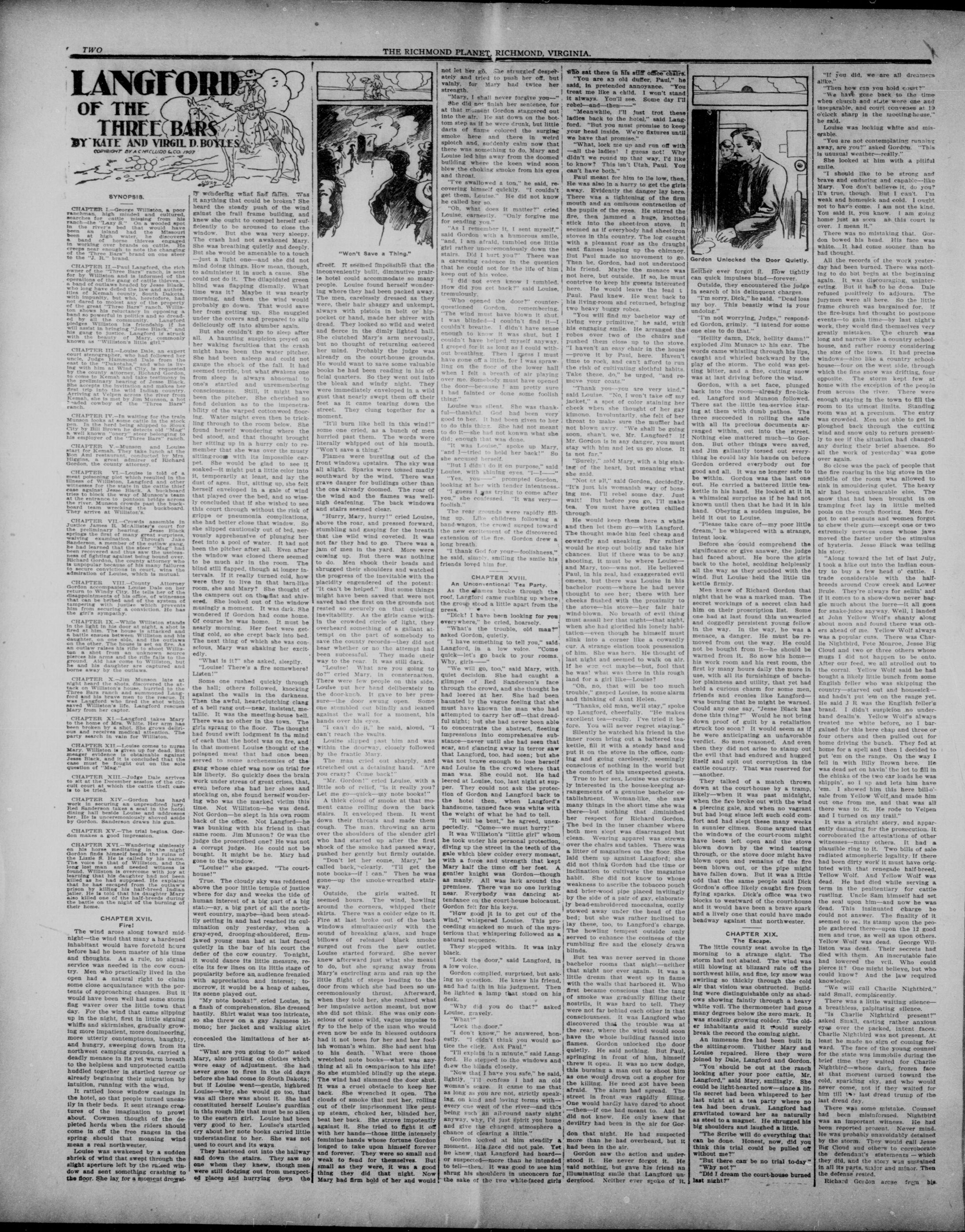
LANGFORD
OF THE
THREE BARS
BY KATE AND VIRGIL D. BOYLES
COPYRIGHT BY A.C. MICLURO & CO. 1907
TWO
SYNOPSIS.
CHAPTER I - George Willston, a poor ranchman, high minded and cultured, searched for a mississippi from the "Lazy S." wood spindle in the river's bed that would have been an island had the Missouri at night water drained, dengering a band of horses. chieves working over brands on cattle. He creeds near enough to note the changing of the river's bed on one steer to the "J. R." brand.
CHAPTER II - Paul Langford, the rich owner of the "Three Bars" ranch, is sent to the river's bed and is informed of the operations of the ranch, a band of outlaws headed by Jesse Black, so long have defied the law and authoritarianism, but who, with impunity, but who, hereof, has not dared to molest any of the property, shows his reluctance in supposing band so powerful in politics and so dreadful that pledges Willston his friendship the will assist in bringing "Jesse Black" and his gang to justice. Langford is struck commonly known as "Willston's little girl."
CHAPTER III -Louise Dale, an expert court stenographer, who had followed her uncle Judge Jammond Dale from the town of Kemah to Wind City, with him at Wind City, is requested by the county attorney, Richard Gordon, to come to Kemah and take testimony in the case. She accepts the invitation and makes her first trip into the wild Indian country. She opens across the river from Kemah, she is in Kemah and loaded cowboy of the "Three Bars" ranch.
CHAPTER IV -In waiting for the train Munson looks at some cattle in the stock pen. In the her being shipped to Sloux it is her turn to be loaded. She is a well known "onery" steer belonging to his employer of the "Three Bars" ranch.
CHAPTER V -Munson and Louise start for Kemah. They take lunch at the Ami restaurant, conducted by Mrs. Higgins, the priest of Richard Gordon, the county attorney.
CHAPTER VI -Louise is told of a meat poisoning plot which resulted in the illness of Williston, Langford and other witnesses for the state in the cattle thief tries to block Jamaica way of Munson's board at the entrance to pontoon bridge across the river. Munson crowds past the buckboard. They arrive at Williston's.
CHAPTER VII.—Crowds assemble in Justice James R. McAllister's court for the preliminary hearing. Jesse Black brings the first of many great surprises, waving in the air. The man's on the gallows.
Sanderson, a member of the outlaw gang, he had learned that the steer "Mag" had been recovered and thus saw the uselessness of the thing against being bound over. Richard Gordon, who is the first of the most popular because of his many failures to secure convictions in court, wins the admiration of Louise, which is mutual.
CHAPTER VIII.—County Attorney Gordon accompanies Louise Dale on her return to Windy City. He tells her of the disappointments of his office, of witnesses of the blood and of the system of tampering with justice in which previous him from securing a conviction. He has the girl's sympathy.
CHAPTER IX.—While Williston stands in the light in his door at night, a shot is fired at him. The house is attacked and a battle ensues between Williston and his daughter, on one side, and the outlaw's son, who is the other. The house is on the outlaw's an outlaw raises his rifle to shoot Williston a shot from an unknown source pierces his arms and the rifle falls to the ground. He is not come to Williston, but he is his daughter. He captured and borne away by the outlaws.
CHAPTER X--Jim Munson late at night heard the shots, discovered the attack heard the raidson's house, hurried to the Three Rams raidson and unarmed the Lord and his brave men to the rescue. It was Langford who fired the shot which Mary from her captor.
CHAPTER XI--Langford takes Mary to the home of Mrs. White. Her arm has been broken by a shot. She grows delirious and receives medical attention. The parry is in vain for Williston.
CHAPTER XII--Louise comes to nurse Mary. When given up for death, meager evidence is found against Jesse Black, and it is concluded that the case must be fought out on the sole question of "Mag."
CHAPTER XIII--Judge Dale arrives to sit at the December session of the circuit, which the cattle theft case is to be tried.
CHAPTER XIV--Gordon has hard work in securing an unprejudiced jury. Red Sanderson takes a seat in the hotel dining hall beside Louise and addresses Jesse by Gordon. Sanderson draws his gun.
CHAPTER XV--The trial begins. Gordon makes a good impression.
CHAPTER XVL—Wandering almessen on his horse meditating in the night Gordon finds himself beside the ruins of the Lizzie S. He is called by his name. He is a long lost man and needed witness is found. Williston is overcome with joy at learning that his daughter had not been taken away. He explains that he has escaped from the prison by killing his half-breed Indian jailer. He is told that his daughter Mary also found one of the half-breeds during battle in the night of the burning of their home.
CHAPTER XVII. First
The wind arose along toward midnight—the wind that many a hardened inhabitant would have foretold hours before had he been master of his time and thoughts. As a rule, no signal service was needed in the cow country. Men who practically lived in the open had a natural right to claim some close acquaintance with the portents of approaching changes. But it would have been well had some storm flag waver over the little town that day. For the wind that came slipping up in the night, first in little signing whiffs and skirmishes, gradually growing more impatient, more domineering, more utterly contemptuous, haughty, and hungry, sweeping down from its northwest camping grounds, carried a deadly menace in its yet warm breath to the helpless and unprotected cattle huddled together in startled terror or already beginning their migration by intuition, running with the wind.
It rattled loose window casings in the hotel, so that people turned uneasily in their beds. It sent strange creatures of the imagination to prowl about. Cowmen thought of the depleted herds when the riders should come in off the free ranges in the spring should that moaning wind mean a real northwester. Louise was awakened by a sudden shriek of wind that swept through the slight aperture left by the raised window and sent something crashing to the floor. She lay for a moment drowsi-
If wondering what had fallen, was it anything that could be broken? She heard the steady push of the wind against the frail frame building, and knew she ought to compel herself sufficiently to be aroused to close the window. But she was very sleepy. The crash had not awakened Mary. She was breathing quietly and deeply. But she would be amenable to a touch—just a light one—and she did not mind doing things. How mean, though, to administer it in such a cause. She could not do it. The dilapidated green blind was flapping dismally. What time was it? Maybe it was nearly morning, and then the wind would probably go down. That would save her from getting up. She snuggled under the covers and prepared to slip delicuously off into slumber again.
But she couldn't go to sleep after all. A haunting suspicion preyed on her waking faculties that the crash might have been the water pitcher. She had been asleep and could not gauge the shock of the fall. It had seemed terrific, but what awakens one from sleep is always abnormal to one's startled and unremembering consciousness. Still, it might have been the pitcher. She cherished no fond delusion as to the impenetrability of the warped cotton wood flooring. Water might even then be trickling through to the room below. She found herself wondering where the bed stood, and that thought brought her sitting up in a hurry only to remember that she was over the musty sitting room with its impossible carpet. She would be glad to see it soaked—it might put a little color into it, temporarily at least, and lay the soft ages. But, sitting she, felt herself enveloped in a gale of wind that played over the bed, and so wisely concluded that if she wished to see this court through without the risk of gripe or pneumonia complications, she had better close that window. So she slipped cautiously out of bed, nervously apprehensive of plunging her feet into a pool of water. It had not been the pitcher after all. Even after the window was closed there seemed to be much air in the room. The blind still flapped, though at longer intervals. If it really turned cold, how were they to live in that barn-like room, she and Mary? She thought of the campers out on the flat and shivered. She looked out of the window musingly a moment. It was dark. She wondered if Gordon had come home. Of course he was home. It must be nearly morning. Her feet were getting cold, so she crept back into bed. The next thing of which she was conscious, Mary was shaking her excitedly.
"What is it?" she asked, sleepily.
"Louise! There's a fire somewhere!
Listen!"
Some one rushed quickly through the hall; others followed, knocking against the walls in the darkness. Then the awful, heart-clutching clang of a bell rang out—near, insistent, metallic. It was the meeting-house bell. There was no other in the town. The girls sprang to the floor. The thought had found swift lodgment in the mind of each that the hotel was on fire, and in that moment Louise thought of the poised meat that had once been served to some archenomies of the gang whose chief was now on trial for his liberty. So quickly does the brain work under stress of great crises, that, even before she had her shoes and stocking on, she found herself wondering who was the marked victim this time. Not Williston—he was dead. Not Gordon—he slept in his own room back of the office. Not Langford—he was bunking with his friend in that same room. Jim Munson? Or was the judge the proscribed one? He was not a corrupt judge. He could not be bought. It might be he. Mary had gone to the window.
"Louise!" she gasped. "The courthouse!"
True. The cloudy sky was reddened above the poor little temple of justice where for day and weeks the tide of human interest of a big part of a big state—ay, a big part of all the northwest country, maybe—had been steadily setting in and had reached its culmination only yesterday, when a gray-eyed, drooping-shouldered, firm-jawed young man had at last faced quietly in the bar of his court the defender of the cow country. To-night, it would dance its little measure, recite its few lines on its little stage of popularity before an audience frenzied with appreciation and interest; toorrow, it would be a heap of ashes, its scene played out.
"My note books!" cried Louise, in a flash of comprehension. She dressed hastily. Shirt waist was too intricate, so she threw on a gay Japanese kimono; her jacket and walking skirt
concealed the limitations of her attire.
"What are you going to do?" asked Mary, also putting on clothes which were easy of adjustment. She had never gone to fires in the old days before she had come to South Dakota; but if Louise went—gentle, highbred Louise—why, she would go too, that was all there was about it. She had constituted herself Louise's guardian in this rough life that must be so alien to the eastern girl. Louise had been very good to her. Louise's startled cry about her note books carried little understanding to her. She was not used to court and its ways.
They hastened out into the hallway and down the stairs. They saw no one whom they knew, though men were still dodging out from unexpected places and hurrying down the
THE RICHMOND PLANET, RICHMOND, VIRGINIA
A
"Won't Save a Thing."
street. It seemed impossible that the inconveniently built, diminutive prairie hotel could accommodate so many people. Louise found herself wondering where they had been packed away. The men, carelessly dressed as they were, their hair shaggy and unkempt, always with pistols in belt or hippocket or hand, made her shiver with dread. They looked so wild and weird and fierce in the dimly lighted hall. She clutched Mary's arm nervously, but no thought of returning entered her mind. Probably the judge was already on the court-house grounds. He would want to save some valuable books he had been reading in his official quarters. So they went out into the bleak and windy night. They were immediately enveloped in a wild gust that nearly swept them off their feet as it came tearing down the street. They clung together for a moment.
"It'll burn like hell in this wind!" some one cried, as a bunch of men hurried past them. The words were literally whipped out of his mouth. "Won't save a thing."
Flames were bursting out of the front windows upstairs. The sky was all alight. Sparks were tossed madly southward by the wind. There was grave danger for buildings other than the one already doomed. The roar of the wind and the flames was well-nigh deafening. The back windows and stairs seemed clear.
"Hurry, Mary, hurry!" cried Louise, above the roar, and pressed forward, stumbling and gasping for the breath that the wild wind coveted. It was not far they had to go. There was a jam of men in the yard. More were coming up. But there was nothing to do. Men shook their heads and shrugged their shoulders and watched the progress of the inevitable with the placidity engendered of the potent: "It can't be helped." But some things might have been saved that were not saved had the first on the grounds not rested so securely on that quieting inevitability. As the girls came within in the crowded circle of light, they overheard something of a gallant attempt on the part of somebody to save the county records—they did not hear whether or no the attempt had been successful. They made their way to the rear. It was still dark.
"Louise! What are you going to do?" cried Mary, in consternation. There were few people on this side. Louise put her hand deliberately to the door-knob. It gave to her pressure—the door swung open. Some one stumbled out blindly and leaned against the wall for a moment, his hands over his eyes.
"I can't do it," he said, aloud, "I can't reach the vaults.
Louise slipped past him and was within the doorway, closely followed by the frantic Mary.
The man cried out sharply, and stretched out a detaining hand. "Are you crazy? Come back!"
"Mr. Gordon!" cried Louise, with a little sob of relief, "is it really you? Let me go—quick—my note books!"
A thick cloud of smoke at that moment came rolling down the back stairs. It enveloped them. It went down their throats and made them cough. The man throwing an arm over the shoulders of the slender girl who had started up after the first shock of the smoke had passed away, pushed her gently but firmly outside. "Don't let her come, Mary," he called back, "clearly. "Till get the note books—if I can." Then he was gone—up the smoke-wreathed stairway.
Outside, the girls waited. It seemed hours. The wind, howling around the corners, whipped their skirts. There was a colder edge to it. Fire at last broke out of the back windows simultaneously with the sound of breaking glass, and huge billows of released black smoke surged out from the new outlet. Louise started forward. She never knew afterward just what she meant to do, but she sprang away from Mary's encircling arm and ran up the little flight of steps leading to the door from which she had been so unceremoniously thrust. Afterward, when they told her, she realized what her impulsive action meant, but now she did not think. She was only conscious of some wild, vague impulse to fly to the help of the man who would even now be safe in blessed outdoors had it not been for her and her foolish woman's whim. She had sent him to his death. "What were those wretched note books—what was anything at all in comparison to his life! So she stumbled blindly to the steps. The wind had slammed the door shut. It was a cruel obstacle to keep her back. She wrenched it open. The clouds of smoke that met her, rolling out of their imprisonment like pent-up steam, choked her, blinded her, beat her back. She strove impotently against it. She tried to fight it off with her hands—those little intensely feminine hands whose fortune Gordon longed to take upon himself forever and forever. They were so small and weak to fend for themselves. But small as they were, it was a good thing they did that night. Now Mary had firm hold of her and would
not let her go. She struggled desperately and tried to push her off, but vainly, for Mary had twice her strength.
"Mary, I shall never forgive you—"
She did not finish her sentence, for at that moment Gordon staggered out into the air. He sat down on the bottom step as if he were drunk, but little darts of flame colored the surging smoke here and there in weird splotch and, suddenly calm now that there was something to do, Mary and Louise led him away from the doomed building where the keen wind soon blew the choking smoke from his eyes and throat.
"I've swallowed a ton," he said, recovering himself quickly. "I couldn't get them, Louise." He did not know he called her so.
"Oh, what does it matter?" cried Louise, carnessly. "Only forgive me for sending you."
"As I remember it, I sent myself," said Gordon with a humorous smile, "and, I am afraid, tumbled one little girl rather unceremoniously down the stairs. Did I hurt you?" There was a caressing cadence in the question that he could not for the life of him keep out of his voice.
"I did not even know I tumbled. How did you get back?" said Louise, tremulously.
"Who opened the door?" counterquestioned Gordon, remembering. "The wind must have blown it shut. I was blinded—I couldn't find it. I couldn't breathe. I didn't have sense enough to know it was shut, but I couldn't have helped myself again. I groped for it as long as I could without breathing. Then I guess I must have gone off a little, for I was sprawling on the floor of the lower hall when I felt a breath of air playing over me. Somebody must have opened the door—because I am pretty sure I had fainted or done some foolish thing."
Louise was silent. She was thankful—thankful. God had been very good to her. It had been given to her to do this thing. She had not meant to do it—she had not known what she did; enough that was done.
"It was Louise," spoke up Mary, "and I—tried to hold her back!" So she accused herself.
"But I didn't do it on purpose," said Louise, with shining eyes. "I—I—" "Yes, you—" prompted Gordon, looking at her with tender introspection.
looking at her with tender intentness.
"I guess I was trying to come after you," she confessed. "It was very—foolish."
The rear grounds were rapidly filling up. Like children following a band-wagon, the crowd surged toward the new excitement of the discovered extension of the fire. Gordon drew a long breath.
"I thank God for your—foolishness," he said, simply, smiling the smile his friends loved him for.
CHAPTER XVIII
An Unconventional Tea Party
As the names broke through the roof, Langford came rushing up where the group stood a little apart from the press.
"Dick! I have been looking for you everywhere," he cried, hoarsely.
"What's the trouble, old man?" asked Gordon, quietly.
"I have something to tell you," said Langford, in a low voice. "Come quick—let's go back to your rooms. Why, girls—"
"We will go, too," said Mary, with quiet decision. She had caught a glimpse of Red Sanderson's face through the crowd, and she thought he had leered at her. She had been haunted by the vague feeling that she must have known the man who had attempted to carry her off—that dreadful night; but she had never been able to concentrate the abstract, fleeting impressions into comprehensive substance—never until she had seen that scar, and glancing away in terror saw that Langford, too, had seen; but she was not brave enough to lose herself and Louise in the crowd where that man was. She could not. He had leered at Louise, too, last night at supper. They could not ask the protection of Gordon and Langford back to the hotel then, when Langford's handsome, tanned face was white with the weight of what he had to tell.
"It will be best," he agreed, unex-
pectedly. "Come—we must hurry!"
It was Williston's "little girl" whom he took under his personal protection, diving up the street in the teeth of the gale which blew colder every moment, with a force and strength that kept Mary half the time off her feet. A gentler knight was Gordon—though as manly. All was lark around the premises. There was no one lurking near. Everybody was dancing attendance on the court-house holocaust. Gordon felt for his keys.
"How good it is to get out of the wind," whispered Louise. This proceeding smacked so much of the mysterious that whispering followed as a natural sequence.
They stepped within. It was inky black.
"Lock the door," said Langford, in a low voice.
Gordon compiled, surprised, but asking no question. He knew his friend, and had faith in his judgment. Then he lighted a lamp that stood on his desk.
"Why did you do that?" asked Louise, gravely.
"What?"
"Lock the door."
"I don't know," he answered, honestly. "I didn't think you would notice the click. Ask Paul."
"I'll explain in a minute," said Langford. He stepped to the windows and drew the blinds closely.
"Now that I have you safe," he said, lightly. "I'll confess I had an old woman's scare. It came to me that as long as you are not, strictly speaking, on kind and loving terms with—every one west of the river—and this being such an all-round nasty night anyway, why, I'd just spirit you home and give the charged atmosphere a chance of clearing a little."
Gordon looked at him steadily a moment. His face did not pale. Yet he knew that Langford had heard—or suspected—more than he intended to tell—then. It was good to see him shrug his shoulders in unconcern for the sake of the two white-faced girls
who sat there in his self office chair?
who sat there in his stiff office chairs.
"You are an old duffer, Paul." he said, in pretended annoyance. "You treat me like a child. I won't stand it always. You'll see. Some day I'll rebel—and then——"
"Meanwhile, I'll just trot these ladies back to the hotel," said Langford. "But you must promise to keep your head inside. We're fixtures until we have that promise."
"What, lock me up and run off with—all the ladies! I guess not! Why didn't we round up that way, I'd like to know? This isn't Utah, Paul. You can't have both."
Paul meant for him to lie low, then. He was also in a hurry to get the girls away. Evidently the danger lay her. There was a tightening of the firm mouth and an ominous contraction of the pupils of the eyes. He stirred the fire, then jammed a huge, knotted stick into the sheet-iron stove. It seemed as if everybody had sheet-iron stoves in this country. The log caught with a pleasant roar as the draught sent flames leaping up the chimney. But Paul made no movement to go. Then he, Gordon, had not understood his friend. Maybe the menace was not here, but outside. If so, he must contrive to keep his guests interested here. He would leave the lead t Paul. Paul knew. He went back to his living-room and returned, bringing two heavy buggy robes.
"You will find my bachelor way of living very primitive," he said, with his engaging smile. He arranged the robes over two of the chairs and pushed them close up to the stove. "I haven't an easy chair in the house—prove it by Paul, here. Haven't time to rock, and can't afford to run the risk of cultivating slothful habits. Take these, do," he urged, "and remove your coats."
"Thank you—you are very kind," said Louise. "No, I won't take off my jacket," a spot of color staining her cheek when she thought of her gay kimono. Involuntarily, she felt of her throat to make sure the muffler had not blown awry. "We shall be going soon, shan't we, Mr. Langford? If Mr. Gordon is in any danger, you must stay with him and let us go alone. It is not far."
"Surely," said Mary, with a big sinking of the heart, but meaning what she said.
"Not at all," said Gordon, decidedly.
"It's just his womanish way of bossing me. I'll rebel some day. Just wait! But before you go, I'll make tea. You must have gotten chilled through.
He would keep them here a while and then let them go—with Langford. The thought made him feel cheap and cowardly and sneaking. Far rather would he step out boldly and take his chances. But if there was to be any shooting, it must be where Louise—and Mary, too—was not. He believed Paul, in his zeal, had exaggerated evil omens, but there was Louise in his bachelor room—where he had never thought to see her; there with her cheeks flushed with the proximity to the stove—his house—her fair hair wind-blown. No breath of evil thing must assail her that night—that night, when she had glorified his lonely habitation—even though he himself must slink into a corner like a cowardly cur. A strange elation took possession of him. She was here. He thought of last night and seemed to walk on air. If he won eat maybe—but, fool that he was! what was there in this rough land for a girl like—Louise?
"Oh, no, that will be too much trouble," gasped Louise, in some alarm and thinking of Aunt Helen.
"Thanks, old man, we'll stay," spoke up Langford, cheerfully. "He makes excellent tea—really. I've tried it before. You will never regret staying."
Silently he watched his friend in the inner room bring out a battered teakettle, fill it with a steady hand and put it on the stove in the office, coming and going carelessly, seemingly conscious of nothing in the world but the comfort of his unexpected guests.
True to her sex, Louise was curiously interested in the house-keeping arrangements of a genuine bachelor establishment. Woman-like, she saw many things in the short time she was there—but nothing that diminished her respect for Richard Gordon. The bed in the inner chamber where both men slept was disarranged but clean. Wearing apparel was strewn over the chairs and tables. There was a litter of magazines on the floor. She laid them up against Langford; she did not think Gordon had the time or inclination to cultivate the magazine habit. She did not know to whose weakness to ascribe the tobacco pouch and brier-wood pipe placed invitingly by the side of a pair of gay, elaborately head-embroidered moccasins, cozily stowed away under the head of the bed; but she was rather inclined to lay these, too, to Langford's charge. The howling tempest outside only served to enhance the coziness of the rumbling fire and the closely drawn blinds.
But tea was never served in those bachelor rooms that night—neither that night nor ever again. It was a little dream that went up in flame with the walls that harbored it. Who first became conscious that the tang of smoke was gradually filling their nostrils, it was hard to tell. They were not far behind each other in that consciousness. It was Langford who discovered that the trouble was at the rear, where the wind would soon have the whole building fanned into flames. Gordon unlocked the door quietly. He said nothing. But Paul, springing in front of him, himself threw it open. It was no new dodge, this burning a man out to shoot him as one would drown out a gopher for the killing. He need not have been afraid. The alarm had spread. The street in front was rapidly filling. One would hardly have dared to shoot—then—if one had meant to. And he did not know. He only knew that deviltry had been in the air for Gor-
don that night. He had suspected more than he had overheard, but it had been in the air. Gordon saw the action and understood it. He never forgot it. He said nothing, but gave his friend an illuminating smile that Langford understood. Neither ever snook of it.
A man is sitting in a room with a window. He is looking out at the sky, which is filled with clouds. There is a child standing behind him, looking up at him.
Gordon Unlocked the Door Quietly.
helither ever forgot ft. How tightly can quick impulses bind—forever.
Outside, they encountered the judge in search of his delinquent charges.
"I'm sorry, Dick," he said. "Dead loss my boy. This beastly wind is your undoing."
"I'm not worrying, Judge," responded Gordon, grimly. "I intend for some one else to do that."
"Hellity damn, Dick, hellity damn!" exploded Jim Munson in his ear. The words came whistling through his lips, caught and whirled backward by the play of the storm. The cold was getting bitter, and a fine, cutting snow was at last driving before the wind.
Gordon, with a set face, plunged back into the room—already fire-licked. Langford and Munson followed. There sat the little tea-service staring at them with dumb pathos. The three succeeded in rolling the safe with all its precious documents arranged within, out into the street. Nothing else mattered much—to Gordon. But other things were saved, and Jim gallantly tossed out everything he could lay his hands on before Gordon ordered everybody out for good and all. It was no longer safe to be within. Gordon was the last one out. He carried a battered little teakettle in his hand. He looked at it in a whimsical surprise as if he had not known until then that he had it in his hand. Obeying a sudden impulse, he held it out to Louise.
"Please take care of—my poor little dream," he whispered with a strange, intent look.
Before she could comprehend the significance or give answer, the judge had faced about. He bore the girls back to the hotel, scolding helplessly all the way as they scudded with the wind. But Louise held the little tin kettle firmly.
Men knew of Richard Gordon that night that he was a marked man. The secret workings of a secret clan had him on their proscription list. Some one had at last found this unwearied and doggedly persistent young fellow in the way. In the way, he was a menace, a danger. He must be removed from out the way. He could not be bought from it—he should be warned from it. So now his home—his work room and his rest room, the first by many hours daily the more in use, with all its furnishings of bachelor plainness and utility, that yet had held a curious charm for some men, friends and cronies like Langford—was burning that he might be warned. Could any one say, "Jesse Black has done this thing?" Would he not bring down proof of guilt by a retaliation struck too soon? It would seem as if he were anticipating an unfavorable verdict. So men reasoned. And even then they did not arise to stamp out the evil that had endured and hugged itself and spit out corruption in the cattle country. That was reserved for—another.
They talked of a match thrown down at the court-house by a tramp, likely—when it was past midnight, when the fire broke out with the wind a piercing gale, and when no vagrant but had long since left such comfort and had slept these many weeks in sunnier climes. Some argued that the windows of the court-moon might have been left open and the stove blown down by the wind tearing through, or the stove door might have blown open and remains of the fire been blown out, or the pipe might have fallen down. But it was a little odd that the same people said Dick Gordon's office likely caught fire from flying sparks. Dick's office was two blocks to westward of the court-house and it would have been a brave spark and a lively one that could have made headway against that northwester.
CHAPTER XIX.
The little county seat awoke in the morning to a strange sight. The storm had not abated. The wind was still blowing at blizzard rate off the northwest hills, and fine, ice snow was swirling so thickly through the cold air that vision was obstructed. Building were distinguishable only as shadows showing faintly through a heavy white vall. The thermometer had gone many degrees below the zero mark. It was steadily growing colder. The older inhabitants said it would surely break the record the coming night. An immense fire had been built in the sitting-room. Thither Mary and Louise repaired. Here they were joined by Dale Langford and Gordon
"You should be out at the ranch looking after your poor cattle, Mr. Langford," said Mary, smilingly. She could be light-hearted now—since a little secret had been whispered to her last night at a tea party where no tea had been drunk. Langford had gravitated toward her as naturally as steel to a magnet. He shrugged his big shoulders and laughed a little.
"The Scribe will do everything that can be done. Honest, now, did you think this trial could be pulled off without me?
"But there can be no trial to-day."
"Why not?"
"Did I dream the court-house burned last night?"
"If you did, we are all dreamers alike."
"Then how can you hold court?"
"We have gone back to the time when church and state were one and inseparable, and court convenes at 10 o'clock sharp in the meeting-house," he said.
Louise was looking white and miserable.
"You are not contemplating running away, are you?" asked Gordon. "This is unusual weather—really."
She looked at him with a pitiful smile.
"I should like to be strong and brave and enduring and capable—like Mary. You don't believe it, do you? It's true, though. But I can't. I'm weak and homesick and cold. I ought not to have come. I am not the kind. You said it, you know. I am going home just as soon as this court is over. I mean it."
There was no mistaking that. Gordon bowed his head. His face was white. It had come sooner than he had thought.
All the records of the work yesterday had been burned. There was nothing to do but begin at the beginning again. It was discouraging, uninteresting. But it had to be done. Dale refused positively to adjourn. The jurymen were all here. So the little frame church was bargained for. If the fire-bugs had thought to postpone events—to gain time—by last night's work, they would find themselves very greatly mistaken. The church was long and narrow like a country school-house, and rather roomy considering the size of the town. It had precise windows—also like a country school-house—four on the west side, through which the fine snow was drifting, four opposite. The storm kept few at home with the exception of the people from across the river. There were enough staying in the town to fill the room to its utmost limits. Standing room was at a premium. The entry was crowded. Men not able to get in ploughed back through the cutting wind and snow only to return presently to see if the situation had changed any during their brief absence. So all the work of yesterday was gone over again.
So close was the pack of people that the fire roaring in the big stove in the middle of the room was allowed to sink in smouldering quiet. The heavy air had been unbearable else. The snow that had been brought in on tramping feet lay in little melted pools on the rough flooring. Men forgot to eat peanuts and women forgot to chew their gum—except one or two extremely nervous ones whose jaws moved the faster under the stimulus of hysteria. Jesse Black was telling his story.
"Along toward the lst. of last July, I took a hike out into the Indian country to buy a few head o' cattle. I trade considerable with the half-breeds around Crow creek and Lower Brule. They're always for sellin' and if it comes to a show-down never haggle much about the lucre' it all goes for snake-juice anyway. Well, I landed at John Yellow Wolf's shanty about noon and found there was others ahead of me. Yellow Wolf always was a popular cuss. There was Charlie Nightbird, Pete Monroe, Jesse Big Cloud and two or three others whose mugs I did not happen to be onto. After our feed, we all strolled out to the corral. Yellow Wolf said he had bought a likely little bunch from some English feller who was skipping the country—starved out and homeslek—and hadn't put 'em on the range yet. He said J R was the English feller's brand. I didn't suspicion no underhand dealin's. Yellow Wolf's always treated me white before, so I bargained for this here chap and three or four others and then pulled out for home driving the bunch. They fed at home for a spell and then I decided to put 'em on the range. On the way I fell in with Billy Brown here. He was dead set on havin' the to fill in the chinks of the two car loads he was shippin', so I up and lets him have 'em. I showed him this here bill-o' sale from Yellow Wolf and made him out one from me, and that was all there was to it. He rode to Velpen and I turned on my trail."
It was a straight story, and apparently damaging for the prosecution. It corroborated the attestations of other witnesses—many others. It had a plausible ring to it. Two bills of sale radiated atmospheric legality. If there had been dirty work it must have originated with that renegade half-breed, Yellow Wolf. And Yellow Wolf was dead. He had died while serving a term in the penitentiary for cattle rustling. Uncle Sam himself had set the seal upon him—and now he was dead. This insinuated charge he could not answer. The finality of it seemed to se. its stamp upon the people gathered there—upon the 12 good men and true, as well as upon others. Yellow Wolf was dead. George Williston was dead. Their secrets had died with them. An inscrutable fate had lowered the vcl. Who could pierce it? One might believe, but who could know? And the law required knowledge.
"We will call Charlie Nightbird," said Small, complacently. There was a little waiting silence—a breathless, palpitating silence.
"Is Charlie Nightbird present?" asked Small, casting rather anxious eyes over the packed, intent faces. Charlie Nightbird was not present. At least he made no sign of coming forward. The face of the young counsel for the state was immobile during the brief time they waited for Charlie Nightbird—whose dark, frozen face at that moment turned toward the cold, sparkling sky, and who would never come, not if they waited for him till last dread trump of the last dread day.
There was some mistake. Counsel had been misinformed. Nightbird was an important witness. He had been reported present. Never mind. He was probably unavoidably detained by the storm. They would call Jesse Big Cloud and others to corroborate the defendant's statements — which they did, and the story was sustained in all its parts, major and minor. Then the defense rested.
Richard Gordon arese from his
THE PLANET
SATURDAY...MARCH 14, 1908
chair. His face was white. His lean jaws were set. His eyes were steel. He was anything but a lover now, this man Gordon. Yet the slim little court reporter with dark circles of home-sickness under her eyes had never loved him half so well as at this moment. His voice was clear and deliberate.
"Your honor, I ask permission of the court to call a witness in direct testimony. I assure your honor that the state had used all efforts in its power to obtain the presence of this witness before resting its case, but had failed and believed at the time that he could not be produced. The witness is now here and I consider his testimony of the utmost importance in this case."
Counsel for the defendant objected strenuously, but the court granted the petition. He wanted to hear everything that might throw some light on the dark places in the evidence.
"I call Mr. George Williston," said Gordon.
Had the strain crazed him? Louise covered her eyes with her hands. Men sat is if dazed. And thus, the enyosure of all eyes—stupefied eyes—Williston of the ravaged Lazy S, thin and worn but calm, natural and scholarly-looking as of old—walked from the little ante-room at the side into the light and knowledge of men once more and raised his hand for the oath. Not until this was taken and he had sat quietly down in the witness chair did the tension snap. Even then men found it difficult to focus their attention on the enormous difference this new witness must make in the case that a few moments before seemed settled.
Mary sat with shining eyes in the front row of wooden chairs. It was no wonder she had laughed and been so gay all the dreary yesterday and all the worse to day. Louise shot her a look of pure gladness.
Small's face was ludicrous in its drop-jawed astonishment. The little lawyer's face was a study. A look of defiance had crept into the defendant's countenance.
The preliminary questions were asked and answered.
"Mr. Williston, you may state where you were and what you saw on the 14th day of July last."
Williston, the unfortunate gentleman and scholar, the vanquished cowman, for a brief while the most important man in the county, perhaps, was about to uncover to men's understanding the dark secret hitherto obscured by a cloud of supposition and hearsay. He told the story of his visit to the island, and he told it well.
THE SCHOOL
Williston of the Ravaged Lazy S.
It was enough. Gordon asked no further questions regarding that event.
"And now, Mr. Williston, you may tell what happened to you on the night of the 30th of last August?"
Williston began to tell the story of the night attack upon the Lazy S, when the galvanic Small jumped to his feet. The little lawyer touched him with a light hand.
"Your honor," he said, smoothly, "I object to that as incompetent, irrelevant and immaterial, and not binding on the defendant."
"Your honor," interrupted Gordon, with great calmness, "we intend to show you before we get through that this testimony is competent, and that it is binding upon the defendant."
So Williston told briefly but to the point the story of the night attack upon his his home, of the defence by himself and daughter, and of the burning of his house and sheds. Then he proceeded:
"Suddenly, some one caught me from behind, my arms were pinloned to my sides, something was clapped over my mouth. I was flung over a horse and strapped to the saddle all in less time that it takes to tell it, and was borne away in company with the man who had overpowered me."
He paused a moment in his rectal. Faces strained with expectancy devoured him—his every look and word and action. Mary was very pale, carried thus back to the dread realities of that night in August, and shuddered, remembering that ghastly galloping. Langford could scarcely restrain himself. He wanted to rip out a blood-curdling Sioux war-whoop on the spot.
"Who was this man, Mr. Williston?"
asked Gordon.
"...
Small was on his feet again, gesticulating wildly.
"I object! This is all a fabrication, put in here to prejudice the minds of the jury against this defendant. It is a pack of lies, and I move that it be stricken from the record."
The little lawyer bowed his head to the storm and shrugged up his shoulders. Perhaps he wished that he, or his associates—one of the unholy alliance at least—was where the wicked cease from troubling, on the far-away islands of the deep seas, possibly, or home on the farm. But his expression told nothing.
"Gentlemen! gentlemen!" expostulated Judge Dale. "Gentlemen! I insist. This is all out of order." Only one gentleman was out of order, but that was the judge's way. Gordon bad remained provokingly cool under the trade.
Again the soft touch. Small fell into his chair. He poured himself a glass of water from the pitcher standing on the attorneys' table and drank a little of it nervously.
"I move," said the little lawyer, "that all this touching upon the personal matter of this witness and having to do with his private quarrels be stricken out of the evidence as not bearing on the case in question."
All in vain. The judge ruled that it did bear on the case, and Williston picked up the thread of his story.
"We rode and rode hard—it must have been hours; daylight was coming before we stopped. Our horses were spent. I had no idea where we were. From the formation of the land, I judged we were not far from the river. We were surrounded by bluffs. I can hardly make you see how clearly this little retreat had been planned. It was in a valley—one of a hundred similar in all essential respects. The gulch at the bottom of the valley was heavily wooded with scrub-oak, cottonwood, woodbine and plum trees, and this tangle of foliage extended for some distance up the sides of the hills. In the midst of this underbrush—a most excellent screen—was a tiny cabin. In this tiny cabin I have lived, a closely watched prisoner, from that day until I escaped."
The defendant stirred a little uneasily. Was he thinking of Nightbird with the dark, frozen face—who had not answered to his call?
"Black left me soon after. He did not unbind me, rather bound me the tighter. There was no one then to watch me. He deigned to inform me that he had found it rather inconvenient to kill me after the relief party rode up, as then there was no absolute surety of his making a clean getaway, and being caught in the act would be bound to be unpleasant, very unpleasant just then, so he had altered his plans a little—for the present. He gave me no hint either that time, nor either of the two times I saw him subsequently, as to what was to be his ultimate disposal of me. I could only suppose that after this trial was well over in his favor, and fear of indictment for arson and murder had blown over—if blow over it did—he would then quietly put an end to me. Dead men tell no tales. The shanty in the gulch did not seem to be much of a rendezvous for secret meetings. I led a lonely existence. My jailers were mostly half-breeds—usually Charlie Nightbird. Two or three times Jake Sanderson was my guard."
Then from the doorway came a loud, clear, resonant voice, a joyful voice, a voice whose tones fairly oozed rapture.
"Hellily damn! The Three Bars 's gettin' busy, Mouse-hair!"
Judge Dale started. He glared angrily in that direction.
"Remove that man!" he ordered, curtly. He liked Jim, but he could not brook this crying contempt of court. Jim was removed. He went quietly, but shaking his head reproachfully.
"I never would 'a' thought it o' the jedge," he murmured, disconsolately. "I never would 'a' thought it."
There was a movement in the back of the room. A man was making his way out, slipping along, cat-like, trying to evade attention. Quietly Gordon motioned to the sheriff and slipped a paper into his hand.
"Look sharp," he "whispered, his steady eyes on the shifty ones of the sheriff." "If you let him get away, just remember the handwriting on the wall. It's our turn now."
Presently there was a slight scuffle by the door and two men quietly left the improvised court-room.
"Day before yesterday, in the afternoon," continued Williston. "I managed to knock Nightbird down at the threshold as he was about to enter. I had secretly worked a cross-beam from the low, unfinished ceiling. There was nothing else in the room I might use for a weapon. They were very careful. I think I killed him, your honor and gentlemen of the jury. I am not sorry. There was no other way. But I would rather it had been the maker, not the tool. By the time I had made my way back to the Lazy S I was too exhausted to go further; so I crawled over to my neighbors, the Whites, and Mother White made me a shake-down. I lay there, nearly dead, until this morning."
Black stood up. He was not lank nor lazy now, nor shuffling. His body was drawn to its full height. In the instant before the spring, Mary, who was sitting close to the attorneys' table, met his glance squarely. She read there what he was about to do. Only a moment their eyes held each other's but it was time enough for a swift message of understanding, of utter dislike, and of a determined will to defeat the man's purpose, to pass from the accusing brown eyes to the cruel ones of the defendant.
Quick as a flash Black seized the chair upon which he had been sitting, sprang clear of the table and his lawyers, and landed close to Mary's side. With his chair as a weapon, he meant to force his way to the nearest window. Mary's dilated. Unhesitatingly she seized the half-emptied glass on the table and dashed the contents full into the prisoner's face. Blinded, he halted a moment in his mad rush. Mary's quick maneuver made Langford's opportunity. He grappled with
THE RICHMOND PLANET, RICHMOND, VIRGINIA
Black. The crowd went mad with excitement.
The prisoner still retained his chair. When Langford grappled with him, he attempted to bring it down upon the fair head of his antagonist. Mary gasped with dread, but Langford grasped the chair with one muscular hand, wrested it from the desperado's hold and threw it to the floor. The two men locked in a close embrace. Langford's great strength was more than sufficient to hold the outlaw until the dazed officers could do their duty—had he been let alone; but two men, who had been standing near the door when the prisoner made his unexpected leap for liberty, had succeeded in worming their way through the excited crowd, and now suddenly threw themselves upon the ranchman, dragging him back.
It was a girl's voice, clear and firm. Mary had been the first to realize that Black's friends, not Langford's had joined in the struggle. She snatched her revolver from her cowboy belt—she had not been without either since the Lazy S was burned—and cried out her challenge. Glancing quickly from the gleaming barrel to the determined face of the young girl, the men let go their hold of Langford and fell back precipitately.
Instantly Langford sprang forward, but Black had made good use of his moment of grace. Swinging his arms to the right and left, he had beaten his way to the window, when Langford again seized him, but he hed the advantage this time and he tore himself loose, throwing Langford violently against the window-casing. With his bare, clinched fist he shivered the glass and leaped out—into the arms of Jim Munson.
The officers made gallant plunges through the sampeded crowd in their efforts to get clear of the room to follow the fugitive. But certain men managed to keep themselves clumsy, but with marvelous adroitness, nevertheless, between the deputies and the doors and windows, so that several moments elapsed before the outside was finally gained.
Meanwhile Jim struggled heroically with the outlaw. Black was far superior to him in weight and strength of limb, but Jim was quick and tough and daring. Expelled from the courtroom, he had been watching through the window. He had seen Mary's quick action and his boss's splendid attack. He had also seen the little "gun play," and his eyes glowed in admiration of "Willston's little girl" though his generous heart ached for love of the woman who was not for him. He saw black coming. He was ready for him. He grappled with him at once. If the boss or the officers would only come now!
When they did come they found Jim stretched at length on the frozen ground. He sat up slowly. "You're too late, boys," he said; "the hoss thief was too much for me. He's gone."
It was true. The little street stretched before them still—deserted. Early twilight was coming on. The bliting cold struck them broadside. The deputies scattered in vain pursuit.
TO BE CONTINUED.
ALFALFA IN THE NORTH.
Discussion of the Best Methods of Securing a Stand.
Alfalfa for Wisconsin and the possibilities of growing this wonderful plant in our northern latitudes was the theme of an interesting and helpful address by Prof. R. A Moore of the University of Wisconsin before the 1908 meeting of the cheese-makers' association. Prof. Moore believes that alfalfa, while yet in its experimental stage in Wisconsin, has come to stay.
A thing most important in the production of alfalfa is testing the seed for germination. In recent years alfalfa seed has tested as low as ten per cent. germinating quality. Much of the germination power is ruined in the way alfalfa seed is occasionally handled through heating before being separated, etc. The remedy for farmers is, of course, to put the seed through a germinating test before seeding. The usual process may be followed, taking for example 100 seeds and placing these on a moistened pad of cotton cloth, a similar pad placed on the top of these between two plates, where they may be left at the proper temperature for a few days to germinate. Then remove the top plate and pad and count results. If the seed tests below 80 per cent, you may begin to feel suspicious of it.
In securing this crop in these northern latitudes the farmer should first learn how, experimenting in a small, though practical way. Put in with, and then start in to get conditions right. Do not seed on low, level valley. Select a gentle slope. An ideal soil for alfalfa is a clay loam on top of gravel. This plant wants a soil it can penetrate. You, who are at all familiar with alfalfa, will remember that it sends down a taproot occasionally 10 to 15 feet and more. Where alfalfa will be grown to advantage in the near future in Wisconsin is in the older, subdued soils of the south central counties. Further north in the state its development must necessarily be slower.
Alfalfa is easy on a soil. It is a legume and has the power of taking nitrogen from the air, a most wonderful and valuable consideration. In preparation of the soil we like to sow alfalfa in rotation with other crops. We like to use a thin nurse crop of either oats or barley, preferring barley, if this does well on the land. Make a fine seedbed in the spring and sow one bushel of oats or barley to the acre and 20 pounds of good alfalfa seed. Put in only one or two acres at most at the beginning, and not 40 acres. We must largely learn by doing, even though we understand the principles of alfalfa growing. It is often found best to cut this crop the first year, in order to prevent the curse crop from smothering the young
alifafa plants. Cut the cats the first year for hay and you may possibly cut a second crop of alifafa the same season.
In harvesting, cut in the morning after the dew is off the ground and on a fair day. In the afternoon rake into windrows and cock it up, even if it appears quite green to the eye. You will thus save the leaves through excessive drying off. They will not crack and become lost. I favor the use of hay caps to protect alifafa from sun and air. It keeps the plant palatable to stock. We like, if possible, to let alifafa go through the sweating process in the cock before taking to the barn.
REPAIRING BUGGY WHEELS.
Holder Which Will Make the Task an Easy One.
Make a box eight or ten inches square at the bottom and six inches square at the top, $2\frac{1}{2}$ to 3 feet tall, as
Fig. 1—Wheel Ready to Paint.
shown in fig. 1. Have your blacksmith make a screw hook and eyebolt of half-inch iron of a combined length to match the box. Screw the hook into
Fig. 2—Support for Wheel.
the shop floor, explains the Prairie Farmer, place the box over it, catch the eyebolt into the hook, place the wheel on top of the box with a board washer and tighten the nut on the eyebolt to hold the wheel while at work, as in fig. 2.
A. Careless Fellow
Stage Manager—Why did you eject that super awhile ago?
Stage Carpenter—I caught the idiot striking a match near the fire-proof curtain.
A LITTLE COLD.
He caught a little cold, that was all;
So the neighbors sadly said
When they learned that he was dead
Congregating round his bed-
DESSERT.
CAFFEE
24
PILS CUP
"We'll get some crullers, some chocolate cake, buns, strawberry tarts and ice cream."
"What kind of pie shall we have after?"
Yinlond Doctor Arrested
VINELAND, N. J., March 2.-Mrs. Charles Whitehead of this place admitted that Dr. Charles Johnson, under arrest in Philadelphia on a charge of having performed an illegal operation, is her husband, Dr. Charles Whitehead, a prominent physician here.
To Extradite Roy.
WASHINGTON, March 4.—Application was made to the state department for the necessary authority to extradite from France Paul E. Roy, charged with the responsibility for the death of George A. Carkins in New Hampshire.
Pastor Long Dead at Mount Joy.
MOUNT JOY, Pa., March 3.—Rev. A. M. Long, said to be the oldest minister in the Church of God denomination, is dead here, aged eighty-five years.
POLICE IGNORANCE.
The man was inebriated. The policeman who relieved the lamppost of him needed no messenger from heaven to tell him that.
"What are you doing here?" inquired the cop, shaking him. "Waiting for a car?"
"Course not," replied the inebriate, in evident surprise.
"Well, you'd better be going home before something happens to you."
The man straightened as nearly as possible under the circumstances, and looked at the official.
"Are you a married man?" he inquired.
"Sure, am I that. Wife and five children," was the proud reply.
The inebriate took another hitch at himself and looked at the policeman most indignantly.
"Y are, are you?" he said, scornfully. "Well, w' ought to know better'n to tell me t' go home. J'ou think my wife'll stand fer me in thish fix? You take me to safe place, thatsh what you do." Which the policeman did, much abashed—Judge.
-
Bronson—Some genius has invented an alarm clock that will arouse its owner and also fire the furnace.
Woodson—Hum! Why can't they invent one with enough nerve to fire the cook."
Stung.
I'd like to buy ice cream for you.
I told a maiden sweet;
But that is something I daren't do.
I pledged to anti-treat.
"All right," the maiden said to me.
"Your treat I'll not be missing;
If anti-treat you're bound to be,
Then I'll be anti-kissing."
The Buling Passion
Fathead—My dear fellow, how did you get your face cut so terribly?
Tartly—I hired a dumb barber to shave me.
Fathead—And he didn't know how to shave, eh?
Tartley—Yes, he did; but he persisted in trying to talk to me with his hands while he was doing it.
Two Accounts Closed
Family Retailer—Oh, sir, something terrible has 'appened!' Your daughter, Miss Gwendolyn, sir, has eloped with the chafeur, sir, an' they're off in the motor-car, sir.
The Old Man—Thank the lord! Maybe I can save a little money now that the girl and the machine are both gone.—Puck.
Timely Aid.
"I see that Moneybags has come forward with a half-million to help out in this financial trouble."
"Yes; but if he wished to relieve the trouble any why did he wait so long?" "Well, you see, he wanted to be sure the tide was coming in before casting his brand on the waters."—Judge.
Pa's Fellow Feeling
Wille—Is that a he or a she lion,
pa?
Pater—Which one, dear?
Wille—That one with his face
scratched and the hair off the top of
his head.
Pater—That must be the male, my
son.
Work for the Auto?
Mrs. Styles—I see a complete tour through all the rooms or apartments of the royal palace, near Madrid, involves a 120-mile trip, covering six days' time.
Mr. Styles—We'll make that trip in our next foreign automobile tour, dear.—Yonkers Statesman.
Murphy Stopped
Pat (being lowered into a well) $\rightarrow$ Sthop, will ye, Murphy? Oi want to come up ag'in.
Murphy—Phwat for?
Pat—Ol'll show yez. Af ye don't
shop lettin' me down Ol'll cut th'
rope!
Contented.
Mrs. McClub—Phy don't ye git
yself elicted president, Barney?
Mr. McClub—Hein' president wudna
suit me. Ol loke authority. Ol'd rather
shtay a policeman.—N. Y. Weekly.
Contented
The Delights of Deafness
Mr. Feller—it's very annoying—very. My wife's been kept indoors for months by sciatica. Mr. Hardchearin—My dear boy, why don't you go and kick the fellow out?
A Loser.
"How do you know that Mrs. Rogers isn't going to have new furs this winter?"
"I played bridge with her last night."—Judge.
Fine Investment
"Put your money in a piano," advertises a music house. That's all right, if you can get negotiable notes out of it. Be still, Fido!
Book Lover's Reward.
He who loves to read and knows how to reflect has laid by a perpetual feast for old age.—Carlyle.
MAKES
KINKY
HAIR
SOFT
REMOVES
DANDRUFF
AND
MAKES
IT
GROW
LONG
AND
LUXURIOUS
LINCOLN
HAIR POMADE
handmade only cleans, refreshes the hair and helps
remove excess oil and oil residue. A long
drying hair to prevent long hairiness.
THE LINCOLN POMADE ON
WESTPALM, VA. D. B. A.
SOFTENS
THE
HAIR
AND •
KEEPS IT
FROM
BREAKING
KEEPS
SCALP
FRESH
CLEAN
AND
WHOLESOME
A Woman's Hair Makes or Mars Her Beauty.
If your hair is short. If your head is full of dandruff. If your scalp is diseased, LINCOLN HAIR POMADE will make it grow, remove the dandruff and cure scalp diseases. LINCOLN HAIR POMADE is highly perfumed and is the finest toilet preparation on the market. All we ask is for you to give it a trial and we feel confident the result will be so satisfactory that you will recommend it to your friends. Be sure and get the genuine and refuse weak and inferior substitutes. For sale at all Drug Stores.
The Lincoln Pomade Company.
NORFOLK, VA., U. S. A.
If your dealer does not keep it, sen will send you a bottle by return mail for particulars.
If your dealer does not keep it, send his name and 20 cents in silver and we will send you a bottle by return mail. Agentfs wanted everywhere. Write for particulars.
JURGEN'S SON
JURGEN'S SON
Before making your purchase you would do well to call at the most reliable furniture house in the city and see the fine line of
And in fact everything that is needed in house furnishings. RUGS AND
Of every description; also the latest designs in ROCKERS and special CHAIRS. Our goods are the best for the price and the price is very low. C. G. JURGEN'S SON, ADAMS AND BROAD STREETS.
BLACKWELL & BRO
ONE OF THE LEADING PAINTERS
Practical House and Sign Painters,
Graining and General Contractors.
.....ALL WORK GUARANTEED.....
Cards, Letters or Orders.
.Give us a trial, you will never regret it.....
Address, 608 St. Peter Street,
RIO HMOND. VA.
'Phone 5688.
JOSHUA BANKS & SONS
EVERY FACILITY CONSISTENT
WITH FINE CATERING.
Special Attention Given to Ralls,
Suppers, Installations and Smok
ers at the Shortest Notice.
Your Patronage Solicited.
Refreshment Cars and Boat Privileg
es Handled in Season.
Address all communications to
LLAM L. BANKS,
511 N. 3d St
Residence: 1312 N. 26th St.
- Subscribe to The P ANET. Only $1.50 per year.
"Me and brother Wallie were down
shopping, yesterday."
"Yes; I saw it in the paper."
"What! Saw that we were shop-
ping?"
"Yes, it said 'things in the shops' in
the paper I saw."—Yonkers States-
man.
"Jones is terribly slow pay, isn't he?"
"Well I wouldn't like to say that exactly. But I will say that when it comes to paying what he owes, he appears to be a victim of stuporous melancholia."—Detroit Free Press.
"That youngest boy of yours does not seem to be a credit to you," said the white man to Uncle Rastus. "No, sah," said Uncle Rastus; "he is the wuestest chile I has. He is mighty bad. He's de white sheep of de family, sah."
He—A proposal of marriage, for instance?
Sensitive Coincidence.
Two little girls walking in a field feared that the cow would attack them.
"Let's go right on and act as if we weren't afraid of her at all," said one.
"But," demonstrated the other, "wouldn't that be deceiving the cow?"
Described Them.
Slow.
A Bad Nigger.
His Opportunity
Sensitive Conscience
60 YEARS' EXPERIENCE
PATENTS
TRADE MARKS
DESIGN
COPYRIGHTS & C.
Anyone sending a sketch and description may quickly ascertain our opinion free whether an invention is presumably patentable, communications strictly confidential, HANDEGOK on Patents sent free, oldest agency for securing patent, special taker, through MUNN & Co., receive special notice, without charge, in the
Scientific American.
A handsomely illustrated weekly, largest circulation of any scientific journal. Terms, $3 a year, four months, $1. Sold by all new dealers.
MUNN & Co. 301 Broadway, New York
Branch Office, 252 F St., Washington, D.C.
FORD'S
HAIR POMADE
Formerly known as
"OZONIZED OX MARROW"
The Ozonized Ox Marrow Co.
(None genuine without my signature)
Charles Pond Past
IS3 E. KINZIE ST., CHICAGO, ILL.
Agents wanted everywhere.
The Union Stockyards, Chicago have now been doing business for 42 years. A report has just been made of the number of animals of all kinds received during that time. The totals for each class of animals follow: Cattle, 84,804,114; calves, 4,525,305; hogs, 246,859,208; sheep, 79,505,898; horses, 2,309,556; grand total, 418,004,078. During the year just closed the receipts were: Cattle, 3,305,314; calves, 421,934; hogs, 7,201,061; sheep, 4,218,083; horses, 102,087. The number of cars used in hauling these animals to market totaled 257,987.
Text from Brother Dickey
"De man what economizes in his young days kin order coal by telephone in his old age, an 'sit by his warm fire—ef de young folks'll agree to make room for him!"—Atlanta Constitution.
Metal rings are sold to clean bean pots. A simple method is to fill the pot with cold water and put in a triplespoonful of baking soda. Cover and set on the back of the stove to simmer for two hours.
Nobleness of character can only be attained by the power of steady persistent effort to reach our highest good. Character is what we make it by the use of our powers in routine matters—French.
THREE
```markdown
```
Forming Character
FOUR
THE PLANET
Published every Saturday by JOHN MITCHELL,
JR., at 811 N. Fourth Street, Richmond, Va.
JOHN MITCHELL, JR. - EDITOR.
All communications intended for publication
should be sent so as to reach us by Wednesday.
TERMS IN ADVANCE
One Copy, one year, one inch. $1.50
One Copy, eight months, $1.00
One Copy, six months, $0.90
One Copy, four months, $0.50
One Copy, three months, $0.40
Single Copy $0.05
ADVERTISING RATES.
For one inch, one insertion.....$0.50
For one inch each subsequence insertion.....$0.40
For two inches, three months.....$0.00
For two inches, six months.....$0.00
For two inches, nine months.....$0.00
For two inches, twelve months.....$0.00
Marriage and Funeral Notices, one inch.....$0.50
Standing and Transient Notices per line.....$0.10
POSTAGE STAMPS OF A HIGHER DENOMINATION THAN THE STAMP RECEIVED ON SUBSCRIPTIONS
THE PLANET is issued weekly. The subscription price is $1.50 per year in advance. You can be sent by mail at our risk—In a Post Office Money Order, by bank check or Draft, or an Express Money Order, if you can send these can be procured, in a Registered Letter.
MONEY ORDERS—You can buy a Money Order at your Post Office, payable at the Richmond and we will be responsible for its safe arrival.
EXPRESS MONEY ORDERS can be obtained at any office of the American Express Co., the United States Express Co., and the World Express Co. You can be responsible for money sent by any of these companies. The Express Money Order is a safe and convenient way to send money to any of these companies.
REGISTERED LETTER—If a Money Order, Post Office or an Express Office is not within your reach, your Postmaster will Register the money and send us on payment of ten cents. Then, if the money can be traced. You can send money in this manner at our office. You can be responsible for money sent in letters in any other way than one of the four ways mentioned above. If you send your money in any other way, you must do it at your own risk.
RENEWALS, ETC.—If you do not want THE PLANET continued for another year after your subscription has run out, you then notify us by email, and we will send you a note that subscribers to newspapers who not order their paper discontinued at the expiration of time for which it has been paid are not for the payment of the subscription up to date when they order the paper discontinued.
COMMUNICATIONS—When writing to us to renew your subscription or to discontinue your paper, you should give your name and address to the otherwise we cannot find your name on our books.
CHANGE OF ADDRESS—In order to change the address of a subscriber, we must be sent the address of the previous address.
Entered at the Post Office at Richmond, Va. as second class matter.
The white folks are losing money and the colored folks are spending it
President Roosevelt may like colored folks, but he has "a devilish mean way" of showing it.
---
We should like for President Roosevelt velt to state if Secretary Taft originally approved that "punish the innocent with the guilty" order.
Colored men, we must not be insulting. Let us continue to make friends. Our condition is improving despite the set-backs that we receive all along the line.
---
We do not know who will be the next President, but the indications are that we will not have any rougher time under Mr. Bryan than we have had under Mr. Roosevelt.
---
If it takes over a year and a half to get partial justice from a Republican President, how long will it take to get full justice from a Democratic President?
____o____
If the distinguished occupant of the White House will read his Bible less and practice its precepts more, the colored folks will have an easier time in this portion of their Master's vineyard.
---
One thing we know, the United States Senate cannot act any too quickly in reinstating the "Black Battalion" if it wishes to save to the Republican Party the black vote in the doubtful States.
---0---
We congratulate our friend, Mr. M. M. Lewey of the Pensacola, Florida Sentinel upon the installation of a new Whitlock press. Any colored man who has the nerve to buy such a machine as this, with the white folks cry of hard times ringing in his ears deserves to succeed.
---
According to President Roosevelt's Brownsville order, no Negroes were wanted in the army and he "kicked" them out. According to the "Lily Whites" no Negroes are wanted in the Republican organization and they are shutting them out. According to the colored people, no Negroes will be wanted at the polls in November for the Republican ticket and they are preparing to stay in and fast and pray or vote for some other party
on election day. It's a long time coming, but they will have their inning.
0
Of all the Democratic Governors in this State since we have been old enough to know them, we do not call to mind more than two who would have taken half the time to extend justice to colored people that President Roosevelt has taken to recommend the reinstatement of admittedly innocent men to the army, who had been kicked out of it by virtue of his tireless energy and outlandish impulsiveness.
---
Mr. W. Philip Dabney has been appointed Assistant Paymaster at Cincinnati, Ohio. The salary is sald to be $2,000 per year and there is not a man in the United States who knows better how to get rid of it than that gentleman, who once hailed from this city. We are pleased to learn of his success, for he has shown more skill in getting into political offices and less in getting out of them than any gentleman, we can call to mind at the present time. It is but the truth to say though that we are all "mightily pleased" over his good fortune.
His admirers tendered him a banquet as a token of their appreciation and with us no doubt have hopes with ourselves of visiting his domicile during the present year to "eat him out of house and home" to get even. Here's our best wishes to Prof. W. Philip Dabney of Ohio.
---
WILL BE RESTORED TO THE ARMY.
The report of the Committee on Military Affairs relative to the "shooting up" of Brownsville, Texas as made to the United States Senate Wednesday, March 11, 1908 was highly significant. President Roosevelt deemed it necessary to send a special message in connection therewith. This was unusual, for the reason that it does not appear why he should further interfere in the matter. It is admitted though that he has weakened in his attitude towards these colored soldiers in that he now virtually recommends that they be reinstated or rather that they be permitted to re-elist in any way that the Congress sees fit to prescribe.
Senator Warren speaking for the Committee, being chairman of the same stated that a bill permitting the re-enlistment of the soldiers would be introduced very soon, and that matters concerning their pay would have to be considered before the bill was put in. This means then that Senator Foraker has carried his point for the restoration of these men. He started out to secure for these men "their day in court." He has succeeded in giving it to them and now the President of the United States recommends that they be re-instated. When colored people stand solidly together, they can accomplish wonders. It has been the united front presented by our people everywhere that has brought about this change.
They should see to it too that vengeance is not wreaked upon Senator Foraker on their account. He stood by us and we should stand by him to the end of the chapter. President Roosevelt's message to our mind does not show the proper spirit. Still it is a long stride in the right direction. We have wondered why the combined influence of the leading colored men of the country, including that of that distinguished educator, Dr. Booker T. Washington has not been powerful enough to cause him long before this to do simple justice to the 167 black men who have been so outrageously treated and so scandalously misrepresented.
---
SECRETARY TAFT AND THE CONSTITUTION.
"Who grasped at earthly fame
Grasped wind: nay, worse, a serpent
grasped that through
His hand, held so smoothly, and was
gone, but left
A sting behind which wrought him endless pain.—Pollok.
The speech of Secretary William H. Taft at the annual dinner of the Brooklyn Bar Association at the Union League Club, Brooklyn, N. Y., February 29, 1908 on "The Constitution of the United States" was highly significant and will be regarded with interest by every citizen of color who notices present day events in the light of past experiences. It demonstrates that history is repeating itself and that great principles are eternal.
For more than forty years, the colored people of this country have been endeavoring to secure the constitutional guarantees vouchsafed them in that great instrument. They have been unsuccessful, and yet Secretary Taft makes a plea not for the citizens of this country, but those of another clime. Here is what he said:
"Secretary Taft declared that he did not share in the views expressed by critics on 'the change which has come over our form of government' by the increase in the national and
THE RICHMOND PLANET. RICHMOND. VIRGINIA
the decrease of the State powers under the Constitution.
"I think, on the whole," he said 'that the division of power between the United States and the States has been admirably maintained, and that this has been possible because it has been ultimately left, in most instances to the decision of a tribunal less subject to political influences than any other branch of our government.'"
He continued
"That tribunal has opportunities for maintaining a consistent view from the foundation of our government to the present day greater than that enjoyed by any other authority in either State or National government. It is quite true that in certain ways the national power has been increased by amendment to the Constitution, not affirmatively, but by placing further restrictions on the exercise by the State of its admitted power over certain subject-matter."
He is quoted further:
"The Secretary expressed the conviction that it was plainly in the power of Congress to provide by law for protection of allens in their treaty rights. In this connection he said: "Certainly Congress ought to take some steps directly authorizing the Executive to use the forces at his command to provide such protection and ought to vest the courts of the United States with power to punish the person who would violate such allen rights."
He is treading on delicate ground
but he walks boldly when he says:
"In the case of the Maffa riots in Louisiana, where Italian subjects were deprived of rights secured by the treaty of the United States, and in the more recent cases in San Francisco, where Japanese subjects were deprived of their rights by lawless violence, the embarrassment of the national government in attempting to protect and vindicate those rights is known to all men. It puts our country, now become a world power, and entering into treaties of this kind with every government on earth in the most pusillanimous position of promising that subjects of another country shall be properly treated and then of having no means of carrying out the promise, or of punishing those who violate it.
'Fancy the feelings of a Secretary of State who is obliged to say to a foreign country: 'It is true we agreed to protect your citizens or subjects if they came over here and conducted themselves peaceably, but under our form of government and laws while we made that promise, and had a right to make it, we have no means of complying with it. All we can do is to make a respectful presentation to the State authorities and ask them, as a favor to us, to enforce the laws.'
This is indeed a most ridiculous predicament in which the President of the United States and the State Department must appear, and yet it is relatively the same condition that confronts the national government in dealing with the demand for the enforcement of the guarantees of the Constitution of the United States. It is a well-known principle of law that a constitutional or legislative enactment that carries with it no provision for the punishment of the individual or corporation that violates its provisions is null and void and yet the national government is embarrassed by just such a condition in dealing with foreigners. In commenting upon this fact, Secretary Taft is quoted:
"If Turkey or China were to make such an excuse as that to us for the killing or mobbing of our citizens in those countries, should we not become justly indignant at the explanation? A foreign nation has nothing to do with our internal concerns. By the Constitution a foreign nation is obliged to look to the central government, and if it deals with the central government, it must that central government can make a proimise, it can only look to the central government for a redemption of the promise.
"We are in a situation now to say to our foreign friends whose citizens may be assaulted or murdered in violation of treaty obligations, 'we can soothe your feelings by paying out of the government treasury the value of those lives, but we cannot save them. We cannot punish anybody for taking them. I confess that this lack of federal power, due wholly to inaction by Congress, savors of that doctrine which attracted so much ridicule when it was advanced, that it was unconstitutional for States to secede but was also unconstitutional for the central government to try to coerce them.'"
This then is the openly declared policy of the prospective President of the United States. He stands for the centralization of government and the Democrats of the country are invited to "sit up and take notice." But what about the rights of the citizens of color in this country, Secretary Taft? Article IV reads:
"The right of the people to be secure in their persons houses, papers and effects, against unreasonable scarches and seizures shall not be violated.****"
It is a notorious fact that colored people in the South are not secure in their persons, houses or papers against just such treatment.
What about Article V, Secretary Taft? It reads:
"No person shall be held to answer for a capital or otherwise infamous crime, unless on a presentment or indictment of a grand jury, except in cases arising in the land or naval forces, or in the militia, when in actual service in time of war or public danger***nor shall any person be subject for the same offense to be twice put in jeopardy of life or limb; nor shall be compelled in any criminal case to be a witness against him.
self, nor be deprived of life liberty or property, without due process of law."
Did President Roosevelt and the War Department of which you are the official head do this in the case of the 167 soldiers of Companies B. C and D of the 25th Infantry of the United States, Secretary Taft? When you issued the order to dismiss these men from the service without honor and thereby blighted hopes of some of them, who had seen forty years of service, was there one single iota of justice in the decree and was there a strict observation of this provision in the Constitution of the United States?
Your voice was not raised in their defense, Secretary Taft, but you come before the American people on the eve of a Presidential election in behalf of foreigners, who pay no taxes to the government and who have never shed one drop of blood in its defense. How can you square your words with your actions, Secretary Taft.
You are speaking, too as the official mouth-piece of President Roosevelt,—how can he square his actions with it? Moreover, Mr. Secretary, you are meddling with another department of government for you are Secretary of War and this proposition belongs to the Secretary of State and his Department.
It is a matter of record that the War Department by executive order notified the soldiers of Companies B, C and D of the Twenty-fifth Infantry that if they did not virtually admit their guilt by delivering to the War Department the names of persons who participated in the alleged "shooting up" of that Texas town that the entire battalion would be dismissed from the service without honor.
Yet it is a fact that the Constitution of the United States expressly forbids just such action and the logical conclusion is that the President of the United States is like the Philippine Islands, not under the constitution, where its enactments or provisions conflict with his ideas. Senator Bailey was right, when in his great speech, delivered in the United States Senate last Monday, he said:
"He [Roosevelt] has frequently exhibited a supreme indifference to the Constitution of his country, and has pursued what has seemed to me a deliberate plan to impair the rights of the states and to concentrate all power in the Federal Government."
The distinguished occupant of the White House has done this very thing. If the concentration of power for the protection of property will result in the concentration of power for the protection of life and liberty his efforts will result in a millennium. Recent experiences though show that he has great respect for the one and great contempt for the other. Senator Bailey was indeed at his best when in speaking of President Roosevelt, he said:
"We have never before witnessed such a mixture of good and evil in any public man. Before we have finished praising him for some wise recommendation he makes another so foolish that our praise must turn to censure. They tell me that he is brave; and I answer that he is just as rash as he is brave. They tell me that he is honest; and I answer that he is just as arbitrary as he is honest. He is
"Too bad for blessing
Too good for curse.
I wish in my heart
He were better or worse."
"If he were much better, he declared, he would be a Democrat; and if he were a little worse, he would not obscure and confuse the great issues between the Democrats and their adversaries."
Still, Senator Bailey is a mossback Democrat, with none of the modern ideas connected with the higher elevation of this great nation. He speaks of President Roosevelt's contempt for the Constitution, while he, himself speaks derisively at times of some of its most vital provisions. "We hold these truths to be self-evident that all men are created equal" is regarded as an anomaly by this distinguished Senator from Texas Public men are too often inconsistent and President Roosevelt with the rest of them will ultimately pay the penalty. We have noted the trend of events, the demand for the centralization of government. With the present Supreme Court in session at Washington the colored people of this country have nothing to hope from this change.
We have seen one man, assisted, aided and abetted by the Secretary of War punish with impunity 167 men, who have not as yet been convicted of any crime and in the face of the fact that the Committee on Military Affairs of the United States Senate has virtually unanimously declared that it has been able to find no evidence on which to convict any one of them. What would be the result if President Roosevelt was a Czar instead of a President?
One thing we know and that is that the embarrassment now confronting the administration will ultimately culminate in war. It is a proposition that demands attention and Secretary Taft showed very little diplomacy in officially announcing to the world the predicament in which he and his colleagues in office find themselves.
Colored folks can well afford to pray hard and wait upon the Lord. He will bring all things right in his own time. There has never been a wrong visited upon us, but what there has not appeared in the distance retributive punishment. At the present time, the black men in the doubtful States, hold in their hands the weapon that will secure justice for their brothers in this sunny land.
Had the stupid, Negro-hating Congressman, Heflin kept out of the equation, the "Jim Crow" car proposition at Washington, the slump of the Negro vote in the Northern States would be appalling. As the matter now stands, there will be many a citizen of color, who will "forget to vote" next November, unless something is done by the Republican Party managers to heal the wound caused by the unjustifiable discharge from the army of the 167 defenders of the nation's flag, whose valor has charmed this country and whose bravery has astonished the nations of the world.
"There are but two kinds of men who succeed as public characters:—men of no principle, but of great talent, and men of no talent, but of one principle, that of obedience to their superiors." —Colton
____o____
"ALLIGATOR BAIT."
The Dayton, Ohio Observer seems to be "hot in the collar" over the treatment of the Negro contingent by the recent Taft Republican State Convention. It says:
"It is the same old story, so oft repeated, the bosses have forced Taft upon the Negroes, but thank Heavens, the black man will have a chance to say something later on. None of the Negro Taft delegates to the Columbus convention were placed on any committees, their voices were stilled as unto death, but voted for the endorsement of Jim Crow Taft, and were instrumental in eliminating Senator Foraker. We clip one section of the "Republican-Taft platform which is as we call it, alligator bait."
Then follows the plank relative to the Negro's civil and political rights and the reduction of representation in the South. It continues:
"History will repeat itself. The people one time wanted any one to run for President, but Ben, Harrison; the bosses wanted Harrison; Harrison was nominated the second time by the bosses; but the people resented it at the polls. The same conditions exist to-day. If the various bosses throughout the country would let each candidate fight for their nomination on his merits, keep the 'Washington-Taft Big Stick' combine out of the fight, Foraker would carry the country.
"As a man he has acted too square honest and clean, but thank God! the fight is just beginning. The people who will not stand to be forced to take a bitter pill, are arising to the fact that a man is a man on election day. In many of the closest counties where the Negro holds the balance of power, the independent tickets will hold full sway. Our compliment is to H—L with the bosses, and the Convention's 'Alligator Bait.'"
From the above, our conclusions are that the Florida "Alligator Bait" is not popular among the Negroes of Ohio. Editor Poston has our sympathy.
---
THE "LILY WHITES" IN VIRGINIA.
The Republican Mass-Meeting for the election of delegates to the State and District Conventions of the Republican Party held at Belvidere Hall in this city last Saturday night was peculiarly significant, and for brazen effrontery in openly telling the colored voters of this city that they were not wanted, save to ratify any action that the white men of the party had mapped out will stand forth as one of the most remarkable happenings in the city of Richmond. The claim has been made by conservative Democrats and Republicans that the idea was not to get rid of the Negro as a voter, but only to eliminate the ignorant masses and to entrust the ballot to the intelligent property-owning elements of both races. Those colored folks who believed all this had a rude awakening last Saturday right. Colored men who owned enough property to double and treble that owned by a dozen white men there claiming to be Republicans were ignominiously denied the right of voice and in the general summing up, no attention was even given to their votes.
Senator Noel was invited to speak and Democratic white men went to hear him. They were counted as Republicans, so we are informed in the general make-up. We cannot understand how a Republican of the Judge L. L. Lewis type could lend either his presence or his voice to such an arrangement.
Mr. W. P. Burrell, Grand Worthy Secretary of the True Reformers was insulted and told to sit down under threat of being put out by the police. He represented men like Dr. R. E. Jones, Dr. P. B. Ramsey, Rev. Dr. J. E. Jones, James H. Hayes, Esq., Rev. W. L. Taylor, D. D., Dr. J. Meade Benson. These are men of standing and respectability. Rev. W. L. Taylor is worth approximately fifty thousand dollars or thereabouts but there is not a bar-room loafer that was treated with more scant courtesy than was he and his associates. They were regarded as in-
terlopers by this new regime.
It may be that President Roosevelt and Secretary Taft do not know of the treatment to which the respectable, property-holding Negroes of this State are being treated by their followers. Some effort should be made to acquaint them with the facts and the Republican National Committee should also be advised of the situation. We are surprised that a protest was not made and drafted Saturday night. The only proper way to meet organization is with counter organization.
We do not propose to be humiliated by any such processes and if the colored men of Richmond have lost all of their manhood, they should let the country know it. The plan now is to make the colored people the "hewers of wood and the drawers of water" and the white Republicans are to be slated to hold all of the offices worthy of the name. We have long ago learned that there is the Democrat, the Negro-hating Democrat and the Republican and the Negro-hating Republican.
Colored men can support either a Democrat or a Republican according to their respective convictions, but it seems to us that it is time for us to oppose both the Negro-hating Democrat and the Negro-hating Republican, for if there is any difference in creed of these hybrid monstrosities up to this writing, we have failed to discern it. "Lily-Whitism" has run mad in this district and it is time for the better class of Negroes to organize and "do it to death," or be buried in the grave of oblivion that now awaits our interment.
Colored men.
"Awake, arise or be forever fallen." Milton.
TROUBLE IN CAMP
The Petersburg Index-Apeal says some very true things sometimes. In its issue of the $8th inst. it remarks:
"Regardless of the merits of the case in general, it must be cold com fort for the dismissed colored soldiers to gain a legal right to re-enlist if they can "prove their innocence." The administration, it is said will urge in Congress a bill giving the ex-soldiers this opportunity. Just how they will show themselves not to have been guilty is a puzzle. Every one of them has already sworn to his own and his comrade's innocence, and thus and otherwise evidence one way or the other has been exhausted. If the administration wishes to placate the colored voter it must offer something more substantial than this."
This is a rather plain way of stating a blunt truth. It is this proposition to make colored men prove their innocence, rather than have the state or government prove their guilt that has caused the dissatisfaction and criticism throughout the country. No criminal case is tried either North, South, East or West in this country, but what the presiding jurist instructs that every person is presumed innocent until he is proven guilty and that the burden of proof is with the commonwealth. It remained for Hon. Theodore Roosevelt backed by Hon. William H. Taft to reverse this order of procedure and "throw to the winds" one of the most valued inherent rights ever granted by the combined wisdom of England and America.
Yes, the colored voters are "kicking" and the present indications are that they have just begun action in this direction and that the full force and vigor of it will be seen and felt when the elections take place next November. Whether for weal or woe, the Negroes of the United States will remember Brownsville.
U. S. Senator Proctor Dead.
United States Senator Redfield Proctor, of Vermont, died at his apartments in Washington, D. C., after a short illness, following an attack of grip. The senator's son, Governor Fletcher Proctor, of Vermont, who was summoned to the city, was at the bedside when the senator passed away. Senator Proctor was seventy-seven years old. The senator had been ill and confined to his room at the Champlain apartment in this city for about a week. His alliment was diagnosed as the grip, which later developed into pleurisy with pneumonic complications which affected the heart, and which in his infeebele condition proved too much for his powers of resistance. Senator Proctor is survived by his wife, two sons, Fletcher D. Proctor, governor of Vermont, and Rerfeld Proctor, Jr., and a daughter, Miss Emily D. Proctor.
Receiver For Railroad Company
Receiver For Railroad Company.
A bill was filed in the U. S. circuit court at Baltimore, Md., by the Bowling Green Trust Co., of New York, asking the appointment of receivers for the Western Maryland railroad. Judge Thomas J. Morris appointed President Benjamin F. Bush, the railroad having filed an answer admitting the allegations in the bill of complaint and assenting to the receivership. The allegation of the Bowling Green Trust company is that the Western Maryland will be unable to meet fixed charges due April 1, amounting to $1,250,000.
The Western Maryland was bought in 1902 by what was known as the Fuller syndicate, acting for the Gould interest, the price paid being $8,000,000. At that time the road was indebted to Baltimore city on account of mortgages and accrued interest to the extent of $12,000,000.
Negro Organizers Wanted
GREATEST Protective and Beneficial Order ever started. Over 50,000 members, men and women, Helps get people, HIGHER WAGES, LESS TOIL and IMPROVED CONDITIONS generally. NO RACE DISCRIMINATION. $100 for a family. Wife's death: $10 at childs; MANY OTHER BENEFITS. Membership open to all laboring people alike. LEADING ALL WORKERS WANTED IN EACH LOCATION. Work after hours. LIBERAL PAY AND PLEASANT WORK. Write at once for full particulars, enclosing 10c of the money. 135 I-L-U. BLDG., DAYTON, OHIO.
DON'T GET MAD.
if your hair ran away
from your face. Because, you
can't feed it with and keep it
dont. Don't have a falling out with your hair. It
can't feed it with what? That would mean
thin, dry, lifeless, coarse,
unseen, break and fall.
if your hair can run away
from you? Because, you
have the remedy NOW to
have it with you at
home. Don't have a
fallout out with your hair.
It might leave you. Then
what? That would mean
thin, dry, lifeless, coarse,
uneven, breaking and fall-
ing. A thing to live on; nourish it; fasten it tightly to
your scalp. Of course Mecocoosco is the only
genuine, perfect and dependable hair tonic, food
and medicine you can buy. It will make the hair
extra long and heavy, gives new life to
the hair bundle, saves you have and
more too. Three applications
money refunded. Sold everywhere, 25c.
$0c., $1.00 Always send Money order. Send
for free interesting booklet right away.
Temporary Office; 335 West 53rd Street.
MECCOORQO HAIR TONIC MEG. M. E.C.
RAILROADS.
SCENIC ROUTE
TO THE WEST
9:00 A. M. and Norfolk.
4:00 P. M. Fast daily trains to Old Point
7:40 A. M.-Daily. Local to Newport News.
5:00 P. M.-Daily. Local to Old Point
11:00 P. M. Daily. Louisville, Cincinnati
2:00 P. M.eeper
10:00 A. M.-Daily. Charlestonville, except Sun-
day to Hinton, except Satur-
day and Sunday to Cincinnati.
15:15 P. M.-Week Days-Local to Gordonville.
10:00 A. M.-Daily-Lyndonburg, Lexington, Va.
and Clifton Forge.
15:15 P. M.-Week Days-To Lynchburg.
TRAINS ARRIVE RICHMOND.
James River Line-*8:35 A. M., 6:45 P. M.
7:00 P. M., 8:15 P. M.
Main Line West-7:30 A. M., *8:30 A. M.
3:45 P. M., 7:45 P. M.
James River Line-*8:35 A. M., 6:45 P. M.
*Daily except Sunday.
Richmond, Frederick'skig & Potomac R. R.
SCHEDULE EFFECTIVE IAN 6, 1908.
Leave Richmond Arrive Richmond
*6.10 A.M. Main Sta. Nsta.
*6.20 A.M. Byrd St. Nsta.
*7.06 A.M. Byrd St. Nsta.
*8.40 A.M. Byrd St. Nsta.
*12.01 P.M. Byrd St. Nsta.
*4.00 P.M. Main St. Nsta.
*4.00 P.M. Main St. Nsta.
*6.15 P.M. Main St. Nsta.
*8.20 P.M. Main St. Nsta.
ASHLAND ACCOMMODATIONS—WEEKDAYS.
Leave Elba Station - 7.30 A.M. and 6.35 P.M.
Arrive Elba Station - 6.40 A.M. and 5.40 P.M.
*Daily. † Weekdays. † Daily except Monday.
(Sundays only. † All Pullman, no local stop.
At Elba. Time of Byrd St. Station stop
guaranteed. Read the signs.
ONLY ALL-RAIL LINE TO NORFOLK.
Leave Byrd Street Station, Richmond. In effect December 1, 1907.
For Norfolk—0:00 A. M. 3:00 P. M. and 7:25 P. m. daily.
For Hamburg, the West and Southwest—9:00 A. M. 12:10 P. M., and 9:40 P. M.
ARRIVE RICHMOND—From Norfolk—11:30 A. M. and 6:50 P. M. daily. From the West—7:40 A. M. P. M. and 8:50 P. M., daily.
Pulman, Parlor and Sleeping Cars. Gate Dining Cars.
W. B. BEVILL, C. H. BOSLEY,
Gen. Pass. Agent. Div. Pass. Agt.
Southern Rv.
TRAINS LEAVE RICHMOND.
N. B.-Following schedule figures published only as information, and are not guaranteed:
7:00 A. M.-Daily-Local for Charlotte
11:15 A. M.-Daily-Limited-Buffet Pullman to A. M. and Birmingham, New Orleans, Memphis, Charleston, Oakland, Through coach for Chase City, Oxford, Durham.
A. M. - Sunday, Kendall, Killen, Lansing
6:00 P. M.—Ex. Sunday—Keysville Local.
11:30 P. M.—Daily—Limited Pullman ready 9:30
P. M. for all the South.
YORK RIVER LINE
4:30 P. M.-Ex. Sunday-To West Point-Can
necting for Baltimore Monday, Wednesday
2:15 P. M. - Monday, Wednesday and Friday.
4:20 P. M. - Sunday, Local to West Point.
4:20 P. M. - Sunday, Local to West Point.
TRAINS ARRIVE RICHMOND
6:55 A. M. 8:40 P. M.—From all the south.
4:10 P. M.—From charlotte, Raleigh, Durham
chase City, local stations.
8:40 A. M.—From keysville-Local.
9:20 A. M.—From West Point and from Balti-
town. P. M.—From Friday and Sunday.
10:45 A. M. 5:45 P. M.—From West Point.
C. W. WESTBURST, D. P. A.
920 E. Main Street, 'Phone 455.
ATLANTIC COAST LINE
(Effective January 5, 1908.)
TRAINS LEAVE RICHMOND DAILY.
For Florida and South—8-15 A. M. and 7:25
P. M. 11:40 P. M.
For Norfolk—0:00 A. M., 3:00 P. M. and 7:25
P. M.
For N. M. and W. Ry.-West—9:00 A. M., 12:10
P. M.
For Petersburg: 9:00 A. M., 12:10, 5:00 *$^2$B.
P. M., 6:00, 9:40 P. M., 7:25 and 11:30 P. M.
Trains arrive Richmond daily—6-10, *$^2$B.
7:40 A. M.; *$^2$B.; *$^2$B.; *$^1$0 and 11:30 A. M.; *$^1$27
0:00, 8:00 and 5:00 P. M.
*Except Sunday.* *Sunday only.* **Except
Monday.
Time of arrivals and departures and con-
nections net guaranteed.
S. CAMPBELL D. P. A.
SEABOARD
AIR LINE RAILWAY
SOUTHBOUND TRANS SCHEDULED TO LEAVE
RICHMOND DAILY.
9:15 A. M.—Local to Norlina, Raleigh, Char-
kette, Wilmington.
2:25 P. M.—Sleepers and coaches, Atlanta,
Birmingham, Savannah, Jacksonville
and Florida Park.
10:45 P. M.—Florida Limited.
12:55 A. M.—Sleepers and coaches, Savannah,
Jacksonville and Southwest.
NORTHBOUND TRANS SCHEDULED TO ARRIVE
RICHMOND DAILY.
6:05 A. M. 9:15 A. M. Florida Limited, 6:05
P. M. 8:25 P. M.
HEY PLANET
SATURDAY...MARCH 14, 1908
SHIFT BLAME UPON PENNYPACKER
Mathues and Shumaker Took His Advice in Capitol Deals.
BOTH RELIED ON HUSTON
Harrisburg, Pa., March 11. — Two speeches in behalf of defendants in the capitol conspiracy trial were made Monday, Percy Allen Rose, of Johnstown, making the plea for ex-Superintendent Shumaker, and William L. Shaffer, of Chester, for ex-State Treasurer Mathues. Both attorneys declared the officials followed the judgment of ex-Governor Pennypacker and that both relied on Architect Huston, Architect Lewis being denounced in unmeasured terms for his testimony in behalf of the commonwealth.
Mr. Shafter closed his speech by a plea in which he said that Mr. Mathues had not been connected with the trial, and by an effort to forestall the effect of the appearance of Attorney General Todd as the closing speaker in the case, said:
"As to the attorney general; he proposes to come before you. It is his right, but it is not right for him to throw the robes of his great office into the scales of justice on behalf of the commonwealth. I cannot appeal to you against him. I appeal to him. I ask him to recollect that the blackest pages of English jurisprudence have been darkened by the appearance of the attorney general at the bar. He comes not as an advocate, but as judge. He has no right to throw into the jury box the great office, than has the district attorney whose place he temporarily fills in this court. Speaking in words which made for liberty the world over, a great judge of this country, one of the greatest in the English-speaking world, one who sat in this court, John Bannister Gibson, said: 'The prosecuting attorney at the ralling of the jury box stands not as the avenger of blood, but as persecutor, but he stands for the rights of the accused as much as for the rights of the commonwealth.' If Mr. Todd shall conduct himself that way I will have nothing to complain of."
Two strong arguments to the jury in behalf of John H. Sanderson were delivered.
The speakers were P. F. Rothermel, Jr., and ex-Attorney General W. U. Hensel. Mr. Rothermel argued in favor of the validity of the contract and declared that Sanderson did not charge all he could have done, although he "averaged" the bills under the contract. He bitterly arraigned Architects Huston and Lewis as "cowards" and "weaklings" for lending aid to the state.
Mr. Hensel contended that there was an absence of proof of conspiracy or that Sanderson had committed any wrong, and asserted that the former officials took the judgment of Governor Pennpacker. He emphasized the defense's claim that the commonwealth's evidence is "allegation."
Mr. Rothermel urged the jurors to give a verdict according to conscience, saving:
"Justice and truth will be more lasting than brass or bronze, and still more lasting will be the cherished tradition that in this year, in this county, aye, in this court, which is known among lawyers as the commonwealth's own court, there were found twelve men who had the intelligence, the candor, the courage to say that no man shall be convicted on inference and suspicion. I am confident that you will answer the commonwealth's demand without allowing evidence to prejudice you or argument to mislead you by rendering a verdict of not guilty."
KILLED HIS FAMILY
Were Taken From Officers By Mob and Hanged to Trees
Mobile, Ala., March 11.-Dave Poe, Tom Ranston and two brothers named Jenkins, all negroes, were lynched at Vanceleas, Miss., twenty miles north of Bilioxi, Miss., by a mob of thirty men.
The men were in the custody of Deputy Sheriff Evans, of Jackson county, en route to jail, when the mob overtook them. A series of incendiary fires had incensed the people of the vicinity. The four negroes confessed their guilt when the mob took them from the deputy and all four were hanged to limbs of trees by the side of the road, where their bodies were found. The immediate cause of the lynching was the burning of the warehouse of Sam Bird last Friday night, when it is said that an attempt was made to waylay and rob him.
Harry Orchard Pleads Guilty
Caldwell, Idaho, March 11. — Harry Orchard, before Judge Fremont Wood in the district court, was allowed to withdraw his former plea of not guilty, entered at his first arraignment by order of the court when he stood mute, and entered another plea of guilty to the charge of murder in the first degree as charged in the indictment. Judge Wood will sentence Orchard on March 18. Orchard pleaded guilty to having killed former Governor Steunenberg by the explosion of a dynamite bomb at the side gate of his residence here early in the evening of Loc. 30, 1905.
Rev. Swallow Improved.
Harrisburg, Pa. March 10. = Rev.
Dr. Swallow, the well-known Method
1st minister and Prohibition leader,
who is seriously ill with typhoid pneumonia,
is improving.
4 WEEK'S NEWS CONDENSED
Max Fieldler, of Hamburg, Germany, has been engaged as director of the Boston Symphony orchestra, to succeed Dr. Carl Muck.
New York won the dual inter-city track meet at Philadelphia between the amateur atletes of the Metropolitan association and the Middle Atlantic association by a score of 46 2-3 points to 30.
William F. Weimers, of Highland Park, a former master in chancery of the circuit court of Cook county, was indicted at Waukegan, Ill., by the Lake county grand jury on a charge of conspiracy to commit arson.
Friday, March 6.
At Foyil, near Muskogee, Okla., Ells Beck, a farmer, shot and killed his wife and his fifteen-year-old stepson and then committed suicide.
Mrs. Bridget King, of Sheffield, Ill., is dead, and her son John, fifteen years old, is fatally burned, following the explosion of a lamp in their home.
General Frank A. Pargond, who gained his title in the Confederate service, is dead at his summer home, in Branford, Conn., aged seventy-nine years.
Anna Arnold and her two children, Florida, aged three years, and Arnell, aged eighteen months, colored, were burned to death in their home at Tampa, Fla.
Saturday, March 7.
F. B. Gary was elected by the South Carolina legislature to succeed Asbury C. Latimer in the United States senate.
Alfred Johnson committed suicide at North Easton, Mass., after he had accidentally shot and killed John Benson, a friend and fellow-workman.
The secretary of the interior has selected Moses Friedman to be superintendent of the Carlisle Indian school at Carlisle, Pa., succeeding Major W. A. Mercer.
Court decides that ballot boxes can be opened and ballots that elected Mayor McClellan, of New York, counted in William R. Hearst's fight to unseat McClellan, charging fraudulent election.
Monday, March 9.
Charged with embezzling $46.90 from the Hod Carriers' union. No. 138. of York, Pa., Calvin Fells has been arrested.
For assaulting a non-union workman at Ashtabula, O., John O'Brien, a union labor leader, has been given six years in prison.
Having stepped out of a second-story window in her sleep, at Lancaster, Pa., Miss Mazie Maud Olhme was so badly hurt that she died.
For robbing bodies in his charge Richard C. Russell, an embalmer's assistant, was sent to state prison for an indefinite term at Minneapolis, Minn.
Tuesday, March 10.
Edward H. Chase, one of the best known attorneys in Luzerne county died at his home in Wilkes-Barre, Pa.
The treasury department purchased 100,000 ounces of silver for delivery at New Orleans at 55,740 cents per fine ounce.
An unknown young woman, well dressed, jumped from the Smithfield street bridge at Pittsburg, Pa., into the Monongahela river and was swept away by the swollen water.
Miss Jessie Daw. of Brooklyn, who had been an inmate of a sanitarium, at Fishkill Landing, N. Y., for the past three months, threw herself from a third story window and was killed.
Wednesday, March 11.
The school building at Napoleon, O., the largest of the kind in the state, was totally destroyed by fire, entailing a loss of $119,000.
J. Wood Lukens, stxy-five years of age, president and treasurer of the Longmead iron company, of Conshocken, died at Norristown, Pa.
One hundred masked "night riders" rode into the town of Birmingham, Marshall county, Kentucky, shot six negroes, one of them, it is believed, fatally, and whipped five others.
Eight firemen were cut and bruised and eight business houses damaged to the extent of $125,000 by a fire which for a time threatened the entire business section of Wilkinsburg, a suburb of Pittsburg.
PRODUCE QUOTATIONS
The Latest Closing Prices In the Principal Markets.
PHILADELPHIA — FLOUR steady; winter extras. new $3.90@4.15; Pennsylvania roller, clear $4.15@4.30; city steady; New York roller, at $4.90 @ 4.65 per barrel WHEAT weak; no. 2 Pennsylvania良, 97½@98c. CORN steady; No. 2 yellow, local, 71@72c. OATS firm; old roosters, 56; HAY firm; lower grades, 56; HAY firm; thy, large bales, $17@17.50. PORK quiet; family, per barrel, $19.50. BEEF firm; beef hams, per barrel, $26@27. Poultry; Live firm; hens, 14@15c. old roosters, 14c. low roosters, 10c choice fowls, 14c. old roosters, 10c BUTTER steady; extra creamery, 32c. EGGS firm; selected, 24@27c. nearby, 22c; western, 21c. POTA steady; at 85@88c. per bushel Sweet Potatoes steady, at 90@c1 per basket.
BALTIMORE-WHEAT easier; No. 2 spot, 98@59%c; steamer No. 2 spot, 98@59%c; steamer No. 2 spot, 98@59%c; steady; mixed spot, 63%@63%c; steamer mixed, 59%@59%c; southern, 62@56c; OATS firm; white, No. 2, 59%@60c; No. 3, 58%@61c; No. 4, 59%@60c; No. 5, 58%@61c; No. 6, 66%@61c; BUTTER firm; creamery separator extras, 31%@32c; prints, 33@24c; hed, 23@24c; Maryland and Pennsylvania dairy prints, 19 Pennsylvania, Maryland, Pennsylvania, Virginia and West Virginia, 21c; southern, 20c.
Live Stock Markets
PITTSBURG (Union Stock Yards)—CATTLE steady, choice, $5.60@5.75;
prime, $5.30@6.50; SHEEP active, mathew active, $7.50@6.50; culls and
common, $2.50@3.50; lambs, $7.60; veal calves, $7.50@8.25. HOGS active and
higher; prime heavies, $5.05; mediums and heavy Yorkers, $5.10;
light Yorkers, $4.90@5.-roughs, $4@4.60; pigs, $4.60@4.65.
Shot to Death While He Slept.
Fred. Dolph, of Clinton, Ia., was shot to death while he slept. His head was blown off with a shotgun, placed against his cheek. Mrs. Dolph is under arrest.
THE RICHMOND PLANET. RICHMOND. VIRGINIA
---
IT WILL PAY YOU
```markdown
```
IF YOU WILL T
BORS AND INTERES
WE WILL HELP YOU
IN ORDER TO FU
YOU WILL TALK WITH YOUR
AND INTEREST THEM IN THE B
WILL HELP YOU TO OBTAIN A PR
ORDER TO FURTHER INCREASE
WE WILL SEND YOU
AND THE ST LOUIS, MISSOUR
GLOBE DEMOCRAT, ONE OF
REPUBLICAN JOURNALS
STATES FOR $2.25 PER YEAR
WE WILL SEND YOU TO
THE COSMOPOLITAN MAG
PER YEAR FOR BOTH.
WE WILL SEND YOU TO
McCLURE'S MAGAZINE FOR
FOR BOTH.
FOR TWO YEARLY S
OR THEIR EQUIVALENT, W
TURES, ONE ONLY, OF I
DORE ROOSEVELT, DR. B
INGTON, BATTLE OF SANT
TLE OF QUASIMAS NEAR S
1898, SHOWING THE NINTH
ORED CAVALRY IN SUPP
DERS, SIZE 20X28 AND 20
BATTLE AND CHARGE OF
ED INFANTRY IN RESCUE OF
AT SAN JUAN HILL, JULY 2, 1898, SIZE 22X28 INCHES; LA
UND 20X24 INCHES, ADMIRAL IN
NAVAL BATTLE OFF CAVITTE
MAY, MAY 1ST, 1898, NAVAL IN
CTION OF ADMIRAL CEN
H FLEET OFF SANTIAGO DE O
1898, SIZE 22X28 INCHES; LA
CAPTURE OF EL CANEY, EL PA
ICATIONS OF SANTIAGO, JUL
COND, 1898, SIZE 22X28 AND
WE WILL SEND YOU ONE
FOLLOWING BATTLES OF THE
IN THE SAME TERMS. THE P
THE OTHER BATTLES ARE FINAL.
THEY ARE 22X28 INCHES AND
ONE DOLLAR EACH. W
WH FRAMES FOR ANY OF THE
ROS FOR 2 DOLLARS & 50CTS. E
AL. BATTLE OF GETTYSBUR
SHILOH, BATTLE OF FIVE FOR
OF ATLANTA, GA., BATT
YLVANIA, VA., BATTLE OF
AMISS., BATTLE OF LOOKOUT
BENN., BATTLE BETWEEN THE
AND THE MERRIMAC, BATTLE OF
A., BATTLE OF CHANCELLO
A. OF THE BIG HORN, (CUSTER
E) STORMING OF FORT WAG
ORED TROOPS IN THIS FIGHT
IN NEW ORLEANS, LA., CAPTU
OF SITTING BULL, THE GR
HIEFTAIN; FORT PILLOW MA
FETERSBURG, VA., BATTLE
AR, VA., BATTLE OF OLUSTE
AL SEND FAMILY RECORD, SIZE
MICH CONTAINS SPACE FOR
CARS OF PARENTS AND TEN CH
AL SEND SOLDIERS WAR RECORD
OF SERVICE IN UNITED STAT
RICHMOND PLANET.
IF YOU WILL TALK WITH YOUR NEIGH-
BORS AND INTEREST THEM IN THE PLANET
WE WILL HELP YOU TO OBTAIN A PREMIUM.
SHOULD YOU DESIRE A
JOURNAL IN THE UNITED STAT
SEND IT TO YOU IN CONJUNCT
PLANET AT A GREATLY RI
FOR BOTH.
IN ORDER TO FURTHER INCREASE OUR STEADILY GROWING CIRCULATION WE WILL OFF.
WE WILL SEND YOU THE PLANET
AND THE ST LOUIS, MISSOURI, SEMI-WEEKLY
GLOBE DEMOCRAT, ONE OF THE LEADING
REPUBLICAN JOURNALS IN THE UNITED
STATES FOR $2.25 PER YEAR FOR BOTH.
WE WILL SEND YOU THE PLANET AND
THE COSMOPOLITAN MAGAZINE FOR $2.25
PER YEAR FOR BOTH.
FURNISH THE PHOTOGRAPH
TAIN PEN, GOLD POINT; ONE
ONE BREAST-PIN, GOLD FILLE
EN LINEN HANDKERCHIEFS,
CLOCK, ONE DOZEN NAPKIN,
DOZEN TOWELS, ONE CHOCO
PAIR VASES, ONE PAIR KID
HAM, ONE TURKEY.
WE WILL SEND YOU THE PLANET AND McCLURE'S MAGAZINE FOR $2.25 PER YEAR FOR BOTH.
OR THEIR EQUIVALENT, WE WILL SEND PICTURES, ONE ONLY, OF PRESIDENT THEODORE ROOSEVELT, DR. BOOKER T. WASHINGTON, BATTLE OF SANTIAGO, LAND BATTLE OF QUASIMAS NEAR SANTIAGO, JUNE 24, 1898, SHOWING THE NINTH AND TENTH COLORED CAVALRY IN SUPPORT OF ROUGH RIDERS, SIZE 20X28 AND 20X24 INCHES, LAND BATTLE AND CHARGE OF THE 24TH & 25TH
COLORED INFANTRY RIDERS AT SAN JUAN 20X28 AND 20X28 IN GREAT NAVAL BAY NILA BAY, MAY 1ST DESTRUCTION OF SPANISH FLEET OFF LY 3RD, 1898, SIZE 2 TLE, CAPTURE OF FORTIFICATIONS OF AND SECOND, 1898, INCHES. WE WILL OF THE FOLLOWING WAR ON THE SAME LIKE THE OTHER B COLORS. THEY ARE TAIL AT ONE DO FURNISH FRAMES IN CHROMOS FOR 2 DO DITIONAL. BATTLE TLE OF SHILOH, BAY BATTLE OF ATLA SPOTTSYLVANIA, W BURG, MISS., BATT TAIN, TENN., BATT TOR AND THE MERC RUN, VA., BATTLE, BATTLE OF THE BIG CHARGE) STORMING C., (COLORED TROG OF NEW ORLE ATH OF SITTING DIAN CHIEFTAIN; F FALL OF PETERSBU CHESTER, VA., BAT WE WILL SEND FAN 28, WHICH CONTA GRAPHS OF PAREN WE WILL SEND SOLI TIFICATE OF SERVIC MY.)
COLORED INFANTRY IN RESCUE OF ROUGH RIDERS AT SAN JUAN HILL, JULY 2, 1898, SIZE 20X28 AND 20X24 INCHES, ADMIRAL DEWEY'S GREAT NAVAL BATTLE OFF CAVITE IN MANILA BAY, MAY 1ST, 1898, NAVAL BATTLE, DESTRUCTION OF ADMIRAL CERVERA'S SPANISH FLEET OFF SANTIAGO DE CUBA, JULY 3RD, 1898, SIZE 22X28 INCHES; LAND BATTLE, CAPTURE OF EL CANEY, EL PASO AND FORTIFICATIONS OF SANTIAGO, JULY FIRST AND SECOND, 1898, SIZE 22X28 AND 22X27 INCHES. WE WILL SEND YOU ONE OF ANY OF THE FOLLOWING BATTLES OF THE CIVIL WAR ON THE SAME TERMS. THE PICTURES LIKE THE OTHER BATTLES ARE FINISHED IN COLORS. THEY ARE 22X28 INCHES AND RETAIL AT ONE DOLLAR EACH. WE WILL FURNISH FRAMES FOR ANY OF THESE FINE CHROMOS FOR 2 DOLLARS & 50CTS. EACH ADDITIONAL. BATTLE OF GETTYSBURG, BATTLE OF SHILOH, BATTLE OF FIVE FORKS, VA., BATTLE OF ATLANTA, GA., BATTLE OF SPOTTSYLVANIA, VA., BATTLE OF VICKSBURG, MISS., BATTLE OF LOOKOUT MOUNTAIN. TENN., BATTLE BETWEEN THE MONITOR AND THE MERRIMAC, BATTLE OF BULL RUN, VA., BATTLE OF CHANCELLORSVILLE, BATTLE OF THE BIG HORN, (CUSTER'S LAST CHARGE) STORMING OF FORT WAGNER, S. C., (COLORED TROOPS IN THIS FIGHT), BAT-
5. OF NEW ORLEANS, LA., CAPTURE AND ATH OF SITTING BULL, THE GREAT INDIAN CHIEFTAIN; FORT PILLOW MASSACRE, FALL OF PETERSBURG, VA., BATTLE OF WINCHESTER, VA., BATTLE OF OLUSTEE, FLA. WE WILL SEND FAMILY RECORD, SIZE 22 BY 28, WHICH CONTAINS SPACE FOR PHOTOGRAPHS OF PARENTS AND TEN CHILDREN. WE WILL SEND SOLDIERS WAR RECORD (CERTIFICATE OF SERVICE IN UNITED STATES ARMY.)
FOR FIVE NEW SUBSCRIBERS
FOR ONE YEAR E
LENT, WE WILL SE
CLE TOM'S CABIN, T
TERESTING BOOK
WILL SEND YOU A
WITH YOUR PICT
THE YEAR EACH, OR THEIR
WE WILL SEND YOU A COPY
MIS CABIN, THE MOST INTEN-
TING BOOK IN THE COUNT
END YOU A GOLD-PLATED
YOUR PICTURE THEREIN, Y
FOR ONE YEAR EACH, OR THEIR EQUIVALENT, WE WILL SEND YOU A COPY OF UNCLE TOM'S CABIN, THE MOST INTENSELY INTERESTING BOOK IN THE COUNTRY. WE WILL SEND YOU A GOLD-PLATED BROOCH WITH YOUR PICTURE THEREIN, YOU TO
ADDRESS ALL ORDERS TO
JOHN MITCHELL, JR.,
311 North Fourth Street,
RICHMOND, VIRGINIA.
```markdown
```
```markdown
```
To interest yourself in promoting the CIRCULATION of th
READ THE GREAT UNDUCHMENTS OFFERED BY THE PLANET
FOR TWO YEARLY SUBSCRIBERS
REQUISITE NUMBER IS OBTAINED, WE WILL FORWARD THE PRESENT INDICATED.
A PERSON WHO TRIES TO GET FORTY SUBSCRIBERS AND GETS TIRED MAY INDICATE HIS WISH AND WE WILL SEND THE PRESENT FOR THE NUMBER HE HAS SECURED OVER FIVE.
THE NUMBER WILL BE FOR NOT LESS THAN FIVE NOR MORE THAN TEN AND NOT LESS THAN TEN NOR M HAN TWENTY AND NOT LESS THAN Y NOR MORE THAN FORTY, TO DET THE PRIZE TO WHICH THE WORKER TLED.
IF ANYTHING IS DESIRED NOT SPECIFIED IN THIS LIST, WRITE US ABOUT IT AND WE WILL TELL YOU IN WHAT CLASS IT BE LONGS.
ADDRESS ALL ORDERS TO
JOHN MITCHELL, JR.,
311 North Fourth Street,
RICHMOND,
VIRGINIA.
A man is sitting in a chair. A man is standing next to him.
LANET WEEKLY READING UNITED BTH. T AND R $2.25 T AND YEAR ND PIC THEO-WASH-BAT JUNE 24. TH COL- HIGH RI. LAND & 25TH
REQUISE
FORWA
```markdown
```
SHOULD YOU DESIRE ANY COLORED JOURNAL IN THE UNITED STATES, WE WILL SEND IT TO YOU IN CONJUNCTION WITH THE PLANET AT A GREATLY REDUCED RATE FOR BOTH.
FURNISH THE PHOTOGRAPH, ONE FOUNTAIN PEN, GOLD POINT; ONE LADIES RING, ONE BREAST-PIN, GOLD FILLED; HALF DOZEN LINEN HANDKERCHIEFS, ONE ALARM CLOCK, ONE DOZEN NAPKINS, ONE HALF DOZEN TOWELS, ONE CHOCOLATE POT, ONE PAIR VASES, ONE PAIR KID GLOVES, ONE HAM, ONE TURKEY.
FOR TEN NEW SUBSCRIBERS
WE WILL SEND ONE CHINA SET, THIRTY-ONE PIECES; ONE NECKLACE; DICKENS, SHAKESPEARE, BYRON WORKS; ONE UMBRELLA, ONE PLAIN GOLD RING, ONE PAIR LACE CURTAINS 1,000 ENVELOPES, 1,000 SHEETS OF PAPER PRINTED AND DELIVERED; ONE TOILET SET, ONE HALF CORD OF SAWED WOOD.
FOR TWENTY NEW SUBSCRIBERS
WE WILL GIVE ONE HANDSOME GOLD RING WITH OPALS, RUBIES OR PEARLS; ONE JEWELRY BOX FINISHED IN GOLD OR SILVER; ONE SILK SHIRT WAIST; ONE READY MADE DRESS, ONE GOLD WATCH, FILLED, WARRANTED FOR TEN YEARS, ONE ROCKING CHAIR, ONE LOAD OF COAL, ONE GROSS OF SOAP, EITHER WASHING OR TOILET; ONE BARREL OF BEST FLOUR, ONE PAIR BLANKETS, ONE MANICURE SET, ONE SEAMSTRESS' WORK BOX, ONE PAIR SHOES, GENTS OR LADIES.
FOR FORTY YEARLY SUBSCRIBERS
OR EQUIVALENT, WE WILL GIVE ONE SEWING MACHINE, ONE DIAMOND RING, ONE GOLD WATCH, ONE PAIR FINE GOLD EARRINGS, ONE MUSIC BOX, ONE PHONOGRAPH, ONE READY MADE DRESS, ONE SUIT OF GENTLEMEN'S CLOTHES, ONE GOLD-HEADED CANE, ONE GOLD-HEADED UMBRELLA, ONE CHINA SET, ONE DOZEN SILVER-PLATED KNIVES AND FORKS, ONE HAT-RACK, ONE SILK DRESS, ONE WEEK'S TRIP TO THE SEASHORE, RAILROAD FARE AND HOTEL BILL PAID, FOR ANY RICHMOND WORKER. THESE OFFERS MAY BE TAKEN ADVANTAGE OF BY SENDING ONE OR TWO SUBSCRIBER'S NAMES AT A TIME. WE WILL KEEP A RECORD OF THEM: AS SOON AS THE
```markdown
```
SIX
THE PLANET
OLD STYLES LIKED
JEWELRY NOVELTIES HAVE AN ANCIENT FLAVOR.
Designs in Favor with Our Grandfathers Are Again Popular—Cameos and Belt Buckles Are Things of Beauty.
"The novelties in jewelry this spring—" began the clerk.
Ding—dong—ding-ding; ding—ding—do-ong.
The chimes from a big "grandfather's" clock in one corner of the store interrupted him.
"Grandfather sets the style in clocks," he said. "And grandmother's taste rules in jewelry. So we have paradox—that the novelties in new jewelry are all old-fashioned styles. Grandmother had good taste."
The clerk held up a silver neck chain.
"It's a good example of the whole fashion," he said. "It's hand-wrought, you see. That means that the maker had a chance to express his individuality, and that no two designs need be alike. Here's another—scarabs, you see, of amethyst, topaz and jade, all on one chain. And here's a chain of jet beads, unpolished.
"I don't know whether these velvet collarettes, mounted with solid gold buckles, are grandmother style or not, but they are so pretty they deserve to be.
"These garnet bracelets, though, might have come straight from an old
CARD CASE
SILVER
ORACLE
CAMEO
PIN
NECK, CHAIN
Old Style Jewelry is Popular Again. time strong box. Here's a beauty, this chain bracelet of large amethysts in gold settings. Amethysts will be great favorites among the stones, and bracelets will be as popular as ever. There is a great chance for the jeweler artist in making old-fashioned silver bracelets.
"The jeweler with artistic instincts must have taken a good deal of satisfaction in making silver card cases, too—like grandmother-used-to-carry. This shows exquisite engraving. These purses made of silver are old style, also."
Then the dealer drew out a tray of cameos. He seemed to take a satisfaction in looking at them and handling them.
"Did I say those other things were old-fashioned?" he asked. "Well, what do you think of this coral cameo? It is of the style in vogue in England 200 years ago. There are cameos of all sixes and degrees of beauty—but they're my hobby, and I'll stop.
"Anyway, the belt buckles are almost as charming. This large gold one with one large stone is perhaps the type. The buckles are mounted with some semi-precious stone, such as topaz. I shouldn't forget to mention the lapis lazuli among the new settings. It is defined as 'an alumnous mineral of rich blue color. 'St. Elmo,' a novel, made it popular; and it has a color which pleases the lovers of the antique-in-appearance.
"Spanish and Oriental styles are to appear again, and there will be some Egyptian designs. More coral will be seen this year than before."—Kansas City Star.
The Spring Colors
The leading colors of spring—to quote a French authority—will be blue, yellow and brown, with a great deal of plum color mixed in. There are also several new shades of green, one of which, new leaf green, is gaining in popularity. Yet it is rather trying in tone. Purple will always be worn. In the yellows one sees a great deal of sulphur yellow. And there is mustard, which is a very good color indeed. Cream, chartreuse, golden brown and apricot yellow are all to be
a great deal seen. And in blue there are some lovely new tones, but the most popular blue will be atlantic, a blue which is neither light nor dark, but a clear, lovely medium tone, very restful to the eye and becoming to the figure. It is a blue with not a particle of gray in it.
DOLL THAT CHILDREN LIKE.
Home-Made Article Is Frequently the Most Popular.
It often happens that a little inexpensive or home-made toy will please a child much more than something that we may buy in a shop and pay a good price for, and the doll from which this sketch was made ranked far above many of the other and more valuable possessions of its juvenile owner. It can be easily made out of
```markdown
```
any odd piece of material that we may happen to have by us. It is cut out in two pieces, one to form the back and one the front, and stitched together at the edges and well stuffed with cotton wool. Two blue beads form the eyes and the lines of the face are worked on the cloth in colored silks. The hair consists of a small piece of soft fur sewn on at the back of the head, and four beads sewn on down the front suggested buttons. The apron is made separately and ties round the waist. The side view shows the thickness the doll should be when completed, and about seven inches in height is a good size in which it may be made, and of course, it may be dressed in any style liked.
HATS FOR THE CHILDREN.
Many Models from Which Selections May Be Made.
A combination of two or three shades in the matter of children's hats is an important feature of the moment. A very popular alliance is that of "framboise" and fawn, in the form of two large satin choux loosely put together, which are placed exactly in front of the mushroom-shaped hat.
Another trimming consists of thick "cable cords" fashioned of twists of wide satin ribbon in three different tones, which are passed around the crowns of the hats and terminate in a large Turk's head knot, catching an ostrich or marabou plume.
For the tiny nursery people nothing is prettier than a soft, white, hairy felt, finished with a hem of white satin and a ruche of the same, the center of which is punctated at intervals with market bunches of pink-tipped field daisies.
For the Hostess.
It is in small details that a hostess makes her mark and it is hardly possible to overdo the provision of extra comforts.
When the guest is an elderly person or somewhat of an invalid a spirit lamp and small saucepan will probably prove invaluable during the night. A tin of biscuits represents also kindly forethought, while the housemaid should always be instructed to inquire of each guest if any other small matters are required, a hot-water bottle at night and extra blankets making all the difference.
A card giving the name of the postal deliveries and departures should always be placed in a photograph frame on the writing table, or hung on a prominent spot on the wall, the times of meals being likewise included. A railroad time table should also be in evidence.
Lace Epaulette Draperies
Very pretty and graceful are the lace draperies of epaulette shape which replace the sleeve in its ordinary form for ball and dinner dresses. The lace employed for the purpose is from six to eight inches broad. Gathered closely over the shoulders, it falls in full folds over the top of the arm.
The widely opened armhole has become a generally observed fashion, but is more suited for day than evening wear, and is often a rather displeasing feature with a low bodice. The lace drapery just described replaces it advantageously, and still preserves the broad appearance across the shoulders, which has been one of the characteristics of this winter's fashions. For young girls the same sort of drapery is made of Greek or point d'esprit net, with a narrow, self-colored crimped fringe as edging.
Clean Up Seed Grain
Clean up all the seed grain, and do it now while you can take plenty of time for the job. Don't use any old mill, with slaves all rusted out. Good mills, with all attachments, are cheap now, and it pays to have one that will clean out all weed seeds.
The Charming Dears.
American women, as a rule, skate very gracefully; their slender figures lend themselves to the art, and they have, of course, plenty of opportunity for practice. English girls also skate well, but I think, on the whole, that no one looks prettier on artificial ice than the Parisienne.—London Madame.
Warts Have Worth.
Timber warts or buris, caused by the distortion of the grain out of its
THE RICHMOND PLANET. RICHMOND. VIRGINIA.
natural position, rank high in commercial value because of their rarity and beauty of figure. These freaks of nature have brought as high as ten cents a pound, and a picture is shown of one that was valued at $200.—Popular Mechanics.
Narrowmindedness
He that never changed any of his opinions never corrected any of his mistakes, and he who was never wise enough to find out any mistake in himself will not be charitable enough to excuse what he reckons mistakes in others.—Tupper.
Difference in Detail
One minister declares that "the man who invented cards must have come from Hades." Most of the other ministers agree that those who play with them are in a fair way to see his old stamping ground.—Kansas City Journal
To Strengthen the Eyesight
Eyes may be strengthened by several times each day lightly pressing the eyeballs. Always rub from the nose toward the temples. Also dash the eyes frequently with cold water; in fact, whenever the face is washed.
Iron Bing for Ornaments
Iron Rings for Ornaments.
Women of the Ivory Coast in Africa lengthen their necks by wearing iron rings. Every year they put a new ring round the neck, which they can stretch so far that it is nothing unusual to find it as long as the face.
One Independent View
"For my part," said Mrs. Lapsling, with strong feeling. "I think a man that abuses his horse should be incarsomed at once. We ought to exercise the utmost obsequiousness to dumb brushes."
The Tea Apron
I think the tea apron has come to stay. The clever woman has learned that no article of apparel imparts such a dainty, homey, domestic and altogether lovable air to the wearer as the little tea apron, and the clever hostess at afternoon teas, informal veranda affairs and the "welsh rareblit" repast in the late evening, is rarely seen without one of these fascinating little aprons. The wild rose tea apron can be embroidered in shadow work or with the solid or half-solid embroidery, done in wild rose shades of embroidery cotton or silk. The forget-me-not apron is especially dainty, and the design is very easy to work. The natural shades of forget-me-nots, blue and green, should be used for the design—Pittsburgh Dispatch.
Chinese Students Abroad
The board of education has asked the Throne to order the Chinese students abroad, who are now maintained at the government expense for a short course of study, to further pursue their studies for another five years and then they will be duly examined, and if they pass they may be granted a suitable title and appointments. Imperial sanction has been given to the memorial—Shanghai Mercury.
Comparison for Misfortune
Never repine at misfortune, or envy the happiness of another, since it is impossible for any man to form a right judgment of his neighbor's sufferings; for which reason determine never to think too lightly of another's complaints, but regard the sorrows of one's fellow-creatures with sentiments of humanity and compassion—Addison.
Korean English.
Our translator has handed in the following conundrum: The magistrate of Paik Chyon Mr. Paik Iwki asked the dismission for own position and said that he is impossible to suppress the insurgents as he is quite ignorance of any education, otherwise there are nothing to help the people but trouble. —Korea Daily News.
Marriage Failures
The real reason why so many marriages are unsuccessful is that so few husbands marry the right wives and vice versa. They marry from propinquity, for money, for position, for some evanescent emotion which they mistake for "la grande passion," for anything, in fact, but for love in its real sense.—The Gentlewoman.
An Unfortunate Accident
A smart man put arsenele in a bottle of wine, hoping that a burglar would drink it, and his wife placed it among a hundred other bottles. The smart man is now wondering which is the bottle and is prepared to sell his stock of wine cheap.
Center of Needle Industry
In the English town of Redditt about 3,000 men and women earn comfortable wages as needlemakers. They work about 50 hours a week in model factories. Redditt's yearly output of needles is in excess of 2,000,000,000.
Unpardonable.
"I was so sorry to hear that your husband is ill," said the caller. "Yes," was the reply, "it was really too bad. He took such a liking to a new kind of health food that he over-ate himself."
On Uncle Sam's Pay Roll
The various states and other possessions of the government employ 28, 947 persons in the civil service in the District of Columbia, to whom he annual payment in salaries aggregate $31,541,225.
Wicked New York
"The police dogs are honest," reads a heading in the New York World. Well, that's something. But it must be remembered that those dogs are new to New York yet. Walt.
Little Girl of Four (standing entranced before the window of a toy shop)—"Oh, mother, if you was my little girl, wouldn't I take you in and
Knights of Pythias,
This organization is one of the most powerful progress has been phenomenal. The Grand Convention over all of the cities and counties in required to organize a new lodge. The its strongest features, but the principles are. Founded on Friendship, based on Charolene, the respectable, upright people of the city of their heartiest support. It pays an endowment and burial benefit of $4.00 per week sick dues. The badge ofary regalia. For information concerning the Courts of Calanthe.
ment of the Order. It requires a memorialize a court. Its members are pledged to harmony and prove Love one for the other. Serial benefit of $150.00. It pays $3.00 per house for regalia is the cost of the badge, 50 cents for funeral occasions.
CALANTHE or Children's Department persons cannot do better than to enter the nominal and the benefits all that could be and death benefits of from $30.00 to $40.00 in your neighborhood, orgrniz one concerning the Children's Department ad Mrs. ANNA TA 120 W. H.
on concerning special rates of JOHN pages and courts, address
INK·II
A Beautiful Hair Tonic for the
Read what Madam Robinson, the Queen of the Opera, says
This organization is one of the most powerful in the country and its progress has been phenominal. The Grand Lodge of Virginia has jurisdiction over all of the cities and counties in this state. Thirty males are required to organize a new lodge. The benefits paid constitute one of its strongest features, but the principles are greater than anything else. Founded on Friendship, based on Charity and established on Benevolence, the respectable, upright people of the state will find it an order worthy of their heartiest support.
It pays an endowment and burial benefit of of $200.00 for all ages. It pays $4.00 per week sick dues. The badge costing 75 cents each is the only absolutely necessary regalla. For information concerning the organization of lodges apply at the main office.
The Courts of Calanthe
Is the Female Department of the Order. It requires a membership of thirty persons to organize a court. Its members are pledged to exhibit Fidelity, exercise Harmony and prove Love one for the other. It pays an endowment and burial benefit of $150.00. It pays $3.00 per week sick dues. The only expense for regalia is the cost of the badge, 50 cents and a rosette, costing 25 cents for funeral occasions.
THE BANDS OF CALANTHE or Children's Department also constitutes a feature and persons cannot do better than to enter the little ones into this mystic circle. The expense is nominal and the benefits all that could be expected. It pays from $1.00 to $1.50 sick dues and death benefits of from $30.00 to $40.00. If you have no Pythian Lodge or Court or Band in your neighborhood, orgniz one.
For all information concerning the Children's Department address.
For all information concerning special rates of JOHN MITCHELL, JR. membership in the lodges and courts, address 311 N. 4th Richmond, Va.
KINK·NE
A Beautiful Hair Dressing and Tonic for the Hair!
Read what Madam Robinson, the Famous Black Patti, Queen of the Opera, says of Kink-ine
PROF. ROBERTS, New York City, Dear Sir:
I have used your Kink-me for the past year and my hair is growing very fast. I find it the most delightful hair dressing and tonic I have ever used, altogether different from the cheap pomades and vaselines on the market. It makes my hair so beautiful, soft, silky, and has its attractiveness removed in all dandruff and stopped it from falling out and breaking off. And enables me to do it all in arm of the mayy queen. I am on the stage. It does all you claim for it, and I would not be without it. Yours sincerely, MAKE ROBERTS
I have used your Kink-ine for the past year, find it the most delightful hair dressing and tonic I have the many cheap pomades and vaselines on the market silky, and has entirely, removed all dandruff and stot off. And enables me to do it up in any of the man does all you claim for it, and I would not be without Kink-ine Hair Dressing is a delightful perfume colored people; is guaranteed to be absolutely safe and kinky, curly hair soft, silky and glossy, enables you in any style that you may wish.
SSING by supplying the needed oils directly to the roath and giving new life and vigor to the hair.
SSING is for sale at all drugists for 35c per bottle. m get it. If not, send me 50c. and I will send same to you.
prove the quality and superiority of our goods over cents, one cake of Kink-ine Soap, the best shampoo, or six bottles and six cakes of soap for $3.00. Sp
MINOR DRUG CO., Ldt. — Distributor
Furnished Rooms, 50c. up.
Meals, 50c. up.
THE M.T. CLEMENS HOTEL
AND MINERAL BATH HOUSE
Kink-ine Hair Dressing is a delightful perfumed tonic prepared largely for the use of colored people; is guaranteed to be absolutely safe and harmless. It makes harsh, stubborn, kinky, curly hair soft, silky and glossy, enables you to comb it with ease and to dress it in any style that you may wish.
KINK-INE HAIR DRESSING by supplying the needed oils directly to the roots of the hair tones up and nourishes the scalp, increasing the growth and giving new life and vigor to the hair.
KINK-INE HAIR DRESSING is for sale at all druggists for 25c per bottle. If your druggist does not keep it have him order it for you; he can get it. If not, send me 50c, and I will send same to you, prepaid.
SPECIAL OFFER.—To prove the quality and superiority of our goods over all others, we will sell one full-size bottle of Kink-ine, price 35 cents, one cake of Kink-ine Soap, the best shampoo and Toilet Soap in the world, price 25 cents, both for only 50 cents, or six bottles and six cakes of soap for $3.00. Special offer good only at the following stores:
OWENS & MINOR DRUG CO., Ldt.—Distributors, 1007 E. Main St.
KNIGHTS OF PYTHAS
T.C.E.
only absolutely necessary regu-
apply at the main office.
The Court
Is the Female Department of the
thirty persons to organize a co-
Fidelity, exercise Harmony and
an endowment and burial bene-
dues. The only expense for a
rosette, costing 25 cents for a
THE BANDS OF CALA
stitutes a feature and persons a
circle. The expense is nomin-
$1.00 to $1.50 sick dues and d
Lodge or Court or Band in you.
For all information concern
For all information conce-
membership in the lodges and
MADAM ROBINSON
KINK-INE HAIR DRESSING by
the scalp, increasing the growth and
KINK-INE HAIR DRESSING is
him order it for you; he can get it.
SPECIAL OFFER.—To prove the q
bottle of Kink-ine, price 35 cents, one
cents, both for only 50 cents, or six
stores:
OWENS & MINOR
—Nelson's Hair Dressing can be
bought at Jennings and Brown Drug
Store, Pittsburg, Pa.
buy some of these lovely things!"
Uncle Allen.
"There wouldn't be half so much trouble in this world," said Uncle Allen Sparks, "if the people who ought to be listening didn't insist on doing all the talking."
Inspection of School Children
Inspection of School Children. British school children undergo three medical inspections—the first when they enter the schools, the second three years later, and the third three years after that.
Large Sum Uncalled For
There is more than $250,000 in the treasury of New York city, due to former employees of the city, but which has never been called for.
Too Many Fretters Now
Resign from the Ancient Order of Fretters. Say you won't, and then don't. The ranks are already overcrowded.
Cupid's Supreme Power
Love is a magician who makes the old young, the dull clever, the plain beautiful. Cupid has all the other beauty doctors faded.
Keen Plante Healthy
For cut or angle worms in house plants a drop or two of ammonia in the water, or put a few pieces of tobacco leaves in the dirt.
One of Life's Sweetest Things.
That kindly soul, N. P. Willis, wrote that "the sweetest thing in life is the unclouded welcome of a wife."
Persecution.
Persecution is not wrong because it is cruel, but cruel because it is wrong.—Whately.
Sign of Good Health.
Statistics show that the longest-lived people eat the heartiest breakfasts.
The Two and One Game.
It takes two to make a bargain, but only one of them gets it.—Puck.
N. A.. S. A. E. A.. A. AND A.
AMERICAN AND EUROPEAN PLAN. Phone, 245. Has opened its doors for the accommodation of
CORED PEOPLE
that may come to Mt. Clem ens in the future for their
It is the only Hotel and Mineral Bath House owned and conducted by a colored man at any of the health resorts in the United States. Write for Special Rates. GEO. I. HUTCHINSON, PROP. 48 Welts St.,- Mt. Clemens, Mich.
JOHN FOXEL
JOHN FOXEL,
Dealer in General Line of
FANCY AND STAPLE GROCERIES,
NOTIONS, FRESH MEATS, CIGARS, TOBACCO, ICE,
WOOD, COAL, &c.
11 S. 4TH ST. RICHMOND VA
MINT
the little ones into this mystic
and be expected. It pays from
40.00. If you have no Pythian
address,
TAYLOR, W. M.,
Hill St., Richmond, Va.
MITCHELL, JR.,
N. 4th St., Richmond, Va.
NE
Dressing and
the Hair!
The Famous Black Patti,
days of Kink-ine
and my hair is growing very fast. I
have ever used, altogether different from
set. It makes my hair so beautiful, soft,
stopped it from falling out and breaking
many styles that I use on the stage. It
but it. Yours sincerely, MME. ROBINSON.
Need tonic prepared largely for the use of
and harmless. It makes harsh, stubborn,
you to comb it with ease and to dress it
roots of the hair tones up and nourishes
If your druggist does not keep it have
you, prepaid.
All others, we will sell one full-size
to and Toilet Soap in the world, price 22
special offer good only at the following
ors, 1007 E. Main St.
M. B. B.
FREE! An Astrological Reading sent free to anyone enclosing two cent stamp for mailing charges, etc. Send date and month of birth. Write to day and address PROF. J. H. HOLMES,
15 N. Kentucky Ave., Atlantic City, N. J.
SCHOOL SHOES.
Capitol Shoe & Supply Company,
A complete stock of Boys,' Misses,' Men's, Ladies,' & Children's Shoes. ALL THE LATEST STYLES.
Notice!
For old papers, call on us. We are selling them at fifteen cents per hundred.
BOARDING & LODGING
Rates Reasonable. All the Comforts
of Home
Orders received by letter or telegraph
MRS. BOOKER LEFTWICH,
PROPRIETARY,
816 N. 2nd St., Richmond, Va
MRS. JOSIE A. GRAHAM
Virginia's Most Successful Hair Culturist.
...PARLORS.....
108 E. Leigh St., - Richmond,
'Phone, 1034.
views and Correspondence.
The largest and most up-to-date Hair Dressing Parlors in Richmond. The very best preparations that can be made for the hair, scalp, face and skin.
Graham's Superior Scalp Food for growing hair on bald heads and bare temples, 25cts. per jar. By mail, 35cts.
Graham's Superior Orange Flower Skin Fo' for developing and beautifying the skin, 25cts a jar. By mail 35cts.
Graham's Superior Velvet Liquid Powder for giving the face a beautiful fair color, 25 cents a bottle. By mail 35cts.
Graham's Vegetable Hair Dye the best on market giving a rich natural color, $1.00 per bottle. By mail, $1.25.
Mrs. Graham makes a speciality of massaging art beautifully ladies' faces for parries and public gatherings, 35 cents.
Mrs. Graham sampoos the head and puts it in a healthy condition, 25 cents.
All ladies who attend parties and other social gatherings should have their finger nails manicured and made beautiful, 25 cents.
Mrs. Graham's preparations sell at sight. Ladies living in other cities and towns can make good money by selling these preparations.
Write for terms to Mrs. J. A. Graham, No. 108 E. Leigh St., Ricamond, Va.
'Phone 2048 112 W. Leigh S
John H. Braxton
REAL ESTATE & LOANS
Private Banker and Broker,
Loans negotiated on Real Estate,
Interest allowed on Deposits,
Estates mandged,
Rent collected and prompt returns
Special attention to repairs.
Notary With Seal.
H F Jonathan
FISH, OYSTERS AND
PRODUCE.
120 N. 17TH ST., RICHMOND, VA.
ALL ORDERS WILL RECEIVE
PROMPT ATTENTION.
Long Distance 'Phone, 752.
STRAUS' SPECIAL
Old Yacht Club,
PURE WHISKEY
Will Satisfy the lover of the right
kind of stimulant. Special prices.
We have all grades of good liquors,
Cigars and Tobacco. Call and see us.
Richmond, Virginia
S. W. ROBINSON.
NO. 23 NORTH 18TH ST.
FINE WINES, LIQUORS CIGARS, &c. All Stock Sold as Guaranteed. PROMPT ATTENTION. Your patronage is respectfully solicited.
GEORGE O. BROWN.
603 N. 2nd St., Richmond, Va.
Fine Photographs. True to Life. High-class
season. Latest improvements in Photograph-
hoto-derived estimates and Prompt Service. Pictures Enlarged
from Old negatives or Photographs. 2-m
303-5 North Third St
FINE
CLEANING, DYEING ANI
REPAIRING
CHITMAN M. WHITE,
PROPRIETOR.
A. Hayes
OFFICE AND WARK-ROOMS,
727 North Second Street
RESIDENCE, 725 N. 2nd St.
First-class Hacks and Caskets of
all descriptions. I have a spare
room for bodies when the family
have not a suitable place. All country orders are given special attention. Your special attention is called to the new style Oak Caskets. Call and see me and you shall be waited on individually.
Phone 82769
THE PLANET
SATURDAY.....MARCH 14, 1908.
POULTRY AND BEES FATTENING FOWLS.
Provide the Right Conditions to Get Good Results.
In order to fatten poultry at a profit, the right facilities must be provided and proper food used. Probably among the best are fat meat residues, cora meal, potatoes, rice, cow's milk and oatmeal with milk. If anything, oatmeal is preferable because of effect on color or fat, says a writer in Successful Farming.
The point is to fatten fowls in the
The Coop.
shortest time possible. A good way is to confine in coops like the one shown in cut. The open part may be made of lath or lath netting. Keep pen dark except when fowls are eating. Throw thick covering, old carpet or quilts, over exposed part and the pen will be so dark that birds will move about very little between meals. In the morning if fed boiled potatoes, crushed while hot and thickened with corn meal, and a little salt and pepper for seasoning, chickens will fatten very fast. They should be fed three times a day, and their bill-of-fare varied as much as possible. Pumpkins or squash may take place of boiled potatoes occasionally. Fresh bedding should be supplied frequently, and the coop and spot it occupies kept clean.
AUTOMATIC POULTRY WATERING.
System Used by Dr. A. H. Phelps Described.
Upon each floor of my poultry house
I have a 2-inch iron pipe which passes
the whole length of both the main
floor and loft from west to east, at the
latter end projecting outside the building. This pipe runs along the floor,
passing through each of the warm
roosting rooms, in each of which is a
T joint, surmounted by a 1-inch nipple-coupling. On the top of this is
screwed a cast-iron drinking cup 8 inches in diameter and 4 inches deep.
All are set at the same level.
At the west end the inflow takes place through a tank supplied with a float valve, like that used for flushing a closet. This tank and valve are adjusted to the same level as the drinking cups so that when the cups are full the float shuts off the inflow, and as the water is used out, it falls just enough to allow the cups to refill, again closing when the proper level is reached. In this way the water is not wasted. At the outflow at the west end a gate serves to flush out the whole system. Inside of this gate an overflow pipe, placed at the proper level, easily prevents the possibility of the cups overflowing and thereby flooding the floors. The 2-inch pipe is of that size to render clogging impossible. A pipe from the hot water heater in the brooder cellar is connected with the inflow pipe, making it possible to supply hot water to the system.—Orange Judd Farmer.
SCRATCHINGS
Is it the business hen this year, or only a boarder?
The farmer who raises poultry can always obtain ready money.
A chick that is continually chilled seldom amounts to much, because vitality is used up to resist and overcome abuse.
It is not a good plan to feed grown up fowls too much soft food, as it tends to make them dyspeptic.
In estimating the cost of keeping poultry it is best to allow one bushel of grain a year to each laying hen.
With hens it is much better to keep the appetite sharp compelling them to be active and search for food.
Pick all small, slow going, indifferent appearing bullets and save them for broilers. Keep for maturity only the best of the whole lot of bullets.
Experiments show that the yearling hen lays 40 per cent. more eggs than the hen two years old.
Poorly Fed Hens.
Occasionally a flock that is so small that it is fed mostly from the table scraps is really under-fed. We have seen people boll small potatoes for their bens and add these daily to the potato parings and other table scraps. If salt was added in a small amount the fowls are them well, but such a flock is always underfed. Because the fowls have their crops full is not proof that they have the substantial things out of which to manufacture eggs. There is such a thing as overdoing a good thing and this is one of the cases. The potatoes and such stuff are made up almost wholly of starchy matter and do not give the material out of which to make albu men, whose base must be nitrogen. It is possible to make a hen think she is being well fed when she is not.
MAKING A BROODER.
Simplify Care of Little Chicks by Constructing One.
Some people try to have a lot of hens hatch about the same time as their incubator, then give the chicks to the hens. But I have found by experience that is a mistake, writes a poultry keeper in Farmers' Mail and Breeze. The hen will take them out and drag them around in the dew, and if it happens to rain she will sit right down where she happens to be and lose from three to half a dozen, or perhaps all the flock; while if the chicks had a brooder they would run into it and be safe.
I make my own brooders. They work all right out of doors and I never yet have lost a chick with them. I take a piece of sheetiron 20 inches wide and 2 feet long. Then two pieces of 1 by 8 3 feet long, and in each board make two holes 18 inches apart. Run gas pipe through these for the sheetiron to rest on, and fasten the boards 2 feet apart. Make a rack out of lath to sit on top of iron and cover with thick brown paper.
Use two pieces of 1 by 10 2 feet 6 inches long from which to make a cover; fasten on top of first boards with hinges and hooks so they can be turned back to clean out brooder.
Outside the brooder make a board floor level with the sheetiron floor for 8 inches, then slant to ground so as to make a run for the chicks to go in and out. Set the brooder lamp under the sheetiron and place the lath rack and thick paper over the iron. The chicks will never get too hot unless the lamp explodes, which has never happened yet for me. The cost of this brooder is about $1.50, lamp and all.
HATCHABILITY OF EGGS.
Observation Shows That There Is Great Difference in Eggs.
Each bird has its own individuality. By that I mean that there are certain birds which lay eggs that are nearly always hatchable. With one hen we found that she was a good layer, a hen that laid fertile eggs, but the eggs were not hatchable under hens or in incubators. One peculiarity of these eggs was that the chick would develop only to about the eighteenth day, or we always found a fully formed dead chick in the shell. We call that a fertile egg, but it is an unhatchable egg. We have also found other hens that will lay equally as many eggs that are nearly hatchable under natural conditions, but they are not as hatchable under artificial conditions. There are a few hens, and I am sorry to state that they are in the minority, whose eggs are hatchable under almost any condition. In other words, these hens in the latter class seem to have so much vitality and their eggs are so strongly fertilized that they will stand abuse in the way of temperature and other conditions that are present in some methods of incubation, and yet will hatch a chicken that is fairly thrifty.—W. R. Graham, Ontario.
HIVE SCRAPER.
Most Servicable Tool Can Be Made Out of a Buggy Spring.
I have been using a cheap and practicable hive tool which can be made of a wagon or buggy spring, writes a correspondent in Bee Culture. The
The Scraper.
broken end of a spring can generally be found at any blacksmith shop, and the thin end can be filled sharp for ten or fifteen cents. Have it sharpened as per the illustration, the thin end sharpened and one side about two inches back, to be used as a scraper or screwdriver, and the thick end can be squared on one edge to drive a nail with. I find it very handy for all purposes around an ajary.
Number of Hens to Booster
Rolling in Pills to Rooster.
I have often read in poultry papers if you put more than eight or ten hens in the breeding pen the eggs will not hatch. My experience has been that 25 or 30 Leghorn hens with only one cockerel lay eggs which hatch chicks, every one. In 1895 I had a pen of 50 mixed pullets in a place 10x18 feet. I had a brown Leghorn cockerel that I had no use for, so put him in with this lot. In March, writes the correspondent in Orange Judd Farmer, one of my neighbors wanted to exchange eggs to set, so I let him have 30 eggs from this pen. I did not tell him about the way they were mated, as I had some doubt about their hatching. But he got 28 chicks from the 30 eggs and came back for 30 more, getting 26 chicks the last time, or 54 chicks from 60 eggs.
Light Seed
Light seed will produce light grain. This has been proved many times. Light seed has not sufficient power to push the young plants during the early stages of growth, and it becomes stunted.
Double-Disk the Corn Stubble. By all means double-disk the corn stubble before sowing to oats. Then if you will harrow with the disk and cross harrow, you will not worry about your seedbed.
Removing Cinders from Eye. A simple remedy for removing clinders from the eye is to dip a small and perfectly clean camel's hair brush in water and pass it over the ball of the eye. This operation requires little skill and generally removes all particles of dust instantly without danger of inflammation. Of course, this remedy is not suggested for the train, where no one could get the brush.
THE RICHMOND PLANET, RICHMOND, VIRGINIA
LESSON TEXT - John 9:1-41. Memory
verses, 10, 11.
GOLDEN TEXT—"I am the light of
the world."—john 9-5
TIME—About six months after our last lesson. October, A. D. 29. At the Feast of Tabernacles, which began that year October 11. Toward the close of the plague of Jesus' ministry. PLACE—The pool of Sloam, at Jerusalem. Comment and Suggestive Thought. V. 1. "As Jesus passed by." Walking to Jerusalem on a Sabbath day (v. 14), probably near the temple where he may have been worshiping, and around the gates of which were usually crowds of the poor and unfortunate begging for help from the worshippers, whose hearts were softened by the religious influences of the place. "Saw a man which was blind from his birth." Of the six miracles connected with blindness which are recorded in the Gospels, this is the only case described as blindness from birth. In this lies its special characteristic (v. 32.)
V. 2. "Who did sin, this man, or his parents, that (as the result of his sin) he was born blind?" The R. V. "That he should be," expresses the meaning. Sin, as Jesus himself recognized in more than one instance, was the cause of suffering (Mark 2: 5; Luke 13: 1-5; John 5:14.) Hence the disciples wrongly inferred that special suffering was always caused by some special sin.
V. 3. "Jesus answered, Neither hath this man sinned, nor his parents." Not that they were perfect, and had never done wrong, but the affliction had not come as the result or punishment of any particular sin, beyond that of others who did not suffer an affliction, as in the case of those upon whom the tower of Silcam fell (Luke 13: 1-5.) Sufferings do come upon children from the sins of parents, as stated in the second commandment; but it is not a punishment of the sufferer. Everybody in the world to-day is suffering more or less from the sins of others, but the suffering is not a punishment for those sins. "But (the blindness came) that (expressing not the purpose of the blindness but the result, the outcome) the works of God should be made manifest in him." Manifest to himself, and through him to the world all down the ages. Who would not be willing to be blind for a few years if thereby he could reveal and proclaim Jesus as the light of the world, and reflect the goodness, the power, the comfort of God to millions of his fellow-men? The blindness was no wrong to the man, for it gave him a knowledge of Jesus, a hope of heaven, new virtues, and experiences which could not have been his in any other way.
V. 7. "Go, wash in the pool of Siloam," to wash off the clay from his eyes. The pool of Siloam is in the valley of the Kidron, south of the Temple Area, and 1,200 feet a little southwest of the Virgin's fountain (the probable pool of Bethesda) from which living fountain a stream flows through a rock-cut aqueduct to the pool of Siloam. It must have been a large pool 70 feet square, surrounded by an arcade. It was from this pool that the water was taken in a golden pitcher in the celebration of the Feast of Tabernacles. "Siloam (Hebrew).
by interpretation, Sent" (Greek.) The pool may have been called "sent" because the waters were "sent" forth from the aqueduct from the Virgin's Spring. The word "sent" is so frequently used by Jesus of himself that we naturally apply it here also to himself as if the noiseless stream which their fathers had despised (isa. 8:6), and which they could trace to its source, was a fit type of him whom the Jews rejected because they knew his origin, and because he had no external force."—Exp. Greek Test. He obeyed. He "washed, and came seeing" either to his home or to the temple region where Jesus had met him.
Jesus the Light of the World.—
1. Jesus is the Light of the World because he brings light from heaven, the light we need in our darkness: The light of the knowledge of God, of his fatherhood, his love, his forgiving mercy, his truth, his law, of heaven and the way there. Jesus himself, with his character, his teachings, his deeds, was himself Light in the world, revealing these things.
2. He is the Light of the world because he opens our eyes to see the light of heaven, and ourselves, and life, and the world in the light of heaven. New Life in the soul, the life given by the Holy Spirit, is the means of our seeing the light.
3. Jesus is the Light because he sheds light on all our sicknesses, and troubles, and burdens. He cures diseases, he makes all things work together for good to those that love him, he gives new motives and hopes that lighten our burdens.
An Example.—Very much of our growth and progress depends on better seeing—seeing more of the meaning of God's Word, seeing God, seeing eternal realities, seeing the significance of life, seeing opportunities of doing good, seeing better ideals and possibilities. Heaven and earth, so full of blessings and truths, and opportunities and glories, are often invisible to us, as charities and horses defending Elisha were invisible to his servant.
The greatest good in any life is the loss of greed.
Adveralty.
Adversity is the diamond dust heavy en polishes its jewels with.—Leighton.
Nothing Remains Hidden. Whenever a man commits a crime heaven finds a witness.—Bulwer.
Everything moves on hinges, and tact is a good lubricator.
MILLER'S HOTEL
W.M.MILLER, R.
PROPRIETOR
WITHIN
ONE BLOCK OF
STREET CAR LINES
THAT TAKE YOU
TO
PA
THE
TIMS
REASONABLE
SECOND AND LEIGH STS.
RICHMOND, VA.
Everything Everything
IN FURNITURE AND
FLOOR COVERINGS
SYDNOR & HUNDLEY, INC.
Leaders.
Americans Spoil Servants.
A French servant who has been employed for any length of time in an American family is considered by the better class of French people as spoiled for their service. The cost of domestic service of all kinds has advanced at least 25 per cent. since the spring of the year 1900.
The Obliging Butcher
The parson's wife had sent an order for a leg of nutton, and received in reply the following note: "Dear Madam: I have not killed myself this week, but can get you a leg off my brother, if that will do—Your affectation butcher, John Sirloin."—Philadelphia Inquirer.
Makers of Happiness:
Great hearts are those whose presence is sunshine. Their coming makes our climate. They oil the bearings of life; they make right living easy. Blessed are the happiness-makers! They represent the best forces of civilization. -Newell Dwight Hillis.
An owl flew out of a burning chimney at Coverach, Cornwall, England, with its feathers on fire, and perched on a hay-rick near at hand. The result was that the rick was completely destroyed, and several stacks of straw barely escaped.
Drinking Habits Do Harm
There is no doubt whatever that the drinking habits of the nation, and especially of the women of the nation, are doing more harm to our financial and social position than is any depression in trade or other economic causes. —British Journal of Inebriety.
One Use for Lead Pencils
Some manufacturer is advertising lead penials of 17 degrees of blackness: "One for Every Purpose." Does this include the purpose of fishing through the slats on the floor of a street car for the fare you dropped?
Keep This in Mind.
It must not be forgotten that the man who takes advantage of others will take advantage of you if he ever finds it conveniently profitable to do so, no matter how consistently he may pretend to be your friend.
Scientific Loafing.
"Chess, checkers and whist are mar velous inventions," says the philoso pher of folly. "They enable a man to waste his time and still have the feeling that he is accomplishing some thing intellectual.
Speed of Electric Signal.
Sr Robert Ball states that if a telegraph wire were carried seven times around the earth on the line of the equator, a distance of 25,000 miles, the electric signal would make the seven currents in one second.
Just One of the Ways
The declaration made recently by a New York judge that bad cooking drives men to drink only gives the masculine sex another excuse for blaming everything on the woman.
The Czar's Intentions.
A weekly paper has discovered that the largest room in the world is at St Petersburg. This will probably be the room utilized to hold the proclamations of the czar's good intentions.
Pretty Cold.
"Mamma," said four-year-old Fred, as he came running in one cold winter day. "I asked uncle how cold winter was up at his house, and he said it was 23 inches below zero."
The English Bible
The English Bible.
The English Bible—a book which if everything else in our language should
perish, would alone suffice to show the whole extent of its beauty and power. —Thomas B. Macaulay.
The Big Dent.
Martian Astronomer—By the ringer of Saturn! If that extraordinary depression which recently appeared on earth isn't gradually disappearin!—Puck.
Problem in Social Economy
London.
Starvation story from the land is to the effect that the natives are eating cats to keep alive. Now the question is, what keeps the cats alive?
Exacting.
Some people are so exacting that when opportunity knocks they want her to send in an engraved card.
"I hate to retre in public," said the chauffeur as he put on a quick detachable.—Harvard Lampoon.
Modesty.
The really modest weman isn't always looking or listening for something that will shock her.
Love's Bromides.
I know I'm not the only girl you ever loved. But don't tell me about the others.
Neptune Keeps Treasure
Another attempt has failed to wrest from the sands of the Mexican shore line the treasure supposed to be lying with the bones of the steamer Golden Gate, which was burned off Manzanillo in 1862.
The Name of It:
"This," murmured the petted Angora cat, as her saucer, filled with the richest extract of the dairy was put before her, "is tasting the cream of life in the lap of luxury!"
Tact and Kindness
Tact is not insincerity. Tact is the self control that leads the gentle-minded to have respect for time, place and the feelings of others. Tactful persons are usually the kindest.
How Combination Work
"Take rum and honey for colds." is a doctor's advice. The honey will kill the taste of the rum and the rum will kill the remembrance of the grip cold.
Must Report Lockjaw Cases.
The Massachusetts state board of health has placed tetanus, commonly called lockjaw, in the list of diseases that physicians are required to report.
Even as We Wonder Now.
Our grandchildren will probably wonder how we ever managed to fall in love with women who dressed themselves as ladies do at present.
Both Require Patience.
Many a good checker player has sneered at people for wasting precious time playing solitaire.—Chicago Record-Herald.
Does This Settle It?
Somebody is asking: Which gossip the more, men or women? Why, wemen.
The Big Three.
The Big Three.
Hunger, hope and babies are the driving wheels of life.—Life.
Can You Tell?
Does a toothless old woman chase chickens with gum shoes?
Strength of Lion and Tiger.
Five men can hold down a lion, but it takes nine to manage a tiger.
The People's Restaurant. 750 North 3rd St., Richmond, Va MEALS at All Hours—Hot or Cold. Board by Day, Week or Month. SOFT DRINKS.
---
Phone. 577. Richmond, Va
A. D. PRICE,
Funeral Director, Embalmer and Liveryman.
All orders promptly filled at short notice by telegraph or telephone. Halls rented for meetings and nice entertainments. Plenty of room with all necessary conveniences. Large picnic or band wagons for hire at reasonable rates and nothing but first-class, carriages, buggies, etc. Keep constantly on hand fine funeral supplies.
No. 212 East Leigh Street.
(Residence Next Door.)
OPEN ALL DAY AND NIGHT.—Man on Duty All Night.
The J V Hawkin's HAIR GROWER & RESTORER [TRADE MARK REGISTERED]
Has proved to be a fortune to many of the unfortunates, who are to-day delighted with its wonderful results. The merits of this great hair preparation naturally places it in a sphere all of its own, and the glowing terms in which our patrons speak of it reassures us of its satisfactory results. We can well boast of a large patronage throughout this and other States and also enjoy the commendation of the very best white and colored people in
the immediate community. In order to the merits and results of the J. V. Hair will from time to time produce in print permission to do sc, who have us among the many bearing witness of its correspondence of those expecting a mira ration is a natural and pure compound, hesitate to put in print. We will just have States Government has placed national which it is protected and we are in turn est methods and square dealings. It will positively remove Dandruff, Hair on Olegan Temples or Bald Heads, Parents, 25 ots. per box; eight Beautifier makes the use of powder entiless. Sale prices; 25, 50 ots and $1.00. M Order or Express Money Order all out of city orders.
Address all com
Mme. J. V.
612 NORTH FIRST ST.,
Telephone
Correspondence S
W. I. JO
Funeral Director
Office & Warerooms, 207
HACKS F
Orders by Telephone or Te
Suppers and Entertainment
Telephone, 686.
unity. In order to convince the mans of the J. V. Hawkin's Hair Group produce in print the photograph who have used our preparation witness of its genuine qualities, expecting a miracle or anything unpure compound, the ingredients of it. We will just hear remind the man placed national patent rights on the land and we are in turn responsible to the dealings.
Remove Dandruff, Oure Scalp of musts or Bald Heads, where the roots are of powder entirely unnecessary. Dots and $1.00. Money can be sent by Order for a charge of 10c.
Address all communications to
J. V. HAWKIN
FIRST ST., — RI
Telephone, 4601.
Respondence Strictly Confid
I. JOHNS
Director and B
Verooms, 207 N. Foushee S
CKS FOR H
Telephone or Telegraph filled
and Entertainments prompt
186. Residence
the immediate community. In order to convince the most skeptical readers of the merits and results of the J. V. Hawkins' Hair Grower and Restorer, we will from time to time produce in print the photographs of those giving us permission to do so, who have used our preparation and are to-day among the many bearing witness of its genuine qualities. We do not desire the correspondence of those expecting a miracle or anything unreasonable. Our preparation is a put in print. We will just here remind the public that the United States Government has placed national patent rights on our hair preparation by which it is protected and we are in turn responsible to the government for honest methods and square dealings.
It will positively remove Dandruff, Oure Scalp of all impurities, Restore Hair on Olean Temples or Bald Heads, where the roots are not dead. PRICES:—35 cts. per box; eight boxes, $2.80xpress prepaid. The Face Beautifier makes the use of powder entirely unnecessary, and is perfectly harmless. Sale prices; 25, 50cts and $1.00. Money can be sent by Post Office Money Order or Express Money Order. A charge of 10cts. extra is imposed on all out of city orders.
Address all communications to
Mme. J. V. HAWKINS,
612 NORTH FIRST ST., — RICHMOND, VA
Telephone, 4601.
Correspondence Strictly Confidential.
W. I. JOHNSON,
Funeral Director and Embalmer,
Office & Warerooms, 207 N. Foushee St. Cor. Broad.
HACKS FOR HIRE.
Orders by Telephone or Telegraph filled. Weddings,
Suppers and Entertainments promptly attended.
Telephone, 686. Residence in Building.
Strange, Wonderful, but True are the awe stricken tests given by The Great Australian Medium.
PROF. D. D. BRUCE, M. D. the only Living Apostle of Science of the Mysteries.
$5000 in Gold to any one in the World to compete with him. Possessing more power than any four mediums combined.
No card, trance or hand humbug. Greatest Hindoo Medium in the World.
SO GREAT IS HIS POWER that we can tell you while in a Clairvoyant state, all you wish to know with out a word being spoken. Come, all ye unbelievable, scotters and jeers; bring all your skepticism with you—he will open your eyes to the private chamber mystery. Come all ye broken hearted wives, all with low spirits and let him lift the burden from your aching and jealous heart. He challenges the World to compete with him in causing a speedy marriage with the one you love; uniting the separated and bring
---
---
1914
F
to convince the most skeptical readers of Hawkin's hair Grower and Restorer, we met the photographs of those giving us our preparation and are today genuine qualities. We do not desire the mole or anything unreasonable. Our prepare the ingredient of which we would not here remind the public that the United patent rights on our hair preparation by responsible to the government for hom.
Cure Scalp of all impurities, Restore where the roots are not dead boxes, $2.80express prepaid. The Face freely unnecessary, and is perfectly harmful to be sent by Office Money in charge of 10cts. extra is imposed on communications to
HAWKINS,
— RICHMOND, VA
ne, 4601.
Districtly Confidential.
JOHNSON,
Hair and Embalmer,
N. Foushee St. Cor. Broad.
FOR HIRE.
Telegraph filled. Weddings, events promptly attended.
Residence in Building.
back the lost one. Traces lost or stolen goods. Unearths hidden treasures. Removes evil influences Crosses, Spella, Ill Luck, cures tricks and Conjurations, gives Luck anu Success in all you undertake. Cures the Tobacco and Llquor Habits. Allows the Captive to be set Free. He is the only one that will give a Written Guarantee to complete your business or refund your money Are you sick? Do you know what the trouble is with you? Come and Consult Naturu's Doctor. Rheumatism, Insomnia, Hysteria and all Diseases cured. Points given on Horse Racing and all Games of Chance. No matter what ails you, come and see this wonderful man. Reader have you noticed that some people have a hard time to get along, no matter how they toll, while others have success. Many wealth men and women owe their success to this wonderful man.
He will tell you whom you will marry. Will you be happy? He will tell you who your friends and enemies are. Can you tell? Don't take a leap in e dark, but be advised by this wonderful man. Greatest Prophet in existence.
He always Succeeds when others fail. This is the chance of a Life time. Don't let it pass you.
Office hours: 9 A. M. to 9:30 P. M.
Sunday: 2:30 to 7:30 P. M.
N. B.-Our consultation Fee is 50 cents. Sittings, $100. All letters containing $1.00 will be answer ed in full.
MAIN OFFICE:
510 S. 9th St., Philadelphia, Pa.
SEVEN
A. B. C.
RIGHT
THE PLANET
EVELYN THAW WANTS DIVORCE
Alleges Harry Was Insane When They Were Married.
NO MENTION OF SETTLEMENT
New York, March 11.—Evelyn Neshat Thaw will institute proceedings for the annulment of her marriage to Harry K. Thaw. The action will be hard on the allegation that the defendant was insane when the union was contracted. Thaw proposes to defend the suit. An early trial is expected. In the meantime the two, by mutual consent will remain apart.
In official statements by counsel for both parties was confirmed the long-suspected culmination in the wedded lives of Stanford White's slayer and the woman whose story in his defense brought her an unhappy notoriety as wide as the reading world. For weeks it had been gossiped that a divorce was imminent, and even during Thaw's last trial, throughout which his wife stood gamely by him, it was pretty generally believed that whatever the outcome for the prisoner, the two would never again live together. These reports were frequently based on rumored opposition to the young woman on the part of the Thaw family. In their statements, however, counsel denied that Mrs. William Thaw, Harry's mother, had taken any part in the proposed separation.
Colonel Franklin Bartlett, counsel for the elder Mrs. Thaw, made a statement in which he said that there was no truth in the reports that detectives employed by Mrs. William Thaw had her daughter-in-law under surveillance for months.
Daniel O'Reilly, counsel for Evelyn Thaw, said:
"Papers will be served on A. Russell Peabody by me as counsel for Evelyn Thaw in an action for annulment of the marriage. The action will be on the ground that at the time of the marriage, April 4, 1905, Harry K. Thaw was insane and did not know what he was doing.
"This action has been thought of for some time. It will be tried in New York county. As yet no mention has been made of any settlement in favor of Evelyn. If after the annulment proceedings are through and they are in favor of the plaintiff some action might be taken for the recovery of counsel fees and alimony."
Mr. Peabody said: "I have visited Harry Thaw at Mattacawan and told him the intentions of his wife. He is willing to defend the suit."
Mr. Peabody added that his client, when apprised of his wife's intentions, had made no comment except to declare that he was sane at the time of his marriage and expressed his willingness to meet the issue.
Mr. O'Reilly added to his formal statement that Evelyn would take the stand during the annulment proceedings and that several of the medical experts who had testified at the murder trial would also be called. As to his client's financial resources, Mr. O'Reilly said he thought she had funds enough to maintain her during the trial of the case, and as for the future was capable of earning a large income as a writer.
Both lawyers emphatically denied that Evelyn had been followed by detectives or that she had made any demand upon her husband's mother for a money settlement.
GOVERNOR FORT REBUFFED
New Jersey House Recommits Bill For Direct Primaries
Trenton, N. J., March 10. — The house by a decisive vote of 37 to 19 recommitted Governor Fort's pet bill for direct primaries for the selection of delegates to national conventions. The motion to recommit was offered by Mr. Gibbs (Rep, of Camden.) Mr. Martin opposed the motion and called attention to the fact that the governor in his special message to the legislature stated that it was necessary that the bill become a law by March 18 in order to have it become effective this year. To recommit and permit hearings as Mr. Gibbs requested, Mr. Martin said, would carry the bill over until March 18. Most of the Democrats and a large number of Republicans voted in favor of Mr. Gibbs' motion. The carrying of the motion is looked upon here as a decided setback to the governor's hopes to have New Jersey send a solid Taft delegation to the Republican national convention.
WAS BEDFAST 27 YEARS
Man Died of Injuries Received In a Boiler Explosion In 1885.
Upper Alton, Ill., March 10.—Captain Daniel Stewart, aged ninety-four years, died at the home of his grand-daughter, Mrs. John H. Diamond, after lying in bed twenty-seven years, during the greater part of which time he smoked a pipe. His death was the ultimate result of injuries suffered in a steamboat boiler explosion in 1885, and was hastened by his setting the bed on fire recently while smoking. He was dragged out of the burning bed, slightly burned. The shock weakened him and hastened his demise.
Tomassi Electrocuted.
Tomassi Electrocuted.
Brendan McGee, Michael
Tomassi was electrified at the state
Any man who suffers with nervous debility, loss of natural power, weak back, falling memory or deficient manhood, brought on by excesses, dissipation, unnatural drains or the follies of youth, may cure himself at home with a simple prescription that I will gladly send free, in a plain sealed envelope, to any man who will write for it. A. E. Robinson, 3895 Luck Building, Detroit, Michigan.
prison for the murder of his landlady, Della Congelio. Tomassi was accompanied by two priests, one of whom was Father Fish, the Catholic chapel of the state prison. Tomassi was in a state of collapse. Death was instantaneous.
BRAVE POSSE
LANDS ROBBERS
Desperate Postoffice Thieves Captured in New Jersey.
TWO SHOT IN PISTOL FIGHT
Postoffice creeksmen, who have ter- rized South Jersey for some years, found their match in a brave band of Wenonah citizens. As a result one of the desperadoes is in jail with part of his face shot away, and one of his companions has sundry marks of buckshot spread over his anatomy. The prisoners are William McCoy, of New York and John Burns.
The desperadoes robbed the post office at Pedricktown, stole all the stamps in sight and $400 in cash. They then stole a horse and buggy from a nearby livery stable and drove rapidly towards Bridgeport. They soon had the Bridgeport postoffice open, the explosive inserted and touched off. The ensuing explosion was heard by a number of persons in the vicinity. Elwood Usinger saw the robbers dash past his house in the stolen buggy, headed toward Woodbury. He telephoned their coming to Mayor Adamson, and Policeman Merchant sighted the robbers as they entered the town.
Merchant called to the men to halt, but for answer he got a pistol shot in dangerous proximity to his head. Next instant the carriage was turned about and headed south. Merchant ran after it, sending several pistol shots after them, and one of them struck the poor horse in the neck. The three men then scrambled out of the vehicle and took to their heels.
Merchant meantime had given the alarm, and down at Wenonah a posse was quickly organized to intercept the robbers. The three men were seen coming through the railroad cut. When they reached the stream one went west and the others followed the stream across the railroad track south of the town. Andrew Savage saw the two men hiding behind a cornstalk heap, and notified the posse, who at once gave chase, following the tracks in the snow. When the robbers found they were losing ground they turned and fired several shots from their revolvers.
They had emptied their revolvers and had not had time to reload them. Suddenly they turned on their pursuers and hurled a half-pint bottle of nitro-glycerine, which fell in front of Marshal George Parks and not ten feet away. Luckily it struck some snow and did not explode or the whole posse would have been blown to atoms, as they were bunched together.
Another bottle of nitro was raised in the air, and Parks, realizing his little band were facing death, quickly leveled his shotgun and fired, both the robbers dropping to the earth, one so badly wounded that he could not rise again. The other, who had only been stunned by a few shots in the face, drew two more revolvers and made a stand, evidently intending to fight to the death over the body of his comrade. Parks had been handed another loaded shotgun and was too quick for him. He shouted "Hands up!" and the robber obeyed.
Nine Chinese to Hang.
Warry Charles, one of the wealthiest and most influential Chinamen of Boston, and eight of his countrymen, said to be notorious "Hatchetmen," were found guilty by a jury in the superior criminal court of first degree murder on four counts, alleging the killing of four Chinamen in Boston on Aug. 2 last. A tenth defendant died suddenly in his cell last Tuesday.
The murders grew out of a long, standing fend between the Hip Sing Tong and On Leong Tong, rival Chinese societies.
According to one witness, Warry Charles proposed sending to New York, Philadelphia and Chicago for "Hatchetmen" who were unknown to do the killing, as they would be better able to escape.
Lived Six Years With Broken Neck.
After living for six years with a broken neck, a complete paralytic, Miss Effle Frishcorn, twenty-three years of age, died at Elwood City, Pa. About six years ago Miss Frishcorn fell from a porch, breaking her back. Portions of the vertebrae were removed at the time, but no hopes were entertained for her recovery.
Ever since she has baffled all physicians who attended her by her tenacious holding on to life despite her helpless condition.
Rich Man's Son a Firebug.
Dallas Willard, son of a wealthy resident of Faine, O., confessed at Lacrosse, Wis., that he was a pyromaniac and that it was he who had started a number of destructive fires at Lacrosse and West Salem. He was sentenced to the state reformatory at Green Bay for two years.
THE RICHMOND PLANET, RICHMOND, VIRGINIA
"Old Hartford?"
It Offers Strong Indemnity, Adjusts Honorably, and Pays Losses Promptly.
Organized 1810 and has paid since then in Fire Losses over $110,000,000.00.
All business entrusted to my care will have my most careful attention no matter how small. I will also insure with your dwelling, fences, small coal and, wood houses on same lot without additional expense to you. 'Phone.2574.
VIRGINIA—In the Law and Equity Court for the City of Richmond this 15th Day of February, 1908.
Alemedia Fleming, Plaintiff. vs. IN CHANCERY, Willis Fleming, Defendant.
The object of this suit is to obtain a divorce, a Vinculo Matrimonii by the plaintiff against the defendant. And an affidavit having been made and filed that due diligence has been used by and on behalf of the plaintiff to ascertain in what county or corp ration the defendant Willis Fleming is without effect and that she, the said plaintiff does not know his whereabouts; it is ordered that the said defendant appear here within fifteen days after due publication of this order and do whatever is necessary to protect his interest herein.
YOUR LAST YOUR LAST CHANCE! OPPORTUNITY!
To Obtain a Dividend Paying Stock Below Par.
The stock of this company was formerly sold at 35cts. per share, then 45cts., afterwards 60cts., now 75cts. and after March 23rd, 1908 it will advance to $1.00 per share.
Last quarterly dividend of 2½ per cent. was paid on January 31st last; next quarterly dividend will be paid on
A Copy—Teste:
P. P. WINSTON, Clerk.
J. HENRY CRUTCHFIELD, p. q.
To Willis Fleming:
You'll take notice that I shall on the 9th day of April 1908 at the office of Phil B. Shield, room numbered 60, Chamber of Commerce Building, situated S. W. corner of 9th and Main Streets in the City of Richmond, Virginia, between the hours of 9 o'clock A. M. and 6 o'clock P. M. of that day proceed to take the depositions of Witnesses to be read as evidence in my behalf in a certain suit in Chancery, depending in the Law and Equity Court for the City of Richmond, Virginia, wherein you are defendant and I am plaintiff; and if from any cause the taking of the said depositions be not commenced on that day or if commenced be not concluded on that day the taking of the same will be adjourned and continued from day to day or from time to time at the same place and between the same hours until the same shall have been concluded.
ALEMEDA FLEMING
By Counsel
J. HENRY CRUTCHFIELD, p. q.
Office: 1211 $ \frac{1}{2} $ E. Broad St.,
Richmond, Virginia.
Two Meet Fiery Death.
The bodies of Lydia Carter, of Bordentown, and William Fleck, of Roebling, were found in the ruins of a farmhouse between Florence and Roebling, near Burlington, N.J., which was destroyed by fire Sunday night. The burned building was on what is known as the English farm and had been unoccupied for some time. A farmer who looked into the ruins saw the body of the Carter woman and later the coroner in making an examination found the body of Fleck. The pair were seen together Saturday.
A Double Lynching.
Two negroes, Curry Robertson and John Henry, were lynched near Hawkinsville, Ga., and their bodies burned. They were charged with the murder of Mr. and Mrs. Warren Hart. One of the negroes confessed to the crime and said the motive was robbery. Robertson and Henry were arrested Wednesday, following the discovery of the body of Warren Hart. His wife was lying in a dying condition.
Farmers Appeal For Laborers
The Farmers' league of Lancaster county, Pa., has sent an appeal to the unemployed to seek work on farms in the state. It is stated that there is scarcely a farmer in eastern Pennsylvania who could not find work for one or two men at almost any time, and in summer many can find employment in every section at rates which the farmers say are greater than those received by the laborers in cities.
Custer's Trusty Messenger Dead.
Thomas J. Callan, whom General Custer sent for reinforcements when his command was entrapped by Indians on the Little Big Horn river, in Montana, and who led a relief force back to the place where Custer and his men had been slaughtered, died at Yonkers, N. Y. Callan received a medal from congress in recognition of his bravery in making the dash for reinforcements for Custer
Will Be Paid In Full.
The depositors of the Leechburg Banking company at Kittanning, Pa. will be paid in full, according to a statement given out by the Safe Deposit & Titie Guaranty company, receiver for the closed institution.
Pitchfork Handle Penetrated Abdomen
William Ebersole, a farmer living near Duncannon, Pa. fell out of a hay mow, striking his stomach against the handle of a pitchfork, which penetrated his abdomen. His injuries are believed to be fatal.
Found $200 Pearl In Neck of a Pig.
A big pearl was found in the neck of a plg he was dressing by William Weaver, a Bayonne, N. J., butcher. The gem was appraised at $200 by a jeweler.
LAST YOUR
OPPORTUNITY!
In a Dividend Paying Stock Beverage of this company was formerly so when 45cts., afterwards 60cts., now 23rd, 1908 it will advance to a laterly dividend of 2½ per cent. will last; next quarterly dividend will next. For further particulars add India Trading and Developmenters and Producers of Tropical Productions Broadway, New York. 'Phone 20
YOUR LAST YOUR LAST CHANCE! OPPORTUNITY!
The stock of this company was formerly sold at 35cts. per share, then 45cts., afterwards 60cts., now 75cts. and after March 23rd, 1908 it will advance to $1.00 per share. Last quarterly dividend of $21/2 per cent. was paid on January 31st last; next quarterly dividend will be paid on April 30th next. For further particulars address
---
[Name]
Why I Adver
I believe that seven-tent origin in strained vision rectly-fitted glasses w aches by removing the caul but I relieve some sufferer in Making and Fitting Glass all sufferers should know that This is one reason why I a
W. C. MET
II Advertise.
be that seven-tenths of headaches in strained vision. I also know fitted glasses will entirely relieve removing the cause. Scarcely a case some sufferer through my kno and Fitting Glasses. I am an it should know there is a remedy to reason why I advertise.
C. METZ, Optic
believe that seven-tenths of headaches have their origin in strained vision. I also know that correctly-fitted glasses will entirely relieve the headaches by removing the cause. Scarcely a day passes but I relieve some sufferer through my knowledge of Making and Fitting Glasses. I am anxious that all sufferers should know there is a remedy so simple. This is one reason why I advertise.
W. C. METZ, Optician,
Cor. 2d and Jackson Sts.,
RICHMOND, VI
NND, VI
**************************
---
WANTED—A single or widow lady without children to stay in grocery store. Must be reliable, of a good family, able to read, write and cipher, also neat in appearance. No experience necessary. Address.
R. H. JONES,
110 Liberty Street,
Long Branch, N. J
All Colored People of refinement, who wish to make a good appearance can do so by using the Celebrated Gem Hair Tonic, which will Positively Straighten and Produce a Most Luxuriant Growth of Hair. Try it and be Convinced. Price 50c. Per Bottle. Address all orders to
YOUR FORTUNE TOLD
FREE Send Two-CENT
STAMP with birth
date and I will send you a description of
your life from Cradle to the Grave. All
matters of business, love, marriage and
health, plainly told by the greatest Astrologer. Patrons astonished and satisfied.
All persons owing Mr. Joseph Evans, Oakland Sta., Pittsburg, Pa. for The PLANET will please settle with him at once.
---
Attention
Times Building.
YOUR LAST
OPPORTUNITY!
Paying Stock Below Par.
It was formerly sold at 35cts.
wards 60cts., now 75cts. and
will advance to $1.00 per
2½ per cent. was paid on
quarterly dividend will be paid on
per particulars address
and Development Co.,
ers of Tropical Products.
York. 'Phone 2092-Bryant.
A Revelation.
THE BOOK OF SEVEN SEALS BY
LUCINDA YOUNG,
Who in the year of 1890 laid on her bed twenty-four days and
SAW DREAMS AND VISIONS, was commanded by God to write the wonders she saw into a book. This book tells also about
A SEVEN YEAR'S FAMINE, that is to come. It is sold at $1.00. Terms in advance.
Address all communications to
MRS LUCINDA YOUNG,
Lambertville, N. J.
SPECIAL RATES TO AGENTS.
Artise.
Paths of headaches have their on. I also know that coroll entirely relieve the head-ise. Scarcely a day passes through my knowledge of asses. I am anxious that there is a remedy so simple. Advertise.
Z, Optician,
VIRGINIA.
DO NOT
Pull Your Hair
Use Hot Irons
or
Have a Sore Head
THE BEST HAIR DRESSING IS
Stra-ko
Simple to Use—Nothing else needed but a Comb and Brush.
of both Stra-ko and Creole Face
Cream mailed on receipt of ten 2-ct.
stamps. Lady Agents Wanted
everywhere.
THE BURTON TOILET GOODS Co.
St. JOSEPH, MICHIGAN.
(Mention this paper.)
Important Notice!
Madame E. L. Monszaro, the wonderful medicine manufacturer and Tooth Extractor has on sale at her office:
Monszaro's Blood Purifier and Stomach Bitters.
Monszaro's Liniment.
Monszaro's Cough brug.
Monszaro's Hair Tonic.
Monszaro's Skin Food.
Monszaro's Tooth Powders.
Monszaro's Triple Extract of White Rose.
A Word to the Mothers—The Mad. ame makes a specialty of beautifying the children's teeth; Regulating them and taking out tushes.
OFFICE—18 E. Leigh Sreet.
12 Per Cent INTEREST PER ANNUM.
Payable quarterly on gilt-edge Gold Mining Securities in Nevada. CAPITAL ABSOLUTELY SAFE—and can be withdrawn on request. Investors guaranteed against loss. BANK AND COMMERCIAL REFERENCES.
ything you want. NY Book, Magazine, Newspaper, Merchandise, Etc.
apt. Courteous Services to All. Money is satisfied. I duplicate the prices of any n Don't hesitate, but send your order to nation cheerfully given.
L. C. FARRAR,
GENERAL MAIL ORDER MERCHANT,
Brooks St., Charleston
B. Great Pamphlets
IN DEFENSE of the NEGRO RACE
by PROF. KELLY MILLER, Howard Uni.
(WASHINGTON, D. C.)
to the Leopard's Spots, (Open Letter to on, Jr.)
Appeal to Reason. (Open Letter to John Te
Rosevelt and the Negro. (Full Discussion of ville Issue.)
E, Ten Cents each—the Three for a Quarter. Circulate thousand. AGENTS WANTED. Commission 4 cents
Address the Author.
THIS RAZO
actically FREE
Pamphlets-3
of the NEGRO RACE.
MILLER, Howard University,
BINGTON, D. C.)
Spots, (Open Letter to Thomas Dixon, Jr.)
Open Letter to John Temple Graves.)
Negro. (Full Discussion of the Brownsville Issue.)
Free for a Quarter. Circulation, over Sixty
TED. Commission 4 cents per copy.
Pass the Author.
RAZOR
```markdown
```
-
The Philadelphia Press
's Particular Merit is its Shaving
it is its Shaving Quality
It's Particular Merit is its Shaving Quality $3.50
BUYS
the Philadelphia P
ONE YEAR daily, regular price
remont Razor . . .
our Favorite Home Newspap
BUYS
delphia Press
regular price $3.00
$2.00
Home Newspaper $1.50
BUYS
The Philadelphia Press
Value . . . $6.50
ALL FOR
$3.50 Cash
Mailed immediately upon receipt of your subscription.
Order To-day—NOW!
CALL FOR
0 Cash
early upon receipt of your
subscription.
o-day—NOW!
Mailed immediately upon receipt of your subscription.
Order To-day—NOW!
With a year's subscription to the (Name of Your Paper) and
The razor is made from the best Sheffield Steel, hardened and tempered thermometrically and guaranteed.
NEW YORK