Richmond Planet
Saturday, March 21, 1908
Richmond, Virginia
Page text (machine-generated)
THE RICHMOND PLANET
(A Sonnet.)
Thou blessed fount that giveth to
the night
A flick-ring star that darkness can-
not vell
But one that filters from thy source
the light
That tips the wings of knowledge in
her sail
Through realms mysterious which
grandly marks
A milky way where man may stand
and see
True Beauty born to bask beneath
the sparks
That glow reflected brilliancies of
thee.
The head of Science bows to call the
friend;
The hand of Art acknowledges tly
worth;
Illustrous lives stand ready to defend
Thy cause of usefulness to life and
earth.
True blessing! Grateful man must
stand and sing
His homage to thee—be he page or
king.
LUCIAN B. WATKINS.
REV. R. W. GOFF DECLARED ELECTED.
The Chairman Not Sustained How ever.—Another meeting to be
The regular church meeting of the Fifth Street Baptist Church was well attended. The feature was the adoption of the minutes of the previous meeting and the election of W. W. Fields as deacon of the church. Contrary to general expectations, this did not silence Brother Fields, who proceeded to declare that as Rev. R. W. Goff had received a higher number of votes than any other candidate, he had been called to the pastorate of the church.
This seemed to have won the ear of the chairman, Deacon Carbray Taylor, who preceeded to declare Rev. R. W. Goff duly elected pastor of the church.
THE APPEAL SUSTAINED
This created a storm of objection, Mr. John W. Howard insisted that none of the candidates had secured a majority of the votes of the members present and accordingly there was no election. An appeal was taken from the decision of the chair and the appeal was overwhelmingly sustained. As a result there was no election. The opposition held the floor until the hour of adjournment, when there was much feeling shown as the members filed slowly to the street.
It is reported that another meeting will soon be called to settle the question and to put at rest further agitation upon this important question. This meeting was held Monday night, March 16, 1908.
THE NEW PARTY
A Suggestion to the Colored Voter
Editor of the Richmond PLANET.
Disfranchised by the Democrats
thrown down by the Republicans
why not support the Independence
League? As it is the peoples party
we ought to receive better treat-
ment from them than we have from
either of the above named organiza-
tions, which is different only in name
and leaders.
What did the Lily Lilies try to
exclude the Negro at their last mass
meeting? It was because they know
that the colored man is a Republican
from principle and should vote
the Republican ticket whether
he has any voice in his selection
not, and his exclusion was only a
grand stand play to the whites.
It is about time for us to stop following
a party we followed wrong from the
beginning, and vote for the man who
offers us the best inducements.
Because the Democrats don't want
us and because the Republicans wont
have us, don't give up in despair and
quit; try the new party. Help it
grow. And maybe some day in the
future when the weak has triumphed
over the strong we shall reap our
reward.
J. B. ALLEN,
Richmond, Va.
Services at 5th Street Bapt. Church
11:15 A. M. Dr. W. F. Graham will preach. Subject: "Speechless Church Members." 3 P. M. Communion services will be conducted by Dr. W. F. Graham and other visiting divines. 8 P. M. Preaching by Rev. Wm. Thomas. As this is special day all are invited to be present.
LOST—Monday, the 17th, a French
Poodle pup, four months old. A
reward if left at the TUXEDO. 707
E. Broad St. or 205 E. Clay St.
—Subscribe to The PLANET.
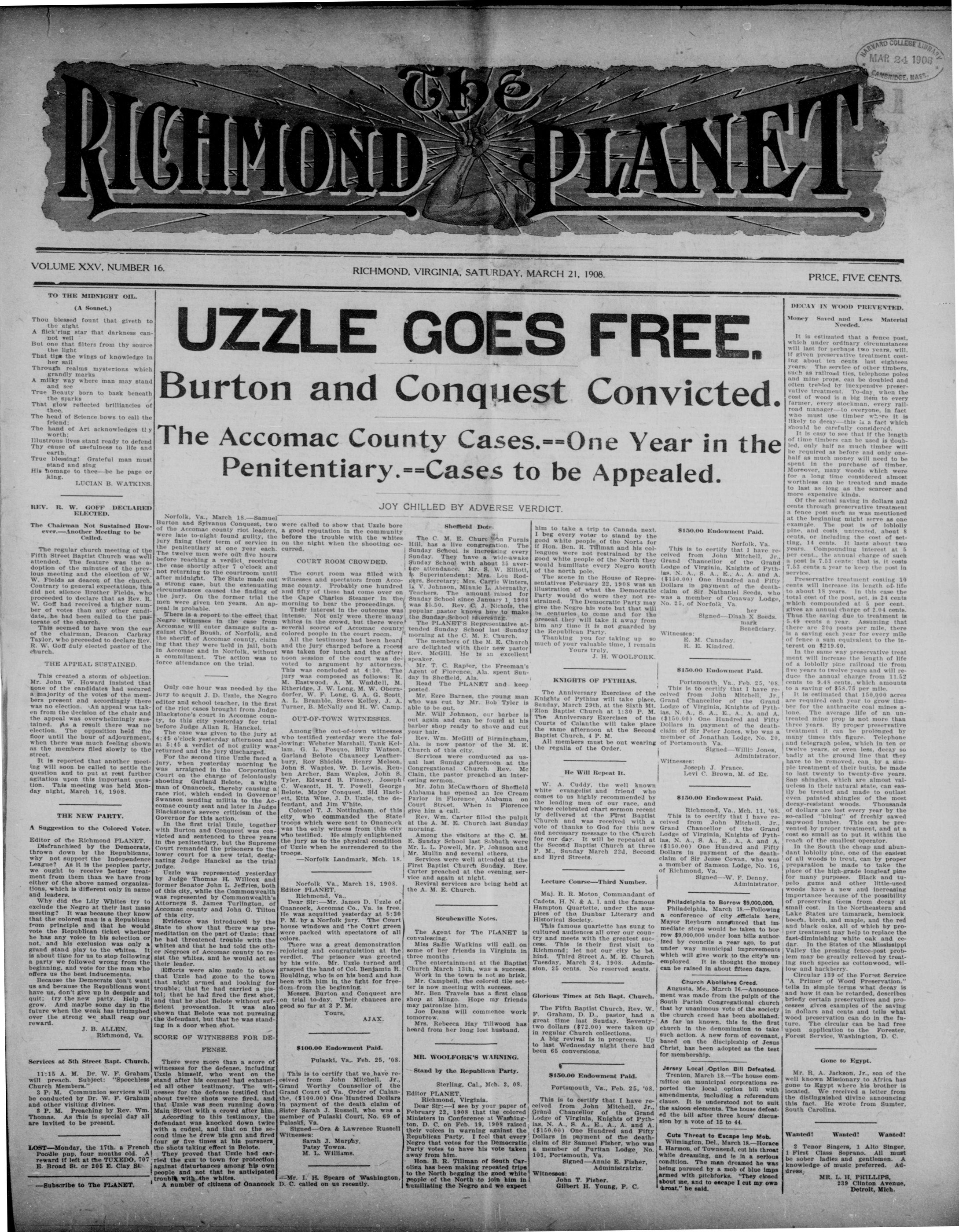
UZZLE GOES FREE. Burton and Conquest Convicted. The Accomac County Cases.==One Year in the Penitentiary.==Cases to be Appealed.
trouble with the whites. Mr. I. H. Spears of Washington,
A number of citizens of Onancock D. C. called on us recently.
Norfolk, Va., March 18.—Samuel Burton and Sylvanus Conquest, two of the Accomac county riot leaders, were late to night found guilty, the jury fixing their term of service in the penitentiary at one year each. The twelve men were out five hours before reaching a verdict, receiving the case shortly after 7 o'clock and not returning to the courtroom until after midnight. The State made out a strong case, but the extinguishing circumstances caused the finding of the jury. On the former trial the men were given ten years. An appeal is probable. There is a report to the effect that Negro workmen in the case from Accomac will enter damage suits against Chief Boush, of Norfolk, and the sheriff of Accomac county, claiming that they were held in jail, both in Accomac and in Norfolk, without a commitment. The action was to force attendance on the trial.
---
Only one hour was needed by the jury to acquit J. D. Uzzle, the Negro editor and school teacher, in the first of the riot cases brought from Judge Blackstone's court in Accomac county, to this city yesterday for trial before Judge Allan R. Hankel. The case was given to the jury at 4:45 o'clock yesterday afternoon and at 5:45 a verdict of not guilty was returned and the jury discharged. For the second time Uzzle faced a jury, when yesterday morning he was arraigned in the Corporation Court on the charge of feloniously shooting Garland Belote, a white man of Onancock, thereby causing a race riot, which ended in Governor Swanson sending militia to the Accomac county seat and later in Judge Blackstone's seven criticism of the Governor for this action. In the first trial Uzzle together with Burton and Conquest was convicted and sentenced to three years in the penitentiary, but the Supreme Court remanded the prisoners to the lower court for a new trial, designating Judge Hanckel as the trial judge. Uzzle was represented yesterday by Judge Thomas H. Willcox and former Senator John L. Jeffries, both of this city, while the Commonwealth was represented by Commonwealth's Attorneys S. James Turington, of Accomac county and John G. Tilton of this city.
Evidence was introduced by the State to show that there was premeditation on the part of Uzzle; that he had threatened trouble with the whites and that he had told the other Negroes of Accomac county to resist the whites, and he would act as their leader.
Efforts were also made to show that Uzzle had gone to the town that night armed and looking for trouble; that he had carried a pistol; that he had fired the first shot, and that he shot Belote without sufficient provocation. It was also shown that Belote was not pursuing the defendant, but that he was standing in a door when shot.
SCORE OF WITNESSES FOR DE
There were more than a score of witnesses for the defense, including Uzzie himself, who went on the stand after his counsel had exhausted all other testimony. The witnesses for the defense testified that about twelve shots were fired, and that Uzzie was seen running down Main Street with a crowd after him. According to this testimony, the defendant was knocked down twice with a cadgel, and that on the second time he drew his gun and fired four or five times at his pursuers, the shots taking effect in Belote. They proved that Uzzie had carried the gun to town for protection against disturbances among his own people and not that he antisipated trouble with the whites.
RICHMOND, VIRGINIA, SATURDAY, MARCH 21, 1908
JOY CHILLED BY ADVERSE VERDICT
were called to show that Uzzle bore a good reputation in the community before the trouble with the whites on the night when the shooting occurred.
COURT ROOM CROWDED
The court room was filled with witnesses and spectators from Accomac county. Probably one hundred and fifty of these had come over on the Cape Charles Steamer in the morning to hear the proceedings. Their interest in the outcome was intense. Not only were there many whites in the crowd, but there were several scored of Accomac county colored people in the court room. All the testimony had been heard and the jury charged before a race was taken for lunch and the afternoon session. The court was devoted to argument by a judge. This was concluded at 4:30. The jury was composed as follows: R. M. Eastwood, A. M. Maddell, M. Etheridge, J. W. Long, M. W. Oberdorfer, W. F. Long, G. A. G. Scott, A. L. Bramble, Steve Kelley, J. A. Turner, B. McNally and H. W. Camp.
OUT-OF-TOWN WITNESSES
Among the out-of-town witnesses who testified yesterday were the following: Webster Marshall, Tank Kelam, G. L. Fosque, Billy Watson, Garland Belote Chaucey Leathbury, Roy Shields, Henry Melson, John S. Waples, W. D. Lewis, Reuben Archer, Sam Waples, John S. Tyler, Edward B. Finney, Joseph C. Wescoott, H. T. Powell George Belote, Major Conquest, Sid Hackett, Etta Wise, J. D. Uzzie, the defendant, and Jim White.
Colonel T. J. Nottingham, of this city, who commanded the State troops which were sent to Onanocock was the only witness from this city who testified. He simply enlightened the jury as to the physical condition of Uzzie when he surrendered to the troops.
—Norfolk Landmark. Mch. 18.
Norfolk Va., March 18, 1908.
Editor PLANET,
Richmond, Va.
Dear Sir:—Mr. James D. Uzzle of
Onancock, Accomac Co., Va. is free.
He was acquitted yesterday at 5:30
P. M. by a Norfolk jury. The Court
house windows and the Court green
were packed with spectators of all
colors.
There was a great demonstration
rejoicing and congratulation at the
verdict. The prisoner was greeted
by his wife. Mr. Uzzle turned and
grasped the hand of Col. Benjamin R.
Boulding, who is on his bond and has
been with him in the fight for free-
dom from the beginning.
Messrs. Burton and Conquest are
on trial to-day. Their chances are
good so far at 3 P. M.
Yours,
AJAX.
$100.00 Endowment Paid.
Pulaski, Va., Feb. 25, '08.
This is to certify that we have received from John Mitchell, Jr., Grand Worthy Counselor of the Grand Court of Va. Order of Calan-the, ($100.00) One Hundred Dollars in payment of the death claim of Sister Sarah J. Russell, who was a member of Pulaski Court, No. 69 of Pulaski, Va.
Signed—Ora & Lawrence Russell Witnesses:
Sarah J. Murphy.
Patsy Towns.
M. L. Williams.
Mr. I. H. Spears of Washington,
D. C. called on us recently.
Sheffield Dote
The C. M. E. Chure John Furnis Hill, has a live congregation. The Sunday School is increasing every Sunday. They have a wide-awake Sunday School with about 35 average attendance. Mr. S. W. Elliott is Superintendent; Mrs. Leu Rodgers, Secretary; Mrs. Carrie Winters, L. V. Johnson, Minnie L. Abernathy, Teachers. The amount raised for Sunday School since January 1, 1908 was $5.50. Rev. C. J. Nichols, the popular pastor knows how to make the Sunday School interesting.
The PLANET'S Representative attended Sunday School last Sunday morning at the C. M. E. Church.
The members of the M. E. Church are delighted with their new pastor Rev. McGill. He is an excellent speaker.
Mr. T. C. Rapter, the Freeman's Agent of Florence, Ala. spent Sunday in Sheffield, Ala.
Read The PLANET and keep posted.
Mr. Ezre Barnes, the young man who was cut by Mr. Bob Tyler is able to be out.
Mr. McGill Johnson, our barber is out again and can be found at his barber shop ready to shave and cut your hair.
Rev. Wm. McGill of Birmingham, Ala. is now pastor of the M. E. Church of this city.
Services were conducted as usual last Sunday afternoon at the Congregational Church Rev. Mc Claim, the pastor preached an interesting sermon.
Mr. John McCawthorn of Sheffield Alabama has opened an Ice Cream Parlor in Florence, Alabama on Court Street. When in Florence give him a call. Rev. Wv. Carter filled the pulpit at the A. M. E. Church last Sunday morning. Among the visitors at the C. M. E. Sunday School last Sabbath were Mr. L. L. Powell, Mr. P. Johnson and Mr. Mullin and several others. Services were well attended at the First Baptist Church Sunday. Rev. Carter preached at the evening service and again at night. Revival services are being held at the A. M. E. Church.
Steubenville Notes.
The Agent for The PLANET is convalescing.
Miss Sadie Watkins will call on some of her friends in Virginia in three months.
The entertainment at the Baptist Church March 13th, was a success.
Work in the town is not so brisk.
Mr. Campbell, the colored tile setter is now meeting with success.
Mr. Ben Travels has a first class shop at Mingo. Hope my friends may patronize him.
Joe Deans will commence work tomorrow.
Mrs. Rebecca Hay Tillwood has heard from her long lost husband.
MR. WOOLFORK'S WARNING.
Stand by the Republican Party.
Sterling, Cal., Mch. 2, 08.
Editor PLANET,
Richmond, Virginia.
Dear Sir:—I see by your paper of
February 22, 1908 that the colored
Ministers in Conference at Washington,
D. C. on Feb. 19, 1908 raised
their voices in warning against the
Republican Party. I feel that every
Negro that votes for the Democratic
Party votes to have his vote taken
away from him.
Hon. B. R. Tillman of South Carolina has been making repeated trips to the North begging the good white people of the North to join him in
hummilizing the Negro and we expect
him to take a trip to Canada next. I beg every voter to stand by the good white people of the North for if Hon. Ben. R. Tillman and his colleagues were not restrained by the good white people of the North they would humiliate every Negro south of the north pole. The scene in the House of Representatives February 22, 1908 was an illustration of what the Democratic Party would do were they not restrained. The Democratic Party may give the Negro his vote but that will be centuries to come and for the present they will take it away from him any time it is not guarded by the Republican Party. Thanking you for taking up so much of your valuable time, I remain Yours truly. J. H. WOOLFORK.
KNIGHTS OF PYTHIAS
The Anniversary Exercises of the Knights of Pythias will take place, Sunday, March 29th, at the Sixth Mt. Zion Baptist Church at 1:30 P. M. The Anniversary Exercises of the Courts of Calanthe will take place the same afternoon at the Second Baptist Church, 4 P. M. All members must be out wearing the regalia of the Order.
He Will Repeat It.
W. A. Cuddy, the well known white evangelist and friend who comes to us highly recommended by the leading men of our race, and whose celebrated chart sermon recently delivered at the First Baptist Church and was received with a vote of thanks to God for this new and necessary message to the Church and repeated at the Second Baptist Church at three P. M., Sunday March 22d, Second and Byrd Streets.
Lecture Course—Third Number.
Maj. J. R. M. Moton Commandant of Cadets, H. N. & A. I., and the famous Hampton Quartette, under the auspices of the Dunbar Literary and Historical Society. This famous quartette has sung to cultured audiences all over our country and meets with the greatest success. This is their first visit to our city not our city be bd. hind. Third State M. E. Church Tuesday, March 24, 1908. Admission 25 cents. No reserved seats.
Glorious Times at 5th Bapt. Church
The Fifth Baptist Church, Rev. W. F. Graham, D. D., pastor had a great time last Sunday. Seventy-two dollars ($72.00) were taken up in regular Church collections. A big revival is in progress. Up to last Wednesday night there had been 65 conversions.
Portsmouth, Va., Feb. 25, '08
This is to certify that I have received from John Mitchell, Jr.
Grand Chancellor of the Grand Lodge of Virginia, Knights of Pythias, N. A., S. A., E., A., A. and A. ($150.00) One Hundred and Fifty Dollars in payment of the death-claim of Sir Samuel Fisher, who was a member of Puritan Lodge, No. 101, Portsmouth, Va.
Signed—Annie E. Fisher,
Administratrix.
Witnesses:
John T. Fisher.
Gilbert H. Young, P. C.
$150.00 Endowment Paid.
Norfolk Va
This is to certify that I have received from John Mitchell, Jr., Grand Chancellor of the Grand Lodge of Virginia, Knights of Phyllas, N. A., S. A., E., A. A. and ($150.00) One Hundred and Fifty Dollars in payment of the deathchalm of Sir Nathaniel Seeds, who was a member of Conaway Lodge, No. 25, of Norfolk Va.
Witnesses:
E. M. Canaday.
R. E. Kindred.
$150.00 Endowment Paid.
Portsmouth, Va., Feb. 25, '08.
This is to certify that I have received from John Mitchell, Jr.,
Grand Chancellor of the Grand
Lodge of Virginia, Knights of Pythias, N. A., S. A., E., A. A. and A.
($150.00) One Hundred and Fifty
Dollars in payment of the death-
claim of Sir Peter Jones, who was a
member of Jonathan Lodge, No. 20,
of Portsmouth Va.
Signed—Willie Jones,
Administrator.
Witnesses:
Joseph J. France.
Levi C. Brown, M. of Ex.
$150.00 Endowment Paid.
Richmond, Va., Mch. 11, '08.
This is to certify that I have received from John Mitchell, Jr.
Grand Chancellor of the Grand
Lodge of Virginia, Knights of Pythias, N. A., S. A., E., A. A. and A.
($150.00) One Hundred and Fifty
Dollars in payment of the death-
claim of Sir Jesse Cowan, who was
a member of Samson Lodge, No. 16,
of Richmond, Va.
Signed—W. F. Denny,
Administrator.
Philadelphia to Borrow $9,000,000.
Philadelphia, March 18—Following
a conference of city officials here
Mayor Reyburn announced that im-
mediate steps would be taken to bori-
row $9,000,000 under loan bills author-
ized by councils a year ago, to put
under way municipal improvements
which will give work to the city's un-
employed. It is thought the money
can be raised in about fifteen days.
Church Abolishes Creed
Augusta, Me., March 16.—Announcement was made from the pulpit of the South Parish Congregational church that by unanimous vote of the society the church creed has been abolished. As far as known, this is the first church in the denomination to take such action. A new form of covenant, based on the discipleship of Jesus Christ, has been adopted as the test for membership.
Jersey Local Option Bill Defeated.
Trenton, March 18.—The house committee on municipal corporations reported the local option bill with amendments, including a referendum clause. It is understood not to suit the saloon elements. The house defeated the bill after three hours' discussion by a vote of 15 to 44.
Cuts Threat to Escape Imp Mob
Dude Throat to Escape Imp Mob. Wilmington. Del. March 18—Horace I. Harmon, of Townsend, cut his throat whenreaming, and is in a serious condition. The man dreamed he was being pursued a mob of blue impms armed with pitchforks. "They closed about me, and escape I cut my own throat." he said.
PRICE, FIVE CENTS.
DECAY IN WOOD PREVENTED.
Money Saved and Less Material Needed.
It is estimated that a fence post, which under ordinary circumstances will last for perhaps two years, will, if given preservative treatment costing about ten cents last eighteen years. The service of other timbers, such as railroad ties, telephone poles and mine props, can be doubled and often trebled by inexpensive preservative treatment. To-day, when the cost of wood is a big item to every farmer, every stockman, every railroad manager—to everyone, in fact who must use timber where it is likely to decay—this is a fact which should be carefully considered.
It is easy to see that if the length of time timbers can be used is doubled, only half as much timber will be required as before and only one-half as much money will need to be spent in the purchase of timber. Moreover, many woods which were for a long time considered almost worthless can be treated and made to last as long as the scarcer and more expensive kinds.
Of the actual saving in dollars and cents through preservative treatment a fence post such as was mentioned at the beginning might serve as one example. The post is of loblolly pine, and costs untreated, about 8 cents, or including the cost of setting, 14 cents. It lasts about two years. Compounding interest at 5 per cent., the annual charge of such a post is 7.53 cents: that is, it costs 7.53 cents a year to keep the post in service.
Preservative treatment costing 10 cents will increase its length of life to about 18 years. In this case the total cost of the post, set, is 24 cents which compounded at 5 per cent, gives an annual charge of 2.04 cents. Thus the saving due to treatment is 5.49 cents a year. Assuming that there are 200 posts per mile, there is a saving each year for every mile of fence a sum equivalent to the interest on $219.60.
In the same way preservative treatment will increase the length of life of a loblolly pine railroad tie from five years to twelve years and will reduce the annual charge from 11.52 cents to 9.48 cents, which amounts to a saving of $58.75 per mile.
It is estimated that 150,000 acres are required each year to grow timber for the anthracite coal mines alone. The average life of an untreated mine prop is not more than three years. By proper preservative treatment it can be prolonged by many times this figure. Telephone and telegraph poles, which in ten or twelve years, or even less, decay so badly at the ground line that they have to be removed, can by a simple treatment of their butts, be made to last twenty to twenty-five years. Sap shingles, which are almost valuables in their natural state, can easily be made to outlast even painted shingles of the most decay-resistant woods. Thousands of dollars are lost every year by the so-called "bluing" of freshly sawed sapwood lumber. This can be prevented by proper treatment, and at a cost so small as to put it within the reach of the smallest operator.
In the South the cheap and abundant loblolly pine, one of the easiest of all woods to treat, can by proper preparation be made to take the place of the high-grade longleaf pine for many purposes. Black and tupelo gums and other little-used woods have a new and increasing importance because of the possibility of preserving them from decay at small cost. In the Northeastern and Lake States are tamarack, hemlock beech, birch, and maple, and the red and black oaks, all of which by proper treatment may help to replace the fast-diminishing white oak and cedar. In the States of the Mississippi Valley the pressing fence-post problem may be greatly relieved by treating such species as cottonwood, willow and hackberry. Circular 139 of the Forest Service "A Primer of Wood Preservation," tells in simple terms what decay is and how it can be retarded, describes briefly certain preservatives and processes, gives examples of the saving in dollars and cents and tells what wood preservation can do in the future. The circular can be had free upon application to the Forester, Forest Service, Washington, D. C.
Gone to Egypt.
Mr. R. A. Jackson, Jr., son of the well known Missionary to Africa has gone to Egypt where his brother is located. We received a letter from the distinguished divine announcing this fact. He wrote from Sumter, South Carolina.
Wanted! Wanted! Wanted!
2 Tenor Singers, 1 Alto Singer,
1 First Class Soprano. All must
be sober ladies and gentlemen. A
knowledge of music preferred. Address,
MR. L. H. PHILLIPS,
239 Clinton Avenue,
Detroit, Mich.
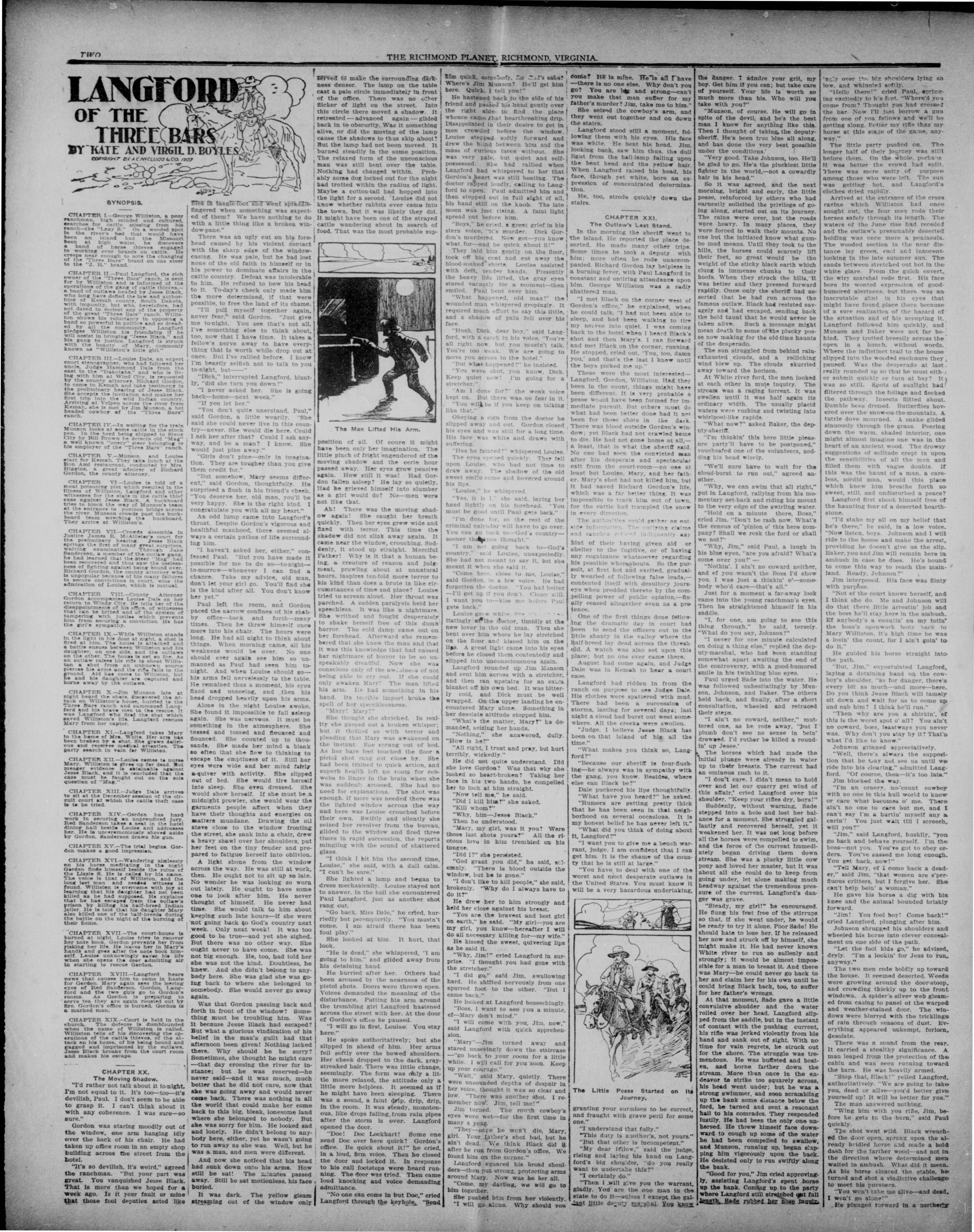
LANGFORD
OF THE
THREE BARS
BY KATE AND VIRGIL D. BOYLES
COPYRIGHT BY A.C. MCLUGO & CO. 1907
TWO
SYNOPSIS.
CHAPTER I - George Willston, a poor ranchman, high minded and cultured, rancher, mississippi native, spotted in the river's bed that would have been an island had the Missouri been an island wired on a band of horse thieves engaged in working over brands on cattle. He grew near enough to note the changing of the Willston brand on one steer to the "J. R." brand.
CHAPTER II - Paul Langford, the rich owner of the "Three Bars" ranch, is sent to Willston and is informed of the operations of the ranch, which includes a band of outlaws headed by Jesse Black, who long have defied the law and authorized him to kill a skunk, with impunity, but not with hereof, not dared to molest any of the property. Willston ranch, James Willston shows his reputation in support band so powerful in politics and so dreadful in community. Langford pledges Willston will be liable will assist in bringing "Jesse Black," and gang to justice. Langford is struck with an insult by the community commonly known as "Willston's little girl."
CHAPTER III.-Louise Dale, an expert court stenographer, who had followed her uncle, Judge Hammond Dale from the city to the court with him at Wind City, is requested by the county attorney, Richard Gordon, to Kemah and take testimony in the preliminary hearing. She accepts the invitation and makes her first trip into the wild Indian country. CHAPTER IV.-In waiting for the train Munson looks at some cattle in the stock market, being shipped to Kemah City by Brown Street, a well known "onery" steer belonging to his employer of the "Three Bars" ranch. CHAPTER V.-Munson, and Louise start for Kemah. They take lunch at the Aml restaurant, conducted by Mrs. Higgins, the director of Richard Gordon, the county attorney. CHAPTER VI.-Louise is told of a meat poisoning plot which resulted in the illness of Williston, Langford and other witnesses for the state in the cattle theft trial. She tries to block the way of Munson's team at the entrance to pontoon bridge across the river. Munson crowds past the buckboard. They arrive at Willisburg.
CHAPTER VII—Crowds assemble in Justice James R. McAllister's court for preliminary hearing. Jesse Black springs the defense of the young walping examination. Through Jasie Sanderson, a member of the outlaw gang, he has learned that the steer "Mag" had been caught in a fight against a nervousness of fighting against being bound over. Richard Gordon, the county attorney who is unpopular because of his many failures, admires the admission of Louise, which is mutual.
CHAPTER VIII—County Attorney Gordon accompanies Louise Dale on her return to Windy City. He tells her of the disappointments of his office, of witnesses tampering with justices which presents him from securing a conviction. He has the girl's sympathy.
CHAPTER IX—William Williston stands in the light in his door at night, a shot is taken, and a battle ensues between Williston daughter, on one side, and the outlaws on the other. The house is set on fire. As the gun is fired, Williston a shot from an unknown source pierces his arms and the rifle falls to the ground. Aid has come to Williston, but the gun is captured and borne away by the outlaws.
CHAPTER X.—Jim Munson late at night heard the shits, discovered the attack he had just mustered to the Three Bars ranch and examined Larry ferd and his brave men to the rescue. It was Larryferd who fired the shot which saved Mary from her captor.
CHAPTER XI.—Langford takes Mary to the home of Mrs. White. Her area has been broken by a shot. She grews delirious and receives medical attention. The prison for Williston.
CHAPTER XII.—Louise comes to nurse Mary. Williston is for dead men; manager evidence is obtained against Jesse Black, and it is concluded that the case must be fought out on the sole question of "Mag."
CHAPTER XIII.—Judge Dale arrives to the session of the circuit court at which the cattle theft case is to be tried.
CHAPTER XIV.—Gordon has hard work in securing an unpredicuted jury. Red Sanderson takes a seat in the hotel and Jesse Black, and it is concluded that he is unconscionently shoved aside by Gordon. Sanderson draws his gun.
CHAPTER XV.—The trial begins. Gordon makes a good impression.
CHAPTER XVI.-Wandering almostly on his horse meditating in the night Gordon finds himself beside the ruins of his home. The voice is that of Williston, and the long lost man and needed witness is found. Williston is overcome with joy at his daughter's death, and she killed as he had supposed. He explains that he has escaped from the outlaw's prison by killing his half-breed Indian brother. He also killed one of the half-breeds during the battle on the night of the burning of their home.
CHAPTER XVII.-The court-house is burned at night. Louise tries to recover her note book. Gordon prevents her from hands and goes after the note book himself. Louise unknowingly saves his life when she opens the door admitting air in starting to rescue Gordon.
CHAPTER XVIII.-Langford hears news that causes him to come in haste for Gordon. Mary again asks her hearing the two girls go to Gordon's room. As Gordon is preparing to serve sea captain are again roused out by Gordon's officer is burned. Gordon is a marked man.
CHAPTER XIX - Court is held in the church. The defense is dumbbounded Williston tells of his discovering the opium-taking on his home, of his being bound and gagged and imprisoned by the outlaws, from the court room and makes his escape.
"I'd rather not talk about it to night. I'm not equal to it. It's too—too—it's devilish, Paul. I don't seem to be able to grasp it. I can't think about it with any coherence. I was sure—so sure."
Gordon was staring moodily out of the window, one arm hanging idly over the back of his chair. He had taken up office room in an empty shop building across the street from the hotel.
"It's so devillish, it's weird," agreed the ranchman. "But your part was great. You vanquished Jesse Black. That is more than we hoped for a week ago. Is it your fault or mine that those fool deputies acted like
files in tangle foot and went spraffle-fingered when something was expected of them? We have nothing to do with a little thing like a broken window-pane."
There was an ugly cut on his forehead caused by his violent contact with the sharp edge of the window-casing. He was pale, but he had lost none of the old faith in himself or in his power to dominate affairs in the cattle country. Defeat was intolerable to him. He refused to bow his head to it. To-day's check only made him the more determined, if that were possible, to free the land of its shame.
"I'll pull myself together again, never fear," said Gordon. "Just give me to-night. You see that's not all. I've something else to think about, too, now that I have time. It takes a fellow's nerve away to have everything that is worth while drop out at once. But I've rallied before. I know I'm beastly selfish not to talk to you to-night, but——"
"Dick," interrupted Langford, bluntly, "did she turn you down?"
"I never asked her. She is going back—home—next week."
"If you let her."
"You don't quite understand, Paul," said Gordon, a little weary. "She said she could never live in this country—never. She would die here. Could I ask her after that? Could I ask anyway, and be a man? I know. She would just pine away."
"Girls don't pine—only in imagination. They are tougher than you give them credit for."
"But somehow, Mary seems different," said Gordon, thoughtfully. He surprised a flush in his friend's cheek. "You deserve her, old man, you'll be very happy. She is the right kind. I congratulate you with all my heart."
An odd lump came into Langford's throat. Despite Gordon's vigorous and healthful manhood, there seemed always a certain pathos of life surrounding him.
"I haven't asked her, either," confessed Paul. "But you have made it possible for me to do so—to night—to-morrow—whenever I can find a chance. Take my advice, old man, don't let your girl go. You'll find she is the kind after all. You don't know her yet."
Paul left the room, and Gordon paced the narrow confines of his shabby office—back and forth—many times. Then he threw himself once more into his chair. The hours were long. He had all night to think about things. When morning came, all his weakness would be over. No one should ever again see him so unmanned as Paul had seen him tonight. And when Louise should go—his arms fell nervlessly to the table. He remained thus a moment, his eyes fixed and unseeing, and then his head dropped heavily upon his arms.
Alone in the night Louse awoke. She found it impossible to fall asleep again. She was nervous. It must be something in the atmosphere. She tossed and tossed and flounced and flounced. She counted up to thousands. She made her mind a blank so often that she flow to thinking to escape the emptiness of it. Still her eyes were wide and her mind fairly a quiver with activity. She slipped out of bed. She would tire herself into sleep. She even dressed. She would show herself. If she must be a midnight prowler, she would wear the garments people affect when they have their thoughts and energies on matters mundane. Drawing the oil stove close to the window fronting the street, she sank into a chair, drew a heavy shawl over her shoulders, put her feet on the tiny fender and prepared to fatigue herself into oblivion.
A light shone from the window across the way. He was still at work, then. He ought not to sit up so late. No wonder he was looking so worn out lately. He ought to have some one to look after him. He never thought of himself. He never had time. She would talk to him about keeping such late hours—if she were not going back to God's country next week. Only next week! It was too good to be true—and yet she sighed. But there was no other way. She ought never to have come. She was not big enough. He, too, had told her she was not the kind. Doubtless, he knew. And she didn't belong to anybody here. She was glad she was going back to where she belonged to somebody. She would never go away again.
Was that Gordon passing back and forth in front of the window? Something must be troubling him. Was it because Jesse Black had escaped? But what a glorious vindication of his belief in the man's guilt had that afternoon been given! Nothing lacked there. Why should he be sorry? Sometimes, she thought he might care—that day crossing the river for instance; but he was reserved—he never said—and it was much, much better that he did not care, now that she was going away and would never come back. There was nothing in all the world that could make her come back to this big, bleak, lonesome land where she belonged to nobody. But she was sorry for him. He looked sad and lonely. He didn't belong to anybody here, either, yet he wasn't going to run away as she was. Well, but he was a man, and men were different.
And now she noticed that his head had sunk down onto his arms. How still he sat! The minutes passed away. Still he sat motionless, his face buried.
It was dark. The yellow gleam streaming out of the window only
THE RICHMOND PLANET, RICHMOND, VIRGINIA
served to make the surrounding darkness denser. The lamp on the table cast a pale circle immediately in front of the office. There was no other flicker of light on the street. Into this circle there moved a shadow. It retreated—advanced again—gilded back in to obscurity. Was it something alive, or did the moving of the lamp cause the shadows to thus skip about? But the lamp had not been moved. It burned steadily in the same position. The relaxed form of the unconscious man was still bent over the table. Nothing had changed within. Probably some dog locked out for the night had trotted within the radius of light. Maybe a cotton-tail had hopped into the light for a second. Louise did not know whether rabbits ever came into the town, but it was likely they did. It might have been one of the strayed cattle wandering about in search of food. That was the most probable sup-
A man running into a building.
The Man Lifted His Arm.
position of all. Of coure it might have been only her imagination. The little pinch of fright engendered of the moving shadow and the eerie hour passed away. Her eyes grew pensive again. How still it was! Had Gordon fallen asleep? He lay so quietly. Had he grieved himself into slumber as a girl would do? No—men were not like that.
Ah! There was the moving shadow again! She caught her breath quickly. Then her eyes grew wide and fixed with terror. This time the shadow did not slink away again. It came near the window, crouching. Suddenly, it stood up straight. Merciful Father! Why is it that a human being, a creature of reason and judgment, prowling about at unnatural hours, inspires tenfold more terror to his kind than does a brute in like circumstances of time and place? Louise tried to scream aloud. Her throat was parched. A sudden paralysis held her speechless. It was like a nightmare. She writhed and fought desperately to shake herself free of this dumb horror. The cold damp came out on her forehead. Afterward she remembered that she knew the man and that it was this knowledge that had caused her nightmare of horror to be so unspeakably dreadful. Now she was conscious only of the awfulness of not being able to cry out. If she could only awaken Mary! The man lifted his arm. He had something in his hand. Its terrible import broke the spell of her speechlessness.
She thought she shrieked. In reality she gasped out a broken whisper; but it thrilled so with terror and pleading that Mary was awakened on the instant. She strang out of bed. As her bare feet touched the floor a pistol shot rang out close by. She had been trained to quick action, and superb health left no room for cobwebs to linger in the brain when she was suddenly aroused. She had no need for explanations. The shot was enough. If more was needed there was the lighted window across the way and here was Louise crouched before their own. Swiftly and silently she seized her revolver from the bureau, gilded to the window and fired three times in rapid succession, the reports mingling with the sound of shattered glass.
"I think I hit him the second time, Louise," she said, with a dull calm. "I can't be sure."
She lighted a lamp and began to dress mechanically. Louise stayed not to answer. In the hall she encountered Paul Langford, just as another shot rang out.
"Go back, Miss Dale," he cried, hurriedly but peremptorily. "You mustn't come. I am afraid there has been foul play."
She looked at him. It hurt, that look.
"He is dead," she whispered, "I am going to him," and glided away from his detaining hand.
He hurried after her. Others had been aroused by the nearness of the pistol shots. Doors were thrown open. Volces demanded the meaning of the disturbance. Putting his arm around the trembling girl Langford hastened across the street with her. At the door of Gordon's office he paused.
"I will go in first, Louise. You stay here."
He spoke authoritatively; but she slipped in ahead of him. Her arms fell softly over the bowed shoulders. Her cheek dropped to the dark, gray-streaked hair. There was little change, seemingly. The form was only a little more relaxed, the attitude only a little more helpless. It seemed as if he might have been sleeping. There was a sound, a faint drip, drip, drip, in the room. It was steady, monotonous, like drops falling from rain pipes after the storm is over. Langford opened the door.
"Doc! Doc Lockhart! Some one send Doc over here quick? Gordon's office. Be quick about it!" he cried, in a loud, firm voice. Then he closed the door and locked it. In response to his call footsteps were heard running. The door was tried. Then came loud knocking and voice demanding admittance.
"No one can come in but Doc," cried Langford through the keyhole. "Send
Him quick, somebody. Or JOS' sake? Where's Jim Manson? He'll get him here. Quick, I tell you!"
He hastened back to the side of his friend and passed his hand gently over the right side to find the place whence came that heartbreaking drip. Disappointed in their desire to get in men crowded before the window. Louise stepped softly forward and drew the blind between him and the mass of curious faces without. She was very pale, but quiet and self-possessed. She had rallied when Langford had whispered to her that Gordon's heart was still beating. The doctor rapped loudly, calling to Langford to open. Paul admitted him and then stepped out in full sight of all, his hand still on the knob. The late moon was just rising. A faint light spread out before him.
"Boys," he cried, a great grief in his stern voice, "it's murder. Dick Gordon's murder. Now get—you know what for—and be quick about it!"
They laid him gently on the floor, took off his coat and cut away the blood-soaked shirts. Loutse assisted with deft, tender hands. Presently the heavy lids lifted, the gray eyes stared vacantly for a moment—then smiled. Paul bent over him.
"What happened, old man?" the wounded man whispered gropingly. It required much effort to say this little, and a shadow of pain fell over his face.
"Hush, Dick, dear boy," said Langford, with a catch in his voice. "You're all right now, but you mustn't talk. You're too weak. We are going to move you across to the hotel."
"But what happened?" he insisted.
"You were shot, you know, Dick. Keep quiet now! I'm going for a stretcher."
"Am I done for?" the weak voice kept on. But there was no fear in it.
"You will be if you keep on talking like that."
Obeying a sign from the doctor he slipped away and out. Gordon closed his eyes and was still for a long time. His face was white and drawn with suffering.
"Has he fainted?" whispered Louise. The eyes opened quickly. They fell upon Louise, who had not time to draw away. The shadow of the old sweet smiffe came and hovered around his lips.
"Louise," he whispered.
"Yes, it is I," she said, laying her hand lightly on his forehead. "You must be good until Paul gets back."
"I'm done for, so the rest of the criminal calendar will have to go over. You can go back to—God's country—sooner than you thought."
"I am not going back to—God's country," said Louise, unexpectedly. She had not meant to say it, but she meant it when she said it.
"Come here, close to me, Louise," said Gordon, in a low voice. He had forgotten the doctor. "You had better—I'll get up if you don't. Closer still. I want you to—kiss me before Paul gets back."
Louise grew white. She ittatingly at the doctor, timidly at the new lover in the old man. Then she bent over him where he lay stretched on the floor and kissed him on the lips. A great light came into his eyes before he closed them contentedly and slipped into unconsciousness again.
Langford rounded up Jim Manson and sent him across with a stretcher, and then ran upstairs for an extra blanket off his own bed. It was bitterly cold, and Dick must be well wrapped. On the upper landing he encountered Mary alone. Something in her desolate attitude stopped him.
"What's the matter, Mary?" he demanded, seizing her hands.
manned, seizing her hands.
"Nothing," she answered, dully.
"How is he?"
"All right, I trust and pray, but hurt
terribly, wickedly."
He did not quite understand. Did
she love Gordon? Was that why she
looked so heart-broken? Taking her
face in his two hands, he compelled
her to look at him straight.
"Now tell me," he said.
"Did I kill him?" she asked.
"Kill whom?"
"Why, him—Jesse Black."
Then he understood.
"Mary, my girl, was it you? Were
those last shots youa?" All the riotous love in him trembled on his tongue.
"Did I?" she persisted.
"God grant you did," he said, scornly.
"There is blood outside the
window, but he is gone."
He drew her to him strongly and held her close against his breast.
"You are the bravest and best girl on earth," he said. "My girl—you are my girl, you know—hereafter I will do all necessary killing for—my wife."
He kissed the sweet, quilting lips as he said it.
"Why, Jim!" cried Langford in surprise. "I thought you had gone with the stretcher."
"I did go," said Jim, swallowing hard. He shifted nervously from one spurred foot to the other. "But I came back."
He looked at Langford beseechingly. "Boss, I want to see you a minute, ef—Mary don't mind."
"I will come with you, Jim, now," said Langford with quick apprehension.
"Mary"—Jim turned away and stared unseeingly down the staircase—"go back to your room for a little while. I will call for you soon. Keep up your courage."
"Wait," said Mary, quietly. There were unsounded depths of despair in her voice, thought it was so clear and low. "There was another shot. I remember now. Jim, tell me!"
Jim turned. The rough cowboy's eyes were wet—for the first time in many a year.
"They—nore he won't die, Mary, girl. Your father's shot bad, but he ain't dead. We think Black did it after he run from Gordon's office. We found him on the corner."
Langford squared his broad shoulders—then put strong, protecting arms around Mary. Now was he her all.
"Come, my darling, we will go to him together.
She pushed him from her violently.
"I will go alone. Why should you
come? He is mine. He's all I have—there is no one else. Why don't you go? You are big and strong—can't you make that man suffer for my father's murder? Jim, take me to him." She seized the cowboy's arm, and they went out together and on down the stairs.
Langford stood still a moment, following them with his eyes. His face was white. He bent his head. Jim, looking back, saw him thus, the dull light from the hall-lamp falling upon the bent head and the yellow hair. When Langford raised his head, his face, though yet white, bore an expression of concentrated determination.
He, too, strode quickly down the stairs.
CHAPTER XXI
In the morning the sheriff went to the island. He reported the place deserted. He made many other trips. Some times he took a deputy with him; more often he rode unaccompanied. Richard Gordon lay helpless in a burning fever, with Paul Langford in constant and untiring attendance upon him. George Williston was a sadly shattered man.
"I met Black on the corner west of Gordon's office," he explained, when he could talk. "I had not been able to sleep, and had been walking to tire my nerves into quiet. I was coming back to the hotel when I heard Black's shot and then Mary's. I ran forward and met Black on the corner, running. He stopped, cried out, 'You, too, damn you,' and that's the last I knew until the boys picked me up."
These were the most interested—Langford, Gordon, Williston. They been in the count, things might have been different. It is very probable a posse would have been formed for immediate pursuit. But others must do what had been better done had it not been for those shots in the dark. There was blood outside Gordon's window; yet Black had not crawled home to die. He had not gone home at all,—a least, that is what the sheriff said. No one had seen the convicted man after his desperate and spectacular exit from the court-room—no one at least but Louise, Mary, and her father. Mary's shot had not killed him, but it had saved Richard Gordon's life, which was a far better thing. It was impossible to track him out of town, for the cattle had trampled the snow in every direction.
The authorities could gather no outside information. The outlying claims and ranches refused indiscrimently any hint of their having given ald or shelter to the fugitive, or of having any cognizance whatsoever regarding his possible whereabouts. So the pursuit, at first hot and excited, gradually weared of following false leads,—contented itself with desultory journeys when prodded thereto by the compelling power of public opinion,—finally ceased altogether even as a pretence.
One of the first things done following the dramatic day in court had been to send the officers out to the little shanty in the valley where the half-breed lay dead across the threshold. A watch was also set upon this place; but no one ever came there.
August had come again, and Judge Dale was in Kemah to hear a court case.
Langford had ridden in from the ranch on purpose to see Judge Dale. His clothes were spattered with mud. There had been a succession of storms, lasting for several days; last night a cloud had burst out west somewhere. All the creeks were swollen.
"Judge, I believe Jesse Black has been on that island of his all the time."
"What makes you think so, Langford?"
"Because our sheriff is four-flushing—he always was in sympathy with the gang, you know. Beside, where else can Black be?"
Dale puckered his lips thoughtfully.
"What have you heard?" he asked.
"Rumors are getting pretty thick that he has been seen in that neighborhood on several occasions. It is my honest belief he has never left it."
"What did you think of doing about it, Langford?"
"I want you to give me a bench warrant, judge. I am confident that I can get him. It is the shame of the county that he is still at large."
"You have to deal with one of the worst and most desperate outlaws in the United States. You must know it will be a very hazardous undertaking."
J. A.
The Little Possie Started on Its Journey.
granting your surmises to be correct,
and fraught with grave peril for some one."
"I understand that fully."
"This duty is another's, not yours."
"But that other is incompetent."
"My dear fellow," said the judge, rising and laying his hand on Langford's big shoulder, "do you really want to undertake this?" "I certainly do." "Then I will give you the warrant, gladly. You are the one man in the state to do it—unless I except the gallant little detainment marshal. You know
the danger. I admire your grit, my boy. Get him if you can; but take care of yourself. Your life is worth so much more than his. Who will you take with you?
"Munson, of course. He will go in spite of the devil, and he's the best man I know for anything like this. Then I thought of taking the deputy-sheriff. He's been true blue all along, and has done the very best possible under the conditions.
"Very good. Take Johnson, too. He'll be glad to go. He's the pluckiest little fighter in the world,—not a cowardly hair in his head."
So it was agreed, and the next morning, bright and early, the little posse, reinforced by others who had earnestly solicited the privilege of going along, started out on its journey. The rains were over, but the roads were heavy. In many places, they were forced to walk their mounts. No one but the initiated know what gumbo mud means. Until they took to the hills, the horses could scarcely lift their feet, so great would be the weight of the sticky black earth which clung in immense chunks to their hoofs. When they struck the hills, it was better and they pressed forward rapidly. Once only the sheriff had asserted that he had run across the famous outlaw. Black had resisted savagely and had escaped, sending back the bold taunt that he would never be taken alive. Such a message might mean death to some of the plucky posse now making for the old-time haunts of the desperate.
The sun struggled from behind rain-exhausted clouds, and a rolicking wind blew up. The clouds skurried away toward the horizon.
At White river ford, the men looked at each other in mute inquiry. The stream was a raging torrent. It was swollen until it was half again its ordinary width. The usually placid waters were rushing and twisting into whirlpool-like raplds.
"What now?" asked Baker, the deputy-sheriff.
"I'm thinkin' this here little pleasure party'll have to be postponed," vouchsafted one of the volunteers, nodding his head wisely.
"We'll sure have to wait for the cloud-burst to run out," agreed another.
"Why, we can swim that all right," put in Langford, rallying from his momentary set-back and riding his mount to the very edge of the swirling water. "Hold on a minute there, Boss," cried Jim. "Don't be rash now. What's the census of 'pinion o' this here company? Shall we resk the ford or shall we not?"
"Why, Jim," said Paul, a laugh in his blue eyes, "are you afraid? What's come over you?"
"Nothin', I ain't no coward neither, and if you wasn't the Boss I'd show you. I was just a thinkin' o'—somebody who'd care—that's all."
Just for a moment a far-away look came into the young ranchman's eyes. Then he straightened himself in his saddle.
"I, for one, am going to see this thing through," he said, tersely. "What do you say, Johnson?"
"I never for one minute calculated on doing a thing else," replied the deputy-marshal, who had been standing somewhat apart awaiting the end of the controversy, with a good-humored smile in his twinkling blue eyes.
Paul urged Sade into the water. He was followed unbesitatingly by Munson, Johnson, and Baker. The others held back, and finally, after a short consultation, wheeled and retraced their steps.
"I ain't no coward, neither," muttered one, as he rode away, "but I plumb don't see no sense in bein' drowned. I'd rather be killed a round-in up Jesse."
The horses which had made the initial plunge were already in water up to their breasts. The current had an ominous rush to it.
"I don't care. I didn't mean to hold over and let our quarry get wind of this affair," cried Langford over his shoulder. "Keep your rifles dry, boys!" Suddenly, without warning, Sade stepped into a hole and lost her balance for a moment She struggled gallantly and recovered herself, yet it weakened her. It was not long before all the horses were compelled to swim, and the force of the current immediately began driving them down stream. She was a plucky little cow pony and loved her master, but it was about all she could do to keep from going under, let alone making much headway against the tremendous pressure of the current Langford's danger was grave.
"Steady, my girl!" he encouraged. He flung his feet free of the stirrups so that, if she went under, he would be ready to try it alone. Poor Sade! He should hate to lose her. If he released her now and struck off by himself, she might make it. He had never known White river to run so sullenly and strongly; it would be almost impossible for a man to breast it. And there was Mary—he could never go back to her and claim her for his own until he could bring Black back, too, to suffer for her father's wrongs.
At that moment, Sade gave a little convulsive shudder and the water rolled over her head. Langford slipped from the saddle, but in the instant of contact with the pushing current, his rifle was jerked violently from his hand and sank out of sight. With no time for vain regrets, he struck out for the shore. The struggle was tremendous. He was buffeted and beaten, and borne farther down the stream. More than once in the endeavor to strike too squarely across, his head went under; but he was a strong swimmer, and soon scrambling up the bank some distance below the ford, he tarned and sent a resonant hall to his comrades. They responded lustily. He had been the only one unhersed. He threw himself face downward to cough up some of the water he had been compelled to swallow, and Munson, running up, began slapping him vigorously upon the back. He desisted only to run swiftly along the bank.
"Good for you," Jim cried approvingly, assisting Langford's spent horse up the bank. Coming up to the party where Langford still stretched out full length. Sade rubbed her nose inquir-
ngly over the big shoulders lying so low, and whinned softly.
"Hello therel!" cried Paul, springing excitedly to his feet. "Where'd you come from? Thought you had crossed the bar. Now I'll just borrow a gum from one of you fellows and we'll be getting along. Better my rifle than my horse at this stage of the game, anyway."
The little party pushed on. The longer half of their journey was still before them. On the whole, perhaps it was better the crowd had split. There was more unity of purpose among those who were left. The sun was getting hot, and Langford's clothes dried rapidly.
Arrived at the entrance of the cross ravine which Williston had once sought out, the four men rode their horses safely through its length. The waters of the June rise had receded and the outlaw's presumably deserted holding was once more a peninsula. The wooded section in the near distance lay green, cool and innocent-looking in the late summer sun. The sands between stretched out hot in the white glare. From the gulch covert, the wiry marshal rode first. His face bore its wonted expression of good humored alertness, but there was an inscrutable glint in his eyes that might have found place there because of a sure realization of the hazard of the situation and of his accepting it. Langford followed him quickly, and Munson and Baker were not far behind. They traisted breezily across the open in a bunch, without words. Where the indistinct trail to the house slipped into the wooded enclosure they paused. Was the desperado at last really rounded up so that he must either submit quickly or turn at bay? It was so still. Spots of sunlight had filtered through the foliage and flecked the pathway. Insects flitted about. Bumble bees droned. Butterflies hovered over the snow-on-the-mountain. A turtle dove mourned. A snake glided sinuously through the grass. Peering down the warm, shaded interior, one might almost imagine one was in the heart of an ancient wood. The drowsy suggestions of solitude crept in upon the sensibilities of all the men and filled them with vague doubts. If this was the haunt of a man, a careless, sordid man, would this place which knew him breathe forth so sweet, still, and undisturbed a peace? Langford first shook himself free of the haunting fear of a deserted hearthstone.
"I'd stake my all on my belief that he's there," he said, in a low voice. "Now listen, boys. Johnson and I will ride to the house and make the arrest, providing he doesn't give us the slip. Baker, you and Jim will remain here in ambush in case he does. He's bound to come this way to reach the mainland. Ready, Johnson."
Jim interposed. His face was flinty with purpose.
"Not of the court knows herself, and I think she do. Me and Johnson will do that there little arrestin' job and the boss he'll stay here in the ambush. If anybody's a countin' on my totin' the boss's openwork body back to Mary Williston, it's high time he was a losin' the count, for I ain't goin' to do it."
He guided his horse straight into the path.
"But, Jim," expostulated Langford, laying a detaining hand on the cowboy's shoulder, "as for danger, there's every bit as much—and more—here. Do you think Jesse Black will tamely sit down and wait for us to come up and nab him? I think he'll run."
"Then why are you a shirkin', of this is the worst spot o' all? Youn't no coward, boss, leastways you never was. Why don't you stay by it? That's what I'd like to know."
Johnson grinned appreciatively.
"Well, there's always the supposition that he may not see us until we ride into his clearing," admitted Langford.
"Of course, then—it's too late." Jim blocked the way.
"I'm an ornery, no'count cowboy with no one in this hull world to know or care what becomes o' me. There ain't no one to care but me, and I can't say I'm a hurin't myself any a carin'! You just wait till I screech, will you?"
"Jim," said Langford, huskily, "you go back and behave yourself. I'm the boss—not you. You've got to obey orders. You've sassed me long enough. You get back, now!" "Tell Mary, ef I come back a deader," said Jim, "that women are s'perfluous critters, but I forgive her. She can't help bein' a woman." He gave his horse a dig with his knee and the animal bounded briskly forward. "Jim! You fool boy! Come back!" cried Langford, plunging after him. Johnson shrugged his shoulders and wheeled his horse into clever concealment on one side of the path. "Let the fool kids go," he advised, dryly. "I'm a lookin' for Jess to run, anyway."
The two men rode boldly up toward the house. It seemed deserted. Weeds were growing around the door- stoop, and crowding thickly up to the front windows. A spider's silver web gleamed from casing to panel of the warped and weather-stained door. The windows were blurred with the tricklings of rain through seasons of dust. Everything appeared unkempt, forlorn, desolate.
There was a sound from the rear. It carried a stealthy significance. A man leaped from the protection of the cabin and was seen running toward the barn. He was heavily armed.
"Stop that, Black!" yelled Langford, authoritatively. "We are going to take you, dead or alive—you'd better give yourself up! It will be better for you."
The man answered nothing.
"Wing him with you rifle, Jim, before he gets to the barn," said Paul quickly.
The shot went wild. Black wrenched the door open, sprang upon the already bridled horse and made a bold dash for the farther wood—and not in the direction where determined men waited in ambush. What did it mean. As his horse cleared the stable, he turned and shot a vindictive challenge to meet his pursuers. "You won't take me alive—and dead, I won't go alone!" He plunged forward to a northerly
He plunged forward in a northerly
THE PLANET
direction. Dimly he could be seen through the underbrush; but plainly could be heard the crackling of branches and the snapping of twigs as his horse whipped through the lowlying foliage. Was there, then, another way to the mainland—other than the one over which Johnson and Baker kept guard? How could it be? How Langford longed for his good rife and its carrying power. But he knew how to use a pistol, too. Both men sent menacing shots after the fugitive. Langford could not account for the strange direction. The only solution was that Black was leading his pursuers a chase through the woods, hoping to decoy them so deeply into the interior that he might, turning suddenly and straightly, gain time for his desperate sprint across the exposed stretch of sand. If this were true, Baker and Johnson would take care of him there.
Black returned the fire vengefully. A bullet scraped his horse's flask. His hat was shot from his head. He turned savagely in his saddle with a yell of defiance.
"You'll never take me alive!" The fusillade was furious, but the trees and branches proved Black's friends. It was impossible to judge one's alm aright. His horse staggered. Another bullet sang and purred through the foliage, and the horse fell.
"My God, Jim!" cried Langford. "My cartridges are out! Give me your gun!"
For answer, Jim sent another bullet whistling forward. Black, rising from his fallen horse, fell back.
"I got him!" yelled Jim, exultantly. He spurred forward.
"Careful, Jim!" warned Langford. "He may be 'playing 'possum,' you know."
"You stay where you are," cried Jim. "You ain't got no gun. Stay back, you fool boss!" Langford laughed a little. "You're the fool boy, Jim," he said. "Till go without a gun if you won't give me yours." They rode cautiously up to the prostate figure. It was lying face downward, one arm outstretched on the body of the dead horse, the other crumpled under the man's breast. Blood oozed from under his shoulder. "He's done for," said Jim, in a low voice. In the presence of death all hatred had gone from him. The man apparently had paid all he could of his debts on earth. The body lying there so low was the body of a real man. What ever his crimes, he had been a fine type of physical manhood. He had never cringed. He had died like a man, fighting to the last.
Jim slowly and thoughtfully slipped his revolver into its holster and dismounted. Langford, too, sprang lightly from his saddle.
Black had been waiting for this. His trained ear had no sooner caught the soft rubbing sound of the pistol slipping into its leathern case than he leaped to his feet and stretched out the crumpled arm with its deadly weapon pointing straight at the heart of Langford of the Three Bars.
"Now, damn you, we're quits!" he cried, coarsely.
There was not time for Jim to draw, but, agile as a cat, he threw himself against Black's arm and the bullet went wild. For a moment the advantage was his, and he wrested the weapon from Black's hand. It fell to the ground. The two men grappled. The struggle was short and fierce. Each strove with all the strength of his concentrated hate to keep the other's hand from his belt.
When the feet of the wrestlers left the fallen weapon free, Langford, who had been waiting for this opportunity, sprang forward and seized it with a thrill of satisfaction. Command of the situation was once more his. But the revolver was empty, and he turned to throw himself into the struggle empty-handed. Jim would thus be given a chance to draw.
At that moment Black twisted his arm free and his hand dropped like a flash to his belt, where there was a revolver that was loaded. Jim hugged him closely, but it was of no use. The bullet tere its cruel way through his side. His arms relaxed their hold—she slipped—slowly—down—down. Black shook himself from of him impatiently and wheeled to meet his great enemy. "Quits at last!" he said, with an ugly smile.
Quits indeed! For Jim, raising himself slightly, was able to draw at last; and even as he spoke, the outlaw fell. "Jim, my boy," said Langford, huskly. He was kneeling, Jim's head in his arms.
"Well, boss," said Jim, trying to smile. His eyes were clear.
"It was my affair, Jim, you ought not to have done it," said Langford, brokenly.
"It's all right—boss—don't you worry—I saw you—in the hall that alight. You are—the boss. Tell Mary so. Tell her I was—glad—to go—so you could go to her—and it would be—all right. She—loves you—boss—you needn't be afraid."
"Jim, I cannot bear it; I must go in your stead."
"To Mary—yes." His voice sank lower and lower. An added paleness atole over his face, but his eyes looked into Langford's serenely, almost happily.
"Go-to Mary in my stead—boss," he whispered. "Tell her Jim gave his boss—to her—when he had to go—I used to think it was 'Mousehair.' I am glad it is—Mary—tell her good-bye—tell her the Three Bars wouldn't be the same to Jim with a woman in it
anyway—tell her—"
And with a sigh Jim died.
CHAPTER XXII.
The Party at the Law.
Mary stared thoughtfully into the mirror. It was a better one than the silver into which she had looked more than a year before, when Paul Langford came riding over the plains to the Lazy S. A better house had risen from the ashes of the homestead laid waste by the cattle rustlers. Affairs were well with George Williston now that the hand of no man was against him. He prospered. Louise stepped to the door. "I am in despair, Mary," she said whimsically. "Mrs. White has ordered me out of the kitchen. What do you think of that?" "Louise! Did you really have the hardship to presume to encroach on Mother White's preserves—you—a mere bride of five months' standing? You should be grateful she didn't take the broom to you."
"She can cook," said Louise laughing. "I admit that. I only offered to peel potatoes. When one stops to consider that the whole county is coming to the "house-warming" of the Lazy S, one can't help be worried about potatoes and such minor things."
"Do you think the whole county is coming, Louise?" asked Mary.
"Of course," said Louise Gordon, positively, slipping away again. She was a welcome guest at the ranch, and her heart was in the success of tonight's party.
Mary had dressed early. As hostess, she had laid aside her short skirt, leather leggings, and other boyish "dixings" which she usually assumed for better ease in her life of riding. She was clad simply in a long black skirt and white shirt-waist. Her hair was coiled in thick braids about her well-shaped head, lending her a most becoming stateliness.
Would Paul Langford come? He had been bidden. Her father could not know that he would not care to come. Her father did not know that she had sent Langford away that long ago night in December and that he had not come back—at least to her. Naturally, he had been bidden first to George Williston's "house-warming." The men of the Three Bars and of the Lazy S were tried friends—but he would not care to come.
Listen! Some one was coming. It was much too soon for guests. The early October twilight was only now creeping softly over the landscape. It was a still evening. She heard distinctly the rhythmical pound of hoofbeats on the hardened trail. Would the rider go on to Kemah, or would he turn in at the Lazy S?
"Hello, the house!" hailed the horseman, cherrily, drawing rein at the very door. "Hello within!"
The visitor threw wide the door, and Williston's voice called cordially: "Come in, come in, Langford! I am glad you came early."
"Will you send Mary out, Williston? I need your chore boy to help me water Sade here."
The voice was merry, but there was a vibrant tone in it that made the listening girl tremble a little. Langford never waited for opportunities. He made them.
Mary came to the door with quiet self-emposure. She had known from the first the stranger was Langford. How like the scene of a summer's day more than a year past; but how far sweeter the mald—how much more it meant to the man now than then!
"Father, show Mr. Langford in," she said, smiling a welcome. "I shall be glad to take Sade to the spring."
She took hold of the bridle rein trailing to the ground. Langford leaped lightly from his saddle.
"I said help me," he corrected.
"The spring is down there," she dlirected. "I think you know the way."
She turned to enter the house.
For an instant, Langford hesitated.
A shadow fell across his face.
"I want you to come, Mary," he said, simply. "It is only hospitable, you know."
"Oh, if you put it in that way—," she started gayly down the path.
THE RAINY DAY
"I Love You," He Said.
sky. The air was crisp with the coming frost. The path was strewn with dead cottonwood leaves which rustled dryly under their feet.
At the spring, shadowed by the biggest cottonwood, she waited for him.
"I wish my father would cut down that tree," she said, shivering.
"You are cold," he said. His voice was not quite steady. He took off his coat and wrapped it around her, despite her protests. He wanted to hold her then, but he did not, though the touch of her sent the blood bounding riotously through his veins.
"You shall wear the coat. I—do not want you to go in yet."
"But Sade has finished, and people will be coming soon."
"I will not keep you long. I want you to—Mary, my girl. I tried to kill Black, but—Jim—" his voice a little—"if it hadn't been
Black would have killed me.
THE RICHMOND PLANET, RICHMOND, VIRGINIA
thought . could do it. I meant to have you. Jim said it was all the same—his doing it in my stead. I came to-night to ask you if it is the same. Is it, Mary?"
She did not answer for a little while. How still a night it was! Lights twinkled from the windows of "it is the same," she said at last, brokenly.
Her eyes were heavy with unshed tears. "But I never meant it, Paul. I was wild that night, but I never meant that you or—Jim should take life or—or—give yours. I never meant it!" His heart leaped, but he did not touch her.
"Do you love me?" he asked.
Do you love me? he asked.
She turned restlessly toward the house.
"My father will be wanting me," she said. "I must go."
"You shall not go until you have told me," he said. "You must tell me. You never have, you know. Do you love me?"
"You have not told me, either," she resisted. "You are not fair."
He laughed under his breath, then bent his sunny head—close.
"Have you forgotten so soon?" he whispered.
Suddenly he caught her to him strongly, as was his way.
"I will tell you again," he said, softly. "I love you, my girl, do you hear? There is no one but you in all the world."
The fair head bent closer and closer, then he kissed her—the little man-coated figure in his arms.
"I love you," he said.
She trembled in his embrace. He kissed her again.
"I love you," he repeated.
She hid her face on his breast. He lifted it gently.
"I tell you—I love you," he said.
He placed her arms around his neck. She pressed her lips to his, once, softly.
"I love you," she whispered.
"My girl, my girl!" he said in answer. The confession was far sweeter than he had ever dreamed. He held her cheek pressed close to his for a long moment.
"The Three Bars is waiting for its mistress," he said at last, exultantly.
"A mistress and a new foreman all at once—the boys will have to step lively."
"A new foreman?" asked Mary in surprise.
"I did not know you had a new foreman."
"I shall have one in a month," he said, smilingly. "By that time George Williston will have sold the Lazy S for good money, invested the proceeds in cattle, turned the whole bunch in to range with the Three Bars herds, and on Nov. 1 he will take charge of the wordly affairs of one Paul Langford and his wife of the Three Bars."
"Really, Paul?" The brown eyes shone with pleasure.
"Really, Mary."
"Has my father consented?"
"No, but he will when he finds I cannot do without him and when I marry his daughter."
Hoof-beats on the sod! The guests were coming at last. The beats ring nearer and nearer. From Kemah, from the Three Bars trail, from across country, they were coming. All the neighborhood ranchmen and home-steaders with their families and all the available cowboys had been bidden to the frolic. The stableyard was filling. Hearty greetings, loud talk and laughter floated out on the still air.
Laughing like children caught in a prank the two at the spring clasped hands and ran swiftly to the house. Breathless but radiant, Mary came forward to greet her guests while Langford slinned out to put up Sade.
The revel was at its highest. Mary and Louise were distributing good things to eat and drink to the hungry cowmen. The rooms were so crowded many stood without looking in at the doors and windows. The fragrance of hot coffee drifted in from the kitchen. Langford stood up. A sudden quiet fell upon the people.
"Friends and neighbors," he said, "shall we drink to the prosperity of the Lazy S, the health and happiness of its master and its mistress?"
The health was drunk with cheers and noisy congratulations. Conversation began again, but Langford still stood.
"Friends and neighbors," he said again. His voice was grave. "Let us drink to one—not with us to night—a brave man—" in spite of himself his voice broke. "Let us drink to the memory of Jim Munson."
Silently all rose and drank. They were rough men and women, most of them, but they were a people who held personal bravery among the virtues. Many stood with dimmed eyes, picturing that final scene on the island in which a brave man's life had closed. Few there would soon forget Jim Munson, cow-puncher of the Three Bars.
There was yet another toast Langford was to propose to night. Now was the opportune time. Jim would have wished it so. It was fitting that this toast follow Jim's—it was Jim who had made it possible that it be given. He turned to Mary and touched her lightly on the shoulder.
"Will you come, Mary?" he said.
She went with him, wonderingly. He led her to the center of the room. His arm fell gently over her shoulders. Her cheeks flushed with the sudden knowledge of what was coming, but she looked at him with perfect trust and unquestioning love.
"Friends and neighbors," his voice rang out so that all might hear, "I ask you to drink to the health and happiness of the future mistress of the Three Bars!"
Produce much, consume little, labor diligently, speak cautiously.—Chinese Proverb.
QUARTERLY REVIEW
Sunday School Lesson for March 22, 1908
Specially Prepared for This Paper
SCRIPTURE MEMORY WORK.—All
in John, 14, 11, 12, 14, 16, 20, 21:6, 3, 8,
14:16, 4:13, 14, 6:27, 7:37, 8:31, 30,
9:4, 5, 25.
GOLDEN TEXT.—"In Him was life
and the life was the light of men."—
John 124.
CHRONOLOGY.—Outline of events of
Jesus' life, covered by the first quarter's
lessons:
Previous existence with God as revealed by John 1:1-3.
Birth recorded by Matthew and Luke.
South at Nazareth.
Wife Jeremiah at the age of 12.
Continued service in carpenter shop at Nazareth up to A. D. 2, when he left home to take up his public work.
John the Baptist's ministry.
Jesus' baptism.
Jesus' temptation.
First year of beginnings, including:
First Disciples.
First Miracles.
First Reform-(Cleansing of the Temple).
First Discourse.
Second Tour.
Second Year—A Year of Development,
including:
Epochs of Training Disciples.
Development of Concerted Opposition.
Parables.
Milestones illustrating the Gospel.
Third Year of Ministry in Gallice and
Perea, including:
Death of John the Baptist.
Fearing of the Wicked.
Comment and Suggestive Thought
The places where Jesus taught and worked the miracles recorded in these lessons should be pointed out on the map by every scholar, together with what occurred in each place, and as nearly as possible the order of time. Also the routes of travel.
The three great divisions of Palestine.
The banks of the Jordan, Cana, Nazareth, Jerusalem.
The Sychor Well, Capernaum, pool of Bethesda, Bethsaida.
Plain of Gennesaret, pool of Siloam.
JESUS THE LIGHT AND LIFE OF THE WORLD.
As Shown By His Teachings.
1. The revelation of the nature and character of Jesus as the Son of God, who and whence.
2. His mission of grace and truth as "he dwelt among us."
3. The Lamb of God.
4. His Father's house a house of prayer.
5. The marvelous love of God.
6. Salvation from sin to eternal life.
10. About the Son of God
11. The Lord of God
12. Communion with God.
13. Freedom by the truth.
14. The light of the world.
Pointed out as the Son of God.
Gaining his first disciples.
Miracle at Cana.
Cleansing the temple. Reform.
Conversation with Nicodemus.
Conversation at the well.
Heals the nobleman's son.
Healing at the pool of Bethesda.
Feeding the five thousand.
Healing a man born blind.
A Scripture Biography.
Once, while I lived in the City of Destruction which Bunyan describes there came to me John 14:26, who troubled me greatly because he 16:8-11. At first I 11:10, because I 20:9. Then came voices saying 11:27; 12:35, 46:17; 17:17. Then I joined the noble band described in Acts 17:11. Here I saw a vision of 14:2 and Rev. 21, and found there not only Rev. 21:15 but John 14:27, and 15:11, and 15:12, and 15:15. And my soul longed for these things. Then I said: Where is the path? And a voice answered 14:6; and I said: Who shall guide me? And the voice said 16:13. Then I said: I am not fit to go there. And the voice said: 3:3, and 2:5, and 15:3. And I said: What do they do there? And the voice said: 13:14, 15; 14:15, 15:12; 17:18, 21. And I said: Lord, how shall I do these things? And the voice replied: 15:4, 7. Then the voice asked me: 21:16 (f. c) and I replied: 20:28 and 21:16 (m. c).
The Source of Life
In Paleozoic times, then, it was the earth itself, not the sun, to which plant and animal primarily stood beholden for existence. This gives us a most instructive glimpse into one planetologic process. To the planet's own internal heat is due the chief fostering of the beginnings of life upon its surface. Thus a planet is capable of at least beginning to develop organisms without more than a modicum of help from the central sun. We talk of the sun as the source of life; and so it is to-day in the sense of being its sustainer; but the real source was the earth itself, which also raised it through its babyhood—From Prof. Lowell's "The Evolution of Life," in Century.
Observant.
Stanley, aged four, is one of a large family. Besides numerous sisters and brothers, there are aunts and uncles galore and many cousins. The only very young people, however, are those in his immediate household.
At Thanksgiving dinner Stanley gazed solemnly around the table for a while, and then announced, oracularly:
"My mother and the cat seem to be the only people in this whole family that have any children!"—Harper's.
Frozen Frozen
I have seen frogs frozen into the middle of solid lumps of ice in the laboratory. Drop the lump on the floor, and the frog would break out like a fragment of the ice itself. And this has happened more than once to the same frog without causing him the least apparent suffering or inconvenience. He would come to, and croak, and look as wise as ever.—Dallas Sharp, in the Atlantic.
PHILIPPINES A CURSE.
Senator McLaurin Calls Voyage of
Evanah. Elect. Laslo. Ignot
Evans' Fleet Useless Jaunt.
WASHINGON, March 11.—"My chief financial operations have been confined to the support of a large family on a small income," said Senator Ansel J. McLaurin (Miss.) in speaking of the pending currency bill in the senate.
After disavowing special knowledge of financial questions Mr. McLaurin declared that the recent financial disturbance had been caused by "the incompetent, inefficient and misguided administration of the government by the Republican party." The panic of 1893, he added, also was the harvest of the Republican administration from 1889 to 1893, and the prosperity which followed 1896 was the harvest of the Democratic administration from 1893 to 1897.
Commenting on various causes of the panic, he referred to the acquisition of the Philippines, which, he said, had never been worth anything to the world, and never would be. "They were a millstone hung about the neck of Spain," he added, "and they have been a curse to us." He condemned the increase in the standing army and said a fleet of warships had been sent on a useless jaunt of many thousand miles at great expense to "fright the souls of fearful adversaries and to engage in the Christian pastime of witnessing bulldogs." He arraigned the Republican party for many alleged shortcomings.
Mr. McLaurin condemned the practice of making loans on the part of the treasury to banks to tide over times of stringency. He declared that the principle of government guarantees of national bank deposits was vicious
JEROME'S DEFENSE
DISTRICT Attorney Goes Before Governor Hughes at Albany.
ALBANY, N. Y., March 11.—Laden down with three voluminous documents, making 400 pages in all, District Attorney Jerome faced Governor Hughes with a complete and sweeping denial of the charges against him prepared by Charles F. King. Mr. King and his attorney, Franklin Pierce, were also on hand and intimated that they had further charges up their sleeve.
He characterized all the accusations made in the demand for his removal as either "mendacions," "trivial" or "clamor of newspapers and public." The answer consisted of one volume of direct reply and two volumes of exceptions. "You may say," said Mr. Jerome, "that the answer is a sweeping denial of all of the charges, some of which are described as "mendacions" and one of which I say might well be described by an uglier and shorter word. In addition to my denial I have produced evidence from the records of the grand jury and many other official sources to prove the falsity of the charges made. These might have been more fully expounded, but what I have filed I think are sufficient to show the mendacity of the complaint made to the governor."
Black Hand Letters to Priests.
SHENANDOAH, Pa., March 11.
The town of Girardville is aroused by the receipt of Black Hand letters by the Rev. Martin Coleman of St. Joseph's Irish Catholic church, the Rev. A. M. Mitukas of St. Vincent's Lithuanian church and Dr. M. J. Monaghan of that place. The priests are threatened with death unless they place a sum of money at a specified place within twenty-four hours, and Dr. Monaghan is warned that he must leave town within forty-eight hours. The recipients of the letters seem to be the least alarmed over the matter, though their homes are being guarded by the authorities.
A Partition Caused the Disaster.
CLEVELAND, O., March 11.—The coroner in the Collinwood fire inquiry declares that the steam pipes in the schoolhouse caused the fire by being placed too close to the wood of the joists. “There is no doubt in my mind that the overheated pipes caused the fire. But the children should have escaped and would have done so had it not been for the partition built in the hall at the foot of the stairway. This is what caused their death,” he contends.
“Very Orderly Lynching” In Texas.
AUSTIN, Tex., March 9.—Governor Thomas Campbell was officially informed by the sheriff of Navasota county that a “very orderly lynching” took place in the city of Navasota during the night. The victim was a negro, who was alleged to have attacked a white man with a knife. The negro was taken out of jail by a mob, dragged to a telegraph pole and hanged.
Kick Open Arms Basketball
Kick Over Army Band For Taft.
SHAWNEE, Okla., March 11.—The United States army band from Fort Sill played here during the Fifth district Republican convention, which indorsed Taft and selected two delegates to the national convention. Delegates who opposed Taft asserted that the band came here on an order from the war department. The chief musician said he didn't know who sent him.
Johnson to Speak at New York.
NEW YORK, March 9. — Governor John A. Johnson of Minnesota, who has been indorsed by his own state as a candidate for the presidency on the Democratic ticket, has written the Civic forum to say that he will speak at its meeting on May 10 at Carnegie hall.
ORANGE, N. J., Marc 9-It was announced that the Orange board of excise has decided to put in force a measure which will require all saloons in the city to close on the stroke of midnight, not to open again until 6 o'clock the following morning.
Scientific Phenomenon.
It has been found that if two layers of pure water, one hot and the other cold, are separated by a membrane, a process of endosmosis takes place from the cold to the hot water, exactly comparable to that between water and sugar solution. The same phenomenon is shown in a very marked way when hot and cold air are separated by a membrane.—Engineer.
LINCOLN
HAIR POMADE
MAKES
KINKY
HAIR
SOFT
REMOVES
DANDRUFF
AND
MAKES
IT
GROW
LONG
AND
LUXURIOUS
SOFTENS
THE
HAIR
AND
KEEPS IT
FROM
BREAKING
KEEPS
SCALP
FRESH
CLEAN
AND
WHOLESOME
A Woman's Hair Makes or Mars Her Beauty. If your hair is short. If your head is full of dandruff. If your scalp is diseased, LINCOLN HAIR POMADE will make it grow, remove the dandruff and cure scalp diseases. LINCOLN HAIR POMADE is highly perfumed and is the finest toilet preparation on the market. All we ask is for you to give it a trial and we feel confident the result will be so satisfactory that you will recommend it to your friends. Be sure and get the genuine and refuse weak and inferior substitutes. For sale at all Drug Stores.
The Lincoln Pomade Company,
NORFOLK, VA., U. S. A.
If your dealer does not keep it, sen will send you a bottle by return mail. for particulars.
If your dealer does not keep it, send his name and 20 cents in silver and we will send you a bottle by return mail. Agents wanted everywhere. Write for particulars.
JURGEN'S SON
Before making your purchase you would do well to call at the most reliable furniture house in the city and see the fine line of
REFRIGERATORS,
MATTINGS,
OIL-CLOTHS
And in fact everything that is needed in house furnishings.
RUGS AND
CARPETS
Of every description; also the latest designs in ROCKERS and special CHAIRS.
Our goods are the best for the price and the price is very low. C. G. JURGEN'S SON, ADAMS AND BROAD STREETS.
BLACKWELL & PRO.
ONE OF THE LEADING PAINTERS
Practical House and Sign Painters,
Graining and General Contractors.
...ALL WORK GUARANTEED.....
Cards, Letters or Orders.
...Give us a trial, you will never regret it....
Address, 608 St. Peter Street,
RICHMOND, VA.
Phone 5688.
JOSHUA BANKS & SONS
CATERERS
EVERY FACILITY CONSISTENT
WITH FINE CATERING.
Special Attention Given to Balls,
Suppers, Installations and Smok
ers at the Shortest Notice.
Your Patronage Solicited.
Refreshment Cars and Boat Privilege
is Handled in Season.
Address "11 communications to
BLAM L BANKS. 511 N. 11 C.
— Subscribe to The P ANET. Only $1.50 per year.
Would Rather Remain Vacant.
A little girl, aged four, whose father had houses for rent, heard some ladies who were calling on her mamma talking about an acquaintance who had made an unfortunate marriage. During a momentary pause in their conversation, the little lady said: "If I had been that lady who married that bad man, I should wish I had remained vacant." Illustrated Magazine.
I do the very best I know how—the very best I can; and I mean to keep doing so until the end. If the end brings me out all right, what is said against me won't amount to anything. If the end brings me out wrong, ten angels swearing I was right would make no difference.—Abraham Lincoln.
Honest Difference of Opinion.
Judging upon the example of Mr. Kipling, it has been asserted that the man who knocks his pipe ashes out behind the parlor couch is usually a genius. But this is a somewhat empty assertion, and, at any rate, it comprises a belief that is in no wise shared by housewives and landlads.
The ancient crypt beneath St. Peter's church, Shaftsbury, England, is used for a beer and wine cellar, but not with the consent of the church, which is now trying to buy the lease that has been held by the present owners since the dissolution of the monastery.
I Do the Best I Can
Liquor Stored in Church
60 YEARS' EXPERIENCE
PATENTS
TRADE MARKS
DESIGNS
COMPANY A.C.
Anyone sending a sketch and description may quickly ascertain our opinion free whether an invention is probably patentable. Conventions strictly confidential. HAMBOOK on Patentals sent free. Oldest agency for securing patents. Patents taken through Munn & Co. receive special notice, without charge, in the
Scientific American.
A handily illustrated weekly. Inset circulation of any scientific journal. Terms. 84 year: four months, $1. Sold by all newadlers.
MUNN & Co. 361 Broadway, New York
Branch Office, CS F St., Washington, D. C.
FORD'S
HAIR POMADE
Formerly known as
"OZONIZED OX MARROW"
So STRAIGHTENKS KINKY or CURLEY
that it can be put up in any style de-
finitely. Ford's Hair Pomade was formerly
Ford's Hair Pomade was formerly
and in the only safe preparation known to
make kinky or curly hair straight, as
born, harsh, kinky or curly hair soft,
may be obtained from one treatment,
may be obtained from one treatment,
bottles are usually sufficient for a year. The
provents dandruff, relieves itchiness and
provents dandruff, relieves itchiness and
or breaking off, gives it new life and
nourishing the roosts, gives it new life and
harmless, it is a toilet pessimist indies,
gentlemen and children, "ford's Hair Pom-
ade" since about 1888, and label, "QONIZED OX
States Patient Office, in 1874. Be sure to get
gentlemen and children, "ford's Hair Pom-
ade" since about 1888, and label, "QONIZED OX
States Patient Office, in 1874. Be sure to get
gentlemen and children, "ford's Hair Pomade"
Remember that Ford's Hair Pomade is
in Chicago and by us. The genuine
signature, on each pack, is all others. Only
every bottle. Price only 50 cts. Sold by
dealer can not supply you. The drugstore
dealer can not supply you. The drugstore
dealer can not supply you. Jobber or wholesale dealer
$1.40 for three bottles or $2.50 for six
charges to all points in U.S. A. Orderer
has postal or express money order, and
charges to all points in U.S. A. Orderer
has postal or express money order, and
charges to all points in U.S. A. Orderer
The Ozonized Ox Marrow Co.
(None genuine without my signature)
Charles Ford Past
153 E. KINZIE ST., CHICAGO, ILL.
Agents wanted everywhere.
Americans are considered the most highly civilized people on earth because the men are more completely enslaved by their women. The Spartan women who made bowstrings of their hair were no more potent a factor in the military achievements of the Spartan men than are the American women in the commercial achievements of American men. Louisville Courier-Journal.
The Liver and Courage.
The belief that the liver's condition has an effect on one's courage has left as a verbal monument the term so common in campaign times—"white livered." In "Trollus and Cressida," for example, is found: "Reason and respect make livers pale and lusthood deject." Again, in "Hamlet:" "But I am pigeon livered and lack gall to make oppression bitter."
Hope to Find Ancient Buildings.
The famous ruins of Tintern Abbey,
Monmouthshire, England, are being restored as far as the four great arches are concerned, and more excavations are being made around it in the hope of finding new buildings.
Britain's Drunks and Gamblers.
John Burns, member of parliament and leader of the labor party in England, declared the cost of drinking and gambling, directly or indirectly, in Great Britain is $1,070,000,000 year.
THREE
FOUR
THE PLANET
All communications intended for publication should be sent so as to reach us by Wednesday.
TERMS IN ADVANCE
One Copy, one year, $1.50
One Copy, eight months, $1.00
One Copy, six months, $0.80
One Copy, four months, $0.50
One Copy, three months, $0.40
Single Copy, three months, $0.05
ADVERTISING RATES.
For one inch, one insertion.....$0.50
For one inch each subsequent insertion.....$0.40
For two inches, three months.....$0.00
For two inches, six months.....$0.00
For two inches, nine months.....$0.00
For two inches, twelve months.....$0.00
Marriage and Funeral Notices, one inch.....$0.50
Standing and Transient Notices per line.....$0.10
POSTAGE STAMPS OF A HIGHER DENOMINATION THAN TWO CENTS NOT RECEIVED ON SUBSCRIPTIONS.
THE PLANET is issued weekly. The subscription price is $1.50 per year in advance.
There are four ways by which money can be sent by mail at our risk-In a Post Office Money Order, by bank Check or Draft, or an Express Money Order, of which these can be procured, in a Registered Letter.
MONEY ORDERS—You can buy a Money Order at your Post Office, payable at the Richmond Post Office and we will be responsible for its delivery.
EXPRESS MONEY ORDERS can be obtained at any office of the American Express Co., the United States Express Co., and the Well's Fargo and Co. express Company. We will be responsible for the delivery of these companies.
The Express Money Order is a safe and convenient way for forwarding money.
REGISTERED LETTER—If a Money Order, Post Office or an Express Office is not within your area, you can send it to your Letter you wish to send us on payment of ten cents. Then, if the Letter is lost or stolen, it can be traced. You can send money in this area at risk.
We cannot be responsible for money sent in letters in any other way than one of the four ways mentioned above. If you send your money in any other way, you must do it at your own risk.
RENEWALS, ETC.—If you do not want THE PLANET continued for another year after your subscription has run out, you then notify us by email to discontinue it. The course who decided that subscribers to newspaper do not order their paper discontinued at the expiration of time for which it has been paid are hold liable for the payment of the subscription date when they order the paper discontinued.
COMMUNICATIONS—When writing to us to renew your subscription or to discontinue your paper, you should give your name and address in full, otherwise we cannot find your name on our database.
CHANGE OF ADDRESS—In order to change the address of a subscriber, we must be sent the former as well as the present address.
Entered at the Post Office at Richmond, Va. as second class matter.
SATURDAY . . . MARCH 21, 1908.
PRESIDENT ROOSEVELTS PRE
DICAMENT.
The action of President Roosevelt in attempting to name for the people the next President of the United States has already placed him in a most embarrassing predicament. This is emphasized by the attitude of the Republicans of New York State, for it must be remembered that the Chief Executive of the nation, as a private citizen and as a party man is subject to the rules, regulations and mandates of the Republican Party organization of his own State.
By his precipitate haste in endorsing and urging the nomination of Hon. William H. Taft of Ohio, he virtually "burned the bridges" behind him and now finds himself in opposition to the unanimous mandate of the party organization of New York. The Republican State Committee of New York in session March 7, 1908 went on record, and while commending the present occupant of the White House unanimously questioned his judgment in the choice of a candidate by the adoption of the following resolution:
"New York holds the proud position of having given to the nation one of her illustrious sons, who now occupies the Presidential chair. Few if any, Presidents have ever been in so high regard by the nation and the world. He has done great service to his country by a rugged determination to oppose wrong-doing and in demanding justice for all. We tender him, as his term of office draws toward its close, our hearty thanks, and his name will undoubtedly go down to posterity as one of the greatest and most heroic figures in American history justly linked with that of Washington, Lincoln, Grant and McKinley.
"The citizens of the Empire State very properly expect that our delegates to the Republican National Convention will present and urge the selection again of one of our many worthy sons for the greatest office in the gift of our people. The State Committee believes that the wisdom of our choice will undoubtedly commend itself to all classes of our citizens and to the nation as a worthy and esteemed advocate the selection of the governor of our State, Hon. Charles E. Hughes, for the Presidency.
"He is a man of the Lincoln type, able upright, intrepid, honest, fearless in duty, and devoted to the people's best interests. Since he has been prominently before the public his strong individuality has greatly impressed us all. In all his public utterances, he carries conviction by his evident sincerity and the unquestionable purity of his motives. In placing his name before the country as our standard bearer we are convinced we are presenting another great leader to the nation, one who will add additional glory to our State and uphold the traditions of the Republican party.
"Resolved, That we recommend the selection of delegates in the various Congressional Districts and of delegates at large who will act in complete harmony with the purpose of this resolution, to the end that the delegation to the national convention
from this State may present a united front in behalf of our candidate." If it is possible for such a thing to be, then President Rooseveit must feel deeply chagrined over this open criticism of his judgment in the selection of a Presidential standard bearer.
That the conservative leaders of the party realize that it is impossible to drive rough-shod over the rights of even the minority of the party in the nomination of a candidate and then win at the polls is evidenced by the remarkable oratorical effort of Hou. W. H. Douglass. The introduction of the resolution was said to have been a surprise, which means that it was a surprise to those who secretly favor the Ohio candidate by orders from Washington. But the patron was equal to the occasion and his language was as follows:
"We are approaching another great political campaign," said Mr. Douglass, "and the people of the Republican party do not anticipate the same walk-over they had eight years ago and four years ago
"The time has been reached when we should declare ourselves as to who is to be our standard bearer. It is our duty to voice the sentiments of this committee so the people will know where we stand. New York is the greatest State in the Union and it has often been said, "As goes New York, so goes the Union." I believe that history will repeat itself this year. We want to go to Chicago and say we will guarantee to elect our man. The time has come when we should unfold our banner and write upon it in letters of gold the name of our candidate. Let us ask Chicago to rally around it, and say you will nominate him, we will elect him. The hand of fate has often pointed to one man in a critical hour. This is the critical hour. We have had Presidential timber in New York State in the past and we have Presidential timber in this State now.
"We alve in our White House today a great man, a man who has blazed the way, a man who by his efforts and accomplishments has electrified the world and shed luster upon us. He has dug deep into the morass of things that have sapped at the vitality of the nation. Let us call this man the Pathmaker.
"We have in our White House tofully capable of carrying out the great policies of President Roosevelt—a man of calm judgment, who will bind up any wounds that may have been made, and, by his clearsightedness and deliberation, will complete the great work that our President has begun. We have had the Pathmaker; let us name him Peacemaker. We need have no fear of praising the one and indorsing the other.
"It is time every man had made up his mind what he is going to do There should be no more delay. The name I want to write on that banner is the name of the Governor of the State of New York, Charles E. Hughes."
Who will doubt the wisdom of these utterances? They will reverberate from one section of this country to the other and will be echoed and re-echoed upon the floor of the convention hall at Chicago. Hon. William H. Taft is the strongest candidate within the confines of the Republican Party. He is the weakest candidate of all the names presented outside of the organization. Fairbanks and Hughes, Knox and other candidates would in all probability present a stronger front at the polls.
It may be well to state that any man can command more united support from all classes than can the distinguished jurist that President Roosevelt has named as his own successor. If Mr. Roosevelt could not control the New York political organization in favor of his candidate for the Presidency as against Gov. Hughes before the nomination, how can he control it in his favor on election day at the polls?
According to all rules of politics, President Roosevelt should now give his support to the candidate from his own State. In failing so to do, he stultifies not only himself, but embarasses the army of admirers, who have followed him to victory in the Empire State.
0
THE TWO LEADERS
the Petersburg, Va. Index-Appeal although a Democratic journal tells some wholesome truths sometimes. It was in the proper mood when it published the following:
"Senator Teller, who is a supporter of Bryan, thinks the danger to this Republic will come from the usurpation or concentration of power at Washington. He said so in a speech on Friday. He aimed at Roosevelt but he could hardly hit the gentleman with such a missile without wounding Bryan, too. In truth, both of these men are constantly suggesting ways of evading the Constitution and centralizing power at the nation's capital.
"They are trying to kill the necessary and probably transient evils of an era of development and progress by letting loose upon the public all the terrors of unrestrained Federal executive authority. In fact they are advocates of the one-man power in government, something that the people rebelled against in 1776, and established a Constitutional government to protect their, descendants from.
It is not fashionable in either party just now to suggest that this tendency is in a high degree dangerous, and that, unchecked, it will gain force and velocity with each year. Senator Teller seems to have made the discovery that it is dangerous—coming through a Republican. He is an able and a reasonable man; will he not look further?"
If Mr. Roosevelt succeeds at Chi-
THE RICHMOND PLANET. RICHMOND. VIRGINIA
cago and Mr. Bryan succeeds at Denver, the personal assets of those two gentlemen will be the two parties in question. They will have the machinery in their hands and it will be utterly impossible for any man, to be nominated without the active support and cordial co-operation of two of the most consummate politicians statesmen or whatever you choose to call them that this country has ever produced.
THE ACCOMAC RIOTERS
"In my mind he was guilty of no error, he was chargeable with no exaggeration, he was betrayed by his fancy into no metaphor, who once said, that all we see about us, Kings, Lords and Commons, the whole machinery of the state, all the apparatus of the system, and its varied workings, end in simply bringing twelve good men into a box." — Lord Brough Present State of Law
The trial of the alleged Accomac county rioters at Norfolk, Va. last Tuesday and Wednesday has attracted widespread attention and the acquittal of Editor J. D. Uzzle on the first day led the people of the state to hope that a similar piece of good fortune awaited the other two, S. L. Burton and Sylvanus Conquest. The result has been a great disappointment for the jury, composed practically of the same men found the last two guilty and fixed their punishment at one year each in the Virginia Penitentiary.
We do not know by what process of reasoning this result was reached but the effect of it is no less outrageous. S. L. Burton had all of his property destroyed by a mob of white men. Every dollar he possessed in the world went up in smoke and he emerged from the smoke and ashes, so to speak, penniless and forlorn. He had borne a good reputation and had not indulged in either any incendiary utterances or undue interference in white folk's business. Yet he is adjudged a rioter, while no effort has been made to punish the real rioters, who robbed him of his liberty and property and are admittedly guilty of arson.
This then is the "justice" meted to him. It should be remembered that he has spent many months in the jail at Hampton and some days in the one at Norfolk. These men belong to the type of Negroes described by Booker T. Washington. They are the Negroes who will prove themselves to be the most valuable asset of the Southland. The Commonwealth's Attorney of Accomac county was vigilant and active in prosecuting the Negroes alleged to be guilty of rioting. What will he do in the cases of those white men guilty of arson?
The law provides that the death penalty may be meted, but no effort has been or is being made to bring these men to justice. But what is S. L. Burton's predicament? He has lost all in this fight with race prejudice. Despite the fact that he was a highly respected citizen, a man who had won the respect of his fellows, both white and colored, he is now condemned and told to go inside of the confines of the Virginia Penitentiary to labor with the hardened criminals and to come forth if he survives a ruined and a disgraced man.
We are led to enquire if this is the picture to be presented to the thousands of Negroes who have taken the better class of white men at their word and are endeavoring to prove themselves worthy of their commendation and support? We have noted this case with interest and not until the penentiary doors have clanged and slammed behind them and the gruff words of the prison guards are sounding in their ears will we believe that Virginia and its Chief Executive will permit such a parody upon fair dealing and the people of the State countenance such an evident miscarriage of justice. Granting that they were guilty, it would be worse than cruel to subject these men to greater punishment than that they have already endured.
"No ceremony that to great ones longs."
DR. WASHINGTON CONTINUES TO TALK.
Dr. Booker T. Washington continues in the limelight of public notice and despite the criticism to which he is being constantly subjected comes up smilingly to talk about Tuskegee Institute and the Negro's prospects. That he is doing much good must be admitted and that he speaks entertainingly and wisely hardly admits of a question.
This distinguished race leader spoke at the Metropolitan A. M. E. Church, Washington, D. C. last Wednesday night. He was right in advising us to deal less with our grievances and more with our progress. Still one must go hand in hand with the other. We can agree with Dr. Washington in many instances. He was literally correct when he said:
"Human nature is so constituted
that the weak individuals and races yield to the temptation of placing all the blame for their failures in life upon someone aside from themselves. There are certain things which our friends can do for us. There are certain other things which no one except ourselves can do. No one can pass a law preventing the Negro youths from becoming just as industrious, just as economical, just as clean morally as the youths of any other race. No one can pass a law to compel one race to respect another. We ourselves must invite respect by our conduct."
It is true that these laws cannot be legally passed, but these Negrohating white folks have a very peculiar way of doing things outside of the law. We have found that the most potent fact in this business is the man designated to enforce these laws. When you eliminate hope and annihilate justice for the Negro, you practically take away from him every stimulus for industry and every incentive for activity. When you kill his relatives, burn his cabin, threaten his life, you take away from him every desire to economize. He answers, "What's the use?"
Here in our own State we have witnessed only this week one of those industrious Negroes convicted and condemned to serve one year in the penitentiary, despite the fact that all of his savings of a life time were destroyed by a mob, and the Governor of this great State condemned, because in keeping with his oath of office, he sent troops to the scene of the trouble and later went there in person.
No laws have been passed, Dr. Washington, to prevent these colored people from being industrious and economical but the effect is about the same and hundreds of them have left that neighborhood to seek an asylum in another land. Those who remain, Dr. Washington, are strongly tempted to regard the advice of the proflicate spoken of in the Scriptures and "eat, drink and be merry, for tomorrow we may die." Still it is better to be optimistic and to look on the bright side. Taken as a whole, the distinguished educator may be right, but there is room for great improvement and help comes when one makes his wants known and his troubles manifest. We believe though in self help.
Truer words were never uttered by Dr. Washington and better advice was never given than when he said:
"Before we attempt to solve the race problem, each individual should see to it that he solves his own problem.
If a man says that the Negro will not buy a farm, do not argue with him; show him a farm that the Negro has bought. If a man says that the Negro will not build a decent house, do not argue with him; show him a decent house that the Negro has built. If a man says that the Negro will not use his education in sensible directions, do not argue with him; show him a Negro that is using his education to benefit the whole community. If a man says that the Negro will not lead a moral life, do not argue with him; show him a Negro in every community that is leading a moral life and useful life.
"We can help ourselves again by getting off the negative and defensive side of life, by growing cheerful and hopeful of the future."
Dr. Washington concluded:
"Our friends are not leaving us in this country, neither North nor South. We have more friends today than we have ever had. We own more property, more land, more houses have more schools, more colleges, more industrial institutions, more churches, and more ministers than has ever been true in the history of the race. You have right here in the city of Washington magnificent examples of what the race has been able to accomplish materially, educationally, morally and religiously."
We believe that the race is gaining friends, even though it has lost one of the strongest of all of its friends in the White House. We are glad to know that God is raising others up for us and we hope and pray, ere the dawning of another year a change of heart will be experienced by the Chief Executive of the nation and that "Ephraim may cease to be joined to his idols, before Shiloh comes" a second time.
We learned with regret of the serious injury to Mrs. Maggie L. Walker and hope that the fracture of one of her limbs will not permanently cripple her. She is a lady of rare ability and extraordinary power and her retirement at this time would be disastrous to the interests she represents.
His Rewards
Patrice—But what was the use? He couldn't marry all of them?
"But he did. He lived in Salt Lake City, you know."—Yonkers Statesman.
"Before I married you, I said I wouldn't marry the best man on earth."
"But, my dear, come to think it over, you did, after all."—Detroit Free Press.
A Mean Man.
Tom—Tell me, dear, am I the first man you ever kissed?
Dora—You are the first one who was mean and suspicious enough to ask that question.
WAGON SCOOP BOARD
How the Farmer Can Make One for Himself.
This is my description of a scoop board for a wagon, writes a correspondent of Farmers' Mail and Breeze: First, get two 5-luch boards about 2½
The Scoop Board Closed.
feet long and taper down on one end about four inches. Then get two 2x4s two inches longer than your wagon box is wide. Use eight-penny nails in nailing the floor to the 2x4s and six or eight-inch boards for the floor of
The Way It Opens.
scoop board. Nail together and bore a five-eights-inch hole through the outside floor board about eight inches from the end for the rods. Use three-eights or one-half-inch rods with one joint about four inches from the upper side boards at the ends and nail two cleats on the upper and lower side of the five-eights-inch holes so it won't split out when scooping from the board. Bolt a 2x3 to the end piece of the wagon box, using bolts three-eights by $6\frac{1}{2}$ inches long. Bore two holes in a piece of side board iron or thin iron about one inch wide and eight inches long for screws, bending it as shown in small end, to fasten the rods and hold them in place to keep the board closed.
MORE ROTATION NEEDED.
Farmers Who Have Not Adopted System Should Do So.
Some of our farmers have adopted systems of rotation, but more need to do so. We have as yet too many farmers that are growing one crop on the same area continually. Where there is rotation, it is noted that the rotation frequently consists of the frequent changing of two crops, like corn and oats. A wide rotation is better than a narrow one, for by the wider system of rotation a greater number of crops can be grown. Thus, a rotation that includes clover, potatoes, peas, beans, corn, wheat and oats, is far better than a rotation of corn and oats only. Although rotation will not of itself keep up the fertility of land, it assists greatly in keeping the land in a good condition, by keeping it free from weeds and predatory insects. Many farmers already grow half a dozen crops on their land and could easily change their methods so that these crops would follow each other on the same fields rather than each crop growing in a particular place year after year.
To keep up the land, rotation of crops should be combined with a good system of fertilizing, says Farmers' Review. 'On the great fertile prairies of the west the farmers have become so accustomed to farming without putting manure on the land that they have already continued the practice too long. Even new land will not stand this process forever.
PROFIT ON SMALL FARM
An Instance Where Twenty Acres
Proved Very Remunerating.
Many farmers bewail the fact that
they haven't got room enough and
that they can not make money on a
20-acre farm. A farmer of the middle
western states has made the following
figures of what he produced on 20
acres in one season:
Hogs ..... $528.00
Wheat ..... 45.00
Strawberries ..... 82.00
Eggs ..... 110.00
Fall pigs, worth ..... 75.00
Total ..... $840.00
We bought corn to amount of.. 150.00
Balance ..... $690.00
This 20 acres used to be very poor
land.
The Disk Harrow.
The very next time you go to town,
if the disk harrow is dull, take it in
to be sharpened. Though winter may
be only beginning, as the weather
wise say, give the blacksmith work to
do on the stormy days, and do not
pile it all in on him at the last
moment.
Can you tell what things cost?
No Goods Damaged
Operative (humbly)—N-o, I only cut off my fingers. —N. Y. Weekly.
Abundant Cause
Mrs. Askim—I am told that the Gunceons are very unhappy."
Mrs. Tellum—They have every reason to be. She has a terrible temper and he refuses to get angry."—Judge.
Allo Declined Perfectly Sane.
DENVER, March 4.—Gluseppe Allo, the slayer of Father Leo Heinrichs, is declared absolutely sane in a report submitted to the district attorney by four experts.
A WEEK'S NEWS CONDENSED
Thursday, March 12.
Appropriations by congress this year are to be kept inside $200,000,000, exclusive of battleships, if possible, says Representative Tawney.
Despondent because he had been out of employment for several weeks, Joseph Sartine, a cigar salesman, cut his wife's throat at St. Louis and then committed suicide with carbolic acid.
Representative Acheson, of Pennsylvania, introduced a bill in congress to "promote efficiency among military officers," by providing that total abstainers be given preference in promotions.
Friday, March 13.
Walter Hallowell was convicted of murder in the first degree in Philadelphia for shooting Annie Tabold on the street on October 14 last.
John G. Jenkins, the Brooklyn banker, who with his three sons was indicted as a result of the banking investigation which followed the recent financial panic, died at Sea Cliff, L. L. of paralysis.
The house of the Mississippi legislature passed a bill fixing two and one-half cents a mile to the maximum passenger fare on all railroads except those which can make satisfactory proof that this rate is not just compensation for services to the public.
Saturday, March 14.
Hugh Bonner, fire commissioner of New York, died of a complication of Bright's disease and pneumonia, aged 70 years.
W. G. Thompson, the defaulting treasurer of the Palmer Hardware company, who was recently captured in Burlington, N. J., pleaded guilty to forgery in court at Savannah, Ga., and was sentenced to seven years in the penitentiary.
David Pratt, of Billings, former president of the Montana board of stock commissioners and a wealthy cattle man, pleaded guilty at Helena to the illegal fencing of 7960 acres of public land in the federal court, and was sentenced to serve forty-eight hours in jail and to pay a fine of $250.
Monday. March 16.
Her clothing catching fire, Mrs. Peter Graver was seriously burned at Shoonersville, Pa.
Convicted of attacking a girl, Howard Steele, a negro, has been sentenced to imprisonment for life at Chicago.
Polson having in some way been mixed with their food, forty-six chickens belonging to Frank Fuller, of Rittersville, Pa. were killed.
Thomas G. Penn, the negro who was convicted of five serious charges against young white girls in Pittsburg, was sentenced to pay $200 fine and undergo penitentiary terms aggregating twenty years.
Tuesday. March 17.
Ten of the twenty hot mills of the American Sheet & Tin Plate Company, at South Sharon, Pa., were placed in operation affording employment to 600 men.
George W. Whittington, of Gloucester, Miss., suffering from melancholia, threw himself in front of a College Hill car in Cincinnati, O., and was crushed to death.
Mrs. Frederic Schoff, of Philadelphia, was re-elected president of the National Mothers Congress at the Washington session of that organization.
Assistant Secretary of the Treasury John H. Edwards, whose resignation took effect Tuesday, has accepted the receivership of the New Amsterdam National bank, of New York, which recently suspended.
Wednesday, March 18.
Matthew Kleinola, a refined Russian Pole, committed suicide by cutting his throat on board a Pittsburg & Erie train at Erie, Pa.
Right Rev. Gustave A. Rouxel, auxiliary bishop of the archdiocese of New Orleans, died at New Orleans after an illness of several days.
Justice William H. Moody, of the United States supreme court, has accepted election as honorary member of the New England Base Ball League for life.
An agricultural college on wheels, with railroad cars as class rooms, and professors of the Ohio College of Agriculture as teachers, is the latest project of the Pennsylvania railroad.
TALKS WITH VOCAL CORDS CUT
Man Who Stashed Windpipe In Suicide
Attempt Startles Surgeons.
Lancaster, Pa., March 9. — That a man's power of speech is not gone even if his windpipe and vocal cords are completely severed has been demonstrated in the case of Eaton Mohn, at St. Joseph's hospital.
In a fit of despondency, Mohn slashed his throat with a pocketknife, and when he was taken to the hospital the physicians found that both his windpipe and his vocal cords were severed.
It looked like a hopeless case, but the surgeon drew the portions together, and after three hours' insensibility Mohn surprised them by remarking: "What do you want?"
Clubbed Victim to Death
Williamsport, Pa., March 9 — A brutal murder was committed at Slate Run, this county, the victim being Mike Minglozzi, a naturalized Italian. Lying in wait at a lonely spot, the murderer attacked Minglozzi and pounded his head into a jelly. The murderer has not yet been caught. The police officials are looking for Frank Minnleutz, who, it is alleged, had an imaginary grievance against Minglozzi.
Exploding Comb Caused Child's Death Washington, Pa., March 11. — The explosion of a celluloid comb in the hands of Cornelius, the three-year-old son of Ed Casterline, caused the death of the child. The mother, who attempted to aid the lad, was also injured. The child while playing with the comb touched to it a hot stove, it ignited and the child's clothing caught fire. By folding her skirts about the little one the mother put out the blaze, but not until too late to save the child's lafe.
You can secure old papers at the PLANET Office. Price, fifteen cents per hundred.
—Subscribe to The PLANET. Only $1.50 per year.
Negro Organizers Wanted
GREATEST Protective and Beneficial
staff to support the benefit
bars men and women. Elsops get
EQUAL OPPORTUNITIES with other
professionals. EQUAL TASKS TOO
EMPROVED CONDITIONS. NO RACE DISCRIMINATION. $100
at death; $25 to each male member at
the benefit. OTHER BENEFITS. Membership open
to all laboring people alike. LEADING
COLORED MEN AND WOMEN DEPUR-
SAL. Work after hours. LIBERAL PAY
AND PLEASANT WORK. Write at
once for full particulars, enclosing 10c
$15. L-L-U. BLDG. DAYTON, OHIO
DON'T GET MAD.
DON'T GET MAD.
```markdown
```
if your hair can away from you? Because, you have the remedy NOW to feed it with and keep it at home. Don't have a falling out with your hair. It what? That would. Then what? That would. Then thin, dry, leathery, coarse, uneven, breaking and falling hair. Give it some-
thing to live on: nourish it; fasten it tightly to your scalp. Of course Meccoroo is the only genuine, perfect and dependable hair tonic, food gel, and beauty product that make the hair grow extra long and heavy, give the hair the hair bulbs, save what hair you have and get more too. Three applications convincing or appealing everywhere, 25c. 60c. $1.00 Always on everywhere. Send for free interesting booklet right away.
Temporary Office; 335 West 53rd Street.
MECCOOROO HAIR TONIC MEG M G C
RUROIDI
SCENIC ROUTE
TO THE WEST
ROUTE
9:00 A. M. and Norfolk.
4:00 P. M. Fast daily trains to Old Point
7:40 A. M.-Daily. Local to Newport News.
5:00 P. M.-Daily. Local to Old Point
11:00 P. M. Daily. Louisville, Gcianati
2:00 P. M. deeper.
10:00 A. M.-Daily. Charlettsville, except Sun-
day to Hinton, except Satur-ly
and Sunday to Cincinnati.
6:15 P. M.-Week Days-Local to Gordonville.
10:00 A. M.-Daily-Lynchburg, Lexington, Va.
and Clifton Forge.
6:15 P. M.-Week Days-To Lynchburg.
TRAINS ARRIVE RICHMOND.
James River Line—*$8.35 A. M.*, 6:45 P. M.
7:00 P. M., 8:15 P. M.
Main Line West-7:30 A. M., *$8.30 A. M.*,
8:45 P. M., 7:45 P. M.
James River Line—*$8.35 A. M.*, 6:45 P. M.
*Daily except Sunday.*
Richmond, Fredericksb'g & Potomac R. R.
SCHEDULE EFFECTIVE JAN. 6, 1908.
*Daily, † Weekdays, † Daily except Monday,*
*Sundays only, † All Purple, no local stops.*
*All trains to or from Birmingham Station stop*
*and departures not guaranteed.*
*Read the sign.*
ONLY ALL-RAIL LINE TO NORPOLK.
Leave Byrd Street Station, Richmond. In EF
December 1, 1907.
For Norfolk—9:00 A. M. 3:00 P. M. and 7:25
P. m. daily.
Norfolk, burgundy, the West and Southwest—
9:00 A. M. 12:10 P. M., and 9:40 P. m. daily.
ARRIVE RICHMOND—From Norfolk—11:30 A.
M. and 0:50 P. m. daily. From the West—
7:40 P. m. M. and 8:50 F. M. m. daily.
Pulman, Parlor and Sleeping Cars. Cafe
Dining Cars.
W. B. BEVILL C. H. BOSLEY,
Gen. Pass. Agent. Div. Pass. Aga
Southern Ry.
TRAINS LEAVE RICHMOND.
N. B.-Following schedule figures published only as information, schedule is provided:
7:00 A. M.-Daily-Local for Charlotte.
11:15 A. M.-Daily-Limited-Buffet Pullman to Atlanta and Birthingham, New Orleans, Memphis, Chattanooga, and all the South.
Tampa coach for Chase City, Oxford, Durham.
6:10 P. M.-Ex. Sunday-Keysville Local.
11:30 P. M.-Daily-Limited Pulman ready 9:30
P. M. for all the South.
YORK RIVER LINE.
4:30 P. M.-Ex. Sunday-To West Point-Con
necting for Baltimore Monday, Wednesday
and Friday.
2:15 P. M.-Monday, Wednesday and Friday-
Local to West Point.
4:30 A. M.-Ex. Sundays-Local to West Point.
TRLINS ARRIVE RICHMOND.
6:55 A. M. 8:40 P. M.-From all the South.
4:10 P. M.-From Charlotte, Raleigh, Durham
Chase City and local stations.
9:20 A. M.-From Keysville-Local.
9:28 A. M.-From West Point and from Baltimore
more Wednesday, Friday and Sunday.
10:46 A. M. 5:45 P. M.-Local from West Point.
C. W. WESTBURY, D. P. A.
820 E. Main Street, Phone 455.
ATLANTIC COAST LINE
For N. and W. Ry. West-9:08 A. M., 12:16
and 9:40 P. M.
For Petersburg: 8:00 A. M., 12:10, 10:00, *8:25*
P. M., 6:00, 4:00 P. M., 7:25 and 11:30 P. M.
For Goldbore and Fayetteville: *8:25* P. M.
Trains arrive Richmond daily -6:10, *8:50* P.
Trains arrive Richmond daily -11:30 A. M., *1:27*
2:05, 6:50, 8:00 and 8:50 P.
*Except Sunday* *Sunday* only *Except
Monday, Sunday - Sunday daily. - Except
Monday.
Time of arrivals and departures and con-
nections not guaranteed.
C. S. CAMPBELL, D. P. A.
SEABOARD
AIR LINE RAILWAY
SOUTHBOUND TRAINS SCHEDULED TO LEAVE
RICHMOND DAILY.
8:15 A. M. M.-Located to Nerlina, Raleigh, Char-
lotte, Wilmington.
2:25 P. M. Sleepsper and coaches, Atlanta,
Nirmingham, Nashville, Jacksonville
10:45 P. M. Florida points.
12:56 A. M. Florida Limited.
12:56 A. M. Sleepsper and coaches, Savannah,
Jacksonville and Southwest
NORTHBOUND TRAINS SCHEDULED TO ARRIVE RICHMOND DAILY.
6:05 A. M. 9:15 A. M., Florida Limited, 6:05
P. M. 6:05 P. M.
IT WILL PAY YOU To interest yourself in promot ing the CIRCULATION of th RICHMOND PLANET.
REC PLANET
SATURDAY.....MARCH 21, 1908
CAPITOL TRIMMERS FOUND GUILTY
Sanderson, Snyder, Mathues and Shumaker Convicted.
The jury in the first of the Pennsylvania vanilla capitol conspiracy cases to be tried gave a verdict of guilty as to every one of the four men who have
A. B.
JOHN H. SANDERSON. been on trial at Harrisburg for the last seven weeks, after six hours' deliberation. There were two ballots taken. The men found guilty are John H. Sanderson, contractor; William P. Snyder, ex-auditor general; W. L. M. thues, ex-state treasurer, and James M. Shumaker, ex-superintendent. Motions for new trials were made as to all of them. The jury came into court at 8.52 Friday evening, and a minute-later Poreman Dunkle, in reply to Clerk of the Courts Warden, announced that they had agreed upon a verdict. It was read to the court and then aloud. The jury was not polled, but when the clerk read the verdict, convicting all of conspiracy, each man gave his assent by a nod.
Judge Kunkel warmly thanked the jurymen for their patience and the care given to the case and dismissed them with the customary thanks of the court. The entire proceeding occupied ten minutes.
Immediately after motions for new trials were made on behalf of each of the defendants. Only Sanderson and Snyder were in court when the verdict was given, and neither would talk. None of the counsel for the defendants would say anything about the case. The state's attorneys when questioned said that they were pleased at the result of hard work.
The maximum penalties for each defendant in this case is two years' imprisonment and $1000 fine.
It has been decided that the next case to be tried is that against H. Burd Cassel, James M. Shumaker, William P. Snyder, William L. Mathies and Frank Irvine, charged with conspiracy to cheat the state out of $5090.10 on a bill of $17,789.70 for metallic furniture. The bill was rendered for 1560% square feet, when but 1104 square feet were furnished.
Killed Wife In Dream.
Hugh Hollis, a treasury department clerk, who came here from Louisville, Ky., and served for a time as private secretary to the commissioner of internal revenue, shot and killed his wife at their home on Newton street, Washington, D. C. Hollis procured a revolver a day or two ago and took leave from his office to practice with the weapon. About three o'clock in the morning his wife arose to attend their child and as she returned to the bedside Hollis awakened, pulled the revolver from beneath his pillow and fired, instantly killing the woman. Immediately he went to sleep again and knew nothing of the shooting until he was afterward awakened. He has always borne an excellent reputation and he declares he was dreaming of burglar's.
Jewelled Relic of Fire Horror
While Henry Moyer and Dr. Thomas J. B. Rhoads, the owner of Boyertown's burned opera house, were passing the ruins they noticed sticking from a pile of debris a bone, which on examination proved to be an entire human hand, ornamented with a gold ring and a diamond-set bracelet. The jewelry was identified as belonging to Miss Gwendolin Mayer, who, with her father, Dr. Charles E. Hayer, lost her life in the holocaust. Miss Mayer's brother recognized the ring as her class emblem.
No Local Option In Maryland
No Local Option in Maryland. An unfavorable committee report was made in the house of the legislature on the local option bill fathered by the Maryland Anti-Saloon league. The adoption of the report and the subsequent refusal of the house to substitute the measure for the report is regarded as indicating that there is little likelihood of any temperance legislation at the present session.
Despondent Girl Kills Herself. Margaret Burton, aged fifteen years.
BORS AND INTEREST THEM IN THE PLANET WE WILL HELP YOU TO OBTAIN A PREMIUM
COLORED INFANTRY IN RESCUE OF ROUGH RIDERS AT SAN JUAN HILL, JULY 2, 1898, SIZE 20X28 AND 20X24 INCHES, ADMIRAL DEWEY'S GREAT NAVAL BATTLE OFF CAVITE IN MANILA BAY, MAY 1ST, 1898, NAVAL BATTLE, DESTRUCTION OF ADMIRAL CERVERA'S SPANISH FLEET OFF SANTIAGO DE CUBA, JULY 3RD, 1898, SIZE 22X28 INCHES; LAND BATTLE, CAPTURE OF EL CANEY, EL PASO AND FORTIFICATIONS OF SANTIAGO, JULY FIRST AND SECOND. 1898, SIZE 22X28 AND 22X27 INCHES. WE WILL SEND YOU ONE OF ANY OF THE FOLLOWING BATTLES OF THE CIVIL WAR ON THE SAME TERMS. THE PICTURES LIKE THE OTHER BATTLES ARE FINISHED IN COLORS. THEY ARE 22X28 INCHES AND RETAIL AT ONE DOLLAR EACH. WE WILL FURNISH FRAMES FOR ANY OF THESE FINE CHROMOS FOR 2 DOLLARS & 50CTS. EACH ADDITIONAL. BATTLE OF GETTYSBURG, BATTLE OF SHILOH, BATTLE OF FIVE FORKS, VA., BATTLE OF ATLANTA, GA., BATTLE OF SPOTTSYLVANIA, VA., BATTLE OF VICKSBURG, MISS., BATTLE OF LOOKOUT MOUNTAIN, TENN., BATTLE BETWEEN THE MONITOR AND THE MERRIMAC, BATTLE OF BULL RUN, VA., BATTLE OF CHANCELLORSVILLE, BATTLE OF THE BIG HORN, (CUSTER'S LAST CHARGE) STORMING OF FORT WAGNER, S. C., (COLORED TROOPS IN THIS FIGHT), BAT-
E OF NEW ORLEANS, LA., CAPTURE AND DEATH OF SITTING BULL, THE GREAT INDIAN CHIEFTAIN; FORT PILLOW MASSACRE, FALL OF PETERSBURG, VA., BATTLE OF WINCHESTER, VA., BATTLE OF OLUSTEE, FLA. WE WILL SEND FAMILY RECORD, SIZE 22 BY 28, WHICH CONTAINS SPACE FOR PHOTOGRAPHS OF PARENTS AND TEN CHILDREN. WE WILL SEND SOLDIERS WAR RECORD (CERTIFICATE OF SERVICE IN UNITED STATES ARMY.)
FOR ONE YEAR EACH, OR THEIR EQUIVALENT, WE WILL SEND YOU A COPY OF UNCLE TOM'S CABIN, THE MOST INTENSELY INTERESTING BOOK IN THE COUNTRY. WE WILL SEND YOU A GOLD-PLATED BROOCH WITH YOUR PICTURE THEREIN, YOU TO
shot and killed herself at her home at Trenton, N. J. The girl had become despondent over the care of her mother, who is seriously ill.
Killed Hla Father.
Angered because his father scolded him for not seeking employment, Matthew Kraschefsky, aged seventy years, deliberately shot and killed his father, Louis Kraschefsky, at their home in Wilmington, Del. The boy had been a constant reader of dime novels and would not go to work despite the protestations of his parents against his idleness. His father called him to his room and told him that if he did not get work by Monday he would have to leave his house. Father and son were alone in the room at the time, with the other members of the family down stairs. The mother heard sounds of a struggle, then two revolver shots, and on rushing to the room found her husband lying dead on the bed, with a bullet wound under the heart and one under his left arm. The boy escaped from the house and later gave himself up to the police.
Fainted on Scaffold
Charles Warzel was hanged at Pottsville, Pa., for the murder of his sixteen-year-old sweetheart, Mattie Bollinsk, at Shenandoah, May 25, 1907. He walked bravely from the prison to the scaffold attended by Sheriff Evans and his deputies and by his spiritual adviser, Rev. A. Ziebura, of Minersville.
Upon the scaffold he made a short adress in broken English. He declared that he was not conscious of wrongdoing when he committed the murder.
After speaking for about five minutes, he collapsed, fell to the floor of scaffold and fainted away. He never recovered consciousness. His prostate body was lifted up to the noose with a rope under his arms. The noose was adjusted, the trap was sprung, and he dropped to his death.
Father and Two Sons Blown to Atoms.
Three persons, composing all the male members of a family, were literally blown to pieces by dynamite at Acme, Pa., near Greensburg, Pa. David Brown, who was accompanied by his two sons, went to a large field back of his store to dynamite stumps. They took with them for the work twenty-five pounds of the explosive. A terrific report was heard, and when an investigation was made, a big hole was found in the ground, while shreds of human bodies lay scattered about. The trunk of the father's body was recovered, but only small pieces of the other bodies have been found.
Two Meet Fiery Death.
The bodies of Lydia Carter, of Bordentown, and William Fleck, of Roebling, were found in the ruins of a farmhouse between Florence and Roebling, near Burlington, N.J., which was destroyed by fire Sunday night. The burned building was on what is known as the English farm and had been unoccupied for some time. A farmer who looked into the ruins saw the body of the Carter woman and later the coroner in making an examination found the body of Fleck. The pair were seen together Saturday.
Killed By a Blast On His Farm
Charles Lichtenwalner, of Macungie township, Lehigh county, Pa., was struck by a rock from a blast fired by men at work on his farm and instantly killed. Mr. Lichtenwalner, who was fifty-five years of age, and member of a prominent family in Lehigh county, had just allied from a train to inspect his place when the blast was fired. A large piece of rock struck him on the chest crushing it and rupturing internal organs.
Burned to Death In Her Home
By upsetting a lamp while dozing in a chair in her home, at Hollidaysburg, Pa., Mrs. Martha Cartwright, fifty-nine years of age, was burned to death. When the lamp exploded the fire spread so rapidly that the woman's two sons, who were asleep upstairs, were unable to descend the stairs and had to escape by jumping out the window.
Chester Gillette Must Die
Governor Hughes will not interfere in any way with the execution in the Auburn, N. Y., prison in the week of March 30 of the death sentence upon Chester Gillette of Cortland, convicted of the murder of Grace, or "Billy" Brown, of South Otselie, Chengango county at Big Moose lake in the Adirondacks in July, 1906, and now in the "death cell" at Auburn prison.
Horse Imprisoned For Fifteen Years.
A horse kept a prisoner in its stall fifteen years was liberated and cold to a drayman at Altoona, Pa. Its hoofs were a foot long, and eight inches had to be cut off for shoes. The horse ran away and upset a buggy fifteen years ago. It had since been fed and watered regularly, but never let out of its stall. It can hardly walk.
```markdown
```
Three Children Burned to Death.
The farm house of John Donthitt,
near Medford, Wis., was destroyed by fire while Mrs. Donthitt was outside. The stove exploded and her three small children were burned to death.
Shot to Death While He Slept
Fred. Dolph, of Clinton, Ia., was shot to death while he slept. His head was blown off with a shotgun, placed against his cheek. Mrs. Dolph is under arrest.
Auto Creates Sensation in Jerusalem.
Charles J. Gilden, of Boston, and Mrs. Gilden arrived in Jerusalem in a motor car from Hafa, Syria. It was the first motor car ever seen in Jerusalem, and created a sensation among the populace.
Restores Motto on Colns.
Washington, March 17.—Under suspension of the rules, the house of representation, passed the bill providing for the restoration of the motto "In God We Trust" on gold and silver coins of the United States.
THE RICHMOND PLANET, RICHMOND, VIRGINIA
IN ORDER TO FURTHER INCREASE OUR STEADILY GROWING CIRCULATION WE WILL OFF
WE WILL SEND YOU THE PLANET AND THE ST LOUIS, MISSOURI, SEMI-WEEKLY GLOBE DEMOCRAT, ONE OF THE LEADING REPUBLICAN JOURNALS IN THE UNITED STATES FOR $2.25 PER YEAR FOR BOTH. WE WILL SEND YOU THE PLANET AND THE COSMOPOLITAN MAGAZINE FOR $2.25 PER YEAR FOR BOTH. WE WILL SEND YOU THE PLANET AND McCLURE'S MAGAZINE FOR $2.25 PER YEAR FOR BOTH.
OR THEIR EQUIVALENT, WE WILL SEND PICTURES, ONE ONLY, OF PRESIDENT THEODORE ROOSEVELT, DR. BOOKER T. WASHINGTON, BATTLE OF SANTIAGO, LAND BATTLE OF QUASIMAS NEAR SANTIAGO, JUNE 24, 1898, SHOWING THE NINTH AND TENTH COLORED CAVALRY IN SUPPORT OF ROUGH RIDERS, SIZE 20X28 AND 20X24 INCHES, LAND BATTLE AND CHARGE OF THE 24TH & 25TH
READ THE GREAT INDUGEMENTS OFFERED BY THE PLANET
iF YOU WILL TALK WITH YOUR NEIGH-
```markdown
```
FOR TWO YEARLY SUBSCRIBERS
FOR FIVE NEW SUBSCRIBERS
REQUISITE NUMBER IS OBTAINED, WE WILL FORWARD THE PRESENT INDICATED.
A PERSON WHO TRIES TO GET FORTY SUBSCRIBERS AND GETS TIRED MAY INDICATE HIS WISH AND WE WILL SEND THE PRESENT FOR THE NUMBER HE HAS SECURED OVER FIVE.
THE NUMBER WILL BE FOR NOT LESS THAN FIVE NOR MORE THAN TEN AND NOT LESS THAN TEN NOR M HAN TWENTY AND NOT LESS THAN Y NOR MORE THAN FORTY, TO DET THE PRIZE TO WHICH THE WORKER TLED.
IF ANYTHING IS DESIRED NOT SPECIFIED IN THIS LIST, WRITE US ABOUT IT AND WE WILL TELL YOU IN WHAT CLASS IT BELONGS
A man sitting in a chair. A man standing next to him.
LANET
EEKLY
READING
UNITED
TH.
T AND
R $2.25
T AND
YEAR
ND PIC-
THEO-
WASH-
D BAT-
JUNE 24.
TH COL-
LUGH RI-
LAND
& 25TH
```markdown
```
REQUIST FORWAR
SHOULD YOU DESIRE ANY COLORED JOURNAL IN THE UNITED STATES, WE WILL SEND IT TO YOU IN CONJUNCTION WITH THE PLANET AT A GREATLY REDUCED RATE FOR BOTH.
FURNISH THE PHOTOGRAPH, ONE FOUNTAIN PEN, GOLD POINT; ONE LADIES RING, ONE BREAST-PIN, GOLD FILLED; HALF DOZEN LINEN HANDKERCHIEFS, ONE ALARM CLOCK, ONE DOZEN NAPKINS, ONE HALF DOZEN TOWELS, ONE CHOCOLATE POT, ONE PAIR VASES, ONE PAIR KID GLOVES, ONE HAM, ONE TURKEY.
WE WILL SEND ONE CHINA SET, THIRTY-ONE PIECES; ONE NECKLACE; DICKENS, SHAKESPEARE, BYRON WORKS; ONE UMBRELLA, ONE PLAIN GOLD RING, ONE PAIR LACE CURTAINS 1,000 ENVELOPES, 1,000 SHEETS OF PAPER PRINTED AND DELIVERED; ONE TOILET SET, ONE HALF CORD OF SAWED WOOD.
FOR TWENTY NEW SUBSCRIBERS
WE WILL GIVE ONE HANDSOME GOLD RING WITH OPALS, RUBIES OR PEARLS; ONE JEWELRY BOX FINISHED IN GOLD OR SILVER; ONE SILK SHIRT WAIST; ONE READY MADE DRESS, ONE GOLD WATCH, FILLED, WARRANTED FOR TEN YEARS, ONE ROCKING CHAIR, ONE LOAD OF COAL, ONE GROSS OF SOAP, EITHER WASHING OR TOILET; ONE BARREL OF BEST FLOUR, ONE PAIR BLANKETS, ONE MANICURE SET, ONE SEAMSTRESS' WORK BOX, ONE PAIR SHOES, GENTS OR LADIES.
FOR FORTY YEARLY SUBSCRIBERS
OR EQUIVALENT, WE WILL GIVE ONE SEWING MACHINE, ONE DIAMOND RING, ONE GOLD WATCH, ONE PAIR FINE GOLD EARRINGS, ONE MUSIC BOX, ONE PHONOGRAPH, ONE READY MADE DRESS, ONE SUIT OF GENTLEMEN'S CLOTHES, ONE GOLD-HEADED CANE, ONE GOLD-HEADED UMBRELLA, ONE CHINA SET, ONE DOZEN SILVER-PLATED KNIVES AND FORKS, ONE HAT-RACK, ONE SILK DRESS, ONE WEEK'S TRIP TO THE SEASHORE, RAILROAD FARE AND HOTEL BILL PAID, FOR ANY RICHMOND WORKER. THESE OFFERS MAY BE TAKEN ADVANTAGE OF BY SENDING ONE OR TWO SUBSCRIBER'S NAMES AT A TIME. WE WILL KEEP A RECORD OF THEM; AS SOON AS THE
FOR TEN NEW SUBSCRIBERS
FIVE
"I will not be afraid of the unknown."
```markdown
```
THE PLANET
SATURDAY...MARCH 21, 1908
INSULTED JAPAN'S FLAG.
Tokyo Insists on Surrender of the Steamer Tatsu and an Apology.
PEKIN, March 11. Japan's ultimatum in the case of the Japanese steamship Tatsu was presented to the head of the Chinese foreign board, and the board has the matter under consideration. The Tatsu was seized off Macao by Chinese customs cruisers on the charge that her cargo of arms and ammunition was intended for Chinese revolutionists. The steamer is now held at Whampoa, on the Canton river.
The captain of the Tatsu Maru says that the vessel was surrounded by four Chinese gunboats and was boarded by the Chinese commander, who said he had been ordered by the taotai of Canton to stop the vessel. Two customs officials and twenty bluejackets boarded the steamer. The incident created no small panic among the passengers, apprehension being entertained that the Japanese cruisers in Hongkong harbor might attempt a rescue, in which event the Chinese gunboats would have sent the Tatsu Maru to the bottom without further ceremony. The fat would then have been out of the fire with a vengeance. It was to safe guard the vessel against any attempt to escape that the Chinese commander ran up the dragon flag, thus technically placing the vessel under arrest.
The governments have not as yet come to an understanding in the matter of the seizure, and the Chinese board of foreign affairs maintains that the case cannot be settled without a thorough inquiry into the facts.
"SHOT UP" ROYAL CASTLE
Insane Swede Attempts to Kill King Hankon.
CHRISTIANIA, March 11.—A Swede, apparently insane, fired at the royal castle here with a Remington rifle. He fired altogether a dozen bullets, several of which crashed through the windows and imbedded themselves in the interior walls of the castle.
The man was promptly seized by the police and disarmed. At the police station he declared that it was his intention to kill King Hankon. He still had forty or fifty cartridges in his pockets.
King Hankon and Queen Maud were not in the castle at the time of the shooting, having recently moved to the royal residence at Voxekalern.
None of the palace officials or servants was injured.
ALFONSO BRAVES "REDS."
Young King Receives Oation In the Streets of Barcelona.
BARCELONA, March 11.—The first day of King Alfonso's visit to Barcelona was unmarried by a single regrettable incident. True to their promise, the Republicans and Separatists not only refrained from any hostile manifestation, but all classes among the people apparently joined in acclaiming the sovereign.
The king's day was one of remarkable activity. It concluded with his attendance at a special and brilliant performance at the opera, where he received an ovation, the applause that greeted his arrival lasting many minutes.
Today the king visited the Austrian warships and the new technical school.
Roosevelt Addresses Mothers.
WASHINGTON, March 11.—The White House was the scene of the formal opening of the first international congress on the welfare of the child, which is being held under the auspices of the National Mother's Congress. The 200 delegates, representing all the states and territories and a dozen or more of the leading countries of the world, were received at the White House, when President Roosevelt delivered an address to them in which he declared that he placed the society ahead of the civil war veterans, because, he said, in the final analysis it is the mother only who is a better citizen than the soldier who fights for his country.
Castro Makes a Eluff.
CARACAS, March 11.--Following the presentation by W. W. Russell, the American minister to Venezuela, of another note to the Venezuelan government insisting upon arbitration in the matter of chalus of Americans against Venezuela, Venezuela has answered that she cannot make a categorical reply on the grounds that the American government has not yet answered a previous note submitted to its representative by Venezuela.
Professor Kellermann Dend
Professor Kellerman Dean.
COLUMBUS, O., March 11. - The American minister at Guatemala City cables the death by malarial fever of Professor Kellerman, head of the botanical department at the Ohio State university. Professor Kellerman went to Guatemala about a month ago to study the flora there. He was fifty years old and a graduate of Cornell university.
To Welcome Exam' Elc
SAN DIEGO, Cal., March 11.—The steamer St. Denis sailed last night for Magdalena bay with members of the committee who will carry San Diego's welcome to Admiral Evans and his men. It is expected that the fleet will reach Magdalena bay tomorrow.
1,500 Houses Burn In Japan.
TOKYO, March 10. — A fire which started at Nilgata last night was extinguished at 2 a. m. In a district comprising twenty-one of the principal streets 1,500 houses were destroyed. There was some loss of life, but the
Bumber is not known
BOSTON. March 11. -Governor Guild is suffering from a sharp attack of grip and acute rheumatism and is confined to his room.
BELTS IN PATENT LEATHER.
Stylish Fashion Has Again Come Into Popular Favor.
Patent leather belts have come into their own again. They are very stylish on all cloth suits. They are very narrow, the stiff ones running only an inch wide, but the more fashionable ones are in soft leather that fit into the figure and curve in and out at the waist line. These are expensive, but they wear well and are very superior to the stiff ones in shape and in curve.
With the stiff old-fashioned belt there is always the trouble of having it ride up above the skirt belt. It is too unwieldy to go down over it, and, no matter how high the skirt is hooked up on the waist, the belt rides that much higher.
These belts do not have fancy buckles or even the broad gilt buckle used on the soft suede belts, but are fastened through plain black ones covered with the kid.
The undressed kid ones are exceedingly stylish and come in every color to tone into the skirt. The buckles on these are narrow and made of gilt or silver, but without jewels.
TO LIGHTEN NORTH POOM.
Various Devices by Which Apartment May Be Improved.
No one wants a gloomy room, but what to do with one facing north is often a difficult problem.
Some people do without curtains to allow all the light possible to come into the room; but it is not so much light that one needs as sunshine, and when this cannot be had, one must make it, or rather, get the effect of it. Try having it papered with a soft yellow paper. A good plan is to have a light yellow on the walls as far as the picture molding, and a lighter shade, almost cream, above this and on the ceiling. Then yellow silk sash curtains pulled back tend to make a room appear sunny, says Home Chat.
Brass can make a wonderful difference to a dreary room. A large jardiniere, with a plant in it, placed in a dark corner, will lighten up the corner marvelously. Brass firelrons too, will give a cheery reflection, even candlesticks help, and little trays and bowls, be they ever so small. The importance of brass in a sunless room cannot be too strongly emphasized. Mirrors brighten it up, and so do some pictures with well polished glasses and glided frames.
TEA COSY IN APPLIQUE WORK.
Illustration Glives Idea for Very Pretty Table Ornament.
Now that apulique work of every kind is so fashionable our readers will, no doubt, be interested in the accompanying illustration, which shows a design for a very novel tea cosy to be decorated entirely with work of this description. The cover itself is of pale green satin, bound at the edges with
gold silk cord. The applique designs, which are the same on both sides of the cosy, are carried out in darker green velvet, outlined with gold braid. The large central design is repeated in a smaller size on either side. In an ordinary teapot the cosy should be made about 11 inches wide and 9 inches deep.
Fur Trimmings
Fur as a trimming on dressy wraps of cloth, silk or satin or lace is beautiful. For this use the darker sables and seals are chosen, these contrasting artistically with the faint pinks delicate blues and soft, creamy whites of the evening wraps and gowns. The delicate toning of the material brings out all the richness of the fur, while the fur enriches the material immeasurably. No great amount, however, is employed for the reason that all tendency to weight is obviated as much as possible, in order to protect the perishable laces, chiffons and spangled nets of the gowns over which the elaborate evening coat is worn. When the fur and fur-lined coat is a part of the evening toilette a soft gany scarf is swathed around the shoulders before the coat is slipped on. This keeps the weight of the outer garment off the shoulders and prevents the possibility of mussing fuzzy frills and jabors of bacles, chiffon and still more diaphanous malinettes which so effec tively trim evening gowns this winter.
Doing Away with Wrinkles.
A woman—one kind of woman, that is—will resort to almost anything to blot off her face the friendly wrinkles etched by time and experience. The latest device for making the skin of a mature dame smooth and peachy as an infant's is a kind of head girdle made of soft satin. This is put on over the face, and is cleverly constructed so that the wrinkles are smoothed out and the skin of the face firmly held from slipping into creases again. Of course one wears this interesting apparatus only at night.
Some Excuse.
Blinks—The paper says the czar is a very fillerate man.
Winks—Not up in the classics, eh?
Blinks—Worse. They say his letters are full of errors in orthography.
Winks—But, my dear sir, just bink.
He has to spell in Russian.—. Y. Weekly.
THE RICHMOND PLANET, RICHMOND, VIRGINIA.
A TUG OF WAR.
The boots my father wore were nines,
and always shone with grease.
I threw mine, muscled, least,
weighed five pounds apiece.
The tops were spacious, rather lopped,
occasioned by, perchance.
The legs of father's pants.
So, every morn he'd pull the straps,
stamp viciously the floor.
Ah me, those wrinkled cowhide boots—
the kind our fathers wore.
Of even temperature was he at ordinary
times.
A man who thought blasphemous speech
the very worst of crimes.
A prim old deacon in the church, a father to my mind
The boy I love, a husband most considerate and kind.
Vet, oftentimes on frosty morns in winter
At those old wrinkled cowhide boots—
the boots my father wore.
Each night he'd take his bootjack down,
a notched affair most rude.
With one foot planted on its base he'd
strike strange attitude
Of bowed-down martyrdom the while he
was standing in a strip
From freedom-seeking foot a thing that
What seemed to us twin ogres in the corner, on the floor.
That have to-day no counterparts—the boots, their wares, the ware.
Roy Farrell Greene, in Judge.
Appropriate Names for Twins.
Kate and Duplicate.
Barry and Barrymore.
Max and Climax.
John and Demjohn.
Ann and Another.
Peter and Repeater.
Al and Dual.
Effle and Effigy.
Ben and Ben Her.
May and Major.
Minnie and Minimum.
Ed and Co-ed.—Judge.
Better at Collaboration
The Widow (after selecting headstone)—Poor Henry always took great interest an' pleasure in these here comic epypytaps. 'Praps if you could think up one uv them you might put it on the stone.
The Dealer—I ain't very lit'ry, ma'am, but I've had a little experience in lim'rick contests, so if you'll compose part o' the verse, I guess I could fill in a missin' line er two.—Judge.
Evolution.
Little drops of water.
Little grains of sand.
Make the mighty milkman
And the grocer grand.
—Judge.
DIDN'T MISS MUCH.
Mr. Churchleigh—You miss so much by not attending church more regularly.
Mrs. Wise—Oh, no; I have subscribed for two additional fashion magazines.
The New Way.
Lives of our men behind us
if we go to big crime.
We'll win out, and leave behind us
Smaller rascals doing time.
American
Correct Soldier Feeling.
Bill—In the Italian army the authorities recognize tobacco as one of the essentials to the troops, and cigars are served out to the soldiers with their daily rations.
Jill—Well, I can understand that. You know some cigars make a man feel fierce!—Yonkers Statesman.
How They Did It
A Sunday school visitor, after severely catechizing the children, put to them this question: "How do the angels in Heaven do the will of God?" "They do it without asking questions, sir," piped in a little boy.—Judge.
No Danger There.
Statistician (at western lunatic asylum)—Have you many patients who have been crazed by religious enthusiasm?
Superintendent—Bless you, no! Our lunatics are from Chicago.—N. Y. Weekly.
Awful.
"An icicle, falling from the roof, felled him to the pavement," said the excited man describing an accident.
"Ah, I see," remarked the reporter, "he was the victim of an eaves dropper."—Detroit Free Press.
Paying His Way.
She—But what good would one little kiss do you?
He—Oh, it would establish a precedent.
Set Fair.
Wiggs—Did you have a fine motor trip?
Biggs—Very much so—all fines.
One Thing You Don't Need.
Here's some inside information: If you haven't had the grip, don't get it. Tain't worth having.
True Philosophy.
A moral, sensible, well bred man will not insult me. No other can—Cewper.
Knights of Pythias,
this organization is one of the most powerfulgress has been phenomenal. The Grand Dame over all of the cities and counties inrequired to organize a new lodge. The Dame is strongest features, but the principles Founded on Friendship, based on Charolence, the respectable, upright people ofathy of their heartiest support. It pays an endowment and burial benefit of $4.00 per week sick dues. The badge ofary regalia. For information concerninge.
Courts of Calanthe
ment of the Order. It requires a mem-
size a court. Its members are pledged
money and prove Love one for the other. Special benefit of $150.00. It pays $3.00 peruse for regalia is the cost of the badge, 500 cents for funeral occasions.
CALANTHE or Children's Department
persons cannot do better than to enter the
is nominal and the benefits all that could
is and death benefits of from $30.00 to $40.00 in your neighborhood, orgniz one. Concerning the Children's Department at Mrs. ANNA Tau
120 W. H.
in concerning special rates of
ages and courts, address
INK·II
A Beautiful Hair
Tonic for th
Read what Madam Robinson, the
Queen of the Opera, sa
This organization is one of the most powerful in the country and its progress has been phenominal. The Grand Lodge of Virginia has juris diction over all of the cities and counties in this state. Thirty males are required to organize a new lodge. The benefits paid constitute one of its strongest features, but the principles are greater than anything else. Founded on Friendship, based on Charity and established on Benevolence, the respectable, upright people of the state will find it an order worthy of their heartiest support.
It pays an endowment and burial benefit of of $200.00 for all ages. It pays $4.00 per week sick dues. The badge costing 75 cents each is the only absolutely necessary regalla. For information concerning the organization of lodges apply at the main office.
only absolutely necessary regularly apply at the main office.
The Court
Is the Female Department of the thirty persons to organize a court Fidelity, exercise Harmony and an endowment and burial benefits. The only expense for rep a rosette, costing 25 cents for fun.
THE BANDS OF CALAN institutes a feature and persons circle. The expense is nominal $1.00 to $1.50 sick dues and dead Lodge or Court or Band in your For all information concerning
For all information concern membership in the lodges and
The Courts of Calanthe
Is the Female Department of the Order. It requires a membership of thirty persons to organize a court. Its members are pledged to exhibit Fidelity, exercise Harmony and prove Love one for the other. It pays an endowment and burial benefit of $150.00. It pays $3.00 per week sick dues. The only expense for regalia is the cost of the badge, 50 cents and a rosette, costing 25 cents for funeral occasions.
THE BANDS OF CALANTHE or Children's Department also constitutes a feature and persons cannot do better than to enter the little ones into this mystic circle. The expense is nominal and the benefits all that could be expected. It pays from $1.00 to $1.50 sick dues and death benefits of from $30.00 to $40.00. If you have noPythian Lodge or Court or Band in your neighborhood, orgniz one.
For all information concerning special rates of membership in the lodges and courts, address
KINK·NE
A Beautiful Hair Dressing and Tonic for the Hair!
PROF. ROBERTS. New York City. Dear Sir:
I have used your Kink-ine for the past year and my hair is growing very fast. I find it the most delightful hair dressing and tonic I have ever used, altogether different from the many cheap pomades and vaselines on the market. It makes my hair so beautiful, soft, silky, and has entirely removed all dandruff and stopped it from falling out and breaking off. And enables me to do it up in any of the many styles that I use on the stage. It does all you claim for it, and I would not be without it. Yours sincerely, MME. ROBINSON.
I have used your Kink-ine for the past year, find it the most delightful hair dressing and tonic I have the many cheap pomades and vaselines on the market silky, and has entirely removed all dandruff and stiff off. And enables me to do it up in any of the mugs does all you claim for it, and I would not be without Kink-ine Hair Dressing is a delightful perfume colored people; is guaranteed to be absolutely safe at kinky, curly hair soft, silky and glossy, enables you in any style that you may wish.
SSING by supplying the needed oils directly to the growth and giving new life and vigor to the hair.
SSING is for sale at all druggists for 35c per bottle in get it. If not, send me 50c. and I will send same to prove the quality and superiority of our goods over cents, one cake of Kink-ine Soap, the best shampoo, or six bottles and six cakes of soap for $3.00.
MINOR DRUG CO., Ldt.—Distributor
Furnished Rooms, 50c. up.
Meals, 50c. up.
THE MT. CLEMENS HOTEL AND MINERAL BATH HOUSE
Kink-ine Hair Dressing is a delightful perfumed tonic prepared largely for the use of colored people; is guaranteed to be absolutely safe and harmless. It makes harsh, stubborn, kinky, curly hair soft, silky and glossy, enables you to comb it with case and to dress it in any style that you may wish.
MADAM ROBINSON in any style
KINK-INE HAIR DRESSING by
the scalp, increasing the growth and
KINK-INE HAIR DRESSING is for
him order it for you; he can get it. If
SPECIAL OFFER—To prove the qu
bottle of Kink-ine, price 35 cents, one
cents, both for only 50 cents, or six b
stores:
OWENS & MINOR
KINK-INE HAIR DRESSING by supplying the needed oils directly to the roots of the hair tones up and nourishes the scalp, increasing the growth and giving new life and vigor to the hair.
KINK-INE HAIR DRESSING is for sale at all druggists for 35c per bottle. If your druggist does not keep it have him order it for you; he can get it. If not, send me 50c, and I will send same to you, prepaid.
SPECIAL OFFER.—To prove the quality and superiority of our goods over all others, we will sell one full-size bottle of Kink-ine, price 35 cents, one cake of Kink-ine Soap, the best shampoo and Toilet Soap in the world, price 25 cents, both for only 50 cents, or six bottles and six cakes of soap for $3.00. Special offer good only at the following stores:
OWENS & MINOR DRUG CO., Ldt.—Distributors, 1007 E. Main St.
AMERICAN AND EUROPEAN PLAN. Phone, 245.
A man in a top hat walks with two children in front of a building.
Boss—Has any mail come for me this morning, Pagasus?
Pagasus—No, sir; only a female.—Chicago Journal.
Just Cause and Impediment.
"Quoth he: 'You are my life, dear girl, Consent to be my wife.'"
"I cannot, Carl," she quick returned; "The law forbids, you see."
"The law forbids!" he gasped. "Yes, Carl."
She playfully replied, "If you should take 'your life,' of course You'd be a suicide!"
11 S. 4TH ST. RICHMOND, VA
KNIGHTS OF PYTHIAST
F.C.B.
THE
Nelson, a Hair Dressing can be
bought and Brown Drug
Pittsburgh, Pa.
To Reduce the Size of Ankles.
Physical culture exercises are given to reduce the size of the ankles; also massage and vibratory massage are very beneficial.
Town Refuses Carnegie's Money.
WINCHENDON, Mass., March 9.
This town has turned down Andrew Carnegie's offer of $25,000 for a public library. A committee started out collecting funds for a building, saying "We will take care of our own affairs."
It has collected $25,000.
An Epitaph.
Here lies a boom that once was great,
Now unresponsive to the touch!
It might have known a better fate
Had not the owner talked too much.
It
N. A., S. A., E. A., A. AND A.
MIS CALDWYN
HOTEL
Has opened its doors for the accommodation of
that may come to Mt. Clem ens in the future for their
It is the only Hotel and Mineral Bath House owned and conducted by a colored man at any of the health resorts in the United States.
Write for Special Rates.
GEO. I. HUTCHINSON, PROP.
48 Welts St., - Mt. Clemens, Mich.
JOHN FOXEL.
Dealer in General Line of FANCY AND STAPLE GROCERIES NOTIONS, FRESH MEATS, CIGARS, TORACOD, ICE, WOOD, COAL, &c.
BEEF
it also con-
little ones into this mystic
be expected. It pays from
0.00. If you have noPythian
address,
TYLOR, W. M.,
Mill St., Richmond, Va.
MITCHELL, JR.,
N. 4th St., Richmond, Va.
NE
Dressing and
Hair!
The Famous Black Patti,
Days of Kink-ine
and my hair is growing very fast. I
have ever used, altogether different from
it. It makes my hair so beautiful, soft,
copied it from falling out and breaking
any styles that I use on the stage. It
it it. Yours sincerely, MME. ROBINSON.
tionic prepared largely for the use of
and harmless. It makes harsh, stubborn,
to comb it with ease and to dress it
oots of the hair tones up and nourishes
If your druggist does not keep it have
you, prepaid.
all others, we will sell one full-size
and Toilet Soap in the world, price 25
special offer good only at the following
rs, 1007 E. Main St.
M. B.
FREE! An Astrological Reading sent free to anyone enclosing two cent stamp for mailing charges, etc. Send date and month of birth. Write to day and address PROF. J. H. HOLMES,
15 N. Kentucky Ave., Atlantic City, N. J.
SCHOOL SHOES.
Capitol Shoe & Supply Company,
A complete stock of Boys,' Misses,' Men's, Ladies,' & Children's Shoes. ALL THE LATEST STYLES.
For old papers, call on us. We are selling them at fifteen cents per hundred.
BOARDING & LODGING
Rates Reasonable. All the Comforts
of Home
Orders received by letter or telegraph
MRS. BOOKER LEFTWICH,
PROFESSOR,
816 N. 2nd St., Richmond, Va
Virginia's Most Successful Hair Culturist.
...PARLORS.....
108 E. Leigh St., - Richmond, Phone, 1034.
Private Parlors, Confidential Interviews and Correspondence.
The largest and most up-to-date Hair Dressing Parlors in Richmond. The very best preparations that can be made for the hair, scalp, face and skin.
Graham's Superior Scalp Food for growing hair on bald heads and bare, temples, 25cts. per jar. By mail, 35cts.
Graham's Superior Orange Flower Skin Fo. for developing and beautifying the skin, 25cts a jar. By mail 35cts.
Graham's Superior Velvet Liquid Powder for giving the face a beautiful fair color, 25 cents a bottle. By mail 35cts.
Graham's Vegetable Hair Dye the best on market giving a rich natural color, $1.00 per bottle. By mail, $1.25.
Mrs. Graham makes a specialty of massaging and beautifying ladies' faces for parties and public gatherings, 35 cents.
Mrs. Graham shampoos the head and puts it in a healthy condition, 25 cents.
All ladies who attend parties and other social gatherings should have their finger nails manicured and made beautiful, 25 cents.
Mrs. Graham's preparations sell at sight. Ladies living in other cities and towns can make good money by selling these preparations.
Write for terms to Mrs. J. A. Graham, No. 108 E. Leigh St., Ricamond, Va.
'Phone 2048 112 W. Leigh 5
John H. Braxton
REAL ESTATE & LOANS
REAL ESTATE & LOANS
Private Banker and Broker,
Loans negotiated on Real Estate,
Interest allowed on Deposits,
Estates managed,
Rent collected and prompt returns
Special attention to repairs.
Notary With Seal.
H F Jonathan
FISH, OYSTERS AND
PRODUCE.
120 N. 17TH ST., RICHMOND, VA.
ALL ORDERS WILL RECEIVE
PROMPT ATTENTION.
Long Distance Phone, 752.
STRAUS' SPECIAL
Old Yacht Club.
Will Satisfy the lover of the right kind of stimulant. Special prices. We have all grades of good liquors, Cigars and Tobacco. Call and see us.
ISAAC STRAUS & CO.,
422 E. Broad St.,
Richmond, Virginia.
S. W. ROBINSON.
NO. 23 NORTH 18TH ST.
FINE WINES, LIQUORS CIGARS, &c. All Stock Sold as Guaranteed. PROMPT ATTENTION Your patronage is respectfully solicited.
GEORGE O. BROWN
Fine Photographs. True to Life. High-class service. Latest improvements in Photograph techniques and Prompt Service. Pictures enlarged from Old negatives or Photographs. 8-ms
THE ECONOMY
303-5 North Third St
FINE
CLEANING, DYEING ANI
REPAIRING
CHITMAN M. WHITE,
PROPRIETOR.
A. Hayes
OFFICE AND WARE-ROOMS,
727 North Second Street
RESIDENCE, 725 N. 2nd St.
First-class Hacks and Caskets of
all descriptions. I have a spare
room for bodies when the family
have not a suitable place. All country
orders are given special attention.
Your special attention is called
to the new style Oak Caskets.
Call and see me and you shall be
waited on individually.
Phone, 3778.
THE PLANET
SATURDAY.....MARCH 21, 1908.
CANAL IS NO GOOD.
Ex-Engineer Stevens Calls Panama Work Waste.
NO VALUE TO US IN PEACE OR WAR
Isthmian Waterway Will Not Help Trade of United States and Idea of Aid In Warfare Utterly Absurd, Says Expert.
NEW HAVEN, Conn., March 11. John F. Stevens, vice president of the New York, New Haven and Hartford railroad and formerly chief engineer of the Panama canal, made public a statement here severely criticising the experience of the isthmian enterprise, prophesies its failure and states that as a defensive medium in times of war it is impracticable and that it would be a far wiser policy on the part of the government to put the millions it will cost into the construction of a greater navy.
The idea of the canal being of great value to the United States in times of warfare since the naval forces could be quickly sent from one coast to the other, he said, was utterly absurd. It
JOHN F. STEVENS. would take days for the ships to get around, and during that time hostile shells could have done their work.
In his statement Mr. Stevens says that the canal will not help the United States in its trade with South America, as practically all of the inhabitants of the southern continent are on the east of the Andes, so that it would be of no advantage to make use of the canal to reach them.
Mr. Stevens also says that in our commercial relations with the islands of the Pacific and the far east the canal will be of little value. Our coal and wheat centers are inland. Their products have to be started on their way by rail. When once loaded on cars, it would not be cheaper to ship to the Atlantic and then ship to the east by way of the canal that it would be to send directly to the ports on our Pacific coast and then get on board ship.
Furthermore, Mr. Stevens believes that our coal supply is fast diminishing and that China will be the coal country for the future. Siberia, he says, will be the wheat country of the future, with India as a close second.
Mr. Stevens majintains that the Panama canal cannot hope to become anything other than an expense. It will not meet expenses, and it will cost more than is expected. It will be an advantage, yes, but an advantage to European countries and not to us. The date of finishing the canal he fixed as January, 1915.
Mr. Stevens was appointed chief engineer of the Panama canal to succeed John F. Wallace in June, 1905, at a salary of $30,000. For many years previous to his appointment he had been recognized as one of the leading railroad men of the country. He strongly favored a lock canal, while the opposition wanted the sea level idea enforced.
The ensuing discussion caused ill feeling, and Mr. Stevens resigned on Feb. 26, 1907.
Schmftz In Prison Not Guilty
SAN FRANCISCO, March 11.--That former Mayor Eugene E. Schmitz was unlawfully convicted of extortion and sentenced to five years in prison was reaffirmed to the state supreme court here. The court held in brief that even though Schmitz had accepted money from French restauranteurs, he had not obtained it by threat and was therefore not guilty of extortion under the statutes. Schmitz has been held in jail ever since his conviction, and there are several other indictments standing against him.
Destroyers Leave Coffee
LIMA, March 9.—Rear Admiral Ralgada gave a banquet last night on the Peruvian cruiser Almirante Grau to the officers of the American torpedo boat flotilla at Callao. The banquet took the form of a farewell to the Americans, as the destroyer fleet left here this morning to continue its voyage to the north.
Leaped to Death at Sanfurtarium.
NEWBURG, N. Y. March 10.—Miss Jessie Daw of Brooklyn, an inmate of Dr. Boiton's Riverview sanitarium at Fishkill Landing, threw herself from a third story window during the night and was killed. She was a sufferer from nervous d pression.
1
Miss Cleveren on Concert Tour.
NEW YORK, March 10--Miss Clara
Clemenes, the contralto, daughter of
Mark Twain is about to leave on an
extended tour through the south and middle west, accompanied by Miss Marle Nichols, violinist.
King Edward at Biirritz.
BIARRITZ, March 9.—King Edward arrived here for rest. He was greeted by an official deputation.
SERIOUS DEFECTS.
Naval Bureau Expert Declares Our Warships Faulty.
EVANS' FLEET ALL OVERDRAFT.
Armor Belt Placed Too Low on All American War Vessels—Why Robestjensky Was Defeated by Japanese.
WASHINGTON, March 11. — That there are serious defects in the construction of American battleships was charged by Captain C. McR. Winslow, assistant chief of the bureau of navigation of the navy department, and Commander A. L. Key, former naval aid to President Roosevelt.
The former officer said the ships under Admiral Evans were all overdraft when they left Hampton Roads. He defended Admiral Roestjensky, defeated by Admiral Togo. in the sea of Japan, for taking the Russian ships into battle with full bunkers of coal, saying that the Russian commander could not have done otherwise, for he did not know how far he would be compelled to steam.
Commander Key attempted to direct the form of his own testimony and incurred the displeasure of the committee on that account. He criticised the armor belt and the gun decks as being too low and the ammunition holstes unsafe. He attempted to dispute the testimony of other officers, especially Chief Constructor Capps, but was not permitted to do so. Finally the committee held an executive session at which it was decided that Key should be heard, but that his criticism should be confined to ships, and not directed against officers.
Captain Winslow in defending the Russian admiral used the fate of the Russian fleet as an illustration of the danger of going into action with the armor belt too far under water. At the same time he said that the ships should carry at least two-thirds their capacity of coal and full ammunition and stores.
He said that two-thirds supply of all stores would make all American battleships too low and therefore the armor belt should be raised. He could not state the exact amount, as he said it would vary out the different ships. There was no need, said Captain Winslow, for more than four feet of armor below the water line. The witness was asked to compare certain types of American ships with the contemporary class of British ships. He took the Connectent and the Lord Nelson and in gunnery said the British ship has made better records for rapid shooting with her battery of 9.2 inch guns than had been made with the Connecticut's eight inch guns. He thought this achievement was due probably to the hoists.
"Theoretically you would feel at a disadvantage if you were compelled to take the Connecticut into action against the Lord Nelson?" asked Mr. Tillman.
"I would say that the Lord Nelson is the more powerful ship," said the captain. He added that the Michigan and the South Carolina were a great improvement over the Lord Nelson and "possibly superior to anything in the British navy."
"On what ships now under command of Admiral Evans is the armor belt misplaced?" asked Mr. Burrows.
"All of them."
"Misplaced because it is too low?" "Because it is too low."
Continuing, Captain Whislow said the armor belt extended five feet below water on all of the ships in Admiral Evans' fleet when it left Hampton Roads and most of them showed less than a foot of armor above the water line. He said that with two-thirds supply of coal and two-thirds of all other stores on board the armor belt of all the American battleships would be too far below the water line. "This would be the condition in which the ships would go into battle," he said.
Countess Olga In Tombs.
NEW YORK, March 10.—From her luxurious apartment in the Hotel Shoreham at 308 West Fifty-eighth street, where for two months she had basked in the glamor of the little set of adoring friends whom she had gathered about her, the "Countess" Olga Stein, whose malden name was Segalovitch, was taken to a cell in the Tombs. Extradition proceedings begun by the Russian government charged her with forgery, larceny and embezzlement to the amount of $50,000.
Hughes at Boston.
BOSTON, March 11.—Governor Charles E. Hughes of New York delivered three addresses in this city last night before business and college organizations. The governor on arriving from Albany was met by the reception committee of the New England Dry Goods association, headed by J. C. B. Smith, the president, and also by a delegation of colored men who are supporting Mr. Hughes for the presidential nomination.
Alexis Bardone Haiting
Alexis Pardons Haitian Rebels. PORT-AUPRINCE, Haiti, March 9.—An investigation of the cases of the refugee rebels in the American consulate at Port de Palx shows that it is impossible to claim in their behalf that they are not amenable to the Haitian laws, but President Nord Alexis has promised to pardon all of them.
Willing to Sample It.
An old Scotchwoman, who was very fond of gossip and a dram, was induced to sign the temperance pledge. Calling upon a friend one day the bottle was produced, and a glass handed to her. "Na, na, Mrs. Mitchell," said the gossip; "I have signed the pledge ne'er to touch vor handle a glass again, but if you'll put a woe drap in a cup I'll sample it."
THE RICHMOND PLANET, RICHMOND, VIRGINIA.
EVELYN FOR DIVORCE
EVELYN FOR DIVORCE
Harry Thaw's Wife Brings Action at New York.
SAYS HE WAS INSANE AT MARRIAGE
Mrs. William Thaw, His Mother, Wishes Peace in Family and Treats Former "Florodora" Girl Fairly as to an Income.
NEW YORK, March 11.—Counsel for both parties officially announce that Evelyn Nesbit Thaw today will institute a suit for the annulment of her marriage to Harry K. Thaw on the ground that he was insane at the time the marriage was contracted.
A settlement between Evelyn Thaw and members of the Thaw family is pending, and, it is said, Mrs. William Thaw will agree to one because she wishes to bring family affairs back to a peaceful condition and not because she wishes to free her son from the influences of Mrs. Evelyn Thaw.
Mrs. Evelyn Thaw admits that she is the one who is bringing action.
"I have never been approached by Harry's family on the subject of a divorce. In fact, I have not seen one member of the family since Harry was sent to Mattewan. I am perfectly willing to say, however, that there is a coolness between the Thaws and myself. Every one knows that."
She was asked if there was any truth in the report that she would receive no allowance unless she should make a settlement with the Thaw family on the hass of a permanent separation.
"All the stories that my allowance has been cut," she replied, "are false. I have been receiving it from Harry right along. I'm not in need of money now, and I don't expect to be."
SCORES "THUNDERER."
English Press Denounces Times as
Sensation Monger.
LONDON, March 11.—The government has decided to keep private the personal letter written by Emperor William to Lord Tweedmouth, first lord of the admiralty, in which it was charged by the London Times that his majesty had attempted to influence legislation in the matter of the naval estimates of Great Britain. How this decision, which was announced in both houses of parliament last night, will please the country remains to be seen. Since A. J. Balfour, speaking for the opposition, indorsed the policy of the cabinet it may be predicted that the public may consider the incident closed.
The character of Emperor William's letter is now generally understood. The spicest passage is believed to be the reference to Lord Esher—that he had better occupy himself with drainings and keep his hands off the navy. Lord Esher was engaged in improving the drainage system of Windsor castle when Emperor William was there recently.
An amusing feature of the affair is that all the sensational newspapers of London are lecturing the Times for its sensationalism in exploiting the story.
A Negro Quartet Lynchad
MOBILE, Ala., March 11.-Dave Poe, Tom Raunston and the two Jenkins brothers, all negroes, were lynched at Van Cleave, Miss., twenty miles north of Biloxi, Miss., by a mob of thirty men during the night. A series of incendiary fires causes losses in charcoal, feedstuffs and other supplies incensed the police of the vienna. The four negroes confessed their guilt when the mob took them from the deputy, and all four were strung up to limbs of trees by the side of the road, where their bodies were found hanging.
FINANCIAL AND COMMERCIAL.
Closing Stock Quotations:
Money on call, 1% to 2 per cent; time money, 3% per cent for sixty days, 3% to 4 per cent for ninety days, 4% to 4% per cent for four, five and six months, 5 to 6% per cent for one year.
Closing prices:
Amal. Copper 52 N. Y. Central. 86%
Achison 70% Norf. & West. 62
B. & O. 61 Penn. R. R. 181
B. & O. R. T. 47 Rock Island 109
C. C, C. & St. L. 48 Rock Island 109
Ches. & Ohio 28 St. Paul. 115
Chl. & Northw. 144 Southern Pac. 71%
D. & H. 150 Southern Ry. 109
South. Ry. pf. 109
Gen. Electric. 119 Texas Pacific. 15%
Ill. Central. 125 Texas Pacific. 15%
Lackawanna. 47 Union Pacific. 119%
Louis. & Nash. 98 U. S. Steel. 132%
Manhattan. 123 U. S. Steel. 56%
Missouri Pac. 23 West. Union. 50
New York Markets
Live Stock Markets
CATTLE-Supply light; market steady; $8.50-$9.50; prime; $4.40-$5.00; veal
ebles; $8.50.
HOGS—Receipts light; light active; prime heavies. $5.10; medium and heavy Yorkers. $5.15; light Yorkers. $5.05; pigs. $5.40; 6.45; roughs. $4.40.
SHEEP AND LAMBES - Supply light-
culls and common $5.60; lambs $7.60.
Hold Confidence Sacred.
In intercourse with society it behooves us to keep in mind that a burdened spirit, in the relief afforded by communication and sympathy, is sometimes led into disclosures which may afterwards be sorely regretted. It should be felt binding, therefore, on the honor of the receiver, to hold sacred even an implied confidence. Gilbert Ann Taylor.
MILLER'S HOTEL
W.M.MILLER,
PROPRIETOR
WITHIN
ONE BLOCK OF
STREET CAR LINES
THAT TAKE YOU
TO
PA
THE
TIMS
REASONABLE
SECOND AND LEIGH STS.
RICHMOND, VA.
Everything Everything
IN FURNITURE AND
FLOOR COVERINGS
SYDNOR & HUNDLEY, INC.
Leaders.
709 711 713 EAST BROAD STREET.
CONDENSED DISPATCHES.
Notable Events of the Week Briefly Chronicled.
Raymond Hitchcock, a well known actor, was called to trial on the first of six separate charges resulting from complaints made by girls in New York.
A wireless message from the warship tender Yankton, which went to Indefatigable island of the Galapagos group, off the coast of Ecuador, in search of Frederick Jeffs, the American sailor who was wrecked off that island last October, says that the search has been in vain.
Tuesday, March 10.
The American expedition led by R. Dorsey Mohum, which is seeking to penetrate into the wilds of the Kongo Independent State and which the latter part of January was attacked by natives, has arrived safely at Kangamyaka.
Mime, Anna Gould, accompanied by her children, will sail shortly for New York. She expects to remain in America for two months. It is reported that Prince Helle de Sagan also has made arrangements to leave for the United States.
E. H. Harriman of New York, having defeated Stuyvesant Fish and retained control of the Illinois Central, has authorized the official announcement that he is the owner of the Central and Georgia railway. This gives Harriman the first ocean to ocean railroad system in the country.
At the age of eighty-three, penilless and without a relative to turn to for old, Dr. John Wellesley Sill, a well known philanthropist and cancer specialist, has applied to the overseers of the poor at Worcester, Mass., having been in want for some time, and has been sent to the state poorhouse.
Monday, March 9.
After a delay of over four years Venezuela has finally made the first payment on the Mexican claim for $300,000, a draft for $5,560 being received by the Mexican government. A man who died at the Kansas City General hospital on Feb. 19 and was buried unidentified is believed to have been Francis Patrick Clements, twenty-three years old, brother and heir of Charles Clements, earl of Leitrim, Donegal, Ireland. Irish opposition which, it is asserted, defeated the arbitration treaty negotiated by Secretary Olney and Lord Paunceforte twelve years ago now menaces the new Anglo-American arbitration treaty which has been evolved by Secretary Root and Ambassador Bryce.
Saturday, March 7.
The Japanese steamship Tatsu is still held at Whampon, in the Canton river. The viceory of Kyangtung is determined to hold the vessel in spite of orders from Pelkin to settle the matter amicably with Japan.
Judge Dike of New York received a Black Hand note which says: "Dike, you rascal, you have been too hard on our countrymen. We have decided to kill you. A man has been selected to do the job. The county court building will be blown up in a few days. And Vackris is a doomed man also." Judge Dike treats the letter as a joke.
Friday, March 6.
Bryan day in Omaha and all throughout Nebraska, with the Democratic state convention as a nucleus, party leaders from every county and practically every primary district in the commonwealth gathered there to pledge allegiance to the presidential aspirations of W. J. Bryan. Emma Goldman, "queen of the reds," has left St. Louis for Chicago. She will be under constant surveillance while she is in that city. "Emma Goldman will not be permitted to address any open meeting," said Assistant Chief Schuetter. "There will be no more open anarchist meetings permitted in Chicago."
Thursdxy, March 5.
Augustus Harde, the millionaire paper manufacturer; John L. Welshs, the East Liberty hardware merchant, and Clifford Hoe, the negro who was
named as a correspondent in Hartle's suit for divorce against his wife, Mrs. Mary Scott Hartje, were declared not guilty of conspiracy against the good name of Mrs. Hartje at Pittsburg. Three hundred and sixty children, nearly all of them between the ages of six and fourteen, were entrapped when a fire started in the Lake View school at Collinwood, a suburb of Cleveland, O. The police estimate of the number of dead as the result of the terrific panic that followed is 181, and it is believed that the list may be increased, as 165 bodies have been taken out.
Western Railway Filed $13,000
Western Railway Fined $13,000.
ST. LOUIS, March 11.—The St. Louis and San Francisco Railway company was fined $13,000 by Judge Dyer in the United States district court, the company through Attorney W. D. Evans offering a written plea of guilty to the thirteen indictments charging that the road granted rebates to the Chapman & Dewey Lumber company of Kansas City. A fine of $1,000 was imposed on each count, this being the minimum penalty under the law.
Charged With the Light Brigade,
HARTFORD, Conn., March 9.—Thomas Haley, one of the survivors of the gallant band whose bravery at Balaklava was immortalized by Lord Tennyson's "Charge of the Light Brigade," died at his home in Manchester, near here. The only survivor now, according to Haley, is Thomas Trend of Dalton, whom Haley visited several years ago.
Girl Tumbled Down a Mountain.
LOS ANGELES, Cal., March 9.—Miss Eleanor Greene, daughter of Major Frank Greene, U. S. A., fell over a precipice into snow, slid 1,200 feet on Mount Wilson and sustained injuries of such seriousness that for a time her life was despaired of.
Nice Work for Women.
A celebrated Danish actress has such a reputation as a trunk packer that it has been proposed to her that she be a member of a faculty in a school for trunk packing. Women who make a success of such work would no doubt and plenty of employment during the months of flitting by women and men travelers both. And there might be an opening for a woman who could do such work to perfection at the large hotels.
Improves on Nature.
An English publication tells a somewhat fairylike story about a new rouge that has been invented that will last for years and is so much like the bloom of youth that it turns pale when the lady is sick and when she is well again gets rosier and rosier. This would certainly be an improvement on nature, which has a way of turning blue or yellow upon inopportune occasions.
Cook's Great Record
"Concentrate your mind on the oven," said Miss Teresa McDonald of Boston in explaining the wonders of her art in pastry cooking. She owns to the proud record of $94,000 pies baked in 40 years at one restaurant, besides scores of other dainalties. If all her pies were laid out in a row they would reach 70 miles. She has made 2,000,000 doughnuts in 27 years and 788,400 puddings.
Difference in Medal's Cost.
A Frenchman, meeting an English soldier with a Waterloo medal, antidirected sneeringly on the government for bestowing such a trifle, which, he declared, did not cost three francs. "That is true, to be sure," replied the hero, "it did not cost the English government quite three francs, but it cost the French a Napoleon."—New York Press.
Poor Man!
When a man was summoned at North London police court for not sending his daughter to school he said she was his twenty-first child.
REALTY IN ALL OF ITS BRANCHES 707 North Second Street, Richmond, Virginia. Telephone, 4854.
MEALS at All Hours—Hot or Cold. Board by Day, Week or Month. SOFT DRINKS.
'Phone, 577. Richmond, Va
A. D. PRICE,
Funeral Director, Embalmer and Liveryman.
All orders promptly filled at short notice by telegraph or telephone. Halls rented for meetings and nice entertainments. Plenty of room with all necessary conveniences. Large picnic or band wagons for hire at reasonable rates and nothing but first-class, carriages, buggies, etc. Keep constantly on hand fine funeral supplies.
No. 212 East Leigh Street.
(Residence Next Door.)
OPEN ALL DAY AND NIGHT.—Man on Duty All Night.
Has proved to be a fortune to many of the unfortunate$^1$, who are to-day delighted with its wonderful results. The merits of this great hair preparation naturally places it in a sphere all of its own, and the glowing terns in which our patrons speak of it reassures us of its satisfactory results. We can well boast of a large patronage throughout this and other States and also enjoys the commendation of the very best white and colored people in
the immediate community. In order to
the merits and results of the J. V. Hair
will from time to time produce in print
permission to do so, who have us
among the many bearing witness of its
correspondence of those expecting a mira-
ration is a natural and pure compound,
hesitate to pat in print. We will just
hate Government has placed national
which it is protected and we are in turn
est methods and square dealings.
It will positively remove Dandruff
Hair on Clean Temples or Bald Heads,
PRICES;—35 cts. per; eight
Beautiful makes the use of powder ent-
less. Sale prices; 25, 50cts and $1.00.
M Order or Express Money Order
all out of city orders.
unity. In order to convince the man of the J. V. Hawkins Hair Group, produce in print the photograph who have used our preparation and witness of its genuine qualities, by expecting a miracle or anything unpure compound, the ingredients of it. We will just here remind the person placed national rights on our and we are in turn responsible to the dealings.
Remove Dandruff, Cure Scalp of fissures or Bald Heads, where the 2.80 oz. per box; eight boxes, $2.80 express use of powder entirely unnecessary 20cts and $1.00. Money can be sent by Order A charge of 10c
the immediate community. In order to convince the most skeptical readers of the merits and results of the J. V. Hawkin's Hair Grower and Restorer, we will from time to time produce in print the photographs of those giving us permission to do so, who have used our preparation and are to-day among the many best witnesses of its genuine qualities. We do not desire the correspondence of those expecting a miracle or anything unreasonable. Our preparation is a natural and proper method of which we would not hesitate to pat in print. We will just remind the public that the United States Government has placed national patent rights on our hair preparation by which it is protected and we are in turn responsible to the government for honest methods and square dealings.
It will positively remove Dandruff, Cure Scalp of all impurities, Restore Hair on Clean Temples or Bald Heads, where the roots are not dead
PRICES;—35 cts. per box; eight boxes, $2.80express prepaid. The Face
Beautifier makes the use of powder entirely unnecessary, and is perfectly harmless.
Sale prices; 25, 50cts and $1.00. Money can be sent by Post Office Money
Order or Express Money Order A charge of 10cts. extra is imposed on
all out of city orders. Address all communications to
Mme. J. V.
612 NORTH FIRST ST.,
Telephone
Correspondence S
W. I. JO
Funeral Director
Office & Warerooms, 207
HACKS F
Orders by Telephone or T
Suppers and Entertainm
Telephone, 686.
J. V. HAWK
FIRST ST., — RI
Telephone, 4601.
Respondence Strictly Confid
I. JOHNS
Director and B
Rerooms, 207 N. Foushee S
CKS FOR H
Telephone or Telegraph filler
and Entertainment prompts
186. Residence
Correspondence Strictly Confidential.
W. I. JOHNSON, Funeral Director and Embalmer Office & Warerooms, 207 N. Foushee St. Cor. Broad. HACKS FOR HIRE.
Orders by Telephone or Telegraph filled. Weddings, Suppers and Entertainments promptly attended.
Strange, Wonderful, but True are the awe stricken tests given by The Great Australian Medium.
PROF. D. D. BRUCE, M. D.
the only Living Apostle of Science of the Mysteries.
$5000 in Gold to any one in the World to compete with him. Possessing mere power than any four mediums combined.
No card, trance or hand humbug.
Greatest Hindoo Medium in the World.
SO GREAT IS HIS POWER that we can tell you while in a Clairavoyant state, all you wish to know with out a word being spoken. Come, all ye unbellecrys, scoffers and jeerers; bring all your skepticism with you—he will open your eyes to the private chamber mystery. Come all ye broken hearted wives, all with low spirits and let him lift the burden from your aching and jealous heart. He challenges the World to compete with him in causing a speedy marriage with the one you love; uniting the separated and bring
10
S.
convince the most skeptical readers of Hawkins' hair Grower and Restorer, we at the photographs of those giving us our preparation and are to-day genuine qualities. We do not desire the color or anything unreasonable. Our prepare the ingredients of which we would not remind the public that the United patent rights on our hair preparation by responsible to the government for hon. Cure Scalp of all impurities, Restore where the roots are not dead boxes, $2.80express prepaid. The Face freely unnecessary, and is perfectly harmcure can be sent by Post Office Money A charge of 10cts. extra is imposed on
HAWKINS,
RICHMOND, VA
4601.
Districtly Confidential.
JHNSON,
car and Embalmer,
N. Foushee St. Cor. Broad.
FOR HIRE.
Telegraph filled. Weddings,
ments promptly attended.
Residence in Building.
back the lost one. Traces lost or stolen goods. Unearths hidden treasures. Removes evil influences Crosses, Spells, Ill Luck, cures tricks and Conjurations, gives Luck anu Success in all you undertake. Cures the Tobacco and Llqor Habits. Allows the Captive to be set Free. He is the only one that will give a Written Guarantee to complete your business or refund your money Are you sick? Do you know what the trouble is with you? Come and Consult Nature's Doctor. Rheumatism, Insomnia, Hysteria and all Diseases cured. Points given on Horse Racing and all Games of Chance. No matter what ails you, come and see this wonderful man. Reader have you noticed that some people have a hard time to get along, no matter how they toll, while others have success. Many wealthen and women owe their success to tibs wonderful man.
He will tell you whom you will marry. Will you be happy? He will tell you who your friends and enemies are. Can you tell? Don't take a leap in e dark, but be advised by this wonderful man. Greatest Prophet in existence. He will warn when others fail. This is the chance of a life time. Don't let it pass you. Office hours: 9 A. M. to 9:30 P. M.
Office hours: 9 A. M to 9:30 P. M.
Sunday: 2:30 to 7:30 P. M.
N. B.—Our consultation Fee is
50 cents. Sittings, $100. All l
letters containing $1.00 will be answer
ed in full.
MAIN OFFICE:
510 S. 8th St.. Philadelphia, Pa.
SEVEN
A.
EIGHT
THE PLANET
SATURDAY...MARCH 21, 1908.
United States Senator From Maryland Dies in Baltimore.
Baltimore, March 18.—United States Senator William Pinckney Whyte died at his home in this city, aged eighty-three years. He was taken ill while in Washington last Thursday and returned as soon as possible. Ersylpe las developed and his condition became worse. Tuesday afternoon the senator suffered a sinking spell, but recovered wonderfully and was conscious until the final convulsion that ended in his death. The end was peaceful and is said to have been precisely such as he had expressed a wish for.
Senator Whyte, who was affectionately referred to and addressed as "governor" by nearly every one who knew him, has been in public life since 1847. He was born in this city Aug. 9, 1824, and was the son of Joseph and grandson of Dr. John Campbell Whyte. His maternal grandfather was the famous lawyer and orator, William Pinckney. He engaged in business for two years, following which he graduated at law at Harvard in 1845. His political career may be said to have begun with his election to the house of delegates of the Maryland legislature of 1847-8, since which time he has held nearly every office in the gift of the people of his state. He was state comptroller 1853-55 and ran for congress in 1857, but was defeated. He was a delegate to the national convention of 1868 and the same year was appointed United States senator to fill the unexpired term of the late Rerey Dickinson upon the latter's appointment as minister to Great Britain.
He was governor of Maryland 1871-74 and in the following year was elected United States senator. He became mayor of Baltimore in 1881 and attorney general of Maryland in 1887. Governor Edwin Warfield, appointed him United States senator in 1906 to fill, until the meeting of the present legislature, the unexpired term of the late Senator Arthur P. Gorman and the current legislature, soon after assembling, elected him Senator Gorman's successor for the term ending March 3, 1909. He was the last survivor of the senators who voted against the fifteenth amendment to the United States constitution.
ACTOR NOT GUILTY
Judge Orders Jury to Acquit Raymond
Hitchcock
New York, March 17.—A sensation occurred in the trial of Raymond Hitchcock, the comedian, when Justice Blanchard ordered the acquittal of the defendant on the indictment against him growing out of the charges of Ellen Von Hagen, a young girl. The action of the justice was taken upon motion of Assistant District Attorney Garvan that the narrative she told before the grand jury was false. Several other indictments in similar charges are still pending against Hitchcock. Flora Whiston swore on the witness stand that an agent of the Gerry Society had frightened her into making the charges against Hitchcock. "He threatened to take me away from my home—to separate me from my mother if I did not tell that story," said the girl in a sobbing voice, when asked why she had made the charges against Hitchcock before the grand jury.
The girl said the only person to whom she had told the truth concerning her relations with Hitchcock was her step-father. It was after the step-father had been called to the witness stand and testified that the girl had assured him that Hitchcock never had ill-treated her that Mr. Garvan moved for the dismissal of the case. Flora Whiston was arrested on a charge of perjury as she was leaving the court room.
Currency Bill Amended
Washington, March 18—The senate committee on finance voted unanimously to amend the Aldrich financial bill by eliminating railroad bonds as security for national bank note circulation. It also was decided to amend the bill so as to retain the provision of the present law prohibiting the retirement by national banks of more than $9,000,000 of circulation in any one month. The committee discussed the proposition of increasing the taxation on emergency circulation outstanding more than six months. The rate under the bill as it now stands is 6 per cent. No action was taken on this feature.
Fell and Bit Off His Own Nose.
Frankfort, Ky., March 18—Adolph Kratzel, a local butcher, who is subject to fits, while standing in front of a restaurant here was seized with a sudden stroke of giddiness and pitched forward to the pavement. His false teeth fell out of his mouth, striking on the ground, and in falling his body struck in such a position that his nose was caught between the jaws of the teeth, severing the organ of smell. Bystanders rushed to his assistance, but found that his head had driven the sharp teeth together and that his nose was hanging by a shred.
Any man who suffers with nervous debility, loss of natural power, weak back, failing memory or deficient manhood, brought on by excesses, dissipation, unnatural drains or the foilies of youth, may cure himself at home with a simple prescription that I will gladly send free, in a plain sealed envelope, to any man who will write for it. A. E. Robinson, 3895 Luck Building, Detroit, Michigan.
BITTER ATTACK ON PRESIDENT
Tillman Accuses Him of Making Truces
With Rich Malefactors.
Washington, March 17. — With a caution unusual for him Senator Tillman read a part of his speech in the senate, in which he denounced executive encroachment on legislative power. With this apparent caution he proceeded to deliver one of the most direct and denunciatory addresses ever heard in that body. His speech was based on his resolution instructing the committee on finance to inquire whether national banks of New York are in the habit of furnishing permanent capital for speculative enterprises, etc. The resolution was adopted. Citing what he asserted to be "cold blooded facts" to show executive responsibility for many evils, Senator Tillman said:
"In the same category of 'keeping the work of commerce to the ear and breaking them to the hope.' If the newspapers are to be believed, he is now planning a truce with these same rich malefactors and is ready to grant amnesty to all past trust offenders.
"In the most pronounced language he has denounced the combination between labor organizations and the boycott, but on the eve of an election panders to this same vote by demanding changes in the law as interpreted by the supreme court.
"Organized labor is to be relieved from the prohibition of the supreme court's decisions, but along with it must go the relief of capital.
"Once relieved 'the malefactors of great wealth' will smile in triumph over their victory, while labor will find itself no freer than before.
"It is a battle between predatory wealth on both sides, with the power and prestige of the president thrown into the balance in behalf of his favorites.
"Violation of civil service rules, pernicious activity of government officials, bold and unblushing efforts to dictate his successor in the White House or compel his own renomination for a third term, are conspicuous factors of the situation."
"The people, poor simple souls, reading the special pleas and sophistical excuses of editors are led to believe the president alone is honest and patriotic" said Mr. Tillman. "They believe religiously that the senate is corrupt and the house debauched and that the policies, 'my policies'—which are so exploited in the press must prevail and become law before and relief can be obtained."
Mr. Tillman reviewed the events of the recent currency crisis and charged Wall street with many misdemeanors.
"The profits of this fardious stock mongering have," he said, "found their way into the pockets of the very men who with the evil results of their fraud manifest pose as 'savlours' and 'uncrowned kings', and are lauded to the skies when they were really trying to save themselves from the disasters which threatened to overwhelm them along with their deluded victims. One of these 'savlours' had done more than any other of the money kings to deluge the stock market with watered stock."
TRIAL POSTPONED
Counsel For Architect Suston Asks For and Secures Delay Until May 11.
Harrisburg, Pa., March 18.—As a result of the action in the Dauphin county court in continuing the metallic furniture conspiracy case against Congressman H. Burd Cassel, Architect Joseph M. Huston, ex-Auditor General W. P. Snyder, ex-State Treasurer W. L. Mathues, ex-Superintendent James M. Shumaker and Travelling Auditor Frank Irvine there will be no more capitol trials until May 11. This will throw later all other trials of capitol cases and run them well into next winter.
Huston being refused a severance will have to stand trial with the other defendants. Application of the severance of other cases from that of the architect will be made, but the commonwealth will hardly consent to them unless there should be proffers to turn state's evidence.
ROSENTHAL ARRESTED
Alleged Reading Murderer Arrested In Oklahoma.
Guthrie, Okla. - March 15 - Abraham Rosenthal, wanted in Reading, Pa., on a charge of alleged murder, is in jail at Perry, Okla. He was arrested at Billings last Wednesday. He at first denied that he was the person wanted in Reading, but later is said to have admitted his identity. Rosenthal denies that he committed murder and says that he will go to Reading without requisition papers. The sheriff of Noble county will start for the east with Rosenthal.
Three Drowned In Squall
Stratford, Conn., March 16.—By the overturning of a rowboat during a sudden squall, Peter and Andrew Lacroix, father and son, aged fifty and sixteen years respectively, and Henry W. Ellison, all of Bridgeport, were drowned.
THE RICHMOND PLANET, RICHMOND, VIRGINIA
"Old Hartford?"
It Offers Strong Indemnity, Adjusts Honorably, and Pays Losses Promptly. Organized 1810 and has paid since then in Fire Losses over $110,000,000.00. All business entrusted to my care will have my most careful attention no matter how small. I will also insure with your dwelling, fences, small coal and wood houses on same lot without additional expense to you. Phone.2574.
VIRGINIA—In the Law and Equity Court for the City of Richmond this 15th Day of February. 1908. A Revelation.
Willis Fleming. Defendant.
The object of this suit is to obtain a divorce, a Vinculo Matrimonii by the plaintiff against the defendant. And an affidavit having been made and filed that due diligence has been used by and on behalf of the plaintiff to ascertain in what county or corp ration the defendant Willis Fleming is without effect and that she, the said plaintiff does not know his whereabouts; it is ordered that the said defendant appear here within fifteen days after due publication of this order and do whatever is necessary to protect his interest herein.
A Copy—Teste:
P. P. WINSTON, Clerk.
J. HENRY CRUTCHFIELD, p. q.
To Willis Fleming:
You'll take notice that I shall on the 9th day of April 1908 at the office of Phil B. Shield, room numbered 60, Chamber of Commerce Building, situated S. W. corner of 9th and Main Streets in the City of Richmond, Virginia, between the hours of 9 o'clock A. M. and 6 o'clock P. M. of that day proceed to take the depositions of Witnesses to be read as evidence in my behalf in a certain suit in Chancery, depending in the Law and Equity Court for the City of Richmond, Virginia, wherein you are defendant and I am plaintiff, and if from any cause the taking of the sald depositions be not commenced on that day or if commenced be not concluded on that day the taking of the same will be adjourned and continued from day to day or from time to time at the same place and between the same hours until the same shall have been concluded.
J. HENRY CRUTCHFIELD, p. q.
Office: 1211 $ \frac{1}{2} $ E. Broad St.,
Richmond, Virginia.
Gas In Tunnel Killis Four
Four men are dead and ten others were taken to a hospital suffering from the effects of gas which overcame them while at work in the Pennsylvania railroad tunnel at Baltimore, Md. A number of others were affected, but managed to reach the entrance to the tunnel and the safety of fresh air before being overcome. The accumulation of gas is said to have been due to the fact that the exhaust fan depended upon to carry off the gas and smoke from trains using the tunnel was out of order and had not been working for several days. Of the dead one was the white foreman of the gang and the others were negro laborers.
Vaccination Kills Little Girl.
A victim of vaccination, nineteen-months-old Viola Marguerite Lusby, of Philadelphia, died from blood poisoning, which is declared to have been the direct result of Her inoculation with the vaccine virus three weeks ago. Before she was vaccinated the baby was strong and healthy, but two days after the operation sores broke out in various parts of the body and Dr. J. W. Thatatcher who was called in and who treated her up until the time of her death, said that the blood poisoning was caused entirely by vaccination.
PRODUCE QUOTATIONS
The Latest Closing Prices In the Principal Markets.
PHILADELPHIA — FLOUR weak;
winter extras, new, $3.90 @4.10; Pennsylvania roller, clear, $4.15 @4.30; city mills, fancy, $5.75 @6.90. RYE FLOUR wheat, $4.55 @ 4.65 per barrel. WHEAT at 96% @ 97c; 46% red, 96% @ 97c; CORN firm; No. 2 yellow, local, 71 @ 73c. OATS firm; No. 2 white, clipped, 59 @ 59%c; lower grades, 47c. HAY firm; thigh, large bales, 17.50 @18. PORK for beef hams, 17.50 @18. PORK for beef hams, per barrel, 26@27 POUILTRY: Live fowl, hens, 14% @15%c; low roosters, 10c. Dressed choice fowls, 14c; low roosters, 10c. BUTTER firm: extra creamy, 31c. EGGS lower; selected, 18@22c; near potato, selected, 18@22c; steady, at 85@88; per bushel. Sweet Potatoes steady, at 50c; per basket.
BALTIMORE-WHEAT easier: No. 2 spot, 98%@98%c.; steamer No. 2 spot, 94%@94%c.; southern, 94%@98%CORN firmer; mixed spot, 64%@64%c.; steamer mixed, 60%@60%c.; southern, 61%@65%OATS steady; white, No. 2, 59@59%c.; No. 3, 58@58%c.; No. 4, 55@55%c.; mixed, No. 2, 56@56%c.; No. 3, 54%@55%c.; No. 4, 52%@53%BUTTER steady; creamery separator, 30%@31%; prints, 31@32%held, 20%@21%; Maryland and Pennsylvania dairy prints, 19@20% EGGS steady; fancy Maryland, Pennsylvania, Virginia and West Virginia, 20%; southern, 19% per dozen.
Live Stock Markets
PITTBURG (Union Stock Yards)—
CATTLE steady; choice, $5.80@6;
prime, $5.75@5.80 SHEEP higher;
lambs steady; prime, wethers, $6.25@
6.50 lambs, $4.50 calves, $7.25@7.75 HOGS active and active
prime heavies, mediums and heavy
Yorkers, $5; light Yorkers, $4.90@
4.95; pligs, $4.49@5.00
[Picture of a young woman with a dark hair and a light-colored dress. She is looking slightly to the side.]
Why I Adver
I believe that seven-tent origin in strained vision rectly-litted glasses wi aches by removing the cause but I relieve some sufferer in Making and Fitting Glass all sufferers should know that This is one reason why I am
W. C. MET
Why I Advertise.
believe that seven-tenths of headaches have their origin in strained vision. I also know that correctly-fitted glasses will entirely relieve the headaches by removing the cause. Scarcely a day passes but I relieve some sufferer through my knowledge of Making and Fitting Glasses. I am anxious that all sufferers should know there is a remedy so simple. This is one reason why I advertise.
W. C. METZ, Optician,
Cor. 2d and Jackson St.,
RICHMOND, VIRGINIA
WANTED—A single or widow lady without children to stay in grocery store. Must be reliable, of a good family, able to read, write and cipher, also neat in appearance. No experience necessary. Address,
R. H. JONES,
110 Liberty Street,
Long Branch, N. J.
All Colored People of refinement,
who wish to make a good appearance can do so by using the Celebrated Gem Hair Tonic, which will Positively Straighten and Produce a Most Luxuriant Growth of Hair.
Try it and be Convinced. Price 50c.
Per Bottle. Address all orders to
G. W. THOMPSON,
Somerset, Penn.
YOUR FORTUNE TOLD
FREE Send Two-CENT
STAMP with birth
date and I will send you a description of
your life from Cradle to the Grave. All
matters of business, love, marriage and
health, plainly told by the greatest
Astrologer. Patrons astonished and satisfied.
DR. PERRY,
Dept. 3.,—1025 St.,
2-15-3m
Philadelphia, Pa.
—All persons owing Mr. Joseph
Evans, Oakland Sta., Pittsburg, Pa.
for The PLANET will please settle
with him at once.
Induction for French Voters.
A Frenchman named Levril has left all his fortune to his native village, on condition that a banquet be given annually in memory of him, no one to be admitted but men who have exercised their right of suffrage at every opportunity during the previous year. In France, according to report, all sorts of inducements have to be offered to men to set them to vote.
"Don't be too hard on the man who is always telling you his troubles," said Uncle Jerry Peebles. "Perhaps it's the only comfort in life the poor fellow has."
Commenting on the airship, Brother Dickey said: "Hit's ez much ez we kin do ter keep steady on solid groun', much less flyin' in de elements!"—Atlanta Constitution.
Happiness.
The happiest moment in a man's
Attention
Uncle Jerry.
Too High!
Times Building.
A Revelation.
THE BOOK OF SEVEN SEALS BY
Who in the year of 1890 laid on her bed twenty-four days and SAW DREAMS AND VISIONS, was commanded by God to write the wonders she saw into a book. This book tells also about A SEVEN YEAR'S FAMINE. that is to come. It is sold at $1.00. Terms in advance. Address all communications to
MRS LUCINDA YOUNG,
Lambertville, N. J.
SPECIAL RATES TO AGENTS.
artise.
Paths of headaches have their
on. I also know that cor-
ill entirely relieve the head-
se. Scarcely a day passes
through my knowledge of
passes. I am anxious that
there is a remedy so simple.
advertise.
Z, Optician,
VIRGINIA.
DO NOT Pull Your Hair Use Hot Irons or Have a Sore Head
THE BEST HAIR DRESSING IS Stra-ko
Simple to Use—Nothing else needed but a Comb and Brush.
of both Stra-ko and Creole Face
Cream mailed on receipt of ten 2-ct.
stamps. Lady Agents Wanted
Everywhere.
THE BURTON TOILET GOODS Co.
St. JOSEPH, MICHIGAN.
(Mention this paper.)
Important Notice!
Madame E. L. Monszaro, the wonderful medicine manufacturer and Tooth Extractor has on sale at her office:
Monzaro's Blood Purifier and Stomach Bitters.
Monszaro's Liniment.
Monszaro's Cough Syrup.
Monszaro's Hair Tonic.
Monszaro's Skin Food.
Monszaro's Tooth Powders.
Monszaro's Triple Extract of White Rose.
A Word to the Mothers—The Mad. ame makes a specialty of beautifying the children's teeth; Regulating them and taking out tushes.
OFFICE—18 E. Leigh Street
life is when he goes to get an aching tooth pulled and finds the dentist's door locked.
Accidents Among Seamen.
Deaths from accidents among seamen number 53 per 10,000, five times higher than in "dangerous occupations."
Hot Water. Perhaps.
For hoarseness, beat up the white of an egg, flavor with lemon and sugar, and take something occasionally.—Somerville Journal.
Knowledge and Duty.
Knowledge is a steep which few may climb; while duty is a path which all may tread.—Lewis Morris.
Possible to Protest Too Much.
'Tis not the many oaths that make the truth.—Shakespeare.
Look After Small Things.
A rat may flood a province.—German Proverb.
DO NOT
12 Per Cent INTEREST PER ANNUM.
Payable quarterly on gilt-edge Gold Mining Securities in Nevada. CAPITAL ABSOLUTELY SAFE—and can be withdrawn on request. Investors guaranteed against loss. BANK AND COMMERCIAL REFERENCES.
Anything you want.
NY Book, Magazine, Newspaper, Merchandise, Etc.
apt, Courteous Services to
satisfied. I duplicate the e
Don't hesitate, but send
ation cheerfully given.
L. C. FAR
GENERAL MAIL ORD
Brooks St..
B. Great Pan-
IN DEFENSE of the
PROF. KELLY MILLE
(WASHINGTO
to the Leopard's Spot
Appeal to Reason. (Op-
sevelt and the Negro
E, Ten Cents each—the Three for a
thousand. AGENTS WANTED.
Address the a
THIS R
actically FRE
burteous Services to All. Money to
I duplicate the prices of any
hesitate, but send your order to
meerfully given.
L. C. FARRAR,
GENERAL MAIL ORDER MERCHANT,
St., Charleston
Great Pamphlets
DEFENSE of the NEGRO RACISM.
F. KELLY MILLER, Howard Uni.
(WASHINGTON, D. C.)
Leopard's Spots,
(Open Letter to
on, Jr.)
al to Reason.
(Open Letter to John T.
of and the Negro.
(Full Discussion in
ville Issue.)
ents each—the Three for a Quarter. Circulate
AGENTS WANTED. Commission 4 center.
Address the Author.
THIS RAZO
FREE
Prompt, Courteous Services to All. Money refunded if
firm. Don't hesitate, but send your order to day. Information cheerfully given
501 Brooks St., Charleston, W. Va.
BY PROF. KELLY MILLER, Howard University. (WASHINGTON, D. C.)
PRICE, Ten Cents each—the Three for a Quarter. Circulation, over Sixty Thousand. AGENTS WANTED. Commission 4 cents per copy. Address the Author.
With a year's subscription to the (Name of Your Paper) and The Philadelphia Press
The Philadelphia Press
The razor is made from the best Sheffield Steel, hardened and tempered thermometrically and guaranteed.
's Particular Merit is
Articular Merit is its Shaving
It's Particular Merit is its Shaving Quality
$3.50
BUY
the Philade
ONE YEAR daily, reg
remont Razor .
our Favorite Home
Va
BUYS
Philadelphia I
EAR daily, regular price
nt Razor . . .
Favorite Home Newspap
Value . .
The Philadelphia Press
ONE YEAR daily, regular price $3.00
Fremont Razor $2.00
Your Favorite Home Newspaper $1.50
ALL FOR
$3.50 Ca
Mailed immediately upon
subscription
Order To-day
$3.50 Cash
called immediately upon receipt of
subscription.
der To-day—No
Mailed immediately upon receipt of your subscription.
Order To-day—NOW!
Money refunded if
of any responsible
order to day. In-
ERCHANT,
Charleston, W. Va.
Ahlets-3
RO RACE.
Howard University,
(.
Open Letter to Thomas Dix-
Jr.)
To John Temple Graves.)
Discussion of the Browns-
e Issue.)
Circulation, over Sixty
session 4 cents per copy.
A
Shaving Quality
nia Press
r price $3.00