Richmond Planet
Saturday, April 18, 1908
Richmond, Virginia
Page text (machine-generated)
THE RICHMOND PLANET
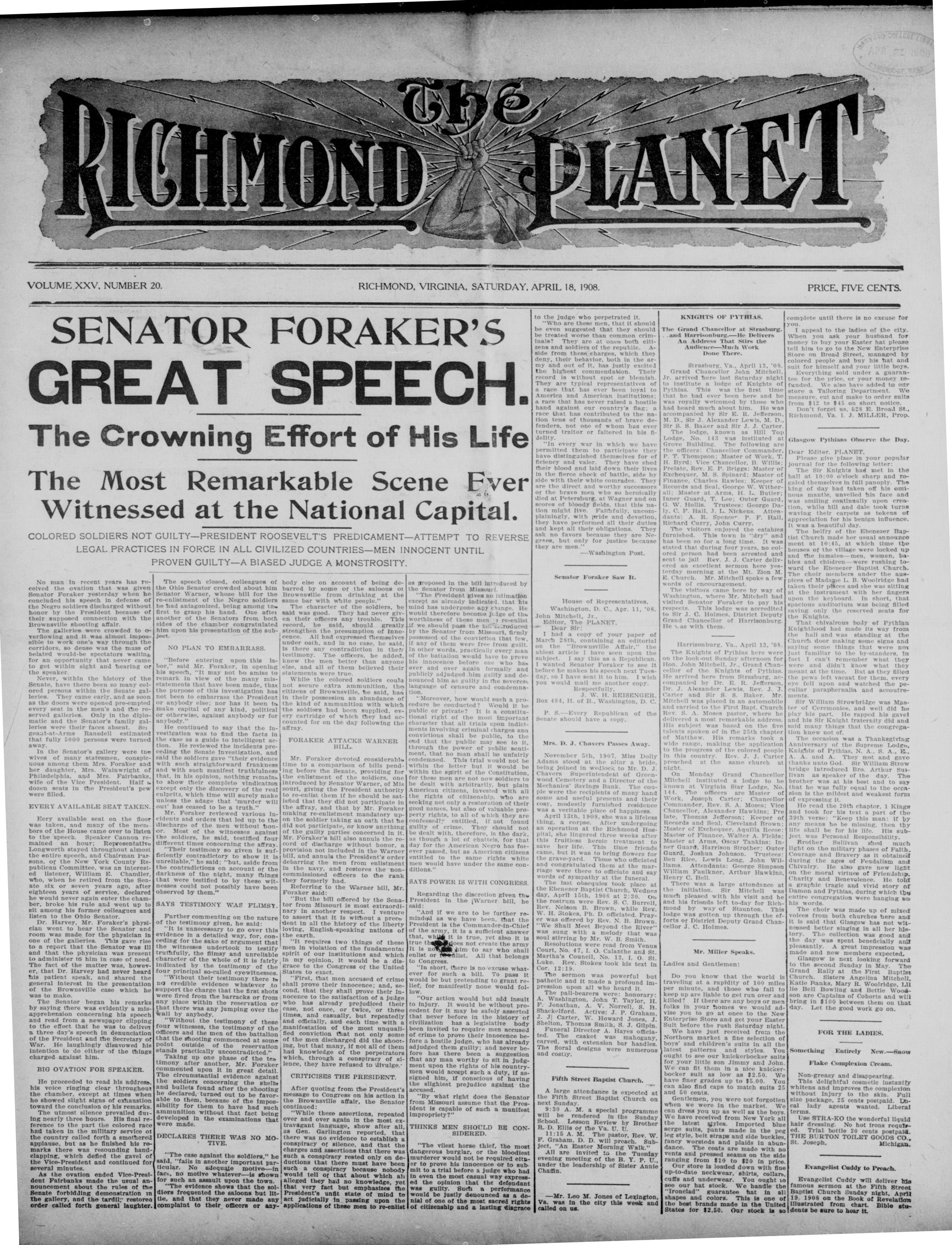
SENATOR FORAKER'S GREAT SPEECH. The Crowning Effort of His Life The Most Remarkable Scene Ever Witnessed at the National Capital.
COLORED SOLDIERS NOT GUILTY-PRESIDENT ROOSEVELT'S PREDICAMENT-ATTEMPT TO REVERSE LEGAL PRACTICES IN FORCE IN ALL CIVILIZED COUNTRIES-MEN INNOCENT UNTIL
VOLUME XXV. NUMBER 20.
SENATE
GREA
The Crow
The Most
Witness
COLORED SOLDIERS NOT G
LEGAL PRACTICES
No man in recent years has received the ovation that was given Senator Foraker yesterday when he concluded his speech in defense of the Negro soldiers discharged without honor by the President because of their supposed connection with the Brownies shooting affair.
The galleries were crowded to overflowing and it was almost impossible to work one's way through the corridors, so dense was the mass of belated would-be spectators writing for an opportunity that never came to get within sight and hearing or the speaker.
Never, within the history of the Senate, have there been so many colored persons within the Senate galleries. They came early, and as soon as the doors were opened pre-empted every seat in the men's and the reserved galleries. Only in the diplomatic and the Senator's family galleries were their faces absent. Senegan-at-Arms Ransdell estimated that fully 5000 persons were turned away.
In the Senator's gallery were the wives of many statesmen, conspicuous among them Mrs. Foraker and her daughter, Mrs. Wainwright of Philadelphia, and Mrs. Fairbanks, wife of the Vice President. Half dozen seats in the President's pew were filled.
EVERY AVAILABLE SEAT TAKEN
Eery available seat on the floor was taken, and many of the members of the House came over to listen to the speech. Speaker Cannon remained an hour; Representative Longworth stayed throughout almost the entire speech, and Chairman Parsons, of the New York County Republican Committee, was an interested listener, William E. Chandler, who, when he retired from the Senate six or seven years ago, after eighteen years of service, declared he would never again enter the chamber, broke his rule and went up to sit among his former colleagues and listen to the Ohio Senator. Dr. Harvey, Mr. Foraker's physician went to hear the Senator and room was made for the physician in one of the galleries. This gave rise to a report that the Senator was ill and that the physician was present to administer to him in case of need. The fact of the matter was, however, that Dr. Harvey had never heard his patient speak, and shared the general interest in the presentation of the Brownsville case which he was to make. The Senator began his remarks by saying there was evidently a misapprehension concerning his speech and read from a newspaper clipping to the effect that he was to deliver a three day's speech in denunciation of the President and the Secretary of War. He laughingly disavowed his intention to do either of the things charged against him.
BIG OVATION FOR SPEAKER.
He proceeded to read his address, his voice ringing clear throughout the chamber, except at times when he showed slight signs of exhaustion toward the conclusion of his remarks. The utmost silence prevailed during nearly three hours. His final reference to the part the colored race had taken in the military service of the country called forth a smothered applause, but as he finished his remarks there was resounding hand-clapping, which defied the gavel of the Vice-President and continued for several minutes. As the ovation ended Vice-President Fairbanks made the usual announcement about the rules of the Senate forbidding demonstration in the gallery, and the tardily restored order called forth general laughter.
PROVEN GUILTY—A BIASED JUDGE A MONSTROSITY.
The speech closed, colleagues of being de-
the Ohio Senator crowded about him
Senator Warner, whose bill for the
re-enlistment of the Negro soldiers
he had antagonized, being among the
first to grasp his hand. One after
sides of the Senators from both
sides of the chamber congratulated
him upon his presentation of the sub-
ject.
body else on account of being de-
barred by some of the saloons of
Brownsville from drinking at the
same bar with white people."
The character of the soldiers, he said was good. They had never given
their officers any trouble. This
record he said should greatly
strengthen the presumption of finn-
ence. All had expressed themselves
NO PLAN TO EMBARRASS
"Before entering upon this labor," said Mr. Foraker, in opening his speech, "It may not be amiss to remark in view of the many misstatements that have been made, that the purpose of this investigation has not been to embarrass the President or anybody else; nor has it been to make capital of any kind, political or otherwise, against anybody or for anybody."
He continued to say that the investigation was to find the facts in the case as a guide to intelligent action. He reviewed the incidents preceding the Senate investigation, and said the soldiers gave "their evidence with such straightforward frankness and with such manifest truthfulness that, in his opinion, nothing remains to show their complete vindication except only the discovery of the real culpits, which time will surely make unfit, and the adage that 'murder will or' has ceased to be a truth."
Mr. Foraker reviewed various incidents and orders that led up to the discharge of the witness without honor. Most of the witnesses against the soldiers, he said, testified four different times concerning the affair.
"Their testimony so given is sufficiently contradictory to show it is unreliable," he said; "but, aside from the contradictions on account of the darkness of the night, many things that were testified to by these witnesses could not possibly have been observed by them."
SAYS TESTIMONY WAS FLIMSY
Further commenting on the nature of the testimony given, he said:
"It is unnecessary to go over this evidence in a detailed way, for, conceding for the sake of argument that the witnesses undertook to testify truthfully, the films and unreliable character of the whole of it is fairly indicated by the testimony of the four principal so-called eyewitnesses. "Without their testimony there is no credible evidence whatever to support the charge that the first shots were fired from the barracks or from any place within the reservation or that there was any jumping over the wall by anybody. "Without the testimony of these four witnesses, the testimony of the officers and the men of the battalion that the shooting commenced at some point outside of the reservation stands practically uncontradicted." Taking the phase of the testimony after another Mr. Foraker commented upon it in great detail. The circumstantial evidence against the soldiers concerning the shells and bullets found after the shooting he declared, turned out to be favorable to them, because of the impossibility for them to have had such ammunition without that fact being developed in the examinations that were made.
DECLARES THERE WAS NO MO TIVE.
"The case against the soldiers," he said, "fails in another important particular. No adequate motive—in fact, no motive whatever—is shown for such an assault to the town. The evidence shows that the soldiers frequently attack the town, to test the tite, and that they never made any complaint to their officers or any-
RICHMOND, VIRGINIA, SATURDAY, APRIL 18, 1908
body else on account of being barred by some of the saloons on Brownsville from drinking at the same bar with white people." The character of the soldiers, he said was good. They had never given their officers any trouble. This record, he said, should greatly strengthen the presumption of innocence. All had expressed themselves under oath, and in no case, he said, is there any contradiction in their testimony. The officers, he added, knew the men better than anyone else, and all of them believed their situation were true. While the other soldiers could not secure extra ammunition, the citizens of Brownsville, he said, had in their possession an abundance of the kind of ammunition with which the soldiers had been supplied, every cartridge of which they had accounted for on the day following the affray.
FORAKER ATTACKS WARNER BILL
Mr. Foraker devoted considerable time to a comparison of bills pending before the Senate, providing for the enlistment of the soldiers, one introduced by Senator Warner, of Missouri, giving the President authority to enlist them if he should be satisfied that they did not participate in the affray, and that by Mr. Foraker making re-enlistment mandatory upon the soldier taking an oath that he did not participate, or know anything of the guilty parties concerned in it. Mr. Foraker's bill also annuls the record of discharge without honor, a provision not included in the Warner bill, and annuls the President's order debarring the men from enlistment in the navy, and restores the noncommissioned officers to the rank they formerly had.
Referring to the Warner bill, Mr. Foraker said:
"But the bill offered by the Senator from Missouri is most extraordinary in another respect. I venture to assert that it is without a precedent in all the history of the liberty loving, English-speaking nations of the earth.
"It requires two things of these men in violation of the fundamental spirit of our institutions and which in my opinion, it would be a disgrace to the Congress of the United States to exact.
"First, that men accused of crime shall prove their innocence; and, second, that they shall prove their innocence to the satisfaction of a judge who has already prejudiced their case, not once, or twice, or three times, and casually, but repeatedly and officially, and each time with a manifestation of the most unqualified and not only some of the men discharged from shooting, but that many, if not all, had knowledge of the perpetrators which, through a conspiracy of silence, they have refused to dulge:
CRITICISES THE PRESIDENT
After quoting from the President's message to Congress on his action in the Brownsville affair, the Senator continued:
"While these assertions, repeated over and over again in the most extravagant language, show after all, as Gen. Garlington reported, that there was no evidence to establish a conspiracy of silence, and that the charges and assertions that there was such a conspiracy rested only on deductions that there must have been such a conspiracy because nobody would tell of that about which an alleged they had no knowledge, yet that very fact but emphasizes the President's unfit state of mind to act judicially in passing upon the applications of these men to re-epil
as proposed in the bill introduced by the Senator from Missouri. "The President gives no intimation except as already indicated, that his mind has undergone any change. He would therefore become judge of the worthiness of these men to re-enlist if we should pass the bill introduced by the Senator from Missouri, firmly possessed of the conviction that few, if any of them were free from guilt, in other words, practically every man in the battalion would have to prove his innocence before one who has over and over been guilty and publicly adjudged him guilty and denounced him as guilty in the severest language of censure and condemnation.
"Moreover, how would such a procedure be conducted? Would it be public or private? It is a constitutional right of the most important character that all trials upon indictments involving criminal charges and convictions shall be public, to the end that the public may see to it, through the power of public sentiment, that no man shall be unfairly condemned. This trial would not be within the letter but it would be within the spirit of the Constitution, for these men are not now soldiers to be dealt with arbitrarily, but plain American citizens, invested with all rights of citizenship, who are seeking not only restoration of their good names, but all of their valuable property rights, to all of whom they are confessed?" entitled, if not for no guilty of crime. They should not be dealt with, therefore, in the dark, as though a lot of chattels, for that day for the American Negro has forever passed, but as American citizens entitled to the same rights white men would have under the same conditions."
SAYS POWER IS WITH CONGRESS
Regarding the discretion given the President in the Warner bill, he said:
"And if we are to be further reminded as we have been, that the President is the Commander-in-Chief of the army, it is a sufficient answer that, while it is true, yet also it is true the does not create the army It is now, he him to say who shall enlist or be enlist. All that belongs to Congress.
"In short, there is no/excuse whatever for such a bill. To pass it would be but pretending to grant relief, for manifestly none would follow.
"Our action would but add insult to injury. It would be without precedent for it may be safely asserted that never before in the history of civilization has legislative body been invited to require men accused of crime to prove their innocence before a hostile judge, who has already adjudged them guilty; and never before has there been a suggestion that any man worthy to sit in judgment upon the rights of his countrymen would accept such a duty, if assigned him, if conscious of having the slightest prejudice against the accused.
"By what right does the Senator from Missouri assume that the President is capable of such a manifest impropriety?"
THINKS MEN SHOULD BE CONSIDERED.
"The vilest horse thief, the most dangerous burglar, or the bloodiest murderer would not be required either to prove his innocence or to submit to a trial before a judge who had in even the most casual way expressed the opinion that the defendant was guilty. Such a performance would be justly denounced as a denial of one of the most sacred rights of citizenship and a lasting disgrace
to the judge who perpetrated it.
to the judge who perpetrated it.
"Who are these men, that it should be even suggested that they should be treated worse than common criminals? They are at once both citizens and soldiers of the republic. Aides and soldiers of the charges, which deny, their behaviour both in the army and out of it, has justly excite the highest commendation. Their record is without spot or blemish. They are typical representatives of a race that has ever been loyal to America and American institutions; a race that has never raised a hostile hand against our country's flag; a race that has contributed to the nation tens of thousands of brave defenders, not one of whom has ever turned traitor or faltered in his fidelity.
"In every war in which we have permitted them to participate they have distinguished themselves for eficiency and valor. They have shed their blood and laid down their lives in the fierce shock of battle, side by side with their white comrades. They are the direct and worthy successors of the brave men who so heroically died at Petersburg, at Wagner and on soot and snowy bodies, that this nation might live. Faithfully uncompromising, with pride and devotion they have performed all their duties and kept all their obligations. They ask no favors because they are Negrees, but only for justice because they are men."
—Washington Post.
Senator Foraker Saw It.
House of Representatives,
Washington, D. C., Apr. 11, '08.
John Mitchell, Jr.
Editor, The PLANET,
Dear Sir:
I had a copy of your paper of
March 28th, containing an editorial
on the "Brownsville Affair," the
ablest article I have seen upon the
subject. I say this as a Republican.
I wanted Senator Foraker to see it
before he makes his speech next Tuesday,
so I have sent it to him. I wish
you would mail me another copy.
Respectfully,
J. W. H. REISENGER,
Box 484, H. of R., Washington, D. C.
P. S.—Every Republican of the
Senate should have a copy.
Mrs. D. J. Chayers Passes Away
November 5th, 1997, Miss Dolly Adams stood at the altar a bride, being joined in wedlock to Mr. D. J. Chavers Superintendent of Greenwood Cemetery and a Director of the Mechanics' Savings Bank. The couple were the recipients of many hand some and useful presents and their cosy, modestly furnished residence was a veritable place of happiness.
April 13th, 1908, she was a lifeless thing, a corpse. After undergoing an operation at the Richmond Hospital, she lingered three weeks after this fruitless heroic treatment to save her life. This time friends came, but it was to bring flowers for the grave-yard. Those who officiated and congratulated them at the marriage were there to officiate and say woe of sympathy at the funeral.
The sermon obsequies took place at the Ebenhaven Baptist Church, Wednesday, April 15th, 1908 at 2:30. On the rostrum were Rev. S. C. Burrell, Rev. Nelson B. Brown, while Rev. W. H. Stokes, Ph. D. officiated. Prayer was offered by Rev. N. B. Brown.
"We shall Meet Beyond the River" was sung with a melody that was soul stirring by Mr. W. B. Smith.
Resolutions were read from Venus Court, No. 47, I. O. Calanthe and St. Martha's Council, No. 13, I. O. St. Luke. Rev. Stokes took his text in Cor. 12:19.
The sermon was powerful but pathetic and it made a profound impression upon all who heard it.
The pall-bearers were: honorary:
A. Washington, John T. Taylor, H.
F. Jonathan, A. V. Norrell, S. H.
Shackelford. Active: J. P. Graham,
Carter, W. Howard Jones, J.
Shelton, Thomas Smith, S. J. Gilpin.
Funeral Dearer A. Hayes officiated.
The casket was mahogany,
carved, with extension bar handles.
The floral designs were numerous
and costly.
Fifth Street Baptist Church
A large attendance is expected at the Fifth Street Baptist Church on next Sunday.
9:30 A. M. a special programme will be rendered in the Sunday School. Lesson Review by Brother B. D. Ellis of the Va. U. U.
11:15 A. M. The pastor, Rev. W. F. Graham, D. D. will preach. Subject, "An Easter Morning Walk."
All are invited to the Tuesday evening meeting of the B. Y. P. U., under the leadership of Sister Annie Chaffin.
—Mr. Leo M. Jones of Lexington. Va. was in the city this week and called on us.
KNIGHTS OF PYTHIAS.
The Grand Chancellor at Strasburg
..and Harrisonburg.-He Delivers
Strasburg, Va., April 13, '08. Grand Chancellor John Mitchell. Jr. arrived here last Saturday night to institute a lodge of Knights of Pythias. This was the first time that he had ever been here and he was royally welcomed by those who had heard much about him. He was accompanied by Sir E. R. Jefferson. M. D. S. Jr. Alexander Lewis, M. D. S. Sir S. S. Baker and Sir J. J. Carter. The lodge, known as Hill Toi Lodge, No. 143 was instituted at Grove Building. The following are the officers: Chancellor Commander; P. T. Thompson; Master of Work, T. H. Byrd; Vice Chancellor, B. Willis; Prelate, Rev. E. P. Briggs; Master of Exchequer, M. S. Spinard; Master of Finance, Charles Rawles; Keeper of Records and Seal, George W. Witherall; Master at Arms, H. L. Butler; Inner Guard, T. Lee; Outer Guard, G. W. Hollis. Trustees: George Daly, C. P. Hall, J. L. Nickens. Attention: R. Spencer P. F. Hall, Richard Curry, John Curry. The visitors enjoyed the catabures furnished. This is "dry" and has been so for a long time. It was stated that during four years, no colored person had been arrested and sent to jail. Rev. J. J. Carter delivered an excellent sermon here yesterday morning at the Mt. Zion M. E. Church. Mr. Mitchell spoke a few words of encouragement.
The visitors came here by way of Washington, where Mr. Mitchell had visited Senator Foraker to pay his respects. This lodge was accredited by C. G. Jones, District Deputy Grand Changed of Harrisonburg He was with them.
Harrisonburg, Va., April 13, '08
Harrisonburg, Va., April 13, 08.
The Knights of Pythias here were on the look-out Sunday afternoon for Hon. John Mitchell, Jr., Grand Chancellor of the Knights of Pythias. He arrived here from Strasburg, accompanied by Dr. E. R. Jefferson, Dr. J. Alexander Lewis, Rev. J. J. Carter and Sir S. S. Baker. Mr. Mitchell was placed in an automobile and carried to the First Bapt. Church Rev. S. A. Moses pastor, where he delivered a most remarkable address. His subject was based on the five talents spoken of in the 25th chapter of Matthew. His remarks took a wide range, making the application to the progress of the colored people in this country. Rev. J. J. Carter preached at the same church at night.
On Monday Grand Chancellor Mitchell instituted a lodge to be known at Virginia Star Lodge, No. 144. The officers are Master of Work, Joseph Carter; Chancellor Commander, Rev. S. A. Moss; Chancellor, Alexander Hawkins; Prelate, Thomas Jefferson; Keeper of Records and Seal, Cleveland Brown; Master of Exchequer, Aquilla Reese; Master of Finance, Walter A. Fields; Master at Arms, Oscar Tankins; Inner Guard, Harrison Strother; Outer Guard, Joshua Johnson; Trustees: Ben Rice, Lewis Long, John Williams. Attendants: George Simpson William Fankner, Arthur Hawkins, Henry C. Bell.
There was a large attendance at the initiation. Sir Mitchell was much pleased with his visit and he and his friends left to-day for Richmond by way of Staunton. This lodge was gotten up through the efforts of District Deputy Grand Chancellor J. C. Holmes.
Mr. Miller Speaks.
Ladies and Gentlemen:
Do you know that the world is traveling at a rapidity of 100 miles per minute, and those who fall to keep up are liable to get run over and killed? If there are any boys or men folks in your homes we would advise you to go at once to the New Enterprise Store and get your Easter Suit before the rush Saturday night. We have just received from the Northern market a fine selection of boys' and children's suits in all the latest patterns and styles. You ought to see our knickerbocker suits for your little son Jimmy and John. We can fit them in a nice knickerbocker suit as low as $2.50. We have finer grades up to $5.00. You can also find caps to match suits 25 and 50 cents. Gentlemen, you were not forgotten when we were in the market. We can dress you up as well as the boys. We have received from New York all the latest styles. Imported blue surge suits, ants made in the peg leg style, belt trousers and side buckles, fancy worsteds and plaids in abundance. The coats are made with novents and pressed tones on the side ranging from $10 to $20 in price. Our store is loaded down with fine up-to-dear neckwear, shirts, collars, cuffs and underwear. You can see our hat stock. We handle the "Ironclad" guarantee hat in all shapes and colors. This is one of the best brands made in the United States for $2.50. Our stock is so
PRICE. FIVE CENTS.
complete until there is no excuse for you.
I appeal to the ladies of the city. When you ask your husband for money to buy your Easter hat please tell him to go to the New Enterprise Store on Broad Street, managed by colored people and buy his hat and suit for himself and your little boys. Everything sold under a guarantee for the price, or your money not required, can be stored in a Tailoring Department. We measure, cut and make to order suits from $12 to $45 on short notice. Don't forget us, 628 E. Broad St., Richmond, Va. I. J. MILLER, Prop.
Glasgow Pythians Observe the Day.
Dear Editor. PLANET.
Please give place in your popular journal for the following letter:
The Sir Knights had met in the hall at 10:00 o'clock sharp and regaled themselves in full panoply. The king of day had taken off his omnious mantle, unveiled his face and was smiling continually upon creation, while hill and dale took turns waving their carpets as tokens of appreciation for his benign influence. It was a beautiful day. The belfry of the Ebenezer Baptist Church made her usual announcement at 10:45, at which time the houses of the village were locked up and the inmates—men, women, babies and children—were rushing forward the Ebenezer Baptist Church. The choir members under the auspices of Madane L. B. Woolridge had taken their places and she was sitting at the instrument with her fingers upon the keyboard. In short, that spacious auditorium was being filled saving only the reserved seats for the Knights.
That chivalrous body of Pythian Knighthood had made its way from the hall and was standing at the Church door making some signs and saying some things that were not just familiar to the by-standers, in fact. I can't remember what they were and didn't know what they meant at the time. But as they filled the pews left vacant for them, every eye fell upon and watched the peculiar paraphernalia and accountre-
Sir William Strowbridge was Master of Ceremonies, and well did he play his part. He rapped his gavel and his Sir Knight fraternity did and said many things that the congregation knew not of.
The occasion was a Thanksgiving Anniversary of the Supreme Lodge, Knights of Pythias, N. A., S. A., E., A. A. and A. A. They met and gave thanks unto God. Sir William Strowbridge introduced Bro. Arthur Sullivan as speaker of the day. The brother was at his best and to say that he was fully equal to the occasion is the mildest and weakest form of expressing it.
He read the 20th chapter, 1 Kings and took for his text a part of the 39th verse: "Keep this man: if by any means he be missing, then thy life shall be for his life. His subject was Personal Responsibility.
Brother Sullivan shed much light on the military phases of Faith, Courage and Bravery as it obtained during the ages of Feudalism and Chivalry. He also gave new light on the moral virtues of Friendship, Charity and Benevolence. He told a graphic tragic and vivid story of Damon and Pythias, during which the entire congregation were hanging on his words.
The choir was made up of mixed voices from both churches here and it is said that Glasgow has not witnessed better singing in all her history. The collection was good and the day was spent beneficially and pleasantly. A great impression was made and new members expected.
Glasgow is next looking forward to the second Sunday in May. The Grand Rally at the First Baptist Church. Sisters Angelina Mitchell, Katie Ranks, Mary R. Woolridge, Lil Katie Ranks, Bettie and Bettie Woodson are Captain Robbies and will bring in $100 between the two that day. Let the good work go on.
FOR THE LADIES
Something Entirely New.—Snow
Flake Complexion Cream.
Non-greasy and disappearing.
Non-greedy and disappearing.
This delightful cosmetic instantly
whitens and improves the complexion
without injury to the skin. Full
size package, 25 cents postpaid. Docal
lady agents wanted. Liberal
terms.
Use STRA-KO the wonderful liquid
hair dressing. No hot irons required.
Trial bottle 20 cents postpaid.
THE BURTON TOILET GOODS CO.
St. Joseph,
Michigan.
Evangelist Cuddy to Preach
Evangelist Cuddy will deliver his famous sermon at the Fifth Street Baptist Church Sunday night, April 19. 1908 on the Book of Revelation illustrated from chart. Bible students be sure to hear it.
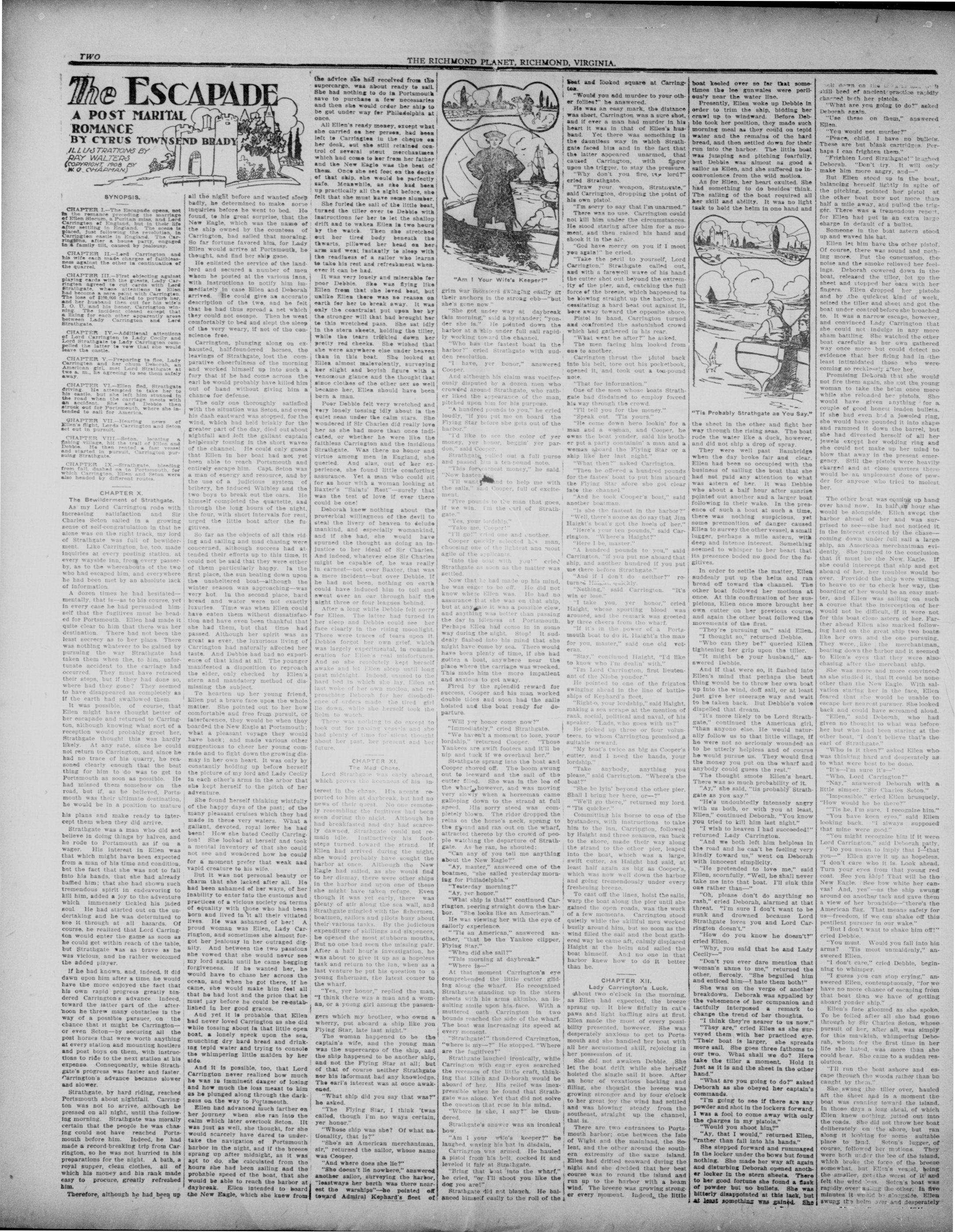
The ESCAPADE
A POST MARITAL
ROMANCE
BY CYRUS TOWNSEND BRADY
ILLUSTRATIONS BY
RAY WALTERS
(COPYRIGHT 1908 BY
W O. CHAPMAN)
TWO
SYNOPSIS.
CHAPTER I.—The Escapade opens, not in the romance preceding the marriage of the deceased, Puritan misses the Carrington in Eureka, but in those after settling in England. The scene is just following the revolution, in Carrington, captain of the British ringtons, after a house party, engaged in a family tilt, caused by jealousy.
CHAPTER II.—Lord Carrington and his wife each made charges of faithlessness against the other in continuation of the scene.
CHAPTER III.—First objecting against playing cards with cut cards with Lord Strathgate, whose attendants to Ellen Strathgate, whose attendants to Lord Carrington. The loss of $100,000 failed to perturb her and her husband then cut for his wife's attention. The and his honor, Carrington winning. The latter is like a liking for each other apparently arose between Lady Carrington and Lord Strathgate.
CHAPTER IV.—Additional attention of Carrington to Lady Cecily and Lord Strathgate. Carrington compelled the latter to view that one would leave the castle.
CHAPTER V.—Preparing to flee, Lady Carrington and her chum Deborah, an American girl, met Lord Strathgate at the m., he agreeing to see them safely away.
CHAPTER VI. -Ellen fled, Strathgate driving. He attempted to take her to her car when she left him stunned in the road when she married me with an accident. She and Debbie then struck out for Portsmouth, where she intended to sail for America.
CHAPTER VII. -Hearing news of Kilkenny lords, Lords Carrington and Seton set out to pursuit.
CHAPTER VIII. -Seton, locating a failing village full of Ellen and Debbie. He then rented a house and started in pursuit, Carrington pursuing Strathgate.
CHAPTER IX. -Strathgate, bleeding from fall, dashed on to Portsmouth, for which he married Ellen and Seton were also headed in different directions.
CHAPTER X
The Bewilderment of Stratthgate.
As my Lord Carrington rode with increasing satisfaction and Sir Charles Seton sailed in a growing sense of self-congratulation in that he alone was on the right track, my lord of Stratthgate was full of bewilderment. Like Carrington, he, too, made inquiries at every posting station, at every wayside inn, from every passerby, as to the whereabouts of the two who had escaped him, and everywhere he had been met by an absolute lack of information.
A dozen times he had hesitated—mentally, that is—as to his course, yet in every case he had persuaded himself that the fugitives must be headed for Portsmouth. Ellen had made it quite clear to him that there was her destination. There had not been the least secrecy as to her plans. There was nothing whatever to be gained by pursuing the way Strathgate had taken them when the, to him, unfortunate accident to the carriage had occurred. They must have retraced their steps, but if they had done so, where had they gone? They seemed to have disappeared as completely as if the earth had swallowed them
It was possible, of course, that Ellen might have thought better of her escape and returned to Carrington, although knowing what sort of a reception would probably greet her, Strathgate thought this was hardly likely. At any rate, since he could not return to Carrington, and since he had no trace of his quarry, he reasoned clearly enough that the best thing for him to do was to get to Portsmouth as soon as possible. He had missed them somehow on the road, but if, as he believed, Portsmouth was their ultimate destination, he would be in a position to mature
his plans and make ready to intercept them when they did arrive. Strathgate was a man who did not believe in doing things by halves, and he rode to Portsmouth as if on a wager. His interest in Ellen was that which might have been expected from a man of his time and condition, but the fact that she was not to fall into his hands, that she had already baffled him; that she had shown such tremendous spirit in endeavoring to kill him, added a joy to the adventure which immensely tickled his jaded soul. He had started out on the undertaking and he was determined to see it through at all hazards. Of course, he realized that Lord Carrington would enter the game as soon as he could get within reach of the table, but Strathgate was as brave as he was vicious, and he rather welcomed the added player.
If he had known, and, indeed, it did dawn upon him after a time he would have the more enjoyed the fact that his own rapid progress greatly hindered Carrington's advance. Indeed, toward the latter part of the afternoon he threw many obstacles in the way of a possible pursuer, on the chance that it might be Carrington—or even Seton—by securing all the post horses that were worth anything at every station and mounting hostlers and post boys on them, with instructions to ride to the next station at his expense. Consequently, while Strathgate's progress was faster and faster, Carrington's advance became slower and slower.
Strathgate, by hard riding, reached Portsmouth about nightfall. Carrington was not to arrive, although he pressed on all night, until the following morning. Strathgate was morally certain that the people he was chasing could not have reached Portsmouth before him. Indeed, he had made a record-breaking trip from Carrington, so he was not hurried in his preparations for the night. A bath, a royal supper, clean clothes, all of which his money and his rank made easy to procure, greatly refreshed him. Therefore, although he had been up
all the nigR before and wanted sleep badly, he determined to make some inquiries before he went to bed. He found, to his great surprise, that the New Eagle, which was the name of the ship owned by the countess of Carrington, had sailed that moraling. So far fortune favored him, for Lady Ellen would arrive at Portsmouth, he thought, and find her ship gone.
He enlisted the service of the landlord and secured a number of men whom he posted at the various inns, with instructions to notify him immediately in case Ellen and Deborah arrived. He could give an accurate description of the two, and he felt that he had thus spread a net which they could not escape. Then he went comfortably to bed and slept the sleep of the very weary, if not of the conscience free.
Carrington, plunging along on exhausted, half-foundered horses, the leavings of Strathgate, lost the comparative cheerfulness of the morning and worked himself up into such a fury that if he had come across the earl he would probably have killed him out of hand without giving him a chance for defense.
The only one thoroughly satisfied with the situation was Seton, and even his dash eastward was stopped, for the wind, which had held briskly for the greater part of the day, died out about nightfall and left the gallant captain helplessly tossing in the short waves of the channel. He could only guess that Ellen in her boat had not yet been able to reach Portsmouth and entirely escape him. Capt Seton was a man of energy and resource, and by the use of a judicious system of bribery, he induced Whibley and the two boys to break out the oars. He himself completed the quartette, and through the long hours of the night, the four, with short intervals for rest, urged the little boat after the fugitives.
So far as the objects of all this riding and sailing and mad chasing were concerned, although success had attended their efforts up to this time, it could not be said that they were either of them particularly happy. In the first place, the sun beating down upon the unsheltered boat—although the winter season was approaching—was very hot. In the second place, hard bread and water were not exactly luxuries. Time was when Ellen could have eaten them without dissatisfaction and have even been thankful that she had them, but that time had passed. Although her spirit was as great as ever, the luxurious living of Carrington had naturally affected her taste. And Debbie had had no experience of that kind at all. The younger manifested a disposition to reproach the elder, only checked by Ellen's stern and mandatory method of dismissing the subject.
To hearten up her young friend, Ellen put a brave face upon the whole matter. She pointed out to her how comfortable and free from pursuit, or interference, they would be when they boarded the New Eagle at Portsmouth; what a pleasant voyage they would have back; and made various other suggestions to cheer her young comrade and to fight down the growing dismay in her own heart. It was only by constantly holding up before herself the picture of my lord and Lady Cecily in each other's arms in the arbor that she kept herself to the pitch of her adventure.
She found herself thinking wistfully of the happy days of the past: of the many pleasant cruises which they had made in these very waters. What a gallant, devoted, royal lover he had been! How she hated Cecily Carrington! She looked at herself and took a mental inventory of that she could not see and wondered how he could for a moment prefer that weak and vapid creature to his wife.
But it was not personal beauty or charm that she lacked after all. He had been ashamed of her ways, of her inability to enter into the customs and practices of a vicious society on terms of equality with those who had been born and lived in it all their vitiated lives. He was ashamed of her! A proud woman was Eilen, Lady Carrington, and sometimes she almost forgot her jealousy in her outraged dignity. And between the two passions she vowed that she would never see my lord again until he came begging forgiveness. If he wanted her, he would have to chase her across the ocean, and when he got there, if he came, she would make him feel all that he had lost and the price that he must pay before he could be re-established in her good graces.
And yet it is probable that Ellen had never loved Carrington as she did while tossing about in that little open boat, a lonely speck upon the sea, munching dry hard bread and drinking tepid water and trying to console the whimpering little malden by her side.
And it is possible, too, that Lord Carrington never realized how much he was in imminent danger of losing and how much the loss meant to him as he plunged along through the darkness on the way to Portsmouth.
Ellen had advanced much farther on her journey when she ran into the calm which later overtook Seton. It was just as well, she thought, for she would scarcely have dared to undertake the navigation of Portsmouth harbor in the night, and if the breeze sprang up after midnight, as it was apt to do, she calculated from the hours she had been sailing and the probable speed of the boat, that she would be able to reach the harbor at daybreak. Ellen intended to board the New Eagle, which she knew from
THE RICHMOND PLANET, RICHMOND, VIRGINIA
the advice she had received from the supercargo, was about ready to sail. She had nothing to do in Portsmouth save to purchase a few necessaries and then she would order her ship to be got under way for Philadelphia at once. All Ellen's ready money, except what she carried on her person, had been left to Carrington in the cheque on her desk, but she still retained control of several stout merchantmen which had come to her from her father and the New Eagle was the best of them. Once she set foot on the decks of that ship, she would be perfectly safe. Meanwhile, as she had been up practically all the night before, she felt that she must have come
She furried the sail of the little boat, turned the tiller ever to Debbie with instructions for her to let the shallow drift and to wake Ellen in two hours by the watch. Then she stretched out her tired body beneath the thwarts, pillowed her head on her arm and went instantly to sleep with the readiness of a sailor who learns to take his rest and refreshment whenever it can be had.
It was very lonely and miserable for poor Debbie. She was flying like Ellen from that she leaved best, but unlike Ellen there was no reason on earth for her to break sway. It was only the constraint put upon her by the stronger will that had brought her to this wretched pass. She sat idly in the stern sheets, holding the tiller, while the tears trickled down her pretty red cheeks. She wished that she were anywhere else under heaven than in this boat. She looked at Ellen almost malevolently, surveying her slight and boyish figure with a venomous glance and the thought that since clothes of the other sex so well became her, Ellen should have been bern a man.
Poor Debbie felt very wretched and very lonely tossing idly about in the quiet seas under the calm stars. She wondered if Sir Charles did really love her as she had more than once indicated, or whether he were like the faithless Carrington and the insidious Strathgate. Was there no honor and virtue among men in England, she queried. And alas, out of her experience, she found little comforting assurance. Yet a man who could sit for an hour with a woman looking at Baxter's "Saints' Rest"—surely that was the test of love if ever there could be one!
Deborah knew nothing about the proverbial willingness of the devil to steal the livery of heaven to delude mankind, and especially womankind, and if she had, she would have spurned the thought as doing an injustice to her ideal of Sir Charles. And indeed, whatever else Sir Charles might be capable of, he was really in earnest—not over Baxter, that was a mere incident—but over Debile. If he had not been, nothing on earth could have induced him to toll and sweat over an oar through half the night three or four leagues behind.
After a long while Debbie felt sorry for Ellen. The latter had turned in her sleep and Debbie could see her face clearly in the rising moonlight. There were traces of tears upon it. Debbie forgot her own grief, which was largely experimental, in commiseration for Ellen's real misfortunes. And so she resolutely kept herself awake and let Ellen sleep until long past midnight. Indeed, unused to the hard bed in which she lay, Ellen at last woke of her own motion, and reproaching Deborah for her disobedience of orders made the tired girl lie down, while she herself took the helm to watch.
There was nothing to do except to look out for passing vessels and she had plenty of time for silent thought about her past, her present and her future.
CHAPTER XI
The Mad Chase
Lord Strathgate was early abroad, which proves the keenness of his interest in the chase. His agents reported to him at daybreak, but had no news of their quest. No one remotely resembling the fugitives had been seen during the night. Although he had breakfasted and day had scarcely dawned, Strathgate could not remain idle. Instinctively his footsteps turned toward the strand. If Ellen had arrived during the night, she would probably have sought the harbor at once. Although the New Eagle had sailed, as she would find to her dismay, there were other ships in the harbor and upon one of these she might have taken refuge. Even though it was yet early, there was plenty of stir along the sea wall, and Strathgate mingled with the fishermen, boatmen, sailors and pilots busy about their various tasks. By the judicious expenditure of shillings and sixpences, he opened the most stubborn mouths. But no one had seen the missing pair. After a half hour's investigation, he was about to give it up as a hopeless task and return to the lan, when as a last venture he put his question to a young fisherman, the latest comer to the wharf.
"Yes, yer honor," replied the man,
"I think there was a man and a woman, or a young girl among the passengers which my brother, who owns a wherry, put aboard a ship like yon Flying Star, late last night."
The woman happened to be the captain's wife, and the young man was the supercargo of the ship, and the ship happened to be another ship, and not the Flying Star at all; but of that of course neither Strathgate nor his informant had any knowledge. The earl's interest was at once awakened.
"What ship did you say that was?" he asked.
"The Flying Star, I think 'twas called, though I'm no ways certain, yer honor."
"Whose ship was she? Of what nationality, that is?"
"She's an American merchantman, sir," returned the sailor, whose name was Cooper.
"And where does she lie?" "She doesn't lie nowhere," answered another sailor, surveying the harbor, "leastways her berth was there nearest the warships"—he pointed off toward Admiral Kenhard's fleet of
A
"Am I Your Wife's Keeper?"
grim war monsters swinging easily at their anchors in the strong ebb—"but she's gone now."
"She got under way at daybreak this morning," said a bystander; "yonder she is." He pointed down the harbor at a ship under full sail rapidly working toward the chaain.
"Who has the fastest boat in the harbor?" cried Strathgate with sudden resolution.
"I have, yer honor," answered Cooper.
And although his claim was vociferously disputed by a dozen men who crowded around Strathgate, who rather liked the appearance of the man, pitched upon him for his purpose.
"A hundred pounds to you," he cried loudly, "if you put me on board the Flying Star before she gets out of the harbor."
"I'd like to see the color of yer money, yer honor, beggin' yer pardon," said Cooner.
"This for earnest money," he said. "Now hasten it." "I'll want to and to help me with the sails," and Cooper, full of excitement. "Five pounds to the man that goes, if we win. I'm the curl of Strathgate." "Yes, your lordship." "Take me, Cooper!" "I'll go!" cried one and another. Cooper quickly selected his man, choosing one of the lightest and most agile of the applicants. "Into the boat with you!" cried Strathgate as soon as the matter was settled.
Now that he had made up his mind, he was eager to be off. He did not know where Ellen was. He had no assurance that she was on that ship, but at any rate it was a possible clew, and anything was better than passing the day in idleness at Portsmouth. Perhaps Ellen had come in in some way during the night. Stop! It suddenly flashed into his mind that she might have come by sea. There would have been plenty of time, if she had gotten a boat, anywhere near the place where the carriage was wrecked. This made him the more impatient and anxious to get away.
Fired by the splendid reward for success, Cooper and his man worked double tides and soon had the sails hoisted and the boat ready for departure.
"Will yer honor come now?"
Immediately, cried Strathgate.
"We haven't a moment to lose, your lordship," returned Cooper. "Those Yankees are swift footers and it'll be nip and tuck if we overhaul her."
Strathgate sprang into the boat and Cooper shoved off. The boom swung out to leeward and the sail of the cutter filled. She was in the lee of the wharf, however, and was moving very slowly when a horseman came galloping down to the strand at full speed. His sorry steed was completely blown. The rider dropped the reins on the horse's neck, sprang to the ground and ran out on the wharf, attracted thereto by the crowd of people watching the departure of Strathgate. As he ran, he shouted:
"Can any of you tell me anything about the New Eagle?"
"Ay, master," answered one of the boatmen, "she sailed yesterday morning for Philadelphia."
"Yesterday morning?"
"Ay, yer honor."
"What ship is that?" continued Carrington, peering straight down the harbor. "She looks like an American."
He was viewing her with the eye of sailorly experience.
"Tls an American," answered another, "that be the Yankee clipper, Flying Star."
"When did she sail?"
"This morning at daybreak."
"Where is—"
At that moment Carrington's eye comprehended the little cutter gliding along the wharf. He recognized Strathgate standing up in the stern sheets with his arms akimbo, an insulting smile upon his face. With a muttered oath Carrington in two bounds reached the side of the wharf. The boat was increasing its speed at every moment.
"Strathgate!" thundered Carrington, "where is my—?" He stopped. "Where are the fugitives?"
Strathgate laughed ironically, white Carrington with eager eyes searched the recesses of the little craft, thinking that Ellen and Deborah would be aboard of her. His relief was inexpressible when he found that Strathgate was alone. Yet that did not solve the question that rescue in his mind.
"Where is she, I say?" he thun-
"Where is she, I say?" he thundered.
Strathgate's answer was an ironical bow.
"Am I your wife's keeper?" he laughed, waving his hat in disdain.
Carrington was armed. He hauled a platoat from his belt, cocked it and leveled it fair at Strathgate.
"Bring that boat into the wharf," he cried, "or I'll shoot you like the dog you are!"
Strathgate did not blanch. He balanced himself easily to the roll of the
beat and looked square at Carrington.
"Would you add murder to your other follies?" he answered.
He was an easy mark, the distance was short. Carrington was a sure shot, and if ever a man had murder in his heart it was in that of Ellen's husband. Yet there was something in the dauntless way in which Strathgate faced him and in the fact that the latter appeared unarmed, that caused Carrington, with finger upon the trigger, to stay the pressure.
"Why don't you fire, fire, fire?" cried Strathgate.
"Draw your, weapon, Stratagate," said Carrington, dropping the point of his own plato.
"I'm sorry to say that I'm unarmed."
There was no use. Carrington could not kill him under the circumstances. He stood staring after him for a moment, and then raised his hand and shook it in the air.
"God have mercy on you if I meet you again!" he cried.
"Take the peril to yourself, Lord Carrington," Strathgate called out, and with a farewell ware of his hand the cutter shot out beyond the extremity of the pler, and, catching the full force of the breeze, which happened to be blowing straight up the harbor, necessitating a hard beat out against it, bore away toward the opposite shore. Pistol in hand, Carrington turned and confronted the astonished crowd which had gathered in his rear.
"What went he after?" he asked.
The men facing him looked from one to another.
Carrington thrust the pistol back into his belt, tore out his pocketbook, opened it, and took out a ten-pound note.
"That for information."
One of the men whose boats Strathgate had disdained to employ forced his way through the crowd.
"Speak out. "Tis yours."
"He come down here lookin' for a man and a woman, and Cooper, he owns the beat yonder, said his brother put a party containin' a man and a woman aboard the Flying Star or a ship like her last night."
"What then?" asked Carrington.
"Then he offered a hundred pounds for the fastes' boat to put him aboard the Flying Star afore she got clear late the channel."
"And he took Cooper's boat," said another boatman.
"Is she the fastest in the harbor?"
"Well, there's some as do say that Jim Halight's boat got the heels of her."
"Here's your ten pounds," said Carrington. "Where's Halight?"
"Here I be, master."
"A hundred pounds to you," said Carrington. "If you put me aboard that ship, and another hundred if you put me there before Strathgate."
"And if I don't do neither?" returned Hinsley unkindly.
"Nothing," said Carrington. "It's win or lose."
"I take you, yer honor," cried Halight, whose sporting blood was aroused, and the remark was greeted by three cheers from the wharf.
"If it's in the power of a Portsmouth boat to do it. Halight's the man for you, manter," said one old veteran.
"Stay," continued Halight, "I'd like to know who I'm desalin' with."
"I'm Lord Carrington, first Heutenant of the Niobe yonder."
He pointed to one of the frigates swinging ahead in the line of battle-ships of Kephard's fleet.
"Right-o, your lordship," said Halight, making a sea scrape at the mention of rank, social, political and naval, of his speaker. "Lads, who goes with us?"
He picked up three or four volunteers, to whom Carrington promised a suitable reward.
"My boat's twice as big as Cooper's cutter, and I need the hands, your lordship."
"Take anybody, anything you please," said Carrington. "Where's the boat?
"She be lyn' beyond the other pier. Shall I bring her here, or—?"
"We'll go there," returned my lord.
"Tis quicker."
Committing his horse to one of the bystanders, with instructions to take him to the inn. Carrington, followed by Haight and three seamen, ran back to the shore, made their way along the strand to the other pier, leaped into the boat, which was a large, swift cutter, as Haight had said, at least half again as big as Cooper's, which was now well down the harbor and going tremendously under every freshening breeze.
To cast off the lines, hoist the sails, warp the boat along the pier until she gained the open roads, was the work of a few moments. Carrington stood quietly while the skillful men worked busily around him, but so soon as the wind filled the sail and the boat gathered way he came aft, calmly displaced Haight at the helm and sailed the boat himself. And no one in that harbor knew how to do it better than he.
CHAPTER XII
Lady Carrington's Luck
About two o'clock in the morning, as Ellen had expected, the breeze sprang up. It bled fitfully in cat's paws and light baffling air at first. Ellen made the most of every possibility presented, however. She was desperately anxious to get to Portsmouth and she handled her boat with all her accustomed skill, rejoicing in her possession of it.
She did not awaken Debbie. She let the boat drift while she herself holsted the single sail it bore. After an hour of vexations backing and filling, she thought the breeze was growing stronger and by four o'clock to her great joy the wind had settled and was blowing steady from the southeast, straight up the channel, that is.
There are two entrances to Portsmouth harbor; one between the Isle of Wight and the mainland, the Solent, and the other around the southern extremity of the same island. Ellen had drifted seaward during the night and she decided that her best course was to round the island and run up to the harbor with a beam wind. The breeze was growing stronger every moment. Indeed, the little
boat kooled over so far that sometimes the lee gunwales were perilously near the water line.
Presently, Ellen woke up Debbie in order to trim the ship, bidding her crawl up to windward. Before Debbie took her position, they made such morning meal as they could on tepid water and the remains of the hard bread, and then settled down for their run into the harbor. The little boat was jumping and pitching fearfully, but Debbie was almost as good a sailor as Ellen, and she suffered no inconvenience from the wild motion.
As for Ellen, her heart exulted. She had something to do besides think. The sailing of the boat required all her skill and ability. It was no light task to hold the helm in one hand and
THE WATER
"Tis Probably Strathgate as You Say," the sheet in the other and fight her way through the rising seas. The boat rode the water like a duck, however, and did not ship a drop of spray.
They were well past Bambridge when the day broke fair and clear. Ellen had been so occupied with the business of sailing the boat that she had not paid any attention to what was asterin of her. It was Debbie who about a half hour after sunrise pointed out another and a larger boat following in their wake. In the presence of such a boat at such a time, there was nothing suspicious, yet some premonition of danger caused Ellen to survey the other vessel, a small lugger, perhaps a mule astern, with deep and intense interest. Something seemed to whisper to her heart that its presence boded no good for the fugitives.
In order to settle the matter, Ellen suddenly put up the helm and ran broad off toward the channel. The other boat followed her motions at once. At this confirmation of her suspicions, Ellen once more brought her own cutter on her previous course, and again the other boat followed the movements of the first.
"They're pursuing us," said Ellen. "I thought so," returned Debbie. "Who can they be?" queried Ellen tightening her grip upon the tiller. "It might be your husband," answered Debbie.
And if that were so, it flashed into Ellen's mind that perhaps the best thing would be to throw her own boat up into the wind, doff sail, or at least just give her steerage way and wait to be taken back. But Debbie's voice dispelled that dream.
"It's more likely to be Lord Strathgate," continued the American girl, "than anyone else. He would naturally follow us to that little village, if he were not so seriously wounded as to be utterly helpless and of course he would pursue us. They would find the money you put on the wharf and anybody could guess the rest." The thought smote Ellen's heart. There was so much probability of it. "Ay," she said, "tis probably Strathgate as you say."
"He's undoubtedly intensely angry with us both, or with you at least, Ellen," continued Deborah. "You know you tried to kill him last night." "I wish to heaven I had succeeded!" returned Lady Carrington.
"And we both left him helpless in the road and he can't be feeling very kindly toward us," went on Deborah with innocent simplicity.
"He pretended to love me," said Ellen, scornfully. "Well, he shall never take me into that boat. I'll sink this one rather than—"
"Oh, please don't do anything so rash," cried Deborah, alarmed at that threat. "I'm sure I don't want to be sunk and drowned because Lord Strathgate loves you and Lord Carrington doesn't."
"How do you know he doesn't?" cried Ellen.
"Why, you said that he and Lady Cecily—"
"Don't you ever dare mention that woman's name to me," returned the other, fiercely. "She beguiled him and enticed him—I hate them both!"
She was on the verge of another breakdown. Deborah was appalled by the vehemence of her companion and tactfully interposed a remark to change the trend of her thoughts.
"I think they're nearer to us now."
"They are," cried Ellen as she surveyed them with her practiced eye.
"Their boat is larger, she spreads more sail. She goes three fathoms to our two. What shall we do? Here take the tiller a moment. Hold it just as it is and the sheet in the other hand."
"What are you going to do?" asked Deborah as she obeyed her captain's commands.
"I'm going to see if there are any powder and shot in the lockers forward. I was a fool to come away with only the charges in my pistols."
"Would you shoot him?"
"Ay, that I would," returned Ellen, "rather than fall into his hands."
She stepped forward and rummaged in the locker under the bows but found nothing. She made her way aft again and disturbed Deborah opened another locker in the stern sheets. There to her good fortune she found a flask of powder but no bullets. She was bitterly disappointed at this lack, but at least something was gained. She
cut down on the surface with skill bred of ancient practice rapidly charged both her platols.
"What are you going to do?" asked Deborah again.
"Use these on them," answered Ellen.
"You would not murder?"
"Peace, child. I have no bullets. These are but blank cartridges. Perhaps I can frighten them."
"Frighten Lord Strathgate!" laughed Deborah. "Don't try. It will only make him more angry, and—"
But Ellen stood up in the boat, balancing herself lightly in spite of the pitching, pointed her pistol at the other boat now not more than half a mile away, and pulled the trigger. There was a tremendous report, for Ellen had put in an extra large charge in default of a bullet.
Someone in the boat astern stood up and waved his hat.
Ellen let him have the other pistol Of course, there was sound and nothing more. But the concussion, the noise and the smoke relieved her feelings. Deborah cowered down in the boat, released the tiller, let go the sheet and stopped her oars with her fingers. Ellen dropped her pistols and by the quickest kind of work, selzed the tiller and sheet and got the boat under control before she broached to. It was a narrow escape, however, and convinced Lady Carrington that she could not indulge in any more sham battling. She watched the other boat carefully as her own gathered way once more but could detect no evidence that her firing had in the least intimidated those who were coming so recklessly after her.
Promising Deborah that she would not fire them again, she got the young woman to take the helm once more while she reloaded her pistols. She would have given anything for a couple of good honest leaden bullets, if she had even had a jeweled ring, she would have pounded it into shape and rammed it down the barrel, but she had divested herself of all her jewels except her wedding ring and she could not make up her mind to blow that away in the present emergency. Still the pistols were heavily charged and at close quarters there would be an unpleasant dose of powder for anyone who tried to molest her.
The other boat was coming up hand over hand now. In half an hour she would be alongside. Ellen swept the harbor ahead of her and was surprised to see—she had not noticed it in the interest excited by the chase—coming down under full sail a large ship, an American merchantman evidently. She jumped to the conclusion that it must be the New Eagle. If she could intercept that ship and get aboard of her, her troubles would be over. Provided the ship were willing to heave to or to check her way, the boarding of her would be an easy matter, and Ellen was sailing on such a course that the interception of her would not be difficult. If it were not for this boat close astern of her. Further ahead Ellen also marked following hard on the great ship two boats like her own and the one pursuing. They were, like the merchantman, beating down the harbor and it seemed to Ellen's eyes that they were also chasing after the merchant ship.
She was more and more convinced as she studied it, that it could be none other than the New Eagle. With salvation staring her in the face, Ellen feared that she would be unable to escape her nearest pursuer. She looked back and could have screamed aloud. "Ellen," said Deborah, who had given no thought to what was before her but who had been staring at the other boat, "I don't believe that's the earl of Strathgate."
"Who is it then?" asked Ellen who was thinking hard and desperately as to what were best to be done.
"It's—I'm sure it—"
"Who, Lord Carrington?"
"Nay," answered Deborah with a little slimmer. "Sir Charles Seton."
"Impossible," cried Ellen brusquely.
"How would he be there?"
"Tis he, I'm sure. I recognize him."
"You have keen eyes," said Ellen looking back. "I always supposed that mine were good."
"You might recognize him if it were Lord Carrington." said Deborah patty.
"Do you mean to imply that I that you—" Ellen gave it up as hopeless.
"I don't care who it is. Look ahead. Turn your eyes from that young red coat. See you ship! That will be the New Eagle. See how white her canvas! And, yes"—as the ship swung around on another tack and gave them a view of her broadside—there's the American flag. That means safety for us—freedom, if we can shake off this pestilent pursuer in our wake."
"But I don't want to shake him off!" cried Debbie.
"You must. Would you fall into his arms? "Tis most unmaidenly," answered Ellen.
"I don't care," cried Debbie, beginning to whimper.
"I guess you can stop crying," answered Ellen, contemptuously, "for we have no more chance of escaping from that boat than we have of getting aboard yonder ship."
Ellen's face gloomed as she spoke. To be foiled after all she had gone through by Sir Charles Soton, whose pursuit of her, after all, was simply for this mawkish, whimpering Deborah, whom for the first time in her life she hated, was more than she could bear. She came to a sudden resolution.
"I'll run the boat ashore and escape through the woods rather than be caught by them."
She swung the tiller over, hauled aft the sheet and in a moment the boat was running toward the island. In those days a long sheal, of which Ellen knew nothing, jutted out into the roads. She did not throw her boat deliberately on the shore, but ran along it looking for some suitable place to land. Soton's lugger, of course, followed her motions. They were both under the lee of the island, which broke the force of the breeze somewhat, but Ellen's vessel, being the smaller, get the worst of it and felt the wind loss. Soton's boat was rapidly over aining the other. In five minutes it would be alongside. Ellen swung the helm over and desperately
THE PLANET
SATURDAY.....APRIL 18. 1908
headed straight for the shore.
"Stop! stop, Lady Cardington!" cried Seton, who was now in plain view. "I mean you no harm. Mistress Deborah, can't you—"
"I can't do anything," cried Deborah, traitorously. "She won't let me."
"If you run down my boat," answered Ellen, handling her pistols, "I swear I will use these weapons."
Ellen turned on her like a young tigress. She could have struck her with her pistol. Sir Charles only laughed. He was in high glee.
"I wouldn't care if there were a thousand bullets in them. I intend to have you out of that boat, Mistress Debbie, and—"
There was a sudden scream from Mistress Debbie. The boat in which she sailed met with a sudden check. The little cutter grated upon the edge of the shoal. Ellen sprang to the helm, forgetful of everything else but the present peril. Her boat going at a rapid rate had taken ground. She heped that the touch had been so light that the boat would not be stopped and wrecked. Indeed, she flung herself violently to starboard and the sudden shock awung the boat off the shoal. There was a scraping of sand beneath the keel and the little shallen slid on.
Sir Charles was close aboard. Not being a sailor, he had not noticed, and in the excitement of the chase, Sir Charles offering reward upon reward to the fishermen if they overhauled the other boat, those men forgot the peril, if indeed, they knew it. For coming down at full speed and drawing half again as much water as Ellen's cutter, they ran hard and fast upon the shoal.
Ellen had counted upon their doing this very thing. She looked back with eyes of experience, and saw exactly their position. Indeed, they had barely escaped ripping a mast out of the lugger. They were rocking their boat furiously and making every effort to get off, but they had gone on fair and the tide was on ebb, and Ellen concluded they were fixed for some time.
She rose in the stern sheets and laughed gleefully. She put her boat about and ran down to pass in easy hall of Sir Charles and his men.
"Good-by," she called, laughing with mockery that stung him, "before an hour we shall be aboard yon ship, I am sorry that you were baked. A stern chase is a long chase, Sir Charles, as you will find upon the sea."
"Gooy-by, Sir Charles," called Deborah, sadly. "Tis not my doing, and—"
"Mistress Deborah," answered Sir Charles, plucking up heart, "you have not seen the end of me. I shall find some means of following you wherever you go."
"There, Debbie," said Ellen, "heart up. You did your best to betray me, but I forgive you since we've got free. I told you Sir Charles would follow you and he'll find you all the sweeter for his mad chase. Now for yon ship."
And Ellen laid a course which would in half an hour intercept the oncoming merchantman.
(TO BE CONTINUED.)
A GREAT TRUTH.
"You don't mean to say," said Whittler, "that you are going to the theater with me with those clothes!" In truth, Mrs. Whittler looked shabby—there was no doubt of that. A hat at least two years old, a coat that "had seen better days," a skirt that was frayed at the edges—all were noticeable even to Whittler's careless eye. "That or nothing," she sadly replied. "But you don't look right. Why, I never saw you look worse!" "I can't help it, my dear. It's your own fault. I certainly don't enjoy it," she sighed. "Nor would you, in my place. It's humiliating. But you know you've been preaching economy, and of course I couldn't go against your wishes." There was a pause. Whittler got up and surveyed her more critically. Then he shook his head.
"Great Scott!" he exclaimed, "has it come to this? Well, well—of course, my dear, we can't have this sort of thing. We'll give up going to the theater to night and wait until you can get some better clothes. He began to walk up and down excitedly. "I don't care how much it costs!" he exclaimed. "This, certainly, will never do. It's awful. Take 'em off, my dear, and put on a teagown." "All right, darling." Mrs. Whittier disappeared. But in an incredibly short space of time the door opened. Whittier could scarcely believe his eyes. Everything was new that she had on—from her fetching hat to her new shoes. "What's this?" he exclaimed. Oh! I see. Your little joke, eh? When did you get these things? "They just came." "And so you deceived me. Got me to say you must have them."
And Mrs. Whittler replied calmly,
"My dear, nothing of the sort. I
merely demonstrated to you, in the
most effectual way I could, that I have
to spend money on my clothes, because
you demand it."—Puck.
A Proclamation To The Two and One-Half Million Christians Comprising The 18,000 Negro Baptist Churches In The United States and to Those In The West Indies, So. America And Africa---
INCE the dawn of Christianity a sect holding views on the Scriptures like unto those held by us have been active in spreading the Gospel. They have been known as those who favored sending their ideas of Christian doctrine to the regions beyond. Our Elder Brother, the "Lord from Glory," allowed nothing to hinder Him from His work of obeying "Our Father which art in Heaven," "who so loved the world that He save His only begotten Son, that whosoever believeth on Him should not perish, but have everlasting life." Among the most precious words that ever fell from His lips were: "The Son of man came to seek and to save that which was lost. The Regions beyond? That part of our world where the people know of God's great love; regions where the distressed of soul and body, the weak and the sick of heart, the sick and sorrowing who seek relief by appealing to Sun or Moon hearts, to objects of wood and stone, the work of men's hands. Our Lord looked upon such as these and pitied them. During His thirty-three years' stay among earth's millions, He established by the sacrifice of His own life, a better way out of sin and its guilt; a way to escape the sorrows of eternal death; a way to escape the sorrows of eternal life; a way to escape the sorrows of eternal life on the cross. Up from the grave He rose, and among His last loving words, He said: "Go ye therefore and preach the Gospel to every creature," "Ye are my friends if ye do whatsoever I command ye."
Some Historical Facts.—During the last nineteen centuries, men and women, with hearts touched by His love, have enrolled under His banner, and with a loyalty that has defied prison bars, the sharpened sword, and even the tightening, strangling grip of death, have gone nearly everywhere preaching the Gospel. This army of believers has grown until quite two hundred million, mostly in enlightened America and Europe, but many in all corners of the earth, are busily engaged in rescuing the perishing and caring for the dying. For twenty-seven years, in an organized way, through the National Baptist Convention, Negro Baptists have been reckoned as a part of the flying squadron of the "Rescue Army." But long before the organization of our convention, while England, France and America were concerned about affairs of state, some of our fathers were concerned about building up the kingdom of their Lord and Master. The aftermath of the reformation claimed the attention of England; America had just concluded the Revolutionary War; was busy laying the foundation for a Republic; despite the generalship of Napoleon and the genius of all allies of state, the French people were about to take the reins of the government into their own hands. Hence France was busy saving herself from extinction. We see from this, that three of the greatest nations of the world had their attention fixed on interests that no engrossed their people, for final adjustment, that attention could not be given to the extension of the Master's kingdom. But God had always had the remnant, and this remnant was as powerful as the armies of France, England and America combined. It reads like a bit of romance, but it is not less true, that one hundred years before Lincoln issued the proclamation, a few Negro Baptist ministers from America were in Africa and in the West Indies spending men to the "Lamb of God that taketh away the sins of the world."
Between 1782 and 1834 ordained elders had purchased their freedom in America and had gone across the waters and were effectively peaching the Gospel. George Lisle, Moses Baker, George Givens, Moses Amar and several other emancipated Negroes had gone to the West Indies and the Bahamas to preach the Gospel, and had at that time over one thousand converts. This was before Wm. Carey sailed for India in 1792. In ten years he alone baptized five hundred converts, and in 1841, just fifty years after he alone baptized the Bahamas, he had a membership of 3,700. Another remarkable incident in connection with this man, George Lisle, was two years before he left America he had to preach. One Sunday a fellow-slave was converted and the two stole away, and George Lisle baptized Wm. Bryant. Lisle soon left for foreign fields, and the time Bryant was ordained, and in 1788, organized the First African Baptist Church of Savannah, Ga. One hundred and twenty years have passed away (1908), and that old African Baptist Church, the oldest Negro Church of nearly five thousand stands and has grown, until to-day it carries a membership of nearly five thousand. This work was started by George Lisle, the first foreign missionary to the
through his convert, William Bryant. On, Africa, with the Light We Are Coming!—As for Africa, it may be providential as well as prophetic, that men, descendants of her own stolen children, should be among the first to seek redemption. The fact that the work begun by these pioneers stands untested to-day is an indication of divine approbation. One of the most remarkable characters in missionary history is laid in the life of a slave, Lott Carey, in 1820 paid eight hundred dollars for his own freedom and sent himself to Africa as a missionary. This man spent eight years laboring in the "Dane Continent," and died beloved by thousands whose lives he had brightened by his ministry. There is not to be found anywhere a record more thrilling for personal sacrifice and suffering than that which truly chronicles the labors of these Negroes who did pioneer work in the West Indies and Africa.
Between 1840 and 1865, a few missionaries went to foreign fields. Slaves were not given the privilege of buying themselves and taking ship for Africa and the West Indies, as formerly, the one can understand the change. The nation was approaching a crisis, and the race whose heart was hardened with a sense of obligation to their kinsmen, engulfed in the blackness of heathenism was the bone of contention.
In 1878, just nine years after the emancipation, from the old Morris-Street Baptist Church, Charleston, S. C. Rev. H. B. Bouey was commissioned to go to Brewerville. From that day to this, American Negroes have been sending the Gospel to Africa. Listen to the roll call! Solomon Crossby, H. N. Bouey, J. O. Hayes, W. W. Colley, J. J. Coles, James Presley and their wives; Hence McKinney, Theopolus Scholes, John E. Rickets, E. B. Topp, J. J. Diggs, R. L. Steward, I. Buchanan, Miss V. A. Jones, R. A. Jackson, Miss Mamie Branton, L. N. Cheek, Miss E. B. DeLany, H. C. Falkner and D. E. Murff, supplemented by that splendid array of Africans, who have believed on Him through the ministry of our missionaries, twenty-three of these native workers have crossed the sea and met us face to face and told us their own story. A number of these have entered our schools and colleges to obtain knowledge and spiritual help for serving their own people, and have returned and are serving
Oh Lord, Forgive Us!- We praise God for what has been done; but, oh! the vast UNDONE! Nearly twenty centuries ago we passed since our Lord跑 away on the clouds, and yet there are more than eight hundred million (836,732,000) people who have not heard of the atonement He made for their poor, lost souls. Out yonder in Africa, with a flaming gospel torch held aloft, are your own tired and almost exhausted missionaries, Dr. Bouye, Brother and Sister Murff, with an army of more than 500 workers like Brethren Agbei, Koti, Chilembwe and Leshega; in South America Dr. Prowd, Brethren Richardson and Rier; in the West Indies, Brother Smith and Phillips; and in Russia, the faithful and tireless Brother Haven, hen, there are the graves of Solomon Crosby, Hattie H. Presley, Haven McKinney, George F. A. Johns and wife, Richard L. Steward, G. H. Foster and J. I. Buchanan, filling "God's acre" in darkest and neglected Africa. These silent little mounds appeal to you in behalf of the millions for you.
Our April or Easter Day Rally—the Foreign Mission Board of the National Baptist Convention is making a strong effort to raise $10,000 on Sunday, April 19, commonly called Easter and we, the officers of the National Baptist Convention, and Secretaries of various boards, regard the work of spreading the Gospel in the heathen world, binding upon the churches as the maintenance of the work on the home field, and we do hereby call upon every department of our Baptist Zion to unite in inviting the rally a success. If the foreign missionary enterprise is a mistake, it is our mistake—it is the mistake of God—for it was He who inaugurated the movement. If the giving of money, time, talent and the laying down of life and a purpose to evangelize the world is a waste, the reproach of it rests on the Son of God, who laid down his priceless life for the world, and told us to go with the message He gave us to every creature. But we know mission work is not a mistake, nor is there any other NAME under heaven, given among men, wherever we must be saved. Therefore, we, the undersignature, announce, declare and publish the forthcoming nineteenth day of April the time when all Baptists should, in both home and church, offer special prayer for and give generous donations toward the furtherance of the gospel of our Lord in heathen lands. In testimony whereof, witness our signatures made this, 2nd day of March, Anno Domini, 1908. Programs and collection envelopes have been prepared by the Foreign Mission Board, and may be had free of cost by writing to
Home Board.
J. P. Robinson, Chairman.
R. H. Boyd, Secretary.
Publishing Board.
C. H. Clark, Chairman.
R. H. Boyd, Cor. Sec.
B. Y. P. U. Board.
P. Jas. D. Bryan, Chairman.
E. W. D. Isaac, Cor. Sec.
Educational Board.
M. W. Gilbert, Chairman.
D. H. Klugh, Cor. Sec.
Beneficial Board.
C. B. Brown, Chairman.
A. A. Cosey, Cor. Sec.
Woman's Aux. Board.
Mrs. S. W. Layton.
Miss N. H. Burroughs.
Foreign Mission Board.
C. H. Parrish, Chairman.
President National Baptist Convention,
Secretary National Baptist Convention,
L. G. Jordan, Cor. Sec.
E. C. Morris.
R. D. Hudson.
GREETING:
INCE the dawned of Christians, like unto those held by us he They have been known as a Christian doctrine to the nigh "Lord from Glory, and nothing "Our Father which is the Heaven." His only begotten Son, that possessor but have everlasting life." Among them from His lips was: "The Son of man was lost." The Regions beyond? The know not of God's great love; regions the weak and wounded of heart, the appealing to Sun or Moon or Stars, the men's hands. Our Lord looked upon His thirty-three years' stay among sacrifice of His own life, a better way to escape the sorrows of eternal death this way He made possible, to the earth life on the cross. Up from the graves, He said: "Go ye therefore an ear. We are my friends if ye do whatsoever "Historical Faces"—During women, with touching by His hand with a loyalty that has defied prison, tightening, strangling death, the Gospel. This army of believers, mostly in enlightened America, the earth, are busily engaged in reedying. For twenty-seven years, in a Baptist Convention, Negro Baptist flying squadron of the "Rescue Army, our kingdom, while England, France affairs of state, some of our father kingdom of their Lord and Master claimed the attention of England; Anionary War and was busy laying the generalship of Napoleon and the French people were about to take own hands. Hence France was busied from this, that three of the great attention fixed on interests that so令 a ment, that loyalty could not be a kingdom. But God always had power as the armies of France reads like a bit of romance. It years before Lincoln issued the proclamation from America were in Africa and the Lamb of God that taken away the Between 1782 and 1834 nine ordom in America and had gone across the Gospel. George Lisle, Moss, and several other emancipated Negro Bahamas to preach the Gospel, and converts. This was before Wm. C. years George Lisle alone baptized fifty years after he landed on the Belt Another remarkable incident in common two years before he left America had a fellow-slaver was converted and the Lisle beaten was ordained, and in 1788 Church of Savannah, one he away (1908), and that old Africa in America, still stands and has grown of nearly five thousand. This work foreign missionary from America. Oh, Africa, with the Light We are providential as well as prophetic, the children, should be among the first in the work begun by these pioneers and divine approbation. One of the most history is laid in the life of a slave hundred dollars for his own freedom.monary. This man spent eight years and died beloved by thousands who istry. There is not to be found any sonal sacrifice and suffering than the Negroes who did pioneer work between 1810 and 1865, a few Slaves were not aware of the privileges for Africa and the West indies, change. The nation was apprehended with a sense of oblige blackness of heathenism, was the beow in 1878, just nine years after the Street Baptist Church, Charleston, sioned to go to Brewerville. From have been sending the Gospel to Africa Crossy, H. N. Bouey, J. O. Hayes, W and their wives; Hence McKinney, E. B. Topp, J. J. Diggs, R. L. Stree R. A. Jackson, Miss Mamie Brante R. C. Falkner and D. E. Murff, Africans, who have believed on Him; wenty-three of these native met us face to face and told us their entered the schools and colleges to for serving the people, and I we pray Oh the vast UNDONE! Nearly Lord rode on the clouds, and a million (836,732,000) people who have for their poor, lost souls. Our torch held aloof, are your own tired Bouey, Brother and Sister Murff, workers like Brethren Agebeli, America Dr. Prow, Brethren Richie Brethren Smith and Phillips; and Brother Brauer, hen, there are the H. Presley, Hence McKinney, George Steward, G. H. Faulkner and J. darkest and neglected Africa. The in behalf of the millions for whom we Our April or Easter Day Rally National Baptist Convention is made; Sunday, April 19, commonly called National Baptist Convention, and Seed the work of spreading the Gospel in churches as the maintenance of the work upon all the department of our Bav success. If the forcible missionary mistake—it is the mistake of God-movement. If the giving of moral life in the attempt to evangelize the rests on the Son of God, who laid and told us to go with the message to know mission work is not a mistake heaven, given among men, whereby Therefore, we, the undersigned forthcoming nineteenth day of April should, in both home and church, offer donations toward the furtherance of the In testimony whereof, witness of March, Anno Domini, 1908. Programs ard collection envelop Mission Board, and may be had free
Home Board
J. P. Robinson, Chairman.
R. H. Boyd, Secretary.
Publishing Board.
C. H. Clark, Chairman.
R. H. Boyd, Cor. Sec.
B. Y. P. U. Board.
P. Jas. Bryant, Chairman.
E. W. D. Isaac, Cor. Sec.
Foreign Misc.
C. H. Parrish, Chairman.
President National Baptist Conventi
Secretary National Baptist Conventi
The Finest Ambition.
There is a lootter ambition than merely to stand high in the world. It is to stoop down and lift mankind a little higher—Henry van Dyke.
The One Reality.
Marble, gold and granite are not real. The only reality is an idea.—Wendell Phillips.
Always There.
Trouble is about the only thing that can invariably be found where one looks for it.
Short-Lived Friendship
Short-Lived Friendship. Friendship that flames goes out in a flash.—Young.
THE RICHMOND PLANET, RICHMOND, VIRGINIA
To purify the camps. Robespierre proposed to the committee of public safety that the armies of the republic be followed by droves of hogs. This suggestion gave birth to the popular saying: "He will be a general if Robespierre's little pigs do not eat him up en route."—Le Cri de Paris.
Mules, Drew, Wedded, Pair
Just after a newly married couple of Altoona, Pa., had entered their carriage to drive to the station to start on a wedding trip, friends unhitched the handsome cobs and substituted pair of mules. These attracted great attention as they hauled the pair through the streets.
Scurvy is another instance of a disease caused by lack of organic salts in the food. A century ago the navies of the world were decimated by this disease. Then an Englishman discovered that lime or lemon juice would prevent scurvy. This is because of the large percentage of potash salts which the juice of the citrus fruit contains.
Somewhat Indefinite Promise
Having been fined for neglect of duty, a postal subordinate in India addressed his chief in the following terms: "Your honor may be right, I may be wrong; I may be right and honor wrong, let honor give me hook the fine, and then at day of resurrection, when all hearts will be spoon, if I am wrong, I will most gladly, sir, return your honor the money."
Filling a Lamp.
Reservoirs of oil lamps should never be filled to the brim, as oil expands when heated, and the overflow is apt to exude, causing a smell of paraffin, while to prevent the oil from flowing over the edge of the burner after the lamp has been filled the wick, after cleaning, should be turned down below the level of the burner until it is required to light it.
Extravapance
I heard a story lately of a highlander who had been persuaded to buy a ticket for a raffle. He wen the first prize, a bicycle, but on being told of his good fortune, instead of hugging himself with delight he said: "Weel, that's just ma luck, buying two tickets when wan wad a' dene. It's just a garpence wasted."—Dundee People's Journal.
British Government Stations
The British government is building a number of immense oil tanks at various ports around the British isles for the use of her warships now using oil for fuel. The tanks will be surrounded by mounds to protect them against gun fire from the sea.
Professional Superiority
The radical type of golf enthusiast is exemplified in the retort of a St. Andrews caddie to the university professor: "Onbybody can teach a whisen loans Latin and Greek," but gowf, je see, gowf requires a held."
A Reasonable Precaution
"In order to be a regular optimist," said Uncle Eben, "it's a good idea to stait out wif you arrangements all made fow three square meals a day an' de payment of de rent."—Washington Star.
A Capital Proceeding
"This is a case for suspended judgment, my dear," observed the artistic young husband, as he paused, in the new home, on the stepladder with a picture in his arms, "for it is really a hanging matter."
A Real One
"My Uncle Hiram," remarked little Benny, "says the only yeller peril he has any dread of is the newsboy what always wakes him up at six o'clock regler, an' spills his mornin' nap."
So It Is Allied.
After you have complimented a woman on her youthful appearance and her beauty and praised her children it doesn't make much difference what you say about her husband.
Uncle Eben's Definition
"Envy," said Uncle Bhen, "is generally due to de way you lets you imaji hailion run away wid you in picturein good times dat other folks ain't really havin'."
Heaven.
In the philosophy of some men heaven is nothing but a place where everybody will be able to buy cheap and sell high.
Source of Happiness
After all, it is not what is around us, but what is in us; not what we have, but what we are, that makes us happy—Geikie.
Between Two Blunders
Politics is a field where action is one long second best, and where the choice constantly lies between two blunders—John Morley.
Pitlable.
"Dreadful," moaned the opera singer, who had been robbed of $1,000. "why it takes me nearly ten minutes of hard work to earn that much."
Secrets of Popularity
Two secrets of popularity are keep a cheerful courage burning and say nothing but pleasant things about people or say nothing at all.
The One Supreme Exll
There is no evil that we cannot either face or fly from but the consciousness of duty disregarded.—Daniel Webster.
How He Did It
"There's a man who buys champagne on a beer income." "How can he do it?" "He's a brewer."—Louisville Courler Journal.
Seeking the Elusive
Seeking the Elusive.
It is the dim haze of mystery that
adds enchantment to pursuit —
Riyarol.
Youth Ever Fleeting
Ovid: Ago glides stealthily on and
beguilus us an it flies.
The Simple Life.
A university life is in some respects like that of a monastery; the inmates are to a great degree protected from the evil world outside. The standards of ethics are higher, and there is greater faith in one's fellowmen. Every swimmer knows that a college professor is usually an "easy mark."—The Independent.
LINCOLN
HAIR POMADE
MAKES
KINKY
HAIR
SOFT
REMOVES
DANDRUFF
KEEPS
HAIR
FROM
BREAKING
OFF
LINCOLN
HAIR POMADE
WHICH WAY WOULD YOU RATHER HAVE YOUR HAIR--SOFT AND
LONG SO THAT YOU CAN PUT IT UP IN THE LATEST STYLE
OR SHORT AND KINKY
KEEPS
SCALP
FRESH
CLEAN AND
WHOLE-
SOME
MAKES
HAIR
GROW
LONG AND
LUXURIOUS
A WOMAN'S JUST PRIDE IS HER
HAIR. TO STRAIGHTEN OUT THAT KINKY, CURLY HAIR, PUTTING IT IN THE MOST PERFECT CONDITION TO BE COMBED INTO ANY SHAPE JUST TRY A BOTTLE OF LINCOLN HAIR POMADE.
MANUFACTURED BY
The Lincoln Pomade Co
NORFOLK, VA. U. S. A.
Agents Wanted Everywhere. Write for particulars. If your dealer does not keep it, send 20 cents in stamp or silver to THE LINCOLN POMADE CO., Department B, Norfolk, Va. and we will send you a bottle by return mail.
JURGEN'S SON
Before making your purchase you would do well to call at the most reliable furniture house in the city and see the fine line of REFRIGERATORS, MATTINGS, OIL-CLOTHS And in fact everything that is needed in house furnishings.
Of every description; also the latest designs in ROCKERS and special CHAIRS.
Our goods are the best for the price and the price is very low. C. G. JURGEN'S SON, ADAMS AND BROAD STREETS.
BLACKWELL & BRO.
ONE OF THE LEADING PAINTERS
Practical House and Sign Painters
Graining and General Contractors.
.....ALL WORK GUARANTEED.....
Cards, Letters or Orders.
.Give us a trial, you will never regret 18....
Address, 608 St. Peter Street,
RIC UMOND. VA.
'Phone 5688.
JOSHUA BANKS & SONS
CATERERS
EVERY FACILITY CONSISTENT
WITH FINE CATERING.
Special Attention Given to Balls,
Suppliers, Installations and Smokers at the Shortest Notice.
Your Patronage Solicited.
Refreshment Cars and Boat Privileges Handled in Season.
Address all communications to
— Subscribe_to The P ANET. Only $1.50 per year.
Dr. Therrien convinced President Jefferson that the rattlesnake (Crotalus horridus), being peculiar to this country, was the first emblem of the United States that could be found. It never acts but defensively, it never strikes without giving fair warning, and when it does strike it is fatal!—New York Press.
Kappa Alpha Theta was the first Greek letter society in the United States organized for women and was founded at De Pauw university, at Greencastle, Ind., on January 27, 1870. The Phi Beta Phi was first organized at Monmouth, Ill., April, 1867, but was known for a number of years as the I. C. sorority.
"The happiest life," says a rural editor, "is where you tell time by the sum, drink water from a gourd, pay the preacher and the editor, and don't wry yourself as to whether the world is round or flat, nor make your head swim trying to see how high heaven is!"
"This art craze is going too far," said Blunt, when a pot of paint fell from a second-story window and struck him on the head. "No more decorated tiles for me," he mournfully added, as he began to scrape the yellow paint off his silk hat with a knife.
RUGS AND CARPETS
First Greek Letter Society
Found at Last.
An Art Critic
60 YEARS' EXPERIENCE
PATENTS
TRACE MARK'S DESIGNERS
COPYRIGHTS & C.
Anyone sending a sketch and description may quote the patent, but neither an invention is probably patentable. Patent applications are confidential. HANDBOOK on Patents free, gifted service presented. Patents taken through Munn & Co. receive
Scientific American.
A handsomely illustrated weekly. Largest circulation of any scientific journal. Terms. Rent. Floor space. Booked by mail immediately.
MUNN & Co. 361 Broadway, New York
Branch Office, C3 S F St., Washington, D.C.
FORD'S
HAIR POMADE
Formerly known as
"OZONIZED OX MARROW"
153 E. KINZIE ST., CHICAGO, ILL.
Agents wanted everywhere.
She—But you told me you cannot meet your creditors. He—Oh, bai Jove, that's an awful fib. Why, I meet 'em wherever I go, really!
He took her sleighing one cold night
And down the snowy way
He asked her if she'd share his lot
And the malden answered not—
But the old sleigh horse said "Neigh!"
—Chicago Daily News.
Going Ahead.
"No, sir!" said the manager, "no
house in the country, I am proud to
say, has more men pushing its line
of goods than ours."
"What do you sell?" the other
asked.
"Mail-carts."
```markdown
```
A SLANDER.
Wine Old Horse.
Gcing Ahead.
THREE
Negro Organizers Wanted
GREATEST Protective and Beneficial
Order ever started. Over 50,000 mem-
ber meet. HELP gets
EQUAL OPPORTUNITIES with
people. HIGHER WAGES, LESS TOIL
and IMPROVED CONDITIONS general-
at death; $100 at death; $25 to each male纽
wife's death; $10 at child's; MANY
OTHER BENEFITS. Membership open
COLORED MEN AND WOMEN
TIES WANTED IN EACH LOCALITY.
Work after hours. LIBERAL PAY
WORK WORK WORK once for full particulars, enclosing
for postage. I-L-U GRAND LODGE,
135 I-L-U. DAYTON, OHIG
DON'T GET MAD.
if your hair ran away from you? Because, you need it to feed it with and keep it at home. Don't have a falling out with your hair. It might be what? That would mean thin, dry, lifeless, coarse, unvene, breaking and falling.
if your hair ran away from you? Because, you have the romedy NOW to feed you and keep it at home. Don't leave it out with your hair. It might leave you! Then what? That would mean thin, dry, lifeless, coarse, mown, breaking and falling. Go back to the same thing to live on: nourish it; fasten it tightly to your scalp. Of course Mecceoona is the only genuine, perfect and dependable hair tonic, food and medicine you can buy. It will make the hairrow tighten and heavy, gives new life to the hair bulbs, saves you and get more too. Three applications convince money refunded. Sold everywhere, 25c, 60c, $1.00 Always send Money order. Send for free interesting booklet right away.
Temporary Office; 335 West 53rd Street.
MCCEOOR00 HAIR TICM MFG. M. C. Y
RAILROADS.
SCENIC ROUTE
TO THE WEST
4:00 P. M. and Norfolk.
5:00 A. M. trains to Old Point
7:40 A. M. Daily. Local to Newport News.
8:00 P. M. Daily. Local to Old Petit
11:00 P. M. Daily. Leauville, Cincinnati
Chicago and St. Louis Fullman
2:00 P. M. Daily.
10:00 A. M. Daily-Charlotte, except Sunday to Hinton, except Saturday and Sunday to Cincinnati.
5:15 P. M. Daily. Days Local to Gordonville.
10:00 A. M. Daily-Lexington, Lexington, Va.
and Clifton Forge.
5:15 P. M. Week Days-To Lynchburg.
TRAINS ARRIVE RICHMOND.
James River Lines- $2.35 A. M., 6:45 P. M.
7:00 P. M., 8:15 P. M.
Main Line West-7:00 A. M., 8:30 A. M.
3:45 P. M., 7:40 P. M.
James River Lines- $2.35 A. M., 6:45 P. M.
*Daily except Sunday.*
Richmond, Frederickskis g & Potomac R. R.
SCHEDULE EFFECTIVE IA N. 6, 1920.
TO AND FROM WASHINGTON AND BEYOND.
Leave Richmond
8.40 A.M. Main St. Nta.
8.40 A.M. Main St. Nta.
17.05 A.M. Byrd St. Nta.
8.40 A.M. Main St. Nta.
8.40 A.M. Main St. Nta.
9.00 A.M. Main St. Nta.
12.15 P.M. Main St. Nta.
12.15 P.M. Main St. Nta.
14.00 P.M. Elba Station.
5.00 P.M. Elba Station.
5.00 P.M. Elba Station.
8.20 P.M. Elba Station.
12.40 P.M.
ASHLAND ACCOMMODATIONS - WEEKDAYS.
Leave Elba Station - 2.30 A.M. and 6.55 P.M.
Arrive Elba Station - 6.40 A.M. and 6.40 P.M.
*Daily. *Weekdays. *Daily except Monday.
*Sundays only. *All Pullmans, no local stops.
*All trains to or from Byrd Street Station stop
at Elba Station and departures not
guaranteed. Read the sign.
N. & NORFOLK & WESTERN.
ONLY ALL RAIL LINE TO NORFOLK.
Leave Byrd Street Station, Richmond, in
imfect December 1, 1907.
For Norfolk - 6:00 A.M. 2:00 P.M. and 7:30
P.M. daily.
Lynchburg, the West and Southwest—
9:00 a.m.
ARRIVE RICHMOND—Fremont Nesfalk—11:30 a.m.
& 8:50 a.m. M.aily. from the West—
7:40 a.m. M. P. M.aily. from the West—
7:40 a.m. P. M.aily. from the West—
Pulman, Parlor and Sleeping Cars. Cafe
Dining at
W. G. BELLVIL,
G. H. BOSLEY,
W. G. BELLVIL,
G. Pass. Agent.
D. Div. Pass. Agent.
Southern Ry
TRAINS LEAVE RICHMOND.
N. R—Following schedule figures published only as information for the course guaranteed:
6:20 A. M—Daily-Local for Chicago
11:15 A. M—Daily-Limited-Buffet Pullman to Atlanta and Birmingham, New Orleans, Memphis, Chattanooga, and all the South. Train coach for Chase City, Oxford, Durham.
6:00 P M—Bx Sunday—Kayville Local.
11:38 P M—Bx Limited-Fullman Ready 9:30
12:38 P M—Bx Limited-Fullman Ready 9:30
YORK RIVER LINE
4:30 P. M.—Ex. Sunday—To West Point—On
necting for Baltimore Monday, Wednesday
and Friday.
2:15 P. M.—Monday, Wednesday and Friday—
Monday and Friday
Local to West Point
4:30 M. A. M.-Ex. Sundays-Local to West Point
TRAINS ARRIVE RICHMOND.
7:00 A. M. 8:40 P. M. -From all the South.
8:10 A. M. -From Keysville, Durkham
Chase City and local stations.
8:40 A. M. -From Keysville, Local.
8:20 A. M. -From Baltimore
Wednesday, Friday and Sunday.
10:40 A. M. 5:45 P. M. -Local from West Point.
C. W. M. 5:45 P. M. -Local from West Point.
820 E. Mail Street, Phone 466
ATLANTIC COAST LINE.
(Effective January 6, 1988)
TRAINS, LEAVE, RICHMOND, DAILY
For Florida and South—8-15 A. M. a. and 7-28
P. M.
For Norfolk—8-90 A. M. 8:00 P. M. and 7-28
P. M.
For N. and W. By. West—0-80 A. M. 12:10
and 9-48 P. M.
For Petersburg: 9:00 A. M. 12:10, 12:50, *8:20
P. M. 9:40 P. M. 7:25 and 11:30 P. M.
For Georgetown: 9:00 A. M. 12:10, 12:50, *8:20
P. M. 9:40 P. M. 7:25 and 11:30 P. M.
Travis arrive Richmond daily -6:10, ***8:50
7:40 A. M. *8:35, *8:45 and 11:30 A. M. *12:10,
*8:50 A. M. 8:60 and 8:50 P. M.
***Except
Monday. **Sunday. **Sunday. ***Except
Monday.
Time of arrivals and departures and con-
nections not guaranteed.
S. CAMPBELL P. A. M.
SEABOARD
AIR LINE RAILWAY
SOUTHBOUND TRAINS SCHEDULLED TO LEAVE
RICHMOND DAILY.
12:56 A. M. Sleepson and coachee, Savannah,
Jacksonville and Southwest.
NORTHBOUND STREAKS SCHEDULED TO ARB
RIVE RICONDIA DAILY.
6:05 A. M. 9:15 A. M. Florida Limited, 6:05
P. M. 6:25 P. M.
FOUR
THE PLANET
All communications intended for publication
should be sent so as to reach us by Wednesday.
TERMS IN ADVANCE.
One Copy, eight months. $ 1.50
One Copy, eight months. 1.00
One Copy, six months. .80
One Copy, four months. .50
One Copy, three months. .40
Single Copy .00
POSTAGE STAMPS OF A HIGHER DENOMINATION THAN TWO CENTS NOT RECEIVED ON SUBSCRIPTIONS.
THE PLANET is issued weekly. The subscription fee is $1.00.
THE PLANET is issued weekly. The subscription is $25. There are four ways by which money can be sent by mail at our risk—In a Post Office Money Order, by Bank Check or Draft, or an Express Money Order, by a Post Office payable to these can be procured, in a Registered Letter.
MONEY ORDERS—You can buy a Money Order at your Post Office, payable to the Richmond Post Office, and we will be responsible for its safe arrival.
EXPRESS MONEY ORDERS can be obtained at any office of the American Express Co., the Richmond Post Office, and Co. a Express Company. We will be responsible for money sent by any of these companies. The Express Money Order is a safe and convenient way to send money to the Richmond Post Office. REGISTERED LETTER—If a Money Order, Post Office or an Express Office is not within your reach, your Postmaster will Register the Letter for you. If you send money in cents. Then, if the Letter is lost or stolen, it can be traced. You can send money in this manner at our Post Office, be responsible for money sent in letters in any other way than one of the four ways mentioned above. If you send your money in any other way, you must do it at your own
RENEWALS, ETC.—If you do not want THE PLANET continued for another year after your subscription has run out, you then notify us by Postal Card to discontinue it. The courts have decided that subscribers to newspapers who do not order their paper discontinued at the expiration of time for which it has been paid are held liable for the payment of the subscription up to date when they order the paper discontinued.
COMMUNICATIONS.—When writing to us to renew your subscription or to discontinue your paper, you should give your name and address in full, otherwise we cannot find your name on our books.
CHANGE OF ADDRESS—In order to change the address of a subscriber, we must be sent the former as well as the present address.
Entered at the Post Office at Richmond, Va. as second class matter.
SATURDAY .. APRIL 18, 1908.
REPUBLICANISM IN VIRGINIA.
"It would be argument for a week laughter for a month, and a jest forever."—Shakespeare.
That colored men were surprised at the meeting of the Republican State Convention at Lynchburg, April 8, 1908, when they realized that the Democrats under the leadership of the representatives of President Roosevelt and Secretary of War Taft had absolutely captured a Republican Convention, expresses it mildly. The anti-Negro sentiment was so bitter that it exceeded all bounds and disregarded all limits. It will be a source of embarrassment to the Republican leaders at Washington for many months to come. Mr. Walter Edward Harris' report of the meeting will prove an interesting source of information to the colored voters in the doubtful states. There cannot be any denial of its truthfulness for the facts have been confirmed and verified by others of equal veracity and prominence.
This is a case where race prejudice was so much in evidence that the report or the majority of the committee that had been vested with the power to investigate the facts and report thereon was rejected and the minority report substituted. Mr. Harris says:
M. M. Williams of Henrico, presented a minority report signed by three members of the credential's com mittee, recommending that the delegation headed by W. R. Vawter be seated. The chief ground for asking that the Jones delegation be barred was that the convention which elected it was held in Fords Law Building, Richmond instead of in Henrico. At the request of Roy Cabell, the Third District delegate, was given three minutes to confer with a view to patching up matters between the contestants. The band struck up a two-step, while Mr. Cabell hastily proceeded to organize his peace conference. The convention became impatient, and the band tired at the end of five minutes. But the peace conference was making but slow progress. In request Mr. Cabell was given two minutes more. So there was more music and another er wait. At the end of the two minutes, 5 more were granted, and the band got busy again.
John G. Luce, of Goochland member of the Legislature, candidate for Congress and also chairman of the Third District committee, at the end of the last five minutes, made a speech in favor of seating the Vawter delegation. "We are trying to build up a white man's party in Virginia," he said. "All of the Vawter delegates are white men. It will menace a thousand votes for the Republican ticket in my district if the Vawter delegation is not seated."
There was a tremendous roar of applause at this. The uproar in the convention was so great that Morgan Treat could not make himself heard as he demanded recognition, and he had to scramble up on the stage. He was greeted by such a volley of howls, hisses and demands that he sat down. He could not be heard ten feet away. "Nigger, nigger," was shouted from all parts of the hall. The chair had
to appeal for order before Treat could be heard.
"I am a white man," he begun.
"Who said you can't?" howled a delegate from the audience, and then laughter made it impossible to hear the speaker. Mr. Treat proceeded to show that he did not advocate the supremacy of the Negro; he only wanted the convention to recognize the delegates elected in an orderly and legal way. A delegate interrupted Mr. Treat to ask whether the Jones delegation was chosen in a convention held in the county of Henrico.
"I admit the convention was held in Ford's Law Building, in Richmond, said Mr. Treat.
The Convention sent up such a roar of decision that Mr. Treat could scarcely resume. He wound up pretty soon thereafter.
W. S. Poage, of Wythe, chairman of the credentials committee, followed Mr. Treat, making a strong plea for the Jones delegation and the adduction of the majority report.
"Pete" Davenport, of Washington, speaking from the floor, said, "I do not feel it necessary for me to argue that I am a white man. We are con fronted by a question which has dogged us ever since we surrendered at Appomattox." The applause was deafening following this remark. Davenport said he was not a speaker but he made a rattling speech. "I speak for Pete Davenport when I say this," he exclaimed. "But this is how I stand on the Negro question: I am willing to protect the Negro in his rights, his life, but I am not willing to rally around his flag and follow him. The demonstration of applause which followed this was very great and concluded by Davenport having to go on the stage and continue his speech. Davenport continued along the line that the Negro should be eliminated so that the white people of Virginia should be able to study great questions of government instead of a race question alone.
"If you seat the Jones delegation you will have on your hands the smell of the Negro which you cannot eradicate." (Applause.) "Out, damned spot," quoted Davenport, with great effect.
When he concluded he received an ovation of applause.
Thomas Lee Moore, of Montgomery, created laughter by asking, "Do you realize that this is all about a squabble between a few men in a county which never gives a Republican major?" He pleaded with the convention not to take hasty action. It would hurt the cause of the party, the motion for the convention to outlaw the Negroos prevailed. "You know how to pick our Democratic friends are to take advantage of our mistakes," he said, and revealed his plea for the seating of the darkey. He begged, actually, that both the Vawter and Jones delegates be seated with a half-vote each.
J. H. Carico, of Grayson county, spoke for the Negro delegates, rejecting the suggestion that the two delegations be seated.
A. P. Crockett of Wise, elector for the Ninth District started to speak against seating the Negroes, but somebody moved the pending question.
The vote was taken on the motion to seat both delegations. It was lost overwhelmingly. The vote was then taken on adopting the minority report, seating the Vawter delegation, and the roar of "ayes" was so great that the chair announced the report adopted. The announcement was greeted with cheers and stamping. Many delegates shook hands and otherwise manifested their delight at the official elimination of the brother in black.
This then is the programme of the followers of President Roosevelt and Secretary Taft in Virginia. The action of this convention has not been repudiated at this writing by either one of them. Mr. Hitchcock is the manager of the campaign for the distinguished Ohioan. What think the Republican voters in the northern states of this exhibition of race prejudice, which is antagonistic to every principle of the Republican Party of the nation?
The Democratic Party in this State disfranchised a part of the colored people of this State, but the Republican Party, speaking through its "illy-white" representatives at Lynchburg has deliberately disfranchised all of them. If Mr. Roosevelt and his policies triumph at Chicago, these Negro-haters will be seated in the Republican National Convention.
There is but a short step from the place where the Negro is disfranchised as a voter to the place where he is eliminated as an office-holder, and those colored men now in the government service had better "sit up and take notice." We shall oppose this policy "to the last ditch" as a matter of principle, for we are frank to say that individually speaking it does not affect us either one way or the other. We created our own office and we are correspondingly independent, representing and contending for the best interest of our people as God has given us the light to see it. The so-called Republican State Convention is a mls-nomer. It should have been presided over by Senator Ben. R. Tillman of South Carolina, Senator Jeff. Davis of Arkansas or Ex-Gov. James K. Vardaman of Mississippi.
Men of the stripe of the late Gov. Charles T. O'Ferrall, the late Gen. Fitzhugh Lee and the living Senator John W. Daniel are just as much superior so far as the rights of the Negroes of the Southland are concerned, to those that dominated this alleged Republican Convention as it is between the satellites and the planets, Gabriel and Satan, Right and Wrong, Heaven and Hell. If colored men are ready and willing to support this mixture of hybrids in preference to the Virginia stock of thoroughbreds, we have nothing more to say, but we have a mighty poor opinion of their judgment.
We are controlling our feelings just now, for fear of indiscretions, but we are stating the facts and leav-
THE RICHMOND PLANET. RICHMOND. VIRGINIA
ing our readers to decide for themselves as to their future course of action in the coming political contest.
CORRALLING THE NEGRO PRESS
"But all was false and hollow, though his tongue
Dropped manna, and could make the worse appear
The better reason to perplex and dash
Maturest counsels."—Milton.
Our esteemed contemporary, The Indianapolis Freeman says:
"A number of newspapers owned by colored men have, for some unknown reason, gone over to the Taft people. One of these papers founder and approves his course, and condemns the President for making a 'mistake in the Brownville affair,' but it is for Taft for President."
In a recent batch of Washington information the above was noted. It is significant because of the truth. However, we do not hold that that incident should be a club to be used against Mr. Taft. It would be extremely poor policy, in face of the regard Mr. Taft persistently says he has for the race. If we are wise we will let race count as little as possible in such matters. Let Mr. Taft be opposed on some other score. Ditfer as white men differ, and not traffic in our color.
It is this "traffic in our color" on the part of President Roosevelt and Secretary Taft that is causing the trouble. The members of Companies B, C and D were not treated as white men; they were treated as Negroes. We would like for some one to name a case during the one hundred years' existence of this government, where any body of white men were presumed guilty and punished until they proved themselves innocent.
Moreover, the use of the influence of the government offices to perpetuate a party or an individual in power has been condemned by President Roosevelt as the star civil service reformer ever since he has been in public life. How then can he harmonize this with the action of his representatives in Kentucky?
The Lexington, Kentucky Standard in its issue of the 3d inst. shows remarkable simplicity and a car-load of indiscretion when it exposes an arrangement made with the management of that journal. Old line politicians will no doubt laugh when the other candidates will make political capital of this most remarkable announcement. Here it is:
A deal was closed on Monday by which the Standard, the leading organ of the Negro race in Kentucky published in this city for the last fifteen years, passes into the hands of Editor W. D. Johnson, its original founder, Editor Wade H. Carter disposing of the paper to go to Wash ington.
Editor Johnson, until recently was the Editor of the Kentucky Standard at Louisville, which he sold. He established the Standard here more than fifteen years ago and after editing it with marked ability sold it to R. C. O. Benjamin, the colored lawyer, who was shot and killed in an election day disturbance while he was its editor.
The Standard, under the editor'sorship of Editor Johnson, who is an able, forceful writer, will be converted into a strong Taft orman and will endeavor to impress the Negroes of the Republican party in Kentucky of the wisdom of supporting the big Secretary of War for the Presidential nomination.
Editor Johnson is one of the original Taft men of his race in the South and the Standard will be the first Negro paper in Kentucky to come out unequivocally for Taft for President, all the other Negro papers in the State being arrayed in the Fairbanks column. Editor Johnson is well and favorably known in Lexington by whites as well as Negroes, being the author of several mertorious books, among them "Prominent Negroes of Kentucky," and What Are We."
Well, the journal says frankly that it was a deal, which means that it was a political deal. Is it any worse for corporations to contribute to cam paign funds in New York than it is to purchase political support in Kentucky? It says further:
"Wade H. Carter, the late owner and editor of the Standard, who is a practical printer, has gont to Washington to accept a position in the Government Printing Office there.
There you have it. The paper's policy has been changed and its former editor is now housed in the government printing office at Washington, where even the zephyrs from the Potomac whisper Roosevelt and Taft. We call this catching a man with goods upon his person. Will the thinking, patriotic, race-loving citizens of color in this country see? Mr. Roosevelt and Mr. Taft, what we want just now are all of our rights guaranteed under the Constitution of the United States.
We are glad to see you put colored men in office, but if you wish to smooth out the kinks in this political question and restore harmony in the ranks of thousands of your devoted followers, restore the "Black Battalion" to the army. Right the wrong and do it now. Mr. President and tens of thousands of your admirers will sing glad hosannas throughout the length and breadth of this Republic.
SECRETARY TAFT IN CHICAGO.
Mrs. Fannie Barrier Williams in her communication to the New York Age states Hon. William H. Tatt's
announced attitude towards the Negroes of this country. She says:
"What he said may be summarized as follows:
"First. That he is absolutely opposed to the Southern policy of disfranchisement. That if the South imposes an educational qualification for its voters it is nothing less than fraud to so administer the law as to let every white man register simply because he is white, and reject a colored citizen, however intelligent and for no other reason than because he is not white." "Yes, we know that for he told the colored folks that same thing at Brooklyn, New York. She continues: "Second. The Southern States must not expect to prosper and gain ascendancy among the commonwealths of States if the methods by which competent colored men are deprived of their franchise, are to continue."
We know that too, Mrs. Williams, fer he told the colored folks about the same thing at Brooklyn, New York. She says further:
"Third. That he, the Secretary, had been greatly wronged by people who had read only disconnected portions of his address on the race problem and from such disconnected portions to make it appear that he was owed to the Negro franchise. He gave frank and emphatic assurance that he is now and always would be in favor of equal justice to all men regardless of race or color. He asks that his policy in the Philippine Islands be taken as an indication of his true feeling and attitude of mind."
Well, we hope we had no part in the wronging of him. Our comment was based upon the newspaper reports and we have seen no denial of any utterances accredited to him. If he will publish the stenographic report of it in pamphlet form, we will give allopathic doses of it to our readers.
We have a great desire too to read again his report to Congress on the Brownsville affair and then we and our people will be able to see if his words of to-day square with his actions of yesterday.
We hope too that he will read the report of the Taft Republican Convention held at Lynchburg recently. We recently met a Roosevelt colored man at Staunton, who stated to us that he did not attend the "illy-white" convention for the reason that his credentials never arrived. He is waiting for them yet.
The only safe way to gauge public men is to study their words and watch their actions. If both agree, then they are all right. But if there is any variation between the two or any seeming inconsistency, you have found an individual that it will pay you to watch. We do not mean any reflection upon the distinguished Secretary of War, but it seemed that all of the members of that conference had a chronic case of lock-jaw, when it came to asking him about the Brownsville affair. We want to know his position upon the proposition that a man accused of crime must be presumed guilty, until he proves himself innocent.
We cannot see how Secretary Taft could be so unfortunate as to refer to Philippines, when speaking of colored people. It is this very reference that we resent, for he has done more to advance the official interests of the Philippines, who are aliens under the decision of the United States Supreme Court than he has for the Negroes of this country, who are citizens and "to the manner born." The colored people made the prosperity of the Southland what it is. They fought in the Revolutionary War, War of 1812, the Mexican War and in the late Civil War. Their blood is mixed with the soil and they gave their lives as a willing sacrifice that the government at Washington should not perish from the earth.
Yet Secretary Taft points to his support of the Philippines, who fought against the government as an indication of what he will do for the Negroes who fought for it. But in looking behind Secretary Taft, we see 167 colored soldiers with the print of Mr. Taft's shoes on the seat of their breeches. From the size of the indentation, we conclude that both he and President Roosevelt must have placed their walking appendages in about the same place. It comes with poor grace then for him to talk about his solicitude for the "brother in black." If you love us, Judge Taft, you must do something else besides telling us so. You know the distinguished occupant of the White House, then why don't you use your influence and speak the word that will give the relief asked for our soldiers?
It seems to us that some one is deceiving both the President and this distinguished jurist. There are tens of thousands of citizens of color, who will not "bow the cringing hinges of the knee that favor follow fawning." The Republican Party has not money enough and President Roosevelt has not offices enough to cause them to reelingish a principle for the sake of financial advantage. Colored men of the country, undeceive the Secretary. Tell him he is wrong. Tell him that Brownsville is the liveliest issue that has ever come down the pike or has sought an abiding place upon the rostrums of any country. Promises wont do, Mr. Secretary. We want the vital principle recognized. Negro-haters must go to the rear or the campaign of
this year will be continued until next year and the next year and year after year until right triumphs and truth is known in all of this land.
"Words have grown so false I am loath to prove reason with them."
—Shakespeare.
"CAUGHT A TARTAR."
"In a battle an Irishman (according to Capt. Grose) called out to his officer, 'I have caught a Tartar.' 'Bring him here, then,' was the reply. 'He wont let me,' rejoined Pat. And as the Turk carried off his captor the saying passed into a proverb."
The following telegraphic report explains itself:
"Anniston, Ala., April 8, —News has just reached here that J. C. West a white man of this city, was kidnapped this afternoon by Will Cunningham, a Negro desperado near Lincoln, in Talladega county, and up to this time he has not been rescued. A large armed posse was only an hour behind the pair at dark, and bloodhounds are being rushed to the scene to assist in capturing the Negro brute.
"It seems that West acting in the role of special deputy, attempted to arrest Cunningham, and while in the act of reading a warrant to the Negro, the Negro jerked his pistol from him and marched him off toward the Coosa River. When last seen West was walking about six steps in front of the Negro, both having their coats off and walking along as if nothing was the matter.
"Friends of West here are apprehensive of his safety, and several have gone to Lincoln to join one of the posses. Cunningham is wanted in Georgia on a serious charge."
The account is amusing, although it is serious. The cause of it all is the officiousness of every white man in the rural districts presuming that every Negro is docile and harmless in a matter where a white man is concerned. Evidently the regular officer of that county could have made the arrest without much trouble, but this white man wanted the credit of doing the job himself.
If he ever returns alive, he will be a laughing stock for the entire community. Bad Negroes are dangerous in their dealings with other Negroes, but they usually give up without a struggle in their bouts with white men. We have no sympathy with the outlaw, but we must say that we admire the nerve of any kind of a man, who showed courage enough to capture a white man, sailing under the name of a deputy sheriff and carry him to a place of confinement, instead of being carried himself. Surely, that Negro deserves a leather medal and the white people of that locality should give it to him.
PRESIDENT ROOSEVELTS METH
ODS
"To those who know thee not, no words can paint.
And those who know thee, know all words are faint."
—Hannah More.
We do not wish it to be understood that we are opposing the nomination of Hon. William H. Taft in the Interest of any other candidate. We are simply discussing the facts as they appear to us at this time and we are endeavoring to give an unbiased view of the situation within the range of the colored man's horlzon.
The distinguished Statesman has a pleasing personality and he is out after votes with a persuasiveness that awakens our admiration. If the "cloven foot" is kept hidden he must necessarily win out with the colored folks. It may be that he will come "under the wire" on time even with it displayed in the case of the average Negro. The methods now being pursued, in order to conciliate the disgruntled elements amongst us are very noticeable, but never more so than in that magnificent communication from Chicago in the New York Age signed by that brilliant lady, Mrs. Fannie Barrier Williams, the wife of that able attorney, Mr. S. Laing Williams. Now, if we have made a mistake about this relationship may the good Lord deliver us. Be that as it may, everybody knows that Attorney S. Laing Williams has recently been appointed Assistant District Attorney to take charge of the Bureau of Immigration at Chicago and that he was a candidate for the position now held by the scholarly and popular Rev. W. T. Vernon, both having been endorsed by that prince of diplomats Dr. Booker T. Washington.
All of this is modern history, so to speak. But that President Roosevelt made no mistake in his selection is evident. Mr. Williams is an estimable gentleman and the outlook in Chicago is bright. One would naturally conclude that in view of Mr. Roosevelt's repeated denials that he is using the patronage of the government to promote Secretary Taft's candidacy that there is some mistake somewhere. Even Senator Foraker was questioned and denounced for even suggesting such a thing.
But Attorney Williams was appointed to take charge of the Bureau of Immigration but his friends and himself, it seems understood that they too were appointed to take charge of Hon. William H. Taft's candidacy. Here are the words of Mrs. Fannie Barrier Williams. Read them for yourselves:
"Chicago, April 7.—In the Chicago
letter of last week some reference was made to the development of political interest in the approaching National election. What has occurred since that time has been nothing less than a continuous sensation. Up to last week one could easily believe from the freely expressed opinions on our streets and 'on the housetops,' so to speak, was that every colored leader and voter on the western shores of Lake Michigan was against anything and everything that looked like Taft or Roosevelt. But you know what is said, believed and endorsed to-day what is going to happen tomorrow. Enumeration of political sensations are now in order.
“(1) At a political convention in the First Congressional District held on last Monday night, March 20, for the purpose of electing delegates to the National Convention, at which convention the colored members held the balance of power, a resolution endorsing Secretary Taft was carried by a decisive majority! People not living here can scarely realize what a deep impression this action has had upon all kinds of politicians. There was no change of front or purchasing of votes, but the convention composed or men who had scanned the political firmament easily saw the direction the stars were apt to take. It was not expected, not prayed for, and certainly at first not hoped for, yet the action came with such decisiveness and force that it has had the effect of making nearly everybody turn only one way and that way was toward the Secretary of War.”
But the stars didn't take that direction until Hon. S. Laing Williams was appointed to take charge of the Bureau of Immigration. Colored folks in that section are very easily satisfied. She cites another fact:
"(2) Still another unexpected occurrence. On Saturday morning last there was noticed a group of leading colored citizens of this city confidently and cheerfully wending their way down Michigan avenue in the direction of the big and palatial hotel known as the Auditorium Annex. A colored sister noticing this well-dressed and well-known company, was heard to remark, "There's something doing for she." And so there was. It appears that the friends of Secretary Taft had sent out letters of invitation to a number of the leading colored citizens of this city for the purpose of holding a conference with the Secretary in one of the hotel parlors.
This delegation of colored men was only one of many delegations, representing other interests and races, who called to pay their respects to the avowed candidate for the presidency on the National Republican ticket. In due course of time the big, good-natured and frankly-speaking Secretary appeared. The conference had the appearance of a big family gathering. Secretary Taft expressed himself as happily appreciative at meeting so many of the representative colored citizens of Chicago. In the few moments he had he spoke freely and earnestly concerning his views on the race question."
Then follows the views as expressed by Secretary Taft, with which we shall deal in this issue. Now here is a list of the influential colored men present:
"The committee who thus listened to the Secretary confessed themselves as deeply impressed with the Secretary's manifest sincerity and left him with the feeling that they had been talking to a man who fully measured up to the higher standards of real statesmanship. The committee was composed of the following well-known Chicago citizens:
Rev. D. P. Roberts, pastor of Quinn Chapel A. M. E. Church; Dr. A. J. Carey, pastor of Bethel; Rev. E. J. Fisher, pastor of Olivet Baptist Church; Rev. D. H. Harris, pastor of Shiloh Baptist Church; Major F. A. Dennison, Assistant Corporation Counsel; Hon. Oscar DePriest, County Commissioner; Hon. E. H. Wright, member of the State Central Committee; S. Laing Williams, Assistant United States District Attorney; Louis B. Anderson, Assistant County Attorney; Mr. R. L. Taylor, prominent citizen and member of the Niagara Movement; W. H. Cowan, prominent businessman; J. R. Marshall, or the 8th, Regiment, Illinois National Guards and alternate delegate to the National Republican Convention; Mr. Brown a prominent citizen of Vandalia, Ill.; Ex-Senator T. T. Allain; B. S. Turner, editor of the Illinois Idea; Dr. George C. Hall; Mr. Willis Jefferson, prominent politician; Sandy W. Trice of The Conservator.
Please note another fact and that is that the conference took place April 4th, 1908 and then Mrs. Fannie Barrier Williams says in the same communication:
"Dr. Booker T. Washington reached Chicago Friday morning, April 3, and entered upon a program of work that would have daunted most men, in behalf of the Tuskegee Institute. On Friday night he was greeted in Orchestra Hall by as fine an audience as ever assembled in this magnificent auditorium. For two hours he held the interest of this vast audience in a way that was a decided tribute to his popularity and power of oratory.
"At noon on Saturday he was the guest of leading Chicago business men and bankers at a luncheon at the Union League Club. At this writing his speaking program is not yet half completed. Scores of people throng his rooms at the Palmer House to pay their respects."
It seems then that it is unnecessary for the administration to do any more appointing of Negroes to office around Chicago. The work already done in this direction has corralled all of the colored voters in that section of Illinois, and without any concession being made in the Browns ville affair. On this point, the general Secretary seems to have been silent.
That Dr. Booker T. Washington has the "pull" at the White House hardly admits of a question. He is the "Open Seasance" of the Roose-
velt administration and those who desire to "roost high" and say nothing might as well send their applications for office to the White House by way of the Tuskegee Institute at Tuskegee, Alabama. This is a matter of opinion, however and we may be mistaken. But, if any one will read these facts and consider the co-incidents, the chain of circumstantial evidence is complete.
We are glad that Mr. S. Laing Williams was appointed though and our good friend, Dr. Washington did well in speaking a good word for him. Still, when we think of all of this activity for Secretary Taft and no sign of help for the 167 members of Companies B, C and D of the Twenty-fifth Infantry, we are filled with emotion and words well-nigh fall us. O, the pity of it!
Well says Longfellow:
"Art is long, and time is fleeting.
And our hearts though stout and
strong."
Still, like muffled drums, are beating Funeral marches to the grave."
DELAWAREFORGRAY
Denver Delegation Instructed For Him Despite His Protest.
Judge Gray, In Letter to Chairman of State Committee, Objected to Instructing Delegates For Him—Came As a Surprise.
Dover, Del., April 15.—Despite the written declaration of Judge George Gray that he could not under any circumstances consent to have the delegates instructed for him, the Delaware Democratic state convention officially placed his name before the Democracy of the country for that party's nomination for president of the United States Judge Gray's declaration, contained in a letter to Thomas F. Bayard, chair man of the state committee, which was read to the convention, came as a surprise to the delegates, but they did not hesitate an instant to place his name in the field. The mention of his name in the convention and in the various county caucuses that preceded the main gathering of Democrats was enthusiastically received. There was no voice raised against the resolution to instruct the delegation of six to "support, advocate and vote" for Judge Gray's nomination.
The platform adopted declares for unfalterable devotion to state rights criticises the national administration and declares for a revision of the tariff.
Harmony prevailed in all the caucuses and in the convention. There was some discord in the Kent county caucus, where the Bryan adherents had a majority, but threatened trouble quickly disappeared when the caucus selected one Bryan and one Gray delegate as that county's representation in the national delegation. In Delaware each of the three counties selects two of the six national delegates, which selection is ratified by the convention. As the delegates are bound by the unit rule it makes no difference what the individual delegate's preference might be. All are bound to obey the in instructions of the convention.
The delegation is as follows:
Delegates—William Saulsbury and Caleb S. Pennewill, of Dover; Landreth Layton, Georgetown; William T. Records, Laurel; Peter J. Ford, Wilmington, and L. Irving Handy, Newark.
Alternates—Frank M. Soper, Magnolia; Dr. W. F. Hoey, Frederica; W. H. Stevens, Seaford; L. W. Mustard Lewes; Matthew D. Murphy and Charles H. Salmon, of New Castle county.
IN TROUSERS SHE BOBBED
Woman's Accomplice Says It Is Hard to Work to Climb Windows in Skirts. Bridgeton, N. J., April 14. — Mrs Elizabeth Parson and her daughter are under arrest here, and the police say that they have learned that they dressed in men's clothing, and with Harry Blizzard, a boarder at their home committed between forty and fifty robberies here in the last few weeks. Until the arrest of Blizzard the police seemed to have been unable to find a clue to the robbers. He maintained through five hours of "sweating" that he knew nothing of the burglaries Finally, however, he owned that his landlady and her daughter had been working with him and had worn men's clothing because it was such hard work climbing through windows with skirts on.
Boy Shot and Killed By Policeman
Philadelphia, April 15—William McCue, aged seventeen years, was shot in the back and killed here by Policeman Philip Hoffman, who fired his revolver to frighten the boy he was trying to capture. McCue was one of several boys who it is said attacked a party of Italians in the southern section of the city. Hoffman chased the boys and caught McCue and a companion. The former broke away, and the policeman to frighten him fired his revolver in the air and again at the pavement. The second ball glanced up and struck McCue in the back, passing through his body close to the heart. The wounded boy ran a full block after being shot and then fell unconscious. He died three hours after being taken to a hospital. Hoffman surrendered himself to his superior officer and was locked up in his own police station.
Swallowed a Live Toad On $5 Wager.
Alton, Ill., April 14—Cadet Sapp, of Kansas, but another cadet in the Western Military academy at this place that he could eat a live hoptoad, and made good, winning a $5 wager. A doctor was then called and administered remedies, and Sapp was able to play ball in three days to cheers of "He cats 'em alive!"
THE PLANET
SATURDAY.....APRIL 18, 1908.
$6,000,000 BLAZE
$6,000,000 BLAZE
One-Third of Chelsea, Mass., Destroyed by Fire.
10,900 PEOPLE ARE HOMELESS
President Plans to Travel Abroad.
Husband Deserted On Wedding Day.
Thieving Policemen Sent to Jail—Dr.
Munyon Weds An Actress.
An apparently insignificant fire, that started among rags on a dump in the city of Chelsea, a suburb of Boston, was fanned by a northwest gale into a confaguration which obliterated nearly one-third of the city. Five hundred dwelling houses and public buildings were destroyed, 1500 families were driven from their habitations and 10,000 people were made homeless. Six lives were lost, and from fifty to seventy-five persons were injured. The loss is estimated at $6,000,000, and the insurance at $3,500,000.
The fire started on the marshes bordering the eastern division tracks of the Boston & Maine railroad in the rear of the Boston Blacking company's works, where employees were at work drying out rags. The exact cause of the fire is not known, but it is supposed that spontaneous combustion among the rags was responsible.
A high wind, blowing at forty-five miles an hour from the northwest drove the flames from the rag heaps directly upon the wooden buildings of the Boston Blacking company. The buildings were soon a mass of flames, and as the surrounding property consisted largely of wooden buildings used for the storage of rags, the fire department realized that a serious fire was threatened and a general alarm was sounded. Soon a dozen factories and cheaper tenement houses west of Everett avenue were in flames and the firemen saw that they were utterly unable to cope with the confugation.
By requisitioning ambulances from surrounding towns and cities and calling into service all available carriages the police were able to speedily remove the inmates of the Frost hospital and the Children's hospital outside the city limits to retreats of safety. It was none too soon, for both hospital buildings were shortly consumed.
In the meantime Broadway and the water front, the southern section of the city, was in flames. No one knew where the fire would spring up next. Householders plilling up their goods out of doors occasionally found a mattress in flames in the middle of the street. All the firemen were in the center of the city and a half mile square of the residential section was in flames and no protection available or possible. Men, women and children ran around the streets begging some one to call the firemen, but there were no firemen to respond. All the money men possessed was offered teamsters to cart away household goods, but there were few teams to be had.
The greatest damage was done when the fire reached City Hall square. The First Baptist church, a lofty brick building, first caught fire on the highest part of the spire. Soon the roof was in flames, and in the space of a few moments every building in the square with the exception of the city hall building was in flames.
For a time it looked as if the magnificent city hall structure, built of brick and separated from all other buildings by a wide area, might be saved. The hope was but momentary, however, for a tiny flickering flame was seen gaining headway under the coping of the cupola. Gathering force in the mighty wind, the flame licked the cupola. Next the elements secured control of the interior of the city hall, and then the entire structure was swept away, and a dozen new buildings in the vicinity had become ignited from the sparks and heat.
It was the same story throughout the whole southeast side. House after house caught fire, and where a few moments before men had been storing their household goods in the street and watching the distant flames to toward the heart of the city, now might be seen whole streets wrapped in flames their entire distance.
$250,000 For Princeton College.
At a meeting of the board of trustees of Princeton university announcement was made of the gift of $250,000 from Mrs. Russell Sage for a dormitory building to be used by members of the freshmen class. The board adopted a resolution thanking Mrs. Sage.
Gifts to the amount of $130,133.54 were announced, among which the principal donors are:
The Princeton committee of fifty, $31,978.50; class of 1877, $10,000; class of 1881, $12,000; general education board, $64,666.66.
WEEK'S NEWS CONDENSED
Thursday. April 9.
William and Alexander Campbell lost their lives in a tenement house. Are at Paterson, N. J., which destroyed the building and endangered eight families.
Knute Ohnstead died from starvation, after an attempt to fast for forty days in order to demonstrate his theory that the mind controls the body and that mind is mightier than matter. The great liquor contest in Illinois has resulted in a drawn battle, with
the saloons winning decisively in most of the larger cities, but losing in scores of smaller ones, 1014 saloons being voted out of existence.
Friday. April 10.
Colonel William L. De Lacey, a prominent lawyer, committed suicide at Poughkeepsie, N. Y., by inhaling illuminating gas. While playing with matches in her home in Philadelphia, two-year-old Louise Behl set fire to her clothing and was fatally burned. Second Vice President C. E. Henderson, of the Philadelphia & Reading Railway company, has tendered his resignation of that office to President Baer.
Saturday, April 11.
June 5 has been fixed as graduation day for the midshipment at the Annapolis naval academy.
Antonio Pessoline, an insane tailor, set his clothes on fire in the padded cell of the county jail at Akron, O. and was burned to death.
Two small boys were killed and several other persons were injured in a fire which caused a loss of $20,000 to the five-story tenement house at 22 Pitt street, New York.
While crossing the tracks of the Plymouth branch of the Reading railway at Flourtown, near Norristown Pa., George F. Kimbel stepped in front of a freight train and was killed.
Monday, April 13
Trying to row over a dam in a rowboat to win a bet. Ed H. Galloway, a New York athlete, was drowned at Sulphur Springs, Ark. Officials of several prominent co-companies have been indicted at Huntington, W. Va., where a federal grand jury is investigating peonage cases. Mrs. Ignatius Reith, wife of a promilent Girardville, Pa., furniture dealer and undertaker, took a dose of horse liniment instead of cough medicine and may die. Lyman Denike, of Jackson, Mich., and Elmer Trombley, of Cadillac, each fourteen years old, were drowned in a duck pond by the collapse of a raft they had built themselves.
Tuesday. April 14.
George W. Thomas, cashier of the First State bank, of Newport, Wash. ended his life by taking a dose of strychnine.
Hiram C. Millard, brother of Bailey Millard, the author and novelist, was killed at Alum Creek canyon, Cal., by a fall over a 100-foot cliff.
J. D. Shearer, forty-five years old of Williamsport, Pa., who was injured by an explosion of gasoline at the Valine Oil company's plant, East Butt Ja, Pa., April 3, died at a hospital.
The severed head of a corpse supposed to be that of Michael Soboda, of Bedford, a suburb of Cleveland, O. was washed ashore from the river, revealing what is thought to have been a case of murder and robbery.
Wednesday. April 15.
An electric car jumped the track on a steep grade near Butler, Pa., and plunged into a flour mill, injuring twenty-one workmen, three fatally. Frederick R. Lehlbach, secretary of the New Jersey state board of equalization of taxes, resigned, and Assemblyman Harry W. Byxton was elected secretary. The foundry and two houses of Jonas Moyer, at Hatfield, near Norristown, Pa., were destroyed by a fire which started in the foundry, entailing a loss of $12,000. Michael Tsokas, a New York labor contractor, was sentenced to serve eight months in Sing Sing prison for importing contract laborers from Macedonia and Bulgaria.
PRODUCE QUOTATIONS
The Latest Closing Prices In the Principal Markets.
PHILADELPHIA — FLOUR weak;
winter extras, new, $3.85$±4; Pennsylvania roller, clear, $4.10$±42; city mills, fancy $5.60$±5.70 RYE HYDRO roller, clear, $4.10$±42; WHEAT steady; no. 2 Pennsylvania, red, $95\%$±49; 96c. CORN steady; No. 2 yellow, local, 72 ± 74c. OATS firm; No. 2 white, clipped, $57\%$±42; lower steady, $57\%$±42; large bales, $18$±18.50. PORK firm; family, per barrel, $19.50$. BEEF steady; beef hams, per barrel, $26$±27. POULTRY: Live steady, hens, $18$±18.50. Dressed steady; choice fowls, $41\%$±42; roosters, $10\%$±42. BUTTER firm; extra creamy, $33c$. EGG steady; selected, $17$±18c. near, $16c$. western, $17c$. GROUND firm, at 80 ± 86c. per bushel. Sweet Potatoes at 80, at 50c. per basket.
BALTIMORE—WHEAT steady; No. 2 spot, 95%@69%c; steamer No. 2 spot, 95%@69%c; steamer No. 2 spot, 95%@69%c; CORN firm; mixed firm, 69%@69%c; steamer, 65%@69%c; southern, 70c; OATS steady; white No. 2, 58%@69%c; No. 3, 57%@69%c; No. 4, 53%@64%c; No. 5, 52%@64%c; No. 6, 54c; BUTTER firm; creamy separator extrax, 30%@30%c; prints, 31@32c; held, 20@21c; Maryland and Pennsylvania dairy prints, 19@20c; Illinois dairy Maryland, Pennsylvania, Virginia and West Virginia, 15%c; southern, 14%c
Live Stock Markets.
PITTSBURG (Union Stock Yards)—
CATTLE strong; choice, $6.55;@9.90;
$6.50;@40.90;$6.50;SHEEP steady;
lambs higher; $6.50;prime Yards;
5.25; culls and common, $2.50;@4;
lambs, $@7.25; veal calves, $6.25;@
7.50; HOGS active; prime hawlets,
lambs; $6.50;prime Yorkers, $6.50;
light Yorkers, $6.15;@6.50;pigs, $6.50;
$6.50; roughs, $6.50.
MUST BE A CATHOLIC
King Insists On This For the Abruzzi Elkins Match.
Rome, April 15.—The king's consent to the marriage of the Duke of the Abruzzi and Miss Katherine Elkins was obtained conditionally upon Miss Elkins' conversion to Catholicism, which Monsignor Beccaria, the court chaplain, is now negotiating. The conversion may take place in America. The Duchess of Aosta, personally or by proxy, will stand as godmother at the convert's baptism.
Foster Tax Collector Mn
Easton, Pa., April 14—William T. Walter, a tax collector of this city, is missing. The county commissioners have filed judgment against his bondsmen to secure $3000 alleged to be due the county. Walter's relatives say he will return the middle of this week. He is one of the county's auditors. He was a candidate for commissioner at the primaries and was badly defeated.
THE RICHMOND PLANET, RICHMOND, VIRGINIA
---
1
R
IF YOU WILL T
BORS AND INTERE
WE WILL HELP YOU
IN ORDER TO F
IF YOU WILL TALK WITH YOUR NEIGH-
BORS AND INTEREST THEM IN THE PLANET.
WE WILL HELP YOU TO OBTAIN A PREMIUM.
SHOULD YOU DESIRE A
JOURNAL IN THE UNITED STAT
SEND IT TO YOU IN CONJUNCT
PLANET AT A GREATLY RE
FOR BOTH.
IN ORDER TO FURTHER INCREASE OUR STEADILY GROWING CIRCULATION WE WILL OFF.
WE WILL SEND YOU THE PLANET
AND THE ST LOUIS, MISSOURI, SEMI-WEEKLY
GLOBE DEMOCRAT, ONE OF THE LEADING
REPUBLICAN JOURNALS IN THE UNITED
STATES FOR $2.25 PER YEAR FOR BOTH.
WE WILL SEND YOU THE PLANET AND
THE COSMOPOLITAN MAGAZINE FOR $2.25
PER YEAR FOR BOTH.
FURNISH THE PHOTOGRAPH
TAIN PEN, GOLD POINT; ONE
ONE BREAST-PIN, GOLD FILL;
EN LINEN HANDKERCHIEFS,
CLOCK, ONE DOZEN NAPKI
DOZEN TOWELS, ONE CHOCO
PAIR VASES, ONE PAIR KID
HAM, ONE TURKEY.
WE WILL SEND YOU THE PLANET AND McCLURE'S MAGAZINE FOR $2.25 PER YEAR FOR BOTH.
OR THEIR EQUIVALENT, WE WILL SEND PICTURES, ONE ONLY, OF PRESIDENT THEODORE ROOSEVELT, DR. BOOKER T. WASHINGTON, BATTLE OF SANTIAGO, LAND BATTLE OF QUASIMAS NEAR SANTIAGO, JUNE 24, 1898, SHOWING THE NINTH AND TENTH COLORED CAVALRY IN SUPPORT OF ROUGH RIDERS, SIZE 20X28 AND 20X24 INCHES, LAND BATTLE AND CHARGE OF THE 24TH & 25TH
COLORED INFANT RIDERS AT SAN JUCO 20X28 AND 20X24 IN GREAT NAVAL BANILA BAY, MAY 1 DESTRUCTION OF SPANISH FLEET ONLY 3RD, 1898, SIZETLE, CAPTURE OF FORTIFICATIONS O AND SECOND, 189 INCHES. WE WILL OF THE FOLLOWING WAR ON THE SAM LIKE THE OTHER COLORS. THEY A TAIL AT ONE D FURNISH FRAMES CHROMOS FOR 2 D DITIONAL. BATTLE TLE OF SHILOH, BA BATTLE OF ATL SPOTTSYLVANIA, BURG, MISS., BATT TAIN, TENN., BATT TOR AND THE MEM RUN, VA., BATTLE BATTLE OF THE B CHARGE) STORMIC. (COLORED TRO E OF NEW ORL DEATH OF SIITTIN DIAN CHIEFTAIN; FALL OF PETERSB CHESTER, VA., BA WE WILL SEND FA 28, WHICH CONT GRAPHS OF PARE WE WILL SEND SON TIFICATE OF SERV MY.)
COLORED INFANTRY IN RESCUE OF ROUGH RIDERS AT SAN JUAN HILL, JULY 2, 1898, SIZE 20X28 AND 20X24 INCHES, ADMIRAL DEWEY'S GREAT NAVAL BATTLE OFF CAVITE IN MANILA BAY, MAY 1ST, 1898, NAVAL BATTLE, DESTRUCTION OF ADMIRAL CERVERA'S SPANISH FLEET OFF SANTIAGO DE CUBA, JULY 3RD, 1898, SIZE 22X28 INCHES; LAND BATTLE, CAPTURE OF EL CANEY, EL PASO AND FORTIFICATIONS OF SANTIAGO, JULY FIRST AND SECOND, 1898, SIZE 22X28 AND 22X27 INCHES. WE WILL SEND YOU ONE OF ANY OF THE FOLLOWING BATTLES OF THE CIVIL WAR ON THE SAME TERMS. THE PICTURES LIKE THE OTHER BATTLES ARE FINISHED IN COLORS. THEY ARE 22X28 INCHES AND RETAIL AT ONE DOLLAR EACH. WE WILL FURNISH FRAMES FOR ANY OF THESE FINE CHROMOS FOR 2 DOLLARS & 50CTS. EACH ADDITIONAL. BATTLE OF GETTYSBURG, BATTLE OF SHILOH, BATTLE OF FIVE FORKS, VA., BATTLE OF ATLANTA, GA., BATTLE OF SPOTTSYLVANIA, VA., BATTLE OF VICKSBURG, MISS., BATTLE OF LOOKOUT MOUNTAIN, TENN., BATTLE BETWEEN THE MONITOR AND THE MERRIMAC, BATTLE OF BULL RUN, VA., BATTLE OF CHANCELLORSVILLE, BATTLE OF THE BIG HORN, (CUSTER'S LAST CHARGE) STORMING OF FORT WAGNER, S. C., (COLORED TROOPS IN THIS FIGHT), BAT-
E OF NEW ORLEANS, LA., CAPTURE AND DEATH OF SITTING BULL, THE GREAT INDIAN CHIEFTAIN; FORT PILLOW MASSACRE, FALL OF PETERSBURG, VA., BATTLE OF WINCHESTER, VA., BATTLE OF OLUSTEE, FLA. WE WILL SEND FAMILY RECORD, SIZE 22 BY 28, WHICH CONTAINS SPACE FOR PHOTOGRAPHS OF PARENTS AND TEN CHILDREN. WE WILL SEND SOLDIERS WAR RECORD (CERTIFICATE OF SERVICE IN UNITED STATES ARMY.)
FOR FIVE NEW SUBSCRIBERS.
FOR ONE YEAR I
LENT, WE WILL S
CLE TOM'S CABIN,
TERESTING BOOK
WILL SEND YOU
WITH YOUR PICT
THE YEAR EACH, OR THEIR
WE WILL SEND YOU A COPY
MIS CABIN, THE MOST INTEN-
TING BOOK IN THE COUNT
END YOU A GOLD-PLATED
YOUR PICTURE THEREIN.
FOR ONE YEAR EACH, OR THEIR EQUIVALENT, WE WILL SEND YOU A COPY OF UNCLE TOM'S CABIN, THE MOST INTENSELY INTERESTING BOOK IN THE COUNTRY. WE WILL SEND YOU A GOLD-PLATED BROOCH WITH YOUR PICTURE THEREIN, YOU TO
ADDRESS ALL ORDERS TO
JOHN MITCHELL, JR.,
311 North Fourth Street,
RICHMOND, VIRGINIA.
```markdown
```
```markdown
```
To interest yourself in promoting the CIRCULATION of th
READ THE GREAT ENDUCHMENTS OFFERED BY THE PLANET
FOR TWO YEARLY SUBSCRIBERS
REQUISITE NUMBER IS OBTAINED, WE WILL FORWARD THE PRESENT INDICATED.
A PERSON WHO TRIES TO GET FORTY SUBSCRIBERS AND GETS TIRED MAY INDICATE HIS WISH AND WE WILL SEND THE PRESENT FOR THE NUMBER HE HAS SECURED OVER FIVE.
THE NUMBER WILL BE FOR NOT LESS THAN FIVE NOR MORE THAN TEN AND NOT LESS THAN TEN NOR M HAN TWENTY AND NOT LESS THAN Y NOR MORE THAN FORTY, TO DETI THE PRIZE TO WHICH THE WORKER TLED.
IF ANYTHING IS DESIRED NOT SPECIFIED IN THIS LIST, WRITE US ABOUT IT AND WE WILL TELL YOU IN WHAT CLASS IT BE LONGS.
ADDRESS ALL ORDERS TO
JOHN MITCHELL, JR.,
311 North Fourth Street,
RICHMOND. VIRGINIA.
#
LANET WEEKLY READING UNITED BH. IT AND R $2.25 IT AND YEAR ND PIC- THEO- WASH- D BAT- JUNE 24. H COL- HIGH RI- LAND & 25TH
REQUIIS
FORWAR
SHOULD YOU DESIRE ANY COLORED JOURNAL IN THE UNITED STATES, WE WILL SEND IT TO YOU IN CONJUNCTION WITH THE PLANET AT A GREATLY REDUCED RATE FOR BOTH.
FURNISH THE PHOTOGRAPH, ONE FOUNTAIN PEN, GOLD POINT; ONE LADIES RING, ONE BREAST-PIN, GOLD FILLED; HALF DOZEN LINEN HANDKERCHIEFS, ONE ALARM CLOCK, ONE DOZEN NAPKINS, ONE HALF DOZEN TOWELS, ONE CHOCOLATE POT, ONE PAIR VASES, ONE PAIR KID GLOVES, ONE HAM, ONE TURKEY.
WE WILL SEND ONE CHINA SET, THIRTY-ONE PIECES; ONE NECKLACE; DICKENS, SHAKESPEARE, BYRON WORKS; ONE UMBRELLA, ONE PLAIN GOLD RING, ONE PAIR LACE CURTAINS 1,000 ENVELOPES, 1,000 SHEETS OF PAPER PRINTED AND DELIVERED; ONE TOILET SET, ONE HALF CORD OF SAWED WOOD.
FOR TWENTY NEW SUBSCRIBERS
WE WILL GIVE ONE HANDSOME GOLD RING WITH OPALS, RUBIES OR PEARLS; ONE JEWELRY BOX FINISHED IN GOLD OR SILVER; ONE SILK SHIRT WAIST; ONE READY MADE DRESS, ONE GOLD WATCH, FILLED, WARRANTED FOR TEN YEARS, ONE ROCKING CHAIR, ONE LOAD OF COAL, ONE GROSS OF SOAP, EITHER WASHING OR TOILET; ONE BARREL OF BEST FLOUR, ONE PAIR BLANKETS, ONE MANICURE SET, ONE SEAMSTRESS' WORK BOX, ONE PAIR SHOES, GENTS OR LADIES.
FOR FORTY YEARLY SUBSCRIBERS
OR EQUIVALENT, WE WILL GIVE ONE SEWING MACHINE, ONE DIAMOND RING, ONE GOLD WATCH, ONE PAIR FINE GOLD EARRINGS, ONE MUSIC BOX, ONE PHONOGRAPH, ONE READY MADE DRESS, ONE SUIT OF GENTLEMEN'S CLOTHES, ONE GOLD-HEADED CANE, ONE GOLD-HEADED UMBRELLA, ONE CHINA SET, ONE DOZEN SILVER-PLATED KNIVES AND FORKS, ONE HAT-RACK, ONE SILK DRESS, ONE WEEK'S TRIP TO THE SEASHORE, RAILROAD FARE AND HOTEL BILL PAID, FOR ANY RICHMOND WORKER.
THESE OFFERS MAY BE TAKEN ADVANTAGE OF BY SENDING ONE OR TWO SUBSCRIBER'S NAMES AT A TIME. WE WILL KEEP A RECORD OF THEM; AS SOON AS THE
FOR TEN NEW SUBSCRIBERS
FIVE
NOT=TH
COLORED WE WILL WITH THE LRED RATE
ONE FOUNDED RING, HALF DOZZE ALARM ONE HALF POT, ONE DOVES, ONE
BERS
SHIRTY-ONE IS, SHAKES-RELLA, ONE CURTAINS OF PAPER BOILET SET, O.
BERS
GOLD RING; ONE JEW-OR SILVER; ADY MADE LED, WAR-ROCKING GROSS OF BOILET; ONE AIR BLANK-AMSTRESS'TS OR LA.
BERS
ONE SEW-STRING, ONE GOLD EAR-ONOGRAPH, MIT OF GEN-OLD-HEADED RELLA, ONE EER-PLATED MACK, ONE TO THE SEA-HOTEL BILL MAKER.
EN ADVAN-TWO SUB- WE WILL ON AS THE
```markdown
```
```markdown
```
SIX
THE AYLAND
ROAD AND FARM IMPROVEMENT
GOOD ROADS.
H. H. Gross, Special Agent of Government, Tells State Aid Plan.
Fifteen years ago New Jersey awakened to the fact that the highways are public property and the state owes a duty to them. After a bitter contest, in which the farmers who were to be the greatest beneficiaries, almost to a man opposed the plan, they began to build roads by state aid. When they had had the experience of building roads, using them and paying for them, and found how state aid had relieved their burden, more roads were demanded. State after state has fallen into line to improve the highways by contributions from the state
1
Completed Surface of an Improved Country Road.
treasury. New York and Pennsylvania, and all the states east, are now building upon that plan, and they are doing more under it in a year than they ever did in ten years theretofore. In February, 1968, Virginia joined the ranks of state aid states, and so the good work goes on.
There is a double advantage in building under this plan; the first is a larger property list to assess for the purpose; the second, the roads must be built under a carable engineer, which insures proper construction.
Those in position to know generally agree that the money spent by the local road officials is often one-half to three-fourths wasted. If they do the right thing, they are apt to do it at the wrong time. State aid solves this problem.
This new plan of road building does not take away from the locality its control of the highways; the people of the township decide for themselves whether they will or will not make improvements under the state aid law. If they decide in favor of the improvement the state must pay its proportion. If they decide not to build, well and good. Cr, if they prefer to levy a local tax and spend it in the wrong way, they are at liberty to do so; the attitude of the state being that it stands ready to assist in permanently improving the highways, but the work done must be under the supervision of the state engineer.
This plan has worked and is working successfully in 14 states, and is spreading like wild fire. Of all parts of the union, no section is so lacking in good roads, or so abundantly able to build them, as the Mississippi valley, especially the corn belt. State aid will make it practicable to build roads in this section with very little, if any, increase of taxation over the amount already being paid.
NOTES.
Patience and energy well applied
will do wonders.
An indiscriminate mixing of breeds
will produce scrubs.
The muddy yard is worse for sheep
than for any other stock.
The ewe that receives good care
shows it in her produce.
Scrubs among sheep are just as bad
as scrubs among hogs and cattle.
The earlier the fat sheep are put
upon the market the better the prices.
Every farm home should have lots
of sunshine. It's free and mighty
healthful.
Sunshine is as valuable in the barn
as in the beehouse. There is usually
less of it, though.
A lot of valuable work can be done
right now if there is a comfortable
workshop on the farm.
The man who tries to get the best
he can from his farm seldom has
difficulty selling his products.
This is a good time to put the fanning mill to work. It's the best way to improve the small grain seed. The selling side of farming is an important thing. Do not hold the stuff too long and do not be in too much of a hurry.
Removing Ax Handle
The handle may be easily removed from the ax by placing the blade on the top of a heated stove and leaving it there till the iron around what is known as the "eye" becomes quite hot. Heat expands the iron, making it an easy matter to drive the handle
from the blade
Serves Him Right
The farmer who thinks more of his own welfare than he does of that of his live stock is often disappointed on market day.
ALFALFA CULTURE.
Some Facts Regarding it as Feed for Cattle, Sheep and Hogs.
Alfalfa is not intended in the main as a pasture crop; that is to say, cattle, sheep and ruminants—animals that chew the cut—will almost invariably bloat and probably die, if they do not have prompt attention, when grazed on rank alfalfa. Horses, hegs and animals that do not chew the cut can graze on it with impunity. Further, it is almost too valuable for pasture; that is, it can be utilized to greater profit in other ways. One of these ways is to cut it up and feed it uncured. If so used, slightly wilted, nothing bloats from eating it. Cured as hay, it does, not cause the animal to bloat. A piece of land in alfalfa can be cut from one side to the other and it have fresh all the time; when you get through from one side of the field the other side is ready to be cut again. Aside from its value as a forage crop it has almost equal value as a renovator, renewer and fertilizer of the soil. Properly, a man should have part of his farm in alfalfa while he is raising other crops on the remainder, and after a field has been in alfalfa for four or five years he should plew it up and plant other crops and sow the rest of the land in alfalfa, and keep up that sort of a rotation.
One of the most wonderful things about this plant is its root system. No other we have begins to equal or even approach it. Its roots go down, nobody knows how far. You know what a short distance roots of other crops go. They get perhaps the plant food elements out of the first foot or two feet—possibly a little more of the soil from the surface, downward. Alfalfa roots go down where no other plants' roots go, and reaching the mineral elements of the lower subsols, bring them to the surface and convert them into merchantable commodities.
As a fertilizer, they certainly work a most wonderful transformation in the soil. They push down and down in every direction honeycombing the earth, as it were, by their growth, and if you plow up an alfalfa field you find the subsol filled with their decaying matter, making humus, if you please, far below where any other roots have put it, depositing it there for future use and benefit, and through their innumerable perforations the rains of heaven filter carrying down with them other fertilization from the surface, working a most wonderful enrichment, such as nothing else in the world does or can do—F. D. Coburn.
TREATING FOR SMUT.
Apparatus Easily Made Which Makes Task Simple One.
For the benefit of those who have seed grain to treat for smut I will give my method of treating with formaldehyde, writes a correspondent of The Farmer. I use two kerosene barrels with the heads removed. First I bore a large hole close to the bottom of the barrels and then take an empty tin can with one end removed. Pierce the sides and end full of holes with a nail. Now nail the can over the hole
Outfit for Treating Smut
on the inside of the barrel. Fix the other barrel in the same way. Place the barrels on a bench or box 18 inches or two feet high. Mix the formaldehyde according to directions and put in barrel. Now pour the grain in and stir around three of four times. The smut and oats will rise to the tol. Take this off with a sleeve or screen wire. As soon as skimmed place the tub beneath the barrel and pull out the cork. Bail from the tub into the other barrel, and by the time the second barrel is full and skimmed the first barrel is ready to dump in wagon box which should be standing near. This is a much quicker and more thorough method than the sack process, which is a washy, wet job, and the smut and oats cannot be skimmed off as in a barrel. One can dip enough in a short while to do a day's seeding. From my experience I would advise all farmers to dip their grain every year.
Clean Dairying.
The housewife who washes the milk cans and pails in the same dishwater in which she has already washed the breakfast dishes, and then wipes them out with a greasy cloth may have her peculiar ideas about cleanliness in handling dairy products, but they don't coincide with ours, no, not for a minute.
Be Truly Wise.
Many a man is penny wise and pound foolish when it comes to purchasing a milch cow. It doesn't pay to buy a cow just because she is cheap and imagine you've got a bargain. The loss you'll find in the milk pall.
A Withholding That Is Wasteful. The most expensive feed upon the farm is that which you keep away from the cows. Give them liberal rations. That which they get above what is necessary for maintenance is what determines the profit.
THE RICHMOND PLANET, RICHMOND, VIRGINIA
RUMPUS IN THE PLAT.
The team was set off,
Which raised her fire,
And straightway
Her eyes flashed fire.
The janitor she
Summoned then;
A man was he,
Of five foot ten.
She lashed him well,
Upon the spot:
A tengue lashing
Was what he got.
The landlord next
Was plainly told
That she was het,
Fer she was cold.
The landlord tried
To square up things,
But get a round
Of nasty flings.
This only would
The same square;
"The steam I want,
Net your hat air."
The janitor fired up
His tel.
Her that the furnace
Fire was cooled.
The quarrel endless
Might have ruled,
But heat same up.
And the she also recolled.
—Edgar A. Guest, in Detroit Free Press.
The Promise.
"You told me that if I would lead
you my influence you would have a
place all picked out for me."
"So I have," answered Senator Sorg-
hum. "I have the very place for you.
The only difficulty is that the man
holding it at present is one of these
obstinate long-lived people who don't
seem to care for the good of their
country."—Washington Star.
Thinking Hard.
Yeast—This paper says four hours' hard thinking exhausts the ordinary person as much as ten hours of manual labor.
Orimsonbeak—Well I guess that's about right. I had to sit for four hours and hear my daughter practice on the plane, the other day, and I can tell you I did some pretty hard thinking. —Yonkers Statesman.
Greatness Appreciated
"Katy, who's in the high school," remarked Mr. Dolan, "have been readin' Herbert Spencer to me."
"Who's Herbert Spencer?"
"He's wan iv the smartest min an earth. He could explain anyhin' at all yez yez if yen could only be polite enough to stay awake an' pay attition."—Washington' Star.
OF COURSE SHE DID.
"Mrs. Smythe, the young widow, says she is going to break her husband's will."
"I thought she did that soon after they were married."
Safeguarded.
"Do you expect to get on well with your foreign son-in-law?"
"Surely," answered Mr. Cumrox. "Neither of us can pronounce the other's name well enough to get on quarrelling terms of intimacy."—Washington Star.
Well Acquainted
Mrs. Gadd—Your husband appears to be very busy to-day, Mrs. Gabb.
Mrs. Gabb—Does he? Well, if he is very busy at anything, you may just be sure it's at something of no earthly use to anybody but himself—N. Y. Weekly.
Unnecessarily Angry
"I hear you remarked at the club last night that I was a thief and a liar?"
"What of it? There was nobody around but a few of your personal friends."
The Point of View
"Well, old man, after all, there's no place like home."
"I know it, durn it! But what 'm I going to do?—I can't think of any place else to go!"—Cleveland Leader.
Revised Holy Writ
It is easier for a camel to pass through the eye of a needle than it is for the authorities to get a rich man into a house of correction.—Detroit Free Press.
Hotelkeeper—If he orders two whole portions, they are not; if he orders one portion for two, they are.—Judge.
Papa Must Have Tried Both.
Bobbie—Papa says "honesty is the best policy," doesn't he, mamma?
Mamma—Yes, dear.
Bobbie—Well, how does he know?
A. Philanthropist
Robbins-That man has made
great many people happy.
Mack—Who is he?
Robbins-A diverse human
An Indian Legend
The Indians say that elephants are the remains of the "Fathers of Oxen," who lived long ago when men were giants and the Great Spirit destroyed them all with his thunder bolts.
Shrinkage of Wood.
The shrinkage of wood from less
Knights of Pythias,
This organization is one of the most powerful progress has been phenomenal. The Grand Convention over all of the cities and counties in required to organize a new lodge. The its strongest features, but the principles are. Founded on Friendship, based on Charolene, the respectable, upright people of worthy of their heartiest support. It pays an endowment and burial benefit of $4.00 per week sick dues. The badge ofary regalia. For information concerning the.
Courts of Calant
ment of the Order. It requires a memorialize a court. Its members are pledged money and prove Love one for the other. Trial benefit of $150.00. It pays $3.00 per use for regalia is the cost of the badge, 50 cents for funeral occasions.
CALANTHE or Children's Department persons cannot do better than to enter the nominal and the benefits all that could be and death benefits of from $30.00 to $4.00 in your neighborhood, orgriz one, concerning the Children's Department ad
This organization is one of the most powerful in the country and its progress has been phenominal. The Grand Lodge of Virginia has jurisdiction over all of the cities and counties in this state. Thirty males are required to organize a new lodge. The benefits paid constitute one of its strongest features, but the principles are greater than anything else. Founded on Friendship, based on Charity and established on Benevolence, the respectable, upright people of the state will find it an order worthy of their heartiest support.
It pays an endowment and burial benefit of of $200.00 for all ages. It pays $4.00 per week sick dues. The badge costing 75 cents each is the only absolutely necessary regalla. For information concerning the organization of lodges apply at the main office.
The Courts of Calanthe
Is the Female Department of the Order. It requires a membership of thirty persons to organize a court. Its members are pledged to exhibit Fidelity, exercise Harmony and prove Love one for the other. It pays an endowment and burial benefit of $150.00. It pays $3.00 per week sick dues. The only expense for regalia is the cost of the badge, 50 cents and a rosette, costing 25 cents for funeral occasions.
THE BANDS OF CALANTHE or Children's Department also con-
stitutes a feature and persons cannot do better than to enter the little ones into this mystic circle. The expense is nominal and the benefits all that could be expected. It pays from $1.00 to $1.50 sick dues and death benefits of from $30.00 to $40.00. If you have no Pythian Lodge or Court or Band in your neighborhood, orgniz one.
For all information concerning the Children's Department address.
on concerning special rates of
ages and courts, address
INK-II
A Beautiful Hair
Tonic for the
Read what Madam Robinson, the
Queen of the Opera, say
For all information concerning special rates of JOHN MITCHELL, JR., membership in the lodges and courts, address 311 N. 4th St., Richmond, Va.
KINKINE
A Beautiful Hair Dressing and Tonic for the Hair!
PROF, ROBERTS, New York City, Dear Sir:
I have used your Kink-une for the past year and my hair is growing very fast. I find it the most delightful hair dressing and tonic I have ever used, altogether different from the many cheap pomades and vaselines on the market. It makes my hair so beautiful, soft, and gorgeous. I handdruff and stopped it from falling out and breaking off. And enables me to do it up in hand and keeps it in place. Does all you claim for it, and I would not be without it. Yours sincerely, MME, ROBERTS.
I have used your Kink-ine for the past year, find it the most delightful hair dressing and tonic I have the many cheap pomades and vaselines on the market silky, and has entirely removed all dandruff and stot off. And enables me to do it up in any of the man does all you claim for it, and I would not be without Kink-ine Hair Dressing is a delightful perfume colored people; is guaranteed to be absolutely safe and kinky, curly hair soft, silky and glossy, enables you in any style that you may wish.
SSING by supplying the needed oils directly to the roost and giving new life and vigor to the hair.
SSING is for sale at all druggists for 35c per bottle. n get it. If not, send me 50c. and I will send same to you.
rove the quality and superiority of our goods over cents, one cake of Kink-ine Soap, the Best shampoo, or six bottles and six cakes of soap for $3.00. Sp
MINOR DRUG CO., Ldt.—Distributor
Furnished Rooms, 50c. up.
Meals, 50c. up.
THE M.T. CLEMENS HOTEL
AND MINERAL BATH HOUSE
Kink-ine Hair Dressing is a delightful perfumed tonic prepared largely for the use of colored people; is guaranteed to be absolutely safe and harmless. It makes harsh, stubborn, kinky, curly hair soft, silky and glossy, enables you to comb it with ease and to dress it in any style that you may wish.
KINK-INE HAIR DRESSING by supplying the needed oils directly to the roots of the hair tones up and nourishes the scalp, increasing the growth and giving new life and vigor to the hair.
KINK-INE HAIR DRESSING is for sale at all druggists for $35 per bottle. If your druggist does not keep it have him order it for you; he can get it. If not, send me soe. and I will send same to you, prepaid.
SPECIAL OFFER.—To prove the quality and superiority of our goods over all others, we will sell one full-size bottle of Kink-ine, price 35 cents, one cake of Kink-ine Soap, the best shampoo and Toilet Soap in the world, price 25 cents, both for only 50 cents, or six bottles and six cakes of soap for $3.00. Special offer good only at the following stores:
OWENS & MINOR DRUG CO., Ldt.—Distributors, 1007 E. Main St.
AMERICAN AND EUROPEAN PLAN. Phone, 245.
11 S. 4TH ST., RICHMOND, VA.
KNIGHTS OF PYTHIAKS.
CIVIL WAR
1861-1865
only absolutely necessary rega
apply at the main office.
The Court
Is the Female Department of the
thirty persons to organize a co-
Fidelity, exercise Harmony and
an endowment and burial bene-
dues. The only expense for re-
a rosette, costing 25 cents for f
THE BANDS OF CALA
stitutes a feature and persons a
circle. The expense is nomin-
$1.00 to $1.50 sick dues and do
Lodge or Court or Band in you
For all information concerni
For all information conce-
membership in the lodges and
A
MADAM ROBINSON in any st
KINK-INE HAIR DRESSING by
the scalp, increasing the growth and
KINK-INE HAIR DRESSING is a
him order it for you; he can get it. I
SPECIAL OFFER.—To prove the qu
bottle of Kink-ine, price 35 cents, one
cents, both for only 50 cents, or six b
stores;
OWENS & MINO
Nelson's Hair Dressing can be
bought at Jennings and Brown Drug
Store, Pittsburg, Pa.
of moisture has been found by the United States forest service to range from seven to 26 per cent. of the dry volume in different species.
This Patience Not a Virtue
"A lot o' folks' pattence," said Uncle Eben, "resembles dat of de man who stays in de house 'an' waits foh de snow to melt, regardless of de people dat's fallin down on his sidewalk."
Woman and Her Wants
Woman has many wants—not for
the wants themselves, but for the fun
of wanting and the sweet misery of
not getting—Chicago Record-Herald.
Another Here.
A suicide left a letter stating that his wife had talked him to death. Here was a hero who did not believe in divorce.—New York Herald.
The Usual Experience.
Mr. Younghusband—I suppose you remember the pony and phaeton I bought of you when my wife and I set up housekeeping. Well, I sold the pony some time ago to pay doctors' bills, and now I'd like to sell the phaeton.
Livery Man—I can't spare the money to buy, but I'd be willing to trade, if there is anything in my line you want.
Mr. Younghusband (after long thought)—I'll trade for oats, if you'll grind 'em up. I believe oatmeal is good for children—N. Y. Weekly.
Daily Thought
Nor love thy life, nor hate; but
what thou livest live well; how long
or short permit to Heaven.—Milton.
Masculine Imagination
And Deadly in Its Action.
Plutarch: Evil counsel is swift in its march.
Be Faithful.
Fidelity is seven-tenths of business success.—Parton.
N. A., S. A., E. A., A. AND A.
is the most powerful in the county. The Grand Lodge of Virgina and counties in this state. New lodge. The benefits paid to the principles are greater than, based on Charity and establishment people of the state will be burial benefit of of $200.00 for its. The badge costing 75 centsation concerning the organization acquires a membership of are pledged to exhibit for the other. It pays pays $3.00 per week sick of the badge, 50 cents and men's Department also conan to enter the little ones ints all that could be expected. from $30.00 to $40.00. If you borgruiz one. Department address.
Mrs. ANNA TAYLOR, W. M.
120 W. Hill St., Richmond
JOHN MITCHELL
311 N. 4th St.,
K-INI
All Hair Dressing
for the Hair
Robinson, the Famous B
the Opera, says of Kink-i
Read what Madam Robinson, the Famous Black Patti, Queen of the Opera, says of Kink-ine
for the past year and my hair is greasing and tonic I have ever used, although lines on the market. It makes my hair all dandruff and stopped it from falling in any of the many styles that I would not be without it. Yours sincere a delightful perfumed tonic prepared last absolutely safe and harmless. It may glossy, enables you to comb it with oils directly to the roots of the hair tonic or to the hair. for 35c per bottle. If your druggist does will send same to you, prepaid. If our goods over all others, we will the best shampoo and Toilet Soap in soap for $3.00. Special offer good on t.—Distributors, 1007 E. Ma
MERCADO
MUNICIPAL
DE
MADRID
Has opened its doors for the accommodation of
COLORED PEOPLE
that may come to Mt. Clemens in the future for their
on Rheumatism.
It is the only Hotel and Mineral Bath House owned and conducted by a colored man at any of the health resorts in the United States.
Write for Special Rates.
GEO. I. HUTCHINSON, PROP.
48 Welts St., - Mt. Clemens, Mich.
JOHN FOXEL.
Dealer in General Line of FANCY AND STAPLE GROCERIES NOTIONS, FRESH MEATS, CIGARS, TORACCO, ICE, WOOD COAL.
RICHMOND, VA. 816 N. 2nd St.
ment also con-
ne little ones into this mystic
d be expected. It pays from
$40.00. If you have noPythian
address.
NE
Dressing and
the Hair!
the Famous Black Patti,
days of Kink-ine
or and my hair is growing very fast. I have ever used, altogether different from set. It makes my hair so beautiful, soft, stopped it from falling out and breaking many styles that I use on the stage. In it, Yours sincerely, MMR. ROBINSON. Used tonic prepared largely for the use of and harmless. It makes harsh, stubborn, you to comb it with ease and to dress it roots of the hair tones up and nourishes.
If your druggist does not keep it have you, prepaid.
For all others, we will sell one full-size and Toilet Soap in the world, price 28 Special offer good only at the following:
Mors, 1007 E. Main St.
FREE! An Astrological Reading sent free to anyone enclosing two cent stamp for mailing charges, etc. Send date and month of birth. Write to day and address.
PROF. J. H. HOLMES,
15 N. Kentucky Ave.,
Atlantic City, N. J.
SCHOOL SHOES.
Capitol Shoe & Supply Company,
A complete stock of Boys,' Misses,' Men's, Ladies,' & Children's Shoes. ALL THE LATEST STYLES.
For old papers, call on us. We are selling them at fifteen cents per hundred.
BOARDING & LODGING
Rates Reasonable. All the Comforts
of Home
Orders received by letter or telegraph
MRS. BOOKER LEFTWICH,
PROPRIETRESS,
816 N. 2nd St., Richmond, Vs
```markdown
```
Notice!
Virginia's Most Successful Hair Culturist.
...PARLORS...
108 E. Leigh St., - Richmond,
'Phone, 1034.
The largest and most up-to-date Hair Dressing Parlers in Richmond. The very best preparations that can be made for the hair, scalp, face and skin.
Graham's Superior Scalp Food for growing hair on bald heads and bare temples, 25cts. per jar. By mail, 35cts.
Graham's Superior Orange Flower Skin Fo' for developing and beautifying the skins, 25cts a jar. By mail 35cts.
Graham's Superior Velvet Liquid Powder for giving the face a beautiful fair color, 25 cents a bottle. By mail 35cts.
Graham's Vegetable Hair Dye the best on market giving a rich natural color, $1.00 per bottle. By mail, $1.25.
Mrs. Graham makes a specialty of massaging and beautifying ladies' faces for parues and public gatherings, 35 cents.
Mrs. Graham glampoos the head and puts it in a healthy condition, 25 cents.
All ladies who attend parties and other social gatherings should have their finger nails manicured and made beautiful, 25 cents.
Mrs. Graham's preparations sell at sight. Ladies living in other cities and towns can make good money by selling these preparations.
Write for terms to Mrs. J. A. Graham, No. 108 E. Leigh St., Ricamond, Va.
Phone 2048 112 W. Leigh 5
John H. Braxton
REAL ESTATE & LOANS
Private Banker and Broker,
Loans negotiated on Real Estate,
Interest allowed on Deposits,
Estates managed,
Rent collected and prompt returns
Special attention to repairs.
Notary With Seal.
H F Jonathan
FISH, OYSTERS AND
PRODUCE.
120 N. 17TH ST., RICHMOND, VA.
ALL ORDERS WILL RECEIVE
PROMPT ATTENTION.
Long Distance 'Phone, 752.
Old Yacht Club.
Will Satisfy the lover of the right kind of stimulant. Special prices. We have all grades of good liquors, Cigars and Tobacco. Call and see us. ISAAC STRAUS & CO. 422 E. Broad St., Richmond, Virginia.
S. W. ROBINSON
NO. 23 NORTH 18TH ST.
FINE WINES, LIQUORS CIGARS, &c. All Stock Sold as Guaranteed. PROMPT ATTENTION. Your patronage is respectfully solicited
GEORGE O. BROWN.
Fine Photographs. True to Life. High-el-
service. Latest Improvements in Photograph-
timates and Prompt Services. Pictures Inla-
gated from Old negatives or Photographs. S-max
THE ECONOMY
303-5 North Third St
FINE
TAILORING
CLEANING, DYEING AND
REPAIRING
CHITMAN M. WHITE,
PROPRIETOR.
A. Hayes
OFFICE AND WARE-ROOMS,
727 North Second Street
RESIDENCE 725 N. and St.
First-class Hacks and Caskets of all descriptions. I have a spare room for bodies when the family have not a suitable place. All country orders are given special attention. Your special attention is invited to the new style Oak Caskets. Call and see me and you shall be waited on individually. 'Theme, 2776.
THE PLANET
SENTENCE SERMONS.
Folly congeals faith.
Character is controlled will.
Silence will end almost any quarrel.
Faith finds its fullness in friendships.
The rest of religion is for the weary, not the lazy.
A man's age depends on the ideals he still cherishes.
Men tend to approximate to their own expectations.
Things readily believed are not often really believed.
Living for others is an imperative of the higher life.
Your foes will not fear you as long as you fret over them.
He who gives to be seen usually has much he wants to hide.
Lying usually is a plan of hiding one blemish with a bigger one.
He who follows duty ever may find danger often, but defeat never.
It is better to give without thinking than to think without giving.
When the church is only a place of rest it never is a place of refreshing.
He who does not look forward with reverence will look back with regret. —Chicago Tribune.
No one ever wrote a good play—on words.
Many a war cloud is just missed, by thunder.
Pa says that many a well-rounded phrase is not on the level.
Silence may be golden, but it is more often an indication of gilt.
Some men are "pinched for money," while others have it coaxed out of 'em.
In the matter of courtship a man doesn't have to be a tailor to press his suit.
Pa says wealth may bring happiness, but it gathers a lot of smiling faces about you.
A man's table manners are like bread. All depends upon the ralsin' he has had.
With so little execution in 'cm, it is some wonder that more financial heads don't come off.
Ma says a great city is a place where few people are acquainted with each other—where there is plenty of milk, but no cows.—Rose Melville, in St. Louis Republic.
REPORTED FROM THE OFFICE.
The waste basket is the office bully; it is always ready for a scrap.
The blotter is frequently blue, but when employed it finds its work absorbing.
The eraser is keen at its work, yet it never does so well as when it has an edge on.
The stamps are on the square and always stick closely to whatever the boss puts them on.
The pencil is a bit of a stick, has many dull moments, but is all write when kept to the point.
The ink is often disturbed and looks black. It is not very sociable, but drops in on the ledger occasionally.
The mucellage is sort o' stuck up; altogether different from the calendar, which is much prettier and is always ready to give you a date.
The pen is kept up to the scratch. No wonder it is soon worn out, for it is hard pushed during office hours and kept on the rack all the rest of the time.—Boston Transcript.
FROM THE PENCIL'S POINT.
Talent is one thing; tact is everything.
How eloquent the silent lady on a silver dollar is!
The girl who looks good isn't necessarily good looking.
Some people make a specialty of believing the impossible.
Once in awhile an actress makes good for her press agent.
If men were less stupid women would have to be a lot more clever.
Women have no respect for men who listen to everything they say.
When misery is at hand there isn't much pleasure in recalling former joys.
All the chivalry in a man's nature evaporates when he meets a short-haired woman.
HATTIE WILLIAMS' EPIGRAMS.
Some one (we suspect her brother) has accredited Hattie Williams with the appended epigrams:
One-night stand—A boost for home and mother.
Art—A chaser for the weather in conversation.
Work—A disease, neither infectious nor contagious.
The stage—A place of illusions—and a cure for them.
Contract—One in the hand is worth two promises to write.
Marriage—A dilapidated castle haunted by two spooks—divorce and allimony.
Success—A mystery to your enemies and a disappointment to your friends.
Stage door Johnfies—A rebuke to man's vanity and dispersers of ill gotten gain.
Audiences—Collections of human beings with a queer habit of expecting their money's worth.
Chorus girl—The worst sufferer from man's inhumanity to man and of the star's envy of everybody.
DYSPEPTIC PHILOSOPHY.
The best way to get a girl to marry you is to try not to.
A little push is often more lasting than a strong pull.
The fellow who has too much to say always succeeds in saying it.
It is perhaps better to crack a smile than to burst into laughter.
Opportunities generally grow where it is most dangerous to look for them.
A Sunday dinner demonstrates that the better the day the better the feed.
A woman is a paradox. It is when she is fair that she takes the men by storm.
We only know there is plenty of room at the top from those who have been there and fallen off.
When a man admits that he has made a fool of himself he can't understand why the rest of the world doesn't share his astonishment.
JUST THOUGHTS.
Of course you never took advantage of any one.
It isn't easy to fool the man who knows himself.
The harder a man works the harder it is to work him.
An easy-going man is apt to make it hard going for his wife.
Did you ever see a pretty girl who didn't know she was pretty?
The woman who hesitates usually has an impediment in her speech.
How some women do enjoy taking a whack at some other woman's reputation!
The hardest work some men do is inventing excuses to keep from going to work.
Once in a great while you meet women who boast of the skeletons in their closets.
How many times have you won out when invited to go up against another man's game?
CANADIAN ENTERPRISE
Imports into Canada in 1907 (estimated) from the United States will amount to $165,000,000, against only $78,000,000 from Great Britain.
Canada's government revenue from all sources this year will be more than $100,000,000. In the first seven months the customs receipts increased $6,500,000.
Mr. Thompson, Canadian member of parliament for Yukon, declares that within five years the Klondike gold output will reach $20,000,000 a year as a result of the operations of the big dredging companies.
The annual report of the Canadian department of trade and commerce shows the total grain crops for the season of 1906 to be more than 415,000,000 bushels, of which 125,000,000 bushels were wheat and 202,000,000 bushels oats.
MULBERRIES.
Usefulness is the secret of life's happiness.
One thing well done is worth many things only begun.
The fruit of after awhile comes from the seed that is sown to-day.
Each day has its own worqk. We have only to do just what belongs to to-day.
REFLECTIONS OF A BACHELOR.
A pleasant thought about winter is that spring is coming.
THE RICHMOND PLANET, RICHMOND, VIRGINIA
Being in love is being not quite insane enough to go into an asylum.
The closer a girl can snuggle up to you the surer she is not to be your sister.
You can always forgive an ancestor how he got his money when it comes to you.
A small boy's idea of hell has something to do with bathtub and scrubbing brushes.
There's a heap of fun in just letting other people spend their money trying to buy it.
An honest man gets so puffed up about it he might be more agreeable if he stole something.
A man can save a lot of money by having so many bad habits he can't afford to get married.
A man thinks he has character when somebody tries to borrow a dollar and he lends him only a half.
A coquettish girl has a way of being able to see a man when he is around a corner and of not being able to see him when he is right in front of her.—New York Press.
SUNFLOWER PHILOSOPHY
It is surprising how long a thing will live after it is on its last legs.
Unfortunately there is no means of vaccinating against "love at first sight."
A woman has more confidence in her doctor than a man has in his religion.
Perhaps you are like a new country; Haven't developed your natural resources.
A man should quit amateur singing after 30. A woman may keep it up a little longer, but not much.
A man of 40 has spent at least five years of his life listening to the stories of other people's woes.
You have only to say that a woman is pretty to hear some one in the crowd say: "Yes, but she hasn't much sense."
A very jealous woman will often say: "I have not a jealous bone in my body." A woman who is not jealous never says anything about it. Atchison (Kan.) Globe.
WOMAN'S MOODS AND TENSES.
Married life is no place for home truths—it is a field for diplomacy.
The only thing that the self-made man cannot achieve is to make a gentleman of himself.
If we never married, the most of us would never know how many faults we possessed.
Women put enough energy into embroidering dolls to turn the wheels of the world if it were profitably employed.
Humility is an admirable virtue to live with, but it achieves no triumphs. We can only do as much as we think we can do.
A woman never knows how weak the flesh is, and how easy it is to yield to temptation, until she goes to a millinery opening.
It is the tragedy of life that the tighter we hold love, the more frantic it is to get away from us, and the easier it slips between our fingers.—Dorothy Dix, in Chicago American.
QUIPS
It is not necessary, because your guest of honor is a chiropodist, to have corned beef for dinner.
The average girl weds, not because he is good enough for her, but because he is too good for any other girl to get.
The small boy, after a wash, doesn't look in the glass to see if he is clean. He looks at the towel to see if it is soiled.
Manayunk's lazest man says he will marry no one but a widow, as he will then be saved the trouble of doing the courting.
The furniture faker can take a brand new piece of furniture and make it look as if it was 200 years old. So can the furniture faker's little boy—Los Angeles Times.
CONTRAST8
It is when we have wrongs that we most distinctly feel that we have rights.
Several large fortunes have been made by picking up money that has been thrown away.
Some people who are selfish in other respects never think of keeping their opinions to themselves.
No man feels more keenly the exactions of the railroads than the man who has forgotten his pass.—Lippincott's.
Some People.
Some people would never get mentioned at all if they were not talked about behind their backs.
A LONG-FELT WANT.
"Are you familiar with international law?"
"No, I can't say that I am."
"Have you followed up the various
MILLER'S HOTF
W.M.MILLER.
PROPRIETOR
W
BLOCK OF
STREET CAR LINES
THAT TAKE YOU
TO
PAINT THE
TIMES.
REASONABLE
SECOND AND LEIGH STS.
RICHMOND, VA.
Hat Repairing.
Hat Repairing.
Silk, Stiff and Soft Felt Hats Cleaned. Blocked, 25cts; and 50cts Binding. Bands, Sweat Leathers, also Soft Hats made to order.
Everything Everything
IN FURNITURE AND
FLOOR COVERINGS
SYDNOR & HUNDLEY, INC.
Leaders.
709 711 713 EAST BROAD STREET
709 711 713 EAST BROAD STREET.
African and Polar explorations, the various theories regarding a probable war between the United States and Japan, and have you all the localities at your finger-ends, so that you could write column after column on any of these subjects without exhausting yourself?"
"I-I never took any interest in such things."
"Are you thoroughly familiar with English, French, German and Russian politics?"
"Don't know anything about European squabbles, and don't want to."
"Young man, take that desk there, I shouldn't wonder if you could make a paper that sensible people would like to read."—N. Y. Weekly.
HIS ONLY ASSET.
H
Crusty Old Gent—Well, and what did you do with it?—Chips.
Personal.
My hands are such peculiar things
I'm small and I love them.
I'm really glad I own 'em;
They feed my face, they comb my hair,
But what is sad, they're fastened
where
I cannot even loan 'em.
My ears are great, large loppy things.
That stick out sideways from my head.
And when it's cold they fizz.
I like 'em, though the trouble is
They interfere when I'm in bed.
Grotesque.
He conceived a grotesque whim for driving his car more slowly than it could go. Friends warned him, but he persisted.
At the end of a month he began to show signs of a nervous breakdown.
In six months he was taken to a madhouse.
"Poor fellow!" sighed everybody, in speaking of him.
Yet it was his own fatuousness which had been his undoing.—Puck.
Boy's Idea of Baby.
"Did the stork bring that new baby of ours?"
"Yes, my boy."
"Guess he was mighty glad to get rid of it, it cries so much!—Yonkers Statesman.
Possibilities of Profit.
"You couldn't interest that capitalist in your flying machine?"
"No," answered the inventor. "I convinced him that it was practical, but he couldn't see it because there were no provisions made for strap-hanging passengers."—Washington Star.
Needless Reminder.
"You must not think that the mere possession of great wealth makes you a man of consequence."
"You needn't have said that," answered Mr Cumrox. "Mother and the girls let me understand it every time we give a party."—Washington Star.
Defective Eyesight
"I fell in love at first sight," said the New York girl. "I don't suppose any of you Boston girls ever do that?" "No," replied the girl from the Hub. "Most of us Boston girls wear glasses, you know!"—Yonkers Statesman.
Already Informed.
"Are you one of those mean-spirited men who ask their wives what they do with the money they receive?" "Certainly not," answered Mr. Meekton. "I don't have to ask my wife. She plays bridge whist."—Washington Star.
Didn't Look It.
Mrs. Brindle—Now, Mary, I want you to be careful. This is some very old table linen—been in the family for over 200 years, and—
Mary—Ah, sure, ma'ma, you needn't worry. I won't tell a soul, and it looks as good as new, anyway.
Familiarity Breeds Contempt.
Grandpa—Don't get scared, Willy; the tiger is about to be fed; that's what makes him jump and roar so.
Willy (easily)—Oh! I ain't afraid of him, grandpa; papa's the same way when his meals ain't ready.
Appreciative.
Landlord—I am sorry, my man, but I shall have to raise your rent on May 1.
Patrick—Shure, an' I'm much obliged. I was wonderin' how I could raise it messeby to tolme trolue—Judge.
A. Hurried Farewell
First Young Lady (at railroad station)—What time is it now, dear?
Second Young Lady (looking at her watch)—Mercy! We must begin saying good-by, dear. The train will be here in half an hour—N. Y. Weekly.
Something to Be Proud Of.
"I don't see why Brown is so proud of his wife. There's nothing remarkable about her."
"There isn't? Brown says she can beat anybody in the neighborhood nagging."—Detroit Free Press.
Something New.
"Burglaries broke into Green's dry goods store the other night and stole three bolts of silk."
"Well?"
"Now he's advertising a great burglary sale."—Detroit Free Press.
The Trouble.
"What's the matter with her? Can't she keep a beau?"
"Oh, yes. The trouble is she can't find one who'll agree to keep her."—Detroit Free Press.
A PROBLEM SOLVING INSTITUTION.
TO OWN YOUR HOME MEANS TO SOLVE THE NEGRO PROBLEM
HEN RENTING PROPERTY call on the PEOPLE'S REAL ESTATE & INVESTMENT Co
REALTY IN ALL OF ITS BRANCHES
707 North Second Street, Richmond, Virginia.
Telephone, 4854.
J. J. CARTER, President. W. F. DENNY, Se .etary
MEALS at All Hours—Hot or Cold. Board by Day, Week or Month. SOFT DRINKS.
Funeral Director, Embalmer and Liveryman.
All orders promptly filled at short notice by telegraph or telephone. Halls rented for meetings and nice entertainments.
Plenty of room with all necessary conveniences. Large picnic or band wagons for hire at reasonable rates and nothing but first-class, carriages, buggies, etc. Keep constantly on hand fine funeral supplies.
No. 212 East Leigh Street.
(Residence Next Door.)
OPEN ALL DAY AND NIGHT.—Man on Duty All Night.
Has proved to be a fortune to many of the unfortunate, who are to-day delighted with its wonderful results. The merits of this great hair preparation naturally places it in a sphere all of its own, and the glowing terms in which our patrons speak of it reassures us of its satisfactory results. We can well boast of a large patronage throughout this and other States and also enjoys the commendation of the very best white and colored people in
the immediate community. In order to
the merits and results of the J. V. Hair
will from time to time produce in print
permission to do sc, who have us
among the many bearing witness of its
correspondence of those expecting a mira-
ration is a natural and pure compound,
hostile to put in print. We will just h
States Government has placed national
which it is protected and we are in turn
est methods and square dealings.
It will positively remove Dandruff.
Hair on Olean Temples or Bald Heads,
Prices: - 35 cts. per box; eight
Beautifier makes the use of powder entil-
less. Sale prices; 25, 50 cts. and $1.00. M
Order or Express Money Order
all out of city orders.
unity. In order to convince the man of the J. V. Hawkin's Hair Gray produce in print the photograph who we have used our preparation, the witness of its genuine qualities, are expecting a miracle or anything unpure compound, the ingredients of it. We will just here remind the person placed national rights on the door and we are in turn responsible to the dealings.
Remove Dandruff, Oure Scalp of hairs or Bald Heads, where the roots are per box; eight boxes, $2.80 excess of powder entirely unnecessary. Doctors and $1.00. Money can be sent by Order A charge of 10c
the immediate community. In order to convince the most skeptical readers of the merits and results of the J. V. Hawkin's Hair Grower and Restorer, we will from time to time produce in print the photographs of those giving us permission to do so, who have used our preparation and are to-day allowing the many bearing witness of its genome qualities. We do not desire the correct information expecting a miracle or anything unreasonable. Our preparation is a natural and purported compound, the ingredients of which we would not hostile to put in print. We would here remind the public that the United States Government has placed national patient rights on our hair preparation by which it is protected and we are in turn responsible to the government for honest methods and square dealings.
It will positively remove Dandruff, Oure Scalp of all impurities, Restore Hair on Clean Temples or Bald Haads, where the roots are not dead.
PRICES:—35 cts. per box; eight boxes, $2.80express prepaid. The Face
Bouiller makes the use of powder entirely unnecessary, and is perfectly harmless.
Sale prices; 25, 50 cts and $1.00. Money can be sent by Post Office Money
Order or Express Money Order
A charge of 10 cts. extra is imposed on
all out of city orders.
Address all communications to
Mme. J. V.
612 NORTH FIRST ST.,
Telephone
Correspondence S
W. I. JO
Funeral Director
Office & Warerooms, 207
HACKS F
Orders by Telephone or TV
Suppers and Entertainment
J. V. HAWK
FIRST ST., — RI
Telephone, 4601.
Respondence Strictly Confid
I. JOHNS
Director and E
Rerooms, 207 N. Foushee S
CKS FOR H
Telephone or Telegraph filler
and Entertainment prompts
Correspondence Strictly Confidential.
W. I. JOHNSON,
Orders by Telephone or Telegraph filled. Weddings, Suppers and Entertainments promptly attended.
S
Strange, Wonderful, but True are the awe stricken tests given by The Great Australian Medium.
PROF. D. D. BRUCE, M. D. the only Living Apostle of Science of the Mysteries.
$5000 in Gold to any one in the World to compete with him. Possessing mere power than any four mediums combined.
No card, trance or hand humbug Greatest Hindoo Medium in the World.
SO GREAT IS HIS POWER that we can tell you while in a Clairevant state, all you wish to know with out a word being spoken. Come, all ye unbelievers, scoffers and jeerers; bring all your skepticism with you—he will open your eyes to the private chamber mystery. Come all ye broken hearted wives, all with lew spirits and let him lift the burden from your aching and jealous heart. He challenges the World to compete with him in causing a speedy marriage with the one you love; uniting the separated and bring
PETER SMITH
Telephone, 686
I convince the most skeptical readers of the hairin's Glower and Restorer, we at the photographs of those giving us our preparation and are to-day genuine qualities. We do not deserve a cycle or anything unreasonable. Our prepare the ingredients of which we would not remember the public that the United patient rights on our hair preparation by responsible to the government for honour. Cure Scalp of all impurities, Restore where the roots are not dead boxes, $2.80express prepaid. The Face freely unnecessary, and is perfectly harmoney can be sent by Post Office Money A charge of 10cts, extra is imposed on
HAWKINS,
RICHMOND, VA
ne, 4601.
Strictly Confidential.
JHNSON,
r and Embalmer,
N. Foushee St. Cor. Broad.
FOR HIRE.
telegraph filled. Weddings,
ments promptly attended.
Residence in Building:
back the lost one. Traces lost or stolen goods. Unearths hidden treasures. Removes evil influences Crosses, Spells, Ill Luck, cures tricks and Conjurations, gives Luck and Success in all you undertake. Curse the Tobacco and Llquor Habits. Allows the Captive to be set Free. He is the only one that will give a Written Guarantee to complete your business or refund your money Are you sick? Do you know what the trouble is with you? Come and Consult Nature's Doctor. Rheumatism, Insomnia, Hysteria and all Diseases cured. Points given on Horse Racing and all Games of Chance. No matter what ails you, come and see this wonderful man. Reader have you noticed that some people have a hard time to get along, no matter how they toll, while others have success. Many wealthy men and women owe their success to this wonderful man.
He will tell you whom you will marry. Will you be happy? He will tell you who your friends and enemies are. Can you tell you? Don't take a leap in e dark, but be advised by this wonderful man. Greatest Prophet in existence.
He always Succeeds when others fail. This is the chance of a life time. Don't let it pass you.
Office hours: 9 A. M. to 9:30 P. M.
Sunday: 2:30 to 7:30 P. M.
N. B.—Our consultation Fee is 50 cents. Sittings, $100. All letters containing $1.00 will be answered in full.
MAIN OFFICE:
510 S. 8th St.
Philadelphia, Pa.
SEVEN
MARY HARRIS
1870-1947
AE PLANET
RIOTS AT CHESTER
Striking Trolley Employees Clash With Police
STRIKE-BREAKERS ON SCENE
Crowd Charged State Police and Shot Horse From Under Officer—Several Persons Hurt, None Dangerously, More Trouble Expected.
Chester, Pa., April 15.—The situation in the street car strike here remains unchanged. No cars have been run since Monday and there has been little disorder. The state constabulary which was ordered down from the bar racks at Reading to protect property and cope with the angry strike sympa thizers, left the city, and the local au thorities have taken steps to strengthen their police force.
Whet seems to have incensed the strikers more than anything else in the fact that where the lines of the Chester Traction company come in contact with the lines of the Philadelphia Rapid Transit company the Chester employees find that they are receiving, under their reduced wages, about fifty cents a day less than the men with whom they come in contact and who are doing about the same amount of work. The Philadelphia Rapid Transit company pays twenty-one cents an hour, and the Chester employees were cut from eighteen to sixteen and two-third cents an hour.
Monday's trouble started when the strikers, with a lot of sympathizers, prepared to stop the running of any cars by strike-breakers. The first car out of the barn was stoned by the strikers and every window in it was broken. This absolutely tied up every line of cars in Chester, including the South western trolley line to Philadelphia. The strikers congregated near the trolley barns on Edgonton avenue, determined not to let the strike-breakers who they say were sheltered in the barns, operate any cars. While the strikers held themselves in readiness to prevent the operation of cars a detachment of twenty state police, in command of Captain Groome, came upon the scene. Their appearance roused the fire of the strikers and the officers were stoned and rushed by the mob. Lieutenant Charles Fourstein was struck on the back of the head by a stone and rendered unconscious but he was not dangerously hurt. His co-workers came to his rescue and the strikers and their friends were driver back.
The strikers declared there was no necessity for calling out the constabulary, and that the local police, it was said, could cope with the situation. Several times during the day the mounted men were compelled to charge the crowds to drive them back and there were incipient riots, but the worst disturbance came at nightfall when the strikers, augmented by several thousand men and women, charged the mounted state police. A number of shots were fired, and a horse be longing to Private Sullivan was shot from under him and killed. Louis Dunn, a civilian, was ridden down by one of the troopers and seriously injured. To add to the excitement, some one turned in an alarm of fire, and the engines came clanging through the crowded streets, driving the people right and left. The crowd hooted the constabulary and declared that they would drive them out of town. The mounted men drove their horses into the throng and arrested half a dozer men. The firemen were instructed to turn the water on the strikers, and they were finally subdued.
The strike was precipitated by the Traction company announcing a 10 per cent reduction in wages, but for some time the trolley men say they have been subject to a lot of petty orders affecting them in their work and they have the sympathy of many people.
Police Robbers Sentenced.
Quick justice was meted out in Philadelphia to the four policemen who were arrested last Saturday for robbing stores and warehouses on the beats which they patrolled. Indicted early in the day on charges of "entering without breaking, with intent to commit a felony," "larceny," "receiving stolen goods" and "conspiracy," the accused pleaded guilty before Judge Kinsley and were sentenced to serve seven years each in the eastern penitentiary. The convicted policemen are: John W. Straub, John Kelly, C M. Luckenbill and A. R. Sithens. With them in the conspiracy to rob the stores on their beats were Harry Rothenberger, aged nineteen years, whose arrest on a charge of larceny unearth the plot, and W. A. Frost, in whose store the men divided the proceeds of their robberies. Frost and Rothenberger, who were indicted with the policemen, pleaded guilty and were also sentenced. Frost being sent to the penitentiary for four years and Rothenberger was committed to the Huntingdon reformatory.
President to Travel Abroad
Should President Roosevelt's present desires berealized he will spend the first year after his retirement from the office of president in travel outside of the United States. Mr Roosevelt's ifinary has not, however, been determined. His plan is to see some of the rugged and little fre quented portions of foreign lands as
Weak Man Receipt Free.
Any man who suffers with nervous debility, loss of natural power, weak back, falling memory or deficient manhood, brought on by excesses, dissipation, unnatural drains or the follies of youth, may cure himself a home with a simple prescription that will give him a sealed envelope, to any man who will write for it. A. E. Robinson. $895 Luck Building, Detroit, Michigan.
well as to travel the beafen track of the tourist. That the president will indulge his fondness for hunting big game is believed by those to whom he has confided his intention.
It was at the recent dinner of the Boone and Crocket club in this city that the president last told of his intentions for next year.
President Roosevelt is quoted as adding at this time: "If William Taft is nominated and elected president, which would be very gratifying, it would make impossible any criticism if I were abroad, to the effect that I was dictating to him and being folowed, or that I had dictated and had been turned down in my suggestions."
Deserted On Wedding Day.
Because her husband partook too freely of liquid refreshments at their wedding celebration, Mrs. D. Clarence Toole, a bride of less than two hours deserted him, left their newly furnished home on Sharp street, Millville N. J., and returned to the home of her parents at 331 Sfxth street.
Mrs. Toole was Miss Josephine C. Butterworth, daughter of Mr. and Mrs. George Butterworth. The ceremony was performed by Rev. John H. Magge, pastor of the Second Methodist Episcopal church.
Despite the pleading of her friends Mrs. Toole declared that she would never live with her husband, because he had told her that he did not drink.
Mystery Solved.
The mystery surrounding the killing of John Cook, thirteen in Sergeant Lacey's store, at Delaware City, Del. several days ago, was partly cleared up by State Detective Gillis, who arrested Edward Black, colored, aged seventeen years, who confessed that he had accidentally shot Cook, Black claims he was loading an old revolver in front of Lacey's store when the weapon was discharged. He looked in the window and, seeing Cook lying on the floor, became frightened and ran away. The authorities believe his version of the shooting is true. Black will be given a hearing.
Postmaster Beaten By Burglar
Postmaster Morris, of Sassafras, Cecil county, Md., was shot in the legs and beaten with a club by three burglar, who afterward compelled the postmaster's wife, at the point of a revolver, to give them $90 in cash. Before attacking the postmaster and his wife the burglar broke into the postoffice and stole a lot of stamps. They escaped and are thought to have come in this direction, but have not yet been captured.
Vetoes His Own Salary.
New Brunswick's (N. J.) reform mayor, W. E. Florence, has vetoed his own salary bill for this quarter. The mayor made it a rule to veto any bills ordered by common council which overdraw appropriations, and he claims there is not sufficient money in the appropriation for salaries for city officials for the present quarter. He has vetoed all of them. The mayor is a Democrat and the council Republican.
Penrose Assured of Re-Election
The reports of legislative nominations throughout Pennsylvania indicate the re-election of Boies Penrose to the United States senate by the next assembly. Until the official returns are filed at Harrisburg it may be impossible to make any estimate on local option, but the issue seems to have been favored in some of the agricultural counties of the state.
---
Woman's Neck Broken By Fall.
Isabelle Neeland, fifty years of age,
the wife of Frank Neeland, of the
Park theatre, fell down stairs at her
home in Westmont, near Camden, N.
J., and broke her neck. Death was
instantaneous. Mrs. Neeland had risen
to get a drink and stumbled in the
dark.
Boy Murderer Gets Thirty Years
Joseph Wood, sixteen years old, con-
victed of second degree murder for
killing Ethel Nevins, a nine-year-old
girl, was sentenced to thirty years in
the state prison by Judge Garrison at
Camden, N. J. Joe killed the little girl
with a hatchet and confessed to the
crime.
FLEET AT SAN DIEGO
Battleships Welcomed at the First Home Port.
San Diego, Cal., April 15.—Gleaming white under a high sun the sixteen battleships of the Atlantic fleet, after the most remarkable cruise in naval history, steamed slowly into a home port and cast anchor off Coronado beach.
Flying the flag of Admiral Thomas, the Connecticut led the long line of vessels, and the guns of Fort Rosecrans boomed out a welcome the fleet separated into divisions of fours, each anchoring together, with its flagship nearest shore. The beach walled with a solid mass of people gathered from all parts of the state, and the blue harbor was dotted with gayly-decorated launches. A hoarse frenzy of cheering that tried to emulate the roar that echoed out of the white puffs of smoke from the guns of the fighting ships shook the excited assemblage.
San Diego is crowded with visitors, fully 50,000 persons having gathered in the city to watch the arrival of the ships. Elaborately beautiful decorations flutter in the streets, the three
THE RICHMOND PLANET, RICHMOND, VIRGINIA
national colors blending with the yellow which typifies the golden dreams of California. Triumphal arches have been raised, and at night form a living glow in the darkness.
WERE LOST NEAR HOME
Two-Year-Old Boy and Four-Year-Old Girl Nearly Dead From Exposure. Baltimore, April 15. — Lost within half a mile of their home on Sunday afternoon, Frank, two years old, and Katie, four years old, the children of Frank Emaal, a farmer living near Bengies station, were not found until Tuesday. During the intervening time they had nothing to eat and were thinly clad in only one garment each.
As soon as Mr. Emald gave the alarm searching parties started and stayed out nearly all Sunday night, all of Monday and most of Monday night. Tuesday Harry Piellet heard a child crying as he searched the marsh known as Muddy Gap, at the head of Saltpelt creek, a tributary of Middle river. Stenting in the direction of the swamps, he saw the two children lying in the marshland, face to face and snuggling close to each other Katie was crying as she lay there trying to shield her little brother from the cold wind. The children had re moved their shoes and stockings Their bodies were red and badly swollen from the cold, and both were suffer from hunger. Katie had spread her dress over her brother's legs as far as she could in an effort to keep him warm. It is believed both children will survive their experience.
BIRD IN WOMAN'S HAT
But It Was Real and Had Nest and Disturbed Church Services
Swinfield, N. J., April 14—A bluebird accompanied Mrs. Simon Harrison to the Methodist church here. She did not find that she was not alone until services were interrupted by the attention she attracted. The bird, after circling around her head, settled in Mrs. Harrison's hat. The hat was a new creation and the woman at first supposed it was the cause of the excitement. Disturbed by the gaze from the eyes of all in the church, she removed the millinery and found concealed in its ribbons and feathers a nest containing four eggs. The hat was purchased two weeks ago and was placed in an unused room at Mrs. Harrison's home. Several pairs of bluebirds make the Harrison farm their headquarters.
STRUCK BY 16-POUND HAMMER
Ground Keeper of U. of P. Probably Fatally Injured.
Philadelphia, April 14. — William Renwicks, popularly known as "Scotty," the ground keeper at the University of Pennsylvania, was struck on the head by a sixteen-pound hammer at Franklin Field and probably fatally injured. Daniel F. Luby, of Peabody, Mass, throw the hammer down the field toward "Scotty," who either did not see the throw or lost sight of the weight in the sun. The heavy iron struck him on the side of the head, knocking him several feet. He was picked up unconscious and removed to the hospital, where it was found he was suffering from a severe fracture. Renwicke was operated on, and it is stated that his condition is critical.
Work For 105,000 Mone M
Work For 105,000 More Miners.
Wheeling, W. Va., April 14.—"All contracts between the United Mine Workers and operators, with the possible exception of Illinois, will be signed by May 1," said President Lewis, of the miners' union, who was in the city. "By Thursday 105,000 miners in Ohio, Indiana and Pennsylvania will return to work, pending district settlements later."
2000 Drowned In Floods In
2000 Drowned in Floods in China.
Shanghai, April 14. — Disastrous floods from a freshet are reported at Hankow, province of Hu-phe, and it is said that 2000 persons have been drowned. Seven hundred junks were sunk or wrecked. The waters caught the people unexpectedly in the night.
Sword Swallower "Ate" One Too Many
Waterbury, Conn., April 15—A. J.
Pearce, a sword swallower, while swallowing a sword perled his stomach, and the hospital doctors say he will die. Pearce is known as "Chief Yellow Bear" among circus men.
Two Killed By Lightning.
Marshallville, Ga., April 15.—Eugene Andrews, a farmer, who lives near store, and Mose Colbert, a negro, were killed by lightning during a storm.
Gets $4750 For a Kiss
Duluth, Minn, April 15.—Mrs. Olaa Bergerman, of Hibbing, got a verdict of $4750 for a kiss. This is a reduction of $250 from the verdict awarded at the first trial. She was a tenant of Jacob Kitz, of Hibbing, and alleged that he one day kissed her by force when he called to collect the rent. Kitz's defense was blackmail.
Farmer Dica From Hog's Bite
Lake City, Ia., April 15. Alva Ripley, while feeding hogs, was so severely bitten by one of them that he bled to death before he could be carried into the house. Ripley came here from Tennessee a week ago to work on his brother's stock farm.
Dr. Munyon Weds Actress.
It has just become known at Altoona, Pa., that Mrs. Pauline Neff, Metzgar, an actress of some note and prominently identified with Altoona society, had been married in New York to Dr. J. M. Munyon, of Philadelphia, who has gained a national reputation through his proprietary medicines and who is said to be a millionaire. The bride, a daughter of Colonel D. J. Neff, dean of the Blair county bar, is unusually charming and talent ed. She is twenty-four years old.
Fish Cost Him $10 Each:
One of the wardens of the state fisheries department captured Harry Wiltmer, living in York county, Pa., speaking fish or giggling in a creek near Harrisburg. The man had six mullions and had to pay a fine of $10 a fish.
A
Why I Adve
believe that seven-tent
origin in strained visi
rectly-fitted glasses w
aches by removing the ca
but I relieve some sufferer
Making and Fitting Glass
all sufferers should know t
This is one reason why I a
W. C. MET
Why I Advertise.
believe that seven-tenths of headaches have their origin in strained vision. I also know that correctly-fitted glasses will entirely relieve the headaches by removing the cause. Scarcely a day passes but I relieve some sufferer through my knowledge of Making and Fitting Glasses. I am anxious that all sufferers should know there is a remedy so simple. This is one reason why I advertise.
W. C. METZ, Optician,
Cor. 2d and Jackson Sts...
RICHMOND,
---
Mr. Kringle came into the store one morning and bought a couple of pounds of sugar and a piece of cheese. Then he sat down on a cracker-box for a little chat. "Vell," he said, with the air of a good deed accomplished, "I whipped Fritz last night." "Did you?" asked the storekeeper. "What for?" "Vell—he needed it." Kringle nodded his head. "I whipped him, goot! Den I whipped Karl. He needed it, too. Und liddle Heinle vas laughin' at 'em gettin' whipped, und so I whipped him. Den I whipped Mary." "What did you whip her for?"
"Vell—Mary was dere"—Judge
"Will you tell me where I can get a meal for 15 cents?"
Saw, on the corner:
"Now can you tell me where I can
get 15 cents?" — Chicago Journal.
Near Swimming.
"Mother, may I help him to swim?"
"Yes, my darling daughter.
Learn at a correspondence school,
And don't go near the water."
Romantic Miss—Do you love me well enough to do battle for me?
Ardent Sultor—Aye, against a thousand.
"Well, Mr. Bigfish is paying me a good deal of attention. Would you fight him for me?"
"Yes, I would."
"Could you defeat him?"
"N-o; he'd probably thrash the life out of me."
"Mercy! Well, never mind. I'll take you without any fighting, and, oh, do please remember, my darling, promise me on your honor, that if you ever see Mr. Bigfish coming, you'll run."—N. Y. Weekly.
Jollyfellow—Sho he is. Shay, wait a (hic) wait little. My wife shill he's me and (hic) she'll half-kill him.—N. Y. Weekly.
Comprehension of Human Nature. "So you think that man has the faculty of popularizing himself?" said the political leader. "I am sure of it," answered Senator Sorghum. "I have seen him laugh at the same story half a dozen times without letting on that he has heard it before."—Washington Star.
Bacon—Thought you said your boy was quite a deer shooter?
Egbert—So I did.
"Why, I hear he went out, the other day, fired at a deer, and hit a cow?"
"That's what he did. I had to pay for the cow. Don't you call that dear shooting?"—Yonkere Statesman.
Seemed Longer.
Mr. Gotham—How long have you lived out there in the suburbs?
Mr. Flatbush—Oh, about six years.
THOROUGH.
INQUISITIVE.
Near Swimming
Romance and Reality:
"Could you defeat him?"
Bad for the Burglar
Looks That Way.
Seemed Longer.
A Revelation.
LUCINDA YOUNG.
Who in the year of 1890 laid on her bed twenty-four days and SAW DREAMS AND VISIONS, was commanded by God to write the wonders she saw into a book. This book tells also about
VIRGINIA.
```markdown
```
Mrs. Flalbush—What are you talking about, dear? We've only lived out there six months!—Yonkers Statesman.
The Policeman's Charge.
"Officer," said the judge, "this woman at the bar declares that first you tried to coax her to marry you, and then you arrested her."
"Oil did, sor."
"What's the charge?" "Resistin' an officer."—Judge.
Settled.
Housekeeper (to employment agent)
—I don't want another young girl.
Can't you get me a settled woman?
Agent—Yes, madam. I know one
who has had three husbands, and
doesn't want any more—N. Y. World.
A Clash of Evidence
Second Tramp (at the gate)—Yes,
and 'e's growin' at the same time. I
dunno which end to believe.
Slightly Mixed.
Guest—I am not at all comfortable here; the coffee is cold and watery, the water warm and thick.
Waiter—Are you sure you haven't mistaken one of them for the other, sir?
Sensible Girl.
1 - ER - KIS
your hand, Miss Dolly?
She - Oh, I suppose so. But it would be so much easier for me to remove my veil than my glove.
True.
You cannot paint the lily and the rose. But the effects that Lily and Rosie can get with—the rouge stick are wonderful to behold.—Chicago Record-Herald.
Self-Love Analyzed.
Self love never reigns so absolutely as in the passion of love; we are always ready to sacrifice the peace of those we adore, rather than lose the least part of our own.
To Thine Own Self Be True.
Don't measure your actions by "What will people think?" Most people don't think. What opinion will you have of yourself afterward, is the only test.
—John A. Howland.
Easter Photos.
You are cordially invited to inspect our new collection of Easter Photos including all of the latest and most exquisite photographic fancies. Polite and careful attention. Moderate prices.
E O. BROWN, Photographer
603 N. 2nd Street.
Wife Wanted.
A young man is desirous of communicating with young lady, (object matrimony) whose birthday falls on the 36th of November or before December the 21st. None other need communicate. Address,
J. D. M.
19 Argyle Avenue,
Montreal, Ont.
2t
Canada.
YOUR FORTUNE TOLD
FREE Send TWO-CENT STAMP with birth date and I will send you a description of your life from Cradle to the Grave. All matters of business, love, marriage and health, plainly told by the greatest Astrologer. Patrons astonished and satisfied.
—All persons owing Mr. Joseph Evans, Oakland Sta., Pittsburg, Pa. for The PLANET will please settle with him at once.
N. WINSTON. CONFECTIONER.
HEADQUARTERS FOR WATER-ICE SPECIAL ATTENTION Picnics, Lawn Parties, Excursions Short Notice.
ADQUARTERS FOR PURE ICE-CREW WATER-ICES, ETC. SPECIAL ATTENTION TO FAMILY TREATS, Lawn Parties, Excursions, etc Furnish Port Notice.
Picnics, Lawn Parties, Excursions, etc Furnished on Short Notice.
Special Attention to Dealers and the Wholesale Trade.
WINSTON'S
537 Brook Ave. 'Phone, 2253.
WINSTON'S
Brook Ave. 'Phone,
---
AUTOLOGY, (Science of Self)
This is the greatest book ever published. It tells in p sense language how EVE vented and cured by natural and inexpensive. It is noth tion. The chapter, "How priceless. Every progress ought to read this book.
this is the greatest book on the subject of published. It tells in plain, practical, co language how EVERY disease may be and cured by natural means, which are expensive. It is nothing less than a The chapter, "How to Grow Brain Press. Every progressive man and to read this book. Price, $1.50 Postpa
This is the greatest book on the subject of Health ever published. It tells in plain, practical, commonsense language how EVERY disease may be prevented and cured by natural means, which are safe and inexpensive. It is nothing less than a revelation. The chapter, "How to Grow Brains," is priceless. Every progressive man and woman ought to read this book. Price. $1.50 Postpaid.
L. C. FARRAR.
GENERAL MAIL ORDER MERCHANT.
501 Brooks St., - - - Charleston, W. Va.
501 Brooks St. THIS R Practically FRE
HIS RAZO
cally FREE
---
With a year's subscription to the (Name of Your Paper) and
The Philadelphia Press
The Philadelphia Press
The razor is made from the best Sheffield Steel, hardened and tempered thermometrically and guaranteed.
It's Particular Merit is
Particular Merit is its Shaving
It's Particular Merit is its Shaving Quality $3.50
BUY
The Philade
ONE YEAR daily, reg
Fremont Razor
Your Favorite Home
VAL
ALL I
$3.50
Mailed immediately
subscri
Order To-d
BUYS
the Philadelphia Press
YEAR daily, regular price
mont Razor . . .
Favorite Home Newspaper
Value . . .
ALL FOR
$3.50 Cash
Mailed immediately upon receipt of
subscription.
Order To-day—NO
The Philadelphia Press
ONE YEAR daily, regular price $3.00
Fremont Razor $2.00
Your Favorite Home Newspaper $1.50
Value $6.50
Mailed immediately upon receipt of your subscription.
Order To-day—NOW!
Important Notice!
Madame E. L. Monszaro, the wonderful medicine manufacturer and Tooth Extractor has on sale at her office:
Monzaro's Blood Purifier and Stomach Bitters.
Monszaro's Liniment.
Monszaro's Cough Syrup.
Monszaro's Hair Tonic.
Monszaro's Skin Food.
Monszaro's Tooth Powders.
Monszaro's Triple Extract of White Rose.
A Word to the Mothers—The Mad. ame makes a specialty of beautifying the children's teeth; Regulating them and taking out tushes.
OFFICE—18 E. Leigh Srreet.
---
PURE ICE-CREAM.
ES, ETC.
TO FAMILY TRADE.
fursions, etc Furnished on
TON-S
'Phone, 2253.
on the subject of Health,plain, practical, common- ERY disease may be prel means, which are safe ning less than a revela- to Grow Brains," is massive man and woman price, $1.50 Postpaid.
Charleston, W. Va.
A
its Shaving Quality
YS
Philbia Press
regular price $3.00
$2.00
the Newspaper $1.50
value $6.50
FOR
Cash
upon receipt of your
description.
Day—NOW!
HOTEL
Vancouver
NIAGARA FALLS, N. Y.
First class in all appointments,
situated near the Falls, Parks and
Depots. Rates, $1.00 and $2.00
per day. For information address
—Subscribe to The PLANET.