Richmond Planet
Saturday, May 2, 1908
Richmond, Virginia
Page text (machine-generated)
THE RICHMOND PLANET
Senator Joseph Benson Foraker.
Again the seal is broken and a name
Is added to the list, by Justice kept,
Of heroes in the cause of righteous
fame
Where Ethiopia's bleeding heart
has wept.
To stand amid a tempest'd world and breathe
An atmosphere opposing that with-
in
Is just in part a sacrifice of ease
To offer Right where demon
Wrong has been.
The crystal rain-drop passing through
the air
Encounters cold but falls a spotless
flake;
The soul that guildes a life meets toll
and care
But rises whiter by the purge they
make.
Each noble cause, indeed, must surely bear
Its own reward of special flavor'd
taste.
Each life of noble worth must shine
somewhere
A laurel'd honor true and grandly chaste.
The cause of right can never be defiled,
But lives untainted 'mid the blackest spurn.
For truth and facts are weapons ever
To bless the wielding hand in
which they turn.
Sir, every justice-loving heart, to-day
Bears in each pulse an echo of your voice
For human rights, and every prayer
must say
The whisper'd word that makes
the truth rejoice.
Yea, may your spirit permeate the earth
Infusing every space, that human life
May breathe in peace. May there be
total dearth
Of prejudiced injustice and its strife.
Oh, may the starry moments of your life
Be Abraham'd before your eyes
and spread
Effulgent light of universal rife—
A focus'd torture on the evil head!
And may your moving force be multiplied
In myriad posterity to charm—
All to your honor when the ebbing tide
Of your spent-life lies motionlessly calm!
LUCIAN B. WATKINS,
Author of "Volces of Solitude."
KNIGHTS OF PYTHIAS
Another Court in Halifax County.
Sinal, Halifax Co., Va., Apr. 24, '08.
Grand Worthy Counselor John Mitchell, Jr. came over here last evening from South Boston with his party in carriages. Those with him were Col. E. R. Jefferson, M. D., Sir S. S. Baker, Mrs. Anna Taylor, D. D. G. W. C. from Richmond and Mrs. Fannie L. Coleman, D. D. G. W. C.; Mrs. Lucretia Crawley of South Boston. Those who came afterwards were Mrs. Mary Canady, Sir H. C. White, D. D. G. C., Sir R. L. Fox, Special D. D. G. C., Miss Ella B. Walker and Sir Andrew Wicks.
The initiation took place at the Church. Nine candidates were added to the lodge here. The visitors were entertained at the residence of Mr. and Mrs. Paul C. Easley. Mr. Easley is postmaster at this point and he also is engaged in the grocery business. This is a prosperous village.
The court was organized through the efforts of Mrs. Ellen Easley under the directions of Mrs. Fannie L. Coleman, District Deputy Grand Counselor, Sir Mitchell spoke in glowing terms to both the members of the lodge and the members of the court. The new body will be known as Willing Worker.
The officers are Worthy Inspector, Mrs. Ellen Easley; Worthy Counselor, Mrs. Hannah Owen; Worthy Inspectrix, Mrs. Agnes Ballow; Senior Directress, Mrs. Martha Hubbard; Junior Directress, Mrs. Mary Royal; Orator, Rev. J. W. White, Register of Deeds, Paul C. Easley; Register of Accounts, Miss Annie Hill; Receiver of Deposits, Meg Logan; Escort, Miss Isabella White; Conductress, Mrs. Martha Williams; Assist-Conductress, Mrs. Louisa Highower; Herald, Mrs. Jordan; Protector, Mrs. Mary Wilson; Trustees: Miss Florence E.arto; Mrs. Sallie Terry, Mrs. Sue Walle.
The visitors left last night. Sir Mitchell took the train at South Boston for Richmond. This neighborhood is jubilant over the visit.
—Mrs. James A. Chiles, wife of the able Kentucky attorney left last Tuesday night for her home in Lexington, Ky. She has been spending many weeks here with Miss M. L. Chiles, 114 W. Leigh Street.
Much Pleased With the Planet.
R. F. D. Houston, Va.
April 28, 1908.
Sir John Mitchell, Jr.
Editor of the Richmond PLANET,
Dear Sir, Author:
Dear Sir and Brother:
I have been reading The PLANET for about eighteen (18) years, and the able editorials place its Editor on the list with the great champions of human rights. Your comments on lynch-law and the "Brownsville Affray" are sufficient to elicit the profound sympathy of every justice-loving American Citizen.
The inconsistent decisions rendered by our Chief Executive mark him the wonder of the century. He seems tb eo an extremist—excellently good or infinitely bad. To say that he made a blunder in discharging the "Black Battalion" expresses it very mildly indeed. Had his order gone unchallenged, the result would have furnished a precedent, the effects of which would have rendered nugatory violation of the Constitution that guarantees every man the privilege of a trial.
He thought that his iniquitous action would meet the approval or not only his constituents but those who were the predestined enemies of the Taft-Roosevelt policies. But the god of retribution watched with disgust the high-handed usurpation of power perpetuated upon the innocent and while the wave of public opinion bid fair to acquiesce in his action, there was being developed a counter current, the result of which clearly demonstrates the fact that there was at least one man who had neither kissed the image nor bowed to Baal.
Thank God for Senator Foraker, that modern Moses who subjected himself to the criticism of the world that he might help perpetuate and maintain the spirit of justice and fair play. When he undertook the cause of the "Black Battallion" many of all efforts would be futile, but one needs to read the Washington Post in the 18th inst. to forecast the result. Your speech at Sinai made a lasting impression in favor of Pythianism. May you live long to battle against evil influences.
I. S. EDMUNDS
FOR SALE—One White Steamer
Touring Car, seating five; guaranteed in first-class condition; looks nice; new; great sacrifice; car too large; AERGUSON, 609 N. Second Street, Richmond, Va. Phone 2280
Richmond, Va., April 27, 1908.
To the Members of the Trustee Board of Virginia Seminary,
Dear Brethren:
After consultation, Rev. Dr. R. H.
Bowling and myself have decided that it will be best to have the Board meetings this year as we have been having them during the sessions of the Convention. Therefore you will not expect a call for the day preceding the convention.
Respectfully yours,
W. F. GRAHAM, Chairman.
FIFTH STREET BAPTIST CHURCH
Removes Deacons.—Rev. Dr. Graham in Charge.
The regular meeting of the Fifth Street Baptist Church took place last Monday night, with Deacon E. T. Coleman in the chair. Brother James H. Chiles, Church Clerk. After the transaction of routine business, it was decided to revoke its action in filling the vacancy in the Deacon Board. This resulted in the virtual removal of Brother W. W. Fields who had been elected to that position. The Church also removed Deacon C. L. Taylor from the Deacon Board upon the charge of not taking gospel steps in some utterances previously made in a meeting of the Church. Rev. W. F. Graham, D. D. has assigned the pastorate of the Fifth Baptist Church and the pulpit is not vacant. The action of Rev. A. E. Edwards, D. D. in bringing suit against the trustees of the Fifth Street Baptist Church and three of its members was referred to, but no action was taken by the Church. The claim is for back salary alleged to be due him by the Church.
The Grand Opening
The Pythian Castle, 727 N. Third Street will be thrown open to the public on the first week in May, to be exact Monday, May 4, 1908. The Concert Hall has been completed. A new metal ceiling and a maple floor, the best that the mill could furnish, a new piano and other renovations make this the most desirable place in the city.
Many attractions are scheduled for the week in question and a small admission fee of ten cents is charged. The public is invited to call and enjoy the refreshments and the eatables that the ladies will furnish.
—Subscribe to The PLANET
RICHMOND, VIRGINIA, SATURDAY, MAY 2, 1908
SENATOR FORAKER'S Great Speech
WHAT HE SAID IN THE UNITED STATES SENATE—AN ANALYTICAL REVIEW OF THE EVIDENCE—PRESIDENT ROOSEVELT'S ATTITUDE. THE WORK OF THE WAR DEPARTMENT.
MR. FORAKER. Mr. President.
I ask that Senate bill 5729 may be rass the President or anybody else; laid before the Senate
The VICE-PRESIDENT. The Senator of Ohio asks that the following bill be laid before the Senate:
The SECRETARY. Under Rule IX, the bill (S.5729) to correct the records and authorize the re-enlistment of certain non-commissioned officers and enlisted men belonging to Companies B, C and D of the Twenty-fifth United States Infantry, who were discharged without honor under Special Orders, No. 266, War Department, November 9, 1906, and the restoration to them of all rights of which they have been deprived of their rights. The VICE-PRESIDENT. Without objection the bill is before the Senate.
A POINT OF CORRECTION
MR. FORAKER. Mr. President,
I have in my hand a clipping from
a newspaper which indicates that
there is a great deal of misinformation abroad in the land. This purports to be a dispatch from Washington announcing that I was to speak on the Brownville matter, that my speech would occupy three days, and that it would be in the nature of a bitter attack upon the President of the United States and the Secretary of War.
This is the first time I was ever charged with making or contemplating a three day's speech. I indignantly deny that slander. Printed, as it is, it is a libel.
But more particularly, Mr. President, I desire to say that I have as no time had any purpose to attack the President or Secretary Taft in connection with this matter or in connection with any other matter. I have had no vengeance to seek and no occasion to seek any, I hope. In this whole matter I have simply sought to present to the Senate, in so far as I might be able to do so, the facts in regard to this unfortunate affair.
I hope also, Mr. President, that I need not make any apology to the Senate for having reduced the remarks that I desire to make to manuscript or for using that manuscript. I seldom make a speech in that way, but when I do it is, in my own mind at least a compliment to the subject I am to discuss.
NO DESIRE TO WEARY HIS COL
LEAGUES.
I want to present this matter in as concise a way as I can and in as intelligent a way as I can and with limitations that will enable all who may so desire to find out the view I entertain with respect to it; that is to say, that my remarks will not be so long but that all may read who may care to read them. For that reason I have taken the trouble which, as Senators know, I seldom do take, of putting my views on paper, and I intend to make use of that paper, but I hope I may be able to do so without unduly wearying my colleagues.
Mr. President, before discussing the proposed legislation I desire to review and analyze the testimony that has been taken before the Committee on Military Affairs.
The resolution under which the investigation was had precluded the committee from considering the question of the authority of the President to make the order under which the troops were discharged without honor, and confined the committee to an investigation of the facts and a report of the same to the Senate.
POWER AND RIGHT UNDER THE
CONSTITUTION.
The committee observed this direction. While this direction probably does not preclude me from discussing the constitutional right and power of the President to make such an order, yet I have fully discussed that subject on other occasions, and do not for that reason care to repeat that argument now. I shall confine myself, therefore, in what I want to say at this time, as the committee did, to the facts, and it will be my endeavor to show the effect of the facts that have been established by the testimony that has been taken. Before entering upon this labor, it may not be amiss to remark, in view of the many misstatements that have been made, that the purpose of this investigation has not been to embar-
rass the President or anybody else; nor has it been to make any capital of any kind, political or otherwise, against anybody or for anybody.
THE PURPOSE OF THE DISCUSSION.
On the contrary, it has been solely to establish, if possible, who did the shooting at Brownville on the night of August 13-14, 1906, and, if it should turn out that the shooting was done by any of the discharged soldiers of the Twenty-fifth United States Infantry, to identify, if possible, the particular individuals who were guilty of participating in such shooting and to identify, also, if possible, any accessories either before or after the affray, and to ascertain also, whether or not in any event there has been any so-called "conspiracy of silence" on account of which the men, or any of them, have withheld any information of which they may be possessed in regard to such shooting affray; and this has been achieved a view to giving effect in a practical way to the suggestions of the President himself, who, in his communications to Congress on this subject, has stated in substance that if at any time it should appear that any of the men discharged were free from guilt with respect to the matter they might be exempted from the operations of the officer of discharge without honor and be restored to any rights they may have lost on account thereof.
SOME OF THE WITNESSES
With this purpose in view, about sixty of the men discharged were called as witnesses, among them, in so far as they could be reached with subpoenaes, the noncommissioned officers of the three companies, the men who were on guard duty that night, and every soldier with respect to whom there was the slightest cause to think he might have any knowledge that would be of any importance in establishing the purposes of the investigation.
The witnesses so called embraced, in so far as the committee were able to judge, all those noncommissioned officers and soldiers of the battalion who were in a situation to know, and who of necessity would have known, something of the facts of such a raid if the raiders were soldiers of the garrison.
The investigation has one unusual feature, in view of the character of it, that merits a word of explanation, and that is the fact that the men who were charged with guilt were first heard by the committee in their own defense, and then, after they had so testified, witnesses were called to show their guilt.
PRESIDENT ROOSEVELT'S ACTION
This grew out of the fact that the President acted, in making his order for the discharge of the men without honor, upon testimony submitted to him by the inspecting officers of the Army.
This testimony consisted of unsworn statements made by citizens of Brownsville immediately after the shooting affray occurred and by such statements as these inspecting officers felt warranted in making, based on their investigation at Brownsville and later at El Reno, to which post the battalion was removed a few days after the shooting occurred and at which post the battalion was stationed when the men were discharged.
This testimony and those official reports of the inspecting officers were thought to be, as a result of the discussion that occurred in the Senate insufficient to warrant the action that had been taken in discharging the men.
In consequence, the President directed Mr. Purdy, an assistant to the Attorney-General, and Major Blocksom to visit Brownsville and retake the testimony upon which his action had been based in the form of ail-davits.
A WORD ABOUT THE BULLETS.
Attached to this testimony were a number of exhibits, such as bullets, that were said to have been cut out of the houses of Brownsville, into the night or the affray; exploded on the number of cartridges that were found
in the streets at points where the shooting had occurred, and a bandolier which was picked up on the route over which the raiders passed. In addition, some testimony was submitted of experts and ordinance officers supporting the conclusion that had been arrived at that soldiers of the Twenty-fifth United States Infantry had done the firing. This testimony was reviewed and submitted to the President by the Secretary of War as conclusively establishing the guilt of the men.
The President transmitted this testimony to the Senate, together with the report to him of the Secretary of War, and announced in his message of transmittal that, in his opinion, the testimony showed beyond a reasonable doubt the guilt or the men. When, therefore, the Senate ordered the investigation, it was to give the men an opportunity to meet the case that had so been made against them. For that reason they were called firing, and after they had testified in such numbers that every member of the committee was satisfied that to call additional witnesses from the soldiers was unnecessary. In order to get all information that could be secured from that source, the taking of further testimony by the soldiers was suspended.
A MOST UNUSUAL SITUATION.
Thereupon, in order to again convict the men of the crime with which they had been charged, the same witnesses who had twice before testified were recalled and examined and cross examined at great length before the committee together with other additional witnesses. After this testimony had been taken a number of officers of the battalion and some of the men were recalled in rebuttal. So it is that in a most important case, involving in its various phases the charge of raiding, and the shooting up of the town, the commission of murder, assaults with intent to kill, perjury, and conspiracy to withhold testimony to screen the guilty of crimes amounting to felonies, punished with imprisonment in the penitentiary, we have the unprecedented spectacle of the men charged being required to appear and prove their innocence, and then to be again, for a third time, subjected to the accusatory testimony upon which the whole crime against them does and must of necessity rest. While it may be said that this does not alter the truth, yet it remains that it is a violation of the practice that has been observed since the beginning of the common law for the protection of those who were engaged with crime, and a practice that has for the accused in all cases where crime is charged only that reasonable advantage of fully advising the accused before he enters upon his defense of what it is that he is accused and with what testimony in all its details it is sought to establish such accusation.
THE COLORED SOLDIERS' TESTI MONY.
I do not mention this to complain about it, for the record will disclose to any unbiased man who may study it that, notwithstanding this disadvantage, and notwithstanding the many other disadvantages to which these men were subjected, they have given their evidence with such straight forward frankness and with such manifest truthfulness that, in my opinion, nothing remains to show their complete vindication except only the discovery of the real culprits, which time will surely make unless the adage that "murder will out" has ceased to be a truth.
It is necessary to an intelligent discussion of the testimony to make a brief explanatory statement as to the general situation at Brownsville on the night of the affray.
The Government reservation known as "Foe Brown" is situated on the bank of the Rio Grande River immediately opposite Matamoros, Mexico, and within the limits of the town of Brownsville, the principal streets and parts of which are immediately north of the reservation.
The reservation is bounded on the northern side by a brick wall some 4 or 5 feet in height at the point where the principal part of the shoot ing affray is alleged to have commenced.
A WORD ABOUT THE GARRISON
The garrison consisted of three companies—B, C, and D of the Twenty-fifth United States Infantry, colored.
These were quartered in barracks that stood in a line 100 feet south of the reservation wall, so that the rear of the barracks looked out northwardly toward the town.
The main gate or entrance to the reservation opened out into Elizabeth Street, which was the principal street of Brownsville.
These companies occupied separate barracks. D Company barracks stood to the left of the road leadong out to the reservation through the main entrance into Elizabeth Street; B Company barracks stood immediately to the right of this road, and C Company barracks stood next on the right of B Barracks.
The barracks fronted on a parade ground, on the opposite side of which were the quarters of the officers.
[CONTINUED ON THIRD PAGE.]
Own Most of the Carriages.
A prominent white gentleman informed us last Wednesday that the funeral of a prominent white person had to be postponed a few days before because of the inability to secure enough carriages for the mourners and their friends. In talking with a white funeral director, he had been informed that the colored undertakers owned more carriages than all of the white undertakers combined and that the latter were in a large measure dependent upon them, whenever they had a large order to fill. He was much surprised, but cited it as an evidence of the surprising progress colored people are making in this city.
Gone Too.
Mr. J. Patrick Smith, who is so well known and who usually served the white folks at Watch Hill, R. I. during the summer months died last Sunday night, although he had only been sick since the Thursday before. His general took place last Tuesday 3 P. from the Ebenezer Baptist Church. He had been a subscriber to the PLANET for many years.
Mr. Wallace Passes Away
Mr. Merritt R. Wallace of 706 Price Street, formerly, Railway Mall Clerk and R. and D. died in Jersey City, N. J. He has been employed by the Pennsylvania R. R for twenty years. The end came peacefully at eleven o'clock Sunday night, the 19th inst.
He was formerly a Knight Templar of high standing and has a host of friends throughout the country. He was Commissioner of Revenue in Mecklenburg County three years.
The funeral was held at one o'clock Wednesday 22nd at his residence, 91 Ege Ave., Jersey City, N. J., Rev. J. Wesley Johnson, former Rector of St. Phillips P. E. Church of Richmond officiating.
He leaves a widow, a son and a daughter—Mr. Walter W. Wallace of Boston, Mass, and Ars Hattle Wallace Jones of Detroit, Mich. Interment at Bay View Cemetery.
A Brilliant Home Wedding.
The home of Mr. and Mrs. James T. Frye, Jr. was the scene of a beautiful wedding last Wednesday evening, the contracting parties being Miss Lucy White and Mr. Howard Parker. Rev. W. T. Johnson, pastor of the First Baptist Church performed the ceremony. The bride was handsomely attired in white silk mull. The groom wore the conventional black.
After the ceremony a reception was tendered the bride and groom. Refreshments were served and all heartily enjoyed themselves. Messrs. James E. Woody, Frank Nelson and James White furnished excellent music for the occasion.
The bride and groom were the recipients of numerous presents among them being a picture of artistic design and beauty presented by the Royal Social Club of which Mr. Parker is president.
Mr. W. Isaac Johnson's Purchases
Mr. W. Isaac Johnson, the progressive funeral director and Liveryman had added to his rolling stock two of the latest style Berlins, all finished and upholstered in the most expensive manner. He has done his job to supply the increasing demand For strictly first class service. These expensive vehicles may be seen at his large establishment, 207 Fougues St.
KNIGHTS OF PYTHIAS
The Grand Lodge Session
The Grand Lodge of Virginia,
Knights of Pythias, N. A., S. A., E.,
A. A. and A. will met Tuesday, May
19th, 1908 at 2 A. M. at the High
Street Baptist Church, Danville, Va.
and remain in session three days.
The public meeting will be held on
Tuesday night and the parade will
be on Wednesday. The banquet will
be on Wednesday night.
Arrangements have been made for
the encampment for the Uniform
Rank and a most inviting stretch of
ground has been obtained for this
purpose. Mr. George W. Rison,
chairman of the local committee was
in the city this week and stated that
all arrangements are well under way
and will be completed in ample
time for the exercises.
The Mayor of Danville will welcome
the visitors. Board and lodging
will be furnished at $1.00 per
day. The Grand Court will meet at
10 o'clock Tuesday morning. One of the most spectacular features of
the affair will be the parade of the
Knights of Khorassan on Wednesday
night with torches. Many candidates will be initiated.
A large attendance is expected.
PRICE, FIVE CENTS
National Association of Teachers
The National Association of Teachers in colored schools will meet in Louisville, Ky., June 24, 25, 26. '08. Mr.J. R. E. Lee, Director Academic Department, Tuskegee, Ala. is president.
—Mr. W. R. Young of Sparta, Va. called on us and paid his subscription.
Resolutions.
Centralia, Va., April 29, 1908.
"Asleep in Jesus, blessed sleep.
From which none ever wakes to weep;
A calm and undisturbed repose,
Unbroken by the last of foes."
The Lord giveth and the Lord taketh away. After being confined to her bed for several weeks, Sister Clara Brightly departed this life April 26, 1908. She was a member of the First Baptist Church, Centralia, Virginia.
She leaves a father, grandmother, step mother, one step sister, two step brothers and a host of relatives and friends to mourn their loss. She was a member of Golden Crown Court, No. 122 of Order of Calanthe.
She was a quiet and peaceful member in her meetings. We hope that our loss is her eternal gain. We extend our heartfelt sympathy to the bereaved family.
"Sister, thou art gone to rest:
Thy glory we may share."
EMMA Q. BROMLEY, W. C.
MARY E. WHITE, R. of D.
A Grand Debate.
There will be a grand debate at First Presbyterian Church, corner Monroe and Catherine Sts., Monday night May 4, 1908 at 8 o'clock. Choice music and literary program. For benefit of Organ Fund. Subject—"Resolved that the Leaders are Responsible for the Condition of the Negro Race." Admission 10 cents. The following gentlemen are the speakers: Messrs. W. D. Jones, J. W. Anderson, A. W. Dandridge, C. K. Royster. The judges will be Capt. W. I. Johnson, Dr. R. E. Jones, Prof. Jos. E. Jones, Prof. D. Webster Davis and Mr. R. T. Hill.
Passed Away.
The funeral of Miss L. Irene Brown the daughter of Mrs. Emma Faulk, took place Sunday, April 26, 1908, from the First Baptist Church at 1 o'clock. She was taken suddenly ill Wednesday, April 22d at the Richmond High and Normal School where she was taking the Post Graduate Course, and passed away Thursday. Rev. W. T. Johnson conducted the services and during his discourse paid a very touching tribute to the deceased, stating that her upright, Christian life should be a model for all young people to copy. The church was packed to overflowing by friends anxions to pay the last tribute of respect to one who was beloved by all who knew her. Out of respect for her the Normal and High School observed half-holiday Friday. The pall-bearers were—Active: Messrs. Robert Cole, Edward Stanton, George White, Percy Johnson, Scott Gwathmey, Roscoe C. Mitchell. Honorary: Misses Eva Scott, Alma Farrar, Burgess Kemp, Mary Smith, Hazel Smith. Mr. Frank Riley acted as honorary pall-bearer carrying the large and handsome design sent by the teachers and pupils of the High and Normal School. The floral designs were beautiful and in abundance. She was a member of the Junior Epworth Fountain, No. 100, U. L. O. T. R.: Hollotrope Council, No. 100, I. O. St. Luke, all of whom turned out in her honor. Many letters of condolence were received by her family. Mr. W. L. Johnson officiated. Interment in East Cemetery.
FOR THE LADIES.
Flake Complexion Cream.
Non-greasy and disappearing.
This delightful cosmetic instantly
whitens and improves the complexion
without injury to the skin. Full
size package, 25 cents postpaid. Local
lady agents wanted. Libexia
terms.
Use STRA-KO the wonderful liquid
hair dressing. No hot irons requir-
ed. Trial bottle 20 cents postpaid.
THE BURTON TOILET GOODS CO.
St. Joseph, Michigan.
Subscribe to The PLANET.
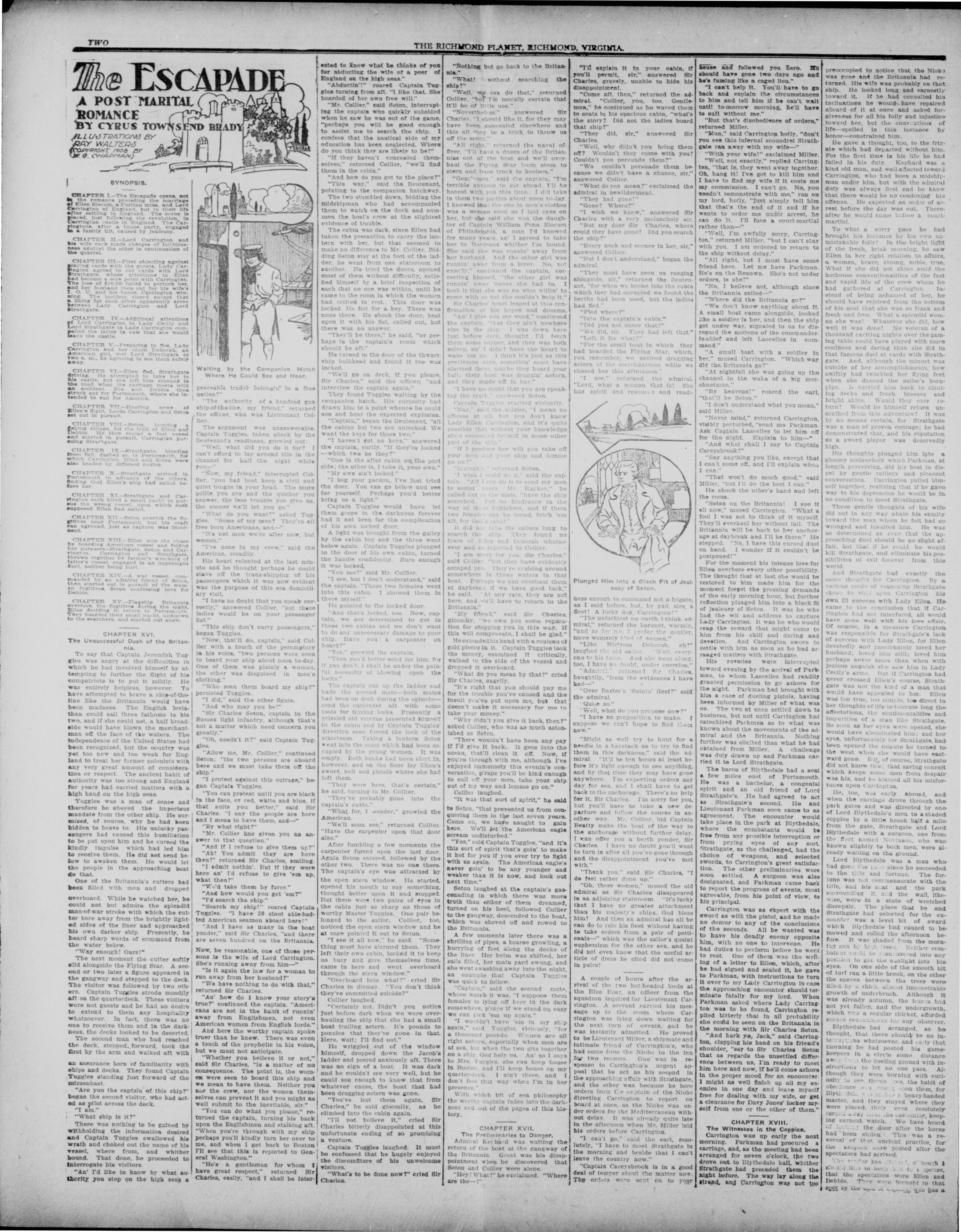
The ESCAPADE
A POST MARITAL
ROMANCE
BY CYRUS TOWNSEND BRADY
ILLUSTRATIONS BY
DAY WALTERS
COPYRIGHT, 1908, BY
W. O. CHAPMAN
TWO
SYNOPSIS.
CHAPTER I.—The Escapade opens, not the romance preceding the marriage of Ellen Slocum, a Puritan miss, and Lord Caenling, of England, but in the life after settling in England. The scene is placed, just following the revolution, in Carrington castle in England. The Carrington after a house party, engaged in a family tilt, caused by jealousy.
CHAPTER II.—Lord Carrington and his son each made charges of faithlessness against the other in continuation of the quarrel.
CHAPTER III.—First objecting against playing cards with the guests, Lady Carrington agreed to cut cards with Lord Strathgate, whose attentions to Ellen Slocum came out, with Carrington. The loss of $1,000 was paid to the wife and her husband then cut for his wife's I. O. U. and his honor, Carrington winnily. The incident closed except that Wilmington and other apparently across between Lady Carrington and Lord Strathgate.
CHAPTER IV.—Additional attentions of Lord Carrington to Lady Cecily and Lord Strathgate to Lady Carrington compelled the latter to vow that she would leave the castle.
CHAPTER V.—Preparing to flee, Lady Carrington and her chum Deborah, an account girl met Lord Strathgate at two a. m., he agreed to see them safely away.
CHAPTER VI—Ellen fled, Strathgate driving. He attempted to take her to the castle but she left him stunned in the house when the and. Didbells that an accident. She didbells that struck out for Portsmouth, where she intended to sail for America.
CHAPTER VII—Hearing news of Ellen's flight, Lords Carrington and Soton set out in pursuit.
CHAPTER VIII—Seton, locating a fishing village, hit the trail of Ellen and bison rented a fast vessel and started in pursuit, Carrington pursuing Strathgate.
CHAPTER IX—Strathgate, bleeding from fall, dashed on to Portsmouth, for which Carrington, Ellen and Soton were also headed by different routes.
CHAPTER X—Strathgate arrived in Portsmouth in advance of the others, funding that Ellen's ship had sailed before her.
CHAPTER XI—Strathgate and Carrington each hired a small yacht to pursue the wrong vessel, upon which each sailed Ellen had sailed.
CHAPTER XII—Overtok the fugitives near Portsmouth, but his craft ran ground, just as capture was imminent.
CHAPTER XIII - Ellen won the chase by boarding American vessel and felting her pursuers - Strathgate, Seton and Carrion. She threw them together by former's wrecking of latter's vessel, engaged in an impromptu duel, neither being hurt.
CHAPTER XIV - A war vessel, commanded by an admiral friend of Seton, then out in pursuit of the women fugitives. Seton confessing love for Debbie.
CHAPTER XV - Flagship Britannia overtook the fugitives during the night, Ellen deciding to return to Portsmouth, where she small sail, unknown to the seakers.
CHAPTER XVI
The Unsuccessful Dash of the Britannia.
To say that Captain Jeremiah Tuggles was angry at the difficulties in which he had involved himself by attempting to further the flight of his compatriots is to put it mildly. He was entirely helpless, however. To have attempted to brave a ship of the line like the Britannia would have been madness. The English levitathan could sail three fathoms to his two, and if she could not, a half broadside would have blown the merchantman off the face of the waters. The independence of the United States had been recognized, and the country was yet too new and too weak for England to treat her former colonists with any very great amount of consideration or respect. The ancient habit of authority was too strong and England for years had carried matters with a high hand on the high seas.
Tuggles was a man of sense and therefore he obeyed the imperious mandate from the other ship. He surmised, of course, why he had been bidden to heave to. His unlucky passengers had caused this humiliation to be put upon him and he cursed the kindly impulse which had led him to receive them. He did not send below to awaken them. He would let the people in the approaching boat do that.
One of the Britannia's cutters had been filled with men and dropped overboard. While he watched her, he could not but admire the splendid man-of-war stroke with which the cutter bore away from the brightly lighted sides of the liner and approached his own darker ship. Presently, he heard sharp words of command from the water below.
"Way enough! Oars!"
The next moment the cutter softly alld alongside the Flying Star. A second or two later a figure appeared in the gangway and stepped to the deck. The visitor was followed by two others. Captain Tuggle's strode moodily aft on the quarterdeck. These visitors were not guests and he had no desire to extend to them any hospitality whatsoever. In fact, there was no one to receive them and in the darkness, the decks looked to be deserted. The second man who had reached the deck, stepped, forward, took the first by the arm and walked aft with an assurance born of familiarity with ships and decks. They found Captain Tuggle standing just forward of the mitzenbast.
"Are you the captain of this ship?" began the second visitor, who had acted as pilot across the deck.
"I am."
"What ship is it?"
There was nothing to be gained by withholding the information desired and Captain Tuggles swallowed his wrath and choked out the name of his vessel, where from, and whither bound. That done, he proceeded to interrogate his visitors.
"An' I'd like to know by what authority you stop on the high seas a
THE FORTRESS
Waiting by the Companion Hatch
Where He Could See and Hear.
peaceable trader belongin" to a free
nation?
"The authority of a hundred gun
ship-of-the-line, my friend," returned
the officer, who was Lieutenant Coller.
The argument was unanswerable.
Captain Tuggle, taken aback by
the lieutenant's readiness, growled out:
"Well, what did you do it for? I
can't afford to lay around idle in the
channel for half the night while you—"
"Now, my friend," interrupted Coller,
"you had best keep a civil and
quiet tongue in your head. The more
polite you are and the quicker you
answer, the less trouble you give us,
the sooner we'll let you go."
"What do you want?" asked Tuggle.
"Some of my men! They're all
free born Americans, and—"
"It's not men we're after now, but women."
"I've none in my crew," said the American, steadily.
His heart relented at the last minute and he thought perhaps he could stave off the trans-shipping of his passengers which it was now evident was the purpose of this sea domiciliary visit.
"I have no doubt that you speak correctly," answered Collier, "but these ladies would be on your passenger list."
"This ship don't carry passengers," began Tuggles.
"Now, that'll do, captain," said Collier with a touch of the peremptory in his voice, "two persons were seen to board your ship about noon to-day. One of them was plainly a woman, the other was disguised in men's clothing."
"Who seen them board my ship?" persisted Tuggles.
"I did," the said the other figure.
"And who may you be?"
"Sir Charles Seton, captain in the Sussex light infantry, although that's not a matter which need concern you greatly."
"Oh, needn't it?" said Captain Tuggles.
"Allow me, Mr. Collier," continued Seton; "the two persons are aboard here and we must take them off the ship."
"I protest against this outrage," began Captain Tuggles.
"You can protest until you are black in the face, or red, white and blue, if that suits you better," said Sir Charles. "I say the people are here and I mean to have them, and—"
"By what right?"
"Mr. Collier has given you an answer to that question."
"And if I refuse to give them up?"
"Ah! You admit they are here then?" returned Sir Charles smiling.
"I admit nothin'. But if they were here an' Id refuse to give 'em up, what then?" "We'd take them by force." "And how would you get 'em?" "Id search the ship." "Search my ship!" roared Captain Tuggles. "I have 20 stout able-bodied American seamen aboard here!"
Now, be reasonable, one of those persons is the wife of Lord Carrington. She's running away from him—"
"Is it again the law for a woman to run away from her husband?"
"We have nothing to do with that," returned Sir Charles.
"An' how do I know your story's true?" continued the captain. "Americans are not in the habit of runnin' away from Englishmen, not even American women from English lords."
And here the worthy captain spoke truer than he knew. There was even a touch of the prophetic in his voice, but we must not anticipate.
"Whether you believe it or not," said Sir Charles, "is a matter of no consequence. The point is, the women were seen to board this ship and we mean to have them. Neither you nor the crew, nor the women themselves can prevent it and you might as well submit to the inevitable, sir."
"You can do what you please," returned the captain, turning his back upon the Englishmen and stalking aft. "When you're through with my ship perhaps you'll kindly turn her over to me, and when I get back to Boston I'll see that this is reported to General Washington."
"He's a gentleman for whom I have great respect," returned Sir Charles, easily, "and I shall be inter-
THE RICHMOND PLANET, RICHMOND, VIRGINIA
ested to know what he thinks of you for abducting the wife of a peer of England on the high seas.
"Abducttie!" roared Captain Tugles turning from aft. "I like that. She boarded of her own free will."
"Mr. Collier," said Seton, interrupting the captain who quickly subsided when he saw he was out of the game, "perhaps you will be good enough to assist me to search the ship. I confess that the nautical side of my education has been neglected. Where do you think they are likely to be?
"If they haven't concealed themselves," returned Collier, "we'll find them in the cabin."
"And how do you get to the place?"
"This way," said the lieutenant, pointing to the companion hatchway.
The two stumbled down, blinding the midshipman who had accompanied them to watch on the deck and summon the boat's crew at the slightest evidence of trouble.
The cabin was dark, since Ellen had taken the precaution to carry the lantern with her, but that seemed to make no difference to Mr. Collier, Bidding Saton stay at the foot of the ladder, he went from one stateroom to another. He tried the doors, opened most of them without difficulty, satisfied himself by a brief inspection of each that no one was within, until he came to the room in which the women had retired to rest. This door was locked. He feit for a key. There was none there. He shook the door, beat upon it with his fist, called out, but there was no answer.
"They'll be there," he said, "or perhaps in the captain's room which should be aft."
He turned to the door of the thwartship bulkhead and found it too was locked.
"We'll go on deck, if you please, Sir Charles," sald the officer, "and interview the captain again."
They found Tugglews waiting by the companion hatch. His curiosity had drawn him to a point whence he could see and hear the expected explosion. "Captain," began the lieutenant, "all the cabins but two are unlocked. We want the keys for those two." "I haven't got no keys," answered the captain, curtly. "If they're locked—which two be they?" "One is the after cabin on the port side; the other is, I take it, your own." "My own ain't locked." "I beg your pardon, I've just tried the door. You can go below and see for yourself. Perhaps you'd better bring us a light." Captain Tugglews would have let them grope in the darkness forever had it not been for the complication of his own locked door.
A light was brought from the galley by the cabin boy and the three went below again. Captain Tuggles plunged to the door of his own cabin, turned the handle confidently. Sure enough it was locked.
"You see?" said Mr. Collier.
"I see, but I don't understand," said the captain. "Those two females went into this cabin. I showed them in there myself."
He pointed to the locked door.
"And that's locked, too. Now, captain, we are determined to get in those two cabins and we don't want to do any unnecessary damage to your ship. Have you a carpenter on board?"
"Yes," growled the captain.
"Then you'd better send for him, for if you don't, I shall be under the painful necessity of blowing open the locks."
The captain ran up the ladder and bade the second mate—both mates had been on deck during the episode—send the carpenter aft with some tools for forcing locks. Presently a grizzled old veteran presented himself in the cabin and by Captain Tuggles' direction soon forced the lock of the stateroom. Taking a lantern Seton went into the room which had been occupied by the young women. It was empty. Both bunks had been slept in, however, and on the floor lay Ellen's sword, belt and pistols where she had left them.
"They were here, that's certain," he said, turning to Mr. Collier.
"They've probably gone into the captain's cabin."
"What for, I wonder," growled the American.
"We'll soon see," returned Collier.
"Have the carpenter open that door also."
After fumbling a few moments the carpenter forced open the last door. Again Seton entered, followed by the other two. There was no one there. The captain's eye was attracted by the open stern window. He started, opened his mouth to say something, thought better upon it and stopped. But there were two pairs of eyes in the cabin just as sharp as those of worthy Master Tuggles. One pair belonged to the sailor. Collier, too, noticed the open stern window and he at once pointed it out to Seton.
"I see it all now," he said. "Something must have alarmed them. They left their own cabin, locked it to keep us busy and give themselves time, came in here and went overboard through the stern window."
"Overboard into what?" cried Sir Charles in dismay. "You don't think they've committed suicide?" Collier laughed.
"Certainly not. Didn't you notice just before dark when we were overhauling the ship that she had a small boat trailing astern. It's pounds to pennies that they've gone in that. Here, wait; Till find out."
He wriggled out of the window himself, dropped down the Jacob's ladder and peered anxiously aft. There was no sign of a boat. It was dark and he couldn't see very well, but he could see enough to know that from whatever cause, the boat that had been dragging astern was gone.
"You've lost them again, Sir Charles," he said gloomily, as he climbed into the cabin again.
"I'll not believe it," cried Sir Charles bitterly disappointed at this unfortunate ending of so promising a venture.
Captain Tuggles laughed. It must be confessed that he hugely enjoyed the discomfiture of his unwelcome visitors.
"What's to be done now?" cried Sir Charles.
"Nothing but go back to the Britannia."
"What! without searching the ship?"
"Well, we can do that," returned Collier, "but I'm morally certain that it'll be of little use."
"Nevertheless," answered Sir Charles, "I should like it, for they may have been concealed elsewhere and this all may be a trick to throw us off the scent."
"All right," returned the naval officer, "Til have a dozen of the Britannias out of the boat and we'll overhaul the Flying Star from stem to stern and from truck to keelson."
"Gent'men," said the captain, "I'm terrible anxious to get ahead. I'll be honest with you this time. I did take in them two parties about noon to-day. I knew that the one in men's clothes was a woman soon as I laid eyes on her, but she said she was the daughter of Captain William Penn Slocum of Philadelphia, a man I'd known for many years, an' I agreed to take her to Bordeaux whether I bound. She said she was runnin' away from her husband. And the other girl was runnin' away from a lower. No, not exactly." continued the captain, correcting himself, "the other girl was runnin' away 'cause she had to. I took it that she was no wise willin' to come with us but she couldn't help it."
Sir Charles' heart leaped at this confirmation of his hopes and dreams.
information or his hopes and dreams.
"An' I give you my word," continued the captain, "that they didn't nowhere else in the ship. I was down here just before dark, thought I'd fetch them some super, and they was both asleep, an' I didn't have the heart to wake 'em up. I think it's just as this gentleman says, somethin' must have alarmed them, maybe they heard your hall; their boat was draggin' astern, and they made off in her."
"I have no doubt that you are speaking the truth," answered Seton.
Captain Tuggles startled violently.
"Nay," said the soldier, "I mean no offense at all, but you don't know Lady Ellen Carrington, and it's quite possible that without your knowledge she's concealed herself in some other part of the ship."
"If I produce her will you take off your men and your ship and lemme go on."
"Instantly," returned Seton.
"I wish I could do it," said the captain. "All I can do is to send my men to assist yours. Mr. Rayker," he called out to the mate, "have the ship searched. Put no hindrance in the way of these Britishers, and if them two females can be found, fetch 'em aft, for God's sake!"
It did not take the sailors long to search the ship. They found no trace of Eilen and Deborah whatsoever and so reported to Collier.
"I am sorry for you, Sir Charles," said Collier, "but they have evidently escaped you. They're cruising around somewhere in these waters in that boat. Perhaps we can overhaul them at daybreak if we have good luck" he said. "At any rate, they are not here, and we'll have to return to the Britannia."
"My friend," said Sir Charles, gloomily, "we owe you some separation for stopping you in this way. If this will compensate, I shall be glad."
He extended his hand with a rouleau of gold pieces in it. Captain Tuggles took the money, examined it critically, walked to the side of the vessel and dropped it overboard.
"What do you mean by that?" cried Slr Charles, angrily.
"It's right that you should pay me for the trouble you've caused and the insult you've put upon me, but that doesn't make it necessary for me to take your money."
"Why didn't you give it back, then?" asked Collier, who was as much astonished as Seton.
"There wouldn't have been any pay if I'd give it back. It goes into the ocean, that'll clean it off. Now, if you're through with me, although I've enjoyed immensely this evenin's conversation, 'praps you'll be kind enough to call off your men, take your ship out of my way and lemme go on.'"
"It was that sort of spirit," he said to Seton, "that prevented us from conquering them in the last seven years. Come on, we have naught to gain here. We'll let the American eagle scream undisturbed."
"Yes," said Captain Tuggle, "and it's this sort of spirit that's goin' to make it hot for you if you ever try to fight with us again. The American eagle's never goin' to be any younger and weaker than it is now, and look out next time."
Seton laughed at the captain's gas-conading in which there was more truth than either of them dreamed, turned on his heel, followed Collier to the gangway, descended to the boat, which was shoved off and rowed to the Britannia.
A few moments later there was a shrilling of pipes, a bore growling, a hurrying of feet along the decks of the liner. Her helm was shifted, her sails filled, her main yard swung, and she went swashing away into the night, an example that Captain Tuggles was quick to follow.
"Captain," said the second mate, whose watch it was. "I suppose them females is lying off here in the dark somewhere, 'prays if we stand on easy we can pick 'em up again."
"I wouldn't have 'em in my ship again," said Tuggles, viciously, "for a thousand pounds. Women are all right ashore, especially when men are at sea, but when the two gits together on a ship, God help us. An' so I says to Mrs. Tuggles, she can keep house in Boston, and I'll keep house on my quarter-deck. I ain't there, and I don't feel that way when I'm in her presence."
With which bit of sea philosophy the worthy captain fades into the darkness and out of the pages of this history.
CHAPTER XVII.
CHAPTER XVII.
The P-Reminibaries to Danger.
Admiral Kephard was waiting the return of the boat at the gangway of the Britannia. Great was his disappointment when he discovered that Seton and Collier were alone.
"Hey! What?" he exclaimed. "Where are the—?"
"I'll explain it in your cabin, if you'll permit, sir," answered Sir Charles, gravely, unable to hide his disappointment.
"Come aft, then," returned the admiral. "Collier, you, too. Gentlemen," he continued as he waved them to seats in his spacious cabin, "what's the story? Did not the ladies board that ship?"
"They did, sir," answered Sir Charles.
"Well, why didn't you bring them off? Wouldn't they come with you? Couldn't you persuade them?"
"We couldn't persuade them because we didn't have a chance, sir," answered Collier.
"What do you mean?" exclaimed the admiral in bewilderment.
"They had gone!"
"Gone? Where?"
"I wish we knew," answered Sir Charles with a very melancholy air.
"But my dear Sir Charles, where could they have gone? Did you search the ship?"
"Every nook and corner in her, sir," answered Collier.
"But I don't understand," began the admiral.
"They must have seen us ranging alongside, sir," returned the lieutenant, "for when we broke Into the cabin which they had occupied we found the berths had been used, but the ladies had fed."
"Fled where?"
"Into the captain's cabin."
"Did you not enter that?"
"We did, sir. They had left that."
"Left it for what?"
"For the small boat in which they had boarded the Flying Star, which, you remember, we noticed dragging astern of the merchantman while we chased her this afternoon."
"I see," returned the admiral.
"Lord, what a woman that is! She has spirit and resource and read-
A
Plunged Him into a Black Filt of Jealousy of Seton.
ness enough to command not a frigate, as I said before, but, by gad, sirs, a fleet! A lucky dog, Carrington!
"The unluckiest on earth, I think, admiral," returned the baronet, warmly, "and as for me, I prefer the gentler, more womanly kind of women."
"Admit it!" returned Sir Charles, haughtily, "from the evidences I have had—"
"Over Baxter's 'Saints' Rest?' said the admiral.
"Quite so."
"Well, what do you propose now?"
"I have no proposition to make. I suppose we can't hope to find them now."
"Might as well try to hunt for a needle in a haystack as to try to find them in this darkness," said the admiral. "It'll be ten hours at least before it's light enough to see anything, and by that time they may have gone anywhere. I'm expecting orders any day for sea, and I shall have to get back to the anchorage. There's no help for it, Sir Charles. I'm sorry for you, but you'll have to take a new departure and follow the course in another way. Mr. Collier, bid Captain Beatty make the best of the way to the anchorage without further delay. I can offer you a berth youve, Sir Charles. I have no doubt you'll want to turn in after all you've gone through and the disappointment you've met with."
"Thank you," said Sir Charles, "I do feel rather done up."
"Oh, these women." mused the old admiral as Sir Charles disappeared in an adjoining stateroom. "It's lucky that I have no greater attachment than his majesty's ships, God bless him! And then an admiral has all he can do to rule his feet without having to take orders from a pair of petticoats—" which was the sailor's quaint uphemism for the other sex, and he did not even know that the useful article of dress he cited did not come in pairs!
A couple of hours after the arrival of the two hotheaded lords at the Blue Boar, an officer from the squadron inquired for Lieutenant Carrington. A servant carried his message up to the room where Carrington was lying down waiting for the next turn of events, and he was instantly admitted. He proved to Lieutenant Miller, a shipmate and intimate friend of Carrington's, who had come from the Niobe to the inn for two reasons. One was in response to Carrington's urgent appeal that he act as his second in the approaching affair with Strathgate, and the other was because he bore orders from the captain of the Niobe directing Carrington to report on board at once, as the Niobe was under orders for the Mediterranean without delay. It was already quite late in the afternoon when Mr. Miller laid his orders before Carrington.
"I can't go," said the earl, resolutely, "I have to meet Strathgate in the morning and beside that I can't leave the country now."
"Captain Careysbrook is in a good deal of temper about the matter now. The orders were sent on to your
house and followed you here. He should have gone two days ago and he's fuming like a caged lion."
"I can't help it. You'll have to go back and explain the circumstances to him and tell him if he can't wait until to-morrow morning, he'll have to sail without me."
"But that's disobedience of orders," returned Miller.
"Man," said Carrington hotly, "don't you see this infernal scoundrel Strathgate ran away with my wife—"
"With your wife!" exclaimed Miller.
"Well, not exactly," replied Carrington, "that is, they went away together. Oh, hang it! I've got to kill him and I have to find my wife if it costs me my commission. I can't go. No, you needn't remonstrate with me," ran on my lord, hotly, "just simply tell him that that's the end of it and if he wants to order me under arrest, he can do it. I'll face a court-martial rather than—"
"Well, I'm awfully sorry, Carrington," returned Miller. "but I can't stay with you. I am ordered to return to the ship without delay."
"All right, but I must have some friend here. Let me have Parkman. He's on the Renown. She's not under orders, is she."
"No, I believe not, although since the Britannia sailed—"
"Where did the Britannia go?"
"We don't know anything about it. A small boat came alongside, looked like a soldier in her, and then the ship got under way, signaled to us to disregard the motions of the commander-in-chief and left Lascelles in command."
"A small boat with a soldier in her," mused Carrington. "Which way did the Britannia go?"
"At nightfall she was going up the channel in the wake of a big merchantman."
"By heavens!" roared the carl, "that'll be Seton."
"I don't understand what you mean," said Miller.
"Never mind," returned Carrington, visibly perturbed, "send me Parkman. Ask Captain Lascelles to let him off for the night. Explain to him—"
"And what shall I say to Captain Careysbrook?"
"Say anything you like, except that I can't come off, and I'll explain when I can."
"That won't do much good," sald Miller, "but I'll do the best I can."
He shook the other's hand and left the room.
"Seten on the Britannia! I see it all now," mused Carrington. "What a fool I was not to think of it myself. They'll everhaul her without fall. The Britannia will be back to her anchorage at daybreak and I'll be there." He stopped. "No, I have this cursed duel on hand. I wonder if it couldn't be postponed!"
For the moment his intense love for Ellen overbore every other possibility. The thought that at last she would be restored to him made him for the moment forget the pressing demands of the early morning hour, but further reflection plunged him into a black fit of jealousy of Soton. It was he who had the wit and address to capture Lady Carrington. It was he who would reap the reward that might come to him from his skill and daring and devotion. And Carrington swore to settle with him as soon as he had arranged matters with Strathgate.
His reveries were interrupted toward evening by the arrival of Parkman, to whom Lascelles had readily granted permission to go ashore for the night. Parkman had brought with him a case of dueling pistols, having been informed by Miller of what was on. The two at once settled down to business, but not until Carrington had catechized Parkman as to what was known about the movements of the admiral and the Britannia. Nothing further was elicited than what he had obtained from Miller. A challenge was duly drawn up and Parkman carried it to Lord Strathrate.
The baron of Blythedale had a seat a few miles east of Portsmouth. He was a bachelor, a congenial spirit and an old friend of Lord Strathgate's. He had agreed to act as Strathgate's second. He and Lieutenant Parkman soon came to an agreement. The encounter would take place in the park at Blythedale, where the combatants would be free from any possible interruption or from prying eyes of any sort. Strathgate, as the challenged, had the choice of weapons, and selected swords, to Carrington's great satisfaction. The other preliminaries were soon settled. A surgeon was also designated, and Parkman came back to report the progress of events, most agreeable, from his point of view, to his principal.
"And hark ye, Jack," said Carrington, clapping his hand on his friend's shoulder, "say to Sir Charles Seton that as regards the unsettled difference between us, I'm ready to meet him here and now, if he'll come ashore in the proper mood for an encounter. I might as well finish up all my enemies in one day and leave myself free for dealing with my wife, or get a clearance for Davy Jones' locker myself from one or the other of them."
CHAPTER XVIII.
The Witnesses in the Coppice.
Carrington was up early the next morning. Parkman had procured a carriage, and, as the meeting had been arranged for seven o'clock, the two drove out to Blythedale hall, whither Strathgate had preceded them the night before. The way lay along the strand, and Carrington was not too
preoccupied to notice that the Nibos was gone and the Britannia had returned. His wife was probably on that ship. He looked long and earnestly toward it. If he had consulted his inclinations he would have repaired aboard of it at once and asked forgiveness for all his folly and injustice toward her, but the convictions of life—spelled in this instance by honor—constrained him.
He gave a thought, too, to the frigate which had departed without him. For the first time in his life he had failed in his duty. Kephard was a kind old man, and well-affected toward Carrington, who had been a mildshipman under him, but with the admiral duty was always first and he knew that there would be no condoning his offense. He expected an order of arrest before the day was out. Thereafter he would come before a court-martial.
To what a sorry pass he had brought his fortunes by his own unmistakable folly! In the bright light of the fresh, brisk morning, he saw Ellen in her right relation to affairs, a woman, brave, strong, noble, true. What if she did not shine amid the hothouse conventionalities of the fast and vapid life of the crew whom he had gathered at Carrington. Instead of being ashamed of her, he should have rejoiced from the bottom of his soul that she was so frank and fresh and free. What a splendid woman she was! Whatever she did, how well it was done! No veteran of a thousand exciting nights over the gaming table could have played with more coolness and daring than she did in that famous duel at cards with Strathgate. And, although the minuet was outside of her accomplishments, how swiftly had twinkled her flying feet when she danced the sailor's hornpipe. It carried him back to slanting decks and fresh breezes and bright skies. Would they ever return? Would he himself return unscathed from this adventure? It was by no means certain, for Strathgate was a man of proven courage; he had demonstrated that, and his reputation as a sword player was deservedly high.
His thoughts plunged him into a gloomy melancholy which Parkman, at length perceiving, did his best to dispel by gentle raffery and pleasant conversation. Carrington pulled himself together, realizing that if he gave way to his depression he would be in no condition to meet Strathgate.
These gentle thoughts of his wife did not in any way abate his enmity toward the man whom he felt had so wronged and insulted him. He was as determined as ever that the approaching duel should be no slight affair, but that if he could he would kill Strathgate, and eliminate his possibilities of evil forever from this world.
And Strathgate had exactly the same thought for Carrington. By a curious mode of reasoning Strathgate chose to visit upon Carrington his own ill success with Lady Ellen. He came to the conclusion that if Carrington had not interfered, all would have gone well with his love affair. Of course, in a measure Carrington was responsible for Strathgate's lack of success with Lady Ellen, for Ellen devotedly and passionately loved her husband; loved him still; loved him perhaps never more than when with jealous anguish she saw him in Lady Cecily's arms. But if Carrington had never crossed Ellen's course, Strathgate was not the kind of a man that would have appealed to her. Ellen was too true, too simple, too direct in her thoughts of life to tolerate long the affectations, the sentimentalities and impurities of a man like Strathgate. So soon as her eyes were opened, she would have abominated him; and her eyes, unfortunately for Strathgate, had been opened the minute he turned to the west when she would have eastward gone. But, of course, Strathgate did not know this; that saving conceit which keeps some men from despair was his, and he blamed all his misfortunes upon Carrington.
He, too, was early abroad, and when the carriage drove through the park gates and was directed by one of Lord Blythedale's men to a shaded coppice by a little brook half a mile from the gate, Strathgate and Lord Blythedale with a surgeon, one from the fleet named Novinson, who was known slightly to both men, were already waiting on the ground.
Lord Blythedale was a man who had gone the pace since he succeeded to the title and fortune. The fortune was not commensurate with the title, and his seat and the park surrounding it, and the wall, likewise, were in a state of wretched disrepair. The place that he and Strathgate had selected for the encounter was a level bit of sward which Blythedale had caused to be mowed and rolled the afternoon before. It was shaded from the morning sun by high trees. Neither combat could be maneuvered into any position to get the sunlight into his eyes. On one side of the smooth bit of turf ran a little brook, on the other the spaces between the trees were filled by a thick, almost impenetrable growth of underbrush. Although it was already autumn, the leaves had not yet fallen, and the undergrowth, which was a regular thicket, afforded secure congestion for any observer.
Blythedale had arrived, as he thought, that there should be no interruptions whatsoever, and early that morning he had posted his gamekeepers in a circle some distance away from the dueling ground with instructions to let no one pass. Although they were burning with curiosity to see them yes, the habit of obsession was strong upon them, for Blyth's wife was rather a heavy-handed master, and they stayed where they were placed, their eyes resolutely turned away from the encounter, keeping carnest watch. We have heard of nothing the door after the horse had been stolen. This was a reversal of that ancient practice, for the keepers were posted after the spectators had arrived.
The reader has decided, although I should like to keep them in spense, that the spectators were Ellen and Debbie. They were brought to that spot by the end of Christmas who has a
THE PLANET
SATURDAY.....MAY 2, 1908
habit of working most opportunely in accordance with a poor author's plans.
By some instinct, for which she never ceased to be thankful, Ellen had put their boat on the right course when she hoisted the sail and grappled the tiller in that moment when they had escaped from the Flying Star. The moon rose late and by the time it was shining brightly Ellen was so far in shore toward the east side of Portsmouth harbor that the Britannia, lumbering over toward the Isle of Wight, had no chance of picking up the small boat.
It was almost morning when Ellen made a landing. The wind was adverse for Portsmouth—which did not trouble her, for she was quite anxious
TOSCANA
Finally They Game to a Low Place in the Wall.
not to appear in the streets of that town in which she was sure her husband, Strathcate and Sir Charles would soon be assembled. She had formed no plan as to the future as yet. She only wished to get ashore, to get something to eat and a place to lie concealed while she thought it over. The wind failed and it was not until daybreak, or about four o'clock, that Ellen ran ashore.
It was a lonely spot, some miles to the eastward of Portsmouth. She aroused Deborah, who had slept most of the night in the bottom of the boat, and the two tired women, after tying the boat to the shore, plucked inland. At a little farmhouse—the farmer's wife being just a woman, apparently—they got some bread and milk which blunted the edge of their appetite—it must be remembered that they had not eaten anything since the noon before—and from the woman they learned the lay of the land.
They scrambled through bypasses for a long time and a little after six o'clock reached the main road. Before them rose the broken walls of a gentleman's country seat. The road was deserted at that hour. Ellen hardly knew what to do. She did not know how far it was to the next inn, nor was she certain, if she did know, that it would be a safe place for her to hide. Debbie, out of whom the spirit had been almost crushed by the succession of dazzling adventures through which she had passed, could offer no suggestion of value. She clung to Ellen's arm as if the latter had been a man, and so far as help or assistance was concerned was a mere dead weight.
"One thing I tell you, Ellen," she began at last, "I can go no farther; that is, I can walk no farther. We must find some place to rest."
"Well, dear," said Ellen, tired enough herself, but a man beside poor Debbie, "let's enter that park, perhaps we can find some one there among the servants who will help us without asking too many questions.
"Those clothes you have on, Ellen," said Debbie, desperately, "are bound to attract attention, or you in them. I don't know what we are going to do! I wish I were back in Carrington, or I wish I was in Boston, or on the Flying Star, or anywhere but here."
"Cheer up, Debbie," said Ellen, taking her by the hand and leading her forward, "we'll get into this park and it shall go hard with us if I don't find some means of succoring you."
The two stumbled along the road for a quarter of a mile, looking for a place of entrance. The gate was behind them, but Ellen did not deem it wise to try that. Finally they came to a low place in the wall over which Ellen helped Debbie and followed herself. The park in which they found themselves had been badly neglected. A mile away, as openings through the trees gave them glimpses of it from time to time, they saw the chimneys and towers of a great house. Toward it the two painfully made their way through the undergrowth, meeting no one in their progress. After half an hour's struggling, they came to an open piece of award, newly mowed it was evident from the piles of grass that had been raked away on the edges. On the opposite of it a little brook purled merrily over sand and pebbles.
Thither the two women staggered, and kneeling down took long draughts of the sweetness and bathed their faces and hands in the cold water. They were thus engaged when they heard voices coming from the direction of the hall. Instantly Ellen seized Deborah and ran back to the thicket whence they had just emerged and lay down, entirely concealed by the undergrowth.
although able to see everything them
selves that took place on the grass
serves that took place on the grass. "Who is it, think you?" whispered Debbie, after she had been forced down into a prone position. "How should I know?" answered Ellen. "Well, if it looks like a gentleman," continued Debbie, desperately. "I'm going to get up and ask his assistance." "You'll do no such thing," said Ellen in a sharp whisper. "Be guided by me. I know men and the world as you don't." Indeed, it would have been hard to choose between the innocence of the matron and the maid, but Ellen flattered herself that her years and her marriage had made her wise. "Let me decide what is to be done," she added. "You've decided everything," said Debbie, resentfully, "and look what a position we're in." "Hush!" said Ellen. "Here they are."
At the same instant a man stepped into the clearing. Deborah opened her mouth as if to scream. Ellen caught her violently by the arm repeating her caution.
"It's Lord Strathgate!" murmured Deborah, amazed.
"I see," returned Ellen. "Now, will you be quiet?"
"I wonder what he's here for?" whispered poor Deborah under her breath.
(TO BE CONTINUED.)
Senator Foraker's Great Speech.
(Continued From First Page.)
occupied on the night of the affray by Maj. Charles W. Penrose, the commanding officer of the battalion and the post; Captain Lyon, commanding Company D; Captain Macklin, commanding Company C; Lieutenant Lawrason, commanding Company B, and Lieutenant Grier, acting quartermaster and commissary of the post. Parallel with Elizabeth Street and 120 feet eastwardly from the same, in the middle of the block, is an alley 20 feet in width, known in the testimony as "Cowen alley."
A DETA!LED EXPLANATION
The mouth of this alley approaches the fort at a point about opposite the space between the B Company and C Company Barracks. Along the wall outside the reservation was a road 30 feet in width, called the Garrison road. Along the wall inside the reservation were the sinks, coal houses, and other outbuildings of the barracks. The barracks were two-story buildings, with lower and upper porches in rear along their entire length. Each of these barracks was about 165 feet in width. The upper porch was only 12 feet above the ground.
THE CHARGE AGAINST THE SOLDIERS.
The charge against the soldiers is that a few minutes before midnight, August 13, 1906, a squad, estimated by the different witnesses all the way from five or six to twenty, in pursuance of a carefully planned and concerted conspiracy to shoot their in town, in some way secured their guns from the gun racks, opened fire on the town from the upper porch of B barracks, then rushed down to the ground, and to the wall separating the reservation from the town, jumped over the wall at a point opposite Cown alley, proceeded northward, along that alley a distance of 2 or 3 squares, shooting into the houses, hotels, and saloons, and at citizens on the streets, with the result that they fired probably from two to three hundred shots, killed a bartender of the Tillman saloon by the name of Frank Natus, killed the horse of the lieutenant of police, Dominguez, wounding in his left arm, and did other damage to one kind and that; that at the entrance of the alley and Thirteenth street, where he Miller Hotel is situated, the squad divided, one portion of it going east on Twelfth Street to Washington Street, the next street east of Elizabeth St., where they fired a number of shots into the house of a revenue deputy by the name of Starck; that after this, which was the last of the firing, they returned to the fort and joined their companies without being detected by their officers, who were at that time wide-awake and engaged in the formation of the companies.
THE CONSPIRACY OF SILENCE
Finally, under the stress of circumstances, it was further charged that, in the nature of things, it was impossible for such a squad of soldiers to plan and execute such a conspiracy without many, if not all, of the other members of the battalion having knowledge which, if disclosed, would identify the particular individuals who participated in the shooting, and that the inability of the inspection officers and others to secure any such information was to be attributed to a conspiracy of silence so which all having such knowledge, whether few or many, must have entered. The gradual evolution of this last charge is interesting, suggestive, and instructive. It had its inception, so far as the record discloses, in the following passage from the report of Major Blocksom, dated at Brownsville, August 20, 1906.
The officers appeared to be trying to find the criminals, but it is certainly unfortunate for the reputation
THE RICHMOND PLANET, RICHMOND, VIRGINIA
of the battalion that they have as yet hardly discovered a single clue to such a terrible preconcerted crime committed by so many men.
"I believe the battalion had an excellent reputation up to the 13th of August, but the stain new upon it is the worst I have ever seen in the Army.
MAJOR BLOCKSOM'S CONCLU-
SIONS.
"Many of its old soldiers who had nothing to do with the raid must know something tangible as to identity of the criminals. If they do not disclose their knowledge, they should be made to suffer with others more guilty, as far as the law will permit. If satisfactory evidence concerning the identity of the criminals does not come from members of the battalion before a certain date to be fixed by the War Department, I recommend that all enlisted men of the three companies present on the night of August 13 be discharged the service and debarred from re-enlistment in the Army, Navy or Marine Corps." This suggestion, without the help of any further testimony, took definite form in the order of October 4, 1906, issued by the Assistant Secretary of War, directing General Garlington to make an investigation, in the following language:
PRESIDENT ROOSEVELT'S DECISION
"The President authorizes you to make known to those concerned the orders given by him in this case, namely: 'If the guilty parties can not be discovered, the President approves the recommendation that the whole three companies implicated in this attack outrage should be dismissed and the officer debarred from en-listing in the United States'
"And in this connection the President further authorizes you to make known to those concerned that unless such enlisted men of the Twenty-fifth Infantry as may have knowledge of the facts relating to the shooting, killing and riotous conduct on the part of the men with the organizations serving at Fort Brown, Texas, on the night of the 13th of August, 1906, report to you such facts and all other circumstances in all other knowledge which will assist in approving the guilty parties, orders will be issued from the War Department discharging every man in Companies B, C, and D of the Twenty-fifth Infantry, without honor, and forever barring them from re-enlisting in the Army or Navy of the United States, as well as from employment in any civil capacity under the Government
A MOST REMARKABLE ULTIMA TION.
The time to be given to the enlisted men of Companies B, C and D, Twenty-fifth Infantry, for consideration of this ultimatum will be determined by you. If, at the end of the time designated, the facts and circumstances of the occurrence in question have not been established sufficiently clearly to indicate a reasonable certainty of the occurrence of the guilty parties by evidence obtained from enlisted men of the first battalion, Twenty-fifth Infantry, you will report the condition by wire to The Military Secretary.
On this point he said in his report that all the men denied guilt, or guilty knowledge, but that these denials— "Indicated a possible general understanding among the enlisted men of this battalion of the position they would take in the premises—"
NO EVIDENCE OF A CONSPIRACY
And I call the attention of Senators particularly to this—
"but I could find no evidence of such understanding."
No evidence that there was any conspiracy of silence. I emphasize that, because that, you will discover as we proceed, is an important part of this case in so far as there is any case left.
Upon this report, without an a lot of additional testimony—in other words, upon the mere suggestion of General Garlington and others that an agreement to withhold testimony had been entered into among the men, of which General Garlington was careful to say he had found no evidence—the President ordered all the men discharged.
THE PRESIDENT EMBRARASSED
Of that which was only "possible," in the opinion of General Garlington, and of which he "could find no evidence," the President, without any additional testimony, because so any thoroughly convinced by the time he felt it necessary to defend his action that in his message to the Senate of December 19, 1906, he said:
"A blacker crime never stained the annals of the Army. It has been supplemented by another, only less black, in the shape of a successful conspiracy of silence for the purpose of shielding those who took part in the original conspiracy of murder."
At another point in that same message he said:
"Yet some of the noncommissioned officers and many of the men of the three companies in question have banded together in a conspiracy to protect the assassins and would-be assassins who have disgraced their uniforms by the conduct above related. Many of these noncommissioned officers and men must have known, and all of them may have known, circumstances which would have led to the conviction of those engaged in the murderous assault. They have stoldy, and as one man, broken their oaths of enlistment and refused to help discover the criminals."
PRESIDENTIAL ARGUMENT.
A charge as to which, by the lat-
est official report laid before the President, it was said there was no testimony whatever. Although diligently searched for, the inspecting officers of the Army had been unable to find any testimony.
In his message to the Senate of January 14, 1907, after the Purdy testimony had been taken and the President felt called upon to further defend his action, he said:
"The testimony of the witnesses and the position of the bullet holes show that fifteen or twenty of the Negro troops gathered inside the fort and that the first shots fired into the town were fired within the fort—some of them, at least, from the upper galleries of the barracks.
"It is out of the question that the fifteen or twenty men engaged in the assault could have gathered behind the wall of the fort, began firing, some of them on the porches of the barracks, gone out into the town fired in the neighborhood of 200 shots in the town, then returned—the total time occupied from the time of the first shots to the time of their return being somewhere in the neighborhood of ten minutes—without many of their comrades knowing what they had done.
"Indeed, the fuller details as established by the additional evidence taken since I last communicated with the Senate make it likely that there were no shots of any, of the soldiers dismissed who could have been ignorant of what occurred. It is well nigh impossible that any of the noncommissioned officers who were as the barracks should not have known what occurred."
THE CHARGES
This so-called "Purdy testimony" was given by the citizens of Brownville, and was largely but a reposition or the testimony given previously, though not given under oath. It did not embrace any testimony of the soldiers, or of anybody, in regard to a withholding of knowledge by the soldiers, and there was no pretence on the part of anyone that any evidence had been discovered since General Garlington's report to indicate, much less establish, a conspiracy of silence, and at that time he officially reported that he could no evidence whatever of any conspiracy of silence.
But whether justified or not, the men who finally charged with—
1. The organization of a conspiracy to shoot up the city.
2. That the squad which did the shooting necessarily had a number of accessories both before and after the fact.
3. That the first shots were fired from the upper gallery of B barracks.
4. That other shots were fired from within the reservation.
5. That the raiders then jumped over the wall and committed the outrages mentioned, returned, to quarters, and joined their companies without the detection of any of them by their commissioned officers.
6. That or necessity such a conspiracy could not have been formed and executed without many, if not all, of the enlisted men, particularly the commissioned officers, having knowledge, which they closed, would lead to the identity of the raiders, and that the refusal of the men disclose such information was evidence of a conspiracy of silence to defeat the ends of justice.
EVIDENCE AGAINST THE SOL DIERS.
The testimony to support these charges consists of two classes—so-called "eye-witnesses," who testified to their personal observations, and circumstantial evidence, such as the finding of cartridges, exploded shells and so forth, at the places where the firing was done.
We are told in the majority report that there were fifteen witnesses who saw the men who did the firing and recognized them as soldiers from the garrison. Most of these witnesses have testified four different times.
First, before the citizens committee or two after the shooting occurred.
Second, before the grand jury of Cameron County, in which Brownville is situated.
Third, before the Penrose Court-martial, and finally before the Senate Committee on Military Affairs.
Their testimony so given is sufficiently contradictory to show that it is unreliable.
But, aside from the contradictions on account of the darkness of the night, many things that were testified to by these witnesses could not have possibly been observed by them. There were no artificial lights in the Cowen alley and no light of any kind in the reservation, except at the main gate, 120 feet distant from the mouth of Cowen alley.
A QUESTION OF DISTANCES
In all the immediate neighborhood of the points where, according to all the witnesses the first shots were fired, whether inside or outside the reservation, it was as dark as a very dark night could make it. These witnesses testified that hearing the firing they went to their windows, looked out into this darkness, and at a distance ranging all the way from 30 up to 150 feet saw the firing party and recognized them as soldiers from the garrison by the color of their faces, by the uniforms they wore, and the guns they carried. It is unnecessary to go over this evidence in a detailed way, for conceding for the sake of argument that the witnesses undertook to testify truthfully, the filmy and unreliable character of the whole of it is fairly indicated by the testimony of the four principal so-called "eyewitnesses."
Without their testimony there is no credible evidence whatever to support the charge that the first shots were fired from the barracks or from any place within the reservation or that there was any jumping over the wall by anybody.
Without the testimony of these four witnesses the testimony of the officers and the men of the battalion that the shooting commenced at some point outside the reservation stands practically uncontradicted.
These witnesses were George W. Rendall and his wife, Jose Martinez, and J. P. McDonel.
Rendall and his wife lived in the upper story of a building that stood on the corner of Elizabeth street and the Garrison road.
EVIDENCE ANALYZED
Their front windows looked out
LINCOLN
HAIR POMADE
MAKES
KINKY
HAIR
SOFT
REMOVES
DANDRUFF
KEEPS
HAIR
FROM
BREAKING
OFF
LINCOLN
HAIR POMADE
KEEPS
SCALP
FRESH
CLEAR AND
WHOLE-
SOME
MAKES
HAIR
GROW
LONG AND
LUXURIOUS
WHICH WAY WOULD YOU RATHER HAVE YOUR HAIR--SOFT AND
LONG SO THAT YOU CAN PUT IT UP IN THE LATEST STYLE
OR SHORT AND KINKY
A WOMAN'S JUST PRIDE IS HER
HAIR. TO STRAIGHTEN OUT THAT KINKY, CURLY HAIR, PUTTING IT IN THE MOST PERFECT CONDITION TO BE COMBED INTO ANY SHAPE JUST TRY A BOTTLE OF LINCOLN HAIR POMADE.
There is no other preparation on earth to equal Lincoln Hair Pomade in producing soft, beautiful hair. Lincoln Hair Pomade is a natural hair cleanser—a natural promoter of growth and naturally reduces the hair to a straight and combable condition; but also supplies the air with a silky sheen and gloss. No matter how your hair is now, no matter how hard or curly it may be, the natural Lincoln Hair Pomade will give you hair that can well be the envy of others. Pomade is the only highly recommended preparation for this purpose.
It is Lincoln Hair Pomade you want, so refuse weak and inferior substitutes. Do not take anything that is claimed to be just as good, but insist on getting the genuine.
Agents Wanted Everywhere. Write for particulars. If your dealer does not keep it, send 20 cents in stamps or silver to THE LINCOLN POMADE CO., Department B, Norfolk, Va. and we will send you a bottle by return mail.
over the reservation. Rendall testified that he was awakened by the first shots that were fired; that he went to his window and looking out over the reservation to see what was occurring that while he was looking to his right, in the direction of the barracks occupied by D Company, he heard a shot to his left which sounded as though it had been fired from some point in the reservation; that thereupon he turned his head to the left to look in the direction from which the sound came, and saw two other shots fired in succession; that they were fired from somewhere near the east end of B Company barracks, and that the piece from which these shots were fired, whether a gun or a revolver, seemed to be pointed upward, for the shots seemed to be fired into the air. He then saw and heard men moving toward the wall and laid in front of the mouth of Cowen alley, the saw and heard them jump over the wall at that point. On further examination the witness stated that he was seventy-two years of age; that he was totally blind in one eye; that he had been so for a generalist [laughter], and that his sight from the other had been so far impaired that he had been compelled to wear glasses for many years.
Before the Penese court-martial he testified that when he was awakened and got up and went to the courtroom, he said that he and therewith saw what he narrated.
WANTED TO CHANGE TESTIMONY
Before the Senate committee he said he desired to change that statement; that on reflection he had come to the conclusion that he did not wear his glasses while making the observations about which he testified, but he claimed that at night his sight was better without glasses than with them.
But passing by all these damaging features of his testimony and giving credence to what he says, the shots he saw fired were doubtless those fired by the sentinel, who testifies that after the first fusillade of shots he passed between B and C barracks to the front line, where, facing toward the parade ground, he held his piece in the air and fired upward three shots in succession, calling out after the Corporal of the guard—number two. "That was the kind of signal which under such circumstances he was required to," Rendall was in a situation to have seen other shots, if any had been fired. He did not see any others.
INCREDIBLE STATEMENTS
His testimony that he saw a body of men after these shots move toward the wall and heard them jump over into the Garrison road is simply incredible, because the uncontradicted testimony of all the witnesses is that the night was one of such unusual darkness that without the aid of artificial light it would have been impossible for a man with good eyes to have seen what he described at a distance of 150 feet, which was approximately the distance at which he claims to have witnessed this occurrence, or at 100 feet or at 50 feet or with any degree of certainty at even 20 feet.
But on this point Mr. Rendall is contradicted by the witness McDonel, who lived in that immediate neighborhood and who testified that when the first shots were fired he ran out on to the street and to a point only a few feet from the mouth of the Cowen Alley, and that he saw the men who did the firing pass into the alley, and saw them engaged in firing into Cowen's house one square away.
He says these men did not come from over the wall, but from Elizabeth street, and that he was in a situation to have seen them if they had come over the wall, and that nobody did cross the wall.
ANOTHER WITNESS
Jose Martinez claims that he was sitting in the front part of a room occupied by him at the corner of the alley and the garrison road near where the firing commenced; that immediately—"instantaneously," to use his exact language—he put out his light and threw himself on the floor and remained there for probably thirty minutes, or even longer, until the firing had all ceased. At one point in his testimony he
claimed to have looked out at his back window, although his position on the floor made that impossible, and to have seen the raiders pass up the alley toward the Cowen house, and that he recognized them as soldiers, although he could not see their faces.
On all these points he flatly contradicted himself.
Mrs. Rendall saw nothing except some men passing through the reservation shortly after the firing commenced from the direction of D Barracks toward the point in the reservation opposite the Cowen alley. She did not see them jump over the wall, nor hear them jump over the wall, nor pretend to see any firing within the reservation beyond a single flash which she could not locate. She did not even see the two shots about which her husband testified.
NO MORE NEEDED
Other contradictory statements might be cited, but it is unnecessary to add to those already given. They are sufficient to show that these witnesses on account of the darkness and the excitement, made only the most imperfect observation and were unable at the different times they testified to recall them with accuracy or in such a way as to clearly establish anything which they testified to, except only that somewhere in their locality the firing commenced by which they were aroused, and that almost immediately afterwards the call to arms was sounded. Different companies were formed, and they saw bodies of men living in different directions within the reservation, all of which, in a general way, is entirely consistent with what did in fact happen.
That the testimony of these so-called "eye-witnesses," aside from the many contradictions by themselves and by one another, was entirely unreliable is shown by the testimony of all the officers and the many other witnesses who testified as to the darkness of the night and the impossibility of recognizing individuals at any distance without the help of artificial light.
TO BE CONTINUED NEXT WEEK
60 YEARS' EXPERIENCE
PATENTS
TRADE MARKS DESIGNS
COPYRIGHTS & C.
Anyone sending a sketch or illustration may quickly assemble an ear opinion free, written an invention is produced, communicated to street promoter, HANDBOKUK on patented free, oldest agency for securing patents. Patents taken through MUNN & Co. receive special notice, without charge, in the
Scientific American.
A handsome illustrated week. Largest circulation of any scientific journal. Toronto $4 a year; four months, $1. Sold by all new dealers.
MUNN & Co., 361 F St., Washington, D.C.
Branch Office, GS F St., Washington, D.C.
JURGEN'S SON
Before making your purchase you would do well to call at the most reliable furniture house in the city and see the fine line of REFRIGERATORS.
And in fact everything that is needed in house furnishings.
RUGS AND
CARPETS
Of every description; also the latest designs in ROCKERS and special CHAIRS.
Our goods are the best for the price and
Our goods are the best for the price and the price is very low.
C. G. JURGEN'S SON,
ADAMS AND BROAD STREETS.
THREE
JOSHUA BANKS & SONS
CATERERS
EVERY FACILITY CONSISTENT
WITH FINE CATERING.
Special Attention Given to Balls,
Suppers, Installations and Smokers at the Shortest Notice.
Your Patronage Sollicited.
Refreshment Cars and Boat Privileges Handled in Season.
Address all communications to
LLAM L. BANKS,
511 N. 3d 8t
Residence: 1312 N. 26th St.
DON'T GET MAD:
```markdown
```
if your hair ran away
from you? Because, you
have the remedy NOW to
feed it and keep it at
home. Don't break it
out with your hair. It
might leave you! Then
what? That would mean
thin, dry, lifeless, coarse,
uneven, breaking and fail-
ing. Give it Gwen some-
thing to live on: nourish it; fasten it tightly;
your scap. Of course Meccooroo is the only
genuine, perfect and dependable hair tonic, food and medicine you can buy. It will make the hair
grow extra long and heavy, gives new life to
the hair builds, saves what hair you have and get
more too. Three things convincing or
money refunded. Sold every month.
$00, $1.00 Always send Money order. Send
for free interesting booklet right away.
* Temporary office; 335 West 53rd Street.*
* MECCO0000 HAIRIN MIFG M.C. X.
RAILROADS.
C&O
ROUTE
SCENIC ROUTE
TO THE WE
SCENIC ROUTE TO THE WEST
4:00 P. M. and Norfolk
9:00 A.M. M. Fast daily trains to Old Point
7:40 A.M. M.-Daily. Local to Newport News.
5:00 P.M. M.-Daily. Local to Old Point
11:00 P.M. M. Daily. Louisville, Cincinnati
2:00 P.M. M. Chicago and St. Louis Pullman
10:00 A.M. M.-Daily. Charlottetown, except Sunday
to Hinton, except Saturday
and Sunday to Cincinnati.
Sunday to Cincinnati.
1:55 P. M.—Week 10—To Coronellia.
10:00 A. M.—Daily-Lynchburg, Lexington, Va.
& Clifton Forge.
1:55 P. M.—Week Days—To Lynchburg.
TRAINS ARRIVE RICHMOND.
James River Line—*8:35 A. M. 6:45 P. M.
7:00 P. M. 8:15 P. M.
Main Line West-7:30 A. M. *8:30 A. M.
3:40 P. M. 7:45 P. M.
Lincoln West-7:35 A. M. 6:45 P. M.
*Daily except Sunday.
Richmond, Fredericksb'g & Potomac R. R.
SCHEDULE EFFECTIVE APRIL 12, 1908.
TO AND FROM WASHINGTON AND BEYOND
Leave Richmond
*8.20 A.M. Byrd St. Sta.
*8.20 A.M. Byrd St. Sta.
*9.20 A.M. Maln St. Sta.
*9.20 A.M. Maln St. Sta.
*14.00 P.M. Ela Station.
*14.00 P.M. Ela Station.
*5.00 P.M. Ela Station.
*5.00 P.M. Ela Station.
*7.15 P.M. Byrd St. Sta.
*7.15 P.M. Byrd St. Sta.
*0.00 P.M. Byrd St. Sta.
*0.00 P.M. Byrd St. Sta.
*1.5.0 A. M. Byrd St. Ns.
*1.8.5 A. M. Byrd St. Ns.
*1.12.5 A. M. Byrd St.
*12.15 P. M. Main St. Ns.
*12.45 P. M. Byrd St.
*12.55 P. M. Byrd St.
*9.00 P. M. Byrd St.
*9.35 P. M. Main St. Ns.
ASHLAND ACCOMMODATIONS—WEEKDAYS.
Leave Ehla Station —7.30 A.M. 1.30 P.M. 6.35 P.M.
Arrive Ehla Station —6.40 A.M. 10.40 A.M. 5.40 P.M.
*Daily.* 4 Weekdays. *Sundays only.* AIN trains to or from Byrd Street Station stop at Ehla Station departures not guaranteed. Read the sign.
N. & W. NORFOLK & WESTERN.
ONLY ALL-RAIL LINE TO NORFOLK.
Leave Byrd St Station, Richmond, in Effect December 1, 1907.
For Norfolk - 9:00 A. M. 8:00 P. M. and 7:28 P. M. daily.
Newburyburg, the West and Southwest - 9:00 A. M. 12:30 P. M., and 9:40 P. M. daily.
ARRIVE RICHMOND - From Norfolk-11:30 A. M. and 6:50 P. M. daily. From the West - 7:40 A. M. and 7:40 P. M.
Pulman, Farbor and Sleeping Cafe.
Dining Car.
W. R. HELLL.
Pass. Accent.
C. H. BOSLEY.
Dry. Pass. Acc.
Southern Ry
TRAINS LEAVE RICHMOND
N. B—Following schedule figures published only as information, and are not guaranteed:
6:20 A. M—Daily-Local for Charlotte.
11:15 A. M—Daily-Limited-Buffet Pullman to Memphis, Girmingham, New Orleans, Memphis, Chattanooga, and all the South. Through coach for Chase City, Oxford, Durham.
6:00 P. M—Sunday-Kevilleville Local.
11:30 P. M—Daily-Limited Pullman ready 9:30 P. M for all the South.
YORK RIVER LINE.
4:32 P. M.-Ex. Sunday-To West Point-Con
neering for Baltimore Monday, Wednesday
and Thursday
2:15 P. M.—Monday, Wednesday and Friday—
Local to West Point.
4:50 A. M.—Ex. Sundays—Local to West Point.
TRAINS ARRIVE RICHMOND.
7:00 A. M. 8:40 P. M.—From all the South.
4:10 P. M.—From Charlotte, Raleigh, Durham
Chase City and local stations.
ATLANTIC COAST LINE
(Effective January 5, 1909.)
TRAINS LEAVE RICHMOND DAILY.
For Florida and South—8:15 A. M. and 7:25
P. M., "11:40 P. M.
For Norfolk—9:00 A. M., 8:00 P. M and 7:25
P. M.
For N. and W. Ry. West-9:00 A. M., 12:10
and 9:40 P. M.
For Petersburg: 8:00 A. M., 12:10, 8:00, *2:28*
P. M., 9:00, 6:40 P. M., 7:25 and 11:30 P. M.
For Goldabor and Fayetteville: *8:30 P. M.
Trains arrive Richmond daily-6:10, *8:58, 6:58*
8:45 and 11:30 A. M., *1:27*
2:05, 6:50, 8:09 and 11:30
*Except Sunday.* **Sunday only.** *Exceed
**Except** Sunday. **Sunday only.** **Except**
Morrow. Time of arrivals and departures and connec-
Monday: of arrivals and departures and connections not guaranteed. S. CAMPBELL, D. P. A.
SEABOARD
SOUTHBOUND TRAINS SCHEDULED TO LEAVE
RICHMOND DAILY.
9:15 A. M.-Local to Norvius, Raleigh,
Charlotte, Wilmington.
12:55 A. M. - Sleepers and coaches, Savannah,
Jacksonville and Southwest.
NORTHBOUND TRAINS SCHEDULED TO AB-
RIVE RIGHOND DAILY.
6:55 A. M. - 9:25 A. M., Florida Limited, 6:05
P. T. - 8:25 P. M.
Union University, a Negro institution in this locality, when he was invited so to do by its President. Of course this official gauged him by his preaching rather than by his performances and was not really aware that he was perpetrating a huge joke upon the brilliant Nebraskan, when he took him at his word and imagined that he was willing to be a martyr for a principle if a Negro's head was sticking in the centre of the principle.
Published every Saturday by JOHN MITCHELL,
JR., at 311 N. Fourth Street, Richmond, Va.
JOHN MITCHELL, JR., - EDITOR.
All communications intended for publication
should be sent so as to reach us by Wednesday.
TERMS IN ADVANCE.
One Copy, one year, . $ 1.50
One Copy, eight months, . $ 1.00
One Copy, six months, . $ 0.80
One Copy, four months, . $ 0.60
One Copy, three months, . $ 0.40
Single Copy, . $ 0.20
ADVERTISING STATES.
For one inch, one insertion, . $ 5.00
For one inch each subsequent insertion, . $ 4.00
For two inches, three months, . $ 6.00
For two inches, six months, . $ 10.00
For two inches, nine months, . $ 14.00
For two inches, twelve months, . $ 20.00
Marriage and Funeral Notices, one inch, . $ 5.00
Standing and Transient Notices per line, . $ 10
principle.
Secretarial
passed in
by a queen
the same
graphic re-
it says:
New Y
speech in
Bryan was
the audien
"Is the
franchisin
in accord
hood of w
ing"
"The w
a qualifi
frage in
Mr. Bry
Secretary Taft was much embarrassed in Cooper Union, New York by a questioner and Mr. Bryan met the same fate if the following telegraphic report is to be accepted:
New York, April 21.—After his speech in Cooper's Union tonight Mr. Bryan was interrogated by those in the audience. He was asked: "Is the Democratic policy of disfranchising the Negroes in the South in accord with the spirit of brotherhood, of which you have been speaking?" "The white men of the South put a qualification on Negro suffrage in self-defense, replied Mr. Bryan. There is not community in the North that would not put on a similar qualification under the same circumstances. The white men in neither the North nor the South will permit a few men to take the solid black vote and use it for the making of money regardless of the interests of the community, as was done by the carpet-baggers in the South."
Now, we ask in all candor, did Mr. Bryan meet the issue? Did he answer the question squarely? Hon. William H. Taft dodged the question on the Brownsville affair and Hon. William J. Bryan dodged the question on the spirit of brotherhood. Both gentlemen are using the politician's weapon of evasion.
Mr. Taft did not say that the action of President Roosevelt in the Brownsville matter was right. Mr. Bryan did not say that the Democratic policy of disfranchising the Negro was right, but both of them adopted the policy of condoning the offenses.
Mr. Bryan, the question is not whether the South puts the qualification on Negro suffrage in self-defense. Is it right to do so? Mr. Bryan, it is not a question as to whether every community in the North would put on a similar qualification under similar circumstances. Is it right?
Mr. Bryan, it is not a question as to whether the white men in either the North or the South would permit a few men to take the solid black vote and use it for making money regardless of the interests of the community. The question, Mr. Bryan, is it right to do so and do such actions square with the teaching expounded by you from the Holy Bible? When the issue is met squarely and fairly and the deductions drawn therefrom, you will then be in position to remain upon the lofty pedestal that your justice-loving utterances have placed you.
In replying to this question, Mr. Bryan has lost sight of the golden rule, which applies as much to the Negro as it does to the white man.
We have been much surprised at this evasion of a plain question and it leads us to believe that after all white men are human and that few of them can stand the strain placed upon them when forced to practice some of the great right principles that they enunciate. From our view point, Mr. Bryan is just as much in favor of the Negro as is Mr. Taft and Mr. Roosevelt and all of them have a very poor opinion of him when it comes to that section where his vote is not counted.
Colored men, who saw or thought that they saw a silver lining to the Bryan candidacy had better "sit up and take notice." It seemed at one time that there would be a "landslide" of colored men in his direction during the November elections, but at the present time, the colored brother is sitting up, rubbing his eyes and exclaiming, "What did that man say?"
The Richmond, Va. Times-Dispatch, in its editorial of Thursday, April 30, 1908 gave voice to the best, most comprehensive, conservative views or the so-called race question that we have ever seen in a Southern Democratic newspaper. We refer particularly to its remarks on the so-called "equality dinner" in New York City. It refuses to be wrought up by the newspaper accounts of the affair and gives abundant evidence of the good feeling now existing in this locality between the better class of white people and the better class of colored ones.
---
FOUR
THE PLANET
POSTAGE STAMPS OF A HIGHER DENOMINATION
THAN TWO CENTS NOT RECEIVED
ON SUBSCRIPTIONS.
THE PLANET is issued weekly. The subscription
price is $1.50 per year in advance.
tion price, four ways by which money can be sent by mail or at our risk—A Post Office Money Order, by Bank Check or Draft, or an Express Money Order, and when none of these can be sent, you can send your money by MONEY ORDERS. You can buy a Money Order at your Post Office, payable at the Richmond Post Office and we will be responsible for your safe arrival. MONEY ORDERS can be obtained at any office of the American Express Co., the United States Express Co., and the Wells Fargo and Co.'s Express Company. We will be responsible for money sent by any of these companies, and we will be safe and convenient way for forwarding money.
REGISTERED LETTER—If a Money Order, Post Office or an Express Office is not within reach, you can send your money by Letter to send us on payment of ten cents. Then, if the Letter is lost or stolen, it can be traced. You can send money in this manner, but you cannot be responsible for money sent in letters in any other way than one of the four ways mentioned above. If you send your money in any other way, you must do it at your own
RENEWALS, ETC.-If you do not want THE PRESENT conditioned for another year after your subscription has run out, you then notify the Postal Service and the news papers have decided that subscribers to newspapers who do not order their paper discontinued at the expiration date, which it best would be held liable for the payment of the subscription up to date when they order the paper discontinued.
COMMUNICATIONS-When writing to us to renew your subscription or to discontinue your paper, you should give your name and address in the otherwise we cannot find your name on our CHANGE OP ADDRESS-In order to change the address of a subscriber, we must be sent the former as well as the present address.
Entered at the Post Office at Richmond, Va. as second class matter.
SATURDAY . . . MAY 2, 1908.
THE FREEDMAN'S BANK MONEY
"Ill blows the wind that profits no body."—Shakespeare.
A favorable report has been ordered on the Freedman's Bank Bill by the House Committee to which it had been referred and an appropriation of one million dollars has been provided for the carrying out of its provisions. This will give President Roosevelt the opportunity he has long desired. He will be able to show that he has no personal feeling against the colored people in this country and will promptly sign this measure that was once recommended by Grover Cleveland, the only Democratic President, who has occupied a seat in the White House in a half century.
The Southern representatives will not oppose it for the reason that the largest proportion of the money will come to the Southern States. We hope the measure will pass. We are of the opinion that it is a "stand off" in the Brownsville matter and that the party managers hope that it will to an extent at least dissipate the feeling now existing against the distinguished occupant in the White House in particular and the Republican Party in general. This action will help, but the passage of the Foraker Bill in the Senate for the relief of the Black Battallon will complete the cure.
MR. BRYAN AND THE NEGRO
"There's small choice in rotten apples."—Shakespeare.
It is one of the most astonishing things to note that the statesmen, who handle the Bible with most celerity and quote from its pages in most of their speeches are liable as a rule to dissemble and explain away facts when brought in open contact with its principles. Hon. Theodore Roosevelt has been a most striking example of this. He has rung the changes upon the doctrine of a "square deal" and he has declared as an eternal truth the equal rights of all men before the law. He has theoretically recognized the principle of the fatherhood of God and the brotherhood of man, but he "fell down" when it came up to him in actual practice the cases of the 167 colored men of Companies B, C and D of the Twenty-five Infantry.
Hon. William J. Bryan has been another one of these political preachers. From the extended arms of the Goddess of Liberty in New York to the Golden Gate of San Francisco, he has preached the doctrine of Jeffersonian simplicity on the one hand and the religion of Jesus Christ on the other. He has been very lucky up to this point to avoid the Negro question. He diplomatically found himself too busy to visit the Virginia
It says:
---
"A TEMPEST IN A TEA-POT."
It is to be hoped that other white news-papers in this State will take a similar view and refuse to yield to the wishes of the political demagogues in low or high places, who are disposed to seize upon these incidents to accomplish some ambitious political purpose as against their fellows. The thoughtful colored people of Richmond do not anticipate holding any meeting in this city to protest against the dinner. They have no need so to do. Their views are too well known to the white people of this State to need any further reiteration of the subject. We are the worst sufferers always in this "social equality" business.
THE RICHMOND PLANET. RICHMOND. VIRGINIA
From the number of us who are ordered to leave our seats among the Negroes and take other seats among the white folks on the street-cars and then ordered from the seats with the white folks to again take our seats with Negroes, we are satisfied that we have had enough of this "social equality" already. It is a great handicap to be a mulatto.
---
THE OUTLOOK
It may be that Hon. William H. Taft will be nominated at Chicago, when the National Republican Convention meets and it may be that some other man will be agreed upon to make the race. Certain it is that unless some effort is made to harmonize the warring factions in the party, the Ohioan will lead a forlorn hope at the polls even if Hon. William J. Bryan is his antagonist.
Some people seem to forget that if the Roosevelt policies are so popular as they are alleged to be, then Mr. Bryan is the man for the Democrats to nominate for he is the nearest living exponent of those principles with the exception of President Roosevelt himself. Secretary Taft cannot hope for the Democratic support that would go to Mr. Roosevelt.
In the nomination of a conservative Democratic against Mr. Bryan's wishes, he would ultimately result in being more of a Republican than he would a Democrat for the conservative elements of both parties would support him and a large per cent. of the colored voters in the doubtful States would be in his favor. Of all the Democrats named inside of the Democratic Party, Mr. Bryan is the strong est candidate and those people, who are further bent upon whacking the Trusts would find in him an ideal representative, equalled only by the present occupant of the White House. We are not among those who believe that the "skies would fall," if either Mr. Taft or Mr. Bryan would be elected.
The Negroes of the country have had "frozen victuals" handed out to them so often from the present administration, with like treatment at the so-called Republican Convention at Lynchburg, that they have come to the conclusion that even Democratic mis-rule in the nation would not be any worse and Democratic "cusses" any more severe than the present attitude of the new-found managers of the un-Republican Republican Party who are now "in the saddle."
---
Senator B. R. Tillman has announced his intention to tour Europe and be out of the country during the present political contest. If the Democratic campaign managers are not paying the expense of the trip, they certainly should do so. In his absence more colored folks could be induced to enter the Democratic ranks than by any other method. Now, if some one will send Congressman Heflin up in a balloon, with the registered guarantee that he will land in the middle of the Atlantic Ocean (on an island), the consumption of things long hoped for is at hand.
The eloquent Bishop W. B. Derrick has been on a visit to Africa and recently after a visit to the White House declared that he had assured the President that the colored vote of the country would be solid for the Republican ticket. If the distinguished churchman made the statement, it is proof positive that he has been in Africa during the past few months. No man as truthful as he is known to be would have made such a declaration save upon very faulty information. Will some one please make an earnest effort to enlighten the Bishop upon conditions since he has been away from this country?
---
We have received an invitation to the Commencement Exercises of Morristown Normal and Industrial College at Morristown, Tenn., the kindness of Mr. Wyndham M. S. Scott of Wythville, Va.
---
The National Medical Association will convene in New York City, August, 1908 and great preparations are being made to receive the visitors.
Every Man's Influence
No man ever talks freely about anything without contributing something, let it be ever so little, to the unforeseen forces which carry the race on to its final destiny. Even if he does not make a positive impression, he counteracts or modifies some other impression, or sets in motion some train of ideas in some one else, which helps to change the face of the world.—E. L. Godkin.
Cause of Astigmatism.
Many cases of astigmatism arise from the practice of reading in bed, particularly by persons recovering from a severe illness. It strains the muscles of the eye to such an extent that they alter the curvature of the cornea—the abnormality to which the term astigmatism is applied.
COTTAGES BURNED
Poison Taken From Snake to Cure Disease—Liner Sinks Warship—Taft Going to Panama—McKinley Home a Hospital.
Cape May Point, a resort village on the tip of the New Jersey peninsula, was swept by a fire which destroyed or damaged twelve buildings, principally cottages, ruined $100,000 worth of property, and for a time threatened to wipe out the entire settlement.
For more than three hours the fire burned, and in that time the village was constantly in danger. The volunteer firemen, working in bucket brigades, were wholly helpless. Volunteers from the fire department at Cape May and from the government life saving corps were sent to the place, and for a time they made little headway against the combination of wind and flame.
It was not until four hours after the fire was discovered that they were able to stand against the fire, and even then their efforts were confined to prevent the flames spreading. Nearly all the buildings where the flames had gained a foothold were destroyed. The record of the fire follows: Lankenau villa, erected by John D. Lankenau, and owned by the Mary J. Drexel home, Philadelphia, $75,000.
Wiley cottage, owned by Jessie A. Grant, Philadelphia, $3000.
Cottage owned by Mahlon Bryan, Philadelphia, on Ocean avenue, $4500.
Surf house, summer hotel, owned by Ammon Wright, $4000.
The Seaview, owned by Ammon Wright, $3000.
Cottage on Holly avenue, owned by John C. Springer, $500.
Cottage on Alexander avenue, owned by Mrs. Ottinger, Philadelphia, $1000.
Cottage on Alexander avenue, owned by W. Turner, $500.
The origin of the fire has not been definitely ascertained. The Lankenau cottage, in which it started, was being repainted in anticipation of its summer occupation by the sisters of the Drexel home and the nurses of the German hospital, of Philadelphia. It is thought that in the process of burning paint from the side of the building the woodwork may have become ignited.
Liner Sinks Warmlin
The total number of dead and missing of the Gladiator's crew as a result of the collision between the American liner St. Paul and the British cruiser off the Isle of Wight is twenty-eight. Divers searched part of the sunken cruiser for bodies, but were not successful in finding any. The St. Paul encountered a terrific snow blizzard immediately after sailing from Southampton. Suddenly a ship appeared immediately in front of them. It was the Gladiator at anchor. Orders were given on the instant for full speed atern in an endeavor to clear the cruiser, but it was too late. The St. Paul's ship stem rammed the anchored vessel amidships; she quivered and reeled and the passengers rushed on deck in great alarm, the women on the verge of a panic. Five lifeboats were lowered within a few minutes to rescue the crew of the Gladiator, which had sustained a death blow. The cruiser began to sink almost at once.
The image contains a blank space with no text.
Boy Badly Hurt By Pet Wolf
Boy Badly Hurt By Pet Wolf.
John Hathaway, the eight-year-old son of Mrs. Mary Hathaway, of Carmichael's, Washington county, Pa., wandered into an outbuilding where his older brother had a pet prairie wolf that he brought home from the west. The animal, which was chained, selized the lad, who had ventured too near the pen. He was thrown down by the wolf and his flesh was torn. When a neighbor, who heard the boy's cries, arrived, the lad was unconscious and bleeding from a gaping wound in his thigh and the animal was tearing his flesh away in etrips. The wolf was beaten off with a pitchfork. The boy did not recover consciousness for nearly twenty-four hours. His condition is critical. The wolf had been pitted against giant bulldogs in several recent flights in the county.
Gored to Death By Fierce Bull.
Alfred Eichelberger, a retired farmer of Andersontown, Pa., was gored to death by a vicious bull. Mr. Eichelberger was visiting at the home of Jacob Felix, and ventured into the barnyard, not knowing of the wild nature of the bull. The animal charged upon him, tossing him into<sup>4</sup> the air and then, when he fell to the ground, gored him. Several men with pitchforks drove the bull away from the body, but life was extinct.
PENNSYLVANIA FOR KNOX
Keystone State Republicans Meet In Convention,
Harrisburg, Pa., April 29.—The Republican state convention was held in the Majestic theatre, and proved to be one of the most harmonious held in recent years. Former Speaker Henry F. Walton, of Philadelphia, was unanimously chosen chairman.
That there were few clouds in the political sky was attested by the tumultuous applause that greeted the endorsement of United States Senator Philander C. Knox for president, for whom the delegates to the national convention were instructed to vote.
The delegates were enthusiastic and at times demonstrative. Every mention from the stage of the name of Senator Knox brought forth applause. A hand was given to other party leaders. Senator Penrose coming in for a
large share when the resolution endorsing his candidacy for re-election was read. The delegates-at-large to the national convention are: Governor Edwin S. Stuart, James Elverson, of the Philadelphia Inquirer; Charles A. Rook, of the Pittsburg Dispatch, and R. P. Habgood, of the Bradford Star, and president of the Pennsylvania State League of Republican clubs. Two presidential electors-at-large were also chosen.
were also chosen.
Judge William D. Porter, of Pittsburg, was renominated for justice of the superior court. The nominating speech was made by Colonel William L. Schaffer, of Delaware county.
The platform declares in favor of the candidacy of Senator Knox for the presidency; warmly praises and endorses the administration of President Roosevelt; endorses the candidacy of Publisher of the Philadelphia Inquirer, United States Senator Boles Penrose for re-election; favors the improvement of the waterways of the country, and declares for the revision of the tariff, but states there must be no departure from the policy of protection, and emphatically disapproves any inclination towards free trade.
Colonel Wesley R. Andrews was re-elected state chairman.
ONLY TWO BATTLESHIPS
The President's Program For Four
Failed In Spate.
Washington, April 27.—By an overwhelming vote President Roosevelt's four battleships program failed in the senate, just as it did in the house. The amendment for four battleships was introduced by Senator Piles, and the fight for its adoption was led by Senator Beveridge. Twenty-three votes were cast for the increased program, the number largely being made up of recently elected senators. Fifty senators voted to support the house, and the recommendation of the Senate Naval committee in favor of building only two battleships. It was developed by Senator Allison during the debate that there is a well defined understanding among the senate leaders for the authorization of two battleships each year, until the American navy is regarded as sufficient to meet any demands that may be made upon it.
As finally passed the bill carries ap
propriations aggregating $123,115,659
and provides for the construction of
two battleships and two colliers and
the purchase of three additional colliers,
the construction of submarines
and other necessary craft, and in
increases the pay of officers and enlisted
men, as well as increasing both the
pay and the strength of the marine
corps.
TWENTY WORKMEN INJURED
Fire Followed Explosion In Chester
Dye Works
Chester, Pa., April 29.—Fire caused by the combustion of dust destroyed the chipping and extracting department of the Sharpleas Dye Wood Extract company's plant here, injuring a score of workmen, several of them dangerously, and entailing a loss estimated at $150,000.
The explosion of the fine dust in the chipping room, which is said to be the most disastrous that ever occurred in a dye wood plant, blew off the root of the building. George Miller, assistant chemist, was hurled down stairs by the explosion and was removed to the hospital in a serious condition. George Harris, colored, was blown through the roof and perhaps fatally hurt, and other workmen were tossed about, cut, bruised or burned. Charles Pullman and Wilson Moore, colored, were among those burned by the explosion. They were carried from the building unconscious.
The plant is at the foot of Howell street, along the Delaware river, in the lower end of the city, where the firmen were able to secure a plentiful supply of water. Though the building burned fiercely, they were able to keep the flames from spreading to surrounding departments of the works. Special machinery, valued at $500,000, was in the department burned out, but it is believed that it has been saved from total destruction.
Of the twenty men who were so severely hurt as to necessitate their being taken to the hospital for treatment, sixteen are colored.
Engineer's Salary $500,000
Engineer's Salary $500,000 a Year.
San Francisco, April 27.—John Hays Hammond, a mining engineer, has made a new contract with the Guggenheim to be their expert for the next five years, at a salary of $500,000 annually. This is double his salary under a former contract, and which was the highest in the world. By the terms of the contract Mr. Hammond is not to buy or exploit on his own behalf gold, silver or copper mines, and is to choose his own assistants. The Guggenheim, through the advice of Hammond, have invested millions of dollars in mines, and are said to have never made a mistake by so doing.
Poison Taken From Viner.
Poison Taken From Viper.
For the first time in eighty years and the second time in the history of the science of medicine an operation for the extraction of venom from the deadly lance-head viper, said to be the most poisonous of all known reptiles, was performed at the Bronx Zoological park, in New York city. The operation, which was directed by E. W. Runyon, through whose efforts the snake was captured and brought to New York, was a complete success, and as a result science once more has a plentiful supply of the serum, which has been found almost invaluable in the treatment of extreme cases of insanity and also of many of the malignant diseases.
Dr. Raymond Dittmars seized the snake in a firm grip. Holding the reptile close to his body, with the animal's head pointing outward, Dr. Dittmars gave the signal, and Keeper Snyder thrust into the snake's mouth the receptacle which had been prepared to receive the venom. It was glass of unusual strength, and the wide aperture at the top had been covered with a piece of medicated gauze and securely fixed in place. When the receptacle was at a point less than half an inch from the viper's nose there was a lunge forward so quick that the eye scarcely could follow it, the mouth was thrown open, the lips which cor
ered the cruel fangs were curled back, and with a snap the fangs tore through the cloth, the jaws closed sharply, and the poison, enough to kill a dozen men, spurted harmlessly into the glass.
Rise Against Railroad Whistle
Railroad whistles inflict terture on so many people that the efforts abroad to check the plague have won approval from the people. Austria has introduced a system of dumb signaling to start and stop the trains. Belgium is trying compressed air whistles instead of steam, and Germany experiments with horns.
Editor Rose to the Occasion
On last Saturday evening, while the golden sun was gently thrusting forth its soothing beams, "Squire B. F. Bushong pleasantly pronounced the beautiful and weld-welling phrases that made Mr. Enoch Hubbard and Miss Stella Canady man and wife.—Medena Correspondence Princeton (N. Y.) Post.
Travels of an English Postmistress.
Miss Trimmingham, postmistress and letter carrier of Fishlake, near Doncaster, England, has been "postman" for 37 years, and in charge of the post office for 23 years. Her journeys total 6,186 miles in 12 months. During the whole of the time she has been off duty for only seven days, and has walked over 200,000 miles.
Bridge with Plate Glass Floor
In Colorado there is a bridge spanning the Royal Gorge of the Arkansas river, a bridge half a mile high. It reaches from one cliff to the other, with a deep dreadful chasm beneath it. The floor of this wonderful bridge is made of plate glass one and one half inches thick set in steel framework.
Get Much Food from the Sea
Get Much Food from the Sea.
The Chinese will eat anything that comes out of the sea. All the fishes are good to their taste, and are caught with great skill. Seaweeds are used to thicken soup, gravies and puddings, and are highly prized because they give the relishing flavor of salt, which is a luxury to most Chinese peasants.
Murderer's Awful Punishment
The murderer of Seilm III. of Turkey was publicly impaled, lingering five and a half days in dreadful torment. Those who did to death his immediate successor, Mustapha IV., were tortured and starved on alternate days and deprived of sleep by night until death came to their relief.
Glass Water Pipes.
Glass water pipes which have a covering of asphalt to prevent fracture are in use in some parts of Germany. They give thorough protection against moisture in the ground, against the actions of acids and alkalis and they cannot be penetrated by gases.
In the Life to Come.
When we shall be endowed with our spiritual bodies, I think that they will be so constituted that we may send thoughts and feelings any distance in no time at all and transfer them warm and fresh into the consciousness of those we love—Hawthorne.
In all the world there is but one collection of glass flowers, and only one man who can make them, it is said. The collection belongs to Harvard university and is on exhibition in the Ware collection.
Do the Duty of To-Day
Do to-day's duty, fight to-day's temptation, and do not weaken or distract yourself by looking forward to things you cannot see and could not understand if you saw them.—Kingsley.
Bather Seized by Octopus
While a lady was bathing at Wannambool, Australia, her foot was seized by a large octopus. She shook herself free, and a young man gallantly killed the creature, which measured five feet across.
Boycotting Is Illegal
It is reported that there is to be an increase in the price of tombstones. Let us all get together now and try as long as possible to get along without tombstones.
Learn by Observation
Watch those about you, and you will see more of the temper and unheeded purpose and real moral position of men than you would imagine.—Wendell Phillips.
Sit Tight.
"When you on de fence in dis worl', an' you dunno which side ter fall on, des keep still a while, an' de yuther fellers'll fall an' show you how an' when'!"—Atlanta Constitution.
In Which We Lead
The mail, telephone and telegraph are more generously used in the United States than in any other country.
Shortest European People
Laplanders are the shortest people in Europe, the men averaging four feet 11 inches, the women four feet nine inches.
Unsatisfying Fame
Fame, to the ambitious, is like salt water to the thirsty—the more one gets the more he wants.—Ebers.
The Heroic Life.
Know that "impossible," where truth and mercy and the everlasting voice of nature order, has no place in the brave man's dictionary. That when all men have said "impossible," and tumbled noisily elsewhither, and thou alone art left, then first thy name and possibility have come. It is for thee now; do thou that, and ask no man's counsel, but thy own only and God's.—Thomas Carlyle.
Aceen's Fables.
Fable springs from the universal need of men to express their thoughts by concrete images and emblems, and is practically coequal with humanity itself—the east, the land of myth, is the natural home of the fable. From Hindustan the Sanskrit fables passed to China, Thibet and Persia, reaching Greece at an early period, since it is now known that many of the fables which passed as Aesop's are identical with those of the east—New York American.
School for Dogs.
A school for dogs has been established in Paris. The object is to teach them politeness. The animals are trained to welcome visitors by jumping up, wagging the tail and giving a low bark. When the visitor leaves the dog accompanies him to the door, constantly wagging his tail and bows his farewell by bending his head to the floor. He is trained, likewise, to pick up a handkerchief, glove or fan that has been dropped and return it to the owner.
Claim Ancient Lineage.
Native historians of Afghanistan assert that the inhabitants of their country are the lost ten tribes of Israel. According to these chroniclers, the Afghans are descended from Afghana, who was the son of a certain Jeremiah, who was the son of a King Saul. The eastward removal of the seed of Afghana is attributed to Nebuchadnezzar.
Scalp Safely Replaced
A girl named Gordon, working in a laundry at Ballymena, Belfast, Ireland, was caught in a machine by the hair and completely scaled. A doctor ordered her removed to the hospital. The scalp was also taken there, and Dr. Davison succeeded in sawing it on. The girl is alive and making good progress.
Scented Hatsins Now
The scented hatpin or hairpin is the newest device, for perfume that is stale is very unpleasant, and its effect may be overcome by simply moving these hatpins in the hair, the result being a fresh evolution of the sweet odor that is gratifying to those fond of it.
Swallowed Her Week's Wages
A Dundee (Scotland) girl swallowed a week's wages recently. To safeguard her money, which consisted of one gold and two silver coins, she carried it in her mouth. The accident was caused by her laughing heartily at a joke.
News.
Some persons are disturbed by the fact that evil deeds seem to predominate in the news. Of course! It is necessary that evil be exposed, but good conduct, which is the rule, does not particularly call for the limelight of publicity.
Severe on Brother Lawyers
One old member of the New York bar, who has long been in touch with court methods and proceedings, says he wonders why a certificate of good character is required before a man is admitted to practice.
Slightly Different
The request was made in a public library for the rather remarkable little "Wait a Minute." After some detective work on the part of the librarian it was found the book wanted was "Tarry Trou Till I Come."
Peru'a Fertile Valleys
The chief agricultural region of Peru consists of a series of fertile parallel valleys running the entire extension of the coast—over 1,300 miles—back to the chain of the Andes, the distance varying from 25 to 75 miles.
What Piety Is
In the course of a discussion on hygiene in one of the local medical societies a speaker, in illustrating his remarks, sald: "Many a man thinks he is plauson he is only billous."
Her Preference:
A woman would rather inherit an outlandish looking bedstead from her great-great-grandmother than a set of the finest brains from her father.
Good Nature
The man who is always complaining that people are imposing on his good nature is pretty sure to have a hazy idea of what good nature is.
Forget Self.
The secret of getting along with people is to think about them more than you think of yourself. When folks fail you take to books.
America's Largest Sawmill
Louisiana has a steel sawmill with a capacity of 600,000 feet a day, which is said to be the largest in this country.
Way to Judge a Man
There are two good ways to judge a man—by what he doesn't pay and by what he doesn't say.
Wheat Ruined by Rust
The value of wheat ruined by the rust is estimated at $5,000,000 a year.
Unavailing Censure.
Censure pardons the ravens, but rebukes the doves.—Juvenal.
Start Afresh
German proverb: learn to unlearn
what you have learned amsas.
A. Man's Opinion.
A persistent bachelor informs us that women would stubbornly refuse to vote if the men wanted to establish woman suffrage.
All Has Been Done Before
All Has Been Done Before. There is nothing new under the sun. Even in the making of mistakes we are merely imitating.
MEATLUET
SATURDAY.....MAY 2, 1908
SPECIAL MESSAGE
SPECIAL MESSAGE
The President Further Outlines His Views as to Legislation.
STRENGTHEN ANTITRUST LAW
Government Should Control Large Corporations and Limit Should Be Placed On Labor Injunctions—Legitimate Combinations Should Be Permitted.
Washington, April 28—The president sent a special message to congress further outlining his views as to legislation. The message in part follows:
In my message to the congress of March 25, 1908, I outlined certain measures which I believe the majority of our country desire to be enforced into law at this time. These measures represent by any means all that I would like to see done if I thought it possible, but they do represent what I believe can be an earnest effort toward this end is made.
Since I wrote this message an employers' liability law has been enacted which, it is true, comes short of what ought to be a real advance. Apparently does represent a ground to hope that there will be further legislation providing for recompensating all employees who suffer injury while engaged in their service; that there will be a child labor law; that there will be a commission of Columbia; that the waterways commission will be continued with sufficient financial support to increase the effective life of its preparatory work; that steps will be taken to mitigate into tariff conditions by the appropriate committee of the house of representatives and by government experts in the executive service as will secure the necessary financial support to immediate action in revising the tariff hands of the congress elected next fall, and finally, that financial legislation will be enacted providing for temporary measures to any trouble that may arise in the next year. Commission of experts who shall thoroughly investigate the whole matter, both here and in the great commercial business, so as to be able to recommend legislation to the financial system on an efficient and permanent basis. It is much to be wished that one feature of the financial legislation of this session should be the establishment of appropriations should be made to enable the interstate commerce commission to carry out the very important feature of the Hepburn law which gives to the company the right to control over the accounting systems.
The president then says a law should be passed limiting the use of labor injunctions, as he does not wish to see an embittered effort made to destroy it. He then says: The strengthening of the antitrust law is demanded upon both moral and economic grounds. Our purpose in strengthening it is to effective control by the national government in business use of the vast masses of individual, and especially of corporate wealth, which at the present time mobilizes the nation to destroy them when they have already grown. Power should unquestionably be lodged somewhere in the executive branch of the government to permit combinations of the government to destroy them, but it must always be remembered that gardens the great and wealthy correlations through which most of the interstate business of today is done the burdens of the government to show that they have a right to exist.
The measures I advocate are in the interest both of decent corporations and of abiding labor unions. They are more over-valued than public, for in my judgment the American people have definitely made up their minds that the days of the reign of the capitalist state and of corporations are over and that from this time on the mighty organizations of capital necessary for the transaction of business under modern conditions, while enlightened by the experience in the interest of the general public, are to be subjected to careful supervision and regulation of a kind so effective as to influence the interest of the people as a whole.
Allegations are often made to the effect that there is no real need for these laws looking to the more effective control of the city, and that they will do their work well without such control. I call your attention to the accompanying copy of a report just submitted by Nathan Matthews, chairman of the city council and city council of Boston, relating to certain evil practices of various corporations which have been bidders for furnishing to the city iron and steel. This report contains extensive combinations formed among the various corporations which have business with the city of Boston, including, for instance, a carefully planned combination of corporations engaged in construction and corporations engaged in structural work in New England. It affected the states, the cities and towns, the railroads and street railways, and generally all streets in the city, and steel for any purpose in that section of the country. As regards the city of Boston, the combination resulted in parceling out the work by collusive bids, planning and support by false affirmations.
But among the many kinds of evil, social, industrial and political, which is our duty as a nation sternly to combat, there is none at the same time more base and less powerful than the one that treats the plain and simple rules of honesty with cynical contempt if they interfere with making a profit, and as a nation we cannot be held guillot if we condone the hatred of wealth honestly acquired, calculates envy and jealousy and slanderous ill will toward those of his followers who by thrift, energy and industry have become men of means is a menace to the nation, and who is not to be found in that particular kind of multimillionaire who is almost the least enviable and is certainly one of the least admirable of all our citizens, a man of great wealth and great hardness grown hard and cruel while his body has grown soft, whose son is a fool and his daughter a foreign princess, whose nominal pleasures are at best those of a tasteless and extravagant luxury and wealth, whose son is the accumulation and use of power in its most sordid and least elevating form. In the chaos of an absolutely unrestricted commercial individualism under modern conditions, that becomes prominent as inevitably as the man becomes born become prominent in the physical
chaos of the dark age. We are striving for legislation to minimise the abuses which give this type its flourishing prominence, partly for the sake of what can be accomplished by the legislation itself and partly because the legislation marks a new era of great and stern moral movement to bring about and our conduct into more measurable accord.
A WEEK'S NEWS CONDENSED
Thursday, April 23.
John H. Fry, a well-known member of the Lancaster bar, was found dead sitting on a chair in his office at Lancaster, Pa.
James and Thomas Trimm, aged fifteen and twenty-two years respectively, were killed by lightning at their home at Annona, Texas.
Mrs. Andrew Schaller, aged about forty-five years, dropped dead on the street at Wilmington, Del., while out shopping, having been stricken with heart disease.
Daniel R. Delaney, of New York, a law clerk, who was convicted of the larceny of $541 from his employer, Henry E. Coe, was sentenced to serve not less than six and a half years nor more than ten years in state prison.
Friday, April 24.
Commander York Noel, U. S. N., died at the New York navy yard.
As the result of a lovers' quarrel Morris Bengston shot and fatally wounded Miss Sigrid Appleholm and then killed himself at Rockford, Ill. Charles Seipelt, a tobacco farmer, three miles from Ripley, O., was compelled to stand with uplifted hands while about thirty-five or forty "night riders" destroyed his tobacco beds. Mrs. Margaret Wolfram was killed and her husband and four-year-old child seriously injured when they were thrown from a buggy at Pittsburg, Pa., when their horse became frightened by the barking of a dog and ran away.
Saturday, April 25
Daniel Jackson, a negro, was hanged at Emporia, Va., for wife murder.
An entire family of five Kickapoo Indians were drowned by a cloudburst or waterspout near Old Fort Arbuckle, Okla.
Joseph Miller, a prominent oil operator at Butler, Pa., was shot in the breast and seriously wounded by a burglar, who escaped.
Twenty-two buildings were destroyed by a tornado which struck Valley Springs, near Sloux Falls, S. D., but no loss of life resulted.
William Jones, who was a member of the Roosevelt Rough Riders and a personal friend of the president, died of pneumonia at Trinidad, Colo.
Monday, April 27.
Kentucky "Night Riders" crossed into Ohio near Ripley and burned a large tobacco barn with 2000 pounds of tobacco.
The first floating Christian Endeavor convention ever held will meet at Seattle May 25, while the Atlantic fleet is in the harbor.
While working his way through a medical school at Chicago by switching elevated trains Hugh M. Watson, of Charlotte, N. C., was killed.
Caroline Pierce, of Lancaster, Pa., was in the enjoyment of good health less than a week ago, when her husband was buried but while returning from the funeral, she caught cold, pneumonia developed and death ensued.
Tuesday, April 28.
The damage by frost to the orchards in the Arkansas and Grand valleys and other fruit growing regions of Colorado is estimated at $1,000,000.
Mr. and Mrs. Willard Stone and Boyd Ward were drowned in a lake at Muskegon, Mich., when their boat was overturned by the high waves.
Despondent because of financial troubles, Long Wundo, forty years old, a Chinaman prominent among his countrymen in New York city, committed suicide by jumping from the roof of a six-story tenement house in Eighth avenue.
Wednesday, April 29.
The Reading Railway company puts its 650 car shop employees at Reading, Pa., on ten hours a day.
Brigadier General Alfred Lacey Hough, retired, died at his home at Princeton, N. J., aged eighty-two years.
Mrs. Belle Gunnerson and her three children perished in an incendiary fire which destroyed their home in the country north of Laporte, Ind.
William McLeod McDonald, of Gosport, England, was hanged at Pittsburg, Pa., for the murder of his common law wife, Bessie Hyslop, last September.
Selig Silverstein, the anarchist, who attempted to throw a bomb into a group of policemen in Union square, New York, several weeks ago and was injured by the premature explosion of the bomb, died in a hospital.
PRODUCE QUOTATIONS
The Latest Closing Prices In the Principal Markets.
PHILADELPHIA — FLOUR firm;
winter extras, new, $35®44; Pennsylvania roller, clear, $4.10 @ 4.20; cily roller, clear, $4.10 @ 4.20; quiet, quiet, $4.40 @ 4.50 per barrel, WHEAT steady; No. 2 Pennsylvania, red, 98%®99; CORN firm; No. 2 yellow, low, t3@75c OATS quiet; No. 2 black, low, t3@75c 56c, HAY steady; timothy, $18@18.50 for large bales. PORK firm; family, $19.50 per barrel. BEEF steady; beef hams, $2@27 per barrel. POULTRY; beef hams, $2@27 per barrel. EGGS firm; 10c. Dressed stealth; choice cows, 14%c; old roosters, 10%c. BUTTER firm; extra creamy, 10%c. EGGS firm; selected, 17%@19%c nearby, 16%c; measured, 17%@19%c ATOBES firm, at 90%@93 per bushel.
BALTIMORE — WHEAT firm; No. 2 spot, 98%@98%c.; steamer No. 2 spot, 95%@95%c.; southern, 94%@98%C, CORN quiet; mixed spot, 69%@69%c.; steamer mixed, 65%@65%c.; southern, 68%@71c. OATS firm; white, No. 2, 59c.; no. 3, 57%@58%c.; no. 4, 54@55c.; mixed, no. 2, 55%@56c.; no. 3, 53@54c. BUTTER firm; creamerly separator extras, 30@30%c.; held, 20@21c.; prints, 31@32c.; Maryland and Pennsylvania dairy prints, 19@20c. EGGS firm; fancy Maryland, Pennsylvania, Virginia and West Virginia, 16c.; southern, 15c.
Live Stock Markets.
PITTSBURG (Union Stock Yards)—
CATTLE slow and lower; choice $6.60
@6.85; prime, $6.40@6.60. SHEEP
lower; prime wethers, $5.50@5.75;
culs and common @7; lembs, $4.60
@7; val calves, $4.50@6.25. HOGS
lower; prime heavies and mediums,
$5.90; heavy Yorkers, $5.80@5.90;
light Yorkers $5.75@5.80; p.gs, $5
@5.15; roughs, $4.50@4.90.
The postoffice at Ayer, Mass., was
broken into and the safe blown open
and robbed of its contents, amounting
to about $750, largely in stamps.
THE RICHMOND PLANET, RICHMOND, VIRGINIA
```markdown
```
IF YOU WILL
BORS AND INTER
WE WILL HELP YOU
IN ORDER TO
YOU WILL TALK WITH YOU AND INTEREST THEM IN THE WILL HELP YOU TO OBTAIN A PRIOR ORDER TO FURTHER INCREASES.
WE WILL SEND YOU AND THE ST LOUIS, MISSOURI GLOBE DEMOCRAT, ONE REPUBLICAN JOURNALS STATES FOR $2.25 PER YEAR.
WE WILL SEND YOU THE COSMOPOLITAN MAGAZINE PER YEAR FOR BOTH.
WE WILL SEND YOU McCLURE'S MAGAZINE FOR BOTH.
FOR TWO YEARLY OR THEIR EQUIVALENT, TITURES, ONE ONLY, OF DORE ROOSEVELT, DR. BINGTON, BATTLE OF SAN TLE OF QUASIMAS NEAR 1898, SHOWING THE NINTH ORED CAVALRY IN SUPPLIERS, SIZE 20X28 AND 20 BATTLE AND CHARGE ONLY.
ED INFANTRY IN RESCUE OF AT SAN JUAN HILL, JULY 2, 1898, SIZE 22X28 INCHES; LA CAPTURE OF EL CANEY, EL PA PUBLICATIONS OF SANTIAGO, JULY SECOND, 1898, SIZE 22X28 AND. WE WILL SEND YOU ONE, THE FOLLOWING BATTLES OF THE SAME TERMS. THE PRESENT OTHER BATTLES ARE FINISH. THEY ARE 22X28 INCHES AT ONE DOLLAR EACH. WITH FRAMES FOR ANY OF THE MOS FOR 2 DOLLARS & 50CTS. EQUAL. BATTLE OF GETTYSBURGH, SHILOH, BATTLE OF FIVE FOR E OF ATLANTA, GA., BATTLE OF YLVANIA, VA., BATTLE OF MISS., BATTLE OF LOOKOUT, GENN., BATTLE BETWEEN THE AND THE MERRIMAC, BATTLE OF A., BATTLE OF CHANCELLOR OF THE BIG HORN, (CUSTER ELE) STORMING OF FORT WAR, COLORED TROOPS IN THIS FIGHT, NEW ORLEANS, LA., CAPTURE OF SITTING BULL, THE GRIFHEFTAIN; FORT PILLOW MAP OF PETERSBURG, VA., BATTLE, ER, VA., BATTLE OF OLUSTER, ALL SEND FAMILY RECORD, SIZE WHICH CONTAINS SPACE FOR CARS OF PARENTS AND TEN CHILDREN SEND SOLDIERS WAR RECORD OF SERVICE IN UNITED STATES.
IF YOU WILL TALK WITH YOUR NEIGH BORS AND INTEREST THEM IN THE PLANET. WE WILL HELP YOU TO OBTAIN A PREMIUM.
IN ORDER TO FURTHER INCREASE OUR STEADILY GROWING CIRCULATION WE WILL OFF
WE WILL SEND YOU THE PLANET AND THE ST LOUIS, MISSOURI, SEMI-WEEKLY GLOBE DEMOCRAT, ONE OF THE LEADING REPUBLICAN JOURNALS IN THE UNITED STATES FOR $2.25 PER YEAR FOR BOTH. WE WILL SEND YOU THE PLANET AND THE COSMOPOLITAN MAGAZINE FOR $2.25 PER YEAR FOR BOTH. WE WILL SEND YOU THE PLANET AND McCLURE'S MAGAZINE FOR $2.25 PER YEAR FOR BOTH.
OR THEIR EQUIVALENT, WE WILL SEND PICTURES, ONE ONLY, OF PRESIDENT THEODORE ROOSEVELT, DR. BOOKER T. WASHINGTON, BATTLE OF SANTIAGO, LAND BATTLE OF QUASIMAS NEAR SANTIAGO, JUNE 24, 1898, SHOWING THE NINTH AND TENTH COLORED CAVALRY IN SUPPORT OF ROUGH RIDERS, SIZE 20X28 AND 20X24 INCHES, LAND BATTLE AND CHARGE OF THE 24TH & 25TH
COLORED INFANT, RIDERS AT SAN JUY 20X28 AND 20X24 IN GREAT NAVAL BAY, NILA BAY, MAY 11 DESTRUCTION OF SPANISH FLEET ONLY 3RD, 1898, SIZE TLE, CAPTURE OF FORTIFICATIONS OF AND SECOND, 1898 INCHES. WE WILL OF THE FOLLOWING WAR ON THE SAM LIKE THE OTHER COLORS. THEY ATTAIL AT ONE D FURNISH FRAMES CHROMOS FOR 2 D DITIONAL. BATTLE TLE OF SHILOH, BA BATTLE OF ATL SPOTTSYLVANIA, BURG, MISS., BATT TAIN, TENN., BATT TOR AND THE MEN RUN, VA., BATT BATTLE OF THE B CHARGE) STORMIN C., (COLORED TRO E OF NEW ORL ATH OF SITTIN DIAN CHIEFTAIN; FALL OF PETERSBU CHESTER, VA., BA WE WILL SEND FA 28, WHICH CONT. GRAPHS OF PARE WE WILL SEND SOL TIFICATE OF SERVI MY.)
COLORED INFANTRY IN RESCUE OF ROUGH RIDERS AT SAN JUAN HILL, JULY 2, 1898, SIZE 20X28 AND 20X24 INCHES, ADMIRAL DEWEY'S GREAT NAVAL BATTLE OFF CAVITE IN MANILA BAY, MAY 1ST, 1898, NAVAL BATTLE, DESTRUCTION OF ADMIRAL CERVERA'S SPANISH FLEET OFF SANTIAGO DE CUBA, JULY 3RD, 1898, SIZE 22X28 INCHES; LAND BATTLE, CAPTURE OF EL CANEY, EL PASO AND FORTIFICATIONS OF SANTIAGO, JULY FIRST AND SECOND, 1898, SIZE 22X28 AND 22X27 INCHES. WE WILL SEND YOU ONE OF ANY OF THE FOLLOWING BATTLES OF THE CIVIL WAR ON THE SAME TERMS. THE PICTURES LIKE THE OTHER BATTLES ARE FINISHED IN COLORS. THEY ARE 22X28 INCHES AND RETAIL AT ONE DOLLAR EACH. WE WILL FURNISH FRAMES FOR ANY OF THESE FINE CHROMOS FOR 2 DOLLARS & 50CTS. EACH ADDITIONAL. BATTLE OF GETTYSBURG. BATTLE OF SHILOH, BATTLE OF FIVE FORKS, VA., BATTLE OF ATLANTA, GA., BATTLE OF SPOTTSYLVANIA, VA., BATTLE OF VICKSBURG, MISS., BATTLE OF LOOKOUT MOUNTAIN, TENN., BATTLE BETWEEN THE MONITOR AND THE MERRIMAC, BATTLE OF BULL RUN, VA., BATTLE OF CHANCELLORSVILLE, BATTLE OF THE BIG HORN, (CUSTER'S LAST CHARGE) STORMING OF FORT WAGNER, S. C., (COLORED TROOPS IN THIS FIGHT), BAT
5 OF NEW ORLEANS, LA., CAPTURE AND ATH OF SITTING BULL, THE GREAT INDIAN CHIEFTAIN; FORT PILLOW MASSACRE, FALL OF PETERSBURG, VA., BATTLE OF WINCHESTER, VA., BATTLE OF OLUSTEE, FLA. WE WILL SEND FAMILY RECORD, SIZE 22 BY 28, WHICH CONTAINS SPACE FOR PHOTOGRAPHS OF PARENTS AND TEN CHILDREN. WE WILL SEND SOLDIERS WAR RECORD (CERTIFICATE OF SERVICE IN UNITED STATES ARMY.)
FOR FIVE NEW SUBSCRIBERS
FOR ONE YEAR E
LENT, WE WILL SE
CLE TOM'S CABIN,
INTERESTING BOOK
WILL SEND YOU A
WITH YOUR PICT
THE YEAR EACH, OR THEIR
WE WILL SEND YOU A COPY
MIS CABIN, THE MOST INTEN-
TING BOOK IN THE COUNTY
END YOU A GOLD-PLATED
YOUR PICTURE THEREIN. Y
READ THE GREAT
FOR ONE YEAR EACH, OR THEIR EQUIVALENT, WE WILL SEND YOU A COPY OF UNCLE TOM'S CABIN, THE MOST INTENSELY INTERESTING BOOK IN THE COUNTRY. WE WILL SEND YOU A GOLD-PLATED BROOCH WITH YOUR PICTURE THEREIN. YOU TO
ADDRESS ALL ORDERS TO
JOHN MITCHELL, JR.,
311 North Fourth Street,
RICHMOND, VIRGINIA.
```markdown
```
```markdown
```
To interest yourself in promoting the CIRCULATION of th
READ THE GREAT INDUGEMENTS OFFERED BY THE PLANET
FOR TWO YEARLY SUBSCRIBERS
REQUISITE NUMBER IS OBTAINED, WE WILL FORWARD THE PRESENT INDICATED.
A PERSON WHO TRIES TO GET FORTY SUBSCRIBERS AND GETS TIRED MAY INDICATE HIS WISH AND WE WILL SEND THE PRESENT FOR THE NUMBER HE HAS SECURED OVER FIVE.
THE NUMBER WILL BE FOR NOT LESS THAN FIVE NOR MORE THAN TEN AND NOT LESS THAN TEN NOR M HAN TWENTY AND NOT LESS THAN Y NOR MORE THAN FORTY, TO DET THE PRIZE TO WHICH THE WORKER TLED.
IF ANYTHING IS DESIRED NOT SPECIFIED IN THIS LIST, WRITE US ABOUT IT AND WE WILL TELL YOU IN WHAT CLASS IT BE LONGS.
JOHN MITCHELL, JR. 311 North Fourth Street, RICHMOND. VIRGINIA
A
DILY GROW
LANET
EEKLY
READING
UNITED
H.
T AND
R $2.25
T AND
YEAR
ND PIC-
THEO-
WASH-
D BAT-
JUNE 24,
H COL-
HIGH RI-
LAND
& 25TH
花
REQUISIT FOR WAR
SHOULD YOU DESIRE ANY COLORED JOURNAL IN THE UNITED STATES, WE WILL SEND IT TO YOU IN CONJUNCTION WITH THE PLANET AT A GREATLY REDUCED RATE FOR BOTH.
FURNISH THE PHOTOGRAPH, ONE FOUNTAIN PEN, GOLD POINT; ONE LADIES RING, ONE BREAST-PIN, GOLD FILLED; HALF DOZEN LINEN HANDKERCHIEFS, ONE ALARM CLOCK, ONE DOZEN NAPKINS, ONE HALF DOZEN TOWELS, ONE CHOCOLATE POT, ONE PAIR VASES, ONE PAIR KID GLOVES, ONE HAM, ONE TURKEY.
WE WILL SEND ONE CHINA SET, THIRTY-ONE PIECES; ONE NECKLACE; DICKENS, SHAKESPEARE, BYRON WORKS; ONE UMBRELLA, ONE PLAIN GOLD RING, ONE PAIR LACE CURTAINS 1,000 ENVELOPES, 1,000 SHEETS OF PAPER PRINTED AND DELIVERED; ONE TOILET SET, ONE HALF CORD OF SAWED WOOD.
FOR TWENTY NEW SUBSCRIBERS
WE WILL GIVE ONE HANDSOME GOLD RING WITH OPALS, RUBIES OR PEARLS; ONE JEWELRY BOX FINISHED IN GOLD OR SILVER; ONE SILK SHIRT WAIST; ONE READY MADE DRESS, ONE GOLD WATCH, FILLED, WARRANTED FOR TEN YEARS, ONE ROCKING CHAIR, ONE LOAD OF COAL, ONE GROSS OF SOAP, EITHER WASHING OR TOILET; ONE BARREL OF BEST FLOUR, ONE PAIR BLANKETS, ONE MANICURE SET, ONE SEAMSTRESS' WORK BOX, ONE PAIR SHOES, GENTS OR LADIES.
FOR FORTY YEARLY SUBSCRIBERS
OR EQUIVALENT, WE WILL GIVE ONE SEWING MACHINE, ONE DIAMOND RING, ONE GOLD WATCH, ONE PAIR FINE GOLD EARRINGS, ONE MUSIC BOX, ONE PHONOGRAPH, ONE READY MADE DRESS, ONE SUIT OF GENTLEMEN'S CLOTHES, ONE GOLD-HEADED CANE, ONE GOLD-HEADED UMBRELLA, ONE CHINA SET, ONE DOZEN SILVER-PLATED KNIVES AND FORKS, ONE HAT-RACK, ONE SILK DRESS, ONE WEEK'S TRIP TO THE SEASHORE, RAILROAD FARE AND HOTEL BILL PAID, FOR ANY RICHMOND WORKER. THESE OFFERS MAY BE TAKEN ADVANTAGE OF BY SENDING ONE OR TWO SUBSCRIBER'S NAMES AT A TIME. WE WILL KEEP A RECORD OF THEM; AS SOON AS THE
FOR TEN NEW SUBSCRIBERS
FIVE
not- th
COLORED WE WILL WITH THE RED RATE
ONE FOUNDIES RING, HALF DOZZLE ALARM ONE HALF POT, ONE DOVES, ONE
BERS
SHIRTY-ONE BIS, SHAKES-SELLA, ONE CURTAINS OF PAPER BOILET SET, D.
BERS
GOLD RING ONE JEW-ER SILVER; ADY MADE LED, WAR-ROCKING GROSS OF FILET; ONE BLANK-AMSTRESS' ITS OR LA-
BERS
ONE SEW-ING, ONE GOLD EAR-ONOGRAPH, SET OF GEN-ED-HEADED SELLA, ONE WAR-PLATED BACK, ONE THE SEA-OTEL BILL BER.
IN ADVAN- TWO SUB- WE WILL ON AS THE
```markdown
```
```markdown
```
SIX
THE VENET
HORTICULTURE
THE DIBBLE
Make Quick Work of Transplanting by Its Use.
The transplanting peg is a little known implement. It would be profit-
it would be profitable to many to form its acquaintance. By it much profit and pleasure can be derived from the garden. To transplant by making holes in the ground with your finger is as crude as to cultivate with your hand instead of a hoe or plow.
$ \theta $ $ \frac{1}{2} $
The rapidity of an expert in set
ting plants with a peg is a surprise to the novice. I have had men peg in 20 plants to the minute or 1,200 in an hour. Steel pegs are for sale, but a wooden one costs nothing and is far better. As plants are of different kinds and sizes, I find different sizes and shapes of pegs necessary, so I whittle the pegs to suit the kind of plants I am setting.
The right use, and the rapid use, of the peg will gradually be learned by practice. If the ground is too wet, dirt will stick to the peg; if too dry, will fall back into the hole when the peg is removed. In either case, this can be avoided by giving the peg a twirl as it is removed from the hole. Sometimes the hole is too small to admit the plant. This can be overcome by wabbling the peg while making the hole.
When the plant is inserted, continues the writer in Farm and Home, the dirt should be pressed firmly about it with the peg. This is done by a movement of the wrist, in which the peg is thrown from an upright position to a sharp slant, so that while the point of the peg has pressed the dirt on the far side of the plant, the side of the peg, by a semi-circular movement of the hand, has pressed the dirt on the right end on the side next to you. This movement is not easily learned.
To gain rapid movement practice by counting four. When you say one, pick up the plant with the left hand; two, make the hole with the right; three, insert plant with the left; four, press the dirt about the plant with the right. Begin very slowly and increase the movement until you are planting as fast as you can count. You will be surprised how quickly you attain this speed.
FARM NOTES.
Every farm should have some live stock.
An animal's comfort means the owner's profit.
It is never wise or profitable to keep an animal in poor flesh.
The trained veterinarian should be encouraged and patronized.
No one who has to labor for a living should slight small industry.
Good crops, stock, fertility and industry are the essential features in good farming.
There is a certain satisfaction in taking a yearly inventory of the farm.
It is the best way to find the "leaks," too.
Keep the land as rich as possible.
Angleworms work more in rich land than in poor land, and they constantly improve the soil.
Plow Up Thin Meadow
If meadows are thin they had better be plowed up than left to lie in hope that they will recover their old vigor. It is difficult to apply manure effectively from the top. If the land is plowed up and given a free application of manure and then put into some crop that will require cultivation, more progress will be made than can be made in any other way. Many a thin meadow is kept year after year, hardly paying for the work put upon it in mowing and curing the light crop of hay, which is often very wiry. When a meadow becomes thin it is a good indication that it should be put into some other crop for a few years.
Gordaux Mixture.
(a) Five pounds copper sulphate, five pounds lime, 50 gallons water. (b) Two pounds copper sulphate, four pounds lime, 50 gallons water. Dissolve the blue vitriol, one pound to one gallon of water. Slack the lime. Dilute both the lime and copper sulphate to half the total number of gallons of bordeaux to be made, and pour the two through a strainer into a third vessel. The produce of this third vessel is bordeaux mixture. If the mixture turns blue litmus paper red add more lime.
Lime Sulchur Wash
Twenty pounds stone lime, 15 pounds flowers of sulphur, 50 gallons of water. Slack the lime in the cooking receptacle. With a little water make a thick paste of the sulphur. Witch about ten gallons of water, add
the sulphur and the slacked or partially slacked lime and boll, preferably by steam, an hour. Add enough water to make 50 gallons. Strain when putting into spraying tank. Use while warm if possible. This is the best known remedy for scale insects.
ORCHARD MANAGEMENT
The Methods Which Give the Best Results.
An interesting discussion upon the cultural and sod methods or orchard management is now going on in horticultural circles. Valuable information is given by the adherents of the different methods. Arguments in support of either method are not only logical, but are supported by experiments successfully conducted, extending over a period of years. The searcher for knowledge is left in doubt as to which system is best, unless he has had personal experience or is able to read between the lines of the discussion and get at the true inwardness of the situation.
It is well for all persons to understand that few men fall under any system where intense energy is practiced, and signal ability in utilizing conditions and circumstances is displayed. Grant Hitchings brought immense success to a sod mulch system, where hundreds would fail. It is the man in my opinion that constitutes the first requisite. I would emphasize, writes A. N. Brown in Orange Judd Farmer, that Mr. Hitchings studied and understood his conditions. He knew exactly how to control them. He could calculate results, based upon his own experiences, just as intelligently as he could solve a problem in mathematics.
It is my purpose to take up the issue and discuss either system, but lest we forget, I want to call attention to a few facts that the thoughtful or chardist must ever keep before him if he wishes to make the best of his environment. If he practices the sod system, or the sod mulch system, or the cultural mulch system, the fundamentals must be observed. It is known that a fruit tree makes 80 per cent. of its wood growth and buds before July 1.
There is then a cessation of wood growth and bud formation, ostensibly to allow it to mature fully before the approach of winter. Any system practiced not in accord with this plan of nature is faulty.
Again, a bearing apple tree requires to make its growth, 14.7 pounds nitrogen, 0.39 pounds phosphoric acid and 1.57 pounds potash. These plant food elements must be supplied in this ratio. A deficiency in any one of the elements lowers the ration to the same extent. We know that these elements must be supplied either naturally or artificially. In supplying them, however, we dare not lose slight of the fact that moisture, titilh and humus are factors in the availability and solubility of these plant food elements.
A proper cultural system will also stimulate growth and make necessary soil conditions at the time when such wood growth and bud growth must take place. Such cultural system, accompanied by the fall and winter mulch system, with some legumes, which must never be removed, but plowed under, will furnish the necessary humus so that moisture consumed by culture is held for supplying the tree as needed, and in dissolving and making available the mineral plant food elements latent in the soil.
The legume cover crop furnishing all needed nitrogen, or, in fact, such system practiced, will furnish to each acre 203 pounds nitrogen, 49 pounds phosphoric acid and 202 pounds potash. This amount of plant food is returned to the soil less the amount required for the growth of the crop itself, and such as may be eliminated in the process of disintegration. A culture mulch system practiced along these lines with a view of meeting the natural requirements of tree and fruit is ideal. It is within the reach of every orchardist except upon extremely hilly or rocky situations.
A mulch system to be successful must be such that humus and moisture are supplied in full amount at the proper time, and in such form or manner that nitrogen, phosphoric acid and potash are furnished as needed. A purely sod system is faulty, by reason of the fact that no humus is furnished. The moisture is taken when it is most needed, and the growing of the sod at the season when the tree needs moisture and food takes from instead of furnishing to the plant food needed.
The cultural mulch system is within the reach of every orchardist. The sod mulch system is within the reach of only certain orchardists; those who have a particularly moist and poor soil. The sod method should only be practiced where the other systems are impossible. In every fruit section it is now pretty generally conceded that the cultural mulch system of orchard management is the most economical and the most profitable.
Necessary.
Customer (who has just purchased a wonderfully cheap set of furniture)—Do you always pack furniture carefully before delivering it? New Boy—This kind we do, 'cause the jarring would shake it to pieces.
Fate's Shell-Game
Phil O. Sopher—Don't worry, old man. Chickens always come home to roost, you know.
Discouraged Friend—Yes—after they have laid their eggs in some other fellow's barn—Judge.
Fully Mortgaged
Stranger—Looks like a pretty good farm you have here.
Native—it used to be, but it's completely exhausted now. I can't raise another dollar on it—Chicago Daily News.
Outrage.
"Jones is studying for the ministry, isn't he?"
"No, no; he's only selling bibles."
"Same thing—he's taking holy orders."—Puck
THE RICHMOND PLANET, RICHMOND, VIRGINIA
CAT LORE.
Here are a few specimens of the
omens which are associated with the
feline:
A double-pawed cat foretells good
luck.
A "smutty" nosed cat brings wealth
to its owner.
"Up in Maine" it means poverty to
own a white cat.
A spotted cat coming to your house
is a lucky omen.
The blood of a black cat will cure
a spavined horse.
If you dream of a cat it signifies
that you have an enemy.
Apply the freshly removed skin of
a cat as a remedy for shingles.
The heart of a black cat, worn in one's clothing, will cure rheumatism.
The possession of a black cat or a black and white one brings sickness to the family.
The heart of a black cat applied as soon as killed will stop bleeding from a wound.
The black cat makes "good medicine." Here are some specimens of "cat-cure" lore:
Blood from the tip of the tall of a black cat without a single white hair will cure a sty.
In Canada, Michigan and eastern Kansas a cat of three colors brings luck and in the last named place is regarded as a protection against fires.
TEN THOUGHTS.
Ingratitude is often miscalled independence.
Man—a midget playing with immensities.
What is called civilization is mainly convenience.
The preacher who practices has little time for talk.
Money is means to an end; lack of it an end to means.
Size isn't everything. The coral insect has built some good islands.
Punctuality is the thief of time—wasted waiting for the other fellow.
Some men repent their bad actions; Most of them regret their good ones.
Napoleon was a great man, but when he wore out his people he went to St. Helena.
There should be better ways of dying. Better die as the stag dies, sinking to sleep in the leaves and grass, than amid the anguish of doctors, beds and nurses—and then to recarneate as leaves and grasses in the soft arms of the soil.
PASSING COMMENT
The really disgusting feature about this mad rush for wealth is that we were left at the post—Puck.
A man always has a notion he could make lots of money if he didn't have such high ideals—New York Press.
There is one notable exception to the rule that heat expands and cold contracts. Look at your bills for coal.—Somerville Journal.
The invention of the noiseless firearms may be one of the world's wonders, but wait until somebody invents the noiseless phonograph—Detroit Free Press.
Now that evidences of water have been detected on Mars the theory may be advanced that the inhabitants are sufficiently civilized to indulge in stock gambling.—Washington Star.
WISE AND OTHERWISE.
Every fool likes his bauble.—French.
Eaten bread is soon forgotten.—Irish.
We become distinguished by merit alone.—Latin.
Friendship that flames goes out in a flash.—Young.
Force without judgment falls by its own weight.—Horace.
Affliction is not sent in vain from that good God who chastises whom he loves.—Southey.
Mrs. Suburbanite—"John, that's twice you've come home and forgotten to bring the lard." Mr. Suburbanite—"It's so greasy it slipped my mind."
FOR THE FUNNY PICTURIST.
Do your fall-bird jokes with the pen.
Sardine jokes should be done in oil.
In illustrating the laundry joke use wash.
Fastelling is best for the woman's age joke.
Work up the peanut-stand joke in charcoal.
And for the crazy man joke use distemper—Boston Transcript.
Trying to Make 'Em Attractive.
"You know, Katie," said the proprietor of the railroad station restaurant, "there is a great deal in having your pumpkin ples look attractive," "Yes, sir, I know it," replied the girl; "I have done everything I could. I have dusted off those pumpkin ples every morning for the last eight days!"—Yonkers Statesman.
---
Knights of Pythias,
This organization is one of the most powerful progress has been phenomenal. The Grand Union over all of the cities and counties in required to organize a new lodge. The its strongest features, but the principles. Founded on Friendship, based on Charolene, the respectable, upright people ofathy of their heartiest support. It pays an endowment and burial benefit of $4.00 per week sick dues. The badge ofary regalia. For information concerning ce.
Courts of Calanthe
ment of the Order. It requires a memorialize a court. Its members are pledged to mony and prove Love one for the other. Serial benefit of $150.00. It pays $3.00 per case for regalia is the cost of the badge, 50 cents for funeral occasions.
CALANTHE or Children's Department persons cannot do better than to enter the nominal and the benefits all that could be and death benefits of from $30.00 to $40.00 in your neighborhood, orgrniz one, concerning the Children's Department ad
Mrs. ANNA TA
120 W. H.
on concerning special rates of JOHN
pages and courts, address
A Beautiful Hair
Tonic for the
Read what Madam Robinson, the Queen of the Opera, say
This organization is one of the most powerful in the country and its progress has been phenominal. The Grand Lodge of Virginia has jurisdiction over all of the cities and counties in this state. Thirty males are required to organize a new lodge. The benefits paid constitute one of its strongest features, but the principles are greater than anything else. Founded on Friendship, based on Charity and established on Benevolence, the respectable, upright people of the state will find it an order worthy of their heartiest support.
It pays an endowment and burial benefit of of $200.00 for all ages. It pays $4.00 per week sick dues. The badge costing 75 cents each is the only absolutely necessary regalia. For information concerning the organization of lodges apply at the main office.
The Courts of Calanthe
The Courts of Calanthe
Is the Female Department of the Order. It requires a membership of thirty persons to organize a court. Its members are pledged to exhibit Fidelity, exercise Harmony and prove Love one for the other. It pays an endowment and burial benefit of $150.00. It pays $3.00 per week sick dues. The only expense for regalia is the cost of the badge, 50 cents and a rosette, costing 25 cents for funeral occasions.
THE BANDS OF CALANTHE or Children's Department also constitutes a feature and persons cannot do better than to enter the little ones into this mystic circle. The expense is nominal and the benefits all that could be expected. It pays from $1.00 to $1.50 sick dues and death benefits of from $30.00 to $40.00. If you have noPythian Lodge or Court or Band in your neighborhood, orgniz one.
KINK·NE
A Beautiful Hair Dressing and Tonic for the Hair!
PROF, ROBERTS, New York City, Dear Sir:
I have used your Kinki-ne for the past year and my hair is growing very fast. I find it the most delightful hair dressing and tonic I have ever used, altogether different from the many cheap pomades and vaselines on the market. It makes my hair so beautiful, soft, silky, and has entirely removed all dandruff and stopped it from falling out and breaking off. And enables me to do it up in any of the many styles that I use on the stage. It does all you claim for it, and I would not be without it. Yours sincerely, MME, ROBINSON.
I have used your Kink-ine for the past year, find it the most delightful hair dressing and tonic I have the many cheap pomades and vaselines on the market silky, and has entirely removed all dandruff and stot off. And enables me to do it up in any of the man does all you claim for it, and I would not be without Kink-ine Hair Dressing is a delightful perfume colored people; is guaranteed to be absolutely safe and kinky, curly hair soft, silky and glossy, enables you in any style that you may wish.
SSING by supplying the needed oils directly to the roath and giving new life and vigor to the hair.
SSING is for sale at all drugists for 35c per bottle. get it. If not, send me 50c, and I will send same to you.
prove the quality and superiority of our goods over cents, one cake of Kink-ine Soap, the best shampoo, or six bottles and six cakes of soap for $3.00. Sp
MINOR DRUG CO., Ldt.—Distributor
KINK-INE HAIR DRESSING by supplying the needed oils directly to the roots of the hair tones up and nourishes the scalp, increasing the growth and giving new life and vigor to the hair.
KINK-INE HAIR DRESSING is for sale at all druggists for 35c per bottle. If your druggist does not keep it have him order it for you; he can get it. If not, send me 50c, and I will send same to you, prepaid.
SPECIAL OFFER.—To prove the quality and superiority of our goods over all others, we will sell one full-size bottle of Kink-ine, price 35 cents, one cake of Kink-ine Soap, the best shampoo and Toilet Soap in the world, price 25 cents, both for only 50 cents, or six bottles and six cakes of soap for $3.00. Special offer good only at the following stores:
OWENS & MINOR DRUG CO., Ldt.—Distributors, 1007 E. Main St.
AMERICAN AND EUROPEAN PLAN. Phone, 245.
COLORED PEOPLE that may come to Mt. Clem ens in the future for their Health and Treatment on Rheumatism.
husband agree to Dealer in General Line of FANCY AND STAPLE GROCERIES, NOTIONS, FRESH MEATS, CI-GARS, TOBACCO, ICE, WOOD, COAL, &c. 11 S. 4TH ST., RICHMOND, VA.
KNIGHTS OF PYTHIAAS
F.C.B.
only absolutely necessary rega
apply at the main office.
The Court
Is the Female Department of the
thirty persons to organize a co-
Fidelity, exercise Harmony and
an endowment and burial bene-
dues. The only expense for re-
a rosette, costing 25 cents for f
THE BANDS OF CALA
stitutes a feature and persons o
circle. The expense is nomin-
$1.00 to $1.50 sick dues and do
Lodge or Court or Band in you.
For all information concern
For all information concer-
membership in the lodges and
A
MADAM ROBINSON in any st
KINK-INE HAIR DRESSING by
the scalp, increasing the growth and
KINK-INE HAIR DRESSING is a
him order it for you; he can get it.
SPECIAL OFFER-To prove the q
bottle of Kink-ine, price 35 cents, one
cents, both for only 50 cents, or six h
stores:
OWENS & MINO
Nelson's Hair Dressing can be
bought at Jennings and Brown Drug
Store, Pittsburg, Pa.
Jim Crow Cars DON'T GO IN
A. B.
State of Oklahoma
The United States Circuit Court in this State decided that the Jim Crow Car Law passed by the legislature is unconstitutional and contrary to federal laws. Hence no discriminatory laws against the Negro race goes in this state. Therefore this is unquestionably the best State in the Union for Colored men. If you are interested, send 25 cents for Booklet and map of the State containing such information as you will need. Don't send stamps, but send silver or money order. Address,
S. DOUGLAS RUSSELL,
Langston, Okla.
BLACKWELL & BRO.
ONE OF THE LEADING PAINTERS
Practical House and Sign Painters,
Graining and General Contractors.
.....ALL WORK GUARANTEED.....
Cards, Letters or Orders.
...Give us a trial, you will never regret it.
Address, 608 St. Peter Street,
RICHMOND. VA.
Phone 5688.
Too Much to Ask.
Lawyer—If you and your husband can't agree, why don't you agree to disagree?
Fair Client (firmly)—Never. If I'd agree to disagree, he'd think I'd weakened.—N. Y. World.
N. A., S. A., E. A., A. AND A.
Furnished Rooms, 50c. up. Meals, 50c. up.
THE MT. CLEMENS HOTEL AND MINERAL BATH HOUSE
MUSICIAN INSTITUTE
Has opened its doors for the accommodation of
It is the only Hotel and Mineral Bath House owned and conducted by a colored man at any of the health resorts in the United States.
Write for Special Rates.
GEO. I, HUTCHINSON, PROP.
48 Welts St., - Mt. Clemens, Mich.
JOHN FOXEL.
CORNELIUM
but also con-
e little ones into this mystic
and be expected. It pays from
40.00. If you have no Pythian
address,
WAYLOR, W. M.,
Hill St., Richmond, Va.
MITCHELL, JR.,
111 N. 4th St., Richmond, Va.
NE
Dressing and
the Hair!
The Famous Black Patti,
days of Kink-ine
and my hair is growing very fast. I
have ever used, altogether different from
set. It makes my hair so beautiful, soft,
copied it from falling out and breaking
many styles that I use on the stage. It
but it. Yours sincerely, MME, ROBINSON.
Used tonic prepared largely for the use of
and harmless. It makes harsh, stubborn,
you comb it with case and to dress it
roots of the hair tones up and nourishes
e. If your druggist does not keep it have
you, prepaid.
all others, we will sell one full-size
and Toilet Soap in the world, price 25
special offer good only at the following
ors, 1007 E. Main St.
FREE! An Astrological Reading sent free to anyone enclosing two cent stamp for mailing charges, etc. Send date and month of birth. Write to day and address.
PROF. J. H. HOLMES,
15 N. Kentucky Ave.,
Atlantic City, N. J.
SCHOOL SHOES.
Capitol Shoe & Supply Company,
No. 210 East Broad Street.
A complete stock of Boys,' Misses,' Men's, Ladies,' & Children's Shoes.
ALL THE LATEST STYLES.
Notice!
For old papers, call on us. We are selling them at fifteen cents per hundred.
BOARDING & LODGING
Rates Reasonable. All the Comforts
of Home
Orders received by letter or telegraph
MRS. BOOKER LEFTWICH.
PROPRIETRESS,
816 N. 2nd St., Richmond. Vs
Virginia's Most Successful Hair Culturist.
...PARLORS.....
108 E. Leigh St., - Richmond, 'Phone, 1034.
Private Parlors, Confidential Interviews and Correspondence.
The largest and most up-to-date Hair Dressing Parlors in Richmond. The very best preparations that can be made for the hair, scalp, face and skin.
Graham's Superior Scalp Food for growing hair on bald heads and bare temples, 25cts. per jar. By mail, 35cts.
Graham's Superior Orange Flower Skin Fo. for developing and beautifying the skin, 25cts a jar. By mail 35cts.
Graham's Superior Velvet Liquid Powder for giving the face a beautiful fair color, 25 cents a bottle. By mail 35cts.
Graham's Vegetable Hair Dye the best on market giving a rich natural color, $1.00 per bottle. By mail, $1.25.
Mrs. Graham makes a specialty of massaging and beautifying ladies' faces for parties and public gatherings, 35 cents.
Mrs. Graham shampoos the head and puts it in a healthy condition, 25 cents.
All ladies who attend parties and other social gatherings should have their finger nails manicured and made beautiful, 25 cents.
Mrs. Graham's preparations sell at sight. Ladies living in other cities and towns can make good money by selling these preparations.
Write for terms to Mrs. J. A. Graham, No. 108 E. Leigh St., Richmond, Va.
'Phone 2048 112 W. Leigh S.
REAL ESTATE & LOANS
Private Banker and Broker,
Loans negotiated on Real Estate,
Interest allowed on Deposits,
Estates managed,
Rent collected and prompt returns
Special attention to repairs.
Notary With Seal.
H F Jonathan
FISH, OYSTERS AND
PRODUCE.
120 N. 17TH ST., RICHMOND, VA.
ALL ORDERS WILL RECEIVE
PROMPT ATTENTION.
Long Distance 'Phone, 752
STRAUS' SPECIAL
Old Yacht Club.
Will Satisfy the lover of the right kind of stimulant. Special prices. We have all grades of good liquors, wines and Tobacco. Call and see us.
422 E. Broad St.,
Richmond, Virginia.
S. W. ROBINSON.
DEALER IN
FINE WINES, LIQUORS,
CIGARS, &c.
All Stock Sold as Guaranteed.
PROMPT ATTENTION.
Your patronage is respectfully solicited.
GEORGE O. BROWN.
PHOTOGRAPHER,
603 N. 2nd St., Richmond, Va.
Fine Photographs. True to Life. High-quality service. Limited improvements in Photograph to Out-door Work executed. Reasonable Estimates and Prompt Service. Pictures Enlarged from Old negatives or Photographs. $-ms.
THE ECONOMY,
303-5 North Third St
FINE
TAILORING
CLEANING, DYEING ANI
REPAIRING
CHITMAN M. WHITE,
PROPRIETOR.
A. Hayes
OFFICE AND WARE-ROOMS,
727 North Second Street
RESIDENCE, 725 N. and St.
First-class Hacks, and Caskets of
all descriptions. I have a spare
room for bodies when the family
have not a suitable place. All
country orders are given special attention.
Your special attention is called
to the new style Oak Caskets.
Call and see me and you shall be
waited on individually.
'Phone, 2778.
THE PLANET
SATURDAY.....MAY 2. 1908
Tea table sand-
wiches should be
tiny and deli-
cate. They are
intended merely
as a solid accom-
paniment to the cup of tea, not as real refreshment. Frequently they are not touched by the guests who run in during an informal afternoon, and seldom are many eaten by any one visitor. The sandwiches should be perfectly fresh and of the lightest, thinnest bread. Each slice should be as thin as a wafer and cut either round and a little larger than an old-fashioned cookie, or oblong, the width of the two fingers and not more than an inch and a half long. This size is easy to handle and is not too large to be laid on the edge of one's saucer.
Plain bread and butter sandwiches are dalty, and if a filling is desired one may try any of the several that are suited to this afternoon function. Meat or game paste highly seasoned and spread very thin between two wafers of bread will be found dalty and delicious. Crisp lettuce leaves with a suspicion of mayonnaise make an excellent filling for bread wafers, as do also nuts chopped very fine until they are like a paste when mixed with mayonnaise.
Mild cheese of a creamy consistency is adapted to tea sandwiches, and may be so seasoned as to mystify the guests as to its real character. The very best sandwiches for tea are those which have the filling so blended that no one ingredient predomines. Cream cheese mixed with a little Worcestershire sauce and some cayenne and spread with butter makes a delicious morsel with a cup of Ceylon.
SKIRTS MUST BE NARROW
Edlect Necessitates Soft, Setin-Finished
Silk for Foundation.
All skirts must be very graceful, but extremely silky, really narrow, so that the first foundation must be of softest satin-finished silk and only at the hem cause the chiffon interlings to give any appreciable width or flare. Jet trimming is generally sufficiently heavy to cause the skirt to give the present fashionable clinging effect, and care must really be taken that the trimming is not so heavily massed about the end of the skirt as to make walking difficult. In order to insure the wearer in looking just as tall and just as slender as possible the trimming must be laid up and down the skirt, not around it. When this is accomplished with the present fashion of small round waistls the undersized man is made to feel his deformity more than ever among all the divinely tall members of the opposite sex. Tennison must necessarily have measured six feet or he would never have given the attribute of "divine" to the height of fair Helen of Troy.
The Toilet Table
Very often the irritation in the throat can be relieved by taking the juice of a lemon.
Turpentine applied to a bruise will quickly relieve pain. Applications of hot witch hazel are also excellent.
An excellent remedy for bruises is a mixture made of equal parts camphor, alcohol, water and ammonia.
Never arrange your hair without a hand glass. Remember that the side and back view of a coifure is as important as the front.
Babies under six months old should hot be pushed in go-carts. All young children should be kept as flat as possible and not be jogged.
Scenting the hair—which so many people affect nowadays—must be looked upon as a delicate art in itself, and only with experience can the happy mean be defined, most amateurs committing the fatal error of overdoing it.
A Jabot Pin.
The girl who persists in using her handsome brooches to pin her tie to her stiff turnover collar will sooner or later mourn her favorite bit of jewelry.
The ordinary brooch is not made to have its pin bent out of shape, as is inevitable with going through so many thicknesses. Instead one should get one of the regular jabot pins one or two inches long, and made with a slightly curved or bent bar, the pin also bent so as to hold the jabot or knot of the tie firmly in place.
Hat in Willow Green and Brown.
Willow green and forest brown straw ribbon—the former glossy, the latter rough cell straw—furnished the material for a very beautiful model of Suzanne. The shape was very odd, a large high crowned turban, and the
trimming consisted of rosettes of the green straw, fastened at either side of the front and connected to small hoops made of small Persian beads. A bunch of fancy shaded brown-feathers and a few cabochons in brown and green tones, edged with gold cord, lent further ornamentation — Vogue.
CURRENT VERSE.
Hard Luck
Oh, isn't it unlucky to be born a vernal hard.
With birds and bees and blossoms on the brain:
Instead of fancles suited to a sugared Christmas card
Or a valentine that sings of lass and swain.
up stairs
Then the cheeriest disposition fears a destiny ill-starred
And it's particularly sad to be a vernal bard.
You're subject to deceptions, if you're born a vernal bard.
When the radiator's hot you gayly dream
Of May day merriment. The muse has caught you off your guard.
Your balmy air, alas, is naught but beast.
And when then duty calls you forth into the cheerless street.
Where you must face the rain and hall and snow and shush and glec;
There the wind panic and the times seem very hard.
Especially if you should chance to be a vernal hard!
—Washington Star.
The Dead Mother.
Oh, do you not hear me when all the world is still.
When the mist creeps down the valley from the purple of the hill.
Do you think 'tis but the rose-branch that comes tapping, tapping low.
At the door where moonlight lingers tracing patterns white as snow?
Do you never hear a footstep pressing o'er the stairway head.
By the door with the shadows to the children's trundle bed?
Do you hear them sometimes laughing, in their sleep, as you would say.
Ah, 'tis when they see me coming, and the parting rolls away.
You may slumber through the still night, moonlight's round me as I stand.
Where my sleeping baby's as I the decorative wall
The Wistful Days.
And half the world is on the wing.
The morning beckons, and like balm.
Are westward waters blue and calm.
Yet something's wanting in the spring.
What is it wanting in the spring?
O. April, lover, to us all.
O, April, lover to us all
What is so pregnant in thy thrall
When children's merry voices ring?
What stands us in the cooling dove
More subtle than the spring
What nameless lack or loss of spring?
Let youth do daily with the spring.
Call her the dead, the fair, the young;
And all her grace rehearsing sing.
Let him, once more rehearsing sing.
They know, who keep a broken trust
Till something from the spring to misses
We have not truly known the spring.
Go. Lovely Rose!
Go, lovely rose!
Tell her that wastes her time and me,
That now she knows,
When I resemble her to thee.
When sweet and fair she seems to be.
Tell her, that's young.
And shuns to have her graces spied,
That, hadst thot sprung
Insects, where no men abide.
Thou must have uncomended died.
Small is the worth.
Of beauty from the light retired;
But her come forth.
Suffice her be desired.
And not blush so to be admired.
How small a part of time they share
That are
= Edmund Walker (1653-1657)
The Eternal Gate
Far off and faint as echoes of a dream.
The songs of boyhood seem.
Yet on our autumn boughs, unfrown with
spring.
The leaves throbbs slick.
The evening thrushes sing.
The hour draws near, howeer delayed
and late.
When at the Eternal Gate.
We leave the words and works we call
our own.
And if we do, bless them.
And lift void hands alone
For love to fill. Our nakedness of soul
Brings to that gate no toll;
Giffless we come to Him who all things
gives
And live because He lives
—John, Greenleaf, Whitter
White Hyacinths.
Were pearls that balmy hours
And south winds warmed to fuller life
And changed to waxen flowers.
The thoughts that from such blossoms
must needs like they be pure.
The spotless sprays are withered now,
But still the thoughts endure.
The grains of sand were turned to pearls.
The pearls to flowers that blew.
Sweet thoughts that in my heart
Shall live for everyone.
Saddest of the Sad.
Tis sad, when you must borrow cash,
To find your friend won't lend it;
To be in jail for taking graff,
An outcast will graff it.
Tis sad to walk where grows, grow,
And be too short to reach them;
To world-awakening sermons write,
And not be asked to preach them.
Tis sad to learn a scandal, through
A vulture's eyes.
To read the joke you called your own,
Before you'd time to sell it,
But this is far the saddest fate
The sun will ever shine on;
To be a vine and want to twine,
And have no oak to twine on.
Snowdron
When, full of warmth and eager love,
I clasp you in my fond embrace,
You gently push me back and say,
"Take care, my dear, you'll spill my
lace!"
You kiss me just as you would kiss
Some woman friend you chanced to see;
You call me "dearest,"-All love's forms
Are yours, not its reality.
Oh, Annie! cry and storm and rave!
Do anything with passion in it!
Hate me an hour, and then turn round
And love you, until one minute.
-William Wordsworth
It Depends.
She—Isn't kissing perfectly silly?
He—Yes—when others do it.
THE RICHMOND PLANET, RICHMOND VIRGINIA
THE AWKWARD AGE
THE AWKWARD AGE
PROBLEM IN DRESSING GIRLS BE
TWEEN 6 AND 16.
Pronounced Styles and Colors to Be
Avoided — Soft Mixtures Better
Than Wide Checks or Plaids
—Surplice Jumper.
Dressing girls between 6 and 16 is
every mother's problem. Vory few girls
strike a pleasing medium. Either they
are all angles or all curves, rarely a
happy combination of the two.
The angular girl seems all legs and
arms. The heavy-set girl is an an-
imated pincushion, resisting all mother-
ly attempts to imbue her ralment
with grace or personality.
But as this particular problem of
motherhood must be solved, let us do
it without further delay. The general
effect of a frock for a growing girl, be
she thin or stout, is regulated largely
by the selection of the fabric. The
stout girl should never be encased in
a startling plaid or even a medium-
sized check, but both of these are be-
coming to the thin girl.
On the other hand, the very thin girl should never be dressed in stripes nor snug-fitting clothes. The thin girl may
Courtenay
Surprise Jumper.
wear a frock much trimmed with fluffy ruffles and rose plaiting, but braid and flat knife plaitings are for her roly-poly sister.
Soft, indefinable mixtures are always better for the awkward age than pronounced patterns of any sort. A small conventional figure on a single-tone ground is also better than wide checks or plaids.
The wash goods this spring are especially fancy, and it is a wise mother who turns her back on these gay stripes, checks, plaids and borders for her girls 'twixt 6 and 16. Pronounced patterns of any sort, and especially in striking colorings, are an extravagance, for they do not wear so well because of sun and tubbing, as the simpler, plainer designs. Then, too, a child soon tires of the frock that is too pronounced.
The prettiest white materials for best wear this season are the figured Swisses and barred dimities, lawns and batistes. These require very little embroidery or lace for trimming, and are most becoming to girls, both tall and short. For simpler suits, especially for school or play, there are cotton voles, percales, linens and galates cloth in light weight and lovely ginghams and sophyr cloths.
What is known as the natural tone, i.e., a strong ecru, is much used by economical mothers because it does not show dirt and does not fade in washing. It comes in almost all wash goods, and may be trimmed with plipings or wash braids of a contrasting color such as white, brown, red or blue. Blue-gray chambreys, trimmed with wash braids or stripes of white embroidery, remain very good this season.
For afternoon frocks, grenadine designs are shown, and these include striped muslins and lawns, with a satin finish in one stripe and a lace effect in the other.
Unquestionably this remains a season of overblouses and jumpers for growing girls, and plats seem to be more popular than shirrings or ruffles. For outdoor wraps, cutaways are shown for girls near 16, but for those nearer six, the box coat remains in favor. The newest hats for girls, as for their mothers, are huge, flat-crowned sailors trimmed with big bows or wreaths of flowers. The shape is extremely trying to both thin-faced and moon-faced girls.
Brown shoes, ties and hosiery remain in style, and the ugly custom of wearing white stockings with black shoes or ties is dying a natural death.
Our illustration shows a surplice jumper which can be developed in almost any fabric, light-weight wool, veiling, silk or tub material.
The costume from which it was drawn was made from natural-toned pongee trimmed with a novelty braid showing tan, brown and gold. The gulpe was of ecru dotted net and the girdle was of silk like the jumper. The tucked blouse and skirt are most becoming to a slender figure.
To Mend Baby Shoes.
When worn out at the toes and heels mend babies' shoes by cutting a neat piece from a kid glove and pasting on with mucilage, using a penknife to tuck in the kid at the sole.
Pleasant Question
"What in the world are you doing under there so long, dear?" shouted the wife to her husband, who had crawled under the machine, in the mud, to try to ascertain why the blooming motor wouldn't "mote." "Oh, darling," came back the almost smothered reply: "I'm just picking a few daffodils and daisies for you, loved one!"—Yonkers Statesman.
MILLER'S HOTEL
W.M.MILLER.
PROPRIETOR
WITHIN
ONE BLOCK OF
STREET CAR LINES
THAT TAKE YOU
TO ALL
PARTS OF THE
CITY
TERMS
REASONABLE
SECOND AND LEIGH STS.
RICHMOND, VA.
Hat Repairing.
Silk, Stiff and Soft Felt Hats Cleaned. Blocked, 25cts; and 50cts Binding. Bands, Sweat Leathers, also Soft Hats made to order.
Everything Everything IN FURNITURE AND FLOOR COVERINGS SYDNOR & HUNDLEY, INC. Leaders.
709 711 713 EAST BROAD STREET.
Too Personal.
A troffley car had collided with a heavily laden milk cart, and sent can after can of milk splashing into the street. Soon a crowd gathered. A man, coming up, had to stand on tip-toe and keep dodging his head about to see past a stout lady in front of him. "Goodness," he exclaimed, "what an awful waste!" The stout lady turned and glared at him. "Mind your own business," she snapped—Everybody's Magazine.
Dispersion of the Overcrowded
Recent building statistics contained in various departmental reports seem to justify the belief that the problem of decentralizing population in this town is in a fair way of being solved. They prove that a notable dispersion of residence construction has already been achieved, and by disclosing what sort of people have been least benefited by the dispersion suggest special measures of relief on their behalf.-New York Sun.
Crazy Hats.
There are some signs of hard times that no man with properly functioning optic nerves can overlook. Scores of milliners have obviously been compelled by adversity to discharge all their high salaried designers of art hats and employ in their stead madmen frantically eager to reproduce dementia Americana in headgear.
Polite Chinese Children.
While very young the little Chinese is taught "manners," how to come into a room, to bow very low to parents or those older than himself—even till his head nearly touches the floor—and to "chin-chia." This is their polite greeting, which takes the form of our hand-shaking.
Could Not Extinguish Light
A peasant from Ober Hessen, who saw electric light for the first time at a hotel in Mayence, Germany, where he was spending the night, broke a blood vessel in endeavoring to blow out the light. His condition is hopeless.
Rolling Pin Method
A Nebraska woman sewed her husband between two blankets and be labored him with a rolling pin until he agreed to sign a temperance pledge. We rather suspect that is one variety of prohibition likely to actually prohibit.—Redlands Review.
A Profanity Saver
In putting a tack into a place where it is difficult to hold it with the fingers, thrust it through a little strip of paper, and thus keep the fingers from under the hammer and your temper from high temperature.—Good Housekeeping.
For the Best In Life
Would you be exempt from uneasiness—do nothing that you know or suspect to be wrong. Would you enjoy the purest pleasures—do everything in your power which you are convinced is right. Leighton.
None Entirely Unworthy
Degrees infinite there must always be, but the weakest among us has a gift, however seemingly trivial, which is peculiar to him, and which, worth
Ty used, will be a gift to his race.— Ruskin.
Where Works Count.
"De faith cure," said Uncle Eben. "may be good foh some alliments, but I hates to see a man standin' round tryin' to mend his fences an' lif' de mortgage wif it."—Washington Star.
An Ideal Couple
An Indiana man has a record of having stayed at home for 1,993 consecutive evenings. Greater compliment can no man pay to his wife.—Washington Post.
The Really Great
The really great are the few who make a success of a failure, though the many who make a failure of success commonly get the name.
Country's Matchmakers.
In addition to the anxious mothers and meddlesome neighbors, more than 60,000 people in this country are engaged in the matchmaking industry.
Paper Bullets Not Deadly
PAPER BENES NOT DEADLY.
Shall quilps and sentences and these paper bullets of the brain awe a man from the career of his humor?—Shakespeare.
Value Added to Eloquence.
Common council eloquence comes high so long as it has to be officially reported in full. Otherwise it is pretty cheap eruption.—Boston Herald.
When It's Different
Every one will generously share his troubles with the world, but who will divide his joys?—Life.
Be Slew In Action.
Be Slew in Action.
If we go wrong, the further we go
the further we are from home.—German Proverb.
Makes Many Kinds of Wine.
Grapes are squeezed six times in making champagne, yielding wine of different qualities.
Seeks No Welcome
Seeks No Welcome.
Irish proverb: He that comes un-
bidden will sit down unasked.
A Word from Josh Wise.
"Th' hand that rocks th' cradle
doesn't foot th' bills."
Evening Callers
Miss Smith—Did anybody call this evening, Bridget?
Bridget—Yis, miss; Mike O'Shamus and Tim Blarney.
Miss S.—What? I don't know them.
Biddy—They called on me, mum.
Yes. Indeed.
Miss Gusher—I have four cats, and I adore them.
Rusher—To be so devoted to news,
you know.
Bridal Forethought
Groom—I hate to tell you, dearest,
but that palmist says I have a very
short life line.
Bride—Oh, George! Take out some
more insurance. ____
REALTY IN ALL OF ITS BRANCHES 707 North Second Street, Richmond, Virginia. Telephone, 4854.
MEALS at All Hours—Hot or Cold. Board by Day, Week or Month. SOFT DRINKS.
POLITE ATTENTION.... GIVE ME A CALL
Mme. SYLVIA L. MITCHELL, Proprietress.
A. D. PRICE.
GENERAL DIRECTOR, Embalmer and Liveryman.
All orders promptly filled at short notice by telegraph or telephone. Halls rented for meetings and nice entertainments. Plenty of room with all necessary conveniences. Large plenic or band wagons for hire at reasonable rates and nothing but first-class, carriages, buggies, etc. Keep constantly on hand fine funeral supplies.
Has proved to be a fortune to many of the unfortunate, who are to-day delighted with its wonderful results. The merits of this great hair preparation naturally places it in a sphere all of its own, and the glowing terms in which our patrons speak of it reassures us of its satisfactory results. We can well boast of a large patronage throughout this and other States and also enjoy the commendation of the very best white and colored people in
the immediate community. In order to the merits and the results of the J. V. Hair will from time to time produce in print permission to do so, who have among the many bearing witness of its correspondence of those expecting a miRNA is a natural and pure compound, hesitate to put in print. We will just the States Government; has placed national which it is protected and we are in turn est methods and surely square dealings.
It will positively remove Dandruff Hair on Clean Temples or Bed Heads PRICES:—38 cts. per box, eight Beautifier makes the use of powder out less. Sale prices: 25, 50 cts. and $1.00. I Order or Express Money Order all out of city orders.
Mme. J. V.
612 NORTH FIRST ST.,
Telephone
Correspondence S
W. I. JO
Funeral Director
Office & Warerooms, 207
HACKS F
Orders by Telephone or TV
Suppers and Entertainment
Telephone, 686.
unity. In order to convince the man of the J. V. Hawkin's Hair Group to produce in print the photograph who have used our preparation witness of its genuine qualities, expecting a miracle or anything unpure compound, the ingredients of it. We will just here remind the person placed national patent rights on our land and we are in turn responsible to the dealings.
Remove Dandruff, Oure Scalp of the eyes or Bald Heads, where the roots are per box; eight boxes, $2.80exprese of powder entirely unnecessary roots and $1.00. Money can be sent by Order a charge of 10c
Address all communications to
J. V. HAWKIN
FIRST ST., — RI
Telephone, 4601.
Respondence Strictly Confid
H. JOHNS
Director and B
roooms, 207 N. Foushee S
CKS FOR H
telephone or Telegraph filled and Entertainment prompts
186. Residence
the immediate community. In order to convince the most skeptical roaders of the merits and results of the J. V. Hawkinson's Hair Grower and Restorer, we from time to time produce in print the photographs of those giving us permission to do so, who have used our preparation and are to-day among the laying witness of its genuine qualities. We do not desire the correspondence of those expecting a miracle or anything unreasonable. Our preparation is a natural and proper tool to the ingredients of which we would not hesitate to put in print. We will just tell the public that the United States Government has placed national patent rights on our hair preparation by which it is protected and we are in turn responsible to the government for honest methods and square dealings.
It will positively remove Dandruff, Scalp of all impurities, Restore Hair on Clean Temples or Bald Heads, where the roots are not dead
10cts, per box; eight boxes, $2.80express prepaid. The Face Beautifier makes the touch of powder entirely unnecessary, and is perfectly harmless. Sale prices; 25, 50cts and $1.00. Money can be sent by Post Office Money Order or Express Money Order. A charge of 10cts, extra is imposed on all out of city orders.
Correspondence Strictly Confidential.
W. I. JOHNSON,
Funeral Director and Embalmer,
Office & Warerooms, 207 N. Foushee St. Cor. Broad.
HACKS FOR HIRE.
Orders by Telephone or Telegraph filled. Weddings,
Suppers and Entertainments promptly attended.
Telephone, 686. Residence in Building.
Strange, Wonderful, but True are the awe stricken tests given by The Great Australian Medium.
PEOF, D. D. BRUCE, M. D. the only Living Apostle of Science of the Mysteries.
$5000 in Gold to any one in the World to compete with him. Possessing more power than any four mediums combined.
No card, trance or hand humbug. Greatest Hindoo Medium in the World.
SO GREAT IS HIS POWER that he can tell you while in a Clairvoyant state, all you wish to know with out a word being spoken. Come, all ye unbelievers, scotters and jeers; bring all your skepticism with you—he will open your eyes to the private chamber mystery. Come all ye broken hearted wives, all with low spirits and let him lift the burden from your aching and jealous heart. He challenges the World to compete with him in causing a speedy marriage with the one you love; uniting the separated and bring
---
```markdown
```
6
F
we convince the most skeptical readers of Hawkins's Hair Grower and Restorer, we not the photographs of those giving us our preparation and are to-day genuine qualities. We do not desire the cycle or anything unreasonable. Our preparation of the ingredients of which we would not be remind the public that the United patent rights on our hair preparation by responsible to the government for honour. Cure Scalp of all impurities, Restore where the roots are not dead boxes, $2.80express prepaid. The Face freely unnecessary, and is perfectly harmoney can be sent by Post Office Money a charge of 10cts. extra is imposed on communications to HAWKINS, RICHMOND, VA, 4601. Districtly Confidential.
JOHNSON, Car and Embalmer, N. Foushee St. Cor. Broad. FOR HIRE. Telegraph filled. Weddings, events promptly attended. Residence in Building.
back the lost one. Traces lost or stolen goods. Unearths hidden treasures. Removes evil influences Crosses, Spells, Ill Luck, cures tricks and Conjurations, gives Luck and Success in all you undertakes. Cures the Tobacco and Liquor Habits. Allows the Captive to be set Free. He is the only one that will give a Written Guarantee to complete your business or refund your money Are you sick? Do you know what the trouble is with you? Come and Consult Nature's Doctor. Rheumatism, Insomnia, Hysteria and all Diseases cured. Points given on Horse Racing and all Games of Chance. No matter what all you, come and see this wonderful man. Reader have you noticed that some people have a hard time to get along, no matter how they toll, while others have success. Many wealthy men and women owe their success to this wonderful man.
He will tell you whom you will marry. Will you be happy? He will tell you who your friends and enemies are. Can you tell? Don't take a leap in e dark, but be advised by this wonderful man. Greatest Prophet in existence.
He always Succeeds when others fail. This is the chance of a life time. Don't let it pass you.
Office
Office hours: 9 A. M. to 9:30 P. M.
Sunday: 2:30 to 7:30 P. M.
Sunday: 2:30 to 7:30 P. M.
N. B.—Our consultation Fee is
50 cents. Sittings, $1.00. All let-
ters containing $1.00 will be answer
ed in full.
MAIN OFFICE:
510 S. 8th St., Philadelphia, Pa.
SEVEN
A. B. C.
THE VENET
FANATIC KILLS GIRL
Mother Found Child Dead With Religious Crank Praying Over Her,
THE HOUSE NEARLY WRECKED
Wife of Nazareth, Pa., Man, Accused of Killing Niece, Says Husband, Who "Is God," Did Deed—Doings of a Queer Sect.
Allentown, Pa., April 29.—No new developments have occurred in the sad case at Nazareth where May Irene, the five-year-old child of Mr. and Mrs. Henry Smith, of Alliance, was murdered by her uncle, Robert Bachman, while he was in a religious frenzy. Bachman is confined in the Nazareth lock-up and is not yet fully out of his spell. His wife, who was present and who also was in the same state of religious excitement is under surveillance at the home of her mother-in-law. Mr. and Mrs. Smith are kept under watch at their own home. Bachman's wife told the coroner that the child had been killed by God and that her husband was God.
Bachman is quoted as having said: "I needed a sacrifice and it was necessary that the blood shed be as pure and innocent as a child's." Bachman was the head of a new praying band, and last week got the Smiths interested. They went to Bachman's house last Saturday. They prayed and held services and decided to remain until the spirit told them to leave.
Late Monday night, under Bachman's direction in fighting the devil, Smith broke three doors, kicked in the footboard of a bed and jumped on the bed, smashing it.
Meanwhile Bachman was in an adjoining room with the Smith's only child, May Irene. When Mrs. Smith entered that room she found her daughter dead on the floor and Bachman on his knees alongside in a religious frenzy. The Smiths returned home at once with the corpse. The child has marks on the forehead and left temple as large as a silver dollar, and scratches on the nose, the neck and the shoulders.
About six months ago a queer sect that had headquarters in Reading came along this way on a missionary journey. Its adherents met in out-of-the-way places or in the privacy of houses and read, studied and discussed the Bible until worked up to furious fits of frenzy.
Bachman became a convert. He also converted the members of his immediate household. Bachman's brother-in-law, Henry Smith, lives at Siegfried, about nine miles from here, and among others Bachman tried to convert him. On Saturday night last, Smith, his wife and little daughter drove from Siegfried to this place on a visit, the purpose of which was to be converted, if possible.
The services at Bachman's house ran over Sunday and Monday. On Monday night came the climax. Neighbors in the vicinity say there were all sorts of noises in the house, yelling and screaming and pounding and stamping.
Furniture was broken, windows and doors pulled down and dishes smashed, holes punched in the cellings and even in the walls. In a word, the place was almost wrecked.
The neighbors congregated outside, but were afraid to go near, the whole batch of inmates yelling at them in frenzy and calling them "devils."
By and by things quieted down, although not until Mrs. Bachman herself had been chased out of the house by Bachman as a "devil," and forced to take refuge with her mother-in-law.
At one o'clock in the morning Smith left the house and went to the home of a neighbor, where his horse and buggy were quartered. To the man whom he roused to get the rig he said he was going back to Siegfried.
"Here's my wife," he is said to have remarked, "and she's got the little girl. She's dead."
"Who's dead?" he was asked.
"Why, the little girl, of course," he responded. Then he and his wife got into the buggy, the wife bearing the child's body, and they drove off.
NO BLOOM UNTIL BISHOP DIED
Plants Near Dr. Satterlee's Grave Suddenly Form Blossoms
Washington, April 27.—Friends of the late Bishop Satterlee are talking with awe and wonderment of the fact that close to the grave of the bishop, who died recently, there have blossomed illies like those Christ referred to; and that an offshoot of the celebrated Glastonbury thorn of English legend and tradition also is about to blossom in the same vicinity.
Years ago Bishop Satterlee received the illies from Palestine and planted them in the grounds of the Cathedral of Sts. Peter and Paul here, but they never blossomed until this spring since Bishop Satterlee's death. So with the thorn tree—a shoot of which was sent to him some year ago from England.
Yale Students Shot Needles Into Horses New Haven, Conn., April 29.—On complaint of a citizen that needles attached to matches had been shot into his horse while he was driving past student boarding houses, two students
Weak Man Receipt Free.
Any man who suffers with nervous debility, loss of natural power, weak back, failing memory or deficient manhood, brought on by excesses, dissipation, unnatural drains or the follies of youth, may cure himself s' home a simple prescription that will elastize the skin that sealed envelopes, to any man who will write, for it. A. E. Roblinson, $895 Luck Building, Detroit, Michigan.
of the Sheffield Scientific school, Yale,
have been suspended for the remainder
of the year. Two days in jail and a $25
fine were imposed on another student
for having the wrong license tag number
on his auto.
Girl Disrobed By Lightning
Girl Disobed By Lightning.
Severe thunder and hail storms that wrought considerable damage occurred in eastern Pennsylvania, Delaware and New Jersey. In a storm that passed over Lancaster county, Pa., Jennie Martin, aged twenty-nine years, of Bird-in-Hand, was struck by lightning and had a remarkable escape from death. She was denuded, her clothing being torn into shreds; her hair was burned off, and the shoes ripped from her feet, yet she was not severely injured. The girl ran to the barn to close the door when the storm came up. A bolt of lightning struck the barn and ripped off part of the roof. The electrical current struck Miss Martin apparently on the head and passed through her body. Her clothing, picked up near where she was struck, was cut as though with a knife.
Family Burned to Death
An entire family was wiped out by a fire in the home of David Wetherby at Centreville, Pa. Wetherby, who was seventy-nine years of age; his wife, aged eighty years, and their daughter, Mrs. Albert Lemm, thirty years old, were burned to death. Mrs. Lemm escaped from the burning house, but rushed back into the flames in an effort to save her mother father and husband. She succeeded in rescuing her husband and returned for her parents. A moment after she entered the house the second time it collapsed. Lemm is so badly burned that his recovery is doubtful.
Taft to Go to Panama
As the result of deliberations at the cabinet session it was determined that Secretary Taft should go to Panama. He will sail April 30 on the cruiser Prairie. A number of questions between the United States and Panama, and between Panama and Colombia, will be negotiated during the sec retary's stay on the isthmus. It is said to be necessary that the concessions the United States obtained from Panama provided for in a protocol should be embodied in a permanent treaty. The secretary expects to return to the United States May 20.
---
Burned to Death Roasting Potatoes. Impressed by a story she heard of two boys who lived on the mountains on roasted potatoes, Annie Koble, eight years of age, built a bonfire near her home at Mahanoy City, Pa., and started to roast potatoes. She got too near the fire, ignited her dress, and before assistance could be rendered was so badly burned that she died soon after.
---
Sultan Presents Rug to Roosevelt.
President Theodore Roosevelt has been presented with a magnificent Turkish rug, which was the gift of the sultan of Turkey, by the Turkish minister, Mehmed All Bey. The presentation took place at the White House. The rug, which is said to be of an exclusive design, is the product of the sultan's private factory, located near Constantinople.
---
McKinley Home to Be a Hospital.
The McKinley home, in Canton, O., has been donated to Bishop Ignatius F. Horstmann, of the Cleveland Catholic diocese, to be used as a non-sectarian hospital. "It will be open to every one," the Cleveland Catholic authorities said. The home was bought by Mrs. Rose Klorer, of Canton, for $20,000. It will be known as the Mercy hospital.
Wild Parsnips Kill Two Boys
Two sons of Jacob Garner, aged ten and twelve years, were found dead in a field at Hawthorne, near Kittanning, Pa., death having been caused by eating wild parsnips. A third boy is in a serious condition, but will recover.
```markdown
```
Headache Tablets Kill Child. Mildred, the three-year-old daughter of Lewis Wilson, of Upper Sandusky, O., found some headache tablets at her home and ate about half a dozen of them. Within a few minutes she was taken with convulsions and despite efforts of several doctors to save her life, died within an hour after her mother found her.
His Opportunity
"A man in Winsted, Conn., ate 18 eggs at a sitting," says the Buffalo Express. Perhaps he was determined to take full advantage of the recent slight slump in price.
Too True.
Shortly after marriage the average man acts as if he had conferred a great favor on his wife by leading her to the altar—Chicago Daily News.
Counting in Golf.
A French caddie said that the Engl-ish way of counting from one to ten was "one, two, three, four, five, six, d-n, eight, d-n, ten."
THE RICHMOND PLANET. RICHMOND. VIRGINIA
$150.00 Endowment Paid.
Pocahontas, Va. Apr. 25, '08.
This is to certify that I have received from John Mitchell, Jr. Grand Chancellor of the Grand Lodge of Virginia, Knights of Pythias, N. A. S. A., E., A. A, and A. ($150.00)
One Hundred and Fifty Dollars in payment of the death-claim of Sir Joe Harber, who was a member of Pocahontas Lodge, No. 41, of Pocahontas, Virginia.
Signed—Adlaide Harber,
D. C. Johnson, D. D. G. C.
U. S. G. Froe, C. C.
P. W. White, P. C.
$100.00 Endowment Paid.
Martinsville, Va., April 28, '0S.
This is to certify that I have received from John Mitchell, Jr., Grand Worthy Counsellor of the Grand Court of Virginia, Order of Calanthe ($100.00). One Hundred Dollars in payment of the death-claim of Sister Maude Flood, who was a member of Jupiter Court, No. 80, of Martinsville, Virginia.
Signed—John R. Flood,
Beneficiary.
Witnesses:
James L. Hill.
L. F. Flood.
Victoria M. Earley. D. D. G. W. C.
$100.00 Endowment Paid.
Berkley, Va., April 28, '08.
This is to certify that I have received from John Mitchell, Jr., Grand Worthy Counselor of the Grand Court of Virginia, Order of Calanthe ($100.00) One Hundred Dollar's in payment of the death-claim of Sister Rosa Williams, who was a member of Wilhelmina Court, No. 254 of Berkley, Virginia.
Signed—Ben Williams,
Beneficiary.
Witnesses:
Josephine Wilson.
J. W. Powell
Adella Hicks.
$100.00 Endowment Paid
Suffolk, Va.. April 27, 1908.
This is to certify that I have received from John Mitchell, Jr. Grand Worthy Counselor of the Grand Court of Virginia, Order of Calanthe, ($100.00) One Hundred Dollars in payment of the death-claim of Sister Lucy Arrangton, who was a member of Suffolk Court, No. 63, of Suffolk, Va.
Signed—Julia A. Powell,
Beneficiary.
Witnesses:
Caroline Jordan, R. of D.
Isham Powell.
$150.00 Endowment Paid
Portsmouth, Va., April 24, '08.
This is to certify that I have received from John Mitchell, Jr. Grand Chancellor of the Grand Lodge of Virginia, Knights of Pythias, N. A. S. A. E., A. A. and A. ($150.00)
One Hundred and Fifty Dollars in payment of the death-claim of Sir George White, who was a member of Jonathan Lodge, No. 20 of Portsmouth, Va.
Signed—Mary A. White,
Beneficiary.
Witnesses:
C. C. Floyd
H. S. Cooper.
$150.00 Endowment Paid
Prince George, Va., April 29, '08.
This is to certify that I have received from John Mitchell, Jr.
Grand Chancellor of the Grand
Lodge of Virginia, Knights of Pythias,
N. A., S. A., E., A., A. and A.
($150.00) One Hundred and Fifty
Dollars in payment of the death-
claim of Sir A. J. Mason, who was
a member of King Solomon Lodge
No. 105 of Prince George, Va.
Signed—Henrietta E. Mason,
Beneficiary.
Witnesses:
Douglas Alexander.
Edward J. Graves.
$150.00 Endowment Paid
Lynchburg, Va., April 24, '08.
This is to certify that I have received from John Mitchell, Jr.,
Grand Chancellor of the Grand
Lodge of Virginia Knights of Pythias,
N. A, N. S, A. A, E., A. A, and A. A.
(15000) One Hundred and Fifty
Dollars in payment of the death-
claim of Sir Thomas Carrington, who
was a member of Pioneer Lodge, N.
28, of Lynchburg, Va.
her
Signed—Lucy X Ann Carrington,
mark
Beneficiary.
Witnesses:
W, J. Wells, D, D. G. C.
W, M. Merchant, C. T.
Homer Mitchell.
Mc. G. Higginbotham, M. of F
KILL OR CURE.
BRIEF
"Goodness me! Whatever are you doing up there in a storm like this?" "Oh, it's all right, Mary. I've heard so much about this electric treatment for rheumatics that I thought I'd see if it cured mine.
```markdown
```
Why I Adven
I believe that seven-tem
origin in strained visi
rectly-fitted glasses w
aches by removing the caul
but I relieve some sufferer
Making and Fitting Glas
all sufferers should know th
This is one reason why I a
W. C. MET
* Why I Advertise.
believe that seven-tenths of headaches have their origin in strained vision. I also know that correctly-fitted glasses will entirely relieve the headaches by removing the cause. Scarcely a day passes but I relieve some sufferer through my knowledge of Making and Fitting Glasses. I am anxious that all sufferers should know there is a remedy so simple. This is one reason why I advertise.
Cor. 2d and Jackson Sts..
RICHMOND,
BEFORE THE BATTLE.
The opposing forces were drawn up in battle array. Two million men on each side waited for the signal to advance. Between the two armies lay an open plain, which was soon to be the theater of a mighty conflict. There was to occur the most stupendous struggle in which men had ever engaged. There, indeed, was to be answered the most momentous question ever propounded to humanity. On that plain it was to be decided whether the Anglo-Saxon or the Mongolian was to dominate in the world's affairs. At last the immovable body and the irresistible force were ready for the awful crash. Slowly the sun moved toward the zenith, and still the opposing armies waited. They had been ready at daylight for the terrible ordeal, and on each side impatience was now becoming manifest. The captains asked the majors and the majors asked the colonels why the delay continued, but no one could give a satisfactory answer. At last one of the major generals, unable longer to stand the suspense, approached the commander-in-chief of the army which was to decide whether the white man should or should not remain supreme and asked:
"Why are we waiting, general?"
This strain is something awful. It is becoming extremely difficult to hold our men in check. Unless we move pretty soon I am afraid that something may happen which will bring disorder and perhaps disaster."
"Confound it, I know it," replied the generalissimo, "but what's to be done? The moving picture people, who were to have been here at seven o'clock this morning, haven't arrived."
—Chicago Record-Herald.
Greatest Thing in Life.
The greatest thing is to love—not to be loved—Mrs. Craigle.
The man who tells a woman every
thing doesn't know much.
40,000 Colored People.
It is said that there are 40,000 colored people in Richmond, Va. If this is true there must be 10,000 boys and men who spend on an average of $15 a year for Clothing, Shoes Hats and Gents Furnishings, which amounts to $150,000 per year. Have you ever thought of this? Where does this money go? Think of there is only one Clothing Store in Richmond, owned and managed by Colleen. In place where they can buy their Clothing, Hats, etc. and they do not get 10 per cent of this amount.
How can we ever become a great race of people when our own race will not recognize and patronize race enterprises? The white people have found out the colored people are undivided and they will accept any kind of treatment at their hands and when they have a dollar to spend they will spend it with them without considering their own people. Please do not understand us to be fussing but we really do think that the colored people ought to give their race a chance before going to other people, like the Irishman, Dutchman, Italian and Jew.
Our store is loaded up with all the latest styles of the season at the lowest prices that they can be bought for anywhere else. You will find in our Store men's suits in all gaud and styles ranging in prices from $10.00 to $20.00. Youth's suits from $6.00 to $10.00. We also have a fine line of boys' suits made in the knickerbocker style from $2.50 to $7.00. Our hats and shoes, neckwear and underwear are up-to-date in every particular.
Our tailoring department cannot be excelle. We make suits to order on short notice from $12.50 to $50.00. We do not ask you to spend your money with us because we are colored people but what we do ask is that you give us an equal chance with other merchants and stop being prejudiced and saying that colored merchants cannot please and suit you. All goods sold guaranteed for the price or money refunded.
THE NEW ENTERPRISE STORE,
528 E. Broad Street,
I. J. MILLER, Proprietor.
A Revelation.
THE BOOK OF SEVEN SEALS BY LUCINDA YOUNG.
Who in the year of 1890 laid on her bed twenty-four days and SAW DREAMS AND VISIONS, was commanded by God to write the wonders she saw into a book. This book tells also about
A SEVEN YEAR'S FAMINE. that is to come. It is sold at $1.00. Terms in advance. Address all communications to MRS LUCINDA YOUNG, Lambertville, N. J. SPECIAL RATES TO AGENTS.
artise.Paths of headaches have their own. I also know that cor-ill entirely relieve the head-ise. Scarcely a day passes through my knowledge of asses. I am anxious that there is a remedy so simple. advertise.
Z, Optician,
VIRGINIA.
doesn't—Judge's Library.
The Pet Dogs of Paris.
In Paris dogs are treated as well as human beings are. They wear automobile togs when they go motoring, they have a hospital, and they even have a good-sized cemetery, with monuments and headstones and inscriptions and mortuary wreaths.
Portraits in Nervous Diseases.
Dr. H. Campbell Thomson of England has been making use of the cinematograph in nervous diseases, taking pictures at the rate of 15 to the second, showing the movements of the patients.
Scatter Sunshine
How much good may we do each other by a few friendly words, and the opportunities for them are so much more frequent than for friendly deeds!—George Elliot.
FORD'S
HAIR POMADE
Formerly known as
"OZONIZED OX MARROW"
So STRAIGHTENTS KINKY or CURL? Hairstyles that can be put up in any style. Ford's Hair Pomade was formerly called Ford's Hair Pomade, but the only safe preparation known to us that makes kinky or curly hair straight, as born, harsh, kinky or curly hair soft, pliable and easy to wear from one treatment to another. Bottles are usually sufficient for a year. The prevents dandruff, relieves itch, invigorates the scalp, steps the hair from falling to standing, gives it new life and nourishes the roots, gives it new life and nourishes the roots, it is to toilets necessarily for ladies, gentlemen and children, and is continually since about 1885, and label. OONISED EXERCISES States Fasent Office, in 1874. Be sure to get a SOFT and PLIABLE. Beware of imitations, pamphlets in 90 cft. size, and Pomade is in Chicago and by us. The genuine has the signature, Fasent Office, for each pamphlet. Choose other. Full coverage, bottle only. Sold by dungerties or by your druid. If your dealer can not supply you, he can get it by or send us 50 cft. for one bottle postpaid, or send us 50 cft. for one bottle postpaid, or express paid. We pay packages and express charges to all points in U.S. A. When order is placed, we order and mention name of this paper. Write your name and address plainly to
The Ozonized Ox marrow Co.
(None genuine without my signature)
Charles Ford Press
153 E. KINZIE ST., CHICAGO, IL.
Agents wanted everywhere.
Important Notice!
Madame E, L. Monszaro, the wonderful medicine manufacturer and Tooth Extractor has on sale at her office:
Monzaro's Blood Purifier and Stomach Bitters.
Monszaro's Liniment.
Monszaro's Cough Syrup.
Monszaro's Hair Tonic.
Monszaro's Skin Food.
Monszaro's Tooth Powders.
Monszaro's Triple Extract of White Rose.
A Word to the Mothers—The Mad. ame makes a speciality of beautifying the children's teeth; Regulating them and taking out tushes.
OFFICE—18 E. Leigh Srreet.
YOUR FORTUNE TOLD
FREE Send Two-CENT STAMP with birth date and I will send you a description of your life from Cradle to the Grave. All matters of business, love, marriage and health, plainly told by the greatest Astrologer. Patrons astonished and satisfied
—Subscribe to The PLANET.
HEADQUARTERS FOR PURE ICE-CREAM. WATER-ICES, ETC. SPECIAL ATTENTION TO FAMILY TRADE. Picnics, Lawn Parties, Excursions, etc Furnished on Short Notice. Special Attention to Dealers and the Wholesale Trade.
WINST
37 Brook Ave.
EYELIN C
the greatest cure for
eyes ever discover
and throw away
Purely veg
Cooling, soothing a
RICE, . . .
L. C. FAR
GENERAL MAIL ORD
Brooks St., - -
A PICTURE OF THE
SUPREME
S. W. S
artistic and beautifully execu-
tive 22x28 inches. To hang
es. Price 25cts. each.
dozen or more. For sale
WINSTON-S
Brook Ave. 'Phone,
YELIN (EYE OINTM)
greatest cure for weak or dis-
sies ever discovered. Use EYE
and throw away your glass.
Purely vegetable.
Soiling, soothing and nourishing
$1.00 POS.
L. C. FARRAR,
GENERAL MAIL ORDER MERCHANT,
Ks St., Charlesto
PICTURE OF THE LATE
SUPREME CHANCELLO
W. Starl
and beautifully executed lithograph
8 inches. To hang in Lodge halls an
Price 25cts. each. Special rates
or more. For sale by
EYELIN (EYE OINTMENT.)
The greatest cure for weak or diseased eyes ever discovered. Use EYELIN and throw away your glasses. Purely vegetable. Cooling, soothing and nourishing. PRICE, $1.00 POSTPAID L. C. FARRAR, GENERAL MAIL ORDER MERCHANT, 501 Brooks St., Charleston, W. Va
A PICTURE OF THE LATE SUPREME CHANCELLOR.
Artistic and beautifully executed lithographic portrait. Size 22x28 inches. To hang in Lodge halls and Pythian homes. Price 25cts. each. Special rates for lots of one dozen or more. For sale by CENTRAL REGALIA CO.,
N. E. Corner 8th and Plum Sts., Cincinnati, O.
THIS RAZOR
Practically FREE
Corner 8th and Plum Sts., Cincinnati THIS RAZO FREE
N. E. Corner 8th and Plum Sts., Cincinnati, O.
With a year's subscription to the (Name of Your Paper) and The Philadelphia Press
The Philadelphia Press
The rasor is made from the best Sheffield Steel, hardened and tempered thermometrically and guaranteed.
s Particstar Libert is
rficentar Merit is its Shaving
It's Particstar Merit is its Shaving Quality $3.50
BUY
the Philadel
ONE YEAR daily, reg
remont Razor
our Favorite Hom
BUYS Philadelphia P EAR daily, regular price nt Razor Favorite Home Newspaper
The Philadelphia Press
ONE YEAR daily, regular price $3.00
Fremont Razor $2.00
Your Favorite Home Newspaper $1.50
Value $6.50
Order To-day----NOW!